Previous Year Paper

RRB NTPC Graduate Level CBT-I Official Paper (Held On: 19 Jun, 2025 Shift 1) (Previous Year Paper)

Held in 2025

100 questions90 minutes
With answers
Free

Paper last updated:

Practise under exam conditions

Take this paper as a timed mock test. Review your answers after you submit.

Attempt timed test

Questions & answers

Read the paper at your pace. Open an explanation when you need it.

Question 1

This question is based on the five, three-digit numbers given below.

(Left) 870 165 207 893 753 (Right)

(Example: 697-First digit = 6, second digit = 9 and third digit = 7) (Note: All operations to be done from left to right.)

What will be the resultant if the first digit of the highest number is subtracted from the third digit of the lowest number?

  1. AOption (a)

    −4

  2. BOption (b)

    −2

  3. COption (c)

    −3

  4. DOption (d)

    0

View answer & explanation

Correct answer

Answer: (c)C.

−3

Why this answer is correct

Given: (Left) 870 165 207 893 753 (Right)

According to the question:

Given numbers870165207893753
Number are arranged in ascending order165207753870893

So,

First digit of the highest number → 893 → 8

Third digit of the lowest number → 165 → 5

Thus, if the first digit of the highest number is subtracted from the third digit of the lowest number then the resultant will be → 5 - 8 → -3 

Hence, "Option 3" is the correct answer.

Question 2

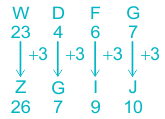
WDFG is related to ZGIJ in a certain way based on the English alphabetical order. In the same way, IPRS is related to LSUV. To which of the following options is RYAB related, following the same logic?

  1. AOption (a)

    UBDE

  2. BOption (b)

    UDEB

  3. COption (c)

    UDBE

  4. DOption (d)

    UBED

View answer & explanation

Correct answer

Answer: (a)A.

UBDE

Why this answer is correct

The logic followed here is:

WDFG is related to ZGIJ

And,

IPRS is related to LSUV

Similarly,

RYAB is related to

Hence, "Option 1" is the correct answer.

Question 3

If the selling price of a bed is 2-times of initial, then the profit is 7-times of initial. Find the initial profit percentage (in %)

  1. AOption (a)

    250

  2. BOption (b)

    350

  3. COption (c)

    20

  4. DOption (d)

    28.57 

View answer & explanation

Correct answer

Answer: (c)C.

20

Why this answer is correct

Shortcut Trick

Let initial Selling Price (SP1) be 1 and Cost Price (CP) be x.

Initial Profit (P1) = 1 − x. New Selling Price (SP2) = 2.

New Profit (P2) = 2 − x. According to question: P2 = 7 × P1.

2 − x = 7(1 − x) ⇒ 2 − x = 7 − 7x ⇒ 6x = 5 ⇒ x = 5/6.

Initial Profit % = [(1 − 5/6) ÷ (5/6)] × 100 = (1/5) × 100 = 20%.

∴ The correct answer is 20%.

Alternate Method

Given → SPnew = 2 × SPold | Pnew = 7 × Pold. Formulas: Profit = SP − CP | Profit% = (Profit ÷ CP) × 100.

⇒ Let CP = C, SPinitial = S. ⇒ Pinitial = S − C. ⇒ Pnew = 2S − C. ⇒ According to condition: 2S − C = 7(S − C). ⇒ 2S − C = 7S − 7C. ⇒ 6C = 5S ⇒ S/C = 6/5. ⇒ Profit% = [(6 − 5) ÷ 5] × 100 = 1/5 × 100 = 20%.

∴ The correct answer is 20%.

Additional Information

Profit and Loss relationship

If the Cost Price remains constant, any change in the Selling Price results in a direct change in the absolute profit amount by the same difference.

Profit Percentage Formula

Profit% is always calculated on the Cost Price unless stated otherwise: Profit% = [(SP − CP) ÷ CP] × 100.

Question 4

A dealer purchased a ceiling fan for ₹66,000. He allows a discount of 56% on its marked price and still gains 69%. Find the marked price of the ceiling fan.

  1. AOption (a)

    ₹2,53,500 

  2. BOption (b)

    ₹2,53,597

  3. COption (c)

    ₹2,53,394 

  4. DOption (d)

    ₹2,53,426 

View answer & explanation

Correct answer

Answer: (a)A.

₹2,53,500 

Why this answer is correct

Shortcut Trick

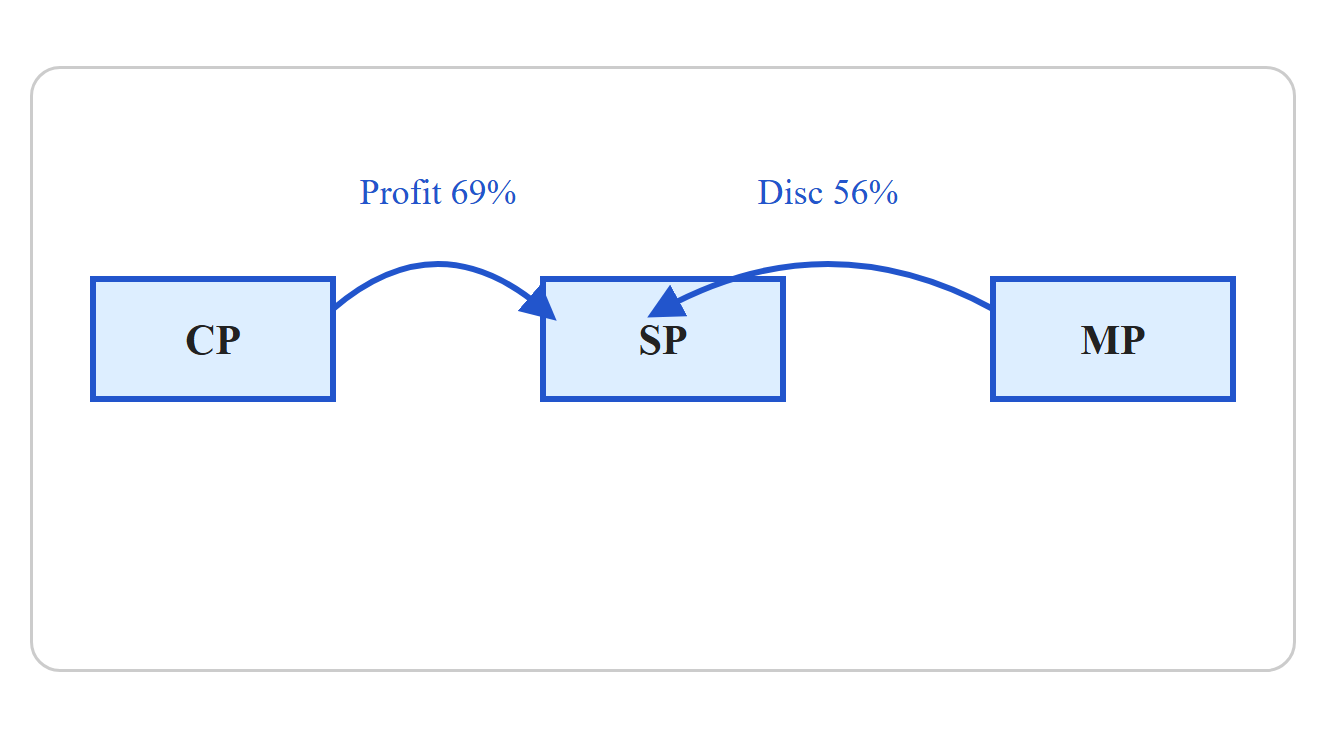
Use the ratio relationship: MP ÷ CP = (100 + Gain%) ÷ (100 − Discount%).

MP ÷ 66,000 = (100 + 69) ÷ (100 − 56) = 169 ÷ 44.

MP = (66,000 × 169) ÷ 44 = 1,500 × 169.

MP = 2,53,500.

∴ The correct answer is ₹2,53,500.

Alternate Method

Given → Cost Price (CP) = ₹66,000, Profit% = 69%, Discount% = 56%. Formulas: SP = CP × (100 + P%) ÷ 100 | MP = (SP × 100) ÷ (100 − D%).

⇒ Calculate Selling Price (SP): SP = 66,000 × (169 ÷ 100) = 660 × 169 = ₹1,11,540. ⇒ Calculate Marked Price (MP): 1,11,540 = MP × (100 − 56) ÷ 100. ⇒ 1,11,540 = MP × 44 ÷ 100. ⇒ MP = (1,11,540 × 100) ÷ 44. ⇒ MP = 2,535 × 100 = ₹2,53,500.

∴ The correct answer is ₹2,53,500.

Additional Information

Marked Price & Discount

The Marked Price (MP) is the price listed by the seller, and Discount is always calculated on this MP to arrive at the Selling Price.

CP-MP Relation

The direct formula CP/MP = (100 − D%)/(100 + P%) is a very efficient way to solve problems involving both discount and profit percentages.

Question 5

Based on the English alphabetical order, three of the following four letter-cluster pairs are alike in a certain way and thus form a group. Which is the letter-cluster pair that DOES NOT belong to that group? (Note: The odd one out is not based on the number of consonants/vowels or their position in the letter-cluster.)

  1. AOption (a)

    GH - BC

  2. BOption (b)

    LM - GH

  3. COption (c)

    IJ - DE

  4. DOption (d)

    MN - PD 

View answer & explanation

Correct answer

Answer: (d)D.

MN - PD 

Why this answer is correct

The logic followed here is:

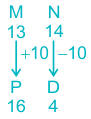
Option 1) GH - BC

Option 2) LM - GH

​

Option 3) IJ - DE

Option 4) MN - PD

​

Thus, out of all 'MN - PD' is the odd one out.

Hence, "Option 4" is the correct answer.

Question 6

Which court in the subordinate judiciary has unlimited pecuniary jurisdiction in civil cases?

  1. AOption (a)

     Small Causes Court 

  2. BOption (b)

    Nyaya Panchayat 

  3. COption (c)

    Court of Munsiff 

  4. DOption (d)

     Judge of District Court

View answer & explanation

Correct answer

Answer: (d)D.

 Judge of District Court

Why this answer is correct

The correct answer is Judge of District Court.

Key Points

  • The District Court serves as the principal court of original jurisdiction in civil matters in the subordinate judiciary system in India.
  • The District Court is presided over by the District Judge, who has the authority to hear civil cases with unlimited pecuniary jurisdiction unless restricted by specific legislative provisions.
  • These courts handle a wide range of civil disputes, including property disputes, matrimonial cases, and contractual disagreements, among others.
  • District Courts are established by state governments in India for every district or group of districts, as per the Code of Civil Procedure, 1908.
  • The decisions of the District Court can be appealed to the High Court of the respective state.

Additional Information

  • Pecuniary Jurisdiction:
  • Pecuniary jurisdiction refers to the monetary value of cases that a particular court is authorized to hear and adjudicate.
  • In India, lower courts like the Court of Munsiff typically have limited pecuniary jurisdiction, while District Courts have no upper monetary limit unless restricted by state laws.
  • Hierarchy of Civil Courts:
  • The hierarchy of civil courts in India includes the Court of Munsiff, Civil Judge (Junior Division), Civil Judge (Senior Division), and District Courts.
  • Above the subordinate courts, civil matters can be escalated to the High Courts and, in some cases, the Supreme Court of India.
  • Small Causes Court:
  • Small Causes Courts deal with cases related to small monetary disputes, typically with a value below a certain threshold, which varies by state.
  • They lack jurisdiction over cases involving property disputes or other significant civil matters.
  • Nyaya Panchayat:
  • Nyaya Panchayats are grassroots-level judicial bodies in rural areas that handle minor civil and criminal cases.
  • They focus on delivering speedy and cost-effective justice but have limited jurisdiction and authority.
  • Code of Civil Procedure, 1908:
  • This is the primary legislation governing the functioning and procedures of civil courts in India.
  • It defines the jurisdiction, powers, and structure of courts, including the District Courts and subordinate courts.

Question 7

Rakesh’s salary is ₹12,000 per month. He spends ₹6,000 on house rent, ₹3,000 on bills and the rest of the amount is his monthly savings. Find his savings (in ₹) in a year, if in the month of his birthday, he spent his complete monthly savings for the birthday celebration

  1. AOption (a)

    27,000

  2. BOption (b)

    33,000 

  3. COption (c)

     36,000

  4. DOption (d)

     30,000

View answer & explanation

Correct answer

Answer: (b)B.

33,000 

Why this answer is correct

Shortcut Trick

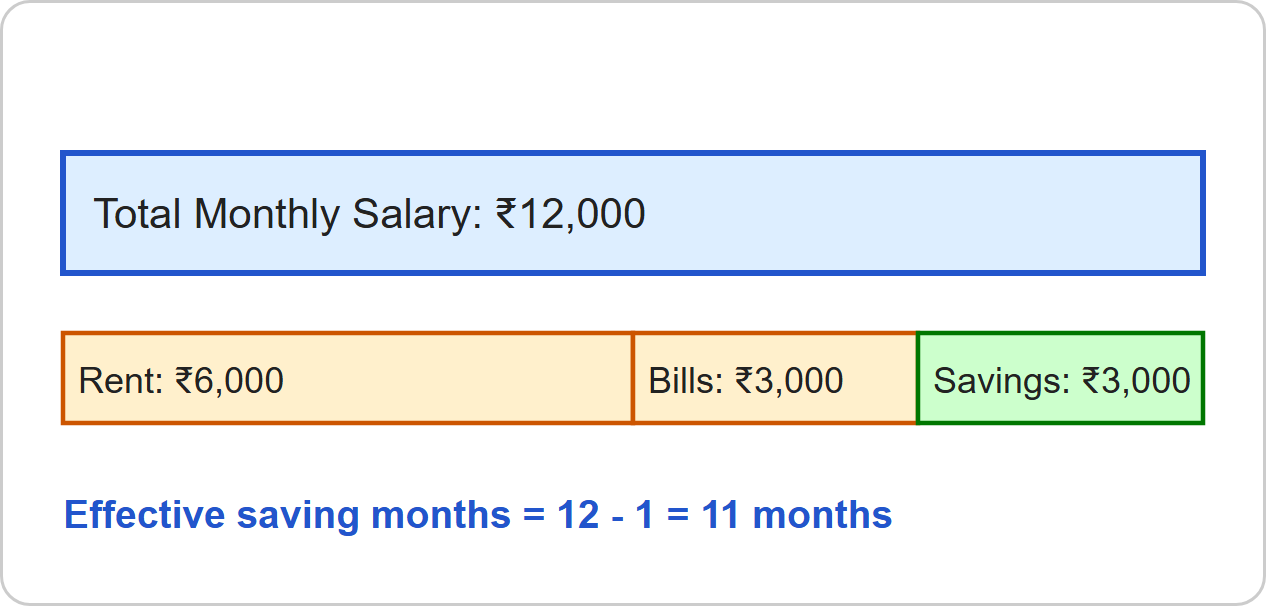
Monthly Savings = 12,000 − (6,000 + 3,000) = ₹3,000.

Savings are done for 11 months only (as 1 month savings spent on birthday).

Yearly Savings = 3,000 × 11 = ₹33,000.

∴ The correct answer is ₹33,000.

Alternate Method

Given: Monthly Salary = ₹12,000 | Rent = ₹6,000 | Bills = ₹3,000.

Formula: Savings = Income − Expenditure

⇒ Monthly Expenditure = ₹6,000 + ₹3,000 = ₹9,000

⇒ Monthly Savings = ₹12,000 − ₹9,000 = ₹3,000

⇒ Since birthday month savings are spent, savings occur for 11 months.

⇒ Annual Savings = 11 × 3,000 = ₹33,000

∴ The correct answer is ₹33,000.

Additional Information

Monthly vs Annual Calculation

Always identify the number of effective periods. Annual Value = Monthly Value × 12, but adjust for specific non-saving months.

Percentage Savings

Savings Percentage = (Savings ÷ Income) × 100. In this case, (3,000 ÷ 12,000) × 100 = 25%.

Question 8

If the roots of the quadratic equation kx2−4x+1=0k x ^ 2 - 4x + 1 = 0 are real and equal, what is the value of k?

  1. AOption (a)

    1

  2. BOption (b)

    8

  3. COption (c)

    2

  4. DOption (d)

    4

View answer & explanation

Correct answer

Answer: (d)D.

4

Why this answer is correct

Shortcut Trick

For a quadratic equation to have real and equal roots, its discriminant (D) must be zero.

D = b2 − 4ac = 0

In the equation kx2 − 4x + 1 = 0, we have (−4)2 − 4 × k × 1 = 0.

16 − 4k = 0 ⇒ 4k = 16 ⇒ k = 4.

∴ The correct answer is 4.

Alternate Method

Given:

The quadratic equation is kx2 − 4x + 1 = 0.

Formula Used:

A quadratic equation ax2 + bx + c = 0 has real and equal roots if:

Discriminant (D) = b2 − 4ac = 0

Calculations:

Comparing the given equation with the standard form ax2 + bx + c = 0:

a = k, b = −4, and c = 1

Substitute these values into the discriminant formula:

⇒ (−4)2 − 4 × (k) × (1) = 0

⇒ 16 − 4k = 0

⇒ 4k = 16

⇒ k = 16 ÷ 4

⇒ k = 4

∴ The correct answer is 4.

Additional Information

Nature of Roots

The nature of roots is determined by D = b2 − 4ac. If D > 0, roots are real and distinct; if D = 0, roots are real and equal; if D < 0, roots are complex/imaginary.

Discriminant Formula

For any quadratic equation ax2 + bx + c = 0, the discriminant is given by D = b2 − 4ac.

Standard Quadratic Form

A standard quadratic equation is represented as ax2 + bx + c = 0, where a ≠ 0.

Question 9

The numerical value of 4sec⁡2θ+31+cot⁡2θ+sin⁡2θ\frac{4}{\sec^2\theta} + \frac{3}{1+\cot^2\theta} + \sin^2\theta  is:

  1. AOption (a)

    2

  2. BOption (b)

    4

  3. COption (c)

    1

  4. DOption (d)

    3

View answer & explanation

Correct answer

Answer: (b)B.

4

Why this answer is correct

Shortcut Trick

Put θ = 90° in the given expression.

⇒ 4/sec290° + 3/(1+cot290°) + sin290°

⇒ 4/∞ + 3/(1+0) + (1)2

⇒ 0 + 3 + 1 = 4

∴ The correct answer is 4.

Alternate Method

Given: Expression = 4/sec2θ + 3/(1+cot2θ) + sin2θ

Formula Used: 1/secθ = cosθ, 1 + cot2θ = cosec2θ, 1/cosecθ = sinθ, sin2θ + cos2θ = 1

⇒ 4 × (1/sec2θ) + 3/(cosec2θ) + sin2θ

⇒ 4cos2θ + 3sin2θ + sin2θ

⇒ 4cos2θ + 4sin2θ

⇒ 4(cos2θ + sin2θ)

⇒ 4 × 1 = 4

∴ The correct answer is 4.

Additional Information

Pythagorean Identities

Fundamental relations: sin2θ + cos2θ = 1, 1 + tan2θ = sec2θ, and 1 + cot2θ = cosec2θ.

Reciprocal Relations

Key ratios: cosθ = 1/secθ, sinθ = 1/cosecθ, and tanθ = 1/cotθ.

Question 10

What should come in place of the question mark (?) in the given series?

327, 304, 271, ?, 175, 112

  1. AOption (a)

    248

  2. BOption (b)

    238

  3. COption (c)

    218

  4. DOption (d)

    228

View answer & explanation

Correct answer

Answer: (d)D.

228

Why this answer is correct

The logic followed here is:

​

Hence, "Option 4" is the correct answer.

Question 11

The longitudinal valleys between the lesser Himalayas and the Shiwaliks are called: 

  1. AOption (a)

    Doabs

  2. BOption (b)

    Meanders

  3. COption (c)

    Khadars

  4. DOption (d)

    Duns

View answer & explanation

Correct answer

Answer: (d)D.

Duns

Why this answer is correct

The correct answer is Duns.

Key Points

  • Duns are longitudinal valleys situated between the Lesser Himalayas (or Middle Himalayas) and the Shiwalik range.
  • They are formed due to the folding of sedimentary rocks during the Himalayan orogeny (mountain-building process).
  • Examples of prominent duns include Dehradun, Kotli Dun, and Patli Dun.
  • These valleys are often fertile and support agriculture, making them important for the local economy.
  • The term "dun" is derived from the Hindi word “doon,” which means a valley.

Additional Information

  • Lesser Himalayas:
  • The Lesser Himalayas, also called the Himachal, are located north of the Shiwaliks and south of the Greater Himalayas.
  • They are composed of metamorphic and sedimentary rocks and are known for their rugged terrain and deep valleys.
  • Shiwalik Range:
  • The Shiwaliks are the outermost range of the Himalayas and are made up of unconsolidated sediments brought down by rivers.
  • This range is prone to erosion and is characterized by steep slopes.
  • Himalayan Orogeny:
  • The Himalayas were formed due to the collision of the Indian Plate with the Eurasian Plate around 50 million years ago.
  • This tectonic activity caused the folding and upliftment of sedimentary rocks, leading to the formation of ranges and valleys like duns.
  • Other Types of Valleys:
  • Doabs: Land between two rivers, typically used in the Indo-Gangetic Plains (e.g., Punjab's doabs).
  • Meanders: Curved bends in a river channel, primarily formed in its lower course.
  • Khadars: Fertile alluvial soil regions formed by river deposition during floods, often found in the Indo-Gangetic Plains.

Question 12

Who among the following first coined the term 'judicial activism'?

  1. AOption (a)

     DA Desai

  2. BOption (b)

     Arthur Schlesinger Jr.

  3. COption (c)

    Justice PN Bhagwati 

  4. DOption (d)

    Justice VR Krishna Iyer

View answer & explanation

Correct answer

Answer: (b)B.

 Arthur Schlesinger Jr.

Why this answer is correct

The correct answer is Arthur Schlesinger Jr..

Key Points

  • Arthur Schlesinger Jr., a renowned American historian and social critic, first coined the term 'judicial activism' in a 1947 article titled “The Supreme Court: 1947” published in Fortune magazine.
  • The term was used to describe the behavior of judges who go beyond their traditional role of interpreting the law and actively shape policy decisions through their rulings.
  • Schlesinger Jr. categorized Supreme Court justices of his time into "judicial activists" and "champions of judicial restraint," highlighting their differing approaches to constitutional interpretation.
  • Judicial activism generally refers to the practice where courts take an active role in ensuring justice, often by overriding legislative and executive actions.
  • Arthur Schlesinger Jr.'s work has been influential in shaping public discourse around the role of judiciary in governance.

Additional Information

  • Judicial Activism
  • Judicial activism involves the judiciary taking an active role in addressing societal issues by interpreting laws in a progressive manner.
  • It contrasts with judicial restraint, where judges strictly adhere to the text of laws without expanding their scope.
  • Examples of judicial activism include landmark cases like Brown v. Board of Education (1954) in the US, which ended racial segregation in public schools.
  • In India, judicial activism is often associated with Public Interest Litigations (PILs) and cases like Vishaka v. State of Rajasthan (1997) that addressed sexual harassment at the workplace.
  • Arthur Schlesinger Jr.
  • He was a Pulitzer Prize-winning historian and a prominent intellectual during the mid-20th century.
  • Schlesinger Jr. served as a special assistant to President John F. Kennedy and was a vocal advocate of liberal policies.
  • His work often explored themes of democracy, governance, and the role of individuals in shaping history.
  • Judicial Restraint
  • Judicial restraint refers to the principle where judges strictly interpret laws as written and avoid making policy decisions.
  • This approach emphasizes the separation of powers, respecting the roles of the legislative and executive branches.
  • Judicial restraint is often seen as a counterbalance to judicial activism.
  • Public Interest Litigation (PIL)
  • PILs enable individuals or groups to approach courts for addressing broader public concerns without direct personal interest.
  • It is widely used in India for judicial activism to address issues like environmental protection, human rights, and corruption.
  • PILs have been instrumental in expanding the scope of judicial intervention in governance matters.

Question 13

Find the simple interest (in ₹) on ₹2,000 at 6% per annum rate of interest for the period from 3 February 2023 to 17 April 2023.

  1. AOption (a)

    23

  2. BOption (b)

    24

  3. COption (c)

    25

  4. DOption (d)

    22

View answer & explanation

Correct answer

Answer: (b)B.

24

Why this answer is correct

Shortcut Trick

Identify the total days: Feb (25) + Mar (31) + Apr (17) = 73 days.

Since 73 days is exactly 1/5 of a year (73/365), calculate 1/5 of the annual interest.

Annual Interest = 6% of ₹2,000 = ₹120.

Simple Interest for the period = 120 ÷ 5 = ₹24.

∴ The correct answer is ₹24.

Alternate Method

Given:

Principal (P) = ₹2,000

Rate (R) = 6% per annum

Period: 3 February 2023 to 17 April 2023

Formula Used:

Simple Interest (SI) = (P × R × T) ÷ 100

Calculations:

⇒ Number of days in February = 28 − 3 = 25 days (2023 is a non-leap year)

⇒ Number of days in March = 31 days

⇒ Number of days in April = 17 days

⇒ Total days (T) = 25 + 31 + 17 = 73 days

⇒ Time in years = 73 ÷ 365 = 1/5 year

⇒ SI = (2000 × 6 × 1/5) ÷ 100

⇒ SI = (2000 × 6) ÷ 500

⇒ SI = 4 × 6 = 24

∴ The correct answer is ₹24.

Additional Information

Time Calculation for Interest

While calculating the number of days, the day on which money is deposited is usually excluded and the day on which money is withdrawn is included.

Standard Year vs Leap Year

For interest calculations, a standard year is taken as 365 days. If the year is a leap year (divisible by 4), February has 29 days.

Relationship between Amount and SI

The total Amount (A) repaid after the period is the sum of the Principal (P) and the Simple Interest (SI): A = P + SI.

Question 14

Four numbers are in the ratio of 11 : 19 : 5 : 7 respectively. If the sum of these four numbers is 2289, then what is the sum of the first and the third number?

  1. AOption (a)

    848

  2. BOption (b)

    816

  3. COption (c)

    872

  4. DOption (d)

    887

View answer & explanation

Correct answer

Answer: (c)C.

872

Why this answer is correct

Shortcut Trick

Ratio sum = 11 + 19 + 5 + 7 = 42 units

42 units = 2289 → 1 unit = 2289 ÷ 42 = 54.5

Required sum (1st + 3rd) = 11 + 5 = 16 units

Sum = 16 × 54.5 = 872

∴ The correct answer is 872.

Alternate Method

Given:

Ratio of four numbers = 11 : 19 : 5 : 7

Total Sum = 2289

Calculations:

⇒ Let the numbers be 11x, 19x, 5x, and 7x.

⇒ Sum = 11x + 19x + 5x + 7x = 42x

⇒ 42x = 2289

⇒ x = 2289 ÷ 42

⇒ x = 54.5

⇒ Sum of 1st and 3rd number = 11x + 5x = 16x

⇒ Required Sum = 16 × 54.5 = 872

∴ The correct answer is 872.

Additional Information

Ratio and Proportion

A ratio indicates how many times one number contains another. If a : b = c : d, then a × d = b × c.

Distribution of Quantity

To divide a quantity S in the ratio a:b:c, the shares are S × [a/(a+b+c)], S × [b/(a+b+c)], and so on.

Compound Ratio

The compound ratio of a:b and c:d is (ac) : (bd). It is used for combining multiple related ratios.

Question 15

Jitesh and Kamal can complete a certain piece of work in 5 and 18 days, respectively, They started to work together, and after 3 days, Kamal left. In how many days will Jitesh complete the remaining work? 

  1. AOption (a)

    116\frac{11}{6}

  2. BOption (b)

    256\frac{25}{6}

  3. COption (c)

    76\frac{7}{6}

  4. DOption (d)

    136\frac{13}{6}

View answer & explanation

Correct answer

Answer: (c)C.

76\frac{7}{6}

Why this answer is correct

Shortcut Trick

Total work (LCM of 5 and 18) = 90 units.

Efficiency: Jitesh = 18 units/day, Kamal = 5 units/day.

Combined work in 3 days = 3 × (18 + 5) = 69 units.

Remaining work = 90 − 69 = 21 units.

Days for Jitesh to finish = 21 ÷ 18 = 7/6 days.

∴ The correct answer is 7/6 days.

Alternate Method

PersonDaysTotal WorkEfficiency
Jitesh59018
Kamal185

Given: Jitesh completes work in 5 days, Kamal in 18 days.

Formula: Remaining Work = Total Work − Work Done

⇒ Total work = LCM(5, 18) = 90 units

⇒ Efficiency of Jitesh = 90 ÷ 5 = 18 units/day

⇒ Efficiency of Kamal = 90 ÷ 18 = 5 units/day

⇒ Work done together in 3 days = 3 × (18 + 5) = 3 × 23 = 69 units

⇒ Remaining work = 90 − 69 = 21 units

⇒ Time taken by Jitesh to finish remaining work = 21 ÷ 18

⇒ Time = 7/6 days

∴ The correct answer is 7/6 days.

Additional Information

Efficiency and Time Relation

Efficiency is inversely proportional to the time taken to complete the work. Efficiency × Time = Total Work.

Work & Wages

Wages are distributed based on the ratio of work done by each individual, which is the product of their efficiency and time spent working.

Fractional Work Method

If a person does work in 'x' days, work done in 1 day = 1/x. Sum of daily fractions of work gives the total combined efficiency.

Question 16

The World Sustainable Development Summit 2025 took place in which city?

  1. AOption (a)

    Hyderabad

  2. BOption (b)

    Mumbai

  3. COption (c)

    Bengaluru

  4. DOption (d)

    New Delhi

View answer & explanation

Correct answer

Answer: (d)D.

New Delhi

Why this answer is correct

The correct answer is New Delhi.

Key Points

  • The World Sustainable Development Summit (WSDS) is an annual flagship event organized by The Energy and Resources Institute (TERI).
  • The WSDS 2025 took place in New Delhi, India, continuing the tradition of addressing critical global sustainability challenges.
  • The summit serves as a platform for global leaders, policymakers, and researchers to deliberate on sustainable development goals and climate action strategies.
  • The WSDS focuses on themes such as renewable energy, climate resilience, and equitable economic growth, aligning with the United Nations Sustainable Development Goals (SDGs).
  • The event is supported by the Government of India and various international organizations, showcasing India's commitment to sustainability leadership.

Additional Information

  • The Energy and Resources Institute (TERI):
  • TERI is a leading research institute headquartered in New Delhi, focusing on energy, environment, and sustainable development.
  • It was established in 1974 and has been organizing the WSDS since 2001 (formerly known as the Delhi Sustainable Development Summit).
  • Sustainable Development Goals (SDGs):
  • A global framework adopted by the United Nations in 2015, comprising 17 goals aimed at eradicating poverty, protecting the planet, and ensuring peace and prosperity by 2030.
  • WSDS aligns its discussions with key SDGs, such as Climate Action (Goal 13) and Affordable and Clean Energy (Goal 7).
  • India's Role in Global Sustainability:
  • India has been an active participant in global climate forums such as COP (Conference of Parties) and is a signatory to the Paris Agreement.
  • The WSDS reinforces India's position as a leader in climate resilience and sustainable development initiatives.
  • Key Highlights of WSDS 2025:
  • Discussions on scaling up renewable energy adoption, combating climate change, and fostering green economic recovery post-pandemic.
  • Participation from global leaders, including heads of state, Nobel laureates, and sustainability experts.

Question 17

In a certain code language,

'A + B' means 'A is the sister of B'

'A-B' means 'A is the father of B'

'A x B' means 'A is the wife of B'

'A ÷ B' means 'A is the son of B'

Based on the above, how is P related to T if 'P x Q ÷ R - S + T'?

  1. AOption (a)

    Sister's daughter

  2. BOption (b)

    Brother's wife 

  3. COption (c)

    Son's wife's sister

  4. DOption (d)

     Brother's son's wife

View answer & explanation

Correct answer

Answer: (b)B.

Brother's wife 

Why this answer is correct

Decoding the Symbols:

A is
Symbol+−x÷
MeaningSisterFatherWifeSon
to B

Given: P x Q ÷ R - S + T

P x Q → P is the wife of Q.

Q ÷ R → Q is the son of R. 

R - S → R is the father of S.

S + T → S is the sister of T.

Thus, P is T's brother's wife.

Hence, "Option 2" is the correct answer.

Question 18

Sujay ranked 29th from the top and 59th from the bottom in his class. How many students are there in his class?

  1. AOption (a)

    85

  2. BOption (b)

    88

  3. COption (c)

    87

  4. DOption (d)

    86

View answer & explanation

Correct answer

Answer: (c)C.

87

Why this answer is correct

Given: Sujay ranked 29th from the top and 59th from the bottom in his class. 

Sujay's rank from the top = 29th

Sujay's rank from the bottom = 59th 

Total number of students = Sujay's rank from the top + Sujay's rank from the bottom - 1

= 29 + 59 - 1 → 87

Hence, "Option 3" is the correct answer.
Question 19

Which of the following Operating System concepts is most directly involved in ensuring that multiple processes can access and modify files concurrently without causing data corruption?

  1. AOption (a)

    File locking mechanisms

  2. BOption (b)

    Scheduling algorithms

  3. COption (c)

    Virtual memory management

  4. DOption (d)

    Paging

View answer & explanation

Correct answer

Answer: (a)A.

File locking mechanisms

Why this answer is correct

The correct answer is File locking mechanisms.

Key Points

  • File locking mechanisms are designed to ensure data integrity and prevent data corruption when multiple processes access the same file concurrently.
  • Locks can be applied at different levels, such as file-level locks or record-level locks, depending on the granularity of the access control required.
  • File locking ensures that only one process can modify a file at a time, while other processes may be blocked or granted read-only access.
  • Operating systems like Linux and Windows provide built-in APIs or system calls (e.g., flock in Linux) to implement file locking for developers.
  • Improper implementation of file locking mechanisms can lead to issues like deadlock or livestock, which require careful handling in concurrent programming.

Additional Information

  • Concurrency in Operating Systems:
  • Concurrency refers to the ability of an operating system to allow multiple processes or threads to execute simultaneously.
  • It is managed through mechanisms like process scheduling, synchronization, and file locking.
  • Concurrency is crucial for improving the efficiency and resource utilization of modern operating systems.
  • Deadlock:
  • Deadlock occurs when two or more processes are unable to proceed because each is waiting for the other to release a resource.
  • File locking can sometimes lead to deadlock, which can be mitigated using techniques like timeout-based locking or deadlock detection algorithms.
  • Virtual Memory Management:
  • Virtual memory allows an operating system to use disk storage to simulate additional RAM, enabling processes to run even when physical memory is limited.
  • While related to process management, virtual memory does not directly address file access concurrency.
  • Scheduling Algorithms:
  • Scheduling algorithms determine the order in which processes are executed by the CPU.
  • Common algorithms include First Come First Serve (FCFS), Shortest Job Next (SJN), and Round Robin (RR).
  • They do not directly handle file access conflicts but are essential for process management.

Question 20

Select the pair that follows the same pattern as that followed by the two pairs given below. Both pairs follow the same pattern.

BGM : DEK

SVL : UTJ

  1. AOption (a)

     GOU : KMQ

  2. BOption (b)

    EKX : GIV

  3. COption (c)

    HXF : LTB

  4. DOption (d)

    IMZ : MIW

View answer & explanation

Correct answer

Answer: (b)B.

EKX : GIV

Why this answer is correct

The logic followed here is:

​BGM : DEK

And,

SVL : UTJ

Similarly,

Option 2) EKX : GIV

Hence, "Option 2" is the correct answer.

Question 21

KARJ is related to NDUM in a certain way based on the English alphabetical order. In the same way, PLBF is related to SOEI. To which of the following is SCHQ related, following the same logic?

  1. AOption (a)

    VFKT

  2. BOption (b)

    VELT

  3. COption (c)

    UFNR

  4. DOption (d)

    UEMR

View answer & explanation

Correct answer

Answer: (a)A.

VFKT

Why this answer is correct

The logic followed here is:

KARJ is related to NDUM

And,

PLBF is related to SOEI

Similarly,

SCHQ is related to

Hence, "Option 1" is the correct answer.

Question 22

Which of the following acts of the East India Company formally separated the Legislative and Executive functions of Governor-General’s Council?

  1. AOption (a)

    Charter Act of 1793

  2. BOption (b)

    Charter Act of 1833

  3. COption (c)

    Charter Act of 1853

  4. DOption (d)

    Charter Act of 1813

View answer & explanation

Correct answer

Answer: (c)C.

Charter Act of 1853

Why this answer is correct

The correct answer is Charter Act of 1853.

Key Points

  • The Charter Act of 1853 was the last in the series of Charter Acts passed by the British Parliament for the governance of India.
  • This Act formally separated the legislative and executive functions of the Governor-General’s Council.
  • A separate Legislative Council was created under this Act, marking the beginning of a distinct legislative machinery in British India.
  • The Governor-General’s Council now had six members—four executive and two legislative members.
  • The Act also allowed Indians to be appointed to the Legislative Council for the first time, although their participation was limited.

Additional Information

  • Charter Act of 1833:
  • It made the Governor-General of Bengal the Governor-General of India, centralizing administration.
  • It ended the commercial operations of the East India Company and made it a purely administrative body.
  • The Act attempted to introduce open competition for civil services but faced opposition.
  • Key Terminology:
  • Governor-General's Council: The council was an advisory body assisting the Governor-General in administrative and legislative matters.
  • Legislative Council: A body created for enacting laws, distinct from the executive functions of the government.
  • Role of the East India Company:
  • The East India Company initially held both administrative and commercial powers in India.
  • The Charter Acts progressively curbed its commercial role and enhanced its administrative authority under British Parliament's control.
  • Significance of the Charter Act of 1853:
  • It marked a step towards modern legislative practices in India.
  • The Act laid the groundwork for subsequent reforms, including the Indian Councils Act of 1861.

Question 23

Most of the Thar Desert lies in which direction with respect to the Aravalli Hills? 

  1. AOption (a)

    North-West

  2. BOption (b)

    East

  3. COption (c)

    North-East

  4. DOption (d)

    South

View answer & explanation

Correct answer

Answer: (a)A.

North-West

Why this answer is correct

The correct answer is North-West.

Key Points

  • The Thar Desert is geographically located to the North-West of the Aravalli Hills, which act as a natural barrier influencing its climatic conditions.
  • The Aravalli Hills, one of the oldest mountain ranges in the world, run from northeast to southwest across northwestern India.
  • The orientation of the Aravalli Hills significantly affects the wind patterns, leading to the accumulation of desert sand towards the North-West region.
  • The Thar Desert spans across the Indian states of Rajasthan, Gujarat, Punjab, and Haryana, with a major portion lying in Rajasthan.
  • The desert's proximity to the Aravalli Hills helps restrict the eastward expansion of the sandy terrain.

Additional Information

  • Thar Desert:
  • The Thar Desert, also known as the Great Indian Desert, is the 17th largest desert in the world and the 9th largest subtropical desert.
  • It covers an area of approximately 200,000 square kilometers, making it the most densely populated desert in the world.
  • The desert is characterized by extreme temperatures, scarce vegetation, and low precipitation (100-500 mm annually).
  • Aravalli Hills:
  • The Aravalli Hills are a range of ancient fold mountains extending approximately 692 kilometers across northwest India.
  • They play a crucial role in determining the local climate and act as a protective barrier against desertification to the east.
  • The highest peak is Guru Shikhar, located in Mount Abu, Rajasthan, at an elevation of 1,722 meters.
  • Climatic Influence:
  • The Aravalli Hills influence the monsoon winds, causing the western region to remain arid while the eastern plains receive moderate rainfall.
  • The desert's location to the northwest of the hills results in its characteristic dry and sandy climate.
  • Flora and Fauna:
  • The desert supports various drought-resistant plants such as cacti, acacia, and khejri trees.
  • Wildlife includes species like the Indian gazelle (chinkara), desert fox, and great Indian bustard, which are adapted to arid conditions.

Question 24

If 1 is added to each odd digit and 2 is subtracted from each even digit in the number 7134856, which of the following digits will be second from the left in the new number thus formed?

  1. AOption (a)

    2

  2. BOption (b)

    1

  3. COption (c)

    3

  4. DOption (d)

    4

View answer & explanation

Correct answer

Answer: (a)A.

2

Why this answer is correct

Given number: 7134856

According to the question, 

Number given7134856
Odd digit → (+1) Even digit → (-2)(+1)(+1)(+1)(-2)(-2)(+1)(-2)
Resultant number8242664

So, second digit from the left in the new number thus formed → 2

Hence, "Option 1" is the correct answer.

Question 25

Each of the digits in the number 24765389 is arranged in ascending order from left to right. Which of the following digits will be fourth from the left in the new number thus formed? 

  1. AOption (a)

    6

  2. BOption (b)

    4

  3. COption (c)

    7

  4. DOption (d)

    5

View answer & explanation

Correct answer

Answer: (d)D.

5

Why this answer is correct

Given series: 24765389

According to the question, arranged in ascending order from left to right:

24765389 → 23456789

Fourth digit from the left end in the new number thus formed is → 23456789 → 5

Hence, "Option 4" is the correct answer.

Question 26

The relics of Buddha are found inside which of the following Buddhist architectures? 

  1. AOption (a)

    Rock Edicts

  2. BOption (b)

    Stupas

  3. COption (c)

     Chaitya Halls

  4. DOption (d)

    Ashokan Pillars

View answer & explanation

Correct answer

Answer: (b)B.

Stupas

Why this answer is correct

The correct answer is Stupas.

Key Points

  • Stupas are hemispherical structures that serve as repositories for sacred relics, typically the remains of Buddha and other significant Buddhist figures.
  • The relics are usually enclosed in a container and placed at the core of the stupa, symbolizing the Buddha's enlightened mind.
  • Famous stupas like the Sanchi Stupa in Madhya Pradesh and the Dhamek Stupa in Sarnath hold significant historical and religious importance.
  • Stupas are not only burial mounds but also serve as places of meditation and veneration for followers of Buddhism.
  • The construction of stupas was initiated under the reign of Emperor Ashoka, who embraced Buddhism and propagated its teachings widely.

Additional Information

  • Rock Edicts:
  • These are inscriptions on rocks and pillars issued by Emperor Ashoka, spreading messages of Dharma and Buddhism.
  • They do not contain relics but are significant for understanding ancient Indian history and Ashoka’s rule.
  • Chaitya Halls:
  • Chaityas are Buddhist prayer halls with a stupa at one end, primarily used for congregational worship.
  • Unlike stupas, chaityas are architectural spaces rather than reliquaries.
  • Ashokan Pillars:
  • These are monolithic columns erected by Emperor Ashoka, inscribed with edicts promoting Buddhist teachings and values.
  • They do not enshrine relics but symbolize the propagation of Buddhism.
  • Types of Stupas:
  • Stupas are categorized into relic stupas (containing relics), object stupas (housing sacred objects), and commemorative stupas (marking significant events).
  • Relic stupas are the most revered as they enshrine the physical remains of the Buddha or other enlightened beings.

Question 27

The present cost of a plot area is ₹1,12,079. After a year, its cost increased to ₹1,89,297. The percentage increase (rounded off to the nearest integer) in the cost of the plot area is:

  1. AOption (a)

    67%

  2. BOption (b)

    73%

  3. COption (c)

    57%

  4. DOption (d)

    69%

View answer & explanation

Correct answer

Answer: (d)D.

69%

Why this answer is correct

Shortcut Trick

Approximate the values to the nearest thousands: 112k → 189k.

Increase ≈ 189 − 112 = 77.

Percentage Increase ≈ (77 ÷ 112) × 100.

77/112 ≈ 11/16 ≈ 68.75%.

∴ The correct answer is 69%.

Alternate Method

Given:

Initial Cost (CP) = ₹1,12,079

Final Cost (SP) = ₹1,89,297

Formula:

Percentage Increase = [(Final Cost − Initial Cost) ÷ Initial Cost] × 100

Calculations:

⇒ Total Increase = 1,89,297 − 1,12,079 = 77,218

⇒ Percentage Increase = (77,218 ÷ 1,12,079) × 100

⇒ Percentage Increase = 0.68895 × 100

⇒ Percentage Increase = 68.89% ≈ 69%

∴ The correct answer is 69%.

Additional Information

Percentage Change

It measures the degree of change over time. Formula: (Difference ÷ Original Value) × 100.

Rounding Off Rules

If the decimal part is 0.5 or greater, round up to the next integer. If less than 0.5, stay at the current integer.

Base Value Selection

Always use the initial or original value as the denominator when calculating percentage increase or decrease.

Question 28

The average age of Amit, Arjun and Anya is 30 years. If the average age of Amit and Anya is 35 years, what will be Arjun's age after 2 years?

  1. AOption (a)

    22 years

  2. BOption (b)

    28 years

  3. COption (c)

    30 years

  4. DOption (d)

    24 years

View answer & explanation

Correct answer

Answer: (a)A.

22 years

Why this answer is correct

Shortcut Trick

Total age of Amit, Arjun, and Anya = 30 × 3 = 90 years

Total age of Amit and Anya = 35 × 2 = 70 years

Arjun's present age = 90 − 70 = 20 years

Arjun's age after 2 years = 20 + 2 = 22 years

∴ The correct answer is 22 years.

Alternate Method

Given:

Average age of Amit, Arjun, and Anya = 30 years

Average age of Amit and Anya = 35 years

Formula Used:

Total Sum = Average × Number of observations

Calculations:

⇒ Total age of Amit, Arjun, and Anya = 30 × 3 = 90 years

⇒ Total age of Amit and Anya = 35 × 2 = 70 years

⇒ Arjun's present age = (Amit + Arjun + Anya) − (Amit + Anya)

⇒ Arjun's present age = 90 − 70 = 20 years

⇒ Arjun's age after 2 years = 20 + 2 = 22 years

∴ The correct answer is 22 years.

Additional Information

Basic Average Formula

Average = (Sum of all observations) ÷ (Number of observations). To find the sum, use: Sum = Average × Count.

Age Increment Property

If the age of every person in a group increases by n years, the average age of the group also increases by n years.

Exclusion Principle

Age of excluded member = (Initial Sum) − (New Sum). This is used when one person leaves the group and the average changes.

Question 29

Seven boxes, A, B, C, D, E, F and G, are kept one over the other, but not necessarily in the same order. No box is kept above F. Only three boxes are kept between F and B. Only one box is kept between A and E. E is kept immediately above B. Only four boxes are kept between A and C. G is kept at some place above D. How many boxes are kept above B?

  1. AOption (a)

    3

  2. BOption (b)

    1

  3. COption (c)

    2

  4. DOption (d)

    4

View answer & explanation

Correct answer

Answer: (d)D.

4

Why this answer is correct

Given: Seven boxes, A, B, C, D, E, F and G, are kept one over the other, but not necessarily in the same order.

1) No box is kept above F.

2) Only three boxes are kept between F and B.

Boxes
F
B

3) E is kept immediately above B.

4) Only one box is kept between A and E. 

5) Only four boxes are kept between A and C.

Boxes
F
A
E
B
C

6) G is kept at some place above D. 

Boxes
F
A
G
E
B
D
C

Thus, four boxes are kept above B.

Hence, "Option 4" is the correct answer.

Question 30

As of February 2025, how many athletes trained under Khelo India have set international records?

  1. AOption (a)

    1802

  2. BOption (b)

    1424

  3. COption (c)

    1631

  4. DOption (d)

    1250

View answer & explanation

Correct answer

Answer: (b)B.

1424

Why this answer is correct

The correct answer is 1424.

Key Points

  • As of February 2025, 1,424 athletes trained under the Khelo India initiative have set international records.
  • The Khelo India program was launched by the Government of India in 2018 to promote sports culture and identify young talent nationwide.
  • The initiative aims to provide financial support, training, and infrastructure to budding athletes across the country.
  • It focuses on both grassroots-level development and nurturing the potential of elite athletes to achieve global recognition.
  • The program has contributed significantly to India’s growing success in international sports events like the Asian Games and the Olympics.

Additional Information

  • Khelo India Scheme
  • The program is implemented by the Ministry of Youth Affairs and Sports, Government of India.
  • It includes initiatives like Khelo India Youth Games (KIYG) and Khelo India University Games (KIUG) to foster competitive sports.
  • Under the Talent Identification and Development program, selected athletes receive an annual scholarship of ₹5 lakh for 8 years.
  • The scheme also aims to improve sports infrastructure by upgrading facilities at schools, colleges, and universities.
  • India’s Rising Sports Achievements
  • India’s athletes have excelled in sports like badminton, wrestling, boxing, and shooting in recent years.
  • The country secured its highest-ever medal tally in the Tokyo 2020 Olympics with 7 medals, including a gold in athletics.
  • Grassroots Sports Development
  • Programs like Khelo India emphasize identifying talent from rural and underserved areas.
  • It aims to bridge the gap between urban and rural athletes, ensuring equal access to sports opportunities.
  • International Standards and Training
  • Under Khelo India, athletes are provided access to world-class coaching and training facilities.
  • Partnerships with global sports organizations ensure exposure to international standards of competition.

Question 31

Which of the following farming techniques is primarily practised by tribal groups in India?

  1. AOption (a)

    Commercial farming

  2. BOption (b)

    Intensive farming

  3. COption (c)

    Plantation farming

  4. DOption (d)

    Shifting agriculture

View answer & explanation

Correct answer

Answer: (d)D.

Shifting agriculture

Why this answer is correct

The correct answer is Shifting agriculture.

Key Points

  • Shifting agriculture, also known as "slash-and-burn agriculture," is a traditional farming technique practised by tribal groups in India.
  • In this method, patches of forest land are cleared by cutting and burning trees, and the land is used for cultivation until its fertility decreases.
  • It is primarily practised in hilly and forested regions such as the northeastern states of India (e.g., Nagaland, Mizoram, and Manipur) and parts of Odisha, Madhya Pradesh, and Andhra Pradesh.
  • Shifting agriculture is a subsistence farming method, meaning it is done primarily to meet the needs of the farmer's family rather than for commercial purposes.
  • After a few years of cultivation, the land is left fallow for natural vegetation to grow back, which helps restore soil fertility.

Additional Information

  • Types of Agriculture in India
  • Commercial farming: Involves large-scale production of crops for sale in markets (e.g., sugarcane, cotton).
  • Intensive farming: High inputs of labor and capital are used on smaller plots of land to maximize output.
  • Plantation farming: Large-scale cultivation of a single crop like tea, coffee, or rubber, typically for export.
  • Jhum Cultivation: A specific form of shifting agriculture practised in northeastern India, where tribal farmers cultivate crops like rice, maize, and millets on cleared forest patches.
  • Environmental Concerns: Shifting agriculture can lead to deforestation, soil erosion, and loss of biodiversity if not practised sustainably.
  • Government Initiatives: Efforts are being made to introduce alternative livelihood options and sustainable farming practices for tribal communities to reduce the environmental impact of shifting agriculture.
  • Alternative Names: Shifting agriculture is also referred to as "jhum," "podu," or "bewar" in different regions of India.

Question 32

A bank offers 7.4% compound interest per annum calculated on a half-yearly basis. A customer deposits ₹8,022 each on 1 January and 1 July of a year. At the end of the year, the amount he would have gained by way of interest is ______ (give your answer correct to 2 decimal places). 

  1. AOption (a)

    ₹903.07

  2. BOption (b)

    ₹919.85 

  3. COption (c)

    ₹918.48 

  4. DOption (d)

    ₹901.42 

View answer & explanation

Correct answer

Answer: (d)D.

₹901.42 

Why this answer is correct

Shortcut Trick

Half-yearly rate (r) = 7.4% ÷ 2 = 3.7%

Interest on 1st deposit (2 cycles) = 3.7 + 3.7 + (3.7 × 3.7)/100 = 7.5369%

Interest on 2nd deposit (1 cycle) = 3.7%

Total Interest % = 7.5369% + 3.7% = 11.2369%

Interest amount = 8022 × 11.2369 / 100 = ₹901.42

∴ The correct answer is ₹901.42.

Alternate Method

Given:

Principal (P) = ₹8,022 for each deposit

Annual Rate (R) = 7.4% | Time = 1 year

Compounding = Half-yearly

Formula Used:

Compound Interest (CI) = P × [(1 + r/100)n − 1]

Where r = R/2 and n = number of half-years.

Calculations:

⇒ Half-yearly rate (r) = 7.4 ÷ 2 = 3.7%

⇒ Interest on 1st deposit (for 2 half-years):

⇒ I1 = 8022 × [(1 + 3.7/100)2 − 1]

⇒ I1 = 8022 × [(1.037)2 − 1] = 8022 × [1.075369 − 1]

⇒ I1 = 8022 × 0.075369 = 604.610118

⇒ Interest on 2nd deposit (for 1 half-year):

⇒ I2 = 8022 × [3.7/100] = 8022 × 0.037

⇒ I2 = 296.814

⇒ Total Interest = I1 + I2 = 604.610118 + 296.814

⇒ Total Interest = 901.424118 ≈ ₹901.42

∴ The correct answer is ₹901.42.

Additional Information

Effective Rate of Interest

For a rate r per period over n periods, the effective rate is [(1 + r/100)n − 1] × 100%.

Half-Yearly Compounding

When interest is compounded half-yearly, the annual rate is divided by 2 and the time periods are doubled.

Successive Percentage Shortcut

For two periods with rate x%, total interest % = x + x + (x2/100).

Question 33

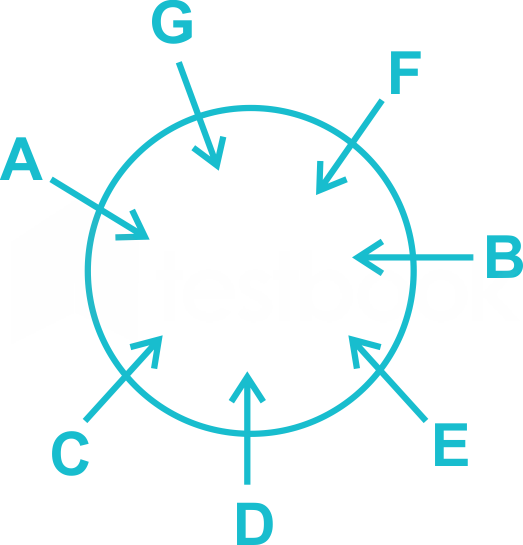
A, B, C, D, E, F, and G are sitting around a circular table facing the centre. Only two people sit between D and F when counted from the left of F. E sits third to the left of G. A sits to the immediate right of G. A sits second to the left of D. B is an immediate neighbour of E. How many people sit between C and F when counted from the left of C? 

  1. AOption (a)

    Four

  2. BOption (b)

    Two

  3. COption (c)

    One

  4. DOption (d)

    Three

View answer & explanation

Correct answer

Answer: (b)B.

Two

Why this answer is correct

Given: A, B, C, D, E, F, and G are sitting around a circular table facing the centre.

1) Only two people sit between D and F when counted from the left of F.

2) A sits second to the left of D. 

3) E sits third to the left of G.

4) B is an immediate neighbour of E. 

After positioning B, G and E only one position is left which will be occupied by the only person left i.e. C.

Thus, two people sit between C and F when counted from the left of C.

Hence, "Option 2" is the correct answer.

Question 34

If HF is a weak acid, what can be inferred about the strength of its conjugate base F⁻? 

  1. AOption (a)

    It is a strong acid

  2. BOption (b)

    It is a strong base

  3. COption (c)

    It is neutral

  4. DOption (d)

    It is a weak base

View answer & explanation

Correct answer

Answer: (d)D.

It is a weak base

Why this answer is correct

The correct answer is It is a weak base.

Key Points

  • HF (hydrofluoric acid) is classified as a weak acid because it does not completely dissociate into its ions in an aqueous solution.
  • According to the Bronsted-Lowry theory, the strength of a conjugate base is inversely related to the strength of its parent acid.
  • Since HF is a weak acid, its conjugate base (F⁻) has a relatively low tendency to accept protons, making it a weak base.
  • Weak acids like HF have conjugate bases that are stronger than the conjugate bases of strong acids but are still not strong enough to be classified as strong bases.
  • F⁻ has a modest ability to accept protons due to its high electronegativity, which contributes to its weak basic nature.

Additional Information

  • Acid and Base Strength:
  • A strong acid dissociates completely in water, producing a negligible conjugate base (e.g., HCl and Cl⁻).
  • A weak acid only partially dissociates, resulting in a conjugate base with measurable basicity (e.g., HF and F⁻).
  • Conjugate Acid-Base Pairs:
  • These are pairs of molecules or ions that differ by a single proton (H⁺).
  • For example, HF (acid) and F⁻ (base) form a conjugate acid-base pair.
  • Role of Electronegativity:
  • Fluoride ion (F⁻) is highly electronegative, which limits its ability to accept protons, contributing to its weak basicity.
  • pKa and pKb Relationship:
  • The strength of an acid (pKa) and its conjugate base (pKb) are related: pKa + pKb = 14 (at 25°C).
  • A weak acid like HF has a higher pKa, so its conjugate base (F⁻) has a lower pKb, indicating weak basicity.
  • Applications of HF and F⁻:
  • HF is widely used in industrial processes such as glass etching and metal cleaning.
  • F⁻ is used in fluoride treatments for dental health and in water fluoridation.

Question 35

In ΔABC, DE ∥ AC, where D and E are the points on sides AB and BC, respectively. If BD = 2 cm and AD = 19 cm, then what is the ratio of the area of ΔBDE to the trapezium ADEC?

  1. AOption (a)

     13 : 8

  2. BOption (b)

     12 : 435 

  3. COption (c)

    4 : 437

  4. DOption (d)

    10 : 11 

View answer & explanation

Correct answer

Answer: (c)C.

4 : 437

Why this answer is correct

Shortcut Trick

Ratio of sides of ΔBDE and ΔBAC = BD : BA = 2 : (2 + 19) = 2 : 21.

Since DE || AC, the ratio of their areas = (Ratio of sides)2 = (2/21)2 = 4 : 441.

Area of trapezium ADEC = Area(ΔBAC) − Area(ΔBDE) = 441 − 4 = 437.

Required ratio = Area(ΔBDE) : Area(trapezium ADEC) = 4 : 437.

∴ The correct answer is 4 : 437.

Alternate Method

Given: BD = 2 cm, AD = 19 cm, and DE || AC.

Formula Used: If two triangles are similar, the ratio of their areas is equal to the square of the ratio of their corresponding sides.

⇒ Total length of side AB = BD + AD = 2 + 19 = 21 cm.

⇒ In ΔABC, since DE || AC, ∠BDE = ∠BAC and ∠BED = ∠BCA (Corresponding angles).

⇒ ΔBDE ∼ ΔBAC by AA similarity criterion.

⇒ Area(ΔBDE) / Area(ΔBAC) = (BD / AB)2 = (2 / 21)2 = 4 / 441.

⇒ Let Area(ΔBDE) = 4k and Area(ΔBAC) = 441k.

⇒ Area of trapezium ADEC = Area(ΔBAC) − Area(ΔBDE) = 441k − 4k = 437k.

⇒ Ratio of Area(ΔBDE) to Area(trapezium ADEC) = 4k : 437k = 4 : 437.

∴ The correct answer is 4 : 437.

Additional Information

Basic Proportionality Theorem (Thales Theorem)

If a line is drawn parallel to one side of a triangle to intersect the other two sides in distinct points, the other two sides are divided in the same ratio: BD/DA = BE/EC.

Area Ratio of Similar Triangles

For any two similar triangles, the ratio of their areas is equal to the square of the ratio of any two corresponding sides, altitudes, medians, or angle bisectors.

Properties of Trapezium

A trapezium is a quadrilateral with at least one pair of parallel sides. The area of a trapezium is given by 1/2 × (sum of parallel sides) × height.

Question 36

India initiated structural reforms in 1991 to address a severe balance of payments crisis. Which global institution played a key role in supporting India’s 1991 reforms?

  1. AOption (a)

    United Nations

  2. BOption (b)

    International Monetary Fund

  3. COption (c)

    World Health Organization 

  4. DOption (d)

    World Trade Organization

View answer & explanation

Correct answer

Answer: (b)B.

International Monetary Fund

Why this answer is correct

The correct answer is International Monetary Fund.

Key Points

  • The International Monetary Fund (IMF) played a crucial role in supporting India's 1991 economic reforms to address the severe balance of payments crisis.
  • India sought assistance from the IMF, which provided a significant loan of $2.2 billion through its Structural Adjustment Program (SAP).
  • The conditions of the IMF loan required India to implement structural reforms such as liberalization, privatization, and globalization (LPG model).
  • These reforms included reducing trade barriers, devaluing the Indian rupee, and opening up markets to foreign investments.
  • The 1991 economic reforms marked the beginning of a new era in India's economic policy, shifting from a protectionist to a market-oriented framework.

Additional Information

  • Balance of Payments Crisis (1991):
  • India faced a severe economic crisis in 1991 due to a sharp decline in foreign exchange reserves.
  • Reserves fell to levels that could barely finance two weeks of imports, leading to a potential default on external payments.
  • This was caused by high fiscal deficits, rising oil prices due to the Gulf War, and a reliance on external borrowing.
  • Structural Adjustment Program (SAP):
  • A set of economic policies recommended by the IMF and World Bank to countries facing economic crises.
  • Policies include austerity measures, trade liberalization, privatization, and currency devaluation.
  • The aim is to stabilize the economy and promote long-term growth through structural reforms.
  • Liberalization, Privatization, and Globalization (LPG):
  • Liberalization: Removal of restrictions on trade and investment to encourage economic growth.
  • Privatization: Transfer of ownership from the public sector to private entities to improve efficiency.
  • Globalization: Integration of the domestic economy with the global economy through foreign investments and trade.
  • IMF's Role in Economic Stability:
  • The IMF provides financial assistance and policy advice to countries facing economic instability.
  • It helps maintain global monetary cooperation, stabilize exchange rates, and facilitate balanced trade growth.
  • IMF loans often come with conditionalities to ensure economic reforms and repayment capability$.

Question 37

In January 2025, which film director received the Outstanding Achievement in Indian Cinema award at IIFA 2025? 

  1. AOption (a)

     Sanjay Leela Bhansali

  2. BOption (b)

    Rakesh Roshan 

  3. COption (c)

    Rajkumar Hirani

  4. DOption (d)

    Karan Johar

View answer & explanation

Correct answer

Answer: (b)B.

Rakesh Roshan 

Why this answer is correct

The correct answer is Rakesh Roshan.

Key Points

  • Rakesh Roshan, an Indian film director, producer, and screenwriter, was honored with the Outstanding Achievement in Indian Cinema award at IIFA 2025.
  • Rakesh Roshan is renowned for directing blockbuster films such as the Krrish series, Kaho Naa... Pyaar Hai, and Karan Arjun.
  • The award recognizes his significant contributions to Indian cinema and his enduring legacy in the film industry.
  • IIFA (International Indian Film Academy Awards) is an annual awards ceremony that celebrates excellence in Indian cinema globally.
  • Rakesh Roshan's innovative storytelling and pioneering use of VFX in Indian films have set new benchmarks in the industry.

Additional Information

  • Rakesh Roshan's Career Highlights
  • He began his career as an actor in the 1970s before transitioning to film direction and production.
  • His directorial debut was with the film Khudgarz in 1987.
  • He is known for introducing innovative concepts such as science fiction and superhero genres to Indian cinema.
  • About IIFA Awards
  • The International Indian Film Academy Awards were established in 2000 to promote Indian cinema on a global platform.
  • IIFA events are hosted in different countries each year, celebrating the cultural exchange between India and the host nation.
  • The awards span categories such as acting, directing, music, and technical achievements.
  • Impact of Rakesh Roshan’s Films
  • His films are celebrated for their emotional depth, compelling narratives, and commercial appeal.
  • The Krrish series has been instrumental in shaping the superhero genre in India.
  • He has won multiple prestigious awards, including Filmfare Awards for Best Director.
  • Use of VFX in Indian Cinema
  • Rakesh Roshan was a pioneer in incorporating VFX in Indian films, especially with the Krrish franchise.
  • His efforts elevated the technical standards of Indian cinema, inspiring future filmmakers to explore advanced visual effects.

Question 38

If a + b = 33 and a - b = 37 find the value of (a+b)2(a + b) ^ 2

  1. AOption (a)

    1089

  2. BOption (b)

    1101

  3. COption (c)

    1152

  4. DOption (d)

    1181

View answer & explanation

Correct answer

Answer: (a)A.

1089

Why this answer is correct

Shortcut Trick

The value of (a + b) is directly given as 33 in the problem statement.

The objective is to find (a + b)2, meaning we simply square the given sum.

Calculation: 332 = 33 × 33 = 1089.

∴ The correct answer is 1089.

Alternate Method

Given:

Sum of terms (a + b) = 33

Difference of terms (a − b) = 37

Method:

Identify the required expression and substitute the known components.

⇒ Required value = (a + b)2

⇒ From the given information, a + b = 33.

⇒ Note that the second equation (a − b = 37) is redundant for solving this specific question.

⇒ (a + b)2 = (33)2

⇒ (a + b)2 = 33 × 33

⇒ (a + b)2 = 1089

∴ The correct answer is 1089.

Additional Information

Square of a Sum Identity

(a + b)2 = a2 + 2ab + b2. This expansion relates the square of a sum to the individual squares and the product of the terms.

Relation between Sum and Difference

(a + b)2 − (a − b)2 = 4ab. This identity connects the square of the sum and the square of the difference.

Finding individual variables

If (a + b) = S and (a − b) = D, then a = (S + D) ÷ 2 and b = (S − D) ÷ 2.

Question 39

A and B complete a work in 14 days. If A alone can do it in 63 days, then B alone can do it half of the same work in ______________ days. 

  1. AOption (a)

    9

  2. BOption (b)

    18

  3. COption (c)

    27

  4. DOption (d)

    36

View answer & explanation

Correct answer

Answer: (a)A.

9

Why this answer is correct

Shortcut Trick

Time taken by B to complete full work = (A × Total) ÷ (A − Total)

⇒ (63 × 14) ÷ (63 − 14) = (63 × 14) ÷ 49 = 18 days.

Time taken for half of the work = 18 ÷ 2 = 9 days.

∴ The correct answer is 9 days.

Alternate Method

Given:

Time taken by (A + B) = 14 days

Time taken by A alone = 63 days

PersonDaysTotal WorkEfficiency
A + B141269
A632

Calculations:

⇒ Efficiency of B = (Efficiency of A + B) − (Efficiency of A)

⇒ Efficiency of B = 9 − 2 = 7 units/day

⇒ Half of the work = 126 ÷ 2 = 63 units

⇒ Time taken by B for half work = 63 ÷ 7 = 9 days

∴ The correct answer is 9 days.

Additional Information

Work and Efficiency Relationship

Total Work = Time × Efficiency. Efficiency is inversely proportional to the time taken to complete the work.

Work & Wages

Wages are distributed in the ratio of the work done, which is usually the ratio of efficiencies if all persons work for the same duration.

Pipes & Cisterns

This concept follows the same logic as Time and Work, where filling is positive work and leakage/emptying is negative work.

Question 40

What happens when a user presses the Bullets buon (•) in MS Word?

  1. AOption (a)

    The text alignment changes to center

  2. BOption (b)

     The font size increases 

  3. COption (c)

    The selected text is converted into a bulleted list 

  4. DOption (d)

    The selected text is converted into a numbered list

View answer & explanation

Correct answer

Answer: (c)C.

The selected text is converted into a bulleted list 

Why this answer is correct

The correct answer is The selected text is converted into a bulleted list.

Key Points

  • Pressing the Bullets button (•) in MS Word formats the selected text into a bulleted list.
  • Bulleted lists are used to organize content in a visually appealing and structured manner, especially for unordered points.
  • The default bullet style can be customized via the Bullet Library in the "Paragraph" section of the Ribbon.
  • Users can choose from various predefined bullet styles or create custom bullet styles using symbols or images.
  • This feature is widely used in creating presentations, documents, and reports for better readability.

Additional Information

  • Bullet vs. Numbered Lists:
  • Bulleted lists are used for unordered items where sequence is not important.
  • Numbered lists are used when there is a logical order or hierarchy of items.
  • Customizing Bullets:
  • Users can access the "Define New Bullet" option to add symbols, images, or custom designs as bullets.
  • Font size, color, and spacing of bullets can be adjusted for personalization.
  • Shortcut for Bulleted Lists:
  • The shortcut Ctrl + Shift + L creates a bulleted list in MS Word for quick formatting.
  • Paragraph Formatting:
  • Bullets are part of the "Paragraph" formatting options available in the Home tab of MS Word.
  • Users can align bulleted lists (left, center, right) and adjust indentation levels.
  • Use Case:
  • Bulleted lists are commonly used in resumes, meeting agendas, reports, and instructional guides to enhance clarity.

Question 41

What type of AI model did the Indian Institute of Science (IIS) team use in 2025 to generate synthetic images that help improve object detection? 

  1. AOption (a)

    Recurrent Neural Network (RNN) 

  2. BOption (b)

    Generative Adversarial Network (GAN)

  3. COption (c)

    Diffusion Model

  4. DOption (d)

    Transformer Model 

View answer & explanation

Correct answer

Answer: (c)C.

Diffusion Model

Why this answer is correct

The correct answer is Diffusion Model.

Key Points

  • In 2025, the Indian Institute of Science (IIS) developed a synthetic image generation model using Diffusion Models to enhance object detection techniques.
  • Diffusion Models are a class of generative AI models known for their capacity to produce high-quality synthetic data, including images.
  • The IIS team applied the model to create diverse training datasets that addressed real-world challenges like class imbalance in object detection tasks.
  • These models use a process of iteratively denoising data to reconstruct high-quality, realistic outputs.
  • The implementation significantly improved the accuracy and robustness of AI-based object detection systems in various applications.

Additional Information

  • Diffusion Models:
  • These are generative models that learn to reverse the process of gradually adding noise to data, reconstructing it into high-quality outputs.
  • Introduced initially in the context of physics-based simulations, diffusion models have seen significant advancements in AI applications.
  • They are particularly effective in generating realistic images, audio, and even text.
  • Generative AI Models:
  • Generative models aim to create new data instances that resemble existing data.
  • Popular examples include Generative Adversarial Networks (GANs), Variational Autoencoders (VAEs), and Diffusion Models.
  • These models are used in applications like content creation, data augmentation, and simulation environments.
  • Object Detection:
  • Object detection is a computer vision task focused on identifying and localizing objects within an image or video.
  • It is widely used in areas like autonomous vehicles, surveillance, and medical imaging.
  • Training robust object detection models requires diverse and balanced datasets.
  • Applications of Synthetic Data:
  • Synthetic data is artificially generated data that mimics real-world data characteristics.
  • It is used to solve issues like data scarcity, privacy concerns, and class imbalance.
  • Applications span across AI training, simulation, and testing environments.

Question 42

Which edition of the World Sustainable Development Summit (WSDS) was held from 5th to 7th March 2025? 

  1. AOption (a)

    20th

  2. BOption (b)

     24th 

  3. COption (c)

    28th

  4. DOption (d)

    23rd

View answer & explanation

Correct answer

Answer: (b)B.

 24th 

Why this answer is correct

The correct answer is 24th.

Key Points

  • The 24th edition of the World Sustainable Development Summit (WSDS) was held from 5th to 7th March 2025.
  • WSDS is the annual flagship event of The Energy and Resources Institute (TERI).
  • This summit brings together global leaders, policymakers, researchers, and corporates to discuss and deliberate on issues related to sustainable development and climate change.
  • The 2025 summit focused on “Driving Green Transitions: Advancing Inclusive and Sustainable Growth” as its theme.
  • It emphasized the need for collective global actions to address environmental challenges while ensuring equitable growth.

Additional Information

  • World Sustainable Development Summit (WSDS):
  • WSDS was launched in 2001 as the Delhi Sustainable Development Summit (DSDS).
  • It is a platform to foster partnerships for sustainable development and environmental conservation.
  • The summit addresses critical topics like climate change, energy transitions, water security, and green financing.
  • Prominent global stakeholders, including heads of states, Nobel laureates, and leading scientists, participate annually.
  • The Energy and Resources Institute (TERI):
  • TERI is a non-profit research institution based in New Delhi, India, established in 1974.
  • It specializes in energy, environment, and sustainable development research.
  • TERI is committed to promoting environmentally sound and equitable development globally.
  • Green Transitions:
  • Green transitions refer to the shift towards low-carbon, resource-efficient, and socially inclusive economies.
  • This involves adopting renewable energy, sustainable practices, and technologies to mitigate climate change effects.
  • Climate Change:
  • Climate change refers to long-term shifts in temperatures and weather patterns, primarily caused by human activities like burning fossil fuels.
  • Global efforts like the Paris Agreement aim to limit global temperature rise to below 2°C compared to pre-industrial levels.

Question 43

Which desktop element in Windows OS allows users to restore deleted files and folders?

  1. AOption (a)

    Start Menu 

  2. BOption (b)

    Recycle Bin

  3. COption (c)

    Control Panel 

  4. DOption (d)

     Task Manager

View answer & explanation

Correct answer

Answer: (b)B.

Recycle Bin

Why this answer is correct

The correct answer is Recycle Bin.

Key Points

  • The Recycle Bin is a desktop element in Windows operating systems that temporarily stores deleted files and folders.
  • Users can restore files or folders from the Recycle Bin to their original location if they were deleted unintentionally.
  • It acts as a safety net, preventing permanent loss of files unless the Recycle Bin is emptied manually by the user.
  • The Recycle Bin icon is typically located on the desktop, and double-clicking it allows users to view, restore, or permanently delete the items stored within.
  • The storage limit of the Recycle Bin can be adjusted by the user to manage the amount of recoverable data.

Additional Information

  • Permanent Deletion
  • Files deleted from the Recycle Bin or using "Shift + Delete" bypass the Recycle Bin and are permanently removed from the system.
  • In such cases, recovery may require specialized data recovery software.
  • Recycle Bin Size Configuration
  • The default size of the Recycle Bin is a percentage of the total disk size, typically around 5% of the drive's capacity.
  • Users can adjust the maximum size by right-clicking the Recycle Bin, selecting "Properties," and changing the settings.
  • File Restoration
  • To restore a file, users can select the desired item in the Recycle Bin, right-click, and choose "Restore."
  • The file will be returned to its original location before deletion.
  • Emptying the Recycle Bin
  • To permanently delete all items in the Recycle Bin, users can right-click the Recycle Bin icon and select "Empty Recycle Bin."
  • This action cannot be undone, so users should confirm before proceeding.
  • Recycle Bin on External Drives
  • Files deleted from external drives may not appear in the Recycle Bin depending on system settings.
  • Users can enable or disable the Recycle Bin for external drives via its "Properties" menu.

Question 44

In Warli painting, what is the process called where cow dung and water are spread for background preparation? 

  1. AOption (a)

    Lihane

  2. BOption (b)

    Saravane

  3. COption (c)

    Rangoli

  4. DOption (d)

    Lipane

View answer & explanation

Correct answer

Answer: (d)D.

Lipane

Why this answer is correct

The correct answer is Lipane.

Key Points

  • Warli painting is a traditional tribal art form practiced by the Warli tribe of Maharashtra, India.
  • The process of spreading a mixture of cow dung and water to prepare the background is called Lipane.
  • Lipane creates a dark, natural, and textured surface for painting, which contrasts beautifully with the white rice paste used for the artwork.
  • Traditionally, the walls of huts were prepared with Lipane before adorning them with symbolic and intricate Warli patterns.
  • This technique reflects the tribe's connection with nature and their sustainable art practices.

Additional Information

  • Warli Art:
  • Warli painting is a tribal art form that dates back to around 2500 BCE.
  • It uses simple geometric shapes like circles, triangles, and lines to depict scenes from daily life, folklore, and nature.
  • The paintings are monochromatic, using white pigment made from rice paste and natural gum on a mud-brown background.
  • Symbolism in Warli Art:
  • Warli art is deeply symbolic, often depicting themes of harmony between humans and nature.
  • Common motifs include farming activities, festivals, wildlife, and community rituals.
  • Eco-Friendly Practices:
  • The materials used in Warli art—such as rice paste, cow dung, and mud—are completely natural and biodegradable.
  • This reflects the tribe's eco-conscious lifestyle and their reverence for the environment.
  • Preservation Efforts:
  • Warli art has gained international recognition and is being preserved as an important cultural heritage.
  • Government bodies and NGOs are working to promote the art form and improve the livelihood of Warli artists.

Question 45

A group of numbers and symbols is coded using letter codes as per the codes given below and the conditions that follow. Study the given codes and conditions and answer the question that follows.

Note: If none of the conditions apply, then codes for the respective number/symbol to be followed directly as given in the table.

Number/Symbol3#8$7&6*4^2@9
CodeBSDFGHJKLPRCU

Conditions:

i) If the first element is a symbol and the last a number, the codes for these two (the first and the last elements) are to be interchanged.

ii) If the first element is an odd number and the last an even number, the first and last elements are to be coded as ©.

iii) If both the second and third elements are perfect squares, then the code of the second element will be the code for the third element.

What will be the code for the following group?

849@$

  1. AOption (a)

    DULC

  2. BOption (b)

    DLLC

  3. COption (c)

    CLUD

  4. DOption (d)

    DLUC

View answer & explanation

Correct answer

Answer: (b)B.

DLLC

Why this answer is correct

Given Table:

Number/Symbol3#8$7&6*4^2@9
CodeBSDFGHJKLPRCU

According to the given condition:

Rule no.ConditionResult
IFirst element is a symbol and the last a numberCode for these two are to be interchanged
IIFirst element is an odd number and the last an even numberFirst and last elements are to be coded as ©.
IIIBoth the second and third elements are perfect squaresCode of the second element will be the code for the third element.

Given: 849@

Here, III rule applies i.e. both the second and third elements are perfect squares

8 → coded as D

4 → coded as L

9 → coded as L 

@ → coded as C

So, 849@ → Coded as DLLC

Hence, "Option 2" is the correct answer$.

Question 46

Yashika buys 6 apples and 6 mangoes for ₹216. When the cost of an apple is decreased by 30% and that of a mango remains the same, then the cost of 5 apples and 8 mangoes is ₹162. What is the original cost of 7 apples and 2 mangoes? 

  1. AOption (a)

    ₹217

  2. BOption (b)

    ₹214

  3. COption (c)

    ₹211

  4. DOption (d)

    ₹212

View answer & explanation

Correct answer

Answer: (d)D.

₹212

Why this answer is correct

Shortcut Trick

Original: 6 Apples + 6 Mangoes = ₹216 → 1 Apple + 1 Mango = ₹36.

New: 3.5 Apples + 8 Mangoes = ₹162.

Substitute 1 Mango = (36 − 1 Apple): 3.5A + 8(36 − A) = 162.

4.5 Apples = 288 − 162 = 126 ⇒ 1 Apple = ₹28, 1 Mango = ₹8.

Required: 7(28) + 2(8) = 196 + 16 = ₹212.

∴ The correct answer is ₹212.

Alternate Method

Given:

Total cost of 6 Apples (A) and 6 Mangoes (M) = ₹216

Decrease in Apple cost = 30% ⇒ New cost = 70% of A = 0.7A

Cost of 5 New Apples and 8 Mangoes = ₹162

Formula Used:

Total Cost = (Quantity1 × Price1) + (Quantity2 × Price2)

Calculations:

⇒ 6A + 6M = 216 ⇒ A + M = 36 --- (1)

⇒ 5(0.7A) + 8M = 162 ⇒ 3.5A + 8M = 162 --- (2)

⇒ From (1), M = 36 − A. Substitute in (2):

⇒ 3.5A + 8(36 − A) = 162

⇒ 3.5A + 288 − 8A = 162

⇒ 4.5A = 126 ⇒ A = 126 / 4.5 = 28

⇒ M = 36 − 28 = 8

⇒ Original cost of 7 Apples and 2 Mangoes = 7(28) + 2(8)

⇒ Cost = 196 + 16 = 212

∴ The correct answer is ₹212.

Additional Information

Percentage Change in Price

When a price P decreases by r%, the new price is P × (100 − r)/100. If it increases, it is P × (100 + r)/100.

Linear Equations in Two Variables

Problems involving two items and two conditions are solved using a system of equations: a1x + b1y = c1 and a2x + b2y = c2.

Unitary Method Application

Calculating the cost of a single unit first makes it easier to find the cost for any required quantity of items.

Question 47

A shop sells candles in two packs: Pack A: 5 candles at ₹4 each and Pack B: 5 candles at ₹6 each. What is the average price per candle? 

  1. AOption (a)

    ₹4

  2. BOption (b)

    ₹5

  3. COption (c)

    ₹5.5

  4. DOption (d)

    ₹6

View answer & explanation

Correct answer

Answer: (b)B.

₹5

Why this answer is correct

Shortcut Trick

Since the quantity of candles in both packs is equal (5 candles each), the average price is the simple arithmetic mean of the individual prices.

Average Price = (₹4 + ₹6) ÷ 2

Average Price = ₹10 ÷ 2 = ₹5

∴ The correct option is B.

Alternate Method

Given: Pack A has 5 candles at ₹4 each and Pack B has 5 candles at ₹6 each.

Formula Used: Average Price = Total Cost ÷ Total Quantity

Pack A 5 × ₹4

Pack B 5 × ₹6

Average Price = ₹5

⇒ Total number of candles = 5 + 5 = 10

⇒ Total cost of Pack A = 5 × 4 = ₹20

⇒ Total cost of Pack B = 5 × 6 = ₹30

⇒ Total cost of both packs = 20 + 30 = ₹50

⇒ Average price = 50 ÷ 10 = ₹5

∴ The correct option is B.

Additional Information

Weighted Average Formula

When quantities are different, use Average = (n1w1 + n2w2) ÷ (n1 + n2), where n is quantity and w is value.

Arithmetic Mean for Equal Weights

If n1 = n2 = n3..., the weighted average simplifies to the basic average of the values: (w1 + w2 + ... + wk) ÷ k.

Unitary Method in Price

Total Cost = Number of Units × Price per Unit. To find the average, always divide the total sum of costs by the total sum of units.

Question 48

What will come in the place of the question mark (?) in the following equation, if ‘+’ is replaced by ‘−’ and ‘×’ and ‘÷’ are interchanged?

66 ÷ 2 + 6 × 1 + 9 = ?

  1. AOption (a)

    120

  2. BOption (b)

    105

  3. COption (c)

    110

  4. DOption (d)

    117

View answer & explanation

Correct answer

Answer: (d)D.

117

Why this answer is correct

Given: 66 ÷ 2 + 6 × 1 + 9 = ?

According to the question, after ‘+’ and ‘−’ are interchanged and ‘×’ and ‘÷’ are interchanged:

66 ÷ 2 + 6 × 1 + 9 = ? ⇒ 66 × 2 - 6 ÷ 1 - 9 = ?

⇒ 66 × 2 - 6 ÷ 1 - 9 = ?

⇒ 66 × 2 - 6 - 9 = ?

⇒ 132 - 6 - 9 = ?

⇒ 117 = ?

Hence, "Option 4" is the correct answer.

Question 49

Which key event in the life cycle of Plasmodium causes rupture of red blood cells?

  1. AOption (a)

     Sexual reproduction inside mosquitoes in the erythrocytes

  2. BOption (b)

    Maturation and multiplication of merozoites inside the RBCs

  3. COption (c)

    Conversion into sporozoites

  4. DOption (d)

    Multiplication inside liver cells

View answer & explanation

Correct answer

Answer: (b)B.

Maturation and multiplication of merozoites inside the RBCs

Why this answer is correct

The correct answer is Maturation and multiplication of merozoites inside the RBCs.

Key Points

  • Plasmodium merozoites invade red blood cells (RBCs), where they undergo maturation and multiplication.
  • During the erythrocytic phase, merozoites transform into trophozoites and then schizonts, which contain multiple daughter merozoites.
  • As schizonts mature, the infected RBCs rupture, releasing numerous merozoites into the bloodstream.
  • The rupture of RBCs is responsible for the cyclical fever and chills characteristic of malaria.
  • This process also contributes to anemia due to the destruction of red blood cells.

Additional Information

  • Plasmodium Life Cycle:
  • Plasmodium has a complex life cycle involving two hosts: mosquitoes and humans.
  • The stages include the sporozoite stage in mosquito saliva, liver stage in humans, and erythrocytic stage in human blood.
  • The erythrocytic stage is responsible for the clinical symptoms of malaria.
  • Role of Merozoites:
  • Merozoites are the invasive form of Plasmodium that infect RBCs.
  • They are formed during the liver stage and released into the bloodstream.
  • Malaria Symptoms:
  • Symptoms include cyclical fever, chills, sweating, headache, and muscle pain.
  • These symptoms correlate with the rupture of RBCs during the erythrocytic stage.
  • Preventive Measures:
  • Use of insecticide-treated mosquito nets and indoor residual spraying.
  • Antimalarial drugs and vaccines are under development for malaria prevention.

Question 50

What is the proper way to print a spreadsheet in MS Excel? 

  1. AOption (a)

    Click on the 'File' tab and choose 'Print' 

  2. BOption (b)

    Click on the 'Home' tab and select 'Print'

  3. COption (c)

    Press Ctrl + Pt

  4. DOption (d)

     Press Ctrl + S 

View answer & explanation

Correct answer

Answer: (a)A.

Click on the 'File' tab and choose 'Print' 

Why this answer is correct

The correct answer is Click on the 'File' tab and choose 'Print'.

Key Points

  • To print a spreadsheet in MS Excel, click on the 'File' tab located in the menu bar.
  • Select the 'Print' option from the list to open the print settings window.
  • In the print settings window, you can choose the printer, adjust page layout, and set other preferences like scaling, margins, and orientation.
  • Using the Ctrl + P shortcut is another efficient way to open the print dialog box directly.
  • Ensure that the content fits within the print area by using the 'Print Preview' feature to avoid cropping or missing data.

Additional Information

  • Print Area in MS Excel:
  • The print area is the section of the worksheet that you want to print.
  • Users can set a custom print area by selecting the range of cells and using the 'Set Print Area' option under the 'Page Layout' tab.
  • Page Layout Options:
  • The 'Page Layout' tab allows users to adjust margins, orientation, scaling, and page size before printing.
  • These settings help optimize the spreadsheet for printing.
  • Print Preview:
  • Print Preview lets users view how the spreadsheet will look when printed.
  • It ensures that headers, footers, and data are aligned properly within the page boundaries.
  • Shortcut Keys:
  • Ctrl + P: Opens the print dialog box.
  • Ctrl + S: Saves the spreadsheet but does not print.
  • Printer Configuration:
  • Ensure that the desired printer is selected and properly configured in the print settings.
  • Users can choose between printing on paper or saving the spreadsheet as a PDF file.

Question 51

In which year was the Smart Cities Mission launched to enhance the quality of life in 100 selected cities by providing efficient services, robust infrastructure, and a sustainable environment?

  1. AOption (a)

    2015

  2. BOption (b)

    2014

  3. COption (c)

    2012

  4. DOption (d)

    2013

View answer & explanation

Correct answer

Answer: (a)A.

2015

Why this answer is correct

The correct answer is 2015.

Key Points

  • The Smart Cities Mission was launched by the Government of India on 25th June 2015.
  • This mission aims to enhance the quality of life in 100 selected cities by providing efficient services, robust infrastructure, and a sustainable environment.
  • The initiative emphasizes smart solutions for urban challenges, such as better water and electricity supply, sanitation, and waste management.
  • The focus is on creating citizen-friendly and sustainable urban spaces through the use of technology and innovation.
  • The mission is implemented by the Ministry of Housing and Urban Affairs under the Government of India.

Additional Information

  • Smart Cities Mission Overview:
  • Under the mission, cities are developed with core infrastructure, including adequate water supply, assured electricity, sanitation, affordable housing, and mobility.
  • Smart Cities aim to use data-driven decision-making for efficient resource management.
  • Implementation is done through the Special Purpose Vehicle (SPV) created at the city level.
  • Funding Structure:
  • The mission operates on a public-private partnership (PPP) model to attract investments.
  • The central government provides financial support of ₹48,000 crore over five years, with matching contributions from state governments.
  • Selection of Cities:
  • Cities were selected through a competitive process known as the Smart City Challenge.
  • The selection criteria included economic growth potential, citizen engagement, and feasibility of smart solutions.
  • Examples of Smart Initiatives:
  • Use of IoT (Internet of Things) for traffic management and surveillance.
  • Smart metering for utilities like water and electricity.
  • Development of green spaces and eco-friendly urban projects.

Question 52

The diagonals of a rhombus are in the ratio 8: 15, and the perimeter is 102 cm. Find the area (in cm²) of the rhombus.

  1. AOption (a)

    533

  2. BOption (b)

    534

  3. COption (c)

    546

  4. DOption (d)

    540

View answer & explanation

Correct answer

Answer: (d)D.

540

Why this answer is correct

Shortcut Trick

Ratio of diagonals = 8 : 15 → Half-diagonals = 4 : 7.5 → Side ratio = √(42 + 7.52) = 8.5.

Perimeter 102 cm ⇒ Side = 102 ÷ 4 = 25.5 cm.

Comparing side units: 8.5 units = 25.5 cm ⇒ 1 unit = 3 cm.

Diagonals: d1 = 8 × 3 = 24 cm, d2 = 15 × 3 = 45 cm.

Area = (1 ÷ 2) × 24 × 45 = 12 × 45 = 540 cm2.

∴ The correct answer is 540 cm2.

Alternate Method

Given: Ratio of diagonals d1 : d2 = 8 : 15, Perimeter = 102 cm.

Formula Used: Side a = Perimeter ÷ 4; a2 = (d1/2)2 + (d2/2)2; Area = (1/2) × d1 × d2.

⇒ Let d1 = 8x and d2 = 15x.

⇒ Side a = 102 ÷ 4 = 25.5 cm.

⇒ a2 = (4x)2 + (7.5x)2

⇒ (25.5)2 = 16x2 + 56.25x2 = 72.25x2

⇒ 650.25 = 72.25x2

⇒ x2 = 650.25 ÷ 72.25 = 9 ⇒ x = 3.

⇒ d1 = 8 × 3 = 24 cm, d2 = 15 × 3 = 45 cm.

⇒ Area = (1 ÷ 2) × 24 × 45 = 540 cm2.

∴ The correct answer is 540 cm2.

Additional Information

Properties of Rhombus Diagonals

The diagonals of a rhombus bisect each other at right angles (90°), forming four congruent right-angled triangles.

Side and Diagonal Relationship

The relationship between side 'a' and diagonals 'd1' and 'd2' is given by the equation: 4a2 = d12 + d22.

Area calculation using Trigonometry

If the side 'a' and an internal angle 'θ' are known, Area = a2 sin(θ).

Question 53

Two sets of numbers are given below. In each set of numbers, certain mathematical operation(s) on the first number results in the second number. Similarly, certain mathematical operation(s) on the second number results in the third number and so on. Which of the given options follows the same set of operations as in the given sets? (NOTE: Operations should be performed on the whole numbers, without breaking down the numbers into their constituent digits. E.g. 13 – Operations on 13 such as adding / subtracting / multiplying to 13 can be performed. Breaking down 13 into 1 and 3 and then performing mathematical operations on 1 and 3 is not allowed.)

11 - 22 - 44 - 45; 3 - 6 - 12 - 13

  1. AOption (a)

     1 - 2 - 3 - 6

  2. BOption (b)

    19 - 20 - 22 - 44 

  3. COption (c)

    4 - 8 - 16 - 17

  4. DOption (d)

    13 - 14 - 15 - 20

View answer & explanation

Correct answer

Answer: (c)C.

4 - 8 - 16 - 17

Why this answer is correct

The logic followed here is:

11 - 22 - 44 - 45

11 × 2 = 22

22 × 2 = 44

44 + 1 = 45

And,

3 - 6 - 12 - 13

3 × 2 = 6

6 × 2 = 12

12 + 1 = 13

So, checking each option one by one:

Option 1) 1 - 2 - 3 - 6

1 × 2 = 2

2 × 2 = 4 ≠ 3

4 + 1 = 5 ≠ 6

Option 2) 19 - 20 - 22 - 44 

19 × 2 = 38 ≠ 20

38 × 2 = 76 ≠ 22

76 + 1 = 77 ≠ 44

Option 3) 4 - 8 - 16 - 17

4 × 2 = 8

8 × 2 = 16

16 + 1 = 17

Option 4) 13 - 14 - 15 - 20 

13 × 2 = 26 ≠ 14

26 × 2 = 52 ≠ 15

52 + 1 = 53 ≠ 20

Thus, out of all '4 - 8 - 16 - 17' follows the same logic as given.

Hence, "Option 3" is the correct answer.
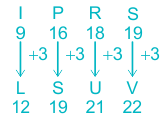
Question 54

Select the letter-cluster from among the given options that can replace the question mark (?) in the following series.

ETQ IQO MNM QKK ?

  1. AOption (a)

    UHJ

  2. BOption (b)

    UII

  3. COption (c)

    UHI

  4. DOption (d)

    UJJ

View answer & explanation

Correct answer

Answer: (c)C.

UHI

Why this answer is correct

The logic followed here is:

​

Hence, "Option 3" is the correct answer.

Question 55

Refer to the following number and symbol series and answer the question that follows.

Counting to be done from left to right only.

NOTE:

All numbers are single digit numbers only.)

(Left) 5 47% € $2£%6699£ € & € 37* (Right)

How many such numbers are there each of which is immediately preceded by a number and also immediately followed by a number$?

  1. AOption (a)

    3

  2. BOption (b)

    4

  3. COption (c)

    2

  4. DOption (d)

    5

View answer & explanation

Correct answer

Answer: (a)A.

3

Why this answer is correct

Given series: (Left) 5 47% € $2£%6699£ € & € 37* (Right)

According to the question, 

Required condition: Number - Number - Number

(Left) 5 47% € $2£%6699£ € & € 37* (Right)

Thus, there are three such numbers which are immediately preceded by a number and also immediately followed by a number.

Hence, "Option 1" is the correct answer.

Question 56

Simplify \left[ \left(28 \div \frac{3}{9}\right) \times \left{ 6 \div 2 \times \frac{18-2}{6} \right} \div \left{ 8 \times 6 \div 3 \right} \right]

  1. AOption (a)

    104

  2. BOption (b)

    42

  3. COption (c)

    63

  4. DOption (d)

    84

View answer & explanation

Correct answer

Answer: (b)B.

42

Why this answer is correct

Given:

\left[ \left(28 \div \frac{3}{9}\right) × \left{ 6 \div 2 × \frac{18-2}{6} \right} \div \left{ 8 × 6 \div 3 \right} \right]

Calculation:

\left[ \left(28 \div \frac{3}{9}\right) × \left{ 6 \div 2 × \frac{18-2}{6} \right} \div \left{ 8 × 6 \div 3 \right} \right]

⇒ \left[ \left(28 \div \frac{1}{3}\right) × \left{3 × \frac{16}{6} \right} \div \left{ 8 × 2 \right} \right]

⇒ \left[ \left(28 × 3\right) × \left{\frac{16}{2} \right} \div \left{ 16 \right} \right]

⇒ \left[ \left(28 × 3\right) × \left{\frac{16}{2} \right} \div \frac{1}{16} \right]

⇒ [(28×3)×12]\left[ \left(28 × 3\right) × \frac{1}{2}\right]

⇒ 14 × 3 = 42

∴ The correct answer is option 2.

Question 57

What was a notable feature of the 'Tiger Triumph 2025' joint military exercise between India and the United States? 

  1. AOption (a)

    Inclusion of the United States Space Force for the first time

  2. BOption (b)

    Exclusive focus on counter-terrorism operations

  3. COption (c)

    Conducted solely in the Arabian Sea region

  4. DOption (d)

    Participation limited to naval forces only

View answer & explanation

Correct answer

Answer: (a)A.

Inclusion of the United States Space Force for the first time

Why this answer is correct

The correct answer is Inclusion of the United States Space Force for the first time.

Key Points

  • Tiger Triumph 2025 marked the first-ever inclusion of the United States Space Force in a joint military exercise with India.
  • The exercise was aimed at strengthening multidimensional military cooperation between the two nations, encompassing land, sea, air, and now space domains.
  • The United States Space Force's involvement focused on integrating space-based assets to enhance situational awareness and operational capabilities.
  • Tiger Triumph is a biennial exercise that emphasizes humanitarian assistance and disaster relief (HADR) operations alongside strategic military collaboration.
  • This landmark participation by the Space Force highlights the growing significance of space as a domain for defense strategy in modern military operations.

Additional Information

  • United States Space Force (USSF)
  • The USSF was established on December 20, 2019, as the newest branch of the U.S. Armed Forces.
  • Its core mission includes protecting U.S. and allied interests in space and ensuring freedom of operations within the space domain.
  • The Space Force oversees military satellites, space-based missile defense systems, and advanced communication technologies.
  • It plays a vital role in supporting terrestrial military operations through space-enabled capabilities like GPS, reconnaissance, and secure communications.
  • Humanitarian Assistance and Disaster Relief (HADR)
  • HADR operations involve providing aid and support during natural or man-made disasters.
  • Such operations often include logistical support, medical aid, evacuation efforts, and infrastructure restoration.
  • Military exercises like Tiger Triumph focus on enhancing interoperability for effective HADR response.
  • India and the United States have collaborated on HADR missions to address regional and global crises.
  • India-U.S. Defense Partnership
  • The defense partnership between India and the U.S. is a cornerstone of their strategic relationship.
  • Both nations engage in multiple joint military exercises, including Yudh Abhyas, Malabar, and Tiger Triumph.
  • The partnership emphasizes cooperation in areas such as technology sharing, counter-terrorism, and maritime security.
  • Recent developments include collaborations on advanced defense technologies and space-based systems.
  • Space as a Military Domain
  • Space is increasingly recognized as a critical domain for national security and defense strategy.
  • Modern militaries rely on space-based assets for reconnaissance, navigation, communication, and missile defense.
  • Countries are enhancing their capabilities in space to ensure strategic advantages in conflicts and emergencies.
  • International collaborations, like India-U.S. exercises, aim to strengthen joint capabilities in the space domain.

Question 58

Which Indian Bank has outlined the details of its Embassy Deposits, which are exclusively available to diplomats, non-diplomatic staff and diplomatic missions in March 2025?

  1. AOption (a)

    Axis Bank

  2. BOption (b)

    Bandhan Bank

  3. COption (c)

    Bank of Baroda

  4. DOption (d)

    HDFC Bank

View answer & explanation

Correct answer

Answer: (d)D.

HDFC Bank

Why this answer is correct

The correct answer is HDFC Bank.

Key Points

  • HDFC Bank introduced Embassy Deposits, a specialized banking product tailored for diplomats, non-diplomatic staff, and diplomatic missions.
  • This offering is exclusively available to diplomatic entities, ensuring streamlined banking services for embassies operating in India.
  • The product is aimed at addressing the unique needs of diplomats and embassies, including enhanced security and compliance measures.
  • HDFC Bank is one of India's leading private sector banks, widely recognized for its innovative financial solutions and robust customer service.
  • Embassy Deposits align with the bank’s commitment to providing niche and customized solutions to specific client groups.

Additional Information

  • Diplomatic Missions:
  • These are foreign offices established by a country in another country for diplomatic representation.
  • Embassies and consulates are examples of diplomatic missions, serving to foster international relations.
  • Diplomatic missions often require unique banking solutions due to their operational and legal requirements.
  • Specialized Banking Services:
  • Banks often design customized financial products for specific groups like embassies, NRIs, or corporate clients.
  • These services typically include enhanced security, compliance with international regulations, and tailored financial solutions.
  • HDFC Bank Overview:
  • Founded in 1994, HDFC Bank is one of India's largest private sector banks.
  • It offers a wide range of financial products, including retail banking, wholesale banking, and treasury operations.
  • The bank is known for its innovation and has consistently been recognized for its customer-centric approach.
  • Banking for Diplomats:
  • Diplomats require banking services that ensure confidentiality, security, and compliance with international laws.
  • Such services include multi-currency accounts, specialized customer service, and streamlined processes for foreign transactions.

Question 59

A boat takes 90 minutes to go 49.2 km upstream. The ratio of the speed of the boat in still water to that of the stream is 3 : 2. How much total time (in hours) will the boat take to go 44.8 km upstream and 71.2 km downstream?

  1. AOption (a)

     3.8

  2. BOption (b)

    0.1 

  3. COption (c)

    1.8

  4. DOption (d)

    5.4

View answer & explanation

Correct answer

Answer: (c)C.

1.8

Why this answer is correct

Shortcut Trick

Upstream speed (U) = 49.2 ÷ 1.5 = 32.8 kmph.

Ratio of Speed in still water (x) : Speed of stream (y) = 3 : 2.

Upstream ratio (x − y) = 3 − 2 = 1 unit → 32.8 kmph.

Downstream ratio (x + y) = 3 + 2 = 5 units → 5 × 32.8 = 164 kmph.

Total time = (44.8 ÷ 32.8) + (71.2 ÷ 164) = 1.365 + 0.434 ≈ 1.8 hours.

∴ The correct answer is 1.8 hours.

Alternate Method

Given:

Distance Upstream1 = 49.2 km, Time1 = 90 min = 1.5 hours.

Ratio of Speed of Boat (x) to Stream (y) = 3 : 2.

Calculations:

⇒ Speed Upstream (U) = Distance ÷ Time = 49.2 ÷ 1.5 = 32.8 kmph.

⇒ Let x = 3k and y = 2k. Then U = x − y = 3k − 2k = k.

⇒ k = 32.8 kmph.

⇒ Speed Downstream (D) = x + y = 3k + 2k = 5k = 5 × 32.8 = 164 kmph.

⇒ Time for 44.8 km Upstream = 44.8 ÷ 32.8 = 1.3658... hours.

⇒ Time for 71.2 km Downstream = 71.2 ÷ 164 = 0.4341... hours.

⇒ Total Time = 1.3658 + 0.4341 = 1.7999... ≈ 1.8 hours.

∴ The correct answer is 1.8 hours.

Additional Information

Relative Speed in Water

Upstream Speed = Speed of Boat (x) − Speed of Stream (y). Downstream Speed = x + y.

Conversion of Time

To convert minutes to hours, divide the value by 60. Example: 90 min = 90/60 = 1.5 hours.

Calculating x and y from U and D

Speed of Boat in Still Water (x) = (D + U) ÷ 2 and Speed of Stream (y) = (D − U) ÷ 2.

Question 60

Which of the following is the equivalent ratio of 7 : 9? 

  1. AOption (a)

    70 : 90 

  2. BOption (b)

    67 : 91

  3. COption (c)

     67 : 93

  4. DOption (d)

    72 : 95

View answer & explanation

Correct answer

Answer: (a)A.

70 : 90 

Why this answer is correct

Shortcut Trick

An equivalent ratio is obtained by multiplying or dividing both terms of the original ratio by the same non-zero number.

Multiply both parts of the ratio 7 : 9 by 10:

7 × 10 = 70 and 9 × 10 = 90.

∴ The correct answer is 70 : 90.

Alternate Method

Given: Original ratio = 7 : 9

Formula Used: Ratio a : b is equivalent to (a × k) : (b × k) where k ≠ 0.

⇒ Let us check Option (1): 70 : 90

⇒ Divide both terms by their HCF (10): 70 ÷ 10 = 7 and 90 ÷ 10 = 9.

⇒ Simplified form = 7 : 9.

⇒ Since the simplified form matches the original ratio, they are equivalent.

∴ The correct answer is 70 : 90.

Additional Information

Equivalent Ratio Definition

Ratios that represent the same proportion between quantities are equivalent. They can be expressed as equal fractions (7/9 = 70/90).

Simplest Form

A ratio is in its simplest form if the HCF of its terms is 1. All equivalent ratios reduce to the same simplest form.

Question 61

Let △ABC∼△QPR and (ar(△ABC))(ar(△PQR))=64121\frac{(\text{ar}(\triangle \text{ABC}))}{(\text{ar}(\triangle \text{PQR}))} = \frac{64}{121} If AB = 11 cm, BC = 7 cm, and AC = 8 cm, then QR (in cm) is equal to:

  1. AOption (a)

    9

  2. BOption (b)

    10

  3. COption (c)

    8

  4. DOption (d)

    11

View answer & explanation

Correct answer

Answer: (d)D.

11

Why this answer is correct

Shortcut Trick

Ratio of areas of similar triangles = 64 : 121

Ratio of corresponding sides = √64 : √121 = 8 : 11

In ΔABC ~ ΔQPR, side AC corresponds to QR.

∴ AC : QR = 8 : 11

Since AC = 8 cm, then QR = 11 cm.

∴ The correct answer is 11 cm.

Alternate Method

Given: AB = 11 cm, BC = 7 cm, AC = 8 cm, and Area(ΔABC) / Area(ΔPQR) = 64 / 121.

Formula Used: For two similar triangles, the ratio of their areas is equal to the square of the ratio of their corresponding sides.

A B C Q P R 8 cm QR = ?

Question 62

Who among the following is responsible for implementing decisions made by a Municipal Corporation’s council and standing committees in India? 

  1. AOption (a)

    Chairman

  2. BOption (b)

    Municipal Commissioner 

  3. COption (c)

    Standing Committee Head

  4. DOption (d)

    Deputy Mayor

View answer & explanation

Correct answer

Answer: (b)B.

Municipal Commissioner 

Why this answer is correct

The correct answer is Municipal Commissioner.

Key Points

  • The Municipal Commissioner is the chief executive officer of a municipal corporation in India.
  • He/she is responsible for implementing the decisions made by the municipal council and standing committees.
  • The Municipal Commissioner is typically appointed by the state government and is a senior officer of the Indian Administrative Service (IAS).
  • The role involves overseeing the daily administration, including public health, sanitation, urban development, and revenue collection.
  • The Municipal Commissioner ensures the effective execution of policies and programs within the jurisdiction of the municipal corporation.

Additional Information

  • Municipal Corporation:
  • A municipal corporation is a governing body for large urban areas in India, established under state laws.
  • It is responsible for providing civic amenities such as water supply, sewage, roads, and public health facilities.
  • The governing body includes elected representatives (councilors) and an administrative head (Municipal Commissioner).
  • Standing Committees:
  • Standing committees are specialized groups within the municipal corporation responsible for specific functions like finance, health, and education.
  • These committees assist the council in decision-making and policy formulation.
  • Mayor vs. Municipal Commissioner:
  • The Mayor is the ceremonial head of the municipal corporation, usually elected by councilors or citizens.
  • The Municipal Commissioner holds executive authority and is responsible for implementing decisions and managing day-to-day operations.
  • State Control:
  • The state government has significant control over municipal corporations, including appointing the Municipal Commissioner.
  • This ensures alignment between state policies and municipal governance.

Question 63

What is the mode of the data given below? [Give your answer correct to 2 decimal places.

Age in years10-2020-3030-4040-5050-6060-7070-80
No. of patients22202315361714
  1. AOption (a)

    55.25

  2. BOption (b)

    59.42

  3. COption (c)

    56.88

  4. DOption (d)

     49.91

View answer & explanation

Correct answer

Answer: (a)A.

55.25

Why this answer is correct

Shortcut Trick

Identify the Modal Class by finding the maximum frequency: 36 occurs in the 50−60 age group.

Apply the direct Mode formula: Mode = L + [(f1 − f0) / (2f1 − f0 − f2)] × h.

Substitute values: Mode = 50 + [(36 − 15) / (72 − 15 − 17)] × 10 ⇒ 50 + (21 / 40) × 10.

Mode = 50 + 5.25 = 55.25 years.

∴ The correct answer is 55.25 years.

Alternate Method

Given Data:

Maximum frequency (f1) = 36 (corresponds to modal class 50−60)

Lower limit of modal class (L) = 50

Frequency of preceding class (f0) = 15

Frequency of succeeding class (f2) = 17

Class width (h) = 10

Formula Used:

Mode = L + [ (f1 − f0) / (2f1 − f0 − f2) ] × h

Calculations:

⇒ Mode = 50 + [ (36 − 15) / (2 × 36 − 15 − 17) ] × 10

⇒ Mode = 50 + [ 21 / (72 − 32) ] × 10

⇒ Mode = 50 + [ 21 / 40 ] × 10

⇒ Mode = 50 + 210 / 40

⇒ Mode = 50 + 5.25

⇒ Mode = 55.25

∴ The correct answer is 55.25 years.

Additional Information

Empirical Relationship

The relationship between mean, median, and mode is given by: Mode = 3 × Median − 2 × Mean.

Median for Grouped Data

Median = L + [ ( (N/2) − cf ) / f ] × h, where cf is the cumulative frequency of the preceding class.

Mean for Grouped Data

Mean (μ) = ∑(fi × xi) / ∑fi, where xi is the class mark of each interval.

Question 64

In 1510, Alfonzo de Albuquerque captured which place from the Sultan of Bijapur and made it the capital of the Portuguese eastern empire? 

  1. AOption (a)

    Goa

  2. BOption (b)

    Calicut

  3. COption (c)

    Cochin

  4. DOption (d)

    Surat

View answer & explanation

Correct answer

Answer: (a)A.

Goa

Why this answer is correct

The correct answer is Goa.

Key Points

  • In 1510, Alfonso de Albuquerque, a Portuguese general and military strategist, captured Goa from the Sultan of Bijapur.
  • Goa was strategically chosen due to its central location on the western coast of India, making it ideal for trade and military operations.
  • After its capture, Goa was established as the capital of the Portuguese eastern empire.
  • The Portuguese ruled Goa for over 450 years until its liberation by India in 1961.
  • Albuquerque is regarded as one of the key figures in establishing Portuguese colonial dominance in Asia.

Additional Information

  • Portuguese Empire in India:
  • The Portuguese first arrived in India in 1498, led by Vasco da Gama.
  • Goa became the center of Portuguese trade and administration in Asia.
  • Other Portuguese territories in India included Daman, Diu, and Dadra Nagar Haveli.
  • Alfonso de Albuquerque:
  • Albuquerque served as the second Governor of Portuguese India from 1509 to 1515.
  • He is known as the architect of the Portuguese colonial empire in Asia.
  • He implemented policies to fortify and expand Portuguese territories in the region.
  • Historical Importance of Goa:
  • Goa served as a major hub for spice trade, connecting Europe with Asia.
  • The region developed unique cultural blends due to prolonged Portuguese influence.
  • It is now famous for its UNESCO World Heritage Sites, including churches and convents.
  • Bijapur Sultanate:
  • The Sultanate of Bijapur was a prominent Islamic kingdom in South India during the medieval period.
  • It was founded by Yusuf Adil Shah in 1489 and lasted until its annexation by the Mughal Empire in 1686.
  • Goa was under Bijapur's control before being captured by the Portuguese.

Question 65

What is the default name given to a folder on Windows systems? 

  1. AOption (a)

    Default Folder

  2. BOption (b)

    Folder 

  3. COption (c)

    Untitled Folder 

  4. DOption (d)

     New Folder

View answer & explanation

Correct answer

Answer: (d)D.

 New Folder

Why this answer is correct

The correct answer is New Folder.

Key Points

  • The default name assigned to a newly created folder in Windows operating systems is "New Folder."
  • Users can rename the folder immediately after creation by right-clicking and selecting the rename option or pressing F2 on the keyboard.
  • This naming convention is consistent across various versions of Windows, including Windows 7, Windows 10, and Windows 11.
  • "New Folder" is automatically displayed when the user creates a new folder using the right-click context menu or via the "New Folder" button in File Explorer.
  • If multiple folders are created consecutively without renaming, Windows appends a number to the name, such as "New Folder (2)", "New Folder (3)", etc.

Additional Information

  • File Explorer:
  • File Explorer is the default file management tool in Windows operating systems.
  • It allows users to create, rename, move, and delete folders and files within the system.
  • Users can access File Explorer using the Windows + E shortcut key.
  • Folder Renaming:
  • Renaming folders in Windows can be done by right-clicking the folder and selecting "Rename" or using the F2 keyboard shortcut.
  • Folder names can include letters, numbers, and symbols, but certain characters like /:*?"<>| are prohibited.
  • File System Organization:
  • Windows uses a hierarchical file system structure that organizes files and folders in a tree-like format.
  • Folders are containers used to group related files together for better organization and accessibility.
  • Default Folder Locations:
  • Windows provides predefined folders like Documents, Downloads, Pictures, and Videos for organizing user data.
  • These folders are located under the User Profile directory by default.

Question 66

The least number which, when diminished by 8, is divisible by 15, 12, 18 and 29 is:

  1. AOption (a)

    5228

  2. BOption (b)

    5187

  3. COption (c)

    5263

  4. DOption (d)

    5275

View answer & explanation

Correct answer

Answer: (a)A.

5228

Why this answer is correct

Shortcut Trick

The least number is the LCM of (15, 12, 18, 29) + diminished value.

LCM(15, 12, 18, 29) → LCM(60, 18, 29) → LCM(180, 29).

Required number = (180 × 29) + 8 = 5220 + 8 = 5228.

∴ The correct answer is 5228.

Alternate Method

Given: Divisors = 15, 12, 18, 29; Diminished value = 8.

Formula Used: Required Number = LCM(Divisors) + Remainder/Diminished value.

⇒ Prime factors of 15 = 3 × 5

⇒ Prime factors of 12 = 22 × 3

⇒ Prime factors of 18 = 2 × 32

⇒ Prime factors of 29 = 29 (Prime number)

⇒ LCM = 22 × 32 × 5 × 29

⇒ LCM = 4 × 9 × 5 × 29 = 180 × 29 = 5220

⇒ Required number = 5220 + 8 = 5228

∴ The correct answer is 5228.

Additional Information

LCM (Least Common Multiple)

The smallest positive integer that is divisible by each of the given numbers. Calculation: LCM(a, b) = (a × b) ÷ HCF(a, b).

Divisibility Rule for 9 (Special Case for 18)

If a number is divisible by 18, it must be divisible by 9. The sum of the digits of (5228 − 8) = 5+2+2+0 = 9, which is divisible by 9.

Prime Numbers

Numbers like 29 have no factors other than 1 and themselves; hence, they are multiplied directly in LCM calculations.

Question 67

The Recorder’s Court was later replaced by the ______.

  1. AOption (a)

    Supreme Court

  2. BOption (b)

    High Courts 

  3. COption (c)

    Privy Council 

  4. DOption (d)

    Sessions Courts

View answer & explanation

Correct answer

Answer: (a)A.

Supreme Court

Why this answer is correct

The correct answer is Supreme Court.

Key Points

  • The Recorder's Court in India was replaced by the Supreme Court under the provisions of the Regulating Act of 1773.
  • The Supreme Court of Judicature at Fort William (Calcutta) was established in 1774 as the first Supreme Court in British India.
  • The establishment of the Supreme Court aimed to introduce a unified judicial system in British-controlled territories.
  • The Supreme Court had original, appellate, and admiralty jurisdiction and was intended to administer justice based on English law.
  • The court replaced the Recorder's Court, which was earlier functioning in some British settlements in India.

Additional Information

  • Recorder's Court
  • The Recorder's Court was a type of court established by the British in colonial territories to handle legal matters.
  • It was primarily tasked with adjudicating civil and criminal cases in British-controlled areas.
  • The Recorder's Court was presided over by a judge known as the "Recorder."
  • Regulating Act of 1773
  • The Regulating Act of 1773 was the first attempt by the British government to regulate the affairs of the East India Company in India.
  • It established the Supreme Court at Calcutta and marked the beginning of a centralized judicial system in India.
  • Supreme Court of Judicature at Fort William
  • It was the first Supreme Court in India and was established in Calcutta in 1774.
  • The court had jurisdiction over Bengal, Bihar, and Orissa.
  • It consisted of a Chief Justice and three other judges.
  • Judicial Evolution in British India
  • The judicial system evolved over time, with the creation of High Courts in 1862 and the abolition of the Supreme Court under the Indian High Courts Act of 1861.
  • These High Courts eventually became the foundation of the Indian judicial system.

Question 68

A byke travels 80 km at the speed of 40 km/hr and the next 45 km at the speed of 15 km/hr. What is its average speed (in km/hr)? 

  1. AOption (a)

    31

  2. BOption (b)

    19

  3. COption (c)

    25

  4. DOption (d)

    29

View answer & explanation

Correct answer

Answer: (c)C.

25

Why this answer is correct

Shortcut Trick

Average Speed = Total Distance ÷ Total Time

Time 1 = 80 ÷ 40 = 2 hours

Time 2 = 45 ÷ 15 = 3 hours

Average Speed = (80 + 45) ÷ (2 + 3) = 125 ÷ 5 = 25 km/hr

∴ The correct answer is 25 km/hr.

Alternate Method

Given:

Distance1 (d1) = 80 km, Speed1 (s1) = 40 km/hr

Distance2 (d2) = 45 km, Speed2 (s2) = 15 km/hr

Formula Used:

Time = Distance ÷ Speed

Average Speed = (Total Distance) ÷ (Total Time)

⇒ Total Distance = 80 + 45 = 125 km

⇒ Time taken for first part (t1) = 80 ÷ 40 = 2 hours

⇒ Time taken for second part (t2) = 45 ÷ 15 = 3 hours

⇒ Total Time = 2 + 3 = 5 hours

⇒ Average Speed = 125 ÷ 5 = 25 km/hr

∴ The correct answer is 25 km/hr.

Additional Information

Equal Distance Case

If a journey covers two equal distances at speeds u and v, then Average Speed = (2 × u × v) ÷ (u + v).

Relative Speed

When two objects move in the same direction, relative speed is the difference of their speeds. In opposite directions, it is the sum.

Unit Conversion

To convert km/hr to m/s, multiply by 5/18. To convert m/s to km/hr, multiply by 18/5.

Question 69

Select the pair that follows the same pattern as that followed by the two pairs given below. Both pairs follow the same pattern.

TJR : PKT

DHQ : ZIS

  1. AOption (a)

    XBG : TCI

  2. BOption (b)

    EMT : CQX

  3. COption (c)

    CRJ : BTN

  4. DOption (d)

    KOS : IQV

View answer & explanation

Correct answer

Answer: (a)A.

XBG : TCI

Why this answer is correct

The logic followed here is:

TJR : PKT

And,

DHQ : ZIS

Similarly,

Option 1) XBG : TCI

Hence, "Option 1" is the correct answer.
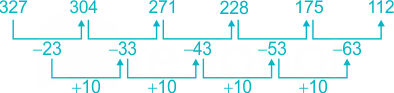
Question 70

Which of the following is the highest peak of the Maikal range?

  1. AOption (a)

    Kalsubai

  2. BOption (b)

    Amarkantak

  3. COption (c)

    Guru Shikha

  4. DOption (d)

    Anamudi

View answer & explanation

Correct answer

Answer: (b)B.

Amarkantak

Why this answer is correct

The correct answer is Amarkantak.

Key Points

  • Amarkantak is the highest peak of the Maikal range, located in the Vindhya-Satpura region in Madhya Pradesh, India.
  • It is situated at an altitude of approximately 1,048 meters (3,438 feet) above sea level.
  • Amarkantak is also known as the "Teerthraj" or the "King of Pilgrimage" due to its religious significance.
  • The Narmada River, one of the most sacred rivers in India, originates from this peak.
  • This region is also an ecologically significant area, home to rich biodiversity and dense forests.

Additional Information

  • Maikal Range:
  • The Maikal range is a part of the Satpura Hills, located in central India, covering parts of Madhya Pradesh and Chhattisgarh.
  • It acts as the connecting link between the Vindhya and Satpura mountain ranges.
  • The range is characterized by its undulating terrain, forests, and rich mineral resources.
  • Narmada River:
  • The Narmada River is one of the seven sacred rivers of India, originating from Amarkantak.
  • It flows westward, unlike most Indian rivers, which flow eastward.
  • The river is vital for irrigation, drinking water, and hydroelectric projects in central India.
  • Religious Importance of Amarkantak:
  • Amarkantak is a popular pilgrimage site for Hindus, with temples dedicated to Lord Shiva and Goddess Narmada.
  • It is believed that the meeting of the Vindhya and Satpura ranges at Amarkantak has spiritual significance.
  • Ecological Significance:
  • The forests of the Maikal range are part of the Eastern Highlands Moist Deciduous Forests ecoregion.
  • The region is home to a variety of wildlife, including leopards, bears, and numerous bird species.

Question 71

A group of numbers and symbols is coded using letter codes as per the codes given below and the conditions that follow. Study the given codes and conditions and answer the question that follows.

Note: If none of the conditions apply, then codes for the respective number/symbol are to be followed directly as given in the table.

Number/Symbol s3#4$7&6*8^2
CodeHAJBKCLDMEN

Conditions:

i) If the first element is a symbol and the last a number, the codes for these two (the first and the last elements) are to be interchanged.

ii) If the first element is an odd number and the last an even number, the first and last elements are to be coded as ©.

iii) If both the second and third elements are perfect cubes, the code of the second element will be the code of third element.

What will be the code for the following group?

3$72

  1. AOption (a)

    ©BK©

  2. BOption (b)

    HBKN

  3. COption (c)

    NBKH

  4. DOption (d)

    HKB©

View answer & explanation

Correct answer

Answer: (a)A.

©BK©

Why this answer is correct

Given Table:

Number/Symbols3#4$7&6*8^2
CodeHAJBKCLDMEN

According to the given condition:

Rule no.ConditionResult
IFirst element is a symbol and the last a numberCode for these two are to be interchanged
IIFirst element is an odd number and the last an even numberFirst and last elements are to be coded as ©.
IIIBoth the second and third elements are perfect cubesCode of the second element will be the code for the third element.

Given: 3$72

Here, II rule applies i.e. first element is an odd number and the last an even number.

3 → coded as ©

$ → coded as B

7 → coded as K 

2 → coded as ©

So, 3$72 → Coded as ©BK©

Hence, "Option 1" is the correct answer.

Question 72

The mode of the observations 35, 32, 28, 27, 25, 32, 31, 27, 32, 30, 32, 27, 31, 34, 32 and 22 is:

  1. AOption (a)

    28

  2. BOption (b)

    35

  3. COption (c)

    32

  4. DOption (d)

    27

View answer & explanation

Correct answer

Answer: (c)C.

32

Why this answer is correct

Shortcut Trick

The Mode is the observation that appears with the highest frequency in a data set.

Count the occurrences of each number: 32 appears 5 times, 27 appears 3 times, and 31 appears 2 times.

All other numbers (22, 25, 28, 30, 34, 35) appear only once.

Since 32 has the maximum frequency, it is the mode of the given observations.

∴ The correct answer is 32.

Alternate Method

Given: Observations = 35, 32, 28, 27, 25, 32, 31, 27, 32, 30, 32, 27, 31, 34, 32, 22

Formula: Mode = Value with the highest frequency.

⇒ Frequency of 22 = 1

⇒ Frequency of 25 = 1

⇒ Frequency of 27 = 3

⇒ Frequency of 28 = 1

⇒ Frequency of 30 = 1

⇒ Frequency of 31 = 2

⇒ Frequency of 32 = 5

⇒ Frequency of 34 = 1

⇒ Frequency of 35 = 1

⇒ The observation 32 occurs 5 times, which is the

Question 73

T starts from Point A and drives 6 km towards the North. He then takes a right turn, drives 15 km, turns right and drives 9 km. He then takes a right turn and drives 19 km. He takes a final right turn, drives 3 km and stops at Point P. How far (shortest distance) and towards which direction should he drive in order to reach Point A again? (All turns are 90 degrees turns only unless specified) 

  1. AOption (a)

    2 km to the East

  2. BOption (b)

    4 km to the East

  3. COption (c)

    6 km to the North

  4. DOption (d)

    8 km to the North 

View answer & explanation

Correct answer

Answer: (b)B.

4 km to the East

Why this answer is correct

Given:

T starts from Point A and drives 6 km towards the North.

He then takes a right turn, drives 15 km, turns right and drives 9 km.

He then takes a right turn and drives 19 km.

He takes a final right turn, drives 3 km and stops at Point P.

Thus, T should drive 4 km in the east direction in order to reach Point A again.​

Hence, "Option 2" is the correct answer.

Question 74

Which powerful ruler of the Pallavas constructed the Shore Temple at Mahabalipuram?

  1. AOption (a)

    Narasimhavarman II 

  2. BOption (b)

    Nandivarman

  3. COption (c)

    Simhavishnu

  4. DOption (d)

    Mahendravarman I

View answer & explanation

Correct answer

Answer: (a)A.

Narasimhavarman II 

Why this answer is correct

The correct answer is Narasimhavarman II.

Key Points

  • Narasimhavarman II, also known as Rajasimha, was a Pallava ruler who reigned during the late 7th and early 8th century CE.
  • He is credited with the construction of the iconic Shore Temple at Mahabalipuram, which is a UNESCO World Heritage Site.
  • The Shore Temple is one of the earliest structural temples built using granite and represents the zenith of Pallava architecture.
  • Narasimhavarman II's reign saw significant advancements in art, architecture, and cultural development in South India.
  • The temple complex showcases a blend of Shaivism and Vaishnavism, with shrines dedicated to Lord Shiva and Lord Vishnu.

Additional Information

  • Pallava Dynasty
  • The Pallavas were a prominent South Indian dynasty that ruled between the 3rd and 9th centuries CE.
  • They were known for their patronage of art, architecture, and literature, with Mahabalipuram being a significant center of their cultural heritage.
  • Key rulers include Mahendravarman I, Narasimhavarman I (Mamallan), and Narasimhavarman II (Rajasimha).
  • Mahabalipuram
  • Located in Tamil Nadu, Mahabalipuram is famous for its rock-cut sculptures and structural temples.
  • The Shore Temple, Pancha Rathas, and rock-cut cave temples are notable monuments of Pallava architecture.
  • Mahabalipuram was a thriving port city during the Pallava era.
  • UNESCO World Heritage Site
  • The Shore Temple at Mahabalipuram was designated a UNESCO World Heritage Site in 1984.
  • This recognition highlights its historical, architectural, and cultural significance.
  • Temple Architecture in South India
  • South Indian temples are known for their distinctive Dravidian architectural style.
  • Features include gopurams (tower gateways), vimanas (temple towers), and intricate carvings depicting deities and mythological stories.
  • The Pallavas contributed significantly to the development of structural temple architecture, transitioning from rock-cut to granite-built temples.

Question 75

Each of P, Q, R, S, T, U and V has an exam on a different day of a week starting from Monday and ending on Sunday of the same week. Q has the exam on Monday. P has the exam before R. Only two people have exams between U and Q. V has the exam immediately before U but after S. R has the exam before T. How many people have exams between P and S?

  1. AOption (a)

    Four

  2. BOption (b)

    Two

  3. COption (c)

    Three

  4. DOption (d)

    Five

View answer & explanation

Correct answer

Answer: (b)B.

Two

Why this answer is correct

Given: Each of P, Q, R, S, T, U and V has an exam on a different day of a week starting from Monday and ending on Sunday of the same week. 

1) Q has the exam on Monday. 

2) Only two people have exams between U and Q.

WeekdaysPerson
MondayQ
Tuesday
Wednesday
ThursdayU
Friday
Saturday
Sunday

3) V has the exam immediately before U but after S.

WeekdaysPerson
MondayQ
TuesdayS
WednesdayV
ThursdayU
Friday
Saturday
Sunday

4) R has the exam before T.

5) P has the exam before R.

WeekdaysPerson
MondayQ
TuesdayS
WednesdayV
ThursdayU
FridayP
SaturdayR
SundayT

Thus, two people have exams between P and S.

Hence, "Option 2" is the correct answer.

Question 76

What should come in place of the question mark (?) in the given series?

713 715 720 722 727 729 ?

  1. AOption (a)

    736

  2. BOption (b)

    739

  3. COption (c)

    731

  4. DOption (d)

    734

View answer & explanation

Correct answer

Answer: (d)D.

734

Why this answer is correct

The logic followed here is:

​

Hence, "Option 4" is the correct answer.
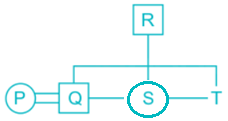
Question 77

Which of the following could be the factors that led Foreign Portfolio Investors (FPIs) to withdraw significant funds from Indian equities according to the Economic Survey 2024-25? 1. Slowing earnings growth 2. High valuations 3. Rising geopolitical tensions

  1. AOption (a)

     1 and 3 only

  2. BOption (b)

    1 and 2 only

  3. COption (c)

    2 and 3 only

  4. DOption (d)

    All 1, 2, and 3

View answer & explanation

Correct answer

Answer: (d)D.

All 1, 2, and 3

Why this answer is correct

The correct answer is All 1, 2, and 3.

Key Points

  • The Economic Survey 2024-25 highlights multiple factors that could have influenced the withdrawal of Foreign Portfolio Investors (FPIs) from Indian equities.
  • Slowing earnings growth: Reduced corporate earnings impact investor confidence, leading to lower equity investments.
  • High valuations: Overvaluation of Indian stocks relative to other emerging markets or global benchmarks can deter FPIs.
  • Rising geopolitical tensions: Escalating global or regional uncertainties (e.g., conflicts, trade wars) often make investors shift funds to safer markets.
  • The combination of these factors heightens market risk and makes Indian equities less attractive compared to other investment destinations.

Additional Information

  • Foreign Portfolio Investments (FPIs):
  • FPIs include investments in stocks, bonds, or other financial assets in a foreign country without obtaining significant ownership.
  • Such investments are more volatile and sensitive to economic, political, and market conditions.
  • High Valuations:
  • Stock valuations are often measured using indicators like the Price-to-Earnings (P/E) ratio.
  • Overvaluation occurs when stock prices are excessively higher than their actual earnings potential.
  • Geopolitical Tensions:
  • These refer to conflicts or uncertainties between nations that may disrupt global trade, investments, and market stability.
  • Examples include trade wars, sanctions, or military escalations.
  • Impact of FPI Outflows:
  • Significant withdrawal of FPIs can weaken the domestic currency due to reduced capital inflows.
  • It can also lead to stock market volatility and reduced liquidity.
  • Economic Survey:
  • The Economic Survey is an annual document presented by the Indian Ministry of Finance before the Union Budget.
  • It provides a detailed review of the economic developments in India during the past financial year.

Question 78

What was the main purpose of the citadel in Harappan cities? 

  1. AOption (a)

    To function as a marketplace 

  2. BOption (b)

    To function as a residential area

  3. COption (c)

    To organise administrative and public functions

  4. DOption (d)

    To organise religious ceremonies

View answer & explanation

Correct answer

Answer: (c)C.

To organise administrative and public functions

Why this answer is correct

The correct answer is To organise administrative and public functions.

Key Points

  • The citadel in Harappan cities was primarily used for administrative and public functions, indicating a well-organized urban planning system.
  • Structures within the citadel, such as granaries and assembly halls, suggest it served as the hub for governance, storage, and possibly trade regulation.
  • Archaeological evidence, such as the Great Bath in Mohenjo-daro, highlights that the citadel also hosted significant public events and rituals.
  • Its elevated position was likely strategic, offering protection from floods and enhancing its importance within the city layout.
  • The citadel reflects the Harappan civilization's advanced socio-political organization and ability to manage large-scale infrastructure projects.

Additional Information

  • Urban Planning in Harappan Civilization:
  • Harappan cities were divided into two parts: the citadel (higher ground) and the lower town (residential and commercial areas).
  • Drainage systems, grid-like street layouts, and standardized brick sizes showcase their advanced planning.
  • The Great Bath:
  • Located in Mohenjo-daro, the Great Bath is one of the most remarkable structures of the Harappan civilization.
  • It is believed to have been used for ritualistic bathing, reflecting the importance of water in their culture.
  • Granaries:
  • Large granaries were found in Harappan cities, indicating centralized storage and distribution of food grains.
  • This reflects the civilization's ability to manage agricultural surplus and address food security.
  • Decline of the Harappan Civilization:
  • Factors such as climate change, tectonic shifts, and changes in river systems (e.g., drying of the Saraswati River) are believed to have contributed to its decline.
  • The disappearance of centralized administration disrupted the urban structure of Harappan cities.

Question 79

In January 2025, for the first time, the Government of India has decided to provide financial assistance to the Indian contingent participating in the 9th Asian Winter Games 2025 under which of the following schemes? 

  1. AOption (a)

    Fit India Movement

  2. BOption (b)

    Khelo India Scheme

  3. COption (c)

    Target Olympic Podium Scheme

  4. DOption (d)

    Assistance to National Sports Federations 

View answer & explanation

Correct answer

Answer: (d)D.

Assistance to National Sports Federations 

Why this answer is correct

The correct answer is Assistance to National Sports Federations.

Key Points

  • The "Assistance to National Sports Federations" scheme is a key initiative of the Government of India to promote sports through financial support to recognized federations.
  • This scheme provides financial assistance for training, equipment purchase, participation in international events, and hosting national-level tournaments.
  • The scheme is instrumental in enhancing the performance of Indian athletes in international competitions, including multi-sport events like the Asian Winter Games.
  • Under this scheme, federations are encouraged to develop sports infrastructure and provide better coaching facilities to athletes.
  • The financial assistance also covers expenses for exposure trips, enabling athletes to train and compete globally.

Additional Information

  • Khelo India Scheme:
  • A flagship program launched in 2018 to promote a culture of sports and fitness in India.
  • The scheme emphasizes building sports infrastructure, organizing talent hunts, and providing scholarships to young athletes.
  • Khelo India Youth Games and University Games are major events under this initiative.
  • Target Olympic Podium Scheme (TOPS):
  • Launched in 2014, this scheme aims to identify and support elite athletes with the potential to win Olympic medals.
  • TOPS provides financial support for training, equipment, coaching, and international exposure.
  • It focuses on disciplines with high medal prospects, ensuring specialized attention to top athletes.
  • Fit India Movement:
  • A nationwide campaign launched in 2019 to promote physical fitness and a healthy lifestyle.
  • It emphasizes awareness programs, fitness challenges, and collaboration with schools and workplaces.
  • Asian Winter Games:
  • A multi-sport event organized by the Olympic Council of Asia (OCA) for winter sports.
  • The 9th edition is scheduled for 2025, providing a platform for athletes from Asian countries to compete in winter disciplines.
  • India's participation is significant for promoting winter sports in the country.

Question 80

If the sum of two numbers p and m is 12 and (p3+m3)=360(p ^ 3 + m ^ 3) = 360 then find the value of pm.

  1. AOption (a)

    38

  2. BOption (b)

    44

  3. COption (c)

    28

  4. DOption (d)

    35

View answer & explanation

Correct answer

Answer: (a)A.

38

Why this answer is correct

Shortcut Trick

Use the direct identity: p3 + m3 = (p + m)3 − 3pm(p + m)

Substitute the given values: 360 = 123 − 3pm(12)

360 = 1728 − 36pm

36pm = 1728 − 360 = 1368

pm = 1368 ÷ 36 = 38

∴ The correct answer is 38.

Alternate Method

Given:

Sum of two numbers (p + m) = 12

Sum of their cubes (p3 + m3) = 360

Formula Used:

Algebraic identity: (a + b)3 = a3 + b3 + 3ab(a + b)

Calculations:

⇒ (p + m)3 = p3 + m3 + 3pm(p + m)

⇒ (12)3 = 360 + 3 × pm × 12

⇒ 1728 = 360 + 36pm

⇒ 36pm = 1728 − 360

⇒ 36pm = 1368

⇒ pm = 1368 ÷ 36

⇒ pm = 38

∴ The correct answer is 38.

Additional Information

Sum of Cubes Factorization

The identity a3 + b3 = (a + b)(a2 − ab + b2) can also be used to find the sum of cubes.

Difference of Cubes Identity

For subtraction, the identity is a3 − b3 = (a − b)(a2 + ab + b2).

Algebraic Relationships

Using p + m and pm, one can also find p2 + m2 using (p + m)2 − 2pm.

Question 81

A shopkeeper sold a book for ₹544 at a loss of 36%. At what price (in ₹) should he sell it to gain 24% on it? 

  1. AOption (a)

    1,055

  2. BOption (b)

     1,057

  3. COption (c)

    1,054

  4. DOption (d)

    1,056 

View answer & explanation

Correct answer

Answer: (c)C.

1,054

Why this answer is correct

Shortcut Trick Ratio of Selling Prices is equivalent to the ratio of (100 − Loss%) and (100 + Gain%). Initial SP : New SP = (100 − 36) : (100 + 24) = 64 : 124. Given: 64 units = ₹544 ⇒ 1 unit = 544 ÷ 64 = 8.5. New SP = 124 × 8.5 = ₹1,054. ∴ The correct answer is ₹1,054.

Alternate Method Given: Initial SP = ₹544, Loss = 36%, Desired Gain = 24%. Formulas: CP = SP × 100 ÷ (100 − Loss%), New SP = CP × (100 + Gain%) ÷ 100.

⇒ Cost Price (CP) = 544 × 100 ÷ (100 − 36) = 544 × 100 ÷ 64 = ₹850. ⇒ New Selling Price = 850 × (100 + 24) ÷ 100 = 850 × 124 ÷ 100. ⇒ New Selling Price = 8.5 × 124 = ₹1,054. ∴ The correct answer is ₹1,054.

Additional Information Direct Relation of SP and Percentage When CP is constant, SP1 ÷ (100 ± Profit/Loss1) = SP2 ÷ (100 ± Profit/Loss2). Profit and Loss Basics Profit occurs when Selling Price > Cost Price, while Loss occurs when Cost Price > Selling Price.

Question 82

Which of the following changes did the Waqf (Amendment) Act, 2025 make? 

  1. AOption (a)

    Abolished State Waqf boards

  2. BOption (b)

    Removed audits 

  3. COption (c)

    Added Muslim women to boards

  4. DOption (d)

    Allowed private leasing 

View answer & explanation

Correct answer

Answer: (c)C.

Added Muslim women to boards

Why this answer is correct

The correct answer is Added Muslim women to boards.

Key Points

  • The Waqf (Amendment) Act, 2025 mandated the inclusion of Muslim women as members of State Waqf Boards to ensure gender representation and inclusivity.
  • This amendment aimed to provide a platform for Muslim women to actively participate in the governance and management of Waqf properties.
  • By including women, the amendment sought to address long-standing issues of gender disparity in decision-making roles within the Waqf Boards.
  • The inclusion of Muslim women aligns with broader national and global efforts to promote gender equality in governance structures.
  • The move was widely welcomed as a progressive step towards empowering Muslim women in community affairs.

Additional Information

  • Waqf:
  • A waqf is an endowment made by a Muslim for religious, educational, or charitable purposes.
  • Waqf properties are typically donated in perpetuity, and their income is used for the intended purpose.
  • The management of Waqf properties is overseen by Waqf Boards established in each state under the Waqf Act, 1995.
  • Waqf Boards:
  • State Waqf Boards are statutory bodies responsible for administering Waqf properties in their respective states.
  • The members of the board are appointed as per the provisions of the Waqf Act, which includes representation from various stakeholders.
  • Role of Women in Governance:
  • Inclusion of women in governance structures fosters diversity and better representation of community needs.
  • Research shows that gender-balanced boards tend to have better decision-making processes and outcomes.
  • Other Amendments in the Waqf Act:
  • The Waqf Act has been amended multiple times to address issues such as transparency, dispute resolution, and better management of Waqf properties.
  • Each amendment reflects efforts to modernize and make the administration of Waqf properties more efficient.

Question 83

Read the given statements and conclusions carefully. Assuming that the information given in the statements is true, even if it appears to be at variance with commonly known facts, decide which of the given conclusion(s) logically follow(s) from the statements.

Statements:

All sweater are jacket.

All sweater are coat.

All coat are blazer.

Conclusions:

(I) All sweater are blazer.

(II) Some coat are jacket.

  1. AOption (a)

    Only conclusion (I) follows 

  2. BOption (b)

    Only conclusion (II) follows 

  3. COption (c)

    Neither conclusion (I) nor (II) follows

  4. DOption (d)

    Both conclusions (I) and (II) follow

View answer & explanation

Correct answer

Answer: (d)D.

Both conclusions (I) and (II) follow

Why this answer is correct

The least possible Venn diagram for the given statements is as shown below :

Conclusions:

(I) All sweater are blazer → Follow (As all sweater are coat and all coat are blazer. As whole sweater comes in coat which whole comes in blazer, therefore it is true)

(II) Some coat are jacket → Follow (As all sweater are jacket and all sweater are coat. As whole sweater comes in coats and jacket, therefore it is true)

∴ Here, Both conclusions (I) and (II) follow.​

Hence, the correct answer is "Option 4".

Question 84

Two numbers are in the ratio 7 : 11. If the first number is increased by 10 and the second number is decreased by 20, then the ratio becomes 2 : 3. What is the sum of the original two numbers? 

  1. AOption (a)

    1260

  2. BOption (b)

    1240

  3. COption (c)

    1268

  4. DOption (d)

    1254

View answer & explanation

Correct answer

Answer: (a)A.

1260

Why this answer is correct

Shortcut Trick

Initial Ratio = 7 : 11 (Sum = 18 units)

Final Ratio = 2 : 3

Applying Cross Multiplication Method:

(7 × 3) − (11 × 2) units = (2 × −20) − (3 × 10)

|21 − 22| units = |−40 − 30| ⇒ 1 unit = 70

Sum of original numbers = 18 × 70 = 1260

∴ The correct answer is 1260.

Alternate Method

Given: Ratio of two numbers = 7 : 11

Let: First number = 7x and Second number = 11x

According to the question:

⇒ (7x + 10) / (11x − 20) = 2 / 3

⇒ 3 × (7x + 10) = 2 × (11x − 20)

⇒ 21x + 30 = 22x − 40

⇒ 22x − 21x = 30 + 40

⇒ x = 70

⇒ First number = 7 × 70 = 490

⇒ Second number = 11 × 70 = 770

⇒ Sum of original numbers = 490 + 770 = 1260

∴ The correct answer is 1260.

Additional Information

Ratio and Proportion

A Ratio is a comparison of two quantities. If a : b = c : d, then ad = bc (Product of Extremes = Product of Means).

Cross-Multiplication Technique

Used when a fixed value is added/subtracted from ratio terms to get a new ratio. It avoids algebraic variables and saves time in exams.

Sum of Ratio Parts

If the original ratio is a : b, the sum of numbers will always be a multiple of (a + b). Here, 1260 is a multiple of (7 + 11 = 18).

Question 85

Which cricket team won the 2024 ICC Women’s T20 World Cup held in the UAE, securing their first title in this format?

  1. AOption (a)

    New Zealand

  2. BOption (b)

    India

  3. COption (c)

    England

  4. DOption (d)

    Australia

View answer & explanation

Correct answer

Answer: (a)A.

New Zealand

Why this answer is correct

The correct answer is New Zealand.

Key Points

  • New Zealand’s women’s cricket team won the 2024 ICC Women's T20 World Cup, marking their first-ever title in this format.
  • The tournament was held in the United Arab Emirates (UAE) from February to March 2024.
  • New Zealand defeated England in the final by showcasing exceptional performances in both batting and bowling.
  • Prominent players like Sophie Devine and Amelia Kerr played pivotal roles in securing the victory.
  • This win broke the dominance of traditional favorites like Australia and England in ICC Women's T20 World Cups.

Additional Information

  • ICC Women's T20 World Cup:
  • The ICC Women's T20 World Cup is a biennial international championship for women's Twenty20 cricket organized by the International Cricket Council (ICC).
  • The tournament was first held in 2009, and Australia has been the most successful team, winning the title multiple times.
  • It serves as a platform to promote women's cricket globally, showcasing talent and inspiring future generations.
  • Sophie Devine:
  • Sophie Devine is the captain of the New Zealand women’s cricket team and a renowned all-rounder known for her aggressive batting and impactful bowling.
  • She holds several records, including the fastest century in Women’s T20 International cricket.
  • Her leadership was instrumental in guiding New Zealand to their maiden ICC Women's T20 World Cup victory.
  • Amelia Kerr:
  • Amelia Kerr is a New Zealand cricketer known for her all-round abilities in both batting and leg-spin bowling.
  • She gained international recognition for her record-breaking double century in an ODI match against Ireland in 2018.
  • Her consistency in the 2024 ICC Women's T20 World Cup contributed significantly to New Zealand's success.
  • UAE as a Host:
  • The United Arab Emirates (UAE) has established itself as a prominent host for international cricket tournaments due to its world-class facilities and neutral venue.
  • UAE hosted the 2024 ICC Women's T20 World Cup, ensuring smooth organization and excellent playing conditions for all participating teams.

Question 86

Which of the following reformers was NOT associated with British India? 

  1. AOption (a)

    Raja Ram Mohan Roy

  2. BOption (b)

    Aryabhatta

  3. COption (c)

    Bal Gangadhar Tilak

  4. DOption (d)

    Swami Vivekananda

View answer & explanation

Correct answer

Answer: (b)B.

Aryabhatta

Why this answer is correct

The correct answer is Aryabhatta.

Key Points

  • Aryabhatta was a renowned Indian mathematician and astronomer who lived during the Gupta period, around the 5th-6th century CE.
  • He is primarily associated with ancient India, predating the British colonial period by many centuries.
  • Aryabhatta's contributions include the approximation of pi (π) and the introduction of the concept of zero in mathematics.
  • Unlike Raja Ram Mohan Roy, Bal Gangadhar Tilak, and Swami Vivekananda, Aryabhatta was not involved in socio-religious or political reform movements in British India.
  • His works, such as the "Aryabhatiya," focused on mathematics, astronomy, and science rather than social or political reforms.

Additional Information

  • Raja Ram Mohan Roy
  • Known as the "Father of Modern India," he was a prominent socio-religious reformer of the 19th century.
  • He founded the Brahmo Samaj in 1828 to combat social evils like sati and promote education and women's rights.
  • He played a pivotal role in the abolition of the practice of sati in British India.
  • Bal Gangadhar Tilak
  • A nationalist leader and freedom fighter, Tilak was one of the prominent leaders of the Indian independence movement.
  • He is often referred to as "Lokmanya" and is known for the famous slogan "Swaraj is my birthright, and I shall have it."
  • Tilak contributed significantly to the Swadeshi Movement and initiated Ganesh Chaturthi as a public celebration to unite Indians.
  • Swami Vivekananda
  • A Hindu monk and social reformer, Swami Vivekananda is best known for his speech at the World Parliament of Religions in Chicago in 1893.
  • He was a disciple of Ramakrishna Paramhansa and founded the Ramakrishna Mission in 1897.
  • His teachings emphasized youth empowerment, spirituality, and service to society.
  • Aryabhatta's Legacy
  • His work, "Aryabhatiya," is divided into four sections and covers topics like arithmetic, algebra, trigonometry, and astronomy.
  • He proposed the heliocentric model of the solar system and explained the rotation of Earth around its axis.
  • Aryabhatta's contributions laid the foundation for later advancements in mathematics and astronomy in India and beyond.

Question 87

Which of the following letter-number clusters will replace the question mark (?) in the given series to make it logically complete? FKN17 GLO28 HMP39 INQ50 ? 

  1. AOption (a)

    JOR61

  2. BOption (b)

    JOS61

  3. COption (c)

    JOS60

  4. DOption (d)

    JOR60

View answer & explanation

Correct answer

Answer: (a)A.

JOR61

Why this answer is correct

The logic followed here is:

​

Hence, "Option 1" is the correct answer.
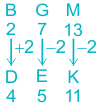
Question 88

Ishan starts from Point Y and drives 21 km towards the north. He then takes a left turn, drives 42 km, turns left and drives 41 km. He then takes a right turn and drives 17 km. He takes a right turn, drives 59 km. He then turns right, drives 18 km, turns right and drives 39 km to stop at Point Z. How far (shortest distance) and towards which direction should he drive in order to reach Point Y again? (All turns are 90-degree turns only unless specified.) 

  1. AOption (a)

    41 km towards the east

  2. BOption (b)

    45 km towards the south

  3. COption (c)

    43 km towards the west 

  4. DOption (d)

    39 km towards the east

View answer & explanation

Correct answer

Answer: (a)A.

41 km towards the east

Why this answer is correct

Given:

Ishan starts from Point Y and drives 21 km towards the north.

He then takes a left turn, drives 42 km, turns left and drives 41 km.

He then takes a right turn and drives 17 km.

He takes a right turn, drives 59 km.

He then turns right, drives 18 km, turns right and drives 39 km to stop at Point Z. 

Thus, Ishan should drive 41 km (42 km + 17 km - 18 km) in the east direction in order to reach Point Y again.​

Hence, "Option 1" is the correct answer.

Question 89

Which of the following statements is NOT correct regarding India after its adoption of new economic reforms in 1991?

  1. AOption (a)

    The 1991 reforms have caused a huge increase in public investment in the agriculture sector and increased its share in India’s GDP

  2. BOption (b)

    After the economic reforms, the growth of agriculture sector declined in the country.

  3. COption (c)

    Liberalisation of trade and investment regime was initiated in India post 1991 to increase international competitiveness of industrial production. 

  4. DOption (d)

    The industrial sector does not show an enormous increase in the GDP contribution of India post 1991

View answer & explanation

Correct answer

Answer: (a)A.

The 1991 reforms have caused a huge increase in public investment in the agriculture sector and increased its share in India’s GDP

Why this answer is correct

The correct answer is Option 1.

Key Points

  • India’s economic reforms in 1991 led to liberalisation, privatisation, and globalisation, but public investment in the agriculture sector did not see a significant increase.
  • The agriculture sector’s share in India’s GDP has declined over the years post-1991, contrary to the claim in Option 1.
  • Post-reform, the agriculture sector experienced slower growth compared to other sectors like services and industry.
  • The focus of the 1991 reforms was predominantly on industrial and service sectors, aiming at enhancing international competitiveness.
  • Option 1 is incorrect because there was no substantial increase in public investment in agriculture, nor was there a significant rise in its GDP contribution.

Additional Information

  • 1991 Economic Reforms:
  • Introduced to address the balance of payment crisis in India.
  • Focused on liberalisation, privatisation, and globalisation (LPG).
  • Key measures included reducing import tariffs, deregulating markets, and reducing government control over industries.
  • Agriculture Sector Post-1991:
  • Growth slowed down due to reduced public investment and focus on industrial and service sectors.
  • Share of agriculture in GDP decreased, reflecting structural changes in the economy.
  • Challenges like lack of infrastructure, credit access, and dependence on monsoons persisted.
  • Industrial Growth Post-Reforms:
  • Liberalisation improved international competitiveness and export-oriented production.
  • Industrial contribution to GDP showed gradual growth but not an enormous increase.
  • Shift towards service-oriented industries, which became the largest contributor to GDP.
  • Impact of LPG Policies:
  • Increased foreign direct investment (FDI) inflows into India.
  • Boosted the service sector, especially IT and telecommunications.
  • Created disparities among sectors, with agriculture lagging behind industrial and service sectors.

Question 90

Based on the English alphabetical order, three of the following four letter-cluster pairs are alike in a certain way and thus form a group. Which letter-cluster pair DOES NOT belong to that group? (Note: The odd one out is not based on the number of consonants/vowels or their position in the letter-cluster.)

  1. AOption (a)

    KN – PX

  2. BOption (b)

    HK – NU

  3. COption (c)

    AD – FN

  4. DOption (d)

    XA – CK

View answer & explanation

Correct answer

Answer: (b)B.

HK – NU

Why this answer is correct

The logic followed here is:

Option 1) KN – PX

Option 2) HK – NU

​

Option 3) AD – FN

Option 4) XA – CK

​

Thus, out of all 'HK – NU' is the odd one out.

Hence, "Option 2" is the correct answer.

Question 91

In some cases, the Prime Minister of India assigns an independent charge of a portfolio to a Minister of State. This implies that the Minister of State:

  1. AOption (a)

    is demoted in responsibilities

  2. BOption (b)

    loses the title of Minister of State

  3. COption (c)

    serves jointly with a Cabinet Minister to share and perform responsibilities of the assigned portfolio

  4. DOption (d)

    functions as if in Cabinet rank with full independent responsibility for that portfolio 

View answer & explanation

Correct answer

Answer: (d)D.

functions as if in Cabinet rank with full independent responsibility for that portfolio 

Why this answer is correct

The correct answer is functions as if in Cabinet rank with full independent responsibility for that portfolio.

Key Points

  • An independent charge of a portfolio to a Minister of State implies that the Minister is entrusted with full responsibility of that portfolio without supervision from a Cabinet Minister.
  • The Minister of State with independent charge is treated as equivalent to Cabinet rank in terms of responsibility for the specific portfolio.
  • This arrangement is made when the Prime Minister decides that the portfolio does not require oversight by a Cabinet Minister.
  • Such Ministers have the authority to make decisions and represent their ministries in Parliament, similar to a Cabinet Minister.
  • While holding independent charge, the Minister of State reports directly to the Prime Minister.

Additional Information

  • Minister of State:
  • A Minister of State (MoS) is a junior minister in the Indian government who assists a Cabinet Minister in specific areas of their portfolio.
  • They typically work under the supervision of a Cabinet Minister unless given independent charge.
  • Independent Charge:
  • When a Minister of State is given independent charge, they function autonomously for that portfolio without reporting to a Cabinet Minister.
  • This arrangement is often used to optimize government functioning and delegate authority efficiently.
  • Cabinet Minister:
  • A Cabinet Minister is a senior member of the Council of Ministers responsible for major ministries such as Finance, Defence, or External Affairs.
  • Cabinet Ministers hold the highest rank in the government after the Prime Minister.
  • Portfolio Allocation:
  • Portfolio allocation is the process by which the Prime Minister assigns specific ministries or departments to members of the Council of Ministers.
  • The allocation depends on factors such as expertise, political considerations, and administrative requirements.

Question 92

In a certain code language, ‘PEAR’ is coded as ‘7481’ and ‘DEAR’ is coded as ‘7154’. What is the code for ‘D’ in the given code language? 

  1. AOption (a)

    4

  2. BOption (b)

    7

  3. COption (c)

    1

  4. DOption (d)

    5

View answer & explanation

Correct answer

Answer: (d)D.

5

Why this answer is correct

According to the given information,

Thus, 'D' is coded as '5'.

Hence, "Option 4" is the correct answer.

Question 93

D, E, F, G, H, I and P are sitting around a circular table facing the centre of the table. Only four people sit between D and P when counted from the right of D. D sits third to the left of H. G sits third to the left of E. I is an immediate neighbour of both P and H. How many people sit between F and I when counted from the right of F?

  1. AOption (a)

    Three

  2. BOption (b)

    One

  3. COption (c)

    Four

  4. DOption (d)

    Two

View answer & explanation

Correct answer

Answer: (d)D.

Two

Why this answer is correct

Given: D, E, F, G, H, I and P are sitting around a circular table facing the centre of the table.

1) Only four people sit between D and P when counted from the right of D.

2) D sits third to the left of H.

3) I is an immediate neighbour of both P and H.

4) G sits third to the left of E.

After positioning P, G and E only one position is left which will be occupied by the only person left i.e. F.

Thus, two people sit between F and I when counted from the right of F.

Hence, "Option 4" is the correct answer.

Question 94

Find the circumference (in m) of the largest circle that can be inscribed in a rectangle whose dimensions are given as 281 m and 133 m.

Take π=227\text{Take } \pi = \frac{22}{7}

  1. AOption (a)

    428

  2. BOption (b)

    418

  3. COption (c)

    411

  4. DOption (d)

    416

View answer & explanation

Correct answer

Answer: (b)B.

418

Why this answer is correct

Shortcut Trick

The diameter of the largest inscribed circle in a rectangle is always equal to the shorter side.

Diameter (d) = 133 m

Circumference = π × d = (22/7) × 133

Circumference = 22 × 19 = 418 m

∴ The correct answer is 418 m.

Alternate Method

Given:

Length of rectangle (L) = 281 m

Breadth of rectangle (B) = 133 m

Formula Used:

Circumference of a circle = 2πr = πd

Diameter of the inscribed circle = min(L, B)

Calculations:

⇒ For the circle to fit inside the rectangle, its diameter cannot exceed the smallest dimension.

⇒ Diameter (d) = 133 m

⇒ Circumference = π × d

⇒ Circumference = (22/7) × 133

⇒ Circumference = 22 × 19

⇒ Circumference = 418 m

∴ The correct answer is 418 m.

Additional Information

Area of Inscribed Circle

The area of the largest circle in a rectangle is πr2, where r = Breadth/2.

Circle Inscribed in a Square

For a square of side 'a', the diameter of the inscribed circle is exactly equal to 'a'.

Circumscribed Circle

The diameter of a circle circumscribing a rectangle is equal to the diagonal of the rectangle (√(L2+B2)).

Question 95

If 1 is added to each odd digit and 2 is subtracted from each even digit in the number 7643185, what will be difference between the highest and lowest digits in the number thus formed?

  1. AOption (a)

    5

  2. BOption (b)

    6

  3. COption (c)

    7

  4. DOption (d)

    4

View answer & explanation

Correct answer

Answer: (b)B.

6

Why this answer is correct

Given number: 7643185

According to the question, 

Number given7643185
Odd digit → (+1) Even digit → (-2)(+1)(-2)(-2)(+1)(+1)(-2)(+1)
Resultant number8424266

So, difference between the highest and lowest digits in the number thus formed → 8 - 4 = 6

Hence, "Option 2" is the correct answer.
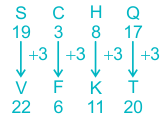
Question 96

7362 × 726.8 × 0.709 is equal in value to:

  1. AOption (a)

    73.62 × 7268 × 7.09

  2. BOption (b)

    7.362 × 7.268 × 709

  3. COption (c)

     7.362 × 72.68 × 70.9

  4. DOption (d)

     736.2 × 726.8 × 709

View answer & explanation

Correct answer

Answer: (a)A.

73.62 × 7268 × 7.09

Why this answer is correct

Given:

Expression = 7362 × 726.8 × 0.709

Calculation:

⇒ 7362 = 73.62 × 100

⇒ 726.8 = 7268 ÷ 10

⇒ 0.709 = 7.09 ÷ 10

⇒ 7362 × 726.8 × 0.709

⇒ (73.62 × 100) × (7268 ÷ 10) × (7.09 ÷ 10)

⇒ 73.62 × 7268 × 7.09 × (100 ÷ 100)

⇒ 73.62 × 7268 × 7.09

∴ 7362 × 726.8 × 0.709 = 73.62 × 7268 × 7.09

Question 97

What is the purpose of the Urban Infrastructure Development Fund (UIDF) announced in the Union Budget 2023-24? 

  1. AOption (a)

    To increase healthcare facilities

  2. BOption (b)

    To finance rural infrastructure

  3. COption (c)

    To utilise priority sector lending shortfall

  4. DOption (d)

    To promote agricultural exports 

View answer & explanation

Correct answer

Answer: (c)C.

To utilise priority sector lending shortfall

Why this answer is correct

The correct answer is To utilise priority sector lending shortfall.

Key Points

  • The Urban Infrastructure Development Fund (UIDF) was announced in the Union Budget 2023-24 to address the infrastructure needs of Tier 2 and Tier 3 cities.
  • It is financed through the shortfall in priority sector lending, which banks are mandated to fulfill.
  • The fund aims to enhance urban infrastructure, including modernizing roads, public transport, waste management systems, and other civic services.
  • The National Housing Bank (NHB) will manage and oversee the implementation of UIDF.
  • This initiative promotes sustainable urban development, ensuring that smaller cities also benefit from enhanced infrastructure.

Additional Information

  • Priority Sector Lending (PSL):
  • PSL mandates banks to allocate a specific portion of their lending to sectors like agriculture, MSMEs, and affordable housing.
  • In case of shortfall, banks contribute to funds like RIDF (Rural Infrastructure Development Fund) or UIDF.
  • Tier 2 and Tier 3 Cities:
  • These cities are classified based on population size, with Tier 2 cities having populations between 50,000 and 1,00,000, and Tier 3 cities between 20,000 and 50,000.
  • Such cities often lack sufficient infrastructure and require targeted development efforts.
  • National Housing Bank (NHB):
  • It is the apex financial institution for housing in India, established in 1988.
  • NHB plays a pivotal role in implementing housing-related schemes and managing funds like UIDF.
  • Sustainable Urban Development:
  • This concept emphasizes creating infrastructure that meets current needs without compromising resources for future generations.
  • It includes green energy, efficient waste management, and smart city initiatives.

Question 98

Refer to the following number and symbol series and answer the question that follows. Counting to be done from left to right only. (NOTE: All numbers are single digit numbers only.)

(Left) 1@\% 143*#634£\%2@6\% 8\% 9 (Right)

How many such numbers are there each of which is immediately preceded by a symbol and also immediately followed by a symbol?

  1. AOption (a)

    6

  2. BOption (b)

    4

  3. COption (c)

    5

  4. DOption (d)

    3

View answer & explanation

Correct answer

Answer: (b)B.

4

Why this answer is correct

Given series: (Left) 1@\% 143*#634£\%2@6\% 8\% 9 (Right)

According to the question, 

Required condition: Symbol - Number - Symbol

(Left) 1$@% 143*#634£%2@6% 8% 9 $ (Right)

Thus, there are four such numbers which are immediately preceded by a symbol and also immediately followed by a symbol.

Hence, "Option 2" is the correct answer.
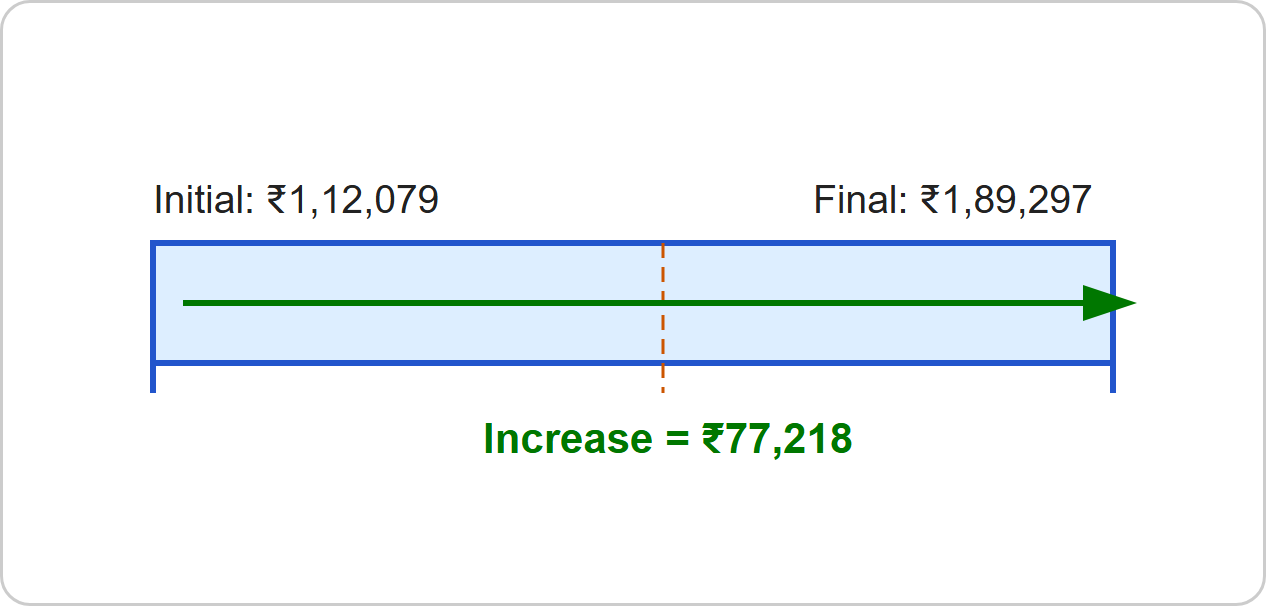
Question 99

When was the discovery of salvarsan recognised with a Nobel Prize in Medicine?

  1. AOption (a)
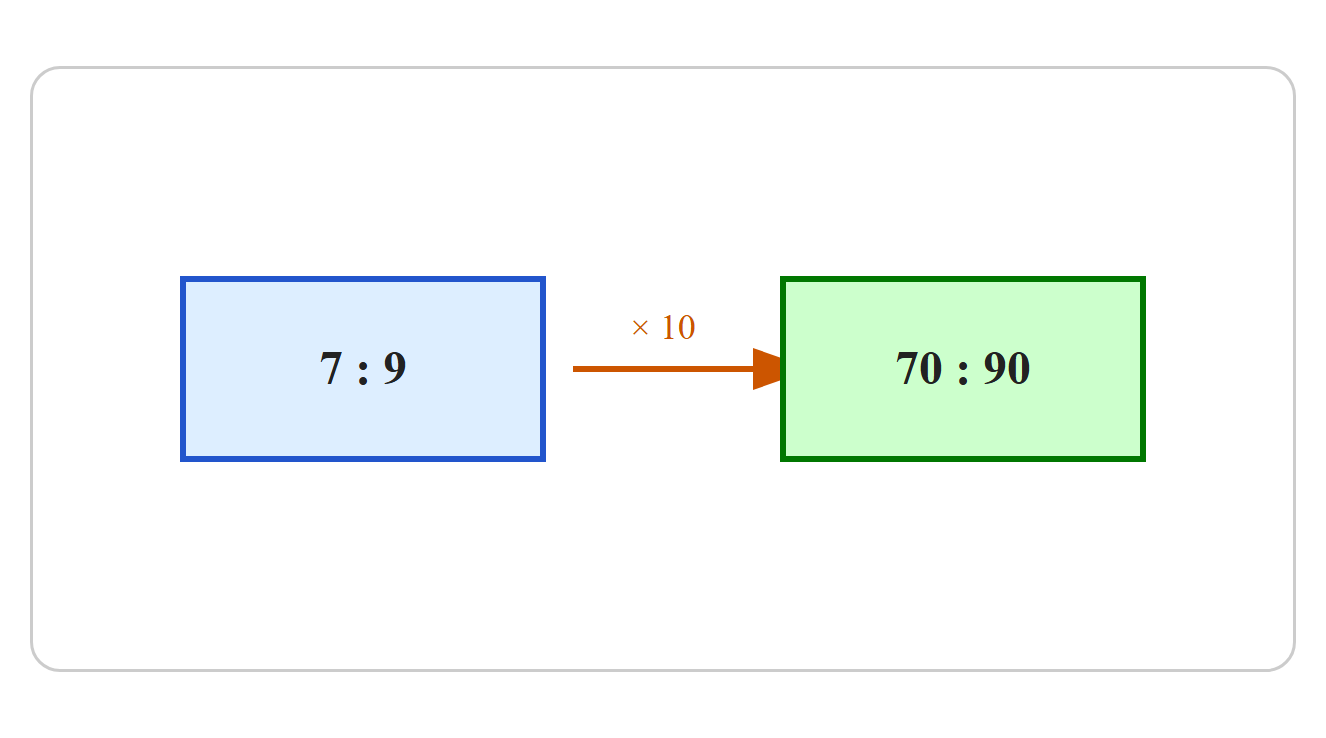
    1915

  2. BOption (b)

    1929

  3. COption (c)

    1908

  4. DOption (d)

    1905

View answer & explanation

Correct answer

Answer: (c)C.

1908

Why this answer is correct

The correct answer is 1908.

Key Points

  • The discovery of Salvarsan (arsphenamine), the first effective treatment for syphilis, was made by Paul Ehrlich and his team in 1907.
  • Paul Ehrlich was awarded the Nobel Prize in Physiology or Medicine in 1908, shared with Ilya Mechnikov, for their work on immunity.
  • The Nobel Prize recognized Ehrlich's groundbreaking contributions, including the development of Salvarsan and his "magic bullet" concept for targeted therapies.
  • Salvarsan is considered a significant milestone in the history of chemotherapy and the treatment of infectious diseases.
  • The discovery marked the beginning of the use of synthetic drugs to combat microbial infections.

Additional Information

  • Salvarsan (Arsphenamine):
  • It was the first synthetic antimicrobial drug used to treat syphilis, a bacterial infection caused by Treponema pallidum.
  • The drug belongs to the arsenic compound class and was a precursor to modern antibiotics.
  • Salvarsan was introduced into medical practice in 1910 and was considered revolutionary for its time.
  • Paul Ehrlich:
  • A German physician and scientist known as the "Father of Chemotherapy."
  • He developed the "magic bullet" theory, envisioning drugs that could specifically target disease-causing organisms without harming the host.
  • His work laid the foundation for modern pharmacology and immunology.
  • Nobel Prize in 1908:
  • The Nobel Prize in Physiology or Medicine in 1908 was awarded jointly to Paul Ehrlich and Ilya Mechnikov.
  • Ilya Mechnikov's contribution involved the discovery of phagocytosis, a key mechanism of innate immunity.
  • Their combined work advanced the understanding of immunological responses and therapeutic interventions.
  • Syphilis:
  • A sexually transmitted infection caused by the bacterium Treponema pallidum.
  • Symptoms include sores, rashes, and, in severe cases, damage to organs and the nervous system.
  • Before Salvarsan, syphilis was treated with mercury compounds, which were highly toxic and ineffective.

Question 100

In 2024, the Indian government approved defence acquisitions worth 17.3 billion. How much percentage of these acquisitions was sourced from domestic suppliers?&nbsp;

  1. AOption (a)

    99%

  2. BOption (b)

     75% 

  3. COption (c)

    100%

  4. DOption (d)

    50% 

View answer & explanation

Correct answer

Answer: (a)A.

99%

Why this answer is correct

The correct answer is 99%.

Key Points

  • In 2024, the Indian government approved defence acquisitions worth $17.3 billion to strengthen national security and bolster defence capabilities.
  • Out of the total approved acquisitions, only 99% was sourced from domestic suppliers, reflecting a focus on international procurement for advanced technologies.
  • This highlights the continued reliance on foreign suppliers for high-tech military equipment despite government initiatives to promote indigenous defence manufacturing.
  • India has launched policies like ‘Make in India’ and Defence Production and Export Promotion Policy (DPEPP) to boost domestic production, but challenges in scaling technology remain.
  • The low percentage underscores the need for further investment and development in domestic defence industries to reduce dependency on imports.

Additional Information

  • Make in India Initiative
  • Launched in September 2014, it aims to transform India into a global manufacturing hub.
  • Encourages investments in 25 sectors, including defence manufacturing.
  • Focuses on reducing imports and increasing domestic production capabilities.
  • Defence Production and Export Promotion Policy (DPEPP) 2020
  • Aims to achieve a turnover of Rs. 1,75,000 crore ($25 billion) in defence manufacturing by 2025.
  • Focuses on increasing exports to Rs. 35,000 crore ($5 billion) by 2025.
  • Promotes self-reliance in defence production by encouraging private sector participation.
  • Offset Policy in Defence Procurement
  • Introduced to leverage foreign defence procurement for domestic capabilities.
  • Mandates foreign suppliers to invest a percentage of the contract value in Indian industries.
  • Helps promote technology transfer and industrial collaboration.
  • Challenges in Indigenous Defence Manufacturing
  • Limited access to advanced technologies and research capabilities.
  • High dependence on foreign collaborations for critical components.
  • Need for policy reforms to streamline procurement and production processes$.

100 questions in the full paper