Previous Year Paper

RRB NTPC Graduate Level CBT-I Official Paper (Held On: 16 Jun, 2025 Shift 2) (Previous Year Paper)

Held in 2025

100 questions90 minutes
With answers
Free

Paper last updated:

Practise under exam conditions

Take this paper as a timed mock test. Review your answers after you submit.

Attempt timed test

Questions & answers

Read the paper at your pace. Open an explanation when you need it.

Question 1

Which major tourism fair was held in Berlin from 4 to 6 March 2025?

  1. AOption (a)

    European Travel Market

  2. BOption (b)

    World Tourism Forum

  3. COption (c)

    Berlin Travel Expo

  4. DOption (d)

    ITB Berlin

View answer & explanation

Correct answer

Answer: (d)D.

ITB Berlin

Why this answer is correct

The correct answer is ITB Berlin.

Key Points

  • ITB Berlin is the world's leading travel trade fair, attracting participants from across the globe.
  • The event is held annually in Berlin, Germany, showcasing tourism trends, products, and services.
  • ITB Berlin 2025 was scheduled from 4 to 6 March 2025, featuring exhibitors from over 180 countries.
  • It serves as a major platform for industry professionals, including travel agencies, hotels, airlines, and tourism boards.
  • Key areas of focus include sustainable tourism, travel technology, cultural tourism, and innovation in the tourism sector.

Additional Information

  • Tourism Industry Overview:
  • The global tourism industry contributes significantly to GDP and employment across nations.
  • It includes sectors such as hospitality, transportation, and entertainment.
  • Events like ITB Berlin help foster international collaboration and trade within the tourism sector.
  • Sustainable Tourism:
  • A growing focus area in tourism, promoting eco-friendly practices.
  • Encourages responsible travel that minimizes environmental impact.
  • ITB Berlin often highlights innovations and initiatives in sustainable tourism.
  • Travel Technology:
  • Emerging technologies such as AI, VR, and blockchain are transforming the travel industry.
  • ITB Berlin provides a platform for showcasing cutting-edge travel technologies.
  • Focuses on enhancing customer experience and operational efficiency.
  • Tourism Trends:
  • Post-pandemic recovery trends include increased interest in domestic and adventure tourism.
  • Digital platforms and personalized experiences are shaping modern travel preferences.
  • ITB Berlin offers insights into these trends through expert panels and exhibitions.

Question 2

The Alipore Bomb Case of 1908 is associated with which Indian revolutionary?

  1. AOption (a)

    Aurobindo Ghosh

  2. BOption (b)

    Jatin Das

  3. COption (c)

    Khudiram Bose

  4. DOption (d)

    Bhagat Singh

View answer & explanation

Correct answer

Answer: (a)A.

Aurobindo Ghosh

Why this answer is correct

The correct answer is Aurobindo Ghosh.

Key Points

  • The Alipore Bomb Case of 1908 was one of the most prominent trials during the Indian independence movement, involving revolutionaries accused of conspiring to overthrow British rule.
  • Aurobindo Ghosh, a key figure in the Indian freedom struggle, was arrested and tried for his alleged role in the conspiracy.
  • The case centered around the bomb that was intended to target a British official but instead killed two innocent women in Muzaffarpur.
  • Aurobindo Ghosh was eventually acquitted due to lack of evidence, but the case marked a turning point in his life as he shifted from active politics to spiritual pursuits.
  • His defense lawyer, Chittaranjan Das, famously described Aurobindo as "the poet of patriotism" and "the prophet of nationalism."

Additional Information

  • Aurobindo Ghosh: Known for his revolutionary activities and later as a spiritual leader, he founded the Aurobindo Ashram in Pondicherry.
  • The Anushilan Samiti: A secret revolutionary organization involved in the Alipore Bomb Case, aimed at overthrowing British rule through armed struggle.
  • Chittaranjan Das: A prominent lawyer and nationalist leader who defended Aurobindo Ghosh during the trial, highlighting his intellectual and spiritual contributions.
  • Impact of the Case: The Alipore Bomb Case influenced the trajectory of the Indian freedom movement, inspiring many revolutionaries and leading to stricter British surveillance.
  • Shift to Spirituality: After his acquittal, Aurobindo Ghosh moved away from revolutionary politics and focused on spiritual philosophy and integral yoga.

Question 3

According to the Economic Survey 2022-23 (data of 2021), what percentage of India's

population resides in rural areas?

  1. AOption (a)

    55%

  2. BOption (b)

    60%

  3. COption (c)

    70%

  4. DOption (d)

    65%

View answer & explanation

Correct answer

Answer: (d)D.

65%

Why this answer is correct

The correct answer is 65%.

Key Points

  • According to the Economic Survey 2022-23, based on the 2021 data, 65% of India's population resides in rural areas.
  • India's rural population is primarily dependent on agriculture, with significant contributions from allied sectors like animal husbandry and forestry.
  • The rural demographic plays a crucial role in the economy, contributing to national food security and raw material for industries.
  • As per the 2021 Census data projections, a significant percentage of India's rural population lacks access to urban-level infrastructure and amenities.
  • Government schemes such as the Pradhan Mantri Gram Sadak Yojana and National Rural Health Mission have been launched to improve rural livelihoods and infrastructure.

Additional Information

  • Rural Area Definition: A rural area is defined based on population density, lack of urban infrastructure, and primary engagement in agriculture and allied activities.
  • Challenges in Rural Areas: These include lack of healthcare facilities, education opportunities, proper housing, and connectivity to urban centers.
  • Government Initiatives: Schemes like Mahatma Gandhi National Rural Employment Guarantee Act (MGNREGA) aim to improve employment and livelihood in rural areas.
  • Significance of Rural Development: Rural development is essential for balanced economic growth, reduction of urban migration, and improvement of living standards.
  • Population Trends: India's rural population has seen a slow decline in percentage terms as urbanization increases, but it still remains a majority demographic group.

Question 4

A seller marks their goods 28% above the cost price. On customer demand, they offer a 25% reduction on the bills. What percentage of profit or loss does the seller make?

  1. AOption (a)

    1% profit

  2. BOption (b)

    4% loss

  3. COption (c)

    7% loss

  4. DOption (d)

    6% loss

View answer & explanation

Correct answer

Answer: (b)B.

4% loss

Why this answer is correct

Shortcut Trick

Net percentage change = a + b + (a × b) ÷ 100

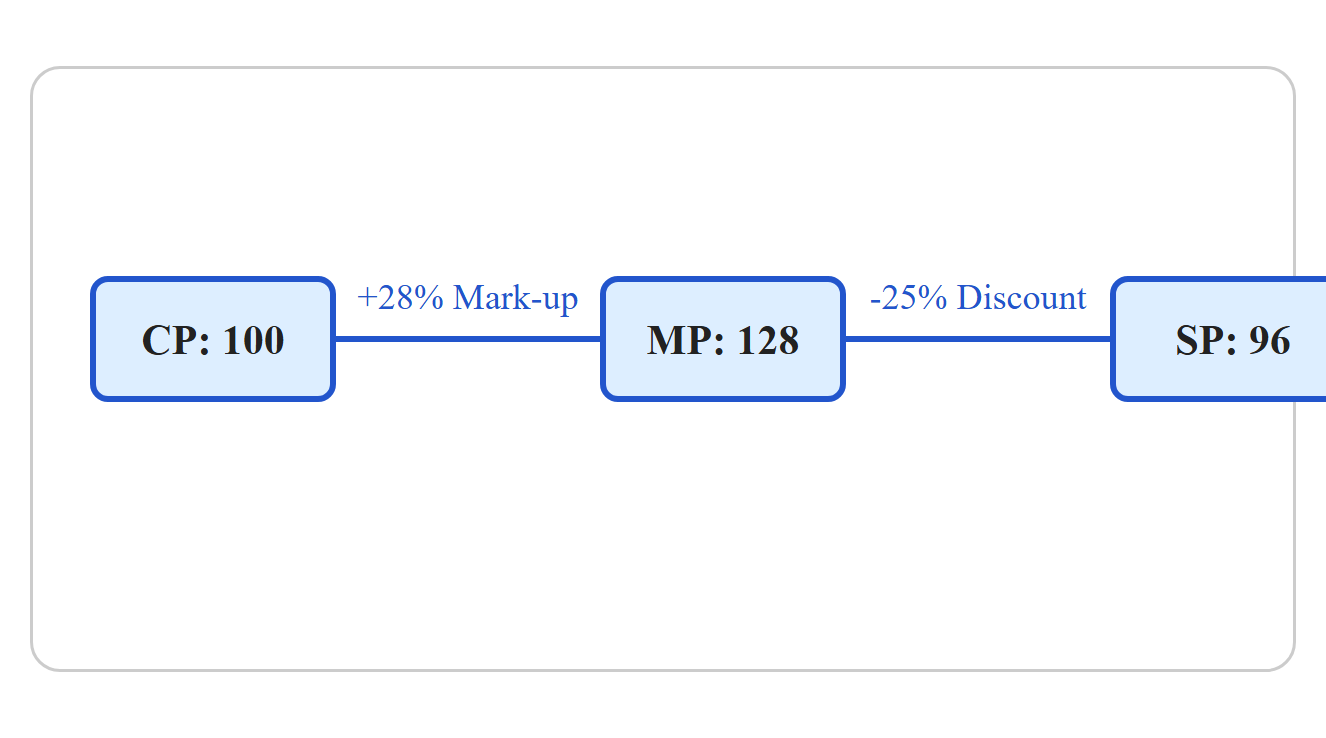
Here, a = +28% (Mark-up) and b = −25% (Discount).

Net change = 28 − 25 + (28 × (−25)) ÷ 100

Net change = 3 − (700 ÷ 100) = 3 − 7 = −4%.

Negative sign indicates a loss of 4%.

∴ The correct answer is 4% loss.

Alternate Method

Given: Mark-up = 28%, Discount = 25%. Formulas: MP = CP × (100 + Mark-up%) ÷ 100 | SP = MP × (100 − Discount%) ÷ 100 | Profit/Loss% = (SP − CP) ÷ CP × 100.

⇒ Let Cost Price (CP) be 100.

⇒ Marked Price (MP) = 100 + 28% of 100 = 128.

⇒ Selling Price (SP) = 128 − 25% of 128 = 128 − (128 ÷ 4) = 128 − 32 = 96.

⇒ Since SP < CP, there is a Loss.

⇒ Loss% = (100 − 96) ÷ 100 × 100 = 4%.

∴ The correct answer is 4% loss.

Additional Information

Marked Price and Discount

The Marked Price is the price listed by the seller, and Discount is always calculated on the MP to arrive at the Selling Price.

Successive Percentage Application

When a value is increased and then decreased, the result is equivalent to successive percentage changes: Net % = x + y + xy/100.

Question 5

The shorter side of a rectangle is 15 cm less than the longer side. The numerical value of its area is equal to 5 times the numerical value of its perimeter. What is the length (in cm) of its longer side?

  1. AOption (a)

    38

  2. BOption (b)

    30

  3. COption (c)

    27

  4. DOption (d)

    34

View answer & explanation

Correct answer

Answer: (b)B.

30

Why this answer is correct

Shortcut Trick Let the longer side be L and shorter side be (L − 15). Area = 5 × Perimeter ⇒ L(L − 15) = 5 × 2[L + (L − 15)] L2 − 15L = 10(2L − 15) ⇒ L2 − 15L = 20L − 150 L2 − 35L + 150 = 0 ⇒ (L − 30)(L − 5) = 0 Since L > 15 (as shorter side = L − 15), L must be 30. ∴ The correct answer is 30 cm. Alternate Method Given: Let longer side (length) = x cm Then shorter side (breadth) = (x − 15) cm Formula Used: Area of Rectangle = length × breadth Perimeter of Rectangle = 2(length + breadth)

Calculations: ⇒ Area = x(x − 15) ⇒ Perimeter = 2[x + (x − 15)] = 2(2x − 15) = 4x − 30 ⇒ According to question: x(x − 15) = 5 × (4x − 30) ⇒ x2 − 15x = 20x − 150 ⇒ x2 − 35x + 150 = 0 ⇒ x2 − 30x − 5x + 150 = 0 ⇒ x(x − 30) − 5(x − 30) = 0 ⇒ (x − 30)(x − 5) = 0 ⇒ x = 30 or x = 5 ⇒ If x = 5, then shorter side = 5 − 15 = −10 (Not possible as length cannot be negative). ⇒ ∴ x = 30 cm ∴ The correct answer is 30 cm. Additional Information Diagonal of Rectangle The diagonal d of a rectangle with sides l and b is given by d = √(l2 + b2). Quadratic Roots Property For a quadratic equation ax2 + bx + c = 0, the sum of roots is −b/a and product of roots is c/a. Relationship between Area and Perimeter For a square of side a, Area = a2 and Perimeter = 4a. If Area = Perimeter, then a = 4 units.

Question 6

Read the given statements and conclusions carefully. Assuming that the information given in the statements is true, even if it appears to be at variance with commonly known facts, decide which of the given conclusion(s) logically follow(s) from the statements.

Statements:

All cats are owls.

Some owls are rats.

No rat is bat.

Conclusions:

(I) Some rats are cats.

(II) Some bats can be cats.

  1. AOption (a)

    Both conclusions (I) and (II) follow

  2. BOption (b)

    Neither conclusion (I) nor conclusion (II) follows

  3. COption (c)

    Only conclusion (II) follows

  4. DOption (d)

    Only conclusion (I) follows

View answer & explanation

Correct answer

Answer: (c)C.

Only conclusion (II) follows

Why this answer is correct

Given Statements:

  1. All cats are owls.
  2. Some owls are rats.
  3. No rat is bat.

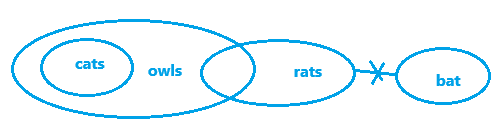
The least possible Venn diagram for the given statements is:

Conclusions:

I. Some rats are cats. → False (There is no direct or definite relationship stated between 'cats' and 'rats'. Therefore, this conclusion is False.)

This is a possibility, not a definite conclusion. While the 'cats' circle is entirely within the 'owls' circle, and the 'owls' circle overlaps with the 'rats' circle, there is no direct or definite relationship stated between 'cats' and 'rats'. The overlap between 'owls' and 'rats' might not include the 'cats' portion. Therefore, this conclusion is False.

II. Some bats can be cats. → True.(This conclusion is a possibility. The statement "No rat is bat" means the 'rat' and 'bat' circles have no overlap. However, the 'bat' circle can overlap with the 'cats' circle, as there is no direct statement or information in the given premises that prevents this. Therefore, this conclusion is True.)

Therefore, only conclusion II follows.

Hence, the correct answer is "Option 3".

Question 7

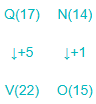
Select the triad that follows the same pattern as that followed by the two triads given below. Both triads follow the same pattern.

CX-GB-KF

GB-KF-OJ

  1. AOption (a)

    FA-JE-NJ

  2. BOption (b)

    PK-TO-WS

  3. COption (c)

    LG-PK-SO

  4. DOption (d)

    WR-AV-EZ

View answer & explanation

Correct answer

Answer: (d)D.

WR-AV-EZ

Why this answer is correct

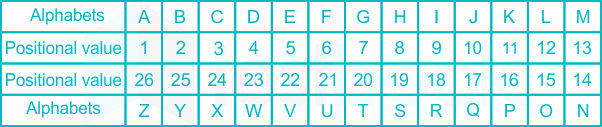
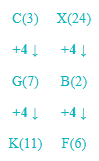
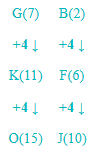
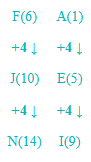
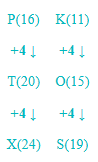
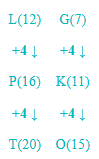
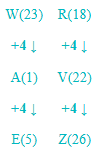
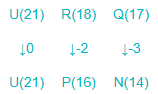
The logic followed in this pattern is a consistent alphabetical shift of +4 for each letter in both transformations within the triad.

Let's verify this logic with the given triads:

For 'CX - GB - KF':

For 'GB - KF - OJ':

Now, let's apply this logic to the given options to find the triad that follows the same pattern:

Option 1: FA-JE-NJ

This option does NOT follow the pattern for the second pair.

Option 2: PK-TO-WS

This option does NOT follow the pattern for the third pair.

Option 3: LG-PK-SO

This option does NOT follow the pattern for the third pair.

Option 4: WR-AV-EZ

This option follows the pattern correctly.

Hence, the correct answer is "Option 4".

Question 8

If ‘+’ means ‘subtraction’, ‘−’ means ‘multiplication’, ‘×’ means ‘division’ and ‘÷’ means ‘addition’, then what will come in place of the question mark (?) in the following equation?

96 × 6 − 8 ÷ 71 + 26 = ?

  1. AOption (a)

    173

  2. BOption (b)

    181

  3. COption (c)

    194

  4. DOption (d)

    186

View answer & explanation

Correct answer

Answer: (a)A.

173

Why this answer is correct

Given Equation: 96 × 6 − 8 ÷ 71 + 26 = ?

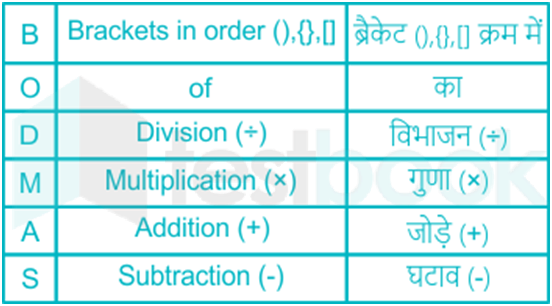
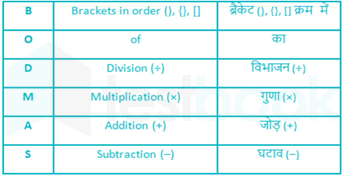
BODMAS Rule:

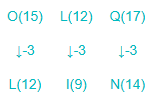
Decoding the given information:

Symbol+−×÷
Meaning−×÷+

Now replacing the signs and solving from left to right using BODMAS Rule, we get:

⇒ 96 ÷ 6 × 8 + 71 − 26

⇒ 16 × 8 + 71 − 26

⇒ 128 + 71 − 26

⇒ 199 − 26 = 173

Hence, the correct answer is "Option 1".

Question 9

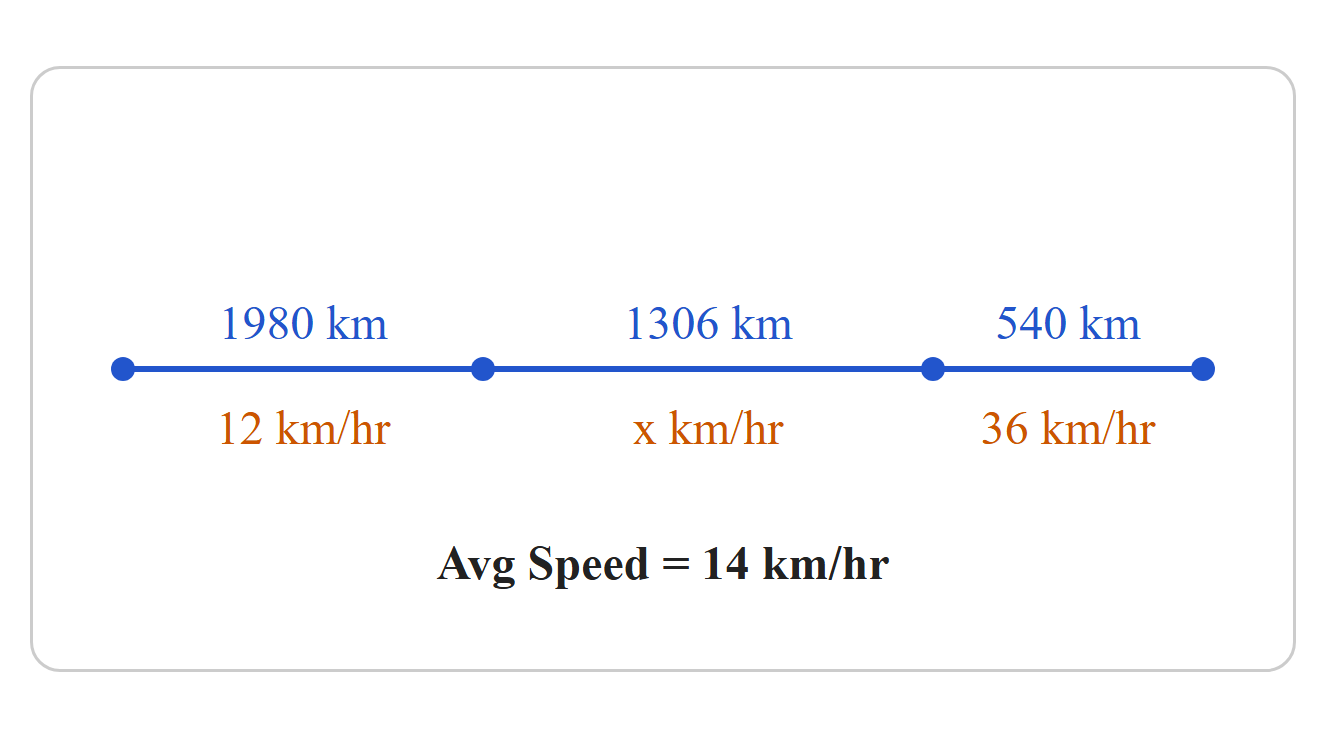
A man covers distances of 1980 km, 1306 km, and 540 km at the speed of 12 km/hr, x km/hr, and 36 km/hr, respectively. If his average speed for the whole journey is 14 km/hr, then what is the value of x?

  1. AOption (a)

    14

  2. BOption (b)

    13

  3. COption (c)

    10

  4. DOption (d)

    19

View answer & explanation

Correct answer

Answer: (a)A.

14

Why this answer is correct

Shortcut Trick

Total Distance = 1980 + 1306 + 540 = 3826 km

Total Time = Total Distance ÷ Average Speed = 3826 ÷ 14 = 273.285... hours

Individual Times: T1 = 1980 ÷ 12 = 165 hours, T3 = 540 ÷ 36 = 15 hours

Time for middle part = 273.285 − (165 + 15) = 93.285... hours

Speed x = 1306 ÷ 93.285... = 14 km/hr

∴ The correct answer is 14 km/hr.

Alternate Method

Given: D1 = 1980, S1 = 12; D2 = 1306, S2 = x; D3 = 540, S3 = 36; Avg S = 14

Formula Used: Average Speed = Total Distance ÷ Total Time

⇒ Total Distance = 1980 + 1306 + 540 = 3826 km

⇒ Total Time = (1980 ÷ 12) + (1306 ÷ x) + (540 ÷ 36)

⇒ Total Time = 165 + (1306 ÷ x) + 15 = 180 + (1306 ÷ x)

⇒ 14 = 3826 ÷ [180 + (1306 ÷ x)]

⇒ 180 + (1306 ÷ x) = 3826 ÷ 14

⇒ 180 + (1306 ÷ x) = 273.2857...

⇒ 1306 ÷ x = 273.2857 − 180 = 93.2857

⇒ x = 1306 ÷ 93.2857 = 14

∴ The correct answer is 14 km/hr.

Additional Information

Average Speed Formula

When distances and speeds vary, Average Speed = (Total Distance) ÷ (Total Time). Never average the speeds directly.

Special Case: Equal Distances

If two equal distances are covered at speeds u and v, Average Speed = (2 × u × v) ÷ (u + v).

Conversion Factor

To convert km/hr to m/s, multiply by 5/18. To convert m/s to km/hr, multiply by 18/5.

Question 10

What is the name of the point where India, China and Myanmar meet?

  1. AOption (a)

    Diphu Pass

  2. BOption (b)

    Anjaw Point

  3. COption (c)

    Kibithu

  4. DOption (d)

    Tri-Junction Pass

View answer & explanation

Correct answer

Answer: (a)A.

Diphu Pass

Why this answer is correct

The correct answer is Diphu Pass.

Key Points

  • Diphu Pass is the tri-junction point where the boundaries of India, China, and Myanmar meet.
  • It is located in the easternmost region of Arunachal Pradesh, India, in the Patkai Hills.
  • The pass lies on the strategic McMahon Line, which serves as the boundary between India and China.
  • Diphu Pass has historical significance, as it was a crucial route for trade and cultural exchanges between South Asia and Southeast Asia.
  • It also plays a significant role in the geopolitics of the region, being part of the India-China border dispute.

Additional Information

  • McMahon Line:
  • It is the boundary line drawn between India and Tibet during the 1914 Simla Convention.
  • China disputes the validity of the McMahon Line, leading to ongoing tensions between India and China.
  • Patkai Hills:
  • The Patkai Hills are a mountain range located in the northeastern region of India, forming part of the border with Myanmar.
  • They are known for their rich biodiversity and dense forests.
  • Tri-Junction Points:
  • These are points where the boundaries of three countries meet, often leading to strategic and geopolitical significance.
  • Examples include the India-Nepal-China tri-junction and the India-Bhutan-China tri-junction at Doklam.
  • India-China Border Disputes:
  • Disputes primarily revolve around the regions of Aksai Chin (to the west) and Arunachal Pradesh (to the east).
  • The border conflicts have led to several military standoffs, including the 1962 Sino-Indian War.
  • Myanmar's Borders:
  • Myanmar shares a 1,643 km-long boundary with India, touching the states of Arunachal Pradesh, Nagaland, Manipur, and Mizoram.
  • The border is vital for trade and cultural connections between the two nations.

Question 11

Which of the following states is landlocked and does not touch any international

boundary?

  1. AOption (a)

    Uttar Pradesh

  2. BOption (b)

    Chhattisgarh

  3. COption (c)

    Rajasthan

  4. DOption (d)

    Assam

View answer & explanation

Correct answer

Answer: (b)B.

Chhattisgarh

Why this answer is correct

The correct answer is Chhattisgarh.

Key Points

  • Chhattisgarh is a landlocked state in India and does not share its borders with any international boundary.
  • It is surrounded by seven Indian states: Madhya Pradesh, Maharashtra, Telangana, Andhra Pradesh, Odisha, Jharkhand, and Uttar Pradesh.
  • The state was carved out of Madhya Pradesh on November 1, 2000, becoming the 26th state of India.
  • Raipur is the capital of Chhattisgarh and serves as a major hub for administration and commerce.
  • Chhattisgarh is known for its mineral wealth, being one of India’s richest states in terms of coal, iron ore, and other natural resources.

Additional Information

  • Landlocked States: A landlocked state refers to a region entirely surrounded by land without direct access to the sea or an international boundary.
  • International Boundaries of India: India shares borders with seven countries: Pakistan, China, Nepal, Bhutan, Bangladesh, Myanmar, and Afghanistan.
  • Geographical Features of Chhattisgarh: The state has dense forests, rivers such as Mahanadi and Indravati, and a tropical climate, which contributes to its rich biodiversity.
  • Economic Significance: Chhattisgarh is a leading producer of rice, and its forests contribute to India’s timber and minor forest produce economy.
  • Cultural Heritage: The state is famous for its tribal communities and cultural landmarks, including the Bastar region and its traditional festivals like Bastar Dussehra.

Question 12

In April 2025, the DRDO and the Indian Army successfully conducted four flight-tests of which missile system from Dr APJ Abdul Kalam Island?

  1. AOption (a)

    Nag

  2. BOption (b)

    BrahMos

  3. COption (c)

    Medium-Range Surface-to-Air Missile

  4. DOption (d)

    Akash

View answer & explanation

Correct answer

Answer: (c)C.

Medium-Range Surface-to-Air Missile

Why this answer is correct

The correct answer is Medium-Range Surface-to-Air Missile (MRSAM).

Key Points

  • The Medium-Range Surface-to-Air Missile (MRSAM) is an advanced air defense missile system developed jointly by the Defence Research and Development Organisation (DRDO) and Israel Aerospace Industries (IAI).
  • The missile system successfully conducted four flight-tests in April 2025 from the Dr. APJ Abdul Kalam Island off the coast of Odisha, India.
  • MRSAM is designed to provide multi-layered air defense against enemy aircraft, missiles, and unmanned aerial vehicles (UAVs).
  • The system has a range of approximately 70 kilometers and features advanced radar, command-and-control systems, and mobile launchers.
  • It is a critical component of India’s defense capabilities, aimed at strengthening airspace security for the Indian Army, Navy, and Air Force.

Additional Information

  • Dr. APJ Abdul Kalam Island: Formerly known as Wheeler Island, it is an integrated test range for missile systems located in Odisha, used for testing various indigenous and strategic missile systems.
  • Features of MRSAM: Includes advanced phased-array radar, interceptor missiles with advanced guidance, and a mobile launcher system to ensure high precision and mobility.
  • Collaborative Development: MRSAM is a joint venture between DRDO and IAI, showcasing India-Israel defense cooperation in missile technology.
  • Operational Role: The system is tailored for both offensive and defensive roles, capable of neutralizing aerial threats in diverse combat scenarios.
  • Previous Tests: MRSAM has undergone multiple successful tests since its inception, validating its performance and reliability under various operational conditions.
Question 13

The selling price of 34 books is equal to the cost price of 17 books. Find the loss or gain percentage.

  1. AOption (a)

    50% loss

  2. BOption (b)

    10017\frac{100}{17} % loss

  3. COption (c)

    10017\frac{100}{17} % gain

  4. DOption (d)

    50% gain 

View answer & explanation

Correct answer

Answer: (a)A.

50% loss

Why this answer is correct

Shortcut Trick If the Selling Price of x articles is equal to the Cost Price of y articles, then: Ratio of CP : SP = x : y = 34 : 17 = 2 : 1. Loss = 2 − 1 = 1 unit. Loss % = (Loss ÷ CP) × 100 = (1 ÷ 2) × 100 = 50%. Since CP > SP, it is a loss. ∴ The correct answer is 50% loss.

Alternate Method Given: SP of 34 books = CP of 17 books. Formulas: Loss = CP − SP | Loss% = (Loss ÷ CP) × 100.

⇒ Let the Cost Price (CP) of 1 book be 1 unit. ⇒ Total CP of 34 books = 34 units. ⇒ Selling Price (SP) of 34 books = CP of 17 books = 17 units. ⇒ Loss = CP − SP = 34 − 17 = 17 units. ⇒ Loss % = (17 ÷ 34) × 100 = 50%. ∴ The correct answer is 50% loss.

Additional Information Profit and Loss on Articles When the cost price of 'm' articles is equal to the selling price of 'n' articles, Gain/Loss% = (m − n) ÷ n × 100. A positive result indicates gain, and a negative result indicates loss. Profit Condition Profit occurs only when the Selling Price is greater than the Cost Price (SP > CP).

Question 14

Which of the following classical dance forms' music belongs to the Carnatic system?

  1. AOption (a)

    Kuchipudi

  2. BOption (b)

    Odissi

  3. COption (c)

    Chhau

  4. DOption (d)

    Kathak

View answer & explanation

Correct answer

Answer: (a)A.

Kuchipudi

Why this answer is correct

The correct answer is Kuchipudi.

Key Points

  • Kuchipudi is a classical dance form originating from Andhra Pradesh, India.
  • The music accompanying Kuchipudi performances is based on the Carnatic system, one of the two main traditions of Indian classical music.
  • Kuchipudi performances often feature vocals and instrumental accompaniments typical of Carnatic music, such as veena, mridangam, and flute.
  • The dance form combines rhythmic footwork with expressive storytelling through gestures, known as "abhinaya."
  • Kuchipudi is known for its fusion of dance, drama, and music, all rooted in the rich Carnatic tradition.

Additional Information

  • Carnatic Music:
  • Carnatic music is primarily associated with the southern states of India: Andhra Pradesh, Karnataka, Tamil Nadu, and Kerala.
  • It is characterized by its complex raga (melody) and tala (rhythm) systems.
  • Famous composers like Tyagaraja, Muthuswami Dikshitar, and Shyama Shastri have contributed significantly to its repertoire.
  • Other Classical Dance Forms:
  • Odissi: Originating from Odisha, it primarily uses Hindustani music.
  • Kathak: Associated with North India, it uses Hindustani music and focuses on intricate footwork and spins.
  • Chhau: A semi-classical dance form popular in eastern India, it uses regional folk music styles.
  • Key Instruments in Carnatic Music:
  • Veena, mridangam, violin, and tambura are commonly used.
  • These instruments create a rich soundscape that complements the dance performance.
  • Abhinaya in Kuchipudi:
  • Abhinaya refers to expressive storytelling through gestures, facial expressions, and body movements.
  • Kuchipudi often incorporates mythological and spiritual narratives in its performances.

Question 15

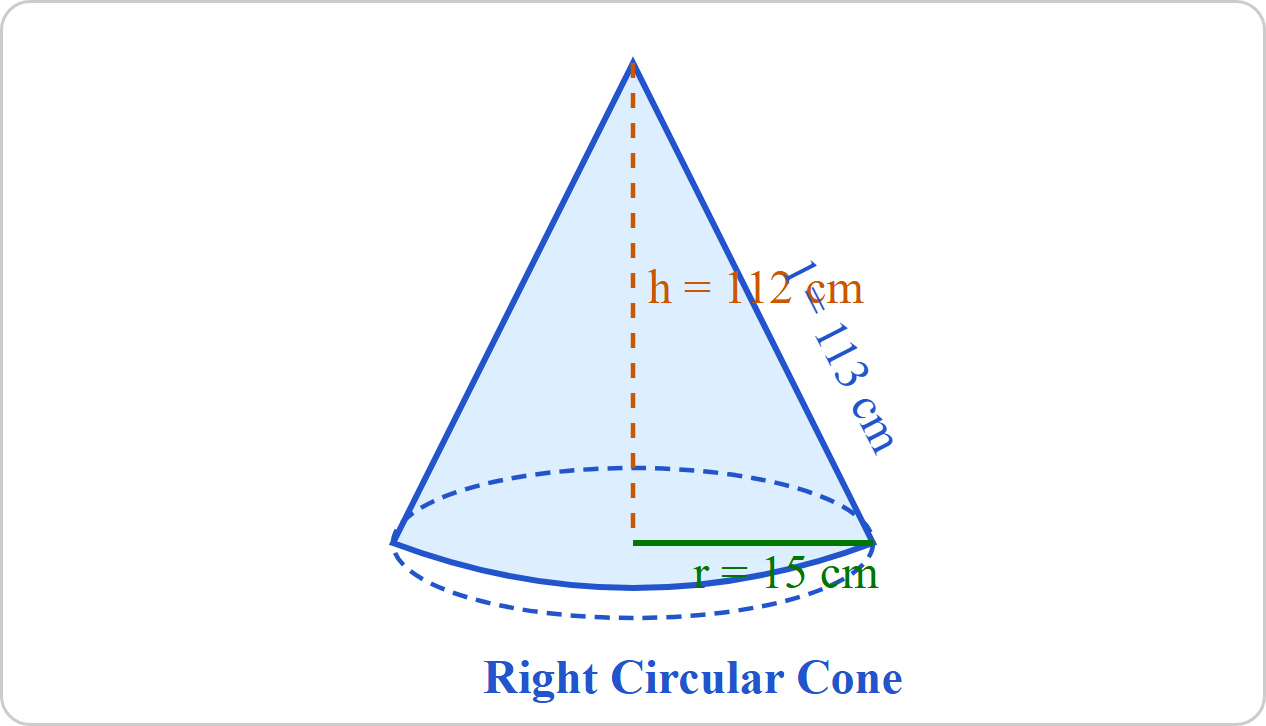
The diameter of the base and slant height of a right circular cone are 30 cm and 113 cm, respectively. Find the volume (in cm3) of the given cone.

(Use π=227\frac{22}{7} )

  1. AOption (a)

    26,375

  2. BOption (b)

    26,435

  3. COption (c)

    26,360

  4. DOption (d)

    26,400

View answer & explanation

Correct answer

Answer: (d)D.

26,400

Why this answer is correct

Shortcut Trick

Radius (r) = 30 ÷ 2 = 15 cm.

Height (h) = √(1132 − 152) = √(12769 − 225) = √12544 = 112 cm.

Volume = (1/3) × (22/7) × 15 × 15 × 112.

Volume = 22 × 5 × 15 × 16 = 26,400 cm3.

∴ The correct answer is 26,400 cm3.

Alternate Method

Given: Diameter = 30 cm, Slant height (l) = 113 cm.

Formula Used: Radius (r) = Diameter/2 | l2 = r2 + h2 | Volume = (1/3)πr2h

⇒ Radius (r) = 30 ÷ 2 = 15 cm

⇒ h2 = l2 − r2 = 1132 − 152

⇒ h2 = (113 − 15)(113 + 15) = 98 × 128 = 12544

⇒ h = √12544 = 112 cm

⇒ Volume = (1/3) × (22/7) × 15 × 15 × 112

⇒ Volume = 22 × 5 × 15 × 16 = 26,400 cm3

∴ The correct answer is 26,400 cm3.

Additional Information

Slant Height of Cone

The relationship between height (h), radius (r), and slant height (l) is given by the Pythagorean theorem: l = √(r2 + h2).

Surface Area of Cone

Curved Surface Area (CSA) = πrl and Total Surface Area (TSA) = πr(l + r).

Volume Comparison

The volume of a cone is exactly one-third the volume of a cylinder with the same radius and height (V = 1/3 πr2h).

Question 16

Which of the following is NOT a part of the Peninsular Plateau’s major divisions?

  1. AOption (a)

    Central Highlands

  2. BOption (b)

    Purvanchal Hills

  3. COption (c)

    Deccan Plateau

  4. DOption (d)

    Northeastern Plateau

View answer & explanation

Correct answer

Answer: (b)B.

Purvanchal Hills

Why this answer is correct

The correct answer is Purvanchal Hills.

Key Points

  • The Peninsular Plateau is one of the oldest landforms in India, predominantly composed of igneous and metamorphic rocks.
  • Its major divisions include the Central Highlands (north of the Narmada River) and the Deccan Plateau (south of the Narmada River).
  • The Northeastern Plateau, though geographically distinct, is considered part of the Peninsular Plateau region as it is contiguous with the Deccan Plateau.
  • The Purvanchal Hills are not part of the Peninsular Plateau; they are part of the Himalayan mountain system located in the northeastern region of India.
  • The Purvanchal Hills include hill ranges such as the Patkai, Naga, Manipur, and Mizo Hills.

Additional Information

  • Central Highlands: Located to the north of the Narmada River, it includes regions like Malwa Plateau and Bundelkhand.
  • Deccan Plateau: The largest plateau in India, it is bordered by the Western Ghats, Eastern Ghats, and the Satpura Range.
  • Northeastern Plateau: Also referred to as the Meghalaya Plateau, it comprises Khasi, Jaintia, and Garo hills and is an extension of the Peninsular Plateau.
  • Purvanchal Hills: A sub-mountain range of the Himalayas, these hills form the easternmost boundary of India.
  • Peninsular Plateau's Formation: This plateau was formed due to volcanic activity and is part of the ancient Gondwana landmass.

Question 17

Which of the following banks has reported a significant rise in its net short position in the forward book, which expanded to 77.5billionbytheendofJanuary2025,upfrom77.5 billion by the end of January 2025, up from 67.9 billion in December 2024?

  1. AOption (a)

    Indian Bank

  2. BOption (b)

    Bank of India

  3. COption (c)

    Reserve Bank of India

  4. DOption (d)

    State Bank of India

View answer & explanation

Correct answer

Answer: (c)C.

Reserve Bank of India

Why this answer is correct

The correct answer is Reserve Bank of India.

Key Points

  • The Reserve Bank of India (RBI) reported a significant rise in its net short position in the forward book, expanding to $77.5 billion by the end of January 2025, from $67.9 billion in December 2024.
  • RBI’s forward book reflects its activity in managing foreign exchange reserves and hedging against currency risks.
  • A net short position in the forward book indicates that the RBI has sold more foreign exchange forward contracts than it has purchased.
  • This rise in the net short position could be indicative of RBI’s strategy to manage exchange rate volatility and ensure stability in the currency market.
  • The forward book positions are closely monitored to assess the central bank’s approach towards external sector management.

Additional Information

  • Forward Contracts: Financial agreements where two parties agree to exchange a specific amount of currency at a predetermined rate on a future date.
  • Net Short Position: Occurs when an entity has sold more of a financial instrument than it has purchased, indicating a bearish outlook or hedging strategy.
  • Foreign Exchange Reserves: Assets held by a central bank in foreign currencies, used to back liabilities and stabilize the national currency.
  • Currency Hedging: A strategy to protect against exchange rate fluctuations, ensuring stability in international transactions.
  • RBI's Role: The Reserve Bank of India actively manages the foreign exchange market to ensure liquidity, reduce volatility, and maintain economic stability.

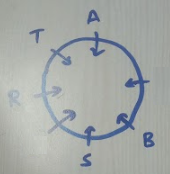
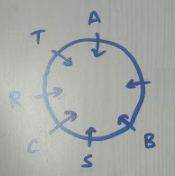
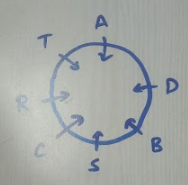
Question 18

A, B, C, D, R, S and T are sitting around a circular table facing the centre of the table. B sits third to the left of T. R sits second to the left of S. Only T sits between A and R. C is not an immediate neighbour of B. How many people sit between D and R when counted from the right of D?

  1. AOption (a)

    Four

  2. BOption (b)

    One

  3. COption (c)

    Two

  4. DOption (d)

    Three

View answer & explanation

Correct answer

Answer: (c)C.

Two

Why this answer is correct

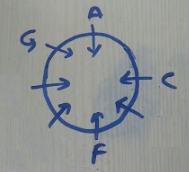
Given, A, B, C, D, R, S and T are sitting around a circular table facing the centre of the table.

R sits second to the left of S.

Only T sits between A and R.

B sits third to the left of T.

C is not an immediate neighbour of B.

And D sits at the remaining place.

Two people sit between D and R when counted from the right of D.

Hence, the correct answer is "Option 3".

Question 19

Each of P, Q, R, S, T, U and V has an exam on a different day of a week starting from Monday and ending on Sunday of the same week. V has an exam on Tuesday. Exactly 2 people have an exam between V and P. S has an exam immediately before T, and Q has an exam immediately after R. Only 1 person has an exam between T and R How many people have an exam before S?

  1. AOption (a)

    4

  2. BOption (b)

    1

  3. COption (c)

    3

  4. DOption (d)

    2

View answer & explanation

Correct answer

Answer: (d)D.

2

Why this answer is correct

Given: P, Q, R, S, T, U and V each have an exam on a different day of the week, from Monday to Sunday.

  1. V has an exam on Tuesday.

  2. Exactly 2 people have an exam between V and P. Since V's exam is on Tuesday, P's exam must be on Friday.

DayPerson
Monday
TuesdayV
Wednesday
Thursday
FridayP
Saturday
Sunday
  1. S has an exam immediately before T, and Q has an exam immediately after R.

This gives us two pairs of people with consecutive exams: (S, T) and (R, Q).

DayPerson(Case I)Person(Case II)
Monday
TuesdayVV
WednesdaySR
ThursdayTQ
FridayPP
SaturdayRS
SundayQT
  1. Only 1 person has an exam between T and R.

So, only case I is possible 

DayPerson(Case I)
Monday
TuesdayV
WednesdayS
ThursdayT
FridayP
SaturdayR
SundayQ

The only remaining person is U, and the only remaining day is Monday.

Therefore, U has their exam on Monday.

Final arrangement:

DayPerson
MondayU
TuesdayV
WednesdayS
ThursdayT
FridayP
SaturdayR
SundayQ


S has an exam on Wednesday.

There are 2 people with exams before S.

Hence, the correct answer is "Option 4".

Question 20

According to the Supreme Court ruling in 'The State of Madhya Pradesh vs Balveer Singh' (24 February 2025) case, which of the following statements is correct regarding 'child witnesses'?

  1. AOption (a)

    Courts must reject a child’s testimony if there is any minor inconsistency.

  2. BOption (b)

    The Evidence Act mandates a minimum age for a person to be a witness in court.

  3. COption (c)

    A child’s evidence is admissible if found voluntary, reliable and untutored.

  4. DOption (d)

    The testimony of a child witness is inadmissible unless corroborated by an adult.

View answer & explanation

Correct answer

Answer: (c)C.

A child’s evidence is admissible if found voluntary, reliable and untutored.

Why this answer is correct

The correct answer is A child's evidence is admissible if found voluntary, reliable and untutored..

Key Points

  • The Supreme Court in the 'State of Madhya Pradesh vs Balveer Singh' case ruled that the testimony of child witnesses is admissible if it is voluntary, reliable, and untutored.
  • Courts assess the credibility of child witnesses based on the competence and reliability of their testimony rather than their age.
  • Under the Indian Evidence Act, there is no minimum age limit for a witness; children can testify if they understand the questions and provide rational answers.
  • Minor inconsistencies in a child's testimony do not necessarily discredit it; the courts focus on the overall truthfulness and reliability of the evidence.
  • Judicial precedent emphasizes that corroboration is not mandatory for child witnesses if their testimony is credible and trustworthy.

Additional Information

  • Child Witness: A child witness is any individual below 18 years who provides testimony in legal proceedings.
  • Competency Test: Courts conduct a competency test to evaluate whether a child witness understands the nature of an oath and can provide rational answers.
  • Indian Evidence Act: Section 118 of the Act states that all persons, including children, are competent to testify provided they can comprehend and respond to questions.
  • Untutored Testimony: Courts prefer untutored evidence from children to avoid influence or coaching, ensuring the authenticity of their statements.
  • Judicial Precedents: Indian courts have consistently ruled that corroboration of child testimony is not essential if it is found credible and trustworthy.

Question 21

Who founded the Prarthana Samaj?

  1. AOption (a)

    Narayan Mahadev Permanand

  2. BOption (b)

    Atmaram Pandurang

  3. COption (c)

    Gopal Hari Deshmukh

  4. DOption (d)

    Vishnushastri Pandit

View answer & explanation

Correct answer

Answer: (b)B.

Atmaram Pandurang

Why this answer is correct

The correct answer is Atmaram Pandurang.

Key Points

  • Atmaram Pandurang was the founder of the Prarthana Samaj, established in 1867 in Bombay (now Mumbai).
  • The Prarthana Samaj was influenced by the ideas of the Brahmo Samaj and focused on social and religious reform.
  • It emphasized monotheism and opposed idol worship and caste discrimination.
  • Atmaram Pandurang was supported by prominent leaders like Justice Mahadev Govind Ranade in propagating the ideals of the Prarthana Samaj.
  • The movement aimed at creating a society based on rational thought, equality, and ethical principles, paving the way for modern reformist ideologies.

Additional Information

  • Brahmo Samaj: Founded by Raja Ram Mohan Roy in 1828, it laid the foundation for religious and social reform movements in India.
  • Justice Mahadev Govind Ranade: A key figure in the Prarthana Samaj, Ranade worked towards abolishing caste discrimination and promoting women’s education and widow remarriage.
  • Social Reform Movements: The Prarthana Samaj was part of a broader reformist wave in 19th century India aimed at eradicating social evils like untouchability, child marriage, and gender inequality.
  • Religious Philosophy: The Samaj advocated a rational approach to religion, promoting ethical living and humanitarian values over ritualistic practices.
  • Legacy: The efforts of the Prarthana Samaj contributed significantly to the modernization of Indian society and the spread of progressive ideas during the colonial era.

Question 22

In which year did Mendeleev publish the periodic table?

  1. AOption (a)

    1948

  2. BOption (b)

    1903

  3. COption (c)

    1869

  4. DOption (d)

    1894

View answer & explanation

Correct answer

Answer: (c)C.

1869

Why this answer is correct

The correct answer is 1869.

Key Points

  • Dmitri Mendeleev published the first version of the periodic table in 1869, classifying elements based on their atomic weights and properties.
  • Mendeleev's table included 63 elements known at the time and left gaps for elements that were yet to be discovered.
  • He predicted the existence and properties of undiscovered elements such as gallium, scandium, and germanium, which were later found to match his predictions.
  • Mendeleev’s periodic table laid the foundation for the modern periodic table, which is now based on atomic numbers rather than atomic weights.
  • The periodic law, as formulated by Mendeleev, states that the properties of elements are periodic functions of their atomic weights (later revised to atomic numbers).

Additional Information

  • Periodic Table: The periodic table organizes elements into rows (periods) and columns (groups) based on their chemical and physical properties.
  • Atomic Number: Modern periodic tables are arranged by atomic number, which is the number of protons in the nucleus of an atom.
  • Periodic Law: The modern periodic law states that the physical and chemical properties of elements are periodic functions of their atomic numbers.
  • Gaps in Mendeleev's Table: Mendeleev intentionally left gaps in his table for elements he predicted would be discovered, showcasing the predictive power of his work.
  • Modern Updates: The periodic table has been expanded over time to include synthetic elements, with the latest being element 118, oganesson (Og), discovered in 2002.

Question 23

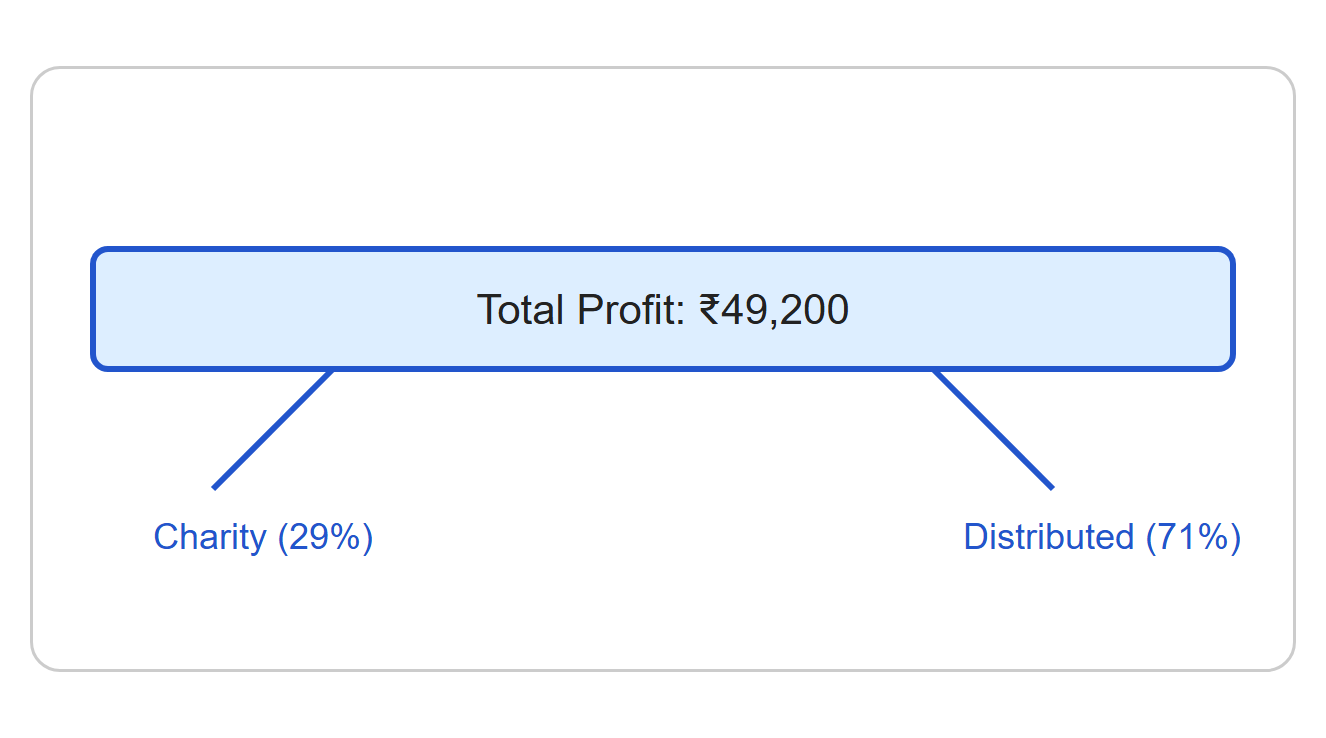
Pankaj, Meera, and Ashok invest ₹41,000, ₹39,000, and ₹84,000 respectively to start a business. At the end of the year, the total profit earned is ₹49,200. 29% of the total profit earned is given to charity and the rest is divided among them in the ratio of their investments. What will be the share of Ashok (in ₹)?

  1. AOption (a)

    17,670

  2. BOption (b)

    17,892

  3. COption (c)

    17,754

  4. DOption (d)

    18,168

View answer & explanation

Correct answer

Answer: (b)B.

17,892

Why this answer is correct

Shortcut Trick

Investment ratio Pankaj : Meera : Ashok = 41 : 39 : 84 (Sum of parts = 164).

Total profit = ₹49,200. Remaining profit after 29% charity = 71% of 49,200.

Ashok share = (84 ÷ 164) × 0.71 × 49,200.

Ashok share = 84 × 0.71 × 300 = 84 × 213 = ₹17,892.

∴ The correct answer is ₹17,892.

Alternate Method

Given → Investments: Pankaj = ₹41,000, Meera = ₹39,000, Ashok = ₹84,000. Total Profit = ₹49,200. Charity = 29%. Formulas: Profit Share Ratio = Investment Ratio × Time | Share = (Individual Ratio ÷ Total Ratio) × Distributed Profit.

⇒ Remaining Profit = 49,200 − (29 ÷ 100 × 49,200) = 49,200 − 14,268 = ₹34,932. ⇒ Ratio of investments = 41,000 : 39,000 : 84,000 = 41 : 39 : 84. ⇒ Sum of ratios = 41 + 39 + 84 = 164 units. ⇒ 164 units = ₹34,932 ⇒ 1 unit = 34,932 ÷ 164 = ₹213. ⇒ Ashok share (84 units) = 84 × 213 = ₹17,892.

∴ The correct answer is ₹17,892.

Additional Information

Partnership Basics

When time periods are the same, the profit sharing ratio is directly proportional to the investment ratio.

Handling Charity/Tax

Always subtract the non-distributable amount (Charity, Tax, Reserves) from the Gross Profit to find the Net Distributable Profit.

Question 24

A, B, C, D, E, F and G are sitting around a circular table facing the centre. A sits third to the right of F. C sits second to the left of G. G is not an immediate neighbour of F. D sits to the immediate right of E. What is the position of C with respect to A?

  1. AOption (a)

    To the immediate left

  2. BOption (b)

    Third to the left

  3. COption (c)

    Second to the left

  4. DOption (d)

    To the immediate right

View answer & explanation

Correct answer

Answer: (a)A.

To the immediate left

Why this answer is correct

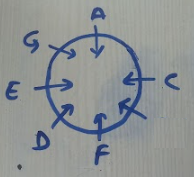
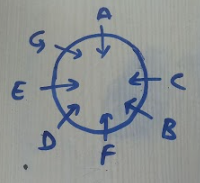
Given that A, B, C, D, E, F and G are sitting around a circular table facing the centre.

A sits third to the right of F.

C sits second to the left of G.

G is not an immediate neighbour of F.

D sits to the immediate right of E.

And B sits at the remaining place.

C is immediately left to A.

Hence, the correct answer is "Option 1".

Question 25

In the 'Suresh v. State Rep. by Inspector of Police case (March 2025)', what did the

Supreme Court rule regarding ‘dying declarations’?

  1. AOption (a)

    Dying declarations are inadmissible in court.

  2. BOption (b)

    Suspicious dying declarations require corroborative evidence.

  3. COption (c)

    Dying declarations are sacrosanct and do not require any supporting evidence.

  4. DOption (d)

    Dying declarations are always reliable.

View answer & explanation

Correct answer

Answer: (b)B.

Suspicious dying declarations require corroborative evidence.

Why this answer is correct

The correct answer is Suspicious dying declarations require corroborative evidence.

Key Points

  • The Supreme Court in the 'Suresh v. State Rep. by Inspector of Police (March 2025)' case emphasized that suspicious dying declarations require corroborative evidence.
  • This ruling ensures that courts scrutinize the credibility of dying declarations when there are doubts about their authenticity.
  • The judgment clarifies that while dying declarations hold significant evidentiary value, their reliability depends on the circumstances under which they were recorded.
  • If a dying declaration raises suspicion or inconsistencies, it cannot be the sole basis for conviction without independent corroboration.
  • This ruling aligns with the principle of ensuring justice by balancing the use of dying declarations with safeguards against potential misuse.

Additional Information

  • Dying Declaration: A statement made by a person who is on the verge of death, regarding the circumstances or cause of their impending death, is admissible under Section 32(1) of the Indian Evidence Act, 1872.
  • Legal Admissibility: Dying declarations are considered an exception to hearsay evidence because the law presumes that a person on their deathbed is unlikely to lie.
  • Conditions for Validity: The declaration must be made voluntarily, without coercion, and with a clear state of mind.
  • Judicial Precedents: Courts have consistently held that dying declarations should be free from doubt and suspicion to form the basis of a conviction.
  • Role of Corroborative Evidence: In cases where the dying declaration appears doubtful, corroboration through independent evidence is essential to uphold the principles of justice.

Question 26

In March 2025, the theme of the 54th National Safety Week focused on which of the following?

  1. AOption (a)

    Building Safer Factories

  2. BOption (b)

    Workers First, Safety Always

  3. COption (c)

    Safety at Every Step

  4. DOption (d)

    Safety & Well-being Crucial for Viksit Bharat

View answer & explanation

Correct answer

Answer: (d)D.

Safety & Well-being Crucial for Viksit Bharat

Why this answer is correct

The correct answer is Safety & Well-being Crucial for Viksit Bharat.

Key Points

  • The 54th National Safety Week, held in March 2025, emphasized the theme "Safety & Well-being Crucial for Viksit Bharat."
  • This theme aligns with India's vision of becoming a developed nation ("Viksit Bharat") through prioritizing workplace safety and overall well-being.
  • National Safety Week is organized by the National Safety Council (NSC), aiming to raise awareness about safety, health, and environmental issues.
  • Activities during the week include workshops, training sessions, safety audits, and campaigns to promote a culture of safety across industries.
  • The initiative highlights the importance of integrating safety measures at all organizational levels to ensure sustainable growth and development.

Additional Information

  • National Safety Council (NSC): Established in 1966, NSC is an autonomous body under the Ministry of Labour and Employment dedicated to promoting safety awareness in India.
  • Safety Week Goals: The event aims to reduce workplace accidents, improve health standards, and foster a preventive culture in industries.
  • Viksit Bharat Vision: "Viksit Bharat" refers to India's developmental goals, focusing on advanced infrastructure, human resource development, and sustainable practices.
  • Well-being in Workplace: Includes mental health support, ergonomic measures, and ensuring safe working conditions to enhance productivity and employee satisfaction.
  • Safety Audits: A systematic evaluation of workplace safety practices and compliance with statutory regulations to identify and mitigate risks.

Question 27

Find a single discount (rounded up to two decimal places) equal to three consecutive discounts of 13%, 20% and 4%.

  1. AOption (a)

    33.67%

  2. BOption (b)

    36.92%

  3. COption (c)

    31.96%

  4. DOption (d)

    33.18%

View answer & explanation

Correct answer

Answer: (d)D.

33.18%

Why this answer is correct

Shortcut Trick

Use the successive discount formula: Net Discount = a + b − (a × b ÷ 100).

For 13% and 20%: 13 + 20 − (13 × 20 ÷ 100) = 33 − 2.6 = 30.4%.

Now combine 30.4% and 4%: 30.4 + 4 − (30.4 × 4 ÷ 100) = 34.4 − 1.216 = 33.184%.

Rounding to two decimal places, we get 33.18%.

∴ The correct answer is 33.18%.

Alternate Method

Given: Three consecutive discounts of 13%, 20%, and 4%.

Formula: Single Discount = [1 − (1 − d1/100)(1 − d2/100)(1 − d3/100)] × 100

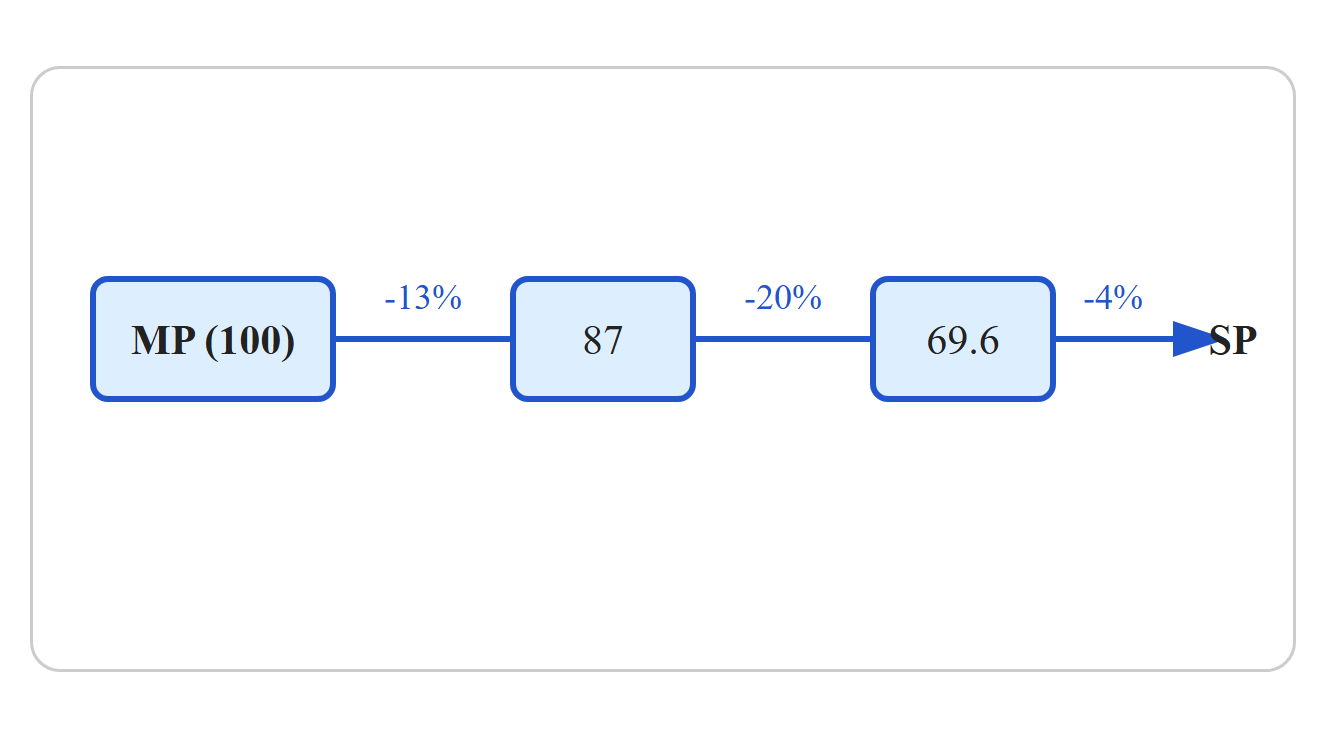
⇒ Let the Marked Price (MP) be 100.

⇒ Price after 13% discount = 100 − 13 = 87.

⇒ Price after 20% discount = 87 − (20% of 87) = 87 − 17.4 = 69.6.

⇒ Price after 4% discount = 69.6 − (4% of 69.6) = 69.6 − 2.784 = 66.816.

⇒ Net Discount = 100 − 66.816 = 33.184%.

∴ The correct answer is 33.18%.

Additional Information

Successive Discount

When a series of discounts are applied one after another on the reducing balance, it is called a successive discount. The order of applying discounts does not change the final Selling Price.

Equivalent Discount Formula

For two discounts a% and b%, the single equivalent discount is (a + b − ab/100)%.

Question 28

P, Q, R, S, T, U and V have an exam on different days of the week starting on Monday and ending on Sunday. Q has an exam on Wednesday. Exactly 4 people have an exam between T and U, neither of whom has an exam on Monday. R has an exam immediately before S and V has an exam immediately after S. P has an exam immediately before T. How many people have an exam between P and R?

  1. AOption (a)

    2

  2. BOption (b)

    1

  3. COption (c)

    3

  4. DOption (d)

    4

View answer & explanation

Correct answer

Answer: (a)A.

2

Why this answer is correct

Given: P, Q, R, S, T, U and V have an exam on different days of the week starting on Monday and ending on Sunday.


  1. Q has an exam on Wednesday.
DayPerson
Monday
Tuesday
WednesdayQ
Thursday
Friday
Saturday
Sunday


  1. Exactly 4 people have an exam between T and U, neither of whom has an exam on Monday.
DayPerson (Case I)Person (Case  II)
Monday
TuesdayUT
WednesdayQQ
Thursday
Friday
Saturday
SundayTU


  1. R has an exam immediately before S and V has an exam immediately after S.

This means we have a block of three exams for R, S, and V in consecutive days.

DayPerson (Case I)Person (Case  II)
Monday
TuesdayUT
WednesdayQQ
ThursdayRR
FridaySS
SaturdayVV
SundayTU
  1. P has an exam immediately before T. 

Then Case I is not possible.

DayPerson (Case  II)
MondayP
TuesdayT
WednesdayQ
ThursdayR
FridayS
SaturdayV
SundayU


The number of people with exams between P and R is 2 (T and Q).

Hence, the correct answer is "Option 1".

Question 29

Where did Anahat Singh win the women's squash title in 2025?

  1. AOption (a)

    SRFI Indian Tour PSA Challenger tournament in Chennai

  2. BOption (b)

    Chennai International Squash Tournament

  3. COption (c)

    Indian Open 2025 PSA Copper event in Mumbai

  4. DOption (d)

    Indian Open 2025 PSA Gold event in Delhi

View answer & explanation

Correct answer

Answer: (c)C.

Indian Open 2025 PSA Copper event in Mumbai

Why this answer is correct

The correct answer is Indian Open 2025 PSA Copper event in Mumbai.

Key Points

  • Anahat Singh clinched the women's squash title at the Indian Open 2025 PSA Copper event held in Mumbai.
  • The tournament is recognized as a Professional Squash Association (PSA) Copper event, attracting top players from around the globe.
  • The event was held in Mumbai, a city known for hosting significant sports tournaments and fostering squash talent in India.
  • Anahat Singh showcased exemplary skill and determination to win this prestigious title, contributing to her growing reputation in the squash world.
  • This victory marks a significant milestone in her career, highlighting her as one of India's promising squash players.

Additional Information

  • PSA Tournaments:
  • The Professional Squash Association (PSA) organizes tournaments globally, categorizing them as Bronze, Silver, Gold, Platinum, and Copper events based on prize money and ranking points.
  • Copper events are considered entry-level tournaments, often serving as platforms for emerging players to gain ranking points and experience.
  • Anahat Singh:
  • Anahat Singh is a young Indian squash player who has gained recognition for her performances in national and international tournaments.
  • She has previously represented India at the Commonwealth Games and other global squash events, earning accolades for her skill and dedication.
  • Squash in India:
  • Squash is a growing sport in India, with increasing participation and success at international levels.
  • Organizations like the Squash Rackets Federation of India (SRFI) play a key role in promoting the sport and nurturing talent.
  • Major Squash Events:
  • India hosts several PSA-recognized events to provide exposure to domestic players and attract international talent.
  • These events help develop the squash ecosystem in the country and elevate its status globally.

Question 30

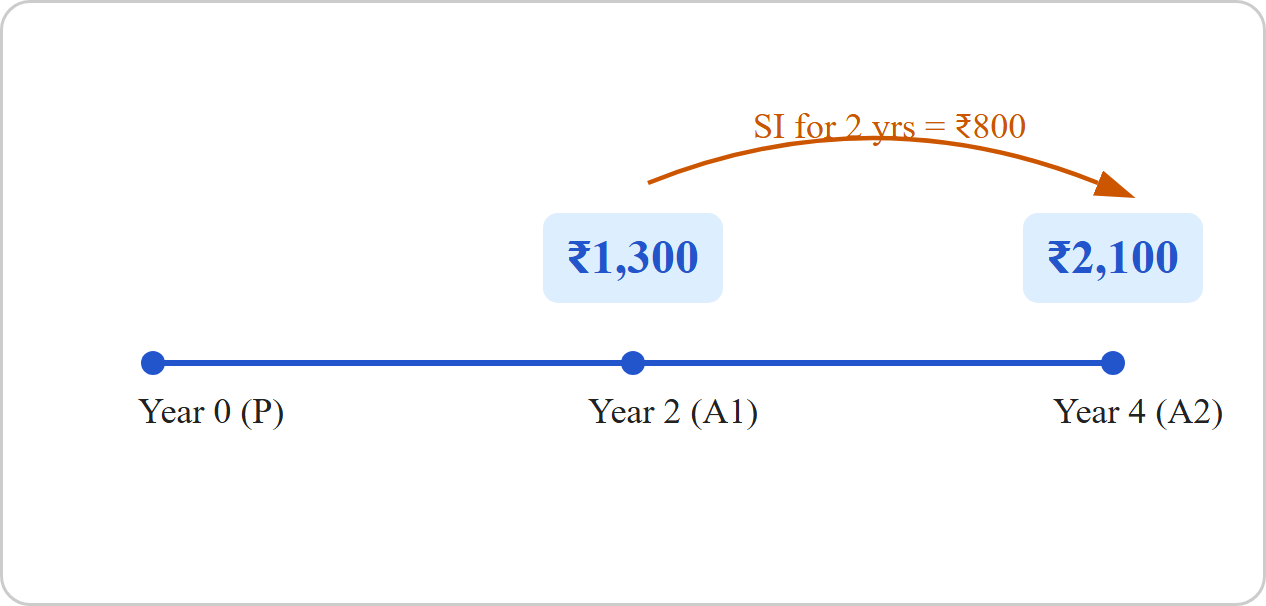
On simple interest, a certain sum of money amounts to ₹1,300 in 2 years and to ₹2,100 in 4 years. Find the rate of interest per annum.

  1. AOption (a)

    80%

  2. BOption (b)

    85%

  3. COption (c)

    75%

  4. DOption (d)

    90%

View answer & explanation

Correct answer

Answer: (a)A.

80%

Why this answer is correct

Shortcut Trick

Interest for 2 years (4 years − 2 years) = ₹2,100 − ₹1,300 = ₹800

Interest for 1 year = ₹800 ÷ 2 = ₹400

Principal (P) = ₹1,300 − ₹800 = ₹500

Rate (R) = (Interest for 1 year ÷ Principal) × 100

R = (400 ÷ 500) × 100 = 80%

∴ The correct answer is 80%.

Alternate Method

Given:

Amount after 2 years (A1) = ₹1,300

Amount after 4 years (A2) = ₹2,100

Formula Used:

Simple Interest (SI) = Amount − Principal

Rate (R) = (SI × 100) ÷ (Principal × Time)

Calculations:

⇒ Interest for 2 years = A2 − A1

⇒ Interest for 2 years = 2100 − 1300 = ₹800

⇒ Principal (P) = Amount after 2 years − Interest for 2 years

⇒ P = 1300 − 800 = ₹500

⇒ We know that Interest for 1 year = 800 ÷ 2 = ₹400

⇒ Rate (R) = (Interest for 1 year ÷ Principal) × 100

⇒ R = (400 ÷ 500) × 100

⇒ R = 4 ÷ 5 × 100 = 80%

∴ The correct answer is 80%.

Additional Information

Simple Interest Concept

In Simple Interest, the interest is calculated only on the initial Principal amount, meaning the interest remains the same for every year.

Key Formula

Amount (A) = P + (P × R × T) ÷ 100, where P is Principal, R is Rate of Interest per annum, and T is Time in years.

Principal from Amounts

If the amount becomes A1 in T1 years and A2 in T2 years, then P = (A1×T2 − A2×T1) ÷ (T2 − T1).

Question 31

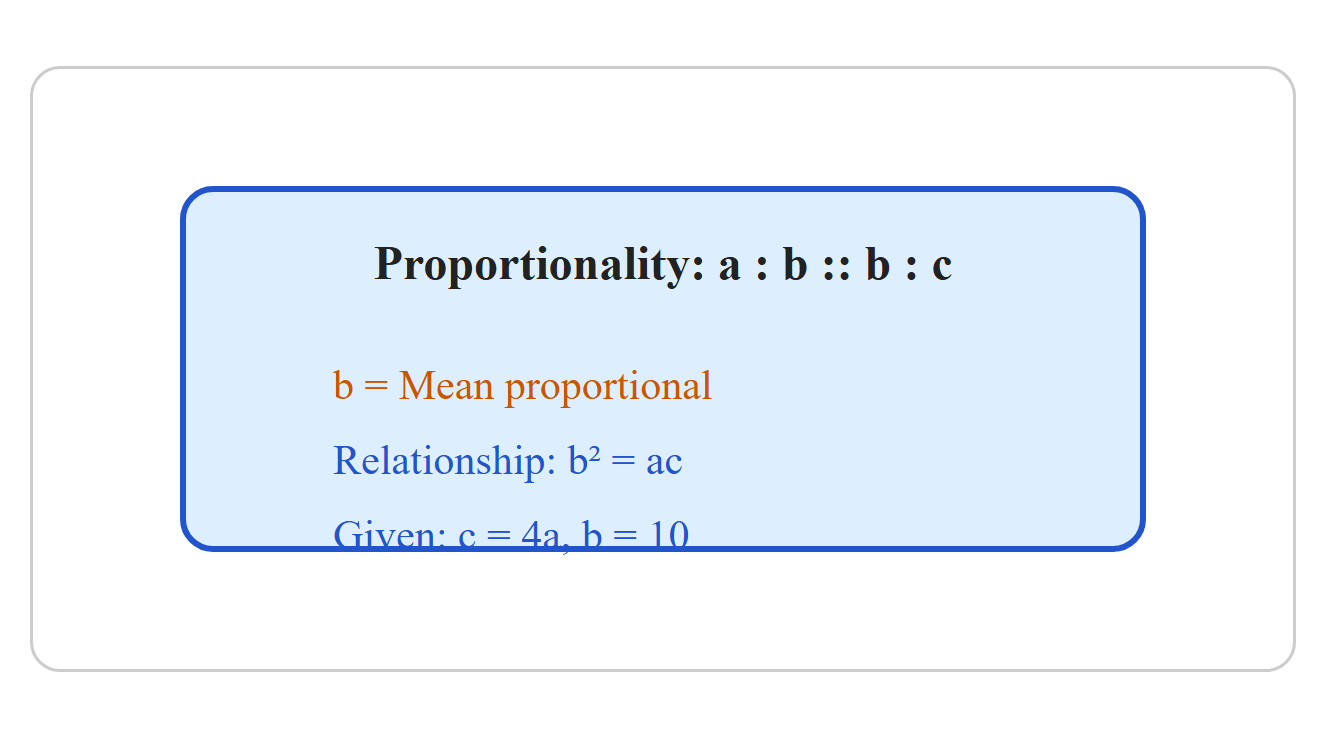
If a : b :: b : c; c = 4a and b = 10, find the positive value of c.

  1. AOption (a)

    24

  2. BOption (b)

    25

  3. COption (c)

    21

  4. DOption (d)

    20

View answer & explanation

Correct answer

Answer: (d)D.

20

Why this answer is correct

Shortcut Trick

For mean proportion b2 = ac.

Given b = 10, so b2 = 100.

Substitute c = 4a ⇒ 100 = a × 4a ⇒ 4a2 = 100 ⇒ a2 = 25 ⇒ a = 5.

Since c = 4a, then c = 4 × 5 = 20.

∴ The correct answer is 20.

Alternate Method

Given:

Proportion: a/b = b/c

Value: b = 10

Condition: c = 4a

Calculations:

⇒ a/10 = 10/c

⇒ ac = 100

⇒ a × (4a) = 100

⇒ 4a2 = 100

⇒ a2 = 25

⇒ a = 5 (since we need positive value)

⇒ c = 4 × 5 = 20

∴ The correct answer is 20.

Additional Information

Mean Proportional

If a, b, c are in continued proportion, then b is the mean proportional between a and c, where b = √(ac).

Third Proportional

In the proportion a : b :: b : c, c is known as the third proportional to a and b, calculated as c = b2/a.

Fourth Proportional

If a : b :: c : d, then d is the fourth proportional, calculated as d = (b × c)/a.

Question 32

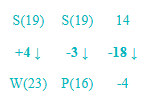
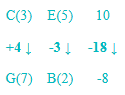
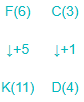
SS 14 is related to WP −4 in a certain way. In the same way, CE 10 is related to GB −8. To which of the given options is QG 1 related, following the same logic?

  1. AOption (a)

    UM −19

  2. BOption (b)

    IJ −21

  3. COption (c)

    UD −17

  4. DOption (d)

    NR −23

View answer & explanation

Correct answer

Answer: (c)C.

UD −17

Why this answer is correct

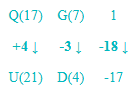
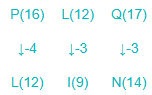
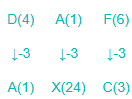
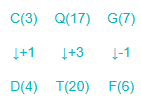
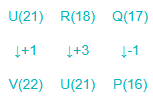
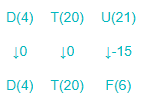
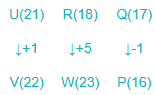
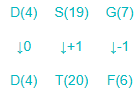
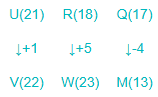
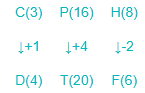
The logic followed here is,

  • For the first letter, it shifts +4 positions forward in the English alphabetical order.
  • For the second letter, it shifts -3 positions backward in the English alphabetical order.
  • For the number, it decreases by -18.

Let's verify this logic with the given examples:

For 'SS 14' related to 'WP -4':

For 'CE 10' related to 'GB -8':

The consistent pattern observed is: First letter +4, Second letter -3, Number -18.

Applying the same logic to 'QG 1':

Thus, 'QG 1' is related to UD -17.

Hence, the correct answer is "Option 3".

Question 33

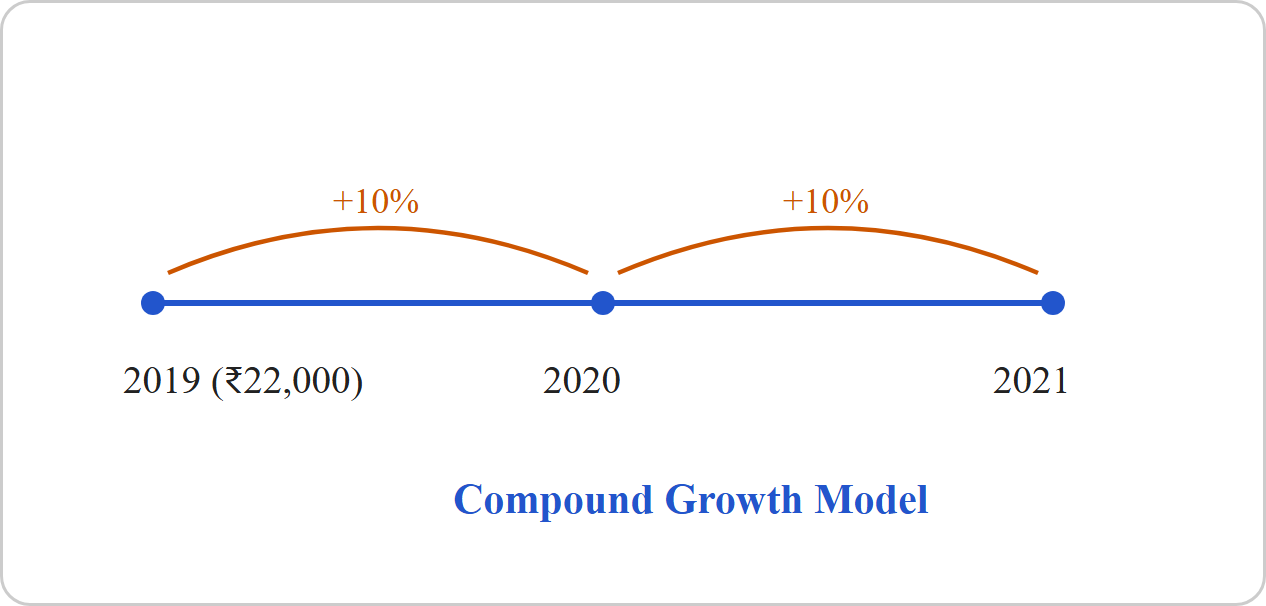
Income of Amit in 2019 was ₹22,000. He gets an increment of 10% every year. What was his income (in ₹) in 2021?

  1. AOption (a)

    26,400

  2. BOption (b)

    26,620

  3. COption (c)

    22,000

  4. DOption (d)

    24,200

View answer & explanation

Correct answer

Answer: (b)B.

26,620

Why this answer is correct

Shortcut Trick

Using the successive percentage formula or multiplying factor for 2 years.

Net increment = 10 + 10 + (10 × 10)/100 = 21%.

Income in 2021 = 22,000 × 121/100 = 26,620.

∴ The correct answer is ₹26,620.

Alternate Method

Given: Initial Income (2019) = ₹22,000, Increment Rate = 10% per annum, Time Period = 2 years (2019 to 2021).

Formula Used: Final Value = Initial Value × (1 + R/100)n

⇒ Income in 2020 = 22,000 + (10% of 22,000)

⇒ Income in 2020 = 22,000 + 2,200 = ₹24,200

⇒ Income in 2021 = 24,200 + (10% of 24,200)

⇒ Income in 2021 = 24,200 + 2,420 = ₹26,620

∴ The correct answer is ₹26,620.

Additional Information

Successive Percentage Change

When a value changes by a% and then by b%, the net effective change is (a + b + ab/100)%.

Multiplying Factor (MF)

For an x% increase, the multiplying factor is (1 + x/100). For 10% increase, MF = 1.1.

Depreciation

If the value decreases every year, the formula becomes Final Value = Initial Value × (1 − R/100)n.

Question 34

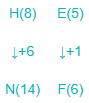
Based on the English alphabetical order, three of the following four letter-cluster pairs are alike in a certain way and thus form a group. Which letter-cluster pair DOES NOT belong to that group?

(Note: The odd one out is not based on the number of consonants/vowels or their position in the letter-cluster.)

  1. AOption (a)

    YR – DH

  2. BOption (b)

    BU – GK

  3. COption (c)

    MF – RV

  4. DOption (d)

    TN – YC

View answer & explanation

Correct answer

Answer: (d)D.

TN – YC

Why this answer is correct

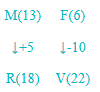
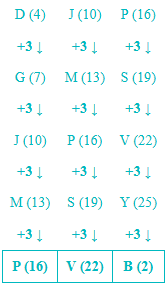
The logic followed here is,

Option (1) 'YR – DH':

Option (2) 'BU – GK':

Option (3) 'MF – RV':

Option (4) 'TN – YC':

In options 1, 2, and 3, the first letter of the cluster pair moves +5 positions forward and the second letter moves -10 positions backward.

In option 4, the first letter moves +5 positions forward, but the second letter moves -11 positions backward.

Hence, the correct answer is "Option 4" .

Question 35

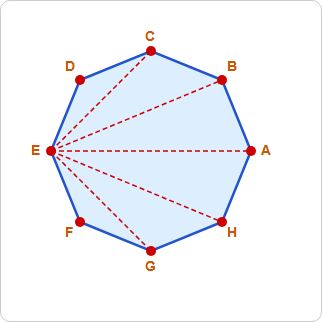
The number of diagonals in a regular octagon is:

  1. AOption (a)

    19

  2. BOption (b)

    20

  3. COption (c)

    21

  4. DOption (d)

    24

View answer & explanation

Correct answer

Answer: (b)B.

20

Why this answer is correct

Shortcut Trick

The number of diagonals in any polygon with n sides is given by the direct formula:

Number of diagonals = n × (n − 3) ÷ 2

For a regular octagon, the number of sides is n = 8.

⇒ Number of diagonals = 8 × (8 − 3) ÷ 2

⇒ Number of diagonals = 8 × 5 ÷ 2 = 20

∴ The correct answer is 20 diagonals.

Alternate Method

Given:

A regular octagon has 8 vertices (n = 8) and 8 sides.

Formula Used:

The number of diagonals is the total number of lines that can be drawn by connecting any two vertices, minus the number of boundary sides:

Number of diagonals = nC2 − n

Calculations:

The total number of ways to choose 2 vertices out of 8 is given by 8C2:

⇒ 8C2 = (8 × 7) ÷ (2 × 1)

⇒ 8C2 = 28 lines

These 28 lines include both the boundary sides of the octagon and its internal diagonals.

Subtracting the 8 boundary sides of the octagon:

⇒ Number of diagonals = 28 − 8

⇒ Number of diagonals = 20

Option Analysis:

  • Option (1) - 19: Incorrect. A polygon with 19 diagonals would have a non-integer number of sides, as solving n(n − 3) ÷ 2 = 19 yields no integer solution.
  • Option (2) - 20: Correct. As calculated, an octagon (8 sides) has exactly 20 diagonals.
  • Option (3) - 21: Incorrect. A heptagon (7 sides) has 14 diagonals, and an octagon has 20. No regular polygon has exactly 21 diagonals.
  • Option (4) - 24: Incorrect. A nonagon (9 sides) has 27 diagonals. No regular polygon has exactly 24 diagonals.

∴ The correct answer is 20 diagonals.

Additional Information

General Formula for Diagonals

The number of diagonals in any n-sided polygon is given by the formula: d = n(n − 3) ÷ 2.

Sum of Interior Angles

The sum of all interior angles of an n-sided polygon is (n − 2) × 180°. For an octagon, this is (8 − 2) × 180° = 1080°.

Each Interior Angle of a Regular Octagon

Each interior angle of a regular octagon is 1080° ÷ 8 = 135°.

Sum of Exterior Angles

The sum of the exterior angles of any polygon is always 360°. For a regular octagon, each exterior angle is 360° ÷ 8 = 45°.

Question 36

Which landmark case first established the principle of judicial review in constitutional law?

  1. AOption (a)

    Marbury v. Madison (1803)

  2. BOption (b)

    Minerva Mills Case (1980)

  3. COption (c)

    Kesavananda Bharati Case (1973)

  4. DOption (d)

    McCulloch v. Maryland (1819)

View answer & explanation

Correct answer

Answer: (a)A.

Marbury v. Madison (1803)

Why this answer is correct

The correct answer is Marbury v. Madison (1803).

Key Points

  • Marbury v. Madison (1803) was a landmark decision by the Supreme Court of the United States that established the principle of judicial review.
  • Judicial review allows the judiciary to review and invalidate laws or executive actions that are deemed unconstitutional, ensuring adherence to the Constitution.
  • This case was presided over by Chief Justice John Marshall, who emphasized the judiciary's role as an independent arbiter of the Constitution.
  • The case arose when William Marbury petitioned the Supreme Court to compel delivery of his commission as justice of the peace, which was denied by the incoming administration.
  • The decision clarified the balance of powers among the legislative, executive, and judicial branches, solidifying the judiciary's authority as equal to other branches.

Additional Information

  • Judicial Review:
  • Judicial review is the power of courts to assess whether laws and executive actions are consistent with the Constitution.
  • It is a key feature of constitutional democracies and ensures the supremacy of the Constitution.
  • Chief Justice John Marshall:
  • John Marshall served as the Chief Justice of the U.S. Supreme Court from 1801 to 1835.
  • He is widely regarded for strengthening the judiciary and establishing it as a co-equal branch of government.
  • Impact of Marbury v. Madison:
  • The case set a precedent for future rulings where courts could strike down unconstitutional laws.
  • It ensured that the judiciary could serve as a check on legislative and executive power.
  • Constitutional Supremacy:
  • The principle of judicial review reinforces the supremacy of the Constitution as the ultimate legal authority.
  • It safeguards individual rights and prevents government overreach.

Question 37

Which of the following is NOT a change of the new Income Tax bill introduced in the Parliament during February 2025?

  1. AOption (a)

    Reorganisation of sections logically to facilitate ease of reference

  2. BOption (b)

    Deletion of existing taxation principles, without ensuring continuity and usability

  3. COption (c)

    Elimination of intricate language to enhance readability

  4. DOption (d)

    Removal of redundant and repetitive provisions for better navigation

View answer & explanation

Correct answer

Answer: (b)B.

Deletion of existing taxation principles, without ensuring continuity and usability

Why this answer is correct

The correct answer is Deletion of existing taxation principles, without ensuring continuity and usability.

Key Points

  • The new Income Tax Bill introduced in February 2025 focuses on reorganizing sections logically to make them easier to reference and understand.
  • The bill emphasizes eliminating intricate language and introducing simpler terminology to enhance readability for taxpayers.
  • Redundant and repetitive provisions have been removed to improve navigational efficiency within the tax code.
  • Contrary to the claim in the incorrect option, the bill does not delete existing taxation principles arbitrarily. It ensures continuity and usability of critical provisions.
  • The overarching aim of these changes is to create a more taxpayer-friendly system that aligns with modern requirements.
Additional Information

  • Reorganization of Sections: The restructuring of tax laws aims to make the system more intuitive, grouping related provisions together for better coherence.
  • Ease of Compliance: Simplified language and logical arrangements reduce the burden of compliance and improve accessibility for taxpayers.
  • Taxation Principles: These are the core rules and guidelines governing the tax system, including concepts like income classification, deduction eligibility, and tax computation.
  • Redundant Provisions: These are outdated or repetitive rules that no longer serve a purpose and have been removed to streamline the legal framework.
  • Modernization of Tax Laws: The bill reflects efforts to align tax regulations with current economic and technological developments, facilitating digital transactions and transparency.

Question 38

Which of the following folk music forms is based on the tales of Mahabharata?

  1. AOption (a)

    Bhagawati

  2. BOption (b)

    Powada

  3. COption (c)

    Alha

  4. DOption (d)

    Pandavani

View answer & explanation

Correct answer

Answer: (d)D.

Pandavani

Why this answer is correct

The correct answer is Pandavani.

Key Points

  • Pandavani is a traditional folk music and narrative style that primarily revolves around the tales of the Mahabharata.
  • It is performed in states like Chhattisgarh, Madhya Pradesh, and Odisha, where it holds cultural significance.
  • The performers narrate the epic through songs and dramatic expressions, often accompanied by musical instruments such as the tambura.
  • Teejan Bai, a renowned Pandavani artist, has popularized this art form globally, earning numerous accolades for her contribution.
  • There are two prominent styles of Pandavani: Vedamati (traditional format) and Kapalik (more dramatic and theatrical).

Additional Information

  • Tambura: The tambura is a stringed instrument used in Pandavani performances to maintain rhythm and add melody to the narration.
  • Mahabharata: One of the two major Sanskrit epics of ancient India, the Mahabharata narrates the story of the Kurukshetra War and the fates of the Kaurava and Pandava princes.
  • Folk Music: Folk music is a traditional art form passed down through generations, often reflecting the cultural and social values of a region.
  • Vedamati Style: This style focuses on strict adherence to the traditional format of storytelling, with less emphasis on dramatic elements.
  • Kapalik Style: This style incorporates dramatic gestures, theatrical expressions, and improvisation to engage the audience more effectively.

Question 39

Each of P, Q, R, S, T, U and V has an exam on a different day of a week starting from Monday and ending on Sunday of the same week. Only five people have exams between T and Q. U has an exam on Thursday. S has an exam immediately after Q. R has an exam immediately after P. How many people have exams between V and T?

  1. AOption (a)

    Four

  2. BOption (b)

    Two

  3. COption (c)

    Three

  4. DOption (d)

    Five

View answer & explanation

Correct answer

Answer: (c)C.

Three

Why this answer is correct

Given: P, Q, R, S, T, U and V have an exam on different days of a week starting from Monday and ending on Sunday of the same week.

  1. U has an exam on Thursday.
DayPerson
Monday
Tuesday
Wednesday
ThursdayU
Friday
Saturday
Sunday


  1. Only five people have exams between T and Q. Since there are a total of seven days/people, this means T and Q must be on Monday and Sunday respectively, or vice versa.

  2. S has an exam immediately after Q. This means Q cannot be on Sunday, as there is no day after Sunday.

Therefore, Q must be on Monday and S must be on Tuesday. T must be on Sunday.

DayPerson
MondayQ
TuesdayS
Wednesday
ThursdayU
Friday
Saturday
SundayT


  1. R has an exam immediately after P. This means P and R are on consecutive days. , Friday, and Saturday.

The only consecutive days are Friday and Saturday.

Therefore, P is on Friday and R is on Saturday.

This leaves V to have the exam on Wednesday.

DayPerson
MondayQ
TuesdayS
WednesdayV
ThursdayU
FridayP
SaturdayR
SundayT

Hence, there are 3 people with exams between V and T.

Hence, the correct answer is "Option 3".

Question 40

Two taps can fill a cistern in 4 hours and 32 hours, respectively. A third tap can empty it in 4 hours. How long (in hours) will it take to fill one-fourth of the empty cistern, if all of them are opened together?

  1. AOption (a)

    16

  2. BOption (b)

    32

  3. COption (c)

    24

  4. DOption (d)

    8

View answer & explanation

Correct answer

Answer: (d)D.

8

Why this answer is correct

Shortcut Trick

Net efficiency = Filling rate − Emptying rate

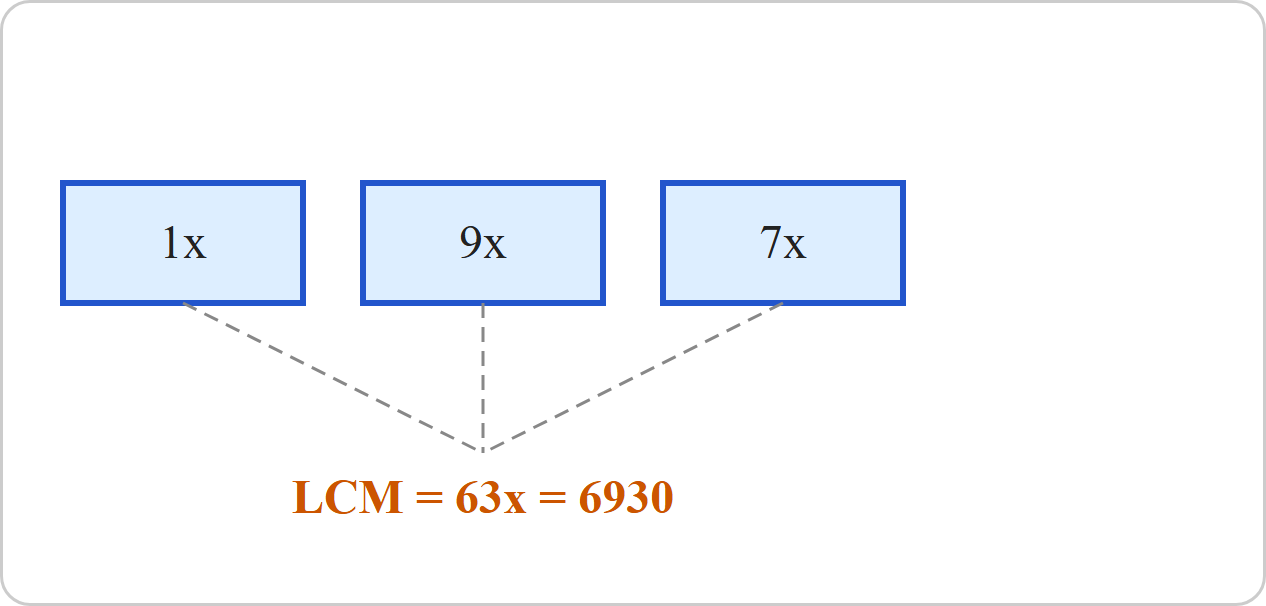
Total Capacity = LCM(4, 32, 4) = 32 units

Efficiencies: A = 8, B = 1, C = −8. Net = 8 + 1 − 8 = 1 unit/hr

One-fourth work = 32 ÷ 4 = 8 units

Time = 8 ÷ 1 = 8 hours

∴ The correct answer is 8 hours.

Alternate Method

Given: Filling time Tap A = 4 hours, Tap B = 32 hours, Emptying time Tap C = 4 hours.

Formula Used: Total Work = LCM of time; Efficiency = Work ÷ Time

PersonDaysTotal WorkEfficiency
Tap A (Fill)4328
Tap B (Fill)321
Tap C (Empty)4−8

⇒ Net efficiency when all are open = 8 + 1 − 8 = 1 unit/hour

⇒ Target volume to fill = 1/4 × Total Capacity

⇒ Target volume = 1/4 × 32 = 8 units

⇒ Time required = Target volume ÷ Net efficiency = 8 ÷ 1 = 8 hours

∴ The correct answer is 8 hours.

Additional Information

Inlet and Outlet Pipes

Inlet pipes fill the tank (positive efficiency) while outlet pipes empty it (negative efficiency).

LCM Method for Capacity

Assuming the cistern capacity as the LCM of individual time periods simplifies fractional calculations.

Net Rate Formula

If pipe A fills in x hours and pipe B empties in y hours, the net work in 1 hour is (1/x − 1/y).

Question 41

After which battle did Ashoka embrace Buddhism?

  1. AOption (a)

    Battle of Takshashila

  2. BOption (b)

    Battle of Panipat

  3. COption (c)

    Battle of Taxila

  4. DOption (d)

    Battle of Kalinga

View answer & explanation

Correct answer

Answer: (d)D.

Battle of Kalinga

Why this answer is correct

The correct answer is Battle of Kalinga.

Key Points

  • The Battle of Kalinga was fought in 261 BCE between the Mauryan Empire, led by Emperor Ashoka, and the independent state of Kalinga.
  • The battle resulted in significant loss of life and destruction; historical records suggest nearly 100,000 deaths and 150,000 captives.
  • Upon witnessing the immense suffering caused by the war, Ashoka experienced a profound transformation and renounced violence.
  • He embraced Buddhism after the battle and committed himself to the principles of nonviolence (Ahimsa) and Dharmic governance.
  • The aftermath of the Battle of Kalinga marked a turning point in Indian history, influencing Ashoka's policies and spreading Buddhism across Asia.

Additional Information

  • Ahimsa: A key Buddhist and Jain principle advocating nonviolence towards all living beings, which became central to Ashoka's rule post-Kalinga.
  • Buddhist Philosophy: Ashoka adopted Buddhist teachings, emphasizing compassion, tolerance, and moral conduct as the basis of governance.
  • Edicts of Ashoka: Ashoka inscribed his principles and policies on rock edicts and pillars throughout his empire, promoting Buddhism and ethical governance.
  • Spread of Buddhism: Ashoka sent missionaries to regions like Sri Lanka, Central Asia, and Southeast Asia to propagate Buddhist teachings and values.
  • Kalinga's Location: The ancient kingdom of Kalinga corresponds to modern-day Odisha and parts of Andhra Pradesh in India.

Question 42

Amit had invested same amount of sums at simple as well as compound interest, compounded annually. The time period of investment for both the sums was 2 years and rate of interest too was the same, 4% per annum. At the end, he found a difference of ₹43 in both the interests received. What were the sums (in ₹) invested?

  1. AOption (a)

    ₹26,875

  2. BOption (b)

    ₹27,225

  3. COption (c)

    ₹26,125

  4. DOption (d)

    ₹25,975

View answer & explanation

Correct answer

Answer: (a)A.

₹26,875

Why this answer is correct

Shortcut Trick

For a period of 2 years, the difference between Compound Interest and Simple Interest is given by the formula: Difference (D) = P × (R/100)2.

Given Difference (D) = ₹43 and Rate (R) = 4%.

⇒ 43 = P × (4/100)2 ⇒ 43 = P × (1/25)2

⇒ P = 43 × 625 = ₹26,875.

∴ The correct answer is ₹26,875.

Alternate Method

Given:

Rate of Interest (R) = 4% per annum

Time (T) = 2 years

Difference (CI − SI) = ₹43

Formula Used:

Effective Rate for SI = R × T

Effective Rate for CI (2 years) = x + y + (x × y)/100

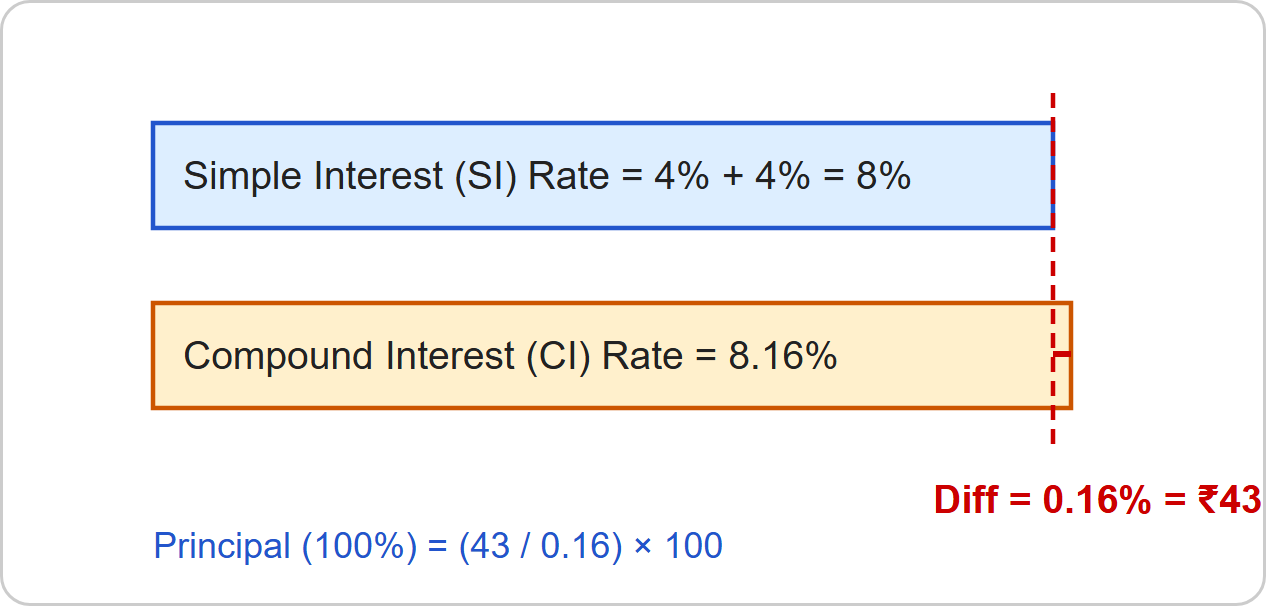
⇒ Effective SI rate for 2 years = 4% × 2 = 8%

⇒ Effective CI rate for 2 years = 4 + 4 + (4 × 4)/100 = 8 + 0.16 = 8.16%

⇒ Difference in rates = 8.16% − 8% = 0.16%

⇒ According to the question, 0.16% of Sum = ₹43

⇒ Sum (100%) = (43 ÷ 0.16) × 100

⇒ Sum = (43 ÷ 16) × 100 × 100

⇒ Sum = 268.75 × 100 = ₹26,875

∴ The correct answer is ₹26,875.

Additional Information

Difference for 3 Years

The difference between CI and SI for 3 years is calculated as: D = P(R/100)2 × (3 + R/100).

Effective Rate for Compound Interest

For two years with different rates r1 and r2, the effective rate is (r1 + r2 + r1r2/100)%.

Compounding Frequency

If interest is compounded half-yearly, the rate becomes R/2 and the time period becomes 2T.

Question 43

Afferent neurons in the peripheral nervous system are responsible for which of the

following?

  1. AOption (a)

    Integrating reflex responses at the spinal cord level only

  2. BOption (b)

    Facilitating secretion of neurotransmitters exclusively

  3. COption (c)

    Conveying motor commands from the brain to muscles

  4. DOption (d)

    Transmitting sensory information from receptors to the central nervous system

View answer & explanation

Correct answer

Answer: (d)D.

Transmitting sensory information from receptors to the central nervous system

Why this answer is correct

The correct answer is Transmitting sensory information from receptors to the central nervous system.

Key Points

  • Afferent neurons, also known as sensory neurons, are part of the peripheral nervous system responsible for carrying sensory information to the central nervous system (CNS).
  • These neurons transmit data from sensory receptors located in tissues, organs, and skin to the brain and spinal cord.
  • The information carried by afferent neurons includes stimuli such as touch, pain, temperature, and body position.
  • Afferent neurons play a critical role in enabling the CNS to process external and internal environmental changes.
  • The sensory signals transmitted by afferent neurons are essential for generating reflex actions and conscious responses.

Additional Information

  • Peripheral Nervous System (PNS): The PNS consists of nerves outside the brain and spinal cord, divided into the somatic and autonomic nervous systems.
  • Efferent neurons: These are motor neurons that carry signals from the CNS to muscles and glands, enabling movement and physiological responses.
  • Reflex arc: Afferent neurons are integral to reflex arcs, where sensory inputs trigger immediate motor responses, bypassing higher brain processing.
  • Types of sensory receptors: Include mechanoreceptors (touch), thermoreceptors (temperature), nociceptors (pain), and photoreceptors (light).
  • Neurotransmission: Sensory neurons use electrochemical signals to transmit information across synapses to the CNS for processing.

Question 44

If the median of a data is 80.32 less than its mode, then the median of the data exceeds its mean by _____. (Use empirical formula)

  1. AOption (a)

    40.16

  2. BOption (b)

    36.56

  3. COption (c)

    44.61

  4. DOption (d)

    38.87

View answer & explanation

Correct answer

Answer: (a)A.

40.16

Why this answer is correct

Shortcut Trick The Empirical relationship states: (Mode − Median) = 2 × (Median − Mean). Given: Mode − Median = 80.32. Let (Median − Mean) = x. 80.32 = 2 × x x = 80.32 ÷ 2 = 40.16. ∴ The correct answer is 40.16.

Alternate Method Given: Difference between Mode and Median = 80.32 Formula Used: Empirical Formula: Mode = 3 × Median − 2 × Mean

Calculations: ⇒ Mode = 3 × Median − 2 × Mean Subtract Median from both sides: ⇒ Mode − Median = (3 × Median − 2 × Mean) − Median ⇒ Mode − Median = 2 × Median − 2 × Mean ⇒ Mode − Median = 2 × (Median − Mean) Substitute the given value (80.32): ⇒ 80.32 = 2 × (Median − Mean) ⇒ Median − Mean = 80.32 ÷ 2 ⇒ Median − Mean = 40.16 ∴ The correct answer is 40.16.

Additional Information Empirical Relationship For a moderately skewed distribution, the relationship is Mode = 3 Median − 2 Mean. Symmetrical Distribution In a perfectly symmetrical distribution, the Mean, Median, and Mode are all equal (Mean = Median = Mode). Skewness If Mean > Median > Mode, the distribution is positively skewed. If Mode > Median > Mean, it is negatively skewed.

Question 45

The sum of the square of two positive numbers a and b (where a > b) is 7 times of their product. Find the difference between their squares.

  1. AOption (a)

    53ab5\sqrt{3ab}

  2. BOption (b)

    3ab√15

  3. COption (c)

    5ab√3

  4. DOption (d)

    3ab√5

View answer & explanation

Correct answer

Answer: (d)D.

3ab√5

Why this answer is correct

Shortcut Trick

Direct relation for difference of squares: (a2 − b2)2 = (a2 + b2)2 − 4a2b2

Substitute the given value a2 + b2 = 7ab:

⇒ (a2 − b2)2 = (7ab)2 − 4a2b2 = 49a2b2 − 4a2b2 = 45a2b2

⇒ a2 − b2 = √(45a2b2) = 3ab√5

∴ The correct answer is 3 ab √ 5.

Alternate Method

Given: Sum of squares of two positive numbers a2 + b2 = 7ab.

Formula Used: a2 − b2 = (a + b)(a − b)

Step 1: Calculate the square of the sum of the numbers:

⇒ (a + b)2 = a2 + b2 + 2ab

⇒ (a + b)2 = 7ab + 2ab = 9ab

⇒ a + b = √(9ab) = 3√ab

Step 2: Calculate the square of the difference of the numbers:

⇒ (a − b)2 = a2 + b2 − 2ab

⇒ (a − b)2 = 7ab − 2ab = 5ab

⇒ a − b = √(5ab)

Step 3: Calculate the difference between their squares:

⇒ a2 − b2 = (a + b)(a − b)

⇒ a2 − b2 = (3√ab) × (√5ab)

⇒ a2 − b2 = 3 × √5 × √ab × √ab = 3ab√5

∴ The correct answer is 3 ab √ 5.

Additional Information

Algebraic Identity of Squares

The difference of squares formula is a2 − b2 = (a + b)(a − b). This is derived from the product of two binomials.

Relationship between Sum and Difference

The square of sum and square of difference are related by: (a + b)2 − (a − b)2 = 4ab or (a + b)2 + (a − b)2 = 2(a2 + b2).

Product of Square Roots

For any positive numbers x and y, √x × √y = √(x × y). Similarly, √x × √x = x.

Question 46

Which of the following is considered an offense under the co-operative society laws?

  1. AOption (a)

    Submitting correct returns

  2. BOption (b)

    Skipping the presidential election

  3. COption (c)

    Holding weekly meetings

  4. DOption (d)

    Giving false information

View answer & explanation

Correct answer

Answer: (d)D.

Giving false information

Why this answer is correct

The correct answer is Giving false information.

Key Points

  • Providing false information or intentionally misrepresenting facts in the context of co-operative society activities is considered a criminal offense under co-operative society laws.
  • Such offenses undermine the integrity of co-operative societies and may lead to penalties, fines, or even imprisonment as per the provisions of the respective laws.
  • Co-operative societies in India are governed by specific state laws or the Multi-State Co-operative Societies Act, 2002, which mandate truthful disclosures.
  • False information may include inaccurate financial statements, forged documents, or misrepresentation of member details during registration or audits.
  • Penalties for these offenses are explicitly outlined in the legal framework to ensure transparency and accountability within co-operative societies.

Additional Information

  • Co-operative Societies Act:
  • Co-operative societies in India are governed by the Co-operative Societies Act of the respective states and the Multi-State Co-operative Societies Act, 2002.
  • These laws aim to promote economic interests and mutual aid among members while ensuring legal compliance.
  • Key Principles:
  • The principles of co-operative societies include voluntary membership, democratic decision-making, transparency, and community benefit.
  • Integrity and truthfulness are core values for the smooth functioning of co-operative societies.
  • Audits and Reporting:
  • Co-operative societies are required to submit annual financial reports and undergo regular audits to maintain accountability.
  • Providing false information during these processes constitutes a breach of law.
  • Consequences of False Information:
  • Penalties for providing false information may include fines, cancellation of registration, or legal proceedings against the responsible parties.
  • Such actions protect the interests of members and maintain the credibility of co-operative societies.

Question 47

Sachin bought 51 books at ₹1,120 per book from one shop and 49 books at ₹905 per book from another. What is the average price (in ₹) he paid per book?

  1. AOption (a)

    1,029.65

  2. BOption (b)

    1,004.65

  3. COption (c)

    1,014.65

  4. DOption (d)

    1,024.65

View answer & explanation

Correct answer

Answer: (c)C.

1,014.65

Why this answer is correct

Shortcut Trick

Total number of books = 51 + 49 = 100

Total cost = (51 × 1120) + (49 × 905)

Average price = (57120 + 44345) ÷ 100

Average price = 101465 ÷ 100 = 1014.65

∴ The correct answer is ₹1,014.65.

Alternate Method

Given:

Quantity of books from shop 1 (n1) = 51

Price per book at shop 1 (x1) = ₹1,120

Quantity of books from shop 2 (n2) = 49

Price per book at shop 2 (x2) = ₹905

Formula Used:

Average Price = (Total Cost) ÷ (Total Quantity)

Average Price = (n1 × x1 + n2 × x2) ÷ (n1 + n2)

Calculations:

⇒ Total quantity = 51 + 49 = 100 books

⇒ Total cost at shop 1 = 51 × 1120 = ₹57,120

⇒ Total cost at shop 2 = 49 × 905 = ₹44,345

⇒ Total cost = 57120 + 44345 = ₹1,01,465

⇒ Average price = 101465 ÷ 100

⇒ Average price = ₹1,014.65

∴ The correct answer is ₹1,014.65.

Additional Information

Weighted Average Formula

Weighted Average = (n1w1 + n2w2 + ... + nkwk) ÷ (n1 + n2 + ... + nk), where n is the weight and w is the value.

Deviation Method

Assume a mean (A), then Average = A + (Sum of deviations ÷ Total observations). Net deviation from the actual average is always zero.

Average of Consecutive Numbers

The average of n consecutive natural numbers or numbers in AP is always the middle term or (First term + Last term) ÷ 2.

Question 48

What should come in place of the question mark (?) in the given series based on the English alphabetical order?

UNP SLN QJL OHJ ?

  1. AOption (a)

    MFH

  2. BOption (b)

    MEG

  3. COption (c)

    MFG

  4. DOption (d)

    MEH

View answer & explanation

Correct answer

Answer: (a)A.

MFH

Why this answer is correct

The logic followed here is,

Hence, the correct answer is "Option 1".

Question 49

Where is Rohtang Pass located?

  1. AOption (a)

    On the Shiwalik hills, near Dehradun

  2. BOption (b)

    On the eastern Pir Panjal range, near Manali

  3. COption (c)

    On the Dhauladhar range, near Dharamshala

  4. DOption (d)

    On the Zanskar range, near Kargil

View answer & explanation

Correct answer

Answer: (b)B.

On the eastern Pir Panjal range, near Manali

Why this answer is correct

The correct answer is On the eastern Pir Panjal range, near Manali.

Key Points

  • Rohtang Pass is situated on the eastern Pir Panjal range in the Himalayas, near Manali in Himachal Pradesh, India.
  • It is located at an altitude of approximately 3,978 meters (13,050 feet) above sea level.
  • The pass connects the Kullu Valley with the Lahaul and Spiti Valleys, playing a critical role in transportation and trade.
  • The name "Rohtang" translates to "pile of corpses" in Tibetan, referencing the difficulties faced by travelers due to unpredictable weather conditions.
  • Rohtang Pass is renowned for its scenic beauty and serves as a major tourist destination for adventure activities like skiing and trekking.

Additional Information

  • Pir Panjal Range: It is a part of the Lesser Himalayas and stretches across Himachal Pradesh and Jammu & Kashmir.
  • Atal Tunnel: A strategically important tunnel under Rohtang Pass, inaugurated in October 2020, reduces travel time between Manali and Leh.
  • Climate: Rohtang Pass experiences extreme weather conditions, with heavy snowfall during winters, making it inaccessible for several months.
  • Tourism: The pass is a hub for adventure sports such as skiing, paragliding, and mountain biking, attracting thousands of visitors annually.
  • Environmental Concerns: The heavy influx of tourists and vehicles has raised concerns about environmental degradation in the region.

Question 50

A group of numbers and symbols is coded using letter codes as per the codes given below and the conditions that follow. Study the given codes and conditions and answer the question that follows.

Note: If none of the conditions apply, then codes for the respective number/symbol are to be followed directly as given in the table.

Number/symbol6%85$&3@#7+496
CodeSEAJLFWQDPRBUT

Conditions:

If the first element is a symbol and the last a number, the codes for these two (the first and the last elements) are to be interchanged.

If the first element is an odd number and the last an even number, the first and last elements are to be coded as ©.

If both second and third elements are perfect squares, the third element is to be coded as the code for the second element.

What will be the code for the following group?

@ 4 8 5$

  1. AOption (a)

    QBAJ

  2. BOption (b)

    QAAJ

  3. COption (c)

    JBAQ

  4. DOption (d)

    QBBJ

View answer & explanation

Correct answer

Answer: (c)C.

JBAQ

Why this answer is correct

Given:

Number/symbol6%85$&3@#7+496
CodeSEAJLFWQDPRBUT


Conditions:

  1. If the first element is a symbol and the last a number, the codes for these two (the first and the last elements) are to be interchanged.
  2. If the first element is an odd number and the last an even number, the first and last elements are to be coded as ©.
  3. If both second and third elements are perfect squares, the third element is to be coded as the code for the second element.

Group to be coded: @ 4 8 5

Solution:

Analyze the given group @ 4 8 5 based on the conditions.

  • First element: '@' (a symbol)
  • Last element: '5' (an odd number)
  • Second element: '4' (a perfect square, 22)
  • Third element: '8' (not a perfect square)

Check if any of the conditions apply.

  • Condition 1: "If the first element is a symbol and the last a number..."

The first element '@' is a symbol, and the last element '5' is a number.

  • This condition applies.
  • The codes for the first and last elements should be interchanged.
  • Condition 2: "If the first element is an odd number and the last an even number..."

The first element '@' is a symbol, not an odd number. This condition does not apply.

  • Condition 3: "If both second and third elements are perfect squares..."

The second element '4' is a perfect square, but the third element '8' is not. This condition does not apply.

Apply the applicable condition (Condition 1) and find the codes.

  • Original code for '@' is 'Q'.
  • Original code for '5' is 'J'.
  • According to Condition 1, the code for the first element ('@') will be the code for the last element ('5'), which is 'J'.
  • The code for the last element ('5') will be the code for the first element ('@'), which is 'Q'.

The codes for the middle elements ('4' and '8') will be the direct codes from the table, as no other conditions apply.

  • Code for '4' is 'B'.
  • Code for '8' is 'A'.

The final code for the group '@ 4 8 5' is J B A Q.

Hence, the correct answer is "Option 3"$.

Question 51

In a certain code language, ‘ROPE’ is coded as ‘5391’ and ‘OILY’ is coded as ‘2458’.

What is the code for ‘O’ in the given code language?

  1. AOption (a)

    2

  2. BOption (b)

    5

  3. COption (c)

    3

  4. DOption (d)

    8

View answer & explanation

Correct answer

Answer: (b)B.

5

Why this answer is correct

The given code language is:

O is common in both the word, and 5 is common in both the code.

Thus, 'O' is coded as '5'.

Hence, the correct answer is "Option 2".

Question 52

The cost of 4 pens and 3 notebooks is ₹277. The cost of 16 notebooks exceeds the cost of 12 pens by ₹144. What is the cost of 19 pens and 15 notebooks?

  1. AOption (a)

    ₹1,345

  2. BOption (b)

    ₹1,347

  3. COption (c)

    ₹1,348

  4. DOption (d)

    ₹1,342

View answer & explanation

Correct answer

Answer: (a)A.

₹1,345

Why this answer is correct

Shortcut Trick

Equating the number of pens: Multiply the first condition by 3 to get 12 pens + 9 notebooks = ₹831.

From the second condition: 16 notebooks − 12 pens = ₹144.

Adding both eliminates pens: 25 notebooks = ₹831 + ₹144 = ₹975 ⇒ 1 notebook = ₹39.

Using the first equation: 4 pens = 277 − 3(39) = 160 ⇒ 1 pen = ₹40.

Required cost: 19 × 40 + 15 × 39 = 760 + 585 = ₹1345.

∴ The correct answer is ₹1345.

Alternate Method

Given:

Cost of 4 pens and 3 notebooks = ₹277

Cost of 16 notebooks exceeds 12 pens by ₹144

Formula Used:

Total Cost = (Quantity of Pens × Price per Pen) + (Quantity of Notebooks × Price per Notebook)

Calculations:

Let the cost of one pen be P and one notebook be N.

⇒ 4P + 3N = 277 --- (Equation 1)

⇒ 16N − 12P = 144 --- (Equation 2)

Divide Equation 2 by 4:

⇒ 4N − 3P = 36 ⇒ 4N − 36 = 3P ⇒ P = (4N − 36) / 3

Substitute P in Equation 1:

⇒ 4 × ((4N − 36) / 3) + 3N = 277

⇒ (16N − 144) / 3 + 3N = 277

⇒ 16N − 144 + 9N = 831

⇒ 25N = 975

⇒ N = 39

Now, find P:

⇒ 4P + 3(39) = 277

⇒ 4P + 117 = 277

⇒ 4P = 160 ⇒ P = 40

Cost of 19 pens and 15 notebooks:

⇒ (19 × 40) + (15 × 39)

⇒ 760 + 585 = 1345

∴ The correct answer is ₹1345.

Additional Information

Linear Equations in Two Variables

An equation of the form ax + by = c is a linear equation where a, b, and c are constants. Solving a pair of such equations involves finding the unique values for x and y.

Elimination Method

This method involves multiplying the equations by suitable numbers so that the coefficients of one variable become equal, allowing its removal by addition or subtraction.

Substitution Method

Expressing one variable in terms of the other from one equation and substituting it into the second equation to reduce it to a single-variable equation.

Question 53

A quadratic equation x2 + 3x + k = 0 has a discriminant equal to 9. What is the value of k?

  1. AOption (a)

    -1

  2. BOption (b)

    0

  3. COption (c)

    2

  4. DOption (d)

    1

View answer & explanation

Correct answer

Answer: (b)B.

0

Why this answer is correct

Shortcut Trick

For the quadratic equation x2 + 3x + k = 0, the discriminant is given by b2 − 4ac.

Given D = 9, a = 1, and b = 3.

Substitute values: 32 − 4(1)(k) = 9 ⇒ 9 − 4k = 9.

Directly solving, we get k = 0.

∴ The correct answer is 0.

Alternate Method

Given:

Quadratic equation: x2 + 3x + k = 0

Value of Discriminant (D) = 9

Formula Used:

For a standard quadratic equation ax2 + bx + c = 0, the Discriminant (D) is calculated as:

D = b2 − 4ac

Calculations:

⇒ Comparing the given equation with the standard form: a = 1, b = 3, and c = k.

⇒ Substitute the values into the formula: 9 = 32 − 4 × 1 × k

⇒ 9 = 9 − 4k

⇒ 4k = 9 − 9

⇒ 4k = 0

⇒ k = 0

∴ The correct answer is 0.

Additional Information

Nature of Roots (D = b2 − 4ac)

The nature of roots is determined by D: if D > 0 roots are real and distinct; if D = 0 roots are real and equal; if D < 0 roots are imaginary/complex.

Sum and Product of Roots

For the equation ax2 + bx + c = 0, the Sum of Roots is −b/a and the Product of Roots is c/a.

Quadratic Formula

The roots of a quadratic equation can be found using the formula x = (−b ± √D) / 2a.

Question 54

What is the Forty-Second Amendment of the Indian Constitution commonly known as?

  1. AOption (a)

    Mini-Constitution

  2. BOption (b)

    Major Bill

  3. COption (c)

    Mini-Parliament

  4. DOption (d)

    Constitutional Guide

View answer & explanation

Correct answer

Answer: (a)A.

Mini-Constitution

Why this answer is correct

The correct answer is Mini-Constitution.

Key Points

  • The Forty-Second Amendment of the Indian Constitution, enacted in 1976, is commonly referred to as the Mini-Constitution due to its extensive and comprehensive nature.
  • It was introduced during the tenure of Prime Minister Indira Gandhi and is one of the most far-reaching amendments in the history of the Indian Constitution.
  • The amendment affected 59 Articles and added 14 new Articles, significantly altering the Constitution's structure.
  • It introduced the terms "Socialist," "Secular," and "Integrity" in the Preamble, emphasizing the core values of the Indian state.
  • The amendment also curtailed the power of the judiciary, strengthened the authority of Parliament, and redefined the relationship between the Executive and Judiciary.

Additional Information

  • Emergency Period: The amendment was passed during the Emergency (1975–1977), a period characterized by significant centralization of power and suppression of dissent.
  • Directive Principles: It gave primacy to the Directive Principles of State Policy over Fundamental Rights, emphasizing the welfare state model.
  • Tenure of Lok Sabha and State Assemblies: The amendment extended the term of the Lok Sabha and State Legislative Assemblies from 5 to 6 years.
  • Judicial Review: It restricted the judiciary's ability to challenge constitutional amendments and curtailed its power to review laws passed by Parliament.
  • Criticism: The Forty-Second Amendment faced widespread criticism for its authoritarian nature, and many of its provisions were later repealed or modified by the Forty-Fourth Amendment Act (1978).

Question 55

Banking reforms were part of the 1991 economic reforms. Which of the following committees recommended banking sector liberalisation in 1991?

  1. AOption (a)

    Suresh Tendulkar Committee

  2. BOption (b)

    Rangarajan Committee

  3. COption (c)

    Narasimham Committee

  4. DOption (d)

    Kelkar Committee

View answer & explanation

Correct answer

Answer: (c)C.

Narasimham Committee

Why this answer is correct

The correct answer is Narasimham Committee.

Key Points

  • The Narasimham Committee was constituted in 1991 under the chairmanship of M. Narasimham to recommend reforms in the Indian banking sector.
  • Its primary focus was on liberalizing and modernizing the banking system to align with the broader economic reforms initiated in 1991.
  • The committee emphasized the need for reducing government intervention in the banking sector and enhancing the autonomy of banks.
  • It recommended measures like capital adequacy norms, asset classification, and income recognition standards to improve the financial health of banks.
  • The reforms suggested by the Narasimham Committee laid the foundation for the phased deregulation of the banking sector and encouraged competition among banks.

Additional Information

  • Capital Adequacy Ratio (CAR):
  • A key recommendation of the Narasimham Committee was the adoption of CAR to ensure banks maintain adequate capital to cover risks.
  • CAR is a measure of a bank's capital relative to its risk-weighted assets.
  • Asset Classification and Income Recognition:
  • It proposed standard norms for classifying assets as performing and non-performing to ensure transparency in financial reporting.
  • Non-performing assets (NPAs) were required to be disclosed clearly in balance sheets.
  • Bank Autonomy:
  • The committee recommended granting greater autonomy to public sector banks to make them more competitive and efficient.
  • This included reducing the government’s role in operational decision-making.
  • Structure of Banking System:
  • The committee emphasized the need for a three-tier structure in the banking system: international banks, national banks, and regional rural banks.
  • Subsequent Committees:
  • The recommendations of the Narasimham Committee were further refined in Narasimham Committee II (1998), which focused on consolidating reforms.
  • It addressed issues like banking consolidation, reducing NPAs, and improving governance in banks.

Question 56

What should come in place of the question mark (?) in the given series based on the English alphabetical order?

DJP GMS JPV MSY ?

  1. AOption (a)

    BPV

  2. BOption (b)

    PVB

  3. COption (c)

    BVP

  4. DOption (d)

    PBV

View answer & explanation

Correct answer

Answer: (b)B.

PVB

Why this answer is correct

The logic followed here is, 

Hence, the correct answer is "Option 2".

Question 57

AB is a chord in the minor segment of a circle of centre Q. P is a point on the major arc AB. The tangents drawn from external point D to the circle are AD and BD. If ∠APB = 39°, then find the measure of ∠ADB.

  1. AOption (a)

    98°

  2. BOption (b)

    108°

  3. COption (c)

    89°

  4. DOption (d)

    102°

View answer & explanation

Correct answer

Answer: (d)D.

102°

Why this answer is correct

Shortcut Trick

The angle subtended by a chord at the center is twice the angle subtended at the major arc: ∠AQB = 2 × ∠APB.

In a circle, the angle between two tangents from an external point and the angle subtended by the chord of contact at the center are supplementary.

⇒ ∠ADB = 180° − ∠AQB

⇒ ∠ADB = 180° − (2 × 39°) = 180° − 78° = 102°.

∴ The correct answer is 102°.

Alternate Method

Given: ∠APB = 39°, Q is the center, AD and BD are tangents from external point D.

Formula Used: ∠Center = 2 × ∠Circumference; Sum of angles in quadrilateral = 360°.

⇒ The angle subtended by chord AB at the center Q is twice the angle at point P on the major arc.

⇒ ∠AQB = 2 × ∠APB = 2 × 39° = 78°

⇒ In quadrilateral AQBD, the radii QA and QB are perpendicular to tangents AD and BD respectively.

⇒ ∠QAD = 90° and ∠QBD = 90°

⇒ Sum of angles in AQBD = 360°

⇒ ∠AQB + ∠QAD + ∠QBD + ∠ADB = 360°

⇒ 78° + 90° + 90° + ∠ADB = 360°

⇒ 258° + ∠ADB = 360°

⇒ ∠ADB = 360° − 258° = 102°

∴ The correct answer is 102°.

Additional Information

Angle at Center Theorem

The angle subtended by an arc at the center of a circle is double the angle subtended by it at any point on the remaining part of the circle.

Tangent-Radius Property

A tangent at any point of a circle is perpendicular to the radius through the point of contact (∠Radius, Tangent = 90°).

Tangent Quadrilateral

In a quadrilateral formed by two radii and two tangents from an external point, the opposite angles at the center and the external point are supplementary (sum = 180°).

Question 58

A runner covers 5 km, 8 km, 6 km, 7 km, and 9 km in five races. What is the average distance covered per race?

  1. AOption (a)

    8 km

  2. BOption (b)

    5 km

  3. COption (c)

    6 km

  4. DOption (d)

    7 km

View answer & explanation

Correct answer

Answer: (d)D.

7 km

Why this answer is correct

Shortcut Trick

Assume 7 km as the Assumed Mean.

Calculate deviations from 7: (5 − 7), (8 − 7), (6 − 7), (7 − 7), (9 − 7) → −2, +1, −1, 0, +2.

Net deviation = −2 + 1 − 1 + 0 + 2 = 0.

Actual Average = Assumed Mean + (Net Deviation ÷ Total Races) = 7 + (0 ÷ 5) = 7 km.

∴ The correct answer is 7 km.

Alternate Method

Given:

Distances covered in 5 races: 5 km, 8 km, 6 km, 7 km, and 9 km.

Total number of races (n) = 5.

Formula Used:

Average Distance = (Sum of all distances) ÷ (Total number of races)

Calculations:

⇒ Total Distance = 5 + 8 + 6 + 7 + 9

⇒ Total Distance = 35 km

⇒ Average Distance = 35 ÷ 5

⇒ Average Distance = 7 km

∴ The correct answer is 7 km.

Additional Information

Arithmetic Mean Property

The sum of deviations of a set of observations from their arithmetic mean is always zero (∑(xi − x̄) = 0).

Weighted Average

When different groups have different sizes, the combined average is calculated as (n1x1 + n2x2) ÷ (n1 + n2).

Change in Average

If a constant 'k' is added to or subtracted from every observation, the new average also increases or decreases by 'k'.

Question 59

Three numbers are in the ratio 1 : 9 : 7, and their LCM is 6930. Their HCF is:

  1. AOption (a)

    110

  2. BOption (b)

    101

  3. COption (c)

    109

  4. DOption (d)

    116

View answer & explanation

Correct answer

Answer: (a)A.

110

Why this answer is correct

Shortcut Trick

Let the HCF be H.

The numbers are H, 9H, and 7H.

LCM of (1, 9, 7) × H = 6930

63 × H = 6930

H = 6930 ÷ 63 = 110

∴ The correct answer is 110.

Alternate Method

Given: Ratio of numbers = 1 : 9 : 7 and LCM = 6930.

Formula Used: Numbers can be represented as ax, bx, cx where x is the HCF.

⇒ Let the numbers be 1x, 9x, and 7x, where x is the HCF.

⇒ Since 1, 9, and 7 have no common factors other than 1, they are co-prime in pairs (specifically 1, 9, 7).

⇒ LCM = x × 1 × 9 × 7

⇒ 6930 = 63x

⇒ x = 6930 ÷ 63

⇒ x = 110

∴ The correct answer is 110.

Additional Information

HCF and LCM Relation

For two numbers a and b, Product of numbers = HCF × LCM. This does not directly apply to three numbers.

Ratio and LCM

If the ratio of n numbers is a:b:c and their HCF is H, then their LCM = H × LCM(a, b, c).

Co-prime Numbers

If numbers are co-prime, their HCF is 1 and their LCM is the product of the numbers themselves.

Question 60

If 1 is added to each odd digit and 2 is subtracted from each even digit in the number 6753412, what will be the sum of the digits which are second from the left and second from the right in the new number thus formed?

  1. AOption (a)

    10

  2. BOption (b)

    9

  3. COption (c)

    8

  4. DOption (d)

    11

View answer & explanation

Correct answer

Answer: (a)A.

10

Why this answer is correct

Given:

Original number = 6753412

Rule:

Add 1 to each odd digit

Subtract 2 from each even digit

Step-by-step transformation:

6 → even → 6 − 2 = 4

7 → odd → 7 + 1 = 8

5 → odd → 5 + 1 = 6

3 → odd → 3 + 1 = 4

4 → even → 4 − 2 = 2

1 → odd → 1 + 1 = 2

2 → even → 2 − 2 = 0

New number = 4864220

Second from left = 8

Second from right = 2

Sum = 8 + 2 = 10

∴ Required sum = 10

Question 61

What should come in place of the question mark (?) in the given series?

852 850 846 840 832 ?

  1. AOption (a)

    822

  2. BOption (b)

    824

  3. COption (c)

    820

  4. DOption (d)

    826

View answer & explanation

Correct answer

Answer: (a)A.

822

Why this answer is correct

The logic followed here is:

Thus, the missing term in the series is 822.

Hence, the correct answer is "Option 1";

Question 62

Which of the following acts reduced the number of directors of East India Company?

  1. AOption (a)

    Charter Act of 1853

  2. BOption (b)

    Charter Act of 1833

  3. COption (c)

    Charter Act of 1793

  4. DOption (d)

    Charter Act of 1813

View answer & explanation

Correct answer

Answer: (a)A.

Charter Act of 1853

Why this answer is correct

The correct answer is Charter Act of 1853.

Key Points

  • The Charter Act of 1853 was the last of the Charter Acts passed by the British Parliament for the East India Company.
  • This Act reduced the number of directors of the East India Company from 24 to 18, with six directors to be nominated by the British Crown.
  • It marked the beginning of the separation of legislative and executive functions of the Governor-General's Council by introducing a separate Legislative Council.
  • The Act did not specify a fixed period for the continuation of the East India Company, unlike previous Charter Acts.
  • It was a significant step towards the development of a parliamentary system in India.

Additional Information

  • Charter Act of 1833: This Act centralized the administration in India by making the Governor-General of Bengal the Governor-General of India and abolished the monopoly of the East India Company in trade.
  • Charter Act of 1813: Ended the commercial monopoly of the East India Company except for trade in tea and trade with China and allowed Christian missionaries to propagate their religion in India.
  • Charter Act of 1793: Renewed the company's charter for another 20 years and allowed it to retain its monopoly on trade in India.
  • Governor-General's Council: The Charter Act of 1853 expanded the Governor-General's Council to include six new legislative members, paving the way for greater legislative deliberation.
  • Impact: The Act is considered a precursor to the Indian Councils Act of 1861, which further reformed the legislative structure in British India.

Question 63

Which of the following letter-clusters should replace # and % so that the pattern and relationship followed between the letter-cluster pair on the left side of :: is the same as that on the right side of :: ?

: LIN :: DAF : %

  1. AOption (a)

    = PLQ, % = MHU

  2. BOption (b)

    = PBG, % = DER

  3. COption (c)

    = POQ, % = ALK

  4. DOption (d)

    = OLQ, % = AXC

View answer & explanation

Correct answer

Answer: (d)D.

= OLQ, % = AXC

Why this answer is correct

Given:

: LIN :: DAF : %

Analysis of Options:

Option 1) # = PLQ, % = MHU

For # (PLQ) to LIN

The pattern derived from PLQ to LIN is: (-4, -3, -3).

For DAF to % (MHU)


The pattern derived from DAF to MHU is: (+9, +7, +15).

Since the pattern for PLQ to LIN (-4, -3, -3) is not the same as the pattern for DAF to MHU (+9, +7, +15),

Option 1 is incorrect.

Option 2) # = PBG, % = DER

For # (PBG) to LIN

The pattern derived from PBG to LIN is: (-4, +7, +7).

For DAF to % (DER)

The pattern derived from DAF to DER is: (0, +4, +12).

Since the pattern for PBG to LIN (-4, +7, +7) is not the same as the pattern for DAF to DER (0, +4, +12),

Option 2 is incorrect.

Option 3) # = POQ, % = ALK

For # (POQ) to LIN

The pattern derived from POQ to LIN is: (-4, -6, -3).

For DAF to % (ALK)

The pattern derived from DAF to ALK is: (-3, +11, +5).

Since the pattern for POQ to LIN (-4, -6, -3) is not the same as the pattern for DAF to ALK (-3, +11, +5),

Option 3 is incorrect.

Option 4) # = OLQ, % = AXC

For # (OLQ) to LIN

The pattern derived from OLQ to LIN is: (-3, -3, -3).

For DAF to % (AXC)

The pattern derived from DAF to AXC is: (-3, -3, -3).

Since the pattern for OLQ to LIN (-3, -3, -3) is the same as the pattern for DAF to AXC (-3, -3, -3),

Option 4 is correct.

Thus, the analogy holds true only for Option 4 where the pattern (-3, -3, -3) is consistent for both pairs.

Hence, the correct answer is "Option 4".

Question 64

Anant Nag received the Padma Bhushan in 2025 for his work in which of the following

fields?

  1. AOption (a)

    Art

  2. BOption (b)

    Journalism

  3. COption (c)

    Public Affairs

  4. DOption (d)

    Literature

View answer & explanation

Correct answer

Answer: (a)A.

Art

Why this answer is correct

The correct answer is Art.

Key Points

  • Anant Nag is a renowned Indian actor known for his exceptional contributions to Kannada cinema and Indian art.
  • He has portrayed diverse roles in films, television, and stage performances, earning critical acclaim and a loyal fan base.
  • In 2025, Anant Nag was awarded the Padma Bhushan, one of India's highest civilian honors, for his invaluable contributions to Art.
  • His work in parallel cinema and association with notable directors like Shyam Benegal has enriched Indian film culture.
  • Anant Nag's performances are celebrated for their naturalistic acting style, making him a stalwart in the creative arts space.

Additional Information

  • Padma Bhushan Award:
  • It is India’s third-highest civilian award, established in 1954.
  • The award recognizes distinguished service in various fields such as Art, Literature, Science, Public Affairs, and more.
  • Kannada Cinema:
  • Kannada cinema, also known as Sandalwood, is the film industry based in Karnataka, India.
  • Anant Nag is considered one of the pillars of Kannada cinema for his impactful performances.
  • Parallel Cinema:
  • A genre of Indian cinema known for its realistic and artistic storytelling.
  • It contrasts with mainstream Bollywood films and has been championed by directors like Shyam Benegal and Girish Kasaravalli.
  • Naturalistic Acting Style:
  • Anant Nag is celebrated for his ability to portray characters with authenticity and subtlety.
  • This acting style is focused on realistic expressions and emotions, making the performance relatable to audiences.

Question 65

Which organisation warned that the global economic growth could slow to 2.3% in 2025 due to trade tensions?

  1. AOption (a)

    IMF

  2. BOption (b)

    OECD

  3. COption (c)

    UNCTAD

  4. DOption (d)

    World Bank

View answer & explanation

Correct answer

Answer: (c)C.

UNCTAD

Why this answer is correct

The correct answer is UNCTAD.

Key Points

  • UNCTAD (United Nations Conference on Trade and Development) is a specialized agency of the United Nations that focuses on global trade, investment, and development.
  • In its recent report, UNCTAD warned that global economic growth could slow to 2.3% by 2025 due to increasing trade tensions, policy uncertainties, and geopolitical conflicts.
  • UNCTAD highlights that trade wars between major economies, including the US and China, significantly impact global trade flows and economic stability.
  • The organization emphasizes the need for multilateral trade cooperation to mitigate the adverse effects of trade tensions and protect the global economy from prolonged slowdowns.
  • UNCTAD's research and analysis serve as a critical resource for developing countries to navigate global trade and economic challenges.

Additional Information

  • UNCTAD Overview:
  • Established in 1964, UNCTAD is headquartered in Geneva, Switzerland.
  • Its primary goal is to promote the integration of developing countries into the world economy to achieve sustainable development.
  • Trade Tensions:
  • Trade tensions refer to economic conflicts between countries, often involving the imposition of tariffs, sanctions, or other restrictive measures.
  • Such tensions can disrupt global supply chains and lead to slower economic growth.
  • Global Economic Growth Trends:
  • Global economic growth is an indicator of the overall health of the world economy, measured by the increase in global GDP.
  • Slowdowns are often triggered by factors such as geopolitical instability, inflation, and trade wars.
  • UNCTAD Reports:
  • UNCTAD regularly publishes reports such as the Trade and Development Report and World Investment Report to provide policy recommendations for sustainable development.
  • These reports analyze global economic trends and their implications for trade and development.

Question 66

Which of the following documents are NOT required under CAA 2019 to apply for Indian citizenship?

  1. AOption (a)

    Passport and Visa

  2. BOption (b)

    Birth Certificate

  3. COption (c)

    Aadhaar Card

  4. DOption (d)

    Voter ID

View answer & explanation

Correct answer

Answer: (b)B.

Birth Certificate

Why this answer is correct

The correct answer is Birth Certificate.

Key Points

  • Under the Citizenship Amendment Act (CAA) 2019, applicants are not required to submit a Birth Certificate to apply for Indian citizenship.
  • The CAA 2019 facilitates citizenship for persons belonging to Hindu, Sikh, Buddhist, Jain, Parsi, or Christian communities from Afghanistan, Bangladesh, or Pakistan who entered India before December 31, 2014.
  • Documents like Passport and Visa, along with proof of religion and country of origin, are sufficient for processing applications under CAA 2019.
  • Other documents like Aadhaar Card or Voter ID may be used as supplementary evidence but are not mandatory for citizenship application under CAA.
  • The CAA does not apply to Muslims or undocumented individuals who entered India after the specified cutoff date.

Additional Information

  • Citizenship Amendment Act (CAA) 2019:
  • It was passed in December 2019 to amend the Citizenship Act of 1955.
  • The act grants fast-track citizenship to religious minorities facing persecution in Afghanistan, Bangladesh, and Pakistan.
  • The primary beneficiaries are Hindus, Sikhs, Buddhists, Jains, Parsis, and Christians.
  • Eligibility under CAA:
  • Applicants must prove their entry into India before December 31, 2014.
  • Documentary evidence showing persecution in their country of origin may be required.
  • The cutoff date is strictly adhered to under the provisions of the act.
  • Criticism and Controversy:
  • The CAA has been criticized for excluding Muslim refugees and for being potentially discriminatory.
  • It triggered protests and debates across India regarding its constitutionality and impact on secularism.
  • Proof of Citizenship:
  • Applicants may use various documents such as passports, voter ID cards, or other identity documents to substantiate their claims.
  • The process is overseen by the Ministry of Home Affairs.

Question 67

F is the brother of G. G is the husband of H. H is the daughter of I. I is the husband of J. How is F related to J?

  1. AOption (a)

    Daughter's husband's brother

  2. BOption (b)

    Daughter's husband's father

  3. COption (c)

    Husband's brother

  4. DOption (d)

    Husband's father

View answer & explanation

Correct answer

Answer: (a)A.

Daughter's husband's brother

Why this answer is correct

Decoding symbols for Family Tree:

Let's decode the relationships step-by-step:

F is the brother of G.

G is the husband of H. 

H is the daughter of I. 

I is the husband of J.

According to the given information Family Tree Representation:

Thus, F is J's Daughter's husband's brother.

Hence, the correct answer is "Option 1"

Question 68

Based on the English alphabetical order, three of the following four letter-cluster pairs are alike in a certain way and thus form a group. Which letter-cluster pair DOES NOT belong to that group?

(Note: The odd one out is not based on the number of consonants/vowels or their position in the letter-cluster.)

  1. AOption (a)

    QN – VO

  2. BOption (b)

    FC – KD

  3. COption (c)

    HE – NF

  4. DOption (d)

    KH – PI

View answer & explanation

Correct answer

Answer: (c)C.

HE – NF

Why this answer is correct

The logic followed here is,

Option (1) 'QN – VO':

Option (2) 'FC – KD':

Option (3) 'HE – NF':

Option (4) 'KH – PI':

In options 1, 2, and 4, the first letter of the cluster pair moves +5 positions forward and the second letter moves +1 position forward.

In option 3, the first letter moves +6 positions forward, while the second letter moves +1 position forward.

Hence, the correct answer is "Option 3" .

Question 69

The median of the observations 31, 40, 74, 47, 14, 44, 46, 29, 36, 97 and 87 is:

  1. AOption (a)

    44

  2. BOption (b)

    47

  3. COption (c)

    40

  4. DOption (d)

    48

View answer & explanation

Correct answer

Answer: (a)A.

44

Why this answer is correct

Shortcut Trick

Arrange the 11 observations in ascending order: 14, 29, 31, 36, 40, 44, 46, 47, 74, 87, 97.

Since the number of terms (n = 11) is odd, the median is the exact middle term.

Median = ((11 + 1) ÷ 2)th term = 6th term = 44.

∴ The correct answer is 44.

Alternate Method

Given:

Observations: 31, 40, 74, 47, 14, 44, 46, 29, 36, 97, 87

Total number of observations (n) = 11

Formula Used:

When the number of observations (n) is odd:

Median = ((n + 1) ÷ 2)th observation

Calculations:

First, arrange the given observations in ascending order:

⇒ 14, 29, 31, 36, 40, 44, 46, 47, 74, 87, 97

⇒ Number of terms (n) = 11

⇒ Median = ((11 + 1) ÷ 2)th term

⇒ Median = (12 ÷ 2)th term

⇒ Median = 6th term

⇒ The 6th term in the sorted list is 44.

Justification of Options:

⇒ Option (1) 44 is the correct median as it lies exactly in the middle of the sorted dataset.

⇒ Option (2) 47 is incorrect because it is the 8th term in the sorted sequence.

⇒ Option (3) 40 is incorrect because it is the 5th term in the sorted sequence.

⇒ Option (4) 48 is incorrect because 48 is not present in the given set of observations.

∴ The correct answer is 44.

Additional Information

Median for Even Number of Observations

If the number of observations (n) is even, the median is the average of the (n/2)th and ((n/2) + 1)th observations: Median = [(n/2)th term + ((n/2) + 1)th term] ÷ 2.

Empirical Relation between Mean, Median, and Mode

For a moderately skewed distribution, the relationship is given by: Mode = 3 × Median − 2 × Mean.

Robustness of Median

The median is a robust measure of central tendency, meaning it is not influenced by extreme values or outliers in the dataset, unlike the arithmetic mean.

Question 70

Post 1991 economic reforms, India engaged more actively in global trade agreements. Which organisation did India join in 1995 to boost global trade integration?

  1. AOption (a)

    UNDP

  2. BOption (b)

    World Bank

  3. COption (c)

    IMF

  4. DOption (d)

    WTO

View answer & explanation

Correct answer

Answer: (d)D.

WTO

Why this answer is correct

The correct answer is WTO.

Key Points

  • India became a founding member of the World Trade Organization (WTO) on 1st January 1995.
  • The WTO is an international organization that regulates global trade by overseeing trade agreements, resolving disputes, and ensuring a fair trade system.
  • By joining the WTO, India aimed to integrate its economy with the global market and gain access to international trade benefits.
  • Post-1991 economic reforms, WTO membership enabled India to attract foreign direct investment (FDI) and boost its trade competitiveness.
  • The WTO replaced the General Agreement on Tariffs and Trade (GATT), which was the precursor to the current global trade regulatory framework.

Additional Information

  • World Trade Organization (WTO):
  • Established in 1995, the WTO is headquartered in Geneva, Switzerland.
  • It has 164 member countries as of 2023, accounting for over 98% of world trade.
  • Its primary functions include the administration of trade agreements, dispute resolution, and monitoring trade policies of member nations.
  • General Agreement on Tariffs and Trade (GATT):
  • GATT was signed in 1947 and focused on reducing tariffs and other trade barriers.
  • It served as a multilateral framework for international trade before being succeeded by the WTO in 1995.
  • India's Economic Reforms of 1991:
  • India liberalized its economy in 1991, introducing policies like deregulation, privatization, and opening up to foreign investments.
  • These reforms aimed to address the balance-of-payments crisis and promote economic growth.
  • Trade Benefits under WTO:
  • WTO membership provides countries with a platform to negotiate trade agreements and resolve disputes effectively.
  • India leveraged its membership to secure favorable terms for agricultural subsidies and market access.

Question 71

A tower stands vertically on the ground. From a point on the ground which is 27.6 m away from the foot of the tower, the angle of elevation of the top of the tower is found to be 45°. Find the height of the tower.

  1. AOption (a)

    29.6 m

  2. BOption (b)

    27.6 m

  3. COption (c)

    28.6 m

  4. DOption (d)

    26.6 m

View answer & explanation

Correct answer

Answer: (b)B.

27.6 m

Why this answer is correct

Shortcut Trick

When the angle of elevation is 45°, the height of the tower and its base distance (shadow) are always equal because tan 45° = 1.

Ratio of Height : Base = 1 : 1

Since the base distance is 27.6 m, the height must also be 27.6 m.

∴ The correct answer is 27.6 m.

Alternate Method

Given:

Distance from foot (Base) = 27.6 m

Angle of elevation (θ) = 45°

Formula Used:

tan θ = Perpendicular (Height) ÷ Base

Calculations:

⇒ tan 45° = Height ÷ 27.6

⇒ 1 = Height ÷ 27.6

⇒ Height = 27.6 × 1

⇒ Height = 27.6 m

∴ The correct answer is 27.6 m.

Additional Information

Trigonometric Ratios for Standard Angles

tan 30° = 1/√3, tan 45° = 1, and tan 60° = √3. These are frequently used in height and distance problems.

Special Right Triangle (45-45-90)

In a 45°−45°−90° triangle, the legs are equal in length, and the hypotenuse is leg × √2.

Angle of Elevation vs Depression

The angle of elevation from an observer's eye to an object is numerically equal to the angle of depression from the object to the observer's eye due to alternate interior angles.

Question 72

In 2024, the Government of India replaced the Indian Telegraph Act, 1885 by enacting a new law to modernise the telecom sector. What is the name of this new legislation?

  1. AOption (a)

    Bharat Telecom Services Act, 2023

  2. BOption (b)

    Information Infrastructure Modernization Act, 2024

  3. COption (c)

    The Telecommunication Act, 2023

  4. DOption (d)

    Digital Communication Reform Act, 2024

View answer & explanation

Correct answer

Answer: (c)C.

The Telecommunication Act, 2023

Why this answer is correct

The correct answer is The Telecommunication Act, 2023.

Key Points

  • The Indian Telegraph Act, 1885 was replaced by The Telecommunication Act, 2023, marking a significant modernization of telecom laws in India.
  • The new act aims to address the advancements in digital communication technologies and promote the growth of the telecom sector.
  • It provides a comprehensive legal framework for spectrum management, licensing, and the governance of telecom infrastructure.
  • The legislation also focuses on ensuring consumer protection, regulating over-the-top (OTT) communication services, and enabling innovations like 5G and beyond.
  • The law emphasizes simplifying compliance requirements for stakeholders while enhancing national security measures in telecom operations.

Additional Information

  • Indian Telegraph Act, 1885:
  • It was the primary legislation governing telecommunications for over 138 years.
  • The act was focused on wired communication technologies and was considered outdated in the digital era.
  • Spectrum Management:
  • The new act introduces reforms in spectrum allocation, ensuring efficient utilization for telecom and broadcasting services.
  • It provides mechanisms for spectrum trading, sharing, and leasing to promote innovation and investment.
  • Over-the-Top (OTT) Services Regulation:
  • The act brings OTT communication platforms like WhatsApp, Signal, and Telegram under its regulatory framework.
  • These platforms are now subject to licensing and compliance rules similar to telecom operators.
  • Consumer Protection:
  • The legislation ensures stronger consumer safeguards, including protection against spam and fraud in digital communication.
  • It mandates service providers to maintain transparency in tariffs and service quality.
  • 5G and Beyond:
  • The Telecommunication Act, 2023 supports the rollout of advanced technologies like 5G, satellite-based communication, and IoT (Internet of Things).
  • It promotes research, development, and deployment of next-generation telecom services.

Question 73

The equivalent fraction of 1.222... is:

  1. AOption (a)

    718\frac{7}{18}

  2. BOption (b)

    52\frac{5}{2}

  3. COption (c)

    119\frac{11}{9}

  4. DOption (d)

    1011\frac{10}{11}

View answer & explanation

Correct answer

Answer: (c)C.

119\frac{11}{9}

Why this answer is correct

Given:

Decimal number = 1.222...

Formula Used:

For repeating decimals, let x = given number, multiply to shift the repeating part, subtract equations, and solve for x.

Calculation:

Let x = 1.222...

Multiply both sides by 10 to shift the repeating part:

10x = 12.222...

Subtract the first equation from this:

10x - x = 12.222... - 1.222...

⇒ 9x = 11

⇒ x = 11 / 9

The equivalent fraction of 1.222... is (11/9).

Question 74

Shanu walks to his office 5 km away from home. In the morning, he covers the distance in 1 hour whereas, while returning home in the evening, he takes 30 more minutes to cover the same distance. Find his average speed (in km/hr) during the two- way journey.

  1. AOption (a)

    4

  2. BOption (b)

    5

  3. COption (c)

    4.5

  4. DOption (d)

    5.5

View answer & explanation

Correct answer

Answer: (a)A.

4

Why this answer is correct

Shortcut Trick

Total distance covered in the two-way journey = 5 km + 5 km = 10 km.

Total time taken = 1 hour + 1.5 hours = 2.5 hours.

Average speed = Total distance ÷ Total time = 10 ÷ 2.5 = 4 km/hr.

∴ The correct answer is 4 km/hr.

Alternate Method

Given:

Distance from home to office = 5 km

Time taken in the morning (T1) = 1 hour

Time taken in the evening (T2) = 1 hour + 30 minutes = 1.5 hours

Formula Used:

Average Speed = Total Distance ÷ Total Time

Calculations:

⇒ Total Distance = 5 km + 5 km = 10 km

⇒ Total Time = 1 + 1.5 = 2.5 hours

⇒ Average Speed = 10 ÷ 2.5

⇒ Average Speed = 4 km/hr

∴ The correct answer is 4 km/hr.

Additional Information

Average Speed with Equal Distances

When a person travels equal distances at speeds x and y, the average speed for the entire journey is given by the harmonic mean: Average Speed = 2xy ÷ (x + y).

Conversion between km/hr and m/s

To convert speed from km/hr to m/s, multiply by 5/18. To convert from m/s to km/hr, multiply by 18/5.

Question 75

In MS PowerPoint, which of the following keys must be pressed to start a new line while typing inside a text box?

  1. AOption (a)

    Shift

  2. BOption (b)

    Enter

  3. COption (c)

    Tab

  4. DOption (d)

    Spacebar

View answer & explanation

Correct answer

Answer: (b)B.

Enter

Why this answer is correct

The correct answer is Enter.

Key Points

  • In MS PowerPoint, pressing Enter within a text box creates a new line.
  • The Enter key is used to break the text into multiple lines while typing inside a text box.
  • This functionality is essential for structuring text content such as bullet points, paragraphs, or headings within the slide.
  • Other keys like Shift, Tab, or Spacebar have different functions and cannot create a new line.
  • The Enter key works universally across different versions of MS PowerPoint for this purpose.

Additional Information

  • Text Box: A container in PowerPoint used to input and format text independently of slide layouts.
  • Shift + Enter: In some applications, this combination creates a line break without starting a new paragraph, but it is not required in PowerPoint text boxes.
  • Tab Key: Used to increase or decrease the indent of text in bulleted or numbered lists in PowerPoint.
  • Shortcut Keys in PowerPoint: PowerPoint offers a range of shortcuts for text formatting, navigation, and slide management to enhance productivity.
  • Formatting Text: Besides creating new lines, users can apply font styles, sizes, and colors to text to improve the visual appeal of their presentations.

Question 76

Find the value of 212+139+900\sqrt{212 + \sqrt{139 + \sqrt{900}}}

  1. AOption (a)

    20

  2. BOption (b)

    12

  3. COption (c)

    25

  4. DOption (d)

    15

View answer & explanation

Correct answer

Answer: (d)D.

15

Why this answer is correct

Calculation:

212+139+900\sqrt{212 + \sqrt{139 + \sqrt{900}}}

⇒ 212+139+30\sqrt{212 + \sqrt{139 + 30}}

⇒ 212+169\sqrt{212 + \sqrt{169}}

⇒ 212+13\sqrt{212 + 13}

⇒ 225\sqrt{225}

⇒ 15

∴ Option 4 is the correct answer.

Question 77

What type of combustion occurs when we bring a burning matchstick near a gas stove in the kitchen and turn on the knob of the gas stove?

  1. AOption (a)

    Spontaneous combustion

  2. BOption (b)

    Slow combustion

  3. COption (c)

    Rapid combustion

  4. DOption (d)

    Delayed combustion

View answer & explanation

Correct answer

Answer: (c)C.

Rapid combustion

Why this answer is correct

The correct answer is Rapid combustion.

Key Points

  • Rapid combustion occurs when a substance burns quickly with the release of a large amount of heat and light.
  • When a burning matchstick is brought near a gas stove, the LPG (Liquefied Petroleum Gas) ignites immediately, which is an example of rapid combustion.
  • In this type of combustion, the fuel (LPG) mixes with oxygen from the air and burns swiftly.
  • Rapid combustion is a controlled process in gas stoves, allowing us to use the released heat for cooking.
  • Examples of rapid combustion include the burning of gasoline in engines, fireworks, and the ignition of a gas stove.

Additional Information

  • Combustion: Combustion is a chemical process in which a substance reacts with oxygen to release energy in the form of heat and light.
  • Types of Combustion: There are three types of combustion: rapid combustion, spontaneous combustion, and explosion.
  • Spontaneous Combustion: This occurs without the application of external heat, such as the burning of phosphorus in air.
  • Slow Combustion: This happens at a slow rate, releasing less heat and light, like the rusting of iron.
  • Safety Precautions: While using LPG stoves, ensure proper ventilation and check for gas leaks to prevent accidental combustion or fire hazards.

Question 78

Select the set in which the numbers are related in the same way as are the numbers of the following sets.

(NOTE: Operations should be performed on the whole numbers, without breaking down the numbers into their constituent digits. E.g. 13 – Operations on 13 such as

adding/subtracting/multiplying to 13 can be performed. Breaking down 13 into 1 and 3 and then performing mathematical operations on 1 and 3 is not allowed.)

(15, −6, 3)

(43, 582, 25)

  1. AOption (a)

    (19, 234, 16)

  2. BOption (b)

    (31, 327, 19)

  3. COption (c)

    (45, 99, 12)

  4. DOption (d)

    (50, 47, 10)

View answer & explanation

Correct answer

Answer: (c)C.

(45, 99, 12)

Why this answer is correct

The logic followed here is:

Logic: First Number + Second Number = Third Number2.

Let's verify this logic with the given sets:

For, (15, −6, 3)

⇒ First Number + Second Number = 15 + (-6) = 9.

⇒ Third Number2 = 32 = 9.

Here, 9 = 9. The logic followed.

For, (43, 582, 25)

⇒ First Number + Second Number = 43 + 582 = 625.

⇒ Third Number2 = 252 = 625.

Here, 625 = 625. The logic followed.

Now, let's check the options based on this logic:

Option 1) (19, 234, 16)

⇒ First Number + Second Number = 19 + 234 = 253.

⇒ Third Number2 = 162 = 256.

Here, 253 ≠ 256. Logic not followed.

Option 2) (31, 327, 19)

⇒ First Number + Second Number = 31 + 327 = 358.

⇒ Third Number2 = 192 = 361.

Here, 358 ≠ 361. Logic not followed.

Option 3) (45, 99, 12)

⇒ First Number + Second Number = 45 + 99 = 144.

⇒ Third Number2 = 122 = 144.

Here, 144 = 144. Logic followed.

Option 4) (50, 47, 10)

⇒ First Number + Second Number = 50 + 47 = 97.

⇒ Third Number2 = 102 = 100.

Here, 97 ≠ 100. Logic not followed.

Hence, the correct answer is "Option 3".

Question 79

Where will the World Health Summit Regional Meeting 2025 take place from 25–27 April 2025?

  1. AOption (a)

    Bengaluru

  2. BOption (b)

    Mumbai

  3. COption (c)

    Hyderabad

  4. DOption (d)

    New Delhi

View answer & explanation

Correct answer

Answer: (d)D.

New Delhi

Why this answer is correct

The correct answer is New Delhi.

Key Points

  • The World Health Summit Regional Meeting 2025 will take place in New Delhi, India from 25–27 April 2025.
  • The World Health Summit Regional Meeting is a prestigious platform that addresses global health challenges and fosters collaboration among health stakeholders.
  • New Delhi will host the event to provide a forum for academic, political, and private sector leaders to discuss health policies and innovations.
  • The Regional Meeting aims to strengthen India's role in global health leadership and promote sustainable development goals (SDGs).
  • The meeting will focus on key topics like pandemic preparedness, universal health coverage, and climate change impacts on health.

Additional Information

  • World Health Summit:
  • Founded in 2009, the World Health Summit is one of the most influential forums for global health discussions.
  • It is held annually in Berlin, Germany, with regional meetings hosted in various global locations.
  • The summit brings together leaders from academia, politics, civil society, and the private sector.
  • India's Role in Global Health:
  • India is a major player in healthcare innovation, pharmaceutical production, and public health initiatives.
  • It has contributed significantly to vaccine development and distribution, including during the COVID-19 pandemic.
  • Universal Health Coverage (UHC):
  • UHC is a key global health goal that ensures all individuals have access to essential health services without financial hardship.
  • India has made significant progress in achieving UHC through schemes like Ayushman Bharat.
  • Climate Change and Health:
  • Climate change poses serious risks to global health, including increased disease prevalence and extreme weather events.
  • The summit will address mitigation strategies and adaptive measures for health systems worldwide.

Question 80

Manav starts from point A and drives 10 km towards the east. He then takes a right turn, drives 9 km, turns right and drives 12 km. He then takes a right turn and drives 13 km. He takes a final right turn, drives 2 km and stops at point P. How far (shortest distance) and towards which direction should he drive in order to reach point A again? (All turns are 90-degree turns only unless specified.)

  1. AOption (a)

    3 km to the south

  2. BOption (b)

    4 km to the north

  3. COption (c)

    3 km to the north

  4. DOption (d)

    4 km to the south

View answer & explanation

Correct answer

Answer: (d)D.

4 km to the south

Why this answer is correct

Given:

Manav starts from point A and drives 10 km towards the east.

He then takes a right turn, drives 9 km, turns right and drives 12 km.

He then takes a right turn and drives 13 km.

He takes a final right turn, drives 2 km and stops at point P.

Movement fo Manav is,

He should drive 4km in south direction in order to reach point A again.

Hence, the correct answer is "Option 4".

Question 81

This question is based on the five, three-digit numbers given below.

(Left) 917 782 549 557 539 (Right)

(Example- 697 – First digit = 6, second digit = 9 and third digit = 7)

(NOTE: All operations to be done from left to right.)

What will be the resultant if the first digit of the highest number is added to the second digit of the lowest number?

  1. AOption (a)

    12

  2. BOption (b)

    15

  3. COption (c)

    11

  4. DOption (d)

    13

View answer & explanation

Correct answer

Answer: (a)A.

12

Why this answer is correct

Given series:

917 782 549 557 539

The numbers in the series are:

917, 782, 549, 557, 539

Highest number: 917

First digit of the highest number (917) = 9

Lowest number: 539

Second digit of the lowest number (539) = 3

Finally, we add the first digit of the highest number to the second digit of the lowest number.

Result = (First digit of highest number) + (Second digit of lowest number)

Result = 9 + 3 = 12

Hence, the correct answer is "Option 1".

Question 82

What is the significance of the 'root directory' in a hierarchical file system structure?

  1. AOption (a)

    It is a temporary directory used by the operating system for caching frequently accessed files.

  2. BOption (b)

    It is the topmost directory in the file system hierarchy, from which all other directories branch.

  3. COption (c)

    It is the directory where all user-specific files are stored.

  4. DOption (d)

    It is a special directory that contains essential operating system kernel files.

View answer & explanation

Correct answer

Answer: (b)B.

It is the topmost directory in the file system hierarchy, from which all other directories branch.

Why this answer is correct

The correct answer is It is the topmost directory in the file system hierarchy, from which all other directories branch..

Key Points

  • The root directory is the topmost directory in a hierarchical file system structure.
  • All other directories and files branch out from the root directory, forming a tree-like structure.
  • In Unix-based systems, the root directory is represented by a single forward slash ("/").
  • The root directory is essential for organizing and managing files and directories systematically.
  • It serves as the starting point for file system navigation and is critical for system operations.

Additional Information

  • File System Hierarchy:
  • A hierarchical file system organizes data into a tree structure, starting from the root directory.
  • This structure ensures efficient data management and retrieval.
  • Parent-Child Relationship:
  • Directories within the hierarchy have a parent-child relationship, where subdirectories are children of higher-level directories.
  • Permissions:
  • Access to the root directory often requires superuser privileges to prevent accidental modification or deletion of critical system files.
  • System Files:
  • Essential files required for operating system functionality are typically stored in subdirectories of the root directory (e.g., /bin, /etc, /home).
  • Mount Points:
  • In Unix-like systems, external storage devices or other file systems are often mounted to specific directories under the root directory.

Question 83

A water tank can be filled in 40 minutes by using 43 pipes of the same capacity. In how many minutes (rounded off to two decimal places) will the water tank be filled if we use 9 pipes of the same capacity as above?

  1. AOption (a)

    196.95

  2. BOption (b)

    189.13

  3. COption (c)

    200.02

  4. DOption (d)

    191.11

View answer & explanation

Correct answer

Answer: (d)D.

191.11

Why this answer is correct

Shortcut Trick

Apply the inverse proportionality rule: M1 × T1 = M2 × T2

Substitute values: 43 pipes × 40 minutes = 9 pipes × T2

T2 = 1720 ÷ 9

T2 = 191.11 minutes

∴ The correct answer is 191.11 minutes.

Alternate Method

Given:

Initial number of pipes (n1) = 43

Initial time taken (t1) = 40 minutes

New number of pipes (n2) = 9

Formula Used:

Work = Number of pipes × Time taken

Calculations:

⇒ Total capacity of tank = 43 × 40 units

⇒ Total capacity = 1720 units

⇒ Time required by 9 pipes = Total capacity ÷ 9

⇒ Time = 1720 ÷ 9

⇒ Time = 191.1111... minutes

⇒ Time ≈ 191.11 minutes

∴ The correct answer is 191.11 minutes.

Additional Information

Inverse Proportion in Pipes

When the capacity of each pipe is constant, the number of pipes is inversely proportional to the time taken to fill the tank (n ∝ 1/t).

Work and Efficiency

Total work is constant in such problems, following the chain rule: M1D1H1 = M2D2H2, where M represents the number of workers/pipes.

Pipes and Cisterns Logic

If one pipe fills a tank in 'x' minutes, then its 1-minute work is 1/x of the total tank capacity.

Question 84

The ratio of 76 hours to 7 days is:

  1. AOption (a)

    22 : 43

  2. BOption (b)

    21 : 48

  3. COption (c)

    76 : 7

  4. DOption (d)

    19 : 42

View answer & explanation

Correct answer

Answer: (d)D.

19 : 42

Why this answer is correct

Shortcut Trick

Convert both values to the same unit (hours).

7 days = 7 × 24 = 168 hours.

Ratio = 76 : 168 = 19 : 42 (Dividing both by 4).

∴ The correct answer is 19 : 42.

Alternate Method

Given: First quantity = 76 hours, Second quantity = 7 days.

Formula Used: Ratio of a to b = a/b (where units must be the same).

⇒ Conversion: 1 day = 24 hours.

⇒ 7 days = 7 × 24 hours = 168 hours.

⇒ Required Ratio = 76 hours : 168 hours.

⇒ Dividing by common factor 4: 76/4 : 168/4.

⇒ Ratio = 19 : 42.

∴ The correct answer is 19 : 42.

Additional Information

Unit Consistency in Ratio

A ratio must always be calculated between quantities of the same unit. Always convert to the smaller unit to avoid decimals.

Time Conversion Factors

1 Day = 24 Hours; 1 Hour = 60 Minutes; 1 Minute = 60 Seconds.

Simplest Form of Ratio

A ratio is in its simplest form when the HCF (Highest Common Factor) of both terms is 1.

Question 85

If ‘A’ stands for ‘÷’, ‘B’ stands for ‘×’, ‘C’ stands for ‘+’ and ‘D’ stands for ‘−’, then what will come in place of the question mark (?) in the following equation?

19 B 4 D 7 B 8 C 32 D 11 B 2 = ?

  1. AOption (a)

    16

  2. BOption (b)

    48

  3. COption (c)

    22

  4. DOption (d)

    30

View answer & explanation

Correct answer

Answer: (d)D.

30

Why this answer is correct

BODMAS Rule:

According to the question, the letters are interchanged as follows:

Original LetterABCD
New Symbol÷×+−

Now, given the equation: 19 B 4 D 7 B 8 C 32 D 11 B 2 = ?

After interchanging the specified letters, the new equation is:

19 × 4 − 7 × 8 + 32 − 11 × 2 = ?

Perform operations according to BODMAS:

⇒ 19 × 4 − 7 × 8 + 32 − 11 × 2

⇒ 76 − 7 × 8 + 32 − 11 × 2

⇒ 76 − 56 + 32 − 22

⇒ 20 + 32 − 22

⇒ 52 − 22 = 30

Hence, the correct answer is "Option 4".

Question 86

Which of the following letter-clusters should replace # and % so that the pattern and relationship followed between the letter-cluster pair on the left side of :: is the same as that on the right side of :: ?

: DTF :: URQ : %

  1. AOption (a)

    = CQG, % = VUP

  2. BOption (b)

    = DTU, % = VWP

  3. COption (c)

    = DSG, % = VWM

  4. DOption (d)

    = CPH, % = UPN

View answer & explanation

Correct answer

Answer: (a)A.

= CQG, % = VUP

Why this answer is correct

Given:

: DTF :: URQ : %

Analysis of Options:

Option 1) # = CQG, % = VUP

For # (CQG) to DTF

The pattern derived from CQG to DTF is: (+1, +3, -1).

For URQ to % (VUP)

The pattern derived from URQ to VUP is: (+1, +3, -1).

Since the pattern for CQG to DTF (+1, +3, -1) is the same as the pattern for URQ to VUP (+1, +3, -1),

Option 1 is correct.

Option 2) # = DTU, % = VWP

For # (DTU) to DTF

The pattern derived from DTU to DTF is: (0, 0, -15).

For URQ to % (VWP)

The pattern derived from URQ to VWP is: (+1, +5, -1).

Since the pattern for DTU to DTF (0, 0, -15) is not the same as the pattern for URQ to VWP (+1, +5, -1),

Option 2 is incorrect.

Option 3) # = DSG, % = VWM

For # (DSG) to DTF

The pattern derived from DSG to DTF is: (0, +1, -1).

For URQ to % (VWM)

The pattern derived from URQ to VWM is: (+1, +5, -4).

Since the pattern for DSG to DTF (0, +1, -1) is not the same as the pattern for URQ to VWM (+1, +5, -4),

Option 3 is incorrect.

Option 4) # = CPH, % = UPN

For # (CPH) to DTF

The pattern derived from CPH to DTF is: (+1, +4, -2).

For URQ to % (UPN)

The pattern derived from URQ to UPN is: (0, -2, -3).

Since the pattern for CPH to DTF (+1, +4, -2) is not the same as the pattern for URQ to UPN (0, -2, -3),

Option 4 is incorrect.

Thus, the analogy holds true only for Option 1 where the pattern (+1, +3, -1) is consistent for both pairs.

Hence, the correct answer is "Option 1".

Question 87

This question is based on the five, three-digit numbers given below.

(Left) 951 474 717 497 127 (Right)

(Example- 697 – First digit = 6, second digit = 9 and third digit = 7)

(NOTE: All operations to be done from left to right.)

What will be the resultant if the first digit of the highest number is subtracted from the third digit of the lowest number?

  1. AOption (a)

    -1

  2. BOption (b)

    -3

  3. COption (c)

    -2

  4. DOption (d)

    1

View answer & explanation

Correct answer

Answer: (c)C.

-2

Why this answer is correct

Given series:

951 474 717 497 127

The numbers in the series are:

951, 474, 717, 497, 127

Highest number: 951

First digit of the highest number (951) = 9

Lowest number: 127

Third digit of the lowest number (127) = 7

Finally, we subtract the first digit of the highest number from the third digit of the lowest number.

Result = (Third digit of lowest number) - (First digit of highest number)

Result = 7 - 9 = -2

Hence, the correct answer is "Option 3".

Question 88

Which keyboard shortcut opens the Windows 11 OS Settings menu to change system settings?

  1. AOption (a)

    Alt + Tab

  2. BOption (b)

    Windows Key +S

  3. COption (c)

    Windows Key +I

  4. DOption (d)

    Ctrl + Shift + Esc

View answer & explanation

Correct answer

Answer: (c)C.

Windows Key +I

Why this answer is correct

The correct answer is Windows Key + I.

Key Points

  • The keyboard shortcut Windows Key + I opens the Settings menu in Windows 11, allowing users to change system settings efficiently.
  • This shortcut is universally recognized across modern Windows versions, ensuring quick access to system configuration options.
  • From the Settings menu, users can modify display, network, privacy, and security settings among other system preferences.
  • The Settings menu replaces the classic Control Panel in Windows 11, offering a more streamlined and user-friendly interface.
  • Using shortcuts like Windows Key + I improves productivity by reducing the need for manual navigation.

Additional Information

  • Windows Key: A special key on PC keyboards used to activate the Start menu or execute Windows-specific commands.
  • Settings Menu: Introduced in Windows 10 and improved in Windows 11, it offers centralized access to system configurations and personalization options.
  • Control Panel: While still accessible, the Control Panel is gradually being replaced by the Settings menu in newer Windows versions.
  • Shortcut Efficiency: Keyboard shortcuts like Windows Key + I are essential tools for power users aiming to navigate and manage their systems quickly.
  • Windows 11 Features: Windows 11 enhances user experience with features like Snap Layouts, improved multitasking, and redesigned system menus.

Question 89

If 1 is added to each odd digit and 2 is subtracted from each even digit in the number 5214637, how many digits will appear more than once in the new number thus formed?

  1. AOption (a)

    One

  2. BOption (b)

    Two

  3. COption (c)

    Four

  4. DOption (d)

    Three

View answer & explanation

Correct answer

Answer: (b)B.

Two

Why this answer is correct

Given:

Original number = 5214637

Transformation rules:

  • Add 1 to each odd digit.
  • Subtract 2 from each even digit.

Formula Used:

New digit = (Odd digit + 1) or (Even digit - 2)

Calculation:

Original digits: 5, 2, 1, 4, 6, 3, 7

Applying transformation:

  • 5 (odd) ⇒ 5 + 1 = 6
  • 2 (even) ⇒ 2 - 2 = 0
  • 1 (odd) ⇒ 1 + 1 = 2
  • 4 (even) ⇒ 4 - 2 = 2
  • 6 (even) ⇒ 6 - 2 = 4
  • 3 (odd) ⇒ 3 + 1 = 4
  • 7 (odd) ⇒ 7 + 1 = 8

New number: 6024248

Digits in the new number: 6, 0, 2, 4, 2, 4, 8

Frequency of digits:

  • 6: Appears 1 time
  • 0: Appears 1 time
  • 2: Appears 2 times
  • 4: Appears 2 times
  • 8: Appears 1 time

Digits appearing more than once: 2 and 4

The correct answer is: Two

Question 90

The value of 891 × 909 is:

  1. AOption (a)

    809126

  2. BOption (b)

    811716

  3. COption (c)

    811232

  4. DOption (d)

    809919

View answer & explanation

Correct answer

Answer: (d)D.

809919

Why this answer is correct

Given:

Number 1 = 891

Number 2 = 909

Formula Used:

Multiplication formula: a × b

Calculation:

⇒ 891 × 909

⇒ 891 × (900 + 9)

⇒ (891 × 900) + (891 × 9)

⇒ 801900 + 8019

⇒ 809919

The value of 891 × 909 is 809919.

Question 91

Which of the following best reflects the change in sector importance in India over time?

  1. AOption (a)

    Tertiary → Primary → Secondary

  2. BOption (b)

    Primary → Secondary → Tertiary

  3. COption (c)

    Secondary → Primary → Tertiary

  4. DOption (d)

    Tertiary → Secondary → Primary

View answer & explanation

Correct answer

Answer: (b)B.

Primary → Secondary → Tertiary

Why this answer is correct

The correct answer is Primary → Secondary → Tertiary.

Key Points

  • India's economy has undergone significant structural changes, transitioning from being predominantly agriculture-based (Primary Sector) to an industrial economy (Secondary Sector) and finally to a service-oriented economy (Tertiary Sector).
  • The Primary Sector, which includes agriculture and allied activities, was the most dominant during the early years of independence.
  • Post-independence, industrialization efforts during the 1950s–70s led to the growth of the Secondary Sector, including manufacturing and construction.
  • In recent decades, the Tertiary Sector (services), such as IT, banking, and communication, has become the largest contributor to India's GDP and employment.
  • This transition reflects India's economic diversification and increasing focus on technology, globalization, and skill-based industries.

Additional Information

  • Primary Sector:
  • Includes agriculture, fishing, forestry, and mining activities.
  • Relies heavily on natural resources and contributes significantly to rural employment.
  • Secondary Sector:
  • Includes manufacturing, processing, and construction industries.
  • India's industrial policies such as the Five-Year Plans emphasized the growth of this sector.
  • Tertiary Sector:
  • Comprises services such as education, healthcare, IT, banking, transport, and communication.
  • Contributes the largest share to India's GDP and has been a key driver of economic growth.
  • Economic Shift:
  • The structural transformation of India's economy is a common pattern observed in developing nations as they progress toward industrialization and service-oriented economies.
  • This shift impacts employment patterns, urbanization, and overall economic development.

Question 92

What happens if you delete a file from a USB flash drive in Windows OS?

  1. AOption (a)

    It goes to the Recycle Bin.

  2. BOption (b)

    It is compressed to save space.

  3. COption (c)

    It is permanently deleted immediately.

  4. DOption (d)

    It becomes a hidden file.

View answer & explanation

Correct answer

Answer: (c)C.

It is permanently deleted immediately.

Why this answer is correct

The correct answer is It is permanently deleted immediately..

Key Points

  • When a file is deleted from a USB flash drive on Windows OS, it bypasses the Recycle Bin and is permanently deleted immediately.
  • This behavior is due to the fact that the USB flash drives are considered removable storage, which doesn't support the Recycle Bin mechanism.
  • Once deleted, the file is removed from the file allocation table but may still be recoverable using specialized software until overwritten.
  • Unlike internal drives, there is no intermediate storage (Recycle Bin) for files deleted from USB flash drives.
  • To avoid accidental deletion, users can utilize features like backups or file recovery tools.

Additional Information

  • Recycle Bin: A Windows feature that temporarily stores deleted files from internal drives, allowing them to be restored if needed.
  • Removable Storage: Devices like USB flash drives, memory cards, and external hard drives that can be connected to and removed from a computer easily.
  • File Allocation Table (FAT): A file system used by many USB drives to manage file storage and retrieval.
  • Data Recovery Software: Tools like Recuva or EaseUS Data Recovery Wizard can recover deleted files from USB drives unless the data is overwritten.
  • Best Practices: Regularly backup important data and double-check files before deletion to prevent accidental data loss.

Question 93

What is a good way to keep your files organized on a computer?

  1. AOption (a)

    Use separate folders for different types of files

  2. BOption (b)

    Remove folders regularly

  3. COption (c)

    Store everything in a single folder

  4. DOption (d)

    Change file names every day

View answer & explanation

Correct answer

Answer: (a)A.

Use separate folders for different types of files

Why this answer is correct

The correct answer is Use separate folders for different types of files.

Key Points

  • Organizing files into separate folders based on types (e.g., documents, images, videos) ensures easier navigation and retrieval of data.
  • Using specific folders reduces clutter and enhances efficiency in locating files.
  • It helps in categorizing and managing large volumes of data systematically.
  • Folders can be further divided into subfolders for more detailed organization, such as year, project, or department-specific files.
  • Proper file organization reduces redundancy and the likelihood of losing important data.

Additional Information

  • File Hierarchy: A tree-like structure of folders and subfolders helps in organizing data systematically.
  • Naming Conventions: Use meaningful and consistent file and folder names to identify content easily (e.g., "Project_Report_2023").
  • File Backup: Regularly back up your organized folders to cloud storage or external drives to prevent data loss.
  • Search Functionality: Well-organized folders make it easier to utilize search tools to locate files quickly.
  • File Tags: Some systems allow tagging files with keywords, which can complement folder organization for quicker access.

Question 94

Sachdev starts from Point A and drives 11 km towards West. He then takes a right turn, drives 9 km, turns right and drives 13 km. He then takes a right turn and drives 14 km. He takes a final right turn, drives 2 km and stops at Point P. How far (shortest distance) and towards which direction should he drive in order to reach Point A again? (All turns are 90° turns only, unless specified.)

  1. AOption (a)

    7 km to the north

  2. BOption (b)

    4 km to the north

  3. COption (c)

    6 km to the north

  4. DOption (d)

    5 km to the north

View answer & explanation

Correct answer

Answer: (d)D.

5 km to the north

Why this answer is correct

Given: 

Sachdev starts from Point A and drives 11 km towards West.

He then takes a right turn, drives 9 km, turns right and drives 13 km.

He then takes a right turn and drives 14 km.

He takes a final right turn, drives 2 km and stops at Point P.

Movement of Sachdev is,

He should drive 5 km to the north in order to reach Point A again.

Hence, the correct answer is "Option 4".

Question 95

Shivam’s salary is ₹12,000 per month. He spends ₹4,000 on house rent and ₹1,500 on bills, and the rest of the amount is his monthly savings. Find his savings (in ₹) in a year, if in the month of his birthday, he spent all his monthly savings on birthday celebrations.

  1. AOption (a)

    71,500

  2. BOption (b)

    78,000

  3. COption (c)

    65,000

  4. DOption (d)

    58,500

View answer & explanation

Correct answer

Answer: (a)A.

71,500

Why this answer is correct

Shortcut Trick

Monthly Savings = 12000 − (4000 + 1500) = ₹6,500

Savings for 11 months (excluding birthday month) = 6500 × 11 = ₹71,500

In the 12th month, savings = 0 (spent on celebration).

∴ The correct answer is ₹71,500.

Alternate Method

Given:

Monthly Salary = ₹12,000

House Rent = ₹4,000

Bills = ₹1,500

Calculations:

⇒ Total Monthly Expenditure = 4000 + 1500 = ₹5,500

⇒ Monthly Savings = Monthly Salary − Monthly Expenditure

⇒ Monthly Savings = 12000 − 5500 = ₹6,500

⇒ Yearly Savings = (Savings of 11 months) + (Savings of Birthday month)

⇒ Yearly Savings = (6500 × 11) + 0

⇒ Yearly Savings = 71500 + 0 = ₹71,500

∴ The correct answer is ₹71,500.

Additional Information

Savings and Expenditure

Income = Expenditure + Savings. This basic identity is used to find any one unknown variable when the other two are known.

Percentage Change in Income

If income increases by x% and expenditure increases by y%, the change in savings can be calculated using the weighted average or balance method.

Monthly to Yearly Conversion

To find annual values from monthly values, multiply by 12. Always check for specific conditions like "one month zero savings" as given in this problem.

Question 96

Refer to the following number and symbol series and answer the question that follows.

Counting to be done from left to right only.

(NOTE: All numbers are single digit numbers only.)

(Left) # © 2 @ @ * 1 1 $ & € 1 £ 2 # 3 1 7 7 6 3 € (Right)

How many such symbols are there each of which is immediately preceded by a number and also immediately followed by a number$?

  1. AOption (a)

    1

  2. BOption (b)

    2

  3. COption (c)

    4

  4. DOption (d)

    3

View answer & explanation

Correct answer

Answer: (b)B.

2

Why this answer is correct

Given series:

© 2 @ @ * 1 1 $ & € 1 £ 2 # 3 1 7 7 6 3 €

Condition to be checked:

A symbol which is immediately preceded by a number and also immediately followed by a number.

Number → Symbol → Number

Let's check the series for the given condition:

© 2 @ @ * 1 1 $ & € 1 £ 2 # 3 1 7 7 6 3 €

Thus, there are two such symbols (£ and #) that follow the above conditions.

Hence, the correct answer is "Option 2".

Question 97

What should come in place of the question mark (?) in the given series?

273 224 180 141 107 ?

  1. AOption (a)

    90

  2. BOption (b)

    61

  3. COption (c)

    73

  4. DOption (d)

    78

View answer & explanation

Correct answer

Answer: (d)D.

78

Why this answer is correct

The logic followed here is:

Thus, the missing term in the series is 78.

Hence, the correct answer is "Option 4";

Question 98

The Battle of Kalinga was fought in which year after Ashoka embraced Buddhism?

  1. AOption (a)

    273 BCE

  2. BOption (b)

    240 BCE

  3. COption (c)

    261 BCE

  4. DOption (d)

    250 BCE

View answer & explanation

Correct answer

Answer: (c)C.

261 BCE

Why this answer is correct

The correct answer is 261 BCE.

Key Points

  • The Battle of Kalinga was fought in 261 BCE, during the reign of Emperor Ashoka.
  • This battle took place between the Mauryan Empire, led by Ashoka, and the state of Kalinga (modern-day Odisha and parts of Andhra Pradesh).
  • The battle resulted in a large-scale massacre, with over 100,000 soldiers and civilians losing their lives.
  • Deeply moved by the devastating aftermath of the war, Ashoka embraced Buddhism and adopted the principle of Dhamma (righteousness).
  • The Kalinga War marked a turning point in Ashoka's life and policies, leading to his transformation into a proponent of non-violence.

Additional Information

  • Emperor Ashoka: Ashoka was the third ruler of the Mauryan Empire and is remembered for his significant contributions to Buddhism and governance.
  • Kalinga: Kalinga was a prosperous region due to its location along the eastern coastline, making it a center of trade and culture.
  • Impact of the War: The Kalinga War caused immense destruction, including the loss of countless human lives, leading Ashoka to renounce violence.
  • Dhamma: Ashoka’s concept of Dhamma emphasized tolerance, compassion, and non-violence, and he spread its principles through edicts inscribed on rocks and pillars.
  • Buddhism's Spread: Following his conversion, Ashoka played a pivotal role in the global dissemination of Buddhism, sending missionaries to regions like Sri Lanka, Southeast Asia, and Central Asia.

Question 99

What was the main demand of the Home Rule Movement?

  1. AOption (a)

    Full independence from British rule

  2. BOption (b)

    Ban on all western education in India

  3. COption (c)

    Abolition of taxes

  4. DOption (d)

    Self-governance within the British Empire

View answer & explanation

Correct answer

Answer: (d)D.

Self-governance within the British Empire

Why this answer is correct

The correct answer is Self-governance within the British Empire.

Key Points

  • The Home Rule Movement, initiated by Bal Gangadhar Tilak and Annie Besant, aimed for self-governance within the British Empire.
  • It emerged as a response to the growing dissatisfaction with British colonial rule and the limited political reforms provided under the Indian Councils Act, 1909.
  • The movement sought to give Indians greater control over their internal affairs while remaining under British suzerainty.
  • The Home Rule Movement gained momentum during World War I, when demands for autonomy became increasingly prominent.
  • It was instrumental in spreading political awareness and encouraging active participation in India's struggle for independence.

Additional Information

  • Bal Gangadhar Tilak: Known as the "Father of Indian Unrest," Tilak was a prominent leader who advocated Swaraj (self-rule).
  • Annie Besant: An Irish theosophist and social reformer who played a key role in popularizing the Home Rule Movement in India.
  • Indian Councils Act, 1909: Also known as the Morley-Minto Reforms, it introduced limited reforms but failed to meet the aspirations of Indian nationalists.
  • Swaraj: A term meaning "self-rule" or "self-governance," later adopted as a central concept by Mahatma Gandhi in the Indian independence movement.
  • World War I and its impact: The war created economic hardships and political opportunities for Indians, leading to increased demands for autonomy and self-governance.

Question 100

In a certain code language, ‘ROME’ is coded as ‘7245’ and ‘TURN’ is coded as ‘5689’.

What is the code for ‘R’ in the given code language?

  1. AOption (a)

    5

  2. BOption (b)

    2

  3. COption (c)

    9

  4. DOption (d)

    7

View answer & explanation

Correct answer

Answer: (a)A.

5

Why this answer is correct

The given code language is:

By comparing the given words and their codes:

  1. The letter 'R' is present in both 'ROME' and 'TURN'.

  2. The digit '5' is present in both codes '7245' and '5689'.

  3. Therefore, the common letter 'R' must be coded as the common digit '5'.

Thus, 'R' is coded as '5'.

Hence, the correct answer is "Option 1".

100 questions in the full paper