Previous Year Paper

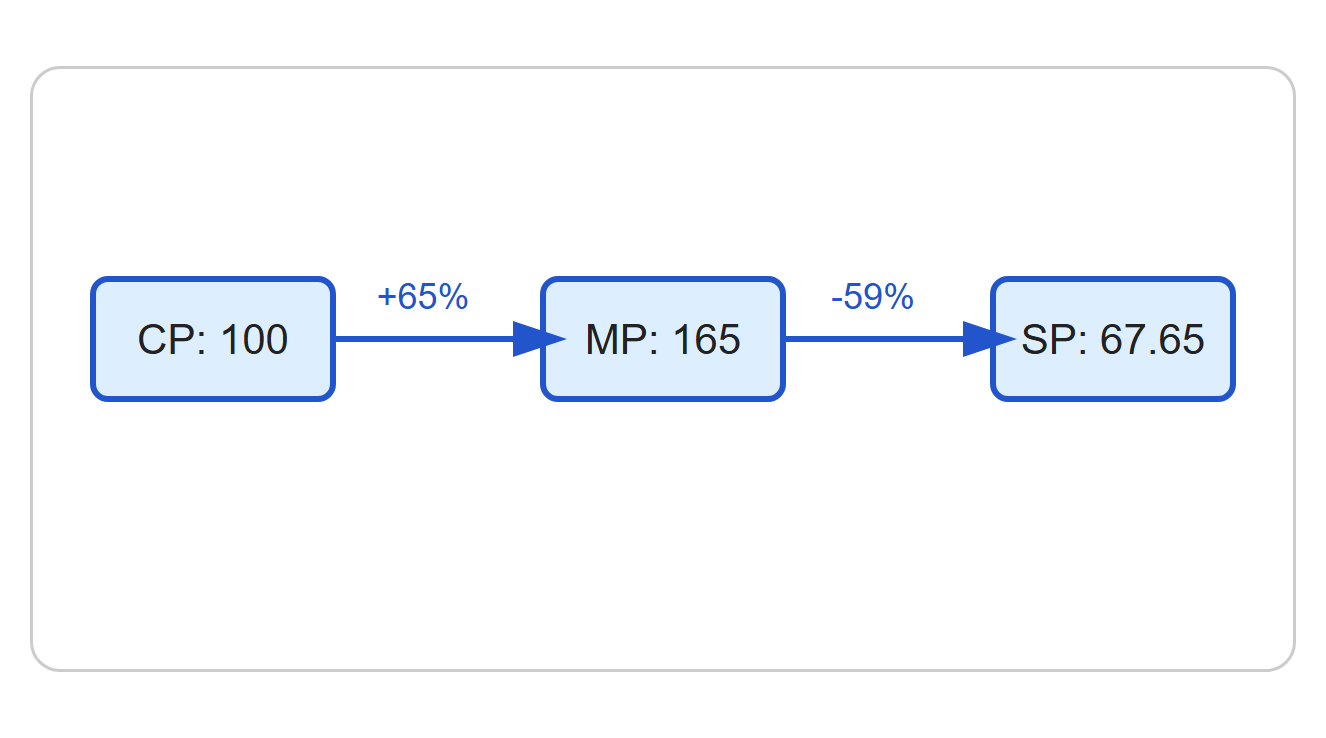
RRB NTPC Graduate Level CBT-I Official Paper (Held On: 14 Jun, 2025 Shift 1) (Previous Year Paper)

Held in 2025

100 questions90 minutes
With answers
Free

Paper last updated:

Practise under exam conditions

Take this paper as a timed mock test. Review your answers after you submit.

Attempt timed test

Questions & answers

Read the paper at your pace. Open an explanation when you need it.

Question 1

In 1820-21, which tribal group led a revolt against the authorities in the area now known as West Singhbhum district of Jharkhand, which was later suppressed by the British?

  1. AOption (a)

     Munda tribes

  2. BOption (b)

    Santhal tribes

  3. COption (c)

    Ho tribes

  4. DOption (d)

    Khasi tribes

View answer & explanation

Correct answer

Answer: (c)C.

Ho tribes

Why this answer is correct

The correct answer is Ho tribes.

Key Points

  • The Ho tribes are an indigenous tribal group residing primarily in the Chotanagpur Plateau region, including areas of modern-day Jharkhand, Odisha, and West Bengal.
  • In 1820-21, the Ho tribes led a major revolt against British colonial authorities in what is now the West Singhbhum district of Jharkhand.
  • The revolt was fueled by grievances against British interference in their autonomy and traditional systems, as well as exploitation by moneylenders and landlords.
  • British forces eventually suppressed the rebellion, but the Ho resistance continued to be a symbol of tribal assertion and defiance against colonial rule.
  • The Ho uprisings are considered a significant part of India's tribal resistance movements during the 19th century.

Additional Information

  • Tribal Revolts in India:
  • Tribal revolts were a series of uprisings by indigenous communities against colonial oppression and exploitation during the British rule.
  • Examples include the Santhal Rebellion (1855-56), Munda Rebellion (1899-1900), and the Khasi Uprising (1829-1833).
  • West Singhbhum District:
  • Located in Jharkhand, it is known for its rich mineral resources and dense forests.
  • The district is home to several tribal communities, including Ho, Santhal, and Munda tribes.
  • Ho Language and Culture:
  • The Ho people speak the Ho language, which belongs to the Munda family of languages.
  • They have a rich cultural heritage, including traditional dances, songs, and festivals like Mage Parab.
  • Colonial Exploitation:
  • The British colonial administration disrupted tribal governance systems and imposed exploitative revenue and forest policies.
  • Tribal populations also faced exploitation from moneylenders and zamindars, leading to widespread discontent.
  • Legacy of Tribal Resistance:
  • Tribal uprisings played a significant role in shaping the freedom movement by highlighting local resistance to colonial rule.
  • These movements are remembered for their contribution to India’s struggle for independence and the assertion of indigenous identity.

Question 2

What is the primary advantage of using a virtual file system (VFS) layer within an operating system?

  1. AOption (a)

     To handle the low-level details of file storage and retrieval for a single file system

  2. BOption (b)

    To provide a consistent interface for applications to access different file systems

  3. COption (c)

     To directly manage the physical storage devices

  4. DOption (d)

    To optimise disk access speeds for specific file system types

View answer & explanation

Correct answer

Answer: (b)B.

To provide a consistent interface for applications to access different file systems

Why this answer is correct

The correct answer is To provide a consistent interface for applications to access different file systems.

Key Points

  • The Virtual File System (VFS) provides a unified and consistent interface for applications, allowing them to access various underlying file systems without needing to know their specific details.
  • VFS acts as an abstraction layer between the operating system's kernel and the different file systems, facilitating compatibility and interoperability.
  • It simplifies application development by eliminating the need for developers to write code for specific file systems, making applications more portable.
  • VFS enables the operating system to support multiple file systems simultaneously, such as ext4, NTFS, FAT32, etc., using a common API.
  • This abstraction enhances flexibility and scalability, allowing the addition of new file system types without major modifications to the kernel or applications.

Additional Information

  • File System: A method of storing and organizing data on storage devices such as hard drives or SSDs. Examples include NTFS, ext4, FAT32, etc.
  • Abstraction Layer: A software framework that provides a simplified interface over complex underlying systems or components, improving usability and compatibility.
  • Kernel: The core component of an operating system responsible for managing system resources, hardware interaction, and process execution.
  • Interoperability: The ability of computer systems or software to exchange and utilize information seamlessly across different platforms or systems.
  • API (Application Programming Interface): A set of protocols and tools that enable communication between software applications or components.

Question 3

Select the triad that follows the same pattern as that followed by the two triads given below. Both triads follow the same pattern.

TY-OT-JO

AF-VA-QV

  1. AOption (a)

    LQ-GL-CG

  2. BOption (b)

    CH-XC-SX

  3. COption (c)

    PU-LP-FK

  4. DOption (d)

    FK-AE-VA

View answer & explanation

Correct answer

Answer: (b)B.

CH-XC-SX

Why this answer is correct

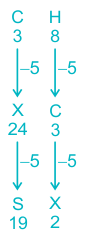
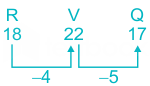
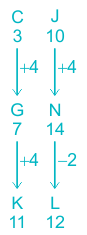
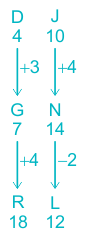
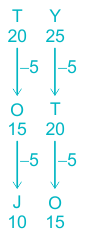
The logic followed here is:

TY-OT-JO

And,

AF-VA-QV

So, checking each option one by one:

Option 1) LQ-GL-CG

Option 2) CH-XC-SX

Option 3) PU-LP-FK

Option 4) FK-AE-VA

Thus, out of all the options, 'CH-XC-SX' follows the same logic as given.

Hence, "Option 2" is the correct answer.

Question 4

A man has invested ₹50,500 at a rate of 6% per annum simple interest for 2 years. Find the amount (in ₹) that he will receive after 2 years.

  1. AOption (a)

    57,560

  2. BOption (b)

    56,560

  3. COption (c)

    7,060

  4. DOption (d)

    6,060

View answer & explanation

Correct answer

Answer: (b)B.

56,560

Why this answer is correct

Shortcut Trick

Effective Simple Interest for 2 years = 6% × 2 = 12%

Total Amount percentage = 100% (Principal) + 12% (Interest) = 112%

Amount = 112% of ₹50,500 = 1.12 × 50,500

Amount = ₹56,560

∴ The correct answer is ₹56,560.

Alternate Method

Given:

Principal (P) = ₹50,500

Rate (R) = 6% per annum

Time (T) = 2 years

Formula Used:

Simple Interest (SI) = (P × R × T) ÷ 100

Amount (A) = Principal (P) + Simple Interest (SI)

Calculations:

⇒ SI = (50500 × 6 × 2) ÷ 100

⇒ SI = 505 × 12

⇒ SI = ₹6,060

⇒ Amount = Principal + SI

⇒ Amount = 50500 + 6060

⇒ Amount = ₹56,560

∴ The correct answer is ₹56,560.

Additional Information

Simple Interest (SI) Properties

Simple interest is calculated only on the Principal amount, meaning the interest earned remains the same every year if the rate and principal are constant.

Amount in SI

The total Amount (A) can also be calculated using the direct formula A = P × (1 + RT/100).

SI vs Compound Interest (CI)

For the first year, SI and CI are always equal if the interest is compounded annually. From the second year onwards, CI becomes higher than SI due to interest on interest.

Question 5

This question is based on the five, three-digit numbers given below. (Left) 205 712 237 862 578 (Right)

(Example- 697 – First digit = 6, second digit = 9 and third digit = 7) (NOTE: All operations to be done from left to right.)

What will be the resultant if the third digit of the highest number is added to the first digit of the lowest number?

  1. AOption (a)

    4

  2. BOption (b)

    6

  3. COption (c)

    3

  4. DOption (d)

    5

View answer & explanation

Correct answer

Answer: (a)A.

4

Why this answer is correct

Given: (Left) 205 712 237 862 578 (Right)

According to the question:

Given numbers205712237862578
Arranged in ascending order205237578712862

Third digit of the highest number → 862 → 2

First digit of the lowest number → 205 → 2

Thus, the resultant if the third digit of the highest number is added to the first digit of the lowest number is → 2 + 2 → 4

Hence, "Option 1" is the correct answer.

Question 6

Refer to the following number and symbol series and answer the question that follows. Counting to be done from left to right only.

(Left) 7 2 2 € 9 8 1 9 * 8 € 2 4 9 7 2 * & * 6 (Right)

How many such numbers are there each of which is immediately preceded by a number and also immediately followed by a number?

  1. AOption (a)

    8

  2. BOption (b)

    7

  3. COption (c)

    6

  4. DOption (d)

    5

View answer & explanation

Correct answer

Answer: (c)C.

6

Why this answer is correct

Given series: (Left) 7 2 2 € 9 8 1 9 * 8 € 2 4 9 7 2 * & * 6 (Right)

According to the question,

Required condition: Number - Number - Number

(Left) 7 2 2 € 9 8 1 9 * 8 € 2 4 9 7 2 * & * 6 (Right)

Thus, there are six such numbers which are immediately preceded by a number and also immediately followed by a number.

Hence, "Option 3" is the correct answer

Question 7

Which feature in Windows allows you to recover files that were accidentally deleted?

  1. AOption (a)

    Control Panel

  2. BOption (b)

    Disk Cleanup

  3. COption (c)

    Recycle Bin

  4. DOption (d)

    Task Manager

View answer & explanation

Correct answer

Answer: (c)C.

Recycle Bin

Why this answer is correct

The correct answer is Recycle Bin.

Key Points

  • The Recycle Bin is a feature in Microsoft Windows that temporarily stores files and folders deleted by the user.
  • It allows users to recover accidentally deleted files until the bin is emptied, ensuring data safety in case of errors.
  • Files in the Recycle Bin can be restored to their original location using the "Restore" option.
  • The Recycle Bin does not store files deleted from external drives or removed via Shift+Delete, as these actions bypass the bin.
  • This feature has been included in Windows operating systems since Windows 95 and remains a critical utility for file recovery.

Additional Information

  • File Recovery in Windows:
  • Files deleted via Shift+Delete or from external drives can be recovered using third-party tools or backup software.
  • Windows provides a File History feature to back up and restore files periodically, offering an alternative to Recycle Bin recovery.
  • Disk Cleanup:
  • Disk Cleanup is a Windows utility designed to free up space by removing unnecessary files such as temporary files and cached data.
  • It does not serve as a file recovery tool.
  • Task Manager:
  • Task Manager is used for monitoring system performance and managing running applications and processes.
  • It does not handle file recovery tasks.
  • Control Panel:
  • The Control Panel in Windows is used for system configuration and settings management.
  • It does not provide file recovery functionalities.

Question 8

The ratio of three numbers is 20 : 14 : 6. If 65 percent of the first number is 39, what would be 50 percent of the difference of the third and second number?

  1. AOption (a)

    -12

  2. BOption (b)

    10

  3. COption (c)

    11

  4. DOption (d)

    14

View answer & explanation

Correct answer

Answer: (a)A.

-12

Why this answer is correct

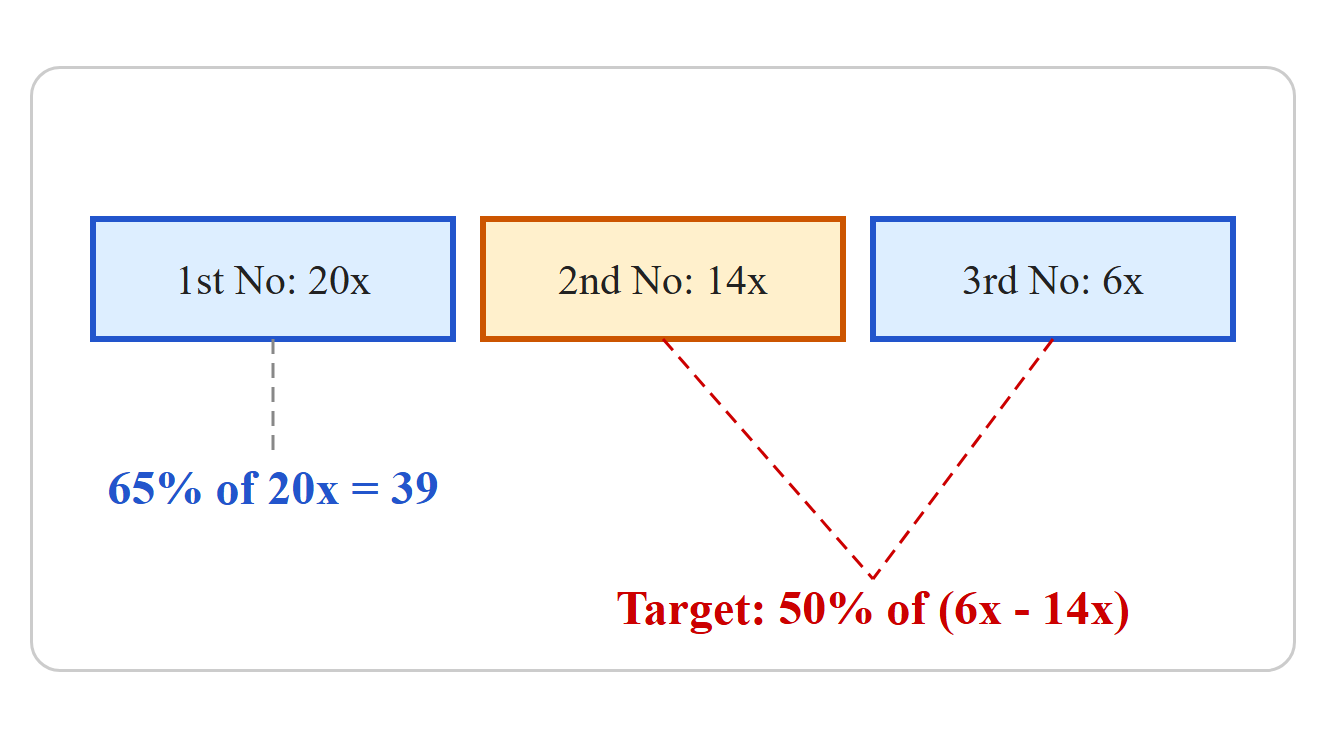
Shortcut Trick

65% of First Number (20 units) = 13 units.

Given, 13 units = 39 → 1 unit = 3.

Difference of third and second number = (6 − 14) units = −8 units.

50% of Difference = 50% of (−8 units) = −4 units.

Final value = −4 × 3 = −12.

∴ The correct answer is -12.

Alternate Method

Given: Ratio = 20 : 14 : 6 | 65% of First Number = 39.

Formula Used: Value = (Ratio Part × x) | Percentage calculation.

⇒ Let the numbers be 20x, 14x, and 6x.

⇒ 65% of 20x = 39

⇒ (65 ÷ 100) × 20x = 39

⇒ 1.3x = 3.9 × 10 (or 13x = 39)

⇒ x = 39 ÷ 13 = 3.

⇒ Difference of third and second number = 6x − 14x = −8x.

⇒ 50% of Difference = 0.50 × (−8x) = −4x.

⇒ Result = −4 × 3 = −12.

∴ The correct answer is -12.

Additional Information

Ratio and Proportion

If quantities are in ratio a:b:c, they can be represented as ax, bx, and cx where x is the common multiplier.

Percentage to Fraction Conversion

65% = 65/100 = 13/20. Multiplying 13/20 × 20 units directly gives 13 units as the value.

Signed Differences

In subtraction problems, the order of terms matters. The difference of A and B is usually (A − B). If the third number is smaller than the second, the result will be negative.

Question 9

The NVS-02 satellite, launched in 2025, is intended to augment which Indian system?

  1. AOption (a)

    GSAT

  2. BOption (b)

     IRNSS

  3. COption (c)

    NavIC

  4. DOption (d)

    INSAT

View answer & explanation

Correct answer

Answer: (c)C.

NavIC

Why this answer is correct

The correct answer is NavIC.

Key Points

  • The NVS-02 satellite, launched in 2025, is designed to enhance the Indian Regional Navigation Satellite System (IRNSS), also known as NavIC (Navigation with Indian Constellation).
  • NavIC is India’s indigenous satellite navigation system, developed by the Indian Space Research Organisation (ISRO), to provide accurate positioning services in India and the surrounding region.
  • The NVS-02 satellite incorporates advanced features, including dual-frequency signals (L1 and L5 bands), to improve navigation accuracy and reliability.
  • The satellite is part of the effort to replace and upgrade the aging NavIC constellation, ensuring the system remains operational and efficient for the long term.
  • NavIC is intended to provide positioning accuracy of better than 20 meters in the primary service area, covering India and an area extending 1,500 km around it.

Additional Information

  • NavIC Overview:
  • NavIC consists of a constellation of seven satellites and ground systems for monitoring, control, and data processing.
  • It provides two types of services: the Standard Positioning Service (SPS) for civilian use and the Restricted Service (RS) for authorized users, including the military.
  • Significance of NavIC:
  • It is a critical step towards self-reliance in satellite navigation, reducing dependency on global systems like GPS.
  • NavIC supports applications in terrestrial, aerial, and marine navigation, disaster management, vehicle tracking, and more.
  • NVS Series Satellites:
  • The NVS series is the next generation of satellites designed to replace older NavIC satellites and enhance system capabilities.
  • These satellites support dual-frequency signals for better performance under challenging conditions.
  • Comparison with GPS:
  • While GPS is a global navigation system, NavIC is designed for regional coverage, offering high accuracy over India and neighboring regions.
  • NavIC’s restricted service provides greater resilience and security for strategic applications.
  • ISRO’s Role:
  • ISRO is responsible for the development, launch, and maintenance of NavIC and its associated infrastructure.
  • As of 2025, ISRO continues to enhance NavIC with advanced technologies to keep pace with global navigation systems.

Question 10

A water tank can be filled in 48 minutes by using 4 pipes of the same capacity. In how many minutes (rounded off to two decimal places) will the water tank be filled if we use 26 pipes of the same capacity as above?

  1. AOption (a)

    16.48

  2. BOption (b)

    3.17

  3. COption (c)

    11.99

  4. DOption (d)

    7.38

View answer & explanation

Correct answer

Answer: (d)D.

7.38

Why this answer is correct

Shortcut Trick

Apply Inverse Proportion formula: M1D1 = M2D2

4 pipes × 48 minutes = 26 pipes × Time

Time = (4 × 48) ÷ 26 = 192 ÷ 26

Time ≈ 7.38 minutes

∴ The correct answer is 7.38 minutes.

Alternate Method

Given:

Initial number of pipes (n1) = 4

Initial time taken (t1) = 48 minutes

Final number of pipes (n2) = 26

Formula Used:

For constant work, Number of Pipes is Inversely Proportional to Time Taken.

n1 × t1 = n2 × t2

Calculations:

⇒ 4 × 48 = 26 × t2

⇒ 192 = 26 × t2

⇒ t2 = 192 ÷ 26

⇒ t2 = 96 ÷ 13

⇒ t2 ≈ 7.3846...

⇒ t2 ≈ 7.38 minutes (rounded off to two decimal places)

∴ The correct answer is 7.38 minutes.

Additional Information

Inverse Proportion

When one quantity increases and the other decreases at the same rate, it is called inverse variation (x1y1 = x2y2).

Pipes and Cisterns Logic

More pipes of the same capacity will fill the tank in less time. Total capacity = Number of pipes × Time × Efficiency per pipe.

Rounding Off Rule

If the third decimal digit is 5 or greater, round up the second digit; otherwise, keep the second digit as is.

Question 11

SI 14 is related to WH −2 in a certain way. In the same way, MJ 18 is related to QI 2. To which of the given options is PV 4 related, following the same logic?

  1. AOption (a)

    KH −7

  2. BOption (b)

     NG −6

  3. COption (c)

     TU −12

  4. DOption (d)

    HT −8

View answer & explanation

Correct answer

Answer: (c)C.

 TU −12

Why this answer is correct

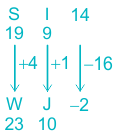
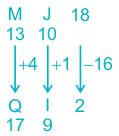
The logic followed here is:

SI 14 is related to WH −2

And,

MJ 18 is related to QI 2

Similarly,

PV 4 is related to​

Hence, "Option 3" is the correct answer.

Question 12

'Vilambit' and 'Drut' are two varieties of which of the following singing styles?

  1. AOption (a)

    Dhrupad

  2. BOption (b)

    Tappa

  3. COption (c)

    Thumri

  4. DOption (d)

    Khayal

View answer & explanation

Correct answer

Answer: (d)D.

Khayal

Why this answer is correct

The correct answer is Khayal.

Key Points

  • Khayal is a prominent form of Indian classical music that emphasizes improvisation and melody, showcasing a blend of creativity and technicality.
  • The terms Vilambit (slow tempo) and Drut (fast tempo) are specific to Khayal and refer to the tempo of the composition being performed.
  • In Khayal singing, the artist typically begins with a Vilambit rendition to explore the raga in depth, followed by a Drut composition to exhibit technical virtuosity.
  • Khayal originated in the 13th century but gained prominence during the Mughal era, especially under the patronage of rulers like Muhammad Shah Rangile.
  • It is characterized by its poetic lyrics (often depicting themes of love or devotion) and its ability to provide extensive room for improvisation.

Additional Information

  • Vilambit and Drut:
  • Vilambit refers to the slow-paced rendition of a Khayal composition, allowing detailed exploration of the raga.
  • Drut refers to the fast-paced section, which is typically performed after the Vilambit and highlights rhythmic complexity and speed.
  • Structure of Khayal:
  • Each Khayal performance comprises two sections: Asthai (the initial refrain) and Antara (the subsequent verse).
  • The artist improvises on both sections while adhering to the rules of the raga.
  • Other Classical Styles:
  • Dhrupad: An ancient and highly structured form of classical music focusing on devotional themes.
  • Thumri: A semi-classical style known for its romantic and expressive nature.
  • Tappa: A semi-classical genre characterized by its intricate and fast-paced melodic patterns.
  • Modern Relevance:
  • Khayal continues to be a significant part of Indian classical music, performed by eminent artists in concerts and festivals worldwide.
  • Leading gharanas (schools) like Gwalior, Kirana, and Agra have contributed to its evolution and diversity.

Question 13

The nature of the roots of the quadratic equation 3x2 − 5x + 2 = 0 is:

  1. AOption (a)

    two distinct real roots

  2. BOption (b)

    equal real roots

  3. COption (c)

    complex roots

  4. DOption (d)

     infinite number of roots

View answer & explanation

Correct answer

Answer: (a)A.

two distinct real roots

Why this answer is correct

Shortcut Trick

Identify the nature of roots using the Discriminant (D) formula: D = b2 − 4ac.

For the equation 3x2 − 5x + 2 = 0, we have a = 3, b = −5, and c = 2.

D = (−5)2 − 4 × 3 × 2 = 25 − 24 = 1.

Since D > 0, the roots are always real and distinct (different).

∴ The correct answer is two distinct real roots.

Alternate Method

Given: Quadratic equation 3x2 − 5x + 2 = 0.

Method: Factorization to find the actual roots.

⇒ 3x2 − 3x − 2x + 2 = 0

⇒ 3x(x − 1) − 2(x − 1) = 0

⇒ (3x − 2)(x − 1) = 0

⇒ 3x − 2 = 0 or x − 1 = 0

⇒ x = 2/3 or x = 1

⇒ The roots are 1 and 2/3, which are real numbers and are not equal.

∴ The correct answer is two distinct real roots.

Additional Information

Discriminant and Nature of Roots

For ax2 + bx + c = 0, if D = b2 − 4ac: D > 0 means roots are real & distinct; D = 0 means roots are real & equal; D < 0 means roots are imaginary/complex.

Rational Roots Condition

If a, b, c are rational and D is a perfect square (like 1, 4, 9...), the roots are rational and distinct.

Sum and Product of Roots

Sum of roots (α + β) = −b/a and Product of roots (αβ) = c/a.

Question 14

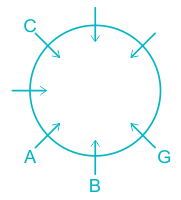
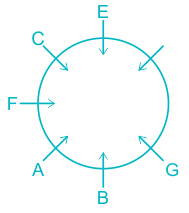
A, B, C, D, G, H and I are sitting around a circular table facing the centre of the table. G sits to the immediate left of D. B sits to the immediate left of C. C sits second to the left of A. I sits third to the left of D. Who sits third to the right of H?

  1. AOption (a)

    A

  2. BOption (b)

    I

  3. COption (c)

    C

  4. DOption (d)

    D

View answer & explanation

Correct answer

Answer: (b)B.

I

Why this answer is correct

Given: A, B, C, D, G, H and I are sitting around a circular table facing the centre of the table.

1) G sits to the immediate left of D.

2) I sits third to the left of D.

3) B sits to the immediate left of C. 

4) C sits second to the left of A.

After positioning A, C and B only one position is left which will be occupied by the only person left i.e. H.

Thus, I sits third to the right of H.

Hence, "Option 2" is the correct answer.

Question 15

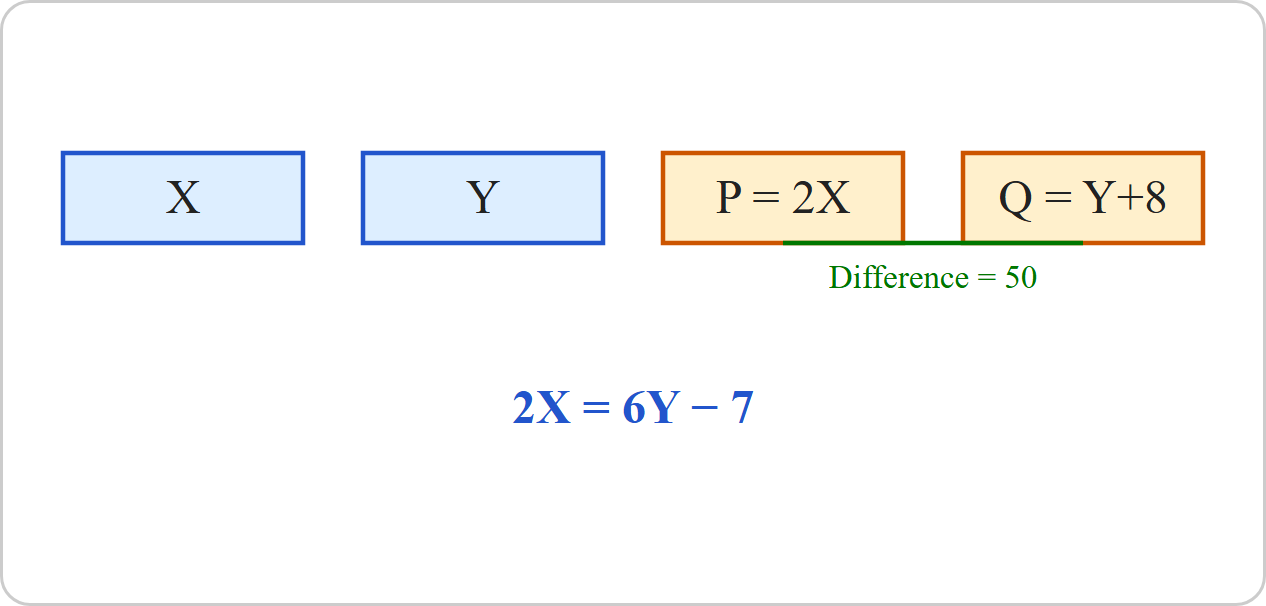
2 times the present age of X is 7 years less than 6 times the present age of Y. At present, P is 2 times as old as X, and Y is 8 years younger than Q. If P is 50 years older than Q, then the present age (in years) of Y is:

  1. AOption (a)

    18

  2. BOption (b)

    5

  3. COption (c)

    12

  4. DOption (d)

    13

View answer & explanation

Correct answer

Answer: (d)D.

13

Why this answer is correct

Shortcut Trick

Let the age of Y be y.

From Q = y + 8 and P = Q + 50 → P = y + 58.

Also, P = 2X → X = (y + 58)/2.

Equation: 2X = 6Y − 7 ⇒ y + 58 = 6y − 7.

Solving: 5y = 65 ⇒ y = 13.

∴ The correct answer is 13 years.

Alternate Method

Given:

  1. 2X = 6Y − 7
  2. P = 2X
  3. Y = Q − 8 ⇒ Q = Y + 8
  4. P = Q + 50

Calculations:

⇒ Substitute (2) into (1): P = 6Y − 7

⇒ Substitute (4) into the above: Q + 50 = 6Y − 7

⇒ Substitute (3) into the above: (Y + 8) + 50 = 6Y − 7

⇒ Y + 58 = 6Y − 7

⇒ 6Y − Y = 58 + 7

⇒ 5Y = 65

⇒ Y = 65 ÷ 5 = 13

∴ The correct answer is 13 years.

Additional Information

Age Difference Constant

The difference between the ages of two people remains constant regardless of the number of years passed or future time.

Ratio Method for Ages

If the ratio of ages is given for two different time periods, equate the parts by making the difference between ratios equal.

Linear Equations in Ages

Always define variables for present ages to avoid confusion when moving back to the past or forward to the future.

Question 16

The ratio of incomes of Seema and Darshan is 2 : 3. They save ₹15,000 and ₹9,000, respectively. If the ratio of their expenditures is 12 : 19, then what is the total expenditure (in ₹) of Seema and Darshan?

  1. AOption (a)

    4,21,000

  2. BOption (b)

    4,18,000

  3. COption (c)

    4,18,500

  4. DOption (d)

    4,22,000

View answer & explanation

Correct answer

Answer: (c)C.

4,18,500

Why this answer is correct

Shortcut Trick

Apply the Cross-Multiplication Method on Income and Expenditure ratios.

(Income 2 : 3) and (Expenditure 12 : 19) with savings (15000 : 9000).

Cross product of ratios: (2 × 19) − (3 × 12) = 38 − 36 = 2 units.

Cross product of values: (19 × 15000) − (12 × 9000) = 285000 − 108000 = 177000.

2 units = ₹177000 ⇒ 1 unit = ₹88500. Total Income = (2+3) × 88500 = ₹442500.

Total Expenditure = Total Income − Total Savings = 442500 − (15000 + 9000) = ₹418500.

∴ The correct answer is ₹4,18,500.

Alternate Method

Given: Income ratio of Seema and Darshan = 2 : 3. Expenditure ratio = 12 : 19.

Formula: Income − Savings = Expenditure

⇒ Let the incomes be 2x and 3x.

⇒ (2x − 15000) / (3x − 9000) = 12 / 19

⇒ 19 × (2x − 15000) = 12 × (3x − 9000)

⇒ 38x − 285000 = 36x − 108000

⇒ 2x = 285000 − 108000 = 177000

⇒ x = 88500

⇒ Seema Expenditure = 2(88500) − 15000 = 177000 − 15000 = ₹162000

⇒ Darshan Expenditure = 3(88500) − 9000 = 265500 − 9000 = ₹256500

⇒ Total Expenditure = 162000 + 256500 = ₹418500

∴ The correct answer is ₹4,18,500.

Additional Information

Income-Expenditure Relationship

The fundamental relation is Income = Expenditure + Savings. When ratios are given, always equate the common variable using this balance.

Cross-Multiplication Method

This is a faster alternative to linear equations for ratio problems involving additions or subtractions: (a/b) → (c/d) with changes ±k1, ±k2.

Ratio Balancing

If savings are equal, the difference between the terms of the income ratio and expenditure ratio can be made equal to simplify calculations.

Question 17

Who among the following was appointed the new Director General of the Central Reserve Police Force (CRPF) in January 2025?

  1. AOption (a)

    Anish Dayal Singh

  2. BOption (b)

    Gyanendra Pratap Singh

  3. COption (c)

    Vitul Kumar

  4. DOption (d)

    Kuldeep Singh

View answer & explanation

Correct answer

Answer: (b)B.

Gyanendra Pratap Singh

Why this answer is correct

The correct answer is Gyanendra Pratap Singh.

Key Points

  • Gyanendra Pratap Singh was appointed as the new Director General (DG) of the Central Reserve Police Force (CRPF) in January 2025.
  • He succeeded Kuldeep Singh, who served as the previous Director General of CRPF.
  • The CRPF is India’s largest paramilitary force, responsible for internal security and counter-insurgency operations across the country.
  • Gyanendra Pratap Singh has a notable career in law enforcement and has contributed significantly to India’s security framework.
  • The appointment of the CRPF DG is made by the Ministry of Home Affairs in consultation with the Appointments Committee of the Cabinet.

Additional Information

  • Central Reserve Police Force (CRPF):
  • CRPF is the largest paramilitary force in India, established in 1939 as the Crown Representative's Police and renamed after independence in 1949.
  • Its primary role includes maintaining law and order, handling counter-insurgency operations, and conducting election security duties.
  • The force operates under the Ministry of Home Affairs and is deployed across various states in India.
  • Role of the Director General (DG):
  • The DG is the highest-ranking officer in CRPF and oversees all operations, administration, and strategic planning.
  • The DG is responsible for ensuring the force's efficiency and readiness for missions, including counter-terrorism and disaster response.
  • Recent Appointments in Security Forces:
  • Appointments for key positions like DG of CRPF, BSF, and CISF are made by the Appointments Committee of the Cabinet, headed by the Prime Minister.
  • These roles are crucial for maintaining the internal security framework of the country.
  • CRPF Operations:
  • CRPF has played a key role in counter-insurgency operations in regions like Jammu & Kashmir, the Northeast, and Left-Wing Extremism (LWE)-affected areas.
  • The force also assists in disaster management and international peacekeeping missions under the United Nations.

Question 18

The Industrial Finance Corporation of India (IFCI) was established in:

  1. AOption (a)

    1952

  2. BOption (b)

    1956

  3. COption (c)

    1948

  4. DOption (d)

    1954

View answer & explanation

Correct answer

Answer: (c)C.

1948

Why this answer is correct

The correct answer is 1948.

Key Points

  • The Industrial Finance Corporation of India (IFCI) was established in 1948 by the Government of India.
  • It was set up under the Industrial Finance Corporation Act to provide long-term financial support to industrial enterprises.
  • IFCI was India's first development finance institution aimed at accelerating industrial growth in the country.
  • Initially, it functioned as a statutory corporation before being converted into a company under the Companies Act in 1993.
  • IFCI plays a significant role in providing financial assistance for large-scale industrial projects and promoting industrial development across sectors.

Additional Information

  • Development Finance Institutions (DFIs)
  • DFIs are financial institutions dedicated to providing long-term capital for industries and infrastructure projects.
  • They aim to bridge the gap between the availability of funds and the financial needs of businesses that require large-scale investments.
  • Examples include IFCI, IDBI, SIDBI, and NABARD.
  • Evolution of IFCI
  • From its inception in 1948, IFCI initially operated as a statutory body under the Industrial Finance Corporation Act.
  • In 1993, it transitioned to a company structure under the Companies Act to enhance its operational flexibility.
  • It has supported several key industries, including power, telecom, and manufacturing, through financial assistance.
  • Role in Industrial Growth
  • IFCI contributes to the industrialization of India by financing projects in sectors like energy, infrastructure, and technology.
  • Its financial support aids in job creation, regional development, and economic growth.
  • Current Status
  • IFCI is now a government-owned financial institution, with the majority stake held by the Government of India.
  • It continues to play a vital role in financing industrial and infrastructure projects and remains relevant in the financial ecosystem of India.

Question 19

Rohan has ₹(3x² + 5xy + 7y²) in his pocket. He spent ₹(2x² + 5xy + 4y²). How much money is left with Rohan?

  1. AOption (a)

    ₹(x² + 3y)2

  2. BOption (b)

    ₹(x² + 3y²)

  3. COption (c)

    ₹(x² - 3y)2

  4. DOption (d)

    ₹(x² - 3y²)

View answer & explanation

Correct answer

Answer: (b)B.

₹(x² + 3y²)

Why this answer is correct

Shortcut Trick

Subtract the coefficients of like terms directly:

For x2: 3 − 2 = 1

For xy: 5 − 5 = 0

For y2: 7 − 4 = 3

Combining the results gives 1x2 + 0xy + 3y2 = x2 + 3y2.

∴ The correct answer is ₹(x² + 3y²).

Alternate Method

Given:

Initial Amount with Rohan = ₹(3x2 + 5xy + 7y2)

Amount Spent by Rohan = ₹(2x2 + 5xy + 4y2)

Formula Used:

Money Left = Total Initial Amount − Total Spent Amount

Calculations:

⇒ Money Left = (3x2 + 5xy + 7y2) − (2x2 + 5xy + 4y2)

⇒ Money Left = 3x2 + 5xy + 7y2 − 2x2 − 5xy − 4y2

⇒ Rearranging like terms: (3x2 − 2x2) + (5xy − 5xy) + (7y2 − 4y2)

⇒ Money Left = 1x2 + 0 + 3y2

⇒ Money Left = x2 + 3y2

∴ The correct answer is ₹(x² + 3y²).

Additional Information

Subtraction of Polynomials

To subtract one polynomial from another, add the additive inverse of the polynomial being subtracted. This means changing the signs of all its terms.

Like Terms Rule

Only like terms (terms with identical variables and exponents) can be combined through addition or subtraction. For example, 5xy and 2xy are like terms, while x2 and x are not.

Standard Form

A polynomial is usually written in standard form where the terms are ordered from the highest degree to the lowest degree.

Question 20

The inability to isolate intact DNA for structural studies prior to the 1950s was primarily due to which molecular feature?

  1. AOption (a)

    DNA’s high melting point

  2. BOption (b)

    DNA’s large polymeric nature and fragility

  3. COption (c)

    DNA’s interaction with histone proteins

  4. DOption (d)

    DNA’s susceptibility to UV degradation

View answer & explanation

Correct answer

Answer: (b)B.

DNA’s large polymeric nature and fragility

Why this answer is correct

The correct answer is DNA's large polymeric nature and fragility.

Key Points

  • Prior to the 1950s, isolating intact DNA for structural studies was challenging because DNA is a large and fragile polymer, prone to mechanical and enzymatic degradation during extraction processes.
  • The polymeric nature of DNA makes it susceptible to physical shearing when subjected to traditional isolation techniques, such as centrifugation or precipitation.
  • Early methods lacked the precision to preserve the integrity of DNA's long molecular chains, resulting in fragmented samples unsuitable for structural analysis.
  • Advances in biochemical techniques, such as the use of gentle lysis buffers and controlled enzymatic treatments, were later developed to overcome DNA fragility.
  • Watson and Crick's discovery of the DNA double helix in 1953 was facilitated by refined isolation methods and the use of X-ray crystallography.

Additional Information

  • DNA Structure: DNA is composed of long chains of nucleotides, including a phosphate group, a sugar molecule (deoxyribose), and one of four nitrogenous bases (adenine, thymine, cytosine, and guanine).
  • Double Helix Discovery: The double helix model by Watson and Crick revealed the arrangement of base pairs (A-T and G-C) and the antiparallel orientation of DNA strands.
  • Role of Histones: In eukaryotic cells, DNA is tightly wrapped around histone proteins to form nucleosomes, which help in compacting and organizing DNA within the nucleus.
  • UV Susceptibility: DNA is prone to damage from UV radiation, causing thymine dimers, which can lead to mutations if not repaired.
  • Breakthrough Techniques: Enzymatic treatments such as proteinase K digestion and the use of phenol-chloroform extraction improved DNA isolation, enabling structural and functional studies.

Question 21

Which Article of the Indian Constitution promotes the spread and development of Hindi?

  1. AOption (a)

    Article 350

  2. BOption (b)

    Article 348

  3. COption (c)

    Article 351

  4. DOption (d)

    Article 349

View answer & explanation

Correct answer

Answer: (c)C.

Article 351

Why this answer is correct

The correct answer is Article 351.

Key Points

  • Article 351 of the Indian Constitution is specifically aimed at promoting the spread and development of the Hindi language.
  • It directs the Union Government to promote Hindi so that it may serve as a medium of expression for all elements of the composite culture of India.
  • The article also highlights the importance of assimilating forms, styles, and expressions from other Indian languages to enrich Hindi.
  • It aims to make Hindi the lingua franca while respecting linguistic diversity and ensuring inclusivity in India’s cultural and linguistic heritage.

Additional Information

  • Indian Constitution and Language:
  • Part XVII of the Constitution deals with the official language of the Republic of India.
  • Articles 343 to 351 specifically focus on language-related provisions.
  • Article 343:
  • Declares Hindi in the Devanagari script as the official language of the Union.
  • English was permitted to be used for official purposes for an initial period of 15 years after the Constitution came into effect.
  • Article 350:
  • Allows individuals to submit representations for the redress of grievances in any language used in the Union or the state.
  • Efforts to Promote Hindi:
  • Institutions such as Kendriya Hindi Sansthan and Central Hindi Directorate work to implement the provisions of Article 351.
  • Various schemes and awards are introduced by the government to promote the use of Hindi.

Question 22

A, B, C, D, E, F and G are sitting around a circular table facing the centre. C sits third to the left of B. A sits second to the left of G. G is not an immediate neighbour of C. D sits to the immediate left of E. How many people sit between A and E when counted from the left of A?

  1. AOption (a)

    Two

  2. BOption (b)

    One

  3. COption (c)

    Four

  4. DOption (d)

    None

View answer & explanation

Correct answer

Answer: (a)A.

Two

Why this answer is correct

Given: A, B, C, D, E, F and G are sitting around a circular table facing the centre.

1) C sits third to the left of B.

2) A sits second to the left of G. 

3) G is not an immediate neighbour of C.

4) D sits to the immediate left of E. 

After positioning E and D only one position is left which will be occupied by the only person left i.e. F.

Thus, two people sit between A and E when counted from the left of A.

Hence, "Option 1" is the correct answer.

Question 23

What should come in place of the question mark (?) in the given series based on the English alphabetical order?

CXS EZU GBW IDY ?

  1. AOption (a)

    FAK

  2. BOption (b)

    KAF

  3. COption (c)

    KFA

  4. DOption (d)

    FKA

View answer & explanation

Correct answer

Answer: (c)C.

KFA

Why this answer is correct

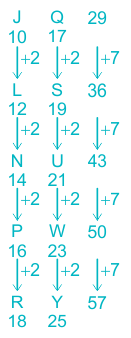
The logic followed here is:

Hence, "Option 3" is the correct answer.

Question 24

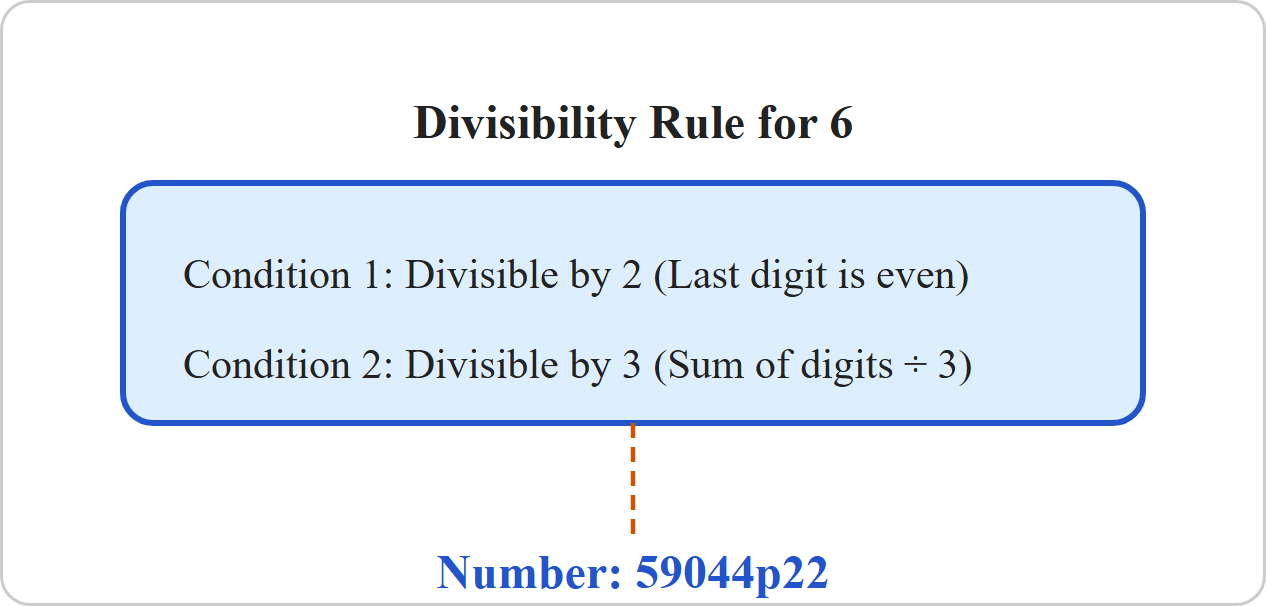
If the eight-digit number 59044p22 is divisible by 6, then the maximum value of p is:

  1. AOption (a)

    6

  2. BOption (b)

    7

  3. COption (c)

    8

  4. DOption (d)

    3

View answer & explanation

Correct answer

Answer: (b)B.

7

Why this answer is correct

Shortcut Trick

Number 59044p22 is divisible by 6 if it is divisible by both 2 and 3.

As the number ends in 2, it is always divisible by 2.

For divisibility by 3, sum of digits 5+9+0+4+4+p+2+2 = 26 + p must be a multiple of 3.

Possible values for p are 1, 4, 7. The maximum value is 7.

∴ The correct answer is 7.

Alternate Method

Given: Number = 59044p22 is divisible by 6.

Divisibility by 2: The last digit is 2, which is even. Condition satisfied.

Divisibility by 3: Sum of digits = 5 + 9 + 0 + 4 + 4 + p + 2 + 2

⇒ Sum = 26 + p

⇒ For the number to be divisible by 3, (26 + p) must be 27, 30, 33, ...

⇒ If 26 + p = 27, then p = 1

⇒ If 26 + p = 30, then p = 4

⇒ If 26 + p = 33, then p = 7

⇒ If 26 + p = 36, then p = 10 (not possible as p is a single digit)

⇒ The maximum single digit value of p is 7.

∴ The correct answer is 7.

Additional Information

Divisibility Rule of 3

A number is divisible by 3 if the sum of its digits is divisible by 3.

Divisibility Rule of 9

A number is divisible by 9 if the sum of its digits is divisible by 9.

Divisibility Rule of 4

A number is divisible by 4 if the last two digits are divisible by 4.

Composite Divisibility

If a number is divisible by a and b (where a and b are co-prime), then it is divisible by a × b.

Question 25

Which Constitutional Amendment recognised the right to form cooperative societies as a part of Fundamental Rights?

  1. AOption (a)

    11th Amendment Act

  2. BOption (b)

    99th Amendment Act

  3. COption (c)

    93rd Amendment Act

  4. DOption (d)

    97th Amendment Act

View answer & explanation

Correct answer

Answer: (d)D.

97th Amendment Act

Why this answer is correct

The correct answer is 97th Amendment Act.

Key Points

  • The 97th Constitutional Amendment Act, 2011 recognized the right to form cooperative societies as a Fundamental Right under Article 19(1)(c) of the Indian Constitution.
  • It added a new Directive Principle of State Policy under Article 43B, which directs the state to promote voluntary formation, autonomous functioning, and democratic control of cooperative societies.
  • The Amendment introduced Part IXB to the Constitution, which deals specifically with the incorporation, regulation, and functioning of cooperative societies.
  • The Act aimed to ensure the independence and democratic functioning of cooperatives, enhance their accountability, and improve their governance structure.
  • It empowered citizens to form and operate cooperative societies without undue state interference, thereby strengthening grassroots-level economic democracy.

Additional Information

  • Article 19(1)(c): This article guarantees all citizens the right to form associations or unions, which now includes cooperative societies after the 97th Amendment.
  • Article 43B: Added through the 97th Amendment, it directs the state to promote cooperative societies as an important tool for socio-economic development.
  • Part IXB: This part of the Constitution specifically governs the structure, composition, elections, and auditing of cooperative societies across the country.
  • Cooperative Societies: These are voluntary associations of individuals who come together for a common economic objective, such as agriculture, credit, or housing.
  • Supreme Court Judgment: In 2021, the Supreme Court struck down the application of Part IXB to multi-state cooperative societies but upheld its validity for state cooperatives, maintaining federal balance.

Question 26

When did Algeria officially become a member of the New Development Bank (NDB)?

  1. AOption (a)

    May 2025

  2. BOption (b)

    March 2025

  3. COption (c)

    February 2025

  4. DOption (d)

    January 2025

View answer & explanation

Correct answer

Answer: (a)A.

May 2025

Why this answer is correct

The correct answer is Thu May 01 2025 00:00:00 GMT+0530 (India Standard Time).

Key Points

  • Algeria officially became a member of the New Development Bank (NDB) on May 1, 2025.
  • The New Development Bank (NDB) was established in 2014 by the BRICS countries (Brazil, Russia, India, China, and South Africa).
  • Algeria's membership reflects the bank's aim to expand its outreach beyond the BRICS nations and include emerging economies globally.
  • The decision to include Algeria aligns with the NDB's strategy to strengthen its global presence and financial inclusion.
  • Algeria’s membership is expected to bolster infrastructure development and sustainable projects in the African region.

Additional Information

  • New Development Bank (NDB):
  • It was established by the BRICS nations at the 6th BRICS Summit in Fortaleza, Brazil in 2014.
  • The NDB is headquartered in Shanghai, China, and focuses on financing infrastructure and sustainable development projects.
  • It aims to complement existing global financial institutions like the World Bank and the International Monetary Fund (IMF).
  • Algeria’s Economic Landscape:
  • Algeria is one of Africa's largest economies, primarily driven by its oil and gas sector.
  • It has been diversifying its economy to reduce reliance on hydrocarbons and focus on sustainable development projects.
  • Joining the NDB is expected to provide Algeria with access to financial resources for infrastructure and green projects.
  • NDB’s Global Expansion:
  • The NDB has been expanding its membership to include countries beyond the BRICS group.
  • Egypt, the United Arab Emirates, and Uruguay are other countries that have joined the NDB recently.
  • The inclusion of new members reflects the bank's strategy to establish a global footprint.
  • Sustainable Development Goals (SDGs):
  • The NDB aligns its projects with the United Nations' SDGs, focusing on clean energy, transportation, and water management.
  • Membership in the NDB allows countries like Algeria to access funding for projects that align with global sustainability goals.

Question 27

The average salary of all the workers in a factory is ₹14,000. The average salary of 80 skilled workers is ₹15,000 and the average salary of the remaining workers is ₹12,000. Find the total number of workers in the factory.

  1. AOption (a)

    110

  2. BOption (b)

    120

  3. COption (c)

    140

  4. DOption (d)

    150

View answer & explanation

Correct answer

Answer: (b)B.

120

Why this answer is correct

Shortcut Trick

Apply the Alligation Method between Skilled and Remaining workers.

Ratio of Skilled : Remaining = (14,000 − 12,000) : (15,000 − 14,000) = 2,000 : 1,000 = 2 : 1.

According to the question, 2 units = 80 workers → 1 unit = 40 workers.

Total workers = (2 + 1) units = 3 units = 3 × 40 = 120.

∴ The correct answer is 120.

Alternate Method

Given:

Average salary of all workers = ₹14,000

Number of skilled workers = 80

Average salary of skilled workers = ₹15,000

Average salary of remaining workers = ₹12,000

Formula Used:

Total Salary = Average Salary × Total Number of Workers

Calculations:

⇒ Let the total number of workers be T.

⇒ Total salary = 14,000 × T

⇒ Total salary = (Average of Skilled × 80) + (Average of Remaining × (T − 80))

⇒ 14,000T = (15,000 × 80) + 12,000(T − 80)

⇒ 14,000T = 1,200,000 + 12,000T − 960,000

⇒ 14,000T − 12,000T = 240,000

⇒ 2,000T = 240,000

⇒ T = 240,000 ÷ 2,000

⇒ T = 120

∴ The correct answer is 120.

Additional Information

Weighted Average Formula

The combined average of two groups is given by Acombined = (n1A1 + n2A2) ÷ (n1 + n2).

Alligation Rule

Quantity of Cheaper ÷ Quantity of Dearer = (CP of Dearer − Mean Price) ÷ (Mean Price − CP of Cheaper).

Net Deviation Property

The sum of the deviations of all observations from their Arithmetic Mean is always zero.

Question 28

Evaluate: 30 - [30 - {30 - (30 - 30 × 4)}]

  1. AOption (a)

    141

  2. BOption (b)

    120

  3. COption (c)

    118

  4. DOption (d)

    132

View answer & explanation

Correct answer

Answer: (b)B.

120

Why this answer is correct

Given:

Evaluate: 30 - [30 - {30 - (30 - 30 × 4)}]

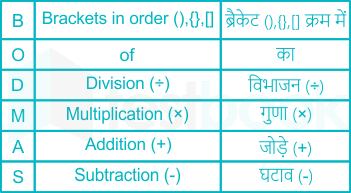
Formula used:

Follow the BODMAS rule (Brackets, Orders, Division/Multiplication, Addition/Subtraction).

Calculations:

30 - [30 - {30 - (30 - 30 × 4)}]

⇒ 30 - [30 - {30 - (30 - 120)}]

⇒ 30 - [30 - {30 - (-90)}]

⇒ 30 - [30 - {30 + 90}]

⇒ 30 - [30 - 120]

⇒ 30 - [-90]

⇒ 30 + 90

⇒ 120

∴ The correct answer is option (2).

Question 29

Consider a scenario where a user is interacting with a graphical application. Which component of the computer system is primarily responsible for rendering the visual elements displayed on the monitor?

  1. AOption (a)

    Graphics Processing Unit (GPU)

  2. BOption (b)

    Motherboard chipset

  3. COption (c)

    Random Access Memory (RAM)

  4. DOption (d)

    Central Processing Unit (CPU)

View answer & explanation

Correct answer

Answer: (a)A.

Graphics Processing Unit (GPU)

Why this answer is correct

The correct answer is Graphics Processing Unit (GPU).

Key Points

  • A Graphics Processing Unit (GPU) is a specialized hardware component designed to handle complex graphical computations efficiently, such as rendering images and animations on screens.
  • GPUs are optimized for parallel processing, which allows them to handle multiple visual computations simultaneously, making them essential for high-performance graphical applications.
  • Modern GPUs are used not only for gaming but also for tasks like video editing, 3D modeling, and AI-driven image recognition.
  • Dedicated GPUs often come with their own memory (VRAM) to store graphical data, reducing the load on the system's main RAM.
  • GPUs are integral to the operation of graphical user interfaces (GUIs) and are responsible for rendering everything from basic icons to intricate visual effects.

Additional Information

  • Central Processing Unit (CPU):
  • The CPU is the brain of the computer, responsible for executing instructions and managing general-purpose tasks.
  • While it can handle graphical computations, it is less efficient than a GPU for rendering complex visuals.
  • Random Access Memory (RAM):
  • RAM temporarily stores data that the CPU and GPU need to access quickly, including graphical data for rendering.
  • It plays a supportive role rather than directly rendering visuals.
  • Motherboard Chipset:
  • The chipset connects various components of the computer, facilitating communication between the CPU, GPU, and other peripherals.
  • While it is essential for overall system functionality, it does not directly handle rendering.
  • Modern GPU Technologies:
  • Technologies like Ray Tracing and AI-powered rendering are widely adopted in modern GPUs to enhance visual realism and efficiency.
  • Popular GPU manufacturers include NVIDIA, AMD, and Intel.

Question 30

Read the given statements and conclusions carefully. Assuming that the information given in the statements is true, even if it appears to be at variance with commonly known facts, decide which of the given conclusion(s) logically follow(s) from the statements.

 Statements:

 All fruit are bananas.

 Some bananas are green.

 All green are leaves.

 Conclusions:

 (I) Some fruits are bananas.

 (II) Some green are leaves.

  1. AOption (a)

    Both conclusions (I) and (II) follow.

  2. BOption (b)

    Only conclusion (I) follows

  3. COption (c)

    Only conclusion (II) follows

  4. DOption (d)

    Neither conclusion (I) nor (II) follows

View answer & explanation

Correct answer

Answer: (a)A.

Both conclusions (I) and (II) follow.

Why this answer is correct

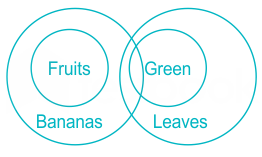
The least possible Venn diagram for the given statements is as shown below :

Conclusions:

(I) Some fruits are bananas → Follow (As all fruit are bananas. As whole fruits comes in bananas, therefore it is true.)

(II) Some green are leaves → Follow (As all green are leaves. As whole green comes in leaves, therefore it is true.)

∴ Here, Both conclusions (I) and (II) follow.​

Hence, the correct answer is "Option 1".

Question 31

Based on the English alphabetical order, three of the following four letter-cluster pairs are alike in a certain way and thus form a group. Which is the letter-cluster pair that DOES NOT belong to that group?

(Note: The odd one out is not based on the number of consonants/vowels or their position in the letter-cluster.)

  1. AOption (a)

    LJ - MK

  2. BOption (b)

    KN - IL

  3. COption (c)

    IL - GJ

  4. DOption (d)

    QT - OR

View answer & explanation

Correct answer

Answer: (a)A.

LJ - MK

Why this answer is correct

The logic followed here is:

Option 1) LJ - MK

Option 2) KN - IL

Option 3) IL - GJ

Option 4) QT - OR

​

​

Thus, out of all the options, 'LJ - MK' is the odd one out.

Hence, "Option 1" is the correct answer.

Question 32

If cot⁡θ=78, then evaluate8(1+sin⁡θ)(1−sin⁡θ)7(1+cos⁡θ)(1−cos⁡θ).\text{If } \cot\theta = \frac{7}{8}, \text{ then evaluate} \frac{8(1 + \sin\theta)(1 - \sin\theta)}{7(1 + \cos\theta)(1 - \cos\theta)}.

  1. AOption (a)

    87\frac{8}{7}

  2. BOption (b)

    4964\frac{49}{64}

  3. COption (c)

    6449\frac{64}{49}

  4. DOption (d)

    78\frac{7}{8}

View answer & explanation

Correct answer

Answer: (d)D.

78\frac{7}{8}

Why this answer is correct

Shortcut Trick

Simplify the expression using the identity (a + b)(a − b) = a2 − b2 and 1 − sin2θ = cos2θ, 1 − cos2θ = sin2θ.

Expression = [8(1 − sin2θ)] / [7(1 − cos2θ)] = (8/7) × (cos2θ / sin2θ) = (8/7) × cot2θ.

Given cotθ = 7/8, so cot2θ = 49/64.

Result = (8/7) × (49/64) = 7/8.

∴ The correct answer is 7/8.

Alternate Method

Given: cotθ = 7/8

Formula Used: sin2θ + cos2θ = 1 ⇒ 1 − sin2θ = cos2θ and 1 − cos2θ = sin2θ; cotθ = cosθ/sinθ.

⇒ Expression = [8(1 + sinθ)(1 − sinθ)] / [7(1 + cosθ)(1 − cosθ)]

⇒ Expression = [8(1 − sin2θ)] / [7(1 − cos2θ)]

⇒ Expression = (8/7) × (cos2θ / sin2θ)

⇒ Expression = (8/7) × cot2θ

⇒ Expression = (8/7) × (7/8)2

⇒ Expression = (8/7) × (49/64)

⇒ Expression = 7/8

∴ The correct answer is 7/8.

Additional Information

Trigonometric Identities

Fundamental identities include sin2θ + cos2θ = 1, 1 + tan2θ = sec2θ, and 1 + cot2θ = cosec2θ.

Trigonometric Ratios

cotθ is the ratio of the adjacent side (Base) to the opposite side (Perpendicular) in a right-angled triangle, or cosθ/sinθ.

Algebraic Identities in Trig

Applying (a − b)(a + b) = a2 − b2 is a common shortcut to simplify numerator and denominator terms containing 1 ± sinθ or 1 ± cosθ.

Question 33

In September 2024, the Indian government constituted a high-level committee headed by which individual to examine the feasibility and implementation of the 'One Nation, One Election' proposal?

  1. AOption (a)

    Justice RM Lodha

  2. BOption (b)

    Ram Nath Kovind

  3. COption (c)

    Justice BN Srikrishna

  4. DOption (d)

    Venkaiah Naidu

View answer & explanation

Correct answer

Answer: (b)B.

Ram Nath Kovind

Why this answer is correct

The correct answer is Ram Nath Kovind.

Key Points

  • In September 2024, the Indian government formed a high-level committee to explore the feasibility and implementation of the 'One Nation, One Election' proposal.
  • The committee is chaired by Ram Nath Kovind, the former President of India.
  • The 'One Nation, One Election' proposal aims to synchronize elections for the Lok Sabha, State Assemblies, Panchayats, and Urban Local Bodies to reduce electoral costs and disruptions.
  • Ram Nath Kovind was chosen to lead this effort due to his experience and knowledge of constitutional and governance matters.
  • This initiative reflects the government's intention to streamline electoral processes and improve governance efficiency in the country.

Additional Information

  • One Nation, One Election:
  • It is a proposal to hold simultaneous elections for Lok Sabha, State Assemblies, and local bodies to ensure uniformity and reduce frequent disruptions caused by election processes.
  • The concept aims to save resources, both financial and administrative, while maintaining the focus on governance.
  • Implementing this proposal requires significant constitutional amendments and consensus among political parties.
  • Ram Nath Kovind:
  • Ram Nath Kovind served as the 14th President of India from July 25, 2017, to July 25, 2022.
  • He was also a Member of Parliament in the Rajya Sabha and Governor of Bihar before assuming the presidential role.
  • Known for his legal acumen, Kovind has extensive experience in constitutional matters.
  • Electoral Costs and Challenges:
  • Frequent elections result in high financial costs, including expenses for security, logistics, and administration.
  • They also cause disruptions in governance, as the model code of conduct restricts policy decisions during election periods.
  • Constitutional Amendments:
  • Synchronizing elections would require amendments to Articles 83, 85, 172, 174, and 356 of the Constitution, among others.
  • It would also necessitate changes to Representation of People Act, 1951.
  • Previous Discussions:
  • The 'One Nation, One Election' idea has been discussed multiple times since 2014, with Prime Minister Narendra Modi advocating its merits.
  • The Law Commission of India also explored its feasibility in its 2018 report.

Question 34

A buffer solution has [CH₃COOH] = 0.1 M and [CH₃COO⁻] = 0.1 M. If pKa of CH₃COOH is 4.76, then what is its pH?

  1. AOption (a)

    5.76

  2. BOption (b)

    7.00

  3. COption (c)

    3.76

  4. DOption (d)

    4.76

View answer & explanation

Correct answer

Answer: (d)D.

4.76

Why this answer is correct

The correct answer is 4.76.

Key Points

  • The pH of a buffer solution is calculated using the Henderson-Hasselbalch equation: pH = pKa + log([A⁻]/[HA]).
  • For the given solution, [CH₃COOH] = [HA] = 0.1 M and [CH₃COO⁻] = [A⁻] = 0.1 M.
  • Since the ratio [A⁻]/[HA] = 0.1/0.1 = 1, log(1) = 0.
  • Substituting into the equation, pH = pKa = 4.76.
  • Thus, the pH of the buffer solution is exactly equal to the pKa of CH₃COOH.

Additional Information

  • Buffer Solution: A buffer solution resists changes in pH when small amounts of acid or base are added.
  • Henderson-Hasselbalch Equation: It is used to estimate the pH of a buffer solution and is given as pH = pKa + log([A⁻]/[HA]).
  • Acetic Acid (CH₃COOH): A weak acid with a pKa value of 4.76, commonly used in buffer solutions.
  • Conjugate Base: CH₃COO⁻ is the conjugate base of acetic acid, and its presence in the buffer solution helps maintain the pH.
  • Logarithmic Function: In the Henderson-Hasselbalch equation, log(1) = 0, which simplifies the calculation when [A⁻] = [HA].

Question 35

Who won the 2025 Pulitzer for Poetry with New and Selected Poems?

  1. AOption (a)

     Ada Limón

  2. BOption (b)

    Tracy K Smith

  3. COption (c)

    Ocean Vuong

  4. DOption (d)

    Marie Howe

View answer & explanation

Correct answer

Answer: (d)D.

Marie Howe

Why this answer is correct

The correct answer is Marie Howe.

Key Points

  • Marie Howe won the Pulitzer Prize for Poetry in 2025 for her work New and Selected Poems, a collection that explores themes of life, mortality, and spirituality.
  • The Pulitzer Prize for Poetry is awarded annually to an American poet for a distinguished collection of original verse.
  • Marie Howe is renowned for her lyrical and poignant poetry that often delves into personal experiences and universal truths.
  • The Pulitzer Prize for Poetry is one of the most prestigious literary awards in the United States, established in 1922.
  • Marie Howe’s work has been widely celebrated for its ability to resonate deeply with readers, bridging the gap between the personal and the universal.

Additional Information

  • Marie Howe’s Writing Style: Known for her conversational tone, her poetry often explores themes like grief, loss, love, and the human condition.
  • Origin of Pulitzer Prize: The Pulitzer Prizes were established by Joseph Pulitzer in 1917 to recognize excellence in journalism, literature, and musical composition.
  • Significance of New and Selected Poems: This collection serves as a culmination of Howe's career, offering both new works and selections from her earlier collections.
  • Other Prominent Works: Marie Howe’s previous collections include "What the Living Do" and "The Kingdom of Ordinary Time," both widely acclaimed for their emotional depth.
  • Impact of Poetry: Poetry plays a crucial role in literature, offering a unique medium to express complex emotions and societal issues in an evocative and artistic manner.

Question 36

This question is based on the five, three-digit numbers given below. (Left) 144 743 290 258 799 (Right)

 (Example- 697 – First digit = 6, second digit = 9 and third digit = 7) (NOTE: All operations to be done from left to right.)

What will be the resultant if the second digit of the highest number is subtracted from the third digit of the lowest number?

  1. AOption (a)

    -4

  2. BOption (b)

    -2

  3. COption (c)

    -7

  4. DOption (d)

    -5

View answer & explanation

Correct answer

Answer: (d)D.

-5

Why this answer is correct

Given: (Left) 144 743 290 258 799 (Right)

According to the question:

Given numbers144743290258799
Arranged in ascending order144258290743799

Second digit of the highest number → 799 → 9

Third digit of the lowest number → 144 → 4

Thus, the resultant if the second digit of the highest number is subtracted from the third digit of the lowest number is → 4 - 9 → -5

Hence, "Option 4" is the correct answer.

Question 37

Each of P, Q, R, S, T, U and V has an exam on a different day of a week starting from Monday and ending on Sunday of the same week. R has an exam on Thursday. No one has an exam before V. U has an exam immediately before R, but after S. Q has an exam before T but after P. How many people have exams between S and T?

  1. AOption (a)

    One

  2. BOption (b)

     Four

  3. COption (c)

    Two

  4. DOption (d)

    Three

View answer & explanation

Correct answer

Answer: (b)B.

 Four

Why this answer is correct

Given: Each of P, Q, R, S, T, U and V has an exam on a different day of a week starting from Monday and ending on Sunday of the same week.

1) R has an exam on Thursday.

2) No one has an exam before V. 

WeekdaysPerson
MondayV
Tuesday
Wednesday
ThursdayR
Friday
Saturday
Sunday

3) U has an exam immediately before R, but after S.

WeekdaysPerson
MondayV
TuesdayS
WednesdayU
ThursdayR
Friday
Saturday
Sunday

4) Q has an exam before T but after P.

After positioning P only one position is left which will be occupied by the only person left i.e. U.

WeekdaysPerson
MondayV
TuesdayS
WednesdayU
ThursdayR
FridayP
SaturdayQ
SundayT

Thus, four people have exams between S and T.

Hence, "Option 2" is the correct answer.

Question 38

David spends 55% of his income. If he saves ₹36,000, then his income (in ₹) is:

  1. AOption (a)

    19,800

  2. BOption (b)

     79,000

  3. COption (c)

     80,000

  4. DOption (d)

    81,000

View answer & explanation

Correct answer

Answer: (c)C.

 80,000

Why this answer is correct

Shortcut Trick

Remaining savings percentage = 100% − 55% = 45%.

Given 45% of Income = ₹36,000.

Total Income (100%) = (36,000 ÷ 45) × 100 = 800 × 100 = ₹80,000.

∴ The correct answer is ₹80,000.

Alternate Method

Given:

Expenditure = 55% of Income

Savings = ₹36,000

Calculations:

⇒ Let the total income of David be ₹X.

⇒ Savings percentage = 100% − 55% = 45%

⇒ 45% of X = 36,000

⇒ (45 ÷ 100) × X = 36,000

⇒ X = (36,000 × 100) ÷ 45

⇒ X = 800 × 100

⇒ X = 80,000

∴ The correct answer is ₹80,000.

Additional Information

Income Formula

Income = Expenditure + Savings. This is the fundamental equation for all personal finance problems.

Percentage Change

If income increases by a%, new income = Original Income × (100 + a)/100.

Base Change Rule

If Expenditure is given as a percentage of Income, the Income always acts as the base (100%).

Question 39

P, Q, R, S, T, U and V have an exam on different days of the week starting on Monday and ending on Sunday. R has an exam on Wednesday. Exactly three people have an exam between R and Q. V has an exam immediately after S and T has an exam immediately before S. Only three people have an exam between P and S. Who has an exam on Sunday?

  1. AOption (a)

    T

  2. BOption (b)

    S

  3. COption (c)

    P

  4. DOption (d)

    Q

View answer & explanation

Correct answer

Answer: (d)D.

Q

Why this answer is correct

Given: P, Q, R, S, T, U and V have an exam on different days of the week starting on Monday and ending on Sunday. 

1) R has an exam on Wednesday.

2) Exactly three people have an exam between R and Q. 

WeekdaysPerson
Monday
Tuesday
WednesdayR
Thursday
Friday
Saturday
SundayQ

3) V has an exam immediately after S and T has an exam immediately before S. 

WeekdaysPerson
Monday
Tuesday
WednesdayR
ThursdayT
FridayS
SaturdayV
SundayQ

4) Only three people have an exam between P and S.

After positioning P only one position is left which will be occupied by the only person left i.e. U.

WeekdaysPerson
MondayP
TuesdayU
WednesdayR
ThursdayT
FridayS
SaturdayV
SundayQ

Thus, Q has an exam on Sunday.

Hence, "Option 4" is the correct answer.

Question 40

If the measure of each exterior angle of a regular polygon is 30°, then the number of sides of the polygon is:

  1. AOption (a)

    14

  2. BOption (b)

    16

  3. COption (c)

    12

  4. DOption (d)

    10

View answer & explanation

Correct answer

Answer: (c)C.

12

Why this answer is correct

Shortcut Trick

For any regular polygon, the number of sides (n) is directly related to the measure of its exterior angle.

Number of sides (n) = 360° ÷ Exterior Angle

n = 360° ÷ 30° = 12

∴ The correct answer is 12.

Alternate Method

Given:

Measure of each exterior angle = 30°

Formula Used:

The sum of all exterior angles of any convex polygon is always 360°. For a regular polygon with n sides, each exterior angle is given by:

Each Exterior Angle = 360° ÷ n

Calculations:

⇒ 30° = 360° ÷ n

⇒ n = 360° ÷ 30°

⇒ n = 12

∴ The correct answer is 12.

Question 41

What should come in place of the question mark (?) in the given series?

882 880 876 870 862 ?

  1. AOption (a)

    850

  2. BOption (b)

    856

  3. COption (c)

    852

  4. DOption (d)

    854

View answer & explanation

Correct answer

Answer: (c)C.

852

Why this answer is correct

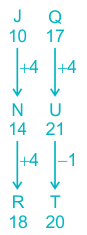
The logic followed here is:

Hence, "Option 3" is the correct answer.

Question 42

What is the median of the following distribution?

Class150-200200-250250-300300-350350-400
Frequency2019322712
  1. AOption (a)

    286

  2. BOption (b)

    261

  3. COption (c)

    275

  4. DOption (d)

    293

View answer & explanation

Correct answer

Answer: (c)C.

275

Why this answer is correct

Shortcut Trick

Total Frequency N = 110, so N/2 = 55.

Cumulative Frequencies are: 20, 39, 71, 98, 110.

The value 55 falls in the 250−300 class (Median Class).

Median = 250 + [(55 − 39) ÷ 32] × 50 = 250 + [16 ÷ 32] × 50 = 250 + 25 = 275.

∴ The correct answer is 275.

Alternate Method

Given: Frequency distribution for classes 150−400.

Formula Used: Median = L + [((N/2) − cf) ÷ f] × h

Calculations:

⇒ Total frequency N = 20 + 19 + 32 + 27 + 12 = 110

⇒ N/2 = 110 ÷ 2 = 55

⇒ Cumulative Frequencies (CF): 20, 39, 71, 98, 110

⇒ Since 55 lies in the cumulative frequency 71, Median Class = 250−300

⇒ Lower limit L = 250, Frequency f = 32, Prev CF cf = 39, Class width h = 50

⇒ Median = 250 + [(55 − 39) ÷ 32] × 50

⇒ Median = 250 + [16 ÷ 32] × 50

⇒ Median = 250 + 0.5 × 50 = 250 + 25 = 275

∴ The correct answer is 275.

Additional Information

Median of Grouped Data

The median is the middle value of a data set. For grouped data, it is calculated using the formula: Median = L + [((N/2) − cf) / f] × h.

Empirical Relationship

For a moderately skewed distribution: Mode = 3 × Median − 2 × Mean.

Median Class Identification

The median class is the first class interval whose cumulative frequency is greater than or equal to N/2.

Question 43

Anwar’s salary is ₹11,000 per month. He spends ₹6,000 on house rent and ₹3,000 on bills, and the rest of the amount is his monthly savings. Find his savings (in ₹) in a year, if in the month of his birthday, he spent all his monthly savings on birthday celebrations.

  1. AOption (a)

     18,000

  2. BOption (b)

     24,000

  3. COption (c)

    22,000

  4. DOption (d)

    20,000

View answer & explanation

Correct answer

Answer: (c)C.

22,000

Why this answer is correct

Shortcut Trick

Monthly Salary = ₹11,000

Monthly Expenditure = ₹6,000 + ₹3,000 = ₹9,000

Monthly Savings = ₹11,000 − ₹9,000 = ₹2,000

Savings for 11 months (excluding birthday month) = ₹2,000 × 11 = ₹22,000

∴ The correct answer is ₹22,000.

Alternate Method

Given:

Monthly Salary = ₹11,000

House Rent = ₹6,000

Bills = ₹3,000

Calculations:

⇒ Total Monthly Expenditure = 6,000 + 3,000 = ₹9,000

⇒ Monthly Savings = 11,000 − 9,000 = ₹2,000

⇒ Total Months in a year = 12

⇒ Months in which he saves = 12 − 1 (Birthday Month) = 11 months

⇒ Annual Savings = 2,000 × 11

⇒ Annual Savings = ₹22,000

∴ The correct answer is ₹22,000.

Additional Information

Income-Expenditure Concept

Income = Expenditure + Savings. Any increase in expenditure with constant income directly reduces savings.

Percentage Savings

Savings % = (Savings ÷ Income) × 100. In this case, monthly savings % = (2,000/11,000) × 100 ≈ 18.18%.

Annual Calculation

When a specific month's savings are spent, subtract that month's value or simply calculate for the remaining 11 months.

Question 44

When saving an MS PowerPoint presentation, which of the following options would be most suitable if the primary goal is to ensure the presentation opens in slideshow view by default for recipients who may not have MS PowerPoint installed?

  1. AOption (a)

    PowerPoint Presentation (.pptx)

  2. BOption (b)

    PowerPoint Show (.ppsx)

  3. COption (c)

    OpenDocument Presentation (.odp)

  4. DOption (d)

    PDF (.pdf)

View answer & explanation

Correct answer

Answer: (b)B.

PowerPoint Show (.ppsx)

Why this answer is correct

The correct answer is PowerPoint Show (.ppsx).

Key Points

  • A .ppsx file is specifically designed to open directly in slideshow mode when double-clicked, making it ideal for presentations intended to be viewed rather than edited.
  • This format ensures compatibility for recipients who may not have MS PowerPoint installed, as it can be opened using free viewers like Microsoft PowerPoint Viewer or other compatible software.
  • Unlike .pptx files, which open in editing mode by default, .ppsx files focus solely on the presentation experience.
  • Converting a presentation to .ppsx is straightforward and can be done directly in MS PowerPoint using the "Save As" option.
  • The .ppsx format is widely supported and ensures the presentation retains its intended design and functionality.

Additional Information

  • PowerPoint Presentation (.pptx):
  • This is the default file format for editable presentations created in MS PowerPoint.
  • .pptx files open in editing mode, allowing users to make changes to the content and design.
  • While widely supported, it is not ideal for direct slideshow viewing.
  • OpenDocument Presentation (.odp):
  • An open-source format used by programs like LibreOffice and OpenOffice.
  • Not as feature-rich or widely supported as MS PowerPoint formats.
  • May lose compatibility or formatting when used with MS PowerPoint.
  • PDF (.pdf):
  • PDFs are static and do not support animations or transitions commonly used in slideshows.
  • Ideal for sharing non-editable presentation content but unsuitable for dynamic slideshow viewing.
  • Can be opened universally on almost any device with a PDF reader.
  • Compatibility of .ppsx Files:
  • .ppsx files can be viewed using Microsoft PowerPoint, PowerPoint Viewer, and other compatible software.
  • Ensures the recipient sees the presentation exactly as intended by the creator.
  • Widely used for professional presentations and events.

Question 45

 In March 2025, where was the main event of the 56th Central Industrial Security Force (CISF) Raising Day celebrated?

  1. AOption (a)

    Thakkolam, Tamil Nadu

  2. BOption (b)

    Pune, Maharashtra

  3. COption (c)

     Mumbai, Maharashtra

  4. DOption (d)

    Gurugram, Haryana

View answer & explanation

Correct answer

Answer: (a)A.

Thakkolam, Tamil Nadu

Why this answer is correct

The correct answer is Thakkolam, Tamil Nadu.

Key Points

  • The main event of the 56th Central Industrial Security Force (CISF) Raising Day was celebrated on March 10, 2025, in Thakkolam, Tamil Nadu.
  • This marked the first time the CISF Raising Day celebration was held in Tamil Nadu, showcasing the force's commitment to pan-India visibility.
  • The event highlighted CISF’s pivotal role in securing critical infrastructure and industries across the nation.
  • Key dignitaries, including senior officials from the Ministry of Home Affairs and state government representatives, attended the celebration.
  • The CISF demonstrated its operational excellence through parades, exhibitions, and drills as part of the event.

Additional Information

  • Central Industrial Security Force (CISF):
  • Established in 1969, CISF is one of the Central Armed Police Forces (CAPFs) of India.
  • The force provides security to critical infrastructure such as airports, metro systems, government buildings, and industrial establishments.
  • It operates under the administrative control of the Ministry of Home Affairs.
  • Raising Day Significance:
  • The CISF Raising Day commemorates the formation of the force and serves as an occasion to honor its contributions to national security.
  • The event fosters morale and public awareness regarding the role of CISF in safeguarding the nation.
  • CISF Deployment:
  • CISF is deployed across a wide array of sectors, including power plants, space organizations, and ports.
  • It also provides security to VIPs and disaster management services during emergencies.
  • Regional Celebrations:
  • Hosting the event in different regions promotes inclusivity and emphasizes the nationwide presence of CISF.
  • The 2025 event in Tamil Nadu highlighted the southern region's importance in industrial and infrastructural growth.

Question 46

HN 19 is related to DK 30 in a certain way. In the same way, JR 11 is related to FO 22. To which of the given options is SF 3 related, following the same logic?

  1. AOption (a)

    OB 12

  2. BOption (b)

    NB 12

  3. COption (c)

     OC 14

  4. DOption (d)

    NC 14

View answer & explanation

Correct answer

Answer: (c)C.

 OC 14

Why this answer is correct

The logic followed here is:

​HN 19 is related to DK 30

And,

JR 11 is related to FO 22

Similarly,

SF 3 is related to

Hence, "Option 3" is the correct answer.

Question 47

Which drama received the 2025 Pulitzer Prize for Drama?

  1. AOption (a)

    English

  2. BOption (b)

    Fat Ham

  3. COption (c)

    The Minutes

  4. DOption (d)

    Purpose

View answer & explanation

Correct answer

Answer: (d)D.

Purpose

Why this answer is correct

The correct answer is Purpose.

Key Points

  • The Pulitzer Prize for Drama is awarded annually to recognize outstanding theatrical works performed in the United States.
  • Purpose, written and performed by a distinguished playwright, received the 2025 Pulitzer Prize for Drama.
  • The play explores themes of identity, resilience, and societal issues, resonating with audiences and critics alike.
  • The Pulitzer Prize board acknowledged the play for its exceptional storytelling, character development, and impactful social commentary.
  • "Purpose" was staged in prominent theaters and received widespread acclaim for its innovative narrative and cultural relevance.

Additional Information

  • Pulitzer Prize: Established in 1917 by provisions in the will of Joseph Pulitzer, it honors excellence in journalism, literature, and musical composition.
  • Drama Category: Recognizes original plays that have been performed during the preceding calendar year in the United States.
  • Criteria: Plays are judged on their artistic merit, originality, and ability to address contemporary issues effectively.
  • Notable Past Winners: Include works such as "Hamilton" by Lin-Manuel Miranda (2016) and "A Strange Loop" by Michael R. Jackson (2020).
  • Significance: The award boosts the visibility and legacy of playwrights and their works, often leading to further opportunities in theater and media adaptations.

Question 48

The average price of three items of furniture is ₹15,165. If their prices are in the ratio 3 : 5 : 7, the price of the costliest item (in ₹) is:

  1. AOption (a)

    5,055

  2. BOption (b)

    7,077

  3. COption (c)

    9,099

  4. DOption (d)

    21,231

View answer & explanation

Correct answer

Answer: (d)D.

21,231

Why this answer is correct

Shortcut Trick

Sum of ratios = 3 + 5 + 7 = 15 units

Total Price = Average × Number of items = 15,165 × 3

Value of 1 unit = (15,165 × 3) ÷ 15 = 15,165 ÷ 5 = 3,033

Costliest item (7 units) = 7 × 3,033 = 21,231

∴ The correct answer is ₹21,231.

Alternate Method

Given:

Average price of 3 items = ₹15,165

Ratio of prices = 3 : 5 : 7

Formula:

Total Value = Average × Count

Calculations:

⇒ Let the prices be 3x, 5x, and 7x

⇒ Total Price = 15,165 × 3 = 45,495

⇒ 3x + 5x + 7x = 45,495

⇒ 15x = 45,495

⇒ x = 45,495 ÷ 15 = 3,033

⇒ Price of costliest item = 7x = 7 × 3,033 = 21,231

∴ The correct answer is ₹21,231.

Additional Information

Average Concept

Average = Sum of all observations ÷ Number of observations. Sum = Average × n.

Ratio and Proportion

If a total quantity Q is divided in ratio a:b:c, the largest part corresponds to the largest ratio value. Value of part a = [a / (a+b+c)] × Q.

Ratio Multiplier

The constant 'x' used in ratios is the HCF of the actual values. Finding 'x' allows you to find any individual value.

Question 49

A train overtakes two persons walking along a railway track. The first one walks at 12.6 km/hr. The other one walks at 30.6 km/hr. The train takes 19.8 and 25.8 seconds, respectively, to overtake them. What is the speed of the train if both the persons are walking in the same direction as the train?

  1. AOption (a)

    94 km/hr

  2. BOption (b)

    90 km/hr

  3. COption (c)

    96 km/hr

  4. DOption (d)

    80 km/hr

View answer & explanation

Correct answer

Answer: (b)B.

90 km/hr

Why this answer is correct

Shortcut Trick

In same direction, Relative Speed = Train Speed (V) − Person Speed.

Since Length of Train (L) is constant: (V − 12.6) × 19.8 = (V − 30.6) × 25.8.

3.3V − 41.58 = 4.3V − 131.58 ⇒ V = 90 km/hr.

∴ The correct answer is 90 km/hr.

Alternate Method

Given: Speed of P1 = 12.6 km/hr, Speed of P2 = 30.6 km/hr, Time1 = 19.8 s, Time2 = 25.8 s.

Formula: Distance = Relative Speed × Time

⇒ Let Train Speed be V km/hr. Length of train L is same in both cases.

⇒ L = (V − 12.6) × (5/18) × 19.8 --- (1)

⇒ L = (V − 30.6) × (5/18) × 25.8 --- (2)

⇒ (V − 12.6) × 19.8 = (V − 30.6) × 25.8

⇒ 19.8V − 249.48 = 25.8V − 789.48

⇒ 6V = 540

⇒ V = 90 km/hr.

∴ The correct answer is 90 km/hr.

Additional Information

Relative Speed Concept

When two objects move in the same direction, relative speed = S1 − S2. In opposite directions, relative speed = S1 + S2.

Unit Conversion

To convert km/hr to m/s, multiply by 5/18. To convert m/s to km/hr, multiply by 18/5.

Train Overtaking a Person

The distance covered by the train to cross/overtake a person is equal to the length of the train itself.

Question 50

Each of P, Q, R, S, T, U and V has an exam on a different day of a week starting from Monday and ending on Sunday of the same week. P has an exam on Thursday. T has an exam immediately before P, and V has an exam immediately after P. Only 3 people have an exam between U and Q. R has an exam immediately after Q. How many people have an exam between Q and S?

  1. AOption (a)

    2

  2. BOption (b)

    4

  3. COption (c)

    1

  4. DOption (d)

    3

View answer & explanation

Correct answer

Answer: (b)B.

4

Why this answer is correct

Given: Each of P, Q, R, S, T, U and V has an exam on a different day of a week starting from Monday and ending on Sunday of the same week.

1) P has an exam on Thursday. 

2) T has an exam immediately before P, and V has an exam immediately after P.

WeekdaysPerson
Monday
Tuesday
WednesdayT
ThursdayP
FridayV
Saturday
Sunday

3) Only 3 people have an exam between U and Q. 

4) R has an exam immediately after Q.

After positioning U, Q and R only one position is left which will be occupied by the only person left i.e. S.

WeekdaysPerson
MondayS
TuesdayU
WednesdayT
ThursdayP
FridayV
SaturdayQ
SundayR

Thus, four people have an exam between Q and S.

Hence, "Option 2" is the correct answer.

Question 51

Based on the English alphabetical order, three of the following four letter-clusters are alike in a certain way and thus form a group. Which letter-cluster DOES NOT belong to that group?

(Note: The odd one out is not based on the number of consonants/vowels or their position in the letter-cluster.)

  1. AOption (a)

    OSM

  2. BOption (b)

    MQL

  3. COption (c)

    KOJ

  4. DOption (d)

    RVQ

View answer & explanation

Correct answer

Answer: (a)A.

OSM

Why this answer is correct

The logic followed here is:

Option 1) OSM

Option 2) MQL

Option 3) KOJ

Option 4) RVQ

​

​

Thus, out of all the options, 'LJ - MK' is the odd one out.

Hence, "Option 1" is the correct answer.

Question 52

A 250 m long train overtakes a man moving at a speed of 7 km/hr (in same direction) in 50 seconds. How much time (in seconds) will this train take to completely cross another 280 m long train, moving in the opposite direction at a speed of 28 km/hr?

  1. AOption (a)

    36

  2. BOption (b)

    50

  3. COption (c)

    49

  4. DOption (d)

    54

View answer & explanation

Correct answer

Answer: (a)A.

36

Why this answer is correct

Shortcut Trick

Step 1: Relative Speed (v1 − 7) × 5/18 = 250 / 50 ⇒ v1 − 7 = 18 ⇒ Train Speed = 25 km/hr.

Step 2: Relative Speed (Opposite) = 25 + 28 = 53 km/hr.

Step 3: Total Distance = 250 + 280 = 530 m.

Step 4: Time = 530 / (53 × 5/18) = 10 × 18 / 5 = 36 seconds.

∴ The correct answer is 36 seconds.

Alternate Method

Given: Length of train 1 (L1) = 250 m, Man speed = 7 km/hr, Time to cross man = 50 s, Length of train 2 (L2) = 280 m, Speed of train 2 (v2) = 28 km/hr.

Formula Used: Speed = Distance / Time; Relative speed (same direction) = v1 − v2; Relative speed (opposite direction) = v1 + v2; 1 km/hr = 5/18 m/s.

⇒ Case 1 (Train crosses man): Relative Speed = L1 / Time

⇒ (v1 − 7) × 5/18 = 250 / 50

⇒ (v1 − 7) × 5/18 = 5

⇒ v1 − 7 = 18 ⇒ v1 = 25 km/hr

⇒ Case 2 (Train crosses train 2): Time = (L1 + L2) / (v1 + v2)

⇒ Time = (250 + 280) / [(25 + 28) × 5/18]

⇒ Time = 530 / (53 × 5/18) = (530 × 18) / (53 × 5)

⇒ Time = 10 × 18 / 5 = 2 × 18 = 36 seconds

∴ The correct answer is 36 seconds.

Additional Information

Relative Speed Concepts

When two objects move in the same direction, relative speed is |v1 − v2|. When they move in opposite directions, relative speed is v1 + v2.

Crossing Distance Rule

To cross a stationary point object (man, pole, tree), the train travels its own length. To cross another object with length (platform, bridge, train), it travels Sum of Lengths.

Unit Conversion

To convert km/hr to m/s, multiply by 5/18. To convert m/s to km/hr, multiply by 18/5.

Question 53

A shopkeeper purchased 83 dozens of articles at the rate of ₹560 per dozen. He sold each one of them at the rate of ₹49. What percentage profit did he make?

  1. AOption (a)

    3%

  2. BOption (b)

    8%

  3. COption (c)

     5%

  4. DOption (d)

    7%

View answer & explanation

Correct answer

Answer: (c)C.

 5%

Why this answer is correct

Shortcut Trick

Find the Cost Price (CP) of a single article: 560 ÷ 12 = ₹140/3.

Find the Selling Price (SP) of a single article: ₹49.

Calculate Profit% using the ratio: CP : SP = (140/3) : 49 ⇒ 140 : 147.

Profit = 147 − 140 = 7 units.

Profit% = (7 ÷ 140) × 100 = 5%.

∴ The correct answer is 5%.

Alternate Method

Given → CP per dozen = ₹560, SP per unit = ₹49. Formulas: Profit = SP − CP | Profit% = (Profit ÷ CP) × 100 | SP per dozen = SP per unit × 12.

⇒ Cost Price (CP) for 12 articles = ₹560. ⇒ Selling Price (SP) for 12 articles = 49 × 12 = ₹588. ⇒ Profit = SP − CP = 588 − 560 = ₹28. ⇒ Profit Percentage = (Profit ÷ CP) × 100. ⇒ Profit% = (28 ÷ 560) × 100 = (1 ÷ 20) × 100 = 5%.

∴ The correct answer is 5%.

Additional Information

Unit Independence in Profit%

Profit percentage is a ratio-based value. It remains the same whether calculated for a single item, a dozen, or the total quantity (83 dozens), provided CP and SP are for the same quantity.

Formula for Profit%

Profit% = [(SP − CP) ÷ CP] × 100. Always ensure CP and SP are compared for the same number of articles.

Question 54

The least number which, when diminished by 5, is divisible by 20, 15, 14 and 22 is:

  1. AOption (a)

    4625

  2. BOption (b)

    4586

  3. COption (c)

    4578

  4. DOption (d)

    4612

View answer & explanation

Correct answer

Answer: (a)A.

4625

Why this answer is correct

Shortcut Trick

Required number = LCM(20, 15, 14, 22) + 5

LCM of 20, 15, 14, 22:

20 = 22 × 5 | 15 = 3 × 5 | 14 = 2 × 7 | 22 = 2 × 11

LCM = 22 × 3 × 5 × 7 × 11 = 4 × 165 × 7 = 4620

Required Number = 4620 + 5 = 4625

∴ The correct answer is 4625.

Alternate Method

Given:

Divisors: 20, 15, 14, 22

Condition: Number − 5 is exactly divisible by all divisors.

Calculation:

⇒ Prime factors of 20 = 2 × 2 × 5

⇒ Prime factors of 15 = 3 × 5

⇒ Prime factors of 14 = 2 × 7

⇒ Prime factors of 22 = 2 × 11

⇒ LCM = 22 × 3 × 5 × 7 × 11

⇒ LCM = 4 × 3 × 5 × 7 × 11 = 4620

⇒ Let the required number be X.

⇒ X − 5 = 4620

⇒ X = 4620 + 5 = 4625

∴ The correct answer is 4625.

Additional Information

LCM (Least Common Multiple)

The smallest positive integer that is divisible by each of the given numbers without leaving a remainder.

Divisibility Rules

For a number to be divisible by 22, it must be divisible by both 2 and 11. For 15, it must be divisible by 3 and 5.

Standard Remainder Case

If a number leaves a remainder r when divided by a, b, and c, the number is LCM(a, b, c) + r.

Question 55

When the difference between compound interest, compounded annually, and simple interest for three years is ₹217 at 10% interest per annum, the principal is ₹_____.

  1. AOption (a)

    6,425

  2. BOption (b)

    8,200

  3. COption (c)

    7,000

  4. DOption (d)

    7,420

View answer & explanation

Correct answer

Answer: (c)C.

7,000

Why this answer is correct

Shortcut Trick

Rate (R) = 10% = 1/10 (Let denominator be 'x').

For three years, the ratio of (CI − SI) to Principal is (3x + 1) / x3.

Here, x = 10, so Difference = 3(10) + 1 = 31 units.

31 units = ₹217 ⇒ 1 unit = ₹7.

Principal = x3 = 103 = 1000 units = 1000 × 7 = ₹7,000.

∴ The correct answer is ₹7,000.

Alternate Method

Given:

Difference between Compound Interest and Simple Interest (D) = ₹217

Rate of Interest (R) = 10% per annum

Time Period (T) = 3 years

Formula Used:

Difference (D) = P × (R/100)2 × [(300 + R)/100]

Calculations:

⇒ 217 = P × (10/100)2 × [(300 + 10)/100]

⇒ 217 = P × (1/10)2 × (310/100)

⇒ 217 = P × (1/100) × (31/10)

⇒ 217 = P × (31/1000)

⇒ P = (217 × 1000) / 31

⇒ P = 7 × 1000

⇒ P = ₹7,000

∴ The correct answer is ₹7,000.

Additional Information

CI − SI for 2 Years

The difference between compound interest and simple interest for two years is given by the formula: D = P(R/100)2.

Effective Rate of Interest

For a 10% rate, the effective CI rate for 2 years is 21% (10+10 + 10×10/100) and for 3 years is 33.1%.

Simple Interest Formula

Simple interest is calculated on the original principal every year: SI = (P × R × T) / 100.

Question 56

Under Article 164(3) of the Constitution of India, who administers the oath of office to the State Ministers?

  1. AOption (a)

    President of India

  2. BOption (b)

    Governor of the State

  3. COption (c)

    Speaker of the Legislative Assembly

  4. DOption (d)

    Chief Minister of the State

View answer & explanation

Correct answer

Answer: (b)B.

Governor of the State

Why this answer is correct

The correct answer is Governor of the State.

Key Points

  • Under Article 164(3) of the Constitution of India, the Governor of the State administers the oath of office and secrecy to the State Ministers.
  • The oath is administered in accordance with the form prescribed in the Third Schedule of the Indian Constitution.
  • The Governor acts as the constitutional head of the state and performs this function as part of their responsibilities.
  • The oath ceremony typically takes place in the presence of other dignitaries, and the Chief Minister recommends the names of the ministers to the Governor.

Additional Information

  • Article 164 of the Constitution:
  • It outlines the appointment and tenure of the Chief Minister and other ministers in a state.
  • The Governor appoints the Chief Minister, and on the advice of the Chief Minister, appoints other ministers.
  • Third Schedule of the Constitution:
  • It contains the forms of oath or affirmation for various constitutional posts, including ministers.
  • The oath emphasizes the duty to uphold the Constitution and work without fear or favor.
  • Governor's Role:
  • The Governor is the nominal executive head of the state, while the real executive powers lie with the Council of Ministers headed by the Chief Minister.
  • As per the Constitution, the Governor administers oaths, summons the legislature, and ensures the state government functions within the framework of the Constitution.
  • Legislative Assembly Speaker:
  • The Speaker presides over the sessions of the legislative assembly but does not administer oaths to ministers.
  • The Speaker's role is primarily related to legislative procedures, debates, and maintaining order in the house.
  • Separation of Powers:
  • The Constitution ensures a clear distinction between the roles of the executive, legislature, and judiciary to maintain a balance of power.
  • The Governor's role as the administrator of oaths is part of the executive function.

Question 57

Who won the Champions of the Earth Award, 2024, the UN’s highest environmental recognition?

  1. AOption (a)

    Madhav Gadgil

  2. BOption (b)

    Zeeshan Khan

  3. COption (c)

    Sunderlal Bahuguna

  4. DOption (d)

    Ramdeo Misra

View answer & explanation

Correct answer

Answer: (a)A.

Madhav Gadgil

Why this answer is correct

The correct answer is Madhav Gadgil.

Key Points

  • Madhav Gadgil, an eminent Indian ecologist, is renowned for his contributions to environmental conservation and sustainable development.
  • He has been associated with the formulation of the Western Ghats Ecology Expert Panel (WGEEP), which provided groundbreaking recommendations for the preservation of the ecologically sensitive Western Ghats region.
  • His work emphasizes the importance of community-based conservation and the integration of traditional knowledge with scientific research.
  • Madhav Gadgil's recognition with the Champions of the Earth Award, the UN's highest environmental honor, highlights his relentless efforts toward ecological sustainability.
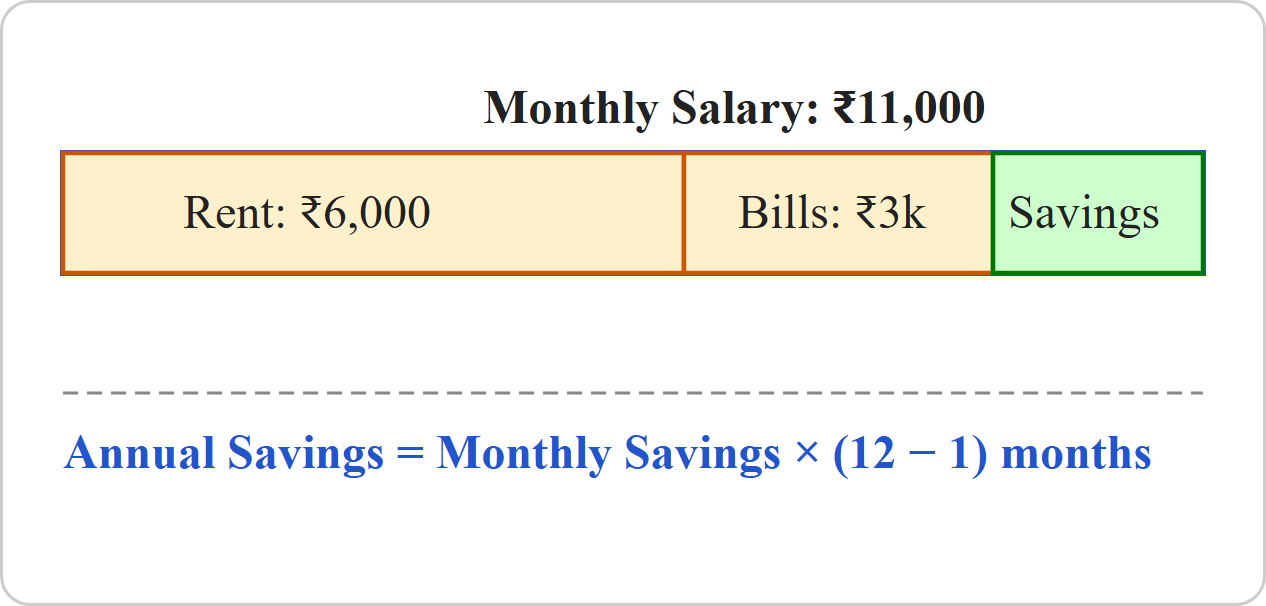
  • The award celebrates individuals who have made exceptional contributions to environmental protection and sustainable development globally.

Additional Information

  • Champions of the Earth Award:
  • It is the United Nations' flagship environmental award presented by the United Nations Environment Programme (UNEP).
  • The award recognizes pioneers in environmental conservation, sustainable development, and climate action.
  • It is conferred annually in various categories, including Policy Leadership, Science and Innovation, Entrepreneurial Vision, and Lifetime Achievement.
  • Western Ghats Ecology Expert Panel (WGEEP):
  • Also known as the Gadgil Committee, it was established to assess and recommend measures for the conservation of the Western Ghats, a UNESCO World Heritage site.
  • The panel proposed a classification of zones based on ecological sensitivity and advocated community participation in decision-making.
  • Its recommendations sparked significant debates on balancing development and conservation in India.
  • Ecological Conservation:
  • Ecological conservation involves the protection and sustainable management of ecosystems and biodiversity.
  • It emphasizes minimizing human impact and promoting practices that restore and preserve natural habitats.
  • Community engagement and traditional ecological knowledge are crucial components of successful conservation efforts.
  • Sustainable Development:
  • Defined as development that meets the needs of the present without compromising the ability of future generations to meet their own needs.
  • It integrates economic, social, and environmental dimensions to ensure long-term viability.
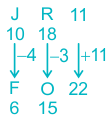
  • The concept is central to global efforts to combat climate change and environmental degradation.

Question 58

Which of the following is known as the 'Steel City of India'?

  1. AOption (a)

    Pilani

  2. BOption (b)

     Indore

  3. COption (c)

    Ankaleswa

  4. DOption (d)

    Jamshedpur

View answer & explanation

Correct answer

Answer: (d)D.

Jamshedpur

Why this answer is correct

The correct answer is Jamshedpur.

Key Points

  • Jamshedpur is popularly known as the Steel City of India due to its massive steel production and industrial infrastructure.
  • It was founded by Jamsetji Tata, the founder of Tata Group, in 1907 and serves as the headquarters of Tata Steel, one of India's largest steel manufacturers.
  • The city is located in the state of Jharkhand and is one of the first planned industrial cities in India.
  • Jamshedpur is renowned for its clean environment, well-maintained infrastructure, and contributions to India's industrial sector.
  • It houses one of the largest steel plants in India, contributing significantly to India's economy and employment.

Additional Information

  • Steel Industry in India:
  • India is one of the largest producers of steel globally, with major contributions from cities like Jamshedpur, Rourkela, and Bhilai.
  • The steel industry plays a crucial role in sectors like construction, automotive, and infrastructure.
  • India's steel production is driven by companies like Tata Steel, Steel Authority of India Limited (SAIL), and JSW Steel.
  • Tata Steel:
  • Tata Steel is one of the world's leading steel producers, headquartered in Jamshedpur.
  • Founded in 1907, it operates one of India's first integrated steel plants and has a global footprint.
  • The company emphasizes sustainability and innovation in steel production.
  • Planned Cities in India:
  • Jamshedpur is one of India's earliest planned cities, designed with a focus on industrial growth and urban development.
  • Other notable planned cities include Chandigarh and Navi Mumbai.
  • Jamsetji Tata:
  • Jamsetji Tata is often referred to as the "Father of Indian Industry" for his contributions to industrial growth in India.
  • He envisioned Jamshedpur as a hub for steel production and a model industrial city.
  • His legacy continues through the Tata Group's initiatives in various sectors.

Question 59

Which of the following is NOT a valid way to save a workbook in Microsoft Excel?

  1. AOption (a)

    Clicking 'File' → 'Save'

  2. BOption (b)

    Using 'File' → 'Close'

  3. COption (c)

    Selecting 'File' → 'Save As'

  4. DOption (d)

    Pressing 'Ctrl + S'

View answer & explanation

Correct answer

Answer: (b)B.

Using 'File' → 'Close'

Why this answer is correct

The correct answer is Using 'File' → 'Close'.

Key Points

  • 'File' → 'Close' is used to close the workbook but does not save it automatically.
  • Saving a workbook requires explicit actions such as 'File' → 'Save' or 'File' → 'Save As'.
  • Keyboard shortcuts like 'Ctrl + S' are designed specifically for saving the workbook quickly.
  • 'File' → 'Close' merely closes the current workbook without saving changes unless prompted by Excel to save unsaved work.
  • Excel provides multiple ways to save your work, but 'File' → 'Close' alone does not serve the purpose.

Additional Information

  • Saving a Workbook: The 'Save' option ensures that all changes made to a workbook are stored in the file.
  • 'Save As' Functionality: Allows users to save a copy of the workbook with a new name or in a different format.
  • Keyboard Shortcuts: 'Ctrl + S' is a universal shortcut for saving files across many programs, including Microsoft Excel.
  • Closing Workbooks: When using 'File' → 'Close,' Excel may prompt users to save if there are unsaved changes, but it does not inherently save the file.
  • Excel Automation: Excel can be configured to enable auto-save functionality, ensuring changes are periodically saved without manual intervention.

Question 60

Mahatma Gandhi called off the Non-Cooperation Movement after the violent incident at Chauri Chaura. In which present-day state is Chauri Chaura located?

  1. AOption (a)

    Rajasthan

  2. BOption (b)

    Uttar Pradesh

  3. COption (c)

    Madhya Pradesh

  4. DOption (d)

    Bihar

View answer & explanation

Correct answer

Answer: (b)B.

Uttar Pradesh

Why this answer is correct

The correct answer is Uttar Pradesh.

Key Points

  • Chauri Chaura is a town located in the Gorakhpur district of Uttar Pradesh, India.
  • The Chauri Chaura incident occurred on February 4, 1922, during the Non-Cooperation Movement led by Mahatma Gandhi.
  • This violent event involved the burning of a police station by protestors, resulting in the death of 22 policemen.
  • Following the incident, Mahatma Gandhi, emphasizing non-violence, called off the Non-Cooperation Movement.
  • The Chauri Chaura event is considered a turning point in India's freedom struggle, showcasing the challenges of maintaining non-violent civil disobedience.

Additional Information

  • Non-Cooperation Movement: Launched by Mahatma Gandhi in 1920, it aimed to resist British rule through non-violent means such as boycotting British goods, institutions, and services.
  • Significance of Chauri Chaura: The incident highlighted the difficulties of controlling large-scale movements and maintaining non-violence in mass protests.
  • Gorakhpur District: Known for its historical and cultural significance, Gorakhpur is also the headquarters of the Gorakhnath Math, a prominent religious institution in Uttar Pradesh.
  • Impact on Indian Freedom Struggle: The suspension of the Non-Cooperation Movement led to a temporary decline in mass protests but also paved the way for future campaigns like the Civil Disobedience Movement.
  • Gandhi's Philosophy of Non-Violence: The incident reinforced Gandhi's commitment to non-violence (Ahimsa) as the cornerstone of India's independence struggle.

Question 61

What was the name of Ramagupta's widow whom Chandragupta II marry after defeating the Saka king?

  1. AOption (a)

    Dhruvadevi

  2. BOption (b)

    Yasomati

  3. COption (c)

    Devatidevi

  4. DOption (d)

    Kubernaga

View answer & explanation

Correct answer

Answer: (a)A.

Dhruvadevi

Why this answer is correct

The correct answer is Dhruvadevi.

Key Points

  • Dhruvadevi was the widow of Ramagupta, the elder brother of Chandragupta II, also known as Chandragupta Vikramaditya.
  • After Ramagupta's defeat and death, Chandragupta II married Dhruvadevi, solidifying his claim to the throne.
  • This marriage is believed to have had political significance, strengthening Chandragupta II's legitimacy as the ruler of the Gupta Empire.
  • Chandragupta II later defeated the Saka king Rudrasimha III, marking the end of the Saka rule in western India.
  • The Gupta Empire under Chandragupta II became one of the most powerful and culturally vibrant empires in ancient Indian history.

Additional Information

  • Ramagupta: The elder brother of Chandragupta II, Ramagupta is often depicted as a weak ruler in historical accounts.
  • Saka Dynasty: The Sakas, also known as Scythians, were a group of nomadic tribes who ruled parts of western India before being defeated by Chandragupta II.
  • Chandragupta II: Known for his military prowess, Chandragupta II expanded the Gupta Empire and is considered one of its greatest rulers.
  • Dhruvadevi's Role: Dhruvadevi's marriage to Chandragupta II is mentioned in historical texts and inscriptions, symbolizing a strategic political alliance.
  • Gupta Empire: The Gupta period (circa 320-550 CE) is often referred to as the "Golden Age" of India due to its achievements in art, science, and culture.

Question 62

The Paramhansa Sabha was founded in:

  1. AOption (a)

    1875

  2. BOption (b)

    1849

  3. COption (c)

    1857

  4. DOption (d)

    1865

View answer & explanation

Correct answer

Answer: (b)B.

1849

Why this answer is correct

The correct answer is 1849.

Key Points

  • The Paramhansa Sabha was founded in 1849 in Maharashtra as a secret socio-religious reform society.
  • It was started by Dadoba Pandurang, along with his associates, with the aim of promoting social and religious reforms.
  • The Sabha focused on abolishing caste discrimination and promoting equality within society.
  • It emphasized the study of religious texts, spreading knowledge, and creating a sense of brotherhood among people.
  • The Sabha played a crucial role in laying the foundation for later reform movements, such as the Prarthana Samaj.

Additional Information

  • Dadoba Pandurang Tarkhadkar: A key figure in the socio-religious reform movement in Maharashtra, known for his efforts in promoting liberal thought and education.
  • Prarthana Samaj: Inspired by the Paramhansa Sabha, this organization was later founded in 1867 with a focus on social reform and religious rationalism.
  • Social Reform Movements in India: The 19th century saw a wave of reform movements aimed at eradicating social evils like caste discrimination, child marriage, and sati.
  • Secret Societies for Reform: Many early reform initiatives, like the Paramhansa Sabha, operated in secrecy to avoid opposition from orthodox sections of society.
  • Legacy of Paramhansa Sabha: It influenced other reform movements and became a precursor to organizations advocating for equality, education, and rationalism in India.

Question 63

According to the office of the Registrar General and Census Commissioner of India, a city with a population exceeding 10 million is classified as which type of urban settlement?

  1. AOption (a)

    Town

  2. BOption (b)

    Mega City

  3. COption (c)

    Metropolitan City

  4. DOption (d)

    Metro town

View answer & explanation

Correct answer

Answer: (b)B.

Mega City

Why this answer is correct

The correct answer is Mega City.

Key Points

  • A city with a population exceeding 10 million is classified as a Mega City according to the office of the Registrar General and Census Commissioner of India.
  • Mega Cities are large urban areas with high population density and significant economic, social, and political influence.
  • Examples of Mega Cities in India include Delhi, Mumbai, and Kolkata, as per recent census data.
  • The term "Mega City" is used globally to categorize urban settlements with populations exceeding 10 million, aligning with United Nations standards.
  • The classification helps in urban planning, resource allocation, and policy-making to address challenges like infrastructure, housing, and transportation.

Additional Information

  • Urban Settlements Classification:
  • Urban settlements are classified based on population size, density, and administrative importance.
  • Categories include towns, cities, metropolitan cities, and mega cities.
  • A Metropolitan City typically has a population between 1 million to 10 million.
  • Global Mega Cities:
  • Some of the world's largest Mega Cities include Tokyo, Shanghai, and São Paulo.
  • These cities serve as hubs for finance, culture, and international trade.
  • Challenges in Mega Cities:
  • Mega Cities often face issues such as overcrowding, pollution, inadequate infrastructure, and housing shortages.
  • Governments implement policies to improve urban management and sustainability.
  • India's Census Data:
  • The Census of India is conducted every 10 years to collect demographic, social, and economic data.
  • The classification of urban settlements is based on this data to ensure effective governance.

Question 64

Which of the following statements is FALSE if PQRS is a rectangle?

  1. AOption (a)

    ∠P = ∠Q = ∠R = ∠S = 90°

  2. BOption (b)

    The diagonals of rectangle PQRS do not bisect each other

  3. COption (c)

    Diagonal PR = Diagonal SQ

  4. DOption (d)

    PQ = RS and PS = QR

View answer & explanation

Correct answer

Answer: (b)B.

The diagonals of rectangle PQRS do not bisect each other

Why this answer is correct

Shortcut Trick

A rectangle is a special type of parallelogram where all four angles are right angles (90°).

By the properties of a parallelogram, the diagonals of a rectangle always bisect each other.

Therefore, the statement 'The diagonals of rectangle PQRS do not bisect each other' is mathematically FALSE.

∴ The correct answer is The diagonals of rectangle PQRS do not bisect each other.

Alternate Method

Given:

PQRS is a rectangle.

Properties of a Rectangle:

  1. Opposite sides are equal and parallel: PQ = RS and PS = QR.
  2. All four interior angles are equal to 90°: ∠P = ∠Q = ∠R = ∠S = 90°.
  3. Diagonals are equal in length: PR = SQ.
  4. Diagonals bisect each other.

Let us analyze each option based on the properties of a rectangle:

⇒ Option 1: ∠P = ∠Q = ∠R = ∠S = 90°. This is TRUE because by definition, all angles of a rectangle are right angles.

⇒ Option 3: Diagonal PR = Diagonal SQ. This is TRUE because the diagonals of a rectangle are always equal in length.

⇒ Option 4: PQ = RS and PS = QR. This is TRUE because a rectangle is a parallelogram, and opposite sides of a parallelogram are equal.

⇒ Option 2: The diagonals of rectangle PQRS do not bisect each other. This is FALSE because a rectangle is a parallelogram, and the diagonals of any parallelogram (and thus any rectangle) must bisect each other (i.e., PO = OR and SO = OQ).

⇒ Therefore, the false statement is Option 2.

∴ The correct answer is The diagonals of rectangle PQRS do not bisect each other.

Additional Information

Properties of Diagonals in Quadrilaterals

In a parallelogram, diagonals bisect each other. In a rectangle, diagonals bisect each other and are equal. In a rhombus, diagonals bisect each other perpendicularly. In a square, diagonals bisect each other perpendicularly and are equal.

Area and Perimeter of a Rectangle

For a rectangle with length l and width w, the Area = l × w, and the Perimeter = 2 × (l + w).

Diagonal Length Formula

The length of the diagonal d of a rectangle with sides a and b is given by the Pythagorean theorem: d = √(a2 + b2).

Question 65

 In a certain code language, ‘PANT’ is coded as ‘6129’ and ‘TAPE’ is coded as ‘2956’. What is the code for ‘E’ in the given code language?

  1. AOption (a)

    9

  2. BOption (b)

    5

  3. COption (c)

    2

  4. DOption (d)

    6

View answer & explanation

Correct answer

Answer: (b)B.

5

Why this answer is correct

According to the given information,

Thus, 'E' is coded as '5'.

Hence, "Option 2" is the correct answer.

Question 66

Commercial crops were prioritised over food crops during colonial rule. Which of the following is an example of a commercial crop promoted by the British?

  1. AOption (a)

    Indigo

  2. BOption (b)

    Millets

  3. COption (c)

    Wheat

  4. DOption (d)

    Rice

View answer & explanation

Correct answer

Answer: (a)A.

Indigo

Why this answer is correct

The correct answer is Indigo.

Key Points

  • Indigo was one of the most significant commercial crops promoted by the British during colonial rule.
  • The British encouraged indigo cultivation extensively as it was highly profitable and in demand for dyeing textiles in Europe.
  • Farmers were often forced into growing indigo under exploitative conditions through the "Tinkathia System," where they had to dedicate a portion of their land to indigo crops.
  • Indigo cultivation led to the exploitation of Indian farmers, causing widespread resentment and eventually leading to the Indigo Revolt (1859-1860).
  • The prioritization of indigo and other commercial crops severely impacted food crop production, leading to famines and food shortages during colonial rule.

Additional Information

  • Commercial Crops: These are crops grown primarily for sale and profit rather than for subsistence. Examples include indigo, cotton, jute, and tea.
  • Indigo Revolt: A major uprising by farmers in Bengal in 1859-1860 against forced cultivation of indigo and exploitative practices by British planters.
  • Tinkathia System: A system imposed by British planters where farmers had to grow indigo on 3/20th of their land compulsorily, often leading to financial distress.
  • Impact on Food Crops: The emphasis on commercial crop cultivation displaced food crops, contributing to famines such as the Great Bengal Famine of 1943.
  • Colonial Agricultural Policies: The British prioritized cash crops for export, neglecting the needs of local populations, which caused significant socio-economic hardships in rural India.

Question 67

What is the median of the following data?

59, 34, 84, 70, 56, 99, 98, 49, 76, 19, 69

  1. AOption (a)

    69.5

  2. BOption (b)

    68.5

  3. COption (c)

    69

  4. DOption (d)

    70

View answer & explanation

Correct answer

Answer: (c)C.

69

Why this answer is correct

Shortcut Trick

Arrange the 11 observations in ascending order: 19, 34, 49, 56, 59, 69, 70, 76, 84, 98, 99.

Since the number of terms (n) is odd, the Median is the exact middle term.

Middle term position = (11 + 1) ÷ 2 = 6th term.

The 6th term in the sorted list is 69.

∴ The correct answer is 69.

Alternate Method

Given: Data set = {59, 34, 84, 70, 56, 99, 98, 49, 76, 19, 69}

Formula: Median = ((n + 1) ÷ 2)th term (when n is odd).

19 34 49 56 59 69 (Median) 70 76 84 98

Question 68

What is the Great Plain of Northern India popularly known as?

  1. AOption (a)

    Indo-Ganga-Brahmaputra Plain

  2. BOption (b)

    Northern Deccan Plain

  3. COption (c)

    Yamuna Valley Plain

  4. DOption (d)

    Himalayan Foothill Plain

View answer & explanation

Correct answer

Answer: (a)A.

Indo-Ganga-Brahmaputra Plain

Why this answer is correct

The correct answer is Indo-Ganga-Brahmaputra Plain.

Key Points

  • The Great Plain of Northern India is popularly referred to as the Indo-Ganga-Brahmaputra Plain due to its formation by the three major river systems: the Indus, the Ganga, and the Brahmaputra.
  • This plain is one of the most fertile and extensive plains in the world, spanning approximately 7 lakh square kilometers.
  • It extends across northern and eastern India and also covers parts of Pakistan, Nepal, and Bangladesh.
  • The plain is characterized by its alluvial soil, which is highly conducive to agriculture, making it a key food-producing region in India.
  • It is divided into multiple sub-regions, including the Punjab Plains, Ganga Plains, and Brahmaputra Plains, based on the dominant river systems.

Additional Information

  • Alluvial Soil:
  • The Indo-Ganga-Brahmaputra Plain is primarily composed of alluvial soil, which is formed by the deposition of sediments by rivers over time.
  • This type of soil is rich in nutrients like phosphorous and potassium, making it ideal for cultivating crops such as rice, wheat, and sugarcane.
  • Division of the Plain:
  • The plain is divided into three major sections: the Western Plain (Punjab and Haryana), the Central Plain (Uttar Pradesh and Bihar), and the Eastern Plain (West Bengal and Assam).
  • Each section has unique geographic and hydrological characteristics.
  • River Systems:
  • The plain is fed by three major river systems: the Indus, the Ganga, and the Brahmaputra, along with their tributaries.
  • These rivers play a crucial role in irrigation, transportation, and sustaining biodiversity.
  • Economic Importance:
  • Being highly fertile, the plain supports extensive agriculture, which is the backbone of the economy in this region.
  • It is also a hub for industries such as textiles, sugar, and food processing due to the availability of raw materials and water resources.
  • Population Density:
  • The Indo-Ganga-Brahmaputra Plain is one of the most densely populated regions in the world due to its fertile land and availability of water.
  • Major cities like Delhi, Kolkata, Patna, and Lucknow are located in this plain.

Question 69

In January 2025, a camera trap in Namdapha Tiger Reserve captured an elephant after 12 years, indicating the presence of elephants in which Indian state?

  1. AOption (a)

     Nagaland 

  2. BOption (b)

    Arunachal Pradesh

  3. COption (c)

    Meghalaya

  4. DOption (d)

    Assam

View answer & explanation

Correct answer

Answer: (b)B.

Arunachal Pradesh

Why this answer is correct

The correct answer is Arunachal Pradesh.

Key Points

  • Namdapha Tiger Reserve is located in the Changlang district of Arunachal Pradesh, India.
  • In January 2025, a camera trap in the reserve captured an elephant, marking the first sighting in the area after 12 years.
  • This sighting confirms the presence of elephants in the northeastern state of Arunachal Pradesh.
  • The reserve is renowned for its rich biodiversity, housing species like tigers, leopards, and red pandas, alongside elephants.
  • Namdapha Tiger Reserve is an important ecological hotspot and part of the larger Indo-Burma biodiversity region.

Additional Information

  • Namdapha Tiger Reserve: Established in 1983, it is the largest protected area in Arunachal Pradesh and the third largest national park in India.
  • Elephant Habitat: Elephants in Arunachal Pradesh are part of the northeastern population, which is known for its migratory behavior across borders with neighboring states and countries.
  • Indo-Burma Biodiversity Hotspot: Namdapha lies within this globally recognized region, known for its high levels of endemism and species diversity.
  • Camera Traps in Wildlife Conservation: These are remote, motion-activated cameras used to monitor wildlife presence and behavior in dense forests and other hard-to-access areas.
  • Conservation Challenges: The presence of elephants in Namdapha highlights the need for habitat protection, anti-poaching efforts, and mitigation of human-wildlife conflict in Arunachal Pradesh.

Question 70

What should come in place of the question mark (?) in the given series?

79 77.8 76.6 ? 74.2 73

  1. AOption (a)

    74.8

  2. BOption (b)

    75.4

  3. COption (c)

     74.6

  4. DOption (d)

    76

View answer & explanation

Correct answer

Answer: (b)B.

75.4

Why this answer is correct

The logic followed here is:

Hence, "Option 2" is the correct answer.

Question 71

The length of a rectangular pitch is 30 m more than its breadth. Its area is 18,271 m2. Its breadth (in m) is:

  1. AOption (a)

    124

  2. BOption (b)

    113

  3. COption (c)

    121

  4. DOption (d)

    131

View answer & explanation

Correct answer

Answer: (c)C.

121

Why this answer is correct

Shortcut Trick

Area = Breadth × (Breadth + 30) = 18271 m2

Check options for Breadth (B):

If B = 121, then B + 30 = 151. Product unit digit: 1 × 1 = 1 (Matches 18271).

Calculation: 121 × 151 = 121 × (150 + 1) = 18150 + 121 = 18271.

∴ The correct answer is 121 m.

Alternate Method

Given:

Area of rectangular pitch = 18271 m2

Length (L) = Breadth (B) + 30

Formula Used:

Area of Rectangle = Length × Breadth

Calculations:

⇒ B × (B + 30) = 18271

⇒ B2 + 30B − 18271 = 0

⇒ Using quadratic factorization: B2 + 151B − 121B − 18271 = 0

⇒ B(B + 151) − 121(B + 151) = 0

⇒ (B − 121)(B + 151) = 0

⇒ B = 121 or B = −151 (Breadth cannot be negative)

∴ The correct answer is 121 m.

Additional Information

Perimeter of Rectangle

The total boundary length is given by 2 × (Length + Breadth).

Diagonal of Rectangle

The distance between opposite corners is √(Length2 + Breadth2).

Quadratic Root Shortcut

For x2 + bx + c = 0, if the product c is negative and large, look for factors whose difference is b.

Question 72

Which act stated that the Presidencies of Madras and Bombay were to be subordinate to the Presidency of Bengal in all matters of war, diplomatic relations and revenue?

  1. AOption (a)

    Charter Act of 1793

  2. BOption (b)

    Charter Act of 1833

  3. COption (c)

    Pitts' lndia Act, 1784

  4. DOption (d)

    Charter Act of 1813

View answer & explanation

Correct answer

Answer: (c)C.

Pitts' lndia Act, 1784

Why this answer is correct

The correct answer is Pitts' India Act, 1784.

Key Points

  • Pitts' India Act, 1784 was enacted to bring more control and accountability in the administration of British territories in India.
  • It established a system where the Presidencies of Madras and Bombay were made subordinate to the Presidency of Bengal in all matters concerning war, diplomacy, and revenue.
  • The act created a dual system of governance where the British Crown and the East India Company shared authority over Indian administration.
  • A Board of Control was set up to oversee political affairs, while the Court of Directors retained control over commercial activities.
  • It marked a significant step towards centralized governance in British India under the Presidency of Bengal.

Additional Information

  • Presidency System: British India was divided into three presidencies—Bengal, Madras, and Bombay—each governed by its own administration.
  • Board of Control: Established by Pitts' India Act, it consisted of six members, including the British Cabinet Ministers, to oversee political governance in India.
  • Dual System of Governance: Authority over India was shared between the Crown (through the Board of Control) and the East India Company (through the Court of Directors).
  • Revenue Administration: Subordination of Madras and Bombay to Bengal helped establish a centralized mechanism for managing revenue collection and financial affairs.
  • Impact of the Act: It strengthened British control over India and laid the foundation for future legislative acts aimed at consolidating imperial governance.

Question 73

In February 2025, the Indian government imposed a ban on the manufacture and export of which two opioid drugs due to concerns over their misuse and associated health risks in West African countries?

  1. AOption (a)

    Morphine and Fentanyl

  2. BOption (b)

    Codeine and Tramadol

  3. COption (c)

    Oxycodone and Hydrocodone

  4. DOption (d)

    Tapentadol and Carisoprodol

View answer & explanation

Correct answer

Answer: (d)D.

Tapentadol and Carisoprodol

Why this answer is correct

The correct answer is Tapentadol and Carisoprodol.

Key Points

  • In February 2025, the Indian government imposed a ban on the manufacture and export of Tapentadol and Carisoprodol due to concerns over their misuse in West African countries.
  • These drugs were found to be contributing to substance abuse and associated health risks in the region, prompting regulatory action.
  • Tapentadol is an opioid analgesic used for treating moderate to severe pain but has a high potential for abuse.
  • Carisoprodol is a muscle relaxant commonly prescribed for musculoskeletal pain but has been misused for its sedative and addictive properties.
  • The ban aligns with India's commitment to curbing drug abuse and ensuring responsible pharmaceutical practices.

Additional Information

  • Opioid Drugs: Opioids are a class of drugs that act on opioid receptors in the brain to produce pain-relieving effects. They include prescription medications like morphine and illegal substances like heroin.
  • Drug Abuse Concerns: Misuse of prescription drugs such as Tapentadol and Carisoprodol can lead to addiction, overdose, and severe health complications.
  • International Drug Control: Many countries, including India, collaborate with global organizations like the United Nations Office on Drugs and Crime (UNODC) to regulate the production and trade of controlled substances.
  • Regulatory Framework in India: The Narcotic Drugs and Psychotropic Substances (NDPS) Act governs the manufacture, possession, sale, and transportation of controlled substances in India.
  • Impact on Public Health: The misuse of opioids can lead to widespread health crises, including increased rates of addiction and associated social and economic challenges.

Question 74

Capital account convertibility refers to free movement of capital across borders. Which of the following committees recommended full capital account convertibility?

  1. AOption (a)

    Tarapore Committee

  2. BOption (b)

    Rangarajan Committee

  3. COption (c)

    Suresh Tendulkar Committee

  4. DOption (d)

    Ashok Mehta Committee

View answer & explanation

Correct answer

Answer: (a)A.

Tarapore Committee

Why this answer is correct

The correct answer is Tarapore Committee.

Key Points

  • The Tarapore Committee was established by the Reserve Bank of India (RBI) in 1997 under the chairmanship of S.S. Tarapore to recommend measures for full capital account convertibility in India.
  • Capital account convertibility refers to the ability to freely move capital (foreign investments, loans, etc.) across borders without restrictions.
  • The committee submitted its report in 1997, outlining a phased approach to achieve full capital account convertibility.
  • The Tarapore Committee emphasized prerequisites such as fiscal consolidation, inflation control, and strengthening the financial sector to ensure stability during capital account liberalization.
  • Its recommendations were considered crucial for India's gradual integration into the global financial system.

Additional Information

  • Capital Account Convertibility:
  • It enables residents and foreign entities to conduct financial transactions like investments, lending, and borrowing freely across borders.
  • Full convertibility can boost foreign investments, trade, and economic growth but may increase financial risks during global instability.
  • Preconditions for Capital Account Convertibility:
  • Fiscal deficit should be reduced to sustainable levels.
  • Inflation should be maintained within a reasonable range.
  • Financial sector reforms and robust regulatory mechanisms are necessary to avoid systemic risks.
  • Rangarajan Committee:
  • Headed by Dr. C. Rangarajan, it focused on banking and financial sector reforms in India.
  • While important, it did not specifically address capital account convertibility like the Tarapore Committee.
  • Impact of Full Capital Account Convertibility:
  • It enhances global integration and competitiveness of domestic financial markets.
  • However, it can expose the economy to volatile capital flows and financial crises if not managed cautiously.

Question 75

A dealer marks his goods at 65% above the cost price and allows a discount of 59% on the marked price. What is his gain or loss percentage (correct to two decimal places)?

  1. AOption (a)

    33.53% loss

  2. BOption (b)

    33.88% gain

  3. COption (c)

    32.35% loss

  4. DOption (d)

    32.07% gain

View answer & explanation

Correct answer

Answer: (c)C.

32.35% loss

Why this answer is correct

Shortcut Trick

Use the Successive Percentage formula: Net change = x + y + (x × y) ÷ 100.

Here, Markup (x) = +65% and Discount (y) = −59%.

Net percentage = 65 − 59 + (65 × −59) ÷ 100.

Net percentage = 6 − 3835 ÷ 100 = 6 − 38.35 = −32.35%.

Since the result is negative, it represents a loss.

∴ The correct answer is 32.35% loss.

Alternate Method

Given: Markup = 65%, Discount = 59%.

Formulas: MP = CP × (100 + Markup%) ÷ 100 | SP = MP × (100 − Discount%) ÷ 100 | Loss% = (CP − SP) ÷ CP × 100.

⇒ Let Cost Price (CP) be 100.

⇒ Marked Price (MP) = 100 + 65% of 100 = 165.

⇒ Selling Price (SP) = 165 − 59% of 165 = 165 − (59 × 165 ÷ 100) = 165 − 97.35 = 67.65.

⇒ Loss = CP − SP = 100 − 67.65 = 32.35.

⇒ Loss Percentage = (32.35 ÷ 100) × 100 = 32.35%.

∴ The correct answer is 32.35% loss.

Additional Information

Marked Price & Discount

Discount is always calculated on the Marked Price (MP). The price after applying discount is the Selling Price (SP).

Net Gain or Loss Percentage

When an item is marked up and then a discount is offered, the overall profit or loss can be found using the ratio of SP to CP: SP/CP = (100 + m)/100 × (100 − d)/100.

Question 76

Which of the following letter-number clusters will replace the question mark (?) in the given series to make it logically complete?

 JQ29, LS36, NU43, PW50, ?

  1. AOption (a)

    RX58

  2. BOption (b)

    RX57

  3. COption (c)

    RY57

  4. DOption (d)

    RY58

View answer & explanation

Correct answer

Answer: (c)C.

RY57

Why this answer is correct

The logic followed here is:

Hence, "Option 3" is the correct answer.

Question 77

Paika is the famous folk dance of which of the following states?

  1. AOption (a)

    Gujarat

  2. BOption (b)

    Jharkhand

  3. COption (c)

    Punjab

  4. DOption (d)

    Rajasthan

View answer & explanation

Correct answer

Answer: (b)B.

Jharkhand

Why this answer is correct

The correct answer is Jharkhand.

Key Points

  • Paika is a traditional folk dance form originating from the state of Jharkhand.
  • This dance is performed by the Paika community, who were historically associated with martial traditions.
  • The performers use swords and shields, showcasing their combat skills through synchronized and energetic movements.
  • Paika dance is often performed during festivals and community gatherings, symbolizing valor and the warrior spirit.
  • The dance is accompanied by traditional musical instruments like the Mandar and Shehnai, adding rhythm and vibrancy to the performance.

Additional Information

  • Folk Dance: Folk dances are traditional performances that reflect the cultural heritage, history, and lifestyle of a specific community or region.
  • Jharkhand: Known as the "Land of Forests," this state in eastern India is rich in tribal culture and traditions, with numerous folk dances like Chhau, Jhumar, and Paika.
  • Paika Community: The Paika were historically a warrior class in Jharkhand, serving as foot soldiers or militia in ancient and medieval times.
  • Chhau Dance: Another famous folk dance of Jharkhand, Chhau is a semi-classical dance form with martial, tribal, and folk origins, often performed with masks.
  • Preservation of Folk Art: Efforts are being made by the Indian government and cultural organizations to preserve and promote traditional folk dances like Paika through festivals, workshops, and documentation.

Question 78

Which sector is the largest recipient of foreign direct investment in the first half of financial year 2024-25?

  1. AOption (a)

    Mining secto

  2. BOption (b)

    Service sector

  3. COption (c)

    Manufacturing sector

  4. DOption (d)

    Agricultural sector

View answer & explanation

Correct answer

Answer: (b)B.

Service sector

Why this answer is correct

The correct answer is Service sector.

Key Points

  • The service sector in India has been the largest recipient of foreign direct investment (FDI) for several years, including the first half of FY 2024-25.
  • Key areas of investment within the service sector include IT services, financial services, and telecommunications, making it a vital contributor to the economy.
  • The sector accounts for a significant share of India's GDP and employment, contributing approximately 53% to the GDP in 2023-24 (as per the Economic Survey).
  • Increased FDI in the service sector is attributed to liberalized policies, ease of doing business, and India's growing digital infrastructure.
  • FDI inflows into the service sector have been bolstered by initiatives like Digital India and Start-up India, which attract global investors.

Additional Information

  • Foreign Direct Investment (FDI):
  • It refers to investments made by a foreign entity directly into the economy of another country.
  • FDI plays a critical role in economic growth, bringing in capital, technology, and expertise.
  • Service Sector in India:
  • The service sector includes industries such as IT, retail, hospitality, real estate, and healthcare.
  • India's IT and IT-enabled services (ITeS) sector is one of the largest globally, with major players like TCS, Infosys, and Wipro.
  • Ease of Doing Business:
  • The Indian government has introduced reforms to improve business conditions, ranking 63rd in the World Bank's 2022 Ease of Doing Business index.
  • Measures include digitizing processes, reducing red tape, and simplifying taxation.
  • Digital India Initiative:
  • Launched in 2015, this program aims to transform India into a digitally empowered society.
  • It has significantly enhanced the service sector by boosting e-governance and digital infrastructure.
  • Trends in FDI Inflows:
  • India received a record $84 billion in FDI in FY 2021-22, with a significant portion directed towards the service sector.
  • Countries like the USA, Singapore, and Japan are major sources of FDI for India$.

Question 79

The length and breadth of a cuboid are 50 cm and 75 cm, respectively. If the length of the diagonal is 172917\sqrt29 cm, then what is the volume (in cm3) of the cuboid?​

  1. AOption (a)

    59,995

  2. BOption (b)

    60,008

  3. COption (c)

    60,002

  4. DOption (d)

    60,000

View answer & explanation

Correct answer

Answer: (d)D.

60,000

Why this answer is correct

Shortcut Trick

Diagonal d2 = l2 + b2 + h2

(17√29)2 = 502 + 752 + h2

289 × 29 = 2500 + 5625 + h2 ⇒ 8381 = 8125 + h2

h2 = 256 ⇒ h = 16 cm

Volume = 50 × 75 × 16 = 60000 cm3

∴ The correct answer is 60,000 cm3.

Alternate Method

Given: Length (l) = 50 cm, Breadth (b) = 75 cm, Diagonal (d) = 17√29 cm.

Formula Used: Diagonal of Cuboid = √(l2 + b2 + h2); Volume = l × b × h

⇒ d2 = l2 + b2 + h2

⇒ (17√29)2 = 502 + 752 + h2

⇒ 289 × 29 = 2500 + 5625 + h2

⇒ 8381 = 8125 + h2

⇒ h2 = 8381 − 8125 = 256

⇒ h = √256 = 16 cm

⇒ Volume of cuboid = l × b × h = 50 × 75 × 16

⇒ Volume = 3750 × 16 = 60,000 cm3

∴ The correct answer is 60,000 cm3.

Additional Information

Total Surface Area of Cuboid

The total surface area (TSA) is given by the formula 2(lb + bh + hl).

Lateral Surface Area of Cuboid

The lateral surface area (area of four walls) is 2h(l + b).

Diagonal of a Cube

For a cube with side 'a', the diagonal is a√3 and the volume is a3.

Question 80

Virat starts from point A and drives 7 km towards the south. He then takes a left turn, drives 5 km, turns left and drives 9 km. He then takes a left turn and drives 12 km. He takes a final left turn, drives 2 km and stops at point P. How far (shortest distance) and towards which direction should he drive in order to reach point A again? (All turns are 90-degree turns only unless specified.)

  1. AOption (a)

    6 km to the west

  2. BOption (b)

     7 km to the west

  3. COption (c)

    6 km to the east

  4. DOption (d)

     7 km to the east

View answer & explanation

Correct answer

Answer: (d)D.

 7 km to the east

Why this answer is correct

Given:

Virat starts from point A and drives 7 km towards the south.

He then takes a left turn, drives 5 km, turns left and drives 9 km.

He then takes a left turn and drives 12 km.

He takes a final left turn, drives 2 km and stops at point P.

Thus, Virat should drive 7 km (12 km - 5 km) in the east direction​ in order to reach Point A again.

Hence, the correct answer is "Option 4".

Question 81

Select the triad that follows the same pattern as that followed by the two triads given below. Both triads follow the same pattern.

JQ-NU-RT

MT-QX-UW

  1. AOption (a)

    CJ-GN-KM

  2. BOption (b)

    CJ-GN-KL

  3. COption (c)

    DJ-GN-KL

  4. DOption (d)

    DJ-GM-KL

View answer & explanation

Correct answer

Answer: (a)A.

CJ-GN-KM

Why this answer is correct

The logic followed here is:

JQ-NU-RT

And,

MT-QX-UW

So, checking each option one by one:

Option 1) CJ-GN-KM

Option 2) CJ-GN-KL

Option 3) DJ-GN-KL

Option 4) DJ-GM-KL

​

Thus, out of all the options, 'CJ-GN-KM' follows the same logic as given.

Hence, "Option 1" is the correct answer.

Question 82

Which of the following correctly represents the three levels/tiers in the Panchayati Raj system in India?

  1. AOption (a)

    Gram Sabha, Municipal Council, Cantonment Board

  2. BOption (b)

    Gram Panchayat, Block Assemblies, State Assembly

  3. COption (c)

    Village Panchayat, Municipal Corporation, Zilla Parishad

  4. DOption (d)

    Village Panchayat, Block Samiti, Zilla Parishad

View answer & explanation

Correct answer

Answer: (d)D.

Village Panchayat, Block Samiti, Zilla Parishad

Why this answer is correct

The correct answer is Village Panchayat, Block Samiti, Zilla Parishad.

Key Points

  • The Panchayati Raj system in India operates at three tiers: Village Panchayat (Gram Panchayat), Block Samiti (Intermediate Panchayat), and Zilla Parishad (District Panchayat).
  • Village Panchayat: The lowest level of the Panchayati Raj system, responsible for local governance at the village level.
  • Block Samiti: The intermediate level, governing a group of villages within a block or tehsil.
  • Zilla Parishad: The highest tier, responsible for governance at the district level, overseeing multiple blocks.
  • This structure was institutionalized under the 73rd Constitutional Amendment Act, 1992, which provided constitutional status to Panchayati Raj institutions.

Additional Information

  • Gram Sabha: It is the general assembly comprising all registered voters in a village. It serves as the foundation of the Panchayati Raj system, but it is not considered a tier.
  • 73rd Constitutional Amendment Act: Passed in 1992, it introduced Part IX in the Constitution, providing constitutional status to Panchayati Raj institutions and mandating their formation in every state.
  • State Election Commission: Responsible for conducting elections to Panchayati Raj institutions, ensuring free and fair electoral processes.
  • Functions of Panchayati Raj Institutions: Include rural development, sanitation, public health, maintenance of water resources, and agricultural development.
  • Article 243: Defines the provisions for Panchayati Raj, including Gram Sabha's role, composition, powers, and functions of Panchayati Raj institutions.

Question 83

The marked price of a touchscreen tablet is ₹500. It sells with two successive discounts of 20% and 25%. An additional 19% discount is given on cash payment. What is the selling price (in ₹) of the touchscreen tablet on cash payment?

  1. AOption (a)

    246

  2. BOption (b)

    243

  3. COption (c)

    242

  4. DOption (d)

    245

View answer & explanation

Correct answer

Answer: (b)B.

243

Why this answer is correct

Shortcut Trick

Selling Price (SP) = MP × (100 − d1)% × (100 − d2)% × (100 − d3)%

SP = 500 × (80 ÷ 100) × (75 ÷ 100) × (81 ÷ 100)

SP = 500 × (4 ÷ 5) × (3 ÷ 4) × (81 ÷ 100)

SP = 3 × 81 = 243.

∴ The correct answer is ₹243.

Alternate Method

Given: Marked Price (MP) = ₹500, Discounts = 20%, 25%, and 19% (on cash). Formulas: SP = MP × (100 − Discount%) ÷ 100

⇒ Price after 1st discount = 500 × (100 − 20) ÷ 100 = 500 × 0.80 = ₹400. ⇒ Price after 2nd discount = 400 × (100 − 25) ÷ 100 = 400 × 0.75 = ₹300. ⇒ Price after 3rd (cash) discount = 300 × (100 − 19) ÷ 100 = 300 × 0.81 = ₹243. ⇒ Final Selling Price = ₹243.

∴ The correct answer is ₹243.

Additional Information

Successive Discounts

When multiple discounts are applied one after another, the net discount is calculated on the reducing balance. Formula for two discounts: a + b − (a × b ÷ 100)%.

Marked Price & Selling Price

Marked Price is the price printed on the product. Selling Price is the actual price after deducting all applicable discounts from the Marked Price.

Question 84

45 is related to 5 following a certain logic. Following the same logic, 81 is related to 9. To which of the following is 63 related, following the same logic?

(NOTE: Operations should be performed on the whole numbers, without breaking down the numbers into their constituent digits. E.g. 13 – Operations on 13 such as adding/subtracting/multiplying to 13 can be performed. Breaking down 13 into 1 and 3 and then performing mathematical operations on 1 and 3 is not allowed.)

  1. AOption (a)

    8

  2. BOption (b)

    6

  3. COption (c)

    7

  4. DOption (d)

    9

View answer & explanation

Correct answer

Answer: (c)C.

7

Why this answer is correct

The logic followed here is:

45 is related to 5 → 45 ÷ 9 = 5

And,

81 is related to 9 → 81 ÷ 9 = 9

Similarly,

63 is related to → 63 ÷ 9 = 7

Hence, "Option 3" is the correct answer.

Question 85

In a certain code language, ‘CARE’ is coded as ‘5391’ and ‘RIBS’ is coded as ‘2458’. What is the code for ‘R’ in the given code language?

  1. AOption (a)

    5

  2. BOption (b)

    9

  3. COption (c)

    2

  4. DOption (d)

    8

View answer & explanation

Correct answer

Answer: (a)A.

5

Why this answer is correct

According to the given information,

Thus, 'R' is coded as '5'.

Hence, "Option 1" is the correct answer.

Question 86

What is another name for representative elements?

  1. AOption (a)

     Inner-Transition elements

  2. BOption (b)

    Transition element

  3. COption (c)

    Transuranium elements

  4. DOption (d)

    Main group elements

View answer & explanation

Correct answer

Answer: (d)D.

Main group elements

Why this answer is correct

The correct answer is Main group elements.

Key Points

  • Main group elements are located in groups 1, 2, and 13 to 18 of the periodic table.
  • These elements are also known as representative elements because they represent a wide range of chemical and physical properties.
  • The main group elements include alkali metals, alkaline earth metals, halogens, and noble gases.
  • They are characterized by the filling of their outermost s and p orbitals, which determines their chemical behavior.
  • Elements in this group are the most abundant in nature and form the basis of many compounds essential to life and industry.

Additional Information

  • Transition Elements: These are elements in groups 3 to 12 of the periodic table, characterized by partially filled d orbitals. They show variable oxidation states and often form colored compounds.
  • Inner Transition Elements: These include the lanthanides and actinides, which are placed separately at the bottom of the periodic table. They are known for their f-orbital electron configurations.
  • Transuranium Elements: These are elements with atomic numbers greater than 92 (uranium). They are all synthetic and radioactive.
  • Periodic Table Grouping: The periodic table is divided into groups based on electron configuration and properties—main group elements (s and p blocks), transition elements (d block), and inner transition elements (f block).
  • Importance of Main Group Elements: They play crucial roles in biological processes (e.g., oxygen, carbon) and industrial applications (e.g., silicon in semiconductors, chlorine in water purification).

Question 87

What was the name of the new department opened by Muhammad Tughlaq for the development of agriculture?

  1. AOption (a)

    Diwan-i-Wizarat

  2. BOption (b)

     Diwan-i-Kohi

  3. COption (c)

    Diwan-i-Qaza

  4. DOption (d)

    Diwan-i-Risalat

View answer & explanation

Correct answer

Answer: (b)B.

 Diwan-i-Kohi

Why this answer is correct

The correct answer is Diwan-i-Kohi.

Key Points

  • Diwan-i-Kohi was established by Muhammad bin Tughlaq to focus on the development of agriculture and improve agrarian practices.
  • This department was tasked with implementing innovative farming techniques and ensuring better irrigation facilities to enhance crop yields.
  • Muhammad bin Tughlaq aimed to transform barren lands into fertile areas for agricultural purposes through state intervention.
  • The initiative included providing financial assistance to farmers and infrastructure development such as canals and reservoirs.
  • The establishment of Diwan-i-Kohi reflects Muhammad bin Tughlaq's ambitious plans for economic and agricultural reform during his reign.

Additional Information

  • Diwan-i-Wizarat: This was the finance department of the Sultanate responsible for revenue collection and allocation.
  • Diwan-i-Qaza: This department dealt with judicial matters and the administration of justice during the Sultanate period.
  • Diwan-i-Risalat: It was responsible for managing correspondence and diplomatic affairs, particularly with foreign states.
  • Agricultural Reforms: Muhammad bin Tughlaq introduced several measures, including tax relief and irrigation projects, to improve agricultural productivity.
  • Challenges: Despite his visionary plans, many of Muhammad bin Tughlaq's initiatives, including agricultural reforms, faced implementation challenges due to poor administrative support and resistance from local populations.

Question 88

If ‘+’ means ‘subtraction’, ‘−’ means ‘multiplication’, ‘×’ means ‘division’ and ‘÷’ means ‘addition’, then what will come in place of the question mark (?) in the following equation?

 11 − 91 × 7 ÷ 83 + 27 = ?

  1. AOption (a)

    184

  2. BOption (b)

    193

  3. COption (c)

    210

  4. DOption (d)

    199

View answer & explanation

Correct answer

Answer: (d)D.

199

Why this answer is correct

Decoding signs:

Sign+-×÷
Stands For-×÷+

Given: 11 − 91 × 7 ÷ 83 + 27 = ?

11 − 91 × 7 ÷ 83 + 27 = ? ⇒ 11 × 91 ÷ 7 + 83 - 27 = ?

⇒ 11 × 91 ÷ 7 + 83 - 27 = ?

⇒ 11 × 13 + 83 - 27 = ?

⇒ 143 + 83 - 27 = ?

⇒ 226 - 27 = ?

⇒ 199 = ?

Hence, "Option 4" is the correct answer.

Question 89

Who won the 2025 Asian Snooker Championship men's title?

  1. AOption (a)

    Ahsan Ramza

  2. BOption (b)

    Pankaj Advani

  3. COption (c)

    Amir Sarkosh

  4. DOption (d)

    Habib Shalaby

View answer & explanation

Correct answer

Answer: (b)B.

Pankaj Advani

Why this answer is correct

The correct answer is Pankaj Advani.

Key Points

  • Pankaj Advani, India’s ace cueist, secured the men's title at the 2025 Asian Snooker Championship.
  • He is renowned for his exceptional skill in both snooker and billiards, having won multiple international titles.
  • This victory added to his illustrious career, making him one of the most decorated players in the history of cue sports.
  • Pankaj Advani has consistently represented India on the global stage and remains a dominant force in cue sports.
  • The championship featured top players from across Asia, highlighting Advani’s ability to outperform strong competition.

Additional Information

  • Asian Snooker Championship: A prestigious annual tournament organized by the Asian Confederation of Billiard Sports (ACBS).
  • Snooker: A cue sport played on a rectangular table covered with green cloth, involving 21 balls and a cue stick.
  • Pankaj Advani's Achievements: He holds numerous world titles, including gold medals in the World Billiards Championship and IBSF World Snooker Championship.
  • ACBS: The governing body for cue sports in Asia, responsible for organizing championships and promoting snooker and billiards.
  • Advani’s dominance in both snooker and billiards showcases the versatility and depth of his talent in cue sports.

Question 90

If 1 is added to each odd digit and 2 is subtracted from each even digit in the number 3582147, then how many digits will appear more than once in the new number thus formed?

  1. AOption (a)

    2

  2. BOption (b)

    0

  3. COption (c)

    1

  4. DOption (d)

    3

View answer & explanation

Correct answer

Answer: (a)A.

2

Why this answer is correct

Given number: 3582147

According to the question, 

Number given3582147
Odd digit → (+1) Even digit → (-2)(+1)(+1)(-2)(-2)(+1)(-2)(+1)
Resultant number4660228

So, the number of digits that appeared more than once in the new number thus formed → 6 and 2 = Two

Hence, "Option 1" is the correct answer.

Question 91

Two taps can fill a cistern in 2 hours and 81 hours, respectively. A third tap can empty it in 81 hours. How long (in hours) will it take to fill the empty cistern, if all of the taps are opened together?

  1. AOption (a)

    5

  2. BOption (b)

    2

  3. COption (c)

    4

  4. DOption (d)

    3

View answer & explanation

Correct answer

Answer: (b)B.

2

Why this answer is correct

Shortcut Trick

Efficiency of Tap A = 1/2 cistern/hr

Efficiency of Tap B = 1/81 cistern/hr

Efficiency of Tap C (Emptying) = −1/81 cistern/hr

Net Efficiency = (1/2) + (1/81) − (1/81) = 1/2 cistern/hr

Total time = 1 / (Net Efficiency) = 2 hours

∴ The correct answer is 2 hours.

Alternate Method

Given: Filling time T1 = 2 hrs, T2 = 81 hrs; Emptying time T3 = 81 hrs.

Formula Used: Total Work = LCM of individual times; Efficiency = Work / Time.

PersonDaysTotal WorkEfficiency
Tap A (Fill)2162 units81
Tap B (Fill)812
Tap C (Empty)81−2

⇒ Total Efficiency = Efficiency(A) + Efficiency(B) + Efficiency(C)

⇒ Total Efficiency = 81 + 2 − 2 = 81 units/hr

⇒ Time taken = Total Work ÷ Total Efficiency

⇒ Time taken = 162 ÷ 81 = 2 hours

∴ The correct answer is 2 hours.

Additional Information

Pipes and Cisterns Efficiency

Filling pipes have positive efficiency, while emptying pipes (leakage) have negative efficiency.

Net Rate of Filling

If two pipes fill in x and y hours and one empties in z hours, Net rate = (1/x + 1/y − 1/z) per hour.

Total Work Concept

Total capacity is often assumed as the LCM of given time values for easier integer calculations.

Question 92

If 1 is added to each odd digit and 1 is subtracted from each even digit in the number 5746238, what will be the sum of the highest and lowest digits in the new number thus formed?

  1. AOption (a)

    15

  2. BOption (b)

    11

  3. COption (c)

    8

  4. DOption (d)

    9

View answer & explanation

Correct answer

Answer: (d)D.

9

Why this answer is correct

Given number: 5746238

According to the question, 

Number given5746238
Odd digit → (+1) Even digit → (-1)(+1)(+1)(-1)(-1)(-1)(+1)(-1)
Resultant number6835147

So, the sum of the highest and lowest digits in the new number thus formed → 8 + 1 = 9

Hence, "Option 4" is the correct answer.

Question 93

What will come in the place of the question mark ‘(?)’ in the following equation, if ‘+’ and ‘−’ are interchanged and ‘×’ and ‘÷’ are interchanged?

31 ÷ 15 − 1017 × 9 + 22 = ?

  1. AOption (a)

    556

  2. BOption (b)

    552

  3. COption (c)

    554

  4. DOption (d)

    558

View answer & explanation

Correct answer

Answer: (a)A.

556

Why this answer is correct

Given: 31 ÷ 15 − 1017 × 9 + 22 = ?

According to the question, after ‘+’ and ‘−’ are interchanged and ‘×’ and ‘÷’ are interchanged:

31 ÷ 15 − 1017 × 9 + 22 = ? ⇒ 31 × 15 + 1017 ÷ 9 - 22 = ?

⇒ 31 × 15 + 1017 ÷ 9 - 22 = ?

⇒ 31 × 15 + 113 - 22 = ?

⇒ 465 + 113 - 22 = ?

⇒ 578 - 22 = ?

⇒ 556 = ?

Hence, "Option 1" is the correct answer.

Question 94

Fiscal consolidation has remained a target of macroeconomic reforms. What was the targeted fiscal deficit as a percentage of GDP under the original FRBM Act 2003 ?

  1. AOption (a)

     4%

  2. BOption (b)

    2%

  3. COption (c)

    3%

  4. DOption (d)

    .5%

View answer & explanation

Correct answer

Answer: (c)C.

3%

Why this answer is correct

The correct answer is 3%.

Key Points

  • The Fiscal Responsibility and Budget Management (FRBM) Act, 2003, aimed to institutionalize financial discipline and reduce fiscal deficits in India.
  • The original FRBM Act of 2003 targeted a fiscal deficit of 3% of GDP to be achieved by the fiscal year 2008-09.
  • The Act sought to ensure long-term macroeconomic stability by controlling government borrowing and expenditure.
  • It mandated the central government to reduce revenue deficit to zero and ensure the fiscal deficit does not exceed the prescribed limit.
  • Despite its initial goals, the timeline for achieving targets was later extended due to economic challenges, including the global financial crisis of 2008.

Additional Information

  • Fiscal Deficit: It refers to the difference between total government expenditure and total revenue (excluding borrowings). A high fiscal deficit may lead to inflationary pressure and increased debt.
  • Revenue Deficit: Indicates the shortfall in the government's revenue compared to its expenses, excluding capital expenditures. The FRBM Act aimed to eliminate the revenue deficit entirely.
  • Global Financial Crisis (2008): This crisis led to economic slowdown worldwide, prompting governments, including India, to increase spending and defer fiscal consolidation targets.
  • FRBM Amendment: The Act was amended several times to revise targets and incorporate new provisions such as 'Escape Clause,' allowing deviations from fiscal deficit targets in exceptional circumstances.
  • Escape Clause: Under the FRBM Act, this provision allows the government to exceed fiscal deficit targets during emergencies such as war, national calamities, or severe economic downturns.

Question 95

Bikash starts from Point A and drives 12 km towards East. He then takes a left turn, drives 9 km, turns left and drives 13 km. He then takes a left turn and drives 12 km. He takes a final left turn, drives 1 km and stops at Point P. How far (shortest distance) and towards which direction should he drive in order to reach Point A again? (All turns are 90° turns only, unless specified)

  1. AOption (a)

    1 km to the north

  2. BOption (b)

     2 km to the north

  3. COption (c)

     4 km to the north

  4. DOption (d)

    3 km to the north

View answer & explanation

Correct answer

Answer: (d)D.

3 km to the north

Why this answer is correct

Given:

Bikash starts from Point A and drives 12 km towards East.

He then takes a left turn, drives 9 km, turns left and drives 13 km.

He then takes a left turn and drives 12 km.

He takes a final left turn, drives 1 km and stops at Point P. 

Thus, Bikash should drive 3 km in the north direction​ in order to reach Point A again.

Hence, the correct answer is "Option 4".

Question 96

In a certain code language, ‘COAT’ is coded as ‘2486’ and ‘PALE’ is coded as ‘5712’. What is the code for ‘A’ in the given code language?

  1. AOption (a)

    8

  2. BOption (b)

    5

  3. COption (c)

    2

  4. DOption (d)

    7

View answer & explanation

Correct answer

Answer: (c)C.

2

Why this answer is correct

According to the given information,

Thus, 'A' is coded as '2'.

Hence, "Option 3" is the correct answer.

Question 97

Find the value of 385+213+144\sqrt{385 + \sqrt{{213} + \sqrt{144}}}.

  1. AOption (a)

    20

  2. BOption (b)

    19

  3. COption (c)

    24

  4. DOption (d)

    23

View answer & explanation

Correct answer

Answer: (a)A.

20

Why this answer is correct

Shortcut Trick

Solve the nested square roots from the innermost to the outermost part.

√144 = 12

√(213 + 12) = √225 = 15

√(385 + 15) = √400 = 20

∴ The correct answer is 20.

Alternate Method

Given: Expression = 385+213+144\sqrt{385 + \sqrt{{213} + \sqrt{144}}}

Step-by-step calculation:

⇒ Solve innermost root: √144 = 12

⇒ Substitute value: 385+213+12\sqrt{385 + \sqrt{213 + 12}}

⇒ Simplify middle root: √(213 + 12) = √225

⇒ Value of √225 = 15

⇒ Substitute value: √(385 + 15)

⇒ Final root calculation: √400

⇒ Result = 20

∴ The correct answer is 20.

Additional Information

Perfect Squares

It is helpful to memorize squares up to 30: 122 = 144, 152 = 225, 202 = 400.

BODMAS in Roots

Always simplify the innermost vinculum or bracket first in nested radical expressions.

Question 98

In a certain code language,

 ‘A + B’ means ‘A is the sister of B’

 ‘A – B’ means ‘A is the brother of B’

 ‘A × B’ means ‘A is the wife of B’

 ‘A ÷ B’ means ‘A is the father of B’.

 Based on the above, how is M related to Q if ‘M + N − O × P ÷ Q’?

  1. AOption (a)

    Mother's Sister's Husband

  2. BOption (b)

     Father's Sister's Son

  3. COption (c)

     Father's Sister's Husband

  4. DOption (d)

    Mother's Sister

View answer & explanation

Correct answer

Answer: (d)D.

Mother's Sister

Why this answer is correct

Decoding symbols:

A is
Symbol+-×÷
MeaningSisterBrotherWifeFather
to B

Given: M + N − O × P ÷ Q

M + N → M is the sister of N.

N − O → N is the brother of O.

O × P → O is the wife of P.

P ÷ Q → P is the father of Q.

Thus, M is Q's maternal aunt or mother's sister.

Hence, the correct answer is "Option 4"

Question 99

If 18 : A :: A : 128, find the positive value of A.

  1. AOption (a)

    48

  2. BOption (b)

    50

  3. COption (c)

    45

  4. DOption (d)

    47

View answer & explanation

Correct answer

Answer: (a)A.

48

Why this answer is correct

Shortcut Trick

For a mean proportion or continued proportion a : b :: b : c, the middle term is calculated as b = √(a × c).

Given 18 : A :: A : 128 → A2 = 18 × 128

A = √(9 × 2 × 2 × 64) = 3 × 2 × 8 = 48.

∴ The correct answer is 48.

Alternate Method

Given: 18 : A :: A : 128

Formula Used: Product of Extremes = Product of Means

⇒ 18/A = A/128

⇒ A × A = 18 × 128

⇒ A2 = 2304

⇒ A = √2304

⇒ A = 48

∴ The correct answer is 48.

Additional Information

Mean Proportional

If three numbers a, b, and c are in continued proportion, then a/b = b/c, which implies b2 = ac or b = √ac.

Third Proportional

In the proportion a : b :: b : c, the term 'c' is called the third proportional to a and b, calculated as c = b2/a.

Fourth Proportional

If four quantities a, b, c, and d are in proportion (a : b :: c : d), then d is the fourth proportional, calculated as d = (b × c)/a.

Question 100

Which island was renamed as Swaraj Dweep?

  1. AOption (a)

    Havelock Island

  2. BOption (b)

    Barren Island

  3. COption (c)

    Ross Island

  4. DOption (d)

    Neil Island

View answer & explanation

Correct answer

Answer: (a)A.

Havelock Island

Why this answer is correct

The correct answer is Havelock Island.

Key Points

  • Havelock Island, part of the Andaman and Nicobar Islands, was renamed Swaraj Dweep in December 2018 by the Government of India.
  • The renaming was announced by PM Narendra Modi during the celebration of the 75th anniversary of the hoisting of the Indian flag by Netaji Subhash Chandra Bose in Port Blair.
  • The new name, Swaraj Dweep, pays tribute to Netaji Subhash Chandra Bose, who referred to the Andaman Islands as the first Indian territory freed from British rule in 1943.
  • Havelock Island is one of the most popular tourist destinations in the Andaman Islands, known for its pristine beaches like Radhanagar Beach and Elephant Beach.
  • The renaming reflects India’s commitment to honor its historical heroes and their contributions to the country’s independence movement.

Additional Information

  • Netaji Subhash Chandra Bose and Andaman:
  • Netaji Subhash Chandra Bose hoisted the Indian flag on the Andaman Islands on 30 December 1943, declaring it free from British rule.
  • He named the Andaman and Nicobar Islands as Swaraj and Shaheed Dweep, respectively.
  • Renaming of Islands:
  • In addition to Havelock Island, two other islands were renamed: Ross Island became Netaji Subhas Chandra Bose Dweep, and Neil Island became Shaheed Dweep.
  • The renaming initiative was part of an effort to align the islands' names with India’s freedom struggle.
  • Tourism at Swaraj Dweep:
  • Swaraj Dweep is famous for its crystal-clear waters, coral reefs, and adventure activities like snorkeling and scuba diving.
  • Radhanagar Beach, located on the island, is often listed among Asia’s best beaches.
  • Andaman and Nicobar Islands:
  • The Andaman and Nicobar Islands are a union territory of India, comprising around 572 islands.
  • They are located at the juncture of the Bay of Bengal and the Andaman Sea.

100 questions in the full paper