Previous Year Paper

RRB NTPC Graduate Level CBT-I Official Paper (Held On: 11 Jun, 2025 Shift 3) (Previous Year Paper)

Held in 2025

100 questions90 minutes
With answers
Free

Paper last updated:

Practise under exam conditions

Take this paper as a timed mock test. Review your answers after you submit.

Attempt timed test

Questions & answers

Read the paper at your pace. Open an explanation when you need it.

Question 1

After allowing a discount of 64%, the value of a water cooler is ₹6,480. If no discount is allowed, then the shopkeeper gains 20%. Find the cost price (in ₹) of the water cooler

  1. AOption (a)

    15,000

  2. BOption (b)

    14,998

  3. COption (c)

    14,997

  4. DOption (d)

    14,999

View answer & explanation

Correct answer

Answer: (a)A.

15,000

Why this answer is correct

Shortcut Trick

SP = 36% of MP ⇒ 6,480 = 0.36 × MP ⇒ MP = 18,000.

If no discount is allowed, SP = MP = 18,000.

At this SP, profit is 20%, so CP × 1.2 = 18,000.

CP = 18,000 ÷ 1.2 = 15,000.

∴ The correct answer is ₹15,000.

Alternate Method

Given: Discount = 64%, SP = ₹6,480, Profit (at MP) = 20%.

Formulas: SP = MP × (100 − D%) ÷ 100 | CP = MP × 100 ÷ (100 + P%)

⇒ Let Marked Price be MP.

⇒ Selling Price (SP) = MP × (100 − 64) ÷ 100 = 0.36 × MP.

⇒ 6,480 = 0.36 × MP ⇒ MP = 6,480 ÷ 0.36 = 18,000.

⇒ If no discount is allowed, then New SP = MP = 18,000.

⇒ Given Profit = 20% when SP = 18,000.

⇒ Cost Price (CP) = 18,000 × (100 ÷ 120) = 18,000 ÷ 1.2 = 15,000.

∴ The correct answer is ₹15,000.

Additional Information

Relation between CP and MP

The direct ratio of CP to MP is given by CP : MP = (100 − Discount%) : (100 + Profit%).

Marked Price and Discount

Discount is always calculated on the Marked Price (MP), and if no discount is offered, the Marked Price becomes the Selling Price.
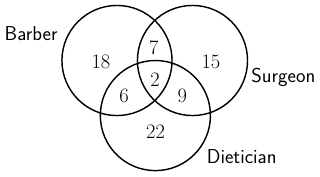
Question 2

If 3 is a common root of quadratic equations x2 − 8x + P = 0 and x2 + 4x + Q = 0, then find the value of P + Q.

  1. AOption (a)

    6

  2. BOption (b)

    -3

  3. COption (c)

    -6

  4. DOption (d)

    3

View answer & explanation

Correct answer

Answer: (c)C.

-6

Why this answer is correct

Shortcut Trick

Substitute the common root x = 3 into both equations directly.

First equation: 32 − 8(3) + P = 0 ⇒ 9 − 24 + P = 0 ⇒ P = 15.

Second equation: 32 + 4(3) + Q = 0 ⇒ 9 + 12 + Q = 0 ⇒ Q = −21.

Sum of constants: P + Q = 15 + (−21) = −6.

∴ The correct answer is -6.

Alternate Method

Given:

Equation 1: x2 − 8x + P = 0

Equation 2: x2 + 4x + Q = 0

Common Root: x = 3

Formula Used:

If a value α is a root of a quadratic equation f(x) = 0, then f(α) = 0.

Calculations:

⇒ Substituting x = 3 in the first equation:

⇒ (3)2 − 8(3) + P = 0

⇒ 9 − 24 + P = 0

⇒ −15 + P = 0 ⇒ P = 15

⇒ Substituting x = 3 in the second equation:

⇒ (3)2 + 4(3) + Q = 0

⇒ 9 + 12 + Q = 0

⇒ 21 + Q = 0 ⇒ Q = −21

⇒ To find the value of P + Q:

⇒ P + Q = 15 + (−21)

⇒ P + Q = −6

∴ The correct answer is -6.

Additional Information

Roots of Quadratic Equation

A root is a value that makes the polynomial equal to zero. For ax2 + bx + c = 0, if α is a root, then aα2 + bα + c = 0.

Sum and Product of Roots

For a quadratic equation ax2 + bx + c = 0, the sum of roots is −b/a and the product of roots is c/a.

Condition for Common Root

If two equations a1x2 + b1x + c1 = 0 and a2x2 + b2x + c2 = 0 have a common root α, then α satisfies both, allowing us to eliminate α or solve for unknown coefficients.

Question 3

Who among the following appointed a superintendent (Shahna-i-Mandi) for the effective implementation of market reforms?

  1. AOption (a)

    Ulugh Khan

  2. BOption (b)

    Muhammad Ghori

  3. COption (c)

    Raziya Sultana

  4. DOption (d)

    Alauddin Khilji

View answer & explanation

Correct answer

Answer: (d)D.

Alauddin Khilji

Why this answer is correct

The correct answer is Alauddin Khilji.

Key Points

  • Alauddin Khilji, the second ruler of the Khilji dynasty, implemented significant economic reforms, including market control measures.
  • He appointed a superintendent (Shahna-i-Mandi) to oversee and regulate market prices and ensure the proper functioning of the market reforms.
  • His reforms aimed to prevent hoarding and ensure the availability of essential commodities at fixed and affordable prices.
  • The Shahna-i-Mandi was responsible for maintaining control over traders and ensuring compliance with the fixed prices.
  • Alauddin Khilji's market reforms were a pioneering step in medieval India and were aimed at strengthening the state’s economy and reducing exploitation by traders.

Additional Information

  • Shahna-i-Mandi: A designated official responsible for overseeing market regulations and ensuring adherence to fixed prices during Alauddin Khilji's reign.
  • Market Reforms: Alauddin Khilji introduced strict regulations to control prices, reduce exploitation by traders, and ensure the availability of essential goods.
  • Economic Measures: These reforms were part of broader measures to strengthen the state’s revenue system and establish a centralized economy.
  • Historical Impact: Alauddin Khilji's policies were considered innovative and effective in curbing corruption and ensuring the welfare of the population during his reign.
  • Khilji Dynasty: The Khilji dynasty ruled from 1290 to 1320 and was known for its administrative and military innovations, with Alauddin Khilji being one of its most prominent rulers.

Question 4

If the mode of a data set exceeds its mean by 17.7, then the mode exceeds the median by _____. (Use empirical formula.)

  1. AOption (a)

    11.8

  2. BOption (b)

    4.8

  3. COption (c)

    9.8

  4. DOption (d)

    15.4

View answer & explanation

Correct answer

Answer: (a)A.

11.8

Why this answer is correct

Shortcut Trick

Using the direct relation derived from the empirical formula:

(Mode − Median) = 2/3 × (Mode − Mean)

Given: (Mode − Mean) = 17.7

∴ (Mode − Median) = 2/3 × 17.7 = 2 × 5.9 = 11.8

∴ The correct answer is 11.8.

Alternate Method

Given: Mode − Mean = 17.7

Formula Used: Mode = 3 × Median − 2 × Mean

Calculations:

⇒ Mode = 3 × Median − 2 × Mean

⇒ Mode + 2 × Mean = 3 × Median

⇒ From given, Mean = Mode − 17.7

⇒ Mode = 3 × Median − 2 × (Mode − 17.7)

⇒ Mode = 3 × Median − 2 × Mode + 35.4

⇒ 3 × Mode − 3 × Median = 35.4

⇒ 3 × (Mode − Median) = 35.4

⇒ Mode − Median = 35.4 ÷ 3

⇒ Mode − Median = 11.8

∴ The correct answer is 11.8.

Additional Information

Empirical Formula

For a moderately skewed distribution, the relationship is Mode = 3 × Median − 2 × Mean.

Symmetrical Distribution

In a perfectly symmetrical distribution, the Mean, Median, and Mode are all equal (Mean = Median = Mode).

Skewness Relation

The difference (Mean − Mode) is approximately three times the difference (Mean − Median).

Question 5

M, N, O, P, Q, R and X are sitting around a circular table facing the centre of the table. Only four people sit between Q and R when counted from the right of Q. Q sits third to the left of X. P sits third to the left of M. N is an immediate neighbour of R and X. How many people sit between O and N when counted from the right of O?

  1. AOption (a)

     Four

  2. BOption (b)

    Two

  3. COption (c)

    One

  4. DOption (d)

    Three

View answer & explanation

Correct answer

Answer: (b)B.

Two

Why this answer is correct

Given:

M, N, O, P, Q, R and X are sitting around a circular table facing the centre of the table.

Only four people sit between Q and R when counted from the right of Q.

Q sits third to the left of X. P sits third to the left of M. N is an immediate neighbour of R and X.

Thus, 2 people sit between O and N when counted from the right of O.

Hence, the correct answer is "Option 2".

Question 6

What sum of money (in ₹) will amount to ₹840 at 4% per annum simple interest in 3 years?

  1. AOption (a)

    750

  2. BOption (b)

    700

  3. COption (c)

    7,000

  4. DOption (d)

    800

View answer & explanation

Correct answer

Answer: (a)A.

750

Why this answer is correct

Shortcut Trick

Net Simple Interest percentage = Rate × Time = 4% × 3 = 12%

Total Amount percentage = 100% (Principal) + 12% (Interest) = 112%

Given, 112% → ₹840

Principal (100%) = (840 ÷ 112) × 100

Principal = 7.5 × 100 = ₹750

∴ The correct answer is ₹750.

Alternate Method

Given:

Amount (A) = ₹840

Rate (R) = 4% per annum

Time (T) = 3 years

Formula Used:

Amount (A) = Principal (P) + Simple Interest (SI)

SI = (P × R × T) ÷ 100

Calculations:

⇒ A = P + (P × R × T) ÷ 100

⇒ 840 = P + (P × 4 × 3) ÷ 100

⇒ 840 = P + 12P ÷ 100

⇒ 840 = (100P + 12P) ÷ 100

⇒ 840 = 112P ÷ 100

⇒ P = (840 × 100) ÷ 112

⇒ P = 7.5 × 100

⇒ P = ₹750

∴ The correct answer is ₹750.

Additional Information

Principal Formula

When amount, rate, and time are given, Principal P = (100 × A) ÷ (100 + RT).

Simple Interest Property

In Simple Interest, the interest remains constant every year because it is always calculated on the original Principal.

Relationship between SI and Amount

Interest = Amount − Principal. In this case, SI = 840 − 750 = ₹90.

Question 7

 Each of B, C, D, E, F, G and H has an exam on a different day of a week starting from Monday and ending on Sunday of the same week. Only two people have exams after B. Only two people have exams between B and C. F has an exam immediately before E and H has an exam immediately after G. H has an exam on some days before F. On which day D has an exam?

  1. AOption (a)

    Monday

  2. BOption (b)

    Tuesday

  3. COption (c)

    Thursday

  4. DOption (d)

    Sunday

View answer & explanation

Correct answer

Answer: (a)A.

Monday

Why this answer is correct

Given : Each of B, C, D, E, F, G and H has an exam on a different day of a week starting from Monday and ending on Sunday of the same week.

  1. Only two people have exams after B.

  2. Only two people have exams between B and C.

WeekdayPerson
Monday
TuesdayC
Wednesday
Thursday
FridayB
Saturday
Sunday
  1. F has an exam immediately before E (FE block).

  2. H has an exam immediately after G (GH block).

  3. H has an exam on some days before F (H ... F).

Let's consider the two primary ways to place the (F, E) block based on available consecutive slots:

WeekdayCase 1:Case 2:
Monday
TuesdayCC
WednesdayF
ThursdayE
FridayBB
SaturdayF
SundayE


Evaluation of Cases for F, E and G, H:

Case 1 (F,E = Wed,Thu): If F is on Wednesday, then for "H has an exam on some days before F", H must be on Monday (as Tuesday is C). If H is on Monday, then G must be immediately before H, which is not possible as there is no day before Monday. Thus, Case 1 is Eliminated.

Case 2 (F,E = Sat,Sun): If F is on Saturday, then for "H has an exam on some days before F", H can be on Wednesday or Thursday. Since H must be immediately after G (GH block):

Therefore, in Case 2, (G, H) must be (Wednesday, Thursday). This case is Valid.

WeekdayCase 2:
Monday
TuesdayC
WednesdayG
ThursdayH
FridayB
SaturdayF
SundayE

The only remaining person is D, and the only remaining empty slot is Monday.

Final arrangement:

WeekdayPerson
MondayD
TuesdayC
WednesdayG
ThursdayH
FridayB
SaturdayF
SundayE

Thus, D has an exam on Monday.

Hence, the correct answer is "Option 1".

Question 8

Calculate the area of the triangle whose sides are 8 cm, 9 cm and 13 cm. (Rounded up to two decimal places)

  1. AOption (a)

    35.50 cm2

  2. BOption (b)

    35.03 cm2

  3. COption (c)

    35.85 cm2

  4. DOption (d)

    35.97 cm2

View answer & explanation

Correct answer

Answer: (a)A.

35.50 cm2

Why this answer is correct

Shortcut Trick

Identify sides: a = 8, b = 9, c = 13.

Semi-perimeter s = (8 + 9 + 13) ÷ 2 = 15 cm.

Area = √[15 × (15 − 8) × (15 − 9) × (15 − 13)]

Area = √[15 × 7 × 6 × 2] = √1260 ≈ 35.50 cm2.

∴ The correct answer is 35.50 cm2.

Alternate Method

Given:

Sides of the triangle: a = 8 cm, b = 9 cm, c = 13 cm.

Formula Used:

Heron's Formula: Area = √[s(s − a)(s − b)(s − c)]

Where s is the semi-perimeter: s = (a + b + c) ÷ 2

Calculations:

⇒ s = (8 + 9 + 13) ÷ 2

⇒ s = 30 ÷ 2 = 15 cm

⇒ Area = √[15 × (15 − 8) × (15 − 9) × (15 − 13)]

⇒ Area = √[15 × 7 × 6 × 2]

⇒ Area = √[1260]

⇒ Area ≈ 35.496 cm2

⇒ Rounding to two decimal places, we get 35.50 cm2.

∴ The correct answer is 35.50 cm2.

Additional Information

Heron's Formula

Used to find the area of any triangle when the lengths of all three sides are known. Area = √[s(s−a)(s−b)(s−c)].

Right-Angled Triangle Area

If the triangle is right-angled, the area can be simply calculated as 1/2 × base × height.

Equilateral Triangle Area

For a triangle with all equal sides a, Area = (√3 ÷ 4) × a2.

Question 9

The average price of three items of furniture is ₹15,255. If their prices are in the ratio 3 : 5 : 7, the price of the cheapest item (in ₹) is:

  1. AOption (a)

     3,051

  2. BOption (b)

     7,119

  3. COption (c)

    5,085

  4. DOption (d)

    9,153

View answer & explanation

Correct answer

Answer: (d)D.

9,153

Why this answer is correct

Shortcut Trick

Total ratio sum = 3 + 5 + 7 = 15 units.

Average ratio = 15 ÷ 3 = 5 units.

Given 5 units = ₹15,255 ⇒ 1 unit = ₹3,051.

Cheapest item (3 units) = 3 × 3,051 = ₹9,153.

∴ The correct answer is ₹9,153.

Alternate Method

Given:

Average price of 3 furniture items = ₹15,255

Ratio of their prices = 3 : 5 : 7

Formula Used:

Total Value = Average × Number of Observations

Calculations:

⇒ Total price of all items = 15,255 × 3 = ₹45,765

⇒ Let the prices be 3x, 5x, and 7x

⇒ 3x + 5x + 7x = 45,765

⇒ 15x = 45,765

⇒ x = 45,765 ÷ 15

⇒ x = 3,051

⇒ Price of the cheapest item = 3x = 3 × 3,051

⇒ Cheapest item price = ₹9,153

∴ The correct answer is ₹9,153.

Additional Information

Concept of Average

The average is the sum of all values divided by the total count. Sum = Average × Count.

Ratio Distribution

To find a specific share from a ratio a:b:c, use: Share = (Ratio Part ÷ Sum of Ratios) × Total Value.

Weighted Average

When items have different weights/quantities, the weighted average is (Σwixi) ÷ Σwi.

Question 10

The Dutch East India Company's trade on the Coromandel Coast registered a significant increase over the 17th century due to:

  1. AOption (a)

    the establishment of trading posts in Goa and Surat

  2. BOption (b)

    an increase in the demand for textile from the south-east Asian markets

  3. COption (c)

    the result of White Mutiny

  4. DOption (d)

    the decline and collapse of the British influence in the region

View answer & explanation

Correct answer

Answer: (b)B.

an increase in the demand for textile from the south-east Asian markets

Why this answer is correct

The correct answer is an increase in the demand for textile from the south-east Asian markets.

Key Points

  • The Coromandel Coast emerged as a major center for textile production during the 17th century, with its textiles highly sought after in South-East Asian markets.
  • South-East Asia exhibited a rising demand for Indian textiles such as chintz, calicoes, and muslin due to their quality and intricate designs.
  • The Dutch East India Company capitalized on this demand by expanding its trade network and establishing robust maritime routes linking India and South-East Asia.
  • Indian textiles were used in barter trade by the Dutch to acquire spices, particularly from Indonesia, which further boosted commerce on the Coromandel Coast.
  • The strategic presence of Dutch trading posts along the Coromandel Coast facilitated large-scale exports, cementing the region's importance in global trade during the 17th century.

Additional Information

  • Coromandel Coast: Located in southeastern India, it was renowned for its production of high-quality textiles, particularly cotton fabrics.
  • Dutch East India Company (VOC): Established in 1602, the VOC was a major trading enterprise that controlled trade networks between Europe, Asia, and the Indian subcontinent.
  • Textiles as Trade Commodities: Indian textiles were highly valued in South-East Asia, the Middle East, and Europe, often exchanged for spices, precious metals, and other goods.
  • Spice Trade Connection: The Dutch used Indian textiles to acquire spices like nutmeg, cloves, and pepper from islands in South-East Asia, creating a mutually beneficial trade system.
  • Globalization of Indian Textiles: The flourishing textile trade during the 17th century contributed significantly to India's integration into the global economy of the early modern period.

Question 11

 6 : 42 :: 7.6 : x and 3 : 6 :: 6 : y. What is the ratio of x to y?

  1. AOption (a)

    137 : 40

  2. BOption (b)

    135 : 32

  3. COption (c)

    134 : 28

  4. DOption (d)

    133 : 30

View answer & explanation

Correct answer

Answer: (d)D.

133 : 30

Why this answer is correct

Shortcut Trick

For Proportion a : b :: c : d, the product of extremes equals the product of means (ad = bc).

Calculation for x: 6 × x = 42 × 7.6 ⇒ x = 7 × 7.6 = 53.2

Calculation for y: 3 × y = 6 × 6 ⇒ y = 12

Ratio x : y = 53.2 : 12 = 532 : 120 = 133 : 30

∴ The correct answer is 133 : 30.

Alternate Method

Given: 6 : 42 :: 7.6 : x and 3 : 6 :: 6 : y

Formula: If a : b :: c : d, then a/b = c/d

⇒ 6/42 = 7.6/x

⇒ 1/7 = 7.6/x

⇒ x = 7.6 × 7 = 53.2

⇒ 3/6 = 6/y

⇒ 1/2 = 6/y

⇒ y = 6 × 2 = 12

⇒ x : y = 53.2 : 12

⇒ x : y = 532/10 : 12 = 532 : 120

⇒ x : y = 133 : 30

∴ The correct answer is 133 : 30.

Additional Information

Fourth Proportional

In the proportion a : b :: c : d, d is called the fourth proportional, calculated as d = (b × c) / a.

Mean Proportional

The mean proportional between two numbers a and b is √(a × b).

Third Proportional

If a : b :: b : c, then c is the third proportional, calculated as c = b2 / a.

Question 12

One pipe can fill the tank in 19 minutes while another pipe can empty the completely filled tank in 21 minutes. If both the pipes are operated together on empty tank, how long (in minutes) will it take to fill two-third of the tank?

  1. AOption (a)

    133

  2. BOption (b)

    399

  3. COption (c)

    266

  4. DOption (d)

    532

View answer & explanation

Correct answer

Answer: (a)A.

133

Why this answer is correct

Shortcut Trick

Net filling efficiency per minute = 1/19 − 1/21 = (21 − 19) / (19 × 21) = 2 / 399

Time to fill full tank = 399 / 2 minutes

Time to fill 2/3rd tank = (399 / 2) × (2 / 3) = 133 minutes

∴ The correct answer is 133 minutes.

Alternate Method

Given: Filling time = 19 minutes, Emptying time = 21 minutes.

Formula Used: Efficiency = Total Work ÷ Time

Pipe TypeTime (min)Total Capacity (LCM)Efficiency
Filling Pipe19399+21
Emptying Pipe21−19

Calculations:

⇒ Net efficiency of both pipes = 21 − 19 = 2 units/min

⇒ Required work = 2/3 of Total Capacity = (2/3) × 399 = 266 units

⇒ Required time = Required work ÷ Net efficiency

⇒ Required time = 266 ÷ 2 = 133 minutes

∴ The correct answer is 133 minutes.

Additional Information

Net Rate of Flow

When one pipe fills (rate x) and another empties (rate y), the combined rate is (1/x − 1/y) per unit time.

Pipes and Cisterns Logic

Inlet pipes contribute positive work (+) while Outlet pipes contribute negative work (−) towards filling the tank.

Partial Filling

Time taken to fill 'k' fraction of a tank = (k × Total Capacity) ÷ Net Efficiency.

Question 13

What is the range of composite scores achieved by Union Territories (UTs) in the SDG India Index 2023-24?

  1. AOption (a)

    75 to 85

  2. BOption (b)

     70 to 80

  3. COption (c)

    60 to 75

  4. DOption (d)

    65 to 77

View answer & explanation

Correct answer

Answer: (d)D.

65 to 77

Why this answer is correct

The correct answer is 65 to 77.

Key Points

  • The Sustainable Development Goals (SDG) India Index 2023-24 assesses the performance of states and Union Territories (UTs) based on their progress toward achieving the United Nations SDGs.
  • The composite scores for Union Territories in the SDG India Index 2023-24 range from 65 to 77.
  • Union Territories like Chandigarh and Puducherry are often among the top performers, reflecting higher development levels across multiple SDG indicators.
  • The scores are calculated based on 17 SDGs, covering areas like health, education, gender equality, and climate action, among others.
  • The SDG India Index serves as a critical tool for policymakers to identify areas requiring improvement and focus resources effectively.

Additional Information

  • Sustainable Development Goals (SDGs): A set of 17 global goals established by the United Nations in 2015 to address key global challenges such as poverty, inequality, and climate change by 2030.
  • SDG India Index: Launched by NITI Aayog in 2018, it is a localized version of the global SDG framework aimed at tracking India's progress on SDGs across states and UTs.
  • Scoring Mechanism: States and UTs are scored on a scale of 0 to 100, with higher scores indicating better progress toward achieving the SDGs.
  • Categories in the Index: The SDG India Index classifies states and UTs into four categories: Aspirant (0-49), Performer (50-64), Front Runner (65-99), and Achiever (100).
  • Policy Implication: The index helps identify gaps in development and enables governments to prioritize interventions in lagging sectors or regions.

Question 14

Who among the following spearheaded an active non-cooperation movement famously known as the ‘Barasat Rebellion’ against the British indigo planters?

  1. AOption (a)

    Dudu Miyan

  2. BOption (b)

    Sidhu Murmu

  3. COption (c)

    Haji Shariatullah

  4. DOption (d)

     Titu Mir

View answer & explanation

Correct answer

Answer: (d)D.

 Titu Mir

Why this answer is correct

The correct answer is Titu Mir.

Key Points

  • Titu Mir was a Bengali freedom fighter who led the 'Barasat Rebellion' against oppressive British indigo planters in Bengal.
  • Born as Syed Mir Nisar Ali in 1782, Titu Mir used Islamic principles to unite farmers and weavers against exploitation.
  • The rebellion occurred in 1831, where Titu Mir and his followers built a stronghold, the bamboo fort (Banser Kella), to resist British forces.
  • He opposed the exploitative practices of indigo cultivation, high taxes, and the zamindari system enforced by British-backed landlords.
  • Titu Mir was martyred in the struggle, but his movement is remembered as one of the early peasant revolts against British colonial rule.

Additional Information

  • Indigo Rebellion (1859-60): Another significant peasant uprising in Bengal against the British indigo planters, where farmers refused to grow indigo due to exploitation.
  • Zamindari System: Introduced by the British under the Permanent Settlement Act of 1793, this system empowered zamindars to collect taxes, often leading to severe exploitation of peasants.
  • Peasant Movements in India: Titu Mir’s rebellion was one of the earliest organized uprisings, followed by others like the Santhal Rebellion (1855-56) and the Tebhaga Movement (1946-47).
  • Bamboo Fort: Titu Mir’s fort was an innovative structure made of bamboo, symbolizing indigenous resistance against modern weaponry of the British.
  • Legacy: Titu Mir is regarded as a hero in the fight for social and economic justice, inspiring future movements for India's independence.

Question 15

GQCN is related to LNHK in a certain way based on the English alphabetical order. In the same way, QKMH is related to VHRE. To which of the given options is AEWB related, following the same logic?

  1. AOption (a)

    FBBY

  2. BOption (b)

    GCAZ

  3. COption (c)

    FABX

  4. DOption (d)

    EBCX

View answer & explanation

Correct answer

Answer: (a)A.

FBBY

Why this answer is correct

The logic followed in this pattern involves an alternating alphabetical shift for each letter position:​

For 'GQCN' related to 'LNHK':

For 'QKMH' related to 'VHRE':


Applying the same logic to 'AEWB':

Thus, 'AEWB' will be coded as FBBY.

Hence, the correct answer is "Option 1".

Question 16

MN and XY are two parallel lines, there is a line BK which intersects them. If ∠NBK = 78°, find the measure of ∠YKB.

  1. AOption (a)

    92°​

  2. BOption (b)

    82°

  3. COption (c)

    102°

  4. DOption (d)

    72°

View answer & explanation

Correct answer

Answer: (c)C.

102°

Why this answer is correct

` (Wait, I'll just write the final output now).

Shortcut Trick

When two parallel lines are intersected by a transversal, the sum of consecutive interior angles on the same side is always 180°.

∠YKB = 180° − ∠NBK

∠YKB = 180° − 78° = 102°.

∴ The correct answer is 102°.

Alternate Method

Given:

Lines MN || XY

Transversal BK intersects them.

∠NBK = 78°

Formula Used:

Sum of consecutive interior angles = 180°

M N X Y B K 78°

Question 17

Which unique property of Plasmodium makes malaria a cyclical disease with periodic fever?

  1. AOption (a)

    Constant reinfection from environment

  2. BOption (b)

    RBC rupture and toxin release every few days

  3. COption (c)

    Continual entry via mosquito bites

  4. DOption (d)

     Infection of liver cells only

View answer & explanation

Correct answer

Answer: (b)B.

RBC rupture and toxin release every few days

Why this answer is correct

The correct answer is RBC rupture and toxin release every few days.

Key Points

  • The periodic fever in malaria is caused by the synchronous rupture of infected red blood cells (RBCs) and the release of toxins, primarily hemozoin pigment and other inflammatory mediators, into the bloodstream.
  • Plasmodium parasites undergo a complex life cycle, including asexual reproduction within RBCs, leading to their destruction every 48-72 hours depending on the species.
  • The cyclical nature of fever corresponds to the completion of the parasite's schizogony stage within RBCs, which is synchronized across a population of parasites.
  • Species-specific periodicity: Plasmodium vivax and Plasmodium ovale cause fever every 48 hours, while Plasmodium malariae causes it every 72 hours, and Plasmodium falciparum often exhibits irregular fever patterns.
  • The toxins and metabolites released during RBC rupture trigger immune responses, including the release of cytokines like tumor necrosis factor-alpha (TNF-α), leading to fever and other systemic symptoms.

Additional Information

  • Plasmodium Life Cycle:
  • The life cycle involves two hosts: humans and female Anopheles mosquitoes.
  • In humans, Plasmodium first infects liver cells (exo-erythrocytic stage) and then moves to RBCs (erythrocytic stage).
  • Hemozoin:
  • A toxic byproduct of hemoglobin metabolism by Plasmodium parasites.
  • Hemozoin accumulation is a key factor in triggering immune responses and systemic inflammation.
  • Periodic Fever Mechanism:
  • Caused by synchronized schizont rupture and immune system activation.
  • Cytokines like TNF-α and interleukin-1 (IL-1) are released, leading to fever.
  • Plasmodium Species:
  • Four major human-infecting species: P. vivax, P. ovale, P. malariae, and P. falciparum.
  • P. falciparum is the most dangerous, often causing severe and complicated malaria.
  • Malaria Transmission:
  • Spread via bites of infected female Anopheles mosquitoes.
  • Control measures include insecticide-treated bed nets and antimalarial drugs.

Question 18

Based on the English alphabetical order, three of the following four letter-cluster pairs are alike in a certain way and thus form a group. Which letter-cluster pair DOES NOT belong to that group?

(Note: The odd one out is not based on the number of consonants/vowels or their position in the letter-cluster.)

  1. AOption (a)

    GC−ZV

  2. BOption (b)

     LH−DC

  3. COption (c)

     RN−KG

  4. DOption (d)

    CY−VR

View answer & explanation

Correct answer

Answer: (b)B.

 LH−DC

Why this answer is correct

The logic followed here is.

Option (1) 'GC-ZV':

Option (2) 'LH-DC':

Option (3) 'RN-KG':

Option (4) 'CY-VR':

Hence, the correct answer is "Option 2" .

Question 19

In this question, a group of numbers is coded by using letters and symbols as per the table given below and the conditions which follow.

Number78234561
CodeZQ*@%$TJ

Conditions:

  1. If the 1st and 2nd digits are even, both are to be coded as ‘A’.

  2. If the 1st and last digits are odd, both are to be coded as the code for the 1st digit.

  3. If the 3rd and 4th digits are even, their codes are to be interchanged.

What is the correct combination of codes (by following only the applicable condition(s)) for the following?

71628$

  1. AOption (a)

     Z J * * Q

  2. BOption (b)

    Z J * T Q

  3. COption (c)

    Z J T T Q

  4. DOption (d)

    Z J T * Q

View answer & explanation

Correct answer

Answer: (b)B.

Z J * T Q

Why this answer is correct

Number78234561
CodeZQ*@%$TJ


Given- 7 1 6 2 8

Rule No. (1): This condition does not apply because the 1st digit (7) is odd, not even.

Rule No. (2): This condition does not apply because the last digit (8) is even, not odd.

Rule No. (3): This condition applies because the 3rd digit (6) is even and the 4th digit (2) is also even. So, their codes will be interchanged.

Based on the applicable rule (3), the 3rd and 4th digits' codes are interchanged.

The code for 7 is Z.

The code for 1 is J.

The original code for 6 is T.

The original code for 2 is *.

So, 6 will be coded as * 

And 2 will be coded as T 

The code for 8 is Q.

Thus, '7 1 6 2 8' is coded as → Z J * T Q.

Hence, the correct answer is "Option 2".$

Question 20

In a 2100 m circular race, Amit finishes one round in 42 seconds and Sumit finishes one round in 75 seconds. How many different meeting points are there on the circumference if they are running in the opposite directions?

  1. AOption (a)

    49

  2. BOption (b)

    29

  3. COption (c)

    38

  4. DOption (d)

    39

View answer & explanation

Correct answer

Answer: (d)D.

39

Why this answer is correct

Shortcut Trick Ratio of time taken by Amit and Sumit to complete one round = 42 : 75 = 14 : 25. Since Speed is inversely proportional to Time, Ratio of speeds (u : v) = 25 : 14. For opposite directions, Number of distinct meeting points = u + v. Number of meeting points = 25 + 14 = 39. ∴ The correct answer is 39 points. Alternate Method

Given: Track Length = 2100 m, TAmit = 42 s, TSumit = 75 s. Formula: Speed = Distance ÷ Time; Distinct points (opposite) = Ratio of speeds (a + b) where a/b is in simplest form. ⇒ Speed of Amit (SA) = 2100 ÷ 42 = 50 m/s ⇒ Speed of Sumit (SS) = 2100 ÷ 75 = 28 m/s ⇒ Ratio of Speeds SA : SS = 50 : 28 ⇒ Simplest Ratio = 25 : 14 ⇒ Number of distinct meeting points = 25 + 14 = 39 ∴ The correct answer is 39 points. Additional Information Meeting Points in Same Direction If two people run in the same direction with speeds in the simplest ratio a : b (a > b), the number of distinct meeting points is (a − b). Time of First Meeting The time taken for the first meeting anywhere on the track is Track Length ÷ Relative Speed. Time of Meeting at Starting Point The time when they meet for the first time at the starting point is the LCM of the time taken by each to complete one full round.

Question 21

Refer to the following number and symbol series and answer the question that follows. Counting to be done from left to right only.

(Left) & 2 6 9 5 7 & € 9 * % £ 7 © 5 3 3 @ 2 © % # (Right)

How many such symbols are there each of which is immediately preceded by a number and also immediately followed by a symbol?

  1. AOption (a)

    3

  2. BOption (b)

    5

  3. COption (c)

    4

  4. DOption (d)

    2

View answer & explanation

Correct answer

Answer: (a)A.

3

Why this answer is correct

Given series:

(Left) & 2 6 9 5 7 & € 9 * % £ 7 © 5 3 3 @ 2 © % # (Right)

Condition to be checked:

Number → Symbol → Symbol

& 2 6 9 7 & € 9 *** %** £ 7 © 5 3 3 @ 2 © % #

There are three such symbols in the above arrangement (7 & €, 9 * %, 2 © %).

Hence, the correct answer is "Option 1".

Question 22

Three persons P, Q, and R started a business with their shares in the ratio 11 : 8 : 20. After 9 months, Q withdrew his 35% share, while R withdrew his 14% share 7 months prior to completion of the year. If the total profit at the end of the year is ₹40,700, find the share of R (in ₹) in the profit.

  1. AOption (a)

     20,606

  2. BOption (b)

    20,529

  3. COption (c)

    20,387

  4. DOption (d)

    20,246

View answer & explanation

Correct answer

Answer: (c)C.

20,387

Why this answer is correct

Shortcut Trick

Ratio of Profit = Σ(Investment × Time).

P share = 11 × 12 = 132 units.

Q share = (8 × 9) + (8 × 0.65 × 3) = 72 + 15.6 = 87.6 units.

R share = (20 × 5) + (20 × 0.86 × 7) = 100 + 120.4 = 220.4 units.

Total units = 132 + 87.6 + 220.4 = 440 units.

R share = (220.4 ÷ 440) × 40,700 = 20,387.

∴ The correct answer is ₹20,387.

Alternate Method

Given → Investment Ratio P : Q : R = 11 : 8 : 20. Total time = 12 months. Formulas: Profit Ratio = (I1 × T1) : (I2 × T2) : (I3 × T3)

⇒ P's Profit = 11 × 12 = 132. ⇒ Q's Profit: Q withdraws 35% after 9 months. Remaining = 65% of 8 = 5.2. ⇒ Q Total = (8 × 9) + (5.2 × 3) = 72 + 15.6 = 87.6. ⇒ R's Profit: R withdraws 14% 7 months prior to completion (at 5 months). Remaining = 86% of 20 = 17.2. ⇒ R Total = (20 × 5) + (17.2 × 7) = 100 + 120.4 = 220.4. ⇒ Total Ratio Sum = 132 + 87.6 + 220.4 = 440. ⇒ Share of R = (220.4 ÷ 440) × 40,700 = 0.500909... × 40,700 = 20,387.

∴ The correct answer is ₹20,387.

Additional Information

Partnership Basics

In a partnership, the profit is distributed in the ratio of the product of investment and time period.

Variable Investment

If an investor changes the capital during the period, calculate Equivalent Capital for 1 month by summing (Capital × Duration) for each segment.

Question 23

India’s territorial waters extend up to how many nautical miles from the baseline?

  1. AOption (a)

    200

  2. BOption (b)

    100

  3. COption (c)

    12

  4. DOption (d)

    24

View answer & explanation

Correct answer

Answer: (c)C.

12

Why this answer is correct

The correct answer is 12 nautical miles.

Key Points

  • India's territorial waters extend up to 12 nautical miles from the baseline, as per the provisions of the United Nations Convention on the Law of the Sea (UNCLOS).
  • The baseline is defined as the low-water line along the coast, marked officially by India.
  • Within this 12-nautical-mile zone, India exercises full sovereignty, including over airspace, water column, seabed, and subsoil.
  • The territorial waters are considered part of India's sovereign territory, and foreign vessels are allowed innocent passage under international law.
  • The extension of territorial waters up to 12 nautical miles is consistent with international maritime norms established by UNCLOS.

Additional Information

  • Exclusive Economic Zone (EEZ): Beyond territorial waters, India has rights up to 200 nautical miles from the baseline in its EEZ for exploring, exploiting, conserving, and managing natural resources.
  • Contiguous Zone: India has limited control in the zone extending 24 nautical miles from the baseline for enforcement of laws related to customs, immigration, and pollution.
  • UNCLOS: The United Nations Convention on the Law of the Sea is an international treaty that defines the rights and responsibilities of nations concerning the use of oceans, established in 1982.
  • Sovereignty vs. Innocent Passage: Sovereignty in territorial waters does not restrict foreign vessels' right to innocent passage, provided they do not threaten peace or security.
  • Baseline Importance: The baseline is critical for demarcating maritime zones such as territorial waters, contiguous zones, and the EEZ, ensuring adherence to international laws.

Question 24

What percentage increase in cement production was recorded in FY24 due to the government’s infrastructure push?

  1. AOption (a)

     9%

  2. BOption (b)

    11%

  3. COption (c)

    7%

  4. DOption (d)

    . 5%

View answer & explanation

Correct answer

Answer: (c)C.

7%

Why this answer is correct

The correct answer is 0.07.

Key Points

  • India recorded a 7% increase in cement production in FY24 due to the government's continued infrastructure push.
  • This surge was driven by the government’s focus on key infrastructure projects such as roads, railways, urban development, and housing schemes.
  • The cement sector is one of the most critical components of India's construction and infrastructure industry, contributing to economic growth.
  • Increased budget allocations for infrastructure in FY24 led to higher demand for cement across various sectors.
  • India is the second-largest producer of cement globally, and the growth trend reflects the government's emphasis on sustainable development and modernization.

Additional Information

  • Infrastructure Push: The government’s emphasis on infrastructure development includes projects under initiatives like PM Gati Shakti and Smart Cities Mission.
  • Budget Allocation: The Union Budget for FY24 allocated a record amount for capital expenditure on infrastructure projects, amounting to ₹10 lakh crore.
  • Cement Industry Overview: India’s cement industry contributes significantly to the GDP and employs millions in both direct and indirect jobs.
  • Environmental Considerations: The cement sector is working towards reducing carbon emissions by adopting technologies such as green cement production and waste heat recovery systems.
  • Global Standing: India stands second globally in cement production, with a production capacity of over 500 million metric tonnes per year.

Question 25

What should come in place of the question mark (?) in the given series?

222 194 166 138 110 82 ?

  1. AOption (a)

    66

  2. BOption (b)

    42

  3. COption (c)

    60

  4. DOption (d)

    54

View answer & explanation

Correct answer

Answer: (d)D.

54

Why this answer is correct

The logic followed here is:

Hence, the correct answer is "Option 4".

Question 26

If 3 is added to each even digit and 2 is added to each odd digit in the number 7135624, what will be the sum of the last two and first two digits in the new number thus formed?

  1. AOption (a)

    24

  2. BOption (b)

    18

  3. COption (c)

    22

  4. DOption (d)

    20

View answer & explanation

Correct answer

Answer: (a)A.

24

Why this answer is correct

Given:

3 is added to each even digit and 2 is added to each odd digit in the number 7135624.

Given7135624
Operation+2+2+2+2+3+3+3
New number9357957

The new number formed is 9357957.

The first two digits from the left are 9 and 3.

The last two digits from the right are 5 and 7.

The sum of these four digits is 9 + 3 + 5 + 7 = 24.

Hence, the correct answer is "Option 1".

Question 27

 Due to decrease in manpower, the production in a factory decreases by 12%. By what percentage (rounded off to two decimal places) should the working hours be increased to restore the original production?

  1. AOption (a)

    13.64%

  2. BOption (b)

    12.33%

  3. COption (c)

    23.23%

  4. DOption (d)

    16.67%

View answer & explanation

Correct answer

Answer: (a)A.

13.64%

Why this answer is correct

Shortcut Trick

To restore original value after a decrease of r%, increase required = [r ÷ (100 − r)] × 100

Here, decrease r = 12%

Required increase % = [12 ÷ (100 − 12)] × 100

Required increase % = (12 ÷ 88) × 100 = 13.6363...

∴ The correct answer is 13.64%.

Alternate Method

Given: Decrease in production = 12%

Formula: Production = Manpower × Working Hours

⇒ Let original production be 100 units.

⇒ New production after 12% decrease = 100 − 12 = 88 units.

⇒ To restore original production (100), we must increase 88 units by (100 − 88) = 12 units.

⇒ Percentage increase required = (12 ÷ 88) × 100

⇒ Percentage increase required = (3 ÷ 22) × 100 = 300 ÷ 22

⇒ Percentage increase required = 13.6363... ≈ 13.64%

∴ The correct answer is 13.64%.

Additional Information

Product Stability Rule

If the product of two variables is constant, an increase in one by x% requires a decrease in the other by [x ÷ (100 + x)] × 100%.

Base Change Concept

When a value is decreased and then increased to the original, the base for the increase is the new decreased value, not the original value.

Successive Percentage Change

The overall change for two successive changes of a% and b% is given by [a + b + (a × b)/100]%.

Question 28

A ladder is leaning against a wall such that it makes an angle of 60° with the ground. If the length of the ladder is 10 metres, how far is the foot of the ladder from the wall?

  1. AOption (a)

    8 metres

  2. BOption (b)

    5 metres

  3. COption (c)

    6 metres

  4. DOption (d)

    10 metres

View answer & explanation

Correct answer

Answer: (b)B.

5 metres

Why this answer is correct

Shortcut Trick

In a 30°−60°−90° right-angled triangle, the sides are in the ratio 1 : √3 : 2.

The side opposite to 30° (base distance) is always half of the hypotenuse (ladder length).

Distance = 10 ÷ 2 = 5 metres.

∴ The correct answer is 5 metres.

Alternate Method

Given:

Length of the ladder (Hypotenuse) = 10 metres

Angle of inclination with ground (θ) = 60°

Formula Used:

cos θ = Base ÷ Hypotenuse

Calculations:

⇒ cos 60° = Distance from wall ÷ Length of ladder

⇒ 1/2 = Distance ÷ 10

⇒ Distance = 10 × (1/2)

⇒ Distance = 5 metres

∴ The correct answer is 5 metres.

Additional Information

Trigonometric Ratios

For a right-angled triangle: sin θ = Perpendicular/Hypotenuse, cos θ = Base/Hypotenuse, and tan θ = Perpendicular/Base.

Common Values

cos 30° = √3/2, cos 45° = 1/√2, cos 60° = 1/2, and cos 90° = 0.

Pythagoras Theorem

In any right-angled triangle, Hypotenuse2 = Base2 + Perpendicular2.

Question 29

Rachel Kushner novel shortlisted for Booker 2024 is titled:

  1. AOption (a)

    A Brush with Love

  2. BOption (b)

    Lizzie Blake's Best Mistake

  3. COption (c)

    Creation Lake

  4. DOption (d)

     The Plus One

View answer & explanation

Correct answer

Answer: (c)C.

Creation Lake

Why this answer is correct

The correct answer is Creation Lake.

Key Points

  • Creation Lake is a novel by Rachel Kushner, known for her critically acclaimed works that explore themes of art, politics, and human relationships.
  • The book was shortlisted for the Booker Prize 2024, a prestigious literary award recognizing outstanding works of fiction.
  • Rachel Kushner has been a finalist for the Booker Prize before, showcasing her consistent presence in the literary world.
  • The Booker Prize highlights novels written in English and published in the UK or Ireland, and Kushner’s work has received international acclaim for its depth and narrative style.
  • Kushner is also the author of other renowned novels such as The Flamethrowers and The Mars Room, both of which have earned her critical and literary recognition.

Additional Information

  • The Booker Prize:
  • Founded in 1969, it is one of the most prestigious literary awards in the world.
  • The prize is awarded annually for the best original novel written in English and published in the UK or Ireland.
  • It aims to promote the finest in fiction by rewarding exceptional literary works.
  • Rachel Kushner:
  • An American author noted for her ability to blend history, politics, and personal narratives in her novels.
  • She has been a finalist for major literary awards, including the National Book Award and the Booker Prize.
  • Kushner’s writing often draws upon her extensive research and vivid storytelling techniques.
  • Other Works by Kushner:
  • The Flamethrowers (2013): A novel set in the 1970s art scene and Italian political unrest.
  • The Mars Room (2018): A compelling story about life in a women’s prison, which was shortlisted for the Booker Prize.
  • Significance of Booker Shortlisting:
  • Being shortlisted for the Booker Prize brings global recognition and a significant boost in readership.
  • It highlights the author’s contribution to contemporary literature and cements their reputation as a literary figure.

Question 30

Which of the following dance forms represents the love stories of Radha and Krishna?

  1. AOption (a)

    Raslila

  2. BOption (b)

    Kalbelia

  3. COption (c)

    Giddha

  4. DOption (d)

    Matki

View answer & explanation

Correct answer

Answer: (a)A.

Raslila

Why this answer is correct

The correct answer is Raslila.

Key Points

  • Raslila is a traditional dance form that depicts the divine love stories of Lord Krishna and Radha, along with the gopis (cowherd girls).
  • It originated in the Braj region (Mathura, Vrindavan) of Uttar Pradesh, which is considered the birthplace of Lord Krishna.
  • The dance is deeply rooted in the Bhakti movement and is performed as an act of devotion to Krishna.
  • Raslila combines elements of classical dance, drama, and devotional music to narrate episodes from the life of Krishna, especially his playful interactions with Radha and the gopis.
  • It is widely performed during festivals such as Janmashtami and Holi, which celebrate Krishna's life and teachings.

Additional Information

  • Kalbelia: A folk dance of Rajasthan performed by the Kalbelia community, known for its snake-like movements and vibrant costumes.
  • Giddha: A traditional Punjabi dance performed by women, characterized by energetic movements and synchronized handclaps, usually during celebrations.
  • Matki: A solo folk dance from Madhya Pradesh where the performer balances an earthen pot on their head, showcasing grace and balance.
  • The Bhakti movement: A spiritual movement that emphasized devotion (bhakti) to a personal god, inspiring art forms like Raslila to express divine love.
  • Raslila is often accompanied by songs from Vaishnavite literature, including verses from the Bhagavata Purana and works of poets like Surdas and Jayadeva.

Question 31

Refer to the following number and symbol series and answer the question that follows. Counting to be done from left to right only.

(Left) 8 * * $ # 4 5 © © @ * 7 @ # & © 6 1 £ 9 8 4 (Right)

How many such numbers are there each of which is immediately preceded by a number and also immediately followed by a symbol$?

  1. AOption (a)

    4

  2. BOption (b)

    2

  3. COption (c)

    3

  4. DOption (d)

    1

View answer & explanation

Correct answer

Answer: (b)B.

2

Why this answer is correct

Given series:

(Left) 8 * * $ # 4 5 © © @ * 7 @ # & © 6 1 £ 9 8 4 (Right)

Condition to be checked:

Number → Number → Symbol

8 * * $ # 4 5 © © @ * 7 @ # & © 6 1 £ 9 8 4

There are two such numbers in the above arrangement (4 5 ©, 6 1 £).

Hence, the correct answer is "Option 2".

Question 32

What should come in place of the question mark (?) in the given series based on the English alphabetical order?

TCL ZIR FOX LUD ?

  1. AOption (a)

     RJA

  2. BOption (b)

     ARJ

  3. COption (c)

    AJR

  4. DOption (d)

    RAJ

View answer & explanation

Correct answer

Answer: (d)D.

RAJ

Why this answer is correct

The logic followed here is:

Thus, 'RAJ' will be the next in the series.

Hence, the correct answer is "Option 4".

Question 33

Who was the leader of the 'Indian National Army' before Subhas Chandra Bose took charge?

  1. AOption (a)

    Ziaur Rahman

  2. BOption (b)

     Mohan Singh

  3. COption (c)

    Shah Nawaz Khan

  4. DOption (d)

    Pran Nath Thapar

View answer & explanation

Correct answer

Answer: (b)B.

 Mohan Singh

Why this answer is correct

The correct answer is Mohan Singh.

Key Points

  • Mohan Singh was an Indian military officer and a key figure in the formation of the Indian National Army (INA).
  • The INA was initially formed in 1942 in Singapore with the help of the Japanese Army, and Mohan Singh became its first leader.
  • He envisioned the INA as a force to liberate India from British colonial rule by allying with Japan during World War II.
  • However, due to differences with the Japanese leadership over the treatment of INA soldiers and strategic decisions, Mohan Singh disbanded the INA in late 1942.
  • When Subhas Chandra Bose assumed leadership of the INA in 1943, he reorganized and revitalized the movement, giving it a new direction and purpose.

Additional Information

  • Indian National Army (INA): The INA was formed to fight against British colonial rule and was composed mainly of Indian soldiers captured by the Japanese during World War II.
  • Subhas Chandra Bose: Bose took over as the leader of the INA in 1943 and renamed it the "Azad Hind Fauj." Under his leadership, the INA adopted the slogan "Jai Hind."
  • Singapore Conference 1942: The INA was first established at the Indian Independence League conference in Singapore, with Mohan Singh as its commander-in-chief.
  • Arzi Hukumat-e-Azad Hind: Subhas Chandra Bose also established a provisional government of Free India (Azad Hind Government) in 1943 to support the INA's efforts.
  • Japan's Role: Japan provided logistical and military support to the INA, as they sought to weaken British colonial power in Asia during World War II.

Question 34

Who among the following wrote the book 'Chhaunk: On Food, Economics and Society'?

  1. AOption (a)

     Raghuram Rajan

  2. BOption (b)

    Abhijit Banerjee

  3. COption (c)

    Subramanian Swamy

  4. DOption (d)

    Shaktikanta Das

View answer & explanation

Correct answer

Answer: (b)B.

Abhijit Banerjee

Why this answer is correct

The correct answer is Abhijit Banerjee.

Key Points

  • Abhijit Banerjee is a renowned Indian economist who won the Nobel Prize in Economic Sciences in 2019, alongside Esther Duflo and Michael Kremer.
  • He co-authored the book "Chhaunk: On Food, Economics and Society," which explores the intersection of food culture, economy, and societal issues.
  • Banerjee is a professor of economics at the Massachusetts Institute of Technology (MIT).
  • His work focuses on poverty alleviation and development economics, with significant contributions to experimental approaches in understanding economic issues.
  • Abhijit Banerjee has also co-authored other notable books such as "Poor Economics" and "Good Economics for Hard Times."

Additional Information

  • Experimental Economics
  • Abhijit Banerjee's work in experimental economics focuses on randomized controlled trials (RCTs) to test the effectiveness of policies on poverty alleviation.
  • RCTs provide evidence-based insights into what works and what does not in addressing economic challenges.
  • Food Culture and Economics
  • Banerjee's book "Chhaunk" discusses how food habits are deeply influenced by economic conditions and societal structures.
  • It provides a unique perspective on how food reflects cultural identity and economic disparities.
  • Global Recognition
  • Abhijit Banerjee's contributions have earned him international acclaim, including the Nobel Prize for his approach to addressing global poverty.
  • He is considered one of the most influential economists of his time.
  • Collaborative Work
  • Banerjee frequently collaborates with Esther Duflo, his Nobel co-recipient and spouse, on research and writing projects.
  • Their joint efforts aim to bridge the gap between economic theory and practical solutions to poverty.

Question 35

CK 17 is related to EG 29 in a certain way. In the same way, KM 12 is related to MI 24. To which of the given options is PQ 16 related, following the same logic?

  1. AOption (a)

    TV 29

  2. BOption (b)

    PR 11

  3. COption (c)

    RM 28

  4. DOption (d)

    SP 33

View answer & explanation

Correct answer

Answer: (c)C.

RM 28

Why this answer is correct

The logic followed in this pattern involves a consistent alphabetical shift for the letters and an arithmetic operation for the number:​

For 'CK 17' related to 'EG 29':

For 'KM 12' related to 'MI 24':


Applying the same logic to 'PQ 16':


Thus, PQ 16 is related to RM 28.

Hence, the correct answer is "Option 3".

Question 36

Under which Article of the Indian Constitution does the High Court exercise its original jurisdiction by issuing writs?

  1. AOption (a)

    Article 245

  2. BOption (b)

    Article 231

  3. COption (c)

     Article 226

  4. DOption (d)

     Article 32

View answer & explanation

Correct answer

Answer: (c)C.

 Article 226

Why this answer is correct

The correct answer is Article 226.

Key Points

  • Article 226 of the Indian Constitution empowers High Courts to issue writs for the enforcement of fundamental rights and other legal rights.
  • The writ jurisdiction includes issuing writs like habeas corpus, mandamus, prohibition, certiorari, and quo warranto.
  • Unlike Article 32 (Supreme Court), Article 226 covers not only fundamental rights but also other rights established by law.
  • The High Court's writ jurisdiction extends to persons, authorities, and governments within its territorial limits.
  • Article 226 serves as a vital mechanism for judicial review and upholding the rule of law in India.

Additional Information

  • Writs in India:
  • Habeas Corpus: Protects against unlawful detention.
  • Mandamus: Directs authorities to fulfill their duties.
  • Prohibition: Prevents lower courts from exceeding their jurisdiction.
  • Certiorari: Transfers cases to higher courts for review.
  • Quo Warranto: Challenges the legality of a person's public office holding.
  • Article 32 vs Article 226:
  • Article 32 is limited to enforcement of fundamental rights.
  • Article 226 includes fundamental rights and other legal rights.
  • Territorial Jurisdiction: High Courts can exercise writ jurisdiction over entities within their geographical boundaries.
  • Judicial Review: Article 226 plays a crucial role in ensuring the accountability of public authorities and safeguarding individual rights.
  • Importance: Article 226 is considered broader in scope than Article 32 and is essential for maintaining constitutional governance.

Question 37

 Which case is associated with the Supreme Court striking down the 99th Constitutional Amendment (NJAC)?

  1. AOption (a)

    Golaknath Case (1967)

  2. BOption (b)

     Supreme Court Advocates-on-Record Association Case (2015)

  3. COption (c)

    Minerva Mills Case (1980)

  4. DOption (d)

     Kesavananda Bharati Case (1973)

View answer & explanation

Correct answer

Answer: (b)B.

 Supreme Court Advocates-on-Record Association Case (2015)

Why this answer is correct

The correct answer is Supreme Court Advocates-on-Record Association Case (2015).

Key Points

  • The Supreme Court Advocates-on-Record Association Case (2015) resulted in the Supreme Court striking down the 99th Constitutional Amendment, which sought to establish the National Judicial Appointments Commission (NJAC).
  • The judgment reaffirmed the primacy of the judiciary in the appointment of judges to higher courts through the Collegium system.
  • The Supreme Court ruled that the NJAC was unconstitutional, as it infringed upon the independence of the judiciary—a basic feature of the Constitution.
  • The case emphasized the importance of maintaining the separation of powers between the judiciary, executive, and legislature.
  • The judgment was delivered by a Constitution Bench comprising five judges, who held that the NJAC violated the principle of judicial independence.

Additional Information

  • 99th Constitutional Amendment: This amendment aimed to replace the Collegium system with the National Judicial Appointments Commission (NJAC) for appointing judges to higher judiciary.
  • Collegium System: The Collegium system is a mechanism by which the Chief Justice of India and senior judges recommend appointments and transfers of judges in higher judiciary.
  • Judicial Independence: It is a fundamental feature of the Indian Constitution that ensures the judiciary is free from interference by the executive and legislature.
  • Basic Structure Doctrine: Introduced in the Kesavananda Bharati Case (1973), this doctrine prevents Parliament from altering the fundamental features of the Constitution, including judicial independence.
  • National Judicial Appointments Commission Act: Enacted in 2014, this Act was struck down along with the 99th Constitutional Amendment in the Supreme Court Advocates-on-Record Association Case.

Question 38

Seven boxes, A, B, C, D, E, F and G, are kept one above the other but not necessarily in the same order. Only two boxes are kept between B and G. Only C is kept above E. No box is kept below G. D is kept at some place below F but at some place above A. How many boxes are kept below F?

  1. AOption (a)

    4

  2. BOption (b)

    3

  3. COption (c)

    2

  4. DOption (d)

    5

View answer & explanation

Correct answer

Answer: (a)A.

4

Why this answer is correct

Given: Seven boxes A, B, C, D, E, F and G are kept one above the other. The lowermost box is numbered 1 and the topmost is numbered 7.

  1. No box is kept below G.

  2. Only two boxes are kept between B and G.

  3. Only C is kept above E.

7C
6E
5
4B
3
2
1G
  1. D is kept at some place below F but at some place above A.

This means the order is F > D > A. The remaining empty positions are 5, 3, 2. 

7C
6E
5F
4B
3D
2A
1G


Therefore, Four boxes are kept below F.

Hence, the correct answer is "Option 1".

Question 39

Which of the options below is equivalent to 216x3 + 343y3 + 756x2y + 882xy2

  1. AOption (a)

    (7x + 6y)3

  2. BOption (b)

    (6x + 10y)3

  3. COption (c)

    (8x + 7y)3

  4. DOption (d)

    (6x + 7y)3

View answer & explanation

Correct answer

Answer: (d)D.

(6x + 7y)3

Why this answer is correct

Shortcut Trick

Identify the cubic terms in the expression: 216x3 and 343y3.

Since √3(216x3) = 6x and √3(343y3) = 7y, the base terms are 6x and 7y.

The expression follows the expansion of (a + b)3 where all terms are positive.

Checking middle terms: 3(6x)2(7y) = 756x2y and 3(6x)(7y)2 = 882xy2.

∴ The correct answer is (6x + 7y)3.

Alternate Method

Given: 216x3 + 343y3 + 756x2y + 882xy2

Formula Used: (a + b)3 = a3 + b3 + 3a2b + 3ab2

⇒ Rewrite 216x3 as (6x)3

⇒ Rewrite 343y3 as (7y)3

⇒ Express 756x2y as 3 × (6x)2 × (7y) = 3 × 36x2 × 7y = 756x2y

⇒ Express 882xy2 as 3 × (6x) × (7y)2 = 3 × 6x × 49y2 = 882xy2

⇒ The given expression is now: (6x)3 + (7y)3 + 3(6x)2(7y) + 3(6x)(7y)2

⇒ This is the standard expansion of (6x + 7y)3.

∴ The correct answer is (6x + 7y)3.

Additional Information

Cube of Difference Identity

(a − b)3 = a3 − b3 − 3a2b + 3ab2, which involves alternating signs.

Sum of Two Cubes

a3 + b3 = (a + b)(a2 − ab + b2). This is a factorisation identity, not a perfect cube expansion.

Difference of Two Cubes

a3 − b3 = (a − b)(a2 + ab + b2).

Perfect Cube Recognition

Common cubes include 63 = 216, 73 = 343, 83 = 512, and 93 = 729.

Question 40

Which of the following is/are correct with respect to the World Trade Organization (WTO)?

  1. WTO agreements cover trade in goods as well as services to facilitate international

 trade. 2. It aims to remove tariff as well as non-tariff barriers and provide greater market

 access to all member countries.

  1. India has kept its commitments towards liberalisation of trade, made in the WTO, by removing quantitative restrictions on imports and reducing tariff rates.
  1. AOption (a)

    Only 2 and 3

  2. BOption (b)

    1, 2 and 3

  3. COption (c)

    Only 1 and 3

  4. DOption (d)

    Only 1 and 2

View answer & explanation

Correct answer

Answer: (b)B.

1, 2 and 3

Why this answer is correct

The correct answer is Option 2: 1, 2 and 3.

Key Points

  • The World Trade Organization (WTO) governs global trade rules among its member nations to ensure fair and equitable trade practices.
  • WTO agreements encompass trade in goods, services, and intellectual property rights, fostering international trade and economic integration.
  • It aims to eliminate both tariff and non-tariff barriers, enhancing market access for member countries.
  • India has fulfilled its WTO commitments by removing quantitative restrictions on imports and progressively reducing tariff rates on various goods.
  • The WTO currently has 164 member countries (as of 2023), and decisions are made through consensus to ensure fair representation of all members.

Additional Information

  • Non-Tariff Barriers: These include quotas, licensing requirements, and technical standards that impede international trade even without imposing tariffs.
  • Quantitative Restrictions: These refer to explicit limits on the quantity or value of goods that can be imported or exported, which India removed as part of its WTO obligations.
  • General Agreement on Trade in Services (GATS): A key WTO agreement aimed at promoting trade in services such as banking, telecommunications, and tourism.
  • Dispute Settlement Mechanism: The WTO provides a platform for resolving trade disputes among member countries, ensuring compliance with agreed trade rules.
  • Special and Differential Treatment (S&DT): Developing countries, including India, are granted flexibility in implementing WTO agreements and additional time to meet commitments.

Question 41

What is the title of the poetry collection by Michael Madhusudan Dutt, published in 1849, that narrates the story of Prithviraj Chauhan?

  1. AOption (a)

    Echoes of Rajputana

  2. BOption (b)

    The Noble King

  3. COption (c)

    The Captive Lady

  4. DOption (d)

    The Warrior’s Tale

View answer & explanation

Correct answer

Answer: (c)C.

The Captive Lady

Why this answer is correct

The correct answer is The Captive Lady.

Key Points

  • The Captive Lady is a narrative poem written by Michael Madhusudan Dutt, published in the year 1849.
  • The poem is based on the story of Prithviraj Chauhan, the legendary Rajput king of Ajmer and Delhi.
  • Michael Madhusudan Dutt, an iconic figure in Bengali literature, wrote this work during his early career when he was experimenting with English literary traditions.
  • The poetry reflects Dutt's fascination with historical themes and his ability to incorporate romantic and heroic elements into his works.
  • "The Captive Lady" is one of the significant examples of his attempt to blend Indian historical narratives with Western poetic forms.

Additional Information

  • Michael Madhusudan Dutt: Known as the pioneer of Bengali blank verse, Dutt was one of the earliest Indian poets to compose extensively in English and Bengali.
  • Prithviraj Chauhan: A legendary Rajput ruler, his story is remembered for his valor and tragic romance with Princess Sanyogita.
  • Narrative Poetry: A form of poetry that tells a story, often involving characters and a plot, which is central to works like "The Captive Lady."
  • Colonial Influence: During the 19th century, Indian writers like Dutt were greatly influenced by Western literary traditions, leading to a fusion of Indian themes with English poetic forms.
  • Historical Context: "The Captive Lady" reflects Dutt's engagement with India's rich history and culture during a time when nationalism and identity were emerging themes in literature.

Question 42

Which of the following options best explains the temporary cessation of rainfall during the southwest monsoon over parts of India?

  1. AOption (a)

    Easterly trough development

  2. BOption (b)

     Break in monsoon

  3. COption (c)

    Subtropical jet interference

  4. DOption (d)

     Cross-equatorial surge

View answer & explanation

Correct answer

Answer: (b)B.

 Break in monsoon

Why this answer is correct

The correct answer is Break in monsoon.

Key Points

  • The term "Break in monsoon" refers to a temporary pause or reduction in rainfall during the southwest monsoon season in India.
  • It occurs due to a weakening or shift of the monsoon trough away from its normal position over the Indian subcontinent.
  • During this period, rainfall decreases significantly over central and northern parts of India, while the southern regions may still experience scattered showers.
  • The break in monsoon is often associated with atmospheric subsidence or stable air conditions that inhibit cloud formation and precipitation.
  • These breaks are a characteristic feature of the southwest monsoon and may last for several days before the rainfall resumes.

Additional Information

  • Southwest Monsoon:
  • The southwest monsoon typically lasts from June to September and is the primary rainy season in India.
  • It is driven by the cross-equatorial moisture-laden winds originating from the Indian Ocean.
  • Monsoon activity is influenced by factors such as the Inter-Tropical Convergence Zone (ITCZ) and the Himalayan geography.
  • Monsoon Trough:
  • The monsoon trough is an elongated low-pressure area extending from the northwest to the southeast across the Indian subcontinent.
  • Its position and intensity significantly affect monsoon rainfall patterns.
  • Subtropical Jet Stream:
  • During the monsoon season, the subtropical jet stream shifts northward, allowing the monsoon winds to penetrate the Indian subcontinent.
  • Any interference or unusual positioning of this jet stream can impact monsoon activity.
  • Cross-Equatorial Surge:
  • A phenomenon involving strong winds from the southern hemisphere crossing the equator to feed the monsoon system in India.
  • It plays a crucial role in the onset and progression of the southwest monsoon.
  • Break Periods:
  • Break periods in the monsoon are not uncommon and are marked by reduced rainfall over large parts of the country.
  • These pauses are usually short-lived and do not indicate the end of the monsoon season.

Question 43

Pipes A and B can fill an empty cistern in 72 minutes and 76 minutes, respectively. Both Pipe A and Pipe B are opened together. After how much time should Pipe B be turned off so that the empty cistern is completely filled in a total of 54 minutes?

  1. AOption (a)

    23 minutes

  2. BOption (b)

    19 minutes

  3. COption (c)

    17 minutes

  4. DOption (d)

    13 minutes

View answer & explanation

Correct answer

Answer: (b)B.

19 minutes

Why this answer is correct

Shortcut Trick

Pipe A works for the entire 54 minutes.

Work done by Pipe A in 54 min = 54 ÷ 72 = 3/4 of the total capacity.

Remaining work to be done by Pipe B = 1 − 3/4 = 1/4.

Time for which Pipe B was open = (1/4) × 76 = 19 minutes.

∴ The correct answer is 19 min.

Alternate Method

Given: Time taken by Pipe A = 72 min; Time taken by Pipe B = 76 min; Total time = 54 min.

PersonDaysTotal WorkEfficiency
Pipe A72 min1368 units19
Pipe B76 min18

Formula: Total Work = (Efficiency × Time)

⇒ Let Pipe B be closed after 'x' minutes.

⇒ Total work = (Efficiency of A × 54) + (Efficiency of B × x)

⇒ 1368 = (19 × 54) + (18 × x)

⇒ 1368 = 1026 + 18x

⇒ 18x = 1368 − 1026

⇒ 18x = 342

⇒ x = 342 ÷ 18 = 19 minutes.

∴ The correct answer is 19 min.

Additional Information

Pipes & Cisterns Efficiency

The efficiency of a pipe is inversely proportional to the time taken to fill or empty a cistern. Efficiency = Total Capacity ÷ Time.

Combined Work Formula

If two pipes A and B can fill a tank in x and y hours respectively, their 1 hour's work is (1/x + 1/y). Combined time = (xy)/(x + y).

Inlet and Outlet Pipes

Inlet pipe efficiency is positive (+), while outlet (leakage) pipe efficiency is negative (−). Net work = Σ Efficiency × Time.

Question 44

 In MS Word 365, which feature allows users to customise the appearance of bulleted lists by selecting different bullet styles or symbols and modifying their size and color?

  1. AOption (a)

    Line Spacing

  2. BOption (b)

    Format Painter

  3. COption (c)

     List Style

  4. DOption (d)

     Bullet Library

View answer & explanation

Correct answer

Answer: (d)D.

 Bullet Library

Why this answer is correct

The correct answer is Bullet Library.

Key Points

  • The Bullet Library in MS Word 365 allows users to customize the appearance of bulleted lists by selecting various bullet styles such as symbols, images, or characters.
  • Users can modify the size, color, and alignment of bullets using the Bullet Library feature to match document requirements.
  • The feature is accessible via the “Home” tab under the “Paragraph” group, where the bullet dropdown menu is located.
  • It offers predefined bullet styles and allows users to define their own using the “Define New Bullet” option.
  • The Bullet Library enhances the visual appeal and readability of documents by enabling personalized list formatting.

Additional Information

  • Bulleted vs. Numbered Lists:
  • Bulleted lists are used for unordered items, while numbered lists are used for sequences or prioritization.
  • MS Word provides separate tools for managing both types of lists under the “Paragraph” group.
  • Define New Bullet:
  • This option allows users to create custom bullets using symbols, pictures, or fonts like Wingdings.
  • Accessible via the Bullet Library dropdown menu for advanced customization.
  • Paragraph Formatting:
  • In addition to bullets, users can adjust line spacing, indentation, and alignment to enhance list presentation.
  • These options are available in the “Paragraph” settings dialog box.
  • Format Painter:
  • Though not related to bullet customization, Format Painter can replicate formatting (including bullets) to other text sections.
  • It is a quick tool for maintaining consistency across a document.
  • List Style:
  • List Style refers to predefined or custom styles that combine bullets, numbering, and other formatting.
  • It is more comprehensive than the Bullet Library, but it is not specifically used for bullet customization.

Question 45

Which Directive Principle of State Policy is NOT added by the 42nd Constitutional Amendment Act of the Constitution of India?

  1. AOption (a)

    Protection of the environment, forests and wildlife

  2. BOption (b)

    Promotion of democratic control of co-operative societies

  3. COption (c)

    Promotion of equal justice and to provide free legal aid to the poor

  4. DOption (d)

    Secure participation of workers in the management of industries

View answer & explanation

Correct answer

Answer: (b)B.

Promotion of democratic control of co-operative societies

Why this answer is correct

The correct answer is Promotion of democratic control of co-operative societies.

Key Points

  • The 42nd Constitutional Amendment Act of 1976 added several Directive Principles of State Policy (DPSPs) to Part IV of the Constitution.

  • Key additions by the 42nd Amendment included:

  • Protection of the environment, forests, and wildlife (Article 48A).

  • Secure participation of workers in the management of industries (Article 43A).

  • Promotion of equal justice and provision of free legal aid to the poor (Article 39A).

  • Promotion of democratic control of co-operative societies is not part of the additions made by the 42nd Amendment Act.

  • Promotion of co-operative societies was later addressed by the 97th Constitutional Amendment Act, 2011, which introduced Article 43B.

Additional Information

  • 42nd Constitutional Amendment Act:
  • Known as the "Mini Constitution" due to its extensive changes.
  • Added new DPSPs to emphasize environmental protection, equal justice, and workers' participation in industries.
  • Strengthened the socialist and welfare objectives of the Constitution.
  • Directive Principles of State Policy (DPSPs):
  • Part IV of the Indian Constitution outlines DPSPs, which are non-justiciable rights aimed at guiding the state to create a welfare society.
  • They are inspired by the Irish Constitution and reflect Gandhian, socialist, and liberal ideas.
  • 97th Constitutional Amendment Act:
  • Introduced Article 43B, promoting voluntary formation, autonomous functioning, and democratic control of co-operative societies.
  • Added Part IXB, dealing with co-operative societies, to ensure their democratic and efficient functioning.
  • Key Articles related to DPSPs:
  • Article 39A: Equal justice and free legal aid.
  • Article 43A: Workers' participation in industrial management.
  • Article 48A: Protection of the environment, forests, and wildlife.

Question 46

A retailer offers the following discount schemes for buyers on an article.

 I. Two successive discounts of 27%

 II. A discount of 7% followed by a discount of 6%

 III. Successive discounts of 45% and 29%

 IV. A discount of 20% followed by a discount of 38%

 Which scheme will fetch the maximum selling price?

  1. AOption (a)

    III

  2. BOption (b)

    II

  3. COption (c)

    I

  4. DOption (d)

    IV

View answer & explanation

Correct answer

Answer: (b)B.

II

Why this answer is correct

Shortcut Trick

To obtain the Maximum Selling Price, the Total Discount percentage must be the minimum.

Successive discount formula: a + b − (a × b ÷ 100).

Scheme I: 27 + 27 − 7.29 = 46.71% | Scheme II: 7 + 6 − 0.42 = 12.58%.

Scheme III: 45 + 29 − 13.05 = 60.95% | Scheme IV: 20 + 38 − 7.6 = 50.4%.

Comparing all, Scheme II has the lowest discount, resulting in the highest SP.

∴ The correct answer is Scheme II.

Alternate Method

Given → Four different successive discount schemes. Formulas: Net Discount % = a + b − (a × b ÷ 100) | SP = MP × (100 − Discount%) ÷ 100

⇒ Calculate effective discount for Scheme I: 27 + 27 − (27 × 27 ÷ 100) = 54 − 7.29 = 46.71%. ⇒ Calculate effective discount for Scheme II: 7 + 6 − (7 × 6 ÷ 100) = 13 − 0.42 = 12.58%. ⇒ Calculate effective discount for Scheme III: 45 + 29 − (45 × 29 ÷ 100) = 74 − 13.05 = 60.95%. ⇒ Calculate effective discount for Scheme IV: 20 + 38 − (20 × 38 ÷ 100) = 58 − 7.6 = 50.4%. ⇒ Comparing all schemes, 12.58% (Scheme II) is the minimum discount. ⇒ Since Selling Price = MP − Discount, the minimum discount yields the maximum Selling Price.

∴ The correct answer is II.

Additional Information

Marked Price & Discount

The Marked Price (MP) is the price printed on the label. Discount is always calculated on the MP unless stated otherwise. Selling Price (SP) = MP − Discount.

Successive Discounts

When multiple discounts are applied one after another, the net discount is less than the simple sum of individual percentages because subsequent discounts are applied to the already reduced price.

Question 47

The sum of 6 numbers is 288. Find their average.

  1. AOption (a)

    49

  2. BOption (b)

    47

  3. COption (c)

    46

  4. DOption (d)

    48

View answer & explanation

Correct answer

Answer: (d)D.

48

Why this answer is correct

Shortcut Trick

The average is the sum divided by the count.

Direct calculation: 288 ÷ 6 = 48

∴ The correct answer is 48.

Alternate Method

Given:

Total sum of 6 numbers = 288

Total quantity (n) = 6

Formula Used:

Average = (Sum of all observations) ÷ (Total number of observations)

Calculations:

⇒ Average = 288 ÷ 6

⇒ Average = 48

∴ The correct answer is 48.

Additional Information

Average of Consecutive Numbers

For any Arithmetic Progression (AP), the average is simply (First term + Last term) ÷ 2.

Weighted Average

When two groups with averages A1 and A2 and sizes n1 and n2 are combined, the new average is (n1A1 + n2A2) ÷ (n1 + n2).

Effect of Operations on Average

If every number in a set is increased, decreased, multiplied, or divided by a constant k, the average also changes by that same constant k.

Question 48

 Which of the following is true when you delete a file and it is placed in the Recycle Bin on Windows?

  1. AOption (a)

    The file is permanently removed from the system and cannot be restored.

  2. BOption (b)

    The file is moved to the system's storage space but remains inaccessible until permanently deleted.

  3. COption (c)

    The file remains locked and cannot be accessed or deleted further.

  4. DOption (d)

    The file can be restored by right-clicking it and selecting the 'Restore' option.

View answer & explanation

Correct answer

Answer: (d)D.

The file can be restored by right-clicking it and selecting the 'Restore' option.

Why this answer is correct

The correct answer is The file can be restored by right-clicking it and selecting the 'Restore' option..

Key Points

  • When a file is deleted in Windows, it is typically moved to the Recycle Bin instead of being permanently erased from the system.
  • The Recycle Bin acts as a temporary storage area for deleted files, allowing users to restore them if needed.
  • Files in the Recycle Bin can be restored by right-clicking on the file and selecting the 'Restore' option, which returns the file to its original location.
  • Until permanently deleted, files in the Recycle Bin continue to occupy storage space on the system.
  • The Recycle Bin serves as a safeguard against accidental file deletions, offering users the ability to recover files easily.

Additional Information

  • Recycle Bin: A feature in Windows operating systems designed to temporarily store deleted files and folders until they are permanently removed.
  • Permanently Deleting Files: Files can be permanently removed from the system by emptying the Recycle Bin or using the "Shift + Delete" command.
  • Storage Space: The Recycle Bin occupies a portion of the hard disk space, which can be configured by the user based on their storage requirements.
  • Restoration Process: Restoring files from the Recycle Bin reverts them to their original location on the system, ensuring minimal data loss.
  • File Locking: Files in the Recycle Bin are not locked and can be permanently deleted or restored at any time by the user.

Question 49

Which of the following forest-dwelling tribes, found in Uttarakhand, is known for seasonal migration and forest-based cattle herding?

  1. AOption (a)

    Bhil

  2. BOption (b)

    Tharu

  3. COption (c)

    Van Gujjar

  4. DOption (d)

    Gaddi

View answer & explanation

Correct answer

Answer: (c)C.

Van Gujjar

Why this answer is correct

The correct answer is Van Gujjar.

Key Points

  • Van Gujjars are a nomadic forest-dwelling tribe primarily found in the state of Uttarakhand, Himachal Pradesh, and some parts of Jammu and Kashmir.
  • They are known for their practice of seasonal migration, moving to higher altitudes during summer and returning to plains during winter, primarily for cattle grazing.
  • The tribe depends on forest-based cattle herding for their livelihood, raising buffaloes and selling dairy products such as milk and ghee.
  • Van Gujjars traditionally live in the forest areas, and their lifestyle is deeply intertwined with nature and forest conservation.
  • They are advocates of sustainable forest use and often resist displacement caused by conservation projects or industrialization.

Additional Information

  • Nomadic Tribes: Nomadic tribes like the Van Gujjars move seasonally to sustain their pastoral practices, which are essential for their economic survival.
  • Forest Rights Act, 2006: This act recognizes the rights of forest-dwelling communities like Van Gujjars to access and use forest resources sustainably.
  • Challenges: Nomadic tribes often face displacement, lack of access to healthcare and education, and conflict with forest conservation policies.
  • Uttarakhand's Biodiversity: The state is rich in biodiversity, and tribes like Van Gujjars play a significant role in preserving the ecological balance through sustainable practices.
  • Van Gujjar Advocacy: The tribe has been actively campaigning for the recognition of their rights, including access to grazing lands and protection against displacement.

Question 50

Which keyboard shortcut is used to quickly save a workbook in MS-Excel 365?

  1. AOption (a)

     Ctrl + S

  2. BOption (b)

    Ctrl + P

  3. COption (c)

    Ctrl + C

  4. DOption (d)

    Ctrl + V

View answer & explanation

Correct answer

Answer: (a)A.

 Ctrl + S

Why this answer is correct

The correct answer is Ctrl + S.

Key Points

  • Ctrl + S is the universal keyboard shortcut to save a workbook or document in MS-Excel 365 as well as other Microsoft Office applications.
  • Using this shortcut ensures that the current state of your workbook is saved to the disk, preventing data loss during unexpected events like software crashes.
  • The shortcut works across all versions of Microsoft Excel, including MS-Excel 365, Excel 2019, and earlier versions.
  • Users can simply press Ctrl + S on Windows or Command + S on macOS to save their work quickly.
  • In addition to saving manually, Excel 365 also offers an AutoSave feature when files are stored on OneDrive or SharePoint.

Additional Information

  • Keyboard Shortcuts in MS-Excel: Excel provides various shortcuts for efficient workflow, such as Ctrl + C for copy, Ctrl + V for paste, and Ctrl + P for printing.
  • AutoSave Feature: Excel 365 automatically saves files to OneDrive or SharePoint in real-time, provided the feature is enabled, reducing dependency on manual saving.
  • File Formats: MS-Excel saves workbooks in formats like .xlsx (default), .xls (older format), and .csv (for data exchange). Users can select formats while saving.
  • Save As Functionality: The Save As option allows users to save a copy of their workbook under a different name or location, accessible through the shortcut F12.
  • Cloud Integration: MS-Excel 365 is integrated with Microsoft OneDrive, enabling collaborative editing, version history, and secure cloud storage.

Question 51

Based on the English alphabetical order, three of the following four letter-cluster pairs are alike in a certain way and thus form a group. Which letter-cluster pair DOES NOT belong to that group?

(Note: The odd one out is not based on the number of consonants/vowels or their position in the letter-cluster.)

  1. AOption (a)

    HO-MT

  2. BOption (b)

    GN-LS

  3. COption (c)

    BI-GN

  4. DOption (d)

    TA-YE

View answer & explanation

Correct answer

Answer: (d)D.

TA-YE

Why this answer is correct

The logic followed here is.

Option (1) 'HO-MT':

Option (2) 'GN-LS':

Option (3) 'BI-GN':

Option (4) 'TA-YE':

Hence, the correct answer is "Option 4" .

Question 52

In the following triads, each group of letters is related to the subsequent one following a certain logic. Select from the given options, the one that follows the same logic.

BORE - EOBR - ORBE

RUST - TURS - USRT

  1. AOption (a)

     CALE - ACLE - EALC

  2. BOption (b)

    TORN - NOTR - ROTN

  3. COption (c)

    DOIR - DIOR - RIOD

  4. DOption (d)

    JUSL - LUJS - USJL

View answer & explanation

Correct answer

Answer: (d)D.

JUSL - LUJS - USJL

Why this answer is correct

The logic followed here is:

BORE - EOBR - ORBE

RUST - TURS - USRT

Similarly,

Option 4) JUSL - LUJS - USJL

Hence, the correct answer is "Option 4".

Question 53

Which of the following statements about RAM and ROM with reference to computer memory is correct?

  1. AOption (a)

    ROM is faster than RAM.

  2. BOption (b)

    RAM cannot be written to, only read from.

  3. COption (c)

    RAM temporarily stores data for active programs, while ROM permanently stores firmware.

  4. DOption (d)

    RAM is non-volatile, while ROM is volatile.

View answer & explanation

Correct answer

Answer: (c)C.

RAM temporarily stores data for active programs, while ROM permanently stores firmware.

Why this answer is correct

The correct answer is RAM temporarily stores data for active programs, while ROM permanently stores firmware.

Key Points

  • RAM (Random Access Memory) is a volatile memory that temporarily stores data for active programs and processes.
  • ROM (Read-Only Memory) is a non-volatile memory that permanently stores firmware or essential instructions required for booting up the system.
  • RAM is faster than ROM because it is designed to handle data at high speeds for real-time operations.
  • Unlike RAM, which loses its data when the system is powered off, ROM retains its data even without power.
  • ROM is primarily used for storage of critical instructions (e.g., BIOS), while RAM is used for dynamic data processing.

Additional Information

  • Volatile vs Non-Volatile Memory: Volatile memory (e.g., RAM) requires constant power to retain data, while non-volatile memory (e.g., ROM) retains data even when power is lost.
  • Firmware: Firmware refers to the permanent software programmed into ROM that provides low-level control for a device's hardware.
  • RAM Types: Common types of RAM include DRAM (Dynamic RAM) and SRAM (Static RAM). DRAM is slower and cheaper, while SRAM is faster and more expensive.
  • ROM Variants: ROM comes in various types such as PROM (Programmable ROM), EPROM (Erasable Programmable ROM), and EEPROM (Electrically Erasable Programmable ROM).
  • Importance of RAM: Higher RAM capacity allows for better multitasking and faster processing of applications, making it a critical component for system performance.

Question 54

The sum of the age of A and 4 times the age of B is 37 years. When 7 times the age of A is added to 6 times the age of B, the result is 61 years. The sum of the ages (in years) of A and B is:

  1. AOption (a)

    10

  2. BOption (b)

    7

  3. COption (c)

    6

  4. DOption (d)

    11

View answer & explanation

Correct answer

Answer: (a)A.

10

Why this answer is correct

Shortcut Trick

Let the ages of A and B be A and B years respectively.

Given: A + 4B = 37 and 7A + 6B = 61.

Multiply the first equation by 7: 7A + 28B = 259.

Subtract the second equation from this: (7A + 28B) − (7A + 6B) = 259 − 61 ⇒ 22B = 198 ⇒ B = 9.

Substitute B = 9 in the first equation: A + 4(9) = 37 ⇒ A = 37 − 36 = 1.

Sum of ages = 1 + 9 = 10.

∴ The correct answer is 10 years.

Alternate Method

Given:

Equation 1: A + 4B = 37

Equation 2: 7A + 6B = 61

Calculations:

⇒ From (1): A = 37 − 4B

⇒ Substitute in (2): 7(37 − 4B) + 6B = 61

⇒ 259 − 28B + 6B = 61

⇒ 259 − 22B = 61

⇒ 22B = 198

⇒ B = 9

⇒ Now, A = 37 − 4(9) = 37 − 36 = 1

⇒ Sum of ages = A + B = 1 + 9 = 10

∴ The correct answer is 10 years.

Additional Information

Linear Equations in Two Variables

Problems involving two unknowns require a system of two independent equations to find unique values for each variable.

Elimination Method

Multiply equations by suitable constants so that the coefficients of one variable become equal, allowing its removal by subtraction or addition.

Ages Concept

If the current age is x, then age n years ago was x − n and age n years hence will be x + n.

Question 55

 Which of the following acts of the East India Company mandated that selection for civil employees in British Indian territory would be based on the competitive examinations?

  1. AOption (a)

    Charter Act 1793

  2. BOption (b)

    Pitt’s India Act 1784

  3. COption (c)

    Charter Act 1853

  4. DOption (d)

    Charter Act 1813

View answer & explanation

Correct answer

Answer: (c)C.

Charter Act 1853

Why this answer is correct

The correct answer is Charter Act 1853.

Key Points

  • The Charter Act of 1853 was the last Charter Act passed by the British Parliament concerning the East India Company.
  • This Act introduced an open and competitive system of recruitment for civil services, marking a significant departure from the patronage system.
  • The Act mandated that civil service positions in the British Indian administration would be filled through a competitive examination process.
  • The competitive examinations were to be conducted in England, and the system was open to all British citizens, including Indians, although Indians faced significant barriers initially.
  • The Act reflected growing demands for administrative reforms and efficiency in the governance of British India.

Additional Information

  • Charter Act of 1793: This Act renewed the East India Company's charter for 20 years but did not introduce any significant administrative reforms.
  • Pitt's India Act of 1784: It established a dual system of governance, creating the Board of Control to supervise the East India Company’s civil, military, and revenue affairs.
  • Charter Act of 1813: This Act ended the East India Company’s trade monopoly in India, except for trade in tea and trade with China.
  • Impact of the Charter Act of 1853: It was the first step toward introducing a merit-based system in Indian civil services, which was later formalized under the Indian Civil Service Act of 1861.
  • Significance of Competitive Exams: The provision for competitive examinations laid the foundation for modern civil services in India and reflected the influence of liberal ideas of equality and meritocracy.

Question 56

If + means −, − means ×, × means ÷, and ÷ means +, what will come in place of the question mark (?) in the following equation?

45 – 2 ÷ 9 + 16 × 8 = ?

  1. AOption (a)

    87

  2. BOption (b)

    97

  3. COption (c)

    80

  4. DOption (d)

    100

View answer & explanation

Correct answer

Answer: (b)B.

97

Why this answer is correct

BODMAS Rule:

According to the question, the signs are interchanged as follows:

Original Symbol+−×÷
New Symbol−×÷+

Now, given the equation: 45 − 2 ÷ 9 + 16 × 8 = ?

After interchanging the specified signs, the new equation is:

45 × 2 + 9 − 16 ÷ 8 = ?

Perform operations according to BODMAS:

⇒ 45 × 2 + 9 − 16 ÷ 8

⇒ 90 + 9 − 16 ÷ 8

⇒ 90 + 9 − 2

⇒ 99 − 2

⇒ 97

Hence, the correct answer is "Option 2".

Question 57

 A person who spends 75% of his monthly income is able to save ₹5,538 per month. His monthly expenses (in ₹) are:

  1. AOption (a)

    16,589

  2. BOption (b)

    16,539

  3. COption (c)

     16,614

  4. DOption (d)

    16,688

View answer & explanation

Correct answer

Answer: (c)C.

 16,614

Why this answer is correct

Shortcut Trick

Savings % = 100% − 75% = 25%

According to the question, 25% = ₹5,538

Monthly Expenses (75%) = 3 × 25%

Monthly Expenses = 3 × 5,538 = ₹16,614

∴ The correct answer is ₹16,614.

Alternate Method

Given:

Monthly Spending = 75% of Income

Monthly Savings = ₹5,538

Formula Used:

Income = Expenditure + Savings

Calculations:

⇒ Let Total Income be ₹x

⇒ Savings % = 100% − 75% = 25%

⇒ 25% of x = 5,538

⇒ (25/100) × x = 5,538

⇒ x/4 = 5,538

⇒ x = 5,538 × 4 = 22,152

⇒ Monthly Expenses = 75% of 22,152

⇒ Monthly Expenses = (3/4) × 22,152

⇒ Monthly Expenses = 3 × 5,538 = 16,614

∴ The correct answer is ₹16,614.

Additional Information

Percentage Base Change

When income is taken as 100, any change in expenditure or savings directly translates to a change in the total base value.

Ratio Method

The ratio of Expenses to Savings is 75:25 or 3:1. If 1 unit represents ₹5,538, then 3 units represent the expenses.

Income Formula

Income = Savings ÷ (1 − Expense Rate). This helps in finding total income directly from savings and expense percentage.

Question 58

What was the average annual growth rate of industries comprising mining, manufacturing and electricity during the post-reform period between 1991-92 and 2011- 12?

  1. AOption (a)

    8.5%

  2. BOption (b)

     6.7%

  3. COption (c)

     5.5%

  4. DOption (d)

    7.5%

View answer & explanation

Correct answer

Answer: (b)B.

 6.7%

Why this answer is correct

The correct answer is 6.7%.

Key Points

  • The average annual growth rate of industries comprising mining, manufacturing, and electricity during the post-reform period (1991-92 to 2011-12) was recorded at 6.7%.
  • This growth reflects the structural changes in the Indian economy following the implementation of the 1991 economic reforms, which included liberalization, privatization, and globalization.
  • Among the industrial sectors, manufacturing exhibited robust growth, while mining faced challenges due to environmental and regulatory issues.
  • The electricity sector also witnessed significant growth during this period, driven by increased power generation capacity and reforms in the energy sector.
  • The higher growth rate of the industrial sector contributed significantly to India's overall GDP growth during the post-reform period.

Additional Information

  • 1991 Economic Reforms:
  • These reforms marked a shift from a mixed economy to a market-oriented economy in India.
  • Key measures included reducing import tariffs, deregulating markets, and reducing the role of public sector enterprises.
  • The reforms aimed to address the balance of payments crisis and boost economic growth.
  • Industrial Sector Breakdown:
  • Mining: Contributed significantly to raw material supply but faced challenges in sustainability and environmental compliance.
  • Manufacturing: Benefited from increased foreign direct investment (FDI), technological advancements, and policy support.
  • Electricity: Growth was fueled by infrastructure investments and reforms in the energy sector, such as the Electricity Act of 2003.
  • Electricity Act, 2003:
  • Introduced reforms to promote competition, efficiency, and private sector participation in the power sector.
  • Facilitated the development of renewable energy and increased power generation capacity.
  • Impact on GDP:
  • The industrial sector contributed substantially to India’s GDP growth, averaging around 27%-30% of GDP during this period.
  • This growth was instrumental in reducing poverty levels and creating employment opportunities in India.

Question 59

In December 2024, which industrial company was certified as a ‘Great Place to Work’?

  1. AOption (a)

    Bharat Heavy Electricals Limited (BHEL)

  2. BOption (b)

    Steel Authority of India Limited (SAIL)

  3. COption (c)

    Gas Authority Of India Ltd. (GAIL)

  4. DOption (d)

    National Thermal Power Corporation (NTPC)

View answer & explanation

Correct answer

Answer: (b)B.

Steel Authority of India Limited (SAIL)

Why this answer is correct

The correct answer is Steel Authority of India Limited (SAIL).

Key Points

  • In December 2024, Steel Authority of India Limited (SAIL) was certified as a 'Great Place to Work' by the Great Place to Work Institute.
  • This certification is globally recognized and signifies excellent workplace culture, employee satisfaction, and organizational trust.
  • SAIL is one of India's largest steel-producing companies and has made significant contributions to the nation's industrial growth.
  • The certification reflects SAIL's commitment to fostering employee well-being and implementing policies that promote inclusivity and collaboration.
  • The recognition is based on an independent assessment that evaluates workplace culture, employee engagement, and leadership practices.

Additional Information

  • Steel Authority of India Limited (SAIL):
  • SAIL is a public sector undertaking under the Ministry of Steel, Government of India.
  • It was established in 1954 and operates several integrated steel plants across India.
  • SAIL's core products include long and flat steel products, railway materials, and special steel.
  • The company plays a vital role in infrastructure development, manufacturing, and defense sectors.
  • Great Place to Work Certification:
  • It is an internationally recognized certification awarded by the Great Place to Work Institute.
  • The certification is based on employee feedback and workplace culture assessments.
  • It evaluates trust, respect, fairness, pride, and camaraderie within an organization.
  • Employee Well-being Initiatives:
  • SAIL focuses on providing comprehensive training, health benefits, and career development opportunities to its employees.
  • The company has implemented programs to enhance employee satisfaction and engagement.
  • Steel Industry in India:
  • India is the second-largest producer of crude steel globally.
  • The steel industry contributes significantly to the country's GDP and infrastructure development.
  • SAIL, along with other major players like Tata Steel and JSW Steel, drives the growth of the sector.

Question 60

Which major discovery helps to design drugs in the treatment of hyperacidity?

  1. AOption (a)

    The role of enzymes in digestion

  2. BOption (b)

    The use of antibiotics to neutralize stomach acid

  3. COption (c)

    Hydrochloric acid present in the stomach

  4. DOption (d)

    Histamine stimulates acid secretion in the stomach

View answer & explanation

Correct answer

Answer: (d)D.

Histamine stimulates acid secretion in the stomach

Why this answer is correct

The correct answer is Histamine stimulates acid secretion in the stomach.

Key Points

  • Histamine plays a crucial role in stimulating the secretion of gastric acid in the stomach by binding to H2 receptors on the parietal cells.
  • This discovery has been instrumental in the development of H2 receptor antagonists such as ranitidine and famotidine, which are widely used to treat hyperacidity and related disorders.
  • Histamine-mediated acid secretion is an important target in the treatment of conditions like gastroesophageal reflux disease (GERD), peptic ulcers, and Zollinger-Ellison syndrome.
  • The regulation of histamine pathways has also led to advancements in proton pump inhibitors (PPIs), which further reduce gastric acid production.

Additional Information

  • Histamine: A chemical messenger released by certain cells in the body, including mast cells, that plays a key role in immune responses and gastric acid secretion.
  • H2 Receptor Antagonists: Drugs like ranitidine and cimetidine that block histamine H2 receptors, reducing stomach acid production and relieving symptoms of hyperacidity.
  • Proton Pump Inhibitors (PPIs): Medications such as omeprazole and esomeprazole that inhibit the final step in acid secretion, providing long-lasting relief for acid-related conditions.
  • Gastroesophageal Reflux Disease (GERD): A chronic condition where stomach acid frequently flows back into the esophagus, causing irritation and requiring acid-suppressing treatments.
  • Parietal Cells: Specialized cells in the stomach lining that produce hydrochloric acid and intrinsic factor, essential for digestion and vitamin B12 absorption.

Question 61

What will come in the place of the question mark (?) in the following equation, if ‘+’ and ‘−’ are interchanged and ‘×’ and ‘÷’ are interchanged?

48 ÷ 14 − 168 × 3 + 47 =?

  1. AOption (a)

    681

  2. BOption (b)

    671

  3. COption (c)

    691

  4. DOption (d)

    661

View answer & explanation

Correct answer

Answer: (a)A.

681

Why this answer is correct

Given interchange rules:

  • ‘+’ and ‘−’ are interchanged.
  • ‘×’ and ‘÷’ are interchanged.

The given equation is:

48 ÷ 14 − 168 × 3 + 47 = ?

Replace the operators with their corresponding new meanings:

48 × 14 + 168 ÷ 3 − 47 = ?

Now, we solve the equation following the BODMAS rule:

= 48 × 14 + 168 ÷ 3 − 47

= 672 + 56 − 47

= 728 − 47

= 681

Hence, the correct answer is "Option 1".

Question 62

Select the set in which the numbers are related in the same way as are the numbers of the following sets.

(NOTE: Operations should be performed on the whole numbers, without breaking down

the numbers into their constituent digits. E.g. 13 – Operations on 13 such as

adding/subtracting/multiplying to 13 can be performed. Breaking down 13 into 1 and 3

and then performing mathematical operations on 1 and 3 is not allowed.)

(19, 354, 7)

(9, 73, 8)

  1. AOption (a)

    (22, 481, 2)

  2. BOption (b)

    (28, 778, 5)

  3. COption (c)

     (39, 1510, 10)

  4. DOption (d)

    (3, −10, 19)

View answer & explanation

Correct answer

Answer: (d)D.

(3, −10, 19)

Why this answer is correct

The logic followed here is:

Logic: 2nd number = (1st number)² - 3rd number.

For, (19, 354, 7)

⇒ (19)² - 7

= 361 - 7 = 354.

For, (9, 73, 8)

⇒ (9)² - 8

= 81 - 8 = 73.

Option 1) (22, 481, 2)

⇒ (22)² - 2

= 484 - 2

= 482 ≠ 481.

Here, logic not followed.

Option 2) (28, 778, 5)

⇒ (28)² - 5

= 784 - 5

= 779 ≠ 778.

Here, logic not followed.

Option 3) (39, 1510, 10)

⇒ (39)² - 10

= 1521 - 10

= 1511 ≠ 1510.

Here, logic not followed.

Option 4) (3, -10, 19)

⇒ (3)² - 19

= 9 - 19 = -10.

Here, logic followed.

Hence, the correct answer is "Option 4".

Question 63

Which Article of the Constitution of India states about a directive to states for the settlement of international disputes by arbitration?

  1. AOption (a)

    Article 51c

  2. BOption (b)

     Article 51b

  3. COption (c)

    Article 51d

  4. DOption (d)

    Article 51e

View answer & explanation

Correct answer

Answer: (c)C.

Article 51d

Why this answer is correct

The correct answer is Article 51d.

Key Points

  • Article 51 of the Indian Constitution falls under the Directive Principles of State Policy (Part IV) and promotes international peace and security.
  • Clause (d) of Article 51 specifically  encouraging the settlement of international disputes by arbitration.
  • It emphasizes the peaceful resolution of international disputes through arbitration.
  • This article reflects India’s commitment to maintaining amicable and cooperative international relations.
  • It aligns with the principles of the United Nations Charter, promoting global harmony and dispute resolution.

Additional Information

  • Directive Principles of State Policy (DPSP):
  • The DPSPs are guidelines for the State to establish a just and equitable society, enshrined in Part IV of the Indian Constitution.
  • They are non-justiciable, meaning they are not enforceable by courts but hold moral and political significance.
  • Arbitration in International Law:
  • Arbitration is a method of resolving disputes outside courts, where a neutral third party (arbitrator) gives a binding decision.
  • It is commonly used in international disputes to avoid prolonged litigation and maintain diplomatic relationships.
  • United Nations Charter:
  • The UN Charter, established in 1945, is the foundational treaty of the United Nations and promotes peace, security, and cooperation among nations.
  • India, being a founding member of the UN, aligns its constitutional provisions like Article 51 with the principles of the Charter.
  • Historical Context:
  • Article 51 reflects the ideals of the Indian freedom struggle, emphasizing peaceful coexistence and respect for international law.
  • It was inspired by global efforts post-World War II to prevent conflicts through diplomatic and legal means.

Question 64

Study the given Venn diagram carefully and answer the question that follows.

 The numbers in different sections indicate the number of persons. How many surgeons are there who are also dieticians but not barbers?

  1. AOption (a)

    18

  2. BOption (b)

    15

  3. COption (c)

    9

  4. DOption (d)

    22

View answer & explanation

Correct answer

Answer: (c)C.

9

Why this answer is correct

The given venn diagram:

Thus, 9 surgeons are there who are also dieticians but not barbers.

Hence, the correct answer is "Option 3".

Question 65

Which of the following rivers is NOT a major river of the Great Plateau (Peninsular Plateau) of India?

  1. AOption (a)

    Yamuna

  2. BOption (b)

    Krishna

  3. COption (c)

    Narmada

  4. DOption (d)

    Godavari

View answer & explanation

Correct answer

Answer: (a)A.

Yamuna

Why this answer is correct

The correct answer is Yamuna.

Key Points

  • The Yamuna River is a major tributary of the Ganga and flows through the northern plains of India, not the Peninsular Plateau.
  • The Great Plateau of India, also known as the Peninsular Plateau, is primarily drained by rivers like the Krishna, Godavari, Narmada, and others originating in this region.
  • The Yamuna originates from the Yamunotri Glacier in the Himalayas and flows through states like Uttarakhand, Himachal Pradesh, Haryana, Uttar Pradesh, and Delhi.
  • Rivers of the Peninsular Plateau, such as the Narmada, Godavari, and Krishna, have distinct east-west drainage patterns shaped by the plateau's topography.
  • The Yamuna is part of the Ganga river basin, which is geographically separate from the rivers of the Peninsular Plateau.

Additional Information

  • Peninsular Plateau Rivers:
  • The Narmada and Tapti are west-flowing rivers, draining into the Arabian Sea.
  • The Krishna, Godavari, and Kaveri are east-flowing rivers, draining into the Bay of Bengal.
  • Himalayan vs. Peninsular Rivers:
  • Himalayan rivers like the Yamuna are perennial and fed by glaciers and rainfall.
  • Peninsular rivers are mostly rain-fed and have seasonal flow patterns.
  • River Yamuna:
  • It is the second-largest tributary of the Ganga after the Ghaghara.
  • Major cities along its course include Delhi, Agra, and Mathura.
  • Drainage Patterns:
  • Rivers in the Peninsular Plateau exhibit dendritic, radial, and trellis drainage patterns due to the varied topography.
  • The Narmada River flows in a rift valley, creating a linear drainage pattern.
  • Geographical Separation:
  • The Peninsular Plateau is bounded by the Vindhya and Satpura ranges in the north, separating it from the plains of northern India.
  • The Yamuna lies to the north of the Vindhya range, outside the Peninsular Plateau region.

Question 66

Simplify : 10 x (24 - 12) + 16533\frac{165}{33}

  1. AOption (a)

    126

  2. BOption (b)

    125

  3. COption (c)

    127

  4. DOption (d)

    122

View answer & explanation

Correct answer

Answer: (b)B.

125

Why this answer is correct

Given:

10 × (24 - 12) + (165 ÷ 33)

Calculation:

10 × (24 - 12) + (165 ÷ 33)

⇒ 10 × 12 + (165 ÷ 33)

⇒ 120 + 5

⇒ 125

∴ The correct answer is option (2).

Question 67

In a certain code language ‘QBOE’ is coded as ‘76’ and ‘DWIJ’ is coded as ‘69’. What is the code for ‘YAPC’ in the given language?

  1. AOption (a)

    72

  2. BOption (b)

    74

  3. COption (c)

    69

  4. DOption (d)

    70

View answer & explanation

Correct answer

Answer: (d)D.

70

Why this answer is correct

Logic: Sum of the reverse positional values of its letters + 7.

For QBOE: 76

Reverse positional values: Q(10), B(25), O(12), E(22)

Sum of reverse positional values = 10 + 25 + 12 + 22 = 69.

69 + 7 = 76.

For DWIJ: 69

Reverse positional values: D(23), W(4), I(18), J(17)

Sum of reverse positional values = 23 + 4 + 18 + 17 = 62.

62 + 7 = 69. 

For YAPC:

Reverse positional values: Y(2), A(26), P(11), C(24)

Sum of reverse positional values = 2 + 26 + 11 + 24 = 63.

63 + 7 = 70.

Therefore, the code for 'YAPC' is 70.

Hence, the correct answer is "Option 4".

Question 68

Which of the following numbers is divisible by both 43 and 32?

  1. AOption (a)

    136224

  2. BOption (b)

    135131

  3. COption (c)

    137005

  4. DOption (d)

    137868

View answer & explanation

Correct answer

Answer: (a)A.

136224

Why this answer is correct

Shortcut Trick

Check divisibility by 32 first: A number is divisible by 32 if its last 5 digits are divisible by 32, or use 8 × 4.

Option (1) 136224: Last three digits 224 ÷ 8 = 28 (Divisible by 8) and 224 ÷ 32 = 7 (Last 5 digits 36224 ÷ 32 = 1132).

Check divisibility by 43: 136224 ÷ 43 = 3168.

Since 136224 is divisible by both, it is the answer.

∴ The correct answer is 136224.

Alternate Method

Given: Divisors are 43 and 32.

Formula Used: If a number is divisible by two co-prime numbers, it is divisible by their product.

⇒ Required number must be a multiple of LCM(43, 32).

⇒ Since 43 is a prime number, LCM = 43 × 32.

⇒ LCM = 1376.

⇒ Now, check which option is divisible by 1376:

⇒ 136224 ÷ 1376 = 99.

⇒ 135131 ÷ 1376 ≈ 98.20.

⇒ 137005 ÷ 1376 ≈ 99.56.

⇒ 137868 ÷ 1376 ≈ 100.19.

∴ The correct answer is 136224.

Additional Information

Divisibility Rule of 32

A number is divisible by 32 (25) if the number formed by its last 5 digits is divisible by 32.

Divisibility Rule of Prime Numbers

For a prime number p like 43, use the oscillator method. For 43, the osculator is 13 (43 → 4×10 + 3, multiplier = 13). Multiply the last digit by 13 and add to the remaining part.

LCM of Co-prime Numbers

The Least Common Multiple of two co-prime numbers a and b is always their product a × b.

Question 69

In a certain code language, ‘HIRE’ is coded as ‘7539’ and ‘INKS’ is coded as ‘2496’. What is the code for ‘I’ in the given code language?

  1. AOption (a)

    5

  2. BOption (b)

    2

  3. COption (c)

    9

  4. DOption (d)

    6

View answer & explanation

Correct answer

Answer: (c)C.

9

Why this answer is correct

The given code language is:


Thus, 'I' is coded as '9'.

Hence, the correct answer is "Option 3".

Question 70

According to the Global Entrepreneurship Monitor (GEM) 2025, which country has the highest Total Early-stage Entrepreneurial Activity (TEA) rate?

  1. AOption (a)

    India

  2. BOption (b)

     Brazil

  3. COption (c)

    United States

  4. DOption (d)

     United Arab Emirates

View answer & explanation

Correct answer

Answer: (d)D.

 United Arab Emirates

Why this answer is correct

The correct answer is United Arab Emirates.

Key Points

  • According to the Global Entrepreneurship Monitor (GEM) 2025 report, the United Arab Emirates (UAE) has the highest Total Early-stage Entrepreneurial Activity (TEA) rate globally.
  • The UAE's TEA rate reflects its robust entrepreneurial ecosystem, supported by government initiatives and policies aimed at fostering innovation and startups.
  • Key government programs, such as the National Innovation Strategy and the UAE Vision 2021, have significantly contributed to the country's entrepreneurial growth.
  • The UAE offers a favorable business environment, including tax-free zones, easy business setup processes, and access to global markets, making it a hotspot for entrepreneurs.
  • Entrepreneurship in the UAE is further driven by strong infrastructure, high-quality education, and technology adoption, enabling individuals to engage in early-stage business activities.

Additional Information

  • Total Early-stage Entrepreneurial Activity (TEA): TEA measures the percentage of adults (aged 18-64) actively involved in starting or running a new business.
  • Global Entrepreneurship Monitor (GEM): GEM is a worldwide study that assesses the level of entrepreneurship and its impact on economies across participating countries.
  • UAE Vision 2021: This strategic plan aims to position the UAE as one of the leading innovation-driven economies by focusing on entrepreneurship, technology, and sustainability.
  • National Innovation Strategy: Launched in 2014, this initiative promotes innovation across sectors such as technology, healthcare, energy, and education to drive economic growth in the UAE.
  • Entrepreneurial Ecosystem: A combination of policies, infrastructure, financial support, and cultural acceptance that fosters entrepreneurial activity and innovation within a region.

Question 71

What was the theme of the 2024 International Conference of NGOs organised by UNESCO?

  1. AOption (a)

    Building Approachability for Action

  2. BOption (b)

     Building Capacity for Action

  3. COption (c)

    Building Capacity for Innovation

  4. DOption (d)

     Building Capacity for Achievement

View answer & explanation

Correct answer

Answer: (b)B.

 Building Capacity for Action

Why this answer is correct

The correct answer is Building Capacity for Action.

Key Points

  • The theme of the 2024 International Conference of NGOs organized by UNESCO was Building Capacity for Action.
  • This conference aimed to promote partnerships and strengthen the capacity of NGOs to address global challenges effectively.
  • NGOs from diverse sectors were invited to collaborate on projects aligned with UNESCO's priorities, including education, science, culture, and communication.
  • The conference emphasized fostering innovation and empowering NGOs to contribute to sustainable development goals (SDGs).
  • It provided a platform for knowledge sharing, networking, and creating joint strategies to tackle pressing issues globally.

Additional Information

  • UNESCO:
  • United Nations Educational, Scientific and Cultural Organization (UNESCO) is a specialized agency of the United Nations established in 1945.
  • It focuses on promoting international collaboration in education, science, culture, and communication.
  • NGOs:
  • Non-Governmental Organizations (NGOs) are independent organizations focused on addressing social, environmental, and global issues.
  • They play a crucial role in advocacy, humanitarian aid, and promoting sustainable development.
  • Sustainable Development Goals (SDGs):
  • SDGs are a set of 17 global goals adopted by the United Nations in 2015 to end poverty, protect the planet, and ensure prosperity for all.
  • They include targets like quality education, gender equality, climate action, and affordable clean energy.
  • Capacity Building:
  • Capacity building refers to the process of developing and strengthening the skills, resources, and capabilities of organizations or individuals.
  • It is essential for NGOs to tackle complex issues and implement effective programs on a global scale.

Question 72

Mr. U starts from Point F and drives 2 km towards the west. He then takes a left turn, drives 4 km, turns right and drives 10 km. He then takes a left turn and drives 4 km. He then takes a left turn and drives 12 km. He takes a final left turn, drives 2 km and stops at Point O. How far (shortest distance) and towards which direction should he drive in order to reach Point F again? (All turns are 90 degree turns only unless specified.)

  1. AOption (a)

    4 km towards the south

  2. BOption (b)

     6 km towards the west

  3. COption (c)

     8 km towards the east

  4. DOption (d)

    6 km towards the north

View answer & explanation

Correct answer

Answer: (d)D.

6 km towards the north

Why this answer is correct

Given:

Mr. U starts from Point F and drives 2 km towards the west.

He then takes a left turn, drives 4 km, turns right and drives 10 km.

He then takes a left turn and drives 4 km. He then takes a left turn and drives 12 km. He takes a final left turn, drives 2 km and stops at Point O.

Thus, Mr. U has to drive 6 km north to reach point F.

Hence, the correct answer is "Option 4".

Question 73

What should come in place of the question mark (?) in the given series?

302 300 296 290 282 ?

  1. AOption (a)

    272

  2. BOption (b)

    274

  3. COption (c)

    268

  4. DOption (d)

    270

View answer & explanation

Correct answer

Answer: (a)A.

272

Why this answer is correct

The logic followed here is:

Hence, the correct answer is "Option 1".

Question 74

What is one of the interventions included in the rural development programmes?

  1. AOption (a)

    Developing urban airports

  2. BOption (b)

     Providing road connectivity to unconnected villages

  3. COption (c)

    Building skyscrapers

  4. DOption (d)

    Expanding metro rail

View answer & explanation

Correct answer

Answer: (b)B.

 Providing road connectivity to unconnected villages

Why this answer is correct

The correct answer is Providing road connectivity to unconnected villages.

Key Points

  • Road connectivity to unconnected villages is a crucial part of rural development initiatives under schemes like the Pradhan Mantri Gram Sadak Yojana (PMGSY).
  • PMGSY was launched in 2000 to provide all-weather road access to rural areas, aiming to boost economic activities and improve access to education, healthcare, and markets.
  • The scheme specifically targets villages with a population of 500 or more in plain areas and 250 or more in hill states, tribal areas, and deserts.
  • Improved road connectivity helps in reducing isolation, facilitating faster transportation of goods, and enabling better access to government services.
  • As per reports from the Ministry of Rural Development, PMGSY has connected over 97% of eligible habitations by 2023.

Additional Information

  • Pradhan Mantri Gram Sadak Yojana (PMGSY)
  • Launched by the Ministry of Rural Development to improve rural road connectivity.
  • Funded jointly by the central and state governments.
  • Focuses on building roads with all-weather standards.
  • Involves advanced technologies like GIS mapping to monitor progress.
  • Rural Development Programmes
  • Aimed at improving living standards in villages through infrastructure, education, healthcare, and employment generation.
  • Key initiatives include MNREGA, PMGSY, and NRLM (National Rural Livelihood Mission).
  • Impact of Road Connectivity
  • Enhances access to markets, leading to better income for farmers and artisans.
  • Improves healthcare accessibility during emergencies.
  • Facilitates education by reducing travel time for students.
  • Challenges in Implementation
  • Geographical barriers in hilly or forested areas.
  • Delays due to lack of funds or coordination between agencies.
  • Maintenance issues post-construction.

Question 75

What is the mode of the following data?

78, 75, 86, 90, 83, 86, 74, 70, 67, 90, 81, 64, 83, 78, 90, 66, 60, 87, 72, 78, 66, 78, 84, 68, 66, 85, 78

  1. AOption (a)

    78

  2. BOption (b)

    75

  3. COption (c)

    86

  4. DOption (d)

    90

View answer & explanation

Correct answer

Answer: (a)A.

78

Why this answer is correct

Shortcut Trick

Count the frequency of each observation in the given data set.

The observation 78 appears 5 times.

The observation 90 appears 3 times and 66 appears 3 times.

Since 78 has the highest frequency, it is the mode.

∴ The correct answer is 78.

Alternate Method

Given: Data set = {78, 75, 86, 90, 83, 86, 74, 70, 67, 90, 81, 64, 83, 78, 90, 66, 60, 87, 72, 78, 66, 78, 84, 68, 66, 85, 78}

Formula: Mode is the value that occurs most frequently in a data set.

⇒ Frequency of 78 = 5

⇒ Frequency

Question 76

Consider the following statements about Exercise LA PEROUSE, in which India participated in January 2025.

  1. The Indian Navy participated in the 4th edition of the exercise with INS Mumbai, a guided missile destroyer.
  2. The exercise was held in Indian territorial waters near the Andaman and Nicobar Islands.
  3. India’s participation aligns with its SAGAR vision to promote maritime cooperation in the Indo-Pacific.
  4. It is a bilateral naval exercise conducted exclusively between India and Indonesia.

Which of the above statements are correct?

  1. AOption (a)

    Only 2 and 3

  2. BOption (b)

    Only 1, 2 and 4

  3. COption (c)

    Only 1, 3 and 4

  4. DOption (d)

    Only 1 and 3

View answer & explanation

Correct answer

Answer: (d)D.

Only 1 and 3

Why this answer is correct

The correct answer is Only 1 and 3.

Key Points

  • The Indian Navy participated in the 4th edition of Exercise LA PEROUSE with INS Mumbai, a guided missile destroyer, showcasing India's commitment to maritime security.
  • India's participation aligns with its SAGAR (Security and Growth for All in the Region) vision to strengthen maritime cooperation in the Indo-Pacific region.
  • Exercise LA PEROUSE is a multilateral naval exercise, not bilateral, involving countries like France, India, Australia, Japan, and the United States.
  • The exercise was conducted in international waters in the Indo-Pacific, not in Indian territorial waters near the Andaman and Nicobar Islands.

Additional Information

  • SAGAR Vision: It is India's strategic initiative to promote stability, peace, and cooperation in the Indian Ocean region, emphasizing maritime security and economic development.
  • INS Mumbai: It is a Delhi-class guided missile destroyer of the Indian Navy, equipped with state-of-the-art weaponry and sensors for multi-dimensional warfare.
  • Multilateral Naval Exercises: Exercises like LA PEROUSE enhance interoperability among the navies of participating countries and promote rules-based maritime order.
  • Andaman and Nicobar Islands: This region serves as a strategic location for India's maritime security, although it was not the venue for this specific exercise.
  • Indo-Pacific Strategy: India collaborates with like-minded nations to ensure freedom of navigation, rule of law, and sustainable use of maritime resources in the Indo-Pacific.

Question 77

Three numbers are in the ratio 5 : 1 : 7, and their LCM is 7595. Their HCF is:

  1. AOption (a)

    208

  2. BOption (b)

    236

  3. COption (c)

    217

  4. DOption (d)

    259

View answer & explanation

Correct answer

Answer: (c)C.

217

Why this answer is correct

Shortcut Trick

Let the HCF be x.

Numbers are 5x, 1x, and 7x.

Since 5, 1, and 7 are coprime, their LCM = 5 × 1 × 7 × x = 35x.

35x = 7595 ⇒ x = 7595 ÷ 35 = 217.

∴ The correct answer is 217.

Alternate Method

Given: Ratio of numbers = 5 : 1 : 7, LCM = 7595.

Formula: LCM of numbers = HCF × product of ratios (if ratios are coprime).

⇒ Let the numbers be 5k, k, and 7k, where k is the HCF.

⇒ LCM(5k, k, 7k) = k × LCM(5, 1, 7)

⇒ Since 5 and 7 are prime numbers, LCM(5, 1, 7) = 5 × 7 = 35.

⇒ 35k = 7595

⇒ k = 7595 ÷ 35

⇒ k = 217

∴ The correct answer is 217.

Additional Information

HCF and LCM Relation

For two numbers A and B: Product of Numbers = HCF × LCM.

Coprime Numbers

If numbers are coprime, their HCF is always 1 and their LCM is the product of the numbers.

Fractional LCM/HCF

LCM of Fractions = LCM of Numerators ÷ HCF of Denominators. HCF of Fractions = HCF of Numerators ÷ LCM of Denominators.

Question 78

The simplified value of 1919×79×3571918×78×356 \frac{19^{19} \times 7^9 \times 35^7}{19^{18} \times 7^8 \times 35^6} is :

  1. AOption (a)

    4654

  2. BOption (b)

    4661

  3. COption (c)

    4655

  4. DOption (d)

    4660

View answer & explanation

Correct answer

Answer: (c)C.

4655

Why this answer is correct

Given:

1919×79×3571918×78×356 \frac{19^{19} × 7^9 × 35^7}{19^{18} × 7^8 × 35^6}

Calculation:

1919×79×3571918×78×356 \frac{19^{19} × 7^9 × 35^7}{19^{18} × 7^8 × 35^6}

1919×79×(7×5)71918×78×(7×5)6 \frac{19^{19} × 7^9 × (7 × 5)^7}{19^{18} × 7^8 × (7 × 5)^6}

⇒ 1919×79×(77×571918×78×76×56 \frac{19^{19} × 7^9 × (7^7 × 5^7}{19^{18} × 7^8 × 7^6 × 5^6}

⇒ 1919×716×571918×714×56 \frac{19^{19} × 7^{16} × 5^7}{19^{18} × 7^{14} × 5^6}

⇒ 1919 - 18 × 716 - 14 × 57 - 6

⇒ 191 × 72 × 51

⇒ 4655

∴ The correct answer is option 3

Question 79

Town J is to the north of Town K. Town K is to the east of Town L. Town L is to the west of Town M. Town M is to the south of Town N. Town J is to the south-west of Town N. What is the position of Town K with respect to Town M?

  1. AOption (a)

    East

  2. BOption (b)

    West

  3. COption (c)

    South

  4. DOption (d)

    North

View answer & explanation

Correct answer

Answer: (b)B.

West

Why this answer is correct

Given:

Town J is to the north of Town K. Town K is to the east of Town L.

Town L is to the west of Town M. Town M is to the south of Town N.

Town J is to the south-west of Town N.

Thus, West is the position of town K with respect to Town M.

Hence, the correct answer is "Option 2".

Question 80

Which initiative does the development of Vikram 3201 and Kalpana 3201 in 2025 align with?

  1. AOption (a)

    Start-Up India initiative

  2. BOption (b)

     Make in India campaign

  3. COption (c)

    Digital India campaign

  4. DOption (d)

     Smart City Mission

View answer & explanation

Correct answer

Answer: (b)B.

 Make in India campaign

Why this answer is correct

The correct answer is Make in India campaign.

Key Points

  • Make in India campaign was launched by the Government of India on 25th September 2014 to encourage companies to manufacture their products in India and boost domestic manufacturing.
  • The initiative aims to transform India into a global manufacturing hub by promoting investment, innovation, skill development, and infrastructure development.
  • It focuses on 25 key sectors, including electronics, automobiles, defense manufacturing, biotechnology, pharmaceuticals, and textiles.
  • Development of products like Vikram 3201 and Kalpana 3201 aligns with the campaign's objective of fostering indigenous design, development, and production.
  • The campaign contributes to the reduction of import dependency and strengthens India's self-reliance in manufacturing and technological advancements.

Additional Information

  • Digital India campaign: A flagship initiative launched by the Government of India in 2015 to make India digitally empowered in technology and governance.
  • Start-Up India initiative: A program initiated in 2016 to promote entrepreneurship and support startups with funding, mentorship, and tax benefits.
  • Smart City Mission: Launched in 2015, it aims to develop 100 smart cities across India with improved urban infrastructure and technology-driven solutions.
  • Self-Reliant India (Atmanirbhar Bharat): A campaign launched in 2020 to boost local manufacturing, reduce import dependency, and promote a self-sufficient economy.
  • Manufacturing Sector Importance: Manufacturing is critical for economic growth, employment generation, and technological innovation, contributing significantly to India's GDP.

Question 81

Which Indian Institute of Technology's Centre for Ocean, River, Atmosphere and Land Sciences (CORAL) found in its research that surface ozone pollution has emerged as a critical issue affecting India’s agriculture?

  1. AOption (a)

     IIT Mumbai

  2. BOption (b)

     IIT Guwahati

  3. COption (c)

     IIT Kanpur

  4. DOption (d)

     IIT Kharagpur

View answer & explanation

Correct answer

Answer: (d)D.

 IIT Kharagpur

Why this answer is correct

The correct answer is IIT Kharagpur.

Key Points

  • The Centre for Ocean, River, Atmosphere, and Land Sciences (CORAL) at IIT Kharagpur conducted research highlighting the adverse effects of surface ozone pollution on Indian agriculture.
  • The study revealed that surface ozone pollution has emerged as a critical environmental issue, significantly reducing crop yields in India.
  • Surface ozone, a secondary pollutant formed by the reaction of sunlight with pollutants such as nitrogen oxides and volatile organic compounds, directly impacts plant growth and productivity.
  • The research emphasized the need for stringent air quality regulations to mitigate the negative impacts of surface ozone pollution on agriculture.
  • IIT Kharagpur's CORAL is renowned for its research in climate and environmental sciences, contributing to India's policy-making and sustainable development goals.

Additional Information

  • Surface Ozone Pollution: Surface ozone is harmful to both human health and vegetation. It affects the photosynthesis process in plants, leading to reduced crop productivity.
  • Impact on Agriculture: Studies suggest that surface ozone can decrease yields of key crops like wheat, rice, and maize, which are critical to India's food security.
  • Formation of Surface Ozone: It is not emitted directly but forms in the atmosphere through chemical reactions involving precursor pollutants such as nitrogen oxides (NOx) and volatile organic compounds (VOCs).
  • Policy Implications: Controlling surface ozone pollution requires reducing precursor emissions through measures like cleaner energy sources, improved vehicular emissions standards, and industrial regulations.
  • Global Relevance: Surface ozone pollution is a global issue, and similar studies have been conducted worldwide to understand its impact on agriculture, ecosystems, and climate change.

Question 82

A, B, C, D, E and F live on six different floors of the same building. The lowermost floor in the building is numbered 1, the floor above it, number 2 and so on, till the topmost floor is numbered 6. C lives on a floor that is a prime number. The product of floors on which C and B live is 8. E lives immediately above F. The sum of floors on which B and D live is 7. How many people live between A and D?

  1. AOption (a)

    3

  2. BOption (b)

    4

  3. COption (c)

    2

  4. DOption (d)

    1

View answer & explanation

Correct answer

Answer: (d)D.

1

Why this answer is correct

Given: A, B, C, D, E and F live on six different floors of the same building. The lowermost floor in the building is numbered 1, the floor above it, number 2 and so on, till the topmost floor is numbered 6.

  1. C lives on a floor that is a prime number.

  2. The product of floors on which C and B live is 8.

Possible pairs (C, B) whose product is 8 and C is prime:

If C is on Floor 2, then B must be on Floor 4 (2 * 4 = 8). This is a valid pair.

Therefore, C lives on Floor 2 and B lives on Floor 4.

6
5
4B
3
2C
1
  1. The sum of floors on which B and D live is 7.

Since B is on Floor 4, D must be on Floor 3 (4 + 3 = 7).

6
5
4B
3D
2C
1
  1. E lives immediately above F.

This means E and F form a consecutive block (E, F). The only consecutive empty floors are 5 and 6. So, E is on Floor 6 and F is on Floor 5.

  1. The only remaining person is A, and the only remaining floor is 1. So, A lives on Floor 1.
6E
5F
4B
3D
2C
1A


Therefore, One person lives between A and D.

Hence, the correct answer is "Option 4".

Question 83

The difference between the simple interest and the compound interest, compounded annually, on a certain sum of money for 2 years at 17% per annum is ₹967. Find the sum [rounded off to the nearest integer].

  1. AOption (a)

     ₹33,473

  2. BOption (b)

     ₹33,460

  3. COption (c)

    ₹33,454

  4. DOption (d)

     ₹33,480

View answer & explanation

Correct answer

Answer: (b)B.

 ₹33,460

Why this answer is correct

Shortcut Trick

For 2 years, Difference (D) = P × (R/100)2

967 = P × (17/100) × (17/100)

P = (967 × 10000) ÷ 289

P = 33460.20... ≈ ₹33,460

∴ The correct answer is ₹33,460.

Alternate Method

Given:

Rate of Interest (R) = 17% | Time (T) = 2 years | Difference (D) = ₹967

Formula Used:

Difference (D) = CI − SI for 2 years = P × (R/100)2

Calculations:

⇒ D = P × (R/100)2

⇒ 967 = P × (17/100)2

⇒ 967 = P × (289/10000)

⇒ P = (967 × 10000) ÷ 289

⇒ P = 9670000 ÷ 289

⇒ P = 33460.2076...

⇒ Rounding off to the nearest integer, Principal (P) ≈ ₹33,460

∴ The correct answer is ₹33,460.

Additional Information

Difference for 2 Years

The difference between CI and SI for 2 years is given by the formula D = P × (R/100)2.

Difference for 3 Years

The difference between CI and SI for 3 years is given by D = P × (R/100)2 × (3 + R/100).

Effective Rate Method

Effective SI rate for 2 years = 2R%. Effective CI rate for 2 years = (2R + R2/100)%. The difference is R2/100% of Principal.

Question 84

Which of the following letter-number clusters will replace the question mark (?) in the given series to make it logically complete?

KP23, LQ32, MR41, NS50, ?

  1. AOption (a)

    OT58

  2. BOption (b)

    OT59

  3. COption (c)

    OW59

  4. DOption (d)

    OW58

View answer & explanation

Correct answer

Answer: (b)B.

OT59

Why this answer is correct

The pattern followed here is.


Thus, the missing term in the series is OT59.

Hence, the correct answer is Option 2.

Question 85

 P, Q, R, S, T, U and V are sitting around a circular table facing the centre. Only two people sit between P and T when counted from the right of P. Only two people sit between T and V. Only three people sit between P and Q. R sits to the immediate left of U. How many people sit between Q and U when counted from the left of Q?

  1. AOption (a)

    2

  2. BOption (b)

    3

  3. COption (c)

    4

  4. DOption (d)

    1

View answer & explanation

Correct answer

Answer: (d)D.

1

Why this answer is correct

Given:

 P, Q, R, S, T, U and V are sitting around a circular table facing the centre.

Only two people sit between P and T when counted from the right of P.

Only two people sit between T and V. Only three people sit between P and Q.

R sits to the immediate left of U.

Thus, 1 person sits between Q and U when counted from the left of Q.

Hence, the correct answer is "Option 4".

Question 86

Refer to the following number and symbol series and answer the question that follows. Counting to be done from left to right only.

(Left) 6 £ & 8 4 * % 7 2 & 2 2 9 £ 1 & € 1 2 6 6 2 (Right)

How many such numbers are there each of which is immediately preceded by a symbol and also immediately followed by a symbol?

  1. AOption (a)

    2

  2. BOption (b)

    1

  3. COption (c)

    0

  4. DOption (d)

    3

View answer & explanation

Correct answer

Answer: (b)B.

1

Why this answer is correct

Given series:

(Left) 6 £ & 8 4 * % 7 2 & 2 2 9 £ 1 & € 1 2 6 6 2 (Right)

Condition to be checked:

Symbol → Number → Symbol

6 £ & 8 4 * % 7 2 & 2 2 9 £ 1 & € 1 2 6 6 2

There is one such number in the above arrangement (£ 1 &).

Hence, the correct answer is "Option 2".

Question 87

What is the primary objective of the NPS Vatsalya scheme launched in 2024?

  1. AOption (a)

    To replace the existing National Pension System (NPS) for all age groups

  2. BOption (b)

    To support pension benefits for unorganised sector workers

  3. COption (c)

    To offer a savings-cum-pension plan exclusively for minors

  4. DOption (d)

    To provide old-age pension to senior citizens living in rural areas

View answer & explanation

Correct answer

Answer: (c)C.

To offer a savings-cum-pension plan exclusively for minors

Why this answer is correct

The correct answer is To offer a savings-cum-pension plan exclusively for minors.

Key Points

  • NPS Vatsalya scheme launched in 2024 aims to provide a savings-cum-pension plan exclusively for minors.
  • The scheme is designed to encourage early financial planning and long-term savings for children.
  • It offers benefits such as systematic contributions and accumulated funds for future financial needs of minors.
  • Parents or guardians can enroll minors into the scheme, ensuring financial security and a robust savings structure for their children.
  • The scheme aligns with the government’s initiative to promote financial literacy and savings habit among younger generations.

Additional Information

  • National Pension System (NPS):
  • NPS is a government-backed pension scheme launched in 2004 for employees and extended to all citizens in 2009.
  • It allows systematic savings during an individual's working life, providing financial stability post-retirement.
  • The scheme operates under the Pension Fund Regulatory and Development Authority (PFRDA).
  • Subscribers can invest in various asset classes like equity, government securities, and corporate bonds.
  • Savings-cum-Pension Plans:
  • These are hybrid financial products combining savings with pension benefits.
  • Subscribers can accumulate funds during their earning years and receive periodic pension payments post-retirement.
  • Such plans are essential for long-term financial security and addressing future financial needs.
  • Financial Literacy:
  • It refers to the understanding and effective use of financial skills like budgeting, investing, and saving.
  • Promoting financial literacy among minors is crucial to developing responsible financial habits early in life.
  • Government Initiatives for Minors:
  • The government has launched several schemes targeting minors, including Sukanya Samriddhi Yojana and Bal Vikas Savings Plans.
  • These initiatives aim to secure the future of children and promote savings habits within families.

Question 88

Walking at 4/5 of his normal speed, Vishal is 25 minutes late in reaching his office. The usual time taken by him to cover the distance between his home and his office is:

  1. AOption (a)

     104 minutes

  2. BOption (b)

    100 minutes

  3. COption (c)

    92 minutes

  4. DOption (d)

    103 minutes

View answer & explanation

Correct answer

Answer: (b)B.

100 minutes

Why this answer is correct

Shortcut Trick

Speed ratio is given as 4 : 5 (New : Normal).

Since distance is constant, the time ratio is the inverse of the speed ratio, i.e., 5 : 4.

Difference in time units = 5 − 4 = 1 unit.

Given, 1 unit = 25 minutes.

Usual time (4 units) = 4 × 25 = 100 minutes.

∴ The correct answer is 100 min.

Alternate Method

Given:

New Speed = 4/5 of Normal Speed

Time delay = 25 minutes

Formula Used:

Distance = Speed × Time | If Distance is constant, Speed1 × Time1 = Speed2 × Time2

Calculations:

⇒ Let usual speed be S and usual time be T.

⇒ New speed = (4/5)S and New time = T + 25

⇒ S × T = (4/5)S × (T + 25)

⇒ T = (4/5)(T + 25)

⇒ 5T = 4T + 100

⇒ T = 100 minutes

∴ The correct answer is 100 min.

Additional Information

Inversely Proportional Relation

When Distance is constant, Speed is inversely proportional to Time (S ∝ 1/T). If speed becomes a/b of its original, time becomes b/a of its original.

Relative Speed

For two objects moving in the same direction, relative speed = S1 − S2. For opposite directions, relative speed = S1 + S2.

Average Speed Formula

When equal distances are covered at speeds x and y, Average Speed = 2xy ÷ (x + y).

Question 89

What is the main purpose of the taskbar in the Windows desktop interface?

  1. AOption (a)

    It stores documents and media files.

  2. BOption (b)

    It displays web browser shortcuts.

  3. COption (c)

    It manages user login details.

  4. DOption (d)

     It provides access to open and frequently used programs.

View answer & explanation

Correct answer

Answer: (d)D.

 It provides access to open and frequently used programs.

Why this answer is correct

The correct answer is It provides access to open and frequently used programs.

Key Points

  • The taskbar is a primary feature of the Windows desktop interface that provides quick access to open programs and frequently used applications.
  • It contains the "Start" button, which opens the Start Menu, allowing users to search for and launch installed programs.
  • Users can pin their favorite applications to the taskbar for easy access, reducing the need to navigate through directories.
  • The taskbar also displays active programs, enabling users to switch between them using simple clicks.
  • Additional features include the system tray, where users can view notifications and access background-running programs like antivirus software, Wi-Fi, and volume controls.

Additional Information

  • Taskbar Terminology: The taskbar consists of key components such as the Start button, pinned apps, active program icons, and the system tray.
  • Customizability: Users can customize the taskbar by resizing it, changing its position (top, bottom, left, or right of the screen), and choosing which icons are displayed.
  • Multi-Monitor Support: In Windows 10 and later versions, the taskbar can be extended across multiple monitors, providing flexibility for users working on multi-screen setups.
  • Search Bar Integration: The taskbar often integrates with a search bar, enabling users to perform quick searches for files, settings, or web content directly from the desktop.
  • Evolution Over Time: The taskbar has evolved significantly since its introduction in Windows 95, incorporating features like Cortana, virtual desktops, and app previews in newer versions of Windows.

Question 90

What was the name of the new department opened by Muhammad Tughlaq for the development of agriculture?

  1. AOption (a)

    Diwan-i-Kohi

  2. BOption (b)

    Diwan-i-Wizarat

  3. COption (c)

     Diwan-i-Risalat

  4. DOption (d)

    Diwan-i-Qaza

View answer & explanation

Correct answer

Answer: (a)A.

Diwan-i-Kohi

Why this answer is correct

The correct answer is Diwan-i-Kohi.

Key Points

  • The Diwan-i-Kohi was established by Muhammad bin Tughlaq to promote agricultural development in his kingdom.
  • This department was tasked with improving irrigation facilities and reclaiming uncultivable land to increase agricultural productivity.
  • Muhammad Tughlaq allocated funds from the royal treasury to assist farmers with seeds, tools, and other agricultural necessities.
  • The initiative aimed to ensure food security and strengthen the economy by boosting agricultural output during his reign.
  • This department reflects Muhammad bin Tughlaq's interest in administrative reforms and innovative measures, though many of his policies faced challenges in implementation.

Additional Information

  • Muhammad bin Tughlaq: The Sultan of Delhi from 1325 to 1351, known for his ambitious and controversial policies.
  • Innovative Policies: Muhammad Tughlaq introduced several reforms, including the shifting of the capital to Daulatabad and the introduction of token currency.
  • Challenges: Many of his initiatives failed due to poor execution, lack of planning, and resistance from the populace.
  • Diwan-i-Kohi: A significant attempt to enhance agricultural productivity, although its success was limited due to administrative inefficiencies and climatic factors.
  • Legacy: Despite his failures, Muhammad bin Tughlaq is remembered as a ruler with visionary ideas and a focus on economic and administrative reforms.

Question 91

ABCD is a quadrilateral in which AB || DC, and E and F are the midpoints of the diagonals AC and BD, respectively. If AB = 14 cm, BC = 73 cm, DC = 90 cm, and AD = 22 cm, then what is the length (in cm) of EF?

  1. AOption (a)

    38

  2. BOption (b)

    42

  3. COption (c)

    43

  4. DOption (d)

    34

View answer & explanation

Correct answer

Answer: (a)A.

38

Why this answer is correct

Shortcut Trick

In a trapezium, the length of the segment joining the midpoints of the diagonals is half the difference of the parallel sides.

Length of EF = (DC − AB) ÷ 2

⇒ EF = (90 − 14) ÷ 2

⇒ EF = 76 ÷ 2 = 38 cm

∴ The correct answer is 38 cm.

Alternate Method

Given: AB = 14 cm, DC = 90 cm, AB || DC, E and F are midpoints of AC and BD.

Formula Used: Length of segment joining midpoints of diagonals = |a − b| ÷ 2, where a and b are parallel sides.

A B C D E F 14 cm

Question 92

 A trader lost 5% by selling a shirt for ₹950. He will gain x% by selling it for ₹1,340. The value of x is:

  1. AOption (a)

    49

  2. BOption (b)

    24

  3. COption (c)

    44

  4. DOption (d)

    34

View answer & explanation

Correct answer

Answer: (d)D.

34

Why this answer is correct

Shortcut Trick

Ratio of Selling Prices (SP) ⇒ SP1 : SP2 = (100 − Loss%) : (100 + Gain%)

950 : 1340 = (100 − 5) : (100 + x)

95 : 134 = 95 : (100 + x)

By comparison, 100 + x = 134

x = 34

∴ The correct answer is 34%.

Alternate Method

Given: SP1 = ₹950, Loss = 5%, SP2 = ₹1,340.

Formulas: CP = [SP × 100] ÷ [100 − Loss%] | Profit% = [(SP − CP) ÷ CP] × 100

⇒ Cost Price (CP) = (950 × 100) ÷ (100 − 5) = (950 × 100) ÷ 95 = ₹1,000

⇒ New Selling Price (SP2) = ₹1,340

⇒ Profit = 1340 − 1000 = ₹340

⇒ Profit% (x) = (340 ÷ 1000) × 100 = 34%

∴ The correct answer is 34%.

Additional Information

Cost Price and Selling Price Relation

When there is a profit, SP = CP × (100 + Gain%) ÷ 100. When there is a loss, SP = CP × (100 − Loss%) ÷ 100.

Direct Proportion Method

Since CP is constant, SP is directly proportional to (100 ± P/L%). So, SP1 ÷ (100 ± L1) = SP2 ÷ (100 ± G2).

Question 93

In April 2025, the Reserve Bank of India (RBI) adjusted its monetary policy stance in response to global economic uncertainties. What was the new stance adopted by the RBI?

  1. AOption (a)

    Hawkish

  2. BOption (b)

     Restrictive

  3. COption (c)

    Accommodative

  4. DOption (d)

    Neutral

View answer & explanation

Correct answer

Answer: (c)C.

Accommodative

Why this answer is correct

The correct answer is Accommodative.

Key Points

  • In April 2025, the Reserve Bank of India (RBI) adopted an Accommodative monetary policy stance to support economic growth amidst global uncertainties.
  • An accommodative stance implies that the central bank is ready to lower interest rates or maintain low rates to inject liquidity into the economy.
  • The decision was taken in response to slowing global economic growth and subdued inflationary pressures, ensuring economic stability.
  • By adopting an accommodative stance, the RBI aimed to encourage borrowing, investment, and spending to boost economic activity in the country.
  • This policy stance is often employed during periods of low inflation and sluggish economic growth to foster recovery.

Additional Information

  • Monetary Policy: It refers to the measures taken by a central bank, like the RBI, to regulate the money supply and interest rates in the economy.
  • Accommodative Stance: This is a policy approach where the central bank lowers interest rates or maintains them at low levels to stimulate economic growth.
  • Hawkish vs. Dovish Policy: A hawkish stance focuses on controlling inflation by increasing interest rates, while a dovish or accommodative stance prioritizes economic growth by lowering rates.
  • Global Economic Impact: Central banks worldwide often adjust their policies in response to global economic trends, such as changes in trade dynamics, geopolitical issues, or financial market volatility.
  • Inflation Targeting: The RBI’s monetary policy framework is guided by inflation targeting, with a medium-term goal of maintaining inflation at 4% (+/- 2%). An accommodative stance is consistent with this framework during periods of low inflation.

Question 94

In a certain code language,

 'A + B' means 'A is the sister of B'

 'A − B' means 'A is the brother of B'

 'A × B' means 'A is the wife of B'

 'A ÷ B' means 'A is the father of B'

 Based on the above, how is M related to Q if 'M × N − O + P ÷ Q'?

  1. AOption (a)

     Father's Brother's Wife

  2. BOption (b)

    Mother's Brother's Wife

  3. COption (c)

    Mother's Brother's Daughter

  4. DOption (d)

    Father's Brother's Daughter

View answer & explanation

Correct answer

Answer: (a)A.

 Father's Brother's Wife

Why this answer is correct

A is
Symbol+–×÷
MeaningSisterBrotherWifeFather
of B

Given Expression: M × N – O + P ÷ Q

M × N: M is the wife of N.

N – O: N is the brother of O.

O + P: O is the sister of P.

P ÷ Q: P is the father of Q.

According to the given information Family Tree Representation:

Therefore, M is Father's Brother's Wife of Q.

Hence, the correct answer is "Option 1"

Question 95

What is the formula for density?

  1. AOption (a)

    Density = Mass × Volume​

  2. BOption (b)

    Density = Weight / Volume

  3. COption (c)

    Density = Mass / Volume

  4. DOption (d)

    Density = Volume / Mass

View answer & explanation

Correct answer

Answer: (c)C.

Density = Mass / Volume

Why this answer is correct

The correct answer is Density = Mass / Volume.

Key Points

  • Density is defined as the amount of mass per unit volume of a substance.
  • The standard formula for density is Density = Mass / Volume.
  • The SI unit of density is kilograms per cubic meter (kg/m³).
  • Density helps determine whether a substance will sink or float when placed in a fluid.
  • Commonly used in various fields, including physics, chemistry, and engineering, to analyze material properties.

Additional Information

  • Mass: The quantity of matter in an object, measured in kilograms (kg) in the SI system.
  • Volume: The amount of space occupied by an object or substance, measured in cubic meters (m³) in the SI system.
  • Relative Density: It is the ratio of the density of a substance to the density of a reference substance (usually water for liquids and solids).
  • Buoyancy: An object's ability to float is determined by comparing its density to the density of the fluid it is placed in.
  • Materials with higher density than water (1 g/cm³) will sink, whereas those with lower density will float.

Question 96

The ratio of market prices of jowar and gram is 2 : 5 and the ratio of quantities consumed in a family is 4 : 7. Find the ratio of expenditure of jowar and gram

  1. AOption (a)

    8 : 35

  2. BOption (b)

    1 : 2

  3. COption (c)

     37 : 10

  4. DOption (d)

    9 : 36

View answer & explanation

Correct answer

Answer: (a)A.

8 : 35

Why this answer is correct

Shortcut Trick

Ratio of Expenditure = (Ratio of Price) × (Ratio of Quantity)

Expenditure ratio = (2 × 4) : (5 × 7)

Expenditure ratio = 8 : 35

∴ The correct answer is 8 : 35.

Alternate Method

Given:

Ratio of Market Prices (Jowar : Gram) = 2 : 5

Ratio of Quantities Consumed (Jowar : Gram) = 4 : 7

Formula Used:

Expenditure = Price × Quantity

Calculations:

⇒ Let the prices be 2x and 5x respectively.

⇒ Let the quantities be 4y and 7y respectively.

⇒ Expenditure on Jowar = 2x × 4y = 8xy

⇒ Expenditure on Gram = 5x × 7y = 35xy

⇒ Ratio of Expenditure = 8xy : 35xy

⇒ Ratio = 8 : 35

∴ The correct answer is 8 : 35.

Additional Information

Compound Ratio

When two or more ratios are multiplied together, the result is called a compound ratio. For ratios a:b and c:d, the compound ratio is (ac):(bd).

Expenditure Relation

If price increases by P% and consumption increases by C%, then total expenditure changes by [P + C + (P × C)/100]%.

Inverse Variation

If the total expenditure is kept constant, the price and quantity are inversely proportional to each other (Price ∝ 1/Quantity).

Question 97

The volume (in m3) of a cube, each of whose edges is 25 m, is:

  1. AOption (a)

    15,664

  2. BOption (b)

    15,625

  3. COption (c)

    15,583

  4. DOption (d)

    15,529

View answer & explanation

Correct answer

Answer: (b)B.

15,625

Why this answer is correct

Shortcut Trick

For a cube with edge a, the Volume = a3.

Given edge (a) = 25 m.

Volume = 25 × 25 × 25 = 625 × 25 = 15,625 m3.

∴ The correct answer is 15,625 m3.

Alternate Method

Given:

Edge of the cube (a) = 25 m

Formula Used:

Volume of a Cube = (Edge)3

Calculations:

⇒ Volume = 25 m × 25 m × 25 m

⇒ Volume = 625 × 25 m3

⇒ Volume = 15,625 m3

∴ The correct answer is 15,625 m3.

Additional Information

Total Surface Area of Cube

The total area of all six faces is given by 6 × a2.

Lateral Surface Area of Cube

The area of the four side faces is given by 4 × a2.

Diagonal of a Cube

The longest distance between two opposite corners is √3 × a.

Question 98

If 1 is added to each odd digit and 1 is subtracted from each even digit in the number 753814, what will be the sum of all the even digits in the new number thus formed?

  1. AOption (a)

    18

  2. BOption (b)

    20

  3. COption (c)

    24

  4. DOption (d)

    16

View answer & explanation

Correct answer

Answer: (b)B.

20

Why this answer is correct

Given:

1 is added to each odd digit and 1 is subtracted from each even digit in the number 753814.

Given753814
Operation+1+1+1-1+1-1
New number864723

The new number formed is 864723.

The even digits in the new number are 8, 6, 4, 2.

The sum of all the even digits in the new number = 8 + 6 + 4 + 2 = 20.

Hence, the correct answer is "Option 2".

Question 99

Which of the following letter-clusters should replace # and % so that the pattern and relationship followed between the letter-cluster pair on the left side of :: is the same as that on the right side of :: ?

: IPJ :: NUO : %

  1. AOption (a)

     # = KRL, % = LSM

  2. BOption (b)

    = KRL, % = NSL

  3. COption (c)

     # = KRJ, % = NSM

  4. DOption (d)

    = KRL, % = NRM

View answer & explanation

Correct answer

Answer: (a)A.

 # = KRL, % = LSM

Why this answer is correct

Given:

: IPJ :: NUO : %

Option 1) # = KRL, % = LSM

For # (KRL) to IPJ


For NUO to % (LSM)


Since the pattern for KRL to IPJ (-2, -2, -2) is the same as the pattern for NUO to LSM (-2, -2, -2), Option 1 is correct.


Option 2) # = KRL, % = NSL

For # (KRL) to IPJ

The pattern derived from KRL to IPJ is: (-2, -9, -2).

For NUO to % (NSL)


Since the pattern for KRL to IPJ (-2, -9, -2) is not the same as the pattern for NUO to NSL (0, -2, -3), Option 2 is incorrect.

Option 3) # = KRJ, % = NSM

For # (KRJ) to IPJ

The pattern derived from KRJ to IPJ is: (-2, -2, 0).

For NUO to % (NSM)


Since the pattern for KRJ to IPJ (-2, -2, 0) is not the same as the pattern for NUO to NSM (0, -2, -2), Option 3 is incorrect.

Option 4) # = KRL, % = NRM

For # (KRL) to IPJ


For NUO to % (NRM)


Since the pattern for KRL to IPJ (-2, -2, -2) is not the same as the pattern for NUO to NRM (0, -3, -2), Option 4 is incorrect.

Thus, the analogy holds true only for Option 1.

Hence, the correct answer is "Option 1".

Question 100

What was Nishchay's achievement in the boys' shot put event at the Asian U-18 Athletics Championship 2025?

  1. AOption (a)

    Gold medal with a throw of 20.23 metres

  2. BOption (b)

    Bronze medal with a throw of 18.93 metres

  3. COption (c)

    Silver medal with a throw of 19.59 metres

  4. DOption (d)

    Fourth place with a throw of 18.50 metres

View answer & explanation

Correct answer

Answer: (c)C.

Silver medal with a throw of 19.59 metres

Why this answer is correct

The correct answer is Silver medal with a throw of 19.59 metres.

Key Points

  • Nishchay secured the silver medal in the boys' shot put event at the Asian U-18 Athletics Championship 2025.
  • His throw measured an impressive 19.59 metres, showcasing exceptional talent in the field.
  • The competition was part of the prestigious Asian U-18 Athletics Championship, which features young athletes across Asia.
  • This achievement highlights Nishchay's dedication and skill in athletics, particularly in the shot put discipline.

Additional Information

  • Shot Put: It is a track and field event where athletes "put" (push) a heavy spherical ball as far as possible. The athlete must remain within a designated circle during the throw.
  • Asian U-18 Athletics Championship: This biennial event showcases young talent from across Asia in various athletics disciplines, fostering sportsmanship and international competition.
  • Measurement: In shot put, the throw is measured from the inner edge of the circle to the nearest mark made by the shot in the landing area, ensuring precision and fairness.
  • Training: Shot put requires rigorous training in strength, technique, and explosive power, making it a highly specialized athletic discipline.
  • Global Context: Achievements in regional championships like the Asian U-18 Championship often serve as a stepping stone for young athletes to participate in global events, such as the World U-18 Championships and the Olympics.

100 questions in the full paper