Previous Year Paper

RRB NTPC Graduate Level CBT-I Official Paper (Held On: 05 Jun, 2025 Shift 1) (Previous Year Paper)

Held in 2025

100 questions90 minutes
With answers
Free

Paper last updated:

Practise under exam conditions

Take this paper as a timed mock test. Review your answers after you submit.

Attempt timed test

Questions & answers

Read the paper at your pace. Open an explanation when you need it.

Question 1

The marked price of a bed is ₹517, which is 30% above the cost price. If the profit percent is 2%. Find the discount percentage. (rounded off to two decimal places)

  1. AOption (a)

     21.54%

  2. BOption (b)

     20.36%

  3. COption (c)

    24.06%

  4. DOption (d)

    18.57%

View answer & explanation

Correct answer

Answer: (a)A.

 21.54%

Why this answer is correct

Shortcut Trick

The exact value of the marked price (₹517) is a distractor and not needed to find the percentage.

Let the Cost Price (CP) be 100 units.

Marked Price (MP) is 30% above CP ⇒ MP = 130 units.

Profit is 2% on CP ⇒ Selling Price (SP) = 102 units.

Discount = MP − SP = 130 − 102 = 28 units.

Discount % = (28 ÷ 130) × 100 = 21.538% ≈ 21.54%.

∴ The correct answer is 21.54%.

Alternate Method

Given:

Marked Price (MP) = ₹517

Markup % = 30%

Profit % = 2%

Formula Used:

Discount % = [(MP − SP) ÷ MP] × 100

CP = 100a

SP = 102a

MP = 130a

+30% Markup

+2% Profit

Discount = 28a

Discount % = (28a ÷ 130a) × 100 ≈ 21.54%

Calculations:

⇒ Let Cost Price (CP) = 100a.

⇒ Marked Price (MP) = 100a + 30% of 100a = 130a.

⇒ Selling Price (SP) = 100a + 2% of 100a = 102a.

⇒ The given MP is ₹517. Thus, 130a = 517 ⇒ a = 517 ÷ 130.

⇒ Discount = MP − SP = 130a − 102a = 28a.

⇒ Discount % = (Discount ÷ MP) × 100

⇒ Discount % = (28a ÷ 130a) × 100

⇒ Discount % = (28 ÷ 130) × 100 = 280 ÷ 13

⇒ Discount % = 21.538... % ≈ 21.54%

(Note: The multiplier 'a' naturally cancels out, proving the exact marked price value is mathematically unnecessary.)

∴ The correct answer is 21.54%.

Additional Information

Direct Ratio Formula

The relationship between Cost Price (CP) and Marked Price (MP) can be established directly using the formula: CP ÷ MP = (100 − Discount %) ÷ (100 + Profit %).

Successive Discounts

When two successive discounts of a% and b% are given, the equivalent single discount is given by [a + b − (a × b) ÷ 100]%.

Markup Percentage

Markup is the amount added to the Cost Price to set the Marked Price. It is always calculated on the Cost Price: Markup % = [(MP − CP) ÷ CP] × 100.
Question 2

Seven people, N, O, P, Q, R, S and T, are sitting in a straight line facing north. T is sitting at one of the ends of the line. Only two people are sitting to the left of R. P is sitting to the immediate right of R and immediate left of S. Q is sitting to the immediate left of O. Q does not sit at an extreme end of the line. How many people are sitting between O and N?

  1. AOption (a)

    Zero

  2. BOption (b)

    One

  3. COption (c)

     Two

  4. DOption (d)

     Four

View answer & explanation

Correct answer

Answer: (d)D.

 Four

Why this answer is correct

Given:

Seven people, N, O, P, Q, R, S and T, are sitting in a straight line facing north.

Only two people are sitting to the left of R.

P is sitting to the immediate right of R and immediate left of S.

Q is sitting to the immediate left of O.

Q does not sit at an extreme end of the line. 

T is sitting at one of the ends of the line.

Thus, four people are sitting between O and N.

Hence, the correct answer is "Option 4".

Question 3

The term 'Bhukti' in post-Gupta polity referred to:

  1. AOption (a)

    province

  2. BOption (b)

     tax

  3. COption (c)

    officer

  4. DOption (d)

    king

View answer & explanation

Correct answer

Answer: (a)A.

province

Why this answer is correct

The correct answer is Province.

Key Points

  • The term 'Bhukti' in post-Gupta period referred to an administrative division or a province.
  • Bhuktis were governed by officers known as 'Uparikas', who were appointed by the king.
  • Each Bhukti consisted of multiple 'Vishayas' or districts, which were smaller administrative units.
  • The Vishayas were managed by officers called 'Vishayapatis', who reported to the Uparikas of the Bhukti.
  • Bhuktis were a key feature of the decentralized administrative structure during the post-Gupta era.

Additional Information

  • Uparika: The head of a Bhukti, appointed by the king, who held administrative and judicial authority over the province.
  • Vishaya: A sub-division of a Bhukti, equivalent to a district, managed by Vishayapatis.
  • Post-Gupta Polity: This period saw a shift towards a more decentralized administrative system, with provinces playing a critical role in governance.
  • Decentralization: The post-Gupta administration was characterized by a division of power between central and provincial authorities.
  • Gupta Administration: The Gupta era laid the foundation for administrative units like Bhuktis and Vishayas, which continued in post-Gupta polity.

Question 4

Kiran spends 45% of his income. If he saves ₹66,000, then his income (in ₹) is

  1. AOption (a)

    1,20,000

  2. BOption (b)

    1,21,000

  3. COption (c)

    1,19,000

  4. DOption (d)

     29,700

View answer & explanation

Correct answer

Answer: (a)A.

1,20,000

Why this answer is correct

Shortcut Trick

Total Income is considered as 100%. If Expenditure is 45%, Saving is 100% − 45% = 55%.

We are given that 55% corresponds to ₹66,000.

1% → 66,000 ÷ 55 = 1,200

Total Income (100%) = 100 × 1,200 = 1,20,000

∴ The correct answer is ₹1,20,000.

Alternate Method

Total Income (100%)

Expenditure (45%)

Saving (55%) = ₹66,000

100% = ₹1,20,000

Given:

Kiran's expenditure = 45% of his income

Kiran's savings = ₹66,000

Formula Used:

Income = Expenditure + Savings

Calculations:

Let the total income of Kiran be 100%.

⇒ Savings % = Total Income % − Expenditure %

⇒ Savings % = 100% − 45% = 55%

According to the given condition,

⇒ 55% of Income = 66,000

⇒ 1% of Income = 66,000 ÷ 55

⇒ 1% of Income = 1,200

⇒ Total Income (100%) = 1,200 × 100 = 1,20,000

∴ The correct answer is ₹1,20,000.

Additional Information

Income & Expenditure Concept

Income is always the sum of Expenditure and Savings (Income = Expenditure + Savings). If Total Income is assumed to be 100%, then Expenditure % + Savings % = 100%.

Percentage Base Change

When any value is given as a percentage of the total, divide the value by its corresponding percentage to find the 1% value (base unit), then multiply by 100 to get the complete total.

Successive Percentage Change

If an amount undergoes successive changes of x% and y%, the net percentage change is given by the formula: Net Change % = x + y + (x × y) ÷ 100.

Question 5

Based on the English alphabetical order, three of the following four letter-clusters are alike in a certain way and thus form a group. Which letter-cluster DOES NOT belong to that group? (Note: The odd one out is not based on the number of consonants/vowels or their position in the letter-cluster.)

  1. AOption (a)

    ECG

  2. BOption (b)

    SQU

  3. COption (c)

    LJN

  4. DOption (d)

    POR

View answer & explanation

Correct answer

Answer: (d)D.

POR

Why this answer is correct

The logic followed in this pattern is based on alphabetical shifts between consecutive letters within each cluster.

For 'ECG':                    

E→C→G
-2+4

For 'SQU':                     

S→Q→U
-2+4

For 'LJN':            

L→J→N
-2+4

For 'POR':              

P→O→R
-1+3


Thus, the letter-cluster that DOES NOT belong to that group is " POR".

Hence, the correct answer is "Option 4".

Question 6

Varun and Ashish together can paint a hall in 3 days. Varun alone can paint it in 7 days. In how many days can Ashish alone paint 4 such halls?

  1. AOption (a)

    6.25

  2. BOption (b)

    21

  3. COption (c)

    5.25

  4. DOption (d)

    22

View answer & explanation

Correct answer

Answer: (b)B.

21

Why this answer is correct

Shortcut Trick

Let total work for 1 hall be LCM(3, 7) = 21 units.

Combined efficiency of Varun and Ashish = 21 ÷ 3 = 7 units/day.

Varun's efficiency = 21 ÷ 7 = 3 units/day.

Ashish's efficiency = 7 − 3 = 4 units/day.

Time required for Ashish to paint 4 halls = (4 × 21) ÷ 4 = 21 days.

∴ The correct answer is 21 days.

Alternate Method

Given:

Time taken by Varun and Ashish together to paint 1 hall = 3 days

Time taken by Varun alone to paint 1 hall = 7 days

Formula Used:

Total Work = LCM of individual days

Efficiency = Total Work ÷ Time taken

Total Time = Total Work ÷ Efficiency

PersonDaysTotal WorkEfficiency
Varun + Ashish32121 ÷ 3 = 7
Varun721 ÷ 7 = 3

Calculations:

⇒ Efficiency of Ashish = Efficiency of (Varun + Ashish) − Efficiency of Varun

⇒ Efficiency of Ashish = 7 − 3 = 4 units/day

⇒ Total work to paint 4 such halls = 4 × 21 = 84 units

⇒ Time taken by Ashish alone to paint 4 halls = Total Work ÷ Efficiency of Ashish

⇒ Time taken by Ashish = 84 ÷ 4 = 21 days

∴ The correct answer is 21 days.

Additional Information

Pipes and Cisterns

Works exactly like Time & Work. Inlet pipes have positive efficiency, while outlet pipes (leaks) have negative efficiency.

Work and Wages

Wages are strictly distributed in the ratio of the total work done by each person. If they work for the same number of days, wages are distributed in the ratio of their efficiencies.

Alternate Days Work

When people work on alternate days, calculate the total work done in one complete cycle (e.g., 2 days for 2 people) and divide the total work by the cycle work to find the number of cycles required.

Question 7

What is the primary objective of the Chandra's Surface Thermophysical Experiment (ChaSTE), 2025, payload?

  1. AOption (a)

    To assess the Moon's geological composition

  2. BOption (b)

     To measure the vertical temperature profile of the lunar regolith

  3. COption (c)

    To measure the Moon's atmospheric pressure

  4. DOption (d)

     To study the Moon's magnetic field

View answer & explanation

Correct answer

Answer: (b)B.

 To measure the vertical temperature profile of the lunar regolith

Why this answer is correct

The correct answer is To measure the vertical temperature profile of the lunar regolith.

Key Points

  • The Chandra's Surface Thermophysical Experiment (ChaSTE) is part of India's Chandrayaan-3 mission, specifically designed to study the Moon's surface.
  • Its primary objective is to measure the vertical temperature profile of the lunar regolith (the Moon's surface layer composed of soil and loose material).
  • ChaSTE uses a temperature probe equipped with 10 sensors to record thermal variations at different depths of the lunar surface.
  • This data helps scientists understand the thermal behavior and properties of the lunar soil, which is critical for future lunar exploration and missions.
  • The experiment focuses on the Moon's south pole region, which holds unique scientific significance due to its permanently shadowed areas and potential for water ice deposits.

Additional Information

  • Lunar Regolith: It refers to the loose, unconsolidated material that covers the solid bedrock on the Moon's surface. It includes dust, soil, and broken rock fragments.
  • South Pole Exploration: The Moon's south pole is of great interest because its craters are permanently shadowed, potentially preserving water ice and other volatiles.
  • Thermal Properties: Understanding the thermal conductivity and heat capacity of the lunar regolith is crucial for designing equipment and habitats for future lunar missions.
  • Chandrayaan-3 Mission: Chandrayaan-3 is India's third lunar exploration mission, developed by ISRO, aimed at demonstrating safe landing and conducting scientific experiments on the Moon's surface.
  • Scientific Significance: The data from ChaSTE contributes to broader lunar studies, including surface composition, geological processes, and potential resource utilization for sustainable human presence on the Moon.

Question 8

 Find the duration (in years) in which ₹1,200 will amount to ₹2,280 at a rate of 4% per annum simple interest.

  1. AOption (a)

    23.5

  2. BOption (b)

    24.5

  3. COption (c)

     21.5

  4. DOption (d)

    22.5

View answer & explanation

Correct answer

Answer: (d)D.

22.5

Why this answer is correct

Shortcut Trick

Total Interest = Amount − Principal = 2280 − 1200 = 1080

Interest per year = 4% of 1200 = 48

Time = Total Interest ÷ Interest per year = 1080 ÷ 48 = 22.5 years

∴ The correct answer is 22.5 years.

Alternate Method

Principal ₹1200 Amount ₹2280

  • SI = ₹1080 Rate = 4% p.a. Time = ? years

Given:

Principal (P) = ₹1,200

Amount (A) = ₹2,280

Rate of Interest (R) = 4% p.a.

Formula Used:

Simple Interest (SI) = A − P

SI = (P × R × T) ÷ 100

Calculation:

⇒ SI = 2280 − 1200 = ₹1,080

⇒ 1080 = (1200 × 4 × T) ÷ 100

⇒ 1080 = 48 × T

⇒ T = 1080 ÷ 48

⇒ T = 22.5 years

∴ The correct answer is 22.5 years.

Additional Information

Simple Interest vs Compound Interest

Simple Interest is calculated only on the principal amount, while Compound Interest is calculated on the principal as well as the accumulated interest from previous periods.

Compound Interest Formula

A = P × (1 + R/100)T, where A is the Amount, P is Principal, R is Rate, and T is Time.

Rule of 72

It is a quick formula used to estimate the number of years required to double the invested money at a given annual fixed interest rate (Time ≈ 72 ÷ Rate).

Question 9

The larger of two supplementary angles is 28° more than the smaller one. The smaller angle (in degree) is:

  1. AOption (a)

    79°

  2. BOption (b)

    84°

  3. COption (c)

    80°

  4. DOption (d)

    76°

View answer & explanation

Correct answer

Answer: (d)D.

76°

Why this answer is correct

Shortcut Trick

For two angles with a given sum and difference, Smaller angle = (Sum − Difference) ÷ 2.

The sum of supplementary angles is always 180°.

⇒ Smaller angle = (180° − 28°) ÷ 2

⇒ Smaller angle = 152° ÷ 2 = 76°

∴ The correct answer is 76°.

Alternate Method

Given:

The two angles are supplementary.

The larger angle is 28° more than the smaller angle.

Concept Used:

The sum of two supplementary angles is always 180°.

x x + 28°

Sum = 180° (Supplementary Angles)

Calculation:

Let the smaller angle be x.

⇒ Larger angle = x + 28°

According to the concept of supplementary angles:

⇒ x + (x + 28°) = 180°

⇒ 2x + 28° = 180°

⇒ 2x = 180° − 28°

⇒ 2x = 152°

⇒ x = 152° ÷ 2

⇒ x = 76°

∴ The correct answer is 76°.

Additional Information

Supplementary Angles

Two angles are supplementary if their measures add up to exactly 180°. They form a straight line when placed adjacent to each other.

Complementary Angles

Two angles are complementary if their combined sum equals exactly 90°, forming a right angle.

Linear Pair Axiom

If a ray stands on a straight line, then the sum of the two adjacent angles so formed is exactly 180°.

Question 10

If Ishwar covers 721 km in a boat in 42 hours against the stream and he takes 15 hours with the stream, then find the speed of the stream.

  1. AOption (a)

    15.45 km/hr

  2. BOption (b)

     7.38 km/hr

  3. COption (c)

     22.48 km/hr

  4. DOption (d)

    19.25 km/hr

View answer & explanation

Correct answer

Answer: (a)A.

15.45 km/hr

Why this answer is correct

Shortcut Trick

Speed of stream = [Distance ÷ 2] × [ (1 ÷ Downstream time) − (1 ÷ Upstream time) ]

⇒ Stream speed = (721 ÷ 2) × [ (1 ÷ 15) − (1 ÷ 42) ]

⇒ Stream speed = 360.5 × [ (42 − 15) ÷ (15 × 42) ]

⇒ Stream speed = 360.5 × (27 ÷ 630) = 360.5 × (3 ÷ 70)

⇒ Stream speed = 1081.5 ÷ 70 = 15.45 km/hr

∴ The correct answer is 15.45 km/hr.

Alternate Method

Given:

Distance (D) = 721 km | Upstream Time (Tu) = 42 hours | Downstream Time (Td) = 15 hours

Formula Used:

Upstream Speed = Distance ÷ Upstream Time

Downstream Speed = Distance ÷ Downstream Time

Speed of stream = (Downstream Speed − Upstream Speed) ÷ 2

Stream Flow →Upstream: 721 km in 42 hrDownstream: 721 km in 15 hr

Calculations:

⇒ Downstream Speed = 721 ÷ 15 km/hr

⇒ Upstream Speed = 721 ÷ 42 = 103 ÷ 6 km/hr

⇒ Speed of stream = (Downstream Speed − Upstream Speed) ÷ 2

⇒ Speed of stream = (721 ÷ 15 − 103 ÷ 6) ÷ 2

⇒ Speed of stream = (1442 ÷ 30 − 515 ÷ 30) ÷ 2

⇒ Speed of stream = (927 ÷ 30) × (1 ÷ 2)

⇒ Speed of stream = 927 ÷ 60 = 15.45 km/hr

∴ The correct answer is 15.45 km/hr.

Additional Information

Speed of Boat in Still Water

It is calculated as the average of the downstream and upstream speeds: B = (Downstream Speed + Upstream Speed) ÷ 2

Downstream and Upstream Concepts

When a boat goes with the stream, Downstream Speed = Boat Speed + Stream Speed. When going against it, Upstream Speed = Boat Speed − Stream Speed.

Average Speed

If the boat travels equal distances upstream and downstream, the average speed for the whole journey is (2 × U × D) ÷ (U + D), where U and D are upstream and downstream speeds respectively.

Question 11

The Takht-i-Bahi inscription refers to which Parthian ruler?

  1. AOption (a)

     Azes

  2. BOption (b)

    Rudradaman

  3. COption (c)

    Gondophernes

  4. DOption (d)

    Menander

View answer & explanation

Correct answer

Answer: (c)C.

Gondophernes

Why this answer is correct

The correct answer is Gondophernes.

Key Points

  • The Takht-i-Bahi inscription is an important historical record that mentions Gondophernes, a Parthian ruler.
  • Gondophernes was the founder of the Indo-Parthian Kingdom, ruling territories in present-day Afghanistan, Pakistan, and northern India during the 1st century CE.
  • The inscription is associated with Buddhist monastic complexes in Takht-i-Bahi, located in present-day Pakistan.
  • Historical sources suggest Gondophernes was contemporaneous with Saint Thomas, one of the apostles of Jesus Christ, who is believed to have traveled to India.
  • Gondophernes' reign is notable for its cultural exchanges, particularly between Greek, Parthian, and Indian traditions.

Additional Information

  • Takht-i-Bahi:
  • A UNESCO World Heritage Site, Takht-i-Bahi is a Buddhist monastic complex dating back to the 1st century CE.
  • It is located in the Mardan District of Khyber Pakhtunkhwa, Pakistan.
  • The complex demonstrates significant Greco-Buddhist architectural influences.
  • Indo-Parthian Kingdom:
  • Gondophernes established the Indo-Parthian Kingdom after the decline of Greco-Bactrian and Indo-Greek rulers.
  • The kingdom served as a cultural bridge between the Parthian Empire and Indian subcontinent.
  • Parthian Empire:
  • The Parthian Empire, also known as Arsacid Empire, existed in ancient Iran and surrounding regions from 247 BCE to 224 CE.
  • It was known for its military prowess and cultural integration of Greek, Persian, and Central Asian traditions.
  • Saint Thomas in India:
  • According to Christian tradition, Saint Thomas traveled to India during Gondophernes’ reign to spread Christianity.
  • He is believed to have established Christian communities in South India, particularly in Kerala.

Question 12

Select the number from among the given options that can replace the question mark (?) in the following series.

105 97 89 81 73 ?

  1. AOption (a)

    60

  2. BOption (b)

    58

  3. COption (c)

    65

  4. DOption (d)

    70

View answer & explanation

Correct answer

Answer: (c)C.

65

Why this answer is correct

The logic followed here is:

105→97→89→81→73→65
-8-8-8-8-8


Thus, the missing term in the series is 65.

Hence, the correct answer is "Option 3";

Question 13

A group of numbers/symbols is coded using letter codes as per the codes given below and the conditions that follow. If none of the conditions apply, then codes for the respective number/symbol to be followed directly as given in the table.

Number/Symbol89@&572%13Δ46
CodeLCZMDWAPRTFBK

Conditions:

(i) If the first element is a symbol and the last a number, the codes for these two (the first and the last elements) are to be interchanged.

(ii) If the first element is an odd number and the last an even number, the first and last elements are to be coded as ©

(iii) If both the second and third elements are perfect squares, the third element is to be coded as the code for the second element.

What will be the code for the following group?

7 2 @ 1 3 &

  1. AOption (a)

    M A Z R T W

  2. BOption (b)

     W A Z R T M

  3. COption (c)

     W A R Z T M

  4. DOption (d)

     M A Z T R W

View answer & explanation

Correct answer

Answer: (b)B.

 W A Z R T M

Why this answer is correct

Given:

Number/Symbol89@&572%13Δ46
CodeLCZMDWAPRTFBK

Conditions:

(i) If the first element is a symbol and the last a number, the codes for these two (the first and the last elements) are to be interchanged.

(ii) If the first element is an odd number and the last an even number, the first and last elements are to be coded as ©

(iii) If both the second and third elements are perfect squares, the third element is to be coded as the code for the second element.

Given- 7 2 @ 1 3 &

Rule No. (i) This condition does not apply because the first element (7) is a number, not a symbol.

Rule No. (ii) This condition does not apply because while the first element (7) is an odd number, the last element (&) is a symbol, not an even number.

Rule No. (iii) This condition does not apply because neither the second element (2) nor the third element (@) are perfect squares.

So, the code for  7 2 @ 1 3 & is 

The code for 7 is W.

The code for 2 is A.

The code for @ is Z.

The code for 1 is R.

The code for 3 is T.

The code for & is M.

Thus, '7 2 @ 1 3 &' is code 'W A Z R T M'.

Hence, the correct answer is "Option 2".

Question 14

What will come in place of the question mark (?) in the following equation if '+' and '–' are interchanged and '×' and '÷' are interchanged?

1125 × 45 ÷ 39 – 17 + 19 = ?

  1. AOption (a)

    379

  2. BOption (b)

    992

  3. COption (c)

    975

  4. DOption (d)

    973

View answer & explanation

Correct answer

Answer: (d)D.

973

Why this answer is correct

BODMAS Rule:

Given the interchange rules:

  • ‘+’ and ‘−’ are interchanged.
  • ‘×’ and ‘÷’ are interchanged.

Now,

Given e×pression: 1125 × 45 ÷ 39 – 17 + 19

After replacing the symbols with their meanings:

⇒ 1125 ÷ 45 × 39 + 17 − 19

Perform operations according to BODMAS:

⇒ 1125 ÷ 45 × 39 + 17 − 19

⇒ 25 × 39 + 17 − 19

⇒ 975 + 17 − 19

⇒ 992 − 19

⇒ 973

Hence, the correct answer is "Option 4".

Question 15

A class of 30 students appeared in a test. The average score of 12 students is 60, and that of the rest is 62. What is the average score of the class?

  1. AOption (a)

    62.2

  2. BOption (b)

    59.2

  3. COption (c)

    60.2

  4. DOption (d)

    61.2

View answer & explanation

Correct answer

Answer: (d)D.

61.2

Why this answer is correct

Shortcut Trick

Ratio of number of students in the two groups = 12 : 18 = 2 : 3.

Let the assumed average of the whole class be 60.

Deviation of the second group from the assumed average = 62 − 60 = +2.

Total net deviation = 3 × (+2) = +6.

Net average deviation = +6 ÷ (2 + 3) = +6 ÷ 5 = +1.2.

Overall Average = Assumed Average + Net average deviation = 60 + 1.2 = 61.2.

∴ The correct answer is 61.2 marks.

Alternate Method

Given:

Total students in the class = 30

Average score of 12 students = 60

Number of remaining students = 30 − 12 = 18

Average score of the remaining 18 students = 62

Formula Used:

Average = Total Sum of Observations ÷ Total Number of Observations

Avg: 60 n = 12 (Ratio 2)

Avg: 62 n = 18 (Ratio 3)

Overall Avg: 61.2

Distance ∝ 3 units

Distance ∝ 2 units

Calculations:

⇒ Total score of the first 12 students = 12 × 60 = 720

⇒ Total score of the remaining 18 students = 18 × 62 = 1116

⇒ Total score of all 30 students = 720 + 1116 = 1836

⇒ Average score of the class = 1836 ÷ 30

⇒ Average score of the class = 61.2

∴ The correct answer is 61.2 marks.

Additional Information

Weighted Average Method

When combining multiple groups, use the weighted average formula: Aw = (w1x1 + w2x2) ÷ (w1 + w2), where w represents the number of elements and x represents the average of each respective group.

Net Deviation Method

Instead of calculating large sums, pick an assumed average. Calculate the net deviation by multiplying the difference from the assumed average by the number of elements in that group, then distribute this deviation equally across the entire combined group.

Alligation Rule

The distance of the combined average from the individual group averages is inversely proportional to the ratio of their weights (number of entities). In this case, since weights are in ratio 2:3, distances are in ratio 3:2.

Question 16

Which Article of the Directive Principles of State Policy was added by the 97th Constitutional Amendment Act of the Constitution of India?

  1. AOption (a)

     Article 48 A

  2. BOption (b)

    Article 43 B

  3. COption (c)

     Article 39 A

  4. DOption (d)

     Article 43 A

View answer & explanation

Correct answer

Answer: (b)B.

Article 43 B

Why this answer is correct

The correct answer is Article 43 B.

Key Points

  • Article 43 B was added to the Directive Principles of State Policy (DPSP) by the 97th Constitutional Amendment Act, 2011.
  • This Article aims to promote voluntary formation, autonomous functioning, democratic control, and professional management of cooperative societies.
  • The 97th Constitutional Amendment Act recognizes cooperatives as an important economic vehicle for inclusive growth.
  • It inserts the word "cooperatives" in Article 19(1)(c), ensuring the right to form cooperative societies as a fundamental right.
  • Additionally, Article 43 B in Part IV of the Constitution emphasizes the state's role in promoting cooperatives.

Additional Information

  • 97th Constitutional Amendment Act:
  • It came into effect on 15 February 2012.
  • The amendment added "cooperative societies" to the Constitution, recognizing their significance in economic development.
  • It made provisions for the protection and regulation of cooperative societies under state law.
  • Directive Principles of State Policy:
  • These principles are enshrined in Part IV of the Indian Constitution.
  • They are non-justiciable but serve as guidelines for the government in policy-making.
  • The DPSPs aim to establish a welfare state, ensuring socio-economic justice.
  • Cooperative Societies:
  • Cooperatives are autonomous associations of persons united voluntarily to meet their common economic, social, and cultural needs.
  • They are based on principles such as democratic control and equitable distribution of resources.
  • In India, cooperatives play a crucial role in sectors like agriculture, banking, and housing.
  • Part IV of the Constitution:
  • Part IV of the Constitution deals with Directive Principles of State Policy.
  • It includes Articles 36 to 51, focusing on principles to be followed by the state to ensure the welfare of citizens.
  • Articles such as 38, 39, 41, and 43 highlight socio-economic goals like equal pay, living wages, and right to work.

Question 17

67 is related to 74 following a certain logic. Following the same logic, 13 is related to 20. To which of the following is 52 related, following the same logic?

(NOTE: Operations should be performed on the whole numbers, without breaking down the numbers into their constituent digits. E.g. 13 – Operations on 13 such as adding/subtracting/multiplying to 13 can be performed. Breaking down 13 into 1 and 3 and then performing mathematical operations on 1 and 3 is not allowed.)

  1. AOption (a)

    61

  2. BOption (b)

    59

  3. COption (c)

    63

  4. DOption (d)

    57

View answer & explanation

Correct answer

Answer: (b)B.

59

Why this answer is correct

The logic followed here is:

Logic: 1st number + 7 = 2nd number.

67 is related to 74

→ 67 + 7

→ 74 = 2nd number

13 is related to 20

→ 13 + 7

→ 20 = 2nd number

Similarly,

52 is related to 

→ 52 + 7

→ 59 = 2nd number

Hence, the correct answer is "Option 2".

Question 18

 In the Gender Inequality Index (GII) 2022, what rank did India achieve among 193 countries?

  1. AOption (a)

    115

  2. BOption (b)

    100

  3. COption (c)

    122

  4. DOption (d)

    108

View answer & explanation

Correct answer

Answer: (d)D.

108

Why this answer is correct

The correct answer is 108.

Key Points

  • India ranked 108 out of 193 countries in the Gender Inequality Index (GII) 2022, as reported by the United Nations Development Programme (UNDP).
  • The Gender Inequality Index measures disparities in gender-based achievements across health, empowerment, and labor market participation.
  • India's performance in the index reflects challenges in areas such as women’s participation in politics, workforce involvement, and reproductive health.
  • The GII is part of the Human Development Report published by the UNDP, which serves as a global benchmark for assessing gender equality.
  • India's ranking indicates ongoing efforts and room for improvement in addressing gender disparities in various sectors.

Additional Information

  • Gender Inequality Index (GII):
  • The GII was introduced in the Human Development Report 2010 to reflect the loss in human development due to inequality between genders.
  • It focuses on three dimensions: reproductive health, empowerment, and labor market participation.
  • Empowerment is measured through women’s participation in decision-making, including their presence in parliamentary roles and education levels.
  • India’s Progress:
  • India has made improvements in areas such as maternal health and education for women, but challenges remain in women’s representation in politics and workforce.
  • Increasing focus on government initiatives like Beti Bachao Beti Padhao aims to address gender disparities.
  • Global Trends:
  • Countries with higher development indices generally score better on gender equality due to inclusive policies and social reforms.
  • Nordic countries such as Iceland and Norway consistently rank among the top performers in the GII.
  • Key Terminologies:
  • Reproductive Health: Includes indicators like maternal mortality and adolescent birth rates.
  • Empowerment: Refers to access to education and political representation.
  • Labor Market Participation: Measures female participation in the workforce relative to men.

Question 19

A, B, C, D, E and F live on six different floors of the same building. The lowermost floor in the building is numbered 1, the floor above it, number 2 and so on till the topmost floor is numbered 6.

A lives on a floor which is a prime number. The product of floors on which A and E live is 3. Only 2 people live above B. F lives immediately below C. How many people live between D and F?

  1. AOption (a)

     Two

  2. BOption (b)

    Three

  3. COption (c)

     One

  4. DOption (d)

     Four

View answer & explanation

Correct answer

Answer: (a)A.

 Two

Why this answer is correct

Given: A, B, C, D, E and F live on six different floors of the same building. The lowermost floor in the building is numbered 1, the floor above it, number 2 and so on till the topmost floor is numbered 6.

  1. A lives on a floor which is a prime number.

  2. The product of floors on which A and E live is 3.

The only two floor numbers whose product is 3 are 1 and 3. Since A lives on a prime number floor, A must live on floor 3, and E must live on floor 1.

  1. Only 2 people live above B.
Floor 6
Floor 5
Floor 4B
Floor 3A
Floor 2
Floor 1E


  1. F lives immediately below C.

The only consecutive empty floors are 5 and 6. So C lives on Floor 6 and F lives on Floor 5.

The remaining person is D, who must live on the remaining empty floor, which is Floor 2.

Floor 6C
Floor 5F
Floor 4B
Floor 3A
Floor 2D
Floor 1E


Thus, two people live between D and F.

Hence, the correct answer is "Option 1".

Question 20

The 24° latitude passes closest to which Indian state’s capital?

  1. AOption (a)

    Patna 

  2. BOption (b)

    Bhopal 

  3. COption (c)

    Raipur

  4. DOption (d)

    Dispur

View answer & explanation

Correct answer

Answer: (b)B.

Bhopal 

Why this answer is correct

The correct answer is Bhopal.

Key Points

  • The 24º latitude passes closest to the capital city of Bhopal, which is the capital of the Indian state of Madhya Pradesh.
  • Bhopal is situated at approximately 23.25° N latitude and 77.41° E longitude, making it the closest to the 24º N latitude line among the given options.
  • Other state capitals mentioned in the options, such as Patna, Raipur, and Dispur, are located farther away from the 24º latitude line.
  • Madhya Pradesh lies in central India, making it geographically closer to the Tropic of Cancer, which is at 23.5º N latitude.

Additional Information

  • Tropic of Cancer:
  • The Tropic of Cancer is an imaginary line located at 23.5º N latitude, marking the northernmost point where the sun can appear directly overhead during the June solstice.
  • It passes through eight states in India: Gujarat, Rajasthan, Madhya Pradesh, Chhattisgarh, Jharkhand, West Bengal, Tripura, and Mizoram.
  • Bhopal's Significance:
  • Bhopal is known as the "City of Lakes" due to its numerous natural and artificial lakes.
  • It is one of the greenest cities in India and serves as the administrative headquarters of Madhya Pradesh.
  • Latitude:
  • Latitude is a geographic coordinate that specifies the north-south position of a point on the Earth's surface.
  • Lines of latitude are often referred to as parallels and run horizontally around the globe.
  • Geographical Importance of Madhya Pradesh:
  • Madhya Pradesh is referred to as the "Heart of India" due to its central location.
  • The state is rich in cultural heritage and biodiversity, hosting several UNESCO World Heritage Sites and wildlife reserves.

Question 21

Which of the following letter-clusters should replace # and % so that the pattern and relationship followed between the letter-cluster pair on the left side of :: is the same as that on the right side of ::? # : JLH :: IKG : %

  1. AOption (a)

    = FDG, % = MLG

  2. BOption (b)

     # = FJH, % = MHU

  3. COption (c)

    = EGC, % = NPL

  4. DOption (d)

    = DEG, % = NIU

View answer & explanation

Correct answer

Answer: (c)C.

= EGC, % = NPL

Why this answer is correct

The logic followed here is:

Option 1)  # = FDG, % = MLG

Does not follow the same logic.

Option 2)  # = FJH, % = MHU

Does not follow the same logic.

Option 3) # = EGC, % = NPL

Follow the same logic.

Option 4) # = DEG, % = NIU

Does not follow the same logic.

Hence, the correct answer is "Option 3".

Question 22

A group of numbers/symbols is coded using letter codes as per the codes given below and the conditions that follow. If none of the conditions apply, then codes for the respective number/symbol to be followed directly as given in the table.

Number/Symbol92@&375%18Δ46
CodeLCZMDWAPRTFBK

Conditions:

(i) If the first element is a symbol and the last a number, the codes for these two (the first and the last elements) are to be interchanged. (ii) If the first element is an odd number and the last an even number, the first and last elements are to be coded as ©.

(iii) If both the second and third elements are perfect squares, the third element is to be coded as the code for the second element

 What will be the code for the following group?

5 & 3 @ 7 % 2

  1. AOption (a)

     © M D Z P W ©

  2. BOption (b)

    © M D W Z P ©

  3. COption (c)

    © D M Z W P ©

  4. DOption (d)

    © M D Z W P ©

View answer & explanation

Correct answer

Answer: (d)D.

© M D Z W P ©

Why this answer is correct

Number/Symbol92@&375%18Δ46
CodeLCZMDWAPRTFBK

Conditions:

(i) If the first element is a symbol and the last a number, the codes for these two (the first and the last elements) are to be interchanged.

(ii) If the first element is an odd number and the last an even number, the first and last elements are to be coded as ©

(iii) If both the second and third elements are perfect squares, the third element is to be coded as the code for the second element.

Given- 5 & 3 @ 7 % 2

The first element is 5 (an odd number).

The last element is 2 (an even number).

The second element is & (a symbol, not a perfect square).

The third element is 3 (not a perfect square).

Rule No. (i): This condition does not apply because the first element (5) is a number, not a symbol.

Rule No. (ii): This condition applies because the first element (5) is an odd number and the last element (2) is an even number. So, the first and last elements will be coded as ©.

Rule No. (iii): This condition does not apply because neither the second element (&) nor the third element (3) are perfect squares.

Based on the applicable rule (ii), the first and last elements are coded as ©.

The code for & is M.

The code for 3 is D.

The code for @ is Z.

The code for 7 is W.

The code for % is P.

Thus, '5 & 3 @ 7 % 2' is coded as → © M D Z W P ©.

Hence, the correct answer is "Option 4".

Question 23

A group of numbers and symbols is coded using letter codes as per the codes given below and the conditions that follow. Study the given codes and conditions and answer the question that follows.

 Note: If none of the conditions apply, then codes for the respective number/symbol are to be followed directly as given in the table.

Number/symbol2@95$&3%#7+486
CodeTFAJLEWQDPRBUS

Conditions:

(i) If the first element is a symbol and the last a number, the codes for these two (the first and the last elements) are to be interchanged.

(ii) If the first element is an odd number and the last an even number, the first and last elements are to be coded as ©.

(iii) If both second and third elements are perfect squares, the third element is to be coded as the code for the second element.

What will be the code for the following group?

7 2 4 @ 5

  1. AOption (a)

     PBBFJ

  2. BOption (b)

    JBBFP

  3. COption (c)

    PTBFJ

  4. DOption (d)

    JTBFP

View answer & explanation

Correct answer

Answer: (c)C.

PTBFJ

Why this answer is correct

Number/symbol2@95$&3%#7+486
CodeTFAJLEWQDPRBUS

Conditions:

(i) If the first element is a symbol and the last a number, the codes for these two (the first and the last elements) are to be interchanged.

(ii) If the first element is an odd number and the last an even number, the first and last elements are to be coded as ©

(iii) If both the second and third elements are perfect squares, the third element is to be coded as the code for the second element.

Given- 7 2 4 @ 5

The first element is 7 (an odd number).

The last element is 5 (an odd number).

The second element is 2 (not a perfect square).

The third element is 4 (a perfect square, 2*2=4).

Rule No. (i): This condition does not apply because the first element (7) is a number, not a symbol.

Rule No. (ii): This condition does not apply because the last element (5) is an odd number, not an even number.

Rule No. (iii): This condition does not apply because the second element (2) is not a perfect square, even though the third element (4) is.

Since none of the given conditions apply, the codes for the respective number/symbol are to be followed directly as given in the table.

The code for 7 is P.

The code for 2 is T.

The code for 4 is B.

The code for @ is F.

The code for 5 is J.

Thus, '7 2 4 @ 5' is coded as → P T B F J.

Hence, the correct answer is "Option 3".

Question 24

As of April 2025, what percentage of the India-UK Free Trade Agreement (FTA) has been finalised, bringing both the nations closer to concluding the deal?

  1. AOption (a)

    90%

  2. BOption (b)

    80%

  3. COption (c)

    70%

  4. DOption (d)

     95%

View answer & explanation

Correct answer

Answer: (a)A.

90%

Why this answer is correct

The correct answer is 90%.

Key Points

  • As of April 2025, 90% of the India-UK Free Trade Agreement (FTA) has been finalized, marking significant progress in negotiations.
  • The India-UK FTA is aimed at enhancing trade relations by reducing tariffs, increasing market access, and fostering economic cooperation.
  • Both nations are working towards concluding the deal to boost bilateral trade, which currently stands at over £34 billion annually.
  • The agreement covers key sectors such as technology, pharmaceuticals, automobiles, and financial services.
  • The finalization of the agreement is expected to strengthen ties and contribute to mutual economic growth.

Additional Information

  • Free Trade Agreement (FTA):
  • FTA is a pact between two or more nations to reduce or eliminate trade barriers such as tariffs and quotas.
  • It aims to promote free flow of goods and services between member countries.
  • India's Trade Policy:
  • India actively pursues FTAs to enhance its global trade footprint and attract foreign investments.
  • Major FTAs include agreements with ASEAN, Japan, South Korea, and the UAE.
  • UK's Post-Brexit Trade Strategy:
  • After exiting the EU, the UK has focused on establishing FTAs with countries worldwide, including India.
  • This strategy is designed to mitigate economic impacts post-Brexit and expand trade opportunities.
  • Economic Impact of FTA:
  • FTAs can lead to increased exports, job creation, and lower costs for consumers due to reduced tariffs.
  • They also foster innovation and global competitiveness among domestic industries.

Question 25

Which of the following combinations represents the party and constituency of the Chief Minister of Jharkhand after the 2024 Assembly elections?

  1. AOption (a)

    BJP, Jamshedpur East

  2. BOption (b)

     BJP, Dhanwar

  3. COption (c)

    JMM, Khunti

  4. DOption (d)

    JMM, Barhait

View answer & explanation

Correct answer

Answer: (d)D.

JMM, Barhait

Why this answer is correct

The correct answer is JMM, Barhait.

Key Points

  • The Chief Minister of Jharkhand after the 2024 Assembly elections is Hemant Soren.
  • Hemant Soren is a member of the Jharkhand Mukti Morcha (JMM), a regional political party focused on the rights of tribal communities and the development of Jharkhand.
  • He represents the Barhait constituency, which is located in the Sahebganj district of Jharkhand.
  • The JMM-led coalition government, which includes the Indian National Congress (INC) and the Rashtriya Janata Dal (RJD), emerged victorious in the state assembly elections.
  • Hemant Soren has served as the Chief Minister of Jharkhand since 2019, and his leadership continued following the 2024 elections.

Additional Information

  • Jharkhand Mukti Morcha (JMM):
  • Founded by Shibu Soren, the JMM is a key political party advocating for the socio-economic development of tribal communities in Jharkhand.
  • It played a pivotal role in the creation of the state of Jharkhand in 2000.
  • Barhait Constituency:
  • Barhait is a reserved constituency for Scheduled Tribes (ST) and holds significant importance for tribal representation in Jharkhand's state assembly.
  • Hemant Soren has been elected from Barhait multiple times, showcasing strong public support in the region.
  • Key Issues in Jharkhand Politics:
  • Land rights, tribal welfare, education, healthcare, and industrial development remain the core focus areas.
  • The JMM government emphasizes preserving tribal culture and providing employment opportunities in rural areas.
  • Coalition Politics in Jharkhand:
  • Jharkhand has a history of coalition governments due to the fragmented political landscape.
  • The JMM-led coalition government in 2024 reflects the party's ability to build alliances and address diverse political challenges.

Question 26

Who among the following was known for promoting inter-caste and inter-religious marriages through legislation?

  1. AOption (a)

     Raja Ram Mohan Roy

  2. BOption (b)

     Sir Syed Ahmed Khan

  3. COption (c)

    Pandita Ramabai

  4. DOption (d)

    Annie Besant

View answer & explanation

Correct answer

Answer: (a)A.

 Raja Ram Mohan Roy

Why this answer is correct

The correct answer is Raja Ram Mohan Roy.

Key Points

  • Raja Ram Mohan Roy was a key social reformer in India during the 19th century.
  • He strongly advocated for progressive reforms, including the promotion of inter-caste and inter-religious marriages.
  • Roy was instrumental in the abolition of Sati and worked towards improving women's rights, aligning with his broader reformist agenda.
  • He founded the Brahmo Samaj in 1828, which championed social and religious reforms and encouraged egalitarian values.
  • His efforts laid the foundation for modern Indian society by promoting rationalism, equality, and universal human rights.

Additional Information

  • Inter-caste and inter-religious marriages: These marriages are a union between individuals from different castes or religions, challenging traditional norms and promoting social integration.
  • Brahmo Samaj: A socio-religious reform movement founded by Raja Ram Mohan Roy. It emphasized monotheism, rational thought, and rejection of caste discrimination.
  • Sati: A historical practice in which a widow was immolated on her husband's funeral pyre. Raja Ram Mohan Roy was pivotal in its abolition through legislation in 1829.
  • Social reform in British India: Reform movements during the colonial period aimed at addressing societal issues such as caste hierarchy, gender inequality, and religious orthodoxy.
  • Legacy: Raja Ram Mohan Roy is regarded as the "Father of Modern India" for his efforts in modernizing Indian society and promoting progressive ideals.

Question 27

Who among the following founded the Vedanta College in Calcutta to promote both Indian and Western learning?

  1. AOption (a)

     Raja Rammohan Roy

  2. BOption (b)

     Ishwar Chandra Vidyasagar

  3. COption (c)

    Swami Vivekananda

  4. DOption (d)

    Debendranath Tagore

View answer & explanation

Correct answer

Answer: (a)A.

 Raja Rammohan Roy

Why this answer is correct

The correct answer is Raja Rammohan Roy.

Key Points

  • Raja Rammohan Roy founded the Vedanta College in Calcutta in 1825 to promote a blend of Indian traditional learning and modern Western education.
  • He aimed to integrate the teachings of Vedanta philosophy with scientific and rational education.
  • The college emphasized learning English, science, mathematics, and other contemporary subjects alongside traditional Indian scriptures.
  • Raja Rammohan Roy is widely regarded as the father of modern Indian Renaissance for his progressive social and educational reforms.
  • His educational initiatives were instrumental in laying the foundation for the spread of modern education in India.

Additional Information

  • Brahmo Samaj: Rammohan Roy founded the Brahmo Samaj in 1828, which was a reformist movement promoting monotheism, equality, and social reform.
  • Educational Reforms: He also played a significant role in advocating for the abolishment of the traditional Sanskrit-based education system and supported modern scientific learning.
  • Sati Abolition: Rammohan Roy was a pioneer in the movement to abolish the practice of Sati and worked with the British government to pass the Regulation XVII in 1829 banning it.
  • Journalism Contributions: He published newspapers like Sambad Kaumudi to advocate for social and political reforms, including freedom of the press.
  • Legacy: Rammohan Roy's contributions to education, social reforms, and religious reformation earned him the title of the "Father of the Indian Renaissance."

Question 28

In a row of 73 students facing north, Gita is 16th from the left end. If Sunita is 21st to the right of Gita, what is Sunita’s position from the right end of the line?

  1. AOption (a)

    37th

  2. BOption (b)

    28th

  3. COption (c)

    22nd

  4. DOption (d)

    31st

View answer & explanation

Correct answer

Answer: (a)A.

37th

Why this answer is correct

Given:

Total number of students in the row = 73

Gita's position = 16th from the left end.

Sunita's position = 21st to the right of Gita.

Total persons = (Rank from Left) + (Rank from Right) - 1

Find Sunita's position from the left end:

Sunita's position from the left = Gita's position from left + 21

= 16 + 21

= 37th.

Now, we can find Sunita's position from the right end using her rank from the left and the total number of students:

Sunita's position from the right = Total students - (Sunita's rank from left) + 1

= 73 - 37 + 1

= 36 + 1

= 37th.

Hence, the correct answer is "Option 1".

Question 29

The simplified value of 127 - 7 × (17 + 6) + 93 is:

  1. AOption (a)

    59

  2. BOption (b)

    51

  3. COption (c)

    62

  4. DOption (d)

    57

View answer & explanation

Correct answer

Answer: (a)A.

59

Why this answer is correct

Shortcut Trick

Apply the BODMAS rule directly to solve the expression in sequence:

127 − 7 × (17 + 6) + 93

⇒ 127 − 7 × 23 + 93

⇒ 127 − 161 + 93

⇒ 220 − 161 = 59

∴ The correct answer is 59.

Alternate Method

Given:

Expression: 127 − 7 × (17 + 6) + 93

Formula Used:

BODMAS rule: Brackets → Orders → Division → Multiplication → Addition → Subtraction.

Calculation:

⇒ First, solve the values inside the brackets:

⇒ 17 + 6 = 23

⇒ The expression becomes: 127 − 7 × 23 + 93

⇒ Next, perform the multiplication:

⇒ 7 × 23 = 161

⇒ The expression updates to: 127 − 161 + 93

⇒ Group the positive numbers together before subtracting:

⇒ (127 + 93) − 161

⇒ 220 − 161

⇒ 59

∴ The correct answer is 59.

Additional Information

BODMAS Rule

It specifies the sequence of operations: Brackets, Orders (powers/roots), Division, Multiplication, Addition, and Subtraction. Addition and Subtraction have the same priority and can generally be performed from left to right.

Bracket Types and Priority

When nested brackets are present, solve them from innermost to outermost: Line brackets (vinculum) first, Round brackets ( ) second, Curly brackets { } third, and Square brackets [ ] last.

Sign Rules in Simplification

Multiplying numbers of the same sign gives a positive result (− × − = +). Multiplying numbers of different signs gives a negative result (+ × − = −).

Question 30

What is the main focus of the Sangam anthologies, Purananuru and Patirruppattu, from the Ettuttokai collection?

  1. AOption (a)

    Love and emotional experiences

  2. BOption (b)

    Descriptions of nature and landscapes

  3. COption (c)

    Heroism and praises of kings and their deeds

  4. DOption (d)

    Spiritual and religious themes

View answer & explanation

Correct answer

Answer: (c)C.

Heroism and praises of kings and their deeds

Why this answer is correct

The correct answer is Heroism and praises of kings and their deeds.

Key Points

  • Purananuru and Patirruppattu are part of the Sangam literature's Ettuttokai collection, which predominantly focuses on the external (puram) aspects of life.
  • The primary theme of these anthologies is heroism, with a significant emphasis on praising the valor and deeds of Tamil kings, chieftains, and warriors.
  • Purananuru, in particular, provides a vivid account of the political landscape, battles, and the ideals of kingship in ancient Tamil society.
  • Patirruppattu is a series of ten poems that specifically extol the virtues and exploits of the Chera kings, one of the prominent dynasties of Tamilakam.
  • These works serve as a historical record, offering insight into the socio-political and military aspects of early Tamil civilization.

Additional Information

  • Sangam Literature: Sangam literature is a body of ancient Tamil texts composed between 300 BCE and 300 CE, divided into two categories: Aham (love and personal life) and Puram (public life, heroism, and war).
  • Ettuttokai: Ettuttokai, meaning "Eight Anthologies," is one of the two major collections of Sangam literature. It includes works like Purananuru, Patirruppattu, and others.
  • Puram Concept: The Puram genre focuses on themes like valor, philanthropy, ethics of war, and the life of warriors and kings, contrasting with the Aham genre, which deals with love and emotions.
  • Historical Significance: These texts are invaluable for understanding the political structures, cultural practices, and military traditions of ancient Tamilakam (modern Tamil Nadu and Kerala).
  • Key Dynasties: The Sangam works frequently mention three major Tamil dynasties: the Cholas, Cheras, and Pandyas, highlighting their contributions to warfare, governance, and culture.

Question 31

How many countries were evaluated in the Climate Change Performance Index 2025?

  1. AOption (a)

    83

  2. BOption (b)

    63

  3. COption (c)

    73

  4. DOption (d)

    93

View answer & explanation

Correct answer

Answer: (b)B.

63

Why this answer is correct

Key Points

  • The Climate Change Performance Index (CCPI) evaluates 63 countries responsible for over 90% of global greenhouse gas emissions.
  • The CCPI is published annually by Germanwatch, NewClimate Institute, and Climate Action Network International.
  • It assesses countries based on four categories: Greenhouse Gas Emissions, Renewable Energy, Energy Use, and Climate Policy.
  • The index is designed to highlight efforts and gaps in combating climate change among the world's major emitters.
  • The CCPI aims to increase transparency in international climate politics and serves as a tool to press governments into enhancing climate action.

Additional Information

  • The CCPI uses a scoring system where countries are ranked on their performance in mitigating climate change, with high performers categorized as "Very High" and low performers as "Very Low."
  • The CCPI includes indicators such as the Paris Agreement targets to evaluate countries' progress toward limiting global warming to below 2°C.
  • The index is widely recognized as an independent monitoring tool that holds countries accountable for their climate commitments.
  • Top-performing countries often include Scandinavian nations due to their strong climate policies and renewable energy adoption.
  • Countries like Saudi Arabia, Russia, and Iran typically rank low due to insufficient climate action and high fossil fuel dependency.

Question 32

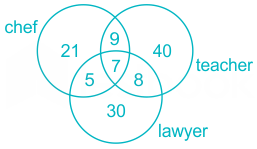
Study the given Venn diagram carefully and answer the question that follows.

<br>

The numbers in different sections indicate the number of persons. How many chefs are there who are also teachers but not lawyers?

  1. AOption (a)

    9

  2. BOption (b)

    5

  3. COption (c)

    8

  4. DOption (d)

    7

View answer & explanation

Correct answer

Answer: (a)A.

9

Why this answer is correct

The given venn diagram is:

Thus, 9 person who are chefs and also teachers but not lawyers.

Hence, the correct answer is "Option 1".

Question 33

Find the value of K if the quadratic equations 2x2 + Kx + 8 = 0 and 3x2 + 4x + 12 = 0 have both roots common.

  1. AOption (a)

    12\frac{1}{2}

  2. BOption (b)

    53\frac{5}{3}

  3. COption (c)

    72\frac{7}{2}

  4. DOption (d)

    83\frac{8}{3}

View answer & explanation

Correct answer

Answer: (d)D.

83\frac{8}{3}

Why this answer is correct

Shortcut Trick

If two quadratic equations a1x2 + b1x + c1 = 0 and a2x2 + b2x + c2 = 0 have both roots common, their coefficients are strictly proportional.

a1/a2 = b1/b2 = c1/c2

2/3 = K/4 = 8/12

Taking 2/3 = K/4 ⇒ K = (2 × 4) / 3 = 8/3

∴ The correct answer is 8/3.

Alternate Method

Given:

Equation 1: 2x2 + Kx + 8 = 0

Equation 2: 3x2 + 4x + 12 = 0

Formula Used:

For two quadratic equations to have both roots in common, the ratio of their corresponding coefficients must be equal:

a1/a2 = b1/b2 = c1/c2

Calculations:

⇒ a1 = 2, b1 = K, c1 = 8

⇒ a2 = 3, b2 = 4, c2 = 12

⇒ 2/3 = K/4 = 8/12

⇒ Simplifying the constant ratio: 8/12 = 2/3

⇒ 2/3 = K/4 = 2/3

⇒ K/4 = 2/3

⇒ K = (2 × 4) / 3

⇒ K = 8/3

∴ The correct answer is 8/3.

Additional Information

Condition for One Common Root

If only one root is common between a1x2 + b1x + c1 = 0 and a2x2 + b2x + c2 = 0, the condition is (a1b2 − a2b1)(b1c2 − b2c1) = (c1a2 − c2a1)2.

Sum and Product of Roots

For a quadratic equation ax2 + bx + c = 0, the sum of roots is −b/a and the product of roots is c/a.

Nature of Roots

Determined by the discriminant D = b2 − 4ac. If D > 0, roots are real and distinct. If D = 0, roots are real and equal. If D < 0, roots are imaginary.

Question 34

P, Q, R, S, T, U and V are sitting around a circular table facing the centre. Only two people sit between T and S when counted from the right of T. Only three people sit between V and Q when counted from the right of Q. S sits to the immediate right of Q. U sits to the immediate right of R. How many people sit between Q and U when counted from the right of Q?

  1. AOption (a)

    3

  2. BOption (b)

    2

  3. COption (c)

    4

  4. DOption (d)

    1

View answer & explanation

Correct answer

Answer: (b)B.

2

Why this answer is correct

Given:

P, Q, R, S, T, U and V are sitting around a circular table facing the centre.

Only two people sit between T and S when counted from the right of T.

S sits to the immediate right of Q.

Only three people sit between V and Q when counted from the right of Q.

 U sits to the immediate right of R. 

Thus, 2 people sit between Q and U when counted from the right of Q.

Hence, the correct answer is "Option 2".

Question 35

What was the overall unemployment rate in India as reported in the 6th Annual Employment-Unemployment Survey conducted by the Labour Bureau?

  1. AOption (a)

    4.9%

  2. BOption (b)

    6.1%

  3. COption (c)

    5.4%

  4. DOption (d)

     7.3%

View answer & explanation

Correct answer

Answer: (c)C.

5.4%

Why this answer is correct

The correct answer is 5.4.

Key Points

  • The 6th Annual Employment-Unemployment Survey (2016-17) by the Labour Bureau reported the overall unemployment rate in India as 5.4% (0.054).
  • The survey highlighted a higher unemployment rate among women (8.7%) compared to men (4.0%).
  • Rural unemployment stood at 5.1%, while urban unemployment was slightly higher at 5.8%.
  • The survey aimed to provide detailed insights into employment patterns, labor force participation, and unemployment trends across various demographics.
  • The report is considered a critical source for policymaking in addressing employment challenges in India.

Additional Information

  • Unemployment Rate:
  • It refers to the percentage of individuals in the labor force who are unable to find jobs despite actively seeking work.
  • Unemployment is categorized into types such as structural, frictional, cyclical, and seasonal unemployment.
  • Labour Bureau Surveys:
  • The Labour Bureau, under the Ministry of Labour and Employment, conducts these surveys to assess employment and unemployment trends in India.
  • The surveys are critical in identifying challenges in the labor market and formulating evidence-based policies.
  • Periodic Labour Force Survey (PLFS):
  • Since 2017-18, the PLFS by the National Statistical Office (NSO) has replaced the Labour Bureau surveys for better and more frequent labor market data.
  • PLFS provides quarterly estimates for urban areas and annual estimates for both rural and urban regions.
  • Labor Force Participation Rate (LFPR):
  • It is the percentage of the working-age population that is either employed or actively seeking employment.
  • India's LFPR has historically been low, particularly for women, due to various social, economic, and cultural factors.
  • Policy Interventions:
  • The Indian government has launched schemes like MGNREGA, Skill India, and Start-Up India to address unemployment and enhance skill development.
  • These initiatives aim to provide employment opportunities and promote entrepreneurship among the youth.

Question 36

 Seven boxes, A, B, C, D, E, F and G, are kept one over the other but not necessarily in the same order. No box is kept above F. Only three boxes are kept between F and B. Only one box is kept between G and D. D is kept immediately above B. Only four boxes are kept between G and C. A is kept in some place above E. How many boxes are kept below D?

  1. AOption (a)

    3

  2. BOption (b)

    4

  3. COption (c)

    1

  4. DOption (d)

    2

View answer & explanation

Correct answer

Answer: (a)A.

3

Why this answer is correct

Given: Seven boxes, A, B, C, D, E, F and G, are kept one over the other but not necessarily in the same order.

  1. No box is kept above F.

This means F is the topmost box (Position 7).

  1. Only three boxes are kept between F and B.

  2. D is kept immediately above B.

7F
6
5
4D
3B
2
1


  1. Only one box is kept between G and D.

Let's consider two cases:

Case 1: G is at 2

7F
6
5
4D
3B
2G
1

Case 2: G is at 6

7F
6G
5
4D
3B
2
1


  1. Only four boxes are kept between G and C.

Consider Case 1 (G is at 2): If G is at 2, and there are 4 boxes between G and C, then C must be at 7 However, F is already at 7. So, Case 1 is not possible.

Consider Case 2 (G is at 6): If G is at 6, and there are 4 boxes between G and C, then C must be at 1 (6 - 4 - 1 = 1).

  1. A is kept in some place above E.
7F
6G
5A
4D
3B
2E
1C


Thus, there are 3 boxes kept below D.

Hence, the correct answer is "Option 1".

Question 37

The Supreme Court can issue writs under Article 32 only for which specific purpose?

  1. AOption (a)

     To protect Fundamental Rights

  2. BOption (b)

    To review decisions of statutory tribunals

  3. COption (c)

    To enforce the Directive Principles of State Policy

  4. DOption (d)

    To resolve disputes between states

View answer & explanation

Correct answer

Answer: (a)A.

 To protect Fundamental Rights

Why this answer is correct

The correct answer is To protect Fundamental Rights.

Key Points

  • Article 32 of the Indian Constitution provides the right to Constitutional Remedies, empowering the Supreme Court to issue writs for the enforcement of Fundamental Rights.
  • Writs under Article 32 include Habeas Corpus, Mandamus, Prohibition, Quo Warranto, and Certiorari, ensuring the protection of Fundamental Rights.
  • Dr. B.R. Ambedkar described Article 32 as the "heart and soul" of the Constitution, emphasizing its significance in safeguarding citizens' rights.
  • Only the Supreme Court can issue writs under Article 32, while High Courts can issue writs under Article 226 for broader purposes, including legal rights.
  • Article 32 is considered a cornerstone of the judiciary's role in maintaining checks and balances in India's democratic framework.

Additional Information

  • Fundamental Rights: These are guaranteed under Part III of the Indian Constitution and include rights such as the Right to Equality, Right to Freedom, Right to Freedom of Religion, Cultural and Educational Rights, and Right to Constitutional Remedies.
  • Types of Writs:
  • Habeas Corpus: To release a person unlawfully detained.
  • Mandamus: To compel a public authority to perform its legal duty.
  • Prohibition: To prevent lower courts from exceeding their jurisdiction.
  • Quo Warranto: To challenge the legality of a person's claim to a public office.
  • Certiorari: To transfer a case from lower courts to higher courts for review.
  • Directive Principles of State Policy: Mentioned under Part IV of the Constitution, these are non-justiciable guidelines for the government to ensure social and economic welfare.
  • Judicial Review: Under Article 13, the judiciary has the power to invalidate laws that violate Fundamental Rights, ensuring their supremacy.
  • Comparison with Article 226: Article 226 allows High Courts to issue writs not only for Fundamental Rights but also for legal rights, making its scope broader than Article 32.

Question 38

Simplify (2x − 5y)2 + (5x + 2y)2 + (2x + 5y)(2x − 5y).

  1. AOption (a)

    34x2 − 4y2

  2. BOption (b)

    33x2 + 4y2

  3. COption (c)

    −34x2 + 4y2

  4. DOption (d)

    −33x2 − 4y2

View answer & explanation

Correct answer

Answer: (b)B.

33x2 + 4y2

Why this answer is correct

Shortcut Trick

Using the special symmetric identity: (Ax − By)2 + (Bx + Ay)2 = (A2 + B2)(x2 + y2)

Here A = 2, B = 5 ⇒ (2x − 5y)2 + (5x + 2y)2 = (22 + 52)(x2 + y2) = 29x2 + 29y2

The third term is a standard difference of squares: (2x + 5y)(2x − 5y) = 4x2 − 25y2

Adding them together: 29x2 + 29y2 + 4x2 − 25y2 = 33x2 + 4y2

∴ The correct answer is 33x2 + 4y2.

Alternate Method

Given:

(2x − 5y)2 + (5x + 2y)2 + (2x + 5y)(2x − 5y)

Formula Used:

⇒ (a − b)2 = a2 − 2ab + b2

⇒ (a + b)2 = a2 + 2ab + b2

⇒ (a + b)(a − b) = a2 − b2

Calculations:

⇒ First term: (2x − 5y)2 = (2x)2 − 2 × (2x) × (5y) + (5y)2 = 4x2 − 20xy + 25y2

⇒ Second term: (5x + 2y)2 = (5x)2 + 2 × (5x) × (2y) + (2y)2 = 25x2 + 20xy + 4y2

⇒ Third term: (2x + 5y)(2x − 5y) = (2x)2 − (5y)2 = 4x2 − 25y2

⇒ Add all three terms together:

⇒ (4x2 − 20xy + 25y2) + (25x2 + 20xy + 4y2) + (4x2 − 25y2)

⇒ Grouping the like terms:

⇒ (4x2 + 25x2 + 4x2) + (−20xy + 20xy) + (25y2 + 4y2 − 25y2)

⇒ 33x2 + 0 + 4y2

⇒ 33x2 + 4y2

∴ The correct answer is 33x2 + 4y2.

Additional Information

Basic Algebraic Identities

(a + b)2 = a2 + 2ab + b2 and (a − b)2 = a2 − 2ab + b2

Difference of Squares

The product of the sum and difference of the same two terms equals the difference of their squares: (a + b)(a − b) = a2 − b2

Symmetric Sum of Squares Identity

An important shortcut to directly solve crossed-coefficient questions without full expansion: (Ax − By)2 + (Bx + Ay)2 = (A2 + B2)(x2 + y2)

Question 39

Which of the following Indian states does NOT have a coastline?

  1. AOption (a)

    Rajasthan

  2. BOption (b)

    Odisha

  3. COption (c)

    Andhra Pradesh

  4. DOption (d)

    Gujarat

View answer & explanation

Correct answer

Answer: (a)A.

Rajasthan

Why this answer is correct

The correct answer is Rajasthan.

Key Points

  • Rajasthan is a landlocked state located in the northwestern part of India and does not have a coastline.
  • It is bordered by Punjab, Haryana, Uttar Pradesh, Madhya Pradesh, and Gujarat, along with an international border with Pakistan.
  • States with coastlines in India include Odisha, Andhra Pradesh, and Gujarat, among others, as they are adjacent to the Bay of Bengal or Arabian Sea.
  • Rajasthan is known for its desert landscape, particularly the Thar Desert, which significantly influences its geography and climate.
  • As a landlocked state, Rajasthan relies on other states for access to ports and maritime trade.

Additional Information

  • India's Coastline: India has a vast coastline of approximately 7,517 kilometers, with states like Gujarat, Maharashtra, Goa, Karnataka, Kerala, Tamil Nadu, Andhra Pradesh, Odisha, and West Bengal having coastal access.
  • Landlocked States: Apart from Rajasthan, other landlocked states in India include Haryana, Madhya Pradesh, Uttar Pradesh, Bihar, and others that lack direct access to the sea.
  • Thar Desert: Covering much of Rajasthan, the Thar Desert is the world's 17th largest desert and the 9th largest subtropical desert.
  • Importance of Coastlines: Coastal states significantly contribute to India's economy through trade, fishing, and tourism, as they have access to ports and maritime routes.
  • Geographical Diversity: India showcases diverse geography, including mountains, plains, plateaus, deserts, and coastal regions, which influence the lifestyle and economic activities of its population.

Question 40

In a certain code language,

A + B means ‘A is the mother of B’

A – B means ‘A is the brother of B’

A × B means ‘A is the wife of B’ and

A ÷ B means ‘A is the father of B’.

How is M related to Q if ‘M + N × O ÷ P – Q’?

  1. AOption (a)

    Mother's sister

  2. BOption (b)

      Father's mother

  3. COption (c)

    Father's sister

  4. DOption (d)

    Mother's mother

View answer & explanation

Correct answer

Answer: (d)D.

Mother's mother

Why this answer is correct

Decoding symbols:

A is
Symbol+×÷-
MeaningMotherWifeFatherBrother
of B

Given: M + N × O ÷ P – Q

M + N → M is the mother of N. (M is Female)

N × O → N is the wife of O. (N is Female, O is Male)

O ÷ P → O is the father of P. (O is Male, P's gender is unknown)

P – Q → P is the brother of Q. (P is Male, Q's gender is unknown)

Based on the decoded relationships, here is the Family Tree Representation:

Thus, M is the mother's mother of Q.

Hence, the correct answer is "Option 4".

Question 41

What is the purpose of the Slide Master in MS PowerPoint?

  1. AOption (a)

    To export slides as images

  2. BOption (b)

    To apply consistent formatting, fonts, and layouts to all slides

  3. COption (c)

     To insert animations and transitions

  4. DOption (d)

     To delete multiple slides at once

View answer & explanation

Correct answer

Answer: (b)B.

To apply consistent formatting, fonts, and layouts to all slides

Why this answer is correct

The correct answer is To apply consistent formatting, fonts, and layouts to all slides.

Key Points

  • The Slide Master is a feature in MS PowerPoint used to ensure uniform design and formatting across all slides in a presentation.
  • It allows users to customize elements like fonts, colors, backgrounds, and placeholders, which are then applied globally to all slides.
  • The Slide Master streamlines the process of maintaining consistency in layouts for titles, content, and other elements.
  • Users can also create custom slide layouts within the Slide Master to suit specific design needs.
  • Any changes made in the Slide Master affect all slides linked to that master, saving time and effort in editing individual slides.

Additional Information

  • Slide Master Terminology:
  • Master Slide: The main slide that controls the design and layout for all associated slides.
  • Layouts: Specific slide designs controlled by the master slide, including placeholders for text and images.
  • Consistency in Design:
  • Ensures presentations look professional and cohesive, especially in business or academic settings.
  • Time Efficiency:
  • Reduces the need to format individual slides, as changes in the Slide Master are applied universally.
  • Advanced Customization:
  • Users can add logos, watermarks, or other branding elements to all slides using the Slide Master.
  • Accessing Slide Master:
  • Located under the View tab in the MS PowerPoint ribbon.

Question 42

What should come in place of the question mark (?) in the given series?

 701 700 697 692 685 ?

  1. AOption (a)

    676

  2. BOption (b)

    673

  3. COption (c)

    675

  4. DOption (d)

    671

View answer & explanation

Correct answer

Answer: (a)A.

676

Why this answer is correct

The logic followed here is:                                                                

701→700→697→692→685→676
-1→-3→-5→-7→-9
-2-2-2-2

Thus, the missing term in the series is 676.

Hence, the correct answer is "Option 1";

Question 43

A man has to cover a distance of 519 km in 7 hours. If he covers two-third of his distance in 5/7 of the time, then what should his speed (in km/hr) be to cover the remaining distance?

  1. AOption (a)

    46.5

  2. BOption (b)

    34.5

  3. COption (c)

    66.5

  4. DOption (d)

    86.5

View answer & explanation

Correct answer

Answer: (d)D.

86.5

Why this answer is correct

Shortcut Trick

Remaining distance = 1 − 2/3 = 1/3 of total distance

Remaining time = 1 − 5/7 = 2/7 of total time

Remaining distance = 519 × 1/3 = 173 km

Remaining time = 7 × 2/7 = 2 hours

Required speed = 173 ÷ 2 = 86.5 km/hr

∴ The correct answer is 86.5 km/hr.

Alternate Method

Given:

Total distance = 519 km

Total time = 7 hours

Part 1 (2/3) 346 km 5 hr

Part 2 (1/3) 173 km 2 hr

Total Distance = 519 km, Total Time = 7 hr

Formula Used:

Speed = Distance ÷ Time

Calculations:

⇒ Distance covered initially = 519 × 2/3 = 346 km

⇒ Time taken initially = 7 × 5/7 = 5 hours

⇒ Remaining distance = 519 − 346 = 173 km

⇒ Remaining time = 7 − 5 = 2 hours

⇒ Speed for remaining distance = 173 ÷ 2

⇒ Required speed = 86.5 km/hr

∴ The correct answer is 86.5 km/hr.

Additional Information

Average Speed

It is defined as the total distance traveled divided by the total time taken. Average Speed = Total Distance ÷ Total Time.

Relative Speed

When two objects move in the same direction, their relative speed is the difference of their individual speeds (S1 − S2). When moving in opposite directions, it is the sum of their speeds (S1 + S2).

Conversion of Units

To convert speed from km/hr to m/s, multiply by 5/18. To convert from m/s to km/hr, multiply by 18/5.

Question 44

The median of the observations 76, 83, 30, 11, 81, 52, 18, 34, 84, 35 and 27 is:

  1. AOption (a)

    35

  2. BOption (b)

    34

  3. COption (c)

    52

  4. DOption (d)

    30

View answer & explanation

Correct answer

Answer: (a)A.

35

Why this answer is correct

Shortcut Trick

For an odd number of observations (n = 11), the median is simply the exact middle value when sorted.

We only need to find the 6th smallest number without sorting the entire sequence.

Identifying smallest to 6th term: 11, 18, 27, 30, 34, 35.

The 6th value is 35.

∴ The correct answer is 35.

Alternate Method

Given:

Observations: 76, 83, 30, 11, 81, 52, 18, 34, 84, 35, 27

Total number of observations (n) = 11

Formula Used:

When the number of observations (n) is odd, Median = ((n + 1) ÷ 2)th observation

Calculations:

⇒ First, arrange the given observations in ascending order:

⇒ 11, 18, 27, 30, 34, 35, 52, 76, 81, 83, 84

Data arranged in Ascending Order

11

18

27

30

34

35

52

76

81

83

84

Median = 6th Term

⇒ Total number of observations (n) = 11, which is an odd number.

⇒ Median = ((11 + 1) ÷ 2)th observation

⇒ Median = (12 ÷ 2)th observation

⇒ Median = 6th observation

⇒ From the sorted data, the 6th observation is 35.

∴ The correct answer is 35.

Additional Information

Mean

The arithmetic average of a dataset. Mean = Sum of all observations ÷ Total number of observations.

Median for Even 'n'

If the number of observations 'n' is even, Median = Average of the (n ÷ 2)th and ((n ÷ 2) + 1)th terms after sorting the data in ascending order.

Mode

The value that appears most frequently in a dataset. A dataset may have one mode, multiple modes, or no mode at all.

Range

The total spread or difference between the highest and lowest values in a dataset. Range = Maximum value − Minimum value.

Question 45

Pipe A can fill a tank in 18 minutes, while pipe B can empty the completely filled tank in 20 minutes. Initially, pipe A is opened and after 6 minutes pipe B is also opened. In how much time (in minutes) will the remaining tank be filled completely?

  1. AOption (a)

    137

  2. BOption (b)

    127

  3. COption (c)

    120

  4. DOption (d)

    107

View answer & explanation

Correct answer

Answer: (c)C.

120

Why this answer is correct

Shortcut Trick

Total capacity of the tank = LCM(18, 20) = 180 units.

Efficiency of Pipe A = +10 units/min and Efficiency of Pipe B = −9 units/min.

Tank filled by Pipe A in the first 6 minutes = 6 × 10 = 60 units.

Remaining capacity to fill = 180 − 60 = 120 units.

Time to fill remaining part = 120 ÷ (10 − 9) = 120 minutes.

∴ The correct answer is 120 minutes.

Alternate Method

Given:

⇒ Time taken by Pipe A to fill the tank = 18 minutes

⇒ Time taken by Pipe B to empty the tank = 20 minutes

⇒ Time for which only Pipe A was operated initially = 6 minutes

Formula Used:

⇒ Total Work = LCM of individual time taken

⇒ Efficiency = Total Work ÷ Time

⇒ Time Required = Remaining Work ÷ Net Combined Efficiency

PipeTimeTotal CapacityEfficiency
A (Fills)18 mins180 units+10 units/min
B (Empties)20 mins−9 units/min

Calculations:

⇒ In the first 6 minutes, work done by Pipe A = 6 × 10 = 60 units.

⇒ Remaining capacity to be filled = 180 − 60 = 120 units.

⇒ After 6 minutes, both pipes A and B are open together.

⇒ Net efficiency of both pipes combined = 10 + (−9) = +1 unit/min.

⇒ Time required to fill the remaining capacity = 120 units ÷ 1 unit/min = 120 minutes.

∴ The correct answer is 120 minutes.

Additional Information

Pipes and Cisterns Net Efficiency

When a filling pipe (time x) and an emptying pipe (time y) run together, the net part filled per hour is (1/x − 1/y), provided the filling rate is higher than the emptying rate.

Concept of Leakage

A leakage at the bottom of a tank acts exactly like an emptying pipe. It continuously reduces the effective efficiency of the filling pipes, thereby increasing the total time required to completely fill the tank.

Alternating Pipes Method

When filling and emptying pipes are opened in alternate turns, compute the net work done in a full cycle (e.g., 2 hours). Special care must be taken towards the end, as the tank might become completely filled before the next emptying cycle begins.

Question 46

In February 2025, Muthoot Finance has received RBI approval to open how many new branches across India, strengthening its presence in the gold loan market?

  1. AOption (a)

    120

  2. BOption (b)

    110

  3. COption (c)

    125

  4. DOption (d)

    115

View answer & explanation

Correct answer

Answer: (d)D.

115

Why this answer is correct

The correct answer is 115.

Key Points

  • In February 2025, Muthoot Finance received approval from the Reserve Bank of India (RBI) to open 115 new branches across the country.
  • This strategic expansion aims to strengthen Muthoot Finance's presence in the gold loan market, a key segment in India's financial sector.
  • The approval aligns with Muthoot Finance's vision to broaden its reach, especially in rural and semi-urban areas, to cater to the growing demand for gold loans.
  • Muthoot Finance is the largest gold financing company in India, with a market share of over 20% in the organized gold loan market.
  • The new branches will enhance access to financial services, including gold loans, insurance, and money transfer services, among underserved populations.

Additional Information

  • Gold Loan Market in India:
  • India is one of the largest consumers of gold globally, with households holding over 25,000 tons of gold, making gold loans a popular financial product.
  • Gold loans are secured loans where borrowers pledge their gold jewelry or ornaments as collateral.
  • The organized gold loan market in India is dominated by NBFCs like Muthoot Finance and Manappuram Finance, along with banks.
  • Muthoot Finance Overview:
  • Muthoot Finance Limited is a leading Non-Banking Financial Company (NBFC) in India, founded in 1939.
  • It specializes in gold loans, money transfer services, investment products, and insurance services.
  • With a vast network of branches, Muthoot Finance primarily caters to rural and semi-urban customers.
  • RBI's Role in Branch Approvals:
  • The Reserve Bank of India regulates NBFCs and approves their expansion plans, ensuring adherence to financial and operational guidelines.
  • Branch expansions are approved based on factors such as financial health, compliance history, and market demand.
  • Impact of Branch Expansion:
  • Branch expansions improve financial inclusion by providing easier access to loans and other financial services in underbanked areas.
  • They also contribute to employment generation and support regional economic growth.

Question 47

Simplify:58323100004×524×78\text{Simplify:} \quad \frac{\sqrt[3]{5832}}{\sqrt[4]{10000}} \times \frac{5}{24} \times 78

  1. AOption (a)

    17

  2. BOption (b)

    21

  3. COption (c)

    8

  4. DOption (d)

    29.25

View answer & explanation

Correct answer

Answer: (d)D.

29.25

Why this answer is correct

Shortcut Trick

We know that 183 = 5832 and 104 = 10000.

Given expression = (18 ÷ 10) × (5 ÷ 24) × 78

⇒ (18 × 5 × 78) ÷ (10 × 24)

⇒ (90 ÷ 240) × 78 = (3 ÷ 8) × 78

⇒ 234 ÷ 8 = 29.25

∴ The correct answer is 29.25.

Alternate Method

Given:

Expression: (3√5832 ÷ 4√10000) × (5 ÷ 24) × 78

Calculation:

⇒ First, find the cube root of 5832.

⇒ 103 = 1000 and 203 = 8000, so the cube root is strictly between 10 and 20.

⇒ Since 83 = 512 (ends in 2), the cube root of 5832 must be 18.

⇒ Next, find the fourth root of 10000.

⇒ 10000 = 10 × 10 × 10 × 10 = 104, so 4√10000 = 10.

⇒ Substitute the root values into the given expression:

⇒ (18 ÷ 10) × (5 ÷ 24) × 78

⇒ (9 ÷ 5) × (5 ÷ 24) × 78

⇒ (9 ÷ 24) × 78

⇒ (3 ÷ 8) × 78

⇒ 234 ÷ 8 = 117 ÷ 4

⇒ 29.25

∴ The correct answer is 29.25.

Additional Information

BODMAS Rule

Always solve mathematical expressions in the exact sequence: Brackets, Orders (powers/roots), Division, Multiplication, Addition, and Subtraction.

Finding Cube Roots Trick

For a perfect cube, look at the last digit. If it ends in 2, its cube root ends in 8. Then strike off the last three digits and find the nearest smaller perfect cube for the remaining prefix number.

Fourth Roots

A fourth root is simply the square root of a square root. For example, 4√10000 = √(√10000) = √100 = 10.

Question 48

Which of the following solutions is slightly acidic due to hydrolysis?

  1. AOption (a)

    Na₂CO₃

  2. BOption (b)

    NH₄Cl

  3. COption (c)

    NH₄CH₃COO

  4. DOption (d)

    CH₃COONa

View answer & explanation

Correct answer

Answer: (b)B.

NH₄Cl

Why this answer is correct

The correct answer is NH₄Cl.

Key Points

  • NH₄Cl (Ammonium chloride) is a salt of a weak base (NH₃) and a strong acid (HCl), making its aqueous solution slightly acidic due to hydrolysis.
  • In water, NH₄Cl dissociates into NH₄⁺ and Cl⁻ ions. The NH₄⁺ ion undergoes hydrolysis to form NH₃ and H⁺ ions, increasing the acidity.
  • The Cl⁻ ion does not hydrolyze because it is the conjugate base of a strong acid (HCl) and remains inert in the solution.
  • The pH of an NH₄Cl solution is typically less than 7, confirming its acidic nature.
  • Other options like Na₂CO₃ and CH₃COONa are basic, while NH₄CH₃COO is nearly neutral due to the balance between its acidic and basic components.

Additional Information

  • Hydrolysis: It is the reaction of a salt with water to form an acidic or basic solution depending on the strength of the parent acid and base.
  • Ammonium Ion (NH₄⁺): It is a weak acid that hydrolyzes in water, releasing H⁺ ions and contributing to the solution's acidity.
  • Conjugate Acid-Base Pair: NH₄⁺ is the conjugate acid of the weak base NH₃, while Cl⁻ is the conjugate base of the strong acid HCl.
  • pH of Salts: The pH of a salt solution depends on the hydrolysis of its ions. Salts of strong acids and weak bases are acidic, while salts of strong bases and weak acids are basic.
  • Non-Hydrolyzing Ions: Ions like Cl⁻, derived from strong acids, do not hydrolyze and do not affect the solution's pH.

Question 49

Rahul’s age is three times the age of his daughter. After 8 years from now, his age will be 5 years more than twice the age of his daughter. Find the present age of Rahul.

  1. AOption (a)

    39 years

  2. BOption (b)

    33 years

  3. COption (c)

    30 years

  4. DOption (d)

    36 years

View answer & explanation

Correct answer

Answer: (a)A.

39 years

Why this answer is correct

Shortcut Trick

Let Rahul's age be 3 units and his daughter's age be 1 unit.

After 8 years, Rahul's age is 2 times her age plus 5 years.

Equating directly: 3 units + 8 = 2 × (1 unit + 8) + 5

3 units + 8 = 2 units + 21 ⇒ 1 unit = 13

Rahul's present age = 3 units = 3 × 13 = 39 years.

∴ The correct answer is 39 years.

Alternate Method

Given:

⇒ Rahul's age is three times his daughter's age.

⇒ After 8 years, his age will be 5 years more than twice the age of his daughter.

Present Rahul = 3x Daughter = x

  • 8 years

Future (+8 yrs) Rahul = 3x + 8 Daughter = x + 8

Condition: 3x + 8 = 2(x + 8) + 5

Calculations:

⇒ Let the present age of the daughter be x years.

⇒ Present age of Rahul = 3x

⇒ Age of daughter after 8 years = x + 8

⇒ Age of Rahul after 8 years = 3x + 8

⇒ According to the condition: 3x + 8 = 2 × (x + 8) + 5

⇒ 3x + 8 = 2x + 16 + 5

⇒ 3x + 8 = 2x + 21

⇒ 3x − 2x = 21 − 8

⇒ x = 13

⇒ Daughter's present age = 13 years

⇒ Rahul's present age = 3x = 3 × 13 = 39 years

∴ The correct answer is 39 years.

Additional Information

Constant Age Difference

The absolute difference in ages between any two individuals always remains exactly the same, regardless of how many years pass backward or forward.

Cross-Multiplication Trick

When comparing ages represented as initial and final ratios over a fixed period of time, cross-multiplying the ratios simplifies finding the base value of 1 ratio unit rapidly.

Average Age Expansion

If the average age of a group of n persons is A, then after k years, the new average age logically becomes exactly A + k without recalculating individual totals.

Question 50

A dealer sells two dryers at the rate of ₹63,000 per dryer. On one, he earns a profit of 5% and on the other he loses 30%. What is his loss percentage in the whole transaction?

  1. AOption (a)

    16%

  2. BOption (b)

    15%

  3. COption (c)

    17%

  4. DOption (d)

    14%

View answer & explanation

Correct answer

Answer: (a)A.

16%

Why this answer is correct

Shortcut Trick

Since the selling price is the same for both, we can use the ratio method to equate SP units:

5% Profit = +1/20 ⇒ CP : SP = 20 : 21

30% Loss = −3/10 ⇒ CP : SP = 10 : 7 ⇒ Multiply by 3 to equate SP ⇒ 30 : 21

Total CP = 20 + 30 = 50 units | Total SP = 21 + 21 = 42 units

Loss % = (50 − 42) ÷ 50 × 100 = 8 ÷ 50 × 100 = 16%

∴ The correct answer is 16%.

Alternate Method

Given:

Selling price (SP) of each dryer = ₹63,000

Profit on first dryer = 5% | Loss on second dryer = 30%

Formula Used:

CP = (SP × 100) ÷ (100 ± Profit/Loss %)

Loss % = (Loss ÷ Total CP) × 100

Dryer 1 (5% Profit) CP: 60,000 → SP: 63,000

Dryer 2 (30% Loss) CP: 90,000 → SP: 63,000

Overall Transaction Total CP: ₹150k | Total SP: ₹126k Net Loss: 16%

Calculations:

⇒ CP of first dryer = (63,000 × 100) ÷ 105 = ₹60,000

⇒ CP of second dryer = (63,000 × 100) ÷ 70 = ₹90,000

⇒ Total CP = 60,000 + 90,000 = ₹1,50,000

⇒ Total SP = 63,000 + 63,000 = ₹1,26,000

⇒ Total Loss = 1,50,000 − 1,26,000 = ₹24,000

⇒ Loss % = (24,000 ÷ 1,50,000) × 100 = 16%

∴ The correct answer is 16%.

Additional Information

Same SP with Same Profit & Loss %

When two articles are sold at the same price, one at a profit of x% and the other at a loss of x%, there is always an overall net loss equal to (x2 ÷ 100)%.

Successive Profit/Loss

If an article goes through multiple % changes (x and y), the net effect is given by x + y + (xy ÷ 100), where loss is taken as negative and profit as positive.

Dishonest Dealer

Profit % = (True Weight − False Weight) ÷ False Weight × 100.

Question 51

From which state to which state do the Eastern Coastal Plains of India extend?

  1. AOption (a)

    Odisha to Karnataka

  2. BOption (b)

    Gujarat to Kerala

  3. COption (c)

    West Bengal to Tamil Nadu

  4. DOption (d)

    Maharashtra to Andhra Pradesh

View answer & explanation

Correct answer

Answer: (c)C.

West Bengal to Tamil Nadu

Why this answer is correct

The correct answer is West Bengal to Tamil Nadu.

Key Points

  • The Eastern Coastal Plains of India extend from West Bengal in the north to Tamil Nadu in the south, running along the eastern coastline of India.
  • They are bordered by the Bay of Bengal on the east and the Eastern Ghats on the west.
  • The plains are divided into two sub-regions: the Utkal Plains in Odisha and the Coromandel Coast in Andhra Pradesh and Tamil Nadu.
  • These plains are characterized by several major rivers like the Ganga, Mahanadi, Godavari, Krishna, and Kaveri, which form fertile deltas in this region.
  • The region supports intensive agriculture, particularly of crops like rice, coconut, and sugarcane, due to the availability of fertile alluvial soil.

Additional Information

  • Eastern Coastal Plains:
  • These are wide, flat plains formed by the depositional activity of rivers.
  • They are broader and more fertile compared to the Western Coastal Plains of India.
  • Major Deltas:
  • The region is home to some of the largest deltas in the world, such as the Sundarbans Delta (Ganges-Brahmaputra Delta) and the Godavari-Krishna Delta.
  • Climate:
  • The Eastern Coastal Plains experience a tropical monsoon climate with high humidity and significant rainfall, especially during the northeast monsoon season.
  • Ports and Harbors:
  • Major ports like Chennai, Visakhapatnam, and Paradip are located along the Eastern Coastal Plains, playing a significant role in trade and commerce.
  • Biodiversity:
  • The region includes ecologically significant areas such as the Sundarbans Mangrove Forests, which are home to the Royal Bengal Tiger and other endangered species.

Question 52

When x is added to each of 30, 15, 21 and 11, then the numbers so obtained, in this order, are in proportion. Then, if 6x : y :: y : (3x-9), and y > 0, what is the value of y?

  1. AOption (a)

    10

  2. BOption (b)

    24

  3. COption (c)

    18

  4. DOption (d)

    37

View answer & explanation

Correct answer

Answer: (c)C.

18

Why this answer is correct

Shortcut Trick To find the value x added to a, b, c, and d to make them proportional, use the direct formula: x = (bc − ad) ÷ ((a + d) − (b + c)). x = (15 × 21 − 30 × 11) ÷ ((30 + 11) − (15 + 21)) = (315 − 330) ÷ (41 − 36) = −15 ÷ 5 = −3. Given 6x : y :: y : (3x − 9), it means y is the mean proportional between 6x and (3x − 9). y2 = 6x(3x − 9) = 6(−3) × (3(−3) − 9) = (−18) × (−18) = 324. Since y > 0, we take the positive square root, giving y = 18. ∴ The correct answer is 18.

Alternate Method Given: Numbers: 30, 15, 21, and 11. If x is added, they become proportional. 6x, y, and (3x − 9) are in continuous proportion where y > 0. Formula Used: For a proportion a : b :: c : d, the product of extremes equals the product of means (ad = bc).

30 + x

:

15 + x

::

21 + x

:

11 + x

27

:

12

::

18

:

8

Both ratios simplify to 9 : 4 (when x = −3)

Calculations: ⇒ (30 + x) ÷ (15 + x) = (21 + x) ÷ (11 + x) ⇒ (30 + x)(11 + x) = (15 + x)(21 + x) ⇒ 330 + 41x + x2 = 315 + 36x + x2 ⇒ 41x − 36x = 315 − 330 ⇒ 5x = −15 ⇒ x = −3 Now, substituting x = −3 in the given continuous proportion 6x : y :: y : (3x − 9): ⇒ 6(−3) : y :: y : (3(−3) − 9) ⇒ −18 : y :: y : −18 ⇒ y2 = (−18) × (−18) ⇒ y2 = 324 ⇒ y = 18 (since it is given that y > 0) ∴ The correct answer is 18.

Additional Information Proportion Rule If four numbers a, b, c, d are in proportion, they satisfy a : b :: c : d, which translates algebraically to the rule: Product of Extremes = Product of Means (ad = bc). Mean Proportional The mean proportional 'y' between two numbers 'A' and 'B' is defined by A : y :: y : B, yielding the fundamental formula y2 = AB. Proportion Balancing Shortcut To find a value x added to a, b, c, and d to make them proportional without forming quadratic equations, simply use: x = (bc − ad) ÷ ((a + d) − (b + c)).

Question 53

This question is based on the five, three-digit numbers given below.

(Left) 614 457 249 625 150 (Right)

(Example: 697 – First digit = 6, second digit = 9 and third digit = 7)

(NOTE: All operations to be done from left to right.)

What will be the resultant if the second digit of the highest number is subtracted from the second digit of the lowest number?

  1. AOption (a)

    4

  2. BOption (b)

    6

  3. COption (c)

    2

  4. DOption (d)

    3

View answer & explanation

Correct answer

Answer: (d)D.

3

Why this answer is correct

The given numbers are: 614, 457, 249, 625, 150.

The highest number in the list is 625.

The second digit of 625 is 2.

The lowest number in the list is 150.

The second digit of 150 is 5.

Subtract the second digit of the highest number (2) from the second digit of the lowest number (5).

Resultant = 5 - 2 = 3.

Thus, the resultant is 3.

Hence, the correct answer is "Option 4".

Question 54

Based on the English alphabetical order, three of the following four letter-cluster pairs are alike in a certain way and thus form a group. Which letter-cluster pair DOES NOT belong to that group? (Note: The odd one out is not based on the number of consonants/vowels or their position in the letter cluster)

  1. AOption (a)

    MU - KH

  2. BOption (b)

    HL - JN

  3. COption (c)

    SW - UY

  4. DOption (d)

    NR - PT

View answer & explanation

Correct answer

Answer: (a)A.

MU - KH

Why this answer is correct

Given:

Option 1) MU - KH

M(13)U(21)
↓ -2↓ -13
K(11)H(8)

Option 2) HL - JN

H(8)L(12)
↓ +2↓ +2
J(10)N(14)

Option 3) SW - UY

S(19)W(23)
↓ +2↓ +2
U(21)Y(25)

Option 4) NR - PT

N(14)R(18)
↓ +2↓ +2
P(16)T(20)

Option 1 follows a different pattern of making it the odd one out.

Hence, the correct answer is "Option 1".

Question 55

In which year did Bakshi Jagabandhu lead the Paika Rebellion to protest against the British land revenue policy?

  1. AOption (a)

    1817

  2. BOption (b)

    1717

  3. COption (c)

    1785

  4. DOption (d)

    1806

View answer & explanation

Correct answer

Answer: (a)A.

1817

Why this answer is correct

The correct answer is 1817.

Key Points

  • The Paika Rebellion of 1817 was led by Bakshi Jagabandhu Bidyadhar, the military chief of the Khurda Kingdom, in Odisha.
  • It was a significant uprising against the British East India Company’s land revenue policies, which caused widespread discontent among the Paikas and other sections of society.
  • The rebellion began in Khurda and rapidly spread to other regions of Odisha, involving a broad coalition of peasants, zamindars, and tribal groups.
  • The British imposed exploitative taxes, disrupted traditional land rights, and confiscated the hereditary estates of many zamindars, fueling the revolt.
  • The Paikas, traditional militia of Odisha, were primarily affected as their role in the Khurda kingdom was marginalized due to British administrative reforms.

Additional Information

  • Who were the Paikas?
  • The Paikas were the traditional landed militia of Odisha who rendered military service to the kings of the Khurda Kingdom in exchange for land grants.
  • Their hereditary land tenures were known as "jagir," which the British abolished, reducing them to poverty.
  • Impact of British Revenue Policies:
  • The introduction of Permanent Settlement in Bengal and parts of Odisha disrupted the traditional agrarian system.
  • The British confiscated lands and auctioned them off to new landlords, alienating the Paikas and local zamindars.
  • Key Events of the Rebellion:
  • The rebellion began in March 1817, with the Paikas attacking British establishments and burning government buildings.
  • It was suppressed by September 1817, as the British used superior military technology and administrative measures.
  • Legacy of the Paika Rebellion:
  • The Paika Rebellion is often regarded as a precursor to India's First War of Independence in 1857.
  • In 2017, the Government of India commemorated the 200th anniversary of the rebellion, recognizing its historical significance.

Question 56

If the ratio of two numbers is 5 : 3 and the product of their LCM and their HCF is 135, then the sum of the reciprocals of the LCM and the HCF is:

  1. AOption (a)

    1673\frac{16}{73}

  2. BOption (b)

    1685\frac{16}{85}

  3. COption (c)

    1645\frac{16}{45}

  4. DOption (d)

    1661\frac{16}{61}

View answer & explanation

Correct answer

Answer: (c)C.

1645\frac{16}{45}

Why this answer is correct

Shortcut Trick

Let the numbers be 5x and 3x.

Product of numbers = LCM × HCF ⇒ 15x2 = 135 ⇒ x2 = 9 ⇒ x = 3.

HCF = x = 3, and LCM = 15x = 45.

Sum of reciprocals = 1/45 + 1/3 = (1 + 15) / 45 = 16/45.

∴ The correct answer is 16/45.

Alternate Method

Given:

Ratio of two numbers = 5 : 3

Product of their LCM and HCF = 135

Formula Used:

Product of two numbers = LCM × HCF

Ratio = 5 : 3 Numbers: 5x, 3x

LCM × HCF = 135 15x² = 135 → x = 3

HCF = x = 3 LCM = 15x = 45

Sum of Reciprocals 1/45 + 1/3 = 16/45

Calculations:

⇒ Let the numbers be 5x and 3x.

⇒ Product of numbers = 5x × 3x = 15x2

⇒ 15x2 = 135

⇒ x2 = 9 ⇒ x = 3

⇒ The numbers are 5(3) = 15 and 3(3) = 9.

⇒ HCF of 15 and 9 = 3

⇒ LCM of 15 and 9 = 45

⇒ Sum of reciprocals = 1/LCM + 1/HCF

⇒ Sum = 1/45 + 1/3 = (1 + 15) / 45 = 16/45

∴ The correct answer is 16/45.

Additional Information

LCM & HCF Relation

For any two numbers a and b, the product of the numbers is equal to the product of their LCM and HCF. (a × b = LCM × HCF).

Co-prime Factors

If two numbers are given in a ratio p : q (where p and q are co-prime), and their HCF is x, then the numbers are px and qx, and their LCM is pqx.

Reciprocals Trick

The sum of reciprocals of two numbers a and b is given directly by (a + b) ÷ (a × b).

Question 57

A ladder leaning against a wall makes an angle θ with the horizontal ground such that tan θ = 158\frac{15}{8}. If the height of the top of the ladder from the wall is 30 m, find the distance (in m) of the foot of the ladder from the wall.

  1. AOption (a)

    16

  2. BOption (b)

    14

  3. COption (c)

    20

  4. DOption (d)

    18

View answer & explanation

Correct answer

Answer: (a)A.

16

Why this answer is correct

Shortcut Trick

Given tan θ = 15/8, which represents the ratio of Height to Base.

Height ratio = 15 parts → 30 m

Multiplier = 30 ÷ 15 = 2

Base distance = 8 parts × 2 = 16 m

∴ The correct answer is 16 m.

Alternate Method

Given:

Height of the top of the ladder from the ground (Perpendicular) = 30 m

Angle made by the ladder with the ground = θ

tan θ = 15/8

θ 30 m Wall d = ? Ground Ladder

Formula Used:

tan θ = Perpendicular ÷ Base

Calculations:

⇒ tan θ = Height of the wall ÷ Distance of foot from wall

⇒ 15/8 = 30 ÷ Distance

⇒ Distance × 15 = 30 × 8

⇒ Distance = 240 ÷ 15

⇒ Distance = 16 m

∴ The correct answer is 16 m.

Additional Information

Trigonometric Ratios in Right Triangles

For an acute angle θ, the primary ratios are: sin θ = Perpendicular ÷ Hypotenuse, cos θ = Base ÷ Hypotenuse, and tan θ = Perpendicular ÷ Base.

Pythagorean Triplets

Sets of three integers that naturally satisfy the Pythagorean theorem (H2 = P2 + B2). Common triplets include (3, 4, 5), (5, 12, 13), and (8, 15, 17).

Angle of Elevation

The angle formed by the line of sight with the horizontal plane when viewing an object located above the observer's level.

Question 58

The mode and median of a data set is 28.4 and 88, respectively. What is the mean of the data set? (Use empirical formula.)

  1. AOption (a)

    114.2

  2. BOption (b)

    119.2

  3. COption (c)

    117.8

  4. DOption (d)

    127.7

View answer & explanation

Correct answer

Answer: (c)C.

117.8

Why this answer is correct

Shortcut Trick According to the empirical formula: Mean = (3 × Median − Mode) ÷ 2 ⇒ Mean = (3 × 88 − 28.4) ÷ 2 ⇒ Mean = (264 − 28.4) ÷ 2 ⇒ Mean = 235.6 ÷ 2 = 117.8 ∴ The correct answer is 117.8.

Alternate Method Given: Mode = 28.4 Median = 88 Formula Used: Karl Pearson's Empirical Formula: Mode = 3 × Median − 2 × Mean

Mode 28.4

Median 88

Mean 117.8

Mode = 3 × Median − 2 × Mean Positively Skewed (Mean > Median > Mode)

Calculations: ⇒ 28.4 = 3 × 88 − 2 × Mean ⇒ 28.4 = 264 − 2 × Mean ⇒ 2 × Mean = 264 − 28.4 ⇒ 2 × Mean = 235.6 ⇒ Mean = 235.6 ÷ 2 ⇒ Mean = 117.8 ∴ The correct answer is 117.8.

Additional Information Empirical Relationship in Statistics For a moderately skewed distribution, the relationship between Mean, Median, and Mode is given by the empirical formula: Mode = 3 × Median − 2 × Mean. Symmetrical Distribution In a perfectly symmetrical or normal distribution, all three measures of central tendency are equal: Mean = Median = Mode. Positively Skewed Distribution The distribution tail is longer on the right side. The measures follow the order: Mean > Median > Mode. Negatively Skewed Distribution The distribution tail is longer on the left side. The measures follow the order: Mean < Median < Mode.

Question 59

Which of the following is an example of an operating system commonly used on desktop computers?

  1. AOption (a)

    Microsoft Word

  2. BOption (b)

    Google Chrome

  3. COption (c)

    Adobe Photoshop

  4. DOption (d)

    Windows 10

View answer & explanation

Correct answer

Answer: (d)D.

Windows 10

Why this answer is correct

The correct answer is Windows 10.

Key Points

  • Windows 10 is a widely used operating system developed by Microsoft for personal computers, laptops, and tablets.
  • It was officially released on July 29, 2015, and has since become one of the most popular desktop operating systems globally.
  • Windows 10 introduced features like the Start Menu, Cortana (AI assistant), and Microsoft Edge browser, providing a seamless user experience.
  • The operating system supports various software applications and provides compatibility for hardware devices, making it suitable for both professional and personal use.
  • Windows 10 receives regular updates from Microsoft to ensure better performance, security, and new features.

Additional Information

  • Operating System (OS):
  • An operating system is system software that manages hardware and software resources and provides services for computer programs.
  • Examples of popular desktop operating systems include Windows, macOS, and Linux.
  • Microsoft Word:
  • Microsoft Word is a word processing software developed by Microsoft, not an operating system.
  • It is commonly used for creating and editing text documents.
  • Google Chrome:
  • Google Chrome is a web browser developed by Google, not an operating system.
  • It is used for accessing websites and browsing the internet.
  • Adobe Photoshop:
  • Adobe Photoshop is a graphic design and photo editing software developed by Adobe Systems, not an operating system.
  • It is used for tasks such as editing images and creating digital artwork.
  • Windows 11:
  • The latest version of Microsoft's operating system, Windows 11, was launched on October 5, 2021.
  • It introduced a redesigned user interface and enhanced productivity tools while maintaining compatibility with Windows 10 applications.

Question 60

If 260 is the mean proportion between x and 338, what is the value of x?

  1. AOption (a)

    198

  2. BOption (b)

    200

  3. COption (c)

    199

  4. DOption (d)

    201

View answer & explanation

Correct answer

Answer: (b)B.

200

Why this answer is correct

Shortcut Trick

For three numbers in continuous proportion, Mean Proportion2 = First Term × Third Term

⇒ 2602 = x × 338

⇒ x = (260 × 260) ÷ 338

⇒ x = 67600 ÷ 338 = 200

∴ The correct answer is 200.

Alternate Method

Given:

Mean proportion = 260

First term = x

Third term = 338

x

:

260

::

260

:

338

Mean Proportion

Continuous Proportion

Formula Used:

Mean Proportion = √(First term × Third term)

Calculations:

⇒ 260 = √(x × 338)

Squaring both sides:

⇒ 2602 = x × 338

⇒ 67600 = 338x

⇒ x = 67600 ÷ 338

⇒ x = 200

∴ The correct answer is 200.

Additional Information

Mean Proportion

If b is the mean proportion between a and c, then b = √(a × c).

Third Proportion

If a : b :: b : c, then c is called the third proportion. Formula: c = b2 ÷ a.

Fourth Proportion

If a : b :: c : d, then d is called the fourth proportion. Formula: d = (b × c) ÷ a.

Compound Ratio

The compound ratio of a : b and c : d is defined as (a × c) : (b × d).

Question 61

Salil’s salary was first reduced by 15% and subsequently raised by 10%. What percentage was his final salary lower compared to his initial salary?

  1. AOption (a)

     6.5%

  2. BOption (b)

    10%

  3. COption (c)

    1.5%

  4. DOption (d)

    15 %

View answer & explanation

Correct answer

Answer: (a)A.

 6.5%

Why this answer is correct

Shortcut Trick

Use the successive percentage change formula: Net % change = a + b + (a × b) ÷ 100

Here, a = −15% (reduction) and b = +10% (raise)

Net change = −15 + 10 + (−15 × 10) ÷ 100

Net change = −5 − 1.5 = −6.5%

The negative sign indicates an overall decrease of 6.5%.

∴ The correct answer is 6.5%.

Alternate Method

Given:

Reduction in salary = 15%

Subsequent raise in salary = 10%

Calculations:

Initial 100

Reduced 85

Final 93.5

−15%

+10%

Net Change: −6.5%

⇒ Let the initial salary of Salil be 100 units.

⇒ Salary after 15% reduction = 100 − (15% of 100) = 100 − 15 = 85 units.

⇒ Subsequent 10% raise on the new salary = 85 + (10% of 85) = 85 + 8.5 = 93.5 units.

⇒ Net decrease in salary = Initial salary − Final salary = 100 − 93.5 = 6.5 units.

⇒ Percentage decrease = (Net decrease ÷ Initial salary) × 100

⇒ Percentage decrease = (6.5 ÷ 100) × 100 = 6.5%.

∴ The correct answer is 6.5%.

Additional Information

Successive Percentage Change

When a value undergoes multiple percentage changes sequentially, the net effect is given by: a + b + (a × b) ÷ 100. Always use a positive sign for increments/profit and a negative sign for decrements/loss.

Multiplying Factor Method

Final Value = Initial Value × (1 ± r1 ÷ 100) × (1 ± r2 ÷ 100). For this question: Final = Initial × 0.85 × 1.10 = Initial × 0.935, directly showing a 6.5% drop.

Base Value Concept

In successive percentage problems, every subsequent change is applied to the newly obtained intermediate value, never on the original base value.

Question 62

If ‘+’ means ‘−’, ‘−’ means ‘×’, ‘×’ means ‘÷’ and ‘÷’ means ‘+’, then what will come in place of the question mark (?) in the following equation?

32 ÷ 14 + 16 – 8 × 4 = ?

  1. AOption (a)

    14

  2. BOption (b)

    16

  3. COption (c)

    18

  4. DOption (d)

    22

View answer & explanation

Correct answer

Answer: (a)A.

14

Why this answer is correct

BODMAS Rule:

According to the question, the symbol meanings are:

Original Symbol+−×÷
New Meaning−×÷+

Now,

Given e×pression: 32 ÷ 14 + 16 – 8 × 4 = ?

After replacing the symbols with their new meanings:

⇒ 32 + 14 − 16 × 8 ÷ 4

Perform operations according to BODMAS/PEMDAS:

⇒ 32 + 14 − 16 × 8 ÷ 4

⇒ 32 + 14 − 128 ÷ 4

⇒ 32 + 14 − 32

⇒ 46 − 32

⇒ 14

Hence, the correct answer is "Option 1".

Question 63

What should come in place of the question mark (?) in the given series based on the English alphabetical order?

 XBF UYC RVZ OSW ?

  1. AOption (a)

    LTP

  2. BOption (b)

    LPT

  3. COption (c)

    TLP

  4. DOption (d)

    TPL

View answer & explanation

Correct answer

Answer: (b)B.

LPT

Why this answer is correct

The logic followed here is:

X (24)B (2)F (6)
-3 ↓-3 ↓-3 ↓
U (21)Y (25)C (3)
-3 ↓-3 ↓-3 ↓
R (18)V (22)Z (26)
-3 ↓-3 ↓-3 ↓
O (15)S (19)W (23)
-3 ↓-3 ↓-3 ↓
L (12)P (16)T (20)

Thus, 'LPT' will be the next in the series.

Hence, the correct answer is "Option 2".

Question 64

How many cities were initially included under the Smart Cities Mission launched by the Government of India?

  1. AOption (a)

    100

  2. BOption (b)

    50

  3. COption (c)

    200

  4. DOption (d)

    150

View answer & explanation

Correct answer

Answer: (a)A.

100

Why this answer is correct

The correct answer is 100.

Key Points

  • The Smart Cities Mission was launched by the Government of India on 25 June 2015 under the Ministry of Housing and Urban Affairs.
  • Initially, 100 cities were selected to be developed as part of the mission.
  • The mission aims to improve urban infrastructure and provide better quality of life through sustainable and inclusive development.
  • The cities were selected through a competitive process known as the Smart Cities Challenge.
  • The total planned investment for the mission is estimated at ₹2.05 lakh crore, covering projects like affordable housing, urban mobility, and IT connectivity.

Additional Information

  • Smart Cities Mission Objectives:
  • The mission focuses on area-based development such as retrofitting, redevelopment, and greenfield projects.
  • It emphasizes smart solutions like smart meters, intelligent traffic management, and e-governance.
  • Selection Process:
  • The cities were selected through a three-stage competition involving state governments, urban local bodies, and central government evaluation.
  • Only cities that meet specified criteria are granted funding under the mission.
  • Implementation:
  • Each selected city sets up a Special Purpose Vehicle (SPV) for implementation, with support from government and private partners.
  • The SPV is responsible for planning, appraising, and executing projects under the mission.
  • Progress:
  • As of 2023, over 7,000 projects have been tendered, with many nearing completion across various cities.
  • Key focus areas include urban mobility, affordable housing, and green energy initiatives.

Question 65

Which of the following letter-clusters should replace # and % so that the pattern and relationship followed between the letter-cluster pair on the left side of :: is the same as that on the right side of ::?

 # : VEC :: BNW : %

  1. AOption (a)

     # = DQU, % = XHA

  2. BOption (b)

     # = FTS, % = XHA

  3. COption (c)

    = XHA, % = ZKY

  4. DOption (d)

     # = ZKY, % = FTS

View answer & explanation

Correct answer

Answer: (c)C.

= XHA, % = ZKY

Why this answer is correct

The logic followed here is:

Option 1)  # = DQU, % = XHA

Does not follow same logic.

Option 2)  # = FTS, % = XHA

Does not follow same logic.

Option 3) # = XHA, % = ZKY

Follow the same logic.

Option 4)  # = ZKY, % = FTS

Does not follow same logic.

Hence, the correct answer is "Option 3".

Question 66

Which urban local self government body manages small towns with limited municipal functions like street lighting and drainage?

  1. AOption (a)

     Town Area Committee

  2. BOption (b)

    Municipal Corporation

  3. COption (c)

    Special Purpose Agencies

  4. DOption (d)

    Port Trust

View answer & explanation

Correct answer

Answer: (a)A.

 Town Area Committee

Why this answer is correct

The correct answer is Town Area Committee.

Key Points

  • A Town Area Committee is a semi-municipal authority responsible for administering small towns with limited municipal functions.
  • It typically manages essential services such as street lighting, drainage, and sanitation in areas that are not large enough to require a full-fledged municipal corporation.
  • These committees are constituted by the State Governments and operate under their supervision.
  • Unlike municipal corporations, a Town Area Committee has limited jurisdiction and fewer responsibilities.
  • The members of the committee can be either elected, nominated, or both, depending on state regulations.

Additional Information

  • Municipal Corporation:
  • A municipal corporation is an urban local government body responsible for the governance of large cities with populations exceeding a specific threshold (e.g., 1 lakh or more).
  • It handles diverse functions such as waste management, public transportation, and urban planning.
  • Special Purpose Agencies:
  • These are autonomous bodies created to manage specific functions like water supply, transportation, or housing in urban areas.
  • They operate independently of the municipal government.
  • Port Trust:
  • A Port Trust is a specialized body responsible for managing and maintaining ports and their associated facilities.
  • It primarily focuses on trade and maritime operations rather than urban governance.
  • Urban Local Self-Government:
  • Urban local self-government refers to the institutions that govern cities and towns, ensuring the provision of essential services and infrastructure.
  • Examples include municipal corporations, municipalities, town area committees, and notified area councils.

Question 67

 In South Indian temple architecture, what is the name of the stepped or pyramidal structure built above the sanctum?

  1. AOption (a)

    Adhisthana

  2. BOption (b)

     Vimana

  3. COption (c)

    Jagati

  4. DOption (d)

    Mandapa

View answer & explanation

Correct answer

Answer: (b)B.

 Vimana

Why this answer is correct

The correct answer is Vimana.

Key Points

  • In South Indian temple architecture, the term Vimana refers to the pyramidal or stepped structure built directly above the sanctum (garbhagriha).
  • The Vimana is often elaborately decorated with intricate carvings, sculptures, and ornamental details, showcasing the artistic skill of ancient Indian craftsmen.
  • This feature is a distinguishing aspect of Dravidian temple architecture, commonly seen in temples of Tamil Nadu, Andhra Pradesh, Karnataka, and Kerala.
  • The Vimana serves not only as an architectural feature but also as a symbolic representation of the sacred Mount Meru, believed to be the center of the universe in Hindu cosmology.
  • Famous examples of Vimanas can be seen in temples like the Brihadeeswarar Temple in Thanjavur and the Meenakshi Temple in Madurai.

Additional Information

  • Adhisthana:
  • The Adhisthana is the base or platform on which the temple structure is built. It provides stability and often contains ornamental moldings.
  • Jagati:
  • The Jagati refers to a raised platform that surrounds the temple, often used for circumambulation (pradakshina) by devotees.
  • Mandapa:
  • A Mandapa is a pillared hall or pavilion in a temple, used for congregational purposes, rituals, and ceremonies. It is often located in front of the sanctum.
  • South Indian Temple Architecture:
  • South Indian temples are primarily built in the Dravidian architectural style, characterized by towering gopurams (gateway towers), Vimanas, and intricate carvings.
  • The temple layout often includes key components like the Garbhagriha (sanctum), Vimana, Mandapa, and Prakara (enclosure walls).

Question 68

The larger of two supplementary angles is 50° more than the smaller one. The smaller angle (in degree) is:

  1. AOption (a)

    56°

  2. BOption (b)

    67°

  3. COption (c)

    65°

  4. DOption (d)

    75°

View answer & explanation

Correct answer

Answer: (c)C.

65°

Why this answer is correct

Shortcut Trick

The sum of two supplementary angles is always 180°.

Smaller angle = (Sum of angles − Difference) ÷ 2

Smaller angle = (180° − 50°) ÷ 2

Smaller angle = 130° ÷ 2 = 65°

∴ The correct answer is 65°.

Alternate Method

Given:

Two angles are supplementary.

The larger angle is 50° more than the smaller angle.

Formula Used:

Sum of supplementary angles = 180°

x

x + 50°

180°

Calculations:

Let the smaller angle be x.

⇒ Larger angle = x + 50°

⇒ x + (x + 50°) = 180°

⇒ 2x + 50° = 180°

⇒ 2x = 180° − 50°

⇒ 2x = 130°

⇒ x = 130° ÷ 2

⇒ x = 65°

∴ The correct answer is 65°.

Additional Information

Supplementary Angles

Two angles whose sum is exactly 180°. When placed adjacent to each other, they form a straight line.

Complementary Angles

Two angles whose sum is exactly 90°. For example, 40° and 50° form a complementary pair.

Adjacent Angles

Angles that share a common vertex and a common boundary side, but have no overlapping interior area.

Vertically Opposite Angles

When two straight lines intersect, the non-adjacent opposite angles formed are always equal.

Question 69

FARM is related to CXOJ in a certain way based on the English alphabetical order. In the same way, FRESH is related to COBPE. To which of the given options is RICH related, following the same logic?

  1. AOption (a)

    OFZE

  2. BOption (b)

    OEZE

  3. COption (c)

    OFZF

  4. DOption (d)

    OEZF

View answer & explanation

Correct answer

Answer: (a)A.

OFZE

Why this answer is correct

The logic followed in this pattern is a consistent alphabetical shift of -3 for each letter.

For 'FARM' related to 'CXOJ':

FARM
-3 ↓-3 ↓-3 ↓-3 ↓
CXOJ

For 'FRESH' related to 'COBPE':

FRESH
-3 ↓-3 ↓-3 ↓-3 ↓-3 ↓
COBPE

Applying the same logic to 'RICH':

RICH
-3 ↓-3 ↓-3 ↓-3 ↓
OFZE

Thus, RICH is related to OFZE.

Hence, the correct answer is "Option 1".

Question 70

Which of the following letter-clusters should replace # and % so that the pattern and relationship followed between the letter-cluster pair on the left side of :: is the same as that on the right side of ::? # : LHM :: OKP : %

  1. AOption (a)

    = GCH, % = TPU

  2. BOption (b)

    = FDH, % = NHU

  3. COption (c)

    = UPS, % = RPV

  4. DOption (d)

    = DCV, % = NHY

View answer & explanation

Correct answer

Answer: (a)A.

= GCH, % = TPU

Why this answer is correct

The logic followed here is:

Option 1) # = GCH, % = TPU

Follow same logic.

Option 2) # = FDH, % = NHU

Does not follow the same logic.

Option 3) # = UPS, % = RPV

Does not follow the same logic.

Option 4) # = DCV, % = NHY

Does not follow the same logic.

Hence, the correct answer is "Option 1".

Question 71

Fardeen starts from point A and drives 13 km towards west. He then takes a left turn, drives 7 km, turns right and drives 6 km. He then takes a left turn and drives 8 km. He takes a final left turn, drives 19 km and stops at point P. How far (shortest distance) and towards which direction should he drive in order to reach point A again (all turns are 90 degrees turns only unless specified)?

  1. AOption (a)

    10 km north

  2. BOption (b)

     15 km south

  3. COption (c)

    15 km north

  4. DOption (d)

    12 km south

View answer & explanation

Correct answer

Answer: (c)C.

15 km north

Why this answer is correct

Given:

Fardeen starts from point A and drives 13 km towards west.

He then takes a left turn, drives 7 km, turns right and drives 6 km.

He then takes a left turn and drives 8 km. He takes a final left turn, drives 19 km and stops at point P. 

Thus, Fardeen has to drive 15km north to reach point A.

Hence, the correct answer is "Option 3".

Question 72

According to the Economic Survey 2024-25, what is the current expenditure on Research and Development (R&D) as a percentage of India’s GDP?

  1. AOption (a)

     0.64%

  2. BOption (b)

    1.28%

  3. COption (c)

    0.45%

  4. DOption (d)

    1.15%

View answer & explanation

Correct answer

Answer: (a)A.

 0.64%

Why this answer is correct

The correct answer is 0.64%.

Key Points

  • India's expenditure on Research and Development (R&D) as a percentage of GDP stands at 0.64%, as per the Economic Survey 2024-25.
  • This figure has remained relatively stagnant over the years, reflecting the need for increased investment in innovation and technology.
  • India's R&D spending is significantly lower compared to global averages; countries like the USA and China spend around 2-3% of their GDP on R&D.
  • Government funding constitutes the majority of R&D expenditure in India, with limited contributions from the private sector.
  • The low R&D spending impacts India's global competitiveness in technological advancements and innovation.

Additional Information

  • Global Comparison:
  • Countries like South Korea and Israel invest over 4% of their GDP in R&D, showcasing their emphasis on innovation-driven growth.
  • India's R&D Landscape:
  • Key sectors include pharmaceuticals, information technology, and space research, led by organizations like ISRO, DRDO, and CSIR.
  • Private Sector Participation:
  • India's private sector contribution to R&D is relatively low, accounting for approximately 36% of total R&D expenditure.
  • Policy Recommendations:
  • Experts suggest increasing public-private partnerships and incentivizing private sector investment in R&D to boost innovation.
  • Innovation Index:
  • India ranks 40th in the Global Innovation Index 2023, highlighting the scope for improvement in research and innovation capabilities.

Question 73

Which of the following is an example of a chemical change?

  1. AOption (a)

    Cutting paper

  2. BOption (b)

    Burning wood

  3. COption (c)

     Melting ice

  4. DOption (d)

    Boiling water

View answer & explanation

Correct answer

Answer: (b)B.

Burning wood

Why this answer is correct

The correct answer is Burning wood.

Key Points

  • Burning wood is a chemical change because it involves the transformation of wood into new substances such as carbon dioxide, water vapor, ash, and heat energy.
  • During burning, a chemical reaction known as combustion occurs, where wood reacts with oxygen to produce energy and byproducts.
  • The process is irreversible, meaning the original wood cannot be recovered after burning, which is a hallmark of a chemical change.
  • New chemical bonds are formed, and old bonds are broken during the process, indicating a change in the chemical composition of the material.
  • Other examples of chemical changes include rusting of iron, cooking food, and souring of milk.

Additional Information

  • Chemical Change: A process where one or more substances are transformed into new substances with different chemical properties. Examples include burning, rusting, and fermentation.
  • Physical Change: A change in the state, shape, or size of a material without altering its chemical composition. Examples include melting ice, boiling water, and cutting paper.
  • Combustion: A high-temperature exothermic reaction between a fuel (e.g., wood) and an oxidant (e.g., oxygen) that produces energy (heat and light) and byproducts like carbon dioxide and water.
  • Irreversibility: Chemical changes are often irreversible, meaning the original substances cannot be restored. This is a key distinction from physical changes, which are usually reversible.
  • Indicators of a Chemical Change: Common signs include color change, formation of a precipitate, emission of gas, change in temperature, and production of light or sound.

Question 74

 Which of the following components is/are NOT a part of the Central Processing Unit (CPU)?

  1. AOption (a)

    Arithmetic Logic Unit (ALU)

  2. BOption (b)

    Graphic Card

  3. COption (c)

    Control Unit (CU)

  4. DOption (d)

    Registers

View answer & explanation

Correct answer

Answer: (b)B.

Graphic Card

Why this answer is correct

The correct answer is Graphic Card.

Key Points

  • The Central Processing Unit (CPU) primarily consists of three main components: Arithmetic Logic Unit (ALU), Control Unit (CU), and Registers. These work together to process data and execute instructions.
  • A Graphic Card is a separate hardware component designed to handle the rendering of images, videos, and 3D graphics, and is not a part of the CPU.
  • The Arithmetic Logic Unit (ALU) is responsible for performing arithmetic and logical operations within the CPU.
  • The Control Unit (CU) directs the flow of data within the CPU, coordinating the activities of other components.
  • Registers are small storage locations within the CPU that hold data, instructions, and addresses temporarily during computation.

Additional Information

  • Central Processing Unit (CPU): Often referred to as the "brain" of the computer, the CPU performs all processing tasks and executes instructions from programs.
  • Graphic Card: Also known as a GPU (Graphics Processing Unit), it is optimized for rendering images and videos. It is essential for tasks such as gaming, video editing, and 3D modeling, but operates independently of the CPU.
  • Registers: These are high-speed storage units located inside the CPU. Examples include the accumulator, instruction register, and program counter.
  • Control Unit (CU): The CU interprets instructions from programs and directs the operation of the CPU and other components such as memory and I/O devices.
  • ALU (Arithmetic Logic Unit): Performs mathematical calculations (addition, subtraction, multiplication, division) and logical operations (AND, OR, NOT) within the CPU.

Question 75

This question is based on the five, three-digit numbers given below.

(Left) 401 418 733 283 902 (Right)

(Example: 697 – First digit = 6, second digit = 9 and third digit = 7)

(NOTE: All operations to be done from left to right.)

 What will be the resultant if the second digit of the highest number is added to the third digit of the lowest number?

  1. AOption (a)

    6

  2. BOption (b)

    2

  3. COption (c)

    4

  4. DOption (d)

    3

View answer & explanation

Correct answer

Answer: (d)D.

3

Why this answer is correct

Given: (Left) 401 418 733 283 902 (Right)

The highest number is: 902

The second digit of the highest number is: 0

And, 

The lowest number is: 283

The third digit of the lowest number is: 3

So, the addition of the second digit of the highest number and the third digit of the lowest number is:

→ 0 + 3 = 3.

The correct answer is "Option 4".

Question 76

Which of the following statements is/are correct about the Digital Agriculture Mission launched in 2024?

(1): It includes the creation of Digital Public Infrastructure such as AgriStack and Comprehensive Soil Fertility Maps.

(2): AgriStack is managed solely by the Central Government.

(3): The mission seeks to facilitate digital services like credit and insurance to farmers through authenticated data.

  1. AOption (a)

    Only 1 and 2

  2. BOption (b)

    Only 2 and 3

  3. COption (c)

    1, 2 and 3

  4. DOption (d)

     Only 1 and 3

View answer & explanation

Correct answer

Answer: (d)D.

 Only 1 and 3

Why this answer is correct

The correct answer is Option 4.

Key Points

  • The Digital Agriculture Mission was launched with the aim to modernize the agriculture sector by leveraging digital technologies.
  • It involves the creation of Digital Public Infrastructure, including AgriStack and Comprehensive Soil Fertility Maps, to enhance precision farming and decision-making for farmers.
  • AgriStack is not managed solely by the Central Government but involves collaboration with private entities and state governments for its development and implementation.
  • One of the key objectives of the mission is to provide digital services like credit, insurance, and advisory through authenticated data, ensuring better access and transparency for farmers.

Additional Information

  • AgriStack: A digital ecosystem initiative that integrates data from various agriculture-related sources to provide farmers with actionable insights. It includes land records, weather data, and crop patterns.
  • Comprehensive Soil Fertility Maps: These maps provide detailed information on soil health, helping farmers optimize fertilizer use and improve crop yields sustainably.
  • Digital Public Infrastructure: Refers to shared platforms and tools that can be used by private and public entities for delivering agricultural services and solutions.
  • Farmer Authentication: The use of Aadhaar and other digital tools ensures that only genuine farmers benefit from the schemes and services under the mission.
  • Precision Agriculture: The use of technology and data-driven approaches under the Digital Agriculture Mission helps reduce input costs and improve productivity while minimizing environmental impact.

Question 77

Who among the following assumed charge of the Comptroller General of India in November 2024?

  1. AOption (a)

    Arunish Chawla

  2. BOption (b)

    Manish Singhal

  3. COption (c)

    K Sanjay Murthy

  4. DOption (d)

    Tuhin Kant Pandey

View answer & explanation

Correct answer

Answer: (c)C.

K Sanjay Murthy

Why this answer is correct

Key Points

  • K Sanjay Murthy assumed charge as the Comptroller General of India in November 2024.
  • The Comptroller General of India is responsible for overseeing the financial accountability and auditing of government expenditures.
  • K Sanjay Murthy has a distinguished career in public administration, holding various important positions in the government prior to this appointment.
  • The role of Comptroller General of India is crucial for ensuring transparency and efficiency in the management of public funds.
  • K Sanjay Murthy was selected for this position due to his extensive experience in financial management and governance.

Additional Information

  • Comptroller and Auditor General (CAG):
  • The Comptroller and Auditor General (CAG) of India is an authority established under Article 148 of the Constitution of India.
  • The CAG audits all receipts and expenditures of the Government of India and the state governments, including those of bodies and authorities substantially financed by the government.
  • The CAG's reports are submitted to the President and Governors, who then present them to the respective legislatures.
  • The position is considered vital for ensuring accountability and transparency in the financial administration of the government.
  • Government Financial Oversight:
  • Financial oversight ensures that government funds are allocated and spent effectively and in accordance with legal and policy frameworks.
  • This involves auditing government expenditures, reviewing financial statements, and identifying irregularities or inefficiencies.
  • Public Accountability:
  • Public accountability is a cornerstone of good governance, requiring transparency in financial and administrative operations.
  • Institutions like the Comptroller General of India play a critical role in maintaining this accountability.
  • Auditing Standards:
  • Auditing standards are guidelines for conducting audits to ensure accuracy, reliability, and fairness in financial reporting.
  • In India, these standards are governed by the CAG and aligned with international best practices.

Question 78

A vendor bought lemons at 7 for ₹1. How many lemons must he sell for ₹1 to gain 75%?

  1. AOption (a)

    8

  2. BOption (b)

    6

  3. COption (c)

    4

  4. DOption (d)

    5

View answer & explanation

Correct answer

Answer: (c)C.

4

Why this answer is correct

Shortcut Trick

For a fixed expenditure, the quantity ratio is inversely proportional to the price ratio.

Price ratio (CP : SP) = 100% : (100% + 75%) = 100 : 175 = 4 : 7

Quantity ratio (Bought : Sold) = 7 : 4

Since the vendor bought 7 lemons for ₹1, he must sell 4 lemons for ₹1 to gain 75%.

∴ The correct answer is 4 lemons.

Alternate Method

Given:

Cost Price (CP) of 7 lemons = ₹1

Gain required = 75%

Cost Price ₹1/7 per lemon

Selling Price ₹1/4 per lemon

+75% Profit Result: Sell 4 lemons for ₹1

Formula Used:

Selling Price (SP) = CP × [(100 + Gain%) ÷ 100]

Calculation:

⇒ CP of 1 lemon = ₹(1 ÷ 7)

⇒ SP of 1 lemon = (1 ÷ 7) × [(100 + 75) ÷ 100]

⇒ SP of 1 lemon = (1 ÷ 7) × (175 ÷ 100)

⇒ SP of 1 lemon = (1 ÷ 7) × (7 ÷ 4)

⇒ SP of 1 lemon = ₹1/4

⇒ This implies that the vendor sells 1 lemon for ₹1/4.

⇒ Therefore, for ₹1, the number of lemons sold = 4.

∴ The correct answer is 4 lemons.

Additional Information

Price and Quantity Relation

When the total expenditure remains constant, the price of an article is inversely proportional to the quantity consumed or traded.

Loss Scenario

If there is a loss, the Selling Price is calculated using the formula: SP = CP × [(100 − Loss%) ÷ 100].

Dishonest Dealer Concept

A dishonest dealer gains profit not only by altering the price but also by altering the quantity (e.g., using a false weight instead of the actual standard weight).

Question 79

What is the primary purpose of virtual memory in a computer system?

  1. AOption (a)

    To extend CACHE memory for storage

  2. BOption (b)

    To provide backup for data

  3. COption (c)

     To extend RAM capacity by using disk space

  4. DOption (d)

     To increase physical storage capacity

View answer & explanation

Correct answer

Answer: (c)C.

 To extend RAM capacity by using disk space

Why this answer is correct

The correct answer is To extend RAM capacity by using disk space.

Key Points

  • Virtual memory allows a computer system to use disk space to simulate additional RAM, enabling larger applications to run even with limited physical memory.
  • It provides the ability to run multiple programs simultaneously by swapping inactive data from RAM to disk storage.
  • This mechanism ensures that critical processes have access to memory, improving system performance under heavy workloads.
  • Virtual memory is managed by the operating system using a combination of hardware and software mechanisms, such as paging and segmentation.
  • It creates an abstraction for users, making the system appear to have more memory than is physically available.

Additional Information

  • Paging: A memory management scheme that stores and retrieves data from secondary storage in fixed-size blocks called pages. It is key to implementing virtual memory.
  • Thrashing: A condition where excessive paging occurs, leading to a significant drop in system performance due to frequent swapping between RAM and disk.
  • Swap Space: A dedicated portion of a storage device used as an extension of RAM for virtual memory operations.
  • Segmentation: A memory management technique that divides a program into variable-sized segments, helping manage virtual memory efficiently.
  • Benefits of Virtual Memory: Facilitates multitasking, runs larger applications, isolates processes for security, and provides an abstraction layer for developers.

Question 80

In November 2024, which day was celebrated to honour India’s contribution to the dairy revolution?

  1. AOption (a)

    Milk Production Day

  2. BOption (b)

    White Revolution Day

  3. COption (c)

    National Dairy Day

  4. DOption (d)

    National Milk Day

View answer & explanation

Correct answer

Answer: (d)D.

National Milk Day

Why this answer is correct

The correct answer is National Milk Day.

Key Points

  • National Milk Day is celebrated on November 26 every year in India to honor the birth anniversary of Dr. Verghese Kurien, the Father of the White Revolution in India.
  • It was first celebrated in 2014, marking the significant contributions of Dr. Kurien in transforming India into the largest producer of milk in the world.
  • The initiative to observe National Milk Day was taken by the Indian Dairy Association (IDA) along with state-level milk federations.
  • This day highlights the importance of the dairy sector and its contributions to the economy and rural livelihood in India.
  • Dr. Kurien was also the architect behind the success of the Amul brand and the Operation Flood, which revolutionized India's dairy industry.

Additional Information

  • Dr. Verghese Kurien: Known as the "Milkman of India," he was instrumental in the success of India’s White Revolution and received several accolades, including the Ramon Magsaysay Award and the Padma Vibhushan.
  • Operation Flood: Launched by the National Dairy Development Board (NDDB) in 1970, it was the world's largest dairy development program and made India self-sufficient in milk production.
  • White Revolution: This was a movement spearheaded by Dr. Kurien, aiming to increase milk production, improve rural incomes, and reduce dependency on imports.
  • Amul Cooperative: The Gujarat-based cooperative society, Amul, played a pivotal role in the White Revolution and became a model for dairy cooperatives worldwide.
  • India's Dairy Industry: India is the largest producer of milk globally, contributing significantly to the country's GDP and providing employment to millions in rural areas.

Question 81

In quadrilateral ABCD, AB = 17 cm, BC = 8 cm, CD = 9 cm, AD = 12 cm, and AC = 15 cm. What is the area (in cm2) of the quadrilateral?

  1. AOption (a)

    114

  2. BOption (b)

    118

  3. COption (c)

    121

  4. DOption (d)

    105

View answer & explanation

Correct answer

Answer: (a)A.

114

Why this answer is correct

Shortcut Trick

Diagonal AC divides the quadrilateral into two right-angled triangles: ΔABC and ΔADC.

In ΔABC (sides 8 cm, 15 cm, 17 cm), 82 + 152 = 172 ⇒ Area = (1/2) × 8 × 15 = 60 cm2.

In ΔADC (sides 9 cm, 12 cm, 15 cm), 92 + 122 = 152 ⇒ Area = (1/2) × 9 × 12 = 54 cm2.

Total Area = Area of ΔABC + Area of ΔADC = 60 + 54 = 114 cm2.

∴ The correct answer is 114 cm2.

Alternate Method

A B C D

12 cm 9 cm 15 cm 8 cm 17 cm

Area = 60 + 54 = 114 sq cm

Given:

⇒ In Quadrilateral ABCD, AB = 17 cm, BC = 8 cm, CD = 9 cm, AD = 12 cm, and AC = 15 cm.

Formula Used:

⇒ Pythagorean triplet rule: In a right-angled triangle, a2 + b2 = c2, where c is the hypotenuse.

⇒ Area of a right-angled triangle = (1/2) × base × height

Calculations:

⇒ Let's examine the sides of ΔABC: AB = 17 cm, BC = 8 cm, AC = 15 cm.

⇒ 82 + 152 = 64 + 225 = 289

⇒ 172 = 289

⇒ Since 82 + 152 = 172, ΔABC is a right-angled triangle with the right angle at C.

⇒ Area of ΔABC = (1/2) × 8 × 15 = 60 cm2

⇒ Let's examine the sides of ΔADC: AD = 12 cm, CD = 9 cm, AC = 15 cm.

⇒ 92 + 122 = 81 + 144 = 225

⇒ 152 = 225

⇒ Since 92 + 122 = 152, ΔADC is a right-angled triangle with the right angle at D.

⇒ Area of ΔADC = (1/2) × 9 × 12 = 54 cm2

⇒ Total Area of Quadrilateral ABCD = Area of ΔABC + Area of ΔADC

⇒ Total Area = 60 + 54 = 114 cm2

∴ The correct answer is 114 cm2.

Additional Information

Pythagorean Triplets

A set of three positive integers a, b, and c that satisfy a2 + b2 = c2 is called a Pythagorean triplet. Recognizing common ones like (3, 4, 5), (5, 12, 13), (8, 15, 17), and (9, 12, 15) significantly speeds up geometry calculations without needing Heron's formula.

Area of General Triangles

If the sides do not form a right-angled triangle, its area can be found using Heron's formula: Area = √[s(s − a)(s − b)(s − c)], where s = (a + b + c) ÷ 2 is the semi-perimeter.

Area of General Quadrilaterals

The most efficient way to find the area of an irregular quadrilateral is by drawing a diagonal to split it into two triangles. The total area is the sum of the individual areas of both triangles.

Question 82

 Which country became the first in Latin America to exit China's Belt and Road Initiative in 2025?

  1. AOption (a)

    Colombia

  2. BOption (b)

     Argentina

  3. COption (c)

     Panama

  4. DOption (d)

    Chile

View answer & explanation

Correct answer

Answer: (c)C.

 Panama

Why this answer is correct

The correct answer is Panama.

Key Points

  • Panama became the first Latin American country to exit China’s Belt and Road Initiative (BRI) in 2025, signaling a shift in its geopolitical alliances.
  • The Belt and Road Initiative, launched by China in 2013, is a global infrastructure development strategy aimed at increasing economic and trade connectivity.
  • Panama had initially joined the BRI in 2017, under the presidency of Juan Carlos Varela, to boost trade and investment ties with China.
  • Panama's decision to exit the BRI aligns with its efforts to diversify its trade partnerships and reduce dependence on China amid global geopolitical tensions.
  • The withdrawal has sparked discussions on the long-term sustainability and geopolitical implications of the BRI in Latin America.

Additional Information

  • Belt and Road Initiative (BRI):
  • The BRI is a global development strategy initiated by China to invest in infrastructure projects such as roads, railways, and ports in over 140 countries.
  • It aims to improve trade routes and foster economic integration across Asia, Europe, Africa, and Latin America.
  • Panama's Geopolitical Position:
  • Panama holds a strategic location due to the Panama Canal, a critical waterway connecting the Atlantic and Pacific Oceans.
  • Its geopolitical decisions have significant implications for global trade and security dynamics.
  • Impact of BRI Withdrawal:
  • Panama's exit from the BRI may influence other Latin American countries to reconsider their participation in the initiative.
  • It highlights concerns over debt sustainability and the strategic autonomy of participating nations.
  • Alternative Partnerships:
  • Panama is exploring stronger economic ties with the United States and European Union to balance its trade relations.
  • These partnerships aim to provide an alternative to Chinese investments and infrastructure projects.

Question 83

Who won the Women's Premiere League WPL 2025 title?

  1. AOption (a)

    Chennai Super Kings

  2. BOption (b)

    Delhi Capitals

  3. COption (c)

    Mumbai Indians

  4. DOption (d)

    Royal Challengers Bangalore

View answer & explanation

Correct answer

Answer: (c)C.

Mumbai Indians

Why this answer is correct

The correct answer is Mumbai Indians.

Key Points

  • Mumbai Indians won the Women's Premiere League (WPL) 2025 title, continuing their dominance in the league.
  • The WPL is India's premier T20 cricket league for women, launched to promote women's cricket on a larger platform.
  • Mumbai Indians secured the title with an outstanding performance in both batting and bowling during the final match.
  • The team was captained by an experienced international player, who played a pivotal role in their victory.
  • The franchise is renowned for its strong squad depth and excellent management team, which contributed significantly to the win.

Additional Information

  • Women's Premiere League (WPL):
  • The WPL was established in 2023 and aims to provide a platform for women cricketers to showcase their talent at a global level.
  • It features teams representing different cities across India, similar to the Indian Premier League (IPL).
  • Mumbai Indians Franchise:
  • Known for their success in the IPL, the Mumbai Indians franchise extended their winning legacy to the WPL.
  • The franchise is owned by Reliance Industries and has a history of investing in top players and coaches.
  • Key Players:
  • The team included prominent international and domestic players, with several match-winning performances throughout the tournament.
  • The captain's leadership and all-round performance were instrumental in securing the title.
  • Impact on Women's Cricket:
  • The WPL has significantly contributed to the growth and popularity of women's cricket globally.
  • It has inspired young girls to take up the sport professionally, creating a pathway for future stars.

Question 84

 What is the key difference between the Supreme Court’s original jurisdiction in federal disputes versus its writ jurisdiction?

  1. AOption (a)

    Federal dispute jurisdiction is exclusive to SC, while writ jurisdiction is concurrent with High Courts.

  2. BOption (b)

    Federal dispute jurisdiction can be exercised suo moto, while writ jurisdiction requires a petition.

  3. COption (c)

    Federal dispute jurisdiction applies to civil matters, while writ jurisdiction applies to criminal matters.

  4. DOption (d)

    Federal dispute jurisdiction is advisory, while writ jurisdiction is binding.

View answer & explanation

Correct answer

Answer: (a)A.

Federal dispute jurisdiction is exclusive to SC, while writ jurisdiction is concurrent with High Courts.

Why this answer is correct

The correct answer is Federal dispute jurisdiction is exclusive to SC, while writ jurisdiction is concurrent with High Courts..

Key Points

  • Federal Dispute Jurisdiction: It is exclusive to the Supreme Court under Article 131 of the Indian Constitution. This means no other court, including High Courts, can exercise jurisdiction in such disputes.
  • Writ Jurisdiction: The writ jurisdiction under Article 32 is concurrent, meaning both the Supreme Court and High Courts can issue writs for the enforcement of fundamental rights.
  • The key distinction is exclusivity—federal disputes under original jurisdiction are solely handled by the Supreme Court, whereas writ jurisdiction is shared between the Supreme Court and High Courts.
  • The Supreme Court's original jurisdiction in federal disputes includes cases between the Government of India and one or more states or between states themselves.
  • Writ jurisdiction pertains to safeguarding fundamental rights and can be invoked by individuals or groups through petitions.

Additional Information

  • Article 131 (Original Jurisdiction of SC): Deals with disputes involving the Central Government and one or more states, or between states themselves, ensuring a direct and exclusive mechanism for resolving federal disputes.
  • Article 32 (Writ Jurisdiction of SC): Known as the “heart and soul of the Constitution” by Dr. B.R. Ambedkar, it empowers individuals to approach the Supreme Court directly for enforcing fundamental rights via writs.
  • Types of Writs: Habeas Corpus, Mandamus, Prohibition, Certiorari, and Quo-Warranto are the five writs available under both Articles 32 (Supreme Court) and 226 (High Courts).
  • Concurrent Jurisdiction: High Courts under Article 226 can issue writs for both fundamental rights and other purposes, making their jurisdiction broader compared to the Supreme Court's writ jurisdiction.
  • Federalism in India: The exclusive jurisdiction of the Supreme Court in federal disputes highlights the need for a neutral arbiter to resolve conflicts between different levels of government.

Question 85

Sundar starts from point A and drives 12 km towards the east. He then takes a left turn, drives 9 km, turns left and drives 13 km. He then takes a left turn and drives 11 km. He takes a final left turn, drives 1 km and stops at point P. How far (shortest distance) and towards which direction should he drive in order to reach point A again? (All turns are 90 degree turns only unless specified.)

  1. AOption (a)

    1 km to the north

  2. BOption (b)

    2 km to the north

  3. COption (c)

    1 km to the south

  4. DOption (d)

     2 km to the south

View answer & explanation

Correct answer

Answer: (b)B.

2 km to the north

Why this answer is correct

Given:

Sundar starts from point A and drives 12 km towards the east.

 He then takes a left turn, drives 9 km, turns left and drives 13 km.

He then takes a left turn and drives 11 km.

He takes a final left turn, drives 1 km and stops at point P.

Thus, Sundar has to drive 2km north to reach point A.

Hence, the correct answer is "Option 2".

Question 86

Which structural-functional issue in a plant root would hinder gas exchange but not significantly impact water absorption?

  1. AOption (a)

    Endodermal cells without suberin

  2. BOption (b)

    Mutated epiblema cells lacking vacuole

  3. COption (c)

    Disrupted stomatal apparatus on aerial organs

  4. DOption (d)

    Absence of root hairs due to epidermal deformation

View answer & explanation

Correct answer

Answer: (c)C.

Disrupted stomatal apparatus on aerial organs

Why this answer is correct

The correct answer is Disrupted stomatal apparatus on aerial organs.

Key Points

  • Gas exchange in plants primarily occurs through stomata, which are predominantly located on aerial organs like leaves and stems, rather than roots.
  • Roots are not major sites for gas exchange, and the absence of a functional stomatal apparatus on aerial organs would directly hinder the plant's ability to exchange gases (O2 and CO2).
  • The disruption of stomatal function does not significantly affect water absorption in roots, as water uptake is primarily mediated by root hairs and the epiblema layer.
  • Stomatal dysfunction would limit photosynthesis and respiration processes, directly impacting plant growth and metabolism.
  • This issue contrasts with other options (e.g., root hairs or epiblema cells), which are more relevant to water absorption rather than gas exchange.

Additional Information

  • Stomata: Tiny openings on the surface of leaves and stems that regulate gas exchange and water loss through transpiration. They are controlled by guard cells.
  • Root Hairs: Extensions of the epidermal cells in roots, responsible for increasing the surface area for water and nutrient absorption from the soil.
  • Epiblema: The outermost layer of root cells that aids in water absorption and sometimes forms root hairs for efficient uptake.
  • Suberin in Endodermis: A hydrophobic material present in the Casparian strips of endodermal cells, which regulates water and nutrient flow into the vascular system of roots.
  • Photosynthesis and Respiration: Processes that depend on gas exchange (CO2 for photosynthesis and O2 for respiration), primarily facilitated by stomata in aerial parts of the plant.

Question 87

Which of the following letter-number clusters will replace the question mark (?) in the given series to make it logically complete?

OKI 4, QLG 8, SME 12, UNC 16, ?

  1. AOption (a)

    WOA 24

  2. BOption (b)

    WOA 16

  3. COption (c)

    WOA 20

  4. DOption (d)

    WOV 24

View answer & explanation

Correct answer

Answer: (c)C.

WOA 20

Why this answer is correct

The logic followed here is:

O (15)K (11)I (9)4
+2 ↓+2 ↓-2 ↓+4 ↓
Q (17)L (12)G (7)8
+2 ↓+2 ↓-2 ↓+4 ↓
S (19)M (13)E (5)12
+2 ↓+2 ↓-2 ↓+4 ↓
U (21)N (14)C (3)16
+2 ↓+2 ↓-2 ↓+4 ↓
W (23)O (15)A (1)20

Thus, the missing letter-number cluster in the series is WOA 20.

Hence, the correct answer is "Option 3".

Question 88

The average of first 14 whole numbers is:

  1. AOption (a)

    7

  2. BOption (b)

    6.5

  3. COption (c)

    5.5

  4. DOption (d)

    7.5

View answer & explanation

Correct answer

Answer: (b)B.

6.5

Why this answer is correct

Shortcut Trick

The first n whole numbers start from 0 and end at n − 1.

Since consecutive whole numbers form an Arithmetic Progression (AP), the average is simply the midpoint of the first and last term.

Average = (First term + Last term) ÷ 2

For the first 14 whole numbers: First term = 0, Last term = 13.

Average = (0 + 13) ÷ 2 = 6.5

∴ The correct answer is 6.5.

Alternate Method

Given:

The sequence is the first 14 whole numbers.

0 1st term

13 14th term

Average = 6.5 (0 + 13) ÷ 2

Consecutive numbers (AP)

Formula Used:

Sum of first n natural numbers = [n × (n + 1)] ÷ 2

Average = Total Sum ÷ Total Count

Calculations:

⇒ The first 14 whole numbers are 0, 1, 2, 3, ..., 13.

⇒ The sum of these numbers is 0 + (1 + 2 + 3 + ... + 13).

⇒ The sum of the first 13 natural numbers is [13 × (13 + 1)] ÷ 2

⇒ Sum = (13 × 14) ÷ 2 = 13 × 7 = 91

⇒ Total sum of the first 14 whole numbers = 0 + 91 = 91

⇒ Total number of observations = 14

⇒ Average = 91 ÷ 14

⇒ Average = 13 ÷ 2 = 6.5

∴ The correct answer is 6.5.

Additional Information

Average of first n natural numbers

The formula to find the average of the first n natural numbers (1, 2, 3...) is (n + 1) ÷ 2.

Average of first n whole numbers

Since whole numbers start from 0, the average of the first n whole numbers is (n − 1) ÷ 2.

Average of first n even natural numbers

The sequence is 2, 4, 6... and their average is given directly by the formula (n + 1).

Average of first n odd natural numbers

The sequence is 1, 3, 5... and their average is simply equal to n.

Question 89

The difference between the simple interest and the compound interest, compounded annually, on a certain sum of money for 2 years at 16% per annum is ₹797. Find the sum (rounded off to the nearest integer).

  1. AOption (a)

    ₹31,137

  2. BOption (b)

    ₹31,133

  3. COption (c)

    ₹31,113

  4. DOption (d)

    ₹31,130

View answer & explanation

Correct answer

Answer: (b)B.

₹31,133

Why this answer is correct

Shortcut Trick

Effective percentage difference between CI and SI for 2 years = (R2 ÷ 100)% = (162 ÷ 100)% = 2.56%.

According to the given data, 2.56% of Principal = ₹797

⇒ Principal = (797 ÷ 2.56) × 100 = 31132.8125

Rounding off to the nearest integer, Principal ≈ 31133

∴ The correct answer is ₹31,133.

Alternate Method

Simple Interest (SI) Year 1: 16% Year 2: 16%

Compound Interest (CI) Year 1: 16% Year 2: 16% + 2.56%

Difference = 2.56% = ₹797

Given:

Difference between CI and SI = ₹797

Rate of Interest (R) = 16% per annum

Time (T) = 2 years

Formula Used:

For 2 years, Difference = P × (R ÷ 100)2

Calculations:

Let the Principal sum be P.

⇒ 797 = P × (16 ÷ 100)2

⇒ 797 = P × (4 ÷ 25)2

⇒ 797 = P × (16 ÷ 625)

⇒ P = (797 × 625) ÷ 16

⇒ P = 498125 ÷ 16

⇒ P = 31132.8125

⇒ Rounding off to the nearest integer, we get P ≈ 31133

∴ The correct answer is ₹31,133.

Additional Information

Difference between CI and SI for 3 years

For a principal P and rate R% per annum, the difference for 3 years is given by: D = P × (R ÷ 100)2 × (3 + R ÷ 100).

Effective Rate of Compound Interest

For 2 years at rate R%, the effective compound interest rate is 2R + (R2 ÷ 100)%, whereas simple interest is purely 2R%.

Rule of 72

A quick way to estimate the number of years required to double your investment at a fixed annual interest rate R% is roughly given by 72 ÷ R.

Question 90

 Find the surface area of a sphere whose diameter is equal to 98 cm.

  1. AOption (a)

    29,256 cm2

  2. BOption (b)

    33,284 cm2

  3. COption (c)

    39,204 cm2

  4. DOption (d)

    30,184 cm2

View answer & explanation

Correct answer

Answer: (d)D.

30,184 cm2

Why this answer is correct

Shortcut Trick

Radius (r) = 98 ÷ 2 = 49 cm.

Surface Area = 4 × π × r2

⇒ 4 × (22/7) × 49 × 49

⇒ 88 × 343 = 30,184 cm2

∴ The correct answer is 30,184 cm2.

Alternate Method

Given:

Diameter of the sphere (d) = 98 cm

Formula Used:

Surface Area of a sphere = 4πr2

r = 49 cm

Diameter = 98 cm

Calculations:

⇒ Radius (r) = d ÷ 2 = 98 ÷ 2 = 49 cm

⇒ Surface Area = 4 × (22/7) × 492

⇒ Surface Area = 4 × 22 × 7 × 49

⇒ Surface Area = 88 × 343

⇒ Surface Area = 30,184 cm2

∴ The correct answer is 30,184 cm2.

Additional Information

Volume of a Sphere

The total space occupied by a 3D sphere is given by the formula V = (4/3)πr3.

Curved Surface Area of a Hemisphere

When a full sphere is cut directly in half, its outer curved boundary area is given by CSA = 2πr2.

Total Surface Area of a Hemisphere

The total overall area (which includes both the outer curved boundary and the flat circular base top) is given by TSA = 3πr2.

Question 91

When navigating through options in a dialog box or menu using the keyboard, what is the primary function of the Tab key?

  1. AOption (a)

    To select the currently highlighted option

  2. BOption (b)

    To move the focus to the next available option or control

  3. COption (c)

    To go back to the previous option or control

  4. DOption (d)

    To close the current dialog box or menu

View answer & explanation

Correct answer

Answer: (b)B.

To move the focus to the next available option or control

Why this answer is correct

The correct answer is To move the focus to the next available option or control.

Key Points

  • The Tab key is primarily used for navigating between interactive elements in a dialog box or menu.
  • Pressing the Tab key moves the focus sequentially to the next available option or control within the interface.
  • It is a standard keyboard shortcut implemented in graphical user interfaces (GUIs) to enhance accessibility and user experience.
  • The Tab key does not select, close, or move backward; its sole function is to move the focus forward to the next interactive element.
  • Shift + Tab can be used to reverse the direction and move the focus to the previous option or control.

Additional Information

  • Focus: The focus in a user interface refers to the currently active element where user input is directed, such as buttons, text fields, or checkboxes.
  • Accessibility: The Tab key plays a vital role in accessibility by allowing users with limited mobility to navigate interfaces using only the keyboard.
  • Keyboard Shortcuts: Common shortcuts include Tab (next element), Shift + Tab (previous element), Enter (select), and Esc (close dialog box).
  • Graphical User Interface (GUI): GUIs are designed to provide intuitive navigation using visual elements and keyboard/mouse controls for user interaction.
  • Dialog Box: A dialog box is a temporary window in software that prompts the user to make decisions or input data. Efficient navigation within dialog boxes ensures smoother user experiences.

Question 92

Which type of subordinate court primarily handles disputes related to property ownership and contractual agreements?

  1. AOption (a)

    Revenue Courts

  2. BOption (b)

    Civil Courts

  3. COption (c)

    Criminal Courts

  4. DOption (d)

    Family Courts

View answer & explanation

Correct answer

Answer: (b)B.

Civil Courts

Why this answer is correct

The correct answer is Civil Courts.

Key Points

  • Civil Courts primarily handle disputes related to property ownership, contractual agreements, and other civil matters.
  • They deal with cases involving disputes over land, property partition, inheritance, and breach of contracts.
  • Civil courts operate under the Code of Civil Procedure (CPC), 1908, which governs their functioning in India.
  • The hierarchy of civil courts includes District Courts, Subordinate Courts, and Small Causes Courts, depending on the value and nature of disputes.
  • The jurisdiction of civil courts varies based on the monetary value and territorial limits of the case in question.

Additional Information

  • Revenue Courts:
  • These courts primarily handle cases related to land revenue, tenancy disputes, and agricultural land issues.
  • They function under various state-specific revenue laws and are not concerned with property ownership disputes unless related to revenue matters.
  • Criminal Courts:
  • Criminal courts deal with offenses against the state, such as theft, assault, murder, and other crimes punishable under the Indian Penal Code (IPC).
  • They do not handle civil matters like property disputes or contractual disagreements.
  • Family Courts:
  • These courts specialize in handling cases related to marriage, divorce, child custody, and maintenance.
  • They are governed by the Family Courts Act, 1984, and do not address property or contract-related disputes.
  • Small Causes Courts:
  • These courts deal with cases of minor civil disputes, such as unpaid bills, rents, or small contract violations, typically involving a lower monetary value.
  • They have limited jurisdiction compared to regular civil courts.

Question 93

Refer to the following number and symbol series and answer the question that follows. Counting to be done from left to right only. All numbers are single-digit numbers.

 (Left) # * £ 3 9 € # % £ 1 % £ 8 8 1 4 9 % 5 8 & 7 (Right)

 How many such numbers are there each of which is immediately preceded by a symbol and also immediately followed by a symbol?

  1. AOption (a)

    1

  2. BOption (b)

    4

  3. COption (c)

    2

  4. DOption (d)

    3

View answer & explanation

Correct answer

Answer: (a)A.

1

Why this answer is correct

Given series:

(Left) # * £ 3 9 € # % £ 1 % £ 8 8 1 4 9 % 5 8 & 7 (Right)

Condition to be checked:

Symbol → Number → Symbol

Let's examine the series for this pattern:

* £ 3 9 € # % £ 1 % £ 8 8 1 4 9 % 5 8 & 7

Thus, there is only one such number (£ 1 %).

Hence, the correct answer is "Option 1".

Question 94

Which of the following countries assumed the Chairmanship of the Bay of Bengal Inter Governmental Organisation (BOBP-IGO) in 2025?

  1. AOption (a)

    Sri Lanka

  2. BOption (b)

    Myanmar

  3. COption (c)

    Bangladesh

  4. DOption (d)

    India

View answer & explanation

Correct answer

Answer: (d)D.

India

Why this answer is correct

The correct answer is India.

Key Points

  • Bay of Bengal Programme Inter-Governmental Organisation (BOBP-IGO) is a regional fisheries body established in 2003.
  • India is set to assume the Chairmanship of BOBP-IGO in 2025 as part of its rotational leadership among member countries.
  • The organisation focuses on sustainable fisheries development and management in the Bay of Bengal region.
  • Member countries include Bangladesh, India, Sri Lanka, and the Maldives, with collaborative efforts aimed at improving livelihoods and marine biodiversity.
  • India has been actively involved in regional marine conservation and fisheries management initiatives, making it a pivotal member of BOBP-IGO.

Additional Information

  • BOBP-IGO Objectives:
  • Promotes sustainable fisheries development and responsible fishing practices in the Bay of Bengal region.
  • Encourages capacity building, research, and regional cooperation among member countries.
  • Bay of Bengal:
  • The Bay of Bengal is the northeastern part of the Indian Ocean, bordered by India, Bangladesh, Myanmar, and Sri Lanka.
  • It is a critical region for marine biodiversity, fisheries, and global trade routes.
  • Marine Conservation Efforts:
  • BOBP-IGO supports projects to protect vulnerable marine species and habitats in the Bay of Bengal.
  • Focuses on reducing overfishing and promoting sustainable aquaculture.
  • Regional Collaboration:
  • BOBP-IGO encourages member countries to work together on marine resource management and disaster preparedness.
  • Facilitates knowledge sharing, technical assistance, and policy development in fisheries management.

Question 95

What will come in the place of the question mark (?) in the following equation, if ‘+’ and ‘−‘ are interchanged and ‘×’ and ‘÷’ are interchanged?

 38 ÷ 21 + 436 × 4 − 73 = ?

  1. AOption (a)

    762

  2. BOption (b)

    763

  3. COption (c)

    761

  4. DOption (d)

    764

View answer & explanation

Correct answer

Answer: (a)A.

762

Why this answer is correct

BODMAS Rule:

Given the interchange rules:

  • ‘+’ and ‘−’ are interchanged.
  • ‘×’ and ‘÷’ are interchanged.

Given e×pression: 38 ÷ 21 + 436 × 4 − 73

After replacing the symbols with their meanings:

⇒ 38 × 21 − 436 ÷ 4 + 73

Perform operations according to BODMAS:

⇒ 38 × 21 − 436 ÷ 4 + 73

⇒ 798 - 109 + 73

⇒ 871 - 109

⇒ 762

Hence, the correct answer is "Option 1".

Question 96

What is the value of 38+18+516+28−2\frac{3}{8} + \frac{1}{8} + \frac{5}{16} + \frac{2}{8} - 2

  1. AOption (a)

    −1316-\frac{13}{16}

  2. BOption (b)

    −2316-\frac{23}{16}

  3. COption (c)

    −2116-\frac{21}{16}

  4. DOption (d)

    −1516-\frac{15}{16}

View answer & explanation

Correct answer

Answer: (d)D.

−1516-\frac{15}{16}

Why this answer is correct

Shortcut Trick

Combine fractions with the common denominator 8 directly:

⇒ (3/8 + 1/8 + 2/8) + 5/16 − 2

⇒ 6/8 + 5/16 − 2

⇒ 12/16 + 5/16 − 32/16

⇒ (12 + 5 − 32) / 16 = −15/16

∴ The correct answer is −15/16.

Alternate Method

Given:

Expression = 3/8 + 1/8 + 5/16 + 2/8 − 2

Method Used:

Find the LCM of all denominators and express each term with the common denominator to perform addition and subtraction.

Calculations:

⇒ The denominators are 8, 16, and 1. The LCM of 8 and 16 is 16.

⇒ Convert each fraction to an equivalent fraction with 16 as the denominator:

⇒ (3 × 2)/16 + (1 × 2)/16 + 5/16 + (2 × 2)/16 − (2 × 16)/16

⇒ 6/16 + 2/16 + 5/16 + 4/16 − 32/16

⇒ (6 + 2 + 5 + 4 − 32) / 16

⇒ (17 − 32) / 16

⇒ −15/16

∴ The correct answer is −15/16.

Additional Information

BODMAS Rule

It dictates the order of operations: Brackets, Orders, Division, Multiplication, Addition, and Subtraction. Addition and Subtraction have the same priority and are processed left to right.

Fraction Addition & Subtraction

Fractions can only be directly added or subtracted if they share a common denominator. The Lowest Common Multiple (LCM) of the given denominators is usually used to form this common base.

Equivalent Fractions

Multiplying or dividing both the numerator and denominator by the exact same non-zero number produces an equivalent fraction (e.g., 6/8 = 12/16).

Question 97

The Indian telecom sector was liberalised under which year’s Telecom Policy?

  1. AOption (a)

    1994

  2. BOption (b)

    2002

  3. COption (c)

    1997

  4. DOption (d)

    1999

View answer & explanation

Correct answer

Answer: (a)A.

1994

Why this answer is correct

The correct answer is 1994.

Key Points

  • The Indian telecom sector was liberalized under the National Telecom Policy of 1994.
  • The policy introduced private sector participation in providing telecom services, which was earlier monopolized by the government.
  • It aimed to increase tele-density and improve the quality of services by allowing private players to operate in the telecom space.
  • The 1994 policy laid the groundwork for further liberalization and reforms, including the entry of private companies in the telecom sector.
  • This reform was a major step towards modernizing India's telecom infrastructure and ensuring widespread connectivity.

Additional Information

  • Telecom Regulatory Authority of India (TRAI): Established in 1997, TRAI is responsible for regulating telecom services, including tariffs and ensuring fair competition.
  • Subsequent Policies: The 1999 New Telecom Policy (NTP) further liberalized the sector and introduced revenue-sharing models instead of fixed license fees.
  • Telecom Revolution: The liberalization and reforms of the 1990s paved the way for the telecom revolution in India, with rapid growth in mobile phone penetration and internet services.
  • FDI in Telecom: The sector has also attracted significant foreign direct investment (FDI), with the government allowing up to 100% FDI in certain areas.
  • Impact: Today, India is one of the largest telecom markets globally, with billions of subscribers and a robust digital infrastructure.

Question 98

The Sabarmati river originates from which of the following places?

  1. AOption (a)

    Satpura Range, Gujarat

  2. BOption (b)

    Aravalli Hills, Rajasthan

  3. COption (c)

    Western Ghats, Maharashtra

  4. DOption (d)

    Vindhya Range, Madhya Pradesh

View answer & explanation

Correct answer

Answer: (b)B.

Aravalli Hills, Rajasthan

Why this answer is correct

The correct answer is Aravalli Hills, Rajasthan.

Key Points

  • The Sabarmati River originates from the Aravalli Hills near Udaipur in the Indian state of Rajasthan.
  • It flows through the Indian states of Rajasthan and Gujarat before emptying into the Arabian Sea.
  • The river has a total length of approximately 371 km, with 48 km in Rajasthan and 323 km in Gujarat.
  • The Sabarmati is one of the major west-flowing rivers in India, and it plays an important role in the irrigation and water supply of the region.
  • It is fed by two major tributaries: the Sedhi River and the Wakal River.

Additional Information

  • Aravalli Hills:
  • The Aravalli Hills are one of the oldest fold mountain ranges in the world, extending across Rajasthan, Haryana, and Gujarat.
  • They are known for their unique geology and are rich in mineral resources.
  • The hills play a critical role in influencing the climatic conditions of the surrounding areas.
  • Sabarmati River Basin:
  • The Sabarmati basin covers an area of approximately 21,674 sq. km, making it an important drainage system in western India.
  • The basin supports agriculture and industries, especially in Gujarat, where cities like Ahmedabad are located along the river.
  • Importance of the Sabarmati:
  • The Sabarmati Riverfront Development Project in Ahmedabad has turned the river into a model of urban riverfront development.
  • The river is also culturally significant as it is associated with Mahatma Gandhi’s Sabarmati Ashram.
  • West-Flowing Rivers in India:
  • Unlike most rivers in India that flow eastward, Sabarmati is among the few west-flowing rivers that drain into the Arabian Sea.
  • Other major west-flowing rivers include the Narmada, Tapi, and Mahi rivers.

Question 99

If 7.5 : 19.5 :: 16 : x, find the value of x.

  1. AOption (a)

    41.6

  2. BOption (b)

    41.1

  3. COption (c)

    45.1

  4. DOption (d)

    39.4

View answer & explanation

Correct answer

Answer: (a)A.

41.6

Why this answer is correct

Shortcut Trick

First, simplify the given ratio to its lowest terms:

7.5 : 19.5 = 75 : 195

⇒ Dividing both sides by 15, we get 5 : 13

Since the two ratios are proportional, 16 : x = 5 : 13

⇒ x = (16 × 13) ÷ 5 = 208 ÷ 5 = 41.6

∴ The correct answer is 41.6.

Alternate Method

Given:

A proportion: 7.5 : 19.5 :: 16 : x

Ratio & Proportion Visualized

7.5

19.5 ::

16

x

Proportional scaling

Proportional scaling

Formula Used:

For any proportion a : b :: c : d, the product of extremes is equal to the product of means.

⇒ a × d = b × c

Calculations:

⇒ 7.5 × x = 19.5 × 16

⇒ x = (19.5 × 16) ÷ 7.5

⇒ To simplify, remove the decimals by multiplying the numerator and denominator by 10:

⇒ x = (195 × 16) ÷ 75

⇒ Both 195 and 75 are divisible by 15:

⇒ 195 ÷ 15 = 13

⇒ 75 ÷ 15 = 5

⇒ x = (13 × 16) ÷ 5

⇒ x = 208 ÷ 5

⇒ x = 41.6

∴ The correct answer is 41.6.

Additional Information

Product Rule of Proportions

In a proportion a : b :: c : d, the outer terms (a and d) are called extremes and the inner terms (b and c) are called means. Their products are always equal: a × d = b × c.

Mean Proportional

If three quantities are in continued proportion (a : b :: b : c), then the middle term b is called the mean proportional. It is calculated using the formula b = √(a × c).

Compound Ratio

When two or more ratios are multiplied term-wise, the resulting ratio is called a compound ratio. For a : b and c : d, the compound ratio is (a × c) : (b × d).

Question 100

If 2 is added to each even digit and 2 is added to each odd digit in the number 5217643, what will be the sum of the first digit from the left and the first digit from the right in the new number thus formed?

  1. AOption (a)

    11

  2. BOption (b)

    13

  3. COption (c)

    10

  4. DOption (d)

    12

View answer & explanation

Correct answer

Answer: (d)D.

12

Why this answer is correct

Given:

5217643

2 is added to each even digit and 2 is added to each odd digit in the number

Original Digit5 (Odd)2 (Even)1 (Odd)7 (Odd)6 (Even)4 (Even)3 (Odd)
Operation (+2)5 + 2 = 72 + 2 = 41 + 2 = 37 + 2 = 96 + 2 = 84 + 2 = 63 + 2 = 5
New Digit7439865


New Number: 7 4 3 9 8 6 5 

The sum of the first digit from the left and the first digit from the right in the new number thus formed

7 + 5 = 12.

Hence, the correct answer is "Option 4".

100 questions in the full paper