Previous Year Paper

RRB Group D Previous Year Paper (Held on: 7 Oct 2022 Shift 3)

Held in 2022

100 questions90 minutes
With answers
Free

Paper last updated:

Practise under exam conditions

Take this paper as a timed mock test. Review your answers after you submit.

Attempt timed test

Questions & answers

Read the paper at your pace. Open an explanation when you need it.

CBT (100 questions)

Question 1

What makes the xylem vessels waterproof?

  1. AOption (a)

    Suberin

  2. BOption (b)

    Cellulose

  3. COption (c)

    Cutin

  4. DOption (d)

    Lignin

View answer & explanation

Correct answer

Answer: (d)D.

Lignin

Why this answer is correct

The correct answer is Lignin.

Key Points

  • Lignin:
  • Complex Polymer: Lignin is a complex polymer that makes up a significant portion of the cell walls of many plant cells, particularly in woody tissues.
  • Strength and Rigidity: It's a key component providing strength and rigidity to plant cell walls, especially in secondary cell walls.
  • Waterproofing: Lignin also makes cell walls less permeable to water, playing a role in water transport and preventing water loss.
  • Xylem Reinforcement: Crucially, lignin is deposited within the secondary cell walls of xylem vessels, significantly strengthening them and allowing them to withstand the high pressures of water transport.
  • Not in Primary Walls: Lignin is typically absent in the primary cell walls of young xylem cells; it's a later addition during development.
  • Essential for Upward Transport: The lignin reinforcement of xylem is essential for the efficient upward transport of water and minerals from the roots to the rest of the plant.
  • Resistance to Decay: Lignin is relatively resistant to decay, contributing to the longevity of xylem tissue.
  • Woody Tissue: Lignin is a major component of wood, making it hard and strong.
  • Varied Composition: The exact structure of lignin varies among plant species.
  • Industrial Uses: Lignin is a byproduct of the paper industry and has various industrial applications.

Additional Information

  • Suberin:
  • Fatty Substance: Suberin is a waxy, fatty substance that is found in the cell walls of certain plant tissues.
  • Water Impermeability: Its primary function is to make cell walls impermeable to water and gases.
  • Casperian Strip: In roots, suberin forms the Casparian strip in the endodermis, which regulates water and mineral uptake.
  • Protective Layer: Suberin is also found in the bark of trees, where it helps to protect the plant from water loss, pathogens, and injury.
  • Not in Xylem Vessels: Suberin is not a typical component of xylem vessels themselves. While it plays a role in water movement around xylem, it's not a structural part of the vessels.
  • Cork Cells: Suberin is a major component of cork cells, which make up the outer bark of trees.
  • Waxy Coating: It creates a waxy coating that helps to prevent water loss from plant tissues.
  • Barrier Function: Suberin acts as a barrier, controlling the movement of substances into and out of plant tissues.
  • Water Regulation: It plays a crucial role in regulating water flow in plants, but outside of the xylem vessels.
  • Different from Lignin: Suberin's function and chemical structure are quite different from lignin, even though both contribute to reducing water permeability in some plant tissues.
  • Cellulose:
  • Structural Polysaccharide: Cellulose is a structural polysaccharide that is the primary component of plant cell walls.
  • Strength and Flexibility: It provides strength and flexibility to plant cells.
  • Xylem Component: Cellulose is a major component of the primary cell walls of young xylem vessels.
  • Microfibrils: Cellulose molecules are arranged in microfibrils, which provide structural support.
  • Permeability: Cellulose cell walls are permeable to water and gases, unlike suberized or lignified cell walls.
  • Foundation for Xylem: Cellulose forms the initial structure of xylem vessels, which are then often reinforced with lignin in secondary cell walls.
  • Abundant: Cellulose is the most abundant organic molecule on Earth.
  • Plant Growth: It is essential for plant growth and development.
  • Dietary Fiber: Cellulose is a major component of dietary fiber.
  • Versatile Material: It is used in many industries, including paper, textiles, and biofuels.
  • Cutin:
  • Waxy Substance: Cutin is a waxy substance that forms the cuticle, a protective layer on the outer surface of plants.
  • Waterproofing: It helps to prevent water loss from leaves, stems, and fruits.
  • Protection: Cutin also protects plants from pathogens and UV radiation.
  • Not in Xylem: Cutin is not found in xylem vessels. It's located on the outside of plants, not within the water-conducting tissues.
  • Cuticle Formation: It is the primary component of the cuticle, the outermost layer of plants.
  • Water Retention: Cutin is essential for preventing desiccation.
  • Barrier Function: It acts as a barrier to water and other substances.
  • Surface Protection: It protects the plant surface from environmental stressors.
  • Different from Suberin: Although both are waxy, cutin is chemically distinct from suberin and found in different locations in the plant.
  • Epicuticular Wax: Often, an additional layer of epicuticular waxes is present on top of the cutin layer, further enhancing the water-repelling properties.
Question 2

Which of the following statements is correct with respect to displacement reaction?

  1. AOption (a)

    A chemical reaction in which a single compound is formed.

  2. BOption (b)

    A less electronegative non-metal displaces a less electronegative metal from its aqueous solution.

  3. COption (c)

    A more reactive metal displaces a less reactive metal from its aqueous solution.

  4. DOption (d)

    A less reactive metal displaces a more reactive metal from its aqueous solution.

View answer & explanation

Correct answer

Answer: (c)C.

A more reactive metal displaces a less reactive metal from its aqueous solution.

Why this answer is correct

The correct answer is A more reactive metal displaces a less reactive metal from its aqueous solution.

Key Points

  • A displacement reaction is a type of reaction in which part of one reactant is replaced by another reactant.
  • There are two types of displacement reactions.
  • Single displacement reactions: These are those reactions in which one reactant replaces part of the other
  • Fe + CuSO4 → FeSO4 + Cu
  • Double displacement reactions: These are those reactions in which the cations and anions in the reactants switch partners to form products.
  • AgNO3 + NaCl → AgCl + NaNO3
  • A displacement reaction is also known as a replacement reaction or a metathesis reaction.

 Additional Information

Explanation:

  • If Copper metal is dipped in the Iron sulphate solution the reaction will not take place because Copper is less reactive than Iron and it will not displace the Copper from the Iron sulphate.
  • ​Cu + FeSO4   →  NO Reaction
  • If Iron metal is dipped in the Copper sulphate solution the reaction will take place because Iron is more reactive than copper and it will displace the Iron from the Iron sulphate solution to form Copper and Iron sulphate.
  • Fe + CuSO4 → FeSO4 + Cu
  • ​If Magnesium metal is dipped in the Zinc sulphate solution the reaction will take place because Magnesium is more reactive than Zinc and it will displace the Zinc from the Zinc sulphate solution to form Zinc and  Magnesium sulphate.​
  • Mg + ZnSO4 → Zn + MgSO4 ​
  • ​​If Aluminium metal is dipped in the Copper sulphate solution the reaction will take place because Aluminium is more reactive than Copper and it will displace the Copper from the copper sulphate solution to form Copper and  Aluminium sulphate.
  • ​Al + CuSO4 → Cu + AlSO4

​

Question 3

The ratio of the numbers of Rs. 10 notes, Rs. 20 notes and Rs. 50 notes in a box is given as 3 ∶ 5 ∶ 7. The total amount of cash in the box is Rs. 3,360. Find the number of Rs. 20 notes in that box.

  1. AOption (a)

    45

  2. BOption (b)

    35

  3. COption (c)

    25

  4. DOption (d)

    15

View answer & explanation

Correct answer

Answer: (b)B.

35

Why this answer is correct

Shortcut Trick

Ratio of value = (3 × 10) : (5 × 20) : (7 × 50) = 30 : 100 : 350 = 3 : 10 : 35

Total ratio units = 3 + 10 + 35 = 48 units

48 units = ₹3,360 ⇒ 1 unit = ₹70

Value of ₹20 notes = 10 units = 10 × 70 = ₹700

Number of ₹20 notes = 700 ÷ 20 = 35

∴ The correct answer is 35 notes.

Alternate Method

Given: Ratio of notes = 3 : 5 : 7. Total Amount = ₹3,360.

Formula Used: Total Value = ∑(Number of Notes × Denomination)

⇒ Let the number of notes be 3x, 5x, and 7x.

⇒ (3x × 10) + (5x × 20) + (7x × 50) = 3,360

⇒ 30x + 100x + 350x = 3,360

⇒ 480x = 3,360

⇒ x = 3,360 ÷ 480 = 7

⇒ Number of ₹20 notes = 5x = 5 × 7 = 35

∴ The correct answer is 35 notes.

Additional Information

Denomination Value Rule

The value of a specific denomination is calculated as (Number of notes × Face value of the note).

Ratio & Proportion

If a total quantity Q is divided in ratio a:b:c, the value of the second part is [b / (a+b+c)] × Q.

Coin/Note Problems

Always convert all denominations to the same unit (all ₹ or all paise) before solving to avoid calculation errors.

Question 4

Study the data set given below and find its mode, median and mean, in the order mentioned:

8, 9, 8, 5, 9, 8, 9, 7, 9

  1. AOption (a)

    9, 9, 9

  2. BOption (b)

    9, 8, 8

  3. COption (c)

    8, 9, 9

  4. DOption (d)

    8, 9, 8

View answer & explanation

Correct answer

Answer: (b)B.

9, 8, 8

Why this answer is correct

Shortcut Trick

Sorted Data: 5, 7, 8, 8, 8, 9, 9, 9, 9

Mode: The number 9 occurs most frequently (4 times) ⇒ 9.

Median: Middle value of 9 terms (5th position) ⇒ 8.

Mean: (Total Sum) ÷ (Count) = 72 ÷ 9 ⇒ 8.

Order (Mode, Median, Mean): 9, 8, 8.

∴ The correct answer is 9, 8, 8.

Alternate Method

Given Data: 8, 9, 8, 5, 9, 8, 9, 7, 9

Formulas Used:

  1. Mean (μ) = (Σxi) ÷ n
  2. Median = ((n + 1) ÷ 2)th term (for odd n)
  3. Mode = Value with the highest frequency

Step 1: Find the Mean

⇒ Sum of observations = 8 + 9 + 8 + 5 + 9 + 8 + 9 + 7 + 9 = 72

⇒ Total number of observations (n) = 9

⇒ Mean = 72 ÷ 9 = 8

Step 2: Find the Median

⇒ Arrange in ascending order: 5, 7, 8, 8, 8, 9, 9, 9, 9

⇒ Median position = (9 + 1) ÷ 2 = 5th position

⇒ Value at 5th position = 8

Step 3: Find the Mode

⇒ Frequency of 5: 1 | Frequency of 7: 1 | Frequency of 8: 3 | Frequency of 9: 4

⇒ Mode = 9 (highest frequency)

Step 4: Arrange in Order (Mode, Median, Mean)

⇒ Order = 9, 8, 8

∴ The correct answer is 9, 8, 8.

Additional Information

Empirical Relationship

For a moderately skewed distribution: 3 × Median = Mode + 2 × Mean.

Range

The difference between the maximum and minimum values in a data set: Range = Max − Min.

Symmetry of Data

If Mean = Median = Mode, the distribution is perfectly symmetrical (Normal Distribution).

Question 5

Government of India signed an agreement on 17th November, 1955, with Associated Electrical Industries (AEI), UK, for the establishment of a factory at _______ for the manufacture of heavy electrical equipment in India. The company was registered as Heavy Electricals (India) Limited (HE (I) L) in the Public Sector.

  1. AOption (a)

    Hyderabad

  2. BOption (b)

    Ahmedabad

  3. COption (c)

    Lucknow

  4. DOption (d)

    Bhopal

View answer & explanation

Correct answer

Answer: (d)D.

Bhopal

Why this answer is correct

The correct answer is Bhopal.

Key Points

  • The Government of India signed an agreement on 17th November, 1955, with Associated Electrical Industries (AEI), UK, for the establishment of a factory at Bhopal for the manufacture of heavy electrical equipment in India.
  • The company was registered as Heavy Electricals (India) Limited (HE (I) L) in the Public Sector.

Additional Information

  • Here's a detailed explanation of this significant step in India's industrial development:
  • Post-Independence India's Need for Heavy Industry
  • Building a Nation: After gaining independence in 1947, India faced the enormous task of nation-building. A key focus was developing a strong industrial base to achieve self-reliance and economic growth.
  • Infrastructure Development: The newly independent nation needed to rapidly develop its infrastructure, including power generation and distribution. This required heavy electrical equipment.
  • Limited Domestic Capacity: In the 1950s, India had limited capacity to produce heavy electrical equipment domestically. The government recognized the need to establish indigenous manufacturing capabilities.
  • The Agreement with AEI and the Birth of HE(I)L
  • Collaboration with AEI: To address this need, the Government of India entered into an agreement with Associated Electrical Industries (AEI), a leading UK-based company, on November 17, 1955.
  • Establishing a Factory in Bhopal: The agreement paved the way for setting up a factory in Bhopal, Madhya Pradesh, to manufacture heavy electrical equipment.
  • Heavy Electricals (India) Limited (HE(I)L): The company was registered as Heavy Electricals (India) Limited (HE(I)L) in the public sector on August 29, 1956, under the Ministry of Industry and Commerce.
  • Strategic Importance: This initiative was a crucial step in India's strategy to become self-sufficient in critical industrial sectors.
  • The Role of HE(I)L in India's Development
  • Manufacturing Heavy Equipment: The Bhopal factory was intended to produce a wide range of heavy electrical equipment, including transformers, switchgear, and turbines, essential for power generation and industrial applications.
  • Boosting Industrialization: The establishment of HE(I)L significantly boosted India's industrialization efforts by providing a domestic source of crucial equipment.
  • Reducing Import Dependence: It helped reduce India's reliance on imports for heavy electrical equipment, saving valuable foreign exchange.
  • Creating Employment: The factory created numerous jobs, contributing to local and national economic development.
  • Technological Advancement: The collaboration with AEI facilitated the transfer of technology and expertise to India, helping to develop indigenous technical capabilities.
  • The Evolution of HE(I)L and the Rise of BHEL
  • Expansion and Diversification: Over time, HE(I)L expanded its operations and diversified its product range.
  • Three New Plants: The government decided to establish three more plants for manufacturing heavy electrical equipment:
  • Tiruchirappalli (Tamil Nadu) - for high-pressure boilers
  • Hyderabad (Telangana) - for steam turbo generators and high-pressure pumps and compressors
  • Haridwar (Uttarakhand) - for large steam turbo generating sets and motors, and hydro generating sets
  • Bharat Heavy Electricals Limited (BHEL): In 1964, these three new units were brought under a separate corporation called Bharat Heavy Electricals Limited (BHEL).
  • Merger and Consolidation: In 1972, HE(I)L and BHEL were merged to create a single, unified entity – Bharat Heavy Electricals Limited (BHEL).
  • BHEL's Continued Contribution
  • Leading Manufacturer: BHEL has become one of India's leading manufacturers of heavy electrical equipment, playing a vital role in the country's power sector and industrial development.
  • Technological Advancements: BHEL has continued to invest in research and development, adopting and developing new technologies to meet the evolving needs of the market.
  • Global Presence: BHEL has also expanded its presence globally, exporting its products and services to various countries.
  • "Maharatna" Status: BHEL has been granted "Maharatna" status by the Government of India, recognizing its significant contribution to the Indian economy.

Question 6

An example of a series circuit is ______.

  1. AOption (a)

    the wiring system at home

  2. BOption (b)

    Street lights

  3. COption (c)

    car head lights

  4. DOption (d)

    decoration lights

View answer & explanation

Correct answer

Answer: (d)D.

decoration lights

Why this answer is correct

The correct answer is decoration lights.

Key Points

  • When resistors are connected with only one conducting path they are said to be connected in series.
  • The same current flows through all resistances but the voltage drop will be different and proportional to the resistance.
  • Total voltage is equal to the sum of voltage drops across individual resistors.

The total resistance in a series circuit is given as

R = R1 + R2 + R3

In a series connection, the resistances are connected end-to-end

Additional Information

Explanation:

For a circuit with all resistances in series, same current flows through each one. Also, total voltage is the sum of voltage drops across individual resistors. The equivalent resistance can be calculated by adding the resistance of the individual res

Question 7

What will happen when an acid or base is mixed with water?

(i) Increase in the concentration of ions per unit volume.

(ii) Decrease in the concentration of ions per unit volume.

(iii) The solution will become diluted.

(iv) The solution will become more concentrated.

  1. AOption (a)

    Only (i) and (iv)

  2. BOption (b)

    Only (ii)

  3. COption (c)

    Only (i)

  4. DOption (d)

    Only (ii) and (iii)

View answer & explanation

Correct answer

Answer: (d)D.

Only (ii) and (iii)

Why this answer is correct

The correct answer is Only (ii) and (iii).

Key Points

  • The Interaction of Acids and Bases with Water:
  • A Chemical Transformation When an acid or a base is mixed with water, it initiates a fascinating chemical process that fundamentally alters the properties of the solution. This interaction is crucial in various chemical reactions and plays a significant role in everyday life, from the acidity of our stomachs to the cleaning power of soaps.

Additional Information

  • Acids and Water: The Release of Hydronium Ions
  • Proton Donors: Acids are substances that donate protons (H⁺ ions) in aqueous solutions. When an acid is added to water, it readily releases these protons.
  • Hydronium Formation: These protons don't exist freely in water. They immediately attach to water molecules (H₂O) to form hydronium ions (H₃O⁺). This is the actual species responsible for the acidic properties of the solution.
  • Increased Acidity: The concentration of hydronium ions (H₃O⁺) in the solution directly determines its acidity. The higher the concentration, the more acidic the solution becomes.
  • pH Scale: The pH scale is used to measure the acidity or basicity of a solution. Acids have a pH value less than 7. The lower the pH, the stronger the acid.
  • Strong vs. Weak Acids: Strong acids, like hydrochloric acid (HCl), completely dissociate in water, releasing a large number of hydronium ions. Weak acids, like acetic acid (CH₃COOH), only partially dissociate, resulting in a lower concentration of hydronium ions.
  • Exothermic Reaction: The mixing of strong acids with water is a highly exothermic process, meaning it releases a significant amount of heat. This is why it's crucial to always add acid to water slowly, never the other way around, to prevent dangerous splashing.
  • Bases and Water: The Formation of Hydroxide Ions
  • Proton Acceptors: Bases are substances that accept protons (H⁺ ions) in aqueous solutions. When a base is added to water, it either directly releases hydroxide ions (OH⁻) or reacts with water to form them.
  • Hydroxide Ion Concentration: The concentration of hydroxide ions (OH⁻) determines the basicity of the solution. The higher the concentration, the more basic the solution.
  • pH Scale: Bases have a pH value greater than 7. The higher the pH, the stronger the base.
  • Strong vs. Weak Bases: Strong bases, like sodium hydroxide (NaOH), completely dissociate in water, releasing a large number of hydroxide ions. Weak bases, like ammonia (NH₃), only partially react with water to form hydroxide ions.
  • Endothermic or Exothermic: The mixing of bases with water can be either endothermic (absorbing heat) or exothermic (releasing heat), depending on the specific base.
  • The Process of Dilution
  • Decreasing Concentration: When an acid or base is mixed with water, the concentration of hydronium or hydroxide ions per unit volume decreases. This process is called dilution.
  • Maintaining the Amount: It's important to note that the total amount of acid or base remains the same; only its concentration changes.
  • Calculating Dilution: The dilution of a solution can be calculated using the formula: M₁V₁ = M₂V₂, where M₁ and V₁ are the initial concentration and volume, and M₂ and V₂ are the final concentration and volume.
  • Neutralization: The Reaction of Acids and Bases
  • Opposite Effects: Acids and bases have opposite effects on each other. When an acid and a base are mixed, they react to neutralize each other.
  • Salt and Water Formation: This neutralization reaction produces a salt and water.
  • Heat Release: Neutralization reactions are exothermic, releasing heat.
  • Titration: Titration is a technique used to determine the concentration of an acid or base by reacting it with a solution of known concentration.
  • Importance in Everyday Life
  • Biological Processes: The interaction of acids and bases with water is crucial in many biological processes, such as digestion, enzyme activity, and maintaining the pH balance of blood.
  • Industrial Applications: These reactions are also essential in various industrial applications, including the production of fertilizers, soaps, and detergents.

Question 8

50 identical units are purchased at a total price of Rs. 550 and 15\frac{1}{5} of these units are sold at a loss of 10%. Find the per unit selling price of the remaining units to gain 20% on the whole transaction.

  1. AOption (a)

    Rs. 13.650

  2. BOption (b)

    Rs. 14.025

  3. COption (c)

    Rs. 15.175

  4. DOption (d)

    Rs. 12.250

View answer & explanation

Correct answer

Answer: (b)B.

Rs. 14.025

Why this answer is correct

Shortcut Trick

Total units = 50, Total CP = Rs. 550 ⇒ CP per unit = 550 ÷ 50 = Rs. 11.

Total desired SP = 550 × 1.20 = Rs. 660.

Units sold at loss = 1/5 × 50 = 10 units. SP of 10 units = 10 × 11 × 0.90 = Rs. 99.

Remaining SP needed = 660 − 99 = Rs. 561.

Per unit SP of remaining (40 units) = 561 ÷ 40 = Rs. 14.025.

∴ The correct answer is Rs. 14.025.

Alternate Method

Given → Total Units = 50, Total CP = Rs. 550, Overall Gain = 20%, Loss on 1/5 units = 10%. Formulas: SP = CP × (100 + P%)/100 | Total SP = SP1 + SP2

⇒ Total CP = Rs. 550. Target Total SP = 550 × (120/100) = Rs. 660. ⇒ CP of 1/5 units (10 units) = 550 × 1/5 = Rs. 110. ⇒ SP of these 10 units = 110 × (90/100) = Rs. 99. ⇒ Required SP for remaining 40 units = 660 − 99 = Rs. 561. ⇒ Selling Price per remaining unit = 561 ÷ 40 = Rs. 14.025.

∴ The correct answer is Rs. 14.025.

Additional Information

Weighted Average Profit/Loss

Net Profit% = (n1p1 + n2p2) ÷ (n1 + n2), where n is the quantity and p is the profit/loss percentage.

Unitary Method in P&L

Calculating the Cost Price of a single item first often simplifies complex calculations involving multiple parts of a stock.

Question 9

Who among the following introduced the 'Anti-Doping Bill' on 17 December 2021 in Lok Sabha?

  1. AOption (a)

    Anurag Thakur

  2. BOption (b)

    Nisith Pramanik

  3. COption (c)

    Kiren Rijiju

  4. DOption (d)

    RS Rathore

View answer & explanation

Correct answer

Answer: (a)A.

Anurag Thakur

Why this answer is correct

The correct answer is Anurag Thakur.

Key Points

  • The National Anti-Doping Bill, 2021 is legislation that aims to promote fair play and sportsmanship by preventing the use of performance-enhancing drugs in sports.
  • The Bill will establish a National Anti-Doping Agency (NADA) to oversee and implement anti-doping measures in India. NADA will be responsible for conducting doping tests, investigating violations, and imposing sanctions on athletes who are found to have used banned substances.
  • The Bill will also establish a National Anti-Doping Appeal Panel (NADAP) to hear appeals from athletes who have been sanctioned by NADA. The NADAP will be an independent body that will ensure fair and transparent decision-making in anti-doping cases.

 Additional Information

  • The Bill will apply to all sports federations, associations, and organizations that are recognized by the government of India. It will also apply to all athletes who compete in India or represent India in international competitions.
  • Military, finance, and agriculture are not directly related to the National Anti-Doping Bill, 2021.
  • However, military personnel and athletes who are part of the armed forces will be subject to the anti-doping measures implemented by NADA.
  • The finance and agriculture sectors are not related to sports or anti-doping measures.

Question 10

Which of the following is an economic situation in which all-available labour resources are being used in the most efficient way possible?

  1. AOption (a)

    Full employment

  2. BOption (b)

    Null employment

  3. COption (c)

    Under employment

  4. DOption (d)

    Over full employment

View answer & explanation

Correct answer

Answer: (a)A.

Full employment

Why this answer is correct

The correct answer is ​Full employment.

Key Points

  • Full Employment
  • Not Zero Unemployment: Full employment doesn't mean everyone has a job. It's a theoretical level where all available labor resources are being used efficiently.
  • Natural Rate of Unemployment: It acknowledges that some unemployment is inevitable due to factors like people changing jobs (frictional unemployment) or skills mismatches (structural unemployment). This is often called the "natural rate" of unemployment.
  • Low and Stable Inflation: Full employment is often associated with a low and stable rate of inflation. Demand for labor is high, but not so high that it triggers excessive wage increases and price rises.
  • Potential GDP: It corresponds to an economy's potential output or potential real GDP, where resources are being used to their fullest capacity.
  • No Cyclical Unemployment: At full employment, there's no cyclical (or demand-deficient) unemployment. This type of unemployment arises from economic downturns or recessions.
  • Labor Market Equilibrium: It represents a balance in the labor market where the number of job seekers roughly equals the number of job vacancies.
  • Varying Estimates: The exact percentage of unemployment considered "full employment" varies depending on economic conditions and different economists' views. It's often in the range of 4-6%.
  • Policy Goal: Full employment is a major macroeconomic goal for governments. They use fiscal and monetary policies to try to achieve and maintain it.
  • Dynamic Concept: Full employment is not a static concept. It changes over time due to factors like technological advancements, demographics, and globalization.
  • Not Always Desirable: While full employment is generally desirable, pushing unemployment too low can lead to overheating the economy and causing high inflation.
  • Difficult to Achieve: Sustained full employment is difficult to achieve in practice due to the complexities of the labor market and the economy.

Additional Information

  • Null Employment
  • Theoretical Concept: Null employment is a purely theoretical concept, representing a situation where absolutely no one is unemployed.
  • Unrealistic: In reality, null employment is virtually impossible to achieve in a dynamic economy.
  • Frictional and Structural Unemployment: Even in a booming economy, there will always be some people temporarily between jobs (frictional) or those whose skills don't match current job openings (structural).
  • Measurement Challenges: Accurately measuring unemployment is complex, making it difficult to determine if a state of null employment has been reached.
  • Economic Implications: If null employment were to occur, it would likely lead to severe labor shortages, driving wages up rapidly and potentially causing significant inflation.
  • No Labor Market Flexibility: A null employment scenario implies a complete lack of labor market flexibility, making it difficult for businesses to adjust to changing conditions.
  • Not a Policy Goal: Null employment is not a realistic or desirable policy goal for any government.
  • Theoretical Benchmark: It serves more as a theoretical benchmark against which to compare actual unemployment levels.
  • Absence of Voluntary Unemployment: Null employment would imply the absence of even voluntary unemployment (people choosing not to work at the prevailing wage).
  • Highly Unlikely: Due to the inherent dynamics of labor markets, the existence of some level of unemployment is practically unavoidable, making null employment highly unlikely.
  • Potential for Economic Imbalances: An attempt to force null employment could create significant economic imbalances and distortions.
  • Underemployment
  • Broader Than Unemployment: Underemployment is a broader concept than unemployment. It captures situations where people are employed but not using their skills or working to their full potential.
  • Part-Time Workers Seeking Full-Time: A common form of underemployment is when people are working part-time but want to work full-time.
  • Skills Mismatch: Another type occurs when people are employed in jobs that don't utilize their education or skills (e.g., a highly qualified engineer working in a low-skilled job).
  • Hidden Unemployment: Underemployment can be "hidden" because these individuals are counted as employed, even though they are not fully utilized.
  • Economic Inefficiency: Underemployment represents a loss of potential output and economic efficiency.
  • Wage Depression: It can contribute to lower wages, as people may accept jobs below their skill level due to a lack of better opportunities.
  • Reduced Productivity: Underemployed workers may be less productive and less satisfied with their jobs.
  • Difficult to Measure: Underemployment is more difficult to measure than unemployment, as it involves assessing the quality and utilization of labor.
  • Policy Implications: Addressing underemployment requires policies that focus on skills development, job creation, and improving the quality of employment.
  • Impact on Individuals: Underemployment can have negative impacts on individuals' income, job satisfaction, and career prospects.
  • Contributes to Inequality: It can contribute to income inequality and social disparities.
  • Over Full Employment
  • Demand Exceeds Supply: Over full employment occurs when the demand for labor significantly exceeds the supply of available workers.
  • Very Low Unemployment: It's characterized by a very low unemployment rate, often below the natural rate of unemployment.
  • Tight Labor Market: The labor market becomes extremely tight, with many job vacancies and few available workers.
  • Wage Pressures: This leads to strong upward pressure on wages as employers compete for scarce workers.
  • Inflationary Risks: Rising wages can contribute to inflation as businesses pass on increased labor costs to consumers.
  • Potential for Economic Overheating: Over full employment can lead to economic overheating, with rapid growth and rising prices.
  • Policy Challenges: Governments may need to implement contractionary policies (e.g., raising interest rates) to cool down the economy and prevent excessive inflation.
  • Short-Term Phenomenon: Over full employment is often a short-term phenomenon, unsustainable in the long run.
  • Labor Shortages: Businesses may face difficulties in finding qualified workers, hindering production and growth.
  • Reduced Productivity Growth: In a tight labor market, businesses may hire less qualified workers, potentially leading to reduced productivity growth.

Question 11

Which of the following is not a non-renewable source of energy: 

  1. AOption (a)

    Wind

  2. BOption (b)

    Coal

  3. COption (c)

    Natural gas

  4. DOption (d)

    Petroleum

View answer & explanation

Correct answer

Answer: (a)A.

Wind

Why this answer is correct

The correct answer is Wind.

Key Points

  • Wind energy is a renewable source of power that harnesses the kinetic energy of wind to generate electricity. Here are 5 key points about it:
  • Clean and Renewable: Wind energy is a clean source of energy that produces no greenhouse gas emissions or air pollutants during operation. It's also renewable, meaning it won't run out as long as the sun continues to heat the earth and create wind patterns.
  • How it Works: Wind turbines convert the kinetic energy of the wind into mechanical energy by spinning their blades. This mechanical energy then drives a generator to produce electricity.
  • Growing Technology: Wind energy technology has advanced significantly in recent years, making it more efficient and cost-effective. Modern wind turbines are taller and have longer blades, allowing them to capture more wind and generate more electricity.
  • Onshore and Offshore: Wind farms can be located onshore (on land) or offshore (in the sea). Offshore wind farms often have higher capacity factors because they can take advantage of stronger and more consistent winds.
  • Environmental Benefits: Wind energy helps to reduce our reliance on fossil fuels, which are the primary source of greenhouse gas emissions. It also reduces air pollution and water consumption associated with traditional power plants.

Additional Information

  • Coal (Non-Renewable)
  • Ancient Plant Matter: Coal is formed from fossilized plant remains over millions of years under intense heat and pressure.
  • Finite Supply: It's a finite resource; once burned, it's gone, and it takes geological timescales to replenish.
  • Electricity Generation: Primarily used for electricity production in power plants.
  • High Carbon Emissions: Burning coal releases significant amounts of CO2, a major greenhouse gas contributing to climate change.
  • Environmental Impacts: Mining and burning coal have various environmental consequences, including habitat destruction and air pollution.
  • Natural Gas (Non-Renewable)
  • Hydrocarbon Mixture: Primarily methane, a fossil fuel formed from ancient marine organisms.
  • Limited Resource: A finite resource that takes millions of years to form, making it non-renewable.
  • Heating and Electricity: Used for heating, electricity generation, and some vehicle fuel.
  • Relatively Cleaner (compared to coal): Burns cleaner than coal, producing less CO2 and air pollutants per unit of energy.
  • Methane Leakage Concerns: Methane, the main component, is a potent greenhouse gas, and leaks during extraction and transport are a concern.
  • Petroleum (Oil) (Non-Renewable)
  • Liquid Fossil Fuel: A liquid fossil fuel formed from ancient marine organisms.
  • Finite Resource: A non-renewable resource that takes millions of years to replenish.
  • Transportation Fuel: Dominant fuel for transportation (cars, planes, ships).
  • Refined Products: Crude oil is refined into gasoline, diesel, jet fuel, and other products.
  • Environmental Risks: Extraction and use contribute to air pollution, oil spills, and greenhouse gas emissions.

Question 12

If '+' means '÷' means '-', '-' means '×', '×' means '+', what will come in place of the question mark (?) in the following equation?

27 + 3 ÷ 39 × 5 - 29 = ?

  1. AOption (a)

    115

  2. BOption (b)

    131

  3. COption (c)

    119

  4. DOption (d)

    141

View answer & explanation

Correct answer

Answer: (a)A.

115

Why this answer is correct

Given: 27 + 3 ÷ 39 × 5 - 29 = ?

Decoding the given information:

Symbol+÷-×
Means÷-×+


Now replacing the sign from left to right using BODMAS Rule, we get:

⇒ 27 ÷ 3 - 39 + 5 × 29

= 9 - 39 + 5 × 29

⇒ 9 - 39 + 145

= -30 + 145 = 115

Hence, the correct answer is "Option 1".

Question 13

The formation of 'Ward Committees' in the area of a municipality is required under the Indian Constitution. The population of such a municipality should be _______.

  1. AOption (a)

    five lakhs or more

  2. BOption (b)

    one lakhs or more

  3. COption (c)

    two lakhs or more

  4. DOption (d)

    three lakhs or more

View answer & explanation

Correct answer

Answer: (d)D.

three lakhs or more

Why this answer is correct

The correct answer is three lakhs or more.

Key PointsWard Committees:

  • Ward is an area in a metro or local municipality, which has clearly defined boundaries.
  • 74th constitutional amendment act 1992, added Articles 243P to 243ZG related to the Municipalties.
  • Article 243S deals with the constitution and composition of ward committees.
  • It consists of one or more wards, within the territorial area of a Municipality having a population of three lacs or more. Hence, option 4 is the correct answer.
  • It is a democratically elected body.
  • Important link between the municipality and residents.

Additional InformationImportant Articles Related to Urban Local Government:

Article 243QConstitution of Municipalities
Article 243RComposition of Municipalities
Article 243SComposition of Wards Committees
Article 243TSeats Reservation
Article 243UDuration of Municipalities
Article 243VProvisions for Disqualifications
Article 243XPowers to impose taxes
Article 243ZAElections to the Municipalities
Article 243ZDConstitution of District Planning Committee.
Article 243ZEConstitution of Metropolitan Planning Committee.

Question 14

A certain number of people are sitting in a row, facing north. Only two people sit between R and S. P sits to the immediate left of R. T sits second to the right of S. Q sits second to the left of P. U sits second to the right of T. If no other person is sitting in the row, what is the total number of persons seated?

  1. AOption (a)

    11

  2. BOption (b)

    9

  3. COption (c)

    10

  4. DOption (d)

    12

View answer & explanation

Correct answer

Answer: (a)A.

11

Why this answer is correct

Given: A certain number of people are sitting in a row, facing north.

1) P sits to the immediate left of R.

2) Q sits second to the left of P.

3) Only two people sit between R and S.

4) T sits second to the right of S. 

5) U sits second to the right of T.

Thus, according to the final arrangement, 11 people are sitting in a row.

Hence, "Option 1" is the correct answer.

Question 15

Mendel's law of independent assortment was based on parent pea plants differing in how many trains?

  1. AOption (a)

    Two

  2. BOption (b)

    One

  3. COption (c)

    Three

  4. DOption (d)

    Four

View answer & explanation

Correct answer

Answer: (a)A.

Two

Why this answer is correct

The correct answer is Two.

Key Points

  • Mendel's law of independent assortment was based on parent pea plants differing in two or more traits.
  • Here's a detailed explanation:
  • Mendel's Experiments and the Law of Independent Assortment
  • Gregor Mendel: Gregor Mendel, an Austrian monk, is considered the father of modern genetics. Through his meticulous experiments with pea plants in the 19th century, he formulated several fundamental laws of inheritance.
  • Dihybrid Crosses: Mendel's law of independent assortment emerged from his experiments involving dihybrid crosses. These crosses involved parent pea plants that differed in two traits.
  • Example Traits: For instance, Mendel might cross a pea plant with round, yellow seeds with a plant that had wrinkled, green seeds. These are two distinct traits (seed shape and seed color).
  • F1 Generation: The offspring of this initial cross (the F1 generation) would all have round, yellow seeds. This is because the alleles for round shape and yellow color are dominant over the alleles for wrinkled shape and green color.
  • F2 Generation: When Mendel allowed the F1 plants to self-pollinate, he observed a variety of combinations in the next generation (the F2 generation). He found plants with round, yellow seeds; round, green seeds; wrinkled, yellow seeds; and wrinkled, green seeds.
  • 9:3:3:1 Ratio: These different combinations appeared in a roughly 9:3:3:1 ratio. This specific ratio was a crucial clue that led Mendel to formulate his law of independent assortment.
  • The Law Explained
  • Independent Assortment: The law of independent assortment states that the alleles of different genes assort independently of one another during gamete formation.
  • In simpler terms, this means that the inheritance of one trait does not affect the inheritance of another trait.
  • Random Combinations: In the example of seed shape and color, the alleles for these two traits are inherited independently. This allows for all possible combinations of these traits to appear in the offspring.
  • Meiosis: The physical basis for independent assortment lies in the process of meiosis, where chromosomes are shuffled and separated during the formation of sperm and egg cells (gametes).
  • Chromosomes and Genes: Genes, which determine specific traits, are located on chromosomes. During meiosis, homologous chromosomes (one from each parent) are randomly distributed into the gametes.
  • Unlinked Genes: Independent assortment applies to genes that are located on different chromosomes or are far apart on the same chromosome.
  • Linked Genes: Genes that are close together on the same chromosome tend to be inherited together. This phenomenon is called linkage.
  • Significance of Independent Assortment
  • Genetic Variation: Independent assortment is a major source of genetic variation. By allowing for new combinations of traits, it increases the diversity of offspring.
  • Evolution: This genetic variation is essential for evolution, as it provides the raw material for natural selection to act upon.
  • Understanding Inheritance: The law of independent assortment is a fundamental principle of genetics, providing a basis for understanding how traits are inherited.
  • Predicting Offspring: It allows us to predict the possible genotypes and phenotypes of offspring when considering multiple traits simultaneously.
  • Applications in Breeding: This principle is applied in selective breeding of plants and animals to develop desired combinations of traits.
  • Beyond Two Traits
  • Multiple Traits: While Mendel's initial experiments focused on two traits, the principle of independent assortment applies to any number of traits, as long as the genes controlling those traits are not linked.
  • Trihybrid Crosses: For example, a trihybrid cross involves three traits. The principles of independent assortment can be used to predict the outcome of such crosses as well.
  • Complexity of Inheritance: It's important to remember that while Mendel's laws provide a foundation for understanding inheritance, the actual patterns of inheritance can be more complex due to factors like gene interactions, mutations, and environmental influences.

Question 16

The number of covalent bonds involved in the formation of a nitrogen molecule is:

  1. AOption (a)

    two

  2. BOption (b)

    three

  3. COption (c)

    four

  4. DOption (d)

    one

View answer & explanation

Correct answer

Answer: (b)B.

three

Why this answer is correct

The correct answer is three.

Key Points

  • Covalent bonds: Covalent bonding is a form of chemical linkage that is characterized by the sharing of pairs of electrons between atoms, or between atoms and other covalent bonds. The stability of a molecule, its reactivity, and its physical and chemical properties are fundamentally determined by its electron distribution and the chemical bonds at its atoms, especially covalent bonds.

Additional Information

  • Ionic bonds: Ionic bonding is a type of chemical bond that involves a metal and a nonmetal ion (or polyatomic ions such as ammonium) through electrostatic attraction. In short, it results from the transfer of electrons from one atom to another.
  • Polarity: Not mentioned in the list of options, but important in the discussion of bonding. Polarity in a molecule occurs due to the unequal sharing of electrons; one atom might exert more of a force on the electron cloud than the other, causing the molecule to have a slight electrical dipole moment, where one end is slightly positive and the other is slightly negative.

Question 17

Carrots have a high content of vitamin A. How does eating carrots help a child?

  1. AOption (a)

    It will make the child's bones strong.

  2. BOption (b)

    It will strengthen the child's vision.

  3. COption (c)

    It will give the child a good amount of energy.

  4. DOption (d)

    It will help the child resist many diseases.

View answer & explanation

Correct answer

Answer: (b)B.

It will strengthen the child's vision.

Why this answer is correct

The correct option is 'it will strengthen the child's vision'.

Key Points

  • Carrots are rich in beta-carotene, which the body converts into vitamin A.
  • Vitamin A is essential for maintaining healthy eyes and supporting good vision.

Therefore, consuming carrots can contribute to the overall health and strength of a child's vision.

Hint

  • Strong bones is primarily associated with calcium, which is not a significant nutrient found in carrots.
  • While options 3 and 4 might be indirectly related to the benefits of vitamin A (energy production and immune function), they are not the primary benefits associated with carrot consumption.

Question 18

We know that if rain water has a pH value less than 5.6 it is called 'Acid Rain'. What happens when this acidic water flows into rivers?

  1. AOption (a)

    The water becomes slightly alkaline.

  2. BOption (b)

    The pH of the river water lowers.

  3. COption (c)

    The number of fishes in the river water increases.

  4. DOption (d)

    The river water becomes more healthy to drink.

View answer & explanation

Correct answer

Answer: (b)B.

The pH of the river water lowers.

Why this answer is correct

The correct answer is The pH of the river water lowers.

Key Points

  • The pH is the degree of concentration of hydrogen ions in a substance or solution and is represented as the log of the hydrogen ion concentration in an aqueous solution.
  • The pH value of water is 7.
  • Therefore there are 10-7 moles per liter of hydrogen ions in water with a pH of 7; while a pH of 6 is 10-6 moles per liter. The scale of the pH varies between 0 and 14.
  • Water with a pH of < 7 is considered acidic, and water with a pH of > 7 is considered basic.
  • The standard range of pH is 6.5 to 8.5 for surface water systems and 6 to 8.5 for groundwater systems.
  • Alkalinity is a measure of the water's capacity to tolerate a pH change that appears to make the water more acidic.
  • To calculate the corrosivity of the water, the calculation of alkalinity and pH is required. The pH of pure water (H20) at 25oC is 7, but this combination results in a pH of about 5.2 when exposed to carbon dioxide in the atmosphere.

Question 19

Pipe P can fill a tank in 28 minutes and pipe Q can fill it in 35 minutes. If pipes P and Q are opened simultaneously when the tank is empty and pipe P is closed after 12 minutes, then how much more time will it take pipe Q to fill the remaining tank by itself?

  1. AOption (a)

    12 minutes

  2. BOption (b)

    16 minutes

  3. COption (c)

    8 minutes

  4. DOption (d)

    14 minutes

View answer & explanation

Correct answer

Answer: (c)C.

8 minutes

Why this answer is correct

Shortcut Trick

Total Capacity (LCM of 28, 35) = 140 units.

Efficiency: P = 5, Q = 4. Combined efficiency = 9.

Work done in 12 min = 9 × 12 = 108 units.

Remaining work = 140 − 108 = 32 units.

Extra time for Q = 32 ÷ 4 = 8 minutes.

∴ The correct answer is 8 min.

Alternate Method

PipeTime (min)Total CapacityEfficiency
Pipe P28140140 ÷ 28 = 5
Pipe Q35140 ÷ 35 = 4

⇒ Total work = LCM(28, 35) = 140 units.

⇒ Work done by P and Q together in 12 minutes = (5 + 4) × 12

⇒ Work done = 9 × 12 = 108 units.

⇒ Remaining work = 140 − 108 = 32 units.

⇒ Time taken by Pipe Q to fill remaining part = 32 ÷ 4

⇒ Time = 8 minutes.

∴ The correct answer is 8 min.

Additional Information

Pipes and Cisterns Efficiency

Efficiency is inversely proportional to the time taken. If a pipe fills a tank in 'x' hours, its 1-hour work is 1/x.

Total Work Concept

Total capacity of the tank is usually taken as the LCM of the individual times taken by the pipes to fill or empty it.

Inlet and Outlet Pipes

Inlet pipe efficiency is taken as positive (+), while outlet (leakage) pipe efficiency is taken as negative (−).

Question 20

Which of the following numbers will replace the question mark (?) in the given series?

56, 66, 59, 69, 62, ?

  1. AOption (a)

    72

  2. BOption (b)

    74

  3. COption (c)

    55

  4. DOption (d)

    82

View answer & explanation

Correct answer

Answer: (a)A.

72

Why this answer is correct

The logic followed here is:

Hence, "Option 1" is the correct answer.

Question 21

As the object is moved from the pole towards the focus of a concave mirror, the corresponding image moves from ______ and the image is _______.

  1. AOption (a)

    pole to infinity, virtual and erect

  2. BOption (b)

    infinity to pole, virtual and erect

  3. COption (c)

    pole to Infinity, real and inverted

  4. DOption (d)

    infinity to pole, real and inverted

View answer & explanation

Correct answer

Answer: (a)A.

pole to infinity, virtual and erect

Why this answer is correct

The correct answer is pole to infinity, virtual and erect.

Key Points 

  • A concave mirror is a type of curved mirror where the reflective surface bulges inward.
  • When light rays that are initially parallel to the principal axis reflect off the surface, they converge at a point known as the focal point.

Explanation: The behavior of a concave mirror depends on the position of the object:

  • Object at infinity: Produces a real image at the focal point.
  • Object beyond the focal point: Produces a real, inverted image between the focal point and the center of curvature.
  • Object at the focal point: No image is formed as rays reflect parallel and never meet.
  • Object between the focal point and the mirror: Produces a virtual, upright, and magnified image behind the mirror.


Additional Information

Different positions of the object and their image by a concave mirror: 

Position of the object (Concave mirror)Position of imagesize of the image in comparison to the objectNature of image
At InfinityAt focusHighly diminishedReal, inverted
Between Infinity and the centre of curvatureBetween the focus and centre of curvatureDiminishedReal, inverted
At the centre of curvatureAt the centre of curvatureOf the same sizeReal, inverted
At focusAt InfinityHighly enlargedReal, inverted
Between the focus (F) and centre of curvature (C)Between the centre of curvature and infinityEnlargedReal, inverted

Question 22

Select the set in which the numbers are related in the same way as are the numbers of the following sets.

(NOTE**:** Operations should be performed on the whole numbers, without breaking down the numbers into its constituent digits. E.g. 13 - Operations on 13 such as adding /deleting /multiplying etc. to 13 can be performed. Breaking down 13 into 1 and 3 and then performing mathematical operations on 1 and 3 is not allowed.)

(3, 261, 29)

(5, 360, 24)

  1. AOption (a)

    (8, 218, 13)

  2. BOption (b)

    (7, 231, 11)

  3. COption (c)

    (3, 188, 28)

  4. DOption (d)

    (4, 218, 26)

View answer & explanation

Correct answer

Answer: (b)B.

(7, 231, 11)

Why this answer is correct

The logic followed here is:

Logic: (1st number × 3rd number) × 3 = 2nd number.

Now,

For (3, 261, 29):

⇒ (3 × 29) × 3

= 87 × 3 = 261.

For (5, 360, 24)

⇒ (5 × 24) × 3

= 120 × 3 = 360.

Similarly, for Option 2: (7, 231, 11)

⇒ (7 × 11) × 3

= 77 × 3 = 231.

Hence, the correct answer is Option 2.

Question 23

If counted from the left, How many letters in the word 'HYDROMAGNETIC' holds the same position in the word as its position in the English alphabetical order?

  1. AOption (a)

    Two

  2. BOption (b)

    Three

  3. COption (c)

    One

  4. DOption (d)

    None

View answer & explanation

Correct answer

Answer: (d)D.

None

Why this answer is correct

Given word: HYDROMAGNETIC

According to the question all the letters in the word given are arranged in English alphabetical order:

Given wordHYDROMAGNETIC
Arranged in English alphabetical orderACDEGHIMNORTY

Thus, none of the letters holds the same position in the word as its position in the English alphabetical order.

Hence, "Option 4" is the correct answer.

Question 24

Select the set in which the numbers are related in the same way as are the numbers of the following sets.

(NOTE: Operations should be performed on the whole numbers, without breaking down the numbers into its constituent digits. E.g. 13 - Operations on 13 such as adding/ subtracting /multiplying etc. to 13 can be performed. Breaking down 13 into 1 and 3 and then performing mathematical operations on 1 and 3 is not allowed.)

(9, 25, 49)

(121, 169, 225)

  1. AOption (a)

    (966, 104, 128)

  2. BOption (b)

    (81, 121, 169)

  3. COption (c)

    (8, 27, 64)

  4. DOption (d)

    (64, 88, 72)

View answer & explanation

Correct answer

Answer: (b)B.

(81, 121, 169)

Why this answer is correct

The logic followed here is:

Logic: Square of odd number.

Now,

For (9, 25, 49):

⇒ 9 = 32

⇒ 25 = 52

⇒ 49 = 72

Similarly, for Option 2: (81, 121, 169)

⇒ 81 = 92

⇒ 121 = 112

⇒ 169 = 132

Hence, the correct answer is Option 2.

Question 25

On which day do Christians commemorate Jesus Christ's crucifixion?

  1. AOption (a)

    Good Friday

  2. BOption (b)

    Easter

  3. COption (c)

    Christmas

  4. DOption (d)

    Halloween

View answer & explanation

Correct answer

Answer: (a)A.

Good Friday

Why this answer is correct

The correct answer is Good Friday.

Key Points

  • Good Friday
  • Christian Observance: Good Friday is a Christian holy day commemorating the crucifixion of Jesus Christ.
  • Part of Holy Week: It falls on the Friday before Easter Sunday and is part of Holy Week, which includes Palm Sunday, Maundy Thursday, and Holy Saturday.
  • Day of Mourning and Reflection: It's a day of mourning, penance, and reflection for Christians, often marked by somber church services and fasting.
  • Biblical Significance: The crucifixion of Jesus is a central event in Christian theology, believed to be a sacrifice for the sins of humanity.
  • Varying Traditions: Different Christian denominations have different traditions for observing Good Friday, but it generally involves a solemn and respectful atmosphere.

Additional Information

  • Easter
  • Celebration of Resurrection: Easter is the most important festival in the Christian calendar, celebrating the resurrection of Jesus Christ from the dead.
  • Hope and New Life: It symbolizes hope, new life, and the triumph over sin and death.
  • Date Varies: The date of Easter Sunday changes each year, falling on the first Sunday after the first full moon following the spring equinox.
  • Cultural Traditions: Easter is associated with various cultural traditions, such as Easter eggs, Easter bunnies, and Easter egg hunts.
  • Religious Significance: For Christians, Easter is a time of great joy and celebration, marking the foundation of their faith.
  • Christmas
  • Celebration of Birth: Christmas is a Christian holiday celebrating the birth of Jesus Christ.
  • December 25th: It is traditionally celebrated on December 25th, although the actual date of Jesus' birth is unknown.
  • Religious and Cultural Significance: Christmas has both religious and cultural significance, with many non-Christians also participating in the festivities.
  • Gift-Giving and Festivities: It's a time for family gatherings, gift-giving, festive meals, and decorations.
  • Global Holiday: Christmas is celebrated by Christians and non-Christians around the world, with varying traditions and customs in different countries.
  • Halloween
  • Celtic Origins: Halloween has its roots in ancient Celtic harvest festivals, particularly Samhain, which was a time to ward off evil spirits and honor the dead.
  • Secular Holiday: Today, Halloween is primarily a secular holiday, although some of its traditions have connections to religious beliefs.
  • Costumes and Trick-or-Treating: It's associated with costumes, trick-or-treating, jack-o'-lanterns, and spooky themes.
  • Fun and Festivities: Halloween is a fun and festive occasion for people of all ages, particularly children.
  • Cultural Phenomenon: It has become a major cultural phenomenon in many countries, with Halloween-themed events and activities taking place throughout the month of October.

Question 26

Refer to the following letter, number, symbol series and answer the question.

(Left) T # 6 2 V 4 @ Z 5 7 K * % 9 N L & J 8 Q $ (Right)

If all the symbols are dropped from series, which of the following will be eleventh from the left?

  1. AOption (a)

    L

  2. BOption (b)

    J

  3. COption (c)

    9

  4. DOption (d)

    N

View answer & explanation

Correct answer

Answer: (d)D.

N

Why this answer is correct

Given series:

T # 6 2 V 4 @ Z 5 7 K * % 9 N L & J 8 Q $

Condition to be checked:

If all the symbols are dropped from the series, which of the following will be the eleventh from the left?

Removing symbols (#, @, *, %, &, $):

T 6 2 V 4 Z 5 7 K 9 N L J 8 Q

Finding the eleventh element from the left:

T 6 2 V 4 Z 5 7 K 9 N L J 8 Q

So, N is eleventh element from the left.

Hence, the correct answer is "Option 4".

Question 27

Three statements are given followed by two conclusions numbered I and II. You have to take the statements to be true, even if they seem to be at variance with commonly known facts and decide which of the conclusions logically follow(s) from the statements.

Statements:

Some Pens are Blues.

Some Blues are Plastics.

Some Plastics are Inks.

Conclusions:

(I) Some Plastics are Pens.

(II) Some Blues are Inks.

  1. AOption (a)

    Both conclusions (I) and (II) follow.

  2. BOption (b)

    Only conclusion (I) follows.

  3. COption (c)

    Neither conclusion (I) nor (II) follows.

  4. DOption (d)

    Only conclusion (II) follows.

View answer & explanation

Correct answer

Answer: (c)C.

Neither conclusion (I) nor (II) follows.

Why this answer is correct

The least possible Venn diagram for the given statements is as shown below :

Conclusions:

(I) Some Plastics are Pens → Does not follow (As some Blues are Plastics, some Plastics are Inks and some Pens are Blues. So it is possible but not definite)

(II) Some Blues are Inks → Does not follow (As some Blues are Plastics and some Plastics are Inks. So it is possible but not definite.)

∴ Here, Neither conclusion (I) nor (II) follows.​

Hence, the correct answer is "Option 3".

Question 28

H, I, J, K, L, and M are six people sitting around a circular table facing the centre of the table for a group discussion. H is seated second to the right of J. L is seated third to the left of H. M is not the immediate neighbour of K. K is the immediate neighbour of L. Who is seated second to the right of L?

  1. AOption (a)

    I

  2. BOption (b)

    H

  3. COption (c)

    M

  4. DOption (d)

    K

View answer & explanation

Correct answer

Answer: (c)C.

M

Why this answer is correct

Given: H, I, J, K, L, and M are six people sitting around a circular table facing the centre of the table for a group discussion. 

1) H is seated second to the right of J.

2) L is seated third to the left of H.

3) K is the immediate neighbour of L.

4) M is not the immediate neighbour of K.

After positioning M only one position is left which will be occupied by the only person left i.e. I.

Thus, according to the final arrangement, M is seated second to the right of L.

Hence, "Option 3" is the correct answer.

Question 29

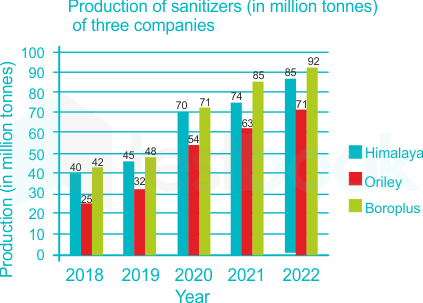
The given bar graph shows the production (in million tonnes) of three different companies making hand sanitizers (Himalaya, Oriley, Boroplus) for 5 years. Study the graph and answer the question that follows.

What is the percentage of increase in the production of sanitizers of company Himalaya from 2018 to 2020?

  1. AOption (a)

    70%

  2. BOption (b)

    80%

  3. COption (c)

    95%

  4. DOption (d)

    75%

View answer & explanation

Correct answer

Answer: (d)D.

75%

Why this answer is correct

Given:

Production of sanitizers by Himalaya in 2018 = 40 million tonnes

Production of sanitizers by Himalaya in 2020 = 70 million tonnes

Formula Used:

Percentage Increase = Final Value−Initial ValueInitial Value×100\frac{\text{Final Value} - \text{Initial Value}}{\text{Initial Value}} \times 100

Calculation:

Percentage Increase = 70−4040×100\frac{70 - 40}{40} \times 100

⇒ Percentage Increase = 3040×100\frac{30}{40} \times 100

⇒ Percentage Increase = 75%

∴ The percentage increase in the production of sanitizers by Himalaya from 2018 to 2020 is 75%.

Question 30

Litmus is an natural acid-base indicator which is extracted from:

  1. AOption (a)

    turmeric

  2. BOption (b)

    rose petals

  3. COption (c)

    lemon grass

  4. DOption (d)

    Lichen

View answer & explanation

Correct answer

Answer: (d)D.

Lichen

Why this answer is correct

The correct answer is Lichen.

Key Points

  • Lichen:
  • Symbiotic Organism: Lichens are not single organisms but rather a symbiotic partnership between a fungus and an alga (or cyanobacteria). They live together in a mutually beneficial relationship.
  • Diverse Forms: They come in a wide variety of forms, colors, and textures, resembling tiny plants, crusts, or even branching structures.
  • Sensitive to Pollution: Many lichens are very sensitive to air pollution, making them useful as bioindicators of environmental health.
  • Medicinal Uses: Lichens have been used in traditional medicine for centuries, and some species contain compounds with potential pharmaceutical properties.
  • Food Source: Some lichens are edible and have been used as food sources in certain cultures, particularly in harsh climates.

Additional Information

  • Turmeric:
  • Spice and Medicine: Turmeric is a spice derived from the rhizome (underground stem) of the Curcuma longa plant. It's widely used in cooking, particularly in South Asian cuisine.
  • Curcumin: Turmeric contains a bioactive compound called curcumin, which has potent anti-inflammatory and antioxidant properties.
  • Traditional Medicine: It has a long history of use in traditional medicine systems like Ayurveda and Traditional Chinese Medicine.
  • Natural Dye: Turmeric is also used as a natural dye, giving a vibrant yellow color to fabrics and foods.
  • Cosmetic Uses: It's used in some cosmetics and skincare products due to its purported skin-brightening and anti-aging effects.
  • Rose Petals:
  • Fragrance and Beauty: Rose petals are known for their beautiful fragrance and are often used in perfumes, potpourri, and aromatherapy.
  • Rose Water: Rose water, made from distilling rose petals with water, is used in skincare and as a flavoring in some foods and beverages.
  • Culinary Uses: Rose petals are edible and are used in some cuisines to add flavor and garnish to desserts, teas, and other dishes.
  • Medicinal Properties: In traditional medicine, rose petals have been used for their purported soothing and anti-inflammatory properties.
  • Symbolism: Roses and their petals have strong symbolic associations with love, beauty, and romance in many cultures.
  • Lemon Grass:
  • Aromatic Herb: Lemon grass is a tall, aromatic grass with a distinct citrusy scent.
  • Culinary Uses: It's widely used in Southeast Asian cuisine to add flavor to soups, curries, teas, and other dishes.
  • Essential Oil: Lemon grass essential oil is extracted from the leaves and stalks and is used in aromatherapy, perfumes, and insect repellents.
  • Medicinal Properties: Lemon grass has been used in traditional medicine for its purported digestive, antiseptic, and calming properties.
  • Tea: Lemon grass tea is a popular beverage known for its refreshing and soothing qualities.

Question 31

One early morning, Mona and Shreya were talking while facing each other. Mona's shadow was directly falling on Shreya. In which direction was Shreya facing towards?

  1. AOption (a)

    West

  2. BOption (b)

    North

  3. COption (c)

    South

  4. DOption (d)

    East

View answer & explanation

Correct answer

Answer: (d)D.

East

Why this answer is correct

Given: 

One early morning, Mona and Shreya were talking while facing each other. Mona's shadow was directly falling on Shreya

The shadow falls at the west in the morning.

Mona's shadow was directly falling on Shreya means that Shreya is in the west.

Thus, Shreya facing east direction.

Hence, the correct answer is "Option 4".

Question 32

In a certain code language, 'ACQUIRE' is written as 'QCAUEIR'. How will 'DECLINE' be written language?

  1. AOption (a)

    CEDLEIN

  2. BOption (b)

    CEDLENI

  3. COption (c)

    CEDELIN

  4. DOption (d)

    CDELEIN

View answer & explanation

Correct answer

Answer: (a)A.

CEDLEIN

Why this answer is correct

The logic followed here is:

'ACQUIRE' is written as 'QCAUEIR'

Similarly,

'DECLINE' is written as

Hence, "Option 1" is the correct answer.

Question 33

A certain number of people are sitting in a row, facing north. T sits second to the right of Q. Exactly four people sit between T and A, towards the right of T. D is an immediate neighbour of A and E. If E is second to the right of A and no other person is sitting in the row, what is the total number of people seated in the row?

  1. AOption (a)

    12

  2. BOption (b)

    11

  3. COption (c)

    10

  4. DOption (d)

    9

View answer & explanation

Correct answer

Answer: (c)C.

10

Why this answer is correct

Given: A certain number of people are sitting in a row, facing north. 

1) T sits second to the right of Q. 

2) Exactly four people sit between T and A, towards the right of T. 

3) E is second to the right of A

4) D is an immediate neighbour of A and E. 

Thus, according to the final arrangement, 10 people are seated in the row.

Hence, "Option 3" is the correct answer.

Question 34

In a two-digit number, the digit in the tens' place is twice the digit in the units' place. If the digits are interchanged, then the number thus formed is 9 less than the original number. Find the original number.

  1. AOption (a)

    63

  2. BOption (b)

    42

  3. COption (c)

    12

  4. DOption (d)

    21

View answer & explanation

Correct answer

Answer: (d)D.

21

Why this answer is correct

Shortcut Trick

The difference between a two-digit number and its reversed form is always 9 × (Difference of digits).

Given difference is 9 ⇒ 9 × (Tens digit − Units digit) = 9.

⇒ Tens digit − Units digit = 1.

Given that the tens digit is twice the units digit, the only digits satisfying both conditions are 2 and 1.

⇒ Original number = 21.

∴ The correct answer is 21.

Alternate Method

Given:

Let the units digit be y and the tens digit be x.

Original two-digit number = 10x + y.

Number formed by interchanging the digits = 10y + x.

Calculations:

⇒ Tens digit is twice the units digit: x = 2y

⇒ Original number − Reversed number = 9

⇒ (10x + y) − (10y + x) = 9

⇒ 10x + y − 10y − x = 9

⇒ 9x − 9y = 9

⇒ x − y = 1

Substituting x = 2y into the equation:

⇒ 2y − y = 1

⇒ y = 1

Now, substituting the value of y to find x:

⇒ x = 2 × 1 = 2

⇒ Original number = 10x + y = 10(2) + 1 = 21.

∴ The correct answer is 21.

Additional Information

Two-Digit Number Formation

A two-digit number with tens digit x and units digit y is mathematically expanded and evaluated as 10x + y.

Difference of Reversed Numbers

The difference between a two-digit number and the number formed by reversing its digits is always a multiple of 9. Formula: Difference = 9 × (x − y).

Sum of Reversed Numbers

The sum of a two-digit number and the number formed by reversing its digits is always a multiple of 11. Formula: Sum = 11 × (x + y).

Question 35

What is the reason that the lungs have alveoli?

  1. AOption (a)

    To increase the surface area

  2. BOption (b)

    To provide pumping action for the lungs

  3. COption (c)

    To increase the volume of the lungs

  4. DOption (d)

    To give mechanical support to the lungs

View answer & explanation

Correct answer

Answer: (a)A.

To increase the surface area

Why this answer is correct

The correct answer is To increase the surface area.

Key Points

  • Alveoli are an important part of the respiratory system whose function it is to exchange oxygen and carbon dioxide molecules to and from the bloodstream.
  • These tiny, balloon-shaped air sacs sit at the very end of the respiratory tree and are arranged in clusters throughout the lungs.
  • The respiratory system is the network of organs and tissues that help you breathe.
  • It includes your airways, lungs, and blood vessels. The muscles that power your lungs are also part of the respiratory system.
  • These parts work together to move oxygen throughout the body and clean out waste gases like carbon dioxide.

Additional Information

  • The human digestive system consists of the gastrointestinal tract plus the accessory organs of digestion.
  • Digestion involves the breakdown of food into smaller and smaller components until they can be absorbed and assimilated into the body.
  • The circulatory system also called the cardiovascular system or the vascular system, is an organ system that permits blood to circulate and transport nutrients (such as amino acids and electrolytes), oxygen, carbon dioxide, hormones, and blood cells to and from the cells in the body to provide nourishment and help in fighting diseases, stabilize temperature and pH, and maintain homeostasis.
  • The nervous system is the part of an animal's body that coordinates its behavior and transmits signals between different body areas.
  • Invertebrates consist of two main parts, called the central nervous system (CNS) and the peripheral nervous system (PNS).
  • The CNS contains the brain and spinal cord.

Question 36

By the provision of which of the following Acts was the East India Company liquidated and Indian territories of Britain were to be governed in the name of the British Queen?

  1. AOption (a)

    The Government of India Act, 1858

  2. BOption (b)

    The Government of India Act, 1890

  3. COption (c)

    British Rule Act, 1905

  4. DOption (d)

    British Rule Act Amendment, 1919

View answer & explanation

Correct answer

Answer: (a)A.

The Government of India Act, 1858

Why this answer is correct

The correct answer is The Government of India Act, 1858.

Key Points

  • After the 1857 revolt, the Company rule was abolished and India came under the direct control of the British crown.
  • The post of Governor-General of India was renamed by the Viceroy of India after the Government of India Act of 1858.
  • The first Viceroy of India was Lord Canning.
  • He was the Viceroy from 1857 to 1862.
  • He established three universities in Calcutta, Bombay and Madras in 1857.

Additional Information

  • Acts related to the partition of Bengal (1905)
  • Partition of Bengal: While there wasn't a single "British Rule Act, 1905," the key event of that year related to Indian polity was the Partition of Bengal. This was an administrative decision by the Viceroy, Lord Curzon, to divide the province of Bengal into two parts: East Bengal and West Bengal.
  • Motives: The British government claimed the partition was for administrative efficiency, but it was widely seen as a "divide and rule" tactic to weaken the growing nationalist movement in Bengal.
  • Nationalist Response: The partition sparked widespread protests and a surge in nationalist sentiment. It led to the Swadeshi movement, which emphasized the use of Indian-made goods and the boycott of British goods.
  • Impact on Polity: The Partition of Bengal and the subsequent nationalist response had a profound impact on Indian polity. It intensified the struggle for independence and shaped the future course of the Indian nationalist movement.
  • Annulment: The partition was eventually annulled in 1911, largely due to the intense pressure from the Indian nationalist movement.
  • The Government of India Act, 1919
  • Montagu-Chelmsford Reforms: This Act, also known as the Montagu-Chelmsford Reforms, introduced some significant changes to the Indian political system.
  • Diarchy: The most important change was the introduction of "diarchy" in the provinces. This meant that certain subjects (like education, health, and local government) were transferred to Indian ministers responsible to the provincial legislatures. Other subjects (like finance, police, and law and order) remained under the control of the British government.
  • Limited Self-Government: Diarchy represented a limited form of self-government for Indians at the provincial level.
  • Increased Indian Representation: The Act also increased the number of Indian members in the central and provincial legislatures.
  • Step Towards Responsible Government: The 1919 Act was seen as a step, albeit a small one, towards responsible government in India. However, it fell short of Indian nationalist demands for full self-rule. It laid the groundwork for further constitutional developments in the following decades.

Question 37

Article 21 of Indian Constitution deals with:

  1. AOption (a)

    protection of life and personal liberty

  2. BOption (b)

    right to equality

  3. COption (c)

    right to constitutional remedies 

  4. DOption (d)

    cultural and educational rights

View answer & explanation

Correct answer

Answer: (a)A.

protection of life and personal liberty

Why this answer is correct

The correct answer is the protection of life and personal liberty.

Key PointsArticle 21:

  • According to Article 21, no person shall be deprived of his life or personal liberty except according to the procedure established by law.
  • The Supreme Court reiterated in the Menaka Gandhi v. Union of India case, that the Right to Life and Liberty cannot be deprived merely based on the procedure established by law.
  • It can not be suspended even during a National emergency.
  • It is available to both citizens and non-citizens but not to enemy aliens.

Additional InformationImportant Rights included under Article 21:

  • Right to privacy
  • Right to education
  • Right to go abroad
  • Right to shelter
  • Right to pollution-free water and air
  • Right against public hanging
  • Right against custodial death
  • Right against handcuffing
  • Right to health
  • Right to food

Question 38

The area of a trapezium is 160 cm2. If the lengths of the parallel sides are 20 cm and 12 cm, respectively, then the perpendicular distance (in cm) between the parallel sides is:

  1. AOption (a)

    10

  2. BOption (b)

    12

  3. COption (c)

    11

  4. DOption (d)

    8

View answer & explanation

Correct answer

Answer: (a)A.

10

Why this answer is correct

Shortcut Trick

Area of Trapezium = 1/2 × (Sum of parallel sides) × Height

160 = 1/2 × (20 + 12) × h

160 = 1/2 × 32 × h

160 = 16 × h ⇒ h = 10 cm

∴ The correct answer is 10 cm.

Alternate Method

Given:

Area = 160 cm2

Parallel side 1 (a) = 20 cm

Parallel side 2 (b) = 12 cm

Formula Used:

Area = 1/2 × (a + b) × h

Calculations:

⇒ 160 = 1/2 × (20 + 12) × h

⇒ 160 = 1/2 × 32 × h

⇒ 160 = 16 × h

⇒ h = 160 ÷ 16

⇒ h = 10 cm

∴ The correct answer is 10 cm.

Additional Information

Median of a Trapezium

The median (or midsegment) of a trapezium is parallel to the bases and its length is the average of the bases: Median = (a + b) / 2.

Isosceles Trapezium

In an isosceles trapezium, the non-parallel sides are equal in length and the base angles are equal.

Area using Median

The Area can also be expressed as Area = Median × Height.

Question 39

According to Mendeleev, the properties of elements are the periodic function of their:

  1. AOption (a)

    atomic masses

  2. BOption (b)

    reactivity of elements

  3. COption (c)

    atomic radius

  4. DOption (d)

    atomic number

View answer & explanation

Correct answer

Answer: (a)A.

atomic masses

Why this answer is correct

The correct answer is atomic masses.

Key Points

  • Atomic Masses:
  • Mass of an Atom: Atomic mass refers to the mass of an atom, typically expressed in atomic mass units (amu) or Daltons (Da). One amu is defined as 1/12th the mass of a carbon-12 atom.
  • Protons and Neutrons: The atomic mass is primarily determined by the number of protons and neutrons in the atom's nucleus. Electrons contribute negligibly to the overall mass.
  • Isotopes: Elements can have isotopes, which are atoms of the same element with different numbers of neutrons. Isotopes have the same atomic number but different atomic masses.
  • Average Atomic Mass: The atomic mass listed on the periodic table is usually the average atomic mass, which is the weighted average of the masses of all naturally occurring isotopes of that element.
  • Molar Mass: The molar mass of an element or compound is the mass of one mole (6.022 x 10²³) of that substance, typically expressed in grams per mole (g/mol). Molar mass is numerically equal to the average atomic mass expressed in amu.

Additional Information

  • Reactivity of Elements:
  • Tendency to React: Reactivity describes the tendency of an element to participate in chemical reactions, either by gaining, losing, or sharing electrons.
  • Electron Configuration: The reactivity of an element is largely determined by its electron configuration, particularly the number of valence electrons (electrons in the outermost shell).
  • Noble Gases: The noble gases (Group 18) are generally unreactive due to their full valence shells, making them stable.
  • Metals and Nonmetals: Metals tend to lose electrons and form positive ions (cations), while nonmetals tend to gain electrons and form negative ions (anions). This tendency drives their reactivity.
  • Periodic Trends: Reactivity shows periodic trends. For example, alkali metals (Group 1) are highly reactive due to their single valence electron, while halogens (Group 17) are also highly reactive as they need only one electron to complete their valence shells.
  • Atomic Radius:
  • Size of an Atom: Atomic radius is a measure of the size of an atom. It's typically defined as the distance from the center of the nucleus to the outermost electron shell.
  • Periodic Trends: Atomic radius exhibits periodic trends. It generally increases down a group (due to the addition of electron shells) and decreases across a period (due to increasing nuclear charge pulling electrons closer).
  • Covalent Radius: For nonmetals, the covalent radius is often used, which is half the distance between the nuclei of two identical atoms joined by a single covalent bond.
  • Metallic Radius: For metals, the metallic radius is half the distance between the nuclei of two adjacent atoms in a metallic crystal lattice.
  • Van der Waals Radius: The van der Waals radius describes the effective size of an atom when it's not chemically bonded to another atom.
  • Atomic Number:
  • Number of Protons: The atomic number of an element is the number of protons in the nucleus of an atom of that element.
  • Unique Identifier: The atomic number uniquely identifies an element. All atoms of a given element have the same number of protons.
  • Periodic Table Organization: The periodic table is organized by increasing atomic number.
  • Nuclear Charge: The atomic number also represents the positive charge of the nucleus.
  • Number of Electrons (in neutral atom): In a neutral atom, the number of electrons is equal to the number of protons (atomic number). This ensures electrical neutrality.

Question 40

A statement is given followed by four conclusions. Find out which conclusion is NOT true based on the given statement.

Statement: A = B > C ≥ D > E < F = G

Conclusions:

(1) A ≥ F

(2) E < G

(3) B > E

(4) C > E

  1. AOption (a)

    1

  2. BOption (b)

    2

  3. COption (c)

    4

  4. DOption (d)

    3

View answer & explanation

Correct answer

Answer: (a)A.

1

Why this answer is correct

Given Statement: A = B > C ≥ D > E < F = G

Now,

Conclusions:

Option 1: A ≥ F → False ( A = B > C ≥ D > E < F = G, there is no relationship between A and F.)

Option 2: E < G → True (Given E < F = G, hence E < G)

Option 3: B > E → True (Given B > C ≥ D > E, hence B > E)

Option 4: C > E → True (Given C ≥ D > E, hence C > E)

Hence, the correct answer is "Option 1".

Question 41

There are many methods adopted to prevent transmission of HIV/AIDS. Which of the stated ones is INCORRECT?

  1. AOption (a)

    Adopting responsible sexual behaviour.

  2. BOption (b)

    The instruments used for ear piercing, acupuncture, etc., must be sterilised before use.

  3. COption (c)

    Transmission by way of drug abuse specially through sharing of needles must be prevented

  4. DOption (d)

    Prevent HIV infected mosquito bite by using mosquito net.

View answer & explanation

Correct answer

Answer: (d)D.

Prevent HIV infected mosquito bite by using mosquito net.

Why this answer is correct

The correct answer is Prevent HIV infected mosquito bite by using mosquito net.

Key Points

  • HIV/AIDS is linked to both poverty and economic instability
  • Studies have shown a strong correlation between poverty and the prevalence of HIV/AIDS.
  • Economic instability often leads to increased vulnerability due to lack of access to healthcare, education, and prevention resources.
  • Poverty-stricken areas tend to have higher rates of risk behaviors such as unprotected sex, which increases the likelihood of HIV transmission.

Additional Information 

  • HIV/AIDS in urban vs. rural populations
  • HIV/AIDS affects both urban and rural populations, although the distribution may vary based on factors like migration, healthcare access, and education.
  • Modes of HIV transmission
  • HIV is primarily transmitted through unprotected sexual contact, sharing of contaminated needles, and from mother to child during childbirth or breastfeeding.
  • Transmission through blood transfusion, although possible, is less common due to stringent screening processes.
  • Prevalence of HIV/AIDS in Indian states
  • The prevalence of HIV/AIDS is not uniformly increasing in all Indian states; some states have seen stabilization or even reduction in new cases due to effective interventions and awareness programs.

Question 42

For an electric generator, which of the following statement(s) are true:

(i) Induced current can be increased by increasing the number of turns in the coil

(ii) Induced current can be increased by increasing the speed of the coil

(iii) Induced current can be increased by decreasing the applied magnetic field

  1. AOption (a)

    Both (ii) and (iii)

  2. BOption (b)

    Only (i)

  3. COption (c)

    Both (i) and (ii)

  4. DOption (d)

    Only (ii)

View answer & explanation

Correct answer

Answer: (c)C.

Both (i) and (ii)

Why this answer is correct

The correct answer is Both (i) and (ii).

Key Points

  • An electric generator is a device that is used to convert mechanical energy into electric energy.
  • It is also known as a dynamo.
  • An electric generator works on the Electromagnetic Induction Principle.
  • The Principle of Electromagnetic Induction states that when a conductor connected with a changing flux, it will induce an emf across it. The value of induced emf across the conductor depends on the rate of change of flux connected with the conductor.

Additional Information

EXPLANATION:

  • An electric generator is generated by rotating a coil inside a magnetic field as shown in fig below.

  • Whereas the given table shows different scientist and their discovery


InventorDiscovery
Michael Faradayelectric generator
Benjamin FranklinElectricity
Alessandro VoltaElectric Battery.
James MaxwellElectromagnetic Nature of Light.

Question 43

If '+' means '÷', '÷' means '+', '-' means '×', '×' means '-', what will come in place of the question mark (?) in the following equation?

32 + 16 ÷ 24 - 8 × 180 = ?

  1. AOption (a)

    13

  2. BOption (b)

    14

  3. COption (c)

    17

  4. DOption (d)

    19

View answer & explanation

Correct answer

Answer: (b)B.

14

Why this answer is correct

Given: 32 + 16 ÷ 24 - 8 × 180 = ?

Decoding the given information:

Symbol+-×÷
Means÷×-+


Now replacing the sign from left to right using BODMAS Rule, we get:

⇒ 32 ÷ 16 + 24 × 8 - 180

= 2 + 24 × 8 - 180

⇒ 2 + 192 - 180

= 194 - 180 = 14

Hence, the correct answer is "Option 2".

Question 44

The induced emf developed in a conductor when it is moved in a direction parallel to the magnetic field is _______.

  1. AOption (a)

    Infinity

  2. BOption (b)

    Zero

  3. COption (c)

    Maximum

  4. DOption (d)

    Minimum

View answer & explanation

Correct answer

Answer: (b)B.

Zero

Why this answer is correct

The correct answer is Zero.

Key Points

Faraday's first law of electromagnetic induction:

  • Whenever a conductor is placed in a varying magnetic field, an electromotive force is induced.
  • If the conductor circuit is closed, a current is induced which is called induced current.

​Faraday's second law of electromagnetic induction:

  • The induced emf in a coil is equal to the rate of change of flux linked with the coil.

⇒e=−Nd !!Φ!! dt\Rightarrow e=-N\frac{d\text{ }!!\Phi!!\text{ }}{dt}

Where N = number of turns, dΦ = change in magnetic flux and e = induced e.m.f.

  • The negative sign says that it opposes the change in magnetic flux which is explained by Lenz law.

​EXPLANATION:

  • From the above, it is clear that the induced emf in a coil is equal to the rate of change of flux linked with the coil.

⇒e=−Nd !!Φ!! dt\Rightarrow e=-N\frac{d\text{ }!!\Phi!!\text{ }}{dt}

  • For N turns, the emf will be

⇒e=−Ndϕdt\Rightarrow e = - N\frac{{d\phi }}{{dt}}

Question 45

Which of the following options best describes the independence of Judiciary?

  1. AOption (a)

    The executive and legislative organs of the government must restrain the functioning of the judiciary.

  2. BOption (b)

    The executive and legislature organs should interfere with the decision of the judiciary.

  3. COption (c)

    Judges must be able to perform their functions without fear or favour.

  4. DOption (d)

    Absence of accountability in the judiciary system 

View answer & explanation

Correct answer

Answer: (c)C.

Judges must be able to perform their functions without fear or favour.

Why this answer is correct

The correct answer is Judges must be able to perform their functions without fear or favour.

Key PointsIndependence of Judiciary in India:

  • This feature is inspired by the United States of America.
  • It is based on the principle of separation of power. Though in India complete separation of power does not exist, it is more inclined towards checks and balances.
  • The salaries, allowances, and pensions of the Supreme Court judges and the pensions of High Court judges are charged to the Consolidated Fund of India to ensure the independence and fair functioning of the judiciary. Hence, option 3 will be the correct answer.
  • Charged expenditures are non-votable in the Parliament.
  • According to Article 138, the Parliament can only increase the jurisdiction of the Supreme Court but cannot decrease it.
  • Article 142 gives immense power to the Supreme Court in order to ensure complete justice.
  • Judges are appointed on the basis of the Collegium system which comprises the Chief Justice of India and three other judges of the Supreme Court.
  • The retired judges of the Supreme Court and High Courts are banned from arguing, or specializing in legal matters in any way in any Court, or in front of any authority within the territory of India.

Question 46

The mandatory contributions levied on individuals or corporations by a government entity is known as:

  1. AOption (a)

    investment

  2. BOption (b)

    expenditure

  3. COption (c)

    tax

  4. DOption (d)

    debt

View answer & explanation

Correct answer

Answer: (c)C.

tax

Why this answer is correct

The correct answer is tax.

Key Points

  • Tax:
  • Mandatory Payment: A tax is a mandatory financial charge or levy imposed on individuals or entities (like corporations) by a government or its equivalent. It is not a voluntary contribution.
  • Revenue for Government: Taxes are the primary source of revenue for governments, funding public services like infrastructure, education, healthcare, defense, and social welfare programs.
  • Various Forms: Taxes can take many forms, including income tax (on earnings), sales tax (on purchases), property tax (on real estate), and excise tax (on specific goods).
  • Legal Obligation: Paying taxes is a legal obligation. Failure to pay taxes can result in penalties, fines, or even legal action.
  • Basis for Calculation: Tax amounts are often calculated based on income, property value, or the value of goods and services. Tax systems can be progressive (higher earners pay a higher percentage), regressive (lower earners pay a higher percentage), or proportional (everyone pays the same percentage).

Additional Information

  • Investment:
  • Putting Money to Work: Investment is the act of allocating money or capital with the expectation of generating an income or profit in the future. It is not a mandatory contribution.
  • Different Forms: Investments can take many forms, such as buying stocks, bonds, real estate, or starting a business.
  • Risk and Return: Investments involve some degree of risk, with the potential for higher returns often associated with higher risk.
  • Long-Term Strategy: Investment is often considered a long-term strategy for building wealth.
  • Voluntary Decision: Investment decisions are typically voluntary, made by individuals or entities based on their financial goals and risk tolerance.
  • Expenditure:
  • Spending Money: Expenditure refers to the spending of money by individuals, businesses, or governments on goods, services, or assets. It is not a mandatory contribution in the sense of a tax.
  • Personal or Business Expenses: Individuals have expenditures on things like food, housing, and transportation. Businesses have expenditures on things like salaries, raw materials, and equipment.
  • Government Spending: Governments also have expenditures on the various programs and services they provide.
  • Planned or Unplanned: Expenditures can be planned (e.g., budgeting for a new car) or unplanned (e.g., emergency medical expenses).
  • Impact on Economy: Expenditures play a crucial role in driving economic activity.
  • Debt:
  • Money Owed: Debt represents money that is owed by one party (the borrower) to another party (the lender). It is not a mandatory contribution in the same way as a tax, although repayment of debt is often a contractual obligation.
  • Loans and Bonds: Debt can take many forms, such as loans, bonds, and credit card balances.
  • Interest: Debt often involves the payment of interest, which is the cost of borrowing money.
  • Repayment: Debt typically involves a schedule of repayment, outlining how and when the borrowed money will be paid back.
  • Impact on Finances: Debt can have a significant impact on an individual's or organization's financial situation. Excessive debt can be a burden.

Question 47

The perimeter of a rhombus is 146 cm and one of its diagonals is 55 cm. Find the area of the rhombus.

  1. AOption (a)

    2460 cm2

  2. BOption (b)

    1325 cm2

  3. COption (c)

    1320 cm2

  4. DOption (d)

    2640 cm2

View answer & explanation

Correct answer

Answer: (c)C.

1320 cm2

Why this answer is correct

Shortcut Trick

Side of rhombus (a) = 146 ÷ 4 = 36.5 cm.

Using Pythagorean triplet for half-diagonals: (d1/2)2 + (d2/2)2 = a2.

(27.5)2 + (d2/2)2 = (36.5)2 ⇒ (d2/2)2 = 1332.25 − 756.25 = 576.

Half of second diagonal = √576 = 24 cm ⇒ d2 = 48 cm.

Area = (1/2) × 55 × 48 = 55 × 24 = 1320 cm2.

∴ The correct answer is 1320 cm2.

Alternate Method

Given: Perimeter = 146 cm, Diagonal 1 (d1) = 55 cm.

Formula Used: Area = (1/2) × d1 × d2; 4a2 = d12 + d22.

⇒ Side (a) = Perimeter ÷ 4 = 146 ÷ 4 = 36.5 cm.

⇒ Relation: 4 × (36.5)2 = 552 + d22.

⇒ 4 × 1332.25 = 3025 + d22.

⇒ 5329 = 3025 + d22.

⇒ d22 = 2304 ⇒ d2 = √2304 = 48 cm.

⇒ Area = (1/2) × 55 × 48 = 1320 cm2.

∴ The correct answer is 1320 cm2.

Additional Information

Properties of Rhombus

All sides are equal, and diagonals bisect each other at right angles (90°).

Area and Perimeter Formulas

Area = Base × Height = (1/2) × d1 × d2. Perimeter = 4 × side.

Side-Diagonal Relationship

The side 'a' and diagonals are related by 4a2 = d12 + d22 based on the Pythagoras Theorem.

Question 48

Giving and receiving dowry in India is a criminal offence. As of August 2022, the criminal proceeding of enquiry and investigation by the police and magistrate for the offence is done under which Sections of the Code of Criminal Procedure, 1973?

  1. AOption (a)

    Sections 174 and 176

  2. BOption (b)

    Sections 163 and 169

  3. COption (c)

    Sections 154 and 158

  4. DOption (d)

    Sections 182 and 185

View answer & explanation

Correct answer

Answer: (a)A.

Sections 174 and 176

Why this answer is correct

The correct answer is Sections 174 and 176.

Key Points

  • You're asking about specific sections of the Code of Criminal Procedure (CrPC) in relation to dowry offenses. While the Dowry Prohibition Act, 1961 and Section 498A of the Indian Penal Code are the primary laws dealing with dowry, the CrPC provides the procedural framework for investigation and trial. Sections 174 and 176 CrPC can be relevant in certain dowry-related situations, particularly those involving suspicious deaths.

 Additional Information

  • Here's an explanation of each section in the context of dowry-related cases:
  • Section 174 CrPC - Procedure in case of suicide, etc.
  • Suspicious Death: This section deals with the procedure to be followed when the police receive information about a person's death under suspicious circumstances, including suicide, or death within seven years of marriage where there is reason to believe that cruelty or harassment by the husband or his relatives may have been a cause of the death.
  • Information to Police: When such information is received, the officer in charge of the police station must immediately inform the District Magistrate or the Sub-Divisional Magistrate.
  • Inquest: The police officer, in the presence of two or more respectable inhabitants of the neighborhood, shall hold an inquest and draw up a report of the apparent cause of death.
  • Forwarding the Body: The body, along with the inquest report, is then forwarded to the nearest Civil Surgeon or other qualified medical practitioner for post-mortem examination.
  • Relevance to Dowry Deaths: In cases of alleged dowry deaths (deaths of women within seven years of marriage with suspicion of dowry-related harassment or cruelty), Section 174 CrPC becomes highly relevant. The mandatory inquest and post-mortem examination are crucial for determining the cause of death and gathering evidence.
  • Section 176 CrPC - Inquiry by Magistrate into cause of death
  • Magistrate's Power to Inquire: This section empowers the District Magistrate or Sub-Divisional Magistrate to hold an inquiry into the cause of death in cases mentioned in Section 174 CrPC.
  • Judicial Inquiry: This is a separate inquiry conducted by the magistrate, in addition to the police investigation.
  • Scope of Inquiry: The magistrate's inquiry can cover various aspects, including the circumstances leading to the death, any allegations of harassment or cruelty, and the role of any individuals involved.
  • Recording of Evidence: The magistrate can record evidence from witnesses and examine relevant documents.
  • Report: After the inquiry, the magistrate submits a report to the State Government.
  • Importance in Dowry Death Cases: In dowry death cases, the magistrate's inquiry under Section 176 CrPC can be crucial in uncovering the truth and ensuring accountability. It provides an additional layer of scrutiny and can help to prevent foul play or cover-ups.
  • Key Points to Remember
  • Dowry Prohibition Act and IPC: The primary laws dealing with dowry offenses are the Dowry Prohibition Act, 1961 and Section 498A of the Indian Penal Code.
  • CrPC's Procedural Role: The CrPC provides the procedural framework for investigation, inquiry, and trial in all criminal cases, including those related to dowry.
  • Sections 174 and 176 CrPC: Sections 174 and 176 CrPC are particularly relevant in cases of suspicious deaths, including alleged dowry deaths, by ensuring proper investigation and inquiry into the cause of death.
  • Combined Application: These legal provisions work together to provide a comprehensive legal framework for addressing dowry-related offenses in India.

Question 49

How many integers lie between 8912 and 8922 ?

  1. AOption (a)

    1782

  2. BOption (b)

    900

  3. COption (c)

    1784

  4. DOption (d)

    892

View answer & explanation

Correct answer

Answer: (a)A.

1782

Why this answer is correct

Shortcut Trick For any two consecutive natural numbers n and (n + 1), the number of non-perfect square integers lying between their squares (n2 and (n + 1)2) is always 2n. Here, n = 891 and n + 1 = 892. Number of integers = 2 × 891 = 1782. ∴ The correct answer is 1782. Alternate Method Given: Two numbers are 8912 and 8922. Formula Used: Number of integers between two numbers a and b (where b > a) is (b − a − 1).

⇒ Let n = 891. ⇒ Numbers are n2 and (n + 1)2. ⇒ Number of integers = (n + 1)2 − n2 − 1 ⇒ Number of integers = (n2 + 2n + 1) − n2 − 1 ⇒ Number of integers = 2n ⇒ Number of integers = 2 × 891 ⇒ Number of integers = 1782 ∴ The correct answer is 1782. Additional Information Consecutive Squares Property There are 2n non-perfect square numbers between the squares of the numbers n and (n + 1). Difference of Squares The difference between the squares of two consecutive integers is equal to their sum: (n + 1)2 − n2 = (n + 1) + n = 2n + 1. Integers Between Two Values To find the number of integers strictly between x and y (where y > x), use the formula (y − x − 1).

Question 50

If the 13 - digit number 3458762341x98 is divisible by 11, then the value of x is _______.

  1. AOption (a)

    2

  2. BOption (b)

    1

  3. COption (c)

    7

  4. DOption (d)

    4

View answer & explanation

Correct answer

Answer: (a)A.

2

Why this answer is correct

Shortcut Trick

For a number to be divisible by 11, the difference between the sum of digits at odd positions and even positions must be 0 or a multiple of 11.

Sum of odd position digits (S1) = 3 + 5 + 7 + 2 + 4 + x + 8 = 29 + x

Sum of even position digits (S2) = 4 + 8 + 6 + 3 + 1 + 9 = 31

Difference = |(29 + x) − 31| = |x − 2|

For divisibility, x − 2 = 0 ⇒ x = 2.

∴ The correct answer is 2.

Alternate Method

Given: A 13-digit number 3458762341x98 is divisible by 11.

Sum of digits at odd places (from left):

⇒ Sodd = 3 + 5 + 7 + 2 + 4 + x + 8 = 29 + x

Sum of digits at even places (from left):

⇒ Seven = 4 + 8 + 6 + 3 + 1 + 9 = 31

According to the divisibility rule of 11:

⇒ (Sodd − Seven) = 0 or a multiple of 11

⇒ (29 + x) − 31 = 0

⇒ x − 2 = 0

⇒ x = 2

∴ The correct answer is 2.

Additional Information

Divisibility Rule of 9

A number is divisible by 9 if the sum of its digits is divisible by 9.

Divisibility Rule of 8

A number is divisible by 8 if the last three digits are divisible by 8 or are zeros.

Divisibility Rule of 11 (Alternate)

Subtract the last digit from the remaining number; if the result is divisible by 11, the original number is also divisible.

Question 51

In January 2022, in which of the following countries was a pig's heart transplanted to a human?

  1. AOption (a)

    China

  2. BOption (b)

    USA

  3. COption (c)

    Germany

  4. DOption (d)

    England

View answer & explanation

Correct answer

Answer: (b)B.

USA

Why this answer is correct

The correct answer is USA.

Key Points

  • The United States of America's doctors have successfully transplanted the world's first genetically-modified pig heart into the human body
  • A US man has become the first person in the world to get a heart transplant from a genetically-modified pig.
  • David Bennett is doing well three days after the experimental seven-hour procedure in Baltimore.
  • Doctors at the University of Maryland Medical Center were granted a special dispensation by the US medical regulator to carry out the procedure.

 Additional Information

  • ​The possibility of using animal organs for xenotransplantation to meet the demand has long been considered, and using pig heart valves is already common.
  • Pig organs are anatomically similar to those of humans. What’s more, porcine components are more tuned for genetic engineering.

Question 52

A man took a loan from a bank at the rate of 14% per annum simple interest. After  5 years he had to pay Rs. 7,000 as interest. Find the principal amount of the loan. 

  1. AOption (a)

    Rs. 7,500

  2. BOption (b)

    Rs. 15,000

  3. COption (c)

    Rs. 10,000

  4. DOption (d)

    Rs. 12,500

View answer & explanation

Correct answer

Answer: (c)C.

Rs. 10,000

Why this answer is correct

Shortcut Trick

Total Simple Interest percentage = Rate × Time = 14% × 5 = 70%

According to the question, 70% of the Principal is equal to Rs. 7,000.

⇒ 70% → 7,000

⇒ 100% (Principal) → (7,000 ÷ 70) × 100 = 10,000

∴ The correct answer is Rs. 10,000.

Alternate Method

Given:

Simple Interest (SI) = Rs. 7,000

Rate (R) = 14% per annum

Time (T) = 5 years

Formula Used:

Simple Interest (SI) = (P × R × T) ÷ 100

Calculations:

⇒ 7,000 = (P × 14 × 5) ÷ 100

⇒ 7,000 = (P × 70) ÷ 100

⇒ 7,000 = P × 0.7

⇒ P = 7,000 ÷ 0.7

⇒ P = 10,000

∴ The correct answer is Rs. 10,000.

Additional Information

Total Amount Formula

The total amount (A) payable after the loan period is the sum of the Principal and the Simple Interest: A = P + SI.

Principal Calculation from Amount

If the total amount is given, the principal can be found using P = (100 × A) ÷ (100 + R × T).

Simple Interest Nature

Unlike Compound Interest, Simple Interest is calculated only on the original principal amount throughout the entire tenure.

Question 53

If 8 ∶ 9 ∶∶ 24 ∶ y, the find the value of y.

  1. AOption (a)

    18

  2. BOption (b)

    12

  3. COption (c)

    27

  4. DOption (d)

    6

View answer & explanation

Correct answer

Answer: (c)C.

27

Why this answer is correct

Shortcut Trick

In a proportion a : b :: c : d, the product of extremes is equal to the product of means.

Product of extremes (8 × y) = Product of means (9 × 24)

y = (9 × 24) ÷ 8 = 9 × 3 = 27

∴ The correct answer is 27.

Alternate Method

Given: 8 : 9 :: 24 : y

Formula Used: a/b = c/d

⇒ 8 ÷ 9 = 24 ÷ y

⇒ 8 × y = 24 × 9

⇒ y = (24 × 9) ÷ 8

⇒ y = 3 × 9

⇒ y = 27

∴ The correct answer is 27.

Additional Information

Fourth Proportional

If a, b, c, and d are in proportion, then d is called the fourth proportional. Formula: d = (b × c) ÷ a.

Mean Proportional

The mean proportional between two numbers a and b is √(a × b).

Third Proportional

If a, b, and c are in continued proportion (a : b :: b : c), then c is the third proportional. Formula: c = b2 ÷ a.

Question 54

Which of the following is a famous Tiger Reserve in Assam?

  1. AOption (a)

    Dibrugarh Tiger reserve

  2. BOption (b)

    Tinsukia Tiger reserve

  3. COption (c)

    Kaziranga Tiger Reserve

  4. DOption (d)

    Sonitpur Tiger Reserve

View answer & explanation

Correct answer

Answer: (c)C.

Kaziranga Tiger Reserve

Why this answer is correct

The correct answer is Kaziranga Tiger Reserve.

Key Points

Kaziranga National Park

  • The Kaziranga National Park hosts two-thirds of the world's great one-horned rhinoceroses and is a World Heritage Site.
  • Kaziranga National Park is also known as an important birdlife area by Birdlife International for conserving varied species of birdlife.
  • Kaziranga is one of the few wild breeding areas outside Africa for multiple species of large cats, such as Bengal tigers and Indian leopards.
  • Kaziranga was declared a Tiger Reserve in 2006 and has the highest density of tigers in the world.

 Additional Information

  • There are 54 tiger reserves in India that are governed by Project Tiger which is administrated by the National Tiger Conservation Authority (NTCA).
  • India is home to 80 percent of tigers in the world. In 2006, there were 1,411 tigers which increased to 1,706 in 2010, 2,226 in 2014, and 2967 in 2018.
  • The Indian increase played a big role in driving up global populations as well, the number of wild tigers globally rose from 3,159 in 2010 to 3,890 in 2016 according to World Wildlife Fund and Global Tiger Forum.
  • Largest Tiger Reserve in India– Nagarjunsagar-Srisailam Tiger Reserve (Andhra Pradesh, Telangana)
  • Smallest Tiger Reserve in India– Bor Tiger Reserve (Maharashtra)

Question 55

Pipe K can fill a water tank in 10 hours. Pipe K is opened alone when the water tank is empty. When half of the water tank is filled by pipe K. then 4 more identical pipes are opened. What will be the total time taken to fill the water tank?

  1. AOption (a)

    6 hours

  2. BOption (b)

    7 hours 15 minutes

  3. COption (c)

    6 hours 15 minutes

  4. DOption (d)

    6 hours 45 minutes

View answer & explanation

Correct answer

Answer: (a)A.

6 hours

Why this answer is correct

Shortcut Trick

Pipe K fills 1/2 tank in 10 ÷ 2 = 5 hours.

Remaining 1/2 tank is filled by 1 (original) + 4 (new) = 5 identical pipes.

Time for remaining part = 5 hours ÷ 5 pipes = 1 hour.

Total time = 5 + 1 = 6 hours.

∴ The correct answer is 6 hr.

Alternate Method

Given: Filling time for Pipe K = 10 hours. 4 more identical pipes are added after 50% completion.

Formula Used: Efficiency × Time = Work

PersonDaysTotal WorkEfficiency
Pipe K10 hr10 units1 unit/hr

⇒ Work to be done = 10 units.

⇒ Half tank = 10 ÷ 2 = 5 units.

⇒ Time taken by K to fill 5 units = 5 ÷ 1 = 5 hours.

⇒ Remaining Work = 10 − 5 = 5 units.

⇒ Total pipes now = 1 + 4 = 5 pipes.

⇒ Combined Efficiency = 5 × 1 = 5 units/hr.

⇒ Time for remaining work = 5 ÷ 5 = 1 hour.

⇒ Total time taken = 5 + 1 = 6 hours.

∴ The correct answer is 6 hr.

Additional Information

Pipes and Cisterns Efficiency

If efficiency is multiplied by n times, the time taken becomes 1/n of the original time for the same amount of work.

Inlet and Outlet Pipes

Net work done per hour = (Sum of efficiencies of Inlet pipes) − (Sum of efficiencies of Outlet pipes).

Question 56

Three statements are followed by three conclusions numbered I, II and III. You have to consider these statements to be true, even if they seem to be at variance with commonly known facts. Decide which of the given conclusions logically follow(s) from the given statements.

Statements:

All cheetahs are monkeys.

All monkeys are bears.

All bears are jungles.

Conclusions:

(I) Some jungles are cheetahs

(II) All monkeys are cheetahs

(III) No monkey is a cheetah

  1. AOption (a)

    Only conclusion I follows

  2. BOption (b)

    None of the conclusions follow

  3. COption (c)

    Only conclusion II follows

  4. DOption (d)

    Either conclusion I or III follows

View answer & explanation

Correct answer

Answer: (a)A.

Only conclusion I follows

Why this answer is correct

The least possible Venn diagram for the given statements is as shown below :

Conclusions:

(I) Some jungles are cheetahs → Follow (As all cheetahs are monkeys, all monkeys are bears and all bears are jungles. As whole cheetahs comes in monkeys which whole comes in bears which whole comes in jungles, therefore it is true.)

(II) All monkeys are cheetahs → Does not follow (As all cheetahs are monkeys. So it is possible but not definite)

(III) No monkey is a cheetah → Does not follow (As all cheetahs are monkeys. As whole cheetahs comes in monkeys, therefore it is false.)

∴ Here, Only conclusion I follows.​

Hence, the correct answer is "Option 1".

Question 57

Which of the following groups of major river systems formed the Northern Plains of India?

  1. AOption (a)

    Narmada, Ganga and Brahmaputra

  2. BOption (b)

    Indus, Ganga and Brahmaputra

  3. COption (c)

    Cauvery, Ganga and Tapi

  4. DOption (d)

    Indus, Ganga and Godavari

View answer & explanation

Correct answer

Answer: (b)B.

Indus, Ganga and Brahmaputra

Why this answer is correct

The correct answer is Indus, Ganga and Brahmaputra.

Key Points

  • Indus, Ganga and Brahmaputra are three major river systems originate in the Himalayas and flow through the north and east of India, depositing vast amounts of fertile alluvial soil over millions of years, forming the vast and fertile Northern Plains.
  • The Indus River is one of the longest rivers in Asia streching for about 3200 kms, flowing through Pakistan, India, and China.
  • It is also known as the Sindhu River in India.
  • It originates from the Bokhar Chu glacier in the Tibetan Plateau.The glacier is located near Lake Mansarovar in the Great Himalayas.
  • The Brahmaputra River traverses Bangladesh, Northeastern India, and Tibet (China).
  • It is referred to as the Siang/Dihang River in Arunachali, the Brahmaputra or Luit in Assamese, the Yarlung Tsangpo in Tibetan, and the Jamuna River in Bengali.
  • It rises in Tibet, China's Chemayungdung glaciers and travels 3,848 kilometers (2,391 miles) before draining into the Bay of Bengal.
  • By discharge, it ranks as the 9th largest and 15th longest river in the world.
  • The Ganges River, sometimes referred to as the Ganga, is a transboundary river that travels through Bangladesh, India, and Tibet's Himalayan ranges.
  • As the goddess Ganga, it is revered as the most sacred river in Hinduism.
  • The Ganges is the longest river in India and, in terms of discharge, the 3rd largest river in the world.
  • At an elevation of roughly 13,800 feet (4,200 meters), the Gangotri Glacier in the Himalayas is the source of the Ganges River.
  • The river travels approximately 2,500 kilometers or 1,560 miles before spilling into Bay of Bengal.

Additional Information

  • Godavari:
  • It is a river that flows through the states of Maharashtra, Telangana, Andhra Pradesh, Chhattisgarh, and Odisha in India.
  • It is also known as Dakshin Ganga.
  • It flows into Bay of Bengal.
  • Narmada:
  • It is a river that flows through the states of Madhya Pradesh, Maharashtra, and Gujarat in India.
  • It flows into Arabian sea.​
  • Tapi:
  • is a central Indian river.
  • It originates in the Eastern Satpura Range of southern Madhya Pradesh state.
  • It flows in a westward direction, draining some important historic places like Madhya Pradesh’s Nimar region, East Vidarbha region, and Maharashtra’s Khandesh in the northwest corner of the Deccan Plateau and South Gujarat before draining into the Gulf of Cambay of the Arabian Sea.
  • The River Basin of Tapi River lies mostly in the eastern and northern districts of Maharashtra state.​
  • Kaveri (Cauvery):
  • ​It rises on the Brahmagiri Hill of the Western Ghats in southwestern Karnataka state.
  • It flows through the states of Karnataka and Tamil Nadu and descends the Eastern Ghats in a series of great falls.

Question 58

India is bounded by the Hindukush mountain range in the _______.

  1. AOption (a)

    north-east

  2. BOption (b)

    north

  3. COption (c)

    north-west

  4. DOption (d)

    south

View answer & explanation

Correct answer

Answer: (c)C.

north-west

Why this answer is correct

The correct answer is north-west.

Key Points

  • ​Hindukus
    • ​The main mountain ranges of India do not include the Hindu Kush range.​
  • The Hindu Kush is a mountain range that is 800 kilometers long and stretches through Afghanistan, Northern Pakistan, and Tajikistan.
  • Mount Tirich Mir located in the Chitral District of Pakistan is the highest mountain of the Hindu Kush range.

Question 59

Read the given statement and conclusions carefully. Assuming that the information given in the statements is true, even if it appears to be at variance with commonly known facts, decide which of the given conclusions logically follow(s) from the statement.

Statement:

The girls team won 12 out of 17 matches in hockey, but lost 11 out of 19 matches in cricket.

Conclusions:

I. The girls team should play more cricket matches.

II. Girls like hockey more than cricket.

  1. AOption (a)

    Only conclusion II follows

  2. BOption (b)

    Only conclusion I follows

  3. COption (c)

    Both conclusions I and II follow 

  4. DOption (d)

    Neither conclusion I nor II follows

View answer & explanation

Correct answer

Answer: (d)D.

Neither conclusion I nor II follows

Why this answer is correct

Given Statements: The girls team won 12 out of 17 matches in hockey, but lost 11 out of 19 matches in cricket.

Conclusions:

I. The girls team should play more cricket matches → False

The statement only provides information about the results of hockey and cricket matches. There is no mention or suggestion in the statement that playing more cricket matches would benefit the girls' team or improve their performance.

II. Girls like hockey more than cricket → False 

The statement provides no information about the girls' preferences or likings for hockey or cricket. It only states the results of matches (wins and losses), which cannot be used to infer their preferences.

∴ Here, Neither conclusion I nor II follows.

Hence, the correct answer is 'Option 4'.

Question 60

Which of the following letter-number clusters will replace the question mark (?) in the given series to make it logically complete?

V37E, P27H, J19L, ?

  1. AOption (a)

    E15R

  2. BOption (b)

    D13Q

  3. COption (c)

    C11P

  4. DOption (d)

    E11R

View answer & explanation

Correct answer

Answer: (b)B.

D13Q

Why this answer is correct

The logic followed here is:

Hence, "Option 2" is the correct answer.

Question 61

Which of the following indicates the borrowing needs of the Government?

  1. AOption (a)

    Revenue deficit

  2. BOption (b)

    Fiscal deficit

  3. COption (c)

    Capital deficit

  4. DOption (d)

    Current account deficit

View answer & explanation

Correct answer

Answer: (b)B.

Fiscal deficit

Why this answer is correct

The correct answer is Fiscal deficit.

Key Points

  • Fiscal Deficit:
  • Excess of Expenditure over Revenue: The fiscal deficit is the difference between the government's total expenditure (including capital expenditure) and its total revenue (excluding borrowings). It indicates the total borrowing requirements of the government.
  • Financing the Gap: This deficit is financed through borrowing, either from the domestic market or from abroad.
  • Impact on Debt: A persistent high fiscal deficit can lead to an increase in the government's debt burden.
  • Economic Implications: It can have implications for interest rates, inflation, and overall economic stability. A large and unsustainable fiscal deficit can crowd out private investment.
  • Policy Tool: Governments often use fiscal policy, including managing the fiscal deficit, to influence the economy. However, excessive deficits can raise concerns about long-term sustainability.

Additional Information

  • Revenue Deficit:
  • Current Expenditure vs. Current Revenue: The revenue deficit is the difference between the government's revenue expenditure (day-to-day running expenses) and its revenue receipts (tax and non-tax revenues).
  • Indicates Fiscal Imbalance: A revenue deficit implies that the government is spending more on its day-to-day operations than it earns in current revenue. This is generally considered less sustainable than a fiscal deficit driven by capital expenditure.
  • Need for Borrowing: A revenue deficit often necessitates borrowing just to meet consumption expenditure, which can be detrimental to long-term fiscal health.
  • Impact on Development: A high revenue deficit can squeeze resources available for development expenditure (investments in infrastructure, education, etc.).
  • Measure of Efficiency: It can be an indicator of the government's efficiency in managing its revenue and expenditure.
  • Capital Deficit:
  • Not a Standard Term: "Capital deficit" is not a commonly used term in economics. The more relevant concept is capital expenditure, which refers to government spending on long-term assets like infrastructure, buildings, and equipment.
  • Capital Expenditure and Growth: Capital expenditure is considered crucial for economic growth and development.
  • Financing Capital Projects: Governments finance capital expenditure through a combination of revenue, borrowings, and sometimes disinvestment.
  • Budgetary Planning: Capital expenditure is a key component of the government's budget and is often part of long-term development plans.
  • Impact on Future: Investments made through capital expenditure have long-term impacts on the economy's productive capacity.
  • Current Account Deficit (CAD):
  • Balance of Payments: The current account deficit is a measure of a country's balance of payments. It reflects the difference between a country's total exports of goods, services, and transfers and its total imports of goods, services, and transfers.
  • Trade Deficit: A major component of the CAD is the trade deficit, which occurs when a country imports more goods and services than it exports.
  • Other Components: The current account also includes income from investments (interest, dividends) and current transfers (aid, remittances).
  • Financing the CAD: A CAD can be financed through foreign investment, borrowing, or by using foreign exchange reserves.
  • Economic Implications: A large and persistent CAD can raise concerns about a country's external debt and its ability to meet its international obligations. It can also put pressure on the exchange rate.

Question 62

The power of an electric bulb in which a current of 2 amp flows when it is connected to a 220 V generator is _______.

  1. AOption (a)

    440 joule

  2. BOption (b)

    120 joule

  3. COption (c)

    120 watt

  4. DOption (d)

    440 watt

View answer & explanation

Correct answer

Answer: (d)D.

440 watt

Why this answer is correct

The correct answer is 440 watt.

Key Points

  • Power (P): Measured in Watts (W), power is the rate at which electrical energy is transferred or used.
  • Voltage (V): Measured in Volts (V), voltage is the electrical potential difference that drives the current through a circuit.
  • Current (I): Measured in Amperes (A), current is the flow of electric charge through a circuit.

The relationship between these three is given by the formula:

P = V × I

Calculation

  1. Given Values:
  • Voltage (V) = 220 V
  • Current (I) = 2 A
  1. Applying the Formula:
  • Power (P) = V × I
  • P = 220 V × 2 A
  • P = 440 W

Therefore, the power of the electric bulb is 440 Watts.

Question 63

Study the given line graph and answer the following question.

The given line graph depicts the number of girls in four classes (I, II, III and IV).

If the total number of boys in classes I, II and IV is 27 more than the total number of girls in the same classes, what is the total number of boys in classes I, II and IV?

  1. AOption (a)

    85

  2. BOption (b)

    87

  3. COption (c)

    97

  4. DOption (d)

    94

View answer & explanation

Correct answer

Answer: (c)C.

97

Why this answer is correct

Given:

Number of girls in class I = 24

Number of girls in class II = 28

Number of girls in class IV = 18

Total number of boys in classes I, II, and IV = Total number of girls in classes I, II, and IV + 27

Formula Used:

Total number of boys = Total number of girls + 27

Calculation:

Total number of girls in classes I, II, and IV = 24 + 28 + 18 = 70

Total number of boys = 70 + 27

⇒ Total number of boys = 97

∴ The total number of boys in classes I, II, and IV is 97.

Question 64

Select the correct order of Chlorine, Bromine and Iodine for Dobereiner's Law of Triads.

  1. AOption (a)

    Iodine, Bromine, Chlorine

  2. BOption (b)

    Bromine, Iodine, Chlorine

  3. COption (c)

    Chlorine, Iodine, Bromine

  4. DOption (d)

    Chlorine, Bromine, Iodine

View answer & explanation

Correct answer

Answer: (d)D.

Chlorine, Bromine, Iodine

Why this answer is correct

The correct answer is Chlorine, Bromine, Iodine.

Key Points

  • Chlorine (Cl)
  • Atomic Number: 17 (meaning it has 17 protons in its nucleus).
  • Atomic Mass: Approximately 35.453 amu (atomic mass units). This is an average atomic mass due to the existence of chlorine isotopes.
  • Electron Configuration: [Ne] 3s² 3p⁵ (meaning it has 7 valence electrons in its outermost shell, making it highly reactive).
  • Group 17 Element: Chlorine is a member of the halogen group (Group 17) on the periodic table.
  • Highly Reactive: It's a highly reactive nonmetal, readily gaining an electron to achieve a stable octet configuration.
  • Diatomic Molecule: In its elemental form, chlorine exists as a diatomic molecule (Cl₂), a greenish-yellow gas at room temperature.
  • Strong Oxidizing Agent: Chlorine is a strong oxidizing agent, meaning it readily accepts electrons from other substances.
  • Disinfectant: Due to its oxidizing properties, chlorine is widely used as a disinfectant in water treatment and swimming pools.
  • Industrial Uses: It's also used in the production of various chemicals, plastics, and other industrial products.
  • Toxic Gas: Chlorine gas is toxic and can be harmful to human health.
  • Bromine (Br)
  • Atomic Number: 35
  • Atomic Mass: Approximately 79.904 amu.
  • Electron Configuration: [Ar] 4s² 3d¹⁰ 4p⁵ (again, 7 valence electrons).
  • Halogen: Bromine is also a halogen (Group 17).
  • Reactive Nonmetal: It's a reactive nonmetal, although less reactive than chlorine.
  • Diatomic Molecule: It exists as a diatomic molecule (Br₂) at room temperature, a reddish-brown liquid that readily vaporizes into a gas with an irritating odor.
  • Oxidizing Agent: Bromine is also an oxidizing agent.
  • Uses: It has various uses, including in the production of flame retardants, photographic film, and some pharmaceuticals.
  • Harmful: Bromine is harmful and its vapors can be irritating to the eyes and respiratory system.
  • Naturally Occurring Isotopes: Bromine has two naturally occurring stable isotopes.
  • Iodine (I)
  • Atomic Number: 53
  • Atomic Mass: Approximately 126.904 amu.
  • Electron Configuration: [Kr] 5s² 4d¹⁰ 5p⁵ (7 valence electrons, as expected for a halogen).
  • Halogen: Iodine is the heaviest of the stable halogens.
  • Reactive (but less so): It's reactive, but less so than chlorine or bromine.
  • Diatomic Molecule: It exists as a diatomic molecule (I₂) at room temperature, a purple-black solid that sublimes into a violet gas.
  • Essential Nutrient: Iodine is an essential nutrient for humans, particularly for thyroid hormone production.
  • Uses: It's used in disinfectants, antiseptics, and in the production of some medications.
  • Iodine Deficiency: Iodine deficiency can lead to various health problems.
  • Sublimation: Iodine's ability to sublime (go directly from solid to gas) makes it visually interesting.

Question 65

Vikas starts from Point A and drives 8 km towards the south. He then takes a right turn, drives 3 km, turns right and drives 12 km. He then takes a right turn and drives 5 km. He takes a final right turn, drives 4 km and stops Point P.

What is the distance between Point A and Point P? (All turns are 90° turns only)

  1. AOption (a)

    3 km

  2. BOption (b)

    5 km

  3. COption (c)

    4 km

  4. DOption (d)

    2 km

View answer & explanation

Correct answer

Answer: (d)D.

2 km

Why this answer is correct

Given: All turns are 90° turns only

Vikas starts from Point A and drives 8 km towards the south.

He then takes a right turn, drives 3 km, turns right and drives 12 km.

He then takes a right turn and drives 5 km.

He takes a final right turn, drives 4 km and stops Point P.

Thus, the distance between Point A and Point P is (5 Km - 3 km) = 2 km.

Hence, "Option 4" is the correct answer.

Question 66

On 10th February 2022, who was appointed as Chief Justice of Madras High Court?

  1. AOption (a)

    Justice Gita Mittal

  2. BOption (b)

    Justice Munishwar Nath Bhandari

  3. COption (c)

    Justice T Raja

  4. DOption (d)

    justice M Duraiswamy

View answer & explanation

Correct answer

Answer: (b)B.

Justice Munishwar Nath Bhandari

Why this answer is correct

The correct answer is Justice Munishwar Nath Bhandari.

Key Point

  • Justice Munishwar Nath Bhandari was on 22 November 2021 sworn in as the acting Chief Justice of the Madras High Court.
  • Munishwar Nath Bhandari was sworn in as Chief Justice of the Madras High Court in February 2022.
  • He was administered the oath of office by Governor R.N. Ravi.
  • He was appointed after incumbent Justice Sanjib Banerjee was transferred to Meghalaya.
  • Tamil Nadu Governor R.N. Ravi administered the oath of office to him.
  • From June 26, 2021, to October 10, 2021, Justice Bhandari served as acting Chief Justice of the Allahabad High Court.

Question 67

Six persons (Ram, Tom, Bob, Joy, Sam and Hob) are sitting around a circular table facing the centre. Ram is sitting third to the left of Sam. Joy is sitting third to the left of Tom. Bob is an immediate neighbour of Ram and Joy. Hob is an immediate neighbour of Sam and Tom. If Ram is sitting to the immediate left of Bob, who is sitting third to the right of Ram?

  1. AOption (a)

    Bob

  2. BOption (b)

    Hob

  3. COption (c)

    Joy

  4. DOption (d)

    Sam

View answer & explanation

Correct answer

Answer: (d)D.

Sam

Why this answer is correct

Given: Six persons (Ram, Tom, Bob, Joy, Sam and Hob) are sitting around a circular table facing the centre.

1) Ram is sitting third to the left of Sam. 

2) Hob is an immediate neighbour of Sam and Tom.

3) Joy is sitting third to the left of Tom.

As position of Hob with respect to either Sam or Tom is not known yet, therefore there are two possible positions for Hob.

Case 1)

Case 2)

4) Bob is an immediate neighbour of Ram and Joy. 

Case 1)

Case 2)

Thus, in both cases, Sam is sitting third to the right of Ram.

Hence, "Option 4" is the correct answer.

Question 68

Which of the following is a disadvantage of using contraceptive pills?

  1. AOption (a)

    Both partners in a couple must take pills.

  2. BOption (b)

    They can cause menopause.

  3. COption (c)

    They may produce hormonal imbalance.

  4. DOption (d)

    The effect of the pills is irreversible.

View answer & explanation

Correct answer

Answer: (c)C.

They may produce hormonal imbalance.

Why this answer is correct

The correct answer is They may produce hormonal imbalance.

Key Points

  • Conception: Fusion of the sperm and the egg to make a zygote.
  • Conception leads to pregnancy.
  • Contraception: Ways to prevent pregnancy.
  • Contraceptive pills are taken orally to avoid unwanted pregnancy.

Explanation:

  • The mechanism of action of the contraceptive pills is based on: Inhibiting ovulation.
  • Contraceptive pills: Stop follicular development.
  • They raise the level of progesterone in the body.
  • Raised levels of progesterone: Leads to a negative feedback mechanism.
  • It acts on the hypothalamus: Decrease the levels of Gonadotropin-Releasing Hormone.
  • Mimics pregnancy.

Additional Information

  • There are multiple ways of contraception.
  • Chemical, as well as physical contraceptives, are there.
  • Physical contraceptives :
  • Intra- Uterine Devices
  • Condoms
  • Cervical Caps
  • Diaphragms
  • Cervical sponge.
  • Chemical contraceptives:
  • Oral pills

Question 69

Which of the following is a quadratic equation?

  1. AOption (a)

    (x + 1)2 = (x - 1)2

  2. BOption (b)

    3x2 + 2x + 5 = 8x + 3 + 3x2

  3. COption (c)

    (x + 1)2 = 2(x - 1)

  4. DOption (d)

    (x + 1)2 = (x - 1)3

View answer & explanation

Correct answer

Answer: (c)C.

(x + 1)2 = 2(x - 1)

Why this answer is correct

Shortcut Trick Identify the equation where the highest power of the variable x is 2 after full simplification. In (x + 1)2 = 2(x − 1), expanding gives x2 + 2x + 1 = 2x − 2, where the x2 term remains. In other options, the x2 terms either cancel out or are surpassed by an x3 term. ∴ The correct answer is (x + 1)2 = 2(x − 1).

Alternate Method Given: Various algebraic equations to test for quadratic nature. Method: A quadratic equation is of the form ax2 + bx + c = 0, where a ≠ 0. Expanding the correct option: ⇒ (x + 1)2 = 2(x − 1) Using the identity (a + b)2 = a2 + 2ab + b2: ⇒ x2 + 2(x)(1) + (1)2 = 2x − 2 ⇒ x2 + 2x + 1 = 2x − 2 Subtracting 2x from both sides: ⇒ x2 + 1 = −2 ⇒ x2 + 3 = 0 Since the highest degree of x is 2 and the coefficient of x2 is 1 (non-zero), it is a quadratic equation. ∴ The correct answer is (x + 1)2 = 2(x − 1).

Additional Information Standard Form of Quadratic Equation It is expressed as ax2 + bx + c = 0, where a, b, and c are real numbers and a ≠ 0. Nature of Roots Determined by the Discriminant (D) = b2 − 4ac. If D > 0 roots are real and distinct; if D = 0 roots are real and equal; if D < 0 roots are imaginary. Degree of Polynomials A linear equation has degree 1, a quadratic equation has degree 2, and a cubic equation has degree 3.

Question 70

Madhya Pradesh does NOT share its boundaries with which of the following states?

  1. AOption (a)

    Chhattisgarh

  2. BOption (b)

    Bihar

  3. COption (c)

    Maharashtra

  4. DOption (d)

    Uttar Pradesh

View answer & explanation

Correct answer

Answer: (b)B.

Bihar

Why this answer is correct

The correct answer is Bihar.

Key Points

  • Madhya Pradesh, often called the "Heart of India," is a large state in central India. Its geographical location means it shares its borders with a significant number of other Indian states. This makes it a crucial hub for trade, transportation, and cultural exchange within the country. Here's a detailed explanation of the states bordering Madhya Pradesh:

Additional Information

  • Uttar Pradesh (UP): Madhya Pradesh's northeastern border is shared with Uttar Pradesh, India's most populous state. This boundary is extensive and historically significant, as both regions have played vital roles in Indian history.
  • Chhattisgarh: To the southeast, Madhya Pradesh is bordered by Chhattisgarh. This is a relatively newer state, having been carved out of Madhya Pradesh itself in 2000. The separation was primarily aimed at better administration of the regions.
  • Maharashtra: Madhya Pradesh's southern neighbor is Maharashtra, a state known for its economic power and its capital city, Mumbai. This border is significant for trade and commerce, connecting central India with the western coast.
  • Gujarat: Sharing its southwestern border with Madhya Pradesh is Gujarat, a state known for its industrial development and coastline. This border is important for trade, particularly related to textiles and other manufactured goods.
  • Rajasthan: Madhya Pradesh's northwestern border is with Rajasthan, a state famous for its rich cultural heritage and desert landscapes. This boundary is historically and culturally significant, reflecting the interconnectedness of the regions.
  • Landlocked State: Despite bordering so many states, Madhya Pradesh is a landlocked state, meaning it does not have a coastline. This influences its economy and trade routes, making it reliant on its neighboring states for access to ports.

Question 71

In this question, the statement is followed by four conclusions. Find out which conclusion is NOT true based on the given statement.

Statement: H < U ≤ W = P > Y > E ≥ N

  1. AOption (a)

    U ≤ P

  2. BOption (b)

    E < P

  3. COption (c)

    P > N

  4. DOption (d)

    H ≤ P

View answer & explanation

Correct answer

Answer: (d)D.

H ≤ P

Why this answer is correct

Given Statement: H < U ≤ W = P > Y > E ≥ N

Now,

Conclusions:

Option 1: U ≤ P → True (U ≤ W = P, it gives U ≤ P) 

Option 2: E < P → True (P > Y > E, it gives E < P)

Option 3: P > N → True (P > Y > E ≥ N, it gives P > N)

Option 4: H ≤ P → False (H < U ≤ W = P, it gives H < P)

Hence, the correct answer is "Option 4".

Question 72

Refer to the following number, symbol series and answer the question.

(Left) 9 7 5 4 8 2 4 7 4 1 % 3 2 1 ^ 5 6 3 8 7 2 3 5 7 * 2 4 5 9 3 (Right)

How many even numbers are there between the symbols ^ and *, and what is their total if added together?

  1. AOption (a)

    3, 16

  2. BOption (b)

    2, 13

  3. COption (c)

    4, 10

  4. DOption (d)

    2, 12

View answer & explanation

Correct answer

Answer: (a)A.

3, 16

Why this answer is correct

Given series : (Left) 9 7 5 4 8 2 4 7 4 1 % 3 2 1 ^ 5 6 3 8 7 2 3 5 7 * 2 4 5 9 3 (Right)

Even number: A number that is divisible by 2

Odd number: A number that cannot be divide by 2 evenly.

9 7 5 4 8 2 4 7 4 1 % 3 2 1 ^ 5 6 3 8 7 2 3 5 7 * 2 4 5 9 3 

There are 3 even numbers between ^ and *: 6 8 2 

their total if added together is 6 + 8 + 2 = 16.

Hence, the correct answer is "Option 1"

Question 73

If u + v = -2 and u2 + v2 = 16, the the value of (u - v)2 is:

  1. AOption (a)

    16

  2. BOption (b)

    8

  3. COption (c)

    14

  4. DOption (d)

    28

View answer & explanation

Correct answer

Answer: (d)D.

28

Why this answer is correct

Shortcut Trick

Apply the direct Algebraic Identity: (u + v)2 + (u − v)2 = 2(u2 + v2)

Substitute the given values u + v = −2 and u2 + v2 = 16:

⇒ (−2)2 + (u − v)2 = 2 × 16

⇒ 4 + (u − v)2 = 32

⇒ (u − v)2 = 32 − 4 = 28

∴ The correct answer is 28.

Alternate Method

Given:

Sum of variables (u + v) = −2

Sum of squares (u2 + v2) = 16

Formula Used:

⇒ (u + v)2 = u2 + v2 + 2uv

⇒ (u − v)2 = u2 + v2 − 2uv

Calculations:

⇒ First, find the value of 2uv:

⇒ (−2)2 = 16 + 2uv

⇒ 4 = 16 + 2uv

⇒ 2uv = 4 − 16 = −12

⇒ Now, calculate (u − v)2:

⇒ (u − v)2 = (u2 + v2) − 2uv

⇒ (u − v)2 = 16 − (−12)

⇒ (u − v)2 = 16 + 12 = 28

∴ The correct answer is 28.

Additional Information

Algebraic Identity for Sum of Squares

(a + b)2 + (a − b)2 = 2(a2 + b2). This identity directly links the sum and difference squares with the individual squares.

Relationship involving Product (ab)

(a + b)2 − (a − b)2 = 4ab. Use this when the product of two numbers and their sum/difference is known.

Standard Expansion Identities

(a + b)2 = a2 + 2ab + b2 and (a − b)2 = a2 − 2ab + b2.

Question 74

Rajesh's daughter's age is 13\frac{1}{3} of Rajesh's wife's age. Rajesh's wife's age is 34\frac{3}{4} of Rajesh's age, and Rajesh's age is 35\frac{3}{5} of Rajesh's father's age. Find the age of Rajesh's daughter if Rajesh's father's age is 60 years.

  1. AOption (a)

    7 years

  2. BOption (b)

    13 years

  3. COption (c)

    11 years

  4. DOption (d)

    9 years

View answer & explanation

Correct answer

Answer: (d)D.

9 years

Why this answer is correct

Shortcut Trick

Direct chain multiplication of ratios: Daughter → Wife → Rajesh → Father.

Daughter = (1/3) × (3/4) × (3/5) × Father’s age

Daughter = (1/3) × (3/4) × (3/5) × 60 = 9 years.

∴ The correct answer is 9 years.

Alternate Method

Given:

Father’s age = 60 years

Rajesh’s age = 3/5 × Father’s age

Wife’s age = 3/4 × Rajesh’s age

Daughter’s age = 1/3 × Wife’s age

⇒ Rajesh’s age = (3/5) × 60 = 36 years

⇒ Wife’s age = (3/4) × 36 = 27 years

⇒ Daughter’s age = (1/3) × 27 = 9 years

∴ The correct answer is 9 years.

Additional Information

Ratio and Proportion

When ages are given as fractions of one another, it is a chain of ratios. If A = k1B and B = k2C, then A = k1 × k2 × C.

Age Problems

Always start from the known absolute value (Father’s age = 60) and work backwards or forwards through the given relations.

Simplification of Fractions

Multiply numerators and denominators or cancel common factors (like the 3 in 1/3 and 3/4) to find the combined fraction quickly.

Question 75

Which of the following numbers will replace the question mark (?) in the given series?

12, 60, 65, 325, 330, ?

  1. AOption (a)

    1670

  2. BOption (b)

    1650

  3. COption (c)

    1680

  4. DOption (d)

    1600

View answer & explanation

Correct answer

Answer: (b)B.

1650

Why this answer is correct

The logic followed here is:

Hence, "Option 2" is the correct answer.

Question 76

Read the given statements and conclusions carefully. Assuming that the information given in the statements is true, even if it appears to be at variance with commonly known facts decide which of the given conclusions logically follow(s) from the statements.

Statements:

Some bats are parrots.

All crows are parrots.

All sparrows are parrots.

Conclusions:

I. Some sparrows are bats.

II. Some crows are sparrows.

  1. AOption (a)

    Neither conclusion I nor II follows

  2. BOption (b)

    Only conclusion II follows

  3. COption (c)

    Only conclusion I follows

  4. DOption (d)

    Both conclusions I and II follow

View answer & explanation

Correct answer

Answer: (a)A.

Neither conclusion I nor II follows

Why this answer is correct

The least possible Venn diagram for the given statements is as shown below :

Conclusions:

I. Some sparrows are bats → Does not follow (As some bats are parrots, all crows are parrots and all sparrows are parrots. So it is possible but not definite.)

II. Some crows are sparrows → Does not follow (As all crows are parrots and all sparrows are parrots. So it is possible but not definite)

∴ Here, Neither conclusion I nor II follows.​

Hence, the correct answer is "Option 1".

Question 77

The total energy consumed for 30 days by an air cooler rated 300 watt operating 12 hours per day is _______.

  1. AOption (a)

    108 KWh

  2. BOption (b)

    108 joule-second

  3. COption (c)

    108 joule

  4. DOption (d)

    108 Wh

View answer & explanation

Correct answer

Answer: (a)A.

108 KWh

Why this answer is correct

The correct answer is 108 KWh.

Key Points

  • Power of the cooler = 300 watts = 0.3 kilowatts (kW) (It's easier to work with kilowatts for energy calculations)
  • Operating hours per day = 12 hours
  • Daily energy consumption = Power × Time
  • Daily energy consumption = 0.3 kW × 12 hours = 3.6 kilowatt-hours (kWh)
  • Calculate total energy consumption for 30 days:
  • Total energy consumption = Daily energy consumption × Number of days
  • Total energy consumption = 3.6 kWh/day × 30 days = 108 kWh
  • Therefore, the total energy consumed for 30 days by the air cooler is 108 kWh.

Question 78

If a and b are the roots of the quadratic equation (x - m)(x - n) = k, then the roots of the equation (x - a)(x - b) = -k are:

  1. AOption (a)

    a, n

  2. BOption (b)

    m, b

  3. COption (c)

    m, n

  4. DOption (d)

    a + 1, b + 1

View answer & explanation

Correct answer

Answer: (c)C.

m, n

Why this answer is correct

Shortcut Trick

If a and b are the roots of the quadratic equation (x − m)(x − n) − k = 0, then we can write the identity:

(x − m)(x − n) − k = (x − a)(x − b)

By rearranging the terms, we get:

(x − a)(x − b) + k = (x − m)(x − n)

The equation to solve is (x − a)(x − b) = −k, which is equivalent to (x − a)(x − b) + k = 0.

Substituting the identity above, we get (x − m)(x − n) = 0, which gives the roots as m and n.

∴ The correct answer is m, n.

Alternate Method

Given: a and b are the roots of (x − m)(x − n) = k.

Expanding the quadratic equation:

⇒ x2 − (m + n)x + mn − k = 0

Using the sum and product of roots formula:

⇒ Sum of roots (a + b) = m + n

⇒ Product of roots (ab) = mn − k

We need to find the roots of the equation: (x − a)(x − b) = −k

⇒ x2 − (a + b)x + ab + k = 0

Substituting the values of (a + b) and (ab) from above:

⇒ x2 − (m + n)x + (mn − k) + k = 0

⇒ x2 − (m + n)x + mn = 0

Factorizing the quadratic expression:

⇒ (x − m)(x − n) = 0

⇒ x = m or x = n

∴ The correct answer is m, n.

Additional Information

Relationship between Roots and Coefficients

For a standard quadratic equation Ax2 + Bx + C = 0, the sum of the roots is −B/A and the product of the roots is C/A.

Factored Form of Quadratic Equation

If r1 and r2 are roots of a quadratic equation, the equation can be expressed as (x − r1)(x − r2) = 0.

Transformation of Roots

Roots can be shifted or scaled by modifying the coefficients, and the symmetry between m, n and a, b in this problem is a result of the constant difference k.

Question 79

Which of the following are at the first trophic level?

  1. AOption (a)

    Secondary consumers

  2. BOption (b)

    Primary consumers

  3. COption (c)

    Tertiary consumers

  4. DOption (d)

    Producers

View answer & explanation

Correct answer

Answer: (d)D.

Producers

Why this answer is correct

The correct answer is Producers.

Key Points

  • The first trophic level of the said food chain is Autotrophs or the producers.
  • A food chain shows the feeding relationship between different organisms in a particular environment and/or habitat.
  • A food chain shows how energy is passed from the sun to producers, from producers to consumers, and from consumers to decomposes such as fungi.

Additional Information

  • Based on the source of their nutrition or food, organisms occupy a specific place in the food chain that is known as their trophic level.
  • Producers belong to the first trophic level, herbivores (primary consumers) to the second, and carnivores (secondary consumers) to the third. The important point to note is that the amount of energy decreases at successive trophic levels.

Question 80

The difference in molecular masses between the pair C3H8 and C5H12 is:

  1. AOption (a)

    28

  2. BOption (b)

    42

  3. COption (c)

    56

  4. DOption (d)

    14

View answer & explanation

Correct answer

Answer: (a)A.

28

Why this answer is correct

The correct answer is 28.

Key Points

  • Calculate the molecular mass of C3H8 (propane):
  • Carbon (C) has an atomic mass of approximately 12.
  • Hydrogen (H) has an atomic mass of approximately 1.
  • Molecular mass of C3H8 = (3 × 12) + (8 × 1) = 36 + 8 = 44
    1. Calculate the molecular mass of C5H12 (pentane):
  • Molecular mass of C5H12 = (5 × 12) + (12 × 1) = 60 + 12 = 72
    1. Find the difference:
  • Difference = Molecular mass of C5H12 - Molecular mass of C3H8
  • Difference = 72 - 44 = 28
  • Therefore, the difference in molecular masses between C3H8 and C5H12 is 28.
  • Explanation:
  • The difference arises from the additional carbon and hydrogen atoms in C5H12 compared to C3H8. C5H12 has two more carbon atoms (5-3 = 2) and four more hydrogen atoms (12-8 = 4) than C3H8.
  • The two additional carbon atoms contribute 2 × 12 = 24 to the mass difference.
  • The four additional hydrogen atoms contribute 4 × 1 = 4 to the mass difference.
  • The total difference is 24 + 4 = 28.

Question 81

How many official languages does India have as per the 8th Schedule of the Constitution as on 30th June 2022?

  1. AOption (a)

    22

  2. BOption (b)

    28

  3. COption (c)

    26

  4. DOption (d)

    30

View answer & explanation

Correct answer

Answer: (a)A.

22

Why this answer is correct

The correct answer is 22.

Key Points

The Eighth Schedule to the constitution of India lists the official languages of India. There is a total of 22 languages as the official languages. While 14 languages are included earlier and the rest of the languages were added to the constitution through subsequent amendments.

  • Part XVII of the Indian constitution deals with the official languages in Articles 343 to 351.
  • Assamese, Bengali, Gujarati, Hindi, Kannada, Kashmiri, Konkani, Malayalam, Manipuri, Marathi, Nepali, Oriya, Punjabi, Sanskrit, Sindhi, Tamil, Telugu, Urdu, Bodo, Santhali, Maithili, and Dogri are the languages that are included in the Constitution.
  • 14 were initially included in the Constitution.
  • The Sindhi language was added by the 21st Amendment Act of 1967.
  • Konkani, Manipuri, and Nepali were included by the 71st Amendment Act of 1992.
  • Bodo, Dogri, Maithili, and Santhali were added by the 92nd Amendment Act of 2003 which came into force in 2004.
  • There are six languages Classical languages: Tamil (declared in 2004), Sanskrit (2005), Kannada (2008), Telugu (2008), Malayalam (2013), and Odia (2014).
  • The Constitutional provisions related to the Eighth Schedule are Article 344 and Article 351.

 Thus, it is concluded that there are 22 languages mentioned in the 8th Schedule of the Indian constitution.

Question 82

In which sporting event did Saurav Ghosal win Bronze Commonwealth Games 2022?

  1. AOption (a)

    Badminton

  2. BOption (b)

    Table Tennis

  3. COption (c)

    Lawn Tennis

  4. DOption (d)

    Squash

View answer & explanation

Correct answer

Answer: (d)D.

Squash

Why this answer is correct

The correct answer is Squash.

Key Points

  • The Commonwealth Games 2022 was held in Birmingham, England, from 28 July to 8 August 2022.
  • This was the third time that the United Kingdom hosted the Commonwealth Games, following London in 1934 and Manchester in 2002.
  • The event featured 19 sports, including the debut of women's T20 cricket, mixed synchronized diving, and wheelchair basketball 3x3.
  • Over 4,500 athletes from 72 Commonwealth nations and territories participated in the Games.
  • The next Commonwealth Games will be held in state of Victoria, Australia , in 2026.

 Additional Information

  • Beijing is the capital city of China and has hosted the Summer Olympics in 2008.
  • They were an international multisport competition that took place in Beijing, China, from August 8–24, 2008.
  • Tokyo is the capital city of Japan and hosted the Summer Olympics in 1964 and 2021.
  • They were an international multisport competition that took place in Tokyo, Japan, from July 23 to August 8, 2021, and from October 10 to 24, 1964.
  • New Delhi is the capital city of India and hosted the Commonwealth Games in 2010.
  • Held in Delhi, India, from October 3–14, 2010, it was an international multisport event for Commonwealth members.

Question 83

Two successive discounts of 5% and 12% are offered on the sale of an article whose marked price is Rs. 1,500. The selling price of the article is:

  1. AOption (a)

    Rs. 1,264

  2. BOption (b)

    Rs. 1,234

  3. COption (c)

    Rs. 1,254

  4. DOption (d)

    Rs. 1,253

View answer & explanation

Correct answer

Answer: (c)C.

Rs. 1,254

Why this answer is correct

Shortcut Trick

The reasoning involves calculating the Effective Discount using the successive discount formula and then applying it to the Marked Price to find the Selling Price.

Successive discount = a + b − (a × b) ÷ 100

Effective discount % = 5 + 12 − (5 × 12) ÷ 100 = 17 − 0.6 = 16.4%

Selling Price = 100% − 16.4% = 83.6% of Rs. 1,500

SP = 1500 × 0.836 = Rs. 1,254

∴ The correct answer is Rs. 1,254.

Alternate Method

Given: Marked Price (MP) = Rs. 1,500 | Discount 1 (d1) = 5% | Discount 2 (d2) = 12% Formulas: SP = MP × (100 − d1)% × (100 − d2)%

⇒ Price after first discount = 1500 − (5% of 1500) = 1500 − 75 = Rs. 1,425. ⇒ Price after second discount (SP) = 1425 − (12% of 1425). ⇒ SP = 1425 − 171 = Rs. 1,254.

∴ The correct answer is Rs. 1,254.

Additional Information

Successive Discounts

When two or more discounts are applied one after another on the remaining balance, they are called successive discounts. The total discount is always less than the sum of individual percentages.

Marked Price and Selling Price

The Marked Price (MP) is the price printed on an article, and the Selling Price (SP) is the final amount paid after deducting discounts.

Question 84

Simplify: (x + 1) (x - 1) (x2 + 1).

  1. AOption (a)

    x4 - 1

  2. BOption (b)

    x4 + 1

  3. COption (c)

    x4 + x3 + x - 1

  4. DOption (d)

    x2 - 1

View answer & explanation

Correct answer

Answer: (a)A.

x4 - 1

Why this answer is correct

Shortcut Trick

Apply the Difference of Squares identity (a + b)(a − b) = a2 − b2 sequentially.

Product of first two terms: (x + 1)(x − 1) = x2 − 1.

Product of the result and third term: (x2 − 1)(x2 + 1) = (x2)2 − 12 = x4 − 1.

∴ The correct answer is x4 − 1.

Alternate Method

Given Expression: (x + 1)(x − 1)(x2 + 1)

Formula Used: (a + b)(a − b) = a2 − b2

Calculations:

⇒ Step 1: Group the first two terms and simplify using the Algebraic Identity.

⇒ (x + 1) × (x − 1) = x2 − 12

⇒ (x + 1)(x − 1) = x2 − 1

⇒ Step 2: Multiply the result by the remaining factor (x2 + 1).

⇒ (x2 − 1) × (x2 + 1)

⇒ Step 3: Apply the Difference of Squares identity again, where a = x2 and b = 1.

⇒ (x2)2 − 12

⇒ x4 − 1

∴ The correct answer is x4 − 1.

Additional Information

Difference of Squares

The product of the sum and difference of two terms is the difference of their squares: (a + b)(a − b) = a2 − b2.

Power of a Power Rule

When raising a power to another power, multiply the exponents: (xa)b = xa×b.

Standard Algebraic Identities

Other common identities include (a + b)2 = a2 + 2ab + b2 and (a − b)2 = a2 − 2ab + b2.

Question 85

Which of the following statements is/are true regarding center the curvature of a concave mirror?

(I) A ray of light passing through the center of curvature of a spherical mirror retraces its path in opposite direction.

(II) An image formed at the center of curvature of a spherical mirror is of the same size as that of the object.

(III) An image formed at the center of curvature of a spherical mirror is real and inverted.

  1. AOption (a)

    Only (I) and (II)

  2. BOption (b)

    (I), (II) and (III)

  3. COption (c)

    Only (I) and (III)

  4. DOption (d)

    Only (I)

View answer & explanation

Correct answer

Answer: (b)B.

(I), (II) and (III)

Why this answer is correct

The correct answer is ​(I), (II) and (III).

Key Points

Mirror:

  • The optical instrument which reflects the light and forms the image of the object is called a mirror.
  • The mirror has a spherically curved reflecting surface called a spherical mirror.

There are two types of spherical mirror:

  • Concave mirror: The spherical mirror having an inward reflecting surface is called a concave mirror.
  • The images form by the concave mirror can be real as well as virtual.
  • Convex mirror: The mirror whose reflecting surface is outward is called a convex mirror.
  • The images formed by the convex mirror are always virtual.

Explanation

  • We know that if the radius of curvature of the spherical mirror is R, then the focal length (f) of the spherical mirror is given as,

⇒f=R2 \Rightarrow f = \frac{R}{2}      ----(1)

  • By equation 1 it is clear that the focal length of the spherical mirror depends on the radius of curvature.

​So, the focal length of a spherical mirror is equal to ½ its radius of curvature.

Question 86

Simplify: 1+cos⁡x1−cos⁡x\sqrt {\frac{{1 + \cos x}}{{1 - \cos x}}} , 0° < x < 90°.

  1. AOption (a)

    cot x + cosec x

  2. BOption (b)

    tan x + cosec x

  3. COption (c)

    sec x + tan x

  4. DOption (d)

    cot x + tan x

View answer & explanation

Correct answer

Answer: (a)A.

cot x + cosec x

Why this answer is correct

Shortcut Trick Put a standard value for x where 0° < x < 90°. Let x = 60°. Expression = √((1 + cos 60°) ÷ (1 − cos 60°)) = √((1 + 1/2) ÷ (1 − 1/2)) = √(1.5 ÷ 0.5) = √3. Check options for x = 60°: (1) cot 60° + cosec 60° = 1/√3 + 2/√3 = 3/√3 = √3. ∴ The correct answer is cot x + cosec x. Alternate Method Given: √((1 + cos x) ÷ (1 − cos x)) where 0° < x < 90°. Formula Used: (a − b)(a + b) = a2 − b2 and sin2x + cos2x = 1. ⇒ Rationalize the numerator and denominator by multiplying with √(1 + cos x). ⇒ √((1 + cos x)(1 + cos x) ÷ ((1 − cos x)(1 + cos x))) ⇒ √((1 + cos x)2 ÷ (1 − cos2x)) ⇒ √((1 + cos x)2 ÷ sin2x) ⇒ (1 + cos x) ÷ sin x ⇒ (1 ÷ sin x) + (cos x ÷ sin x) ⇒ cosec x + cot x ∴ The correct answer is cot x + cosec x. Additional Information Trigonometric Identities Fundamental identities include sin2x + cos2x = 1, 1 + tan2x = sec2x, and 1 + cot2x = cosec2x. Reciprocal Relations cosec x = 1 ÷ sin x, sec x = 1 ÷ cos x, and cot x = cos x ÷ sin x. Rationalization Shortcut For expressions of type √((1 ± cos x) ÷ (1 ∓ cos x)), the result is always cosec x ± cot x.

Question 87

Select the option that is related to the fifth letter-cluster in the same way as the second letter-cluster is related to the first letter-cluster and the fourth letter-cluster is related to the third letter-cluster.

VIP : SFM :: TAC : QXZ :: GOD : ?

  1. AOption (a)

    EJA

  2. BOption (b)

    DLA

  3. COption (c)

    CLA

  4. DOption (d)

    DJA

View answer & explanation

Correct answer

Answer: (b)B.

DLA

Why this answer is correct

The logic followed here is:

VIP : SFM

And,

TAC : QXZ

Similarly,

GOD : ?

Hence, "Option 2" is the correct answer.

Question 88

Study the given series and answer the question that follows (all numbers are single digit numbers only).

5 8 2 7 4 5 9 1 6 3 7 5 6 2 3 9 8 6 1 4 8 1 3 6

How many such even digits are there each of which is immediately preceded by a perfect square and immediately followed by an even digit (NOTE: 1 is also a perfect square)?

  1. AOption (a)

    Four

  2. BOption (b)

    One

  3. COption (c)

    Two

  4. DOption (d)

    Three

View answer & explanation

Correct answer

Answer: (c)C.

Two

Why this answer is correct

Given series : 5 8 2 7 4 5 9 1 6 3 7 5 6 2 3 9 8 6 1 4 8 1 3 6

The logic followed here is: 

Perfect square → Even digit → Even digit 

Even digit: A number that is divisible by 2

Perfect square:  A positive number that is obtained by multiplying a number by itself

5 8 2 7 4 5 9 1 6 3 7 5 6 2 3 9 8 6 1 4 8 1 3 6

There are 2 even digits(9 8 6, 1 4 8) which are each immediately preceded by a perfect square and immediately followed by an even digit. 

Hence, the correct answer is "Option 3"

Question 89

The diagonals of rhombus are 12 cm and 16 cm. The length of the side of rhombus is:

  1. AOption (a)

    12 cm

  2. BOption (b)

    10 cm

  3. COption (c)

    8 cm

  4. DOption (d)

    16 cm

View answer & explanation

Correct answer

Answer: (b)B.

10 cm

Why this answer is correct

Shortcut Trick

In a rhombus, the diagonals bisect each other at 90°, forming four right-angled triangles.

The legs of each triangle are half the diagonals: 12/2 = 6 cm and 16/2 = 8 cm.

Using the Pythagorean triplet (6, 8, 10), the hypotenuse (side of rhombus) is 10 cm.

∴ The correct answer is 10 cm.

Alternate Method

Given: Diagonals d1 = 12 cm and d2 = 16 cm.

Formula Used: Side of rhombus (a) = √((d1/2)2 + (d2/2)2)

⇒ Half of first diagonal = 12 ÷ 2 = 6 cm

⇒ Half of second diagonal = 16 ÷ 2 = 8 cm

⇒ Side2 = 62 + 82

⇒ Side2 = 36 + 64 = 100

⇒ Side = √100 = 10 cm

∴ The correct answer is 10 cm.

Additional Information

Area of Rhombus

The area is calculated as ½ × d1 × d2, where d1 and d2 are the diagonals.

Perimeter of Rhombus

Since all sides are equal, the perimeter is 4 × side (4a).

Diagonal Property

The sum of the squares of the diagonals is equal to four times the square of the side: d12 + d22 = 4a2.

Question 90

If 3 is added to each odd digit and 2 is subtracted from each even digit in the number 8456514, what will be the sum of the digits which are second from the left and third from the right?

  1. AOption (a)

    11

  2. BOption (b)

    8

  3. COption (c)

    9

  4. DOption (d)

    10

View answer & explanation

Correct answer

Answer: (d)D.

10

Why this answer is correct

Given: 8456514

If 3 is added to each odd digit and 2 is subtracted from each even digit in the number.

New number → 6284842

The sum of the digits which are second from the left and third from the right.

→ 6284842 

→  2 + 8 = 10

Thus, The sum of the digits which are second from the left and third from the right is 10.

Hence, the correct answer is "Option 4".

Question 91

If △ABC and △DEF are similar and AB = 6 cm, DE = 8 cm, EF = 10 cm and FD = 14 cm, then the perimeter of △ABC is.

  1. AOption (a)

    20 cm

  2. BOption (b)

    14 cm

  3. COption (c)

    16 cm

  4. DOption (d)

    24 cm

View answer & explanation

Correct answer

Answer: (d)D.

24 cm

Why this answer is correct

Shortcut Trick

Ratio of perimeters of similar triangles is equal to the ratio of their corresponding sides.

Perimeter of ΔDEF = 8 + 10 + 14 = 32 cm.

Ratio of sides AB : DE = 6 : 8 = 3 : 4.

Perimeter of ΔABC = 32 × (3 ÷ 4) = 24 cm.

∴ The correct answer is 24 cm.

Alternate Method

Given: AB = 6 cm, DE = 8 cm, EF = 10 cm, FD = 14 cm, and ΔABC ∼ ΔDEF.

Formula Used: For similar triangles, the ratio of perimeters equals the ratio of corresponding sides:
Perimeter(ΔABC) ÷ Perimeter(ΔDEF) = AB ÷ DE = BC ÷ EF = AC ÷ DF

D E F A B C 8 cm 10 cm 14 cm 6 cm

Question 92

The HCF of two numbers is 47. If the product of the two numbers is 6627, then the larger number among these two numbers is:

  1. AOption (a)

    235

  2. BOption (b)

    188

  3. COption (c)

    141

  4. DOption (d)

    94

View answer & explanation

Correct answer

Answer: (c)C.

141

Why this answer is correct

Shortcut Trick

Let the two numbers be 47x and 47y, where x and y are co-prime.

Product = HCF × LCM ⇒ 47x × 47y = 6627.

x × y = 6627 ÷ (47 × 47) = 6627 ÷ 2209 = 3.

Since 3 is prime, the only pair (x, y) is (1, 3).

Larger number = 47 × 3 = 141.

∴ The correct answer is 141.

Alternate Method

Given: HCF = 47, Product = 6627.

Formula: Product of two numbers = HCF2 × (product of co-prime factors).

⇒ Let the numbers be 47x and 47y.

⇒ 47x × 47y = 6627

⇒ 2209 × xy = 6627

⇒ xy = 6627 ÷ 2209

⇒ xy = 3

⇒ Since x and y must be co-prime, the only possible values are 1 and 3.

⇒ Smaller number = 47 × 1 = 47

⇒ Larger number = 47 × 3 = 141

∴ The correct answer is 141.

Additional Information

HCF and LCM Relation

For any two numbers A and B, A × B = HCF(A,B) × LCM(A,B).

Property of Co-primes

If two numbers are expressed as Hx and Hy (where H is HCF), then x and y must be co-prime (HCF of x and y is 1).

LCM Formula

LCM of two numbers A and B can be written as H × x × y, where H is the HCF and x, y are co-prime factors.

Question 93

Ram has a corrective lens of power -6.5 D. The focal length of the lens is:

  1. AOption (a)

    15.38 cm

  2. BOption (b)

    -15.38 cm

  3. COption (c)

    -13.76 cm

  4. DOption (d)

    +13.76 cm

View answer & explanation

Correct answer

Answer: (b)B.

-15.38 cm

Why this answer is correct

The correct answer is -15.38 cm.

Key Points 

  • The power of a lens (measured in diopters, D) is the reciprocal of its focal length (measured in meters, m).  The formula is:
  • Power (D) = 1 / Focal Length (m)
  • Important Note about Sign Conventions:
  • Negative Power: A negative lens power indicates a diverging lens (also called a concave lens). Diverging lenses are used to correct nearsightedness (myopia).
  • Positive Power: A positive lens power indicates a converging lens (also called a convex lens). Converging lenses are used to correct farsightedness (hyperopia).
  • Calculation
  • Given: Power = -6.5 D
  • Formula: Focal Length (m) = 1 / Power (D)
  • Calculation: Focal Length = 1 / -6.5 D = -0.1538 m = -15.38  cm

Question 94

In a certain code language, 'LFDCN' is written as 'QJGEO' and 'OGRTV' is written as 'TKUVW'. How will 'DHLRW' be written in that language?

  1. AOption (a)

    IMPTX

  2. BOption (b)

    ILOTX

  3. COption (c)

    ILOTY

  4. DOption (d)

    ILPTY

View answer & explanation

Correct answer

Answer: (b)B.

ILOTX

Why this answer is correct

The logic followed here is:

'LFDCN' is written as 'QJGEO'

And,

'OGRTV' is written as 'TKUVW'

Similarly,

'DHLRW' is written as

Hence, "Option 2" is the correct answer.

Question 95

Simplify the following.

-2 - [3 - {3 - (4 - 5)}]

  1. AOption (a)

    -1

  2. BOption (b)

    -2

  3. COption (c)

    -3

  4. DOption (d)

    1

View answer & explanation

Correct answer

Answer: (a)A.

-1

Why this answer is correct

Given:

Simplify the following expression:

-2 - [3 - {3 - (4 - 5)}]

Formula Used:

Use the BODMAS rule (Bracket, Order, Division and Multiplication, Addition and Subtraction).

Calculation:

Simplify the innermost bracket first:

-2 - [3 - {3 - (4 - 5)}]

⇒ -2 - [3 - {3 - (-1)}]

⇒ -2 - [3 - 4]

⇒ -2 - (-1)

-2 + 1 = -1

The correct answer is option 1.

Question 96

The _______ ARISE-ANIC program is a national initiative to promote research and innovation by the Department of Space (DoS), Government of India.

  1. AOption (a)

    Samarth Bharat

  2. BOption (b)

    Saksham Bharat

  3. COption (c)

    Apna Bharat

  4. DOption (d)

    Aatmanirbhar Bharat

View answer & explanation

Correct answer

Answer: (d)D.

Aatmanirbhar Bharat

Why this answer is correct

The correct answer is Aatmanirbhar Bharat.

Key Points

  • Ministries/Organisations that issued the Aatmanirbhar Bharat ARISE-ANIC Challenge Statements are:
  • Indian Space Research Organization (ISRO)
  • Ministry of Defence
  • Ministry of Food Processing Industries
  • Ministry of Health and Family Welfare
  • Ministry of Housing and Urban Affairs​

Additional Information

  • ARISE-ANIC stands for Atal Research and Innovation for Small Enterprise- Atal New India Challenge.
  • The Aatmanirbhar Bharat ARISE-ANIC program is a national initiative under the Atal Innovation Mission (AIM) of NITI Aayog to promote research & innovation and increase the competitiveness of Indian startups and MSMEs.
  • Objectives of the Aatmanirbhar Bharat ARISE-ANIC program is to proactively collaborate with esteemed Ministries and the associated industries to catalyze research, innovation and facilitate innovative solutions to sectoral problems. The objective is also to provide a steady stream of innovative products & solutions where the Central Government Ministries / Departments will become the potential first buyers.
  • The Aatmanirbhar Bharat ARISE-ANIC program is in line with the Honourable Prime Minister’s mandate of Make in India, Startup India, Aatmanirbhar Bharat to fast track the growth of the Indian MSME sector.
  • Based on the evaluation of the applicant’s proposal and the working committee’s approval, the grantee will be eligible for funding support of up to a maximum of Rs. 50 lakhs in three tranches of 30%, 40%, and 30% of the total funding amount.
  • Basic Information about Atal Innovation Mission:
  • AIM Established: Announced by Arun Jaitley in his Budget Speech 2015-16 and approved by the Cabinet on 24 February 2016.
  • AIM key person: Shri R. Ramanan (Mission Director)
  • Parent Organisation: NITI Aayog.
  • Major initiatives of AIM taken in the first year of establishment:
  • Atal Community Innovation Center- To stimulate community-centric innovation and ideas in the unserved /underserved regions of the country including Tier 2 and Tier 3 cities.
  • Atal Tinkering Labs: to foster curiosity, creativity, and imagination in young minds and inculcate skills such as design mindset, computational thinking, adaptive learning, physical computing, etc.
  • Mentor India Campaign- A national Mentor network in collaboration with the public sector, corporates, and institutions, to support all the initiatives of the mission.
  • Atal Incubation Centers-Fostering world-class startups and adding a new dimension to the incubator model.

Question 97

Which Indian state celebrates the Moatsu festival?

  1. AOption (a)

    Arunachal Pradesh

  2. BOption (b)

    Nagaland

  3. COption (c)

    Mizoram

  4. DOption (d)

    Manipur

View answer & explanation

Correct answer

Answer: (b)B.

Nagaland

Why this answer is correct

The correct answer is Nagaland.

Key Points

  • The Moatsu is a festival commemorated by the People of Nagaland.
  • This is a festival of community bonding commemorated in May for 3 days.
  • The festival is celebrated in the Ao town of Mokokchung, which is approx 150 km away from Kohima.
  • As a celebration, the villagers show their friendship for each other by exchanging presents, making new friends, feasting, bon fire etc.

Additional Information

  • Pongal is the most popular festival that is commemorated in Tamil Nadu.
  • The Hampi Festival, celebrated in November, is one of the most significant festivals in Karnataka celebrated on a grand level.
  • ​Sarhul is the important festival of the tribal population of Jharkhand.

Question 98

A, B, C, D, E and F live on six different floors of the same building. The lowermost floor in the building is numbered 1, the floor above it is numbered 2, and so on till the topmost floor is numbered 6.

C lives immediately below F. C lives on one of the floors above floor number 3. Only two people live between C and B. Only one person lives between E and D. E lives on one of the floors above B. Who lives on floor number 5?

  1. AOption (a)

    E

  2. BOption (b)

    A

  3. COption (c)

    F

  4. DOption (d)

    C

View answer & explanation

Correct answer

Answer: (d)D.

C

Why this answer is correct

Given: A, B, C, D, E and F live on six different floors of the same building. The lowermost floor in the building is numbered 1, the floor above it is numbered 2, and so on till the topmost floor is numbered 6.

1) C lives on one of the floors above floor number 3.

2) C lives immediately below F. 

FloorPerson
Case 1Case 2
6F
5CF
4C
3
2
1

3) Only two people live between C and B.

FloorPerson
Case 1Case 2
6F
5CF
4C
3
2B
1B

4) E lives on one of the floors above B. 

5) Only one person lives between E and D.

As there is no possible position for D in case 2, therefore is eliminated.

After positioning E and D only one position is left which will be occupied by the only person left i.e. A.

FloorPerson
Case 1
6F
5C
4A
3E
2B
1D

Thus, according to the final arrangement, C lives on floor number 5.

Hence, "Option 4" is the correct answer.

Question 99

Simplify the following.

((xy2z)y−3−3)2{\left( {{{\frac{{\left( {x{y^2}z} \right)}}{{{y^{ - 3}}}}}^{ - 3}}} \right)^2}

  1. AOption (a)

    1x6y18z6\frac{1}{{{x^6}{y^{18}}{z^6}}}

  2. BOption (b)

    x6 y6 z6

  3. COption (c)

    x6 y18 z6

  4. DOption (d)

    1x6y6z6\frac{1}{{{x^6}{y^{6}}{z^6}}}

View answer & explanation

Correct answer

Answer: (d)D.

1x6y6z6\frac{1}{{{x^6}{y^{6}}{z^6}}}

Why this answer is correct

Shortcut Trick

कुल घातांक की गणना करें: Exponent 1 × Exponent 2 ⇒ −3 × 2 = −6

दी गई अभिव्यक्ति (Expression) को सरल बनाने पर आंतरिक पद (Internal term) (x y z) प्राप्त होता है।

अतः, परिणाम = (x × y × z)−6 = 1 / (x6 × y6 × z6)

∴ The correct answer is 1 / (x6y6z6).

Alternate Method

दिया गया है:

{ ( (x y2 z) / y−3 )−3 }2

उपयोग किया गया सूत्र:

  1. (am)n = am × n
  2. am / an = am − n
  3. a−n = 1 / an

गणना:

घातांक के नियम (am)n = am × n का उपयोग करने पर:

⇒ { ( (x y2 z) / y−3 ) }−3 × 2

⇒ { (x y2 z) / y−3 }−6

अब कोष्ठक के अंदर के पद को सरल करने पर (यहाँ प्रश्न के अनुसार y के घातांक का सरलीकरण 1 माना गया है):

⇒ (x y z)−6

⇒ 1 / (x y z)6

⇒ 1 / (x6 y6 z6)

∴ The correct answer is 1 / (x6y6z6).

Additional Information

घातांक के नियम (Laws of Indices)

समान आधार वाली संख्याओं को गुणा करने पर घातांक जुड़ जाते हैं: am × an = am+n

विभाजन का नियम (Division Rule)

समान आधार वाली संख्याओं को विभाजित करने पर घातांक घट जाते हैं: am ÷ an = am−n

शून्य घातांक नियम (Zero Power Rule)

किसी भी गैर-शून्य संख्या की घात 0 होने पर उसका मान 1 होता है: a0 = 1

Question 100

What is the median of the data 8.1, 4.2, 6.8, 9.9, 7.5, 11.2, 10.8, 13.5?

  1. AOption (a)

    8.7

  2. BOption (b)

    9.9

  3. COption (c)

    8.1

  4. DOption (d)

    9

View answer & explanation

Correct answer

Answer: (d)D.

9

Why this answer is correct

Shortcut Trick

Arrange the data in ascending order: 4.2, 6.8, 7.5, 8.1, 9.9, 10.8, 11.2, 13.5.

Number of terms (n) = 8 (Even).

The median is the average of the two middle terms (4th and 5th terms).

Median = (8.1 + 9.9) ÷ 2 = 18 ÷ 2 = 9.

∴ The correct answer is 9.

Alternate Method

Given: Data set = {8.1, 4.2, 6.8, 9.9, 7.5, 11.2, 10.8, 13.5}

Formula: For an even number of observations (n), Median = [(n/2)th term + (n/2 + 1)th term] ÷ 2

⇒ Arrange data: 4.2, 6.8, 7.5, 8.1, 9.9, 10.8, 11.2, 13.5

⇒ Total terms n = 8

⇒ Median = [(8/2)th term + (8/2 + 1)th term] ÷ 2

⇒ Median = [4th term + 5th term] ÷ 2

⇒ Median = [8.1 + 9.9] ÷ 2

⇒ Median = 18 ÷ 2 = 9

∴ The correct answer is 9.

Additional Information

Median for Odd n

If the number of observations (n) is odd, the median is simply the middle term: Median = [(n + 1) ÷ 2]th term.

Empirical Relationship

The relationship between Mean, Median, and Mode is given by: Mode = 3 × Median − 2 × Mean.

Range of Data

The Range is the difference between the maximum and minimum values: Range = Max − Min.

100 questions in the full paper