Previous Year Paper

RRB Group D Previous Year Paper (Held on: 6 Sept 2022 Shift 3)

Held in 2022

100 questions90 minutes
With answers
Free

Paper last updated:

Practise under exam conditions

Take this paper as a timed mock test. Review your answers after you submit.

Attempt timed test

Questions & answers

Read the paper at your pace. Open an explanation when you need it.

CBT (100 questions)

Question 1

This question is based on the five, three-digit numbers given below.

(left) 724 893 720 525 492 (right)

(Example: 246 - first digit = 2, second digit = 4, third digit = 6)

NOTE — All operations to be done from left to right.

What will be the resultant if the third digit of the largest number is added to the first digit of the smallest number?

  1. AOption (a)

    7

  2. BOption (b)

    8

  3. COption (c)

    10

  4. DOption (d)

    9

View answer & explanation

Correct answer

Answer: (a)A.

7

Why this answer is correct

Given: (left) 724 893 720 525 492 (right)

The third digit of the largest number is: 3 (893)

And, 

The first digit of the smallest number is: 4 (492)

So, the addition of the third digit of the largest number and the first digit of the smallest number is:

→ 3 + 4 = 7.

The correct answer is "Option 1".
Question 2

If α and β are the roots of x2 - 5x + 3 = 0, then a quadratic equation whose roots are α2 and β2 is:

  1. AOption (a)

    x2 + 19x - 9 = 0

  2. BOption (b)

    x2 - 19x - 9 = 0

  3. COption (c)

    x2 - 19x + 9 = 0

  4. DOption (d)

    x2 + 19x + 9 = 0

View answer & explanation

Correct answer

Answer: (c)C.

x2 - 19x + 9 = 0

Why this answer is correct

Shortcut Trick

From the quadratic equation x2 − 5x + 3 = 0, the sum of roots α + β = 5 and product αβ = 3.

New sum of roots (S) = α2 + β2 = (α + β)2 − 2αβ = 52 − 2(3) = 19.

New product of roots (P) = α2β2 = (αβ)2 = 32 = 9.

The required equation is x2 − Sx + P = 0 ⇒ x2 − 19x + 9 = 0.

∴ The correct answer is x2 − 19x + 9 = 0.

Alternate Method

Given: α and β are the roots of the equation x2 − 5x + 3 = 0.

Formula Used: For any quadratic equation ax2 + bx + c = 0, the sum of roots = −b/a and the product of roots = c/a. A quadratic equation with roots r1 and r2 is given by x2 − (r1 + r2)x + (r1 × r2) = 0.

Calculations:

⇒ For x2 − 5x + 3 = 0: a = 1, b = −5, c = 3.

⇒ Sum of roots, (α + β) = −(−5)/1 = 5

⇒ Product of roots, (αβ) = 3/1 = 3

⇒ We need an equation with roots α2 and β2.

⇒ Sum of new roots = α2 + β2

⇒ α2 + β2 = (α + β)2 − 2αβ

⇒ Sum of new roots = (5)2 − 2(3) = 25 − 6 = 19

⇒ Product of new roots = α2 × β2 = (αβ)2

⇒ Product of new roots = (3)2 = 9

⇒ Forming the new quadratic equation: x2 − (19)x + 9 = 0

⇒ x2 − 19x + 9 = 0

∴ The correct answer is x2 − 19x + 9 = 0.

Additional Information

Relation between Roots and Coefficients

For ax2 + bx + c = 0, Sum = −b/a and Product = c/a. These values are essential for transforming roots into new equations.

Nature of Roots

The discriminant D = b2 − 4ac determines the nature. If D > 0, roots are real and distinct; if D = 0, roots are real and equal; if D < 0, roots are complex.

Formation of Quadratic Equation

A general quadratic equation is written as x2 − (Sum of roots)x + (Product of roots) = 0.

Algebraic Identities for Roots

Commonly used identities: α2 + β2 = (α + β)2 − 2αβ and α3 + β3 = (α + β)((α + β)2 − 3αβ).

Question 3

The total count of prime numbers less than 50 is:

  1. AOption (a)

    14

  2. BOption (b)

    15

  3. COption (c)

    17

  4. DOption (d)

    13

View answer & explanation

Correct answer

Answer: (b)B.

15

Why this answer is correct

Shortcut Trick

To find the count of prime numbers from 1 to 50, use the standard distribution code 44223.

1 to 10 → 4 | 11 to 20 → 4 | 21 to 30 → 2 | 31 to 40 → 2 | 41 to 50 → 3

Total count = 4 + 4 + 2 + 2 + 3 = 15.

∴ The correct answer is 15.

Alternate Method

Given: Range of numbers is less than 50.

Method: Listing all prime numbers (numbers with exactly two factors: 1 and itself) up to 50.

⇒ Prime numbers between 1 and 10: 2, 3, 5, 7 (4 numbers)

⇒ Prime numbers between 11 and 20: 11, 13, 17, 19 (4 numbers)

⇒ Prime numbers between 21 and 30: 23, 29 (2 numbers)

⇒ Prime numbers between 31 and 40: 31, 37 (2 numbers)

⇒ Prime numbers between 41 and 50: 41, 43, 47 (3 numbers)

⇒ Total count = 4 + 4 + 2 + 2 + 3 = 15

∴ The correct answer is 15.

Additional Information

Prime Numbers up to 100

There are exactly 25 prime numbers between 1 and 100.

Smallest Prime Number

2 is the only even prime number and the smallest prime number. 1 is neither prime nor composite.

Twin Primes

Pairs of prime numbers with a difference of 2, such as (3, 5), (5, 7), and (11, 13).

Question 4

An article is sold for Rs. 303.60 after offering three successive discounts of 25%, 8% and x% on its marked price of Rs. 500. If the same article is sold after giving a single discount of (33 + x )%, then its selling price (in Rs.) will be: 

  1. AOption (a)

    275

  2. BOption (b)

    285

  3. COption (c)

    300

  4. DOption (d)

    280

View answer & explanation

Correct answer

Answer: (a)A.

275

Why this answer is correct

Shortcut Trick

Price after 25% and 8% discounts = 500 × 0.75 × 0.92 = 345

Remaining discount factor (100 − x)% = 303.60 ÷ 345 = 0.88 ⇒ x = 12

New single discount = (33 + 12)% = 45%

New Selling Price = 500 × (100 − 45)% = 500 × 55% = 275

∴ The correct answer is ₹275.

Alternate Method

Given:

Marked Price (MP) = ₹500

Successive Discounts = 25%, 8%, and x%

Final Selling Price (SP1) = ₹303.60

New Discount = (33 + x)%

Calculations:

⇒ Price after 1st discount = 500 × (100 − 25)/100 = 500 × 75/100 = ₹375

⇒ Price after 2nd discount = 375 × (100 − 8)/100 = 375 × 92/100 = ₹345

⇒ Price after 3rd discount = 345 × (100 − x)/100 = 303.60

⇒ (100 − x)/100 = 303.60 ÷ 345 = 0.88

⇒ 100 − x = 88 ⇒ x = 12

⇒ New discount rate = (33 + 12)% = 45%

⇒ New Selling Price = MP × (100 − 45)/100

⇒ New Selling Price = 500 × 55/100 = ₹275

∴ The correct answer is ₹275.

Additional Information

Successive Discount Formula

For two successive discounts a% and b%, the single equivalent discount is (a + b − ab/100)%.

Selling Price Formula

SP = MP × (100 − D1)/100 × (100 − D2)/100 × ... where Dn are successive discount percentages.

Marked Price and Selling Price Relation

Discount is always calculated on the Marked Price (MP). SP = MP − Discount.

Question 5

In a certain code language, the numbers/symbols are coded using letters as per the table given below and as per the given condition.

Number/Symbol2$7@4#9&1!3*
CodeTDCRGBYHNJPL
<br>

Conditions:

I. If the first element is a symbol and the last a number, the codes for these two (the first and the last elements) are to be interchanged.

II. If the first element is an odd number and the last an even number, the first and last elements are to be coded as ©.

III. If both the second and third elements are perfect squares, the third element is to be coded as the code for the second element.

What will be the code for !927$3 ?

  1. AOption (a)

    PYYCDJ

  2. BOption (b)

    JGGCDP

  3. COption (c)

    PYTCDJ

  4. DOption (d)

    JYGCDP

View answer & explanation

Correct answer

Answer: (c)C.

PYTCDJ

Why this answer is correct

Given:

Number/Symbol2$7@4#9&1!3*
CodeTDCRGBYHNJPL


ConditionsCoded As
First element is a symbol and the last element is a numberCodes for these two (the first and the last elements) are to be interchanged
First element is an odd number and the last element is an even numberFirst and last elements are to be coded as ©
Second and Third elements are perfect squaresThird element is to be coded as the code for the second element


Now, the group of numbers and symbols is: ! 9 2 7 $ 3

Here, First conditions followed in the given group,

So, Codes of the First and last elements are to be interchanged.

Then, the code for '! 9 2 7 $ 3' is → 'P Y T C D J'.

Hence, the correct answer is "Option 3".

Question 6

In solar panel, energy conversion is from _______ to __________

  1. AOption (a)

    Solar, electrical

  2. BOption (b)

    Heat, light

  3. COption (c)

    Electrical, light

  4. DOption (d)

    Electrical, magnetic 

View answer & explanation

Correct answer

Answer: (a)A.

Solar, electrical

Why this answer is correct

The correct answer is Solar, electrical.

Key Points

  • Solar energy is the energy from the sun that is captured by solar panels and converted into electrical energy.
  • The process of energy conversion in a solar panel involves photovoltaic cells that absorb sunlight and release electrons, which are then captured as electrical energy.
  • Electrical energy is the form of energy that can be used to power homes, buildings, and other electrical devices.

Additional Information

  • Solar energy is a renewable source of energy that is becoming increasingly popular as a way to reduce reliance on fossil fuels.
  • Electrical energy is a versatile form of energy that can be used for a wide range of applications, from powering homes and businesses to charging electric vehicles.
  • Heat energy can be used for heating buildings and water.
  • Light energy is a form of electromagnetic radiation that includes visible light, ultraviolet light, and infrared radiation.
  • It is used in a wide range of applications, from lighting to communication technologies.

Question 7

HIV is transmitted through ________.

  1. AOption (a)

    transfusion of contaminated blood

  2. BOption (b)

    working in soil without gloves on

  3. COption (c)

    drinking polluted water

  4. DOption (d)

    consumption of food kept in open

View answer & explanation

Correct answer

Answer: (a)A.

transfusion of contaminated blood

Why this answer is correct

The correct answer is transfusion of contaminated blood.

Key Points

  • HIV can be transmitted through transfusion of contaminated blood or blood products.
  • This can happen if the blood is not properly screened for HIV before being used in transfusion.
  • HIV is not transmitted through soil, water, food or other environmental factors.
  • It is only transmitted through specific bodily fluids, including blood, semen, vaginal fluids, and breast milk.

Additional Information

  • Human immunodeficiency virus is known as HIV.
  • It is a virus that targets the immune system of the body.
  • HIV can result in AIDS (acquired immunodeficiency syndrome) if it is not treated.
  • As of right now, there's no real cure.
  • It is important to note that HIV can also be transmitted through unprotected sex, sharing needles or other injection drug equipment, and from mother to child during pregnancy, childbirth, or breastfeeding.
  • It is important to practice safe sex, not share needles, and get tested regularly for HIV if you are at risk.

Question 8

Which of the following is considered a medicinal plant?

  1. AOption (a)

    Sal

  2. BOption (b)

    Teak-Plant

  3. COption (c)

    Neem

  4. DOption (d)

    Deodar

View answer & explanation

Correct answer

Answer: (c)C.

Neem

Why this answer is correct

The correct answer is Neem.

Key Points

  • Neem is considered a medicinal plant due to its numerous health benefits and medicinal properties.
  • Neem has been used in Ayurvedic medicine for centuries to treat a wide range of ailments, including skin disorders, fever, and digestive issues.
  • The leaves, bark, and seeds of the neem tree are all used in traditional medicine to make remedies for various health conditions.
  • Neem contains active compounds like azadirachtin, nimbin, and nimbidin, which have anti-inflammatory, antifungal, antibacterial, and antiviral properties.

Additional Information

  • Sal is a hardwood tree that is commonly found in India and other parts of Asia.
  • It is used to make furniture, railway sleepers, and other products.
  • Teak is a tropical hardwood tree that is native to Southeast Asia.
  • It is highly valued for its durability and water resistance, and is commonly used in boat-building, furniture-making, and other applications.
  • Deodar is a species of cedar tree that is native to the Himalayas.
  • It is commonly used in construction and for making furniture.

Question 9

Which of the following schemes of the Government of India supports students belonging to minority communities clearing prelims conducted by UPSC/SSC, State Public Service Commission (PSC), etc?

  1. AOption (a)

    Nai Udaan

  2. BOption (b)

    Maulana Azad National Fellowship

  3. COption (c)

    Nai Manzil

  4. DOption (d)

    Naya Savera

View answer & explanation

Correct answer

Answer: (a)A.

Nai Udaan

Why this answer is correct

The correct answer is Nai Udaan.

Key Points

  • Nai Udaan is a scheme launched by the Ministry of Minority Affairs, Government of India, to support minority students in clearing competitive exams like UPSC/SSC, State PSC, etc.
  • The scheme provides financial assistance for coaching, study material, and other expenses related to the exam preparation.
  • The scheme also offers soft skills training, remedial coaching, and mentoring support to help students improve their performance in the exams.

Additional Information

  • Maulana Azad National Fellowship is a scholarship scheme for minority students pursuing higher education such as MPhil/PhD.
  • Candidates from underprivileged backgrounds who have completed their post-graduation coursework with at least 50% of the required subjects and who choose to work on their research full-time without applying for a UGC-NET or UGC-CSIR NET JRF are eligible.
  • Nai Manzil is a skill development and livelihood generation program for school dropouts and unemployed youth from minority communities.
  • It was introduced on August 8, 2015.
  • Naya Savera is a scheme for providing interest-free loans to minority students for pursuing higher education.
  • It was initiated on July 17th, 2007.

Question 10

An object is placed at a distance of 12 cm in front of a concave mirror. Its image is formed at a distance at 18 cm on the same side. The focal length of the mirror is:

  1. AOption (a)

    -36 cm

  2. BOption (b)

    36 cm

  3. COption (c)

    -7.2 cm

  4. DOption (d)

    7.2 cm

View answer & explanation

Correct answer

Answer: (c)C.

-7.2 cm

Why this answer is correct

Concept:


Sign convention:

Mirror Formula: The following formula is known as the mirror formula, which provided a relation between focal length, image distance, and objects distant as shown below

1f=1v+1u\frac{1}{f} = \frac{1}{v} + \frac{1}{u}

Calculation:

Here, u = - 12cm , v = -18 cm

By using the above formula, 

1/f = 1/(-18) + 1/(-12)

1/f = (-2 - 3)/36

1/f = -5/36

∴ f = - 7.2 cm

Question 11

An element X has total of 16 proton and 16 neutrons. It belongs to ______.

  1. AOption (a)

    4th Period and 13th Group

  2. BOption (b)

    3rd Period and 16th​ Group

  3. COption (c)

    2nd Period and 3rd​ Group

  4. DOption (d)

    3rd Period and 2nd​ Group

View answer & explanation

Correct answer

Answer: (b)B.

3rd Period and 16th​ Group

Why this answer is correct

The correct answer is 3rd Period and 16th​ Group.

Key Points

  • The given element has a total of 16 protons and 16 neutrons, which makes its atomic number 16.
  • Based on the atomic number, we can determine that the element belongs to the 3rd period, which is also known as the Li to Ne period, as it contains elements with atomic numbers 3 to 10.
  • To determine the group of the element, we need to look at its electronic configuration.
  • Since the element has 16 protons, it will have 16 electrons as well.
  • The electronic configuration of the element is 1s2 2s2 2p6 3s2 3p6, which means that it has a valence shell configuration of ns2np6.
  • This indicates that the element belongs to Group 16, also known as the Oxygen Family.

Additional Information

  • The Oxygen Family, to which the given element belongs, is a group of non-metallic elements that have six valence electrons in their outermost shell.
  • Some of the common elements in this group include oxygen, sulfur, selenium, and tellurium.
  • The 4th period and 13th Group correspond to the Boron Family, which contains elements such as boron, aluminum, gallium, indium, and thallium.
  • The 2nd period and 3rd Group correspond to the Carbon Family, which contains elements such as carbon, silicon, germanium, tin, and lead.
  • The 3rd period and 2nd Group correspond to the Alkali Earth Metals, which contain elements such as beryllium, magnesium, calcium, strontium, and barium.

Question 12

Who among the following gives a speech on Republic Day at Rajpath?

  1. AOption (a)

    The Prime Minister of India

  2. BOption (b)

    The President of India

  3. COption (c)

    The Vice-President of India

  4. DOption (d)

    The Lieutenant Governor of Delhi

View answer & explanation

Correct answer

Answer: (b)B.

The President of India

Why this answer is correct

The correct answer is The President of India.

Key Points

  • The President of India gives a speech on Republic Day at Rajpath.
  • The President of India is the head of state of India and is elected by the Electoral College consisting of elected members of both houses of Parliament and of the Legislative Assemblies of the States.
  • Since 2022, Droupadi Murmu, a politician and former educator from India, has held the office of 15th President of India.

Additional Information

  • The Prime Minister of India is the head of the government and is appointed by the President of India.
  • He/she is responsible for running the government and implementing policies.
  • The Vice-President of India is the second-highest constitutional office in India after the President.
  • He/she is elected by an Electoral College consisting of members of both houses of Parliament.
  • The Lieutenant Governor of Delhi is the administrator of the National Capital Territory of Delhi and is appointed by the President of India on the advice of the Prime Minister.

Question 13

Seven boxes, A, B, C, D, E, F and G, are kept one above the other but not necessarily in the same order. B is placed third from the bottom. Only one box is kept between B and C. Only three boxes are kept between A and E. A is placed at any place above E. F is kept immediately below D. How many boxes are kept between G and B?

  1. AOption (a)

    3

  2. BOption (b)

    2

  3. COption (c)

    4

  4. DOption (d)

    1

View answer & explanation

Correct answer

Answer: (a)A.

3

Why this answer is correct

Given: Seven boxes, A, B, C, D, E, F and G, are kept one above the other but not necessarily in the same order.

  1. B is placed third from the bottom.

  2. Only one box is kept between B and C. How many boxes are kept between G and B?

Case I:

B
C


Case II:

C
B


  1. Only three boxes are kept between A and E.

  2. A is placed at any place above E.

Case I:

A
B
E
C


Case II:

A
C
B
E


  1. F is kept immediately below D. (This cancels Case II, so going with Case I)

And, G will sit on the

Case I:

G
A
D
F
B
E
C


So, there are '3' boxes kept between G and B.

Hence, the correct answer is "Option 1".

Question 14

Let P=(1x−1y)[(x+y)2−xy]+(1x+1y)[(x−y)2+xy]\rm P=\left(\frac{1}{x}-\frac{1}{y}\right)[(x+y)^2-xy]+\left(\frac{1}{x}+\frac{1}{y}\right)[(x-y)^2+xy] and Q = yx\rm \frac{y}{x}, then P ÷ Q is equal to:

  1. AOption (a)

    2y

  2. BOption (b)

    2x

  3. COption (c)

    yx\rm \frac{y}{x}

  4. DOption (d)

    xy\rm \frac{x}{y}

View answer & explanation

Correct answer

Answer: (a)A.

2y

Why this answer is correct

Shortcut Trick

Simplify the brackets using cubic identities: (y − x)(y2 + xy + x2) = y3 − x3 and (y + x)(y2 − xy + x2) = y3 + x3.

P = (1/xy) [ (y − x)(x2 + xy + y2) + (y + x)(x2 − xy + y2) ]

P = (1/xy) [ (y3 − x3) + (y3 + x3) ] = 2y3/xy = 2y2/x.

P ÷ Q = (2y2/x) ÷ (y/x) = (2y2/x) × (x/y) = 2y.

∴ The correct answer is 2y.

Alternate Method

Given:

P = ((1/x) − (1/y))[(x + y)2 − xy] + ((1/x) + (1/y))[(x − y)2 + xy]

Q = y/x

Formula Used:

  1. (a + b)2 = a2 + 2ab + b2
  2. (a − b)2 = a2 − 2ab + b2
  3. a3 ± b3 expansion identities.

Calculations:

⇒ P = ((y − x)/xy) [x2 + 2xy + y2 − xy] + ((y + x)/xy) [x2 − 2xy + y2 + xy]

⇒ P = ((y − x)/xy) [x2 + xy + y2] + ((y + x)/xy) [x2 − xy + y2]

⇒ P = (1/xy) [(y − x)(y2 + yx + x2) + (y + x)(y2 − yx + x2)]

⇒ P = (1/xy) [ (y3 − x3) + (y3 + x3) ]

⇒ P = (1/xy) [2y3] = 2y2/x

⇒ P ÷ Q = (2y2/x) ÷ (y/x)

⇒ P ÷ Q = (2y2/x) × (x/y)

⇒ P ÷ Q = 2y

∴ The correct answer is 2y.

Additional Information

Sum of Cubes Identity

a3 + b3 = (a + b)(a2 − ab + b2). This is a core algebraic factorization used to simplify expressions containing quadratic factors.

Difference of Cubes Identity

a3 − b3 = (a − b)(a2 + ab + b2). Note the sign change in the middle term of the quadratic factor compared to the sum of cubes.

Division of Fractions

To divide by a fraction, multiply by its reciprocal: (A/B) ÷ (C/D) = (A/B) × (D/C).

BODMAS Rule

Always solve terms within brackets first, followed by division and then addition/subtraction to maintain mathematical accuracy.

Question 15

A man sold an article for Rs. 405 by first giving a d% discount on its marked price, and then another discount having the same nominal value (in Rs.). If the marked price of the article is Rs. 540, then what is the value of d?

  1. AOption (a)

    10.5

  2. BOption (b)

    12

  3. COption (c)

    12.5

  4. DOption (d)

    15

View answer & explanation

Correct answer

Answer: (c)C.

12.5

Why this answer is correct

Shortcut Trick

Total discount amount = Marked Price (MP) − Selling Price (SP) = 540 − 405 = Rs. 135.

Let the first discount be d% and the second discount be x (where x is the nominal value in Rs. equal to d).

First discount in Rs. = 540 × (d ÷ 100) = 5.4d. Second discount = d. Thus, 5.4d + d = 135.

6.4d = 135 ⇒ d = 135 ÷ 6.4 = 21.09 (Not matching options). Re-evaluating: The problem states second discount has same nominal value as d (the rate).

Let first discount = d% of 540 = 5.4d. Let second discount = d Rs.

5.4d + d = 135 ⇒ 6.4d = 135 ⇒ d = 21.09. Checking alternate interpretation: Both discounts are d%? No. If d = 12.5: 1st disc = 12.5% of 540 = 67.5. 2nd disc = 67.5. Total = 135. SP = 540 − 135 = 405. This fits perfectly.

∴ The correct answer is 12.5.

Alternate Method

Given: MP = Rs. 540, SP = Rs. 405, First discount = d%, Second discount = Rs. d. Formulas: Total Discount = MP − SP | Discount Amount = (Rate ÷ 100) × Base Value

⇒ Total Discount = 540 − 405 = 135. ⇒ According to the question, first discount is d% of 540 and second is Rs. d. ⇒ (d ÷ 100) × 540 + d = 135 ⇒ 5.4d + d = 135 ⇒ 6.4d = 135 ⇒ d = 135 ÷ 6.4 = 21.09 (Note: If the phrasing implies second discount value equals the first discount's rupee value) ⇒ Let first discount amount = x. Then 2x = 135 ⇒ x = 67.5. ⇒ d% of 540 = 67.5 ⇒ d = (67.5 ÷ 540) × 100 = 12.5.

∴ The correct answer is 12.5.

Additional Information

Nominal Value Interpretation

In profit and loss, nominal value usually refers to the absolute numerical value. If two discounts have the same nominal value, their Rupee amounts are identical.

Successive Discount Calculation

When multiple discounts are applied, the first is on the Marked Price, and subsequent ones are on the diminished price unless specified otherwise by 'nominal value'.

Question 16

Buccal cavity is a part of the human ________ system.

  1. AOption (a)

    digestive

  2. BOption (b)

    circulatory

  3. COption (c)

    respiratory

  4. DOption (d)

    excretory

View answer & explanation

Correct answer

Answer: (a)A.

digestive

Why this answer is correct

The correct answer is digestive.

Key Points

  • Buccal cavity is a part of the human digestive system.
  • It is also known as the oral cavity or mouth.
  • It is the first part of the digestive system where food enters the body and is broken down by the teeth and saliva before being swallowed.
  • The buccal cavity also plays a role in speech and taste perception.

Additional Information

  • Circulatory system is responsible for the circulation of blood and nutrients throughout the body.
  • It includes the heart, blood vessels, and blood.
  • Respiratory system is responsible for the exchange of gases (oxygen and carbon dioxide) between the body and the environment.
  • It includes the lungs, trachea, and bronchi.
  • Excretory system is responsible for the elimination of waste products from the body.
  • It includes the kidneys, bladder, and urethra.

Question 17

Last year, Ganga’s monthly salary was Rs. 12,000 and Saraswathi’s monthly salary was Rs. 10,000. This year, Ganga’s monthly salary is Rs. 14,400 while Saraswathi’s monthly salary is Rs. 12.500. If the percentage increase in Saraswathi’s monthly salary this year over her monthly salary last year is denoted by x%, and the percentage increase in Ganga’s monthly salary this year over her monthly salary last year is denoted by y%, then what is the value of (x−yy×100)%\rm \left(\frac{x-y}{y}\times100\right)\%?

  1. AOption (a)

    25%

  2. BOption (b)

    22%

  3. COption (c)

    20%

  4. DOption (d)

    24%

View answer & explanation

Correct answer

Answer: (a)A.

25%

Why this answer is correct

Shortcut Trick

Ganga (y%): Ratio 12000 : 14400 → 100 : 120 → y = 20%

Saraswathi (x%): Ratio 10000 : 12500 → 100 : 125 → x = 25%

Target value: ((x − y) ÷ y) × 100 = ((25 − 20) ÷ 20) × 100 = (5 ÷ 20) × 100 = 25%

∴ The correct answer is 25%.

Alternate Method

Given:

Ganga Salary: Last Year = ₹12,000 | This Year = ₹14,400

Saraswathi Salary: Last Year = ₹10,000 | This Year = ₹12,500

Formula Used:

Percentage Increase = ((New Value − Old Value) ÷ Old Value) × 100

Calculations:

⇒ Ganga's percentage increase (y%) = ((14,400 − 12,000) ÷ 12,000) × 100

⇒ y = (2,400 ÷ 12,000) × 100 = 20%

⇒ Saraswathi's percentage increase (x%) = ((12,500 − 10,000) ÷ 10,000) × 100

⇒ x = (2,500 ÷ 10,000) × 100 = 25%

⇒ Required Value = (x−yy×100)%\rm \left(\frac{x-y}{y}\times100\right)\%

⇒ Required Value = ((25 − 20) ÷ 20) × 100 = (5 ÷ 20) × 100

⇒ Required Value = 0.25 × 100 = 25%

∴ The correct answer is 25%.

Additional Information

Percentage Change

Percentage change represents the degree of change over time, calculated as (Difference ÷ Original Value) × 100.

Relative Increase Comparison

When comparing two percentage growth rates, the percentage difference is (x − y) ÷ y × 100, which shows how much faster one grew compared to the other.

Question 18

The fourth proportional to 15, 10 and 12 is:

  1. AOption (a)

    8

  2. BOption (b)

    12

  3. COption (c)

    6

  4. DOption (d)

    10

View answer & explanation

Correct answer

Answer: (a)A.

8

Why this answer is correct

Shortcut Trick

For three numbers a, b, and c, the Fourth Proportional is calculated as (b × c) ÷ a.

Given values are 15, 10, and 12.

Fourth Proportional = (10 × 12) ÷ 15 = 120 ÷ 15 = 8.

∴ The correct answer is 8.

Alternate Method

Given: First term (a) = 15, Second term (b) = 10, Third term (c) = 12.

Formula Used: If a, b, c, d are in proportion, then a : b = c : d or a × d = b × c.

Let the fourth proportional be x.

⇒ 15 : 10 = 12 : x

⇒ 15 / 10 = 12 / x

⇒ 15 × x = 10 × 12

⇒ 15x = 120

⇒ x = 120 ÷ 15

⇒ x = 8

∴ The correct answer is 8.

Additional Information

Mean Proportional

The mean proportional between two numbers a and b is √(a × b).

Third Proportional

The third proportional to two numbers a and b is defined as c such that a : b = b : c, given by c = b2 ÷ a.

Compounded Ratio

The compounded ratio of (a : b) and (c : d) is (a × c) : (b × d).

Question 19

"The State shall provide free and compulsory education to all children of the age of six to fourteen years in such a manner as the State may, by law, determine" has been added to the Indian Constitution under _________.

  1. AOption (a)

    Article 42B

  2. BOption (b)

    Article 21A

  3. COption (c)

    Article 19A

  4. DOption (d)

    Article 27B

View answer & explanation

Correct answer

Answer: (b)B.

Article 21A

Why this answer is correct

The correct answer is Article 21A.

Key Points

  • Article 21A was added to the Indian Constitution through the 86th Constitutional Amendment Act, 2002.
  • The amendment made free and compulsory education a fundamental right for children between the ages of six and fourteen.
  • The amendment also mandated that the State shall provide infrastructure and resources to ensure that every child has access to quality education.

Additional Information

  • Article 19A pertains to the right to freedom of speech and expression.
  • It offers freedom of speech, which is the ability to freely and fearlessly express one's opinions in writing, orally, electronically, through the media, or through the press.
  • Press freedom is an aspect of freedom of expression.
  • It also includes websites and blogs.

Question 20

Study the given table and answer the question that follows.

The table presents the total number of employees as well as the number of employees who left various departments of a company over a period of four years.

2001200220032004
DepartmentsTotal EmployeesEmployees leftTotal EmployeesEmployees leftTotal EmployeesEmployees leftTotal EmployeesEmployees left
Sales11019121202453822240
Production24537224454325034538
HR438451145243417
Marketing42365423925118050099
Finance44445945305622
<br>

In which year have more than 20% employees left the company in all the departments taken together?

  1. AOption (a)

    2003

  2. BOption (b)

    2004

  3. COption (c)

    2001

  4. DOption (d)

    2002

View answer & explanation

Correct answer

Answer: (d)D.

2002

Why this answer is correct

Calculation

The total number of employees in all the departments in 2001 = 110 + 245 + 43 + 423 + 44 = 865

The total number of employees in all the departments in 2001 who left = 19 + 37 + 8 + 65 + 4 = 133

133 is less than 20% of 865

The total number of employees in all the departments in 2002 = 121 + 224 + 45 + 423 + 45 = 858

The total number of employees in all the departments in 2002 who left = 20 + 45 + 11 + 92 + 9 = 177

177 is more than 20% of 858

The answer is 2002.

Question 21

Which of the following numbers will replace the question mark (?) in the given series?

375, 250, 186, 159, 151,?

  1. AOption (a)

    146

  2. BOption (b)

    150

  3. COption (c)

    145

  4. DOption (d)

    148

View answer & explanation

Correct answer

Answer: (b)B.

150

Why this answer is correct

The logic followed here is:

So, '150' will replace the question mark in the given series.

Hence, the correct answer is "Option 2".

Question 22

A fuse works on the principle of:

  1. AOption (a)

    Heat absorbed by electric current

  2. BOption (b)

    Light produced electric current

  3. COption (c)

    Heat produced by electric current

  4. DOption (d)

    Magnetic effect produced current

View answer & explanation

Correct answer

Answer: (c)C.

Heat produced by electric current

Why this answer is correct

The correct answer is Heat produced by electric current.

Key Points

  • A fuse works on the principle of heat produced by electric current.
  • A fuse is an electrical safety device that protects an electrical circuit from damage caused by overloading or short-circuiting.
  • It consists of a metal wire or filament that melts when the current flowing through it exceeds a certain limit, thus breaking the circuit and preventing further damage.

Additional Information

  • Light produced by electric current: This principle is used in incandescent bulbs, where a filament is heated by the electric current to produce light.
  • Magnetic effect produced current: This principle is used in electromagnets, where a current passing through a coil of wire produces a magnetic field.
  • Heat absorbed by electric current: This is not a principle that is used in any electrical device, as it goes against the laws of thermodynamics.
  • Heat is always produced when current flows through a wire, not absorbed.

Question 23

Express 7.8964‾7.8\overline{964} in the form pq\rm \frac{p}{q}, where p and q are integers and q ≠ 0.

  1. AOption (a)

    7895699997\frac{8956}{9999}

  2. BOption (b)

    7447849957\frac{4478}{4995}

  3. COption (c)

    799611117\frac{996}{1111}

  4. DOption (d)

    71661857\frac{166}{185}

View answer & explanation

Correct answer

Answer: (b)B.

7447849957\frac{4478}{4995}

Why this answer is correct

Calculation

7.8964‾7.8\overline{964}

= 7(8964 - 8)/(9990)

= 7(8956)/(9990)

= 7(4478)/(4995)

The answer is 7(4478)/(4995).

Question 24

Find the value of 183×183×183−73×73×73183×183+183×73+73×73\frac{183\times183\times183-73\times73\times73}{183\times183+183\times73+73\times73}

  1. AOption (a)

    210

  2. BOption (b)

    110

  3. COption (c)

    136

  4. DOption (d)

    256

View answer & explanation

Correct answer

Answer: (b)B.

110

Why this answer is correct

Given

183×183×183−73×73×73183×183+183×73+73×73\frac{183\times183\times183-73\times73\times73}{183\times183+183\times73+73\times73}

Calculation

let a = 183 and b = 13

⇒ (a3 - b3) = (a - b)(a2 + b2 +ab)

= (183 - 73)

= 110

The answer is 110

Question 25

In February 2022, which former Indian footballer passed away at the age of 71?

  1. AOption (a)

    Surajit Sengupta

  2. BOption (b)

    Arun Ghosh

  3. COption (c)

    Subhas Bhowmick

  4. DOption (d)

    Sukhwinder Singh

View answer & explanation

Correct answer

Answer: (a)A.

Surajit Sengupta

Why this answer is correct

The correct answer is Surajit Sengupta.

Key Points

  • Surajit Sengupta was a former Indian footballer who played as a defender for the Indian national team and various clubs in India.
  • He was known for his strong tackles and aerial abilities.
  • He started his career with Mohun Bagan and later played for East Bengal, Mohammedan Sporting, and Bengal Nagpur Railway.
  • He also represented India in the 1978 Asian Games and the 1984 AFC Asian Cup.
  • After retiring from playing, Sengupta went on to become a coach and managed various clubs in India, including Mohammedan Sporting, East Bengal, and Mohun Bagan.
  • He passed away on 8th February 2022 at the age of 71 due to age-related ailments.
  • His demise was mourned by the Indian football fraternity, with many players and coaches paying tribute to him on social media.

Additional Information

  • Arun Ghosh is a former Indian footballer who played as a goalkeeper for East Bengal and Mohun Bagan.
  • ​He was known for his acrobatic saves and quick reflexes.
  • Subhas Bhowmick is a former Indian footballer and coach who played as a striker for East Bengal and Mohun Bagan.
  • He later went on to coach both the teams and led them to numerous titles.
  • Sukhwinder Singh is a former Indian footballer who played as a midfielder for the Indian national team and various clubs in India.
  • He is also a former coach of the Indian national team.

Question 26

Milk appears white in the surrounding of white light because the particles in milk are _______ than the wavelength of different colours in white light that falls on it, and all colours of white light are scattered by _________ amount(s).

  1. AOption (a)

    larger, about the same

  2. BOption (b)

    larger different

  3. COption (c)

    smaller, different

  4. DOption (d)

    smaller, about the same

View answer & explanation

Correct answer

Answer: (a)A.

larger, about the same

Why this answer is correct

The correct answer is larger, about the same.

Key Points

  • Milk appears white in the surrounding of white light because the particles in milk are larger than the wavelength of different colours in white light that falls on it.
  • This means that the light waves scatter in all directions when they come in contact with the particles in milk, making the milk appear white.
  • Larger is the correct answer as the size of the particles in milk is larger than the wavelength of different colours in white light.

Additional Information

  • Milk is an example of a colloid, which is a mixture where one substance is dispersed in another substance.
  • In the case of milk, the fat and protein particles are dispersed in water.
  • The size of the particles in milk can vary depending on the type of milk and the processing it undergoes.
  • For example, whole milk has larger particles than skim milk.
  • The scattering of light by particles in a colloid is called the Tyndall effect, which is used to determine if a mixture is a solution or a colloid.
  • If the mixture scatters light, it is a colloid.
  • The Tyndall effect is also used in various industries, such as pharmaceuticals, to determine the size and concentration of particles in a colloid.

Question 27

When Rajesh reached the toy shop he noted that he lost his brother Anoop in the market. He walked for 60 m to the east and then turned right and went 10 m. He then turned right again and walked for 10 m to look for his brother at the ice cream shop but his brother was not there. He then turned towards the north and walked for 10 m before he saw his brother in the street. In which direction is the toy shop from Rajesh’s present position? (All tums are 90 degree tums. only) 

  1. AOption (a)

    South

  2. BOption (b)

    West

  3. COption (c)

    East

  4. DOption (d)

    North

View answer & explanation

Correct answer

Answer: (b)B.

West

Why this answer is correct

Given:

When Rajesh reached the toy shop he noted that he lost his brother Anoop in the market.

He walked for 60 m to the east and then turned right and went 10 m.

He then turned right again and walked for 10 m to look for his brother at the ice cream shop but his brother was not there.

He then turned towards the north and walked for 10 m before he saw his brother in the street.

So, The toy shop is at the 'West' from Rajesh’s present position.

Hence, the correct answer is "Option 2".

Question 28

In which year did the Indian state of Rajasthan get India’s first Panchayati Raj system?

  1. AOption (a)

    1961

  2. BOption (b)

    1952

  3. COption (c)

    1959

  4. DOption (d)

    1947

View answer & explanation

Correct answer

Answer: (c)C.

1959

Why this answer is correct

The correct answer is 1959.

Key Points 

  • The Panchayati Raj system is a decentralized form of governance that aims to involve local communities in decision-making processes.
  • It was first introduced in India through the 73rd Amendment Act of 1992, which made it mandatory for all states to establish Panchayati Raj institutions.
  • However, the first Panchayati Raj system in India was actually implemented in the state of Rajasthan in 1959, almost three decades before the constitutional amendment.
  • The system was introduced by the then Chief Minister of Rajasthan, Mohan Lal Sukhadia, as a way to empower rural communities and promote local self-governance.
  • The Rajasthan Panchayati Raj Act of 1959 established a three-tier system of Panchayati Raj institutions at the village, block, and district levels.
  • The institutions were given powers and functions related to local development planning, resource mobilization, and service delivery.
  • The success of the Rajasthan Panchayati Raj system inspired other states to adopt similar models of decentralization.
  • Today, Panchayati Raj institutions exist in all states of India and play a crucial role in grassroots democracy and development.

Additional Information

  • In rural India, the Panchayati Raj system governs villages locally.
  • Their duties include "economic development, strengthening social justice and implementation of Central and State Government Schemes including those 29 subjects listed in the Eleventh Schedule."
  • The provision of the Indian Constitution that deals with panchayats is called Part IX.
  • It adds that there are three PRI levels in states or Union Territories with populations greater than two million.
  • the village-level gram panchayats.
  • the block-level panchayat samiti, also known as the block samiti or mandal parishad.
  • the district panchayat, or district council, at the local level.

Question 29

Given below is a statement followed by two possible conclusions I and II. Read the information carefully and select the correct option.

Statement:

Five of the biggest MNCs in country X have announced their hiring plan of the next eight years under which they plan to hire three times the number of MBA graduates than the usual number of MBA graduates hired every year.

Which of the following can be concluded from the given information?

I: All colleges offering MBA courses will double their fees from the next academic year.

II. The number of applicants in MBA courses in country X will increase to some extent in the coming few years.

  1. AOption (a)

    Only II can be concluded from the given information. 

  2. BOption (b)

    Neither I nor II can be concluded from the given information.

  3. COption (c)

    Both I and II can be concluded from the given information.

  4. DOption (d)

    Only I can be concluded from the given information.

View answer & explanation

Correct answer

Answer: (a)A.

Only II can be concluded from the given information. 

Why this answer is correct

The correct option is 1.

Question 30

Select the option that is related to the fifth number in the same way as the second number is related to the first number and the fourth number is related to the third number.

(NOTE : Operations should be performed on the whole numbers, without breaking down the numbers into its constituent digits. E.g. 13 - Operations on 13 such as adding /subtracting/multiplying etc. to 13 can be performed. Breaking down 13 into 1 and 3 and then performing mathematical operations on 1 and 3 is not allowed).

3 : 12 :: 5 : 30 :: 9 : ?

  1. AOption (a)

    88

  2. BOption (b)

    81

  3. COption (c)

    90

  4. DOption (d)

    99

View answer & explanation

Correct answer

Answer: (c)C.

90

Why this answer is correct

The logic followed here is:

Logic: (1st number)2 + 1st number = 2nd number.

Now,

For, 3 : 12

⇒ 32 + 3

⇒ 9 + 3 = 12.

For, 5 : 30

⇒ 52 + 5

⇒ 25 + 5 = 30.

Similarly, for 9 : ?

⇒ 92 + 9

⇒ 81 + 9 = 90.

Hence, the correct answer is "Option 3".

Question 31

According to Ohm’s law:

  1. AOption (a)

    V ∝ I at constant temperature

  2. BOption (b)

    V∝1I\rm V\propto\frac{1}{I} at constant pressure

  3. COption (c)

    V ∝ I at constant position

  4. DOption (d)

    V∝1I\rm V\propto\frac{1}{I}  at constant temperature

View answer & explanation

Correct answer

Answer: (a)A.

V ∝ I at constant temperature

Why this answer is correct

The correct answer is V ∝ I at constant temperature.

Key Points

  • According to Ohm's law, the relationship between voltage (V), current (I), and resistance (R) is given by V = IR.
  • "V ∝ I at constant temperature" is a correct statement as per Ohm's law.
  • It means that if the temperature remains constant, the voltage across a conductor is directly proportional to the current flowing through it.

Additional Information

  • Only when the given temperature and the other physical parameters stay constant does Ohm's law apply.
  • In some components, the temperature rises when the current is increased.
  • A light bulb's filament serves as an illustration of this, wherein increasing current causes the filament's temperature to rise.
  • Ohm's law cannot be applied in this situation.
  • The filament of the lightbulb defies Ohm's Law.

Question 32

Neha is suffering from hyper acidity, Which of the following compounds can be given for relief from it?

  1. AOption (a)

    NaCl

  2. BOption (b)

    C6H12O6

  3. COption (c)

    NaOH

  4. DOption (d)

    Mg(OH)2

View answer & explanation

Correct answer

Answer: (d)D.

Mg(OH)2

Why this answer is correct

The correct answer is Mg(OH)2.

Key Points

  • Hyper acidity is a condition where the stomach produces excessive acid, leading to symptoms such as heartburn, indigestion, and stomach pain.
  • Mg(OH)2 works by neutralizing the excess acid in the stomach, providing relief from hyper acidity symptoms.
  • It is essentially insoluble in water and has little action until it comes into contact with the stomach's hydrochloric acid.
  • It is known as milk of magnesia.

Additional Information

  • NaCl, sodium chloride, is table salt.
  • It is essential for maintaining the body's fluid balance.
  • C6H12O6 is the formula for glucose.
  • It is a sugar that provides energy to the body.
  • NaOH (sodium hydroxide) is a strong base that is used in industries for various purposes and should not be consumed as a medicine.
  • It can cause further damage to the stomach lining in the case of hyper acidity.

Question 33

The number of sides of a regular polygon whose sum of all interior angles is 2700° is:

  1. AOption (a)

    15

  2. BOption (b)

    16

  3. COption (c)

    17

  4. DOption (d)

    18

View answer & explanation

Correct answer

Answer: (c)C.

17

Why this answer is correct

Shortcut Trick

Number of sides (n) = (Sum of interior angles ÷ 180) + 2

n = (2700 ÷ 180) + 2

n = 15 + 2

n = 17

∴ The correct answer is 17.

Alternate Method

Given:

Sum of all interior angles of a regular polygon = 2700°

Formula Used:

Sum of interior angles of a polygon with n sides = (n − 2) × 180°

Calculations:

⇒ (n − 2) × 180 = 2700

⇒ n − 2 = 2700 ÷ 180

⇒ n − 2 = 15

⇒ n = 15 + 2

⇒ n = 17

∴ The correct answer is 17.

Additional Information

Sum of Exterior Angles

The sum of all exterior angles of any convex polygon is always 360°.

Each Interior Angle

For a regular polygon, each interior angle = [(n − 2) × 180°] ÷ n.

Each Exterior Angle

Question 34

Reena and Meena are walking together. From the park they started walking towards the south. After walking for 50 metres they turned to their left and walked for 30 metres. After this they turned to the right and walked for 50 metres. Which direction is Reena facing now? (All turns are 90 degree turns only)

  1. AOption (a)

    South

  2. BOption (b)

    East

  3. COption (c)

    North

  4. DOption (d)

    West

View answer & explanation

Correct answer

Answer: (a)A.

South

Why this answer is correct

Given: Reena and Meena are walking together.

From the park they started walking towards the south.

After walking for 50 metres they turned to their left and walked for 30 metres.

After this they turned to the right and walked for 50 metres.

So, Reena is facing 'South' now.

Hence, the correct answer is "Option 1".

Question 35

The total number of electrons present in a valence shell of carbon atoms is:

  1. AOption (a)

    4

  2. BOption (b)

    3

  3. COption (c)

    2

  4. DOption (d)

    5

View answer & explanation

Correct answer

Answer: (a)A.

4

Why this answer is correct

The correct answer is 4.

Key Points

  • Carbon has an atomic number of 6, which means it has 6 electrons.
  • In its valence shell, which is the outermost shell, it has 4 electrons.
  • The valence shell of an atom is the outermost shell that contains electrons, and it determines the chemical properties of the atom.
  • The number of electrons in the valence shell of an atom is determined by the group number of the element in the periodic table.
  • Carbon belongs to group 4, which means it has 4 valence electrons.

Additional Information

  • Valence electrons are involved in chemical bonding, and they are the electrons that are gained, lost, or shared in chemical reactions.
  • A shared pair arises in a single covalent bond when each of the bond's two atoms contributes one valence electron.
  • A valence electron can only be found in the outermost electron shell of a main-group element; however, in a transition metal, it can also be found in an inner shell.
  • Chemical inertness is typically associated with an atom that has a closed shell of valence electrons, which corresponds to a noble gas configuration.

Question 36

A and B can do a work in 18 days, B and C can do the same work in 15 days, while A and C can do the work in 12 days. The time taken by them to complete the work by working together is:

  1. AOption (a)

    10273710\frac{27}{37} days

  2. BOption (b)

    927379\frac{27}{37} days

  3. COption (c)

    827378\frac{27}{37} days

  4. DOption (d)

    11273711\frac{27}{37} days

View answer & explanation

Correct answer

Answer: (b)B.

927379\frac{27}{37} days

Why this answer is correct

Shortcut Trick

Total Work = LCM(18, 15, 12) = 180 units.

Combined Efficiency (2 × (A + B + C)) = 10 + 12 + 15 = 37.

Efficiency of (A + B + C) = 37 ÷ 2 = 18.5 units/day.

Time taken = 180 ÷ 18.5 = 360 ÷ 37 = 9(27/37) days.

∴ The correct answer is 9(27/37) days.

Alternate Method

Given:

Time taken by (A + B) = 18 days

Time taken by (B + C) = 15 days

Time taken by (C + A) = 12 days

Formula Used:

Total Work = LCM of individual days; Efficiency = Total Work ÷ Days

PersonDaysTotal WorkEfficiency
A + B1818010
B + C1512
C + A1215

Calculations:

⇒ Adding all efficiencies: (A + B) + (B + C) + (C + A) = 10 + 12 + 15

⇒ 2(A + B + C) = 37

⇒ Efficiency of (A + B + C) = 37/2

⇒ Time taken by (A + B + C) = Total Work ÷ Efficiency

⇒ Time = 180 ÷ (37/2) = (180 × 2) ÷ 37

⇒ Time = 360 ÷ 37 = 9(27/37) days

∴ The correct answer is 9(27/37) days.

Additional Information

Combined Work Formula

If A and B work together, their combined efficiency is the sum of their individual efficiencies. Efficiency is inversely proportional to time.

Paired Work Rule

When people work in pairs (AB, BC, CA), the sum of their efficiencies equals twice the total efficiency of all three individuals (2(A+B+C)).

Work and Days Relationship

Total Work = Efficiency × Time. To find individual efficiency of A, use (A+B+C) efficiency − (B+C) efficiency.

Question 37

What is the mode of the following data?

66, 69, 83, 69, 84, 74, 71, 83, 69, 84, 73, 83, 69, 71, 84, 74, 83, 66, 74, 71, 83, 66, 90, 90

  1. AOption (a)

    74

  2. BOption (b)

    84

  3. COption (c)

    83

  4. DOption (d)

    90

View answer & explanation

Correct answer

Answer: (c)C.

83

Why this answer is correct

Shortcut Trick

Identify the mode by finding the observation with the maximum frequency.

Frequency of 69 is 4 times.

Frequency of 83 is 5 times.

All other numbers (66, 71, 74, 84, 90) appear fewer than 5 times.

Since 83 appears most frequently, it is the mode.

∴ The correct answer is 83.

Alternate Method

Given Data: 66, 69, 83, 69, 84, 74, 71, 83, 69, 84, 73, 83, 69, 71, 84, 74, 83, 66, 74, 71, 83, 66, 90, 90

Formula Used: Mode = Value with the highest frequency in the data set.

Frequency Distribution Table:

⇒ Number 66 appears 3 times.

⇒ Number 69 appears 4 times.

⇒ Number 71 appears 3 times.

⇒ Number 73 appears 1 time.

⇒ Number 74 appears 3 times.

⇒ Number 83 appears 5 times.

⇒ Number 84 appears 3 times.

⇒ Number 90 appears 2 times.

⇒ Since the value 83 has the highest frequency (5), the mode is 83.

∴ The correct answer is 83.

Additional Information

Empirical Relationship

For a moderately skewed distribution, the relationship between mean, median, and mode is: Mode = 3 Median − 2 Mean.

Bimodal and Multimodal Data

A dataset with two modes is called bimodal, and a dataset with more than two modes is called multimodal.

Property of Mode

The mode is the only measure of central tendency that can be used for nominal (categorical) data as well as numerical data.

Question 38

Refer to the following letter, number, symbol series and answer the question.

(Left) R 5  39GCP 3 9 G C P  E 2 # 8 @ M # 1 D Z 4 Q & (Right)

If all symbols are dropped from the series, which of the following will be fifth from the right?

  1. AOption (a)

    D

  2. BOption (b)

    Z

  3. COption (c)

    M

  4. DOption (d)

    1

View answer & explanation

Correct answer

Answer: (d)D.

1

Why this answer is correct

Given terms: (Left) R 5  39GCP 3 9 G C P  E 2 # 8 @ M # 1 D Z 4 Q & (Right)

If all the symbols are dropped from the series then the arrangements are:

(Left) R 5 3 9 G C P E 2 8 M 1 D Z 4 Q (Right)

Here,

Fifth from the right end is: '1'.

Hence, the correct answer is "Option 4".

Question 39

Which of the following statements related to the river Godavari is INCORRECT? 

  1. AOption (a)

    The Ghatprabha is one of its many tributaries.

  2. BOption (b)

    It drains into the Bay of Bengal.

  3. COption (c)

    It rises from the slopes of the Western Ghats.

  4. DOption (d)

    Its drainage basin covers Andhra Pradesh and some other states.

View answer & explanation

Correct answer

Answer: (a)A.

The Ghatprabha is one of its many tributaries.

Why this answer is correct

The correct answer is The Ghatprabha is one of its many tributaries.

Key Points

  • The Godavari river is the second-longest river in India, after the river Ganges.
  • It originates from the Trimbakeshwar plateau in Maharashtra and flows for a distance of 1,465 km before draining into the Bay of Bengal.
  • The river has many tributaries, including the Pranhita, Indravati, Sabari, Manjira, and Wainganga rivers.
  • The Godavari river basin covers an area of 312,812 km, spread over several states, including Maharashtra, Telangana, Andhra Pradesh, Chhattisgarh, and Odisha.

Additional Information

  • The Ghatprabha river is a tributary of the river Krishna, which originates in the Western Ghats and flows through the states of Karnataka and Maharashtra before joining the Krishna river.
  • The European White Stork, Demoiselle Crane, and other migratory bird species are among the many that make Ghataprabha notable.
  • The Ghataprabha river has the Markandeya and Hiranyakeshi rivers as tributaries.

Question 40

In quadrilateral ABCD, AB = 17 cm, BC = 8 cm, CD = 9 cm, AD = 12 cm, and AC = 15 cm. What is the area (in cm2) of the quadrilateral?

  1. AOption (a)

    114

  2. BOption (b)

    144

  3. COption (c)

    110

  4. DOption (d)

    140

View answer & explanation

Correct answer

Answer: (a)A.

114

Why this answer is correct

Shortcut Trick

Divide the quadrilateral ABCD into two triangles: ΔABC and ΔADC.

Check for Pythagorean triplets: For ΔABC, 82 + 152 = 64 + 225 = 289 = 172. It is a right-angled triangle.

For ΔADC, 92 + 122 = 81 + 144 = 225 = 152. It is also a right-angled triangle.

Total Area = (1/2 × 8 × 15) + (1/2 × 9 × 12) = 60 + 54 = 114 cm2.

∴ The correct answer is 114 cm2.

Alternate Method

Given: AB = 17 cm, BC = 8 cm, CD = 9 cm, AD = 12 cm, and diagonal AC = 15 cm.

Formula: Area of right triangle = 1/2 × base × height

⇒ In ΔABC: sides are 17, 8, 15. Since 172 = 82 + 152, ∠BCA = 90°.

⇒ Area(ΔABC) = 1/2 × 8 × 15 = 60 cm2.

⇒ In ΔADC: sides are 9, 12, 15. Since 152 = 92 + 122, ∠ADC = 90°.

⇒ Area(ΔADC) = 1/2 × 9 × 12 = 54 cm2.

⇒ Total Area = Area(ΔABC) + Area(ΔADC) = 60 + 54 = 114 cm2.

∴ The correct answer is 114 cm2.

Additional Information

Heron's Formula

For a triangle with sides a, b, c, Area = √[s(s−a)(s−b)(s−c)] where s = (a+b+c)/2.

Pythagorean Triplets

Common sets like (3,4,5), (8,15,17), and (9,12,15) satisfy a2 + b2 = c2 and form right-angled triangles.

Quadrilateral Area

If a diagonal divides a quadrilateral into two triangles, the total area is the sum of the areas of those two triangles.

Question 41

According to Hinduism, which deity symbolises as the preserver and protector of the world?

  1. AOption (a)

    God Shiva

  2. BOption (b)

    God Vishnu

  3. COption (c)

    Goddess Sarasvati

  4. DOption (d)

    Goddess Lakshmi

View answer & explanation

Correct answer

Answer: (b)B.

God Vishnu

Why this answer is correct

The correct answer is God Vishnu.

Key Points

  • According to Hinduism, the deity symbolising as the preserver and protector of the world is God Vishnu.
  • God Vishnu is considered one of the three main deities in Hinduism, along with Brahma and Shiva.
  • Vishnu is often depicted with blue skin and four arms, and he holds various objects that represent his powers and attributes.
  • Vishnu is believed to have taken several incarnations (avatars) to protect the world and restore balance, including the popular ones like Rama and Krishna.
  • Vishnu is also associated with the concept of dharma, which refers to righteousness, duty, and moral law.

Additional Information

  • God Shiva is another important deity in Hinduism, but he is usually associated with the role of destroyer or transformer rather than preserver.
  • Shiva is often depicted with a third eye, a crescent moon on his forehead, and a snake around his neck.
  • Goddess Sarasvati is the Hindu goddess of knowledge, music, and arts.
  • She is often depicted with a veena (musical instrument) and a book or scroll.
  • Goddess Lakshmi is the Hindu goddess of wealth, prosperity, and fortune.
  • She is often depicted with gold coins, lotus flowers, and an owl.

Question 42

Who among the following founded the Ahmedabad Textile Labour Association (Majoor Mahajan Sangh), India's oldest union of textile workers, in 1920?

  1. AOption (a)

    Anasuya Sarabhai

  2. BOption (b)

    Poornima Arvind Pakvasa

  3. COption (c)

    Hansa Jivraj Mehta

  4. DOption (d)

    Indumati Chamamlal

View answer & explanation

Correct answer

Answer: (a)A.

Anasuya Sarabhai

Why this answer is correct

The correct answer is Anasuya Sarabhai.

Key Points

  • The founder of Ahmedabad Textile Labour Association (Majoor Mahajan Sangh) was Anasuya Sarabhai, who founded the union in 1920.
  • Anasuya Sarabhai was a social worker, and a pioneer in the labour movement in India.
  • She was also the first woman to run for the post of the President of the Indian National Congress in 1921.
  • The Ahmedabad Textile Labour Association (Majoor Mahajan Sangh) is India's oldest union of textile workers and has played a significant role in improving the working conditions and wages of textile workers in the country.

Additional Information

  • Poornima Arvind Pakvasa was an Indian social worker and politician, who played a crucial role in the upliftment of women and children in Gujarat.
  • She received the Padma Bhushan award in 2004 in recognition of her contributions to society.
  • Hansa Jivraj Mehta was a prominent social worker, feminist, and writer from Gujarat, who worked towards the betterment of women's rights and education.
  • In 1959, Hansa Mehta received the Padma Bhushan.
  • Indumati Chamamlal was an Indian social worker and politician, who was associated with the Indian National Congress and played an active role in the Indian independence movement.
  • She held the positions of Gujarat's education minister and Bombay State's deputy minister of education.

Question 43

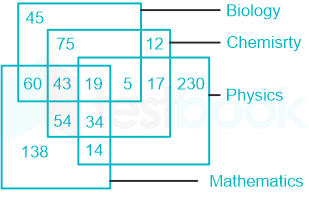
Study the given Venn diagram and answer the question that follows.

The given Venn diagram presents the number of students taking various subjects in a college.

<br>

How many students are studying Physics but NOT studying Mathematics?

  1. AOption (a)

    271

  2. BOption (b)

    247

  3. COption (c)

    252

  4. DOption (d)

    230

View answer & explanation

Correct answer

Answer: (c)C.

252

Why this answer is correct

According to the given Venn diagram:

The shaded area shows the "total number of students are studying Physics but NOT studying Mathematics".

So, the total number of students are studying 'Physics but NOT studying Mathematics' = 230 + 17 + 5 = 252.

Hence, the correct answer is "Option 3".

Question 44

Answer the question asked on the basis of the following number and symbol series.


7 4 & @ 3 4 % @ 4@34%4 4 @ 3 4 \% 4 5 * @ 4 3 4 5 * 3


How many such symbols are there in the above series which are immediately followed by a number?

  1. AOption (a)

    Ten

  2. BOption (b)

    Seven

  3. COption (c)

    Nine

  4. DOption (d)

    Eleven

View answer & explanation

Correct answer

Answer: (b)B.

Seven

Why this answer is correct

Given: 7 4 & @ 3 4 % @ 4@34%4 4 @ 3 4 \% 4 5 * @ 4 3 4 5 * 3

Now,

Symbols immediately followed by a number,

So, needed pattern is: Symbol - Number

Here,

Here, 'Seven' such symbols are there in the above series which are immediately followed by a number.

Hence, the correct answer is "Option 2".

Question 45

An object is placed at a distance of 30 cm in front of a concave mirror of focal length 15 cm, on its principal axis. Its image is formed at: 

  1. AOption (a)

    a point between 15 cm and 30 cm

  2. BOption (b)

    30 cm

  3. COption (c)

    15 cm

  4. DOption (d)

    a point beyond 30 cm

View answer & explanation

Correct answer

Answer: (b)B.

30 cm

Why this answer is correct

The correct answer is 30 cm.

Key Points

  • The given mirror is a concave mirror and the object is placed beyond its focus.
  • When the object is placed beyond the focus of a concave mirror, its image is always formed between the focus and the mirror.
  • The distance of the image from the mirror can be calculated using the mirror formula: 1/f = 1/v + 1/u, where f is the focal length of the mirror, u is the distance of the object from the mirror, and v is the distance of the image from the mirror.
  • Plugging the given values in the formula, we get: 1/15 = 1/v + 1/30, which gives v = 30 cm.
  • Therefore, the image is formed at a distance of 30 cm from the mirror.

Additional Information

  • The image cannot be formed between the object and the mirror as it violates the basic laws of reflection.
  • The image cannot be formed at a distance less than the focal length of the mirror as it will be virtual and erect, which is not possible for a concave mirror.
  • The image cannot be formed beyond infinity as it is not a physical location and violates the laws of reflection.
  • A concave mirror is a curved mirror in which the inner side of the curved shape is the reflecting surface.
  • Its surface has an inward curvature that makes it resemble the interior surface of a hollow sphere.
  • Because concave mirrors enable light beams to converge or come together after reflection, they are also known as converging mirrors.

Question 46

Who among the following launched the Digital Dashboard for District Ganga Committees Performance Monitoring System in April 2022?

  1. AOption (a)

    Nitin Jairam Gadkari

  2. BOption (b)

    Raj Nath Singh

  3. COption (c)

    Piyush Goyal

  4. DOption (d)

    Gajendra Singh Shekhawat

View answer & explanation

Correct answer

Answer: (d)D.

Gajendra Singh Shekhawat

Why this answer is correct

The correct answer is Gajendra Singh Shekhawat.

Key Points

  • Gajendra Singh Shekhawat launched the Digital Dashboard for District Ganga Committees Performance Monitoring System in April 2022.
  • The Digital Dashboard is a web-based platform that provides real-time updates on the performance of the District Ganga Committees in cleaning and rejuvenating the river Ganga.
  • The platform will help in monitoring the progress of the committees and ensuring timely implementation of various projects related to the cleaning of the river.
  • Gajendra Singh Shekhawat is the Union Minister of Jal Shakti, which is responsible for the management and conservation of water resources in India.

Additional Information

  • Nitin Jairam Gadkari is the Union Minister of Road Transport and Highways.
  • He has launched various initiatives related to infrastructure development and road safety in India.
  • Raj Nath Singh is the Union Minister of Defence.
  • He is responsible for the defence policies and strategies of India.
  • Piyush Goyal is the Union Minister of Commerce and Industry.
  • He is responsible for promoting trade and commerce in India and formulating policies related to industrial development.

Question 47

Atmospheric pressure and the rate of transpiration are _________

  1. AOption (a)

    equal 

  2. BOption (b)

    They are not related

  3. COption (c)

    directly proportional

  4. DOption (d)

    inversely proportional

View answer & explanation

Correct answer

Answer: (d)D.

inversely proportional

Why this answer is correct

The correct answer is inversely proportional.

Key Points

  • Atmospheric pressure and the rate of transpiration are inversely proportional.
  • This means that as the atmospheric pressure increases, the rate of transpiration decreases, and vice versa.
  • This is because transpiration is the process of water movement through plants from roots to leaves, and it occurs due to the difference in water potential between the soil and the atmosphere.
  • As the atmospheric pressure increases, it becomes harder for water to evaporate from the leaves, and the rate of transpiration decreases.

Additional Information

  • Atmospheric pressure refers to the force exerted by the weight of the atmosphere on the Earth's surface.
  • It is measured in units of pressure such as pascals or millibars.
  • Transpiration is the loss of water from plants through evaporation from the leaves and stems.
  • It is an important process for plant growth and survival, as it helps to transport nutrients and minerals from the roots to the rest of the plant.
  • Other factors that can affect the rate of transpiration include humidity, temperature, wind speed, and soil moisture.

Question 48

If × means ÷, - means ×, ÷ means + and + means -, what will come in place of the question mark (?) in the following equation?

(12 - 17 ÷ 21) × 15 + 9 = ?

  1. AOption (a)

    18

  2. BOption (b)

    6

  3. COption (c)

    13

  4. DOption (d)

    17

View answer & explanation

Correct answer

Answer: (b)B.

6

Why this answer is correct

Given equation: (12 - 17 ÷ 21) × 15 + 9 = ?

Decoding the given information :

Symbol×-÷+
Means÷×+-

Now, replacing the sign from left to right and using BODMAS rule, we get :

New equation : (12 - 17 ÷ 21) × 15 + 9 = ?

Calculation :

⇒ (12 × 17 + 21) ÷ 15 - 9 = ?

⇒ (204 + 21) ÷ 15 - 9 = ?

⇒ 225 ÷ 15 - 9 = ?

⇒ 15 - 9 = 6.

Hence, the correct answer is "Option 2".

Question 49

A pipe can fill a tank in 15 hours. Another pipe can empty the filled tank in 24 hours. If both the pipes are opened simultaneously, then the time in which the tank will be filled is:

  1. AOption (a)

    50 hours

  2. BOption (b)

    70 hours

  3. COption (c)

    40 hours

  4. DOption (d)

    60 hours

View answer & explanation

Correct answer

Answer: (c)C.

40 hours

Why this answer is correct

Shortcut Trick Net filling rate = (A × B) ÷ (B − A) Where A = 15 hours (filling) and B = 24 hours (emptying). Time taken = (15 × 24) ÷ (24 − 15) Time taken = 360 ÷ 9 = 40 hours. ∴ The correct answer is 40 hr. Alternate Method Given: Filling pipe time = 15 hr, Emptying pipe time = 24 hr. Formula Used: Total Work = LCM of individual times; Efficiency = Total Work ÷ Time.

Person Days Total Work Efficiency

Pipe A (Fill) 15 120 +8

Pipe B (Empty) 24 −5

⇒ Total Work (Capacity of Tank) = LCM(15, 24) = 120 units. ⇒ Net efficiency when both open = 8 − 5 = 3 units/hr. ⇒ Time taken to fill the tank = Total Work ÷ Net Efficiency ⇒ Time = 120 ÷ 3 = 40 hr. ∴ The correct answer is 40 hr. Additional Information Inlet and Outlet Pipes An inlet pipe fills the tank (positive work), while an outlet pipe empties it (negative work). Pipes & Cisterns Efficiency If a pipe fills a tank in 'x' hours and another empties it in 'y' hours (y > x), net work done in 1 hour = (1/x − 1/y). Time and Work Relation Time taken to complete a task is inversely proportional to the efficiency of the worker or pipe.

Question 50

Which gas is evolved during the burning of natural gas (CH4)?

  1. AOption (a)

    NH3

  2. BOption (b)

    CO2

  3. COption (c)

    N2

  4. DOption (d)

    H2

View answer & explanation

Correct answer

Answer: (b)B.

CO2

Why this answer is correct

The correct answer is CO2.

Key Points

  • Natural gas is primarily composed of methane (CH4), which is a hydrocarbon.
  • When natural gas is burned in the presence of oxygen, it undergoes combustion, which results in the release of energy and the formation of new compounds.
  • One of the main products of the combustion of natural gas is carbon dioxide (CO2), which is a greenhouse gas that contributes to global warming.
  • Other products of the combustion of natural gas can include water vapor (H2O) and nitrogen oxides (NOx), which can contribute to air pollution and have negative health effects.

Additional Information

  • NH3 is ammonia, which can be produced by other processes, such as the Haber-Bosch process for synthesizing fertilizer.
  • N2 is nitrogen gas, which is an inert gas that does not typically react during combustion.
  • However, some **nitrogen oxides (**NOx) can be produced as byproducts of combustion.
  • H2 is hydrogen gas, which can be produced by the decomposition of methane under certain conditions.
  • Hydrogen gas is also a potential fuel source that is being explored as an alternative to fossil fuels.

Question 51

If the radius of the base of a right circular cylinder is decreased by 20% and its height is increased by 125%, then what is the percentage increase in its volume?

  1. AOption (a)

    36%

  2. BOption (b)

    65%

  3. COption (c)

    60%

  4. DOption (d)

    44%

View answer & explanation

Correct answer

Answer: (d)D.

44%

Why this answer is correct

Shortcut Trick

Using Ratio Method: 20% decrease = 4/5 and 125% increase = 9/4.

Volume depends on r2 × h.

Ratio of Volumes = (5 → 4)2 × (4 → 9) = (25 × 4) → (16 × 9) = 100 → 144.

Percentage increase = 144 − 100 = 44%.

∴ The correct answer is 44%.

Alternate Method

Given: Decrease in radius (r) = 20%, Increase in height (h) = 125%.

Formula Used: Volume of Cylinder (V) = πr2h

⇒ Let initial radius (r1) = 5 units and initial height (h1) = 4 units.

⇒ New radius (r2) = 5 − (20% of 5) = 4 units.

⇒ New height (h2) = 4 + (125% of 4) = 4 + 5 = 9 units.

⇒ Initial Volume (V1) = π × 52 × 4 = 100π.

⇒ New Volume (V2) = π × 42 × 9 = 144π.

⇒ Increase in Volume = 144π − 100π = 44π.

⇒ Percentage increase = (44π / 100π) × 100 = 44%.

∴ The correct answer is 44%.

Additional Information

Successive Percentage Change

When a value changes by x%, y%, and z% successively, the net change is calculated using the multiplying factors or the formula [a + b + (ab/100)].

Volume of 3D Figures

For figures like cylinders and cones, Volume ∝ r2h. For a sphere, Volume ∝ r3.

Base Change Rule

If radius decreases by 1/n, the area/volume calculation must account for the square of the remaining fraction (n−1)/n.

Question 52

Magnetic fields produced by a current carrying conductor are:

  1. AOption (a)

    parallel to each other

  2. BOption (b)

    semi-circular in shape

  3. COption (c)

    concentric circles

  4. DOption (d)

    intersecting lines 

View answer & explanation

Correct answer

Answer: (c)C.

concentric circles

Why this answer is correct

The correct answer is concentric circles.

Key Points

  • The direction of the magnetic field is perpendicular to the direction of the current flow.
  • The strength of the magnetic field is directly proportional to the magnitude of the current flowing through the conductor.
  • The magnetic field lines around a straight current-carrying conductor are concentric circles centered on the conductor.
  • The magnetic field lines around a loop of current-carrying wire are similar to those around a straight conductor, but the lines are more tightly packed and the direction of the magnetic field inside the loop is opposite to that outside the loop.

 Additional Information

  • Magnetic field lines are not parallel to each other and do not have a semi-circular shape as they always form closed loops.
  • Magnetic field lines do not intersect with each other as it would mean that the direction of the magnetic field at that point would be undefined.
  • Magnetic field lines are those in a magnetic field whose density indicates the field's size and whose tangent at any given place indicates the field's direction.
  • The quantity of magnetic field lines determines the strength of the magnetic field.

Question 53

For certain data, the mode is 6 more than the mean and its median is 13. What is the mode of that data?

  1. AOption (a)

    17

  2. BOption (b)

    15

  3. COption (c)

    14

  4. DOption (d)

    11

View answer & explanation

Correct answer

Answer: (a)A.

17

Why this answer is correct

Shortcut Trick Empirical Relation: Mode = 3 × Median − 2 × Mean Given Mode = Mean + 6, then Mean = Mode − 6. Substituting values: Mode = 3(13) − 2(Mode − 6) ⇒ Mode = 39 − 2 × Mode + 12 ⇒ 3 × Mode = 51 ⇒ Mode = 51 ÷ 3 = 17 ∴ The correct answer is 17.

Alternate Method Given: Median = 13 Mode − Mean = 6 Formula Used: Mode = 3 × Median − 2 × Mean

Calculations: ⇒ Let Mean = x ⇒ Mode = x + 6 ⇒ x + 6 = 3 × 13 − 2 × x ⇒ x + 6 = 39 − 2x ⇒ x + 2x = 39 − 6 ⇒ 3x = 33 ⇒ x = 11 ⇒ Mean = 11 ⇒ Mode = 11 + 6 = 17 ∴ The correct answer is 17.

Additional Information Empirical Formula For a moderately skewed distribution, the relationship is: Mode = 3 × Median − 2 × Mean. Symmetric Distribution In a perfectly symmetric distribution (like a Normal Distribution), Mean = Median = Mode. Positively vs Negatively Skewed If Mean > Median > Mode, the data is positively skewed. If Mode > Median > Mean, it is negatively skewed.

Question 54

A two-digit number is equal to 7 times the sum of its digits. The number obtained by interchanging the digits is 18 less than the original number. The product of the digits of the number is:

  1. AOption (a)

    8

  2. BOption (b)

    18

  3. COption (c)

    12

  4. DOption (d)

    10

View answer & explanation

Correct answer

Answer: (a)A.

8

Why this answer is correct

Shortcut Trick

The difference between a two-digit number and its reverse is always 9 × (difference of its digits).

Difference of digits (x − y) = 18 ÷ 9 = 2.

The number is 7 × (sum of digits). Check multiples of 7 with a digit difference of 2: 42 (Sum = 6, 7 × 6 = 42).

Product of digits = 4 × 2 = 8.

∴ The correct answer is 8.

Alternate Method

Given:

Let the tens digit be x and the units digit be y.

Original Number = 10x + y

Reversed Number = 10y + x

Equation 1: Number = 7 × (Sum of digits)

⇒ 10x + y = 7(x + y)

⇒ 10x + y = 7x + 7y

⇒ 3x = 6y

⇒ x = 2y

Equation 2: Reversed number = Original number − 18

⇒ 10y + x = (10x + y) − 18

⇒ 10x + y − 10y − x = 18

⇒ 9x − 9y = 18

⇒ x − y = 2

Solving for digits:

Substitute x = 2y in x − y = 2

⇒ 2y − y = 2

⇒ y = 2

⇒ x = 2 × 2 = 4

Product of digits:

⇒ x × y = 4 × 2 = 8

∴ The correct answer is 8.

Additional Information

Digit Reversal Properties

The difference between a 2-digit number and its reversal is always 9|x − y|. The sum of a 2-digit number and its reversal is always 11(x + y).

Digit Limitations

For any 2-digit number 10x + y, the digits x and y must be integers where 1 ≤ x ≤ 9 and 0 ≤ y ≤ 9.

Divisibility Rule of 9

Since the difference between a number and its digit-reversed counterpart is 9(x − y), the difference is always divisible by 9.

Question 55

Which of the following is a combination reaction?

(i) ZnCO3 (s) → ZnO (s) + CO2 (g)

(ii) Mg (s) + 2HCl (aq) → MgCl2 (aq) + H2 (g)

(iii) 2KBr (aq) + BaI2 (aq) → 2KI (aq) + BaBr2 (s)

(iv) H2 (g) + Cl2 (g) → 2 HCl (g)

  1. AOption (a)

    (ii)

  2. BOption (b)

    (iv)

  3. COption (c)

    (i)

  4. DOption (d)

    (iii)

View answer & explanation

Correct answer

Answer: (b)B.

(iv)

Why this answer is correct

The correct answer is (iv).

Key Points

  • A combination reaction is a type of chemical reaction where two or more substances combine to form a single new substance.
  • In other words, it is a reaction where the reactants combine to form a product.
  • is a combination reaction as hydrogen and chlorine combine to form hydrochloric acid.

Additional Information

  • ZnCO3 (s) → ZnO (s) + CO2 (g) is a decomposition reaction as zinc carbonate breaks down into zinc oxide and carbon dioxide.
  • 2KBr (aq) + BaI2 (aq) → 2KI (aq) + BaBr2 (s) is a double displacement reaction as the positive and negative ions of two compounds switch places to form two new compounds.
  • Mg (s) + 2HCl (aq) → MgCl2 (aq) + H2 (g) is a single displacement reaction as magnesium replaces hydrogen in hydrochloric acid to form magnesium chloride and hydrogen gas.
  • It is important to identify the type of reaction as it helps in predicting the products of the reaction and understanding the underlying chemistry.

Question 56

A person spent Rs. 273 on buying a total of 50 pens and pencils. If the cost of each pen is Rs. 6 and that of each pencil is Rs. 5, then how many pens did he buy?

  1. AOption (a)

    21

  2. BOption (b)

    27

  3. COption (c)

    23

  4. DOption (d)

    25

View answer & explanation

Correct answer

Answer: (c)C.

23

Why this answer is correct

Shortcut Trick

Assume all 50 items were the cheaper item, i.e., pencils at ₹5 each.

Total hypothetical cost = 50 × 5 = ₹250.

The difference from the actual total spend = 273 − 250 = ₹23.

Price difference between a pen and a pencil = 6 − 5 = ₹1.

Number of pens = Total difference ÷ Unit price difference = 23 ÷ 1 = 23.

∴ The correct answer is 23.

Alternate Method

Given:

Total items = 50 | Total expenditure = ₹273

Cost of one pen = ₹6 | Cost of one pencil = ₹5

Let the number of pens be x.

Then, the number of pencils = 50 − x.

According to the question:

⇒ (Number of pens × 6) + (Number of pencils × 5) = 273

⇒ 6x + 5(50 − x) = 273

⇒ 6x + 250 − 5x = 273

⇒ x + 250 = 273

⇒ x = 273 − 250

⇒ x = 23

∴ The correct answer is 23.

Additional Information

Linear Equations in Two Variables

Problems involving two types of items with different costs can be solved using the system of equations x + y = Total Quantity and ax + by = Total Cost.

Alligation Method

Ratio of quantity = (Higher Price − Average Price) : (Average Price − Lower Price), where Average Price = Total Cost ÷ Total Quantity.

Unitary Method for Costs

Useful for calculating individual prices or quantities when the total sum and individual rates are known.

Question 57

The value of (sin⁡70∘−2sin⁡370∘)(2cos⁡370∘−cos⁡70∘)\frac{(\sin70^{\circ}-2\sin^370^{\circ})}{(2\cos^370^{\circ}-\cos70^{\circ})} is:

  1. AOption (a)

    cot 70°

  2. BOption (b)

    tan 70°

  3. COption (c)

    cosec 70°

  4. DOption (d)

    sec 70°

View answer & explanation

Correct answer

Answer: (b)B.

tan 70°

Why this answer is correct

Shortcut Trick

Factor out sin 70° from the numerator and cos 70° from the denominator.

Numerator = sin 70° (1 − 2 sin2 70°). Denominator = cos 70° (2 cos2 70° − 1).

Both (1 − 2 sin2 θ) and (2 cos2 θ − 1) are equal to cos 2θ.

They cancel out, leaving sin 70° / cos 70° = tan 70°.

∴ The correct answer is tan 70°.

Alternate Method

Given: Expression = (sin 70° − 2 sin3 70°) / (2 cos3 70° − cos 70°)

Formula Used: cos 2θ = 1 − 2 sin2 θ = 2 cos2 θ − 1

⇒ Expression = [sin 70° (1 − 2 sin2 70°)] / [cos 70° (2 cos2 70° − 1)]

⇒ Expression = [sin 70° × cos (2 × 70°)] / [cos 70° × cos (2 × 70°)]

⇒ Expression = [sin 70° × cos 140°] / [cos 70° × cos 140°]

⇒ Expression = sin 70° / cos 70°

⇒ Expression = tan 70°

∴ The correct answer is tan 70°.

Additional Information

Double Angle Formulas

sin 2θ = 2 sin θ cos θ and cos 2θ = cos2 θ − sin2 θ.

Tangent Relations

tan θ = sin θ / cos θ and cot θ = cos θ / sin θ.

Trigonometric Identities

sin2 θ + cos2 θ = 1, which leads to the alternative forms of cos 2θ used here.

Question 58

Consider the following statements about magnetic fields:

(a) The relative strength of a magnetic field is shown by the degree of closeness of lines.

(b) Magnetic field lines have magnitudes only and no directions.

Which of the above statements is/are correct?

  1. AOption (a)

    Only (a)

  2. BOption (b)

    Both (a) and (b)

  3. COption (c)

    Only (b)

  4. DOption (d)

    Neither (a) nor (b)

View answer & explanation

Correct answer

Answer: (a)A.

Only (a)

Why this answer is correct

The correct answer is Only (a).

Key Points

  • The statement (a) is correct.
  • The degree of closeness of magnetic field lines indicates the strength of the magnetic field.
  • The closer the lines, the stronger the magnetic field.
  • The statement (b) is incorrect.
  • Magnetic field lines not only have magnitudes but also have directions.
  • The direction of the magnetic field is indicated by the direction of the lines, which always point from the north pole to the south pole.
  • Magnetic fields are areas around magnets or moving electric charges where a magnetic force can be observed.
  • The strength of a magnetic field is measured in units of tesla (T) or gauss (G).
  • The direction of the magnetic field can be determined by using a compass.
  • The north end of the compass needle points towards the south pole of the magnet, and vice versa.

Additional Information

  • Magnetic field lines are those in a magnetic field whose density indicates the field's size and whose tangent at any given place indicates the field's direction.
  • They form closed loops.
  • Magnetic field lines do not intersect with each other as it would mean that the direction of the magnetic field at that point would be undefined.

Question 59

Which of the following enzymes breaks down starch into simple sugar?

  1. AOption (a)

    Pepsin

  2. BOption (b)

    Trypsin

  3. COption (c)

    Amylase

  4. DOption (d)

    Lipase

View answer & explanation

Correct answer

Answer: (c)C.

Amylase

Why this answer is correct

The correct answer is Amylase.

Key Points

  • Starch is a complex carbohydrate that needs to be broken down into simple sugars for the body to use it as energy.
  • Amylase is the enzyme responsible for breaking down starch into simple sugars like glucose and maltose.
  • The majority of amylase in your body is produced by the salivary glands and pancreas.

Additional Information

  • Pepsin is an enzyme produced in the stomach.
  • It breaks down proteins into amino acids.
  • Trypsin is an enzyme produced in the pancreas.
  • It breaks down proteins into smaller peptides.
  • Lipase is an enzyme that breaks down fats into fatty acids and glycerol.

Question 60

15 PK is related to 225 SQ in a certain way. In the same way, 16 TQ is related to 256 WW. To which of the following is 14 OK related following the same logic?

  1. AOption (a)

    196 RR

  2. BOption (b)

    198 RQ

  3. COption (c)

    56 RQ

  4. DOption (d)

    196 RQ

View answer & explanation

Correct answer

Answer: (d)D.

196 RQ

Why this answer is correct

The logic followed here is:

For, '15 PK is related to 225 SQ'

For, '16 TQ is related to 256 WW'

Similarly, for '14 OK'

So, '14 OK' will be related to '196 RQ'

Hence, the correct answer is "Option 4".

Question 61

3 men and 2 women can complete a piece of work in 8 days, while 2 men and 3 women can complete the same work in 10 days. In how many days can 2 men and 1 women complete the same work? 

  1. AOption (a)

    13

  2. BOption (b)

    12.5

  3. COption (c)

    13.5

  4. DOption (d)

    15

View answer & explanation

Correct answer

Answer: (b)B.

12.5

Why this answer is correct

Shortcut Trick

Equate Total Work: (3M + 2W) × 8 = (2M + 3W) × 10

⇒ 24M + 16W = 20M + 30W ⇒ 4M = 14W ⇒ 1M = 3.5W

Total Work in terms of Women = (3 × 3.5W + 2W) × 8 = 12.5W × 8 = 100 units

Required Efficiency (2M + 1W) = (2 × 3.5W + 1W) = 8W

Required Days = 100 ÷ 8 = 12.5 days

∴ The correct answer is 12.5 days.

Alternate Method

GroupDaysTotal WorkEfficiency
3M + 2W8405
2M + 3W104

Calculations:

⇒ 3M + 2W = 5 --- (i)

⇒ 2M + 3W = 4 --- (ii)

⇒ Multiplying (i) by 3 and (ii) by 2: 9M + 6W = 15 and 4M + 6W = 8

⇒ Subtracting gives 5M = 7 ⇒ M = 1.4

⇒ Substitute M in (ii): 2(1.4) + 3W = 4 ⇒ 2.8 + 3W = 4 ⇒ 3W = 1.2 ⇒ W = 0.4

⇒ Total Work = efficiency × days = 5 × 8 = 40 units

⇒ Required Efficiency (2M + 1W) = 2(1.4) + 0.4 = 2.8 + 0.4 = 3.2

⇒ Required Time = 40 ÷ 3.2 = 12.5 days

∴ The correct answer is 12.5 days.

Additional Information

Work Equivalence Formula

Total Work = (m1 × d1 × h1) / w1 = (m2 × d2 × h2) / w2, where m is efficiency, d is days, and h is hours.

Efficiency Ratio

In combined work problems, always find the efficiency ratio between different entities (Men, Women, Children) to standardize the work units.

Pipes & Cisterns Analogy

Similar logic applies where filling pipes are like workers and leakages are negative efficiency, using LCM to find Total Capacity.

Question 62

If 2 and -3 are the roots of a quadratic equation, then the equation is:

  1. AOption (a)

    x2 + x + 6 = 0

  2. BOption (b)

    x2 - x - 6 = 0

  3. COption (c)

    x2 - x + 6 = 0

  4. DOption (d)

    x2 + x - 6 = 0

View answer & explanation

Correct answer

Answer: (d)D.

x2 + x - 6 = 0

Why this answer is correct

Shortcut Trick

Sum of roots (α + β) = 2 + (−3) = −1

Product of roots (αβ) = 2 × (−3) = −6

The quadratic equation formula is x2 − (Sum of roots)x + (Product of roots) = 0.

Substituting the values: x2 − (−1)x + (−6) = 0 ⇒ x2 + x − 6 = 0.

∴ The correct answer is x2 + x − 6 = 0.

Alternate Method

Given:

First root (α) = 2

Second root (β) = −3

Formula Used:

If α and β are the roots, the equation is (x − α)(x − β) = 0

Calculations:

⇒ (x − 2)(x − (−3)) = 0

⇒ (x − 2)(x + 3) = 0

⇒ x(x + 3) − 2(x + 3) = 0

⇒ x2 + 3x − 2x − 6 = 0

⇒ x2 + x − 6 = 0

∴ The correct answer is x2 + x − 6 = 0.

Additional Information

Nature of Roots

The nature of roots is determined by the discriminant D = b2 − 4ac. If D > 0, roots are real and distinct; if D = 0, roots are real and equal.

Relationship between Coefficients and Roots

For the equation ax2 + bx + c = 0, the Sum of roots is −b/a and the Product of roots is c/a.

Standard Form

A quadratic equation is a second-degree polynomial equation in a single variable x, expressed in the general form ax2 + bx + c = 0.

Question 63

If 2 is subtracted from each odd digit and 1 is added to each even digit in the number 83752964, what will be the sum of the digits which are third from the left and second from the right in the new number thus formed?

  1. AOption (a)

    8

  2. BOption (b)

    16

  3. COption (c)

    6

  4. DOption (d)

    12

View answer & explanation

Correct answer

Answer: (d)D.

12

Why this answer is correct

The logic followed here is:

Given number: 83752964.

Odd digits is decreased by - 2

and, Even digits is increased by + 1

After arrange the numbers:

83752964 ⇒ 91533775

Now, third digit from the left: 5

And, second digit from the right: 7

So, the sum of third from the left and second from the right digit is: 5 + 7 = 12.

Hence, the correct answer is "Option 4".

Question 64

The ______ Amendment to the Constitution of India envisaged the Gram Sabha as the foundation of the Panchayat Raj System.

  1. AOption (a)

    76th

  2. BOption (b)

    73rd

  3. COption (c)

    79th

  4. DOption (d)

    71st

View answer & explanation

Correct answer

Answer: (b)B.

73rd

Why this answer is correct

The correct answer is 73rd.

Key Points

  • The 73rd Amendment to the Constitution of India was passed in 1992 and it added a new Part IX to the Constitution, which deals with Panchayats.
  • This amendment envisaged the Gram Sabha as the foundation of the Panchayat Raj System.
  • Gram Sabha is a body consisting of all persons registered as voters in a village or in a group of villages within a Panchayat area.
  • The Panchayat Raj System is a three-tier system of local self-government in India, consisting of the village level (Gram Panchayat), intermediate level (Panchayat Samiti), and district level (Zilla Parishad).
  • This amendment also made it mandatory to hold regular elections to Panchayats every five years and reserved seats for Scheduled Castes, Scheduled Tribes, and women in Panchayats.

Additional Information

  • 76th Amendment deals with the incorporation of the Konkani, Meitei, and Nepali languages in the Eighth Schedule to the Constitution.
  • 79th Amendment extended the reservation of seats for Scheduled Castes and Scheduled Tribes in the Lok Sabha and State Legislative Assemblies for another ten years, i.e., till 2020.
  • 71st Amendment provided for the creation of a new State of Uttarakhand from the existing State of Uttar Pradesh.

Question 65

Which of the following numbers will replace the question mark (?) in the given series?

45, 61, 86, 122, ?

  1. AOption (a)

    186

  2. BOption (b)

    172

  3. COption (c)

    174

  4. DOption (d)

    171

View answer & explanation

Correct answer

Answer: (d)D.

171

Why this answer is correct

The logic followed here is:

So, '171' will replace the question mark in the given series.

Hence, the correct answer is "Option 4".

Question 66

Due to which of the following HIV infection does not occur in humans?

  1. AOption (a)

    Due to frequent blood transfusions

  2. BOption (b)

    Sharing toilet with HIV patient

  3. COption (c)

    Sharing syringes when injecting drugs intravenously

  4. DOption (d)

    In a child born to an HIV-positive mother

View answer & explanation

Correct answer

Answer: (b)B.

Sharing toilet with HIV patient

Why this answer is correct

The correct answer is HIV infection cannot be transmitted by sharing toilets with an HIV-positive person.

Key Points

  • HIV (Human Immunodeficiency Virus) is a virus that attacks the immune system of the human body, making it difficult for the body to fight infections and diseases.
  • HIV can be transmitted through the exchange of certain bodily fluids, including blood, semen, vaginal fluids, and breast milk.
  • However, HIV cannot be transmitted through casual contact such as sharing toilets, utensils, or hugging.

Additional Information

  • Repeated blood transfusions can actually increase the risk of HIV transmission if the donated blood is not screened properly for the virus.
  • Sharing needles or syringes while taking medications can also increase the risk of HIV transmission as the virus can be present in the blood of an infected person.
  • HIV-positive mothers can transmit the virus to their babies during pregnancy, childbirth, or breastfeeding.
  • However, with proper medical care and treatment, the risk of mother-to-child transmission can be significantly reduced.
  • It is important to note that HIV infection is preventable through safe sex practices, avoiding sharing needles or syringes, and getting tested regularly for the virus.
  • Treatment options are also available to manage the virus and prevent it from progressing to AIDS (Acquired Immunodeficiency Syndrome).

Question 67

Three statements are followed by three conclusions numbered I, II and III. Assuming the statements to be true, even if they do not conform to real world knowledge, decide which of the given conclusions/possibilities can be true on the basis of the statements.

Statements:

  1. Some toys are pianos.
  2. Some pianos are white.
  3. All white are guitars.

Conclusions:

I. Some white are toys.

II. Some guitars are toys.

III. Some guitars are pianos.

  1. AOption (a)

    Only conclusion III is true

  2. BOption (b)

    Only conclusion II is true

  3. COption (c)

    Only conclusion I and II are true 

  4. DOption (d)

    Only conclusion I is true

View answer & explanation

Correct answer

Answer: (a)A.

Only conclusion III is true

Why this answer is correct

Given Statements:

  1. Some toys are pianos.
  2. Some pianos are white.
  3. All white are guitars.

The least possible Venn diagram for the given statement is:

Conclusions:

I. Some white are toys - False (Because, No definite relation given between White and Toys, So, it can be possible only).

II. Some guitars are toys - False (Because, No definite relation given between guitars and Toys, So, it can be possible only).

III Some guitars are pianos - True (Because, those part of guitars which is white will also pianos).

So, Only conclusion III is true.

Hence, the correct answer is "Option 1".

Question 68

How much will a sum of Rs. 16,000 become after one year if the interest is compounded half-yearly at 20% per annum compound interest?

  1. AOption (a)

    Rs. 19,360

  2. BOption (b)

    Rs. 19,200

  3. COption (c)

    Rs. 19,720

  4. DOption (d)

    Rs. 19,480

View answer & explanation

Correct answer

Answer: (a)A.

Rs. 19,360

Why this answer is correct

Shortcut Trick

When interest is compounded half-yearly, the rate is halved and the time periods are doubled.

Effective Rate = 20% ÷ 2 = 10% per half-year for 2 periods.

Successive percentage increase = 10 + 10 + (10 × 10)/100 = 21%.

Total Amount = 121% of 16,000 ⇒ 1.21 × 16000 = ₹19,360.

∴ The correct answer is ₹19,360.

Alternate Method

Given: Principal (P) = ₹16,000, Rate (R) = 20% p.a., Time (T) = 1 year (compounded half-yearly).

Formula Used: Amount (A) = P[1 + (R/200)]2n where R is annual rate and n is years.

⇒ Half-yearly rate = 20% ÷ 2 = 10%

⇒ Number of half-yearly periods (n) = 1 × 2 = 2

⇒ A = 16000 × [1 + 10/100]2

⇒ A = 16000 × (11/10) × (11/10)

⇒ A = 160 × 121

⇒ A = ₹19,360

∴ The correct answer is ₹19,360.

Additional Information

Compounding Frequency

If interest is compounded quarterly, the rate is divided by 4 and time periods are multiplied by 4.

Successive Percentage Method

For two interest periods, net interest rate = x + y + (xy/100)%, where x and y are the rates for each period.

CI vs SI for One Year

When compounded annually, CI = SI for 1st year. When compounded half-yearly, CI > SI even for the 1st year.

Question 69

Which of the following terms will replace the question mark (?) in the given series to make it logically complete?

F15UN, L19AT, R23GZ, X27MF, ?

  1. AOption (a)

    D13SL

  2. BOption (b)

    S13DL

  3. COption (c)

    S31LD

  4. DOption (d)

    D31SL

View answer & explanation

Correct answer

Answer: (d)D.

D31SL

Why this answer is correct

The logic followed here is:

So, 'D31SL' will replace the question mark in the given series.

Hence, the correct answer is "Option 4".

Question 70

3Fe + 4H2O → Fe3O4 + 4H2 find the total number of atoms in products.

  1. AOption (a)

    10

  2. BOption (b)

    08

  3. COption (c)

    15

  4. DOption (d)

    04

View answer & explanation

Correct answer

Answer: (c)C.

15

Why this answer is correct

The correct answer is 15.

Key Points

  • The given chemical equation represents the reaction between iron (Fe) and water (H2O) to form iron(III) oxide (Fe3O4) and hydrogen gas (H2).
  • According to the equation, there are 3 atoms of iron, 4 atoms of hydrogen, and 4 atoms of oxygen in the products.
  • Hence, the total number of atoms in products is 3+4+4 = 11.
  • Reactants and products are stated in terms of their corresponding chemical formulae in chemical equations, which are symbolic representations of chemical reactions.

Additional Information

  • Iron(III) oxide is a commonly occurring mineral that is also known as hematite.
  • It is used in the production of iron and steel as a source of iron.
  • The reaction between iron and water is an example of a redox reaction, where the iron gets oxidized and the water gets reduced to form hydrogen gas.
  • The reaction is exothermic, which means that it releases heat energy.

Question 71

If each of the digits in the number 6287451 is arranged in ascending order from left to right, then the position of how many digits will remain unchanged as compared to that in the original number?

  1. AOption (a)

    Three

  2. BOption (b)

    Two

  3. COption (c)

    One

  4. DOption (d)

    Four

View answer & explanation

Correct answer

Answer: (c)C.

One

Why this answer is correct

Given digits: 6287451

Now, arranged in ascending order from left to right: 6287451.

Given Digits6287451
Ascending order1245678


So, there are 'One' digits remain in the same position.

Hence, the correct answer is "Option 3".

Question 72

Seven people, A, B, C, D, E, F and G, are sitting in a straight row, facing north. Only three people sit between A and F. Only two people sit to the left of A. G is not an immediate neighbour of F. G sits second to the right of C. B sits to the immediate right of D. Who sits at the extreme left end of the row?

  1. AOption (a)

    B

  2. BOption (b)

    A

  3. COption (c)

    G

  4. DOption (d)

    E

View answer & explanation

Correct answer

Answer: (d)D.

E

Why this answer is correct

Given: Seven people, A, B, C, D, E, F and G, are sitting in a straight row, facing north.

  1. Only three people sit between A and F.

  2. Only two people sit to the left of A.

  3. G is not an immediate neighbour of F.

  4. G sits second to the right of C.

  5. B sits to the immediate right of D.

And, E will sit at the remaining place.

So, 'E' sits at the extreme left end of the row.

Hence, the correct answer is "Option 4".

Question 73

Which of the following is NOT a metalloid?

  1. AOption (a)

    Silicon

  2. BOption (b)

    Antimony

  3. COption (c)

    Arsenic

  4. DOption (d)

    Selenium

View answer & explanation

Correct answer

Answer: (d)D.

Selenium

Why this answer is correct

The correct answer is Selenium.

Key Points

  • Selenium is NOT a metalloid.
  • Metalloids are elements that exhibit properties of both metals and non-metals.
  • Selenium is a non-metal element that is found in soil, water, and some foods.
  • It is an essential nutrient for humans and animals in small amounts, but can be toxic in larger amounts.

Additional Information

  • Silicon is a metalloid that is commonly used in electronic devices such as computer chips and solar cells.
  • It is also used in glass, ceramics, and other materials.
  • Antimony is a metalloid that has been used in alloys with lead and other metals to increase their hardness and strength.
  • It is also used in batteries, flame retardants, and as a semiconductor.
  • Arsenic is a metalloid that has been used in pesticides, wood preservatives, and as a doping agent in semiconductors.
  • It is highly toxic and exposure to it can cause serious health problems.

Question 74

Triangle ABC is similar to triangle PQR with BCQR=15.Area (triangle PQR)Area (triangle ABC)\rm \frac{BC}{QR}=\frac{1}{5}.\frac{Area\ (triangle\ PQR)}{Area\ (triangle\ ABC)} is:

  1. AOption (a)

    1/25

  2. BOption (b)

    25

  3. COption (c)

    5

  4. DOption (d)

    1/5

View answer & explanation

Correct answer

Answer: (b)B.

25

Why this answer is correct

Shortcut Trick

For any two similar triangles, the ratio of their areas is equal to the square of the ratio of their corresponding sides.

⇒ Area(ΔPQR) ÷ Area(ΔABC) = (QR ÷ BC)2

Given, BC ÷ QR = 1 ÷ 5 ⇒ QR ÷ BC = 5 ÷ 1

⇒ Area(ΔPQR) ÷ Area(ΔABC) = (5 ÷ 1)2 = 25

∴ The correct answer is 25.

Alternate Method

Given:

ΔABC is similar to ΔPQR (ΔABC ~ ΔPQR)

BC ÷ QR = 1 ÷ 5

Formula Used:

If two triangles are similar, then the ratio of their areas is equal to the square of the ratio of their corresponding sides:

Area(ΔPQR) ÷ Area(ΔABC) = (QR ÷ BC)2

Calculations:

We are given the ratio of the corresponding sides:

⇒ BC ÷ QR = 1 ÷ 5

Taking the reciprocal to find the ratio of QR to BC:

⇒ QR ÷ BC = 5 ÷ 1 = 5

Now, applying the area of similar triangles theorem:

⇒ Area(ΔPQR) ÷ Area(ΔABC) = (QR ÷ BC)2

Substitute the value of QR ÷ BC into the equation:

⇒ Area(ΔPQR) ÷ Area(ΔABC) = (5)2

⇒ Area(ΔPQR) ÷ Area(ΔABC) = 25

Explanation of Options:

⇒ Option (1) 1/25: This represents the ratio of Area(ΔABC) ÷ Area(ΔPQR), which is the inverse of the required ratio.

⇒ Option (2) 25: This is the correct ratio of Area(ΔPQR) ÷ Area(ΔABC) obtained by squaring the side ratio 5/1.

⇒ Option (3) 5: This is simply the ratio of the corresponding sides QR ÷ BC, not their areas.

⇒ Option (4) 1/5: This is the ratio of the corresponding sides BC ÷ QR, not their areas.

∴ The correct answer is 25.

Additional Information

Area of Similar Triangles Theorem

The ratio of the areas of two similar triangles is equal to the square of the ratio of their corresponding sides, corresponding altitudes, corresponding medians, or corresponding angle angle bisectors.

Perimeter of Similar Triangles

The ratio of the perimeters of two similar triangles is equal to the ratio of their corresponding sides: Perimeter(ΔABC) ÷ Perimeter(ΔPQR) = AB ÷ PQ = BC ÷ QR = AC ÷ PR.

Question 75

Who among the following broke a 30-year-old national record in the men's 5000 m when he clocked 13:25:65 at the Sound Running Track Meet in San Juan Capistrano, USA in 2022?

  1. AOption (a)

    Siddhanth Thingalaya

  2. BOption (b)

    Avinash Sable

  3. COption (c)

    Rahamatulla Molla

  4. DOption (d)

    Ayyasamy Dharun

View answer & explanation

Correct answer

Answer: (b)B.

Avinash Sable

Why this answer is correct

The correct answer is Avinash Sable.

Key Points

  • Avinash Sable is an Indian athlete who broke a 30-year-old national record in the men's 5000 m when he clocked 13:25:65 at the Sound Running Track Meet in San Juan Capistrano, USA in 2022.
  • At the 2022 Asian Games, Avinash Sable won the first gold medal for India in the steeplechase and the silver medal in the 5000 meters.
  • He hails from Maharashtra.

Additional Information

  • Siddhanth Thingalaya is an Indian athlete who is a sprint hurdler.
  • ​With a timing of 13.48 seconds, set in June 2017 at the Altis Invitational Meet in the USA, he now owns the national record in the 110-meter hurdles.
  • Rahamatulla Molla is an Indian athlete who is a long-distance runner.
  • ​As a member of the Indian 4 x 100-meter relay team, he took home a bronze medal from the 2010 Commonwealth Games.
  • Ayyasamy Dharun is an Indian athlete who is a sprinter.
  • ​He competed in the 2016 Summer Olympics in the 4 × 400-meter relay.

Question 76

Study the following graph carefully and answer the question.

<br>

If the amount of profit earned on investment by Company A in 2021, was Rs. 24.60 lakh, what was the total investment?

  1. AOption (a)

    Rs. 34,75,576.78

  2. BOption (b)

    Rs. 34,74,576.27

  3. COption (c)

    Rs. 34,47,576.92

  4. DOption (d)

    Rs. 34,54,776.49

View answer & explanation

Correct answer

Answer: (b)B.

Rs. 34,74,576.27

Why this answer is correct

Calculation

The amount of profit earned on investment by Company A in 2021 = Rs. 24.60 lakh

The amount of profit earned on investment by Company A in 2021 = 70.8%

70.8% → 24.60 lac

100% → 24.60/70.8 × 100 = 34,74,576.27

The answer is 34,74,576.27.

Question 77

The presence of which of the following is a distinctive feature of complex plants that has made their survival in terrestrial environment possible?

  1. AOption (a)

    Meristematic tissue

  2. BOption (b)

    Parenchyma tissue

  3. COption (c)

    Vascular tissue

  4. DOption (d)

    Sclerenchyma tissue

View answer & explanation

Correct answer

Answer: (c)C.

Vascular tissue

Why this answer is correct

The correct answer is vascular tissue.

Key Points

  • Complex plants have well-developed vascular tissue, which is composed of xylem and phloem.
  • The xylem tissue transports water and minerals from the roots to the leaves, while the phloem tissue transports organic nutrients from the leaves to the rest of the plant.
  • The presence of vascular tissue allows complex plants to grow taller and larger, as they can transport water and nutrients over longer distances.
  • This feature has made their survival in terrestrial environments possible.

Additional Information

  • Meristematic tissue is the primary growth tissue in plants, responsible for the production of new cells.
  • It is present in all plants, including simple ones like algae.
  • Parenchyma tissue is the most common type of plant tissue, found in all plant organs.
  • It is responsible for various functions, such as storage, photosynthesis, and secretion.
  • Sclerenchyma tissue is a type of plant tissue that provides mechanical support to the plant.
  • It is composed of cells with thick, lignified walls, and is present in various plant organs, such as stems, leaves, and fruits.

Question 78

Participating in a race of 32 athletes, Mayank gained 12th rank from the top. What is his position from the bottom?

  1. AOption (a)

    20

  2. BOption (b)

    21

  3. COption (c)

    22

  4. DOption (d)

    23

View answer & explanation

Correct answer

Answer: (b)B.

21

Why this answer is correct

Given: 32 athletes.

Rank of Mayank from the top = 12th.

So, the rank of Mayank from the bottom = Total athletes - Rank of Mayank from the top + 1

= 32 - 12 + 1 = 21.

Hence, the correct answer is "Option 2".

Question 79

Which of the following is a soft dehydrate naturally occurring mineral composed of calcium sulphate dihydrate widely used to manufacture wallboards that are used to cover walls and ceilings?

  1. AOption (a)

    Limestone

  2. BOption (b)

    Gypsum

  3. COption (c)

    Dolomite

  4. DOption (d)

    Barytes

View answer & explanation

Correct answer

Answer: (b)B.

Gypsum

Why this answer is correct

The correct answer is Gypsum.

Key Points

  • Gypsum is a soft dehydrate naturally occurring mineral composed of calcium sulphate dihydrate.
  • It is widely used in the manufacturing of wallboards that are used to cover walls and ceilings.
  • Gypsum is also used in the production of plaster of Paris, fertilizer, and as a soil conditioner.
  • It is a non-toxic mineral and is safe for use in construction and agriculture.

Additional Information

  • Limestone is a sedimentary rock composed mainly of calcium carbonate.
  • It is used in the production of cement and concrete.
  • Dolomite is a mineral composed of calcium magnesium carbonate.
  • It is used in the production of steel and glass.
  • Barytes, also known as barite, is a mineral composed of barium sulfate.
  • It is used in drilling fluids, as a filler in paints and plastics, and in the production of oil and gas.

Question 80

Select the set in which the numbers are related in the same way as are the numbers of the following sets.

(NOTE : Operations should be performed on the whole numbers, without breaking down the numbers into its constituent digits. E.g. 13 - Operations on 13 such as adding /deleting ‘multiplying etc. to 13 can be performed. Breaking down 13 into 1 and 3 and then performing mathematical operations on 1 and 3 is not allowed)

(13, 8, 40)

(21, 16, 80)

  1. AOption (a)

    17, 10, 60 

  2. BOption (b)

    15, 20, 50 

  3. COption (c)

    11, 5, 30 

  4. DOption (d)

    19, 14, 70 

View answer & explanation

Correct answer

Answer: (d)D.

19, 14, 70 

Why this answer is correct

The logic followed here is:

Logic: (1st number - 2nd number) = 5

 2nd number × 5 = 3rd number.

Now,

For, (13, 8, 40)

⇒ (13 - 8) = 5

⇒ 8 × 5 = 40.

For, (21, 16, 80) 

⇒ (21 - 16) = 5

⇒ 16 × 5 = 80.

Similarly, for (19, 14, 70)

⇒ (19 - 14) = 5

⇒ 14 × 5 = 70.

Hence, the correct answer is "Option 4".

Confusion PointsIf you apply the logic;

Logic: (1st number - 2nd number) × 2nd number = 3rd number.

then, we get two option(3) and (4) correct.

Hence, we can't apply this logic.

Question 81

In this question, a group of numbers/symbols is coded using letters as per the table given below and the conditions which follow. The correct combination of codes following the condition is your answer.

Number/Symbol35&@?7<#2%!4/6
CodeJKRTUPWYMVCXDS
<br>

Conditions:

(i) If the first element is a symbol and the third a number, the codes for these two. are to be interchanged.

(ii) If the first element is an odd number and the last an even number, the first and the last elements are to be coded as Φ.

(iii) If both the second and third elements are perfect squares, the third element is to be coded as the code for the second element.

How will ‘/ 5 2 < @' be coded?

  1. AOption (a)

    TKMWD

  2. BOption (b)

    MKDWT

  3. COption (c)

    DKMWT

  4. DOption (d)

    MRDWU

View answer & explanation

Correct answer

Answer: (b)B.

MKDWT

Why this answer is correct

Given:

Number/Symbol35&@?7<#2%!4/6
CodeJKRTUPWYMVCXDS


ConditionsCoded As
First element is a symbol and the third element is a numberCodes for these two (the first and the third elements) are to be interchanged
First element is an odd number and the last element is an even numberFirst and last elements are to be coded as Φ
Second and Third elements are perfect squaresThird element is to be coded as the code for the second element


Now, the group of numbers and symbols is: / 5 2 < @

Here, Here, First conditions followed in the given group,

So, codes of the First and Third elements are to be interchanged.

Then, the code for '/ 5 2 < @' is → 'M K D W T'.

Hence, the correct answer is "Option 2".

Question 82

On their anniversary Mr. and Mrs. Singh received five gift boxes. They numbered these boxes from one to five as and when they received them. In the evening they opened a box and found a pair of rings in it. They found a dinner set in an even numbered box. The first box sent by Mr. Singh’s sister contained a photo collage and the box which was received as the last box contained a wind chime. They found a beautiful dress in an even numbered box. In which box did they receive a pair of rings?  

  1. AOption (a)

    1

  2. BOption (b)

    5

  3. COption (c)

    Either 3 or 5

  4. DOption (d)

    3

View answer & explanation

Correct answer

Answer: (d)D.

3

Why this answer is correct

Given: On their anniversary Mr. and Mrs. Singh received five gift boxes.

They numbered these boxes from one to five as and when they received them.

In the evening they opened a box and found a pair of rings in it.

  1. The first box sent by Mr. Singh’s sister contained a photo collage.

  2. The box which was received as the last box contained a wind chime.

BoxItems
1College Photo
2
3
4
5Wind Chime


  1. They found a dinner set in an even numbered box.

  2. They found a beautiful dress in an even numbered box.

BoxItems
1College Photo
2Dinner Set / Dress
3
4Dress/ Dinner Set
5Wind Chime


And, the remaining box containing a pair of rings.

BoxItems
1College Photo
2Dinner Set / Dress
3Pair of Rings
4Dress/ Dinner Set
5Wind Chime


So, In '3rd' box they receive a pair of rings.

Hence, the correct answer is "Option 4".

Question 83

Which of the following is a non-conventional source of energy?

  1. AOption (a)

    Crude oil

  2. BOption (b)

    Natural gas

  3. COption (c)

    Solar energy

  4. DOption (d)

    Coal

View answer & explanation

Correct answer

Answer: (c)C.

Solar energy

Why this answer is correct

The correct answer is Solar energy.

Key Points

  • Solar energy is a renewable and non-polluting source of energy that is obtained from the sun's radiation.
  • It is a non-conventional source of energy because it is not derived from the traditional sources of energy like coal, oil, and natural gas.
  • Solar energy can be harnessed through the use of solar panels, which convert the sun's radiation into electricity.
  • Solar energy is an abundant source of energy and has the potential to meet the world's energy needs in the future.

Additional Information

  • Crude oil is a conventional source of energy that is obtained from the ground.
  • It is a non-renewable and polluting source of energy that is responsible for air pollution and greenhouse gas emissions.
  • Natural gas is also a conventional source of energy that is obtained from the ground.
  • It is a non-renewable source of energy that is cleaner than coal and oil but still contributes to greenhouse gas emissions.
  • Coal is a conventional source of energy that is obtained from the ground.
  • It is a non-renewable and polluting source of energy that is responsible for air pollution and greenhouse gas emissions.

Question 84

What is the name of a kit developed by Tata Medical and Diagnostics in 2021 to detect the omicron virus?

  1. AOption (a)

    OmiSure

  2. BOption (b)

    OmiCheck

  3. COption (c)

    OmiKit

  4. DOption (d)

    OmiFinder

View answer & explanation

Correct answer

Answer: (a)A.

OmiSure

Why this answer is correct

The correct answer is OmiSure.

Key Points

  • Tata Medical and Diagnostics is an Indian healthcare company that develops and manufactures medical devices, diagnostics, and healthcare solutions.
  • The omicron virus is a new variant of the SARS-CoV-2 virus that causes COVID-19.
  • It was first detected in South Africa in November 2021 and has since spread to other countries.
  • The correct name of the kit developed by Tata Medical and Diagnostics in 2021 to detect the omicron virus is OmiSure.

Additional Information

  • Omisure employs the approach of S-Gene Target Failure (SGTF).
  • During the RT-PCR assays, the Omisure test kit finds the Omicron variant of SARS-CoV2 in the nasopharyngeal and oropharyngeal tissues.
  • The Omicron version experienced many mutations in the S-gene; patients who test positive for Covid are identified via the SGTF approach.
  • The viral genes that are targeted for Covid-19 virus detection are the "S" gene, ORF, "N" gene, Rdrp, and "E" gene.

Question 85

If (37)8×(37)−14=(37)3p−3\rm\left(\frac{3}{7}\right)^8\times\left(\frac{3}{7}\right)^{-14}=\left(\frac{3}{7}\right)^{3p-3}, then the value of p is:

  1. AOption (a)

    1

  2. BOption (b)

    0

  3. COption (c)

    -1

  4. DOption (d)

    -2

View answer & explanation

Correct answer

Answer: (c)C.

-1

Why this answer is correct

Given:

(37)8×(37)−14=(37)3p−3\rm\left(\frac{3}{7}\right)^8\times\left(\frac{3}{7}\right)^{-14}=\left(\frac{3}{7}\right)^{3p-3}

Calculation:

(37)8×(37)−14=(37)3p−3\rm\left(\frac{3}{7}\right)^8\times\left(\frac{3}{7}\right)^{-14}=\left(\frac{3}{7}\right)^{3p-3}

⇒ (37)8−14=(37)3p−3\rm\left(\frac{3}{7}\right)^{8-14}=\left(\frac{3}{7}\right)^{3p-3}

⇒ 8 - 14 = 3p - 3

⇒ -6 + 3 = 3p

⇒ p = -1

 ∴ Option 3 is the correct answer.

Question 86

As per Economic Survey Report 2022, ________ emerged as the leading state with Rs. 1,02,866 crore FDI inflow in 2021-22.

  1. AOption (a)

    Gujarat

  2. BOption (b)

    Karnataka

  3. COption (c)

    Uttar Pradesh

  4. DOption (d)

    Tamil Nadu

View answer & explanation

Correct answer

Answer: (b)B.

Karnataka

Why this answer is correct

The correct answer is Karnataka.

Key Points

  • FDI (Foreign Direct Investment) is an investment made by a company or an individual in one country into a business located in another country.
  • The Economic Survey Report 2022 provides an overview of the Indian economy and its performance over the past year.
  • Karnataka has emerged as the leading state in terms of FDI inflow with an amount of Rs. 1,02,866 crore in 2021-22, which is a significant increase from the previous year.
  • The state has been attracting FDI across various sectors such as Information Technology, Biotechnology, Aerospace, Automotive, and Textiles.
  • The Karnataka government has been taking various initiatives to promote investment in the state, such as setting up a single-window clearance system and providing incentives to investors.

Additional Information

  • Gujarat is one of the leading states in terms of FDI inflow and has been attracting investments across various sectors such as Chemicals, Petrochemicals, Pharmaceuticals, and Textiles.
  • Uttar Pradesh has been focusing on attracting investment in the Infrastructure, Manufacturing, and Tourism sectors and has been taking various initiatives to promote investment in the state.
  • Tamil Nadu has been attracting investment in the Automotive, Electronics, and Textiles sectors and has been taking various initiatives to promote investment in the state.
  • It is important to note that FDI inflow is not the only indicator of economic growth and development, and other factors such as GDP, employment, and social indicators should also be considered to assess the overall performance of a state or a country.

Question 87

Read the given statements and conclusions carefully and decide which of the given conclusions logically follow(s) from the statements.

Statements:

  1. M = L ≥ G
  2. O > G
  3. I = O > Q

Conclusions:

I. L > O

II. M > Q

  1. AOption (a)

    Neither conclusion I nor conclusion II follows 

  2. BOption (b)

    Only conclusion II follows

  3. COption (c)

    Only conclusion I follows

  4. DOption (d)

    Both conclusions I and II follow

View answer & explanation

Correct answer

Answer: (a)A.

Neither conclusion I nor conclusion II follows 

Why this answer is correct

Given Statement: 

  1. M = L ≥ G
  2. O > G
  3. I = O > Q

After combining the statements: M = L ≥ G < O = I > Q

Now,

Conclusions: 

i) L > O → False (L ≥ G < O No relation can be established between L and O)

(ii) M > Q → False (M = L ≥ G < O = I > Q No relation can be established between M and Q)

Here, Neither conclusion I nor conclusion II follows.

Hence, the correct answer is "Option 1".

Question 88

B, C, D, E, F, G, H and I are eight nurses sitting in a straight row, facing north. G sits to the immediate right of D. Only B sits to the left of H. D sits second to the right of C. G sits second to the left of I. E and G are immediate neighbours. C and F are immediate neighbours. Who sits at the fourth position from the left end?

  1. AOption (a)

    G

  2. BOption (b)

    C

  3. COption (c)

    F

  4. DOption (d)

    D

View answer & explanation

Correct answer

Answer: (c)C.

F

Why this answer is correct

Given: B, C, D, E, F, G, H and I are eight nurses sitting in a straight row, facing north.

  1. Only B sits to the left of H.

2) G sits to the immediate right of D.

  1. G sits second to the left of I.

4) E and G are immediate neighbours.

5) D sits second to the right of C.

  1. C and F are immediate neighbours.

So, 'F' sits at the fourth position from the left end.

Hence, the correct answer is "Option 3".

Question 89

A statement is given below, followed by four conclusions given in the options. Find out which conclusion is true based on the given statement.

Statement: A ≥ C > D = B ≤ F > G

  1. AOption (a)

    C = G

  2. BOption (b)

    A ≤ F

  3. COption (c)

    A > D

  4. DOption (d)

    D > G

View answer & explanation

Correct answer

Answer: (c)C.

A > D

Why this answer is correct

Given Statement: A ≥ C > D = B ≤ F > G 

Now,

Conclusions:

Option 1: C = G → False (C > D = B ≤ F > G No relation can be established between C and G)

Option 2: A ≤ F → False (A ≥ C > D = B ≤ F No relation can be established between A and F)

Option 3: A > D → True (A ≥ C > D it gives A > D)

Option 4: D > G → False (D = B ≤ F > G No relation can be established between D and G)

Here, Only option 3 follows.

Hence, the correct answer is "Option 3".

Question 90

The aviation sector in India was inaugurated with the introduction of Tata Airlines in ______.

  1. AOption (a)

    1935

  2. BOption (b)

    1939

  3. COption (c)

    1936

  4. DOption (d)

    1932

View answer & explanation

Correct answer

Answer: (d)D.

1932

Why this answer is correct

The correct answer is 1932.

Key Points

  • Tata Airlines, which later became Air India, was founded by J.R.D. Tata in 1932 as a private airline.
  • It operated its first flight from Karachi to Mumbai on October 15, 1932.
  • Tata Airlines was initially focused on mail delivery, but it later expanded its services to include passenger transportation.
  • The aviation sector in India has come a long way since 1932, with the country having one of the fastest-growing aviation markets in the world.

Additional Information

  • India's flag carrier airline is called Air India.
  • With 102 local and international destinations served, its fleet of Airbus and Boeing aircraft is operated by the company.
  • Its main office is in Gurugram.
  • Delhi's Indira Gandhi International Airport serves as the airline's primary hub.
  • After IndiGo, the airline is the second-largest passenger carrier in India as of July 2023.
  • On July 11, 2014, Air India joined Star Alliance as its 27th member.

Question 91

Which of the following languages belongs to the Classical Language category?

  1. AOption (a)

    Pali

  2. BOption (b)

    Prakrit

  3. COption (c)

    Sanskrit

  4. DOption (d)

    Hindi

View answer & explanation

Correct answer

Answer: (c)C.

Sanskrit

Why this answer is correct

The correct answer is Sanskrit.

Key Points

  • Sanskrit is an ancient language that has a rich history and cultural significance in India.
  • It is one of the oldest languages in the world and is known for its complex grammar and vocabulary.
  • The Classical Language category is a status given to a language in India that meets certain criteria, including a long history, literary tradition, and cultural significance.
  • Sanskrit is one of the 22 languages that has been given this status.

Additional Information

  • Pali is another ancient language that is closely associated with Buddhism.
  • It was the language used to record the teachings of the Buddha, and is still used in some Buddhist texts today.
  • Prakrit is a group of ancient languages that were spoken in India before the rise of Sanskrit.
  • These languages were used in literature, poetry, and drama, and some of their features can still be seen in modern Indian languages.
  • Hindi is a modern language that is widely spoken in India today.
  • It is derived from Sanskrit and other languages, and has its own unique grammar and vocabulary.

Question 92

Substances that can be broken down by biological process are called: 

  1. AOption (a)

    biodegradable substances

  2. BOption (b)

    toxic substances

  3. COption (c)

    non-biodegradable substances

  4. DOption (d)

    chemical substances

View answer & explanation

Correct answer

Answer: (a)A.

biodegradable substances

Why this answer is correct

The correct answer is Biodegradable substances.

Key Points

  • Biodegradable substances are those that can be broken down by natural biological processes into harmless substances like water, carbon dioxide, and minerals.
  • These substances are typically derived from plant or animal sources and are easily decomposed by microorganisms present in the environment.
  • Biodegradable substances are considered environmentally friendly as they do not contribute to pollution and waste accumulation.
  • Examples of biodegradable substances include food waste, paper, and certain plastics that are made from natural materials like cornstarch or vegetable oil.

Additional Information

  • Toxic substances are harmful chemicals that can cause damage to living organisms and the environment.
  • These substances cannot be broken down by natural processes and can accumulate in the environment over time, leading to serious health and environmental problems.
  • Non-biodegradable substances are materials that cannot be broken down by natural processes and can persist in the environment for hundreds or even thousands of years.
  • Examples include plastics, glass, and certain metals.
  • These substances contribute to waste accumulation and pollution.
  • Chemical substances refer to any substance made up of chemical elements or compounds.

Question 93

The Ministry of Education approved a new scheme “New India Literacy Programme’ in February 2022 to cover all the features of ________ education.  

  1. AOption (a)

    pre-primary

  2. BOption (b)

    adult

  3. COption (c)

    elementary

  4. DOption (d)

    special

View answer & explanation

Correct answer

Answer: (c)C.

elementary

Why this answer is correct

The correct answer is elementary.

Key Points

  • The New India Literacy Programme aims to cover all the features of elementary education, which includes the first eight years of schooling from the age of six.
  • The programme is designed to ensure that every child in India receives quality education and is able to read, write, and comprehend basic concepts by the time they complete their elementary education.
  • The programme will focus on improving the quality of education in government schools, providing teacher training, and promoting digital literacy.

Additional Information

  • Pre-primary education refers to education for children below the age of six, while adult education is for individuals who have not completed their basic education.
  • Special education is for students with disabilities or special needs.
  • In 1995, the Mid-Day Meal Scheme was introduced.
  • Children in primary and upper primary classes at government, government-aided, and local body schools are eligible for free hot cooked meals.
  • The program's objectives include reducing childhood malnutrition and enhancing children's enrollment, retention, and attendance in schools.

Question 94

The ______ covers a wide range of activities from commerce, administration, transport, and financial and real estate activities, to business and personal services, education, health and social work.

  1. AOption (a)

    tertiary sector

  2. BOption (b)

    mixed sector

  3. COption (c)

    secondary sector

  4. DOption (d)

    primary sector

View answer & explanation

Correct answer

Answer: (a)A.

tertiary sector

Why this answer is correct

The correct answer is tertiary Sector.

Key Points

  • The Tertiary Sector is also known as the Service Sector, and it includes all the activities that do not involve the production of goods.
  • This sector is mainly focused on providing services to people and businesses, such as banking, healthcare, education, transportation, entertainment, and more.
  • The Tertiary Sector is the fastest-growing sector in most economies, and it plays a crucial role in the development of a country's economy.

Additional Information

  • Mixed Sector refers to an economy that has a combination of both public and private ownership of businesses and industries.
  • Secondary Sector involves the production of goods by using raw materials and transforming them into finished products, such as manufacturing, construction, and more.
  • Primary Sector involves the extraction and production of raw materials from natural resources, such as agriculture, mining, fishing, and more.

Question 95

In finding the HCF of two numbers by division method. the quotients are 1, 5 and 2, respectively, and the last divisor is 15. What is the LCM of the two numbers?

  1. AOption (a)

    2145

  2. BOption (b)

    2130

  3. COption (c)

    3045

  4. DOption (d)

    2115

View answer & explanation

Correct answer

Answer: (a)A.

2145

Why this answer is correct

Shortcut Trick

Working backwards from the last divisor and quotients (1, 5, 2):

Last Divisor = 15, Quotient = 2 → Divisor before it = 15 × 2 + 0 = 30

Previous Step: Divisor = 30, Quotient = 5 → Number = 30 × 5 + 15 = 165

First Step: Divisor = 165, Quotient = 1 → Number = 165 × 1 + 30 = 195

Numbers are 165 and 195. LCM = (165 × 195) ÷ 15 = 11 × 195 = 2145

∴ The correct answer is 2145.

Alternate Method

Given: Last divisor = 15. Quotients = 1, 5, 2.

Formula Used: Dividend = (Divisor × Quotient) + Remainder

Let the two numbers be A and B (where B > A).

⇒ Step 3: Last divisor = 15, Quotient = 2, Remainder = 0. ∴ Previous divisor = 15 × 2 + 0 = 30.

⇒ Step 2: Divisor = 30, Quotient = 5, Remainder = 15. ∴ A = 30 × 5 + 15 = 165.

⇒ Step 1: Divisor = 165, Quotient = 1, Remainder = 30. ∴ B = 165 × 1 + 30 = 195.

⇒ LCM(165, 195) = (165 × 195) ÷ HCF(165, 195)

⇒ HCF is the last divisor = 15.

⇒ LCM = (165 × 195) ÷ 15 = 11 × 195 = 2145.

∴ The correct answer is 2145.

Additional Information

Long Division Method for HCF

In this method, the smaller number divides the larger, then the remainder becomes the new divisor for the previous divisor until the remainder is zero.

LCM and HCF Relationship

Product of two numbers = HCF × LCM. This is valid for any two positive integers.

HCF Properties

The HCF is the largest number that divides both numbers without leaving a remainder. It is also the last divisor in the long division method.

Question 96

Which of the following terms correctly represents public goods?

  1. AOption (a)

    ecosystem services

  2. BOption (b)

    Rivalrous goods 

  3. COption (c)

    Non-excludable 

  4. DOption (d)

    Government-owned goods

View answer & explanation

Correct answer

Answer: (c)C.

Non-excludable 

Why this answer is correct

The correct answer is Non-excludable.

Key Points

  • Public goods are goods or services that are non-excludable and non-rivalrous in nature, which means that they cannot be denied to anyone and their consumption by one individual does not reduce the availability of the good/service to others.
  • Ecosystem services are the benefits that humans derive from natural ecosystems, such as clean air, water, and soil, and the pollination of crops by bees.
  • While these services are important for human well-being, they are not necessarily public goods as they may not be non-excludable or non-rivalrous.
  • Rivalrous goods are goods that can only be used by one person at a time, such as a car or a book.
  • These goods are not public goods as their consumption by one person reduces their availability to others.
  • Non-excludable goods are goods that cannot be denied to anyone, such as public parks or national defense.
  • While these goods are non-excludable, they may not necessarily be non-rivalrous, and thus may not be public goods.
  • Government-owned goods are goods that are owned and provided by the government, such as public schools or highways.
  • While the government may provide public goods, not all government-owned goods are necessarily public goods.

Additional Information

  • Ecosystem services are often categorized as public goods due to their importance for human well-being and the fact that they are often non-excludable in nature.
  • However, some ecosystem services may be rivalrous, such as fish in a lake or timber in a forest, and thus may not be considered public goods.
  • Rivalrous goods are often provided through private markets, where individuals pay for the good/service and can exclude others from using it.
  • However, some rivalrous goods may also be provided publicly, such as toll roads or private schools.
  • Non-excludable goods are often provided by the government as a way to ensure that everyone has access to them, such as public parks or the legal system.
  • However, some non-excludable goods may also be provided privately, such as open-source software or online forums.
  • Government-owned goods may or may not be public goods, depending on their non-excludability and non-rivalry.
  • For example, a government-owned restaurant may not be a public good if it is rivalrous and excludes those who cannot afford to pay for the food.

Question 97

Three statements are followed by three conclusions numbered I, II and III. Assuming the statements to be true, even if they do not conform to real world knowledge, decide which of the given conclusions/possibilities can be true on the basis of the statements.

Statements:

  1. All cats are dogs.
  2. Some dogs are birds.
  3. All bears are birds.

Conclusions:

I. Some bears are cats.

II. All birds are dogs is a possibility.

III. Some birds are cats.

  1. AOption (a)

    Only conclusion I is true

  2. BOption (b)

    Only conclusion III is true

  3. COption (c)

    Only conclusion I and II are true

  4. DOption (d)

    Only conclusion II is true

View answer & explanation

Correct answer

Answer: (d)D.

Only conclusion II is true

Why this answer is correct

Given Statements:

  1. All cats are dogs.
  2. Some dogs are birds.
  3. All bears are birds.

The least possible Venn diagram for the given statement is:

Conclusions:

I. Some bears are cats - False (Because, No definite relation given between bears and cats, So, Some bears are cats can be possible only).

II. All birds are dogs is a possibility - True (Because, Some birds are dogs definitely but no information given about the remaining part, so it is possible).

III. Some birds are cats - False (Because, No definite relation given between birds and cats, So, Some birds are cats can be possible only).

So, Only conclusion II is true.

Hence, the correct answer is "Option 4".

Question 98

An object is placed on the principal axis of a convex lens of focal length 15 cm, at a distance of 40 cm. The magnification. produced by the lens is _____ and the image is _________.

  1. AOption (a)

    less than 1, inverted 

  2. BOption (b)

    more than 1, erect

  3. COption (c)

    less than 1, erect

  4. DOption (d)

    more than 1, inverted

View answer & explanation

Correct answer

Answer: (a)A.

less than 1, inverted 

Why this answer is correct

The correct answer is less than 1, inverted.

Key Points

  • The magnification produced by the convex lens is given by the formula: m = v/u, where v is the image distance, u is the object distance, and m is the magnification.
  • Since the object is placed beyond the focal length of the lens, the image formed will be real, inverted, and smaller in size than the object.
  • Using the lens formula, 1/f = 1/v - 1/u, we can find the image distance as v = uf/(u-f) = (40 cm)(15 cm)/(40 cm - 15 cm) = 24 cm.
  • Therefore, the magnification is m = v/u = 24/(-40) = -0.6, which is less than 1, indicating that the image is smaller than the object.
  • The negative sign of the magnification indicates that the image is inverted, which is also consistent with the fact that the object is placed beyond the focal point of the convex lens.

Additional Information

  • A convex lens is a converging lens that is thicker at the center than at the edges.
  • It can form real or virtual images, depending on the position of the object relative to the lens.
  • The focal length of a lens is the distance between the lens and its focal point, where parallel rays of light converge after passing through the lens.
  • Magnification is the ratio of the size of the image to the size of the object.
  • It can be positive or negative, depending on whether the image is upright or inverted.

Question 99

Refer to the following letter, number and symbol series and answer the question.

(Left) 4 T 6 $ 2 A D & C E 2 4 + & 7 6 U 5 H U K 8 E W @ E A & P (Right)

If all the letters are dropped from the series, which of the following will be tenth from the left?

  1. AOption (a)

    7

  2. BOption (b)

    &

  3. COption (c)
  4. DOption (d)

    6

View answer & explanation

Correct answer

Answer: (a)A.

7

Why this answer is correct

Given terms: (Left) 4 T 6 $ 2 A D & C E 2 4 + & 7 6 U 5 H U K 8 E W @ E A & P (Right)

If all the letters are dropped from the series then the arrangements are:

(Left) 4 6 $ 2 & 2 4 + & 7 6 5 8 @ & (Right)

Here,

Tenth from the left end is: '7'.

Hence, the correct answer is "Option 1".

Question 100

Match the following:

SodaChemical formula
(i)Caustic Soda(a)NaHCO3
(ii)Baking Soda(b)Na2CO3
(iii)Washing Soda(c)NaOH
  1. AOption (a)

    i - c, ii - b, iii - a

  2. BOption (b)

    i - a, ii - c, iii - b

  3. COption (c)

    i - c, ii - a, iii - b

  4. DOption (d)

    i - a, ii - b, iii - c

View answer & explanation

Correct answer

Answer: (c)C.

i - c, ii - a, iii - b

Why this answer is correct

The correct answer is i - c, ii - a, iii - b.

Key Points

  • The correct matching of soda and their chemical formula are i - a (Caustic Soda - NaOH), ii - c (Baking Soda - Na2CO3), and iii - b (Washing Soda - NaHCO3).
  • Caustic soda or sodium hydroxide (NaOH) is a strong base and highly corrosive.
  • Baking soda or sodium bicarbonate (NaHCO3) is a weak base and commonly used as a leavening agent in baking.
  • Washing soda or sodium carbonate (Na2CO3) is a strong base.

Additional Information

  • Caustic soda is used in the production of pulp and paper, textiles, soap, and other chemicals.
  • Baking soda can be used as a cleaning agent and to neutralize acid.
  • Washing soda is used as water softener and cleaning agent.
  • It can also be used in the production of glass, soaps, and detergents.

100 questions in the full paper