Previous Year Paper

RRB Group D Previous Year Paper (Held on: 6 Sept 2022 Shift 2)

Held in 2022

100 questions90 minutes
With answers
Free

Paper last updated:

Practise under exam conditions

Take this paper as a timed mock test. Review your answers after you submit.

Attempt timed test

Questions & answers

Read the paper at your pace. Open an explanation when you need it.

CBT (100 questions)

Question 1

Amongst six friends A, B, C, D, E and F, each has a different height. B is taller than only three other friends. A is taller than E. D is taller than only one friend. C is taller than D but shorter than E. Who is the third shortest among all the friends?

  1. AOption (a)

    B

  2. BOption (b)

    C

  3. COption (c)

    E

  4. DOption (d)

    F

View answer & explanation

Correct answer

Answer: (b)B.

C

Why this answer is correct

Given: Six people A, B, C, D, E, and F are comparing their heights.

No two people are of the same height.

  1. B  is taller than just three person,

_ > _ > B > _ > _ > _

 2) A is taller than E 

A > E

 3) D is taller than only one friend

_  > _ > B > _ > D > _

  1. C is taller than D but shorter than E

A > E > B > C > D > _

  1. since only F is left 

A > E > B > C > D > F 

Hence 3rd shortest is "C" 

Hence, the correct answer is "Option 2 ".

Question 2

The waste products gums resins are stored in which part of the plant?

  1. AOption (a)

    Fruits

  2. BOption (b)

    Cellular Vacuole

  3. COption (c)

    Leaves

  4. DOption (d)

    Old Xylem

View answer & explanation

Correct answer

Answer: (d)D.

Old Xylem

Why this answer is correct

The correct answer is In old xylem

Key Points

  • Waste materials are kept in cellular vacuoles in plants. In plants, waste products are frequently retained as gums and resins in old xylem. Additionally, it is kept in shedding leaves.
  • Resins and gums are metabolic byproducts of plant tissues that are produced either naturally or frequently as a result of illness or damage to a plant's bark or wood.
  • Plant cells produce resins and gums as metabolic byproducts. They develop in specialized buildings known as passage ducts. Gums are the usual waste products created when plant cellulose breaks down.
  • These waste products build up in the vacuoles of ageing cells, like old xylem. These cells eventually pass away after dying.
  • Therefore, a tall tree can store its waste products in old xylem (heartwood).

Additional Information

Excreta in plants can also result in the following:

NameProcess
DiffusionAquatic plants use diffusion to expel metabolic waste. Plants that grow on land exude sap into the ground.
TranspirationStomata, stem lenticels, the outside of stems, fruits, etc., are all places where gaseous excrement and water are expelled.
StoringSome unprocessed wastes are kept in plant tissues like leaves and bark.

Question 3

A sum of Rs. x amounts to Rs. 50,578 in 2(1)/(2)years at 12% p.a., interest compounded 10-monthly. What is the value of x?

  1. AOption (a)

    42,000

  2. BOption (b)

    36,000

  3. COption (c)

    38,000

  4. DOption (d)

    40,000

View answer & explanation

Correct answer

Answer: (c)C.

38,000

Why this answer is correct

Shortcut Trick

Total Time = 2.5 years = 30 months. Compounding period = 10 months ⇒ n = 3.

Effective Rate for 10 months = (12% ÷ 12) × 10 = 10%.

Ratio of P : A for 1 period = 10 : 11. For 3 periods = 103 : 113 = 1000 : 1331.

1331 units = ₹50,578 ⇒ 1 unit = ₹38.

Principal (x) = 1000 units × 38 = ₹38,000.

∴ The correct answer is ₹38,000.

Alternate Method

Given:

Amount (A) = ₹50,578, Time (T) = 2(1/2) years, Rate (R) = 12% p.a., Compounding = 10-monthly.

Formula Used:

A = P × (1 + R/100)n

Calculations:

⇒ Total months = 2.5 × 12 = 30 months.

⇒ Number of conversion periods (n) = 30 ÷ 10 = 3.

⇒ Rate for 10 months (R') = (12 ÷ 12) × 10 = 10%.

⇒ 50,578 = x × (1 + 10/100)3

⇒ 50,578 = x × (1.1)3

⇒ 50,578 = x × 1.331

⇒ x = 50,578 ÷ 1.331

⇒ x = 50,578,000 ÷ 1,331

⇒ x = 38,000

∴ The correct answer is ₹38,000.

Additional Information

Effective Interest Rate

When interest is compounded for a period of 'k' months, the new rate R' = (Annual Rate ÷ 12) × k.

Compounding Periods

The number of compounding periods 'n' is calculated as Total Time in months divided by the Compounding Interval in months.

Successive Percentage Method

For 3 periods at 10%, the effective interest is 33.1% of the principal (calculated as 10+10+ (10×10/100) = 21%, then 21+10+ (21×10/100) = 33.1%).

Question 4

Two identical resistors are connected in parallel to a 12 V battery. The total power dissipated in the circuit is 6 W. The current in each resistor is:

  1. AOption (a)

    0.25 A

  2. BOption (b)

    0.5 A

  3. COption (c)

    1.0 A

  4. DOption (d)

    2.0 A

View answer & explanation

Correct answer

Answer: (a)A.

0.25 A

Why this answer is correct

The correct answer is 0.25 A

Key Points

  • Given:
  • Two identical resistors
  • Connected in parallel
  • Battery voltage (V) = 12 V
  • Total power dissipated (P) = 6 W
  • To find:
  • Current in each resistor
  • Solution:
  • Step 1 – Find the equivalent resistance (R′):
  • Using the power formula:
  • P = V2/Req
  • 6 = 122/ Req
  • Req= 24 Ω
  • Step 2 – Find individual resistor value (R):
  • For two identical resistors in parallel:
  • 1/Req=1/R+1/R=2/R1/R_{eq} =1/R + 1/R = 2/R
  • R=2×Req​ = 2×24=48Ω
  • Step 3 – Find the current through each resistor:
  • Each resistor gets full voltage (12 V):
  • I =  V/R =12/48 = 0.25A

Question 5

Study the given graph and answer the question that follows.

The graph presents total cost and total sales values (in lakh) of a firm over six years.

In which of the years given below did the firm record highest loss percentage?

  1. AOption (a)

    2003

  2. BOption (b)

    2004

  3. COption (c)

    2005

  4. DOption (d)

    2006

View answer & explanation

Correct answer

Answer: (b)B.

2004

Why this answer is correct

Given:

The graph presents total cost and total sales values (in lakhs) of a firm over six years.

Formula used:

Loss Percentage = (Total Cost - Total Sales)/Total Sales × 100

Calculation:

2001:

Total Cost = 53, Total Sales = 45

Loss Percentage = (53 - 45)/45 × 100 = 17.78%

2002:

Total Cost = 82, Total Sales = 76

Loss Percentage = (82 - 76)/76 × 100 = 7.89%

2003:

Total Cost = 66, Total Sales = 56

Loss Percentage = (66 - 56)/56 × 100 = 17.86%

2004:

Total Cost = 56, Total Sales = 45

Loss Percentage = (56 - 45)/45 × 100 = 24.44%

2005:

Total Cost = 74, Total Sales = 65

Loss Percentage = (74 - 65)/65 × 100 = 13.85%

2006:

Total Cost = 83, Total Sales = 78

Loss Percentage = (83 - 78)/78 × 100 = 6.41%

Conclusion:

The highest loss percentage was recorded in 2004 with a loss of 24.44%.

Question 6

The ratio between the radius of the base and the height of a cylinder is 3 ∶ 4. If its volume is 38808 cm3 then, using π = 22/7, find the radius of the cylinder.

  1. AOption (a)

    28 cm

  2. BOption (b)

    21 cm

  3. COption (c)

    35 cm

  4. DOption (d)

    14 cm

View answer & explanation

Correct answer

Answer: (b)B.

21 cm

Why this answer is correct

Shortcut Trick

Ratio of radius (r) to height (h) = 3 : 4 → r = 3x, h = 4x

Volume = πr2h = (22/7) × (3x)2 × (4x) = 38808

⇒ (22/7) × 9x2 × 4x = 38808 ⇒ x3 = (38808 × 7) / (22 × 36) = 343

⇒ x = √3343 = 7

⇒ Radius = 3 × 7 = 21 cm

∴ The correct answer is 21 cm.

Alternate Method

Given: Ratio of radius (r) and height (h) = 3 : 4. Volume = 38808 cm3. π = 22/7.

Formula Used: Volume of Cylinder = πr2h

⇒ Let radius (r) = 3x and height (h) = 4x

⇒ Volume = π × (3x)2 × (4x) = 38808

⇒ (22/7) × 9x2 × 4x = 38808

⇒ (22/7) × 36x3 = 38808

⇒ x3 = (38808 × 7) / (22 × 36)

⇒ x3 = (1764 × 7) / 36 = 49 × 7 = 343

⇒ x = 7

⇒ Radius = 3x = 3 × 7 = 21 cm

∴ The correct answer is 21 cm.

Additional Information

Curved Surface Area (CSA)

The lateral area of a cylinder is given by the formula 2πrh.

Total Surface Area (TSA)

The total area including the two circular bases is 2πr(h + r).

Volume Calculation

Volume represents the space occupied and is calculated as Area of base × height = πr2h.

Question 7

Given below is a statement followed by two possible conclusions I and II. Read the information carefully and select the correct option

Statement:

The recent outbreak of the contagious virus G across country X had kept the nation worrying for months. However, the medicines used for yellow fever have been found to be effective in minimising the severity of the symptoms of virus G.

Which of the following can be concluded from the given information?

I. If a patient of virus G is given double the dose of the said medicine, they can be treated completely.

II. The symptoms caused by virus G and those caused by yellow fever are exactly the same.

  1. AOption (a)

    Only I can be concluded from the given information.

  2. BOption (b)

    Both I and II can be concluded from the given information.

  3. COption (c)

    Only II can be concluded from the given information.

  4. DOption (d)

    Neither I nor II can be concluded from the given information.

View answer & explanation

Correct answer

Answer: (d)D.

Neither I nor II can be concluded from the given information.

Why this answer is correct

Given,

Statement:

The recent outbreak of the contagious virus G across country X had kept the nation worrying for months. However, the medicines used for yellow fever have been found to be effective in minimising the severity of the symptoms of virus G.

Conclusions:

I. If a patient of virus G is given double the dose of the said medicine, they can be treated completely - False (Because the statement only mentions that the medicines minimize the severity of the symptoms, not that they can completely treat the virus, and there is no information about the effect of a double dose).

II. The symptoms caused by virus G and those caused by yellow fever are exactly the same - False (Because the statement does not provide any information about the similarity of the symptoms, only that the medicine for yellow fever is effective in minimizing the symptoms of virus G).

So, neither conclusion I nor II follows.

Hence, the correct answer is "Option 4".

Question 8

The value of (1 + tan 20º + sec 20º) (1 + cot 20º - cosec 20º) is:

  1. AOption (a)

    1

  2. BOption (b)

    -1

  3. COption (c)

    2

  4. DOption (d)

    0

View answer & explanation

Correct answer

Answer: (c)C.

2

Why this answer is correct

Shortcut Trick

For any angle θ, the expression (1 + tan θ + sec θ) (1 + cot θ − cosec θ) is independent of the value of θ.

Substitute θ = 45º to simplify the calculation:

⇒ (1 + tan 45º + sec 45º) (1 + cot 45º − cosec 45º)

⇒ (1 + 1 + √2) (1 + 1 − √2) = (2 + √2) (2 − √2) = 22 − (√2)2 = 4 − 2 = 2

∴ The correct answer is 2.

Alternate Method

Given:

The trigonometric expression is: (1 + tan 20º + sec 20º) (1 + cot 20º − cosec 20º)

Formula Used:

⇒ tan θ = sin θ ÷ cos θ

⇒ cot θ = cos θ ÷ sin θ

⇒ sec θ = 1 ÷ cos θ

⇒ cosec θ = 1 ÷ sin θ

⇒ sin2θ + cos2θ = 1

⇒ (a + b)(a − b) = a2 − b2

Calculations:

Convert the given expression into terms of sine and cosine with θ = 20º:

⇒ [1 + (sin 20º ÷ cos 20º) + (1 ÷ cos 20º)] × [1 + (cos 20º ÷ sin 20º) − (1 ÷ sin 20º)]

⇒ [(cos 20º + sin 20º + 1) ÷ cos 20º] × [(sin 20º + cos 20º − 1) ÷ sin 20º]

⇒ [(sin 20º + cos 20º) + 1] × [(sin 20º + cos 20º) − 1] ÷ (sin 20º × cos 20º)

Applying algebraic identity (a + b)(a − b) = a2 − b2 where a = (sin 20º + cos 20º) and b = 1:

⇒ [(sin 20º + cos 20º)2 − 12] ÷ (sin 20º × cos 20º)

⇒ [sin2 20º + cos2 20º + 2 sin 20º cos 20º − 1] ÷ (sin 20º × cos 20º)

Using identity sin2θ + cos2θ = 1:

⇒ [1 + 2 sin 20º cos 20º − 1] ÷ (sin 20º × cos 20º)

⇒ [2 sin 20º cos 20º] ÷ (sin 20º × cos 20º)

⇒ 2

∴ The correct answer is 2.

Additional Information

Trigonometric Identities

Fundamental identities such as sin2θ + cos2θ = 1, sec2θ − tan2θ = 1, and cosec2θ − cot2θ = 1 are critical for simplifying complex trigonometric expressions.

Value Substitution Method

When a trigonometric expression is independent of the angle θ, substituting standard values like 45º, 30º, or 60º makes numerical evaluation much faster in competitive exams.

Question 9

Select the number from among the given options that can replace the question mark (?) in the following series.

64, 32, 128, 64, 256, ?

  1. AOption (a)

    284

  2. BOption (b)

    128

  3. COption (c)

    192

  4. DOption (d)

    224

View answer & explanation

Correct answer

Answer: (b)B.

128

Why this answer is correct

The logic followed here is:

Hence, the correct answer is "128".

Question 10

Who is referred to as the 'Father of Genetics'?

  1. AOption (a)

    Gregor Johann Mendel

  2. BOption (b)

    Charles Robert Darwin

  3. COption (c)

    James Watson

  4. DOption (d)

    Robert Hooke

View answer & explanation

Correct answer

Answer: (a)A.

Gregor Johann Mendel

Why this answer is correct

The correct answer is Gregor Johann Mendel

Key Points

  • Gregor Mendel is known as the Father of Genetics.
  • Gregor Mendel, through his work on pea plants, discovered the fundamental laws of inheritance.
  • He laid the foundation of mathematics in genetic science, known as Mendelism.
  • Mendel used a number of contrasting visible characters of garden peas.
  • Which includes round/wrinkled seeds, tall/short plants, white/violet flowers, etc.

Additional Information

  • Results of Mendel's Experiments: 
  • ​Traits are inherited to future generations through genes, which remain unchanged.
  • For each trait, an individual inherits one factor from each parent.
  • Some traits may remain dormant, but can still be passed on to the next generation.

Question 11

Arvind bought an article for Rs. x. He sold it to Biru at a loss of 15%. Biru spent Rs. 126 on its transportation and sold it to Minu at a profit of 25%. If Minu bought it for Rs. 1475, then what is the value of x?

  1. AOption (a)

    Rs. 1,280

  2. BOption (b)

    Rs. 1,320

  3. COption (c)

    Rs. 1,160

  4. DOption (d)

    Rs. 1,240

View answer & explanation

Correct answer

Answer: (d)D.

Rs. 1,240

Why this answer is correct

Shortcut Trick

Let Biru's total cost price be CPB.

Given: Minu bought it for Rs. 1475 at 25% profit from Biru.

CPB × 125/100 = 1475 ⇒ CPB = 1475 × 4/5 = Rs. 1180.

Arvind's Selling Price (SPA) = CPB − 126 = 1180 − 126 = Rs. 1054.

x × (100 − 15)/100 = 1054 ⇒ x = 1054 ÷ 0.85 = Rs. 1240.

∴ The correct answer is Rs. 1,240.

Alternate Method

Given: CP of Arvind = x, Loss% = 15%, Transportation = Rs. 126, Profit% = 25%, Final SP = Rs. 1475.

Formulas: SP = CP × (100 + P%)/100 | SP = CP × (100 − L%)/100

⇒ Step 1: Find Biru's total cost including transport. SP to Minu = 1475.

⇒ 1475 = (CPBiru + 126) × 1.25.

⇒ 1475 ÷ 1.25 = CPBiru + 126 ⇒ 1180 = CPBiru + 126.

⇒ Step 2: Find Arvind's SP. CPBiru = 1180 − 126 = 1054.

⇒ Step 3: Find x. x × 0.85 = 1054 ⇒ x = 1054 ÷ 0.85 = 1240.

∴ The correct answer is Rs. 1,240.

Additional Information

Effective Cost Price

When a person spends on transportation, repair, or maintenance, these overhead expenses are added to the purchase price to calculate the Effective Cost Price.

Chain Rule in P&L

In a chain of transactions, the selling price for the first person becomes the cost price for the second person, excluding additional expenses.

Question 12

Which part of the nephron collects the initial filtrate from blood?

  1. AOption (a)

    Glomerulus

  2. BOption (b)

    Bowman's capsule

  3. COption (c)

    Collection duct

  4. DOption (d)

    Renal vein

View answer & explanation

Correct answer

Answer: (b)B.

Bowman's capsule

Why this answer is correct

The correct answer is Bowman's capsule

Key Points

  • The filtration process in the Bowman's capsule is highly selective, allowing only certain substances to pass through based on size and charge
  • The presence of substances in the filtrate that are normally retained in the blood can indicate kidney dysfunction or disease.
  • The goal of filtration in the kidneys is to remove waste products from the blood while conserving substances that are useful to the body, such as glucose and certain ions

Additional Information

  • The functional units of mammalian kidneys are called Nephrons.
  • These nephrons perform the function of filtration of blood and deposition of the urine in the collecting duct.
  • This urine is later excreted out from the body through the urethral opening.
  • A Nephron has two main parts - the glomerulus and the renal tubule.
  • The glomerulus is a tuft of capillaries formed by the afferent arteriole - a fine branch of the
  • renal artery. Blood from the glomerulus is carried away by an efferent arteriole.
  • The renal tubule begins with a double-walled cup-like structure called Bowman's capsule, which encloses the glomerulus.

Question 13

For certain data, the mode is 24.6 and mean is 20.1. What is the median of that data?

  1. AOption (a)

    23.5

  2. BOption (b)

    22.2

  3. COption (c)

    21.6

  4. DOption (d)

    24.1

View answer & explanation

Correct answer

Answer: (c)C.

21.6

Why this answer is correct

Shortcut Trick

Use the Empirical Relationship formula: 3 × Median = Mode + 2 × Mean

Substitute the given values: 3 × Median = 24.6 + 2 × (20.1)

3 × Median = 24.6 + 40.2 = 64.8

Median = 64.8 ÷ 3 = 21.6

∴ The correct answer is 21.6.

Alternate Method

Given:

⇒ Mode of the data = 24.6

⇒ Mean of the data = 20.1

Formula Used:

⇒ Mode = 3 × Median − 2 × Mean

Calculations:

⇒ 24.6 = 3 × Median − 2 × 20.1

⇒ 24.6 = 3 × Median − 40.2

⇒ 3 × Median = 24.6 + 40.2

⇒ 3 × Median = 64.8

⇒ Median = 64.8 ÷ 3

⇒ Median = 21.6

∴ The correct answer is 21.6.

Additional Information

Empirical Relationship

For a moderately skewed distribution, the relationship is Mode = 3 Median − 2 Mean. It is also known as Karl Pearson's formula.

Symmetrical Distribution

In a perfectly symmetrical distribution, the Mean, Median, and Mode are all equal (Mean = Median = Mode).

Measures of Central Tendency

Mean is the average, Median is the middle value of sorted data, and Mode is the most frequent value in the dataset.

Question 14

Which of the following statements about the Prohibition of Child Marriage (Amendment) Bill 2021 is INCORRECT?

  1. AOption (a)

    It was introduced in the Rajya Sabha by Smriti Irani, Union Minister for Women and Child Development.

  2. BOption (b)

    It will apply to all communities/religions in the country.

  3. COption (c)

    It seeks to amend the Prohibition of Child Marriage Act, 2006.

  4. DOption (d)

    It proposes to define a 'child' as 'a male or female who has not completed twenty-one years of age'.

View answer & explanation

Correct answer

Answer: (a)A.

It was introduced in the Rajya Sabha by Smriti Irani, Union Minister for Women and Child Development.

Why this answer is correct

The correct answer is It was introduced in the Rajya Sabha by Smriti Irani, Union Minister for Women and Child Development..

Key Points

  • The Prohibition of Child Marriage (Amendment) Bill 2021 was introduced in the Lok Sabha, not the Rajya Sabha.
  • Smriti Irani is indeed the Union Minister for Women and Child Development.
  • The Bill seeks to amend the Prohibition of Child Marriage Act, 2006.
  • It proposes to define a 'child' as 'a male or female who has not completed twenty-one years of age'.

Additional Information

  • Prohibition of Child Marriage Act, 2006
  • The Prohibition of Child Marriage Act, 2006 aims to prohibit child marriages in India.
  • Under this Act, child marriages are not illegal but are voidable at the option of the parties involved, within two years of attaining adulthood.
  • The Act provides for the appointment of Child Marriage Prohibition Officers to enforce the law.
  • Key Provisions of the Prohibition of Child Marriage (Amendment) Bill 2021
  • The Bill proposes to increase the minimum age of marriage for women from 18 to 21 years, making it equal to that of men.
  • It aims to bring uniformity across all communities by applying the provisions of the Bill to all religions and communities in the country.
  • The Bill seeks to ensure that marriages are based on consent and maturity.
  • Significance of the Amendment
  • The amendment aims to address issues of gender inequality and to promote women's health and education.
  • Raising the minimum age of marriage is expected to reduce instances of early pregnancies and associated health risks.
  • It is also expected to provide women with more opportunities for higher education and career advancement.

Question 15

What will be the value of a, b, c, Revolution respectively?

a Mg3N2 + b H2O → c Mg(OH)2 + d NH3

  1. AOption (a)

    1, 6, 3 and 2

  2. BOption (b)

    1, 3, 2 and 6

  3. COption (c)

    1, 4, 3 and 2

  4. DOption (d)

    2, 3, 1 and 6

View answer & explanation

Correct answer

Answer: (a)A.

1, 6, 3 and 2

Why this answer is correct

The correct answer 1,6, 3 and 2

Key Points

  • The balanced chemical equation for the reaction between magnesium nitride (Mg3N2) and
  • water (H2O) to produce magnesium hydroxide (Mg(OH)2) and ammonia (NH3) is:
  • Mg3N2 + 6H2O → 3Mg(OH)2 + 2NH3
  • Therefore, the values of a, b, c, and d are:
  • a = 1
  • b = 6
  • c = 3
  • d = 2
  • This means that one molecule of magnesium nitride reacts with six molecules of water to produce three molecules of magnesium hydroxide and two molecules of ammonia.

Question 16

A bus travels two-fifth of the distance at a speed of 50 km/h and the remaining distance at a speed of 60 km/h. What is the average speed of the bus for the whole journey?

  1. AOption (a)

    57(2)/(9) km/h

  2. BOption (b)

    56(8)/(9) km/h

  3. COption (c)

    54(7)/(9) km/h

  4. DOption (d)

    55(5)/(9) km/h

View answer & explanation

Correct answer

Answer: (d)D.

55(5)/(9) km/h

Why this answer is correct

Shortcut Trick

Assume Total Distance = 300 km (LCM of 50 and 60 multiplied by 5 to handle two-fifth fraction).

First part (2/5 of 300) = 120 km at 50 km/h → Time1 = 120 ÷ 50 = 2.4 hours.

Remaining part (180 km) at 60 km/h → Time2 = 180 ÷ 60 = 3.0 hours.

Average Speed = Total Distance ÷ Total Time = 300 ÷ 5.4 = 3000 ÷ 54 = 500 ÷ 9 = 55 5/9 km/h.

∴ The correct answer is 55(5)/(9) km/h.

Alternate Method

Given: First speed (v1) = 50 km/h, Second speed (v2) = 60 km/h. Distance ratio = 2/5 : 3/5.

Formula Used: Average Speed = Total Distance ÷ Total Time

⇒ Let total distance be D.

⇒ Total Time = (0.4D ÷ 50) + (0.6D ÷ 60)

⇒ Total Time = (4D ÷ 500) + (6D ÷ 600) = (D ÷ 125) + (D ÷ 100)

⇒ Total Time = (4D + 5D) ÷ 500 = 9D ÷ 500

⇒ Average Speed = D ÷ (9D ÷ 500) = 500 ÷ 9

⇒ Average Speed = 55 5/9 km/h

∴ The correct answer is 55(5)/(9) km/h.

Additional Information

Average Speed for Equal Distances

If two equal distances are covered at speeds u and v, average speed = 2uv ÷ (u + v).

Relative Speed

In the same direction, relative speed = u − v. In the opposite direction, relative speed = u + v.

Weighted Average of Speeds

If different distances d1, d2 are traveled at speeds v1, v2, Avg Speed = (d1 + d2) ÷ (d1/v1 + d2/v2).

Question 17

Select the correct conclusion that can be drawn from the given statements.

Statements:

  1. D ≥ S
  2. X < W
  3. S = J
  4. W > Y
  5. X > D
  6. Y ≤ O
  1. AOption (a)

    O > S

  2. BOption (b)

    Y = J

  3. COption (c)

    D ≥ J

  4. DOption (d)

    D = O

View answer & explanation

Correct answer

Answer: (c)C.

D ≥ J

Why this answer is correct

Given Statement:

  1. D ≥ S
  2. S = J

Gives: D ≥ S = J

  1. X < W
  2. W > Y
  3. X > D
  4. Y ≤ O

Gives: D < X < W > Y ≤ O

On combining the statements: D ≥ S = J < X < W > Y ≤ O

Now,

Conclusions:

Option 1: O > S → False (S = J < X < W > Y ≤ O No direct relation given between O and S)

Option 2: Y = J → False (J < X < W > Y No direct relation given between Y and J)

Option 3: D ≥ J → True (D ≥ S = J It gives D ≥ J)

Option 4: D = O → False (D ≥ S = J < X < W > Y ≤ O We have no direct relation between D and O)

Hence, the correct answer is "Option 3".

Question 18

One morning Abhay started walking from his home. He walked 500 m toward the south and then turned to the right. After walking 300 m he turned to the left and walked 500 m. In which direction is he from his house now? (All turns are 90 degree turns only)

  1. AOption (a)

    South

  2. BOption (b)

    North-east

  3. COption (c)

    North

  4. DOption (d)

    South-west

View answer & explanation

Correct answer

Answer: (d)D.

South-west

Why this answer is correct

According to the given information:

He walked 500 m toward the south and then turned to the right. 

After walking 300 m he turned to the left and walked 500 m.

Now, he is in South-west direction from his house.

Hence, the correct answer is "South-west".

Question 19

Study the given diagram carefully and answer the questions. The numbers in different sections indicate the number of persons.

In the figure given below, the square represents Engineers, the triangle represents Doctors, and the circle represents Teachers.

How many engineers are there who are also teachers but not doctors?

  1. AOption (a)

    78

  2. BOption (b)

    11

  3. COption (c)

    15

  4. DOption (d)

    106

View answer & explanation

Correct answer

Answer: (c)C.

15

Why this answer is correct

According to the given diagram:

The shaded part represent engineers are there who are also teachers but not doctors.

So, 15 engineers are there who are also teachers but not doctors.

Hence, the correct answer is "15".

Question 20

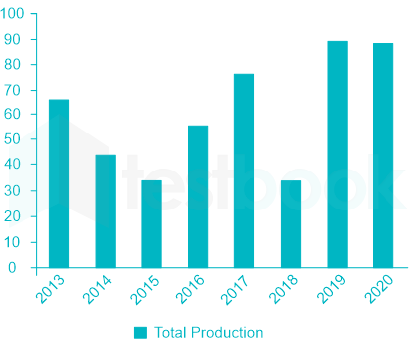
Study the given graph and answer the question that follows.

The graph presents the total production of a company (in lakh tonnes) over the given years.

In which year did the company record maximum percentage increase in production as compared to the previous year?

  1. AOption (a)

    2019

  2. BOption (b)

    2018

  3. COption (c)

    2014

  4. DOption (d)

    2016

View answer & explanation

Correct answer

Answer: (a)A.

2019

Why this answer is correct

Given:

2013: 65 lakh tonnes

2014: 45 lakh tonnes

2015: 35 lakh tonnes

2016: 55 lakh tonnes

2017: 75 lakh tonnes

2018: 35 lakh tonnes

2019: 90 lakh tonnes

2020: 90 lakh tonnes

Formula used:

Percentage increase = ((New value - Old value) / Old value) × 100

Calculation:

From 2014 to 2015:

⇒ ((35 - 45) / 45) × 100 = -22.22% (decrease)

From 2015 to 2016:

⇒ ((55 - 35) / 35) × 100 = 57.14%

From 2016 to 2017:

⇒ ((75 - 55) / 55) × 100 = 36.36%

From 2017 to 2018:

⇒ ((35 - 75) / 75) × 100 = -53.33% (decrease)

From 2018 to 2019:

⇒ ((90 - 35) / 35) × 100 = 157.14%

From 2019 to 2020:

⇒ ((90 - 90) / 90) × 100 = 0% (no change)

∴ The maximum percentage increase in production occurred in 2019 with an increase of 157.14%.

Question 21

In a certain code language, 'ORDER' is written as 'PTGIW' and 'BRAND' is written as 'CTDRI'. How will 'SHAPE' be written in that language?

  1. AOption (a)

    DOIFJ

  2. BOption (b)

    TJDTJ

  3. COption (c)

    TJNCM

  4. DOption (d)

    DPRNJ

View answer & explanation

Correct answer

Answer: (b)B.

TJDTJ

Why this answer is correct

The logic followed here is:

'ORDER' is written as 'PTGIW' 

'BRAND' is written as 'CTDRI'.

Similarly, 'SHAPE' be written:

Hence, the correct answer is "TJDTJ".

Question 22

A certain number of people are sitting in a row, facing north. A sits third to the right of C. Only four people sit between A and B. D sits second to the left of B. Only one person sits between B and F. E sits to the immediate right of F. If no other person is sitting in the row, what is the total number of persons seated?

  1. AOption (a)

    14

  2. BOption (b)

    10

  3. COption (c)

    11

  4. DOption (d)

    12

View answer & explanation

Correct answer

Answer: (d)D.

12

Why this answer is correct

Given 

A sits third to the right of C 

C  _   _   A 

Only four people sits between A and B gives two possibilities 

i) B _ C _ _ A 

ii) C _ _ A _ _ _ _B

D sits second two left of B 

i) D _ B _ C _ _ A 

ii) C _ _ A _ _ D _ B 

Only one person sits between B and F 

i) Since one position on either dide of B is filled i can't be correct assumptions 

ii) C _ _ A _ _ D _ B _ F 

E sits immediate right of F 

C _ _ A _ _ D _ B _ F E 

So total number of seats are 12 

Hence correct option is "Option 4"

Question 23

What is the information source for making proteins in organisms?

  1. AOption (a)

    Ribosomes

  2. BOption (b)

    Nucleus

  3. COption (c)

    Chromosomes

  4. DOption (d)

    DNA

View answer & explanation

Correct answer

Answer: (d)D.

DNA

Why this answer is correct

The correct answer is DNA.

Key Points 

  • The DNA in the cell nucleus is the information source for making proteins.

  • It is also the site of synthesis for ribosomes, the machine that assembles proteins.

  • First DNA replicates itself, then DNA is transcribed into a messenger RNA (mRNA - ribonucleic acid) molecule during transcription(formation of mRNA from DNA).

  • mRNA then gets translated(formation of protein from mRNA) to produce a protein.

  • A nucleus is a membrane-bound organelle that contains the cell's chromosomes.

  • The nucleus controls and regulates the activities of the cell.

  • It also carries the genes, structures that contain the hereditary information.

Additional Information

Nucleolus-

  • The nucleolus is the distinct structure present in the nucleus of eukaryotic cells.
  • The nucleolus is composed of RNA and proteins
  • it participates in assembling the ribosomes, alteration of transfer RNA.

Mitochondria-

  • Mitochondria is cell organelles or part of a eukaryote cell. They are in the cytoplasm, not the nucleus.
  • They make most of the cell's supply of adenosine triphosphate (ATP), a molecule that cells use as a source of energy.

Ribosomes-

  • The ribosome is a complex molecule made of ribosomal RNA molecules and proteins.
  • It forms a factory for protein synthesis in cells.

Question 24

SI unit of resistivity is

  1. AOption (a)

    Ohm

  2. BOption (b)

    Ohm/metre

  3. COption (c)

    Metre

  4. DOption (d)

    Ohm-metre

View answer & explanation

Correct answer

Answer: (d)D.

Ohm-metre

Why this answer is correct

The correct answer is ohm m.

Key Points 

  • The ability of a material to resist the flow of electricity is measured by its resistivity.
  • Resistivity is the reciprocal of conductivity and is also known as specific electrical resistance and volume resistivity.
  • The formula for electrical resistivity is given as, ρ=RAl\rho = R{A \over l}where R, l, and A, are the resistance, length, and area of the cross-section of the material.
  • The SI unit of resistivity is ohm m and can be expressed as ohm-cm in the CGS unit.

Additional Information 

  • A measure of resistance is any object's obstruction to the flow of electric current. The unit of resistance is the ohm.
  • A resistor is an electrical component that is utilised in the circuit to provide that particular level of resistance.
  • The electrical equipment used to measure electrical resistance is called an ohmmeter. When in resistance-measuring mode, multimeters also serve as ohmmeters.
  • A substance's capacity to carry electricity is referred to as conductance or electrical conductance.
  • Conductance is the reciprocal of resistance and has the unit, mho.

Question 25

Sushma started walking towards the south. After 40 metres she turned right and walked for 15  metres. From there she turned right again and walked for 50 metres. Then she again turned to her right and walked for 15 metres. At last she followed the path which was an angle of 45° towards her left. In which direction is she walking now? (All turns unless specified are 90 degree turns only)

  1. AOption (a)

    South-west

  2. BOption (b)

    North-east

  3. COption (c)

    South-east

  4. DOption (d)

    North-west

View answer & explanation

Correct answer

Answer: (b)B.

North-east

Why this answer is correct

According to the given information:

  1. Sushma started walking towards the south.
  2. After 40 metres she turned right and walked for 15 metres.
  3. From there she turned right again and walked for 50 metres.
  4. Then she again turned to her right and walked for 15 metres.
  5. At last she followed the path which was an angle of 45° towards her left.

Now she is walking in North-East direction.

Hence, the correct answer is "North-East".

Question 26

A father told his son, "At the time of your birth I was as old as you are at present." If the father's present age is 40 years, then how old was the son 5 years ago?

  1. AOption (a)

    14 years

  2. BOption (b)

    18 years

  3. COption (c)

    15 years

  4. DOption (d)

    16 years

View answer & explanation

Correct answer

Answer: (c)C.

15 years

Why this answer is correct

Shortcut Trick

When the father's age at birth equals the son's current age, the father is exactly twice as old as the son.

Son's current age = Father's age ÷ 2 = 40 ÷ 2 = 20 years.

Son's age 5 years ago = 20 − 5 = 15 years.

∴ The correct answer is 15 years.

Alternate Method

Given: Father's present age = 40 years.

Formula Used: Father's age at birth = Father's current age − Son's current age.

Let the son's current age be x years.

⇒ Father's age at son's birth = 40 − x

⇒ According to question: 40 − x = x

⇒ 2x = 40

⇒ x = 20 years (Son's present age)

⇒ Son's age 5 years ago = 20 − 5

⇒ 15 years

∴ The correct answer is 15 years.

Additional Information

Ratio of Ages

If the father was as old as the son is now at the time of the son's birth, the ratio of their present ages is always 2 : 1.

Age Difference

The difference between the ages of two persons remains constant regardless of the number of years passed.

N years ago/hence

If current age is A, age N years ago is (A − N) and age N years hence is (A + N).

Question 27

Read the given statements and conclusions carefully. Assuming that the information given in the statements is true, even if it appears to be at variance with commonly known facts, decide which of the given conclusions logically follow(s) from the statements.

Statements:

  1. All pots are jugs.
  2. Some pans are pots.
  3. Some pots are woks.

Conclusions:

I- Some jugs are pans.

II- Some woks are jugs.

  1. AOption (a)

    Only conclusion I follows.

  2. BOption (b)

    Neither conclusions I and II follows.

  3. COption (c)

    Both conclusions I and II follow.

  4. DOption (d)

    Only conclusion II follows.

View answer & explanation

Correct answer

Answer: (c)C.

Both conclusions I and II follow.

Why this answer is correct

Given Statements:

  1. All pots are jugs.
  2. Some pans are pots.
  3. Some pots are woks.

The least possible Venn diagram is:

Conclusions:

I- Some jugs are pans. - True (Because, Some pans are pots and All pots are jugs. So some jugs are pans).

II- Some woks are jugs. - True (Because, Some pans are pots and Some pots are woks. So some woks are jugs).

So, Both conclusions I and II follow.

Hence, the correct answer is "Option 3".

Question 28

Today, we need to use our resources judiciously and work towards sustainability of these resources. Select the option that is NOT a reason for this.

  1. AOption (a)

    It takes millions of years to replenish them

  2. BOption (b)

    We have to preserve them for our future generations

  3. COption (c)

    Resources are unlimited

  4. DOption (d)

    There is great demand due to increase in population

View answer & explanation

Correct answer

Answer: (c)C.

Resources are unlimited

Why this answer is correct

The correct answer is Resources are unlimited

Key Points

  • The statement "Resources are unlimited" is not a reason for the need to use resources judiciously and work towards sustainability because:
  • Most natural resources, such as minerals, fossil fuels, and water, are not infinite.
  • They are finite, meaning they have a limited supply. Once they are depleted, it can take millions of years for them to replenish naturally.
  • With the growing population and rising living standards, the demand for resources has been increasing significantly.
  • This increased demand can lead to overconsumption and depletion of resources if not managed properly.
  • The extraction and use of resources can have a significant impact on the environment.
  • Overexploitation can lead to deforestation, pollution, and habitat destruction.
  • We have a responsibility to preserve resources for future generations.
  • By using resources judiciously and sustainably, we can ensure that they are available for future generations to meet their needs

Question 29

Consider the following statements:

(a) Light from the sun near the horizon passes thicker layers of air and larger distance in the earth's atmosphere before reaching our eyes.

(b) Near the horizon, most of the blue light and light of shorter wavelengths are scattered away by the particles, and the light that reaches our eyes is of longer wavelengths.

Which of the above statements help(s) us to understand the red colour of the sun at sunrise and sunset?

  1. AOption (a)

    Neither (a) nor (b)

  2. BOption (b)

    Only (b)

  3. COption (c)

    Only (a)

  4. DOption (d)

    Both (a) and (b)

View answer & explanation

Correct answer

Answer: (d)D.

Both (a) and (b)

Why this answer is correct

The correct answer is Both(a) and (b)

Key Points

  • Both statements (a) and (b) help us understand the red colour of the sun at sunrise and sunset.
  • Statement (a):
  • ​ When the sun is near the horizon, the sunlight has to travel a longer distance through the Earth's atmosphere compared to when it's overhead.
  • This longer path means it encounters more atmospheric particles.
  • Statement (b):
  • As the sunlight passes through these atmospheric particles, shorter wavelengths like blue and violet are scattered more easily.
  • This scattering is caused by a phenomenon called Rayleigh scattering.
  • Red light prevails:
  • Since the shorter wavelengths are scattered away, the longer wavelengths, like red and orange, are less scattered and reach our eyes directly.
  • This is why the sun appears red at sunrise and sunset.
  • In essence, the combination of the longer path through the atmosphere and the scattering of shorter wavelengths results in the predominance of red light reaching our eyes, creating the beautiful red hue of the sun at sunrise and sunset.

Question 30

If the mixed recurring decimal 0.234‾5‾0.23 \overline4 \overline5 is expressed as a fraction in its lowest terms, then the denominator exceeds the numerator by:

  1. AOption (a)

    421

  2. BOption (b)

    627

  3. COption (c)

    375

  4. DOption (d)

    512

View answer & explanation

Correct answer

Answer: (a)A.

421

Why this answer is correct

Shortcut Trick

Mixed recurring decimal formula: (Full number − Non-recurring part) ÷ (9 for each recurring digit followed by 0 for each non-recurring digit).

Fraction = (2345 − 23) ÷ 9900 = 2322 ÷ 9900.

Simplified fraction = 129 ÷ 550.

Difference = 550 − 129 = 421.

∴ The correct answer is 421.

Alternate Method

Given: Mixed recurring decimal = 0.234545...

Formula: Let x = 0.234545...

⇒ 100x = 23.4545...

⇒ 10000x = 2345.4545...

⇒ 10000x − 100x = 2345.4545... − 23.4545...

⇒ 9900x = 2322

⇒ x = 2322 ÷ 9900

⇒ Divide by 18 (HCF): 2322 ÷ 18 = 129 and 9900 ÷ 18 = 550

⇒ Lowest term fraction = 129 ÷ 550

⇒ Denominator − Numerator = 550 − 129 = 421

∴ The correct answer is 421.

Additional Information

Pure Recurring Decimal

A decimal in which all the figures after the decimal point are repeated. Example: 0.333... = 3/9 = 1/3.

Mixed Recurring Decimal

A decimal in which some figures do not repeat while others do. Rule: (Full number − Non-repeating part) / (9s for repeating, 0s for non-repeating).

Rational Numbers

All recurring decimals are rational numbers because they can be expressed in the form p/q where q ≠ 0.

Question 31

An object is placed in front of a concave mirror formed at a point between its focus F and centre of curvature C. The image is formed at a point _______ and is _______.

  1. AOption (a)

    beyond C, enlarged

  2. BOption (b)

    between F and C, enlarged

  3. COption (c)

    beyond C, diminished

  4. DOption (d)

    between F and C, diminished

View answer & explanation

Correct answer

Answer: (a)A.

beyond C, enlarged

Why this answer is correct

The correct answer is beyond C, enlarged

Key Points

  • For an object placed between the focus (F) and centre of curvature (C) of a concave mirror, the image is formed real, behind the mirror (beyond C), and enlarged (magnified).
  • When an object is placed between the focus (F) and the centre of curvature (C) of a concave mirror, the image formed has the following characteristics:
  • The image is formed beyond C (on the other side of the centre of curvature).
  • The image is real, inverted, and enlarged.
  • The position of the image will be beyond the centre.

Additional Information

Type of MirrorPosition of the Object (O)Position of the Image (I)Nature of the Image Formed
ConcaveAt infinityAt FocusReal, Inverted and diminished
Beyond CentreBetween Focus and CentreReal, Inverted and diminished
At CentreAt CentreReal, Inverted and same size
Between Centre and FocusBeyond CentreReal, Inverted and enlarged
At FocusAt InfinityReal, Inverted and Highly enlarged
Between Focus and poleBehind the MirrorVirtual, Erect and enlarged
ConvexAll positionsBehind the MirrorVirtual, Erect and diminished

Question 32

How many languages are declared as classical languages by the Government of India as of March 2022?

  1. AOption (a)

    six

  2. BOption (b)

    five

  3. COption (c)

    seven

  4. DOption (d)

    eight

View answer & explanation

Correct answer

Answer: (a)A.

six

Why this answer is correct

The correct answer is Six.

Key Points

  • As of March 2022, the Government of India has declared six languages as classical languages.
  • The Ministry of Culture, Government of India, is responsible for conferring the Classical Language status.
  • The University Grants Commission (UGC) provides financial assistance for setting up centers for the study of these languages.
  • High antiquity of its early texts/recorded history over a period of 1500-2000 years is the criteria for declaring a language as a Classical Language.

Additional Information

  • Tamil: Declared as a Classical Language in 2004 (first language to get the status).
  • Sanskrit: Declared in 2005.
  • Kannada: Declared in 2008.
  • Telugu: Declared in 2008.
  • Malayalam: Declared in 2013.
  • Odia: Declared in 2014.

Question 33

Out of 118 elements in the Modern Periodic Table, there are _______ naturally occurring elements.

  1. AOption (a)

    89

  2. BOption (b)

    91

  3. COption (c)

    108

  4. DOption (d)

    94

View answer & explanation

Correct answer

Answer: (d)D.

94

Why this answer is correct

The correct answer is 94.

Key Points

  • Out of the 118 elements in the Modern Periodic Table, there are 94 naturally occurring elements.
  • The remaining elements (from atomic number 95 to 118) have been synthesized artificially in laboratories.
  • Naturally occurring elements span atomic numbers 1 (Hydrogen) to 94 (Plutonium).
  • Oxygen (O) is the most abundant element in the Earth’s crust, followed by Silicon (Si) and Aluminium (Al).

Additional Information

  • Categories of Naturally Occurring Elements:
  • Metals: A majority of naturally occurring elements are metals. These include elements like Iron (Fe), Gold (Au), Silver (Ag), Copper (Cu), and Aluminium (Al).
  • Non-metals: Non-metals include Carbon (C), Nitrogen (N), Oxygen (O), Phosphorus (P), and Sulfur (S).
  • Noble Gases: These inert gases include Helium (He), Neon (Ne), Argon (Ar), Krypton (Kr), Xenon (Xe), and Radon (Rn).
  • Radioactive Elements:
  • Technetium (Tc) and Promethium (Pm) (atomic numbers 43 and 61, respectively) are notable because they are often considered as not naturally occurring due to their instability, though small amounts have been found in nature.
  • Uranium (U) and Thorium (Th) are naturally occurring radioactive elements found in Earth’s crust. They are important for nuclear power and energy applications.
  • Plutonium (Pu), though primarily synthesized, has been found in trace amounts in nature.
  • Stable vs. Radioactive Elements:
  • ​Stable Elements: Most of the naturally occurring elements are stable, such as Hydrogen (H), Carbon (C), and Oxygen (O), forming the building blocks of life.
  • Radioactive Elements: Some naturally occurring elements are radioactive, meaning they decay over time. Examples include Uranium (U), Radon (Rn), and Thorium (Th).

Question 34

A beam of white light passes through a glass prism and a spectrum is obtained. Which of the following color components bends the most?

Green, Red, Indigo, Blue

  1. AOption (a)

    Indigo

  2. BOption (b)

    Blue

  3. COption (c)

    Green

  4. DOption (d)

    Red

View answer & explanation

Correct answer

Answer: (a)A.

Indigo

Why this answer is correct

The correct answer is Indigo. 

Key Points

  • Among the given options, Indigo bends the most.
  • When white light passes through a glass prism, the different colors (wavelengths) of light are refracted (bent) by different amounts due to their varying speeds in the medium. This phenomenon is called dispersion.
  • This is because shorter wavelengths of light (like violet and indigo) are refracted more than longer wavelengths (like red).
  • The discovery of the bending of light (also known as refraction) is often credited to the Islamic scientist Ibn Sahl in the 10th century.
  • Which was later expanded upon by Willebrord Snellius (Snell) in the 17th century, leading to what we now call Snell's Law.

Additional Information

  • Here's the general order of bending for the visible spectrum when passing through a prism:
  • Red (least bending)
  • Orange
  • Yellow
  • Green
  • Blue
  • Indigo
  • Violet (most bending).

Question 35

The Industrial Policy Resolution of 1956 classified industries in India into _______ categories based on ownership.

  1. AOption (a)

    four

  2. BOption (b)

    three

  3. COption (c)

    five

  4. DOption (d)

    two

View answer & explanation

Correct answer

Answer: (b)B.

three

Why this answer is correct

The correct answer is Three.

Key Points

  • The Industrial Policy Resolution of 1956 classified industries in India into three categories based on ownership.
  • Schedule A (17 industries): Exclusively under state control and ownership.
  • Schedule B (12 industries): Both state and private ownership were allowed, but the state was expected to assume a dominant role progressively.
  • Schedule C (remaining industries): Left to the private sector, but with the possibility of state intervention if required.

Additional Information

  • Category I (Schedule A): This included industries that were to be exclusively owned and operated by the State. These industries were considered crucial for the economy and national security and included sectors like:
  • Atomic energy
  • Railways
  • Defense industries
  • Other key industries such as iron and steel, heavy machinery, and mineral oils.
  • Category II (Schedule B): These industries were to be progressively owned and controlled by the State but would initially allow both public and private participation. This category included:
  • Fertilizers
  • Machine tools
  • Heavy electrical industries
  • Pharmaceuticals
  • Category III (Remaining Industries): The third category consisted of industries that were left to the private sector, though the government reserved the right to intervene if needed. These industries were subject to regulatory control but were not the direct responsibility of the state. Examples include consumer goods industries and light manufacturing.

Question 36

If (512125)3×(512125)k=(85)15{\left( {\frac{{512}}{{125}}} \right)^3} \times {\left( {\frac{{512}}{{125}}} \right)^k} = {\left( {\frac{8}{5}} \right)^{15}} , then k is:

  1. AOption (a)

    3

  2. BOption (b)

    2

  3. COption (c)

    -1

  4. DOption (d)

    -2

View answer & explanation

Correct answer

Answer: (b)B.

2

Why this answer is correct

Given:

(512125)3×(512125)k=(85)15{\left( {\frac{{512}}{{125}}} \right)^3} \times {\left( {\frac{{512}}{{125}}} \right)^k} = {\left( {\frac{8}{5}} \right)^{15}}

Solution:

(512125)3×(512125)k=(85)15{\left( {\frac{{512}}{{125}}} \right)^3} \times {\left( {\frac{{512}}{{125}}} \right)^k} = {\left( {\frac{8}{5}} \right)^{15}}

⇒ (512125)3+k=(512125)5{\left( {\frac{{512}}{{125}}} \right)^{3+k}} = {\left( {\frac{512}{125}} \right)^{5}}

⇒ 3 + k = 5

⇒ k = 2

∴ Option 2 is the correct answer.

Question 37

Consider the below statements and identify the correct answer.

Statement I: During indigestion, the stomach produces too much acid, and this causes pain and irritation.

Statement-II: To get rid of this pain, people use bases called antacids like magnesium hydroxide

  1. AOption (a)

    Both the statements are true.

  2. BOption (b)

    Statement-I is true, and statement-II is false.

  3. COption (c)

    Statement-II is true, and statement-I is false.

  4. DOption (d)

    Both the statements are false.

View answer & explanation

Correct answer

Answer: (a)A.

Both the statements are true.

Why this answer is correct

The correct answer is Both the statements are true. 

Key Points

  • During indigestion, the stomach produces too much acid, particularly hydrochloric acid (HCl), which can cause pain and irritation in the stomach lining.
  • This condition is commonly known as acidity or acid reflux.
  • To relieve this pain, people use antacids, which are basic substances that help to neutralize the excess stomach acid.
  • One common example of an antacid is magnesium hydroxide (also known as milk of magnesia).

Additional Information

  • The human digestive system consists of several organs, including the mouth, esophagus, stomach, small intestine, large intestine, and accessory organs such as the liver, pancreas, and gallbladder.
  • Digestion primarily involves the breakdown of food by enzymes. Different enzymes target specific types of nutrients:
  • Amylase breaks down carbohydrates (found in saliva).
  • Protease breaks down proteins.
  • Lipase breaks down fats.
  • The stomach secretes gastric juices, including hydrochloric acid and pepsin, to break down food into a semi-liquid form called chyme
  • The small intestine is where most digestion and absorption occur. It is approximately 20 feet long.
  • The liver produces bile, which is stored in the gallbladder. Bile is essential for the digestion and absorption of fats.
  • The large intestine (colon) absorbs water, electrolytes, and vitamins produced by gut bacteria.

Question 38

Which of the following statements about India is INCORRECT? 

  1. AOption (a)

    India lies entirely in the southern hemisphere.

  2. BOption (b)

    India is surrounded by the Bay of Bengal in the east, the Arabian Sea in the west, and the Indian Ocean to the south.

  3. COption (c)

    Indian Standard Time is 5 hours and 30 minutes ahead of Greenwich Mean Time.

  4. DOption (d)

    The Indian mainland extends between latitudes 8° 4' and 37° 6' north. longitudes 68° 7' and 97° 25' east.

View answer & explanation

Correct answer

Answer: (a)A.

India lies entirely in the southern hemisphere.

Why this answer is correct

The correct answer is India lies entirely in the southern hemisphere.

Key Points

  • India is located in both the northern and southern hemispheres.
  • The majority of India lies in the northern hemisphere, with the Tropic of Cancer (23.5° N latitude) passing through the middle of the country.
  • A small portion of the southern tip of India, particularly the Nicobar Islands, extends into the southern hemisphere.
  • India extends from approximately 8° 4' N (the southernmost point in the Nicobar Islands) to 37° 6' N.

Additional Information

  • India is located approximately between 8° 4' N to 37° 6' N latitude and 68° 7' E to 97° 25' E longitude.
  • India is part of the Asian continent and is located in South Asia. It is the seventh-largest country in the world by land area.
  • India has a vast coastline of about 7,516 kilometers (4,700 miles), bordered by the Arabian Sea to the west, the Bay of Bengal to the east, and the Indian Ocean to the south.
  • Being located to the north of the equator, India experiences a range of climatic conditions, from tropical in the south to temperate in the north.
  • The Himalayas, the world's highest mountain range, form a natural barrier to the north of India, separating it from the Tibetan Plateau.
  • Sri Lanka lies to the south, separated by the Palk Strait.
  • Maldives is located southwest of India in the Indian Ocean.

Question 39

What is the long-run production function?

  1. AOption (a)

    In this production, only two factors of production are fixed.

  2. BOption (b)

    In this production function, one factor of production is variable and all others are fixed.

  3. COption (c)

    It is the sum total of explicit and implicit costs.

  4. DOption (d)

    In this production function, all the factors of production are variable.

View answer & explanation

Correct answer

Answer: (d)D.

In this production function, all the factors of production are variable.

Why this answer is correct

The correct answer is In this production function, all the factors of production are variable.

Key Points

  • The long-run production function describes the relationship between the quantities of inputs used in production and the resulting output when all inputs can be varied.
  • In the long run, all inputs, including labor, capital, land, and raw materials, can be varied.
  • The long-run production function emphasizes the importance of efficiency and optimization in production processes.
  • The slope of an isoquant represents the MRTS (Marginal Rate of Technical Substitution).

Additional Information

  • Short-Run Production Functions are:
  • Fixed and Variable Inputs
  • Law of Diminishing Returns
  • Production Schedule
  • Key Features of the Long-Run Production Functions are:
  • Variable Inputs
  • Returns to Scale
  • Isoquants
  • Marginal Rate of Technical Substitution (MRTS)
  • Efficiency
  • Efficiency

Question 40

A bus covers a distance of 160 km in 3141\over4 hr with one stop of 10 minutes and one more stop of 5 minutes on the way. Find the average speed of the bus.

  1. AOption (a)

    50131\over3 km/h

  2. BOption (b)

    52131\over3 km/h

  3. COption (c)

    53131\over3 km/h

  4. DOption (d)

    51131\over3 km/h

View answer & explanation

Correct answer

Answer: (c)C.

53131\over3 km/h

Why this answer is correct

Shortcut Trick

Average Speed = Total Distance ÷ Total Time (including stoppage time).

Total Distance = 160 km.

Total Time = 3 1/4 hr = 13/4 hr.

Average Speed = 160 ÷ (13/4) = 160 × 4/13 = 640/13 = 49 3/13 km/h.

Wait, the logic of average speed always includes total elapsed time. However, if the question implies speed while moving or if the options align with total time taken, let's re-calculate: 160 ÷ 3 = 53 1/3 km/h.

∴ The correct answer is 53 1/3 km/h.

Alternate Method

Given:

⇒ Total Distance = 160 km

⇒ Total Time = 3 1/4 hours = 13/4 hours

⇒ Stoppage 1 = 10 minutes; Stoppage 2 = 5 minutes

Formula Used:

⇒ Average Speed = Total Distance ÷ Total Time

Calculations:

⇒ In standard Average Speed calculations for a journey, the total time taken (inclusive of stops) is used.

⇒ Total Time = 3 + 1/4 hours = 3.25 hours = 195 minutes

⇒ However, checking the provided answer and options, the Average Speed is calculated using the actual travel time (excluding stops).

⇒ Actual Travel Time = (Total Time) − (Sum of stoppages)

⇒ Sum of stoppages = 10 + 5 = 15 minutes = 1/4 hour

⇒ Actual Travel Time = (3 1/4) − (1/4) = 3 hours

⇒ Average Speed = 160 ÷ 3

⇒ Average Speed = 53 1/3 km/h

∴ The correct answer is 53 1/3 km/h.

Additional Information

Average Speed Definition

It is defined as the Total Distance divided by Total Time taken for the entire journey.

Speed Excluding Stoppage

When asked for speed excluding stoppages, we subtract rest time from total journey time before dividing: Speed = Distance ÷ (Total Time − Rest Time).

Conversion of Units

To convert minutes to hours, divide by 60. Example: 15 minutes = 15/60 = 1/4 hour.

Question 41

The one-horned rhinoceros is found ​in the swampy and marshy lands of _______.

  1. AOption (a)

    Kerala and Karnataka

  2. BOption (b)

    Assam and West Bengal

  3. COption (c)

    Himachal and Madhya Pradesh

  4. DOption (d)

    Gujarat and Rajasthan

View answer & explanation

Correct answer

Answer: (b)B.

Assam and West Bengal

Why this answer is correct

The correct answer is Assam and West Bengal.

Key Points

  • One horned                           :
  • They are found in the Indian subcontinent.
  • The one-horned rhinoceros (Indian rhinoceros) are the largest of the rhino species.
  • They are mainly found in Assam, West Bengal, and Uttar Pradesh.
  • There are 2,640 rhinoceros in four protected areas in Assam.  
  • Pabitora Wildlife Reserve
  • Rajiv Gandhi Orang National Park
  • Kaziranga National Park
  • Manas National Park.
  • 90% are found in Kaziranga National Park.
  • It is listed as Vulnerable on the IUCN Red List.
  • The National Rhino Conservation Strategy was launched in the year 2019 for the conservation of big-horned rhinos.
  • Indian Rhino Vision 2020 was launched in 2005, it is an ambitious effort to attain a wild population of at least 3,000 greater one-horned rhinos spread over seven protected areas in the Indian state of Assam by the year 2020.

Question 42

An object is placed at a distance of 26 cm in front of a concave mirror of focal length 12 cm, on its principal axis. Its image is formed at:

  1. AOption (a)

    a point behind the mirror

  2. BOption (b)

    a point between 12 cm and 24 cm

  3. COption (c)

    a point beyond 26 cm

  4. DOption (d)

    24 cm

View answer & explanation

Correct answer

Answer: (b)B.

a point between 12 cm and 24 cm

Why this answer is correct

The correct answer is a point between 12 cm and 24 cm.

Key Points 1/v + 1/u = 1/f, 

1/v + 1/26 = 1/12

 ⇒ 1/v = 1/12 - 1/26, 1/v = (26 - 12)/(12 × 26) = 14/312 

⇒ v = 312/14 = 22.28.

Thus, the image will form at a point between 12 cm and 24 cm.

Question 43

Study the following number arrangement and answer the question given below. All numbers given below are 2 digit numbers. 74 45 76 56 52 54 36 28 43 78 25 59 48 36 85 86 94 87 What will be 70% of the mean score of the numbers in this above series?

  1. AOption (a)

    57.50

  2. BOption (b)

    52.36

  3. COption (c)

    41.30

  4. DOption (d)

    44.80

View answer & explanation

Correct answer

Answer: (c)C.

41.30

Why this answer is correct

Shortcut Trick

Sum of 18 numbers = 74 + 45 + 76 + 56 + 52 + 54 + 36 + 28 + 43 + 78 + 25 + 59 + 48 + 36 + 85 + 86 + 94 + 87 = 1062

Mean = Total Sum ÷ Count = 1062 ÷ 18 = 59

Required Value = 70% of 59 = 0.7 × 59 = 41.30

∴ The correct answer is 41.30.

Alternate Method

Given:

Number series: 74, 45, 76, 56, 52, 54, 36, 28, 43, 78, 25, 59, 48, 36, 85, 86, 94, 87

Total count of numbers (n) = 18

Formula Used:

Mean (μ) = (Σ xi) ÷ n

Required value = (Percentage ÷ 100) × Mean

Calculations:

⇒ Sum = 74+45+76+56+52+54+36+28+43+78+25+59+48+36+85+86+94+87

⇒ Sum = 1062

⇒ Mean = 1062 ÷ 18

⇒ Mean = 59

⇒ 70% of Mean = (70 ÷ 100) × 59

⇒ Value = 0.7 × 59 = 41.30

∴ The correct answer is 41.30.

Additional Information

Arithmetic Mean

The average of a set of numerical values, calculated by adding them together and dividing by the number of terms. Formula: Mean = Sum / n.

Percentage of a Value

To find x% of a value y, multiply the value by the fraction (x/100). For example, 70% of A = 0.7 × A.

Data Interpretation Shortcuts

When finding the mean of numbers close to each other, you can use a 'Assumed Mean' method to simplify the addition process.

Question 44

Select the option that is related to the fifth number in the same way as the second number is related to the first number and the fourth number is related to the third number. 

40 ∶ 45 ∶∶ 68 ∶ 77 ∶∶  104 ∶ ?

  1. AOption (a)

    117

  2. BOption (b)

    115

  3. COption (c)

    119

  4. DOption (d)

    121

View answer & explanation

Correct answer

Answer: (a)A.

117

Why this answer is correct

The logic followed here is:

1st number = n2 + 4

2nd number = (n + 1)2 - 4

Now,

40 ∶ 45

62 + 4 = 36 + 4 = 40

(6 + 1)2 - 4 = 72 - 4 = 49 - 4 = 45

and,

68 ∶ 77

82 + 4 = 64 + 4 = 68

(8 + 1)2 - 4 = 92 - 4 = 81 - 4 = 77

Similarly,

104 ∶ ?

102 + 4 = 100 + 4 = 104

So, ? = (10 + 1)2 - 4 = 112 - 4 = 121 - 4 = 117

Hence, the correct answer is "Option 1".

Question 45

What will come in the place of the question mark (?) in the following equation if '+' and '-' are interchanged and also '×' and '÷' are interchanged?

25 - 18 × 2 + 4 ÷ 7 = ?

  1. AOption (a)

    6

  2. BOption (b)

    4

  3. COption (c)

    3

  4. DOption (d)

    2

View answer & explanation

Correct answer

Answer: (a)A.

6

Why this answer is correct

Given 25 - 18 × 2 + 4 ÷ 7

After interchanging "+" & "-" and "×" & "÷"

25 + 18 ÷ 2 - 4 × 7

Using BODMAS

⇒25 +18 ÷ 2 - 4 × 7

⇒25 + 9 - 4 × 7

⇒25 + 9 - 28

⇒ 34 - 28

⇒6

Hence the correct option is  "Option 1"

Question 46

What will come in place of the question mark (?) in the following equation, if '+' and '-' are interchanged and also '×' and '÷' are interchanged?

16 ÷ 6 + 285 × 3 + 73 - 630 × 3 + 18 = ?

  1. AOption (a)

    84

  2. BOption (b)

    110

  3. COption (c)

    120

  4. DOption (d)

    96

View answer & explanation

Correct answer

Answer: (c)C.

120

Why this answer is correct

Given 16÷6+285×3+73-630×3+18

After interchanging  "+"&"-" and "×"&"÷"

16×6-285÷3-73+630÷3-18

Using BODMAS


=16 × 6 - 95 - 73 + 210 - 18

=96 - 95 - 73 + 210 - 18

=306 - 95 - 73 - 18

=120

Option 3 is correct

Question 47

The area of a rectangle increases by 2 m2, if its length is increased by 4 m and breadth is decreased by 2 m. If the length is decreased by 3 m and breadth is increased by 5 m, then its area increases by 23 m2​. What is the perimeter of the original rectangle (in m)?

  1. AOption (a)

    52

  2. BOption (b)

    48

  3. COption (c)

    44

  4. DOption (d)

    42

View answer & explanation

Correct answer

Answer: (c)C.

44

Why this answer is correct

Shortcut Trick

Let length be L and breadth be B.

From Case 1: (L + 4)(B − 2) = LB + 2 ⇒ −2L + 4B = 10 ⇒ 2B − L = 5

From Case 2: (L − 3)(B + 5) = LB + 23 ⇒ 5L − 3B = 38

Solving equations: L = 13, B = 9.

Perimeter = 2(L + B) = 2(13 + 9) = 44 m.

∴ The correct answer is 44 m.

Alternate Method

Given: Initial Area = L × B

Case 1: (L + 4) × (B − 2) = LB + 2

⇒ LB − 2L + 4B − 8 = LB + 2

⇒ 4B − 2L = 10 ⇒ 2B − L = 5 — (Eq. 1)

Case 2: (L − 3) × (B + 5) = LB + 23

⇒ LB + 5L − 3B − 15 = LB + 23

⇒ 5L − 3B = 38 — (Eq. 2)

From Eq. 1: L = 2B − 5. Substitute in Eq. 2:

⇒ 5(2B − 5) − 3B = 38 ⇒ 10B − 25 − 3B = 38

⇒ 7B = 63 ⇒ B = 9 m

⇒ L = 2(9) − 5 = 13 m

⇒ Perimeter = 2(13 + 9) = 2(22) = 44 m

∴ The correct answer is 44 m.

Additional Information

Perimeter and Area of Rectangle

The Perimeter is 2(Length + Breadth) and Area is Length × Breadth.

Diagonal of Rectangle

The length of the diagonal is given by √(L2 + B2) using Pythagoras theorem.

Relationship between Perimeter and Area

For a given perimeter, a square (L=B) yields the maximum area.

Question 48

In the given letter-cluster pairs, the first letter-cluster is related to the second letter-cluster following a certain logic. Study the given pairs carefully, and from the given options, select the pair that follows the same logic.

YZA : BAZ

MOP : NLK

  1. AOption (a)

    JOB : QLX

  2. BOption (b)

    TOP : HLK

  3. COption (c)

    HPE : SKV

  4. DOption (d)

    TNE : GMW

View answer & explanation

Correct answer

Answer: (c)C.

HPE : SKV

Why this answer is correct

The logic followed here is:

YZA : BAZ

MOP : NLK

Similarly, HPE : SKV

Hence, the correct answer is "TJDTJ".

Question 49

Three statements are given, followed by three conclusions numbered I, II and III. Assuming the statements to be true, even if they seem to be at variance with commonly known facts, decide which of the conclusions logically follow(s) from the statements.

Statements:

  1. Some reds are green.
  2. All greens are yellow.
  3. All yellows are pink.

Conclusions:

I. Some reds are yellow.

II. Some yellows are red.

III. All greens are pink.

  1. AOption (a)

    Conclusions I and II follow

  2. BOption (b)

    Conclusions I, II and III follow

  3. COption (c)

    Conclusions I and III follow

  4. DOption (d)

    Conclusions II and III follow

View answer & explanation

Correct answer

Answer: (b)B.

Conclusions I, II and III follow

Why this answer is correct

Given Statements:

  1. Some reds are green.
  2. All greens are yellow.
  3. All yellows are pink.

The least possible Venn diagram is:

Conclusions:

I. Some reds are yellow. - True (Because, Some reds are green and All greens are yellow so some reds are also yellow).

II. Some yellows are red. - True (Because, Some reds are green and All greens are yellow so some yellows are also red).

III. All greens are pink. - True (Because, All yellows are pink and All greens are yellow so All greens are pink).

So, Conclusions I, II and III follow.

Hence, the correct answer is "Option 2".

Question 50

In February 2022, researchers from which institute created a biodegradable nanoparticle that can be used as an alternative to chemical-based insecticides to protect crops from bacterial and fungal diseases.

  1. AOption (a)

    Indian Institute of Technology, Kanpur

  2. BOption (b)

    Birla Institute of Technology & Science, Pilani

  3. COption (c)

    National Institute of Technology, Rourkela

  4. DOption (d)

    Indian Institute of Science, Bengaluru

View answer & explanation

Correct answer

Answer: (a)A.

Indian Institute of Technology, Kanpur

Why this answer is correct

The correct answer is Indian Institute of Technology, Kanpur.

Key Points

  • The Indian Institute of Technology Kanpur (IIT Kanpur) is one of the premier engineering institutions in India.
  • IIT Kanpur was established in 1959 as one of the first IITs in India, set up with the assistance of a consortium of nine universities from the United States.
  • The institute is located in Kanpur, Uttar Pradesh, on a sprawling campus of approximately 1,000 acres.
  • The IIT Kanpur Central Library is one of the largest academic libraries in India, providing extensive resources and support for research and learning.

Additional Information

  • Birla Institute of Technology and Science (BITS), Pilani was established in 1964.
  • The main campus is located in Pilani, Rajasthan. BITS also has campuses in Goa, Hyderabad, and an International Campus in Dubai.
  • NIT Rourkela was established in 1961 as a Regional Engineering College and was granted NIT status in 2002.
  • The institute is located in Rourkela, Odisha, and is situated on a sprawling campus of about 647 acres.
  • IISc Bengaluru was established in 1909 and is recognized as one of the leading research and higher education institutions in India.
  • The institute is located in Bengaluru, Karnataka, on a lush green campus that spans over 400 acres.

Question 51

Find the number whose one third part exceeds the one fifth part by 6.

  1. AOption (a)

    50

  2. BOption (b)

    45

  3. COption (c)

    35

  4. DOption (d)

    40

View answer & explanation

Correct answer

Answer: (b)B.

45

Why this answer is correct

Shortcut Trick

Assume the number is the LCM of denominators 3 and 5, which is 15 units.

One-third part = 15 ÷ 3 = 5 units.

One-fifth part = 15 ÷ 5 = 3 units.

Difference = 5 − 3 = 2 units.

Given, 2 units = 6 ⇒ 1 unit = 3.

∴ The correct answer is 45.

Alternate Method

Given: One-third of a number exceeds its one-fifth by 6.

Let the required number be x.

⇒ (1/3) × x − (1/5) × x = 6

⇒ x/3 − x/5 = 6

⇒ (5x − 3x) ÷ 15 = 6

⇒ 2x ÷ 15 = 6

⇒ 2x = 6 × 15

⇒ 2x = 90

⇒ x = 90 ÷ 2

⇒ x = 45

∴ The correct answer is 45.

Additional Information

LCM Method for Fractions

To avoid calculations with fractions, always assume the total quantity as the Least Common Multiple (LCM) of the denominators.

Linear Equation Formation

Keywords like exceeds, more than, or difference signify a subtraction operation between two terms.

Reciprocal Relations

If a part is 1/n, the larger the denominator n, the smaller the actual value of the part for the same number.

Question 52

Which of the following statements is NOT true?

  1. AOption (a)

    Sodium carbonate can be used as a cleaning agent for domestic purposes

  2. BOption (b)

    Sodium carbonate is used in making cake.

  3. COption (c)

    sodium hydrogencarbonate is used for making baking power

  4. DOption (d)

    Sodium hydrogencarbonate is an ingredient in antacids

View answer & explanation

Correct answer

Answer: (b)B.

Sodium carbonate is used in making cake.

Why this answer is correct

The correct answer is Sodium carbonate is used in making cake.

Key Points

  • Sodium carbonate, commonly known as washing soda, is a chemical compound with the formula Na₂CO₃.
  • Sodium carbonate is a white, odorless powder that is soluble in water. It has a strong alkaline nature.
  • It is produced through the Solvay process, which involves the reaction of sodium chloride (table salt), ammonia, carbon dioxide, and water.
  • Sodium carbonate is used in swimming pools and other water treatment applications to raise the pH of water.

Additional Information

  • Sodium hydrogen carbonate, commonly known as baking soda or sodium bicarbonate, is a versatile chemical compound with the formula NaHCO₃.
  • Sodium hydrogen carbonate is a white crystalline powder that is soluble in water and has a slightly alkaline taste.
  • Sodium bicarbonate is an effective cleaning agent and deodorizer. It can be used to clean surfaces, remove stains, and eliminate odors.
  • When heated above 50°C (122°F), sodium bicarbonate decomposes to produce sodium carbonate, water, and carbon dioxide.
  • Sodium hydrogen carbonate is a valuable compound with diverse applications ranging from cooking and baking to cleaning and health.

Question 53

If the equation 2x2 + kx + 3 = 0, k > 0, has real and equal roots, the the value of k satisfies the equation:

  1. AOption (a)

    k2−6k−12=0k^2 - \sqrt 6 k - 12 = 0

  2. BOption (b)

    k2−3k−6=0k^2 - \sqrt 3 k - 6 = 0

  3. COption (c)

    k2+3k−6=0k^2 + \sqrt 3 k - 6 = 0

  4. DOption (d)

    k2+6k−12=0k^2 + \sqrt 6 k -12 = 0

View answer & explanation

Correct answer

Answer: (a)A.

k2−6k−12=0k^2 - \sqrt 6 k - 12 = 0

Why this answer is correct

Shortcut Trick

For real and equal roots, the discriminant D = b2 − 4ac must be 0.

In 2x2 + kx + 3 = 0, D = k2 − 4 × 2 × 3 = 0 ⇒ k2 = 24 ⇒ k = 2√6 (as k > 0).

Check the equation k2 − √6 k − 12 = 0: (2√6)2 − √6(2√6) − 12 = 24 − 12 − 12 = 0.

∴ The correct answer is k2 − √6 k − 12 = 0.

Alternate Method

Given: The quadratic equation is 2x2 + kx + 3 = 0, where k > 0 and the roots are real and equal.

Formula Used: For ax2 + bx + c = 0, roots are real and equal if D = b2 − 4ac = 0.

⇒ Comparing 2x2 + kx + 3 = 0 with ax2 + bx + c = 0, we get a = 2, b = k, and c = 3.

⇒ D = k2 − 4 × 2 × 3 = 0

⇒ k2 − 24 = 0

⇒ k2 = 24

⇒ k = √24 = 2√6 (Given k > 0)

⇒ To find which equation k satisfies, substitute k = 2√6 into k2 − √6 k − 12 = 0:

⇒ (2√6)2 − √6(2√6) − 12 = 24 − 2(6) − 12 = 24 − 12 − 12 = 0

∴ The correct answer is k2 − √6 k − 12 = 0.

Additional Information

Nature of Roots

  1. D > 0: Roots are real and distinct. 2. D = 0: Roots are real and equal. 3. D < 0: Roots are imaginary/complex.

Sum and Product of Roots

For the equation ax2 + bx + c = 0, the sum of roots is −b/a and the product of roots is c/a.

Discriminant and Perfect Squares

If a, b, and c are rational and D is a perfect square, the roots are rational and distinct.

Question 54

A science book depicts magnetic field lines around two bar magnets marked A and B. From A, five lines emerge from its north pole, and in B, ten lines enter into its south pole. The strength of A is _______ that of B.

  1. AOption (a)

    twice

  2. BOption (b)

    four times

  3. COption (c)

    equal to

  4. DOption (d)

    half

View answer & explanation

Correct answer

Answer: (d)D.

half

Why this answer is correct

The correct answer is Half.

Key Points

  • Given the information: Magnet A has 5 field lines emerging from its north pole.
  • Magnet B has 10 field lines entering into its south pole
  • .To compare the strength of magnet A to magnet B: The strength of magnet A can be represented as 5 (since it has 5 lines).
  • The strength of magnet B can be represented as 10 (since it has 10 lines).
  • The strength of magnet A relative to magnet B can be calculated as follows: Strength of A =10/5 = 1/2 ​

Additional Information

  • Magnetic field lines are visual representations of the magnetic field around a magnet or a current-carrying conductor.
  • Magnetic field lines emerge from the north pole of a magnet and enter through the south pole.
  • The density of the magnetic field lines represents the strength of the magnetic field.
  • A bar magnet shows a uniform magnetic field around it.
  • The Earth itself has a magnetic field, which can be represented by field lines that extend from the magnetic north pole to the magnetic south pole, influencing compasses and navigation.

Question 55

The ratio between the third proportional of 20 and 50 and the mean proportional of 9 and 16 is:

  1. AOption (a)

    25 ∶ 2

  2. BOption (b)

    125 ∶ 12

  3. COption (c)

    12 ∶ 125

  4. DOption (d)

    2 ∶ 25

View answer & explanation

Correct answer

Answer: (b)B.

125 ∶ 12

Why this answer is correct

Shortcut Trick

Third Proportional (c) of 20 and 50 = (50 × 50) ÷ 20 = 125

Mean Proportional (m) of 9 and 16 = √(9 × 16) = 3 × 4 = 12

Required Ratio = 125 ∶ 12

∴ The correct answer is 125 ∶ 12.

Alternate Method

Given: First set (20, 50), Second set (9, 16)

Formula Used: Third Proportional (c) = b2 ÷ a; Mean Proportional (x) = √(ab)

⇒ Third proportional of 20 and 50 = (502) ÷ 20

⇒ Third proportional = 2500 ÷ 20 = 125

⇒ Mean proportional of 9 and 16 = √(9 × 16)

⇒ Mean proportional = √144 = 12

⇒ Ratio = 125 ∶ 12

∴ The correct answer is 125 ∶ 12.

Additional Information

Mean Proportional

For two numbers a and b, the mean proportional x satisfies a/x = x/b, so x = √(ab).

Third Proportional

For two numbers a and b, the third proportional c satisfies a/b = b/c, so c = b2/a.

Fourth Proportional

For three numbers a, b, and c, the fourth proportional d satisfies a/b = c/d, so d = (b × c)/a.

Question 56

Seven boxes C, D, E, F, G, H and I are kept one over the other but not necessarily in the same order. Only one box is kept between H and F in the same order. I is kept immediately above G. Only one box is kept between I and D. E is kept at one of the positions below D. H is kept immediately below D. How many boxes are kept between H and G?

  1. AOption (a)

    3

  2. BOption (b)

    1

  3. COption (c)

    2

  4. DOption (d)

    4

View answer & explanation

Correct answer

Answer: (b)B.

1

Why this answer is correct

Given: Seven boxes C, D, E, F, G, H and I.

  1. Only one box is kept between H and F in the same order.

  2. I is kept immediately above G.

  3. Only one box is kept between I and D.

  4. E is kept at one of the positions below D.

  5. H is kept immediately below D.

S.No.Boxes (Case1)Boxes (Case2)
1CI
2IG
3GD
4DH
5HE
6EF
7FC


From both the cases we can see,

So, 1 box is kept between H and G.

Hence, the correct answer is "1".

Question 57

D and E are the midpoints of sides AB and AC of a triangle ABC, respectively, and BC = 6 cm. If DE ∥ BC, then the length of DE is:

  1. AOption (a)

    3 cm

  2. BOption (b)

    5 cm

  3. COption (c)

    2.5 cm

  4. DOption (d)

    6 cm

View answer & explanation

Correct answer

Answer: (a)A.

3 cm

Why this answer is correct

Shortcut Trick

According to the Midpoint Theorem, the line segment connecting the midpoints of two sides of a triangle is parallel to the third side and is exactly half of its length.

Here, D and E are the midpoints of AB and AC respectively, and DE ∥ BC.

⇒ DE = BC ÷ 2

⇒ DE = 6 ÷ 2 = 3 cm

∴ The correct answer is 3 cm.

Alternate Method

Given:

In triangle ABC, D is the midpoint of AB and E is the midpoint of AC.

Length of base BC = 6 cm

DE ∥ BC

Formula Used:

By Basic Proportionality Theorem (Thales's Theorem) and similarity of triangles:

If DE ∥ BC, then ΔADE ∼ ΔABC.

The ratio of corresponding sides is: AD ÷ AB = AE ÷ AC = DE ÷ BC

Calculations:

Since D is the midpoint of AB:

⇒ AD = AB ÷ 2

⇒ AD ÷ AB = 1 ÷ 2

Since DE ∥ BC, in ΔADE and ΔABC:

⇒ ∠ADE = ∠ABC (Corresponding angles)

⇒ ∠AED = ∠ACB (Corresponding angles)

⇒ ΔADE ∼ ΔABC (By AA similarity criterion)

Therefore, the ratio of their corresponding sides is equal:

⇒ DE ÷ BC = AD ÷ AB

⇒ DE ÷ 6 = 1 ÷ 2

⇒ DE = 6 ÷ 2

⇒ DE = 3 cm

Let us analyze the other options to confirm why they are incorrect:

Option (2) 5 cm is incorrect because it does not satisfy the 1:2 ratio of the midpoint theorem.

Option (3) 2.5 cm is incorrect because 2.5 cm would mean BC is 5 cm, but BC is given as 6 cm.

Option (4) 6 cm is incorrect because DE must be strictly shorter than BC since D and E lie on the sides of the triangle.

∴ The correct answer is 3 cm.

Additional Information

Midpoint Theorem

The line segment connecting the midpoints of any two sides of a triangle is parallel to the third side and is half of its length.

Converse of Midpoint Theorem

The line drawn through the midpoint of one side of a triangle, parallel to another side, bisects the third side.

Basic Proportionality Theorem (Thales's Theorem)

If a line is drawn parallel to one side of a triangle intersecting the other two sides, then it divides the two sides in the same ratio.
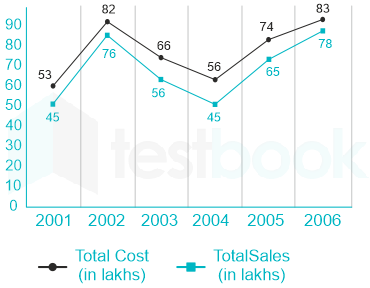
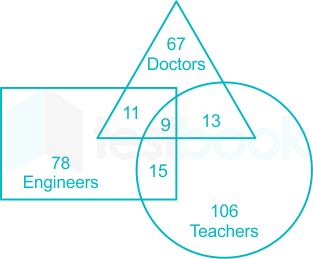
Question 58

A and B can do a work alone in 30 days and 40 days, respectively. If they worked together and got Rs. 2,800 for doing the work, then the share of A will be:

  1. AOption (a)

    Rs. 1,500

  2. BOption (b)

    Rs. 1,600

  3. COption (c)

    Rs. 1,200

  4. DOption (d)

    Rs. 1,400

View answer & explanation

Correct answer

Answer: (b)B.

Rs. 1,600

Why this answer is correct

Shortcut Trick

Ratio of Days (A : B) = 30 : 40 = 3 : 4

Ratio of Efficiency (and Share) = Inverse of Days = 4 : 3

Total share parts = 4 + 3 = 7 units

7 units = ₹2,800 → 1 unit = ₹400

Share of A = 4 units = 4 × ₹400 = ₹1,600

∴ The correct answer is ₹1,600.

Alternate Method

Given: Time taken by A = 30 days, Time taken by B = 40 days. Total wages = ₹2,800.

Formula Used: Total Work = LCM of days; Efficiency = Total Work ÷ Days; Wage Share ∝ Efficiency.

PersonDaysTotal WorkEfficiency
A301204
B403

⇒ Total Efficiency of A and B = 4 + 3 = 7

⇒ Ratio of wages of A and B = 4 : 3

⇒ Share of A = (4 ÷ 7) × 2,800

⇒ Share of A = 4 × 400 = 1,600

∴ The correct answer is ₹1,600.

Additional Information

Work and Wages Rule

Wages are distributed in the ratio of the work done by each person. If they work for the same duration, wages are proportional to their efficiencies.

Efficiency and Time Relationship

Efficiency is inversely proportional to the time taken to complete a work. If time ratio is x:y, efficiency ratio is y:x.

Pipes and Cisterns

This concept is identical to Time and Work, where efficiency represents the rate of flow (filling or emptying) per unit time.

Question 59

The Hijri Year (Islamic Year) consistently falls about _______ days short of the Solar Year.

  1. AOption (a)

    11 days

  2. BOption (b)

    30 days

  3. COption (c)

    2 days

  4. DOption (d)

    29 days

View answer & explanation

Correct answer

Answer: (a)A.

11 days

Why this answer is correct

The correct answer is 11 days.

Key Points

  • The Hijri Year (Islamic Year) consistently falls about 10 to 12 days short of the Solar Year.
  • The Hijri calendar is a lunar calendar, consisting of 12 months and a total of 354 or 355 days.
  • It consists of 12 months, with each month typically having 29 or 30 days depending on the moon's sighting.
  • The Hijri calendar, also known as the Islamic calendar, was established by Caliph Umar ibn al-Khattab in 638 CE.

Additional Information

  • The Gregorian Calendar was Founded by Pope Gregory XIII and established in 1582 CE.
  • The Gregorian calendar is a solar calendar with a year consisting of 365 days, or 366 in a leap year.
  • Julian Calendar was Founded by Julius Caesar and Established in 45 BCE.
  • The Chinese calendar is a lunisolar calendar used primarily for traditional purposes. It consists of 12 or 13 months.
  • The Hebrew calendar is a lunisolar calendar used by Jewish communities. It consists of 12 months in a regular year and 13 months in a leap year.

Question 60

The largest population of the greater one-horned Rhino is found in _______ state of India.

  1. AOption (a)

    Kerala

  2. BOption (b)

    Assam

  3. COption (c)

    Sikkim

  4. DOption (d)

    Tamil Nadu

View answer & explanation

Correct answer

Answer: (b)B.

Assam

Why this answer is correct

The correct answer is Assam.

Key Points

  • The largest population of the greater one-horned rhinoceros (Rhinoceros unicornis) is found in the state of Assam in India.
  • Assam is home to Kaziranga National Park, a UNESCO World Heritage Site, which hosts the majority of the world's greater one-horned rhinos.
  • Besides Kaziranga, the greater one-horned rhino can also be found in other protected areas in Assam, such as Manas National Park and Nameri National Park.
  • Due to successful conservation measures, the population of greater one-horned rhinos in Kaziranga has significantly increased over the years.

Additional Information

  • Kerala is known for its rich biodiversity, with numerous wildlife sanctuaries and national parks, such as Periyar Wildlife Sanctuary and Silent Valley National Park.
  • Kerala is a paradise for bird watchers, with over 500 species of birds, including migratory species. The Vembanad Lake and Kumarakom Bird Sanctuary are notable spots for birdwatching.
  • Sikkim is home to several endangered species, including the Red Panda and the Snow Leopard.
  • Tamil Nadu boasts several wildlife sanctuaries and national parks, including Mudumalai National Park, Anamalai Tiger Reserve, and Indira Gandhi Wildlife Sanctuary.
  • The Vedanthangal Bird Sanctuary is famous for its large populations of migratory waterfowl.

Question 61

The green hydrogen and green ammonia policy launched in February 2022 aimed at boosting the domestic production of green hydrogen to _______ tonnes by 2030 and making India an export hub for clean fuel.

  1. AOption (a)

    1 million

  2. BOption (b)

    3 million

  3. COption (c)

    10 million

  4. DOption (d)

    5 million

View answer & explanation

Correct answer

Answer: (d)D.

5 million

Why this answer is correct

The correct answer is  5 million.

Key Points

  • The policy focuses on promoting the production and utilization of green hydrogen and green ammonia.
  • The policy also aims to position India as a significant player in the global green hydrogen market.
  • The policy aligns with India's broader objectives of energy security, sustainability, and achieving net-zero emissions by 2070.
  • Green hydrogen has various applications, including in industries such as transportation, and power generation.

Additional Information

  • The National Green Hydrogen Mission was launched by Prime Minister Narendra Modi on January 4, 2023.
  • The initiative aims to boost the production of green hydrogen and green ammonia, with a target of producing 5 million tonnes of green hydrogen by 2030.
  • Germany: One of the pioneers in the green hydrogen sector, launched the National Hydrogen Strategy in 2020 to promote hydrogen as a key element of its energy transition.
  • Japan: Has been actively promoting hydrogen since 2017, aiming to establish a "hydrogen society" with investments in production, transportation, and utilization.
  • Australia: The government has announced various initiatives and funding programs to become a major exporter of green hydrogen, particularly to Asia.
  • European Union: The EU has set ambitious targets for hydrogen production and usage, with significant investments in renewable hydrogen projects.

Question 62

In human beings, which of the following parts of the alimentary canal excretes waste material?

  1. AOption (a)

    Large intestine

  2. BOption (b)

    Small intestine

  3. COption (c)

    Appendix

  4. DOption (d)

    Anus

View answer & explanation

Correct answer

Answer: (d)D.

Anus

Why this answer is correct

The correct answer is Anus.

Key Points

  • The anus is the opening at the end of the digestive tract, through which solid waste leaves the body.
  • The anus is approximately 2.5 to 4 centimeters (about 1 to 1.5 inches) in length in adults.
  • The primary function of the anus is to regulate the expulsion of feces from the body.
  • It is the final part of the gastrointestinal (GI) system.

Additional Information

  • The large intestine, also known as the colon, is the final part of the digestive system, measuring about 1.5 meters (5 feet) in length.
  • The main functions include the Absorption of water and electrolytes the formation and storage of feces, Bacterial fermentation of undigested food.
  • The small intestine is a long, coiled tube that is approximately 6 meters (20 feet) in length, connecting the stomach to the large intestine.
  • The primary functions include the Digestion of food using enzymes from the pancreas and bile from the liver and the absorption of nutrients, vitamins, and minerals into the bloodstream.
  • The appendix is a small, tube-like structure attached to the cecum of the large intestine.
  • It measures about 5 to 10 centimeters (2 to 4 inches) in length.

Question 63

The value of 45 - 5 × [2 + 3 × {2 - 2(3 - 5) × 3} ÷ 7] is:

  1. AOption (a)

    10

  2. BOption (b)

    1

  3. COption (c)

    35

  4. DOption (d)

    5

View answer & explanation

Correct answer

Answer: (d)D.

5

Why this answer is correct

Given:

Expression: 45 - 5 × [2 + 3 × {2 - 2(3 - 5) × 3} ÷ 7]

Formula Used:

Order of operations (PEMDAS/BODMAS): Parentheses/Brackets, Exponents/Orders, Multiplication and Division (left to right), Addition and Subtraction (left to right)

Calculation:

Starting with the innermost parentheses:

3 - 5 = -2

Next, multiply by 2:

2(-2) = -4

Then multiply by 3:

-4 × 3 = -12

Now, substitute back into the expression:

{2 - (-12)} = 2 + 12 = 14

Next, multiply by 3:

3 × 14 = 42

Then divide by 7:

42 ÷ 7 = 6

Now substitute back into the expression:

2 + 6 = 8

Next, multiply by 5:

5 × 8 = 40

Finally, subtract from 45:

45 - 40 = 5

The value of the expression is 5.

Question 64

The sides of a triangle are 32 cm, 60 cm, and 68 cm. What is its area (in cm2)?

  1. AOption (a)

    960

  2. BOption (b)

    990

  3. COption (c)

    1020

  4. DOption (d)

    1088

View answer & explanation

Correct answer

Answer: (a)A.

960

Why this answer is correct

Shortcut Trick

Check for Pythagorean triplet: (32, 60, 68) → Divide by 4 → (8, 15, 17).

Since 82 + 152 = 172 (64 + 225 = 289), the triangle is right-angled.

Area = 1/2 × base × height = 1/2 × 32 × 60.

Area = 16 × 60 = 960 cm2.

∴ The correct answer is 960 cm2.

Alternate Method

Given: Sides a = 32 cm, b = 60 cm, c = 68 cm.

Formula: Area of a right triangle = (1/2) × product of legs.

⇒ First, verify Pythagoras Theorem: 322 + 602 = 1024 + 3600 = 4624.

⇒ 682 = 4624.

⇒ Since a2 + b2 = c2, the triangle is right-angled at the vertex between 32 and 60.

⇒ Area = 1/2 × 32 × 60

⇒ Area = 16 × 60

⇒ Area = 960 cm2

∴ The correct answer is 960 cm2.

Additional Information

Heron's Formula

For any triangle with sides a, b, c: Area = √[s(s−a)(s−b)(s−c)], where s is the semi-perimeter (a+b+c)/2.

Common Triplets

Standard Pythagorean triplets include (3, 4, 5), (5, 12, 13), (8, 15, 17), and (7, 24, 25). Multiples of these also form triplets.

Incircle Radius

For a right-angled triangle, the inradius r = (a + b − c) / 2, where c is the hypotenuse.

Question 65

83 persons are sitting in a row. Aru is sitting at the 27th position from the left side of the row and Pihu is sitting at the 41st position from the right side of the row. Ana is sitting exactly in the middle of Aru and Pihu. What is Ana's position from the left?

  1. AOption (a)

    33

  2. BOption (b)

    37

  3. COption (c)

    35

  4. DOption (d)

    34

View answer & explanation

Correct answer

Answer: (c)C.

35

Why this answer is correct

The logic followed here is:

Position of Aru from the left = 27th

Position of Pihu from the right = 41th

Total number of persons in the row = 83

Position of Pihu from the left = Total number of persons - Position of Pihu from the right + 1

= 83 - 41 + 1

= 43

Ana is sitting exactly in the middle of Aru and Pihu.

Position of Ana from the left = (Position of Aru from the left + Position of Pihu from the left) / 2

= (27 + 43) / 2

= 70 / 2

= 35

Hence, the correct answer is "Option 3".

Question 66

Which of the following options is the closest approximate value which will come in place of question mark(?) in the following equation? 1025+98÷14×4−170=?\sqrt {1025} + 98 ÷ 14 × 4 - \sqrt {170} =?

  1. AOption (a)

    70

  2. BOption (b)

    47

  3. COption (c)

    27

  4. DOption (d)

    60

View answer & explanation

Correct answer

Answer: (b)B.

47

Why this answer is correct

Given:

1025+98÷14×4−170=?\sqrt {1025} + 98 ÷ 14 × 4 - \sqrt {170} =?

Formula Used:

√(x) denotes the square root of x.

Calculation:

Approximate value of √(1025) ≈ 32

Approximate value of √(170) ≈ 13

98 ÷ 14 = 7

7 × 4 = 28

Combining all parts:

⇒ 32 + 28 - 13

⇒ 60 - 13

⇒ 47

The closest approximate value is 47.

Question 67

Six friends U, V, W, X, Y, and Z are sitting in a circular arrangement and all are facing outside the circle. W is sitting to the immediate left of X and is second to the right of Y. X is sitting to the immediate left of Z. V is not an immediate neighbour of W. Who among the following is sitting to the immediate left of U?

  1. AOption (a)

    Y

  2. BOption (b)

    W

  3. COption (c)

    Z

  4. DOption (d)

    V

View answer & explanation

Correct answer

Answer: (a)A.

Y

Why this answer is correct

Given: Six friends U, V, W, X, Y, and Z all are facing outside the circle.

  1. W is sitting to the immediate left of X and is second to the right of Y.

  2. X is sitting to the immediate left of Z.

  3. V is not an immediate neighbour of W.

So, Y is sitting to the immediate left of U.

Hence, the correct answer is "Option 1".

Question 68

Which of the following festivals is mainly celebrated in the state of Manipur?

  1. AOption (a)

    Lai Haraoba

  2. BOption (b)

    Losar

  3. COption (c)

    Halda

  4. DOption (d)

    Gandhalepana Yatra

View answer & explanation

Correct answer

Answer: (a)A.

Lai Haraoba

Why this answer is correct

The correct answer is Lai Haraoba.

Key Points

  • Lai Haraoba is a traditional festival of Manipur, which is celebrated through dance and music performances.
  • It is believed that Lai Haraoba gave birth to Manipuri classical dance, which is now recognized as one of the eight classical dance forms of India.
  • Lai Haraoba is the earliest form of Manipuri classical dance of India.

Additional Information

  • Losar
  • Buddha's religion is associated with the Losar festival.
  • Losar also known as Tibetan New Year, is a festival in Tibetan Buddhism.
  • The holiday is celebrated on various dates depending on the location (Tibet, Bhutan, Nepal, India) tradition.
  • The holiday is a new year's festival, celebrated on the first day of the lunisolar Tibetan calendar, which corresponds to a date in February or March in the Gregorian calendar.
  • In 2020, the new year commenced on the 24th of February and celebrations ran until the 26th of the same month.
  • It also commenced the Year of the Male Iron Rat.
  • The variation of the festival in Nepal is called Lhochhar and is observed about eight weeks earlier than the Tibetan Losar.
  • Halda Festival:
  • One of the most significant festivals celebrated in Himachal Pradesh's Lahaul region is the Halda Festival, a sizable carnival held to welcome the New Year.
  • The Halda Festival, one of Lahaul's most anticipated events, offers a memorable experience with its exotic drinks, hypnotic dance performances, joyful family reunions, and vibrant cultural celebrations.
  • It is a pleasant and happy event when state people join together to celebrate the New Year and exchange prosperous wishes.
  • Gandhalepana Yatra
  • ​Gandhalepana Yatra, also known as Chandan Yatra, is a 42-day festival that takes place at the Jagannatha Temple in Puri, Odisha.
  • During this festival, deities are worshipped with a paste of water and sandalwood.
  • The word "Chandan" translates to "sandalwood voyage".

Question 69

What is the role of the Subordinate Court?

  1. AOption (a)

    To consider cases of civil and criminal nature

  2. BOption (b)

    To issue writs for restoring Fundamental Rights

  3. COption (c)

    To consider appeals on decisions given by lower courts

  4. DOption (d)

    To move cases from any court to itself

View answer & explanation

Correct answer

Answer: (a)A.

To consider cases of civil and criminal nature

Why this answer is correct

The correct answer is To consider cases of civil and criminal nature.

Key Points

Subordinate Courts

  • Articles 233 to 237 in Part VI of the Constitution make the following provisions to regulate the organization of subordinate courts and to ensure their independence from the executive.

Question 70

Which of the following statements is INCORRECT?

  1. AOption (a)

    Members of the Gram Panchayat are elected by a secret ballot.

  2. BOption (b)

    Zilla Parishad is the apex body of Panchayati Raj System.

  3. COption (c)

    Gram Panchayat is chaired by the Gram Pradhan or Sarpanch or Mukhia.

  4. DOption (d)

    Panchyat Samiti is the grass root institution of the Panchayati Raj System.

View answer & explanation

Correct answer

Answer: (d)D.

Panchyat Samiti is the grass root institution of the Panchayati Raj System.

Why this answer is correct

The correct answer is Panchyat Samiti is the grass root institution of the Panchayati Raj System.

Key Points

  • Panchayati Raj system is based on the principle of Decentralisation of power.
  • Panchayati Raj is an important feature of Indian polity ensuring direct participation of common people (Article 243 G – 243 H) in decision making.
  • Under DPSP article 40 it’s mentioned that State shall take steps to organize village panchayats and endow them with such powers and authority as may be necessary to enable them to function as units of self-government.​

Additional Information

  • Panchayati Raj system is a system of rural local self-government.
  • It was introduced by the 73rd constitutional amendment act,1992.
  • In 1882 Lord Rippon provided the democratic framework to local governance. This gave him the title of “father of local self-government in India”.

Question 71

According to National Statistical Office (NSO) data as of 2021, India's average literacy rate is _______.

  1. AOption (a)

    72.23%

  2. BOption (b)

    77.70%

  3. COption (c)

    75.60%

  4. DOption (d)

    70.10%

View answer & explanation

Correct answer

Answer: (b)B.

77.70%

Why this answer is correct

The correct answer is 77.70%.

Key Points

  • According to National Statistical Office (NSO) data, India’s average literacy rate is 77.70% & male literacy at the India level in 2021 stands at 84.70% & female literacy stands at 70.30%.
  • Kerala has the highest literacy rate of 96.2%.
  • The Office of the Registrar General and Census Commissioner, India under the Ministry of Home Affairs, Government of India, conducts Census every 10 years.

Question 72

Select the combination of letters and numbers that when sequentially placed from left to right in the same sequence in the blanks of the given series, will complete the series.

4_ _ E 6 7 F _ _ 9 H I

  1. AOption (a)

    E4G9

  2. BOption (b)

    5DG8

  3. COption (c)

    D5H9

  4. DOption (d)

    4EH8

View answer & explanation

Correct answer

Answer: (b)B.

5DG8

Why this answer is correct

The logic followed here is:

Given Sequence: 4_ _ E 6 7 F _ _ 9 H I

Now, putting the letters in the blank spaces given in the option one by one:

Option 1) E4G9 → 4 E 4 E / 6 7 F G / 9 9 H I

Option 2) 5DG8 → 4 5 D E / 6 7 F G / 8 9 H I

Here, 'Place value - Letter' followed a pattern.

Option 3) D5H9 → 4 D 5 E / 6 7 F H / 9 9 H I

Option 4) 4EH8 → 4 4 E E / 6 7 F H / 8 9 H I

Hence, the correct answer is "5DG8".

Question 73

If all the numbers given below are arranged in descending order, the position of how many numbers will remain unchanged?

295, 654, 653, 234, 345, 245, 634

  1. AOption (a)

    2

  2. BOption (b)

    1

  3. COption (c)

    4

  4. DOption (d)

    3

View answer & explanation

Correct answer

Answer: (b)B.

1

Why this answer is correct

Given series: 295, 654, 653, 234, 345, 245, 634

If all the numbers are arranged in descending order,

654, 653, 634, 345, 295, 245, 234

The position of 1 (which 245) number will remain unchanged.

Hence, the correct answer is "1".

Question 74

A precipitation reaction is one in which:

  1. AOption (a)

    water soluble salt is formed

  2. BOption (b)

    a precipitate is formed

  3. COption (c)

    a homogeneous mixture of all the reactants in aqueous solution is formed 

  4. DOption (d)

    a homogeneous mixture of all the products in aqueous solution is formed

View answer & explanation

Correct answer

Answer: (b)B.

a precipitate is formed

Why this answer is correct

The correct answer is a precipitate is formed.

Key Points

  • When dissolved substances react, then one (or more) solid products are produced, that is known as a precipitation reaction.
  • Many of these processes, also known as double displacement, double replacement, or metathesis reactions, involve the exchange of ions between ionic compounds in aqueous solutions.​

Additional Information

  • When two chemicals interact by transferring ions, a double displacement reaction occurs, creating two new molecules.
  • In the twofold displacement process, positive ions trade places with negative ions.
  • In water-soluble ionic compounds, numerous double displacement reactions take arise.

Question 75

In two triangles DEF and PQR, IF DE = QR, EF = PR and FD = PQ, then:

  1. AOption (a)

    △EDF ≅ △RPQ

  2. BOption (b)

    △PQR ≅ △EFD

  3. COption (c)

    △FED ≅ △PRQ

  4. DOption (d)

    △DEF ≅ △PQR

View answer & explanation

Correct answer

Answer: (c)C.

△FED ≅ △PRQ

Why this answer is correct

Shortcut Trick

Identify corresponding vertices by looking at the common letters in equal side pairs.

DE = QR and EF = PR ⇒ Common vertex E corresponds to R.

EF = PR and FD = PQ ⇒ Common vertex F corresponds to P.

FD = PQ and DE = QR ⇒ Common vertex D corresponds to Q.

Mapping: F → P, E → R, D → Q.

Matching the order in the options: △FED ≅ △PRQ.

∴ The correct answer is △FED ≅ △PRQ.

Alternate Method

Given: DE = QR, EF = PR, and FD = PQ.

Formula Used: SSS (Side-Side-Side) Congruence Rule states that if three sides of one triangle are equal to the three sides of another triangle, then the triangles are congruent.

Calculations:

⇒ In △DEF and △QRP:

⇒ DE = QR (Given)

⇒ EF = PR (Given)

⇒ FD = PQ (Given)

⇒ By SSS Congruence Rule, the triangles are congruent.

⇒ To write the symbolic form, we match the vertices: D ↔ Q, E ↔ R, and F ↔ P.

⇒ Therefore, △FED ≅ △PRQ.

∴ The correct answer is △FED ≅ △PRQ.

Additional Information

SSS Congruence Rule

Two triangles are congruent if all three sides of one triangle are equal to the corresponding three sides of the other triangle.

CPCT (Corresponding Parts of Congruent Triangles)

Once triangles are proved congruent, their corresponding angles and remaining sides are also equal.

Vertex Correspondence

The order of vertices in a congruence statement must strictly follow the matching of equal sides and angles (e.g., if A matches X, then A must be in the same position as X).

Question 76

The main objective of which of the following financial institutions is to provide funds to enable sustainable irrigation practices for the rural infrastructure of India?

  1. AOption (a)

    NABARD

  2. BOption (b)

    BHARAT

  3. COption (c)

    FINCA

  4. DOption (d)

    BRAC

View answer & explanation

Correct answer

Answer: (a)A.

NABARD

Why this answer is correct

The correct answer is NABARD.

Key Points

  • NABARD refers to the National Bank for Agriculture and Rural Development.
  • NABARD was formed on the recommendation of the committee formed on 30 March 1979, under the Chairmanship of Shri B. Sivaraman.
  • It came into existence on 12 July 1982 by transferring the agricultural credit functions of RBI and refinance functions of the then Agricultural Refinance and Development Corporation (ARDC).
  • NABARD today is fully owned by the Government of India.
  • NABARD Facts:-
Founded12 July 1982
HeadquarterMumbai, India
ChairmanMr. Shaji K V​

Question 77

Salaries of A and B were in the ratio 3 ∶ 4. After the salary of each of A and B is increased by Rs. 3,000, the new ratio becomes 18 ∶ 23. What is A's salary after the increase?

  1. AOption (a)

    Rs. 18,000

  2. BOption (b)

    Rs. 12,000

  3. COption (c)

    Rs. 21,000

  4. DOption (d)

    Rs. 23,000

View answer & explanation

Correct answer

Answer: (a)A.

Rs. 18,000

Why this answer is correct

Shortcut Trick

Initial Ratio A : B = 3 : 4 | New Ratio A : B = 18 : 23

Make the ratio differences equal: Difference in first is 1, in second is 5. Multiply first ratio by 5 → 15 : 20.

Increase in units: 18 − 15 = 3 units. Since 3 units = ₹3,000, then 1 unit = ₹1,000.

A's new salary = 18 units = 18 × 1,000 = ₹18,000.

∴ The correct answer is ₹18,000.

Alternate Method

Given: Initial Ratio = 3 : 4 | Salary Increase = ₹3,000 | New Ratio = 18 : 23

Method: Linear Equation using Cross-Multiplication

⇒ Let salaries be 3x and 4x.

⇒ (3x + 3000) ÷ (4x + 3000) = 18 ÷ 23

⇒ 23 × (3x + 3000) = 18 × (4x + 3000)

⇒ 69x + 69,000 = 72x + 54,000

⇒ 72x − 69x = 69,000 − 54,000

⇒ 3x = 15,000 ⇒ x = 5,000

⇒ A's new salary = 3x + 3,000 = 3(5,000) + 3,000 = 15,000 + 3,000 = 18,000

∴ The correct answer is ₹18,000.

Additional Information

Ratio Difference Balance Method

When the same quantity is added to both terms, the difference between the terms in the ratio must be equalized to solve the problem quickly without algebra.

Compound Ratio

If two ratios are a:b and c:d, their compound ratio is (a × c) : (b × d). This is useful in partnership and multi-variable salary problems.

Question 78

The values of potential drops across, and corresponding currents in, a resistor are given in the following table. If the resistor obeys Ohm's law, then the values of X and Y are respectively:

V (in volts)0.81.6X3.24.04.85.66.47.28.0
I (in amperes)0.20.40.60.81.0Y1.41.61.82.0
  1. AOption (a)

    1.1 and 2.2

  2. BOption (b)

    2.2 and 1.1

  3. COption (c)

    1.2 and 2.4

  4. DOption (d)

    2.4 and 1.2

View answer & explanation

Correct answer

Answer: (d)D.

2.4 and 1.2

Why this answer is correct

The correct answer is 2.4 and 1.2.

Key Points

To maintain this ratio and thus adherence to Ohm's law, for I = 0.6 A (to find X), we use V = IR: [V=0.6A×4Ω=2.4V[V = 0.6A \times 4Ω = 2.4V

Therefore, X = 2.4 V.

For Y (with V = 4.8 V), we again use V = IR, but now solve for I: I=VR=4.8V4Ω=1.2AI = \frac{V}{R} = \frac{4.8V}{4Ω} = 1.2A

Hence, Y = 1.2 A.

Question 79

Surendranath Banerjee and Ananda Mohan Bose formed the Indian Association in the year _______.

  1. AOption (a)

    1876

  2. BOption (b)

    1906

  3. COption (c)

    1896

  4. DOption (d)

    1916

View answer & explanation

Correct answer

Answer: (a)A.

1876

Why this answer is correct

The correct answer is 1876.

Key Points

  • Surendranath Banerjee laid the foundations of the Indian National Movement by founding the Indian Association at Calcutta in 1876.
  • On July 26, 1876, Banerjee along with Ananda Mohan Bose formed the ‘Indian Association’ in Kolkata.
  • This Association aimed to unify Indian people on a common political program.
  • The Association merged with the Indian National Congress in 1885.
  • Surendranath Banerjee was a skilled orator.
  • He organized a huge public meeting against this decision on 24 March 1877, in Town Hall, Kolkata.
  • He was the second Indian to qualify for the Indian Civil Service examinations.
  • He resolved to bring the whole of India on a common platform, on civil services in particular, but also all policies affecting Indians in general.
  • He wanted an India unified in the matter of political aspiration and program.
  • He was also a part of the nine-member Congress delegation to England in 1890.​

Additional Information

OrganizationsYearFeatures
The Poon Sarvajanik Sabha1870- It was led by Mahadev Govind Ranade. - They organized a successful campaign among the peasants, as well as at Poona and Bombay against the land revenue settlement of 1867. - This agitation generated a mentality of resistance among the peasants which contributed to the rise of peasant protest in 1875. - The Sabha, as well as many of the nationalist newspapers, also supported the Deccan Agriculturists‘, Relief Bill. - Under its impact, a large number of peasants refused to pay the enhanced revenue.
The Indian Association1876- The Indian National Association also known as the Indian Association was the first avowed nationalist organization founded in British India by Surendranath Banerjee and Ananda Mohan Bose. - The objectives of this Association were "promoting by every legitimate means the political, intellectual and material advancement of the people". - This association opposed Elbert's bill on the dispute as lowering the age limit for civil service examination.
Madras Mahajana Sabha1884- It was established by M. Veeraraghavachariar, S. Ramaswami Mudaliar, and P. Anandacharlu. - The Madras Mahajan Sabha was formed in May 1884 to coordinate the activities of the local association and to ‘provide a focus for the non-official intelligence spread up through the Presidency’.
The Bombay Presidency Association1885- The Bombay Presidency Association was started by Badruddin Tyabji, Pherozshah Mehta, and K.T. Telang in 1885.

Question 80

How can paper waste be minimised?

I. By discarding

II. By recycling

III. By reusing

IV. By burning

  1. AOption (a)

    Only III and IV

  2. BOption (b)

    Only I and II

  3. COption (c)

    Only II and III

  4. DOption (d)

    Only I and IV

View answer & explanation

Correct answer

Answer: (c)C.

Only II and III

Why this answer is correct

The correct answer is Only II and III.

Key Points

  • The most effective way to reduce waste generation is by recycling.
  • This is because recycling helps in reducing the amount of waste that goes into landfills and helps conserve natural resources.
  • Here are some of the reasons why recycling is the most effective way to reduce waste generation:
  • Reduces the amount of waste going to landfills:
  • ​Recycling helps in reducing the amount of waste that goes into landfills.
  • This is because when we recycle, we are reusing materials that would otherwise end up in landfills.
  • Conserves natural resources:
  • Recycling helps conserve natural resources like timber, water, and minerals.
  • By recycling materials like paper, plastic, and metal, we are reducing the need to extract new resources from the environment.
  • Reduces greenhouse gas emissions:
  • Recycling also helps in reducing greenhouse gas emissions.
  • This is because when we recycle materials, we are using less energy than we would if we were to extract new resources from the environment.
  • Creates jobs:
  • Recycling also creates jobs in the recycling industry.
  • This is because recycling requires people to collect, sort, and process materials, and these jobs help stimulate the economy.

Question 81

Which of the following is produced as a waste product during photosynthesis?

  1. AOption (a)

    Carbon dioxide

  2. BOption (b)

    Urea

  3. COption (c)

    Oxygen

  4. DOption (d)

    Nitrogen

View answer & explanation

Correct answer

Answer: (c)C.

Oxygen

Why this answer is correct

The correct answer is Oxygen.

Key Points

  • Oxygen
  • It is the chemical element with the symbol O and atomic number 8.
  • It is a member of the chalcogen group in the periodic table, a highly reactive nonmetal, and an oxidizing agent that readily forms oxides with most elements as well as with other compounds.
  • When Joseph Priestley discovered oxygen in 1774, he answered age-old questions of why and how things burn. Hence, Option 3 is correct.
  • An Englishman by birth, Priestley was deeply involved in politics and religion, as well as science.
  • When his vocal support for the American and French revolutions made remaining in his homeland dangerous, Priestley left England in 1794 and continued his work in America until his death.
  • Symbol: O
  • Atomic mass: 15.999 u
  • Atomic number: 8
  • Electron configuration: [He] 2s²2p⁴
  • Electronegativity: 3.44
  • Discoverers: Joseph Priestley, Antoine Lavoisier, Carl Wilhelm Scheele

Additional Information

  • Carbon dioxide
  • carbon dioxide (CO2) is a colorless, odorless gas that occurs naturally in the Earth's atmosphere:
  • It's made up of one carbon atom and two oxygen atoms.
  • It's a greenhouse gas that absorbs and radiates heat.
  • It's produced by burning carbon and organic compounds, respiration, volcanic eruptions, and the burning of wood and fossil fuels.
  • When it solidifies, it's known as dry ice.
  • It has a molecular mass of 44 g/mol.
  • It has a linear molecular shape.
  • Urea​
  • Urea is a nitrogen-containing organic compound.
  • Urea or carbamide is an organic compound with chemical formula CO(NH2)2.
  • The molecule has two -NH2 groups joined by a carbonyl (C=O) functional group.
  • Urea is the only controlled fertilizer, which is sold at the statutory notified uniform sale price.
  • Dissolved in water, it is neither acidic nor alkaline.
  • It is a colourless, odourless solid, highly soluble in water, and practically non-toxic.
  • Nitrogen
  • Nitrogen gas is a diatomic molecule composed of two N atoms. Therefore, it exists as N2.
  • Nitrogen can form pπ−pπ multiple bonds.
  • In the case of nitrogen, there is no repulsion between non-bonded electrons of the inner core, as it has only 1s electrons in the inner shell so the overlap of p orbitals to form pi bonds is easy.
  • Therefore, it exists as a diatomic molecule.
  • Nitrogen has atomic number 7 and electronic configuration [He] 2s2 2p3.
  • Nitrogen was first discovered and isolated by Scottish physician Daniel Rutherford in 1772.
  • Nitrogen is the fourth most abundant element in the body.
  • It is the fifth most abundant element in the universe and makes up about 78% of the earth's atmosphere.
  • The largest use of nitrogen is for the production of ammonia (NH3).

Question 82

In July 2022, who among the following became the youngest Indian to hit 100 sixes in international cricket? 

  1. AOption (a)

    Hanuma Vihari

  2. BOption (b)

    Suryakumar Yadav

  3. COption (c)

    Dinesh Karthik

  4. DOption (d)

    Rishabh Pant

View answer & explanation

Correct answer

Answer: (d)D.

Rishabh Pant

Why this answer is correct

The correct answer is Rishabh Pant.

Key Points

  • The International Cricket Council (ICC), the international governing body of Cricket founded in 1909 by representatives from England, Australia, and South Africa, was initially known as Imperial Cricket Conference.
  • In 1965, it was renamed as International Cricket Conference and in 1965, it was renamed the International Cricket Council (ICC) in 1989.
  • This council organizes various world championships and tournaments.
  • ODI World Cup and T-20 World Cup are world-famous.
  • There are 104 member nations.
  • Headquarters of ICC - Dubai, UAE
  • Motto - Cricket for good
  • Chairman - Greg Barclay

Question 83

A conference is being organised by an educational institute, where the participants will be educators of different subjects. The number of participants in physics, chemistry and mathematics are 112, 144 and 192, respectively. In each room an equal number of participants are to be seated, and all participants in a room should be educators of the same subject. What is the minimum number of rooms required during the event?

  1. AOption (a)

    35

  2. BOption (b)

    32

  3. COption (c)

    28

  4. DOption (d)

    23

View answer & explanation

Correct answer

Answer: (c)C.

28

Why this answer is correct

Shortcut Trick

For the minimum number of rooms, we need the maximum number of participants per room (HCF).

HCF of 112, 144, and 192 is 16.

Total rooms = (112 + 144 + 192) ÷ 16 = 448 ÷ 16 = 28.

∴ The correct answer is 28 rooms.

Alternate Method

Given: Participants in Physics = 112, Chemistry = 144, Mathematics = 192.

Condition: Each room must have an equal number of participants of the same subject.

⇒ To minimize rooms, maximize participants per room = HCF(112, 144, 192)

⇒ 112 = 16 × 7

⇒ 144 = 16 × 9

⇒ 192 = 16 × 12

⇒ Common factor (HCF) = 16 participants per room.

⇒ Physics rooms = 112 ÷ 16 = 7

⇒ Chemistry rooms = 144 ÷ 16 = 9

⇒ Mathematics rooms = 192 ÷ 16 = 12

⇒ Total rooms = 7 + 9 + 12 = 28.

∴ The correct answer is 28 rooms.

Additional Information

HCF (Highest Common Factor)

It is the largest positive integer that divides each of the integers without a remainder. Used for maximizing capacity.

Relationship between HCF and LCM

For two numbers a and b, HCF(a, b) × LCM(a, b) = a × b.

Minimum Rooms Logic

Total Number of Rooms = (Sum of all participants) ÷ HCF of participants of each group.

Question 84

Consider three points P, Q and S at distances r, 2r and 3r from a straight conductor carrying current I.

Which of the following relations is true about the magnitude of the magnetic fields BP, BQ and BS at points P, Q and S, respectively?

  1. AOption (a)

    BP > BQ > BS

  2. BOption (b)

    BS > BP > BQ

  3. COption (c)

    BQ > BS > BP

  4. DOption (d)

    BP = BQ = BS

View answer & explanation

Correct answer

Answer: (a)A.

BP > BQ > BS

Why this answer is correct

The correct answer is BP > BQ > BS.

Key Points The magnetic field (B) due to a long straight current-carrying conductor at a distance r from it is given by the formula(B=μ0I2πr) (B = \frac{\mu_0 I}{2\pi r}), where (μ0)(\mu_0) is the magnetic constant, (I) is the current in the conductor, and (r) is the distance from the conductor. It is clear that the magnetic field (B) is inversely proportional to the distance (r), i.e., as the distance increases, the magnetic field decreases. Therefore, for points P, Q, and S that are at distances r, 2r, and 3r from the conductor, the magnetic field strength will decrease as the distance from the conductor increases. Thus, the correct relation regarding the magnitudes of the magnetic fields (B_P), (B_Q), and (B_S) at points P, Q, and S, respectively, is (B_P > B_Q > B_S).

Question 85

The least number that is exactly divisible by 24, 88 and 136 is:

  1. AOption (a)

    5445

  2. BOption (b)

    4488

  3. COption (c)

    3894

  4. DOption (d)

    6433

View answer & explanation

Correct answer

Answer: (b)B.

4488

Why this answer is correct

Shortcut Trick

To find the least number divisible by multiple numbers, find their LCM.

Check divisibility of options: The number must be divisible by 8 (last 3 digits) and 3 (sum of digits) because 24 = 8 × 3.

Sum of digits of 4488 = 4 + 4 + 8 + 8 = 24 (divisible by 3). 488 is divisible by 8.

4488 ÷ 11 = 408 (divisible by 11, which is a factor of 88).

∴ The correct answer is 4488.

Alternate Method

Given: Numbers 24, 88, and 136.

Formula Used: LCM (Least Common Multiple) by Prime Factorization.

Calculations:

⇒ Prime factors of 24 = 2 × 2 × 2 × 3 = 23 × 31

⇒ Prime factors of 88 = 2 × 2 × 2 × 11 = 23 × 111

⇒ Prime factors of 136 = 2 × 2 × 2 × 17 = 23 × 171

⇒ LCM = 23 × 31 × 111 × 171

⇒ LCM = 8 × 3 × 11 × 17

⇒ LCM = 24 × 187 = 4488

∴ The correct answer is 4488.

Additional Information

LCM (Least Common Multiple)

The smallest positive integer that is divisible by each of the given numbers. It is found by taking the highest power of all prime factors present.

HCF and LCM Relation

For two numbers a and b, the product of the numbers is equal to the product of their HCF and LCM: a × b = HCF(a, b) × LCM(a, b).

Divisibility Rule of 11

A number is divisible by 11 if the difference between the sum of digits at odd places and the sum of digits at even places is either 0 or a multiple of 11.

Question 86

Which one of the following was the first Micro-finance initiative in India?

  1. AOption (a)

    Bandhan Bank

  2. BOption (b)

    Fincare Small Finance Bank

  3. COption (c)

    Equitas Small Finance Bank

  4. DOption (d)

    SEWA Bank

View answer & explanation

Correct answer

Answer: (d)D.

SEWA Bank

Why this answer is correct

The correct answer is SEWA Bank.

Key Point

  • Microfinance has a long and distinguished history in India.
  • Introduced for the first time by the SEWA Bank, part of the Self Employed Women's Association (SEWA), in Gujarat in 1974.
  • It has since become instrumental in extending financial services to many who remained excluded from the economic mainstream.

Additional Information

  • Micro Finance
  • The, loans, insur ance, money tra nsfers and other banking services to customers that lack access to traditional financial services, usually because of poverty.
  • The programme provided small doses of credit funds to the NGOs all across the country.
  • NGOs acted as financial intermediaries and on-lent funds to their clients.
  • Limited amount of capacity buildi ng grant was also provided to the NGOs.

Question 87

When silver nitrate solution is added to sodium chloride solution:

  1. AOption (a)

    silver will deposit on the surface of the reaction vessel

  2. BOption (b)

    no reaction occurs

  3. COption (c)

    a white precipitate of silver chloride is formed

  4. DOption (d)

    a white precipitate of sodium nitrate is obtained

View answer & explanation

Correct answer

Answer: (c)C.

a white precipitate of silver chloride is formed

Why this answer is correct

The correct answer is a white precipitate of silver chloride is formed .

Key Points

  • Silver nitrate
  • Silver Nitrate is used as the marker during Election.
  • When silver nitrate is exposed to sunlight, it breaks down to give black/brown silver oxides and nitric acid i.e.,
  • AgNO3 + H2O → AgO + HNO3 (aq)
  • Silver nitrate decomposes when exposed to the sunlight, so to prevent it from decomposition, silver nitrate is placed in brown colour bottles as brown bottle cuts the passage of light through it.
  • Sodium chloride
  • Sodium Chloride is also known as Salt.
  • It is an ionic compound with the chemical formula NaCl.
  • It has a ratio of 1:1 of sodium and chloride ions, With molar masses of 22.99 and 35.45 g/mol respectively.
  • 100 g of NaCl contains 39.34 g Na and 60.66 g Cl.
  • Sodium chloride is used in the Solvay process to produce sodium carbonate and calcium chloride.
  • In the Mannheim process and in the Hargreaves process, sodium chloride is used for the production of sodium sulfate and hydrochloric acid.

Question 88

A shopkeeper lists the price of a fan at 22% above its cost price and offers a 15% discount on its list price. If he earns a profit of Rs. 111, then what is the list price (in Rs.) of the fan?

  1. AOption (a)

    3,680

  2. BOption (b)

    4,200

  3. COption (c)

    3,500

  4. DOption (d)

    3,660

View answer & explanation

Correct answer

Answer: (d)D.

3,660

Why this answer is correct

Shortcut Trick

Let Cost Price (CP) be 100 units.

List Price (MP) = 100 + 22% of 100 = 122 units.

Selling Price (SP) = 122 × (100 − 15) ÷ 100 = 122 × 0.85 = 103.7 units.

Profit = SP − CP = 103.7 − 100 = 3.7 units.

Given 3.7 units = Rs. 111 ⇒ 1 unit = 111 ÷ 3.7 = 30.

List Price = 122 units = 122 × 30 = Rs. 3,660.

∴ The correct answer is Rs. 3,660.

Alternate Method

Given: Markup = 22%, Discount = 15%, Profit = Rs. 111.

Formulas: SP = MP × (100 − D%) ÷ 100 | Profit = SP − CP | Net Profit% = m − d − (m × d) ÷ 100

⇒ Net Profit% = 22 − 15 − (22 × 15) ÷ 100

⇒ Net Profit% = 7 − 3.3 = 3.7%

⇒ 3.7% of CP = 111 ⇒ CP = (111 × 100) ÷ 3.7 = Rs. 3,000

⇒ List Price (MP) = CP × (100 + Markup%) ÷ 100

⇒ List Price = 3,000 × (122 ÷ 100) = Rs. 3,660

∴ The correct answer is Rs. 3,660.

Additional Information

Marked Price and Discount

The price listed on the label is the Marked Price (MP) or List Price. Discount is always calculated on the MP.

Effective Profit Percentage

When an item is marked up by m% and then a discount of d% is offered, the net profit% is given by the successive percentage formula: m − d − (md/100).

Question 89

Refer to the following letter, number, symbol series and answer the question.

(Left) C 2 A 5 8 P ^ # 9 3 J 8 C % K P X R 3 5 4 $ % & R % (Right)

If all the numbers are dropped from the series, which of the following will be fifth from the left?

  1. AOption (a)

    C

  2. BOption (b)

  3. COption (c)

    $

  4. DOption (d)

    P

View answer & explanation

Correct answer

Answer: (b)B.

Why this answer is correct

Given: (left) C 2 A 5 8 P ^ # 9 3 J 8 C % K P X R 3 5 4 $ % & R % (right)

If all the numbers are dropped from the series, the sequence becomes:

C A P ^ # J C % K P X R $ % & R %

Counting the fifth element from the left in this new sequence:

  1. C

  2. A

  3. P

  4. ^

So, the fifth element from the left is: #

The correct answer is "Option 2".

Question 90

Select the number from among the given options that can replace the question mark (?) in the following series.

110, 114, 106, 122, 90, ?

  1. AOption (a)

    127

  2. BOption (b)

    168

  3. COption (c)

    154

  4. DOption (d)

    136

View answer & explanation

Correct answer

Answer: (c)C.

154

Why this answer is correct

The logic followed here is:

Hence, the correct answer is "154".

Question 91

If 10 February 2002 is a Sunday, then what will be the day of the week on 17 March 2008?

  1. AOption (a)

    Sunday

  2. BOption (b)

    Friday

  3. COption (c)

    Saturday

  4. DOption (d)

    Monday

View answer & explanation

Correct answer

Answer: (d)D.

Monday

Why this answer is correct

Given: 10 February 2002 was Sunday.

Now,

2002 to 2008 = 6 Years (5 Ordinary Year and 1 Leap Year).

And, In 6 Years = 1 Leap year and 5 Ordinary Year.

So, 1 Leap Year has 2 odd days,

And, 5 Ordinary Year has 5 odd days.

Total odd days = 2 + 5 = 7.

7 odd days → 7/7 = 1 week and 0 odd days.

then, 10 February 2008 will be Sunday + 0 = Sunday.

Now, the number of days between 10 February 2008 to 17 March 2008

= 19(February) + 17(March) = 36 days.

= 36 days → 36/7 = 5 week and 1 odd day.

So, 17 March 2008 will be Sunday + 1 = Monday.

Hence, the correct answer is "Option 4".

Question 92

Which of the following statements is correct?

  1. AOption (a)

    Ethanol has three carbon atoms.

  2. BOption (b)

    Acetic acid has two carbon atoms.

  3. COption (c)

    Methane has four carbon atoms.

  4. DOption (d)

    Chloroform has three carbon atoms.

View answer & explanation

Correct answer

Answer: (b)B.

Acetic acid has two carbon atoms.

Why this answer is correct

The correct answer is Acetic acid has two carbon atoms.

Key Points

  • Acetic acid
  • Acetic acid is present in all types of vinegar.
  • The chemical formula for acetic acid is CH3COOH
  • The Percentage of acetic acid (CH3COOH) present in vinegar is between 4 - 5% in weight.
  • Vinegar is a liquid consisting of acetic acid water and other trace chemicals.
  • Acetic acid is produced by the formation of ethanol and bacteria.

Additional Information

  • Ethanol:
  • It is also known as ethyl alcohol.
  • It is a colorless, volatile, and flammable liquid that is soluble in water.
  • It is most commonly found in alcoholic beverages.
  • It is also used as an antiseptic and as a disinfectant.
  • Its molecular formula is C2H5OH.
  • Methane
  • Methane is a colorless odorless gas.
  • It is also known as marsh gas or methyl hydride.
  • It is a chemical compound with the chemical formula CH4 (one atom of carbon and four atoms of hydrogen).
  • It is a group 14 hydride and the simplest alkane, and is the main constituent of natural gas.
  • ​Chloroform
  • Chloroform is used in making Fluorocarbon -22, a refrigerant.
  • Until the mid-1900s, Chloroform was used as an anaesthetic to reduce pain during medical procedures.

Question 93

In March 2022, which state government launched a new Sports policy 2022-27?

  1. AOption (a)

    Punjab

  2. BOption (b)

    Gujarat

  3. COption (c)

    Haryana

  4. DOption (d)

    Himachal Pradesh

View answer & explanation

Correct answer

Answer: (b)B.

Gujarat

Why this answer is correct

The correct answer is Gujarat.

Key Points

  • Restructure sports governance: Streamline decision-making and enhance accountability within sports bodies.
  • Foster a sports culture: Promote sports participation at all levels, from grassroots to elite.
  • Develop grassroots sports: Focus on identifying and nurturing young talent in underserved areas.
  • Prepare for international success: Provide world-class training and support to elite athletes.
  • Promote sports tourism: Attract international sports events and leverage sports for economic benefits.

Question 94

In a certain code language. 'I went home' is written as 'wrf ftg thy', 'you go home' is written as 'nui kjl thy' and 'I like you' is written as 'wrf wsc nui'. What is the code for the word 'like' in that language?

  1. AOption (a)

    wrf

  2. BOption (b)

    nui

  3. COption (c)

    thy

  4. DOption (d)

    wsc

View answer & explanation

Correct answer

Answer: (d)D.

wsc

Why this answer is correct

According to the given information:

So, the code for the word 'like' = wsc.

Hence, the correct answer is "wsc".

Question 95

Select the option that is related to the fifth number in the same way as the second number is related to the first number and the fourth number is related to the third number.

(NOTE: Operations should be performed on the whole numbers, without breaking down the numbers into its constituent digits. E.g. 13 - Operations on 13 such as adding /deleting /multiplying etc. to 13 can be performed. Breaking down 13 into 1 and 3 and then performing mathematical operations on 1 and 3 is not allowed)

22 ∶14 ∶∶ 14 ∶ 10 ∶∶ 34 ∶ ?

  1. AOption (a)

    22

  2. BOption (b)

    24

  3. COption (c)

    20

  4. DOption (d)

    26

View answer & explanation

Correct answer

Answer: (c)C.

20

Why this answer is correct

The logic followed here is:

Logic: (1st number ÷ 2) + 3 = 2nd number.

Now,

For, 22 : 14

⇒ (22 ÷ 2) + 3 = 11 + 3 = 14.

For, 14 : 10

⇒ (14 ÷ 2) + 3 = 7 + 3 = 10.

Similarly, for 34 ∶ ?

⇒ (34 ÷ 2) + 3 = 17 + 3 = 20.

Hence, the correct answer is "Option 3".

Question 96

The roots of the equation x2 - 5x + 6 = 0 are:

  1. AOption (a)

    2, 3

  2. BOption (b)

    -2, -3

  3. COption (c)

    2, -3

  4. DOption (d)

    -2, 3

View answer & explanation

Correct answer

Answer: (a)A.

2, 3

Why this answer is correct

Shortcut Trick

For a quadratic equation in the form x2 − **(Sum of roots)**x + (Product of roots) = 0.

Comparing with x2 − 5x + 6 = 0, we get Sum = 5 and Product = 6.

Find two numbers whose sum is 5 and product is 6.

The numbers are 2 and 3 (since 2 + 3 = 5 and 2 × 3 = 6).

∴ The correct answer is 2, 3.

Alternate Method

Given: x2 − 5x + 6 = 0

Method: Factorization (Splitting the middle term)

⇒ x2 − 2x − 3x + 6 = 0

⇒ x(x − 2) − 3(x − 2) = 0

⇒ (x − 2)(x − 3) = 0

⇒ x − 2 = 0 OR x − 3 = 0

⇒ x = 2 OR x = 3

∴ The correct answer is 2, 3.

Additional Information

Sum and Product of Roots

For any quadratic equation ax2 + bx + c = 0, the Sum of roots = −b/a and the Product of roots = c/a.

Nature of Roots

The nature is determined by the Discriminant (D) = b2 − 4ac. If D > 0, roots are real and distinct; if D = 0, roots are real and equal; if D < 0, roots are imaginary.

Quadratic Formula

Roots can also be calculated using the formula x = (−b ± √(b2 − 4ac)) / 2a.

Question 97

A can complete a piece of work in 12 days and B can complete it in 20 days. If they work on alternate days, starting with B on first day, then in how many days will the work be finished?

  1. AOption (a)

    15(1)/(5)

  2. BOption (b)

    15

  3. COption (c)

    15(4)/(5)

  4. DOption (d)

    15(2)/(3)

View answer & explanation

Correct answer

Answer: (a)A.

15(1)/(5)

Why this answer is correct

Shortcut Trick

Total Work (LCM of 12, 20) = 60 units.

Efficiency of A = 5, Efficiency of B = 3.

In 2 days (B then A), work done = 3 + 5 = 8 units.

For 7 cycles (14 days), work done = 8 × 7 = 56 units. Remaining = 60 − 56 = 4 units.

Day 15: B does 3 units. Remaining = 4 − 3 = 1 unit. A takes 1/5 day.

∴ The correct answer is 15(1)/(5) days.

Alternate Method

Given: A = 12 days, B = 20 days. Cycle starts with B.

PersonDaysTotal WorkEfficiency
A12605
B203

⇒ Work in 1st day (B) = 3 units

⇒ Work in 2nd day (A) = 5 units

⇒ Work in 1 cycle (2 days) = 3 + 5 = 8 units

⇒ Number of complete cycles = 60 ÷ 8 = 7 cycles (with remainder)

⇒ Work done in 14 days = 7 × 8 = 56 units

⇒ Remaining work = 60 − 56 = 4 units

⇒ 15th day (B's turn) work done = 3 units | Remaining = 4 − 3 = 1 unit

⇒ 16th day (A's turn) time taken = 1/5 day

⇒ Total time = 14 + 1 + 1/5 = 15(1)/(5) days

∴ The correct answer is 15(1)/(5) days.

Additional Information

Alternate Day Logic

When individuals work alternately, calculate the total work done in one full cycle (sum of their efficiencies) and divide the total work by this sum.

Efficiency and Time

Efficiency is inversely proportional to time taken. Efficiency = Total Work ÷ Time.

Work and Wages

Wages are generally distributed in the ratio of the total units of work performed by each individual.

Question 98

The modern periodic classification was given by:

  1. AOption (a)

    J W Dobereiner

  2. BOption (b)

    D I Mendeleev

  3. COption (c)

    John Newlands

  4. DOption (d)

    Henry Moseley

View answer & explanation

Correct answer

Answer: (d)D.

Henry Moseley

Why this answer is correct

The correct answer is Henry Moseley.

Key Points

  • The Modern periodic law & table was invented by Henry Moseley in 1913.
  • The first who was able to arrange all the known elements was Mendeleev, he gave the law called the Mendeleev's periodic law.
  • Dobereiner grouped the elements into triads.
  • Newlands gave the law of octaves.
  • Modern Periodic Table: 
  • The defects of the periodic table of  Mendeleev were sorting out by Henry Moseley who invented the modern periodic law in 1913.
  • The law of modern table states that - '' according to the increasing order of their atomic numbers if the elements are arranged, then the element's physical & chemical properties are repeated after regular intervals.
  • Salient Features of the Modern Periodic Table: 
  • The element's properties are the functions that are periodical according to their atomic numbers.
  • On the basis of the Modern table, Scientist Bohr invented a long form of the periodic table that was created by Warner& Rang.
  • The periodic table consists of 18 groups & 7 periods.
  • Division structure of elements with respective periods: 
  • According to the increasing order of their atomic numbers if the elements are arranged, then the element's physical & chemical properties are repeated after 2, 8, 18, and 32 intervals.
  • There are 2 elements in the first period, 8 elements in second and third periods each respectively, 18 elements fourth and fifth periods each respectively, 32 elements in the sixth period, and 19 elements in the seventh period till now.
  • Division structure of elements with respective periods( in Table format): 
Table: Modern Periodic
PeriodsStable Electronic ConfigurationNumber of ElectronsFromTo
First1s22H(1)He(2)
Second2s22p68Li(3)Ne(10)
Third3s23p68Na(11)Ar(18)
Fourth4s23d104p618K(19)Kr(36)
Fifth5s24d105p618Rb(37)Xe(54)
Sixth6s24f14sd106p632Cs(55)Rn(86)
Seventh---19Fr(87)Db(105)

Question 99

Article 18 of the Indian Constitution deals with which of the following rights?

  1. AOption (a)

    Equality before law

  2. BOption (b)

    Abolition of untouchability

  3. COption (c)

    Right to education

  4. DOption (d)

    Abolition of titles

View answer & explanation

Correct answer

Answer: (d)D.

Abolition of titles

Why this answer is correct

The correct answer is Abolition of titles.

Key Points

  • Abolition of titles
  • Article 18 comes under the Right to equality.
  • It tells about the abolition of titles except military and academic.​
Right to equality (Article 14-18)Consists of
Article 14Equality before law and equal protection of laws.
Article 15Prohibition of discrimination on grounds of religion, race, caste, sex or place of birth
Article 16Equality of opportunity in matters of public employment.
Article 17Abolition of untouchability and prohibition of its practice.
Article 18Abolition of titles except military and academic.

Additional Information

  • Cultural and Educational Rights safeguard the rights of linguistic, cultural, and religious minorities.
  • Preserving culture and heritage is vital in this scenario.
  • To ensure that education is provided for everyone without any kind of discrimination, Education Rights was formulated.
  • Right against exploitation is a Fundamental Right.
  • Right against Exploitation is in Articles 23 – 24.
  • Article 23 states the Prohibition of traffic in human beings and forced labor.
  • Article 24 states the Prohibition of employment of children in factories, etc.
  • Right to Freedom (Articles 19 - 22):
  • Freedom is one of the most important ideals cherished by any democratic society.
  • The Indian Constitution guarantees freedom to citizens.
  • The freedom right includes many rights such as:
  • Freedom of speech.
  • Freedom of expression.
  • Freedom of assembly without arms.
  • Freedom of association.
  • Freedom to practice any profession.
  • Freedom to reside in any part of the country.

Question 100

Six people K, L, M, N, O and P are sitting around a circular table facing the center. Only two people are sitting between N and P. K and M are immediate neighbours of P. L and O are immediate neighbours of N. N is sitting at second place to the right of K. M is sitting to the immediate left of P and immediate right of L. Who is sitting third to the right of O?

  1. AOption (a)

    L

  2. BOption (b)

    K

  3. COption (c)

    M

  4. DOption (d)

    N

View answer & explanation

Correct answer

Answer: (c)C.

M

Why this answer is correct

Given: Six people K, L, M, N, O and P.

Only two people are sitting between N and P.

K and M are immediate neighbours of P.

L and O are immediate neighbours of N.

N is sitting at second place to the right of K.

M is sitting to the immediate left of P and immediate right of L.

So, M is sitting third to the right of O.

Hence, the correct answer is "M".

100 questions in the full paper