Previous Year Paper

RRB Group D Previous Year Paper (Held on: 5 Sept 2022 Shift 3)

Held in 2022

100 questions90 minutes
With answers
Free

Paper last updated:

Practise under exam conditions

Take this paper as a timed mock test. Review your answers after you submit.

Attempt timed test

Questions & answers

Read the paper at your pace. Open an explanation when you need it.

CBT (100 questions)

Question 1

Chlorine, bromine and iodine make a Dobereiner's triad. The average of atomic masses of chlorine and Iodine would be close to ______.

  1. AOption (a)

    131.25

  2. BOption (b)

    162.5

  3. COption (c)

    79.9

  4. DOption (d)

    94

View answer & explanation

Correct answer

Answer: (c)C.

79.9

Why this answer is correct

The correct answer is 79.9.

Key Points

  • The Dobereiner's triad is a group of three elements with similar properties.
  • In this case, the triad consists of chlorine, bromine, and iodine.
  • According to Dobereiner's law of triads, the atomic mass of the middle element is the average of the atomic masses of the other two.
  • Therefore, the atomic mass of bromine should be close to the average of the atomic masses of chlorine and iodine.
  • The atomic mass of chlorine is 35.5 and the atomic mass of iodine is 126.9.
  • Therefore, the average of these two values is (35.5 + 126.9) / 2 = 81.2.
  • This value is closest to option 3, which is 79.9.
  • Chlorine, bromine, and iodine are halogens, which are highly reactive nonmetals.
  • They all have seven valence electrons and tend to form salts with metals.

Additional Information

  • Chlorine has an atomic number of 17 and the symbol Cl.
  • Among the halogens, it is the second-lightest.
  • Atomic number 35 and symbol Br belong to bromine.
  • When it is at room temperature, it is a volatile reddish-brown liquid.
  • Iodine has an atomic number of 53 and the symbol I.
  • Of the stable halogens, it is the heaviest.
  • With valence shell d orbitals, chlorine, bromine, and iodine can expand their valence shells to include up to 14 valence electrons.
Question 2

Corrosion is a type of:

  1. AOption (a)

    displacement reaction

  2. BOption (b)

    decomposition reaction

  3. COption (c)

    double displacement reaction

  4. DOption (d)

    oxidation reaction

View answer & explanation

Correct answer

Answer: (d)D.

oxidation reaction

Why this answer is correct

The correct answer is oxidation reaction.

Key Points

  • Corrosion is a type of oxidation reaction.
  • Corrosion is a process of gradual destruction or deterioration of metals due to chemical reactions with their environment.
  • This process involves the loss of electrons from metal atoms, which is known as oxidation.
  • During corrosion, metal atoms lose electrons and form positive ions, which combine with negative ions from the environment to form corrosion products such as rust, tarnish, or patina.
  • Corrosion can occur in various forms such as uniform corrosion, pitting corrosion, galvanic corrosion, and crevice corrosion.
  • Each type of corrosion has its own specific mechanism and can be influenced by factors such as temperature, humidity, pH, and presence of corrosive agents.
  • Corrosion can be prevented or minimized by various methods such as surface coatings, cathodic protection, alloying, and proper design and maintenance of structures.

Additional Information

  • Displacement reaction is a type of chemical reaction in which one element or ion displaces another element or ion from a compound.
  • For example, when zinc metal is added to hydrochloric acid, hydrogen gas is evolved and zinc chloride is formed.
  • Decomposition reaction is a type of chemical reaction in which a compound breaks down into simpler compounds or elements.
  • For example, when calcium carbonate is heated, it decomposes into calcium oxide and carbon dioxide.
  • Double displacement reaction is a type of chemical reaction in which two compounds exchange ions to form two new compounds.
  • For example, when sodium chloride is mixed with silver nitrate, silver chloride and sodium nitrate are formed.

Question 3

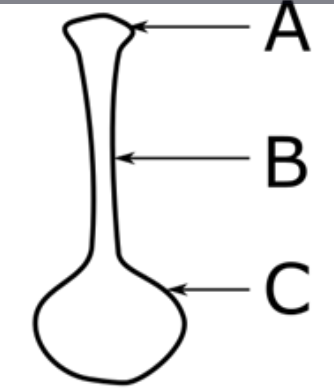
Identify the correct label for the following.

  1. AOption (a)

    A - Stigma; B - Style; C - Sepal

  2. BOption (b)

    A - Stigma; B - Style; C - Ovary

  3. COption (c)

    A - Anther; B - Style; C - Ovary

  4. DOption (d)

    A - Anther; B - Filament; C - Ovary

View answer & explanation

Correct answer

Answer: (b)B.

A - Stigma; B - Style; C - Ovary

Why this answer is correct

The correct answer is A - Stigma; B - Style; C - Ovary.

Key Points

  • The structure in the image has a long, slender shape with a slight curve, which is characteristic of a style in a flower.
  • The style is the part of the flower that connects the stigma (where pollen is received) to the ovary (where seeds are formed).
  • Stigma is typically a smaller, more rounded structure at the top of the style.
  • Stigma is the topmost part of the female reproductive structure in a flower, where pollen is received and germinated.
  • Ovary is the enlarged part of the female reproductive structure at the base of the flower, where the ovules (future seeds) are housed.

Additional Information

  • Sepal are usually green, leaf-like structures that protect the flower bud before it blooms.
  • Anther is the part of the male reproductive structure in a flower that produces and releases pollen.
  • Filament is the long, thin stalk that supports the anther in the male reproductive structure of a flower.
  • The male reproductive organ in flowers is called the stamen, or androecium.
  • It is made up of stamens.
  • Stamens create pollen in terminal sac-like structures called anthers.
  • Normally, the anthers are located near the end of the stamen, which is a long, thin stalk.

Question 4

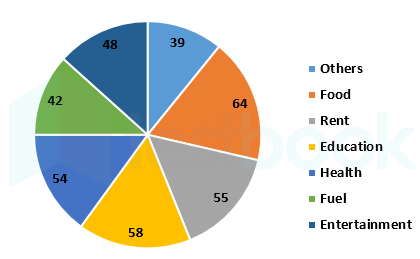
The given circle graph shows the monthly budget of a middle-class family in the form of a central angle (in degrees). Study the circle graph and answer the question.

If the amount spent on food and education during a month was Rs 15000, then what was the total approximate amount spent in that month?

  1. AOption (a)

    ₹30,500

  2. BOption (b)

    ₹45,000

  3. COption (c)

    ₹44,250

  4. DOption (d)

    ₹48,000

View answer & explanation

Correct answer

Answer: (c)C.

₹44,250

Why this answer is correct

Calculation

The total approximate amount spent in that month = 360º

The amount spent on food and education during a month = 58 + 64 = 122º

122º → 15000

360 º → 15000/122 × 360 = 44250

The answer is 44250.

Question 5

The Nabakalebara festival is observed at the Jagannath Temple, Odisha. In this festival, new idols are made from neem logs and are replaced during the ______.

  1. AOption (a)

    Adhik Masa

  2. BOption (b)

    Paryushana

  3. COption (c)

    Dasveh Patshah

  4. DOption (d)

    Maun Agiyaras

View answer & explanation

Correct answer

Answer: (a)A.

Adhik Masa

Why this answer is correct

The correct answer is Adhik Masa.

Key Points

  • Nabakalebara is a festival observed at the Jagannath Temple in Puri, Odisha.
  • During this festival, the old idols of Lord Jagannath, Balabhadra, and Subhadra are replaced with new ones.
  • The new idols are made from neem logs and are known as Daru Brahma.
  • The festival is held once in every 12-19 years when an extra month (Adhik Masa) is added to the Hindu calendar.
  • The last Nabakalebara festival was held in 2015.

Additional Information

  • Paryushana is a Jain festival that is observed to purify the soul through self-discipline and fasting. 
  • According to the Hindi calendar, it is normally observed in August or September.
  • Dasveh Patshah refers to the ten Sikh gurus and their teachings.
  • It is celebrated by Sikhs all over the world.
  • The Sikhs celebrate this day on January 31st of each year.
  • Maun Agiyaras is a Hindu festival in Gujarat where people observe a day of silence and fasting to seek blessings from Lord Krishna.
  • ​It occurs on the eleventh day of the Magshar month.

Question 6

The common root of the quadratic equations 2x2 - 5x - 3 = 0 and x2 + x - 12 = 0 is:

  1. AOption (a)

    −12-\frac{1}{2}

  2. BOption (b)

    -4

  3. COption (c)

    2

  4. DOption (d)

    3

View answer & explanation

Correct answer

Answer: (d)D.

3

Why this answer is correct

Shortcut Trick Identify the roots of the simpler quadratic equation x2 + x − 12 = 0. The factors of −12 that add up to 1 are 4 and −3, so the roots are 3 and −4. Test x = 3 in the first equation: 2(3)2 − 5(3) − 3 = 18 − 15 − 3 = 0. Since x = 3 satisfies both equations, it is the common root. ∴ The correct answer is 3.

Alternate Method Given: Two quadratic equations 2x2 − 5x − 3 = 0 and x2 + x − 12 = 0. Method: Solve both equations using the factorization method to find their respective roots. For the first equation 2x2 − 5x − 3 = 0: ⇒ 2x2 − 6x + x − 3 = 0 ⇒ 2x(x − 3) + 1(x − 3) = 0 ⇒ (x − 3)(2x + 1) = 0 ⇒ x = 3 or x = −1/2 For the second equation x2 + x − 12 = 0: ⇒ x2 + 4x − 3x − 12 = 0 ⇒ x(x + 4) − 3(x + 4) = 0 ⇒ (x − 3)(x + 4) = 0 ⇒ x = 3 or x = −4 By comparing the roots of both equations, we find that the common root is 3. ∴ The correct answer is 3.

Additional Information Condition for One Common Root For equations a1x2 + b1x + c1 = 0 and a2x2 + b2x + c2 = 0, the condition for one common root is (c1a2 − c2a1)2 = (a1b2 − a2b1)(b1c2 − b2c1). Nature of Roots The nature of roots is determined by the discriminant D = b2 − 4ac. If D > 0, roots are real and distinct; if D = 0, roots are real and equal; if D < 0, roots are imaginary. Sum and Product of Roots For a quadratic equation ax2 + bx + c = 0, the Sum of roots (α + β) = −b/a and the Product of roots (αβ) = c/a.

Question 7

'Hind Swaraj' the title of the first definitive writing of which freedom fighter is still generating critical interest around the world?

  1. AOption (a)

    Jawaharlal Nehru

  2. BOption (b)

    Lala Lajpat Rai

  3. COption (c)

    Dadabhai Naoroji

  4. DOption (d)

    Mahatma Gandhi

View answer & explanation

Correct answer

Answer: (d)D.

Mahatma Gandhi

Why this answer is correct

The correct answer is Mahatma Gandhi.

Key Points

  • Hind Swaraj is a book written by Gandhi in 1909, which lays out his vision of Swaraj or self-rule for India.
  • The book is written in the form of a dialogue between a reader and the author and covers topics such as non-violent resistance, the role of the state, and the need for moral regeneration of the people.
  • In the book, Gandhi declares his allegiance to the greater purposes of empire, but he rejects European culture.

Additional Information

  • Jawaharlal Nehru was a freedom fighter and the first Prime Minister of India.
  • 'The Discovery of India' is the book he wrote.
  • Lala Lajpat Rai was a prominent Indian nationalist leader and a contemporary of Gandhi.
  • Lala Lajpat Rai wrote two books: "England's Debt to India" and "The Arya Samaj."
  • Dadabhai Naoroji was a Parsi scholar and nationalist who was the first Indian to be elected to the British Parliament.
  • He wrote Poverty and Un-British Rule in India.

Question 8

Which of the following measures is/are likely to be adopted by RBI to combat inflation?

A) Increase CRR.

(B) Increase Repo Rate.

  1. AOption (a)

    Both A and B

  2. BOption (b)

    Only A

  3. COption (c)

    Only B

  4. DOption (d)

    Neither A nor B

View answer & explanation

Correct answer

Answer: (a)A.

Both A and B

Why this answer is correct

The correct answer is Both A and B.

Key Points

  • Increase CRR:
  • This is a measure to reduce the liquidity in the market by increasing the percentage of deposits that banks have to keep with the RBI.
  • This reduces the amount of money available for lending and thereby reduces inflationary pressure.
  • Increase Repo Rate:
  • This is a measure to increase the cost of borrowing for banks, which in turn increases the cost of lending for customers.
  • This reduces the demand for loans and thereby reduces inflationary pressure.
  • CRR stands for Cash Reserve Ratio, which is the percentage of deposits that banks have to keep with the RBI.
  • Repo Rate is the rate at which the RBI lends money to commercial banks for short periods.

Additional Information

  • Other measures that RBI may adopt to combat inflation include:
  • Open market operations:
  • ​RBI can sell government securities in the open market to reduce the money supply in the economy.
  • Increase in bank rate:
  • ​This is the rate at which RBI lends to commercial banks.
  • An increase in this rate increases the cost of borrowing for banks and reduces the money supply in the economy.
  • Fiscal measures:
  • ​The government can increase taxes or reduce spending to reduce the demand for goods and services, thereby reducing inflationary pressure.

Question 9

Transparency International has released the Corruption Perceptions Index (CPI) 2021.

What is the rank of India in this index?

  1. AOption (a)

    85th

  2. BOption (b)

    86th

  3. COption (c)

    83rd

  4. DOption (d)

    84th

View answer & explanation

Correct answer

Answer: (a)A.

85th

Why this answer is correct

The correct answer is 85th.

Key Points

  • India has been ranked 85th in the Corruption Perceptions Index (CPI) 2021.
  • CPI is an annual survey conducted by Transparency International that ranks countries based on their perceived levels of public sector corruption.
  • The index ranks countries on a scale of 0 to 100, with 0 being highly corrupt and 100 being very clean.
  • The rankings are based on expert assessments and surveys of business people conducted by various organizations.
  • The CPI is widely used by governments, NGOs, and businesses to assess the level of corruption in different countries and to formulate anti-corruption policies.

Additional Information

  • In the 2022 Corruption Perceptions Index, India was ranked 40 out of 180 nations by Transparency International.
  • "Abuse of entrusted power for private gain" is the general definition of corruption according to the CPI.
  • Transparency International, a non-governmental organization, has been publishing the index every year since 1995.

Question 10

Which of the following statements is INCORRECT with regard to forests?

  1. AOption (a)

    They conserve water

  2. BOption (b)

    They do not conserve soil

  3. COption (c)

    They provide variety of products

  4. DOption (d)

    They sustain huge diversity of flora and fauna

View answer & explanation

Correct answer

Answer: (b)B.

They do not conserve soil

Why this answer is correct

The correct answer is They do not conserve soil.

Key Points

  • Forests play a crucial role in maintaining the ecological balance and providing various benefits to humans as well as other living beings.
  • Soil conservation:
  • Forests protect the soil from erosion caused by wind and water.
  • The roots of trees hold the soil together and prevent it from getting washed away during heavy rains or floods.
  • Forests also help in maintaining soil fertility by adding organic matter to it.

Additional Information

  • Some of the key points explaining the importance of forests are as follows:
  • Water conservation:
  • Forests act as natural water reservoirs and help in regulating the water cycle.
  • They absorb rainfall, prevent soil erosion, and recharge groundwater.
  • This, in turn, helps in maintaining the water level in rivers, lakes, and other water bodies.
  • Variety of products:
  • Forests provide a wide range of products such as timber, fruits, nuts, medicinal plants, and other non-timber forest products.
  • These products are used for various purposes such as construction, furniture making, food, and medicine.
  • Biodiversity conservation:
  • Forests are home to a diverse range of flora and fauna.
  • They provide a habitat for numerous species of animals, birds, insects, and microorganisms.
  • Forests also help in maintaining the genetic diversity of plant species.

Question 11

What is the name of the new Water Management and Policy Centre that was inaugurated by the Principal Scientific Adviser to the Government of India, Prof. K. VijayRaghavan in March 2022?

  1. AOption (a)

    HydroMAP

  2. BOption (b)

    AquaMAP

  3. COption (c)

    WetMAP

  4. DOption (d)

    WaterMAP

View answer & explanation

Correct answer

Answer: (b)B.

AquaMAP

Why this answer is correct

The correct answer is AquaMAP.

Key Points

  • AquaMAP is the name of the new Water Management and Policy Centre that was recently inaugurated in India by Prof. K. VijayRaghavan, the Principal Scientific Adviser to the Government of India.
  • The centre aims to work towards the sustainable management of water resources in the country and develop policies and strategies to address water-related challenges.
  • The centre will also focus on research, capacity building, and collaboration with stakeholders to promote water conservation, reuse, and recycling.
  • The inauguration of AquaMAP is a significant step towards achieving the United Nations' Sustainable Development Goal 6, which aims to ensure availability and sustainable management of water and sanitation for all.

Additional Information

  • Water management refers to the regulation and distribution of water resources with the aim of minimizing harm to individuals and property while optimizing their useful life.
  • Rainwater collection is the main method used by the Water Management program to augment groundwater and restore depleted subterranean aquifers.
  • Droughts and abuse are making water, a once-abundant natural resource, a more valuable commodity.

Question 12

Name the compound precipitated when the solutions of lead(II) nitrate and potassium iodide are mixed:

  1. AOption (a)

    Lead iodide

  2. BOption (b)

    Potassium oxide

  3. COption (c)

    Potassium sulphate

  4. DOption (d)

    Lead oxide

View answer & explanation

Correct answer

Answer: (a)A.

Lead iodide

Why this answer is correct

The correct answer is Lead iodide.

Key Points

  • Lead iodide is a yellow precipitate formed when the solutions of lead(II) nitrate and potassium iodide are mixed.
  • Lead iodide is an ionic compound consisting of lead cation (Pb2+) and iodide anion (I-).
  • It burns with a green flame and is a good oxidizing agent.
  • It is extensively utilized in seed clouds, printing, and photography.

Additional Information

  • Potassium oxide (K2O) is a basic oxide formed by the reaction of potassium with oxygen.
  • It is a white solid with a high melting point.
  • Potassium sulphate (K2SO4) is a salt that is commonly used as a fertilizer.
  • It is formed by the reaction of potassium hydroxide and sulfuric acid.
  • Lead oxide (PbO) is a basic oxide formed by the reaction of lead with oxygen.
  • It is a yellow or red solid with a high melting point.

Question 13

How many oxygen atoms are present in one molecule of ozone?

  1. AOption (a)

    1

  2. BOption (b)

    2

  3. COption (c)

    3

  4. DOption (d)

    4

View answer & explanation

Correct answer

Answer: (c)C.

3

Why this answer is correct

The correct answer is 3.

Key Points

  • Ozone is a molecule made up of three oxygen atoms.
  • It smells very strongly and is a light blue gas.
  • It is an oxygen allotrope that breaks down to O2 in the lower atmosphere and is far less stable than the diatomic allotrope O2.

Additional Information

  • 2 oxygen atoms is the number of oxygen atoms in a molecule of oxygen gas (O2).
  • 4 oxygen atoms is the number of oxygen atoms in a molecule of tetraoxygen (O4), which is an unstable allotrope of oxygen.
  • Oxygen's atomic number is eight and its symbol is O. 
  • According to the periodic table, it belongs to the chalcogen group.
  • It is a nonmetal that is quite reactive.
  • It is an oxidizing agent that easily creates oxides with the majority of elements and other substances.

Question 14

Three wires, A, B and C, of the same length and the same thickness have resistances of 0.5 Ω, 0.2 Ω and 1.0 Ω, respectively. Their resistivities are ______.

  1. AOption (a)

    in the ratio of 2 ∶ 5 ∶ 10

  2. BOption (b)

    in the ratio of 5 ∶ 2 ∶ 10

  3. COption (c)

    in the ratio of 10 ∶ 5 ∶ 2

  4. DOption (d)

    equal

View answer & explanation

Correct answer

Answer: (b)B.

in the ratio of 5 ∶ 2 ∶ 10

Why this answer is correct

The correct answer is in the ratio of 5 ∶ 2 ∶ 10.

Key Points

  • The resistivity of a material is defined as the resistance of a unit length of the material having unit cross-sectional area.
  • Therefore, resistivity is directly proportional to resistance and inversely proportional to the length of the wire.
  • The given wires are of the same length and thickness, but their resistances are different.
  • This means that their resistivities are different as well.
  • To find the ratio of their resistivities, we can use the formula: Resistance = (Resistivity x Length) / Cross-sectional area.
  • Since the length and cross-sectional area are the same for all wires, we can directly compare their resistances to find the ratio of their resistivities.
  • From the given resistances, we can see that wire B has the lowest resistance, which means it has the highest conductivity and lowest resistivity.
  • Therefore, "in the ratio of 5:2:10" is the correct answer as it correctly represents the increasing order of resistivity of wires A, B, and C.

Additional Information

  • Resistivity is a fundamental property of a material that determines its ability to conduct electricity.
  • It is denoted by the Greek letter rho and its unit is ohm-meter.
  • The resistivity of a material depends on various factors such as temperature, impurities, and crystal structure.
  • Metals have low resistivity and are good conductors of electricity, while insulators have high resistivity and are poor conductors of electricity.
  • The resistance of a wire also depends on its length and cross-sectional area, in addition to its resistivity.
  • The longer the wire, the higher its resistance, and the wider the wire, the lower its resistance.
  • In general, the resistance of a wire can be reduced by increasing its thickness or by using a material with higher conductivity (lower resistivity).
  • This is why copper wires are commonly used in electrical wiring as they have low resistivity and are relatively inexpensive.

Question 15

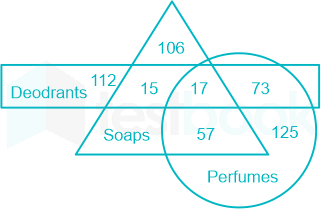
Study the following diagram and answer the question given below. The rectangle represents deodorants, the triangle represents Soaps, and the circle represents Perfumes.

How many perfumes are deodorants but not soaps?

  1. AOption (a)

    73

  2. BOption (b)

    112

  3. COption (c)

    15

  4. DOption (d)

    17

View answer & explanation

Correct answer

Answer: (a)A.

73

Why this answer is correct

According to the given Venn diagram:

The shaded area shows the "total number of perfumes are deodorants but not soaps".

So, the total number of 'perfumes are deodorants but not soaps' = 73.

Hence, the correct answer is "Option 1".

Question 16

A cistern has three pipes A, B and C. A and B alone can completely fill the cistern in 4 hours and 3 hours, respectively, and C can empty the completely filled cistern in 2 hours. If all the three pipes are opened simultaneously in the empty cistern, then the cistern will get completely full in:

  1. AOption (a)

    14 hours

  2. BOption (b)

    12 hours

  3. COption (c)

    16 hours

  4. DOption (d)

    10 hours

View answer & explanation

Correct answer

Answer: (b)B.

12 hours

Why this answer is correct

Shortcut Trick

Net efficiency = Efficiency of A + Efficiency of B − Efficiency of C.

Total work (LCM of 4, 3, 2) = 12 units.

Net efficiency = (12÷4) + (12÷3) − (12÷2) = 3 + 4 − 6 = 1 unit/hr.

Time taken = Total work ÷ Net efficiency = 12 ÷ 1 = 12 hours.

∴ The correct answer is 12 hr.

Alternate Method

Given: Pipe A fills in 4 hr, Pipe B fills in 3 hr, and Pipe C empties in 2 hr.

Formula Used: Total Work = LCM of time taken; Efficiency = Work ÷ Time.

PipeTime (hr)Total WorkEfficiency
A (Inlet)4123
B (Inlet)34
C (Outlet)2−6

⇒ Total efficiency when A, B, and C are open = 3 + 4 + (−6)

⇒ Combined efficiency = 1 unit/hr

⇒ Time to fill the cistern = Total Work ÷ Combined efficiency

⇒ Time = 12 ÷ 1 = 12 hr

∴ The correct answer is 12 hr.

Additional Information

Inlet and Outlet Pipes

An Inlet pipe fills the tank (positive efficiency), while an Outlet pipe (or leak) empties the tank (negative efficiency).

Pipes & Cisterns Formula

If two pipes fill a tank in x and y hours and a third empties it in z hours, the net work done in 1 hour is (1/x + 1/y − 1/z).

Negative Work Concept

In problems involving emptying pipes, the work done by the emptying pipe is considered negative work during the calculation of net efficiency.

Question 17

In September 2021 which state government among the following organized rural sports events in 75 of its districts?

  1. AOption (a)

    Uttar Pradesh

  2. BOption (b)

    Karnataka

  3. COption (c)

    Rajasthan

  4. DOption (d)

    Madhya Pradesh

View answer & explanation

Correct answer

Answer: (a)A.

Uttar Pradesh

Why this answer is correct

The correct answer is Uttar Pradesh.

Key Points

  • Uttar Pradesh is a state in northern India with Lucknow as its capital city.
  • The state government of Uttar Pradesh organized rural sports events in 75 of its districts in September 2021 to promote sports and physical activities in rural areas.
  • The event was called 'Gramin Khel Mahotsav' and had various sports activities like kabaddi, volleyball, and athletics.
  • The initiative aimed to identify and promote local talent in sports and provide them with opportunities to showcase their skills at the national and international levels.

Additional Information

  • Karnataka is a state in southwest India with Bengaluru as its capital city.
  • Rajasthan is a state in northwest India with Jaipur as its capital city.
  • Madhya Pradesh is a state in central India with Bhopal as its capital city.
  • At the ripe age of 43, India's seasoned tennis player Rohan Bopanna achieved his career-high rating of world No. 1 on January 24, 2024.
  • After dominating his way into the men's doubles semifinals at the Australian Open 2024 with partner Matthew Ebden, Bopanna reached his landmark.

Question 18

Which of the following statements is INCORRECT regarding the process of excretion in plants?

  1. AOption (a)

    Waste products may be stored as resins and gums in old xylem.

  2. BOption (b)

    Waste products may be stored in leaves that fall off.

  3. COption (c)

    Waste product of photosynthesis is stored as starch.

  4. DOption (d)

    Waste products are stored in cellular vacuoles.

View answer & explanation

Correct answer

Answer: (c)C.

Waste product of photosynthesis is stored as starch.

Why this answer is correct

The correct answer is Waste product of photosynthesis is stored as starch.

Key Points

  • The process of excretion in plants involves the removal of waste products that are produced during various metabolic activities.
  • "Waste product of photosynthesis is stored as starch." statement is incorrect.
  • The waste product of photosynthesis is oxygen, while the excess glucose produced during the process is stored as starch.

Additional Information 

  • Resins and gums are waste products that are stored in the old xylem of some plants.
  • These substances are often used for defense against predators or as a means of sealing wounds.
  • Some plants store waste products in the leaves that fall off during the autumn season.
  • This helps to conserve resources and maintain the overall health of the plant.
  • Cellular vacuoles are storage spaces in plants that can store various waste products, such as excess salts, pigments, and metabolic byproducts.
  • These vacuoles also play a crucial role in maintaining turgor pressure and regulating the pH of the cell.

Question 19

Raghav starts from Point A and drives 25 km towards the north. He then takes a right turn, drives 19 km, turns right and drives 40 km. He then takes a right turn and drives 30 km. He takes a final right turn, drives 15 km and stops at Point P. How far and towards which direction should he drive in order to reach Point A from Point P in a straight line? (All turns are 90 degree turns only)

  1. AOption (a)

    13 km towards the east

  2. BOption (b)

    7 km towards the north

  3. COption (c)

    15 km towards the west

  4. DOption (d)

    11 km towards the east

View answer & explanation

Correct answer

Answer: (d)D.

11 km towards the east

Why this answer is correct

Given: 

Raghav starts from Point A and drives 25 km towards the north.

He then takes a right turn, drives 19 km, turns right and drives 40 km.

He then takes a right turn and drives 30 km.

He takes a final right turn, drives 15 km and stops at Point P.

Here, Raghav should drive '11 km towards the east' to reach Point A from Point P in a straight line.

Hence, the correct answer is "Option 4".

Question 20

Which of the following options is the closest approximate value which will come in place of question mark(?) in the following equation?

2.34 + 6.01 - (3.86 ÷ 1.91) + 2.01 × 4.02 = ?

  1. AOption (a)

    86

  2. BOption (b)

    14

  3. COption (c)

    22

  4. DOption (d)

    54

View answer & explanation

Correct answer

Answer: (b)B.

14

Why this answer is correct

Calculation

2.34 + 6.01 - (3.86 ÷ 1.91) + 2.01 × 4.02 = ?

⇒ 2 + 6 - 2 + 2 × 4

⇒ 2 + 6 - 2 + 8

⇒ 8 + 6

= 14

The answer is 14.

Question 21

A/an ______ is a draft of a proposed legislative law.

  1. AOption (a)

    Article

  2. BOption (b)

    Budget

  3. COption (c)

    Writ

  4. DOption (d)

    Bill

View answer & explanation

Correct answer

Answer: (d)D.

Bill

Why this answer is correct

The correct answer is Bill.

Key Points

  • A bill is a draft of a proposed legislative law that is presented for consideration to a legislative body.
  • A bill cannot become a law until it has been authorized by the government and passed by the legislature.
  • Once a bill has been enacted into law by the legislature, it is called an act of the legislature, or a statute.
  • In the legislature, bills are brought forth, discussed, and put to a vote.

Additional Information

  • Article refers to a section or provision in a legal document, such as a constitution or treaty.
  • It is an independent, stand-alone segment that is sometimes broken up into sections of a written document, like a contract, statute, or constitution.
  • Budget refers to a financial plan that outlines expected income and expenses.
  • The operational or current budget, the capital or investment budget, and the cash or cash flow budget are the three different categories of government budgets.
  • Writ refers to a legal order issued by a court, typically to compel someone to do or not do something.
  • In the event that any of our fundamental rights are violated, we have the option to file a writ petition in the Indian High Court or Supreme Court.

Question 22

The triad of group 2 metals consists of which of the following elements?

  1. AOption (a)

    S, N, O

  2. BOption (b)

    Ca, Sr, Ba

  3. COption (c)

    C, Ca, Cu

  4. DOption (d)

    F, Cl, I

View answer & explanation

Correct answer

Answer: (b)B.

Ca, Sr, Ba

Why this answer is correct

The correct answer is Ca, Sr, Ba.

Key Points

  • Group 2 metals are also known as alkaline earth metals and are located in the second column of the periodic table.
  • The triad of group 2 metals is a group of three elements that have similar properties and are located in the same row of the periodic table.
  • The triad of group 2 metals consists of the elements with atomic numbers 12 (Ca), 38 (Sr), and 56 (Ba).
  • These elements are all metals, have a shiny appearance, and are reactive with water and acids.

Additional Information

  • Sulfur (S), nitrogen (N), and oxygen (O) are nonmetals and are located in the p-block of the periodic table.
  • Carbon (C) is a nonmetal and is located in the p-block of the periodic table.
  • Copper (Cu) is a transition metal and is located in the d-block of the periodic table.
  • Fluorine (F), chlorine (Cl), and iodine (I) are halogens and have different physical and chemical properties than the group 2 metals.

Question 23

The measure of responsiveness of the demand for Tea towards the change in the price of Coffee in the market is an example of ________.

  1. AOption (a)

    Cross Elasticity of Demand

  2. BOption (b)

    Composite Demand

  3. COption (c)

    Indirect Demand

  4. DOption (d)

    Direct Demand

View answer & explanation

Correct answer

Answer: (a)A.

Cross Elasticity of Demand

Why this answer is correct

The correct answer is Cross Elasticity of Demand.

Key Points

  • Cross Elasticity of Demand is a measure that determines how the demand for one product changes in response to a change in the price of a different product.
  • It is calculated by dividing the percentage change in the quantity demanded of one product by the percentage change in the price of another product.
  • Therefore, the measure of responsiveness of the demand for Tea towards the change in the price of Coffee in the market is an example of Cross Elasticity of Demand.

Additional Information

  • Composite Demand refers to the demand for a product that is used in conjunction with another product.
  • For example, the demand for petrol is a composite demand as it is used in conjunction with automobiles.
  • Indirect Demand refers to the demand for a product that is derived from the demand of another product.
  • For example, the demand for car tires is an indirect demand as it is derived from the demand for automobiles.
  • Direct Demand refers to the demand for a product that is not related to the demand for any other product.

Question 24

The values of potential drops across, and corresponding currents in, a resistor are given in the following table. If the resistor obeys Ohm's law, then the values of X and Y are respectively:

V (in volts)0.81.6X3.24.04.85.66.47.27.2
I (in amperes)0.20.40.60.81.0Y1.41.61.82.0
  1. AOption (a)

    1.1 and 0.3

  2. BOption (b)

    0.3 and 1.1

  3. COption (c)

    0.3 and 1.2

  4. DOption (d)

    2.4 and 1.2

View answer & explanation

Correct answer

Answer: (d)D.

2.4 and 1.2

Why this answer is correct

The correct answer is 2.4 and 1.2.

Key Points

  • Ohm's law states that the current through a conductor between two points is directly proportional to the voltage across the two points.
  • This means that the ratio of voltage to current remains constant, which is the resistance of the conductor.
  • To find the value of X and Y, we have to calculate the constant value of Resistance.
  • By taking first column, R = 0.8/0.2 = 4 ohm
  • As we know that, V=IR,
  • X=0.6 X 4 = 2.4, similarly
  • Y = 4.8 / 4 = 1.2
  • Therefore, the values of X and Y are 2.4 ohm and 1.2 ohm, respectively.

Additional Information

  • The pressure from the power source of an electrical circuit that forces charged electrons (current) through a conducting loop and gives them the ability to work is known as voltage.
  • Current is a flow of electrons or electron-deficient atoms.
  • The ampere, A, is the standard unit.
  • The amount of obstruction to current passage in an electrical circuit is measured as resistance.
  • Ohms is the unit of measurement for resistance.

Question 25

Which of the following cellular components are known as the protein factories of a cell?

  1. AOption (a)

    Mitochondria

  2. BOption (b)

    Golgi bodies

  3. COption (c)

    Ribosomes

  4. DOption (d)

    Chloroplasts

View answer & explanation

Correct answer

Answer: (c)C.

Ribosomes

Why this answer is correct

The correct answer is Ribosomes.

Key Points

  • Ribosomes are known as the protein factories of a cell, as they are responsible for protein synthesis.
  • They are present in both prokaryotic and eukaryotic cells, and can be found in the cytoplasm or attached to the endoplasmic reticulum.
  • Ribosomes are composed of two subunits, a large and small subunit, that work together to read the genetic code and assemble amino acids into proteins.

Additional Information

  • Mitochondria is known as the powerhouse of the cell.
  • It is responsible for producing energy in the form of ATP.
  • Golgi bodies are responsible for modifying, sorting, and packaging proteins and lipids for transport to their final destination.
  • Chloroplasts is present in plant cells.
  • It is responsible for photosynthesis and the production of glucose.

Question 26

The value of (xaxb)c×(xbxc)a×(xcxa)b\left(\frac{x^a}{x^b}\right)^c \times\left(\frac{x^b}{x^c}\right)^a \times\left(\frac{x^c}{x^a}\right)^b is:

  1. AOption (a)

    0

  2. BOption (b)

    3

  3. COption (c)

    1

  4. DOption (d)

    2

View answer & explanation

Correct answer

Answer: (c)C.

1

Why this answer is correct

Given:

(xaxb)c×(xbxc)a×(xcxa)b\left(\frac{x^a}{x^b}\right)^c \times\left(\frac{x^b}{x^c}\right)^a \times\left(\frac{x^c}{x^a}\right)^b

Calculation:

(xaxb)c×(xbxc)a×(xcxa)b\left(\frac{x^a}{x^b}\right)^c \times\left(\frac{x^b}{x^c}\right)^a \times\left(\frac{x^c}{x^a}\right)^b

(xacxbc)×(xbaxca)×(xcbxab)\left(\frac{x^{ac}}{x^{bc}}\right) \times\left(\frac{x^{ba}}{x^{ca}}\right) \times\left(\frac{x^{cb}}{x^{ab}}\right)

xab+bc+caxab+bc+ca\frac{x^{ab+bc +ca}}{x^{ab+bc +ca}}

1

∴ Option 3 is the correct answer.

Question 27

Which of the following universities won the Maulana Abul Kalam Azad (MAKA) Trophy 2021?

  1. AOption (a)

    Panjab University

  2. BOption (b)

    Kurukshetra University

  3. COption (c)

    Chaudhary Devi Lal University

  4. DOption (d)

    Guru Jambheshwar University of Science and Technology

View answer & explanation

Correct answer

Answer: (a)A.

Panjab University

Why this answer is correct

The correct answer is Panjab University.

Key Points

  • The Maulana Abul Kalam Azad (MAKA) Trophy is awarded to the overall best-performing university in inter-university tournaments in India.
  • Panjab University has won this prestigious award a record 14 times, including the latest win in 2021.
  • Panjab University has a rich history and is one of the oldest universities in India, established in 1882.
  • It is located in the city of Chandigarh and offers a wide range of undergraduate, postgraduate, and research programs in various fields of study.

Additional Information

  • The Maulana Abul Kalam Azad Trophy bears Abul Kalam Azad's name.
  • Every year, the Ministry of Youth Affairs and Sports bestows this honor.
  • As of 2020, the trophy, which was first given out in 1956–1957, had been given out 64 times.
  • The award has been won by six universities at different periods.
  • The trophy has been won 24 times by Guru Nanak Dev University in Amritsar, the most recent victory coming in 2023.
  • While Delhi University, located in Delhi, has won the trophy 14 times, most recently in the years 2000–2001, Panjab University, located in Chandigarh, has won it 15 times, the most recent being in 2020.
  • Kurukshetra University in Kurukshetra, Punjabi University in Patiala, and Bombay University in Mumbai—which took home the inaugural trophy—are among the other winners.

Question 28

(cosec⁡θ−sin⁡θ)(sec⁡θ−cos⁡θ)(tan⁡θ+cot⁡θ)cos⁡θ(sec⁡θ−tan⁡θ)2(sec⁡θ+tan⁡θ)=11−k,0∘<θ<90∘\frac{(\operatorname{cosec} θ-\sin θ)(\sec θ-\cos θ)(\tan θ+\cot θ)}{\cos θ(\sec θ-\tan θ)^2(\sec θ+\tan θ)}=\frac{1}{1-\mathrm{k}}, 0^{\circ}<θ<90^{\circ}, then k = ?

  1. AOption (a)

    sec θ

  2. BOption (b)

    sin θ

  3. COption (c)

    cot θ

  4. DOption (d)

    cos θ

View answer & explanation

Correct answer

Answer: (b)B.

sin θ

Why this answer is correct

Shortcut Trick

Put θ = 45° to find the value of k quickly.

Numerator = (√2 − 1/√2)(√2 − 1/√2)(1 + 1) = (1/√2)(1/√2)(2) = 1.

Denominator = (1/√2)(√2 − 1)2(√2 + 1) = (1/√2)(√2 − 1)(√2 − 1)(√2 + 1) = (1/√2)(√2 − 1)(2 − 1) = (1/√2)(√2 − 1) = 1 − 1/√2.

LHS = 1 / (1 − 1/√2). Given LHS = 1 / (1 − k), so k = 1/√2. At 45°, sin θ = 1/√2.

∴ The correct answer is sin θ.

Alternate Method

Given: Equation involving trigonometric ratios to find the variable k.

Formula Used: (cosec θ − sin θ) = cos2θ/sin θ; (sec θ − cos θ) = sin2θ/cos θ; (tan θ + cot θ) = 1/(sin θ cos θ); (sec2θ − tan2θ) = 1.

⇒ Numerator = (cos2θ/sin θ) × (sin2θ/cos θ) × (1/sin θ cos θ) = 1.

⇒ Denominator = cos θ × (sec θ − tan θ) × (sec θ − tan θ)(sec θ + tan θ).

⇒ Since (sec θ − tan θ)(sec θ + tan θ) = 1, Denominator = cos θ × (sec θ − tan θ).

⇒ Denominator = cos θ × (1/cos θ − sin θ/cos θ) = cos θ × [(1 − sin θ)/cos θ] = 1 − sin θ.

⇒ LHS = 1 / (1 − sin θ). Comparing with 1 / (1 − k), we get k = sin θ.

∴ The correct answer is sin θ.

Additional Information

Reciprocal Identities

cosec θ = 1/sin θ, sec θ = 1/cos θ, and cot θ = 1/tan θ.

Pythagorean Identities

sin2θ + cos2θ = 1, 1 + tan2θ = sec2θ, and 1 + cot2θ = cosec2θ.

Algebraic Application

The identity (a − b)(a + b) = a2 − b2 is frequently used to simplify terms like (sec θ − tan θ)(sec θ + tan θ).

Question 29

The total number of isomers of butane and pentane, respectively, are:

  1. AOption (a)

    2 ,4

  2. BOption (b)

    3, 4

  3. COption (c)

    2, 3

  4. DOption (d)

    3, 3

View answer & explanation

Correct answer

Answer: (c)C.

2, 3

Why this answer is correct

The correct answer is 2,3.

Key Points

  • Compounds with the same chemical formula but distinct structural properties are referred to as isomers.
  • The total number of isomers of butane is 2.
  • Butane has only two isomers, n-butane and isobutane.
  • The total number of isomers of pentane is 3.
  • Pentane has three isomers, n-pentane, isopentane, and neopentane.

Additional Information

  • Hydrocarbon-based butane is a highly flammable, colorless, odorless, and readily liquefiable gas.
  • Usually, it is used as fuel for portable stoves and cigarette lighters.
  • In addition, it finds application as a refrigerant, heating fuel, propellant in aerosols, and in numerous other manufacturing processes.
  • Pentane is a transparent, colorless liquid that is an organic compound.
  • Pentane has a smell that is reminiscent of petroleum.
  • It is insoluble in water and has a lower density than water.

Question 30

In a certain code language, 'I like holidays' is written as 'sf vg tu', 'summer holidays started' is written as 'nj tu mk' and 'I hate summer' is written as 'sf io nj'. What is the code for the word 'summer' in that language?

  1. AOption (a)

    Io

  2. BOption (b)

    nj

  3. COption (c)

    vg

  4. DOption (d)

    tu

View answer & explanation

Correct answer

Answer: (b)B.

nj

Why this answer is correct

Given:

'I like holidays' is written as 'sf vg tu',

'summer holidays started' is written as 'nj tu mk',

'I hate summer' is written as 'sf io nj'.

Here, 'summer' will be written as 'nj'.

Hence, the correct answer is "Option 2".

Question 31

The total liability of the monetary authority of the country (Reserve Bank of India) is called the ________.

  1. AOption (a)

    Narrow and Broad Money

  2. BOption (b)

    Credit Reserve Ratio

  3. COption (c)

    Currency Deposit Reserve

  4. DOption (d)

    Base Money

View answer & explanation

Correct answer

Answer: (d)D.

Base Money

Why this answer is correct

The correct answer is Base Money.

Key Points

  • Base Money, also known as High-Powered Money, is the sum total of currency in circulation and reserves held by the banks with the central bank (Reserve Bank of India in this case).
  • It is the most liquid form of money that is used by the central bank to control the money supply in the economy.
  • The total amount of coins and banknotes in circulation as well as sight deposits kept at central banks on behalf of commercial banks make up base money.

Additional Information

  • Narrow and Broad Money are measures of the money supply in an economy.
  • Narrow Money includes cash, demand deposits, and other liquid assets, while Broad Money includes Narrow Money plus time deposits and other less liquid assets.
  • Credit Reserve Ratio is the percentage of deposits that banks are required to maintain with the central bank as reserves.
  • It is used by the central bank to control the lending capacity of commercial banks.
  • Currency Deposit Reserve is the amount of reserves that banks are required to maintain with the central bank against the deposits that they hold.
  • It is used to ensure the stability of the banking system.

Question 32

Read the given statement(s) and conclusions carefully and decide which of the conclusions logically follow(s) from the statement(s).

Statements:

T > R ≥ A >C = F ≤ I < L

Conclusions:

I. C < L

II R > I

  1. AOption (a)

    Only conclusion I follows

  2. BOption (b)

    Only conclusion II follows

  3. COption (c)

    Both conclusions I and II follow

  4. DOption (d)

    Either conclusion I or II follows

View answer & explanation

Correct answer

Answer: (a)A.

Only conclusion I follows

Why this answer is correct

Given Statement: T > R ≥ A > C = F ≤ I < L

Now,

Conclusions:

(i) C < L → True (C = F ≤ I < L it gives C < L)

(ii) R > I → False (R ≥ A > C = F ≤ I No relation can be established between R and I)

Here, Only conclusion I follows.

Hence, the correct answer is "Option 1".

Question 33

Which of the following devices does NOT use an electric motor?

Electric fan, Electric mixer, Galvanometer, Computer

  1. AOption (a)

    Galvanometer

  2. BOption (b)

    Electric mixer

  3. COption (c)

    Computer

  4. DOption (d)

    Electric fan

View answer & explanation

Correct answer

Answer: (a)A.

Galvanometer

Why this answer is correct

The correct answer is Galvanometer.

Key Points

  • A galvanometer is a device used to detect and measure small electric currents, but it does not use an electric motor to function.
  • An electric fan uses an electric motor to rotate its blades and create air movement.
  • An electric mixer uses an electric motor to turn its beaters or blades and mix ingredients.
  • A computer does not use an electric motor as its primary means of operation, but it may contain fans or other components that do.
  • An electric motor is a device that converts electrical energy into mechanical energy and is used in many different types of machines and devices.

Additional Information

  • Galvanometers are often used in scientific experiments to measure electrical currents in circuits and can also be found in some types of measuring instruments.
  • Electric fans come in a variety of sizes and styles, from small desk fans to large industrial fans used in factories and warehouses.
  • Electric mixers are commonly used in kitchens to mix and prepare ingredients for cooking and baking.
  • Computers rely on a variety of components to function, including processors, memory, storage devices, and input/output devices such as keyboards and monitors.
  • While these components may use electricity to operate, they do not typically rely on electric motors.

Question 34

When there are two houses of the legislature like India, it is called a _____ legislature.

  1. AOption (a)

    Bicameral

  2. BOption (b)

    Unicameral

  3. COption (c)

    Subordinate

  4. DOption (d)

    Supreme

View answer & explanation

Correct answer

Answer: (a)A.

Bicameral

Why this answer is correct

The correct answer is Bicameral.

Key Points

  • A bicameral legislature is one that has two separate chambers or houses of parliament, each with its own set of elected representatives.
  • India's parliament is a bicameral legislature, with the Rajya Sabha (Council of States) as the upper house and the Lok Sabha (House of the People) as the lower house.
  • The purpose of having two houses in a bicameral legislature is to provide a system of checks and balances, ensuring that no single house has too much power and that legislation is carefully considered and debated before being passed.

Additional Information

  • Unicameral legislatures, on the other hand, have only one house of parliament, which can sometimes lead to a lack of diverse perspectives and less thorough debate and scrutiny of proposed laws.
  • Unicameral legislatures are more common in smaller countries or those with a unitary system of government, where there is less need for multiple chambers to represent different regions or interest groups.
  • Some countries, such as the United States, have a bicameral legislature at the federal level but a unicameral legislature at the state level.
  • Subordinate legislatures, also known as subordinate authorities or subordinate parliaments, are those that have limited powers and are subject to the authority of a higher-level parliament or government.
  • Supreme legislatures, on the other hand, are those that have ultimate authority over all other branches of government and can overrule or veto any decisions made by lower bodies.
  • However, this type of system is rare and is usually associated with authoritarian regimes rather than democratic ones.

Question 35

Which of the following numbers will replace the question mark (?) in the given series?

17, 19, 23, 29, 37, ?

  1. AOption (a)

    45

  2. BOption (b)

    44

  3. COption (c)

    48

  4. DOption (d)

    47

View answer & explanation

Correct answer

Answer: (d)D.

47

Why this answer is correct

The logic followed here is:

So, '47' will replace the question mark in the given series.

Hence, the correct answer is "Option 4".

Question 36

A certain sum amounts to ₹98,494 at the rate of 15% per annum in 2 years, interest compounded 8-monthly. What will be the amount payable (in ₹) on the same sum at the same rate and in the same time, if the interest is compounded yearly?

  1. AOption (a)

    97,865

  2. BOption (b)

    97,685

  3. COption (c)

    96,578

  4. DOption (d)

    96,785

View answer & explanation

Correct answer

Answer: (a)A.

97,865

Why this answer is correct

Shortcut Trick

8-monthly rate = 15% × (8/12) = 10% | Periods = 24 / 8 = 3

For 10% and 3 periods, Ratio P : A = 103 : 113 = 1000 : 1331

1331 units = ₹98,494 ⇒ 1 unit = ₹74 ⇒ Principal = ₹74,000

For yearly compounding (15%, 2 years): Effective rate = 15 + 15 + (15×15)/100 = 32.25%

Amount = 74,000 × 1.3225 = ₹97,865

∴ The correct answer is ₹97,865.

Alternate Method

Given: Amount (A1) = ₹98,494, Rate (R) = 15% p.a., Time (T) = 2 years (24 months).

Formula Used: Amount (A) = P(1 + r/100)n

Step 1: Calculate Principal using 8-monthly compounding

⇒ Rate for 8 months (r) = 15 × (8 / 12) = 10%

⇒ Number of periods (n) = 24 / 8 = 3

⇒ 98,494 = P(1 + 10/100)3

⇒ 98,494 = P(1.1)3

⇒ 98,494 = P × 1.331

⇒ P = 98,494 / 1.331 = ₹74,000

Step 2: Calculate Amount with Yearly compounding

⇒ Principal (P) = ₹74,000, Rate (R) = 15%, Time (n) = 2 years

⇒ A = 74,000 × (1 + 15/100)2

⇒ A = 74,000 × (1.15)2

⇒ A = 74,000 × 1.3225

⇒ A = 74 × 1,322.5

⇒ A = ₹97,865

∴ The correct answer is ₹97,865.

Additional Information

Effective Interest Rate

When interest is compounded k times a year, the effective annual rate is (1 + r/k)k − 1, where r is the nominal annual rate.

Compound Interest Formula

The amount A is calculated as A = P(1 + r/100)n, where P is principal, r is rate per period, and n is the number of periods.

Successive Percentage Change

For two successive changes of x% and y%, the net change is [x + y + (xy/100)]%.

Question 37

Select the number from among the given options that can replace the question mark (?) in the following series.

1296, 6, 216, 36, 36, ?, 6

  1. AOption (a)

    144

  2. BOption (b)

    216

  3. COption (c)

    96

  4. DOption (d)

    48

View answer & explanation

Correct answer

Answer: (b)B.

216

Why this answer is correct

The logic followed here is:

So, '216' will replace the question mark in the given series.

Hence, the correct answer is "Option 2".

Question 38

Consider the following statements about magnetic field of a Bar Magnet

(a) It has magnitudes and directions both.

(b) Magnetic field lines are closed curves.

Which of the above statements is/are correct?

  1. AOption (a)

    Both (a) and (b)

  2. BOption (b)

    Neither (a) nor (b)

  3. COption (c)

    Only (a)

  4. DOption (d)

    Only (b)

View answer & explanation

Correct answer

Answer: (a)A.

Both (a) and (b)

Why this answer is correct

The correct answer is Both (a) and (b).

Key Points

  • Statement (a) is correct as the magnetic field of a bar magnet has both magnitude and direction.
  • Statement (b) is also correct as magnetic field lines are closed curves that emerge from the North pole and terminate at the South pole of a magnet.
  • The area in which the force of magnetism acts around a magnetic material or a moving electric charge is known as the magnetic field.
  • The strength and direction of the magnetic field are shown by imaginary lines known as magnetic field lines.

Additional Information

  • A rectangular portion of an object with persistent magnetic qualities that can be made of iron, steel, or any other ferromagnetic material or ferromagnetic composite is called a bar magnet.
  • It has two poles: a north and a south pole.
  • When the magnet is suspended freely, its two poles align such that the northern pole faces the earth's magnetic north pole.
  • At the poles, its magnetic pull is at its strongest.
  • The unlike poles of two bar magnets will attract one another while the like poles will repel one another when they are positioned close to one another.

Question 39

Refer to the following letter, number, symbol series and answer the question.

(Left) J * D 1 J 9 8 & Y W N P & 3 @ N L 2 E & H (Right)

How many such symbols are there which are immediately preceded by a letter and also immediately followed by a number?

  1. AOption (a)

    3

  2. BOption (b)

    2

  3. COption (c)

    1

  4. DOption (d)

    0

View answer & explanation

Correct answer

Answer: (c)C.

1

Why this answer is correct

Given: (Left) J * D 1 J 9 8 & Y W N P & 3 @ N L 2 E & H (Right)

Now,

Symbols immediately preceded by a letter and immediately followed by a number,

So, needed pattern is: Letter - Symbol - Number

Here,

Only '1' pair having the Symbols immediately preceded by a letter and also immediately followed by a number.

Hence, the correct answer is "Option 3".

Question 40

Which of the following is NOT a use of baking soda?

(i) to make drinking water free from germs

(ii) in soda-acid fire extinguishers

(iii) an ingredient in antacids

  1. AOption (a)

    only ii

  2. BOption (b)

    ii and iii

  3. COption (c)

    only iii

  4. DOption (d)

    only i

View answer & explanation

Correct answer

Answer: (d)D.

only i

Why this answer is correct

The correct answer is only i.

Key Points

  • Baking soda is not used to make drinking water free from germs.
  • It is used to treat water that is too acidic and to remove odors and stains.
  • Baking soda is used in soda-acid fire extinguishers as a neutralizing agent to control fires.
  • Baking soda is an ingredient in antacids that helps to neutralize stomach acid and relieve heartburn.

Additional Information

  • Baking soda, also known as sodium bicarbonate, is a white crystalline powder that is commonly used in cooking and baking as a leavening agent.
  • It can also be used as a household cleaner, deodorizer, and personal care product.
  • Baking soda is alkaline in nature and can help to neutralize acids, making it useful in a variety of applications.

Question 41

Each of P, Q, R, S and T has an exam on a different day of a week, starting from Monday and ending on Friday of the same week.

Q has the exam on Thursday. Only one person has the exam between R and S. R has the exam on the day immediately before P. Who has the exam on Tuesday?

  1. AOption (a)

    S

  2. BOption (b)

    P

  3. COption (c)

    R

  4. DOption (d)

    T

View answer & explanation

Correct answer

Answer: (b)B.

P

Why this answer is correct

Given: Each of P, Q, R, S and T has an exam on a different day of a week,

Starting from Monday and ending on Friday of the same week.

  1. Q has the exam on Thursday.
DayPerson
Monday
Tuesday
Wednesday
ThursdayQ
Friday


  1. Only one person has the exam between R and S.

  2. R has the exam on the day immediately before P.

DayPerson
MondayR
TuesdayP
Wednesday
ThursdayQ
FridayS


And, T's exam was held on Monday.

DayPerson
MondayR
TuesdayP
WednesdayS
ThursdayQ
FridayT


So, P's exam is on 'Tuesday'.

Hence, the correct answer is "Option 2".

Question 42

The roots of the quadratic equation x2 - 4x + 3 = 0 are:

  1. AOption (a)

    1 and 3

  2. BOption (b)

    -1 and -3

  3. COption (c)

    -1 and 3

  4. DOption (d)

    1 and -3

View answer & explanation

Correct answer

Answer: (a)A.

1 and 3

Why this answer is correct

Shortcut Trick

For a quadratic equation of the form x2 − Sx + P = 0, the roots have a sum S and product P.

In x2 − 4x + 3 = 0, the Sum of roots = 4 and the Product of roots = 3.

Find two numbers whose sum is 4 and product is 3: 1 + 3 = 4 and 1 × 3 = 3.

The roots are therefore 1 and 3.

∴ The correct answer is 1 and 3.

Alternate Method

Given:

The quadratic equation is x2 − 4x + 3 = 0.

Formula Used:

Factorisation method (splitting the middle term): Split the coefficient of x into two numbers such that their sum equals the coefficient of x and their product equals the constant term.

Calculations:

⇒ x2 − 3x − x + 3 = 0

⇒ x(x − 3) − 1(x − 3) = 0

⇒ (x − 1)(x − 3) = 0

Equating each factor to zero:

⇒ x − 1 = 0 ⇒ x = 1

⇒ x − 3 = 0 ⇒ x = 3

The roots are 1 and 3.

∴ The correct answer is 1 and 3.

Additional Information

Nature of Roots (Discriminant)

For ax2 + bx + c = 0, the Discriminant D = b2 − 4ac. If D > 0, roots are real and distinct; if D = 0, roots are real and equal; if D < 0, roots are complex/imaginary.

Quadratic Formula (Sridharacharya Rule)

The roots can be calculated using x = (−b ± √(b2 − 4ac)) / 2a.

Sum and Product of Roots

If α and β are the roots, then Sum (α + β) = −b/a and Product (α × β) = c/a.

Question 43

Which of the following optical phenomena can explain the visibility of the sun, two minutes prior to actual sunrise?

  1. AOption (a)

    Dispersion of light

  2. BOption (b)

    Scattering of light

  3. COption (c)

    Total Internal reflection

  4. DOption (d)

    Atmospheric refraction

View answer & explanation

Correct answer

Answer: (d)D.

Atmospheric refraction

Why this answer is correct

The correct answer is Atmospheric Refraction.

Key Points

  • Atmospheric refraction is the bending of light that occurs when it passes through the Earth's atmosphere.
  • It is caused due to the variation in the refractive index of the atmosphere with altitude.
  • This bending of light is responsible for the visibility of the sun, two minutes prior to actual sunrise.
  • The Earth's atmosphere acts as a lens and refracts the sunlight towards the observer, even when the sun is below the horizon.
  • This causes the sun to appear higher in the sky than it actually is, giving the impression that the sun has risen.

Additional Information

  • Dispersion of light is the separation of white light into its constituent colors when it passes through a prism.
  • Scattering of light is the reflection of light in all directions when it interacts with particles in the atmosphere.
  • This phenomenon is responsible for the blue color of the sky during daytime.
  • Total internal reflection occurs when light passes from a denser medium to a less dense medium at an angle greater than the critical angle.
  • This phenomenon is responsible for the reflection of light in optical fibers.

Question 44

Which of the following languages was declared a classical language in the year 2014?

  1. AOption (a)

    Odia

  2. BOption (b)

    Malayalam

  3. COption (c)

    Telugu

  4. DOption (d)

    Kannada

View answer & explanation

Correct answer

Answer: (a)A.

Odia

Why this answer is correct

The correct answer is Odia.

Key Points

  • Odia is an Indo-Aryan language spoken in the eastern Indian state of Odisha.
  • It was declared a classical language in the year 2014 by the Government of India.
  • The classical language status is given to languages that have a rich heritage and history spanning over a period of 1500-2000 years.

Additional Information

  • Any language that has a substantial corpus of prehistoric written literature and its own distinct literary tradition is considered classical.
  • Other languages that have been declared as classical languages in India include Tamil, Sanskrit, Telugu, Kannada, and Malayalam.
  • Tamil is the first language to receive that designation.
  • In 2004, Tamil was designated as a classical language.

Question 45

With how many countries does India share its land boundaries?

  1. AOption (a)

    12

  2. BOption (b)

    7

  3. COption (c)

    8

  4. DOption (d)

    6

View answer & explanation

Correct answer

Answer: (b)B.

7

Why this answer is correct

The correct answer is 7.

Key Points

  • India borders seven nations:
  • Bangladesh to the east, Bhutan and Nepal to the north, China, Myanmar to the far east, and Afghanistan and Pakistan to the west.
  • Two nations with water borders are the Maldives (from the south-west) and **Sri Lanka (**from the southeast).
  • The border with China is the longest land border in the world, spanning over 3,488 km.
  • The border with Pakistan is also a sensitive area due to ongoing conflicts and disputes.

Additional Information

  • The McMahon Line was drawn in 1914 by Sir Henry McMahon and separates China and India.
  • The Radcliffe Line is the boundary that separates India and Pakistan.
  • Sir Cyril Radcliffe drew it in order to divide the two countries.
  • The India-Myanmar International Border is the name given to the boundary separating India and Myanmar.
  • India also shares maritime boundaries with Sri Lanka, Maldives, Indonesia, and Thailand.

Question 46

Simplify the given expression.

3−5x21−x3+11−x−5x+41+x+x2\frac{3-5 x^2}{1-x^3}+\frac{1}{1-x}-\frac{5 x+4}{1+x+x^2}

  1. AOption (a)

    2x1−x3\frac{2 x}{1-x^3}

  2. BOption (b)

    2x21−x3\frac{2 x^2}{1-x^3}

  3. COption (c)

    x21−x3\frac{x^2}{1-x^3}

  4. DOption (d)

    x1−x3\frac{x}{1-x^3}

View answer & explanation

Correct answer

Answer: (c)C.

x21−x3\frac{x^2}{1-x^3}

Why this answer is correct

Formula used

13 - x3 = (1 - x)(1 + x + x2)

Calculation

⇒ [3 - 5x2 + 1 + x + x2 - (5x +4)(1 - x)]/[(1 - x)(1 + x + x2)]

⇒ [3 - 5x2 + 1 + x + x2 + 5x2 - 4 - 5x + 4x)]/[(1 - x)(1 + x + x2)]

⇒ x2/[(1 - x)(1 + x + x2)]

⇒ x2/(1 - x3)

The answer is x2/(1 - x3)

Question 47

Refer to the following letter and symbol series and answer the question that follows.

(Left) & $ T & J S X G ^ K ∈ U % & Z # S @ * D X

F ø (Right)

How many such symbols are there in the series each of which is immediately preceded by a letter and immediately followed by a symbol?

  1. AOption (a)

    3

  2. BOption (b)

    2

  3. COption (c)

    None

  4. DOption (d)

    1

View answer & explanation

Correct answer

Answer: (b)B.

2

Why this answer is correct

Given: (Left) & $ T & J S X G ^ K ∈ U % & Z # S @ * D X 

F ø (Right)

Now,

Symbols immediately preceded by a letter and immediately followed by a symbol,

So, needed pattern is: Letter - Symbol - Symbol

Here,

Only '2' pair having the Symbols immediately preceded by a letter and also immediately followed by a symbol.

Hence, the correct answer is "Option 2".

Question 48

Express 0.987‾−0.756‾0.9 \overline{87}-0.7 \overline{56} in the form pq\frac{p}{q}, where p and q are integers and q ≠ 0.

  1. AOption (a)

    88165\frac{88}{165}

  2. BOption (b)

    229990\frac{229}{990}

  3. COption (c)

    164495\frac{164}{495}

  4. DOption (d)

    219495\frac{219}{495}

View answer & explanation

Correct answer

Answer: (b)B.

229990\frac{229}{990}

Why this answer is correct

Shortcut Trick

Subtract the decimal parts directly: 0.98787... − 0.75656...

0.98787 − 0.75656 = 0.23131... = 0.231

Convert 0.231 to fraction: (231 − 2) ÷ 990 = 229 ÷ 990.

∴ The correct answer is 229/990.

Alternate Method

Given: 0.987 and 0.756

Formula Used: Non-terminating repeating decimal to fraction → (Full number − Non-repeating part) ÷ (9 for each repeating digit followed by 0 for each non-repeating digit after decimal).

⇒ 0.987 = (987 − 9) ÷ 990 = 978 ÷ 990

⇒ 0.756 = (756 − 7) ÷ 990 = 749 ÷ 990

⇒ Result = (978 ÷ 990) − (749 ÷ 990)

⇒ Result = (978 − 749) ÷ 990 = 229 ÷ 990

∴ The correct answer is 229/990.

Additional Information

Pure Recurring Decimal

A decimal in which all the figures after the decimal point are repeated. Example: 0.6 = 6/9 = 2/3.

Mixed Recurring Decimal

A decimal in which at least one figure after the decimal point is not repeated and some figures are repeated. Example: 0.16 = (16−1)/90 = 15/90 = 1/6.

Rational Number Form

Any recurring decimal can be expressed in p/q form where q ≠ 0, making it a rational number.

Question 49

Find the volume of a cube whose edge is 8 cm.

  1. AOption (a)

    256 cm3

  2. BOption (b)

    512 cm3

  3. COption (c)

    264 cm3

  4. DOption (d)

    521 cm3

View answer & explanation

Correct answer

Answer: (b)B.

512 cm3

Why this answer is correct

Shortcut Trick

For a cube with side (a), the Volume is calculated as a3.

Given edge (a) = 8 cm.

Volume = 8 × 8 × 8 = 512 cm3.

∴ The correct answer is 512 cm3.

Alternate Method

Given:

Edge of the cube (a) = 8 cm

Formula Used:

Volume of a cube = (side)3

Calculations:

⇒ Volume = 8 cm × 8 cm × 8 cm

⇒ Volume = 64 × 8 cm3

⇒ Volume = 512 cm3

∴ The correct answer is 512 cm3.

Additional Information

Total Surface Area of Cube

The total surface area (TSA) of a cube is given by 6 × a2, where 'a' is the edge length.

Diagonal of a Cube

The longest diagonal connecting opposite corners of a cube is calculated as a√3.

Lateral Surface Area

The lateral surface area (LSA) or area of four walls of a cube is 4 × a2.

Question 50

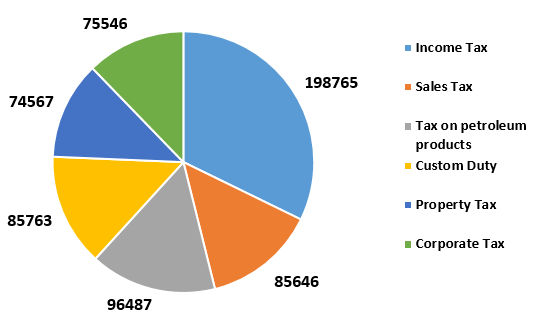
Study the given pie-chart and answer the question that follows.

The graph presents the income of the government (in ₹ crore) through various sources.

Through which source does the government receive near about 15% of the total income?

  1. AOption (a)

    Sales tax

  2. BOption (b)

    Corporate tax

  3. COption (c)

    Petroleum products

  4. DOption (d)

    Customs duty

View answer & explanation

Correct answer

Answer: (c)C.

Petroleum products

Why this answer is correct

Calculation

Total income of government = 198765 + 85646 + 96487 + 85763 + 74567 + 75546 = 616774

15% of 616774 = 92516, which is close to income from petroleum products.

The answer is Petroleum products.

Question 51

The volume of a cylinder having diameter 14  cm and height 5 cm is:

(Use π=227\pi=\frac{22}{7})

  1. AOption (a)

    660 cm3

  2. BOption (b)

    990 cm3

  3. COption (c)

    880 cm3

  4. DOption (d)

    770 cm3

View answer & explanation

Correct answer

Answer: (d)D.

770 cm3

Why this answer is correct

Shortcut Trick

Radius (r) = 14 ÷ 2 = 7 cm

Volume = πr2h = (22/7) × 7 × 7 × 5

Volume = 154 × 5 = 770 cm3

∴ The correct answer is 770 cm3.

Alternate Method

Given:

Diameter (d) = 14 cm

Height (h) = 5 cm

Formula Used:

Radius (r) = d/2

Volume of Cylinder = πr2h

Calculations:

⇒ Radius (r) = 14/2 = 7 cm

⇒ Volume = (22/7) × 7 × 7 × 5

⇒ Volume = 22 × 7 × 5

⇒ Volume = 154 × 5

⇒ Volume = 770 cm3

∴ The correct answer is 770 cm3.

Additional Information

Curved Surface Area (CSA)

The area of the curved surface of a cylinder is given by 2πrh.

Total Surface Area (TSA)

The total area including the two circular bases is 2πr(h + r).

Volume of a Hollow Cylinder

If R is the outer radius and r is the inner radius, Volume = π(R2 − r2)h.

Question 52

The earth crust has only ______ carbon in the form of minerals.

  1. AOption (a)

    21%

  2. BOption (b)

    0.3%

  3. COption (c)

    7.8%

  4. DOption (d)

    0.02%

View answer & explanation

Correct answer

Answer: (d)D.

0.02%

Why this answer is correct

The correct answer is 0.02%.

Key Points

  • The earth crust has only 0.02% carbon in the form of minerals.
  • Carbon is one of the most abundant elements on earth, but most of it exists in the form of carbon dioxide gas in the atmosphere and dissolved in the oceans.
  • The carbon in the earth's crust is primarily found in minerals such as limestone, dolomite, and marble.
  • The low percentage of carbon in the earth's crust is due to the slow process of carbon sequestration, where carbon is removed from the atmosphere and stored in rocks over millions of years.

Additional Information

  • The chemical element carbon has the atomic number six and the symbol C.
  • It exists in a variety of forms, including as amorphous carbon, diamond, and graphite.
  • It is tetravalent and nonmetallic.
  • It is a member of the periodic table's group 14.

Question 53

Refer to the following letter, number, symbol series and answer the question that follows.

(Left) H T Z C T & T * % 7 & Y % 6 U K & 2 R T 7 9 Y S 3 5 E * S & D 9 # 6 * (Right)

If all the numbers are dropped/deleted from the series, which of the following will be fourth to the left of sixth from the right?

  1. AOption (a)

    E

  2. BOption (b)

    Y

  3. COption (c)

    $

  4. DOption (d)

    T

View answer & explanation

Correct answer

Answer: (d)D.

T

Why this answer is correct

Given terms: (Left) H T Z C T & T * % 7 & Y % 6 U K & 2 R T 7 9 Y S 3 5 E * S & D 9 # 6 * (Right)

If all the numbers are dropped from the series then the arrangements are:

(Left) H T Z C T & T * % & Y % U K & R T Y S E * S & D # * (Right)

Here,

Sixth from the right end is: *

And fourth to the left of sixth from the right end is: T.

Hence, the correct answer is "Option 4".

Question 54

Sujata buys 9 apples and 8 mangoes for ₹276. When the cost of an apple is decreased by 10% and that of a mango remains the same, then the cost of 5 apples and 10 mangoes is ₹210. What is the original cost of 4 apples and 3 mangoes?

  1. AOption (a)

    ₹123

  2. BOption (b)

    ₹108

  3. COption (c)

    ₹116

  4. DOption (d)

    ₹120

View answer & explanation

Correct answer

Answer: (c)C.

₹116

Why this answer is correct

Shortcut Trick

Let A be the price of an apple and M be the price of a mango.

Equation 1: 9A + 8M = 276

Equation 2 (after 10% decrease in A): 5(0.9A) + 10M = 210 ⇒ 4.5A + 10M = 210

Multiply Equation 2 by 2: 9A + 20M = 420

Subtract Eq 1 from this: 12M = 144 ⇒ M = 12; then 9A = 276 − 96 = 180 ⇒ A = 20.

Target value: 4(20) + 3(12) = 80 + 36 = 116.

∴ The correct answer is ₹116.

Alternate Method

Given:

Total cost of 9 apples and 8 mangoes = ₹276

Reduction in apple price = 10%

New cost for 5 apples and 10 mangoes = ₹210

Let x be the original price of one apple and y be the original price of one mango.

⇒ 9x + 8y = 276 --- (i)

New price of apple = x − (10% of x) = 0.9x

⇒ 5(0.9x) + 10y = 210

⇒ 4.5x + 10y = 210 --- (ii)

Multiply equation (ii) by 2 to equate the coefficient of x:

⇒ 9x + 20y = 420 --- (iii)

Subtracting (i) from (iii):

⇒ (9x + 20y) − (9x + 8y) = 420 − 276

⇒ 12y = 144

⇒ y = 144 ÷ 12 = 12

Substitute y = 12 in equation (i):

⇒ 9x + 8(12) = 276

⇒ 9x + 96 = 276

⇒ 9x = 180

⇒ x = 180 ÷ 9 = 20

Calculate the original cost of 4 apples and 3 mangoes:

⇒ 4x + 3y = 4(20) + 3(12)

⇒ 4x + 3y = 80 + 36 = 116

∴ The correct answer is ₹116.

Additional Information

Linear Equations in Two Variables

A system of equations is usually solved by the elimination method (making coefficients of one variable equal) or substitution method.

Percentage Change in Price

If a price P decreases by r%, the new price is P × (100 − r)/100. For a 10% decrease, the multiplier is 0.9.

Expenditure Formula

Total Expenditure = (Price of Item 1 × Quantity 1) + (Price of Item 2 × Quantity 2).

Question 55

What is the smallest natural number that should be added to 1225 such that a remainder of 3 is left when the resulting number is divided by each of the numbers 12, 18, 21 and 28?

  1. AOption (a)

    38

  2. BOption (b)

    43

  3. COption (c)

    41

  4. DOption (d)

    35

View answer & explanation

Correct answer

Answer: (a)A.

38

Why this answer is correct

Shortcut Trick

Find the LCM of the divisors 12, 18, 21, and 28.

LCM (12, 18, 21, 28) = 252.

Divide 1225 by 252: 1225 ÷ 252 → Remainder = 217.

Number to add for remainder 3 = (Divisor − Remainder) + Required Remainder = (252 − 217) + 3 = 35 + 3 = 38.

∴ The correct answer is 38.

Alternate Method

Given: Base number = 1225, Divisors = 12, 18, 21, 28, Desired Remainder = 3.

Formula Used: Required number = (Next multiple of LCM) + Remainder − Base number.

⇒ Prime factors of 12 = 22 × 3

⇒ Prime factors of 18 = 2 × 32

⇒ Prime factors of 21 = 3 × 7

⇒ Prime factors of 28 = 22 × 7

⇒ LCM = 22 × 32 × 7 = 4 × 9 × 7 = 252.

⇒ Multiples of 252 near 1225: 252 × 4 = 1008, 252 × 5 = 1260.

⇒ The number that leaves remainder 3 is (1260 + 3) = 1263.

⇒ Natural number to be added = 1263 − 1225 = 38.

∴ The correct answer is 38.

Additional Information

LCM (Least Common Multiple)

The smallest positive integer that is divisible by each of the given numbers. It is found by taking the highest power of all prime factors present in the numbers.

Remainder Property

To find a number that leaves a remainder r when divided by x, y, z, the general form is (LCM(x, y, z) × k) + r, where k is an integer.

Divisibility Rule of 9

A number is divisible by 9 if the sum of its digits is divisible by 9. Since 18 is a divisor, the resulting number must also satisfy this when modified by the remainder.

Question 56

A quadrilateral whose sides are equal and all angles between the sides are 90° is called a:

  1. AOption (a)

    square

  2. BOption (b)

    rhombus

  3. COption (c)

    rectangle

  4. DOption (d)

    trapezium

View answer & explanation

Correct answer

Answer: (a)A.

square

Why this answer is correct

Shortcut Trick

A quadrilateral with all sides equal is a Rhombus.

A quadrilateral with all angles equal to 90° is a Rectangle.

A Square is the only quadrilateral that satisfies both conditions simultaneously.

∴ The correct answer is square.

Alternate Method

Given:

Sides: AB = BC = CD = DA

Angles: ∠A = ∠B = ∠C = ∠D = 90°

Formula Used:

Properties of Quadrilaterals: A Square is defined as a regular quadrilateral, which means it has four equal sides and four equal angles (90°).

Calculations:

⇒ Since all sides are equal (AB = BC = CD = DA), the figure is a Rhombus.

⇒ Since all interior angles are 90°, the figure is a Rectangle.

⇒ A quadrilateral that is both a Rhombus and a Rectangle is a Square.

⇒ Therefore, the given properties define a Square.

∴ The correct answer is square.

Additional Information

Rhombus

A quadrilateral with all four sides equal. Diagonals bisect each other at 90° but are not necessarily equal.

Rectangle

A quadrilateral with all four angles equal to 90°. Opposite sides are equal and diagonals are equal.

Trapezium

A quadrilateral with at least one pair of parallel sides.

Square Properties

All sides equal, all angles 90°, diagonals are equal and bisect each other at 90°.

Question 57

Which Article of the Constitution of India was amended in 2002 and a clause 'k' was inserted that said "who is a parent or guardian to provide opportunities for education to his child or, as the case may be, ward between the age of six and fourteen years."?

  1. AOption (a)

    Article 55B

  2. BOption (b)

    Article 44 A

  3. COption (c)

    Article 57 B

  4. DOption (d)

    Article 51 A

View answer & explanation

Correct answer

Answer: (d)D.

Article 51 A

Why this answer is correct

The correct answer is Article 51 A.

Key Points

  • Article 51 A of the Constitution of India was amended in 2002 and a clause 'k' was inserted that said "who is a parent or guardian to provide opportunities for education to his child or, as the case may be, ward between the age of six and fourteen years."
  • Article 51 A of the Constitution of India is a fundamental duty.
  • The amendment of Article 51 A was a significant step towards ensuring that every child in India receives education.
  • This amendment also emphasizes the role of parents and guardians in providing education to their children.

Additional Information

  • Article 44 A deals with the provision of a uniform civil code for the citizens of India.
  • The Indian Constitution contains 448 articles (initially there were 395 articles).
  • The responsibilities of the three main branches of government—the legislative, executive, and judicial branches—as well as the distinct powers of the federal and state governments are covered in the articles of the constitution.

Question 58

Select the set in which the numbers are related in the same way as are the numbers of the following sets.

(NOTE: Operations should be performed on the whole numbers, without breaking down the numbers into its constituent digits. E.g. 12 - Operations on 12 such as adding/subtracting/multiplying etc. to 12 can be performed. Breaking down 12 into 1 and 2 and then performing mathematical operations on 1 and 2 is not allowed)

(15, 360, 12)

(12, 120, 5)

  1. AOption (a)

    (12, 4, 16)

  2. BOption (b)

    (14, 84, 3)

  3. COption (c)

    (15, 20, 30)

  4. DOption (d)

    (13, 42, 3)

View answer & explanation

Correct answer

Answer: (b)B.

(14, 84, 3)

Why this answer is correct

The logic followed here is:

Logic: 1st number × 3rd number × 2 = 2nd number.

Now,

For, (15, 360, 12)

⇒ 15 × 12 × 2 = 360.

For,(12, 120, 5)

⇒ 12 × 5 × 2 = 120.

Similarly, for (14, 84, 3)

⇒ 14 × 3 × 2 = 84.

Hence, the correct answer is "Option 2".

Question 59

Two pipes A and B can fill a tank in 21 hours and 18 hours, respectively. If both the pipes are opened simultaneously, then the time taken to fill the tank is:

  1. AOption (a)

    11273911 \frac{27}{39} hours

  2. BOption (b)

    10273910 \frac{27}{39} hours

  3. COption (c)

    827398 \frac{27}{39} hours

  4. DOption (d)

    927399 \frac{27}{39} hours

View answer & explanation

Correct answer

Answer: (d)D.

927399 \frac{27}{39} hours

Why this answer is correct

Shortcut Trick If two pipes can fill a tank in x and y hours respectively, time taken to fill together = (x × y) ÷ (x + y) ⇒ Time taken = (21 × 18) ÷ (21 + 18) ⇒ Time taken = 378 ÷ 39 ⇒ Time taken = 9 27/39 hours ∴ The correct answer is 9 27/39 hours. Alternate Method Given: Time taken by Pipe A = 21 hours Time taken by Pipe B = 18 hours

Pipe Hours Total Work Efficiency

A 21 126 6

B 18 7

⇒ Total Efficiency of Pipe A and Pipe B = 6 + 7 = 13 units/hour ⇒ Total time taken to fill the tank = Total Work ÷ Total Efficiency ⇒ Time taken = 126 ÷ 13 = 9 9/13 hours ⇒ To match the given options, multiply the numerator and denominator of the fraction by 3: ⇒ Time taken = 9 27/39 hours ∴ The correct answer is 9 27/39 hours. Additional Information Inlet and Outlet Pipes If an inlet pipe fills a tank in x hours and an outlet empties it in y hours (where y > x), the net time taken to fill the tank is (x × y) ÷ (y − x). Three Pipes Working Together If three pipes A, B, and C fill a tank in x, y, and z hours respectively, the total time taken to fill the tank together is (x × y × z) ÷ (xy + yz + zx).

Question 60

This question is based on the five, three-digit numbers given below.

(left) 221 293 320 423 426 (right)

(Example: 246 - first digit = 2, second digit = 4, third digit = 6)

NOTE - All operations to be done from left to right.

What will be the resultant if the second digit of the largest number is added to the first digit of the smallest number?

  1. AOption (a)

    7

  2. BOption (b)

    4

  3. COption (c)

    11

  4. DOption (d)

    5

View answer & explanation

Correct answer

Answer: (b)B.

4

Why this answer is correct

Given: (left) 221 293 320 423 426 (right)

The second digit of the largest number is: 2 (426)

And, 

The first digit of the smallest number is: 2 (221)

So, the addition of the third digit of the largest number and the first digit of the smallest number is:

→ 2 + 2 = 4.

The correct answer is "Option 2".

Question 61

A ray of light is incident on a convex mirror (pole P) of radius of curvature 12 cm, parallel to its principal axis. After reflection, it appears to come from a point Q on its principal axis. Following New Cartesian Sign Convention, PQ = ______.

  1. AOption (a)

    -6 cm

  2. BOption (b)

    6 cm

  3. COption (c)

    12 cm

  4. DOption (d)

    -12 cm

View answer & explanation

Correct answer

Answer: (b)B.

6 cm

Why this answer is correct

The correct answer is 6 cm.

Key Points

  • The given mirror is a convex mirror, which means it is a diverging mirror.
  • The image formed by a convex mirror is always virtual, erect, and diminished.
  • As the ray of light is parallel to the principal axis, it will reflect back through the focus of the mirror.
  • This is because the focus of a convex mirror is situated behind the mirror.
  • In the sign convention for mirrors, distances measured in the direction of incident light are taken as positive, while distances measured opposite to the incident light are negative.
  • Since the image is formed behind the mirror (in the direction of reflected light), the image distance (v) is considered positive.
  • Hence, correct answer is 6cm

Additional Information

  • Increasing something's perceived size as opposed to its actual size is the process of magnification.
  • Optical magnification, a size ratio, is used to quantify this enlargement.
  • A decrease in size, commonly referred to as de-magnification, is indicated when this value is less than one.

Question 62

A trader gains 25% by selling an article after two successive discounts of 25% and 10% on its marked price. If the cost price of the article is increased by 30%, then what single discount should he now give on the same marked price to get the same profit percentage as earlier?

  1. AOption (a)

    10.5%

  2. BOption (b)

    10%

  3. COption (c)

    12.25%

  4. DOption (d)

    12.5%

View answer & explanation

Correct answer

Answer: (c)C.

12.25%

Why this answer is correct

Shortcut Trick

Let Marked Price (MP) = 100.

Successive discounts of 25% and 10% ⇒ Selling Price (SP) = 100 × 0.75 × 0.9 = 67.5.

Gain = 25% ⇒ Cost Price (CP) = 67.5 ÷ 1.25 = 54.

New CP = 54 × 1.3 = 70.2. New SP (for same 25% profit) = 70.2 × 1.25 = 87.75.

Required single discount on MP (100) = 100 − 87.75 = 12.25%.

∴ The correct answer is 12.25%.

Alternate Method

Formulas: SP = MP × (100 − D1)% × (100 − D2)% | CP = SP ÷ (1 + P%) | New CP = CP × (1 + Increase%) | New SP = New CP × (1 + P%) | Discount% = (MP − SP) ÷ MP × 100

⇒ Let Marked Price (MP) be 100 units.

⇒ Selling Price (SP) = 100 × (1 − 0.25) × (1 − 0.10) = 100 × 0.75 × 0.9 = 67.5 units.

⇒ Cost Price (CP) = SP ÷ (1 + 0.25) = 67.5 ÷ 1.25 = 54 units.

⇒ New Cost Price = 54 × (1 + 0.30) = 54 × 1.3 = 70.2 units.

⇒ New Selling Price = 70.2 × 1.25 = 87.75 units.

⇒ Required Discount = MP − New SP = 100 − 87.75 = 12.25.

⇒ Discount Percentage = (12.25 ÷ 100) × 100 = 12.25%.

∴ The correct answer is 12.25%.

Additional Information

Successive Discounts

A single discount equivalent to two successive discounts of a% and b% is given by the formula: [a + b − (ab ÷ 100)]%.

Relationship between CP, MP, and Profit

The ratio of CP to MP is given by: CP ÷ MP = (100 − Discount%) ÷ (100 + Profit%).

Question 63

ABCD is a trapezium in which BC || AD and AC = CD. If ∠ABC = 98° and ∠BAC = 32°, then what is the measure of ∠ACD?

  1. AOption (a)

    80°

  2. BOption (b)

    65°

  3. COption (c)

    75°

  4. DOption (d)

    70°

View answer & explanation

Correct answer

Answer: (a)A.

80°

Why this answer is correct

Shortcut Trick

In ΔABC, ∠ACB = 180° − (98° + 32°) = 50°.

Since BC || AD, ∠CAD = ∠ACB = 50° (Alternate interior angles).

Given AC = CD, in ΔACD, ∠CDA = ∠CAD = 50° (Isosceles triangle property).

In ΔACD, ∠ACD = 180° − (∠CAD + ∠CDA).

∠ACD = 180° − (50° + 50°) = 80°.

∴ The correct answer is 80 °.

Alternate Method

Given: In trapezium ABCD, BC || AD and AC = CD. The angles are ∠ABC = 98° and ∠BAC = 32°.

Formula Used: Sum of angles in a triangle is 180°; Alternate interior angles are equal when lines are parallel; Angles opposite to equal sides in a triangle are equal.

In ΔABC:

⇒ ∠ABC + ∠BAC + ∠ACB = 180°

⇒ 98° + 32° + ∠ACB = 180°

⇒ 130° + ∠ACB = 180°

⇒ ∠ACB = 50°

Since BC || AD and AC is the transversal:

⇒ ∠CAD = ∠ACB (Alternate interior angles)

⇒ ∠CAD = 50°

In ΔACD, it is given that AC = CD:

⇒ ∠CDA = ∠CAD (Angles opposite to equal sides)

⇒ ∠CDA = 50°

Now, applying the angle sum property in ΔACD:

⇒ ∠ACD + ∠CAD + ∠CDA = 180°

⇒ ∠ACD + 50° + 50° = 180°

⇒ ∠ACD + 100° = 180°

⇒ ∠ACD = 80°

∴ The correct answer is 80 °.

Additional Information

Trapezium Properties

A trapezium is a quadrilateral with one pair of parallel sides. The angles adjacent to the non-parallel sides are supplementary.

Isosceles Triangle Theorem

In an isosceles triangle, the angles opposite to the equal sides are always equal in measure.

Parallel Lines and Transversals

When a transversal intersects two parallel lines, alternate interior angles are equal, and corresponding angles are equal.

Question 64

The kidney of a healthy adult produces 180 L of filtrate daily, but a person throws out only 1 L or 1.5 L of urine. The amount of filtrate reabsorbed depends on which factor/ factors?

  1. AOption (a)

    Amount of excess water

  2. BOption (b)

    No effect of these factors

  3. COption (c)

    Amount of dissolved waste to be excreted

  4. DOption (d)

    Amount of excess water and amount of dissolved waste to be excreted

View answer & explanation

Correct answer

Answer: (d)D.

Amount of excess water and amount of dissolved waste to be excreted

Why this answer is correct

The correct answer is Amount of excess water and amount of dissolved waste to be excreted.

Key Points

  • The amount of filtrate reabsorbed depends on the amount of excess water and the amount of dissolved waste to be excreted.
  • This means that if there is more excess water in the body, the kidneys will reabsorb less filtrate and excrete more urine.
  • Similarly, if there is more dissolved waste in the body, the kidneys will reabsorb less filtrate and excrete more urine.
  • The reabsorption of filtrate is controlled by the hormones aldosterone and antidiuretic hormone (ADH).
  • These hormones regulate the amount of water and sodium that is reabsorbed by the kidneys, which in turn affects the amount of filtrate that is excreted as urine.

Additional Information

  • The amount of filtrate reabsorbed can also be affected by certain medications, such as diuretics, which increase urine production by preventing the reabsorption of water and sodium in the kidneys.
  • Other factors that can affect the amount of filtrate reabsorbed include blood pressure, blood pH, and the concentration of electrolytes in the blood.
  • The main keyword in the question is "filtrate," which refers to the fluid that is filtered from the blood by the kidneys.
  • This fluid contains water, waste products, and other substances that need to be either reabsorbed or excreted as urine.

Question 65

The BrahMos supersonic cruise missile, with increased indigenous content and improved performance, was successfully test-fired from the Integrated Test Range in _______ off the coast of Odisha at 1030 hours on 20 January 2022.

  1. AOption (a)

    Gopalpur-on-sea

  2. BOption (b)

    Paradip

  3. COption (c)

    Chandipur

  4. DOption (d)

    Puri

View answer & explanation

Correct answer

Answer: (c)C.

Chandipur

Why this answer is correct

The correct answer is Chandipur.

Key Points

  • The BrahMos supersonic cruise missile, which is a joint venture between India and Russia, was successfully test-fired from the Integrated Test Range in Chandipur off the coast of Odisha at 1030 hours on 20 January 2022.
  • The missile has been developed with increased indigenous content, which means that more components of the missile are being manufactured within the country, reducing the need for imports and making it more self-reliant.
  • The improved performance of the missile is a result of upgrades in its range and accuracy, making it a formidable weapon for the Indian military.
  • The Integrated Test Range in Chandipur is a premier missile testing facility in India, where various missiles, including the Agni and Prithvi series, have been tested in the past.

Additional Information

  • Gopalpur-on-sea is a coastal town in the Ganjam district of Odisha, known for its beautiful beaches and resorts.
  • Paradip is a major port town in Odisha, which handles a large volume of cargo, including iron ore, coal, and petroleum products.
  • Puri is a popular tourist destination in Odisha, known for its ancient temples, beaches, and cultural heritage.
  • It is also home to the famous Jagannath Temple, which attracts millions of devotees every year.

Question 66

A, B, C, D, E, F, G and H are sitting around a square table facing the centre of the table. Some of them are sitting at the corners, while some are sitting at the middle of the sides. B sits third to the left of H. B sits at one of the corners. G does not sit at any of the corners. C sits second to the right of G. G is not an immediate neighbour of B. Only three people sit between D and E. D is an immediate neighbour of F. D does not sit at any of the middle of the sides.

Who sits second to the left of A?

  1. AOption (a)

    E

  2. BOption (b)

    D

  3. COption (c)

    H

  4. DOption (d)

    F

View answer & explanation

Correct answer

Answer: (b)B.

D

Why this answer is correct

Given: A, B, C, D, E, F, G and H are sitting around a square table facing the centre of the table.

Some of them are sitting at the corners, while some are sitting at the middle of the sides.

  1. B sits third to the left of H.

  2. B sits at one of the corners.

  3. G does not sit at any of the corners and G is not an immediate neighbour of B.

  4. C sits second to the right of G. 

  5. Only three people sit between D and E.

  6. D is an immediate neighbour of F.

  7. D does not sit at any of the middle of the sides.

And, 'A' will sit on the remaining place.

So, 'D' sits second to the left of A.

Hence, the correct answer is "Option 2".

Question 67

Simplify the given expression.

(8125)23×(2764)−23÷(54)−2\left(\frac{8}{125}\right)^{\frac{2}{3}} \times\left(\frac{27}{64}\right)^{-\frac{2}{3}} \div\left(\frac{5}{4}\right)^{-2}

  1. AOption (a)

    23\frac{2}{3}

  2. BOption (b)

    35\frac{3}{5}

  3. COption (c)

    49\frac{4}{9}

  4. DOption (d)

    38\frac{3}{8}

View answer & explanation

Correct answer

Answer: (c)C.

49\frac{4}{9}

Why this answer is correct

Given:

(8125)23×(2764)−23÷(54)−2\left(\frac{8}{125}\right)^{\frac{2}{3}} \times\left(\frac{27}{64}\right)^{-\frac{2}{3}} \div\left(\frac{5}{4}\right)^{-2}

Calculation:

⇒ (8125)23×(2764)−23÷(54)−2\left(\frac{8}{125}\right)^{\frac{2}{3}} \times\left(\frac{27}{64}\right)^{-\frac{2}{3}} \div\left(\frac{5}{4}\right)^{-2}

⇒ (25)3×23×(34)3×−23÷(54)−2\left(\frac{2}{5}\right)^{3\times{\frac{2}{3}}} \times\left(\frac{3}{4}\right)^{3 \times {-\frac{2}{3}}} \div\left(\frac{5}{4}\right)^{-2}

⇒ (25)2×(34)−2÷(54)−2\left(\frac{2}{5}\right)^2 \times\left(\frac{3}{4}\right)^{-2} \div\left(\frac{5}{4}\right)^{-2}

⇒ (25)2×(43)2×(54)2\left(\frac{2}{5}\right)^2 \times\left(\frac{4}{3}\right)^{2} \times\left(\frac{5}{4}\right)^{2}

⇒ 4/9


Therefore the correct answer is 4/9.

Question 68

Select the option that represents the letters that, when placed from left to right in the same sequence in the blanks below, will complete the letter series.

D O_D_O L D B O L D _ O L _

  1. AOption (a)

    LCAD

  2. BOption (b)

    LCAO

  3. COption (c)

    LCOD

  4. DOption (d)

    DCAD

View answer & explanation

Correct answer

Answer: (a)A.

LCAD

Why this answer is correct

The logic followed here is:

Given Sequence: D O_D_O L D B O L D _ O L _

Now, putting the letters in the blank spaces given in the option one by one:

Option 1) LCAD → D O L D / C O L D / B O L D / A O L D

First alphabet is in decreasing order.

Option 2) LCAO → D O L D / C O L D / B O L D / A O L O

Option 3) LCOD → D O L D / C O L D / B O L D / O O L D

Option 4) DCAD → D O D D / C O L D / B O L D / A O L D

Here, 'Option 1' followed a pattern.

Hence, the correct answer is "Option 1".

Question 69

Study the Venn Diagram given below and answer the question that follows.

How many cricketers are neither boxers nor footballers?

  1. AOption (a)

    15

  2. BOption (b)

    3

  3. COption (c)

    12

  4. DOption (d)

    20

View answer & explanation

Correct answer

Answer: (a)A.

15

Why this answer is correct

According to the given Venn diagram:

The shaded area shows the "total number of cricketers are neither boxers nor footballers".

So, the total number of 'cricketers are neither boxers nor footballers' = 3 + 12 = 15.

Hence, the correct answer is "Option 1".

Question 70

Compound X is used in glass and soap industry. Ten molecules of water of crystallisation are present in this compound. The pH value of its solution is higher than 7. Identify compound X.

  1. AOption (a)

    Washing soda

  2. BOption (b)

    Baking soda

  3. COption (c)

    Bleaching powder

  4. DOption (d)

    Sodium hydroxide

View answer & explanation

Correct answer

Answer: (a)A.

Washing soda

Why this answer is correct

The correct answer is Washing soda.

Key Points

  • Washing soda is also known as sodium carbonate decahydrate and has ten molecules of water of crystallisation.
  • The pH value of its solution is higher than 7, which means it is basic in nature.
  • Washing soda is used in the glass and soap industry as it acts as a water softener and helps in removing hard water stains.
  • It is also used in laundry detergents as it enhances the cleaning properties of the detergent.

Additional Information

  • Baking soda is also known as sodium bicarbonate and has only one molecule of water of crystallisation.
  • It is used in baking, as a cleaning agent, and as an antacid.
  • Bleaching powder is calcium hypochlorite and is used as a disinfectant and bleaching agent.
  • Sodium hydroxide is also known as caustic soda and is a strong base.
  • It is used in the manufacture of soaps, detergents, and paper.

Question 71

The income of Raman is ₹45,000. He saves 12.5% of his income. If his income increases by 18% and expenditure increases by 20%, then his savings will:

  1. AOption (a)

    increase by ₹225

  2. BOption (b)

    decrease by ₹215

  3. COption (c)

    decrease by ₹220

  4. DOption (d)

    increase by ₹250

View answer & explanation

Correct answer

Answer: (a)A.

increase by ₹225

Why this answer is correct

Shortcut Trick

Income Ratio: Income = 8 (Base of 12.5% = 1/8), Savings = 1, Expenditure = 7.

Change in Income (18% × 8) = 144 units.

Change in Expenditure (20% × 7) = 140 units.

Change in Savings = 144 − 140 = 4 units.

Actual change = (45,000 ÷ 800) × 4 = ₹225.

∴ The correct answer is increase by ₹225.

Alternate Method

Given: Initial Income = ₹45,000, Savings % = 12.5%, Income Increase = 18%, Expenditure Increase = 20%.

Formula Used: Income = Expenditure + Savings

⇒ Initial Savings = 12.5% of 45,000 = (1/8) × 45,000 = ₹5,625

⇒ Initial Expenditure = 45,000 − 5,625 = ₹39,375

⇒ New Income = 45,000 × (118/100) = ₹53,100

⇒ New Expenditure = 39,375 × (120/100) = ₹47,250

⇒ New Savings = 53,100 − 47,250 = ₹5,850

⇒ Change in Savings = 5,850 − 5,625 = ₹225 (Increase)

∴ The correct answer is increase by ₹225.

Additional Information

Percentage to Fraction Conversion

12.5% is equivalent to 1/8. Using fractions simplifies Income-Expenditure calculations significantly.

Deviation Method in Savings

% Change in Income = (WeightExp × % ChangeExp + WeightSav × % ChangeSav) / (WeightExp + WeightSav).

Successive Percentage Change

When income increases and then expenditure also increases, the net effect on savings depends on the initial ratio of spending to saving.

Question 72

A, B, C, D, E and F live on six different floors of the same building. The lowermost floor in the building is numbered 1 , the floor above it, number 2, and so on till the topmost floor is numbered 6.

F lives on an even numbered floor but not on floor number 4. Only two people live between F and B. A lives immediately below E. E lives on an even numbered floor. Neither A nor D does not live on the lowermost floor. Who lives on floor number 4?

  1. AOption (a)

    A

  2. BOption (b)

    D

  3. COption (c)

    E

  4. DOption (d)

    C

View answer & explanation

Correct answer

Answer: (c)C.

E

Why this answer is correct

Given: A, B, C, D, E and F live on six different floors of the same building.

The lowermost floor in the building is numbered 1, the floor above it, number 2, and so on till the topmost floor is numbered 6.

  1. F lives on an even numbered floor but not on floor number 4.

  2. Only two people live between F and B.

Case I:

FloorPerson
6F
5
4
3B
2
1


Case II:

FloorPerson
6
5B
4
3
2F
1


  1. A lives immediately below E.

  2. E lives on an even numbered floor.

Case I:

FloorPerson
6F
5
4
3B
2E
1A


Case II:

FloorPerson
6
5B
4E
3A
2F
1


  1. Neither A nor D does not live on the lowermost floor - from this statement Case I canceled, so considering case II.

(So, D will place on the floor number 6).

And, C will place on the remaining floor.

Case II:

FloorPerson
6D
5B
4E
3A
2F
1C


So, 'E' lives on floor number 4.

Hence, the correct answer is "Option 3".

Question 73

Which of the following is the least composite number?

  1. AOption (a)

    3

  2. BOption (b)

    4

  3. COption (c)

    1

  4. DOption (d)

    2

View answer & explanation

Correct answer

Answer: (b)B.

4

Why this answer is correct

Shortcut Trick

A composite number is a positive integer that has at least one divisor other than 1 and itself.

The smallest positive integers are 1, 2, 3, 4, ...

Numbers 1, 2, and 3 are not composite (1 is neither prime nor composite; 2 and 3 are prime numbers).

Therefore, the smallest or least composite number is 4.

∴ The correct answer is 4.

Alternate Method

Given: Options to analyze: 1, 2, 3, and 4.

Definition:

⇒ Prime numbers have exactly two distinct factors: 1 and the number itself.

⇒ Composite numbers have more than two factors.

Analysis of options:

⇒ Number 1 has only 1 factor (1) → Neither prime nor composite.

⇒ Number 2 has factors 1 and 2 → Prime number (least even prime).

⇒ Number 3 has factors 1 and 3 → Prime number (least odd prime).

⇒ Number 4 has factors 1, 2, and 4 → Composite number.

⇒ Thus, the least composite number is 4.

∴ The correct answer is 4.

Additional Information

Prime Numbers

Numbers greater than 1 which have only two factors, 1 and itself. The smallest prime number is 2.

Co-prime Numbers

Two numbers are co-prime if their Highest Common Factor (HCF) is 1. For example, (3, 4) and (5, 9).

Least Odd Composite Number

The smallest odd integer that is a composite number is 9 (factors are 1, 3, and 9).

Question 74

For a ray of light undergoing refraction through a triangular glass prism, which of the following statements is/are always correct?

(a) Angle of incidence is the angle between the incident ray and normal at the point of incidence.

(b) Angle of incidence is equal to angle of emergence.

(c) Angle of deviation is the angle between incident ray and emergent ray.

  1. AOption (a)

    Both (b) and (c)

  2. BOption (b)

    Only (a)

  3. COption (c)

    Only (b)

  4. DOption (d)

    Both (a) and (c)

View answer & explanation

Correct answer

Answer: (d)D.

Both (a) and (c)

Why this answer is correct

The correct answer is Both (a) and (c).

Key Points

  • The angle of incidence is the angle between the incident ray and the normal at the point of incidence.
  • This statement is always correct.
  • The angle of emergence is the angle between the emergent ray and the normal at the point of emergence.
  • It is not always equal to the angle of incidence.
  • The angle of deviation is the angle between the incident ray and the emergent ray.
  • ​This statement is also correct.
  • When a ray of light passes through a triangular glass prism, it undergoes refraction twice, once at the entry face and once at the exit face.
  • The deviation of the ray depends on the angle of incidence and the refractive index of the prism.

Additional Information

  • A prism is a solid, transparent, uniform refracting medium that is enclosed by two angled plane surfaces.
  • The widely used prism features three rectangular surfaces in addition to two parallel triangle faces.
  • A standard triangular prism can divide white light into its component colors, or what is known as a spectrum.
  • Because light travels at different rates inside of glass, a prism functions.

Question 75

In the given letter-cluster pairs, the first letter-cluster is related to the second letter-cluster following a certain logic. Study the given pairs carefully, and from the given options, select the pair that follows the same logic.

FLM ∶ AGH ∶∶ MLK ∶ HGF

  1. AOption (a)

    TED ∶ PZX

  2. BOption (b)

    RUG ∶ MPB

  3. COption (c)

    FIN ∶ ACJ

  4. DOption (d)

    MAP ∶ HWL

View answer & explanation

Correct answer

Answer: (b)B.

RUG ∶ MPB

Why this answer is correct

The logic followed here is:

For, FLM ∶ AGH

For, MLK ∶ HGF

Similarly, for Option 2: RUG ∶ MPB

Hence, the correct answer is "Option 2".

Question 76

Select the option that is related to the fifth number in the same way as the second number is related to the first number and the fourth number is related to the third number.

72 ∶ 90 ∶∶ 110 ∶ 132 ∶∶ 156 ∶ ?

  1. AOption (a)

    192

  2. BOption (b)

    190

  3. COption (c)

    180

  4. DOption (d)

    182

View answer & explanation

Correct answer

Answer: (d)D.

182

Why this answer is correct

The logic followed here is:

For, 72 ∶ 90

⇒ 8 × 9 = 72 : 9 × 10 = 90

For, 110 ∶ 132

⇒ 10 × 11 = 110 : 11 × 12 = 132

Similarly, for 156 ∶ ?

⇒ 12 × 13 = 156 : 13 × 14 = 182.

Hence, the correct answer is "Option 4".

Question 77

The river ________ is a part of the Brahmaputra River System.

  1. AOption (a)

    Lohit

  2. BOption (b)

    Gomti

  3. COption (c)

    Ramganga

  4. DOption (d)

    Kosi

View answer & explanation

Correct answer

Answer: (a)A.

Lohit

Why this answer is correct

The correct answer is Lohit.

Key Points

  • The Lohit River:
  • It is a river in China and India.
  • The Lohit River is also known as the Zayu River.
  • Lohit River is a tributary to the Brahmaputra River. Hence, Option 4 is correct.

Additional Information 

  • The Dhola–Sadiya Bridge or the Bhupen Hazarika Setu, is a beam bridge in India and spans the Lohit River.
  • The Brahmaputra River is a transboundary river that flows through Tibet, India, and Bangladesh.
  • The Brahmaputra river is the 9th largest river by discharge and the 15th longest in the world.
  • The Brahmaputra river is also called  Dihang River in Arunachal Pradesh, Yarlung Tsangpo in Tibet and Luit Dilao in Assam.

Question 78

If each of the digits in the number 7058153 is arranged in ascending order from left to right. The position of how many digits will remain unchanged as compared to that in the original number?

  1. AOption (a)

    None

  2. BOption (b)

    Two

  3. COption (c)

    One

  4. DOption (d)

    Three

View answer & explanation

Correct answer

Answer: (a)A.

None

Why this answer is correct

Given digits: 7058153 

Now, arranged in ascending order from left to right: 7058153.

Given Digits7058153
Ascending order0135578


So, there are 'No' digits remain in the same position.

Hence, the correct answer is "Option 1".

Question 79

What is/are the balloon like structure(s) present in lungs, where exchange of gases take(s) place, called?

  1. AOption (a)

    Trachea

  2. BOption (b)

    Alveoli

  3. COption (c)

    Bronchi

  4. DOption (d)

    Cilia

View answer & explanation

Correct answer

Answer: (b)B.

Alveoli

Why this answer is correct

The correct answer is Alveoli.

Key Points

  • Alveoli are tiny air sacs present at the end of bronchioles in the lungs, and they are the site of gas exchange between the lungs and the bloodstream.
  • The microscopic blood arteries called capillaries round the alveoli.
  • These capillaries and the alveoli exchange carbon dioxide and oxygen.

Additional Information

  • The trachea is a tube that connects the larynx (voice box) to the bronchi in the lungs.
  • It is responsible for transporting air to and from the lungs.
  • Bronchi are the main branches of the trachea that lead to the lungs.
  • They are lined with cilia.
  • Cilia are hair-like structures present on the surface of cells in the respiratory tract.
  • They help to move mucus and foreign particles out of the lungs.

Question 80

What is the median of the following distribution?

Class100-150150-200200-250250-300300-350
Frequency2218251520
  1. AOption (a)

    225

  2. BOption (b)

    210

  3. COption (c)

    220

  4. DOption (d)

    240

View answer & explanation

Correct answer

Answer: (c)C.

220

Why this answer is correct

Shortcut Trick

Identify the Total Frequency (N) = 22 + 18 + 25 + 15 + 20 = 100.

Find the Median Position = N/2 = 100/2 = 50.

Check Cumulative Frequencies (CF): 22 → 40 → 65 (50 falls here). So, Median Class is 200-250.

Apply Interpolation: Median = Lower Limit + [(Required Rank − Previous CF) ÷ Class Frequency] × Class Width.

Median = 200 + [(50 − 40) ÷ 25] × 50 = 200 + [10 ÷ 25] × 50 = 200 + 20 = 220.

∴ The correct answer is 220.

Alternate Method

Given: Frequency distribution of 5 classes.

Formula Used: Median = L + [((N/2) − CFp) ÷ f] × h

Step 1: Calculate Cumulative Frequency (CF)

⇒ Class 100-150: f = 22, CF = 22

⇒ Class 150-200: f = 18, CF = 22 + 18 = 40

⇒ Class 200-250: f = 25, CF = 40 + 25 = 65

⇒ Class 250-300: f = 15, CF = 65 + 15 = 80

⇒ Class 300-350: f = 20, CF = 80 + 20 = 100

Step 2: Identify Median Class

⇒ N = 100, N/2 = 50.

⇒ CF just greater than 50 is 65, corresponding to class 200-250.

Step 3: Substitution

⇒ L (Lower Limit) = 200

⇒ CFp (CF of previous class) = 40

⇒ f (frequency of median class) = 25

⇒ h (class width) = 50

⇒ Median = 200 + [(50 − 40) ÷ 25] × 50

⇒ Median = 200 + [10 ÷ 25] × 50

⇒ Median = 200 + 0.4 × 50 = 200 + 20 = 220

∴ The correct answer is 220.

Additional Information

Empirical Relationship

For a moderately skewed distribution: 3 × Median = Mode + 2 × Mean.

Median for Ungrouped Data

If n is odd, Median = [(n+1)/2]th term. If n is even, Median = Average of (n/2)th and (n/2 + 1)th terms.

Modal Class

The class with the highest frequency is called the modal class. In this data, the modal class is 200-250 (f=25).

Question 81

P spends 36% of his income on food items and 25% of the remaining amount on clothes, medical and conveyance. He saves half of the remaining amount every month. If he saves ₹1,80,000 every year, then find his monthly income.

  1. AOption (a)

    ₹62,500

  2. BOption (b)

    ₹6,50,040

  3. COption (c)

    ₹54,170

  4. DOption (d)

    ₹7,50,000

View answer & explanation

Correct answer

Answer: (a)A.

₹62,500

Why this answer is correct

Shortcut Trick

Monthly savings = 1,80,000 ÷ 12 = ₹15,000

Let Monthly income be 100%.

Remaining after food (36%) = 64%

Remaining after clothes (25% of 64%) = 75% × 64% = 48%

Final savings = Half of 48% = 24% = ₹15,000

100% (Income) = (15,000 ÷ 24) × 100 = ₹62,500

∴ The correct answer is ₹62,500.

Alternate Method

Given: Yearly savings = ₹1,80,000

⇒ Monthly savings = 1,80,000 ÷ 12 = ₹15,000

Let Monthly income = ₹ I

⇒ After food expenditure: Remaining = I × (100 − 36)/100 = 0.64I

⇒ After clothes, medical, conveyance: Remaining = 0.64I × (100 − 25)/100 = 0.64I × 0.75 = 0.48I

⇒ Savings = 1/2 × 0.48I = 0.24I

⇒ 0.24I = 15,000

⇒ I = 15,000 ÷ 0.24 = 1,500,000 ÷ 24

⇒ I = ₹62,500

∴ The correct answer is ₹62,500.

Additional Information

Successive Percentage Change

When spending on the remaining amount, use the formula: Final = Initial × (1 − r1/100) × (1 − r2/100).

Income, Expenditure and Savings

The basic identity is Income = Expenditure + Savings. For monthly/yearly conversions, always divide or multiply by 12.

Base Value Concept

Always identify if the percentage is of the total income or the remaining amount to avoid calculation errors.

Question 82

India's border with which country runs 4,096.70 km (2,545.57 mi)?

  1. AOption (a)

    Nepal

  2. BOption (b)

    Pakistan

  3. COption (c)

    Bangladesh

  4. DOption (d)

    China

View answer & explanation

Correct answer

Answer: (c)C.

Bangladesh

Why this answer is correct

The correct answer is Bangladesh.

Key Points

  • India shares a border of 1,751 km with Nepal, which is the longest international border that India shares with any of its neighbors.
  • India shares a border of 3,323 km with Pakistan, which is the second-longest international border that India shares with any of its neighbors.
  • India shares a border of 4,096 km with Bangladesh, which is the third-longest international border that India shares with any of its neighbors.
  • India shares a border of 3,488 km with China, which is the fourth-longest international border that India shares with any of its neighbors.

Additional Information

  • India shares land borders with seven countries - Pakistan, China, Nepal, Bhutan, Bangladesh, Myanmar, and Afghanistan.
  • The India-Nepal border is open and people from both countries can cross the border without a visa.
  • This is because of the Indo-Nepal Friendship Treaty of 1950.
  • The India-Pakistan border is one of the most heavily guarded borders in the world.
  • It is also known as the "Line of Control" or "LoC".
  • The India-Bangladesh border is known as the "International Border" as it separates two sovereign nations.
  • The border is also referred to as the "East Pakistan Border" as it was the border between India and East Pakistan before Bangladesh gained independence in 1971.
  • The India-China border is also known as the "Line of Actual Control" or "LAC".
  • The border has been a source of tension between the two countries and has led to several military standoffs in the past.

Question 83

A train crosses a telegraph post and a bridge of length 300 metres in 10 seconds and 20 seconds, respectively. Find the speed of the train.

  1. AOption (a)

    69.5 km/h

  2. BOption (b)

    108 km/h

  3. COption (c)

    89 km/h

  4. DOption (d)

    75 km/h

View answer & explanation

Correct answer

Answer: (b)B.

108 km/h

Why this answer is correct

Shortcut Trick

Distance covered in extra time = Bridge length.

Extra time = 20 − 10 = 10 seconds.

Speed = 300 m ÷ 10 s = 30 m/s.

Speed in km/h = 30 × (18 ÷ 5) = 108 km/h.

∴ The correct answer is 108 km/h.

Alternate Method

Given: Bridge length = 300 m, Time to cross post (t1) = 10 s, Time to cross bridge (t2) = 20 s.

Formula: Speed = Distance ÷ Time

⇒ Let Length of train be L.

⇒ Case 1 (Post): Speed (S) = L ÷ 10

⇒ Case 2 (Bridge): Speed (S) = (L + 300) ÷ 20

⇒ L ÷ 10 = (L + 300) ÷ 20

⇒ 2L = L + 300 → L = 300 m

⇒ S = 300 ÷ 10 = 30 m/s

⇒ S (km/h) = 30 × 18 ÷ 5 = 108 km/h

∴ The correct answer is 108 km/h.

Additional Information

Unit Conversion

To convert m/s to km/h, multiply by 18/5. To convert km/h to m/s, multiply by 5/18.

Relative Speed

When two objects move in opposite directions, relative speed is S1 + S2. In the same direction, it is S1 − S2.

Crossing Stationary Objects

For a post/man, distance = Train length. For a platform/bridge/tunnel, distance = Train length + Object length.

Question 84

Which of the following types of asexual reproduction is shown by the bread mould Rhizopus?

  1. AOption (a)

    Budding

  2. BOption (b)

    Spore formation

  3. COption (c)

    Regeneration

  4. DOption (d)

    Fission

View answer & explanation

Correct answer

Answer: (b)B.

Spore formation

Why this answer is correct

The correct answer is Spore formation.

Key Points

  • The bread mould Rhizopus shows spore formation as a type of asexual reproduction.
  • Spore formation involves the production of haploid spores by the parent organism, which can grow into new individuals.
  • In Rhizopus, the spores are produced in specialized structures called sporangia, which are found on the tips of hyphae.
  • Spore formation allows for rapid reproduction and dispersal of offspring, as the spores can be carried away by wind or other means.

Additional Information

  • Budding is a type of asexual reproduction where a small outgrowth or bud develops on the parent organism and eventually separates to form a new individual. 
  • Budding is shown by yeast, hydra, and some other organisms.
  • Regeneration involves the regrowth of lost body parts. 
  • Regeneration is shown by planarians, starfish, and some other organisms.
  • Fission involves the splitting of the parent organism into two or more parts, each of which can grow into a new individual.
  • Fission is shown by bacteria and some other unicellular organisms.

Question 85

Given below is a decision followed by two statements I and II. Read the information carefully and select the correct option.

Decision:

The management of an international school P has requested all students and their parents to consider carpooling for travelling to school and minimise individual vehicles.

Statements:

I. Since most students use individual vehicles, traffic has been an increasing problem since the last few months.

II. The locality in which school P is located has reported three instances of car theft around midnight in the last four months.

  1. AOption (a)

    Statement I strengthens the decision but statement II is neutral.

  2. BOption (b)

    Statement I is neutral but statement II strengthens the decision.

  3. COption (c)

    Statement I weakens the decision but statement II strengthens the decision.

  4. DOption (d)

    Both statements I and II weaken the decision.

View answer & explanation

Correct answer

Answer: (a)A.

Statement I strengthens the decision but statement II is neutral.

Why this answer is correct

The correct answer is Statement I strengthens the decision but statement II is neutral.

Key Points

  • Statement I strengthens the decision as it provides a reason for the management's request to consider carpooling.
  • If most students use individual vehicles, it can lead to traffic congestion, which can be reduced by carpooling.
  • Statement II is neutral as it does not directly relate to the decision of carpooling.
  • However, it can indirectly support the decision as carpooling can reduce the number of cars parked in the locality, which can minimize the risk of car theft.

Additional Information

  • Carpooling is a practice of sharing a car journey so that more than one person travels in a car.
  • In addition to being a cost-effective mode of transportation, carpooling has other environmental advantages.
  • When more people ride together, there are fewer cars on the road and less dangerous pollutants are released into the air.
  • Car theft is a criminal act of stealing a car.

Question 86

In the given question, the statement is followed by two conclusions. Which of the two conclusion(s) is/are true based on the given statement?

Statement: Q = R ≥ T > S < U = V

Conclusions: I. T ≥ Q

II. T < V

  1. AOption (a)

    Only conclusion II is true

  2. BOption (b)

    Both conclusions I and II are true

  3. COption (c)

    Neither conclusion I nor II is true

  4. DOption (d)

    Only conclusion I is true

View answer & explanation

Correct answer

Answer: (c)C.

Neither conclusion I nor II is true

Why this answer is correct

Given Statement: Q = R ≥ T > S < U = V

Now,

Conclusions:

(i) T ≥ Q → False (T > S < U = V No relation can be established between T and Q)

(ii) T < V → False (T > S < U = V No relation can be established between T and V)

Here, Neither conclusion I nor II is true.

Hence, the correct answer is "Option 3".

Question 87

Rajani's father is three times older than Rajani and Rajani is twice as old as her sister Lavanya. Two years from now the sum of the given three person ages will be 60 years. Find the present age of Rajani.

  1. AOption (a)

    13 years

  2. BOption (b)

    12 years

  3. COption (c)

    8 years

  4. DOption (d)

    36 years

View answer & explanation

Correct answer

Answer: (b)B.

12 years

Why this answer is correct

Shortcut Trick

Let Lavanya age be 1 unit → Rajani is 2 units → Father is 2 × 3 = 6 units.

Total present units = 1 + 2 + 6 = 9 units.

Sum of ages after 2 years = 60 years → Sum of present ages = 60 − (3 × 2) = 54 years.

9 units = 54 years ⇒ 1 unit = 6 years.

Rajani present age = 2 units = 2 × 6 = 12 years.

∴ The correct answer is 12 years.

Alternate Method

Let the present age of Lavanya be x years.

Given:

⇒ Rajani age = 2 × Lavanya = 2x

⇒ Father age = 3 × Rajani = 3 × 2x = 6x

After 2 years:

⇒ Ages will be (x + 2), (2x + 2), and (6x + 2).

⇒ (x + 2) + (2x + 2) + (6x + 2) = 60

⇒ 9x + 6 = 60

⇒ 9x = 54

⇒ x = 6

⇒ Rajani present age = 2x = 2 × 6 = 12 years.

∴ The correct answer is 12 years.

Additional Information

Sum of Ages in Future/Past

If the sum of ages of 'n' persons is S today, then after 't' years, the sum will be S + (n × t).

Age Ratio Concept

When ages are given as multiples, always start by assuming the youngest person's age as 'x' to simplify the calculations.

Question 88

The S.I unit of focal length is:

  1. AOption (a)

    metre

  2. BOption (b)

    millimetre

  3. COption (c)

    centimetre

  4. DOption (d)

    decimetre

View answer & explanation

Correct answer

Answer: (a)A.

metre

Why this answer is correct

The correct answer is metre.

Key Points

  • Focal length is defined as the distance between the center of a lens or curved mirror and its focus point.
  • The SI unit of focal length is metre, which is the standard unit of length in the International System of Units (SI).
  • The other options, millimetre, centimetre, and decimetre, are also units of length but they are not the standard SI units.

Additional Information

  • Millimetre is one-thousandth of a metre, centimetre is one-hundredth of a metre, and decimetre is one-tenth of a metre.
  • It is important to use the correct unit of measurement to ensure accuracy and consistency in scientific calculations and experiments.
  • A system that converges light is indicated by a positive focal length.
  • A negative focal length signifies light divergence in the system.

Question 89

In the given data, X is the size of a shirt and F denotes the sale per day. Which sized shirt is in most demand?

X242628303436384042
F4567120467653412233
  1. AOption (a)

    28

  2. BOption (b)

    42

  3. COption (c)

    34

  4. DOption (d)

    40

View answer & explanation

Correct answer

Answer: (a)A.

28

Why this answer is correct

Concept used

Frequency

Calculation

The frequency of the 28 size shirt is highest that is 120.

The answer is 28.

Question 90

The temples at Khajuraho were built during which dynasty?

  1. AOption (a)

    Gupta Dynasty

  2. BOption (b)

    Chandella dynasty

  3. COption (c)

    Ghazni Dynasty

  4. DOption (d)

    Lodi dynasty

View answer & explanation

Correct answer

Answer: (b)B.

Chandella dynasty

Why this answer is correct

The correct answer is Chandella dynasty.

Key Points

  • The Chandella dynasty ruled in Central India from the 9th to the 13th century.
  • The Khajuraho temples were built between 950 and 1050 AD during the reign of the Chandella kings.
  • The temples are known for their intricate carvings and sculptures depicting various deities, animals, and scenes from daily life.
  • The Khajuraho temples were declared a UNESCO World Heritage Site in 1986.

Additional Information

  • The Gupta dynasty ruled in India from the 4th to the 6th century.
  • The Gupta period is known for its achievements in art, literature, and science.
  • The Ghazni dynasty was a Muslim dynasty that ruled in Afghanistan and parts of India from the 10th to the 12th century.
  • The Ghazni dynasty is known for its military conquests and the plundering of Hindu temples.
  • The Lodi dynasty ruled in India from the 15th to the 16th century.
  • The Lodhi dynasty is known for its architecture.

Question 91

Four friends K, L, M and N are playing on the playground. L is standing towards the east of K and is towards the north of M. M is standing towards the west of N's house. In which direction is N standing from K?

  1. AOption (a)

    South-west

  2. BOption (b)

    North-west

  3. COption (c)

    South-east

  4. DOption (d)

    North-east

View answer & explanation

Correct answer

Answer: (c)C.

South-east

Why this answer is correct

Given: Four friends K, L, M and N are playing on the playground.

  1. L is standing towards the east of K and is towards the north of M.

  2. M is standing towards the west of N's house.

So, N is standing at the 'South-east' from K.

Hence, the correct answer is "Option 3".

Question 92

A certain number of people are sitting in a straight row, facing north. B is fourth to the left of G; F is fourth to the right of C and second to the left of K, who is fifth to the right of A. D is not an immediate neighbour of either K or B. There are only three persons between J and A. J and K are sitting at extreme ends. G is second to the right of C. If no other person is sitting in the row, What is the total number of persons seated?

  1. AOption (a)

    Six

  2. BOption (b)

    Ten

  3. COption (c)

    Seven

  4. DOption (d)

    Eight

View answer & explanation

Correct answer

Answer: (b)B.

Ten

Why this answer is correct

Given: A certain number of people are sitting in a straight row, facing north.

1) F is fourth to the right of C and second to the left of K, who is fifth to the right of A.

  1. There are only three persons between J and A.

3) G is second to the right of C. 

4) B is fourth to the left of G.

5) D is not an immediate neighbour of either K or B.

6) J and K are sitting at extreme ends.

So, If no other person is sitting in the row, then total 'Ten' persons are seated in the row.

Hence, the correct answer is "Option 2".

Question 93

Three statements are given, followed by three conclusions numbered I, II and III. Assuming the statements to be true, even if they seem to be at variance with commonly known facts, decide which of the conclusions logically follow(s) from the statements.

Statements:

  1. Some teachers are professors.
  2. Some researchers are teachers.
  3. All professors are researchers.

Conclusions:

I. Some teachers are researchers.

II. Some researchers are professors.

III. Some professors are teachers.

  1. AOption (a)

    Conclusions I, II and III follow

  2. BOption (b)

    Conclusions I and II follow

  3. COption (c)

    Conclusions I and III follow

  4. DOption (d)

    Conclusions II and III follow

View answer & explanation

Correct answer

Answer: (a)A.

Conclusions I, II and III follow

Why this answer is correct

Given Statements:

  1. Some teachers are professors.
  2. Some researchers are teachers.
  3. All professors are researchers.

The least possible Venn diagram for the given statement is:

Conclusions:

I. Some teachers are researchers - True (Because, Some researchers are teachers, so Some teachers are researchers).

II. Some researchers are professors - True (Because, All professors are researchers, this also gives some researchers are professors).

III. Some professors are teachers - True (Because, Some teachers are professors also gives Some professors are teachers).

So, Conclusions I, II and III follow.

Hence, the correct answer is "Option 1".

Question 94

Three resistors of 2 Ω, 3 Ω and 6 Ω are connected in series. The resistance of the combination is:

  1. AOption (a)

    1 Ω

  2. BOption (b)

    5 Ω

  3. COption (c)

    11 Ω

  4. DOption (d)

    8 Ω

View answer & explanation

Correct answer

Answer: (c)C.

11 Ω

Why this answer is correct

The correct answer is 11 Ω.

Key Points

  • Three resistors of 2 Ω, 3 Ω and 6 Ω are connected in series.
  • The formula for the total resistance of resistors connected in series is R_total = R1 + R2 + R3 + ... + Rn.
  • Applying this formula, we get the total resistance of the combination as 2 Ω + 3Ω + 6 Ω = 11 Ω.
  • Therefore, the correct answer is 11Ω.

Additional Information

  • ​When the same amount of current passes through each resistor in a set of two or more, the resistors are said to be connected in series.
  • The voltage across every resistor in these circuits varies.
  • If the voltage is the same across all of the resistors, then two or more resistors are said to be connected in parallel.
  • When branches in these circuits come together at a common spot, the current branches out and recombines.

Question 95

The marked price of a cooker is same at four shops I, II, III and IV. Shop I allows two successive discounts of 20% and 15%, shop II allows successive discounts of 18% and 17%, shop III allows successive discounts of 25% and 10% and shop IV allows successive discounts of 15%, 15%, and 5% on the marked price of the cooker. Which shop is selling the cooker at the lowest price?

  1. AOption (a)

    I

  2. BOption (b)

    IV

  3. COption (c)

    III

  4. DOption (d)

    II

View answer & explanation

Correct answer

Answer: (c)C.

III

Why this answer is correct

Shortcut Trick

To find the lowest price, we need the highest total discount.

Successive discount formula: a + b − (a × b ÷ 100).

Shop I: 20 + 15 − 3 = 32%. Shop II: 18 + 17 − 3.06 = 31.94%.

Shop III: 25 + 10 − 2.5 = 32.5%. Shop IV: 15 + 15 − 2.25 = 27.75%; then 27.75 + 5 − 1.38 = 31.37%.

Comparing all, Shop III offers the maximum discount of 32.5%.

∴ The correct answer is III.

Alternate Method

Given → Marked Price (MP) is same for all shops. Successive discounts for I (20%, 15%), II (18%, 17%), III (25%, 10%), and IV (15%, 15%, 5%). Formulas: Net Discount = [1 − (1 − d1/100)(1 − d2/100)...] × 100

⇒ Let MP = 100 for all shops. ⇒ SPI = 100 × 0.80 × 0.85 = 68. ⇒ SPII = 100 × 0.82 × 0.83 = 68.06. ⇒ SPIII = 100 × 0.75 × 0.90 = 67.5. ⇒ SPIV = 100 × 0.85 × 0.85 × 0.95 = 68.63. ⇒ Lowest Selling Price is 67.5 at Shop III.

∴ The correct answer is III.

Additional Information

Comparison of Successive Discounts

When the sum of percentage discounts is equal (e.g., 20+15=35 and 25+10=35), the pair with the largest difference between the two values results in the highest net discount.

Successive Discount Calculation

For three discounts d1, d2, d3, calculate the resultant of the first two, then use that result with the third discount.

Question 96

Which of the following sectors was given maximum emphasis in the Second Five Year Plan?

  1. AOption (a)

    Community services

  2. BOption (b)

    Industry

  3. COption (c)

    Energy

  4. DOption (d)

    Agriculture

View answer & explanation

Correct answer

Answer: (b)B.

Industry

Why this answer is correct

The correct answer is Industry.

Key Points

  • The Second Five Year Plan was launched in India from 1956 to 1961, with the aim of increasing the pace of economic growth and development.
  • The plan emphasized on the development of heavy industries, such as steel, coal, and machinery, which were crucial for the growth of the economy.
  • The plan also focused on the expansion of infrastructure, such as transport, communication, and power, which were necessary for industrialization.
  • The plan allocated a significant amount of resources for the development of industrial estates, industrial training, and research and development.
  • The plan also aimed at reducing the dependence on imports and promoting exports, which required the growth of industries.

Additional Information

  • Community services:
  • This sector includes health, education, housing, and social welfare.
  • Although the plan recognized the importance of community services, it was not given maximum emphasis.
  • Energy:
  • This sector includes the development of power, oil, and gas.
  • The plan did allocate resources for the development of energy, but it was not given maximum emphasis.
  • Agriculture:
  • This sector includes the development of agriculture, irrigation, and rural development.
  • The plan recognized the importance of agriculture, but it was not given maximum emphasis.
  • However, the plan did lay the foundation for the Green Revolution, which took place in the Third Five Year Plan.

Question 97

In a certain code language, 'SOMEWHAT' is written as NRDLGVSZ' and 'SPECTRUM' is written as 'ORBDQSLT'. How will 'SITUATED' be written in that language?

  1. AOption (a)

    RHSTZSDC

  2. BOption (b)

    HRTSZSCD

  3. COption (c)

    HTVUUBEF

  4. DOption (d)

    HRTSSZCD

View answer & explanation

Correct answer

Answer: (d)D.

HRTSSZCD

Why this answer is correct

The logic followed here is:

For, 'SOMEWHAT' is written as NRDLGVSZ'

For, 'SPECTRUM' is written as 'ORBDQSLT'

Similarly, for 'SITUATED'

So, 'SITUATED' will be written as 'HRTSSZCD'

Hence, the correct answer is "Option 4".

Question 98

Which two numbers should be interchanged to make the following equation correct?

8 + 4 - (7 × 5 - 6) ÷  3 = 3.75

  1. AOption (a)

    4 and 7

  2. BOption (b)

    8 and 5

  3. COption (c)

    8 and 4

  4. DOption (d)

    3 and 4

View answer & explanation

Correct answer

Answer: (d)D.

3 and 4

Why this answer is correct

Given equation: 8 + 4 - (7 × 5 - 6) ÷  3 = 3.75.

BODMAS Table: 

Let's check each option one by one.

Option 1) 4 and 7

Given: 8 + 4 - (7 × 5 - 6) ÷ 3 = 3.75

After interchanging the numbers we get;

⇒ 8 + 7 - (4 × 5 - 6) ÷ 3 = 3.75

⇒ 8 + 7 - (20 - 6) ÷ 3 = 3.75

⇒ 8 + 7 - 14 ÷ 3 = 3.75

⇒ 8 + 7 - 4.66 = 3.75

⇒ 15 - 4.66 = 3.75

⇒ 10.34 ≠ 3.75

⇒ LHS ≠ RHS

Option 2) 8 and 5

Given: 8 + 4 - (7 × 5 - 6) ÷ 3 = 3.75

After interchanging the numbers we get;

⇒ 5 + 4 - (7 × 8 - 6) ÷ 3 = 3.75

⇒ 5 + 4 - (56 - 6) ÷ 3 = 3.75

⇒ 5 + 4 - 50 ÷ 3 = 3.75

⇒ 5 + 4 - 16.66 = 3.75

⇒ 9 - 16.66 = 3.75

⇒ -7.66 ≠ 3.75

⇒ LHS ≠ RHS

Option 3) 8 and 4

Given: 8 + 4 - (7 × 5 - 6) ÷ 3 = 3.75

After interchanging the numbers we get;

⇒ 4 + 8 - (7 × 5 - 6) ÷ 3 = 3.75

⇒ 4 + 8 - (35 - 6) ÷ 3 = 3.75

⇒ 4 + 8 - 29 ÷ 3 = 3.75

⇒ 4 + 8 - 9.66 = 3.75

⇒ 12 - 9.66 = 3.75

⇒ 2.34 ≠ 3.75

⇒ LHS ≠ RHS

Option 4) 3 and 4

Given: 8 + 4 - (7 × 5 - 6) ÷ 3 = 3.75

After interchanging the numbers we get;

⇒ 8 + 3 - (7 × 5 - 6) ÷ 4 = 3.75

⇒ 8 + 3 - (35 - 6) ÷ 4 = 3.75

⇒ 8 + 3 - 29 ÷ 4 = 3.75

⇒ 8 + 3 - 7.25 = 3.75

⇒ 11 - 7.25 = 3.75

⇒ 3.75 = 3.75

⇒ LHS = RHS

Hence, the correct answer is "Option 4".

Question 99

Six friends Richa, Shobhna, Urmila, Swarna, Purnima, and Kavya, are sitting on a bench in the park. They all are facing south. Only four persons are sitting between Purnima and Richa. Swarna is sitting third to the left of Purnima. Richa and Swarna are immediate neighbour of Kavya. Purnima and Shobhna are immediate neighbours of Urmila. Who sits fourth to the left of Urmila?

  1. AOption (a)

    Swarna

  2. BOption (b)

    Shobhna

  3. COption (c)

    Richa

  4. DOption (d)

    Kavya

View answer & explanation

Correct answer

Answer: (c)C.

Richa

Why this answer is correct

Given: Six friends Richa, Shobhna, Urmila, Swarna, Purnima, and Kavya, are sitting on a bench in the park.

They all are facing south.

  1. Only four persons are sitting between Purnima and Richa.

  2. Swarna is sitting third to the left of Purnima.

  3. Richa and Swarna are immediate neighbour of Kavya.

  4. Purnima and Shobhna are immediate neighbours of Urmila.

So, 'Richa' sits fourth to the left of Urmila.

Hence, the correct answer is "Option 3".

Question 100

The Lok Sabha passed the Family Courts' Amendment Bill in _______.

  1. AOption (a)

    January 2021

  2. BOption (b)

    January 2022

  3. COption (c)

    July 2022

  4. DOption (d)

    September 2021

View answer & explanation

Correct answer

Answer: (c)C.

July 2022

Why this answer is correct

The correct answer is July 2022.

Key Points

  • The Family Courts' Amendment Bill seeks to amend the Family Courts Act, 1984, which provides for the establishment of family courts for speedy settlement of disputes relating to marriage and family affairs.
  • The Lok Sabha, the lower house of the Indian Parliament, passed the Bill in July 2022, which means that it has been approved by the elected representatives of the people.
  • The Bill proposes several amendments to the original Act, including the provision for digital recording of evidence and the establishment of counselling centres to help parties resolve their disputes amicably.
  • The Bill also seeks to improve the functioning of family courts by providing for the appointment of more judges and support staff, and by enabling the transfer of cases between courts for better case management.

Additional Information

  • The purpose of the Family Courts (Amendment) Bill is to establish Family Courts in the states of Himachal Pradesh and Nagaland, respectively, beginning on February 15, 2019, and September 12, 2008.
  • In order to retrospectively recognize all actions performed under the aforementioned Act by the State Governments of Himachal Pradesh and Nagaland, as well as the Family Courts of both states, prior to the Family Courts (Amendment) Act, 2022, it also aims to incorporate a new Section 3A.
  • The bill states that any family court judge appointment orders, as well as any posting, promotion, or transfer of such judges pursuant to the Act, will be enforceable in the two States.

100 questions in the full paper