Previous Year Paper

RRB Group D Previous Year Paper (Held on: 5 Sept 2022 Shift 2)

Held in 2022

100 questions90 minutes
With answers
Free

Paper last updated:

Practise under exam conditions

Take this paper as a timed mock test. Review your answers after you submit.

Attempt timed test

Questions & answers

Read the paper at your pace. Open an explanation when you need it.

CBT (100 questions)

Question 1

What is the angle of incidence of a ray of light falling along the normal on a glass strip?

  1. AOption (a)

    45°

  2. BOption (b)

    0°

  3. COption (c)

    90°

  4. DOption (d)

    30°

View answer & explanation

Correct answer

Answer: (b)B.

0°

Why this answer is correct

The correct answer is 0º.

Key Points

  • The angle of incidence is defined as the angle between the incident ray and the normal to the surface at the point of incidence.
  • When a ray of light falls along the normal, it means the ray is perpendicular to the surface.
  • In this situation, the incident ray is aligned with the normal, making the angle of incidence 0º.
  • This concept is crucial in understanding how light behaves when it strikes different surfaces, influencing reflection and refraction.

Additional Information

  • Angle of Incidence
  • The angle of incidence is the angle formed by the incoming ray and the perpendicular (normal) to the surface at the point of contact.
  • It is a fundamental concept in the study of optics, particularly in the laws of reflection and refraction.
  • The angle of incidence is measured in degrees.
  • Normal Line
  • The normal line is an imaginary line perpendicular to the surface where the ray of light hits.
  • It is used as a reference to measure angles of incidence and reflection.
  • Reflection and Refraction
  • Reflection occurs when light bounces off a surface. The angle of incidence is equal to the angle of reflection.
  • Refraction happens when light passes from one medium to another, changing its speed and direction.
  • The relationship between the angle of incidence and refraction is described by Snell's Law.
  • Applications in Real Life
  • Understanding angles of incidence is crucial in designing optical devices such as lenses, mirrors, and prisms.
  • It is also important in fields like photography, astronomy, and even in the development of various technologies like fiber optics.
Question 2

There is a certain relationship between PF 13 and MC 20. The same relationship exists between LR 19 and IO 26. Based on the same logic, XJ 25 will be related to which of the following?

  1. AOption (a)

    UG 33

  2. BOption (b)

    GU 32

  3. COption (c)

    UG 32

  4. DOption (d)

    VG 32

View answer & explanation

Correct answer

Answer: (c)C.

UG 32

Why this answer is correct

According to the English alphabet and its positional values:

<br>

The pattern followed here is:

PF 13 related to MC 20

LR 19 related to IO 26

Similarly,

XJ 25 is related to

Hence, the correct answer is " UG 32".

Question 3

Which of the following types of government is closest to the common people?

  1. AOption (a)

    state government

  2. BOption (b)

    Central government

  3. COption (c)

    Police Administration

  4. DOption (d)

    Local government

View answer & explanation

Correct answer

Answer: (d)D.

Local government

Why this answer is correct

The correct answer is Local government.

Key Points

  • The local government operates at the grassroots level and is the closest tier of government to the common people.
  • It includes municipal corporations, municipalities, panchayats, and other local administrative bodies that directly interact with and address the concerns of local communities.
  • Local governments are responsible for providing basic amenities and services such as water supply, sanitation, local roads, and community health, making them directly relevant to everyday life.
  • They are instrumental in the implementation of various government schemes and initiatives at the local level, ensuring that benefits reach the intended beneficiaries efficiently.

Additional Information

  • State Government
  • State governments in India are the second tier of government, governing individual states and union territories.
  • They have a range of powers and responsibilities, including education, healthcare, agriculture, and law enforcement, but operate at a broader level compared to local governments.
  • Central Government
  • The central government is the national government of India, responsible for overall governance and policy-making for the country.
  • It deals with national issues such as defense, foreign policy, and finance.
  • Police Administration
  • The police administration is responsible for maintaining law and order and ensuring public safety.
  • While crucial for security, it does not directly deal with the provision of basic civic amenities and services.

Question 4

In triangle ABC, if ∠ABC=90° and BA=BC, then angles A and C are ( )° respectively.

  1. AOption (a)

    80°, 60°

  2. BOption (b)

    45°, 45°

  3. COption (c)

    50°, 40°

  4. DOption (d)

    80°, 70°

View answer & explanation

Correct answer

Answer: (b)B.

45°, 45°

Why this answer is correct

Shortcut Trick

In a right-angled isosceles triangle, the two acute angles are always equal.

Since ∠B = 90° and BA = BC, the remaining 90° is shared equally between ∠A and ∠C.

Calculation: 90° ÷ 2 = 45°.

∴ The correct answer is 45°, 45°.

Alternate Method

Given: In ΔABC, ∠ABC = 90° and BA = BC.

Formula Used: Angle sum property of a triangle and Isosceles triangle property.

⇒ In ΔABC, since BA = BC, then ∠A = ∠C (Angles opposite to equal sides are equal).

⇒ By angle sum property: ∠A + ∠B + ∠C = 180°

⇒ ∠A + 90° + ∠A = 180°

⇒ 2 × ∠A = 180° − 90°

⇒ 2 × ∠A = 90°

⇒ ∠A = 45°

⇒ Since ∠A = ∠C, then ∠C = 45°.

∴ The correct answer is 45°, 45°.

Question 5

The speed of the stream is 4 km/h. A boat can cover a distance of 40 km downstream and 12 km upstream in 4 hours. Find the speed of the boat in still water (in km/h).

  1. AOption (a)

    14

  2. BOption (b)

    16

  3. COption (c)

    10

  4. DOption (d)

    12

View answer & explanation

Correct answer

Answer: (d)D.

12

Why this answer is correct

Shortcut Trick For such quadratic equation problems, checking the options is the fastest method. Total time = [Downstream distance ÷ (v + u)] + [Upstream distance ÷ (v − u)] ⇒ 40 / (v + 4) + 12 / (v − 4) = 4 ⇒ 10 / (v + 4) + 3 / (v − 4) = 1 Checking Option 4: Put v = 12 ⇒ 10 / 16 + 3 / 8 = 5 / 8 + 3 / 8 = 1. (Condition is satisfied) ∴ The correct answer is 12 km/h. Alternate Method

Given: Speed of stream (u) = 4 km/h Downstream distance = 40 km Upstream distance = 12 km Total Time = 4 hours Formula Used: Time = Distance ÷ Speed Downstream Speed = Speed of boat in still water (v) + Speed of stream (u) Upstream Speed = Speed of boat in still water (v) − Speed of stream (u) Calculations: ⇒ Total Time = (40 ÷ (v + 4)) + (12 ÷ (v − 4)) ⇒ 4 = 40 / (v + 4) + 12 / (v − 4) Dividing the entire equation by 4: ⇒ 10 / (v + 4) + 3 / (v − 4) = 1 ⇒ [10(v − 4) + 3(v + 4)] ÷ [(v + 4)(v − 4)] = 1 ⇒ 10v − 40 + 3v + 12 = v2 − 16 ⇒ 13v − 28 = v2 − 16 ⇒ v2 − 13v + 12 = 0 ⇒ v2 − 12v − v + 12 = 0 ⇒ v(v − 12) − 1(v − 12) = 0 ⇒ (v − 12)(v − 1) = 0 Thus, v = 12 or v = 1. Since the boat is able to travel upstream against a 4 km/h stream, its speed must be greater than the stream speed (v > 4). ⇒ v = 12 km/h. ∴ The correct answer is 12 km/h. Additional Information Speed of Boat and Stream If downstream speed is D and upstream speed is U, then Speed of boat in still water = (D + U) ÷ 2. Speed of Current The velocity of the current or stream can be calculated as = (D − U) ÷ 2. Average Speed for Equal Distance When a boat travels equal distances upstream and downstream, the Average Speed over the entire journey = (2 × D × U) ÷ (D + U).

Question 6

If all the letters of the word ABDUCENT are arranged alphabetically, then the position of how many letters will remain unchanged?

  1. AOption (a)

    2

  2. BOption (b)

    3

  3. COption (c)

    6

  4. DOption (d)

    5

View answer & explanation

Correct answer

Answer: (a)A.

2

Why this answer is correct

The correct answer is 2.

Key Points

  • The word given is ABDUCENT.
  • When arranged alphabetically, the letters of ABDUCENT will be: A, B, C, D, E, N, T, U.
  • Comparing the original positions: A (1st), B (2nd), C (3rd), D (4th), U (5th), C (6th), E (7th), N (8th), and T (9th), we find that only A and B remain in their original positions.
  • Therefore, 2 letters remain unchanged in their positions.

Additional Information

  • Alphabetical Order:
  • Alphabetical order is the sequence in which letters of the alphabet appear.
  • For example, in alphabetical order, the sequence would be A, B, C, D, and so on up to Z.
  • Position in a Word:
  • The position of a letter in a word refers to its place in the sequence of letters that make up the word.
  • For example, in the word "ABDUCENT", A is in the 1st position, B is in the 2nd position, etc.
  • Unchanged Position:
  • An unchanged position means that the letter remains in the same position even after the word is rearranged alphabetically.
  • For example, if a letter is in the 1st position in both the original and the rearranged word, it is said to be in an unchanged position.

Question 7

Which of the following countries will host the ICC Women's International Cricket World Cup 2025?

  1. AOption (a)

    Australia

  2. BOption (b)

    India

  3. COption (c)

    England

  4. DOption (d)

    West Indies

View answer & explanation

Correct answer

Answer: (b)B.

India

Why this answer is correct

The correct answer is India.

Key Points

  • India has been selected to host the ICC Women's International Cricket World Cup in 2025.
  • This will be the fifth time the ICC Women's World Cup will be held in India, with previous editions being hosted in 1978, 1997, 2013, and 2025.
  • The decision was made by the International Cricket Council (ICC) during their annual conference.
  • Hosting the tournament is a significant boost for women's cricket in India, reflecting the growing popularity and support for the sport in the country.

Additional Information

  • International Cricket Council (ICC)
  • The ICC is the global governing body for cricket, responsible for organizing world cricket events such as the ICC Cricket World Cup, ICC T20 World Cup, and the ICC Champions Trophy.
  • It was founded as the Imperial Cricket Conference in 1909 and was renamed the International Cricket Conference in 1965, before taking up its current name in 1989.
  • The ICC's primary objective is to promote and develop the game of cricket globally.
  • It also oversees the playing conditions, Code of Conduct, and other regulations of international cricket matches.
  • Women's Cricket World Cup
  • The ICC Women's Cricket World Cup is the premier international championship of women's cricket.
  • The tournament was first held in 1973, making it the oldest world championship in women's cricket.
  • It is held every four years and features teams from around the world competing for the prestigious title.
  • Australia has been the most successful team, winning the tournament seven times as of 2023.
  • Cricket in India
  • Cricket is the most popular sport in India, with millions of fans and a strong following nationwide.
  • The Board of Control for Cricket in India (BCCI) is the governing body for cricket in India and is one of the richest and most influential cricket boards in the world.
  • India has produced many legendary cricketers, including Sachin Tendulkar, Virat Kohli, and Mithali Raj.
  • The Indian Premier League (IPL), a professional Twenty20 cricket league, has further popularized the sport and attracted international attention.

Question 8

Article 15 of the Indian Constitution deals with..........

  1. AOption (a)

    Right to equality

  2. BOption (b)

    Right to education

  3. COption (c)

    Right against exploitation

  4. DOption (d)

    Right to freedom

View answer & explanation

Correct answer

Answer: (a)A.

Right to equality

Why this answer is correct

The correct answer is Right to equality.

Key Points

  • Article 15 is part of the Right to Equality enshrined in the Indian Constitution.
  • It prohibits discrimination on grounds of religion, race, caste, sex, or place of birth.
  • Article 15(1) states that the State shall not discriminate against any citizen on grounds only of religion, race, caste, sex, place of birth, or any of them.
  • Article 15(2) further elaborates that no citizen shall, on grounds only of religion, race, caste, sex, place of birth, or any of them, be subject to any disability, liability, restriction, or condition with regard to access to shops, public restaurants, hotels, and places of public entertainment; or the use of wells, tanks, bathing ghats, roads, and places of public resort maintained wholly or partly out of State funds or dedicated to the use of the general public.

Additional Information

  • Right to Equality:
  • It is a fundamental right provided by the Constitution of India under Articles 14 to 18.
  • Article 14 ensures equality before the law and equal protection of the laws within the territory of India.
  • Article 15 prohibits discrimination on grounds of religion, race, caste, sex, or place of birth.
  • Article 16 guarantees equality of opportunity in matters of public employment.
  • Article 17 abolishes untouchability and forbids its practice in any form.
  • Article 18 abolishes titles except military and academic distinctions.
  • Right to Education (Article 21A):
  • It was inserted by the 86th Constitutional Amendment Act, 2002.
  • It mandates the State to provide free and compulsory education to all children of the age of 6 to 14 years.
  • Right against Exploitation (Articles 23-24):
  • Article 23 prohibits human trafficking and forced labor.
  • Article 24 prohibits the employment of children in hazardous occupations.
  • Right to Freedom (Articles 19-22):
  • Article 19 guarantees six freedoms to the citizens of India.
  • Article 20 provides protection in respect of conviction for offences.
  • Article 21 ensures the protection of life and personal liberty.
  • Article 22 provides protection against arrest and detention in certain cases.

Question 9

Six friends; A, L, V, P, Q and M each have different heights. P is taller than only four other friends. V is taller than only one friend. Q is taller than M but shorter than A. A is not the tallest. Who is the shortest among all the friends?

  1. AOption (a)

    L

  2. BOption (b)

    M

  3. COption (c)

    Q

  4. DOption (d)

    P

View answer & explanation

Correct answer

Answer: (b)B.

M

Why this answer is correct

Given:  Six friends  A, L, V, P, Q and M each have different heights.

P is taller than only four other friends

_ > P > _ > _ > _ > _

V is taller than only one friend

_ > P > _ > _ > V > _

Q is taller than M but shorter than A, A is not the tallest.

A > Q > M 

On combining we get, 

L > P > A > Q > V > M

M is shortest among all friends.

Hence, the correct answer is "Option 2".

Question 10

Bhim walks 5 m towards west from his house, then he turns left and walks 50 m, then he turns right and walks 30 m to reach his school. In which direction is his school from his house? (All the turns are 90 degree turns only)

  1. AOption (a)

    North-East

  2. BOption (b)

    South-West

  3. COption (c)

    South-East

  4. DOption (d)

    North

View answer & explanation

Correct answer

Answer: (b)B.

South-West

Why this answer is correct

The given information can be represented as,

Bhim school is in South-west direction from his house.

Hence, the correct answer is "South- West".

Question 11

.................and UNICEF India signed a Statement of Intent (SOL) based on the Sustainable Development Goals (SDGs) focused on children in April 2022.

  1. AOption (a)

    National Commission for Women

  2. BOption (b)

    NITI Aayog

  3. COption (c)

    Central Vigilance Commission

  4. DOption (d)

    Ministry of Home Affairs

View answer & explanation

Correct answer

Answer: (b)B.

NITI Aayog

Why this answer is correct

The correct answer is NITI Aayog.

Key Points

  • NITI Aayog is the premier policy think tank of the Government of India, providing both directional and policy inputs.
  • It was established on January 1, 2015, replacing the Planning Commission.
  • The primary aim of NITI Aayog is to foster cooperative federalism through structured support initiatives and mechanisms with the States on a continuous basis, recognizing that strong states make a strong nation.
  • NITI Aayog's initiatives include the Sustainable Development Goals (SDGs) which are a collection of 17 global goals designed to be a "blueprint to achieve a better and more sustainable future for all".

Additional Information

  • Sustainable Development Goals (SDGs)
  • The Sustainable Development Goals (SDGs) are a set of 17 interconnected global goals designed to achieve a better and more sustainable future for all.
  • They were adopted by all United Nations Member States in 2015 as part of the 2030 Agenda for Sustainable Development.
  • The goals cover a broad range of social, environmental, and economic development issues, including poverty, hunger, health, education, climate change, gender equality, water, sanitation, energy, urbanization, environment, and social justice.
  • The SDGs are intended to be achieved by the year 2030 and require collaborative efforts from governments, the private sector, civil society, and citizens alike.
  • UNICEF India
  • UNICEF (United Nations International Children's Emergency Fund) is a United Nations agency responsible for providing humanitarian and developmental aid to children worldwide.
  • UNICEF India works to ensure that all children in India get the best start in life, thrive, and develop to their full potential in a safe and protective environment.
  • It focuses on areas such as child survival, development, education, nutrition, child protection, and social policy.
  • UNICEF collaborates with partners at national and local levels to strengthen policies and systems for children's rights and well-being.
  • National Commission for Women (NCW)
  • The National Commission for Women (NCW) is a statutory body of the Government of India, established in January 1992.
  • The NCW's mandate is to review the constitutional and legal safeguards for women, recommend remedial legislative measures, facilitate redressal of grievances, and advise the government on all policy matters affecting women.
  • The commission aims to represent women's rights in India and to provide a voice for issues and concerns related to women.
  • It also takes up cases of violation of women's rights, provides counseling and legal assistance to women in distress.
  • Central Vigilance Commission (CVC)
  • The Central Vigilance Commission (CVC) is an apex Indian governmental body created to address governmental corruption.
  • It was established in February 1964 by an executive resolution of the Government of India, and later given statutory status by the CVC Act 2003.
  • The CVC is tasked with monitoring all vigilance activities under the Central Government and advising various authorities in planning, executing, reviewing, and reforming their vigilance work.
  • The commission aims to combat corruption in the government through various preventive measures and by ensuring transparency in public administration.
  • Ministry of Home Affairs (MHA)
  • The Ministry of Home Affairs (MHA) is a ministry of the Government of India, responsible for the maintenance of internal security and domestic policy.
  • The ministry's responsibilities include the management of internal security, border management, center-state relations, administration of Union Territories, disaster management, and the implementation of policies related to internal security and law and order.
  • The MHA also oversees various paramilitary forces such as the Central Reserve Police Force (CRPF), Border Security Force (BSF), and the Central Industrial Security Force (CISF).
  • It plays a critical role in ensuring the safety and security of the nation and its citizens.

Question 12

Select the option that has the same relation with the fifth number as the second number is with the first number, and the fourth number is with the third number.

(Note: Operations must be performed on whole numbers without splitting the numbers into their constituent digits. For example – operations on 13, such as addition / subtraction / multiplication etc. must be performed on 13 only. Splitting 13 into 1 and 3 and then performing mathematical operations on 1 and 3 is not allowed.)

4 : 6 :: 8 : 14 :: 16 : ?

  1. AOption (a)

    22

  2. BOption (b)

    30

  3. COption (c)

    18

  4. DOption (d)

    20

View answer & explanation

Correct answer

Answer: (b)B.

30

Why this answer is correct

The Logic follows here is,

(1st number) × 2 - 2 = 2nd number.

4 : 6

→ 4 × 2 - 2 = 6

→ 8 - 2 = 6

→ 6 = 6

8 : 14

→ 8 × 2 - 2 = 14

→ 16 - 2 = 14

→ 14 = 14

Similarly,

→ 16 : ?

→ 16 × 2 - 2

→ 32 - 2

→ 30 

Hence, the correct answer is "Option 2".

Question 13

The heights of six students in a school are 160 cm, 175 cm, 142 cm, 136 cm, 148 cm and 182 cm. Find the mean (in cm) of their heights (round off to 2 decimal places).

  1. AOption (a)

    160.47

  2. BOption (b)

    152.55

  3. COption (c)

    147.57

  4. DOption (d)

    157.17

View answer & explanation

Correct answer

Answer: (d)D.

157.17

Why this answer is correct

Shortcut Trick

Assume a base value (Assumed Mean) = 150 cm.

Calculate deviations: +10, +25, −8, −14, −2, +32.

Net deviation = 10 + 25 − 8 − 14 − 2 + 32 = +43.

Average deviation = 43 ÷ 6 ≈ 7.17 cm.

Actual Mean = 150 + 7.17 = 157.17 cm.

∴ The correct answer is 157.17 cm.

Alternate Method

Given: Heights of six students are 160 cm, 175 cm, 142 cm, 136 cm, 148 cm, and 182 cm.

Formula Used: Mean = (Sum of all observations) ÷ (Total number of observations)

⇒ Total sum of heights = 160 + 175 + 142 + 136 + 148 + 182

⇒ Total sum = 943 cm

⇒ Number of students = 6

⇒ Mean height = 943 ÷ 6

⇒ Mean height = 157.1666... cm

⇒ Mean height (rounded to 2 decimal places) ≈ 157.17 cm

∴ The correct answer is 157.17 cm.

Additional Information

Arithmetic Mean

The arithmetic mean is the simplest measure of central tendency, defined as Σx ÷ n, where Σx is the sum of observations and n is the total number.

Effect of Change in Origin

If a constant 'k' is added to or subtracted from every observation, the mean also increases or decreases by 'k'.

Properties of Deviations

The sum of the algebraic deviations of a set of observations from their arithmetic mean is always equal to zero: Σ(xi − mean) = 0.

Question 14

Six friends P, Q, R, S, T and U all have different heights. P is taller than only one friend. S is taller than only three other friends. R is taller than P but shorter than Q. U is taller than Q. Who is the shortest among all the friends?

  1. AOption (a)

    R

  2. BOption (b)

    U

  3. COption (c)

    T

  4. DOption (d)

    Q

View answer & explanation

Correct answer

Answer: (c)C.

T

Why this answer is correct

Given: Six friends P, Q, R, S, T and U all have different heights.

P is taller than only one friend.

_ > _ > _ > _ > P >_

S is taller than only three other friends.

_ > _ > S > _ > P >_

R is taller than P but shorter than Q. U is taller than Q

U > Q > R > P

On combining all statement we get,

U > Q > S > R > P >T

Thus, shortest among all the friends is T.

Hence, the correct answer is " Option 3".

Question 15

Select the number that will come in place of question mark (?) in the following series.

19, 26, 40, 61, 89,?

  1. AOption (a)

    124

  2. BOption (b)

    125

  3. COption (c)

    130

  4. DOption (d)

    126

View answer & explanation

Correct answer

Answer: (a)A.

124

Why this answer is correct

The logic here is:

Thus, next number is 124.

Hence, the correct answer is "option 1".

Question 16

The difference of the measures of two complementary angles is 24°. Find the measure of the larger angle.

  1. AOption (a)

    57°

  2. BOption (b)

    43°

  3. COption (c)

    33°

  4. DOption (d)

    55°

View answer & explanation

Correct answer

Answer: (a)A.

57°

Why this answer is correct

Shortcut Trick

For two angles with sum S and difference D, the larger angle is always (S + D) ÷ 2.

Sum of complementary angles (S) = 90°

Given Difference (D) = 24°

⇒ Larger angle = (90° + 24°) ÷ 2 = 114° ÷ 2 = 57°

∴ The correct answer is 57°.

Alternate Method

Given: Sum of complementary angles = 90° and their difference = 24°.

Formula Used: ∠A + ∠B = 90° (Complementary Property).

Let the larger angle be x and the smaller angle be y.

⇒ x + y = 90° --- (i)

⇒ x − y = 24° --- (ii)

Adding equation (i) and (ii):

⇒ (x + y) + (x − y) = 90° + 24°

⇒ 2x = 114°

⇒ x = 114° ÷ 2

⇒ x = 57°

∴ The correct answer is 57°.

Additional Information

Complementary Angles

Two angles are called complementary if their sum is exactly 90°.

Supplementary Angles

Two angles are called supplementary if their sum is exactly 180°.

Angle Bisector

A ray that divides an angle into two equal parts is known as an angle bisector.

Question 17

All 35 students of a class are standing in a straight line facing north. Ram is standing at 17th position from the right end while Rakesh is standing at 17th position from the left end. Sonu is standing exactly in the middle of Ram and Rakesh. At what position is Sonu standing from the left end?

  1. AOption (a)

    20th

  2. BOption (b)

    12th

  3. COption (c)

    18th

  4. DOption (d)

    3rd

View answer & explanation

Correct answer

Answer: (c)C.

18th

Why this answer is correct

Given:

All 35 students of a class are standing in a straight line facing north.

Ram is standing at 17th position from the right end

Ram’s position from left left end = Total students − Ram’s position from right + 1

Ram’s position from left end = 35 − 17 + 1 = 19th

Rakesh is standing at 17th position from the left end.

Sonu is standing exactly in the middle of Ram and Rakesh.

So, Sonu position from left end is 18th.

Hence, the correct answer is "Option 3".

Question 18

A, B and C together can complete a certain work in 40 days. B and C together can complete the same work in 60 days. B is 25% more efficient than A. A, B and C work together for 30 days. In how many days will B alone complete the remaining work?

  1. AOption (a)

    20 days

  2. BOption (b)

    24 days

  3. COption (c)

    30 days

  4. DOption (d)

    32 days

View answer & explanation

Correct answer

Answer: (b)B.

24 days

Why this answer is correct

Shortcut Trick

Total Work = LCM(40, 60) = 120 units.

Efficiency of (A+B+C) = 120 ÷ 40 = 3 units/day.

Efficiency of (B+C) = 120 ÷ 60 = 2 units/day.

Efficiency of A = 3 − 2 = 1 unit/day.

Efficiency of B = 1 × 1.25 = 1.25 units/day (since B is 25% more efficient than A).

Work done in 30 days = 3 × 30 = 90 units. Remaining work = 120 − 90 = 30 units.

Time for B = 30 ÷ 1.25 = 24 days.

∴ The correct answer is 24 days.

Alternate Method

PersonDaysTotal WorkEfficiency
A + B + C401203
B + C602

Step 1: Determine Efficiency of A

⇒ Efficiency of A = Efficiency of (A+B+C) − Efficiency of (B+C)

⇒ Efficiency of A = 3 − 2 = 1 unit/day.

Step 2: Determine Efficiency of B

⇒ Efficiency of B = 125% of Efficiency of A = 1.25 × 1 = 1.25 units/day.

Step 3: Calculate Remaining Work

⇒ Work completed by A, B, and C in 30 days = 3 × 30 = 90 units.

⇒ Remaining Work = Total Work − Completed Work = 120 − 90 = 30 units.

Step 4: Calculate Time taken by B alone

⇒ Time = Remaining Work ÷ Efficiency of B

⇒ Time = 30 ÷ 1.25 = 24 days.

∴ The correct answer is 24 days.

Additional Information

Efficiency and Time Relationship

Efficiency is inversely proportional to time taken. If A is twice as efficient as B, A will take half the time B takes to complete the same work.

Work and Wages

Wages are generally distributed in the ratio of the work done by each individual, which is the product of their efficiency and the time they worked.

Combined Work Formula

If two people take X and Y days respectively, then working together they take (X × Y) ÷ (X + Y) days to finish the work.

Question 19

What is the name of the helpline launched by NCPCR in May 2021 to provide psycho-social support to children affected during the COVID-19 pandemic?

  1. AOption (a)

    Sanyukti (Sanyukti)

  2. BOption (b)

    Condolence

  3. COption (c)

    Beginning (Aarambh)

  4. DOption (d)

    Sukti (Gnome)

View answer & explanation

Correct answer

Answer: (b)B.

Condolence

Why this answer is correct

The correct answer is Condolence.

Key Points

  • The helpline named Condolence was launched by the National Commission for Protection of Child Rights (NCPCR) in May 2021.
  • It was specifically designed to provide psycho-social support to children who were affected during the COVID-19 pandemic.
  • The helpline aims to address the mental health issues faced by children and provide necessary counselling and support.
  • This initiative was part of the broader efforts by the government and child welfare organizations to mitigate the adverse effects of the pandemic on children.

Additional Information

  • National Commission for Protection of Child Rights (NCPCR)
  • The NCPCR is a statutory body established by an Act of Parliament, the Commission for Protection of Child Rights Act, 2005.
  • Its mandate is to ensure that all laws, policies, programs, and administrative mechanisms are in consonance with the child rights perspective as enshrined in the Constitution of India and the UN Convention on the Rights of the Child.
  • The NCPCR focuses on the protection of child rights and the promotion of the best interests of children.
  • It also monitors the implementation of various child-related policies and schemes.
  • Psycho-social Support
  • Psycho-social support refers to the support provided to individuals, especially children, to address their psychological and social needs.
  • It includes counselling, emotional support, social interaction, and community support to enhance mental well-being.
  • During the COVID-19 pandemic, many children faced isolation, anxiety, and stress due to the disruption of their normal routines and social interactions.
  • Psycho-social support aims to help them cope with these challenges and promote their mental health.
  • COVID-19 Pandemic and Children
  • The COVID-19 pandemic had a significant impact on children worldwide, affecting their education, mental health, and overall well-being.
  • School closures, social distancing measures, and lockdowns disrupted the daily lives of children, leading to increased stress and anxiety.
  • Many children also faced the loss of family members, financial hardships, and lack of access to essential services.
  • Efforts were made globally to provide support and resources to mitigate the adverse effects of the pandemic on children.

Question 20

Eight persons P, Q, R,S, T, U, V and W are sitting around a rectangular table facing the centre of the table in such a way that four of them are at the four corners of the table while the other four are sitting exactly in the middle of each side of the table. Out of these 8 persons, 3 are females who are not sitting immediately next to each other. U, who is a female, is sitting immediately next to both V and W. Q is immediately next to both S and V. R, who is a female, is sitting second to the left of Q. V, who is a male, is sitting third to the left of T, who is a female. How many persons are sitting between P and V, when counted from the left of P?

  1. AOption (a)

    One

  2. BOption (b)

    Four

  3. COption (c)

    Two

  4. DOption (d)

    Three

View answer & explanation

Correct answer

Answer: (d)D.

Three

Why this answer is correct

Given: Eight persons P, Q, R,S, T, U, V and W are sitting around a rectangular table facing the centre of the table.

Out of these 8 persons, 3 are females who are not sitting immediately next to each other.

V, who is a male, is sitting third to the left of T, who is a female.

Q is immediately next to both S and V.

Case 1:

Case 2:

U, who is a female, is sitting immediately next to both V and W

R, who is a female, is sitting second to the left of Q

Case 1:

So, case 1 gets eliminated as R cannot sit second to left of Q. 

Case 2:

Thus, 3 persons sitting between P and V when counted from the left of P.

Hence, the correct answer is "Option 4".

Question 21

Find the least coefficient (LCM) of the numbers 5, 12.5 and 0.05.

  1. AOption (a)

    25

  2. BOption (b)

    21.25

  3. COption (c)

    12.5

  4. DOption (d)

    125

View answer & explanation

Correct answer

Answer: (a)A.

25

Why this answer is correct

Shortcut Trick

Convert the numbers into simplified fractions: 5 → 5/1, 12.5 → 25/2, and 0.05 → 1/20.

Apply the LCM of fractions formula: LCM of Numerators ÷ HCF of Denominators.

LCM(5, 25, 1) = 25 and HCF(1, 2, 20) = 1.

Required LCM = 25 ÷ 1 = 25.

∴ The correct answer is 25.

Alternate Method

Given: The numbers are 5, 12.5, and 0.05.

Formula: To find the Least Common Multiple (LCM) of decimals, convert them into like decimals and then into integers by multiplying by a power of 10.

⇒ Step 1: Make number of decimal places equal: 5.00, 12.50, and 0.05.

⇒ Step 2: Multiply by 100 to remove decimals: 500, 1250, and 5.

⇒ Step 3: Find Prime Factorization of the numbers:

⇒ 500 = 22 × 53

⇒ 1250 = 21 × 54

⇒ 5 = 51

⇒ LCM(500, 1250, 5) = 22 × 54 = 4 × 625 = 2500.

⇒ Step 4: Divide by 100 to get the original decimal scale: 2500 ÷ 100 = 25.

∴ The correct answer is 25.

Additional Information

LCM of Fractions

The Least Common Multiple of fractions is calculated as LCM of Numerators ÷ HCF of Denominators.

HCF of Fractions

The Highest Common Factor of fractions is calculated as HCF of Numerators ÷ LCM of Denominators.

Relationship Property

For any two numbers, the product of the numbers is always equal to the product of their HCF and LCM (Product = HCF × LCM).

Question 22

A science textbook shows the magnetic field lines around two bar magnets labelled A and B. In A, six lines enter its south pole, and in B, three lines emerge from its north pole. The strength of A is □( ), the strength of B is □( ).

  1. AOption (a)

    double

  2. BOption (b)

    four times

  3. COption (c)

    half

  4. DOption (d)

    Similar

View answer & explanation

Correct answer

Answer: (a)A.

double

Why this answer is correct

The correct answer is double.

Key Points

  • The magnetic field strength is directly proportional to the number of magnetic field lines.
  • In magnet A, six magnetic field lines enter its south pole.
  • In magnet B, three magnetic field lines emerge from its north pole.
  • Since magnet A has twice the number of magnetic field lines compared to magnet B, the strength of magnet A is double that of magnet B.

Additional Information

  • Magnetic Field Lines
  • Magnetic field lines are a visual representation of the magnetic field around a magnet.
  • They emerge from the north pole and enter the south pole of a magnet.
  • The density of the magnetic field lines indicates the strength of the magnetic field.
  • Magnetic Field Strength
  • The strength of a magnetic field is a measure of the force exerted by the magnetic field.
  • It is proportional to the number of field lines passing through a given area.
  • Magnetic field strength is measured in units called Tesla (T) or Gauss (G).
  • Bar Magnets
  • A bar magnet is a rectangular piece of an object, made up of iron, steel, or any other ferromagnetic substance, that shows permanent magnetic properties.
  • Bar magnets have two poles: a north pole and a south pole.
  • When suspended freely, a bar magnet aligns itself with the earth's magnetic field, with its north pole pointing towards the earth's geographic north.
  • Magnetic Poles
  • The two ends of a magnet where the magnetic force is strongest are called poles.
  • Every magnet has a north pole and a south pole.
  • Like poles repel each other, while unlike poles attract each other.

Question 23

In the human circulatory system, all veins carry blood towards the heart. What is the difference between the pulmonary vein and other veins?

  1. AOption (a)

    the pulmonary vein carries oxygenated blood

  2. BOption (b)

    The flow of blood in the pulmonary vein is accompanied by pressure

  3. COption (c)

    The pulmonary vein has a small lumen

  4. DOption (d)

    there are no valves in the pulmonary vein

View answer & explanation

Correct answer

Answer: (a)A.

the pulmonary vein carries oxygenated blood

Why this answer is correct

The correct answer is the pulmonary vein carries oxygenated blood.

Key Points

  • The pulmonary vein is unique among veins because it carries oxygenated blood from the lungs to the left atrium of the heart.
  • Unlike other veins, which typically carry deoxygenated blood from the body back to the heart, the pulmonary vein is an exception.
  • The pulmonary vein plays a crucial role in the pulmonary circulation cycle, which is responsible for oxygenating blood.
  • This oxygenated blood is then pumped out to the rest of the body by the left ventricle, ensuring the supply of oxygen to all tissues and organs.

Additional Information

  • Circulatory System:
  • The human circulatory system is a complex network of the heart, blood vessels, and blood that circulates throughout the body.
  • Its primary function is to deliver oxygen and nutrients to cells and tissues and to remove waste products.
  • The circulatory system is divided into two main parts: the systemic circulation and the pulmonary circulation.
  • Pulmonary Circulation:
  • It refers to the movement of blood from the heart to the lungs and back to the heart.
  • Deoxygenated blood is pumped from the right ventricle of the heart to the lungs via the pulmonary artery.
  • In the lungs, carbon dioxide is exchanged for oxygen, and the now oxygenated blood is returned to the left atrium of the heart via the pulmonary veins.
  • Systemic Circulation:
  • This part of the circulatory system carries oxygenated blood from the left side of the heart to the rest of the body.
  • After the tissues have used the oxygen, the deoxygenated blood returns to the right side of the heart via the veins.
  • Heart Chambers:
  • The heart has four chambers: two atria (upper chambers) and two ventricles (lower chambers).
  • The right atrium receives deoxygenated blood from the body and pumps it into the right ventricle, which then sends it to the lungs.
  • The left atrium receives oxygenated blood from the lungs and pumps it into the left ventricle, which then sends it out to the body.

Question 24

According to Article 343 (1) of the Constitution of India, Hindi written in the Hindi script shall be the official language of India.

  1. AOption (a)

    Kharosthi

  2. BOption (b)

    Brahmi

  3. COption (c)

    Devanagari

  4. DOption (d)

    Indus

View answer & explanation

Correct answer

Answer: (c)C.

Devanagari

Why this answer is correct

The correct answer is Devanagari.

Key Points

  • Devanagari is an alphasyllabary used in India and Nepal for languages such as Hindi, Marathi, Nepali, and Sanskrit.
  • The script consists of 14 vowels and 33 consonants and is written from left to right.
  • Devanagari script is highly phonetic, meaning that each character represents a specific sound.
  • It is one of the most widely used and adopted writing systems in the world.

Additional Information

  • Article 343 (1) of the Indian Constitution
  • Article 343(1) states that the official language of the Union shall be Hindi in Devanagari script.
  • The form of numerals to be used for the official purposes of the Union shall be the international form of Indian numerals.
  • This article was adopted to promote a uniform language for the administration across the country.
  • Kharosthi Script
  • Kharosthi is an ancient script used in Gandhara, an ancient region in present-day Pakistan and Afghanistan.
  • It was used to write the Gandhari language and was in use from the 4th century BCE to the 3rd century CE.
  • Brahmi Script
  • Brahmi is one of the oldest writing systems in South Asia, dating back to the 3rd century BCE.
  • It is considered the mother of many modern Indian scripts, including Devanagari.
  • Indus Script
  • The Indus script is a writing system developed by the Indus Valley Civilization during the Bronze Age.
  • It remains undeciphered and is one of the oldest known scripts in the world.

Question 25

Fleming's right hand rule is used to find the direction of?

  1. AOption (a)

    Force

  2. BOption (b)

    Induced current

  3. COption (c)

    Electric field

  4. DOption (d)

    Potential

View answer & explanation

Correct answer

Answer: (b)B.

Induced current

Why this answer is correct

The correct answer is Induced current.

Key Points

  • Fleming's right-hand rule is used to determine the direction of the induced current when a conductor moves through a magnetic field.
  • According to Fleming’s right-hand rule, if you stretch the thumb, forefinger, and middle finger of the right hand such that they are mutually perpendicular, the thumb represents the direction of motion of the conductor, the forefinger represents the direction of the magnetic field, and the middle finger represents the direction of the induced current.
  • This rule is particularly useful in understanding the working of electric generators where mechanical energy is converted into electrical energy.
  • It helps to visualize and remember the orientation of the three quantities: magnetic field, motion, and induced current, which are orthogonal to each other.

Additional Information

  • Induced Current:
  • When a conductor moves through a magnetic field, an electromotive force (EMF) is induced in the conductor, which in turn causes a current to flow if the circuit is closed. This current is called the induced current.
  • Induced current is a result of electromagnetic induction, a fundamental principle of electromagnetism discovered by Michael Faraday.
  • Electromagnetic Induction:
  • Electromagnetic induction is the process by which a changing magnetic field within a conductor induces a current.
  • This phenomenon is the working principle behind many electrical devices, such as transformers, inductors, and most types of electrical generators and motors.
  • Electric Field:
  • An electric field is a region around a charged particle where a force would be exerted on other charges.
  • It is a vector field that represents the Coulomb force per unit charge exerted on a positive test charge at any point in space.
  • Potential:
  • Electrical potential, or voltage, is the potential energy per unit charge associated with a static electric field.
  • It is the work needed to move a test charge from a reference point to a specific point inside the field without producing an acceleration.

Question 26

Which of the following is an example of tertiary sector of employment?

  1. AOption (a)

    Education

  2. BOption (b)

    Forestry

  3. COption (c)

    Production of cotton fabric

  4. DOption (d)

    Agriculture

View answer & explanation

Correct answer

Answer: (a)A.

Education

Why this answer is correct

The correct answer is Education.

Key Points

  • Education is classified under the tertiary sector because it involves the provision of services rather than goods.
  • The tertiary sector, also known as the service sector, includes industries that provide services to consumers and businesses.
  • Examples of services in the tertiary sector include education, healthcare, retail, entertainment, and financial services.
  • In the context of employment, the tertiary sector includes jobs such as teachers, doctors, bankers, and retail workers.

Additional Information

  • Tertiary Sector
  • The tertiary sector is one of the three sectors of the economy, the other two being the primary and secondary sectors.
  • It is also known as the service sector because it involves the provision of services rather than the production of goods.
  • The tertiary sector contributes significantly to the GDP of developed countries.
  • Services provided in this sector include education, healthcare, finance, retail, entertainment, and more.
  • Primary Sector
  • The primary sector involves the extraction and harvesting of natural resources, such as agriculture, forestry, fishing, and mining.
  • It forms the base of the economy in many developing countries.
  • Jobs in this sector include farmers, fishermen, miners, and lumberjacks.
  • Secondary Sector
  • The secondary sector is concerned with manufacturing and processing activities.
  • It involves the transformation of raw materials into finished goods.
  • Examples include factories producing cars, textiles, and machinery.
  • Jobs in this sector include factory workers, machinists, and production managers.
  • Examples of Tertiary Sector Jobs
  • Teachers: Provide education and training to students.
  • Doctors: Offer medical services to patients.
  • Bankers: Provide financial services such as loans and savings accounts.
  • Retail Workers: Sell products and assist customers in stores.

Question 27

The Hans Sect is a major sect, with followers primarily worshiping Lord □( ).

  1. AOption (a)

    Shiva

  2. BOption (b)

    Rama and Sita

  3. COption (c)

    Indra

  4. DOption (d)

    krishna and radha

View answer & explanation

Correct answer

Answer: (d)D.

krishna and radha

Why this answer is correct

The correct answer is Krishna and Radha.

Key Points

  • The Hans Sect primarily worships Lord Krishna and Radha as their principal deities.
  • Lord Krishna is a central figure in Hinduism, known for his teachings in the Bhagavad Gita and his role in the Mahabharata.
  • Radha, often considered the supreme goddess, is revered as the consort of Krishna and embodies devotion and love.
  • The worship of Krishna and Radha emphasizes bhakti (devotion) and is an integral part of the Vaishnavism tradition within Hinduism.

Additional Information

  • Lord Shiva
  • Shiva, also known as Mahadeva, is one of the principal deities of Hinduism, known as "The Destroyer" within the Trimurti, the Hindu trinity that includes Brahma and Vishnu.
  • He is worshipped as the supreme god in Shaivism, one of the major traditions within Hinduism.
  • Shiva is often depicted with a third eye on his forehead, a serpent around his neck, and a trident in his hand.
  • Rama and Sita
  • Rama is the seventh avatar of the god Vishnu, and Sita is his wife, revered as an incarnation of Lakshmi, the goddess of wealth and prosperity.
  • The story of Rama and Sita is told in the ancient Indian epic, the Ramayana, which depicts Rama's quest to rescue Sita from the demon king Ravana.
  • Their tale is celebrated in Hindu festivals like Diwali and Navaratri.
  • Indra
  • Indra is a Vedic deity in Hinduism, a guardian deity in Buddhism, and the king of the highest heaven called Saudharmakalpa in Jainism.
  • He is the god of the heavens, lightning, thunder, storms, rains, river flows, and war.
  • Indra is celebrated in numerous hymns of the Rigveda, an ancient Indian collection of Vedic Sanskrit hymns.

Question 28

Select the option that has the same relation with the fifth number as the second number is with the first number and the fourth number is with the third number.

(Note: Operations must be performed on whole numbers without splitting the numbers into their constituent digits. For example – operations on 13, such as addition / subtraction / multiplication etc. must be performed on 13 only. Splitting 13 into 1 and 3 and then performing mathematical operations on 1 and 3 is not allowed.)

198 : 18 :: 253 : 23 :: 44 :?

  1. AOption (a)

    13

  2. BOption (b)

    15

  3. COption (c)

    5

  4. DOption (d)

    4

View answer & explanation

Correct answer

Answer: (d)D.

4

Why this answer is correct

The pattern followed here is,

(2nd  number) × 11 = 1st number.

198 : 18

18 × 11 = 198

253 : 23

23 × 11 = 253 

Similarly,

44 :?

4 × 11 = 44

Hence, the correct answer is " Option 4".

Question 29

If four wires of the same material are connected like beads of a rosary, then the equivalent resistance of this rosary is □( )

  1. AOption (a)

    will remain as before

  2. BOption (b)

    will be four times

  3. COption (c)

    one-fourth will be

  4. DOption (d)

    will be doubled

View answer & explanation

Correct answer

Answer: (b)B.

will be four times

Why this answer is correct

The correct answer is will be four times.

Key Points

  • When wires are connected in series, the equivalent resistance is the sum of the individual resistances.
  • If each wire has a resistance of R, then four wires connected in series will have a total resistance of 4R.
  • This is because the current has to pass through each resistor sequentially, adding their resistances together.
  • The equivalent resistance being four times indicates that the resistance adds up linearly when elements are connected in series.

Additional Information

  • Resistance (R)
  • Resistance is a measure of the opposition to current flow in an electrical circuit.
  • It is measured in ohms (Ω).
  • Ohm's Law states that V = IR, where V is voltage, I is current, and R is resistance.
  • Materials with high resistance are used as resistors in circuits to control current flow.
  • Series Connection
  • When components are connected end-to-end, they are said to be in series.
  • In a series circuit, the current is the same through all components, but the voltage is divided among them.
  • The total resistance in a series circuit is the sum of the individual resistances: R_total = R1 + R2 + R3 + ...
  • Equivalent Resistance
  • Equivalent resistance is the single resistance that can replace a group of resistances without changing the current or voltage in the circuit.
  • For resistors in series, it is the sum of their resistances.
  • For resistors in parallel, the reciprocal of the equivalent resistance is the sum of the reciprocals of the individual resistances: 1/R_total = 1/R1 + 1/R2 + 1/R3 + ...

Question 30

Find the value of (123+212×23)(5−412÷32) \frac{\left(1 \frac{2}{3} + 2 \frac{1}{2} \times \frac{2}{3}\right)}{\left(5 - 4 \frac{1}{2} \div \frac{3}{2}\right)} .

  1. AOption (a)

    313 3 \frac{1}{3} \

  2. BOption (b)

    423 4 \frac{2}{3} \

  3. COption (c)

    213 2 \frac{1}{3} \

  4. DOption (d)

    1231 \frac{2}{3}

View answer & explanation

Correct answer

Answer: (d)D.

1231 \frac{2}{3}

Why this answer is correct

Given:

(123+212×23)(5−412÷32)\dfrac{\left(1\frac{2}{3} + 2\frac{1}{2} \times \frac{2}{3}\right)}{\left(5 - 4\frac{1}{2} \div \frac{3}{2}\right)}

Formula used:

Mixed fraction conversion: abc=ac + bc\text{a}\frac{\text{b}}{\text{c}} = \frac{\text{ac + b}}{\text{c}}

Operations: Follow BODMAS rules.

Calculation:

Step 1: Convert mixed fractions:

⇒ (53+52×23)(5−92÷32)\dfrac{\left(\frac{5}{3} + \frac{5}{2} \times \frac{2}{3}\right)}{\left(5 - \frac{9}{2} \div \frac{3}{2}\right)}

Step 2: Simplify numerator:

⇒ 52×23=106=53\frac{5}{2} \times \frac{2}{3} = \frac{10}{6} = \frac{5}{3}

⇒ Numerator: 53+53=103\frac{5}{3} + \frac{5}{3} = \frac{10}{3}

Step 3: Simplify denominator:

⇒ 92÷32=92×23=93=3\frac{9}{2} \div \frac{3}{2} = \frac{9}{2} \times \frac{2}{3} = \frac{9}{3} = 3

⇒ Denominator: 5−3=25 - 3 = 2

Step 4: Final division:

⇒ 1032=103×12=106=53=123\dfrac{\frac{10}{3}}{2} = \frac{10}{3} \times \frac{1}{2} = \frac{10}{6} = \frac{5}{3} = 1\frac{2}{3}

∴ The correct answer is option 4.

Question 31

The length, breadth and height of a closed cuboidal box are 2.5 m, 2 m and 90 cm respectively. What will be the cost of the canvas required to completely cover this box, if the price of the canvas is ₹ 80 per square meter?

  1. AOption (a)

    ₹ 1,600

  2. BOption (b)

    ₹ 1,750

  3. COption (c)

    ₹ 1,448

  4. DOption (d)

    ₹ 1,502

View answer & explanation

Correct answer

Answer: (c)C.

₹ 1,448

Why this answer is correct

Shortcut Trick

Convert all units to meters: 90 cm = 0.9 m.

Total Surface Area = 2 × (lb + bh + lh) = 2 × (2.5×2 + 2×0.9 + 2.5×0.9).

Area = 2 × (5 + 1.8 + 2.25) = 2 × 9.05 = 18.1 m2.

Total Cost = 18.1 × 80 = ₹ 1,448.

∴ The correct answer is ₹ 1,448.

Alternate Method

Given:

Length (l) = 2.5 m

Breadth (b) = 2 m

Height (h) = 90 cm = 0.9 m

Rate of canvas = ₹ 80/m2

Formula Used:

Total Surface Area (TSA) of a cuboid = 2(lb + bh + hl)

Calculations:

⇒ TSA = 2 × (2.5 × 2 + 2 × 0.9 + 0.9 × 2.5)

⇒ TSA = 2 × (5 + 1.8 + 2.25)

⇒ TSA = 2 × 9.05 = 18.1 m2

⇒ Cost of canvas = Area × Rate

⇒ Cost = 18.1 × 80

⇒ Cost = ₹ 1,448

∴ The correct answer is ₹ 1,448.

Additional Information

Volume of Cuboid

The space occupied by the cuboid is calculated as Volume = l × b × h.

Lateral Surface Area

The area of the four side walls of a cuboid is given by 2h(l + b).

Diagonal of Cuboid

The longest rod that can be placed inside a cuboid is √(l2 + b2 + h2).

Question 32

In a certain code language, 'ADOPT' is written as 'CGSUZ' and 'AGAIN' is written as 'CJENT'. How will 'BOOST' be written in the same code language?

  1. AOption (a)

    DRSZX

  2. BOption (b)

    DRXZS

  3. COption (c)

    DRSXX

  4. DOption (d)

    DRSXZ

View answer & explanation

Correct answer

Answer: (d)D.

DRSXZ

Why this answer is correct

The logic followed here is :-

'ADOPT' is written as 'CGSUZ'

AGAIN' is written as 'CJENT'

Similarly,

BOOST' be written as

Hence, the correct answer is "DRSXZ".

Question 33

What is Virgin Vegetation?

  1. AOption (a)

    Vegetation grown as a part of afforestation programme

  2. BOption (b)

    vegetation cultivated by humans

  3. COption (c)

    A plant community that has evolved naturally without human assistance and has long been abandoned by humans

  4. DOption (d)

    A plant community that has been cultivated with human assistance

View answer & explanation

Correct answer

Answer: (c)C.

A plant community that has evolved naturally without human assistance and has long been abandoned by humans

Why this answer is correct

The correct answer is A plant community that has evolved naturally without human assistance and has long been abandoned by humans.

Key Points

  • Virgin vegetation refers to plant communities that have grown naturally without any direct or indirect human intervention.
  • This type of vegetation develops through natural processes of succession and evolution over a long period of time.
  • It is distinguished from other types of vegetation by the absence of human activities such as cultivation, deforestation, or any form of land use.
  • Virgin vegetation often includes a diverse array of plant species, many of which may be endemic or specially adapted to the local environment.

Additional Information

  • Afforestation Programme
  • Afforestation is the process of planting trees, or sowing seeds, in a barren land devoid of any trees to create a forest.
  • The goal is to create forests in areas where there were no trees previously, which can help combat climate change, improve air quality, and increase biodiversity.
  • Human-Cultivated Vegetation
  • This refers to plants and trees that are deliberately grown and maintained by humans for various purposes such as agriculture, horticulture, or landscaping.
  • Cultivated vegetation is typically managed through activities like irrigation, fertilization, and pruning.
  • Natural Succession
  • Ecological succession is the process by which the structure of a biological community evolves over time.
  • Two main types of succession are primary (starting from a barren environment) and secondary (following disturbance in an area that previously had vegetation).
  • Succession leads to a stable climax community that is in equilibrium with the environment.
  • Endemic Species
  • Endemic species are plants or animals that exist only in one geographic region.
  • These species are particularly vulnerable to extinction due to their limited distribution.

Question 34

Calculating interest on annual compounding basis, what will be the amount obtained in 2 years on a sum of ₹ 2,400 at the rate of 5% annual compound interest?

  1. AOption (a)

    ₹ 2,646

  2. BOption (b)

    ₹ 5,646

  3. COption (c)

    ₹ 4,646

  4. DOption (d)

    ₹ 3,646

View answer & explanation

Correct answer

Answer: (a)A.

₹ 2,646

Why this answer is correct

Shortcut Trick

Rate = 5% = 1/20 → Multiplying factor for 1 year = 21/20

For 2 years, Amount = Principal × (21/20)2

Amount = 2400 × (441/400) = 6 × 441 = 2646

∴ The correct answer is ₹2646.

Alternate Method

Given:

Principal (P) = ₹2400

Rate (R) = 5% per annum

Time (n) = 2 years

Formula Used:

Amount (A) = P(1 + R/100)n

Calculations:

⇒ A = 2400 × (1 + 5/100)2

⇒ A = 2400 × (105/100) × (105/100)

⇒ A = 2400 × (21/20) × (21/20)

⇒ A = 2400 × (441/400)

⇒ A = 6 × 441

⇒ A = 2646

∴ The correct answer is ₹2646.

Additional Information

Effective Interest Rate

For two years at rate r%, the effective compound interest rate is r + r + (r × r)/100.

Difference between CI and SI

The difference between Compound Interest and Simple Interest for 2 years is P(R/100)2.

Half-Yearly Compounding

When interest is compounded half-yearly, the rate is halved (R/2) and the time is doubled (2n).

Question 35

Find the sum of repetitions of 7 and repetitions of 9 in the given series. 729638387732732213399749909

  1. AOption (a)

    14

  2. BOption (b)

    7

  3. COption (c)

    11

  4. DOption (d)

    5

View answer & explanation

Correct answer

Answer: (c)C.

11

Why this answer is correct

Shortcut Trick

Count the occurrences of 7 and 9 in the given series: 729638387732732213399749909.

Frequency of 7 = 5 (at positions 1, 9, 10, 13, 21)

Frequency of 9 = 6 (at positions 3, 20, 22, 24, 25, 27)

Sum of repetitions = 5 + 6 = 11.

∴ The correct answer is 11.

Alternate Method

Given Series: 729638387732732213399749909

Let us count the frequency of digit 7 in the series:

⇒ 729638387732732213399749909

⇒ Number of times 7 appears = 5

Let us count the frequency of digit 9 in the series:

⇒ 729638387732732213399749909

⇒ Number of times 9 appears = 6

Calculate the sum of repetitions of 7 and 9:

⇒ Sum = 5 + 6 = 11

∴ The correct answer is 11.

Additional Information

Frequency counting in series

To avoid manual errors, divide the sequence into smaller blocks of 5 digits each, count the target numbers in each block separately, and then sum them up.

Repetitions vs Positions

Repetition refers to the total count of times a particular element or digit appears anywhere in the given alphanumeric or numeric string.

Question 36

If 3 January 2006 is Tuesday, then what day of the week will be on 15 June 2010?

  1. AOption (a)

    Sunday

  2. BOption (b)

    Tuesday

  3. COption (c)

    Thursday

  4. DOption (d)

    Wednesday

View answer & explanation

Correct answer

Answer: (b)B.

Tuesday

Why this answer is correct

Given: 3 January 2006 was Tuesday.

Now,

2006 to 2010 = 4 Years (3 Ordinary Years and 1 Leap Year).

And, in 4 Years = 1 Leap year and 3 Ordinary Years.

So, 1 Leap Year has 2 odd days,

And, 3 Ordinary Years have 3 odd days.

Total odd days = 2 + 3 = 5.

then, 3 January 2010 will be Tuesday + 5 = Sunday.

Now, the number of days between 3 January 2010 to 15 June 2010

= 28(Jan) + 28(Feb) + 31(Mar) + 30(Apr) + 31(May) + 15(Jun) = 163 days.

= 163 days → 163/7 = 23 weeks and 2 odd days.

So, 15 June 2010 will be Sunday + 2 = Tuesday.

Hence, the correct answer is "Option 2".

Question 37

What is the total number of single bonds in cyclopentane?

  1. AOption (a)

    12

  2. BOption (b)

    15

  3. COption (c)

    10

  4. DOption (d)

    5

View answer & explanation

Correct answer

Answer: (b)B.

15

Why this answer is correct

The correct answer is 15.

Key Points

  • Cyclopentane (C5H10) is a saturated cyclic hydrocarbon with five carbon atoms.
  • Each carbon atom forms 2 single bonds with adjacent carbon atoms and 2 single bonds with hydrogen atoms.
  • There are a total of 5 carbon-carbon single bonds in cyclopentane.
  • Each of the 5 carbon atoms forms 2 single bonds with hydrogen atoms, resulting in a total of 10 carbon-hydrogen single bonds.

Additional Information

  • Cyclopentane
  • Cyclopentane is a cyclic hydrocarbon with the molecular formula C5H10.
  • It is a non-aromatic compound, meaning it does not have the delocalized π-electron cloud characteristic of aromatic compounds like benzene.
  • In cyclopentane, each carbon atom is sp3 hybridized, forming four sigma (σ) bonds.
  • The structure of cyclopentane is a five-membered ring, which can adopt conformations like envelope and half-chair to relieve angle strain.
  • Single Bonds
  • Single bonds are covalent bonds where two atoms share one pair of electrons.
  • They are represented by a single line between the two atoms in chemical structures.
  • Single bonds are sigma (σ) bonds, which are formed by the head-on overlap of atomic orbitals.
  • In the context of hydrocarbons, single bonds can occur between carbon atoms (C-C) or between carbon and hydrogen atoms (C-H).
  • Saturated Hydrocarbons
  • Saturated hydrocarbons are compounds that contain only single bonds between carbon atoms.
  • They are also known as alkanes and cycloalkanes.
  • In saturated hydrocarbons, each carbon atom is bonded to the maximum number of hydrogen atoms possible.
  • Examples include methane (CH4), ethane (C2H6), and cyclohexane (C6H12).

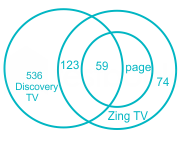
Question 38

Study the given Venn diagram carefully, and answer the question based on it. The diagram represents the favourite channels of children.

Find the ratio of number of children who like only Discovery TV to the number of children who like all the three channels.

  1. AOption (a)

    123/59

  2. BOption (b)

    59/536

  3. COption (c)

    536/59

  4. DOption (d)

    59/123

View answer & explanation

Correct answer

Answer: (c)C.

536/59

Why this answer is correct

The shaded part represents the number of children who like only Discovery TV  and the number of children who like all the three channels.

The ratio of number of children who like only Discovery TV to the number of children who like all the three channels.

536 ÷ 59

Hence, the correct answer is "Option 3".

Question 39

What is the method of balancing chemical equations called?

  1. AOption (a)

    Molar method

  2. BOption (b)

    Equivalent method

  3. COption (c)

    Chemical method

  4. DOption (d)

    Hit and trial method

View answer & explanation

Correct answer

Answer: (d)D.

Hit and trial method

Why this answer is correct

The correct answer is Hit and trial method

Key Points

  • The hit and trial method is a common and straightforward technique used to balance chemical equations. The goal is to ensure that there are the same number of each type of atom on both sides of the equation, in accordance with the Law of Conservation of Mass.
  • This method involves adjusting the coefficients of reactants and products by trial and error until the number of atoms of each element is balanced on both sides of the equation.

Additional Information

  • Molar Method
  • The Molar method involves using the mole concept to balance chemical equations.
  • It ensures that the number of moles of each element is equal on both sides of the equation.
  • This method is often used in stoichiometry problems.
  • It is particularly useful for reactions involving gases where volumes are involved.
  • Chemical Method
  • This term is not commonly used to describe a specific method for balancing chemical equations.
  • It may refer to any general approach used to balance chemical equations.
  • Typically, it would involve ensuring that the number of atoms of each element is equal on both sides of the equation.
  • Hit and Trial Method
  • The Hit and Trial method involves trial and error to balance chemical equations.
  • It is often used for simple equations where a systematic approach may not be necessary.
  • This method can be time-consuming for complex equations.
  • It involves adjusting coefficients until the number of atoms of each element is balanced on both sides of the equation.

Question 40

Q, W, E, R, T and Y live on seven different floors in the same building, in which one floor is vacant. The lowest floor in the building is numbered 1, the floor above it is numbered 2, and so on till the topmost floor is numbered 7. T lives on the 7th floor, and W lives on the 1st floor. Only Y lives between R and W, and none of the floors between R and W is vacant. E lives on the 5th floor. Only Q lives between T and E. Which floor is vacant?

  1. AOption (a)

    3

  2. BOption (b)

    2

  3. COption (c)

    6

  4. DOption (d)

    4

View answer & explanation

Correct answer

Answer: (d)D.

4

Why this answer is correct

Given:

Q, W, E, R, T and Y live on 7 different floors in the same building, in which one floor is vacant. The lowest floor in the building is numbered 1, the floor above it is numbered 2, and so on till the topmost floor is numbered 7.

T lives on the 7th floor, and W lives on the 1st floor

Only Y lives between R and W, and none of the floors between R and W is vacant

E lives on the 5th floor.

Only Q lives between T and E.

So, 4th floor is vacant.

Hence, the correct answer is "Option 4".

Question 41

The value of sin⁡θ(1+cos⁡θ)1+cos⁡θ−sin⁡2θ×(sec⁡θ+tan⁡θ)(1−sin⁡θ) \frac{\sin\theta (1 + \cos\theta)}{1 + \cos\theta - \sin^2\theta} \times (\sec\theta + \tan\theta)(1 - \sin\theta)  is equal to which of the following, where 0°<θ<90°?

  1. AOption (a)

    cosecθ

  2. BOption (b)

    cos⁡θ

  3. COption (c)

    sin⁡θ

  4. DOption (d)

    sec⁡θ

View answer & explanation

Correct answer

Answer: (c)C.

sin⁡θ

Why this answer is correct

Shortcut Trick Put θ = 45° in the given expression. Expression = [ (1/√2 × (1 + 1/√2)) / (1 + 1/√2 − 1/2) ] × [(√2 + 1)(1 − 1/√2)] ⇒ [ (1/√2 + 1/2) / (1/2 + 1/√2) ] × [(√2 + 1)((√2 − 1)/√2)] ⇒ 1 × [ (2 − 1)/√2 ] = 1/√2 Since sin 45° = 1/√2, the expression simplifies to sin θ. ∴ The correct answer is sin θ. Alternate Method

Given: θ is an acute angle (0° < θ < 90°). Formula Used: sin2θ + cos2θ = 1 ⇒ 1 − sin2θ = cos2θ ⇒ Term 1: [sinθ(1 + cosθ)] / [1 − sin2θ + cosθ] ⇒ Term 1: [sinθ(1 + cosθ)] / [cos2θ + cosθ] = [sinθ(1 + cosθ)] / [cosθ(1 + cosθ)] = tanθ ⇒ Term 2: (secθ + tanθ)(1 − sinθ) = (1/cosθ + sinθ/cosθ)(1 − sinθ) ⇒ Term 2: [(1 + sinθ)/cosθ] × (1 − sinθ) = (1 − sin2θ) / cosθ = cos2θ / cosθ = cosθ ⇒ Expression: tanθ × cosθ = (sinθ / cosθ) × cosθ = sinθ ∴ The correct answer is sin θ. Additional Information Trigonometric Identities Fundamental identities include sin2θ + cos2θ = 1, 1 + tan2θ = sec2θ, and 1 + cot2θ = cosec2θ. Reciprocal Relations sec θ = 1/cos θ, cosec θ = 1/sin θ, and tan θ = sin θ/cos θ. Value Substitution Method For identities involving tan, sec, or sin/cos, substituting standard angles like 45° or 30° helps in quick verification of options.

Question 42

Which of the following statements is correct regarding the Upper House of the Parliament of India?

  1. AOption (a)

    It is never dissolved.

  2. BOption (b)

    It is dissolved after every 5 years.

  3. COption (c)

    It is dissolved after every 6 years.

  4. DOption (d)

    It is dissolved after every 3 years.

View answer & explanation

Correct answer

Answer: (a)A.

It is never dissolved.

Why this answer is correct

The correct answer is It is never dissolved..

Key Points

  • The Upper House of the Parliament of India is also known as the Rajya Sabha.
  • It is a permanent body and is not subject to dissolution.
  • Members of the Rajya Sabha have a term of six years, with one-third of the members retiring every two years.
  • This ensures that the Rajya Sabha is a continuous body, unlike the Lok Sabha, which is dissolved every five years.

Additional Information

  • Rajya Sabha
  • The Rajya Sabha is the Upper House of India's Parliament, representing the states and union territories.
  • It was constituted on April 3, 1952, and held its first session on May 13, 1952.
  • The maximum strength of Rajya Sabha is 250 members, out of which 238 are representatives of states and union territories, and 12 are nominated by the President for their expertise in specific fields such as literature, science, art, and social service.
  • The Vice President of India is the ex-officio Chairman of the Rajya Sabha.
  • Lok Sabha
  • The Lok Sabha is the Lower House of India's Parliament, also known as the House of the People.
  • Members of the Lok Sabha are directly elected by the people of India.
  • The maximum strength of the Lok Sabha is 550 members: 530 from the states, 20 from union territories.
  • The term of the Lok Sabha is five years, after which it is dissolved unless extended during a national emergency.
  • Legislative Procedure
  • Both houses of Parliament play a crucial role in the legislative process, including the introduction, discussion, and passing of bills.
  • A bill can be introduced in either house, except for money bills, which must be introduced in the Lok Sabha.
  • After a bill is passed by both houses, it is sent to the President for assent, after which it becomes law.

Question 43

A person loses 12% by selling an item for ₹ 330. If he sells it for ₹ 367.50, find his percentage profit/loss.

  1. AOption (a)

    Profit, 4%

  2. BOption (b)

    Loss, 4%

  3. COption (c)

    Loss, 2%

  4. DOption (d)

    Profit, 2%

View answer & explanation

Correct answer

Answer: (c)C.

Loss, 2%

Why this answer is correct

Shortcut Trick Loss percentage is 12%, so Selling Price is 100% − 12% = 88% of Cost Price. 88% corresponds to 330. Therefore, 1% = 330 ÷ 88 = 3.75. New Selling Price is 367.50. In percentage: 367.50 ÷ 3.75 = 98%. Since 98% is less than 100%, it is a Loss. Loss% = 100% − 98% = 2%. ∴ The correct answer is Loss, 2%.

Alternate Method Given: First SP = 330, Loss = 12%, Second SP = 367.50. Formulas: CP = [SP × 100] ÷ [100 − Loss%], Profit/Loss% = [(New SP − CP) ÷ CP] × 100.

⇒ Cost Price (CP) = [330 × 100] ÷ (100 − 12) = 33000 ÷ 88 = 375. ⇒ New Selling Price (SP) = 367.50. ⇒ Since SP < CP, there is a Loss. ⇒ Loss = 375 − 367.50 = 7.50. ⇒ Loss Percentage = (7.50 ÷ 375) × 100 = 2%. ∴ The correct answer is Loss, 2%.

Additional Information Cost Price and Selling Price CP is the price at which an article is purchased. SP is the price at which it is sold. If SP > CP, it is Profit. If CP > SP, it is Loss. Loss Percentage Formula Loss% is always calculated on the Cost Price unless stated otherwise. Formula: Loss% = (Loss ÷ CP) × 100.

Question 44

Which of the following projects developed by the National Brain Research Centre, Haryana, Department of Biotechnology (DBT) is a unique brain initiative for the management of brain disorders?

  1. AOption (a)

    SWADESH

  2. BOption (b)

    AMRUT

  3. COption (c)

    UDAAN

  4. DOption (d)

    PRASAD

View answer & explanation

Correct answer

Answer: (a)A.

SWADESH

Why this answer is correct

The correct answer is SWADESH.

Key Points

  • SWADESH is a brain initiative developed by the National Brain Research Centre (NBRC), Haryana, under the Department of Biotechnology (DBT).
  • The project focuses on the management of brain disorders, making it a unique initiative in the field of neuroscience.
  • It leverages advanced imaging techniques and machine learning algorithms to understand and diagnose brain-related issues.
  • SWADESH aims to create a comprehensive database of brain images and associated clinical information to facilitate research and treatment.

Additional Information

  • National Brain Research Centre (NBRC)
  • NBRC is an autonomous institute under the Department of Biotechnology, Government of India.
  • It is dedicated to neuroscience research and aims to understand brain function in health and disease.
  • The centre conducts cutting-edge research in various aspects of brain science, including neurodegenerative disorders, neurodevelopmental disorders, and brain imaging.
  • NBRC also offers training programs to foster the next generation of neuroscientists.
  • Department of Biotechnology (DBT)
  • DBT is a part of the Ministry of Science and Technology, Government of India.
  • It is responsible for promoting and supporting biotechnology research, development, and innovation in India.
  • DBT funds various research projects, institutes, and initiatives to advance the field of biotechnology.
  • The department also works on policy formulation and implementation to enhance the biotechnology sector.
  • Brain Imaging Techniques
  • Brain imaging techniques are tools used to visualize the structure and function of the brain.
  • Common techniques include Magnetic Resonance Imaging (MRI), Positron Emission Tomography (PET), and Functional MRI (fMRI).
  • These techniques help in diagnosing brain disorders, monitoring disease progression, and guiding treatment decisions.
  • Advances in brain imaging have significantly improved our understanding of the brain and its disorders.
  • Machine Learning in Neuroscience
  • Machine learning involves the use of algorithms and statistical models to analyze and interpret complex data.
  • In neuroscience, machine learning is used to analyze brain imaging data, identify patterns, and predict outcomes.
  • This approach can enhance the accuracy of diagnoses, personalize treatments, and accelerate research discoveries.
  • Machine learning is becoming an integral part of modern neuroscience research and clinical practice.

Question 45

If a and b are the roots of the equation x²+3x-4=0, then find the value of 1/a+1/b+ab.

  1. AOption (a)

    -12/5

  2. BOption (b)

    13/4

  3. COption (c)

    12/5

  4. DOption (d)

    -13/4

View answer & explanation

Correct answer

Answer: (d)D.

-13/4

Why this answer is correct

Shortcut Trick For the equation x2 + 3x − 4 = 0, sum of roots (a + b) = −3 and product of roots (ab) = −4. Expression = 1/a + 1/b + ab = (a + b)/ab + ab Substitute values: (−3 / −4) + (−4) = 3/4 − 4 Calculation: 3/4 − 4 = (3 − 16) / 4 = −13/4 ∴ The correct answer is −13/4.

Alternate Method Given: Quadratic equation: x2 + 3x − 4 = 0 Roots: a and b Formula Used: For ax2 + bx + c = 0, sum of roots (a + b) = −b/a and product of roots (ab) = c/a. Calculations: ⇒ From the equation, a + b = −3 / 1 = −3 ⇒ From the equation, ab = −4 / 1 = −4 ⇒ Target expression: 1/a + 1/b + ab ⇒ Simplify the first two terms: (a + b) / ab + ab ⇒ Substituting the values: (−3) / (−4) + (−4) ⇒ 3/4 − 4 ⇒ (3 − 16) / 4 = −13/4 ∴ The correct answer is −13/4.

Additional Information Sum and Product of Roots For a quadratic equation Ax2 + Bx + C = 0, the sum of roots is −B/A and the product of roots is C/A. Symmetric Functions of Roots Functions like 1/a + 1/b can always be expressed in terms of (a + b) and ab, specifically as (a + b) / ab. Nature of Roots The nature of roots is determined by the discriminant D = b2 − 4ac. If D > 0, roots are real and distinct.

Question 46

Three statements are given followed by three conclusions I, II and III. Assuming the statements to be true, even if they do not seem to be in accordance with the real world knowledge, decide which of the given conclusions/possibilities can be true based on the statements. 

Statements :

Some games are cricket.

Some crickets are tennis.

All tennis are balls.

Conclusions:

I. Some tennis are games.

II. Some balls are games.

III. Some balls are crickets.

  1. AOption (a)

    Only conclusion I is true.

  2. BOption (b)

    Only conclusion II is true.

  3. COption (c)

    Only conclusion III is true.

  4. DOption (d)

    Only conclusions I and II are true.

View answer & explanation

Correct answer

Answer: (c)C.

Only conclusion III is true.

Why this answer is correct

The least possible diagram for the given statements is as follows,

Conclusions:

I. Some tennis are games → False (As, there is no direct relation given between tennis and games, so it can be possible but not definite)

II. Some balls are games → False(As, there is no direct relation given between balls and games, so it can be possible but not definite)

III. Some balls are crickets → True(As, Some crickets are tennis and All tennis are balls, so, it can be definite).

Hence, the correct answer is "Only conclusion III is true".

Question 47

The price of petrol (per litre) increases by 52%. By what percent should its consumption be reduced so that the expenditure on it increases by only 14%?

  1. AOption (a)

    25%

  2. BOption (b)

    35%

  3. COption (c)

    38%

  4. DOption (d)

    30%

View answer & explanation

Correct answer

Answer: (a)A.

25%

Why this answer is correct

Shortcut Trick

Use the direct ratio approach for Expenditure = Price × Consumption.

Initial Price = 100, New Price = 152 | Target Expenditure = 114.

Reduction needed = (152 − 114) ÷ 152 × 100.

Reduction = 38 ÷ 152 × 100 = 1/4 × 100 = 25%.

∴ The correct answer is 25%.

Alternate Method

Given: Increase in Petrol Price = 52%, Desired increase in Expenditure = 14%.

Formula: Consumption = Expenditure ÷ Price.

⇒ Let initial Price = 100 and initial Consumption = 100, then Expenditure = 10,000.

⇒ New Price = 100 + 52 = 152.

⇒ New Expenditure = 10,000 + 14% of 10,000 = 11,400.

⇒ New Consumption = 11,400 ÷ 152 = 75.

⇒ Reduction in Consumption = 100 − 75 = 25%.

∴ The correct answer is 25%.

Additional Information

Price-Consumption Relation

If expenditure remains constant, consumption is inversely proportional to price: C1/C2 = P2/P1.

Successive Percentage Formula

Net change in Expenditure = a + b + (ab/100), where 'a' is % change in price and 'b' is % change in consumption.

Base Change Method

When Price increases by r%, consumption must decrease by [r/(100+r)] × 100 to keep Expenditure unchanged.

Question 48

In March 2022, which of these teams won the Indian Super League title?

  1. AOption (a)

    Hyderabad FC Football Club

  2. BOption (b)

    Kerala Blasters Football Club

  3. COption (c)

    Goa football club

  4. DOption (d)

    ATK Mohun Bagan Football Club

View answer & explanation

Correct answer

Answer: (a)A.

Hyderabad FC Football Club

Why this answer is correct

The correct answer is Hyderabad FC Football Club.

Key Points

  • Hyderabad FC won their first Indian Super League title in March 2022.
  • The final match was held at the Fatorda Stadium, Goa.
  • Hyderabad FC triumphed over Kerala Blasters in a penalty shootout to clinch the title.
  • Bartholomew Ogbeche, a player from Hyderabad FC, was the top scorer of the season with 18 goals.

Additional Information

  • Indian Super League (ISL)
  • The Indian Super League is a professional football league in India which commenced in October 2014.
  • It is one of the top-tier football leagues in India, alongside the I-League.
  • The league operates on a system of promotion and relegation with the I-League.
  • The competition involves 11 teams from across the country.
  • Hyderabad FC
  • Hyderabad FC is an Indian professional football club based in Hyderabad, Telangana.
  • The club was established in 2019 and plays its home matches at the Gachibowli Stadium.
  • Hyderabad FC is known for its strong squad and competitive performances in the ISL.
  • Their team colors are yellow and black, symbolizing the city's vibrant culture and history.
  • Penalty Shootout
  • A penalty shootout is a method used in football to determine the winner of a match that cannot end in a draw.
  • It involves each team taking turns to shoot at the goal from the penalty mark.
  • The team with the most goals after a set number of attempts wins the match.
  • Penalty shootouts are usually used in knockout stages of tournaments where a winner must be decided.
  • Bartholomew Ogbeche
  • Bartholomew Ogbeche is a Nigerian professional footballer who plays as a forward.
  • He has played for several clubs across different countries and is known for his goal-scoring abilities.
  • Ogbeche was the top scorer in the 2021-2022 ISL season, playing for Hyderabad FC.
  • His contributions were instrumental in Hyderabad FC's successful campaign.

Question 49

Two resistances A and B of 10Ω and 20Ω are connected in series with a 6 V battery. If V₁ and V₂ are the potential drops across A and B respectively, and I₁ and I₂ are the currents flowing through them, then (V₁/V₂) and (I₁/I₂) are □( ) respectively.

  1. AOption (a)

    (1/2) and (1/2)

  2. BOption (b)

    (1/2) and 1

  3. COption (c)

    2 and 1

  4. DOption (d)

    2 and (1/2)

View answer & explanation

Correct answer

Answer: (b)B.

(1/2) and 1

Why this answer is correct

The correct answer is option 2.

Key Points

  • When resistances are connected in series, the same current flows through each resistor.
  • The potential drop across a resistor in a series circuit is directly proportional to its resistance.
  • The ratio of potential drops (V₁/V₂) across resistors A and B is equal to the ratio of their resistances (R₁/R₂).
  • The ratio of currents (I₁/I₂) through resistors in series is always 1 because the current is the same through all series components.

Additional Information

  • Series Circuit:
  • A series circuit is a type of electrical circuit in which there is only one path for the current to flow.
  • All components are connected end-to-end, forming a single pathway for current flow.
  • The current (I) is the same through each component in the circuit.
  • The total resistance (R_total) of the circuit is the sum of the individual resistances: R_total = R₁ + R₂ + ... + Rn.
  • Ohm's Law:
  • Ohm's Law states that the current flowing through a conductor between two points is directly proportional to the voltage across the two points.
  • It is mathematically expressed as V = IR, where V is the voltage, I is the current, and R is the resistance.
  • Potential Drop:
  • The potential drop (voltage drop) across a resistor in a circuit is the amount of voltage lost as the electric current flows through the resistor.
  • In a series circuit, the potential drop across each resistor is different and depends on the resistance of each resistor.
  • Resistors in Series:
  • When resistors are connected in series, the same current flows through each resistor.
  • The total voltage across the series combination is the sum of the voltages across each individual resistor: V_total = V₁ + V₂ + ... + Vn.
  • The voltage drop across each resistor can be found using Ohm's Law: V = IR.
  • The voltage drop ratio (V₁/V₂) is equal to the resistance ratio (R₁/R₂).

Question 50

The cost of 4 pens and 3 notebooks is ₹ 150. The cost of 5 notebooks is ₹ 41 more than the cost of 6 pens. Find the cost of 3 pens and 2 notebooks.

  1. AOption (a)

    ₹ 104.00

  2. BOption (b)

    ₹ 109.00

  3. COption (c)

    ₹ 110.50

  4. DOption (d)

    ₹ 105.50

View answer & explanation

Correct answer

Answer: (d)D.

₹ 105.50

Why this answer is correct

Shortcut Trick

Let P be the cost of a pen and N be the cost of a notebook.

Eliminate P by finding the LCM of 4 and 6 (which is 12): 3 × (4P + 3N) + 2 × (5N − 6P) = 3 × 150 + 2 × 41.

19 Notebooks = 450 + 82 = 532 ⇒ 1 Notebook = 532 ÷ 19 = ₹ 28.

1 Pen = (150 − 3 × 28) ÷ 4 = (150 − 84) ÷ 4 = ₹ 16.5.

Required Cost = 3 × 16.5 + 2 × 28 = 49.5 + 56 = ₹ 105.50.

∴ The correct answer is ₹ 105.50.

Alternate Method

Given:

Cost of 4 Pens + 3 Notebooks = ₹ 150

Cost of 5 Notebooks = Cost of 6 Pens + ₹ 41

Let P be the cost of one pen and N be the cost of one notebook.

Equation 1: 4P + 3N = 150

Equation 2: 5N − 6P = 41 ⇒ −6P + 5N = 41

Multiplying Equation 1 by 3 and Equation 2 by 2 to use the Elimination Method:

⇒ 3 × (4P + 3N) = 3 × 150 ⇒ 12P + 9N = 450

⇒ 2 × (−6P + 5N) = 2 × 41 ⇒ −12P + 10N = 82

Adding both equations:

⇒ (12P − 12P) + (9N + 10N) = 450 + 82

⇒ 19N = 532

⇒ N = 532 ÷ 19 = 28

Substituting N = 28 in Equation 1:

⇒ 4P + 3(28) = 150

⇒ 4P + 84 = 150

⇒ 4P = 66 ⇒ P = 16.5

Cost of 3 Pens and 2 Notebooks:

⇒ (3 × 16.5) + (2 × 28) = 49.5 + 56 = 105.5

Therefore, Option 4 is the correct answer.

∴ The correct answer is ₹ 105.50.

Additional Information

Simultaneous Linear Equations

Systems of equations where multiple variables are solved using methods like Substitution or Elimination.

Elimination Method

A process where equations are multiplied by constants to make the coefficients of one variable identical, allowing its removal by addition or subtraction.

Unit Value Method

Calculating the cost of a single unit (1 pen or 1 notebook) first before finding the total for a required quantity.

Question 51

Three resistances of 8Ω, 12Ω and 24Ω are connected in parallel. The resistance of this combination will be □( ).

  1. AOption (a)

    44Ω

  2. BOption (b)

    8Ω

  3. COption (c)

    4.8Ω

  4. DOption (d)

    4 Ω

View answer & explanation

Correct answer

Answer: (d)D.

4 Ω

Why this answer is correct

The correct answer is 4 Ω.

Key Points

  • The three resistances given are 8Ω, 12Ω, and 24Ω.
  • These resistances are connected in parallel.
  • The formula to calculate the equivalent resistance (Req) for parallel resistances is: 1/Req = 1/R1 + 1/R2 + 1/R3.
  • Substituting the given resistances into the formula gives us the equivalent resistance of 4Ω.

Additional Information

  • Resistance:
  • Resistance is a measure of the opposition to the flow of electric current in a conductor.
  • The unit of resistance is the ohm (Ω).
  • Resistors are used in electrical circuits to control the flow of current.
  • Parallel Connection:
  • In a parallel connection, the resistors are connected across the same two points, providing multiple paths for the current to flow.
  • The voltage across each resistor in a parallel circuit is the same.
  • The total or equivalent resistance of resistors in parallel is always less than the smallest individual resistor in the network.
  • Calculating Equivalent Resistance in Parallel:
  • When resistors are connected in parallel, the reciprocal of the equivalent resistance is the sum of the reciprocals of the individual resistances.
  • The formula is: 1/Req = 1/R1 + 1/R2 + 1/R3...
  • For the given resistances, 1/Req = 1/8 + 1/12 + 1/24. Simplifying this gives us 1/Req = 1/4, so Req = 4Ω.

Question 52

12 years ago, a father was 28 years older than twice the age of his son. After how many years from now, his age will be equal to twice the age of his son?

  1. AOption (a)

    18

  2. BOption (b)

    14

  3. COption (c)

    15

  4. DOption (d)

    16

View answer & explanation

Correct answer

Answer: (d)D.

16

Why this answer is correct

Shortcut Trick

The age difference between father and son remains constant over time.

Let son age 12 years ago be S. Father age = 2S + 28.

Difference = (2S + 28) − S = S + 28. This difference must always hold.

Future condition: Father = 2 × Son. This means Father − Son = Son.

Equating differences: Sonfuture = S + 28.

Sonpresent = S + 12. Gap = (S + 28) − (S + 12) = 16 years.

∴ The correct answer is 16 years.

Alternate Method

Let the age of the son 12 years ago be x years.

⇒ Father age 12 years ago = 2x + 28

⇒ Present age of Son = x + 12

⇒ Present age of Father = (2x + 28) + 12 = 2x + 40

⇒ Let his age be twice the son age after n years from now.

⇒ (2x + 40 + n) = 2 × (x + 12 + n)

⇒ 2x + 40 + n = 2x + 24 + 2n

⇒ 40 − 24 = 2n − n

⇒ n = 16

∴ The correct answer is 16 years.

Additional Information

Constant Age Difference

The difference between the ages of two people always remains the same, regardless of how many years pass.

Ratio of Ages

If the current ages are in ratio a:b, after n years the ratio becomes (a+n):(b+n). This is used to solve linear equations in age problems.

Question 53

What are the reasons for the decrease in the number and species of wildlife?

a. Demand for leather and meat

b. Lack of food and space as a result of deforestation

c. Keeping animals in protected areas

d. Making and supporting laws to protect habitats

e. Natural disasters like floods and earthquakes

  1. AOption (a)

    a, b and e

  2. BOption (b)

    only d

  3. COption (c)

    Only c and d

  4. DOption (d)

    only c

View answer & explanation

Correct answer

Answer: (a)A.

a, b and e

Why this answer is correct

The correct answer is a, b and e.

Key Points

  • Demand for leather and meat (a): This is a significant factor contributing to the decline in wildlife species. Hunting and poaching for leather, meat, and other animal products directly reduce the number of individuals in a species.
  • Lack of food and space as a result of deforestation (b): Deforestation leads to the destruction of habitats where wildlife live, breed, and find food. As forests are cleared for agriculture, urban development, or logging, the available space and food for wildlife diminish, leading to a decrease in animal populations.
  • Natural disasters like floods and earthquakes (e): While these are not human-caused factors, natural disasters can drastically alter habitats, sometimes wiping out local populations of species or significantly changing the landscape in ways that can be detrimental to the survival of wildlife.
  • Keeping animals in protected areas (c) and Making and supporting laws to protect habitats (d) are measures taken to protect and conserve wildlife populations, not reasons for their decrease. Hence, they do not contribute to the decline but are efforts to mitigate it.

Question 54

A, B, C, D, E, F, G and H are sitting around a square table facing the centre. Some of them are sitting at the corners while some are sitting in the middle of the sides of the table.

D is sitting third to the left of E. D is sitting at one of the corners. H is not sitting at any corner. G is sitting second to the right of H. H is not sitting immediate next to D. Only three persons are sitting between B and A. B is sitting immediate next to F. B is not sitting in the middle of any side.

Who is sitting third to the left of G?

  1. AOption (a)

    D

  2. BOption (b)

    C

  3. COption (c)

    B

  4. DOption (d)

    A

View answer & explanation

Correct answer

Answer: (b)B.

C

Why this answer is correct

Given:

A, B, C, D, E, F, G and H are sitting around a square table facing the centre. 

D is sitting third to the left of E

D is sitting at one of the corners

H is not sitting at any corner, H is not sitting immediate next to D

G is sitting second to the right of H

Only three persons are sitting between B and A. B is sitting immediate next to F

So, C is sitting third to the left of G.

Hence, the correct answer is "Option 2".

Question 55

Three statements are given, followed by three conclusions I, II and III. Assuming the statements to be true, decide which of the given conclusions can be true. 

Statements:

Some mountains are hills.

Some hills are rocks.

All rocks are black.

Conclusions:

I. Some blacks are hills.

II. All hills being mountains is a possibility.

III. Some rocks are not mountains.

  1. AOption (a)

    Only conclusion I is true.

  2. BOption (b)

    Only conclusion III is true.

  3. COption (c)

    Only conclusions I and II are true.

  4. DOption (d)

    Only conclusion II is true.

View answer & explanation

Correct answer

Answer: (c)C.

Only conclusions I and II are true.

Why this answer is correct

The least possible diagram for the given statements is as follows,

Conclusions:

I. Some blacks are hills → True (As, some hills are rocks and all rocks are black so, it can be definite)

II. All hills being mountains is a possibility → True (As their is no direct relation between them then in possibility it can be true)

III. Some rocks are not mountains → False (As their is no direct relation between them so, it can be possible but not definite)

Hence, the correct answer is "Only conclusions I and II are true".

Question 56

Find the value of 22×(63÷7)÷6-{7×5+4-(3-5)÷2}.

  1. AOption (a)

    -7

  2. BOption (b)

    7

  3. COption (c)

    -9

  4. DOption (d)

    11

View answer & explanation

Correct answer

Answer: (a)A.

-7

Why this answer is correct

Given:

Expression: 22 × (63 ÷ 7) ÷ 6 - {7 × 5 + 4 - (3 - 5) ÷ 2}

Formula Used:

Order of Operations (BODMAS/BIDMAS): Brackets, Orders (i.e. powers and square roots, etc.), Division and Multiplication, Addition and Subtraction

Calculation:

Simplify inside the brackets first:

⇒ 22×(63÷7)÷6-{7×5+4-(3-5)÷2}

⇒ 22×(63÷7)÷6-{7×5+4-(-2)÷2}

⇒ 22×(63÷7)÷6-{35+4+1}

⇒ 22×(63÷7)÷6-{40}

Now simplify the division and multiplication outside the brackets:

⇒ 22×9÷6-40

⇒ 198÷6-40

⇒ 33-40

Finally, perform the subtraction:

⇒ -7

The correct answer is option 1.

Question 57

Who among the following was one of the two recipients of the Shanti Swarup Bhatnagar Prize 2021 in the 'Medical Sciences Category'?

  1. AOption (a)

    Rohit Shrivastava

  2. BOption (b)

    Arun Kumar Yadav

  3. COption (c)

    Amit Singh

  4. DOption (d)

    Kanishka Biswas

View answer & explanation

Correct answer

Answer: (a)A.

Rohit Shrivastava

Why this answer is correct

The correct answer is Rohit Shrivastava.

Key Points

  • Rohit Shrivastava is a prominent scientist who has made significant contributions in the field of medical sciences.
  • He was awarded the Shanti Swarup Bhatnagar Prize for Science and Technology in 2021, which is one of the highest Indian science awards.
  • His research primarily focuses on developing innovative medical technologies and solutions.
  • He has published numerous papers and has been recognized globally for his work in medical sciences.

Additional Information

  • Shanti Swarup Bhatnagar Prize
  • It is named after the founder Director of the Council of Scientific & Industrial Research (CSIR), Shanti Swarup Bhatnagar.
  • The prize is awarded annually for notable and outstanding research, applied or fundamental, in various disciplines of science and technology.
  • It is considered one of the most prestigious science awards in India.
  • The award consists of a citation, a plaque, and a cash award.
  • Medical Sciences Category
  • This category includes research in various branches of medical sciences such as clinical, pre-clinical, and translational research.
  • Medical sciences play a crucial role in improving healthcare, developing new treatments, and understanding human health and diseases.
  • Research in this field can lead to significant advancements in the diagnosis, treatment, and prevention of diseases.
  • Other Notable Awards in Science and Technology in India
  • Infosys Prize: Awarded by the Infosys Science Foundation for outstanding achievements in various categories including engineering, computer science, and social sciences.
  • Padma Awards: Includes Padma Vibhushan, Padma Bhushan, and Padma Shri, awarded for distinguished contributions in various disciplines including science and technology.
  • National Science & Technology Awards: Given by various government bodies to recognize contributions in specific fields such as biotechnology, environmental science, and space research.

Question 58

Sunflower plants grow best in soil with a pH range of 6.2 to 6.7. If the pH value of a garden soil is 5, what substance should be added to the soil to grow sunflowers?

  1. AOption (a)

    Compost

  2. BOption (b)

    Sand

  3. COption (c)

    Salt

  4. DOption (d)

    Lemon

View answer & explanation

Correct answer

Answer: (a)A.

Compost

Why this answer is correct

The correct answer is Compost.

Key Points

  • Compost is a natural substance that can help in increasing the pH level of the soil.
  • It improves soil structure, providing better aeration, drainage, and moisture retention.
  • Compost adds essential nutrients to the soil, promoting healthy plant growth.
  • Using compost is an environmentally friendly way to recycle organic waste and enrich the soil.

Additional Information

  • Soil pH
  • The pH of soil is a measure of its acidity or alkalinity, ranging from 0 to 14.
  • A pH below 7 indicates acidic soil, while a pH above 7 indicates alkaline soil.
  • Most plants, including sunflowers, prefer a slightly acidic to neutral pH range (6.2 to 6.7).
  • Compost
  • Compost is decomposed organic matter that can be used to improve soil quality.
  • It contains nutrients like nitrogen, phosphorus, and potassium, which are essential for plant growth.
  • Compost also helps to buffer the soil pH, bringing it closer to the ideal range for plant growth.
  • Soil Amendments
  • Soil amendments are materials added to soil to improve its physical or chemical properties.
  • Common soil amendments include compost, lime, sulfur, and organic matter.
  • The choice of amendment depends on the specific needs of the soil and the plants being grown.

Question 59

If the median of some data is 24.12 less than its mode, then the median of the data is ___ more than its mean. (Use the empirical formula to find the answer)

  1. AOption (a)

    12.06

  2. BOption (b)

    6.03

  3. COption (c)

    16.08

  4. DOption (d)

    8.04

View answer & explanation

Correct answer

Answer: (a)A.

12.06

Why this answer is correct

Shortcut Trick By the empirical formula: Mode − Median = 2 × (Median − Mean) ⇒ 24.12 = 2 × (Median − Mean) ⇒ Median − Mean = 12.06 ∴ The correct answer is 12.06. Alternate Method Given: Mode − Median = 24.12 Formula Used: Empirical formula: Mode = 3 × Median − 2 × Mean

Mean Median Mode

x = ?

2x = 24.12 Empirical Relationship

Calculations: ⇒ Mode = 3 × Median − 2 × Mean Subtracting Median from both sides, we get: ⇒ Mode − Median = 2 × Median − 2 × Mean ⇒ Mode − Median = 2 × (Median − Mean) Substituting the given value of (Mode − Median): ⇒ 24.12 = 2 × (Median − Mean) ⇒ Median − Mean = 24.12 ÷ 2 ⇒ Median − Mean = 12.06 ∴ The correct answer is 12.06. Additional Information Empirical Relationship in Statistics For a moderately skewed distribution, the relationship between mean, median, and mode is given by: Mode = 3 × Median − 2 × Mean. Positively Skewed Distribution The tail of the distribution is longer on the right side. The order of central tendencies is: Mean > Median > Mode. Negatively Skewed Distribution The tail of the distribution is longer on the left side. The order of central tendencies is: Mean < Median < Mode.

Question 60

'Emblica officinalis', whose Indian local name is □( ), is used in the preparation of Chyavanaprash.

  1. AOption (a)

    Neem

  2. BOption (b)

    Mahua

  3. COption (c)

    Amla

  4. DOption (d)

    Opium

View answer & explanation

Correct answer

Answer: (c)C.

Amla

Why this answer is correct

The correct answer is Amla.

Key Points

  • Amla is commonly known as Indian gooseberry.
  • It is rich in Vitamin C and is known for its numerous health benefits, including boosting the immune system and enhancing hair growth.
  • Amla is a crucial ingredient in Chyavanaprash, a traditional Ayurvedic health supplement.
  • The scientific name of Amla is Emblica officinalis or Phyllanthus emblica.

Additional Information

  • Chyavanaprash
  • It is an ancient Ayurvedic formulation that is believed to be a rejuvenative and immune-boosting supplement.
  • Chyavanaprash contains a mixture of herbs, spices, and other natural ingredients, with Amla being one of its primary components.
  • It is traditionally used to improve vitality, strength, and overall health.
  • This herbal tonic is beneficial for respiratory health, digestion, and overall immunity.
  • Neem
  • Scientific name: Azadirachta indica
  • Neem is known for its medicinal properties and is often used in traditional medicine for treating skin conditions, purifying the blood, and maintaining oral health.
  • Mahua
  • Scientific name: Madhuca longifolia
  • Mahua is a tropical tree found in India and is known for its sweet flowers, which are used to produce a traditional alcoholic drink.
  • It has various medicinal uses, including treating skin infections and enhancing wound healing.
  • Opium
  • Scientific name: Papaver somniferum
  • Opium is a narcotic drug obtained from the poppy plant, and it has potent analgesic properties.
  • It is used in the production of various pharmaceutical drugs like morphine and codeine.
  • Due to its addictive nature, the use of opium is strictly regulated in many countries.

Question 61

A, B, C, D, E, F, G, and H are seated around a square table, facing towards the center. Some of them are seated at the corners, while others are seated in the middle of the sides of the table. D is seated at the third position to the left of E. D is seated at one of the corners. H is not seated at any corner. G is seated at the second position to the right of H. H is not seated immediately next to D. There are exactly three persons between B and A. B is seated immediately next to F. B is not seated in the middle of any side. 

Who is seated at the third position to the left of G?

  1. AOption (a)

    D

  2. BOption (b)

    C

  3. COption (c)

    B

  4. DOption (d)

    H

View answer & explanation

Correct answer

Answer: (b)B.

C

Why this answer is correct

Given :

A, B, C, D, E, F, G, and H are seated around a square table, facing towards the center.

Some of them are seated at the corners, while others are seated in the middle of the sides of the table.

Explanation :

There are exactly three persons between B and A.

B is not seated in the middle of any side.

D is seated at the third position to the left of E. D is seated at one of the corners.

Case 1:

Case 2:

H is not seated at any corner.

G is seated at the second position to the right of H.

H is not seated immediately next to D.

Case 1:

Case 2:

B is seated immediately next to F.

After positioning of all only vacant seat occupied by C.

Case 1.

Case 2.

We have to find who is seated at the third position to the left of G.

According to both the cases C is third position to the left of G.

Hence, the correct answer is "Option 2".

Question 62

In January 2022, the Ministry of Environment, Forest and Climate Change announced the 'Action Plan for Introduction of □( ) in India', under which it has been decided to reintroduce the extinct species in the country.

  1. AOption (a)

    Himalayan Quail

  2. BOption (b)

    Leopard

  3. COption (c)

    Sumatran Rhinoceros

  4. DOption (d)

    Pink headed duck

View answer & explanation

Correct answer

Answer: (a)A.

Himalayan Quail

Why this answer is correct

The correct answer is Himalayan Quail.

Key Points

  • The Himalayan Quail (Ophrysia superciliosa) is a bird species that was last seen in 1876 in the western Himalayas near Mussoorie, India.
  • This species is categorized as Critically Endangered (Possibly Extinct) by the International Union for Conservation of Nature (IUCN).
  • The Himalayan Quail was primarily found in the sub-Himalayan regions, and its habitat loss is one of the significant reasons for its decline.
  • Efforts to reintroduce this species aim to restore biodiversity and enhance the ecological balance in its native habitat.

Additional Information

  • Ministry of Environment, Forest and Climate Change:
  • This ministry is responsible for the planning, promotion, coordination, and overseeing the implementation of environmental and forestry policies and programs in India.
  • It aims to protect and improve the environment and the living conditions of the people.
  • Reintroduction Programs:
  • Reintroduction programs involve the release of species into an area where they have been extirpated or extinct.
  • The objective is to restore a viable, free-ranging population of the species in its natural habitat.
  • Such programs require careful planning, including habitat assessment, ensuring genetic diversity, and post-release monitoring.
  • Biodiversity Conservation:
  • Biodiversity conservation is crucial for maintaining ecological balance and the health of ecosystems.
  • It includes protecting species, their habitats, and ecosystems from excessive exploitation and destruction.
  • Conservation efforts help in sustaining the natural resources that humans depend on for survival.
  • International Union for Conservation of Nature (IUCN):
  • The IUCN is a global authority on the status of the natural world and the measures needed to safeguard it.
  • It maintains the Red List of Threatened Species, which assesses the conservation status of species worldwide.
  • The IUCN Red List provides critical information for conservation actions and policy decisions.

Question 63

Study the bar chart. In which year maximum percentage increase in production was recorded as compared to the previous year?

Reference: [production of wheat (in 1000 tonnes) over the years ]

In which year maximum percentage increase in production was recorded as compared to the previous year?

  1. AOption (a)

    2021

  2. BOption (b)

    2020

  3. COption (c)

    2018

  4. DOption (d)

    2019

View answer & explanation

Correct answer

Answer: (b)B.

2020

Why this answer is correct

Given:

Bar chart showing wheat production (in 1000 tonnes) for the years 2016 to 2021.

Formula used:

Percentage increase = New value - Old valueOld value×100\frac{\text{New value - Old value}}{\text{Old value}} \times 100

Calculation:

Step 1: Calculate percentage increases year-wise:

2017: 140−125125×100=12%\frac{140 - 125}{125} \times 100 = 12\%

2018: 150−140140×100=7.14%\frac{150 - 140}{140} \times 100 = 7.14\%

2019: 165−150150×100=10%\frac{165 - 150}{150} \times 100 = 10\%

2020: 210−165165×100=27.27%\frac{210 - 165}{165} \times 100 = 27.27\%

2021: 225−210210×100=7.14%\frac{225 - 210}{210} \times 100 = 7.14\%

Step 2: Identify the maximum percentage increase:

⇒ Maximum percentage increase = 27.27% in the year 2020.

∴ Maximum percentage increase in production was recorded in 2020.

Question 64

All of the following statements are true regarding the use of contraceptive devices except one. Choose the incorrect option.

  1. AOption (a)

    These do not have any side effects.

  2. BOption (b)

    They play an important role in preventing uncontrolled growth of population.

  3. COption (c)

    They are used to prevent or delay pregnancy.

  4. DOption (d)

    These are used against the natural process of reproduction.

View answer & explanation

Correct answer

Answer: (a)A.

These do not have any side effects.

Why this answer is correct

The correct answer is These do not have any side effects..

Key Points

  • Contraceptive devices can sometimes cause side effects such as nausea, weight gain, mood changes, and irregular menstrual cycles.
  • Different types of contraceptive devices have different side effects. For example, hormonal contraceptives might cause hormonal imbalances, while intrauterine devices (IUDs) can cause discomfort or infections.
  • It is essential to consult with a healthcare provider to choose the appropriate contraceptive method based on individual health conditions and lifestyle.
  • Awareness and proper education about the potential side effects of contraceptive devices can help in better management and choosing the right option.

Additional Information

  • Contraceptive Devices:
  • Hormonal Contraceptives: These include pills, patches, injections, and hormonal IUDs. They release hormones to prevent ovulation and thicken cervical mucus to block sperm.
  • Barrier Methods: These include condoms, diaphragms, and cervical caps. They physically block sperm from reaching the egg.
  • Intrauterine Devices (IUDs): These are small devices inserted into the uterus. They can be hormonal or non-hormonal (copper IUDs) and prevent sperm from fertilizing the egg.
  • Emergency Contraceptives: These are pills taken after unprotected sex to prevent pregnancy. They are not meant for regular use.
  • Natural Process of Reproduction:
  • It involves the fertilization of an egg by sperm, leading to pregnancy and the birth of offspring.
  • Contraceptive devices interfere with this natural process to prevent or delay pregnancy.
  • Population Control:
  • Contraceptive devices play a crucial role in managing population growth by allowing couples to plan and space their children.
  • They contribute to better health outcomes for women and children by reducing the risks associated with unintended pregnancies.

Question 65

The term 'geography' was coined by who among the following?

  1. AOption (a)

    Eratosthenes

  2. BOption (b)

    Al Idrisi

  3. COption (c)

    Ptolemy

  4. DOption (d)

    Carl Ritter

View answer & explanation

Correct answer

Answer: (a)A.

Eratosthenes

Why this answer is correct

The correct answer is Eratosthenes.

Key Points

  • Eratosthenes was a Greek mathematician, geographer, poet, astronomer, and music theorist.
  • He is best known for being the first person to use the term 'geography' and for his work in geography, particularly his calculation of the Earth's circumference.
  • He was the chief librarian at the Library of Alexandria.
  • Eratosthenes created one of the earliest maps of the world and introduced the concept of latitude and longitude.

Additional Information

  • Eratosthenes' Contributions to Geography
  • Eratosthenes is often referred to as the 'Father of Geography' for his significant contributions to the field.
  • He invented the discipline of geography, including the terminology we still use today.
  • One of his most famous achievements was calculating the circumference of the Earth with remarkable accuracy for his time.
  • He also created a system of latitude and longitude, which laid the foundation for modern cartography and navigation.
  • Al Idrisi
  • Al Idrisi was an Arab Muslim geographer, cartographer, and Egyptologist who lived in the 12th century.
  • He is best known for his work "Tabula Rogeriana," which is one of the most advanced medieval world maps.
  • His work was highly influential in the medieval Islamic world and in Europe.
  • Ptolemy
  • Ptolemy was a Greco-Egyptian writer of Alexandria, known for his work in astronomy, mathematics, and geography.
  • He authored the "Geographia," a comprehensive treatise on the geographical knowledge of the Greco-Roman world.
  • Ptolemy's work influenced geographic thought for over a thousand years.
  • Carl Ritter
  • Carl Ritter was a German geographer who is considered one of the founders of modern geography.
  • He emphasized the importance of empirical observation and the interrelation between human and physical geography.
  • His work laid the groundwork for future geographical studies and education.

Question 66

Metabolic wastes are excreted by aquatic plants through □( ).

  1. AOption (a)

    Osmosis

  2. BOption (b)

    Active transport

  3. COption (c)

    Diffusion

  4. DOption (d)

    Accumulation

View answer & explanation

Correct answer

Answer: (c)C.

Diffusion

Why this answer is correct

The correct answer is Diffusion.

Key Points

  • Diffusion is the process by which molecules move from an area of higher concentration to an area of lower concentration.
  • It is a passive process, meaning it does not require energy expenditure from the plant.
  • In aquatic plants, metabolic wastes such as oxygen produced during photosynthesis are removed from the cells by diffusion into the surrounding water.
  • Diffusion allows for the efficient removal of waste products and the uptake of necessary gases like carbon dioxide for photosynthesis.

Additional Information

  • Osmosis
  • Osmosis is the movement of water molecules through a semipermeable membrane from a region of lower solute concentration to a region of higher solute concentration.
  • It is critical for maintaining cell turgidity and overall plant health.
  • Unlike diffusion, osmosis specifically refers to the movement of water molecules.
  • Active Transport
  • Active transport is the movement of molecules across a cell membrane from a region of lower concentration to a region of higher concentration, using energy in the form of ATP.
  • This process is vital for the uptake of nutrients and ions that are in lower concentrations outside the cell.
  • Accumulation
  • Accumulation refers to the build-up of substances within an organism or a cell.
  • It is not a process of excretion but rather a result of an inability to effectively excrete certain substances.

Question 67

From the organisms given below, select the apex predator.

  1. AOption (a)

    Python

  2. BOption (b)

    Rat

  3. COption (c)

    Garuda

  4. DOption (d)

    Grasshopper

View answer & explanation

Correct answer

Answer: (c)C.

Garuda

Why this answer is correct

The correct answer is Garuda.

Key Points

  • Garuda is considered an apex predator, meaning it is at the top of the food chain.
  • As an apex predator, Garuda has no natural predators in its ecosystem.
  • Garuda primarily preys on other animals, which helps to control the population of these species.
  • The role of Garuda as an apex predator is crucial in maintaining the balance of its ecosystem by preventing overpopulation of prey species.

Additional Information

  • Apex Predator:
  • An apex predator, also known as an alpha predator or top predator, is a predator at the top of a food chain, with no natural predators.
  • Examples of apex predators include lions, wolves, sharks, and eagles.
  • These predators play a critical role in maintaining the health of their ecosystems by controlling the population sizes of other species.
  • Food Chain:
  • A food chain is a linear sequence of organisms through which nutrients and energy pass as one organism eats another.
  • It typically starts with a primary producer such as a plant and ends with an apex predator.
  • Food chains are a fundamental concept in ecology, illustrating how energy and nutrients flow through an ecosystem.
  • Ecological Balance:
  • Ecological balance refers to the equilibrium between, and harmonious coexistence of, organisms and their environment.
  • It is essential for the sustainability of ecosystems, ensuring that species populations remain stable and resources are used efficiently.
  • Apex predators help maintain ecological balance by regulating the populations of prey species, thereby preventing overgrazing or depletion of resources.

Question 68

During each respiratory cycle, when air is inhaled and exhaled, there is always a certain amount of air in the lungs so that there is enough time to absorb oxygen and release carbon dioxide. What is this amount of air called?

  1. AOption (a)

    Residual amount

  2. BOption (b)

    Respiration amount 

  3. COption (c)

    Pulmonary amount

  4. DOption (d)

    Alveolar amount

View answer & explanation

Correct answer

Answer: (a)A.

Residual amount

Why this answer is correct

The correct answer is Residual amount.

Key Points

  • The residual amount, also known as residual volume, is the volume of air remaining in the lungs after a maximal exhalation.
  • It is crucial as it prevents the lungs from collapsing and ensures continuous gas exchange (oxygen and carbon dioxide) between breaths.
  • This volume of air cannot be voluntarily exhaled, and it typically amounts to about 1200 ml in healthy adult males.
  • Residual volume is essential for maintaining a consistent concentration of gases in the blood, even during different phases of the breathing cycle.

Additional Information

  • Respiratory Cycle:
  • The respiratory cycle consists of inhalation and exhalation. During inhalation, air is drawn into the lungs, and during exhalation, air is expelled from the lungs.
  • Efficient gas exchange occurs in the alveoli where oxygen from the inhaled air diffuses into the blood, and carbon dioxide from the blood diffuses into the alveoli to be exhaled.
  • Pulmonary Volume:
  • Various volumes of air are associated with breathing: tidal volume, inspiratory reserve volume, expiratory reserve volume, and residual volume.
  • Tidal volume is the amount of air inhaled or exhaled during a normal breath, typically around 500 ml in adults.
  • Alveolar Volume:
  • The alveolar volume refers to the volume of air in the alveoli that participates in gas exchange. This is a part of the tidal volume that reaches the alveoli and is available for gas exchange.
  • Maintaining proper alveolar volume is essential for effective oxygen and carbon dioxide exchange.

Question 69

Given below is a statement and its two possible underlying assumptions I and II.


Read the information carefully and choose the correct option.


Statement:


Though the fashion brand 'Pick2wear' failed miserably in country X, it would surely make huge profits in a country with a higher average age like country T.


Which of the following can be assumed based on the given statement?


I. Country T has a higher percentage of older people than country X.


II. 'Pick2wear' is generally not in tune with the dressing choices of youngsters.

  1. AOption (a)

    Only II can be considered

  2. BOption (b)

    Both I and II can be considered

  3. COption (c)

    Neither I nor II can be considered

  4. DOption (d)

    Only I can be considered

View answer & explanation

Correct answer

Answer: (b)B.

Both I and II can be considered

Why this answer is correct

Statement:

Though the fashion brand 'Pick2wear' failed miserably in country X, it would surely make huge profits in a country with a higher average age like country T. 

I. Country T has a higher percentage of older people than country X. This suggests that the country with more older people naturally has fewer young people. The brand seems confident that its clothing style is more attractive to older individuals.

 II. 'Pick2wear' is generally not in tune with the dressing choices of youngsters. The statement indirectly hints that the brand's fashion might not match what younger people prefer. Since the brand failed in a country likely populated by younger individuals.

Both assumptions - that the new country has more older people and that the brand's clothes are more suitable for older customers -Both I and II can be considered.

Hence, the correct answer is "Option 2".

Question 70

If P, F and C represent respectively the pole, principal focus and centre of curvature of a concave mirror, then PC will be equal to.

  1. AOption (a)

    4PF

  2. BOption (b)

    (1/2)PF

  3. COption (c)

    (1/4)PF

  4. DOption (d)

    2PF

View answer & explanation

Correct answer

Answer: (d)D.

2PF

Why this answer is correct

The correct answer is 2PF.

Key Points

  • For a concave mirror, the distance between the pole (P) and the centre of curvature (C) is known as the radius of curvature (R).
  • The principal focus (F) is the point where parallel rays of light either converge or appear to diverge after reflecting from the mirror.
  • The distance between the pole (P) and the principal focus (F) is known as the focal length (f).
  • In a concave mirror, the radius of curvature (R) is twice the focal length (f), thus PC = 2PF.

Additional Information

  • Pole (P): The pole is the geometric center of the mirror's surface. It is the point where the principal axis meets the mirror.
  • Principal Focus (F): The principal focus is the point on the principal axis of a concave or convex mirror where parallel rays of light, after reflection, either converge (concave) or appear to diverge (convex).
  • Centre of Curvature (C): The centre of curvature is the point on the principal axis which is the center of the sphere of which the mirror is a part. For a concave mirror, it lies in front of the mirror.
  • Radius of Curvature (R): The radius of curvature is the distance between the pole (P) and the centre of curvature (C). It is twice the focal length (f) of the mirror.
  • Focal Length (f): The focal length is the distance between the pole (P) and the principal focus (F). It is half of the radius of curvature (R).

Question 71

In the evening, Rishabh started walking facing the sun. After some time, he met his friend Sunil. After talking to him, Rishabh turned right. After walking for some time, he turned left at the next intersection, and finally turned to his left again. In which direction is Rishabh walking now? (All the turns are 90 degree turns only)

  1. AOption (a)

    South

  2. BOption (b)

    West

  3. COption (c)

    North

  4. DOption (d)

    East

View answer & explanation

Correct answer

Answer: (a)A.

South

Why this answer is correct

Given:

In the evening, Rishabh started walking facing the sun. he met his friend Sunil.

After talking to him, Rishabh turned right.

After walking for some time, he turned left at the next intersection, and finally turned to his left again

Thus, Rishabh is walking in the South direction.

Hence, the correct answer is "Option 1".

Question 72

Which cells of xylem are responsible for storage of food?

  1. AOption (a)

    Vessel

  2. BOption (b)

    Parenchyma

  3. COption (c)

    Vasculature

  4. DOption (d)

    Xylem fibers

View answer & explanation

Correct answer

Answer: (b)B.

Parenchyma

Why this answer is correct

The correct answer is Parenchyma.

Key Points

  • Parenchyma cells are the only living cells in the xylem and are responsible for the storage of food.
  • They play a crucial role in the conduction of water and nutrients in the plant.
  • Parenchyma cells assist in the repair and regeneration of tissues, particularly in the vascular tissues.
  • These cells are also involved in the lateral transport of water and nutrients.

Additional Information

  • Vessel Elements:
  • Vessel elements are elongated cells that are dead at maturity.
  • They form continuous tubes that facilitate efficient water transportation in plants.
  • These cells have thickened cell walls reinforced with lignin, providing structural support.
  • Vessel elements are more prominent in angiosperms (flowering plants).
  • Vasculature:
  • Vasculature refers to the arrangement and distribution of vascular tissues (xylem and phloem) in plants.
  • Xylem is responsible for water and nutrient transport from roots to other parts of the plant.
  • Phloem transports sugars and other metabolic products downwards from the leaves.
  • The vasculature is crucial for the overall transport system within the plant body.
  • Xylem Fibers:
  • Xylem fibers are elongated, lignified cells that provide mechanical support to the plant.
  • They are dead cells with thick cell walls and are typically found in the secondary xylem.
  • Xylem fibers contribute to the strength and rigidity of the plant stem.
  • They are not involved in water transport but play a significant role in the structural integrity of the plant.

Question 73

All the letters of the word 'CONFIRM' are arranged in alphabetical order. How many letters of the English alphabet are there between the fourth letter from the left and the second letter from the right in the new word thus formed?

  1. AOption (a)

    1

  2. BOption (b)

    4

  3. COption (c)

    3

  4. DOption (d)

    2

View answer & explanation

Correct answer

Answer: (a)A.

1

Why this answer is correct

Given word: CONFIRM

Now, arranging in alphabetical order:

Now, fourth letter from the left and the second letter from the right in the new word thus formed is M and O

There is one alphabet i.e N between the alphabet 'M' and 'O' according to English alphabetical series.

Hence, the correct answer is "option 1".

Question 74

Choose the incorrect statement from the following:

i. When Mendeleev started his work on the periodic table, 63 elements were known.

ii. Mendeleev focused on compounds formed by elements containing oxygen and hydrogen.

iii. Mendeleev investigated the relationship between the atomic numbers of elements.

iv. Mendeleev investigated the relationship between the physical and chemical properties of elements.

  1. AOption (a)

    iii

  2. BOption (b)

    ii

  3. COption (c)

    i

  4. DOption (d)

    iv

View answer & explanation

Correct answer

Answer: (a)A.

iii

Why this answer is correct

The correct answer is iii. Mendeleev investigated the relationship between the atomic numbers of elements..

Key Points

  • Mendeleev arranged elements in the periodic table based on their atomic masses and properties, not their atomic numbers.
  • Mendeleev’s periodic table was created before the discovery of protons and neutrons, which led to the concept of atomic numbers.
  • The modern periodic table is based on atomic numbers, which was introduced by Henry Moseley after Mendeleev's work.
  • Mendeleev left gaps in his periodic table for undiscovered elements and predicted their properties based on periodic trends.

Additional Information

  • Periodic Table:
  • A tabular arrangement of elements ordered by their atomic number, electron configurations, and recurring chemical properties.
  • The modern periodic table has 118 confirmed elements, arranged in 7 periods and 18 groups.
  • Atomic Number:
  • The number of protons in the nucleus of an atom, which determines the element’s identity and its position in the periodic table.
  • Atomic number increases sequentially from hydrogen (1) to oganesson (118).
  • Mendeleev’s Contributions:
  • Dmitri Mendeleev is credited with creating one of the first versions of the periodic table in 1869.
  • He arranged the 63 known elements by increasing atomic mass and grouped them by similar chemical properties.
  • Mendeleev predicted the existence and properties of elements that were not yet discovered, such as gallium and germanium.
  • Henry Moseley’s Work:
  • Henry Moseley, an English physicist, refined the periodic table by arranging elements according to their atomic numbers instead of atomic masses.
  • Moseley's work established the modern periodic law, which states that the properties of elements are a periodic function of their atomic numbers.

Question 75

If (-7)2k+1 (-7)5=(-7)12 then find the value of k.

  1. AOption (a)

    2

  2. BOption (b)

    3

  3. COption (c)

    -2

  4. DOption (d)

    -3

View answer & explanation

Correct answer

Answer: (b)B.

3

Why this answer is correct

Given:

(-7)2k+1 (-7)5 = (-7)12

Formula Used:

am × an = am+n

Calculation:

Using the formula am × an = am+n , we have:

(-7)2k+1 × (-7)5 = (-7)2k+1+5

Therefore,

(-7)2k+1+5 = (-7)12

Since the bases are equal, the exponents must be equal:

⇒ 2k + 1 + 5 = 12

⇒ 2k + 6 = 12

⇒ 2k = 12 - 6

⇒ 2k = 6

⇒ k = 6 / 2

⇒ k = 3

The correct answer is option 2.

Question 76

Find the total surface area of ​​a cube of side 5 cm.

  1. AOption (a)

    325 cm²

  2. BOption (b)

    250 cm²

  3. COption (c)

    150 cm²

  4. DOption (d)

    225 cm²

View answer & explanation

Correct answer

Answer: (c)C.

150 cm²

Why this answer is correct

Shortcut Trick

Total surface area of a cube = 6 × (side)2

Given side = 5 cm

Area = 6 × 52 = 6 × 25 = 150 cm2

∴ The correct answer is 150 cm2.

Alternate Method

Given:

Side of the cube (a) = 5 cm

Formula Used:

Total Surface Area (TSA) = 6a2

Calculations:

⇒ Total Surface Area = 6 × (5)2

⇒ Total Surface Area = 6 × 25

⇒ Total Surface Area = 150 cm2

∴ The correct answer is 150 cm2.

Additional Information

Volume of Cube

The space occupied by the cube is given by Volume = a3, where 'a' is the side length.

Lateral Surface Area

The area of the four side faces (excluding top and bottom) is LSA = 4a2.

Diagonal of Cube

The longest distance between two opposite corners is length = a√3.

Question 77

Select the number that can come in place of question mark (?) in the following series. 44, 50, 45, 49, 46, 48, ?

  1. AOption (a)

    46

  2. BOption (b)

    49

  3. COption (c)

    50

  4. DOption (d)

    47

View answer & explanation

Correct answer

Answer: (d)D.

47

Why this answer is correct

The pattern followed here is:

Alternate Method 

Next number is 47.

Hence, the correct answer is "option 4".

Question 78

If 1 is subtracted from each odd digit of the number 2965413, and 2 is added to each even digit, then what will be the average of the largest and the smallest digits in the new number thus formed?

  1. AOption (a)

    6

  2. BOption (b)

    2

  3. COption (c)

    4

  4. DOption (d)

    8

View answer & explanation

Correct answer

Answer: (c)C.

4

Why this answer is correct

The pattern follows here is:

If 1 is subtracted from each odd digit of the number 2965413, and 2 is added to each even digit to the number we get.

Now, the average of the largest and the smallest digits in the new number thus formed is, 

Average = (8 + 0) ÷ 2 = 4

Hence, the correct answer is option 3.

Question 79

Find the smallest four-digit number which is exactly divisible by 24, 40 and 56.

  1. AOption (a)

    1170

  2. BOption (b)

    1080

  3. COption (c)

    1680

  4. DOption (d)

    1260

View answer & explanation

Correct answer

Answer: (c)C.

1680

Why this answer is correct

Shortcut Trick

Find the LCM of 24, 40, and 56 to get the smallest common multiple.

24 = 8 × 3, 40 = 8 × 5, 56 = 8 × 7.

LCM = 8 × 3 × 5 × 7 = 840.

The smallest four-digit multiple of 840 is 840 × 2 = 1680.

∴ The correct answer is 1680.

Alternate Method

Given: Numbers are 24, 40, and 56.

Formula Used: Required Number = Smallest 4-digit multiple of LCM(24, 40, 56).

⇒ Prime factorization of 24 = 23 × 3

⇒ Prime factorization of 40 = 23 × 5

⇒ Prime factorization of 56 = 23 × 7

⇒ LCM = 23 × 3 × 5 × 7 = 8 × 105 = 840

⇒ Smallest four-digit number = 1000

⇒ Divide 1000 by 840: 1000 = (840 × 1) + 160

⇒ Next multiple = 840 × 2 = 1680

∴ The correct answer is 1680.

Additional Information

LCM (Least Common Multiple)

The smallest positive integer that is divisible by each of the given numbers. Found by taking the highest power of all prime factors present.

Divisibility Rule of 8

A number is divisible by 8 if its last three digits are divisible by 8. This is useful for checking multiples of 24, 40, and 56.

Relationship between LCM and HCF

For two numbers a and b: a × b = HCF(a, b) × LCM(a, b).

Question 80

An object is placed at a distance of 30 cm in front of a concave mirror with a focal length of 20 cm. Its image will be formed at a distance of □( ), and will be □( ).

  1. AOption (a)

    60 cm, Actual

  2. BOption (b)

    12 cm, आभासी

  3. COption (c)

    60 cm, virtual

  4. DOption (d)

    12cm, Actual

View answer & explanation

Correct answer

Answer: (a)A.

60 cm, Actual

Why this answer is correct

The correct answer is 60 cm, Actual.

Key Points

  • The object is placed at a distance of 30 cm in front of a concave mirror.
  • The focal length of the concave mirror is 20 cm.
  • The image formed will be real and inverted as it is formed on the same side of the mirror as the object.
  • Using the mirror formula, the image distance can be calculated to be 60 cm.

Additional Information

  • Mirror Formula
  • The mirror formula relates the object distance (u), the image distance (v), and the focal length (f) of a spherical mirror.
  • The formula is given by:

1/f = 1/v + 1/u

  • In this case, the object distance (u) is -30 cm (negative because the object is placed in front of the mirror).
  • The focal length (f) is -20 cm (negative for concave mirrors).
  • By substituting these values into the mirror formula, we get:
  • 1/(-20) = 1/v + 1/(-30)
  • Simplifying, we get: 1/v = 1/(-20) - 1/(-30)
  • 1/v = -1/20 + 1/30
  • 1/v = (-3 + 2) / 60
  • 1/v = -1/60
  • v = -60 cm
  • The negative sign indicates that the image is formed on the same side as the object, confirming the image is real and inverted.
  • Concave Mirror
  • A concave mirror is a spherical mirror that curves inward like a portion of the interior of a sphere.
  • Concave mirrors can form real and virtual images depending on the position of the object.
  • They are used in applications requiring the convergence of light, such as in telescopes, headlights of vehicles, and shaving mirrors.

Question 81

If 1 is subtracted from each odd digit of the number 6472311, and 2 is added to each even digit, then what will be the sum of the second digit from the left and second digit from the right in the new number thus formed?

  1. AOption (a)

    7

  2. BOption (b)

    9

  3. COption (c)

    8

  4. DOption (d)

    6

View answer & explanation

Correct answer

Answer: (d)D.

6

Why this answer is correct

The pattern follows here is:

If 1 is subtracted from each odd digit of the number 6472311, and 2 is added to each even digit to the number we get.

Second from the left is 6 & second from the right is 0.

Sum = 6 + 0 = 6

Hence, the correct answer is option 4.

Question 82

What will be the value of elasticity of demand (e_D) in the demand curve having the shape of rectangular hyperbola?

  1. AOption (a)

    ∣eD​∣=1 

  2. BOption (b)

    ∣eD​∣ = always greater than  1

  3. COption (c)

    ∣eD​∣ = greater than 0  but less than  1

  4. DOption (d)

    e_D

View answer & explanation

Correct answer

Answer: (a)A.

∣eD​∣=1 

Why this answer is correct

The correct answer is ∣eD​∣=1.

Key Points

  • A demand curve in the shape of a rectangular hyperbola implies that the product of price and quantity demanded is constant at all points along the curve.
  • When the demand curve is a rectangular hyperbola, it means the elasticity of demand (e_D) is unitary, i.e., |e_D| = 1.
  • This characteristic suggests that a percentage change in price results in an equal and opposite percentage change in quantity demanded, maintaining total expenditure constant.
  • Rectangular hyperbola demand curves are often used to represent perfectly competitive markets where total revenue remains unchanged regardless of price changes.

Additional Information

  • Elasticity of Demand (e_D)
  • Elasticity of demand measures how much the quantity demanded of a good responds to a change in the price of that good.
  • The formula for calculating price elasticity of demand is: e_D = (% Change in Quantity Demanded) / (% Change in Price).
  • If |e_D| > 1, demand is elastic, meaning consumers are highly responsive to price changes.
  • If |e_D| < 1, demand is inelastic, indicating consumers are less responsive to price changes.
  • If |e_D| = 1, demand is unitary elastic, meaning a percentage change in price results in an equal percentage change in quantity demanded.
  • Rectangular Hyperbola
  • A rectangular hyperbola is a type of hyperbola where the product of the coordinates of any point on the curve is a constant.
  • In the context of demand curves, it represents a situation where the product of price (P) and quantity demanded (Q) is constant (P * Q = k).
  • This implies that the total revenue (P * Q) remains unchanged at different points along the curve.
  • Such a curve is used to illustrate markets where a change in price does not affect total expenditure on the good.

Question 83

An object is placed at a distance of 30 cm on the principal axis of a concave lens with a focal length of 15 cm. Its image will be formed at a distance of □( ).

  1. AOption (a)

    30 cm

  2. BOption (b)

    15 cm

  3. COption (c)

    20 cm

  4. DOption (d)

    10 cm

View answer & explanation

Correct answer

Answer: (d)D.

10 cm

Why this answer is correct

The correct answer is 10 cm.

Key Points

  • A concave lens always forms a virtual, erect, and diminished image of the object placed in front of it.
  • The lens formula for a concave lens is given by 1/f = 1/v - 1/u where f is the focal length, v is the image distance, and u is the object distance.
  • Given the focal length (f) is -15 cm (negative for concave lens) and the object distance (u) is -30 cm (negative as per sign convention).
  • Using the lens formula, 1/v = 1/f + 1/u = 1/(-15) + 1/(-30) = -1/15 - 1/30 = -2/30 - 1/30 = -3/30 = -1/10, thus v = -10 cm.

Additional Information

  • Concave Lens:
  • A concave lens, also known as a diverging lens, is thinner at the center than at the edges.
  • It causes parallel rays of light to diverge after passing through it.
  • The focal length of a concave lens is negative.
  • Lens Formula:
  • The lens formula relates the object distance (u), image distance (v), and focal length (f) of a lens.
  • It is given by the equation 1/f = 1/v - 1/u.
  • This formula is applicable to both concave and convex lenses.
  • Sign Convention:
  • In the sign convention for lenses, distances measured in the direction of the incident light are positive, and those measured against the direction of the incident light are negative.
  • For concave lenses, the focal length is always negative.
  • The object distance (u) is negative if the object is placed on the same side as the incident light.
  • Image Formation by Concave Lens:
  • A concave lens always forms a virtual image, which means the image cannot be projected on a screen.
  • The image formed is always erect and smaller than the object.
  • The image distance (v) for a concave lens is always negative, indicating that the image is formed on the same side as the object.

Question 84

A dealer buys two articles X and Y at ₹600 each. He marks the same price on each of them. He sells X at two successive discounts of 25% and 15%, and still makes a profit of ₹216. If he sells Y at a single discount of 46%, find the percentage profit he makes on Y.

  1. AOption (a)

    14.5%

  2. BOption (b)

    14%

  3. COption (c)

    15.2%

  4. DOption (d)

    15%

View answer & explanation

Correct answer

Answer: (c)C.

15.2%

Why this answer is correct

Shortcut Trick

Effective discount on X = 25 + 15 − (25 × 15) ÷ 100 = 36.25%.

Selling Price (SP) of X = CP + Profit = 600 + 216 = 816.

Since SP = MP × (100 − D%)/100, MP = 816 ÷ 0.6375 = 1280.

For Y, SP = 1280 × (100 − 46)/100 = 1280 × 0.54 = 691.2.

Profit on Y = 691.2 − 600 = 91.2. Profit% = (91.2 ÷ 600) × 100 = 15.2%.

∴ The correct answer is 15.2%.

Alternate Method

Given → CP of X = CP of Y = 600. Profit on X = 216. Discounts on X = 25% and 15%. Discount on Y = 46%. Formulas: SP = CP + Profit | MP = SP ÷ [(1 − d1/100)(1 − d2/100)] | Profit% = [(SP − CP) ÷ CP] × 100

⇒ SP of Article X = 600 + 216 = 816. ⇒ MP × (0.75) × (0.85) = 816 ⇒ MP × 0.6375 = 816. ⇒ Marked Price (MP) = 816 ÷ 0.6375 = 1280. ⇒ SP of Article Y = MP × (100 − 46)% = 1280 × 0.54 = 691.2. ⇒ Profit on Y = 691.2 − 600 = 91.2. ⇒ Profit% on Y = (91.2 ÷ 600) × 100 = 15.2%.

∴ The correct answer is 15.2%.

Additional Information

Successive Discounts

When two discounts d1 and d2 are given, the equivalent single discount is [d1 + d2 − (d1 × d2) ÷ 100]%.

Marked Price (MP)

MP is the price printed on the label. Discount is always calculated on the MP, while Profit is calculated on the Cost Price (CP).

Question 85

The Government of India Act, 1919, which contained several reforms, was passed on the basis of which of the following reports/reforms?

  1. AOption (a)

    Morley–Chelmsford Reforms

  2. BOption (b)

    Morley-Minto Reforms

  3. COption (c)

    Electoral reform

  4. DOption (d)

    Montagu–Chelmsford Reforms

View answer & explanation

Correct answer

Answer: (d)D.

Montagu–Chelmsford Reforms

Why this answer is correct

The correct answer is Montagu–Chelmsford Reforms.

Key Points

  • The Government of India Act, 1919, also known as the Montagu–Chelmsford Reforms, was a significant constitutional reform enacted by the British Parliament.
  • It introduced the concept of dyarchy, which divided the subjects of administration into two categories: transferred and reserved.
  • The Act proposed a dual form of government for the major provinces, with elected Indian ministers accountable to the provincial legislatures.
  • It also expanded the participation of Indians in the governance of British India by allowing a greater number of Indians to be elected to the central and provincial legislative councils.

Additional Information

  • Morley-Minto Reforms (Indian Councils Act 1909)
  • The Morley-Minto Reforms were introduced in 1909 to expand the Indian legislative councils at both the central and provincial levels.
  • It allowed for a limited increase in the number of Indian members in the legislative councils.
  • The reforms also introduced separate electorates for Muslims, which was a significant step towards communal representation in Indian politics.
  • Electoral Reform
  • Electoral reforms generally refer to changes in electoral systems to improve how public desires are expressed in election results.
  • In the context of Indian history, electoral reforms have included measures such as the introduction of universal adult suffrage, the establishment of the Election Commission of India, and measures to ensure free and fair elections.
  • Dyarchy
  • Dyarchy was a system of dual government introduced by the Government of India Act, 1919.
  • Under dyarchy, certain areas of government (the "transferred" subjects) were placed under the control of Indian ministers responsible to the legislature, while others (the "reserved" subjects) remained under the control of the British governor and his executive council.
  • This system was intended to gradually introduce Indians to self-governance, although it was criticized for being overly complex and for not giving Indians enough real power.
  • Legislative Councils
  • The legislative councils were bodies at both the central and provincial levels in British India that had advisory and legislative functions.
  • Over time, reforms such as the Indian Councils Act of 1892, the Morley-Minto Reforms, and the Montagu-Chelmsford Reforms expanded their size and the role of elected Indian members.
  • These councils were a key part of the British strategy to involve Indians in governance while maintaining ultimate control.

Question 86

The lengths of the diagonals of a rhombus are 16 cm and 12 cm. Find the length of the side of the rhombus.

  1. AOption (a)

    8 cm

  2. BOption (b)

    9 cm

  3. COption (c)

    10 cm

  4. DOption (d)

    20 cm

View answer & explanation

Correct answer

Answer: (c)C.

10 cm

Why this answer is correct

Shortcut Trick

In a rhombus, the side (s) and diagonals (d1, d2) follow the Pythagorean triplet logic: s = √((d1/2)2 + (d2/2)2).

Half of the diagonals are 16/2 = 8 cm and 12/2 = 6 cm.

Using the (6, 8, 10) Pythagorean triplet, the side is 10 cm.

∴ The correct answer is 10 cm.

Alternate Method

Given:

Diagonal 1 (d1) = 16 cm

Diagonal 2 (d2) = 12 cm

Formula Used:

Relation between side (a) and diagonals: 4a2 = d12 + d22

Calculations:

⇒ 4a2 = 162 + 122

⇒ 4a2 = 256 + 144

⇒ 4a2 = 400

⇒ a2 = 400 ÷ 4

⇒ a2 = 100

⇒ a = √100 = 10 cm

∴ The correct answer is 10 cm.

Additional Information

Properties of Rhombus

All four sides are equal, and diagonals bisect each other at 90°.

Area of Rhombus

Area = (1/2) × d1 × d2. For this question, Area = (1/2) × 16 × 12 = 96 cm2.

Perimeter of Rhombus

Perimeter = 4 × side. For this question, Perimeter = 4 × 10 = 40 cm.

Question 87

A and B alone can do a piece of work in 30 days and 40 days respectively. If they work on alternate days and B starts the work on the first day, then in how many days will the work be completed?

  1. AOption (a)

    3413 34 \frac{1}{3} \  the day

  2. BOption (b)

    3423 34 \frac{2}{3} \  the day

  3. COption (c)

    1717 17 \frac{1}{7} \  the day

  4. DOption (d)

    171317 \frac{1}{3} the day

View answer & explanation

Correct answer

Answer: (a)A.

3413 34 \frac{1}{3} \  the day

Why this answer is correct

Shortcut Trick

Total Work (LCM of 30, 40) = 120 units.

Efficiency: B = 3 units/day, A = 4 units/day.

2-day cycle (B + A) = 3 + 4 = 7 units.

17 cycles (34 days) = 17 × 7 = 119 units. Remaining = 1 unit.

Day 35: B does 1 unit in 1/3 day.

∴ The correct answer is 34 (1)/(3) days.

Alternate Method

Given: Time taken by A = 30 days, Time taken by B = 40 days.

PersonDaysTotal WorkEfficiency
A301204
B403

⇒ Total Work = LCM(30, 40) = 120 units.

⇒ Efficiency of B = 120 ÷ 40 = 3 units/day.

⇒ Efficiency of A = 120 ÷ 30 = 4 units/day.

⇒ Work done in 1st day (B) = 3 units.

⇒ Work done in 2nd day (A) = 4 units.

⇒ Work done in 2 days = 3 + 4 = 7 units.

⇒ Number of complete cycles = 120 ÷ 7 ≈ 17 cycles.

⇒ Work done in 17 cycles (34 days) = 17 × 7 = 119 units.

⇒ Remaining work = 120 − 119 = 1 unit.

⇒ On 35th day, it is B's turn. Time taken by B = 1 ÷ 3 = 1/3 day.

⇒ Total Time = 34 + 1/3 = 34 (1)/(3) days.

∴ The correct answer is 34 (1)/(3) days.

Additional Information

Alternate Day Work

In alternate work, identify the unit of the cycle (usually 2 days) and calculate work per cycle before handling the remainder.

Efficiency and Time Relationship

Efficiency is inversely proportional to the time taken to complete a work. Total Work = Efficiency × Time.

Pipes & Cisterns Variation

If one person/pipe does negative work (emptying), subtract their efficiency in the cycle calculation.

Question 88

Which of the following term can come in place of question mark (?) to make the given series logically complete? 21UDA, 18BKH, 15IRO, 12PYV,?

  1. AOption (a)

    9FCW

  2. BOption (b)

    7WFC

  3. COption (c)

    9WFC

  4. DOption (d)

    7FCW

View answer & explanation

Correct answer

Answer: (c)C.

9WFC

Why this answer is correct

Logic:

Number - 3 = Next number

Letter + 7 = Next letter

Hence, the correct answer is Option 3.

Question 89

A bag contains ₹2, ₹5 and ₹10 coins in the ratio 5:7:8, whose total value is ₹1250. What is the number of ₹5 coins in the bag?

  1. AOption (a)

    70

  2. BOption (b)

    91

  3. COption (c)

    84

  4. DOption (d)

    78

View answer & explanation

Correct answer

Answer: (a)A.

70

Why this answer is correct

Shortcut Trick

Value ratio = (Denomination × Number ratio)

Value ratio = (2 × 5) : (5 × 7) : (10 × 8) = 10 : 35 : 80

Total value units = 10 + 35 + 80 = 125 units → ₹1250

1 unit = ₹10

Number of ₹5 coins = 7 units × 10 = 70 coins

∴ The correct answer is 70 coins.

Alternate Method

Given:

Ratio of number of coins = 5 : 7 : 8

Let the number of coins be 5x, 7x, and 8x respectively.

Formula Used:

Total Value = ∑(Denomination × Number of coins)

Calculations:

⇒ (2 × 5x) + (5 × 7x) + (10 × 8x) = 1250

⇒ 10x + 35x + 80x = 1250

⇒ 125x = 1250

⇒ x = 1250 ÷ 125 = 10

⇒ Number of ₹5 coins = 7x = 7 × 10 = 70

∴ The correct answer is 70 coins.

Additional Information

Coin Ratio Problems

When the ratio of number of coins is given, multiply each part by its face value to find the ratio of their total values.

Value to Number Conversion

If the ratio of the values is given, divide each part by its respective denomination to find the ratio of the number of coins.

Ratio & Proportion

Sum of parts formula: Value of one part = (Total amount) ÷ (Sum of ratio units).

Question 90

Four friends Ahmed, Suman, Raj and Madhu start their own clothes shops. Ahmed offers successive discounts of 6% and 5%. Suman offers successive discounts of 2% and 5%. Raj offers successive discounts of 7% and 2%, and Madhu offers successive discounts of 5% and 4%. Who among the following is giving the maximum total discount to the customers?

  1. AOption (a)

    Suman

  2. BOption (b)

    Raj

  3. COption (c)

    Ahmed

  4. DOption (d)

    Madhu

View answer & explanation

Correct answer

Answer: (c)C.

Ahmed

Why this answer is correct

Shortcut Trick

For successive discounts a and b, if the sum (a + b) is constant or nearly equal, the maximum discount is usually given by the pair where the sum (a + b) is highest and the product (a × b) is lowest.

Ahmed: 6 + 5 = 11 | Suman: 2 + 5 = 7 | Raj: 7 + 2 = 9 | Madhu: 5 + 4 = 9.

Since Ahmed has the highest sum of individual discount percentages (11%), he offers the maximum total discount.

Using Total Discount = a + b − (a × b ÷ 100):

Ahmed: 11 − 0.30 = 10.70%. Others: Suman (6.9%), Raj (8.86%), Madhu (8.8%).

∴ The correct answer is Ahmed.

Alternate Method

Given → Successive discounts for four people. Formula → Net Discount = a + b − (ab ÷ 100).

⇒ Ahmed: 6 + 5 − (6 × 5 ÷ 100) = 11 − 0.3 = 10.7% ⇒ Suman: 2 + 5 − (2 × 5 ÷ 100) = 7 − 0.1 = 6.9% ⇒ Raj: 7 + 2 − (7 × 2 ÷ 100) = 9 − 0.14 = 8.86% ⇒ Madhu: 5 + 4 − (5 × 4 ÷ 100) = 9 − 0.2 = 8.8% ⇒ Comparing all values, 10.7% is the maximum.

∴ The correct answer is Ahmed.

Additional Information

Successive Discount Formula

When two discounts x% and y% are given, the single equivalent discount is [x + y − (xy/100)]%.

Maximum Discount Rule

If the sum of two numbers is constant, their product is maximum when the numbers are closest to each other. Since we subtract the product in the discount formula, we want the smallest product for a higher discount.

Question 91

An element belongs to period 2 and group 2, find the number of valence electrons in the atoms of this element.

  1. AOption (a)

    4

  2. BOption (b)

    1

  3. COption (c)

    2

  4. DOption (d)

    3

View answer & explanation

Correct answer

Answer: (c)C.

2

Why this answer is correct

The correct answer is 2.

Key Points

  • The element belongs to period 2 of the periodic table, indicating that it is in the second row.
  • It belongs to group 2, which is also known as the alkaline earth metals.
  • Elements in group 2 have 2 valence electrons.
  • Valence electrons are the electrons present in the outermost shell of an atom.

Additional Information

  • Periodic Table
  • The periodic table is a tabular arrangement of the chemical elements, organized by their atomic number, electron configuration, and recurring chemical properties.
  • Elements are presented in order of increasing atomic number, in rows called periods and columns called groups.
  • Elements in the same group have similar properties and the same number of valence electrons.
  • Valence Electrons
  • Valence electrons are the electrons in the outermost shell of an atom and are important in determining how an element reacts chemically.
  • For main group elements, the valence electrons are those in the highest occupied s and p orbitals.
  • Groups and Periods
  • Groups are the columns of the periodic table and are numbered from 1 to 18.
  • Periods are the rows of the periodic table and are numbered from 1 to 7.
  • Elements in the same period have the same number of electron shells.

Question 92

Which deity is worshipped during the Hindu festival, Chhath Puja?

  1. AOption (a)

    Lord krishna

  2. BOption (b)

    Lord Indra

  3. COption (c)

    Lord Surya

  4. DOption (d)

    Lord Ganesha

View answer & explanation

Correct answer

Answer: (c)C.

Lord Surya

Why this answer is correct

The correct answer is Lord Surya.

Key Points

  • Chhath Puja is a significant Hindu festival dedicated to the worship of Lord Surya (the Sun God).
  • Lord Surya is revered as the sustainer of life and the source of energy, light, and power in the universe.
  • During Chhath Puja, devotees perform rituals and offer prayers to Lord Surya for the well-being, prosperity, and health of their family members.
  • The festival involves a four-day-long observance that includes holy bathing, fasting, and offering prayers and prasad (sacred food) to the Sun God.

Additional Information

  • Chhath Puja
  • Chhath Puja is celebrated mainly in the Indian states of Bihar, Jharkhand, Uttar Pradesh, and in the Madhesh region of Nepal.
  • The festival is observed in the month of Kartika, which usually falls in October or November.
  • Chhath Puja is also known as Surya Shashti, as it is dedicated to Lord Surya and his consort Usha (the first light of dawn).
  • Devotees believe that by observing Chhath Puja, they can cleanse their sins and gain blessings for longevity, prosperity, and happiness.
  • The rituals of Chhath Puja include Nahay Khay (the first day of bathing and eating pure food), Lohanda and Kharna (the second day of fasting and preparing special offerings), Sandhya Arghya (the third day of offering prayers to the setting sun), and Usha Arghya (the fourth day of offering prayers to the rising sun).
  • Lord Surya
  • Lord Surya is one of the principal deities in Hinduism, symbolizing the Sun.
  • He is often depicted riding a chariot pulled by seven horses, which represent the seven colors of the rainbow and the seven days of the week.
  • In Hindu mythology, Surya is considered the son of sage Kashyapa and Aditi, and he is also associated with various other deities such as Agni (fire) and Indra (rain).
  • Surya is worshipped daily by many Hindus during their morning prayers, and he is also celebrated during other festivals such as Makar Sankranti and Pongal.
  • Other Deities Mentioned
  • Lord Krishna: An incarnation of Vishnu, known for his role in the epic Mahabharata and his teachings in the Bhagavad Gita.
  • Lord Indra: The king of gods and the deity of rain, thunder, and lightning in Hindu mythology.
  • Lord Ganesha: The elephant-headed god of wisdom, prosperity, and remover of obstacles.

Question 93

Which of the following is not an AGMARK qualified product?

  1. AOption (a)

    Honey

  2. BOption (b)

    Spices

  3. COption (c)

    Vegetables

  4. DOption (d)

    Gold Jewelry

View answer & explanation

Correct answer

Answer: (d)D.

Gold Jewelry

Why this answer is correct

The correct answer is Gold Jewelry.

Key Points

  • AGMARK is a certification mark employed on agricultural products in India, ensuring that they conform to a set of standards approved by the Directorate of Marketing and Inspection.
  • The AGMARK certification is used to guarantee the quality of agricultural products such as honey, spices, pulses, cereals, and essential oils.
  • Vegetables can also be AGMARK certified to ensure they meet specific quality standards.
  • Gold Jewelry is a non-agricultural product and does not fall under the purview of AGMARK certification.

Additional Information

  • AGMARK
  • AGMARK is a certification mark employed on agricultural products in India by the Directorate of Marketing and Inspection, an agency of the Government of India.
  • The term AGMARK is a blend of the words 'Ag' (agriculture) and 'Mark' (certification mark).
  • The AGMARK certification assures that the products conform to a set of standards approved by the Directorate of Marketing and Inspection.
  • This certification covers various products such as pulses, cereals, essential oils, vegetable oils, fruits and vegetables, and other semi-processed goods.
  • Honey
  • Honey is a natural sweet substance produced by honey bees from the nectar of flowers.
  • It can be AGMARK certified to ensure it meets quality standards.
  • AGMARK certification ensures the honey is pure, unadulterated, and of a certain quality.
  • Spices
  • Spices are aromatic substances used to flavor food and can include items like turmeric, pepper, cumin, and coriander.
  • They can be AGMARK certified to assure quality and purity.
  • Vegetables
  • Vegetables are plant parts consumed by humans as food.
  • They can also be AGMARK certified to ensure they meet quality and safety standards.
  • Gold Jewelry
  • Gold Jewelry is made from gold and is used as personal adornment.
  • It does not fall under the agricultural products category and hence is not covered by AGMARK certification.
  • Gold Jewelry quality is typically certified by hallmarking, which is a separate certification process.

Question 94

A true-breeding tall pea plant with yellow seeds was crossed with a true-breeding dwarf pea plant with green seeds. In the F1 generation, all the plants were tall. What conclusion can be drawn from this experiment?

  1. AOption (a)

    This shows independent assortment of genes.

  2. BOption (b)

    Tallness was dominant over dwarfism.

  3. COption (c)

    One parent plant was homozygous, and the other was heterozygous.

  4. DOption (d)

    The parent plants were heterozygous.

View answer & explanation

Correct answer

Answer: (b)B.

Tallness was dominant over dwarfism.

Why this answer is correct

The correct answer is Tallness was dominant over dwarfism..

Key Points

  • The experiment indicates that the tall trait is dominant over the dwarf trait in pea plants.
  • Since all F1 generation plants were tall, it suggests that the allele for tallness masks the presence of the allele for dwarfism.
  • True-breeding tall pea plants are homozygous for the tall allele, while true-breeding dwarf pea plants are homozygous for the dwarf allele.
  • In the F1 generation, the genotype of the plants would be heterozygous, carrying one allele for tallness and one for dwarfism.

Additional Information

  • True-breeding: Organisms that, when bred, produce offspring of the same variety over many generations. This indicates they are homozygous for the trait in question.
  • Dominant trait: A trait that is expressed in the phenotype even when only one copy of the allele is present. In this case, tallness is dominant.
  • Recessive trait: A trait that is masked by the presence of a dominant allele and only expressed phenotypically when two copies of the recessive allele are present. Here, dwarfism is recessive.
  • Homozygous: An organism that has two identical alleles for a trait. True-breeding tall pea plants are homozygous dominant (TT), and true-breeding dwarf pea plants are homozygous recessive (tt).
  • Heterozygous: An organism that has two different alleles for a trait. The F1 generation plants are heterozygous (Tt), having one allele for tallness and one for dwarfism.
  • Genotype and Phenotype: Genotype refers to the genetic makeup of an organism, while phenotype refers to the observable traits. In this case, the genotype Tt results in the phenotype of a tall plant.

Question 95

Which of the following salts is used in black and white photography?

  1. AOption (a)

    NaBr

  2. BOption (b)

    AgBr

  3. COption (c)

    AgNO₃

  4. DOption (d)

    KBr

View answer & explanation

Correct answer

Answer: (b)B.

AgBr

Why this answer is correct

The correct answer is AgBr.

Key Points

  • AgBr (Silver Bromide) is a crucial compound used in the field of black and white photography.
  • It is sensitive to light, which is fundamental in capturing photographic images.
  • When exposed to light, AgBr decomposes to silver and bromine, creating a latent image that can be developed into a visible photograph.
  • AgBr crystals are used in photographic films and papers, playing a significant role in the traditional photographic process.

Additional Information

  • Photographic Process
  • The photographic process involves capturing images by exposing a light-sensitive material to light.
  • In black and white photography, silver halides like AgBr are commonly used due to their sensitivity to light.
  • After exposure, the film is developed using chemical solutions that reduce the silver halide to metallic silver, creating a visible image.
  • The developed film is then fixed to remove any unexposed silver halide, ensuring the image is permanent and not sensitive to light anymore.
  • Silver Halides
  • Silver halides are compounds of silver with halogens (chlorine, bromine, iodine).
  • They are used in photographic materials due to their light-sensitive properties.
  • Common silver halides used in photography include silver bromide (AgBr), silver chloride (AgCl), and silver iodide (AgI).
  • These compounds form the basis of traditional photographic films and papers.
  • Latent Image
  • A latent image is an invisible image created on a photographic film or paper after exposure to light.
  • It is formed by the reaction of light with silver halide crystals, creating a small amount of metallic silver.
  • The latent image is later developed into a visible image through chemical processing.
  • This process involves amplifying the small amount of metallic silver into a visible, larger amount that forms the photograph.
  • Photographic Development
  • Development is a chemical process that converts the latent image into a visible image.
  • The developer solution reduces the exposed silver halide crystals to metallic silver, forming the image.
  • After development, the film or paper is fixed to remove unexposed silver halide, stabilizing the image.
  • Finally, the material is washed to remove any remaining chemicals, making the photograph permanent and light-stable.

Question 96

Which chemical species is being oxidized in the following chemical reaction? CuO+H₂→Cu+H₂O

  1. AOption (a)

    CuO

  2. BOption (b)

    With

  3. COption (c)

    H2

  4. DOption (d)

    H2O

View answer & explanation

Correct answer

Answer: (c)C.

H2

Why this answer is correct

The correct answer is H₂.

Key Points

  • In the reaction CuO + H₂ → Cu + H₂O, hydrogen (H₂) is the species that is being oxidized.
  • Oxidation is defined as the loss of electrons. In this reaction, H₂ loses electrons and forms H₂O.
  • CuO is being reduced to Cu, which means it gains electrons.
  • Oxidation and reduction always occur simultaneously in a redox reaction.

Additional Information

  • Oxidation:
  • Oxidation is a chemical reaction that involves the loss of electrons by a molecule, atom, or ion.
  • It often involves the addition of oxygen or the removal of hydrogen.
  • For example, in the reaction above, H₂ is oxidized to H₂O.
  • Reduction:
  • Reduction is the gain of electrons by a molecule, atom, or ion.
  • It often involves the removal of oxygen or the addition of hydrogen.
  • In the reaction above, CuO is reduced to Cu.
  • Redox Reactions:
  • Redox (reduction-oxidation) reactions are chemical reactions in which the oxidation states of atoms are changed.
  • These reactions involve the transfer of electrons between two chemical species.
  • One species gets oxidized (loses electrons), and the other gets reduced (gains electrons).
  • Oxidizing Agent:
  • An oxidizing agent, or oxidant, is a substance that has the ability to oxidize other substances (cause them to lose electrons).
  • In the reaction above, CuO acts as the oxidizing agent because it accepts electrons from H₂.
  • Reducing Agent:
  • A reducing agent, or reductant, is a substance that has the ability to reduce other substances (cause them to gain electrons).
  • In the reaction above, H₂ acts as the reducing agent because it donates electrons to CuO.

Question 97

Match the following:

SubstancepH
i. Human bodya. less than 5.6
ii. Acid rainless than 5.5 b.
iii. When tooth decay begins in the mouthc. 7 to 7.8
  1. AOption (a)

    ic, ii–b, iii–a

  2. BOption (b)

    ic, ii-a, iii-b

  3. COption (c)

    i-a, ii-b, iii-c

  4. DOption (d)

    i-a, ii-c, iii-b

View answer & explanation

Correct answer

Answer: (b)B.

ic, ii-a, iii-b

Why this answer is correct

The correct answer is Option 2: i-c, ii-a, iii-b.

Key Points

  • The pH of the human body is slightly alkaline, ranging from 7 to 7.8 (i-c).
  • Acid rain has a pH of less than 5.6 (ii-a).
  • Tooth decay begins in the mouth when the pH is less than 5.5 (iii-b).
  • The correct matching leads to the conclusion that Option 2 is correct.

Additional Information

  • pH Scale:
  • The pH scale measures how acidic or basic a substance is on a scale of 0 to 14.
  • A pH less than 7 indicates acidity, while a pH greater than 7 indicates alkalinity.
  • A pH of 7 is considered neutral, which is the pH of pure water.
  • Human Body pH:
  • The human body maintains a slightly alkaline pH, typically between 7.35 and 7.45, which is crucial for various physiological processes.
  • Acid Rain:
  • Acid rain occurs when sulfur dioxide (SO2) and nitrogen oxides (NOx) are released into the atmosphere and react with water, oxygen, and other chemicals to form sulfuric and nitric acids.
  • These acids then mix with rainwater, lowering its pH to below 5.6, which can harm ecosystems, buildings, and human health.
  • Tooth Decay and pH:
  • Tooth decay occurs when the pH in the mouth drops below 5.5, leading to the demineralization of tooth enamel.
  • This acidic environment is often a result of bacterial metabolism of sugars present in food, producing acids that lower the pH.

Question 98

The given bar chart shows the number of color printers sold by a company in the years 2014, 2015, 2016, 2018, 2020 and 2021. Study the given bar chart, and answer the question asked.

<br>


Reference: The Number of Coloured Printers sold (in Thousands) by a company

- Years, Number of Coloured Printers sold by a company (in Thousands) - Number of Coloured Printers sold by a company (in Thousands)

Question:

The number of colour printers sold in 2015 is approximately what percent of the number of colour printers sold in 2021?

  1. AOption (a)

    45%

  2. BOption (b)

    50%

  3. COption (c)

    42%

  4. DOption (d)

    55%

View answer & explanation

Correct answer

Answer: (b)B.

50%

Why this answer is correct

Given:

The number of color printers sold in 2015 = 45 (in thousands).

The number of color printers sold in 2021 = 90 (in thousands).

Formula used:

Percentage = Value in 2015Value in 2021×100\frac{\text{Value in 2015}}{\text{Value in 2021}} \times 100

Calculation:

Step 1: Substitute the values into the formula:

⇒ 4590×100\frac{45}{90} \times 100

Step 2: Simplify:

⇒ 12×100=50%\frac{1}{2} \times 100 = 50\%

∴ The number of color printers sold in 2015 is approximately 50% of the number of color printers sold in 2021.

Question 99

In a code language, a group of numbers/symbols is coded using letters as per the table given below followed by the conditions.

Number/Sign1!2@3#4$5%6^7&8*9
CodeTDCRGBYHNJPLQSDFZ

Condition:

  1. If the first component is an even number, and the last component is an odd number, then the first and the last components should be coded with the code of K.
  2. If both the second and third components are even numbers, then the codes of these two should be interchanged.
  3. If the first component is a number, and the last component is a symbol, then the code of the number should be used for the symbol as well.

Question:

What will be the code of 6**$**8^&3 ?

  1. AOption (a)

    GHDLSP

  2. BOption (b)

    KHDLSG

  3. COption (c)

    PHDLSG

  4. DOption (d)

    KHDLSK

View answer & explanation

Correct answer

Answer: (d)D.

KHDLSK

Why this answer is correct

We follow the given table and code the given combination:

Number/Sign1!2@3#4$5%6^7&8*9
CodeTDCRGBYHNJPLQSDFZ

Given combination: 6 $ 8 ^ & 3

In given code first component is even number and the last component is odd number then condition 1 will applied which says " If the first component is an even number, and the last component is an odd number, then the first and the last components should be coded with the code of K."

Now none of the other conditions apply so the code becomes:

Hence, the correct answer is option 4).

Question 100

If,

@ means 'multiply by',

% means 'subtract from',

$ means 'add to', and

& means 'divide by',

So find the value of 28 & 7 @ 8 % 6 $ 4 .

  1. AOption (a)

    30

  2. BOption (b)

    32

  3. COption (c)

    33

  4. DOption (d)

    31

View answer & explanation

Correct answer

Answer: (a)A.

30

Why this answer is correct

For this question, We have to check the given equation as-

28 & 7 @ 8 % 6 $ 4

SymbolMeans
@×
%–
$+
&÷

New equation after replacing symbols-

28 ÷ 7 × 8 – 6 + 4

According to the BODMAS rule-

⇒ 4 × 8 - 6 + 4

⇒ 32 - 2

⇒ 30

Hence, Option (1) is correct.

100 questions in the full paper