Previous Year Paper

RRB Group D Previous Year Paper (Held on: 30 Sept 2022 Shift 3)

Held in 2022

100 questions90 minutes
With answers
Free

Paper last updated:

Practise under exam conditions

Take this paper as a timed mock test. Review your answers after you submit.

Attempt timed test

Questions & answers

Read the paper at your pace. Open an explanation when you need it.

CBT (100 questions)

Question 1

Henry Louis Vivian Derozio was associated with which movement?

  1. AOption (a)

    Arya Samaj

  2. BOption (b)

    Prarthana Sabha

  3. COption (c)

    Young Bengal Movement

  4. DOption (d)

    Theosophical Society

View answer & explanation

Correct answer

Answer: (c)C.

Young Bengal Movement

Why this answer is correct

The correct answer is Young Bengal Movement.

Key Points

  • Henry Vivian Derozio was an Indian poet and teacher of Anglo-Indian descent, and he is known for his influential role in the Young Bengal Movement.
  • Derozio was a radical thinker, poet, and a teacher at Hindu College in Calcutta (now Kolkata) who inspired his students to question traditional societal norms and values.
  • The Young Bengal Movement, initiated by Derozio, was characterized by its emphasis on rational thinking, freedom of expression, and the advocacy for social reforms.
  • Derozio's followers, known as Derozians, played a significant role in spreading progressive ideas and promoting the spirit of nationalism among the youth of Bengal during the early 19th century.

Additional Information

  • Young Bengal Movement:
  • The Young Bengal Movement was a group of radical Bengali free thinkers emerging from Hindu College, Calcutta, in the early 19th century.
  • They were inspired by the teachings of Henry Vivian Derozio, who encouraged them to challenge conventional practices, caste distinctions, and social injustices.
  • The movement was marked by its emphasis on rationalism, secularism, and scientific thought.
  • Despite facing opposition from conservative sections of society, the movement significantly influenced the intellectual and social landscape of Bengal.
  • Henry Vivian Derozio:
  • Derozio was born in 1809 in Kolkata to an Indo-Portuguese father and an English mother.
  • He was a brilliant student and later became a teacher at Hindu College, where his progressive ideas left a lasting impact on his students.
  • Derozio's poetry reflected his passion for freedom and reform, with notable works including "To India - My Native Land" and "The Harp of India".
  • He passed away at a young age of 22 in 1831, but his legacy continued to inspire future generations of reformers and intellectuals in Bengal.
  • Hindu College (now Presidency University):
  • Hindu College was established in 1817 in Kolkata and became a leading center for Western education in India.
  • The college played a pivotal role in the Bengal Renaissance, a period of cultural, social, and intellectual awakening in Bengal.
  • It produced many notable alumni who went on to become prominent figures in various fields, including literature, science, and politics.
  • In 1855, the college was renamed Presidency College and later achieved university status in 2010, becoming Presidency University.
Question 2

Find the least number which, when divided by 12, 16 and 18, leaves a remainder of 5 in each case.

  1. AOption (a)

    144

  2. BOption (b)

    147

  3. COption (c)

    149

  4. DOption (d)

    145

View answer & explanation

Correct answer

Answer: (c)C.

149

Why this answer is correct

Shortcut Trick

The least number is calculated as LCM(12, 16, 18) + Remainder.

LCM of 12, 16, and 18 → 12 = 22 × 3, 16 = 24, 18 = 2 × 32.

LCM = 24 × 32 = 16 × 9 = 144.

Required Number = 144 + 5 = 149.

∴ The correct answer is 149.

Alternate Method

Given: Divisors are 12, 16, and 18. Common remainder is 5.

Formula Used: Required Number = LCM(Divisors) + Common Remainder

⇒ Prime factorization of 12 = 2 × 2 × 3

⇒ Prime factorization of 16 = 2 × 2 × 2 × 2

⇒ Prime factorization of 18 = 2 × 3 × 3

⇒ LCM = 24 × 32 = 16 × 9 = 144

⇒ Required Number = 144 + 5

⇒ Required Number = 149

∴ The correct answer is 149.

Additional Information

LCM (Least Common Multiple)

It is the smallest positive integer that is divisible by each of the given numbers without leaving a remainder.

Case of Different Remainders

If remainders are different such that (Divisor − Remainder) = k (constant), then Number = LCM(Divisors) − k.

HCF (Highest Common Factor)

The largest number that divides two or more numbers. Relationship: LCM × HCF = Product of two numbers.

Question 3

Select the set in which the numbers are related in the same way as are the numbers of the given sets.

(NOTE: Operations should be performed on the whole numbers, without breaking down the numbers into its constituent digits. E.g. 13 – Operations on 13 such as adding / subtracting / multiplying etc. to 13 can be performed. Breaking down 13 into 1 and 3 and then performing mathematical operations on 1 and 3 is not allowed)

(8, 5, 12)

(2, 6, 22)

  1. AOption (a)

    (1, 6, 23)

  2. BOption (b)

    (17, 8, 11)

  3. COption (c)

    (5, 9, 19)

  4. DOption (d)

    (9, 12, 23)

View answer & explanation

Correct answer

Answer: (a)A.

(1, 6, 23)

Why this answer is correct

The logic followed here is:

Logic: (1st number + 3rd number) ÷ 4 = 2nd number.

Here,

For, (8, 5, 12)

→ (8 + 12) ÷ 4

⇒ 20 ÷ 4 = 5.

For, (2, 6, 22)

→ (2 + 22) ÷ 4

⇒ 24 ÷ 4 = 6.

Now, checking the options:

Option 1: (1, 6, 23)

→ (1 + 23) ÷ 4

⇒ 24 ÷ 4 = 6.

Option 2: (17, 8, 11)

→ (17 + 11) ÷ 4

⇒ 28 ÷ 4 = 7 ≠ 8.

Option 3: (5, 9, 19)

→ (5 + 19) ÷ 4

⇒ 24 ÷ 4 = 6 ≠ 9.

Option 4: (9, 12, 23)

→ (9 + 23) ÷ 4

⇒ 32 ÷ 4 = 8 ≠ 12.

Hence, the correct answer is "Option 1".

Question 4

Sneha starts walking 5 m towards the east. She turns right and walks 5 m. Then she takes a left, walks 4 m and again takes a left. She walks 2 m and then again takes a left. She walks 3 m and then takes a right. She walks 2 m, takes a right again and walks 3 m. In which direction is she facing now? (All turns are 90 degree turns only)

  1. AOption (a)

    West

  2. BOption (b)

    East

  3. COption (c)

    South

  4. DOption (d)

    North

View answer & explanation

Correct answer

Answer: (b)B.

East

Why this answer is correct

Given:

Sneha starts walking 5 m towards the east.

She turns right and walks 5 m.

Then she takes a left, walks 4 m.

and again takes a left and walks 2 m.

and then again takes a left and walks 3 m.

and then takes a right and walks 2 m. 

again, takes a right again and walks 3 m.

So, Sneha is facing at the 'East' direction now.

Hence, the correct answer is "Option 2".

Question 5

A solid metallic cuboid of dimensions 9 cm × 32 cm × 48 cm is melted and recast into 8 identical cubes. What is the sum of the lateral surface areas (in cm2)  of 5 such cubes?

  1. AOption (a)

    2160

  2. BOption (b)

    4320

  3. COption (c)

    3600

  4. DOption (d)

    2880

View answer & explanation

Correct answer

Answer: (d)D.

2880

Why this answer is correct

Shortcut Trick

Total volume of cuboid = 9 × 32 × 48 = 13824 cm3.

Volume of one cube = 13824 ÷ 8 = 1728 cm3.

Edge of the cube (a) = ³√1728 = 12 cm.

Lateral Surface Area (LSA) of 5 cubes = 5 × (4a2) = 20 × 122 = 20 × 144 = 2880 cm2.

∴ The correct answer is 2880 cm2.

Alternate Method

Given: Dimensions of cuboid = 9 cm × 32 cm × 48 cm. Number of cubes = 8.

Formula: Volume of cuboid = l × b × h; Volume of cube = a3; LSA of cube = 4a2.

⇒ Volume of cuboid = 9 × 32 × 48 = 13824 cm3

⇒ 8 × (a3) = 13824

⇒ a3 = 13824 ÷ 8 = 1728

⇒ a = ³√1728 = 12 cm

⇒ LSA of 1 cube = 4 × (12)2 = 4 × 144 = 576 cm2

⇒ LSA of 5 cubes = 5 × 576 = 2880 cm2

∴ The correct answer is 2880 cm2.

Additional Information

Total Surface Area of Cube

The total area of all six faces of a cube is given by the formula TSA = 6a2.

Diagonal of a Cube

The longest distance between any two corners of a cube is d = a√3.

Surface Area of Cuboid

The Total Surface Area of a cuboid is 2(lb + bh + hl) and its Lateral Surface Area is 2h(l + b).

Question 6

Which of the following metals has least reactivity?

  1. AOption (a)

    Sodium

  2. BOption (b)

    Silver

  3. COption (c)

    Gold

  4. DOption (d)

    Mercury

View answer & explanation

Correct answer

Answer: (c)C.

Gold

Why this answer is correct

The correct answer is Gold.

Key Points

  • Gold (Au)
  • Atomic Number: 79
  • Atomic Mass: 196.96657 u
  • Electron Configuration: [Xe] 4f14 5d10 6s1
  • Melting Point: 1064.18 °C (1337.33 K)
  • Boiling Point: 2808 °C (3081 K)
  • Density: 19.32 g/cm³
  • Reactivity: Extremely low, resists corrosion and tarnish.

Additional Information

  • Sodium (Na)
  • Atomic Number: 11
  • Atomic Mass: 22.98976928 u
  • Electron Configuration: [Ne] 3s1
  • Melting Point: 97.72 °C (370.87 K)
  • Boiling Point: 883 °C (1156 K)
  • Density: 0.968 g/cm³
  • Reactivity: Highly reactive, reacts vigorously with water and air.
  • Silver (Ag)
  • Atomic Number: 47
  • Atomic Mass: 107.8682 u
  • Electron Configuration: [Kr] 4d10 5s1
  • Melting Point: 961.78 °C (1234.93 K)
  • Boiling Point: 2162 °C (2435 K)
  • Density: 10.49 g/cm³
  • Reactivity: Moderately reactive, tarnishes in air due to sulfur compounds.
  • Mercury (Hg)
  • Atomic Number: 80
  • Atomic Mass: 200.59 u
  • Electron Configuration: [Xe] 4f14 5d10 6s2
  • Melting Point: -38.83 °C (234.32 K)
  • Boiling Point: 356.73 °C (630.08 K)
  • Density: 13.534 g/cm³
  • Reactivity: Relatively low, forms amalgams with other metals.

Question 7

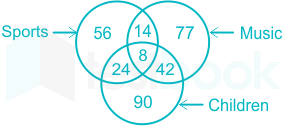
Study the given diagram carefully and answer the question. The numbers in different sections indicate the number of persons.

How many such children are there who like music but NOT sports?

  1. AOption (a)

    50

  2. BOption (b)

    8

  3. COption (c)

    42

  4. DOption (d)

    56

View answer & explanation

Correct answer

Answer: (c)C.

42

Why this answer is correct

According to the given Venn diagram:

The shaded area shows the children who like music but NOT sports.

So, there are '42' children who like music but NOT sports.

Hence, the correct answer is "42".

Question 8

The inlet of the Bay of Bengal between south - eastern India and northern Sri Lanka is called:

  1. AOption (a)

    Palk Passage

  2. BOption (b)

    Palk Canal

  3. COption (c)

    Palk Channel

  4. DOption (d)

    Palk Strait

View answer & explanation

Correct answer

Answer: (d)D.

Palk Strait

Why this answer is correct

The correct answer is Palk Strait.

Key Points

  • The Palk Strait is a strait between India and Srilanka.
  • It connects the Bay of Bengal in the northeast with the Gulf of Mannar in the southwest.
  • This chain extends between Dhanushkodi on Pamban (Rameswaram) Island in Tamil Nadu and Mannar Island in Sri Lanka.

Important Points

  • Palk Strait is a water body that separates India and Sri Lanka.
  • Palk strait is a water body between the Jaffna district of Sri Lanka and the Tamil Nadu state of India. The Palk strait connects the Bay of Bengal in the northeast with Palk Bay in the southwest.
  • The Palk strait is named after the Governor of Madras Robert Palk, during the Company Raj period.
  • Vaigai River of Tamil Nadu flows into the Palk Strait.

Additional Information

  • The Radcliffe Line is the boundary line between India and Pakistan.
  • The McMahon Line is the boundary line between northeastern India and China.

Question 9

What is the name of the programme launched by the Ministry of Electronics and Information Technology in 2021 to assist startups in their early stages?

  1. AOption (a)

    ASPIRE

  2. BOption (b)

    SAMRIDH

  3. COption (c)

    Multiplier Grants Scheme

  4. DOption (d)

    Startup India Seed Fund

View answer & explanation

Correct answer

Answer: (b)B.

SAMRIDH

Why this answer is correct

The correct answer is SAMRIDH.

Key Points

  • The Union government has launched a program to support 300 IT start-ups.
  • The government would provide seed funding and market access with a view to creating 100 unicorns out of the selected start-ups.
  • The concept of the Startup Accelerator of MeitY for Product Innovation, Development & Growth (SAMRIDH) has been developed on the lines of silicon valley based accelerator YCombinator.
  • Under the programme, Meity will provide seed funds of up to Rs 40 lakh for the selected start-ups and mentorship for six months.
  • The government wants to scale up the networks of incubators and startups to 10x, 20x and more.

​ 

Additional Information

ASPIRE: A Scheme for promotion of Innovation, Entrepreneurship and Agro-Industry

  • The main objective of the schemes are:
  • Create new jobs and reduce unemployment
  • Promote entrepreneurship culture in India
  • Grassroots economic development at the district level
  • Facilitate innovative business solution for unmet social needs
  • Promote innovation to further strengthen the competitiveness of the MSME sector.
  • This scheme was launched in 2015 by Ministry of MSME (Ministry of Micro, Small and Medium Enterprises).
  • The union minister of MSME is Nitin Gadkari.
  • Multiplier Grant Scheme: 
  • MGS aims to encourage collaborative R&D between industry and academics/ R&D institutions for development of products and packages.
  • Startup India Seed Fund
  • Minister of Railways, Commerce and Industry, Consumer Affairs, and Food and Public Distribution Piyush Goyal launched the Startup India Seed Fund Scheme (SISFS) on 19 April 2021.
  • The fund aims to provide financial assistance to startups for proof of concept, prototype development, product trials, market entry, and commercialization.
  • It was announced by PM Narendra Modi on 16th January 2021.

Question 10

The value of sin 30° - cos 60° + tan 45° + cosec 60° is:

  1. AOption (a)

    233\frac{{2\sqrt 3 }}{3}

  2. BOption (b)

    3−233\frac{{3 - 2\sqrt 3 }}{3}

  3. COption (c)

    3+233\frac{{3 + 2\sqrt 3 }}{3}

  4. DOption (d)

    2

View answer & explanation

Correct answer

Answer: (c)C.

3+233\frac{{3 + 2\sqrt 3 }}{3}

Why this answer is correct

Shortcut Trick

Directly substitute standard values: sin 30° = 1/2, cos 60° = 1/2, tan 45° = 1, cosec 60° = 2/√3.

Expression = 1/2 − 1/2 + 1 + 2/√3

⇒ 1 + 2/√3 = (1 × √3 + 2) / √3 = (√3 + 2) / √3

Rationalizing: [(√3 + 2) × √3] / [√3 × √3] = (3 + 2√3) / 3

∴ The correct answer is (3 + 2√3) / 3.

Alternate Method

Given: sin 30° − cos 60° + tan 45° + cosec 60°

Formula Used: Standard trigonometric ratios of specific angles.

⇒ Substituting values: (1/2) − (1/2) + 1 + (2/√3)

⇒ 0 + 1 + 2/√3

⇒ 1 + 2/√3

⇒ (√3 + 2) / √3

⇒ Multiply numerator and denominator by √3 to rationalize:

⇒ [(√3 + 2) × √3] / 3

⇒ (3 + 2√3) / 3

∴ The correct answer is (3 + 2√3) / 3.

Additional Information

Trigonometric Complementary Ratios

Note that sin θ = cos (90° − θ). Thus, sin 30° = cos 60°, which results in their subtraction becoming zero.

Reciprocal Identities

cosec θ is the reciprocal of sin θ. Since sin 60° = √3/2, cosec 60° = 2/√3.

Rationalization Rule

To remove a radical from the denominator, multiply both numerator and denominator by the same radical: a/√b = (a×√b)/b.

Question 11

Which of the following pathways correctly shows the transportation of water from soil to leaves?

  1. AOption (a)

    Soil → root hairs → xylem of roots → phloem of roots → xylem of leaf

  2. BOption (b)

    Soil → root hairs → root cortex → xylem of roots → xylem of stem → xylem of leaf

  3. COption (c)

    Soil → root hairs → root cortex → xylem of roots → phloem of leaf

  4. DOption (d)

    Soil → root cortex → root hairs → xylem of roots → phloem of roots → phloem of stem → phloem of leaf

View answer & explanation

Correct answer

Answer: (b)B.

Soil → root hairs → root cortex → xylem of roots → xylem of stem → xylem of leaf

Why this answer is correct

The correct answer is Soil → root hairs → root cortex → xylem of roots → xylem of stem → xylem of leaf.

Key Points

  • The provided data outlines the pathway of water transport in plants, starting from the soil and culminating in the leaves. Here's a breakdown of the process:
  • Soil: Water is absorbed from the soil by the plant's root hairs.
  • Root Hairs: These tiny, hair-like extensions of root epidermal cells significantly increase the surface area for water absorption.
  • Root Cortex: Water absorbed by the root hairs moves through the cortex, a layer of cells that lies beneath the epidermis.
  • Xylem of Roots: From the cortex, water enters the xylem, a specialized tissue for water and mineral transport.
  • Xylem of Stem: The xylem tissue forms a continuous network throughout the plant, extending from the roots to the stem. Water is transported upward through the xylem of the stem.
  • Xylem of Leaf: The xylem vessels reach the leaves, delivering water to the various cells within the leaf.
  • Transpiration: Water is lost from the leaves through tiny pores called stomata in a process called transpiration.
  • Water Potential Gradient: Transpiration creates a water potential gradient, pulling water upward from the roots through the xylem.
  • Cohesion-Tension Theory: Water molecules are cohesive (stick together) due to hydrogen bonds. This cohesion, combined with the tension created by transpiration, helps to move water up the xylem.
  • Root Pressure: In some plants, root pressure can also contribute to water movement. This pressure is generated by the active transport of minerals into the root xylem, which draws water in by osmosis.

Question 12

The position of how many letters will remain unchanged if each of the letters in the word PROUDLY is arranged in alphabetical order?

  1. AOption (a)

    Two

  2. BOption (b)

    One

  3. COption (c)

    Three

  4. DOption (d)

    Four

View answer & explanation

Correct answer

Answer: (a)A.

Two

Why this answer is correct

Given word: 'PROUDLY'

Now, arranging in Alphabetical order:

AlphabetsPROUDLY
In Alphabetical orderDLOPRUY


Here, after arranged in alphabetical order 'Two' letters will remain unchanged i.e. 'O' and 'Y'.

Hence, the correct answer is "Option 1".

Question 13

Which of the following options is the closest approximate value which will come in place of question mark (?) in the following equation?

19.99 - 10.01 + 24.99 × 10.01 = ?

  1. AOption (a)

    265

  2. BOption (b)

    260

  3. COption (c)

    270

  4. DOption (d)

    280

View answer & explanation

Correct answer

Answer: (b)B.

260

Why this answer is correct

Given:

19.99 - 10.01 + 24.99 × 10.01

Formula Used:

Expression evaluation

Calculation:

Approximate the values:

19.99 ≈ 20

10.01 ≈ 10

24.99 ≈ 25

Substitute the approximate values into the expression:

⇒ 20 - 10 + 25 × 10

First, perform the multiplication:

⇒ 20 - 10 + 250

Next, perform the addition and subtraction:

⇒ 10 + 250

⇒ 260

The correct answer is option 2.

Question 14

As of April 2022, to avail the scheme of Permanent Residency Status to Foreign Investors, how much investment a foreign investor will have to make within 18 months?

  1. AOption (a)

    ₹25 crore

  2. BOption (b)

    ₹20 crore

  3. COption (c)

    ₹10 crore

  4. DOption (d)

    ₹15 crore

View answer & explanation

Correct answer

Answer: (c)C.

₹10 crore

Why this answer is correct

The correct answer is ₹10 crore.

Key Points

  • As of April 2022, to avail the scheme of Permanent Residency Status to Foreign Investors, the investment amount required was INR 10 Crore within 18 months.
  • Here's a breakdown of the scheme and its requirements:
  • Permanent Residency Status (PRS) for Foreign Investors: This scheme aimed to attract foreign investment and boost economic growth in India. It offered a pathway to permanent residency for eligible foreign investors who met specific criteria.
  • Investment Threshold: The key requirement was a substantial investment in India. In April 2022, the threshold for obtaining PRS was set at INR 10 Crore within 18 months.
  • This investment had to be made under the Foreign Direct Investment (FDI) route.
  • Employment Generation: The scheme also stipulated that the investment should result in employment for at least 20 resident Indians in every financial year.
  • Eligibility: The scheme was applicable to foreign nationals, excluding citizens of Pakistan or third-country nationals of Pakistani origin.
  • Benefits of PRS: Obtaining PRS granted several advantages to foreign investors, including:
  • Long-term Stay: PRS holders were allowed to stay in India for an extended period without restrictions on each visit.
  • Multiple Entry: PRS provided for multiple entries into India.
  • No Registration Requirements: PRS holders were exempted from registration requirements with the Foreigners Regional Registration Office (FRRO) or Foreigners Registration Office (FRO).
  • Property Ownership: PRS holders were permitted to purchase one residential property for dwelling purposes.

Additional InformationRs. 25 crore in 36 months to secure a Permanent Residency Status. The foreign investment should result in generating employment to at least 20 resident Indians. The PRS will serve as a multiple entry visa without any stay stipulation.

Question 15

Delhi generally receives the monsoon showers from the ______ by the end of June (tentative date is 29th of June).

  1. AOption (a)

    Mediterranean region branch

  2. BOption (b)

    Bay of Bengal branch

  3. COption (c)

    Returning Monsoon

  4. DOption (d)

    Arabian Sea branch

View answer & explanation

Correct answer

Answer: (b)B.

Bay of Bengal branch

Why this answer is correct

The correct answer is Bay of Bengal branch.

Key Points

  • The Bay of Bengal branch of the southwest monsoon is one of the two branches of the monsoon winds that affect the Indian subcontinent.
  • Originating from the warm, moist air over the Bay of Bengal, this branch is driven towards the Indian subcontinent by the Southwest Monsoon winds.
  • After making landfall, it splits into two branches, one moving northwest towards the Indo-Gangetic Plain and the other northeast towards the Eastern Himalayas.
  • The Bay of Bengal branch is responsible for bringing substantial rainfall to the eastern and northeastern parts of India, including West Bengal, Northeastern states, and as far west as Uttar Pradesh and Bihar. It is crucial for the agriculture of these regions.
  • The progress of the Bay of Bengal branch can experience "monsoon breaks," where rainfall diminishes for several days or weeks.

Additional Information

  • Western Disturbances:
  • The interior region of Asia and Europe gets extremely cold during Winters, this creates a high-pressure zone especially along the Mediterranean region.
  • Compared to those regions, the Indian subcontinent is a low-pressure zone, hence winds blow from the Mediterranean region towards India, causing rainfall mainly in parts of Punjab and Haryana
  • Returning Monsoon
  • The returning monsoon winds, also known as the northeast monsoon, bring rain to the states of Tamil Nadu and Andhra Pradesh.
  • These winds are part of the larger pattern of seasonal winds that include the southwest monsoon, which brings rain to most of India during the summer.
  • The northeast monsoon typically occurs from October to December and is crucial for the winter crops in Tamil Nadu and Andhra Pradesh.
  • This monsoon is characterized by relatively stable and dry conditions in most parts of India, except for the southeastern region, which receives significant rainfall.
  • Arabian Sea branch
  • Arabian Sea monsoon makes landfall on the coast north of Mumbai.
  • These winds, which move over the Narmada and Tapi River basins, generate rain in large parts of central India. This section of the branch brings 15 cm of rain to the Chotanagpur plateau.
  • Following that, they enter the Ganga plains and mix with the Bay of Bengal branch.

Question 16

The value of the discriminant of the quadratic equation 9x + 2x2 = 5 is:

  1. AOption (a)

    121

  2. BOption (b)

    -176

  3. COption (c)

    184

  4. DOption (d)

    41

View answer & explanation

Correct answer

Answer: (a)A.

121

Why this answer is correct

Shortcut Trick Rewrite the equation in standard form ax2 + bx + c = 0: 2x2 + 9x − 5 = 0. Identify a = 2, b = 9, c = −5. Apply the Discriminant formula: D = b2 − 4ac. D = 92 − 4 × 2 × (−5) = 81 + 40 = 121. ∴ The correct answer is 121.Alternate Method Given: Equation: 9x + 2x2 = 5 Formula Used: For a quadratic equation of the form ax2 + bx + c = 0, the Discriminant (D) is given by: D = b2 − 4ac Calculations: ⇒ Rearranging 9x + 2x2 = 5 to the standard form: ⇒ 2x2 + 9x − 5 = 0 ⇒ Comparing with ax2 + bx + c = 0, we get: ⇒ a = 2, b = 9, c = −5 ⇒ D = (9)2 − 4 × 2 × (−5) ⇒ D = 81 − (−40) ⇒ D = 81 + 40 ⇒ D = 121 ∴ The correct answer is 121.Additional Information Nature of Roots If D > 0, roots are real and distinct. If D = 0, roots are real and equal. If D < 0, roots are imaginary. Quadratic Formula The roots of the equation are calculated as x = (−b ± √D) ÷ 2a. Perfect Square Discriminant If D is a perfect square and a, b, c are rational, then the roots of the quadratic equation are rational.

Question 17

Each of the digits in the number 7639482 is arranged in ascending order from right to left. The position of how many digits will remain unchanged as compared to that in the original number?

  1. AOption (a)

    One

  2. BOption (b)

    None

  3. COption (c)

    Two

  4. DOption (d)

    Three

View answer & explanation

Correct answer

Answer: (c)C.

Two

Why this answer is correct

Given Numbers: '7639482 '

Now, arranging in ascending order from right to left:

Numbers7639482
In Ascending order(Right to Left)9876432


Here, after arranged in ascending order from right to left 'Two' numbers will remain unchanged i.e. '4' and '2'.

Hence, the correct answer is "Option 3".

Mistake Points Ascending order from right to left means Descending order.

Question 18

Which of the following statements is correct about litmus solution?

  1. AOption (a)

    Litmus solution is a purple dye, which is extracted from moss.

  2. BOption (b)

    Litmus solution is an orange dye, which is extracted from lichen.

  3. COption (c)

    Litmus solution is a purple dye, which is extracted from lichen.

  4. DOption (d)

    Litmus solution is an orange dye, which is extracted from moss.

View answer & explanation

Correct answer

Answer: (c)C.

Litmus solution is a purple dye, which is extracted from lichen.

Why this answer is correct

The correct answer is Litmus solution is a purple dye, which is extracted from lichen.

Key Points

  • Litmus solution is a common pH indicator used in laboratories.
  • When the pH is neutral, litmus solution turns Purple.
  • Litmus paper can be either red or blue; red litmus paper turns blue in basic conditions, and blue litmus paper turns red in acidic conditions.
  • Neutral pH is considered to be 7, which is the pH of pure water.
  • Litmus solution is derived from lichens, primarily Roccella tinctoria.

Additional Information

  • Litmus solution is often used in educational settings to teach students about acids and bases.
  • Other pH indicators include phenolphthalein, bromothymol blue, and methyl orange, each changing color at different pH levels.
  • Understanding pH is crucial in various fields, including chemistry, biology, environmental science, and medicine.

Question 19

Identify the correct definition of Long Run Marginal Cost (LRMC) from the following.

  1. AOption (a)

    The change in total expense per unit of change in input.

  2. BOption (b)

    The change in average expense per unit of change in output.

  3. COption (c)

    The change in total cost per unit of change in output.

  4. DOption (d)

    The change in marginal cost per unit of change in input.

View answer & explanation

Correct answer

Answer: (c)C.

The change in total cost per unit of change in output.

Why this answer is correct

The correct answer is The change in total cost per unit of change in output.

Key Points

  • Long Run Marginal Cost (LRMC) represents the extra cost incurred by a firm to produce one additional unit of output in the long run. Unlike the short run where some inputs are fixed, the long run allows a firm to adjust all its inputs (labor, capital, technology) to achieve optimal production levels.

Additional Information

  • Derived from Long Run Total Cost (LRTC): LRMC is the slope of the LRTC curve at any given level of output.
  • Relationship with Long Run Average Cost (LRAC):
  • When LRMC is below LRAC, LRAC is falling.
  • When LRMC is above LRAC, LRAC is rising.
  • When LRMC intersects LRAC, LRAC is at its minimum point.
  • Reflects Returns to Scale: LRMC is closely linked to returns to scale.
  • Increasing Returns to Scale: If output more than doubles when inputs double, LRMC is falling.
  • Constant Returns to Scale: If output doubles when inputs double, LRMC is constant.
  • Decreasing Returns to Scale: If output less than doubles when inputs double, LRMC is rising.
  • Production Decisions: Firms use LRMC to determine the optimal level of output to maximize profits. They compare LRMC to the long-run marginal revenue (LRMR) and produce where LRMC equals LRMR.
  • Long-Run Planning: LRMC helps firms make long-term decisions about plant size, technology adoption, and resource allocation.
  • Understanding Industry Structure: The shape of the LRMC curve can provide insights into the competitive structure of an industry.

Question 20

20, 38, 40 and x are in proportion. Find the value of x.

  1. AOption (a)

    76

  2. BOption (b)

    74

  3. COption (c)

    70

  4. DOption (d)

    66

View answer & explanation

Correct answer

Answer: (a)A.

76

Why this answer is correct

Shortcut Trick

For four numbers a, b, c, and d in proportion: Product of extremes = Product of means.

20 × x = 38 × 40

x = (38 × 40) ÷ 20

x = 38 × 2 = 76

∴ The correct answer is 76.

Alternate Method

Given: Numbers 20, 38, 40 and x are in proportion.

Formula Used: If a, b, c, d are in proportion, then a/b = c/d.

⇒ 20 ÷ 38 = 40 ÷ x

⇒ 20 × x = 38 × 40

⇒ x = (38 × 40) ÷ 20

⇒ x = 38 × 2

⇒ x = 76

∴ The correct answer is 76.

Additional Information

Mean Proportional

The mean proportional between two numbers a and b is √(a × b).

Third Proportional

If a, b, c are in continued proportion, then b2 = ac, and c = b2 ÷ a is the third proportional.

Fourth Proportional

In the proportion a : b :: c : d, the term d is called the fourth proportional, calculated as d = (b × c) ÷ a.

Question 21

In which of the pairs of numbers below none of the two numbers is a prime number, but the two numbers are co - primes?

  1. AOption (a)

    (8, 25)

  2. BOption (b)

    (19, 27)

  3. COption (c)

    (11, 17)

  4. DOption (d)

    (21, 35)

View answer & explanation

Correct answer

Answer: (a)A.

(8, 25)

Why this answer is correct

Shortcut Trick

Condition 1: Neither number should be prime (both must be composite).

Condition 2: They must be co-prime (HCF = 1).

Check pairs: (19, 27) → 19 is prime. (11, 17) → Both are prime. (21, 35) → HCF is 7. (8, 25) → Both composite and HCF is 1.

∴ The correct answer is (8, 25).

Alternate Method

Given: Pairs of numbers to test for non-prime status and co-prime property.

Step-by-step Evaluation:

⇒ Option (1): (8, 25). Factors of 8: 1, 2, 4, 8 (Composite). Factors of 25: 1, 5, 25 (Composite). HCF(8, 25) = 1. (Valid)

⇒ Option (2): (19, 27). 19 is a Prime Number. (Invalid based on first condition)

⇒ Option (3): (11, 17). Both 11 and 17 are Prime Numbers. (Invalid based on first condition)

⇒ Option (4): (21, 35). Factors of 21: 1, 3, 7, 21. Factors of 35: 1, 5, 7, 35. HCF is 7. (Invalid based on co-prime condition)

∴ The correct answer is (8, 25).

Additional Information

Prime and Composite Numbers

A Prime number has exactly two factors (1 and itself), while a Composite number has more than two factors.

Co-prime Numbers

Two numbers are co-prime if their Highest Common Factor (HCF) is 1. They do not need to be prime individually.

Twin Primes

A pair of prime numbers that have a difference of 2, such as (11, 13) or (17, 19).

Question 22

Six colleagues are sitting around a circular table facing the centre. Amrita is sitting second to the left of Kavita. Meagan is sitting second to the right of Sabina. Rohan is an immediate neighbour of both Kavita and Amrita. Rochelle is an immediate neighbour of both Meagan and Sabina. Who is sitting to the immediate right of Meagan?

  1. AOption (a)

    Rochelle

  2. BOption (b)

    Amrita

  3. COption (c)

    Rohan

  4. DOption (d)

    Sabina

View answer & explanation

Correct answer

Answer: (b)B.

Amrita

Why this answer is correct

Given: Six colleagues are sitting around a circular table facing the centre.

  1. Amrita is sitting second to the left of Kavita.

2) Rohan is an immediate neighbour of both Kavita and Amrita.

  1. Meagan is sitting second to the right of Sabina.

  2. Rochelle is an immediate neighbour of both Meagan and Sabina.

So, 'Amrita' is sitting to the immediate right of Meagan.

Hence, the correct answer is "Option 2".

Question 23

Electric motor works on the principle of ______. It converts ______ energy into ______ energy.

  1. AOption (a)

    Fleming’s Right Hand Rule, mechanical, electrical

  2. BOption (b)

    Fleming’s Left Hand Rule, mechanical, electrical

  3. COption (c)

    Fleming’s Left Hand Rule, electrical, mechanical

  4. DOption (d)

    Fleming’s Right Hand Rule, electrical, mechanical

View answer & explanation

Correct answer

Answer: (c)C.

Fleming’s Left Hand Rule, electrical, mechanical

Why this answer is correct

The correct answer is Fleming’s Left Hand Rule, electrical, mechanical.

Key Points 

Fleming's left-hand rule:

Fleming’s left-hand rule states that when current flows through a conducting wire (let it be along with middle finger of a left hand) and an external magnetic field applied in the perpendicular direction (along with index finger) then the thrust of the motor is the mutually perpendicular direction (along with thumb finger) to both current and magnetic field.

Fleming’s left hand is a visual mnemonic for electric motors to represent the direction of thrust of motor w.r.t to the direction of the current and magnetic field.

Additional Information

  • Fleming's left-hand rule is used for electric motors, while Fleming's right-hand rule is used for electric generators.
  • In an electric motor, the electric current and magnetic field exist (which are the causes), and they lead to the force that creates the motion (which is the effect), and so the left-hand rule is used.

Question 24

Which of the following alphanumeric - clusters will replace the question mark (?) in the given series to make it logically complete?

SU5, UR7, WO11, YL13, ?

  1. AOption (a)

    AI17

  2. BOption (b)

    AN15

  3. COption (c)

    AO17

  4. DOption (d)

    AH19

View answer & explanation

Correct answer

Answer: (a)A.

AI17

Why this answer is correct

The logic followed here is:

So, 'AI17' will complete the series.

Hence, the correct answer is "Option 1".

Question 25

Which group of elements constitutes a triad?

  1. AOption (a)

    F(19.0), Cl(35.5), Br(79.9)

  2. BOption (b)

    N(14.0), P(30.9), As(74.9)

  3. COption (c)

    Li(6.9), Na(23.0), K(39.1)

  4. DOption (d)

    B(10.8), Al(27.0), Ga(69.7)

View answer & explanation

Correct answer

Answer: (c)C.

Li(6.9), Na(23.0), K(39.1)

Why this answer is correct

The correct answer is Li(6.9), Na(23.0), K(39.1).

Key Points

  • Dobereiner's Triads:
  • ​ In the early 19th century, German chemist Johann Wolfgang Dobereiner observed a pattern in the properties of certain groups of elements. He noticed that some elements could be grouped into sets of three, called triads, based on their similar chemical and physical properties.

 Additional Information

  • Similar Properties: The elements within a triad exhibited striking similarities in their chemical behavior. For example, chlorine, bromine, and iodine are all halogens, a group of highly reactive non-metals.
  • Atomic Mass Relationship: The most significant observation was that the atomic mass of the middle element in the triad was approximately the average of the atomic masses of the other two elements.
  • In the case of chlorine, bromine, and iodine:
  • Atomic mass of chlorine: 35.45
  • Atomic mass of bromine: 79.90
  • Atomic mass of iodine: 126.90
  • Average of chlorine and iodine: (35.45 + 126.90) / 2 = 81.17
  • Limitations: While Dobereiner's triads provided an early attempt at classifying elements, they had limitations. Not all elements could be neatly organized into triads, and the concept didn't fully explain the periodic trends observed in elemental properties.

Question 26

Which of the following teams won the Indian Premier League (IPL) 2022?

  1. AOption (a)

    Rajasthan Royals

  2. BOption (b)

    Lucknow Super Giants

  3. COption (c)

    Gujarat Titans

  4. DOption (d)

    Royal Challengers Bangalore

View answer & explanation

Correct answer

Answer: (c)C.

Gujarat Titans

Why this answer is correct

The correct answer is Gujarat Titans.

Key Points

  • Gujrat Titans(GT) won the Tata Indian Premier League (IPL) 2022.
  • GT won IPL 2022 by 7 wickets from Rajasthan Royals under the captaincy of Hardik Pandya.
  • GT played 14 matches and won 10 of them to become the leading team of the year.

 Additional Information

  • 2022 was the debut year of Gujrat Titans.
  • IPL is a mega cricket event which is organized annually in India on a very large scale
  • Here is a look at various award winners after the final match in Ahmedabad: ​
IPL 2022 championsGujarat Titans
Fairplay awardGujarat Titans and Rajasthan Royals
Emerging player of the seasonUmran Malik
Super Striker of the seasonDinesh Karthik
Game changer of the seasonJos Buttler
Perfect Catch of the SeasonEvin Lewis
Purple capYuzvendra Chahal
Orange capJos Buttler
Most Valuable PlayerJos Buttler
Super Striker of the SeasonJos Buttler

Question 27

Which of the following is an indirect tax?

  1. AOption (a)

    Wealth tax

  2. BOption (b)

    Income tax

  3. COption (c)

    Goods and Services Tax

  4. DOption (d)

    Gift tax

View answer & explanation

Correct answer

Answer: (c)C.

Goods and Services Tax

Why this answer is correct

The correct answer is Goods and Services Tax.

Key Points

  • Indirect tax -
  • The tax which is not taken directly from the public but reaches the government indirectly is called indirect tax.
  • Indirect taxes are excise duties on goods manufactured in the country, customs duties on goods to be imported or exported.
  • E.g. Service Tax, Central Excise Duty, Customs Duty, etc.

Additional Information

  • The tax levied on all services is called Service Tax.
  • The tax levied on the sale of goods under indirect tax is called sales tax.
  • The tax levied on the products made in the country is called Excise Duty.
  • Types of Indirect Taxes -
  • Sales Tax
  • Service Tax
  • Excise Duty
  • Professional Tax
  • Dividend Distribution Tax
  • Entertainment Tax
  • Property Tax
  • Stamp Duty
  • VAT Tax (VAT)
  • Toll Tax

Question 28

Select the option that is related to the fifth letter-cluster in the same way as the second letter-cluster is related to the first letter-cluster and the fourth letter-cluster is related to the third letter-cluster.

BOOK ∶ YLLP ∶∶ NOTE ∶ MLGV ∶∶ WORD ∶ ?

  1. AOption (a)

    IWDL

  2. BOption (b)

    LDWI

  3. COption (c)

    ILDW

  4. DOption (d)

    DLIW

View answer & explanation

Correct answer

Answer: (d)D.

DLIW

Why this answer is correct

The logic followed here is:

For, BOOK ∶ YLLP

For, 

Similarly, for WORD: ?

Hence, the correct answer is "Option 4".

Question 29

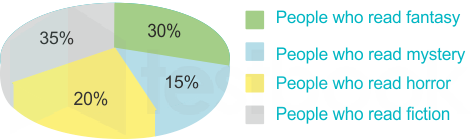
According to a survey, the percentage of people who read different genres books is shown in the following pie - chart. Blue represents people who read fantasy, red represents people who read mystery, green represents people who read horror, and purple represents people who read fiction. Study the pie - chart and answer the question.

The survey was conducted on 80% students of a school. How many students read mystery and horror books if the school has 47,500 students overall?

  1. AOption (a)

    13,300

  2. BOption (b)

    12,400

  3. COption (c)

    5,700

  4. DOption (d)

    7,600

View answer & explanation

Correct answer

Answer: (a)A.

13,300

Why this answer is correct

Given:

Total students in the school = 47,500

Survey conducted on 80% of students

Percentage of students reading mystery = 15%

Percentage of students reading horror = 20%

Formula used:

  1. Total students surveyed = Total students × (80/100)
  2. Students reading a genre = Total surveyed students × (percentage of the genre/100)
  3. Total students reading mystery and horror = Students reading mystery + Students reading horror

Calculations:

Step 1: Calculate total students surveyed:

Total surveyed students = 47,500 × (80/100) = 38,000

Step 2: Calculate students reading mystery:

Students reading mystery = 38,000 × (15/100) = 5,700

Step 3: Calculate students reading horror:

Students reading horror = 38,000 × (20/100) = 7,600

Step 4: Calculate total students reading mystery and horror:

Total students = 5,700 + 7,600 = 13,300

The number of students who read mystery and horror books is 13,300.

Question 30

In a Lions Club, 70% of the members are young and 30% of the members are old. The average age of the old members is 40 years and that of the young members is 20 years. What is the average age of all the members (in years)?

  1. AOption (a)

    28

  2. BOption (b)

    24

  3. COption (c)

    22

  4. DOption (d)

    26

View answer & explanation

Correct answer

Answer: (d)D.

26

Why this answer is correct

Shortcut Trick

Ratio of Young members to Old members = 70 : 30 = 7 : 3.

Average age of Young = 20 years, Average age of Old = 40 years.

Weighted Average = [(7 × 20) + (3 × 40)] ÷ (7 + 3)

⇒ (140 + 120) ÷ 10 = 260 ÷ 10 = 26 years.

∴ The correct answer is 26 years.

Alternate Method

Given:

Total members (assumed) = 100

Young members = 70% of 100 = 70

Old members = 30% of 100 = 30

Average age of Young = 20 years

Average age of Old = 40 years

Formula: Average = Sum of all observations ÷ Total number of observations

⇒ Total age of Young members = 70 × 20 = 1400 years

⇒ Total age of Old members = 30 × 40 = 1200 years

⇒ Total age of all members = 1400 + 1200 = 2600 years

⇒ Average age of all members = 2600 ÷ 100

⇒ Average age = 26 years

∴ The correct answer is 26 years.

Additional Information

Weighted Average Formula

It is used when two or more groups are combined: Aavg = (n1x1 + n2x2) ÷ (n1 + n2).

Alligation Method

Ratio of quantities = (Higher Value − Mean) : (Mean − Lower Value). This can be used to find the mean age directly.

Combined Average Properties

The combined average always lies between the lowest and the highest individual averages of the constituent groups.

Question 31

In which year Namami Gange Programme is an Integrated Conservation Mission approved as a Flagship Programme by the Union Government?

  1. AOption (a)

    2016

  2. BOption (b)

    2015

  3. COption (c)

    2014

  4. DOption (d)

    2013

View answer & explanation

Correct answer

Answer: (c)C.

2014

Why this answer is correct

The correct answer is 2014.

Key Points

  • Namami Gange Programme:
  • ​It was started in 2014.
  • Namami Gange Programme is an Integrated Conservation Mission, approved by the Government of India.
  • It was started with a budget outlay of Rs.20,000 Crore to accomplish the twin objectives of effective abatement of pollution, conservation, and rejuvenation of National River Ganga.
  • The River Ganga is important not only for its cultural and spiritual significance but also because it hosts more than 40% of the country’s population.
  • 8 states are covered under the project including Uttar Pradesh, West Bengal, and Jharkhand.
  • The main pillars of this programme include Biodiversity, Riverfront Development, Sewage Treatment Infrastructure, River Surface Cleaning, Public Awareness, Afforestation, Ganga Gram and Industrial Effluent Monitoring.

 Additional Information

  • Namami Gange Programme has been started in order to protect and clean the Ganga. The programme is 100% centrally funded. It intends to ramp up the progress of the Ganga clean-up mission.
  • 8 states are covered under the project including Uttar Pradesh, West Bengal, and Jharkhand. The main pillars of this programme include Biodiversity, Riverfront Development, Sewage Treatment Infrastructure, River Surface Cleaning, Public Awareness, Afforestation, Ganga Gram and Industrial Effluent Monitoring.

Question 32

One year ago, Praveena was four times as old as her daughter. Six years hence, Praveena’s age will exceed twice her daughter’s age by 7 years. What is the sum of their present ages?

  1. AOption (a)

    32 years

  2. BOption (b)

    39 years

  3. COption (c)

    37 years

  4. DOption (d)

    35 years

View answer & explanation

Correct answer

Answer: (c)C.

37 years

Why this answer is correct

Shortcut Trick

Let the daughter’s age one year ago be 1 unit. Then Praveena’s age was 4 units.

Present ages: Praveena = 4x + 1, Daughter = x + 1.

Condition 6 years hence: (4x + 7) = 2(x + 7) + 7 ⇒ 4x + 7 = 2x + 14 + 7 ⇒ 2x = 14 ⇒ x = 7.

Sum of present ages = (4x + 1) + (x + 1) = 5x + 2 = 5(7) + 2 = 37 years.

∴ The correct answer is 37 years.

Alternate Method

Given:

Ratio of Praveena to Daughter (1 year ago) = 4 : 1

Calculations:

⇒ Let Praveena’s age (1 yr ago) = 4x and Daughter’s age (1 yr ago) = x

⇒ Present age of Praveena = 4x + 1

⇒ Present age of Daughter = x + 1

⇒ Age 6 years hence: Praveena = (4x + 1) + 6 = 4x + 7

⇒ Age 6 years hence: Daughter = (x + 1) + 6 = x + 7

⇒ According to the question: (4x + 7) = 2(x + 7) + 7

⇒ 4x + 7 = 2x + 14 + 7

⇒ 4x − 2x = 21 − 7

⇒ 2x = 14 ⇒ x = 7

⇒ Present Praveena = 4(7) + 1 = 29 years

⇒ Present Daughter = 7 + 1 = 8 years

⇒ Sum = 29 + 8 = 37 years

∴ The correct answer is 37 years.

Additional Information

Problems on Ages

Age difference between two people always remains constant regardless of the number of years passed.

Ratio Method

If the ratio of ages is given for two different time periods, equate the difference in ratio units to the actual time gap.

Future and Past Calculations

For 'n' years hence, add 'n' to present age. For 'n' years ago, subtract 'n' from present age.

Question 33

In a certain code language, ‘FAR’ is written as ‘SARF’ and ‘PICK’ is written as ‘SICKP’. How will ‘BLACK’ be written in the same code language?

  1. AOption (a)

    SLBACK

  2. BOption (b)

    SKBLAC

  3. COption (c)

    SBLACK

  4. DOption (d)

    SLACKB

View answer & explanation

Correct answer

Answer: (d)D.

SLACKB

Why this answer is correct

The logic followed here is:

‘FAR’ is written as ‘SARF’.

‘PICK’ is written as ‘SICKP’.

Similarly, for ‘BLACK’

So, 'BLACJ' will be written as 'SLACKB'.

Hence, the correct answer is "Option 4".

Question 34

How many gold medals were secured by India at the Tokyo Olympics 2020?

  1. AOption (a)

    Four

  2. BOption (b)

    Three

  3. COption (c)

    One

  4. DOption (d)

    Two

View answer & explanation

Correct answer

Answer: (c)C.

One

Why this answer is correct

The correct answer is One.

Key Points

  • India achieved its highest ranking in over four decades, finishing 48th on the medal tally in Tokyo.
  • The nation competed at the 2020 Summer Olympics in Tokyo, Japan.
  • Originally slated for July 24 to August 9, 2020, the games were rescheduled to July 23 to August 8, 2021, due to the COVID-19 pandemic.
  • India has participated in every edition of the Summer Olympics since 1920, making its official debut at the 1900 Summer Olympics in Paris.
  • The country fielded its largest-ever contingent of 126 competitors at the 2020 Games.
  • The 2020 Summer Olympics marked India's most successful Games since its inaugural regular Olympics appearance in 1920, with Indian athletes securing 7 medals (1 gold, 2 silver, and 4 bronze).

Additional Information

  • The 2020 Summer Olympics, officially known as the Games of the XXXII Olympiad and branded as Tokyo 2020, were a global multi-sport event conducted from July 23 to August 8, 2021, in Tokyo, Japan, with some preliminary events commencing on July 21, 2021.
  • Tokyo was chosen as the host city during the 125th IOC Session in Buenos Aires, Argentina, on September 7, 2013.
  • These Games marked the fourth time that Japan hosted the Olympics, following the 1964 Summer Olympics (Tokyo), 1972 Winter Olympics (Sapporo), and 1998 Winter Olympics (Nagano).
  • Tokyo became the first Asian city to host the Summer Olympic Games twice.
  • The 2020 Games were part of a series of three consecutive Olympics held in East Asia, preceded by the 2018 Winter Olympics in Pyeongchang, South Korea, and followed by the 2022 Winter Olympics in Beijing, China.

Question 35

The roots of the quadratic equations 6x2 - 11x + 3 = 0 are:

  1. AOption (a)

    23\frac{2}{3}, 32\frac{3}{2}

  2. BOption (b)

    12\frac{1}{2}, 32\frac{3}{2}

  3. COption (c)

    13\frac{1}{3}, 32\frac{3}{2}

  4. DOption (d)

    13\frac{1}{3}, 23\frac{2}{3}

View answer & explanation

Correct answer

Answer: (c)C.

13\frac{1}{3}, 32\frac{3}{2}

Why this answer is correct

Shortcut Trick In the quadratic equation 6x2 − 11x + 3 = 0, the product of a × c is 6 × 3 = 18 and the sum b is −11. Identify two numbers that multiply to 18 and add up to −11: these are −9 and −2. The roots are obtained by changing the signs of these factors and dividing by the coefficient of x2 (6). Roots = 9/6 and 2/6 ⇒ 3/2 and 1/3. ∴ The correct answer is 1/3, 3/2. Alternate Method Given: The quadratic equation is 6x2 − 11x + 3 = 0. Method: Factorization by splitting the middle term. ⇒ 6x2 − 9x − 2x + 3 = 0 ⇒ 3x(2x − 3) − 1(2x − 3) = 0 ⇒ (3x − 1)(2x − 3) = 0 For the product to be zero, either: ⇒ 3x − 1 = 0 ⇒ 3x = 1 ⇒ x = 1/3 OR ⇒ 2x − 3 = 0 ⇒ 2x = 3 ⇒ x = 3/2 Comparing these roots with the options, we find they match the values 1/3 and 3/2. ∴ The correct answer is 1/3, 3/2. Additional Information Quadratic Formula The roots of ax2 + bx + c = 0 can also be found using x = [−b ± √(b2 − 4ac)] / 2a. Nature of Roots The Discriminant (D) = b2 − 4ac. If D > 0 and a perfect square, the roots are rational and distinct. Sum and Product of Roots For any quadratic equation, Sum of roots (α + β) = −b/a and Product of roots (αβ) = c/a.

Question 36

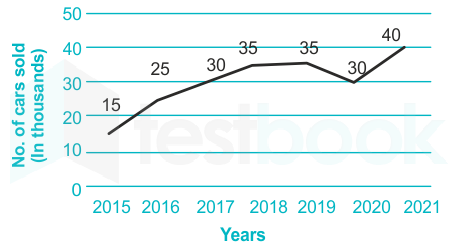
The following line graph shows number of cars sold by company A over the years. Study the graph and answer the question.

What is the respective ratio of the total cars sold by company A in 2015 and 2017 together to the total cars sold in 2019 and 2021 together?

  1. AOption (a)

    13 ∶ 3

  2. BOption (b)

    3 ∶ 5

  3. COption (c)

    5 ∶ 3

  4. DOption (d)

    3 ∶ 13

View answer & explanation

Correct answer

Answer: (b)B.

3 ∶ 5

Why this answer is correct

Given:

Number of cars sold:

2015: 15 thousand

2017: 30 thousand

2019: 35 thousand

2021: 40 thousand

Formula used:

  1. Total cars sold in specified years = Sum of cars sold in those years
  2. Ratio = Total cars sold in 2015 and 2017 : Total cars sold in 2019 and 2021

Calculations:

Step 1: Calculate total cars sold in 2015 and 2017:

Total = 15 + 30 = 45 thousand

Step 2: Calculate total cars sold in 2019 and 2021:

Total = 35 + 40 = 75 thousand

Step 3: Find the ratio:

Ratio = 45 : 75

Ratio = 3 : 5 (after simplification)

The respective ratio of the total cars sold in 2015 and 2017 to the total cars sold in 2019 and 2021 is 3:5.

Question 37

The total amount payable at maturity on a certain sum invested at simple interest at 8% p. a. for 3123\frac{1}{2} years exceeds the simple interest payable on the same sum at 10.5% p. a. for 12 years by ₹156. The sum (in ₹) is:

  1. AOption (a)

    7,800

  2. BOption (b)

    8,200

  3. COption (c)

    7,500

  4. DOption (d)

    8,000

View answer & explanation

Correct answer

Answer: (a)A.

7,800

Why this answer is correct

Shortcut Trick

Effective % for Amount (Case 1) = 100% + (8 × 3.5)% = 128%

Effective % for Simple Interest (Case 2) = (10.5 × 12)% = 126%

Difference in percentage = 128% − 126% = 2%

Given, 2% of Sum = ₹156

∴ 100% (Sum) = 156 ÷ 2 × 100 = ₹7,800

∴ The correct answer is ₹7,800.

Alternate Method

Given:

Case 1: Rate (R1) = 8%, Time (T1) = 3.5 years

Case 2: Rate (R2) = 10.5%, Time (T2) = 12 years

Difference between Amount1 and SI2 = ₹156

Formula Used:

Simple Interest (SI) = (P × R × T) ÷ 100

Amount (A) = P + SI

Calculations:

Let the Sum be P.

⇒ SI1 = (P × 8 × 3.5) ÷ 100 = 0.28P

⇒ Amount1 = P + 0.28P = 1.28P

⇒ SI2 = (P × 10.5 × 12) ÷ 100 = 1.26P

According to the question:

⇒ 1.28P − 1.26P = 156

⇒ 0.02P = 156

⇒ P = 156 ÷ 0.02

⇒ P = 15600 ÷ 2 = 7800

∴ The correct answer is ₹7,800.

Additional Information

Simple Interest Concept

Simple interest is calculated only on the Principal amount for the entire duration. Formula: SI = P × R × T / 100.

Maturity Amount

The total amount payable at maturity is the sum of the initial principal and the total interest earned: A = P × (1 + RT/100).

Effective Interest Rate

For multiple periods at SI, the effective rate is simply the product of Rate and Time (R × T)%.

Question 38

The device which converts chemical energy to electrical energy is called ______.

  1. AOption (a)

    voltmeter

  2. BOption (b)

    resistor

  3. COption (c)

    ammeter

  4. DOption (d)

    voltaic cell

View answer & explanation

Correct answer

Answer: (d)D.

voltaic cell

Why this answer is correct

The correct answer is voltaic cell.

Key Points

  • Voltaic Cell:
  • A voltaic cell, also known as a galvanic cell, is an electrochemical device that converts chemical energy directly into electrical energy.
  • It does this through a spontaneous redox reaction, where oxidation and reduction occur at separate electrodes.
  • Chemical Energy:
  • Within the voltaic cell, chemical energy is stored in the form of potential energy within the chemical bonds of the reactants.
  • This potential energy arises from the tendency of the reactants to undergo a spontaneous redox reaction.

Additional Information

  • Electrical Energy:
  • When the circuit is closed, the chemical energy is converted into electrical energy.
  • Electrons flow from the anode (where oxidation occurs) to the cathode (where reduction occurs) through an external wire, creating an electric current.
  • Voltmeter:
  • A voltmeter is a device used to measure the potential difference (voltage) between two points in an electrical circuit.
  • In a voltaic cell, it measures the electromotive force (EMF) generated by the cell, which is the maximum potential difference it can provide.
  • Resistor:
  • A resistor is an electrical component that resists the flow of electric current.
  • It converts some of the electrical energy into heat energy, reducing the amount of electrical energy available to other components in the circuit.
  • Ammeter:
  • An ammeter is a device used to measure the electric current flowing through a conductor.
  • In a voltaic cell circuit, it measures the amount of electrical current produced by the cell.

 Important Points

  • Energy Conversion:
  • the voltaic cell converts chemical energy into electrical energy.
  • The voltmeter measures the potential difference (voltage) of this electrical energy.
  • The resistor converts some of the electrical energy into heat energy.
  • And the ammeter measures the flow of electrical current through the circuit.

Question 39

Three statements are given followed by two conclusions numbered I and II. You have to take the statements to be true, even if they seem to be at variance with commonly known facts and decide which of the conclusions logically follow(s) from the statements.

Statements:

Some Baskets are Canes.

Some Canes are Woods.

All Woods are Forests.

Conclusions:

(I) All Canes are Forests. 

(II) Some Baskets are Woods.

  1. AOption (a)

    Neither conclusion (I) nor (II) follows.

  2. BOption (b)

    Both conclusions (I) and (II) follow.

  3. COption (c)

    Only conclusion (II) follows.

  4. DOption (d)

    Only conclusion (I) follows.

View answer & explanation

Correct answer

Answer: (a)A.

Neither conclusion (I) nor (II) follows.

Why this answer is correct

Statement:

Some Baskets are Canes.

Some Canes are Woods.

All Woods are Forests.

The least possible diagram for the given statements is as follows:

Conclusions:

(i) All Canes are Forests - False (Some canes are forests, but All canes are forest can be possible, not definite).

(ii) Some Baskets are Woods - False (Because no direct relation given between Baskets and Woods, so it can be possible only).

Here, Neither conclusion (I) nor (II) follows..

Hence, the correct answer is "Option 1".

Question 40

What time is required for a 150 m long train to cross a 100 m long tunnel, if the train travels at a speed of 25 km/h?

  1. AOption (a)

    36 seconds

  2. BOption (b)

    32 seconds

  3. COption (c)

    30 seconds

  4. DOption (d)

    25 seconds

View answer & explanation

Correct answer

Answer: (a)A.

36 seconds

Why this answer is correct

Shortcut Trick

Total distance = Train length + Tunnel length = 150 + 100 = 250 m.

Speed in m/s = 25 × (5/18) = 125/18 m/s.

Time = Distance ÷ Speed = 250 ÷ (125/18) = 2 × 18 = 36 sec.

∴ The correct answer is 36 sec.

Alternate Method

Given:

Length of train (L1) = 150 m

Length of tunnel (L2) = 100 m

Speed of train (v) = 25 km/h

Formula Used:

Time = Total Distance ÷ Speed

To convert km/h to m/s, multiply by 5/18.

Calculations:

⇒ Total Distance = 150 m + 100 m = 250 m

⇒ Speed in m/s = 25 × (5/18) m/s

⇒ Time = 250 ÷ (25 × 5 / 18)

⇒ Time = (250 × 18) ÷ 125

⇒ Time = 2 × 18

⇒ Time = 36 sec

∴ The correct answer is 36 sec.

Additional Information

Unit Conversion

To convert km/h to m/s, multiply by 5/18. To convert m/s to km/h, multiply by 18/5.

Relative Speed

When two objects move in the same direction, relative speed is S1 − S2. In opposite directions, it is S1 + S2.

Crossing Objects

To cross a point object (pole, man), distance = length of train. To cross a platform or tunnel, distance = train length + platform/tunnel length.

Question 41

In this question, a group of numbers / symbols is coded using letters as per the given table and the conditions which follow. The correct combination of codes following the conditions is your answer.

Number / Symbol$3@8%2#&6Ψπ75ϕ
CodeAVLKRMBFNTECSW


Conditions:

(i) If the first element is a symbol and the last element is a number, the codes for these two (the first and the last elements) are to be interchanged.

(ii) If the first element is an odd number and the last element is an even number, the first and last elements are to be coded as ©.

(iii) If both the second and third elements are perfect squares, the third element is to be coded as the code for the second element.

7 2 π 3 @ 6

  1. AOption (a)

    C M E V L N

  2. BOption (b)

    © M C F L ©

  3. COption (c)

    © M E V L ©

  4. DOption (d)

    N M E V L C

View answer & explanation

Correct answer

Answer: (c)C.

© M E V L ©

Why this answer is correct

Given:

Number / Symbol$3@8%2#&6Ψπ75ϕ
CodeAVLKRMBFNTECSW


ConditionsCoded As
First element is a symbol and the last element is a numberCodes for these two (the first and the last elements) are to be interchanged
First element is an odd number and the last element is an even numberFirst and last elements are to be coded as ©
Second and Third elements are perfect squaresThird element is to be coded as the code for the second element


Now, the group of numbers and symbols is: 7 2 π 3 @ 6

Here, Second conditions followed in the given group,

So, First and last elements are to be coded as ©.

Then, the code for **'**7 2 π 3 @ 6' is → '© M E V L ©'.

Hence, the correct answer is "Option 3".

Question 42

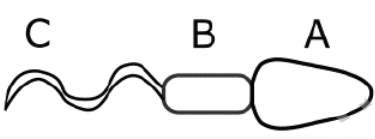
Which part of the human sperm is responsible for determination of sex of the zygote?

  1. AOption (a)

    Parts A and B

  2. BOption (b)

    Part B only

  3. COption (c)

    Part A only

  4. DOption (d)

    Parts B and C

View answer & explanation

Correct answer

Answer: (c)C.

Part A only

Why this answer is correct

The correct answer is Part A only.

Key Points

  • A zygote is a diploid cell formed by the fusion of female and male gametes.

Explanation:

Zygote:

  • It is a eukaryotic cell.
  • Once the zygote is formed embryo formation occur.
  • Zygote formation occurs in the first weeks of fertilization.
  • In each gamete, the genome of the zygote is a combination of DNA.
  • In an individual, it contains required genetic information.

Thus, the zygote is a new cell.

Additional Information

Sperm:

  • It is a male reproductive cell or gametes.
  • The sperm is divided into a head middle piece and tail.
  • It creates from the testis.
  • When it's fertilised the ovum creates a zygote.

Ovum:

  • Ova is released from the ovaries (ovum plural form, ova singular form).
  • Ovum contains a central nucleus, cytoplasm, and first polar body covered with vitelline membrane, zona pellucida and corona radiate.
  • For an embryo, the ovum provides half of the genetic material.

Chromosome:

  • In animal and plant cells inside the nucleus, there is a thread-like structure present called a chromosome.
  • Chromosomes are made up of protein.
  • It contains the genetic material, DNA.

Question 43

Four friends R, S, T and U are sitting at the exact centre of the sides of a rectangular table facing the centre (but not necessarily in the same order). R is sitting to the immediate right of S. T is sitting to the immediate left of U.

Which of the following pairs of friends is sitting opposite to each other?

  1. AOption (a)

    R - U

  2. BOption (b)

    R - S

  3. COption (c)

    S - U

  4. DOption (d)

    T - R

View answer & explanation

Correct answer

Answer: (a)A.

R - U

Why this answer is correct

Given: Four friends R, S, T and U.

  1. R is sitting to the immediate right of S.

  2. T is sitting to the immediate left of U.

Here, from the arrangement the pair 'R - U' is sitting opposite to each other.

Hence, the correct answer is "Option 1".

Question 44

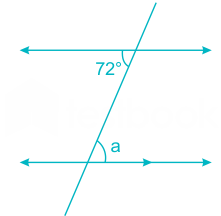
In the given figure, a pair of parallel lines are intersected by a transversal. Find the value of angle a.

  1. AOption (a)

    72°

  2. BOption (b)

    36°

  3. COption (c)

    96°

  4. DOption (d)

    108°

View answer & explanation

Correct answer

Answer: (a)A.

72°

Why this answer is correct

Shortcut Trick

When two parallel lines are intersected by a transversal, the sum of consecutive interior angles (angles on the same side of the transversal) is always 180°.

Given angle = 108°

a = 180° − 108°

a = 72°

∴ The correct answer is 72°.

Alternate Method

Given: A pair of parallel lines intersected by a transversal. The angles shown in the figure are consecutive interior angles.

Formula Used: Sum of consecutive interior angles = 180°

⇒ a + 108° = 180° (Consecutive interior angles are supplementary)

⇒ a = 180° − 108°

⇒ a = 72°

∴ The correct answer is 72°.

Additional Information

Corresponding Angles

Angles in the same relative position at each intersection where a straight line crosses two others. If the lines are parallel, corresponding angles are equal.

Alternate Interior Angles

When two parallel lines are intersected by a transversal, the alternate interior angles (Z-shape) are equal.

Linear Pair

A pair of adjacent angles formed by intersecting lines. The

Question 45

Which of the following is an example of combination reaction?

  1. AOption (a)

    HCl(aq) + NaOH(aq) → NaCl(aq) + H2O(l)

  2. BOption (b)

    2HCl(aq) + 2Na(s) → NaCl(aq) + H2(g)

  3. COption (c)

    2H2(g) + O2(g) → 2H2O(l)

  4. DOption (d)

    CH4(g) + 2O2(g) → CO2(g) + 2H2O(g)

View answer & explanation

Correct answer

Answer: (c)C.

2H2(g) + O2(g) → 2H2O(l)

Why this answer is correct

The correct answer is 2H2(g) + O2(g) → 2H2O(l).

Key Points

  • A combination reaction occurs when two or more reactants combine to form a single product.
  • However, when calcium carbonate is heated, it undergoes thermal decomposition to form calcium oxide and carbon dioxide.
  • Examples of combination reactions
  • Formation of water from hydrogen gas and oxygen gas
  • Formation of calcium oxide by the combination of calcium and oxygen
  • Formation of calcium hydroxide by adding water to quicklime

 Additional Information

  • Combination reaction
  • ​A combination reaction is when two or more reactants combine to form a single product.
  • The three types of combination reactions are between two elements, two compounds, or between an element and a compound.
  • Displacement reaction:
  • The reaction in which an ion (or an atom) in a compound is replaced by an ion (or an atom) of another element is known as a displacement reaction.
  • It is denoted by X + YZ  → XZ+Y
  • Fe (s) + CuSO4 (aq) → FeSO4 (aq) + Cu (s)
  • In the above reaction, iron is more reactive than copper, it displaces copper, resulting in the formation of ferrous sulphate.
  • Fe2O3 (s) + 2Al (s) → Al2O3 (s) + 2F3 (s)
  • In the above reaction, aluminium is more reactive than iron, it displaces iron, resulting in the formation of aluminium oxide.
  • Decomposition reaction:
  • In a Decomposition reaction, a compound breaks down into two or more components, in which one component must be in the elemental state.
  • Decomposition reaction is the opposite reaction of the combination reaction.
  • CaCO3 (s) → CaO (s) + CO2 (g)

Question 46

Select the set in which the numbers are related in the same way as are the numbers of the following sets.

(NOTE: Operations should be performed on the whole numbers, without breaking down the numbers into its constituent digits. E.g. 13 – Operations on 13 such as adding / subtracting / multiplying etc. to 13 can be performed. Breaking down 13 into 1 and 3 and then performing mathematical operations on 1 and 3 is not allowed)

(5, 315, 21)

(9, 486, 18)

  1. AOption (a)

    (10, 480, 16)

  2. BOption (b)

    (7, 294, 21)

  3. COption (c)

    (8, 368, 23)

  4. DOption (d)

    (12, 560, 11)

View answer & explanation

Correct answer

Answer: (a)A.

(10, 480, 16)

Why this answer is correct

The logic followed here is:

Logic: 1st number × 3rd number × 3 = 2nd number.

For, (5, 315, 21)

→ 5 × 21 × 3 = 315.

For, (9, 486, 18)

→ 9 × 18 × 3 = 486.

Now, checking the options:

Option 1: (10, 480, 16)

→ 10 × 16 × 3 = 480.

Option 2: (7, 294, 21)

→ 7 × 21 × 3 = 441 ≠ 294.

Option 3: (8, 368, 23)

→ 8 × 23 × 3 = 552 ≠ 368.

Option 4: (12, 560, 11)

→ 12 × 11 × 3 = 396 ≠ 560.

Hence, the correct answer is "Option 1".

Question 47

Hema is the mother of Deeksha. 10 years ago, the age of Hema was 3 times the  then age of Deeksha. After 10 years, Hema will be twice as old as Deeksha will then be. Find the present age (in years) of Deeksha.

  1. AOption (a)

    20

  2. BOption (b)

    50

  3. COption (c)

    30

  4. DOption (d)

    15

View answer & explanation

Correct answer

Answer: (c)C.

30

Why this answer is correct

Shortcut Trick

Ratio of Hema to Deeksha (10 years ago) = 3 : 1 (Difference = 2 units)

Ratio of Hema to Deeksha (10 years later) = 2 : 1 → 4 : 2 (Difference = 2 units)

Increase in ratio (1 to 2 or 3 to 4) = 1 unit → 20 years (10 ago + 10 later)

Deeksha age 10 years ago = 1 unit = 20 years.

Present age of Deeksha = 20 + 10 = 30 years.

∴ The correct answer is 30 years.

Alternate Method

Given: 10 years ago, Hema was 3 times as old as Deeksha. After 10 years, Hema will be twice as old as Deeksha.

Formula Used: Age difference between two people remains constant over time.

⇒ Let Deeksha's age 10 years ago be x.

⇒ Hema's age 10 years ago = 3x.

⇒ Present ages: Deeksha = x + 10, Hema = 3x + 10.

⇒ After 10 years: (3x + 10) + 10 = 2 × [(x + 10) + 10]

⇒ 3x + 20 = 2(x + 20)

⇒ 3x + 20 = 2x + 40

⇒ x = 20.

⇒ Present age of Deeksha = 20 + 10 = 30 years.

∴ The correct answer is 30 years.

Additional Information

Ratio Balancing Method

To solve age problems quickly, ensure the difference between ratio parts remains same. If 3:1 (diff 2) and 2:1 (diff 1), multiply the second ratio by 2 to get 4:2 (diff 2).

Concept of Age Difference

The numerical difference between the ages of two persons is constant and does not change with time. If A is 5 years older than B today, A will still be 5 years older than B after 50 years.

Question 48

Study the given series and answer the question that follows (all numbers are single digit numbers only).

4 7 2 1 8 6 9 1 2 5 3 1 9 4 7 1 8 3 5 6 8 2 7 1 8 5 6 9

How many such even digits are there each of which is immediately preceded by a perfect square and immediately followed by an odd digit (NOTE: 1 is also a perfect square)?

  1. AOption (a)

    Four

  2. BOption (b)

    Two

  3. COption (c)

    Three

  4. DOption (d)

    Five

View answer & explanation

Correct answer

Answer: (a)A.

Four

Why this answer is correct

Given numbers: 4 7 2 1 8 6 9 1 2 5 3 1 9 4 7 1 8 3 5 6 8 2 7 1 8 5 6 9

Even digits immediately preceded by a perfect square and immediately followed by an odd digit,

So, the pattern needed is: 

Now,

<br>

So, there are four pairs i.e.: 125, 947, 183, 185.

Hence, the correct answer is "Option 1".

Question 49

A, B, C, D, E and F live on six different floors of the same building. The lowermost floor in the building is numbered 1, the floor above it, number 2 and so on till the topmost floor is numbered 6. D lives on an odd numbered floor but not on floor number 3. Only two people live between D and A. C lives immediately above A. Only two people live between C and B. F lives on one of the floors below B but not on the lowermost floor. Who lives on floor number 4?

  1. AOption (a)

    A

  2. BOption (b)

    F

  3. COption (c)

    C

  4. DOption (d)

    E

View answer & explanation

Correct answer

Answer: (b)B.

F

Why this answer is correct

Given: A, B, C, D, E and F live on Six different floors of the same building.

1) D lives on an odd numbered floor but not on floor number 3.

  1. Only two people live between D and A.

Case I:

FloorPerson
6
5D
4
3
2A
1


Case II:

FloorPerson
6
5
4A
3
2
1D


  1. C lives immediately above A.

  2. Only two people live between C and B.

Case I:

FloorPerson
6B
5D
4
3C
2A
1


Case II:

FloorPerson
6
5C
4A
3
2B
1D


  1. F lives on one of the floors below B but not on the lowermost floor (This statement cancel Case II).

And, 'E' will sit on the remaining floor.

So, from Case I:

FloorPerson
6B
5D
4F
3C
2A
1E


So, from the arrangement 'F' lives on floor number 4.

Hence, the correct answer is "Option 2".

Question 50

Which of the following is one of the Central Government’s schemes of interest subsidy on educational loans for overseas studies for students belonging to the minority communities?

  1. AOption (a)

    Padho Pardesh

  2. BOption (b)

    Padho Videsh

  3. COption (c)

    Nai Manzil

  4. DOption (d)

    Naya Savera

View answer & explanation

Correct answer

Answer: (a)A.

Padho Pardesh

Why this answer is correct

The correct answer is Padho Pardesh.

Key Points

  • Padho Pardesh
  • Scheme for providing 'interest subsidy' for minority students for overseas studies.
  • Meritorious students from economically weaker sections of notified minority communities.
  • The loan for overseas studies for specific courses should have been sanctioned by the bank.
  • The annual income of the parents should be less than 6 lakhs.
  • The scheme provides an interest subsidy on education loans for students pursuing master’s, M.Phil, or Ph.D. degrees abroad.
  • A wide range of fields, including arts, sciences, engineering, technology, and more.​

Additional Information

  • Benefits
  • Financial assistance:
  • The scheme provides an interest subsidy on education loans, which can help to reduce the cost of overseas education for minority students.
  • Increased access to education:
  • The scheme makes overseas education more accessible to minority students from all backgrounds, regardless of their financial situation.
  • Improved employability:
  • ​ Studying abroad can give students a competitive edge in the job market, and the Padho Pardesh scheme can help minority students to achieve their career goals.
  • Personal and professional development:
  • Studying abroad can be a transformative experience, and the Padho Pardesh scheme can help minority students to develop their skills and knowledge in a global context.

Question 51

The Articles of the Indian Constitution are grouped into how many different parts?

  1. AOption (a)

    8

  2. BOption (b)

    395

  3. COption (c)

    12

  4. DOption (d)

    22

View answer & explanation

Correct answer

Answer: (d)D.

22

Why this answer is correct

The correct answer is 22.

Key Points

  • The constitution contained 395 articles divided into 22 parts and 12 schedules.
  • Indian Constitution originally had eight schedules. Four more schedules were added by different amendments, now making a total tally of twelve.

 Additional Information 

  • Parts of the Indian Constitution
PartSubjectArticles
Part IThe Union and its territoryArt. 1 to 4
Part IICitizenshipArt. 5 to 11
Part IIIFundamental RightsArt. 12 to 35
Part IVDirective PrinciplesArt. 36 to 51
Part VThe UnionArt. 52 to 151
Part VIThe StatesArt. 152 to 237
Part VIIStates in the B part of the First scheduleRepealed by Const. (7th Amendment) Act, 1956Art. 338
Part VIIIThe Union TerritoriesArt.239 to 242
Part IXThe PanchayatsArt. 243 to 243O
Part XThe Scheduled and Tribal AreasArt. 244 to 244A
Part XIRelations between the Union and the StatesArt. 245 to 263
Part XIIFinance, Property, Contracts, and SuitsArt. 264 to 300A
Part XIIITrade, Commerce, and Intercourse within the Territory of IndiaArt. 301 to 307
Part XIVServices under the Union and the StatesArt. 308 to 323
Part XVElectionsArt. 324 to 329A
Part XVISpecial provisions relating to certain classesArt. 330 to 342
Part XVIIOfficial LanguageArt. 343 to 351
Part XVIIIEmergency ProvisionsArt. 352 to 360
Part XIXMiscellaneousArt. 361 to 367
Part XXAmendment of the ConstitutionArt. 368
Part XXITemporary, Transitional, and Special ProvisionsArt. 369 to 392
Part XXIIShort title, commencement, authoritative text in Hindi, and repealsArt. 393 to 395


Important Points 

  • Indian Constitution Schedules 1 to 12
SchedulesProvisions
FirstThe list of states and union territories and their territories.
SecondProvisions of the President, Governors of States, Speaker and the Deputy Speaker of the House of the People and the Chairman and the Deputy Chairman of the Council of States and the Speaker and the  Deputy Speaker of the Legislative Assembly and the Chairman and the Deputy Chairman of the Legislative Council of a State, the Judges of the Supreme Court and the High Courts and the Comptroller and Auditor-General of India the list of states and union territories and their territories.
ThirdThe Forms of Oaths or Affirmations.
FourthProvisions as to the allocation of seats in the Council of States.
FifthProvisions as to the Administration and Control of Scheduled Areas and Scheduled Tribes.
SixthProvisions as to the Administration of Tribal Areas in the States of Assam, Meghalaya, Tripura, and Mizoram.
SeventhThe Union list, State list, and the concurrent list.
EighthThe list of recognized languages.
NinthProvisions as to the validation of certain Acts and Regulations.
TenthProvisions as to disqualification on the ground of defection.
EleventhThe powers, authority, and responsibilities of Panchayats.
TwelvethThe powers, authority, and responsibilities of Municipalities.

Question 52

Sudesh starts from point A and drives 9 km towards North. He takes a left turn and drives for 4 km, he then turns right and drives for 2 km. He then turns right and drives for 9 km. He takes a final right turn and drives for 11 km to reach point M. What is the distance between points A and M (all turns are 90 degree turns only)?

  1. AOption (a)

    2 km

  2. BOption (b)

    5 km

  3. COption (c)

    6 km

  4. DOption (d)

    4 km

View answer & explanation

Correct answer

Answer: (b)B.

5 km

Why this answer is correct

Given:

Sudesh starts from point A and drives 9 km towards North,

takes a left turn and drives for 4 km,

then turns right and drives for 2 km,

then turns right and drives for 9 km.

takes a final right turn and drives for 11 km to reach point M.

So, the distance between points A and M is '5 km'.

Hence, the correct answer is "Option 2".

Question 53

In 1987, the United Nations Environment Programme (UNEP) succeeded in forging an agreement to freeze CFC production at ______ levels.

  1. AOption (a)

    1988

  2. BOption (b)

    1985

  3. COption (c)

    1986

  4. DOption (d)

    1967

View answer & explanation

Correct answer

Answer: (c)C.

1986

Why this answer is correct

The correct answer is 1986.

Key Points

  • Nairobi is the headquarter of the United Nations Environment Programme (UNEP). 
  • The United Nations Environment Programme (UNEP) is responsible for coordinating responses to environmental issues within the United Nations system.
  • It was established by Maurice Strong, its first director, after the United Nations Conference on the Human Environment in Stockholm in June 1972.
  • Its mandate is to provide leadership, deliver science and develop solutions on a wide range of issues, including climate change, the management of marine and terrestrial ecosystems, and green economic development.
  • As a member of the United Nations Development Group, UNEP aims to help the world meet the 17 Sustainable Development Goals.

 Additional Information

  • The UNEP's mission is to provide leadership and encourage partnership in caring for the environment by inspiring, informing, and enabling nations and peoples to improve their quality of life without compromising that of future generations.
  • The UNEP is the coordinating body for the United Nations' environmental activities.
  • It assesses environmental conditions and trends at the global, regional and national levels
  • it develops international agreements and national environmental instruments
  • It strengthens institutions for wise environmental management.

Question 54

A current flowing through a 10 ohm resistor per second in which 360 J energy is produced is ______.

  1. AOption (a)

    6 amp

  2. BOption (b)

    3600 amp

  3. COption (c)

    90 amp

  4. DOption (d)

    36 amp

View answer & explanation

Correct answer

Answer: (a)A.

6 amp

Why this answer is correct

The correct answer is 6 amp.

Key Points

  • Joule's Law: The heat generated in a conductor is directly proportional to the square of the current flowing through it, the resistance of the conductor, and the time for which the current flows.
  • Mathematical Representation:
  • H = I² * R * t
  • Where:
  • H is the heat generated (in Joules)
  • I is the current flowing through the resistor (in Amperes)
  • R is the resistance of the resistor (in Ohms)
  • t is the time for which the current flows (in seconds)
  • Given:
  • H = 360 J (energy produced per second)
  • R = 10 ohms
  • t = 1 second
  • Rearranging the formula to find the current (I):
  • I² = H / (R * t)
  • I = √(H / (R * t))
  • Substituting the given values:
  • I = √(360 J / (10 ohms * 1 second))
  • I = √(36)
  • I = 6 Amperes

Question 55

Simplify (3-1 × 6-1)-1 ÷ 3-1

  1. AOption (a)

    54

  2. BOption (b)

    45

  3. COption (c)

    65

  4. DOption (d)

    56

View answer & explanation

Correct answer

Answer: (a)A.

54

Why this answer is correct

Given:

Simplify (3-1 × 6-1)-1 ÷ 3-1

Formula Used:

Use the rules of exponents and order of operations (PEMDAS/BODMAS).

Calculation:

First, simplify the exponents:

3-1 = 1/3

6-1 = 1/6

Next, simplify within the parentheses:

(1/3 × 1/6) = 1/18

Now, handle the exponent -1:

(1/18)-1 = 18

Finally, divide by 3-1:

18 ÷ (1/3)

⇒ 18 × 3

⇒ 54

The correct answer is option 1.

Question 56

A man’s monthly income is ₹50,000. He spends 25% of it on tax, 30% of the remaining income on household expenses, and 10% of the still remaining income on entertainment. He saves the remaining part of his income. How much money will the man save per year, assuming that the above data is same for all 12 months?

  1. AOption (a)

    ₹2,83,050

  2. BOption (b)

    ₹2,85,300

  3. COption (c)

    ₹2,83,500

  4. DOption (d)

    ₹2,38,500

View answer & explanation

Correct answer

Answer: (c)C.

₹2,83,500

Why this answer is correct

Shortcut Trick

Monthly Savings = 50000 × (100−25)/100 × (100−30)/100 × (100−10)/100

Monthly Savings = 50000 × 0.75 × 0.70 × 0.90 = ₹23,625

Annual Savings = 23625 × 12 = ₹2,83,500

∴ The correct answer is ₹2,83,500.

Alternate Method

Given: Monthly Income = ₹50,000 | Tax = 25% | Household = 30% of remaining | Entertainment = 10% of remaining

Step-by-step Calculation:

⇒ Income after Tax = 50000 − (25% of 50000) = 50000 − 12500 = ₹37,500

⇒ Income after Household = 37500 − (30% of 37500) = 37500 − 11250 = ₹26,250

⇒ Monthly Savings = 26250 − (10% of 26250) = 26250 − 2625 = ₹23,625

⇒ Annual Savings = Monthly Savings × 12 months

⇒ Annual Savings = 23625 × 12 = ₹2,83,500

∴ The correct answer is ₹2,83,500.

Additional Information

Successive Percentage Change

When changes are applied on the remaining value, the final value = Initial × (100−r1)/100 × (100−r2)/100.

Base Change vs. Direct Percentage

Always identify if the percentage is of the Original Total or the Remaining Balance before calculating.

Annual Conversion

To find annual values from monthly data, multiply the final monthly result by 12.

Question 57

In a parallelogram ABCD, if m∠A = (3x + 16)° and m∠B = (2x + 24)°, then find m∠C.

  1. AOption (a)

    100°

  2. BOption (b)

    28°

  3. COption (c)

    110°

  4. DOption (d)

    56°

View answer & explanation

Correct answer

Answer: (a)A.

100°

Why this answer is correct

Shortcut Trick

In a parallelogram, sum of adjacent angles is 180°.

(3x + 16) + (2x + 24) = 180 ⇒ 5x + 40 = 180 ⇒ 5x = 140 ⇒ x = 28.

Opposite angles are equal, so m∠C = m∠A = 3(28) + 16 = 84 + 16 = 100°.

∴ The correct answer is 100°.

Alternate Method

Given: m∠A = (3x + 16)°, m∠B = (2x + 24)° in parallelogram ABCD.

Formula: Sum of interior angles on the same side of the transversal (adjacent angles) is 180°.

⇒ m∠A + m∠B = 180°

⇒ (3x + 16) + (2x + 24) = 180

⇒ 5x + 40 = 180

⇒ 5x = 140

⇒ x = 28

Since opposite angles of a parallelogram are equal:

⇒ m∠C = m∠A

⇒ m∠C = 3(28) + 16

⇒ m∠C = 84 + 16 = 100°

∴ The correct answer is 100°.

Additional Information

Properties of Parallelogram

Opposite sides are parallel and equal. Diagonals bisect each other but are not necessarily equal.

Angle Relationships

Opposite angles are congruent (equal). Consecutive angles are supplementary (sum = 180°).

Area and Perimeter

Area = base × height. Perimeter = 2(a + b), where a and b are adjacent sides.

Question 58

Which of the following is considering as balanced food in itself and good for adolescents?

  1. AOption (a)

    Milk

  2. BOption (b)

    Pulses

  3. COption (c)

    Roti / Rice

  4. DOption (d)

    Vegetables

View answer & explanation

Correct answer

Answer: (a)A.

Milk

Why this answer is correct

The correct answer is Milk.

Key Points

  • Adolescence is a period of rapid growth and development, making a balanced diet crucial.
  • Fueling Growth Spurts: Teenagers experience significant growth spurts, requiring increased energy and nutrients. A balanced diet provides the necessary fuel for bone growth, muscle development, and overall physical development.
  • Supporting Brain Development: The adolescent brain is still developing rapidly. Nutrients like omega-3 fatty acids (found in fish, nuts, and seeds) are essential for brain function, cognitive development, and mood regulation.

Additional Information

  • Providing Essential Nutrients:
  • Calcium and Vitamin D: Crucial for strong bones and teeth, especially important for girls during puberty. Dairy products, leafy greens, and fortified foods are good sources.
  • Iron: Essential for the production of red blood cells, particularly important for girls due to menstrual blood loss. Red meat, poultry, beans, and leafy greens are good sources.
  • Protein: Needed for tissue growth and repair, hormone production, and immune function. Lean meats, fish, beans, eggs, and dairy products are good sources.
  • Complex Carbohydrates: Provide sustained energy and fiber, essential for digestion and overall health. Whole grains, fruits, and vegetables are excellent sources.
  • Maintaining a Healthy Weight: A balanced diet helps adolescents maintain a healthy weight, reducing the risk of obesity and related health problems such as type 2 diabetes and heart disease.
  • Boosting the Immune System: A diet rich in fruits, vegetables, and whole grains provides essential vitamins and antioxidants, strengthening the immune system and helping adolescents fight off infections.
  • Improving Mood and Mental Health: Some nutrients, such as omega-3 fatty acids and B vitamins, play a crucial role in mood regulation and mental well-being.

Additional Information

  • Key Components of a Balanced Diet for Adolescents:
  • Fruits and Vegetables: Aim for at least 5 servings per day. Include a variety of colors for a wide range of nutrients.
  • Whole Grains: Choose whole-grain bread, pasta, rice, and cereals over refined grains.
  • Lean Protein: Include lean meats, poultry, fish, beans, lentils, eggs, and nuts in your diet.
  • Dairy or Dairy Alternatives: Choose low-fat or non-fat options for calcium and vitamin D.
  • Healthy Fats: Include sources like avocados, nuts, seeds, and olive oil in moderation.

Question 59

P, Q, R, S, T and U are six different cars, each of a different weight. Q is heavier than only one car. S is heavier than Q. R is heavier than P. T is heavier than S. P is heavier than T. Which car among the six is the heaviest?

  1. AOption (a)

    S

  2. BOption (b)

    T

  3. COption (c)

    P

  4. DOption (d)

    R

View answer & explanation

Correct answer

Answer: (d)D.

R

Why this answer is correct

Given: P, Q, R, S, T and U are six different cars, each of a different weight.

  1. Q is heavier than only one car.

__ > __ > __ > __ > Q > __

  1. S is heavier than Q.

S > Q

  1. T is heavier than S.

T > S

  1. P is heavier than T.

P > T

5) R is heavier than P.

R > P

After combining all the statements:

R > P > T > S > Q

So, the final arrangement will be:

R > P > T > S > Q > U

Here, 'R' is the six heaviest car.

Hence, the correct answer is "Option 4".

Question 60

Which of the following numbers will replace the question mark (?) in the given series?

3 30 300 3000 ?

  1. AOption (a)

    3000000

  2. BOption (b)

    30000

  3. COption (c)

    3000

  4. DOption (d)

    300000

View answer & explanation

Correct answer

Answer: (b)B.

30000

Why this answer is correct

The logic followed here is:

So, '30000' will complete the series.

Hence, the correct answer is "Option 2".

Question 61

In the case of reflection from a concave mirror, if the object distance is 5 cm and the image distance is 2 cm then magnification produced by the mirror is:

  1. AOption (a)

    -2/5

  2. BOption (b)

    -5/2

  3. COption (c)

    5/2

  4. DOption (d)

    2/5

View answer & explanation

Correct answer

Answer: (a)A.

-2/5

Why this answer is correct

The correct answer is -2/5.

Key Points

  • Formula for Magnification:
  • The magnification (m) produced by a mirror is given by the formula:
  • m = -v/u
  • where:
  • v is the image distance
  • u is the object distance
  • Given:
  • Object distance (u) = 5 cm (negative sign convention)
  • Image distance (v) = 2 cm
  • Calculation:
  • m = -v/u
  • m = -2  / 5

Question 62

Which was the principal source and sector of occupation of the Indian economy on the eve of Independence?

  1. AOption (a)

    Education

  2. BOption (b)

    Services

  3. COption (c)

    Agriculture

  4. DOption (d)

    Industry

View answer & explanation

Correct answer

Answer: (c)C.

Agriculture

Why this answer is correct

The correct answer is Agriculture.

Key Points

  • On the eve of India's independence in 1947, the principal source and sector of occupation was agriculture.   
  • Agriculture-Dominated Economy: A vast majority of the Indian population, estimated around 70-80%, was directly or indirectly involved in agriculture. This included farmers, landless laborers, and those engaged in allied activities like livestock rearing and fishing.
  • Low Productivity: Agricultural practices were largely traditional, with low levels of mechanization and reliance on monsoon rains. This resulted in low productivity and frequent crop failures, leading to widespread poverty and food insecurity.
  • Subsistence Farming: A significant portion of agricultural production was for subsistence, meaning farmers primarily grew crops to feed their families rather than for commercial purposes.
  • Limited Industrial Development: While some industries existed, their development was hampered by British colonial policies that favored raw material exports and discouraged industrial growth within India. This limited alternative employment opportunities outside of agriculture.
  • Social and Economic Inequalities: The agrarian economy was characterized by significant social and economic inequalities. Land ownership was concentrated in the hands of a small elite, while the majority of farmers were landless or had small, fragmented landholdings.

Question 63

Under which Article of the Constitution of India do we consider Hindi in Devanagari script as an official language of India?

  1. AOption (a)

    Article 351

  2. BOption (b)

    Article 336

  3. COption (c)

    Article 343

  4. DOption (d)

    Article 347

View answer & explanation

Correct answer

Answer: (c)C.

Article 343

Why this answer is correct

The correct answer is Article 343.

 Key Points

  • Article 343
  • Article 343 (1) of the Constitution, states that the official language of the Union shall be Hindi in Devanagari script.
  • Hindi written in Devanagari script is to be the official language of the Union.
  • But, the form of numerals to be used for the official purposes of the Union has to be the international form of Indian numerals and not the Devanagari form of numerals.

Additional Information

  • Article 351
  • The Indian constitution in its article 351 has laid down provisions for promoting and developing Hindi as the national official language.
  • This also directed the educational system of India to take initiatives and functions to facilitate the article to increase student and teacher communication and to spread awareness of national integrity and unity.
  • Article 351 enjoins the Union to promote the spread of the Hindi language and to develop it so that it may serve as a medium of expression of all elements of the composite culture of India.
  • Thus, it is concluded that  Article 351 of the Indian constitution lays down a provision for the promotion of the Hindi language as the national and official language of India.
  • ​Article 336
  • Article 336 of the Indian Constitution provides Special provisions to Anglo Indian community in certain services.
  • An Anglo Indian community means a person whose father was a European descent but who is domiciled within the territory of India.
  • ​Article 347
  • States about the Special provision related to the language spoken by the section of the population of the state.

Question 64

The correct sign conventions for focal length (f) and radius of curvature (R) for the formation of images by spherical mirrors is:

  1. AOption (a)

    for convex mirror f is negative, R is negative

  2. BOption (b)

    for concave mirror f is negative, R is negative

  3. COption (c)

    for convex mirror f is negative, R is positive

  4. DOption (d)

    for concave mirror f is positive, R is negative

View answer & explanation

Correct answer

Answer: (b)B.

for concave mirror f is negative, R is negative

Why this answer is correct

The correct answer is for** concave mirror f is negative, R is negative**.

Key Points

  • When dealing with spherical mirrors, a consistent set of sign conventions is crucial for accurate calculations and understanding of image formation. These conventions help determine the nature (real/virtual, erect/inverted), size, and position of the image.
  • Sign Conventions:
  • Object Distance (u):
  • Negative: When the object is placed in front of the mirror (the usual case).
  • Positive: When the object is placed behind the mirror (rarely encountered).
  • Image Distance (v):
  • Positive: When the image is formed in front of the mirror (real image).
  • Negative: When the image is formed behind the mirror (virtual image).
  • Focal Length (f):
  • Positive: For concave mirrors.
  • Negative: For convex mirrors.
  • Radius of Curvature (R):
  • Positive: For concave mirrors.
  • Negative: For convex mirrors.

Additional Information

  • Relationship Between Focal Length and Radius of Curvature:
  • The focal length (f) of a spherical mirror is related to its radius of curvature (R) by the following equation:
  • f = R/2
  • Significance of Sign Conventions:
  • Accurate Calculations: By adhering to these sign conventions, you can correctly apply the mirror formula (1/f = 1/v + 1/u) and magnification formula (m = -v/u) to determine the image characteristics.
  • Understanding Image Formation: The signs of image distance and magnification provide valuable information about the nature of the image (real/virtual, erect/inverted).
  • Consistency: Consistent use of sign conventions ensures that calculations are accurate and reliable, regardless of the type of mirror or the object's position.

Question 65

Hinduism encourages full participation in life through the Purusharthas - life goals. Which of the following is NOT one of them?

  1. AOption (a)

    Moksha

  2. BOption (b)

    Artha

  3. COption (c)

    Kama

  4. DOption (d)

    Sattva

View answer & explanation

Correct answer

Answer: (d)D.

Sattva

Why this answer is correct

The correct answer is Sattva. 

Key Points

  • Certainly, let's explore how Hinduism encourages full participation in life through the Purusharthas:
  • Purusharthas: These are the four primary goals or aims of human life in Hinduism: Dharma, Artha, Kama, and Moksha.
  • Dharma: This encompasses righteousness, duty, and moral conduct. It involves fulfilling one's social and religious obligations, acting ethically, and living a virtuous life.
  • Artha: This refers to prosperity, wealth, and material success. It encourages individuals to pursue legitimate means of earning a living, building a family, and contributing to society.
  • Kama: This signifies pleasure, love, and fulfillment of desires. It emphasizes the importance of enjoying life, pursuing relationships, and experiencing happiness.
  • Moksha: This is the ultimate goal of liberation or enlightenment, transcending the cycle of birth and death. It involves realizing one's true nature and attaining spiritual freedom.

Additional Information

  • Full Participation in Life:
  • Holistic Approach: Hinduism doesn't view these goals as mutually exclusive. It encourages a balanced pursuit of all four Purusharthas, recognizing that a fulfilling life encompasses both material and spiritual dimensions.
  • Dharma as Foundation: Dharma acts as the foundation for all other Purusharthas. It provides ethical guidelines for pursuing wealth and pleasure responsibly.
  • Importance of Artha and Kama: Hinduism acknowledges the importance of material well-being and fulfilling desires. It encourages individuals to work hard, build a comfortable life, and enjoy the pleasures of life within the framework of Dharma.
  • Moksha as the Ultimate Goal: While material pursuits and worldly enjoyments are valued, Hinduism ultimately emphasizes the importance of striving for Moksha. It encourages individuals to use their material and worldly experiences as stepping stones towards spiritual growth and liberation.

Question 66

Which of the following two numbers should be interchanged to make the given equation correct?

3 × 5 + 20 ÷ 8 - 17 = 11

  1. AOption (a)

    5 and 8

  2. BOption (b)

    17 and 3

  3. COption (c)

    5 and 17

  4. DOption (d)

    8 and 17

View answer & explanation

Correct answer

Answer: (a)A.

5 and 8

Why this answer is correct

Given equation: 3 × 5 + 20 ÷ 8 - 17 = 11.

BODMAS Table: 

Let's check each option one by one.

Option 1) 5 and 8 

Given: 3 × 5 + 20 ÷ 8 - 17 = 11

After interchanging the numbers we get;

⇒ 3 × 8 + 20 ÷ 5 - 17 = 11

⇒ 3 × 8 + 4 - 17 = 11

⇒ 24 + 4 - 17 = 11

⇒ 28 - 17 = 11

⇒ 11 = 11

⇒ LHS = RHS

Option 2) 17 and 3 

Given: 3 × 5 + 20 ÷ 8 - 17 = 11

After interchanging the numbers we get;

⇒ 17 × 5 + 20 ÷ 8 - 3 = 11

⇒ 17 × 5 + 2.5 - 3 = 11

⇒ 85 + 2.5 - 3 = 11

⇒ 87.5 - 3 = 11

⇒ 84.5 ≠ 11

⇒ LHS ≠ RHS

Option 3) 5 and 17

Given: 3 × 5 + 20 ÷ 8 - 17 = 11

After interchanging the numbers we get;

⇒ 3 × 17 + 20 ÷ 8 - 5 = 11

⇒ 3 × 17 + 2.5 - 5 = 11

⇒ 51 + 2.5 - 5 = 11

⇒ 53.5 - 5 = 11

⇒ 48.5 ≠ 11

⇒ LHS ≠ RHS

Option 4) 8 and 17

Given: 3 × 5 + 20 ÷ 8 - 17 = 11

After interchanging the numbers we get;

⇒ 3 × 5 + 20 ÷ 17 - 8 = 11

⇒ 3 × 5 + 1.18 - 8 = 11

⇒ 15 + 1.18 - 8 = 11

⇒ 16.18 - 8 = 11

⇒ 8.18 ≠ 11

⇒ LHS ≠ RHS

Hence, the correct answer is "Option 1".

Question 67

The heat produced in an electric circuit is proportional to ______.

  1. AOption (a)

    1 / (current)2

  2. BOption (b)

    (current)2

  3. COption (c)

    1 / current

  4. DOption (d)

    current

View answer & explanation

Correct answer

Answer: (b)B.

(current)2

Why this answer is correct

The correct answer is (current)2 .

Key Points 

  • Joule's Law of Heating
  • The amount of heat produced in a conductor is directly proportional to:
  • The square of the current (I²) flowing through it.
  • The resistance (R) of the conductor.
  • The time (t) for which the current flows.
  • This relationship is mathematically expressed as:
  • H = I²Rt   
  • where:
  • H is the heat produced in joules (J)
  • I is the current flowing through the conductor in amperes (A)
  • R is the resistance of the conductor in ohms (Ω)
  • t is the time for which the current flows in seconds (s)

Additional Information

  • Heat Produced in an Electric Circuit
  • When an electric current flows through a conductor, it encounters resistance.
  • This resistance hinders the free flow of electrons, causing them to collide with the atoms of the conductor.
  • These collisions result in the conversion of electrical energy into heat energy.
  • This phenomenon is known as the heating effect of electric current.

Question 68

10 men can dig a well 50 feet deep in 8 days. How many men can dig a well 100 feet deep in 10 days?

  1. AOption (a)

    15

  2. BOption (b)

    16

  3. COption (c)

    14

  4. DOption (d)

    18

View answer & explanation

Correct answer

Answer: (b)B.

16

Why this answer is correct

Shortcut Trick

Apply the M1D1/W1 = M2D2/W2 formula directly.

(10 × 8) / 50 = (M2 × 10) / 100

80 / 50 = 10M2 / 100

1.6 = M2 / 10 ⇒ M2 = 16 men.

∴ The correct answer is 16 men.

Alternate Method

Given:

Initial men (M1) = 10, Initial days (D1) = 8, Initial depth (W1) = 50 feet

Final days (D2) = 10, Final depth (W2) = 100 feet, Final men (M2) = ?

Formula Used:

Chain Rule: (M1 × D1 × H1) / W1 = (M2 × D2 × H2) / W2

Calculations:

PersonDaysTotal Work (Depth)Efficiency (Total Men)
Case 18Variable Work10
Case 210M2

⇒ (10 × 8) / 50 = (M2 × 10) / 100

⇒ 80 / 50 = 10M2 / 100

⇒ 8 / 5 = M2 / 10

⇒ M2 = (8 × 10) / 5

⇒ M2 = 80 / 5

⇒ M2 = 16 men

∴ The correct answer is 16 men.

Additional Information

Chain Rule Property

The relationship between men, days, hours, and work is given by (M × D × H) / W = Constant, where work is always in the denominator.

Direct and Inverse Proportion

Men and Days are inversely proportional (more men, fewer days), while Men and Work are directly proportional (more men, more work).

Question 69

Read the given statement and conclusions carefully. Assuming that the information given in the statement is true, decide which of the given conclusions logically follow(s) from the statement.

Statement:

Infants born alive before 37 weeks of pregnancy are called Preterm babies.

Conclusions:

I. Babies born before 37 weeks of pregnancy have issues in adjusting properly in the world outside their mother’s womb and need to be in a Neonatal Intensive Care Unit for durations varying from a few days to several weeks.

II. Infants born after 37 weeks of pregnancy are called full term babies and are completely healthy.

  1. AOption (a)

    Only conclusion I follows

  2. BOption (b)

    Both the conclusions follow

  3. COption (c)

    Neither conclusion I nor II follows

  4. DOption (d)

    Only conclusion II follows

View answer & explanation

Correct answer

Answer: (c)C.

Neither conclusion I nor II follows

Why this answer is correct

I. Babies born before 37 weeks of pregnancy have issues in adjusting properly in the world outside their mother’s womb and need to be in a Neonatal Intensive Care Unit for durations varying from a few days to several weeks - False (There is nothing mention about issues caused by before 37 weeks of pregnancy).

II. Infants born after 37 weeks of pregnancy are called full term babies and are completely healthy - False (Nothing mention about after 37 weeks of pregnancy in the statement).

So, Neither conclusion I nor II follows.

Hence, the correct answer is "Option 3".

Question 70

If each of the letters in the word ‘ACQUIRE’ is arranged in alphabetical order, then how many letters will be there in the English alphabetical series between the letter that is fifth from the left end and the one that is first from the right end?

  1. AOption (a)

    2

  2. BOption (b)

    3

  3. COption (c)

    5

  4. DOption (d)

    4

View answer & explanation

Correct answer

Answer: (b)B.

3

Why this answer is correct

Given word: 'ACQUIRE'

After arranged in alphabetical order:

AlphabetsACQUIRE
Alphabetical orderACEIQRU


After arranged in alphabetical order,

Fifth alphabet from the left end is: Q,

First alphabet from the right end is: U,

Now,

there are 3 letters between Q and U.

QRSTU


Hence, the correct answer is "Option 2".

Question 71

In a chemical reaction, a substance gains hydrogen. This process is said to be ______.

  1. AOption (a)

    bromination

  2. BOption (b)

    oxidation

  3. COption (c)

    chlorination

  4. DOption (d)

    reduction

View answer & explanation

Correct answer

Answer: (d)D.

reduction

Why this answer is correct

The correct answer is reduction.

Key Points

  • Reduction:
  • Reduction is a chemical reaction where a substance gains electrons.
  • This gain of electrons leads to a decrease in the oxidation state of the substance.
  • A classic example is the reduction of iron ore (Fe2O3) to iron metal (Fe) in a blast furnace.

Additional Information

  • Oxidation:
  • Oxidation is the opposite of reduction.
  • It involves the loss of electrons by a substance.
  • This loss of electrons results in an increase in the oxidation state of the substance.
  • A common example is the rusting of iron, where iron metal (Fe) reacts with oxygen (O2) to form iron oxide (Fe2O3), which is rust.
  • Chlorination:
  • Chlorination is a chemical reaction where chlorine (Cl2) is added to a substance.
  • It often involves the substitution of hydrogen atoms with chlorine atoms.
  • Chlorination is used to purify water by killing harmful bacteria and is also used in the production of various chemicals.
  • Bromination:
  • Bromination is a chemical reaction where bromine (Br2) is added to a substance.
  • Similar to chlorination, it often involves the substitution of hydrogen atoms with bromine atoms.
  • Bromination is used in the production of various organic compounds and in some industrial processes.

Question 72

How many carbon atoms are arranged in the shape of a football like structure in fullerene?

  1. AOption (a)

    55

  2. BOption (b)

    60

  3. COption (c)

    40

  4. DOption (d)

    30

View answer & explanation

Correct answer

Answer: (b)B.

60

Why this answer is correct

The correct answer is 60.

Key Points

  • Fullerene consists of 60 carbon atoms.
  • Fullerene, an allotrope of carbon, is rarely found in nature. It is found in soot and in interstellar space.
  • The first example of fullerene is Buckminsterfullerene (C60). This allotrope of carbon is named fullerene after the architect Richard Buckminster Fuller because the structure of C60 resembles the structure of the geodesic dome he designed.
  • It was discovered by Richard Smalley in 1985.
  • Harold Kroto, Robert Curl, and Richard Smalley were given the Nobel prize in chemistry 1996, for the discovery of this carbon allotrope, fullerene C60.

Question 73

What is the full form of TEDP, which is a structured training programme of the Department of Science and Technology (DST), Government of India?

  1. AOption (a)

    Technology Based Entrepreneurship Development Programme

  2. BOption (b)

    Technology and Entrepreneurship Development Programme

  3. COption (c)

    Technical and Entrepreneurship Development Programme

  4. DOption (d)

    Technological Enterprises and Development Programme

View answer & explanation

Correct answer

Answer: (a)A.

Technology Based Entrepreneurship Development Programme

Why this answer is correct

The correct answer is Technology Based Entrepreneurship Development Programme.

Key Points

  • The full form of TEDP is Technology Based Entrepreneurship Development Programme.
  • About TEDP:
  • Initiated by the Department of Science and Technology (DST), Government of India: This program aims to nurture and support aspiring entrepreneurs with a focus on science and technology.
  • Structured Training: TEDP provides comprehensive training to individuals, equipping them with the necessary skills and knowledge to launch and successfully run technology-based businesses.
  • Focus on Innovation: The program emphasizes the development and commercialization of innovative products, technologies, and processes.

Additional Information

  • TEDP typically covers a wide range of topics, including:
  • Business Planning: Developing detailed business plans, including market research, financial projections, and go-to-market strategies.
  • Technology Commercialization: Understanding intellectual property rights (IPR), technology transfer mechanisms, and strategies for bringing innovative technologies to the market.
  • Entrepreneurial Skills: Developing essential skills such as leadership, teamwork, communication, problem-solving, and financial management.
  • Mentorship and Networking: Providing access to mentors, industry experts, and potential investors to guide and support entrepreneurs.

Question 74

A certain number of people are sitting in a row, facing north. R sits third to the right of P. Q is an immediate neighbour of both R and M. M is not an immediate neighbour of P. Exactly four people sit between M and T.

If no other person is sitting in the row, what is the total number of people seated in the row?

  1. AOption (a)

    9

  2. BOption (b)

    10

  3. COption (c)

    11

  4. DOption (d)

    12

View answer & explanation

Correct answer

Answer: (c)C.

11

Why this answer is correct

Given: A certain number of people are sitting in a row, facing north.

  1. R sits third to the right of P.

  2. Q is an immediate neighbour of both R and M.

  3. M is not an immediate neighbour of P.

  4. Exactly four people sit between M and T.

If no other person is sitting in the row, then '11' people seated in the row.

Hence, the correct answer is "Option 3".

Question 75

The cost of a camera is ₹25,000. A leather case costing ₹2,750 was also sold along with this. Arti bought these two items. After using them for few years, she sold them for ₹26,085. What is the loss percentage?

  1. AOption (a)

    8%

  2. BOption (b)

    6%

  3. COption (c)

    4%

  4. DOption (d)

    5%

View answer & explanation

Correct answer

Answer: (b)B.

6%

Why this answer is correct

Shortcut Trick Total Cost Price (CP) = 25,000 + 2,750 = 27,750. Selling Price (SP) = 26,085. Loss = CP − SP = 27,750 − 26,085 = 1,665. Loss% = (Loss ÷ CP) × 100 = (1,665 ÷ 27,750) × 100. Calculation: 166,500 ÷ 27,750 = 6%. ∴ The correct answer is 6%.

Alternate Method Given → Camera Price = 25,000, Leather Case Price = 2,750, Total SP = 26,085. Formulas: Loss = CP − SP | Loss% = (Loss ÷ CP) × 100.

⇒ Total Cost Price (CP) = Cost of Camera + Cost of Leather Case = 25,000 + 2,750 = 27,750. ⇒ Total Selling Price (SP) = 26,085. ⇒ Since CP > SP, there is a loss. ⇒ Loss = 27,750 − 26,085 = 1,665. ⇒ Loss% = (1,665 ÷ 27,750) × 100 = 6%. ∴ The correct answer is 6%.

Additional Information Total Cost Price Calculation When multiple items are bought together or overhead expenses (repair, transport) are incurred, they must be added to the initial price to find the Effective Cost Price. Loss and Profit Condition If SP < CP, it is a loss. If SP > CP, it is a profit. Both are always calculated on the Cost Price (CP) unless stated otherwise.

Question 76

Under Article 243 S of the Constitution of India, there is a provision for constitution of Ward Committees within the territorial area of a Municipality having a population of ______ or more.

  1. AOption (a)

    one lakh

  2. BOption (b)

    two lakh

  3. COption (c)

    three lakh

  4. DOption (d)

    four lakh

View answer & explanation

Correct answer

Answer: (c)C.

three lakh

Why this answer is correct

The correct answer is three lakh.

Key Points

Under Article-243 Definitions.-

  • In this section, unless the context requires otherwise,-
  • (a) 'District' shall mean a district within a State;
  • (b) 'Gram Sabha' means an agency composed of persons registered in the electoral rolls relating to a village within the Panchayat district at the level of the village;
  • (c) 'Intermediate level' means the intermediate level between the level of the village and the level of the district defined by the Governor of a State for the purposes of this Part by public notification;
  • (d) 'Panchayat' means, for rural areas, an agency (by whatever name) of self-government, constituted under Article 243B;
  • (e) 'Panchayat area' means the Panchayat territorial area;
  • (f) 'Population' means the population of which the related figures have been published, as determined in the last preceding census;
  • (g) 'Village' means a village appointed by the Governor to be a village for the purposes of this Part by public notice and includes a collection of villages so designated.

 Additional Information

Constitutional Provisions Related to Urban Local Bodies
ArticleProvision
243QConstitution of Municipalities
243RComposition of Municipalities
243SConstitution and composition of Wards Committees
243TReservation of seats
243UDuration of Municipalities
243VDisqualifications for membership
243XPower to impose taxes by, and Funds of, the Municipalities
243YFinance Commission
243ZAElections to the Municipalities

Question 77

Among six friends A, B, C, D, E and F, each has a different height. Only two people are shorter than B. Only one person is taller than A. E is neither the tallest nor the shortest. C is shorter than E but taller than F. Who is the taller than B but shorter than A?

  1. AOption (a)

    D

  2. BOption (b)

    E

  3. COption (c)

    C

  4. DOption (d)

    F

View answer & explanation

Correct answer

Answer: (b)B.

E

Why this answer is correct

Given: Six friends A, B, C, D, E and F.

  1. Only two people are shorter than B.

  2. Only one person is taller than A.

__ > A > __ > B > __ > __

  1. C is shorter than E but taller than F.

  2.  E is neither the tallest nor the shortest. 

__ > A > E > B > C > F

So, D is the tallest (because only person and place left).

D > A > E > B > C > F

From the arrangement, 'E' is the taller than B but shorter than A.

Hence, the correct answer is "Option 2".

Question 78

Refer to the following letter series and answer the question.

M O V E O I F V A S K C O S D V I N S D I N I S

How many such consonants are there each of which is immediately preceded by a vowel and also immediately followed by a vowel?

  1. AOption (a)

    Two

  2. BOption (b)

    One

  3. COption (c)

    Three

  4. DOption (d)

    Four

View answer & explanation

Correct answer

Answer: (a)A.

Two

Why this answer is correct

Given Alphabets: M O V E O I F V A S K C O S D V I N S D I N I S

Consonants are immediately preceded by a vowel and also immediately followed by a vowel,

So, the pattern should be: 

Now,

So, there are Two pairs i.e.: 'OVE' and 'INI'.

Hence, the correct answer is "Option 1".

Question 79

Find the mode of the given frequency distribution.

MarksFrequency
513
294
856
407
  1. AOption (a)

    7

  2. BOption (b)

    40

  3. COption (c)

    85

  4. DOption (d)

    51

View answer & explanation

Correct answer

Answer: (b)B.

40

Why this answer is correct

Shortcut Trick Identify the maximum frequency from the given distribution table. The frequencies provided are 3, 4, 6, and 7. The highest frequency is 7, which corresponds to the mark 40. ∴ The correct answer is 40. Alternate Method Given: A frequency distribution of marks where Marks (xi) and Frequency (fi) are provided. Formula: Mode is the value of the observation that has the maximum frequency in the data set.

⇒ Frequency of 51 = 3 ⇒ Frequency of 29 = 4 ⇒ Frequency of 85 = 6 ⇒ Frequency of 40 = 7 ⇒ Comparing all frequencies: 7 > 6 > 4 > 3 ⇒ Since 7 is the highest frequency, the corresponding mark is the Mode. ⇒ Mode = 40 ∴ The correct answer is 40.

Question 80

Three statements are given followed by two conclusions numbered I and II. You have to take the statements to be true, even if they seem to be at variance with commonly known facts and decide which of the conclusions logically follow(s) from the statements.

Statements:

Some Dogs are Barks.

Some Barks are Trees.

All Trees are Woods.

Conclusions:

(I) Some Dogs are Trees.

(II) Some Woods are Barks.

  1. AOption (a)

    Neither conclusion (I) nor (II) follows.

  2. BOption (b)

    Only conclusion (II) follows.

  3. COption (c)

    Both conclusions (I) and (II) follow.

  4. DOption (d)

    Only conclusion (I) follows.

View answer & explanation

Correct answer

Answer: (b)B.

Only conclusion (II) follows.

Why this answer is correct

Statement:

Some Dogs are Barks.

Some Barks are Trees.

All Trees are Woods.

The least possible diagram for the given statements is as follows:

Conclusions:

(i) Some Dogs are Trees - False (Because No definite relation given between Dogs and Cats, so it can be possible only).

(ii) Some Woods are Barks - True (Those Barks which is Trees is also Woods).

Here, Only conclusion (II) follows..

Hence, the correct answer is "Option 2".

Question 81

One side of a triangle is 7 metres longer than twice the smallest side. Another side is 5 metres longer than three times the smallest side. If the perimeter of the triangle is 90 metres, find the length of its smallest side.

  1. AOption (a)

    13 m

  2. BOption (b)

    10 m

  3. COption (c)

    12 m

  4. DOption (d)

    9 m

View answer & explanation

Correct answer

Answer: (a)A.

13 m

Why this answer is correct

Shortcut Trick

Let the smallest side be x.

Sides are x, (2x + 7), and (3x + 5).

Sum of sides = 6x + 12 = 90.

6x = 78 ⇒ x = 13.

∴ The correct answer is 13 m.

Alternate Method

Given:

Smallest side = x m

Second side = (2x + 7) m

Third side = (3x + 5) m

Formula Used:

Perimeter of a triangle = Sum of all three sides

Calculations:

⇒ x + (2x + 7) + (3x + 5) = 90

⇒ 6x + 12 = 90

⇒ 6x = 90 − 12

⇒ 6x = 78

⇒ x = 78 ÷ 6

⇒ x = 13 m

∴ The correct answer is 13 m.

Additional Information

Triangle Inequality Theorem

The sum of the lengths of any two sides of a triangle must be greater than the length of the third side.

Types of Triangles by Sides

Scalene: All sides different. Isosceles: Two sides equal. Equilateral: All sides equal.

Heron's Formula for Area

Area = √[s(s−a)(s−b)(s−c)], where s is the semi-perimeter (a+b+c)/2.

Question 82

Focal length of the concave lens of power 10 D is:

  1. AOption (a)

    -0.1 m

  2. BOption (b)

    -10 m

  3. COption (c)

    0.1 m

  4. DOption (d)

    10 m

View answer & explanation

Correct answer

Answer: (a)A.

-0.1 m

Why this answer is correct

The correct answer is -0.1 m.

Key Points

  • Power of a lens (P) is the reciprocal of its focal length (f) in meters.

  • P = 1 / f

  • Given:

  • Power of the concave lens (P) = -10 D (Concave lenses have negative power)

  • Calculation:

  • f = 1 / P

  • f = 1 / (-10 D)

  • f = -0.1 meters

  • Therefore, the focal length of the concave lens is -0.1 meters.

Question 83

Simplify the following.

112+116−18\frac{1}{{12}} + \frac{1}{{16}} - \frac{1}{8}

  1. AOption (a)

    124\frac{1}{{24}}

  2. BOption (b)

    148\frac{1}{{48}}

  3. COption (c)

    324\frac{3}{{24}}

  4. DOption (d)

    1348\frac{{13}}{{48}}

View answer & explanation

Correct answer

Answer: (b)B.

148\frac{1}{{48}}

Why this answer is correct

Given:

1/12 + 1/16 - 1/8

Solution:

Step 1: Find the LCM of the denominators 12, 16, and 8:

LCM(12, 16, 8) = 48

Step 2: Rewrite each fraction with a denominator of 48:

1/12 = 4/48, 1/16 = 3/48, 1/8 = 6/48

Step 3: Combine the fractions:

1/12 + 1/16 - 1/8 = 4/48 + 3/48 - 6/48

= (4 + 3 - 6)/48

= 1/48

The simplified value is 1/48.

Question 84

Why were noble gases NOT included in the Newlands law of octaves?

  1. AOption (a)

    These elements are inert.

  2. BOption (b)

    These elements do not follow the law of octaves.

  3. COption (c)

    Noble gases are present in group 17

  4. DOption (d)

    These elements were not known at that time.

View answer & explanation

Correct answer

Answer: (d)D.

These elements were not known at that time.

Why this answer is correct

The correct answer is These elements were not known at that time

Key Points

  • Noble gases were not included in Newlands' Law of Octaves because they were not known at the time.
  • Newlands' Law of Octaves organizes elements so that their properties repeat every eight elements.
  • Noble gases, such as helium, neon, argon, krypton, xenon, and radon, were discovered after Newlands' time.
  • After the discovery of noble gases, they were considered the ninth element, not the eighth, because they had similar properties.
  • This made the Law of Octaves irrelevant.

Additional Information

  • Newlands' law of octaves states that when elements are arranged in order of increasing atomic weight, the properties of every eighth element are similar to the first element.
  • The law was proposed by English chemist J.A.R. Newlands in 1865.
  • Newlands arranged elements in horizontal rows, with each row containing seven elements.
  • He noticed that the properties of the eighth element in a row were similar to the first element.
  • He compared this pattern to the repetition of musical notes, or octaves.
  • Example 
  • For example, in the row of elements Li, Be, B, C, N, O, F, and Na, lithium (Li) is the first element and sodium (Na) is the eighth.
  • The properties of sodium are similar to the properties of lithium.

Question 85

The selling price of 10 books is equal to the cost price of 15 books. Find the loss or gain percentage.

  1. AOption (a)

    50% Gain

  2. BOption (b)

    1003\frac{{100}}{3}% Gain

  3. COption (c)

    50% Loss

  4. DOption (d)

    1003\frac{{100}}{3}% Loss

View answer & explanation

Correct answer

Answer: (a)A.

50% Gain

Why this answer is correct

Shortcut Trick Let 10 × SP = 15 × CP. The ratio SP/CP = 15/10 = 3/2. Here, SP is 3 units and CP is 2 units. Gain = 3 − 2 = 1 unit. Gain % = (Gain ÷ CP) × 100 = (1 ÷ 2) × 100 = 50%. ∴ The correct answer is 50% Gain.

Alternate Method Given: Selling Price of 10 books = Cost Price of 15 books. Formulas: Profit = SP − CP | Profit% = (Profit ÷ CP) × 100

⇒ Let the Cost Price (CP) of 1 book be Re. 1. ⇒ CP of 15 books = Rs. 15. ⇒ According to the question, Selling Price (SP) of 10 books = CP of 15 books = Rs. 15. ⇒ CP of 10 books = Rs. 10. ⇒ Profit on 10 books = SP − CP = 15 − 10 = Rs. 5. ⇒ Profit percentage = (5 ÷ 10) × 100 = 50%. ∴ The correct answer is 50% Gain.

Additional Information Profit and Loss on Article Quantity When the cost price of 'm' articles is equal to the selling price of 'n' articles, the profit or loss percentage is given by [(m − n) ÷ n] × 100. A positive result indicates Gain and a negative result indicates Loss. Cost Price & Selling Price Relationship If SP > CP, it is always a Gain. If CP > SP, it is always a Loss.

Question 86

The diagram below shows a part of the human alimentary canal. Which process is taking place and how?

  1. AOption (a)

    Peristalsis, due to rhythmic contraction and relaxation of muscular walls

  2. BOption (b)

    Digestion, due to enzymes present

  3. COption (c)

    Digestion, due to rhythmic contraction and relaxation of muscular walls

  4. DOption (d)

    Peristalsis, due to enzymes present

View answer & explanation

Correct answer

Answer: (a)A.

Peristalsis, due to rhythmic contraction and relaxation of muscular walls

Why this answer is correct

The correct answer is Peristalsis, due to rhythmic contraction and relaxation of muscular walls.

Key Points

  • The alimentary canal is a long, tube-like structure that runs from the mouth to the anus.
  • The alimentary canal plays an important role in human digestion, hence it is also termed as the digestive tract.
  • The primary organs of the alimentary canal are - the mouth and buccal cavity, oesophagus, stomach, small intestine, and large intestine.
  • The alimentary canal is also associated with digestive glands such as salivary glands, pancreas, and liver.
  • The adrenal gland is an endocrine gland but is not associated with the alimentary canal.
  • The adrenal glands are located on top of both kidneys, thus these are commonly called suprarenal glands.
  • The gland has two parts - the adrenal medulla and the adrenal cortex.
  • Both the medulla and cortex secrete different types pf hormones.
  • The adrenal medulla secretes two types of hormones - Adrenaline (epinephrine) and Noradrenaline (norepinephrine).
  • Adrenaline and Noradrenaline are known as emergency or 'Fight or Flight' hormones.
  • The adrenal cortex produces a variety of hormones viz., glucocorticoids such as corticosterone, cortisol, etc., mineralocorticoids such as aldosterone, and adrenal androgens.​

Additional Information

  • Pancreas-
  • It acts as both exocrine and endocrine gland.
  • The exocrine pancreas secretes digestive enzymes and the endocrine part secretes hormones.
  • The digestive enzymes such as amylase, proteases, and lipase are secreted by the pancreas into the duodenum.
  • Islets of Langerhans are present in the pancreas that secrete hormones such as Insulin, Glucagon, and Somatostatin into the blood.
  • Liver-
  • The liver is located in the upper right region of the abdomen.
  • It is the largest digestive gland.
  • The liver secretes bile juice that is stored by the gall bladder.
  • Bile helps in the emulsification of fats and the digestion of vitamins and cholesterol.
  • Salivary gland-
  • The salivary gland secretes digestive juice saliva in the buccal cavity.
  • Saliva has three digestive enzymes- lingual lipase, salivary amylase, and maltase.

Question 87

Which of the following options shows the main waste products produced by plants?

  1. AOption (a)

    CO2, O2 and water vapour

  2. BOption (b)

    Only CO2 and O2

  3. COption (c)

    Only O2 and water vapour

  4. DOption (d)

    Only CO2 and water vapour

View answer & explanation

Correct answer

Answer: (a)A.

CO2, O2 and water vapour

Why this answer is correct

The correct answer is CO2, O2 and water vapour

Key Points

  • Plants undergo various metabolic processes, and as a result, they produce several waste products that are essential for their growth, development, and interactions with the environment.
  • The main waste products produced by plants are:
  • Carbon Dioxide (CO₂):
  • It is Produced during cellular respiration, where glucose is broken down to release energy.
  • **CO₂ is released through stomata (**tiny pores on leaves and other parts) and is used by plants for photosynthesis.
  • Oxygen (O₂):
  • It is a byproduct of photosynthesis, where water and carbon dioxide are converted into glucose and oxygen in the presence of sunlight.
  • Oxygen is released into the atmosphere through stomata and is essential for the respiration of both plants and other living organisms.
  • Water Vapour:
  • It is Released through a process called transpiration, where water absorbed by the roots is evaporated from the surface of leaves.
  • Transpiration helps regulate temperature, facilitates the movement of nutrients, and maintains water balance in plants.

Additional Information

  • Various metabolic reactions, including cellular respiration and photosynthesis, result in the production of excretory products in plants.
  • The primary waste products in plants are carbon dioxide, excess water from respiration, and nitrogenous compounds from protein metabolism.
  • During photosynthesis and respiration, plants produce two gaseous waste products - oxygen and carbon dioxide, respectively.
  • These gases are excreted through stomatal pores on the leaves. Interestingly, the oxygen released during photosynthesis is used for respiration, while the carbon dioxide from respiration is utilized for photosynthesis .
  • Plants also excrete excess water through the stomatal pores and the surfaces of fruits and stems.
  • This process is known as transpiration.

Question 88

Which of the following numbers will replace the question mark (?) in the given series?

4 8 35 51 176 ?

  1. AOption (a)

    226

  2. BOption (b)

    234

  3. COption (c)

    212

  4. DOption (d)

    208

View answer & explanation

Correct answer

Answer: (c)C.

212

Why this answer is correct

The logic followed here is:

So, '212' will complete the series.

Hence, the correct answer is "Option 3".

Question 89

Launched in May 2020, which of the following scheme unifies all efforts related to digital / online / on-air education to enable coherent multi-mode access to education?

  1. AOption (a)

    Samagra Shiksha

  2. BOption (b)

    National Digital Education Architecture (NDEAR)

  3. COption (c)

    PM e-Vidya

  4. DOption (d)

    Vidyanjali

View answer & explanation

Correct answer

Answer: (c)C.

PM e-Vidya

Why this answer is correct

The correct answer is PM e-Vidya

Key Points

  • The PM e-Vidya scheme was launched on May 17, 2020 to provide access to education through digital, online, and on-air platforms.
  • The scheme was part of the Atmanirbhar Bharat Abhiyaan.
  • The scheme aims to reduce learning losses, especially during the COVID-19 pandemic.
  • It unifies all efforts related to digital, online, and on-air education.
  • It provides multi-mode access to education

Additional Information

  • Scheme include
  • DIKSHA: A digital platform for education that stores e-content
  • Swayam Prabha TV: A TV channel for each class from 1 to 12
  • Radio and community radio: Curriculum-based radio programs for classes 1 to 12
  • Mobile podcasts: Curriculum-based podcasts for classes 1 to 12
  • Special e-content: Content for children with special needs, such as Indian Sign Language (ISL) videos and talking books

Question 90

All 24 students of a class are standing in a straight row facing north. Amit is 3rd from the right end, while Maria is 3rd from the left end. How many students stand between Maria and Amit?

  1. AOption (a)

    16

  2. BOption (b)

    17

  3. COption (c)

    18

  4. DOption (d)

    14

View answer & explanation

Correct answer

Answer: (c)C.

18

Why this answer is correct

Given: 24 students.

Amit is 3rd from the right end,

Maria is 3rd from the left end.

So, students between Maria and Amit = 24 - 3 - 3 = 18.

So, there are '18' students stand between Maria and Amit.

Hence, the correct answer is "Option 3".

Question 91

Find the value of (0.05)2+(0.15)2+(0.053)20.0052+0.0152+0.00532\sqrt {\frac{{{{\left( {0.05} \right)}^2} + {{\left( {0.15} \right)}^2} + {{\left( {0.053} \right)}^2}}}{{{{0.005}^2} + {{0.015}^2} + {{0.0053}^2}}}} .

  1. AOption (a)

    103

  2. BOption (b)

    10

  3. COption (c)

    102

  4. DOption (d)

    104

View answer & explanation

Correct answer

Answer: (b)B.

10

Why this answer is correct

Given:

Expression: (0.05)2+(0.15)2+(0.053)20.0052+0.0152+0.00532\sqrt {\frac{{{{\left( {0.05} \right)}^2} + {{\left( {0.15} \right)}^2} + {{\left( {0.053} \right)}^2}}}{{{{0.005}^2} + {{0.015}^2} + {{0.0053}^2}}}}

Solution:

Step 1: Compute the numerator:

(0.05)² = 0.0025

(0.15)² = 0.0225

(0.053)² ≈ 0.002809

Sum of numerator terms = 0.0025 + 0.0225 + 0.002809 = 0.027809

Step 2: Compute the denominator:

(0.005)² = 0.000025

(0.015)² = 0.000225

(0.0053)² ≈ 0.00002809

Sum of denominator terms = 0.000025 + 0.000225 + 0.00002809 ≈ 0.00027809

Step 3: Compute the ratio:

Ratio = 0.027809 / 0.00027809 = 100

Step 4: Compute the square root:

√(100) = 10

The value of the expression is 10.

Question 92

Which of the following is NOT an animal - produced nitrogenous waste product?

  1. AOption (a)

    Ammonia

  2. BOption (b)

    Lactic acid

  3. COption (c)

    Urea

  4. DOption (d)

    Uric acid

View answer & explanation

Correct answer

Answer: (b)B.

Lactic acid

Why this answer is correct

The correct answer is Lactic acid

Key Points

  • Lactic Acid:
  • Produced during anaerobic respiration in animals when oxygen is limited (e.g., in muscles).
  • It is not a nitrogenous waste but rather a metabolic byproduct of carbohydrate breakdown.
  • It is an organic acid that's a vital component for cell, tissue, and organ function.
  • It's produced during exercise and is also found in dairy products like yogurt and sour milk

Additional Information

  • Ammonia (NH₃):
  • Produced by many aquatic animals as a nitrogenous waste product.
  • Highly toxic and requires a lot of water to be excreted.
  • Urea:
  • Produced by mammals, amphibians, and cartilaginous fish.
  • Less toxic and soluble, excreted with water in urine.
  • Uric Acid:
  • Produced by birds, reptiles, and insects.
  • Insoluble, excreted as a paste or solid, conserving water.

Question 93

A toy is made of a solid cube and a solid cuboid. Each side of the cube is 5 cm long, and the cuboid has dimensions given as 5 cm × 2 cm × 8 cm. What is the volume of the toy?

  1. AOption (a)

    225 cm3

  2. BOption (b)

    205 cm3

  3. COption (c)

    250 cm3

  4. DOption (d)

    215 cm3

View answer & explanation

Correct answer

Answer: (b)B.

205 cm3

Why this answer is correct

Shortcut Trick

Total Volume = Volume of Cube + Volume of Cuboid

Volume of Cube = 53 = 125 cm3

Volume of Cuboid = 5 × 2 × 8 = 80 cm3

Total Volume = 125 + 80 = 205 cm3

∴ The correct answer is 205 cm3.

Alternate Method

Given:

Side of the solid cube (a) = 5 cm

Dimensions of the solid cuboid = 5 cm (l) × 2 cm (b) × 8 cm (h)

Formula Used:

Volume of a Cube = a3

Volume of a Cuboid = l × b × h

Calculations:

⇒ Volume of Cube = 5 × 5 × 5 = 125 cm3

⇒ Volume of Cuboid = 5 × 2 × 8 = 80 cm3

⇒ Total Volume of Toy = Volume of Cube + Volume of Cuboid

⇒ Total Volume = 125 + 80 = 205 cm3

∴ The correct answer is 205 cm3.

Additional Information

Surface Area of Cube

The total surface area of a cube with side 'a' is 6a2 and the lateral surface area is 4a2.

Surface Area of Cuboid

The total surface area of a cuboid is 2(lb + bh + hl) where l, b, and h are length, breadth, and height.

Diagonal Lengths

Diagonal of cube = a√3 and diagonal of cuboid = √(l2 + b2 + h2).

Question 94

Where is the Lokrang Utsav celebrated?

  1. AOption (a)

    Nagaland

  2. BOption (b)

    Madhya Pradesh

  3. COption (c)

    Rajasthan

  4. DOption (d)

    Sikkim

View answer & explanation

Correct answer

Answer: (b)B.

Madhya Pradesh

Why this answer is correct

The correct answer is Madhya Pradesh

Key Points

  • The city of Lakes Bhopal in Madhya Pradesh organises the  cultural festival 'Lokrang' on its land.
  • Its an extravagant event organized each year by the Directorate of Culture and Madhya Pradesh Tribal Museum
  • The five-day cultural extravaganza emboldens rich tribal and folk traditions of India through various cultural performances
  • such as performing arts classical dance tribal folk dance and exhibitions of art and crafts Bracing rural culture since 20 years
  • Lokrang Festival is celebrated and inaugurated on Republic Day 26th January every year followed by closing on 30th January.
  • This festival attracts tourists dance connoisseurs music connoisseurs and artists from all over the globe.

Additional Information

  • Other Festivals of Madhya Pradesh
  • Khajuraho Dance Festival
  • The Khajuraho Dance Festival, organized by the Madhya Pradesh Kala Parishad, is a one-week festival of classical dances
  • It held annually beside the Khajuraho temples in the Chhatarpur district of Madhya Pradesh state in central India.
  • The festival is conducted in February from the 20th to the 26th.
  • Madhya Pradesh Jal Mahotsav
  • Jal Mahotsav is organized every year from November to January and the Tent City is operational with all the activities.
  • It is a great pleasure to update you regarding the experience called Jal Mahotsav (Hanuwantiya, Khandwa).
  • Located on the banks of the Indira Sagar dam in Madhya Pradesh, Hanuwantiya is a glorious spectacle of nature.

Question 95

In which one of the following Indian state is Mawsynram located which is at present the wettest place in India, with an average annual rainfall of 11802.4 mm (average of the 1974 - 2022 period)?

  1. AOption (a)

    Tripura

  2. BOption (b)

    Assam

  3. COption (c)

    Mizoram

  4. DOption (d)

    Meghalaya

View answer & explanation

Correct answer

Answer: (d)D.

Meghalaya

Why this answer is correct

The correct answer is Meghalaya.

Key Points

  • The highest rainfall in India is at Cherrapunji(Present name Sohra) in Mawsynram village of Meghalaya state.
  • The Average rainfall of Cherrapunji is 11,777 mm or 463.7 in.
  • Mawsynram is located in the East Khasi Hills district of Meghalaya.
  • It is surrounded by hills on three sides and is on the windward side of the hills.
  • The Bay of Bengal branch of the monsoon gets trapped in the funnel-shaped depression caused by the Khasi range.
  • The moist air from the Bay of Bengal is lifted, cooled, and condensed, resulting in heavy rainfall.
  • In 1985, Mawsynram received a record 26,000 mm of rain.​

Additional Information

  • | RAINFALL REGIONS IN INDIA | | | --- | --- | | Rainfall(cm) | Regions | | More than 200 cm | - Assam Hill, Southern Part of Kerala, - The Western slope of Western ghats, - The coastal plain of Kerala, Karnataka. | | Between 100 to 200 cm | - The middle valley in Bihar, Jharkhand, West Bengal, Odisha, - Part of the Western ghat, - Northern Part of Andra Pradesh, - Southern Part of Tamil Nadu. | | Between 50 to 100 cm | - The Upper Ganga valley & Eastern Rajasthan, - Parts of Punjab & Hariyana, - Parts of Jammu & Kashmir. | | Less than 50 cm | - Western Rajasthan, - Ladakh in Jammu & Kashmir. |

Question 96

In a room, a magnetic field is applied vertically upwards. Electron and proton beams are released horizontally from south towards the north direction into this field. The directions of deflections of these beams will be ______ and ______, respectively.

  1. AOption (a)

    east, west

  2. BOption (b)

    vertically down, vertically up

  3. COption (c)

    west, east

  4. DOption (d)

    vertically up, vertically down

View answer & explanation

Correct answer

Answer: (c)C.

west, east

Why this answer is correct

The correct answer is west, east.

Key Points

  • A magnetic field applied vertically upwards with electron and proton beams entering horizontally from south to north will interact according to the right-hand rule for moving charges in a magnetic field.
  • Electrons, having a negative charge, will deflect towards the left (west) due to the magnetic Lorentz force acting perpendicular to their motion.
  • Protons, being positively charged, will deflect towards the right (east) as they experience a force in the opposite direction to that of electrons.
  • Therefore, the directions of deflections of the electron and proton beams will be west and east, respectively.

Additional Information

  • Lorentz Force: The force exerted on a charged particle moving through a magnetic field, given by (F=q(v×B)F=q(v\times B)) ), where ( q ) is the charge, ( v ) is the velocity, and ( B ) is the magnetic field.
  • Right-Hand Rule: A mnemonic for predicting the direction of the Lorentz force; for a positively charged particle, point the thumb of the right hand in the direction of velocity, fingers in the direction of the magnetic field, and the force on the particle comes out of the palm.
  • Magnetic Field Influence: The magnetic field does not do work on a particle; it alters the direction of motion but not the speed (kinetic energy remains constant).
  • Charged Particle Motion: In a magnetic field, charged particles can move in circular or helical paths depending on their initial velocity relative to the direction of the magnetic field.

Question 97

Which of the following forms a part of the State Executive as per the Constitution of India?

  1. AOption (a)

    Vice President of India

  2. BOption (b)

    Attorney - General for India

  3. COption (c)

    Governor of State

  4. DOption (d)

    Prime Minister of India

View answer & explanation

Correct answer

Answer: (c)C.

Governor of State

Why this answer is correct

The correct answer is Governor of State

Key Points

  • The executive head of the State government is the Governor.
  • State Executive consists of Governor and Council of Minister with Chief Minister as its head.
  • The governors of the states of India have similar powers and functions at the state level as those of the President of India at central level.
  • The governor appoints the Chief Minister, who enjoys the support of the majority in the State Legislative Assembly.

 Thus, we can say that the executive head of the State Government is the Governor.

Additional Information

  • The Governor comes in the Part-6 of the constitution of India from Article (152-162). It is the executive head of the states and its appointed by the President of India.
  • Article (153) defines that there shall be Governor of each state and the same person to be appointed as Governor of two or more states.
  • Article (154) defines the Executive power of the Governor that is related to Appointments, Administration, and Removals.
  • Legislative Power defines that related to Lawmaking and the State Legislature, which is the State Legislative Council (Vidhan Parishad) and State Legislative Assembly (Vidhan Sabha).
  • Discretionary Power defines that to be Carried Out According to the Discretion of the Governor of the state.
  • Financial Power defines that related to the Annual Financial Statement which is the State Budget of any state.

Question 98

The photographs taken from a satellite show the sky as dark. This is because:

  1. AOption (a)

    no dispersion occurs

  2. BOption (b)

    no scattering occurs

  3. COption (c)

    no reflection occurs

  4. DOption (d)

    no refraction occurs

View answer & explanation

Correct answer

Answer: (b)B.

no scattering occurs

Why this answer is correct

The correct answer is no scattering occurs

Key Points

  • Photographs taken from a satellite show the sky as dark because there is no scattering of light at high altitudes.
  • This is due to the absence of particles in space that can scatter sunlight.
  • Light scatters when it hits obstacles like gas particles, dust, or water vapors.
  • This scattering causes light rays to deviate from their straight path.

Additional Information

  • The scattering of light is responsible for the colors we see in the sky.
  • For example, the sky appears blue because of the scattering of light in the atmosphere.
  • Since there is no atmosphere in space, light does not scatter into its constituent colors.
  • This is why the sky appears dark to an astronaut in space. ​

Question 99

The present age of a father is 5 years more than three times the age of his daughter. Four years hence, the father's age will be 8 years more than twice the age of his daughter. The present age of the daughter is:

  1. AOption (a)

    7 years

  2. BOption (b)

    8 years

  3. COption (c)

    9 years

  4. DOption (d)

    6 years

View answer & explanation

Correct answer

Answer: (a)A.

7 years

Why this answer is correct

Shortcut Trick

Check options for Daughter's age (D): If D = 7, then Father's age (F) = 3 × 7 + 5 = 26.

After 4 years: Daughter = 11, Father = 30.

Condition check: 2 × 11 + 8 = 22 + 8 = 30. Match found.

∴ The correct answer is 7 years.

Alternate Method

Given:

Let present age of daughter = x years

Present age of father = 3x + 5

Calculations:

⇒ Age after 4 years: Father = (3x + 5) + 4 = 3x + 9

⇒ Age after 4 years: Daughter = x + 4

⇒ According to condition: 3x + 9 = 2(x + 4) + 8

⇒ 3x + 9 = 2x + 8 + 8

⇒ 3x + 9 = 2x + 16

⇒ 3x − 2x = 16 − 9

⇒ x = 7

∴ The correct answer is 7 years.

Additional Information

Age Difference Property

The difference between the ages of two people remains constant at any point in time.

Ratio Method

If the ratio of ages is given for two different time periods, use the cross-multiplication method to find the common factor quickly.

Future/Past Calculations

For 'n' years hence, add n to the present age. For 'n' years ago, subtract n from the present age.

Question 100

A student performed a reaction with zinc and sulphuric acid. zinc sulphate is formed along with a gas. Which gas is evolved?

  1. AOption (a)

    Hydrogen

  2. BOption (b)

    Oxygen

  3. COption (c)

    Carbon dioxide

  4. DOption (d)

    Carbon monoxide

View answer & explanation

Correct answer

Answer: (a)A.

Hydrogen

Why this answer is correct

The correct answer is Hydrogen

Key Points

  • The reaction of zinc with sulfuric acid produces zinc sulfate and hydrogen gas
  • At its core, the reaction between zinc and sulfuric acid is a type of chemical reaction called a single displacement reaction.
  • In this type of reaction, a more reactive element displaces a less reactive element from a compound.
  • Zinc is higher in the reactivity series than hydrogen, meaning it's more reactive.
  • Because zinc is more reactive than hydrogen, it can displace hydrogen ions (H⁺) from sulfuric acid (H₂SO₄).
  • This is what happens in the reaction:
  • Zinc (Zn) loses two electrons to become a zinc ion (Zn²⁺).
  • Hydrogen ions (H⁺) from the sulfuric acid gain these electrons to form hydrogen gas (H₂).
  • Sulfate ions (SO₄²⁻) remain unchanged in the solution, forming zinc sulfate (ZnSO₄) with the zinc ions.

Additional Information

  • The Chemical Equation
  • This process can be represented by the following balanced chemical equation:
  • Zn(s) + H₂SO₄(aq) → ZnSO₄(aq) + H₂(g)
  • (s) denotes solid
  • (aq) denotes aqueous (dissolved in water)
  • (g) denotes gas

100 questions in the full paper