Previous Year Paper

RRB Group D Previous Year Paper (Held on: 30 Sept 2022 Shift 2)

Held in 2022

100 questions90 minutes
With answers
Free

Paper last updated:

Practise under exam conditions

Take this paper as a timed mock test. Review your answers after you submit.

Attempt timed test

Questions & answers

Read the paper at your pace. Open an explanation when you need it.

CBT (100 questions)

Question 1

Between the ages of six and fourteen, parents or guardians should provide opportunities for their children's education. When did this become a part of the right to education legislation?

  1. AOption (a)

    2009

  2. BOption (b)

    2008

  3. COption (c)

    2004

  4. DOption (d)

    2005

View answer & explanation

Correct answer

Answer: (a)A.

2009

Why this answer is correct

The correct answer is 2009.

Key Points

  • The 86th amendment provided legislation for the Right to Education Act (RTE)  between the ages of six and fourteen, parents or guardians should provide opportunities for their children's education in 2009.
  • It mandated the Right of children to free and compulsory education till the completion of elementary education in a neighbourhood school.
  • 25% reservation for SCs and STs, socially Backward Class and Differently abled children.
  • No child shall be liable to pay any kind of fee or charges or expenses which may prevent him or her from pursuing and completing elementary education.
  • It lays down standards for Pupil-Teacher Ratios, infrastructure, school-working days, teacher-working hours etc.
  • It provides provisions for the appointment of appropriately trained teachers.

Additional Information

  • The Right to Education for all between 6 and 14 years of age has been included in Article 21-A of Fundamental Rights in the Constitution of India.
  • It was included in the Constitution through the 86th Amendment Act, 2002.
  • It provides the free and compulsory education of all children in the age group of six to fourteen years as a Fundamental Right.
  • In 1993, the Judgment of SC in the Unnikrishnan vs State of Andhra Pradesh & Others held that Education is a fundamental right under Article 21.
Question 2

When was the First Five - Year Plan launched?

  1. AOption (a)

    1961 - 1966

  2. BOption (b)

    1951 - 1956

  3. COption (c)

    1956 - 1961

  4. DOption (d)

    1946 - 1951

View answer & explanation

Correct answer

Answer: (b)B.

1951 - 1956

Why this answer is correct

The correct answer is 1951 - 1956.

Key Points 

  • First Five year Plan
  • 1st five-year plan was for the period of 1951 to 1956.
  • The target Growth was 2.1 %  and the Actual Growth was 3.6 %.
  • It was based on Harrod-Domar.
  • The influx of refugees, severe food shortage & mounting inflation confronted the country at the onset of the first five-year plan.
  • The primary aim of the 1st five-year plan was to improve the living standards of the people of India.
  • This could be done by making judicious use of India’s natural resources.
  • The Plan focussed on agriculture, price stability, power, and transport.

Additional Information

  • Second Five Year Plan (1956-1961)
  • The second five-year plan is based on the so-called Mahalanobis model.
  • This was the USSR model Indianized by PC Mahalanobis, the founder of the Indian Statistical Institute and a close aide of Nehru.
  • This model is known to have set the statistical foundations for state-directed investments and created the intellectual underpinnings of the license-raj through an elaborate input-output model.
  • This Model suggested that there should be an emphasis on the heavy industries, which can lead the Indian Economy to a long-term higher growth path
  • Started Industrial policy Resolution 1956.
  • Third Five-Year Plan (1961-1966)
  • The Third 5 year Plan focused on agriculture & enhancement in the production of wheat, but the succinct Sino - Indian War in the year 1962 exposed flaws in the economy & shifted the spotlight towards the Defence industry.
  • On May 31 & June 1, 1961, the National Development Council considered the Draft Report on the Third Plan and generally approved it.
  • In the course of this period, India's economy must not only enlarge swiftly but must, in unison, become independent and self-generating.
  • This long-standing approach is projected to offer a wide-ranging design of expansion for the country's natural resources, industrial advance, and agricultural changes in the social structure & an incorporated scheme of regional & national development.
  • Fourth Five Year Plan (1969-1974)
  • The fourth Five Year Plan was the first plan launched by the Indira Gandhi government amid the pressure of drought, devaluation, and inflationary recession.
  • The country was fighting with population explosion, increased unemployment, poverty, and a shackling economy. In addition, the situation in East Pakistan (now independent Bangladesh) was becoming dire as the Indo-Pakistani War of 1971 and Bangladesh Liberation War took place.
  • Funds earmarked for industrial development had to be used for the war effort.
  • The result was that this plan period was also no better than the third five-year plan.

Question 3

Which of the following states or union territories has zero per cent forest area?

  1. AOption (a)

    Lakshadweep

  2. BOption (b)

    Haryana

  3. COption (c)

    Goa

  4. DOption (d)

    Chandigarh

View answer & explanation

Correct answer

Answer: (a)A.

Lakshadweep

Why this answer is correct

The correct answer is Lakshadweep.

Key Points

  • Lakshadweep has zero percent forest cover area.
  • According to the ISFR 2021, the forest cover in the Lakshadweep is 27.10 sq. km. which is 90.33 percent of its geographical area.
  • About 82 percent of the landmass is covered by privately owned coconut plantations.
  • Area-wise, Madhya Pradesh has the largest forest cover in the country followed by Arunachal Pradesh, Chhattisgarh, Odisha, and Maharashtra.
  • The top five states in terms of forest cover as a percentage of total geographical area are Mizoram (84.53%), Arunachal Pradesh (79.33%), Meghalaya (76.00%), Manipur (74.34%), and Nagaland (73.90%).

Additional Information

  • The Ministry of Environment, Forest and Climate Change (MOEF&CC) released the biennial India State of Forest Report (ISFR) 2021 on January 13, 2021.
  • The total forest and tree cover of the country is 80.9 million hectares, which is 24.62% of the geographical area of the country.
  • India has a robust scientific system for biennial assessment of forest cover, and inventory of forests as well as trees outside forests by the Forest Survey of India (FSI), an organisation under the MOEF&CC.
  • The ISFR 2021 is the seventeenth report in the series and looks at the growing stock in forests and trees outside forests, bamboo resources, carbon stock, and several other parameters.
  • A total of 17 states/union territories’ have above 33% of the geographical area under forest cover.
  • Out of these states and union territories, five namely Lakshadweep, Mizoram, Andaman & Nicobar Islands, Arunachal Pradesh, and Meghalaya have more than 75% forest cover.
  • Twelve states and union territories namely Manipur, Nagaland, Tripura, Goa, Kerala, Sikkim, Uttarakhand, Chhattisgarh, Dadra & Nagar Haveli and Daman & Diu, Assam, Odisha, have forest cover between 33% to 75%.

Question 4

Based on the given statement, four conclusions are drawn. Find out which conclusion is true based on the statement.

Statement: L < W > X = V > B ≥ E

  1. AOption (a)

    L = E

  2. BOption (b)

    W = V

  3. COption (c)

    X < E

  4. DOption (d)

    W > B

View answer & explanation

Correct answer

Answer: (d)D.

W > B

Why this answer is correct

Given statement:- L < W > X = V > B ≥ E 

Conclusions:-

1) L = E → (as L < W > X = V > B ≥ E i.e L < E is definitely false)

2) W = V → (as W > X = V i.e W > V is definitely false)

3) X < E → (as X = V > B ≥ E i.e X > E is definitely false)

4) W > B → (as W > X = V > B i.e W > B is definitely true)

Hence, the correct answer is "W > B".

Question 5

Which of the following statements is/are correct with regard to the principal axis of a spherical mirror?

(a) A principal axis is an imaginary line extended on both sides of the mirror.

(b) A principal axis passes through the center of curvature, principal focus and pole.

(c) The principal axis for a curved mirror is curved.

  1. AOption (a)

    Only (a) is correct

  2. BOption (b)

    Only (b) is correct

  3. COption (c)

    (a), (b) and (c) are correct

  4. DOption (d)

    Only (a) and (b) are correct

View answer & explanation

Correct answer

Answer: (d)D.

Only (a) and (b) are correct

Why this answer is correct

The correct answer is Only (a) and (b) are correct

Key Points

  • (a) A principal axis is an imaginary line extended on both sides of the mirror.
  • ✅ This is correct.
  • The principal axis is an imaginary straight line that passes through key points of the mirror, such as the pole (P) and center of curvature (C), and can be extended indefinitely on both sides.
  • For example:
  • On the other side, it extends outward beyond the center of curvature.
  • On one side, it passes through the reflective surface of the mirror.
  • (b) A principal axis passes through the center of curvature, principal focus, and pole.
  • ✅ This is correct.
  • By definition, the principal axis is the line that passes through the center of curvature (C), principal focus (F), and pole (P) of the spherical mirror.
  • Center of curvature (C): The geometric center of the sphere from which the mirror is a segment.
  • Principal focus (F): The point where parallel light rays converge (concave mirror) or appear to diverge from (convex mirror) after reflection.
  • Pole (P): The geometric center of the mirror's reflecting surface.
  • (c) The principal axis for a curved mirror is curved.
  • ❌ This is incorrect.
  • The principal axis of a spherical mirror is always a straight line, even if the mirror is curved.

Additional Information

  • A spherical mirror is simply a piece cut out of a reflective sphere.
  • The first mirror was made by German Scientist Justus von Liebig.
  • He coated the plane surface of a piece of ordinary glass with silver metal to make this mirror.
  • Such a mirror is called a silvered glass mirror.
  • There are two types of spherical mirrors: concave and convex mirrors.
  • If the mirror's inside surface is reflective, the mirror is concave.
  • if the mirror's outside is reflective, it's a convex mirror.

Question 6

Where in a human body can anaerobic respiration take place?

  1. AOption (a)

    Only in striated muscle cells

  2. BOption (b)

    In the cytoplasm of cells

  3. COption (c)

    In mitochondria of all cells

  4. DOption (d)

    Only in red blood cells in the veins

View answer & explanation

Correct answer

Answer: (b)B.

In the cytoplasm of cells

Why this answer is correct

The correct answer is In the cytoplasm of cells

Key Points

  • Anaerobic respiration takes place in the cytoplasm of cells in the human body.  
  • It is the release of a relatively small amount of energy in cells by the breakdown of food substances in the absence of oxygen.
  • Anaerobic respiration happens in muscles during hard exercise.
  • The cytoplasm is the jelly-like substance that fills the space between the nucleus and the plasma membrane

Additional Information

  • Anaerobic respiration is the type of respiration through which cells can break down sugars to generate energy in the absence of oxygen.
  • This is in contrast to the highly efficient process of aerobic respiration, which relies on oxygen to produce energy.
  • Aerobic respiration is the process by which organisms use oxygen to burn fuel, such as fats and sugars, into chemical energy.
  • In contrast, anaerobic respiration does not use oxygen.
  • Respiration is used by all cells to turn fuel into energy that can be used to power cellular processes.

Question 7

6 kg of ₹48 per kg rice is mixed with 3 kg of another variety of rice to get a mixture costing ₹60 per kg. What is the price per kg of another variety rice in the mixture?

  1. AOption (a)

    ₹72

  2. BOption (b)

    ₹84

  3. COption (c)

    ₹64

  4. DOption (d)

    ₹80

View answer & explanation

Correct answer

Answer: (b)B.

₹84

Why this answer is correct

Shortcut Trick

Ratio of Rice A to Rice B is 6 : 3 ⇒ 2 : 1.

By Alligation, (Price of B − Mean Price) ÷ (Mean Price − Price of A) = 2 ÷ 1.

(Price of B − 60) ÷ (60 − 48) = 2 ÷ 1.

(Price of B − 60) ÷ 12 = 2 ⇒ Price of B − 60 = 24.

Price of B = 60 + 24 = ₹84.

∴ The correct answer is ₹84.

Alternate Method

Given: Quantity of Rice A = 6 kg, Price of Rice A = ₹48/kg, Quantity of Rice B = 3 kg, Mean Price = ₹60/kg.

Formula Used: Total Cost = Quantity1 × Price1 + Quantity2 × Price2

⇒ Total Weight of mixture = 6 kg + 3 kg = 9 kg.

⇒ Total Cost of mixture = 9 × 60 = ₹540.

⇒ Cost of Rice A = 6 × 48 = ₹288.

⇒ Cost of Rice B = Total Cost − Cost of Rice A

⇒ Cost of Rice B = 540 − 288 = ₹252.

⇒ Price per kg of Rice B = 252 ÷ 3 = ₹84.

∴ The correct answer is ₹84.

Additional Information

Alligation Rule

It relates quantities and prices: (Quantity 1 / Quantity 2) = (PriceHigher − Mean Price) / (Mean Price − PriceLower).

Weighted Average

The mean price (Am) is calculated as (n1v1 + n2v2) / (n1 + n2), where n is quantity and v is value per unit.

Replacement Method

If a part of a mixture is replaced by another variety, the final concentration depends on the ratio of the remaining original part to the total volume.

Question 8

Which of the following compounds is cyclic and unsaturated?

  1. AOption (a)

    Benzene

  2. BOption (b)

    Ethane

  3. COption (c)

    Cyclopropane

  4. DOption (d)

    Cyclohexane

View answer & explanation

Correct answer

Answer: (a)A.

Benzene

Why this answer is correct

The correct answer is Benzene

Key PointsBenzene:

  • Benzene (C₆H₆) is a cyclic compound with alternating double bonds (unsaturated).
  • It exhibits aromaticity and is a classic example of a cyclic and unsaturated compound.
  • Each carbon atom is bonded to one hydrogen atom, and the carbon atoms are connected by alternating single and double bonds.
  • Benzene is a colorless liquid at room temperature with a characteristic sweet odor.
  • It is less dense than water and is immiscible with it, but it is soluble in organic solvents like alcohol and ether.

Additional Information

  • Ethane (C₂H₆)
  • Ethane is a simple hydrocarbon with a two-carbon backbone.
  • Each carbon atom is sp³ hybridized and forms four sigma bonds, three with hydrogen atoms and one with the other carbon atom.
  • Cyclopropane (C₃H₆)
  • Cyclopropane is a three-membered cyclic alkane.
  • Due to its small ring size, it experiences significant angle strain (bond angles are ~60° compared to the ideal tetrahedral angle of 109.5°).
  • ​Cyclohexane (C₆H₁₂)
  • Cyclohexane is a six-membered cyclic alkane.
  • It adopts non-planar conformations (chair, boat, and twist-boat forms) to minimize angle and torsional strain, with the chair conformation being the most stable.

Question 9

In February 2022, who was appointed as the new director of the Vikram Sarabhai Space Centre (VSSC)?

  1. AOption (a)

    Dr. S. Unnikrishnan Nair

  2. BOption (b)

    S Somnath

  3. COption (c)

    G Ashok Kumar

  4. DOption (d)

    Dr. K Sivan

View answer & explanation

Correct answer

Answer: (a)A.

Dr. S. Unnikrishnan Nair

Why this answer is correct

The correct answer is  Dr. S. Unnikrishnan Nair.

Key Points

  • Unnikrishnan Nair, Distinguished Scientist took charge as Director, VSSC ( Vikram Sarabhai Space Centre) on February 07, 2022.
  • He took over as the first Director of Human Space Flight Centre, Bengaluru in January 2019.

The Vikram Sarabhai Space Centre (VSSC):-

  • The Vikram Sarabhai Space Centre (VSSC) is a major space research centre of the Indian Space Research Organisation (ISRO), focusing on rocket and space vehicles for India's satellite programme.
  • It is located in Thiruvananthapuram, in the Kerala.
  • The centre had its beginnings as the Thumba Equatorial Rocket Launching Station (TERLS) in 1962.
  • It was renamed in honour of Dr. Vikram Sarabhai, often regarded as the father of the Indian space program.
  • H.G.S. Murthy was appointed as the first director of Thumba Equatorial Rocket Launching Station.
  • The Vikram Sarabhai Space Centre is one of the main research and development establishments within ISRO.
  • VSSC is an entirely indigenous facility working on the development of sounding rockets, the Rohini and Menaka launchers, and SLV, ASLV, PSLV, GSLV and GSLV Mk III families of launch vehicles.

Additional Information

Dr. K. Sivan- Kailasavadivoo Sivan is an Indian space scientist who served as the Secretary of the Department of Space and chairman of Indian Space Research Organisation and Space Commission. - He has previously served as the Director of the Vikram Sarabhai Space Center and the Liquid Propulsion Systems Centre.
S. Somanath- Sreedhara Panicker Somanath is an Indian aerospace engineer serving as the chairman of the Indian Space Research Organisation. - Somanath also served as the Director of Vikram Sarabhai Space Centre (VSSC), Thiruvananthapuram and Director of Liquid Propulsion Systems Centre (LPSC), Thiruvananthapuram.

Question 10

Suppose a satellite is 102 km above the ground and it is used to take high resolution images of objects. If a concave mirror is used to form a primary image of an object of size 1.0 m and if the image size is 5 μm and it is inverted, then the principal focus of the concave mirror should be:

  1. AOption (a)

    +0.50 m

  2. BOption (b)

    -1.0 m

  3. COption (c)

    -0.5 m

  4. DOption (d)

    +1.0 m

View answer & explanation

Correct answer

Answer: (c)C.

-0.5 m

Why this answer is correct

The correct answer is -0.5 m.

Key Points

  • Given:
  • Object size, O = 1.0 m
  • Image size, I = -5 μm (negative sign indicates an inverted image)
  • Distance of the object from the mirror, u = -100,000 m (negative since object distance is measured opposite to the direction of the incident light)
  • Formulae Used:
  • Mirror Equation: 1f=1u+1v\frac{1}{f}=\frac{1}{u}+\frac{1}{v}
  • Magnification Equation: m=IO=vum=\frac{I}{O}=\frac{v}{u}
  • Calculation:
  • Magnification, m: m=IO=−5×10⁻⁶m1.0m=−5×10⁻⁶m=\frac{I}{O}=\frac{-5\times 10^{-6}m}{1.0m}=-5\times10^{-6}
  • Using the Magnification Equation to Find v (Image Distance): m=vu⇒v=m×u=−5×10⁻⁶×−100,000m=0.5mm=\frac{v}{u} \Rightarrow v=m\times u= -5\times 10^{-6}\times -100,000m=0.5m (Image distance v is positive, indicating that the image is real and formed on the opposite side of the mirror).
  • Using the Mirror Equation to Find f (Focal Length): 1f=1u+1v=1−100,000m+10.5m=−0.00001+21f=1.99999⇒f=11.99999≈−0.5m\frac{1}{f}=\frac{1}{u}+\frac{1}{v}=\frac{1}{-100,000m}+\frac{1}{0.5m}=-0.00001+2\frac{1}{f}=1.99999\Rightarrow f=\frac{1}{1.99999} \approx -0.5m (Focal length f is negative, consistent with the nature of concave mirrors).
  • Conclusion:
  • The focal length of the concave mirror should be -0.5 meters. This focal length ensures the formation of a real, inverted, and highly diminished image as described.

Additional Information Sign Convention for Concave Mirror:

  • Object Distance (u):
  • Negative when the object is placed in front of the mirror (real object).
  • This is because the object is always placed on the left side of the mirror, and the light from the object travels towards the mirror.
  • Image Distance (v):
  • Positive when the image is formed in front of the mirror (real image).
  • Negative when the image is formed behind the mirror (virtual image).
  • Real images in a concave mirror are formed when the object is placed outside the focal length, and these images appear on the same side as the object but inverted.
  • Focal Length (f):
  • Negative for a concave mirror.
  • The focal point of a concave mirror is real and is located in front of the mirror.
  • Magnification (m):
  • Positive if the image is upright (virtual and magnified).
  • Negative if the image is inverted (real and may be diminished or magnified).
  • Magnification is also considered negative if the image is real because it appears inverted relative to the object.

Question 11

In this question, a group of numbers/symbols is coded using letters as per the table given below and the conditions which follow. The correct combination of codes following the conditions is your answer.

Number / Symbol$3@8%2#&6φπ75ϕ
CodeAVLKRMBFNTECSW

Conditions:

(i) If the first element is a symbol and the last element is a number, the codes for these two (the first and the last elements) are to be interchanged.

(ii) If the first element is an odd number and the last element is an even number, the first and last elements are to be coded as ©

(iii) If both second and fourth elements are multiples of 3, both second and fourth elements are to be coded as the code for the second element.

#376φ%

  1. AOption (a)

    KVCVWB

  2. BOption (b)

    ©ACAS©

  3. COption (c)

    BVCTRV

  4. DOption (d)

    BVCVTR

View answer & explanation

Correct answer

Answer: (d)D.

BVCVTR

Why this answer is correct

Given → Number/ Symbol and their codes:-

Number / Symbol$3@8%2#&6φπ75ϕ
CodeAVLKRMBFNTECSW


Conditions for coding the group elements

S.NoConditionResult
1If the first element is a symbol and the last element is a numberThe codes for first and the last elements are to be interchanged.
2If the first element is an odd number and the last element is an even numberThe first and last elements are to be coded as ©
3If both second and fourth elements are multiples of 3Second and fourth elements are to be coded as the code for the second element.
4If none of the condition followsThe elements are to be coded according to their respective codes.

In #376φ%

Condition 1: Doesn't follow → First element is a symbol and the last element is not number.

Condition 2: Doesn't follow → First element is an odd number and the last element is an even number Therefore, both will be coded first and last elements are to be coded as ©

Condition 3: Follows → Second and fourth elements are to be coded as the code for the second element.

Thus, the code for #376φ% is :-

Number / Symbol#376φ%
CodeBVCVTR

Hence, the correct answer is "BVCVTR".

Question 12

The element used as a fuse ___________ when a huge current flows through it.

  1. AOption (a)

    cools

  2. BOption (b)

    heats up

  3. COption (c)

    boils

  4. DOption (d)

    melts

View answer & explanation

Correct answer

Answer: (d)D.

melts

Why this answer is correct

The correct answer is melts

Key Points

  • The element used as a fuse melts when a huge current flows through it.
  • This is because the fuse is made of a metal with a low melting point.
  • A fuse is a safety device that protects a circuit from excess current.
  • It's made of a metal with a low melting point and high resistance.
  • When too much current flows through the fuse, it heats up and melts, breaking the circuit.
  • This prevents the excess current from flowing through the circuit.
  • The time it takes for the fuse to melt depends on how much current is flowing through it.

Additional Information

  • Materials used for fuses
  • Lead and tin: An alloy of these metals is often used for fuses because it has a low melting point and high resistance.
  • Copper: Copper is another material that's sometimes used for fuses.
  • Silver: Silver is another material that's sometimes used for fuses because it doesn't deteriorate due to oxidation.

Question 13

After receiving recognition as a classical language in 2008, the Centre of Excellence for Studies in Classical Telugu (CESCT) was set up under which institution?

  1. AOption (a)

    American Institute of Tamil Language

  2. BOption (b)

    Central Institute of Indian Languages, Mysore

  3. COption (c)

    Rashtriya Sanskrit Sansthan, New Delhi

  4. DOption (d)

    English and Foreign University, Hyderabad

View answer & explanation

Correct answer

Answer: (b)B.

Central Institute of Indian Languages, Mysore

Why this answer is correct

The correct answer is Central Institute of Indian Languages, Mysore 

Key Points

  • The Centre of Excellence for Studies in Classical Telugu (CESCT) was set up under the Central Institute of Indian Languages (CIIL) in Mysore.
  • The CIIL is an institution of the Human Resource and Development (HRD) Ministry.
  • The CESCT was established after Telugu was recognized as a classical language in 2008.
  • The CESCT works to preserve and promote the Telugu language, and to encourage research and documentation.
  • The HRD Ministry provides benefits to promote classical languages, including the establishment of Centres of Excellence.
  • Other benefits include international awards for scholars, and additional funding for research and study.

Additional Information The Government of India in 2004 declared that languages to meet certain requirements could be accorded the status of a 'Classical Languages in India'.

  • The Ministry of Culture provides the guidelines regarding Classical languages.
  • Criteria for being a classical language:
  • High antiquity of its early texts/recorded history over a period of 1500-2000 years.
  • A body of ancient literature/texts, which is considered a valuable heritage by generations of speakers.
  • The literary tradition is original and not borrowed from another speech community.
  • The classical language and literature being distinct from modern, there may also be a discontinuity between the classical language and its later forms or its offshoots.

Question 14

If a 1950 m long train crosses a pole in 150 seconds, then find the time (in seconds) taken by the train to cross a 338 m long platform.

  1. AOption (a)

    176

  2. BOption (b)

    174

  3. COption (c)

    170

  4. DOption (d)

    175

View answer & explanation

Correct answer

Answer: (a)A.

176

Why this answer is correct

Shortcut Trick

Time taken to cross an object is proportional to the Total Distance (Train length + Object length) when Speed is constant.

Time for 1950 m = 150 seconds.

Time for (1950 + 338) m = (150 ÷ 1950) × 2288.

Time = (1 ÷ 13) × 2288 = 176 seconds.

∴ The correct answer is 176 seconds.

Alternate Method

Given: Length of train (LT) = 1950 m, Time to cross pole (t1) = 150 s, Length of platform (LP) = 338 m.

Formula Used: Speed = Distance ÷ Time; Time = Total Distance ÷ Speed

⇒ Speed of train = Length of train ÷ Time to cross pole

⇒ Speed = 1950 ÷ 150 = 13 m/s

⇒ Total distance to cross platform = LT + LP

⇒ Total distance = 1950 + 338 = 2288 m

⇒ Time taken = 2288 ÷ 13

⇒ Time taken = 176 seconds

∴ The correct answer is 176 seconds.

Additional Information

Crossing Stationary Objects

When a train crosses a pole or a person, the distance covered is equal to the length of the train itself. When it crosses a platform or bridge, distance = Length of train + Length of platform.

Unit Conversion

To convert speed from kmph to m/s, multiply by 5/18. To convert from m/s to kmph, multiply by 18/5.

Relative Speed

If two objects move in the same direction, relative speed = S1 − S2. If they move in opposite directions, relative speed = S1 + S2.

Question 15

The Sunderbans Biosphere Reserve is located in which of the following states? 

  1. AOption (a)

    Sikkim

  2. BOption (b)

    Madhya Pradesh

  3. COption (c)

    Odisha

  4. DOption (d)

    West Bengal

View answer & explanation

Correct answer

Answer: (d)D.

West Bengal

Why this answer is correct

The correct answer is  West Bengal

Key Points

  • The Sunderbans Tiger Reserve is in West Bengal.
  • Project Tiger is a tiger conservation program launched in April 1973 by the Government of India.
  • Nagpur is also known as the ‘Tiger Capital’ of India
  • The Sundarbans is a delta formed by the Ganges, Brahmaputra, and Meghna rivers.
  • The Sundarbans is known for its Bengal tigers.
  • The Sundarbans was designated a UNESCO biosphere reserve in 2001.
  • The Sundarbans is part of the world's largest delta.

Additional Information

  • Some important Tiger Reserve:
- Nagarjunsagar SrisailamAndhra Pradesh
- Manas Tiger Reserve - Nameri National Park - Orang Tiger Reserve - Kaziranga National ParkAssam
- Kanha Tiger reserve - Pench Tiger reserve - Bandhavgarh Tiger reserve - Panna Tiger reserve - Satpura Tiger reserve - Sanjay-Dubri Tiger reserve.Madhya Pradesh

Question 16

Which of the following Indian teams won the gold medal at the Commonwealth Games 2022, creating history by winning India's first ever gold in this event at the Commonwealth Games?

  1. AOption (a)

    Women's fours lawn bowls team

  2. BOption (b)

    Women's rugby sevens team

  3. COption (c)

    Women's hand ball team

  4. DOption (d)

    Women's tennis team

View answer & explanation

Correct answer

Answer: (a)A.

Women's fours lawn bowls team

Why this answer is correct

The correct answer is Women's fours lawn bowls team

Key Points 

  • The Indian women's fours lawn bowls team won the gold medal at the 2022 Commonwealth Games.
  • This was India's first-ever gold medal in lawn bowls at the Commonwealth Games.
  • India on 2 August 2022 clinched their first-ever gold medal in Lawn Bowls after defeating South Africa in the final of the Women's Fours event at the 2022 Commonwealth Games (CWG).
  • The quartet of Lovely Choubey, Pinki Singh, Nayanmoni Saikia and Rupa Rani Tirkey led India to their first-ever CWG medal in this sport.
  • It was India's fourth gold medal at the ongoing CWG 2022 in Birmingham.

Additional Information

  • The Commonwealth Games often referred to as the Friendly Games, is an international multi-sport event.
  • It involves athletes from the Commonwealth of Nations.
  • The event was first held in 1930, and, with the exception of 1942 and 1946, has taken place every four years since then.
  • Perry the Bull is Birmingham 2022's official mascot.
  • Sports Authority of India (SAI) Director-General: Sandip Pradhan

Question 17

Select the set in which the numbers are related in the same way as are the numbers of the following sets.

(NOTE: Operations should be performed on the whole numbers, without breaking down the numbers into its constituent digits. E.g. 13 - Operations on 13 such as adding / subtracting /multiplying etc. to 13 can be performed. Breaking down 13 into 1 and 3 and then performing mathematical operations on 1 and 3 is not allowed.)

(4, 17, 33)

(5, 34, 59)

  1. AOption (a)

    (3, 45, 51)

  2. BOption (b)

    (9, 19, 37)

  3. COption (c)

    (6, 82, 118)

  4. DOption (d)

    (27, 13, 28)

View answer & explanation

Correct answer

Answer: (c)C.

(6, 82, 118)

Why this answer is correct

The logic followed here is :-

[(First number)² + Second number]= Third number

In (4, 17, 33) →

[(4)² + 17]

[16 + 17] = 33

In (5, 34, 59) →

[(5)² + 34]

[25 + 34] = 59

Similarly,

In (6, 82, 118) →

[(6)² + 82]

[36 + 82] = 118

Hence, the correct answer is "(6, 82, 118)".

Question 18

The rate at which electrical energy is dissipated in an electric circuit is called ___________.

  1. AOption (a)

    electric work

  2. BOption (b)

    electric heat

  3. COption (c)

    electric force

  4. DOption (d)

    electric power

View answer & explanation

Correct answer

Answer: (d)D.

electric power

Why this answer is correct

The correct answer is Electric power

Key Points

  • The rate at which electrical energy is dissipated in an electric circuit is called electric power.
  • It is also the rate at which electrical energy is consumed or supplied by an electrical component
  • Mathematically,

P=Wt=VI=I2R=V2RP = \frac{W}{t} = VI = {I^2}R = \frac{{{V^2}}}{R}

  • Where V = Potential difference, R = Resistance and I = current.

Additional Information

  • Electric Work:
  • The energy transferred by an electric current in a circuit.
  • It is done when charges move under the influence of an electric potential difference (voltage).
  • Electric Heat:
  • The heat energy produced due to the flow of electric current through a conductor (due to resistance in the material).
  • Electric Force:
  • The force exerted by charged particles on each other.
  • It can be attractive or repulsive, depending on the nature of the charges.

Question 19

The path of a beam of light is visible through a ________ solution in which the size of the particles is relatively larger.

  1. AOption (a)

    water

  2. BOption (b)

    colloidal

  3. COption (c)

    sugar

  4. DOption (d)

    salt

View answer & explanation

Correct answer

Answer: (b)B.

colloidal

Why this answer is correct

The correct answer is colloidal

Key Points

  • The path of a beam of light is visible through a colloidal solution in which the size of the particles is relatively larger
  • Tyndall Effect: 
  • ​The Tyndall effect is the phenomenon in which the particles in a colloid scatter the beams of light that are directed at them. This effect is exhibited by all colloidal solutions and some very fine suspensions. Therefore, it can be used to verify if a given solution is a colloid. The intensity of scattered light depends on the density of the colloidal particles as well as the frequency of the incident light.
  • When a beam of light passes through a colloid, the colloidal particles present in the solution do not allow the beam to completely pass through. The light collides with the colloidal particles and is scattered (it deviates from its normal trajectory, which is a straight line). This scattering makes the path of the light beam visible.

Additional Information

  • Examples of the Tyndall Effect:
  • Milk is a colloid that contains globules of fat and protein. When a beam of light is directed at a glass of milk, the light is scattered. This is a great example of the Tyndall effect.
  • When a torch is switched on in a foggy environment, the path of the light becomes visible. In this scenario, the water droplets in the fog are responsible for the light scattering.
  • Opalescent glass has a bluish appearance when viewed from the side. However, orange-colored light emerges when light is shined through the glass.

Question 20

Δ ABC ~ Δ QPR and (area of Δ ABC) : (area of Δ PQR)= 3 : 2 . If AB = 12 cm, BC = 10 cm, and AC = 9 cm, then the length of QR (in cm) is:

  1. AOption (a)

    103\frac{10}{\sqrt3}

  2. BOption (b)

    203\frac{20}{\sqrt3}

  3. COption (c)

    8√3

  4. DOption (d)

    3√6

View answer & explanation

Correct answer

Answer: (d)D.

3√6

Why this answer is correct

Shortcut Trick

For similar triangles, the ratio of their areas is equal to the square of the ratio of their corresponding sides.

Given Δ ABC ~ Δ QPR, the side AC corresponds to QR.

Side Ratio = √(Area Ratio) ⇒ AC / QR = √(3 / 2)

9 / QR = √3 / √2

QR = (9 × √2) / √3 = 3√3 × √2 = 3√6 cm.

∴ The correct answer is 3√6 cm.

Alternate Method

Given:

Δ ABC ~ Δ QPR

Area(Δ ABC) : Area(Δ PQR) = 3 : 2

Sides of Δ ABC: AB = 12 cm, BC = 10 cm, AC = 9 cm

Formula Used:

If two triangles are similar, then the ratio of their areas is the square of the ratio of their corresponding sides:

Area(Δ 1) / Area(Δ 2) = (Side1 / Side2)2

Calculations:

⇒ Since Δ ABC ~ Δ QPR, the corresponding sides are (AB, QP), (BC, PR), and (AC, QR).

⇒ Area(Δ ABC) / Area(Δ QPR) = (AC / QR)2

⇒ 3 / 2 = (9 / QR)2

⇒ 3 / 2 = 81 / QR2

⇒ QR2 = (81 × 2) / 3

⇒ QR2 = 27 × 2

⇒ QR2 = 54

⇒ QR = √54 = √(9 × 6)

⇒ QR = 3√6 cm

∴ The correct answer is 3√6 cm.

Additional Information

Area Ratio Theorem

The ratio of the areas of two similar triangles is equal to the square of the ratio of any two corresponding sides, altitudes, medians, or perimeters.

Similarity Notation

The order of vertices in a similarity statement like Δ ABC ~ Δ QPR strictly defines the correspondence: A corresponds to Q, B to P, and C to R.

Properties of Similar Triangles

Corresponding angles are equal, and corresponding sides are in the same proportion (Ratio of sides = k, Ratio of areas = k2).

Question 21

Raghu sold an article at a loss of 15%. If he had bought the item at 5% less and had sold it for Rs. 195 more, then he would have gained 10%. Find the cost price (in Rs.) of the article.

  1. AOption (a)

    1,000

  2. BOption (b)

    1,250

  3. COption (c)

    750

  4. DOption (d)

    1,500

View answer & explanation

Correct answer

Answer: (a)A.

1,000

Why this answer is correct

Shortcut Trick

Let initial Cost Price (CP1) be 100 units.

Initial Selling Price (SP1) at 15% loss = 100 − 15 = 85 units.

New Cost Price (CP2) at 5% less = 100 − 5 = 95 units.

New Selling Price (SP2) at 10% gain = 95 × 1.10 = 104.5 units.

Difference in SP = 104.5 − 85 = 19.5 units. Given, 19.5 units = Rs. 195.

1 unit = Rs. 10 ∴ Initial Cost Price = 100 × 10 = Rs. 1,000.

∴ The correct answer is Rs. 1,000.

Alternate Method

Given: Initial loss = 15%, New CP = 95% of original CP, Extra SP = Rs. 195, New gain = 10%. Formulas: SP = CP × (100 ± P/L)% | Profit = SP − CP.

⇒ Let original Cost Price (CP) = x.

⇒ Initial Selling Price (SP1) = 0.85x.

⇒ New Cost Price = 0.95x.

⇒ New Selling Price (SP2) = 0.95x × 1.10 = 1.045x.

⇒ According to the question: SP2 − SP1 = 195.

⇒ 1.045x − 0.85x = 195 ⇒ 0.195x = 195.

⇒ x = 195 ÷ 0.195 = 1,000.

∴ The correct answer is Rs. 1,000.

Additional Information

Percentage Change in SP

When CP and profit percentages both change, the final SP must be calculated on the revised CP, not the original CP.

Cost Price Relation

If an article is bought at L% less and sold at a profit of P%, the new SP = [CP × (100 − L)%] × (100 ± P)%.

Question 22

In Δ ABC, m( AB‾\rm \overline{AB} ) = m(AC‾\rm \overline{AC}), and m∠BAC = 30°. If the side BC of ΔABC is extended to D, then find m∠ACD.

  1. AOption (a)

    50°

  2. BOption (b)

    75°

  3. COption (c)

    120°

  4. DOption (d)

    105°

View answer & explanation

Correct answer

Answer: (d)D.

105°

Why this answer is correct

Shortcut Trick

In an isosceles triangle ABC where AB = AC, the base angles ∠ABC and ∠ACB are equal.

Base angles = (180° − 30°) ÷ 2 = 75°.

The exterior angle ∠ACD is the supplement of the interior angle ∠ACB.

∠ACD = 180° − 75° = 105°.

∴ The correct answer is 105°.

Alternate Method

Given:

In ΔABC, AB = AC and ∠BAC = 30°. Side BC is extended to point D.

Formula Used:

  1. Sum of interior angles of a triangle = 180°.
  2. Exterior Angle Theorem: Exterior angle = Sum of two opposite interior angles.

Calculations:

⇒ In ΔABC, since AB = AC, ∠ABC = ∠ACB (Angles opposite to equal sides are equal).

⇒ ∠BAC + ∠ABC + ∠ACB = 180°

⇒ 30° + 2 × ∠ACB = 180°

⇒ 2 × ∠ACB = 180° − 30°

⇒ 2 × ∠ACB = 150°

⇒ ∠ACB = 75°

⇒ Now, ∠ACD is the exterior angle at vertex C.

⇒ ∠ACD = ∠BAC + ∠ABC (Exterior Angle Theorem)

⇒ ∠ACD = 30° + 75° = 105°

∴ The correct answer is 105°.

Additional Information

Isosceles Triangle Properties

In a triangle with two equal sides, the angles opposite those sides are always equal. If the vertex angle is θ, each base angle is (180° − θ) ÷ 2.

Exterior Angle Theorem

The measure of an exterior angle of a triangle is equal to the sum of the measures of its two remote interior angles.

Linear Pair Postulate

If two angles form a linear pair (lie on a straight line), then the sum of their measures is exactly 180°.

Question 23

Who among the following extends the jurisdiction of a High Court to, or excludes it from, any union territory?

  1. AOption (a)

    Legislature of the State in which the High Court is situated

  2. BOption (b)

    Parliament by law

  3. COption (c)

    The President of India

  4. DOption (d)

    The Chief Justice of India

View answer & explanation

Correct answer

Answer: (b)B.

Parliament by law

Why this answer is correct

The correct answer is Parliament by Law

Key Points

  • The Parliament of India can extend or exclude a High Court's jurisdiction over a Union Territory. This is done by passing a law.
  • The jurisdiction of a High Court is normally limited to the state it is located in and the Union Territory it is associated with.
  • The 7th Constitutional Amendment Act of 1956 extended the jurisdiction of High Courts to Union Territories.
  • Example
  • The Madras High Court has jurisdiction over the state of Tamil Nadu and the Union Territory of Puducherry.
  • The Kerala High Court has jurisdiction over the state of Kerala and the Union Territory of Lakshadweep.

Additional Information

  • Articles 214 to 231 in Part VI of the Constitution deal with the organisation, independence, jurisdiction, powers, procedures and so on of the high courts.
  • The judiciary in a state consists of a high court and a hierarchy of subordinate courts. The high court occupies the top position in the judicial administration of a state.

History

  • The institution of high court originated in India in 1862 when the high courts were set up at Calcutta, Bombay and Madras.
  • In 1866, a fourth high court was established at Allahabad. In the course of time, each province in British India came to have its own high court.
  • After 1950, a high court existing in a province became the high court for the corresponding state.

Question 24

If x = 2, then find the value of (4x)(x)+4x+1+5x\rm \sqrt{(4x)(x)+4x+1} +5x.

  1. AOption (a)

    13

  2. BOption (b)

    15

  3. COption (c)

    17

  4. DOption (d)

    9

View answer & explanation

Correct answer

Answer: (b)B.

15

Why this answer is correct

Shortcut Trick

Directly substitute the value of x = 2 into the given expression.

Expression = √(4 × 22 + 4 × 2 + 1) + 5 × 2

= √(16 + 8 + 1) + 10 = √25 + 10

= 5 + 10 = 15

∴ The correct answer is 15.

Alternate Method

Given:

Variable x = 2

Expression: √(4x2 + 4x + 1) + 5x

Formula Used:

(a + b)2 = a2 + 2ab + b2

Calculations:

Observe the term inside the square root:

⇒ 4x2 + 4x + 1 = (2x)2 + 2(2x)(1) + (1)2

⇒ 4x2 + 4x + 1 = (2x + 1)2

Now, substitute this back into the expression:

⇒ √(2x + 1)2 + 5x

⇒ (2x + 1) + 5x

⇒ 7x + 1

Substitute x = 2 into the simplified form:

⇒ 7(2) + 1

⇒ 14 + 1 = 15

∴ The correct answer is 15.

Additional Information

Perfect Square Trinomial

An expression in the form a2 + 2ab + b2 can always be simplified to (a + b)2, which cancels out a square root.

Substitution Method

For specific values of variables, direct numerical substitution is often faster than algebraic simplification in competitive exams.

Square Root Property

The property √k2 = |k| is essential when dealing with variables that could potentially be negative, though here 2x+1 is positive.

Question 25

Refer to the following letter series and answer the question.

(Left) G H U B Q R P M E N S T A V L M A (Right)

How many vowels are immediately preceded by a consonant and also immediately followed by a consonant?

  1. AOption (a)

    6

  2. BOption (b)

    3

  3. COption (c)

    4

  4. DOption (d)

    1

View answer & explanation

Correct answer

Answer: (b)B.

3

Why this answer is correct

We know,

Vowels → A, E, I, O, U

Consonants → All English alphabets except Vowels.

Given Series → G H U B Q R P M E N S T A V L M A

Now, let's select Vowels which are immediately preceded by a consonant and also immediately followed by a consonant.

i) G H U B Q R P M E N S T A V L M A

ii) G H U B Q R P M E N S T A V L M A

iii) G H U B Q R P M E N S T A V L M A

Here, we can see that there are 3 vowels which are immediately preceded by a consonant and also immediately followed by a consonant.

Hence, the correct answer is " 3 ".

Question 26

Find the median of the frequency distribution given below.

MarksFrequency
304
407
502
856
  1. AOption (a)

    50

  2. BOption (b)

    10

  3. COption (c)

    40

  4. DOption (d)

    30

View answer & explanation

Correct answer

Answer: (c)C.

40

Why this answer is correct

Shortcut Trick

Total frequency N = 4 + 7 + 2 + 6 = 19 (Odd).

Median position = (19 + 1) ÷ 2 = 10th term.

Cumulative frequencies: 4, 11, 13, 19.

The 10th term falls in the group with cumulative frequency 11.

The corresponding value for this group is 40.

∴ The correct answer is 40.

Alternate Method

Given: Marks (x) and Frequency (f) distribution.

Formula Used: Median = Value of ((N + 1) ÷ 2)th observation (for odd N).

⇒ Total Frequency (N) = 4 + 7 + 2 + 6 = 19

⇒ Median Position = (19 + 1) ÷ 2 = 10th term

⇒ Cumulative Frequency (cf) table:

&rArr

Question 27

Six friends, A, B, C, D, E, and F are sitting around a circular table facing the centre. E is the immediate neighbour of B and D. F is to the immediate right of B, and second to the left of C. Where is A seated?

  1. AOption (a)

    Second to the right of D

  2. BOption (b)

    Third to the left of B

  3. COption (c)

    To the immediate right of C

  4. DOption (d)

    To the immediate right of F

View answer & explanation

Correct answer

Answer: (d)D.

To the immediate right of F

Why this answer is correct

According to the given information,

  1. F is to the immediate right of B, and second to the left of C.


  1. E is the immediate neighbour of B and D.


Thus, the final arrangement is:


Here, we can see that A is seating to the immediate right of F.

Hence, the correct answer is "To the immediate right of F".

Question 28

Maintenance process in life process is required for

  1. AOption (a)

    Transporting an energy source from within the body

  2. BOption (b)

    Transporting nutrients outside the body

  3. COption (c)

    Avoiding decay and spoilage

  4. DOption (d)

    Replenishment of nutrients from within the body

View answer & explanation

Correct answer

Answer: (c)C.

Avoiding decay and spoilage

Why this answer is correct

The correct answer is Avoiding decay and spoilage

Key Points

  • The maintenance process in life processes is essential for preventing decay and spoilage of the body's tissues and systems.
  • Living organisms constantly undergo metabolic activities that require the removal of waste products,
  • It can repair of damaged cells, and replacement of worn-out components to ensure the proper functioning of the body.
  • Without these maintenance processes, the body's internal environment would deteriorate, leading to decay or dysfunction.

Additional InformationMaintenance Process in Life

  • Removal of Waste Products
  • Living organisms continuously produce metabolic waste as a byproduct of cellular activities.
  • Maintenance processes ensure that these waste products, such as carbon dioxide, urea, and other harmful substances, are efficiently removed from the body.
  • For example:
  • The circulatory system helps transport waste products to the excretory organs like kidneys, lungs, and skin for elimination.
  • Repair and Regeneration of Cells
  • Cells within the body undergo constant wear and tear. The maintenance process involves the repair and regeneration of damaged or worn-out cells. This is essential to sustain normal physiological functions:
  • For instance, in tissues like skin, muscle, and bone, cells are continually replaced through mechanisms like mitosis and cellular growth to maintain structure and function.
  • Homeostasis and Regulation
  • Maintenance is critical for regulating the internal environment (homeostasis) to ensure that factors such as temperature, pH, hormone levels, and fluid balance are kept stable. Deviations can lead to dysfunction and illness.
  • For example, the body's ability to maintain a stable internal temperature (thermoregulation) is a vital part of its maintenance processes.
  • Prevention of Decay and Dysfunction
  • As mentioned earlier, without proper maintenance, the body's tissues and systems can deteriorate, leading to decay and dysfunction.
  • This includes the gradual decline of organ function, immune system efficiency, and overall vitality.
  • For example, in cases of aging or chronic diseases, maintenance processes are compromised, resulting in tissue degeneration and loss of function.
  • Nutrient Distribution and Energy Supply
  • While nutrient replenishment itself is an external process (through diet), the maintenance process ensures that these nutrients are efficiently distributed and utilized within the body for metabolic activities.
  • This helps prevent nutrient depletion and maintains the body’s energy balance.

Question 29

The radius of the base of a right circular closed cylinder is 3.5 cm and its total surface area is 269.5 cm2 . What is the ratio of its height to its diameter? (Take π = 227\frac{22}{7})

  1. AOption (a)

    4 : 5

  2. BOption (b)

    5 : 7

  3. COption (c)

    5 : 4

  4. DOption (d)

    7 : 5

View answer & explanation

Correct answer

Answer: (c)C.

5 : 4

Why this answer is correct

Shortcut Trick

Total Surface Area (TSA) = 2πr(h + r) = 269.5 cm2

2 × (22/7) × 3.5 × (h + 3.5) = 269.5 ⇒ 22 × (h + 3.5) = 269.5

h + 3.5 = 12.25 ⇒ h = 8.75 cm

Ratio of height (h) to diameter (2r) = 8.75 : 7 = 875 : 700 = 5 : 4

∴ The correct answer is 5 : 4.

Alternate Method

Given:

Radius (r) = 3.5 cm

Total Surface Area (TSA) = 269.5 cm2

Formula Used:

Total Surface Area of Cylinder = 2πr2 + 2πrh = 2πr(r + h)

Diameter (d) = 2 × r

Calculations:

⇒ 2 × (22/7) × 3.5 × (3.5 + h) = 269.5

⇒ 2 × 22 × 0.5 × (3.5 + h) = 269.5

⇒ 22 × (3.5 + h) = 269.5

⇒ 3.5 + h = 269.5 ÷ 22

⇒ 3.5 + h = 12.25

⇒ h = 12.25 − 3.5 = 8.75 cm

⇒ Diameter (d) = 2 × 3.5 = 7 cm

⇒ Ratio (h : d) = 8.75 : 7

⇒ Ratio = 8.75/7 = 875/700

⇒ Dividing by 175: 5/4

∴ The correct answer is 5 : 4.

Additional Information

Curved Surface Area (CSA) of Cylinder

The area of the side surface excluding the circular bases: CSA = 2πrh.

Volume of Cylinder

The total space occupied by the cylinder: Volume = πr2h.

Base Area

The area of one circular end: Base Area = πr2.

Question 30

What causes Pulse palpitations?

  1. AOption (a)

    Blood flow in the heart

  2. BOption (b)

    Blood flow in arteries

  3. COption (c)

    Blood flow in the lungs

  4. DOption (d)

    Blood flow in veins

View answer & explanation

Correct answer

Answer: (b)B.

Blood flow in arteries

Why this answer is correct

The correct answer is Blood flow in arteries

Key Points

  • Heart palpitations can be caused by a number of factors, including blood flow in the heart, blood levels, and medications.
  • Pulse palpitations are the result of changes or disturbances in the blood flow through arteries, often caused by irregular heartbeats or increased blood flow due to exertion, anxiety, or certain medical conditions.
  • The pulse is the rhythmic throbbing sensation you feel in the arteries as the heart pumps blood.
  • Therefore, palpitations are experienced when this blood flow becomes more noticeable or irregular.

Additional Information

  • Other causes 
  • Strong emotions, such as anxiety, stress, or panic
  • Strenuous exercise
  • Hormone changes associated with menstruation, pregnancy, or menopause
  • Fever
  • Low levels of sugar or carbon dioxide in the blood
  • Anemia
  • Dehydration
  • Blood loss

Question 31

Which of the following is equal to 0.182‾0.1\overline{ 82 } ?

  1. AOption (a)

    19\frac{1}{9}

  2. BOption (b)

    181990\frac{181}{990}

  3. COption (c)

    81500\frac{81}{500}

  4. DOption (d)

    1999\frac{1}{999}

View answer & explanation

Correct answer

Answer: (b)B.

181990\frac{181}{990}

Why this answer is correct

Shortcut Trick

Shortcut for recurring decimals: Numerator = (Total number − Non-recurring part)

Denominator = (9 for every repeating digit) followed by (0 for every non-repeating digit after decimal)

Value = (182 − 1) ÷ 990

Value = 181 ÷ 990

∴ The correct answer is 181/990.

Alternate Method

Given: Number = 0.1828282...

Formula Used: Algebraic representation of repeating decimals.

⇒ Let x = 0.1828282...

⇒ 10x = 1.828282... (Equation 1)

⇒ 1000x = 182.828282... (Equation 2)

⇒ Subtracting (1) from (2): 1000x − 10x = 182.8282... − 1.8282...

⇒ 990x = 181

⇒ x = 181/990

∴ The correct answer is 181/990.

Additional Information

Pure Recurring Decimal

A decimal in which all the figures after the decimal point are repeated. Example: 0.333... = 3/9 = 1/3.

Mixed Recurring Decimal

A decimal in which some figures do not repeat while others do. Example: 0.166... = (16 − 1)/90 = 15/90 = 1/6.

BODMAS in Simplification

Always follow the order: Brackets, Of, Division, Multiplication, Addition, Subtraction for solving mixed fractions.

Question 32

From which of the following places was the Polar Satellite Launch Vehicle PSLV - C52 launched with EOS - 04 Satellite?

  1. AOption (a)

    Thumba

  2. BOption (b)

    Bhubaneswar

  3. COption (c)

    Sriharikota

  4. DOption (d)

    Thiruvananthapuram

View answer & explanation

Correct answer

Answer: (c)C.

Sriharikota

Why this answer is correct

The correct answer is Sriharikota 

Key Points

  • The Indian Space Research Organisation (ISRO) launched the Polar Satellite Launch Vehicle, PSLV-C52, carrying three satellites on 14 Feb 2022 from the Satish Dhawan Space Centre in Sriharikota.
  • It was carrying EOS-04, a radar imaging satellite.
  • The other two satellites include one student satellite (INSPIREsat-1) from IIST, and a technology demonstrator satellite (INS-2TD) from ISRO.
  • The PSLV-C52 was launched from the first launch pad at the SDSC.
  • The launch took place at 5:59 hours IST after a 25 hour and 30 minute countdown.

Additional Information

  • ​India’s Polar rocket, Polar Satellite Launch Vehicle PSLV-C51 has successfully launched Amazonia-1 of Brazil and 18 other satellites from the spaceport.
  • The Indian Space Research Organisation (ISRO) had launched the 51st mission of Polar Satellite Launch Vehicle PSLV C49 in 2020.
  • ISRO Chairman: Shri S. Somanath (as of Feb 2022).
  • ISRO Headquarters: Bengaluru, Karnataka.
  • ISRO established: 15 August 1969.
  • Indian Space Research Organisation (ISRO) launched the country’s newest satellite named EMISAT, from PSLV C-45, from Sriharikota launch station.

Question 33

If two parallel straight conductors are carrying current in the same direction, then the directions of the magnetic fields produced will be:

  1. AOption (a)

    opposite to each other

  2. BOption (b)

    perpendicular to each other

  3. COption (c)

    in the same direction

  4. DOption (d)

    in random directions

View answer & explanation

Correct answer

Answer: (a)A.

opposite to each other

Why this answer is correct

The correct answer is Opposite to each other

Key Points

  • Magnetic field:
  • If the current is flowing in the same direction through both conductors, they will attract each other due to magnetic force between the two.
  • The space or region around the current-carrying wire/moving electric charge or around the magnetic material in which force of magnetism can be experienced by other magnetic material is called as magnetic field/magnetic induction by that material/current.
  • It is denoted by B.
  • The magnetic force per unit length between two parallel wires is given by;
  • ⇒Fl=μoπI1I2d\Rightarrow \frac{F}{l} = \frac{{{\mu _o}}}{{\pi }}\frac{{{I_1}{I_2}}}{d}
  • Where μ0 = permittivity of free space, I1 = current in a first wire, I2 = current in a second wire,d = distance between two wires, and l = length of current-carrying wire.
  • The magnetic force per unit length between two parallel wires is given by;
  • ⇒Fl=μoπI1I2d\Rightarrow \frac{F}{l} = \frac{{{\mu _o}}}{{\pi }}\frac{{{I_1}{I_2}}}{d}
  • If the conductor carries the current in the same direction, then the force between them will be attractive

Question 34

Ozone at the higher levels of the atmosphere is a product of UV radiation acting on _________ molecule.

  1. AOption (a)

    carbon dioxide (CO2)

  2. BOption (b)

    carbon monoxide (CO)

  3. COption (c)

    oxygen (O2)

  4. DOption (d)

    sulphur dioxide (SO2)

View answer & explanation

Correct answer

Answer: (c)C.

oxygen (O2)

Why this answer is correct

The correct answer is oxygen (O2)

Key Points

  • Ozone at the higher level of the atmosphere is a product of UV radiation acting on oxygen molecules.
  • Ultraviolet (UV) is electromagnetic radiation with a wavelength from 10 nm to 400 nm, shorter than that of visible light but longer than X-rays.
  • It emitted by the Sun and is absorbed by oxygen and creates ozone in the ozone layer when single oxygen atoms emitted by dioxygen photolysis react with greater dioxygen.
  • It has a higher frequency than violet light (and hence a shorter wavelength).

Additional Information

PropertyCarbon Dioxide (CO₂)Carbon Monoxide (CO)Sulphur Dioxide (SO₂)
Chemical FormulaCO₂COSO₂
Molecular StructureO=C=OC≡OO=S=O (bent structure)
Molecular Mass (g/mol)44.0128.0164.07
UsesFire extinguishers, carbonation in drinksNone (toxic; no industrial uses in pure form)Preservative, bleaching agent
Health EffectsNon-toxic but can cause suffocation at high concentrationsFatal in small quantities, binds to hemoglobinCauses respiratory issues and irritation

Question 35

Which of the following is the consumer complaint body of the Advertising Standards Council of India (ASCI)?

  1. AOption (a)

    Consumer Complaints Commission (CCC)

  2. BOption (b)

    Consumer Complaints Committee (CCC)

  3. COption (c)

    Consumer Complaints Council (CCC)

  4. DOption (d)

    Consumer Complaints Company (CCC)

View answer & explanation

Correct answer

Answer: (c)C.

Consumer Complaints Council (CCC)

Why this answer is correct

The correct answer is Consumer Complaints Council (CCC)

Key Points

  • The Consumer Complaints Council (CCC) is the body that handles consumer complaints about advertisements in India.
  • The CCC is part of the Advertising Standards Council of India (ASCI).
  • The CCC Investigates complaints about advertisements that violate ASCI's code
  • It Decides whether advertisements adhere to ASCI's code

Additional Information

  • The Advertising Standards Council of India (ASCI) is a voluntary self-regulatory organization of the advertising industry in India.
  • It Established in 1985, ASCI is registered as a non-profit company under section 8 of the Company Act
  • ASCI is committed to the cause of self-regulation in advertising, ensuring the protection of the interest of consumers.
  • ASCI seeks to ensure that advertisements conform to its Code for Self-Regulation, which requires advertisements to be legal, decent, honest and truthful, and not hazardous or harmful while observing fairness in competition.

Question 36

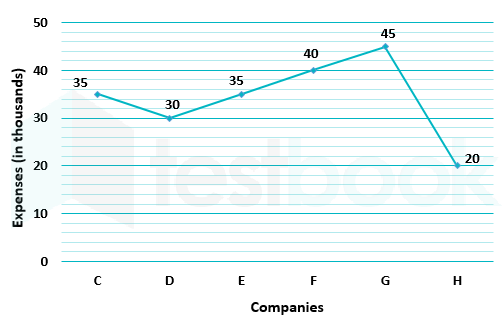
The following line graph shows the expenditure of different companies in the month of January. Study the graph and answer the question.

What is the respective ratio of the total expenditure of companies C, D, and E together to the total expenditure of companies F, G, and H together?

  1. AOption (a)

    20 : 21

  2. BOption (b)

    100 : 110

  3. COption (c)

    21 : 11

  4. DOption (d)

    11 : 21

View answer & explanation

Correct answer

Answer: (a)A.

20 : 21

Why this answer is correct

Calculation:

According to the question:

The total expenditure of companies C, D, and E = 35 + 30 + 35 = 100

The total expenditure of companies F, G, and H = 40 + 45 + 20 = 105

The ratio is:

100 : 105

20 : 21

∴ Option 1 is the correct answer.

Question 37

Ranikhet hill station is located in which state of India?

  1. AOption (a)

    Kerala

  2. BOption (b)

    Himachal Pradesh

  3. COption (c)

    Sikkim

  4. DOption (d)

    Uttarakhand

View answer & explanation

Correct answer

Answer: (d)D.

Uttarakhand

Why this answer is correct

The correct answer is Uttarakhand.

Key Points

  • Ranikhet is at an altitude of 1,869 meters above sea level and is within sight of the western peaks of the Himalayas.
  • Ranikhet is a hill station and cantonment town in Almora district in the Indian state of Uttarakhand.
  • Mankameshwar, Haidakhan Temple, Jhula Devi and Ram Mandir are the revered temples near Ranikhet.​
  • It's maintained by the Indian Army and is home to the Kumaon Regiment (KRC), Naga Regiment, and the Military Hospital.
  • The name Ranikhet means "Queen's Meadow".

Additional Information

  • The Aravalli Range is a mountain range in Northwestern India, running approximately 670 km in a southwest direction, starting near Delhi, passing through southern Haryana and Rajasthan, and ending in Gujarat.
  • The highest peak is Guru Shikhar at 1,722 meters.
  • Malwa Plateau, plateau region in north-central India.
  • It is bounded by the Madhya Bharat Plateau and Bundelkhand Upland to the north, the Vindhya Range to the east and south, and the Gujarat Plains to the west of volcanic origin, the plateau comprises central Madhya Pradesh state and southeastern Rajasthan state.
  • Dodda Betta is the highest mountain in the Nilgiri Mountains at 2,637 meters (8,652 feet).
  • There is a reserved forest area around the peak.
  • It is 9 km from Ooty, on the Ooty-Kotagiri Road in the Nilgiris District of Tamil Nadu, India.
  • Mahendragiri is a mountain in the Rayagada subdivision of the district of Gajapati, Odisha, India.
  • It is situated amongst the Eastern Ghats at an elevation of 1,501 meters.
  • The Western Ghats
  • The Western Ghat is a region where there is a high number of species and biodiversity.

Question 38

Which of the following statements is/are correct?

A) pH value of saliva: 6.2 - 8

B) pH value of pure blood : 7.35 - 7.45

C) pH value of pure water: 9

  1. AOption (a)

    Only B

  2. BOption (b)

    Only C

  3. COption (c)

    B and C

  4. DOption (d)

    A and B

View answer & explanation

Correct answer

Answer: (a)A.

Only B

Why this answer is correct

The correct answer is Only B

Key Points

  • The statement "pH value of pure blood: 7.35 - 7.45" is correct
  • It is because it reflects the tightly regulated pH range essential for the proper functioning of the human body.
  • Blood with a pH outside this range can disrupt normal cellular functions.
  • If blood pH drops below 7.35, it results in acidosis, which can impair organ function and lead to serious health complications.
  • If blood pH rises above 7.45, it results in alkalosis, which can cause muscle twitching, confusion, and other symptoms.

Additional Information

  • pH value of saliva: 6.2 - 8
  • ​The pH of saliva typically ranges from 6.2 to 7.6, depending on factors like diet, hydration, and health.
  • While saliva can occasionally reach a pH of 8 in exceptional circumstances (e.g., after consuming certain foods or medications), it is not a standard range.
  • Hence, the statement is incorrect because 8 is an upper extreme rather than a norm.
  • pH value of pure water: 9
  • Pure water is neutral and has a pH of 7 at 25°C. A pH of 9 would indicate a basic or alkaline solution, which is not the case for pure water.
  • Thus, the statement is incorrect.

Question 39

Kritika walks 6 m towards the south. She turns right to walk 6 m. She turns left and walks 5 m. She again turns left and walks 6 m. Again she turns left and walks 5 m. In which direction is she facing now? (All turns are 90 degree turns only)

  1. AOption (a)

    East

  2. BOption (b)

    North

  3. COption (c)

    West

  4. DOption (d)

    South

View answer & explanation

Correct answer

Answer: (b)B.

North

Why this answer is correct

According to the given information,

  1. Kritika walks 6 m towards the south.


  1. She turns right to walk 6 m.


  1. She turns left and walks 5 m.


  1. She again turns left and walks 6 m.


  1. Again, she turns left and walks 5 m.


Here, we can see that she is now facing North direction.

Hence, the correct answer is "North".

Question 40

If 2 is added to each even digit and 3 is added to each odd digit in the number 4311253, what will be the sum of the digits which are third from the left and second from the right in the new number thus formed?

  1. AOption (a)

    11

  2. BOption (b)

    15

  3. COption (c)

    9

  4. DOption (d)

    12

View answer & explanation

Correct answer

Answer: (d)D.

12

Why this answer is correct

We know,

Even Numbers → Multiples of 2.

Odd Numbers → non-multiples of 2.

4311253:

Now let's check even and odd numbers present in "4311253",

Even Numbers → 4, 2

Odd Numbers → 3, 1, 1, 5, 3

Let's add 2 to each even digit and 3 to each odd digit.

We get → 6644486.

The sum of the third digit from the left and second digit from the right of the new number "6 6 4 4 4 8 6" → (4 + 8) = 12.

Hence, the correct answer is "12".

Question 41

If a = (37)2÷(97)0(\frac{3}{7})^2\div(\frac{9}{7})^0, then find the value of a-2.

  1. AOption (a)

    240181\frac{2401}{81}

  2. BOption (b)

    81343\frac{81}{343}

  3. COption (c)

    812401\frac{81}{2401}

  4. DOption (d)

    34381\frac{343}{81}

View answer & explanation

Correct answer

Answer: (a)A.

240181\frac{2401}{81}

Why this answer is correct

Calculation:

a=(37)2÷(97)0a=(\frac{3}{7})^2\div(\frac{9}{7})^0

a=(37)2÷1a=(\frac{3}{7})^2\div1

a=(37)2÷1a=(\frac{3}{7})^2\div1

a=(949)a=(\frac{9}{49}))

a-2 = (9/49)-2

a-2 = 2401/81

∴ Option 1 is the correct answer.

Question 42

Which of the following elements belongs to the second group?

  1. AOption (a)

    Be

  2. BOption (b)

    C

  3. COption (c)

    Na

  4. DOption (d)

    B

View answer & explanation

Correct answer

Answer: (a)A.

Be

Why this answer is correct

The correct answer is Be

Key Points

  • The elements in the second group of the periodic table are called the alkaline earth metals
  • The second group of the periodic table, known as the alkaline earth metals, includes the following elements:
  • Beryllium (Be)
  • Magnesium (Mg)
  • Calcium (Ca)
  • Strontium (Sr)
  • Barium (Ba)
  • Radium (Ra)
  • All these elements have 2 valence electrons in their outermost shell, making their general electronic configuration ns².
  • These metals are reactive, though less so than alkali metals (Group 1). Reactivity increases down the group.
  • They commonly form oxides, hydroxides, and salts with +2 oxidation states.

Additional Information

  • C (Carbon): It belongs to Group 14 (nonmetals).
  • Na (Sodium): It belongs to Group 1 (alkali metals).
  • B (Boron): It belongs to Group 13 (metalloids).

Important Points

PropertyNonmetalsAlkali MetalsMetalloids
Position in Periodic TableRight side (except noble gases)Group 1 (first column)Along the staircase boundary
ExamplesCarbon (C), Oxygen (O), Sulfur (S)Lithium (Li), Sodium (Na), Potassium (K)Boron (B), Silicon (Si), Arsenic (As)
State at Room TempSolid, liquid, or gasSolidSolid
LusterDullShinyShiny or dull
ConductivityPoor (insulators)Excellent (good conductors)Moderate (semiconductors)
Malleability/DuctilityBrittleMalleable and ductileBrittle
Melting/Boiling PointsGenerally high (varies)Low compared to most metalsIntermediate
ReactivityModerate to high (with metals)Very high (especially with water)Moderate
Electron BehaviorGain electrons (form anions)Lose 1 electron (form cations)Gain, lose, or share electrons
Bonding TypeCovalentIonicIonic or covalent
Special UsesEssential for life (O, C); insulationSalts (NaCl), batteries (Li)Electronics (Si in chips)

Question 43

Six boxes are kept vertically one above the other, box 1 is kept at the top, box 2 is kept below box 1 and so on. F is kept at an even numbered position from the top but not at the 2nd position. B is kept at the bottommost position. Only one box is kept between F and E. C is kept immediately above F. F is kept immediately above A. What is the position of box A from the bottom?

  1. AOption (a)

    4th

  2. BOption (b)

    5th

  3. COption (c)

    2nd

  4. DOption (d)

    3rd

View answer & explanation

Correct answer

Answer: (c)C.

2nd

Why this answer is correct

Let's create the arrangement using the information given,

  1. B is kept at the bottommost position.
1
2
3
4
5
6B
  1. F is kept at an even numbered position from the top but not at the 2nd position.
1
2
3
4F
5
6B
  1. Only one box is kept between F and E.
1
2E
3
4F
5
6B
  1. C is kept immediately above F.

  2. F is kept immediately above A.

1
2E
3C
4F
5A
6B

Here, we can see that A is at 2nd position from the bottom.

Hence, the correct answer is " 2nd ".

Question 44

If 1 is added to each odd digit and 2 is subtracted from each even digit in the number 1374856, which of the following digits will appear more than once in the new number thus formed?

  1. AOption (a)

    Only 8

  2. BOption (b)

    4, 6 and 8

  3. COption (c)

    Both 6 and 7

  4. DOption (d)

    2, 4 and 6

View answer & explanation

Correct answer

Answer: (d)D.

2, 4 and 6

Why this answer is correct

Given number → 1374856

If 1 is added to each odd digit and 2 is subtracted from each even digit then,

New number → 2482664

The digits that will appear more than once in the new number thus formed are:-

2482664

Hence, the correct answer is "2, 4 and 6".

Question 45

Solve the given equation.

(5x2 - 5) + 5(-x2 + 2x - 7) = 0

  1. AOption (a)

    x = 4

  2. BOption (b)

    x = -4

  3. COption (c)

    x = -2

  4. DOption (d)

    x = 2

View answer & explanation

Correct answer

Answer: (a)A.

x = 4

Why this answer is correct

Shortcut Trick

Observe the coefficients of x2: 5 and 5(−1) = −5. They cancel each other out.

Solve the remaining linear part: −5 + 5(2x − 7) = 0

−5 + 10x − 35 = 0 ⇒ 10x = 40

x = 40 ÷ 10 = 4

∴ The correct answer is x = 4.

Alternate Method

Given Equation: (5x2 − 5) + 5(−x2 + 2x − 7) = 0

To solve the equation, we first apply the Distributive Property to remove the parentheses.

⇒ 5x2 − 5 + 5(−x2) + 5(2x) + 5(−7) = 0

⇒ 5x2 − 5 − 5x2 + 10x − 35 = 0

Now, group the like terms together (x2 terms, x terms, and constants):

⇒ (5x2 − 5x2) + 10x + (−5 − 35) = 0

⇒ 0 + 10x − 40 = 0

Isolate the variable x by moving the constant to the right side:

⇒ 10x = 40

⇒ x = 40 ÷ 10

⇒ x = 4

∴ The correct answer is x = 4.

Additional Information

Distributive Property

The rule that states a(b + c) = ab + ac, used to multiply a single term by two or more terms inside a set of parentheses.

Linear Equation

An equation where the highest power of the variable is 1. After simplification, this quadratic-looking equation reduced to a linear equation 10x − 40 = 0.

Like Terms

Terms that have the same variables raised to the same powers. Only like terms can be added or subtracted to simplify an algebraic expression.

Question 46

During photosynthesis, the carbohydrates synthesised are stored in the form of: 

  1. AOption (a)

    proteins

  2. BOption (b)

    fats

  3. COption (c)

    starch

  4. DOption (d)

    vitamins

View answer & explanation

Correct answer

Answer: (c)C.

starch

Why this answer is correct

The correct answer is Starch.

Key Points

Starch

  • The food synthesized by the plant is stored as Starch.
  • Starch is the food that gets stored in plant leaves.
  • Starch is a polymeric carbohydrate consisting of a large number of glucose units linked by glycosidic bonds.
  • It acts as stored energy in plants.
  • Food making process in plants is called photosynthesis and synthesized food is stored as carbohydrates (glucose as well as starch).
  • Plants are known as photoautotrophs or photosynthetic organisms which means that they are able to synthesize their food directly from carbon dioxide and water using energy from light.

Additional Information

  • Proteins are large molecules made of smaller units called amino acids.
  • They are essential for building and repairing tissues in the body.
  • Fats are a type of nutrient that provides energy, helps in the absorption of vitamins, and supports cell function.
  • Fats are made of fatty acids and glycerol.
  • Vitamins are organic compounds needed in small amounts for the body to function properly.
  • They do not provide energy but are essential for various metabolic processes.

Question 47

Refer to the following number series and answer the question that follows.

4 3 7 9 2 5 6 8 7 9 1 5 3 9 2 4 3 5 9

How many such odd digits are there, each of which is immediately preceded by an odd digit and also immediately followed by an even digit ?

  1. AOption (a)

    Four

  2. BOption (b)

    Two

  3. COption (c)

    One

  4. DOption (d)

    Three

View answer & explanation

Correct answer

Answer: (b)B.

Two

Why this answer is correct

Given Series:

4 3 7 9 2 5 6 8 7 9 1 5 3 9 2 4 3 5 9

Odd digits which are immediately preceded by an odd digit and also immediately followed by an even digit are:-

4 3 7 9 2 5 6 8 7 9 1 5 3 9 2 4 3 5 9

Hence, the correct answer is "Two".

Question 48

Ramu is older than Lakshman by 4 years. If their present ages are in the ratio 6 : 5, how old is Lakshman?

  1. AOption (a)

    20 years

  2. BOption (b)

    18 years

  3. COption (c)

    22 years

  4. DOption (d)

    24 years

View answer & explanation

Correct answer

Answer: (a)A.

20 years

Why this answer is correct

Shortcut Trick

Ratio of Ramu and Lakshman = 6 : 5

Difference in ratio parts = 6 − 5 = 1 unit

Given age difference = 4 years

⇒ 1 unit = 4 years

Lakshman's age = 5 units = 5 × 4 = 20 years

∴ The correct answer is 20 years.

Alternate Method

Given:

Age difference = 4 years

Ratio of ages = 6 : 5

Let the age of Ramu be 6x and Lakshman be 5x.

⇒ 6x − 5x = 4

⇒ x = 4

⇒ Lakshman's age = 5x

⇒ 5 × 4 = 20 years

∴ The correct answer is 20 years.

Additional Information

Age Difference Property

The difference between the ages of two persons remains constant regardless of the number of years passed or preceding.

Ratio and Proportion in Ages

If ages are in ratio a : b, their actual values can be taken as ax and bx, where x is the highest common factor.

Future/Past Age Calculation

If present age is 'A', then age after 'n' years is A + n and age 'n' years ago was A − n.

Question 49

The area of a right-angled triangle, whose base is 24 cm and hypotenuse is 26 cm, is:

  1. AOption (a)

    120 cm2

  2. BOption (b)

    240 cm2

  3. COption (c)

    130 cm2

  4. DOption (d)

    312 cm2

View answer & explanation

Correct answer

Answer: (a)A.

120 cm2

Why this answer is correct

Shortcut Trick

Recognize the Pythagorean triplet: 5, 12, 13.

Multiply by 2 → 10, 24, 26.

Given Hypotenuse = 26 cm and Base = 24 cm, the Height must be 10 cm.

Area = 1/2 × 24 × 10 = 120 cm2.

∴ The correct answer is 120 cm2.

Alternate Method

Given: Base (b) = 24 cm, Hypotenuse (h) = 26 cm.

Formula Used: Area = 1/2 × Base × Height; Height2 = Hypotenuse2 − Base2

⇒ Perpendicular (p) = √(262 − 242)

⇒ p = √(676 − 576) = √100 = 10 cm

⇒ Area = 1/2 × 24 × 10

⇒ Area = 12 × 10 = 120 cm2

∴ The correct answer is 120 cm2.

Additional Information

Pythagoras Theorem

In a right-angled triangle, the square of the hypotenuse is equal to the sum of the squares of the other two sides: a2 + b2 = c2.

Area of Triangle

For any triangle, Area = √(s(s−a)(s−b)(s−c)) where s is the semi-perimeter (Heron's Formula).

Common Triplets

Frequently used Pythagorean triplets in exams include (3, 4, 5), (5, 12, 13), (7, 24, 25), and (8, 15, 17).

Question 50

The length of a conducting wire is 1 km and its radius of cross section is 7 mm. A resistor of resistance 10 Ω is made out of this wire. The resistivity of this conductor will be _________.

  1. AOption (a)

    7 × 10-6 Ω - m

  2. BOption (b)

    1.54 × 10-6 Ω - m

  3. COption (c)

    2.22 × 10-6 Ω - m

  4. DOption (d)

    1 × 10-6 Ω - m

View answer & explanation

Correct answer

Answer: (b)B.

1.54 × 10-6 Ω - m

Why this answer is correct

The correct answer is 1.54 × 10-6 Ω - m

Key Points

  • Given values:
  • Length (L) = 1 km = 1000 m
  • Radius (r) = 7 mm = 7 × 10⁻³ m
  • Resistance (R) = 10 Ω
  • Calculate the cross-sectional area (A):
  • The cross-section of the wire is a circle, so its area is given by:
  • A = πr² = π × (7 × 10⁻³)² ≈ 1.54 × 10⁻⁴ m²
  • Use the formula for resistance:
  • The resistance of a conductor is related to its resistivity (ρ), length (L), and cross-sectional area (A) by the formula:
  • R = ρL / A
  • Solve for resistivity (ρ):
  • ρ = RA / L = (10 Ω × 1.54 × 10⁻⁴ m²) / 1000 m ≈ 1.54 × 10⁻⁶ Ω-m
  • Therefore, the resistivity of the conductor is approximately 1.54 × 10⁻⁶ Ω-m.

Question 51

The oustees of which dam built in the 1970s are still fighting for the benefits they were promised?

  1. AOption (a)

    Tawa dam

  2. BOption (b)

    Hirakud dam

  3. COption (c)

    Sardar Sarovar dam

  4. DOption (d)

    Nagarjuna Sagar dam

View answer & explanation

Correct answer

Answer: (a)A.

Tawa dam

Why this answer is correct

The correct answer is Tawa Dam

Key Points

  • The oustees of the Tawa Dam, built in the 1970s, are still fighting for the benefits they were promised.
  • People who are displaced by development projects are called oustees.
  • Oustees are often poor tribal people who are alienated from their lands and forests without adequate compensation.
  • Dams can cause economic problems, such as using large amounts of public money without proportionate benefits.
  • Dams can also cause environmental problems, such as deforestation and loss of biodiversity

Additional Information

FeatureHirakud DamSardar Sarovar DamNagarjuna Sagar Dam
LocationSambalpur, OdishaNarmada River, GujaratKrishna River, Andhra Pradesh-Telangana border
RiverMahanadi RiverNarmada RiverKrishna River
Type of DamEarthen dam with masonry structureConcrete gravity damMasonry dam
Length4.8 km (approx.)1.2 km (approx.)1.6 km (approx.)
Height60.96 m163 m124 m
PurposeIrrigation, flood control, and hydroelectric powerIrrigation, drinking water, and hydroelectric powerIrrigation and hydroelectric power
Year of Completion195720171967
Capacity5.82 billion cubic meters9.5 billion cubic meters11.47 billion cubic meters
Key FeaturesOne of the longest earthen dams in the worldPart of the Narmada Valley ProjectOne of India's earliest large-scale irrigation projects

Question 52

Where is the head office of the Barefoot College, which completed 50 years of community empowerment in 2022, located?

  1. AOption (a)

    Gujarat

  2. BOption (b)

    West Bengal

  3. COption (c)

    Rajasthan

  4. DOption (d)

    Odisha

View answer & explanation

Correct answer

Answer: (c)C.

Rajasthan

Why this answer is correct

The correct answer is Rajasthan

Key Points

  • The head office of the Barefoot College is located in Tilonia, a village in the Ajmer district of Rajasthan, India.
  • The Barefoot College is a non-governmental organization (NGO) that works to empower local communities.
  • The college was founded in 1972 by Sanjit "Bunker" Roy.
  • The college's goal is to address the issues of marginalized communities, including women, the poor, and the exploited.
  • The college's programs are delivered in a decentralized way, working with local people and partners to develop localized solutions.

Additional Information

  • Calcutta University:
  • Officially known as the University of Calcutta, this institution was established on January 24, 1857.
  • Its establishment during the British Raj makes it one of the first institutions in South Asia to be established as a multidisciplinary and secular Western-style university.
  • Bombay University:
  • The University of Bombay, now called the University of Mumbai, was established on July 18, 1857.
  • It is one of the oldest state universities in India and the oldest in Maharashtra.
  • It offers a broad course curriculum in the faculties of arts, commerce, and science.
  • It was also one of the first universities in India to introduce the system of home examinations.
  • Madras University:
  • The University of Madras was established on September 5, 1857, following a public petition dated December 11, 1839.
  • The university system of Madras was modeled after the University of London.
  • It is one of the oldest and most prestigious universities in India, offering various undergraduate, postgraduate, and doctoral programs in different domains like science, arts, commerce, and management. The university's main campus is in Chennai, Tamil Nadu, India.

Question 53

The Microfinance Institutions Network (MFIN) was recognised by the Reserve Bank of India (RBI) as India's first Self-Regulatory Organization (SRO) for Non-Banking Financial Company-Micro Finance Institutions (NBFC-MFI) in ______.

  1. AOption (a)

    2018

  2. BOption (b)

    2017

  3. COption (c)

    2014

  4. DOption (d)

    2015

View answer & explanation

Correct answer

Answer: (c)C.

2014

Why this answer is correct

The correct answer is 2014.

Key Points

  • In June 2014, MFIN became the first industry association to be accorded recognition as an SRO by the RBI.
  • The status of MFIN as the SRO is likely to promote responsible lending and client protection.
  • The decision was taken by RBI based on the recommendations made by a sub-committee under the chairmanship of Y H Malegam.
  • This committee was formed to study the issues and concerns in the microfinance sector.

Additional Information

  • Important terms:
  • Microfinance Institutions Network (MFIN):
  • Micro Finance Institutions Network (MFIN) is an Association of Non-Bank Finance Company Micro Finance Institutions (NBFC-MFIs).
  • It was established in October 2009 as the primary representative body of NBFCs engaged in the business of Microfinance.
  • Self-Regulatory Organization (SRO) ​
  • ​A self-regulatory organization (SRO) is an entity such as a non-governmental organization, which has the power to create and enforce stand-alone industry and professional regulations and standards on its own.
  • Non-Banking Financial Company​
  • Examples of nonbank financial institutions include insurance firms, venture capitalists, currency exchanges, some microloan organizations, and pawn shops.
  • Provide services that are not necessarily suited to banks, serve as competition to banks, and specialize in sectors or groups.

Question 54

In the set {61, 62...100}, find the sum of the second largest and the second smallest primes.

  1. AOption (a)

    156

  2. BOption (b)

    158

  3. COption (c)

    164

  4. DOption (d)

    150

View answer & explanation

Correct answer

Answer: (a)A.

156

Why this answer is correct

Shortcut Trick

List the primes in the range {61, 62...100}: 61, 67, 71, 73, 79, 83, 89, 97.

Second smallest prime = 67.

Second largest prime = 89.

Sum = 67 + 89 = 156.

∴ The correct answer is 156.

Alternate Method

Given: Set of numbers from 61 to 100.

Calculations:

⇒ Identify prime numbers between 61 and 100.

⇒ The primes are: 61, 67, 71, 73, 79, 83, 89, 97.

⇒ Second smallest prime = 67.

⇒ Second largest prime = 89.

⇒ Sum = 67 + 89 = 156.

∴ The correct answer is 156.

Additional Information

Prime Numbers

Numbers greater than 1 with exactly two factors: 1 and the number itself.

Prime Testing (6n ± 1)

All primes greater than 3 can be expressed in the form 6n ± 1, though not all such numbers are prime.

Prime Count (1-100)

There are exactly 25 prime numbers between 1 and 100.

Question 55

Select the option that is related to the fifth term in the same way as the fourth term is related to the third term and the second term is related to the first term.

SPACE : URCEG : : PLANET : RNCPGV : : MACHINE : ?

  1. AOption (a)

    OCEFGPG

  2. BOption (b)

    ОСЕЈKPG

  3. COption (c)

    KYAJKPG

  4. DOption (d)

    KYAFGLC

View answer & explanation

Correct answer

Answer: (b)B.

ОСЕЈKPG

Why this answer is correct

SPACE is related to URCEG as:-

PLANET is related to RNCPGV as:-


Similarly,

MACHINE is related to OCEJKPG as:-


Hence, the correct answer is "OCEJKPG".

Question 56

If cot4 x + cot2 x = 1, then the value of cosec4x - cosec2x is:

  1. AOption (a)

    2

  2. BOption (b)

    4

  3. COption (c)

    -1

  4. DOption (d)

    1

View answer & explanation

Correct answer

Answer: (d)D.

1

Why this answer is correct

Shortcut Trick

Given cot4 x + cot2 x = 1

⇒ cot2 x (cot2 x + 1) = 1

Since 1 + cot2 x = cosec2 x

⇒ cot2 x × cosec2 x = 1

⇒ (cosec2 x − 1) × cosec2 x = 1

⇒ cosec4 x − cosec2 x = 1

∴ The correct answer is 1.

Alternate Method

Given: cot4 x + cot2 x = 1

Formula Used: cosec2 x − cot2 x = 1 ⇒ cot2 x = cosec2 x − 1

⇒ cot4 x + cot2 x = 1

⇒ cot2 x (cot2 x + 1) = 1

⇒ cot2 x (cosec2 x) = 1

⇒ (cosec2 x − 1) cosec2 x = 1

⇒ cosec4 x − cosec2 x = 1

∴ The correct answer is 1.

Additional Information

Trigonometric Identity

The fundamental identity involving cosec and cot is 1 + cot2 x = cosec2 x or cosec2 x − cot2 x = 1.

Symmetry in Identities

Similar to this, if tan4 x + tan2 x = 1, then sec4 x − sec2 x = 1 based on the identity 1 + tan2 x = sec2 x.

Pythagorean Relations

Always remember sin2 x + cos2 x = 1, which serves as the base for deriving other reciprocal identities.

Question 57

All 32 students of a class are standing in a straight row facing north. Anand is 6th from the right end, while Meena is 14th from the left end. How many students stand between Anand and Meena?

  1. AOption (a)

    12

  2. BOption (b)

    13

  3. COption (c)

    10

  4. DOption (d)

    8

View answer & explanation

Correct answer

Answer: (a)A.

12

Why this answer is correct

Given:-

Total students standing in the row → 32

Position of Anand from the right end of the row → 6th

Position of Meena from the left end of the row → 14th

Sum of position of Anand from the right end of the row and position of Meena from the left end of the row → 6 + 14 = 20

Total person in the row (32) > Position of 1st person from the right end + Position of 2nd person from the left end (20)  → Case of non-overlapping

Therefore, number of students between Anand and Meena → Total person in the row - (Position of 1st person from the right end + Position of 2nd person from the left end)

Number of students between Anand and Meena → 32 - (6 + 14) → 32 - 20 = 12

Hence, the correct answer is "12".

Question 58

In this question, a statement is followed by two conclusions numbered I and II. You have to assume everything in the statement to be true and decide which of them logically follow(s) beyond a reasonable doubt from the information given in the statement.

Statement:

Radha knew that watermelon always tastes good in summer. The one she bought today was tasteless.

Conclusions:

I. It is not summer season at present.

II. The shopkeeper has cheated Radha.

  1. AOption (a)

    Both conclusions I and II follow

  2. BOption (b)

    Only conclusion I follows

  3. COption (c)

    Neither conclusion I nor II follows

  4. DOption (d)

    Only conclusion II follows

View answer & explanation

Correct answer

Answer: (b)B.

Only conclusion I follows

Why this answer is correct

Given:-

Statement:

Radha knew that watermelon always tastes good in summer. The one she bought today was tasteless.

Conclusions:

I. It is not summer season at present → Follows (As in the statement it is given that Radha knew that watermelon always tastes good in summer but the one she bought today was tasteless.)

II. The shopkeeper has cheated Radha → Does not follows (As in the statement nothing is mentioned about the shopkeeper.)

Hence, the correct answer "Only conclusion I follows".

Question 59

Which of the following compounds contains only one carbon-carbon single bond?

  1. AOption (a)

    Ethane

  2. BOption (b)

    Propane

  3. COption (c)

    Butane

  4. DOption (d)

    Methane

View answer & explanation

Correct answer

Answer: (a)A.

Ethane

Why this answer is correct

The correct answer is Ethane.

Key Points

  • Ethane is a saturated hydrocarbon among given options.
  • Saturated hydrocarbons are molecules with only single bonds.

 - Ethane

 - Ethene

  • Propene

  • Acetylene

  • Only ethane has all single bond while others have a double and triple bond.

  • Methane, Ethane, Propane, Butane, etc are examples of saturated hydrocarbons.

  • Alkanes are saturated hydrocarbons and classified as a type of aliphatic hydrocarbon.

  • Bonding between every single bond in a saturated hydrocarbon is covalent in nature**.**

Additional Information

  • Unsaturated hydrocarbons contain multiple bonding and contain less than the maximum number of hydrogens per carbon.
  • Unsaturated hydrocarbons have double or triple covalent between adjacent carbon atoms.
  • Aromatic hydrocarbons are a special case of unsaturated hydrocarbons.

Question 60

In the Republic Day Parade 2022, which state's theme of the tableau was based on Anglo-Abor (Adi) wars?

  1. AOption (a)

    Sikkim

  2. BOption (b)

    Tripura

  3. COption (c)

    Assam

  4. DOption (d)

    Arunachal Pradesh

View answer & explanation

Correct answer

Answer: (d)D.

Arunachal Pradesh

Why this answer is correct

The correct answer is Arunachal Pradesh

Key Points

  • In the Republic Day Parade 2022, the tableau of Arunachal Pradesh showcased the theme of the Anglo-Abor (Adi) wars.
  • These wars were fought by the Adi tribe in Arunachal Pradesh against British colonial forces during the early 20th century, symbolizing the bravery and resistance of the local communities against imperialism.
  • These wars were fought primarily in the early 20th century, with notable conflicts in 1911-1912.
  • The Adi tribes resisted British attempts to impose control and assert authority over their territory.

Additional Information

  • The term "Abor" was used by the British to describe the Adi tribe, which is one of the indigenous tribes of Arunachal Pradesh.
  • The Adi people are known for their martial traditions and strong sense of independence.
  • They lived in the hills along the northern bank of the Brahmaputra River
  • First Anglo-Abor War (1858):
  • This was a punitive expedition launched by the British to curb resistance by the Adi tribes.
  • Second Anglo-Abor War (1911–1912):
  • The Adi tribes, led by their local chiefs, organized a strong resistance against British forces.
  • The conflict was triggered by the killing of British officials who ventured into Adi territory without permission.

Question 61

Read the given statement(s) and conclusions carefully. Assuming that the information given in the statements is true, even if it appears to be at variance with commonly known facts, decide which of the given conclusions logically follow(s) from the statement(s).

Statements:

All grapes are apples

No apple is a pine

All pines are cones

Conclusions:

(I) No cone is a grape

(II) No grape is a pine

(III) Some cones are apples

  1. AOption (a)

    None of the conclusions follow

  2. BOption (b)

    Only conclusion II follows

  3. COption (c)

    Only conclusion I follows

  4. DOption (d)

    Both conclusion I and conclusion II follow

View answer & explanation

Correct answer

Answer: (b)B.

Only conclusion II follows

Why this answer is correct

The statements are as follows:


Conclusions are as follows:

(I) No cone is a grape → Doesn't Follows ( As their is no direct relationship between cone and grapes therefore it doesn't follows)

(II) No grape is a pine → Follows (As no apple is pine and all grapes are apple, therefore it follows)

(III) Some cones are apples → Doesn't Follows ( As their is no direct relationship between cone and apples therefore it doesn't follows)

Hence, the correct answer is "Only conclusion II follows".

Question 62

In the normal eye, the distance of the retina from the eye lens is 2.5 cm. The power of the eye lens when it is focussed at its near point 25 cm from the eye is :

  1. AOption (a)

    22 D

  2. BOption (b)

    40 D

  3. COption (c)

    44 D

  4. DOption (d)

    4 D

View answer & explanation

Correct answer

Answer: (c)C.

44 D

Why this answer is correct

The correct answer is 44D

Key Points

  • The distance between the eye lens and the retina is the image distance (v), which is 2.5 cm.
  • The near point is the closest distance at which the eye can focus, which is the object distance (u), and is given as 25 cm.
  • Lens Formula: The lens formula relates the object distance (u), image distance (v), and focal length (f) of a lens:
  • 1/f = 1/v - 1/u
  • Applying the Formula: In our case:
  • 1/f = 1/2.5 - 1/(-25)
  • 1/f = 1/2.5 + 1/25
  • 1/f = (10 + 1) / 25
  • 1/f = 11/25
  • f = 25/11 cm
  • v = 2.5 cm
  • u = -25 cm (negative sign because the object is on the left side of the lens)
  • Power of the Lens: The power (P) of a lens in diopters (D) is the reciprocal of its focal length in meters:
  • P = 1/f (where f is in meters)
  • First, convert the focal length to meters:
  • f = (25/11) / 100 = 0.25/11 m
  • Now, calculate the power:
  • P = 1/(0.25/11) = 11/0.25 = 44 D

Question 63

In the given reaction which substance undergoes oxidation?

2Cu + O2 → 2CuO

  1. AOption (a)

    Only copper

  2. BOption (b)

    Copper oxide

  3. COption (c)

    Copper and oxygen

  4. DOption (d)

    Only oxygen

View answer & explanation

Correct answer

Answer: (a)A.

Only copper

Why this answer is correct

The correct answer is Only copper.

Key Points

  • Oxidation involves the loss of electrons or an increase in oxidation state by a molecule, atom, or ion.
  • In the given reaction, copper starts in the zero oxidation state (as a pure element) and ends up in the +2 oxidation state (as part of copper oxide, CuO).
  • Oxygen (O₂) typically acts as an oxidizing agent in reactions. Oxygen gains electrons that copper loses, meaning it undergoes reduction.
  • The oxygen starts in the zero oxidation state and ends in the -2 oxidation state in copper oxide (CuO).
  • Hence, in the chemical reaction shown 2Cu + O2 → 2CuO, copper (Cu) undergoes oxidation.

Additional Information

  • Oxidation:
  • Loss of electrons.
  • Increase in oxidation state.
  • Example: 2Cu → 2Cu2+ + 4e-.
  • Reduction:
  • Gain of electrons.
  • Decrease in oxidation state.
  • Example: O2 + 4e- → 2O2-.
  • Redox Reaction:
  • A reaction where oxidation and reduction occur simultaneously.
  • Example: 2Cu + O2 → 2CuO.
  • Oxidising Agent:
  • The substance that causes oxidation by gaining electrons (gets reduced).
  • Example: O2 in 2Cu + O2 → 2CuO.
  • Reducing Agent:
  • The substance that causes reduction by losing electrons (gets oxidized).
  • Example: Cu in 2Cu + O2 → 2CuO.

Question 64

Fleming's right hand rule gives the direction of current induced in a conductor moving in a ________.

  1. AOption (a)

    electromagnetic field

  2. BOption (b)

    gravitational field

  3. COption (c)

    electric field

  4. DOption (d)

    magnetic field

View answer & explanation

Correct answer

Answer: (d)D.

magnetic field

Why this answer is correct

The correct answer is magnetic field

Key Points

  • Fleming's right-hand rule is used to determine the direction of induced current in a conductor moving in a magnetic field.
  • Using Fleming's right-hand rule, if the direction of the magnetic field is towards north and the conductor is moving vertically upward, the current will flow towards the west.
  • Fleming's right-hand rule states that if you extend the thumb, forefinger, and middle finger of your right hand such that they are mutually perpendicular, with the thumb pointing in the direction of motion of the conductor, and the forefinger in the direction of the magnetic field, then the middle finger will point in the direction of the induced current.
  • In this scenario, with the magnetic field towards the north and the conductor moving upward, the thumb points upward, the forefinger points north, and the middle finger points towards the west.

Additional Information

  • It is particularly useful in the context of generators and other devices where mechanical motion is converted into electrical energy.
  • Conversely, Fleming's left-hand rule is used for electric motors where electrical energy is converted into mechanical motion.
  • Both rules are fundamental principles in electromagnetism and are widely used in physics and engineering.

Question 65

Select the number from among the given options that can replace the question mark (?) in the following series.

233, 404, 575, 746, 917,?

  1. AOption (a)

    1088

  2. BOption (b)

    1078

  3. COption (c)

    1089

  4. DOption (d)

    1079

View answer & explanation

Correct answer

Answer: (a)A.

1088

Why this answer is correct

The pattern followed here is;


Hence, the correct answer is "1088".

Question 66

Amongst six friends P, Q, R, S, T and U, each has a different height. P is taller than only three other friends. R is taller than only one friend. S is taller than R but shorter than U. T is taller than U. Who is the second tallest among all the friends?

  1. AOption (a)

    T

  2. BOption (b)

    S

  3. COption (c)

    U

  4. DOption (d)

    Q

View answer & explanation

Correct answer

Answer: (c)C.

U

Why this answer is correct

The following arrangement is as follows:

1) P is taller than only three other friends.

_ > _ > P > _ > _ > _

2) R is taller than only one friend

_ > _ > P > _ > R > _

3) S is taller than R but shorter than U and T is taller than U.

T > U > P > S > R > _

So as the final arrangement is as follows.

T > U > P > S > R > Q

Therefore, U is the second tallest among all the friends.

Hence, the correct answer is "U".

Question 67

Surbhi invested a total sum of Rs. 47,740 in three schemes A, B and C such that the simple interest received from scheme A at 10% p.a. after 3 years, from scheme B at 9% p.a. after 4 years and from scheme C at 8% p.a. after 5 years were the same. What is the positive difference (in Rs.) between the sums invested in schemes C and A?

  1. AOption (a)

    3,080

  2. BOption (b)

    4,620

  3. COption (c)

    3,840

  4. DOption (d)

    1,540

View answer & explanation

Correct answer

Answer: (b)B.

4,620

Why this answer is correct

Shortcut Trick

When Simple Interest is equal, the ratio of Principal amounts is A : B : C = 1/(R1T1) : 1/(R2T2) : 1/(R3T3).

Ratio A : B : C = 1/(10×3) : 1/(9×4) : 1/(8×5) = 1/30 : 1/36 : 1/40 = 12 : 10 : 9.

Total units = 12 + 10 + 9 = 31 units → ₹47,740. So, 1 unit = ₹1,540.

Difference (A − C) = 12 − 9 = 3 units = 3 × 1,540 = ₹4,620.

∴ The correct answer is ₹4,620.

Alternate Method

Given: Total sum = ₹47,740 | Scheme A: 10% for 3 years | Scheme B: 9% for 4 years | Scheme C: 8% for 5 years.

Formula: Simple Interest (SI) = (P × R × T) ÷ 100

⇒ Let sums be A, B, and C.

⇒ (A × 10 × 3) / 100 = (B × 9 × 4) / 100 = (C × 8 × 5) / 100

⇒ 30A = 36B = 40C

⇒ 15A = 18B = 20C

⇒ A : B : C = (1/15 : 1/18 : 1/20) × 180

⇒ A : B : C = 12 : 10 : 9

⇒ Total investment = (12 + 10 + 9) = 31 units

⇒ 31 units = ₹47,740

⇒ 1 unit = 47,740 ÷ 31 = ₹1,540

⇒ Difference between C and A = |9 − 12| = 3 units

⇒ Value = 3 × 1,540 = ₹4,620

∴ The correct answer is ₹4,620.

Additional Information

Simple Interest Property

When Simple Interest for different parts is equal, the ratio of Principals is inversely proportional to the product of Rate and Time.

Equal Amounts Rule

If Amounts (Principal + SI) are equal, the ratio of Principals is P1:P2:P3 = 1/(100+R1T1) : 1/(100+R2T2) : 1/(100+R3T3).

Relationship between SI and CI

For the first year (when compounded annually), Simple Interest and Compound Interest on the same principal and rate are always equal.

Question 68

Three statements are followed by three conclusions numbered I, II and III. You have to consider these statements to be true, even if they seem to be at variance with commonly known facts. Decide which of the given conclusions logically follow(s) from the given statements.

Statements:

All wires are metals

All metals are plastics

Some wires are coppers

Conclusions:

(I) Some coppers are metals

(II) Some plastics are coppers

(III) No copper is a plastic

  1. AOption (a)

    Only conclusions I and II follow

  2. BOption (b)

    None of the conclusions follow

  3. COption (c)

    Either conclusion I or III follows

  4. DOption (d)

    Only conclusions II and III follow

View answer & explanation

Correct answer

Answer: (a)A.

Only conclusions I and II follow

Why this answer is correct

The statements are as follows:


Conclusions:

(I) Some coppers are metals → Follows ( As some coppers are wires, so some coppers are also metals)

(II) Some plastics are coppers → Follows ( As some coppers are wires, so some plastics are also coppers)

(III) No copper is a plastic → "Doesn't Follows ( As some coppers are wires, no copper is a plastic doesn't follows)

Hence, the correct answer is " Only conclusions I and II follow ".

Question 69

In the universal prayer of Jains, Navakara Mantra, what is the literal meaning of ‘Namo Arihantanam' ?

  1. AOption (a)

    I bow down to all souls who have escaped all their gati karmas.

  2. BOption (b)

    I bow down to all preceptors.

  3. COption (c)

    I bow to all spiritual masters or divine teachers.

  4. DOption (d)

    I bow down to all completely liberated souls.

View answer & explanation

Correct answer

Answer: (a)A.

I bow down to all souls who have escaped all their gati karmas.

Why this answer is correct

The correct answer is I bow down to all souls who have escaped all their gati karmas.

Key Points

  • “Namo Arihantanam” is a line from the Navkar Mantra, the most important mantra in Jainism.
  • It means “I bow down to all Arihantas”.
  • Arihantas:
  • These are souls who have attained perfect knowledge, vision, bliss, and power.
  • They have conquered their inner enemies, such as anger, pride, deceit, greed, attachment, and abhorrence.
  • Namo: Means “I bow down to”

Additional Information

  • Jainism became prevalent in the 6th century B.C. when Lord Mahavira propagated the religion.
  • There were 24 teachers, referred to as jinas or the Tirthankaras, the last of whom was Lord Mahavira.
  • The Vedic religion had turned rigid and orthodox with complicated rituals and the supremacy of Brahmins.
  • The Varna system partitioned the people into 4 classes based on their birth, where the two upper classes enjoyed various privileges and the lower castes led a miserable life.
  • The Kshatriyas’ reaction toward the domination of the Brahmins.
  • The doctrines of Jainism were taught in the Prakrit language, making it more understandable to ordinary people than to Sanskrit.
  • Spread of the new agricultural economy in the north-eastern parts of India due to the use of iron tools.

Question 70

Sujoy starts from Point A and drives 11 km towards the east. He then takes a left turn, drives 5 km, turns left and drives 7 km. He then takes a left turn and drives 13 km, takes a right turn and drives 4 km and stops at Point B. How far and towards which direction should he drive in order to reach Point A from Point B? (All turns are 90 degree turns only)

  1. AOption (a)

    6 km towards the south

  2. BOption (b)

    8 km towards the south

  3. COption (c)

    8 km towards the north

  4. DOption (d)

    4 km towards the north

View answer & explanation

Correct answer

Answer: (c)C.

8 km towards the north

Why this answer is correct

The Following directions are as follows:

  1. Sujoy starts from Point A and drives 11 km towards the east.


2) He then takes a left turn, drives 5 km.


3) He then takes a left turn, drives 7 km.


4) He then takes a left turn and drives 13 km.


  1. And then he takes a right turn and drives 4 km and stops at Point B.


So the final postion of Sujoy is:


Therefore, Sujoy has to drive 8 Km towards North direction to reach Point A from Point B.

 Hence, the correct answer is "8 km towards the north".

Question 71

Four bells toll at intervals of 2, 4, 6 and 8 seconds, respectively. They chimed together at 12 noon. How many times will they chime together in the next 50 minutes, excluding their chiming at 12 noon, but including the one at 12 : 50 p.m.?

  1. AOption (a)

    124

  2. BOption (b)

    123

  3. COption (c)

    125

  4. DOption (d)

    126

View answer & explanation

Correct answer

Answer: (c)C.

125

Why this answer is correct

Shortcut Trick

LCM of 2, 4, 6, and 8 seconds = 24 seconds.

Total duration = 50 minutes = 3000 seconds.

Number of times they toll together = 3000 ÷ 24 = 125 times.

As the starting chime at 12 noon is excluded but the last chime is included, we take the direct quotient.

∴ The correct answer is 125 times.

Alternate Method

Given: Intervals are 2, 4, 6, and 8 seconds. Duration is 50 minutes.

⇒ Interval of tolling together = LCM(2, 4, 6, 8)

⇒ 2 = 21, 4 = 22, 6 = 2 × 3, 8 = 23

⇒ LCM = 23 × 3 = 8 × 3 = 24 seconds.

⇒ Total time in seconds = 50 × 60 = 3000 seconds.

⇒ Number of times = (Total Time) ÷ (LCM Interval)

⇒ Number of times = 3000 ÷ 24 = 125.

∴ The correct answer is 125 times.

Additional Information

LCM Application

LCM is used to find the first common meeting point for events occurring at different periodic intervals like bells, traffic lights, or runners on a track.

Including vs Excluding Start

If the first chime at t=0 is included, the formula is (Total Time / LCM) + 1. Since it is excluded here, we use (Total Time / LCM).

Unit Conversion

Always ensure the time duration and the interval are in the same units (seconds or minutes) before division.

Question 72

Refer to the given number, symbol series and answer the question that follows.

(Left) 2 @ 1 ϕ $ λ £ 5 3 & 9 # * 2 @ 6 7 & % 3 £ 2 & 1 5 (Right)

How many such numbers are there, each of which is immediately preceded by a symbol and also immediately followed by a number?

  1. AOption (a)

    2

  2. BOption (b)

    3

  3. COption (c)

    4

  4. DOption (d)

    1

View answer & explanation

Correct answer

Answer: (b)B.

3

Why this answer is correct

(Left) 2 @ 1 ϕ $ λ £ 5 3 & 9 # * 2 @ 6 7 & % 3 £ 2 & 1 5 (Right)

Logic: symbol ⇔ number ⇔ number

Numbers are there, each of which is immediately preceded by a symbol and also immediately followed by a number

2 @ 1 ϕ $ λ £ 5 3 & 9 # * 2 @ 6 7 & % 3 £ 2 & 1 5

In the above series, only 3 numbers follow this sequence 

Hence, the correct answer is "3".

Question 73

Select the correct increasing order of atomic radii.

  1. AOption (a)

    Li < B < Be < Rb

  2. BOption (b)

    B < Be < Rb < Li

  3. COption (c)

    Li < Be < B < Rb

  4. DOption (d)

    B < Be < Li < Rb

View answer & explanation

Correct answer

Answer: (d)D.

B < Be < Li < Rb

Why this answer is correct

The correct answer is B < Be < Li < Rb

Key Points

  • B (Boron): Smallest atomic radius (period 2, group 13).
  • Be (Beryllium): Slightly larger than boron (period 2, group 2).
  • Li (Lithium): Larger than both B and Be (period 2, group 1).
  • Rb (Rubidium): Largest radius (period 5, group 1).n
  • Thus, the correct increasing order of atomic radii is:
  • B < Be < Li < Rb.
  • ​Atomic radius trend in the periodic table:
  • Across a period (left to right): Atomic radius decreases due to increased nuclear charge pulling electrons closer.
  • Down a group (top to bottom): Atomic radius increases due to the addition of electron shells.

Additional Information

  • Atomic radius is the distance between an atom's nucleus and its valence electrons.
  • It is measured in Angstroms(Å).
  • Atomic radius is used to determine the size of an atom.
  • When the atomic radius increases, the size of the atom also increases.

Question 74

Which of the following statements is true about precipitation reaction?

  1. AOption (a)

    Only water is formed.

  2. BOption (b)

    An insoluble salt is formed.

  3. COption (c)

    Only hydrogen gas is formed.

  4. DOption (d)

    Only soluble solution is formed.

View answer & explanation

Correct answer

Answer: (b)B.

An insoluble salt is formed.

Why this answer is correct

The correct answer is An insoluble salt is formed.

Key Points

  • The statement that is true about a precipitation reaction is that an insoluble salt is formed.
  • A precipitation reaction is a chemical reaction that occurs in an aqueous solution when two ions bond together to form an insoluble salt.
  • The insoluble salt that forms is called a precipitate
  • Precipitation reactions can be used to identify the ions in a solution.

Additional Information

  • In an aqueous solution, precipitation is the "sedimentation of a solid material from a liquid solution".
  • The solid formed is called the precipitate.
  • In case of an inorganic chemical reaction leading to precipitation, the chemical reagent causing the solid to form is called the precipitant.

Question 75

6 men and 10 women complete a work in 10 days. 5 men and 4 women complete the same work in 14 days. How many days will it take for 1 woman to complete the same work?

  1. AOption (a)

    364

  2. BOption (b)

    390

  3. COption (c)

    350

  4. DOption (d)

    280

View answer & explanation

Correct answer

Answer: (a)A.

364

Why this answer is correct

Shortcut Trick

Equate total work: (6M + 10W) × 10 = (5M + 4W) × 14

⇒ 60M + 100W = 70M + 56W ⇒ 10M = 44W ⇒ 1M = 4.4W

Total Work in terms of W = (6 × 4.4 + 10) × 10 = (26.4 + 10) × 10 = 364W

Time for 1 woman = 364W ÷ 1W = 364 days

∴ The correct answer is 364 days.

Alternate Method

Given:

Case 1: 6 men and 10 women in 10 days.

Case 2: 5 men and 4 women in 14 days.

Formula Used:

Total Work = Efficiency × Time

GroupDaysTotal WorkEfficiency
6M + 10W10Wtotal(6M + 10W)
5M + 4W14(5M + 4W)

Calculations:

⇒ 10 × (6M + 10W) = 14 × (5M + 4W)

⇒ 60M + 100W = 70M + 56W

⇒ 100W − 56W = 70M − 60M

⇒ 44W = 10M ⇒ M/W = 44/10 = 22/5

⇒ Efficiency of 1 man (M) = 22 units/day, Efficiency of 1 woman (W) = 5 units/day

⇒ Total Work = (6 × 22 + 10 × 5) × 10 = (132 + 50) × 10 = 182 × 10 = 1820 units

⇒ Days for 1 woman = Total Work ÷ Efficiency of 1 woman

⇒ Days = 1820 ÷ 5 = 364 days

∴ The correct answer is 364 days.

Additional Information

Man-Days Formula

The core relationship is M1D1H1/W1 = M2D2H2/W2, where M is number of workers, D is days, H is hours, and W is work.

Efficiency Ratio

Efficiency is inversely proportional to the time taken. If A is twice as efficient as B, A takes half the time B takes to finish the same work.

Work & Wages

Wages are distributed in the ratio of the work done by each individual, which is the product of their efficiency and time spent working.

Question 76

Refer to the following letter, number, symbol series and answer the question.

(Left) 9 C W 7 $ K T @ B 1 6 L C S 8 & J F 2 % U D 7 P 5 * 4 V Z ? A (Right)

If all the elements that are on the prime number position in the above series are to be dropped, then which of the following elements will be 18th from the left end?

  1. AOption (a)

    4

  2. BOption (b)

    K

  3. COption (c)

    P

  4. DOption (d)

    F

View answer & explanation

Correct answer

Answer: (a)A.

4

Why this answer is correct

According to the given information,

all the elements that are on the prime number position in the below series are to be dropped.

12345678910111213141516171819202122232425262728293031
9CW7$KT@B16LCS8&JF2%UD7P5*4VZ?A

We get,

Left                                                                                                                                                                                                             Right

1234567891011121314151617181920
97K@B1LSB&F%UDP5*4V?

the elements will be 18th from the left end is 4.

Hence, the correct answer is "4".

Question 77

Three statements are followed by three conclusions numbered I, II and III. You have to consider these statements to be true, even if they seem to be at variance with commonly known facts. Decide which of the given conclusions logically follow(s) from the given statements.

Statements:

All potatoes are tomatoes.

All tomatoes are brinjals.

All brinjals are onions.

Conclusions:

(I) Some onions are potatoes

(II) All tomatoes are potatoes

(III) No tomato is a potato

  1. AOption (a)

    None of the conclusions follow

  2. BOption (b)

    Only conclusion I follows

  3. COption (c)

    Only conclusion II follows

  4. DOption (d)

    Either conclusion I or III follows

View answer & explanation

Correct answer

Answer: (b)B.

Only conclusion I follows

Why this answer is correct

The least possible Venn diagram is:


Conclusions:

I) Some onions are potatoes → Follows (Above diagram shows there is a relation between onions and potatoes)

II) All tomatoes are potatoes → Doesn't follows (The relation between tomatoes and potatoes is all potatoes are tomatoes.)

III) No tomato is a potato → Doesn't follows (The relation between tomatoes and potatoes is all potatoes are tomatoes.)

Hence, the correct answer is "Only conclusion I follows".

Question 78

Which Commission was formed by the Government of India to investigate the Jallianwala Bagh incident of 1919?

  1. AOption (a)

    Babington Smith Commission

  2. BOption (b)

    Fraser Commission

  3. COption (c)

    Hunter Commission

  4. DOption (d)

    Butler Commission

View answer & explanation

Correct answer

Answer: (c)C.

Hunter Commission

Why this answer is correct

The correct answer is Hunter Commission

Key Points

  • Hunter Commission refers to:
  • The Commission on Indian Education, prepared in 1882 by William Wilson Hunter.
  • The Jallianwala Bagh massacre Hunter Commission a 1919 investigation into a British massacre that killed 15000 Indian civilians headed by William Hunter, Lord Hunter.
  • The Hunter Commission was appointed with the following aims:
  • To enquire into the manner in which effect had been given to the principles of the Despatch of 1854.
  • To assess the position of primary education in India and to suggest measures for its reform.
  • To enquire into the position of the State institutions and their importance.
  • To evaluate the work of missionaries in the field of education.

Additional Information

  • On 14 October 1919, after orders issued by the Secretary of State for India, Edwin Montagu, the Government of India announced the formation of a committee of inquiry into the events in Punjab. Referred to as the Disorders Inquiry Committee, it was later more widely known as the Hunter Commission.
  • After the terrible massacre at Jallianwala Bagh on 13th April 1919, the Legislative Council of the government of India constituted the Hunter Commission to examine the mishap that occurred there. On that fateful day, at least a thousand people including women, children, and the elderly died, and another 1500 were injured, on the orders of General Dyer. Lord William Hunter led the investigating committee.
  • The commission was formed on 29th October 1919. It convened in November and took testimony over a period of 46 days.
  • General Dyer appeared before the commission on 19th November.
  • He stated that he had planned to fire at the crowd, not just to disperse, but to instil a moral impact so as to prevent a mutiny. He also indicated that he had planned to use the machine guns and the armoured cars and would have used them if he had the chance to.

Question 79

Which of the following terms will replace the question mark (?) in the given series to make it logically complete?

VPR 3, TNP 7, RLN 11, ?, NHJ 19

  1. AOption (a)

    PLJ 13

  2. BOption (b)

    PJL 13

  3. COption (c)

    PLJ 15

  4. DOption (d)

    PJL 15

View answer & explanation

Correct answer

Answer: (d)D.

PJL 15

Why this answer is correct

The position values of the letters, according to the English alphabet series:

The logic followed here is:

Logic: All letters are decreased by -2 and numbers are increased + 4.


Hence, the correct answer is "PJL 15".

Question 80

All 29 students of a class are standing in a straight row facing north. Suresh is 24th from the right end, while Bhaskar is 16th from the left end. How many students stand between Suresh and Bhaskar?

  1. AOption (a)

    9

  2. BOption (b)

    6

  3. COption (c)

    12

  4. DOption (d)

    14

View answer & explanation

Correct answer

Answer: (a)A.

9

Why this answer is correct

  1. 29 students of a class are standing in a straight row facing north.


  1. Suresh is 24th from the right end


  1. Bhaskar is 16th from the left end.


Bhaskar Position from Right End = Total students - Bhaskar position from Left End + 1

=  29 - 16 + 1 

= 14

Student between Suresh and Bhaskar = Position of Suresh from Right End - Position of Bhaskar from End - 1

= 24 - 14 - 1

= 10 - 1

= 9

Hence, the correct answer is "9".

Question 81

Which of the following has the authority to create a municipality, municipal corporation, or panchayat in a given area?

  1. AOption (a)

    Central Government

  2. BOption (b)

    District Collector

  3. COption (c)

    Divisional Commissioner

  4. DOption (d)

    State Government

View answer & explanation

Correct answer

Answer: (d)D.

State Government

Why this answer is correct

The correct answer is State Government.

Key Points

  • The authority to create a municipality, municipal corporation, or panchayat in a given area primarily rests with the State Legislature.
  • Here's a breakdown:
  • Constitutional Provisions:
  • The Indian Constitution, under Part IXA (Articles 243P to 243ZG), empowers State Legislatures to enact laws for the constitution and functioning of municipalities.
  • Article 243Q specifies that a Municipal Corporation shall be constituted for a "larger urban area," a Municipal Council for a "smaller urban area," and a Nagar Panchayat for "an area in transition from a rural area to an urban1 area."
  • State Legislation:
  • Each state in India has its own legislation governing the establishment and functioning of local self-governing bodies. These laws outline the criteria and procedures for creating and upgrading these bodies.
  • Criteria for Establishment:
  • Factors considered for establishing a municipality or panchayat typically include:
  • Population size and density
  • Level of urbanization and development
  • Economic activity and revenue generation
  • Geographical area and infrastructure
  • Demand from local residents
  • Process of Establishment:
  • The process usually involves a proposal from local residents or government officials, followed by a thorough assessment and consideration by the State Legislature.
  • Public consultations and hearings may also be conducted to gather local input.
  • Role of State Government:
  • The State Government plays a crucial role in providing guidance, technical support, and financial assistance to these local bodies.

Question 82

If the sum and the product of the roots of an quadratic equation are qp and r2q\rm \frac{q}{p}\ and\ \frac{r^2}{q}, respectively, where p, q ≠ 0, then the quadratic equation and the discriminant of the quadratic equation are given, respectively, as:

  1. AOption (a)

    pqx2 + q2x + pr2 and q4 - 4p2r2q

  2. BOption (b)

    pqx2 + q2x + pr2 = 0 and q4 - 4p2r2

  3. COption (c)

    pqx2 - q2x + pr2 = 0 and q4 - 4p2r2q

  4. DOption (d)

    pqx2 - q2x + pr2 = 0 and q4 + 4p2r2q

View answer & explanation

Correct answer

Answer: (c)C.

pqx2 - q2x + pr2 = 0 and q4 - 4p2r2q

Why this answer is correct

Shortcut Trick

Quadratic equation formula: x2 − (Sum of roots)x + (Product of roots) = 0.

Substitute values: x2 − (q/p)x + (r2/q) = 0.

Multiply the entire equation by pq to remove fractions: pqx2 − q2x + pr2 = 0.

Discriminant (D) = B2 − 4AC = (−q2)2 − 4(pq)(pr2) = q4 − 4p2r2q.

∴ The correct answer is pqx2 − q2x + pr2 = 0 and q4 − 4p2r2q.

Alternate Method

Given:

Sum of roots (S) = q/p

Product of roots (P) = r2/q

Formula Used:

Standard Equation: x2 − Sx + P = 0

Discriminant: D = B2 − 4AC (for Ax2 + Bx + C = 0)

Calculations:

⇒ x2 − (q/p)x + (r2/q) = 0

⇒ (pqx2 − q2x + pr2) ÷ (pq) = 0

⇒ pqx2 − q2x + pr2 = 0

Comparing with Ax2 + Bx + C = 0:

⇒ A = pq, B = −q2, C = pr2

⇒ D = (−q2)2 − 4 × (pq) × (pr2)

⇒ D = q4 − 4p2qr2 (or q4 − 4p2r2q)

∴ The correct answer is pqx2 − q2x + pr2 = 0 and q4 − 4p2r2q.

Additional Information

Nature of Roots via Discriminant

If D > 0, roots are real and distinct. If D = 0, roots are real and equal. If D < 0, roots are imaginary/complex.

Relation between Roots and Coefficients

For ax2 + bx + c = 0, Sum of roots (α+β) = −b/a and Product of roots (αβ) = c/a.

Quadratic Formula

The roots of the equation are given by x = (−B ± √D) / 2A.

Question 83

Select the set in which the numbers are related in the same way as are the numbers of the following sets.

(NOTE: Operations should be performed on the whole numbers, without breaking down the numbers into its constituent digits. E.g. 13 - Operations on 13 such as adding/deleting/multiplying etc. to 13 can be performed. Breaking down 13 into 1 and 3 and then performing mathematical operations on 1 and 3 is not allowed)

(18, 27, 225)

(15, 33, 240)

  1. AOption (a)

    (22, 49, 568)

  2. BOption (b)

    (25, 45, 560)

  3. COption (c)

    (30, 15, 225)

  4. DOption (d)

    (33, 38, 568)

View answer & explanation

Correct answer

Answer: (c)C.

(30, 15, 225)

Why this answer is correct

The Logic followed here is:-

[(First number + Second number) × 5] = Third number

In (18, 27, 225) →

[(18 + 27) × 5]

[45 × 5]

225

In (15, 33, 240) →

[(15 + 33) × 5]

[48 × 5]

240

Similarly,

In (30, 15, 225) →

[(30 + 15) × 5] 

[45 × 5]

225

Hence, the correct answer is "(30, 15, 225)".

Question 84

The sum of 6 times Bob's age and 5 times Will's age is 43 years, and the sum of 5 times Bob's age and 5 times Will's age is 40 years. Find the age of Bob.

  1. AOption (a)

    1 year

  2. BOption (b)

    3 years

  3. COption (c)

    10 years

  4. DOption (d)

    5 years

View answer & explanation

Correct answer

Answer: (b)B.

3 years

Why this answer is correct

Shortcut Trick

Subtract the second condition from the first directly.

(6 × Bob + 5 × Will) − (5 × Bob + 5 × Will) = 43 − 40

1 × Bob + 0 × Will = 3

Bob = 3 years

∴ The correct answer is 3 years.

Alternate Method

Given:

Let Bob's age be B and Will's age be W.

Equation 1: 6B + 5W = 43

Equation 2: 5B + 5W = 40

Calculations:

⇒ Subtracting Equation 2 from Equation 1:

⇒ (6B + 5W) − (5B + 5W) = 43 − 40

⇒ 6B − 5B + 5W − 5W = 3

⇒ B = 3

∴ The correct answer is 3 years.

Additional Information

Linear Equations in Two Variables

Equations of the form ax + by = c can be solved using elimination or substitution methods to find individual values.

Elimination Method

Make the coefficients of one variable equal and then add or subtract the equations to eliminate that variable.

Age Related Problems

Always define present ages as variables. If 'n' years ago is mentioned, use (Age − n); if 'n' years hence is mentioned, use (Age + n).

Question 85

In which year did PV Sindhu win the Swiss Open Super 300 badminton competition in Basel, Switzerland, defeating Busanan Ongbamrungphan of Thailand in the finals?

  1. AOption (a)

    2021

  2. BOption (b)

    2022

  3. COption (c)

    2020

  4. DOption (d)

    2019

View answer & explanation

Correct answer

Answer: (b)B.

2022

Why this answer is correct

The correct answer is 2022.

Key Points

  • PV Sindhu won the women’s singles title at the Swiss Open Super 300 badminton tournament 2022.
  • At the Swiss Open Super 300 badminton competition in this city,
  • veteran Indian shuttler P V Sindhu won the women's singles championship with a straight-game victory over Thailand's Busanan Ongbamrungphan.
  • At the St. Jakobshalle in this city, double Olympic medalist Sindhu defeated fourth-seeded Busanan 21-16 21-8 in 49 minutes to go to her second consecutive championship final.
  • After losing to Carolina Marin of Spain, who won the gold medal in the Rio Olympics, in the previous edition's final, Sindhu finally took the trophy, and it was a proud occasion for her.
  • The Hyderabadi athlete, 26, has fond recollections of this location because it was where she won the gold at the 2019 World Championships.

Question 86

Which of the following animal tissues contain(s) flattened cells? 

  1. AOption (a)

    Plasma cells

  2. BOption (b)

    Mast cells

  3. COption (c)

    Cuboidal epithelium

  4. DOption (d)

    Squamous epithelium

View answer & explanation

Correct answer

Answer: (d)D.

Squamous epithelium

Why this answer is correct

The correct answer is Squamous epithelium.

Key Points

  • Animal tissues that contain flattened cells are primarily found within the category of epithelial tissue.
  • Epithelial Tissue: This type of tissue forms sheets that cover the external surfaces of the body (like skin), line internal organs (like the lungs and intestines), and form glands.
  • Squamous Epithelium: Within epithelial tissue, the specific type that contains flattened cells is called squamous epithelium. These cells are thin and flat, resembling scales.
  • Functions: Squamous epithelium serves various functions depending on its location:
  • Protection: It forms a protective barrier against abrasion, dehydration, and chemical injury. This is evident in the skin, where it acts as the outermost layer.
  • Diffusion: In areas like the alveoli of the lungs and the walls of blood vessels, the thin, flat nature of squamous cells facilitates the rapid diffusion of gases (like oxygen and carbon dioxide) and other substances.
  • Filtration: In the kidneys, squamous epithelium lines the structures involved in filtration of blood.
  • Locations: Squamous epithelium is found in various locations throughout the body, including:
  • Skin: The outermost layer of the epidermis.
  • Lungs: Lining the alveoli for gas exchange.
  • Blood Vessels: Forming the inner lining of blood vessels.
  • Kidneys: Lining parts of the nephrons involved in filtration.

Question 87

What is the full form of ESIC, which is an autonomous body created by the law under the Ministry of Labour and Employment, Government of India?

  1. AOption (a)

    Employees' State Indemnity Corporation

  2. BOption (b)

    Employers' State Insurance Corporation

  3. COption (c)

    Employees' State Insurance Corporation

  4. DOption (d)

    Employees' Statuary Insurance Corporation

View answer & explanation

Correct answer

Answer: (c)C.

Employees' State Insurance Corporation

Why this answer is correct

The correct answer is Employees' State Insurance Corporation.

Key Points

  • Employees’ State Insurance Corporation (ESIC) is a statutory and an autonomous body under the Ministry of Labour and Employment.
  • The ESI Corporation provides health insurance and medical services to workers enrolled under the Employee State Insurance scheme.
  • Employee State Insurance scheme is a social Insurance provided by the Employees’ State Insurance Act, 1948.
  • ESIC provides the following benefits under the ESI scheme:
  • Medical Benefit - Full medical care to the insured person and his family members.
  • Sickness Benefit - Sickness Benefit in the form of cash compensation at the rate of 70 per cent of wages is payable to insured workers during the periods of certified sickness for a maximum of 91 days in a year.
  • Maternity Benefit - 26 weeks of maternity leave benefit and medical service are provided, which can be extended further.
  • Disablement Benefit – for Temporary disablement benefit (TDB) and  Permanent disablement benefit (PDB)
  • Dependents Benefit - Paid in the form of monthly payment to the dependents in cases where death is due to employment injury or occupational hazards.
  • Physical Rehabilitation - In case of physical disablement due to employment injury.
  • Old Age Medical Care - For Insured Person retiring on attaining the age of superannuation or under VRS.

Question 88

The roots of the quadratic equation x2 - 4x - 1 = 0 are:

  1. AOption (a)

    -2 ± √3

  2. BOption (b)

    2 ± √5

  3. COption (c)

    2 ± √3

  4. DOption (d)

    -2 ± √5

View answer & explanation

Correct answer

Answer: (b)B.

2 ± √5

Why this answer is correct

Shortcut Trick

For the equation x2 − 4x − 1 = 0, use the completing the square method.

Rewrite as x2 − 4x = 1 and add (4/2)2 = 4 to both sides.

⇒ (x − 2)2 = 1 + 4 = 5

⇒ x − 2 = ± √5

⇒ x = 2 ± √5

∴ The correct answer is 2 ± √5.

Alternate Method

Given:

Quadratic equation: x2 − 4x − 1 = 0

Comparing with ax2 + bx + c = 0, we have a = 1, b = −4, and c = −1.

Formula Used:

Quadratic formula: x = [−b ± √(b2 − 4ac)] / 2a

Calculations:

⇒ Discriminant (D) = b2 − 4ac

⇒ D = (−4)2 − 4 × 1 × (−1)

⇒ D = 16 + 4 = 20

⇒ x = [ −(−4) ± √20 ] / 2(1)

⇒ x = [ 4 ± 2√5 ] / 2

⇒ x = 2 ± √5

∴ The correct answer is 2 ± √5.

Additional Information

Nature of Roots

The value of the discriminant D = b2 − 4ac determines the root type. Since D = 20 (> 0) and not a perfect square, the roots are real, distinct, and irrational.

Sum and Product of Roots

For ax2 + bx + c = 0, Sum of roots (α + β) = −b/a and Product of roots (αβ) = c/a.

Irrational Roots Property

If a, b, and c are rational, irrational roots always occur in conjugate pairs (p + √q and p − √q).

Question 89

The average speed of a car for a given 4-hour journey is 60 km/h. If it travels at 65 km/h for the first 2 hours, then the speed of the car in the next 2 hours is:

  1. AOption (a)

    53 km/h

  2. BOption (b)

    60 km/h

  3. COption (c)

    55 km/h

  4. DOption (d)

    50 km/h

View answer & explanation

Correct answer

Answer: (c)C.

55 km/h

Why this answer is correct

Shortcut Trick

Using the net deviation method:

The average speed for 4 hours is 60 km/h.

For the first 2 hours, speed is 65 km/h, so deviation = (65 − 60) × 2 = +10 km.

To maintain the average, the next 2 hours must have a deviation of −10 km.

Speed for next 2 hours = 60 − (10 ÷ 2) = 55 km/h.

∴ The correct answer is 55 km/h.

Alternate Method

Given:

Total Time = 4 hours | Average Speed = 60 km/h

First Part Time = 2 hours | First Part Speed = 65 km/h

Formula Used:

Total Distance = Average Speed × Total Time

Distance = Speed × Time

Calculations:

⇒ Total Distance = 60 km/h × 4 h = 240 km

⇒ Distance covered in first 2 hours = 65 km/h × 2 h = 130 km

⇒ Remaining Distance = 240 km − 130 km = 110 km

⇒ Time for remaining journey = 4 h − 2 h = 2 hours

⇒ Speed for next 2 hours = 110 km ÷ 2 h = 55 km/h

∴ The correct answer is 55 km/h.

Additional Information

Average Speed (Equal Time Intervals)

When time intervals are equal, the average speed is the arithmetic mean of the speeds: Avg Speed = (v1 + v2 + ... + vn) ÷ n.

Average Speed (Equal Distance)

If equal distances are covered at speeds 'a' and 'b', Average Speed = 2ab ÷ (a + b).

Unit Conversion

To convert km/h to m/s, multiply by 5/18. To convert m/s to km/h, multiply by 18/5.

Question 90

Which of the following numbers will replace the question mark (?) in the given series?

0, 7, 26, 63, 124, 215, ?

  1. AOption (a)

    342

  2. BOption (b)

    344

  3. COption (c)

    340

  4. DOption (d)

    343

View answer & explanation

Correct answer

Answer: (a)A.

342

Why this answer is correct

The pattern followed here is:-


Hence, the correct answer is "342".

Question 91

The ratio of the length and the width of a rectangle is 5 : 2. If the width of the rectangle is 48 cm, find the length of the rectangle.

  1. AOption (a)

    102 cm

  2. BOption (b)

    186 cm

  3. COption (c)

    168 cm

  4. DOption (d)

    120 cm

View answer & explanation

Correct answer

Answer: (d)D.

120 cm

Why this answer is correct

Shortcut Trick

Ratio of Length : Width = 5 : 2

Given, 2 units of Width = 48 cm

⇒ 1 unit = 48 ÷ 2 = 24 cm

⇒ 5 units of Length = 5 × 24 = 120 cm

∴ The correct answer is 120 cm.

Alternate Method

Given:

Ratio of Length (L) to Width (W) = 5 : 2

Width (W) = 48 cm

Formula Used:

Length / Width = RatioL / RatioW

Calculations:

Let the Length be 5x and the Width be 2x.

⇒ 2x = 48

⇒ x = 48 ÷ 2

⇒ x = 24

⇒ Length = 5x = 5 × 24

⇒ Length = 120 cm

∴ The correct answer is 120 cm.

Additional Information

Perimeter of Rectangle

The total boundary length is given by P = 2 × (Length + Width).

Area of Rectangle

The total space occupied is calculated as Area = Length × Width.

Diagonal of Rectangle

The distance between opposite corners is d = √(Length2 + Width2).

Question 92

'X' gas is produced during the electrolysis of brine. Then, 'X' gas is used in dry slaked lime to produce CaOCl2. What is 'X'?

  1. AOption (a)

    Nitrogen

  2. BOption (b)

    Hydrogen

  3. COption (c)

    Chlorine

  4. DOption (d)

    Sulphur

View answer & explanation

Correct answer

Answer: (c)C.

Chlorine

Why this answer is correct

The correct answer is Chlorine.

Key Points

  • Chlorine (Cl)
  • Atomic Number: 17
  • Atomic Mass: 35.45 u
  • Group: 17 (Halogens)
  • Period: 3
  • Properties:
  • A greenish-yellow gas at room temperature.
  • Highly reactive and a strong oxidizing agent.
  • Used in water disinfection, production of PVC, and various other industrial processes.

Additional Information

  • Nitrogen (N)
  • Atomic Number: 7
  • Atomic Mass: 14.01 u
  • Group: 15 (Pnictogens)
  • Period: 2
  • Properties:
  • Colorless, odorless, and tasteless gas.
  • Essential component of the Earth's atmosphere (78%).
  • Crucial for the growth of plants and animals.
  • Used in the production of fertilizers, explosives, and other industrial chemicals.
  • Hydrogen (H)
  • Atomic Number: 1
  • Atomic Mass: 1.008 u
  • Group: 1 (Alkali Metals)
  • Period: 1
  • Properties:
  • The lightest element.
  • Colorless, odorless, and tasteless gas.
  • Highly flammable.
  • Essential component of water and most organic compounds.
  • Used as a fuel source and in various industrial processes.
  • Sulfur (S)
  • Atomic Number: 16
  • Atomic Mass: 32.07 u
  • Group: 16 (Chalcogens)
  • Period: 3
  • Properties:
  • Yellow, crystalline solid at room temperature.
  • Found in various minerals, including pyrite (fool's gold).
  • Used in the production of sulfuric acid, vulcanization of rubber, and other industrial applications.

Question 93

Study the given pie-chart and answer the question that follows.

The pie-chart depicts the percentage of children who visited a playground on 4 days, out of the total number of children (which is 40) who visited the playground on the given 4 days together.

If the price of the entry ticket for the playground was Rs. 25 for each child, what was the amount collected on Sunday?

  1. AOption (a)

    Rs. 250

  2. BOption (b)

    Rs. 300

  3. COption (c)

    Rs. 200

  4. DOption (d)

    Rs. 150

View answer & explanation

Correct answer

Answer: (d)D.

Rs. 150

Why this answer is correct

Calculation:

Note that on sunday only 40% out of 40 visited the playground.

According to question:

⇒ (15% of 40) × 25

⇒ 150

∴ Option 4 is the correct answer.

Question 94

Two numbers are in the ratio 5 : 7. If the sum of the numbers is 108, find the smaller number. 

  1. AOption (a)

    42

  2. BOption (b)

    45

  3. COption (c)

    47

  4. DOption (d)

    36

View answer & explanation

Correct answer

Answer: (b)B.

45

Why this answer is correct

Shortcut Trick

Ratio of numbers = 5 : 7

Sum of ratio parts = 5 + 7 = 12 units

12 units = 108 → 1 unit = 9

Smaller number = 5 units = 5 × 9 = 45

∴ The correct answer is 45.

Alternate Method

Given:

Ratio = 5 : 7, Sum = 108

Formula Used:

Value of a part = (Individual Ratio ÷ Total Ratio) × Total Sum

Calculations:

⇒ Let the numbers be 5x and 7x.

⇒ 5x + 7x = 108

⇒ 12x = 108

⇒ x = 108 ÷ 12

⇒ x = 9

⇒ Smaller number = 5x = 5 × 9 = 45

∴ The correct answer is 45.

Additional Information

Ratio and Proportion

A Ratio compares two quantities. If a : b is the ratio, then the sum of parts is (a + b).

Difference between numbers

The difference can be calculated as (b − a) units. In this case, 7 − 5 = 2 units = 2 × 9 = 18.

Mean Proportional

The mean proportional between two numbers 'a' and 'b' is given by √(a × b).

Question 95

Six teachers are sitting around a circular table facing the centre. Tommy is sitting second to the right of Priya. Oliver is sitting second to the left of Kavita. Oliver is an immediate neighbour of both Priya and Veena. Sagar is sitting second to the right of Kavita. Who is an immediate neighbour of both Sagar and Kavita?

  1. AOption (a)

    Veena

  2. BOption (b)

    Tommy

  3. COption (c)

    Oliver

  4. DOption (d)

    Priya

View answer & explanation

Correct answer

Answer: (b)B.

Tommy

Why this answer is correct

Given → Six teachers Tommy, Priya, Oliver, Kavita, Veena, Sagar are sitting around a circular table facing the centre.


1) Tommy is sitting second to the right of Priya.


2) Oliver is an immediate neighbour of both Priya and Veena.


3) Oliver is sitting second to the left of Kavita.


4) Sagar is sitting second to the right of Kavita.


Therefore, Tommy is an immediate neighbour of both Sagar and Kavita.

Hence, the correct answer is "Tommy".

Question 96

The Council of States consists of _______ members, which are nominated by the President on the basis of their excellence in literature, science, art and social service.

  1. AOption (a)

    10

  2. BOption (b)

    12

  3. COption (c)

    21

  4. DOption (d)

    11

View answer & explanation

Correct answer

Answer: (b)B.

12

Why this answer is correct

The correct answer is 12.

Key Points

  • The Council of States consists of 250 members, of which 12 members are nominated by the President on the basis of their excellence in literature, science, art and social service.
  • Council of States (Rajya Sabha / Upper House)
  • ​It is the upper house of parliament which represents the states and union territories.
  • It present strengths of the Rajya Sabha is 245, of whom 233 are representatives of the States/Union Territories and 12 are nominated by the President.

 Additional Information

  • Allocation of Seats in Rajya Sabha:
  • Allocation of seats in Rajya Sabha is listed in Fourth Schedule of the Constitution.
  • The seats are allocated to each state mainly on the basis of its population.
  • Elections of Rajya Sabha Members
  • The 233 elected members of Rajya Sabha are elected by the elected members of legislative assemblies of the states in accordance with the System of Proportional Representation by means of Single Transferable Vote.
  • Thus election of Rajya Sabha members is an indirect election.
  • Rajya Sabha Term
  • Rajya Sabha has an indefinite term and not subject to dissolution {Article 83 (1)}.
  • The term of an Individual Rajya Sabha member is 6 years and one third of its members retire every two years, in accordance with the rules as prescribed by the parliament of India.

Question 97

8 men and 13 women can complete a piece of work in 12 days, and 10 men and 14 women can complete the same work in 10 days. The work of how many women is equivalent to that of one man?

  1. AOption (a)

    3

  2. BOption (b)

    1.5

  3. COption (c)

    4

  4. DOption (d)

    2

View answer & explanation

Correct answer

Answer: (c)C.

4

Why this answer is correct

Shortcut Trick

Equate the total work done by both groups: 12 × (8 men + 13 women) = 10 × (10 men + 14 women).

Simplify the equation by dividing by 2: 6(8M + 13W) = 5(10M + 14W).

Expand and solve: 48M + 78W = 50M + 70W ⇒ 50M − 48M = 78W − 70W.

This gives 2M = 8W ⇒ 1 man = 4 women.

∴ The correct answer is 4.

Alternate Method

Given: 8 men (M) and 13 women (W) in 12 days; 10 men and 14 women in 10 days.

Formula: Total Work = Efficiency × Time

Person GroupDaysTotal WorkEfficiency
8M + 13W12605
10M + 14W106

⇒ 8M + 13W = 5 --- (Equation 1)

⇒ 10M + 14W = 6 --- (Equation 2)

⇒ Multiply Eq. 1 by 5: 40M + 65W = 25

⇒ Multiply Eq. 2 by 4: 40M + 56W = 24

⇒ Subtracting the equations: (40M + 65W) − (40M + 56W) = 25 − 24

⇒ 9W = 1 ⇒ W = 1/9

⇒ Substitute W in Eq. 1: 8M + 13(1/9) = 5 ⇒ 8M = 5 − 13/9 ⇒ 8M = 32/9

⇒ M = 4/9

⇒ Ratio of M to W = (4/9) ÷ (1/9) = 4

Thus, the work of one man is equivalent to 4 women, which is Option 3.

∴ The correct answer is 4.

Additional Information

Man-Days Principle

Total work is the product of the number of workers and the time taken: W = M × D. If work is constant, M1D1 = M2D2.

Efficiency and Ratio

The efficiency of different types of workers (men, women, children) can be compared by equating their total work output over given time periods.

Work and Wages

Wages are generally distributed in the ratio of the efficiency or the actual work done by each individual.

Question 98

Each of the digits in the number 7235491 is arranged in ascending order from left to right. What will be the sum of the digits that will remain unchanged as compared to that in the original number?

  1. AOption (a)

    9

  2. BOption (b)

    17

  3. COption (c)

    5

  4. DOption (d)

    14

View answer & explanation

Correct answer

Answer: (c)C.

5

Why this answer is correct

Given Number → (Left) 7235491 (Right) 

Arrangement of digits in the ascending order from left to right:-

(Left) 1234579 (Right)

Both digits 2 and 3 Position are remain unchanged as compared to that in the original number 

(Left) 7235491 (Right) → (Left) 1234579 (Right)

Sum of the digits that will remain unchanged as compared to that in the original number → 2 + 3 = 5

Hence, the correct answer is "5".

Question 99

How does a loop act as a contraceptive? 

  1. AOption (a)

    It blocks the release of sperm.

  2. BOption (b)

    It inhibits release of ovum.

  3. COption (c)

    It inhibits implantation of the embryo.

  4. DOption (d)

    It blocks access to the fallopian tubes.

View answer & explanation

Correct answer

Answer: (d)D.

It blocks access to the fallopian tubes.

Why this answer is correct

The correct answer is It blocks access to the fallopian tubes.

Key Points

  • This is for informational purposes only. For medical advice or diagnosis, consult a professional.
  • A loop, in the context of contraception, generally refers to an Intrauterine Device (IUD). IUDs are small, T-shaped devices inserted into the uterus by a healthcare provider to prevent pregnancy.
  • Here's how different types of IUDs work:
  • Copper IUDs:
  • These IUDs contain copper wire that creates a hostile environment for sperm.
  • Copper ions released by the IUD impair sperm motility and function, preventing them from reaching and fertilizing an egg.
  • They also trigger an inflammatory response in the uterus, making it less hospitable for sperm survival.
  • Hormonal IUDs:
  • These IUDs release small amounts of progestin, a type of female hormone.
  • Progestin thickens the cervical mucus, making it difficult for sperm to pass through.
  • It also thins the lining of the uterus (endometrium), making it less receptive for a fertilized egg to implant.
  • Some hormonal IUDs may also prevent ovulation.
  • Key Points:
  • IUDs are highly effective forms of long-term contraception.
  • They are inserted by a healthcare professional and can remain in place for several years, depending on the type.
  • IUDs are reversible. Once removed, fertility typically returns quickly.
  • IUDs offer several advantages, including convenience, long-term effectiveness, and minimal disruption to daily life.

Question 100

In a certain code language, ‘PROUD' is written as 'RPQSF' and 'FLICK' is written as ‘HJKAM'. How will 'TEMPT’ be written in that language?

  1. AOption (a)

    UDOOU

  2. BOption (b)

    VNOCV

  3. COption (c)

    VCONV

  4. DOption (d)

    UCNNU

View answer & explanation

Correct answer

Answer: (c)C.

VCONV

Why this answer is correct

The pattern followed here is:-

‘PROUD' is written as 'RPQSF'


'FLICK' is written as ‘HJKAM'


Similarly;

'TEMPT’ be written as 'VCONV'


Hence, the correct answer is "VCONV".

100 questions in the full paper