Previous Year Paper

RRB Group D Previous Year Paper (Held on: 30 Aug 2022 Shift 3)

Held in 2022

100 questions90 minutes
With answers
Free

Paper last updated:

Practise under exam conditions

Take this paper as a timed mock test. Review your answers after you submit.

Attempt timed test

Questions & answers

Read the paper at your pace. Open an explanation when you need it.

CBT (100 questions)

Question 1

Three statements are given followed by three conclusions numbered I, II and III. Consider the statements assuming them to be true even if they seem to be at variance from commonly known facts, and state which of the conclusions logically follow from the given statements?

statement:

Some envelopes are papers.

All paper are pulp.

All pulp are leaves.

The conclusion

(I) Some leaves are papers.

(II) Some pulp is paper.

(III) All papers are leaves.

  1. AOption (a)

    All conclusions I, II and III follow.

  2. BOption (b)

    Only conclusion II follows.

  3. COption (c)

    Conclusion only I and III follow.

  4. DOption (d)

    Conclusion only I follow.

View answer & explanation

Correct answer

Answer: (a)A.

All conclusions I, II and III follow.

Why this answer is correct

Statement:

Some envelopes are papers.

All paper are pulp.

All pulp are leaves.

Venn diagram:

Conclusion:

(I) Some leaves are papers → Follow → Since 'all papers are pulp' and 'all pulp are leaves' then it can be said that some leaves are papers and the same can be seen in the Venn diagram thus the conclusion follows.

(II) Some pulp is paper → Follow → We have 'all paper are pulp' which means there is some part of pulp that is connected to papers and therefore the conclusion follows.

(III) All papers are leaves → Follow → From the statements, 'all papers are pulp' and 'all pulp are leaves', it is safe to say that all papers are leaves as they are connected with a direct link i.e., pulp thus the conclusion follows.

So all conclusions I, II and III follow.

Hence the correct answer is option 1)
Question 2

Find Compound Interest on ₹11,000 in 2 years at 4% p.a., interest compounded yearly.

  1. AOption (a)

    ₹897.60

  2. BOption (b)

    ₹906.50

  3. COption (c)

    ₹786.60

  4. DOption (d)

    ₹875.80

View answer & explanation

Correct answer

Answer: (a)A.

₹897.60

Why this answer is correct

Shortcut Trick

For 2 years, the effective interest rate at 4% p.a. is calculated as: 4 + 4 + (4 × 4)/100 = 8.16%.

Compound Interest (CI) = 8.16% of ₹11,000.

CI = 11,000 × 0.0816 = ₹897.60.

∴ The correct answer is ₹897.60.

Alternate Method

Given: Principal (P) = ₹11,000, Rate (R) = 4%, Time (n) = 2 years.

Formula Used: Amount (A) = P(1 + R/100)n; CI = A − P

⇒ A = 11,000 × (1 + 4/100)2

⇒ A = 11,000 × (104/100)2

⇒ A = 11,000 × 1.04 × 1.04

⇒ A = 11,000 × 1.0816 = 11,897.60

⇒ Compound Interest = 11,897.60 − 11,000 = ₹897.60.

∴ The correct answer is ₹897.60.

Additional Information

CI vs SI Difference

The difference between Compound Interest and Simple Interest for 2 years is given by D = P × (R/100)2.

Effective Rate Formula

For two successive interest rates x and y, the equivalent single rate is x + y + (xy/100).

Compounding Periods

If interest is compounded half-yearly, the rate becomes R/2 and the time period becomes 2n.

Question 3

A certain number of people are sitting in a row, facing north. Only P sits to the left of Q. Only three people sit between T and R. Only three people sit between Q and R. S sits to the immediate right of R. P sits at one of the extreme ends of the row. If no other person is sitting in the row, what is the total number of persons seated?

  1. AOption (a)

    8

  2. BOption (b)

    10

  3. COption (c)

    9

  4. DOption (d)

    7

View answer & explanation

Correct answer

Answer: (b)B.

10

Why this answer is correct

From the given information:

Step 1: Only P sits to the left of Q. P sits at one of the extreme ends of the row.


Step 2: Only three people sit between Q and R. Only three people sit between T and R.

Step 3: S sits to the immediate right of R.

From the arrangement we can see that there are total 10 people.

Hence the correct answer is option 2)

Question 4

Interchanging the places of which two signs in the given equation will make the equation balanced?

4 - 10  ÷ 8 + 3 ×  2 = 6

  1. AOption (a)

    ×, +

  2. BOption (b)

    ×, -

  3. COption (c)

    ÷, ×

  4. DOption (d)

    ÷, -

View answer & explanation

Correct answer

Answer: (b)B.

×, -

Why this answer is correct

We apply each option to the given equation & solve it using the BODMAS rule:

Given: 4 - 10  ÷ 8 + 3 ×  2 = 6

Option 1) ×, +

4 - 10 ÷ 8 × 3 + 2 = 6

4 - 1.25 × 3 + 2 = 6

4 - 3.75 + 2 = 6

6 - 3.75 = 6

2.25 ≠ 6

Given: 4 - 10  ÷ 8 + 3 ×  2 = 6

Option 2) ×, -

4 × 10 ÷ 8 + 3 - 2 = 6

4 × 1.25 + 3 - 2 = 6

5 + 3 - 2 = 6

8 - 2 = 6

6 = 6

Given: 4 - 10  ÷ 8 + 3 ×  2 = 6

Option 3) ÷, ×

4 - 10 × 8 + 3 ÷ 2 = 6

4 - 10 × 8 + 1.5 = 6

4 - 80 + 1.5 = 6

5.5 - 80 = 6

74.5 ≠ 6

Given: 4 - 10  ÷ 8 + 3 ×  2 = 6

Option 4) ÷, -

4 ÷ 10 - 8 + 3 × 2 = 6

0.4 - 8 + 3 × 2 = 6

0.4 - 8 + 6 = 6

6.4 - 8 = 6

-1.6 ≠ 6

Hence the correct answer is option 2)

Question 5

Find the value of 121.12 × 0.121.

  1. AOption (a)

    1465.552

  2. BOption (b)

    14.65552

  3. COption (c)

    146.5552

  4. DOption (d)

    1.465552

View answer & explanation

Correct answer

Answer: (b)B.

14.65552

Why this answer is correct

Calculation:

121.12 × 0.121 

⇒ 12112/100 × 121/1000 

⇒ 1465552/100000 

⇒ 14.65552

Hence, the required value is 14.65552 .

Question 6

How is a quarter past 4 o'clock represented in 24-hour format?

  1. AOption (a)

    14:45

  2. BOption (b)

    16:45

  3. COption (c)

    16:15

  4. DOption (d)

    14:15

View answer & explanation

Correct answer

Answer: (c)C.

16:15

Why this answer is correct

Quarter of an hour = 60 × 1/4 = 15min

Now quarter past 4 o'clock ⇒ 4:15

According to the 24-hour format,

12 → 12

1 → 13

2 → 14

3 → 15

4 → 16

So quarter past 4 o'clock = 16:15

Hence the correct answer is option 3)

Question 7

Workers from which of the following sectors produce goods which are NOT tertiary?

  1. AOption (a)

    Sugar mill

  2. BOption (b)

    Transportation

  3. COption (c)

    Banking

  4. DOption (d)

    Communication

View answer & explanation

Correct answer

Answer: (a)A.

Sugar mill

Why this answer is correct

The correct answer is Sugar mill.

Key Points

  • Tertiary sector
  • ​Numerous small businesses that provide services to the primary and secondary sectors of the economy make up the tertiary sector of the economy, commonly known as the service sector.
  • Schools, financial institutions, insurance businesses, banking institutions, restaurants, hotels, and many more are all considered to be part of the tertiary sector.
  • Many analysts think that when the government stops focusing on the growth of the tertiary sector, the economy of a country worsens.
  • The tertiary sector can be further broken down into other sectors like for-profit and non profit organisations.
  • The Economic Survey predicts that the services sector would expand by 8.2% in 2021–2022 but warns that the spread of the Covid-19 Omicron form poses a threat to the recovery, particularly in contact-intensive industries.
  • Due to their contact-intensive nature, industries including trade, lodging, and transportation bore the brunt of the epidemic, driving the de-growth. The sector was hardest damaged by the epidemic, and as a result, its contribution to the nation's gross value added decreased from 55% in 2019–20 to 53% in 2020–21.
  • However, the services sector has recovered in FY22 thanks to greater immunization and loosening of regulatory limitations."The services sector has had a solid improvement over the first half of the current fiscal year. The services industry as a whole expanded by 10.8% YoY in the first half of 2021–22. In Q2 2021–2022, the survey found that the GVA in the services sector (excluding construction) exceeded its pre-pandemic level2 Q2 2021-22.
  • Despite the limits brought on by the epidemic and the poor tourism numbers, exports from the services sector have remained strong. From April through December, service sector exports increased 18.4% to $177.7 billion on an annual basis. In H1 FY 22, computer services continued to be the most exported service, accounting for nearly 49% of all service exports. Since Q2 of FY 21, they have shown positive sequential growth as a result of rising demand for cloud services, digital support, and infrastructure modernization because of fresh pandemic challenges.


Additional Information

  • The Indian agriculture sector has been growing at an average annual growth rate of 4.6 per cent during the last six years. It grew by 3.0 per cent in 2021-22 compared to 3.3 per cent in 2020- 21. In recent years, India has also rapidly emerged as the net exporter of agricultural products
  • ​The industry holds a prominent position in the Indian economy contributing about 30 per cent of the total gross value added in the country.

Question 8

Aerobic respiration requires the presence of _______  .

  1. AOption (a)

    carbon dioxide

  2. BOption (b)

    hydrogen

  3. COption (c)

    oxygen

  4. DOption (d)

    nitrogen

View answer & explanation

Correct answer

Answer: (c)C.

oxygen

Why this answer is correct

The correct answer is oxygen.

Key Points

  • Types of respiration:
  • ​There are two types of respiration: aerobic and anaerobic respiration.
  • One that takes place in presence of oxygen is called aerobic respiration.
  • Aerobic respiration requires the presence of oxygen to produce energy from food.
  • It is the most common type of respiration seen in plants and animals.
  • Aerobic Respiration is the mechanism of cellular respiration that occurs in the presence of oxygen gas in order to generate energy from food.
  • During the process of breaking the glucose molecule, 2900 kJ of energy is released, which is then used to generate ATP – Adenosine Triphosphate molecules, which are used by the machine for various purposes.

Additional Information

  • This is because the other stages need oxygen, whereas glycolysis does not, and there was no oxygen in Earth’s atmosphere when life first evolved about 3.5 to 4 billion years ago.
  • Then, about 2 or 3 billion years ago, oxygen was gradually added to the atmosphere by early photosynthetic bacteria (cyanobacteria).
  • They follow glycolysis with the Krebs cycle and electron transport to make more ATP than by glycolysis alone. Cellular respiration that proceeds in the presence of oxygen is called aerobic respiration.
  • Cellular respiration always begins with glycolysis, which can occur either in the absence or presence of oxygen.

Question 9

In a science book, two solenoids, P and Q, of the same average radius and the same length are shown. The number of field lines drawn inside Q is twice of that drawn inside P. If the number of turns in the two solenoids is the same, the current in solenoid P is ________  times the current in solenoid Q.

  1. AOption (a)

    14\frac{1}{4}

  2. BOption (b)

    2

  3. COption (c)

    4

  4. DOption (d)

    12\frac{1}{2}

View answer & explanation

Correct answer

Answer: (d)D.

12\frac{1}{2}

Why this answer is correct

The correct answer is 1/2.

Key Points

  • Solenoids
  • A solenoid is a type of electromagnet that produces a controlled magnetic field by forming a helical coil of wire with a length significantly greater than its diameter.
  • When an electric current is applied to the coil, it is capable of generating a uniform magnetic field over a large area. André-Marie Ampère coined the term solenoid in 1823.
  • A solenoid's helical coil need not necessarily revolve around a straight-line axis; For instance, William Sturgeon's electromagnet from 1824 had a solenoid that was bent into the shape of a horseshoe, similar to an arc spring.
  • In vacuums, solenoids focus electrons magnetically, particularly in television camera tubes like vidicons and image orthicons. Within the magnetic field, electrons travel in a helical pattern. Nearly the entire length of the tube is surrounded by these solenoids or focus coils.

Additional Information

  • Types of Solenoids
  • ​AC-Laminated Solenoid
  • The AC-laminated solenoid is renowned for the strength of its initial stroke. The AC-laminated solenoid has a coil of wire and a metal core.
  • To reduce stray currents, the solenoid's core is made of laminated metal. Compared to DC-laminated solenoids, AC-laminated solenoids can perform more strokes. When in use, this kind of solenoid makes a clear buzzing sound.
  • DC C-Frame Solenoid
  • One C-shape frame covers the coil on the DC C-Frame solenoid. The DC C-frame solenoid can be utilized in AC-powered equipment and is referred to as DC configuration.
  • DC-D Frame Solenoid
  • A two-piece frame that covers the coil makes up the DC-D frame solenoid. It operates with a controlled stroke and can also be used with AC power.
  • Linear Solenoid
  • A movable metalcore is wrapped around a coil of wire in a linear solenoid. It makes it easier to push or pull on a mechanical device.
  • Starting equipment makes use of the linear solenoid. A circuit can be completed and current can flow through with the help of this mechanism.
  • Rotary Solenoid
  • The automatic control process makes use of the rotary solenoid. Although it operates in a different manner, this solenoid also has a core and a coil.

Question 10

Which app has been released for the first time by the Education Ministry to learn spoken sentences in 22 languages?

  1. AOption (a)

    Bhasha Sangam

  2. BOption (b)

    ENGLISH PRO

  3. COption (c)

    SARATHI

  4. DOption (d)

    IEPFA

View answer & explanation

Correct answer

Answer: (a)A.

Bhasha Sangam

Why this answer is correct

The correct answer is Bhasha Sangam.

Key Points

  • According to Union Minister of State for Education, Dr. Subhash Sarkar, the government is preparing to launch the Bhasha Sangam mobile app.
  • The smartphone app aims to introduce users to frequently used words in scheduled Indian languages during daily speech.
  • To learn basic conversation in 22 Indian languages, test yourself and generate online certification, the program offers over 100 statements with different topics.
  • The app encourages the concept of Ek Bharat Shreshtha Bharat by enabling people across India to learn multiple languages of different Indian states and know their cultures better.

Additional Information

  • One of the unmet needs of our society for high quality training in English is fulfilled by English Pro.
  • Companies that provide transportation for their employees, educational institutions that provide transportation for students, fleet/cargo service providers, and any other company that manages their on-site executives can all use the Sarathi app.
  • IEPFA It was created to encourage public participation, disseminate knowledge to encourage investor awareness and protection, and achieve financial literacy in both rural and urban areas.

Question 11

Two trains start at the same time from P and Q respectively, and move towards each other with speeds of 40 km/h and 30 km/h respectively. When they meet, the first train has covered a distance of 80 km more than the second train. Find the distance between P and Q.

  1. AOption (a)

    630 km

  2. BOption (b)

    660 km

  3. COption (c)

    240 km

  4. DOption (d)

    560 km

View answer & explanation

Correct answer

Answer: (d)D.

560 km

Why this answer is correct

Shortcut Trick

When two objects start at the same time and meet, the time taken is constant.

Ratio of speeds (S1 : S2) = Ratio of distances (D1 : D2)

Speed ratio = 40 : 30 = 4 : 3

Distance ratio = 4 : 3 → Difference = (4 − 3) = 1 unit

Given, 1 unit = 80 km ∴ Total distance (PQ) = (4 + 3) = 7 units = 7 × 80 = 560 km

∴ The correct answer is 560 km.

Alternate Method

Given:

Speed of train 1 (S1) = 40 km/h

Speed of train 2 (S2) = 30 km/h

Difference in distance covered = 80 km

Formula Used:

Distance = Speed × Time

P Q

Meeting Pt

40 km/h

30 km/h

Distance D1 Distance D2 D1 − D2 = 80 km

Let the time taken by each train to meet be 't' hours.

⇒ Distance covered by the first train (D1) = Speed × Time = 40t km

⇒ Distance covered by the second train (D2) = Speed × Time = 30t km

⇒ According to the question: D1 − D2 = 80

⇒ 40t − 30t = 80

⇒ 10t = 80

⇒ t = 8 hours

⇒ Total distance between P and Q = D1 + D2

⇒ Distance PQ = 40t + 30t = 70t

⇒ Distance PQ = 70 × 8 = 560 km

∴ The correct answer is 560 km.

Additional Information

Relative Speed

When two objects move towards each other, relative speed = S1 + S2. When they move in the same direction, relative speed = |S1 − S2|.

Time to Meet

Meeting Time = (Initial distance between them) ÷ (Relative Speed).

Constant Time Property

If two objects start simultaneously and meet, the ratio of their speeds is directly proportional to the ratio of the distances covered: S1/S2 = D1/D2.

Question 12

Aditya and Bhaskar take a contract to complete a work for ₹15,000. Aditya alone can do it in 15 days, while Bhaskar alone can do it in 18 days. With the help of Chandra, they complete it in 6 days. Find the share of Chandra.

  1. AOption (a)

    ₹ 4,000

  2. BOption (b)

    ₹7,000

  3. COption (c)

    ₹ 6,000

  4. DOption (d)

    ₹5,000

View answer & explanation

Correct answer

Answer: (a)A.

₹ 4,000

Why this answer is correct

Shortcut Trick

Total share is proportional to the efficiency of the workers.

Let Total Work = 90 units (LCM of 15, 18, 6).

Aditya efficiency = 90 ÷ 15 = 6 | Bhaskar efficiency = 90 ÷ 18 = 5.

Combined efficiency (A+B+C) = 90 ÷ 6 = 15.

Chandra efficiency = 15 − (6 + 5) = 4.

Chandra share = (4 ÷ 15) × 15,000 = ₹ 4,000.

∴ The correct answer is ₹ 4,000.

Alternate Method

Given: Total Contract Value = ₹ 15,000; Aditya (A) = 15 days; Bhaskar (B) = 18 days; A+B+C = 6 days.

Formula Used: Individual Share = (Individual Efficiency ÷ Total Efficiency) × Total Amount.

PersonDaysTotal WorkEfficiency
Aditya (A)15906
Bhaskar (B)185
A + B + Chandra (C)615

⇒ Efficiency of Chandra (C) = Efficiency of (A+B+C) − (Efficiency of A + Efficiency of B)

⇒ Efficiency of Chandra = 15 − (6 + 5) = 15 − 11 = 4

⇒ Total Efficiency of the group = 15

⇒ Chandra share = (4 ÷ 15) × 15,000

⇒ Chandra share = 4 × 1,000 = ₹ 4,000

∴ The correct answer is ₹ 4,000.

Additional Information

Work and Wages Principle

Wages are always distributed in the ratio of work done, which is equivalent to the ratio of efficiencies when all workers work for the same duration.

Efficiency Formula

Efficiency = Total Work ÷ Time Taken. Higher efficiency leads to a larger share of the total contract amount.

Pipes and Cisterns Correlation

The logic of efficiency remains the same where filling rate is equivalent to work efficiency in time and work problems.

Question 13

Select the number that will come in place of the question mark (?) in the following series.

65, 90, 107, 116, 121, ?

  1. AOption (a)

    122

  2. BOption (b)

    123

  3. COption (c)

    124

  4. DOption (d)

    125

View answer & explanation

Correct answer

Answer: (a)A.

122

Why this answer is correct

The pattern followed in the given series is:

    The difference of the difference between terms is 4.

Hence the correct answer is option 1)
Question 14

Newlands compared his Octave with _______ .

  1. AOption (a)

    musical notes

  2. BOption (b)

    computer language codes

  3. COption (c)

    Hindi rhymes

  4. DOption (d)

    historical events

View answer & explanation

Correct answer

Answer: (a)A.

musical notes

Why this answer is correct

The correct answer is musical notes.

Key Points

  • Law of octaves, in chemistry, the generalization made by the English chemist J.A.R. Newlands in 1865 that, if the chemical elements are arranged according to increasing atomic weight, those with similar physical and chemical properties occur after each interval of seven elements.
  • He arranged them in an ascending order based on their atomic masses and observed that every 8th element had similar properties.
  • Newlands was one of the first to detect a periodic pattern in the properties of the elements and anticipated later developments of the periodic law.
  • John Newlands, in full John Alexander Reina Newlands, (born November 26, 1837, London, England—died July 29, 1898, London), English chemist whose “law of octaves” noted a pattern in the atomic structure of elements with similar chemical properties and contributed in a significant way to the development of the periodic law.

Additional Information

  • Newlands studied at the Royal College of Chemistry, London, fought as a volunteer under Giuseppe Garibaldi for Italian unification (1860), and later worked as an industrial chemist.
  • In 1864 he published his concept of the periodicity of the chemical elements, which he had arranged in order of atomic weight.
  • He pointed out that every eighth element in this grouping shared a resemblance and suggested an analogy with the intervals of the musical scale.
  • Newlands collected his various papers in On the Discovery of the Periodic Law (1884).

Question 15

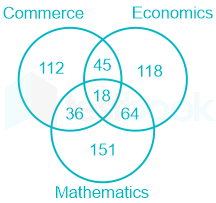
Study the given diagram carefully, and answer the given question. The numbers given in different sections represent the number of students enrolled in different programs in a university.

What is the number of students who are enrolled in both commerce and economics but not enrolled in maths ?

  1. AOption (a)

    18

  2. BOption (b)

    45

  3. COption (c)

    6 3

  4. DOption (d)

    56

View answer & explanation

Correct answer

Answer: (b)B.

45

Why this answer is correct

We have to find the number of students who are enrolled in both commerce and economics but not enrolled in mathematics which means we have to find the common region between commerce & economics which does not include mathematics:

From the diagram we can see that the number of students who are enrolled in both commerce and economics but not enrolled in mathematics is 45.

Hence the correct answer is option 2)

Question 16

Three wires, A, B and C, of the same length and the same thickness have resistances of 1 Ω, 0.5 Ω and 0.25 Ω, respectively. Their resistivities are ________ .

  1. AOption (a)

    In the ratio of 4 ∶ 2 ∶ 1

  2. BOption (b)

    in the ratio of 1 ∶ 2 ∶ 4

  3. COption (c)

    in the ratio of 2 ∶ 4 ∶ 1

  4. DOption (d)

    equal

View answer & explanation

Correct answer

Answer: (a)A.

In the ratio of 4 ∶ 2 ∶ 1

Why this answer is correct

The correct answer is in the ratio of 4 ∶ 2 ∶ 1.

Key Points

  • Resistance
  • ​Every material has an electrical resistance, which is why conductors emit heat when current passes through them.
  • When an electric current flows through a bulb or any conductor, the conductor provides some obstruction to the current. This obstruction is referred to as electrical resistance and is denoted by R.
  • There is a relationship between the potential difference across a conductor and the current that flows through it, according to Ohm's law. It comes from, V=IR
  • Factors Affecting Electrical Resistance
  • The following factors influence a conductor's electrical resistance:
  • The cross-sectional area of the conductor
  • Length of the conductor
  • The material of the conductor
  • The temperature of the conducting material
  • Electrical resistance is inversely proportional to the conductor's cross-sectional area (A) and directly proportional to its length (L). The relationship that follows provides it. 

R= ρL/A

where ρ is the material's resistivity, expressed as m/ohm meter.

Additional Information

  • Calculation
  • Three wires, A, B and C, of the same length(L) and the same thickness(A) have resistances of 1 Ω, 0.5 Ω and 0.25 Ω, respectively.

R1= 1Ω, R2= 0.5Ω, R3= 0.25Ω

We know, R= ρL/A

1= ρ1L/A: 0.5= ρ2L/A: 0.25= ρ3L/A

1= ρ1: 0.5=ρ2: 0.25= ρ3

1= ρ1: 1/2= ρ2: 1/4= ρ3

4= ρ1: 2= ρ2: 1= ρ3

​So, ρ1: ρ2: ρ3= 4:2:1

Question 17

Select the term which will come in place of the question mark (?) in the given series and logically complete the series?

T8, N16, H32, B64, V128, ?

  1. AOption (a)

    P512

  2. BOption (b)

    P256

  3. COption (c)

    Q256

  4. DOption (d)

    P228

View answer & explanation

Correct answer

Answer: (b)B.

P256

Why this answer is correct

<br>

The pattern follows here is:

We have subtracted - 6 in letters.

Numbers are multiplied by 2.

Question 18

For what positive values ​​of b do the equation x² + bx + 9 = 0 have the same roots?

  1. AOption (a)

    3

  2. BOption (b)

    4

  3. COption (c)

    6

  4. DOption (d)

    2

View answer & explanation

Correct answer

Answer: (c)C.

6

Why this answer is correct

Shortcut Trick

For a quadratic equation of the form x2 + bx + c = 0 to have equal roots, the coefficient b must satisfy b = ±2√c.

In the given equation x2 + bx + 9 = 0, we have c = 9.

Applying the shortcut: b = ±2√9 = ±2 × 3 = ±6.

Since we need the positive value of b, we take b = 6.

∴ The correct answer is 6.

Alternate Method

Given: The quadratic equation x2 + bx + 9 = 0 has equal roots.

Formula Used: For a quadratic equation ax2 + bx + c = 0, the roots are equal if the Discriminant (D) is equal to zero: D = b2 − 4ac = 0.

⇒ From the given equation, identify the coefficients: a = 1, b = b, and c = 9.

⇒ Substitute these values into the discriminant formula: b2 − 4 × 1 × 9 = 0

⇒ b2 − 36 = 0

⇒ b2 = 36

⇒ b = √36

⇒ b = ±6

⇒ For the positive value of b, we have b = 6.

∴ The correct answer is 6.

Additional Information

Nature of Roots

The discriminant D = b2 − 4ac determines the nature of roots: if D > 0, roots are real and distinct; if D = 0, roots are real and equal; if D < 0, roots are complex/imaginary.

Sum and Product of Roots

For any quadratic equation ax2 + bx + c = 0, the sum of roots is −b/a and the product of roots is c/a.

Perfect Square Condition

A quadratic expression ax2 + bx + c is a perfect square if and only if its discriminant is zero. In this case, x2 + 6x + 9 becomes (x + 3)2.

Question 19

Simplify: x³ - 3x² + 9x – 12 - x³ - 7x² - 8x - 16

  1. AOption (a)

    10x² + x - 28

  2. BOption (b)

    -10x² + x + 28

  3. COption (c)

    10x² - x - 28

  4. DOption (d)

    -10x² + x - 28

View answer & explanation

Correct answer

Answer: (d)D.

-10x² + x - 28

Why this answer is correct

Shortcut Trick

Directly combine coefficients of like terms by mental grouping.

x3 terms: 1 − 1 = 0

x2 terms: −3 − 7 = −10

x terms: 9 − 8 = 1

Constants: −12 − 16 = −28

∴ The correct answer is −10x2 + x − 28.

Alternate Method

Given: x3 − 3x2 + 9x − 12 − x3 − 7x2 − 8x − 16

Method: Simplify the polynomial expression by grouping like terms (terms with the same variable and exponent).

⇒ (x3 − x3) + (−3x2 − 7x2) + (9x − 8x) + (−12 − 16)

⇒ 0 − 10x2 + 1x − 28

⇒ −10x2 + x − 28

∴ The correct answer is −10x2 + x − 28.

Additional Information

Like Terms

Like terms are terms that contain the same variables raised to the same power. Only like terms can be simplified through addition or subtraction.

Degree of Polynomial

The degree is the highest exponent of the variable in the polynomial. In the simplified result −10x2 + x − 28, the degree is 2 (a quadratic expression).

Standard Form

A polynomial is written in standard form when the terms are arranged in descending order of their exponents.

Question 20

Identify the product (P) in the following reaction:

Limestone (s) → P + CO2 (g)

  1. AOption (a)

    CaO(s)

  2. BOption (b)

    Ca(OH)2 (I)

  3. COption (c)

    CaCO3(s)

  4. DOption (d)

    CaO(s) + O2 (g)

View answer & explanation

Correct answer

Answer: (a)A.

CaO(s)

Why this answer is correct

The correct answer is CaO(s).

Key Points:

  • Limestone naturally contains calcium carbonate.
  • When limestone is heated strongly, the calcium carbonate that it contains endothermically absorbs heat, breaking down to generate calcium oxide.
  • As the limestone is heated, an orange light serves as a sign of this.
  • Calcium carbonate is created from carbon dioxide and calcium oxide.
  • CaCO3(s) → CaO(s) + CO2(g)
  • A crucial component in the creation of cement and some varieties of plaster is calcium oxide, sometimes referred to as quicklime.

Additional Information:

  • From the crust of the Earth, limestone, a sedimentary rock, is a rich resource.
  • It can be put to a lot of different uses:
  • It is a building material that is usable.
  • By combining heated clay and powdered limestone, it is used to make cement.
  • It is a key component of toothpaste.
  • It can be added to meals as a supplement to supply calcium ions for healthy bones and teeth.
  • It is a useful raw material that can be processed for use in the chemical industry.
  • It can be utilised to balance acidic soil so that plants can grow more successfully.

Question 21

How many electrons are present in an L-Shell of a carbon atom?

  1. AOption (a)

    2

  2. BOption (b)

    8

  3. COption (c)

    6

  4. DOption (d)

    4

View answer & explanation

Correct answer

Answer: (d)D.

4

Why this answer is correct

The correct answer is 4

Key Points

  • An L-shell is also known as the second energy level of an atom.
  • It can hold a maximum of 8 electrons.
  • In the case of carbon, it has 6 electrons in its outermost shell (valence shell).
  • Carbon has 4 electrons in the L-Shell. An L-shell is also known as the second energy level of an atom.
  • It can hold a maximum of 8 electrons.

Additional Information

  • Carbon is the chemical element with the symbol C and atomic number 6.
  • Carbon is a key element in life and is found in all living organisms.
  • Carbon atoms have six protons and six electrons in its neutral state.
  • The electrons in the outermost shell (valence shell) are responsible for chemical reactions and bonding with other atoms.
  • Carbon forms various chemical compounds, including carbon dioxide (CO2) and methane (CH4)
  • The L-Shell is also known as the second energy level, and it holds the electrons in the second energy level.

Question 22

A statement followed by two possible underlying assumptions I and II are given. Read all the information carefully, and decide which of the assumptions can be inferred from the given statements.

statement:

"If we advertise our play in all the local newspapers before the end of this week, we will sell more tickets for our play this weekend." a drama director in city D

Assumptions:

I. The newspaper companies in City D take less than a week to finalize the ads, and publish them.

II. Not many people in city D like to watch Drama.

  1. AOption (a)

    Neither I nor ॥ can be inferred.

  2. BOption (b)

    Only I can be inferred.

  3. COption (c)

    Only II can be inferred.

  4. DOption (d)

    Both I and II can be inferred.

View answer & explanation

Correct answer

Answer: (b)B.

Only I can be inferred.

Why this answer is correct

Given statement:

"If we advertise our play in all the local newspapers before the end of this week, we will sell more tickets for our play this weekend." a drama director in city D

Assumptions:

I. The newspaper companies in City D take less than a week to finalize the ads, and publish them → The statement implies that, by advertising the play, more tickets will be sold before weekend which can also be said as the newspaper companies takes less time to publish ads so the assumption is true.

II. Not many people in city D like to watch Drama → There is no evidence in the given statement that suggests the likes or dislikes of the people in city D so it will be wrong to support this assumptions thus the assumption cannot be inferred.

So only I can be inferred.

Hence the correct answer is option 2)

Question 23

For what value of k do the pair of linear equations 2x + 3y – 1 = 0 and 4x + ky + 2 = 0 have no solution?

  1. AOption (a)

    5

  2. BOption (b)

    3

  3. COption (c)

    4

  4. DOption (d)

    6

View answer & explanation

Correct answer

Answer: (d)D.

6

Why this answer is correct

Shortcut Trick

For no solution, the ratio of coefficients of x and y must be equal, but not equal to the ratio of the constants.

Ratio of x-coefficients: 2/4 = 1/2

Ratio of y-coefficients: 3/k

Set them equal: 1/2 = 3/k ⇒ k = 6

Check constant ratio: −1/2 ≠ 1/2 (Condition satisfied)

∴ The correct answer is 6.

Alternate Method

Given:

Equation 1: 2x + 3y − 1 = 0 ⇒ a1 = 2, b1 = 3, c1 = −1

Equation 2: 4x + ky + 2 = 0 ⇒ a2 = 4, b2 = k, c2 = 2

Formula Used:

For parallel lines (no solution): a1/a2 = b1/b2 ≠ c1/c2

Calculations:

⇒ a1/a2 = 2/4 = 1/2

⇒ b1/b2 = 3/k

⇒ c1/c2 = −1/2

According to the no solution condition:

⇒ 1/2 = 3/k

⇒ k = 3 × 2

⇒ k = 6

Verify with constant ratio: 1/2 ≠ −1/2 (True)

∴ The correct answer is 6.

Additional Information

Unique Solution Condition

A pair of linear equations has a unique solution (intersecting lines) if a1/a2 ≠ b1/b2.

Infinite Solutions Condition

A pair of linear equations has infinitely many solutions (coincident lines) if a1/a2 = b1/b2 = c1/c2.

Consistency of Equations

Systems with at least one solution are called consistent, while systems with no solution are called inconsistent.

Question 24

A forest area that belongs to private individuals and communities is classified as ________ .

  1. AOption (a)

    Unclassed forest

  2. BOption (b)

    protected ​forest

  3. COption (c)

    permanent forest

  4. DOption (d)

    reserved forest

View answer & explanation

Correct answer

Answer: (a)A.

Unclassed forest

Why this answer is correct

The correct answer is Unclassed forest.

Key Points

  • Unclassed forests are more forests and wastes that are owned by the government, as well as by private people and groups.
  • Other than reserved and protected woods, all other forests and wastelands are considered unclassified forests.
  • Gujarat and India's northeastern states have the majority of their forests classed as unclassified.
  • In certain regions of India, religious belief has led to the preservation of particular species of trees.
  • Communities conserve certain areas of forests or entire forests because they believe these are the homes of gods and goddesses.
  • Sacred groves are the name given to these types of protected forest habitats.

Additional Information

  • India has recognised about one-third of its forests as being under protection. Bihar, Haryana, Punjab, Himachal Pradesh, Orissa, and Rajasthan all have a majority of their woods that are protected.
  • The government has designated conserved forests on more than half of the entire forestland. When it comes to the preservation of forest and wildlife resources, reserved forests are thought to be the most valuable.
  • Permanent forest estates maintained for the aim of producing timber and other forest products as well as for protective purposes are another name for reserved and protected forests.

Question 25

A trader has taken a loan from a merchant against which an amount of ₹ 10,500 is payable in one year. The trader wants to settle the account after 4 months. If the rate of interest is 6% per annum, how much should he pay 

(Find the rounded off value) ?

  1. AOption (a)

    ₹10,069

  2. BOption (b)

    ₹10,096

  3. COption (c)

    ₹11,069

  4. DOption (d)

    ₹11,096

View answer & explanation

Correct answer

Answer: (b)B.

₹10,096

Why this answer is correct

Shortcut Trick

Early payment duration = 12 − 4 = 8 months = 2/3 years.

Effective interest rate for the remaining period = 6% × (2/3) = 4%.

Present Value (Payment) = Amount ÷ (1 + Rate%) = 10,500 ÷ 1.04.

Payment = ₹10,096.15 ≈ ₹10,096.

∴ The correct answer is ₹10,096.

Alternate Method

Given: The amount payable at the end of one year is ₹10,500. The trader wants to settle it after 4 months at an interest rate of 6% per annum.

Calculation of the payment required after 4 months:

⇒ Amount (A) = ₹10,500

⇒ Rate (R) = 6% per annum

⇒ Time remaining (T) = 12 months − 4 months = 8 months = 8/12 = 2/3 years

⇒ Formula: Amount = Payment × [1 + (R × T) / 100]

⇒ 10,500 = Payment × [1 + (6 × 2/3) / 100]

⇒ 10,500 = Payment × [1 + 4 / 100]

⇒ 10,500 = Payment × 1.04

⇒ Payment = 10,500 ÷ 1.04

⇒ Payment = 10,096.1538...

Rounding off the value, we get ₹10,096.

∴ The correct answer is ₹10,096.

Additional Information

Present Worth (PW)

It is the principal which, with its interest for a given time and rate, becomes the given amount. Formula: PW = (100 × Amount) ÷ (100 + (R × T)).

True Discount (TD)

It is the difference between the amount due and its present worth. TD = Amount − PW = (PW × R × T) ÷ 100.

Banker's Discount (BD)

It is the simple interest on the face value (amount) for the period from the date of discounting to the due date. BD = (Amount × R × T) ÷ 100.

Question 26

If all the letters of the word COMPUTER are arranged in alphabetical order, then the position of how many letters will remain unchanged?

  1. AOption (a)

    Three

  2. BOption (b)

    Zero

  3. COption (c)

    One

  4. DOption (d)

    two

View answer & explanation

Correct answer

Answer: (d)D.

two

Why this answer is correct

According to the English alphabets:

When we arrange all the letters of the word COMPUTER in alphabetical order, we get:

From the arrangement, we can see that the position of only 'C' and 'M' remains unchanged.

Hence the correct answer is option 4)

Question 27

How many development and welfare related subjects have been transferred from the state to the Panchayati Raj Institution through constitutional amendments in the Indian Constitution?

  1. AOption (a)

    29

  2. BOption (b)

    27

  3. COption (c)

    21

  4. DOption (d)

    28

View answer & explanation

Correct answer

Answer: (a)A.

29

Why this answer is correct

The correct answer is 29.

Key Points

  • The "Panchayats" Part IX, containing the provisions of Articles 243 to 243(O), and the "Eleventh Schedule," containing 29 subjects relating to Panchayat activities, were both included by the 73rd Amendment in 1992.
  • Article 40 of the DPSP, states that "The State shall take steps to organize Gram Panchayats and confer on them such powers and authority as may be necessary to enable them to function as units of self-government."
  • This amendment has elevated Gram Panchayats from a non-justiciable part of the Constitution to a justiciable part of the Constitution, and it has given the states a constitutional obligation to enact Panchayati Raj Acts, however, considering their unique there is enough freedom. Geographical, political-administrative, and other circumstances.

Additional Information

  • Unlike urban and suburban municipalities, Panchayati Raj is a system of local self-government for villages in rural India.
  • It includes Panchayati Raj institutions, which enable the attainment of rural self-governance.
  • It includes Panchayati Raj Institutions (PRIs), which enable villages to practice self-governance.
  • Their mandate is to "strengthen social justice, advance economic development, and implement Central and State Government schemes, including the 29 issues enumerated in the Eleventh Schedule."

Question 28

Which Indian women cricket player was awarded the 'ICC Women Cricketer of the Year' award in 2021 for her outstanding contribution across all formats of cricket?

  1. AOption (a)

    Pooja Vastrakar

  2. BOption (b)

    Smriti Mandhana

  3. COption (c)

    S Meghna

  4. DOption (d)

    Mithali Raj

View answer & explanation

Correct answer

Answer: (b)B.

Smriti Mandhana

Why this answer is correct

The correct answer is Smriti Mandhana.

Key Points

  • The International Cricket Council on Monday named India's Smriti Mandhana as the ICC Women's Cricketer of the Year 2021.
  • 25-year-old star batsman Mandhana has scored 855 runs in 22 international matches in 2021 at an average of 38.86 with one century and five half-centuries. Lee of South Africa and Tammy Beaumont of England.
  • He was instrumental in India's two wins over South Africa at home.
  • She scored an unbeaten 80 in the second ODI as India chased 158, and later she helped India tie the series with a 48-run win in the final T20I match.

Additional Information

  • Pooja Vastrakar is an Indian cricket player who currently plays for Madhya Pradesh and her country.
  • Indian cricketer Sabbhineni Meghna currently competes for both India and Railways.
  • Indian cricketer Mithali Dorai Raj served as the captain of the country's women's national team from 2004 to 2022.

Question 29

If 7, 12, 21 and x are in proportion, then find the value of x.

  1. AOption (a)

    36

  2. BOption (b)

    24

  3. COption (c)

    27

  4. DOption (d)

    35

View answer & explanation

Correct answer

Answer: (a)A.

36

Why this answer is correct

Shortcut Trick

For four numbers a, b, c, d to be in proportion, the product of extremes must equal the product of means.

Product of extremes (7 × x) = Product of means (12 × 21)

x = (12 × 21) ÷ 7

x = 12 × 3 = 36

∴ The correct answer is 36.

Alternate Method

Given: 7, 12, 21, and x are in proportion.

Formula Used: a : b :: c : d ⇒ a/b = c/d

⇒ 7 ÷ 12 = 21 ÷ x

⇒ 7 × x = 21 × 12

⇒ x = (21 × 12) ÷ 7

⇒ x = 3 × 12

⇒ x = 36

∴ The correct answer is 36.

Additional Information

Mean Proportional

The mean proportional between two numbers a and b is √(a × b).

Third Proportional

The third proportional of a and b is defined as c such that a : b = b : c, i.e., c = b2 ÷ a.

Fourth Proportional

If a : b = c : d, then d is the fourth proportional of a, b, and c, calculated as (b × c) ÷ a.

Question 30

Which of the following blood is called 'the giver of all'?

  1. AOption (a)

    A

  2. BOption (b)

    B

  3. COption (c)

    AB

  4. DOption (d)

    O

View answer & explanation

Correct answer

Answer: (d)D.

O

Why this answer is correct

The correct answer is O.

Key Points:

  • Although those with the blood type O are frequently referred to as universal blood donors, those with the blood type O- (negative) are the actual universal donors.
  • It is as a result of the absence of antigens in their red blood cells.
  • They are therefore able to donate blood to any other blood group.
  • Blood cannot be donated to a Rh-negative person by a person with blood group O+ (positive cells).
  • Due to its importance in emergencies, blood of type O (positive and negative) is in great demand.
  • However, it is a common blood group because only 7% of people have the O-negative blood type and 37% of people have the O-positive blood type.

Additional Information:

  • Antigens in the blood are present or absent depending on the blood group.
  • When a foreign body enters the bloodstream, the antigen helps the immune system respond by producing antibodies to combat it.
  • Red blood cells, white blood cells, and platelets are all found in the blood's plasma, which is a liquid.
  • The four major blood types are determined by the presence of antigens A and B on the surface of RBCs.
  • In addition, whether a protein called the Rh factor is present or absent influences whether your blood group is positive or negative.
  • The blood type can be A+, A-, B+, B-, O+, O-, AB+, or AB- depending on certain variables.

Question 31

In the Union Budget 2022-23, a scheme named PM-DevINE was launched to fund infrastructure and social development projects in _________ India.

  1. AOption (a)

    North-West

  2. BOption (b)

    North

  3. COption (c)

    West

  4. DOption (d)

    North-East

View answer & explanation

Correct answer

Answer: (d)D.

North-East

Why this answer is correct

The correct answer is North-East.

Key Points

  • In the Union Budget 2022–23, PM-DevINE was introduced to address development gaps in the North Eastern Region (NER). The Government continues to place a high priority on the development of the NE Region as seen by the unveiling of PM-DevINE.
  • The quantity of resources available for the development of the North East Region has been increased through PM-DevINE. It won't take the place of current Central and State Schemes.
  • While some of the PM-DevINE projects that will be approved for 2022–2023 are included in the Budget announcement, other projects that could have a significant socioeconomic impact or create opportunities for sustainable livelihood for the general public (such as providing basic infrastructure in all primary health care centres or comprehensive facilities in government primary and secondary schools, for example) might be taken into consideration in the future.

Additional Information

  • The Prime Minister's Development Initiative for the North East Region (PM-DevINE) has been authorised by the Union Cabinet, which is presided over by Prime Minister Shri Narendra Modi, during the final four years of the 15th Finance Commission, from 2022–2023 to 2025–2026.
  • The Ministry of Development of the North Eastern Region will implement the newly created Scheme, PM-DevINE, which is a Central Sector Scheme with 100% Central support (DoNER).

Question 32

A device of 30 W is connected to a 12 V battery. The current in the device is:

  1. AOption (a)

    1.25 A

  2. BOption (b)

    2.5 A

  3. COption (c)

    0.4 A

  4. DOption (d)

    0.2 A

View answer & explanation

Correct answer

Answer: (b)B.

2.5 A

Why this answer is correct

The correct answer is 2.5 A.

Key Points

  • Electric Power
  • Electric power is the rate at which an electric circuit transfers electrical energy per unit of time in physics.
  • P stands for power, and it is measured in watts or one joule per second, the SI unit of power. Electric generators and electric batteries typically provide electric power.
  • The equation for electric power is as follows**: P=IV**, where V is the potential difference in the circuit and P, is the power and I is the current of electricity.
  • Power can also be written as **P=I2R and V2/R.**​

Additional Information

  • Calculation
  • Power, P= 30W

Battery of Voltage, V= 12V

We know, P=IV

30= I×12

I= 30/12

I= 5/2

I= 2.5A

Question 33

For a healthy society, what should be the distribution of men and women in the population?

  1. AOption (a)

    More men than women

  2. BOption (b)

    Equal number of men and women

  3. COption (c)

    More than youth

  4. DOption (d)

    More women than men

View answer & explanation

Correct answer

Answer: (b)B.

Equal number of men and women

Why this answer is correct

The correct answer is equal number of men and women.

Key Points

  • Human sex ratio is a measure used in anthropology and demography expressed as the ratio of males to females in a population.
  • The sex ratio of humans, like other sexually active organisms, is approximately 1:1.
  • In humans, the ratio of females to males at birth is somewhat skewed toward the male sex; This is estimated to be between 1.03 and 1.06 men for every woman, or roughly 1.05 or 1.06.
  • Human sex ratios have been studied more than any other species, and more data are accessible to humans than any other species, although understanding these data can be challenging.

Additional Information

  • As of 2020, there are 108.18 males for every 100 females in the total population of India.
  • In India, there are 662,903,415 or 662.90 million females and 717,100,970 or 717.10 million males.
  • Females constitute 48.04 percent of the population compared to 51.96 percent of males. With 54.20 million men, India has the highest proportion of men overall.
  • In terms of ratio of women to men, India ranks 189th out of 201 countries and territories. Among Asian countries, its ranking is 42nd out of 51 countries and territories.

Question 34

Which state was the theme state of the 35th Suraj Kund Craft Fair held in March-April 2022?

  1. AOption (a)

    Jammu and Kashmir

  2. BOption (b)

    Haryana

  3. COption (c)

    Rajasthan

  4. DOption (d)

    Gujarat

View answer & explanation

Correct answer

Answer: (a)A.

Jammu and Kashmir

Why this answer is correct

The correct answer is Jammu and Kashmir.

Key Points

  • The Union ministries of tourism, textiles, culture and external affairs work in partnership with the Surajkund Mela Authority and Haryana Tourism to celebrate the festival.
  • The fair was started in 1987 to support the pool of talented artisans who used indigenous technology but were suffering as a result of less expensive machine-made knockoffs.
  • In 2013, the fair was elevated to international level.
  • Surajkund Fair, the world's largest crafts fair, highlights the extent and wealth of Indian handicrafts, handlooms and cultural heritage.
  • For the year 2022, Uzbekistan will serve as the “Partner Nation” and Jammu and Kashmir will serve as the **“Theme State”.**​

Additional Information

  • Surajkund Fair 2023 is the first of its kind international artisan fair that provides a platform to artists from across the world to showcase their skills and cultures.
  • The fair, which is organized by the Haryana Tourism Department every year at Surajkund, offers a variety of unusual activities for visitors of all ages.
  • To make this fair a huge success, active participation of more than 20 countries from South Asia, Africa and Europe is required.
  • King Suraj Pal of the Tomar dynasty built the historic reservoir named Surajkund, also known as the "Lake of the Sun", in the 10th century.

Question 35

The focal length of a convex mirror is 15 cm. Following New Cartesian Sign Convention, its centre of curvature is located at:

  1. AOption (a)

    30 cm

  2. BOption (b)

    - 15 cm

  3. COption (c)

    15 cm

  4. DOption (d)

    - 30 cm

View answer & explanation

Correct answer

Answer: (a)A.

30 cm

Why this answer is correct

The correct answer is 30 cm.

Key Points

  • New Cartesian Sign Convention
  • ​To avoid confusion when interpreting the ray directions, the New Cartesian Sign Convention is utilized. Take a look at the diagram for a clear understanding.
  • The optical center of the lens is taken into account when measuring all distances.
  • Negative distances are those that are measured in the opposite direction of the incident light.
  • Positive distances are those that are measured in the same direction as the incident light.
  • Positive heights are those that are measured upwards and perpendicular to the principal axis.
  • Negative heights are those that are measured downward and perpendicular to the principal axis.

Additional Information

  • Focal length 
  • ​The focal length of a mirror or lens is the distance between its focal point and its pole, also known as the optical center of the lens.
  • After reflecting in the mirror, a parallel beam of light is "focused" at the focal point (F) of the device.
  • In the case of a convex mirror and lens, the focal length is regarded as positive.
  • It is considered a negative for a concave mirror and lens.
  • Relation between F and C is F=2C.

Question 36

If the volume of a cylinder is 256π  cm3 and the radius of its base is 8 cm, then find the height of the cylinder.

  1. AOption (a)

    4 cm

  2. BOption (b)

    5 cm

  3. COption (c)

    6 cm

  4. DOption (d)

    3 cm

View answer & explanation

Correct answer

Answer: (a)A.

4 cm

Why this answer is correct

Shortcut Trick

Volume of cylinder = π × r2 × h

256π = π × 82 × h

256 = 64 × h

h = 256 ÷ 64 = 4 cm

∴ The correct answer is 4 cm.

Alternate Method

Given:

Volume (V) = 256π cm3

Radius (r) = 8 cm

Formula Used:

Volume of a cylinder = πr2h

Calculations:

⇒ 256π = π × (8)2 × h

⇒ 256π = π × 64 × h

⇒ 256 = 64 × h

⇒ h = 256 ÷ 64

⇒ h = 4 cm

∴ The correct answer is 4 cm.

Additional Information

Curved Surface Area (CSA)

The lateral surface area of a cylinder is given by 2πrh.

Total Surface Area (TSA)

The total area including the two circular bases is 2πr(h + r).

Volume of Cone

A cone with the same base and height has (1/3) the volume of the cylinder: (1/3)πr2h.

Question 37

Who among the following acts as an intermediary between the State Government and the Municipal Corporation?

  1. AOption (a)

    City councilor

  2. BOption (b)

    Mayor

  3. COption (c)

    Alderman

  4. DOption (d)

    Municipal Commissioner

View answer & explanation

Correct answer

Answer: (d)D.

Municipal Commissioner

Why this answer is correct

The correct answer is Municipal Commissioner.

Key Points

  • In India, a type of local government known as a municipal corporation is responsible for managing urban areas with a population of more than one million people.
  • A local governing body that could provide services such as healthcare, education, housing and transport by collecting property tax and managing funds from the state government was necessary as a result of India's increasing urbanization and population.
  • The Municipal Corporation operates its many divisions and departments in a systematic manner.
  • For example, consider Housing Board, Education Department and Electricity Department. People with experience and qualifications look after each of these departments.
  • The urban local government structures and functions were delineated by the 74th Amendment Act.

Additional Information

  • Municipal councilors act as representatives of the local community and are members of the municipal corporation.
  • The mayor of a city serves as its chief executive officer. A central government committee may select the city's mayor in some cases, or the city's residents may elect the mayor in other cases.
  • In many countries with legal systems based on English law, a member of a municipal assembly or council is known as an alderman.

Question 38

An object is placed in front of a concave mirror at twice its focal length (2f). The image will be formed at a distance of ________.

  1. AOption (a)

    f

  2. BOption (b)

    4f

  3. COption (c)

    1.5f

  4. DOption (d)

    2f

View answer & explanation

Correct answer

Answer: (d)D.

2f

Why this answer is correct

The correct answer is 2f.

Key Points

  • Image at C
  • Here, one of the two rays that come from the object is parallel to the principal axis, and the other passes through the mirror's focus.
  • After reflection at point C, these rays form an image that is real and inverted and has the same size as the object.

Additional Information

  • Image formations
  • When the Object is at Infinity: After reflection, these rays converge to form an image in front of the mirror at F, the primary focus of the mirror. The image formed is highly diminished, point size, real and inverted.
  • The Object is Placed Beyond C: These rays were reflected from an image between the focus (F) and the center of curvature (C). The image formed is diminished, real and inverted.
  • The Object is Placed Between C and F: The image is formed beyond C. The image is larger compared to the size of the object and it is real and inverted.
  • The Object is Placed at F: Formation of a highly enlarged image which is real and inverted, at infinity.
  • The Object is Placed Between F and P: The image formed is virtual and erect and it is larger than the object.

Question 39

Jaya, from point A, walks 349 m towards the south. She takes a left turn and walks 129 m. She takes a left turn again and walks 349 m. She then takes a right turn and walks 94 m to reach point B. How far and in which direction is point A from point B? (All turns are 90 degree turns only)

  1. AOption (a)

    110 m, East

  2. BOption (b)

    203 m, East

  3. COption (c)

    223 m, West

  4. DOption (d)

    129 m, West

View answer & explanation

Correct answer

Answer: (c)C.

223 m, West

Why this answer is correct

From the given information:

Step 1: Jaya, from point A, walks 349 m towards the south. She takes a left turn and walks 129 m.


Step 2: She takes a left turn again and walks 349 m. She then takes a right turn and walks 94 m to reach point B.


Distance from A to B = 129m + 94m = 223m

From the diagram, we can see that point A is 223m towards the west from point B.

Hence the correct answer is option 3)

Question 40

Based on the given statements, four conclusions are drawn. State which of the conclusions is true on the basis of the statements.

statements: M ≥  D ≤  N < J < F = E

  1. AOption (a)

    F < M

  2. BOption (b)

    M > N

  3. COption (c)

    N < E

  4. DOption (d)

    E = D

View answer & explanation

Correct answer

Answer: (c)C.

N < E

Why this answer is correct

Given statement:

M ≥  D ≤  N < J < F = E

Now we consider the given options:

Option 1) F < M → False

We have M ≥  D ≤  N < J < F therefore the relation between M and F can not be determined.

Option 2) M > N → False

We have M ≥  D ≤  N therefore the relation between M and N can not be determined.

Option 3) N < E → True.

We have N < J < F = E

also, F = E

now from F = E & N < F we get

N < E.

Option 4) E = D → False.

We have M ≥  D ≤  N < J < F = E which means D < E

Hence the correct answer is option 3)

Question 41

The National Anti-Doping Bill, 2021, passed by the Lok Sabha in July 2022, provides for creating a statutory framework for which of the following agencies?

  1. AOption (a)

    Anti-Doping Agency of India (ADAI)

  2. BOption (b)

    National Anti-Doping Agency (NADA)

  3. COption (c)

    Anti-Doping National Agency (ADNA)

  4. DOption (d)

    Indian Anti-Doping Agency (IADA)

View answer & explanation

Correct answer

Answer: (b)B.

National Anti-Doping Agency (NADA)

Why this answer is correct

The correct answer is National Anti-Doping Agency (NADA).

Key Points

  • The National Anti-Doping Bill, 2021 was approved in the Lok Sabha by voice vote on Wednesday, July 27, 2022.
  • The National Anti-Doping Agency (NADA) and the National Dope Testing Laboratory in Sports are to be given a legal framework by the proposed law.
  • Anti-doping rule violations were planned, implemented, and monitored by this organization.
  • It also aims to comply with other commitments and obligations, such as the International Convention against Doping in Sports, established by the United Nations Educational, Scientific and Cultural Organization.
  • The law prohibits doping in sports by competitors, athlete support staff and other individuals. According to the new law, breaking anti-doping laws can result in disqualification, loss of medals, points and awards, time limits on participation in a competition or event, and financial penalties.

Additional Information

  • The National Anti-Doping Agency of India is the country's national body in charge of leading, directing and supervising the doping control program in all forms of sports.
  • The World Anti-Doping Agency's rules and policies are adopted and put into practice by the Agency, which also cooperates with other anti-doping organizations and supports anti-doping research and education. All this is stated on the official website of the agency.
  • The agency established by the Central Government under the Societies Registration Act comprises scientists and representatives of the Indian Olympic Association.

Question 42

The ages of Geeta, Lata and Madhuri are in the ratio 5 ∶ 6 ∶ 3  if their average age is 42 years, then find the age of Lata.

  1. AOption (a)

    45 years

  2. BOption (b)

    27 years

  3. COption (c)

    35 years

  4. DOption (d)

    54 years

View answer & explanation

Correct answer

Answer: (d)D.

54 years

Why this answer is correct

Shortcut Trick

Ratio of Geeta : Lata : Madhuri = 5 : 6 : 3

Total ratio units = 5 + 6 + 3 = 14 units

Average of 3 people is 42 → Sum = 42 × 3 = 126 years

14 units = 126 → 1 unit = 9 years

Lata's age (6 units) = 6 × 9 = 54 years

∴ The correct answer is 54 years.

Alternate Method

Given: Ratio of ages = 5 : 6 : 3, Average age = 42 years.

Formula Used: Sum = Average × Number of entities; Age = (Particular ratio / Total ratio) × Total Sum.

⇒ Let the ages be 5x, 6x, and 3x.

⇒ Total Sum = 5x + 6x + 3x = 14x

⇒ Sum of ages = 42 × 3 = 126 years

⇒ 14x = 126

⇒ x = 126 ÷ 14 = 9

⇒ Lata's age = 6x = 6 × 9 = 54 years

∴ The correct answer is 54 years.

Additional Information

Weighted Average

When items are in a ratio, the average is the sum of (ratio × value) divided by the sum of ratios.

Ratio to Value conversion

To find an individual share: (Individual ratio ÷ Total ratio) × Total Value.

Average of Ages

If the average age of n people increases by x years after a certain time, the sum increases by n × x.

Question 43

Plaster of Paris is not used for ________.

  1. AOption (a)

    as a building material

  2. BOption (b)

    to support broken bones

  3. COption (c)

    to make toys

  4. DOption (d)

    for cooking

View answer & explanation

Correct answer

Answer: (d)D.

for cooking

Why this answer is correct

The correct answer is for cooking.

Key Points:

  • Uses of plaster of paris:
  • A building substance called plaster of Paris is applied as a protective finish to walls and ceilings.
  • For decorative elements, it is also employed as a moulding and casting agent.
  • It is utilised to provide the buildings decorative finishing touches.
  • Plaster is used in orthopaedics in the medical field to encase broken bones in casts. This cast will help the bone recover and return to its previous state.
  • Historical constructions and monuments are made with it.
  • In the fresco painting, it is also utilised. Because it won't shrink even when submerged in water, it is utilised to create replicas.

Additional Information:

  • The colour of plaster of Paris is white powder.
  • It's constructed out of gypsum.
  • Gypsum, the main component of the plaster, is abundantly available in Paris; hence, the name.
  • The white powder is mixed with water to create a paste, which when dry solidifies into the desired structures.
  • Therefore, plaster of paris is used to create moulds and casts.

Question 44

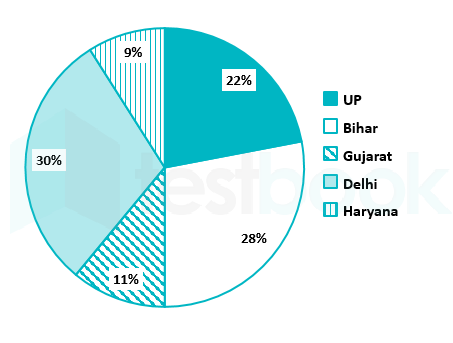
The given pie-chart shows the percentage distribution of the number of people who immigrated to the United States from different provinces upon obtaining a green card. Study the pie-chart, and answer the question asked.

<br>

[Reference: Delhi - Delhi, Gujarat - Gujarat, Bihar - Bihar, UP - UP, Haryana -Haryana]

What is the central angle of the segment corresponding to the number of people who migrated from Delhi?

  1. AOption (a)

    40°

  2. BOption (b)

    100.8°

  3. COption (c)

    108⁰

  4. DOption (d)

    32.4°

View answer & explanation

Correct answer

Answer: (c)C.

108⁰

Why this answer is correct

Concept used:

100% represents 360∘360^\circ

Calculation:

Here % of people who migrated from Delhi = 30% 

As 100% = 360∘360^\circ 

⇒ 1% = 3.6∘3.6^\circ 

⇒ 30% = 30 × 3.6 = 108∘108^\circ 

Hence, the required central angle is 108 degree.

Question 45

The average of ten numbers is 8. If each number is divided by 2, find the average of the new set of numbers thus obtained.

  1. AOption (a)

    10

  2. BOption (b)

    8

  3. COption (c)

    4

  4. DOption (d)

    6

View answer & explanation

Correct answer

Answer: (c)C.

4

Why this answer is correct

Shortcut Trick

If each number in a set is multiplied or divided by a constant k, the original average also gets multiplied or divided by k.

Original Average = 8

Constant divisor (k) = 2

New Average = 8 ÷ 2 = 4

∴ The correct answer is 4.

Alternate Method

Given:

Number of observations (n) = 10

Average of 10 numbers = 8

Operation: Each number is divided by 2.

Formula Used:

Average = Sum of observations ÷ Number of observations

Calculations:

⇒ Sum of original ten numbers = Average × n

⇒ Sum = 8 × 10 = 80

⇒ New sum (when each number is divided by 2) = 80 ÷ 2

⇒ New sum = 40

⇒ New average = New sum ÷ n

⇒ New average = 40 ÷ 10 = 4

∴ The correct answer is 4.

Additional Information

Effect of Addition/Subtraction on Average

If a constant k is added to or subtracted from every term in a series, the new average will be (Original Average + k) or (Original Average − k).

Average of First n Natural Numbers

The average of the first n natural numbers is calculated using the formula: (n + 1) ÷ 2.

Average of Consecutive Numbers

For any arithmetic progression (AP), the average is simply the middle term or (First term + Last term) ÷ 2.

Question 46

Select the number that will come in place of the question mark (?) in the following series.

11, 20, 23, 44, 47, 92, 95,?

  1. AOption (a)

    198

  2. BOption (b)

    188

  3. COption (c)

    199

  4. DOption (d)

    189

View answer & explanation

Correct answer

Answer: (b)B.

188

Why this answer is correct

The pattern followed in the given series is:

The difference of difference between the consecutives odd and even terms is ×2.

Hence the correct answer is option 2)

Question 47

Seven teachers A, B, C, D, E, F and G are sitting in a straight row, facing north. Only one person sits to the left of G. Only E sits between C and F. A sits to the immediate right of D. F and D are immediate neighbours. Who sits at the extreme left end of the row?

  1. AOption (a)

    A

  2. BOption (b)

    D

  3. COption (c)

    C

  4. DOption (d)

    B

View answer & explanation

Correct answer

Answer: (d)D.

B

Why this answer is correct

From the given information:

Step 1: Only one person sits to the left of G.

We place G such that there is only one person to the left of G.

Step 2: A sits to the immediate right of D. F and D are immediate neighbours.

Case 1:

Case 2:

Case 3:

Now we place F, D and A such that A is to the immediate right of D, also A and D are immediate neighbors.

Step 3: Only E sits between C and F. This is possible only in Case 1.

Now we place C & E such that E sits between C and F.

Now we place B at the only spot left,

From the arrangement, we can see that B sits at the extreme left end of the row.

Hence the correct answer is option 4)

Question 48

If X represents the smallest prime number multiplied by 4 and added to the least common multiple of 5 and 10; Y represents the smallest odd prime number multiplied by 5 and added to the 2nd  smallest odd prime, then which of the following is true?

  1. AOption (a)

    X and Y are equal.

  2. BOption (b)

    The difference of Y and X is 2.

  3. COption (c)

    X + Y= 10.

  4. DOption (d)

    X is greater than Y.

View answer & explanation

Correct answer

Answer: (b)B.

The difference of Y and X is 2.

Why this answer is correct

Given:

X represents the smallest prime number multiplied by 4 and added to the least common multiple of 5 and 10;

Y represents the smallest odd prime number multiplied by 5 and added to the 2nd smallest odd prime number.

Calculations:

According to question,

X = smallest prime no. × 4 + LCM(5,10) 

= 2 × 4 + 10

= 8 + 10

= 18

And, Y

= smallest odd prime no. × 5 + 2nd smallest odd prime no.

= 3 × 5 + 5

= 20

Difference of Y and X = 20 - 18 = 2

Hence, The Required value is 2.

Question 49

What is the total number of Fundamental Duties included in Part IV A of the Indian Constitution?

  1. AOption (a)

    13

  2. BOption (b)

    14

  3. COption (c)

    11

  4. DOption (d)

    12

View answer & explanation

Correct answer

Answer: (c)C.

11

Why this answer is correct

The correct answer is 11.

Key Points

  • Fundamental Duties are included in Part IVA of the Indian Constitution.
  • Fundamental obligations were not included in the Constitution earlier.
  • These were added to the Constitution by the 42nd and 86th Constitutional Amendment Acts.
  • There are currently 11 fundamental obligations under Article 51A. (A to K). Only citizens are subject to fundamental obligations; Are not non citizens.
  • India adopted the USSR's idea of fundamental duties.
  • The addition of the Fundamental Duties brought our Constitution in compliance with the provisions of various other modern constitutions as well as Article 29(1) of the Universal Declaration of Human Rights.

Additional Information

  • The Indian Constitution is the supreme law of the country.
  • The Constitution of India, which was approved by the Constituent Assembly on November 26, 1949, and came into effect on January 26, 1950, governs the republic.
  • The Indian Constitution was drafted by the Drafting Committee.
  • The text establishes the framework that outlines the basic political code, as well as the fundamental rights, guiding principles, and responsibilities of citizens.
  • It also establishes the organization, methods, powers and duties of government institutions.

Question 50

Which of the following technologies was used for the first time in February 2022 by astronomers from NCRA-TIFR to map the distribution of atomic hydrogen gas in the galaxy?

  1. AOption (a)

    INSPIRESAT-1

  2. BOption (b)

    Giant Meter wave Radio Telescope (GMRT)

  3. COption (c)

    Helioswarm

  4. DOption (d)

    Multislit Solar Explorer (MUSE)

View answer & explanation

Correct answer

Answer: (b)B.

Giant Meter wave Radio Telescope (GMRT)

Why this answer is correct

The correct answer is Giant Meter wave Radio Telescope (GMRT)

Key Points

  • The Giant Metre wave Radio Telescope (GMRT) is a technology that was used for the first time in February 2022
  • By astronomers from NCRA-TIFR to map the distribution of atomic hydrogen gas in the galaxy.
  • GMRT is an array of 30 radio telescopes, each 45 m in diameter.
  • GMRT is spread over an area of 30 square kilometres, located near Pune, India.

Additional Information

  • Helioswarm
  • ​Helioswarm is a proposed European Space Agency (ESA) mission to study the dynamics of the solar corona and the solar wind.
  • The mission would involve a fleet of small, identical spacecraft that would fly in formation through the solar wind to study the small-scale structures and processes that drive the solar wind.
  • The mission is expected to provide new insights into how the Sun's atmosphere is heated and how the solar wind is accelerated.​
  • Multislit Solar Explorer (MUSE)
  • ​Multislit Solar Explorer (MUSE) is a proposed space mission that aims to study the dynamics of the solar atmosphere.
  • The mission would use a multi-slit spectrograph to take high-resolution images of the solar atmosphere and measure the velocities and temperatures of the gases in the solar atmosphere.
  • This would provide new insights into the processes that drive the solar wind and the heating of the solar atmosphere. MUSE would also be able to study the solar magnetic field, which plays a key role in many solar phenomena, such as solar flares and coronal mass ejections.

Question 51

Identify the water harvesting structure shown below.

  1. AOption (a)

    Kattas

  2. BOption (b)

    Tank

  3. COption (c)

    Bandharas

  4. DOption (d)

    Khadin System

View answer & explanation

Correct answer

Answer: (d)D.

Khadin System

Why this answer is correct

The correct answer is Khadin System.

Key Points:

  • A structure known as a Khadin is made to collect surface runoff water for agricultural use.
  • The long earthen bund that is constructed across the margins of sloping farmlands is a component of the Rajasthani "Khadin" rainwater gathering technique.
  • The rainwater runs from the roof and down the slope before being halted by a bund and entering a reservoir.
  • Crops can be grown using the reservoir's water, which seeps into the ground.
  • It has a shallow dug well, saline area, bund, and catchment area.
  • A reservoir is created when water from the catchment region rushes down and is halted by the bund.
  • Water enters the shallow well if the reservoir overflows.
  • The groundwater is refilled by the water that seeps into the ground from the reservoir and the shallow well.

Additional Information:

  • Rainwater harvesting is a straightforward technique or technology that collects, conveys, purifies, and stores runoff from rooftops, parks, highways, open spaces, etc. for use in the future.
  • Rainwater harvesting is the technique of gathering and storing rainwater using artificially constructed systems that run from naturally occurring or created catchment areas, such as roofs, buildings, rock surfaces, hill slopes, or artificially repaired impermeable or semi-pervious land surfaces.

Question 52

A car covers one third of a certain distance at a speed of 30 km/h, and the remaining distance at a speed of 20 km/h. What is the distance covered by the car in 4 hours?

  1. AOption (a)

    95 km

  2. BOption (b)

    90 km

  3. COption (c)

    30 km

  4. DOption (d)

    60 km

View answer & explanation

Correct answer

Answer: (b)B.

90 km

Why this answer is correct

Shortcut Trick

Assume the total distance is a value divisible by 3 and the speeds (30 and 20). Let it be 90 units.

One-third distance = 30 km → Time taken = 30 ÷ 30 = 1 hour.

Remaining distance = 60 km → Time taken = 60 ÷ 20 = 3 hours.

Total calculated time = 1 + 3 = 4 hours.

Since the calculated time matches the given time (4 hr), the assumed distance is correct.

∴ The correct answer is 90 km.

Alternate Method

Given:

Speed for first 1/3rd distance (v1) = 30 km/h

Speed for remaining 2/3rd distance (v2) = 20 km/h

Total time taken (T) = 4 hours

Let the total distance be D km.

Formula Used: Time = Distance ÷ Speed

⇒ Time for 1/3rd part (t1) = (D/3) ÷ 30 = D/90

⇒ Time for 2/3rd part (t2) = (2D/3) ÷ 20 = 2D/60 = D/30

⇒ Total Time (T) = t1 + t2

⇒ 4 = D/90 + D/30

⇒ 4 = (D + 3D) ÷ 90

⇒ 4 = 4D ÷ 90

⇒ 4D = 360

⇒ D = 90 km

∴ The correct answer is 90 km.

Additional Information

Average Speed (Unequal Distances)

Average Speed = (Total Distance) ÷ (Total Time) = (d1 + d2) ÷ (d1/v1 + d2/v2).

Average Speed (Two Equal Distances)

If a car covers two equal distances at speeds x and y, Average Speed = 2xy ÷ (x + y).

Unit Conversion

To convert km/h to m/s, multiply the speed by 5/18. To convert m/s to km/h, multiply by 18/5.

Question 53

When the terminal phosphate linkage in ATP is broken using water, what is the amount of energy released?

  1. AOption (a)

    32.5 kJ/mol

  2. BOption (b)

    33 kJ/mol

  3. COption (c)

    32 kJ/mol

  4. DOption (d)

    30.5 kJ/mol

View answer & explanation

Correct answer

Answer: (d)D.

30.5 kJ/mol

Why this answer is correct

The correct answer is 30.5 kJ/mol.

Key Points

  • ATP hydrolysis is the catabolic reaction process by which chemical energy that has been stored in the high-energy phosphoanhydride bonds in adenosine triphosphate (ATP) is released after splitting these bonds, for example in muscles, by producing work in the form of mechanical energy.
  • ATP hydrolysis is the final link between the energy derived from food or sunlight and useful work such as muscle contraction, the establishment of electrochemical gradients across membranes, and biosynthetic processes necessary to maintain life.
  • In humans, approximately 60 percent of the energy released from the hydrolysis of ATP produces metabolic heat rather than fuel the actual reactions taking place.
  • Under certain conditions, high levels of ATP hydrolysis can contribute to lactic acidosis.

Additional Information

  • Hydrolysis of the terminal phosphoanhydridic bond is a highly exergonic process. The amount of released energy depends on the conditions in a particular cell.
  • In standard conditions (ATP, ADP and Pi concentrations are equal to 1M, water concentration is equal to 55 M) the value of ΔG is between -28 to -34 kJ/mol.
  • The range of the ΔG value exists because this reaction is dependent on the concentration of Mg2+ cations, which stabilize the ATP molecule.
  • By comparing the standard value of ΔG and the experimental value of ΔG, one can see that the energy released from the hydrolysis of ATP, as measured in humans, is almost twice as much as the energy produced under standard conditions.

Question 54

The sum of the roots of 2\sqrt2x² - 25\sqrt5x + 3\sqrt3  = 0 is _________.

  1. AOption (a)

    -25\sqrt5

  2. BOption (b)

    52\sqrt2

  3. COption (c)

    −10-\sqrt{10}

  4. DOption (d)

    10\sqrt{10}

View answer & explanation

Correct answer

Answer: (d)D.

10\sqrt{10}

Why this answer is correct

Shortcut Trick

For any quadratic equation ax2 + bx + c = 0, the sum of roots is −b/a.

From the given equation, a = √2 and b = −2√5.

Sum of roots = −(−2√5) / √2 = 2√5 / √2.

Simplify: 2√5 / √2 = (√2 × √2 × √5) / √2 = √2 × √5 = √10.

∴ The correct answer is √10.

Alternate Method

Given Equation: √2x2 − 2√5x + √3 = 0

Formula Used: Sum of roots (α + β) = − (Coefficient of x) / (Coefficient of x2)

⇒ Comparing with ax2 + bx + c = 0:

⇒ a = √2

⇒ b = −2√5

⇒ c = √3

⇒ Sum of roots = −b / a

⇒ Sum = −(−2√5) / √2

⇒ Sum = 2√5 / √2

⇒ Rationalizing the denominator: (2√5 × √2) / (√2 × √2)

⇒ Sum = 2√10 / 2

⇒ Sum = √10

∴ The correct answer is √10.

Additional Information

Product of Roots

The product of the roots (αβ) of a quadratic equation ax2 + bx + c = 0 is given by the formula c/a.

Discriminant and Nature of Roots

The discriminant D = b2 − 4ac determines the nature of roots: if D > 0 roots are real and distinct, if D = 0 roots are real and equal, and if D < 0 roots are imaginary.

Quadratic Formula

The roots of the equation can be found using x = [−b ± √(b2 − 4ac)] / 2a.

Question 55

Excessive exposure to ultraviolet rays can cause ________.

  1. AOption (a)

    lung cancer

  2. BOption (b)

    blood cancer

  3. COption (c)

    skin cancer

  4. DOption (d)

    liver cancer

View answer & explanation

Correct answer

Answer: (c)C.

skin cancer

Why this answer is correct

The correct answer is skin cancer.

Key Points:

  • UV or ultraviolet radiation have a variety of negative effects on human health, including the development of skin cancer and a weakened immune system.
  • Because UV rays destroy the DNA in skin cells, prolonged exposure to them can result in skin cancer.
  • Additionally, UV rays have an impact on the location and function of immunological cells, weakening the immune system.
  • The entire body and the skin are first affected by UV radiation.

Additional Information:

  • In US, skin cancer is  most prevalent type of cancer.
  • Basal cell cancer and squamous cell cancer are two most prevalent kinds of skin cancer.
  • As a result of these body areas being the most exposed to UV radiation, they frequently develop on the head, face, neck, hands, and arms in particular.
  • UV radiation exposure is the main cause of melanoma, the deadliest type of skin cancer.
  • UV radiation can have negative health consequences on everyone, but the dangers are higher for those who:
  • Spend a lot of time in the sun or have sunburns.
  • Possess skin, hair, and eyes of light tint.
  • All skin types may become more sensitive to UV light after using certain oral and topical medications.
  • A member of your family has skin cancer.
  • Over the age of 50.

Question 56

Which of the following river is called 'Dakshin Ganga'?

  1. AOption (a)

    Periyar

  2. BOption (b)

    Godavari

  3. COption (c)

    Narmada

  4. DOption (d)

    Tapi

View answer & explanation

Correct answer

Answer: (b)B.

Godavari

Why this answer is correct

The correct answer is Godavari.

Key Points:

  • Godavari River is referred to as the Dakshin Ganga.
  • The Peninsular River System is the largest.
  • It originates in Maharashtra's Nasik area and empties its water into the Bay of Bengal.
  • Maharashtra, Madhya Pradesh, Chhattisgarh, Odisha, and Andhra Pradesh are among the states through which its tributaries flow.
  • With a catchment area of 3.13 lakh sq. km, it is 1,465 kilometres long.

Additional Information:

  • Periyar:
  • ​In the Indian state of Kerala, Periyar is the longest river and has the greatest capacity for discharge.
  • One of the few perennial rivers in the area, it supplies drinking water to a number of significant communities.
  • Narmada:
  • ​The Narmada River, also known as the Reva and formerly as Narbada or Nerbudda in English, is the fifth-longest river in India and the longest west-flowing river altogether.
  • It is also the state of Madhya Pradesh's greatest flowing river.
  • Tapi:
  • ​South of the Narmada River in central India, the Tapti River (sometimes spelt Tapi) flows west before emptying into the Arabian Sea.
  • The river travels through the states of Maharashtra, Gujarat, and Madhya Pradesh for a distance of around 724 kilometres (450 mi).

Question 57

Which of the following languages ​​is spoken by the people of the Union Territories of Dadra and Nagar Haveli and Daman and Diu?

  1. AOption (a)

    Malayalam

  2. BOption (b)

    Gujarati

  3. COption (c)

    Tamil

  4. DOption (d)

    Bengali

View answer & explanation

Correct answer

Answer: (b)B.

Gujarati

Why this answer is correct

The correct answer is Gujarati.

Key Points:

  • In Dadra and Nagar Haveli, some of the most often spoken languages are Marathi, Gujarati, and Bhili/Bildoli.
  • Many areas of Central India speak Bhili, a language that has Western Indo-Aryan roots.
  • Bhilla, Bhagoria, Bhil, Bhilbari, Lengotia, and Vil are other names for the language known as Bhil.
  • The Devanagari script is used to write this language of Dadra and Nagar Haveli, which is linked to Gujarati and Rajasthani.

Additional Information:

  • On the southwest of the nation is Dadra and Nagar Haveli, a Union Territory in the Indian Subcontinent.
  • Marathi, Gujarati, Bhili, and Bildoli are among the primary languages spoken in Dadra and Nagar Haveli.
  • With Gujarat and Maharashtra situated between Dadra and Nagar Haveli, it makes sense that these two states would have an impact on the language spoken there.
  • The city of Dadra and Nagar Haveli is situated at the base of the Western Ghats, and a sizable portion of its area is forested.
  • These regions are home to a variety of Tribes, each of which has its own dialect that can also be referred to as a Dadra and Nagar Haveli language.

Question 58

Consider the below statements and identify the correct answer

Statement-I: The p in pH stands for 'potenz' in German, meaning power.

Statement-II: On the pH scale we can measure pH generally from 0 to 16.

  1. AOption (a)

    Statement-I is true, and Statement-II is false.

  2. BOption (b)

    Both the statements are true.

  3. COption (c)

    Statement-I is false, and Statement-II is true.

  4. DOption (d)

    Both the statements are false.

View answer & explanation

Correct answer

Answer: (a)A.

Statement-I is true, and Statement-II is false.

Why this answer is correct

The correct answer is Statement-I is true, and Statement-II is false.

Key Points:

  • The pH scale determines how basic or acidic an aqueous solution is.
  • The hydrogen ion concentration's negative logarithm is used to calculate it.
  • "Power of hydrogen" is what pH stands for.
  • Since it is the symbol for the element hydrogen, the "H" is capitalised.
  • The word "potenz," which meaning "power," is represented by the German letter pH.
  • We can normally measure pH from 0 to 4 on the pH scale.
  • The pH scale should be viewed as just a number that represents how basic or acidic a solution is.

Additional Information:

  • The pH scale, which is a logarithmic scale, normally goes from 1 to 14.
  • Since pure water has a pH of 7, anything below 7 is ten times more acidic than anything above it, and anything above 7 is ten times less acidic than anything below it.
  • A pH of 5 is 100 times (10 times 10) more acidic than a pH of 3, which is ten times (10 times) more acidic than a pH of 4.
  • A strong acid may have a pH of 1-2 while a strong base may have a pH of 13–14 as a result.
  • Neutral pH levels are those around 7.

Question 59

In this question, a group of letters is coded using numbers as per the table given below and the conditions which follow.

The correct combination of codes following the conditions is your answer.

Letter/ SymbolIMHRDCEV
Code48013579
<br>

Conditions:

(i) If the first element is a vowel and the last, a consonant, the codes for these two (the first and the last elements) are to be interchanged.

(ii) If the first element is a consonant and the last, an vowel, the first and last elements are to be coded as 2.

(iii) If the middle letter is a vowel, then it is to be coded as 6.

Question: DRIVE

  1. AOption (a)

    31967

  2. BOption (b)

    31679

  3. COption (c)

    21492

  4. DOption (d)

    21692

View answer & explanation

Correct answer

Answer: (d)D.

21692

Why this answer is correct

From the given information:

Letter/ SymbolIMHRDCEV
Code48013579

Given code: DRIVE

Now we can see that here two conditions are applied:

(ii) which states that 'if the first element is consonant and the last a vowel, the first and last elements are to be coded as 2',

(iii) If the middle letter is a vowel, then it is to be coded as 6. we get:


Hence the correct answer is option 4)

Question 60

In which state of India is the famous 'Khetri' mine located?

  1. AOption (a)

    Rajasthan

  2. BOption (b)

    Madhya Pradesh

  3. COption (c)

    Jharkhand

  4. DOption (d)

    Chhattisgarh

View answer & explanation

Correct answer

Answer: (a)A.

Rajasthan

Why this answer is correct

The correct answer is Rajasthan.

Key Points:

  • The Indian state of Rajasthan has the town of Khetri Nagar.
  • It belongs to the Shekhawati area.
  • Two settlements make up Khetri:
  • "Khetri Town," established by Raja Khet Singhji Nirwan, and
  • "Khetri Nagar," located approximately 10 kilometres from Khetri.
  • Khetri Nagar was constructed by Hindustan Copper Limited, a public sector enterprise run by the Indian government, and is notable for its Copper Project.
  • Another name for Khetri Nagar is "Copper."

Additional Information:

  • Khetri had 17,377 residents as of the 2001 India Census.
  • The population is made up of 52% men and 48% women.
  • Male literacy is 77% and female literacy is 56%, making Khetri's average literacy rate higher than the country's average of 59.5% at 67%.
  • 15% of people in Khetri are under the age of six.

Question 61

Select the option which is related to the fifth number in the same way as the second number is related to the first number and the fourth number is related to the third number.

13 ∶ 234 ∶∶ 9 ∶ 126 ∶∶ 7 ∶ ?

  1. AOption (a)

    98

  2. BOption (b)

    106

  3. COption (c)

    126

  4. DOption (d)

    84

View answer & explanation

Correct answer

Answer: (d)D.

84

Why this answer is correct

The pattern followed in the given series is:

(First term + 5) × First term = Second term

Now we apply the pattern to the given series:

13 ∶ 234

(13 + 5) × 13 = 234

18 × 13 = 234

234 = 234

 9 ∶ 126

(9 + 5) × 9 = 126

14 × 9 = 126

126 = 126

 7 ∶ ?

(7 + 5) × 7 = ?

12 × 7 = ?

84 = Answer

Hence the correct answer is option 4)

Question 62

In a parallelogram PQRS, the bisectors of consecutive angles of P and Q intersect at T. What is the measure of ∠PTQ?

  1. AOption (a)

    50°

  2. BOption (b)

    80°

  3. COption (c)

    90°

  4. DOption (d)

    70°

View answer & explanation

Correct answer

Answer: (c)C.

90°

Why this answer is correct

Shortcut Trick

In any parallelogram, the sum of consecutive interior angles is always 180°.

The angle bisectors of any two consecutive angles in a parallelogram always meet at a right angle (90°).

Therefore, the measure of ∠PTQ is directly determined to be 90°.

∴ The correct answer is 90°.

Alternate Method

Given:

PQRS is a parallelogram.

PT is the angle bisector of ∠P.

QT is the angle bisector of ∠Q.

Formula Used:

Sum of consecutive interior angles of a parallelogram = 180°

Sum of angles in a triangle = 180°

Calculations:

Since PQRS is a parallelogram, the consecutive angles ∠P and ∠Q are supplementary:

⇒ ∠P + ∠Q = 180°

Since PT and QT are angle bisectors of ∠P and ∠Q respectively:

⇒ ∠TPQ = ∠P ÷ 2

⇒ ∠TQP = ∠Q ÷ 2

In ΔPTQ, the sum of all interior angles is 180°:

⇒ ∠PTQ + ∠TPQ + ∠TQP = 180°

⇒ ∠PTQ + (∠P ÷ 2) + (∠Q ÷ 2) = 180°

⇒ ∠PTQ + (∠P + ∠Q) ÷ 2 = 180°

Substitute the value of (∠P + ∠Q) into the equation:

⇒ ∠PTQ + 180° ÷ 2 = 180°

⇒ ∠PTQ + 90° = 180°

⇒ ∠PTQ = 180° − 90°

⇒ ∠PTQ = 90°

Option Analysis:

⇒ Option (1) - 50°: Incorrect, as the sum of the half-angles is always 90°, leaving exactly 90° for the third angle of the triangle.

⇒ Option (2) - 80°: Incorrect, because the angle bisectors of consecutive angles in any parallelogram must meet at exactly 90°.

⇒ Option (3) - 90°: Correct, as mathematically proven, ∠PTQ = 180° − 90° = 90°.

⇒ Option (4) - 70°: Incorrect, as it does not satisfy the angle sum property of the triangle formed by the bisectors.

∴ The correct answer is 90°.

Additional Information

Angle Bisectors of a Parallelogram

The angle bisectors of all four angles of a parallelogram intersect to form a rectangle.

Consecutive Angles of a Parallelogram

Any two consecutive angles of a parallelogram are supplementary, meaning their sum is always 180°.

Opposite Angles of a Parallelogram

The opposite angles of a parallelogram are equal in measure (∠P = ∠R and ∠Q = ∠S).

Question 63

Which mineral is required for the formation of the hormone thyroxin?

  1. AOption (a)

    Iron

  2. BOption (b)

    Calcium

  3. COption (c)

    Iodine

  4. DOption (d)

    Potassium

View answer & explanation

Correct answer

Answer: (c)C.

Iodine

Why this answer is correct

The correct answer is Iodine.

Key Points

  • Iodine is an element that is needed for the production of thyroid hormones.
  • The body does not make iodine, so it is an essential part of your diet. Iodine is found in various foods. If you do not have enough iodine in your body, you cannot make enough thyroid hormone.
  • Thus, iodine deficiency can lead to enlargement of the thyroid (goiter – see Goiter brochure), hypothyroidism (see Hypothyroidism brochure) and to intellectual disabilities in infants and children whose mothers were iodine deficient during pregnancy.
  • Before the 1920s, iodine deficiency was common in the Great Lakes, Appalachian, and Northwestern U.S. regions and in most of Canada.

Additional Information

  • Iodine is present naturally in soil and seawater. The availability of iodine in foods differs in various regions of the world.
  • Iodine levels can be measured in the blood or the urine. However, these tests are not good at accurately determining how much iodine is in your body and so cannot be used to diagnose iodine deficiency.
  • UNITED STATES RECOMMENDATIONS – The Institute of Medicine has set the Recommended Dietary Allowance (RDA) for iodine in adult men and women at 150 μg per day.
  • Taking too much iodine can also cause problems. This is especially true in individuals that already have thyroid problems, such as nodules, hyperthyroidism and autoimmune thyroid disease.

Question 64

Which of the following is NOT a property of similar triangles?

  1. AOption (a)

    Ratio of areas of two similar triangles = Ratio of squares of corresponding segments obtained by corresponding angle bisectors.

  2. BOption (b)

    Ratio of areas of two similar triangles = Ratio of squares of corresponding medians

  3. COption (c)

    Ratio of areas of two Similar triangles = Ratio of squares of corresponding altitudes

  4. DOption (d)

    Ratio of areas of two similar triangles= Ratio of corresponding segments obtained by corresponding angle bisectors.

View answer & explanation

Correct answer

Answer: (d)D.

Ratio of areas of two similar triangles= Ratio of corresponding segments obtained by corresponding angle bisectors.

Why this answer is correct

Shortcut Trick

The ratio of the areas of two similar triangles is always equal to the square of the ratio of their corresponding linear dimensions.

Linear dimensions include side lengths, altitudes, medians, perimeters, and angle bisectors.

Options 1, 2, and 3 correctly state that the area ratio equals the ratio of the squares of these corresponding lengths.

Option 4 incorrectly equates the area ratio directly to the linear segment ratio without squaring it, making it dimensionally incorrect.

∴ The correct answer is Ratio of areas of two similar triangles = Ratio of corresponding segments obtained by corresponding angle bisectors.

Alternate Method

A B C D

P Q R S ΔABC ∼ ΔPQR

Given:

⇒ Let there be two similar triangles, ΔABC ∼ ΔPQR.

Concept Used:

⇒ When two triangles are similar, the ratio of their areas is strictly equal to the square of the ratio of their corresponding side lengths.

⇒ Area(ΔABC) ÷ Area(ΔPQR) = (AB ÷ PQ)2 = (BC ÷ QR)2 = (AC ÷ PR)2

⇒ This fundamental similarity property also holds true for any other corresponding 1-dimensional segments like altitudes, medians, and angle bisectors.

Calculations:

⇒ Checking Option 1: Ratio of areas = (Ratio of angle bisectors)2. This is a true geometric property.

⇒ Checking Option 2: Ratio of areas = (Ratio of medians)2. This is a true geometric property.

⇒ Checking Option 3: Ratio of areas = (Ratio of altitudes)2. This is a true geometric property.

⇒ Checking Option 4: Ratio of areas = Ratio of angle bisectors. This is mathematically false because Area is a 2-dimensional quantity, meaning its comparative ratio must always be derived from the square of any given 1-dimensional length ratio.

∴ The correct answer is Ratio of areas of two similar triangles = Ratio of corresponding segments obtained by corresponding angle bisectors.

Additional Information

Ratio of Perimeters in Similar Triangles

The ratio of the perimeters of two similar triangles is equal to the direct ratio of their corresponding sides (without any squaring). Perimeter represents a linear 1D measurement.

Angle Bisector Theorem

An interior angle bisector of a triangle divides the opposite side into two proportional segments that correspond to the lengths of the other two adjacent sides: BD ÷ DC = AB ÷ AC.

Similarity Criteria

Two triangles are determined to be completely similar if they satisfy the AAA (Angle-Angle-Angle), SAS (Side-Angle-Side), or SSS (Side-Side-Side) criteria. Similar triangles always maintain identical shapes but may differ in size.

Question 65

Each of the digits in the number 26397145 is arranged in ascending order from left to right. The position of how many digits will remain unchanged as compared to that in the original number?

  1. AOption (a)

    2

  2. BOption (b)

    3

  3. COption (c)

    None

  4. DOption (d)

    1

View answer & explanation

Correct answer

Answer: (d)D.

1

Why this answer is correct

When we arrange the given number in ascending order from left to right, we get:


Numbers26397145
Arrangement in ascending order12345679


From the arrangement, we can see that the position of only '3' remains unchanged.

Hence the correct answer is option 4)

Question 66

In the following letter-cluster pairs, the first letter-cluster is related to the second letter-cluster following a certain logic. Study the pairs carefully, and select the pair from the given alternatives, which follows the same logic as the following pairs.

LUN ∶ PXP 

WXP  ∶ AAR

  1. AOption (a)

    NIB ∶ RLD

  2. BOption (b)

    TIN ∶ XLQ

  3. COption (c)

    NOT∶ RQV

  4. DOption (d)

    JUG ∶ NYJ

View answer & explanation

Correct answer

Answer: (a)A.

NIB ∶ RLD

Why this answer is correct

According to the English alphabets and their positional values:

<br>

The pattern followed in the given clusters is:

First alphabet is increased to 4 positional values.

Second alphabet is increased to 3 positional values.

Third alphabet is increased to 2 positional values.


  and    

Now we consider the given options:

Option 1) 

<br>

Option 2)  

<br>

Option 3)  

<br>

Option 4) 

Hence the correct answer is option 1)
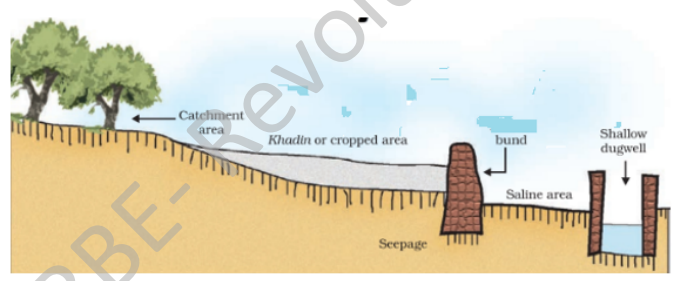
Question 67

The marked price of an article is ₹1,200. A shopkeeper offers two successive discounts of 10% and 5% respectively to a customer. At what price did the customer buy the article?

  1. AOption (a)

    ₹1,206

  2. BOption (b)

    ₹1,602

  3. COption (c)

    ₹1,062

  4. DOption (d)

    ₹1,026

View answer & explanation

Correct answer

Answer: (d)D.

₹1,026

Why this answer is correct

Shortcut Trick

Net discount % = a + b − (a × b ÷ 100)

Net discount = 10 + 5 − (10 × 5 ÷ 100) = 15 − 0.5 = 14.5%

Selling Price = 100% − 14.5% = 85.5% of Marked Price

Selling Price = 1200 × 85.5 ÷ 100 = 12 × 85.5 = 1026

∴ The correct answer is ₹1,026.

Alternate Method

Given: Marked Price (MP) = ₹1,200, Discount 1 (d1) = 10%, Discount 2 (d2) = 5%

Formula: Selling Price (SP) = MP × (100 − d1)/100 × (100 − d2)/100

⇒ Price after first discount = 1200 × (90/100) = 1080

⇒ Price after second discount = 1080 × (95/100)

⇒ Final Selling Price = 108 × 9.5 = 1026

∴ The correct answer is ₹1,026.

Additional Information

Successive Discounts

When two or more discounts are applied one after another on an article, they are called successive discounts. The second discount is calculated on the reduced price.

Marked Price and Selling Price

Marked Price (MP) is the price printed on the label. Selling Price (SP) is the actual price at which the article is sold after applying discounts. SP = MP − Discount.

Question 68

An object is placed on the principal axis of a lens of power – 10 D, at a distance of 15 cm. The image formed is _______ .

  1. AOption (a)

    virtual and inverted

  2. BOption (b)

    real and inverted

  3. COption (c)

    virtual and erect

  4. DOption (d)

    real ​and erect

View answer & explanation

Correct answer

Answer: (c)C.

virtual and erect

Why this answer is correct

The correct answer is virtual and erect.

Key Points

  • Image formation by the concave lens when the Object is placed at a Finite Distance from the Lens
  • When the object is positioned in front of the concave lens at any fixed distance.
  • The concave lens's optic center (O) and focus (F) are where the resulting image will be formed after refraction.
  • The object will have a larger size than the image.
  • The image formed at – Between F1 and the optical center
  • The nature of the image formed – Virtual and Erect
  • The size of the image formed – Diminished.

Additional Information

  • Calculations
  • ​Power = –10 D

Object distance, u= -15cm

We know, P= 1/f

-10= 1/f

f= -1/10

f= -0.1m= -10cm

By lens formula, 1/v-1/u= 1/f

1/v- 1/ (-15) = -1/10

1/v+ 1/15= -1/10

1/v= -1/10- 1/15

1/v= -3-2/30

1/v= -5/30= -1/6

v= -6cm

For magnification, m= v/u

m= (-6)/ (-15) = 2/5

m= 0.4

  • Image formed is virtual, erect and diminished.

​

Question 69

The given table shows the number of candidates who appeared for the interview and the number of candidates who got selected for the post of Assistant Professor in XYZ university, from different states over the years. Study the table and answer the question.

Year202020212022
StateInterviewedSelectedInterviewedSelectedInterviewedSelected
A1200800150070018001000
B1500600160080020001120
C2000680220090018001100
D1600700150095018001200
E150049011004001300800
<br>

In the year 2020, the total number of candidates who got selected from different states is approximately what percentage of the total number of candidates who appeared for the interview from different states in the same year?

  1. AOption (a)

    55%

  2. BOption (b)

    45.5%

  3. COption (c)

    50%

  4. DOption (d)

    41.9%

View answer & explanation

Correct answer

Answer: (d)D.

41.9%

Why this answer is correct

Calculation:

The total number of candidates got selected is in 2020 = 3270

The total number of candidates who appeared in 2020 = 7800.

According to the question:

%candidates =total candidates selected×\times100/total candidates appeared in interview=32707800×100\frac{3270}{7800}\times100 = 41.9.

∴ Option 4 is the correct answer.

Question 70

How many stages of life are prescribed in early Hindu philosophy?

  1. AOption (a)

    Four

  2. BOption (b)

    five

  3. COption (c)

    Three

  4. DOption (d)

    two

View answer & explanation

Correct answer

Answer: (a)A.

Four

Why this answer is correct

The correct answer is Four.

Key Points:

  • In Hindu writings from the ancient and medieval periods, there is a system of life stages referred to as Rama.
  • Brahmacharya (student), Ghastha (householder), Vanaprastha (forest walker/forest dweller), and Sannyasa are the four ashramas (renunciate).
  • One aspect of Hinduism's Dharma concept is the Asrama system.
  • Additionally, it is a part of Indian philosophy's ethical beliefs, where it is paired with the four legitimate aims of human life (Purushartha), which are fulfilment, happiness, and spiritual liberation.

Additional Information:

  • According to the Asrama system, there are four stages to the human lifespan.
  • Every time, the goal was the individual's fulfilment and development.
  • The original system, known as the Asramas, was taught in the early Dharmasutras and consisted of four distinct methods of living that were neither offered sequentially nor with age recommendations.
  • In contrast, the classical system depicts them as sequential stages of human life and suggests ages for entry into each stage in the Vaikhanasa Dharmasutra and the later Dharmashastra.

Question 71

Select the set in which the numbers are related in the same way as the numbers in the following sets.

(Note: Operations should be performed on whole numbers, without dividing the numbers into their component digits. Example 13 - Operations on 13 - like adding/subtracting/multiplying etc. can be performed on 13. 13 can be converted into 1 Breaking and 3 and then performing mathematical operations on 1 and 3 is not allowed)

(21, 225, 9)

(4, 25, 6)

  1. AOption (a)

    (13, 81, 6)

  2. BOption (b)

    (15, 54, 3)

  3. COption (c)

    (11, 18, 7)

  4. DOption (d)

    (14, 64, 2)

View answer & explanation

Correct answer

Answer: (d)D.

(14, 64, 2)

Why this answer is correct

The pattern followed in the given sets is:

             [(First term + Third term) ÷ 2]2 = Second term

Now we apply the pattern to the given sets:

(21, 225, 9)

[(21 + 9) ÷ 2]2 = 225

[(30) ÷ 2]2 = 225

[15]2  = 225

225 = 225

(4, 25, 6)

[(4 + 6) ÷ 2]2 = 25

[(10) ÷ 2]2 = 25

[5]2 = 25

25 = 25

Now we apply the pattern to the given options:

Option 1) (13, 81, 6)

[(13 + 6) ÷ 2]2 = 81

[(19) ÷ 2]2 = 81

[9.5]2 = 81

90.25 ≠ 81

Option 2) (15, 54, 3)

[(15 + 3) ÷ 2]2 = 54

[(18) ÷ 2]2 = 54

[9]2 = 54

81 ≠ 54

Option 3) (11, 18, 7)

[(11 + 7) ÷ 2]2 = 18

[(18) ÷ 2]2 = 18

[9]2 = 18

81 ≠ 18

Option 4) (14, 64, 2)

[(14 + 2) ÷ 2]2 = 64

[(16) ÷ 2]2 = 64

[8]2 = 64

64 = 64

Hence the correct answer is option 4)

Question 72

In which of these battles did the British East India Company win a decisive victory over the Nawab of Bengal on 23 June 1757?

  1. AOption (a)

    Battle of Saragarhi

  2. BOption (b)

    Battle of Plassey

  3. COption (c)

    Battle of Buxar

  4. DOption (d)

    Battle of Imphal

View answer & explanation

Correct answer

Answer: (b)B.

Battle of Plassey

Why this answer is correct

The correct answer is War of Plassy.

Key Points:

  • The British East India Company, led by Robert Clive, decisively defeated Nawab of Bengal and his French allies at the Battle of Plassey on June 23, 1757.
  • The chief commander of Nawab Siraj-ud-Daulah, Mir Jafar, defected, which allowed the victory.
  • The conflict aided in Bengal's capture by the British East India Company.
  • They acquired control of the majority of the remaining Indian subcontinent, including Burma, during the course of following 100 years.
  • On the banks of the Hooghly River, a place called Palashi (or Plassey in English) was the site of the battle.

Additional Information:

  • Battle of Saragarhi:
  • ​The British Raj and Afghan tribesmen engaged in the Battle of Saragarhi as a last-ditch effort prior to the Tirah Campaign.
  • On September 12, 1897, Fort Gulistan and Fort Lockhart were cut off by an estimated 12,000 to 24,000 Orakzai and Afridi tribesmen who were spotted nearby, at Samana Suk, and in the area of Saragarhi.
  • Battle of Buxar:
  • ​The British East India Company's forces, commanded by Hector Munro, engaged the united armies of Mir Qasim, the Nawab of Bengal until 1764, Shuja-ud-Daula, the Nawab of Awadh, and Shah Alam II, the Mughal Emperor, at the Battle of Buxar on October 22 and 23, 1764.
  • Battle of Imphal:
  • ​From March to July 1944, the area surrounding Imphal, the state capital of Manipur in Northeast India, saw action in the Battle of Imphal.
  • Japanese army attempted to invade India and defeat the Allied forces at Imphal, but they suffered significant losses on their way back into Burma.

Question 73

The position of how many letters will remain unchanged if each of the letters in the word 'CONFIRM' is arranged in alphabetical order?

  1. AOption (a)

    None

  2. BOption (b)

    One

  3. COption (c)

    Three

  4. DOption (d)

    Two

View answer & explanation

Correct answer

Answer: (b)B.

One

Why this answer is correct

We arrange the word 'CONFIRM' in alphabetical order, and we get:


WordCONFIRM
After arrangementCFIMNOR
<br>

From the arrangement, we can see that the position of only 'C' remains unchanged.

Hence the correct answer is option 2)

Question 74

Study the given diagram carefully, and answer the given question. The numbers given in the different parts indicate the number of units.

<br>

How many sofas are there which are either beds or mats but not both?

  1. AOption (a)

    17

  2. BOption (b)

    22

  3. COption (c)

    10

  4. DOption (d)

    12

View answer & explanation

Correct answer

Answer: (a)A.

17

Why this answer is correct

From the given information:

We have to find the number of sofas that are either beds or mats but not both which means we have to find a common region between sofas & beds + a common region between sofas & mats:

From the diagram, we can see that,

The common region between sofas & beds = 14

The common region between sofas & mats = 3

So the number of sofas which are either beds or mats but not both = 14 + 3 = 17

Hence the correct answer is option 1)
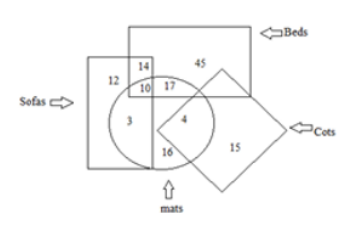
Question 75

Identify the goods whose demand falls due to the fall in their price.

  1. AOption (a)

    Giffen goods

  2. BOption (b)

    Normal goods

  3. COption (c)

    Inferior goods

  4. DOption (d)

    Substitute goods

View answer & explanation

Correct answer

Answer: (a)A.

Giffen goods

Why this answer is correct

The correct answer is Giffen goods.

Key Points

  • In economics and consumer theory, a Giffen good is a product that people consume more of as the price rises. Thus, it violates the law of demand by showing an upwards-sloping curve of demand.
  • Giffen good denotes non-luxury and inferior products with very little or no substitutes. Example - wheat, potatoes, and rice.
  • The term Giffen goods are coined after the name of the late Scottish economist Sir R. Giffen in the 1800s.
  • Giffen good is considered to be the opposite of an ordinary/normal good.

​ 

Additional Information

  • Normal goods are products whose demand increases as consumer income increases and decreases as consumer income decreases whereas Giffen good is a lower quality product whose demand grows as their value rises.
  • An inferior good is a type of good whose demand declines when income rises. Example - Jaggery
  • A substitute good is a product or service that a consumer sees as the same or similar to another product.

Question 76

As long as marginal utility of a commodity is _________, an individual will always prefer more of that commodity.

  1. AOption (a)

    negative

  2. BOption (b)

    fluctuating

  3. COption (c)

    constant

  4. DOption (d)

    positive

View answer & explanation

Correct answer

Answer: (d)D.

positive

Why this answer is correct

The correct answer is positive.

Key Points:

  • The additional advantage that a buyer receives by purchasing an additional unit of a commodity is known as marginal utility.
  • The idea suggests that a consumer's utility or profit from acquiring an additional unit of a given good is inversely correlated to the number of that good he already owns.
  • The endeavour to study and explain the basic economic reality of price by economists in the 19th century gave rise to the idea of marginal utility.
  • These economists felt that a commodity's utility, or how well it satisfies a consumer's needs and aspirations, had a role in determining a commodity's price.
  • An individual will always prefer more of a given good or service as long as its marginal utility is positive because having more of it will raise their degree of satisfaction.

Additional Information:

  • The scenario below provides a concrete illustration of marginal utility.
  • Given that the family will be proportionately less hungry and that there are only seven slices of bread available, one additional slice of bread will be of substantial marginal utility.
  • However, since the difference between 30 and 31 is proportionally lower and family's need has already been satisfied by what it already possesses, an extra piece of bread supplied to them will have less marginal benefit.
  • As a result, as a customer buys more and more of a product, his marginal utility declines until he reaches a point where he has absolutely no need for any more units.
  • Therefore, the marginal utility is zero.

Question 77

Which one of the following trade policies was adopted by India in its first seven (five) year plans?

  1. AOption (a)

    Export promotion

  2. BOption (b)

    Restricted imports

  3. COption (c)

    International cooperation and multilateral mechanism

  4. DOption (d)

    import substitution

View answer & explanation

Correct answer

Answer: (d)D.

import substitution

Why this answer is correct

The correct answer is import substitution.

Key Points:

  • The trade strategy used throughout the first seven Five-Year Plans served to define the trade policy.
  • Import substitution is the name given to this tactic.
  • This strategy attempted to replace imports with homegrown production.
  • The government shielded indigenous industries from foreign competition under this policy.
  • For instance, businesses will be urged to make vehicles in India rather than importing them from elsewhere.

Additional Information:

  • Our industries were unable to compete with the goods produced by more developed economies, therefore the government implemented an import substitution programme.
  • It is believed that if domestic industries are safeguarded, they will eventually figure out how to compete.
  • There was a chance that foreign currency would be used to import expensive products if there were no import restrictions.
  • Because industrialization moves quickly and absorbs unemployed individuals, it assisted in addressing the unemployment issue.
  • This immediately contributed to economic growth by assisting in the development of a strong industrial base in our nation.

Question 78

Oxygen has _______ electrons in its outermost _______  shell. 

  1. AOption (a)

    8, M

  2. BOption (b)

    6, L

  3. COption (c)

    8, K

  4. DOption (d)

    6, M

View answer & explanation

Correct answer

Answer: (b)B.

6, L

Why this answer is correct

The correct answer is 6, L.

Key Points

  • Oxygen is an element with atomic number 8.
  • The outermost shell of an atom is called the valence shell.
  • The number of electrons in the valence shell determines the chemical properties of an element.

Additional Information

  • Oxygen has 8 electrons in total, with the first two shells having 2 and 6 electrons respectively.
  • Oxygen is in group 16 in the periodic table, also known as the chalcogens, and it shares this group with sulphur, selenium and tellurium.
  • Oxygen is a highly reactive element and will readily form chemical bonds with other elements in order to fill its valence shell.
  • The most common form of oxygen on Earth is the diatomic molecule, O2, which contains two oxygen atoms bonded together.
  • Oxygen is essential for life as we know it and is used by most organisms in the process of respiration to generate energy.

Question 79

Who among the following won the Asian Billiards title for the 8th time in the 19th Asian 100 UP Billiards Championship 2022?

  1. AOption (a)

    Pankaj Advani

  2. BOption (b)

    Geeta Sethi

  3. COption (c)

    Dhruv Sitwala

  4. DOption (d)

    Aditya Mehta

View answer & explanation

Correct answer

Answer: (a)A.

Pankaj Advani

Why this answer is correct

The correct answer is Pankaj Advani. 

Key Points:

  • At the 19th Asian 100 UP Billiards Championship 2022, Indian cueist Pankaj Advani defeated Dhruv Sitwala to win his eighth championship.
  • The location was Doha, Qatar.
  • This was Advani's eighth Asian championship and his 24th overall international triumph.
  • Advani had earlier defeated Pauk Sa of Myanmar in a tough match to advance to the championship.
  • After his opponent made a great comeback to tie the match at four frames apiece, he was able to win 5-4.

Additional Information:

  • Geeta Sethi: 
  • ​Indian professional English billiards player Geet Siriram Sethi dominated the game for most of the 1990s.
  • In addition, he is a well-known amateur (ex-pro) snooker player.
  • In English billiards, he has won the world championships five times at the professional level, and three times at the amateur level, and holds two world records.
  • Dhruv Sitwala:
  • ​​​Dhruv Sitwala is an Indian who enjoys playing English pool.
  • He has twice won the Asian Billiards Championship and advanced to three world finals.
  • Aditya Mehta:
  • ​Aditya Mehta is an ex-professional snooker player from India.
  • Between 2011 and 2018, he took part in the World Snooker Tour.
  • He first did so in the 2007–2008 season.
  • His greatest position in the world rankings was 49.

Question 80

Interchanging the places of which two numbers in the given equation will make the equation balanced?

7 × 10 ÷ 6 + 3 - 2 = 10

  1. AOption (a)

    6, 10

  2. BOption (b)

    2, 6

  3. COption (c)

    3, 7

  4. DOption (d)

    3, 6

View answer & explanation

Correct answer

Answer: (c)C.

3, 7

Why this answer is correct

We apply each option to the given equation & solve it using the BODMAS rule:

Given: 7 × 10 ÷ 6 + 3 - 2 = 10

Option 1) 6, 10

After interchanging: 7 × 6 ÷ 10 + 3 - 2 = 10

**7 × 0.**6 + 3 - 2 = 10

4.2 + 3 - 2 = 10

7.2 - 2 = 10

5.2 ≠ 10

Given: 7 × 10 ÷ 6 + 3 - 2 = 10

Option 2) 2, 6

After interchanging: 7 × 10 ÷ 2 + 3 - 6 = 10

7 × 5 + 3 - 6 = 10

35 + 3 - 6 = 10

38 - 6 = 10

32 ≠ 10

Given: 7 × 10 ÷ 6 + 3 - 2 = 10

Option 3) 3, 7

After interchanging: 3 × 10 ÷ 6 + 7 - 2 = 10

3 × 1.66 + 7 - 2 = 10

5.0 + 7 - 2 = 10

12 - 2 = 10

10 = 10

Given: 7 × 10 ÷ 6 + 3 - 2 = 10

Option 4) 3, 6

After interchanging: 7 × 10 ÷ 3 + 6 - 2 = 10

7 × 3.33 + 6 - 2 = 10

23.31 + 6 - 2 = 10

29.31 - 2 = 10

27.31 ≠ 10

Hence the correct answer is option 3)

Question 81

Find the value of 1.0201\sqrt {1.0201}

  1. AOption (a)

    10.1

  2. BOption (b)

    101

  3. COption (c)

    1.01

  4. DOption (d)

    1.02

View answer & explanation

Correct answer

Answer: (c)C.

1.01

Why this answer is correct

Shortcut Trick

Identify the number without decimals: 10201.

Since 1002 = 10000 and 1012 = (100+1)2 = 10000 + 200 + 1 = 10201.

The original number has 4 decimal places, so the square root will have 4 ÷ 2 = 2 decimal places.

√10201 = 101 → Shift decimal by 2 places → 1.01.

∴ The correct answer is 1.01.

Alternate Method

Given: Value of √1.0201

Step-by-step Calculation:

⇒ Convert the decimal into a fraction: 1.0201 = 10201 / 10000

⇒ Square root of the expression: √(10201 / 10000)

⇒ Apply the property √(a/b) = √a / √b

⇒ √10201 / √10000

⇒ Since 101 × 101 = 10201 and 100 × 100 = 10000

⇒ 101 / 100

⇒ 1.01

∴ The correct answer is 1.01.

Additional Information

Square Root of Decimals

If a perfect square decimal has 2n decimal places, its square root will always have n decimal places.

Squaring numbers ending in 1

To square a number like (100 + x), use the identity (a + b)2 = a2 + 2ab + b2 for quick mental calculation.

Common Squares

Knowing squares up to 30 and specific patterns like 1012 = 10201 or 1112 = 12321 helps in fast simplification.

Question 82

The power of a convex lens of focal length 40 cm is _______ .

  1. AOption (a)

    2.5 D

  2. BOption (b)

    -2.5 D

  3. COption (c)

    -0.25 D

  4. DOption (d)

    0.25 D

View answer & explanation

Correct answer

Answer: (a)A.

2.5 D

Why this answer is correct

The correct answer is 2.5 D.

Key Points

  • Power of a lens
  • The power of a lens is its capacity to alter the light that enters it. Because a lens with a shorter focal length bends lights more, it has more power.
  • The light rays converge toward the principal axis in a convex lens, while the light rays diverge away from the principal axis in a concave lens.
  • P= 1/f, the inverse of a lens's focal length (f) in meters (m) is its power.
  • A lens's power is measured in m-1. Diopter is another name for this.
  • A converging lens's focal length (f) is regarded as positive, while a diverging lens's is regarded as negative. As a result, the power of a converging lens is higher than that of a diverging lens.

Additional Information

  • Calculation 
  • Convex lens of focal length**, f= 40cm= 0.4m**

We know, P= 1/f

P= 1/0.4= 10/4

P= 2.5D

Question 83

Eight classmates J, K, L, M, N, O, P and Q were sitting around a circular table, facing the centre. They were equidistant to one another. N was sitting fourth to the left of L. P was sitting fourth to the left of J. O was sitting to the immediate right of N. K was sitting second to the left of P. Only J was sitting between L and M. Which classmate was sitting fourth to the left of M?

  1. AOption (a)

    Only Q

  2. BOption (b)

    Only O

  3. COption (c)

    Either K or O

  4. DOption (d)

    Only K

View answer & explanation

Correct answer

Answer: (a)A.

Only Q

Why this answer is correct

From the given information:

Step 1: N was sitting fourth to the left of L. O was sitting to the immediate right of N.


We place L at any spot then place N fourth to the left of L. Now we place O to the immediate right of N.

Step 2: Only J was sitting between L and M. P was sitting fourth to the left of J. 


We place J & M such that J sits between L and M also we have to place them such that P can be placed fourth to the left of J. 

Step 3: K was sitting second to the left of P.


Now we place K second to the left of P. At last, we place Q in the only place left.

From the arrangement, we can see that Q is sitting fourth to the left of M.

Hence the correct answer is option 1)

Question 84

Which of the following is a displacement reaction?

(i) ZncO3 (s) → ZnO (s) + CO2 (g)

(ii) Fe (s) + CuSO4(aq) → FeSO4(aq) + Cu(s)

(iii) 2H2 (g) + O2 (g) →2H2O(I)

(v) CaCO3 (s) →CaO(s) + CO2 (g)

  1. AOption (a)

    (ii)

  2. BOption (b)

    (i)

  3. COption (c)

    (iv)

  4. DOption (d)

    (iii)

View answer & explanation

Correct answer

Answer: (a)A.

(ii)

Why this answer is correct

The correct answer is (ii).

Key Points

  • A displacement reaction is a type of chemical reaction.
  • In a displacement reaction, one element is replaced by another element in a compound.
  • The more reactive element "displaces" the less reactive element from the compound.

Additional Information

  • In the reaction Fe (s) CuSO4(aq) → FeSO4(aq) + Cu(s), Fe (Iron) is the replacing element and Cu (Copper) is the replaced element.
  • The iron ion (Fe2+) is oxidized to Fe3+ in the process, and the copper ion (Cu2+) is reduced to Cu metal.
  • The reaction between Fe and CuSO4 can be used to extract copper from copper-containing ores
  • The reaction is an example of single replacement reaction or single displacement reaction.
  • This reaction is also an oxidation-reduction reaction, as the oxidation state of Iron changes from 0 to +3 and Copper changes from +2 to 0.
  • The reaction is exothermic and releases heat.
  • The reaction typically proceeds in the presence of a suitable oxidizing agent, such as H2SO4 or HNO3, which helps to oxidize the iron.

Question 85

A vessel is one-fourth full of water. After adding 10 cups of water to it, the vessel gets three-fourth full. Find the capacity of the vessel in cups. 

  1. AOption (a)

    22

  2. BOption (b)

    25

  3. COption (c)

    20

  4. DOption (d)

    27

View answer & explanation

Correct answer

Answer: (c)C.

20

Why this answer is correct

Shortcut Trick

Change in fraction = 3/4 − 1/4 = 2/4 = 1/2 of the vessel capacity.

Given that 1/2 of the capacity is equal to 10 cups.

Total capacity = 10 × 2 = 20 cups.

∴ The correct answer is 20 cups.

Alternate Method

Given:

Initial level = 1/4 of capacity

Final level = 3/4 of capacity

Water added = 10 cups

Calculations:

Let the total capacity of the vessel be 'C'.

⇒ (3/4)C − (1/4)C = 10

⇒ (2/4)C = 10

⇒ (1/2)C = 10

⇒ C = 10 × 2

⇒ C = 20 cups

∴ The correct answer is 20 cups.

Additional Information

Fractions of Capacity

When dealing with portions of a vessel, the added quantity represents the difference between the final and initial fractional states.

Unitary Method in Fractions

If 'n' parts of a whole represent a value 'V', then the full value (1 whole) is calculated as V ÷ (n/Total Parts).

Base Value consistency

Ensure the fractions (1/4 and 3/4) are calculated on the same base, which in this case is the total volume of the vessel.

Question 86

In a certain code language, 'SUPERIOR' is written as 'SNHSDQTT' and 'STUNNING' is written as 'HOHOOTUT'. How will 'STRATEGY' be written in that code language?

  1. AOption (a)

    ZHCUZSUT

  2. BOption (b)

    ZHDUASUT

  3. COption (c)

    TUSZUDHZ

  4. DOption (d)

    ZHDUZSUT

View answer & explanation

Correct answer

Answer: (d)D.

ZHDUZSUT

Why this answer is correct

According to the English alphabets and their positional values:

<br>

The pattern followed in the given codes is:

  Consonants are increased to 1 positional value.

  Vowels are decreased by 1 positional value.

  The alphabets are arranged backward to form the code.

 'SUPERIOR' is written as 'SNHSDQTT'

Therefore the code for  'SUPERIOR' is 'SNHSDQTT'

And,

Therefore the code for 'STUNNING is HOHOOTUT'

Similarly,

 'STRATEGY'  is coded as:

Therefore the code for 'STRATEGY'  is ZHDUZSUT''

Hence the correct answer is ZHDUZSUT.

Question 87

C, J, H, Q and W contested an election, and each of them got different number of votes. H got more votes than J but less than W. W got less votes than only one person. C got the least number of votes. Who among the following got the most votes?

  1. AOption (a)

    Q

  2. BOption (b)

    J

  3. COption (c)

    W

  4. DOption (d)

    H

View answer & explanation

Correct answer

Answer: (a)A.

Q

Why this answer is correct

From the given information:

Step 1: H got more votes than J but less than W.

            W > H > J

Step 2: W got less votes than only one person.

           _ > W > H > J > _

Step 3: C got the least number of votes.

           _ > W > H > J > C

Now we place Q at the only place left,

           Q > W > H > J > C

From the arrangement, we can see that Q got the most votes.

Hence the correct answer is option 1)

Question 88

If the greatest common factor (HCF) and least common common multiple (LCM) of two numbers are 7 and 245 respectively, then find their product.

  1. AOption (a)

    1517

  2. BOption (b)

    1715

  3. COption (c)

    1175

  4. DOption (d)

    1751

View answer & explanation

Correct answer

Answer: (b)B.

1715

Why this answer is correct

Shortcut Trick

For any two numbers, the product of the numbers is always equal to the product of their HCF and LCM.

Product = HCF × LCM

Product = 7 × 245 = 1715

∴ The correct answer is 1715.

Alternate Method

Given:

HCF (Highest Common Factor) = 7

LCM (Least Common Multiple) = 245

Formula Used:

First Number × Second Number = HCF × LCM

Calculations:

⇒ Product of two numbers = HCF × LCM

⇒ Product = 7 × 245

⇒ Product = 7 × (200 + 40 + 5)

⇒ Product = 1400 + 280 + 35

⇒ Product = 1715

∴ The correct answer is 1715.

Additional Information

Fundamental Property of HCF and LCM

For any two positive integers a and b, HCF(a, b) × LCM(a, b) = a × b. This property is only valid for exactly two numbers.

Co-prime Numbers

If two numbers are co-prime, their HCF is 1 and their LCM is equal to their product (LCM = a × b).

HCF and LCM of Fractions

HCF of fractions = HCF of Numerators ÷ LCM of Denominators; LCM of fractions = LCM of Numerators ÷ HCF of Denominators.

Question 89

Consider the statements below and identify the correct answer.

Statement I: Isotopes of all elements posed a challenge to Mendeleev’s periodic law.

Statement II: No fixed position can be given to hydrogen in the periodic table.

  1. AOption (a)

    Statement I is correct, Statement II is incorrect.

  2. BOption (b)

    Both statements are incorrect.

  3. COption (c)

    Statement II is correct, Statement I is incorrect.

  4. DOption (d)

    Both statements are correct.

View answer & explanation

Correct answer

Answer: (d)D.

Both statements are correct.

Why this answer is correct

The correct answer is Both statements are correct.

Key Points:

  • Atoms of the same element with varying atomic masses are called isotopes.
  • As a result, based on Mendeleev's classification, these should be positioned at various locations according to their atomic masses.
  • For instance, the hydrogen isotopes with the masses 1, 2, and 3 should be distributed among the three locations.
  • However, due to their comparable features, isotopes do not occupy separate positions in the periodic table.
  • Isotopes differ in mass but share comparable chemical characteristics.
  • According to periodic law, an isotope is an element that requires its own spot in the periodic table.
  • Because it forms positive ions like alkali metals and diatomic molecules like halogens, hydrogen had no set position in Mendeleev's Periodic Table.

Additional Information:

  • Atomic weight and elemental property anomalies:
  • Elements with higher atomic weights should be placed ahead of those with lower atomic weights in specific locations if they are organised according to gradation in chemical characteristics.
  • This is contrary to Mendeleev's law.
  • For instance, argon, which has an atomic mass of 40, precedes potassium, which has an atomic mass of 39.
  • Tellurium (at mass = 127.8) is followed by iodine (at mass = 127).
  • Falling within the same group as disparate elements:
  • Chemically dissimilar elements are grouped together whereas certain chemically similar elements belong to distinct groupings.
  • For instance, alkali metals and other metals like copper, silver, and gold are grouped together.
  • Despite having similar characteristics, mercury, lead, and barium belong to separate groupings.

Question 90

Six friends, G, H, I, J, K, and L have marriage anniversaries in different months of the same year viz. January, March, July, August, September and December but not necessarily in the same order.

H has an anniversary immediately after K. Only I has an anniversary before G. J has an anniversary in September. Who among them has an anniversary in December?

  1. AOption (a)

    H

  2. BOption (b)

    G

  3. COption (c)

    L

  4. DOption (d)

    K

View answer & explanation

Correct answer

Answer: (c)C.

L

Why this answer is correct

From the given information:

Step 1:  Only I has an anniversary before G.

JanuaryMarchJulyAugustSeptemberDecember
IG

Step 2: J has an anniversary in September.

JanuaryMarchJulyAugustSeptemberDecember
IGJ

Step 3: H has an anniversary immediately after K.

JanuaryMarchJulyAugustSeptemberDecember
IGKHJ

Now we place L at the only spot left,

JanuaryMarchJulyAugustSeptemberDecember
IGKHJL

From the arrangement, we can see that L has an anniversary in December.

Hence the correct answer is option 3)

Question 91

Consider the following statements about an electric generator:

(a) After every half rotation, the current in the respective arms of the coil reverses its direction.

(b) The direction of the induced current in the coil can be found using Fleming's right-hand rule.

Which of the above statements is/are correct?

  1. AOption (a)

    Both (a) and (b)

  2. BOption (b)

    Only (b)

  3. COption (c)

    Only (a)

  4. DOption (d)

    Neither (a) nor (b)

View answer & explanation

Correct answer

Answer: (a)A.

Both (a) and (b)

Why this answer is correct

The correct answer is Both (a) and (b).

Key Points:

  • An alternating current, often known as a current that continually changes direction (polarity), is produced by an AC generator by the polarity of the current in each arm changing after every half rotation.
  • Fleming's right-hand rule can be used to determine electromagnetic induction's induced electric current's direction.
  • Stretch the forefinger, middle finger, and thumb so that they are all mutually perpendicular to one another.
  • The central finger points in direction of the induced current in the conductor if the thumb and forefinger point in the direction of the conductor's velocity and magnetic field, respectively.

Additional Information:

  • For electric generators, Fleming's right-hand rule is utilised.
  • To determine the direction of the induced current in an electric generator, this rule is applied.
  • The middle finger displays the induced current's direction.

Question 92

Find the value of tanθ+1tanθ\rm tan θ+ \frac{1}{tan θ}.

  1. AOption (a)

    cos θ sec θ

  2. BOption (b)

    cosec θ cot θ

  3. COption (c)

    cosec θ sin θ

  4. DOption (d)

    cosec θ sec θ

View answer & explanation

Correct answer

Answer: (d)D.

cosec θ sec θ

Why this answer is correct

Shortcut Trick

Convert tan θ and cot θ into sin θ and cos θ terms.

Expression = tan θ + cot θ = (sin θ / cos θ) + (cos θ / sin θ)

On simplifying: (sin2 θ + cos2 θ) / (sin θ cos θ) = 1 / (sin θ cos θ)

Result = cosec θ sec θ

∴ The correct answer is cosec θ sec θ.

Alternate Method

Given: tan θ + 1 / tan θ

Formula Used:

  1. 1 / tan θ = cot θ
  2. tan θ = sin θ / cos θ
  3. cot θ = cos θ / sin θ
  4. sin2 θ + cos2 θ = 1
  5. 1 / sin θ = cosec θ and 1 / cos θ = sec θ

Calculations:

⇒ tan θ + 1 / tan θ

⇒ tan θ + cot θ

⇒ (sin θ / cos θ) + (cos θ / sin θ)

⇒ (sin2 θ + cos2 θ) / (sin θ × cos θ)

⇒ 1 / (sin θ × cos θ)

⇒ (1 / sin θ) × (1 / cos θ)

⇒ cosec θ sec θ

∴ The correct answer is cosec θ sec θ.

Additional Information

Trigonometric Identities

Fundamental identities include sin2 θ + cos2 θ = 1, 1 + tan2 θ = sec2 θ, and 1 + cot2 θ = cosec2 θ.

Reciprocal Relations

cosec θ = 1/sin θ, sec θ = 1/cos θ, and cot θ = 1/tan θ are essential for simplifying complex expressions.

Question 93

By selling a plot for ₹ 19,50,000, there is a loss of 20%. At what price should he sell the plot to make a profit of 20%?

  1. AOption (a)

    ₹29,25,000

  2. BOption (b)

    ₹25,95,000

  3. COption (c)

    ₹22,50,000

  4. DOption (d)

    ₹21,00,000

View answer & explanation

Correct answer

Answer: (a)A.

₹29,25,000

Why this answer is correct

Shortcut Trick

Ratio of Selling Prices is proportional to (100 ± Profit/Loss%).

Initial SP (80%) = ₹19,50,000.

Required SP (120%) = (19,50,000 ÷ 80) × 120.

Required SP = 19,50,000 × (3 ÷ 2) = 29,25,000.

∴ The correct answer is ₹29,25,000.

Alternate Method

Given → Initial SP = ₹19,50,000, Loss = 20%, Desired Profit = 20%. Formulas: CP = SP × 100 ÷ (100 − Loss%) | New SP = CP × (100 + Profit%) ÷ 100.

⇒ Step 1: Find Cost Price (CP). ⇒ CP = 19,50,000 × 100 ÷ (100 − 20) = 19,50,000 × 100 ÷ 80 = 24,37,500. ⇒ Step 2: Find New Selling Price (SP) for 20% Profit. ⇒ New SP = 24,37,500 × (100 + 20) ÷ 100 = 24,37,500 × 1.2. ⇒ New SP = 29,25,000.

∴ The correct answer is ₹29,25,000.

Additional Information

Cost Price & Selling Price Relationship

When CP is constant, the ratio of two different selling prices is always equal to the ratio of their respective (100 ± P/L%).

Calculation of Profit/Loss

Profit or Loss is always calculated on the Cost Price unless specified otherwise in the problem.

Question 94

Starting from point X, Aditya walked 30 m towards the south. He then took a left turn and walked 20 m. Then, he took a right turn and walked 10 m. He then took another right turn and walked 40 m. Finally, he took one last right turn and walked another 40 m to reach point Y. How far and in which direction is point X from point Y ? (All turns are 90 degree turns Only)

  1. AOption (a)

    40 m, West

  2. BOption (b)

    20 m, East

  3. COption (c)

    40 m, East

  4. DOption (d)

    20 m, West

View answer & explanation

Correct answer

Answer: (b)B.

20 m, East

Why this answer is correct

From the given information:

Step 1: Starting from point X, Aditya walked 30 m towards the south. He then took a left turn and walked 20 m.


Step 2: Then, he took a right turn and walked 10 m. He then took another right turn and walked 40 m.


Step 3: Finally, he took one last right turn and walked another 40 m to reach point Y.


Distance from Y to X = 40m - 20m = 20m

From the diagram, we can see that X is 20m toward the east of Y.

Hence the correct answer is option 2)

Question 95

B,C,D, E, F and G are six team members who joined a team on different days of the same month, viz. 2nd, 4th, 5th, 8th, 10th and 11th of January.

C joined on one of the days before F, E and G. B joined immediately before F. D joined immediately before C. E joined on one of the days after B and before G. Who joined the team on 10th of January?

  1. AOption (a)

    B

  2. BOption (b)

    F

  3. COption (c)

    E

  4. DOption (d)

    G

View answer & explanation

Correct answer

Answer: (c)C.

E

Why this answer is correct

From the given information:

Step 1 : B joined immediately before F. E joined on one of the days after B and before G.

            B -- F -- E -- G

Step 2: C joined on one of the days before F, E and G.

            C -- B -- F -- E -- G

Step 3: D joined immediately before C.

            D -- C -- B -- F -- E -- G

Now we put the arrangement with dates:

2nd Jan4th Jan5th Jan8th Jan10th Jan11thJan
DCBFEG
<br>

From the arrangement, we can see that E joined the team on the 10th of January.

Hence the correct answer is option 3)

Question 96

Consider two wires, A and B, of same thickness but lengths L and 4L, respectively. If the resistances of A and B are 0.5 Ω and 2.0 Ω , respectively, the ratio of the resistivity of A to the resistivity of B is:

  1. AOption (a)

    12\frac{1}{2}

  2. BOption (b)

    14\frac{1}{4}

  3. COption (c)

    1

  4. DOption (d)

    4

View answer & explanation

Correct answer

Answer: (c)C.

1

Why this answer is correct

The correct answer is 1.

Key Points

  • Resistance
  • ​Every material has an electrical resistance, which is why conductors emit heat when current passes through them.
  • When an electric current flows through a bulb or any conductor, the conductor provides some obstruction to the current. This obstruction is referred to as electrical resistance and is denoted by R.
  • There is a relationship between the potential difference across a conductor and the current that flows through it, according to Ohm's law. It comes from, V=IR
  • Factors Affecting Electrical Resistance
  • The following factors influence a conductor's electrical resistance:
  • The cross-sectional area of the conductor
  • Length of the conductor
  • The material of the conductor
  • The temperature of the conducting material
  • Electrical resistance is inversely proportional to the conductor's cross-sectional area (A) and directly proportional to its length (L). The relationship that follows provides it. 

R= ρL/A

where ρ is the material's resistivity, expressed as m/ohm meter.

Additional Information

  • Calculation
  • Two wires, A and B, of same thickness but lengths L and 4L, respectively.

The resistances of A and B are 0.5 Ω and 2.0 Ω , respectively.

R1= 0.5Ω, R2= 2.0Ω 

L1= L, L2= 4L

We know, R= ρL/A

0.5Ω= ρ1L/A and 2.0Ω= ρ2(4L)/A

0.5Ω= ρ1: 2.0Ω= ρ2(4)

0.5Ω= ρ1: 2/4Ω= ρ2

0.5Ω= ρ1:1/2Ω= ρ2

0.5Ω= ρ1:0.5Ω= ρ2

1=ρ1: 1=ρ2

So, ρ1: ρ2= 1:1

Question 97

Find the volume of a sphere whose diameter is 42 m.

  1. AOption (a)

    23,437 m3

  2. BOption (b)

    42,137 m3

  3. COption (c)

    38,808 m3

  4. DOption (d)

    13,416 m3

View answer & explanation

Correct answer

Answer: (c)C.

38,808 m3

Why this answer is correct

Shortcut Trick

For a sphere, Radius (r) = Diameter ÷ 2 = 42 ÷ 2 = 21 m.

Volume formula contains π (22/7), so the answer must be a multiple of 11.

Check options for divisibility by 11: 38,808 → (3+8+8) − (8+0) = 19 − 8 = 11 (Divisible).

Volume = (4/3) × (22/7) × 21 × 21 × 21 = 88 × 441 = 38,808 m3.

∴ The correct answer is 38,808 m3.

Alternate Method

Given:

Diameter (d) of the sphere = 42 m

Radius (r) = d ÷ 2 = 42 ÷ 2 = 21 m

Formula Used:

Volume of Sphere = (4/3) × πr3

Calculations:

⇒ Volume = (4/3) × (22/7) × (21)3

⇒ Volume = (4/3) × (22/7) × 21 × 21 × 21

⇒ Volume = 4 × 22 × (21/21) × 21 × 21

⇒ Volume = 88 × 441

⇒ Volume = 38,808 m3

∴ The correct answer is 38,808 m3.

Additional Information

Surface Area of Sphere

The Total Surface Area of a sphere is given by the formula: 4πr2.

Hemisphere Properties

For a hemisphere, Volume = (2/3)πr3 and Total Surface Area = 3πr2.

Volume proportionality

If the radius is doubled, the volume of the sphere increases by 23 = 8 times.

Question 98

The amount of water in urine is ________.

  1. AOption (a)

    83%

  2. BOption (b)

    95%

  3. COption (c)

    68%

  4. DOption (d)

    79%

View answer & explanation

Correct answer

Answer: (b)B.

95%

Why this answer is correct

The correct answer is 95%.

Key Points:

  • A liquid waste product that the body produces and excretes is called urine.
  • It is secreted by the renal tubules, builds up in the bladder, and is eliminated through the urethra.
  • Despite containing between 91 and 96 percent water, it also includes numerous additional solid and liquid components.
  • Urine typically has a pH in the range of 5.5-7.0, or around 6.2.
  • While vegetables and fruit result in a more alkaline pH, a high protein diet and alcohol use cause a lower pH.
  • Urine's specific gravity could be between 1.002 and 1.037.
  • Urine may have a daily average calorific value of around 100 kcal.

Additional Information:

  • Only 68 compounds with a concentration of 10 mg/L or higher make up over 99 percent of the urine solutes.
  • Actually, 42 chemicals are at play.
  • These categories could apply to them:
  • Sodium, potassium, calcium, magnesium, and chloride are examples of electrolytes.
  • Nitrogen-containing substances like urea and creatinine
  • Vitamins
  • Hormones
  • Acids that are organic, like uric acid
  • Various organic substances.

Question 99

Give simplified form of a10×b−7×c−4a−5×b2×c5\rm \frac{a^{10}\times b^{-7} \times c^{-4}}{a^{-5}\times b^2\times c^5}.

  1. AOption (a)

    a15 × b-9 × c-9

  2. BOption (b)

    a15 × b9 × c9

  3. COption (c)

    a5 × b9 × c-9

  4. DOption (d)

    a5 × b-9 × c-9

View answer & explanation

Correct answer

Answer: (a)A.

a15 × b-9 × c-9

Why this answer is correct

Concept used:

If base is same then ,

tn/t1 = tn-1  

Where t is any variable 

Calculation:

Here, we have a10×b−7×c−4a−5×b2×c5a^{10} \times b^{-7} \times c^{-4}\over a^{-5} \times b^2 \times c^5 

⇒ a10 -(-5) × b-7-2 × c-4-5  [ As tn/t1 = tn-1] 

⇒ a15 × b-9 × c-9 

Hence, the required value is a15 × b-9 × c-9.

Question 100

Refer to the following number series and answer the question.

5 3 6 8 2 6 3 2 8 0 3 8 5 6 7 2 5 0 9 6

How many such odd numbers are there each of which is immediately preceded by an odd number and immediately followed by an even number?

  1. AOption (a)

    None

  2. BOption (b)

    One

  3. COption (c)

    Three

  4. DOption (d)

    Two

View answer & explanation

Correct answer

Answer: (b)B.

One

Why this answer is correct

We have to find the triad which looks like (odd, odd, even) in the given series:

We can see that there is only one such odd number which is immediately preceded by an odd number and immediately followed by an even number.

Hence the correct answer is option 2)

100 questions in the full paper