Previous Year Paper

RRB Group D Previous Year Paper (Held on: 28 Sept 2022 Shift 2)

Held in 2022

100 questions90 minutes
With answers
Free

Paper last updated:

Practise under exam conditions

Take this paper as a timed mock test. Review your answers after you submit.

Attempt timed test

Questions & answers

Read the paper at your pace. Open an explanation when you need it.

CBT (100 questions)

Question 1

If 5 is one root of x2 - (a - 1)x + 10 = 0, then the other root is:

  1. AOption (a)

    4

  2. BOption (b)

    1

  3. COption (c)

    6

  4. DOption (d)

    2

View answer & explanation

Correct answer

Answer: (d)D.

2

Why this answer is correct

Shortcut Trick

The product of the roots of a standard quadratic equation of the form x2 − Bx + C = 0 is equal to the constant term C.

Here, the constant term in the given equation is 10.

One of the roots is given as 5.

Other root = Product of roots ÷ Given root = 10 ÷ 5 = 2.

∴ The correct answer is 2.

Alternate Method

Given:

Quadratic equation: x2 − (a − 1)x + 10 = 0

One root of the equation (α) = 5

Formula Used:

For a standard quadratic equation Ax2 + Bx + C = 0, the product of the roots (α × β) is given by C/A.

Calculations:

Let the roots of the equation be α and β.

We are given that α = 5.

Comparing the given equation with the standard form, we get A = 1 and C = 10.

⇒ α × β = C ÷ A

⇒ 5 × β = 10 ÷ 1

⇒ 5 × β = 10

⇒ β = 10 ÷ 5

⇒ β = 2

Thus, the other root of the quadratic equation is 2.

∴ The correct answer is 2.

Additional Information

Sum of Roots

For any quadratic equation ax2 + bx + c = 0, the sum of the roots is equal to −b/a.

Product of Roots

The product of the roots of a quadratic equation ax2 + bx + c = 0 is equal to c/a.

Discriminant and Nature of Roots

The nature of the roots depends on the discriminant D = b2 − 4ac. Roots are real and distinct if D > 0, real and equal if D = 0, and complex conjugates if D < 0.

Question 2

According to the Newland's law of octaves, how many elements are present in between Potassium and Copper?

  1. AOption (a)

    5

  2. BOption (b)

    8

  3. COption (c)

    9

  4. DOption (d)

    7

View answer & explanation

Correct answer

Answer: (d)D.

7

Why this answer is correct

The correct answer is 7

Key Points

  • According to Newland's Law of Octaves, each octave contains 7 elements between the first and the eighth element.
  • Starting from Potassium (K):
  • Potassium (K) - 1st
  • Calcium (Ca) - 2nd
  • Scandium (Sc) - 3rd
  • Titanium (Ti) - 4th
  • Vanadium (V) - 5th
  • Chromium (Cr) - 6th
  • Manganese (Mn) - 7th
  • The eighth element is Copper (Cu).
  • Hence, there are exactly 7 elements between Potassium (K) and Copper (Cu).

Additional Information

  • In 1866, John Newlands, an English scientist, arranged the then-known elements in the order of increasing atomic masses.
  • He started with the element having the lowest atomic mass (hydrogen) and ended at thorium which was the 56th element.
  • He found that every eighth element had properties similar to that of the first. He compared this to the octaves found in music.
  • Therefore, he called it the ‘Law of Octaves’.
  • According to the Newlands Octaves, the properties of Lithium and Sodium were found to be the same.
  • It was assumed by Newlands that only 56 elements existed in nature and no more elements would be discovered in the future. But, later on, several new elements were discovered, whose properties did not fit into the Law of Octaves.

Question 3

Which of the following natural resources do we need to use judiciously to prevent intense global warming? 

  1. AOption (a)

    Petroleum and water

  2. BOption (b)

    Metals and coal

  3. COption (c)

    Coal and petroleum

  4. DOption (d)

    Coal and water

View answer & explanation

Correct answer

Answer: (c)C.

Coal and petroleum

Why this answer is correct

The correct answer is Coal and petroleum

Key Points

  • Coal and petroleum are the natural resources that need to be used judiciously to prevent global warming
  • Coal and petroleum are fossil fuels that are formed from the degradation of biomass over millions of years.
  • They are non-renewable resources and their known reserves are limited to a few hundred years.
  • Burning coal and petroleum releases harmful gases into the atmosphere, which trap UV rays and increase the Earth's temperature.

Additional Information

  • Global Warming​
  • Global warming is the long-term increase in Earth's average temperature.
  • It is primarily caused by the increase in greenhouse gases (like carbon dioxide and methane) in Earth's atmosphere due to human activities, such as burning fossil fuels for energy and deforestation.
  • The increased greenhouse gases trap more of the Sun's heat, causing the planet's temperature to rise.
  • This leads to many changes in natural systems including melting glaciers, more frequent extreme weather events, sea-level rise, and shifts in wildlife populations and their habitats.
  • This phenomenon has significant impacts on human societies and the natural world.

Question 4

Light travels from air into water with an index of refraction of 1.33. The light ray will:

  1. AOption (a)

    go perpendicular to the normal

  2. BOption (b)

    bend away from the normal

  3. COption (c)

    bend towards the normal

  4. DOption (d)

    go parallel to the normal

View answer & explanation

Correct answer

Answer: (c)C.

bend towards the normal

Why this answer is correct

The correct answer is to bend towards the normal

Key Points

  • When light travels from air into water, it will bend towards the normal.
  • This is because water is optically denser than air, so the light's speed decreases and it bends towards the normal.
  • This is described by Snell's law of refraction.
  • When light travels from an optically denser medium to an optically rarer medium, it bends away from the normal.
  • Light's wavelength and velocity also decrease when it travels from air to water

Additional Information

  • Refraction: When a ray of light passes from one medium to another it suffers a change in direction at the boundary of two media is called refraction.
  • The change in direction because the speed of light travels at different speeds in different mediums.


.

  • Reflection of a light ray is the phenomenon in which the light ray changes the direction of propagation when it strikes a boundary between different media through which it cannot pass.

Question 5

A statement is followed by two conclusions. Find out which conclusion is true based on the given statement.

Statement:

M ≥ N < O = P > Q > R > S

Conclusions:

I. M > Q

II. O > R

  1. AOption (a)

    Only conclusion II is true

  2. BOption (b)

    Both conclusions I and II are true

  3. COption (c)

    Only conclusion I is true

  4. DOption (d)

    Neither conclusion I nor II is true

View answer & explanation

Correct answer

Answer: (a)A.

Only conclusion II is true

Why this answer is correct

Given Statement: M ≥ N < O = P > Q > R > S

Now, Conclusions:

Option 1: M > Q → False (M ≥ N < O = P > Q, It gives M < Q or M = Q)

Option 2: O > R → True (O = P > Q > R, It gives O > R)

So, Only conclusion II is true.

Hence, the correct answer is "Option 1".

Question 6

If the area of the base of a cylinder is 3850 cm2 and its height is twice the radius of its base, then find the volume of the cylinder. [Use π = 227\frac{22}{7}]

  1. AOption (a)

    201250 cm3

  2. BOption (b)

    269500 cm3

  3. COption (c)

    245340 cm3

  4. DOption (d)

    235320 cm3

View answer & explanation

Correct answer

Answer: (b)B.

269500 cm3

Why this answer is correct

Shortcut Trick

Base Area (πr2) = 3850 cm2

Volume = Base Area × Height

Given Height (h) = 2 × Radius (r). From πr2 = 3850, r = 35 cm.

∴ h = 2 × 35 = 70 cm.

Volume = 3850 × 70 = 269500 cm3.

∴ The correct answer is 269500 cm3.

Alternate Method

Given:

Area of base = 3850 cm2

Height (h) = 2 × Radius (r)

Formula Used:

Area of base of cylinder = πr2

Volume of cylinder = πr2h

Calculations:

⇒ πr2 = 3850

⇒ (22/7) × r2 = 3850

⇒ r2 = (3850 × 7) ÷ 22

⇒ r2 = 175 × 7 = 1225

⇒ r = √1225 = 35 cm

⇒ Height (h) = 2r = 2 × 35 = 70 cm

⇒ Volume = (Base Area) × Height

⇒ Volume = 3850 × 70

⇒ Volume = 269500 cm3

∴ The correct answer is 269500 cm3.

Additional Information

Curved Surface Area (CSA)

The lateral surface area of a cylinder is given by 2πrh.

Total Surface Area (TSA)

The total area including the two circular bases is 2πr(r + h).

Hollow Cylinder Volume

Volume of a hollow cylinder with outer radius R and inner radius r is π(R2 − r2)h.

Question 7

Which Article of the Constitution of India gives Advisory Jurisdiction to the Supreme Court of India?

  1. AOption (a)

    Article 133

  2. BOption (b)

    Article 142

  3. COption (c)

    Article 143

  4. DOption (d)

    Article 132

View answer & explanation

Correct answer

Answer: (c)C.

Article 143

Why this answer is correct

The correct answer is Article 143

Key Points

  • As per Article 143, the President has the power to address questions to the Supreme Court, which he deems important for public welfare.
  • The Supreme Court “advises” the President by answering the query put before it.
  • Article 143 of the Constitution confers Advisory Jurisdiction to the Supreme Court of India.
  • Article 143: Power of President to consult Supreme Court.
  1. If at any time it appears to the President that a question of law or fact has arisen, or is likely to arise, which is of such a nature and such public importance that it is expedient to obtain the opinion of the Supreme Court upon it, he may refer the question to that Court for consideration and the Court may, after such hearing as it thinks fit, report to the President its opinion thereon.
  2. The President may, notwithstanding anything in the proviso to article 131, refer a dispute of the kind mentioned in the said proviso to the Supreme Court for opinion and the Supreme Court shall, after such hearing as it thinks fit, report to the President its opinion thereon.

Additional Information

  • Article 133​
  • Article 133 deals with the provisions of Appellate Jurisdiction of the Supreme Court from High Courts in regard to Civil matters only.
  • Under this article in civil cases, an appeal lies to the Supreme Court from any judgment of a high court if the high court certifies.
  • It involves a substantial question of law of general importance.
  • The question needs to be decided by the Supreme Court.
  • Article 132- 
  • This article is about Appellate jurisdiction of Supreme Court in appeals from High Court in certain cases such as civil, criminal, or other proceedings.
  • An appeal can be made to the Supreme Court against the judgment of a high court if the high court certifies that the case involves a substantial question of law that requires the interpretation of the Constitution.
  • Article 142​
  • Article 142 of the Indian Constitution grants discretionary power to the Supreme Court of India.
  • This article allows the Supreme Court to pass any decree or make any order necessary for doing complete justice in any cause or matter pending before it.
  • It was under this discretionary power that the Supreme Court of India recognized sex work as a profession.
  • The recognition aims to protect the rights and dignity of sex workers and to ensure their safety and well-being.

Question 8

Town C is west of town D. Town E is south of the mid-point of the line joining C and D. Town F is south-west of C such that F and E are along the same straight line. What is the position of E with respect to F?

  1. AOption (a)

    South

  2. BOption (b)

    North

  3. COption (c)

    West

  4. DOption (d)

    East

View answer & explanation

Correct answer

Answer: (d)D.

East

Why this answer is correct

Given: 

Town C is west of town D.

Town E is south of the mid-point of the line joining C and D.

Town F is south-west of C such that F and E are along the same straight line.

So, the position of E with respect to F is East.

Hence, the correct answer is "East".

Question 9

In the word 'WEBSITE’, if each vowel is replaced with the immediate next letter and each consonant is replaced with the immediate previous letter as per the English alphabetical order, then how many vowels will be there in the word so formed?

  1. AOption (a)

    Two

  2. BOption (b)

    One

  3. COption (c)

    Three

  4. DOption (d)

    None

View answer & explanation

Correct answer

Answer: (b)B.

One

Why this answer is correct

The logic followed here is:

Given word: 'WEBSITE’

If each vowel is replaced with the immediate next letter and each consonant is replaced with the immediate previous letter as per the English alphabetical order,

Thus, one vowel will be there in the word so formed.

Hence, the correct answer is "One".

Question 10

Find the surface area of a sphere having a radius of 9 cm. [Use π = 227\frac{22}{7}]

  1. AOption (a)

    102047 cm2\rm 1020\frac{4}{7}\ cm^2

  2. BOption (b)

    101827 cm2\rm 1018\frac{2}{7}\ cm^2

  3. COption (c)

    101357 cm2\rm 1013\frac{5}{7}\ cm^2

  4. DOption (d)

    101067 cm2\rm 1010\frac{6}{7}\ cm^2

View answer & explanation

Correct answer

Answer: (b)B.

101827 cm2\rm 1018\frac{2}{7}\ cm^2

Why this answer is correct

Shortcut Trick

Surface Area of a sphere = 4πr2

Surface Area = 4 × (22/7) × 9 × 9

Surface Area = 88/7 × 81 = 7128/7

Surface Area = 1018(2/7) cm2

∴ The correct answer is 1018(2/7) cm2.

Alternate Method

Given:

Radius (r) of the sphere = 9 cm

Value of π = 22/7

Formula Used:

Surface Area = 4πr2

Calculations:

⇒ Surface Area = 4 × (22/7) × (9)2

⇒ Surface Area = 4 × (22/7) × 81

⇒ Surface Area = (88 × 81) / 7

⇒ Surface Area = 7128 / 7

⇒ Surface Area = 1018 + 2/7

∴ The correct answer is 1018(2/7) cm2.

Additional Information

Volume of Sphere

The total space occupied by a sphere is given by V = (4/3)πr3.

Hemisphere Properties

Curved Surface Area (CSA) = 2πr2 and Total Surface Area (TSA) = 3πr2.

Ratio of Surface Area

If radii of two spheres are in ratio a:b, then their surface areas are in ratio a2:b2.

Question 11

If '+' means '÷', '-' means '+', '×' means '-', and '÷' means '×', what will come in place of the question mark (?) in the following equation?

15 × 6 ÷ 12 + 4 - 5 = ?

  1. AOption (a)

    12

  2. BOption (b)

    2

  3. COption (c)

    8

  4. DOption (d)

    5

View answer & explanation

Correct answer

Answer: (b)B.

2

Why this answer is correct

Given: 15 × 6 ÷ 12 + 4 - 5 = ?

Decoding the given information:

Symbol+-×÷
Means÷+-×


Now replacing the sign from left to right using BODMAS Rule, we get:

⇒ 15 - 6 × 12 ÷ 4 + 5

⇒15 - 6 × 3 + 5

⇒ 15 - 18 + 5

⇒ 20 - 18 = 2

Hence, the correct answer is "Option 2".

Question 12

Identify the following cell.

  1. AOption (a)

    Nerve cell

  2. BOption (b)

    Bone cell

  3. COption (c)

    Kidney cell

  4. DOption (d)

    Muscle cell

View answer & explanation

Correct answer

Answer: (a)A.

Nerve cell

Why this answer is correct

The correct answer is Nerve Cell

Key Points

  • The image shows a nerve cell (neuron).
  • Star-shaped structure on the left
  • It Represents the cell body (soma) with dendrites that receive signals.
  • Long extension: 
  • It  Represents the axon, which transmits electrical impulses.
  • Branch-like endings on the right:
  • It Represents axon terminals, which pass signals to other neurons or target cells.
  • Neurons are the fundamental units of the nervous system, responsible for transmitting information throughout the body.

Additional Information 

  • Bone Cells
  • Bone cells are specialised cells that maintain and repair the skeletal system.
  • The four main types are:
  • Osteoblasts: Build new bone by producing collagen and other components of the bone matrix.
  • Osteoclasts: Break down old bone tissue during remodeling and repair.
  • Osteocytes: Mature bone cells derived from osteoblasts; they maintain the bone matrix and communicate with other bone cells.
  • Lining Cells: Flat cells on bone surfaces that protect the bone and regulate calcium exchange.
  • It Provide structural support, protect internal organs, enable movement, and store minerals like calcium and phosphate.
  • Kidney Cells
  • Kidney cells are part of the nephron, the functional unit of the kidney. Key types include:
  • Glomerular Cells: In the glomerulus, they filter blood to form urine.
  • Tubular Cells: Line the tubules of the nephron and are involved in reabsorbing water, ions, and nutrients.
  • Podocytes: Specialized cells in the glomerulus that prevent large molecules like proteins from entering the filtrate.
  • It Maintains fluid and electrolyte balance, filter blood, excrete waste products, and regulate blood pressure and pH.
  • Muscle Cells
  • Muscle cells (or muscle fibers) are responsible for movement and contraction.
  • They are of three main types:
  • Skeletal Muscle Cells: Long, striated, and multinucleated cells under voluntary control.
  • They are involved in body movements and posture.
  • Cardiac Muscle Cells: Found in the heart, they are striated, branched, and involuntary.
  • They enable the heart to pump blood.
  • Smooth Muscle Cells: Non-striated and spindle-shaped cells found in organs like the stomach, intestines, and blood vessels.
  • They are involuntary and help in processes like digestion and blood flow.
  • It Provide movement, support internal organs, and maintain vital functions like blood circulation and digestion.

Question 13

Pallavi bought a toy for Rs. 128, decorated it at a cost of Rs. 15, and sold the toy for Rs. 130. Find the loss or gain percentage.

  1. AOption (a)

    10011% Loss\rm \frac{100}{11}\%\ Loss

  2. BOption (b)

    10% Loss

  3. COption (c)

    10% Gain 

  4. DOption (d)

    10011% Gain\rm \frac{100}{11}\%\ Gain

View answer & explanation

Correct answer

Answer: (a)A.

10011% Loss\rm \frac{100}{11}\%\ Loss

Why this answer is correct

Shortcut Trick Total CP = 128 + 15 = 143. Since SP (130) < CP (143), it is a Loss. Loss amount = 143 − 130 = 13. Loss% = (Loss ÷ Total CP) × 100 = (13 ÷ 143) × 100. Ratio-unitary: 13/143 = 1/11. Thus, 1/11 × 100% = 100/11%. ∴ The correct answer is 100/11% Loss.

Alternate Method Given: Cost Price (Toy) = Rs. 128, Overhead Expenses = Rs. 15, Selling Price = Rs. 130. Formulas: Total CP = CP + Overhead | Loss = CP − SP | Loss% = (Loss ÷ CP) × 100.

⇒ Calculate Total Cost Price: Rs. 128 + Rs. 15 = Rs. 143. ⇒ Since Selling Price (Rs. 130) is less than Total Cost Price (Rs. 143), it is a Loss. ⇒ Loss Amount = Total CP − SP = 143 − 130 = Rs. 13. ⇒ Loss Percentage = (13 ÷ 143) × 100. ⇒ Simplify the fraction: 13/143 = 1/11. ⇒ Loss% = (1/11) × 100 = 100/11%. ∴ The correct answer is 100/11% Loss.

Additional Information Total Cost Price and Overheads Any additional expenses like transportation, repairs, or decoration are always added to the original purchase price to calculate the effective Total Cost Price. Profit and Loss Condition If SP > CP, it is a Profit. If CP > SP, it is a Loss. Percentages are always calculated on the Cost Price unless specified otherwise.

Question 14

In relation to consumer behavior, two indifference curves ___________.

  1. AOption (a)

    intersect each other at 120 degrees.

  2. BOption (b)

    always intersect each other at right angles.

  3. COption (c)

    never intersect each other

  4. DOption (d)

    intersect each other at 45 degrees.

View answer & explanation

Correct answer

Answer: (c)C.

never intersect each other

Why this answer is correct

The correct answer is never intersect each other

Key Points

  • In relation to consumer behaviour, two indifference curves never intersect each other.
  • An indifference curve shows a combination of two goods that give a consumer equal satisfaction and utility thereby making the consumer indifferent.
  • Along the curve, the consumer has an equal preference for the combinations of goods shown—i.e. is indifferent about any combination of goods on the curve.
  • Typically, indifference curves are shown convex to the origin, and no two indifference curves ever intersect.
  • Standard indifference curve analysis operates on a simple two-dimensional graph.
  • Each axis represents one type of economic good.
  • Along the indifference curve, the consumer is indifferent between any of the combinations of goods represented by points on the curve because the combination of goods on an indifference curve provides the same level of utility to the consumer.
  • The slope of the indifference curve is equal to the marginal rate of substitution.

Additional Information

  • Property of indifference curves:
  • The indifference curve convex to the origin.
  • The indifference curves, higher is the level of satisfaction.
  • The indifference curve is downward sloping.
  • As we move down the indifference curve from left to right, the slope of the indifference curve tends to Decline.
  • Two indifference curves cannot cut each other because Each indifference curve represents a different level of satisfaction.

Question 15

Which substance formed precipitates when a reaction occurs between potassium sulfate and barium chloride?

  1. AOption (a)

    Barium sulfate

  2. BOption (b)

    Barium chloride

  3. COption (c)

    Potassium chloride

  4. DOption (d)

    Potassium sulfate

View answer & explanation

Correct answer

Answer: (a)A.

Barium sulfate

Why this answer is correct

The correct answer Barium sulphate.

Key Points 

  • The white precipitate formed in the reaction of sodium sulfate and barium chloride is barium sulfate.
  • The chemical reaction is as follows:

Na2SO4(aq) + BaCl2(aq) → BaSO4(s) + 2NaCl(aq)

  • In this reaction, the sodium and chloride ions from each reactant switch places to form sodium chloride and barium sulfate.
  • Barium sulfate is a white, insoluble precipitate

Additional Information

NameChemical FormulaDescription
Barium ChlorideBaCl₂A white crystalline salt, highly soluble in water. Commonly used in chemical analysis and laboratory tests.
Potassium ChlorideKClA white crystalline salt, soluble in water. It is used as a fertilizer, in medicine, and in food processing.
Potassium SulfateK₂SO₄A white crystalline solid, water-soluble. Commonly used as a fertilizer to provide potassium and sulfur for plants.

Question 16

Mr. Rao walks 45 minutes in a day. What fraction of a day does he walk per day, expressed as a fraction?

  1. AOption (a)

    124\frac{1}{24}

  2. BOption (b)

    180\frac{1}{80}

  3. COption (c)

    132\frac{1}{32}

  4. DOption (d)

    34\frac{3}{4}

View answer & explanation

Correct answer

Answer: (c)C.

132\frac{1}{32}

Why this answer is correct

Given:

Mr. Rao walks 45 minutes in a day.

Formula used:

1 day = 24 hours = 24 × 60 minutes = 1440 minutes

Fraction of a day = (Time walked in minutes) / (Total minutes in a day)

Calculation:

Fraction of a day = 45 / 1440

⇒ Fraction of a day = 45 / (45 × 32)

⇒ Fraction of a day = 1 / 32

∴ The correct answer is option (3).

Question 17

Which of the following numbers will replace the question mark (?) in the given series?

1, 4, 11, 26, 57, 120, ?

  1. AOption (a)

    247

  2. BOption (b)

    246

  3. COption (c)

    254

  4. DOption (d)

    128

View answer & explanation

Correct answer

Answer: (a)A.

247

Why this answer is correct

The logic followed here is:

Hence, the correct answer is "247".

Question 18

Newlands arranged the elements into the periodic table on the basis of ____________.

  1. AOption (a)

    non-metallic character

  2. BOption (b)

    decreasing atomic mass

  3. COption (c)

    metallic character

  4. DOption (d)

    increasing atomic mass

View answer & explanation

Correct answer

Answer: (d)D.

increasing atomic mass

Why this answer is correct

The correct answer is increasing atomic mass

Key Points

  • British chemist John Newlands arranged the elements into a periodic table based on increasing atomic mass.
  • It Arranged elements in order of increasing atomic mass
  • Newlands' law of octaves, which states that every eighth element has similar properties when arranged in increasing order of atomic mass
  • It Compared the similarity between the elements to the octaves of music, where every eighth note is comparable to the first

Additional InformationModern Periodic Table:

  • The Modern Periodic Table is classified into the following elements - p-block, s-block, d-block, and f-block.
  • The p-block elements include chalcogens, pnictogens, halogens, inert gases.
  • The 18th group is known as Inert gas, zero groups, Nonreactive gases.
  • The 17th group is known as Halogen.
  • The 16th group is known as Chalcogen.
  • The 15th group known as Pnictogen.
  • The s-block elements include alkali metals and alkaline earth metals.
  • The d-block elements include Transition elements.
  • The f-block elements include Inner Transition Elements.

Question 19

A, B, C, D, E and F live on six different floors of the same building. The lowermost floor in the building is numbered 1, the floor above it, number 2 and so on till the topmost floor, which is numbered 6. Only one person lives above C. Only three people live between C and B. A does not live on the topmost floor. Only one person lives between A and F. F lives below A. D lives on an even numbered floor. Who lives immediately below E?

  1. AOption (a)

    B

  2. BOption (b)

    A

  3. COption (c)

    F

  4. DOption (d)

    D

View answer & explanation

Correct answer

Answer: (c)C.

F

Why this answer is correct

According to the given information:

  1. Only one person lives above C.

  2. Only three people live between C and B.

FloorsPersons
6
5C
4
3
2
1B


  1. D lives on an even numbered floor.
FloorsPersons (Case1)Persons (Case 2)Persons (Case 3)
6D
5CCC
4D
3
2D
1BBB


  1. Only one person lives between A and F.

  2. F lives below A. 

Case 2 gets eliminated.

FloorsPersons (Case1)Persons (Case 3)
6DA
5CC
4AF
3
2FD
1BB


6) A does not live on the topmost floor.

Here, case 3 gets eliminated.

FloorsPersons
6D
5C
4A
3E
2F
1B


So, F lives immediately below E.

Hence, the correct answer is "F".

Question 20

Read the given statement and conclusions carefully. Assuming that the information given in the statement is true, even if it appears to be at variance with commonly known facts, decide which of the given conclusions logically follow(s) from the statement.

Statement: Insufficient sleep is the major cause of swelling under eyes.

Conclusions:

(I) A good night's sleep leads to increase in memory and concentration.

(II) People who get sufficient sleep never have swelling under the eyes.

  1. AOption (a)

    Only conclusion II follows.

  2. BOption (b)

    Only conclusion I follows.

  3. COption (c)

    Neither conclusion I nor conclusion II follows.

  4. DOption (d)

    Both conclusions I and II follow.

View answer & explanation

Correct answer

Answer: (c)C.

Neither conclusion I nor conclusion II follows.

Why this answer is correct

Given,

Statement:

Insufficient sleep is the major cause of swelling under eyes.

Conclusions:

I. A good night's sleep leads to increase in memory and concentration - False (Because the statement only talks about the relationship between insufficient sleep and swelling under the eyes, and does not mention memory or concentration).

II. People who get sufficient sleep never have swelling under the eyes - False (Because the statement indicates that insufficient sleep is a major cause of swelling under eyes, but it does not rule out other possible causes of swelling under the eyes).

So, neither conclusion I nor conclusion II follows.

Hence, the correct answer is "Option 3".

Question 21

Which of the following statements is/are always true?

a) In a parallelogram, diagonals bisect each other.

b) In a rectangle, the opposite angles are equal and each measure 90°.

c) Diagonals of a kite intersect at right angles.

  1. AOption (a)

    Only (a)

  2. BOption (b)

    Only (b) and (c)

  3. COption (c)

    All three of (a), (b) and (c)

  4. DOption (d)

    Only (a) and (b)

View answer & explanation

Correct answer

Answer: (c)C.

All three of (a), (b) and (c)

Why this answer is correct

Shortcut Trick

Statement (a): Diagonals of any parallelogram always bisect each other by definition.

Statement (b): A rectangle is a special parallelogram where all angles are 90°, making opposite angles equal.

Statement (c): In a kite, the diagonals are always perpendicular to each other (intersect at 90°).

Since all three statements are standard geometric properties, they are all always true.

∴ The correct answer is All three of (a), (b) and (c).

Alternate Method

Given: Three geometric statements regarding Parallelograms, Rectangles, and Kites.

Properties Used: Quadrilateral diagonal and angle properties.

⇒ Statement (a): In a parallelogram ABCD, the diagonals AC and BD intersect at point E such that AE = EC and BE = ED. This property is always true.

⇒ Statement (b): A rectangle is a parallelogram where all interior angles are 90°. Since all angles are equal, opposite angles are also equal. This is always true.

⇒ Statement (c): In a kite, the diagonals are perpendicular to each other. One diagonal acts as the perpendicular bisector of the other. This is always true.

⇒ Since all three statements are correct, the answer is all of them.

∴ The correct answer is All three of (a),

Question 22

In the context of five year planning in India, the period from 1966 to 1969 was a period of ____________.

  1. AOption (a)

    3rd plan

  2. BOption (b)

    4th plan

  3. COption (c)

    no plan

  4. DOption (d)

    three annual plans

View answer & explanation

Correct answer

Answer: (d)D.

three annual plans

Why this answer is correct

The correct answer is three annual plans

Key Points

  • There were three annual plans between 1966 and 1969.
  • This period was also called ‘plan holiday’.
  • Plan Holidays' main reason was later deducted as war (Indo-Pakistan), inflation, and the severe drought.
  • In a bid to increase the exports in the country, the government declared devaluation of the rupee.
  • The Fourth Five-Year Plan was introduced only in 1969.

Additional Information

  • On 9 July 1951, India’s first Prime Minister Jawaharlal Nehru presented the First Five-Year Plan to the Parliament.
  • The Niti Aayog has replaced the Planning Commission by the Modi Cabinet and launched three-year action plans from April 1, 2017, onwards.
  • The 12th five-year plan is considered as the last five-year plan of India.
  • Its duration is from 2012 to 2017, under the leadership of Manmohan Singh.
  • The theme is “Faster, More Inclusive and Sustainable Growth”.

Question 23

A certain number of people are sitting in a row and facing north. U is sitting 4th to the right of S. V is sitting 5th from the right end. V is seated at the immediate right of U. If no other person is sitting in the row, what is the total number of persons seated?

  1. AOption (a)

    8

  2. BOption (b)

    11

  3. COption (c)

    4

  4. DOption (d)

    10

View answer & explanation

Correct answer

Answer: (d)D.

10

Why this answer is correct

A certain number of people are sitting in a row and facing north.

  1. V is sitting 5th from the right end.

  2. V is seated at the immediate right of U.

  3. U is sitting 4th to the right of S.

If no other person is sitting in the row, so, 10 is the total number of persons seated.

Hence, the correct answer is "10".

Question 24

Which of the following statements for a parallel circuit is true?

  1. AOption (a)

    The potential difference across individual resistances of a parallel circuit is always unequal.

  2. BOption (b)

    The net resistance of a parallel circuit is always greater than the sum of individual resistances.

  3. COption (c)

    The net resistance of a parallel circuit is always less than the sum of individual resistances.

  4. DOption (d)

    The net current of a parallel circuit is always less than that of individual currents.

View answer & explanation

Correct answer

Answer: (c)C.

The net resistance of a parallel circuit is always less than the sum of individual resistances.

Why this answer is correct

The correct answer is The net resistance of a parallel circuit is always less than the sum of individual resistances.

Key Points

  • In a parallel circuit, the total (or net) resistance is always less than the smallest individual resistance in the circuit.
  • This is because the current has multiple paths to flow through, which reduces the overall resistance.
  • The formula for total resistance Rtotal​ in a parallel circuit is:
  • 1/Rtotal=1/R1+1/R2+1/R31/R total= 1/R1+ 1/R2+ 1/R3

Additional Information

  • Difference Between Series and Parallel Circuits
CharacteristicsSeries CircuitParallel Circuit
DefinitionA circuit in which the passage of current is restricted to a single path.A circuit that allows current to flow over many paths.
ArrangementThe components are organised in a single line, with the tails of one component attached to the heads of the next.The components are arranged so that their heads are aligned and their tails are joined.
Pathway of currentThere is just one pathway since the series circuit forms a single loop.It creates several loops, allowing current to flow in multiple directions.
CurrentThe current remains constant.In each path, the current is divided in different quantities, depending on the resistance offered by each path.
VoltageThe voltage is split among the components and is determined by their resistance.Voltage remains constant.
ResistanceTotal resistance increases.Total resistance decreases.
CapacitanceTotal capacitance decreases.Total capacitance increases.
InductanceTotal Inductance increases.Total Inductance decreases.
Power SupplyWhen power supplies are connected in series, the total voltage rises, but the total current stays constant.The total voltage remains constant but the total current increases when power supplies are connected in parallel.

Question 25

In a certain code language, 'LIST' is written as 'NKUV' and 'PACK' is written as 'RCEM'. How will 'PLANT' be written in that language?

  1. AOption (a)

    RMCOV

  2. BOption (b)

    OMBSR

  3. COption (c)

    QMBOU

  4. DOption (d)

    RNCPV

View answer & explanation

Correct answer

Answer: (d)D.

RNCPV

Why this answer is correct

The logic followed here is:

'LIST' is written as 'NKUV'

'PACK' is written as 'RCEM'

Similarly, 'PLANT' will be written as:

Hence, the correct answer is "RNCPV".

Question 26

Find the arithmetic mean of the following data.

12, 13, 18, 12, 15, 15, 16, 13, 19,17

  1. AOption (a)

    13.5

  2. BOption (b)

    15.5

  3. COption (c)

    14

  4. DOption (d)

    15

View answer & explanation

Correct answer

Answer: (d)D.

15

Why this answer is correct

Shortcut Trick

Assume an arbitrary mean of 15.

Calculate deviations from 15: −3, −2, +3, −3, 0, 0, +1, −2, +4, +2.

Sum of deviations = −3 − 2 + 3 − 3 + 0 + 0 + 1 − 2 + 4 + 2 = 0.

Average deviation = 0 ÷ 10 = 0.

Actual Mean = Assumed Mean + Average Deviation = 15 + 0 = 15.

∴ The correct answer is 15.

Alternate Method

Given: Data set = {12, 13, 18, 12, 15, 15, 16, 13, 19, 17}

Formula Used: Arithmetic Mean = (Sum of all observations) ÷ (Total number of observations)

⇒ Sum (Σx) = 12 + 13 + 18 + 12 + 15 + 15 + 16 + 13 + 19 + 17

⇒ Sum (Σx) = 150

⇒ Total count (n) = 10

⇒ Arithmetic Mean = 150 ÷ 10

⇒ Arithmetic Mean = 15

∴ The correct answer is 15.

Additional Information

Sum of Deviations

The algebraic sum of deviations of a set of observations from their arithmetic mean is always zero. Σ(xi − Mean) = 0.

Median and Mode

For this data, after arranging in ascending order (12, 12, 13, 13, 15, 15, 16, 17, 18, 19), the Median is (15+15)÷2 = 15. The Mode is the most frequent value, which in this case includes 12, 13, and 15 (multimodal).

Weighted Arithmetic Mean

If observations have different weights (w), the mean is calculated as Σwx ÷ Σw.

Question 27

The value of 3 - 25 ÷ [12 ÷ 4 × 2 - (3 × 7 ÷ 21)] is:

  1. AOption (a)

    -1

  2. BOption (b)

    -2

  3. COption (c)

    2

  4. DOption (d)

    1

View answer & explanation

Correct answer

Answer: (b)B.

-2

Why this answer is correct

Given:

The value of 3 - 25 ÷ [12 ÷ 4 × 2 - (3 × 7 ÷ 21)] is:

Formula used:

We will use the BODMAS rule to solve the expression.

Calculations:

3 - 25 ÷ [12 ÷ 4 × 2 - (3 × 7 ÷ 21)]

⇒ 3 - 25 ÷ [12 ÷ 4 × 2 - (21 ÷ 21)]

⇒ 3 - 25 ÷ [12 ÷ 4 × 2 - 1]

⇒ 3 - 25 ÷ [3 × 2 - 1]

⇒ 3 - 25 ÷ [6 - 1]

⇒ 3 - 25 ÷ 5

⇒ 3 - 5

⇒ -2

∴ The correct answer is option (2).

Question 28

Refer to the following letter, number, symbol series and answer the question.

(Left) M K T # 7 8 R Y @ S F E ? D Q * 5 9 C = 2 H (Right)

How many such symbols are there which are immediately preceded by a letter and also immediately followed by a number?

  1. AOption (a)

    One

  2. BOption (b)

    Four

  3. COption (c)

    Two

  4. DOption (d)

    Three

View answer & explanation

Correct answer

Answer: (d)D.

Three

Why this answer is correct

Given series: (Left) M K T # 7 8 R Y @ S F E ? D Q * 5 9 C = 2 H (Right)

Condition to be checked:

  1. Symbols which are immediately preceded by a letter.
  2. Symbols which are immediately followed by a number.

Required pattern: Letter → Symbol → Number

Now, M K T # 7 8 R Y @ S F E ? D Q * 5 9 C = 2 H

Thus, there are three such patterns (T # 7, Q * 5, C = 2) that are following the above conditions.

Hence, "Option 4" is the correct answer.

Question 29

Amit starts moving in the north direction from his initial position. Before reaching his final destination, he turns two times right and one time left and again one time right. In which direction is he moving now? (All turns are 90 degree turns only)

  1. AOption (a)

    South

  2. BOption (b)

    North

  3. COption (c)

    East

  4. DOption (d)

    West

View answer & explanation

Correct answer

Answer: (a)A.

South

Why this answer is correct

According to the given information:

Amit starts moving in the north direction from his initial position.

Before reaching his final destination, he turns two times right and one time left and again one time right.

So, he is moving in south direction now.

Hence, the correct answer is "South".

Question 30

Three statements are followed by three conclusions numbered I, II and III. You have to consider these statements to be true, even if they seem to be at variance with commonly known facts. Decide which of the given conclusions logically follow(s) from the given statements.

Statements:

Some pencils are lanterns

All lanterns are rubbers

Some candies are pencils.

Conclusions:

(I) Some candies are lanterns

(II) Some rubbers are candies

(III) All pencils are rubbers

  1. AOption (a)

    Either conclusion I or III follows

  2. BOption (b)

    None of the conclusions follow

  3. COption (c)

    Only conclusion I follows

  4. DOption (d)

    Only conclusion II follows

View answer & explanation

Correct answer

Answer: (b)B.

None of the conclusions follow

Why this answer is correct

Statements:

Some pencils are lanterns

All lanterns are rubbers

Some candies are pencils.

The least possible Venn diagram is as follows:

Conclusions:

(I) Some candies are lanterns - False (because there is no direct relation between candies and lanterns so it can be possible but not definite)

(II) Some rubbers are candies - False (because there is no direct relation between candies and rubbers so it can be possible but not definite)

(III) All pencils are rubbers - False (because Some pencils are lanterns and All lanterns are rubbers. So, All pencils are rubbers it can be possible but not definite)

Hence, the correct answer is "None of the conclusions follow".

Question 31

If the quadratic equation ax2 - 4x + 1 = 0 has equal roots, then the value of a is:

  1. AOption (a)

    3

  2. BOption (b)

    1

  3. COption (c)

    2

  4. DOption (d)

    4

View answer & explanation

Correct answer

Answer: (d)D.

4

Why this answer is correct

Shortcut Trick

For a quadratic equation to have equal roots, the discriminant must be zero (B2 = 4AC).

In the equation ax2 − 4x + 1 = 0, we have A = a, B = −4, and C = 1.

Applying the condition: (−4)2 = 4 × a × 1

16 = 4a ⇒ a = 4.

∴ The correct answer is 4.

Alternate Method

Given: The quadratic equation ax2 − 4x + 1 = 0 has equal roots.

Formula Used: For roots to be equal, the Discriminant (D) of the equation Ax2 + Bx + C = 0 must be zero.

D = B2 − 4AC = 0

⇒ Identify coefficients: A = a, B = −4, C = 1.

⇒ Substitute the values into the discriminant formula:

⇒ (−4)2 − 4 × a × 1 = 0

⇒ 16 − 4a = 0

⇒ 4a = 16

⇒ a = 16 ÷ 4

⇒ a = 4

∴ The correct answer is 4.

Additional Information

Nature of Roots

The nature of roots depends on the discriminant (D = B2 − 4AC). If D > 0, roots are real and distinct; if D = 0, roots are real and equal; if D < 0, roots are imaginary.

Sum and Product of Roots

For any quadratic equation Ax2 + Bx + C = 0, the sum of roots is given by −B/A and the product of roots is given by C/A.

Quadratic Formula

The roots of a quadratic equation can be found using the formula x = (−B ± √D) ÷ 2A.

Question 32

Who is the first Indian woman to score a century in a pink-ball Test cricket match in 2021?

  1. AOption (a)

    Sneha Rana

  2. BOption (b)

    Mithali Raj

  3. COption (c)

    Smriti Mandhana

  4. DOption (d)

    Deepti Sharma

View answer & explanation

Correct answer

Answer: (c)C.

Smriti Mandhana

Why this answer is correct

The correct answer is Smriti Mandhana

Key Points

  • Smriti Mandhana was the first Indian woman to score a century in a pink-ball Test cricket match in 2021.
  • Smriti Mandhana scored 127 runs, including 22 fours and a six, on October 1, 2021.
  • In 2021, she was honored with the Rachael Heyhoe Flint Award for the ICC Women's Cricketer of the Year.
  • Smriti Mandhana plays for the Royal Challengers Bangalore in the Women's Premier League.
  • She also represents Maharashtra in domestic cricket.

Additional Information

  • Mithali Raj​
  • India's Mithali Raj became the first women cricketer to score 7000 career runs in Women's One Day International Cricket.
  • She has scoredAt 7805 runs in 232 matches international ODI matches at an average of 50.68.
  • In 10 test matches, she has scored 663 runs which include 1 double century, 1 century, and 4 half-centuries.
  • She is the only lady cricketer who score 2000 runs in Twenty20 Internationals (T20I).
  • She is from Secunderabad, India.
  • Sneha Rana
  • She is an Indian cricketer, made her Test debut on June 16, 2021, in a match against England at Bristol
  • She was named in India's squad for the one-off Test against England Women in 2021.
  • She was the Player-of-the-Match in India's ten-wicket win over South Africa in a one-off Test.
  • She made her India debut in 2014 in a One Day International (ODI) match against Sri Lanka.
  • Deepti Sharma​
  • Deepti Sharma is the only Indian spinner to take six wickets in Women's One Day International Cricket.
  • Deepti Sharma and Poonam Raut were the Indian women's cricket openers who scored 320 in 45.3 overs to become the world's first pair to achieve a 300-run opening wicket partnership in one-day internationals (ODIs).
  • Deepti Sharma is a right-arm off-break bowler. Her 188 runs are the second-highest score in women's one-day international.
  • Deepti Sharma and Poonam Raut batted for more than 45 overs to aggregate 320 at the top.

Question 33

Mr. Rao sold a car at ₹1,64,000, thereby incurring a 20% loss. The cost price of the car was:

  1. AOption (a)

    ₹2,05,000

  2. BOption (b)

    ₹2,00,050

  3. COption (c)

    ₹2,00,500

  4. DOption (d)

    ₹2,50,000

View answer & explanation

Correct answer

Answer: (a)A.

₹2,05,000

Why this answer is correct

Shortcut Trick Loss of 20% means Cost Price (CP) is 100% and Selling Price (SP) is 80%. Ratio of CP : SP = 100 : 80 = 5 : 4. Given 4 units = ₹ 1,64,000. 1 unit = 1,64,000 ÷ 4 = ₹ 41,000. 5 units = 41,000 × 5 = ₹ 2,05,000. ∴ The correct answer is ₹ 2,05,000.

Alternate Method Given: Selling Price (SP) = ₹ 1,64,000, Loss% = 20%. Formula: CP = [SP × 100] ÷ [100 − Loss%]

⇒ CP = [1,64,000 × 100] ÷ [100 − 20] ⇒ CP = [1,64,000 × 100] ÷ 80 ⇒ CP = 1,64,000 × (5 ÷ 4) ⇒ CP = 41,000 × 5 = ₹ 2,05,000 ∴ The correct answer is ₹ 2,05,000.

Additional Information Cost Price & Selling Price When SP < CP, there is a loss. Loss = CP − SP. Percentage Calculation Profit or Loss percentage is always calculated on the Cost Price (CP) unless stated otherwise in the question.

Question 34

Express 0.25‾0.\overline{25} in the form pq\rm \frac{p}{q}, where p and q are integers and q ≠ 0.

  1. AOption (a)

    2599\frac{25}{99}

  2. BOption (b)

    2590\frac{25}{90}

  3. COption (c)

    2510000\frac{25}{10000}

  4. DOption (d)

    25100\frac{25}{100}

View answer & explanation

Correct answer

Answer: (a)A.

2599\frac{25}{99}

Why this answer is correct

Shortcut Trick

To convert a pure recurring decimal to a fraction, write the repeating digits in the numerator.

In the denominator, write the digit 9 as many times as there are repeating digits.

For 0.25‾0.\overline{25}, the repeating part is 25 (two digits).

∴ Fraction = 25/99.

∴ The correct answer is 25/99.

Alternate Method

Given: Decimal value = 0.25‾0.\overline{25}

Formula Used: Algebraic manipulation by multiplying with powers of 10.

⇒ Subtracting (Eq. 1) from (Eq. 2):

⇒ 100x − x = 25.2525... − 0.2525...

⇒ 99x = 25

⇒ x = 25/99

∴ The correct answer is 25/99.

Additional Information

Pure Recurring Decimals

A decimal in which all the digits after the decimal point repeat. Formula: x = (Repeating digits) ÷ (String of 9s).

Mixed Recurring Decimals

A decimal where some digits do not repeat. Formula: (Whole number formed − Non-repeating part) ÷ (9s for repeating and 0s for non-repeating digits).

Rational Numbers

Every terminating or repeating decimal can be expressed in the p/q form, making them rational numbers.

Question 35

The price of a bike was increased by 10% and then again increased by 8%. The net percentage increase in the price of the bike is:

  1. AOption (a)

    18.8%

  2. BOption (b)

    18%

  3. COption (c)

    19%

  4. DOption (d)

    17%

View answer & explanation

Correct answer

Answer: (a)A.

18.8%

Why this answer is correct

Shortcut Trick

Net percentage change for successive increases of a% and b% is given by the formula: [a + b + (a × b) / 100]%.

Given a = 10 and b = 8.

Net increase = [10 + 8 + (10 × 8) / 100]%

Net increase = [18 + 0.8]% = 18.8%

∴ The correct answer is 18.8%.

Alternate Method

Given: First increase = 10%, Second increase = 8%.

⇒ Let the initial price of the bike be ₹100.

⇒ Price after 10% increase = 100 + (10% of 100) = ₹110.

⇒ Price after another 8% increase = 110 + (8% of 110).

⇒ Price after final increase = 110 + (8.8) = ₹118.8.

⇒ Net percentage increase = [(Final Price − Initial Price) / Initial Price] × 100

⇒ Net percentage increase = [(118.8 − 100) / 100] × 100 = 18.8%.

∴ The correct answer is 18.8%.

Additional Information

Successive Percentage Change

When a value is increased by x% and then y%, the overall percentage change is (x + y + xy/100)%.

Successive Decrease (Discounts)

For two successive discounts of d1% and d2%, the single equivalent discount is (d1 + d2 − d1d2/100)%.

Base Change Rule

If the price of a commodity increases by r%, the reduction in consumption so as not to increase expenditure is [r / (100 + r)] × 100%.

Question 36

Annie Besant founded the Central Hindu College at Banaras which she later handed over to __________.

  1. AOption (a)

    Swami Vivekananda

  2. BOption (b)

    Madame HP Blavatsky

  3. COption (c)

    Madan Mohan Malviya

  4. DOption (d)

    Col. HS Olcott

View answer & explanation

Correct answer

Answer: (c)C.

Madan Mohan Malviya

Why this answer is correct

The correct answer is Madan Mohan Malviya

Key Points

  • Annie Besant founded the Central Hindu College at Banaras and later gifted it to Pandit Madan Mohan Malviya.
  • Madan Mohan Malaviya
  • He is remembered for his role in ending the Indian indenture system, especially in the Caribbean.
  • He was given the title of ‘Mahamana’ by Rabindranath Tagore and the second President of India, Dr. S. Radhakrishnan gave him the status of a ‘Karmayogi’.
  • He worked immensely for Hindu-Muslim unity.
  • He is known to have given famous speeches on communal harmony.
  • He helped establish the Hindu Mahasabha (“Great Society of Hindus”) in 1906, which brought diverse local Hindu nationalist movements together.

Additional Information

  • Annie Besant is Popularly known as Annie Wood.
  • She was a reputed theosophist, women's rights activist, writer, and orator.
  • In 1916, along with Lokmanya Tilak, she launched the Home Rule League.
  • She was selected as the first woman president of the Indian National Congress in 1917.
  • She was declared a World Teacher after her lecture on Theosophy in 1926.

Question 37

Study the given letter, number, symbol series and answer the question that follows.

7 T % N 9 * M $ 3 U L = 8 Y @ G & 4 E > 5 & R 3 ! K # 7 H = Y 6 R

How many numbers are immediately preceded by a symbol and immediately followed by a letter?

  1. AOption (a)

    2

  2. BOption (b)

    4

  3. COption (c)

    5

  4. DOption (d)

    3

View answer & explanation

Correct answer

Answer: (b)B.

4

Why this answer is correct

Given series:

7 T % N 9 * M $ 3 U L = 8 Y @ G & 4 E > 5 & R 3 ! K # 7 H = Y 6 R

Condition to be checked:

  1. Numbers which are immediately preceded by a symbol.
  2. Numbers which are immediately followed by a letter.

Required pattern: Symbol → Number → Letter

Now, 7 T % N 9 * M $ 3 U L = 8 Y @ G & 4 E > 5 & R 3 ! K # 7 H = Y 6 R

Thus, there are four such patterns ($ 3 U, = 8 Y, & 4 E, # 7 H) that follow the above conditions.

Hence, "Option 2" is the correct answer.

Mistake Points

Immediately preceded by means immediately before or to come just before.

Immediately followed by means immediately after or to come just after.

Question 38

Two numbers are in the ratio 5 ∶ 3, and the difference between these two numbers is 34. Find the smaller of the two numbers.

  1. AOption (a)

    85

  2. BOption (b)

    21

  3. COption (c)

    51

  4. DOption (d)

    31

View answer & explanation

Correct answer

Answer: (c)C.

51

Why this answer is correct

Shortcut Trick

Ratio of numbers = 5 : 3

Difference in ratio units = 5 − 3 = 2 units

Actual difference = 34 ⇒ 2 units = 34 ⇒ 1 unit = 17

Smaller number = 3 units = 3 × 17 = 51

∴ The correct answer is 51.

Alternate Method

Given:

Ratio of two numbers = 5 : 3

Difference between the numbers = 34

Calculations:

⇒ Let the numbers be 5x and 3x.

⇒ Difference = 5x − 3x = 2x

⇒ 2x = 34

⇒ x = 34 ÷ 2 = 17

⇒ Smaller number = 3x = 3 × 17

⇒ Smaller number = 51

∴ The correct answer is 51.

Additional Information

Ratio and Proportion

A ratio indicates how many times one number contains another. If a : b is the ratio, numbers can be assumed as ax and bx.

Unitary Method in Ratios

Total value or difference divided by the corresponding ratio sum or ratio difference gives the value of one unit.

Product of Ratios

The duplicate ratio of a : b is a2 : b2, and the triplicate ratio is a3 : b3.

Question 39

In a homologous series, which element is replaced by any functional group?

  1. AOption (a)

    Hydrogen

  2. BOption (b)

    Sulphur

  3. COption (c)

    Sodium

  4. DOption (d)

    Helium

View answer & explanation

Correct answer

Answer: (a)A.

Hydrogen

Why this answer is correct

The correct answer is Hydrogen

Key Points

  • In a homologous series, hydrogen is typically replaced by a functional group.
  • A homologous series is a group of organic compounds that have the same functional group
  • It has similar chemical properties, but they differ by a constant unit, usually a -CH2- group.
  • The presence of different functional groups determines the chemical reactivity and properties of compounds in the series.

Additional Information

  • Characteristics of Homologous Series
  • We can represent each homologous series by a general formula.
  • All the members of a given homologous series possess the same functional group.
  • E.g., the functional group of alcohol is a hydroxyl group, and the functional group of aldehydes is an aldehydic group.
  • General preparation methods developed for a homologous series can be implemented to prepare individual members of that series.
  • The physical properties such as density, melting point, and boiling point of the members of the homologous series show a regular gradation with the rise in molecular mass.
  • The chemical properties of members of a homologous series are similar though the first member may vary considerably from the rest of the members.

Question 40

If the angle between the direction of current flowing through a conductor and the direction of magnetic field is zero, the force (F) acting on the conductor will be __________.

  1. AOption (a)

    Zero

  2. BOption (b)

    2F

  3. COption (c)

    F/2

  4. DOption (d)

    F

View answer & explanation

Correct answer

Answer: (a)A.

Zero

Why this answer is correct

The correct answer is Zero

Key Points

  • When the angle between the direction of current flowing through a conductor and the direction of the magnetic field is zero, the force (F) acting on the conductor will be at its maximum.

  • The force acting on a current-carrying conductor in a magnetic field is given by the formula:

  • F=BILsinθ

  • Where:

  • B is the magnetic field strength,

  • I is the current,

  • L is the length of the conductor in the magnetic field,

  • θ is the angle between the magnetic field and the direction of current.

  • If the angle θ is zero (i.e., the current and magnetic field are parallel), then

  • sin(0∘)=0

  • So, the force

    Code
          

FF becomes zero.


Additional Information

  • The maximum force is experienced when the angle is 90o, but in this case, the sinø becomes 1, which is the maximum value.
  • However, in practical scenarios, it is not always possible to have the conductor perpendicular to the magnetic field.
  • When the angle is 0 degrees, the force experienced is zero because sinø is zero.
  • When the angle is 180 degrees, the force experienced is also zero because sinø is again zero.
  • Therefore, the maximum force is experienced when the angle between the direction of the current in the conductor and the direction of the magnetic field is 45 degrees because the sin45 is the maximum value of 0.707.

Question 41

Which of the following legendary wheat scientists was awarded the Padma Bhushan 2022 in the Science and Engineering category?

  1. AOption (a)

    Subbanna Ayyappan

  2. BOption (b)

    Sanjaya Rajaram

  3. COption (c)

    Sanghamitra Bandyopadhyay

  4. DOption (d)

    Aditya Prasad Dash

View answer & explanation

Correct answer

Answer: (b)B.

Sanjaya Rajaram

Why this answer is correct

The correct answer is Sanjay Rajaram.

Key Points 

  • Sanjay Rajaram
  • ​Mexican scientist Dr. Sanjaya Rajaram (1943–2021), who received the 2014 World Food Prize, is of Indian descent.
  • He received this honour for his scientific work in creating 480 wheat types that have been made available in 51 nations.
  • Building on the achievements of the Green Revolution, this innovation has increased global wheat production by more than 200 million tonnes.
  • He received the highest civilian honours from the Indian government, the Padma Shri (2001) and the Padma Bhushan (2022).
  • Rajaram started working as a wheat breeder at the International Maize and Wheat Improvement Center in Mexico in 1969. (CIMMYT).

Additional Information

Sanghamitra Bandyopadhyay- Sanghamitra Bandyopadhyay received the Padma Shri, 2022, for her scholarly record in algorithmic optimization and for its significant impact on birth data analysis. - Her discoveries include an inborn marker for heart cancer, a determination of the occurrence of HIV and cancers and the work of white matter in Alzheimer's Disease. - Sanghamitra Bandyopadhyay is presently the director of the Indian Statistical Institute( ISI), Kolkata. - She took the Infosys Prize in Engineering and Computer Science in 2017 and was the other woman scientist to take the Shanti Swarup Bhatnagar Prize in Engineering lore
Subbanna Ayyappan- Subbanna Ayyappan received the Padma Shri award in 2022 from the Indian government, the third-highest honour in the Padma series of awards, in recognition of their outstanding contributions to the fields of science and engineering. - The honour is given in appreciation of his contributions as a "Respected Aquaculture Scientist - Powering India's Blue Revolution."

Question 42

What is the pH of a neutral solution?

  1. AOption (a)

    14

  2. BOption (b)

    0

  3. COption (c)

    8

  4. DOption (d)

    7

View answer & explanation

Correct answer

Answer: (d)D.

7

Why this answer is correct

The correct answer is 7.

Key Points

  • pH stands for the power of hydrogen.
  • It is a measurement of the hydrogen ion concentration in the body.
  • The pH scale measures how acidic or basic a substance is.
  • The total pH scale ranges from 1 to 14, with 7 considered to be neutral.
  • A pH less than 7 is said to be acidic and solutions with a pH greater than 7 are basic or alkaline.

Additional Information 

  • pH is really a measure of the relative amount of free hydrogen and hydroxyl ions in the water.
  • Water that has more free hydrogen ions is acidic, whereas water that has more free hydroxyl ions is basic.
  • Since pH can be affected by chemicals in the water, pH is an important indicator of water that is changing chemically.
  • pH is reported in "logarithmic units".
  • Each number represents a 10-fold change in the acidity/basicness of the water.
  • Water with a pH of five is ten times more acidic than water having a pH of six.

Question 43

Two mixtures A and B have the following compositions.

Mixture A has copper and tin in the ratio 1 ∶ 2

Mixture B has copper and tin in the ratio 1 ∶ 3

If equal quantities of mixtures A and B are used for producing mixture C, then find the ratio of copper and tin in mixture C.

  1. AOption (a)

    7 ∶ 17

  2. BOption (b)

    1 ∶ 5

  3. COption (c)

    2 ∶ 5

  4. DOption (d)

    7 ∶ 12

View answer & explanation

Correct answer

Answer: (a)A.

7 ∶ 17

Why this answer is correct

Shortcut Trick

Make the total units of both mixtures equal by taking LCM of (1+2) and (1+3).

LCM of 3 and 4 = 12 units.

Mixture A (1 : 2) × 4 → 4 : 8 | Mixture B (1 : 3) × 3 → 3 : 9.

Mixture C = (4 + 3) : (8 + 9) = 7 : 17.

∴ The correct answer is 7 : 17.

Alternate Method

Given:

Ratio of Copper to Tin in Mixture A = 1 : 2

Ratio of Copper to Tin in Mixture B = 1 : 3

Calculations:

⇒ Let the equal quantity taken from each be 1 unit.

⇒ Copper in C = (1/3) + (1/4)

⇒ Copper in C = (4 + 3) / 12 = 7/12

⇒ Tin in C = (2/3) + (3/4)

⇒ Tin in C = (8 + 9) / 12 = 17/12

⇒ Ratio of Copper : Tin in C = (7/12) : (17/12)

⇒ Ratio = 7 : 17

∴ The correct answer is 7 : 17.

Additional Information

Alligation Method

Used to find the ratio in which two mixtures are mixed to get a desired concentration. Mean value = (n1c1 + n2c2) / (n1 + n2).

Replacement Formula

Final Quantity = Initial Quantity × (1 − x/V)n, where x is quantity replaced, V is total volume, and n is number of operations.

Compound Ratio

The compound ratio of (a : b) and (c : d) is (ac : bd), used when multiple ratios are combined.

Question 44

The sum of average variable cost and average fixed cost is known as ________.

  1. AOption (a)

    total cost

  2. BOption (b)

    average cost

  3. COption (c)

    marginal cost

  4. DOption (d)

    actual cost

View answer & explanation

Correct answer

Answer: (b)B.

average cost

Why this answer is correct

The correct answer is average cost.

Key Points

  • The sum of average variable cost and average fixed cost is known as average cost.
  • Average cost is the total cost per unit of output.
  • It provides an idea of how much it costs to produce one unit of a good or service.
  • Average cost is crucial for businesses to determine pricing strategies and profitability.

Additional Information

  • Average Variable Cost (AVC)
  • AVC is the variable cost per unit of output.
  • Variable costs vary with the level of output, such as raw materials, labor, and utilities.
  • AVC is calculated by dividing total variable costs by the quantity of output produced.
  • It helps businesses in understanding how variable costs change with production levels.
  • Average Fixed Cost (AFC)
  • AFC is the fixed cost per unit of output.
  • Fixed costs remain constant regardless of the level of output, such as rent, salaries, and insurance.
  • AFC is calculated by dividing total fixed costs by the quantity of output produced.
  • As output increases, AFC decreases because the fixed cost is spread over more units.
  • Total Cost (TC)
  • TC is the sum of all costs incurred in the production of goods or services.
  • It includes both fixed costs and variable costs.
  • TC = Total Fixed Cost (TFC) + Total Variable Cost (TVC).
  • Understanding TC is essential for budgeting and financial planning.
  • Marginal Cost (MC)
  • MC is the additional cost incurred by producing one more unit of output.
  • It is calculated by the change in total cost divided by the change in quantity produced.
  • MC helps businesses in decision-making regarding scaling up or down production.
  • It is crucial for determining the optimal level of production where profit is maximized.

Question 45

Six friends are sitting around a round table facing the centre with equal distances between two neighbours. Gaurav is sitting second to the left of Yashvi. Sana is sitting third to the left of Aaliya. Danish is sitting to the immediate left of Aaliya. Varnit is sitting third to the left of Yashvi. Gaurav is sitting to the immediate right of Varnit. Who is sitting to the immediate left of Sana?

  1. AOption (a)

    Varnit

  2. BOption (b)

    Danish

  3. COption (c)

    Gaurav

  4. DOption (d)

    Yashvi

View answer & explanation

Correct answer

Answer: (c)C.

Gaurav

Why this answer is correct

Given: Six friends are sitting around a round table facing the centre with equal distances between two neighbours.

  1. Gaurav is sitting second to the left of Yashvi.

2) Varnit is sitting third to the left of Yashvi.

3) Gaurav is sitting to the immediate right of Varnit.

  1. Danish is sitting to the immediate left of Aaliya. 

  2. Sana is sitting third to the left of Aaliya.

So, Gaurav is sitting to the immediate left of Sana.

Hence, the correct answer is "Gaurav".

Question 46

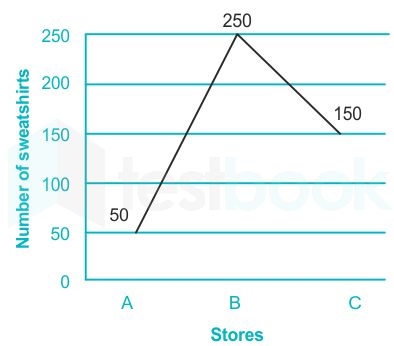
Study the given line graph and answer the following question.

The given line graph depicts the number of sweatshirts in stores A, B and C.

Out of the number of sweatshirts in stores A and B, 20% and 40%, respectively were sold. What is the total number of sweatshirts sold by stores A and B?

  1. AOption (a)

    90

  2. BOption (b)

    110

  3. COption (c)

    120

  4. DOption (d)

    130

View answer & explanation

Correct answer

Answer: (b)B.

110

Why this answer is correct

Given:

The given line graph depicts the number of sweatshirts in stores A, B and C.

Out of the number of sweatshirts in stores A and B, 20% and 40%, respectively were sold.

Formula Used:

Number of sweatshirts sold by Store A = Total sweatshirts in Store A × (20/100)

Number of sweatshirts sold by Store B = Total sweatshirts in Store B × (40/100)

Total number of sweatshirts sold by stores A and B = Number of sweatshirts sold by Store A + Number of sweatshirts sold by Store B

Calculations:

Let the total number of sweatshirts in Store A be 150 (as per the line graph).

Let the total number of sweatshirts in Store B be 200 (as per the line graph).

Number of sweatshirts sold by Store A = 150 × (20/100)

⇒ Number of sweatshirts sold by Store A = 150 × 0.20

⇒ Number of sweatshirts sold by Store A = 30

Number of sweatshirts sold by Store B = 200 × (40/100)

⇒ Number of sweatshirts sold by Store B = 200 × 0.40

⇒ Number of sweatshirts sold by Store B = 80

Total number of sweatshirts sold by stores A and B = 30 + 80

⇒ Total number of sweatshirts sold by stores A and B = 110

∴ The correct answer is option (2).

Question 47

If the length of a rectangle is twice its breadth and the perimeter of that rectangle is 42 cm, then find its length (in cm).

  1. AOption (a)

    14

  2. BOption (b)

    8

  3. COption (c)

    7

  4. DOption (d)

    11

View answer & explanation

Correct answer

Answer: (a)A.

14

Why this answer is correct

Shortcut Trick

Ratio of Length to Breadth = 2 : 1

Perimeter ratio = 2 × (2 + 1) = 6 units

6 units = 42 cm ⇒ 1 unit = 7 cm

Length = 2 units = 2 × 7 = 14 cm

∴ The correct answer is 14 cm.

Alternate Method

Given:

Perimeter of rectangle = 42 cm

Length (L) = 2 × Breadth (B)

Formula Used:

Perimeter = 2 × (L + B)

Calculations:

Let the breadth be x cm.

⇒ Length = 2x cm

⇒ 42 = 2 × (2x + x)

⇒ 42 = 2 × 3x

⇒ 42 = 6x

⇒ x = 42 ÷ 6 = 7 cm

⇒ Length = 2 × 7 = 14 cm

∴ The correct answer is 14 cm.

Additional Information

Area of Rectangle

The total space occupied by the shape, calculated as Area = Length × Breadth.

Diagonal of Rectangle

The distance between opposite corners, given by the formula Diagonal = √(L2 + B2).

Properties of Rectangle

Opposite sides are equal and parallel, and all interior angles are 90°.

Question 48

The mathematical form of Ohm's law is represented as ________.(Here V = potential difference, I = current flowing through a conductor and R = Resistance.)

  1. AOption (a)

    I = R2/V

  2. BOption (b)

    I = V/R

  3. COption (c)

    V = I/R

  4. DOption (d)

    I = R/V

View answer & explanation

Correct answer

Answer: (b)B.

I = V/R

Why this answer is correct

The correct answer is I=V/R

Key Points

  • Ohm's Law:
  • The current flowing through a wire is directly proportional to the potential difference applied across its ends, provided the physical conditions such as temperature remains unchanged.
  • V = IR
  • Where V = potential difference, R = resistance and I = current.

Additional Information

  • Ohm's law states that the current through a conductor between two points is directly proportional to the voltage across the two points, given that the physical conditions such as length or temperature of wire remain constant.
  • The current flowing through a wire is inversely proportional to its resistance i.e., more the resistance less will be the current and vice - versa.
  • Ohm's law states that current flowing through a wire is directly proportional to the potential difference applied across its ends.

Question 49

In this question, the statement is followed by four conclusions. Find out which conclusion is true based on the given statement:

Statement: G < L < T > Y = V ≥ P > X

  1. AOption (a)

    P ≤ Y

  2. BOption (b)

    G < Y

  3. COption (c)

    G ≤ T

  4. DOption (d)

    Y > L

View answer & explanation

Correct answer

Answer: (a)A.

P ≤ Y

Why this answer is correct

Given Statement: G < L < T > Y = V ≥ P > X

Now,

Conclusions:

Option 1: P ≤ Y → True (Y = V ≥ P It gives Y ≥ P)

Option 2: G < Y → False (G < L < T > Y No definite conclusion can be possible between G and Y)

Option 3: G ≤ T → False (G < L < T It gives G < T)

Option 4: Y > L → False (L < T > Y No definite conclusion can be possible between Y and L)

Hence, the correct answer is "Option 1".

Question 50

Under the Constitutional Article243 (C), who decides on the composition of the Panchayat? 

  1. AOption (a)

    Council of States

  2. BOption (b)

    Legislature of State

  3. COption (c)

    State Assembly

  4. DOption (d)

    Lok Sabha

View answer & explanation

Correct answer

Answer: (b)B.

Legislature of State

Why this answer is correct

The correct answer is Legislature of State. 

Key Points

  • Article 243 (C) of the Indian constitution deals with the Composition of Panchayats.
  • The State Legislature has the power to make provisions for the Composition of Panchayats.
  • All the seats in all the levels of Panchayati Raj shall be filled with the direct election.
  • The Chairperson of the Village Panchayat is elected in such a manner as the State Legislature defines.
  • The Chairperson of the Block and District Level is elected from amongst the elected members.
  • Representation:
  • The State Legislature can initiate the representation of the following members in the Block and District Panchayat:
  • Chairperson of Village Panchayat in the Panchayat at the Block or district level.
  • Chairperson of Block Panchayat in the Panchayat at the District level.
  • Members of the State Legislature and Parliament.
  • An exemption is given for the formation of Janpad Panchayat to those states who are having less than 20 lakh population.

Additional Information 

  • The provisions related to the Panchyati Raj System are mentioned in Part IX of the Indian constitution.
  • Part IX contains provisions relating to Panchayati Raj up to Articles 243-243O under the title 'Panchayats'.
  • This part is added by the 73rd Constitutional Amendment Act 1992.
  • The 11th Schedule and the list of 29 subjects were added to the Constitution by the 73rd Constitutional Amendment.
  • The purpose of the Act is to provide a three-tier system of Panchayati Raj, including:
  • Village-level - Gram Panchayat
  • Block-level - Janpad Panchayat
  • District-level - Zila Parishad

Question 51

What is the best option for a woman who is about to give birth?

  1. AOption (a)

    Adequate rest and nutritional intake for one week before delivery 

  2. BOption (b)

    Hire a certified nurse to assist with delivery

  3. COption (c)

    Surgery to remove the baby (caesarean section)

  4. DOption (d)

    Delivery in a hospital with proper equipment

View answer & explanation

Correct answer

Answer: (d)D.

Delivery in a hospital with proper equipment

Why this answer is correct

The correct answer is Delivery in a hospital with proper equipment

Key Points

  • ​Hospitals are equipped with medical professionals and facilities to handle normal and complicated deliveries,
  • It ensures the safety of both the mother and the baby.
  • Delivery in a hospital provides access to emergency interventions, such as a caesarean section if necessary, and postnatal care for the mother and newborn.
  • The ultimate choice should align with the woman’s health, pregnancy conditions, and professional medical advice.

Additional Information

  • A woman who has just given birth to a baby is termed, Puerpera.
  • Primigravida is a woman who has conceived pregnancy for the first time.
  • Parturient is the woman who is about to give birth.
  • Primipara is a woman who is giving birth for the first time
  • In humans, the term gravidity refers to the number of times a woman is pregnant.
  • The term gravida can be used to refer a pregnant women
  • A Nulligravida woman is one who has never been pregnant
  • A Multigravida is a woman who has been pregnant more than on times
  • Parity is referred to the number of times the woman has carried the pregnancy for 20 weeks

Question 52

Which hormone helps the body to adjust to stress when one is very angry, embarrassed or worried?

  1. AOption (a)

    Adrenalin

  2. BOption (b)

    Thyroxine

  3. COption (c)

    Estrogen

  4. DOption (d)

    Testosterone

View answer & explanation

Correct answer

Answer: (a)A.

Adrenalin

Why this answer is correct

The correct answer is Adrenalin.

Key Points 

  • Adrenalin 
  • Adrenalin helps the body to adjust to stress when one is very angry, embarrassed, or worried.
  • Adrenaline, also known as epinephrine, is a hormone and medication involved in regulating visceral functions (e.g., respiration).
  • It appears as a white microcrystalline granule. Adrenaline is usually produced by the adrenal glands and by a small number of neurons in the medulla oblongata.
  • It plays an essential role in the fight-or-flight response by increasing blood flow to muscles, heart output by acting on the SA node, pupil dilation response, and blood sugar level.

Additional Information

HormoneSourceKey FunctionsHighlights
Thyroxine (T4)Thyroid Gland- Regulates metabolism
- Supports growth and development
- Maintains body temperature
- Requires iodine for synthesis.
- Imbalance leads to hypothyroidism or hyperthyroidism.
- Essential for energy production and utilization.
EstrogenOvaries (main source in females); Adrenal glands (in both sexes)- Develops female secondary sexual characteristics
- Regulates menstrual cycle
- Supports pregnancy
- Dominant hormone in females during the reproductive phase.
- Also plays a role in bone density and cardiovascular health.
TestosteroneTestes (main source in males); Adrenal glands (in both sexes)- Develops male secondary sexual characteristics
- Promotes muscle and bone mass
- Influences libido
- Dominant hormone in males.
- Crucial for sperm production.
- Low levels can cause fatigue, loss of muscle mass, and low libido.

Question 53

Which blood cells help in clotting of blood and stop bleeding?

  1. AOption (a)

    Red blood cells

  2. BOption (b)

    Both platelets and red blood cells

  3. COption (c)

    Platelets

  4. DOption (d)

    White blood cells

View answer & explanation

Correct answer

Answer: (c)C.

Platelets

Why this answer is correct

The correct answer is platelets.

Key Points

  • Blood is a body fluid in humans and other animals that delivers necessary substances such as nutrients and oxygen to the cells and transports metabolic waste products away from those same cells.
  • Platelets are also known as thrombocytes.
  • Platelets are tiny blood cells that help your body form clots to stop bleeding.
  • If one of your blood vessels gets damaged, it sends out signals to the platelets.
  • The platelets then rush to the site of damage and form a plug (clot) to fix the damage.
  • The process of spreading across the surface of a damaged blood vessel to stop bleeding is called adhesion.
  • This is because when platelets get to the site of the injury, they grow sticky tentacles that help them stick (adhere) to one another.
  • They also send out chemical signals to attract more platelets.
  • The additional platelets pile onto the clot in a process called aggregation.

Additional Information 

  • Human blood is composed of blood cells and blood plasma.
  • Blood cells consist of erythrocytes (RBC), leukocytes (WBC).
  • The function of RBC is to distribute oxygen to each cell of the body.
  • WBC are responsible for the immune system of the body.
  • White blood cells are further divided into eosinophil, basophil, monocyte, lymphocyte, and neutrophils.
  • A monocyte is a type of white blood cell and a type of phagocyte.

Question 54

Which of the following sports is NOT covered in the National Air Sports Policy 2022 of India?

  1. AOption (a)

    Ballooning

  2. BOption (b)

    Rally Flying

  3. COption (c)

    Drones

  4. DOption (d)

    Aerobics

View answer & explanation

Correct answer

Answer: (b)B.

Rally Flying

Why this answer is correct

The correct answer is Rally Flying

Key Points

  • The National Air Sports Policy 2022 (NASP 2022) aims to promote and regulate air sports in India, encouraging safe and sustainable development of air sports activities.
  • The policy includes a variety of air sports such as:
  • Ballooning: Recreational and competitive flying of hot air balloons.
  • Drones: Unmanned aerial vehicles used for sport, photography, and other applications.
  • Paragliding and Hang Gliding: Gliding activities that involve flying lightweight, free-flying, foot-launched gliders.
  • Skydiving: A sport involving jumping from aircraft and performing aerial maneuvers before deploying a parachute.
  • Aeromodelling: The design and operation of small aircraft models.
  • Aerobatics: Precision flying involving complex maneuvers in aircraft.
  • Rally Flying, a sport that involves precision navigation and timing with small aircraft, is not explicitly covered under the National Air Sports Policy 2022.
  • The policy primarily focuses on air sports that are more recreational or competitive in nature, involving individual participation or lightweight equipment.

Additional Information

  • Taking another step in the direction of making India one of the top air sports nations by 2030, the Union Ministry of Civil Aviation announced the country’s first 'National Air Sports Policy' in June 2022.
  • The policy will cover air sports such as aerobatics, aeromodelling, model rocketry, amateur-built and experimental aircraft, ballooning, drones, gliding, and powered gliding, hang-gliding and powered hang-gliding, parachuting (including skydiving, Base jumping, and wingsuit flying), paragliding and paramotoring (including powered parachute trikes), powered aircraft and rotorcraft.
  • The Air Sports Federation of India (ASFI) will be the apex governing body for this initiative.
  • This federation will be chaired by Civil Aviation Ministry Secretary Rajiv Bansal.
  • The ASFI is an autonomous body and will present India at the Fédération Aéronautique Internationale (FAI) and other global platforms related to air sports.

Question 55

What is the highest common prime factor of 7140 and 13200?

  1. AOption (a)

    3

  2. BOption (b)

    5

  3. COption (c)

    11

  4. DOption (d)

    2

View answer & explanation

Correct answer

Answer: (b)B.

5

Why this answer is correct

Shortcut Trick

Highest common prime factor means the largest prime number that divides both given numbers.

Check options starting from the largest prime: 11.

Sum of digits of 7140 at odd/even places → (7+4) − (1+0) = 10 (not divisible by 11).

Check next largest prime from options: 5.

Both 7140 and 13200 end in 0, so both are divisible by 5.

∴ The correct answer is 5.

Alternate Method

Given: Numbers 7140 and 13200.

Formula Used: Prime Factorization method.

⇒ Prime factorization of 7140 = 2 × 2 × 3 × 5 × 7 × 17

⇒ Prime factorization of 13200 = 2 × 2 × 2 × 2 × 3 × 5 × 5 × 11

⇒ Common prime factors are {2, 3, 5}.

⇒ Highest among common prime factors = 5.

∴ The correct answer is 5.

Additional Information

Prime Numbers

Numbers with exactly two factors: 1 and itself (e.g., 2, 3, 5, 7, 11, 13, 17, ...).

Highest Common Factor (HCF)

HCF is the product of the lowest powers of common prime factors. Here, HCF = 22 × 3 × 5 = 60.

Divisibility Rule of 5

A number is divisible by 5 if its last digit is either 0 or 5.

Question 56

Anaerobic respiration of glucose in the muscles produces __________.

  1. AOption (a)

    acetoacetic acid

  2. BOption (b)

    citric acid

  3. COption (c)

    lactic acid

  4. DOption (d)

    pyruvic acid

View answer & explanation

Correct answer

Answer: (c)C.

lactic acid

Why this answer is correct

The correct answer is Lactic acid 

Key Points 

  • Cellular respiration is a breakdown of a complex molecule into simpler forms and also results in the release of energy.
  • In the presence of oxygen aerobic respiration occurs.
  • In the absence of oxygen anaerobic respiration occurs.
  • Anaerobic respiration in our body muscles produces Lactic acid and energy.
  • In the absence of oxygen, pyruvate is converted to form lactic acid, and energy is released.
  • It leads to muscle cramps and pain.

Additional Information

CompoundChemical FormulaKey Role/Function
Acetoacetic AcidC4​H6​O3​- Intermediate in ketone body metabolism.
- Provides energy during fasting or low carbohydrate intake.
Citric AcidC6​H8​O7​- Key intermediate in the Krebs Cycle (TCA Cycle).
- Facilitates energy production in mitochondria.
Pyruvic AcidC3​H4​O3​- End product of glycolysis.
- Converted to acetyl-CoA, lactate, or oxaloacetate for further metabolism.

Question 57

In September 2021, India's first pan-India toll-free helpline – 14567 which aims to provide information, guidance, emotional support, and in cases of abuse, immediate assistance too, was officially launched by the Ministry of Social Justice and Empowerment. What is this line called?

  1. AOption (a)

    Elder line

  2. BOption (b)

    Sampark line

  3. COption (c)

    Senior line

  4. DOption (d)

    Sahyog line

View answer & explanation

Correct answer

Answer: (a)A.

Elder line

Why this answer is correct

The correct answer is the Elder line

Key Points

  • Elder line’, the first Pan-India toll-free helpline number for senior citizen
  • The Ministry of Social Justice and Empowerment on September 28, 2021, launched the Elder Line, the first Pan-India toll-free helpline number 14567 for senior citizens.
  • The helpline number for senior citizens is called the ‘Elder Line’.
  • The senior citizen's helpline number will provide free information and guidance on pension and legal issues, intervene in cases of abuse, and extend emotional support.
  • With the COVID-19 pandemic, the elderly population has been facing many challenges such as social isolation, abuse, neglect, and financial penury.

Additional Information

HelplinePurposeTarget Group
Sampark LineProvides support for communication and queries related to public services or utilities.General public
Senior LineDedicated helpline for addressing issues faced by senior citizens, including health and safety.Senior citizens
Sahyog LineOffers counseling and support for individuals in distress or in need of guidance.Individuals in distress

Question 58

Read the given statements and conclusions carefully. Assuming that the information given in the statements is true, even if it appears to be at variance with commonly known facts, decide which of the given conclusions logically follow(s) from the statements.

Statements:

All chocolates are balls.

All balls are festivals.

Some festivals are tennis.

Conclusions:

(I) All chocolates are festivals.

(II) Some balls are tennis.

  1. AOption (a)

    Only conclusion (II) follows.

  2. BOption (b)

    Only conclusion (I) follows.

  3. COption (c)

    Both conclusion (I) and conclusion (II) follow.

  4. DOption (d)

    Both conclusion (I) and conclusion (II) do not follow.

View answer & explanation

Correct answer

Answer: (b)B.

Only conclusion (I) follows.

Why this answer is correct

Statements:

All chocolates are balls.

All balls are festivals.

Some festivals are tennis.

The least possible Venn diagram is as follows:

Conclusions:

(I) All chocolates are festivals. - True (because All chocolates are balls and All balls are festivals. So, All chocolates are festivals too)

(II) Some balls are tennis. - False (because there is no direct relation between balls and tennis. So, it can be possible but not definite)

Hence, the correct answer is "Only conclusion (I) follows".

Question 59

Which of the following statements is INCORRECT about the rivers of India? 

  1. AOption (a)

    The Krishna River rises near Mahabaleshwar in Sahyadri.

  2. BOption (b)

    The Kaveri rises in Brahmagiri hills of Kogadu district in Karnataka.

  3. COption (c)

    The Mahanadi rises near Sihawa in Raipur district of Chhattisgarh.

  4. DOption (d)

    The Godavari rises in the Jabalpur district of Madhya Pradesh.

View answer & explanation

Correct answer

Answer: (d)D.

The Godavari rises in the Jabalpur district of Madhya Pradesh.

Why this answer is correct

The correct answer is The Godavari rises in the Jabalpur district of Madhya Pradesh

Key Points

  • The Godavari River actually rises from Trimbak near Nashik in the state of Maharashtra, not Jabalpur in Madhya Pradesh.
  • It is the second-longest river in India, often referred to as the "Dakshina Ganga."
  • The Godavari River has one of the largest drainage basins in India, covering parts of Maharashtra, Telangana, Andhra Pradesh, Chhattisgarh, and Odisha.
  • It plays a vital role in irrigation, water supply, and agriculture in these regions.
  • Major tributaries of the Godavari include the Manjira, Pranhita, Indravati, Sabari, and Purna Rivers, which contribute significantly to its flow and make it a lifeline for the Deccan Plateau.

Additional Information

  • Krishna River
  • The Krishna River is the fourth-longest river in India, stretching approximately 1,400 km.
  • It flows through Maharashtra, Karnataka, Telangana, and Andhra Pradesh before emptying into the Bay of Bengal.
  • Major Tributaries: Important tributaries include the Tungabhadra, Bhima, Ghataprabha, Malaprabha, and Musi Rivers.
  • Kaveri River
  • The Kaveri is often referred to as the Ganga of the South due to its religious importance in South India.
  • The river forms a fertile delta in Tamil Nadu, supporting agriculture and earning the region the nickname "Rice Bowl of Tamil Nadu."
  • Mahanadi River
  • With a length of approximately 858 km, the Mahanadi is a major river in East-Central India, primarily flowing through Chhattisgarh and Odisha.
  • The river is home to the Hirakud Dam, one of the longest dams in the world, which provides irrigation, hydroelectric power, and flood control.

Question 60

Which of the following letter-number clusters will replace the question mark (?) in the given series to make it logically complete?

P3WJ, R10TO, T24QT, V45NY, ?

  1. AOption (a)

    X73KD

  2. BOption (b)

    X67KC

  3. COption (c)

    X73LD

  4. DOption (d)

    X67KD

View answer & explanation

Correct answer

Answer: (a)A.

X73KD

Why this answer is correct

The logic followed here is:

Hence, the correct answer is "X73KD".

Question 61

Which of the following statements with regard to the principal axis of a spherical mirror is/are correct?

(a) The pole on the principal axis is similar to the origin of a Cartesian coordinate axes plane.

(b) Distances measured from the pole, along the principal axis opposite to the direction of incident light are negative.

(c) Heights of objects or images above the principal axis and perpendicular to it are considered negative.

  1. AOption (a)

    (a), (b) and (c)

  2. BOption (b)

    Only (a) and (b)

  3. COption (c)

    Only (a) and (c)

  4. DOption (d)

    Only (b) and (c)

View answer & explanation

Correct answer

Answer: (b)B.

Only (a) and (b)

Why this answer is correct

The correct answer is Only (a) and (b)

Key Points

  • (a) The pole on the principal axis is similar to the origin of a Cartesian coordinate axes plane.
  • The pole of a spherical mirror is the point where the principal axis intersects the mirror.
  • It serves as the reference point for measuring distances along the principal axis.
  • This is conceptually similar to the origin of a Cartesian coordinate system.
  • This statement is correct.
  • (b) Distances measured from the pole, along the principal axis opposite to the direction of incident light are negative.
  • According to the New Cartesian Sign Convention for spherical mirrors:
  • Distances measured against the direction of incident light are considered negative.
  • Distances measured in the direction of incident light are positive.
  • Thus, the statement aligns with this convention.
  • This statement is correct.
  • (c) Heights of objects or images above the principal axis and perpendicular to it are considered negative.
  • According to the New Cartesian Sign Convention:
  • Heights above the principal axis are taken as positive.
  • Heights below the principal axis are taken as negative.
  • Therefore, this statement contradicts the correct convention.
  • This statement is incorrect.
  • The correct statements are: (a) and (b).

Additional Information

  • A spherical mirror is simply a piece cut out of a reflective sphere.
  • The first mirror was made by German Scientist Justus von Liebig.
  • He coated the plane surface of a piece of ordinary glass with silver metal to make this mirror.
  • Such a mirror is called a silvered glass mirror.
  • There are two types of spherical mirrors: concave and convex mirrors.
  • If the mirror's inside surface is reflective, the mirror is concave.
  • if the mirror's outside is reflective, it's a convex mirror.

Question 62

What is the name of the mission in which there is an attempt to boost Research and Development in the country by enabling and grooming potential PG / PhD level students by developing dedicated research skills in selected areas / disciplines / fields through high-end workshops and Training and Skill Internship?

  1. AOption (a)

    KARYASHALA

  2. BOption (b)

    VRITIKA

  3. COption (c)

    DAKSHATA

  4. DOption (d)

    ABHYAAS

View answer & explanation

Correct answer

Answer: (d)D.

ABHYAAS

Why this answer is correct

The correct answer is ABHYAAS.

Key Points

  • ABHYAAS is a mission aimed at boosting Research and Development in India.
  • It focuses on grooming potential PG/PhD level students by developing their research skills.
  • The program includes high-end workshops and Training and Skill Internships in selected areas/disciplines/fields.
  • The mission is designed to create a dedicated pool of skilled researchers who can contribute significantly to various fields of study.

Additional Information

  • KARYASHALA
  • KARYASHALA is an initiative aimed at providing hands-on training and skill development for students.
  • It focuses on short-term training programs and workshops.
  • The goal is to enhance the practical skills of students in various domains.
  • VRITIKA
  • VRITIKA is a program designed to provide internships for students in the field of research.
  • It focuses on nurturing the research talent of students by offering them exposure to real-world research projects.
  • The program aims to bridge the gap between academic knowledge and practical research skills.
  • DAKSHATA
  • DAKSHATA aims to improve the skill set of individuals in specific areas.
  • The program includes training sessions, workshops, and seminars to develop domain-specific expertise.
  • It is focused on creating a skilled workforce in various industries.

Question 63

A certain sum under simple interest at a certain rate of interest per annum amounts to Rs. 1,200 in 2 years and to Rs. 1,500 in 3 years. The rate of interest per annum is:

  1. AOption (a)

    10%

  2. BOption (b)

    25%

  3. COption (c)

    50%

  4. DOption (d)

    15%

View answer & explanation

Correct answer

Answer: (c)C.

50%

Why this answer is correct

Shortcut Trick

Interest for 1 year (3rd year − 2nd year) = 1500 − 1200 = ₹300

Principal (Amount in 2 years − Interest for 2 years) = 1200 − (2 × 300) = ₹600

Rate % = (Interest per year / Principal) × 100 = (300 / 600) × 100 = 50%

∴ The correct answer is 50%.

Alternate Method

Given:

Amount after 2 years (A2) = ₹1,200

Amount after 3 years (A3) = ₹1,500

Formula Used:

Simple Interest (SI) = (P × R × T) / 100

Amount (A) = Principal (P) + Simple Interest (SI)

Calculations:

⇒ Interest for 1 year = A3 − A2

⇒ Interest for 1 year = 1500 − 1200 = ₹300

⇒ Interest for 2 years = 300 × 2 = ₹600

⇒ Principal (P) = A2 − (Interest for 2 years)

⇒ P = 1200 − 600 = ₹600

⇒ Now, using SI = (P × R × T) / 100 for 1 year:

⇒ 300 = (600 × R × 1) / 100

⇒ 300 = 6 × R

⇒ R = 300 / 6 = 50%

∴ The correct answer is 50%.

Additional Information

Simple Interest Property

In Simple Interest, the interest earned remains constant every year because it is always calculated on the original Principal.

Finding Principal from Amounts

If a sum amounts to A1 in T1 years and A2 in T2 years, SI for (T2 − T1) years is (A2 − A1).

Relationship between SI and CI

For the first year, if the interest is compounded annually, the Simple Interest and Compound Interest on a certain sum at the same rate are equal.

Question 64

The power of an electric equipment through which a charge of 15 coulomb is flowing per 5 seconds when it is connected to a 20 V source is __________.

  1. AOption (a)

    60 calorie

  2. BOption (b)

    1500 calorie

  3. COption (c)

    1500 watt

  4. DOption (d)

    60 watt

View answer & explanation

Correct answer

Answer: (d)D.

60 watt

Why this answer is correct

The correct answer is 60 watt

Key Points

  • Given 
  • We have a charge (Q) of 15 Coulombs flowing.
  • This charge flows in a time (t) of 5 seconds.
  • The equipment is connected to a voltage source (V) of 20 Volts.
  • Calculating the current (I):
  • Electric current is defined as the rate of flow of electric charge.
  • In simpler terms, it tells us how much charge is passing through a point in a circuit per unit of time.
  • The formula for current is: I = Q / t
  • Plugging in the given values: I = 15 Coulombs / 5 seconds = 3 Amperes (A)
  • Calculating the power (P):
  • Power in an electrical circuit represents the rate at which electrical energy is transferred or consumed.
  • The formula for power in terms of voltage and current is: P = V * I
  • Plugging in the calculated current and the given voltage: P = 20 Volts * 3 Amperes = 60 Watts (W)

Important Points

  • Understanding the units:
  • Coulomb (C) is the unit of electric charge.
  • Second (s) is the unit of time.
  • Ampere (A) is the unit of electric current.
  • Volt (V) is the unit of electric potential difference (voltage).
  • Watt (W) is the unit of power.

Question 65

Six friends are sitting around a round table facing the centre with equal distances between two neighbours. Wasim is second to the right of Muskan. Ekta is sitting to the immediate left of Rohit. Anushri is sitting third to the left of Wasim. Suresh is second to the left of Ekta. Who is to the immediate right of Wasim?

  1. AOption (a)

    Suresh

  2. BOption (b)

    Muskan

  3. COption (c)

    Ekta

  4. DOption (d)

    Rohit

View answer & explanation

Correct answer

Answer: (c)C.

Ekta

Why this answer is correct

Given: Six friends are sitting around a round table facing the centre with equal distances between two neighbours.

  1. Wasim is second to the right of Muskan.

2) Anushri is sitting third to the left of Wasim.

  1. Ekta is sitting to the immediate left of Rohit.

  2. Suresh is second to the left of Ekta.

So, Ekta is to the immediate right of Wasim.

Hence, the correct answer is "Ekta".

Question 66

Seven boxes A, B, C, D, E, F and G are kept one over the other but not necessarily in the same order. Only two boxes are kept above C. Only E is kept between D and F. G is kept immediately below F. B is kept immediately below A. Only C is kept between B and D. How many boxes are kept between B and F?

  1. AOption (a)

    One

  2. BOption (b)

    Four

  3. COption (c)

    Three

  4. DOption (d)

    Two

View answer & explanation

Correct answer

Answer: (c)C.

Three

Why this answer is correct

Given: Seven boxes A, B, C, D, E, F and G are kept one over the other but not necessarily in the same order.

  1. Only two boxes are kept above C.

  2. Only C is kept between B and D.

3) B is kept immediately below A.

A
B
C
D


  1. Only E is kept between D and F.

5) G is kept immediately below F. 

A
B
C
D
E
F
G


So, there are 'Three' boxes are kept between B and F.

Hence, the correct answer is "Option 3".

Question 67

As per performance of the Indian states, which of the following states was in the 'Front Runner' category in the NITI Aayog SDG India Index 2020 - 21?

  1. AOption (a)

    Tripura

  2. BOption (b)

    Manipur

  3. COption (c)

    Madhya Pradesh

  4. DOption (d)

    West Bengal

View answer & explanation

Correct answer

Answer: (a)A.

Tripura

Why this answer is correct

The correct answer is Tripura

Key Points

  • According to the NITI Aayog SDG India Index 2020-21, Tripura was classified under the 'Front Runner' category for its performance on achieving the Sustainable Development Goals (SDGs).
  • The NITI Aayog SDG India Index tracks the progress of states and union territories in achieving the Sustainable Development Goals (SDGs) set by the United Nations.
  • The 2020-21 edition ranked the states in four categories:
  • Front Runner: States that have performed well and are on track to achieve the SDGs.
  • Achiever: States that have made significant progress but still need to make improvements in some areas.
  • Performer: States that are showing progress but need further efforts to meet SDG targets.
  • Aspirant: States that are lagging behind in achieving SDG targets.

Additional Information

  • Uttarakhand, Gujarat, Maharashtra, Mizoram, Punjab, Haryana, Tripura, Delhi, Lakshadweep, Andaman and Nicobar Islands, Jammu and Kashmir and Ladakh graduated to the category of Front-Runners (scores between 65 and 99, including both).

Question 68

If '+' means '-', '-' means '÷', '÷' means '×', '×' means '+', what will come in place of the question mark (?) in the following equation?

78 × 3 - 2 ÷ 6 + 4 = ?

  1. AOption (a)

    72

  2. BOption (b)

    91

  3. COption (c)

    83

  4. DOption (d)

    45

View answer & explanation

Correct answer

Answer: (c)C.

83

Why this answer is correct

Given: 78 × 3 - 2 ÷ 6 + 4 = ?

Decoding the given information:

Symbol+-×÷
Means-÷+×


Now replacing the sign from left to right using BODMAS Rule, we get:

⇒ 78 + 3 ÷ 2 × 6 - 4

= 78 + 9 - 4

⇒ 87 - 4 = 83

Hence, the correct answer is "Option 3".

Question 69

A concave mirror of focal length f produces a real image at a distance v from the pole, when an object is kept at the distance u from the pole. Here, focal length of the given mirror is:

  1. AOption (a)

    (1/v) - (1/u)

  2. BOption (b)

    (1/u) - (1/v)

  3. COption (c)

    (u v) / (u + v)

  4. DOption (d)

    (u + v) / (u v)

View answer & explanation

Correct answer

Answer: (c)C.

(u v) / (u + v)

Why this answer is correct

The correct answer is (u v) / (u + v) 

Key Points

  • The mirror formula is given by:
  • 1/f = 1/v + 1/u
  • where:
  • f is the focal length
  • v is the image distance
  • u is the object distance 
  • We are given that the image is real, which means v is positive.
  • Since it's a concave mirror, the focal length f is also considered positive in this sign convention.
  • The object is always placed in front of the mirror, so u is negative.
  • However, in the standard form of the mirror equation as it is usually written, the negative sign is incorporated into the u term when substituting values.
  • From the mirror formula, we can express the focal length f as:
  • 1/f = (u + v) / (uv)
  • Therefore,
  • f = (uv) / (u + v)

Question 70

A man crosses a 375 m road in 75 sec. His speed (in km/h) is: 

  1. AOption (a)

    15

  2. BOption (b)

    18

  3. COption (c)

    13

  4. DOption (d)

    20

View answer & explanation

Correct answer

Answer: (b)B.

18

Why this answer is correct

Shortcut Trick

Speed in m/s = Distance ÷ Time = 375 ÷ 75 = 5 m/s.

To convert m/s to km/h, multiply by 18/5.

Speed = 5 × (18/5) = 18 km/h.

∴ The correct answer is 18 km/h.

Alternate Method

Given:

Distance = 375 m

Time = 75 sec

Formula Used:

Speed = Distance ÷ Time

Conversion: 1 m/s = (18/5) km/h

⇒ Speed (m/s) = 375 ÷ 75

⇒ Speed = 5 m/s

⇒ Speed (km/h) = 5 × (18/5)

⇒ Speed = 18 km/h

∴ The correct answer is 18 km/h.

Additional Information

Unit Conversion Rules

To convert km/h to m/s, multiply by 5/18. To convert m/s to km/h, multiply by 18/5.

Average Speed

Average Speed = Total Distance ÷ Total Time. For two equal distances at speeds x and y, Average Speed = 2xy/(x+y).

Relative Speed

When two objects move in the same direction, subtract speeds (S1−S2). In opposite directions, add speeds (S1+S2).

Question 71

Which of the following is a correct nomenclature of the given structure?

CH3CH2OH

  1. AOption (a)

    Ethan - 1 - ol

  2. BOption (b)

    Methan - 1 - ol

  3. COption (c)

    Ethan - 2 - ol

  4. DOption (d)

    Methan - 2 - ol

View answer & explanation

Correct answer

Answer: (a)A.

Ethan - 1 - ol

Why this answer is correct

The correct answer is Ethan - 1 - ol

Key Points

  • The given structure is CH3CH2OH.
  • This is a two-carbon chain with an -OH (alcohol) functional group.
  • A one-carbon chain is named methane.
  • A two-carbon chain is named ethane.
  • Since there are two carbons, the base name is ethane.
  • The -OH group is on the first carbon (you start numbering from the end closest to the functional group).
  • So, the correct name is ethanol, or more formally, ethan-1-ol.

Additional InformationThe key to naming organic molecules is to:

  • Identify the longest carbon chain: This gives you the base name (methane, ethane, propane, etc.).
  • Identify the functional group: This determines the suffix (-ol for alcohols, -al for aldehydes, -one for ketones, etc.).
  • Number the chain: Start numbering from the end closest to the functional group to give it the lowest possible number.

Question 72

Which of the following rules or laws correctly describe the direction of force, magnetic field and current at the same instant?

  1. AOption (a)

    Ampere's circuital law

  2. BOption (b)

    Right hand thumb rule

  3. COption (c)

    Fleming's left hand rule

  4. DOption (d)

    Palm rule

View answer & explanation

Correct answer

Answer: (c)C.

Fleming's left hand rule

Why this answer is correct

The correct answer is Fleming's left hand rule

Key Points

  • Fleming's left-hand rule:
  • According to Fleming's left-hand rule, if the thumb, forefinger, and middle finger of the left hand are stretched to be perpendicular to each other and if the forefinger represents the direction of the magnetic field, the middle finger represents the direction of the current, then the thumb represents the direction of the force.
  • Fleming's left-hand rule is applicable for motors.
  • Example:
  • If a conductor carrying current is placed in a magnetic field, and you need to find the direction in which the conductor will move:
  • Place your left hand as per the rule, aligning the forefinger with the magnetic field and the middle finger with the current. The thumb will then indicate the direction of the force acting on the conductor.

Additional Information

  • Fleming's right-hand rule:
  • According to Fleming's right-hand rule, the thumb, forefinger, and middle finger of the right hand are stretched to be perpendicular to each other and if the thumb represents the direction of the movement of the conductor, the fore-finger represents the direction of the magnetic field, then the middle finger represents the direction of the induced current.
  • It is used used to determine the direction of current in a generator's windings.

​

Question 73

MUDRA refers to ___________

  1. AOption (a)

    Micro Units Development and Refinance Agency

  2. BOption (b)

    Medium Units Development Regulatory Association

  3. COption (c)

    Medium Units Developed and Refinance Association

  4. DOption (d)

    Micro Units Developing and Regulatory Agency

View answer & explanation

Correct answer

Answer: (a)A.

Micro Units Development and Refinance Agency

Why this answer is correct

The correct answer is Micro Units Development and Refinance Agency

Key Points

  • Micro stands for micro enterprises, which are the primary focus of the MUDRA (Micro Units Development and Refinance Agency) Yojana.
  • MUDRA Yojana was launched by the Government of India to provide funding to the non-corporate, non-farm small/micro enterprises.
  • The scheme aims to support the growth and development of micro-enterprises in India by providing financial assistance up to Rs. 10 lakh.
  • MUDRA loans are categorized into three products: Shishu (covering loans up to Rs. 50,000), Kishor (covering loans above Rs. 50,000 and up to Rs. 5 lakh), and Tarun (covering loans above Rs. 5 lakh and up to Rs. 10 lakh).
  • The initiative is aimed at promoting entrepreneurship and employment generation at the grassroots level.

Additional Information

  • MUDRA Bank was established as a subsidiary of SIDBI (Small Industries Development Bank of India).
  • The scheme also focuses on providing financial literacy and credit counseling to micro-entrepreneurs.
  • MUDRA Yojana is part of the Pradhan Mantri MUDRA Yojana (PMMY), which was launched on 8th April 2015.
  • It aims to achieve financial inclusion by extending credit to micro-businesses, which often face difficulties in accessing formal banking channels.
  • The scheme has been instrumental in empowering women entrepreneurs and promoting inclusive growth.

Question 74

The festival 'BONALU' is celebrated in which of the following states in India?

  1. AOption (a)

    Telangana

  2. BOption (b)

    Karnataka

  3. COption (c)

    Kerala

  4. DOption (d)

    Tamil Nadu

View answer & explanation

Correct answer

Answer: (a)A.

Telangana

Why this answer is correct

The correct answer is Telangana

Key Points 

  • Bonalu is a Telangana traditional Hindu festival centered on the Goddess Mahakali.
  • This festival is celebrated annually in the twin cities of Hyderabad and Secunderabad, as well as in other parts of the state.
  • The festival is also considered a thanksgiving to the Goddess for the fulfillment of vows.
  • Other festivals of Telangana are: Bathukamma Festival, Sammakka Sarakka Jatara, Monthy Jataras, Ramzan.

Additional Information

StateFestivals
KarnatakaMysuru Dasara, Ugadi, Makar Sankranti, Varamahalakshmi Vrata
KeralaOnam, Vishu, Thrissur Pooram, Attukal Pongala
Tamil NaduPongal, Tamil New Year (Puthandu), Thaipusam, Karthigai Deepam

Question 75

In the given letter-cluster pairs, the first letter-cluster is related to the second letter-cluster following a certain logic. Study the given pairs carefully, and from the given options, select the pair that follows the same logic.

TPN ∶ XTR

LSK ∶ PWO

  1. AOption (a)

    QGD ∶ CMZ

  2. BOption (b)

    DQG ∶ ZMC

  3. COption (c)

    ZMC ∶ DQG

  4. DOption (d)

    MZC ∶ DGQ

View answer & explanation

Correct answer

Answer: (c)C.

ZMC ∶ DQG

Why this answer is correct

The logic followed here is:

TPN ∶ XTR

LSK ∶ PWO

Similarly, ZMC ∶ DQG

Hence, the correct answer is "ZMC ∶ DQG".

Question 76

Which of the following numbers will replace the question mark (?) in the given series?

30, 54, 86, 126, 174, ?

  1. AOption (a)

    208

  2. BOption (b)

    230

  3. COption (c)

    220

  4. DOption (d)

    210

View answer & explanation

Correct answer

Answer: (b)B.

230

Why this answer is correct

The logic followed here is:

Hence, the correct answer is "230".

Question 77

Ravi injured his knee while playing and it was bleeding. After some time, he noticed that the bleeding had stopped and a dark red clot had plugged the wound. Which type of cells help in blood clotting?

  1. AOption (a)

    Eosinophils

  2. BOption (b)

    Platelets

  3. COption (c)

    Red blood corpuscles

  4. DOption (d)

    Lymphocytes

View answer & explanation

Correct answer

Answer: (b)B.

Platelets

Why this answer is correct

The correct answer is Platelets

Key Points

  • Platelets, also known as thrombocytes, are responsible for blood clotting.
  • These are small, disc-shaped cells that are essential in blood clotting
  • When a blood vessel is injured, platelets gather at the site of the wound and form a clot to stop the bleeding.
  • Blood clotting, or coagulation, is a complex process that helps prevent excessive bleeding when a blood vessel is injured.

Additional Information

  • Red Blood Corpuscles (RBCs): 
  • These are also known as Erythrocytes.
  • These disc-shaped cells contain Haemoglobin and have no nucleus.
  • RBCs are produced in Bone Marrow and Spleen & Liver (in the foetus).
  • The average lifetime of RBCs is 120 days.
  • RBCs, when produced in more amount, leads to Polycythemia and if produced in lesser amount leads to Anaemia.
  • White Blood Cells:
  • WBC-white blood cells are also called leukocytes or leucocytes.
  • They are cells of the immune system, which is mainly responsible for:
  • Protecting and fighting against invading pathogens.
  • Stimulates the production of the progesterone hormone
  • Play a vital role in the human reproductive system by producing a network of blood vessels within the ovary.
  • On average, the total count of white blood cells in every microliter of blood ranges between 4 and 11 thousand, and a healthy person will produce around 80 to 100 billion white blood cells every day.
  • The lifespan of white blood cells ranges between 13 and 20 days.
  • White blood cells are nucleotide blood cells that are white in color, hence they are called white blood cells.
  • These blood cells are characterized as granulocytes and agranulocytes.

Question 78

Pankaj can do one-fifth of a piece of work in 6 days and Jagath can do one-fourth of the same work in 8 days. Find the number of days taken to complete the work if both work together. (Round the answer to one decimal place.)

  1. AOption (a)

    15.5

  2. BOption (b)

    15.8

  3. COption (c)

    16.5

  4. DOption (d)

    14.5

View answer & explanation

Correct answer

Answer: (a)A.

15.5

Why this answer is correct

Shortcut Trick

Pankaj full work time = 6 × 5 = 30 days.

Jagath full work time = 8 × 4 = 32 days.

Time taken together = (a × b) ÷ (a + b) = (30 × 32) ÷ (30 + 32) = 960 ÷ 62.

Calculation ⇒ 960 ÷ 62 ≈ 15.48 ≈ 15.5 days.

∴ The correct answer is 15.5 days.

Alternate Method

Given: Pankaj completes 1/5 work in 6 days; Jagath completes 1/4 work in 8 days.

Formula Used: Total Work = LCM of individual days; Efficiency = Total Work ÷ Days.

PersonDaysTotal WorkEfficiency
Pankaj3048016
Jagath3215

⇒ Total days for Pankaj = 6 × 5 = 30 days.

⇒ Total days for Jagath = 8 × 4 = 32 days.

⇒ Total Efficiency = 16 + 15 = 31.

⇒ Time required together = Total Work ÷ Total Efficiency = 480 ÷ 31.

⇒ Time = 15.483... ≈ 15.5 days.

∴ The correct answer is 15.5 days.

Additional Information

Combined Efficiency Rule

When two people with efficiency A and B work together, their combined efficiency is A + B, and total time = Total Work ÷ (A + B).

Work and Wages

Wages are always distributed in the ratio of work done or the ratio of efficiencies when people work for the same duration.

Question 79

Bundelkhand and Baghelkhand are part of which physical feature of India?

  1. AOption (a)

    Himalayan Mountains

  2. BOption (b)

    Coastal Plains

  3. COption (c)

    Northern Plains

  4. DOption (d)

    Peninsular Plateau

View answer & explanation

Correct answer

Answer: (d)D.

Peninsular Plateau

Why this answer is correct

The correct answer is Peninsular Plateau

Key Points

  • Bundelkhand and Baghelkhand are part of the Peninsular Plateau of India
  • Bundelkhand
  • The eastward extension of the Malwa Plateau, Bundelkhand is a historic region in central India that is now part of the state of Madhya Pradesh.
  • It's made up of the Vindhyan region, which is hilly and cut by ravines, and the northeastern plain.
  • Baghelkhand
  • It is Located in southern Uttar Pradesh and northern Madhya Pradesh, Baghelkhand is east of the Maikal Range.
  • It has an elevation of 150–1200 meters, and its western part is made up of limestone and sandstone, while its eastern part is made up of granite.

Additional Information

  • Himalayan mountain range
  • The Himalayas are a type of young fold mountains.
  • Fold mountains are formed due to the collision of tectonic plates.
  • When two tectonic plates collide they get compressed resulting in the upliftment of Earth's crust.
  • Young because the Himalayas are still in the process of formation.
  • Includes the Himalayas, Purvanchal, and their extensions Arakan Yoma (Myanmar) and Andaman and Nicobar Islands (but we will consider these as islands only).
  • It is the youngest and highly unstable landmass of India. [Continent – Continent Convergence]
  • Tectonic movements are very common.
  • Northern Plains
  • ​The Northern Plains of India, also known as the Indo-Gangetic Plain, is a fertile region in the northern and northeastern parts of the Indian subcontinent
  • It is located Between the Himalayas and the Deccan plateau, from the Iranian border in the west to the Brahmaputra valley in the east
  • It is Formed by the Indus, Ganges, and Brahmaputra rivers, and the alluvial soil they deposited
  • The world's largest expanse of uninterrupted alluvium, perennial rivers, and rich water resources
  • Coastal Plains
  • ​Coastal plains are flat, low-lying areas of land that are adjacent to a sea coast.
  • They are surrounded by a large body of water on one side and highlands on the other.
  • A fall line usually marks the border between a coastal plain and an upland area.
  • In India, the coastal plains are located on either side of the Peninsular Plateau, along the western and eastern coasts.

Question 80

If '+' means '×', '-' means '÷', '×' means '+', and '÷' means '-', what will come in place of the question mark (?) in the following equation ?

15 + 3 - 5 ÷ 7 × 6 = ?

  1. AOption (a)

    8

  2. BOption (b)

    15

  3. COption (c)

    10

  4. DOption (d)

    12

View answer & explanation

Correct answer

Answer: (a)A.

8

Why this answer is correct

Given: 15 + 3 - 5 ÷ 7 × 6 = ?

Decoding the given information:

Symbol+-×÷
Means×÷+-


Now replacing the sign from left to right using BODMAS Rule, we get:

⇒ 15 × 3 ÷ 5 - 7 + 6

= 45 ÷ 5 - 7 + 6 

⇒ 9 - 7 + 6

= 2 + 6 = 8

Hence, the correct answer is "Option 1".

Question 81

The LCM of fractions is calculated as LCM of the numeratorsHCF of the denominators\rm \frac{LCM \ of \ the \ numerators }{HCF \ of \ the \ denominators }. Find the LCM of 56,65 and 32\rm \frac{5}{6},\frac{6}{5} \ and \ \frac{3}{2}.

  1. AOption (a)

    30

  2. BOption (b)

    15

  3. COption (c)

    25

  4. DOption (d)

    20

View answer & explanation

Correct answer

Answer: (a)A.

30

Why this answer is correct

Shortcut Trick

LCM of fractions = LCM of numerators / HCF of denominators

Numerators are 5, 6, 3 → LCM(5, 6, 3) = 30

Denominators are 6, 5, 2 → HCF(6, 5, 2) = 1

Required LCM = 30 / 1 = 30

∴ The correct answer is 30.

Alternate Method

Given: Fractions are 5/6, 6/5, and 3/2.

Formula Used: LCM of Fractions = LCM(Numerators)HCF(Denominators)\rm \frac{LCM(Numerators)}{HCF(Denominators)}

Calculations:

⇒ Numerators = 5, 6, 3

⇒ LCM of (5, 6, 3): 5 = 51, 6 = 2 × 3, 3 = 31. LCM = 2 × 3 × 5 = 30.

⇒ Denominators = 6, 5, 2

⇒ HCF of (6, 5, 2): Since 5 is a prime number and does not divide 6 or 2, the only common factor is 1.

⇒ Final LCM = 30 / 1 = 30.

∴ The correct answer is 30.

Additional Information

HCF of Fractions

The Highest Common Factor of fractions is calculated as HCF of Numerators ÷ LCM of Denominators.

Co-prime Numbers

If the HCF of two or more numbers is 1, they are called co-prime numbers. Their LCM is always their product.

Product Rule

For two numbers a and b, the product of the numbers is equal to the product of their LCM and HCF (a × b = LCM × HCF).

Question 82

Which is one of the official languages of Andhra Pradesh? 

  1. AOption (a)

    Banjara

  2. BOption (b)

    Kokborok

  3. COption (c)

    Telugu

  4. DOption (d)

    English

View answer & explanation

Correct answer

Answer: (c)C.

Telugu

Why this answer is correct

The correct answer is Telugu

Key Points

  • Andhra Pradesh, located in the southeastern part of India, has a rich and diverse cultural heritage.
  • The region has been influenced by various dynasties, empires, and cultural exchanges throughout history.
  • The official language of Andhra Pradesh is Telugu.
  • Telugu is one of the classical languages of India and has a rich literary tradition.
  • It is widely spoken and forms an integral part of the cultural identity of the region.

Additional Information

  • Andhra Pradesh is known for its vibrant festivals, which are celebrated with great enthusiasm.
  • Some of the major festivals include Sankranti (the harvest festival), Ugadi (Telugu New Year), Dasara (Navaratri), Diwali (Festival of Lights), and Pongal (the Tamil harvest festival celebrated in the southern districts). These festivals are marked by traditional rituals, music, dance, and feasts.
  • Andhra Pradesh has a rich tradition of arts and crafts.
  • Kalamkari, a traditional textile art form, is popular in the region, known for its intricate hand-painted designs.
  • The region is also known for the production of exquisite Kondapalli toys, Banjara embroidery, and Bidriware, a metalwork craft.
  • Andhra cuisine is famous for its spicy and flavorful dishes.
  • The region is known for its extensive use of spices, including chili peppers, which give the food its distinct taste.
  • Some popular dishes include biryani, pulihora (tamarind rice), pappu (dal), gongura pachadi (sorrel leaf chutney), and various seafood preparations.

Question 83

Three statements are followed by three conclusions numbered I, II and III. You have to consider these statements to be true, even if they seem to be at variance with commonly known facts. Decide which of the given conclusions logically follow(s) from the given statements.

Statements:

All grapes are lemons

Some dates are papayas

Some grapes are cherries

Conclusions:

(I) Some lemons are dates

(II) Some grapes are papayas

(III) Some lemons are cherries

  1. AOption (a)

    Only conclusion II follows

  2. BOption (b)

    Only conclusion I follows

  3. COption (c)

    Only conclusion III follows

  4. DOption (d)

    None of the conclusions follow

View answer & explanation

Correct answer

Answer: (c)C.

Only conclusion III follows

Why this answer is correct

Statements:

All grapes are lemons.

Some dates are papayas.

Some grapes are cherries.

The least possible Venn diagram is as follows:

Conclusions:

(I) Some lemons are dates - False (because there is no direct relation given between lemons and dates. So, it can be possible but not definite)

(II) Some grapes are papayas - False (because there is no direct relation given between grapes and papayas. So, it can be possible but not definite)

(III) Some lemons are cherries - True (because All grapes are lemons and Some grapes are cherries. So, Some lemons are cherries it is true)

Hence, the correct answer is "Only conclusion III follows".

Question 84

Select the option that is related to the third term in the same way as the second term is related to the first term and the sixth term is related to the fifth term.

20 ∶ 30 ∶∶ 42 ∶ ? ∶∶ 72 ∶ 90

  1. AOption (a)

    51

  2. BOption (b)

    56

  3. COption (c)

    52

  4. DOption (d)

    55

View answer & explanation

Correct answer

Answer: (b)B.

56

Why this answer is correct

The logic follows here:

The relationship is based on the product of consecutive integers.

For, 20 ∶ 30

⇒ 20 = 4 × 5

⇒ 30 = 5 × 6

For, 72 ∶ 90 

⇒ 72 = 8 × 9

⇒ 90 = 9 × 10

Similarly, 42 ∶ ? 

⇒ 42 = 6 × 7

⇒ 56 = 7 × 8

Hence, the correct answer is "Option (2)".

Question 85

Which mode of political organisation unites separate states or other polities within an overarching political system in a way that allows each to maintain its own integrity?

  1. AOption (a)

    Integrity

  2. BOption (b)

    Democracy

  3. COption (c)

    Federalism

  4. DOption (d)

    Sovereignty

View answer & explanation

Correct answer

Answer: (c)C.

Federalism

Why this answer is correct

The correct answer is Federalism 

Key Points

  • An essential feature of the Federal System is the Division of powers.
  • Federalism, mode of political organization that unites separate states or other polities within an overarching political system in a way that allows each to maintain its own integrity.
  • Unlike in a unitary state, sovereignty in federal political orders is non-centralized, often constitutionally, between at least two levels.
  • Federalism is different from confederalism. In Confederalism the general level of government is subordinate to the regional level.
  • It also differs from a unitary state, in which the regional level of government is subordinate to the general level.
  • Some examples of the federation or federal state include the **United States, India, Brazil, Mexico, Russia, Germany, Canada, Switzerland, Argentina, and Australia.**​

Additional Information

  • The Indian constitution borrowed the concept of federalism from the constitution of Canada.
  • Integrity refers to the wholeness and unity of a nation.
  • In a political context, it often refers to the territorial integrity of a country, meaning the preservation of its borders and sovereignty from external threats or interventions.
  • Democracy is a system of government in which the power is vested in the people.
  • It is a form of government where citizens have the right to participate in decision-making, either directly or through elected representatives.
  • Sovereignty refers to the supreme authority of a state to govern itself, make laws, and conduct affairs without interference from external powers.
  • It implies that a country has control over its territory, resources, and people.

Question 86

Refer to the following letter and symbol series and answer the question.

(Left) Z # U * Y $ K W P Q @ G & A % J B L % & H E # V (Right)

How many such symbols are there in the series which are immediately preceded by a vowel and also immediately followed by a consonant?

  1. AOption (a)

    Two

  2. BOption (b)

    Five

  3. COption (c)

    Four

  4. DOption (d)

    Three

View answer & explanation

Correct answer

Answer: (d)D.

Three

Why this answer is correct

Given series:

Z # U * Y $ K W P Q @ G & A % J B L % & H E # V

Condition to be checked:

Symbols which are immediately preceded by a vowel and also immediately followed by a consonant.

Vowel → Symbol → Consonant

Z # U * Y $ K W P Q @ G & A % J B L % & H E # V

Thus, there is three such pair (U * Y, A % J, E # V) that is following the above condition.

Hence, "Option 4" is the correct answer.

Mistake Points

Immediately preceded by means immediately before or to come just before.

Immediately followed by means immediately after or to come just after.

Question 87

What will be the colour of pH paper when it is dipped in gastric juice?

  1. AOption (a)

    Red

  2. BOption (b)

    Blue

  3. COption (c)

    Greenish-yellow

  4. DOption (d)

    Yellow

View answer & explanation

Correct answer

Answer: (a)A.

Red

Why this answer is correct

The correct answer is Red

Key Points

  • When dipped in gastric juice, pH paper will turn red or pink, indicating that gastric juice is highly acidic.
  • Some pH ranges and their corresponding colors: 
  • pH < 3: Strong acid, red color
  • pH 3–6: Weak acid, orange or yellow color
  • pH 7: Neutral, green color
  • pH 8–11: Weak alkali, blue color
  • Gastric juice, also known as stomach acid, has a pH of 1.5–3.5.
  • It's produced by the parietal cells in the stomach lining and plays a key role in digesting proteins.

Additional Information

  • Litmus Paper pH Scale
  • The concentration of hydrogen ions in a solution can be determined with the help of pH value.
  • The range of pH values from 0 to 14 is represented in a pH scale.
  • Any substance that has a pH value below 7 is considered acid and the substance with a pH value above 7 is considered a base.
  • The pH value of a neutral substance such as water is exactly 7.
  • Litmus paper is a type of pH paper used to determine only the acidic or basic nature of a substance.
  • Litmus paper has a pH range from 4.5-8.5. However, it usually doesn’t give any idea about the acidic or basic strength on a pH scale.
  • Instead, a pH paper is used to determine the exact pH value of a solution which is identified by comparing the colour with the predefined pH colour scheme.

Question 88

Which of the following is the biggest Biosphere Reserve of India in terms of geographical area?

  1. AOption (a)

    Sunderbans

  2. BOption (b)

    Gulf of Mannar

  3. COption (c)

    Kachchh

  4. DOption (d)

    Nanda Devi

View answer & explanation

Correct answer

Answer: (c)C.

Kachchh

Why this answer is correct

The correct answer is Kachchh

Key Points

  • The Kachchh Biosphere Reserve is the largest biosphere reserve in India in terms of geographical area.
  • It is located in the state of Gujarat and covers a vast area, including coastal areas, wetlands, and salt marshes.
  • Covering an extensive area of 12,454 square kilometers, it became a biosphere reserve in 2008.
  • The region hosts the renowned Rann Utsav, a vibrant celebration of culture, showcasing the traditional crafts and music of the local communities.
  • The biosphere reserve is a haven for wildlife enthusiasts, offering glimpses of the endangered Indian Wild Ass and serving as a crucial habitat for various migratory birds.

Additional Information

Biosphere ReserveLocationArea (sq km)EstablishedKey FeaturesSignificance
Gulf of MannarTamil Nadu10,5001986Marine biosphere with coral reefs, seagrass meadows, and diverse marine life.Biodiversity hotspot, crucial for marine species conservation, including the endangered dugong (sea cow).
SundarbansWest Bengal9,6301984Largest mangrove ecosystem, Royal Bengal Tigers, and diverse bird species.Natural buffer against cyclones, critical for maintaining ecological balance.
Nanda DeviUttarakhand5,8601988Alpine meadows, glaciers, high-altitude ecosystem, Snow Leopard habitat.UNESCO World Heritage Site, sanctuary for rare and endangered species.

Question 89

The following are the marks obtained in a test out of 20 by a group of 10 students. Find the mode of the data.

15, 12, 13, 14, 16, 15, 18, 19, 11, 15.

  1. AOption (a)

    16

  2. BOption (b)

    19

  3. COption (c)

    18

  4. DOption (d)

    15

View answer & explanation

Correct answer

Answer: (d)D.

15

Why this answer is correct

Shortcut Trick

The Mode is the value that appears most frequently in the data set.

Data: 15, 12, 13, 14, 16, 15, 18, 19, 11, 15.

Frequency of 15 = 3 times (Highest frequency).

Frequency of all other numbers = 1 time each.

∴ The correct answer is 15.

Alternate Method

Given: Marks obtained by 10 students = {15, 12, 13, 14, 16, 15, 18, 19, 11, 15}.

Formula Used: Mode = Value with the maximum frequency.

To find the Mode, we count the occurrence of each number:

⇒ Number 11 appears 1 time.

⇒ Number 12 appears 1 time.

⇒ Number 13 appears 1 time.

⇒ Number 14 appears 1 time.

⇒ Number 15 appears 3 times.

⇒ Number 16 appears 1 time.

⇒ Number 18 appears 1 time.

⇒ Number 19 appears 1 time.

⇒ Maximum frequency is 3, which corresponds to the value 15.

∴ The correct answer is 15.

Additional Information

Empirical Relationship

The relationship between the three measures of central tendency is: Mode = 3 × Median − 2 × Mean.

Types of Mode

Data can be Unimodal (one mode), Bimodal (two modes), or Multimodal (more than two modes).

Median Calculation

For N observations arranged in order, if N is even, Median = Average of (N/2)th and (N/2 + 1)th terms.

Question 90

Select the option that is related to the third term in the same way as the second term is related to the first term and the sixth term is related to the fifth term.

8 ∶ 63 ∶∶ 11 ∶ ? ∶∶ 13 ∶ 168

  1. AOption (a)

    118

  2. BOption (b)

    121

  3. COption (c)

    119

  4. DOption (d)

    120

View answer & explanation

Correct answer

Answer: (d)D.

120

Why this answer is correct

The logic followed here is:

Logic: (1st number)2 - 1 = 2nd number.

Now,

For, 8 : 63

⇒ (8 2) - 1 = 64 - 1 = 63.

For, 13 : 168

⇒ (13 2) - 1 = 169 - 1 = 168.

Similarly, for 11 ∶ ?

⇒ (11 2) - 1 = 121 - 1 = 120.

Hence, the correct answer is "Option 4".

Question 91

The ratio of Teja's and his mother's present ages is 7 ∶ 11. The difference between their ages is 20 years. The age of Teja after 3 years will be:

  1. AOption (a)

    38 years

  2. BOption (b)

    35 years

  3. COption (c)

    29 years

  4. DOption (d)

    32 years

View answer & explanation

Correct answer

Answer: (a)A.

38 years

Why this answer is correct

Shortcut Trick

Ratio of Teja and Mother = 7 : 11

Difference in ratio units = 11 − 7 = 4 units

Given difference = 20 years ⇒ 4 units = 20 ⇒ 1 unit = 5 years

Teja's present age = 7 × 5 = 35 years

Teja's age after 3 years = 35 + 3 = 38 years

∴ The correct answer is 38 years.

Alternate Method

Given:

Ratio of Teja's age to Mother's age = 7 : 11

Difference between their ages = 20 years

Calculations:

⇒ Let Teja's present age be 7x and Mother's present age be 11x.

⇒ 11x − 7x = 20

⇒ 4x = 20

⇒ x = 5

⇒ Teja's present age = 7 × 5 = 35 years

⇒ Teja's age after 3 years = 35 + 3 = 38 years

∴ The correct answer is 38 years.

Additional Information

Age Difference Property

The difference between the ages of two people remains constant at any point in time (past, present, or future).

Ratio Balancing

To find actual values from a ratio a : b where the difference is D, calculate 1 unit = D ÷ (b − a) and multiply with the respective ratio parts.

Future Age Calculation

If present age is 'A', then age after 'n' years is A + n and age 'n' years ago was A − n.

Question 92

In a given reaction, which element acts as an ion?

Pb(s) + CuCl2 (aq) → PbCl2(aq) + Cu(s)

  1. AOption (a)

    Both Pb and Cu

  2. BOption (b)

    Only Cu

  3. COption (c)

    Only Pb

  4. DOption (d)

    Only Cl2

View answer & explanation

Correct answer

Answer: (d)D.

Only Cl2

Why this answer is correct

The correct answer is Only Cl2.

Key Points

  • In the given reaction, Cl2 is the only element that forms ions in the aqueous solution.
  • Pb (lead) and Cu (copper) are in their solid state and do not exist as ions in the given reaction.
  • CuCl2 dissociates in water to form Cu2+ and Cl- ions.
  • The presence of Cl- ions in the solution makes Cl2 the element acting as ions in the reaction.

Additional Information

  • Redox Reaction:
  • A redox (reduction-oxidation) reaction is a type of chemical reaction in which the oxidation states of atoms are changed.
  • In the given reaction, Pb is oxidized from 0 to +2 oxidation state, while Cu is reduced from +2 to 0 oxidation state.
  • Oxidizing and Reducing Agents:
  • The substance that is reduced (Cu2+ in this case) is the oxidizing agent.
  • The substance that is oxidized (Pb in this case) is the reducing agent.
  • Dissociation in Aqueous Solutions:
  • When ionic compounds such as CuCl2 dissolve in water, they dissociate into their constituent ions (Cu2+ and 2Cl-).
  • This dissociation is critical in determining the behavior of the compounds in aqueous solutions.
  • Ionic Compounds and Electrolytes:
  • Ionic compounds like CuCl2 are considered strong electrolytes because they completely dissociate into ions in solution.
  • These ions are responsible for conducting electricity in the solution.

Question 93

Study the given pie-chart and answer the following question.

The given pie chart depicts the number of trousers purchased of four brands (P, Q, R and S). The total number of trousers purchased of the four brands together is 120.

Out of the total number of trousers purchased of brands Q and R, one-third were slim fit trousers. What is the total number of slim fit trousers purchased of brands Q and R?

  1. AOption (a)

    24

  2. BOption (b)

    22

  3. COption (c)

    18

  4. DOption (d)

    33

View answer & explanation

Correct answer

Answer: (b)B.

22

Why this answer is correct

Given:

The given pie chart depicts the number of trousers purchased of four brands (P, Q, R, and S). The total number of trousers purchased of the four brands together is 120.

Out of the total number of trousers purchased of brands Q and R, one-third were slim fit trousers.

Formula used:

Total slim fit trousers of Q and R = (Total trousers of Q + Total trousers of R) × (1/3)

Calculation:

Let the number of trousers purchased of brand Q be Q and of brand R be R.

Total trousers purchased of brands Q and R = Q + R = 44 + 22 = 66

⇒ Total slim fit trousers of brands Q and R = 66 × (1/3)

⇒ Total slim fit trousers of brands Q and R = 22

∴ The correct answer is option 2.

Question 94

The value of 2−cos⁡2θ1+sin⁡θ+1+sin⁡θcos⁡θ−cos⁡θ1−sin⁡θ\rm 2-\frac{\cos^2\theta}{1+\sin \theta}+ \frac{1+\sin \theta}{\cos\theta}- \frac{\cos\theta}{1-\sin \theta} is :

  1. AOption (a)

    1 - cos θ 

  2. BOption (b)

    1 + cos θ

  3. COption (c)

    1 + sin θ

  4. DOption (d)

    1 - sin θ

View answer & explanation

Correct answer

Answer: (c)C.

1 + sin θ

Why this answer is correct

Shortcut Trick

Put θ = 0° to simplify the expression quickly.

⇒ 2 − (cos20°)/(1 + sin 0°) + (1 + sin 0°)/(cos 0°) − (cos 0°)/(1 − sin 0°)

⇒ 2 − (12)/(1 + 0) + (1 + 0)/(1) − (1)/(1 − 0)

⇒ 2 − 1 + 1 − 1 = 1

Check options with θ = 0°: (3) 1 + sin 0° = 1 + 0 = 1. Matches!

∴ The correct answer is 1 + sin θ.

Alternate Method

Given: 2 − cos2θ/(1 + sin θ) + (1 + sin θ)/cos θ − cos θ/(1 − sin θ)

Formula Used: cos2θ = 1 − sin2θ = (1 − sin θ)(1 + sin θ)

⇒ Term 1: 2 − [(1 − sin2θ)/(1 + sin θ)]

⇒ 2 − [(1 − sin θ)(1 + sin θ)/(1 + sin θ)] = 2 − (1 − sin θ) = 1 + sin θ

⇒ Term 2 & 3: [(1 + sin θ)/cos θ] − [cos θ/(1 − sin θ)]

⇒ [(1 + sin θ)(1 − sin θ) − cos2θ] / [cos θ(1 − sin θ)]

⇒ [(1 − sin2θ) − cos2θ] / [cos θ(1 − sin θ)]

⇒ [cos2θ − cos2θ] / [cos θ(1 − sin θ)] = 0

⇒ Total Expression = (1 + sin θ) + 0 = 1 + sin θ

∴ The correct answer is 1 + sin θ.

Additional Information

Trigonometric Identities

Standard Pythagorean identity: sin2θ + cos2θ = 1. This allows transforming terms like 1 − sin2θ into cos2θ.

Value Substitution Method

When an expression is independent of θ, substituting standard angles like 0°, 30°, 45° or 90° helps in finding the result quickly, provided the denominator doesn't become zero.

Conjugate Multiplication

Multiplying numerator and denominator by (1 − sin θ) for a term like 1/(1 + sin θ) often simplifies the denominator to cos2θ.

Question 95

When white light is incident on a prism, it undergoes dispersion. In this context, identify the correct option.

(a) Red colour light bends most in the prism.

(b) Speed of violet colour light is the slowest in the prism.

(c) Refractive index of violet colour light is maximum.

(d) Violet is the top most colour and red is the bottom most colour when the prism is erect.

(e) Dispersion is also the reason for the formation of rainbow.

  1. AOption (a)

    (b), (d) and (e)

  2. BOption (b)

    (b), (c) and (d)

  3. COption (c)

    (a), (c) and (d)

  4. DOption (d)

    (b), (c) and (e)

View answer & explanation

Correct answer

Answer: (d)D.

(b), (c) and (e)

Why this answer is correct

The correct answer is (b), (c) and (e).

Key Points

  • Speed of violet colour light is the slowest in the prism: Violet light has the shortest wavelength and, therefore, travels the slowest in the prism.
  • Refractive index of violet colour light is maximum: The refractive index depends on the wavelength of light; it is maximum for violet light as it has the shortest wavelength.
  • Dispersion is also the reason for the formation of a rainbow: Dispersion of light causes the separation of white light into its constituent colors, which is responsible for the formation of rainbows.
  • Red light bends the least and violet the most: In a prism, red light, which has the longest wavelength, bends the least, while violet light bends the most.

Additional Information

  • Dispersion of Light:
  • Dispersion occurs when white light is separated into its constituent colors due to different degrees of refraction for different wavelengths.
  • When white light passes through a prism, each color refracts (bends) by a different amount, resulting in the spectrum of colors.
  • Refractive Index:
  • The refractive index of a medium is a measure of how much the speed of light is reduced inside the medium.
  • It varies with the wavelength of light; shorter wavelengths (like violet) have higher refractive indices.
  • Formation of a Rainbow:
  • A rainbow is formed due to the dispersion, refraction, and reflection of sunlight by water droplets in the atmosphere.
  • Each water droplet acts like a tiny prism, dispersing the sunlight into its constituent colors and reflecting it back to the observer.

Question 96

In a certain alpha-numeric code, ‘ACE' is written as 9 and 'FORT' is written as 59. How will 'CREAM' be written in the same code?

  1. AOption (a)

    49

  2. BOption (b)

    69

  3. COption (c)

    40

  4. DOption (d)

    55

View answer & explanation

Correct answer

Answer: (c)C.

40

Why this answer is correct

The logic followed here is:

‘ACE' is written as 9

'FORT' is written as 59

Similarly, 'CREAM' will be written as:

Hence, the correct answer is "Option 4".

Question 97

What is the best method to dispose of hospital waste?

  1. AOption (a)

    Sterilise and separate metals from cotton

  2. BOption (b)

    Bury it in deep trenches

  3. COption (c)

    Wash before burning

  4. DOption (d)

    Segregate and recycle

View answer & explanation

Correct answer

Answer: (a)A.

Sterilise and separate metals from cotton

Why this answer is correct

The correct answer is Sterilise and separate metals from cotton

Key Points

  • Hospital waste management is a complex process that involves sterilizing medical waste to eliminate any pathogens, followed by proper segregation of waste.
  • Items like metals and non-biodegradable materials should be separated from items like cotton, which may be biodegradable or need special disposal methods.
  • Sterilization techniques such as autoclaving are used to kill harmful microorganisms in medical waste before disposal or recycling.
  • Medical facilities generate waste hazardous chemicals and radioactive materials.

Additional Information​Incineration:

  • This method involves burning solid wastes in a furnace until the wastes are turned into ashes.
  • In this process, the combustible portion of the waste is combined with oxygen forming carbon dioxide and water, which are released into the atmosphere.
  • Incinerators are made in such a way that they do not give off extreme amounts of heat when burning solid wastes.
  • Suitable temperature and operating conditions are required to achieve incineration.
  • It reduces the volume of waste up to 20 or 30% of the original volume.
  • This method of solid waste management releases various greenhouses gases and harmful substances into the atmosphere like dioxins, furans and VOC.
  • The use of incinerators is crucial to the disposal of hospital waste.
  • It completely removes the waste and safely removes any microorganisms.
  • Incineration is the best method of disposal of hospital waste.

Question 98

If x + y = 5 and xy = 4, find the value of x3 + y3.

  1. AOption (a)

    185

  2. BOption (b)

    125

  3. COption (c)

    60

  4. DOption (d)

    65

View answer & explanation

Correct answer

Answer: (d)D.

65

Why this answer is correct

Shortcut Trick

Identify two numbers that satisfy x + y = 5 and xy = 4.

By inspection, the factors of 4 are (4, 1). Since 4 + 1 = 5, we have x = 4 and y = 1.

Substitute these values into the expression: x3 + y3 = 43 + 13

⇒ 64 + 1 = 65.

∴ The correct answer is 65.

Alternate Method

Given: x + y = 5 and xy = 4

Formula Used: x3 + y3 = (x + y)3 − 3xy(x + y)

Substitute the given values into the identity:

⇒ x3 + y3 = (5)3 − 3 × (4) × (5)

⇒ x3 + y3 = 125 − 60

⇒ x3 + y3 = 65

∴ The correct answer is 65.

Additional Information

Sum of Cubes Identity

Another common form is x3 + y3 = (x + y)(x2 − xy + y2), useful when individual squares are known.

Difference of Cubes

The identity for the difference is x3 − y3 = (x − y)(x2 + xy + y2) or (x − y)3 + 3xy(x − y).

Square Relationship

To find x2 + y2, use the formula (x + y)2 − 2xy. In this case, 52 − 2(4) = 25 − 8 = 17.

Question 99

Venkateshwara, also known as Venkatachalapati Srinivasa and Balaji, is a form of the Hindu God:

  1. AOption (a)

    Vishnu

  2. BOption (b)

    Brahma

  3. COption (c)

    Hanuman

  4. DOption (d)

    Shiva

View answer & explanation

Correct answer

Answer: (a)A.

Vishnu

Why this answer is correct

The correct answer is Vishnu

Key Points

  • Venkateshwara is a form of the Hindu god Vishnu
  • Venkateshwara is also known as Balaji, Srinivasa, and Venkatachalapati.
  • Venkateshwara's name means "the Lord who destroys the sins of the people".
  • Venkateshwara has a dark complexion and four hands. He holds a discus and a conch shell in his upper hands, and extends his lower hands downward to ask devotees for faith and protection

Additional Information

  • Venkateswara is considered the Supreme form of Vishnu in the Kali Yuga age.
  • He is always close to devotees and is ready to bless and protect them.
  • Venkateswara is the presiding deity of the Venkateswara Temple in Tirupati, Andhra Pradesh, India.
  • The temple is one of the most visited pilgrimages in the world.
  • Venkateswara's consorts are Padmavathi and Bhudevi, who are avatars of the goddess Lakshmi.

Question 100

The measure of each interior angle of a regular octagon is:

  1. AOption (a)

    165°

  2. BOption (b)

    140°

  3. COption (c)

    180°

  4. DOption (d)

    135°

View answer & explanation

Correct answer

Answer: (d)D.

135°

Why this answer is correct

Shortcut Trick

For a regular octagon, the number of sides n = 8.

Each exterior angle = 360° ÷ n = 360° ÷ 8 = 45°.

Each interior angle = 180° − exterior angle = 180° − 45° = 135°.

∴ The correct answer is 135°.

Alternate Method

Given: A regular octagon (n = 8).

Formula Used: Interior angle of a regular polygon = [(n − 2) × 180°] ÷ n

⇒ Total sum of interior angles = (8 − 2) × 180°

⇒ Total sum = 6 × 180° = 1080°

⇒ Measure of each interior angle = 1080° ÷ 8

⇒ Each interior angle = 135°

∴ The correct answer is 135°.

Additional Information

Sum of Exterior Angles

For any convex polygon, the sum of all exterior angles is always exactly 360°.

Number of Diagonals

The number of diagonals in a polygon with n sides is given by the formula: [n × (n − 3)] ÷ 2.

Regular Polygon Property

In a regular polygon, all interior angles are equal and all side lengths are equal.

100 questions in the full paper