Previous Year Paper

RRB Group D Previous Year Paper (Held on: 26 Sept 2022 Shift 1)

Held in 2022

100 questions90 minutes
With answers
Free

Paper last updated:

Practise under exam conditions

Take this paper as a timed mock test. Review your answers after you submit.

Attempt timed test

Questions & answers

Read the paper at your pace. Open an explanation when you need it.

CBT (100 questions)

Question 1

The magnitude of the magnetic field of a current carrying conductor increases with increase in ______.

  1. AOption (a)

    Resistivity

  2. BOption (b)

    resistance

  3. COption (c)

    current

  4. DOption (d)

    distance

View answer & explanation

Correct answer

Answer: (c)C.

current

Why this answer is correct

The correct answer is current.

Key Points 

Magnetic field lines:

  • A magnetic field line is an imaginary line such that tangent to it at any point gives the direction of the magnetic field at that point in space.
  • Magnetic field lines are drawn to represent the magnetic fields.
  • Magnetic field lines can be drawn with the help of a magnetic compass.
  • Magnetic field lines are also called magnetic lines of force.

Properties of magnetic field lines:

  • The magnetic field lines of a magnet (or a solenoid) form continuous closed loops.
  • The magnetic field lines start from the north pole and end on a south pole outside the magnet. Inside the magnet, the magnetic field lines start from the south pole and end on the north pole.
  • The tangent to the field line at a given point represents the direction of the net magnetic field B at that point.
  • The larger the number of field lines crossing per unit area, the stronger is the magnitude of the magnetic field B.
  • The magnetic field lines do not intersect with each other if they did, there will be two directions of the magnetic field at that point which is not possible.

EXPLANATION:

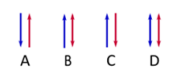
  • The magnetic field lines of a magnet (or a solenoid) form continuous closed loops. Hence, option 2 is correct.
Question 2

A sum of ₹2500 is invested in a bank at 6% interest per annum compounded annually. On maturity, the amount payable becomes ₹2809. Find the time period of the investment.

  1. AOption (a)

    1 year

  2. BOption (b)

    2.5 years

  3. COption (c)

    1.5 years

  4. DOption (d)

    2 years

View answer & explanation

Correct answer

Answer: (d)D.

2 years

Why this answer is correct

Shortcut Trick

Ratio of Amount to Principal → A/P = 2809/2500

Convert Rate to Fraction: 6% = 6/100 = 3/50, so Growth Multiplier = 53/50

Identify the power: (53/50)n = 2809/2500

Since 502 = 2500 and 532 = 2809, the power n must be 2.

∴ The correct answer is 2 years.

Alternate Method

Given:

Principal (P) = ₹2500

Maturity Amount (A) = ₹2809

Rate of Interest (R) = 6% per annum

Formula Used:

A = P(1 + R/100)n, where n is the Time Period.

Calculations:

⇒ 2809 = 2500(1 + 6/100)n

⇒ 2809/2500 = (106/100)n

⇒ 2809/2500 = (53/50)n

⇒ (53)2 / (50)2 = (53/50)n

⇒ (53/50)2 = (53/50)n

⇒ Comparing the powers on both sides:

⇒ n = 2 years

∴ The correct answer is 2 years.

Additional Information

Compound Interest (CI) Formula

The interest earned is given by CI = A − P = P[(1 + R/100)n − 1].

Compounding Frequencies

If interest is compounded half-yearly, the rate becomes R/2 and the time period becomes 2n.

CI vs SI Difference for 2 Years

The difference between CI and SI for 2 years is given by D = P × (R/100)2.

Question 3

Riya has a total of 60 pens and pencils. If she has 25 more pens and 5 less pencils, then the number of pens becomes three times the number of pencils. What is the difference between the number of pens and pencils that she had originally?

  1. AOption (a)

    10

  2. BOption (b)

    25

  3. COption (c)

    30

  4. DOption (d)

    5

View answer & explanation

Correct answer

Answer: (a)A.

10

Why this answer is correct

Shortcut Trick

Total items after change = 60 + 25 − 5 = 80

New ratio of Pens to Pencils = 3 : 1 (Total 4 units)

4 units = 80 ⇒ 1 unit = 20

New Pens = 60, New Pencils = 20

Original Pens = 60 − 25 = 35; Original Pencils = 20 + 5 = 25

Difference = 35 − 25 = 10

∴ The correct answer is 10.

Alternate Method

Given: Total pens and pencils = 60

Let the original number of pens be x and pencils be (60 − x).

⇒ New number of pens = x + 25

⇒ New number of pencils = (60 − x) − 5 = 55 − x

⇒ According to the question: (x + 25) = 3 × (55 − x)

⇒ x + 25 = 165 − 3x

⇒ 4x = 165 − 25

⇒ 4x = 140 ⇒ x = 35

⇒ Original pens = 35, Original pencils = 60 − 35 = 25

⇒ Difference = 35 − 25 = 10

∴ The correct answer is 10.

Additional Information

Ratio and Proportion

If a total quantity Q is divided in the ratio a : b, the parts are [a/(a+b)] × Q and [b/(a+b)] × Q.

Linear Equations

In word problems, define a single variable to represent one unknown to simplify the calculation steps.

Question 4

A stalactite of size 10.0 m is found in Brazil. If this stalactite is placed at a distance of 20.0 m from a concave mirror and a real image of size 30.0 m is formed, then the principal focus of the mirror is at :

  1. AOption (a)

    +15.0 m

  2. BOption (b)

    -15.0 m

  3. COption (c)

    +30.0 m

  4. DOption (d)

    -30.0 m

View answer & explanation

Correct answer

Answer: (b)B.

-15.0 m

Why this answer is correct

The correct answer is -15.0 m

Key Points

  • Given Information:
  • Object height (h₀) = 10.0 m
  • Image height (hᵢ) = 30.0 m (real image, so it's inverted, meaning we'll use -30m in the magnification calculation)
  • Object distance (u) = -20.0 m (negative because the object is in front of the mirror)
  • Magnification Formula:
  • Magnification (M) is given by:
  • M = hᵢ / h₀ = -v/u
  • Calculating Magnification:
  • M = (-30.0 m) / (10.0 m) = -3
  • Finding Image Distance (v):
  • Using M = -v/u:
  • -3 = -v / (-20.0 m)
  • -3 = v / 20.0 m
  • v = -60.0 m (negative because it's a real image formed in front of the concave mirror)
  • Mirror Formula:
  • The mirror formula relates object distance (u), image distance (v), and focal length (f):
  • 1/f = 1/v + 1/u
  • Calculating Focal Length (f):
  • 1/f = 1/(-60.0 m) + 1/(-20.0 m)
  • 1/f = -1/60 - 3/60
  • 1/f = -4/60
  • 1/f = -1/15
  • f = -15.0 m
  • Therefore, the principal focus of the mirror is at -15.0 m.

Additional Information

Mirror/ LensNature of Image formed
Concave mirror- Generally real and inverted. - Virtual and erect when the object is placed very close to the mirror.
Convex mirror- Always virtual and erect.
Concave lens- Always virtual and erect.
Convex lens- Generally real and inverted. - Virtual and erect when the object is placed very close to the lens

Question 5

Which of the following numbers will replace the question mark (?) in the given series?

43  41  37  31  ?  23

  1. AOption (a)

    29

  2. BOption (b)

    21

  3. COption (c)

    27

  4. DOption (d)

    25

View answer & explanation

Correct answer

Answer: (a)A.

29

Why this answer is correct

The logic followed here is:

Numbers are Decreasing in Prime number order.

Here, 43, 41, 37,31, ? ,23

Next prime number in place of Question mark = 29 

So, 29 will complete the given series.

Hence, the correct answer is 'Option 1'.

Additional Information Prime number between 1 to 100.

Question 6

According to Dobereiner's Triads, which of the following elements could be placed between Calcium and Barium?

(Atomic mass of Ca = 40.1 and atomic mass of Ba = 137.3)

  1. AOption (a)

    Nitrogen (atomic mass = 14.00)

  2. BOption (b)

    Phosphorous (atomic mass = 30.97)

  3. COption (c)

    Chlorine (atomic mass = 35.5)

  4. DOption (d)

    Strontium (atomic mass = 87.62)

View answer & explanation

Correct answer

Answer: (d)D.

Strontium (atomic mass = 87.62)

Why this answer is correct

The correct answer is Strontium (atomic mass = 87.62).

Key Points

  • Strontium
  • Atomic number: 38
  • Atomic mass: 87.62 u
  • Symbol: Sr
  • Group: 2
  • Period: 5
  • Strontium is an alkaline earth metal that is soft, silvery-white, and highly reactive. It is found in nature in the minerals celestite and strontianite. Strontium is used in fireworks to produce a bright red color, in signal flares, and in some medical applications.

Additional Information

  • Nitrogen
  • Atomic number: 7
  • Atomic mass: 14.007 u
  • Symbol: N
  • Group: 15
  • Period: 2
  • Nitrogen is a colorless, odorless, and tasteless gas that is essential for life. It makes up about 78% of the Earth's atmosphere. Nitrogen is used in the production of fertilizers, explosives, and other industrial products.
  • Phosphorus
  • Atomic number: 15
  • Atomic mass: 30.974 u
  • Symbol: P
  • Group: 15
  • Period: 3
  • Phosphorus is a nonmetal that is essential for life. It is found in bones, teeth, and DNA. Phosphorus is used in the production of fertilizers, matches, and other products.
  • Chlorine
  • Atomic number: 17
  • Atomic mass: 35.45 u
  • Symbol: Cl
  • Group: 17
  • Period: 3

Question 7

A, B and C can complete a piece of work in 18 days, 24 days and 60 days, respectively. In how many days will the work be completed, if A works on all days, and is assisted by B and C on alternate days, starting with B assisting A on the first day?

  1. AOption (a)

    11101311\frac{{10}}{{13}}

  2. BOption (b)

    11114211\frac{{11}}{{42}}

  3. COption (c)

    1151311\frac{{5}}{{13}}

  4. DOption (d)

    121912\frac{{1}}{{9}}

View answer & explanation

Correct answer

Answer: (a)A.

11101311\frac{{10}}{{13}}

Why this answer is correct

Shortcut Trick

Total Work (LCM of 18, 24, 60) = 360 units.

Efficiencies: A = 20, B = 15, C = 6.

Cycle: Day 1 (A+B) = 35; Day 2 (A+C) = 26. Total units in 2 days = 61.

5 cycles (10 days) = 305 units. Remaining = 55 units. Day 11 (A+B) takes 35 units.

Remaining 20 units done by (A+C) in 20/26 = 10/13 days. Total = 1110/13 days.

∴ The correct answer is 1110/13 days.

Alternate Method

Given: Time taken by A = 18 days, B = 24 days, C = 60 days.

Formula Used: Efficiency = Total Work ÷ Time; Work Done = Efficiency × Time.

PersonDaysTotal WorkEfficiency
A1836020
B2415
C606

⇒ Work on Day 1 (A + B) = 20 + 15 = 35 units.

⇒ Work on Day 2 (A + C) = 20 + 6 = 26 units.

⇒ Work in 1 cycle (2 days) = 35 + 26 = 61 units.

⇒ Work in 5 cycles (10 days) = 61 × 5 = 305 units.

⇒ Remaining Work = 360 − 305 = 55 units.

⇒ Day 11 (A + B) completes 35 units. Remaining = 55 − 35 = 20 units.

⇒ Day 12 (A + C) time for remaining work = 20 ÷ 26 = 10/13 days.

⇒ Total Time = 10 + 1 + 10/13 = 1110/13 days.

∴ The correct answer is 1110/13 days.

Additional Information

Alternate Day Work

When people work on alternate days, calculate the work done in one complete cycle and then multiply to reach closest to the total work.

Combined Efficiency

If multiple persons work together, their combined efficiency is the sum of their individual efficiencies: Etotal = E1 + E2 + ... + En.

Work and Time Relationship

Time taken to complete the work is inversely proportional to the efficiency: Time = Work ÷ Efficiency.

Question 8

Given a sin q = b cos q and a sin3 q + b cos3 q = sin q cos q, for 0 < q < 90°, find the value of a2+ b2.

  1. AOption (a)

    1

  2. BOption (b)

    3

  3. COption (c)

    2

  4. DOption (d)

    0

View answer & explanation

Correct answer

Answer: (a)A.

1

Why this answer is correct

Shortcut Trick

Given a sin q = b cos q.

Substitute b cos q for a sin q in the second equation: (b cos q) sin2 q + b cos3 q = sin q cos q.

Factor out b cos q: b cos q (sin2 q + cos2 q) = sin q cos q ⇒ b cos q (1) = sin q cos q ⇒ b = sin q.

Similarly, substituting a sin q for b cos q gives a = cos q.

Calculate a2 + b2 = cos2 q + sin2 q = 1.

∴ The correct answer is 1.

Alternate Method

Given:

  1. a sin q = b cos q

  2. a sin3 q + b cos3 q = sin q cos q

Calculations:

⇒ (a sin q) sin2 q + (b cos q) cos2 q = sin q cos q

⇒ (b cos q) sin2 q + (b cos q) cos2 q = sin q cos q [Using eq 1]

⇒ b cos q (sin2 q + cos2 q) = sin q cos q

⇒ b cos q (1) = sin q cos q ⇒ b = sin q

⇒ From eq 1: a sin q = (sin q) cos q ⇒ a = cos q

⇒ a2 + b2 = (cos q)2 + (sin q)2

⇒ a2 + b2 = 1

∴ The correct answer is 1.

Additional Information

Fundamental Trigonometric Identities

The three basic identities are: sin2θ + cos2θ = 1; 1 + tan2θ = sec2θ; 1 + cot2θ = cosec2θ.

Complementary Angles

For 0 < θ < 90°, sin(90°−θ) = cos θ and cos(90°−θ) = sin θ.

Ratio Relation

tan θ = sin θ / cos θ and cot θ = cos θ / sin θ.

Question 9

Each of the digits in the number 36275918 is arranged in ascending order from left to right. The position of how many digits will remain unchanged as compared to that in the original number?

  1. AOption (a)

    1

  2. BOption (b)

    2

  3. COption (c)

    3

  4. DOption (d)

    None

View answer & explanation

Correct answer

Answer: (d)D.

None

Why this answer is correct

Given number: 36275918

Each of the digits in the number 36275918 is arranged in ascending order from left to right.

All digits changed their position as compared to that in the original number.

Hence, the correct answer is 'Option 4'.

Question 10

If 7(x) + 5, 7(x) + 4, 5(x) + 5 and y are in proportion when x = 5, find the value of y.

  1. AOption (a)

    29.5

  2. BOption (b)

    29

  3. COption (c)

    29.25

  4. DOption (d)

    29.75

View answer & explanation

Correct answer

Answer: (c)C.

29.25

Why this answer is correct

Shortcut Trick

Substitute x = 5 into the terms: 7(5) + 5 = 40, 7(5) + 4 = 39, 5(5) + 5 = 30.

Since the terms are in proportion: 40 ÷ 39 = 30 ÷ y.

y = (39 × 30) ÷ 40 = 39 × 0.75 = 29.25.

∴ The correct answer is 29.25.

Alternate Method

Given: x = 5 and terms are 7x + 5, 7x + 4, 5x + 5, y.

Formula Used: If a, b, c, d are in proportion, then a/b = c/d or ad = bc.

⇒ First term = 7(5) + 5 = 35 + 5 = 40

⇒ Second term = 7(5) + 4 = 35 + 4 = 39

⇒ Third term = 5(5) + 5 = 25 + 5 = 30

⇒ 40/39 = 30/y

⇒ 40 × y = 39 × 30

⇒ y = (39 × 30) ÷ 40

⇒ y = 1170 ÷ 40

⇒ y = 29.25

∴ The correct answer is 29.25.

Additional Information

Fourth Proportional

For three numbers a, b, and c, the fourth proportional d is calculated as d = (b × c) ÷ a.

Continued Proportion

Three quantities a, b, c are in continued proportion if a/b = b/c, which implies b2 = ac.

Mean Proportional

The mean proportional between two numbers a and b is √(a × b).

Question 11

Plaster of Paris is prepared by heating ______.

  1. AOption (a)

    limestone at 273 K

  2. BOption (b)

    limestone at 373 K

  3. COption (c)

    gypsum at 273 K

  4. DOption (d)

    gypsum at 373 K

View answer & explanation

Correct answer

Answer: (d)D.

gypsum at 373 K

Why this answer is correct

The correct answer is gypsum at 373 K.

Key Points

  • It is also known as the Plaster of Paris because for the preparation of POP, the abundant gypsum was first found near the capital city of France i.e. Paris.
  • The chemical formula of the Plaster of Paris is (CaSO4)2. H2O.

Application of Plaster of Paris is as follows

  • It is used as a building material as a protective coating on walls and ceilings.
  • It is used as a moulding and vesting agent for decorative elements.
  • It is also used for aesthetic touch to the construction elements.
  • It is also field as plaster in orthopaedics and as a filling material by dentists, etc.
  • we can conclude that Plaster of Paris is chemically (CaSO4)2 H2O.​

Additional Information

  • Gypsum is an ore of Calcium (Ca). The chemical formula of Gypsum is CaSO4. 2H2O.
  • Gypsum is mainly used as a fertilizer, as the main constituent in plaster, chalk etc.
  • The plaster of Paris on mixing with water produces gypsum.
  • Calcium Sulphate Hemihydrate (CaSO4·1/2 H2O) on hydration leads to the crystallization of gypsum calcium sulphate dihydrate (CaSO4·2H2O).

Question 12

If 60% of A = 1.2 of B = 25\frac{2}{5} of C, then find A ∶ B ∶  C.

  1. AOption (a)

    3 ∶ 1 ∶ 2

  2. BOption (b)

    1 ∶ 2 ∶ 3

  3. COption (c)

    2 ∶ 1 ∶ 3

  4. DOption (d)

    3 ∶ 2 ∶ 1

View answer & explanation

Correct answer

Answer: (c)C.

2 ∶ 1 ∶ 3

Why this answer is correct

Shortcut Trick

Convert all coefficients to simple fractions: 60% = 3/5, 1.2 = 6/5, and the third is 2/5.

Equation: (3/5)A = (6/5)B = (2/5)C ⇒ 3A = 6B = 2C.

Divide by LCM of (3, 6, 2) which is 6: (3A/6) = (6B/6) = (2C/6).

Result: A/2 = B/1 = C/3 → A ∶ B ∶ C = 2 ∶ 1 ∶ 3.

∴ The correct answer is 2 ∶ 1 ∶ 3.

Alternate Method

Given: 60% of A = 1.2 of B = 2/5 of C

60% A

1.2 B

2/5 C

=

A : B : C = 2 : 1 : 3

Calculation:

⇒ 60% of A = (60/100)A = (3/5)A

⇒ 1.2 of B = (12/10)B = (6/5)B

⇒ (3/5)A = (6/5)B = (2/5)C

⇒ Multiplying by 5: 3A = 6B = 2C = k

⇒ A = k/3, B = k/6, C = k/2

⇒ A ∶ B ∶ C = (k/3) ∶ (k/6) ∶ (k/2)

⇒ Multiply by LCM(3, 6, 2) = 6: (6/3) ∶ (6/6) ∶ (6/2) = 2 ∶ 1 ∶ 3

∴ The correct answer is 2 ∶ 1 ∶ 3.

Additional Information

Ratio from Coefficients

If xA = yB = zC, then A ∶ B ∶ C = (1/x) ∶ (1/y) ∶ (1/z). Multiply by the LCM of denominators to simplify.

Percentage and Decimal Conversion

To compare ratios, convert percentages (x% = x/100) and decimals (0.x = x/10) into simplified fractions first.

Compound Ratio

The ratio of ratios (a/b) ∶ (c/d) can be solved by cross-multiplication or multiplying by the LCM of b and d.

Question 13

Find the median of the following data.

12, 16, 26, 15, 17, 18, 73, 74, 25, 24

  1. AOption (a)

    18

  2. BOption (b)

    17

  3. COption (c)

    21

  4. DOption (d)

    19

View answer & explanation

Correct answer

Answer: (c)C.

21

Why this answer is correct

Shortcut Trick

Arrange the observations in ascending order: 12, 15, 16, 17, 18, 24, 25, 26, 73, 74.

Total number of terms (n) = 10 (an even number).

For even n, Median = Average of (n/2)th and (n/2 + 1)th terms.

Median = Average of 5th (18) and 6th (24) terms.

Median = (18 + 24) ÷ 2 = 21.

∴ The correct answer is 21.

Alternate Method

Given Data: 12, 16, 26, 15, 17, 18, 73, 74, 25, 24

Formula: Median (for even n) = [ (n/2)th term + (n/2 + 1)th term ] ÷ 2

⇒ Arrange in Ascending Order: 12, 15, 16, 17, 18, 24, 25, 26, 73, 74

⇒ Total observations (n) = 10

⇒ Median = [ (10/2)th value + (10/2 + 1)th value ] ÷ 2

⇒ Median = [ 5th value + 6th value ] ÷ 2

⇒ Median = (18 + 24) ÷ 2

⇒ Median = 42 ÷ 2 = 21

∴ The correct answer is 21.

Additional Information

Median for Odd Number of Terms

If n is odd, the Median is exactly the (n + 1) ÷ 2th term of the sorted data.

Empirical Relation between Mean, Median, and Mode

For a moderately skewed distribution: Mode = 3 × Median − 2 × Mean.

Effect of Outliers

The Median is a more robust measure of central tendency than the Mean because it is not significantly affected by extreme values (outliers).

Question 14

Each vowel in the word KINDLE is changed to the letter following it in the English alphabetical order and each consonant is changed to the letter preceding it in the English alphabetical order. Which of the following letters will appear twice in the group of letters thus formed?

  1. AOption (a)

    M

  2. BOption (b)

    K

  3. COption (c)

    F

  4. DOption (d)

    J

View answer & explanation

Correct answer

Answer: (d)D.

J

Why this answer is correct

Given word: KINDLE

Vowels is to be changed to the next letter KINDLE → KJNDLF

Consonant to be changed to letter preceding in English alphabetical order KJNDLF → JJMCKF

the new word formed is JJMCKF.

Here, J is being repeated twice

Hence, the correct answer is "Option 4".

Question 15

Which is the first Indian language that was given the status of 'classical language' by the Ministry of Culture, Government of India?

  1. AOption (a)

    Kannada

  2. BOption (b)

    Tamil

  3. COption (c)

    Malayalam

  4. DOption (d)

    Odia

View answer & explanation

Correct answer

Answer: (b)B.

Tamil

Why this answer is correct

The correct answer is Tamil.

Key Points

  • Languages that have a long history, whose grammar has been the subject of many studies and in which much literature has been written are referred to as classical languages.
  • The classical languages are considered dead languages as they lose their importance in the modern world and their speakers shift to another language. A language becomes dead when the language has no more native speakers.
  • As per the requirements set by the Government of India in 2004, a language is accorded the status of "Classical Language of India" if it fulfills the following criteria:
  • It should have a recorded history of existing for over a period of 1500-2000 years.
  • It would have an original literature tradition and would not borrow anything from any other language family.
  • It should have some ancient literature or epics in it.
  • The language should be different from its modern/later forms.
  • Currently, there are six languages mentioned in the 8th schedule of the Indian constitution that enjoy the "Classical" status in India that are Tamil (declared in 2004), Sanskrit (2005), Kannada (2008), Telugu (2008), Malayalam (2013), and Odia (2014).

 Additional Information The Union Cabinet recently declared five Indian languages in 2024 - Marathi, Assamese, Pali, Prakrit, and Bengali - as classical languages. This decision aims to preserve the rich heritage of these languages and bring the total number of classical languages in India to eleven.

Question 16

Which of the numbers given below is a prime number?

  1. AOption (a)

    986

  2. BOption (b)

    319

  3. COption (c)

    153

  4. DOption (d)

    983

View answer & explanation

Correct answer

Answer: (d)D.

983

Why this answer is correct

Shortcut Trick

To check if a number N is prime, test divisibility by primes up to √N.

986: Even number, divisible by 2.

319: 11 × 29 = 319 (divisible by 11).

153: Sum of digits (1+5+3=9) is divisible by 9, so the number is divisible by 9.

983: Not divisible by 2, 3, 5, 7, 11, 13, 17, 19, 23, 29, 31 (primes up to √983 ≈ 31.3).

∴ The correct answer is 983.

Alternate Method

Check each option for divisibility using standard rules:

Option 1: 986

⇒ Ends in 6 (even), so it is divisible by 2.

⇒ 986 = 2 × 493 (Not a prime).

Option 2: 319

⇒ Divisibility by 11: (3 + 9) − 1 = 11. Since 11 is divisible by 11, the number is divisible by 11.

⇒ 319 = 11 × 29 (Not a prime).

Option 3: 153

⇒ Sum of digits = 1 + 5 + 3 = 9. Since 9 is divisible by 3 and 9, the number is divisible by 3 and 9.

⇒ 153 = 9 × 17 (Not a prime).

Option 4: 983

⇒ √983 is approx 31.3. Testing primes 2, 3, 5, 7, 11, 13, 17, 19, 23, 29, 31.

⇒ 983 is not divisible by any of these primes.

∴ The correct answer is 983.

Additional Information

Prime Number Definition

A prime number is a natural number greater than 1 that has no positive divisors other than 1 and itself.

Primality Test Rule

To check if n is prime, verify if any prime p ≤ √n divides n. If no such p exists, n is prime.

Composite Numbers

Numbers that have more than two factors are called composite numbers. 1 is neither prime nor composite.

Question 17

Which of the following options is the closest approximate value which will come in place of the question mark (?) in the following equation?

?2 + 53.99 = 206.01 ÷ 1.99

  1. AOption (a)

    13

  2. BOption (b)

    5

  3. COption (c)

    3

  4. DOption (d)

    7

View answer & explanation

Correct answer

Answer: (d)D.

7

Why this answer is correct

Given:

?2 + 53.99 = 206.01 ÷ 1.99

Formula Used:

To find ?, isolate ?2 and then take the square root.

Calculation:

Start by simplifying the right-hand side:

⇒ 206.01 ÷ 1.99 ≈ 103

Now, isolate ?2:

⇒ ?2 + 53.99 = 103

⇒ ?2 ≈ 103 - 54

⇒ ?2 ≈ 49

⇒ ? = 7

The correct answer is option 4.

Question 18

Who is the head of the Nyaya Panchayat?

  1. AOption (a)

    Chairman

  2. BOption (b)

    BDO

  3. COption (c)

    Block Pramukh

  4. DOption (d)

    Sarpanch

View answer & explanation

Correct answer

Answer: (d)D.

Sarpanch

Why this answer is correct

The correct answer is Sarpanch.

Key Points

  • Nyaya Panchayat consists of at least 10 members.
  • The number of members in each Nyaya Panchayat is such that it is completely divisible by five.
  • The number of Panches of Nyaya Panchayat having 1 to 6 village councils will be 15, 7 to 9 will be 20 and if more than 9 will be 25.

Question 19

A house and a garden together cost ₹51 lakh and the cost of the garden is 512\frac{5}{{12}} of the cost of the house. Find the cost of the garden (in ₹).

  1. AOption (a)

    30 lakh

  2. BOption (b)

    36 lakh

  3. COption (c)

    16 lakh

  4. DOption (d)

    15 lakh

View answer & explanation

Correct answer

Answer: (d)D.

15 lakh

Why this answer is correct

Given:

Total cost of house and garden = ₹51 lakh

Cost of the garden = 512\frac{5}{{12}} of the cost of the house

Formula Used:

Let the cost of the house be H.

Then, cost of the garden = 512\frac{5}{{12}} H

Total cost = Cost of the house + Cost of the garden

Total cost = H + 512\frac{5}{{12}} H

Calculation:

Let the cost of the house be H.

Total cost = H + 512\frac{5}{{12}} H

⇒ ₹51 lakh = 12H+5H12\frac{12H + 5H}{12}

⇒ ₹51 lakh = 17H12\frac{17H}{12}

⇒ 51 × 12 = 17H

⇒ 612 = 17H

⇒ H = 61217\frac{612}{17}

⇒ H = 36 lakh

Cost of the garden = 512\frac{5}{12} × 36 lakh

⇒ Cost of the garden = 15 lakh

The cost of the garden is ₹15 lakh.

Question 20

If each of the letter of the letter cluster 'DEHRAZUN' is arranged in alphabetical order, how many vowels will be immediately preceded by a consonant in the newly formed letter cluster?

  1. AOption (a)

    1

  2. BOption (b)

    0

  3. COption (c)

    2

  4. DOption (d)

    3

View answer & explanation

Correct answer

Answer: (c)C.

2

Why this answer is correct

The Position and positional values of English Alphabets are:

Given Word: DEHRAZUN

Now, If each of the letter of the letter cluster 'DEHRAZUN' is arranged in alphabetical order,

The Word becomes, ADEHNRUZ

Vowels are: A, E, I, O, U

Now, vowels immediately preceded by a consonant in newly formed Word Cluster are: DE and RU.

There are 2 Vowels in the newly formed word cluster which are preceded by a consonant.

Hence, the correct answer is "Option 3".

Question 21

Select the option that represents the letters that, when placed from left to right in the same sequence in the blanks below, will complete the letter series.

Q_T_T_BT_TQB_RT

  1. AOption (a)

    BQRRT

  2. BOption (b)

    BRRQT

  3. COption (c)

    BRQRT

  4. DOption (d)

    BRTRQ

View answer & explanation

Correct answer

Answer: (c)C.

BRQRT

Why this answer is correct

The logic followed here is:

Given series: Q_T_T_BT_TQB_RT

Option 1QBTQTRBTRTQBTRT
Option 2QBTRTRBTQTQBTRT
Option 3QBTRTQBTRTQBTRT
Option 4QBTRTTBTRTQBQRT


Here, 'QBTRT / QBTRT / QBTRT ' - The Pattern "QBTRT" is repeated in the series.

Hence, the correct answer is "Option 3".

Question 22

Three angles of ΔABC are in the ratio 3 ∶ 4 ∶ 5, taken in order. If side AB is extended to X, what is the measure of exterior angle ∠CBX?

  1. AOption (a)

    60°

  2. BOption (b)

    120°

  3. COption (c)

    100°

  4. DOption (d)

    80°

View answer & explanation

Correct answer

Answer: (b)B.

120°

Why this answer is correct

Shortcut Trick

Sum of ratio parts = 3 + 4 + 5 = 12 units.

Total internal angles of triangle = 180°.

Internal angle ∠ABC corresponds to the second part of the ratio = (4 ÷ 12) × 180° = 60°.

Exterior angle ∠CBX = 180° − ∠ABC = 180° − 60° = 120°.

∴ The correct answer is 120°.

Alternate Method

Given: Ratio of angles ∠A : ∠B : ∠C = 3 : 4 : 5.

Formula Used: Sum of angles in a triangle = 180° | Exterior angle = 180° − Adjacent interior angle.

⇒ Let the angles be 3k, 4k, and 5k.

⇒ 3k + 4k + 5k = 180°

⇒ 12k = 180°

⇒ k = 15°

⇒ Angle ∠ABC (Angle B) = 4 × 15° = 60°.

⇒ Since AB is extended to X, ∠ABC and ∠CBX form a linear pair.

⇒ ∠CBX = 180° − 60° = 120°.

∴ The correct answer is 120°.

Additional Information

Exterior Angle Theorem

The exterior angle of a triangle is equal to the sum of the two opposite interior angles. Here, ∠CBX = ∠A + ∠C = 45° + 75° = 120°.

Linear Pair Postulate

When a side of a triangle is extended, the resulting exterior angle and the adjacent interior angle are supplementary (sum is 180°).

Sum of Exterior Angles

The sum of the exterior angles of any convex polygon (including a triangle), taking one at each vertex, is always 360°.

Question 23

What does 'segregation at source' mean in terms of non-biodegradable wastes?

  1. AOption (a)

    People using non-biodegradable items should not add biodegradable items to these items.

  2. BOption (b)

    Municipalities should have separate disposal sites for non-biodegradable and biodegradable waste.

  3. COption (c)

    Households should separate non-biodegradable items from biodegradable items in the trash.

  4. DOption (d)

    Factories producing non-biodegradable consumer items should not mix them with biodegradable material.

View answer & explanation

Correct answer

Answer: (c)C.

Households should separate non-biodegradable items from biodegradable items in the trash.

Why this answer is correct

The correct answer is Households should separate non-biodegradable items from biodegradable items in the trash.

Key Points

  • Segregation at source for non-biodegradable waste refers to the practice of separating different types of non-biodegradable materials at the point of generation.
  • This means sorting waste like plastic, paper, glass, metal, and e-waste into separate containers before it is collected for disposal.
  • This process is crucial for effective waste management and recycling.
  • By segregating waste at the source, we can prevent contamination, increase the efficiency of recycling processes, and reduce the amount of waste that ends up in landfills.
  • It also helps to conserve natural resources and reduce pollution.

Question 24

Which of the following is a COVID-19 Omicron hybrid strain, which was found in April 2022?

  1. AOption (a)

    FE

  2. BOption (b)

    ZE

  3. COption (c)

    XX

  4. DOption (d)

    XE

View answer & explanation

Correct answer

Answer: (d)D.

XE

Why this answer is correct

The correct answer is XE.

Key Points

COVID-19

  • Coronavirus disease (COVID-19) is an infectious disease caused by the SARS-CoV-2 virus.
  • Most people infected with the virus will experience mild to moderate respiratory illness and recover without requiring special treatment. However, some will become seriously ill because of Acute Respiratory Distress Syndrome (ARDS) and require medical attention.
  • Older people and those with underlying medical conditions like cardiovascular disease, diabetes, chronic respiratory disease, or cancer are more likely to develop serious illnesses.
  • Anyone can get sick with COVID-19 and become seriously ill or die at any age.
  • The best way to prevent and slow down transmission is
  • To be well informed about the disease and how the virus spreads.
  • Protect yourself and others from infection by staying at least 1 meter apart from others, wearing a properly fitted mask, and washing your hands or using an alcohol-based rub frequently.
  • Get vaccinated when it’s your turn and follow local guidance.
  • The virus can spread from an infected person’s mouth or nose in small liquid particles when they cough, sneeze, speak, sing or breathe.
  • These particles range from larger respiratory droplets to smaller aerosols.
  • It is important to practice respiratory etiquette, for example by coughing into a flexed elbow, and to stay home and self-isolate until you recover if you feel unwell.

COVID-19 affects different people in different ways. Most infected people will develop mild to moderate illness and recover without hospitalization.

Most common symptoms:

  • fever
  • cough
  • tiredness
  • loss of taste or smell.

Less common symptoms:

  • sore throat
  • headache
  • aches and pains
  • diarrhea
  • a rash on the skin, or discoloration of fingers or toes
  • red or irritated eyes.

Serious symptoms:

  • difficulty breathing or shortness of breath
  • loss of speech or mobility, or confusion
  • chest pain.

Question 25

Select the set in which the numbers are related in the same way as are the numbers of the following sets.

(NOTE: Operations should be performed on the whole numbers, without breaking down the numbers into its constituent digits. E.g. 13 - Operations on 13 such as adding / subtracting  / multiplying etc. to 13 can be performed. Breaking down 13 into 1 and 3 and then performing mathematical operations on 1 and 3 is not allowed.)

(7, 19, 40)

(12, 11, 47) ​

  1. AOption (a)

    (9, 27, 72)

  2. BOption (b)

    (16, 5, 53)

  3. COption (c)

    (15, 31, 48)

  4. DOption (d)

    (14, 23, 74)

View answer & explanation

Correct answer

Answer: (b)B.

(16, 5, 53)

Why this answer is correct

The logic followed here is: 

Logic: (1st number × 3) + 2nd number = 3rd number.

Now,

For (7, 19, 40):

⇒ (7 × 3) + 19

= 21 + 19 = 40.

For (12, 11, 47)

⇒ (12 × 3) + 11

= 36 + 11 = 47.

Similarly, for Option 2: (16, 5, 53)

⇒ (16 × 3) + 5

= 48 + 5 = 53.

Hence, the correct answer is Option 2.

Question 26

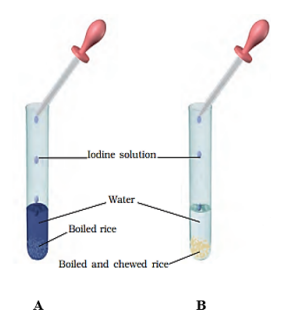
Study the figure given below carefully. Which option is correct regarding the non-appearance of blue colour in test tube B?

  1. AOption (a)

    Starch was digested by trypsin in the saliva

  2. BOption (b)

    Starch was digested by pepsin in the saliva

  3. COption (c)

    Starch was digested by lipase in the saliva

  4. DOption (d)

    Starch was digested by salivary amylase in the saliva

View answer & explanation

Correct answer

Answer: (d)D.

Starch was digested by salivary amylase in the saliva

Why this answer is correct

The correct answer is Starch was digested by salivary amylase in the saliva.

Key Points

  • Starch: A complex carbohydrate found in various plant-based foods like potatoes, rice, and bread. It's a long chain of glucose molecules.
  • Salivary Amylase: An enzyme present in saliva, produced by the salivary glands. Enzymes are biological catalysts that speed up chemical reactions.
  • Digestion: The process of breaking down complex food molecules into simpler ones that can be absorbed by the body.
  • Process: When you chew food, it mixes with saliva. Salivary amylase in the saliva starts breaking down the long chains of glucose molecules in starch into smaller units, primarily maltose (a disaccharide).
  • Significance: This initial digestion in the mouth is crucial as it prepares the food for further breakdown in the digestive system.
  • Maltose: A simpler sugar molecule formed from two glucose units.
  • Continued Digestion: The partially digested starch then travels to the stomach and eventually the small intestine, where further enzymes (like pancreatic amylase) continue the breakdown process.
  • Absorption: The final products of starch digestion (mainly glucose) are then absorbed into the bloodstream through the walls of the small intestine.
  • Energy: Glucose is the primary source of energy for the body's cells.

Question 27

Study the given arrangement of numbers and answer the question that follows :

(LEFT) 2 8 3 6 0 8 1 5 3 7 3 4 9 6 2 4 3 2 5 6 4 0 7 (RIGHT)

Based on the arrangement given, Three of the following four groups of numbers (given in options) are alike in a certain way and so form a group. Which option does NOT belong to that group?

  1. AOption (a)

    462

  2. BOption (b)

    746

  3. COption (c)

    013

  4. DOption (d)

    230

View answer & explanation

Correct answer

Answer: (a)A.

462

Why this answer is correct

Given: (LEFT) 2 8 3 6 0 8 1 5 3 7 3 4 9 6 2 4 3 2 5 6 4 0 7 (RIGHT)

Now,

Option 1: (LEFT) 2 8 3 6 0 8 1 5 3 7 3 4 9 6 2 4 3 2 5 6 4 0 7 (RIGHT)

Here, all the digits are placed continuously.

Option 2: (LEFT) 2 8 3 6 0 8 1 5 3 7 3 4 9 6 2 4 3 2 5 6 4 0 7 (RIGHT)

Here, 7, 4, and 6 are in the alternate sequence.

Option 3: (LEFT) 2 8 3 6 0 8 1 5 3 7 3 4 9 6 2 4 3 2 5 6 4 0 7 (RIGHT)

Here, 0, 1, and 3 are in the alternate sequence.

Option 4: (LEFT) 2 8 3 6 0 8 1 5 3 7 3 4 9 6 2 4 3 2 5 6 4 0 7 (RIGHT)

Here, 2, 3, and 0 are in the alternate sequence.

So, 'Option 1' does not belong to the group.

Hence, the correct answer is "Option 1".

Question 28

'Beating the Retreat' officially denotes the end of which National Festival of India?

  1. AOption (a)

    Independence Day

  2. BOption (b)

    Republic Day

  3. COption (c)

    Constitution Day

  4. DOption (d)

    Gandhi Jayanti

View answer & explanation

Correct answer

Answer: (b)B.

Republic Day

Why this answer is correct

The correct answer is Republic Day.

Key Points

  • Republic Day:
  • Celebrated on January 26th, commemorating the adoption of the Indian Constitution in 1950. It features a grand parade in New Delhi showcasing India's cultural and military heritage.Republic Day parade in India
  • Independence Day:
  • ​Celebrated on August 15th, commemorating India's independence from British rule in 1947. The Prime Minister hoists the national flag at the Red Fort in Delhi, followed by a speech and various cultural performances.
  • Gandhi Jayanti:
  • Celebrated on October 2nd, commemorating the birthday of Mahatma Gandhi, the Father of the Nation. It is a day of non-violence and peace, marked by prayer services and inspirational programs.

Question 29

Which of the following historical places is associated with the birth of Jesus Christ?

  1. AOption (a)

    Mount Tabor

  2. BOption (b)

    Vatican City

  3. COption (c)

    Bethlehem

  4. DOption (d)

    Byzantium

View answer & explanation

Correct answer

Answer: (c)C.

Bethlehem

Why this answer is correct

The correct answer is Bethlehem.

Key Points

  • Christmas is celebrated by Christians around the world as the birth of Jesus Christ.
  • This festival is observed on December 25th each year.
  • Christmas is marked by various traditions including gift-giving, decorating Christmas trees, attending church services, and sharing meals with family and friends.
  • The holiday holds significant religious importance as well as cultural significance in many countries.

 Additional Information

  • Easter is another major Christian holiday, celebrating the resurrection of Jesus Christ, but it is not related to his birth.
  • Good Friday commemorates the crucifixion of Jesus Christ and is observed during the Holy Week preceding Easter.
  • Eid ul Fitr is an Islamic festival marking the end of Ramadan, the holy month of fasting.
  • Christmas has been celebrated for centuries and has evolved to include various customs and traditions unique to different cultures around the world.
  • In many countries, Christmas is a public holiday, allowing people to celebrate with their loved ones.

Question 30

This question consists of a statement followed by two arguments I and II. Read the statement and the arguments carefully and select the appropriate answer from the given options.

Statement -

Segregation of garbage into wet and dry waste will help in recycling it

I. Wet waste can be converted to organic compost or biogas when managed the right

II. Recycled plastic can be remanufactured for a wide array of products including carpet, upcycled polyester for clothing, recycled plastic building materials

  1. AOption (a)

    II weakens while I strengthens the statement

  2. BOption (b)

    I weakens while II strengthens the statement

  3. COption (c)

    Both I and II strengthen the statement

  4. DOption (d)

    Both I and II weaken the statement

View answer & explanation

Correct answer

Answer: (c)C.

Both I and II strengthen the statement

Why this answer is correct

Given:

Statement :

Segregation of garbage into wet and dry waste will help in recycling it.

Now,

Arguments :

I. Wet waste can be converted to organic compost or biogas when managed the right way - True (As the statement suggests, segregation of wet waste allows for better management, such as converting it into compost or biogas, which supports recycling).

II. Recycled plastic can be remanufactured for a wide array of products including carpet, upcycled polyester for clothing, recycled plastic building materials - True (This argument highlights that dry waste, particularly plastic, can be recycled into various products, which is a valid part of the recycling process).

So, Both I and II strengthen the statement.

Hence, the correct answer is "Option 3".

Question 31

Madhav starts from Point A and drives 16 km towards the east. He then takes a right turn, drives 4 km, turns right and drives 12 km. He then takes a right turn and drives 11 km, takes a left turn and drives 4 km and stops at Point B. How far and towards which direction should he drive in order to reach Point A from Point B? (All turns are 90 degree turns only)

  1. AOption (a)

    7 km towards the south

  2. BOption (b)

    6 km towards the east

  3. COption (c)

    8 km towards the south

  4. DOption (d)

    12 km towards the west

View answer & explanation

Correct answer

Answer: (a)A.

7 km towards the south

Why this answer is correct

The Logic follows here is:

  1. Madhav starts from Point A and drives 16 km towards the east.

  2. He then takes a right turn, drives 4 km, turns right and drives 12 km.

  3. He then takes a right turn and drives 11 km,

  4. takes a left turn and drives 4 km and stops at Point B. 

Drawing the Diagram as per the given information:

Distance between point B to point A is 7KM.

Thus, Madhav should drive 7KM in south direction to reach point A from Point B.

Hence, the correct answer is "Option 1"

Question 32

Three statements are given followed by two conclusions numbered I and II. You have to take the statements to be true, even if they seem to be at variance with commonly known facts and decide which of the conclusions logically follow(s) from the statements.

Statements:

Some Buses are Vans.

All Vans are Trucks.

Some Buses are Cars.

Conclusions:

(I) Some Trucks are Buses.

(II) Some Cars are Trucks.

  1. AOption (a)

    Both conclusions (I) and (II) follow.

  2. BOption (b)

    Neither conclusion (I) nor (II) follows.

  3. COption (c)

    Only conclusion (I) follows.

  4. DOption (d)

    Only conclusion (II) follows.

View answer & explanation

Correct answer

Answer: (c)C.

Only conclusion (I) follows.

Why this answer is correct

Given Statements:

Some Buses are Vans.

All Vans are Trucks.

Some Buses are Cars.

The least possible Venn diagram for the given statement is:

Conclusion:

(I) Some Trucks are Buses → TRUE (Those trucks which are Vans are also bus, so Some Trucks are Buses).

(II) Some Cars are Trucks → FALSE (There is no definite relation given between Cars and Trucks, so it can be possible only).

So, Only conclusion (I) follows.

Hence, the correct answer is "Option 3".

Question 33

If the position of the digit '2' is interchanged with the position of the digit '4', and the position of the digit '5' is interchanged with the position of the digit '3', then what is the value of the given expression?

47 + 56 ÷ 6 - 2 × 3

  1. AOption (a)

    7

  2. BOption (b)

    13

  3. COption (c)

    3

  4. DOption (d)

    21

View answer & explanation

Correct answer

Answer: (b)B.

13

Why this answer is correct

Here BODMAS Table applies:

Given Equation: 47 + 56 ÷ 6 - 2 × 3

If '2' is interchanged with the position of the digit '4'

And, '5' is interchanged with the position of the digit '3' 

Equation becomes:  27 + 36 ÷ 6 - 4 × 5

⇒ 27 + 36 ÷ 6 - 4 × 5 

⇒ 27 + 6 - 4 × 5

⇒ 27 + 6 - 20

⇒ 33 - 20 = 13.

Hence, the correct answer is "Option 2".

Question 34

If 0.372‾=xy0.3\overline {72} = \frac{x}{y}, where x and y are coprime, then what is the value of (x + y) ?

  1. AOption (a)

    134

  2. BOption (b)

    143

  3. COption (c)

    151

  4. DOption (d)

    186

View answer & explanation

Correct answer

Answer: (c)C.

151

Why this answer is correct

Shortcut Trick

Convert mixed recurring decimal 0.372 directly to a fraction:

Numerator = Total digits − Non-repeating digits = 372 − 3 = 369

Denominator = 99 (for two repeating digits) followed by 0 (for one non-repeating digit) = 990

Fraction = 369 ÷ 990 = 41 ÷ 110

Since x and y are coprime, x = 41 and y = 110, giving (x + y) = 151.

∴ The correct answer is 151.

Alternate Method

Given:

x ÷ y = 0.372

Let N = 0.3727272...

⇒ 10N = 3.727272... (Equation 1)

⇒ 1000N = 372.727272... (Equation 2)

Subtracting Equation 1 from Equation 2:

⇒ 1000N − 10N = 372.727272... − 3.727272...

⇒ 990N = 369

⇒ N = 369 ÷ 990

⇒ N = 41 ÷ 110

Since x and y are coprime, we can equate x = 41 and y = 110.

⇒ (x + y) = 41 + 110 = 151

∴ The correct answer is 151.

Additional Information

Pure Recurring Decimal

A decimal where all digits after the decimal point are repeated. To convert, place the repeating digits in the numerator and an equal number of 9s in the denominator (e.g., 0.4545... = 45 ÷ 99).

Mixed Recurring Decimal

A decimal where some digits after the decimal point do not repeat. The denominator will have 9s equal to the repeating digits and 0s equal to the non-repeating digits.

Coprime Numbers

Two numbers are coprime if their highest common factor (HCF) is 1. They do not necessarily need to be prime numbers themselves (e.g., 8 and 15 are coprime).

Question 35

In which year did ISRO launch EOS-04, INS-2TD and INSPIRESat-1 satellites?

  1. AOption (a)

    2019

  2. BOption (b)

    2021

  3. COption (c)

    2022

  4. DOption (d)

    2020

View answer & explanation

Correct answer

Answer: (c)C.

2022

Why this answer is correct

The correct answer is 2022.

Key Points

  • Earth Observation Satellite (EOS-04)
  • ​​The EOS-04, formerly known as RISAT-1A, is a land-based earth observation satellite that images using radar.
  • On 14 February 2022, it was inserted into a sun-synchronous orbit at an altitude of 529 km from the surface.
  • EOS-04 is the sixth satellite to be launched under the RISAT (Radar Imaging Satellite) programme in the last decade.
  • Built at ISRO’s UR Rao Satellite Centre in Bengaluru, EOS-04 carries synthetic aperture radar (SAR) that can peer through all kinds of weather and clouds, during night-time as well.
  • It will be used in the fields of plantations, flood mapping, hydrology and more. The satellite weighs 1,710 kg and will function for at least 10 years.
  • INS-2TD
  • ​INS-2TD is a precursor to the India-Bhutan joint satellite, INS-2B, built by Bhutanese engineers who were trained at UR Rao Satellite Centre.
  • INS-2TD is a tech demonstrator carrying a thermal imaging camera. The satellite weighs 17.5 kg and has a mission life of six months.
  • It will assess and monitor land temperature, the surface temperature of water bodies like lakes and wetlands, delineation of vegetation of crops and forests, and thermal inertia or temperature variation between day and night times.
  • INSPIREsat-1
  • ​INSPIRE stands for the International Space Program in Research and Education, and was launched in 2017.
  • The CubeSat carries two scientific payloads, one each to study the earth’s ionosphere and to observe the solar flares.

 Additional Information The Indian Space Research Organisation (ISRO) successfully launched the earth observation satellite EOS-04, along with two other satellites, on the PSLV-C52 mission.

Question 36

Seven boxes, L, M, N, O, P, Q and E, are kept one above the other but not necessarily in the same order. L is fifth from the bottom in the stack. M is immediately above L. Only three boxes are there between O and L. Only two boxes are there between P and N. N is immediately above Q. P is at one of the positions above N. Which box is kept at the sixth position from bottom?

  1. AOption (a)

    L

  2. BOption (b)

    E

  3. COption (c)

    N

  4. DOption (d)

    M

View answer & explanation

Correct answer

Answer: (d)D.

M

Why this answer is correct

According to the given information - 

1) L is fifth from the bottom in the stack.

StackBoxes
1
2
3L
4
5
6
7


2) M is immediately above L. 

StackBox
1
2M
3L
4
5
6
7


  1. Only three boxes are there between O and L.
StackBox
1
2M
3L
4
5
6
7O


  1. Only two boxes are there between P and N. N is immediately above Q.
StackBox
1P
2M
3L
4N
5Q
6
7O


5) P is at one of the positions above N.

StackBox
1P
2M
3L
4N
5Q
6E
7O


Thus, the box placed at sixth from the bottom 'M'.

Hence, the correct answer is "Option 4".

Question 37

The western coastal plains are an example of ______ coastal plains.

  1. AOption (a)

    submerged

  2. BOption (b)

    narrow

  3. COption (c)

    wide

  4. DOption (d)

    dry

View answer & explanation

Correct answer

Answer: (a)A.

submerged

Why this answer is correct

The correct answer is submerged.

Key Points

  • Western Coastal Plains of India-
  • Western Coastal Plains stretches from Kerala in the south to Gujarat in the north passing through Karnataka, Goa and Maharashtra.
  • The western coast is further divided into four categories:
  • Kachchh and Kathiawar coast- Kachchh, formerly a gulf is formed by the deposition of silt by the Indus. Kathiawar is situated to the south of Kachchh.
  • Konkan coast-  It extends between Daman in the north to Goa in the south.
  • Rice and cashew are the two important crops of this region.
  • Kannada coast- It extends between Marmagaon and Mangalore and is rich in iron deposits.
  • Malabar coast- Extending between Mangalore to Kanyakumari, the Malabar coast is relatively broad.
  • This region also consists of lagoons running parallel to the coast in southern Kerala.

Question 38

Why are carbon compounds bad conductors of electricity?

  1. AOption (a)

    Because they don't form any ions

  2. BOption (b)

    Because carbon compounds are solid in nature

  3. COption (c)

    Because they are ionic in nature

  4. DOption (d)

    Because they have high melting and boiling point

View answer & explanation

Correct answer

Answer: (a)A.

Because they don't form any ions

Why this answer is correct

The correct answer is Because they don't form any ions.

Key Points

  • Carbon compounds don't have a free electron that is required for electricity transfer thus making them bad conductors.
  • Carbon compounds consist of molecules in which the atoms are joined by strong covalent bonds. However, the molecules in the compounds are held together by weak forces so these substances have low melting and boiling points.

Additional Information

  • Due to the strong carbon-carbon single bonds, saturated carbon compounds are often not very reactive.
  • Alkanes are single-bond C-C saturated carbon compounds.
  • A general inertness to various chemical reagents is one of the characteristics of alkanes as a class.
  • Strong connections between C and H can be found.
  • Unless alkanes are heated to extremely high temperatures, they do not break.
  • The bonds between carbon and hydrogen are only marginally polarised because carbon and hydrogen have approximately identical electronegativities.
  • They are hence typically unaffected by the majority of bases.

Question 39

The value of [(34.45)]2−(11.75)2],,×,,5.15[(25.75)2+(25.75,×,20.45)],,×22.7\frac{{{{\left[ {\left( {34.45} \right)} \right]}^2} - {{\left( {11.75} \right)}^2}],, \times ,,5.15}}{{\left[ {{{\left( {25.75} \right)}^2} + \left( {25.75, \times ,20.45} \right)} \right],, \times 22.7}} is :

  1. AOption (a)

    12\frac{1}{2}

  2. BOption (b)

    23\frac{2}{3}

  3. COption (c)

    15\frac{1}{5}

  4. DOption (d)

    110\frac{1}{10}

View answer & explanation

Correct answer

Answer: (c)C.

15\frac{1}{5}

Why this answer is correct

Given:

Simplify the expression:

[(34.45)]2−(11.75)2],,×,,5.15[(25.75)2+(25.75,×,20.45)],,×22.7\frac{{{{\left[ {\left( {34.45} \right)} \right]}^2} - {{\left( {11.75} \right)}^2}],, × ,,5.15}}{{\left[ {{{\left( {25.75} \right)}^2} + \left( {25.75, × ,20.45} \right)} \right],, × 22.7}}

Solution:

We use the identity a2 - b2 = (a - b)(a + b):

(34.45)2 - (11.75)2 = (34.45 - 11.75)(34.45 + 11.75) = 22.7 × 46.2

Numerator : 22.7 × 46.2 × 5.15

Simplify the denominator:

⇒ [(25.75)2+(25.75×20.45)]×22.7[(25.75)^2 + (25.75×20.45)] × 22.7

⇒ [(25.75(25.75+20.45)]×22.7[(25.75 (25.75 + 20.45)] × 22.7

⇒ 25.75×46.2×22.725.75 \times 46.2 × 22.7

Combine numerator and denominator and Divide the numerator by the denominator:

22.7×46.2×5.1525.75×46.2×22.7\frac{22.7 × 46.2 × 5.15}{25.75 \times 46.2 × 22.7}

⇒ 5.1525.75=15\frac{5.15}{25.75} = \frac{1}{5}

∴ The correct answer is option 3.

Question 40

If -2 is a root of the equation 3x2 + px + 2 = 0, and 7x2 + px + k = 0 has equal roots, then what is the value of k?

  1. AOption (a)

    23\frac{2}{3}

  2. BOption (b)

    74\frac{7}{4}

  3. COption (c)

    72\frac{7}{2}

  4. DOption (d)

    43\frac{4}{3}

View answer & explanation

Correct answer

Answer: (b)B.

74\frac{7}{4}

Why this answer is correct

Shortcut Trick

Since −2 is a root of 3x2 + px + 2 = 0, substitute x = −2 to find p = 7.

For the equation 7x2 + 7x + k = 0 to have equal roots, the constant term k must satisfy the condition k = b2 ÷ 4a.

k = 72 ÷ (4 × 7) = 49 ÷ 28 = 7/4.

∴ The correct answer is 7/4.

Alternate Method

Given:

Equation 1: 3x2 + px + 2 = 0 (One root is −2)

Equation 2: 7x2 + px + k = 0 (Has equal roots)

Step 1: Find the value of p.

Since −2 is a root of the first quadratic equation, it must satisfy the equation:

⇒ 3(−2)2 + p(−2) + 2 = 0

⇒ 3(4) − 2p + 2 = 0

⇒ 12 − 2p + 2 = 0

⇒ 14 − 2p = 0

⇒ 2p = 14

⇒ p = 7

Step 2: Find the value of k.

Substitute p = 7 in the second equation:

⇒ 7x2 + 7x + k = 0

For equal roots, the discriminant (D) must be zero:

⇒ D = b2 − 4ac = 0

⇒ 72 − 4 × 7 × k = 0

⇒ 49 − 28k = 0

⇒ 28k = 49

⇒ k = 49 ÷ 28

⇒ k = 7/4

The value of k is 7/4, which matches the required result.

∴ The correct answer is 7/4.

Additional Information

Nature of Roots

For a quadratic equation ax2 + bx + c = 0, if D = b2 − 4ac > 0 roots are real and distinct; if D = 0 roots are real and equal; if D < 0 roots are imaginary.

Root Substitution

If α is a root of f(x) = 0, then f(α) = 0 always holds true. This is used to find unknown coefficients in the equation.

Sum and Product of Roots

For ax2 + bx + c = 0, Sum of roots (α + β) = −b/a and Product of roots (αβ) = c/a.

Question 41

The enzymes responsible for final conversion of Proteins into amino acids, complex carbohydrates into glucose and fats into fatty acids and glycerol is present in the:

  1. AOption (a)

    pancreatic juice

  2. BOption (b)

    intestinal juice

  3. COption (c)

    bile juice

  4. DOption (d)

    gastric juice

View answer & explanation

Correct answer

Answer: (b)B.

intestinal juice

Why this answer is correct

The correct answer is intestinal juice.

Key Points

  • Source: Intestinal juice, or succus entericus, is secreted by the intestinal glands found in the lining of the small intestine.
  • Proteases: It contains proteases like peptidases which break down proteins into amino acids.
  • Carbohydrases: Enzymes such as maltase, lactase, and sucrase convert complex carbohydrates into simple sugars like glucose.
  • Lipases: Intestinal juice contains lipases that catalyze the breakdown of fats into fatty acids and glycerol.
  • Optimal pH: These enzymes function optimally in the slightly alkaline pH of the small intestine, ensured by the bicarbonate ions present in the intestinal juice.
  • Absorption Ready: The conversion to amino acids, glucose, and fatty acids and glycerol makes nutrients ready for absorption into the bloodstream.
  • Pancreatic Enzymes Support: Intestinal enzymes work in conjunction with pancreatic enzymes to complete digestion.
  • Vital Role: These enzymes play a crucial role in the final steps of digestion, ensuring that nutrients from food are in a form that the body can absorb and utilize.
  • Nutrient Uptake: The small intestine is the main site for nutrient uptake, facilitated by the action of these enzymes.
  • Health Importance: Efficient functioning of these enzymes is key to good health and nutrient availability to the body.

Question 42

The word 'secular' was added to the preamble of the Constitution of India in the ______ Amendment Act.

  1. AOption (a)

    First

  2. BOption (b)

    Forty-Second

  3. COption (c)

    Forty-Fourth

  4. DOption (d)

    Seventh

View answer & explanation

Correct answer

Answer: (b)B.

Forty-Second

Why this answer is correct

The correct answer is Forty-Second.

Key Points

  • The Forty-second Amendment Act, 1976, added the words "Socialist" and "Secular" to the Preamble of the Indian Constitution.
  • This amendment is known as the Constitution (Forty-second Amendment) Act, 1976.
  • The aim was to reflect the socialist and secular ideals of the Indian nation and to reinforce the commitment of the state to these principles.
  • This amendment was introduced during the tenure of Prime Minister Indira Gandhi.

 Additional Information

  • Preamble of the Indian Constitution
  • The Preamble is an introductory statement that outlines the guiding principles and philosophy of the Indian Constitution.
  • It reflects the values of justice, liberty, equality, and fraternity.
  • The Preamble begins with the words "We, the people of India," signifying that the power and authority of the government are derived from the people.
  • It was adopted on 26th November 1949 and came into effect on 26th January 1950.
  • Forty-second Amendment Act, 1976
  • This amendment is often referred to as the "Mini-Constitution" because of its wide-ranging impact on the Indian Constitution.
  • It made significant changes to the Preamble, Fundamental Rights, Directive Principles of State Policy, and other parts of the Constitution.
  • One of the key changes was the addition of the words "Socialist" and "Secular" to the Preamble.
  • The amendment also aimed to reduce the power of the judiciary and increase the power of the Parliament.
  • Socialist
  • The term "Socialist" in the Preamble signifies the commitment of the Indian state to social and economic equality.
  • It implies that the government will strive to reduce inequalities in income and wealth and ensure a fair distribution of resources.
  • It also emphasizes the state's role in providing social security and welfare to its citizens.
  • Secular
  • The term "Secular" in the Preamble signifies that the Indian state does not have an official religion and treats all religions equally.
  • It implies that the government will not favor or discriminate against any religion.
  • It also emphasizes the state's commitment to maintaining religious harmony and ensuring the freedom of religion for all citizens.

Question 43

In the given reaction, which substance is insoluble?

2KBr+ Bal2 →  2KI + BaBr2

  1. AOption (a)

    2KBr

  2. BOption (b)

    2KI

  3. COption (c)

    Bal2

  4. DOption (d)

    BaBг2

View answer & explanation

Correct answer

Answer: (d)D.

BaBг2

Why this answer is correct

The correct answer is BaBr2.

Key Points

  • BaBr2 stands for Barium Bromide, which is a chemical compound composed of barium and bromine.
  • In the above reaction, Barium Bromide is insoluble in water which is why it precipitates out of the solution.
  • In the reaction, 2KBr + Bal2 → 2KI + BaBr2, BaBr2 does not dissolve in water and remains as a solid.
  • The formation of an insoluble precipitate like BaBr2 is a common occurrence in double displacement reactions.

Additional Information

  • Solubility
  • Solubility is a chemical property referring to the ability of a given substance, the solute, to dissolve in a solvent.
  • It is measured in terms of the maximum amount of solute dissolved in a solvent at equilibrium.
  • Barium Bromide (BaBr2) has low solubility in water, leading to its precipitation in the reaction.
  • Double Displacement Reaction
  • A double displacement reaction, also known as a metathesis reaction, occurs when parts of two ionic compounds are exchanged and make two new compounds.
  • These reactions are generally written as AB + CD → AD + CB.
  • In this particular reaction, KBr and Bal2 exchange ions to form KI and BaBr2.
  • Precipitation
  • Precipitation is the process of a substance being separated from a solution as a solid.
  • In the reaction provided, BaBr2 forms a solid precipitate because it is insoluble in water.
  • Precipitation reactions are a type of double displacement reaction where an insoluble solid forms and separates from the solution.

Question 44

In a certain code language, ‘ARMOR' is written as 'CVOST' and 'GLAND' is written as 'IPCRF'. How will 'FARMS' be written in that language?

  1. AOption (a)

    HETQU

  2. BOption (b)

    HFTRU

  3. COption (c)

    HDTPU

  4. DOption (d)

    HEQTU

View answer & explanation

Correct answer

Answer: (a)A.

HETQU

Why this answer is correct

The position and positional values of English Alphabets are:

The logic followed here is

For, 'ARMOR' is written as 'CVOST'

For, 'Gland' is written as 'IPCRF' 

Similarly, 'FARMS' will be:

Thus, 'FARMS' is coded as 'HETQU'

Hence, the correct answer is "Option 1".

Question 45

94,×,103,×4−4×161256×36\frac{{{9^4}, \times ,{{10}^3}, \times {4^{ - 4}} \times {{16}^{^{\frac{1}{2}}}}}}{{{5^6} \times {3^6}}} equals:

  1. AOption (a)

    19000\frac{1}{{9000}}

  2. BOption (b)

    91000\frac{9}{{1000}}

  3. COption (c)

    14000\frac{1}{{4000}}

  4. DOption (d)

    49000\frac{4}{{9000}}

View answer & explanation

Correct answer

Answer: (b)B.

91000\frac{9}{{1000}}

Why this answer is correct

Given:

94,×,103,×4−4×161256×36\frac{{{9^4}, \times ,{{10}^3}, \times {4^{ - 4}} \times {{16}^{^{\frac{1}{2}}}}}}{{{5^6} \times {3^6}}}

Calculation:

Step 1: Break down the components

94=(32)4=389^4 = (3^2)^4 = 3^8

103=(2×5)3=23×5310^3 = (2 × 5)^3 = 2^3 × 5^3

4−4=(22)−4=2−84^{-4} = (2^2)^{-4} = 2^{-8}

161/2=(24)1/2=2216^{1/2} = (2^4)^{1/2} = 2^2

Substituting these into the expression:

(38×(23×53)×2−8×22)(56×36)\frac{(3^8 × (2^3 × 5^3) × 2^{-8} × 2^2)}{(5^6 × 3^6)}

Step 2: Simplify the numerator

Combine the powers of 2:

23×2−8×22=2−32^3 × 2^{-8} × 2^2 = 2^{-3}

The numerator becomes:

38×53×2−33^8 × 5^3 × 2^{-3}

Step 3: Simplify the denominator

The denominator remains:

56×365^6 × 3^6

Step 4: Combine the terms

38×53×2−356×36=3253×23\frac{3^8 × 5^3 × 2^{-3}}{5^6 × 3^6} = \frac{3^2}{5^3 \times 2^3}

⇒ 9 × (1 / 8) × (1 / 125) = 9 / 1000

The simplified value is 9 / 1000.

Question 46

An object of height 3 cm is placed at a distance 1.5f in front of a convex lens of focal length f. The magnification will be:

  1. AOption (a)

    1.5

  2. BOption (b)

    3.0

  3. COption (c)

    2.5

  4. DOption (d)

    2.0

View answer & explanation

Correct answer

Answer: (d)D.

2.0

Why this answer is correct

The correct answer is 2.0

Key Points

  • Lens Formula:
  • The lens formula relates the object distance (u), image distance (v), and focal length (f) of a lens:
  • 1/v - 1/u = 1/f
  • Given Values:
  • Object height (h₀) = 3 cm
  • Object distance (u) = -1.5f (negative because the object is in front of the lens)
  • Focal length (f) = f
  • Applying the Lens Formula:
  • 1/v - 1/(-1.5f) = 1/f
  • 1/v + 1/(1.5f) = 1/f
  • 1/v = 1/f - 1/(1.5f)
  • 1/v = (1.5 - 1) / 1.5f
  • 1/v = 0.5 / 1.5f
  • 1/v = 1 / 3f
  • v = 3f
  • Magnification Formula:
  • Magnification (M) is given by:
  • M = -v/u
  • Calculating Magnification:
  • M = -(3f) / (-1.5f)
  • M = 2
  • Therefore, the magnification will be 2.

Additional Information

  • Convex Lens
  • In most instances, an optical lens is composed of two spherical surfaces.
  • This lens has thinner margins and a thicker centre than its edges.
  • If those surfaces are curved outwards, the lens is referred to as a biconvex lens or just a convex lens.
  • The image formed by a convex lens can be both real and virtual images based on the object's position.
  • The erect image by convex lens is always virtual and diminished image of the object.
  • A beam of light coming from the outside can be focused by these lenses to a place on the other side.
  • The focal length of a convex lens is the distance from the lens’s centre to the focus.
  • The focus is at this point. On the other hand, a plano-convex lens is created when one of the surfaces is convex and the other is flat.

Question 47

Amongst six friends A, B, C, D, E and F, each has a different height. Only one person is shorter than E. Only two people are taller than D. A is shorter than F but taller than C. F is not the tallest. Who is the shortest among all the friends?

  1. AOption (a)

    A

  2. BOption (b)

    D

  3. COption (c)

    E

  4. DOption (d)

    C

View answer & explanation

Correct answer

Answer: (d)D.

C

Why this answer is correct

Given: Six friends A, B, C, D, E, and F.

1) Only one person is shorter than E. 

__ > __ > __ > __ > E > __.

2)  Only two people are taller than D.

__ > __ > D > __ > E > __.

3)  A is shorter than F but taller than C. F is not the tallest.

__ > F > D > A > E > C.

After combining all the arrangements, we get:

B > F > D > A > E > C.

Here, C is the shortest among all the friends.

Hence, the correct answer is 'Option 4'.

Question 48

M, N, O, P, Q and R live on six different floors of the same building. The lowermost floor in the building is numbered 1, the floor above it, number 2 and so on till the topmost floor is numbered 6.

M lives two floors above R, on an odd-numbered floor. Q lives immediately below M. There are only two people living between O and Q. O is not living on the lowermost floor. If N lives immediately above M, then how many people live exactly between Q and P?

  1. AOption (a)

    Two

  2. BOption (b)

    Three

  3. COption (c)

    Four

  4. DOption (d)

    One

View answer & explanation

Correct answer

Answer: (b)B.

Three

Why this answer is correct

Person: M, N, O, P, Q, R lives on a six-floor building

M lives two floors above R, on an odd-numbered floor

FLOORCASE 1CASE 2
6
5M
4
3RM
2
1R


Q lives immediately below M

FLOORCASE 1CASE 2
6
5M
4Q
3RM
2Q
1R


There are only two people living between O and Q. 

FLOORCASE 1CASE 2
6
5MO
4Q
3RM
2Q
1OR


O is not living on the lowermost floor, thus CASE 1 will not be possible.

N lives immediately above M.

FLOORPERSON
6P
5O
4N
3M
2Q
1R


Thus, there are 3 people living between Q and P

Hence, the correct answer is "Option 2".

Question 49

Find the median of the data whose mean is 46 and mode is 45, using empirical relation (Round the answer off to one decimal place).

  1. AOption (a)

    45.1

  2. BOption (b)

    45.7

  3. COption (c)

    45.9

  4. DOption (d)

    45.5

View answer & explanation

Correct answer

Answer: (b)B.

45.7

Why this answer is correct

Shortcut Trick

Apply the Empirical Relation: 3 × Median = Mode + 2 × Mean.

3 × Median = 45 + 2 × 46

3 × Median = 45 + 92 = 137

Median = 137 ÷ 3 = 45.66...

Rounding to one decimal place, we get 45.7.

∴ The correct answer is 45.7.

Alternate Method

Given:

Mean of the data = 46

Mode of the data = 45

Formula Used:

The relationship between Mean, Median, and Mode is given by:

Mode = 3 × Median − 2 × Mean

Calculations:

⇒ 45 = 3 × Median − 2 × 46

⇒ 45 = 3 × Median − 92

⇒ 3 × Median = 45 + 92

⇒ 3 × Median = 137

⇒ Median = 137 ÷ 3

⇒ Median = 45.666...

⇒ Median ≈ 45.7 (Rounded to one decimal place)

∴ The correct answer is 45.7.

Additional Information

Empirical Relationship

For a moderately skewed distribution, the relationship is Mode = 3 Median − 2 Mean. This was first suggested by Karl Pearson.

Symmetrical Distribution

In a perfectly symmetrical distribution (like the Normal distribution), the Mean, Median, and Mode are all identical (Mean = Median = Mode).

Types of Skewness

If Mean > Median > Mode, the distribution is positively skewed. If Mean < Median < Mode, the distribution is negatively skewed.

Question 50

Select the option in which the numbers are related in the same way as are the numbers of the following sets.

(NOTE: Operations should be performed on the whole numbers, without breaking down the numbers into its constituent digits. E.g. 13 - Operations on 13 such as adding / deleting / multiplying etc. to 13 can be performed. Breaking down 13 into 1 and 3 and then performing mathematical operations on 1 and 3 is not allowed)

(85,198, 52)

(77, 270, 32)

  1. AOption (a)

    (62, 90, 45)

  2. BOption (b)

    (62, 94, 47)

  3. COption (c)

    (61, 90, 47)

  4. DOption (d)

    (62, 90, 47)

View answer & explanation

Correct answer

Answer: (d)D.

(62, 90, 47)

Why this answer is correct

The logic followed here is:

logic: (1st number - 3rd number) × 6 = 2nd number.

Now, 

For (85, 198, 52)

→ (85 - 52) × 6

→ 33 × 6 = 198.

For (77, 270, 32)

→ (77 - 32) × 6

→ 45 × 6 = 270.

Similarly, for (62, 90, 47)

→ (62 - 47) × 6

→ 15 × 6 = 90.

Hence, the correct option is "Option 4".

Question 51

The 'United Nations' theme for observance of Women's Day 2022 was ______.

  1. AOption (a)

    Think Equal, Build Smart, Innovate for Change

  2. BOption (b)

    Gender Equality Today for a Sustainable Tomorrow

  3. COption (c)

    Women in Leadership: Achieving an Equal Future in a Covid-19 World

  4. DOption (d)

    An Equal World is an Enabled World

View answer & explanation

Correct answer

Answer: (b)B.

Gender Equality Today for a Sustainable Tomorrow

Why this answer is correct

The correct answer is Gender Equality Today for a Sustainable Tomorrow

Key Points

  • The United Nations theme for International Women's Day in 2022 was "Gender equality today for a sustainable tomorrow".
  • This theme recognized the contributions of women and girls around the world in addressing climate change.
  • The campaign theme for International Women's Day 2022 was #BreakTheBias.
  • The International Women's Day website asked people to imagine a world free of bias, stereotypes, and discrimination.
  • International Women's Day (IWD) is a worldwide event celebrating women's cultural, political, and economic achievements.
  • Every year on March 8th, it is commemorated.

Additional Information

  • IWD arose from early twentieth-century labour movements in North America and Europe.
  • The first edition was supposedly a "Women's Day" organized by the Socialist Party of America on February 28, 1909, in New York City.
  • International Women's Day is celebrated in a number of forms around the world, in certain nations, it is a public holiday, and it is observed socially or politically.
  • International Women's Day is celebrated in a number of ways around the world; in some nations, it is a national holiday, whereas, in others, it is observed socially or locally.
  • The UN commemorates the holiday in celebration of a specific topic, movement, or theme related to women's rights.

Question 52

In the given letter-cluster pairs, the first letter-cluster is related to the second letter-cluster following a certain logic. Study the given pairs carefully, and from the given options, select the pair that follows the same logic.

QJD : TMG

GMS : JPV

  1. AOption (a)

    RPH : USK

  2. BOption (b)

    MYO : PQJ

  3. COption (c)

    AWL : ZDT

  4. DOption (d)

    NIH : SXB

View answer & explanation

Correct answer

Answer: (a)A.

RPH : USK

Why this answer is correct

The position and positional values of English Alphabets are:

The logic follows here is:

QJD : TMG

GMS : JPV

Similarly, for RPH :USK

Hence, the correct answer is "Option 1".

Question 53

Excess of government's revenue expenditure over revenue receipts is termed as ______.

  1. AOption (a)

    income tax

  2. BOption (b)

    capital receipt

  3. COption (c)

    revenue deficit

  4. DOption (d)

    capital expenditure

View answer & explanation

Correct answer

Answer: (c)C.

revenue deficit

Why this answer is correct

The correct answer is revenue deficit.

Key Points

  • When a government's revenue expenditure exceeds revenue receipts, it is termed as a revenue deficit.
  • Revenue expenditure refers to the day-to-day operational expenses incurred by the government, such as salaries, pensions, and interest payments on debt. Revenue receipts are the funds that the government receives from tax collections and other sources during the normal course of operations.
  • A revenue deficit essentially means that the government's own earnings are insufficient to meet the operational costs of running government departments and provision of services.
  • To cover this deficit, the government may need to borrow or sell assets, which could further affect its fiscal position. It may also hint at the possibility of structural economic imbalances.​

Additional Information

  • Primary Deficit:
  • Primary deficit refers to the difference between the current year's fiscal deficit and interest payments on previous borrowings.
  • It shows how much of the government's expenses, other than interest payments, exceed revenue.
  • If the primary deficit is zero, it means that the current borrowings of the government are being used only for making interest payments.
  • Capital Receipt:
  • A capital receipt is a cash inflow that a government or organization receives from non-routine sources, such as the sale of assets, loans, or equity investments.
  • Capital receipts are different from revenue receipts, which are generated from regular business activities.
  • Capital receipts are important for an organization's financial stability because they: Fund long-term investments, Repay long-term debts, and Ensure sufficient funds for future growth
  • Capital Expenditure:
  • ​Capital expenditures, or CapEx, are funds a company uses to purchase, maintain, or upgrade its capital assets.
  • Capital assets are long-term investments, such as buildings, equipment, vehicles, land, or software.
  • CapEx is different from operating expenses (OpEx), which are the day-to-day costs of running a business

Question 54

______ is Calcium sulphate hemihydrate.

  1. AOption (a)

    Plaster of Paris

  2. BOption (b)

    Gypsum

  3. COption (c)

    Limestone

  4. DOption (d)

    Quicklime

View answer & explanation

Correct answer

Answer: (a)A.

Plaster of Paris

Why this answer is correct

The correct answer is Plaster of Paris

Key Points

  • Calcium sulphate hemihydrate is also known as plaster of Paris.
  • Plaster of Paris
  • It is chemically calcium sulphate hemihydrate, i.e. CaSO4. 1/2 H2O.
  • It is formed from gypsum, that is, CaSO4. 2H2O.
  • It is used to plaster fractured bones, for making toys, materials for decoration, and for making surfaces smooth.

Additional Information

  • Gypsum​
  • Gypsum is mainly used as a fertilizer, as the main constituent in plaster, chalk, etc.
  • Rapid setting of cement is the function of gypsum in cement.
  • It is a crystalline mineral composed of calcium sulfate dihydrate.
  • Gypsum helps in controlling the rate of hardening of the cement.
  • It also prevents early hardening allowing long working time, hence we can say that it helps in the rapid setting of cement.
  • The Bikaner district of Rajasthan has the maximum quantity of Gypsum.
  • Rajasthan produces 90% of total production in India.
  • Limestone
  • ​Limestone is primarily composed of calcium carbonate (CaCO₃).
  • It forms from the remains of marine organisms like corals and shells, or through the precipitation of calcium carbonate from water.
  • Used as building material (blocks and slabs).
  • Limestone is a key ingredient in the production of cement
  • Quike lime
  • ​Quicklime is produced by heating limestone in a kiln at high temperatures (around 900–1000°C)
  • Quicklime is a highly reactive substance.
  • It appears as a white, granular or powdery material.
  • Used in steel manufacturing, water treatment, and in the production of chemicals like calcium hydroxide (slaked lime).
  • It is  Often used in the production of mortar and plasters.

Question 55

Which of the following numbers will replace the question mark (?) in the given series?

2, 3, 6, 12, ?, 37, 58

  1. AOption (a)

    20

  2. BOption (b)

    26

  3. COption (c)

    24

  4. DOption (d)

    22

View answer & explanation

Correct answer

Answer: (d)D.

22

Why this answer is correct

The logic followed here is:

Given Series: 2, 3, 6, 12, ?, 37, 58

The series follows the pattern of double difference. 

So, '22' will complete the given series.

Hence, the correct answer is "Option 4".

Question 56

In quadrilateral ABCD, we have AD = 9 cm, BC = 8 cm and CD = 17 cm, AD ⊥ AB and diagonal BD ⊥ BC. Find the area of the quadrilateral ABCD.

  1. AOption (a)

    114 cm2

  2. BOption (b)

    110 cm2

  3. COption (c)

    111 cm2

  4. DOption (d)

    112 cm2

View answer & explanation

Correct answer

Answer: (a)A.

114 cm2

Why this answer is correct

Shortcut Trick

Identify ΔBCD as a right-angled triangle at B with BC = 8 cm and hypotenuse CD = 17 cm.

Using Pythagorean triplet (8, 15, 17), BD = 15 cm.

In ΔABD (right-angled at A), BD = 15 cm (hypotenuse) and AD = 9 cm, so AB = 12 cm (triplet 9, 12, 15).

Area = Area(ΔABD) + Area(ΔBCD) = (1/2 × 9 × 12) + (1/2 × 8 × 15) = 54 + 60 = 114 cm2.

∴ The correct answer is 114 cm2.

Alternate Method

Given: AD = 9 cm, BC = 8 cm, CD = 17 cm, ∠DAB = 90°, ∠DBC = 90°.

Formula Used: Area of right-angled triangle = 1/2 × base × height; Pythagoras Theorem: a2 + b2 = c2.

⇒ In ΔDBC, CD2 = BD2 + BC2

⇒ 172 = BD2 + 82 ⇒ 289 = BD2 + 64

⇒ BD2 = 225 ⇒ BD = 15 cm

⇒ In ΔABD, BD2 = AB2 + AD2

⇒ 152 = AB2 + 92 ⇒ 225 = AB2 + 81

⇒ AB2 = 144 ⇒ AB = 12 cm

⇒ Area of ΔABD = 1/2 × 12 × 9 = 54 cm2

⇒ Area of ΔBCD = 1/2 × 15 × 8 = 60 cm2

⇒ Total Area = 54 + 60 = 114 cm2

∴ The correct answer is 114 cm2.

Additional Information

Pythagorean Triplets

Common triplets like (8, 15, 17) and (9, 12, 15) help solve right-triangle geometry questions faster without full calculations.

Area of General Quadrilateral

If no angles are 90°, the area can be found using Heron's Formula for both triangles: Area = √[s(s−a)(s−b)(s−c)].

Question 57

India with its area of 3.28 million km2 accounts for 2.4 per cent of the world's land surface area and stands as the ______ largest country in the world.

  1. AOption (a)

    fifth

  2. BOption (b)

    sixth

  3. COption (c)

    eighth

  4. DOption (d)

    seventh

View answer & explanation

Correct answer

Answer: (d)D.

seventh

Why this answer is correct

The correct answer is the seventh

Key Points

  • India’s total geographical area:
  • India's total geographical area is about 3.28 million square kilometers.
  • This area accounts for approximately 2.4 per cent of the total geographical area of the world.
  • India is the seventh-largest country in the world by land area.
  • Despite its relatively small size compared to other large nations, India has a significant population, making it the second most populous country in the world.

Additional Information

  • Other comparative statistics:
  • Canada: The second-largest country by area, Canada accounts for about 6.1% of the world’s total land area.
  • Brazil: The fifth-largest country by area, Brazil accounts for about 5.7% of the world’s total land area.
  • Australia: The sixth-largest country by area, Australia accounts for about 5.3% of the world’s total land area.
  • India: The seventh-largest country by area, India accounts for about 2.3% of the world’s total land area.
  • Argentina: The eighth-largest country by area, Argentina accounts for about 1.7% of the world’s total land area.
  • Kazakhstan: The ninth-largest country by area, Kazakhstan accounts for about 1.6% of the world’s total land area.
  • Algeria: The tenth-largest country by area, Algeria accounts for about 1.5% of the world’s total land area.

Question 58

If the roots of the quadratic equation x2 - kx + 169 = 0 are equal, find the value of k.

  1. AOption (a)

    ±17

  2. BOption (b)

    ±14

  3. COption (c)

    ±26

  4. DOption (d)

    ±13

View answer & explanation

Correct answer

Answer: (c)C.

±26

Why this answer is correct

Shortcut Trick

For a quadratic equation of the form x2 ± kx + c = 0 to have equal roots, the middle coefficient k must be equal to ± 2√c.

In the given equation x2 − kx + 169 = 0, we have c = 169.

⇒ k = ± 2 × √169

⇒ k = ± 2 × 13 = ± 26.

∴ The correct answer is ±26.

Alternate Method

Given:

The quadratic equation is x2 − kx + 169 = 0.

Formula Used:

For a quadratic equation ax2 + bx + c = 0, the roots are equal if the Discriminant (D) is equal to zero.

D = b2 − 4ac = 0

Calculations:

Comparing x2 − kx + 169 = 0 with ax2 + bx + c = 0:

⇒ a = 1, b = −k, c = 169

Substituting these values into the discriminant formula:

⇒ (−k)2 − 4 × 1 × 169 = 0

⇒ k2 − 676 = 0

⇒ k2 = 676

⇒ k = √676

⇒ k = ± 26

∴ The correct answer is ±26.

Additional Information

Nature of Roots

The nature of roots depends on the Discriminant (D): if D > 0, roots are real and unequal; if D = 0, roots are real and equal; if D < 0, roots are imaginary.

Perfect Square Condition

A quadratic expression is a perfect square if and only if its discriminant is zero (b2 = 4ac).

Sum and Product of Roots

For the equation ax2 + bx + c = 0, the sum of roots is −b/a and the product of roots is c/a.

Question 59

Recently the Government of India has raised the age of marriage for girls to 21. What is the benefit of following this law?

  1. AOption (a)

    It will discourage teen pregnancies.

  2. BOption (b)

    It will ensure girls have reached puberty.

  3. COption (c)

    It will help couples to be financially independent.

  4. DOption (d)

    It will slow down population growth.

View answer & explanation

Correct answer

Answer: (a)A.

It will discourage teen pregnancies.

Why this answer is correct

The correct answer is that It will discourage teen pregnancies

Key Points

  • The primary benefits of raising the age of marriage for girls to 21 are related to improving women's health, education, and overall well-being.
  • It will discourage teen pregnancies:
  • This is one of the significant benefits.
  • By delaying marriage, the law can reduce the likelihood of early pregnancies, which often carry health risks for both mothers and babies.
  • It can also encourage girls to focus on education and career opportunities before starting a family.
  • Early marriage is one of the most common reasons cited for girls leaving school.
  • Supporters of the law believe that a greater age at marriage will make more time available to girls for completing their education, gaining skills, and potentially entering the workforce.
  • This may lead to greater economic independence

Additional Information

  • History Of Child Marriage
  • Ancient Period:
  • Child marriage was prevalent in ancient India during the Vedic period.
  • Girls as young as 8-10 years were married off to older men.
  • The main reason was to ensure the security of daughters and the continuity of lineage through sons.
  • Medieval Period:
  • The practice of child marriage continued and even spread during the medieval period.
  • The age of marriage for girls decreased to 7-8 years.
  • British Rule:
  • Though British officials tried to curb child marriage in India, they faced resistance due to cultural and religious beliefs.
  • The minimum age of marriage for girls was raised to 12 through the Child Marriage Restraint Act of 1929, but it was ineffective.
  • Post-Independence:
  • After independence, the government raised the legal age of marriage for girls to 18 through the Child Marriage Restriction Act of 1976.
  • However, this failed to curb the practice successfully.
  • Poverty, lack of education and cultural norms continue to fuel child marriage in India.
  • Current Scenario:
  • While the legal age of marriage is 18, child marriage continues in India, especially in rural and tribal areas.
  • Girls below 18 years account for about 25% of married women in India, according to UNICEF.
  • Lack of policy implementation and socio-economic factors are significant hurdles in eradicating child marriage.
  • The need of the hour is the stricter implementation of laws against child marriage along with social reforms, better access to education and empowerment of women.
  • NGOs and government schemes are working to curb this social evil.
  • With continued efforts and awareness, child marriage can hopefully be eradicated from India over time.

Question 60

The device which converts mechanical energy into electrical energy is ______.

  1. AOption (a)

    electric motor

  2. BOption (b)

    electric dynamo

  3. COption (c)

    compass needle

  4. DOption (d)

    dry cell

View answer & explanation

Correct answer

Answer: (b)B.

electric dynamo

Why this answer is correct

The correct answer is electric dynamo

Key Points

  • A dynamo is a device that converts mechanical energy into electrical energy
  • Dynamos use electromagnetic induction to produce electric current.
  • They work by using revolving wire coils and magnetic fields to convert mechanical revolutions into a pulsed direct electric current.
  • Dynamos were the first electrical generators to power industries.
  • They were the basis for many other electric-power conversion devices, including electric motors, alternating-current alternators, and rotary converters

Additional Information

  • Electric motor​

  • An electric motor converts electrical energy into mechanical energy.

  • Most electric motors operate through the interaction between the motor's magnetic field and electric current in a wire winding to generate force in the form of torque applied on the motor's shaft.

  • Compass needle​

  • A compass is a device that uses a small, magnetized needle that aligns itself with the Earth's magnetic field.

  • The needle points towards the Magnetic North Pole, which is the point where the Earth's magnetic field lines converge in the Northern Hemisphere.

  • Dry Cell

  • A dry cell has the electrolyte immobilized as a paste, with only enough moisture in it to allow current to flow.

  • Unlike a wet cell, a dry cell can operate in any orientation without spilling, as it contains no free liquid.

  • This versatility makes it suitable for portable equipment.

  • A dry cell consists of a metal container in which a low moisture electrolyte paste covers the graphite rod or a metal electrode.

Question 61

If ΔXYZ ≅ ΔABC, which of the following is necessarily correct?

  1. AOption (a)

    m(XY‾)\left( {\overline {{\rm{XY}}} } \right)= m(AC‾)\left( {\overline {{\rm{AC}}} } \right)

  2. BOption (b)

    m(YZ‾)\left( {\overline {{\rm{YZ}}} } \right)= m(AB‾)\left( {\overline {{\rm{AB}}} } \right)

  3. COption (c)

    m(XZ‾)\left( {\overline {{\rm{XZ}}} } \right) = m(AC‾)\left( {\overline {{\rm{AC}}} } \right)

  4. DOption (d)

    m(XZ‾)\left( {\overline {{\rm{XZ}}} } \right) = m(BC‾)\left( {\overline {{\rm{BC}}} } \right)

View answer & explanation

Correct answer

Answer: (c)C.

m(XZ‾)\left( {\overline {{\rm{XZ}}} } \right) = m(AC‾)\left( {\overline {{\rm{AC}}} } \right)

Why this answer is correct

Shortcut Trick

In a congruence statement like ΔXYZ ≅ ΔABC, the position of letters indicates corresponding parts.

Position 1 & 2: XY = AB

Position 2 & 3: YZ = BC

Position 1 & 3: XZ = AC

Since XZ and AC occupy the same relative positions (1st and 3rd), their measures must be equal.

∴ The correct answer is m(XZ) = m(AC).

Alternate Method

Given: ΔXYZ ≅ ΔABC

Formula Used: CPCT (Corresponding Parts of Congruent Triangles)

⇒ When two triangles are congruent, their corresponding sides and angles are equal.

⇒ From the congruence statement ΔXYZ ≅ ΔABC, we establish the following correspondence:

⇒ Vertex X corresponds to Vertex A

⇒ Vertex Y corresponds to Vertex B

⇒ Vertex Z corresponds to Vertex C

⇒ Therefore, the side XZ (joining 1st and 3rd vertices) must be equal to side AC (joining 1st and 3rd vertices).

∴ The correct answer is m(XZ) = m(AC).

Question 62

Town P is west of town Q. Town P is south-west of town S. Town S is north of town Q. If town R is south-east of town Q and town M is east of town R, then what is the position of town P with respect to town M?

  1. AOption (a)

    South-west

  2. BOption (b)

    North-west

  3. COption (c)

    West

  4. DOption (d)

    South

View answer & explanation

Correct answer

Answer: (b)B.

North-west

Why this answer is correct

According to the given information, we have the following diagram.

Town P is west of town Q.

Town P is south-west of town S.

Town S is north of town Q.

If town R is south-east of town Q and town M is east of town R.

Here, position of P is in the North-West direction with respect of point M.

Hence, the correct answer is "Option 2".

Question 63

A needle of height 6 cm is placed at a distance of 20 cm in front of a lens with a power of -2.5 D. The height of the image of the needle will be:

  1. AOption (a)

    4 cm

  2. BOption (b)

    7 cm

  3. COption (c)

    5 cm

  4. DOption (d)

    6 cm

View answer & explanation

Correct answer

Answer: (a)A.

4 cm

Why this answer is correct

The correct answer is 4 cm

Key Points

  • Calculate the focal length (f):
  • Power (P) = 1/f (where f is in meters)
  • Given
  • P = -2.5 D
  • f = 1/(-2.5) = -0.4 m = -40 cm​
  • Use the lens formula:
  • 1/f = 1/v - 1/u
  • Where:
  • f = focal length (-40 cm)
  • v = image distance (what we want to find)
  • u = object distance (-20 cm, negative as it's on the left side)
  • 1/-40 = 1/v - 1/-20
  • 1/-40 = 1/v + 1/20
  • 1/v = 1/-40 - 1/20
  • 1/v = (-1 - 2)/40
  • 1/v = -3/40
  • v = -40/3 cm
  • Calculate magnification (M):
  • M = -v/u
  • M = -(-40/3) / (-20)
  • M = (40/3) / (-20)
  • M = -2/3
  • Calculate image height (h'):
  • M = h'/h
  • Where:
  • h' = image height (what we want to find)
  • h = object height (6 cm)
  • -2/3 = h'/6
  • h' = (-2/3) * 6
  • h' = -4 cm
  • The height of the image is 4 cm.
  • The negative sign indicates the image is inverted.

Additional Information

  • Lens: The transparent curved surface which is used to refract the light and make an image of any object placed in front of it is called a lens.
  • Convex lens: ​A lens having two spherical surfaces, bulging outwards is called a double convex lens (or simply convex lens).
  • It is thicker in the middle as compared to the edges.
  • Convex lenses converge light rays and hence, convex lenses are also called converging lenses.
  • The lens formula is given by:

1v−1u=1f\frac{1}{v} - \frac{1}{u} = \frac{1}{f}

Where V = Distance of image from the optical center, U = Distance of object from the optical center.

Question 64

In which year was India's first National Air Sports Policy (NASP) released by the Ministry of Civil Aviation?

  1. AOption (a)

    2019

  2. BOption (b)

    2017

  3. COption (c)

    2021

  4. DOption (d)

    2022

View answer & explanation

Correct answer

Answer: (d)D.

2022

Why this answer is correct

The correct answer is 2022

Key Points

  • Taking another step in the direction of making India one of the top air sports nations by 2030, the Union Ministry of Civil Aviation announced the country’s first 'National Air Sports Policy' in June 2022.
  • The policy will cover air sports such as aerobatics, aeromodelling, model rocketry, amateur-built and experimental aircraft, ballooning, drones, gliding, and powered gliding, hang-gliding and powered hang-gliding, parachuting (including skydiving, Base jumping, and wingsuit flying), paragliding and paramotoring (including powered parachute trikes), powered aircraft and rotorcraft.
  • The Air Sports Federation of India (ASFI) will be the apex governing body for this initiative.
  • This federation will be chaired by Civil Aviation Ministry Secretary Rajiv Bansal.
  • The ASFI is an autonomous body and will present India at the Fédération Aéronautique Internationale (FAI) and other global platforms related to air sports.​

Additional Information

  • World Air Sports Federation.
  • The World Air Sports Federation (FAI) is responsible for establishing rules and regulations for air sports and aeronautical records.
  • The FAI also promotes safety, proficiency, and skill in aeronautics.
  • The FAI awards awards to those who work on restoring old aircraft.
  • Founded on 14 October 1905.
  • Headquarters are located in Lausanne, Switzerland.
  • President is David Monks.

Question 65

Ravi spends 20% of his income on petrol, one-third of the remaining income on household expenditure, and the balance is his savings. If he spends ₹7,500 on petrol, find his household expenditure.

  1. AOption (a)

    ₹8,500

  2. BOption (b)

    ₹10,000

  3. COption (c)

    ₹8,666.70

  4. DOption (d)

    ₹8,566.70

View answer & explanation

Correct answer

Answer: (b)B.

₹10,000

Why this answer is correct

Shortcut Trick

Petrol expense = 20% = ₹7,500.

Remaining income = 80%.

Household expenditure = 1/3 × 80% = 80/3 %.

Value = (7500 ÷ 20) × (80/3) = 375 × (80/3) = 125 × 80 = ₹10,000.

∴ The correct answer is ₹10,000.

Alternate Method

Given:

Petrol expenditure = 20% of Income = ₹7,500.

Household expenditure = 1/3 of (Income − Petrol expenditure).

Calculations:

⇒ Let Total Income be I.

⇒ 20% of I = 7,500

⇒ (20/100) × I = 7,500

⇒ I = 7,500 × 5 = ₹37,500

⇒ Remaining Income = 37,500 − 7,500 = ₹30,000

⇒ Household Expenditure = 1/3 × 30,000

⇒ Household Expenditure = ₹10,000

∴ The correct answer is ₹10,000.

Additional Information

Percentage Change

To find the original value when a percentage is known: Original = (Given Value ÷ Percentage) × 100.

Successive Deductions

When spending from the 'remaining' amount, always subtract the previous expenses from the total before calculating the next portion.

Ratio Method

Income components can be expressed as ratios. If petrol is 1 part out of 5, then 4 parts remain, and household is 1/3 of those 4 parts.

Question 66

Fleming's Right Hand Rule can be applied only if the directions of the applied magnetic field, the motion of conductor and the induced current are mutually at ______ with respect to each other.

  1. AOption (a)

    60° 

  2. BOption (b)

    45°

  3. COption (c)

    30°

  4. DOption (d)

    90°

View answer & explanation

Correct answer

Answer: (d)D.

90°

Why this answer is correct

The correct answer is 90°

Key Points

  • Fleming's Right Hand Rule can be applied only if the directions of the applied magnetic field, the motion of the conductor, and the induced current are mutually at 90° with respect to each other.
  • Fleming right-hand thumb rule:
  • When a conductor such as a wire attached to a circuit moves through a magnetic field, an electric current is induced in the wire due to Faraday's law of induction.
  • Fleming's right-hand rule (for generators) shows the direction of induced current when a conductor attached to a circuit moves in a magnetic field.
  • The thumb is pointed in the direction of the motion of the conductor relative to the magnetic field.
  • The first finger is pointed in the direction of the magnetic field. (north to south)
  • Then the second finger represents the direction of the induced or generated current within the conductor (from the terminal with lower electric potential to the terminal with higher electric potential, as in a voltage source)

Additional Information

  • Fleming's right-hand rule is used to determine the direction of induced current in a conductor moving in a magnetic field.
  • It is particularly useful in the context of generators and other devices where mechanical motion is converted into electrical energy.
  • Conversely, Fleming's left-hand rule is used for electric motors where electrical energy is converted into mechanical motion.
  • Both rules are fundamental principles in electromagnetism and are widely used in physics and engineering.

Question 67

The shape of the voltage-current graph for a conductor is ______.

  1. AOption (a)

    zig-zag

  2. BOption (b)

    Parabolic

  3. COption (c)

    exponential

  4. DOption (d)

    linear

View answer & explanation

Correct answer

Answer: (d)D.

linear

Why this answer is correct

The correct answer is the Linear curve.

Key Points

  • The current-voltage graph of ohmic devices is of the form linear curve.
  • Ohm’s Law
  • The electric current flowing through a conductor is directly proportional to the potential difference across its ends.
  • It is given by the formula:
  • V=IR
  • The device which follows ohm's law for all voltages across it is called an ohmic device.
  • The current-voltage graph of ohmic devices is a linear curve.

Additional Information

  • Zig-Zag:
  • This type of graph suggests a non-smooth, alternating pattern.
  • While some materials, such as semiconductors or conductors under varying external conditions, might exhibit irregularities in their behaviour,
  • It is more associated with irregular, fluctuating behaviours
  • Parabolic:
  • A parabolic graph suggests that the relationship between voltage and current is quadratic.
  • This can occur in certain non-ohmic materials, where the resistance is not constant but changes with the applied voltage.
  • For example, in materials like diodes or thermistors (at higher voltages), the current may increase more rapidly than the voltage, resulting in a parabolic relationship.
  • This is often seen in semiconductor devices
  • Exponential:
  • An exponential relationship indicates that the current increases (or decreases) exponentially with voltage.
  • This type of behaviour is typical in certain non-linear devices, like diodes or transistors.
  • In these devices, small changes in voltage lead to large changes in current, especially when they are forward-biased.
  • The voltage-current graph in such cases often has an exponential shape.

Question 68

The distance between the pole and centre of curvature of a concave mirror of radius of curvature 100 cm is:

  1. AOption (a)

    200 cm

  2. BOption (b)

    50 cm

  3. COption (c)

    25 cm

  4. DOption (d)

    100 cm

View answer & explanation

Correct answer

Answer: (d)D.

100 cm

Why this answer is correct

The correct answer is 100 cm

Key Points

  • Concave Mirror:
  • Imagine a spoon. The inside curved surface of the spoon is like a concave mirror. It curves inwards.
  • Pole (P):
  • The centre point of the mirror's surface.
  • Center of Curvature (C):
  • ​The centre of the sphere from which the mirror is a part.
  • If you were to extend the concave mirror into a full sphere, C would be the sphere's centre.
  • Radius of Curvature (R):
  • ​The distance between the pole (P) and the centre of curvature (C).
  • It's essentially the radius of that imaginary sphere.
  • It states that the radius of curvature (R) of the concave mirror is 100 cm
  • By definition, the radius of curvature is the distance between the pole and the center of curvature.
  • Therefore, if the radius of curvature is 100 cm, the distance between the pole and the center of curvature is also 100 cm.

Additional Information

  • Difference between Concave and Convex Mirror
  • | Feature | Concave Mirror | Convex Mirror | | --- | --- | --- | | Type | Rounded or hollowed inwards | Rounded or curved outwards | | Other Name | Converging mirror | Fish Eye or Diverging mirror | | Mirror Coating | On the outer edge of the spherical surface | On the inner side of the spherical surface | | Center of Curvature | On the same side as the reflecting surface | On the opposite side of the reflecting surface | | Focus & Focal Length | In front of the mirror; the focal length is positive | Behind the mirror; the focal length is negative | | Image Formed | Real, inverted, and expanded | Virtual, straight, and diminished | | Image on Screen | Yes, as they are real | No, since they are virtual | | Uses | Reflective telescopes, grooming mirrors, torchlights, etc. | Cars as side or rearview mirrors |

Question 69

X sells a washing machine to Y at a profit of 20%. Y sells it to Z at a loss of 12% and later Z sells it to T at a profit of 30%. If Z earns ₹87.60 more than X as profit, then at what price (in ₹) did Y buy the washing machine?

  1. AOption (a)

    900

  2. BOption (b)

    1,020

  3. COption (c)

    980

  4. DOption (d)

    960

View answer & explanation

Correct answer

Answer: (a)A.

900

Why this answer is correct

Shortcut Trick

Let the Cost Price (CP) for X be 100 units.

X profit = 20% of 100 = 20 units. CP for Y = 120 units.

Y sells to Z at 12% loss ⇒ CP for Z = 120 × 0.88 = 105.6 units.

Z profit = 30% of 105.6 = 31.68 units.

Difference in profits (Z − X) = 31.68 − 20 = 11.68 units.

11.68 units = 87.60 ⇒ 1 unit = 7.5. CP for Y = 120 × 7.5 = 900.

∴ The correct answer is ₹900.

Alternate Method

Given → X profit = 20%, Y loss = 12%, Z profit = 30%, Profit difference (Z − X) = 87.60. Formulas → Profit = SP − CP | SP = CP × (100 ± Change%) ÷ 100.

⇒ Let X CP = 100x. X profit = 20x. ⇒ Y CP = 120x. Z CP = 120x × 0.88 = 105.6x. ⇒ Z profit = 30% of 105.6x = 31.68x. ⇒ Difference = 31.68x − 20x = 11.68x. ⇒ 11.68x = 87.60 ⇒ x = 87.60 ÷ 11.68 = 7.5. ⇒ Price Y bought (Y CP) = 120x = 120 × 7.5 = 900.

∴ The correct answer is ₹900.

Additional Information

Chain Sale Calculations

In a series of transactions, the Selling Price (SP) of the previous seller becomes the Cost Price (CP) for the next buyer.

Profit and Loss Multipliers

For a profit of p%, multiply CP by (1 + p/100). For a loss of l%, multiply CP by (1 − l/100).

Question 70

Which of the following bills presented along with the Annual Financial Statement provides details on the imposition, abolition, remission, alteration or regulation of taxes proposed in the Budget in India?

  1. AOption (a)

    Money Bill

  2. BOption (b)

    Ordinance Replacing Bill

  3. COption (c)

    Ordinary Bill

  4. DOption (d)

    Finance Bill

View answer & explanation

Correct answer

Answer: (d)D.

Finance Bill

Why this answer is correct

The correct answer is the Finance Bill

Key Points

  • The Finance Bill is presented along with the Annual Financial Statement and provides details on the imposition, abolition, remission, alteration or regulation of taxes proposed in the Budget in India
  • The term budget is nowhere been used in the constitution it is the popular name for the annual financial statement which comes in Article 112.
  • Financial bills are those bills that deal with fiscal matters that is revenue or expenditure.
  • The Finance Bill helps the Government to implement its decisions related to imposition, abolition, or remission of taxes.
  • Any matters related to the regulation of money borrowed by the Government of India or the money which is there in the Consolidated Fund of India is also covered by the Finance Bill.

Additional Information

  • Money Bill
  • ​These bills are concerned with financial matters like taxation, public expenditure, borrowing, audits, and accounting.
  • The Speaker of the Lok Sabha has the final authority to determine if a bill is a money bill.
  • Money bills can only be introduced in the Lok Sabha with the prior recommendation of the President
  • Ordinary Bill
  • ​These bills are concerned with any matter other than financial subjects.
  • Any ordinary law needs to be passed by both Houses
  • Ordinance Replacing Bill
  • ​These bills are brought before Parliament to replace an ordinance with or without modifications promulgated by the President.
  • Once a bill is passed in one house, it is sent to the other house for consideration.
  • The second house goes through a similar procedure of readings, debates, and voting.
  • If the second house suggests any amendments, the bill is sent back to the first house.

Question 71

In this question, a statement is followed by two conclusions. Which of the two conclusions is/are true with respect to the statement?

Statement : P = Q ≥ R ≤ S > T < U

Conclusion:

I. Q > U

II. R ≤ P

  1. AOption (a)

    Only conclusion I is true

  2. BOption (b)

    Neither conclusion I nor II is true

  3. COption (c)

    Only conclusion II is true

  4. DOption (d)

    Both conclusions I and II are true

View answer & explanation

Correct answer

Answer: (c)C.

Only conclusion II is true

Why this answer is correct

Given statement: P = Q ≥ R ≤ S > T < U 

Conclusions:

I. Q > U → FALSE (P = Q ≥ R ≤ S > T < U → as clear relation cannot be determined between Q and U)

II. R ≤ P → TRUE  (P = Q ≥ R gives R ≤ P).

So, Only conclusion II is true.

Hence, the correct answer is "Option 3".

Question 72

Who was India's first Minister of Labour?

  1. AOption (a)

    Cooverji Hormusji Bhabha

  2. BOption (b)

    Jagjivan Ram

  3. COption (c)

    Amrit Kaur

  4. DOption (d)

    Rafi Ahmed Kidwai

View answer & explanation

Correct answer

Answer: (b)B.

Jagjivan Ram

Why this answer is correct

The correct answer is Jagjivan Ram

Key Points

  • Jagjivan Ram was India's first Minister of Labour, taking office on August 15, 1947 in the first cabinet of Free India.
  • He is known popularly as Babuji, was an Indian independence activist and politician from Bihar.
  • He was instrumental in the foundation of the All India Depressed Classes League, an organisation dedicated to attaining equality for dalits, in 1935 and was elected to Bihar Legislative Assembly in 1937, after which he organised the rural labour movement.
  • In 1946, he became the youngest minister in Jawaharlal Nehru's interim government, the first cabinet of India as a Labour Minister and also a member of the Constituent Assembly of India, where he ensured that social justice was enshrined in the Constitution.

Additional Information

  • Cooverji Hormusji Bhabha
  • Cooverji Hormusji Bhabha more popularly known as C. H. Bhabha
  • He was a Parsi businessman who took charge of the Commerce portfolio in the First Cabinet of Independent India.
  • He was in charge of the "Works, Mines and Power" in the interim government that took office on 26 October 1946.
  • Rafi Ahmed Kidwai​
  • Rafi Ahmed Kidwai was a politician, an Indian independence activist and a socialist, sometimes described as an Islamic socialist.
  • He hailed from Barabanki district of United Provinces, now Uttar Pradesh, in north India.
  • After India gained independence from the British Raj in 1947, Kidwai became India's first Minister for Communications
  • Kidwai and Abul Kalam Azad were the two Muslims in Nehru's central cabinet.

Question 73

Eight friends are sitting around a square table facing the centre. Four of them are sitting at the corners and remaining four are sitting at the exact middle of the four sides. Aman is sitting fourth to the left of Priya. Lakshay is an immediate neighbour of both Priya and Sakshi. Utkarsh is sitting fourth to the left of Sakshi. Riddhi is sitting to the immediate right of Utkarsh. Priya is sitting to the immediate left of Vidhi. Vidhi is sitting fourth to the right of Tejaswi. Who is sitting to the immediate right of Aman?

  1. AOption (a)

    Vidhi

  2. BOption (b)

    Lakshay

  3. COption (c)

    Riddhi

  4. DOption (d)

    Tejaswi

View answer & explanation

Correct answer

Answer: (d)D.

Tejaswi

Why this answer is correct

Given: Eight friends are sitting around a square table facing the centre.

Four of them are sitting at the corners and remaining four are sitting at the exact middle of the four sides.

  1. Aman is sitting fourth to the left of Priya.

  2. Priya is sitting to the immediate left of Vidhi.

3) Vidhi is sitting fourth to the right of Tejaswi.

4) Lakshay is an immediate neighbour of both Priya and Sakshi.

5) Utkarsh is sitting fourth to the left of Sakshi.

  1. Riddhi is sitting to the immediate right of Utkarsh. 

Here, 'Twjaswi' is sitting to the immediate right of Aman.

Hence, the correct answer is "Option 4".

Question 74

Which Ministry of the Government of India announced the Deen Dayal Upadhyaya Grameen Kaushalya Yojana (DDU-GKY) in the year 2014?

  1. AOption (a)

    Ministry of Finance

  2. BOption (b)

    Ministry of Micro, Small and Medium Enterprises

  3. COption (c)

    Ministry of Home Affairs

  4. DOption (d)

    Ministry of Rural Development

View answer & explanation

Correct answer

Answer: (d)D.

Ministry of Rural Development

Why this answer is correct

The correct answer is the Ministry of Rural Development

Key Points

  • The Ministry of Rural Development (MoRD) announced the Deen Dayal Upadhyaya Grameen Kaushalya Yojana (DDU-GKY) Antyodaya Diwas, on 25th September 2014.
  • DDU-GKY is a part of the National Rural Livelihood Mission (NRLM), tasked with the dual objectives of adding diversity to the incomes of rural poor families and catering to the career aspirations of rural youth.
  • It is a demand-driven placement-linked skill training initiative working under the National Rural Livelihood Mission (NRLM).
  • It uses skill training and placement in wage employment as a tool to diversify income and enable sustained upward movement out of poverty.
  • It was launched with the objective of achieving inclusive growth, by developing the skills and productive capacity of the rural youth from poor families.
  • Beneficiaries:
  • DDU-GKY is uniquely focused on rural youth between the ages of 15 and 35 years from poor families.

Additional Information

  • Objective:
  • Adding diversity to the incomes of rural poor families
  • Cater to the career aspirations of rural youth.
  • Alumni Meet:
  • Alumni meeting is an important component of the scheme.
  • The Alumni meets provide healthy ground for experience sharing by the former trainees with their present counterparts on topics like placements, career goals, challenges they faced in finding employment before undertaking the training, and the benefits they reaped after.
  • Some of the former trainees are also felicitated at the events for their exemplary performances at their workplaces.
  • Coverage:
  • The program is currently being implemented in 27 States and 3 Union Territories and has over 2198 Training Centres in 1822 projects, in partnership with 839 Project Implementing Agencies conducting training across 56 sectors, and over 600 job-roles.

Question 75

3 right circular cylinders having the same base radius (r cm) and the same height (h cm) are placed one upon the other, to form another right cylinder whose radius of base is also r cm. The total surface area (in cm2) of this new right cylindrical solid so formed is:

  1. AOption (a)

    6πrh + 6πr2

  2. BOption (b)

    6πrh + 2πr2

  3. COption (c)

    4πrh + 4πr2

  4. DOption (d)

    6πrh + 4πr2

View answer & explanation

Correct answer

Answer: (b)B.

6πrh + 2πr2

Why this answer is correct

Shortcut Trick

When 3 identical cylinders are stacked vertically, the base radius remains r, but the total height becomes 3h.

Total Surface Area of a cylinder = 2π × radius × (radius + height).

⇒ TSA = 2πr(r + 3h) = 2πr2 + 6πrh.

∴ The correct answer is 6πrh + 2πr2.

Alternate Method

Given: Radius of each cylinder = r, Height of each cylinder = h.

Formula Used: Total Surface Area (TSA) of Cylinder = 2πrh + 2πr2, where h is the total height.

When cylinders are placed one upon the other:

⇒ New Height (H) = h + h + h = 3h

⇒ New Radius (R) = r

⇒ TSA of new cylinder = 2πRH + 2πR2

⇒ TSA = 2π × r × (3h) + 2πr2

⇒ TSA = 6πrh + 2πr2

∴ The correct answer is 6πrh + 2πr2.

Additional Information

Curved Surface Area (CSA)

The lateral surface area of a cylinder is given by the formula 2πrh.

Volume of Cylinder

The space occupied by a cylinder is calculated as V = πr2h.

Surface Area of Combined Solids

When solids are joined, the contact surfaces are hidden. Total TSA = (Sum of individual TSAs) − (2 × Area of overlapping surfaces).

Question 76

The energy lost in the form of heat in an electrical circuit is,

  1. AOption (a)

    Inversely proportional to time for which current flows through the circuit

  2. BOption (b)

    Inversely proportional to the current flowing through the circuit

  3. COption (c)

    directly proportional to the resistance

  4. DOption (d)

    Inversely proportional to the potential difference applied in the circuit

View answer & explanation

Correct answer

Answer: (c)C.

directly proportional to the resistance

Why this answer is correct

The correct answer is directly proportional to the resistance

Key Points

  • The energy lost in the form of heat in an electrical circuit is directly proportional to the square of the electric current flowing through the circuit.
  • The equation H=I2RtH=I 2 Rt
  • The amount of heat produced in a resistor is also directly proportional to the resistance if the current is constant.
  • This is because when the resistance increases, the current still flows but with more opposition, which generates more heat.

Additional Information

  • Electric Circuit
  • An electric circuit, in physics, is a closed path with wires and electrical components, which allows electric current to flow through it when a potential difference is applied between two points in the path.
  • There are two laws which focus on parameters of an electric circuit such as power, current, voltage and resistance.
  • These two laws are:
  • Ohm’s Law:
  • Ohm’s law shows the relation between current, voltage, and resistance in a circuit.
  • It is the most common formula used in electronics.
  • It states that the voltage across a conductor is directly proportional to the current flowing through it, given, all physical conditions and temperatures remain constant.
  • Kirchoff’s Law:
  • ​​​ Kirchhoff’s circuit laws relate Ohm’s law into a complete system.
  • Kirchhoff’s current law follows the principle of energy conservation.
  • It states that the total sum of all current flowing into a node (or point) on a circuit is equal to the sum of the current flowing out of the node.

Question 77

According to the National Commission for Protection of Child Rights draft regulatory guidelines 2022, employment of children in the entertainment industry requires producers to obtain permission from which district authority while engaging a child actor?

  1. AOption (a)

    Superintendent of Police

  2. BOption (b)

    District Welfare Officer

  3. COption (c)

    District Judge

  4. DOption (d)

    District Magistrate

View answer & explanation

Correct answer

Answer: (d)D.

District Magistrate

Why this answer is correct

The correct answer is District Magistrate

Key Points

  • According to the National Commission for Protection of Child Rights (NCPCR) draft guidelines for 2022, producers must obtain permission from the District Magistrate (DM) to employ a child in the entertainment industry
  • Producers must obtain permission from the DM for any audio-visual media production or commercial event involving a child
  • The permit is valid for six months
  • Producers must provide an undertaking to the DM in Form A of the Draft Guidelines

Additional Information

  • National Commission for Protection of Child Rights ​
  • The National Commission for Protection of Child Rights (NCPCR) was set up in March 2007 under the Commissions for Protection of Child Rights (CPCR) Act, 2005, an Act of Parliament (December 2005).
  • National Commission for Protection of Child Rights (NCPCR) is a statutory body under the Commissions for Protection of Child Rights (CPCR) Act, 2005 under the administrative control of the Ministry of Women & Child Development, Government of India.
  • The Commission's Mandate is to ensure that all Laws, Policies, Programmes, and Administrative Mechanisms are in consonance with the Child Rights perspective as enshrined in the Constitution of India and also the UN Convention on the Rights of the Child.
  • The Child is defined as a person in the 0 to 18 years age group.
  • National Commission for Protection of Child Rights (NCPCR) works at State, Central and Local bodies.
  • Independent monitoring of the implementation of the Act is assigned to the National Council of Protection of Child Rights (NCPCR), the main responsibilities are:
  • examine and review safeguards for rights under this Act, and recommend measures for effective implementation
  • inquire into complaints relating to child’s right to free and compulsory education
  • conduct periodic social audit of the status of implementation and review

Question 78

Three bells A, B and C toll every 15 seconds, 24 seconds, and 42 seconds, respectively. If all of them toll together at 8 a.m., then between 8 a.m. and 10 a.m. on the same day, how many times will they all toll together, including the one at 8 a.m.?

  1. AOption (a)

    8

  2. BOption (b)

    9

  3. COption (c)

    7

  4. DOption (d)

    6

View answer & explanation

Correct answer

Answer: (b)B.

9

Why this answer is correct

Shortcut Trick

LCM of 15, 24, and 42 = 840 seconds.

Interval in minutes = 840 ÷ 60 = 14 minutes.

Total duration (8 a.m. to 10 a.m.) = 120 minutes.

Number of times = (Total time ÷ Interval) + 1 = (120 ÷ 14) + 1 = 8.57 + 1 ≈ 8 + 1 = 9 times.

∴ The correct answer is 9 times.

Alternate Method

Given:

Interval of Bell A = 15 seconds

Interval of Bell B = 24 seconds

Interval of Bell C = 42 seconds

Start time = 8:00 a.m. | End time = 10:00 a.m.

Formula Used:

Common interval = LCM (Time intervals)

Total occurrences = (Total duration ÷ Common interval) + 1 (if starting point included)

Calculations:

⇒ 15 = 3 × 5

⇒ 24 = 23 × 3

⇒ 42 = 2 × 3 × 7

⇒ LCM = 23 × 3 × 5 × 7 = 8 × 3 × 5 × 7 = 840 seconds

⇒ 840 seconds = 840 ÷ 60 = 14 minutes

⇒ Total duration from 8:00 a.m. to 10:00 a.m. = 2 hours = 120 minutes

⇒ Number of times = (120 ÷ 14) + 1

⇒ Number of times = 8.57 + 1

⇒ Since bells toll at discrete intervals, we take the integer value = 8 + 1 = 9 times.

∴ The correct answer is 9 times.

Additional Information

LCM (Least Common Multiple)

Used for events occurring at different regular intervals to find when they will synchronize or coincide again.

Inclusion of Start Point

If the question states 'including the one at the start', always add 1 to the result of (Total Time ÷ LCM).

Time Unit Conversion

Always ensure the units of total duration and LCM interval are the same before division (e.g., both in seconds or both in minutes).

Question 79

Towards the close of the summer season, pre-monsoon showers are common, especially in Kerala and Karnataka. These showers are referred to as ______.

  1. AOption (a)

    Orange showers

  2. BOption (b)

    Papaya showers

  3. COption (c)

    Mango showers

  4. DOption (d)

    Grape showers

View answer & explanation

Correct answer

Answer: (c)C.

Mango showers

Why this answer is correct

The correct answer is Mango Showers.

Key Points

  • There are pre-monsoon showers towards the end of the summer in Kerala and the coastal areas of Karnataka.
  • These are known as Mango showers.
  • These showers are known as mango showers since they help in the early ripening of the mangoes.
  • These showers are also known as 'April rains' or 'Summer showers'.
  • It Usually occur from March to April, but their arrival can be unpredictable
  • It is Common in Kerala, Karnataka, and parts of Tamil Nadu in India
  • It Help mangoes ripen early and prevent them from dropping prematurely from trees

Additional Information

NameImportant points
Blossom showerWith this shower, coffee flowers blossom in Kerala and nearby areas.
Nor-westerThese are dreaded evening thunderstorms in Bengal and Assam. These showers are useful for tea, jute, and rice cultivation.
LooHot, dry, and oppressing winds blow in the northern plains from Punjab to Bihar with higher intensity between Delhi and Patna.

Important Points

  • In different parts of India, mango showers are known by different names, including:
  • Kaal Baisakhi: In Bengal
  • Bordoisila: In Assam
  • Cherry Blossom showers: In Karnataka
  • Coffee Showers: In Karnataka

Question 80

In the following diagrams, the blue arrows represent transport through the xylem vessels and the red arrows represent transport through the phloem vessels. Which diagram shows the correct direction of transport in the plant stem?

  1. AOption (a)

    Diagram C

  2. BOption (b)

    Diagram A

  3. COption (c)

    Diagram D

  4. DOption (d)

    Diagram B

View answer & explanation

Correct answer

Answer: (d)D.

Diagram B

Why this answer is correct

The correct answer is Diagram B

Key Points

  • The xylem.
  • It transports water and minerals from the roots up the plant stem and into the leaves.
  • Water molecules are strongly cohesive, meaning they cling to each other through hydrogen bonds.
  • This gives water the physical properties of solid wires, allowing transpirational pull in the leaves to affect water molecules throughout the xylem.
  • ​​The Phloem
  • ​It transport can move substances both up and down the plant.
  • For example, photosynthates produced in the upper leaves travel up to the growing shoot tip, while photosynthates in the lower leaves travel down to the roots.
  • The most widely accepted theory for phloem transport is the pressure-flow hypothesis.
  • This theory states that water containing food molecules flows through the phloem under pressure.
  • The pressure is created by the difference in water concentration between the phloem and the xylem ducts.
  • Hence Diagram B is correct 

Additional Information

  • Functions of plant tissues:
  • Plant tissues have different functions depending upon their structure and location
  • Help provide mechanical strength to organs.
  • They help in providing elasticity and flexibility to the organs.
  • They help the tissues to bend easily in various parts of a plant like- leaf, stem, and branches without damaging the plant
  • The xylem and phloem tissues help in the transportation of material throughout the plants
  • They divide to produce new cells and help in the growth of the plants.
  • They help in various cellular metabolisms like photosynthesis, regeneration, respiration, etc.

Question 81

The Delhi Durbar ______ marked the succession of King George V and in this Durbar, the King declared that Capital of India will be transferred from Calcutta to Delhi.

  1. AOption (a)

    1877

  2. BOption (b)

    1910

  3. COption (c)

    1903

  4. DOption (d)

    1911

View answer & explanation

Correct answer

Answer: (d)D.

1911

Why this answer is correct

The correct answer is 1911

Key Points

  • In 1911, Delhi Durbar was held in India to celebrate the occasion when King George V was crowned in England.
  • The Delhi Durbar 1911 lasted for nine days.
  • ​This Durbar was historic for two reasons:
  • one it was the only one attended by the Emperor himself and
  • second, this was where the shifting of the Imperial Capital from Calcutta to Delhi was announced.

Additional Information

  • The Emperor and the Empress reached Delhi on the 7th of December 1911.
  • They traveled from Bombay by the Baroda, Bombay, and Central India Railway via Mathura, Agra, and Tundla.
  • The Royal Procession began after the Imperial Majesties were addressed by the Vice President of the Council and the Governor-General.
  • The Proclamation Ceremony took place on 12th December in the Durbar arena which had two amphitheaters on the same site as the previous Durbars.

Question 82

Refer to the following letter, number, symbol series and answer the question.

(Left) 2 & # 4 @ 3 Z 6 A # 5 % 3 * 6 # 9 (Right)

How many letters are there between the second element from the right end and the fifth element from the left end of the given series?

  1. AOption (a)

    3

  2. BOption (b)

    4

  3. COption (c)

    6

  4. DOption (d)

    2

View answer & explanation

Correct answer

Answer: (d)D.

2

Why this answer is correct

Given series:  2 & # 4 @ 3 Z 6 A # 5 % 3 * 6 # 9

Left side  2 & # 4 @ 3 Z 6 A # 5 % 3 * 6 # 9 Right side

The fifth element from the left and second element from the right is:  2 & # 4 @ 3 Z 6 A # 5 % 3 * 6 # 9

The letters between @ and # are Z and A .

Hence, the correct answer is "Option 4".

Question 83

The given table shows the expenditure (in millions) on different things of families living in 5 different cities. Study the table and answer the question that follows.

CityTypes of expenditure
FoodEducationLoanTravelEntertainment
A102017915
B121810717
C1823231120
D132714523
E2113252014

The percentage of expenditure on travel with respect to that on food is the maximum in which city?

  1. AOption (a)

    City D

  2. BOption (b)

    City A

  3. COption (c)

    City E

  4. DOption (d)

    City C

View answer & explanation

Correct answer

Answer: (c)C.

City E

Why this answer is correct

Calculation:

Percentage = (Expenditure on Travel / Expenditure on Food) × 100

The percentage for each city

City A: (9 / 10) × 100 = 90%

City B: (7 / 12) × 100 ≈ 58.33%

City C: (11 / 18) × 100 ≈ 61.11%

City D: (5 / 13) × 100 ≈ 38.46%

City E: (20 / 21) × 100 ≈ 95.24%

The maximum percentage is in City E, which is approximately 95.24%.

The percentage of expenditure on travel with respect to food is the maximum in City E.

Question 84

Namita completes 3313\frac{1}{3}% of a piece of work alone in 16 days and the remaining work is completed by Bobby alone. The entire work is completed in a total of 28 days. Working together, Namita and Bobby can complete 1116\frac{11}{16} part of the original work in:

  1. AOption (a)

    12 days

  2. BOption (b)

    9 days

  3. COption (c)

    6 days

  4. DOption (d)

    8 days

View answer & explanation

Correct answer

Answer: (b)B.

9 days

Why this answer is correct

Shortcut Trick

Namita's full work time = 16 × 3 = 48 days.

Bobby's time for 2/3 work = 28 − 16 = 12 days → Full work = 12 × (3/2) = 18 days.

Total Work (LCM 48, 18) = 144 units. Efficiency: N = 3, B = 8. Combined = 11.

Time for 11/16 work = (144 × 11/16) ÷ 11 = 9 days.

∴ The correct answer is 9 days.

Alternate Method

Given: Namita completes 1/3 work in 16 days. Total time taken = 28 days.

Formula: Efficiency = Work ÷ Time; Time = Work ÷ Efficiency.

⇒ Namita (1/3 work) = 16 days → 1 full work = 16 × 3 = 48 days.

⇒ Remaining work = 1 − 1/3 = 2/3.

⇒ Time taken by Bobby for 2/3 work = 28 − 16 = 12 days.

⇒ Bobby (1 full work) = 12 × (3/2) = 18 days.

PersonDaysTotal WorkEfficiency
Namita481443
Bobby188

⇒ Combined Efficiency (Namita + Bobby) = 3 + 8 = 11 units/day.

⇒ Required work to be completed = 144 × (11/16) = 9 × 11 = 99 units.

⇒ Time taken = 99 ÷ 11 = 9 days.

∴ The correct answer is 9 days.

Additional Information

Work-Efficiency Relation

Efficiency is inversely proportional to the time taken to complete a task. If A is twice as efficient as B, A takes half the time B takes.

Combined Work Formula

If A can do a work in 'x' days and B in 'y' days, together they do it in (x × y) ÷ (x + y) days.

Fractional Work

If 'n' part of work is done in 't' days, the whole work is completed in t ÷ n days.

Question 85

Expand:

 (12x+3y−13z)2{\left( {\frac{1}{2}x + 3y - \frac{1}{3}z} \right)^2}

  1. AOption (a)

    14x2,+,9y2,+,19z2−3xy,+,2yz,+,xz3\frac{1}{4}{x^2}, + ,9{y^2}, + ,\frac{1}{9}{z^2} - 3xy, + ,2yz, + ,\frac{{xz}}{3}

  2. BOption (b)

    14x2,+,9y2,−,19z2−3xy,−,2yz,−,xz3\frac{1}{4}{x^2}, + ,9{y^2}, - ,\frac{1}{9}{z^2} - 3xy, - ,2yz, - ,\frac{{xz}}{3}

  3. COption (c)

    14x2,+,9y2,−,19z2+3xy,−,2yz,−,xz3\frac{1}{4}{x^2}, + ,9{y^2}, - ,\frac{1}{9}{z^2} + 3xy, - ,2yz, - ,\frac{{xz}}{3}

  4. DOption (d)

    14x2,+,9y2,+,19z2+3xy,−,2yz,−,xz3\frac{1}{4}{x^2}, + ,9{y^2}, + ,\frac{1}{9}{z^2} + 3xy, - ,2yz, - ,\frac{{xz}}{3}

View answer & explanation

Correct answer

Answer: (d)D.

14x2,+,9y2,+,19z2+3xy,−,2yz,−,xz3\frac{1}{4}{x^2}, + ,9{y^2}, + ,\frac{1}{9}{z^2} + 3xy, - ,2yz, - ,\frac{{xz}}{3}

Why this answer is correct

Shortcut Trick

Identify terms: a = (1/2)x, b = 3y, and c = −(1/3)z.

Square of each term (always positive): (1/4)x2, 9y2, and (1/9)z2.

Calculate products: 2ab = 3xy, 2bc = −2yz, and 2ca = −xz/3.

Combine all: (1/4)x2 + 9y2 + (1/9)z2 + 3xy − 2yz − xz/3.

∴ The correct answer is (1/4)x2 + 9y2 + (1/9)z2 + 3xy − 2yz − xz/3.

Alternate Method

Given: The expression to expand is ((1/2)x + 3y − (1/3)z)2.

Formula Used: (a + b + c)2 = a2 + b2 + c2 + 2ab + 2bc + 2ca

Applying values: a = (1/2)x, b = 3y, c = −(1/3)z

⇒ Expansion = ((1/2)x)2 + (3y)2 + (−(1/3)z)2 + 2((1/2)x)(3y) + 2(3y)(−(1/3)z) + 2(−(1/3)z)((1/2)x)

⇒ Expansion = (1/4)x2 + 9y2 + (1/9)z2 + (2 × 1/2 × 3)xy + (2 × 3 × −1/3)yz + (2 × −1/3 × 1/2)zx

⇒ Expansion = (1/4)x2 + 9y2 + (1/9)z2 + 3xy − 2yz − (1/3)xz

∴ The correct answer is (1/4)x2 + 9y2 + (1/9)z2 + 3xy − 2yz − xz/3.

Additional Information

Trinomial Square Identity

The general formula (a + b + c)2 = a2 + b2 + c2 + 2ab + 2bc + 2ca remains the same regardless of signs; the signs of individual terms are carried into the 2ab, 2bc, and 2ca products.

Square of Negatives

Recall that (−x)2 = x2. In any expansion of (a+b+c)2, the square terms a2, b2, and c2 are always non-negative.

Basic Identities

(a + b)2 = a2 + 2ab + b2 and (a − b)2 = a2 − 2ab + b2 are the foundations for higher-order expansions.

Question 86

Which of the following statements is correct with respect to modern periodic law?

  1. AOption (a)

    In a neutral atom, the atomic number of an atom is equal to only number of electrons.

  2. BOption (b)

    In a neutral atom, the atomic number is equal to the number of electrons or protons.

  3. COption (c)

    The atomic number is neither equal to the number of electrons nor protons in a neutral atom.

  4. DOption (d)

    The atomic number is equal to the only number of protons in a neutral atom.

View answer & explanation

Correct answer

Answer: (b)B.

In a neutral atom, the atomic number is equal to the number of electrons or protons.

Why this answer is correct

The correct answer is In a neutral atom, the atomic number is equal to the number of electrons or protons.

Key Points

  • The atomic number is defined as the number of protons in the nucleus of an atom.
  • In a neutral atom, the number of electrons is equal to the number of protons to maintain charge neutrality.
  • Therefore, the atomic number represents both the number of protons and the number of electrons in a neutral atom.
  • The atomic number uniquely identifies an element.
  • Each element has a distinct atomic number, which determines its position in the periodic table and its chemical properties.

Additional Information

  • Modern Periodic Table/Law​
  • The Modern periodic law & table was invented by Henry Moseley in 1913.
  • The first who was able to arrange all the known elements was Mendeleev, he gave the law called the Mendeleev's periodic law.
  • Dobereiner grouped the elements into triads.
  • Newlands gave the law of octaves.
  • Modern Periodic Table: 
  • The defects of the periodic table of  Mendeleev were sorting out by Henry Moseley who invented the modern periodic law in 1913.
  • The law of modern table states that - '' according to the increasing order of their atomic numbers if the elements are arranged, then the element's physical & chemical properties are repeated after regular intervals.
  • Salient Features of the Modern Periodic Table: 
  • The element's properties are the functions that are periodical according to their atomic numbers.
  • On the basis of the Modern table, Scientist Bohr invented a long form of the periodic table that was created by Warner& Rang.
  • The periodic table consists of 18 groups & 7 periods.

Question 87

What was the effect of controlled seasonal grazing by sheep in the alpine meadows of the Himalayan National Park?

  1. AOption (a)

    It destroyed the ground cover and led to soil erosion.

  2. BOption (b)

    It had no effect because sheep were few and the Park is vast.

  3. COption (c)

    It removed older grass and allowed new grass to grow.

  4. DOption (d)

    The National Park provided income and livelihood to the local shepherds.

View answer & explanation

Correct answer

Answer: (c)C.

It removed older grass and allowed new grass to grow.

Why this answer is correct

The correct answer is It removed older grass and allowed new grass to grow.

Key Points

  • Controlled seasonal grazing by sheep in the alpine meadows of the Himalayan National Park had ecological benefits, such as removing older grass, which made space for new and fresh grass to grow.
  • This practice, when managed well, can help maintain the balance of the ecosystem.
  • Grazing removes older, senescent grass**, making space for new, nutrient-rich growth**.
  • This enhances the productivity of the meadow.
  • Grazing can maintain habitat heterogeneity, supporting various plant and animal species that depend on open or patchy vegetation.

Additional Information Great Himalayan National Park (GHNP):

  • The Great Himalayan National Park (GHNP), which is one of India's national parks, is located in the Kullu region in the state of Himachal Pradesh.
  • Great Himalayan National Park, oldest and largest National park in the state.
  • The park was established in 1984 and is spread over an area of 1171 km2 at an altitude of between 1500 and 6000 m.
  • The Great Himalayan National Park is a habitat to numerous flora and more than 375 fauna species, including approximately 31 mammals, 181 birds, 3 reptiles, 9 amphibians, 11 annelids, 17 molluscs and 127 insects.
  • They are protected under the strict guidelines of the Wildlife Protection Act of 1972 hence any sort of hunting is not permitted.
  • In June 2014, the Great Himalayan National Park was added to the UNESCO list of World Heritage Sites.
  • The UNESCO World Heritage Site Committee granted the status to the park under the criteria of "outstanding significance for biodiversity conservation.

Question 88

In a certain code language, 'SPACE' is written as 'QNDAH' and 'CRAFT' is written as 'APDDR'. How will 'SPEED' be written in the same code language?

  1. AOption (a)

    QNHHB

  2. BOption (b)

    QSHHG

  3. COption (c)

    QNCCB

  4. DOption (d)

    QSHHB

View answer & explanation

Correct answer

Answer: (a)A.

QNHHB

Why this answer is correct

The logic followed here is:

'SPACE' is written as 'QNDAH'

And,

'CRAFT' is written as 'APDDR'

Similarly,

'SPEED' is written as

Hence, "Option 1" is the correct answer.

Question 89

Which of the following components of xylem do NOT function in the transport of water?

  1. AOption (a)

    Xylem vessels

  2. BOption (b)

    Xylem fibres

  3. COption (c)

    Xylem tracheids

  4. DOption (d)

    Xylem parenchyma

View answer & explanation

Correct answer

Answer: (b)B.

Xylem fibres

Why this answer is correct

The correct answer is Xylem fibres

Key Points

  • Xylem fibres primarily provide mechanical support to the plant and do not play a role in water conduction.
  • Xylem fibres are specialized cells in the xylem tissue primarily responsible for providing mechanical support to the plant.
  • They are thick-walled, lignified cells that do not have a significant role in water conduction.
  • It is  Long, narrow, and tapering cells with thick, lignified walls.

Additional Information

  • Xylem:
  • It is plant tissue that transports food water and other dissolved minerals from roots to other parts of the plant.
  • It also provides mechanical strength to the plant body.
  • Xylem consists of Tracheids, Vessels, Xylem Fibres, Xylem Parenchyma.
  • Tracheids and vessels are the conducting elements of Xylem.
  • Xylem fibres provide strength to the tracheids and vessels.
  • The xylem parenchyma cells are mainly involved in the storage of carbohydrate, fats and water conduction.
  • Phloem:
  • The main function of the phloem is to transport food materials from the leaf to other parts of the plant.
  • Phloem consists of Sieve tubes, Companion cells, Phloem Parenchyma, Phloem fibres.
  • Sieve tubes: These are elongated living cells of the phloem.
  • Companion cells: The companion cells regulate the activities related to sieve tubes.
  • Phloem Parenchyma: These are living and thin-walled cells.
  • It stores various materials like Resin, Latex etc.
  • Phloem fibres: The sclerenchyma fibres associated with phloem are called phloem fibres.

Question 90

As of July 2022, who is the highest wicket-taker in the history of the ICC Women's Cricket World Cup?

  1. AOption (a)

    Harmanpreet Kaur

  2. BOption (b)

    Mithali Raj

  3. COption (c)

    Jhulan Goswami

  4. DOption (d)

    Shafali Verma

View answer & explanation

Correct answer

Answer: (c)C.

Jhulan Goswami

Why this answer is correct

The correct answer is Jhulan Goswami

Key Points

  • Jhulan Goswami holds the record for being the highest wicket-taker in the history of the ICC Women's World Cup as of the 2022 tournament.
  • She is a prominent Indian cricketer known for her fast bowling and has been a key player for the Indian women's cricket team.
  • Jhulan Goswami has been a part of multiple World Cup campaigns and has consistently performed at the highest level, earning her this distinguished record.
  • Her achievement highlights her significant contribution to women's cricket and her status as one of the greatest bowlers in the history of the sport.

Additional Information

  • Jhulan Goswami made her debut for the Indian women's cricket team in 2002 and has since become a leading figure in women's cricket globally.
  • She has received numerous awards and accolades, including the ICC Women's Player of the Year in 2007.
  • In addition to her World Cup achievements, she has also been a part of several other international tournaments, contributing significantly to the team's success.
  • Jhulan Goswami's dedication and performance have inspired many young girls to take up cricket and pursue their dreams in sports.

Question 91

Three statements are given followed by two conclusions numbered I and II. You have to take the statements to be true, even if they seem to be at variance with commonly known facts and decide which of the conclusions logically follow(s) from the statements.

Statements:

All Tables are Dinners.

Some Dinners are Plates.

All Plates are Bowls.

Conclusions:

(I) Some Tables are Plates.

(II) All Dinners are Bowls.

  1. AOption (a)

    Only conclusion (I) follows.

  2. BOption (b)

    Both conclusions (I) and (II) follow.

  3. COption (c)

    Only conclusion (II) follows.

  4. DOption (d)

    Neither conclusion (I) nor (II) follows.

View answer & explanation

Correct answer

Answer: (d)D.

Neither conclusion (I) nor (II) follows.

Why this answer is correct

The least possible Venn diagram for the given statements is as follows:


Conclusions:


(I) Some Tables are Plates - False (Because there is no definite relation given between tables and plates, so it can be possible only).


(II) All Dinners are Bowls - False (Some Dinners are Plates and All Plates are Bowls, so some part of Dinners will be definitely Bowls, but All Dinners are Bowls will be possible only).


So, Neither conclusion (I) nor (II) follows.


Hence, the correct option is "Option 4".

Question 92

Five friends A, B, C, D and E are seated around a round table facing the centre. B is an immediate neighbour of both D and E. A is an immediate neighbour of D. Which position of E is NOT possible?

  1. AOption (a)

    To the immediate left of C

  2. BOption (b)

    3rd to the right of A

  3. COption (c)

    3rd to the left of D

  4. DOption (d)

    Immediate neighbour of A

View answer & explanation

Correct answer

Answer: (d)D.

Immediate neighbour of A

Why this answer is correct

Persons: A, B, C, D, E facing inside the circle.                                                                                                                   

B is an immediate neighbour of both D and E.

CASE I: 

Case II:

A is an immediate neighbour of D.

CASE I:

CASE II: 

Here, E can not be Immediate neighbour of A.

Hence, the correct answer is "Option 4".

Question 93

Which of the following keywords best defines the existence of more than one level of government in the country?

  1. AOption (a)

    Federalism

  2. BOption (b)

    Totalitarianism

  3. COption (c)

    Deliberative democracy

  4. DOption (d)

    Dictatorship

View answer & explanation

Correct answer

Answer: (a)A.

Federalism

Why this answer is correct

The correct answer is Federalism

Key Points

  • Federalism refers to the existence of more than one level of government in a country.
  • Federalism is a system of government in which power is divided between a central authority and various divisions of the country.
  • Generally, a federation has two levels of government.
  • One is the government of the country as a whole, which is generally responsible for some aspect of national interest.
  • The rest are governments at the provincial or state level, which take care of most of the day-to-day running of their state.
  • India, Spain and Belgium  are examples of this type of 'holding together' federation.

Additional Information

  • Totalitarianism
  • ​A form of government where the state seeks to control every aspect of public and private life.
  • It aims for total control over the citizens, including political, economic, social, cultural, and personal spheres.
  • Examples: Nazi Germany under Hitler, Soviet Union under Stalin, North Korea
  • Dictatorship
  • ​A system of government where a single person or a small group holds absolute power, typically acquired by force or inheritance, without effective constitutional limitations.
  • Examples: Augusto Pinochet in Chile, Saddam Hussein in Iraq.
  • Deliberative Democracy
  • ​A form of democracy that emphasizes the role of discussion and deliberation in decision-making.
  • Citizens and representatives engage in rational debate to reach decisions that are well-informed and inclusive.
  • Examples: Town hall meetings, citizen assemblies, participatory budgeting models.

Question 94

The sum of the ages of three persons is 44 years and the numerical product of their ages is 1950. Also, the difference in the ages of the second and the third person, when subtracted from the difference in the ages of the first and the second person, is 5 years. Find the present age of the second person.

  1. AOption (a)

    13 years

  2. BOption (b)

    10 years

  3. COption (c)

    6 years

  4. DOption (d)

    25 years

View answer & explanation

Correct answer

Answer: (a)A.

13 years

Why this answer is correct

Shortcut Trick

Product of ages = 1950. Find factors of 1950 that sum to 44.

1950 = 2 × 3 × 52 × 13 = 25 × 13 × 6.

Check Sum: 25 + 13 + 6 = 44 years (Matches condition 1).

Check Difference Condition: Let ages be 25, 13, 6. (25 − 13) − (13 − 6) = 12 − 7 = 5 years (Matches condition 2).

∴ The correct answer is 13 years.

Alternate Method

Given: Sum of ages A + B + C = 44, Product A × B × C = 1950.

Equation from conditions: (A − B) − (B − C) = 5

⇒ A − 2B + C = 5

⇒ (A + C) − 2B = 5

⇒ From sum equation, A + C = 44 − B

⇒ (44 − B) − 2B = 5

⇒ 44 − 3B = 5

⇒ 3B = 39

⇒ B = 13 years

∴ The correct answer is 13 years.

Additional Information

Arithmetic Progression in Ages

If the difference between consecutive ages is constant, the middle person's age is the average: B = (A + C) / 2.

Factorization Method

For large products, prime factorization helps identify integer values quickly: 1950 = 2 × 3 × 52 × 13.

Age Difference Constant

The difference between the ages of two people always remains the same regardless of the number of years passed.

Question 95

The given bar graph shows the sales of bikes of two different companies in 6 different years. Study the graph and answer the question that follows.

The total bikes sold by company A in 2016 and 2020 together is approximately what percentage of the total bikes sold by both the companies in 2018?

  1. AOption (a)

    105%

  2. BOption (b)

    100%

  3. COption (c)

    95%

  4. DOption (d)

    110%

View answer & explanation

Correct answer

Answer: (b)B.

100%

Why this answer is correct

Given:

The total bikes sold by company A in 2016 and 2020 together:

Sales of A in 2016 = 13.8 (in thousands)

Sales of A in 2020 = 13.5 (in thousands)

Total sales of A in 2016 and 2020 = 13.8 + 13.5 = 27.3 (in thousands).

Total bikes sold by both companies in 2018:

Sales of A in 2018 = 14.2 (in thousands)

Sales of B in 2018 = 13.0 (in thousands)

Total sales in 2018 = 14.2 + 13.0 = 27.2 (in thousands).

Percentage = (Total sales of A in 2016 and 2020 / Total sales of both companies in 2018) × 100

Substitute the values:

Percentage = (27.3 / 27.2) × 100 = 100.37% ≈ 100%

The total bikes sold by company A in 2016 and 2020 together is approximately 100% of the total bikes sold by both companies in 2018.

Question 96

Three statements are given followed by two conclusions numbered I and II. You have to take the statements to be true, even if they seem to be at variance with commonly known facts and decide which of the conclusions logically follow(s) from the statements.

Statements:

Some Picnics are Grasses.

All Grasses Are Rains.

Some Rains are Clouds.

Conclusions:

(I) Some Grasses are Clouds.

(II) All Picnics are Rains.

  1. AOption (a)

    Only conclusion (I) follows.

  2. BOption (b)

    Only conclusion (II) follows.

  3. COption (c)

    Both conclusions (I) and (II) follow.

  4. DOption (d)

    Neither conclusion (I) nor (II) follows.

View answer & explanation

Correct answer

Answer: (d)D.

Neither conclusion (I) nor (II) follows.

Why this answer is correct

Given Statements:

Some Picnics are Grasses.

All Grasses Are Rains.

Some Rains are Clouds.

The least possible Venn diagram for the given statements are:

Conclusions:

I) Some Grasses are clouds → FALSE (There is no definite relation given between grass and clouds, so it is a possible only).

II) All Picnics are Rains → FALSE (Some Picnic are definitely Rains, but All Picnics are Rains can be possibly only).

So, Neither conclusion (I) nor (II) follows.

Hence the correct answer is "Option 4".

Question 97

Which of the following carbon compounds is a major component of biogas and compressed natural gas?

  1. AOption (a)

    Methane

  2. BOption (b)

    Butane

  3. COption (c)

    Ethane

  4. DOption (d)

    Propane

View answer & explanation

Correct answer

Answer: (a)A.

Methane

Why this answer is correct

The correct answer is Methane.

Key Points

  • The major component of bio-gas and Compressed Natural Gas (CNG) is Methane.
  • Methane (CH4) is a greenhouse gas that's a primary component of natural gas
  • Methane is a colorless, odorless, flammable gas.
  • It has a molar mass of 16.04 g/mol and a boiling point of -161.5 °C.
  • Methane is a powerful greenhouse gas that traps heat in the atmosphere.
  • It's the second most abundant anthropogenic greenhouse gas, after carbon dioxide.
  • Methane concentrations in the atmosphere have more than doubled in the last two centuries

Additional Information

  • Bio-CNG contains about 92-98 % of methane and only 2-8 % carbon dioxide.
  • The high methane content and calorific value combined with the low quantity of moisture, hydrogen sulphide, and impurities makes Bio-CNG an ideal fuel for automobiles and power generation.
  • Compressed natural gas is a fuel that can be used in place of gasoline, diesel fuel and liquefied petroleum gas (LPG).
  • CNG is made by compressing natural gas, which is mainly composed of methane (CH4).

Question 98

Sulphide ion is formed from Sulphur due to ______.

  1. AOption (a)

    Oxidation

  2. BOption (b)

    Reduction

  3. COption (c)

    Dehydrogenation

  4. DOption (d)

    Combination

View answer & explanation

Correct answer

Answer: (b)B.

Reduction

Why this answer is correct

The correct answer is Reduction

Key Points

  • A sulphide ion is formed from a sulphur atom when it gains two electrons, which is a process known as reduction: S + 2e− → S2−.
  • The process of an atom or molecule losing an electron is called oxidation.
  • A sulphur atom has an atomic number of 16 and an electronic configuration of 2, 8, 6.
  • Because it has six electrons in its outermost shell, it does not have a stable electronic configuration.
  • To achieve a stable configuration, the sulphur atom gains two electrons, resulting in a stable configuration of 2, 8, 8.
  • The sulphide ion has a charge of -2, which means that it contains 2 more electrons than protons

Additional Information

  • Oxidation and reduction are chemical processes that involve the transfer of electrons, while dehydrogenation is a process that involves the loss of electrons by a carbon atom:
  • Oxidation:
  • The loss of electrons or an increase in oxidation state. It can also be defined as the gain of oxygen or loss of hydrogen.
  • Reduction:
  • The gain of electrons or a decrease in oxidation state. It can also be defined as the loss of oxygen or gain of hydrogen.
  • Dehydrogenation:
  • ​A process that involves the loss of electrons by a carbon atom.
  • Redox Reactions - Examples, Types, Applications, Balancing
  • Oxidation and reduction reactions often occur simultaneously in a chemical reaction, and are known as redox reactions.
  • Redox reactions are the basis for battery operations.

Question 99

Where can we find a plumule in a plant?

  1. AOption (a)

    In the root tips

  2. BOption (b)

    In a flower

  3. COption (c)

    In a leaf

  4. DOption (d)

    In a seed

View answer & explanation

Correct answer

Answer: (d)D.

In a seed

Why this answer is correct

The correct answer is In a seed

Key Points

  • A plumule is located in the seed embryo, above the cotyledons, and develops into the shoot of a plant
  • The plumule is located above the cotyledons in the seed embryo.
  • The plumule develops into the plant's shoot after the seed germinates.
  • It is a shoot tip, with a small bud-like or a small portion of the plant embryo.
  • It is made up of the epicotyl, young leaves, and the shoot apical meristem.
  • It is also called a baby plant or a new plant arising from the seed embryo.
  • Plumules give rise to a new plant.
  • After the seed germinates, small new tender leaves start arising from the seed embryo.
  • These occur above the cotyledons and are grown into a plant giving rise to several leaves, branches, flowers, and seeds.
  • It grows towards the sunlight, therefore, it is positively phototropic.
  • Plumule moves away from the soil, therefore, it is called negative geotropism.
  • It grows in an upward direction from the soil and is capable of performing photosynthesis.

Additional Information

  • The cotyledons act as a food store in plant seeds.
  • Ovules after fertilisation, develop into seeds.
  • A seed is made up of a seed coat and an embryo.
  • The embryo is made up of a radicle, an embryonal axis and one (as in wheat, maize) or two cotyledons (as in gram and pea).
  • Cotyledons are often fleshy and full of reserve food materials.
  • Cotyledons are the first leaves that appear from a germinating seed and are often referred to as seed leaves.
  • They serve as the food storage structure within the seed, providing essential nutrients and energy for the young plant during the early stages of germination and growth until it can produce its own food through photosynthesis.
  • The other options- plumule, ovule, and radicle have different roles in plant development:
  • the plumule develops into the shoot system,
  • the ovule becomes a seed post-fertilization
  • the radicle develops into the root.

Question 100

A, B, C, D, E and F live on six different floors of the same building. The lowermost floor in the building is numbered 1, the floor above it, number 2 and so on till the topmost floor, which is numbered 6. Only two people live between A and F. Only three people live between B and C. C lives below B. E does not live below D. Only two people live below F. Who lives immediately above F?

  1. AOption (a)

    A

  2. BOption (b)

    D

  3. COption (c)

    B

  4. DOption (d)

    E

View answer & explanation

Correct answer

Answer: (d)D.

E

Why this answer is correct

Given: Six people are living on different floors of a building namely A, B, C, D, E and F on a 6 floor building.

  1. Only two people lives below F. Only two people lives between F and A.
FloorPerson
6A
5
4
3F
2
1


2. Only three people live between B and C. C lives below B.

FloorPerson
6A
5B
4
3F
2
1C


  1. E dose not lives below D.

If E dose not lives below D, it means E lives above D.

FloorPerson
6A
5B
4E
3F
2D
1C


So, E lives immediately above F.

Hence the correct answer is "Option 4".

100 questions in the full paper