Previous Year Paper

RRB Group D Previous Year Paper (Held on: 22 Sept 2022 Shift 3)

Held in 2022

100 questions90 minutes
With answers
Free

Paper last updated:

Practise under exam conditions

Take this paper as a timed mock test. Review your answers after you submit.

Attempt timed test

Questions & answers

Read the paper at your pace. Open an explanation when you need it.

CBT (100 questions)

Question 1

The Twelfth Schedule of the Indian Constitution is related to powers, authority and responsibilities of _____.

  1. AOption (a)

    States

  2. BOption (b)

    the Centre

  3. COption (c)

    Panchayats

  4. DOption (d)

    urban local bodies

View answer & explanation

Correct answer

Answer: (d)D.

urban local bodies

Why this answer is correct

The correct answer is urban local bodies

Key Points

  • The Twelfth Schedule of the Indian Constitution is related to the powers, authority, and responsibilities of urban local bodies, specifically municipalities.
  • The schedule was added to the Constitution by the 74th Amendment Act of 1992, and came into effect on June 1, 1993.
  • The Twelfth Schedule gives municipalities the power to: Plan urban areas, Regulate land use, Supply water, Ensure public health, and Provide welfare.
  • The Constitution also provides for three types of municipalities: 
  • Nagar Panchayat
  • Municipal Council
  • Municipal Corporation
  • The members of a municipality are usually elected directly.
  • The schedules of the Indian Constitution are additional provisions that provide detailed information about various aspects of the constitution.
  • There are 18 list

Additional Information The List of 18 Functional Items under the 12th schedule is:

  1. Urban planning including town planning.
  2. Regulation of land use and construction of buildings.
  3. Planning for economic and social development.
  4. Roads and bridges.
  5. Water supply for domestic, industrial and commercial purposes.
  6. Public health, sanitation conservancy and solid waste management,
  7. Fire services.
  8. Urban forestry, protection of the environment and promotion of ecological aspects.
  9. Safeguarding the interests of weaker sections of society, including the handicapped and mentally retarded.
  10. Slum improvement and up-gradation.
  11. Urban poverty alleviation.
  12. Provision of urban amenities and facilities such as parks, gardens, playgrounds.
  13. Promotion of cultural, educational and aesthetic aspects.
  14. Burials and burial grounds, cremations, cremation grounds and electric crematoriums,
  15. Cattle ponds, prevention of cruelty to animals.
  16. Vital statistics including registration of births and deaths.
  17. Public amenities including street lighting, parking lots, bus stops and public conveniences.
  18. Regulation of slaughterhouses and tanneries.
Question 2

Find the median of the following distribution.

x12345
f57482
  1. AOption (a)

    14

  2. BOption (b)

    4

  3. COption (c)

    3

  4. DOption (d)

    13

View answer & explanation

Correct answer

Answer: (c)C.

3

Why this answer is correct

Shortcut Trick

Total frequency N = 5 + 7 + 4 + 8 + 2 = 26.

Median class is determined by the cumulative frequency just greater than or equal to N ÷ 2.

N ÷ 2 = 26 ÷ 2 = 13.

Cumulative frequencies (CF): 5 → 12 → 16.

The 13th term falls in the group with CF 16, which corresponds to x = 3.

∴ The correct answer is 3.

Alternate Method

Given:

x values: 1, 2, 3, 4, 5

f (frequency): 5, 7, 4, 8, 2

Formula Used:

If the total number of observations (N) is even, Median = [ (N ÷ 2)th term + (N ÷ 2 + 1)th term ] ÷ 2.

Calculations:

⇒ Let us calculate the Cumulative Frequency (CF) for each class:

⇒ For x = 1, f = 5 → CF = 5

⇒ For x = 2, f = 7 → CF = 5 + 7 = 12

⇒ For x = 3, f = 4 → CF = 12 + 4 = 16

⇒ For x = 4, f = 8 → CF = 16 + 8 = 24

⇒ For x = 5, f = 2 → CF = 24 + 2 = 26

⇒ Total frequency N = 26, which is an even number.

⇒ Position 1 = N ÷ 2 = 13th observation.

⇒ Position 2 = (N ÷ 2) + 1 = 14th observation.

⇒ The CF just greater than 12 is 16, meaning both the 13th and 14th observations fall under x = 3.

⇒ Median = (3 + 3) ÷ 2 = 3

∴ The correct answer is 3.

Additional Information

Mean

Mean is the arithmetic average of a distribution, calculated as Mean = ∑(f × x) ÷ ∑f.

Mode

Mode is the value that appears most frequently in a data set. In this distribution, x = 4 has the highest frequency (8), so the Mode is 4.

Empirical Relationship

For moderately skewed distributions, the empirical relationship between mean, median, and mode is given by: Mode = 3 × Median − 2 × Mean.

Question 3

If the 15-digit number 4a5124356789734 is divisible by 9, then the value of "a" is _____.

  1. AOption (a)

    4

  2. BOption (b)

    1

  3. COption (c)

    5

  4. DOption (d)

    3

View answer & explanation

Correct answer

Answer: (a)A.

4

Why this answer is correct

Shortcut Trick

Divisibility rule of 9: The sum of digits must be divisible by 9.

Sum of digits = 4 + a + 5 + 1 + 2 + 4 + 3 + 5 + 6 + 7 + 8 + 9 + 7 + 3 + 4 = 68 + a.

The next multiple of 9 after 68 is 72.

⇒ 68 + a = 72 ⇒ a = 4.

∴ The correct answer is 4.

Alternate Method

Given: A 15-digit number 4a5124356789734 is divisible by 9.

Formula: A number is divisible by 9 if the sum of its digits is a multiple of 9.

⇒ Sum = 4 + a + 5 + 1 + 2 + 4 + 3 + 5 + 6 + 7 + 8 + 9 + 7 + 3 + 4

⇒ Sum = 68 + a

For the number to be divisible by 9, (68 + a) must be divisible by 9.

⇒ Multiples of 9 near 68 are 63, 72, 81...

⇒ Since 'a' is a single digit, 68 + a = 72

⇒ a = 72 − 68

⇒ a = 4

∴ The correct answer is 4.

Additional Information

Divisibility by 3

Similar to 9, a number is divisible by 3 if the sum of its digits is divisible by 3.

Divisibility by 11

The difference between the sum of digits at odd places and sum of digits at even places must be 0 or a multiple of 11.

Digital Root

The single-digit sum of all digits in a number is called its digital root; for numbers divisible by 9, the digital root is always 9.

Question 4

Amongst six people, P, Q, R, S, T and U, each has a different weight. R is heavier than T. U is lighter than P. Q is lighter than T but heavier than S. S is heavier than P. Who is the heaviest amongst them?

  1. AOption (a)

    P

  2. BOption (b)

    R

  3. COption (c)

    T

  4. DOption (d)

    Q

View answer & explanation

Correct answer

Answer: (b)B.

R

Why this answer is correct

Given: Amongst six people, P, Q, R, S, T and U, each has a different weight.

  1. R is heavier than T.

R > T

  1. U is lighter than P.

P > U

  1. Q is lighter than T but heavier than S.

T > Q > S

  1. S is heavier than P.

T > Q > S > P

Thus, final arrangement:

R > T > Q > S > P > U

So, R is the heaviest amongst them.

Hence, the correct answer is "R".

Question 5

The Criminal Procedure (Identification) Bill was passed by the Parliament of India in which of the following years?

  1. AOption (a)

    2022

  2. BOption (b)

    2021

  3. COption (c)

    2019

  4. DOption (d)

    2018

View answer & explanation

Correct answer

Answer: (a)A.

2022

Why this answer is correct

The correct answer is 2022.

Key Points

  • The Criminal Procedure (Identification) Bill passed in Parliament in 2022.
  • It takes the place of the Identification of Prisoners Act, 1920, a statute from the colonial era that permits police to measure individuals who are accused, detained, or awaiting trial in criminal situations.
  • It gives the police legal permission to collect bodily and biological samples from both criminal suspects and prisoners.
  • The Law Commission of India's 87th Report reviewed this statute in 1980 and made several recommendations for changes. These recommendations were added in the bill.

Additional Information

  • On December 3, 2021, the Central Vigilance Commission (CVC) (Amendment) Bill, 2021 was presented to the Lok Sabha. 
  • The Central Vigilance Commission (Amendment) Ordinance, 2021 is superseded by it.
  • The CVC Act of 2003 is intended to be amended by the bill.  A Central Vigilance Commission is to be established in accordance with the 2003 Act to investigate claims of offenses against the Prevention of Corruption Act, 1988.
  • On December 20, 2021, the Election Laws (Amendment) Bill, 2021 was presented to the Lok Sabha. 
  • In order to achieve specific electoral reforms, the Bill alters the Representation of the People Acts of 1950 and 1951.
  • The 1950 Act specifies voter criteria, electoral roll compilation, seat distribution, and boundary delimitation for elections.
  • The 1951 Act governs election administration, as well as election-related offenses and disputes.
  • The Farm Laws Repeal Bill, 2021 was introduced in Lok Sabha on November 29, 2021 by the Minister of Agriculture and Farmers’ Welfare, Mr. Narendra Singh Tomar.
  • The three agriculture laws that Parliament passed in September 2020 are repealed by the Bill.
  • These include the Farmers' Produce Trade and Commerce (Promotion and Facilitation) Act, 2020, the Farmers (Empowerment and Protection) Agreement on Price Assurance and Farm Services Act, 2020, and the Essential Commodities (Amendment) Act, 2020.
  • These laws were passed in order to:
  • (i) establish a legal framework for contract farming;
  • (ii) make it easier for farmers to trade their produce without obstacles outside of the markets that are alerted by the various state Agricultural Produce Marketing Committee (APMC) laws; and
  • (iii) control the supply of specific foods (like cereals, pulses, and onions) only in extreme cases, like famine, war, or sharp price increases.

Question 6

Determine the positive value of 'k' for which the equations x2 + kx + 64 = 0 and x2 - 8x + k = 0 will both have real roots.

  1. AOption (a)

    14

  2. BOption (b)

    15

  3. COption (c)

    17

  4. DOption (d)

    16

View answer & explanation

Correct answer

Answer: (d)D.

16

Why this answer is correct

Shortcut Trick For equations to have real roots, the Discriminant (D) must be D ≥ 0. From x2 + kx + 64 = 0 ⇒ k2 ≥ 256 ⇒ k ≥ 16. From x2 − 8x + k = 0 ⇒ 64 − 4k ≥ 0 ⇒ k ≤ 16. Comparing both conditions, the only possible positive value for k is 16. ∴ The correct answer is 16. Alternate Method Given: Equation 1: x2 + kx + 64 = 0 Equation 2: x2 − 8x + k = 0 Formula Used: For a quadratic equation ax2 + bx + c = 0, the roots are real if the Discriminant (D) = b2 − 4ac ≥ 0. Calculations: ⇒ For equation x2 + kx + 64 = 0 to have real roots: ⇒ k2 − 4 × 1 × 64 ≥ 0 ⇒ k2 − 256 ≥ 0 ⇒ k2 ≥ 256 ⇒ k ≥ 16 (considering positive value of k) ⇒ For equation x2 − 8x + k = 0 to have real roots: ⇒ (−8)2 − 4 × 1 × k ≥ 0 ⇒ 64 − 4k ≥ 0 ⇒ 4k ≤ 64 ⇒ k ≤ 16 ⇒ To satisfy both conditions k ≥ 16 and k ≤ 16 simultaneously, the value of k must be exactly 16. ∴ The correct answer is 16. Additional Information Nature of Roots based on Discriminant (D) If D > 0, roots are real and distinct. If D = 0, roots are real and equal. If D < 0, roots are imaginary. Sum and Product of Roots For ax2 + bx + c = 0, the sum of roots (α + β) = −b/a and the product of roots (αβ) = c/a. Quadratic Formula The values of x are calculated as x = (−b ± √D) / 2a, where D is the discriminant.

Question 7

Consider an equilateral glass prism on which a ray of light incident at an angle θ and passes through the prism in such a way that the refracted ray inside the prism is parallel to its base and emerges at an angle of emergence β. Which of the following is true?

  1. AOption (a)

    θ = -β

  2. BOption (b)

    θ = 2β

  3. COption (c)

    θ = β

  4. DOption (d)

    θ = -2β

View answer & explanation

Correct answer

Answer: (c)C.

θ = β

Why this answer is correct

The correct answer is θ = β

Key Points

  • The ray of light is refracted inside the equilateral prism and travels parallel to its base.
  • For this condition, the angle of incidence (θ) and the angle of emergence (β) are equal due to the symmetry of the prism and the path of light.
  • All angles of the prism are 60°.
  • The refracted ray traveling parallel to the base ensures that the angles of incidence and emergence are symmetric.
  • At both the entry and exit points, the angles of incidence and refraction are equal, leading to θ = β
  • When the refracted ray is parallel to the base, the deviation angles inside the prism ensure that the light exits symmetrically.

Additional Information

  • Prism
  • A prism is a type of polyhedron that has two polygonal bases which are parallel to each other.
  • In the field of optics, a prism is known as a transparent optical element with flat, polished surfaces that can refract light.
  • The two polygonal bases are connected by lateral faces.
  • These lateral faces are typically rectangular, but can sometimes be parallelograms.
  • Prism Formulas are generally defined as,
  • Surface Area of a Prism = 2 × Base Area + Lateral Surface Area
  • Volume of a Prism = Base Area × Height

Question 8

What is the role of cilia in the respiratory tract?

  1. AOption (a)

    They help to mix all the gases in the inhaled and exhaled air.

  2. BOption (b)

    Cilia sweep mucus from the lungs and airway towards the nose.

  3. COption (c)

    Ciliated cells produce secretions to trap bacteria and viruses.

  4. DOption (d)

    Dust particles in the inhaled air stick to the cilia.

View answer & explanation

Correct answer

Answer: (b)B.

Cilia sweep mucus from the lungs and airway towards the nose.

Why this answer is correct

The correct answer is Cilia sweep mucus from the lungs and airway towards the nose.

Key Points

  • Role of Cilia in the Respiratory Tract:
  • Cilia are tiny, hair-like structures lining the respiratory tract, especially the trachea and bronchi.
  • Their primary function is to move mucus and trapped particles (like dust, bacteria, and viruses) upward toward the throat and nose.
  • This process is part of the mucociliary escalator, which helps keep the airways clear and prevents infections.
  • Cilia are mobile, tiny, finger-like projections on the surface of airway cells.

Additional Information

  • Respiratory System​
  • In the respiratory process, the exchange of gases takes place in the lungs and alveoli.
  • As a result of respiratory exhalation, air reaches the various alveoli of the lungs.
  • A dense network of blood cells is present around the vasculature.
  • The transport of oxygen is mainly by the red pigment hemoglobin found in the blood.
  • Gaseous exchange in the lungs is called external respiration.
  • The trachea is an important part of the respiratory system that connects the nose and mouth to the lungs.
  • The larynx is a respiratory organ present in the throat of humans and other mammalian organisms that helps in speaking.
  • The act of transporting oxygen and carbon dioxide from the lungs to the body cells and back to the lungs is called the transport of gases

Question 9

Find the SP of an article whose marked price is ₹4,500 and discount allowed is 4.2%.

  1. AOption (a)

    ₹4,311.00

  2. BOption (b)

    ₹4,213.45

  3. COption (c)

    ₹4,441.00

  4. DOption (d)

    ₹4,111.00

View answer & explanation

Correct answer

Answer: (a)A.

₹4,311.00

Why this answer is correct

Shortcut Trick

Selling Price can be calculated directly by applying the Discount on the Marked Price.

Multiplier SP = MP × (100 − Discount%) ÷ 100

SP = 4,500 × (100 − 4.2) ÷ 100

SP = 4,500 × 95.8 ÷ 100

SP = 45 × 95.8 = 4,311

∴ The correct answer is ₹4,311.00.

Alternate Method

Given → Marked Price (MP) = ₹4,500, Discount% = 4.2% Formulas: Discount = (Discount% ÷ 100) × MP | SP = MP − Discount

⇒ Discount Amount = (4.2 ÷ 100) × 4,500 ⇒ Discount Amount = 4.2 × 45 = 189 ⇒ Selling Price (SP) = 4,500 − 189 ⇒ Selling Price (SP) = 4,311

∴ The correct answer is ₹4,311.00.

Additional Information

Marked Price & Discount

The Marked Price is the price listed on the label, and Discount is always calculated on this value to find the Selling Price.

Profit and Loss Relation

Profit is realized when the Selling Price is higher than the Cost Price, even after allowing a discount on the Marked Price.

Question 10

If 1 is added to each odd digit and 2 is subtracted from each even digit in the number 6513742678, how many digits will appear more than once in the new number thus formed?

  1. AOption (a)

    Four

  2. BOption (b)

    Two

  3. COption (c)

    Five

  4. DOption (d)

    Six

View answer & explanation

Correct answer

Answer: (a)A.

Four

Why this answer is correct

Given number → 6513742678

If 1 is added to each odd digit and 2 is subtracted from each even digit then,

New number → 4624820486

The digits that will appear more than once in the new number thus formed are:-

4624820486

Hence, the correct answer is "4, 2, 8, and 6".

Therefore, the correct answer is option 1 (Four).

Question 11

Consider two wires of the same resistance, but the ratio of their cross-sectional areas is 1 ∶ 9. Furthermore, the ratio of their lengths is 3 ∶ 2. The ratio of their resistivities will be:

  1. AOption (a)

    2 ∶ 33

  2. BOption (b)

    2 ∶ 13

  3. COption (c)

    2 ∶ 9

  4. DOption (d)

    2 ∶ 27

View answer & explanation

Correct answer

Answer: (d)D.

2 ∶ 27

Why this answer is correct

The correct answer is 2 ∶ 27.

Key Points

Resistance (R) is given by the formula:

 R=ρ.lAR = \frac{\rho . l }{A}LA

Where, ρ\rho is the resistivity, ll is the length, and AA is the cross-sectional area.

Given that the resistances of the two wires are equal:

R1=R2R_1 = R_2

ρ1.l1A1=ρ2.l2A2\frac{\rho_1 . l_1}{A_1} = \frac{\rho_2 . l_2}{A_2}

From the problem,

A1A2=19\frac{A_1}{A_2} = \frac{1}{9}A1A2=19A1A2=19A1A2=19 and l1l2=32\frac{l_1}{l_2} = \frac{3}{2}L1L2=32L1L2=32L1L2=32

Substituting these values, we get:

ρ1.l1l2=ρ2.A1A2\frac{\rho_1 . l_1}{l_2} = \frac{\rho_2 . A_1}{A_2}

ρ1.32=ρ2.19\frac{\rho_1 . 3}{2} = \frac{\rho_2 . 1}{9}

Solving this, we get

ρ1ρ2=227\frac{\rho_1}{\rho_2} = \frac{2}{27}

Hence, the ratio of their resistivities is 2 ∶ 27.

Additional Information 


Addition in Series ReqR_{eq} = R1 + R2 + R3.

Addition in Parallel  1Req=1R1+1R2+1R3\frac{1}{{{R_{eq}}}} = \frac{1}{{{R_1}}} + \frac{1}{{{R_2}}} + \frac{1}{{{R_3}}}.

Question 12

Which of the following festivals is NOT related to agriculture?

  1. AOption (a)

    Deepawali

  2. BOption (b)

    Lohri

  3. COption (c)

    Pongal

  4. DOption (d)

    Baisakhi

View answer & explanation

Correct answer

Answer: (a)A.

Deepawali

Why this answer is correct

The correct answer is Deepawali

Key Points

  • Diwali is not **related to agriculture, while Lohri, Pongal, and Baisakhi are all harvest festivals.**​
  • Diwali is the Hindu festival of lights.
  • It is one of the most important and popular festivals in India, and is also celebrated by Hindus around the world.
  • Diwali symbolizes the victory of light over darkness, good over evil, and knowledge over ignorance.
  • Diwali is celebrated on the darkest night of the Hindu lunar month Kartika, which typically falls between mid-October and mid-November in the Gregorian calendar.
  • The festival lasts for five days, and each day has its own special significance.
  • It is not a harvest festival celebrated.

Additional Information

  • Baisakhi festival
  • Baisakhi is a major event for the farmers as it commemorates the harvest time of the Rabi season.
  • Wheat crops could be seen growing and swinging all across Punjab at this time of year.
  • Sikhs hold kirtans, visit local Gurdwaras, and community fairs, hold Nagar kirtan processions, raise the Nishan Sahib flag, and gather to socialize and share festive foods.
  • Lohri:
  • Lohri, the bonfire harvest festival of Punjab celebrated in the month of Magh, is symbolic of new beginnings.
  • The festival is celebrated every year on January 13 with much enthusiasm and zeal.
  • This festival denotes the harvesting of the Rabi crops and hence all the farmers get together in order to thank god for giving them such a wonderful harvest.
  • The rituals related to Lohri symbolize the attachment of the people with Mother Nature.
  • Pongal
  • ​A major harvest festival celebrated in Tamil Nadu, India, that typically takes place in mid-January.
  • Pongal is dedicated to the Sun God, Surya, and includes rituals, feasting, and cultural activities.
  • A traditional bull-taming sport called Jalli Kattu is also part of the festivities.

Question 13

Each of six teachers, J, K, L, M, N and O, have their classes on six different days of a week starting from Monday and ending on Saturday of the same week, but not necessarily in the same order. Only two teachers have classes before M's class. J has the class on Tuesday, and O has the class on Saturday. Only one teacher has the class after the class of K. N's class is not between the classes of K and M. Who among the following has the class on Monday?

  1. AOption (a)

    N

  2. BOption (b)

    K

  3. COption (c)

    L

  4. DOption (d)

    M

View answer & explanation

Correct answer

Answer: (a)A.

N

Why this answer is correct

Each of six teachers, J, K, L, M, N and O, have their classes on six different days of a week starting from Monday and ending on Saturday of the same week, but not necessarily in the same order.

  1. Only two teachers have classes before M's class.

  2. J has the class on Tuesday, and O has the class on Saturday.

WeekdaysTeachers
Monday
TuesdayJ
WednesdayM
Thursday
Friday
SaturdayO


  1. Only one teacher has the class after the class of K.
WeekdaysTeachers
Monday
TuesdayJ
WednesdayM
Thursday
FridayK
SaturdayO


  1. N's class is not between the classes of K and M.
WeekdaysTeachers
MondayN
TuesdayJ
WednesdayM
Thursday
FridayK
SaturdayO


Thus the final arrangement:

WeekdaysTeachers
MondayN
TuesdayJ
WednesdayM
ThursdayL
FridayK
SaturdayO


So, N has the class on Monday.

Hence, the correct answer is "N".

Question 14

Which of the following is NOT an example of combination reaction?

  1. AOption (a)

    Formation of water from hydrogen gas and oxygen gas

  2. BOption (b)

    Burning of coal

  3. COption (c)

    Heating of calcium carbonate

  4. DOption (d)

    Formation of slaked lime

View answer & explanation

Correct answer

Answer: (c)C.

Heating of calcium carbonate

Why this answer is correct

The correct answer is the Heating of calcium carbonate

Key Points

  • Heating of calcium carbonate is not an example of a combination reaction
  • A combination reaction occurs when two or more reactants combine to form a single product.
  • However, when calcium carbonate is heated, it undergoes thermal decomposition to form calcium oxide and carbon dioxide.
  • Examples of combination reactions
  • Formation of water from hydrogen gas and oxygen gas
  • Formation of calcium oxide by the combination of calcium and oxygen
  • Formation of calcium hydroxide by adding water to quicklime

Additional Information

  • Combination reaction
  • ​A combination reaction is when two or more reactants combine to form a single product.
  • The three types of combination reactions are between two elements, two compounds, or between an element and a compound.
  • Displacement reaction:
  • The reaction in which an ion (or an atom) in a compound is replaced by an ion (or an atom) of another element is known as a displacement reaction.
  • It is denoted by X + YZ  → XZ+Y
  • Fe (s) + CuSO4 (aq) → FeSO4 (aq) + Cu (s)
  • In the above reaction, iron is more reactive than copper, it displaces copper, resulting in the formation of ferrous sulphate.
  • Fe2O3 (s) + 2Al (s) → Al2O3 (s) + 2F3 (s)
  • In the above reaction, aluminium is more reactive than iron, it displaces iron, resulting in the formation of aluminium oxide.
  • Decomposition reaction:
  • In a Decomposition reaction, a compound breaks down into two or more components, in which one component must be in the elemental state.
  • Decomposition reaction is the opposite reaction of the combination reaction.
  • CaCO3 (s) → CaO (s) + CO2 (g)

Question 15

The position of the image produced by a concave mirror when an object is placed at a distance such that light rays from the object are parallel to the principal axis is:

  1. AOption (a)

    at a point between the principal focus and pole

  2. BOption (b)

    at the position of the object itself

  3. COption (c)

    at a point between the principal focus and the centre of curvature

  4. DOption (d)

    at the principal focus

View answer & explanation

Correct answer

Answer: (d)D.

at the principal focus

Why this answer is correct

The correct answer is The principal focus.

Key Points

  • When light rays from an object are parallel to the principal axis of a concave mirror, they converge after reflection and meet at the principal focus.
  • This is a fundamental property of concave mirrors:
  • Parallel rays to the principal axis always converge at the focus after reflection.
  • Thus, the image will be formed at the principal focus, and it will be real, inverted, and highly diminished.

​

Additional Information

  • Spherical mirrors are of two types -
  • Convex mirror, and
  • Concave mirror.
  • The image formed by the spherical mirrors depends on the position of the object.
  • Convex mirror: If the outer surface of the spherical mirror is the reflecting surface then it is called a convex mirror. It is also called the diverging mirror.
  • The nature of the image formed by a convex mirror does not depend on the distance of the object from the mirror. These images are always virtual, smaller than the object, and situated behind the mirror.
  • Concave mirror: If the inner surface of the spherical mirror is the reflecting surface, then it is called a concave mirror. It is also called a focusing mirror/converging mirror.
  • The size of the image produced by these mirrors can be larger or smaller than the object, depending upon the distance of the object from the mirror.
  • The concave mirror can form both real as well as virtual images of any object.
  • Plane mirrors are the most commonly used mirrors. Lateral inversion is seen in the plane mirror.

Important Points

  • Formation of images for different positions of the object by a concave mirror:

Question 16

_______ buying occurs when a consumer experiences a sudden, often powerful and persistent urge to buy something immediately.

  1. AOption (a)

    Impulse

  2. BOption (b)

    Monotonic

  3. COption (c)

    Satisfactory

  4. DOption (d)

    Disruptive

View answer & explanation

Correct answer

Answer: (a)A.

Impulse

Why this answer is correct

The correct answer is Impulse

Key Points

  • The term for buying that occurs when a consumer experiences a sudden, powerful urge to buy something immediately is called "impulse buying".
  • Impulse buying refers to a spontaneous purchase made without prior planning or consideration
  • Emotions or appealing displays often trigger it at the moment.
  • Impulse buying:
  • Unplanned: The decision to buy is made on the spot, not part of a pre-planned shopping list.
  • Emotional influence: Emotions like excitement, desire, or even stress can drive impulse purchases.
  • Immediate gratification: The consumer feels a strong urge to buy something right away.

Additional Information To reduce dissonance, consumers may engage in a number of activities, such as:

  • Seeking out information about the product from other sources, such as reviews or word-of-mouth.
  • Comparing prices between brands.
  • Reading product specifications.
  • Talking to friends or family about their experiences with the product.
  • By engaging in these activities, the consumer hopes to confirm their decision and reduce any feelings of uncertainty or doubt.

Question 17

Which of the following Parts and Articles of the Constitution of India is related to Fundamental Duties?

  1. AOption (a)

    Part VI A (Article 51 A)

  2. BOption (b)

    Part VA (Article 52 A)

  3. COption (c)

    Part VI A (Article 53 A)

  4. DOption (d)

    Part IV A (Article 51 A)

View answer & explanation

Correct answer

Answer: (d)D.

Part IV A (Article 51 A)

Why this answer is correct

The correct answer is Part IV A(Article 51 A)

Key Points

  • The Part and Article of the Constitution of India that is related to Fundamental Duties is Part IV A (Article 51 A).
  • Article 51A (a):-
  • It outlines the fundamental duty of every citizen to abide by the Constitution
  • It respects its ideals and institutions, the National Flag and the National Anthem.
  • The National Anthem is a symbol of national unity and integrity and must be respected by all citizens.
  • The 42nd Amendment Act of 1976 added the Fundamental Duties of citizens to the Constitution.
  • The duties are described as a moral obligation of citizens to promote patriotism and protect India's cohesion
  • One of the Fundamental Duties is the duty of parents or guardians to provide educational opportunities to their children between the ages of six and fourteen.
  • This duty was added by the 86th Amendment Act of 2002.

Additional Information

  • List of Fundamental Duties of India
  • It shall be the duty of every citizen of India —
  • To abide by the Constitution and respect its ideals and institutions, the National Flag and the National Anthem;
  • To cherish and follow the noble ideals which inspired our national struggle for freedom;
  • To uphold and protect the sovereignty, unity, and integrity of India.
  • To defend the country and render national service when called upon to do so;
  • To promote harmony and the spirit of common brotherhood amongst all the people of India transcending religious, linguistic and regional or sectional diversities; to renounce practices derogatory to the dignity of women;
  • To value and preserve the rich heritage of our composite culture;
  • To protect and improve the natural environment including forests, lakes, rivers, wildlife and to have compassion for living creatures;
  • To develop the scientific temper, humanism, and the spirit of inquiry and reform;
  • To safeguard public property and to abjure violence;
  • To strive towards excellence in all spheres of individual and collective activity so that the nation constantly rises to higher levels of endeavor and achievement;
  • Who is a parent or guardian, to provide opportunities for education to his child, or as the case may be, ward between the age of six to fourteen years.

Question 18

Who among the following is one of the awardees of Major Dhyan Chand Khel Ratna Award 2021 in the discipline of wrestling?

  1. AOption (a)

    Sumit Antil

  2. BOption (b)

    Krishna Nagar

  3. COption (c)

    Lovlina Borgohain

  4. DOption (d)

    Ravi Kumar

View answer & explanation

Correct answer

Answer: (d)D.

Ravi Kumar

Why this answer is correct

The correct answer is Ravi Kumar

Key Points

  • Ravi Kumar Dahiya:- 
  • ​Ravi Kumar Dahiya is an Indian freestyle wrestler who won a silver medal in the men's 57 kg freestyle wrestling at the 2020 Summer Olympics.
  • He is the first Indian wrestler to win a medal at the Olympic Games in over two decades.
  • Ravi Kumar Dahiya has been awarded the "Major Dhyan Chand Khel Ratna Award 2021" for Wrestling. (Hence option 4 is correct)
  • Dahiya is also a two-time Asian champion and a Commonwealth Games gold medalist.
  • He is widely regarded as one of the best wrestlers in the world in his weight category.

Additional Information

  • Sumit Antil​
  • Sumit Antil is an Indian Paralympian and javelin thrower.
  • He won a gold medal in the men's javelin throw F64 category at the 2020 Summer Paralympics.
  • He holds the current world record, having thrown 68.55 meters in the Paralympic final.
  • Sumit Antil was born on 6 July 1998 in Khewda, Sonipat, Haryana, India.
  • He lost his left leg below the knee after he was involved in a motorbike accident in 2015 at the age of 17.
  • Lovlina Borgohain
  • Lovlina Borgohain is an Indian boxer who plays in the 69Kg category.
  • She is 23 years old and hails from the Golaghat district of Assam.
  • She won a bronze medal in the women's welterweight category at Tokyo Olympics 2021.
  • With this win, she became the third boxer to win a medal at the Olympics for India after Vijender Singh and MC Mary Kom's bronze at the 2008 and 2012 Olympics respectively.
  • Krishna Nagar​
  • Krishna Nagar won the gold medal in badminton at the Tokyo Paralympics 2020.
  • This achievement marked a significant moment in India's performance at the Paralympic Games.
  • Krishna Nagar competed in the Men's Singles SH6 category.
  • His victory added to India's growing success in para-badminton on the international stage.

Question 19

In a certain code language, 'MANNER' is written as 'OETVOD' and 'BEHAVE' is written as 'DINIFQ'. How will 'POLITE' be written in the same code language?

  1. AOption (a)

    RSRQDQ

  2. BOption (b)

    RKRQDQ

  3. COption (c)

    RSFQDQ

  4. DOption (d)

    RKFADQ

View answer & explanation

Correct answer

Answer: (a)A.

RSRQDQ

Why this answer is correct

The logic followed here is:

'MANNER' is written as 'OETVOD'

'BEHAVE' is written as 'DINIFQ'

Similarly, 'POLITE' will be written as:

Hence, the correct answer is "RSRQDQ".

Question 20

Consider that a mature blue whale is 30.0 m long. On the other hand a baby whale is 10.0 m long. Where should the baby whale be placed in front of a concave mirror of focal length 15.0 m so that one can observe a real image of the baby whale as that of the size of a mature whale?

  1. AOption (a)

    25 m

  2. BOption (b)

    20 m

  3. COption (c)

    10 m

  4. DOption (d)

    15 m

View answer & explanation

Correct answer

Answer: (b)B.

20 m

Why this answer is correct

The correct answer is 20 m.

Key Points

Step 1: Calculate the Required Magnification

Given

  • Length of mature whale hi=−30mh_i= -30m
  • Length of baby whale ho=10mh_o= 10m

The magnification required is: m=hiho=−3010=−3m= \frac{h_i}{h_o}= \frac{-30}{10}=-3

This means the image needs to be three times the size of the object.

Step 2: Apply Magnification Formula for Mirrors

The magnification (m) is also related to the object distance (p) and the image distance (q) by: m=−qpm=-\frac{q}{p}

We know m=−3m = -3, So qp=−3\frac{q}{p}= -3

q=−3pq=-3p

Step 3: Use the Mirror Formula

The mirror formula is: 1f=1p+1q\frac{1}{f}= \frac{1}{p}+\frac{1}{q}, where f is the focal length of the mirror.

Given the focal length of the mirror f=−15mf=-15m, substitute q=−3pq=-3p into the mirror formula:

1−15=1−p+1−3p\frac{1}{-15}=\frac{1}{-p}+ \frac{1}{-3p}

−115=−3−13p-\frac{1}{15}=\frac{ -3-1}{3p}

115=43p\frac{1}{15}=\frac{4}{3p}

p=20p=20


The baby whale should be placed 20.0 m in front of the concave mirror to produce a real image three times the size of the baby whale, making it appear as long as a mature whale.

Additional Information

  • Concave Mirror:
  • A concave mirror is a spherical mirror with its reflecting surface curved inward, resembling a portion of the interior of a sphere.
  • It can form real and virtual images depending on the position of the object relative to the focal point and center of curvature.
  • When an object is placed beyond the center of curvature, the image formed is real, inverted, and diminished.
  • When an object is placed between the focal point and the center of curvature, the image formed is real, inverted, and magnified.
  • Focal Length (f):
  • The focal length of a mirror is the distance between the mirror's surface and its focal point, where parallel rays of light either converge or appear to diverge after reflecting off the mirror.
  • For a concave mirror, the focal length is positive, indicating that the focal point is on the same side as the reflecting surface.
  • Mirror Formula:
  • The mirror formula relates the object distance (u), the image distance (v), and the focal length (f) of a spherical mirror:
  • 1f=1v+1u\frac{1}{f}=\frac{1}{v}+\frac{1}{u}
  • Magnification (m):
  • Magnification is the ratio of the height of the image (h') to the height of the object (h), which can also be expressed in terms of distances:
  • m=h′h=−vum=\frac{h'}{h}=-\frac{v}{u}

Question 21

A sphere and a cube have the same surface area. The ratio of the volume of the sphere to that of the cube is:

  1. AOption (a)

    43:π4 \sqrt{3}: \sqrt{\pi}

  2. BOption (b)

    6:π\sqrt{6}: \sqrt{\pi}

  3. COption (c)

    π:6\sqrt{\pi}: \sqrt{6}

  4. DOption (d)

    π:43\sqrt{\pi}: 4 \sqrt{3}

View answer & explanation

Correct answer

Answer: (b)B.

6:π\sqrt{6}: \sqrt{\pi}

Why this answer is correct

Shortcut Trick

Ratio of Surface Area Ss : Sc = 1 : 1

4πr2 = 6a2 ⇒ r/a = √(6/4π) = √(3/2π)

Ratio of Volumes = (4/3)πr3 : a3 = (4/3)π(r/a)3 : 1

Vs/Vc = (4π/3) × (3/2π) × √(3/2π) = 2 × √(3/2π) = √(12/2π) = √(6/π)

∴ The correct answer is √6 : √π.

Alternate Method

Given: Surface Area of Sphere = Surface Area of Cube

Formula Used: Surface Area of Sphere = 4πr2; Surface Area of Cube = 6a2; Volume of Sphere = (4/3)πr3; Volume of Cube = a3

⇒ 4πr2 = 6a2

⇒ r2/a2 = 6/(4π) = 3/(2π)

⇒ r/a = √(3/2π)

⇒ Volume Ratio = [(4/3)πr3] / a3

⇒ Ratio = (4π/3) × (r/a)3

⇒ Ratio = (4π/3) × (r/a)2 × (r/a)

⇒ Ratio = (4π/3) × (3/2π) × √(3/2π)

⇒ Ratio = 2 × √3 / √(2π) = √(4 × 3) / √(2π) = √12 / √(2π)

⇒ Ratio = √(12 / 2π) = √(6/π) = √6 : √π

∴ The correct answer is √6 : √π.

Additional Information

Mensuration of Sphere

For a Sphere of radius r, Volume = (4/3)πr3 and Total Surface Area = 4πr2.

Mensuration of Cube

For a Cube of side a, Volume = a3 and Total Surface Area = 6a2.

Isoperimetric Inequality

For a fixed Surface Area, a Sphere encloses the maximum Volume among all solids.

Question 22

Each vowel in the word LOCKER is changed to the letter preceding it in the English alphabetical order and each consonant is changed to the letter following it in the English alphabetical order. Which of the following letters will appear twice in the group of letters thus formed?

  1. AOption (a)

    M

  2. BOption (b)

    S

  3. COption (c)

    L

  4. DOption (d)

    D

View answer & explanation

Correct answer

Answer: (d)D.

D

Why this answer is correct

Given:

Each vowel in the word LOCKER is changed to the letter preceding it in the English alphabetical order and each consonant is changed to the letter following it in the English alphabetical order.

So, letter D will appear twice in the group of letters thus formed.

Hence, the correct answer is "D".

Question 23

Eight friends, Hari, Ganpati, Falak, Ekta, Janak, Rohit, Mangesh and Tony, are sitting around a round table, facing the centre of the table but not necessarily in the same order. Janak is sitting third to the right of Mangesh, who is not an immediate neighbour of either Falak or Tony. Falak is sitting second to the left of Tony, who is sitting third to the left of Hari. Ganpati is sitting fourth to the right of Tony. Ekta is sitting second to the left of Hari.

Who is second to the right of Janak?

  1. AOption (a)

    Ekta

  2. BOption (b)

    Tony

  3. COption (c)

    Falak

  4. DOption (d)

    Rohit

View answer & explanation

Correct answer

Answer: (d)D.

Rohit

Why this answer is correct

Given: Eight friends, Hari, Ganpati, Falak, Ekta, Janak, Rohit, Mangesh and Tony, are sitting around a round table, facing the centre.

  1. Falak is sitting second to the left of Tony, who is sitting third to the left of Hari.

2) Ekta is sitting second to the left of Hari.

  1. Ganpati is sitting fourth to the right of Tony.

  2. Janak is sitting third to the right of Mangesh, who is not an immediate neighbour of either Falak or Tony.

Thus, the final arrangement:

So, Rohit is second to the right of Janak.

Hence, the correct answer is "Rohit".

Question 24

According to Mendeleev's periodic table, just like halogens, hydrogen also exists as a:

  1. AOption (a)

    monoatomic molecule

  2. BOption (b)

    tetra-atomic molecule

  3. COption (c)

    triatomic molecule

  4. DOption (d)

    diatomic molecule

View answer & explanation

Correct answer

Answer: (d)D.

diatomic molecule

Why this answer is correct

The correct answer is a diatomic molecule

Key Points

  • Hydrogen exists as a diatomic molecule (H₂) at standard temperature and pressure, unlike other alkali metals.
  • It has an electronic configuration as 1s¹ (similar to alkali metals).
  • Henry Moseley observed that there is a relationship between wavelength and atomic number.
  • Accordingly Mendeleev's periodic law was modified and the atomic number was adopted as the basis of the modern periodic table.
  • Atomic no. gives the number of protons in nucleus and the no. of electrons in orbit around the nucleus.
  • This number keeps on increasing by one when we move from one elements to others in a row.
  • The properties of elements could be predicted with more precision when they are arranged as per their increasing atomic no.
  • Additionally the modern periodic table take cares of 3 limitation of Mendeleev periodic table.

Additional Information

  • Limitations of Mendeleev periodic table are as follows:
  • Electronic configuration of H resemble with that of alkali metals but it existed as a diatomic molecules just like halogen hence no fixed position could be given to H.
  • Mendeleev could not assigned location to isotopes as they were discovered long after Mendeleev periodic table.
  • Atomic masses do not increase in a regular manner, so it was not possible to predict how many elements could be discovered between 2 elements.

Question 25

Who propounded the theory of 'Advaita' in Hinduism?

  1. AOption (a)

    Ramanuj

  2. BOption (b)

    Ramanand

  3. COption (c)

    Vallabhachrya

  4. DOption (d)

    Adi Sankaracharya

View answer & explanation

Correct answer

Answer: (d)D.

Adi Sankaracharya

Why this answer is correct

The correct answer is Adi Sankaracharya

Key Points

  • The doctrine of Advaita or Monism was given by Adi Sankaracharya
  • The philosophy of Advaita means ‘non-dualism, it means the soul is no different from Brahman.
  • He used to say to people that “Atman is Brahman”.
  • He started a Hindu revivalist movement in the ninth century to give a new orientation to Hinduism.
  • He was born in Kaladi in Kerela.
  • The doctrine of Advaita was too abstract to appeal to the common man.

Additional Information

NamePhilosophy
RamanujaVishishtadvaita (Qualified Non-dualism)
VallabhacharyaShuddhadvaita (Pure Non-dualism)
RamanandaBhakti (Devotion-centered philosophy)

Question 26

Out of the following which is not a non conventional source of energy:

  1. AOption (a)

    Geothermal Energy

  2. BOption (b)

    Solar energy

  3. COption (c)

    Nuclear energy

  4. DOption (d)

    Tidal energy

View answer & explanation

Correct answer

Answer: (c)C.

Nuclear energy

Why this answer is correct

The correct answer is Nuclear energy

Key Points

  • Nuclear energy is not a non-conventional source of energy, but rather a conventional energy source.
  • Non-conventional energy 
  • It is renewable energy which is used by human beings for a long time.
  • This type of energy is continuously produced in nature and is inexhaustible.
  • Non-conventional sources of energy include solar energy, wind, and biomass.
  • These sources do not produce any pollution in the environment.
  • Examples are Wood, Solar energy, wind energy, hydropower, tidal energy, geothermal energy, Biomass Energy, etc.
  • Geothermal Energy - It Utilizes heat from beneath the Earth's surface.
  • Solar Energy - It Harnesses energy from the Sun.
  • Tidal Energy- It Uses the kinetic energy of tides.

Additional Information A conventional source of energy is a natural resource that is available in nature and is available in limited quantities.

  • They are also known as a non-renewable source of energy as once depleted, they cannot be re-generated easily.
  • They are formed from decay matter over hundreds and millions of years.
  • Examples are Oil, Coal, petroleum, natural gas, nuclear fuels, hydel power, etc.

Question 27

The number of natural numbers between 18 and 78 , both excluded, which are divisible by 6 is ____.

  1. AOption (a)

    11

  2. BOption (b)

    9

  3. COption (c)

    10

  4. DOption (d)

    12

View answer & explanation

Correct answer

Answer: (b)B.

9

Why this answer is correct

Shortcut Trick

Identify the first and last multiples of 6 in the range (18, 78).

First number (a) = 24 | Last number (l) = 72

Number of terms (n) = [(Last − First) ÷ Common Difference] + 1

n = [(72 − 24) ÷ 6] + 1 = [48 ÷ 6] + 1 = 8 + 1 = 9

∴ The correct answer is 9.

Alternate Method

Given: Range = (18, 78) excluded, Divisor = 6

Formula Used: an = a + (n − 1)d

⇒ The natural numbers divisible by 6 between 18 and 78 are 24, 30, 36, ..., 72.

⇒ This is an Arithmetic Progression (AP) where:

⇒ First term (a) = 24

⇒ Common difference (d) = 6

⇒ Last term (an) = 72

⇒ 72 = 24 + (n − 1) × 6

⇒ 72 − 24 = (n − 1) × 6

⇒ 48 = (n − 1) × 6

⇒ n − 1 = 48 ÷ 6 = 8

⇒ n = 8 + 1 = 9

∴ The correct answer is 9.

Additional Information

Arithmetic Progression (AP)

A sequence where the difference between consecutive terms is constant. The nth term is an = a + (n − 1)d.

Divisibility Rule for 6

A number is divisible by 6 if it is simultaneously divisible by both 2 (even) and 3 (sum of digits is divisible by 3).

Sum of n terms in AP

The sum Sn is given by (n ÷ 2) × (a + l), where a is the first term and l is the last term.

Question 28

Which of the following statements is INCORRECT?

  1. AOption (a)

    We need to accept that people will act with their own best interests as the priority.

  2. BOption (b)

    The fossil fuels, coal and petroleum will ultimately be exhausted.

  3. COption (c)

    Combustion of fossil fuels pollute our environment; we need to use these resources judiciously.

  4. DOption (d)

    Sustainable management of natural resources is an easy task.

View answer & explanation

Correct answer

Answer: (d)D.

Sustainable management of natural resources is an easy task.

Why this answer is correct

The correct answer is Sustainable management of natural resources is an easy task.

Key Points

  • Sustainable management of natural resources is a complex challenge, facing numerous obstacles:
  • Competing interests: Balancing economic development, environmental protection, and social needs can be difficult, leading to conflicts.
  • Limited knowledge: Fully understanding the long-term impacts of resource use and developing effective solutions requires ongoing research and innovation.
  • Lack of enforcement: Sustainable practices may require regulations and incentives, which can be challenging to implement and enforce effectively.
  • Therefore, while acknowledging individual interests and the reality of finite resources, managing them sustainably involves addressing multifaceted challenges, making it far from an easy task.

Additional Information

  • Sustainable resource management entails preserving natural resources so they can be used effectively and not abused for personal gain.
  • Natural resource management:
  • It is imperative that natural resource management be done for the benefit of present and future generations.
  • It entails caring for the environment of marine life and biodiversity as well as the management of resources including coal, water, soil, land, animals, and plants.
  • Considering the requirements of the next generation in order to ensure that they can profit from natural resources as well.
  • It enables us to leave them in a better world.

Question 29

A 12 V battery is connected across a 250 Ω resistance. The heat produced in 5 seconds is:

  1. AOption (a)

    3.15 J

  2. BOption (b)

    2.99 J

  3. COption (c)

    2.88 J

  4. DOption (d)

    3.0 J

View answer & explanation

Correct answer

Answer: (c)C.

2.88 J

Why this answer is correct

The correct answer is 2.88 J

Key Points

  • A 12 V battery is connected across a 250 Ω resistance.
  • We need to calculate the heat produced in 5 seconds.
  • Given:
  • Voltage (V) = 12 V
  • Resistance (R) = 250 Ω
  • Time (t) = 5 s
  • Calculation:
  • The heat produced (H) can be calculated using Joule's law of heating, which is:
  • H = (V² / R) * t
  • H = (12² / 250) * 5
  • H = (144 / 250) * 5
  • H = 0.576 * 5
  • H = 2.88 J
  • Therefore, the heat produced in 5 seconds is 2.88 Joules.


Additional Information

  • Joule's law of heating​
  • According to the Joule's law of heating, heat produced when a current 'I' flows through a material of resistance 'R' for a period of time 'T' is I2RT.
  • The Joule's law of heating states that heat produced in a resistor is directly proportional to the square of the current flowing through a resistor, directly proportional to the resistance of the given resistor and directly proportional to the time for which the currents flows through the resistor.
  • Therefore H=I2Rt, where H is Heat, I is current, R is Resistance, t is time.

Question 30

A person spends 84% of his income and saves the remaining amount. If he saves ₹8,000 per month, what is his monthly income?

  1. AOption (a)

    ₹48,000

  2. BOption (b)

    ₹50,000

  3. COption (c)

    ₹45,000

  4. DOption (d)

    ₹54,000

View answer & explanation

Correct answer

Answer: (b)B.

₹50,000

Why this answer is correct

Shortcut Trick

Remaining Savings % = 100% − 84% = 16%

Given: 16% = ₹8,000

Monthly Income (100%) = (8000 ÷ 16) × 100

Income = 500 × 100 = ₹50,000

∴ The correct answer is ₹50,000.

Alternate Method

Given:

Expenditure = 84% of income

Monthly Savings = ₹8,000

Calculations:

⇒ Let Total Income be ₹X.

⇒ Savings % = 100% − 84% = 16%

⇒ 16% of X = 8,000

⇒ (16 ÷ 100) × X = 8,000

⇒ X = (8,000 × 100) ÷ 16

⇒ X = 500 × 100

⇒ X = 50,000

∴ The correct answer is ₹50,000.

Additional Information

Income Formula

Income is always the sum of Expenditure and Savings (Income = Expenditure + Savings).

Percentage Base

In income-based problems, the Total Income is always considered as the base value or 100%.

Successive Percentage Change

If income increases by a% and then b%, effective change = [a + b + (a × b)/100]%.

Question 31

The ages of a father and his son together add up to 80 years. If the age of the son be doubled, it will exceed the father's age by 10 years. Find the present age of the son.

  1. AOption (a)

    50 years

  2. BOption (b)

    35 years

  3. COption (c)

    40 years

  4. DOption (d)

    30 years

View answer & explanation

Correct answer

Answer: (d)D.

30 years

Why this answer is correct

Shortcut Trick

Check through options: If Son age = 30 years.

Then Father age = 80 − 30 = 50 years.

Condition: 2 × Son age = 2 × 30 = 60 years.

Difference = 60 − 50 = 10 years (Matches condition).

∴ The correct answer is 30 years.

Alternate Method

Let Father age be F and Son age be S.

Given: F + S = 80 ⇒ F = 80 − S --- (i)

According to problem: 2S = F + 10 --- (ii)

Substitute (i) in (ii):

⇒ 2S = (80 − S) + 10

⇒ 2S = 90 − S

⇒ 2S + S = 90

⇒ 3S = 90

⇒ S = 30 years

∴ The correct answer is 30 years.

Additional Information

Linear Equations in Two Variables

Problems involving two unknowns can be solved using substitution or elimination methods to find individual values.

Age Relation Constants

The difference between the ages of two people remains constant throughout their lives, regardless of the number of years passed.

Ratio of Ages

If the ratio of ages is given as a:b, we assume the ages to be ax and bx to set up the equation.

Question 32

A statement is given followed by two conclusions numbered I and II. You have to assume everything in the statement to be true and decide which of the conclusions logically follow(s) beyond a reasonable doubt from the information given in the statement.

Statement:

Sale up to 70% on all clothing items in the store and online.

Conclusions:

I. All clothing items are 70% off during the sale period.

II. There are some clothing items that are not on sale.

  1. AOption (a)

    Neither conclusion I nor II follows

  2. BOption (b)

    Only conclusion II follows

  3. COption (c)

    Both conclusions I and II follow

  4. DOption (d)

    Only conclusion I follows

View answer & explanation

Correct answer

Answer: (a)A.

Neither conclusion I nor II follows

Why this answer is correct

Given,

Statement:

Sale up to 70% on all clothing items in the store and online.

Conclusions:

I. All clothing items are 70% off during the sale period - False (Because, the statement mentions "up to 70%," which means some items may be discounted less than 70%, but not necessarily all items are at 70% off).

II. There are some clothing items that are not on sale - False (Because, the statement indicates that all clothing items have a discount of up to 70%, which implies all items are on sale, though the discount percentage might vary).

So, Neither conclusion I nor II follows.

Hence, the correct answer is "Option 1".

Question 33

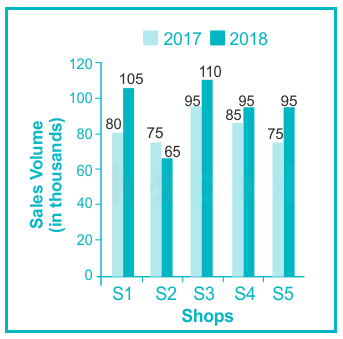
Study the graph and answer the question that follows. The following bar chart shows the sales volume of Philips bulbs (in thousand) from five different electric shops in a city during two years 2017 and 2018.

What is the average sales volume of Philips bulbs (in numbers) from all the shops for the year 2017?

  1. AOption (a)

    81000

  2. BOption (b)

    80000

  3. COption (c)

    83000

  4. DOption (d)

    82000

View answer & explanation

Correct answer

Answer: (d)D.

82000

Why this answer is correct

Given:

Sales volumes for 2017 (in thousands):

S1 = 80, S2 = 75, S3 = 95, S4 = 85, S5 = 75

Formula used:

Average = Sum of sales volumesNumber of shops\frac{\text{Sum of sales volumes}}{\text{Number of shops}}

Calculations:

Sum of sales volumes = 80 + 75 + 95 + 85 + 75

⇒ Sum = 410

Number of shops = 5

⇒ Average = 4105\frac{410}{5}

⇒ Average = 82

∴ The average sales volume of Philips bulbs for 2017 is 82,000.

Question 34

Suppose Rammohan has kept a cylindrical bar magnet along the axis of a circular solenoid. Now, he is rotating the magnet about the axis of the solenoid. The induced electric current in the coil will be:

  1. AOption (a)

    proportional to the number of turns in the solenoid

  2. BOption (b)

    proportional to the length of the solenoid

  3. COption (c)

    zero

  4. DOption (d)

    inversely proportional to the resistance of the solenoid

View answer & explanation

Correct answer

Answer: (c)C.

zero

Why this answer is correct

The correct answer is Zero

Key Points

  • Rotating the magnet about its own axis, while it is aligned with the solenoid's axis, does not change the magnetic flux through the solenoid.
  • This is because the orientation of the magnetic field lines relative to the solenoid does not change only the magnet is being spun around its axis.
  • The magnetic field strength and direction at any point in the solenoid remain constant (Zero) during the rotation of the magnet.
  • If the magnet were moved differently or oriented differently, you would get a varying magnetic flux and an induced current.

Additional Information

  • Solenoid
  • A solenoid is an instrument consists of copper coiling over a cylinder designed to create a strong magnetic field inside the coil because of the flow of current through the coil.
  • By wrapping the same wire many times around a cylinder, the magnetic field due to the flow of current can become quite strong.
  • Hence we can say that the strength of the magnetic field will change as a current through coil or number of turn’s changes.
  • Magnetic field strength is independent of the diameter of the cylinder of a solenoid.
  • Strength of the magnetic field in a solenoid will be directly proportional to the number of turns and amount of current flowing through a wire and will be inversely proportional to its length.
  • Thus it is given by B=μ0NIlB = \frac{{{\mu _0}NI}}{l}

Question 35

The total cost price of 63 identical articles is equal to the total selling price of 54 of those articles. What is the gain or loss percentage?

  1. AOption (a)

    1513%15 \frac{1}{3} \% loss

  2. BOption (b)

    1513%15 \frac{1}{3} \% gain

  3. COption (c)

    1623%16 \frac{2}{3} \% gain

  4. DOption (d)

    1623%16 \frac{2}{3} \% loss

View answer & explanation

Correct answer

Answer: (c)C.

1623%16 \frac{2}{3} \% gain

Why this answer is correct

Shortcut Trick Given: CP of 63 articles = SP of 54 articles. Ratio of CP : SP = 54 : 63 = 6 : 7. Profit = SP − CP = 7 − 6 = 1 unit. Gain% = (Profit ÷ CP) × 100 = (1 ÷ 6) × 100 = 16 2/3%. Since SP > CP, there is a gain. ∴ The correct answer is 16 2/3% gain.

Alternate Method Given: CP × 63 = SP × 54 Formulas: Profit% = ((SP − CP) ÷ CP) × 100 | SP = CP × (100 + P%) ÷ 100

⇒ Let the CP of one article be Re. 1. ⇒ Total CP of 63 articles = Rs. 63. ⇒ Total SP of 54 articles = Total CP of 63 articles = Rs. 63. ⇒ SP of one article = 63 ÷ 54 = 7/6. ⇒ Profit per article = 7/6 − 1 = 1/6. ⇒ Gain% = (1/6 ÷ 1) × 100 = 16 2/3%. ∴ The correct answer is 16 2/3% gain.

Additional Information Cost Price vs Selling Price Relationship When the CP of 'x' articles equals the SP of 'y' articles, Gain/Loss% = (x − y) ÷ y × 100. If positive, it is a gain; if negative, it is a loss. Profit and Loss Basics Profit occurs when SP > CP. Loss occurs when CP > SP. Both are always calculated on the Cost Price (CP) unless stated otherwise.

Question 36

Select the option that represents the letters that, when placed from left to right in the same sequence in the blanks below, will complete the letter series.

L G _ A L L _ F B L _ G F _ L L G F _ L

  1. AOption (a)

    FFCCD

  2. BOption (b)

    FLGDC

  3. COption (c)

    FCGLD

  4. DOption (d)

    FGLCD

View answer & explanation

Correct answer

Answer: (d)D.

FGLCD

Why this answer is correct

The logic followed here is:

Given Sequence: L G _ A L L _ F B L _ G F _ L L G F _ L

Now, putting the letters in the blank spaces given in the option one by one:

Option 1) FFCCD → L G F A L / L F F B L / C G F C L / L G F D L

Option 2) FLGDC → L G F A L / L L F B L / G G F D L / L G F C L

Option 3) FCGLD → L G F A L / L C F B L / G G F L L / L G F D L

Option 4) FGLCD → L G F A L / L G F B L / L G F C L / L G F D L

Here, 4th letter is increased by 1.

A + 1 = B; B + 1 = C; C + 1 = D; 

Hence, the correct answer is "FGLCD".

Question 37

Breathing is harder at high altitudes compared to the sea level because _____.

  1. AOption (a)

    the concentration of oxygen is very high at high altitudes

  2. BOption (b)

    colder temperature constricts airways

  3. COption (c)

    the atmosphere is less dense at high altitudes

  4. DOption (d)

    the rate of diffusion of gases is decreased at high altitudes

View answer & explanation

Correct answer

Answer: (c)C.

the atmosphere is less dense at high altitudes

Why this answer is correct

The correct answer is the atmosphere is less dense at high altitudes

Key Points

  • Breathing is harder at high altitudes compared to sea level
  • It is because the atmosphere is less dense at high altitudes.
  • This means that the air is thinner, and there is less oxygen available for the body to breathe in
  • There is a decrease in atmospheric pressure as well as the oxygen content of the atmosphere resulting in a lower partial pressure of oxygen than that of carbon dioxide resulting in difficulty in breathing.

Additional Information

  • Altitude Sickness
  • At sea level, there are around 21% more oxygen molecules than usual.
  • While the concentration does not change with the increase in altitude but the amount of oxygen molecules per breath and the atmospheric pressure decreases.
  • At 12,000 feet (3,658 metres), there are around 40% less oxygen molecules in each breath.
  • Even while at rest, your breathing rate needs to increase for the body to receive enough oxygen.
  • Continued exposure to higher altitudes without enough acclimatisation might result in very serious, even fatal illnesses.

Question 38

Five friends named Kishore, Jayan, Lahari, Manyaki and Nalini live on five different floors of the same building. The lowermost floor in the building is numbered 1, the floor above it is numbered 2, and so on till the topmost floor which is numbered 5. Kishore lives on odd numbered floor but not on third floor and Nalini lives on the bottommost floor. Manyaki and Jayan lives on even numbered floors but Manyaki doesn't lives above Jayan. Lahari lives on the floor immediately above Manyaki.

Who lives on the third floor?

  1. AOption (a)

    Manyaki

  2. BOption (b)

    Jayan

  3. COption (c)

    Lahari

  4. DOption (d)

    Kishore

View answer & explanation

Correct answer

Answer: (c)C.

Lahari

Why this answer is correct

Given: Five friends named Kishore, Jayan, Lahari, Manyaki and Nalini live on five different floors of the same building.

  1. Kishore lives on odd numbered floor but not on third floor and Nalini lives on the bottommost floor.
FloorsFriends
5Kishore
4
3
2
1Nalini


  1. Manyaki and Jayan lives on even numbered floors but Manyaki doesn't lives above Jayan.
FloorsFriends
5Kishore
4Jayan
3
2Manyaki
1Nalini


  1. Lahari lives on the floor immediately above Manyaki.
FloorsFriends
5Kishore
4Jayan
3Lahari
2Manyaki
1Nalini


So, Lahari lives on the third floor.

Hence, the correct answer is "Lahari".

Question 39

Find the value of 5432.5678 + 435.692 + 29.54 + 6.3 + 0.4321

  1. AOption (a)

    6004.5319

  2. BOption (b)

    5900.5329

  3. COption (c)

    5904.5391

  4. DOption (d)

    5904.5319

View answer & explanation

Correct answer

Answer: (d)D.

5904.5319

Why this answer is correct

Given:

5432.5678 + 435.692 + 29.54 + 6.3 + 0.4321

Formula used:

Sum of the given numbers

Calculation:

5432.5678 + 435.692 + 29.54 + 6.3 + 0.4321

⇒ 5432.5678 + 435.692 = 5868.2598

⇒ 5868.2598 + 29.54 = 5897.7998

⇒ 5897.7998 + 6.3 = 5904.0998

⇒ 5904.0998 + 0.4321 = 5904.5319

∴ The correct answer is option (4).

Question 40

Refer to the following number and symbol series and answer the question.

Note: The numbers are to be considered as a whole and should not be split into its constituent digits.

  • 25 @ 36 # 29 37 % 14 - 7

How many symbols have a prime number as an immediate neighbour on either of its sides?

  1. AOption (a)

    1

  2. BOption (b)

    2

  3. COption (c)

    4

  4. DOption (d)

    3

View answer & explanation

Correct answer

Answer: (d)D.

3

Why this answer is correct

Given series: + 25 @ 36 # 29 37 % 14 - 7

Symbols have a prime number as an immediate neighbour on either of its sides.

Condition need to be check:

Symbol (Either) → Prime number → Symbol (Or)

  • 25 @ 36 # 29 37 % 14 - 7

So, 3 symbols have a prime number as an immediate neighbour on either of its sides.

Hence, the correct answer is "3".

Question 41

Surya participated in a marathon. From starting point he ran 11 km towards West, turned right and ran for 12 km and turned right again and ran 11 km and then turned right again and ran 9 km. How many kms he has to run now in order to reach the starting point from his present position to complete the marathon?

  1. AOption (a)

    3 km

  2. BOption (b)

    2 km

  3. COption (c)

    7 km

  4. DOption (d)

    14 km

View answer & explanation

Correct answer

Answer: (a)A.

3 km

Why this answer is correct

According to the given information:

From starting point he ran 11 km towards West, turned right and ran for 12 km and turned right again and ran 11 km and then turned right again and ran 9 km.

Distance between present position and starting point = 12 - 9 = 3 km.

So, he has to run 3 km now in order to reach the starting point from his present position to complete the marathon.

Hence, the correct answer is "3 km".

Question 42

Three statements are given, followed by three conclusions numbered I, II and III. Assuming the statements to be true, even if they seem to be at variance with commonly known facts, decide which of the conclusions logically follow(s) from the statements.

Statements:

Some investors are urbans.

All stores are urbans.

Some cottages are stores.

Conclusions:

I. Some cottages are investors.

II. Some investors are stores.

III. Some cottages are urbans.

  1. AOption (a)

    Only conclusion III follows.

  2. BOption (b)

    Only conclusions II and III follow.

  3. COption (c)

    Only conclusion I follows.

  4. DOption (d)

    Only conclusions I and II follow.

View answer & explanation

Correct answer

Answer: (a)A.

Only conclusion III follows.

Why this answer is correct

Given Statements:

Some investors are urbans.

All stores are urbans.

Some cottages are stores.

The possible Venn diagram is as follows,

Conclusions:

I. Some cottages are investors. - False (Because, there is no direct relation given between cottages and investors so, it can be possible but not definite)

II. Some investors are stores. - False (Because, there is no direct relation given between investors and stores so, it can be possible but not definite)

III. Some cottages are urbans. - True (Because, Some cottages are stores and All stores are urbans. So, Some cottages are also urbans)

Hence, the correct answer is "Only conclusion III follows".

Question 43

If the signs + and × are interchanged, and the numbers 3 and 7 are also interchanged, which of the following four equations given as options would be correct?

  1. AOption (a)

    13 + 7 × 3 = 47

  2. BOption (b)

    16 × 3 + 7 = 39

  3. COption (c)

    14 + 3 × 7 = 35

  4. DOption (d)

    3 + 7 × 9 = 30

View answer & explanation

Correct answer

Answer: (d)D.

3 + 7 × 9 = 30

Why this answer is correct

Given: 

Signs/NumbersInterchanged
+×
×+
37
73


Option 1) 13 + 7 × 3 = 47

After interchanging the numbers and signs:

⇒ 13 × 3 + 7 = 47

⇒ 39 + 7 = 47

⇒ 46 = 47

Option 2) 16 × 3 + 7 = 39

After interchanging the numbers and signs:

⇒ 16 + 7 × 3 = 39

⇒ 16 + 21 = 39

⇒ 37 = 39

Option 3) 14 + 3 × 7 = 35

After interchanging the numbers and signs:

⇒ 14 × 7 + 3 = 35

⇒ 98 + 3 = 35

⇒ 101 = 35

Option 4) 3 + 7 × 9 = 30

After interchanging the numbers and signs:

⇒ 7 × 3 + 9 = 30

⇒ 21 + 9 = 30

⇒ 30 = 30

Hence, the correct answer is "3 + 7 × 9 = 30".

Question 44

Three statements are given, followed by four conclusions numbered I, II, III and IV. You have to consider these statements to be true, even if they seem at variance from commonly known facts. Decide which of the given conclusions logically follow/s from the given statements.

Statements:

Some cisterns are ponds.

All ponds are streets.

Some streets are cisterns.

Conclusions:

I. Some streets are ponds.

II. All cisterns are streets.

III. All ponds are cisterns.

IV. No street is a cistern.

  1. AOption (a)

    Only conclusion I follows.

  2. BOption (b)

    Only conclusions II and III follow.

  3. COption (c)

    Only conclusion IV follows.

  4. DOption (d)

    Only conclusions I and IV follow.

View answer & explanation

Correct answer

Answer: (a)A.

Only conclusion I follows.

Why this answer is correct

Statements:

Some cisterns are ponds.

All ponds are streets.

Some streets are cisterns.

The possible Venn diagram is as follows,

Conclusions:

I. Some streets are ponds. - True (Because, All ponds are streets given. So, Some streets are ponds it is definite)

II. All cisterns are streets. - False (Because, Some streets are cisterns given. So, All cisterns are streets. It is not definite)

III. All ponds are cisterns. - False (Because, Some cisterns are ponds. So, All cisterns are streets. It is not definite)

IV. No street is a cistern. - False (Because, Some streets are cisterns given. So, No street is a cistern. It is not definite)

Hence, the correct answer is "Only conclusion I follows".

Question 45

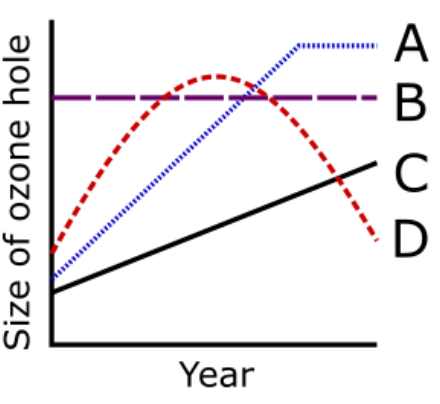
Which line best explains changes in the size of the ozone hole over the years?

  1. AOption (a)

    Line D - it was growing but now it is shrinking

  2. BOption (b)

    Line A - it was growing but now it is not growing

  3. COption (c)

    Line C - it is growing steadily

  4. DOption (d)

    Line B - the size has not changed

View answer & explanation

Correct answer

Answer: (b)B.

Line A - it was growing but now it is not growing

Why this answer is correct

The correct answer is Line A - it was growing but now it is not growing.

Key Points

  • Line A indicates that the size of the ozone hole was increasing previously.
  • The size has stabilized and is no longer expanding.
  • This implies that the efforts to reduce the factors causing the ozone depletion have been effective.
  • Monitoring the size of the ozone hole is crucial for understanding the effectiveness of environmental policies.

Additional Information

  • Ozone Hole:
  • The ozone hole refers to the region over Antarctica where the concentration of ozone in the stratosphere is significantly reduced during certain times of the year.
  • This phenomenon was first observed in the late 1970s and has been a major environmental concern ever since.
  • Causes of Ozone Depletion:
  • Chlorofluorocarbons (CFCs), halons, and other ozone-depleting substances (ODS) are the primary causes of ozone depletion.
  • These substances release chlorine and bromine atoms upon exposure to ultraviolet (UV) light, which then break down ozone molecules.
  • Montreal Protocol:
  • The Montreal Protocol is an international treaty adopted in 1987 to phase out the production and consumption of ozone-depleting substances.
  • It has been successful in reducing the emissions of ODS and has contributed to the stabilization of the ozone layer.
  • Impact of Ozone Depletion:
  • Ozone depletion leads to higher levels of harmful UV radiation reaching the Earth's surface.
  • This can cause increased cases of skin cancer, cataracts, and other health issues, as well as negatively affect ecosystems and wildlife.

Question 46

Refer to the following letter-symbol series and answer the question that follows.

(Left) * V ! ^ C F A * B Y S & Y T G $ V # Y ! $ C ^ A C $ Y N (Right)

From left how many such symbols are there that are immediately preceded by a symbol and immediately followed by a letter?

  1. AOption (a)

    1

  2. BOption (b)

    5

  3. COption (c)

    2

  4. DOption (d)

    3

View answer & explanation

Correct answer

Answer: (c)C.

2

Why this answer is correct

Given series:

  • V ! ^ C F A * B Y S & Y T G $ V # Y ! $ C ^ A C $ Y N 

Condition to be checked:

Symbols which are immediately preceded by a symbol and immediately followed by a letter.

Symbol → Symbol → Letter

  • V ! ^ C F A * B Y S & Y T G $ V # Y ! $ C ^ A C $ Y N

Thus, there is two such pattern (! ^ C and ! $ C) that are following the above conditions.

Hence,"2" is the correct answer.

Mistake Points

Immediately preceded by means immediately before or to come just before.

Immediately followed by means immediately after or to come just after.

Question 47

Which programme or allocation head has emerged as the biggest beneficiary in the Union sports budget for the financial year 2022-23?

  1. AOption (a)

    National Service Scheme

  2. BOption (b)

    National Sports Development Fund

  3. COption (c)

    National Sports Federations

  4. DOption (d)

    Khelo India

View answer & explanation

Correct answer

Answer: (d)D.

Khelo India

Why this answer is correct

The correct answer is Khelo India

Key Points

  • In the Union Sports Budget for the financial year 2022-23, the biggest beneficiary was the Khelo India Scheme.
  • The Ministry has furnished an Expenditure Finance Committee (EFC) memorandum to the Ministry of Finance for extension/continuation of the Khelo India Scheme from 2021-22 to 2025- 26,
  • A number of Rs 8750 crore has been estimated as a financial implication of the new Khelo India Scheme (2021-22 to 2025-26) in the EFC memorandum furnished to the Ministry of Finance.
  • An amount of Rs 657.71 crore has been allocated in the Budget Estimate (B.E.) for the year 2022-23 under the Khelo India Scheme.
  • This information was given by former Minister of State for Youth Affairs & Sports Shri Kiren Rijiju.

Additional Information

  • National Service Scheme
  • ​NSS aims to develop the personality and leadership qualities of students through community service.
  • It encourages youth to engage in social service activities and helps them become responsible citizens.
  • It primarily targets students in universities, colleges, and schools.
  • Volunteers engage in community-based activities, often related to education, health, sanitation, and environmental awareness.
  • Urban Sports Infrastructure Scheme
  • ​This scheme aims to develop and upgrade sports infrastructure in urban areas to promote sports and physical activities among citizens, particularly the youth.
  • The scheme provides financial assistance to state and Union Territory governments for creating and improving sports facilities such as sports complexes, stadiums, and playgrounds in urban areas.
  • National Sports Talent Search Scheme (NSTSS)
  • ​​​NSTSS aims to identify and nurture young talent in various sports disciplines across India
  • It ensures that the country produces world-class athletes for international competitions.
  • Under the scheme, talented athletes are provided with scholarships and advanced training under expert coaches.
  • The focus is on identifying talent early and providing them with the necessary resources for their development.

Question 48

In a chemical equation, the notations (aq) represents:

  1. AOption (a)

    solid

  2. BOption (b)

    Gas

  3. COption (c)

    aqueous

  4. DOption (d)

    Liquid

View answer & explanation

Correct answer

Answer: (c)C.

aqueous

Why this answer is correct

The correct answer is aqueous

Key Points

  • The notation (aq) in a chemical equation represents  Aqueous.
  • (aq) stands for "aqueous," which means the substance is dissolved in water to form a solution.
  • For example, in the equation:
  • NaCl (aq)→Na+(aq)+Cl−(aq)
  • Sodium chloride is dissolved in water, and the ions dissociate in the aqueous medium.

Additional Information

  • Chemical equations are symbolic representations of chemical reactions.
  • They provide information about the reactants, products, and their respective quantities.
  • Balancing chemical equations is essential to satisfy the law of conservation of mass.
  • Different states of matter are indicated to provide a clear understanding of the reaction conditions.

Question 49

The nutrients are supplied to the foetus from the mother through:

  1. AOption (a)

    zygote

  2. BOption (b)

    endosperm

  3. COption (c)

    cervix

  4. DOption (d)

    placenta

View answer & explanation

Correct answer

Answer: (d)D.

placenta

Why this answer is correct

The correct answer is placenta

Key Points

  • The placenta is the organ that supplies nutrients to a fetus from the mother
  • The human placenta is called a haemochorial type.
  • It is in direct contact with the fetus.
  • The placenta forms a thick membranous envelope all over the fetus which gives it protection during the gestation period.
  • The blood and another kind of supply are facilitated by the chorionic villi.


Additional Information

  • Zygote:
  • The zygote is a single cell formed by the fusion of a sperm cell and an egg cell during fertilization.
  • It represents the first stage of development in sexually reproducing organisms
  • It eventually develops into an embryo through successive cell divisions.
  • Endosperm:
  • The endosperm is a tissue found in the seeds of flowering plants, providing nutrition to the developing embryo.
  • It forms after the fertilization process in plants, specifically as a result of double fertilization, where one sperm nucleus fuses with two polar nuclei in the ovule.
  • Cervix:
  • The cervix is a part of the female reproductive system in mammals.
  • It is the lower part of the uterus that connects the uterus to the vagina
  • It plays a key role during childbirth by dilating to allow the baby to pass through.

Question 50

Below bar graph is the representation of the number of boys and girls studying in 5 different colleges in a given year. Study the bar graph and answer the questions.

The total number of girls studying in colleges D and E is what percentage of the total number of girls studying in colleges A, B and C?

  1. AOption (a)

    63.45%

  2. BOption (b)

    66.60%

  3. COption (c)

    75%

  4. DOption (d)

    83.33%

View answer & explanation

Correct answer

Answer: (d)D.

83.33%

Why this answer is correct

Given:

Number of girls in colleges D and E:

D = 3000, E = 3250

Total girls in colleges A, B, and C:

A = 2500, B = 3000, C = 2000

Formula used:

Percentage = Total girls in D and ETotal girls in A, B, and C×100\frac{\text{Total girls in D and E}}{\text{Total girls in A, B, and C}}\times 100

Calculations:

Total girls in D and E = 3000 + 3250

⇒ 6250

Total girls in A, B, and C = 2500 + 3000 + 2000

⇒ 7500

Percentage = 62507500×100\frac{6250}{7500} \times 100

⇒ 6250×1007500\frac{6250 \times 100}{7500}

⇒ 83.33%

∴ The percentage of girls in colleges D and E is 83.33%.

Question 51

Jyoti covered a distance of 3 km in a particular direction and then turned to her right. She further travelled 1 km and thereafter she turned to the left and walked 5 km and then finally she turned to right and walked in the north direction. In which direction was she facing when she started her journey? (All turns are 90 degree turns only)

  1. AOption (a)

    East

  2. BOption (b)

    North

  3. COption (c)

    West

  4. DOption (d)

    South

View answer & explanation

Correct answer

Answer: (c)C.

West

Why this answer is correct

According to the given information:

  1. Jyoti covered a distance of 3 km in a particular direction and then turned to her right.
  2. She further travelled 1 km and there after she turned to the left and walked 5 km.
  3. And then finally she turned to right and walked in the north direction.

So, she was facing in West direction when she started her journey.

Hence, the correct answer is "West".

Question 52

Which of the following numbers will replace the question mark (?) in the given series?

10, 121, 11, 144, 12, 169, 13, 196, 14, ?

  1. AOption (a)

    225

  2. BOption (b)

    224

  3. COption (c)

    222

  4. DOption (d)

    223

View answer & explanation

Correct answer

Answer: (a)A.

225

Why this answer is correct

The logic followed here is:

Hence, the correct answer is "225".

Question 53

The value of (1sec⁡2θ−cos⁡2θ+1cosec⁡2θ−sin⁡2θ)\left(\frac{1}{\sec ^2 \theta-\cos ^2 \theta}+\frac{1}{\operatorname{cosec}^2 \theta-\sin ^2 \theta}\right)(sin2θ . cos2θ)

  1. AOption (a)

    1−cos⁡2θsin⁡2θ2+cos⁡2θsin⁡2θ\frac{1-\cos ^2 \theta \sin ^2 \theta}{2+\cos ^2 \theta \sin ^2 \theta}

  2. BOption (b)

    1+cos⁡2θsin⁡2θ2+cos⁡2θsin⁡2θ \frac{1+\cos ^2 \theta \sin ^2 \theta}{2+\cos ^2 \theta \sin ^2 \theta}

  3. COption (c)

    1+cos⁡2θsin⁡2θ2−cos⁡2θsin⁡2θ\frac{1+\cos ^2 \theta \sin ^2 \theta}{2-\cos ^2 \theta \sin ^2 \theta}

  4. DOption (d)

    1−cos⁡2θsin⁡2θ2−cos⁡2θsin⁡2θ\frac{1-\cos ^2 \theta \sin ^2 \theta}{2-\cos ^2 \theta \sin ^2 \theta}

View answer & explanation

Correct answer

Answer: (a)A.

1−cos⁡2θsin⁡2θ2+cos⁡2θsin⁡2θ\frac{1-\cos ^2 \theta \sin ^2 \theta}{2+\cos ^2 \theta \sin ^2 \theta}

Why this answer is correct

Shortcut Trick

Let θ = 45°.

Substitute sin 45° = 1/√2 and cos 45° = 1/√2, so sin2 θ = 1/2 and cos2 θ = 1/2.

Also, sec2 θ = 2 and cosec2 θ = 2.

Expression = (1/(2 − 1/2) + 1/(2 − 1/2)) × (1/2 × 1/2) = (2/3 + 2/3) × (1/4) = 4/3 × 1/4 = 1/3.

Now test option (4): (1 − 1/4)/(2 − 1/4) = (3/4)/(7/4) = 3/7 (Incorrect). Test option (1): (1 − 1/4)/(2 + 1/4) = (3/4)/(9/4) = 3/9 = 1/3 (Correct).

∴ The correct answer is (1 − cos2 θ sin2 θ)/(2 + cos2 θ sin2 θ).

Alternate Method

Given:

The expression is (1sec⁡2θ−cos⁡2θ+1cosec⁡2θ−sin⁡2θ)(sin⁡2θcos⁡2θ)\left(\frac{1}{\sec ^2 \theta-\cos ^2 \theta}+\frac{1}{\operatorname{cosec}^2 \theta-\sin ^2 \theta}\right)\left(\sin ^2 \theta \cos ^2 \theta\right)

Formula Used:

⇒ sec2 θ = 1/cos2 θ

⇒ cosec2 θ = 1/sin2 θ

Calculations:

⇒ sec2 θ − cos2 θ = (1 − cos4 θ)/cos2 θ = ((1 − cos2 θ)(1 + cos2 θ))/cos2 θ = (sin2 θ(1 + cos2 θ))/cos2 θ

⇒ Therefore, 1/(sec2 θ − cos2 θ) = cos2 θ/(sin2 θ(1 + cos2 θ))

⇒ Similarly, 1/(cosec2 θ − sin2 θ) = sin2 θ/(cos2 θ(1 + sin2 θ))

⇒ Sum = [cos4 θ(1 + sin2 θ) + sin4 θ(1 + cos2 θ)] / [sin2 θ cos2 θ (1 + sin2 θ)(1 + cos2 θ)]

⇒ Numerator of the sum = cos4 θ + sin4 θ + sin2 θ cos2 θ (sin2 θ + cos2 θ) = (sin2 θ + cos2 θ)2 − 2 sin2 θ cos2 θ + sin2 θ cos2 θ = 1 − sin2 θ cos2 θ

⇒ Denominator of the sum = sin2 θ cos2 θ (1 + sin2 θ + cos2 θ + sin2 θ cos2 θ) = sin2 θ cos2 θ (2 + sin2 θ cos2 θ)

⇒ Multiplying by (sin2 θ cos2 θ) simplifies the entire expression to: (1 − sin2 θ cos2 θ)/(2 + sin2 θ cos2 θ)

∴ The correct answer is (1 − cos2 θ sin2 θ)/(2 + cos2 θ sin2 θ).

Additional Information

Trigonometric Identities

Recall that sin2 θ + cos2 θ = 1, sec2 θ − tan2 θ = 1, and cosec2 θ − cot2 θ = 1.

Algebraic Expressions in Trigonometry

Expressing sin4 θ + cos4 θ as (sin2 θ + cos2 θ)2 − 2 sin2 θ cos2 θ = 1 − 2 sin2 θ cos2 θ is extremely useful for simplifying higher power trigonometric equations.

Question 54

Three statements are given followed by two conclusions numbered I and II. Assuming the statements to be true, even if they seem to be at variance with commonly known facts, decide which of the conclusions logically follow(s) from the statements.

Statements:

All gadgets are electronics.

Some electronics are wirelesses.

Some wirelesses are toys.

Conclusions:

I. Some gadgets are toys.

II. Some electronics are gadgets.

  1. AOption (a)

    Both conclusions I and II follow

  2. BOption (b)

    Neither conclusion I nor II follows

  3. COption (c)

    Only conclusion II follows

  4. DOption (d)

    Only conclusion I follows

View answer & explanation

Correct answer

Answer: (c)C.

Only conclusion II follows

Why this answer is correct

Given Statements:

All gadgets are electronics.

Some electronics are wirelesses.

Some wirelesses are toys.

The possible Venn diagram is as follows,

Conclusions:

I. Some gadgets are toys. - False (Because, there is no direct relation between gadgets and toys so it can be possible but not possible)

II. Some electronics are gadgets. - True (Because, All gadgets are electronics. So Some electronics are gadgets, it is definite)

Hence, the correct answer is "Only conclusion II follows".

Question 55

What will ₹80,000 amount to in one year at 12% per annum, if the interest is compounded half-yearly?

  1. AOption (a)

    ₹88,888

  2. BOption (b)

    ₹1,00,352

  3. COption (c)

    ₹92,450

  4. DOption (d)

    ₹89,888

View answer & explanation

Correct answer

Answer: (d)D.

₹89,888

Why this answer is correct

Shortcut Trick

For compounded half-yearly, the Rate becomes 12% ÷ 2 = 6% and the Time becomes 1 × 2 = 2 periods.

Effective Rate for 2 periods = 6 + 6 + (6 × 6) ÷ 100 = 12.36%.

Interest = 12.36% of 80,000 = 12.36 × 800 = ₹9,888.

Total Amount = 80,000 + 9,888 = ₹89,888.

∴ The correct answer is ₹89,888.

Alternate Method

Given:

Principal (P) = ₹80,000

Rate (R) = 12% per annum

Time (T) = 1 year

Compounding = Half-yearly

Formula Used:

Amount (A) = P(1 + r/100)n

Where r = Rate per compounding period and n = number of compounding periods.

Calculations:

⇒ Adjusted Rate (r) = 12% ÷ 2 = 6% per half-year

⇒ Number of periods (n) = 1 × 2 = 2

⇒ A = 80,000 × (1 + 6/100)2

⇒ A = 80,000 × (106/100) × (106/100)

⇒ A = 80,000 × 1.06 × 1.06

⇒ A = 80,000 × 1.1236

⇒ A = 89,888

∴ The correct answer is ₹89,888.

Additional Information

Compounding Frequency

When interest is compounded quarterly, the rate is divided by 4 and the time is multiplied by 4.

Effective Rate of Interest

For two periods, the effective rate is calculated as: x + y + (xy/100), which helps in avoiding long power calculations.

CI vs SI Difference

The difference between Compound Interest and Simple Interest for 2 years (or 2 periods) is P(r/100)2.

Question 56

The cost of a keyboard and a mouse is ₹3,600. If the cost of the keyboard is seven times that of the mouse, what is the cost of the keyboard?

  1. AOption (a)

    ₹3,150

  2. BOption (b)

    ₹3,050

  3. COption (c)

    ₹600

  4. DOption (d)

    ₹450

View answer & explanation

Correct answer

Answer: (a)A.

₹3,150

Why this answer is correct

Shortcut Trick

Ratio of Keyboard cost : Mouse cost = 7 : 1

Total ratio parts = 7 + 1 = 8 units

8 units = ₹3,600 → 1 unit = 3,600 ÷ 8 = ₹450

Keyboard cost = 7 units = 7 × ₹450 = ₹3,150

∴ The correct answer is ₹3,150.

Alternate Method

Given:

Total cost of keyboard and mouse = ₹3,600

Cost of keyboard is 7 times the cost of the mouse.

Formula Used:

Total Cost = Keyboard Cost + Mouse Cost

Calculations:

⇒ Let the cost of the mouse be ₹x.

⇒ The cost of the keyboard = ₹7x.

⇒ According to the question, x + 7x = 3,600

⇒ 8x = 3,600

⇒ x = 3,600 ÷ 8

⇒ x = 450

⇒ Cost of the keyboard = 7x = 7 × 450 = ₹3,150

∴ The correct answer is ₹3,150.

Additional Information

Ratio and Proportion

A ratio compares two quantities. If A:B = x:y, then A = [x/(x+y)] × Total and B = [y/(x+y)] × Total.

Unitary Method

Find the value of a single unit first by dividing the total value by the total number of units, then multiply by the required number of units.

Percentage Calculation

To find what percentage the keyboard is of the total cost: (7/8) × 100 = 87.5%.

Question 57

Suppose a beam of light of average wavelength 600 nm is incident on a glass prism from air, and on entering into the prism, it splits into different colours. One of the colours has wavelength 380 nm. The refractive index of the medium for this particular wavelength is:

  1. AOption (a)

    1.58

  2. BOption (b)

    1.42

  3. COption (c)

    1.33

  4. DOption (d)

    1.73

View answer & explanation

Correct answer

Answer: (a)A.

1.58

Why this answer is correct

The correct answer is 1.58

Key Points

  • The refractive index (n) of a medium can be determined using the equation n = c/v,
  • Where
  • v is the speed of light in the medium.

c is the speed of light in a vacuum

  • The dispersion of light in a prism depends on the wavelength; shorter wavelengths bend more.
  • However, without specific details on the prism's material or angles, we can't directly calculate n from the given wavelength (380 nm).
  • The correct option,1.58, is provided without a direct calculation path, implying it might be a given property of the material for that wavelength.

Additional Information Refraction:

  • When light rays pass through one medium to another medium, the band from their original path. This phenomenon is called the refraction of light.
  • When it passes through a rarer to denser medium, it band towards normal.
  • When it passes from denser to rarer medium, it's band away from the normal.

Reflection: 

  • When light falls on the surface and get back to the same medium then it is called reflection.
  • As light rays remain in the same medium, hence its wavelength remains unchanged.

Question 58

Which of the following metals forms a green colour coating due to corrosion?

  1. AOption (a)

    Zinc

  2. BOption (b)

    Copper

  3. COption (c)

    Iron

  4. DOption (d)

    Silver

View answer & explanation

Correct answer

Answer: (b)B.

Copper

Why this answer is correct

The correct answer is Copper

Key Points

  • Copper (Cu) is the metal that forms a green coating due to corrosion when exposed to air.
  • This happens because copper reacts with moisture and gases in the air,
  • It forms a mixture of copper carbonate and copper hydroxide.
  • To clean tarnished copper vessels, you can use lemon or tamarind juice to restore their characteristic lustre

Additional Information

  • Corrosion
  • Metals when kept open react with oxygen and moisture present in the air.
  • This process is called corrosion.
  • The metal undercover chemically reacts with the oxygen in the atmosphere and forms an oxide on the surface of the metal.
  • Rust formation over Iron when it is kept in presence of moist air is an example of corrosion.
  • It leads to loss of strength and shine of metal.

Question 59

Select the option that is related to the fifth number in the same way as the second number is related to the first number and the fourth number is related to the third number.

2 ∶ 18 ∶∶ 4 ∶ 74 ∶∶ 9 ∶ ?

  1. AOption (a)

    348

  2. BOption (b)

    1005

  3. COption (c)

    739

  4. DOption (d)

    517

View answer & explanation

Correct answer

Answer: (c)C.

739

Why this answer is correct

The logic followed here is:

Logic: (1st number)3 + 10 = 2nd number.

For, 2 : 18

⇒ (2)3 + 10 = 8 + 10 = 18.

For, 4 : 74

⇒ (4)3 + 10 = 64 + 10 = 74.

Similarly, for 9 : ?

⇒ (9)3 + 10 = 729 + 10 = 739.

Hence, the correct answer is "Option 3".

Question 60

Who is the head of the Union Executive of the Government of India?

  1. AOption (a)

    The Vice President

  2. BOption (b)

    The Prime Minister

  3. COption (c)

    The President

  4. DOption (d)

    The Chief Justice of India

View answer & explanation

Correct answer

Answer: (c)C.

The President

Why this answer is correct

The correct answer is The President.

Key Points

  • The President is the head of the State and the Union Executive (Article 52).
  • Elected by an Electoral College consisting of MPs and MLAs through proportional representation by single transferable vote (Article 54).
  • Holds office for 5 years and can be re-elected (Article 56).
  • Exercises executive, legislative, judicial, and emergency powers with the aid and advice of the Council of Ministers (Articles 72, 123, 356).
  • The Prime Minister is the head of the Union Executive of the Government of India
  • The Prime Minister is appointed by the President.
  • Other ministers shall be appointed by the President on the advice of the Prime Minister.
  • He is also the head of the council of ministers.
  • Article 74 to Article 78 of Part V deals with the Prime Minister and Council of Ministers.
  • He is the chairman of the cabinet and presides over the meetings of the Cabinet.
  • The prime minister is the leader of the lower house of Parliament.
  • He is the chief spokesman of the Central Government and also in foreign relations.
  • He acts as the chief advisor to the President of India.
  • The Prime Minister submits his resignation to the president of India.
  • He is the head of the Nuclear Command Authority, NITI Aayog, Appointments Committee of the Cabinet, Department of Atomic Energy, Department of Space and Ministry of Personnel, Public Grievances and Pensions.
  • He communicates all decisions of the Cabinet related to the administration of the affairs of the Union and proposals for legislation to the President and therefore acts as the link between President and cabinet.
  • The death or resignation of the Prime Minister automatically leads to the dissolution of the Council of Ministers.
  • To become a prime minister of India, he/she should have completed 30 years of age if he is a member of the Rajya Sabha or 25 years of age if he is a member of the Lok Sabha.

Additional Information

  • The Union executive consists of the President, the Vice-President, and the Council of Ministers with the Prime Minister as the head to aid and advise the President.
  • The Union Government has three organs – the Executive, the Legislature, and the Judiciary.
  • Chief Justice of India does not form a part of the Union executive.
  • The speaker of Lok Sabha is a member of Parliament but is not a part of the Union Executive.

Confusion Points

  • The President of India is the Head of the State and Supreme Commander of the armed forces whereas PM is the head of the government and does not represent the state.

Question 61

Simplify (7x - 1)3 + (7x + 1)3.

  1. AOption (a)

    686x3 - 42x

  2. BOption (b)

    -686x3 + 42x

  3. COption (c)

    -686x3 - 42x

  4. DOption (d)

    686x3 + 42x

View answer & explanation

Correct answer

Answer: (d)D.

686x3 + 42x

Why this answer is correct

Shortcut Trick

Use the direct algebraic identity: (a − b)3 + (a + b)3 = 2a3 + 6ab2.

Here, substitute a = 7x and b = 1.

⇒ 2(7x)3 + 6(7x)(1)2

⇒ 2(343x3) + 42x

⇒ 686x3 + 42x

∴ The correct answer is 686x3 + 42x.

Alternate Method

Given:

The expression is (7x − 1)3 + (7x + 1)3.

Formula Used:

(a + b)3 = a3 + b3 + 3a2b + 3ab2

(a − b)3 = a3 − b3 − 3a2b + 3ab2

Calculations:

⇒ Let us expand both terms individually using the formulas.

⇒ (7x − 1)3 = (7x)3 − 13 − 3(7x)2(1) + 3(7x)(1)2

⇒ (7x − 1)3 = 343x3 − 1 − 147x2 + 21x

⇒ (7x + 1)3 = (7x)3 + 13 + 3(7x)2(1) + 3(7x)(1)2

⇒ (7x + 1)3 = 343x3 + 1 + 147x2 + 21x

⇒ Now, add the two expanded forms together:

⇒ (343x3 − 1 − 147x2 + 21x) + (343x3 + 1 + 147x2 + 21x)

⇒ The terms with opposite signs cancel out (−1 and +1, −147x2 and +147x2).

⇒ = (343x3 + 343x3) + (21x + 21x)

⇒ = 686x3 + 42x

∴ The correct answer is 686x3 + 42x.

Additional Information

Sum and Difference of Cubes

Basic algebraic identities are: a3 + b3 = (a + b)(a2 − ab + b2) and a3 − b3 = (a − b)(a2 + ab + b2).

Algebraic Identities for Squares

Similarly, for squares: (a + b)2 + (a − b)2 = 2(a2 + b2) and (a + b)2 − (a − b)2 = 4ab.

Cubes Subtraction Trick

Similar to the sum of cubes, the difference expression can be simplified directly as: (a + b)3 − (a − b)3 = 2b3 + 6a2b.

Question 62

In a certain code language, 'SCOPE' is written as 'JZNMX' and 'GAMUT' is written as 'VBPHI'. How will 'RANGE' be written in that language?

  1. AOption (a)

    LBOVX

  2. BOption (b)

    KBOVW

  3. COption (c)

    KBOVX

  4. DOption (d)

    KBPVX

View answer & explanation

Correct answer

Answer: (c)C.

KBOVX

Why this answer is correct

The logic followed here is:

'SCOPE' is written as 'JZNMX'

'GAMUT' is written as 'VBPHI'

Similarly, 'RANGE' will be written as:

Hence, the correct answer is "KBOVX".

Question 63

Eight people live on different floors of the same building. The lowermost floor in the building is numbered 1, the floor above it is numbered 2 and so on till the topmost floor is numbered 8. Only 4 people live above Aditya. Anu lives on the sixth floor. Only two people live between Anu and Shubham. Ravi lives immediately above Deep. Diksha lives immediately below Sakshi. Sakshi lives on the topmost floor. On which floor does Deep live?

  1. AOption (a)

    3

  2. BOption (b)

    2

  3. COption (c)

    1

  4. DOption (d)

    5

View answer & explanation

Correct answer

Answer: (c)C.

1

Why this answer is correct

According to the given information:

  1. Anu lives on the sixth floor.

  2. Only two people live between Anu and Shubham.

FloorsPeople
8
7
6Anu
5
4
3Shubham
2
1


  1. Only 4 people live above Aditya.
FloorsPeople
8
7
6Anu
5
4Aditya
3Shubham
2
1


  1. Sakshi lives on the topmost floor.

5) Diksha lives immediately below Sakshi.

FloorsPeople
8Sakshi
7Diksha
6Anu
5
4Aditya
3Shubham
2
1


  1. Ravi lives immediately above Deep.
FloorsPeople
8Sakshi
7Diksha
6Anu
5
4Aditya
3Shubham
2Ravi
1Deep


Thus, final arrangement:

FloorsPeople
8Sakshi
7Diksha
6Anu
5----
4Aditya
3Shubham
2Ravi
1Deep


So, Deep lives on floor 1.

Hence, the correct answer is "1".

Question 64

According to Newlands, how many elements existed in nature?

  1. AOption (a)

    76

  2. BOption (b)

    66

  3. COption (c)

    86

  4. DOption (d)

    56

View answer & explanation

Correct answer

Answer: (d)D.

56

Why this answer is correct

The correct answer is 56.

Key Points

  • Newland assumed that only 56 elements exist in nature.
  • In 1866, John Newlands, an English scientist, arranged the then-known elements in order of increasing atomic mass.
  • He started with the element with the lowest atomic mass (hydrogen) and ended with Thorium which was the 56th element.
  • He found that every eighth element has the same properties as the first.
  • He compared it to the octave found in music.
  • That's why he called it the 'law of octaves'.
  • This is known as 'Newlands' Law of Octaves'.
  • The properties of lithium and sodium were found to be similar in Newlands' octave.

Additional Information

  • Law of Octaves was applicable only up to calcium, as after calcium every eighth element did not possess properties similar to that of the first.
  • It was assumed by Newlands that only 56 elements existed in nature and no more elements would be discovered in the future.
  • But, later on, several new elements were discovered, whose properties did not fit into the Law of Octaves.
  • In 1869, just five years after John Newlands put forward his Law of Octaves, a Russian chemist called Dmitri Mendeleev published a periodic table.
  • Mendeleev also arranged the elements known at the time in order of relative atomic mass, but he did some other things that made his table much more successful.

Question 65

What is the nature of washing soda?

  1. AOption (a)

    Mild acidic

  2. BOption (b)

    Basic

  3. COption (c)

    Neutral

  4. DOption (d)

    Amphoteric

View answer & explanation

Correct answer

Answer: (b)B.

Basic

Why this answer is correct

The correct answer is Basic

Key Points

  • Washing soda (sodium carbonate, Na₂CO₃) is a basic compound.
  • When dissolved in water, it produces hydroxide ions (OH⁻), making the solution alkaline.
  • This basic nature is why it is used in cleaning agents to neutralize acidic substances and remove grease or oil.
  • Washing soda is a water-softening agent because it reacts with the calcium and magnesium ions in hard water to form insoluble precipitates, thereby removing hardness from the water.
  • This property enhances its effectiveness in cleaning.

Additional InformationSome common chemical compounds with their common names are:

Chemical CompoundsCommon NamesChemical Formulas
Sodium BicarbonateBaking SodaNaHCO3
Calcium ChlorohypoChloriteBleaching PowderCaOCl2
Sodium HydroxideCaustic SodaNaOH
Sodium CarbonateWashing SodaNa2CO3 .10 H2O
Carbon DioxideDry IceCO2
Copper SulphateBlue VitriolCuSO4
Ferrous SulphateGreen VitriolFeSO4
Sulphuric AcidOil of vitriolH2SO4
Calcium Sulphate HemihydratePlaster of Paris(CaSO4. 1/2H2O)
Calcium Sulphate DihydrateGypsumCaSO4.2H2O
Calcium HydroxideSlaked LimeCa(OH)2
Chile SaltpeterSodium nitrateNaNO3
SaltpetrePotassium nitrateKNO3
Muriatic acidHydrochloric acidHCl

Question 66

The mean weight of 18 jackfruits is 7.2  kg. If the weights of 2 more jackfruits whose weights are equal are added, the mean weight decreases by 20 g. What is the weight of each jackfruit added later?

  1. AOption (a)

    7.18 kg

  2. BOption (b)

    7.22 kg

  3. COption (c)

    7.40 kg

  4. DOption (d)

    7.00 kg

View answer & explanation

Correct answer

Answer: (d)D.

7.00 kg

Why this answer is correct

Shortcut Trick

Total jackfruits now = 18 + 2 = 20.

Total decrease in weight = 20 × 20 g = 400 g = 0.4 kg.

Total weight of 2 new jackfruits = (2 × Old Mean) − Total decrease = (2 × 7.2) − 0.4 = 14 kg.

Weight of each new jackfruit = 14 ÷ 2 = 7 kg.

∴ The correct answer is 7.00 kg.

Alternate Method

Given:

Initial number of jackfruits = 18

Initial mean weight = 7.2 kg

Decrease in mean = 20 g = 0.02 kg

Calculations:

⇒ Total weight of 18 jackfruits = 18 × 7.2 = 129.6 kg

⇒ Total number of jackfruits after addition = 18 + 2 = 20

⇒ New mean weight = 7.2 − 0.02 = 7.18 kg

⇒ Total weight of 20 jackfruits = 20 × 7.18 = 143.6 kg

⇒ Total weight of 2 added jackfruits = 143.6 − 129.6 = 14.0 kg

⇒ Weight of each added jackfruit = 14.0 ÷ 2 = 7.00 kg

∴ The correct answer is 7.00 kg.

Additional Information

Arithmetic Mean formula

The mean is calculated as the sum of all observations divided by the total number of observations: Mean = (Sum of values) ÷ (Total number of items).

Effect of New Entry on Mean

If the added value is less than the original mean, the new mean will decrease. If the added value is more, the mean will increase.

Unit Conversion

Always ensure all units are the same before calculation. In this case, 20 g = 20 ÷ 1000 = 0.02 kg.

Question 67

In a classroom, the number of boys and the number of girls are initially equal. 8 girls left to play ring tennis, leaving twice as many boys as girls in the classroom. The total number of girls and boys present initially were ______.

  1. AOption (a)

    32

  2. BOption (b)

    34

  3. COption (c)

    26

  4. DOption (d)

    24

View answer & explanation

Correct answer

Answer: (a)A.

32

Why this answer is correct

Shortcut Trick

Initial ratio of Boys : Girls = 1 : 1. To match the future Boys part, use 2 : 2.

Final ratio after 8 girls left = 2 : 1.

Difference in Girls parts = 2 − 1 = 1 unit.

Given 1 unit = 8 girls, initial total parts = 2 + 2 = 4 units.

Initial total = 4 × 8 = 32.

∴ The correct answer is 32.

Alternate Method

Given: Initial Boys = Girls. After 8 girls left, Boys = 2 × Girls.

⇒ Let the initial number of boys and girls be x each.

⇒ Number of girls after 8 left = x − 8.

⇒ According to the problem: x = 2 × (x − 8).

⇒ x = 2x − 16.

⇒ 2x − x = 16.

⇒ x = 16.

⇒ Initial total number of students = x + x = 16 + 16 = 32.

∴ The correct answer is 32.

Additional Information

Ratio Balancing

When one part of a ratio is changed and the other remains constant, multiply the original ratio to make the constant parts equal in both states.

Linear Equations in One Variable

Standard approach for solving word problems by translating text into algebraic expressions like ax + b = c.

Constant Quantity Concept

In problems where only one group changes (e.g., girls leaving), the other group (boys) acts as a fixed reference point for calculation.

Question 68

How many such pairs of letters are there in the word DANCER (in both forward and backward directions) which have as many letters between them as there are in the English alphabetical order?

  1. AOption (a)

    Three

  2. BOption (b)

    Two

  3. COption (c)

    One

  4. DOption (d)

    None

View answer & explanation

Correct answer

Answer: (c)C.

One

Why this answer is correct

Given word:  'DANCER' 

So, there is one such pair i.e. AC.

Hence, the correct answer is "Option (3)".

Question 69

The sum of the roots of the equation x2 + 3a2 = 4ax is:

  1. AOption (a)

    a

  2. BOption (b)

    4a

  3. COption (c)

    3a

  4. DOption (d)

    2a

View answer & explanation

Correct answer

Answer: (b)B.

4a

Why this answer is correct

Shortcut Trick

Convert the equation to standard form Ax2 + Bx + C = 0 → x2 − 4ax + 3a2 = 0.

Identify the coefficients: A = 1, B = −4a, C = 3a2.

Apply the sum of roots property: Sum = −B/A.

Sum = −(−4a) / 1 = 4a.

∴ The correct answer is 4a.

Alternate Method

Given: x2 + 3a2 = 4ax

Method: Standard Quadratic Root Relations

⇒ Rearranging the quadratic equation: x2 − 4ax + 3a2 = 0

⇒ Comparing with Ax2 + Bx + C = 0, we get:

⇒ Coefficient A = 1

⇒ Coefficient B = −4a

⇒ Coefficient C = 3a2

⇒ Sum of roots (α + β) = −B / A

⇒ Sum of roots = −(−4a) / 1

⇒ Sum of roots = 4a

∴ The correct answer is 4a.

Additional Information

Product of Roots

For any quadratic equation Ax2 + Bx + C = 0, the product of roots (α × β) is given by C/A. In this case, product = 3a2 / 1 = 3a2.

Discriminant and Nature of Roots

The value D = B2 − 4AC determines the nature of roots. Here, D = (−4a)2 − 4(1)(3a2) = 16a2 − 12a2 = 4a2. Since D ≥ 0, the roots are real.

Factorization Method

The equation x2 − 4ax + 3a2 = 0 can be factored as (x − 3a)(x − a) = 0. The individual roots are x = 3a and x = a, and their sum is 3a + a = 4a.

Question 70

If 2.5 ∶ x ∶∶ x ∶ 4.9, and x > 0, find the value of x.

  1. AOption (a)

    3.5

  2. BOption (b)

    3.2

  3. COption (c)

    3.3

  4. DOption (d)

    3.4

View answer & explanation

Correct answer

Answer: (a)A.

3.5

Why this answer is correct

Shortcut Trick For a mean proportional relationship a : x :: x : b, the value of x is √(a × b). x = √(2.5 × 4.9) = √(12.25) Since 3.52 = 12.25, the value of x is 3.5. ∴ The correct answer is 3.5. Alternate Method Given: 2.5 : x :: x : 4.9 and x > 0. Formula Used: Product of Extremes = Product of Means (ad = bc).

⇒ 2.5 / x = x / 4.9 ⇒ x2 = 2.5 × 4.9 ⇒ x2 = 12.25 ⇒ x = √12.25 ⇒ x = 3.5 ∴ The correct answer is 3.5. Additional Information Mean Proportional The mean proportional between two numbers 'a' and 'b' is the value 'x' such that a:x = x:b, calculated as x = √(ab). Third Proportional In the ratio a:b = b:c, 'c' is called the third proportional and is calculated as c = b2 / a. Fourth Proportional In the proportion a:b = c:d, 'd' is the fourth proportional to a, b, and c, calculated as d = (b × c) / a.

Question 71

Which of the following is not the use of baking soda?

  1. AOption (a)

    bleaching action

  2. BOption (b)

    as an ingredient in antacids

  3. COption (c)

    in soda-acid fire extinguishers

  4. DOption (d)

    making of baking powder

View answer & explanation

Correct answer

Answer: (a)A.

bleaching action

Why this answer is correct

The correct answer is bleaching action

Key Points

  • Bleaching Action is not used in Baking soda.
  • Baking soda (sodium bicarbonate) is a mild alkaline compound with various uses:
  • Antacids:
  • It neutralizes excess stomach acid, providing relief from heartburn and indigestion.
  • Fire extinguishers:
  • It reacts with acids to produce carbon dioxide, which helps extinguish fires.
  • Baking powder:
  • A key ingredient in baking powder, where it reacts with acids to release carbon dioxide, causing baked goods to rise.

Additional Information

  • Baking soda was first manufactured by French chemist Nicolas Leblanc.
  • It was first manufactured in 1971.
  • The common name of Sodium bicarbonate is Baking soda.
  • Sodium bicarbonate is non flammable.
  • Baking soda is basic in nature.
  • Uses of Sodium bicarbonate are following:-
  • It acts as an antacid that is used to treat stomach
  • It is used in fire extinguishers due to the formation of soapy foam
  • It acts as a pesticide
  • It neutralizes the effect of acid as a neutralizer
  • In the stomach, Reduces the acidity

Question 72

Which of the following numbers will replace the question mark (?) in the given series?

28, 42, 59, 81, 110, ?, 197

  1. AOption (a)

    148

  2. BOption (b)

    163

  3. COption (c)

    159

  4. DOption (d)

    153

View answer & explanation

Correct answer

Answer: (a)A.

148

Why this answer is correct

The logic followed here is:

Hence, the correct answer is "148".

Question 73

In which of the following places is the cellulose of food digested by the action of certain bacteria in animals like horses, rabbit, etc.?

  1. AOption (a)

    Oesophagus

  2. BOption (b)

    Small intestine

  3. COption (c)

    Stomach

  4. DOption (d)

    Caecum

View answer & explanation

Correct answer

Answer: (d)D.

Caecum

Why this answer is correct

The correct answer is Caecum

Key Points

  • The cellulose of food is digested in the caecum of animals like horses and rabbits by the action of certain bacteria.
  • It is Located between the oesophagus and the small intestine
  • Cellulose is digested by symbiotic bacteria and protozoans through a slow decomposition process.
  • Cellulose is a complex organic compound that is a primary component of plant cell walls.
  • It is indigestible by many animals, including humans, because it doesn't dissolve in water or other solvents.

Additional Information

  • Oesophagus:
  • The oesophagus is a muscular tube that connects the throat (pharynx) to the stomach.
  • Its primary function is to transport swallowed food and liquids from the mouth to the stomach through a series of coordinated muscle contractions known as peristalsis.
  • It lies behind the trachea and extends from the pharynx to the stomach.
  • Stomach:
  • ​The stomach is a hollow, muscular organ that plays a key role in digesting food.
  • It secretes digestive enzymes and acids to break down food.
  • The stomach also churns food to mix it with gastric juices, creating a substance called chyme.
  • It is located between the oesophagus and the small intestine.
  • Small Intestine:
  • ​The small intestine is responsible for the majority of digestion and nutrient absorption.
  • It consists of three parts: the duodenum, jejunum, and ileum.
  • In the small intestine, food is mixed with bile (from the liver) and pancreatic juices (from the pancreas), breaking down fats, proteins, and carbohydrates into absorbable nutrients.
  • It is located between the stomach and the large intestine.

Question 74

The curved surface area of a sphere is 1386 cm2. Find the volume of the sphere. [Use π=227\pi=\frac{22}{7}]

  1. AOption (a)

    5572 cm3

  2. BOption (b)

    2722 cm3

  3. COption (c)

    4851 cm3

  4. DOption (d)

    4158 cm3

View answer & explanation

Correct answer

Answer: (c)C.

4851 cm3

Why this answer is correct

Shortcut Trick

Check for divisibility by 11 for volume calculations involving π\pi.

Volume of sphere ∝ π\pi, so it must be a multiple of 11.

Checking 4851: (4 + 5) − (8 + 1) = 9 − 9 = 0 (Divisible by 11).

∴ The correct answer is 4851 cm3.

Alternate Method

Given: Curved Surface Area (CSA) of sphere = 1386 cm2.

Formula Used: CSA = 4πr2 | Volume = (4/3)πr3

⇒ 4 × (22/7) × r2 = 1386

⇒ r2 = (1386 × 7) / (4 × 22)

⇒ r2 = (63 × 7) / 4 = 441 / 4

⇒ r = 21 / 2 = 10.5 cm

⇒ Volume = (4/3) × (22/7) × (21/2) × (21/2) × (21/2)

⇒ Volume = (4/3) × (22/7) × (9261/8) = 4851 cm3

∴ The correct answer is 4851 cm3.

Additional Information

Total Surface Area of Hemisphere

For a solid hemisphere, the total surface area includes the curved part and the flat base: TSA = 3πr2.

Ratio of Sphere and Cylinder

A sphere of radius r fits exactly inside a cylinder of height 2r. The volume of the sphere is 2/3 of the volume of that cylinder.

Surface Area vs Volume

If the radius is doubled, the surface area increases 4 times (r2) and the volume increases 8 times (r3).

Question 75

Simplify the given expression.

140×140+280×450÷3+150×150290\frac{140 \times 140+280 \times 450 \div 3+150 \times 150}{290}

  1. AOption (a)

    280

  2. BOption (b)

    275

  3. COption (c)

    290

  4. DOption (d)

    270

View answer & explanation

Correct answer

Answer: (c)C.

290

Why this answer is correct

Given:

(140×140+280×450÷3+150×150)290\dfrac{(140 \times 140+280 \times 450 \div 3+150 \times 150)}{290}

Formula used:

Calculate the numerator first: (a × a + b × c ÷ d + e × e)

Calculation:

(140×140+280×450÷3+150×150)290\dfrac{(140 \times 140+280 \times 450 \div 3+150 \times 150)}{290} = ?

Numerator = 140 × 140 + 280 × 450 ÷ 3 + 150 × 150

⇒ Numerator = 19600 + 42000 + 22500

⇒ Numerator = 84100

⇒ ? = 84100290\dfrac{84100}{290}

⇒ ? = 290

∴ The correct answer is option (3).

Question 76

When was the Regulating Act passed by the British Parliament to regulate the activities of the East India Company?

  1. AOption (a)

    1773

  2. BOption (b)

    1861

  3. COption (c)

    1875

  4. DOption (d)

    1793

View answer & explanation

Correct answer

Answer: (a)A.

1773

Why this answer is correct

The correct answer is 1773.

Key Points

  • The Regulating Act was passed in the British Parliament in June 1773.
  • It was the first parliamentary ratification and authorization defining the powers and authority of the East India Company with respect to its Indian possessions. Background/Reasons for passing the Act.
  • The act was intended to overhaul the company's management in India, especially in Bengal.
  • The Regulating Act was considered a landmark in the development of legal institutions in India.

Additional Information

  • This act permitted the company to retain its territorial possessions in India but sought to regulate the activities and functioning of the company. It did not take over power completely, hence called ‘regulating’.
  • The act provided for the appointment of a Governor-General along with four Councillors in the Presidency of Fort William (Calcutta), jointly called the Governor-General in Council.
  • The Governors in Councils at Madras and Bombay were brought under the control of Bengal, especially in matters of foreign policy. Now, they could not wage war against Indian states without Bengal’s approval.
  • The company directors were elected for a period of five years and one-fourth of them were to retire every year. Also, they could not be re-elected.
  • The company directors were directed to make public all correspondence on revenue, civil and military matters with Indian authorities before the British authorities.
  • A Supreme Court of Judicature was established at Calcutta with Sir Elijah Impey as the first Chief Justice. Judges were to come from England. It had civil and criminal jurisdiction over the British subjects and not Indian natives.

Question 77

On 23 December 2021, Maharashtra passed which of the following Criminal Law Acts to approve death penalty for heinous offences against women and children?

  1. AOption (a)

    Kiran

  2. BOption (b)

    Disha

  3. COption (c)

    Shakti

  4. DOption (d)

    Aasha

View answer & explanation

Correct answer

Answer: (c)C.

Shakti

Why this answer is correct

The correct answer is shakti

Key Points

  • The Shakti Criminal Laws (Maharashtra Amendment) Bill, 2020 was passed in Maharashtra to allow the death penalty for rape and other heinous crimes against women and children.
  • Over the past decade, the Indian Parliament has introduced amendments to the IPC, specifically enhancing penalties for severe rape cases.
  • Notable amendments include the Criminal Law (Amendment) Act of 2013, permitting the death penalty for rape cases involving fatal brutality or rendering victims in a prolonged vegetative state.
  • Additionally, the same Act prescribed the death penalty for repeat offenders

Additional Information

  • Shakti Act In Maharashtra: Proposed IPC Amendments​
SectionOffenseProposed Punishment
Section 376Rape or GangrapeLifetime imprisonment or the death penalty
Section 326 AVoluntarily causing grievous hurt using acid, etc.Life term, death, fine, or a combination of these
Section 326 BVoluntarily throwing or attempting to throw acidJail for not less than 14 years, extendable up to 20 years

Question 78

Lines l↔∣m↔∣n↔\overleftrightarrow{l}|\overleftrightarrow{m}| \overleftrightarrow{n} and p↔,q↔\overleftrightarrow{p}, \overleftrightarrow{q} are transversals of l↔,m↔\overleftrightarrow{l}, \overleftrightarrow{m} and n↔\overleftrightarrow{n}.

p↔\overleftrightarrow{p} intersects lines l↔,m↔\overleftrightarrow{l}, \overleftrightarrow{m} and n↔\overleftrightarrow{n} at the points A, B and C respectively, while

 q↔\overleftrightarrow{q} intersects  lines l↔,m↔\overleftrightarrow{l}, \overleftrightarrow{m} and n↔\overleftrightarrow{n} at the points D, E and F respectively

If m(AB‾)=m(DE‾)\mathrm{m}(\overline{\mathrm{AB}})=\mathrm{m}(\overline{\mathrm{DE}}), then which of the following is correct?

  1. AOption (a)

    m(BD‾)=m(CE‾)m(\overline{B D})=m(\overline{C E})

  2. BOption (b)

    m(CE‾)=m(DF‾)m(\overline{C E})=m(\overline{D F})

  3. COption (c)

    m(AD‾)=m(DF‾)m(\overline{A D})=m(\overline{D F})

  4. DOption (d)

    m(BC‾)=m(EF‾)m(\overline{B C})=m(\overline{E F})

View answer & explanation

Correct answer

Answer: (d)D.

m(BC‾)=m(EF‾)m(\overline{B C})=m(\overline{E F})

Why this answer is correct

Shortcut Trick

According to the Intercept Theorem (or Thales's Theorem for parallel lines), if three or more parallel lines are intersected by two transversals, then they cut off the transversals proportionally.

Therefore, we have the ratio: AB ÷ BC = DE ÷ EF

Given that m(AB) = m(DE), we can substitute this into the ratio:

DE ÷ BC = DE ÷ EF ⇒ BC = EF

Thus, the measure of segment BC is equal to the measure of segment EF, i.e., m(BC) = m(EF).

∴ The correct answer is m(BC) = m(EF).

Alternate Method

Given:

Three parallel lines l || m || n.

Transversal p intersects l, m, n at points A, B, C respectively.

Transversal q intersects l, m, n at points D, E, F respectively.

m(AB) = m(DE)

Theorem Used:

Three Parallel Lines Theorem: If three parallel lines intersect two transversals, then they divide the transversals proportionally.

Calculations:

By applying the Intercept Theorem to the parallel lines l, m, and n cut by transversals p and q:

⇒ AB ÷ BC = DE ÷ EF

Since it is given that m(AB) = m(DE), we can substitute AB with DE in the equation:

⇒ DE ÷ BC = DE ÷ EF

Dividing both sides by DE (since DE ≠ 0):

⇒ 1 ÷ BC = 1 ÷ EF

⇒ BC = EF

Therefore, the measure of segment BC is equal to the measure of segment EF, which is written as m(BC) = m(EF).

Analysis of other options:

Option (1): m(BD) = m(CE) is incorrect because BD and CE are diagonal segments connecting the two transversals. Their lengths depend on the distance and angle between the transversals, which are not specified as equal or symmetric.

Option (2): m(CE) = m(DF) is incorrect because CE and DF are diagonal segments across different parallel lines and transversals, and there is no geometric property that equates them under these conditions.

Option (3): m(AD) = m(DF) is incorrect because AD is a segment on line l between the transversals, while DF is a segment on transversal q. They lie on different lines and are generally unequal.

∴ The correct answer is m(BC) = m(EF).

Additional Information

Intercept Theorem (Thales's Theorem for Parallel Lines)

If three or more parallel lines are cut by two transversals, then they cut off the transversals proportionally. This is a fundamental theorem in Euclidean geometry used to establish similarity and ratios.

Special Case: Equal Intercepts

If a transversal cuts off equal segments on three or more parallel lines (i.e., AB = BC), then any other transversal cutting these parallel lines will also cut off equal segments on itself (i.e., DE = EF).

Properties of Transversals

A transversal is a line that passes through two or more lines in the same plane at distinct points. When the intersected lines are parallel, corresponding angles, alternate interior angles, and alternate exterior angles are equal.

Question 79

On 24th March 2022 the Government of India Department of Biotechnology has launched Data-Driven Research to Eradicate which of the following disease?

  1. AOption (a)

    Tuberculosis

  2. BOption (b)

    HIV-AIDS

  3. COption (c)

    Malaria

  4. DOption (d)

    Hepatitis B

View answer & explanation

Correct answer

Answer: (a)A.

Tuberculosis

Why this answer is correct

The correct answer is Tuberculosis

Key Points

  • Bharat Biotech is an Indian biotechnology company that specializes in vaccine research and development.
  • Biofabri is a Spanish bio-pharmaceutical firm that focuses on the production and commercialization of vaccines and biologics.
  • The partnership between Bharat Biotech and Biofabri aims to develop a new tuberculosis (TB) vaccine, which is a major public health concern globally.
  • TB is a bacterial infection that primarily affects the lungs and is spread through the air when an infected person coughs or sneezes.
  • It is one of the top 10 causes of death worldwide.

Additional Information

  • HIV-AIDS​
  • Human immunodeficiency virus (HIV) is a virus that attacks a part of the immune system.
  • AIDS is a late stage of HIV infection.
  • This virus targets white blood cells called CD4 (T cells).
  • They are needed to fight off infections and other diseases.
  • Low levels of CD4 cells make it harder for the body to stop or control infections and diseases.
  • Malaria
  • Malaria is caused by protozoa called Plasmodium.
  • Plasmodium Vivax, Plasmodium malariae, Plasmodium Falciparum, and Plasmodium Ovale are the plasmodia species causing Malaria.
  • Symptoms: Temperature falls and rises at fixed time intervals, Chills, Sweating, Headache, and Nausea.
  • Carrier: Female Anopheles mosquito.
  • Hepatitis B​
  • Hepatitis B is spread when blood, semen, or other body fluids from a person infected with the virus enters the body of someone who is not infected.
  • HBV is spread by contact with the blood or body fluids of an infected person.
  • It can be both acute or chronic disease.
  • The virus is known to interfere with the functions of the liver and causes pathological damage.
  • It is a liver disease that is caused by the hepatitis B virus (HBV).

Question 80

If '+' means '-', '-' means '×', '×' means '÷', '÷' means '+', what will come in place of the question mark (?) in the following equation?

88 ÷ 60 × 15 - 7 + 10 × 2 = ?

  1. AOption (a)

    99

  2. BOption (b)

    101

  3. COption (c)

    98

  4. DOption (d)

    111

View answer & explanation

Correct answer

Answer: (d)D.

111

Why this answer is correct

Given: 88 ÷ 60 × 15 - 7 + 10 × 2 = ?

Decoding the given information:

Symbol+-×÷
Means-×÷+


Now replacing the sign from left to right using BODMAS Rule, we get:

⇒ 88 + 60 ÷ 15 × 7 - 10 ÷ 2

= 88 + 4 × 7 - 5

= 88 + 28 - 5

= 111

Hence, the correct answer is "Option 4".

Question 81

What type of bonding is present in carbon compounds?

  1. AOption (a)

    Metallic bonding

  2. BOption (b)

    Hydrogen bonding

  3. COption (c)

    Ionic bonding

  4. DOption (d)

    Covalent bonding

View answer & explanation

Correct answer

Answer: (d)D.

Covalent bonding

Why this answer is correct

The correct answer is the Covalent Bonding.

Key Points

  • Carbon forms covalent bonds.
  • There are three major types of covalent bonds: single, double, and triple bonds.
  • A carbon atom can form four single bonds.
  • A Covalent bond is a bond that is formed after the sharing of electron pairs between atoms.

Additional Information

  • Metallic Bonding:
  • Metallic bonding occurs when metal atoms share their valence electrons freely in a "sea of electrons."
  • This bonding explains the properties of metals such as electrical conductivity, malleability, and ductility.
  • Example: Copper (Cu)
  • Copper atoms bond together with metallic bonds, allowing electrons to move freely, giving copper its excellent electrical conductivity.
  • Hydrogen Bonding:
  • Hydrogen bonding occurs when hydrogen is covalently bonded to a highly electronegative element like nitrogen, oxygen, or fluorine, and is attracted to a lone pair of electrons on another electronegative atom.
  • Example: Water (H₂O)
  • In water, hydrogen bonds form between the hydrogen atoms of one molecule and the oxygen atom of another, giving water its high boiling point and surface tension.
  • Ionic Bonding:
  • Ionic bonding occurs when one atom donates an electron to another, creating positively and negatively charged ions that are attracted to each other.
  • Example: Sodium chloride (NaCl)
  • Sodium (Na) donates an electron to chlorine (Cl), forming Na⁺ and Cl⁻ ions that are held together by electrostatic forces.

Question 82

Which of the following companies has developed India's first mRNA-based vaccine against COVID-19, which was found to be safe and got the approval for phase II and III trials in the year 2021?

  1. AOption (a)

    Gennova Biopharmaceuticals Ltd

  2. BOption (b)

    Serum Institute of India

  3. COption (c)

    Bharat Biotech

  4. DOption (d)

    Wockhardt Ltd

View answer & explanation

Correct answer

Answer: (a)A.

Gennova Biopharmaceuticals Ltd

Why this answer is correct

The correct answer is Gennova Biopharmaceuticals Ltd

Key Points

  • The company that developed India's first mRNA-based vaccine against COVID-19, which was found to be safe and got approval for Phase II and III trials in 2021, is Gennova Biopharmaceuticals.
  • The vaccine is known as HGCO19,
  • It was a significant step in India's vaccine development efforts, utilizing messenger RNA (mRNA) technology, which had already been used in vaccines like those from Pfizer and Moderna.
  • Pfizer is a messenger RNA (mRNA) vaccine.
  • This type of vaccine uses a genetic code called RNA to make your body's cells produce the coronavirus’ specific spike protein.
  • Pfizer, a US-based pharma giant, and BioNTech, a German biotechnology company, have together manufactured this vaccine.

Additional Information

  • Serum Institute of India
  • ​Serum Institute of India (SII) developed Covishield, the Indian version of the Oxford-AstraZeneca vaccine.
  • This vaccine was one of the first approved for emergency use in India and was widely distributed during the COVID-19 vaccination drive.
  • Bharat Biotech
  • ​Bharat Biotech is a pioneering biotechnology company known for its world-class R&D and manufacturing capabilities
  • Dr. Krishna Ella is the Executive Chairman of Bharat Biotech International Limited, which he incorporated in 1996
  • The Hungarian Károly Ereky coined the word "biotechnology" in Hungary during 1919 to describe a technology based on converting raw materials into a more useful product
  • Wockhardt Ltd
  • ​Wockhardt is an Indian pharmaceutical and biotechnology company headquartered in Mumbai, India.
  • It produces formulations, biopharmaceuticals, nutrition products, vaccines and active pharmaceutical ingredients (APIs).
  • The company has manufacturing plants in India, UK, Ireland, France and US, and subsidiaries in US, UK, Ireland and France.

Question 83

In January 2022 , which of the following states has decided to increase the age of retirement from 60 to 62 years?

  1. AOption (a)

    Rajasthan

  2. BOption (b)

    Andhra Pradesh

  3. COption (c)

    Delhi

  4. DOption (d)

    Himachal Pradesh

View answer & explanation

Correct answer

Answer: (b)B.

Andhra Pradesh

Why this answer is correct

The correct answer is Andhra Pradesh.

Key Points

  • In January 2022, the Andhra Pradesh government decided to increase the retirement age of state government employees from 60 to 62 years.
  • This was done through an ordinance promulgated by the Governor and took effect from January 1, 2022​
  • This decision was made with an aim to utilize the experience and expertise of senior employees for a longer period.
  • The decision is expected to benefit a large number of state government employees who were due for retirement.
  • It reflects the government's commitment to improve the working conditions and benefits for its employees.

Question 84

Which of the following is a major event in plants during day time?

  1. AOption (a)

    O3 release

  2. BOption (b)

    CO release

  3. COption (c)

    CO2 release

  4. DOption (d)

    O2 release

View answer & explanation

Correct answer

Answer: (d)D.

O2 release

Why this answer is correct

The correct answer is O2 release

Key Points

  • The major event in plants during the day is O₂ release.
  • This occurs during photosynthesis, where plants take in carbon dioxide (CO₂) and water (H₂O)
  • It uses sunlight, to convert them into glucose and oxygen.
  • Oxygen (O₂) is released as a byproduct into the atmosphere.

Additional Information

  • During 24 hours there is a time when plants neither release O2 nor CO2. This is the time of Twilight.
  • Twilight is the period of time before sunrise and after sunset.
  • The atmosphere is partially illuminated by the sun, being neither totally dark or completely lit.
  • Plants release oxygen during the day in the presence of natural light through the process of photosynthesis.
  • While at night, the plants uptake oxygen and release carbon dioxide, which is called respiration.

Question 85

Two statement are given below, followed by four conclusions given in the options. Find out which conclusion is true based on the given statements.

Statement: S = M > Z > X, A > B = M

  1. AOption (a)

    S > A

  2. BOption (b)

    X < A

  3. COption (c)

    Z > A

  4. DOption (d)

    B < Z

View answer & explanation

Correct answer

Answer: (b)B.

X < A

Why this answer is correct

Given Statement: S = M > Z > X, A > B = M

Now,

Conclusions:

Option 1: S > A → False (S = M, A > M It gives M < A, so S < A)

Option 2: X < A → True (A > B = M > Z > X It gives A > X)

Option 3: Z > A → False (A > B = M > Z It gives A > Z)

Option 4: B < Z → False (B = M > Z It gives B > Z)

Hence, the correct answer is "Option 2".

Question 86

Six classmates, Kanti, Manoj, Suman, Divya, Anuj and Mohit, are sitting around a square table facing the centre of the table (but not necessarily in the same order). All classmates are sitting at the sides of the table, nobody is sitting at the corners. Kanti is sitting on a side alone. Manoj and Suman are sitting on the same side of the table. Mohit is sitting alone on the opposite side of Kanti. Divya is sitting to the immediate left of Mohit. Anuj and Divya are sitting on the same side of the table. Suman is sitting second to the right of Divya.

Who is sitting to the immediate right of Kanti?

  1. AOption (a)

    Divya

  2. BOption (b)

    Mohit

  3. COption (c)

    Manoj

  4. DOption (d)

    Anuj

View answer & explanation

Correct answer

Answer: (d)D.

Anuj

Why this answer is correct

Given: Six classmates, Kanti, Manoj, Suman, Divya, Anuj and Mohit, are sitting around a square table facing the centre of the table. All classmates are sitting at the sides of the table, nobody is sitting at the corners.

  1. Kanti is sitting on a side alone.

2) Mohit is sitting alone on the opposite side of Kanti.

  1. Divya is sitting to the immediate left of Mohit.

  2. Anuj and Divya are sitting on the same side of the table.

  3. Suman is sitting second to the right of Divya.

6) Manoj and Suman are sitting on the same side of the table.

So, Anuj is sitting to the immediate right of Kant.

Hence, the correct answer is "Anuj".

Question 87

A and B can complete a piece of work in 20 days, B and C can complete the same piece of work in 12 days, while C and A can do it in 15 days. In how many days can A, B, and C together complete the same work?

  1. AOption (a)

    12

  2. BOption (b)

    10

  3. COption (c)

    15

  4. DOption (d)

    5

View answer & explanation

Correct answer

Answer: (b)B.

10

Why this answer is correct

Shortcut Trick

Combined Efficiency (2 × (A + B + C)) = LCM(20, 12, 15) ÷ 20 + LCM ÷ 12 + LCM ÷ 15

LCM of 20, 12, 15 = 60 units (Total Work)

2 × (A + B + C) efficiency = 3 + 5 + 4 = 12

(A + B + C) efficiency = 12 ÷ 2 = 6

Time taken = Total Work ÷ Combined Efficiency = 60 ÷ 6 = 10 days

∴ The correct answer is 10 days.

Alternate Method

Given:

Time taken by (A + B) = 20 days

Time taken by (B + C) = 12 days

Time taken by (C + A) = 15 days

PersonDaysTotal WorkEfficiency
(A + B)20603
(B + C)125
(C + A)154

Calculations:

⇒ Adding efficiencies: (A + B) + (B + C) + (C + A) = 3 + 5 + 4

⇒ 2(A + B + C) = 12

⇒ Efficiency of (A + B + C) = 12 ÷ 2 = 6 units/day

⇒ Time taken by A, B, and C together = Total Work ÷ Efficiency of (A + B + C)

⇒ Time = 60 ÷ 6 = 10 days

∴ The correct answer is 10 days.

Additional Information

Combined Work Formula

For pairs (A+B), (B+C), and (C+A) taking x, y, and z days, the time for (A+B+C) is 2xyz ÷ (xy + yz + zx).

Efficiency and Time

Efficiency is inversely proportional to the time taken to complete a work. Total Work = Efficiency × Time.

Individual Efficiency

To find A's efficiency: (A+B+C) efficiency − (B+C) efficiency. Same logic applies for B and C.

Question 88

Which of the given options would result in an increase in gross fiscal deficit?

  1. AOption (a)

    Decrease in revenue receipts

  2. BOption (b)

    Increase in revenue receipts

  3. COption (c)

    Decrease in borrowings from abroad

  4. DOption (d)

    Decrease in borrowings from RBI

View answer & explanation

Correct answer

Answer: (a)A.

Decrease in revenue receipts

Why this answer is correct

The correct answer is Decrease in revenue receipts

Key Points

  • A decrease in revenue receipts increases the gross fiscal deficit.
  • Gross fiscal deficit:-
  • It is the excess of total expenditure, including loans net of recovery over net of revenue and non-debt capital receipts.
  • It is an indicator of the total borrowings needed by the government.
  • GFD is calculated as follows: GFD = Total expenditure - (Revenue receipts + Non-debt capital receipts)
  • If the value of gross fiscal deficit will be more than net interest liabilities, the value of gross primary deficit will be positive.

Additional Information

  • Gross Primary Deficit:
  • This refers to the difference between the gross fiscal deficit (the total borrowing requirements of the government) and the net interest liabilities (the interest payments made by the government on its outstanding debt).
  • Essentially, it reflects the government's borrowing needs excluding the interest on debt.
  • Gross Primary Deficit = Gross Fiscal Deficit – Net Interest Liabilities
  • Net Interest Liabilities:
  • This is the difference between the government's interest payments on its borrowings and the interest receipts (the income the government earns from its own investments or loans).
  • If the government earns more from interest than it pays, the net interest liability would be negative.
  • Net Interest Liabilities = Interest Payments – Interest Receipts
  • These concepts are used to assess the fiscal health of a government by separating the effects of past borrowing (interest payments) from the current fiscal position (primary deficit).

Question 89

In triangle ABC, P, Q, and R are the mid points of its sides BC, CA, and AB, respectively. If the area of triangle PQR is 6 cm2, then the area of triangle ABC is:

  1. AOption (a)

    24 cm2

  2. BOption (b)

    12 cm2

  3. COption (c)

    18 cm2

  4. DOption (d)

    36 cm2

View answer & explanation

Correct answer

Answer: (a)A.

24 cm2

Why this answer is correct

Shortcut Trick

The Midpoint Theorem states that the triangle formed by joining the midpoints of the sides of a triangle divides the original triangle into 4 congruent triangles of equal area.

Area of ΔABC = 4 × Area of ΔPQR

Area of ΔABC = 4 × 6 cm2 = 24 cm2

∴ The correct answer is 24 cm2.

Alternate Method

Given: P, Q, and R are midpoints of BC, CA, and AB. Area of ΔPQR = 6 cm2.

Formula: When midpoints of a triangle are joined, the area of the medial triangle is 1/4th of the area of the main triangle.

⇒ According to the geometry property, joining midpoints creates 4 smaller triangles: ΔARQ, ΔRBP, ΔPQC, and ΔPQR.

⇒ Area(ΔARQ) = Area(ΔRBP) = Area(ΔPQC) = Area(ΔPQR)

⇒ Total Area(ΔABC) = Area(ΔARQ) + Area(ΔRBP) + Area(ΔPQC) + Area(ΔPQR)

⇒ Total Area(ΔABC) = 4 × Area(ΔPQR)

⇒ Total Area(ΔABC) = 4 × 6

⇒ Total Area(ΔABC) = 24 cm2

∴ The correct answer is 24 cm2.

Additional Information

Midpoint Theorem

The line segment connecting the midpoints of two sides of a triangle is parallel to the third side and is half the length of the third side.

Similarity Property

The medial triangle (ΔPQR) is similar to the original triangle (ΔABC) with a side ratio of 1:2 and an area ratio of 1:4.

Perimeter Relation

The perimeter of the triangle formed by joining the midpoints is exactly half the perimeter of the original triangle.

Question 90

The outermost range of the Himalayas is the Shivalik, which ranges between 900 and 1100 metres in height, and lies in width between ____.

  1. AOption (a)

    15 and 25 km

  2. BOption (b)

    30 and 55 km

  3. COption (c)

    10 and 50 km

  4. DOption (d)

    25 and 40 km

View answer & explanation

Correct answer

Answer: (c)C.

10 and 50 km

Why this answer is correct

The correct answer is 10 and 50 km

Key Points

  • The Shiwalik(Outer Himalayas):
  • The outermost range of the Himalayas is called the Shiwalik(Outer Himalayas.)
  • It extends over a width of 10-50 Km and has an altitude varying between 900 and 1100 metres.
  • The word Shiwalik literally means "tresses of Shiva".
  • Shiwalik is parallel to the Ganga plain.

Additional Information

  • gest fold mountain range in the world.
  • The word Himalaya means "the abode of snow".
  • The Himalaya is mostly formed of sedimentary rocks.
  • The Himalayas consist of three main parallel ranges, namely:
  • The greater Himalayas.
  • The lesser Himalayas.
  • The outer Himalayas.

Question 91

The WHO has found that young adolescents (ages 10-14) face a higher risk of complications and death as a result of pregnancy than other women. What is the most likely reason for higher MMR (maternal mortality rate) in young women?

  1. AOption (a)

    Their body size is often too small to deliver a baby

  2. BOption (b)

    They are the group with the highest pregnancy rate

  3. COption (c)

    Their bodies do not support a foetus formation

  4. DOption (d)

    They are ignorant or negligent about health guidelines

View answer & explanation

Correct answer

Answer: (a)A.

Their body size is often too small to deliver a baby

Why this answer is correct

The correct answer is Their body size is often too small to deliver a baby

Key Points

  • The most likely reason for higher maternal mortality rates (MMR) in young women (ages 10-14) is their body size is often too small to deliver a baby.
  • At this age, the body may not be fully developed for pregnancy and childbirth,
  • It can lead to complications such as obstructed labour, high blood pressure, and other serious health risks.
  • Young adolescents may also face additional challenges in terms of prenatal care and support during labour.

Additional Information

  • The Ministry for Women and Child Development (WCD) has set up a task force to look into factors that affect the Maternal Mortality Rate (MMR) among Indian women.
  • The task force will be headed by Jaya Jaitly and it will submit its report by 31st July of next month.
  • The task Force will examine the issues related to Infant Mortality Rate, Maternal Mortality Rate, Total Fertility Rate, Sex Ratio at Birth, Child Sex Ratio (CSR) and any other issues pertaining to health and nutrition.
  • It will also suggest measures for promoting higher education among women.
  • Union Finance Minister, Nirmala Sitharaman in her Budget Speech for 2020-21 has announced to set up a task force for women.
  • Ministry of Women and Child Development: Smriti Irani

Question 92

211600+40048000\sqrt{\frac{\sqrt{211600}+\sqrt{400}}{48000}} equals:

  1. AOption (a)

    14\frac{1}{4}

  2. BOption (b)

    148\frac{1}{48}

  3. COption (c)

    110\frac{1}{10}

  4. DOption (d)

    112\frac{1}{12}

View answer & explanation

Correct answer

Answer: (c)C.

110\frac{1}{10}

Why this answer is correct

Calculation:

⇒ 211600+40048000\sqrt{\frac{\sqrt{211600}+\sqrt{400}}{48000}}

⇒ 460+2048000\sqrt{\frac{460+20}{48000}}

⇒ 48048000\sqrt{\frac{480}{48000}}

⇒ 1100\sqrt{\frac{1}{100}}

⇒ 110\frac{1}{10}

∴ Option 3 is the correct answer.

Question 93

India has been a WTO member since

  1. AOption (a)

    1998

  2. BOption (b)

    1995

  3. COption (c)

    1996

  4. DOption (d)

    1997

View answer & explanation

Correct answer

Answer: (b)B.

1995

Why this answer is correct

The correct answer is 1995.

Key Points

  • India became a member of the World Trade Organization (WTO) on 1 January 1995.
  • The World Trade Organization (WTO) is an intergovernmental organization that regulates international trade.
  • WTO officially commenced on 1 January 1995 under the Marrakesh Agreement, replacing the General Agreement on Tariffs and Trade (GATT).
  • As a member of the WTO, India has to adhere to its rules and regulations and can benefit from the international trading system.

Additional Information

  • World Trade Organization (WTO)
  • The WTO is the only global international organization dealing with the rules of trade between nations.
  • Its main function is to ensure that trade flows as smoothly, predictably, and freely as possible.
  • The WTO provides a forum for negotiating agreements aimed at reducing obstacles to international trade and ensuring a level playing field for all, thus contributing to economic growth and development.
  • The WTO also provides a legal and institutional framework for the implementation and monitoring of these agreements, as well as for settling disputes arising from their interpretation and application.
  • General Agreement on Tariffs and Trade (GATT)
  • The GATT was a legal agreement between many countries, whose overall purpose was to promote international trade by reducing or eliminating trade barriers such as tariffs or quotas.
  • It was signed by 23 nations in Geneva on October 30, 1947, and took effect on January 1, 1948.
  • The GATT was intended to boost economic recovery after World War II through reconstructing and liberalizing global trade.
  • The GATT continued to exist until it was replaced by the WTO on January 1, 1995.
  • Marrakesh Agreement
  • The Marrakesh Agreement established the World Trade Organization, signed in Marrakesh, Morocco, on April 15, 1994.
  • The agreement marked the culmination of the Uruguay Round of GATT negotiations, which lasted from 1986 to 1994.
  • It resulted in the most significant reform of the global trading system since the GATT was created in 1948.
  • The Marrakesh Agreement incorporated the GATT framework and expanded it to include new areas such as services and intellectual property.

Question 94

Which of the following is the westernmost of the Himalayan rivers in India?

  1. AOption (a)

    Bhagirathi

  2. BOption (b)

    Alaknanda

  3. COption (c)

    Luni

  4. DOption (d)

    Indus

View answer & explanation

Correct answer

Answer: (d)D.

Indus

Why this answer is correct

The correct answer is Indus 

Key Points

  • It is one of the largest river basins of the world, covering an area of 11,65,000 sq. km (in India it is 321, 289 sq. km and a total length of 2,880 km (in India 1,114 km).
  • The Indus also known as the Sindhu, is the westernmost of the Himalayan rivers in India.
  • It originates from a glacier near Bokhar Chu (31°15' N latitude and 81°40' E longitude) in the Tibetan region at an altitude of 4,164 m in the Kailash Mountain range.
  • In Tibet, it is known as ‘Singi Khamban' or Lion’s mouth.
  • Jhelum, Chenab, Ravi, Beas, and Satluj are its main tributaries.
  • It receives a number of Himalayan tributaries such as the Shyok, the Gilgit, the Zaskar, the Hunza, the Nubra, the Shigar, the Gasting, and the Dras.
  • The other important tributaries joining the right bank of the Indus are the Khurram, the Tochi, the Gomal, the Viboa and the Sangar.
  • Kabul river is a right-bank tributary of the Indus.
  • The Chenab is the largest tributary of the Indus.

Additional Information

  • Luni River originates from Nag Pahar or Naga hills in Ajmer district of Rajasthan.
  • Luni originates in the Pushkar valley of the Aravalli Range, near Ajmer and  passes through the southeastern portion of the Thar Desert .
  • It ends in the marshy lands of Rann of Kutch in Gujarat.
  • Luni River flows through Ajmer, Barmer, Jalore, Jodhpur, Nagaur, Pali, and Sirohi districts of Rajasthan and the Banaskantha and Patan districts of Gujarat.
  • Sukri, Mithri River, Bandi, Khari, Jawai, Guhiya and Sagi are the left bank tributary of River Luni.
  • Jojari is the right bank tributary of River Luni.
  • Jaswant Sagar Dam was built in 1892 by Maharaja Jaswant Singh is one of the largest artificial lakes in India.
  • Sardar Samand and Jawai dam are major irrigation projects on River Luni.
  • The confluence of Bhagirathi and Alaknanda at Devprayag in Uttarkhand is said to be the upper phase of Ganga.
  • Bhagirathi originates from Gangotri glacier at Gomukh and Alaknanda originates from Santopath glacier.
  • Although Alaknanda is longer than Bhagirathi, instead of that Gangotri is considered to be the origin of River Ganga

Question 95

As per one of the criteria evolved by Government to determine declaration of a language as a Classical language, the language must have high antiquity of its early texts/recorded history over a period of _______ years.

  1. AOption (a)

    2500-3000

  2. BOption (b)

    3500-4000

  3. COption (c)

    500-1000

  4. DOption (d)

    1500-2000

View answer & explanation

Correct answer

Answer: (d)D.

1500-2000

Why this answer is correct

The correct answer is 1500-2000

Key Points

  • To be declared a classical language by the Government of India, a language must have early texts or recorded history that is at least 1,500–2,000 years old.
  • This criterion ensures that the language has a long history and cultural significance
  • The Central government has accorded the classical language status to all three of the above languages i.e. Tamil, Telugu, and Sanskrit.
  • The Government of India in 2004 declared that languages to meet certain requirements could be accorded the status of a 'Classical Languages in India'.
  • The Ministry of Culture provides the guidelines regarding Classical languages.
  • Criteria for being a classical language:
  • A body of ancient literature/texts, which is considered a valuable heritage by generations of speakers.
  • The literary tradition is original and not borrowed from another speech community.
  • The classical language and literature being distinct from modern, there may also be a discontinuity between the classical language and its later forms or its offshoots.

Additional Information

  • Presently there are Six classical languages in India.
  • Classical Languages are declared by the Government of India.
  • Classical languages are declared following the guidelines of the Ministry of culture.
  • The six classical languages and when they are declared
  • Tamil in 2004,
  • Sanskrit in 2005,
  • Kannada in 2008,
  • Telugu in 2008,
  • Malayalam in 2013, and
  • Odia in 2014
  • All the Classical Languages are listed in the Eighth Schedule of the Constitution.

Question 96

Select the option that is related to the seventh number in the same way as the second number is related to the first number, the fourth number is related to the third number and the sixth number is related to the fifth number.

56 ∶ 8 ∶∶ 84 ∶ 12 ∶∶ 42 ∶ 6 ∶∶ 14 ∶ ?

  1. AOption (a)

    42

  2. BOption (b)

    2

  3. COption (c)

    98

  4. DOption (d)

    7

View answer & explanation

Correct answer

Answer: (b)B.

2

Why this answer is correct

The logic followed here is:

Logic: (2nd number × 7) = 1st number.

Now,

For, 56 : 8

⇒ (8 × 7) = 56.

For, 84 : 12

⇒ (12 × 7) = 84.

For, 42 : 6

⇒ (6 × 7) = 42.

Similarly, for 14 ∶ ?

⇒ (14 ÷ 7) = 2.

Hence, the correct answer is "Option 2".

Question 97

A certain sum invested at 12% simple interest per annum after 5 years yields an interest of ₹19,200. What is the sum invested?

  1. AOption (a)

    ₹28,000

  2. BOption (b)

    ₹32,000

  3. COption (c)

    ₹30,000

  4. DOption (d)

    ₹38,000

View answer & explanation

Correct answer

Answer: (b)B.

₹32,000

Why this answer is correct

Shortcut Trick

Total interest percentage for 5 years at 12% p.a. = 12% × 5 = 60%.

Given Simple Interest = ₹19,200.

⇒ 60% of Principal = ₹19,200.

⇒ 100% of Principal = (19,200 ÷ 60) × 100 = 320 × 100 = ₹32,000.

∴ The correct answer is ₹32,000.

Alternate Method

Given:

Simple Interest (SI) = ₹19,200

Rate (R) = 12% p.a.

Time (T) = 5 years

Formula Used:

Principal (P) = (SI × 100) ÷ (R × T)

Calculations:

⇒ P = (19,200 × 100) ÷ (12 × 5)

⇒ P = 1,920,000 ÷ 60

⇒ P = 192,000 ÷ 6

⇒ P = ₹32,000

∴ The correct answer is ₹32,000.

Additional Information

Simple Interest (SI)

It is the interest calculated only on the Principal amount. Formula: SI = (P × R × T) ÷ 100.

Total Amount

The total money accumulated after the time period including interest. Amount = Principal + Simple Interest.

Rate and Time Relation

For a constant principal, if the product of Rate and Time increases, the simple interest increases proportionally.

Question 98

Suppose a lamp of 25 Ω is connected across a battery. The heat produced by the lamp per second is 100 J. The potential difference across the lamp is:

  1. AOption (a)

    50 V

  2. BOption (b)

    40 V

  3. COption (c)

    30 V

  4. DOption (d)

    60 V

View answer & explanation

Correct answer

Answer: (a)A.

50 V

Why this answer is correct

The correct answer is 50 V

Key Points

  • The heat produced per second is the power (P) of the lamp.
  • In this case, P = 100 J/s = 100 W.
  • The power of a resistor (or lamp) is related to the voltage (V) across it and its resistance (R) by the formula:
  • P = V^2 / R
  • Rearrange the power formula to isolate V: V = sqrt(P * R)
  • Substitute the given values:
  • V = sqrt(100 W * 25 Ω)
  • V = sqrt(2500) V = 50 volts
  • Therefore, the potential difference across the lamp is 50 volts.

Additional Information

  • Joule's law of heating​:
  • According to the Joule's law of heating, heat produced when a current 'I' flows through a material of resistance 'R' for a period of time 'T' is I2RT.
  • The Joule's law of heating states that heat produced in a resistor is directly proportional to the square of the current flowing through a resistor, directly proportional to the resistance of the given resistor and directly proportional to the time for which the currents flows through the resistor.
  • Therefore H = I2Rt, where H is Heat, I is current, R is Resistance, t is time.

Question 99

In the given letter-cluster pairs, the first letter-cluster is related to the second letter-cluster following a certain logic. Study the given pairs carefully, and from the given options, select the pair that follows the same logic.

AOE ∶ FUJ

RKT ∶ WQY

  1. AOption (a)

    CRU ∶ HXY

  2. BOption (b)

    JPM ∶ OUS

  3. COption (c)

    QEI ∶ VKN

  4. DOption (d)

    DPJ ∶ JUP

View answer & explanation

Correct answer

Answer: (c)C.

QEI ∶ VKN

Why this answer is correct

The logic followed here is:

AOE ∶ FUJ

RKT ∶ WQY

Similarly, QEI ∶ VKN

Hence, the correct answer is "QEI ∶ VKN".

Question 100

India lies entirely in the northern hemisphere, the mainland extends between latitudes _______ and 37° 6' north.

  1. AOption (a)

    8° 4'

  2. BOption (b)

    10° 4'

  3. COption (c)

    11° 4'

  4. DOption (d)

    9° 4'

View answer & explanation

Correct answer

Answer: (a)A.

8° 4'

Why this answer is correct

The correct answer is 8°4'N 

Key Points

  • The mainland of India extends between 8°4'N and 37°6'N latitudes.
  • The latitude of the northernmost point of India, nearest to minutes is 37° 6'.
  • The latitude of the southernmost point of India, nearest to minutes is 8°4'.
  • The mainland of India extends between 68°7'E and 97°25'E longitudes.
  • The latitudes and longitudes are the geographical coordinates that provide a systematic network of lines upon which the position of various surface features of the earth, can be represented.
  • The location, distance, and direction of various points on earth can be easily determined with the help of these coordinates.
  • The equator represents the zero degrees latitude.
  • The equator is the longest latitude.
  • All latitudes are parallel to the equator.

Additional Information

  • The Tropic of Cancer
  • It runs almost halfway through India.
  • The Tropic of Cancer passes through 8 states of India namely Gujarat, Rajasthan, Madhya Pradesh, Chhattisgarh, Jharkhand, West Bengal, Tripura, and Mizoram.
  • The Tropic of Cancer is the northernmost latitude on the Earth where the sun can appear directly overhead whereas the Tropic of Capricorn is the southernmost latitude on the Earth where the sun can appear directly overhead.

100 questions in the full paper