Previous Year Paper

RRB Group D Previous Year Paper (Held on: 22 Sept 2022 Shift 2)

Held in 2022

100 questions90 minutes
With answers
Free

Paper last updated:

Practise under exam conditions

Take this paper as a timed mock test. Review your answers after you submit.

Attempt timed test

Questions & answers

Read the paper at your pace. Open an explanation when you need it.

CBT (100 questions)

Question 1

A 2KW AC is to be used on 250 V ac mains, which requires a 3 - pin top plug fitted in a cable. Which of the following options is not correct in this regard?

  1. AOption (a)

    Green wire is for earth pin connection

  2. BOption (b)

    The suitable value of fuse to be used is 12 A

  3. COption (c)

    The neutral wire is black in colour

  4. DOption (d)

    A fuse must be connected to the live wire

View answer & explanation

Correct answer

Answer: (b)B.

The suitable value of fuse to be used is 12 A

Why this answer is correct

The correct answer is The suitable value of fuse to be used is 12 A.

Key Points

  • The green wire is indeed for the earth pin connection. The earth wire is used to prevent electric shocks by providing a path for the current to flow safely to the ground.
  • The neutral wire in the mains supply is typically black in color. This wire carries electricity away from the appliance.
  • A fuse must be connected to the live wire to protect the appliance from electrical surges. The live wire usually carries the current to the appliance.
  • The suitable value of the fuse should be appropriately calculated based on the power rating and voltage. For a 2KW appliance at 250V, the current drawn is 8A (2000W/250V). Therefore, a fuse with a higher rating like 12A is not appropriate. A 10A fuse would be more suitable.

Additional Information

  • Earth Wire
  • The earth wire is a safety feature in electrical systems. It prevents electric shocks by providing a path for the current to flow safely to the ground in case of a fault.
  • The earth wire is usually green or green and yellow in color.
  • Neutral Wire
  • The neutral wire carries electricity away from the appliance and back to the power source. It is part of the return path of the electrical circuit.
  • The neutral wire is typically black in color in many regions, though it can also be blue.
  • Live Wire
  • The live wire carries current to the appliance from the power source. It is a key component in the supply of electrical power.
  • The live wire is usually brown or red in color.
  • Fuse
  • A fuse is a safety device that protects electrical circuits from overcurrent. It contains a wire that melts and breaks the circuit if the current exceeds a safe level.
  • Fuses are rated in amps (A), and the appropriate rating should be chosen based on the power and voltage requirements of the appliance.
Question 2

What is the best method for disposing of hazardous waste?

  1. AOption (a)

    Composting

  2. BOption (b)

    Ocean dumping

  3. COption (c)

    Landfills

  4. DOption (d)

    Incineration

View answer & explanation

Correct answer

Answer: (d)D.

Incineration

Why this answer is correct

The correct answer is Incineration

Key Points

  • Incineration 
  • Incineration involves burning waste at high temperatures to reduce its volume and eliminate harmful components.
  • Incineration is considered one of the most effective methods for disposing of hazardous waste because it can destroy toxic substances, including chemicals and medical waste, rendering them safer.
  • Modern incinerators are equipped with advanced filtering systems to capture pollutants and minimize environmental impact.
  • Items like syringes, bandages, and contaminated materials are often incinerated to prevent the spread of infections and diseases.

Additional Information

  • Land Disposal
  • A common method for hazardous waste disposal, but it has environmental risks.
  • Land disposal can involve landfilling or underground injection.
  • Landfills are sites where waste is buried in the ground.
  • Ocean Dumping:
  • Ocean dumping involves disposing of waste materials into the ocean.
  • This is highly harmful to marine life and ecosystems.
  • Ocean dumping is illegal in many countries due to its destructive environmental impact​
  • Composting:
  • Composting is the process of breaking down organic waste (like food scraps, leaves, etc.) into nutrient-rich soil.
  • This process occurs naturally, but composting can be managed to speed up decomposition and create usable soil.
  • Composting is an aerobic process, meaning it requires oxygen.

Question 3

If the length of the diagonal of a square is 18 cm, then its perimeter (in cm) will be _________.

  1. AOption (a)

    24

  2. BOption (b)

    36√2

  3. COption (c)

    36

  4. DOption (d)

    24√2

View answer & explanation

Correct answer

Answer: (b)B.

36√2

Why this answer is correct

Shortcut Trick

Perimeter of a square in terms of its diagonal (d) is given by the formula: Perimeter = 2√2 × d.

Given diagonal (d) = 18 cm.

⇒ Perimeter = 2√2 × 18

⇒ Perimeter = 36√2 cm.

∴ The correct answer is 36√2 cm.

Alternate Method

Given:

Diagonal of the square (d) = 18 cm.

Formula used:

  1. Diagonal (d) = a√2 (where a is the side of the square).
  2. Perimeter = 4 × a.

Calculations:

⇒ d = a√2

⇒ 18 = a√2

⇒ a = 18 / √2

⇒ a = (9 × 2) / √2

⇒ Side (a) = 9√2 cm.

⇒ Perimeter = 4 × a

⇒ Perimeter = 4 × 9√2

⇒ Perimeter = 36√2 cm.

∴ The correct answer is 36√2 cm.

Additional Information

Area of Square

The area of a square can be calculated as a2 or (d2)/2, where a is the side and d is the diagonal.

Properties of Square

All sides are equal, all angles are 90°, and diagonals bisect each other at right angles.

Pythagoras Theorem in Square

Since the corner angle is 90°, the diagonal forms a right-angled triangle with two sides: a2 + a2 = d2.

Question 4

Select the option that has the same relation to the fifth number as the fourth number is to the third number, and the second number is to the first number.

13 : 179 : 19 : 371 :: 26 : ?

  1. AOption (a)

    726

  2. BOption (b)

    734

  3. COption (c)

    530

  4. DOption (d)

    686

View answer & explanation

Correct answer

Answer: (d)D.

686

Why this answer is correct

The logic followed here is:

Logic: (1st number)2 + 10 = 2nd number.

For, 13 : 179

⇒ 132 + 10 = 169 + 10 = 179.

For, 19 : 371

⇒ 192 + 10 = 361 + 10 = 371.

Similarly, for 26 : ?

⇒ 262 + 10 = 676 + 10 = 686.

Hence, the correct answer is "Option 4".

Question 5

Express 5.7‾5 . \overline{7} as pq\frac{p}{q} as , where p and q are integers and q ≠ 0.

  1. AOption (a)

    527\frac{52}{7}

  2. BOption (b)

    529\frac{52}{9}

  3. COption (c)

    5710\frac{57}{10}

  4. DOption (d)

    577\frac{57}{7}

View answer & explanation

Correct answer

Answer: (b)B.

529\frac{52}{9}

Why this answer is correct

Shortcut Trick

For a mixed recurring decimal like 5.777..., the shortcut is:

Numerator = (Total Number) − (Non-repeating Part) = 57 − 5 = 52

Denominator = Write 9 for each repeating digit = 9

The fraction is 52/9.

∴ The correct answer is 52/9.

Alternate Method

Given: x = 5.777...

Calculations:

⇒ x = 5.777... — (Eq. 1)

⇒ Multiply (Eq. 1) by 10:

⇒ 10x = 57.777... — (Eq. 2)

⇒ Subtract (Eq. 1) from (Eq. 2):

⇒ 10x − x = 57.777... − 5.777...

⇒ 9x = 52

⇒ x = 52/9

∴ The correct answer is 52/9.

Additional Information

Pure Recurring Decimal

A decimal where the digits repeat immediately after the decimal point (e.g., 0.333...). Use 9s in the denominator for each repeating digit.

Mixed Recurring Decimal

A decimal where some digits do not repeat and some do (e.g., 0.1222...). Denominator contains 9s for repeating and 0s for non-repeating digits.

Rational Numbers

Any number that can be expressed in the form p/q where q ≠ 0. All recurring decimals are rational numbers.

Question 6

Mohit starts from point X, and travels a distance of 2 km towards north, and then turns right, and travels a distance of 1 km. Then he turns right and travels a distance of 3 km. Then he again turns right, and travels a distance of 1 km, and finally turns right again, and travels a distance of 1 km. What is Mohit's current position with respect to the starting point of the journey, X? (All the turns are 90 degree turns only)

  1. AOption (a)

    1 km south

  2. BOption (b)

    Point X

  3. COption (c)

    1 km north

  4. DOption (d)

    1 km east

View answer & explanation

Correct answer

Answer: (b)B.

Point X

Why this answer is correct

According to the given information:

Mohit starts from point X, and travels a distance of 2 km towards north, and then turns right, and travels a distance of 1 km.

Then he turns right and travels a distance of 3 km.

Then he again turns right, and travels a distance of 1 km, and finally turns right again, and travels a distance of 1 km.

So, Mohit's current position with respect to the starting point of the journey, X is point X only.

Hence, the correct answer is "Point X only".

Question 7

A point on the principal axis which is equidistant from the curved surface of a spherical mirror is:

  1. AOption (a)

    centre of curvature

  2. BOption (b)

    infinity

  3. COption (c)

    principal focus

  4. DOption (d)

    pole

View answer & explanation

Correct answer

Answer: (a)A.

centre of curvature

Why this answer is correct

The correct answer is centre of curvature

Key Points

  • Centre of Curvature is the point on the principal axis which is at a distance equal to the radius of curvature (R) from every point on the spherical mirror surface.
  • In other words, it is the center of the sphere of which the mirror is a part.
  • Hence, it is the point that is equidistant from the curved surface of the mirror.

Additional Information

  • The transparent curved surface is used to refract the light and make an image of any object placed in front of it is called a lens.
  • The lens whose refracting surface is upside is called a convex lens.
  • The convex lens is also called a converging lens.
  • The lens having refracting surface inward is called a concave lens.
  • The concave lens is also called a diverging lens.

Question 8

Which of the following rivers flows into the Arabian Sea?

  1. AOption (a)

    Teesta

  2. BOption (b)

    Narmada

  3. COption (c)

    Kaveri

  4. DOption (d)

    Krishna

View answer & explanation

Correct answer

Answer: (b)B.

Narmada

Why this answer is correct

The correct answer is Narmada.

Key Points

  • The rivers that flow into the Arabian Sea are Tapi, Narmada, Sindhu, Purna, and Sabarmati.
  • Narmada is also called Reva and is located in Madhya Pradesh and Gujarat.
  • It is called the lifeline of Gujarat and Madhya Pradesh as it contributes largely to both states in several ways.
  • The river rises from the Amarkantak plateau in Madhya Pradesh and flows westwards.
  • It has a length of 1312 kilometres and drains into the Arabian Sea.
  • It is the longest west flowing river and is among the only three major rivers of Peninsular India along with the Tapti River and Mahi river.
  • Narmada river does not form any delta.

Question 9

According to Vedic texts, what was the function of 'Sangrahitri'?

  1. AOption (a)

    Treasurer / Cashier

  2. BOption (b)

    tax collector

  3. COption (c)

    Charioteer

  4. DOption (d)

    Charan

View answer & explanation

Correct answer

Answer: (a)A.

Treasurer / Cashier

Why this answer is correct

The correct answer is Treasurer/Cashier

Key Points

  • In Vedic texts, Sangrahitri was a term used for the person responsible for managing the wealth and treasury.
  • The role involved overseeing financial matters, including storing, collecting, and managing wealth or resources.
  • The Sangrahitri functioned like a treasurer or cashier, responsible for the financial administration of the community or kingdom.
  • This role was **similar to that of a treasurer or a cashier today—**responsible for the collection, storage, and management of wealth and resources.

Additional Information

  • Tax Collector:
  • A tax collector's role is to gather taxes or levies imposed on the people by the state.
  • The role of a tax collector in Vedic society had a separate term, and tax collection was more directly related to a specific state function
  • Charioteer:
  • A Charioteer (or Rathakar) was responsible for driving the chariot in battle or during ceremonies.
  • This person’s role was crucial in warfare, particularly in the Vedic period, when chariots were key to military success.
  • Charan:
  • ​A Charan was a poet, bard, or genealogist in ancient Vedic society.
  • Charans were often responsible for preserving and reciting the history, genealogies, and stories of kings and noble families.

Question 10

In which of the following diseases the body is unable to fight even the many minor infections that we face every day?

  1. AOption (a)

    HIV-AIDS

  2. BOption (b)

    Pneumonia

  3. COption (c)

    Typhoid

  4. DOption (d)

    Gonorrhoea

View answer & explanation

Correct answer

Answer: (a)A.

HIV-AIDS

Why this answer is correct

The correct answer is HIV-AIDS

Key Points

  • HIV-AIDS:
  • HIV (Human Immunodeficiency Virus) weakens the immune system by attacking and destroying CD4 cells, which are essential for immune defense.
  • This leads to AIDS (Acquired Immunodeficiency Syndrome), a condition where the body becomes vulnerable to even minor infections that a healthy immune system could fight off.
  • People with HIV/AIDS have a compromised immune system, making them susceptible to opportunistic infections, even those that are typically harmless to healthy individuals.

Additional Information

  • Pneumonia:
  • Pneumonia is an infection of the lungs caused by bacteria, viruses, or fungi.
  • It can lead to symptoms like cough, fever, chills, chest pain, and difficulty breathing.
  • Pneumonia can occur in anyone, but it’s typically caused by an infection rather than a weakened immune system.
  • ​​Typhoid:
  • Typhoid fever is a bacterial infection caused by Salmonella typhi.
  • It typically results in symptoms such as prolonged fever, weakness, abdominal pain, and sometimes diarrhoea or constipation.
  • Gonorrhoea:
  • Gonorrhoea is a sexually transmitted infection (STI) caused by the bacterium Neisseria gonorrhoeae.
  • It primarily affects the genital tract, but can also infect the throat, eyes, and rectum.

Question 11

Magnesium oxide is formed when magnesium is burnt in the presence of air. Select the type of reaction involved in this.

  1. AOption (a)

    Oxidation reaction

  2. BOption (b)

    Reduction reaction

  3. COption (c)

    displacement reaction

  4. DOption (d)

    double displacement reaction

View answer & explanation

Correct answer

Answer: (a)A.

Oxidation reaction

Why this answer is correct

The correct answer is the Oxidation reaction

Key Points

  • When magnesium is burnt in the presence of air (oxygen), it reacts with oxygen to form magnesium oxide (MgO).

  • The chemical reaction is:2Mg+O2​→2MgO

  • Oxidation reaction:

  • **In this process, magnesium (Mg) combines with oxygen (**Unknown node type: strongUnknown node type: strongUnknown node type: strongUnknown node type: strongUnknown node type: strongUnknown node type: strongUnknown node type: strongUnknown node type: strong

    Code
     **O_2O2​), resulting in the formation of magnesium oxide.**
    
  • Since magnesium gains oxygen during this reaction, it is classified as an oxidation reaction.

Question 12

Simplify:

(1512)−23÷(164)−43=?\left(\frac{1}{512}\right)^{\frac{-2}{3}} \div\left(\frac{1}{64}\right)^{\frac{-4}{3}}=?

  1. AOption (a)

    34 \frac{3}{4}

  2. BOption (b)

    23\frac{2}{3}

  3. COption (c)

    14\frac{1}{4}

  4. DOption (d)

    16\frac{1}{6}

View answer & explanation

Correct answer

Answer: (c)C.

14\frac{1}{4}

Why this answer is correct

Given:

(1/512)-2/3 ÷ (1/64)-4/3

Formula Used:

  1. a-n = 1/(an)
  2. (a/b)n = an / bn
  3. When dividing exponents with the same base: am ÷ an = am-n

Calculations:

 Simplify each term.

(1/512)-2/3 = 5122/3

(1/64)-4/3 = 644/3

 Calculate the exponents.

512 = 83, so 5121/3 = 8

Thus, 5122/3 = 82 = 64

64 = 43, so 641/3 = 4

Thus, 644/3 = (43)4/3 = 44 = 256

 Divide the results.

64 ÷ 256 = 1/4

Answer:

The simplified value of the given expression is 1/4.

Question 13

What is the value of tan6 A + 3 tan2 A sec2  A + 1?

  1. AOption (a)

    sec5 A

  2. BOption (b)

    sec4 A

  3. COption (c)

    sec4 A + tan4 A

  4. DOption (d)

    sec6 A

View answer & explanation

Correct answer

Answer: (d)D.

sec6 A

Why this answer is correct

Shortcut Trick

Put A = 45° to find the value of the expression quickly.

tan 45° = 1 and sec 45° = √2

Expression: (1)6 + 3(1)2(√2)2 + 1 ⇒ 1 + 3(1)(2) + 1 = 1 + 6 + 1 = 8

Check options: sec6 45° = (√2)6 = 23 = 8. Matches perfectly.

∴ The correct answer is sec6 A.

Alternate Method

Given: tan6 A + 3 tan2 A sec2 A + 1

Formula Used: (a + b)3 = a3 + b3 + 3ab(a + b) and sec2 A = 1 + tan2 A

⇒ Let 1 = (sec2 A − tan2 A)3 ? No, let's rewrite the expression.

⇒ Expression = (tan2 A)3 + 13 + 3(tan2 A)(sec2 A)(1)

⇒ We know sec2 A = tan2 A + 1

⇒ Expression = (tan2 A)3 + 13 + 3(tan2 A)(1)(tan2 A + 1)

⇒ This is in the form a3 + b3 + 3ab(a + b) where a = tan2 A and b = 1

⇒ Expression = (tan2 A + 1)3

⇒ Since (1 + tan2 A) = sec2 A

⇒ Expression = (sec2 A)3 = sec6 A

∴ The correct answer is sec6 A.

Additional Information

Trigonometric Identities

Fundamental identities include sin2 θ + cos2 θ = 1, 1 + tan2 θ = sec2 θ, and 1 + cot2 θ = cosec2 θ.

Algebraic Cubes

The identity (x + y)3 = x3 + y3 + 3xy(x + y) is frequently used to simplify higher-power trigonometric expressions.

Secant and Tangent Relationship

The relation sec2 A − tan2 A = 1 implies that sec2 A and tan2 A differ by exactly 1, which is key for substitution.

Question 14

In February 2022, which state/union territory police launched two women's squads to ensure safety and security of women in its capital city?

  1. AOption (a)

    Jammu and Kashmir

  2. BOption (b)

    Maharashtra

  3. COption (c)

    Uttar Pradesh

  4. DOption (d)

    West Bengal

View answer & explanation

Correct answer

Answer: (a)A.

Jammu and Kashmir

Why this answer is correct

The correct answer is Jammu and Kashmir.

Key Points

  • The Jammu and Kashmir Police recently started Two women's safety squads in Srinagar city.
  • Each squad will comprise 5 Lady Police officers or personnel.
  • Both squads will be headed by Inspector Khalida Parveen.

Additional Information

  • The women's safety squad was started to help women in distress.
  • Its main purpose is to ensure the security of girls, especially across schools, colleges, universities, coaching centres, and other such places.
  • They would be patrolling all across the city including educational institutions, during the day.
  • Heads of the Institutions have also been asked to contact the women's squad in case, any incident takes place outside their centres.

Question 15

In a certain code language, 'DTHKM' is written as 'EVKOR' and 'WHITE' is written as 'XJLXJ'. How will 'GREEN' be written in the same code language?

  1. AOption (a)

    HTHHT

  2. BOption (b)

    HTHIS

  3. COption (c)

    HTIHS

  4. DOption (d)

    HTHHS

View answer & explanation

Correct answer

Answer: (b)B.

HTHIS

Why this answer is correct

The logic followed here is:

'DTHKM' is written as 'EVKOR'

'WHITE' is written as 'XJLXJ'

Similarly, 'GREEN' will be written as:

Hence, the correct answer is "HTHIS".

Question 16

As per the Government Budget 2022, taxpayers can now file updated income tax returns within __________ to correct errors.

  1. AOption (a)

    1 year

  2. BOption (b)

    5 years

  3. COption (c)

    2 years

  4. DOption (d)

    3 years

View answer & explanation

Correct answer

Answer: (c)C.

2 years

Why this answer is correct

The correct answer is 2 years

Key Points

  • Sitharaman said to provide an opportunity to correct an error, taxpayers can now file an updated return within 2 years from the relevant assessment year.
  • She proposes to provide that any income from the transfer of any virtual digital asset shall be taxed at the rate of 30%.
  • No deduction in respect of any expenditure or allowance shall be allowed while computing such income, except the cost of acquisition.
  • She also said the Centre has proposed to reduce the Minimum Alternative Tax to 15 percent for co-operative societies at par with the corporate.
  • During the Budget presentation, Sitharaman proposed that both Centre and states government employees’ tax deduction limit should be increased from 10% to 14% to help the social security benefits of state govt employees and bring them at par with the Central govt employees.
  • She went on to add that the digital rupee is to be issued using blockchain and other technologies; to be issued by RBI starting 2022-23.
  • This will give a big boost to the economy.

Question 17

Six national mathematics lectures are planned on the eve of Mathematics Day in six cities - Madurai, Dwaraka, Kakinada, Chandigarh, Lucknow and Bilaspur - on different months between July to December in the same year (but not necessarily in the same order). Only the Dwaraka lecture is planned between the Chandigarh and Bilaspur lectures. The Chandigarh lecture is in October. Only two lectures are planned before the Kakinada lecture. The Madurai lecture is immediately after the Lucknow lecture.

Which city has the last lecture in the year?

  1. AOption (a)

    Bilaspur

  2. BOption (b)

    Chandigarh

  3. COption (c)

    Madurai

  4. DOption (d)

    Kakinada

View answer & explanation

Correct answer

Answer: (a)A.

Bilaspur

Why this answer is correct

Given: Six national mathematics lectures are planned on the eve of Mathematics Day in six cities - Madurai, Dwaraka, Kakinada, Chandigarh, Lucknow and Bilaspur - on different months between July to December in the same year.

  1. Only the Dwaraka lecture is planned between the Chandigarh and Bilaspur lectures.

2) The Chandigarh lecture is in October.

MonthsCities(Case 1)Cities(Case 1)
July
AugustBilaspur
SeptemberDwaraka
OctoberChandigarhChandigarh
NovemberDwaraka
DecemberBilaspur


  1. Only two lectures are planned before the Kakinada lecture.

Here case 1 gets eliminate.

MonthsCities
July
August
SeptemberKakinada
OctoberChandigarh
NovemberDwaraka
DecemberBilaspur


  1. The Madurai lecture is immediately after the Lucknow lecture.
MonthsCities
JulyLucknow
AugustMadurai
SeptemberKakinada ​
OctoberChandigarh
NovemberDwaraka
DecemberBilaspur


So, city Bilaspur has the last lecture in the year.

Hence, the correct answer is "Bilaspur".

Question 18

A statement is given followed by two conclusions I and II. Consider the information given in the statement as true, even if it seems to be at variance with commonly known facts, and then decide which of the given conclusions logically follow(s) from the statement?

statement:

Sagar used wet hands to switch off the lights in his house, due to which he got an electric shock.

conclusion:

I. All the electrical wires in the house need to be replaced.

II. Never touch any electrical equipment with wet hands.

  1. AOption (a)

    Only conclusion I follows

  2. BOption (b)

    Only conclusion II follows

  3. COption (c)

    Both conclusions I and II follow

  4. DOption (d)

    Neither conclusion I nor II follows

View answer & explanation

Correct answer

Answer: (b)B.

Only conclusion II follows

Why this answer is correct

Given Statement:

Sagar used wet hands to switch off the lights in his house, due to which he got an electric shock.

Conclusion I: is incorrect because the statement does not mention anything about faulty wires; the shock was caused by wet hands, not bad wiring.

Conclusion II: is correct because it logically follows from the statement that using wet hands with electrical equipment can cause an electric shock.

Hence, the correct answer is "Option 2".

Question 19

Why do fats in diet form large globules in the small intestine? 

  1. AOption (a)

    Because fats do not mix well with watery slurry produced in the stomach 

  2. BOption (b)

    Because fats get trapped in fibrous carbohydrates during food churning in the stomach

  3. COption (c)

    Because proteins and fats clump together to produce colloidal matter 

  4. DOption (d)

    Because lipase enzymes in the stomach do not digest fats completely

View answer & explanation

Correct answer

Answer: (a)A.

Because fats do not mix well with watery slurry produced in the stomach 

Why this answer is correct

The correct answer is option 1

Key Points

  • Because fats do not mix well with watery slurry produced in the stomach:
  • Fats are hydrophobic (water-repelling) and do not mix easily with the water-based contents of the digestive tract.
  • In the stomach, partially digested food forms a watery mixture called chyme.
  • Since fats are immiscible with water, they tend to aggregate and form large globules in the small intestine.
  • This property is why emulsification is necessary to break down fat globules into smaller droplets for effective digestion by enzymes like lipase.

Additional Information

  • Fats do not chemically bond or get trapped with fibrous carbohydrates during digestion.
  • Instead, fibres remain largely undigested in the stomach and do not interfere with fat aggregation.
  • Proteins are digested separately by enzymes like pepsin and do not contribute to the clumping of fats in the digestive process.
  • Fat clumping happens because of their hydrophobic nature, irrespective of the enzyme activity.

Question 20

The price of 1 kg of sugar was ₹46 in 2020. If the price of sugar increases by 2.5% in a year, how much will 5 kg of sugar cost in 2021?

  1. AOption (a)

    ₹235.75

  2. BOption (b)

    ₹48.50

  3. COption (c)

    ₹47.15

  4. DOption (d)

    ₹253.50

View answer & explanation

Correct answer

Answer: (a)A.

₹235.75

Why this answer is correct

Shortcut Trick

Total cost in 2020 → 46 × 5 = ₹230.

Price increase → 2.5% of 230 = 2.5/100 × 230 = 5.75.

Total cost in 2021 → 230 + 5.75 = ₹235.75.

∴ The correct answer is ₹235.75.

Alternate Method

Given:

Price of sugar in 2020 = ₹46 per kg

Annual increase = 2.5%

Quantity = 5 kg

Calculations:

⇒ Price of 1 kg sugar in 2021 = 46 × (100 + 2.5)/100

⇒ Price per kg in 2021 = 46 × 102.5/100 = 46 × 1.025 = ₹47.15

⇒ Cost of 5 kg sugar in 2021 = Price per kg × Quantity

⇒ Total Cost = 47.15 × 5

⇒ Total Cost = ₹235.75

∴ The correct answer is ₹235.75.

Additional Information

Percentage Increase

New Value = Original Value × (1 + Percentage Increase/100). It measures the relative change compared to the original base.

Successive Percentage

If a value increases by a% and then b%, the effective increase is given by the formula: [a + b + (a×b)/100]%.

Base Change Rule

If the price of a commodity increases by R%, then the reduction in consumption so as not to increase the expenditure is [R/(100 + R)] × 100%.

Question 21

Which of the following is the most common form of measurement of money supply?

  1. AOption (a)

    M1

  2. BOption (b)

    M2

  3. COption (c)

    M3

  4. DOption (d)

    M4

View answer & explanation

Correct answer

Answer: (c)C.

M3

Why this answer is correct

The correct answer is M3

Key Points

  • The money supply is measured and categorized on a scale from narrow to broad.
  • The money supply is typically through an “M” scale, where M0 includes the narrowest forms, and M4 includes the broadest forms – M0/M1/M2/M3/M4.
  • Broad money (M3) includes currency, deposits with an agreed maturity of up to two years, deposits redeemable at notice of up to three months and repurchase agreements, money market fund shares/units, and debt securities up to two years.
  • M3 is a measure of the money supply that includes M2 as well as large time deposits, institutional money market funds, short-term repurchase agreements (repo), and larger liquid assets.

Additional Information

  • Narrow money is a way of measuring and categorizing the money supply within an economy. It includes specific kinds of money that are highly liquid.
  • Narrow money can also be known as M1.
  • M1 includes money in circulation plus checkable deposits in banks.
  • M2 includes M1 plus savings deposits and money market mutual funds.

Question 22

Ram walks 40 m towards the east, and then turns left and walks 56 m. From that point, he starts walking towards the west, and walks 20 m. From there, after turning left, he walks 50 m, and then turns right, and walks 20 m. Now, how far and in which direction is Ram from his starting point? (All the turns are 90 degree turns only.)

  1. AOption (a)

    6 m, North

  2. BOption (b)

    50m, West

  3. COption (c)

    56 m, North

  4. DOption (d)

    4 m, South

View answer & explanation

Correct answer

Answer: (a)A.

6 m, North

Why this answer is correct

According to the given information:

Distance between starting point and ending point = 56 - 50 = 6 m.

Now Ram is 6 m in north from his starting point.

Hence, the correct answer is "6 m, North".

Question 23

For the equation (x + 4) (x - 4) = 0, the value of the discriminant is equal to ________.

  1. AOption (a)

    16

  2. BOption (b)

    64

  3. COption (c)

    -4

  4. DOption (d)

    0

View answer & explanation

Correct answer

Answer: (b)B.

64

Why this answer is correct

Shortcut Trick The given equation (x + 4)(x − 4) = 0 is a difference of squares, resulting in x2 − 16 = 0. For any quadratic equation ax2 + c = 0, the discriminant is simply −4ac (as b = 0). D = −4 × (1) × (−16) = 64. ∴ The correct answer is 64. Alternate Method Given: The equation is (x + 4)(x − 4) = 0. Formula: For a quadratic equation ax2 + bx + c = 0, the discriminant (D) is given by D = b2 − 4ac. ⇒ (x + 4)(x − 4) = 0 ⇒ x2 − 4x + 4x − 16 = 0 ⇒ x2 − 16 = 0 ⇒ Rewriting in standard form: 1x2 + 0x + (−16) = 0 ⇒ Comparing with ax2 + bx + c = 0, we get a = 1, b = 0, and c = −16. ⇒ D = (0)2 − 4 × 1 × (−16) ⇒ D = 0 + 64 ⇒ D = 64 ∴ The correct answer is 64. Additional Information Nature of Roots If D > 0, the roots are real and distinct. If D = 0, the roots are real and equal. If D < 0, the roots are complex/imaginary. Standard Quadratic Form A quadratic equation is always expressed as ax2 + bx + c = 0, where a ≠ 0. Difference of Squares The identity (a + b)(a − b) = a2 − b2 is useful for simplifying products of linear binomials.

Question 24

Study the letter, number, symbol series given below, and answer the question based on it.

(Left) A 9 % B @ 6 & L # K 9 @ 7 # 6 K M * 7 & B (Right)

How many such letters are there in the above series, which are immediately preceded by a symbol, and immediately followed by a number?

  1. AOption (a)

    2

  2. BOption (b)

    5

  3. COption (c)

    4

  4. DOption (d)

    1

View answer & explanation

Correct answer

Answer: (d)D.

1

Why this answer is correct

Given series:

A 9 % B @ 6 & L # K 9 @ 7 # 6 K M * 7 & B

Condition to be checked:

Letters that are immediately preceded by a symbol and immediately followed by a number.

Symbol → Letter → Number

A 9 % B @ 6 & L # K 9 @ 7 # 6 K M * 7 & B

Thus, there are two such patterns (# K 9) that follow the above conditions.

Hence, "Option 4" is the correct answer.

Mistake Points

Immediately preceded by means to come just before.

Immediately followed by means to come just after.

Question 25

Which of the following festivals is not celebrated in January every year?

  1. AOption (a)

    Bhogali Bihu

  2. BOption (b)

    Pongal

  3. COption (c)

    onam

  4. DOption (d)

    Lohri

View answer & explanation

Correct answer

Answer: (c)C.

onam

Why this answer is correct

The correct answer is onam

Key Points

  • Onam:
  • Onam is a major festival in Kerala, celebrating the annual homecoming of King Mahabali, a mythical ruler, and marking the harvest season.
  • It is observed in the months of August-September (in the Malayalam calendar month of Chingam) and not in January.
  • The festival is marked by elaborate feasts (Onam Sadhya), floral decorations (Pookalam), boat races (Vallamkali), and cultural dances like Kathakali.

Additional Information

  • Bhogali Bihu:
  • Bhogali Bihu, also called Magh Bihu, is a harvest festival celebrated in Assam to mark the end of the harvesting season.
  • It falls in January every year, typically around 14th-15th, coinciding with Makar Sankranti.
  • The festival involves feasting, community bonfires called Meji, and traditional games like buffalo fighting.
  • Food prepared includes rice cakes (pitha), sesame snacks, and other delicacies made from newly harvested crops.
  • Pongal:
  • ​Pongal is a harvest festival celebrated primarily in Tamil Nadu to thank the Sun God (Surya) for a bountiful harvest.
  • It spans four days, typically from 14th-17th January.
  • It aligns with Makar Sankranti, marking the beginning of the sun's journey northward (Uttarayan).
  • People cook a special dish called Pongal, a sweet rice preparation.
  • The festival includes cleaning homes, decorating with kolam (rangoli), and honouring cattle on Mattu Pongal day.
  • ​Lohri:
  • Lohri is a popular festival in Punjab and neighboring regions, celebrated to mark the end of the winter season and the harvest of Rabi crops.
  • It is observed on 13th January every year, a day before Makar Sankranti.
  • People gather around bonfires, sing traditional folk songs, dance bhangra and gidda, and offer foods like sesame seeds (til), jaggery (gur), and popcorn to the fire as a mark of gratitude.

Question 26

2NaOH(aq) + H2SO4(aq) → Na2SO4(aq) + 2H2O(l)

The given reaction is an example of:

  1. AOption (a)

    precipitation reaction

  2. BOption (b)

    decomposition reaction

  3. COption (c)

    neutralisation reaction

  4. DOption (d)

    redox reaction

View answer & explanation

Correct answer

Answer: (c)C.

neutralisation reaction

Why this answer is correct

The correct answer is the neutralisation reaction

Key Points

  • The given reaction involves the reaction of sodium hydroxide (NaOH), a strong base, with sulfuric acid (H2SO4), a strong acid, to produce sodium sulfate (Na2SO4) and water (H2O).
  • This type of reaction is called a neutralisation reaction because:
  • The acid (H2SO4) donates protons (H⁺ ions).
  • The base (NaOH) provides hydroxide ions (OH⁻).
  • The H⁺ and OH⁻ combine to form water (H2O), neutralizing each other.

Additional Information

  • Precipitation reaction:
  • A precipitation reaction occurs when two aqueous solutions react to form an insoluble solid (precipitate).
  • Example: BaCl2​(aq)+Na2​SO4​(aq)→BaSO4​(s)+2NaCl(aq)
  • Decomposition reaction:
  • A decomposition reaction occurs when a single compound breaks down into two or more simpler substances, usually with the help of heat, light, or electricity.
  • Example:2H2​O2​→2H2​O+O2
  • Here, hydrogen peroxide decomposes into water and oxygen
  • Redox reaction:
  • A redox (reduction-oxidation) reaction involves the transfer of electrons, with one substance undergoing oxidation (loss of electrons) and another undergoing reduction (gain of electrons).
  • Example:2Mg(s)+O2​(g)→2MgO(s)

Question 27

In an audio launching program, some anchors are sitting in a row facing north. Archana is sitting fourth to the left of Chitra and seventh to the left of Bhumika. Bhumika is sitting fifth to the left of Darani. There is only one anchor between Darani and Eesha. There is no anchor sitting to the right of Eesha. If there is no other anchor sitting in the row, then how many anchors are sitting in total?

  1. AOption (a)

    12

  2. BOption (b)

    13

  3. COption (c)

    11

  4. DOption (d)

    15

View answer & explanation

Correct answer

Answer: (d)D.

15

Why this answer is correct

Given: In an audio launching program, some anchors are sitting in a row facing north.

  1. Archana is sitting fourth to the left of Chitra and seventh to the left of Bhumika.

  2. Bhumika is sitting fifth to the left of Darani.

  3. There is only one anchor between Darani and Eesha.

  4. There is no anchor sitting to the right of Eesha.

Thus final arrangement:

If there is no other anchor sitting in the row, then 15 anchors are sitting in total.

Hence, the correct answer is "15".

Question 28

What approximate value should come in place of question mark (?) in the following equation? 

15.09 - 8.99 + 26.02 × 6.99 = ?

  1. AOption (a)

    186

  2. BOption (b)

    190

  3. COption (c)

    187

  4. DOption (d)

    188

View answer & explanation

Correct answer

Answer: (d)D.

188

Why this answer is correct

Given:

15.09 - 8.99 + 26.02 × 6.99 = ?

Formula used:

Use standard arithmetic operations

Calculation:

15.09 - 8.99 + 26.02 × 6.99 = ?

⇒ 15.09 - 8.99 + 181.5398 = ?

⇒ 6.10 + 181.5398 = ?

⇒ 187.6398 ≈ 188

∴ The correct answer is option (4).

Question 29

Each vowel in the word PRISON is changed to the letter preceding it in the English alphabetical order and each consonant is changed to the letter following it in the English alphabetical order. Which of the following letters will be fourth from the right in the group of letters thus formed?

  1. AOption (a)

    H

  2. BOption (b)

    T

  3. COption (c)

    N

  4. DOption (d)

    Q

View answer & explanation

Correct answer

Answer: (a)A.

H

Why this answer is correct

Given word: 'PRISON'

After applying the given transformations:

AlphabetsPRISON
TransformedQSHTNO


Now,

the fourth letter from the right in the transformed sequence is "H".

Hence, the correct answer is "Option 1".

Question 30

The marked price of a jacket is ₹1,050. Even after giving a discount of 10%, the shopkeeper makes a profit of 25%. At what price did the shopkeeper buy it?

  1. AOption (a)

    ₹856

  2. BOption (b)

    ₹756

  3. COption (c)

    ₹682

  4. DOption (d)

    ₹905

View answer & explanation

Correct answer

Answer: (b)B.

₹756

Why this answer is correct

Shortcut Trick

Use the ratio formula: CP ÷ MP = (100 − Discount%) ÷ (100 + Profit%).

CP ÷ 1,050 = (100 − 10) ÷ (100 + 25) = 90 ÷ 125.

CP = (90 ÷ 125) × 1,050.

CP = 18/25 × 1,050 = 18 × 42 = 756.

∴ The correct answer is ₹756.

Alternate Method

Given: Marked Price (MP) = ₹1,050, Discount = 10%, Profit = 25%.

Formulas: SP = MP × (100 − D%) ÷ 100 | CP = SP × 100 ÷ (100 + P%)

⇒ Selling Price (SP) = 1,050 × (100 − 10) ÷ 100

⇒ SP = 1,050 × 0.9 = ₹945

⇒ Cost Price (CP) = 945 × 100 ÷ (100 + 25)

⇒ CP = 945 × 100 ÷ 125 = 945 × 4 ÷ 5

⇒ CP = 189 × 4 = ₹756

∴ The correct answer is ₹756.

Additional Information

Relation between CP and MP

The direct relation CP/MP = (100 − D%)/(100 + P%) is very useful in exams to skip calculating SP.

Markup Percentage

Markup% = (MP − CP) ÷ CP × 100. It shows how much more the marked price is than the cost price.

Question 31

Select the option that has the same relation to the fifth term as the fourth term is to the third term, and the second term is to the first term.

MOTHER : OMHTRE :: DAUGHTER : ADGUTHRE :: SIBLINGS : ?

  1. AOption (a)

    LBISSGNI

  2. BOption (b)

    ISLBNISG

  3. COption (c)

    SGNILBIS

  4. DOption (d)

    BISNILSG

View answer & explanation

Correct answer

Answer: (b)B.

ISLBNISG

Why this answer is correct

The logic followed here is:

MOTHER : OMHTRE

DAUGHTER : ADGUTHRE

Similarly, SIBLINGS : ?

Hence, the correct answer is "ISLBNISG".

Question 32

In which city of India is Shri Lal Bahadur Shastri Rashtriya Sanskrit Vidyapeeth located?

  1. AOption (a)

    New Delhi

  2. BOption (b)

    Bangalore

  3. COption (c)

    Mumbai

  4. DOption (d)

    Agra

View answer & explanation

Correct answer

Answer: (a)A.

New Delhi

Why this answer is correct

The correct answer is "New Delhi".

Key Points

  • In New Delhi, India, there is a central university known as Shri Lal Bahadur Shastri National Sanskrit University, formerly known as Shri Lal Bahadur Shastri Rashtriya Sanskrit Vidyapeetha.
  • The Vidyapeetha was founded on October 8, 1962, and in November 1987, the University Grants Commission accorded it the status of a declared university.
  • University provides various Scholarships to Students under various categories-​

Additional InformationImportant Indian Institution

OrganisationHeadquarters
RBI (Reserve Bank of India)Mumbai
UPSC (Union Public Service Commission)New Delhi
SEBI (Securities and Exchange Board of India)Mumbai
NABARD (National Bank for Agriculture and Rural Development)Mumbai
TRAI (Telecom Regulatory Authority of India)New Delhi
Central Board of Film CertificationMumbai
FSSAI (Food Safety and Standards Authority of India)New Delhi
BCCI (Board of Control for Cricket in India)Mumbai
IRDAI (Insurance Regulatory and Development Authority of India)Hyderabad
CSIR (Council of Scientific and Industrial Research)New Delhi
Central Pollution Control Board (CPCB)New Delhi
NHAI (National Highways Authority of India)New Delhi
ISRO (Indian Space Research Organisation)Bengaluru
NITI AayogNew Delhi
SAIL (Steel Authority of India Limited)New Delhi
LIC (Life Insurance Corporation)Mumbai
NASSCOM (National Association of Software and Service Companies)Noida, Uttar Pradesh
ONGC (Oil and Natural Gas Corporation)New Delhi

Question 33

When was the first Union Budget of independent India presented in the Parliament?

  1. AOption (a)

    26 November 1947

  2. BOption (b)

    28 February 1948

  3. COption (c)

    1 October 1947

  4. DOption (d)

    2 January 1948

View answer & explanation

Correct answer

Answer: (a)A.

26 November 1947

Why this answer is correct

The correct answer is 26th Nov 1947 

Key Points

  • RK Shanmukham Chetty presented the first Union Budget of Independent India.
  • He presented the first Union Budget of Independent India on 26th November 1947.
  • RK Shanmukham Chetty served as the first Finance Minister of independent India from 1947 to 1949.

Additional Information

  • The budget is an estimate of all anticipated receipts and expenditures for the upcoming financial year.
  • The financial year in India is from 1st April to 31st March.
  • The term budget isn't used in the Indian constitution.
  • The term used in Article 112 is 'Annual Finance Statement'.
  • The budget is laid before Parliament in the name of the President.
  • The first budget of the Republic of India was presented by John Mathai on 28th February 1950.​

Important Points 

  • P. C Mahalanobis is called the father of the Indian budget.
  • CD Deshmukh is the first Indian to be appointed as the Governor of the Reserve Bank of India.
  • NV Gadgil was the first 'Minister of power' in independent India.
  • Maulana Azad was the first Minister of education in independent India.

Question 34

A rainbow is formed by water droplets suspended in the atmosphere after the rain shower. The phenomenon responsible for occurring of rainbow consists of:

  1. AOption (a)

    A combination of refraction, dispersion and total internal reflection

  2. BOption (b)

    Reflection only

  3. COption (c)

    Refraction only

  4. DOption (d)

    A combination of refraction, scattering and dispersion

View answer & explanation

Correct answer

Answer: (a)A.

A combination of refraction, dispersion and total internal reflection

Why this answer is correct

The correct answer is A combination of refraction, dispersion, and total internal reflection.

Key Points

  • Refraction occurs when light enters a water droplet and slows down, causing the light to change direction.
  • Dispersion happens as different colors of light bend by different amounts due to varying wavelengths.
  • Total internal reflection occurs when light bounces off the inside surface of the droplet.
  • The combination of these phenomena results in the spectrum of colors forming a circular arc, known as a rainbow.

Additional Information

  • Refraction:
  • Refraction is the bending of light as it passes from one medium to another with a different density.
  • It is governed by Snell's Law, which relates the angles of incidence and refraction to the indices of refraction of the two media.
  • This bending occurs because light travels at different speeds in different media.
  • Dispersion:
  • Dispersion is the process in which white light separates into its constituent colors (spectrum) when passing through a medium like a prism or water droplet.
  • This occurs because different colors (wavelengths) of light bend by different amounts when they encounter a boundary between two media.
  • In the case of a rainbow, dispersion causes the different colors to spread out and form the spectrum seen in the sky.
  • Total Internal Reflection:
  • Total internal reflection occurs when light hits the boundary of a medium at an angle larger than the critical angle, causing it to reflect entirely within the medium rather than passing through.
  • This phenomenon is crucial in the formation of a rainbow as it ensures that light is reflected inside the water droplet and exits at the correct angle to be observed as a rainbow.

Question 35

The diagonal of a rectangle is 26 cm. Its perimeter is 68 cm. Find its area.

  1. AOption (a)

    330 cm2

  2. BOption (b)

    120 cm2

  3. COption (c)

    550 cm2

  4. DOption (d)

    240 cm2

View answer & explanation

Correct answer

Answer: (d)D.

240 cm2

Why this answer is correct

Shortcut Trick

Identify the Pythagorean triplet where the hypotenuse (diagonal) is 26 cm.

Since 26 = 13 × 2, the triplet is based on (5, 12, 13) → (10, 24, 26).

Check Perimeter: 2 × (10 + 24) = 68 cm. This matches the given condition.

Area = Length × Breadth = 24 × 10 = 240 cm2.

∴ The correct answer is 240 cm2.

Alternate Method

Given: Diagonal (d) = 26 cm, Perimeter (P) = 68 cm.

Formula Used: P = 2(l + b) and d2 = l2 + b2. Area (A) = l × b.

⇒ 2(l + b) = 68

⇒ l + b = 34

⇒ (l + b)2 = l2 + b2 + 2lb

⇒ (34)2 = (26)2 + 2(Area)

⇒ 1156 = 676 + 2(Area)

⇒ 2(Area) = 1156 − 676

⇒ 2(Area) = 480

⇒ Area = 240 cm2

∴ The correct answer is 240 cm2.

Additional Information

Properties of Rectangles

A rectangle is a quadrilateral with four right angles where opposite sides are equal and parallel.

Diagonal and Area Relationship

The Area can also be expressed using perimeter and diagonal as: Area = [(Perimeter/2)2 − Diagonal2] ÷ 2.

Pythagorean Triplets

Common triplets like (3,4,5), (5,12,13), and (8,15,17) are helpful in solving geometry problems involving right angles quickly.

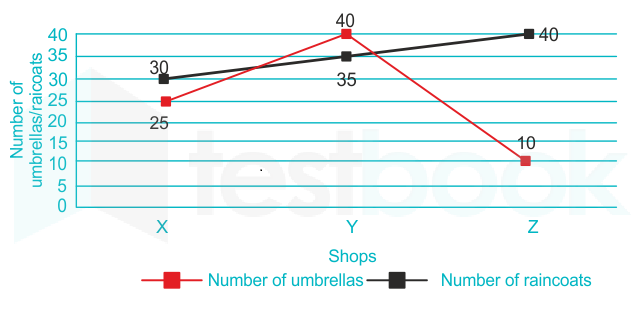
Question 36

Study the given line graph and answer the question asked.

The given line graph shows the number of umbrellas and raincoats sold by shops X, Y and Z.

Find the respective ratio between the number of umbrellas sold by shop X and the total number of raincoats sold by shops Y and Z.

  1. AOption (a)

    1 : 5

  2. BOption (b)

    1 : 3

  3. COption (c)

    2 : 3

  4. DOption (d)

    2 : 5

View answer & explanation

Correct answer

Answer: (b)B.

1 : 3

Why this answer is correct

Given:

From the line graph:

Number of umbrellas sold by shop X = 25

Number of raincoats sold by shop Y = 35

Number of raincoats sold by shop Z = 40

Formula used:

Ratio = Number of umbrellas sold by shop X : Total number of raincoats sold by shops Y and Z

Calculation:

Total raincoats sold by shops Y and Z:

⇒ Total raincoats = 35 + 40 = 75

Ratio = Number of umbrellas sold by shop X : Total number of raincoats sold by Y and Z

⇒ Ratio = 25 : 75

Simplify the ratio:

⇒ Ratio = 1 : 3

∴ The required ratio is 1 : 3.

Question 37

Eight girls - Ponti, Bobby, Anshu, Renu, Mohini, Sujata, Rani and Mohita are sitting around a square table facing the centre of the table (but not necessarily in the same order). Some of them are sitting at the corners while some are sitting exactly in the middle of the sides. Ponti is sitting sixth to the left of Bobby, who is sitting third to the right of Sujata. Mohini is sitting second to the left of Sujata. Rani is sitting right next to Ponti and Bobby. Anshu is sitting immediate left of Sujata, who is sitting immediate left of Renu. 

Who is sitting immediate right of Rani?

  1. AOption (a)

    Bobby

  2. BOption (b)

    Ponti

  3. COption (c)

    mohitya

  4. DOption (d)

    Anshu

View answer & explanation

Correct answer

Answer: (b)B.

Ponti

Why this answer is correct

Given: Eight girls - Ponti, Bobby, Anshu, Renu, Mohini, Sujata, Rani and Mohita are sitting around a square table facing the centre of the table.

  1. Ponti is sitting sixth to the left of Bobby, who is sitting third to the right of Sujata.

  2. Rani is sitting right next to Ponti and Bobby.

  3. Mohini is sitting second to the left of Sujata.

  4. Anshu is sitting immediate left of Sujata, who is sitting immediate left of Renu.

Then final arrangement:

So, Ponti is sitting immediate right of Rani.

Hence, the correct answer is "Ponti".

Question 38

If the positions of '+' and '-' are interchanged in the following equation and also the positions of '×' and '÷' are interchanged, then what will come in place of question mark (?) in the equation?

60 - 72 × 6 + 15 ÷ 3 = ?

  1. AOption (a)

    32

  2. BOption (b)

    64

  3. COption (c)

    27

  4. DOption (d)

    25

View answer & explanation

Correct answer

Answer: (c)C.

27

Why this answer is correct

BODMAS Table: 

Given equation: 60 - 72 × 6 + 15 ÷ 3 = ?

Now, if ‘+’ and ‘-‘ and ‘×’ and ‘÷’ are interchanged, then:

⇒ 60 + 72 ÷ 6 - 15 × 3 = ?

⇒ 60 + 72 ÷ 6 - 15 × 3 = ?

⇒ 60 + 12 - 45 = ?

⇒ 72 - 45 = 27

Hence, the correct answer is "Option 3".

Question 39

Which of the following Constitutional Amendment Act of the Indian Constitution deals with urban local bodies?

  1. AOption (a)

    73rd

  2. BOption (b)

    74th

  3. COption (c)

    72nd

  4. DOption (d)

    75th

View answer & explanation

Correct answer

Answer: (b)B.

74th

Why this answer is correct

The correct answer is 74th

Key Points

  • The 74th Constitutional Amendment Act of 1992 deals with the provisions related to urban local bodies in India, such as Municipal Corporations, Municipal Councils, and Nagar Panchayats.
  • It came into effect on 1st June 1993.
  • It introduced a new part, Part IXA, titled “The Municipalities”, in the Constitution.
  • It fixed a term of five years for every urban local body, with elections to be held before the term expires.

Additional Information

  • 73rd Amendment Act:
  • Deals with rural local bodies (Panchayati Raj Institutions), not urban local bodies.
  • Introduced Part IX of the Constitution, covering the three-tier system of Panchayats.
  • Came into effect on 24th April 1993.
  • 72nd Amendment Act:
  • Relates to the provisions for the reservation of seats for Scheduled Tribes in the Tripura Legislative Assembly.
  • Came into effect in 1991.
  • 75th Amendment Act:
  • Deals with provisions related to the tenancy of properties and added clauses to strengthen the Rent Control Acts.
  • It empowered the state legislatures to make provisions for the establishment of tribunals for the adjudication of disputes related to tenancy laws, especially for properties covered under rent control legislation.

Question 40

Find the mean length of a leaf, given the lengths of 10 leaves (in mm) are as follows:

146, 150, 147, 143, 158, 139, 154, 149, 151, 155

  1. AOption (a)

    139.6 mm

  2. BOption (b)

    148.2 mm

  3. COption (c)

    151.9 mm

  4. DOption (d)

    149.2 mm

View answer & explanation

Correct answer

Answer: (d)D.

149.2 mm

Why this answer is correct

Shortcut Trick

Assume a base mean of 150 mm to simplify calculation.

Find the sum of deviations from 150: (−4) + 0 + (−3) + (−7) + (+8) + (−11) + (+4) + (−1) + (+1) + (+5) = −8.

Average deviation = −8 ÷ 10 = −0.8.

Actual Mean = Assumed Mean + Average Deviation = 150 − 0.8 = 149.2 mm.

∴ The correct answer is 149.2 mm.

Alternate Method

Given: Lengths of 10 leaves = 146, 150, 147, 143, 158, 139, 154, 149, 151, 155 mm.

Formula Used: Arithmetic Mean = (Sum of all observations) ÷ (Total number of observations)

⇒ Sum = 146 + 150 + 147 + 143 + 158 + 139 + 154 + 149 + 151 + 155

⇒ Sum = 1492 mm

⇒ Number of leaves (n) = 10

⇒ Mean length = 1492 ÷ 10

⇒ Mean length = 149.2 mm

∴ The correct answer is 149.2 mm.

Additional Information

Sum of Deviations

The sum of the deviations of all values in a dataset from their arithmetic mean is always equal to zero.

Weighted Average

When items have different weights (w), the Weighted Mean is calculated as Σ(w × x) ÷ Σw.

Median for Even Data

For n observations (where n is even), the Median is the average of the (n/2)th and (n/2 + 1)th terms after sorting.

Question 41

Read the given statements and conclusions carefully. Consider the information given in the statements as true even if it seems to be at variance with commonly known facts and then decide which of the given conclusions logically follow(s) from the statements.

statement:

  1. All mirrors are drawers.
  2. Some beds are cupboards.
  3. Some cupboards are mirrors.

conclusion:

I. Some beds are drawers.

II. Some drawers are cupboards.

  1. AOption (a)

    Only conclusion I follows.

  2. BOption (b)

    Both conclusions I and II follow.

  3. COption (c)

    Neither conclusion I nor II follows.

  4. DOption (d)

    Only conclusion II follows.

View answer & explanation

Correct answer

Answer: (d)D.

Only conclusion II follows.

Why this answer is correct

Given statement:

  1. All mirrors are drawers.
  2. Some beds are cupboards.
  3. Some cupboards are mirrors.

The least possible Venn diagram:

conclusion:

I. Some beds are drawers. - False (Because there is no direct relation between bed and drawers so it can be possible but not definite)

II. Some drawers are cupboards.- True (Because All mirrors are drawers and Some cupboards are mirrors. So, Some drawers are cupboards it is definite)

Hence, the correct answer is "Only conclusion II follows".

Question 42

Who among the following was one of the recipients of the Shanti Swarup Bhatnagar Prize for Science and Technology in 2021?

  1. AOption (a)

    Dr. Prakash Verma

  2. BOption (b)

    Dr. Ashok Gupta

  3. COption (c)

    Dr. Sanjay Mathur

  4. DOption (d)

    Dr. Amit Singh

View answer & explanation

Correct answer

Answer: (d)D.

Dr. Amit Singh

Why this answer is correct

The correct answer is Dr Amit Singh 

Key Points 

  • Dr. Amit Singh have been conferred the Shanti Swarup Bhatnagar Prize for Science and Technology, 2021, for biological science.
  • The Shanti Swarup Bhatnagar Prize is one of the most prestigious awards in India for recognizing excellence in scientific research.
  • The award is named after the founder Director of the Council of Scientific & Industrial Research (CSIR), Shanti Swarup Bhatnagar.
  • It is awarded annually by the CSIR for notable and outstanding research, applied or fundamental, in biological, chemical, earth, atmosphere, ocean and planetary, engineering, mathematical, medical, and physical sciences.
  • The prize comprises a citation, a plaque, and a cash award.

Additional Information 

  • Dr. Amit Singh is known for his work in the field of microbial pathogenesis and tuberculosis.
  • Dr. Arun Kumar Shukla is recognized for his contributions to the understanding of G protein-coupled receptors (GPCRs) and their signaling mechanisms.
  • The Shanti Swarup Bhatnagar Prize was first awarded in 1958 and has since been awarded annually.
  • The award aims to encourage and nurture young scientists to pursue high-quality research in their respective fields.
  • Recipients of the Shanti Swarup Bhatnagar Prize often go on to receive further national and international recognition for their work.

Question 43

If in each of the following words, each letter is replaced by its next letter in the English alphabetical order, then how many words thus formed will not have any vowels?

  1. TOGETHER

  2. BOXES

  3. SPORTS

  4. DRINK

  1. AOption (a)

    Three

  2. BOption (b)

    One

  3. COption (c)

    Two

  4. DOption (d)

    Four

View answer & explanation

Correct answer

Answer: (b)B.

One

Why this answer is correct

According to the given information:

Each letter is replaced by its next letter in the English alphabetical order:

  1. TOGETHER

  2. BOXES

  3. SPORTS

  4. DRINK

Then One (BOXES) words thus formed will not have any vowels.

Hence, the correct answer is "One".

Question 44

Which articles of the Indian Constitution contain provisions regarding Fundamental Rights?

  1. AOption (a)

    Articles 5 to 11

  2. BOption (b)

    Articles 52 to 78

  3. COption (c)

    Articles 36 to 51

  4. DOption (d)

    Articles 12 to 35

View answer & explanation

Correct answer

Answer: (d)D.

Articles 12 to 35

Why this answer is correct

The correct answer is Articles 12 to 35

Key Points

  • Articles 12 to 35 of the Indian Constitution deal with Fundamental Rights.
  • Article 12:
  • Defines the term "State" in relation to Fundamental Rights, which helps in determining the scope of rights that are protected.
  • Articles 13 to 35:
  • These articles outline specific Fundamental Rights including rights to equality, freedom of speech, protection against discrimination, etc., and the mechanisms for their enforcement.
  • Article 32:
  • Provides the right to constitutional remedies, allowing individuals to approach the Supreme Court for the enforcement of their Fundamental Rights.

Additional Information

  • Articles 5 to 11:
  • Article 5: Deals with the citizenship of India at the commencement of the Constitution.
  • Article 6: Provides for citizenship for persons migrating from Pakistan.
  • Article 7: Deals with citizenship for persons who have migrated to Pakistan but later returned to India.
  • Articles 8 to 11: Cover provisions related to citizenship for people of Indian origin residing outside India and the procedures for granting or denying citizenship.
  • Articles 52 to 78:
  • These articles pertain to the Union Executive, which includes the President, Vice President, Council of Ministers, and their functions.
  • Article 52: Establishes the office of the President of India.
  • Article 53: Deals with the executive power of the Union being vested in the President.
  • Article 72: Discusses the pardoning powers of the President.
  • Articles 54 to 78: Deal with the election, powers, and duties of the President, Vice-President, and the Council of Ministers.
  • Articles 36 to 51:
  • These articles deal with the Directive Principles of State Policy (DPSP), which are guidelines for the government to promote social and economic welfare. However, they are non-enforceable by courts.
  • Article 36: Defines the term "State" in the context of DPSPs.
  • Articles 37 to 51: Contain provisions regarding the promotion of welfare through social, economic, and cultural policies, like securing adequate means of livelihood, uniform educational opportunities, promotion of international peace and security, and others.

Question 45

Vanraj's age is three times the age of his son. His daughter's age is 3 years less than his son's age. If 3 years ago, the sum of the ages of these three was 63 years, then find Vanraj's present age (in years).

  1. AOption (a)

    30

  2. BOption (b)

    45

  3. COption (c)

    36

  4. DOption (d)

    42

View answer & explanation

Correct answer

Answer: (b)B.

45

Why this answer is correct

Shortcut Trick

Present sum of ages = 63 + (3 persons × 3 years) = 72 years.

Let Son's age = x. Then Vanraj = 3x and Daughter = x − 3.

Total = x + 3x + x − 3 = 72

5x = 75 ⇒ x = 15

Vanraj's present age = 3 × 15 = 45 years.

∴ The correct answer is 45 years.

Alternate Method

Given:

Vanraj's age = 3 × Son's age

Daughter's age = Son's age − 3

Sum of ages 3 years ago = 63 years

Present Ages and Sum

Son : x

Vanraj : 3x

Daughter : x − 3

Present Sum = 63 + (3 × 3) = 72

Calculations:

⇒ Let the present age of the son be x years.

⇒ Present age of Vanraj = 3x

⇒ Present age of the daughter = x − 3

⇒ Present sum of all three ages = 63 + (3 × 3) = 72 years.

⇒ x + 3x + (x − 3) = 72

⇒ 5x − 3 = 72

⇒ 5x = 75

⇒ x = 15

⇒ Vanraj's present age = 3 × 15 = 45 years.

∴ The correct answer is 45 years.

Additional Information

Sum of Ages over Time

When shifting the sum of ages of N people by T years, you must add or subtract (N × T) from the sum, because each person's age changes equally by T years.

Base Variable Selection

Always choose the entity on which others are dependent (in this case, the son's age) as the unknown variable 'x'. This simplifies formulation and avoids unnecessary fractions.

Age Differences Remain Constant

The difference in ages between any two individuals remains absolutely constant regardless of the time period (past, present, or future).

Question 46

When a ray is incident parallel to the principal axis of a convex lens then the refracted ray will pass through: 

  1. AOption (a)

    centre of curvature

  2. BOption (b)

    principal axis

  3. COption (c)

    optical centre

  4. DOption (d)

    principal focus

View answer & explanation

Correct answer

Answer: (d)D.

principal focus

Why this answer is correct

The correct answer is Principal focus.

Key Points

  • Rays move parallel to the principal axis of a convex lens after refraction passes through the principal focus.
  • All the cases for the ray of light emanating from the source and refracting through a convex lens are shown in the table:

​

Additional Information

  • The transparent curved surface is used to refract the light and make an image of any object placed in front of it is called a lens.
  • The lens whose refracting surface is upside is called a convex lens.
  • The convex lens is also called a converging lens.
  • The lens having refracting surface inward is called a concave lens.
  • The concave lens is also called a diverging lens.

Question 47

Find the smallest natural number which when divided by 9, 24 and 12 gives remainder 4 in each case, but when divided by 5 gives remainder zero.

  1. AOption (a)

    148

  2. BOption (b)

    220

  3. COption (c)

    150

  4. DOption (d)

    144

View answer & explanation

Correct answer

Answer: (b)B.

220

Why this answer is correct

Shortcut Trick

The required number leaves a remainder of 0 when divided by 5, meaning it must be exactly divisible by 5.

From the given options, only 150 and 220 end with 0, so they are divisible by 5.

Now, test the condition of leaving a remainder of 4 when divided by 9.

150 ÷ 9 gives a remainder of 6 (incorrect).

220 ÷ 9 gives a remainder of 4 (correct).

∴ The correct answer is 220.

Alternate Method

Given:

Divisors = 9, 24, and 12

Remainder in each case = 4

The number is exactly divisible by 5.

Concept Used:

General form of the Number = LCM(Divisors) × k + Remainder

Calculation:

⇒ LCM of 9, 24, and 12 = 72

⇒ Let the required number be N = 72k + 4

⇒ We need N to be perfectly divisible by 5.

⇒ Rewrite N as: 72k + 4 = (70k + 2k + 4)

⇒ Since 70k is always a multiple of 5, we only need to check when (2k + 4) is divisible by 5.

⇒ For k = 1: 2(1) + 4 = 6 (Not divisible by 5)

⇒ For k = 2: 2(2) + 4 = 8 (Not divisible by 5)

⇒ For k = 3: 2(3) + 4 = 10 (Exactly divisible by 5)

⇒ Substitute k = 3 back into the equation for N.

⇒ N = 72 × 3 + 4

⇒ N = 216 + 4 = 220

∴ The correct answer is 220.

Additional Information

LCM Remainder Concept (Same Remainder)

When a number divided by x, y, and z leaves the same remainder R in each case, the general form of the number is given by: Number = LCM(x, y, z) × k + R.

LCM Remainder Concept (Different Remainders)

When a number divided by x, y, and z leaves remainders a, b, and c respectively such that (x − a) = (y − b) = (z − c) = K, the general form is: Number = LCM(x, y, z) × k − K.

Divisibility Rule of 5

A number is perfectly divisible by 5 if and only if its last digit (unit digit) is either 0 or 5. This makes option elimination very fast in objective exams.

Question 48

Due to a reduction in manpower, the output of a factory falls by 30%. By what percentage should the working hours be increased to restore the original output?

  1. AOption (a)

    43%

  2. BOption (b)

    41%

  3. COption (c)

    4267%42\frac{6}{7}\%

  4. DOption (d)

    42%

View answer & explanation

Correct answer

Answer: (c)C.

4267%42\frac{6}{7}\%

Why this answer is correct

Shortcut Trick

If the output falls by r%, then the working hours must increase by [r / (100 − r)] × 100% to restore the original level.

Here, r = 30%.

Increase % = [30 / (100 − 30)] × 100 = (30 / 70) × 100 = 300 / 7 %.

300 / 7 % = 42(6/7)%.

∴ The correct answer is 42(6/7)%.

Alternate Method

Given:

⇒ Let the initial output be 100 units.

⇒ Reduction in output = 30% of 100 = 30 units.

⇒ Current output = 100 − 30 = 70 units.

Calculations:

⇒ To restore the original output, we need to add 30 units back to the current 70 units.

⇒ Required Percentage Increase = (Increase required / Current output) × 100

⇒ Required Percentage Increase = (30 / 70) × 100

⇒ Required Percentage Increase = 300 / 7 %

⇒ Required Percentage Increase = 42(6/7)%

∴ The correct answer is 42(6/7)%.

Additional Information

Percentage Base Change

When a value decreases by x%, to return to the original value, it must increase by [x / (100 − x)] × 100%.

Product Constancy Rule

If Output = Manpower × Working Hours, and manpower decreases, working hours must increase inversely to keep output constant.

Successive Percentage

The net effect of two changes a% and b% is given by the formula: [a + b + (a × b)/100]%.

Question 49

15 articles are sold at the total cost price of 20 articles. The gain or loss per cent is:

  1. AOption (a)

    20% loss

  2. BOption (b)

    20% gain

  3. COption (c)

    3313%33\frac{1}{3}\% loss

  4. DOption (d)

    3313%33\frac{1}{3}\% gain

View answer & explanation

Correct answer

Answer: (d)D.

3313%33\frac{1}{3}\% gain

Why this answer is correct

Shortcut Trick Ratio of Cost Price (CP) to Selling Price (SP) is inversely proportional to the ratio of articles. Given: 15 × SP = 20 × CP ⇒ CP/SP = 15/20 = 3/4. Profit = SP − CP = 4 − 3 = 1 unit. Profit% = (Profit ÷ CP) × 100 = (1 ÷ 3) × 100 = 33(1/3)%. Since SP > CP, it is a gain. ∴ The correct answer is 33(1/3)% gain.

Alternate Method Given: Total SP of 15 articles = Total CP of 20 articles. Formulas: Profit = SP − CP | Profit% = (Profit ÷ CP) × 100

CP (15)

SP (20)

Gain: +5 units

⇒ Let the Cost Price of one article be 1 Re. ⇒ CP of 20 articles = 20 Rs. ⇒ SP of 15 articles = CP of 20 articles = 20 Rs. ⇒ CP of 15 articles = 15 Rs. ⇒ Profit = 20 − 15 = 5 Rs. ⇒ Profit% = (5 ÷ 15) × 100 = 1/3 × 100 = 33(1/3)%. ∴ The correct answer is 33(1/3)% gain.

Additional Information Cost Price and Selling Price Relationship When the CP of 'x' articles equals the SP of 'y' articles, gain/loss% = [(x − y) ÷ y] × 100. Positive result denotes gain, negative denotes loss. Profit and Loss Percentage Profit or Loss percentage is always calculated on the Cost Price (CP) unless stated otherwise in the problem.

Question 50

Why is it important to avoid getting infected with HIV?

  1. AOption (a)

    Because it is transmitted from parents to children

  2. BOption (b)

    Because it causes partial paralysis

  3. COption (c)

    Because there is no cure for HIV

  4. DOption (d)

    Because due to this the whole family gets socially boycotted

View answer & explanation

Correct answer

Answer: (c)C.

Because there is no cure for HIV

Why this answer is correct

The correct answer is Because there is no cure for HIV

Key Points

  • Because there is no cure for HIV:
  • This is the most important reason to avoid infection with HIV.
  • Currently, there is no cure for HIV,
  • If once infected, an individual will have to manage the virus for their lifetime with antiretroviral drugs (ARVs) to maintain a good quality of life and prevent progression to AIDS.
  • It can weaken your immune system, making it harder to fight off infections and diseases
  • HIV can be spread through an infected person's body fluids, including blood, breast milk, semen, and vaginal fluids.
  • It can also be passed from a mother to her baby during pregnancy, birth, or breastfeeding.

Additional Information

HIV infection- 

  • The HIV virus mainly affects the Helper T-lymphocytes (immune cells of the human body).
  • After getting HIV into the body of a person, the virus enters the macrophages.
  • Here, RNA is replicated to form viral DNA by enzyme reverse transcriptase.
  • The viral DNA now gets incorporated into the host cell's DNA and directs the infected cells to produce viruses.
  • The macrophages continue to produce virus particles.
  • The virus particles enter Helper T-lymphocytes (TH cells) in the blood, where they continue to replicate and produce viral progenies.
  • The virus released in the blood also affects the other Helper T-lymphocytes.
  • Thus, the number of Helper T-lymphocytes progressively decreases in the body of the infected persons.
  • With the decrease in the number of T-cells, immunity also decreases.
  • The person is unable to produce any immune response

Question 51

Which of the following colloids has a solid dispersed phase in a liquid dispersion medium?

  1. AOption (a)

    Foam

  2. BOption (b)

    Jail

  3. COption (c)

    Emulsion

  4. DOption (d)

    Sol

View answer & explanation

Correct answer

Answer: (d)D.

Sol

Why this answer is correct

The correct answer is Sol

Key Points

  • Colloids are mixtures where one substance is dispersed evenly in another.
  • The classification depends on the state (solid, liquid, gas) of both the dispersed phase and the dispersion medium.
  • A sol is a colloid where the dispersed phase is solid and the dispersion medium is liquid.
  • Examples of sol include paint, ink, and muddy water.

Additional Information Types of Colloid

DispersedDispersing MediumType of colloidFew Examples
SolidGasAerosolsmoke
SolidSolidSolid SolGemstone
LiquidLiquidEmulsionMilk
LiquidGasAerosolFog, cloud
LiquidSolidGelCheese, butter
GasLiquidFoamShaving cream

Question 52

What is the resistivity of a wire material with 0.72 Ω resistance, 1 m length and 0.2 mm diameter?

  1. AOption (a)

    220 × 10-8 Ωm

  2. BOption (b)

    0.22 × 10⁻⁸ Ωm

  3. COption (c)

    2.2 × 10-8 Ωm

  4. DOption (d)

    22 × 10-8 Ωm

View answer & explanation

Correct answer

Answer: (c)C.

2.2 × 10-8 Ωm

Why this answer is correct

The correct answer is 2.2 × 10⁻⁸ Ωm.

Key Points

  • The resistivity of a material is calculated using the formula ρ = R * A / L, where ρ is the resistivity, R is the resistance, A is the cross-sectional area, and L is the length of the material.
  • Given that the resistance (R) is 0.72 Ω, the length (L) is 1 m, and the diameter of the wire is 0.2 mm (which gives a radius of 0.1 mm or 0.1 × 10^-3 m).
  • The cross-sectional area (A) of the wire is calculated using the formula for the area of a circle, A = π * r^2. Here, A = π * (0.1 × 10^-3)^2 m^2.
  • Substituting the values, we get ρ = 0.72 Ω * π * (0.1 × 10^-3)^2 m^2 / 1 m = 2.2 × 10^-8 Ωm.

Additional Information

  • Resistivity: It is a fundamental property of a material that quantifies how strongly that material opposes the flow of electric current. It is denoted by the symbol ρ (rho) and is measured in ohm-meters (Ωm).
  • Resistance: It is a measure of the opposition to the flow of electric current in a conductor. It is denoted by the symbol R and is measured in ohms (Ω).
  • Cross-sectional Area: For a cylindrical wire, the cross-sectional area is the area of the circle at the end of the cylinder. It is calculated using the formula A = π * r^2, where r is the radius of the wire.
  • Length: It is the distance between the two ends of the wire through which the electric current flows. It is denoted by the symbol L and is measured in meters (m).

Question 53

In which state is Chandoli National Park located?

  1. AOption (a)

    Kerala

  2. BOption (b)

    Maharashtra

  3. COption (c)

    Uttar Pradesh

  4. DOption (d)

    Himachal Pradesh

View answer & explanation

Correct answer

Answer: (b)B.

Maharashtra

Why this answer is correct

The correct answer is Maharashtra.

Key Points

  • Chandoli National Park is located in the Sangli, Satara, Kolhapur, and Ratnagiri districts of Maharashtra.
  • It was declared as a wildlife sanctuary in the year of 1985.
  • It was declared as a National Park in the year 2004.
  • It was declared as a Project Tiger in 2007.
  • The total area of the Chandoli National Park is 317.67 Km2.
  • The park receives its water supply from the Warna river.
  • Important National parks in Maharashtra are:
  • Tadoba National Park.
  • Sanjay Gandhi National Park.
  • Navegaon National Park.
  • Gugamal National Park.

Additional Information

  • Important National Park of Bihar is:
  • Valmiki National Park.
  • Important National Parks of Uttarakhand are:
  • Nanda Devi National Park.
  • Rajaji National Park.
  • Valley of Flowers National Park.
  • Govind Pashu Vihar National Park.
  • Jim Corbett National Park.
  • Important National Parks of Telangana are:
  • Kasu Brahmananda Reddy National Park.
  • Mahavir Harina Vanasthali National Park.
  • Mrugavani National Park.

Question 54

If a + b + c = 0, then what are the roots of the equation ax2 + bx + c = 0?

  1. AOption (a)

    −1,−ca-1, \frac{-c}{a}

  2. BOption (b)

    1,ca 1, \frac{c}{a}

  3. COption (c)

    2,ca2, \frac{c}{a}

  4. DOption (d)

    −2,ca -2, \frac{c}{a}

View answer & explanation

Correct answer

Answer: (b)B.

1,ca 1, \frac{c}{a}

Why this answer is correct

Shortcut Trick

For any quadratic equation ax2 + bx + c = 0, if the sum of coefficients (a + b + c) is equal to 0, then one root of the equation is always 1.

The product of the roots is given by the formula c/a.

Since one root is 1, the other root must be (c/a) ÷ 1 = c/a.

∴ The correct answer is 1, c/a.

Alternate Method

Given: Quadratic equation ax2 + bx + c = 0 and the condition a + b + c = 0.

Method: Substitution and Root Relations.

⇒ Let the roots of the equation be α and β.

⇒ Substitute x = 1 into the equation: a(1)2 + b(1) + c = a + b + c.

⇒ Since we are given a + b + c = 0, x = 1 satisfies the equation.

⇒ Therefore, the first root α = 1.

⇒ We know that the product of roots (α × β) = c/a.

⇒ Substituting the value of α: 1 × β = c/a.

⇒ β = c/a.

⇒ Thus, the two roots are 1 and c/a.

∴ The correct answer is 1, c/a.

Additional Information

Special Case for x = −1

If the sum of coefficients with alternating signs is zero (a − b + c = 0), then the roots of the equation are −1 and −c/a.

Sum and Product of Roots

For any quadratic equation ax2 + bx + c = 0, the sum of roots is −b/a and the product of roots is c/a.

Discriminant and Nature of Roots

The value D = b2 − 4ac determines the nature of roots: D > 0 (real and distinct), D = 0 (real and equal), and D < 0 (imaginary).

Question 55

Find the least common multiple (LCM) of 550, 880 and 1320.

  1. AOption (a)

    12300

  2. BOption (b)

    13200

  3. COption (c)

    11000

  4. DOption (d)

    10800

View answer & explanation

Correct answer

Answer: (b)B.

13200

Why this answer is correct

Shortcut Trick

Divide all numbers by the common factor 110: 5, 8, 12.

Find the LCM of (5, 8, 12): LCM(8, 12) = 24. LCM(24, 5) = 120.

Multiply the result by the initial common factor: 110 × 120 = 13200.

∴ The correct answer is 13200.

Alternate Method

Given: Numbers are 550, 880, and 1320.

Formula Used: Prime Factorization Method.

Calculations:

⇒ Prime factors of 550 = 2 × 52 × 11

⇒ Prime factors of 880 = 24 × 5 × 11

⇒ Prime factors of 1320 = 23 × 3 × 5 × 11

⇒ LCM = Product of highest powers of all prime factors involved.

⇒ LCM = 24 × 3 × 52 × 11

⇒ LCM = 16 × 3 × 25 × 11

⇒ LCM = 48 × 275 = 13200

∴ The correct answer is 13200.

Additional Information

Relationship between HCF and LCM

For any two numbers 'a' and 'b', HCF(a, b) × LCM(a, b) = a × b.

LCM of Fractions

LCM of fractions = (LCM of Numerators) ÷ (HCF of Denominators).

HCF of Fractions

HCF of fractions = (HCF of Numerators) ÷ (LCM of Denominators).

Question 56

In a circuit, a silver wire of length L and cross-sectional area A is replaced by a chromium wire of length L/3 and cross-sectional area 3A. What will be the effect on the resistance of the circuit?

(Given, ρ silver = 1.6 × 10 -8  Ωm and ρ chromium = 12.9 × 10 -8  Ωm)

  1. AOption (a)

    will decrease to 0.89 times of itself

  2. BOption (b)

    will increase to 1.05 times of itself

  3. COption (c)

    will increase to 1.3 times its own

  4. DOption (d)

    will decrease to 0.78 times of itself

View answer & explanation

Correct answer

Answer: (a)A.

will decrease to 0.89 times of itself

Why this answer is correct

The correct answer is will decrease to 0.89 times of itself.

Key Points

  • The resistance of a conductor is given by the formula R = ρL/A, where ρ is the resistivity, L is the length, and A is the cross-sectional area.
  • For the silver wire, the resistance is R_silver = ρ_silver * L / A.
  • For the chromium wire, the resistance is R_chromium = ρ_chromium * (L/3) / (3A) = ρ_chromium * L / 9A.
  • Given the resistivities, ρ_silver = 1.6 × 10^-8 Ωm and ρ_chromium = 12.9 × 10^-8 Ωm, the resistance ratio is R_chromium/R_silver = (ρ_chromium/ρ_silver) * (1/9) = (12.9/1.6) / 9 ≈ 0.89.

Additional Information

  • Resistivity (ρ): It is a material property that quantifies how strongly a given material opposes the flow of electric current. Lower resistivity means better conductivity.
  • Length (L): The length of the conductor. In this context, the length of the wire impacts the overall resistance; longer wires have higher resistance.
  • Cross-sectional Area (A): The area of the wire's cross-section. Greater cross-sectional areas result in lower resistance.
  • Resistance (R): It is the measure of the opposition to current flow in an electrical circuit. The unit of resistance is the Ohm (Ω).
  • Conductors: Materials that allow the flow of electrical current. Silver is an excellent conductor due to its low resistivity, while chromium has higher resistivity and thus higher resistance.

Question 57

What is the molecular formula of second member of alkene series?

  1. AOption (a)

    C6H12

  2. BOption (b)

    C2H4

  3. COption (c)

    C4H8

  4. DOption (d)

    C3H6

View answer & explanation

Correct answer

Answer: (d)D.

C3H6

Why this answer is correct

The correct answer is C3H6

Key Points

  • The molecular formula for the second member of the alkene series is C3H6, which is propene.
  • The general formula for alkenes is CnH2n, where n is the number of carbon atoms.
  • Alkenes are organic compounds with a carbon-carbon double bond, making them unsaturated.
  • They have similar chemical and physical properties, and form a homologous series

Additional Information

  • C6H12:
  • This formula represents a hydrocarbon (a compound made up of carbon and hydrogen).
  • The most likely compound for this molecular formula is hexane (C6H12), which is an alkane (a saturated hydrocarbon).
  • Hexane is commonly used as a solvent in laboratories and industries.
  • Structural isomers: There are several isomers of C6H12, such as n-hexane, 2-methylpentane, 3-methylpentane, etc.
  • C2H4:
  • This formula represents ethylene (C2H4), also known as ethene.
  • Ethylene is an alkene (an unsaturated hydrocarbon) and the simplest alkene.
  • It has a double bond between the two carbon atoms.
  • Ethylene is widely used in the production of plastics like polyethene and is also a plant hormone that regulates processes like ripening.
  • C4H8:
  • This formula can represent several compounds, but the most common ones are butene (an alkene) and butyne (an alkyne).
  • Butene (C4H8) has multiple isomers like 1-butene and 2-butene, which are important in the production of plastics.
  • Butyne (C4H8), which includes 1-butyne and 2-butyne, is another form of hydrocarbon, but with a triple bond between two carbon atoms.

Question 58

Under the provisions of which Article of the Indian Constitution, the President is empowered to constitute a Finance Commission at the expiration of every fifth year or at such earlier time as the President may consider necessary?

  1. AOption (a)

    Article 281

  2. BOption (b)

    Article 280

  3. COption (c)

    Article 282

  4. DOption (d)

    Article 283

View answer & explanation

Correct answer

Answer: (b)B.

Article 280

Why this answer is correct

The correct answer is Article 280

Key Points

  • Article 280 of the Indian Constitution empowers the President to constitute a Finance Commission at the expiration of every fifth year or at such earlier time as the President may consider necessary.
  • The Finance Commission is responsible for recommending the distribution of the net proceeds of taxes between the Union and the States, among other duties related to the financial relations between them.
  • This includes:
  • The allocation of net proceeds of taxes,
  • The principles governing the grants-in-aid to States from the Union,
  • The measures needed to augment the Consolidated Fund of a State to meet its requirements.
  • The Finance Commission also advises on any other matters related to financial relations between the Centre and the States, as referred to it by the President.

Additional Information

  • Article 281:
  • Article 281 specifies that the President must lay the recommendations made by the Finance Commission before both Houses of Parliament along with an explanatory note.
  • This ensures that the recommendations are made public and are presented to the legislative bodies for consideration.
  • This article ensures transparency in the functioning of the Finance Commission and the presentation of its recommendations before the Parliament.
  • ​​Article 282:
  • Article 282 gives both the Union government and the State governments the discretionary power to make grants for any public purpose to any other government (Union or State) or authority.
  • This article allows the Union and State governments to make grants for purposes not necessarily related to their specific jurisdiction, but for broader public welfare, thus supporting various developmental activities.
  • Article 283:
  • Article 283 deals with the custody of the Consolidated Fund of India and State Funds.
  • It specifies that the funds should be held by the President (for the Union) or the Governor (for States), and details the responsibility of the Union and States in managing these funds.
  • This article establishes the framework for proper management of the government’s accounts and financial resources, ensuring fiscal discipline.

Question 59

Which of the following terms describes the movement of water molecules across a selectively permeable membrane?

  1. AOption (a)

    Transfer

  2. BOption (b)

    Osmosis

  3. COption (c)

    Exocytosis

  4. DOption (d)

    Diffusion

View answer & explanation

Correct answer

Answer: (b)B.

Osmosis

Why this answer is correct

The correct answer is Osmosis

Key Points

  • Osmosis is the term that describes the movement of water molecules across a selectively permeable membrane
  • Osmosis is the net movement of water molecules from an area of high concentration to an area of low concentration across a semipermeable membrane.
  • The goal of osmosis is to equalize the solute concentrations on either side of the membrane.
  • Ideal osmosis
  • Ideal osmosis occurs when only pure water moves across the membrane, and no solute particles move.
  • However, osmosis can still occur if some solute particles are permeable, but the osmotic effect will be reduced.

Additional Information

  • Exocytosis:
  • Exocytosis is the process by which cells transport molecules (like proteins or waste products) out of the cell by fusing a vesicle containing the molecules with the cell membrane.
  • This results in the release of the contents outside the cell.
  • Example: The release of neurotransmitters from nerve cells or the secretion of hormones like insulin from the pancreas.
  • Diffusion:
  • Diffusion is the movement of molecules from an area of higher concentration to an area of lower concentration due to the random motion of molecules.
  • This occurs until equilibrium is reached.
  • Example: The movement of oxygen from the lungs into the bloodstream or the spread of perfume in a room.

Question 60

Select the number that will come in place of the question mark (?) in the following series.

10, 21, 38, 62, 94, ?

  1. AOption (a)

    104

  2. BOption (b)

    155

  3. COption (c)

    135

  4. DOption (d)

    72

View answer & explanation

Correct answer

Answer: (c)C.

135

Why this answer is correct

The logic followed here is:

Hence, the correct answer is "135".

Question 61

Three statements are given followed by three conclusions I, II and III. Consider the information given in the statements as true, even if it seems to be at variance with commonly known facts, and then decide which of the given conclusions logically follow(s) from the statements?

statement:

All ornaments are decorations.

Some flowers are ornaments.

All plants are flowers.

The conclusion

I. All plants are ornaments.

II. Some decorations are ornaments.

III. Some flowers are plants.

  1. AOption (a)

    Only conclusion II and III follow

  2. BOption (b)

    Only conclusion III follows

  3. COption (c)

    Only conclusion I and II follow

  4. DOption (d)

    Only conclusion I and III follow

View answer & explanation

Correct answer

Answer: (a)A.

Only conclusion II and III follow

Why this answer is correct

Given statement:

All ornaments are decorations.

Some flowers are ornaments.

All plants are flowers.

The least possible Venn diagram:

Conclusions:

I. All plants are ornaments. - False (because there is no direct relation given between plants are ornaments. So it can be possible but not definite)

II. Some decorations are ornaments. - True (Because, All ornaments are decorations given. So Some decorations are ornaments it is definite)

III. Some flowers are plants. - True (Because, All plants are flowers given. So Some flowers are plants it is definite)

So, Only conclusion II and III follow.

Hence, the correct answer is "Only conclusion II and III follow".

Question 62

What will be the correct relation between radius of curvature R and focal length f for a spherical mirror?

  1. AOption (a)

    R=f2R=\frac{f}{2}

  2. BOption (b)

    1R=2f \frac{1}{R}=\frac{2}{f}

  3. COption (c)

    R2=f \frac{R}{2}=f

  4. DOption (d)

    R = F

View answer & explanation

Correct answer

Answer: (c)C.

R2=f \frac{R}{2}=f

Why this answer is correct

The correct answer is R/2=f

Key Points

  • The correct relation between the radius of curvature (R) and the focal length (f) for a spherical mirror (whether concave or convex) is:f = R/ 2​​
  • spherical mirrors are a part of the whole sphere.
  • Focal length (f): The distance between the centre of the mirror and the focal point (where parallel rays of light meet or appear to meet) of the mirror is called the focal length.
  • The radius of curvature (R): The distance between the centre of the lens or mirror to the vertex which is located on the local optical axis is called the Radius of Curvature.
  • The focal length is half of the radius of curvature.
  • f = R/2

Question 63

Select the term which will come in place of the question mark (?) in the given series and complete the series logically?

VZL15, TXJ18, RVH21, PTF24, ?

  1. AOption (a)

    LMN27

  2. BOption (b)

    RND27

  3. COption (c)

    NRD27

  4. DOption (d)

    DRN27

View answer & explanation

Correct answer

Answer: (c)C.

NRD27

Why this answer is correct

The logic followed here is:

Hence, the correct answer is "NRD27".

Question 64

A 400 m long train travelling at a speed of 64 km/h crosses another 720 m long train travelling in the opposite direction at a speed of 80 km/h. How much time will the second train take to cross a person sitting in the first train?

  1. AOption (a)

    15 seconds

  2. BOption (b)

    16 seconds

  3. COption (c)

    18 seconds

  4. DOption (d)

    12 seconds

View answer & explanation

Correct answer

Answer: (c)C.

18 seconds

Why this answer is correct

Shortcut Trick

To cross a person sitting in another train, the relative distance is only the length of the second train.

Relative Speed (Opposite Direction) = 64 + 80 = 144 km/h.

Convert Speed to m/s: 144 × (5/18) = 40 m/s.

Time = Distance ÷ Speed = 720 ÷ 40 = 18 seconds.

∴ The correct answer is 18 sec.

Alternate Method

Given:

Length of second train (L2) = 720 m

Speed of first train (S1) = 64 km/h

Speed of second train (S2) = 80 km/h

Formula Used:

Relative Speed (Opposite) = S1 + S2

Time = Distance ÷ Relative Speed

Calculations:

⇒ Relative Speed = 64 + 80 = 144 km/h

⇒ Convert to m/s = 144 × (5/18) m/s

⇒ Relative Speed = 8 × 5 = 40 m/s

⇒ Distance to cross the person = Length of second train = 720 m

⇒ Time taken = 720 ÷ 40

⇒ Time taken = 18 seconds

∴ The correct answer is 18 sec.

Additional Information

Relative Speed Concept

When two objects move in opposite directions, relative speed is the sum of their speeds (S1 + S2). In the same direction, it is the difference (|S1 − S2|).

Crossing a Point/Person

When a train crosses a point object (person, pole, tree), the distance covered is equal to the length of the train itself.

Unit Conversion

To convert km/h to m/s, multiply by 5/18. To convert m/s to km/h, multiply by 18/5.

Question 65

The ratio of marks obtained by A and B is 3 : 4, and the ratio of marks obtained by B and C is 2 : 3. What is the ratio of marks obtained by A and C?

  1. AOption (a)

    1 : 2

  2. BOption (b)

    1 : 1

  3. COption (c)

    2 : 1

  4. DOption (d)

    4 : 3

View answer & explanation

Correct answer

Answer: (a)A.

1 : 2

Why this answer is correct

Shortcut Trick

Ratio A : B = 3 : 4

Ratio B : C = 2 : 3 = (2×2) : (3×2) = 4 : 6

Equating B in both ratios gives A : B : C = 3 : 4 : 6

Required ratio A : C = 3 : 6 = 1 : 2

∴ The correct answer is 1 : 2.

Alternate Method

Given:

Ratio A/B = 3/4

Ratio B/C = 2/3

Formula Used:

Product of ratios: (A/B) × (B/C) = A/C

Calculations:

⇒ A/C = (3/4) × (2/3)

⇒ A/C = (3 × 2) / (4 × 3)

⇒ A/C = 6 / 12

⇒ A/C = 1 / 2

⇒ A : C = 1 : 2

∴ The correct answer is 1 : 2.

Additional Information

Compound Ratio

The compound ratio of two or more ratios is obtained by multiplying the antecedents together and the consequents together. For (a:b) and (c:d), it is (ac:bd).

Combined Ratio (Bridging)

To combine ratios like A:B and B:C, find the LCM of the common term 'B' to make its value identical in both sets.

Invertendo and Alternendo

If a:b = c:d, then b:a = d:c (Invertendo) and a:c = b:d (Alternendo).

Question 66

Which of these cell types is not a part of the vascular tissue in plants?

  1. AOption (a)

    Collenchyma

  2. BOption (b)

    Vessels

  3. COption (c)

    Tracheids

  4. DOption (d)

    Parenchyma

View answer & explanation

Correct answer

Answer: (a)A.

Collenchyma

Why this answer is correct

The correct answer is Collenchyma

Key Points

  • Vascular tissue in plants consists of xylem and phloem, which are responsible for transporting water, nutrients, and food throughout the plant.
  • Collenchyma:
  • Collenchyma cells are not part of the vascular tissue.
  • They are specialized for providing support and strength to growing plant parts, particularly in young stems and petioles.
  • Collenchyma is considered a ground tissue, not vascular tissue

Additional Information

  • Vessels:
  • Vessels are part of xylem tissue and are involved in water conduction.
  • They are specialized cells with thickened walls and large lumens that help in the efficient transport of water.
  • They are dead cells that are elongated and joined end-to-end to form a long tube.
  • Tracheids:
  • Tracheids are also part of xylem tissue and play a crucial role in water conduction, similar to vessels, though they are elongated cells with tapered ends.
  • Parenchyma:
  • Parenchyma is a type of plant tissue made up of living cells with thin cell walls.
  • Parenchyma cells form the cortex of stems, roots, and leaves, and make up the non-woody interior structure of many plants

Question 67

A light ray enters from air into an optical fiber having a refractive index of 1.45. If the angle of incidence of the light ray at the end of the optical fiber is 22°, what will be the angle of refraction inside the optical fiber?

  1. AOption (a)

    22.69°

  2. BOption (b)

    14.99°

  3. COption (c)

    25.69°

  4. DOption (d)

    20.99°

View answer & explanation

Correct answer

Answer: (b)B.

14.99°

Why this answer is correct

The correct answer is 14.99º.

Key Points

  • The refractive index of the optical fiber is given as 1.45.
  • The angle of incidence of the light ray at the end of the optical fiber is 22º.
  • We use Snell's Law to find the angle of refraction inside the optical fiber.
  • Using the formula, we calculate the angle of refraction as 14.99º.

Additional Information

  • Snell's Law:
  • Snell's Law describes the relationship between the angles of incidence and refraction when a wave passes through a boundary between two different isotropic media.
  • It states that the ratio of the sine of the angle of incidence to the sine of the angle of refraction is constant and is equal to the ratio of the refractive indices of the two media.
  • The formula is given by: n₁ * sin(θ₁) = n₂ * sin(θ₂)
  • Refractive Index:
  • The refractive index of a medium is a measure of how much the speed of light (or other waves such as sound waves) is reduced inside the medium.
  • It is defined as the ratio of the velocity of light in a vacuum to its velocity in a specified medium.
  • Calculation:
  • Given: n₁ = 1 (refractive index of air), n₂ = 1.45 (refractive index of optical fiber), θ₁ = 22º (angle of incidence).
  • Using Snell's Law: 1 * sin(22º) = 1.45 * sin(θ₂)
  • sin(θ₂) = sin(22º) / 1.45
  • sin(θ₂) ≈ 0.3746 / 1.45 ≈ 0.2583
  • θ₂ = sin⁻¹(0.2583) ≈ 14.99º

Question 68

As of January 2022, which enterprise became India's first unicorn sports enterprise?

  1. AOption (a)

    Patna Pirates

  2. BOption (b)

    Dabang Delhi

  3. COption (c)

    Gujarat Giants

  4. DOption (d)

    Chennai Super Kings

View answer & explanation

Correct answer

Answer: (d)D.

Chennai Super Kings

Why this answer is correct

The correct answer is Chennai Super Kings.

Key Points

  • Chennai Super Kings (CSK) is a cricket franchise that participates in the Indian Premier League (IPL).
  • As of 30 January 2022, CSK became India's first sports unicorn with a market capitalization of Rs. 7,600 crores.
  • A unicorn is a term used for a startup or a company that has a valuation of over $1 billion.
  • CSK has been one of the most successful teams in the IPL, having won the tournament five times and reaching the finals eight times.
  • The team is owned by India Cements, a company that is headed by former BCCI president N. Srinivasan.

Additional Information

  • Patna Pirates:
  • Founded: 2014
  • Team Colors: Green and White
  • Patna Pirates have had notable players like Pardeep Narwal, one of the most successful raiders in the history of the PKL.
  • Patna Pirates have won the PKL title three times (in 2016, 2017, and 2022), making them one of the most successful teams in the league.
  • Dabang Delhi:
  • Founded: 2014
  • Team Location: New Delhi
  • Team Colors: Red and Yellow
  • Players like Rishank Devadiga, Joginder Narwal, and Naveen Kumar (who has been a star raider for the team).
  • Dabang Delhi won their first PKL title in 2021.
  • They have been consistently strong contenders in the league, with a strong lineup of players.
  • Gujarat Giants:
  • Founded: 2016
  • Team Colors: Orange and Black
  • Key Players: Some of the key players include Rahul Chaudhari and Ajay Kumar.
  • Gujarat Giants reached the final in 2017 and have had strong performances in the league, though they have not yet won the title.
  • They are known for having a solid defense and a good team balance.

Question 69

Which of the following options represents the nearest approximate value that will come in place of question mark (?) in the following equation? 

15.99 - 4.02 + 19.89 × 5.19 = ?

  1. AOption (a)

    50

  2. BOption (b)

    75

  3. COption (c)

    112

  4. DOption (d)

    222

View answer & explanation

Correct answer

Answer: (c)C.

112

Why this answer is correct

Calculation:

15.99 - 4.02 + 19.89 × 5.19 = ?

Taking approximation as,

⇒ 16 - 4 + 20 × 5

⇒ 16 - 4 + 100

⇒ 116 - 4 = 112

∴ The correct answer is option (3).

Question 70

Which of the following steps can the government take to move towards sustainable use of natural resources?

  1. AOption (a)

    Making the study of environmental science compulsory

  2. BOption (b)

    Ban on firecrackers during festivals

  3. COption (c)

    Restrictions on travel by airplanes

  4. DOption (d)

    Creation of metro and bus services

View answer & explanation

Correct answer

Answer: (d)D.

Creation of metro and bus services

Why this answer is correct

The correct answer is Creation of the metro and bus services

Key Points

  • The creation of metro and bus services can play a crucial role in the sustainable use of natural resources because:
  • Reduced dependence on personal vehicles:
  • Public transport systems like metro and buses help reduce the number of private vehicles on the road, which can lead to lower fuel consumption and reduced emissions, contributing to energy conservation and air quality improvement.
  • Energy efficiency:
  • Trains and buses are more energy-efficient per passenger than individual cars or motorcycles.
  • Reduction in resource use:
  • More public transportation reduces the demand for resources like fuel and minimizes the environmental impact of transportation.

Additional Information

  • Sustainable use of natural resources refers to utilizing natural resources in a way that meets the needs of the present generation without compromising the ability of future generations to meet their own needs.
  • It involves managing resources in a manner that ensures their availability over the long term while minimizing negative environmental impacts.
  • This concept is vital for maintaining the balance of ecosystems and ensuring that resources are not depleted or degraded.

Question 71

Which of the following statements regarding the trend of metallic properties in the modern periodic table is correct?

  1. AOption (a)

    Metallic character decreases across a period and remains constant down a group. 

  2. BOption (b)

    Metallic character remains constant across a period and increases down a group.

  3. COption (c)

    Metallic character increases across a period and decreases down a group.

  4. DOption (d)

    Metallic character decreases across a period and increases down a group.

View answer & explanation

Correct answer

Answer: (d)D.

Metallic character decreases across a period and increases down a group.

Why this answer is correct

The correct answer is Metallic character decreases across a period and increases down a group.

Key Points

  • The correct statement regarding the trend of metallic properties in the modern periodic table is
  • Metallic character decreases across a period and increases down a group.
  • Across a period (left to right):
  • As you move across a period from left to right, the atomic size decreases, and the effective nuclear charge increases.
  • This makes it harder for atoms to lose electrons, which is a characteristic of metallic behaviour (since metals tend to lose electrons to form positive ions).
  • Therefore, the metallic character decreases across a period.
  • Down a group (top to bottom):
  • As you move down a group, the atomic size increases and the outermost electrons are farther from the nucleus.
  • This reduces the effective nuclear charge experienced by these electrons, making it easier for the atom to lose electrons.
  • Hence, metallic character increases down a group.

Additional Information

  • The Modern periodic law & table was invented by Henry Moseley in 1913.
  • The first who was able to arrange all the known elements was Mendeleev, he gave the law called the Mendeleev's periodic law.
  • Dobereiner grouped the elements into triads.
  • Newlands gave the law of octaves.
  • Modern Periodic Table: 
  • The defects of the periodic table of  Mendeleev were sorting out by Henry Moseley who invented the modern periodic law in 1913.
  • The law of modern table states that - '' according to the increasing order of their atomic numbers if the elements are arranged, then the element's physical & chemical properties are repeated after regular intervals.
  • Salient Features of the Modern Periodic Table: 
  • The element's properties are the functions that are periodical according to their atomic numbers.
  • On the basis of the Modern table, Scientist Bohr invented a long form of the periodic table that was created by Warner& Rang.
  • The periodic table consists of 18 groups & 7 periods.

Question 72

Which of the following rivers flows from east to west?

  1. AOption (a)

    Mahanadi

  2. BOption (b)

    Krishna

  3. COption (c)

    Godavari

  4. DOption (d)

    Narmada

View answer & explanation

Correct answer

Answer: (d)D.

Narmada

Why this answer is correct

The correct answer is Narmada

Key Points

  • Narmada River
  • The Narmada River originates from the Amarkantak Plateau in the state of Madhya Pradesh.
  • It Flows in Westward Direction
  • The Narmada flows westward between the Vindhya and Satpura mountain ranges and drains into the Arabian Sea through the Gulf of Khambhat in Gujarat.
  • The Narmada is one of the few rivers in India that flows westward, so this is the correct answer.

Additional Information

  • Mahanadi
  • Mahanadi originates in the Sambalpur district of Odisha.
  • The Mahanadi flows primarily eastward, passing through the state of Odisha and emptying into the Bay of Bengal.
  • Krishna
  • The Krishna River originates from the Western Ghats near the town of Mahabaleshwar in Maharashtra.
  • The river flows eastward across Maharashtra, Karnataka, and Andhra Pradesh.
  • It finally drains into the Bay of Bengal.
  • ​Godavari
  • The Godavari originates from the Western Ghats near Trimbak in Maharashtra.
  • The river flows eastward, passing through Maharashtra, Telangana, and Andhra Pradesh.
  • It eventually empties into the Bay of Bengal.

Question 73

In which of the following animals, during each cycle of blood circulation through the whole body, the blood passes through the heart only once?

  1. AOption (a)

    Mammals

  2. BOption (b)

    Reptiles

  3. COption (c)

    the bird

  4. DOption (d)

    Fisheries

View answer & explanation

Correct answer

Answer: (d)D.

Fisheries

Why this answer is correct

The correct answer is Fisheries

Key Points

  • Fish have single circulation, meaning that blood passes through the heart only once during each cycle of circulation through the body
  • Fish have a two-chambered heart made up of an atrium and a ventricle.
  • Fish have a single circulatory system with one circuit.
  • The heart pumps deoxygenated blood to the gills, where it becomes oxygenated.
  • The oxygenated blood then passes to the body, and deoxygenated blood returns to the heart.
  • In contrast, blood passes through the heart twice during each cycle in other vertebrates.

Additional Information

  • Mammals
  • Mammals can regulate their body temperature internally, which allows them to live in a wide range of environments.
  • Mammals have some amount of hair or fur on their bodies, which helps with temperature regulation.
  • Most mammals give live birth, although there are exceptions like monotremes (platypus, echidna) that lay eggs.
  • Female mammals have mammary glands that produce milk to nourish their young.
  • They have a backbone made of vertebrae.
  • Examples: Humans, dogs, whales, elephants, bats.
  • Reptiles
  • Reptiles depend on external sources of heat to regulate their body temperature.
  • Reptiles have dry, scaly skin that prevents water loss and protects them from the environment.
  • Most reptiles lay eggs, although some give live birth.
  • Like mammals, reptiles also have a backbone.
  • Reptiles breathe using lungs throughout their life.
  • Examples: Snakes, lizards, crocodiles, turtles, geckos.
  • Birds
  • Like mammals, birds can regulate their internal body temperature.
  • Birds are characterized by feathers, which are unique to this class and are essential for flight, insulation, and mating displays.
  • All birds lay eggs, which are typically fertilized externally.
  • Birds have lightweight, hollow bones that aid in flight.
  • Birds lack teeth and instead have beaks or bills, which vary depending on their feeding habits.
  • Like mammals and reptiles, birds have a backbone.
  • Examples: Eagles, sparrows, penguins, ostriches, pigeons.

Question 74

In which year, Lord Curzon, the then Viceroy of India announced the partition of Bengal?

  1. AOption (a)

    1905

  2. BOption (b)

    1909

  3. COption (c)

    1907

  4. DOption (d)

    1911

View answer & explanation

Correct answer

Answer: (a)A.

1905

Why this answer is correct

The Correct Answer is 1905

Key Points

Partition of Bengal:

  • In 1905 Viceroy Curzon partitioned Bengal.
  • At that time Bengal was the biggest province of British India and included Bihar and parts of Orissa.
  • The Partition of Bengal was carried out on 16 October 1905 which resulted in the division of Bengal into Eastern Bengal and Western Bengal.
  • The British argued for dividing Bengal for reasons of administrative convenience.
  • But what did “administrative convenience” mean? Whose “convenience” did it represent? Clearly, it was closely tied to the interests of British officials and businessmen.
  • Even so, instead of removing the non-Bengali areas from the province, the government separated East Bengal and merged it with Assam.
  • Perhaps the main British motives were to curtail the influence of Bengali politicians and to split the Bengali people.
  • The partition of Bengal infuriated people all over India.
  • All sections of the Congress – the Moderates and the Extremist, as they may be called – opposed it.
  • Moderates such as Surendranath Banerjee, K.K.Mitra led an anti-partition campaign.
  • They followed petition, prayer, and protest methods.
  • Meetings were held all over Bengal and a decision was taken to boycott the foreign goods.
  • The message to Boycott the Manchester cloth and Liverpool salt was spread throughout Bengal by the leaders.
  • The Indian National Congress under the leadership of Gopal Krishna Gokhale rejected the Partition of Bengal and resolved to support the Swadeshi movement

and boycott.

Important Points:

The Administration division:

  • On the linguistic basis: Reducing the Bengalis to a minority in Bengal itself. The new proposal of Bengal was provisioned to have 17 million Bengalis and 37 million Hindi and Oriya speakers.
  • Based on religion: The Western Bengal was to be a Hindu majority area (It was almost 42 million out of a total 54 million) and the Eastern Bengal was to be a Muslim majority area (It was almost 18 million out of a total of 31 million).

Thus, in 1905 Viceroy Curzon partitioned Bengal.

​

Question 75

Eight students - P, Q, R, S, T, U, V and W are sitting around a square table facing the centre of the table (but not necessarily in the same order). Some of them are sitting at the corners while some are sitting exactly in the middle of its sides. S is sitting immediate left of U. R is sitting fourth to the right of S. Q is sitting immediate next to R and V, who is sitting third to the left of T. W is sitting second to the right of T.

Who is sitting immediate next to T and W?

  1. AOption (a)

    Q

  2. BOption (b)

    S

  3. COption (c)

    P

  4. DOption (d)

    R

View answer & explanation

Correct answer

Answer: (c)C.

P

Why this answer is correct

Given: Eight students - P, Q, R, S, T, U, V and W are sitting around a square table facing the centre of the table.

  1. S is sitting immediate left of U.

  2. R is sitting fourth to the right of S.

  3. Q is sitting immediate next to R and V, who is sitting third to the left of T.

  4. W is sitting second to the right of T.

Then final arrangement:

So, P is sitting immediate next to T and W.

Hence, the correct answer is "P".

Question 76

In June 2022, Polyversity - India's largest educational metaverse with over 100 educational partners, was launched by Union Minister Shri Dharmendra Pradhan in which city?

  1. AOption (a)

    Varanasi

  2. BOption (b)

    New Delhi

  3. COption (c)

    Chennai

  4. DOption (d)

    Bhubaneswar

View answer & explanation

Correct answer

Answer: (b)B.

New Delhi

Why this answer is correct

The correct answer is New Delhi

Key Points

  • In June 2022, Polyversity, India's largest educational metaverse with over 100 educational partners, was launched by Union Minister Shri Dharmendra Pradhan in the city of New Delhi.
  • Polyversity aims to provide a platform for immersive learning experiences using the metaverse, offering students and educators opportunities for virtual classrooms, skill development, and enhanced educational engagement through technology.
  • Polyversity has over 100 educational partners, including universities, institutions, and ed-tech companies, who contribute resources and content for a wide array of courses, ranging from technical education to arts and humanities.
  • Polyversity also includes the creation of virtual campuses that allow students to navigate through buildings, interact in virtual lecture halls, and participate in extracurricular activities—all within a digital environment.

Question 77

Seven students, A, B, C, D, E, F, and G each have exams on seven different days of the same week starting on Monday and ending on Sunday of the same week. C has his exam on Sunday, and F has his exam on Monday. G has his exam on Tuesday. B has his exam on the day immediately following G's exam. E has his exam on the day immediately following A's exam. A has his exam on Thursday. D has his exam on which of the following days?

  1. AOption (a)

    Saturday

  2. BOption (b)

    Tuesday

  3. COption (c)

    Thursday

  4. DOption (d)

    Friday

View answer & explanation

Correct answer

Answer: (a)A.

Saturday

Why this answer is correct

Given: Seven students, A, B, C, D, E, F, and G each have exams on six different days of the same week starting on Monday and ending on Sunday of the same week.

  1. C has his exam on Sunday, and F has his exam on Monday.

  2. G has his exam on Tuesday.

  3. A has his exam on Thursday.

StudentsWeekdays
MondayF
TuesdayG
Wednesday
ThursdayA
Friday
Saturday
SundayC


4) E has his exam on the day immediately following A's exam.

StudentsWeekdays
MondayF
TuesdayG
Wednesday
ThursdayA
FridayE
Saturday
SundayC


  1. B has his exam on the day immediately following G's exam.
StudentsWeekdays
MondayF
TuesdayG
WednesdayB
ThursdayA
FridayE
Saturday
SundayC


Then final arrangement:

StudentsWeekdays
MondayF
TuesdayG
WednesdayB
ThursdayA
FridayE
SaturdayD
SundayC

So, D has his exam on Saturday.

Hence, the correct answer is "Saturday".

Question 78

A wire is bent to form a square whose area is 1089 cm2. The same wire is opened and bent again to form a rectangle whose length is 40 cm. Find the width of this rectangle.

  1. AOption (a)

    26 cm

  2. BOption (b)

    22 cm

  3. COption (c)

    11 cm

  4. DOption (d)

    6 cm

View answer & explanation

Correct answer

Answer: (a)A.

26 cm

Why this answer is correct

Shortcut Trick

Side of square = √1089 = 33 cm

Perimeter (Length of wire) = 4 × 33 = 132 cm

Rectangle perimeter = 2 × (L + W) = 132 ⇒ L + W = 66 cm

Given Length = 40 cm, so Width = 66 − 40 = 26 cm

∴ The correct answer is 26 cm.

Alternate Method

Given: Area of square = 1089 cm2, Length of rectangle (L) = 40 cm.

Formula Used: Area of square = a2; Perimeter = 4a; Perimeter of rectangle = 2(L + W).

Calculations:

⇒ Side of square (a) = √1089 = 33 cm

⇒ Length of wire = Perimeter of square = 4 × 33 = 132 cm

⇒ Perimeter of rectangle = 2(L + W) = 132 cm

⇒ 2(40 + W) = 132

⇒ 40 + W = 66

⇒ W = 66 − 40 = 26 cm

∴ The correct answer is 26 cm.

Additional Information

Perimeter Invariance

When a wire is reshaped from one closed figure to another, the total length (Perimeter) remains constant.

Area Comparison

For a given perimeter, a square encloses the maximum area compared to any other rectangle.

Square Root Shortcut

To find √1089: Since 302 = 900 and 402 = 1600, the value is between 30 and 40. Ending in 9 means the unit digit is 3 or 7. Testing 33 × 33 gives 1089.

Question 79

In macroeconomic analysis, the consumption function describes the relationship between total consumption and _________.

  1. AOption (a)

    quality of consumption goods

  2. BOption (b)

    Consumer behavior

  3. COption (c)

    gross national income

  4. DOption (d)

    price of consumption goods

View answer & explanation

Correct answer

Answer: (c)C.

gross national income

Why this answer is correct

The correct answer is gross national income

Key Points

  • In macroeconomic analysis, the consumption function describes the relationship between total consumption and total income (often represented as Gross National Income or GDP).
  • It illustrates how consumption levels vary with changes in national income.
  • Typically, as income rises, total consumption increases, though not necessarily in the same proportion.
  • Gross national income (GNI) is a key factor influencing the consumption function, as higher income typically leads to higher consumption, though other factors like consumer confidence and interest rates also play a role.

Additional Information

  • Quality of consumption goods
  • The consumption function does not describe the relationship between total consumption and the quality of goods.
  • It focuses on how much is consumed based on the total income or output.
  • The quality of goods might affect the specific consumption choices but is not a factor directly described by the consumption function.
  • Consumer behaviour
  • While consumer behaviour does influence the consumption function, the function itself is more specifically about the relationship between consumption and income.
  • Consumer behaviour involves psychological, cultural, and personal factors affecting consumption decisions, which may not be directly captured in the consumption function as an economic model.
  • The consumption function primarily looks at how consumption varies with income levels.
  • Price of consumption goods
  • The consumption function focuses on how total consumption changes with total income, but prices can affect consumption through a different concept known as the demand function, which links consumption to both income and prices.
  • Price changes influence the purchasing decisions

Question 80

Select the option that has the same relation with the fifth number as the second number has with the first number, and the fourth number has with the third number.

(Note: Operations should be performed on whole numbers without splitting the numbers into their constituent digits. For example - operations on 13, such as addition/subtraction/multiplication etc. should be performed on 13 only. Splitting 13 into 1 and 3, and then performing mathematical operations on 1 and 3 is not allowed.)

2 : 7 :: 8 : 13 :: 16 : ?

  1. AOption (a)

    22

  2. BOption (b)

    21

  3. COption (c)

    19

  4. DOption (d)

    20

View answer & explanation

Correct answer

Answer: (b)B.

21

Why this answer is correct

The logic followed here is:

Logic: 1st number + 5 = 2nd number.

Now,

For, 2 : 7

⇒ 2 + 5 = 7.

For, 8 : 13

⇒ 8 + 5 = 13.

Similarly, for 16 ∶ ?

⇒ 16 + 5 = 21.

Hence, the correct answer is "Option 2".

Question 81

Study the following table and answer the question based on it.

In the given table, the total income of five different families in ₹, and their expenditure under different heads as a percentage of total income are shown.

FamilyTotal Income (in ₹)daily consumptionhealth careTreatmentOther Expenses
A50,00015%18%10%7%
B65,00020%14%8%8%
C33,00018%20%8%14%
D55,00025%10%11%4%
E90,00030%20%12%8%
<br>

Find the total combined savings (in ₹) of all the families.

Savings = Total Income – Sum of all Expenditures

  1. AOption (a)

    1,19,700

  2. BOption (b)

    1,76,200

  3. COption (c)

    1,25,200

  4. DOption (d)

    1,00,300

View answer & explanation

Correct answer

Answer: (c)C.

1,25,200

Why this answer is correct

Given:

Family A: Total Income = ₹50,000, Sum of Expenditures = 50% of total income

Family B: Total Income = ₹65,000, Sum of Expenditures = 50% of total income

Family C: Total Income = ₹33,000, Sum of Expenditures = 60% of total income

Family D: Total Income = ₹55,000, Sum of Expenditures = 50% of total income

Family E: Total Income = ₹90,000, Sum of Expenditures = 70% of total income

Formula used:

Savings = Total Income - Sum of all Expenditures

Calculations:

Family A:

Savings = 50,000 - (50,000 × 50%) = ₹25,000

Family B:

Savings = 65,000 - (65,000 × 50%) = ₹32,500

Family C:

Savings = 33,000 - (33,000 × 60%) = ₹13,200

Family D:

Savings = 55,000 - (55,000 × 50%) = ₹27,500

Family E:

Savings = 90,000 - (90,000 × 70%) = ₹27,000

Total Savings:

Total Savings = 25,000 + 32,500 + 13,200 + 27,500 + 27,000

Total Savings = ₹125,200

Question 82

Study the letter, number, symbol series given below and answer the question based on it.

(Left) T 2 L % 4 M 2 # B N @ 8 K # B 6 L ∗ 3 P (Right)

How many such numbers are there in the above series, which are immediately preceded by a symbol and immediately followed by a letter?

  1. AOption (a)

    2

  2. BOption (b)

    3

  3. COption (c)

    1

  4. DOption (d)

    4

View answer & explanation

Correct answer

Answer: (b)B.

3

Why this answer is correct

Given series:

T 2 L % 4 M 2 # B N @ 8 K # B 6 L ∗ 3 P

Condition to be checked:

Numbers which are immediately preceded by a symbol and immediately followed by a letter.

Symbol → Number → Letter

T 2 % 4 M 2 # B N @ 8 K # 6 L ∗ 3 P

Thus there are two such patterns (% 4 M, # 6 L, ∗ 3 P) that are following the above conditions.

Hence, "3" is the correct answer.

Mistake Points

Immediately preceded by means immediately before or to come just before.

Immediately followed by means immediately after or to come just after.

Question 83

In a certain code language, 'BULK' is written as 'CWOO', and 'PINK' is written as 'QKQO'. How will 'BLUE' be written in the same code language?

  1. AOption (a)

    CMXI

  2. BOption (b)

    CNXJ

  3. COption (c)

    CNWI

  4. DOption (d)

    CNXI

View answer & explanation

Correct answer

Answer: (d)D.

CNXI

Why this answer is correct

The logic followed here is:

'BULK' is written as 'CWOO',

'PINK' is written as 'QKQO'

Similarly, 'BLUE' will be written as:

Hence, the correct answer is "CNXI".

Question 84

If the diagonals of a quadrilateral bisect each other at right angles, then the quadrilateral is a:

  1. AOption (a)

    trapezium

  2. BOption (b)

    rhombus

  3. COption (c)

    parallelogram

  4. DOption (d)

    rectangle

View answer & explanation

Correct answer

Answer: (b)B.

rhombus

Why this answer is correct

Shortcut Trick

A quadrilateral whose diagonals bisect each other at right angles is a rhombus.

By definition, if the diagonals of a parallelogram are perpendicular, it is a rhombus.

∴ The correct answer is rhombus.

Alternate Method

Given:

A quadrilateral ABCD where diagonals AC and BD bisect each other at right angles at point O.

⇒ OA = OC

⇒ OB = OD

⇒ ∠AOB = ∠BOC = ∠COD = ∠DOA = 90°

Proof:

In ΔAOB and ΔCOB:

⇒ OA = OC (Since diagonals bisect each other)

⇒ ∠AOB = ∠COB = 90° (Given)

⇒ OB = OB (Common side)

⇒ ΔAOB ≅ ΔCOB (By SAS congruence criterion)

⇒ AB = BC (By CPCT)

Similarly, we can prove:

⇒ BC = CD

⇒ CD = DA

⇒ DA = AB

⇒ AB = BC = CD = DA

Since all four sides of the quadrilateral are equal, ABCD is a rhombus.

Analysis of other options:

⇒ Trapezium: A trapezium has only one pair of parallel sides, and its diagonals do not necessarily bisect each other.

⇒ Parallelogram: While the diagonals of a parallelogram bisect each other, they do not necessarily do so at right angles.

⇒ Rectangle: The diagonals of a rectangle are equal and bisect each other, but they do not bisect each other at right angles (unless it is a square, which is a special type of rectangle and rhombus).

∴ The correct answer is rhombus.

Additional Information

Properties of a Rhombus

All sides are equal, opposite angles are equal, and diagonals bisect each other at 90°.

Properties of a Rectangle

Opposite sides are equal, all angles are 90°, and diagonals are equal and bisect each other (but not at 90°).

Properties of a Square

A square is a regular quadrilateral, meaning it is both a rectangle and a rhombus. Its diagonals are equal and bisect each other at 90°.

Question 85

Which of the following quantities affects the electrical resistivity of a given metal wire?

  1. AOption (a)

    Number of turns of wire

  2. BOption (b)

    nature of material of wire

  3. COption (c)

    Wire Thickness

  4. DOption (d)

    wire shape

View answer & explanation

Correct answer

Answer: (b)B.

nature of material of wire

Why this answer is correct

The correct answer is the nature of the wire material

Key Points

  • Resistance: 
  • ​The hindrance to the flow of current offered by a material is called electrical resistance.
  • The SI unit of electrical resistance is ohm (Ω).
  • The resistance of a conducting wire is given by the equation:R=ρlAR=ρlAR=ρlAR=ρlA
  • Where R is the resistance, l is the length of the wire and A is the cross-sectional area of the material.
  • The resistivity of a material is defined as the resistance offered by a material of unit cross-sectional area and unit length. 
  • Resistivity is an intrinsic property i.e. it is the same for a given type of material.
  • The resistivity of any wire is its intrinsic property.
  • Resistivity is the reciprocal of the conductivity of the material. The conductivity of a material depends on the density of free electrons present in it.
  • The density of free electrons is different for different types of materials.
  • Thus, resistivity depends on the nature of the wire material.

Mistake Points

Do not confuse with Resistance and Resistivity

  • Resistivity - Material property
  • Resistance - Depend on the dimension of material.

Question 86

68 is divided into three parts. When the first part is increased by 2, the second part is decreased by 2, and the third part is divided by 2, the resulting numbers obtained are equal. Find the value of the third part.

  1. AOption (a)

    19

  2. BOption (b)

    34

  3. COption (c)

    68

  4. DOption (d)

    15

View answer & explanation

Correct answer

Answer: (b)B.

34

Why this answer is correct

Shortcut Trick

Let the equal resulting value be k.

Parts are: (k − 2), (k + 2), and (2k).

Sum = (k − 2) + (k + 2) + 2k = 4k.

4k = 68 ⇒ k = 17.

Third part = 2k = 2 × 17 = 34.

∴ The correct answer is 34.

Alternate Method

Given: Total sum = 68. Three parts are x, y, and z.

⇒ x + y + z = 68

⇒ x + 2 = y − 2 = z / 2 = k (let)

⇒ x = k − 2

⇒ y = k + 2

⇒ z = 2k

⇒ (k − 2) + (k + 2) + 2k = 68

⇒ 4k = 68

⇒ k = 17

⇒ Third part (z) = 2 × 17 = 34

∴ The correct answer is 34.

Additional Information

Ratio and Proportion

When multiple quantities are equated to a constant k, each variable can be expressed in terms of k to solve the equation.

Linear Equation in One Variable

Expressing all parts in terms of a single common factor simplifies the sum to a basic linear equation.

Question 87

128 is divided into two parts in such a way that one part is thrice the other part, then the larger part will be __________.

  1. AOption (a)

    96

  2. BOption (b)

    84

  3. COption (c)

    92

  4. DOption (d)

    104

View answer & explanation

Correct answer

Answer: (a)A.

96

Why this answer is correct

Shortcut Trick

Ratio of two parts = 3 : 1

Total units = 3 + 1 = 4 units

4 units = 128 → 1 unit = 32

Larger part = 3 units = 3 × 32 = 96

∴ The correct answer is 96.

Alternate Method

Given:

Total value = 128

Condition: One part is thrice the other part.

Let the smaller part be x.

Then the larger part is 3x.

⇒ x + 3x = 128

⇒ 4x = 128

⇒ x = 128 ÷ 4

⇒ x = 32

⇒ Larger part = 3x = 3 × 32 = 96

∴ The correct answer is 96.

Additional Information

Ratio and Proportion

When a quantity N is divided in ratio a:b, the parts are (a/(a+b))×N and (b/(a+b))×N.

Linear Equations

A relationship where the sum of components equals a total constant is solved by representing parts in terms of a single variable x.

Question 88

Select the number that will replace the question mark (?) in the given series. 

1, 1, 2, 4, 3, 27, 4, 256, 5, ?

  1. AOption (a)

    3125

  2. BOption (b)

    625

  3. COption (c)

    15625

  4. DOption (d)

    125

View answer & explanation

Correct answer

Answer: (a)A.

3125

Why this answer is correct

The logic followed here is:

Hence, the correct answer is "3125".

Question 89

Amongst six people, D, E, F, G, H, and I, each has a different age. They are standing in a line according to their age in an increasing order. F is older than E but younger than D. D is younger than I. E is older than G. G is older than H. Who comes in 4th position in increasing order of age?

  1. AOption (a)

    F

  2. BOption (b)

    E

  3. COption (c)

    H

  4. DOption (d)

    I

View answer & explanation

Correct answer

Answer: (a)A.

F

Why this answer is correct

Given: Amongst six people, D, E, F, G, H, and I, each has a different age.

  1. F is older than E but younger than D.

D > F > E

  1. D is younger than I.

I > D > F > E

  1. E is older than G.

I > D > F > E > G

  1. G is older than H.

I > D > F > E > G > H

So, F comes in 4th position in increasing order of age.

Hence, the correct answer is "F".

Question 90

(x + y + 2z)(x + y) can be expressed in which of the following form?

  1. AOption (a)

    (x - y + z)2 - z2

  2. BOption (b)

    (x + y + z)2 - z2

  3. COption (c)

    (x + y + z)2 - y2

  4. DOption (d)

    (x + y + z)2 - x2

View answer & explanation

Correct answer

Answer: (b)B.

(x + y + z)2 - z2

Why this answer is correct

Shortcut Trick

Let (x + y) = a. The given expression becomes (a + 2z) × a.

Expanding this gives a2 + 2az.

Using the algebraic identity (a + z)2 = a2 + 2az + z2, we see that a2 + 2az = (a + z)2 − z2.

Substituting a = x + y back into the expression, we get (x + y + z)2 − z2.

∴ The correct answer is (x + y + z)2 − z2.

Alternate Method

Given: The algebraic expression (x + y + 2z)(x + y).

Formula Used: Completing the square: k2 + 2kz = (k + z)2 − z2.

⇒ Expression = (x + y + 2z)(x + y)

⇒ Let (x + y) = k

⇒ Expression = (k + 2z)(k)

⇒ Expression = k2 + 2kz

⇒ Adding and subtracting z2 to complete the square:

⇒ Expression = k2 + 2kz + z2 − z2

⇒ Expression = (k + z)2 − z2

⇒ Substituting k = x + y:

⇒ Expression = (x + y + z)2 − z2

∴ The correct answer is (x + y + z)2 − z2.

Additional Information

Difference of Two Squares

The formula a2 − b2 = (a − b)(a + b) is used to factorize the difference of two perfect squares.

Square of a Trinomial

The expansion of a trinomial square is (a + b + c)2 = a2 + b2 + c2 + 2ab + 2bc + 2ca.

Completing the Square

This technique involves adding and subtracting (coefficient of linear term / 2)2 to form a perfect square binomial.

Question 91

One third of a journey is covered at a speed of 25 km/h, one fourth of the journey is covered at a speed of 30km/h, and the remaining journey is covered at a speed of 50km/h. Find the average speed (in km/h) for the entire journey.

  1. AOption (a)

    331333\frac{1}{3}

  2. BOption (b)

    32

  3. COption (c)

    33

  4. DOption (d)

    321232\frac{1}{2}

View answer & explanation

Correct answer

Answer: (a)A.

331333\frac{1}{3}

Why this answer is correct

Shortcut Trick

Assume total distance = LCM of denominators (3, 4) × any factor = 300 km.

Distances: 1/3 of 300 = 100 km; 1/4 of 300 = 75 km; Remaining = 300 − 175 = 125 km.

Total Time = (100/25) + (75/30) + (125/50) = 4 + 2.5 + 2.5 = 9 hours.

Average Speed = 300 / 9 = 100 / 3 = 33(1/3) km/h.

∴ The correct answer is 33(1/3) km/h.

Alternate Method

Given:

Speed1 = 25 km/h for 1/3 distance, Speed2 = 30 km/h for 1/4 distance, Speed3 = 50 km/h for the rest.

Formula Used:

Average Speed = Total Distance / Total Time

Let total distance be D.

⇒ Remaining distance = D − (D/3 + D/4) = D − (7D/12) = 5D/12

⇒ Total Time = (D/3)/25 + (D/4)/30 + (5D/12)/50

⇒ Total Time = D/75 + D/120 + D/120 = D/75 + 2D/120 = D/75 + D/60

⇒ Total Time = (4D + 5D)/300 = 9D/300 = 3D/100

⇒ Average Speed = D / (3D/100) = 100/3 km/h

⇒ Average Speed = 33(1/3) km/h

∴ The correct answer is 33(1/3) km/h.

Additional Information

Average Speed for Equal Distances

If two equal distances are covered at speeds u and v, then Average Speed = 2uv / (u + v).

Relative Speed

When two objects move in the same direction, relative speed is the difference (S1 − S2); in opposite directions, it is the sum (S1 + S2).

Speed Conversion

To convert km/h to m/s, multiply by 5/18. To convert m/s to km/h, multiply by 18/5.

Question 92

In this question, a statement is given followed by two conclusions. Based on the following statements, which of the two conclusions given below are true?

statement:

Q > S < R > T = U ≤ V

conclusion:

I. T = V

II. R > U

  1. AOption (a)

    Only conclusion II is true.

  2. BOption (b)

    Both conclusions I and II are true.

  3. COption (c)

    Only conclusion I is true.

  4. DOption (d)

    Neither conclusion I nor II is true.

View answer & explanation

Correct answer

Answer: (a)A.

Only conclusion II is true.

Why this answer is correct

Given Statement: Q > S < R > T = U ≤ V

Now,

Conclusions:

Conclusion I: T = V → False (T = U ≤ V It gives T = U and U ≤ V, but not T = V)

Conclusion II: R > U → True (R > T = U)

Hence, the correct answer is "Option 1".

Question 93

Study the following diagram carefully and answer the question based on it.

The numbers given in different parts represent the number of persons.

How many men are actors but not singers?

  1. AOption (a)

    26

  2. BOption (b)

    8

  3. COption (c)

    11

  4. DOption (d)

    3

View answer & explanation

Correct answer

Answer: (b)B.

8

Why this answer is correct

According to the given information:

The shaded part represents men are actors but not singers.

So, men are actors but not singers = 8

Hence, the correct answer is "8".

Question 94

ABCD is a quadrilateral and E, F, G, and H are the mid-points of ​​AB‾,BC‾,CD‾\rm \overline{{AB}}, \overline{{BC}}, \overline{{CD}} and DA‾\rm \overline{{DA}}respectively. What is the quadrilateral EFGH essentially?

  1. AOption (a)

    Rectangle, but not square

  2. BOption (b)

    Rhombus, but not square

  3. COption (c)

    parallelogram

  4. DOption (d)

    Social class

View answer & explanation

Correct answer

Answer: (c)C.

parallelogram

Why this answer is correct

Shortcut Trick

According to Varignon's Theorem, the quadrilateral formed by joining the midpoints of the sides of any arbitrary quadrilateral is always a parallelogram.

This geometric property holds true for all types of quadrilaterals, whether they are convex, concave, or even crossed.

∴ The correct answer is parallelogram.

Alternate Method

Given: ABCD is a quadrilateral; E, F, G, H are the midpoints of sides AB, BC, CD, DA respectively.

Formula Used: Midpoint Theorem (The line segment joining the midpoints of two sides of a triangle is parallel to the third side and is half of its length).

Calculations:

⇒ Join the diagonal AC of the quadrilateral ABCD.

⇒ In ΔABC, E and F are the midpoints of AB and BC respectively.

⇒ By Midpoint Theorem, EF || AC and EF = 1/2 AC.

⇒ In ΔADC, H and G are the midpoints of AD and DC respectively.

⇒ By Midpoint Theorem, HG || AC and HG = 1/2 AC.

⇒ From the above steps, EF || HG and EF = HG.

⇒ Since one pair of opposite sides of the quadrilateral EFGH is equal and parallel, EFGH is essentially a parallelogram.

∴ The correct answer is parallelogram.

Additional Information

Varignon's Area Theorem

The area of the Varignon parallelogram is always exactly half (50%) of the area of the original quadrilateral ABCD.

Perimeter of Midpoint Quadrilateral

The perimeter of the parallelogram EFGH is equal to the sum of the lengths of the diagonals of the original quadrilateral ABCD.

Special Case: Rectangle and Rhombus

If ABCD is a rectangle, EFGH is a rhombus. If ABCD is a rhombus, EFGH is a rectangle. If ABCD is a square, EFGH is also a square.

Question 95

Which of the following is not a property of ionic compounds?

(i) Ionic compounds have low melting and boiling points.

(ii) Ionic compounds are generally soluble in water and insoluble in solvents like kerosene, petrol, etc.

(iii) Ionic compounds are solids, and to some extent hard, due to the strong force of attraction between positive and negative ions.

(iv) Ionic compounds conduct electricity in the molten state.

  1. AOption (a)

    iv

  2. BOption (b)

    iii

  3. COption (c)

    i

  4. DOption (d)

    ii

View answer & explanation

Correct answer

Answer: (c)C.

i

Why this answer is correct

The correct answer is i

Key Points

  • i) Ionic compounds have low melting and boiling points.
  • This is not true.
  • Ionic compounds generally have high melting and boiling points due to the strong electrostatic forces of attraction between the positive and negative ions in their lattice structure.
  • These forces require a significant amount of energy to break.
  • (ii) Ionic compounds are generally soluble in water and insoluble in solvents like kerosene, petrol, etc.
  • This is true.
  • Ionic compounds are typically soluble in polar solvents like water, as water molecules can surround and separate the ions.
  • They are generally insoluble in non-polar solvents like kerosene and petrol, which do not have the ability to break the strong ionic bonds.
  • (iii) Ionic compounds are solids, and to some extent hard, due to the strong force of attraction between positive and negative ions.
  • This is true.
  • Ionic compounds usually exist as solids at room temperature and are hard because of the strong ionic bonds that hold the ions in a rigid lattice structure.
  • (iv) Ionic compounds conduct electricity in the molten state.
  • This is true.
  • In the molten state (or when dissolved in water), ionic compounds dissociate into their respective ions, which are free to move, allowing the compound to conduct electricity.
  • Hence only statement 1 is not true

Question 96

What is the ratio of the volumes of two cylinders A and B whose base radii are 2 cm and 3 cm respectively, and have equal heights?

  1. AOption (a)

    9 : 4

  2. BOption (b)

    4 : 9

  3. COption (c)

    2 : 3

  4. DOption (d)

    3 : 2

View answer & explanation

Correct answer

Answer: (b)B.

4 : 9

Why this answer is correct

Shortcut Trick

When heights of two cylinders are equal, the ratio of their volumes is equal to the ratio of the squares of their radii.

Ratio of Volumes = r12 : r22

Ratio = 22 : 32 = 4 : 9

∴ The correct answer is 4 : 9.

Alternate Method

Given:

Radius of Cylinder A (r1) = 2 cm

Radius of Cylinder B (r2) = 3 cm

Height (h) of both cylinders is equal.

Formula Used: Volume of a cylinder = πr2h

Calculations:

⇒ Volume of Cylinder A (VA) = π × (2)2 × h

⇒ Volume of Cylinder B (VB) = π × (3)2 × h

⇒ Ratio VA : VB = (π × 4 × h) : (π × 9 × h)

⇒ Ratio = 4 : 9

∴ The correct answer is 4 : 9.

Additional Information

Curved Surface Area of Cylinder

The lateral or curved surface area is given by the formula 2πrh, where r is the radius and h is the height.

Total Surface Area of Cylinder

The total surface area includes the curved area and the areas of the two circular bases: 2πr(h + r).

Ratio of Volumes with Different Heights

If heights are also different, the volume ratio is (r12h1) : (r22h2).

Question 97

Bleaching powder is represented as which of the following?

  1. AOption (a)

    CaCO3

  2. BOption (b)

    Ca(OH)2

  3. COption (c)

    CaOCl2

  4. DOption (d)

    CaCl2

View answer & explanation

Correct answer

Answer: (c)C.

CaOCl2

Why this answer is correct

The correct answer is CaOCl2

Key Points

  • Bleaching powder: Calcium hypochlorite is known as bleaching powder.

Formula: CaOCl2


  • Bleaching powder is a pale yellowish powder having a strong smell of chlorine.
  • It is soluble in cold water.
  • Bleaching powder reacts with dilute acids to produce chlorine.
  • When bleaching powder is treated with an excess of a dilute, all the chlorine present in it is liberated.
  • It is used in bleaching clothes in the laundry due to its oxidizing property.

Additional Information

  • CaCl₂: Calcium Chloride
  • It is also used in the food industry as a firming agent and in making concrete.
  • It has a wide range of applications, such as in de-icing roads, as a desiccant, and in water treatment.
  • It is hygroscopic, meaning it can absorb moisture from the environment.
  • It is a white, crystalline solid.
  • CaCO₃: Calcium Carbonate
  • It is composed of calcium (Ca²⁺), carbonate (CO₃²⁻).
  • A white, odourless powder or crystalline solid.
  • It is Insoluble in water.
  • It reacts with acids to produce carbon dioxide (CO₂).
  • Ca(OH)₂: Calcium Hydroxide
  • It is made up of calcium (Ca²⁺) and hydroxide (OH⁻) ions.
  • A white, odorless powder that is slightly soluble in water to form limewater.
  • When dissolved in water, it forms a basic solution.

Question 98

Which state topped under the 'Major States' category in the second and latest edition of the India Innovation Index 2020?

  1. AOption (a)

    Maharashtra

  2. BOption (b)

    Tamil Nadu

  3. COption (c)

    Telangana

  4. DOption (d)

    Karnataka

View answer & explanation

Correct answer

Answer: (d)D.

Karnataka

Why this answer is correct

The Correct Answer Karnataka

Key Points India Innovation Index Report 2022:

  • The report is released by NITI (National Institution for Transforming India) Ayog.

  • The index has been developed on the lines of the Global Innovation Index (GII), to ameliorate the innovation ecosystem of Indian states and Union Territories (UTs) and to design policies to drive innovation across regions.

  • The index goes beyond traditional approaches by considering the best parameters in measuring innovation such as patents per million of the population, publication in scientific journals, and percentage of GDP spending on research.

  • It also adds parameters that are specific to the Indian economy (eg. Demographic dividend), to give it a more holistic coverage.

  • The indicators that the survey uses include the level and quality of education and parameters such as:

  • A number of Ph.D. students and knowledge-intensive employment.

  • Enrolment in engineering and technology and a number of highly skilled professionals.

  • Investment in R&D and a number of patents and trademark applications filed.

  • Internet subscribers.

  • FDI inflows, business environment and safety, and legal environment.

  • The Innovation Index is divided into three categories—major states, Union Territories, and hill and North East states.

  • Karnataka has topped again in the Major States category.

Additional Information

  • Manipur is leading the North East and Hill States categories.
  • Chandigarh is the top performer in the Union Territories and City States category.
  • The third edition highlights the scope of innovation analysis in the country by drawing on the framework of the Global Innovation Index.
  • The number of indicators has increased from 36 (in the India Innovation Index 2020) to 66 (in the India Innovation Index 2021).
  • The indicators are now distributed across 16 sub-pillars, which, in turn, form seven key pillars.

Question 99

Where was the 56th National Cross Country Championships 2022 held?

  1. AOption (a)

    Grandmother

  2. BOption (b)

    Ranchi

  3. COption (c)

    Chandigarh

  4. DOption (d)

    Kohima

View answer & explanation

Correct answer

Answer: (d)D.

Kohima

Why this answer is correct

The correct answer is Nagaland.

Key Points

  • Nagaland will be hosting the 56th National Cross Country Championship in 2022.
  • It will be the first-ever for the state to host a National Athletics event.
  • The 55th National Cross Country Championship was held in February 2021 and was hosted by Chandigarh Athletics Association.
  • It is organized by the Athletics Federation of India (AFI).

Additional Information

  • About Athletics Federation of India (AFI):
  • Founded - 1946
  • Headquarters - New Delhi
  • Nagaland:
  • Capital - Kohima
  • State Animal - Gayal
  • State Bird - Blyth's tragopan
  • State Tree - Alnus nepalensis

Question 100

According to Henry Moseley, which of the following properties of an element is a more fundamental property than its atomic mass?

  1. AOption (a)

    atomic number

  2. BOption (b)

    Atomic Density

  3. COption (c)

    Atomic radius

  4. DOption (d)

    Atomic Size

View answer & explanation

Correct answer

Answer: (a)A.

atomic number

Why this answer is correct

The correct answer is Atomic Number

Key Points

  • According to Henry Moseley, the atomic number is a more fundamental property of an element than its atomic mass.
  • Moseley was an English physicist who conducted experiments in 1913 to study the frequencies of rays emitted by elements.
  • He concluded that the atomic number is more fundamental because it is equal to the number of protons in an atom.
  • Moseley's atomic theory helped to resolve issues with the periodic table, such as the incorrect order of elements and the placement of isotopes. Isotopes are elements with the same identity but different masses.

Additional Information

  • Atomic Density
  • Atomic density refers to how tightly packed the atoms are in a substance.
  • It is inversely proportional to the volume of an atom—as the volume of an atom increases, the density decreases.
  • This is because atoms with larger volumes (larger atomic radii) will take up more space, reducing the number of atoms in a given volume, which lowers the density.
  • When atoms are more compact (have smaller atomic radii), the atomic density is higher because more atoms can occupy the same space.
  • Atomic Radius
  • The atomic radius is the distance from the centre of the nucleus to the outermost shell of electrons in an atom. It is a measure of the size of an atom.
  • As you move from left to right across a period, the atomic radius decreases.
  • This is because the number of protons in the nucleus increases, leading to a stronger attraction between the nucleus and electrons, pulling the electron cloud closer to the nucleus.
  • As you move down a group in the periodic table, the atomic radius increases because additional electron shells are added, making the atom larger.
  • Atomic Size
  • The term "atomic size" is often used interchangeably with atomic radius, but it is a more generalized term.
  • Atomic size refers to the overall size of an atom, which is challenging to measure directly because the electron cloud around the nucleus doesn't have a defined, fixed boundary.
  • The outermost electrons exist in regions of probability rather than fixed locations, creating a "cloud" or diffuse boundary around the nucleus.

100 questions in the full paper