Previous Year Paper

RRB Group D Previous Year Paper (Held on: 18 Sept 2022 Shift 3)

Held in 2022

100 questions90 minutes
With answers
Free

Paper last updated:

Practise under exam conditions

Take this paper as a timed mock test. Review your answers after you submit.

Attempt timed test

Questions & answers

Read the paper at your pace. Open an explanation when you need it.

CBT (100 questions)

Question 1

Which Vedic God falls under the category of ‘Prithivisthana’(Terrestrial God)?

  1. AOption (a)

    Vishnu

  2. BOption (b)

    Brihaspati

  3. COption (c)

    Indra

  4. DOption (d)

    Varuna

View answer & explanation

Correct answer

Answer: (b)B.

Brihaspati

Why this answer is correct

The correct answer is Brihaspati

Key Points

  • Brihaspati, Agni, Soma, and Prithvi are all Vedic gods that fall under the category of “Prithivisthana” or Terrestrial Gods:
  • Brihaspati: Also known as Jupiter, Brihaspati is a benevolent god and part of the Hindu zodiac system.
  • He is the heavenly prototype of the Brahmans and the earthly purohita, or family priest.
  • Agni: The chief god during the later Vedic period.
  • Soma: A god, plant, and ritual drink that was considered to bring health and wealth.
  • Prithvi: A terrestrial god.
  • In the Vedic Age, there were around 33 gods that were classified into three categories: Terrestrial, Aerial, and Celestial.

Additional Information

  • Vishnu, Indra, and Varuna are all deities in Hinduism and Vedic religion:
  • Vishnu
  • The protector and preserver of the universe, Vishnu returns to Earth to restore balance between good and evil.
  • Hindus believe he will be reincarnated one last time near the end of the world.
  • Indra
  • Indra controls the universe and created rivers and streams by shaping mountains and valleys.
  • He is often depicted with a thunderbolt and riding an elephant. Indra and Brahma are often shown giving the infant Buddha his first bath.
  • Varuna
  • The first lord of the Cosmos, Varuna was usurped by Indra. In East Asian Buddhism, Varuna is a dharmapāla and is often called "Suiten" (water deva) in Japan.
  • Other deities in Vedic religion include:
  • Agni, Dyaus, Rudra, Soma, Ashvinas, Mitra, Vayu, and Surya.
Question 2

Refer to the following number series and answer the question that follows.

(Left) 2 5 4 3 3 4 5 2 4 6 5 1 1 4 6 7 4 5 8 7 3 1 5 7 (Right)

If every odd number in the above series is dropped, which number would appear at the eighth place from the right?

  1. AOption (a)

    6

  2. BOption (b)

    8

  3. COption (c)

    4

  4. DOption (d)

    2

View answer & explanation

Correct answer

Answer: (c)C.

4

Why this answer is correct

Given a sequence of numbers is 

2 5 4 3 3 4 5 2 4 6 5 1 1 4 6 7 4 5 8 7 3 1 5 7

The series after dropping all odd numbers is 

2 4 4 2 4 6 4 6 4 8

The eighth place from the right in the modified series is 4.

Hence, the correct answer is "4".

Additional Information

  • The numbers that are divisible by 2 are even numbers.

Question 3

A group of numbers/symbols is coded using letters as per the table given below and the conditions which follow. The correct combination of codes following the conditions is your answer.

Number/symbol7@3$^764%&#2*9
Code LetterGOKIRMATLDFBQO

Conditions:

(i) If the first element is a symbol and the last element is a number, the codes for these two (the first and the last elements) are to be interchanged.

(ii) If the first element is an odd number and the last element is an even number, the first and last elements are to be coded as ©.

(iii) If both the second and third elements are perfect squares, the third element is to be coded as the code for the second element.

What will be the code for ‘7 % # @ 4' ?

  1. AOption (a)

    ©LFOT

  2. BOption (b)

    GLFOT

  3. COption (c)

    ©LFO©

  4. DOption (d)

    GLFO©

View answer & explanation

Correct answer

Answer: (c)C.

©LFO©

Why this answer is correct

According to the given information,

In the given group of numbers/symbols, the first element is an odd number and the last element is an even number. Thus it satisfies the (ii) condition. Therefore the first and last elements are to be coded as ©. All others are coded as per given code.

Digit7%#@4
Letter Code©LFO©
<br>

So, 7 % # @ 4  is coded as ©LFO©

Hence, “©LFO©” is the correct answer.

Question 4

Which of the following is a quadratic equation written in standard form?

  1. AOption (a)

    5×2 + 3× - 1 = 0

  2. BOption (b)

    ×3 + 5×2 + 3 = ×4

  3. COption (c)

    ×-2 + 7× = 8

  4. DOption (d)

    5×2 + 3 = 1x\frac{1}{x}

View answer & explanation

Correct answer

Answer: (a)A.

5×2 + 3× - 1 = 0

Why this answer is correct

Shortcut Trick

The standard form of a quadratic equation is strictly defined as ax2 + bx + c = 0.

Identify the equation where the highest power (degree) of the variable x is exactly 2.

The equation must be a polynomial, meaning exponents must be non-negative integers.

Only the first option 5x2 + 3x − 1 = 0 fits the ax2 + bx + c = 0 structure perfectly.

∴ The correct answer is 5x2 + 3x − 1 = 0.

Alternate Method

Given: A set of mathematical equations to identify the quadratic equation in standard form.

Formula: A quadratic equation is a second-degree polynomial equation. Its standard form is ax2 + bx + c = 0, where a, b, and c are constants and a ≠ 0.

⇒ Option 1: 5x2 + 3x − 1 = 0. Here, a = 5, b = 3, and c = −1. It matches the standard form exactly.

⇒ Option 2: x3 + 5x2 + 3 = x4. This contains x4 and x3, making it a quartic equation (degree 4).

⇒ Option 3: x−2 + 7x = 8. This is not a polynomial because the exponent −2 is negative.

⇒ Option 4: 5x2 + 3 = 1/x. Multiplying by x gives 5x3 + 3x = 1, which is a cubic equation (degree 3).

⇒ Thus, only the first equation satisfies all the conditions of a quadratic equation in standard form.

∴ The correct answer is 5x2 + 3x − 1 = 0.

Additional Information

Discriminant and Nature of Roots

The value D = b2 − 4ac determines the nature of the roots. If D > 0, roots are real and distinct; if D = 0, roots are real and equal; if D < 0, roots are imaginary.

Quadratic Formula

The roots of the equation ax2 + bx + c = 0 are calculated using the formula x = (−b ± √(b2 − 4ac)) / 2a.

Sum and Product of Roots

For the equation ax2 + bx + c = 0, the Sum of roots (α + β) = −b/a and the Product of roots (αβ) = c/a.

Question 5

Evaluate

\()\(\frac{{{\rm{.}},{\rm{l}},{\rm{x}},{\rm{.l}},{\rm{x}},{\rm{.}},{\rm{1}},{\rm{ + }},{\rm{.02 x}},{\rm{.02 x }}{\rm{.02}}}}{{{\rm{.}},{\rm{2}},{\rm{x}},{\rm{.}},{\rm{2}},{\rm{x}}{\rm{.2}},{\rm{ + }}{\rm{.04}},{\rm{x }}{\rm{.04}},{\rm{x }}{\rm{.04}}}}\)

  1. AOption (a)

    0.25

  2. BOption (b)

    0.125

  3. COption (c)

    0.5

  4. DOption (d)

    0.0125

View answer & explanation

Correct answer

Answer: (b)B.

0.125

Why this answer is correct

Given:

The expression to evaluate is:

(0.1×0.1×1+0.02×0.02×0.02)(0.2×0.2×0.2+0.04×0.04×0.04)\frac{(0.1 \times 0.1 \times 1 + 0.02 \times 0.02 \times 0.02)}{(0.2 \times 0.2 \times 0.2 + 0.04 \times 0.04 \times 0.04)}

Solution:

Numerator:

0.1 × 0.1 × 0.1 = 0.001

0.02 × 0.02 × 0.02 = 0.000008

Now, add the two values:

0.01 + 0.000008 = 0.001008

Denominator:

0.2 × 0.2 × 0.2 = 0.008

0.04 × 0.04 × 0.04 = 0.000064

Now, add the two values:

0.008 + 0.000064 = 0.008064

Final Step:

Now, divide the numerator by the denominator:

0.0010080.008064=0.125\frac{0.001008}{0.008064} = 0.125

∴ The value of the expression is approximately 0.125.

Question 6

What is the name of India’s first indigenous aircraft carrier?

  1. AOption (a)

    INS Virat

  2. BOption (b)

    INS Vishakhapatnam

  3. COption (c)

    INS Vikrant

  4. DOption (d)

    INS Vijaya

View answer & explanation

Correct answer

Answer: (c)C.

INS Vikrant

Why this answer is correct

The correct answer is INS Vikrant

Key Points

  • The name of India's first indigenous aircraft carrier is INS Vikrant.
  • The ship was launched on August 12, 2013, acquired on July 28, 2022, and commissioned on September 2, 2022.
  • The name Vikrant comes from the Sanskrit word vikrānta which means "courageous" or "bold".
  • The name was also used for India's first aircraft carrier, which was commissioned in 1961.
  • The ship is 262 meters long and has a carrying capacity of 40,000 metric tons.
  • The ship can accommodate up to 30 aircraft, including the MiG-29K fighter jets, Kamov-31 helicopters, and MH-60R multi-role helicopters.
  • The ship was built at Cochin Shipyard Limited and has an indigenous content of 76%.
  • The ship has a ski-jump for launching aircraft and a set of "arrester wires" for recovering them.
  • It also uses a novel aircraft-operation mode called STOBAR (Short Take-Off but Arrested Landing)

Additional Information

  • INS Viraat
  • Type: Aircraft Carrier
  • Commissioned: May 12, 1987 (into the Indian Navy)
  • Decommissioned: March 6, 2017
  • Notable Features:
  • Originally commissioned in the Royal Navy as HMS Hermes in 1959.
  • Played a significant role in various operations, including Operation Jupiter in Sri Lanka (1989) and Operation Parakram (2001–2002).
  • It was the flagship of the Indian Navy for nearly 30 years.
  • INS Visakhapatnam
  • Type: Guided Missile Destroyer (Project 15B Class)
  • Commissioned: November 21, 2021
  • Notable Features:
  • Equipped with state-of-the-art weapons and sensors, including BrahMos missiles and Barak-8 air defense systems.
  • Incorporates stealth technologies to reduce radar and infrared signatures.
  • Designed for multi-role operations including anti-air, anti-surface, and anti-submarine warfare.
  • INS Vijaya
  • Type: Patrol Vessel
  • Commissioned: September 2018
  • Notable Features:
  • Second ship of the Saryu-class offshore patrol vessels (OPVs).
  • Designed for coastal and offshore surveillance, anti-piracy operations, and maritime patrolling.
  • Equipped with modern navigation and communication systems.

Question 7

Considering Fleming’s right hand rule, the thumb indicates:

  1. AOption (a)

    the motion of the conductor

  2. BOption (b)

    the magnetic flux

  3. COption (c)

    the induced EMF

  4. DOption (d)

    the magnetic force

View answer & explanation

Correct answer

Answer: (a)A.

the motion of the conductor

Why this answer is correct

The correct answer is the motion of the conductor

Key Points

  • According to Fleming's Right Hand Rule, the thumb indicates the motion of the conductor
  • Fleming's Right Hand Rule is used to determine the direction of the induced current (or EMF) when a conductor moves in a magnetic field.
  • Thumb:
  • Indicates the motion of the conductor (or the direction of force applied).
  • Forefinger:
  • Points in the direction of the magnetic field.
  • Middle finger:
  • Indicates the direction of the induced current or EMF.
  • This rule is applicable in electromagnetic induction, such as in generators.

Question 8

Which of the following numbers will replace the question mark (?) in the given series?

6, 12, 30, 84, 246, ?

  1. AOption (a)

    763

  2. BOption (b)

    741

  3. COption (c)

    743

  4. DOption (d)

    732

View answer & explanation

Correct answer

Answer: (d)D.

732

Why this answer is correct

The logic followed here is:

Hence, the correct answer is "732".

Question 9

The tissue that stores fat is called:

  1. AOption (a)

    adipose tissue

  2. BOption (b)

    epithelial tissue

  3. COption (c)

    connective tissue

  4. DOption (d)

    areolar tissue

View answer & explanation

Correct answer

Answer: (a)A.

adipose tissue

Why this answer is correct

The correct answer is adipose tissue

Key Points

  • The tissue that stores fat is called adipose tissue. Adipose tissue is a type of loose connective tissue that stores excess nutrients as fat.
  • It's made up of fat cells called adipocytes, which contain lipid droplets of stored triglycerides.
  • Adipose tissue is found in several locations, including: Beneath the skin, Around internal organs, Between muscles, and Bone marrow.
  • Adipose tissue has several important functions, including:
  • Storing and releasing energy: Adipose tissue stores energy and releases it to fuel the body.
  • Releasing hormones: Adipose tissue releases hormones that are important to the body's needs.
  • Protecting the body: Adipose tissue protects the visceral parts of the body.
  • Insulating and maintaining body temperature: Adipose tissue insulates and maintains the body temperature.
  • In mammals, there are two types of adipose tissue: white adipose tissue (WAT) and brown adipose tissue (BAT)

Additional Information

  • Epithelial Tissue​
  • A type of tissue that forms the covering or lining of all body surfaces, cavities, and hollow organs. It also makes up glands.
  • Functions:
  • Protection (e.g., skin).
  • Absorption (e.g., intestinal lining).
  • Secretion (e.g., glands).
  • Filtration (e.g., kidney tubules)
  • Connective Tissue
  • A tissue that connects, supports, binds, or separates other tissues or organs.
  • It is characterized by an abundance of extracellular matrix.
  • Functions:
  • Structural support (e.g., bones).
  • Transport of nutrients (e.g., blood).
  • Energy storage (e.g., adipose tissue).
  • Immunological defense (e.g., lymph).
  • Areolar Tissue
  • A type of loose connective tissue that is widely distributed under the skin and around organs.
  • Functions:
  • Binds skin to underlying structures.
  • Provides cushioning and support.
  • Plays a role in immune defense by containing cells like macrophages and mast cells.

Question 10

Change in savings ÷  Change in Income = ________.

  1. AOption (a)

    Marginal propensity to save

  2. BOption (b)

    Average propensity to consume

  3. COption (c)

    Average propensity to save

  4. DOption (d)

    Marginal propensity to consume

View answer & explanation

Correct answer

Answer: (a)A.

Marginal propensity to save

Why this answer is correct

The correct answer is Marginal propensity to save

Key Points

  • The change in savings divided by the change in income is the marginal propensity to save (MPS)
  • MPS = δ S / δ Y
  • δ S is the change in savings, δ Y is the change in income
  • MPS is a key component of Keynesian macroeconomics theory.
  • It can be used to determine the Keynesian multiplier, which measures the effect of increased government spending or investment as an economic stimulus.

Additional Information

  • Average propensity to save (APS): The amount of savings in every 1 rupee of income for all levels of income. APS can never be greater than 1.
  • Average propensity to consume: Consumption divided by income.
  • Marginal propensity to consume (MPC): The change in consumption divided by the change in income.

Question 11

Supriya, Tanmay, Umesh, Viplav and Wasim are sitting around a circular table facing the centre (but not necessarily in the same order). Supriya is the immediate neighbour of Tanmay and Wasim. Umesh is to the immediate right of Tanmay. Viplav is the immediate neighbour of Umesh and Wasim.

Who is sitting to the immediate left of Supriya?

  1. AOption (a)

    Wasim

  2. BOption (b)

    Umesh

  3. COption (c)

    Tanmay

  4. DOption (d)

    Viplav

View answer & explanation

Correct answer

Answer: (a)A.

Wasim

Why this answer is correct

According to the given information:

  1. Supriya is the immediate neighbour of Tanmay and Wasim.

  2. Umesh is to the immediate right of Tanmay.

  3. Viplav is the immediate neighbour of Umesh and Wasim.

So, Wasim is sitting to the immediate left of Supriya.

Hence, the correct answer is "Wasim".

Question 12

Which of the following conditions is NOT required by a candidate to become the President of India?

  1. AOption (a)

    Should have 10 years of experience in the parliament

  2. BOption (b)

    Should have completed the age of 35 years

  3. COption (c)

    Should be a citizen of India

  4. DOption (d)

    Should not hold any office of profit

View answer & explanation

Correct answer

Answer: (a)A.

Should have 10 years of experience in the parliament

Why this answer is correct

The correct answer is Should have 10 years of experience in the parliament

Key Points

  • The Constitution of India outlines the eligibility criteria for a candidate to become the President of India in Article 58.
  • These are:
  • The candidate must be a citizen of India.
  • The candidate must have completed the age of 35 years.
  • The candidate must not hold any office of profit under the Government of India or any state government or under any local or other authority under their control.
  • Experience in Parliament is not a requirement to become the President of India.

Question 13

The SAFE (SIDBI Assistance to Facilitate Emergency response against Corona Virus) scheme, launched by SIDBI (Small Industries Development Bank of India) in March 2020, provided loans at an interest rate of ________ per annum.

  1. AOption (a)

    2%

  2. BOption (b)

    3%

  3. COption (c)

    4%

  4. DOption (d)

    5%

View answer & explanation

Correct answer

Answer: (d)D.

5%

Why this answer is correct

The correct answer is 5%

Key Points

  • The SAFE (SIDBI Assistance to Facilitate Emergency response against Coronavirus) scheme was introduced by the Small Industries Development Bank of India (SIDBI) in March 2020.
  • This scheme was specifically designed to support micro, small, and medium enterprises (MSMEs) in their efforts to manufacture essential goods needed to combat the COVID-19 pandemic.
  • SIDBI provides loans to MSEs at a low rate of interest of 5% within 48 hours and thereby making it easier for them to facilitate tasks that can help tackle the pandemic.
  • The maximum loan amount offered under the scheme was ₹50 lakh.
  • The repayment period was up to 36 months (3 years).
  • Included a moratorium period of 6 months during which businesses didn’t have to pay installments.
  • MSMEs already producing COVID-related goods.
  • MSMEs intending to start manufacturing these goods.

Question 14

Simplify the given expression.

6.5 × [22.6 ÷ {14.5 + 2.8 - 4.2 ÷ 0.7}]

  1. AOption (a)

    4

  2. BOption (b)

    6.23

  3. COption (c)

    8.75

  4. DOption (d)

    13

View answer & explanation

Correct answer

Answer: (d)D.

13

Why this answer is correct

Given:

Simplify the given expression:

6.5 × [22.6 ÷ {14.5 + 2.8 - 4.2 ÷ 0.7}]

Solution:

First, simplify the innermost expression:

4.2 ÷ 0.7 = 6

Now substitute this value back into the expression:

6.5 × [22.6 ÷ {14.5 + 2.8 - 6}]

Next, simplify inside the brackets:

14.5 + 2.8 = 17.3

17.3 - 6 = 11.3

Now, the expression becomes:

6.5 × [22.6 ÷ 11.3]

Next, divide 22.6 by 11.3:

22.6 ÷ 11.3 = 2

Now, multiply by 6.5:

6.5 × 2 = 13

∴ The simplified value of the expression is 13.

Question 15

If 15 May 2001 is a Tuesday, then what will be the day of the week on 11 June 2013?

  1. AOption (a)

    Wednesday

  2. BOption (b)

    Sunday

  3. COption (c)

    Tuesday

  4. DOption (d)

    Monday

View answer & explanation

Correct answer

Answer: (c)C.

Tuesday

Why this answer is correct

Given: 15 May 2001 was Tuesday.

Now,

2001 to 2013= 12 Years (9 Ordinary Year and 3 Leap Years).

And, In 12 Years = 3 Leap years and 9 Ordinary Years.

So, 3 Leap Years have 6 odd days,

And, 9 Ordinary Years have 9 odd days.

Total odd days = 6 + 9 = 15.

13 odd days → 15/7 = 2 week and 1 odd days.

then, 15 May 2013 will be Tuesday + 1 = Wednesday.

Now, the number of days between 15 May 2013 to 11 June 2013

= 16(May 2012) + 11(June 2012)= 27 days.

= 27 days →27/7 = 3 week 6 odd days 

So, 11 June 2013 will be Wednesday + 6 = Tuesday.

Hence, the correct answer is "Option 3".

Question 16

The difference between two numbers is 26. One number is 3 times of the other. The smaller number is:

  1. AOption (a)

    52

  2. BOption (b)

    13

  3. COption (c)

    39

  4. DOption (d)

    26

View answer & explanation

Correct answer

Answer: (b)B.

13

Why this answer is correct

Shortcut Trick

The ratio between the smaller number and the larger number is 1 : 3.

Difference in ratio units = 3 − 1 = 2 units.

According to the question, 2 units = 26.

Value of 1 unit (smaller number) = 26 ÷ 2 = 13.

∴ The correct answer is 13.

Alternate Method

Given:

Difference between two numbers = 26

One number = 3 × other number

Formula used:

Linear equation formulation: Larger number − Smaller number = Difference

Let the smaller number be x.

The larger number is 3x.

⇒ 3x − x = 26

⇒ 2x = 26

⇒ x = 26 ÷ 2

⇒ x = 13

∴ The correct answer is 13.

Additional Information

Linear Equations

Equations of the form ax + b = 0 where x is the unknown variable and a, b are constants.

Unitary Method

A technique where you find the value of a single unit first and then multiply it by the required number of units.

Ratio Property

If numbers are in ratio a : b, their difference corresponds to the difference in their ratio parts (b − a).

Question 17

An open water drum is in the form of a cylinder. The height of the drum is 7 m and its internal diameter is 21 m. Find the area (in m2) that needs to be painted if one wants to paint the inside of the drum.

Take π = 227\frac{22}{7}

  1. AOption (a)

    577.5

  2. BOption (b)

    808.5

  3. COption (c)

    462

  4. DOption (d)

    1155

View answer & explanation

Correct answer

Answer: (b)B.

808.5

Why this answer is correct

Shortcut Trick

Inside Area of an Open Drum = CSA + Base Area

Area = (π × d × h) + (π × r2)

Area = (22/7 × 21 × 7) + (22/7 × 10.5 × 10.5) = 462 + 346.5

Area = 808.5 m2

∴ The correct answer is 808.5 m2.

Alternate Method

Given:

Height (h) = 7 m

Diameter (d) = 21 m ⇒ Radius (r) = 21/2 = 10.5 m

Formula Used:

Surface Area of Open Cylinder = 2πrh + πr2

Calculations:

⇒ Curved Surface Area (CSA) = 2 × (22/7) × 10.5 × 7

⇒ CSA = 2 × 22 × 10.5 = 44 × 10.5 = 462 m2

⇒ Base Area = (22/7) × 10.5 × 10.5

⇒ Base Area = 22 × 1.5 × 10.5 = 33 × 10.5 = 346.5 m2

⇒ Total Painted Area = 462 + 346.5 = 808.5 m2

∴ The correct answer is 808.5 m2.

Additional Information

Total Surface Area of Cylinder

For a closed cylinder, TSA = 2πr(h + r), which includes the curved surface and two circular bases.

Volume of Cylinder

The capacity or volume of a cylindrical drum is given by V = πr2h.

Hollow Cylinder

For a pipe with thickness, the material volume is π(R2 − r2)h, where R is outer and r is inner radius.

Question 18

The volume of a cuboid is 5a2 - 80b2. Which of the options below can be possible dimensions of the cuboid?

  1. AOption (a)

    5, a - 4b, a + 4b

  2. BOption (b)

    5, 2a - b, 2a + b

  3. COption (c)

    5, a - b, a + 4b

  4. DOption (d)

    5, 2a - b, a + 2b

View answer & explanation

Correct answer

Answer: (a)A.

5, a - 4b, a + 4b

Why this answer is correct

Shortcut Trick

Volume of a cuboid = Length × Breadth × Height.

Factorize the expression 5a2 − 80b2 by taking 5 as common.

⇒ 5(a2 − 16b2) = 5[a2 − (4b)2].

Apply algebraic identity x2 − y2 = (x − y)(x + y).

⇒ 5(a − 4b)(a + 4b).

∴ The correct answer is 5, a - 4b, a + 4b.

Alternate Method

Given: Volume = 5a2 − 80b2

Formula Used: Volume of Cuboid = Length × Breadth × Height

Step-by-step factorization:

⇒ Volume = 5(a2 − 16b2)

⇒ Volume = 5[(a)2 − (4b)2]

⇒ Using (x2 − y2) = (x − y)(x + y)

⇒ Volume = 5 × (a − 4b) × (a + 4b)

⇒ The possible dimensions are 5, (a − 4b), and (a + 4b).

∴ The correct answer is 5, a - 4b, a + 4b.

Additional Information

Algebraic Identity

The expression is a difference of two squares: a2 − b2 = (a − b)(a + b).

Cuboid Properties

Total Surface Area of a cuboid = 2(lb + bh + hl) and Diagonal = √(l2 + b2 + h2).

Factorization Rule

Always look for a Highest Common Factor (HCF) first before applying algebraic identities.

Question 19

Silver chloride turns grey in sunlight.

Which of the following is the correct explanation for the given statement? ​

  1. AOption (a)

    Displacement of silver chloride into silver oxide and chlorine by light.

  2. BOption (b)

    Displacement of silver chloride into silver and chlorine by light.

  3. COption (c)

    Decomposition of silver chloride into silver oxide and chlorine by light.

  4. DOption (d)

    Decomposition of silver chloride into silver and chlorine by light

View answer & explanation

Correct answer

Answer: (d)D.

Decomposition of silver chloride into silver and chlorine by light

Why this answer is correct

The correct answer is decomposition of silver chloride into silver and chlorine by light.

Key Points 

  • Silver chloride is a photosensitive compound, which means it reacts to light by decomposing.
  • When silver chloride is exposed to sunlight, the energy from the light causes the compound to break down into silver and chlorine ions.
  • The silver ions combine with other substances in the environment to form a white precipitate, which gives the appearance of the silver chloride turning white.
  • This process is reversible, and the white precipitate can turn back into silver chloride when removed from sunlight.

Additional Information

  • Application of this phenomenon:
  • As this process is reversible, as the grey color can fade when the silver chloride is shielded from light or heated.
  • This property has historical significance in photography, as it was used in the early photographic process known as the daguerreotype.
  • Redox reaction:
  • Redox reactions are chemical processes involving oxidation and reduction in which the oxidation states of the reactants change.
  • In a chemical reaction, the material that is being reduced is referred to as the oxidizing agent, and the substance that is being oxidized is referred to as the reducing agent.
  • Displacement reaction:
  • When an atom in a molecule is displaced by another atom, this is known as a displacement reaction.

Question 20

Each of the digits in the number 5384972 is arranged in ascending order from left to right. The position of how many digits will remain unchanged as compared to that in the original number?

  1. AOption (a)

    None

  2. BOption (b)

    Two

  3. COption (c)

    One

  4. DOption (d)

    Three

View answer & explanation

Correct answer

Answer: (c)C.

One

Why this answer is correct

Given number:-

Left 5384972 Right

New number after arranging each digit of the given number in ascending order:-

Left 2345789 Right

Digits whose position will remain unchanged as compared to that in original number → 3

Hence, the correct answer is "One".

Question 21

Consider two coils A and B. Suppose coil A is replaced with coil B that has the number of loops 2 times as that of loop A and the rate of change of magnetic flux is constant. Determine the ratio of the initial to the final induced EMF.

  1. AOption (a)

    1 ∶ 2

  2. BOption (b)

    3 ∶ 2

  3. COption (c)

    2 ∶ 1

  4. DOption (d)

    2 ∶ 3

View answer & explanation

Correct answer

Answer: (a)A.

1 ∶ 2

Why this answer is correct

The correct answer is 1 ∶ 2.

Key Points

  • The induced EMF in a coil is directly proportional to the number of loops in the coil, according to Faraday’s Law of Induction.
  • The formula for induced EMF is ε=−Ndϕdt\varepsilon =-N\frac{d\phi}{dt}, where N is the number of loops and dϕdt\frac{d\phi}{dt} is the rate of change of magnetic flux.
  • In coil A, let the number of loops be N, and in coil B, the number of loops is 2N. Therefore, the EMF in coil B will be twice that in coil A.
  • Since the rate of change of magnetic flux is constant, the ratio of the induced EMF in coil A to coil B is 1 : 2.

Additional Information

  • Faraday's Law of Induction: Faraday's Law states that the induced EMF in a coil is proportional to the rate of change of magnetic flux through the coil and the number of turns in the coil.
  • Magnetic Flux: Magnetic flux (Φ) is the measure of the magnetic field passing through a given area. It is given by the formula Φ = B * A * cos(θ), where B is the magnetic field, A is the area, and θ is the angle between the field and the normal to the surface.
  • Rate of Change of Magnetic Flux: The rate of change of magnetic flux, (dΦ/dt), is a key factor in determining the induced EMF. A higher rate of change leads to a higher EMF.
  • Electromagnetic Induction: The principle of electromagnetic induction is fundamental to devices like transformers, electric motors, and generators, where changing magnetic fields generate electric currents in conductors.

Question 22

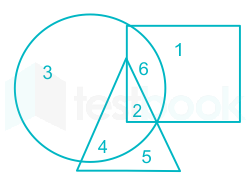
Study the given diagram carefully and answer the question. The numbers in different sections indicate the number of persons. The circle represents ‘professors’, the square represents ‘poets’, and the triangle represents ‘women’. How many professors are there who are women and also poets?

  1. AOption (a)

    1

  2. BOption (b)

    2

  3. COption (c)

    4

  4. DOption (d)

    3

View answer & explanation

Correct answer

Answer: (b)B.

2

Why this answer is correct

According to the given information:

The shaded part represents professors are there who are women and also poets.

Thus, 2 professors are there who are women and also poets.

Hence, the correct answer is "2".

Question 23

What is 60 × 42 × 2-4?

  1. AOption (a)

    1

  2. BOption (b)

    0

  3. COption (c)

    4

  4. DOption (d)

    2

View answer & explanation

Correct answer

Answer: (a)A.

1

Why this answer is correct

Given:

The expression to evaluate is:

60 × 42 × 2-4

Solution:

Step 1: Evaluate 60:

Any non-zero number raised to the power of 0 is 1. So:

60 = 1

Step 2: Evaluate 42:

4 raised to the power of 2 is:

42 = 16

Step 3: Evaluate 2-4:

A negative exponent means the reciprocal of the base raised to the positive exponent. So:

2-4 = 1 / 24 = 1 / 16

Step 4: Multiply the results:

Now, multiply all the results together:

1 × 16 × 1 / 16 = 1

∴ The value of the expression is 1.

Question 24

A certain number of advocates are sitting in a row in a bar council, facing north. Piyush is an immediate neighbour of both Vinod and Taman, while Rudir is an immediate neighbour of both Taman and Biswas. Vinod is sitting at the extreme right end. There are only two advocates to the left of Biswas. If no other advocate is sitting in the row, what is the total number of advocates seated in that row?

  1. AOption (a)

    Ten

  2. BOption (b)

    Eight

  3. COption (c)

    Seven

  4. DOption (d)

    Nine

View answer & explanation

Correct answer

Answer: (c)C.

Seven

Why this answer is correct

According to the given information:

1) Vinod is sitting at the extreme right end. 

  1. Piyush is an immediate neighbour of both Vinod and Taman, while Rudir is an immediate neighbour of both Taman and Biswas.

  2. There are only two advocates to the left of Biswas.

If no other advocate is sitting in the row,

So, Seven is the total number of advocates seated in that row.

Hence, the correct answer is "Seven".

Question 25

The value of 163 - 123 is:

  1. AOption (a)

    2378

  2. BOption (b)

    2388

  3. COption (c)

    2358

  4. DOption (d)

    2368

View answer & explanation

Correct answer

Answer: (d)D.

2368

Why this answer is correct

Shortcut Trick

Identify the identity: a3 − b3 = (a − b)(a2 + ab + b2).

Here, a = 16 and b = 12.

Calculation: (16 − 12)(162 + 16 × 12 + 122) = 4 × (256 + 192 + 144) = 4 × 592 = 2368.

Alternatively, use cubes directly: 4096 − 1728 = 2368.

∴ The correct answer is 2368.

Alternate Method

Given:

Expression = 163 − 123

Formula Used:

x3 = x × x × x

Calculations:

⇒ First, calculate 163:

⇒ 16 × 16 × 16 = 256 × 16 = 4096

⇒ Next, calculate 123:

⇒ 12 × 12 × 12 = 144 × 12 = 1728

⇒ Subtract the two values:

⇒ 4096 − 1728 = 2368

∴ The correct answer is 2368.

Additional Information

Algebraic Identities

Difference of cubes: a3 − b3 = (a − b)(a2 + ab + b2). Sum of cubes: a3 + b3 = (a + b)(a2 − ab + b2).

Cube Shortcuts

Memorizing cubes from 1 to 20 helps in fast simplification and number series questions.

Unit Digit Check

Unit digit of 63 is 6 and 23 is 8. Therefore, 6 − 8 → 16 − 8 = 8. The result must end in 8.

Question 26

Which of the following numbers will replace the question mark (?) in the given series?

15, 17, 37, 115, ?

  1. AOption (a)

    470

  2. BOption (b)

    465

  3. COption (c)

    455

  4. DOption (d)

    460

View answer & explanation

Correct answer

Answer: (b)B.

465

Why this answer is correct

The logic followed here is:

Hence, the correct answer is "465".

Question 27

Which of the following State’s police introduced 'Pink Beat' patrols for enhancing the safety for women and children in public places?

  1. AOption (a)

    Odisha

  2. BOption (b)

    Maharashtra

  3. COption (c)

    Kerala

  4. DOption (d)

    Karnataka

View answer & explanation

Correct answer

Answer: (c)C.

Kerala

Why this answer is correct

The correct answer is Kerala

Key Points

  • The Kerala Police introduced the Pink Beat patrol to enhance the safety of women and children in public places.
  • The Pink Beat is a part of the Kerala Police's Pink Protection Project, which aims to create a safe environment for women in public, private, and digital spaces.
  • The project includes:
  • Pink Patrol: Specially trained women police personnel patrol on KSRTC and private stage carriers and are present at bus stops and schools
  • Pink Janamaithri beat: A part of the project
  • Pink control room: A part of the project
  • Pink Shadow: A part of the project
  • Pink Romeo: A part of the project
  • Counseling facilities: A part of the project
  • Mobile application for women protection: A part of the project
  • The project was launched in response to the increasing number of crimes against women in Kerala and across the country.
  • The project aims to prevent crimes such as dowry-related issues, cyberbullying, and public humiliation.

Question 28

Which of the following are bisexual flowers?

  1. AOption (a)

    Hibiscus and mustard

  2. BOption (b)

    Mustard and watermelon

  3. COption (c)

    Watermelon and papaya

  4. DOption (d)

    Papaya and hibiscus

View answer & explanation

Correct answer

Answer: (a)A.

Hibiscus and mustard

Why this answer is correct

The correct answer is Hibiscus and mustard

Key Points

  • Hibiscus and mustard are bisexual flowers, while watermelon and papaya are unisexual flowers:
  • Bisexual flowers
  • Contain both male and female reproductive parts in the same flower.
  • The male reproductive parts are the stamens, which produce pollen, and the female reproductive parts are the pistil, which contains the ovary and stigma.
  • Examples of bisexual flowers include hibiscus and mustard.
  • Unisexual flowers
  • Contain either the male or female reproductive organs. Examples of unisexual flowers include watermelon and papaya.

Question 29

If x + 1x\frac{1}{x} = 3, then x6 + 1x6\frac{1}{x^6} is:

  1. AOption (a)

    414

  2. BOption (b)

    322

  3. COption (c)

    364

  4. DOption (d)

    927

View answer & explanation

Correct answer

Answer: (b)B.

322

Why this answer is correct

Shortcut Trick

If x + 1/x = k, then x2 + 1/x2 = k2 − 2.

Given: x + 1/x = 3 ⇒ x2 + 1/x2 = 32 − 2 = 7.

Let n = x2 + 1/x2 = 7. Then x6 + 1/x6 = (x2)3 + 1/(x2)3 = n3 − 3n.

⇒ 73 − 3(7) = 343 − 21 = 322.

∴ The correct answer is 322.

Alternate Method

Given: x + 1/x = 3

Formula Used: (a + b)2 = a2 + b2 + 2ab and (a + b)3 = a3 + b3 + 3ab(a + b)

Squaring both sides of the given equation:

⇒ (x + 1/x)2 = 32

⇒ x2 + 1/x2 + 2(x)(1/x) = 9

⇒ x2 + 1/x2 + 2 = 9

⇒ x2 + 1/x2 = 7

Cubing both sides of this new equation:

⇒ (x2 + 1/x2)3 = 73

⇒ (x2)3 + (1/x2)3 + 3(x2)(1/x2)(x2 + 1/x2) = 343

⇒ x6 + 1/x6 + 3(1)(7) = 343

⇒ x6 + 1/x6 + 21 = 343

⇒ x6 + 1/x6 = 343 − 21

⇒ x6 + 1/x6 = 322

∴ The correct answer is 322.

Additional Information

Standard Algebraic Identities

If x + 1/x = k, then x2 + 1/x2 = k2 − 2 and x3 + 1/x3 = k3 − 3k.

Negative Sign Identity

If x − 1/x = k, then x2 + 1/x2 = k2 + 2 and x3 − 1/x3 = k3 + 3k.

Higher Power (n=4 and n=5)

x4 + 1/x4 = (x2 + 1/x2)2 − 2 and x5 + 1/x5 = (x2 + 1/x2)(x3 + 1/x3) − (x + 1/x).

Question 30

Simplify the given expression.

[13 - (-2) × {6 - (7 - 3)}] ÷ [4 × {5 + (-2) × (-6)}]

  1. AOption (a)

    14\frac{1}{4}

  2. BOption (b)

    734\frac{7}{34}

  3. COption (c)

    −1768-\frac{17}{68}

  4. DOption (d)

    −13\frac{-1}{3}

View answer & explanation

Correct answer

Answer: (a)A.

14\frac{1}{4}

Why this answer is correct

Shortcut Trick

Solve Numerator: 13 − (−2) × {6 − 4} ⇒ 13 − (−4) = 17

Solve Denominator: 4 × {5 + 12} ⇒ 4 × 17 = 68

Result = 17 ÷ 68 = 1/4

∴ The correct answer is 1/4.

Alternate Method

Given:

[13 − (−2) × {6 − (7 − 3)}] ÷ [4 × {5 + (−2) × (−6)}]

Formula Used:

BODMAS Rule: Brackets → Orders → Division/Multiplication → Addition/Subtraction.

Calculations:

Step 1: Simplify the numerator [13 − (−2) × {6 − (7 − 3)}]

⇒ Solve the innermost bracket (7 − 3) = 4

⇒ The numerator becomes: [13 − (−2) × {6 − 4}]

⇒ Solve curly braces {6 − 4} = 2

⇒ Multiply: (−2) × 2 = −4

⇒ Numerator = 13 − (−4) = 13 + 4 = 17

Step 2: Simplify the denominator [4 × {5 + (−2) × (−6)}]

⇒ Multiply inside the curly brace: (−2) × (−6) = 12

⇒ Add: 5 + 12 = 17

⇒ Now, multiply by 4: 4 × 17 = 68

Step 3: Divide Numerator by Denominator

⇒ Expression value = 17 ÷ 68

⇒ 17/68 = 1/4

∴ The correct answer is 1/4.

Additional Information

BODMAS Rule

It determines the strict sequence of operations in mathematical simplifications: Brackets → Orders (Powers/Roots) → Division → Multiplication → Addition → Subtraction.

Sign Rules for Multiplication

Multiplying two numbers with the same signs results in a positive product: (−) × (−) = (+) and (+) × (+) = (+). Multiplying two numbers with opposite signs gives a negative product: (+) × (−) = (−).

Hierarchy of Brackets

Always resolve brackets from innermost to outermost in this specific order: Vinculum (Line bracket) → Parentheses () → Curly Braces {} → Square Brackets [].

Question 31

In this question, the statement is followed by four conclusions. Find out which conclusion is true based on the given statement:

Statement: W ≤ P < S > Y = R ≥ T > M

  1. AOption (a)

    Y < P

  2. BOption (b)

    S > W

  3. COption (c)

    Y ≥ P

  4. DOption (d)

    M > R

View answer & explanation

Correct answer

Answer: (b)B.

S > W

Why this answer is correct

Given Statement: W ≤ P < S > Y = R ≥ T > M

Now,

Conclusions:

Option 1: Y < P → False (P < S > Y It gives P < S > Y)

Option 2: S > W → True (W ≤ P < S It gives S > W)

Option 3: Y ≥ P → False (P < S > Y It gives Y > P)

Option 4: M > R → False (R ≥ T > M It gives R > M)

Hence, the correct answer is "Option 2".

Question 32

Two wires, A and B, are made of the same material, but the length of A is 3 times that of B, and the cross-section of A is 14\frac{1}{4}th of that of B. The resistance of A is:

  1. AOption (a)

    12 times that of B

  2. BOption (b)

    9 times that of B

  3. COption (c)

    3 times that of B

  4. DOption (d)

    6 times that of B

View answer & explanation

Correct answer

Answer: (a)A.

12 times that of B

Why this answer is correct

The correct answer is 12 times that of B

Key Points

  • The resistance ( R) of a wire is given by the formula:
  • ​R=ρA/LR=ρ A/ L
  • where:
  • R is the resistance,
  • ρ is the resistivity (same for both wires as they are made of the same material),
  • L is the length of the wire,
  • A is the cross-sectional area.
  • Given Data:
  • Length of wire A (LA ) =  3×LB
  • Cross-sectional area of wire A ( AA ) = 1/41/4 ×AB
  • 8 814×AB For wire A, since its length is 3 times (Lb) and its cross-sectional area is (1/4) times (Ab), its resistance (Ra) is: Ra = ρ 3Lb ×1/4Ab  = ρ (3 ×  4Lb)/Ab = 12ρ Lb/Ab, Ra = 12Rb

Question 33

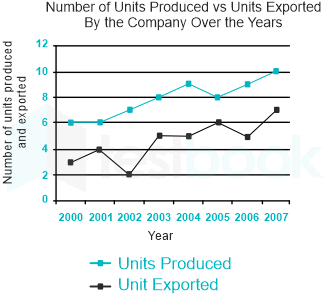
The following graph shows the number of units produced and number of units exported by a company over the years. Study the graph and answer the question that follows.

During which year did the units produced decline?

  1. AOption (a)

    2000 - 2001

  2. BOption (b)

    2001 - 2002

  3. COption (c)

    2005 - 2006

  4. DOption (d)

    2004 - 2005

View answer & explanation

Correct answer

Answer: (d)D.

2004 - 2005

Why this answer is correct

Given:

The graph shows the number of units produced and the number of units exported by a company over the years. We are asked to determine during which year the units produced declined.

Solution:

By analyzing the graph, we observe the following trends:

 The blue line represents the number of units produced.

 The red line represents the number of units exported.

Step 1: Identify the trend in the number of units produced (blue line):

The blue line steadily increases until the year 2004. After 2004, it begins to decline, indicating a decrease in the number of units produced.

Step 2: Identify the year when the decline starts:

The decline in the number of units produced starts between the years 2004 and 2005.

∴ The units produced declined between the years 2004 - 2005.

Answer: 4) 2004 - 2005

Question 34

A sum of money is to be distributed among the partners A, B and C in the proportion of 3 ∶ 2 ∶ 113\frac{1}{3}. If A gets Rs. 1,500 more than B, then C’s share is:

  1. AOption (a)

    Rs. 3,400

  2. BOption (b)

    Rs. 2,000

  3. COption (c)

    Rs. 2,500

  4. DOption (d)

    Rs. 3,750

View answer & explanation

Correct answer

Answer: (b)B.

Rs. 2,000

Why this answer is correct

Shortcut Trick

Ratio of A : B : C = 3 : 2 : 1(1/3) = 3 : 2 : 4/3 = 9 : 6 : 4.

Difference between A and B in units = 9 − 6 = 3 units.

Given, 3 units = Rs. 1,500 ⇒ 1 unit = Rs. 500.

Share of C = 4 units = 4 × 500 = Rs. 2,000.

∴ The correct answer is Rs. 2,000.

Alternate Method

Given: Ratio A : B : C = 3 : 2 : 4/3

⇒ Multiply by 3 to remove fraction: 9 : 6 : 4

⇒ Let shares be 9x, 6x, and 4x

⇒ Difference (A − B) = 9x − 6x = 3x

⇒ 3x = 1500

⇒ x = 500

⇒ C's share = 4x = 4 × 500 = 2000

∴ The correct answer is Rs. 2,000.

Additional Information

Ratio Simplification

To simplify a ratio with fractions, multiply all terms by the LCM of the denominators to convert them into integers.

Partnership Profit Distribution

In a partnership, unless specified otherwise, the profit/sum is distributed in the ratio of the capitals invested: Profit Ratio = C1 × T1 : C2 × T2.

Question 35

In the year 2022, which of the following chess champions was beaten by a 16-year old Indian chess player Rameshbabu  Praggnanandhaa?

  1. AOption (a)

    Garry Kasparov

  2. BOption (b)

    Magnus Carlsen

  3. COption (c)

    Bobby Fischer

  4. DOption (d)

    Anatoly Karpov

View answer & explanation

Correct answer

Answer: (b)B.

Magnus Carlsen

Why this answer is correct

The correct answer is Magnus Carlsen

Key Points

  • In 2022, 16-year-old Indian chess player Rameshbabu Praggnanandhaa defeated world chess champion Magnus Carlsen in an online tournament:
  • When: February 22, 2022
  • Where: In an online tournament with 16 elite players
  • How it happened: Praggnanandhaa improved on his play from the first day of the tournament and avoided a draw against Carlsen
  • Praggnanandhaa was the youngest person to defeat Carlsen since he became world champion in 2013.
  • Praggnanandhaa has beaten Carlsen several times, including:
  • In the Champions Chess Tour in 2022
  • At the Superbet Grand Chess Tour in Warsaw, where he beat Carlsen for the first time in over-the-board chess
  • At the Norway Chess Tournament, where he defeated Carlsen in classical chess for the first time

Additional Information 

  • Garry Kasparov
  • A Russian chess grandmaster and former World Chess Champion. He was born in Baku, Soviet Union (now Azerbaijan) in 1963. In 1999, he achieved a peak FIDE chess rating of 2851, which was the highest recorded until 2013.
  • Magnus Carlsen
  • A Norwegian chess grandmaster and the current world number one. He has won the World Chess Championship five times, the World Rapid Chess Championship five times, the World Blitz Chess Championship seven times, and the Chess World Cup Championship.
  • Bobby Fischer
  • The first and only American world chess champion. He won 20 consecutive games against world-class opponents from 1970 to 1971. He is considered by many to be the most famous chess player ever.
  • Anatoly Karpov
  • A Russian and former Soviet chess grandmaster and former World Chess Champion. He is also a politician.

Question 36

Three statements are given followed by two conclusions numbered I and II. Assuming the statements to be true, even if they seem to be at variance with commonly known facts, decide which of the conclusions logically follow(s) from the statements.

Statements:

Some blues are greens.

All greens are emeralds.

All emeralds are gems.

Conclusions:

I. Some blues are gems.

II. Some gems are greens.

  1. AOption (a)

    Only conclusion II follows

  2. BOption (b)

    Neither conclusion I nor II follows

  3. COption (c)

    Only conclusion I follows

  4. DOption (d)

    Both conclusions I and II follow

View answer & explanation

Correct answer

Answer: (d)D.

Both conclusions I and II follow

Why this answer is correct

Given Statements:

Some blues are greens.

All greens are emeralds.

All emeralds are gems.

The least possible Venn diagram:

Conclusions:

I. Some blues are gems. - True (Because Some blues are greens, All greens are emeralds and All emeralds are gems. So, Some blues are also gems)

II. Some gems are greens. - True (Because All greens are emeralds and All emeralds are gems. So, Some gems are also greens)

So, Both conclusions I and II follow.

Hence, the correct answer is "Both conclusions I and II follow".

Question 37

Prohibition of discrimination on grounds of religion, race, caste, sex or place of birth, has been laid under ________ of the Fundamental Rights in the Constitution of India.

  1. AOption (a)

    Article 17

  2. BOption (b)

    Article 15

  3. COption (c)

    Article 16

  4. DOption (d)

    Article 14

View answer & explanation

Correct answer

Answer: (b)B.

Article 15

Why this answer is correct

The correct answer is Article 15

Key Points

  • The prohibition of discrimination on grounds of religion, race, caste, sex, or place of birth is laid under Article 15 of the Constitution of India:
  • Article 15
  • Prohibits discrimination against citizens based on the five protected grounds of religion, race, caste, sex, or place of birth.
  • It also states that citizens cannot be subject to any disability, liability, restriction, or condition based on these grounds.

Additional Information

  • Other articles
  • Other articles in the Constitution of India that ensure the Right to equality for all Indians include:
  • Article 14: Equality before the law
  • Article 16: Equality of opportunity in matters of public employment
  • Article 17: Abolition of untouchability
  • Article 18: Abolition of titles
  • Fundamental rights are the rights that grant individuals equality in every aspect irrespective of race, color, caste, religion, birthplace, or gender.

Question 38

As of August 2022, the objective of the Maulana Azad Fellowship Scheme (MANF) is to provide ________ fellowships in the form of financial assistance to students from six notified minority communities, namely Buddhist, Christian, Jain, Muslim, Parsi and Sikh, notified by the Central Government, to pursue M.Phil. and Ph.D.

  1. AOption (a)

    5-year

  2. BOption (b)

    2-year

  3. COption (c)

    4-year

  4. DOption (d)

    3-year

View answer & explanation

Correct answer

Answer: (a)A.

5-year

Why this answer is correct

The correct answer is 5- year

Key Points

  • As of August 2022, the objective of the Maulana Azad National Fellowship Scheme (MANF) is to provide integrated five-year fellowships in the form of financial assistance to students from six notified minority communities (Buddhist, Christian, Jain, Muslim, Parsi, and Sikh) to pursue M.Phil. and Ph.D. degrees.
  • This scheme aims to support the educational advancement of students from these minority communities by covering academic expenses, enabling them to focus on their research without financial constraints.
  • The University Grants Commission (UGC) is responsible for implementing the MANF scheme, ensuring transparency and efficient disbursal of funds to eligible candidates.
  • Fellows receive monthly allowances, such as:
  • Junior Research Fellowship (JRF): Higher stipend during the initial two years.
  • Senior Research Fellowship (SRF): Enhanced stipend for the remaining tenure, subject to performance evaluation.

Question 39

Nuakhai is an agricultural or harvesting festival mainly observed by people of which state in India?

  1. AOption (a)

    Kerala

  2. BOption (b)

    Madhya Pradesh

  3. COption (c)

    Odisha

  4. DOption (d)

    Manipur

View answer & explanation

Correct answer

Answer: (c)C.

Odisha

Why this answer is correct

The correct answer is Odisha

Key Points

  • Nuakhai is an agricultural festival mainly observed by people of Odisha, India:
  • Nuakhai is celebrated in Western Odisha and Southern Chhattisgarh.
  • Nuakhai is a festival to welcome the new rice of the season.
  • The word "nua" means "new" and "khai" means "food".
  • Nuakhai is a culturally rich and important festival in Odisha.
  • It is especially significant for farmers and the agricultural community.
  • Nuakhai is celebrated a day after Ganesh Chaturthi.
  • It is celebrated at a specific time of the day called lagan.
  • Nuakhai is also known as Nabanna.

Question 40

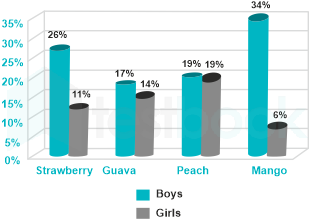
The percentage of boys and girls liking four different fruits are shown in the following graph. Study the graph and answer the question.

The respective ratio of the number of boys to the number of girls is 2 ∶ 3. If the total number of boys and girls together is 11,500, then total how many boys and how many girls like peaches?

  1. AOption (a)

    1311 boys and 874 girls

  2. BOption (b)

    1311 boys and 1311 girls

  3. COption (c)

    874 boys and 1311 girls

  4. DOption (d)

    874 boys and 874 girls

View answer & explanation

Correct answer

Answer: (c)C.

874 boys and 1311 girls

Why this answer is correct

Given:

The total number of boys and girls together is 11,500.

The ratio of boys to girls is 2 : 3.

Boys who like peaches = 19% and Girls who like peaches = 19%.

Solution:

Step 1: Find the number of boys and girls using the ratio.

The total ratio parts for boys and girls is:

2 + 3 = 5 parts

Since the total number of boys and girls together is 11,500, we can find the number of boys and girls using the ratio:

 Number of boys = (2/5) × 11,500 = 4,600

 Number of girls = (3/5) × 11,500 = 6,900

Step 2: Find the number of boys and girls who like peaches.

Boys who like peaches:

19% of 4,600 = (19/100) × 4600 = 874

Girls who like peaches:

19% of 6,900 = (19/100) × 6900 = 1,311

Step 3: Conclusion

The number of boys who like peaches is 874 and the number of girls who like peaches is 1,311.

Question 41

A man purchased two varieties of apples at the rate of Rs. 2 for 3 apples and Rs. 1 per apple, respectively. If he purchased an equal number of apples of each variety and then sold all his apples at Rs. 1 per apple, what was his profit percentage?

  1. AOption (a)

    22%

  2. BOption (b)

    20%

  3. COption (c)

    18%

  4. DOption (d)

    15%

View answer & explanation

Correct answer

Answer: (b)B.

20%

Why this answer is correct

Shortcut Trick

Let the number of apples of each variety be 3 (LCM of 3 and 1).

Total apples = 3 + 3 = 6.

Total Cost Price (CP) = 2 + 3 = Rs. 5.

Total Selling Price (SP) = 6 × 1 = Rs. 6.

Profit% = (6 − 5) ÷ 5 × 100 = 1 ÷ 5 × 100 = 20%.

∴ The correct answer is 20%.

Alternate Method

Given: CP1 = Rs. 2 for 3 apples, CP2 = Rs. 1 per apple, SP = Rs. 1 per apple. Equal quantity purchased.

Formulas: Profit = SP − CP | Profit% = (Profit ÷ CP) × 100

⇒ Let quantity of each variety = x. Total quantity = 2x.

⇒ Cost Price of variety 1 = (2 ÷ 3) × x = 2x/3.

⇒ Cost Price of variety 2 = 1 × x = x.

⇒ Total CP = 2x/3 + x = 5x/3.

⇒ Total SP = 1 × 2x = 2x.

⇒ Profit = 2x − 5x/3 = x/3.

⇒ Profit% = (x/3 ÷ 5x/3) × 100 = 1/5 × 100 = 20%.

∴ The correct answer is 20%.

Additional Information

Unitary Method for CP

Always calculate the price of a single unit (Price ÷ Quantity) to standardize the Cost Price when dealing with different rates.

Profit and Loss Percentage

Profit or Loss percentage is always calculated on the Cost Price (CP) unless stated otherwise in the question.

Question 42

Which of the following was considered as a limitation of Mendeleev’s periodic table?

  1. AOption (a)

    Resemblance of hydrogen to alkaline earth metals as well as halogens and no specific position was assigned to hydrogen

  2. BOption (b)

    Resemblance of hydrogen to alkali metals as well as halogens and no specific position was assigned to hydrogen.

  3. COption (c)

    Resemblance of hydrogen to alkaline earth metals as well as halogens and a specific position was assigned to hydrogen

  4. DOption (d)

    Resemblance of hydrogen to alkali metals as well as halogens and a specific position was assigned to hydrogen.

View answer & explanation

Correct answer

Answer: (b)B.

Resemblance of hydrogen to alkali metals as well as halogens and no specific position was assigned to hydrogen.

Why this answer is correct

The correct answer is Resemblance of hydrogen to alkali metals as well as halogens and no specific position was assigned to hydrogen.

Key Points

  • Mendeleev's periodic table did not assign a specific position to hydrogen due to its resemblance to both alkali metals and halogens.
  • This resemblance created confusion because hydrogen shares properties with Group 1 (alkali metals) and Group 17 (halogens).
  • Hydrogen can form H2 like halogens (Cl2, Br2, etc.) and also forms compounds like HCl, similar to halogen acids (HBr, HI).
  • Hydrogen also forms ionic compounds like NaH, similar to alkali metals.

Additional Information

  • Mendeleev's Periodic Table
  • Developed by Dmitri Mendeleev in 1869, it organized elements based on atomic mass and chemical properties.
  • Mendeleev left gaps in his table for undiscovered elements, predicting their properties accurately.
  • He arranged elements in increasing order of atomic masses, but some elements did not fit this order perfectly (e.g., Te and I).
  • The modern periodic table, developed later, arranges elements by atomic number, resolving many of Mendeleev's inconsistencies.
  • Alkali Metals
  • Group 1 elements in the periodic table, including lithium, sodium, potassium, rubidium, cesium, and francium.
  • They have a single electron in their outer shell and are highly reactive, especially with water.
  • Alkali metals form strong bases (alkalies) when they react with water.
  • Halogens
  • Group 17 elements, including fluorine, chlorine, bromine, iodine, and astatine.
  • They have seven electrons in their outer shell and are highly reactive, particularly with alkali metals and alkaline earth metals.
  • Halogens form salts when they react with metals (e.g., sodium chloride).

Question 43

Select the option that represents the letters that, when placed from left to right in the blanks below, will complete the letter series.

_ T U _ R T _ S_ _ W S R T X _

  1. AOption (a)

    RSVRTR

  2. BOption (b)

    RSVTRR

  3. COption (c)

    RSVRTS

  4. DOption (d)

    RTUSRX

View answer & explanation

Correct answer

Answer: (c)C.

RSVRTS

Why this answer is correct

The logic followed here is:

Given Sequence: _ T U _ R T _ S_ _ W S R T X _

Now, putting the letters in the blank spaces given in the option one by one:

Option 1) RSVRTR → R T U S / R T V S / R T W S / R T X R

Option 2) RSVTRR → R T U S / R T V S / T R W S / R T X R

Option 3) RSVRTS → R T U S / R T V S / R T W S / R T X S

Here, R, T and S are fixed letter and third letter is increased by 1.

U + 1 = V; V + 1 = W; W + 1 = X

Option 4) RTUSRX → R T U T / R T U S / S R W S / R T X X

Hence, the correct answer is "Option 3".

Question 44

Along its course, River ________ passes through Tibet, where it is known as Tsangpo, and also passes through the Indian states of Arunachal Pradesh, Assam and Bangladesh.

  1. AOption (a)

    Ramganga

  2. BOption (b)

    Brahmani

  3. COption (c)

    Brahmaputra

  4. DOption (d)

    Mahanadi

View answer & explanation

Correct answer

Answer: (c)C.

Brahmaputra

Why this answer is correct

The correct answer is Brahmaputra

Key Points

  • ​The Brahmaputra River passes through Tibet, Arunachal Pradesh, Assam, and Bangladesh:
  • The Brahmaputra forms the world's largest number of freshwater riverine islands, including Majuli, the world's largest freshwater riverine island.
  • The Brahmaputra is known as the Yarlung Tsangpo in Tibet.
  • It originates in the Chemayungdung glacier in the Himalayas near Mount Kailash.
  • The Brahmaputra flows through the Indian states of Arunachal Pradesh and Assam.
  • In Assamese, it is known as Brahmaputra or Luit.
  • The Brahmaputra is known as the Jamuna in Bangladesh.
  • It joins the Ganga in Bangladesh and eventually drains into the Bay of Bengal.
  • Other names
  • The Brahmaputra is also known as the Siang/Dihang River in Arunachali.
  • The word "Brahmaputra" means "son of Brahma" in Sanskrit
  • The Brahmaputra is India's largest river by volume.
  • It has one of the largest river basins in South Asia.

Additional Information

  • Ramganga River
  • Origin: The Ramganga River originates from the Doodhatoli ranges in the Garhwal region of Uttarakhand, India.
  • Flow:
  • It flows southeast through the Jim Corbett National Park in Uttarakhand.
  • Then, it enters Uttar Pradesh and passes through cities like Moradabad, Bareilly, and Badaun.
  • Finally, it merges into the Ganga River near Kannauj in Uttar Pradesh.
  • Brahmani River
  • Origin: The Brahmani River is formed by the confluence of the Koel and Sankh Rivers near Rourkela in Odisha, India.
  • Flow:
  • It flows eastward through Odisha.
  • Major cities and regions along its course include Angul, Talcher, and Dhenkanal.
  • It eventually drains into the Bay of Bengal near Dhamra in Odisha.
  • Mahanadi River
  • Origin: The Mahanadi River originates from the Sihawa Hills in the Dhamtari district of Chhattisgarh, India.
  • Flow:
  • It flows eastward through Chhattisgarh and Odisha, covering major cities like Raipur, Cuttack, and Sambalpur.
  • The river forms an extensive delta before emptying into the Bay of Bengal near Paradeep in Odisha.
  • It is also known for the Hirakud Dam, one of the largest dams in India.

Question 45

_________ was among the 7 Recipients of the 2020 Tenzing Norgay National Award for land adventure, and received the award from then President Ram Nath Kovind during the 2021 National Sports Awards function.

  1. AOption (a)

    Priyanka Mangesh Mohite

  2. BOption (b)

    Lt. Col. Servesh Dhadwal

  3. COption (c)

    Jai Kishan

  4. DOption (d)

    Srikaanth Viswanathan

View answer & explanation

Correct answer

Answer: (a)A.

Priyanka Mangesh Mohite

Why this answer is correct

The correct answer is Priyanka Mangesh Mohite

Key Points

  • Priyanka Mohite was one of the seven recipients of the 2020 Tenzing Norgay National Adventure Award for land adventure:
  • Mountaineer from Maharashtra who scaled some of the world's highest peaks, including Mt Everest, Mt Lhotse, and Mt.Makalu
  • Other achievements
  • First Indian woman to climb Mt Annapurna, the 10th highest mountain peak in the world
  • 2020 Tenzing Norgay National Adventure Award, 2017-2018 Maharashtra Government's Shiv Chhatrapati State award for adventure sports
  • The Tenzing Norgay National Adventure Award is India's highest adventure sports honor, and is awarded annually by the Ministry of Youth Affairs and Sports.

Additional Information

  • Lt. Col. Servesh Dhadwal:
  • A member of the Indian Army, he was honored with the 2020 Tenzing Norgay National Adventure Award in the air adventure category.
  • He is a skilled skydiver and an instructor for the Indian Army Skydiving Team.
  • Over his career, he has completed over 7,000 skydives and trained numerous personnel, including those in Special Forces.
  • His contributions also extend to providing skydiving training for National Security Guards (NSG)​
  • Jai Kishan: A
  • Group Captain in the Indian Air Force, Jai Kishan has received the Tenzing Norgay National Adventure Award twice.
  • His lifetime achievement award in 2021 recognizes his extensive contributions to adventure sports, including skydiving at the base of Mt. Everest and leading expeditions in the Sikkim Himalayas.
  • He has six world records in adventure sports and has trained thousands in mountaineering and parachuting​
  • Srikaanth Viswanathan:
  • He is Honored with the award in the water adventure category in 2020, he is notable for completing the "Triple Crown" of open-water swimming, a prestigious feat involving swims across the English Channel, Catalina Channel, and around Manhattan Island. T
  • his accomplishment highlights his remarkable endurance and dedication to water-based adventures​

Question 46

Select the option that is related to the fifth number in the same way as the second number is related to the first number and the fourth number is related to the third number.

33 : 55 :: 46 : 68 :: 68 : ?

  1. AOption (a)

    100

  2. BOption (b)

    94

  3. COption (c)

    90

  4. DOption (d)

    96

View answer & explanation

Correct answer

Answer: (c)C.

90

Why this answer is correct

The logic followed here is:

Logic: (1st number + 22) = 2nd number.

Now,

For, 33 : 55

⇒ 33 + 22 = 55 

For, 46 : 68

⇒ 46 + 22 =68

Similarly, for 68 ∶ ?

⇒ 68 + 22 = 90

Hence, the correct answer is "Option 3".

Question 47

Which of the following is the longest range in the lesser Himalayas?

  1. AOption (a)

    Zanskar Range

  2. BOption (b)

    Pir Panjal Range

  3. COption (c)

    Ladakh Range

  4. DOption (d)

    Karakoram Range

View answer & explanation

Correct answer

Answer: (b)B.

Pir Panjal Range

Why this answer is correct

The correct answer is Pir Panjal Range

Key Points

  • The Pir Panjal Range is the longest range in the Lesser Himalayas:
  • Location: The Pir Panjal Range runs through the states of Jammu and Kashmir and Himachal Pradesh.
  • Elevation: The average elevation of the range is 5,000 meters above sea level.
  • Notable features: The range includes the Jawahar tunnel, Atal tunnel, and Banihal tunnel.
  • The Banihal Railway Tunnel is India's longest railway tunnel.
  • The range also includes the peaks of Deo Tibba and Indrasan.
  • Rivers: The Jhelum, Kishanganga, and Chenab rivers flow through the range.

Additional Information

  • The Zanskar Range, Ladakh Range, and Karakoram Range are all mountain ranges in the Ladakh region of India.
  • The Zanskar Range is located south of the Ladakh Range, which is in turn located south of the Karakoram Range.
  • Karakoram Range
  • Part of a complex of mountain ranges that also includes the Hindu Kush, Himalaya, and Pamir ranges.
  • The Karakoram Range has eight mountains with peaks over 7,500 meters (24,600 ft) high, and four of those are higher than 8,000 meters (26,000 ft).
  • Ladakh
  • A cold desert in the northernmost part of India, Ladakh is home to some of the world's highest mountain peaks.
  • Many of these peaks are unclimbed and unnamed due to security reasons.
  • Zanskar Range
  • One of the main ranges in Ladakh, along with the Ladakh Range, Kailas, and Karakoram

Question 48

In which of the following processes is the pyruvate converted into ethanol and carbon dioxide?

  1. AOption (a)

    Diffusion

  2. BOption (b)

    Translocation

  3. COption (c)

    Fermentation

  4. DOption (d)

    Transpiration

View answer & explanation

Correct answer

Answer: (c)C.

Fermentation

Why this answer is correct

The correct answer is Fermentation

Key Points

  • Pyruvate is converted into ethanol and carbon dioxide during fermentation:
  • Pyruvate is broken down to form ethanol and carbon dioxide
  • Type of respiration
  • Anaerobic respiration, which means it takes place in the absence of air (oxygen)
  • Fermentation is a process that regenerates the electron carrier from the produced in glycolysis.
  • The extra reactions in fermentation allow glycolysis to keep running by ensuring a steady supply of the electron carrier.

Additional Information

  • Diffusion
  • The movement of molecules from a region of higher concentration to a region of lower concentration.
  • Diffusion is a passive process that occurs across membranes and over short distances.
  • It's important for photosynthesis, as carbon dioxide diffuses into the leaves from the stomata.
  • Diffusion also occurs during transpiration, when water and oxygen diffuse from the leaves into the environment.
  • Translocation
  • The bulk movement of substances, such as organic compounds, through the vascular tissues of a plant over long distances.
  • Translocation is an active and passive process that occurs in the xylem and phloem.
  • Transpiration
  • The evaporation of water from the leaves of a plant in the form of water vapour.
  • Transpiration can occur through the stomata or through the cuticle, a waxy covering on the surface of the leaves.

Question 49

C, E, K, M, O, Q and Z are sitting around a round table facing towards the center (but not necessarily in the same order). C is the immediate neighbour of Z and M. O is neither an immediate neighbour of M nor E. Q, who is second to the left of O has K and E as immediate neighbours?

Who is sitting to the immediate right of O?

  1. AOption (a)

    M

  2. BOption (b)

    K

  3. COption (c)

    Z

  4. DOption (d)

    G

View answer & explanation

Correct answer

Answer: (c)C.

Z

Why this answer is correct

According to the given information:

  1. Q, who is second to the left of O has K and E as immediate neighbours.

  2. O is neither an immediate neighbour of M nor E.

  3. C is the immediate neighbour of Z and M.

So, Z is sitting to the immediate right of O.

Hence, the correct answer is "Z".

Question 50

When was Coal India Limited came into existence?

  1. AOption (a)

    1975

  2. BOption (b)

    1978

  3. COption (c)

    1976

  4. DOption (d)

    1977

View answer & explanation

Correct answer

Answer: (a)A.

1975

Why this answer is correct

The correct answer is 1975

Key Points

  • Coal India Limited (CIL) was founded in November 1975 by the Government of India.
  • It operates in the coal mining industry and has its headquarters in Kolkata, India.
  • CIL is the world's largest coal mining company.
  • It operates in 83 mining areas across eight Indian states, managing 322 mines.
  • CIL also runs workshops, hospitals, training institutes, and vocational training centers.

Question 51

Which of the following is the correct product formed by the combination reaction of calcium oxide with water?

  1. AOption (a)

    Calcium hydroxide

  2. BOption (b)

    Calcium carbonate

  3. COption (c)

    Calcium bicarbonate

  4. DOption (d)

    No reaction takes place

View answer & explanation

Correct answer

Answer: (a)A.

Calcium hydroxide

Why this answer is correct

The correct answer is Calcium hydroxide

Key Points

  • The correct product formed by the combination reaction of calcium oxide (CaO) with water is Calcium hydroxide (Ca(OH)₂)
  • When calcium oxide reacts with water, it forms calcium hydroxide, which is commonly known as slaked lime.
  • The chemical reaction is:CaO+H₂O→Ca(OH)₂
  • This is a typical combination reaction where two reactants combine to form a single product.
  • Calcium hydroxide is used in various industrial processes, such as water treatment and in the production of lime for construction​

Additional Information

  • Calcium Carbonate (CaCO₃)
  • Calcium carbonate is not formed by the combination of calcium oxide with water. Instead, it is typically produced when calcium hydroxide reacts with carbon dioxide (CO₂). The reaction would be:
  • Ca(OH)₂+CO₂→CaCO₃+H₂O
  • Calcium carbonate is commonly found in nature as limestone and is used in various industries like construction and agriculture.
  • Calcium Bicarbonate (Ca(HCO₃)₂)
  • Calcium bicarbonate is not directly formed by the combination of calcium oxide with water either. It forms when calcium carbonate dissolves in carbonic acid or in water containing dissolved CO₂. The reaction is:
  • CaCO₃+CO₂+H₂O→Ca(HCO₃)₂
  • This compound is important in natural processes, such as the dissolution of limestone in water to form hard water.

Question 52

The refractive indices of mediums 1, 2 and 3 are 1.50, 1.36 and 1.54, respectively. If the speed of light in the mediums are v1, v2 and v3, respectively, which of the following relations between them is correct?

  1. AOption (a)

    v1 > v3 > v2

  2. BOption (b)

    v1 = v2 = v3

  3. COption (c)

    v3 > v2 > v1

  4. DOption (d)

    v2 > v1 > v3

View answer & explanation

Correct answer

Answer: (d)D.

v2 > v1 > v3

Why this answer is correct

The correct answer is v2 > v1 > v3

Key Points

  • The refractive index (n) of a medium is related to the speed of light (v) in that medium by the following equation:
  • n = c / v
  • where c is the speed of light in a vacuum.
  • Therefore, the speed of light in a medium is inversely proportional to its refractive index.
  • Given:
  • Refractive index of medium 1 (n1) = 1.50
  • Refractive index of medium 2 (n2) = 1.36
  • Refractive index of medium 3 (n3) = 1.54
  • From the equation, we can see that:
  • A higher refractive index corresponds to a lower speed of light.
  • Therefore, the correct order of speeds is:
  • v2 > v1 > v3

Question 53

The average weight of 11 students is 50 kg. When the teacher’s weight of 70 kg is added to the total, then the new average will be:

  1. AOption (a)

    51.66

  2. BOption (b)

    51.36

  3. COption (c)

    53.66

  4. DOption (d)

    50.66

View answer & explanation

Correct answer

Answer: (a)A.

51.66

Why this answer is correct

Shortcut Trick

Identify the extra weight added: 70 − 50 = 20 kg.

Distribute this excess weight among the total number of people (11 students + 1 teacher = 12 people).

Average increase = 20 ÷ 12 = 5 ÷ 3 = 1.666... kg.

New Average = Old Average + Increase = 50 + 1.66 = 51.66 kg.

∴ The correct answer is 51.66 kg.

Alternate Method

Given:

Number of students = 11 | Average weight = 50 kg | Teacher’s weight = 70 kg

Formula Used:

Average = Sum of all observations ÷ Total number of observations

⇒ Total weight of 11 students = 11 × 50 = 550 kg

⇒ Total weight including teacher = 550 + 70 = 620 kg

⇒ Total number of people = 11 + 1 = 12

⇒ New average = 620 ÷ 12

⇒ New average = 51.666...

∴ The correct answer is 51.66 kg.

Additional Information

Net Deviation Method

If an observation ‘x’ is added to a group with average ‘A’, the new average becomes A + (x − A) ÷ (n + 1), where n is the initial number of people.

Weighted Average

When two groups with averages A1 and A2 and sizes n1 and n2 are combined, the new average is (n1A1 + n2A2) ÷ (n1 + n2).

Concept of Replacement

If one person is replaced, the change in total weight is simply (New weight − Old weight), and the change in average is (Net Change) ÷ (Total Strength).

Question 54

Six players, Aman, Bidya, Chahal, Druv, Elia and Flintoff, were born on different dates 1st, 2nd, 3rd, 4th, 5th and 6th of the same month. None of them were born after Druv, who was born on the date which is immediately after Elia. Only three players were born before Aman. Only two players were born between Chahal and Elia. Bidya was not born after Chahal.

Who among the following was born on 3rd?

  1. AOption (a)

    Aman

  2. BOption (b)

    Flintoff

  3. COption (c)

    Bidya

  4. DOption (d)

    Chahal

View answer & explanation

Correct answer

Answer: (b)B.

Flintoff

Why this answer is correct

According to the given information:

  1. Only three players were born before Aman.
DatesPlayers
1st
2nd
3rd
4thAman
5th
6th


  1. None of them were born after Druv, who was born on the date which is immediately after Elia.
DatesPlayers
1st
2nd
3rd
4thAman
5thElia
6thDruv


  1. Only two players were born between Chahal and Elia.
DatesPlayers
1st
2ndChahal
3rd
4thAman
5thElia
6thDruv


  1. Bidya was not born after Chahal.
DatesPlayers
1stBidya
2ndChahal ​
3rdFlintoff
4thAman
5thElia
6thDruv


Thus, Flintoff was born on 3rd.

Hence, the correct answer is "Flintoff".

Question 55

In the displacement reaction between iron metal and copper sulphate solution _________.

  1. AOption (a)

    iron displaces sulphate from copper sulphate solution because it is less reactive than sulphate

  2. BOption (b)

    iron displaces copper from copper sulphate solution because it is more reactive than copper

  3. COption (c)

    iron displaces sulphate from copper sulphate solution because it is more reactive than sulphate

  4. DOption (d)

    iron displaces copper from copper sulphate solution because it is less reactive than copper

View answer & explanation

Correct answer

Answer: (b)B.

iron displaces copper from copper sulphate solution because it is more reactive than copper

Why this answer is correct

The correct answer is option 2

Key Points

  • In a displacement reaction, a more reactive metal displaces a less reactive metal from its compound.
  • Iron (Fe) is more reactive than copper (Cu), so when iron metal is added to a copper sulphate (CuSO₄) solution, iron displaces copper from the solution and forms iron(II) sulphate (FeSO₄), while copper metal is deposited.
  • The chemical equation for the reaction is:
  • Fe(s)+CuSO₄(aq)→FeSO₄(aq)+Cu(s)
  • This occurs because iron has a greater tendency to lose electrons (oxidize) compared to copper, which allows it to replace copper in the compound.

Question 56

The Hindu Widows’ Remarriage Act was passed in the year ________ legalising the remarriage of widows in all jurisdictions of India under East India Company rule.

  1. AOption (a)

    1859

  2. BOption (b)

    1856

  3. COption (c)

    1857

  4. DOption (d)

    1858

View answer & explanation

Correct answer

Answer: (b)B.

1856

Why this answer is correct

The correct answer is 1856.

Key Points 

  • The Hindu widow remarriage act was passed in the year 1856.
  • The act made the remarriage of Hindu widows in all jurisdictions of India under East India Company rule legal.
  • The Hindu widow remarriage act was drafted during the tenure of Lord Dalhousie.
  • The act was passed by Lord Canning in 1856.
  • The remarriage of Hindu widows was first legalized by Lord Canning.
  • Hindu widow remarriage act was considered as the first major social reform legislation after the abolition of Sati in 1829.
  • Indian social reformer Ishwar Chandra Vidyasagar was the most prominent campaigner of the Hindu widow remarriage act

Question 57

Which of the following committees was constituted by RBI to study issues and concerns in the Micro Finance Institutions sector?

  1. AOption (a)

    Malhotra committee

  2. BOption (b)

    Abid Hussain committee

  3. COption (c)

    Y H Malegam committee

  4. DOption (d)

    Kelkar committee

View answer & explanation

Correct answer

Answer: (c)C.

Y H Malegam committee

Why this answer is correct

The correct answer is Y H Malegam committee

Key Points

  • The Committee constituted by the Reserve Bank of India (RBI) to study issues and concerns in the Micro Finance Institutions (MFI) sector is the Malegam Committee.
  • The Malegam Committee was set up in 2010 under the chairmanship of Dr. Y.H. Malegam, a renowned chartered accountant and former RBI Board member.
  • The committee's primary objective was to examine the functioning of MFIs and to propose recommendations to address concerns such as interest rates, transparency, over-indebtedness, and consumer protection in the microfinance sector.
  • It suggested capping the interest rates charged by MFIs and recommended the establishment of a microfinance development fund.
  • It also proposed the creation of a uniform regulatory framework for all MFIs across the country, including the registration and supervision by the RBI.

Additional Information

  • Malhotra Committee (1999): This committee focused on reforming the insurance sector in India. It played a key role in the liberalization of the insurance industry, recommending the opening up of the sector to private players and the establishment of the Insurance Regulatory and Development Authority (IRDA).
  • Abid Hussain Committee (1997): This committee was set up to look into the small-scale industries (SSI) sector. It provided suggestions on how to improve the functioning and support to small-scale industries, including recommendations for modernizing and enhancing their competitiveness.
  • Kelkar Committee (2002): The Kelkar Committee was formed to examine tax reforms in India. It suggested a comprehensive framework for tax reforms, including recommendations to simplify the tax structure and reduce tax rates for better compliance.

Question 58

Which Indian state has the largest reserves of Bauxite as per Indian Minerals Yearbook 2017?

  1. AOption (a)

    Madhya Pradesh

  2. BOption (b)

    Odisha

  3. COption (c)

    Andhra Pradesh

  4. DOption (d)

    Jharkhand

View answer & explanation

Correct answer

Answer: (b)B.

Odisha

Why this answer is correct

The correct answer is Odisha

Key Points

  • According to the Indian Minerals Yearbook 2017, Odisha has the largest reserves of bauxite in India
  • Odisha has 51% of the country's bauxite resources
  • Andhra Pradesh has 16% of the country's bauxite resources
  • Gujarat has 9% of the country's bauxite resources
  • Jharkhand has 6% of the country's bauxite resources
  • Maharashtra has 5% of the country's bauxite resources
  • Madhya Pradesh and Chhattisgarh
  • Each has 4% of the country's bauxite resources
  • Odisha also has the highest percentage of chromite, manganese, iron ore, and coal in the country

Question 59

If a : b :: b : c ; c = 4a; and b = 6, find the positive value of c.

  1. AOption (a)

    8

  2. BOption (b)

    7

  3. COption (c)

    12

  4. DOption (d)

    9

View answer & explanation

Correct answer

Answer: (c)C.

12

Why this answer is correct

Shortcut Trick

For continued proportion a : b :: b : c, the relation is b2 = ac.

Given b = 6 and c = 4a → a = c/4.

Substitute in formula: 62 = (c/4) × c ⇒ 36 = c2 / 4.

c2 = 144 ⇒ c = 12.

∴ The correct answer is 12.

Alternate Method

Given: a/b = b/c, c = 4a, b = 6

Formula Used: Product of extremes = Product of means (ac = b2)

⇒ a/6 = 6/c

⇒ ac = 36

⇒ Since c = 4a, we have a = c/4

⇒ (c/4) × c = 36

⇒ c2 = 36 × 4

⇒ c2 = 144

⇒ c = √144 = 12

∴ The correct answer is 12.

Additional Information

Continued Proportion

Three quantities a, b, c are in continued proportion if a : b = b : c, where b is the mean proportional.

Mean Proportional

The mean proportional between two numbers a and c is given by b = √(ac).

Third Proportional

In the ratio a : b :: b : c, c is called the third proportional to a and b, calculated as c = b2/a.

Question 60

Select the option that is related to the fifth number in the same way as the second number is related to the first number and the fourth number is related to the third number.

(NOTE: Operations should be performed on the whole numbers, without breaking down the numbers into its constituent digits. EXAMPLE: 13 - Operations on 13 such as adding/subtracting/multiplying etc. to 13 can be performed. Breaking down 13 into 1 and 3 and then performing mathematical operations on 1 and 3 is not allowed)

7 : 42 :: 9 : 54 :: 11 : ?

  1. AOption (a)

    88

  2. BOption (b)

    77

  3. COption (c)

    55

  4. DOption (d)

    66

View answer & explanation

Correct answer

Answer: (d)D.

66

Why this answer is correct

The logic followed here is:

(1st number × 6) = 2nd number

For, 7 : 42

⇒ (7 × 6) = 42

For, 9 : 54

⇒ (9 × 6) = 54

Similarly, for 11 : ?

⇒ (11 × 6) = 66

Hence, the correct answer is "Option 4".

Question 61

What are the chemical formulas of gypsum and plaster of Paris, respectively?

  1. AOption (a)

    CaCO3.1/2H2O and CaCO3.2H2O

  2. BOption (b)

    CaSO4.1/2H2O and CaSO4.2H2O

  3. COption (c)

    CaCO3.2H2O and CaCO3.1/2H2O

  4. DOption (d)

    CaSO4.2H2O and CaSO4.1/2H2O

View answer & explanation

Correct answer

Answer: (d)D.

CaSO4.2H2O and CaSO4.1/2H2O

Why this answer is correct

The correct answer is CaSO4.2H2O and CaSO4.1/2H2O

Key Points

  • The chemical formulas for gypsum and plaster of Paris are:
  • The chemical formula for gypsum is CaSO4⋅2H2OCaSO 4 ⋅2H 2 O and its chemical name is calcium sulfate dihydrate.
  • Gypsum is a soft mineral that is commonly used in the production of plaster, drywall, and fertilizers.
  • It consists of calcium sulfate combined with two molecules of water (hence "dihydrate").
  • The mineral is widely found in nature and forms through the evaporation of water in marine environments or from the evaporation of saline lakes.
  • Gypsum plays a crucial role in the construction industry, especially in the form of plaster and board products, and has various applications in agriculture, particularly as a soil amendment to improve soil structure.
  • Plaster of Paris
  • The chemical formula for plaster of Paris is CaSO₄·½H₂O and its chemical name is calcium sulfate hemihydrate.
  • Plaster of Paris is widely used for creating molds, sculptures, and in the medical field for making casts to immobilize broken bones. The reaction can be reversed by adding water, which rehydrates the compound and forms the solid structure again.

[Math Processing Error] CaSO4⋅12H2OCaSO4⋅12H2OCaSO4⋅12H2OCaSO4⋅12H2O[Math Processing Error]CaSO4⋅12H2OCaSO4⋅12H2O

Code
      CaSO4​⋅21​H2​CaSO4⋅12H2OCaSO4⋅12H2OCaSO4⋅12H2OCaSO4⋅12H2O[Math Processing Error]CaSO4⋅12H2OCaSO4⋅12H2O

      CaSO4​⋅21​H2​CaSO4⋅12H2O

Question 62

If ‘+' means ‘×' , ‘×' means ‘÷’, ‘÷’ means ‘-’, and ‘-’ means ‘+’, then what will be the value of the given expression?

490 × 7 + 2 - 8 ÷ 6

  1. AOption (a)

    136

  2. BOption (b)

    202

  3. COption (c)

    142

  4. DOption (d)

    98

View answer & explanation

Correct answer

Answer: (c)C.

142

Why this answer is correct

Given equation: 490 × 7 + 2 - 8 ÷ 6

If ‘+' means ‘×' , ‘×' means ‘÷’, ‘÷’ means ‘-’, and ‘-’ means ‘+’, 

⇒ 490 ÷ 7 × 2 + 8 - 6

⇒ 70 × 2 + 8 - 6

⇒ 140 + 8 - 6

⇒ 148 - 6

⇒ 142

Hence, the correct answer is "142".

Question 63

Letters are coded as numbers/symbols as per the table given below and the conditions which follow. Refer to the codes and conditions and then select the correct code for JUPITER.

LettersACPITUERJ
Numbers/symbol+8-6%@49#
<br>

Conditions:

(i) If a letter is immediately followed by a vowel, it will be coded as 7.

(ii) If a word ends with a vowel, the vowel will be coded as 3.

  1. AOption (a)

    7@76%49

  2. BOption (b)

    7@76749

  3. COption (c)

    7@-6%49

  4. DOption (d)

    #@-6%49

View answer & explanation

Correct answer

Answer: (b)B.

7@76749

Why this answer is correct

The logic followed here is:

Given word: JUPITER

LettersACPITUERJ
Numbers/symbol+8-6%@49#


J is followed by U which is vowel. Then J will be coded by 7 from condition (i):

J → 7; U → @; P → 7; I → 6; T → 7; E → 4; R → 9

The code for JUPITER → 7@76749

Hence, the correct answer is "7@76749".

Question 64

Punit was driving a car towards the north direction, then he turned to his left and drove 10 km. Again, he turned left and drove a distance of 20 km, and further took a left turn and drove a distance of 10 km. His present location is 10 km south of his starting point. How far did he drive towards the north direction initially? (AlI turns are 90 degree turns only)

  1. AOption (a)

    20 km

  2. BOption (b)

    18 km

  3. COption (c)

    15 km

  4. DOption (d)

    10 km

View answer & explanation

Correct answer

Answer: (d)D.

10 km

Why this answer is correct

According to the given information:

Punit was driving a car towards the north direction, then he turned to his left and drove 10 km.

Again, he turned left and drove a distance of 20 km, and further took a left turn and drove a distance of 10 km.

His present location is 10 km south of his starting point. 

Thus, he drives 10km towards the north direction initially.

Hence, the correct answer is "10km".

Question 65

The price of bananas is Rs. x per kg. If the price per kg of apples is Rs. 5 more than the price per kg of bananas, then the price (in Rs.) of 5 kg of apples and 3 kg of bananas is:

  1. AOption (a)

    6x + 20

  2. BOption (b)

    6x + 25

  3. COption (c)

    8x + 25

  4. DOption (d)

    8x + 20

View answer & explanation

Correct answer

Answer: (c)C.

8x + 25

Why this answer is correct

Shortcut Trick

Cost of 3 kg bananas = 3 × x = 3x

Cost of 5 kg apples = 5 × (x + 5) = 5x + 25

Total cost = 3x + 5x + 25 = 8x + 25

∴ The correct answer is 8x + 25.

Alternate Method

Given:

Price of bananas = ₹x per kg

Price of apples = Bananas + ₹5 = ₹(x + 5) per kg

Formula Used:

Total Price = (Quantity1 × Rate1) + (Quantity2 × Rate2)

Calculations:

⇒ Total price of 3 kg bananas = 3 × x = 3x

⇒ Total price of 5 kg apples = 5 × (x + 5)

⇒ Total price of 5 kg apples = 5x + 25

⇒ Grand Total Price = 3x + 5x + 25

⇒ Grand Total Price = 8x + 25

∴ The correct answer is 8x + 25.

Additional Information

Algebraic Expressions

An expression containing variables (like x) and constants (like 25) connected by operations like addition and multiplication.

Like Terms

Terms that have the same variable part, such as 3x and 5x, can be added or subtracted directly.

Unitary Pricing

Total cost is always determined by multiplying the quantity by the price per unit (Cost = Quantity × Rate).

Question 66

If the value of the refractive index increases then:

  1. AOption (a)

    there is no deviation in direction of light

  2. BOption (b)

    deviation decreases

  3. COption (c)

    deviation in direction of light increases

  4. DOption (d)

    light will follow curved path

View answer & explanation

Correct answer

Answer: (c)C.

deviation in direction of light increases

Why this answer is correct

The correct answer is deviation in direction of light increases

Key Points

  • When the refractive index increases, the deviation in the direction of light also increases.
  • This is because a higher refractive index means greater refraction, and therefore a greater angle of deviation.
  • Refractive index
  • The refractive index of a material determines how much light bends when it passes through that material.
  • Angle of deviation
  • The angle of deviation is the angle between the incident light and the refracted light.
  • Light's path
  • When light enters a material with a higher refractive index, it bends towards the normal of the surface.
  • The higher the refractive index, the closer to the normal direction the light will travel.

Question 67

If the area of a square is 11025 cm2, then the length of its diagonal is:

  1. AOption (a)

    1352\sqrt{2} cm

  2. BOption (b)

    1252\sqrt{2} cm

  3. COption (c)

    1152\sqrt{2} cm

  4. DOption (d)

    1052\sqrt{2} cm

View answer & explanation

Correct answer

Answer: (d)D.

1052\sqrt{2} cm

Why this answer is correct

Shortcut Trick

Area of square = 11025 cm2

Side (a) = √Area = √11025 = 105 cm

Diagonal (d) = a√2 = 105√2 cm

∴ The correct answer is 105√2 cm.

Alternate Method

Given: Area of the square = 11025 cm2

Formula Used: Area = Side2; Diagonal = Side × √2

⇒ Let the side of the square be 'a'.

⇒ a2 = 11025

⇒ a = √11025

⇒ a = 105 cm

⇒ Diagonal (d) = a × √2

⇒ d = 105 × √2 = 105√2 cm

∴ The correct answer is 105√2 cm.

Additional Information

Properties of a Square

All four sides are equal, and each internal angle is 90°. The diagonals are equal and bisect each other at 90°.

Perimeter of Square

The perimeter is the total length of the boundary, calculated as P = 4 × Side.

Diagonal-Area Relationship

Area can also be calculated using the diagonal (d) as Area = d2 ÷ 2.

Question 68

The average score of a cricketer for 10 matches is 40 runs. If the average for the first six matches is 44, then the average runs of the last four matches is:

  1. AOption (a)

    20

  2. BOption (b)

    38

  3. COption (c)

    34

  4. DOption (d)

    42

View answer & explanation

Correct answer

Answer: (c)C.

34

Why this answer is correct

Shortcut Trick

Assume the overall average of 40 as the baseline for all matches.

Deviation for the first 6 matches = (44 − 40) × 6 = +24.

To maintain the overall average, the last 4 matches must compensate with a deviation of −24.

Adjustment per match for last 4 matches = −24 ÷ 4 = −6.

Average of last 4 matches = 40 − 6 = 34.

∴ The correct answer is 34 runs.

Alternate Method

Given:

Total matches = 10 | Overall average = 40 runs

First 6 matches average = 44 runs

Formula:

Total Runs = Average × Number of Matches

Calculations:

⇒ Total runs for 10 matches = 10 × 40 = 400 runs

⇒ Total runs for first 6 matches = 6 × 44 = 264 runs

⇒ Total runs for last 4 matches = Total runs − Runs of first 6 matches

⇒ Total runs for last 4 matches = 400 − 264 = 136 runs

⇒ Average of last 4 matches = 136 ÷ 4

⇒ Average of last 4 matches = 34 runs

∴ The correct answer is 34 runs.

Additional Information

Weighted Average Formula

When a group is divided into two parts, the combined average is given by: A = (n1a1 + n2a2) ÷ (n1 + n2).

Deviation Method

Sum of deviations from the Arithmetic Mean is always zero. This is used to find missing values in datasets quickly.

Inclusion/Exclusion Rule

New value = New Average + (Number of original items × Change in Average). This is helpful when a single person joins or leaves a group.

Question 69

Which of the following options is the closest approximate value which will come in place of question mark (?) in the following equation?

7.98 × 2 + 3.96 × 6 - 18 ÷ 2 + 1 = ?

  1. AOption (a)

    25

  2. BOption (b)

    40

  3. COption (c)

    36

  4. DOption (d)

    32

View answer & explanation

Correct answer

Answer: (d)D.

32

Why this answer is correct

Given:

The equation to solve is:

7.98 × 2 + 3.96 × 6 - 18 ÷ 2 + 1 = ?

Solution:

Step 1: Perform the multiplication and division first.

7.98 × 2 = 15.96

3.96 × 6 = 23.76

18 ÷ 2 = 9

Step 2: Substitute the values back into the equation.

15.96 + 23.76 - 9 + 1

Step 3: Perform the addition and subtraction.

15.96 + 23.76 = 39.72

39.72 - 9 = 30.72

30.72 + 1 = 31.72

Conclusion:

The value of the expression is approximately 32.

Question 70

Three identical light bulbs are connected to a battery as shown below. P, Q, X, Y and Z represent several points in the circuit. Which of the following holds true for this circuit?

  1. AOption (a)

    The current at Q is greater than the current at P.

  2. BOption (b)

    The current at P is greater than the current at Q.

  3. COption (c)

    Only the currents at P and Q are the same.

  4. DOption (d)

    The current is the same at all locations.

View answer & explanation

Correct answer

Answer: (b)B.

The current at P is greater than the current at Q.

Why this answer is correct

The correct answer is The current at P is greater than the current at Q

Key Points

  • The current at P is greater than the current at Q.
  • This is because P is located before the branches in the circuit, where the total current flows.
  • After splitting at the junction, the current divides between the paths leading to Q, resulting in a lower current at Q compared to P.
  • Using Ohm's Law (V=IR), since the voltage is constant, the point before the split (P) carries the total current, making I_P > I_Q.

Question 71

In which year, were the total faecal coliform levels from Gangothri to Diamond harbour, high?

  1. AOption (a)

    2020

  2. BOption (b)

    2011

  3. COption (c)

    2014

  4. DOption (d)

    2007

View answer & explanation

Correct answer

Answer: (b)B.

2011

Why this answer is correct

The correct answer is 2011

Key Points

  • Between Gangothri and Diamond Harbour, the Ganges River passes through numerous densely populated and industrial areas, which contribute to its pollution levels.
  • Faecal coliform levels are a key indicator of water pollution, particularly from human and animal waste.
  • High faecal coliform levels in a water body indicate the presence of pathogens that can pose risks to human health.
  • In 2011, environmental studies and reports highlighted particularly high levels of faecal coliform in the Ganges River. Several factors contributed to this:
  • Population Growth: Increased urbanization and population growth along the river’s banks led to more sewage and waste being discharged into the river without adequate treatment.
  • Industrial Discharge: Industrial effluents, often untreated or partially treated, were directly released into the river, adding to the pollution load.
  • Inadequate Infrastructure: Many cities along the Ganges lacked sufficient infrastructure for effective sewage treatment and waste management, resulting in direct discharge of untreated sewage into the river.
  • Agricultural Runoff: Runoff from agricultural activities, carrying fertilizers, pesticides, and animal waste, also contributed to the pollution levels.
  • Reports and data collected during this time indicated that faecal coliform levels were significantly higher than the acceptable limits for safe bathing water.
  • The situation in 2011 became a point of concern for environmentalists, public health officials and the government, prompting discussions and initiatives to address the pollution in the Ganges.
  • Thus, 2011 stands out as a year when the faecal coliform levels in the Ganges River from Gangothri to Diamond Harbour were notably high.

Question 72

Given that ΔABC and ΔADE are similar, which of the following options is necessarily true?

  1. AOption (a)

    BCBD=CEDE\frac{BC}{BD} = \frac{CE}{DE}

  2. BOption (b)

    BCBD=ABAC\frac{BC}{BD} = \frac{AB}{AC}

  3. COption (c)

    ECAC=ADDE\frac{EC}{AC} = \frac{AD}{DE}

  4. DOption (d)

    ABAD=BCDE\frac{AB}{AD} = \frac{BC}{DE}

View answer & explanation

Correct answer

Answer: (d)D.

ABAD=BCDE\frac{AB}{AD} = \frac{BC}{DE}

Why this answer is correct

Shortcut Trick

For any two similar triangles, the ratio of their corresponding sides is always equal.

Given ΔABC ≈ ΔADE, the corresponding vertices are A → A, B → D, and C → E.

Therefore, the ratio of corresponding sides is: AB/AD = BC/DE = AC/AE.

By comparing with the options, we directly get AB/AD = BC/DE.

∴ The correct answer is (AB)/(AD) = (BC)/(DE).

Alternate Method

Given:

ΔABC is similar to ΔADE (ΔABC ~ ΔADE).

Formula Used:

If two triangles are similar, then their corresponding angles are equal and their corresponding sides are in the same ratio (proportionality of sides).

Calculations:

Since ΔABC ~ ΔADE, we can write the ratio of corresponding sides as:

⇒ AB / AD = BC / DE = AC / AE

Let us analyze each option to find which one is necessarily true:

  1. (BC)/(BD) = (CE)/(DE): This ratio involves parts of sides (BD and CE) which do not represent the direct ratio of similarity of the two triangles.

  2. (BC)/(BD) = (AB)/(AC): This is not a standard property of similar triangles.

  3. (EC)/(AC) = (AD)/(DE): This is also incorrect as EC is only a segment of AC.

  4. (AB)/(AD) = (BC)/(DE): This is directly obtained from the first two terms of our similarity ratio: AB / AD = BC / DE.

⇒ Therefore, option (4) is necessarily true.

∴ The correct answer is (AB)/(AD) = (BC)/(DE).

Additional Information

Basic Proportionality Theorem (Thales Theorem)

If a line is drawn parallel to one side of a triangle intersecting the other two sides, then it divides the two sides in the same ratio. Thus, AD/DB = AE/EC.

Properties of Similar Triangles

For any two similar triangles, the ratio of their areas is equal to the square of the ratio of their corresponding sides: Area(ΔABC)/Area(ΔADE) = (AB/AD)2 = (BC/DE)2 = (AC/AE)2.

Criteria for Similarity

Two triangles are similar if they satisfy the Angle-Angle (AA), Side-Angle-Side (SAS), or Side-Side-Side (SSS) similarity criteria.

Question 73

Convert 0.26‾0.2\overline{6} into a proper fraction.

  1. AOption (a)

    821\frac{8}{21}

  2. BOption (b)

    517\frac{5}{17}

  3. COption (c)

    733\frac{7}{33}

  4. DOption (d)

    415\frac{4}{15}

View answer & explanation

Correct answer

Answer: (d)D.

415\frac{4}{15}

Why this answer is correct

Given:

We are asked to convert the repeating decimal 0.2̅6 (where 6 repeats indefinitely) into a proper fraction.

Solution:

Step 1: Let the repeating decimal be x.

x = 0.26‾0.2\overline{6}

Step 2: Eliminate the repeating decimal by multiplying by 10.

10x = 2.6‾2.\overline{6}

Step 3: Subtract the original equation from the multiplied equation.

10x - x = 2.6‾2.\overline{6}- 0.26‾0.2\overline{6}

9x = 2.4

Step 4: Solve for x.

x = 2.4 / 9

Step 5: Simplify the fraction.

x = 24 / 90

x = 4 / 15

Conclusion:

The repeating decimal 0.2̅6 is equivalent to the proper fraction 4 / 15.

Question 74

Taruni drives 65 km towards the east to reach city park. Then she turns right and drives another 85 km, then turns left and drives another 53 km to reach the metro station. In which direction is she facing now? (All turns are 90 degree turns only)

  1. AOption (a)

    West

  2. BOption (b)

    East

  3. COption (c)

    North

  4. DOption (d)

    South

View answer & explanation

Correct answer

Answer: (b)B.

East

Why this answer is correct

Given: 

  1. Taruni drives 65 km towards the east to reach city park.
  2. Then she turns right and drives another 85 km.
  3. Then turns left and drives another 53 km to reach the metro station.

So, She is facing in the 'East' direction.

Hence, the correct answer is "Option 2".

Question 75

Select the option that is related to the fifth letter-cluster in the same way as the second letter-cluster is related to the first letter-cluster and the fourth letter-cluster is related to the third letter-cluster.

DXB : GSI :: KVR : NQY :: JNP : ?

  1. AOption (a)

    NIW

  2. BOption (b)

    MIV

  3. COption (c)

    MHW

  4. DOption (d)

    MIW

View answer & explanation

Correct answer

Answer: (d)D.

MIW

Why this answer is correct

The logic followed here is:

DXB : GSI

KVR : NQY

Similarly, JNP : ?

Hence, the correct answer is "MIW".

Question 76

Seven Woodland shoe boxes marked with A, B, C, D, E, F and G are kept one above the other but not necessarily in the same order. G is kept fourth from the bottom and immediately below E and immediately above B. There are only three boxes between C and F where C is place somewhere above F. D is placed at the bottom most position. How many shoe boxes are placed between A and F?

  1. AOption (a)

    Four

  2. BOption (b)

    Two

  3. COption (c)

    Five

  4. DOption (d)

    Three

View answer & explanation

Correct answer

Answer: (a)A.

Four

Why this answer is correct

According to the given information:

  1. G is kept fourth from the bottom and immediately below E and immediately above B.
PositionBoxes
7
6
5E
4G
3B
2
1


  1. There are only three boxes between C and F where C is place somewhere above F.

  2. D is placed at the bottom most position.

PositionBoxes
7
6C
5E
4G
3B
2F
1D


Thus, only A is remaining and 7th position is empty.

PositionBoxes
7A
6C
5E
4G
3B
2F
1D


Thus, Four shoe boxes are placed between A and F.

Hence, the correct answer is "Four".

Question 77

On 28 March 2022, Minister of Information and Broadcasting of India, Anurag Thakur launched a scheme called TEJAS at Dubai Expo, which is an initiative under the Skill India International Project to train Indians so that they can get employed overseas. What is the full form of TEJAS?

  1. AOption (a)

    Training for Eccentric Jobs and Skills

  2. BOption (b)

    Technology for Emirates Jobs and Skills

  3. COption (c)

    Training for Empowering Jobs and Skills

  4. DOption (d)

    Training for Emirates Jobs and Skills

View answer & explanation

Correct answer

Answer: (d)D.

Training for Emirates Jobs and Skills

Why this answer is correct

The correct answer is Training for Emirates Jobs and Skills

Key Points

  • The full form of TEJAS is Training for Emirates Jobs and Skills
  • Union Minister Shri Anurag Thakur launched TEJAS (Training for Emirates Jobs And Skills), a Skill India International Project to train overseas Indias.
  • It is a Skill India International Project to train overseas Indians.
  • The project is aimed at skilling, certification and overseas employment of Indians.
  • Tejas is aimed at creating pathways to enable the Indian workforce to get equipped for skill and market requirements in UAE.

Additional Information

  • Tejas aims at creating a 10,000 strong Indian workforce in UAE during the initial phase.
  • The Minister also met prominent Indian film personalities like Shri Kabir Khan and Shri Priyadarshan in a discussion also attended by Film Commissioner of the Abu Dhabi Film Commission Mr Hans Fraikin.
  • Subsequently, Shri Thakur embarked on a visit to the India Pavillion at Dubai Expo where he also held a discussion with the Minister of State for International Cooperation in the Government of UAE, Ms Reem Al Hashimi.

Question 78

A statement is given followed by two arguments I and II. Read the statement and the arguments carefully and select the appropriate answer from the given options.

Statement:

People are becoming more conscious about moving towards a healthy lifestyle.

Arguments:

I. Many people are switching to organic farming as the food is healthier.

II. People are planning meals and cooking at home more than before.

  1. AOption (a)

    II weakens, while I strengthens the statement

  2. BOption (b)

    Both I and II weaken the statement

  3. COption (c)

    I weakens, while II strengthens the statement

  4. DOption (d)

    Both I and II strengthen the statement

View answer & explanation

Correct answer

Answer: (d)D.

Both I and II strengthen the statement

Why this answer is correct

Given:

Statement :

People are becoming more conscious about moving towards a healthy lifestyle.

Now,

Arguments :

I. Many people are switching to organic farming as the food is healthier - True (As the statement says people are becoming more conscious about a healthy lifestyle, switching to organic farming is a direct result of this consciousness).

II. People are planning meals and cooking at home more than before - True (Planning meals and cooking at home indicate a shift towards a healthier lifestyle, thus supporting the statement).

So, Both I and II strengthen the statement.

Hence, the correct answer is "Option 4".

Question 79

The value of 2405 ÷ 13 × 6 + 35 is:

  1. AOption (a)

    1145

  2. BOption (b)

    1235

  3. COption (c)

    1035

  4. DOption (d)

    1305

View answer & explanation

Correct answer

Answer: (a)A.

1145

Why this answer is correct

Given:

The equation to solve is:

2405 ÷ 13 × 6 + 35

Solution:

Step 1: Perform the division first.

2405 ÷ 13 = 185

Step 2: Now, multiply the result by 6.

185 × 6 = 1110

Step 3: Finally, add 35 to the result.

1110 + 35 = 1145

Conclusion:

The value of 2405 ÷ 13 × 6 + 35 is 1145.

Question 80

Which of the following substances is/are NOT reabsorbed by the kidneys?

  1. AOption (a)

    Creatinine

  2. BOption (b)

    Salts

  3. COption (c)

    Amino acids

  4. DOption (d)

    Glucose

View answer & explanation

Correct answer

Answer: (a)A.

Creatinine

Why this answer is correct

The correct answer is Creatinine.

Glucose, amino acids, salts and high amount of water are reabsorbed in the nephron during the second step of urine formation.

Question 81

In Newlands’ octaves, which of the following pairs of elements were placed in the same column along with H, F, Cl and Br?

  1. AOption (a)

    C and K

  2. BOption (b)

    Cr and Zr

  3. COption (c)

    Co and Ni

  4. DOption (d)

    P and S

View answer & explanation

Correct answer

Answer: (c)C.

Co and Ni

Why this answer is correct

The correct answer is Co and Ni

Key Points

  • Newlands placed cobalt and nickel in the same slot and positioned them in the same column with fluorine, chlorine and bromine that possess different properties compared to these two elements (Cobalt and Nickel).
  • This is one of the demerits of Newland's law of octaves.
  • In Newlands' Octaves, elements were arranged in such a way that similar elements were placed in the same column (group), based on increasing atomic masses. Newlands observed that every eighth element had similar chemical properties, resembling the pattern of musical octaves.

Additional Information

  • C and K (Carbon and Potassium)
  • Carbon (C) and Potassium (K) do not share similar chemical properties, and they were not placed in the same column in Newlands’ octaves.
  • Carbon is a non-metal, and potassium is an alkali metal, so this pair does not fit.
  • Cr and Zr (Chromium and Zirconium)
  • Chromium (Cr) and Zirconium (Zr) are transition metals but are not placed in the same column in Newlands’ octaves.
  • Chromium and Zirconium have distinct properties, and Newlands didn’t group them together.
  • P and S (Phosphorus and Sulfur)
  • Phosphorus (P) and Sulfur (S) are non-metals and share similar chemical properties as they belong to the same group in the modern periodic table (Group 16).
  • However, in Newlands' arrangement, they were not placed in the same column as H, F, Cl, and Br because of the nature of Newlands' grouping based on atomic mass and chemical behavior, which doesn’t perfectly align with the modern periodic table.

Question 82

Which of the following statements is INCORRECT about properties of ionic compounds?

  1. AOption (a)

    Ionic compounds are solids because of the weak force of attractions between positive and negative ions.

  2. BOption (b)

    Ionic compounds have high melting and boiling points.

  3. COption (c)

    Ionic compounds are generally brittle and break into pieces when pressure is applied.

  4. DOption (d)

    Electrovalent compounds are generally soluble in water and insoluble in petrol.

View answer & explanation

Correct answer

Answer: (a)A.

Ionic compounds are solids because of the weak force of attractions between positive and negative ions.

Why this answer is correct

The correct answer is option 1

Key Points

  • Ionic compounds are solids because of the strong electrostatic forces of attraction between positive (cations) and negative (anions) ions, not weak forces.
  • These strong forces result in a rigid lattice structure, making ionic compounds solid at room temperature.
  • So this statement is incorrect.

Additional Information

  • Ionic compounds have high melting and boiling points due to the strong electrostatic forces that require a significant amount of energy to overcome.
  • Ionic compounds are brittle because applying pressure shifts the alignment of ions, causing like charges to repel each other, leading to the breaking of the crystal structure.
  • Ionic (electrovalent) compounds are generally soluble in polar solvents like water because water's polarity helps separate the ions. However, they are insoluble in non-polar solvents like petrol.

Question 83

This question is based on the five, three-digit numbers given below.

465 638 359 987 563

If the positions of the first two digits in each number are reversed, then the difference between the first digit of the greatest number and the first digit of the lowest number is equal to:

(Example- 697 - First digit = 6, second digit = 9 and third digit = 7)

  1. AOption (a)

    5

  2. BOption (b)

    4

  3. COption (c)

    6

  4. DOption (d)

    7

View answer & explanation

Correct answer

Answer: (a)A.

5

Why this answer is correct

Given: 465 638 359 987 563

If the positions of the first two digits in each number are reversed, then the numbers become:

645 368 539 897 653

The first digit of the greatest number (897) is: 8

The first digit of the lowest number (368) is: 3

So, the difference between the first digit of the greatest number and the first digit of the lowest number is:

→ 8 - 3 = 5.

The correct answer is "Option 1".

Question 84

An object is placed at a distance of 0.5 m in front of a converging mirror. If the focal length of the mirror is 0.2 m, then the magnification of the image is: ​

  1. AOption (a)

    32\frac{3}{2}

  2. BOption (b)

    13\frac{1}{3}

  3. COption (c)

    43\frac{4}{3}

  4. DOption (d)

    23\frac{2}{3}

View answer & explanation

Correct answer

Answer: (d)D.

23\frac{2}{3}

Why this answer is correct

The correct answer is 2/3

Key Points

  • To find the magnification of the image, we can use the mirror formula and the magnification formula:
  • Using the mirror formula: 1/f = 1/v + 1/u
  • ⇒ -1/0.2 = 1/v - 1/0.5 = 1/v = -3, v = -1/3
  • Magnification = m = -v/u = 1/3 × 10/5 = 2/3

Question 85

Which statement shows interaction of an abiotic component with a biotic component in an ecosystem?

  1. AOption (a)

    An earthworm making a burrow in the soil

  2. BOption (b)

    Tap water running into a stream

  3. COption (c)

    Two birds fighting with each other for food

  4. DOption (d)

    A frog feeding on a grasshopper

View answer & explanation

Correct answer

Answer: (a)A.

An earthworm making a burrow in the soil

Why this answer is correct

The correct answer is An earthworm making a burrow in the soil

Key Points

  • To understand the interaction between an abiotic component (non-living) and a biotic component (living) in an ecosystem, we must identify cases where living organisms interact with non-living parts of their environment.
  • The interaction between an earthworm and the soil demonstrates a clear relationship between a biotic component (earthworm) and an abiotic component (soil) in the ecosystem.
  • Biotic Component:
  • The earthworm is a living organism. Biotic components in an ecosystem are organisms like plants, animals, fungi, and microorganisms.
  • Abiotic Component:The soil is a non-living (abiotic) component. Abiotic components include things like air, water, soil, temperature, light, and minerals.
  • The earthworm digs into the soil to create burrows.
  • As it does so, it physically modifies the soil structure, affecting its aeration and water retention capacity.
  • This interaction helps improve soil fertility by mixing organic material and promoting the decomposition of organic matter.
  • In this process, the earthworm is relying on the soil for shelter and survival, while simultaneously benefiting the soil ecosystem.

Question 86

What percentage of 1 is 634\frac{3}{4}?

  1. AOption (a)

    625

  2. BOption (b)

    675

  3. COption (c)

    575

  4. DOption (d)

    525

View answer & explanation

Correct answer

Answer: (b)B.

675

Why this answer is correct

Given:

We need to find what percentage of 1 is 6 (3/4).

Solution:

Step 1: Express 6 3/4 as a decimal.

6 3/4 = 6 + 3/4 = 6.75

Step 2: Set up the percentage calculation.

To find what percentage 6.75 is of 1, we use the formula:

Percentage = (Part / Whole) × 100

Percentage = (6.75 / 1) × 100 = 6.75 × 100 = 675%

Conclusion:

The value of 6( 3/4) is 675% of 1.

Question 87

Each vowel in the word ‘PAIR’ is changed to the letter following it in the English alphabetical order and each consonant is changed to the letter preceding it in the English alphabetical order. If each letter of the word thus formed is arranged in alphabetical order, which letter will be third from the right?

  1. AOption (a)

    B

  2. BOption (b)

    J

  3. COption (c)

    Q

  4. DOption (d)

    O

View answer & explanation

Correct answer

Answer: (b)B.

J

Why this answer is correct

Given word: PAIR

Each vowel in the word ‘PAIR’ is changed to the letter following it in the English alphabetical order, and each consonant is changed to the letter preceding it in the English alphabetical order, then:

If each letter of the word thus formed is arranged in alphabetical order then we get: BJOQ

Thus, the third letter from the right = J

Hence, the correct answer is "J".

Question 88

A man purchased 50 dozen bananas for a certain amount. He could not sell five dozen of those bananas as they were spoiled. He sold two-thirds of the good bananas at a profit of 20% per dozen and sold the remaining good bananas at a profit of 5% per dozen. What was his loss or gain percentage in the whole transaction?

  1. AOption (a)

    3.5% loss

  2. BOption (b)

    2.5% loss

  3. COption (c)

    2.5% gain

  4. DOption (d)

    3.5% gain

View answer & explanation

Correct answer

Answer: (d)D.

3.5% gain

Why this answer is correct

Shortcut Trick

Let CP per dozen be 100. Total CP = 50 × 100 = 5000.

Good bananas = 50 − 5 = 45 dozen. Two-thirds = 30 dozen; Remaining = 15 dozen.

Total SP = (30 × 120) + (15 × 105) = 3600 + 1575 = 5175.

Net Profit = 5175 − 5000 = 175.

Profit % = (175 ÷ 5000) × 100 = 3.5%.

∴ The correct answer is 3.5% gain.

Alternate Method

Given → Total Bananas = 50 dozen; Spoiled = 5 dozen; Good = 45 dozen. Profit1 = 20%; Profit2 = 5%. Formulas: Profit = SP − CP | Profit% = (Profit ÷ CP) × 100 | SP = CP × (100 + P%) ÷ 100.

⇒ Assume CP of 1 dozen = 1. Total CP = 50. ⇒ Good bananas = 45. Two-thirds = 30; Remainder = 15. ⇒ SP of 30 dozen = 30 × 1.2 = 36. ⇒ SP of 15 dozen = 15 × 1.05 = 15.75. ⇒ Total SP = 36 + 15.75 = 51.75. ⇒ Profit = 51.75 − 50 = 1.75. ⇒ Profit % = (1.75 ÷ 50) × 100 = 3.5%.

∴ The correct answer is 3.5% gain.

Additional Information

Net Profit/Loss Percentage

When multiple parts of an inventory are sold at different profit/loss rates, the total gain/loss percentage is calculated based on the original total cost price, including items that were not sold.

Impact of Wastage

Spoiled or lost items represent a 100% loss on their specific cost, which reduces the overall profit margin of the entire transaction.

Question 89

Which of the following is the respiratory organ in earthworms?

  1. AOption (a)

    Spiracles

  2. BOption (b)

    Gill pouches

  3. COption (c)

    Lungs (air sacs)

  4. DOption (d)

    Skin

View answer & explanation

Correct answer

Answer: (d)D.

Skin

Why this answer is correct

The correct answer is Skin

Key Points

  • The respiratory organ in earthworms is their skin. Earthworms breathe through their skin by diffusion, which means that oxygen and carbon dioxide pass through their skin.
  • Here are some other things to know about earthworm respiration:
  • Earthworms need to keep their skin moist to breathe.
  • Air dissolves in the mucus on their skin, and if they dry out, they suffocate.
  • Earthworms have porous skin that allows air to pass through easily.
  • The moisture in the soil, mucus from epidermal gland cells, and coelomic fluid from dorsal pores all help keep an earthworm's skin moist.
  • When an earthworm takes in fresh air through its skin, oxygen is drawn into its circulatory system.
  • The earthworm's heart then pumps the oxygenated blood to its head.

Additional Information

  • Spiracles
  • Insects breathe in through external openings called spiracles.
  • These openings lead to a network of tubes called tracheae, which deliver oxygen to the insect's cells and remove carbon dioxide.
  • Gill pouches
  • Lampreys and hagfish have gills in spherical pouches with circular openings.
  • Each pouch contains two gills.
  • Lungs (air sacs)
  • The lungs contain air sacs called alveoli, where oxygen and carbon dioxide are exchanged between the lungs and blood.
  • The right lung has three lobes, and the left lung has two.
  • The left lung is slightly smaller than the right because the heart takes up some space on the left side

Question 90

Which of the following compounds does NOT belong to the homologous series of alcohols?

  1. AOption (a)

    C3H7OH

  2. BOption (b)

    CH3OH

  3. COption (c)

    C4H10OH

  4. DOption (d)

    C2H5OH

View answer & explanation

Correct answer

Answer: (c)C.

C4H10OH

Why this answer is correct

The correct answer is C4H10OH

Key Points

  • To determine which compound does not belong to the homologous series of alcohols, we first review the general formula and definition:
  • Homologous Series of Alcohols:
  • Alcohols belong to a homologous series with the general formula: CnH2n+1OH
  • Each member differs from the next by -CH2  group.
  • They all contain the hydroxyl functional group (–OH).
  • C4H10OH
  • For  n=4, the formula should be:
  • C4H10OH=C4H2(4)+1OHC 4 H 2(4)+1 OH
  • However, C4H10OH has one extra hydrogen atom and does not fit the alcohol homologous series.

It is NOT a valid alcohol in the series.

Additional Information

  • C3H7OH (Propanol):
  • Fits the general formula for n = 3: C3H2(3)+1OH
  • Valid alcohol
  • CH3OH (Methanol):
  • Fits the general formula for n = 1: CH2(1)+1OH
  • Valid alcohol
  • C2H5OH (Ethanol):
  • Fits the general formula for n = 2: C2H2(2)+1OH
  • Valid alcohol

Question 91

Which of the following can change sex, indicating that sex is not genetically determined?

  1. AOption (a)

    Frog

  2. BOption (b)

    Snail

  3. COption (c)

    Snake

  4. DOption (d)

    Fish

View answer & explanation

Correct answer

Answer: (b)B.

Snail

Why this answer is correct

The correct answer is Snail

Key Points

  • Snails can change sex, which indicates that sex is not genetically determined in some animals:
  • Snails are obligate hermaphrodites, meaning they have both male and female reproductive organs.
  • They can produce sperm and eggs while mating with a partner.
  • How sex is determined in snails
  • The sex of a snail is determined by its environment.
  • For example, if a snail attaches to a female, it becomes a male. I
  • f there are many males present during a snail's developmental stages, it may develop into a female.

Question 92

Out of his total monthly salary, Mohan spends 20% on house rent and 50% of the rest is his total household expenditure. If he saves Rs. 10,600, then his total monthly salary is:

  1. AOption (a)

    Rs. 25,000

  2. BOption (b)

    Rs. 27,000

  3. COption (c)

    Rs. 26,500

  4. DOption (d)

    Rs. 24,500

View answer & explanation

Correct answer

Answer: (c)C.

Rs. 26,500

Why this answer is correct

Shortcut Trick

Let the total monthly salary be 100%.

Remaining after house rent (20%) = 80%.

Remaining after household expenditure (50% of 80%) = 40%.

Savings = 40% → ₹10,600.

Total Salary = (10,600 ÷ 40) × 100 = ₹26,500.

∴ The correct answer is ₹26,500.

Alternate Method

Given: House rent = 20%, Household expenditure = 50% of the remaining, Savings = ₹10,600.

Let Total Salary be S.

⇒ Remaining after Rent = S × (100 − 20)/100 = 0.8S

⇒ Savings = 0.8S × (100 − 50)/100 = 0.8S × 0.5

⇒ Savings = 0.4S

⇒ 0.4S = 10,600

⇒ S = 10,600 ÷ 0.4

⇒ S = 26,500

∴ The correct answer is ₹26,500.

Additional Information

Successive Percentage Remainder

When spending from the 'rest', use the formula: Final = Initial × (1 − r1/100) × (1 − r2/100).

Effective Savings Percentage

If expenses are x% and y% of the remaining, the total savings % is (100 − x)% × (100 − y)%.

Question 93

In a circuit, there are five resistors each of 5 Ω, and they are connected in such a way that the resistance of the circuit is the maximum. Now this circuit is connected to a battery of 15 V. The current flowing through the circuit is:

  1. AOption (a)

    0.6 A

  2. BOption (b)

    0.9 A

  3. COption (c)

    0.8 A

  4. DOption (d)

    0.4 A

View answer & explanation

Correct answer

Answer: (a)A.

0.6 A

Why this answer is correct

The correct answer is 0.6 A

Key Points

  • To achieve maximum resistance, we need to connect the resistors in series.
  • Total resistance (R) = 5 ohms/resistor * 5 resistors = 25 ohms
  • Using Ohm's Law: V = IR where: V = Voltage = 15 V I = Current (unknown) R = Resistance = 25 ohms
  • Rearranging the formula to solve for current: I = V/R
  • Substituting the values: I = 15 V / 25 ohms = 0.6 A
  • Therefore, the current flowing through the circuit is 0.6 A.
  • So, the correct answer is option 1

Question 94

Kangri language is mostly spoken in which of the following states of India?

  1. AOption (a)

    Madya Pradesh

  2. BOption (b)

    Kerala

  3. COption (c)

    Karnataka

  4. DOption (d)

    Himachal Pradesh

View answer & explanation

Correct answer

Answer: (d)D.

Himachal Pradesh

Why this answer is correct

The correct answer is Himachal Pradesh

Key Points

  • Kangri is spoken primarily in Himachal Pradesh and Punjab, India:
  • Himachal Pradesh
  • Kangri is spoken in the Kangra, Hamirpur, Bilaspur, and Una districts, and in parts of the Mandi, Chamba, and Kullu districts.
  • Punjab
  • Kangri is spoken in the Pathankot, Gurdaspur, and Hoshiarpur districts.
  • Languages and dialects of himachal Pradesh (Pahari)
  • Kangri is also spoken in the Jammu region of Duggar, and in some villages of Pakistan by people from the Kangra Valley.
  • As of 2024, there are an estimated 2.3 million speakers of Kangri.
  • Kangri is an Indo-Aryan language that is part of a dialect continuum with neighboring languages. It is classified as a Western Pahari language

Question 95

When parallel beam of light rays are incident on the concave mirror of radius of curvature 0.8 m, reflected rays:

  1. AOption (a)

    appear to diverge from a point at a distance 0.8 m behind the mirror

  2. BOption (b)

    converge to a point at a distance 0.8 m from the concave surface

  3. COption (c)

    appear to diverge from a point at a distance 0.4 m behind the mirror

  4. DOption (d)

    converge to a point at a distance 0.4 m from the concave surface

View answer & explanation

Correct answer

Answer: (d)D.

converge to a point at a distance 0.4 m from the concave surface

Why this answer is correct

The correct answer is option 4

Key Points

  • When a parallel beam of light rays is incident on a concave mirror, they converge at the focal point.
  • The focal length (f) of a concave mirror is half its radius of curvature (R):
  • f = R/2
  • Given
  • R = 0.8 m, the focal length is:
  • f = 0.8 m / 2 = 0.4 m
  • Therefore, the reflected rays converge to a point at a distance of 0.4 m from the concave surface.
  • So, the correct answer is:
  • converge to a point at a distance 0.4 m from the concave surface

Question 96

The tenure of the Village Panchayat is for how many years?

  1. AOption (a)

    2

  2. BOption (b)

    5

  3. COption (c)

    3

  4. DOption (d)

    4

View answer & explanation

Correct answer

Answer: (b)B.

5

Why this answer is correct

The correct answer is 5

Key Points

  • Panchayat is an institution of self-government constituted under article 243B, for the rural areas.
  • All the seats in a Panchayat shall be elected directly from territorial constituencies in the Panchayat area.
  • The Panchayat is elected for five years from the date of the first meeting.
  • It can be dissolved earlier in accordance with the procedure prescribed by state law.
  • If Panchayat dissolved before its tenure then the elections must take place within six months of its dissolution.
  • Article 243D provides that seats are to be reserved for Scheduled Castes and Scheduled Tribes.
  • A person who has attained the age of 21 years will be eligible to be a member of Panchayat.
  • All election-related matters of Panchayats shall be vested in a state election commission.

Question 97

Two statement are given below, followed by four conclusions given in the options. Find out which conclusion is true based on the given statements.

Statement: A = T > I > D, Q > M > J > T

  1. AOption (a)

    A = Q

  2. BOption (b)

    ​I > Q

  3. COption (c)

    M < I

  4. DOption (d)

    D < Q

View answer & explanation

Correct answer

Answer: (d)D.

D < Q

Why this answer is correct

Given Statement: A = T > I > D, Q > M > J > T

Now,

Conclusions:

Option 1: A = Q → False (A = T, Q > T It gives A < Q)

Option 2: I > Q → False (I > D, Q > M > J > T No direct relation between I and Q)

Option 3: M < I → False (I > D, Q > M > J > T No direct relation between M and I)

Option 4: D < Q → True (D < I, T < Q It gives D < Q)

Hence, the correct answer is "Option 4".

Question 98

If 3 is a root of the equation x2 - px + 15 = 0 and the quadratic equation x2 + px + q = 0 has equal roots, then the value of q is:

  1. AOption (a)

    12

  2. BOption (b)

    64

  3. COption (c)

    32

  4. DOption (d)

    16

View answer & explanation

Correct answer

Answer: (d)D.

16

Why this answer is correct

Shortcut Trick

If 3 is a root of x2 − px + 15 = 0, then 32 − 3p + 15 = 0 ⇒ 3p = 24 ⇒ p = 8.

For the equation x2 + 8x + q = 0 to have equal roots, it must be a perfect square.

In the form x2 + bx + c = 0, equal roots occur when c = (b/2)2.

Applying this: q = (8/2)2 = 42 = 16.

∴ The correct answer is 16.

Alternate Method

Given: Root of x2 − px + 15 = 0 is 3. Equation x2 + px + q = 0 has equal roots.

Formula Used: For a quadratic equation ax2 + bx + c = 0 to have equal roots, the discriminant (D) = b2 − 4ac = 0.

⇒ Substitute x = 3 into x2 − px + 15 = 0:

⇒ (3)2 − p(3) + 15 = 0

⇒ 9 − 3p + 15 = 0

⇒ 24 − 3p = 0 ⇒ p = 8

⇒ Now, substitute p = 8 into the second equation: x2 + 8x + q = 0

⇒ For equal roots, D = (8)2 − 4 × 1 × q = 0

⇒ 64 − 4q = 0

⇒ 4q = 64

⇒ q = 16

∴ The correct answer is 16.

Additional Information

Nature of Roots

For a quadratic equation ax2 + bx + c = 0, roots are real and equal if D = 0, real and distinct if D > 0, and complex/imaginary if D < 0.

Sum and Product of Roots

If α and β are roots of ax2 + bx + c = 0, then α + β = −b/a and αβ = c/a.

Perfect Square Condition

A quadratic expression is a perfect square if its discriminant is zero, which means it can be written in the form (x ± k)2.

Question 99

Let Chennai and Trivandrum be two stations 690 km apart. A train starts from Chennai at 8:00 p.m. and travels towards Trivandrum at a speed of 75 km/h. Another train starts from Trivandrum at 9:00 p.m. and travels towards Chennai on parallel track at a speed of 60 km/h. At what time will they meet?

  1. AOption (a)

    01:03:40 a.m.

  2. BOption (b)

    01:33:20 a.m.

  3. COption (c)

    01:23:30 a.m.

  4. DOption (d)

    01:43:20 a.m.

View answer & explanation

Correct answer

Answer: (b)B.

01:33:20 a.m.

Why this answer is correct

Shortcut Trick

Relative Distance at 9:00 p.m. = Total distance − Distance covered by first train in 1 hour.

Relative Distance = 690 − 75 = 615 km.

Relative Speed (Opposite Direction) = 75 + 60 = 135 km/h.

Meeting Time from 9:00 p.m. = 615 ÷ 135 = 41/9 hours = 4 hours 33 minutes 20 seconds.

Final Meeting Time = 9:00 p.m. + 4 h 33 min 20 sec = 01:33:20 a.m.

∴ The correct answer is 01:33:20 a.m.

Alternate Method

Given: Distance = 690 km, Chennai train speed (S1) = 75 km/h (starts 8 p.m.), Trivandrum train speed (S2) = 60 km/h (starts 9 p.m.).

Formula Used: Distance = Speed × Time; Relative Speed = S1 + S2 (Opposite Direction).

⇒ Distance covered by Chennai train from 8 p.m. to 9 p.m. = 75 km/h × 1 h = 75 km.

⇒ Remaining distance at 9 p.m. = 690 − 75 = 615 km.

⇒ Relative speed = 75 + 60 = 135 km/h.

⇒ Time to meet = 615 ÷ 135 = 123 ÷ 27 = 41 ÷ 9 hours.

⇒ 41/9 hours = 4 hours + (5/9 × 60) minutes = 4 hours + 33 minutes + (1/3 × 60) seconds.

⇒ Meeting time = 9:00 p.m. + 4 hours 33 minutes 20 seconds.

⇒ Meeting time = 01:33:20 a.m.

∴ The correct answer is 01:33:20 a.m.

Additional Information

Relative Speed Concept

When two objects move towards each other (opposite direction), their relative speed is the sum of their individual speeds: Vrel = V1 + V2.

Uniform Starting Time Rule

To apply the relative speed formula, always calculate the distance covered by the early-starting object until the second object starts moving.

Time Conversion

Convert fractional hours to minutes by multiplying by 60, and fractional minutes to seconds by multiplying by 60 again.

Question 100

Read the given statements and conclusions carefully. Assuming that the information given in the statements is true, even if it appears to be at variance with commonly known facts, decide which of the given conclusions logically follow(s) from the statements.

Statements:

Some pens are books.

Some books are pencils.

Some pencils are chairs.

Conclusions:

(I) Some chairs are pens.

(II) Some pencils are pens.

  1. AOption (a)

    Neither conclusion I nor II follows

  2. BOption (b)

    Only conclusion I follows

  3. COption (c)

    Only conclusion II follows

  4. DOption (d)

    Both conclusions I and II follow

View answer & explanation

Correct answer

Answer: (a)A.

Neither conclusion I nor II follows

Why this answer is correct

Given Statements:

Some pens are books.

Some books are pencils.

Some pencils are chairs.

The least possible Venn diagram:

Conclusions:

(I) Some chairs are pens. - False (Because there is no direct relation between chairs and pens. So, it can be possible but not definite)

(II) Some pencils are pens. - False (Because there is no direct relation between pencils and pens. So, it can be possible but not definite)

Hence, the correct answer is "Neither conclusion I nor II follows".

100 questions in the full paper