Official Paper

RRB Group D Previous Year Paper (Held on: 17 Aug 2022 Shift 1)

100 questions · 90 minutes · with answers · free

CBT (100 questions)

1

If the perimeter of one face of a cube is 24 cm, then its volume is: 

  1. ((a))

    216 cm3

  2. ((b))

    154 cm3

  3. ((c))

    180 cm3

  4. ((d))

    200 cm3

Show Answer
Answer: ((a))

216 cm3

Shortcut Trick

Perimeter of a square face = 4 × side = 24 cm

Side (a) = 24 ÷ 4 = 6 cm

Volume = a3 = 63 = 216 cm3

∴ The correct answer is 216 cm3.

Alternate Method

Given: Perimeter of one face of a cube = 24 cm

Formula Used: Perimeter of square face = 4 × a; Volume of cube = a3

⇒ Perimeter = 4 × side

⇒ 24 = 4 × a

⇒ a = 24 ÷ 4 = 6 cm

⇒ Volume = a3

⇒ Volume = 6 × 6 × 6 = 216 cm3

∴ The correct answer is 216 cm3.

Additional Information

Total Surface Area of a Cube

The total surface area of a cube with side 'a' is 6a2.

Lateral Surface Area of a Cube

The area of the four side faces (excluding top and bottom) is 4a2.

Diagonal of a Cube

The longest distance between two opposite corners is given by d = a√3.

2

Study the given diagram carefully and answer the question. The numbers in different sections indicate the number of persons.

Which of the following statements is correct on the basis of the above diagram?

  1. ((a))

    The number of girls who are also gymnasts is 41.

  2. ((b))

    The number of gymnasts who are also medal winners is 34.

  3. ((c))

    The number of medal winners who are also girls is 27.

  4. ((d))

    The number of girls who are neither gymnasts nor medal winners is 23.

Show Answer
Answer: ((c))

The number of medal winners who are also girls is 27.

Given Diagram Analysis:

The Venn diagram shows the distribution of persons among three categories: Medal winners, Gymnasts, and Girls.

  • Medal winners only: 12
  • Gymnasts only: 23
  • Girls only: 25
  • Medal winners and Gymnasts only (not Girls): 8
  • Medal winners and Girls only (not Gymnasts): 16
  • Gymnasts and Girls only (not Medal winners): 14
  • Medal winners, Gymnasts, and Girls (all three): 11

Evaluating Each Statement:

Hence, the correct answer is "Option 3".

  • Girls who are also gymnasts = (Girls and Gymnasts only) + (Girls, Gymnasts, and Medal winners)
  • ⇒ 14 + 11 = 25
  • Therefore, statement 1 is Incorrect.
  1. The number of gymnasts who are also medal winners is 34.
  • Gymnasts who are also medal winners = (Gymnasts and Medal winners only) + (Girls, Gymnasts, and Medal winners)
  • ⇒ 8 + 11 = 19
  • Therefore, statement 2 is Incorrect.

3) The number of medal winners who are also girls is 27.

  • Medal winners who are also girls = (Medal winners and Girls only) + (Girls, Gymnasts, and Medal winners)
  • ⇒ 16 + 11 = 27
  • Therefore, statement 3 is Correct.
  1. The number of girls who are neither gymnasts nor medal winners is 23.
  • Girls who are neither gymnasts nor medal winners = Girls only
  • ⇒ 25
  • Therefore, statement 4 is Incorrect.

The correct statement based on the diagram is: The number of medal winners who are also girls is 27.

Hence, the correct answer is "Option 3".

3

In this question, a statement is followed by two conclusions. Which of the two conclusions is/are true with respect to the statement?

Statement: P ≤ Q < F = R > M ≥ B

Conclusions:

I. R > P

II. F < B

  1. ((a))

    Only conclusion I is true

  2. ((b))

    Both conclusions I and II are true

  3. ((c))

    Neither conclusion I nor II is true

  4. ((d))

    Only conclusion II is true

Show Answer
Answer: ((a))

Only conclusion I is true

Given Statement: P ≤ Q < F = R > M ≥ B

Conclusions:

I. R > P

  • From the statement, we have P ≤ Q < F = R.
  • This can be broken down as P ≤ Q and Q < F and F = R.
  • Since P ≤ Q and Q < F, it implies P < F.
  • Since F = R, then P < R, which means R > P.
  • Therefore, Conclusion I is True.

II. F < B

  • From the statement, we have F = R > M ≥ B.
  • This can be broken down as F = R and R > M and M ≥ B.
  • Since R > M and M ≥ B, it implies R > B.
  • Since F = R, then F > B.
  • Therefore, Conclusion II (F < B) is False.

Only Conclusion I is true.

Hence, the correct answer is "Option 1".

4

As atomic number ______ and nuclear charge ______,the force of attraction between nucleus and valence electrons ______,hence, atomic radii ______ from Li to F.

  1. ((a))

    increases, decreases, decreases, increases

  2. ((b))

    increases, increases, increases, decreases

  3. ((c))

    decreases, decreases, decreases, increases

  4. ((d))

    increases, increases, decreases, decreases

Show Answer
Answer: ((b))

increases, increases, increases, decreases

The correct answer is Option 2: increases, increases, increases, decreases.

Key Points

  • As the atomic number increases from Li to F, the number of protons in the nucleus also increases, resulting in a higher nuclear charge.
  • The increased nuclear charge strengthens the electrostatic force of attraction between the nucleus and the valence electrons.
  • Due to this stronger attraction, the atomic radii decrease across a period from left to right in the periodic table.
  • Elements like Li, Be, B, C, N, O, and F show a gradual reduction in atomic size as we move across the period.
  • This phenomenon is attributed to the periodic trends in atomic structure, where electron shielding does not significantly counteract the increasing nuclear charge.

Additional Information

  • Atomic Number: The number of protons in the nucleus of an atom, which determines the element's identity.
  • Nuclear Charge: The positive charge exerted by the nucleus due to protons; it increases with the atomic number.
  • Atomic Radii: The distance from the nucleus to the outermost electron shell, which typically decreases across a period due to higher nuclear attraction.
  • Periodic Trends: Systematic variations in properties of elements across periods or groups in the periodic table, including atomic radii, ionization energy, and electronegativity.
  • Shielding Effect: The phenomenon where inner electron shells partially block the attraction between the nucleus and valence electrons; however, it is less impactful across a period.
5

______ is the nodal agency for releasing data related to national income, consumption expenditure, savings and capital formation, since 1956.

  1. ((a))

    Monetary Policy Office

  2. ((b))

    Central Financial Office

  3. ((c))

    Public Asset Management Office

  4. ((d))

    Central Statistics Office

Show Answer
Answer: ((d))

Central Statistics Office

The correct answer is Central Statistics Office.

Key Points

  • The Central Statistics Office (CSO), under the Ministry of Statistics and Programme Implementation (MoSPI), is the primary agency responsible for compiling and releasing data related to India's national income, consumption expenditure, savings, and capital formation.
  • Established in 1956, the CSO has been instrumental in providing reliable and consistent statistical data crucial for economic policymaking and analysis.
  • The CSO is tasked with preparing the National Accounts Statistics (NAS), which includes GDP estimates and other key macroeconomic indicators.
  • It also monitors and supervises the coordination of statistical activities across various government departments and agencies.
  • The CSO conducts periodic surveys and censuses, such as the Economic Census and Annual Survey of Industries, to provide comprehensive insights into different sectors of the economy.

Additional Information

  • National Accounts Statistics (NAS):
  • NAS provides a detailed account of a country’s economic activities, including GDP, Gross National Income (GNI), Net National Income (NNI), and savings data.
  • These statistics are vital for understanding economic growth trends and framing policies for sustainable development.
  • Gross Domestic Product (GDP):
  • GDP is the total monetary value of all goods and services produced within a country over a specific period.
  • It is a key indicator used to measure the size and health of an economy.
  • Consumption Expenditure:
  • Refers to the total spending by households and the government on goods and services within an economy.
  • It is a crucial metric for understanding demand patterns and economic activity.
  • Capital Formation:
  • Capital formation refers to the accumulation of physical assets like machinery, buildings, and infrastructure that contribute to future production.
  • It is an essential component of economic growth as it enhances productive capacity.
  • Ministry of Statistics and Programme Implementation (MoSPI):
  • MoSPI oversees the functioning of statistical systems in India and ensures uniformity and reliability of data.
  • It is responsible for implementing various surveys and coordinating statistical activities across ministries.
6

Srinivas has just got married to a girl who is 4 years younger than him. After 5 years their average age will be 33 years. Find the present age of the girl.

  1. ((a))

    31 years

  2. ((b))

    26 years

  3. ((c))

    30 years

  4. ((d))

    35 years

Show Answer
Answer: ((b))

26 years

Shortcut Trick

Average age after 5 years = 33 years

Present average age = 33 − 5 = 28 years

Sum of present ages = 28 × 2 = 56 years

Since the age difference is 4 years, Age of girl = (Sum − Difference) ÷ 2 = (56 − 4) ÷ 2 = 26 years

∴ The correct answer is 26 years.

Alternate Method

Given:

Age difference = 4 years

Average age after 5 years = 33 years

Let the present age of the girl be x years.

Then, the present age of Srinivas = (x + 4) years.

⇒ Sum of ages after 5 years = (x + 5) + (x + 4 + 5) = 2x + 14

⇒ Total sum from average = 33 × 2 = 66 years

⇒ 2x + 14 = 66

⇒ 2x = 66 − 14

⇒ 2x = 52

⇒ x = 26

∴ The correct answer is 26 years.

Additional Information

Average Age Property

If n years pass, the average age of a group also increases by exactly n years.

Age Difference Property

The difference between the ages of two people remains constant regardless of the number of years passed.

Weighted Average

Combined Average = (n1A1 + n2A2) ÷ (n1 + n2), where n is the number of items and A is the average.

7

The Indian Constitution gives the President the authority to declare three types of emergencies. Which of following is NOT among them?

  1. ((a))

    Article 352 - National Emergency

  2. ((b))

    Article 356 - Emergency in State (President's rule)

  3. ((c))

    Article 358 - Public health emergency

  4. ((d))

    Article 360 - Financial Emergency

Show Answer
Answer: ((c))

Article 358 - Public health emergency

The correct answer is Article 358 - Public health emergency.

Key Points

  • The Indian Constitution provides for three types of emergencies under Articles 352, 356, and 360.
  • Article 352: Declares a National Emergency in case of war, external aggression, or armed rebellion.
  • Article 356: Declares a State Emergency (President’s Rule) if a state government fails to function as per constitutional norms.
  • Article 360: Declares a Financial Emergency if the financial stability or credit of India is threatened.
  • Article 358 does not refer to any public health emergency but deals with the suspension of fundamental rights under Article 19 during a National Emergency.

Additional Information

  • National Emergency (Article 352):
  • Can be proclaimed in case of war, external aggression, or armed rebellion.
  • Requires written recommendation from the Cabinet before being declared by the President.
  • Parliamentary approval is mandatory within one month of the proclamation.
  • State Emergency (Article 356):
  • Known as President’s Rule, it is imposed when a state government cannot operate according to the Constitution.
  • The Governor of the state submits a report to the President recommending this step.
  • The proclamation must be approved by both houses of Parliament within two months.
  • Financial Emergency (Article 360):
  • Can be declared if the financial stability or credit of India is in jeopardy.
  • During this period, the President can reduce salaries of government officials, including judges.
  • This type of emergency has never been declared in India.
  • Public Health Emergency:
  • No provision exists in the Indian Constitution for declaring a public health emergency.
  • Instead, health-related issues are managed under the Disaster Management Act, 2005.
  • The recent COVID-19 pandemic was managed under the Epidemic Diseases Act, 1897, and Disaster Management Act, 2005.
8

In February 2022, who launched the ICMR DHR Policy on Biomedical Innovation?

  1. ((a))

    Mansukh Mandaviya

  2. ((b))

    Nitin Gadkari

  3. ((c))

    Amit Shah

  4. ((d))

    Narendra Modi

Show Answer
Answer: ((a))

Mansukh Mandaviya

The correct answer is Mansukh Mandaviya.

Key Points

  • Mansukh Mandaviya is the Union Minister for Health and Family Welfare in India.
  • In February 2022, Mansukh Mandaviya launched the ICMR DHR Policy on Biomedical Innovation to promote research and development in the field of biomedical sciences.
  • The policy aims to encourage innovation and translation of biomedical research into practical applications for healthcare improvement.
  • The Indian Council of Medical Research (ICMR) and Department of Health Research (DHR) collaborated on this initiative to boost India's healthcare ecosystem.
  • This policy is aligned with the government’s vision to strengthen the healthcare sector and achieve self-reliance in medical innovations.

Additional Information

  • Indian Council of Medical Research (ICMR):
  • ICMR is one of the oldest medical research institutions in the world, established in 1911.
  • It works under the Department of Health Research, Ministry of Health and Family Welfare, Government of India.
  • Its primary focus is on advancing medical research and providing evidence-based solutions to health challenges in India.
  • Department of Health Research (DHR):
  • DHR was established in 2007 under the Ministry of Health and Family Welfare.
  • Its mandate includes promoting and coordinating biomedical research in India.
  • DHR provides funding and support for innovative healthcare projects and policies.
9

One year ago, the ratio of the ages of Saketh and Tilak was 5 : 6, respectively. Four years hence, this ratio would become 6 : 7. The present age of Saketh is:

  1. ((a))

    26 years

  2. ((b))

    31 years

  3. ((c))

    25 years

  4. ((d))

    30 years

Show Answer
Answer: ((a))

26 years

Shortcut Trick

Ratio of Saketh and Tilak 1 year ago = 5 : 6

Ratio 4 years hence = 6 : 7

Difference in ratio units (6 − 5) and (7 − 6) = 1 unit

Total time gap = 1 year ago + 4 years hence = 5 years

∴ 1 unit = 5 years. Saketh age (1 year ago) = 5 × 5 = 25 years.

∴ The correct answer is 26 years.

Alternate Method

Given: Ratio 1 year ago = 5 : 6; Ratio 4 years hence = 6 : 7.

Let Saketh and Tilak age 1 year ago be 5x and 6x respectively.

⇒ Present age of Saketh = 5x + 1

⇒ Present age of Tilak = 6x + 1

⇒ According to question: (5x + 1 + 4) / (6x + 1 + 4) = 6 / 7

⇒ (5x + 5) / (6x + 5) = 6 / 7

⇒ 7(5x + 5) = 6(6x + 5)

⇒ 35x + 35 = 36x + 30

⇒ x = 5

⇒ Present age of Saketh = 5(5) + 1 = 26 years.

∴ The correct answer is 26 years.

Additional Information

Ratio Difference Method

If the numerical difference between the ratio parts is the same for both individuals, that difference directly represents the time interval in units.

Age Difference Property

The difference between the ages of two persons remains constant throughout their lives, regardless of how many years pass.

10

Which is a quadratic equation?

A.  (b -√ 3 + 2 b - √{32} = 0)

B. (x - 4x2 + 5) + √3x + 8 = 0

C. (p - q)2 - q3 + 2pq - √p = -3

D. (x + 3)(\frac{1}{2}) = 0

  1. ((a))

    A

  2. ((b))

    C

  3. ((c))

    D

  4. ((d))

    B

Show Answer
Answer: ((d))

B

Shortcut Trick A quadratic equation is identified by the highest power (degree) of the variable being exactly 2. In Option B: (x − 4x2 + 5) + √3x + 8 = 0, the term −4x2 makes it a second-degree polynomial. Other options contain degree 1, degree 3, or fractional powers (1/2), which do not satisfy the definition. ∴ The correct answer is (x − 4x2 + 5) + √3x + 8 = 0.

Alternate Method Given: Four mathematical expressions to evaluate for quadratic properties. Formula Used: Standard form of a quadratic equation is ax2 + bx + c = 0, where a ≠ 0 and the variable power must be a non-negative integer. ⇒ Analysis of A: b − √3 + 2b − √32 = 0 ⇒ 3b − (√3 + √32) = 0. This is a linear equation (degree 1). ⇒ Analysis of B: (x − 4x2 + 5) + √3x + 8 = 0 ⇒ −4x2 + (1 + √3)x + 13 = 0. This matches the ax2 + bx + c = 0 form. ⇒ Analysis of C: (p − q)2 − q3 + 2pq − √p = −3. This contains a cubic term (q3) and a radical term (√p), so it is not quadratic. ⇒ Analysis of D: (x + 3)1/2 = 0. The power of the variable is 1/2, which is not an integer. ∴ The correct answer is (x − 4x2 + 5) + √3x + 8 = 0.

Additional Information General Form and Coefficients A quadratic equation must be written as ax2 + bx + c = 0, where a, b, and c are real numbers and a ≠ 0. Discriminant (D) The value D = b2 − 4ac determines the nature of the roots: real and distinct (D > 0), real and equal (D = 0), or imaginary (D < 0). Degree of Equation The degree is the highest exponent of the variable. Linear is degree 1, quadratic is degree 2, and cubic is degree 3.

11

Convert 36 cm to km.

  1. ((a))

    0.0036 km

  2. ((b))

    0.00063 km

  3. ((c))

    0.00036 km

  4. ((d))

    0.000036 km

Show Answer
Answer: ((c))

0.00036 km

Shortcut Trick

To convert cm to km, divide by 1,00,000 (move decimal 5 places left).

36 cm ÷ 105 = 0.00036 km

∴ The correct answer is 0.00036 km.

Alternate Method

Given: Value = 36 cm

Formula Used: 1 km = 1000 m and 1 m = 100 cm

⇒ 1 km = 1000 × 100 cm = 100,000 cm

⇒ 1 cm = 1/100,000 km

⇒ 36 cm = 36 ÷ 100,000 km

⇒ 36 cm = 0.00036 km

∴ The correct answer is 0.00036 km.

Additional Information

Metric Length Units

Standard conversions: 1 km = 10 hm = 100 dam = 1000 m = 10,000 dm = 100,000 cm = 1,000,000 mm.

Conversion Tip

When moving from a smaller unit to a larger unit, we divide. When moving from a larger unit to a smaller unit, we multiply.

12

In Newland's law of octaves, the first element is ______ and the last known element is ______.

  1. ((a))

    hydrogen, lanthanum

  2. ((b))

    hydrogen, thorium

  3. ((c))

    hydrogen, zirconium

  4. ((d))

    helium, zirconium

Show Answer
Answer: ((b))

hydrogen, thorium

The correct answer is hydrogen, thorium.

Key Points

  • Newland's law of octaves was proposed by John Newlands, an English chemist, in 1864.
  • The law states that when elements are arranged in increasing order of atomic weights, every eighth element exhibits similar properties to the first one, akin to musical octaves.
  • In Newland's arrangement, hydrogen was placed as the first element.
  • The last known element in Newland's table was thorium, as only 56 elements were known at the time.
  • Although Newland's law of octaves was a significant step in developing the periodic table, it was criticized for its limitations in accommodating newly discovered elements and anomalies.

Additional Information

  • Periodic Table Evolution
  • Newland's law of octaves was one of the first systematic attempts to classify elements.
  • Dmitri Mendeleev later improved the periodic classification by arranging elements based on atomic weights and predicted properties of undiscovered elements.
  • Henry Moseley further refined the table by introducing atomic numbers as the basis for arrangement, which is the modern periodic law.
  • Limitations of Newland's Law
  • The law could not accommodate elements discovered after thorium.
  • It failed to explain the properties of elements beyond calcium (20th element).
  • Grouping dissimilar elements like cobalt and nickel with halogens was a significant drawback.
  • Thorium
  • Thorium is a radioactive actinide metal with the atomic number 90.
  • It was among the last elements known during Newland's time.
  • Thorium is used in nuclear reactors and has applications in high-temperature ceramics.
  • Hydrogen
  • Hydrogen is the first element in the periodic table with an atomic number of 1.
  • It is the lightest and most abundant chemical element in the universe.
  • Hydrogen is essential in forming water and serves as a key fuel source in energy production.
13

The average of 11 numbers arranged in an order is 41. The average of the first five numbers is 18 and that of the last five numbers is 64. What is the sixth number?

  1. ((a))

    41

  2. ((b))

    45

  3. ((c))

    55

  4. ((d))

    64

Show Answer
Answer: ((a))

41

Shortcut Trick

Assume the sixth number is equal to the overall average, which is 41.

Net deviation for first 5 numbers = 5 × (18 − 41) = 5 × (−23) = −115

Net deviation for last 5 numbers = 5 × (64 − 41) = 5 × (+23) = +115

Total deviation = −115 + 115 = 0

Sixth number = 41 + (Net deviation) = 41 + 0 = 41

∴ The correct answer is 41.

Alternate Method

Given:

Total numbers (n) = 11 | Overall average = 41

Average of first five numbers = 18

Average of last five numbers = 64

Formula used:

Sum = Average × Number of observations

Calculations:

⇒ Total Sum of 11 numbers = 11 × 41 = 451

⇒ Sum of first 5 numbers = 5 × 18 = 90

⇒ Sum of last 5 numbers = 5 × 64 = 320

⇒ Sum of 10 numbers (excluding 6th) = 90 + 320 = 410

⇒ Sixth number = Total Sum − Sum of 10 numbers

⇒ Sixth number = 451 − 410 = 41

∴ The correct answer is 41.

Additional Information

Property of Deviations

The sum of deviations of all observations from their arithmetic mean is always zero.

Weighted Average Formula

Combined Average = (n1x1 + n2x2 + ...) ÷ (n1 + n2 + ...), where n represents the count and x represents the individual averages.

Arithmetic Mean

Mean = (Sum of all values) ÷ (Total number of values). It is the central value of a data set.

14

X and Y are two alloys of Gold and Platinum prepared by mixing the metals in the ratio of 5 : 2 and 5 : 7, respectively. If we melt equal quantities of the alloys to form a third alloy Z, then the ratio of the quantity of Gold to the quantity of Platinum in Z will be:

  1. ((a))

    84 : 73

  2. ((b))

    95 : 73

  3. ((c))

    95 : 84

  4. ((d))

    73 : 95

Show Answer
Answer: ((b))

95 : 73

Shortcut Trick

Sum of ratio parts: X → 5+2 = 7; Y → 5+7 = 12.

To make quantities equal, multiply X by 12 and Y by 7 (LCM of 7 and 12 = 84).

New ratios: X → 60 : 24 and Y → 35 : 49.

Total Gold = 60 + 35 = 95; Total Platinum = 24 + 49 = 73.

∴ The correct answer is 95 : 73.

Alternate Method

Given ratios: Alloy X = 5 : 2 (Total 7) and Alloy Y = 5 : 7 (Total 12).

Since equal quantities are melted, let the quantity of each alloy be 84 units (LCM of 7 and 12).

⇒ Quantity of Gold in X = (5/7) × 84 = 60 units

⇒ Quantity of Platinum in X = (2/7) × 84 = 24 units

⇒ Quantity of Gold in Y = (5/12) × 84 = 35 units

⇒ Quantity of Platinum in Y = (7/12) × 84 = 49 units

⇒ Total Gold in Z = 60 + 35 = 95 units

⇒ Total Platinum in Z = 24 + 49 = 73 units

⇒ Ratio in Z = 95 : 73

∴ The correct answer is 95 : 73.

Additional Information

Alligation Method

This problem can also be solved using the alligation cross-method by taking the concentration of Gold or Platinum in both alloys and applying the 1:1 ratio for equal quantities.

Compound Ratio

When mixing different proportions, the final quantity is the sum of weighted averages: R = (w1c1 + w2c2) ÷ (w1 + w2) where w is weight and c is concentration.

Ratio Balancing

To add ratios directly, the sum of terms in each ratio must be equalized using their Least Common Multiple (LCM).

15

Study the given letter, number, symbol series and answer the question that follows.

T % N 9 * M $ 3 U = L 8 Y @ G & 3 E > W & 4 R F ! K

Find out the total number of symbols that are immediately preceded by a number and immediately followed by a letter.

  1. ((a))

    4

  2. ((b))

    2

  3. ((c))

    1

  4. ((d))

    3

Show Answer
Answer: ((c))

1

Given Series:

T % N 9 * M $ 3 U = L 8 Y @ G & 3 E > W & 4 R F ! K

Condition to be checked:

Find symbols that are immediately preceded by a number and immediately followed by a letter.

This pattern can be represented as: Number → Symbol → Letter

Now,

T % N 9 * M $ 3 U = L 8 Y @ G & 3 E > W & 4 R F ! K

The total number of symbols that are immediately preceded by a number and immediately followed by a letter is 1.

Hence, the correct answer is "Option 3".

16

Who among the following was the chairman of Planning Commission when the First Five Year plan was started?

  1. ((a))

    Sardar Vallabhbhai Patel

  2. ((b))

    Harendra Coomar Mookerjee

  3. ((c))

    Jawaharlal Nehru

  4. ((d))

    Rajendra Prasad

Show Answer
Answer: ((c))

Jawaharlal Nehru

The correct answer is Jawaharlal Nehru.

Key Points

  • Jawaharlal Nehru was the Chairman of the Planning Commission when the First Five-Year Plan was launched in India.
  • The First Five-Year Plan was implemented from 1951 to 1956 and focused on agricultural development and self-sufficiency in food production.
  • The Planning Commission was established in 1950 with the primary objective of formulating and guiding economic plans for India.
  • As the first Prime Minister of India, Nehru played a pivotal role in shaping the country's economic and social policies during the early years of independence.
  • The First Five-Year Plan was inspired by the Harrod-Domar Model and emphasized community development projects.

Additional Information

  • Planning Commission of India:
  • It was a government body established in March 1950 by a resolution of the Government of India.
  • The primary role of the Planning Commission was to formulate five-year plans and allocate resources effectively.
  • It was dissolved in 2014 and replaced by the NITI Aayog (National Institution for Transforming India).
  • Five-Year Plans:
  • India adopted the concept of Five-Year Plans from the Soviet Union to achieve planned economic development.
  • The First Plan focused on agriculture, irrigation, and energy, aiming to improve food production and rural development.
  • The success of the First Plan laid the foundation for future economic planning in India.
  • Harrod-Domar Model:
  • The First Five-Year Plan was based on this economic model, which emphasizes the relationship between savings, investment, and economic growth.
  • It suggested that higher savings and investment levels are crucial for sustained economic growth.
  • Jawaharlal Nehru's Vision:
  • Nehru emphasized industrialization, scientific temper, and self-reliance as essential components of India's progress.
  • His leadership during the formative years of India's economy ensured a strong foundation for future development.
17

Through what process does water expansion downwards in the soil?

  1. ((a))

    Incineration

  2. ((b))

    osmotic

  3. ((c))

    transpiration

  4. ((d))

    infiltration

Show Answer
Answer: ((d))

infiltration

The correct answer is Infiltration.

Key Points

  • Infiltration is the process by which water moves downward through the soil.
  • It is essential for replenishing groundwater resources and is a crucial part of the water cycle.
  • Infiltration occurs when water enters the soil from the surface, typically through pores between soil particles.
  • Soil texture and composition, such as the presence of clay or sand, play significant roles in determining the rate of infiltration.
  • Infiltration is influenced by factors such as rainfall intensity, soil saturation, and vegetation cover.

Additional Information

  • Incineration
  • Incineration is a waste treatment process that involves burning materials at high temperatures to reduce their volume.
  • This process is commonly used for the disposal of municipal solid waste and hazardous materials.
  • Osmosis
  • Osmosis refers to the movement of water through a semipermeable membrane from a region of lower solute concentration to higher concentration.
  • It plays a critical role in biological processes, such as the movement of water into plant roots.
  • Transpiration
  • Transpiration is the process by which plants lose water vapor through their leaves to the atmosphere.
  • This process helps in water and nutrient transport within plants and regulates temperature.
18

In a class of students, Paulo ranked 18th from the top and 45th from bottom. What is the total number of students in the class?

  1. ((a))

    63

  2. ((b))

    61

  3. ((c))

    62

  4. ((d))

    60

Show Answer
Answer: ((c))

62

Given:

Paulo's rank from the top = 18th

Paulo's rank from the bottom = 45th

Formula Used:

Total number of students in a class = (Rank from top + Rank from bottom) - 1

Calculations:

Total number of students = (18 + 45) - 1

⇒ Total number of students = 63 - 1

⇒ Total number of students = 62

∴ The total number of students in the class is 62.

Hence, the correct answer is "Option 3".

19

A chemical compound X is prepared by heating gypsum. It is white powder and used as a fire proofing material. Compound X is:

  1. ((a))

    baking soda

  2. ((b))

    washing soda

  3. ((c))

    plaster of Paris

  4. ((d))

    sodium hydroxide

Show Answer
Answer: ((c))

plaster of Paris

The correct answer is Plaster of Paris.

Key Points

  • Plaster of Paris (POP) is chemically known as calcium sulfate hemihydrate (CaSO4.1/2H2O).
  • It is prepared by heating gypsum (CaSO4·2H2O) at approximately 150°C, which removes water and forms POP.
  • POP is a white powder that, when mixed with water, sets into a hard solid and is widely used in construction, mold-making, and art.
  • One of its significant applications is as a fireproofing material because it resists heat and slows the spread of fire.
  • It is also used for making casts for broken bones and as a decorative material in buildings.

Additional Information

  • Gypsum:
  • Gypsum (CaSO4·2H2O) is a naturally occurring mineral primarily used to produce Plaster of Paris.
  • It is also used in the manufacture of cement and fertilizer.
  • Setting Process of POP:
  • When mixed with water, POP undergoes hydration, forming a hard solid as it reverts to gypsum.
  • This process is called setting and is exothermic in nature.
  • Applications:
  • POP is widely used in construction for making false ceilings, wall decorations, and molds.
  • Its quick-setting property makes it suitable for emergency repairs and medical applications like orthopedic casts.
  • Fireproofing Material:
  • POP is an effective fireproofing material because it does not catch fire and provides thermal insulation.
  • It is often used as a protective layer in buildings to slow the spread of fire.
20

In the following decomposition reaction, identify the p q r s:

p feSO4 (s) → q fe2o3 (s) + r SO2 (g) + s SO3 (g)

  1. ((a))

    3,1,1,1

  2. ((b))

    1,1,1,1

  3. ((c))

    1,1,2,1

  4. ((d))

    2,1,1,1

Show Answer
Answer: ((d))

2,1,1,1

The correct answer is Option 4: 2,1,1,1.

Key Points

  • The decomposition of iron(II) sulfate heptahydrate (FeSO4) occurs when heated, producing ferric oxide (Fe2O3), sulfur dioxide (SO2), and sulfur trioxide (SO3).
  • The balanced chemical equation is: 2 FeSO4(s) → Fe2O3(s) + SO2(g) + SO3(g).
  • The coefficients p, q, r, and s in the equation are determined based on stoichiometric balance: p = 2, q = 1, r = 1, s = 1.
  • Option 4 correctly matches the stoichiometric coefficients: p = 2, q = 1, r = 1, s = 1.
  • This reaction is an example of a thermal decomposition reaction, where heat causes the compound to break down into simpler substances.

Additional Information

  • Thermal Decomposition Reaction:
  • It is a chemical reaction in which a compound breaks down into simpler substances when heated.
  • Common examples include the decomposition of calcium carbonate (CaCO3) into calcium oxide (CaO) and carbon dioxide (CO2).
  • Iron Compounds in Chemistry:
  • Iron exists in multiple oxidation states, commonly +2 (ferrous) and +3 (ferric).
  • FeSO4 (ferrous sulfate) is often used in industrial processes and as a precursor in various reactions.
  • Sulfur Oxides:
  • SO2 (sulfur dioxide) and SO3 (sulfur trioxide) are important industrial chemicals.
  • SO2 is a precursor to sulfuric acid (H2SO4) production via the contact process.
  • Stoichiometry:
  • Stoichiometry involves the calculation of reactants and products in chemical reactions based on balanced equations.
  • It ensures the conservation of mass and the correct molar ratios in reactions.
21

20 women can complete a work in 15 days. 16 men can complete the same work in 15 days. Find the ratio between the work efficiency of a men to a women.

  1. ((a))

    5 : 4

  2. ((b))

    4 : 3

  3. ((c))

    5 : 3

  4. ((d))

    3 : 2

Show Answer
Answer: ((a))

5 : 4

Shortcut Trick

Since the time taken (15 days) is the same for both groups, the efficiency is inversely proportional to the number of persons.

Total work = 20 Women × 15 days = 16 Men × 15 days

20W = 16M ⇒ M/W = 20/16 = 5/4

The ratio of efficiency of Men to Women is 5 : 4.

∴ The correct answer is 5 : 4.

Alternate Method

PersonDaysTotal WorkEfficiency
20 Women15240 units16 units/day
16 Men1516 units/day

Given:

⇒ Time for 20 women = 15 days

⇒ Time for 16 men = 15 days

Calculations:

⇒ Total Work = (Number of persons × Efficiency × Days)

⇒ 20 × W × 15 = 16 × M × 15

⇒ 20W = 16M

⇒ M/W = 20/16

⇒ M/W = 5/4

⇒ M : W = 5 : 4

∴ The correct answer is 5 : 4.

Additional Information

Work-Efficiency Relation

Total Work = Persons × Days × Efficiency. Efficiency is the amount of work done in one day.

MDH Formula

For two different groups, (M1×D1×H1)/W1 = (M2×D2×H2)/W2, where M is persons, D is days, H is hours, and W is work.

Efficiency and Time

Efficiency is inversely proportional to the time taken to complete a specific task (E ∝ 1/T).

22

In which state is the 'Chalo Loku' festival celebrated?

  1. ((a))

    Madhya Pradesh

  2. ((b))

    Andhra Pradesh

  3. ((c))

    Uttar Pradesh

  4. ((d))

    Arunachal Pradesh

Show Answer
Answer: ((d))

Arunachal Pradesh

The correct answer is Arunachal Pradesh.

Key Points

  • The 'Chalo Loku' festival is celebrated by the Nocte tribe of Arunachal Pradesh.
  • This festival marks the end of the harvest season and the beginning of a new year.
  • It is one of the major agricultural festivals celebrated in Arunachal Pradesh.
  • The rituals include animal sacrifices, traditional dances, and prayers to ensure prosperity and well-being.
  • The celebration reflects the rich cultural heritage and traditions of the Nocte community.

Additional Information

  • Arunachal Pradesh:
  • It is India's northeasternmost state and is known for its tribal diversity.
  • Arunachal Pradesh is home to 26 major tribes and over 100 sub-tribes.
  • The state is rich in biodiversity and has numerous unique cultural festivals.
  • Nocte Tribe:
  • The Nocte tribe is one of the indigenous tribes of Arunachal Pradesh.
  • They primarily inhabit the Tirap district of the state.
  • The Nocte people follow traditional animistic beliefs and celebrate festivals to honor their deities.
  • Significance of Harvest Festivals:
  • Harvest festivals symbolize gratitude to nature and deities for a successful crop yield.
  • They are celebrated across India with different names, such as Pongal in Tamil Nadu and Bihu in Assam.
  • These festivals foster community bonding and cultural preservation.
  • Traditional Dances of Arunachal Pradesh:
  • Festivals like Chalo Loku feature traditional dances such as Pasi Kongki and Wancho dance.
  • These dances are performed in colorful attire and reflect tribal customs and folklore.
23

Select the option that is related to the fifth number in the same way as the second number is related to the first number and the fourth number is related to the third number.

10 : 55 :: 12 : 65 :: 18 : ?

  1. ((a))

    92

  2. ((b))

    90

  3. ((c))

    85

  4. ((d))

    95

Show Answer
Answer: ((d))

95

The logic followed here is:

Logic: Second number = First number × 5 + 5.

Now,

For, 10 : 55

⇒ (10 × 5) + 5 = 50 + 5 = 55.

For, 12 : 65

⇒ (12 × 5) + 5 = 60 + 5 = 65.

Similarly, for 18 ∶ ?

⇒ (18 × 5) + 5 = 90 + 5 = 95.

Hence, the correct answer is "Option 4".

24

If the sum of two numbers is 430 and their HCF is 43, then which of the following is the correct pair?

  1. ((a))

    215, 215

  2. ((b))

    86, 344

  3. ((c))

    172, 258

  4. ((d))

    129, 301

Show Answer
Answer: ((d))

129, 301

Shortcut Trick

Numbers must be multiples of HCF 43 and their sum must be 430.

Let numbers be 43x and 43y, where x and y are co-prime.

43(x + y) = 430 ⇒ x + y = 10.

Possible co-prime pairs (x, y) are (1, 9) and (3, 7).

For (3, 7): Numbers = 43 × 3 and 43 × 7 = 129 and 301.

∴ The correct answer is 129, 301.

Alternate Method

Given:

Sum of two numbers = 430

HCF of numbers = 43

Calculation:

⇒ Let the numbers be 43a and 43b, where a and b are co-prime numbers.

⇒ 43a + 43b = 430

⇒ 43(a + b) = 430

⇒ a + b = 10

⇒ Possible pairs for (a, b) such that they are co-prime:

⇒ (1, 9) → Numbers: 43 × 1 = 43, 43 × 9 = 387

⇒ (3, 7) → Numbers: 43 × 3 = 129, 43 × 7 = 301

⇒ Checking options, 129 and 301 is present.

∴ The correct answer is 129, 301.

Additional Information

HCF Property

If the HCF of two numbers is H, the numbers can be written as Hx and Hy, where x and y are co-prime integers (HCF of x, y = 1).

Product of Numbers

The product of two numbers is always equal to the product of their LCM and HCF (n1 × n2 = LCM × HCF).

Co-prime Numbers

Two numbers are said to be co-prime if their highest common factor (HCF) is 1.

25

A water tank is in the form of a cube of side 2 m. It has an inlet in the shape of a circle with radius 3.5 cm. How long will it take to fill the tank (approximately), if the water is flowing at a speed of 2 m/s?

  1. ((a))

    19.2 minutes

  2. ((b))

    22 minutes

  3. ((c))

    17.3 minutes

  4. ((d))

    1 hour

Show Answer
Answer: ((c))

17.3 minutes

Shortcut Trick

Volume of Cube = Side3 = 23 = 8 m3.

Area of Inlet = πr2 = (22/7) × (0.035) × (0.035) m2.

Rate of Flow = Area × Speed = Area × 2 m3/s.

Time = Total Volume ÷ Rate of Flow ≈ 1039 seconds ≈ 17.3 minutes.

∴ The correct answer is 17.3 min.

Alternate Method

Given:

Side of Cube (a) = 2 m

Radius of Inlet (r) = 3.5 cm = 0.035 m

Speed of Water (v) = 2 m/s

Formula Used:

Volume = a3; Flow Rate = Area × Velocity = πr2v

Calculations:

Volume of Tank = 2 × 2 × 2 = 8 m3

Area of Circle = (22/7) × (0.035)2 = (22/7) × 0.001225 = 0.00385 m2

Rate of flow = 0.00385 × 2 = 0.0077 m3/s

Time in seconds = 8 ÷ 0.0077 ≈ 1038.96 s

Time in minutes = 1038.96 ÷ 60 ≈ 17.316 min

∴ The correct answer is 17.3 min.

Additional Information

Volume of a Cube

The volume of a cube with side 'a' is given by V = a3. Ensure all units are converted to meters before calculation.

Rate of Flow in Pipes

The volume of water flowing out of a pipe per unit time is Area of Cross-section × Speed of Water (Q = A × v).

Time to Fill Tank

Total Time = Total Volume of Tank ÷ Rate of Water Flow. Convert result to minutes by dividing seconds by 60.

26

Which of the following statements is INCORRECT about longitudes and latitudes?

  1. ((a))

    180° E and 180° W refer to the same longitudinal line.

  2. ((b))

    The latitude lines are parallel to each other.

  3. ((c))

    Longitudes never intersect each other.

  4. ((d))

    Latitudes never intersect each other.

Show Answer
Answer: ((c))

Longitudes never intersect each other.

The correct answer is Longitudes never intersect each other.

Key Points

  • Longitudes converge at the poles and are not parallel to each other, meaning they intersect at the North and South Poles.
  • Unlike latitudes, which are parallel and equidistant, longitudes are semicircles extending from the North Pole to the South Pole.
  • The Prime Meridian (0º longitude) serves as the reference line for determining the East and West hemispheres.
  • 180º E and 180º W refer to the same longitudinal line, also called the International Date Line.
  • Latitudes are parallel lines that never intersect each other, running horizontally around the Earth.

Additional Information

  • Latitude
  • Latitude lines are imaginary horizontal lines measured in degrees north or south of the Equator (0º latitude).
  • The Equator divides the Earth into the Northern and Southern Hemispheres.
  • Important latitudes include the Tropic of Cancer (23.5º N), Tropic of Capricorn (23.5º S), Arctic Circle (66.5º N), and Antarctic Circle (66.5º S).
  • Longitude
  • Longitude lines are imaginary vertical lines measured in degrees east or west of the Prime Meridian.
  • There are 360 longitudinal lines in total, divided into 180º east and 180º west.
  • The Prime Meridian (0º longitude), passing through Greenwich, England, serves as the reference point for time zones.
  • Key Differences
  • Latitudes run parallel to each other, while longitudes converge at the poles.
  • Latitudes determine climate zones, while longitudes influence time zones.
  • International Date Line
  • Located at 180º longitude, it serves as the boundary for calendar dates.
  • Crossing the International Date Line results in a change of date—adding a day when traveling west and subtracting a day when traveling east.
27

A fine beam of light becomes visible when it enters a smoke filled room due to:

  1. ((a))

    scattering of light

  2. ((b))

    refraction of light

  3. ((c))

    dispersion of light

  4. ((d))

    reflection of light

Show Answer
Answer: ((a))

scattering of light

The correct answer is scattering of light.

Key Points

  • Scattering of light occurs when light interacts with particles such as smoke, dust, or water droplets, causing it to deviate from its original path.
  • In a smoke-filled room, tiny particles in the smoke scatter the light, making the beam visible to the human eye.
  • Scattering is responsible for the visibility of phenomena like the beam of light from projectors or headlights in foggy conditions.
  • This process is governed by the principles of Rayleigh or Mie scattering, depending on the size of the particles involved.
  • Scattering of light is also the reason why the sky appears blue during the day and red/orange during sunrise and sunset.

Additional Information

  • Reflection of Light:
  • Reflection occurs when light bounces off a surface such as a mirror or water.
  • It does not cause the beam to become visible in smoke-filled environments.
  • Refraction of Light:
  • Refraction is the bending of light as it passes from one medium to another, such as air to water.
  • This phenomenon is unrelated to the visibility of light beams in smoke.
  • Dispersion of Light:
  • Dispersion is the splitting of light into its constituent colors (e.g., a rainbow).
  • This does not contribute to the visibility of light in a smoke-filled room.
  • Rayleigh Scattering:
  • Occurs when particles are much smaller than the wavelength of light.
  • Responsible for the blue color of the sky during the day.
  • Mie Scattering:
  • Occurs when particles are comparable in size to the wavelength of light.
  • Commonly observed in foggy or smoky conditions, enhancing beam visibility.
28

Which of the following terms will replace the question mark (?) in the given series to make it logically complete?

S2L, P6N, M18P, J54R, G162T, ?

  1. ((a))

    D486V

  2. ((b))

    D386V

  3. ((c))

    E486V

  4. ((d))

    D324V

Show Answer
Answer: ((a))

D486V

The logic followed here is:

S (19)2L (12)
-3 ↓x3 ↓+2 ↓
P (16)6N (14)
-3 ↓x3 ↓+2 ↓
M (13)18P (16)
-3 ↓x3 ↓+2 ↓
J (10)54R (18)
-3 ↓x3 ↓+2 ↓
G (7)162T (20)
-3 ↓x3 ↓+2 ↓
D (4)486V (22)

Thus, 'D486V' will be the next in the series.

Hence, the correct answer is "Option 1".

29

Find x if ABCD is a parallelogram as given in figure below, with two diagonals AC and BD intersecting at O and OA = x + 3, OB = y + 2, OC = 2x + y, OD = 3y

  1. ((a))

    1

  2. ((b))

    4

  3. ((c))

    3

  4. ((d))

    2

Show Answer
Answer: ((d))

2

Shortcut Trick

In a parallelogram, the diagonals bisect each other.

Therefore, OB = OD ⇒ y + 2 = 3y ⇒ 2y = 2 ⇒ y = 1.

Also, OA = OC ⇒ x + 3 = 2x + y.

Substitute y = 1 into the equation: x + 3 = 2x + 1 ⇒ x = 2.

∴ The correct answer is 2.

Alternate Method

Given:

ABCD is a parallelogram with diagonals AC and BD intersecting at O.

OA = x + 3

OB = y + 2

OC = 2x + y

OD = 3y

Theorem Used:

The diagonals of a parallelogram bisect each other. This means that the intersection point O is the midpoint of both diagonals AC and BD.

Therefore, we have:

  1. OB = OD

  2. OA = OC

Calculations:

From OB = OD:

⇒ y + 2 = 3y

⇒ 3y − y = 2

⇒ 2y = 2

⇒ y = 1

From OA = OC:

⇒ x + 3 = 2x + y

Substitute the value of y = 1 in the equation:

⇒ x + 3 = 2x + 1

⇒ 2x − x = 3 − 1

⇒ x = 2

Thus, the value of x is 2.

∴ The correct answer is 2.

Additional Information

Properties of a Parallelogram

Opposite sides are equal and parallel. Opposite angles are equal, and consecutive angles are supplementary (sum to 180°).

Area of a Parallelogram

The area is given by the formula: Area = Base × Height.

Diagonals of Special Parallelograms

In a rectangle, diagonals are equal. In a rhombus, diagonals bisect each other at right angles (90°). In a square, diagonals are both equal and bisect each other at right angles.

30

study the diagram of the cross-section of a leaf given below. Which option shows the correct labelling?

  1. ((a))

    a - upper epidermis, b - lower epidermis, c - guard cell, d - air spaces, e - chloroplast

  2. ((b))

    a - upper epidermis, b - waxy cuticle, c - stoma, d - air spaces, e - chloroplast

  3. ((c))

    a - upper epidermis, b - lower epidermis, c - stoma, d - air spaces, e - nucleus

  4. ((d))

    a - waxy cuticle, b - upper epidermis, c - stoma, d - air spaces, e - nucleus

Show Answer
Answer: ((a))

a - upper epidermis, b - lower epidermis, c - guard cell, d - air spaces, e - chloroplast

The correct answer is Option 1.

Key Points

  • The leaf cross-section diagram is labeled as follows: a - upper epidermis, b - lower epidermis, c - guard cell, d - air spaces, e - chloroplast, which matches Option 1.
  • Upper epidermis: The topmost protective layer of the leaf, often covered by a waxy cuticle to prevent water loss.
  • Lower epidermis: Contains stomata and guard cells, facilitating gas exchange.
  • Guard cells: Specialized cells that regulate the opening and closing of stomata for gas exchange.
  • Air spaces: Found in the spongy mesophyll, aiding in the diffusion of gases within the leaf.
  • Chloroplasts: Organelles within mesophyll cells responsible for photosynthesis.

Additional Information

  • Stomata: Small openings in the lower epidermis allowing gas exchange (CO2 in, O2 out) and water vapor release during transpiration.
  • Mesophyll: The middle layer of the leaf containing palisade and spongy cells with chloroplasts for photosynthesis.
  • Waxy Cuticle: A hydrophobic layer on the upper epidermis that reduces water loss and protects against pathogens.
  • Photosynthesis Process: Chloroplasts absorb sunlight and convert it into glucose and oxygen through light-dependent and light-independent reactions.
  • Leaf Anatomy Functions: The leaf is structured to maximize photosynthesis efficiency, gas exchange, and water regulation.
31

Which of the following statements is/are correct for a current carrying solenoid?

(i) It can be used to magnetise a piece of soft iron.

(ii) It acts like a bar magnet

(iii) The field lines are concentric circles

  1. ((a))

    Both (i) and (iii)

  2. ((b))

    Only (1)

  3. ((c))

    Both (i) and (ii)

  4. ((d))

    Only (ii)

Show Answer
Answer: ((c))

Both (i) and (ii)

The correct answer is Both (i) and (ii).

Key Points

  • A solenoid is a cylindrical coil of wire acting as a magnet when carrying an electric current.
  • Statement (i) is correct: A current-carrying solenoid produces a magnetic field that can magnetize soft iron, making it useful in electromagnets.
  • Statement (ii) is correct: A solenoid behaves like a bar magnet with a distinct north and south pole.
  • Statement (iii) is incorrect: The magnetic field inside a solenoid is uniform and linear, not concentric circles.
  • The solenoid is widely used in applications such as inductors, electromagnets, and valves due to its ability to generate a strong and uniform magnetic field.

Additional Information

  • Soft Iron Core: Soft iron is used in solenoids as it enhances the magnetic field by acting as a temporary magnet when exposed to the solenoid's field.
  • Magnetic Field in a Solenoid: The magnetic field inside a solenoid is nearly uniform and parallel to its axis, whereas the field outside is weaker and non-uniform.
  • Field Lines: Magnetic field lines of a solenoid resemble those of a bar magnet, with lines entering at one end (south pole) and exiting at the other end (north pole).
  • Applications of Solenoids: Solenoids are commonly used in devices like relays, valves, MRI machines, and electromagnetic locks.
  • Electromagnetism: A solenoid demonstrates the principles of electromagnetism, where electric current generates a magnetic field. This principle is crucial in various industrial and scientific applications.
32

In January 2022, V Ananth Nageswaran was appointed as the new Chief Economic Advisor (CEA) of India, thus replacing______.

  1. ((a))

    Kaushik Basu

  2. ((b))

    Arvind Subramanian

  3. ((c))

    Krishnmurthy Subramanian

  4. ((d))

    Raghuram Rajan

Show Answer
Answer: ((c))

Krishnmurthy Subramanian

The correct answer is Krishnamurthy Subramanian.

Key Points

  • In January 2022, V Ananth Nageswaran was appointed as the new Chief Economic Advisor (CEA) of India.
  • He succeeded Krishnamurthy Subramanian, who served as the CEA from 2018 to 2021.
  • V Ananth Nageswaran is a renowned economist, author, and professor with expertise in global economics and finance.
  • The role of the Chief Economic Advisor includes providing key inputs for economic policies and strategies to the Government of India.
  • The appointment of CEA is critical for shaping the Union Budget and macroeconomic frameworks of the country.

Additional Information

  • Role of Chief Economic Advisor (CEA):
  • The CEA is the ex-officio cadre controlling authority of the Indian Economic Service.
  • The position involves advising the government on policy formulation, economic reforms, and data analysis.
  • The CEA plays a significant role in drafting the Economic Survey of India, which precedes the annual Union Budget.
  • Previous CEAs of India:
  • Arvind Subramanian: Served from 2014 to 2018; known for his work on the Goods and Services Tax (GST) and economic reforms.
  • Kaushik Basu: Served from 2009 to 2012; focused on economic policy during the global financial crisis.
  • Krishnamurthy Subramanian: Served from 2018 to 2021; advocated for reforms in banking and corporate governance.
  • Economic Survey of India:
  • The Economic Survey is an annual document prepared by the Ministry of Finance under the guidance of the CEA.
  • It provides a detailed analysis of the Indian economy's performance in the past year and outlines future policy recommendations.
  • V Ananth Nageswaran's Background:
  • Prior to his appointment, he was a writer, consultant, and teacher focused on global economics and financial markets.
  • He has authored/co-authored books on the Indian economy and contributed to various global economic forums.
33

If x + y + z = 11 and xy + yz + zx = 42, then the value of x2 + y2 + z2 is:

  1. ((a))

    41

  2. ((b))

    37

  3. ((c))

    39

  4. ((d))

    43

Show Answer
Answer: ((b))

37

Shortcut Trick

Apply the direct algebraic identity for the sum of squares of three variables.

Required Value (x2 + y2 + z2) = (Sum)2 − 2 × (Sum of products taken two at a time)

Value = 112 − 2 × 42

Value = 121 − 84 = 37

∴ The correct answer is 37.

Alternate Method

Given:

The sum of three variables: x + y + z = 11

The sum of products taken two at a time: xy + yz + zx = 42

Formula Used:

The standard algebraic expansion of a trinomial squared is:

(x + y + z)2 = x2 + y2 + z2 + 2(xy + yz + zx)

Calculations:

Substitute the given values into the formula:

⇒ (11)2 = x2 + y2 + z2 + 2(42)

⇒ 121 = x2 + y2 + z2 + 84

⇒ x2 + y2 + z2 = 121 − 84

⇒ x2 + y2 + z2 = 37

∴ The correct answer is 37.

Additional Information

Square of a Trinomial

The square of the sum of three terms is the sum of the squares of each term plus twice the sum of their pairwise products: (a + b + c)2 = a2 + b2 + c2 + 2(ab + bc + ca).

Related Cubic Identity

A key related identity used in advanced algebra is a3 + b3 + c3 − 3abc = (a + b + c)(a2 + b2 + c2 − ab − bc − ca).

Basic Square Identities

Recall (a + b)2 = a2 + 2ab + b2 and (a − b)2 = a2 − 2ab + b2 for two-variable problems.

34

E, F, G, H, I, J and K are sitting in a straight row, facing north. H is second to the right of G. F and K are immediate neighbours. Both F and E are immediate neighbours of I. H and E are immediate neighbours. K is at the extreme right end of the row. J is at the immediate left of H. Who is at the immediate left of J?

  1. ((a))

    H

  2. ((b))

    G

  3. ((c))

    F

  4. ((d))

    E

Show Answer
Answer: ((b))

G

Given, E, F, G, H, I, J and K are sitting in a straight row, facing north.

K is at the extreme right end of the row.

F and K are immediate neighbours.

Both F and E are immediate neighbours of I.

H and E are immediate neighbours.

H is second to the right of G.

J is at the immediate left of H.

G is at the immediate left of J.

Hence, the correct answer is "Option 2".

35

Raman started from a point and walked a distance of 200 m towards the north, he then turned left and walked 300 m. turned right and walked 400 m, and then turned right again and walked 300 m. How far is Raman from the starting point?

(All turns are 90 degree turns only)

  1. ((a))

    1400 m

  2. ((b))

    600 m

  3. ((c))

    200 m

  4. ((d))

    700 m

Show Answer
Answer: ((b))

600 m

Given 

Raman started from a point and walked a distance of 200 m towards the north,

He then turned left and walked 300 m.

He turned right and walked 400 m, 

Then turned right again and walked 300 m.

Then,

Raman is 600 m from the starting point.

Hence, the correct answer is "Option 2".

36

Which of the following numbers will replace the question mark (?) in the given series?

55, 104, 140, 165, ?

  1. ((a))

    174

  2. ((b))

    192

  3. ((c))

    181

  4. ((d))

    185

Show Answer
Answer: ((c))

181

The logic followed here is,

Hence, the correct answer is "Option 3".

37

What important function is performed by SER in the liver cells of vertebrates?

  1. ((a))

    Synthesis of proteins

  2. ((b))

    Synthesis of lipids

  3. ((c))

    Detoxification of drugs and poisons

  4. ((d))

    Synthesis of complex sugars

Show Answer
Answer: ((c))

Detoxification of drugs and poisons

The correct answer is Detoxification of drugs and poisons.

Key Points

  • The Smooth Endoplasmic Reticulum (SER) plays a critical role in the detoxification of drugs, poisons, and harmful metabolic byproducts in liver cells.
  • Detoxification is achieved by the action of enzymes located in the SER, such as cytochrome P450, which metabolize toxins into less harmful substances.
  • Liver cells contain an abundant amount of SER as they are the primary site for detoxification in vertebrates.
  • Aside from detoxification, SER also synthesizes lipids and steroid hormones, but its primary role in liver cells is toxin metabolism.
  • Substances processed by the SER are often converted into water-soluble compounds, allowing for easier excretion through urine or bile.

Additional Information

  • Endoplasmic Reticulum (ER):
  • The ER is an organelle found in eukaryotic cells and exists in two forms: Rough ER (RER) and Smooth ER (SER).
  • RER is involved in protein synthesis due to ribosomes attached to its surface, while SER lacks ribosomes and performs lipid synthesis and detoxification.
  • Cytochrome P450 Enzymes:
  • A family of enzymes located in the SER that play a key role in the oxidation of toxins and drugs.
  • They are involved in phase I of drug metabolism, converting lipophilic substances into hydrophilic ones for excretion.
  • Detoxification Process:
  • Detoxification occurs in two phases: Phase I (oxidation, reduction, or hydrolysis) and Phase II (conjugation reactions).
  • SER assists in Phase I by modifying harmful substances into intermediates, which are then conjugated for excretion in Phase II.
  • Liver Function:
  • The liver is the primary organ for detoxification in vertebrates, supported by specialized cells called hepatocytes.
  • Hepatocytes contain abundant SER to handle the metabolic load of toxins and drugs.
  • Other Functions of SER:
  • Besides detoxification, SER is involved in lipid synthesis, calcium ion storage, and steroid hormone production.
  • Its function varies depending on the cell type in which it is found.
38

What are the stoichiometric coefficients for water (H2O) and carbon dioxide (CO2) in the balanced chemical equation for photosynthesis?

6CO2 + 12H2O → C6H12O6 + 6O2 + 6H2O (In the presence of sunlight and chlorophyll).

  1. ((a))

    6 and 6

  2. ((b))

    12 and 6

  3. ((c))

    6 and 12

  4. ((d))

    12 and 12

Show Answer
Answer: ((b))

12 and 6

The correct answer is Option 2: 12 and 6.

Key Points

  • In the process of photosynthesis, 12 molecules of water (H2O) and 6 molecules of carbon dioxide (CO2) are required to produce one molecule of glucose (C6H12O6).
  • The balanced chemical equation for photosynthesis is: 6CO2 + 12H2O → C6H12O6 + 6O2 + 6H2O (in the presence of sunlight and chlorophyll).
  • Photosynthesis is a crucial biological process in which green plants, algae, and some bacteria convert light energy into chemical energy.
  • Glucose synthesized during photosynthesis serves as a vital energy source for plants and other organisms.
  • Oxygen is released as a byproduct during photosynthesis, which is essential for the survival of aerobic organisms.

Additional Information

  • Definition of Photosynthesis:
  • Photosynthesis is the process by which plants use sunlight to synthesize nutrients from carbon dioxide and water.
  • This process typically occurs in the chloroplasts of plant cells, which contain the pigment chlorophyll.
  • Role of Chlorophyll:
  • Chlorophyll is the green pigment in plants responsible for capturing light energy.
  • It absorbs light mainly in the blue and red wavelengths, enabling the photosynthetic process.
  • Products of Photosynthesis:
  • The primary product is glucose (C6H12O6), which is stored as starch in plants.
  • Oxygen (O2) is a secondary product released into the atmosphere, supporting life on Earth.
  • Importance of Photosynthesis:
  • It serves as the foundation of the food chain by providing energy-rich organic compounds.
  • Photosynthesis helps regulate atmospheric CO2 levels and contributes to oxygen production.
39

Express sin θ  in terms of cot θ , where θ is an acute angle.

  1. ((a))

    1 + cot2θ

  2. ((b))

    (\frac{1}{{1 + {{\cot }^2}\theta }})

  3. ((c))

    (\sqrt {1 + {{\cot }^2}\theta } )

  4. ((d))

    (\frac{1}{{\sqrt {1 + {{\cot }^2}\theta } }})

Show Answer
Answer: ((d))

(\frac{1}{{\sqrt {1 + {{\cot }^2}\theta } }})

Shortcut Trick

Use the fundamental Trigonometric Identity: cosec2θ − cot2θ = 1.

Since sin θ is the reciprocal of cosec θ:

sin θ = 1 / cosec θ = 1 / √(1 + cot2θ).

∴ The correct answer is 1/√(1 + cot2θ).

Alternate Method

Given: θ is an acute angle.

Formula Used: sin θ = Opposite / Hypotenuse and cot θ = Adjacent / Opposite.

⇒ Let Opposite side = 1.

⇒ Then Adjacent side = cot θ (since cot θ = Adjacent / 1).

⇒ By Pythagoras Theorem: Hypotenuse2 = Opposite2 + Adjacent2.

⇒ Hypotenuse2 = 12 + (cot θ)2.

⇒ Hypotenuse = √(1 + cot2θ).

⇒ sin θ = Opposite / Hypotenuse = 1 / √(1 + cot2θ).

∴ The correct answer is 1/√(1 + cot2θ).

Additional Information

Reciprocal Identities

sin θ = 1 / cosec θ, cos θ = 1 / sec θ, and tan θ = 1 / cot θ.

Pythagorean Identities

sin2θ + cos2θ = 1; 1 + tan2θ = sec2θ; 1 + cot2θ = cosec2θ.

Acute Angle Quadrant

For an acute angle (0° < θ < 90°), all trigonometric ratios are positive, so the positive square root is always taken.

40

Which of the following options is the closest approximate value which will come in place of question mark (?) in the following equation?

25.19 × 3 + 4.41 - 0.9 = ?

  1. ((a))

    62

  2. ((b))

    79

  3. ((c))

    100

  4. ((d))

    95

Show Answer
Answer: ((b))

79

Given:

25.19 × 3 + 4.41 - 0.9 = ?

Formula used:

Basic Arithmetic Operations: Multiplication (×), Division (÷), and Subtraction (-).

Calculation:

⇒ 25.19 × 3 + 4.41 - 0.9

⇒ (25.19 × 3) + 4.41 - 0.9

⇒ 75.57 + 4.41 - 0.9

⇒ 75.57 + 3.51

⇒ 79.08 ≈ 79

∴ The correct answer is option (2).

41

Who among the following has been authorised to act as the Chairperson, Lokpal, with effect from 28 May 2022?

  1. ((a))

    Justice BS Patil

  2. ((b))

    Justice Pradip Kumar Mohanty

  3. ((c))

    Justice Chittaranjan Sharma

  4. ((d))

    Justice P Vishwanath Shetty

Show Answer
Answer: ((b))

Justice Pradip Kumar Mohanty

The correct answer is Justice Pradip Kumar Mohanty.

Key Points

  • Justice Pradip Kumar Mohanty has been authorised to act as the Chairperson of Lokpal from 28 May 2022.
  • The Lokpal is an anti-corruption ombudsman established under the Lokpal and Lokayuktas Act, 2013.
  • Justice Pradip Kumar Mohanty was a judicial member of Lokpal before assuming the role of Acting Chairperson.
  • The position of Chairperson is significant in overseeing inquiries into allegations of corruption against public servants and ensuring accountability.
  • The Lokpal is composed of a Chairperson and eight members, including judicial and non-judicial representatives.

Additional Information

  • Lokpal and Lokayuktas Act, 2013
  • It provides for the establishment of Lokpal at the national level and Lokayuktas at the state level to investigate allegations of corruption against public officials.
  • The Act covers complaints against public servants, including the Prime Minister (with specific conditions).
  • The Lokpal has the power to prosecute public servants and recommend disciplinary actions.
  • The Act mandates transparency and accountability in governance to curb corruption.
  • Structure of Lokpal
  • Lokpal consists of a Chairperson and eight members (four judicial and four non-judicial).
  • The Chairperson is either a former Chief Justice of India, a Supreme Court judge, or an eminent person with expertise in anti-corruption policies.
  • Members are appointed based on qualifications and experience in legal and public administration fields.
  • Jurisdiction of Lokpal
  • The Lokpal has jurisdiction over public servants, including Ministers, Members of Parliament, and officials under the Central Government.
  • It can investigate cases of corruption involving public servants but excludes certain cases related to international relations or national security.
  • Procedure for Inquiry
  • Lokpal receives complaints and conducts preliminary inquiries to determine the validity of allegations.
  • If sufficient grounds exist, a formal investigation is initiated, which may involve agencies such as the CBI or other investigative bodies.
42

What will be the approximate angle between the two hands of a clock (hour hand and minute hand) when the time is 8:45 ?

  1. ((a))

    10°

  2. ((b))

  3. ((c))

  4. ((d))

    17°

Show Answer
Answer: ((b))

Given time: 8:45

Formula used: Angle = |30H - (11/2)M|

Where, M = minutes and H = hours

Here, M = 45, H = 8

Therefore,

Angle = |30 × 8 - (11/2) × 45|

= |240 - (495/2)|

= |240 - 247.5|

= |-7.5| = 7.5°

The approximate angle between the two hands is 7°.

Hence, the correct answer is "Option 2".

43

The ages of two persons differ by 30 years. If 5 years ago, the elder one was 3 times as old as the younger one, then the present age of the younger person is:

  1. ((a))

    25 years

  2. ((b))

    30 years

  3. ((c))

    20 years

  4. ((d))

    35 years

Show Answer
Answer: ((c))

20 years

Shortcut Trick

The age difference remains constant at 30 years regardless of the time period.

5 years ago, Ratio of Elder : Younger = 3 : 1.

Difference in ratio parts = 3 − 1 = 2 units → 30 years.

1 unit = 15 years. So, Younger person 5 years ago was 15 years old.

Present age of younger person = 15 + 5 = 20 years.

∴ The correct answer is 20 years.

Alternate Method

Given: Difference in ages = 30 years; 5 years ago ratio = 3 : 1.

Formula: Age = (Ratio × Value) + Years passed.

⇒ Let the age of the younger person 5 years ago be x.

⇒ Age of the elder person 5 years ago = 3x.

⇒ Difference = 3x − x = 30

⇒ 2x = 30

⇒ x = 15 years (Age 5 years ago).

⇒ Present age of younger person = x + 5 = 15 + 5 = 20 years.

∴ The correct answer is 20 years.

Additional Information

Constant Age Difference

The difference between the ages of two people never changes over time. If the difference is 30 now, it was 30 ten years ago and will be 30 ten years hence.

Ratio and Proportion in Ages

When a ratio is given for a past or future time, always translate the variables to that specific time period first to simplify the linear equation.

44

In a certain code language,'MFBTF' is written as 'LEASE' and 'UNISE' is written as 'TMHRD'. How will 'TRICK' be written in that language?

  1. ((a))

    USJDL

  2. ((b))

    USDJL

  3. ((c))

    SQHBJ

  4. ((d))

    SSHJB

Show Answer
Answer: ((c))

SQHBJ

The logic followed here is a subtraction pattern based on alphabetical positions.

'MFBTF' is written as 'LEASE'

'UNISE' is written as 'TMHRD'

Now, let's apply the same logic to 'TRICK':

'TRICK' will be written as 'SQHBJ'.

Hence, the correct answer is "Option 3".

45

The Rajiv Gandhi Khel Ratna award was renamed by the Government of India as Major Dhyan Chand Khel Ratna Award in the year______.

  1. ((a))

    2020

  2. ((b))

    2021

  3. ((c))

    2019

  4. ((d))

    2022

Show Answer
Answer: ((b))

2021

The correct answer is 2021.

Key Points

  • The Rajiv Gandhi Khel Ratna Award was renamed as Major Dhyan Chand Khel Ratna Award by the Government of India in 2021.
  • The decision to rename the award was announced by Prime Minister Narendra Modi on 6th August 2021.
  • The renaming honors the legacy of Major Dhyan Chand, one of India's greatest hockey players, also known as the "Hockey Wizard."
  • The Major Dhyan Chand Khel Ratna Award is India's highest sporting honor, awarded for outstanding performance in sports and games.
  • This renaming reflected the growing demand from the public to honor athletes who have made significant contributions to Indian sports history.

Additional Information

  • Major Dhyan Chand's Contribution to Hockey:
  • Major Dhyan Chand was a three-time Olympic gold medalist, leading India to victory in 1928, 1932, and 1936.
  • He scored over 400 international goals during his career, earning him the title "Hockey Wizard."
  • National Sports Day in India is celebrated on his birth anniversary, 29th August, every year.
  • About the Khel Ratna Award:
  • Introduced in 1991-92, it was originally named after former Prime Minister Rajiv Gandhi.
  • The award includes a medallion, a certificate, and a cash prize of ₹25 lakh.
  • It is awarded annually by the Ministry of Youth Affairs and Sports.
  • Other Prestigious Sports Awards in India:
  • Arjuna Award: Given for consistent outstanding performance in sports.
  • Dronacharya Award: Presented to coaches for producing exceptional athletes.
  • Dhyan Chand Award: Lifetime achievement award in sports and games.
46

If the cost price of an article is Rs. 2,500 and its selling price is Rs. 2,375, then the loss percentage is:

  1. ((a))

    5%

  2. ((b))

    6%

  3. ((c))

    3%

  4. ((d))

    4%

Show Answer
Answer: ((a))

5%

Shortcut Trick

Ratio of Cost Price (CP) to Selling Price (SP) = 2500 : 2375

Divide both by 125 → CP : SP = 20 : 19

Loss = 20 − 19 = 1 unit

Loss Percentage = (1 ÷ 20) × 100 = 5%

∴ The correct answer is 5%.

Alternate Method

Given:

Cost Price (CP) = ₹2500

Selling Price (SP) = ₹2375

Formula Used:

Loss = CP − SP

Loss Percentage = (Loss ÷ CP) × 100

Calculations:

Loss = ₹2500 − ₹2375

Loss = ₹125

Loss Percentage = (125 ÷ 2500) × 100

Loss Percentage = 125 ÷ 25

Loss Percentage = 5%

∴ The correct answer is 5%.

Additional Information

Profit Percentage

When SP > CP, Profit % = [(SP − CP) ÷ CP] × 100.

Selling Price Formula

To find SP when loss % is given: SP = CP × (100 − Loss%) ÷ 100.

Marked Price and Discount

Discount is always calculated on the Marked Price (MP). SP = MP − Discount.

47

A statement is given followed by two assumptions numbered I and II. You have to assume everything in the statement to be true and decide which of the given assumptions is/are implicit in the statement.

Statement:

Please register for the event latest by 21 April to collect free passes. Passes will not be issued without valid address proof.

Assumptions:

I. Voter ID card is a valid address proof.

II. Passes can be purchased at the venue.

  1. ((a))

    Both assumptions I and II are implicit

  2. ((b))

    Neither assumption I nor II is implicit

  3. ((c))

    Only assumption II is implicit

  4. ((d))

    Only assumption I is implicit

Show Answer
Answer: ((b))

Neither assumption I nor II is implicit

Statement:

Please register for the event latest by 21 April to collect free passes. Passes will not be issued without valid address proof.

Assumptions:

I. Voter ID card is a valid address proof.

  • The statement requires "valid address proof" but does not specify what constitutes it.
  • While a Voter ID card is a common form of address proof.
  • This assumption is Not Implicit.

II. Passes can be purchased at the venue.

  • The statement focuses solely on "free passes" that are collected upon registration by a certain date. It provides no information about the possibility of purchasing passes, whether at the venue or elsewhere.
  • The statement is limited to the process of obtaining free passes.
  • Therefore, this assumption is Not Implicit.

Neither assumption I nor II is implicit in the statement.

Hence, the correct answer is "Option 2".

48

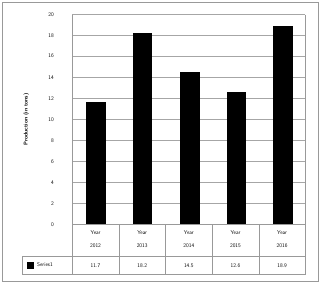
The following chart shows the production of an organization in various years from 2012 to 2016. Study the chart and answer the question.

What was the percentage increase in the production from 2015 to 2016?

  1. ((a))

     50 %

  2. ((b))

    25 %

  3. ((c))

    40 %

  4. ((d))

    21 %

Show Answer
Answer: ((a))

 50 %

Given:

Production in 2015 = 12.6 tonns

Production in 2016 = 18.9 tonns

Formula Used:

Percentage Increase = (\dfrac{\text{Current Production} - \text{Previous Production}}{\text{Previous Production}} \times 100)

Calculations:

Increase in production = Production in 2016 - Production in 2015

⇒ Increase = 18.9 - 12.6 = 6.3

Percentage increase = (\dfrac{6.3}{12.6} \times 100)

⇒ Percentage increase = 50%

The correct answer is Option (1).

49

Three products,, and ______ are produced in chlor-alkali process.

  1. ((a))

    Chlorine, Hydrogen, Na2CO3

  2. ((b))

    Chlorine, Oxygen, Na2CO3

  3. ((c))

    Hydrogen, Chlorine, NaOH

  4. ((d))

    Oxygen, Hydrogen, NaOH

Show Answer
Answer: ((c))

Hydrogen, Chlorine, NaOH

The correct answer is Hydrogen, Chlorine, NaOH.

Key Points

  • The chlor-alkali process is an industrial method used to produce three main products: Hydrogen, Chlorine, and Sodium Hydroxide (NaOH).
  • The process involves the electrolysis of a concentrated aqueous solution of sodium chloride (brine).
  • Hydrogen gas is produced at the cathode, while chlorine gas is produced at the anode during the electrolysis.
  • Sodium hydroxide is formed in the solution as a by-product and is separated for industrial use.
  • The chlor-alkali products are widely used in industries such as chemicals, textiles, paper, and water purification.

Additional Information

  • Electrolysis Process:
  • Electrolysis is a chemical process in which electrical energy is used to drive a non-spontaneous chemical reaction.
  • In the chlor-alkali process, brine (sodium chloride solution) acts as the electrolyte.
  • Applications of Chlorine:
  • Chlorine is used in the production of PVC (Polyvinyl Chloride), disinfectants, and bleaching agents.
  • It is also employed for water purification and sanitation purposes.
  • Applications of Sodium Hydroxide:
  • Sodium hydroxide (caustic soda) is used in the manufacture of paper, textiles, soap, and detergents.
  • It is also utilized in processes like water treatment and refining petroleum products.
  • Environmental Considerations:
  • The chlor-alkali process requires careful handling of chlorine gas due to its toxic and corrosive nature.
  • Modern plants employ membrane cell technology to reduce environmental impact and improve efficiency.
50

Which of the following was a non-violent protest against the British monopoly on salt production in 1930?

  1. ((a))

    Kheda Satyagraha

  2. ((b))

    Civil disobedience

  3. ((c))

    Dandi March

  4. ((d))

    Khilafat Movement

Show Answer
Answer: ((c))

Dandi March

The correct answer is Dandi March.

Key Points

  • The Dandi March, also known as the Salt March, was a non-violent protest led by Mahatma Gandhi from March 12 to April 6, 1930, against the British monopoly on salt production.
  • It was part of the broader Civil Disobedience Movement and aimed at breaking the British Salt Law by producing salt from seawater.
  • The march started from Sabarmati Ashram in Ahmedabad and ended at Dandi, a coastal village in Gujarat, covering approximately 390 kilometers.
  • Thousands of people joined Gandhi on this march, making it a significant event in India's struggle for independence.
  • The Dandi March marked the beginning of widespread acts of defiance against British laws and inspired millions to join the freedom movement.

Additional Information

  • Salt Law:
  • The British Salt Law imposed a monopoly on salt production and prohibited Indians from collecting or selling salt independently.
  • Salt, a basic necessity, was heavily taxed, making it expensive for common people.
  • Civil Disobedience Movement:
  • Launched by Gandhi in 1930, it involved non-violent resistance and refusal to obey unjust laws imposed by the British government.
  • The Dandi March was the first major act of this movement, which later expanded to include boycotts of British goods and institutions.
  • Impact of the Dandi March:
  • It drew global attention to India's independence struggle and showcased the power of non-violent protest.
  • The march unified people across social and economic barriers and strengthened the resolve for self-rule.
  • Key Participants:
  • Besides Gandhi, notable leaders like Sarojini Naidu and thousands of followers participated in the march.
  • Women played a significant role in the movement, symbolizing their increasing involvement in the freedom struggle.
51

Three statements are followed by three conclusions numbered I, II and III. You have to consider these statements to be true, even if they seem to be at variance with commonly known facts, and decide which of the given conclusions logically follow/s from the given statements.

Statements:

All pans are pens.

All pens are brushes.

All brushes are tables.

Conclusions:

(I) Some tables are pans.

(II) All pens are pans.

(III) No pen is a pan

  1. ((a))

    Either conclusion I or conclusion III follows

  2. ((b))

    None of the conclusions follow

  3. ((c))

    Only conclusion I follows

  4. ((d))

    Only conclusion II follows

Show Answer
Answer: ((c))

Only conclusion I follows

Given Statements:

All pans are pens.

All pens are brushes.

All brushes are tables.

Venn Diagram Representation:

Conclusions:

(I) Some tables are pans. → True. (Since all pans are brushes, and all brushes are tables, it logically follows that all pans are tables. If all pans are tables, then certainly some tables must be pans.)

II) All pens are pans.  → False. (The statement says "All pans are pens," which means that the set of pans is a subset of the set of pens. However, it does not imply that all pens are pans. There might be some pens that are not pans.)

III) No pen is a pan. → False. (The statement "All pans are pens" directly contradicts this conclusion. If all pans are pens, then it's impossible for no pen to be a pan (at least the pens that are also pans exist).

Only Conclusion I follows from the given statements.

Hence, the correct answer is "Option 3".

52

P and Q alone can complete a piece of work in 9 days and 12 days, respectively. In how many days will the work be completed if they work on alternate days starting with Q ?

  1. ((a))

    11(\frac{5}{6})

  2. ((b))

    11(\frac{1}{3})

  3. ((c))

    10(\frac{5}{6})

  4. ((d))

    10(\frac{1}{3})

Show Answer
Answer: ((d))

10(\frac{1}{3})

Shortcut Trick

Total Work (LCM of 9, 12) = 36 units.

Efficiency: P = 4 units/day, Q = 3 units/day.

2-day cycle (Q + P) = 3 + 4 = 7 units.

In 10 days (5 cycles): 7 × 5 = 35 units. Remaining = 36 − 35 = 1 unit.

Day 11 is Q's turn: Time taken = 1/3 day.

∴ The correct answer is 10 1/3 days.

Alternate Method

Given: Time taken by P = 9 days, Time taken by Q = 12 days.

PersonDaysTotal WorkEfficiency
P9364
Q123

⇒ Work done in the first 2 days (Q then P) = 3 + 4 = 7 units

⇒ Work done in 5 such cycles (10 days) = 7 × 5 = 35 units

⇒ Remaining work = 36 − 35 = 1 unit

⇒ On the 11th day, it is Q's turn. Q completes 3 units in 1 day.

⇒ Time taken by Q to finish the remaining 1 unit = 1/3 day

⇒ Total time = 10 + 1/3 = 10 1/3 days

∴ The correct answer is 10 1/3 days.

Additional Information

Alternate Day Work

In alternate work, identify the starting person and calculate work done in one full cycle (usually 2 days) to find the total time.

Work and Efficiency

Efficiency is inversely proportional to the time taken. Total Work = Efficiency × Time.

53

The part of an electric motor that reverses the direction of flow of current in it, is:

  1. ((a))

    brush

  2. ((b))

    split ring

  3. ((c))

    soft iron core

  4. ((d))

    coil

Show Answer
Answer: ((b))

split ring

The correct answer is split ring.

Key Points

  • The split ring is an essential component of a direct current (DC) motor, playing a key role in reversing the direction of current flow in the motor's coil.
  • This reversal of current ensures that the motor's armature continues to rotate in a single direction by maintaining the torque acting on it.
  • The split ring is connected to the external circuit via carbon brushes, allowing the motor to function smoothly.
  • When the armature rotates, the split ring alternates the current direction every half-turn, ensuring continuous and uniform rotation of the motor's coil.
  • This design is a critical feature of DC motors and is not typically found in alternating current (AC) motors, which use slip rings instead.

Additional Information

  • Brushes in Electric Motors:
  • Brushes are typically made of carbon and are used to transfer current between the stationary parts of the motor and the rotating armature.
  • They maintain contact with the split ring to ensure a continuous flow of current.
  • Difference Between Split Rings and Slip Rings:
  • Split rings are used in DC motors to reverse current direction, while slip rings are used in AC motors to transfer current without reversing it.
  • Slip rings are continuous rings, whereas split rings are divided into two or more parts.
  • Armature in Electric Motors:
  • The armature is the rotating part of the motor where the current flows, creating a magnetic field that interacts with the external magnetic field.
  • This interaction generates torque, causing the armature to rotate.
  • Working Principle of Electric Motors:
  • Electric motors work on the principle of electromagnetic induction, where a current-carrying conductor placed in a magnetic field experiences a force.
  • This force causes the conductor (armature) to rotate, converting electrical energy into mechanical energy.
54

Select the correct option for the full form of AIDS.

  1. ((a))

    Acquired Immune Deficiency Syndrome

  2. ((b))

    Aggravated Immune Deficient Syndrome

  3. ((c))

    Artificial Immune Deficiency Syndrome

  4. ((d))

    Added Immune Deficient Syndrome

Show Answer
Answer: ((a))

Acquired Immune Deficiency Syndrome

The correct answer is Acquired Immune Deficiency Syndrome.

Key Points

  • AIDS stands for Acquired Immune Deficiency Syndrome, a condition caused by the Human Immunodeficiency Virus (HIV).
  • HIV attacks the body’s immune system, specifically the CD4 cells (T cells), which are crucial for fighting infections.
  • Without treatment, HIV reduces the number of CD4 cells, making the body more vulnerable to infections and certain cancers, eventually leading to AIDS.
  • AIDS is the final stage of HIV infection, where the immune system becomes severely compromised.
  • HIV is transmitted through certain body fluids, including blood, semen, vaginal fluids, rectal fluids, and breast milk.

Additional Information

  • HIV (Human Immunodeficiency Virus):
  • HIV is a retrovirus that integrates its genetic material into the host's DNA, making it difficult to eliminate.
  • There are two types of HIV: HIV-1 and HIV-2, with HIV-1 being the most common worldwide.
  • Antiretroviral therapy (ART) is used to manage HIV and prevent progression to AIDS.
  • Symptoms of AIDS:
  • Frequent infections, such as pneumonia, tuberculosis, or fungal infections.
  • Rapid weight loss, chronic diarrhea, and persistent fever.
  • Neurological disorders, including memory loss and depression.
  • Prevention of HIV:
  • Using condoms during sexual intercourse and avoiding sharing needles or syringes.
  • Screening blood for HIV before transfusions and providing antiretroviral drugs to pregnant women with HIV to prevent mother-to-child transmission.
  • Global Impact:
  • According to UNAIDS, approximately 38.4 million people were living with HIV globally as of 2021.
  • Awareness campaigns and access to ART have significantly reduced AIDS-related deaths in recent years.
55

Which of the following statements is/are true about the principal axis of a spherical mirror?

(i) It is normal to the mirror

(ii) Point of incidence always lies on the principal axis

(iii) Principal focus always lies on the principal axis

  1. ((a))

    Both (i) and (iii)

  2. ((b))

    Both (i) and (ii)

  3. ((c))

    Only (ii)

  4. ((d))

    Only (i)

Show Answer
Answer: ((a))

Both (i) and (iii)

The correct answer is Option 1 (Both (i) and (iii)).

Key Points

  • The principal axis of a spherical mirror is the line passing through its pole and center of curvature, making it normal to the surface of the mirror.
  • The principal focus of a spherical mirror, whether concave or convex, always lies on the principal axis as it is a defining characteristic of the mirror.
  • Statement (i) is correct because the principal axis is perpendicular (normal) to the mirror's surface at the pole.
  • Statement (iii) is correct because the principal focus is a point on the principal axis where parallel rays converge (concave mirror) or appear to diverge from (convex mirror).
  • Statement (ii) is incorrect because the point of incidence of light on the mirror does not necessarily lie on the principal axis; it can be anywhere on the mirror's surface.

Additional Information

  • Spherical Mirror Terminology:
  • Pole: The center of the spherical mirror surface.
  • Principal Axis: The straight line passing through the pole and center of curvature.
  • Center of Curvature: The center of the sphere from which the mirror is derived.
  • Principal Focus: The point on the principal axis where light rays either converge or appear to diverge after reflection.
  • Concave Mirror:
  • Converging mirror that focuses parallel light rays to a single point on the principal axis.
  • Used in applications like telescopes and vehicle headlights.
  • Convex Mirror:
  • Diverging mirror where reflected rays appear to emanate from a virtual focus on the principal axis.
  • Used in rear-view mirrors for vehicles due to its wide field of view.
  • Ray Diagram Facts:
  • Rays parallel to the principal axis reflect through the focus (concave) or appear to diverge from the focus (convex).
  • Rays passing through the center of curvature reflect back along the same path.
56

In Jainism, the word 'Jain' is derived from the Sanskrit word 'Jina', which means,______ implying one who has transcended all human passions.

  1. ((a))

    vigour

  2. ((b))

    conqueror

  3. ((c))

    candour

  4. ((d))

    immortal

Show Answer
Answer: ((b))

conqueror

The correct answer is Conqueror.

Key Points

  • The term 'Jain' is derived from the Sanskrit word 'Jina', meaning conqueror, signifying one who has overcome inner enemies like desire, anger, pride, and greed.
  • In Jainism, a 'Jina' is a spiritual victor who has achieved liberation (moksha) by conquering all worldly attachments and passions.
  • A 'Jina' is also referred to as a Tirthankara, a teacher who establishes the path to liberation for others.
  • Jainism emphasizes non-violence (ahimsa), truth (satya), and self-discipline as key virtues that help individuals become spiritual conquerors.

Additional Information

  • Tirthankaras: Jainism recognizes 24 Tirthankaras, with Lord Mahavira being the 24th and most recent one. Tirthankaras are spiritual leaders who guide others towards liberation.
  • Moksha: Liberation or salvation in Jainism is achieved by freeing oneself from the cycle of birth and rebirth (samsara) through the conquest of all passions and desires.
  • Ahimsa (Non-violence): A core principle of Jainism, emphasizing absolute non-violence in thought, word, and action towards all living beings.
  • Core Teachings of Jainism: The three main pillars are Right Faith (Samyak Darshana), Right Knowledge (Samyak Jnana), and Right Conduct (Samyak Charitra).
  • Jain Literature: Jain texts such as the Agamas and Tattvartha Sutra provide detailed teachings on how to live a virtuous life and attain liberation.
57

The filament of a bulb is made extremely thin and long in order to achieve:

  1. ((a))

    high current

  2. ((b))

    high resistance

  3. ((c))

    high resistivity

  4. ((d))

    high voltage

Show Answer
Answer: ((b))

high resistance

The correct answer is high resistance.

Key Points

  • The filament of a bulb is made extremely thin and long to increase its resistance, as higher resistance helps to convert electrical energy into heat and light efficiently.
  • A thin and long filament ensures that it generates high temperatures when current flows through it, allowing the bulb to emit visible light.
  • The material used for the filament, typically tungsten, has a high melting point and excellent resistance properties, making it ideal for withstanding high temperatures.
  • High resistance prevents the filament from conducting excess current, which could lead to overheating or damage.
  • The design ensures durability and consistent light output under normal operating conditions.

Additional Information

  • Resistance:
  • It is the property of a material that opposes the flow of electric current.
  • Resistance (R) is measured in ohms (Ω) and follows Ohm’s Law: V = IR.
  • High resistance in the filament helps convert electrical energy into heat and light.
  • Tungsten Filament:
  • Tungsten is commonly used due to its high melting point (approximately 3422°C).
  • It can withstand high temperatures without melting or deforming, making it suitable for light bulbs.
  • Working Principle of Bulbs:
  • Electric current passes through the filament, producing heat due to resistance.
  • The filament reaches temperatures high enough to emit visible light, a process known as incandescence.
  • Energy Conversion:
  • In incandescent bulbs, electrical energy is primarily converted into heat and a smaller portion into visible light.
  • This is why such bulbs are less energy-efficient compared to LEDs or CFLs.
  • Factors Affecting Filament Design:
  • Length and thickness impact resistance and heat generation.
  • The material’s resistivity influences the efficiency and durability of the bulb.
58

Refer to the following letter series and answer the question

Y H S D S Y I R A Y E U G I R O A B U B R X M P Q

How many such vowels are there in the series each of which is immediately preceded by a consonant and also immediately followed by a consonant?

  1. ((a))

    4

  2. ((b))

    2

  3. ((c))

    3

  4. ((d))

    5

Show Answer
Answer: ((a))

4

Given series:

Y H S D S Y I R A Y E U G I R O A B U B R X M P Q

Condition to be checked:

A vowel immediately preceded by a consonant and immediately followed by a consonant.

This pattern can be represented as: Consonant → Vowel → Consonant

Let's identify vowels (A, E, I, O, U) and consonants from the English alphabet.

Scanning the series for the pattern "Consonant Vowel Consonant":

Y H S D S Y I R A Y E U G I R O A B U B R X M P Q

There are 4 such vowels that are immediately preceded by a consonant and immediately followed by a consonant.

Hence, the correct answer is "Option 1".

59

Who became the first Indian woman to win a silver medal in the World Wrestling Championships in 2021?

  1. ((a))

    Sarita Mor

  2. ((b))

    Babita Phogat

  3. ((c))

    Anshu Malik

  4. ((d))

    Mona

Show Answer
Answer: ((c))

Anshu Malik

The correct answer is Anshu Malik.

Key Points

  • Anshu Malik became the first Indian woman wrestler to win a silver medal at the World Wrestling Championships in 2021.
  • She competed in the 57 kg weight category and advanced to the finals by defeating top opponents from across the globe.
  • In the final, Anshu faced Olympic champion Helen Maroulis of the USA and secured the historic silver medal despite a tough match.
  • Her achievement marked a significant milestone in Indian wrestling history, breaking barriers for women in the sport at an international level.
  • Before this, Indian women wrestlers had only won bronze medals at the World Wrestling Championships, making her silver medal a groundbreaking success.

Additional Information

  • World Wrestling Championships:
  • An annual wrestling competition organized by United World Wrestling (UWW).
  • It features freestyle, Greco-Roman, and women's wrestling categories.
  • It is considered one of the most prestigious events in the sport of wrestling globally.
  • Helen Maroulis:
  • An American freestyle wrestler and Olympic champion.
  • She became the first American woman to win a gold medal in wrestling at the 2016 Rio Olympics.
  • Indian Women in Wrestling:
  • Notable achievements include medals by Geeta Phogat, Babita Phogat, and Vinesh Phogat in international competitions.
  • The rise of women wrestlers in India is attributed to grassroots initiatives and government support.
  • Anshu Malik's Background:
  • Born in Nidani, Haryana, a state known for producing top wrestlers.
  • Trained under national coaches and received support from the Wrestling Federation of India (WFI).
60

In economics, the slope of the demand curve is typically______.

  1. ((a))

    Curved moving from left to right

  2. ((b))

    Straight parallel to X axis from left to right

  3. ((c))

    downward from left to right

  4. ((d))

    upward from left to right

Show Answer
Answer: ((c))

downward from left to right

The correct answer is downward from left to right.

Key Points

  • In economics, a demand curve typically slopes downward from left to right, illustrating the inverse relationship between price and quantity demanded.
  • As the price of a good or service decreases, the quantity demanded generally increases, and vice versa, adhering to the law of demand.
  • The downward slope reflects consumer behavior, where individuals are more likely to purchase more of a product when it becomes cheaper.
  • Factors influencing the slope include income effect (buyers feel richer with lower prices) and substitution effect (buyers switch to cheaper alternatives).
  • This curve is a fundamental concept in microeconomics, used to analyze market dynamics and consumer preferences.

Additional Information

  • Law of Demand:
  • States that, ceteris paribus (all other factors constant), as the price of a good decreases, its quantity demanded increases.
  • Conversely, as the price of a good rises, its quantity demanded decreases.
  • Income Effect:
  • When the price of a good drops, consumers feel as if they have more purchasing power, leading to increased demand.
  • Substitution Effect:
  • When the price of a good decreases, consumers may substitute it for more expensive alternatives, increasing its demand.
  • Exceptions to the Law of Demand:
  • Includes Giffen goods (inferior goods with upward-sloping demand curves) and Veblen goods (luxury goods where higher prices increase desirability).
  • Market Demand Curve:
  • Derived by summing up individual demand curves of all consumers in a market.
  • It represents the total quantity demanded for a product at varying price levels.
61

The difference in molecular mass between two consecutive homologous series members will be:

  1. ((a))

    12

  2. ((b))

    08

  3. ((c))

    16

  4. ((d))

    14

Show Answer
Answer: ((d))

14

The correct answer is 14.

Key Points

  • The difference in molecular mass between two consecutive members of a homologous series is 14 atomic mass units (amu).
  • This difference arises due to the addition of a single -CH2 group to the molecular formula of the preceding compound in the series.
  • For example, in the alkane homologous series: Methane (CH4) has a molecular mass of 16 amu, and Ethane (C2H6) has a molecular mass of 30 amu. The difference is 14 amu.
  • The -CH2 group contributes 12 amu from carbon and 2 amu from two hydrogen atoms, totaling 14 amu.
  • This property is consistent across various homologous series such as alkanes, alkenes, and alkynes.

Additional Information

  • Homologous Series:
  • A homologous series is a group of organic compounds with the same functional group but differing by a -CH2 unit in their molecular structures.
  • All members of a homologous series exhibit similar chemical properties and a gradual change in physical properties (e.g., boiling point).
  • Molecular Mass Calculation:
  • The molecular mass of a compound is calculated by summing the atomic masses of all the atoms in its molecular formula.
  • For example, the molecular mass of CH4 is: (1 × 12) + (4 × 1) = 16 amu.
  • Examples of Homologous Series:
  • Alkanes: CH4, C2H6, C3H8, etc.
  • Alkenes: C2H4, C3H6, C4H8, etc.
  • Alkynes: C2H2, C3H4, C4H6, etc.
  • Functional Groups:
  • A functional group is a specific group of atoms within a molecule that is responsible for the characteristic chemical reactions of that molecule.
  • Examples include -OH (alcohols), -COOH (carboxylic acids), -CHO (aldehydes), etc.
62

Which of the following types of images can be obtained on a screen?

(a) Real and enlarged

(b) Real and diminished

(c) Virtual and enlarged

(d) Virtual and diminished

  1. ((a))

    Both (a) and (d)

  2. ((b))

    Both (b) and (c)

  3. ((c))

    Both (a) and (b)

  4. ((d))

    Both (c) and (d)

Show Answer
Answer: ((c))

Both (a) and (b)

The correct answer is Both (a) and (b).

Key Points

  • Images that can be obtained on a screen are always real images. Virtual images cannot be projected on a screen.
  • A real image is formed when rays of light actually converge at a point after reflection or refraction.
  • Real images can be either enlarged or diminished depending on the position of the object relative to the lens or mirror.
  • Enlarged real images are produced when the object is placed between the focal point and twice the focal length (F and 2F) of a convex lens or concave mirror.
  • Diminished real images are formed when the object is positioned beyond twice the focal length (2F) of a convex lens or concave mirror.

Additional Information

  • Real Image:
  • Formed when light rays converge at a point.
  • It can be captured on a screen and is always inverted.
  • Examples include images formed by projectors and cameras.
  • Virtual Image:
  • Formed when light rays appear to diverge from a point.
  • It cannot be captured on a screen and is always upright.
  • Examples include images seen in plane mirrors and magnifying glasses.
  • Convex Lens:
  • Converging lens that can form both real and virtual images.
  • Real images are formed when the object is placed beyond the focal length.
  • Virtual images are formed when the object is within the focal length.
  • Concave Mirror:
  • Converging mirror that can form both real and virtual images.
  • Real images are formed when the object is beyond the focal point.
  • Virtual images are formed when the object is between the mirror and the focal point.
63

Tropical Evergreen Forests are found in which of the following states of India?

  1. ((a))

    Gujarat

  2. ((b))

    Kerala

  3. ((c))

    Rajasthan

  4. ((d))

    Uttar Pradesh

Show Answer
Answer: ((b))

Kerala

The correct answer is Kerala.

Key Points

  • Tropical Evergreen Forests are characterized by dense vegetation, high biodiversity, and remain green throughout the year due to high rainfall and humidity.
  • These forests are predominantly found in the Western Ghats, including the state of Kerala, which receives heavy rainfall throughout the year.
  • The tropical evergreen forests in Kerala are known for their rich flora, including species like rosewood, mahogany, and ebony, as well as diverse fauna such as tigers, elephants, and various bird species.
  • Kerala's tropical evergreen forests are part of the Western Ghats UNESCO World Heritage Site, a global biodiversity hotspot.
  • These forests play a crucial role in regulating the climate, maintaining soil fertility, and serving as a habitat for numerous endemic species.

Additional Information

  • Tropical Evergreen Forests are typically found in regions with more than 200 cm of annual rainfall and a temperature range of 25-30°C, such as the Western Ghats, Andaman and Nicobar Islands, and parts of northeastern India.
  • These forests have a multi-layered structure, with tall trees forming a continuous canopy and smaller trees, shrubs, and ground vegetation growing underneath.
  • Important ecosystems within tropical evergreen forests include rainforests, which are critical for global oxygen production and carbon dioxide absorption.
  • Kerala's forests are also home to numerous medicinal plants and are a source of important forest products like timber, spices, and honey.
  • Conservation efforts in tropical evergreen forests focus on mitigating deforestation, protecting endangered species, and promoting sustainable use of forest resources.
64

What part of the respiratory system prevents the air-passage from collapsing?

  1. ((a))

    Trachea

  2. ((b))

    Rings of cartilage

  3. ((c))

    Spine

  4. ((d))

    Ribs

Show Answer
Answer: ((b))

Rings of cartilage

The correct answer is Rings of cartilage.

Key Points

  • The rings of cartilage are present in the trachea and are responsible for maintaining its shape and preventing it from collapsing.
  • These rings are made of hyaline cartilage, which is durable and flexible, ensuring the stability of the air passage.
  • The tracheal cartilage rings are C-shaped, with the open part of the ring facing the esophagus to allow flexibility during swallowing.
  • The cartilage rings provide structural support to the trachea, ensuring uninterrupted airflow to the lungs.
  • In humans, there are approximately 16-20 cartilaginous rings in the trachea, spaced evenly along its length.

Additional Information

  • Trachea:
  • The trachea, also known as the windpipe, is a tubular structure that connects the larynx to the bronchi of the lungs.
  • It is lined with a mucous membrane containing cilia that trap and move foreign particles out of the respiratory system.
  • The trachea plays a critical role in transporting air to and from the lungs during respiration.
  • Hyaline Cartilage:
  • Hyaline cartilage is the most common type of cartilage in the human body and is known for its strength and elasticity.
  • It consists of chondrocytes embedded in a matrix of collagen and proteoglycans.
  • In addition to the trachea, hyaline cartilage is found in joints, the nose, and the ends of long bones.
  • Respiratory System Anatomy:
  • The respiratory system includes the nose, pharynx, larynx, trachea, bronchi, and lungs.
  • Its primary function is to facilitate gas exchange—oxygen intake and carbon dioxide removal.
  • The trachea serves as the main airway connecting the upper respiratory tract to the lungs.
  • Diseases Related to the Trachea:
  • Tracheal stenosis is a condition where the trachea narrows, often due to trauma or prolonged intubation.
  • Tracheomalacia refers to the weakening of the tracheal walls, leading to collapse during breathing.
  • Proper functioning of the cartilage rings is crucial to preventing these conditions.
65

On 7 March 2022, the Ministry of Women and Child Development (MoWCD), in partnership with the Ministry of Education and UNICEF, launched the ______ campaign to bring back out of school adolescent girls in India to the formal education.

  1. ((a))

    Balika Padhao Yojana

  2. ((b))

    Kanya Shikhsa Pravesh Utsav

  3. ((c))

    Sukanya Samriddhi Yojana

  4. ((d))

    Kishori Shakti Yojana

Show Answer
Answer: ((b))

Kanya Shikhsa Pravesh Utsav

The correct answer is Kanya Shikhsa Pravesh Utsav.

Key Points

  • Kanya Shikhsa Pravesh Utsav is a nationwide campaign launched to bring back out-of-school adolescent girls in India to the formal education system.
  • The campaign was launched on 7 March 2022 by the Ministry of Women and Child Development (MoWCD) in partnership with the Ministry of Education and UNICEF.
  • The initiative primarily focuses on ensuring access to education for girls aged 11 to 14 years, who have dropped out of schools.
  • It aligns with the government’s vision of universal education under the National Education Policy (NEP) 2020.
  • The campaign also seeks to address barriers to girls' education, such as social norms, economic challenges, and lack of access to schools.

Additional Information

  • National Education Policy (NEP) 2020:
  • Aims to ensure equitable access to education for all, with special focus on marginalized groups.
  • Targets universalization of school education from preschool to secondary level by 2030.
  • Emphasizes inclusive and quality education to address gender disparity in education.
  • UNICEF's Role:
  • UNICEF has been collaborating with the Indian government to promote education and child welfare.
  • It provides technical support and expertise for initiatives like Kanya Shikhsa Pravesh Utsav.
  • Barriers to Girls' Education:
  • Factors include poverty, early marriage, gender bias, and inadequate infrastructure like lack of separate toilets for girls.
  • Programs like this aim to reduce dropout rates and improve enrollment figures for adolescent girls.
  • Schemes Complementing the Campaign:
  • Beti Bachao Beti Padhao: Focuses on the survival, protection, and education of the girl child.
  • Samagra Shiksha Abhiyan: An integrated scheme for school education covering pre-school to senior secondary levels.
66

If 3 is added to each odd digit and 1 is subtracted from each even digit in the number 42514563, what will be difference between the highest and lowest digits thus formed?

  1. ((a))

    8

  2. ((b))

    5

  3. ((c))

    2

  4. ((d))

    7

Show Answer
Answer: ((d))

7

Given Number: 42514563

Operations:

  • Add 3 to each odd digit.
  • Subtract 1 from each even digit.

Applying the operations:

Original Digit42514563
TypeEvenEvenOddOddEvenOddEvenOdd
Operation4 - 12 - 15 + 31 + 34 - 15 + 36 - 13 + 3
New Digit31843856

New Number Formed: 31843856

Highest and Lowest Digits in the new number:

  • Highest digit = 8
  • Lowest digit = 1

Difference:

Difference = Highest digit - Lowest digit

= 8 - 1 = 7

The difference between the highest and lowest digits thus formed is 7.

Hence, the correct answer is "Option 4".

67

In ΔABC if ∠A = 40° and ∠B = 70°, find the measure of exterior angle A.

  1. ((a))

    140°

  2. ((b))

    110°

  3. ((c))

    70°

  4. ((d))

    30°

Show Answer
Answer: ((a))

140°

Shortcut Trick

The exterior angle at any vertex of a triangle and its corresponding interior angle are supplementary (they lie on a straight line and sum up to 180°).

Exterior Angle A = 180° − Interior Angle A

Exterior Angle A = 180° − 40° = 140°

∴ The correct answer is 140°.

Alternate Method

Given:

In ΔABC:

Interior angle ∠A = 40°

Interior angle ∠B = 70°

Formula Used:

  1. Angle Sum Property: The sum of all interior angles of a triangle is 180°:

∠A + ∠B + ∠C = 180°

  1. Exterior Angle Theorem: The exterior angle of a triangle is equal to the sum of the two opposite interior angles:

Exterior ∠A = ∠B + ∠C

Calculations:

First, let us find the interior angle ∠C of ΔABC:

∠A + ∠B + ∠C = 180°

⇒ 40° + 70° + ∠C = 180°

⇒ 110° + ∠C = 180°

⇒ ∠C = 180° − 110°

⇒ ∠C = 70°

Now, using the Exterior Angle Theorem, the exterior angle at vertex A is equal to the sum of the opposite interior angles ∠B and ∠C:

⇒ Exterior ∠A = ∠B + ∠C

⇒ Exterior ∠A = 70° + 70°

⇒ Exterior ∠A = 140°

Alternatively, since the interior angle and exterior angle at any vertex lie on a straight line, they are supplementary:

⇒ Exterior ∠A + Interior ∠A = 180°

⇒ Exterior ∠A + 40° = 180°

⇒ Exterior ∠A = 180° − 40°

⇒ Exterior ∠A = 140°

Explanation of Options:

  1. Option (1) 140° is correct as calculated above.
  2. Option (2) 110° is incorrect because it represents the sum of ∠A and ∠B (40° + 70°), which is not the exterior angle at A.
  3. Option (3) 70° is incorrect because it is the measure of interior angle ∠C, not the exterior angle at A.
  4. Option (4) 30° is incorrect because it is the difference between ∠B and ∠A (70° − 40°), which has no geometric relevance to the exterior angle at A.

∴ The correct answer is 140°.

Additional Information

Exterior Angle Theorem

The measure of an exterior angle of a triangle is equal to the sum of the measures of its two remote interior angles.

Linear Pair Postulate

An interior angle and its adjacent exterior angle form a linear pair, meaning their sum is always 180°.

Sum of Exterior Angles

The sum of the exterior angles of any convex polygon (including triangles) is always 360°.

68

What will come in place of the question mark (?) in the following equation, if '+' is interchanged with '÷', and '-' is interchanged with '× '?

100 × 121 + 11 - 7 ÷ 24 - 8 × 33 × 99 ÷ 17 = ?

  1. ((a))

    100

  2. ((b))

    80

  3. ((c))

    101

  4. ((d))

    90

Show Answer
Answer: ((a))

100

BODMAS Table: 

Given equation: 100 × 121 + 11 - 7 ÷ 24 - 8 × 33 × 99 ÷ 17 = ?

After interchanging '+' with '÷', and '-' with '×':

⇒ 100 - 121 ÷ 11 × 7 + 24 × 8 - 33 - 99 + 17 = ?

⇒ 100 - 121 ÷ 11 × 7 + 24 × 8 - 33 - 99 + 17 = ?

⇒ 100 - 11 × 7 + 24 × 8 - 33 - 99 + 17 = ?

⇒ 100 - 77 + 192 - 33 - 99 + 17 = ?

23 + 192 - 33 - 99 + 17 = 100 

Hence, the correct answer is "Option 1".

69

Which of the following numbers will replace the question mark (?) in the given series?

9, 10, 18, 45, 109, ?

  1. ((a))

    327

  2. ((b))

    198

  3. ((c))

    234

  4. ((d))

    218

Show Answer
Answer: ((c))

234

The logic followed here is,

Hence, the correct answer is "Option 3".

70

If a ray of light is incident passing through the centre of curvature of a concave mirror, then the angle between the incident ray and the reflected ray will be equal to:

  1. ((a))

    150

  2. ((b))

    0

  3. ((c))

    180

  4. ((d))

    90

Show Answer
Answer: ((b))

0

The correct answer is 0∘.

Key Points

  • When a ray of light passes through the centre of curvature of a concave mirror, it travels along the radius of the spherical surface.
  • The radius is perpendicular to the surface at the point of incidence, meaning the angle of incidence is .
  • Since the angle of incidence is 0°, the reflected ray retraces the path of the incident ray, resulting in an angle between the incident and reflected rays of .
  • This phenomenon occurs because the centre of curvature lies on the principal axis, and light striking it does not deviate from its path.
  • Such behavior is a direct result of the laws of reflection, where the angle of incidence equals the angle of reflection.

Additional Information

  • Centre of Curvature: The centre of curvature is the centre of the sphere from which the concave mirror is derived. It is denoted by the letter C.
  • Principal Axis: The principal axis is an imaginary line passing through the pole and the centre of curvature of the mirror.
  • Law of Reflection: States that the angle of incidence is always equal to the angle of reflection, measured with respect to the normal to the surface at the point of incidence.
  • Concave Mirror: A concave mirror is a spherical mirror that reflects light inward and can form both real and virtual images depending on the position of the object.
  • Normal to the Surface: A line perpendicular to the reflecting surface at the point of incidence, important for understanding the behavior of rays in optics.
71

The Periyar River flows in which of the following Indian states?

  1. ((a))

    Punjab

  2. ((b))

    Odisha

  3. ((c))

    Kerala

  4. ((d))

    Tripura

Show Answer
Answer: ((c))

Kerala

The correct answer is Kerala.

Key Points

  • The Periyar River is the longest river in the state of Kerala, India, spanning approximately 244 kilometers.
  • The river is often referred to as the "Lifeline of Kerala" due to its critical role in supplying water for drinking, agriculture, and hydroelectric power generation.
  • The Periyar originates from the Western Ghats, specifically at Sivagiri Hills near the Kerala-Tamil Nadu border, and flows into the Arabian Sea.
  • It is home to major reservoirs and dams such as the Idukki Dam, which is one of the largest arch dams in Asia.
  • The Periyar River is also ecologically significant, supporting diverse flora and fauna, including species found in the Periyar Wildlife Sanctuary.

Additional Information

  • Western Ghats:
  • The Western Ghats are a mountain range that runs parallel to the western coast of India, spanning six states including Kerala.
  • They are recognized as a UNESCO World Heritage Site for their rich biodiversity.
  • The Periyar River originates from these Ghats, which act as a crucial water source for southern India.
  • Idukki Dam:
  • The Idukki Dam is built on the Periyar River and is a key hydropower project in Kerala.
  • It was commissioned in 1976 and provides electricity to a significant portion of the state.
  • The dam’s reservoir is also a popular tourist attraction and supports local ecosystems.
  • Periyar Wildlife Sanctuary:
  • Located near the Periyar River, this sanctuary is one of the most popular protected areas in southern India.
  • It is known for its population of elephants and tigers, as well as its rich variety of bird species.
  • The sanctuary also supports sustainable tourism through activities like bamboo rafting and nature walks.
  • Kerala’s Rivers:
  • Kerala has 44 rivers, with the Periyar being the largest and most significant.
  • Rivers in Kerala are vital for agriculture, fishing, and hydroelectric power generation.
  • Most rivers in Kerala originate from the Western Ghats and flow westward into the Arabian Sea.
72

In how many languages was The Bal Sahitya Puraskar awarded in 2021?

  1. ((a))

    22

  2. ((b))

    24

  3. ((c))

    21

  4. ((d))

    23

Show Answer
Answer: ((a))

22

The correct answer is 22.

Key Points

  • The Bal Sahitya Puraskar is awarded annually by the Sahitya Akademi, India's National Academy of Letters.
  • In 2021, the Bal Sahitya Puraskar was conferred in 22 Indian languages, covering a wide spectrum of regional and national linguistic diversity.
  • The awards recognize and honor outstanding contributions in children's literature, including poetry, fiction, drama, and folk literature.
  • The Sahitya Akademi promotes Indian literature across all languages included in the Eighth Schedule of the Indian Constitution.
  • Recipients are selected based on the literary merit and impact of their works on the cultural and intellectual growth of children.

Additional Information

  • Sahitya Akademi
  • The Sahitya Akademi was established in 1954 and is dedicated to promoting Indian literature across diverse languages.
  • It confers awards such as the Sahitya Akademi Award, Bal Sahitya Puraskar, and Yuva Puraskar annually.
  • The Akademi also organizes literary events, seminars, and translations to foster cultural exchange among Indian languages.
  • Bal Sahitya Puraskar
  • Introduced by the Sahitya Akademi in 2010 to celebrate excellence in children's literature.
  • Aimed at encouraging authors to create enriching literary works for young readers.
  • Eighth Schedule of the Indian Constitution
  • It lists 22 officially recognized languages of India, including Hindi, Bengali, Tamil, Kannada, and others.
  • The Sahitya Akademi awards are conferred in all languages listed under the Eighth Schedule.
  • Children's Literature in India
  • Children's literature has a long tradition in India, with roots in folklore, epics, and moral tales.
  • Modern writers have expanded this genre to include contemporary issues, adventure stories, and diverse themes.
73

Select the set in which the numbers are related in the same way as are the numbers of the following sets.

(NOTE : Operations should be performed on the whole numbers, without breaking down the numbers into its constituent digits. E.g. 13 - Operations on 13 such as adding/deleting/multiplying etc. to 13 can be performed. Breaking down 13 into 1 and 3 and then performing mathematical operations on 1 and 3 is not allowed)

(15, 41, 4)

(19, 71, 5)

  1. ((a))

    (10, 8, 2)

  2. ((b))

    (13, 55, 3)

  3. ((c))

    (41, 125, 4)

  4. ((d))

    (44, 91, 3)

Show Answer
Answer: ((a))

(10, 8, 2)

The logic followed here is:

Logic: (First number × Third number) - (First number + Third number) = Second number.

Now, let's check the given sets:

For (15, 41, 4):

⇒ (15 × 4) - (15 + 4)

= 60 - 19

= 41. (Matches the second number)

For (19, 71, 5):

⇒ (19 × 5) - (19 + 5)

= 95 - 24

= 71. (Matches the second number)

Similarly, let's check the options:

Option 1: (10, 8, 2)

⇒ (10 × 2) - (10 + 2)

= 20 - 12

= 8. (Matches the second number)

Option 2: (13, 55, 3)

⇒ (13 × 3) - (13 + 3)

= 39 - 16

= 23. (Does not match 55)

Option 3: (41, 125, 4)

⇒ (41 × 4) - (41 + 4)

= 164 - 45

= 119. (Does not match 125)

Option 4: (44, 91, 3)

⇒ (44 × 3) - (44 + 3)

= 132 - 47

= 85. (Does not match 91)

Hence, the correct answer is "Option 1".

74

How many such pairs of letters are there in the word DAUGHTER (in both forward and backward directions) which have as many letters between them in the word as there are in the English alphabetical order?

  1. ((a))

    2

  2. ((b))

    4

  3. ((c))

    5

  4. ((d))

    3

Show Answer
Answer: ((b))

4

The logic followed here is,

So, there are four such pairs of letters are there in the word DAUGHTER (in both forward and backward directions) which have as many letters between them in the word as there are in the English alphabetical order.

Hence, the correct answer is "Option 2".

75

John bought a laptop at 25% discount on the marked price. If he paid Rs. 28,473 for the laptop, what was its marked price?

  1. ((a))

    Rs. 37,964

  2. ((b))

    Rs. 37,694

  3. ((c))

    Rs. 37,946

  4. ((d))

    Rs. 37,496

Show Answer
Answer: ((a))

Rs. 37,964

Shortcut Trick

The fractional value of 25% discount = 1/4

Let Marked Price (MP) = 4 units, then Discount = 1 unit.

Selling Price (SP) = 4 − 1 = 3 units.

Since 3 units = Rs. 28,473 → 1 unit = Rs. 28,473 ÷ 3 = Rs. 9,491.

MP = 4 units = 4 × Rs. 9,491 = Rs. 37,964.

∴ The correct answer is Rs. 37,964.

Alternate Method

Given:

Discount = 25%

Selling Price (SP) = Rs. 28,473

Formula Used:

SP = MP × (100 − Discount%) ÷ 100

SP = Rs. 28,473 (75%)

Discount (25%)

Marked Price (100%) = ?

Calculation:

⇒ 28,473 = MP × (100 − 25) ÷ 100

⇒ 28,473 = MP × 75 ÷ 100

⇒ 28,473 = MP × 3 ÷ 4

⇒ MP = (28,473 × 4) ÷ 3

⇒ MP = 9,491 × 4

⇒ MP = 37,964

∴ The correct answer is Rs. 37,964.

Additional Information

Successive Discount

For two successive discounts of x% and y%, the equivalent single discount is [x + y − (x × y ÷ 100)]%.

Relationship between MP and CP

The direct ratio between Marked Price and Cost Price is given by: MP ÷ CP = (100 + Profit%) ÷ (100 − Discount%).

Mark-up Percentage

It is the percentage by which the cost price is increased to set the marked price. Mark-up % = (MP − CP) ÷ CP × 100.

76

In which of the following reactions of respiration is oxygen required?

  1. ((a))

    Conversion of pyruvate to ethanol

  2. ((b))

    Conversion of glucose to pyruvate

  3. ((c))

    Conversion of pyruvate to CO2, H20 and energy

  4. ((d))

    Conversion of pyruvate to CO2

Show Answer
Answer: ((c))

Conversion of pyruvate to CO2, H20 and energy

The correct answer is Conversion of pyruvate to CO2, H2O and energy.

Key Points

  • Oxygen is required in the aerobic respiration process, specifically during the conversion of pyruvate into carbon dioxide (CO2) and water (H2O) through the Krebs cycle and electron transport chain.
  • This process occurs in the mitochondria of eukaryotic cells and is crucial for producing ATP, the main energy currency of the cell.
  • Pyruvate, derived from glycolysis, enters the mitochondria and is oxidized completely to CO2 and H2O in the presence of oxygen.
  • The electron transport chain (ETC), a part of aerobic respiration, requires oxygen as the final electron acceptor to form water.
  • This reaction yields a high amount of energy (~36-38 ATP molecules per glucose molecule), making oxygen indispensable for efficient energy production.

Additional Information

  • Glycolysis:
  • This is the first stage of cellular respiration, where glucose is broken down into two molecules of pyruvate.
  • It occurs in the cytoplasm and does not require oxygen (anaerobic process).
  • Produces a net gain of 2 ATP and 2 NADH molecules per glucose molecule.
  • Krebs Cycle:
  • Also known as the citric acid cycle, it takes place in the mitochondrial matrix.
  • Pyruvate is oxidized completely to CO2, and high-energy electron carriers (NADH and FADH2) are generated.
  • This cycle requires oxygen indirectly as it feeds into the electron transport chain.
  • Electron Transport Chain (ETC):
  • Located in the inner mitochondrial membrane, it uses NADH and FADH2 to generate ATP.
  • Oxygen acts as the final electron acceptor, forming H2O.
  • This is the most energy-efficient stage, producing ~34 ATP molecules per glucose molecule.
  • Anaerobic Respiration:
  • Occurs in the absence of oxygen and includes processes like fermentation.
  • Yields less energy (~2 ATP per glucose molecule) compared to aerobic respiration.
  • Examples include the conversion of pyruvate to ethanol or lactic acid.
  • Importance of Oxygen:
  • Oxygen is vital for sustaining aerobic life forms as it enables efficient energy production.
  • The absence of oxygen leads to anaerobic processes, which are less energy-efficient.
77

The greatest possible length which can be used to measure exactly the lengths 5 m 25 cm, 7 m 35 cm and 4 m 90 cm is:

  1. ((a))

    25 cm

  2. ((b))

    55 cm

  3. ((c))

    45 cm

  4. ((d))

    35 cm

Show Answer
Answer: ((d))

35 cm

Shortcut Trick

To find the greatest possible length, we need the HCF of the given values.

Convert all lengths to cm: 525 cm, 735 cm, and 490 cm.

HCF of (525, 735, 490) → Difference between 525 and 490 is 35.

Since 35 divides 525, 735, and 490 exactly, 35 cm is the greatest length.

∴ The correct answer is 35 cm.

Alternate Method

Given:

Length 1 = 5 m 25 cm | Length 2 = 7 m 35 cm | Length 3 = 4 m 90 cm

Formula Used:

Greatest possible length = HCF (Length 1, Length 2, Length 3)

Calculations:

⇒ Convert m to cm (1 m = 100 cm):

⇒ L1 = (5 × 100) + 25 = 525 cm

⇒ L2 = (7 × 100) + 35 = 735 cm

⇒ L3 = (4 × 100) + 90 = 490 cm

⇒ Prime Factorization:

⇒ 525 = 3 × 52 × 7

⇒ 735 = 3 × 5 × 72

⇒ 490 = 2 × 5 × 72

⇒ HCF = 51 × 71 = 35

∴ The correct answer is 35 cm.

Additional Information

HCF (Highest Common Factor)

The largest number that divides two or more numbers without leaving a remainder. Also known as GCD (Greatest Common Divisor).

Unit Conversion

Always convert all quantities to the same unit before calculating HCF or LCM. 1 meter = 100 centimeters.

HCF Difference Rule

The HCF of a set of numbers is always a factor of the difference between any two numbers in that set.

78

In this question, a group of numbers/symbols is coded using letters as per the table given below and the conditions which follow. The correct combination of codes following the conditions is your answer

Number/Symbol75E%&48
CodesSDMUTLA
<br>

Conditions:

(i) If the second element is an odd number and the last element is an even number, the codes for these two (the second and the last elements) are to be interchanged.

(ii) If the third element is an even number and the fifth element is a symbol, the codes for these two (the third and the fifth elements) are to be interchanged.

(iii) If the fifth element is a symbol and the sixth element is also a symbol, both these elements (the fifth and the sixth elements) are to be coded as R.

Question: E 7 5 % & 4 % 8

  1. ((a))

    M S D U T L U A

  2. ((b))

    M A D U R R U S

  3. ((c))

    M A D U T L U S

  4. ((d))

    M A T U D L U S

Show Answer
Answer: ((c))

M A D U T L U S

Given Sequence: E 7 5 % & 4 % 8

Coding Table:

Number/Symbol75E%&48
CodesSDMUTLA

Initial Codes for E 7 5 % & 4 % 8:

E75%&4%8
MSDUTLUA

Applying Conditions:

(i) If the second element is an odd number and the last element is an even number, the codes for these two (the second and the last elements) are to be interchanged.

  • Second element: 7 (Odd number) - Yes
  • Last element: 8 (Even number) - Yes
  • Condition (i) is met. The code for the second element (S) and the last element (A) will be interchanged.

Current Code: M A D U T L U S

(ii) If the third element is an even number and the fifth element is a symbol, the codes for these two (the third and the fifth elements) are to be interchanged.

  • Third element: 5 (Odd number) - No, it's not an even number.
  • Condition (ii) is NOT met.

(iii) If the fifth element is a symbol and the sixth element is also a symbol, both these elements (the fifth and the sixth elements) are to be coded as R.

  • Fifth element: & (Symbol) - Yes
  • Sixth element: 4 (Number) - No, it's not a symbol.
  • Condition (iii) is NOT met.

Final Code after applying all conditions:

M A D U T L U S

Hence, the correct answer is "Option 3".

79

Find the simple interest on Rs. 2,000 at 8.25% per annum for the period from 7 February 2022 to 20 April 2022.

  1. ((a))

    Rs. 37

  2. ((b))

    Rs. 35

  3. ((c))

    Rs. 31

  4. ((d))

    Rs. 33

Show Answer
Answer: ((d))

Rs. 33

Shortcut Trick

Calculate total days first: February (22 days) + March (31 days) + April (20 days) = 73 days.

Convert Time to years: 73 ÷ 365 = 1/5 year.

Simple Interest (SI) = 2000 × 8.25% × (1/5)

⇒ SI = 20 × 8.25 ÷ 5 = 4 × 8.25 = 33.

∴ The correct answer is ₹33.

Alternate Method

Given:

Principal (P) = ₹2,000

Rate (R) = 8.25% per annum

Time Period: From 7 February 2022 to 20 April 2022

Formula Used:

Simple Interest (SI) = (P × R × T) ÷ 100

Calculations:

⇒ Number of days in February (including Feb 7) = 28 − 7 + 1 = 22 days

⇒ Number of days in March = 31 days

⇒ Number of days in April = 20 days

Total days (T) = 22 + 31 + 20 = 73 days

Time in years = 73 ÷ 365 = 1/5 year

⇒ SI = (2000 × 8.25 × 1/5) ÷ 100

⇒ SI = (2000 × 8.25) ÷ 500

⇒ SI = 4 × 8.25

⇒ SI = 33

∴ The correct answer is ₹33.

Additional Information

Time Calculation Rule

In Simple Interest problems involving dates, usually the day of deposit is included and the day of withdrawal is excluded, or vice versa, making the count typically a multiple of 73 (e.g., 73, 146, 219 days).

Total Amount Formula

The total amount (A) payable at the end of the term is the sum of Principal and Interest: A = P + SI.

Standard Conversions

73 days = 1/5 year | 146 days = 2/5 year | 219 days = 3/5 year | 292 days = 4/5 year.

80

The value of

27 ÷ 3 - 27 × 0 + 1 =

  1. ((a))

    13

  2. ((b))

    12

  3. ((c))

    10

  4. ((d))

    -18

Show Answer
Answer: ((c))

10

Given:

27 ÷ 3 - 27 × 0 + 1 = ?

Formula used:

Follow the BODMAS rule: Brackets, Orders (i.e., powers and roots, etc.), Division, Multiplication, Addition, Subtraction.

Calculation:

⇒ 27 ÷ 3 - 27 × 0 + 1

⇒ 9 - 27 × 0 + 1

⇒ 9 - 0 + 1

⇒ 9 + 1

⇒ 10

∴ The correct answer is option (3).

81

What is the name of the indigenously developed High-Speed Expandable Aerial Target System which was successfully flight-tested by Defence Research and Development Organisation (DRDO) in December 2021?

  1. ((a))

    Pralay

  2. ((b))

    Nirbhay

  3. ((c))

    Abhyas

  4. ((d))

    Shaurya

Show Answer
Answer: ((c))

Abhyas

The correct answer is Abhyas.

Key Points

  • Abhyas is an indigenously developed High-Speed Expandable Aerial Target (HEAT) system designed by the Defence Research and Development Organisation (DRDO).
  • The system was successfully flight-tested in December 2021 at the Integrated Test Range (ITR), Chandipur, Odisha.
  • It is used as a target for evaluating various missile systems and air defence systems.
  • Abhyas is powered by a small gas turbine engine and is equipped with a MEMS-based inertial navigation system for high precision.
  • The aerial target features a locally developed radar cross-section (RCS) and infrared (IR) signature augmentation, making it highly effective for testing purposes.

Additional Information

  • Defence Research and Development Organisation (DRDO)
  • DRDO is India's premier research organization responsible for developing defence systems and technologies.
  • It was established in 1958 and operates under the Ministry of Defence.
  • DRDO has been instrumental in creating numerous indigenous defence technologies, including missiles, radars, and electronic warfare systems.
  • High-Speed Expandable Aerial Target (HEAT)
  • HEAT systems are unmanned aerial vehicles designed to simulate enemy aircraft or missiles for testing purposes.
  • They are used to evaluate the performance of air defence systems, weaponry, and radar systems.
  • Such systems are critical for training and developing military operational capabilities.
  • Integrated Test Range (ITR), Chandipur
  • ITR is a premier test facility located in Odisha, India, under DRDO.
  • It is used for testing missiles, aerial targets, and other defence systems.
  • The range is equipped with advanced tracking and monitoring systems to ensure precise evaluation during tests.
  • MEMS-based Inertial Navigation System
  • MEMS stands for Micro-Electromechanical Systems, a technology used in navigation systems for high precision.
  • These systems rely on accelerometers and gyroscopes to provide location and orientation information.
  • MEMS-based systems are compact, reliable, and widely used in modern aerospace applications.
82

The roots of the equation ax+ x + b = 0 are equal if:

  1. ((a))

    ab = (\frac{1}{4})

  2. ((b))

    b2 > 4a

  3. ((c))

    b2 < 4a

  4. ((d))

    b2 = 4a

Show Answer
Answer: ((a))

ab = (\frac{1}{4})

Shortcut Trick

For a quadratic equation Ax2 + Bx + C = 0 to have equal roots, the discriminant (B2 − 4AC) must be zero.

In ax2 + x + b = 0, the coefficients are A = a, B = 1, and C = b.

Condition: 12 − 4 × a × b = 0

1 − 4ab = 0 ⇒ 4ab = 1 ⇒ ab = 1/4.

∴ The correct answer is ab = 1/4.

Alternate Method

Given: The quadratic equation is ax2 + x + b = 0.

Formula Used: For equal roots of a quadratic equation Ax2 + Bx + C = 0, the Discriminant (D) = B2 − 4AC = 0.

Comparing the given equation with the standard form Ax2 + Bx + C = 0:

⇒ A = a

⇒ B = 1

⇒ C = b

Since the roots are equal, we set the discriminant to zero:

⇒ B2 − 4AC = 0

⇒ (1)2 − 4 × a × b = 0

⇒ 1 − 4ab = 0

⇒ 4ab = 1

⇒ ab = 1/4

∴ The correct answer is ab = 1/4.

Additional Information

Nature of Roots

The discriminant D = b2 − 4ac determines the root type: D > 0 for real and distinct roots, D = 0 for real and equal roots, and D < 0 for complex roots.

Sum and Product of Roots

For a quadratic equation ax2 + bx + c = 0, the Sum of roots (α + β) = −b/a and the Product of roots (αβ) = c/a.

Quadratic Formula

The roots are calculated as x = (−b ± √D) ÷ 2a. When D = 0, both roots become x = −b/2a.

83

P, Q, R, S, T and U are six giraffes in a jungle, each with a different height. S is taller than Q. P is taller than R. S is shorter than T. Q is taller than P but shorter than T. T is shorter than U. Which of the six giraffes is the shortest?

  1. ((a))

    R

  2. ((b))

    T

  3. ((c))

    Q

  4. ((d))

    P

Show Answer
Answer: ((a))

R

Given Information:

Six giraffes: P, Q, R, S, T, U. Each with a different height.

  1. S is taller than Q. (S > Q)
  2. P is taller than R. (P > R)
  3. S is shorter than T. (T > S)
  4. O is taller than P but shorter than T. (T > Q > P)
  5. T is shorter than U. (U > T)

Combining the relationships:

​Combining all: U > T > S > Q > P > R

Determining the shortest giraffe:

Based on the combined order U > T > S > Q > P > R, the shortest giraffe is R.

The shortest of the six giraffes is R.

Hence, the correct answer is "Option 1".

84

Which of the following relations represents the correct mathematical form of Ohm's law?

  1. ((a))

    I = V2R

  2. ((b))

    V = IR

  3. ((c))

    I = R/V

  4. ((d))

    R = I/V

Show Answer
Answer: ((b))

V = IR

The correct answer is V = IR.

Key Points

  • Ohm's Law states that the current (I) through a conductor between two points is directly proportional to the voltage (V) across the two points and inversely proportional to the resistance (R).
  • The mathematical expression for Ohm's Law is V = IR, where:
  • V: Voltage (measured in volts, V)
  • I: Current (measured in amperes, A)
  • R: Resistance (measured in ohms, Ω)
  • This law is fundamental to understanding the relationship between voltage, current, and resistance in an electrical circuit.
  • Ohm's Law is applicable to linear circuits where the resistance remains constant irrespective of the current or voltage.
  • It is widely used in electrical engineering, circuit design, and troubleshooting to analyze and solve electrical problems.

Additional Information

  • Voltage (V):
  • Voltage is the electrical potential difference between two points in a circuit.
  • It acts as the driving force that pushes electric charge through a conductor.
  • Measured in volts (V), it can be generated by batteries, generators, or other power sources.
  • Current (I):
  • Current is the flow of electric charge through a conductor.
  • It is measured in amperes (A) and can be either direct current (DC) or alternating current (AC).
  • Current flows from a higher potential to a lower potential in a circuit.
  • Resistance (R):
  • Resistance is the property of a material that opposes the flow of electric current.
  • It is measured in ohms (Ω) and depends on factors such as material, length, and cross-sectional area of the conductor.
  • Ohmic materials have a constant resistance, while non-ohmic materials do not follow Ohm's Law.
  • Limitations of Ohm's Law:
  • Ohm's Law is only valid for linear, ohmic materials where resistance remains constant.
  • It does not apply to non-linear devices such as diodes, transistors, or circuits with varying resistance.
  • External factors like temperature can affect the resistance of certain materials, leading to deviations.
  • Applications of Ohm's Law:
  • Used in designing and analyzing electrical circuits.
  • Helps in calculating unknown values of voltage, current, or resistance in a circuit.
  • Widely applied in electrical devices, power systems, and electronic components.
85

Three statements are given, followed by two conclusions numbered I and II. Assuming the statements to be true, even if they seem to be at variance with commonly known facts, decide which of the conclusions logically follow(s) from the statements.

Statements:

No computer is a marker.

All erasers are markers.

All pens are erasers.

Conclusions:

I. No pen is a computer.

II. Some erasers are computers.

  1. ((a))

    Both conclusions I and II follow

  2. ((b))

    Only conclusion II follows

  3. ((c))

    Neither conclusion I nor II follows

  4. ((d))

    Only conclusion I follows

Show Answer
Answer: ((d))

Only conclusion I follows

Given Statements:

No computer is a marker.

All erasers are markers.

All pens are erasers.

Venn Diagram Representation:

Conclusions:

No pen is a computer. → True. (If no computer is a marker, and all pens are markers, then it logically follows that no pen can be a computer.)

Some erasers are computers. → False. (If all erasers are markers and markers have no overlap with computers, then erasers can have no overlap with computers either. Therefore, some erasers being computers is not possible.)

Only Conclusion I follows from the given statements.

Hence, the correct answer is "Option 4".

86

Which of the following groups of organisms help in keeping the environment clean?

  1. ((a))

    Algae and Lichens

  2. ((b))

    Algae and Protozoa

  3. ((c))

    Protozoa and Lichens

  4. ((d))

    Bacteria and Fungi

Show Answer
Answer: ((d))

Bacteria and Fungi

The correct answer is Bacteria and Fungi.

Key Points

  • Bacteria and fungi play a crucial role in decomposition, breaking down organic matter into simpler substances, recycling nutrients back into the ecosystem.
  • These microorganisms help in waste degradation, cleaning up dead plants, animals, and other organic waste present in the environment.
  • Fungi, especially saprophytic fungi, decompose cellulose and lignin from plant matter, ensuring the breakdown of tougher organic compounds.
  • Bacteria assist in the bioremediation of pollutants, including oil spills, heavy metals, and toxic chemicals, thereby improving environmental health.
  • Both bacteria and fungi are essential in maintaining the ecological balance by converting waste into usable resources such as compost and humus.

Additional Information

  • Decomposition:
  • Decomposition is the process by which organic substances are broken down into simpler organic or inorganic matter.
  • It is primarily carried out by microorganisms such as bacteria and fungi.
  • This process is essential for nutrient cycling in ecosystems.
  • Bioremediation:
  • Bioremediation is the use of microorganisms to degrade environmental contaminants.
  • Bacteria and fungi are key agents in cleaning up pollutants like oil spills and heavy metals.
  • This method is eco-friendly and cost-effective for restoring polluted environments.
  • Role of Fungi:
  • Fungi are saprophytic organisms, meaning they feed on dead and decaying matter.
  • They break down complex organic compounds such as cellulose and lignin.
  • Fungi also form symbiotic relationships, such as mycorrhizae, aiding in plant nutrient absorption.
  • Role of Bacteria:
  • Bacteria are involved in nitrogen fixation, converting atmospheric nitrogen into forms usable by plants.
  • They assist in composting by breaking down organic waste into nutrient-rich soil additives.
  • Some bacteria, like Pseudomonas, are effective in cleaning oil spills and other toxic pollutants.
87

If 6, 18, 39, and x are in proportion, then find the value of x.

  1. ((a))

    115

  2. ((b))

    139

  3. ((c))

    117

  4. ((d))

    112

Show Answer
Answer: ((c))

117

Shortcut Trick

For proportion a : b :: c : d, the Product of Extremes = Product of Means.

6 × x = 18 × 39

x = (18 × 39) ÷ 6

x = 3 × 39 = 117

∴ The correct answer is 117.

Alternate Method

Given: Numbers 6, 18, 39, and x are in proportion.

Formula Used: If a, b, c, d are in proportion, then a/b = c/d.

⇒ 6/18 = 39/x

⇒ 1/3 = 39/x

⇒ x = 39 × 3

⇒ x = 117

∴ The correct answer is 117.

Additional Information

Fourth Proportional

If three numbers a, b, and c are given, then the fourth proportional d is calculated as d = (b × c) ÷ a.

Continued Proportion

Three numbers a, b, and c are in continued proportion if a : b = b : c, which implies b2 = ac, where b is the mean proportional.

Mean Proportional

The mean proportional between two numbers a and b is given by √(a × b).

88

Five friends A, S, D, F and G took admission in a coaching institute in consecutive months of the same calendar year. A took admission in May. Only D took admission between F and S, while G took admission exactly one month after A. F was the last one to take admission. In which month did D take admission?

  1. ((a))

    July

  2. ((b))

    August

  3. ((c))

    September

  4. ((d))

    June

Show Answer
Answer: ((b))

August

Given Information:

  • Five friends A, S, D, F and G took admission in consecutive months of the same calendar year.
  • A took admission in May.
  • Only D took admission between F and S.
  • G took admission exactly one month after A.
  • F was the last one to take admission.

Step-by-step Deduction:

  1. A took admission in May.
MonthFriend
...
MayA
...
  1. G took admission exactly one month after A.

Since A took admission in May, G must have taken admission in June.

MonthFriend
...
MayA
JuneG
...
  1. F was the last one to take admission.
  2. Only D took admission between F and S.

This means the order of these three friends must be S, D, F. With F in September, S must be in July and D in August.

MonthFriend
MayA
JuneG
JulyS
AugustD
SeptemberF

All conditions are satisfied with this arrangement.

Based on the final arrangement, D took admission in August.

Hence, the correct answer is "Option 2".

89

The value of (0.6 + (\sqrt {0.81} - (\sqrt {0.0144} + 0.4 ÷ 0.5))) is:

  1. ((a))

    0.82

  2. ((b))

    0.78

  3. ((c))

    0.62

  4. ((d))

    0.58

Show Answer
Answer: ((d))

0.58

Given:

The value of 0.6 + (√0.81 - (√0.0144 + 0.4 ÷ 0.5))

Calculation:

0.6 + (√0.81 - (√0.0144 + 0.4 ÷ 0.5))

⇒ 0.6 + (0.9 - (0.12 + 0.4 ÷ 0.5))

⇒ 0.6 + (0.9 - (0.12 + 0.8))

⇒ 0.6 + (0.9 - 0.92)

⇒ 0.6 + (-0.02)

⇒ 0.58

∴ The correct answer is option (4).

90

The following pie chart shows the percentage distribution of the expenditure incurred in manufacturing a scientific calculator. Study the pie chart and answer the question.

If 500 products are manufactured and the direct labour cost on them amounts to Rs. 1,00,000, then what should be the selling price of the product so that the manufacturer can earn a profit of 44%?

  1. ((a))

    Rs. 6,00

  2. ((b))

    Rs. 1,500

  3. ((c))

    Rs. 1,200

  4. ((d))

    Rs. 1,000

Show Answer
Answer: ((c))

Rs. 1,200

Given:

Direct Labour Cost for 500 products = ₹1,00,000

Formula used:

Total Manufacturing Cost = Direct Labour Cost ÷ 0.24

Cost per Product = Total Manufacturing Cost ÷ Number of Products

Selling Price per Product = Cost per Product × (1 + Profit Percentage)

Calculations:

Total Manufacturing Cost = 1,00,000 ÷ 0.24

⇒ Total Manufacturing Cost = 4,16,666.67

Cost per Product = 4,16,666.67 ÷ 500

⇒ Cost per Product = 833.33

Selling Price per Product = 833.33 × (1 + 0.44)

⇒ Selling Price per Product = 833.33 × 1.44

⇒ Selling Price per Product = 1200

∴ The selling price per product should be ₹1,200 to achieve a 44% profit margin.

91

Rajan started from a point and walked a distance of 200 m towards the north, he then turned left and walked 300 m, turned right and walked 400 m, and then turned left and walked 1 km. In which direction is Rajan facing now?

(All turns are 90 degree turns only)

  1. ((a))

    West

  2. ((b))

    North

  3. ((c))

    South

  4. ((d))

    East

Show Answer
Answer: ((a))

West

Given, 

Rajan started from a point and walked a distance of 200 m towards the north,

He then turned left and walked 300 m,

Turned right and walked 400 m,

Then turned left and walked 1 km.

The path followed by Rajan is,

Rajan is facing in West direction finally.

Hence, the correct answer is "Option 1".

92

Which of the following compound is/are used in black and white photography?

  1. ((a))

    Silver chloride

  2. ((b))

    Silver oxide

  3. ((c))

    Silver bromide

  4. ((d))

    Silver chloride and silver bromide both

Show Answer
Answer: ((d))

Silver chloride and silver bromide both

The correct answer is Silver chloride and silver bromide both.

Key Points

  • Silver chloride (AgCl) and Silver bromide (AgBr) are both widely used in black and white photography due to their light-sensitive properties.
  • These compounds undergo a photochemical reaction when exposed to light, which forms metallic silver, creating an image on photographic film.
  • Silver bromide is particularly preferred in photography because of its optimal sensitivity to light, making it suitable for image formation.
  • Silver chloride, while less sensitive to light compared to silver bromide, is used in certain photographic applications, especially in early photographic processes.
  • Both compounds are integral to the emulsion layer of photographic films and papers, contributing to the ability to capture and develop images.

Additional Information

  • Photochemical Reaction:
  • A chemical reaction initiated by the absorption of light energy.
  • In photography, silver halides like AgCl and AgBr decompose upon exposure to light, forming metallic silver which appears as the photographic image.
  • Silver Halides:
  • Compounds of silver with halogens such as chlorine, bromine, and iodine.
  • They are known for their light-sensitive properties, which make them suitable for use in photographic materials.
  • Emulsion Layer in Photography:
  • The emulsion layer of photographic film or paper contains silver halides suspended in gelatin.
  • This layer is responsible for capturing light and forming the latent image during the photographic process.
  • Latent Image Formation:
  • The invisible image formed on photographic film when light interacts with silver halides.
  • It becomes visible upon chemical development, revealing the captured image.
  • Development Process:
  • Involves treating the exposed photographic material with chemical developers to convert the latent image into a visible one.
  • Silver ions from the silver halides are reduced to metallic silver during this process.
93

The Panchayati Raj system was first implemented in which state of India?

  1. ((a))

    Madhya Pradesh

  2. ((b))

    Utter Pradesh

  3. ((c))

    Rajasthan

  4. ((d))

    West Bengal

Show Answer
Answer: ((c))

Rajasthan

The correct answer is Rajasthan.

Key Points

  • The Panchayati Raj system was first implemented in Rajasthan on 2nd October 1959 in Nagaur district.
  • This system was inaugurated by the then Prime Minister of India, Jawaharlal Nehru.
  • The Panchayati Raj system is a decentralized form of governance aimed at empowering rural areas to self-govern.
  • Rajasthan became the pioneer of the Panchayati Raj system under the recommendation of the Balwant Rai Mehta Committee (1957).
  • The three-tier Panchayati Raj structure consists of Gram Panchayat at the village level, Panchayat Samiti at the block level, and Zila Parishad at the district level.

Additional Information

  • Balwant Rai Mehta Committee
  • Formed in 1957, this committee recommended the establishment of the Panchayati Raj system to strengthen democracy at the grassroots level.
  • It proposed a three-tier system: Gram Panchayat, Panchayat Samiti, and Zila Parishad.
  • The committee emphasized the need for greater people's participation in governance and rural development.
  • 73rd Constitutional Amendment Act (1992)
  • This Act provided a constitutional status to the Panchayati Raj system in India.
  • It introduced the concept of Gram Sabhas and ensured regular elections every five years.
  • The Act added Part IX to the Constitution and established the 11th Schedule, which lists 29 subjects under the jurisdiction of Panchayati Raj institutions.
  • Objectives of Panchayati Raj
  • To promote local self-governance by decentralizing power to rural areas.
  • To improve the socio-economic conditions of rural India by focusing on development programs.
  • To involve villagers in decision-making and planning for local development.
  • Significance of Panchayati Raj
  • It empowers rural communities to manage their own affairs, ensuring participatory democracy.
  • The system bridges the gap between the government and rural citizens, enabling effective implementation of schemes.
  • It plays a crucial role in addressing rural issues such as education, health, sanitation, and infrastructure.
94

Which of the following statements are correct?

(i) Tin-lead alloy is used for making fuse wires.

(ii) Fuse is connected to live wire.

(iii) The material chosen for making a fuse wire should have high melting point.

  1. ((a))

    Both (i) and (iii)

  2. ((b))

    Both (i) and (ii)

  3. ((c))

    Both (ii) and (iii)

  4. ((d))

    (i), (ii) and (iii)

Show Answer
Answer: ((b))

Both (i) and (ii)

The correct answer is Option 2.

Key Points

  • Statement (i): Tin-lead alloys are commonly used in making fuse wires due to their low melting point, which allows them to melt quickly and break the circuit during overloads or short circuits.
  • Statement (ii): A fuse is always connected to the live (phase) wire in an electrical circuit to ensure that the flow of current is interrupted immediately in case of faults, preventing damage to appliances and ensuring safety.
  • Statement (iii): This statement is incorrect as the material for making fuse wires is chosen for its low melting point, not high melting point, to ensure it melts quickly under excess current.
  • Since statements (i) and (ii) are correct, the correct answer is Option 2.

Additional Information

  • Fuse Wire: It is a safety device used in electrical circuits to protect appliances and wiring from excessive current by melting and breaking the circuit during overload or short circuits.
  • Low Melting Point Materials: Common materials for fuse wires include tin-lead alloys or pure tin because of their low melting points, typically ranging between 200-300°C.
  • Live (Phase) Wire: The live wire carries the current from the power source to the appliance. Connecting the fuse to the live wire ensures the circuit is completely disconnected from the power supply during faults.
  • Current Rating of Fuses: Fuses are rated based on the maximum current they can safely carry. If the current exceeds this rating, the fuse wire melts and disconnects the circuit.
  • Short Circuit and Overload Protection: Fuses are essential for preventing electrical fires and equipment damage caused by short circuits (direct contact between live and neutral wires) or overloads (excessive current due to multiple devices).
95

The average speed of Gaurav during a two-way journey is 15 km/h. If he walked a distance of 20 km every hour while going, then his speed while returning will be:

  1. ((a))

    15 km/h

  2. ((b))

    10 km/h

  3. ((c))

    12 km/h

  4. ((d))

    11 km/h

Show Answer
Answer: ((c))

12 km/h

Shortcut Trick

Average Speed for equal distance (two-way) = 2xy ÷ (x + y)

Given: Average Speed = 15 km/h, Going Speed (x) = 20 km/h

15 = (2 × 20 × y) ÷ (20 + y)

15 × (20 + y) = 40y ⇒ 300 + 15y = 40y ⇒ 25y = 300 ⇒ y = 12 km/h

∴ The correct answer is 12 km/h.

Alternate Method

Given:

Going Speed (v1) = 20 km/h (since he walks 20 km every hour)

Average Speed (Vavg) = 15 km/h

Formula Used:

Average Speed = Total Distance ÷ Total Time

For two equal distances: Vavg = 2v1v2 ÷ (v1 + v2)

Calculations:

⇒ 15 = (2 × 20 × v2) ÷ (20 + v2)

⇒ 15 × (20 + v2) = 40v2

⇒ 300 + 15v2 = 40v2

⇒ 40v2 − 15v2 = 300

⇒ 25v2 = 300

⇒ v2 = 300 ÷ 25

⇒ v2 = 12 km/h

∴ The correct answer is 12 km/h.

Additional Information

Average Speed for Different Distances

If a person covers distances d1, d2 at speeds v1, v2, then Average Speed = (d1 + d2) ÷ (d1/v1 + d2/v2).

Harmonic Mean

For equal distance segments, the average speed is always the Harmonic Mean of the individual speeds.

Relative Speed

When two objects move in opposite directions, relative speed = s1 + s2. In the same direction, relative speed = |s1 − s2|.

96

In the given letter-cluster pairs, the first letter-cluster is related to the second letter-cluster following a certain logic. Study the given pairs carefully, and from the given options, select the pair that follows the same logic.

PRO : LJM

ZEN : BWN

  1. ((a))

    KLP : QPL

  2. ((b))

    GUN : UGM

  3. ((c))

    NYZ : MCB

  4. ((d))

    DEN : WWN

Show Answer
Answer: ((a))

KLP : QPL

The logic followed here is,

For, PRO : LJM

Also for, ZEN : BWN

Similarly, Option 1 follows the same logic.

KLP : QPL

Hence, the correct answer is "Option 1".

97

P, L,K, U, J and Y went for a trip to Rajasthan and Uttar Pradesh in six consecutive months of the same calendar year. P preferred to visit Rajasthan in the month of November. U visited Uttar Pradesh exactly two months prior to P. Y preferred the month of July. J preferred to visit Rajasthan exactly between the months preferred by Y and U. L visited exactly one month prior to Y. In which month did K visit?

  1. ((a))

    September

  2. ((b))

    November

  3. ((c))

    August

  4. ((d))

    October

Show Answer
Answer: ((d))

October

Given: P, L, K, U, J and Y went for a trip to Rajasthan and Uttar Pradesh in six consecutive months of the same calendar year.

The six consecutive months can be determined from the given information.

  1. P preferred to visit Rajasthan in the month of November.

  2. U visited Uttar Pradesh exactly two months prior to P.

MonthPersonState
SeptemberUUttar Pradesh
October
NovemberPRajasthan
  1. Y preferred the month of July.

Since U is in September, and P is in November, the six consecutive months must include July. This means the months are July, August, September, October, November, December.

MonthPersonState
JulyY
August
SeptemberUUttar Pradesh
October
NovemberPRajasthan
December
  1. J preferred to visit Rajasthan exactly between the months preferred by Y and U.

Y is July, U is September. The month exactly between them is August.

MonthPersonState
JulyY
AugustJRajasthan
SeptemberUUttar Pradesh
October
NovemberPRajasthan
  1. L visited exactly one month prior to Y.

Y is in July, so L must be in June. This means the six consecutive months are June, July, August, September, October, November.

MonthPersonState
JuneL
JulyY
AugustJRajasthan
SeptemberUUttar Pradesh
October
NovemberPRajasthan

The only person left is K, and the only month left is October.

MonthPersonState
JuneL
JulyY
AugustJRajasthan
SeptemberUUttar Pradesh
OctoberK
NovemberPRajasthan

K visited in October.

Hence, the correct answer is "Option 4".

98

In which year did the Supreme Court give its judgement in the 'Satbir Singh versus the State of Haryana' case, which was related to dowry issues?

  1. ((a))

    2019

  2. ((b))

    2020

  3. ((c))

    2022

  4. ((d))

    2021

Show Answer
Answer: ((d))

2021

The correct answer is 2021.

Key Points

  • The Supreme Court delivered its judgement in the 'Satbir Singh versus the State of Haryana' case in 2021.
  • The case primarily dealt with the issue of dowry harassment and cruelty under Section 304B (Dowry Death) of the Indian Penal Code (IPC).
  • The judgement emphasized that mental cruelty related to dowry demands can be a significant factor in dowry death cases.
  • The court clarified the interpretation of Section 304B IPC, focusing on the phrase "soon before her death," asserting that it must be understood in proximity to the cruelty or harassment faced by the victim.
  • This ruling was a landmark in strengthening legal measures against dowry-related crimes and ensuring justice for victims.

Additional Information

  • Dowry Prohibition Act, 1961:
  • This law prohibits the giving or taking of dowry in India.
  • Dowry is defined as any property or valuable security given directly or indirectly in connection with marriage.
  • The Act aims to curb the social evil of dowry, which has been a major contributor to cruelty and violence against women.
  • Section 304B IPC (Dowry Death):
  • This section provides punishment for dowry-related deaths of women.
  • If a woman's death occurs under suspicious circumstances within 7 years of marriage, and she was subjected to cruelty or harassment for dowry, it is considered a dowry death.
  • The punishment for the accused is imprisonment for a term not less than 7 years, which may extend to life imprisonment.
  • Section 498A IPC:
  • This section deals with cruelty by a husband or his relatives towards a married woman.
  • Cruelty includes physical or mental harm, harassment for dowry, and driving the woman to suicide or grave injury.
  • It is a cognizable and non-bailable offense.
  • Importance of Judgements like Satbir Singh Case:
  • They help strengthen the legal framework to protect women from dowry-related abuses.
  • Such rulings provide clarity on the interpretation of legal provisions, ensuring better enforcement of laws.
  • They highlight the seriousness of the dowry problem and the urgent need for social reform.
99

The table given below shows four methods of contraception and their modes of action. Which option shows the correct matching?

MethodMode of action
(A)Copper-Ti)Egg will not reach uterus
(B)Oral pillsii)Sperms do not reach the cervix
(C)Condomiii)Prevent implantation
(D)Tubectomyiv)Prevent fertilization
  1. ((a))

    A-iv, B-iii, C-ii, D-i

  2. ((b))

    A-i, B-ii, C-iii, D-iv

  3. ((c))

    A-ii, B-i, C-iv, D-iii

  4. ((d))

    A-iii, B-iv, C-ii, D-i

Show Answer
Answer: ((d))

A-iii, B-iv, C-ii, D-i

The correct answer is A-iii, B-iv, C-ii, D-i.

Key Points

  • Copper-T: Prevents implantation of the fertilized egg in the uterine wall, thereby preventing pregnancy. (A-iii)
  • Oral pills: Contain hormones that prevent ovulation, thereby ensuring that fertilization does not occur. (B-iv)
  • Condom: Acts as a barrier to stop sperms from reaching the cervix, preventing fertilization. (C-ii)
  • Tubectomy: A surgical procedure that blocks or seals the fallopian tubes, ensuring the egg does not reach the uterus for fertilization. (D-i)

Additional Information

  • Copper-T (Intrauterine Device - IUD):
  • An IUD is a small device inserted into the uterus to prevent pregnancy.
  • Copper ions released by the device create an environment toxic to sperms and eggs, preventing fertilization and implantation.
  • Effective for long-term use, typically up to 10 years.
  • Oral Contraceptive Pills:
  • These pills contain synthetic hormones like estrogen and progesterone.
  • They inhibit ovulation and alter the cervical mucus to prevent sperm penetration.
  • Must be taken daily for consistent effectiveness.
  • Condoms:
  • A physical barrier method used during intercourse to prevent pregnancy and sexually transmitted infections (STIs).
  • Available for both males (latex sheath) and females (internal condom).
  • Highly effective when used correctly.
  • Tubectomy:
  • A permanent method of female sterilization.
  • Involves blocking or sealing the fallopian tubes to prevent eggs from reaching the uterus.
  • Considered irreversible and suitable for women who do not wish to conceive in the future.
100

Six persons, A, B, C, D, E and F, are sitting around a circular table. All are facing the centre of the table. Only two persons are sitting between D and A. F is to the immediate right of C. E is second to the right of F. E is second to the left of A. Who is sitting to the immediate right of F?

  1. ((a))

    A

  2. ((b))

    D

  3. ((c))

    C

  4. ((d))

    E

Show Answer
Answer: ((b))

D

Given, Six persons, A, B, C, D, E and F, are sitting around a circular table. All are facing the centre of the table.

Only two persons are sitting between D and A.

E is second to the left of A.

E is second to the right of F.

F is to the immediate right of C.

And B sits at the remaining place.

D is sitting to the immediate right of F.

Hence, the correct answer is "Option 2".

Attempt this paper under real exam conditions

Timed interface, section switching, instant scoring, and question-by-question analytics — free.

Start Timed Attempt