Previous Year Paper

RRB Group D Previous Year Paper (Held on: 16 Sept 2022 Shift 2)

Held in 2022

100 questions90 minutes
With answers
Free

Paper last updated:

Practise under exam conditions

Take this paper as a timed mock test. Review your answers after you submit.

Attempt timed test

Questions & answers

Read the paper at your pace. Open an explanation when you need it.

CBT (100 questions)

Question 1

Initially, how many languages were included in the 8th Schedule of the Indian Constitution?

  1. AOption (a)

    14

  2. BOption (b)

    10

  3. COption (c)

    13

  4. DOption (d)

    12

View answer & explanation

Correct answer

Answer: (a)A.

14

Why this answer is correct

The correct answer is 14

Key Points

  • Of these languages, 14 were initially included in the Constitution.
  • The Sindhi language was added in 1967.
  • Initially, 14 languages were included in the Eighth Schedule of the Indian Constitution when it came into effect in 1950.
  • These languages were:
  • Assamese
  • Bengali
  • Gujarati
  • Hindi
  • Kannada
  • Kashmiri
  • Malayalam
  • Marathi
  • Odia
  • Punjabi
  • Sanskrit
  • Tamil
  • Telugu
  • Urdu​
  • Thereafter three more languages viz., Konkani, Manipuri and Nepali were included in 1992.
Question 2

Which Governor General of India devised the policy of Doctrine of Lapse?

  1. AOption (a)

    Lord Dalhousie

  2. BOption (b)

    Lord Canning

  3. COption (c)

    Lord William Bentinck

  4. DOption (d)

    Lord Ripon

View answer & explanation

Correct answer

Answer: (a)A.

Lord Dalhousie

Why this answer is correct

The correct answer is Lord Dalhousie.

  • Lord Dalhousie devised the policy of the Doctrine of Lapse.

Key Points

  • The doctrine of Lapse:
  • The policy was devised by Lord Dalhousie.
  • He was the Governor-General of India from 1848 to 1856.
  • It was an annexation policy applied by the East India Company in India which was implemented in 1848.
  • The provinces that came under the Doctrine of Lapse are Satara (1848 AD), Jaitpur and Sambalpur (1849 AD), Baghat (1850 AD), Udaipur (1852 AD), Jhansi (1853 AD), and Nagpur (1854 AD).

Additional Information 

  • Lord Dalhousie:
  • Abolished Titles and pensions, Widow Remarriage Act (1856 AD).
  • He annexed the whole of Punjab.
  • Santhal uprisings took place during his tenure.
  • Wood’s Educational Despatch of 1854 AD.
  • He established an Engineering College at Roorkee.
  • Started the first railway line in 1853 AD.
  • Started electric telegraph service.
  • Laid the basis of the modern Postal System (1854 AD).
  • A separate public works department was set up for the first time.

Question 3

Which of the following materials CANNOT be used to make a spherical lens?

  1. AOption (a)

    Clear glass

  2. BOption (b)

    Water

  3. COption (c)

    Cellophane

  4. DOption (d)

    Wood

View answer & explanation

Correct answer

Answer: (d)D.

Wood

Why this answer is correct

The correct answer is Wood.

Key Points

  • Spherical lenses are fundamental optical components that refract light to form images.
  • They are widely used in various applications, from eyeglasses to telescopes.
  • Types of Spherical Lenses:
  • Convex Lens: Thicker at the center than at the edges. It converges light rays.
  • Concave Lens: Thinner at the center than at the edges. It diverges light rays.
  • Important Terms:
  • Principal Axis: A straight line passing through the centers of curvature of both surfaces of the lens.
  • Optical Center: The point on the principal axis where a ray of light passes undeviated.
  • Focal Point: The point on the principal axis where light rays parallel to the axis converge or appear to diverge.
  • Focal Length: The distance between the optical center and the focal point.
  • Image Formation by Spherical Lenses:
  • Convex Lens:
  • Real and inverted images for objects beyond the focal point.
  • Virtual and upright images for objects between the focal point and the optical center.
  • Concave Lens:
  • Always forms virtual, upright, and diminished images.
  • Lens Formula:
  • The relationship between object distance (u), image distance (v), and focal length (f) is given by:
  • 1/f = 1/v - 1/u
  • Magnification:
  • The ratio of the height of the image (h') to the height of the object (h) is called magnification (m).
  • Mathematically, m = h'/h = -v/u

Question 4

In this question, a group of numbers/symbols is coded using letters as per the table given below and the conditions which follow. The correct combination of codes following the conditions is your answer.

Number/symbol*2@5^+7#%9
Letter codeJPAFDNRKMZ

Conditions:

i. If the first element is a symbol and the last, a number, the codes for these two (the first and the last elements) are to be interchanged.

ii. If the first element is an odd number and the last, an even number, the first and last elements are to be coded as S.

Which of the following will be the code for * 9 @ + 2 ?

  1. AOption (a)

    PZANP

  2. BOption (b)

    PZANJ

  3. COption (c)

    JZANP

  4. DOption (d)

    JZNAP

View answer & explanation

Correct answer

Answer: (b)B.

PZANJ

Why this answer is correct

Given Table:

Number/symbol*2@5^+7#%9
Letter codeJPAFDNRKMZ

According to the given condition:

Rule no.ConditionResult
i.First element is a symbol and the last, a numberThe codes for these two (the first and the last elements) are to be interchanged
ii.First element is an odd number and the last, an even numberBoth are to be coded as “S"

Given: * 9 @ + 2

Here, (i) rule applies i.e. first element is a symbol and the last, a number.

  • → coded as P (Interchanged code with last element's code)

9 → coded as Z

@ → coded as A 

+ → coded as N

2 → coded as J (Interchanged code with first element's code)

So, * 9 @ + 2 → Coded as 'PZANJ'.

Hence, "Option 2" is the correct answer.

Question 5

Which of the following is required for the breakdown of glucose in human cells to provide energy?

  1. AOption (a)

    Hydrogen

  2. BOption (b)

    Nitrogen

  3. COption (c)

    Carbon dioxide

  4. DOption (d)

    Oxygen

View answer & explanation

Correct answer

Answer: (d)D.

Oxygen

Why this answer is correct

The correct answer is Oxygen

Key Points

  • Oxygen is required for the breakdown of glucose in human cells to provide energy:
  • The process of breaking down glucose in the presence of oxygen is called aerobic respiration.
  • In this process, glucose is broken down into carbon dioxide and water, releasing energy.
  • The breakdown of glucose takes place in the mitochondria of the cell.
  • What happens when there's no oxygen:
  • If there's a lack of oxygen, the breakdown of glucose takes place anaerobically, resulting in the production of lactic acid.

Additional Information

  • Hydrogen, nitrogen, and carbon dioxide are all gases at room temperature:
  • Hydrogen: An elemental gas with the symbol H and atomic number 1.
  • Nitrogen: The most common gas in the Earth's atmosphere, diluting oxygen and preventing rapid burning.
  • Living things need nitrogen to make proteins.
  • Carbon dioxide: A colorless, non-flammable gas with the formula CO2, made up of one carbon atom and two oxygen atoms.
  • Plants use carbon dioxide to make oxygen, and it also traps heat in the Earth's atmosphere.
  • In its solid state, carbon dioxide is known as dry ice.
  • Other gases include:
  • Oxygen, Carbon monoxide, Water vapor, Helium, Neon, Argon, and Ozone.

Question 6

Which of the following numbers will replace the question mark (?) in the given series?

49, 60, 82, 115, 159, ?

  1. AOption (a)

    214

  2. BOption (b)

    225

  3. COption (c)

    187

  4. DOption (d)

    199

View answer & explanation

Correct answer

Answer: (a)A.

214

Why this answer is correct

The logic followed here is:​

Hence, "Option 1" is the correct answer.

Question 7

Which of the following statements is INCORRECT about photosynthesis?

  1. AOption (a)

    Photosynthesis is about Absorption of light energy by chlorophyll.

  2. BOption (b)

    Photosynthesis includes splitting of water molecules into hydrogen and oxygen

  3. COption (c)

    Photosynthesis involves oxidation of carbon dioxide to carbohydrates

  4. DOption (d)

    Photosynthesis is about conversion of light energy to chemical energy

View answer & explanation

Correct answer

Answer: (c)C.

Photosynthesis involves oxidation of carbon dioxide to carbohydrates

Why this answer is correct

The correct answer is Photosynthesis involves the oxidation of carbon dioxide to carbohydrates

Key Points

  • Photosynthesis involves the reduction of carbon dioxide to form carbohydrates, not oxidation.
  • The process converts carbon dioxide and water into glucose, a carbohydrate, through a reduction reaction, powered by light energy.

Additional Information

  • Absorption of light energy by chlorophyll: True. Chlorophyll absorbs light, primarily in the blue and red wavelengths, to drive photosynthesis.
  • Splitting of water molecules into hydrogen and oxygen: True. This is called photolysis, occurring during the light-dependent reactions.
  • Conversion of light energy to chemical energy: True. Photosynthesis converts light energy into chemical energy stored in glucose molecules.

Question 8

Which among the following is the oldest and biggest amongst all the four Vedas?

  1. AOption (a)

    Rig Veda

  2. BOption (b)

    Samaveda

  3. COption (c)

    Atharva Veda

  4. DOption (d)

    Yajur Veda

View answer & explanation

Correct answer

Answer: (a)A.

Rig Veda

Why this answer is correct

The correct answer is Rig Veda

Key Points

  • The Rig Veda is the oldest and largest of the four Vedas:
  • Rig Veda: The oldest and largest Veda, written in Sanskrit around 1500 BC.
  • It is made up of 1,028 hymns, or sūktas, divided into 10 books, or maṇḍalas.
  • The Rig Veda is considered the most important of the Vedas and is the basis for the other three.
  • The other three Vedas are the Sama Veda, Yajur Veda, and Atharva Veda.
  • The word "Veda" comes from the root word "vid" which means "to know".
  • Vedic literature is a valuable source of information about ancient India.

Additional Information

  • Samaveda
  • A collection of hymns about religious rituals that were sung by priests during yajnas.
  • The Samaveda is considered a primary source of Indian music and art.
  • Yajur Veda
  • A collection of hymns and rituals for yajnas, which is sometimes translated as "Knowledge of the Sacrifice".
  • The Yajur Veda is set to a tune for chanting during sacrifices.
  • Atharva Veda
  • A collection of spells, charms, and magical formulas for healing, protection, and prosperity.
  • The Atharva Veda is dedicated to prolonging life, healing illnesses, and seeking cures from herbs.

Question 9

This question is based on the five, three-digit numbers given below.

(Left) 648 545 317 653 476 (Right)

(Example: 697 - first digit = 6, second digit = 9, third digit = 7)

NOTE: All operations to be done from left to right.

What will be the resultant if the second digit of the largest number is added to the first digit of smallest number?

  1. AOption (a)

    9

  2. BOption (b)

    7

  3. COption (c)

    11

  4. DOption (d)

    8

View answer & explanation

Correct answer

Answer: (d)D.

8

Why this answer is correct

Given: (left) 648 545 317 653 476 (right)

The second digit of the largest number is: 5 (653)

And, 

The first digit of the smallest number is: 3 (317)

So, the addition of the second digit of the largest number and the first digit of the smallest number is:

→ 5 + 3 = 8.

The correct answer is "Option 4".

Question 10

Which of the following options is the closest approximate value which will come in place of question mark(?) in the following equation?

18.96 + 12.96 + 15.16 - 17.89 × 2.04 + 49.93 ÷ 5.1 = ?

  1. AOption (a)

    24

  2. BOption (b)

    23

  3. COption (c)

    22

  4. DOption (d)

    21

View answer & explanation

Correct answer

Answer: (d)D.

21

Why this answer is correct

Given:

18.96 + 12.96 + 15.16 - 17.89 × 2.04 + 49.93 ÷ 5.1 = ?

Formula Used:

Perform arithmetic operations following BODMAS/BIDMAS rules.

Calculation:

Use approximation from first step,

18.96 + 12.96 + 15.16 - 17.89 × 2.04 + 49.93 ÷ 5.1 = ?

Becomes,

19 + 13 + 15 - 18 × 2 + 50 ÷ 5

⇒ 19 + 13 + 15 - 36 + 10

⇒ 21

The correct answer is option 4.

Alternate Method


Given:

18.96 + 12.96 + 15.16 - 17.89 × 2.04 + 49.93 ÷ 5.1 = ?

Formula Used:

Perform arithmetic operations following BODMAS/BIDMAS rules.

Calculation:

First, handle the multiplication and division:

17.89 × 2.04 = 36.5256

49.93 ÷ 5.1 = 9.7843

Now substitute these values back into the equation:

⇒ 18.96 + 12.96 + 15.16 - 36.5256 + 9.7843

Combine the addition and subtraction:

⇒ 18.96 + 12.96 + 15.16 = 47.08

⇒ 47.08 - 36.5256 = 10.5544

⇒ 10.5544 + 9.7843 = 20.3387

The closest approximate value is 21.

The correct answer is option 4.

Question 11

Which tissue forms the walls of the renal tubules?

  1. AOption (a)

    Connective tissue

  2. BOption (b)

    Nervous tissue

  3. COption (c)

    Epithelial tissue

  4. DOption (d)

    Muscular tissue

View answer & explanation

Correct answer

Answer: (c)C.

Epithelial tissue

Why this answer is correct

The correct answer is Epithelial tissue

Key Points

  • The walls of the renal tubules are primarily formed by simple cuboidal epithelium.
  • This type of epithelium consists of cube-shaped cells involved in processes such as absorption, secretion, and active transport,
  • which are essential for the function of the renal tubules in filtering and modifying the filtrate to form urine.

Additional Information

  • Connective, nervous, and muscular tissues are three of the four basic types of tissue in the human body:
  • Connective tissue
  • Supports and binds other tissues together. It can be found in blood, bone, fat, cartilage, and the extracellular matrix.
  • Connective tissue disorders include Marfan syndrome, Ehlers-Danlos syndrome, and systemic lupus erythematosus (SLE).
  • Nervous tissue
  • Carries messages to and from different parts of the body. It's made up of nerve cells (neurons) and is located in the brain, spinal cord, and nerves.
  • Nervous tissue is responsible for communication and control in the body.
  • Muscular tissue
  • Allows the body to move. It includes striated (voluntary) muscles that move the skeleton, and smooth muscles that surround the stomach, blood vessels, and digestive and reproductive systems.
  • The fourth basic tissue type is epithelial tissue, which provides a covering and controls the movement of materials across its surface.
  • It can be found in skin and the linings of various passages inside the body.

Question 12

In this question, a group of letters is coded using symbols as per the table given below and the conditions which follow. The correct combination of codes following the conditions is your answer.

LettersGTYHORPIC
Codes@>^%=#$+<

Conditions:

  1. If both the first and the last letters of the word are vowels, then both these letters will be coded as '&'.
  2. If both the first and the last letters of the word are consonants, then both these letters will be coded as '*'.

What will be the code for the word 'COPYRIGHT'?

  1. AOption (a)

    < = $ ^ # + @ % *

  2. BOption (b)
    • = $ ^ # + @ % *
  3. COption (c)

    < = $ ^ # + @ % >

  4. DOption (d)

    = $ ^ # + @ % >

View answer & explanation

Correct answer

Answer: (b)B.
  • = $ ^ # + @ % *

Why this answer is correct

Given Table:

LettersGTYHORPIC
Codes@>^%=#$+<

According to the given condition:

Rule no.ConditionResult
1.First and the last letters of the word are vowelsBoth are to be coded as “&"
2.First and the last letters of the word are consonantsBoth are to be coded as “*"

Given: COPYRIGHT

Here, (2nd) rule applies i.e. first and the last letters of the word are consonants

C → coded as * (to be codec as “*")

O → coded as =

P → coded as $ 

Y → coded as ^

R → coded as # 

I → coded as +

G → coded as @

H → coded as %

T → coded as * (to be codec as “*")

So, COPYRIGHT → Coded as '* = $ ^ # + @ % *'.

Hence, "Option 2" is the correct answer.

Question 13

Two statement are given below, followed by four conclusions given in the options. Find out which conclusion is true based on the given statements.

Statement: M > N > O = P, Q < C = D < O

  1. AOption (a)

    Q < M

  2. BOption (b)

    C > M

  3. COption (c)

    P = Q

  4. DOption (d)

    N < D

View answer & explanation

Correct answer

Answer: (a)A.

Q < M

Why this answer is correct

Given Statement: M > N > O = P, Q

Now,

Conclusions:

Option 1: Q < M → True (M > N > O = P, Q It gives M > Q)

Option 2: C > M → False (There is no information given about C in relation to M)

Option 3: P = Q → True (O = P, Q It gives P = Q)

Option 4: N < D → False (There is no information given about D in relation to N)

Hence, the correct answer is "Option 1".

Question 14

In which of the following compounds are ions NOT found?

  1. AOption (a)

    NaBr

  2. BOption (b)

    CH4

  3. COption (c)

    KBr

  4. DOption (d)

    NaCl

View answer & explanation

Correct answer

Answer: (b)B.

CH4

Why this answer is correct

The correct answer is CH4

Key Points

  • CH4 is the compound that does not contain ions:
  • CH4, or methane, is a covalent compound, which means it is made up of atoms that are tightly bonded together in molecules.
  • In methane, the carbon atom shares electrons with each hydrogen atom to form four covalent bonds.
  • Covalent compounds are usually made up of two or more nonmetals.

Additional Information

  • NaBr - Sodium bromide
  • KBr - Potassium bromide
  • NaCl - Sodium chloride
  • These are ionic compounds where:
  • Sodium (Na) and potassium (K) are alkali metals.
  • Bromide (Br⁻) and chloride (Cl⁻) are halide ions.

Question 15

In February 2022, which Mabaratna Company of the Government of India was awarded India's most trusted Public Sector Company award?

  1. AOption (a)

    Coal India Limited

  2. BOption (b)

    Hindustan Petroleum Corporation Limited

  3. COption (c)

    Bharat Heavy Electricals Limited

  4. DOption (d)

    GAIL India

View answer & explanation

Correct answer

Answer: (a)A.

Coal India Limited

Why this answer is correct

The correct answer is Coal India Limited

Key Points

  • Coal India Limited (CIL) was awarded India's most trusted Public Sector Company award in February 2022 at the “Energy Meet and Excellence Award” function organized by ASSOCHAM in Kolkata.
  • CIL is a Maharatna public sector undertaking and the world's largest coal producer.
  • It was founded in 1975 after the nationalization of the coal industry in 1973.
  • CIL is headquartered in Kolkata and is under the administrative control of the Ministry of Coal, Government of India

Additional Information

  • Hindustan Petroleum Corporation Limited (HPCL), Bharat Heavy Electricals Limited (BHEL), and GAIL India are all companies in India with notable activities in their respective sectors:
  • Hindustan Petroleum Corporation Limited
  • HPCL is a company that has developed innovative technologies, including HP-AEME Technology for green hydrogen production, HP-WMA (Warm Mix Additive), and HP NanoKoat for corrosion resistance.
  • Bharat Heavy Electricals Limited
  • BHEL is a large engineering and manufacturing company that offers products and services in areas such as power generation, transmission, transportation, defense, aerospace, and oil and gas. BHEL was the first Maharatna Company in India, established in 1964.
  • GAIL India
  • GAIL India is a leading natural gas company in India that is involved in trading, transmission, LPG production, LNG re-gasification, petrochemicals, and city gas. GAIL was established in 1984 and has its headquarters in New Delhi. GAIL also has a subsidiary company, GAIL Global (Singapore) Pte Ltd., that manages investments abroad.

Question 16

Find the median from the following data.

Age in years15-2525-3535-4545-5555-6565-7575-85
No. of patients12182025302015
  1. AOption (a)

    53

  2. BOption (b)

    55

  3. COption (c)

    51

  4. DOption (d)

    57

View answer & explanation

Correct answer

Answer: (a)A.

53

Why this answer is correct

Shortcut Trick Identify Total Frequency (N) = 140, so N/2 = 70. Check Cumulative Frequencies: 12, 30, 50, 75 (exceeds 70), so Median Class is 45−55. Quick Calculation: Median = Lower Limit + [(Target − Previous CF) ÷ Class Frequency] × Width. Median = 45 + [(70 − 50) ÷ 25] × 10 = 45 + 8 = 53. ∴ The correct answer is 53 years. Alternate Method Given Data: Total Frequency (N) = 12 + 18 + 20 + 25 + 30 + 20 + 15 = 140 N/2 = 140 ÷ 2 = 70 Cumulative Frequency (CF) Analysis: Class 15−25: CF = 12 Class 25−35: CF = 12 + 18 = 30 Class 35−45: CF = 30 + 20 = 50 Class 45−55: CF = 50 + 25 = 75 (This is the Median Class because CF 75 > 70) Formula Used: Median = L + [((N/2) − CFp) ÷ f] × h Where: L = 45 (Lower limit), CFp = 50 (Preceding CF), f = 25 (Frequency), h = 10 (Class width). Calculations: ⇒ Median = 45 + [(70 − 50) ÷ 25] × 10 ⇒ Median = 45 + [20 ÷ 25] × 10 ⇒ Median = 45 + 0.8 × 10 ⇒ Median = 45 + 8 = 53 ∴ The correct answer is 53 years. Additional Information Empirical Formula A relationship between central tendencies: Mode = 3 × Median − 2 × Mean. Median of Discrete Data If n is odd, the median is the [(n+1)/2]th term. If n is even, it is the average of the (n/2)th and (n/2 + 1)th terms. Mode for Grouped Data Calculated as L + [(f1 − f0) ÷ (2f1 − f0 − f2)] × h, where f1 is the modal class frequency.

Question 17

Which of the following numbers will replace the question mark (?) in the given series?

8, 9, 64, 25, 216, ?

  1. AOption (a)

    125

  2. BOption (b)

    49

  3. COption (c)

    72

  4. DOption (d)

    81

View answer & explanation

Correct answer

Answer: (b)B.

49

Why this answer is correct

The logic followed here is:​

Hence, "Option 2" is the correct answer.

Question 18

Which of the following initiatives of the Ministry of Minority Affairs received the prestigious India International Trade Fair, 2021 Silver Medal for strengthening commitment to 'Vocal for Local' in November of 2021?

  1. AOption (a)

    ATAL Innovation Mission

  2. BOption (b)

    SAMRIDH Scheme

  3. COption (c)

    Hunar Haat

  4. DOption (d)

    ASPIRE

View answer & explanation

Correct answer

Answer: (c)C.

Hunar Haat

Why this answer is correct

The correct answer is Hunar Haat

Key Points

  • Hunar Haat, an initiative of the Ministry of Minority Affairs, received the Silver Medal at the India International Trade Fair (IITF) 2021 for its contribution to the 'Vocal for Local' campaign.
  • It promotes and showcases traditional arts, crafts, and culinary skills of artisans and craftsmen from across India, particularly from minority communities.
  • Theme of IITF 2021: Aatma Nirbhar Bharat (Self-reliant India).
  • It has empowered over 8 lakh artisans, craftsmen, and culinary experts since its inception.
  • The initiative has gained popularity not just domestically but also globally, with plans to expand markets for Indian artisans internationally.
  • Events organized under Hunar Haat serve as platforms for cultural exchange, emphasizing unity in diversity.

Additional Information

  • ATAL Innovation Mission (AIM)
  • The ATAL Innovation Mission is a flagship initiative by NITI Aayog aimed at promoting innovation and entrepreneurship across India.
  • It focuses on fostering innovation in schools, colleges, and the start-up ecosystem through initiatives like Atal Tinkering Labs and Atal Incubation Centers.
  • AMRIDH Scheme
  • The SAMRIDH (Startup Accelerators of MeitY for Product Innovation, Development, and Growth) Scheme was launched by the Ministry of Electronics and Information Technology (MeitY) to provide financial support, mentorship, and market access to start-ups.
  • It primarily targets tech-based start-ups and aims to develop innovative products and services.
  • ASPIRE
  • ASPIRE (A Scheme for Promotion of Innovation, Rural Industries, and Entrepreneurship) is an initiative of the Ministry of Micro, Small, and Medium Enterprises (MSME) to promote rural entrepreneurship through the development of agro-industry and rural enterprises.

Question 19

The ________ festival is celebrated in West Bengal, Assam and some other states of India and often coincides with the festival of Holi in the month of March.

  1. AOption (a)

    Baishagu

  2. BOption (b)

    Rongker

  3. COption (c)

    Doljatra

  4. DOption (d)

    Bheldiya

View answer & explanation

Correct answer

Answer: (c)C.

Doljatra

Why this answer is correct

The correct answer is Doljatra

Key Points

  • Dolyatra is a festival of colours like Holi but is different from how it is celebrated and is associated with the West Bengal state, Assam and some other states of India
  • It is the last festival in the Bengali year and the devotees worship and believe Lord Krishna expressed his love for Radha on the day of Dolyatra.
  • The festival starts with worshipping Lord Krishna and in some places, special pujas and bhajans are organised and it ends with playing with colours and the colour powder is called Phag.
  • Dol Jatra, Dol Purnima or the swing festival is then celebrated by placing idols of Radha and Lord Krishna and playing devotional songs.

Additional Information

  • Baishagu
  • Community: Celebrated by the Bodo tribe of Assam.
  • Occasion: Marks the advent of the Assamese New Year, typically in April.
  • Significance: A spring festival that includes offerings to Bathou (the deity of the Bodos), traditional dance, music, and feasting.
  • Highlights:
  • Worship of cows.
  • Playing of traditional instruments like the Kham (drum) and Sifung (flute).
  • Community gathering and dances.
  • Rongker
  • Community: Celebrated by the Karbi tribe of Assam.
  • Occasion: A village-level harvest festival held at the beginning of the year.
  • Significance: It is a thanksgiving festival to appease deities for protection, a bountiful harvest, and overall well-being.
  • Highlights:
  • Traditional rituals conducted by the village priest (kurusar).
  • Community involvement to ensure prosperity and protection from natural calamities or diseases.
  • Offering of food, local wine, and traditional performances.
  • Bheldiya
  • There isn’t widely recognized information about "Bheldiya" in the context of festivals or cultural practices. It might refer to a lesser-known festival, a local tradition, or even a community.

Question 20

Read the given statements and conclusions carefully. Assuming that the information given in the statements is true, even if it appears to be at variance with commonly known facts, decide which of the given conclusions logically follow(s) from the statements.

Statements:

  1. Some bracelets are rings.
  2. Some bangles are bracelets.
  3. All watches are bracelets.

Conclusions:

I - Some rings are bracelets.

II - Some bracelets are watches.

  1. AOption (a)

    Only conclusion II follows.

  2. BOption (b)

    Both conclusions I and II follow.

  3. COption (c)

    Only conclusion I follows.

  4. DOption (d)

    Neither conclusion I nor II follows.

View answer & explanation

Correct answer

Answer: (b)B.

Both conclusions I and II follow.

Why this answer is correct

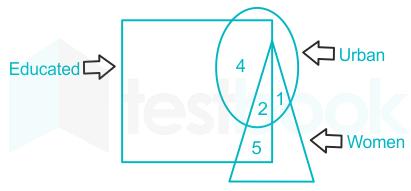
The least possible Venn diagram for the given statements is as shown below :

Conclusions:

I. Some rings are bracelets → Follow (As some bracelets are rings. As some part of bracelets is common with rings, therefore it is true.)

II. Some bracelets are watches → Follow (As all watches are bracelets. As whole watches comes in bracelets, therefore it is true)

∴ Here, Both conclusions I and II follow.​

Hence, the correct answer is "Option 2".

Question 21

The value of sin x + cos⁡xtan⁡(90−x)\frac{\cos x}{\tan(90 - x)} is ________.

  1. AOption (a)

    cot x

  2. BOption (b)

    2cosec x

  3. COption (c)

    tan x

  4. DOption (d)

    2sin x

View answer & explanation

Correct answer

Answer: (d)D.

2sin x

Why this answer is correct

Given:

Expression: sin x + cos x / tan 90° - x

Formula Used:

  1. tan 90° - x = cot x
  2. cot x = cos x / sin x

Calculation:

Substitute tan 90° - x = cot x into the expression:

sin x + cos x / cot x

Using cot x = cos x / sin x:

= sin x + cos x / (cos x / sin x)

Simplify:

= sin x + sin x

= 2 sin x

The value of the expression is 2 sin x.

Question 22

Which Article of the Constitution of India deals with right to education?

  1. AOption (a)

    Article 18

  2. BOption (b)

    Article 21A

  3. COption (c)

    Article 19

  4. DOption (d)

    Article 22

View answer & explanation

Correct answer

Answer: (b)B.

Article 21A

Why this answer is correct

The correct answer is Article 21A

Key Points

  • Article 21A of the Constitution of India deals with the right to education:
  • Article 21A guarantees the right to free and compulsory education for children between the ages of 6 and 14.
  • It's a fundamental right that cannot be waived off.
  • Article 21A ensures that: 
  • Education is basic and elementary, not religious or specialized
  • There's no discrimination and equal opportunities for education
  • The state provides adequate infrastructure, facilities, and qualified teachers
  • The responsibility for implementing Article 21A lies with the state governments.
  • Article 21A was introduced by the 86th Amendment Act of 2002.
  • Related act
  • The Right of Children to Free and Compulsory Education Act (RTE) of 2009 describes the modalities of Article 21A.
  • The RTE Act includes provisions such as: 
  • Ensuring a specified pupil-teacher ratio
  • Prohibiting the deployment of teachers for non-educational work
  • Prohibiting physical punishment and mental harassment
  • Prohibiting capitation fees
  • Prohibiting private tuition by teachers
  • Prohibiting running schools without recognition

Additional Information

  • Articles 18, 19, and 22 are all fundamental rights in the Indian Constitution:
  • Article 18: Abolishes titles
  • Article 19: Protects certain rights regarding freedom of speech
  • Article 22: Protects against arrest and detention in certain cases

Question 23

Mahesh withdrew Rs. 2,000 from a bank. He received a total of 32 notes of Rs. 50 and Rs. 100 denominations. The number of Rs. 50 notes received by him was:

  1. AOption (a)

    32

  2. BOption (b)

    16

  3. COption (c)

    8

  4. DOption (d)

    24

View answer & explanation

Correct answer

Answer: (d)D.

24

Why this answer is correct

Shortcut Trick

Assume all 32 notes are of ₹100 denomination → Total = 32 × 100 = ₹3200.

Actual total = ₹2000 | Difference = 3200 − 2000 = ₹1200.

Difference in denomination value = 100 − 50 = ₹50.

Number of ₹50 notes = 1200 ÷ 50 = 24.

∴ The correct answer is 24 notes.

Alternate Method

Given: Total amount = ₹2000, Total notes = 32.

Let the number of ₹50 notes be x and ₹100 notes be y.

⇒ x + y = 32 --- (i)

⇒ 50x + 100y = 2000 → x + 2y = 40 --- (ii)

Subtracting equation (i) from (ii):

⇒ (x + 2y) − (x + y) = 40 − 32

⇒ y = 8

⇒ x = 32 − 8 = 24

∴ The correct answer is 24 notes.

Additional Information

Alligation Method

Average value per note = 2000 ÷ 32 = ₹62.5. Ratio of notes = (100−62.5) : (62.5−50) = 37.5 : 12.5 = 3 : 1.

Linear Equations in Two Variables

Standard form: ax + by = c. Can be solved using substitution, elimination, or cross-multiplication methods.

Question 24

Calculate the current in a wire if 1200 C of charge passes through it in 10 minutes.

  1. AOption (a)

    3 A

  2. BOption (b)

    1.5 A

  3. COption (c)

    2 A

  4. DOption (d)

    4 A

View answer & explanation

Correct answer

Answer: (c)C.

2 A

Why this answer is correct

The correct answer is 2 A

Key Points

  • To calculate the current in the wire, we use the formula:
  • ​I=t/QI= t/ Q
  • Where:
  • is the current (in amperes, A),
  • is the charge (in coulombs, C),
  • is the time (in seconds, s).
  • Given:
  • t=10minutes=10×60=600seconds.
  • I\I
  • Now, substitute the values into the formula:I=1200C/600s=2AI= 1200 C/600s =2A

Question 25

Electrovalent compounds show conduction of electricity in:

  1. AOption (a)

    kerosene

  2. BOption (b)

    solid state

  3. COption (c)

    petrol

  4. DOption (d)

    molten state

View answer & explanation

Correct answer

Answer: (d)D.

molten state

Why this answer is correct

The correct answer is Molten State

Key Points

  • Electrovalent compounds conduct electricity in molten and aqueous states, but not in solid states:
  • In the solid state, electrovalent compounds do not conduct electricity because the ions are rigid and cannot move.
  • However, in the molten state, the electrostatic forces of attraction between the oppositely charged ions weaken, allowing the ions to move freely and conduct electricity.

Additional Information

  • Kerosene
  • Kerosene is a liquid fuel that is used in stoves for cooking. It is a substance that has a definite volume but no fixed shape. Kerosene was originally made from coal and oil shale, but later from petroleum. It was the primary commercial use for petroleum refined in the United States until 1909, when motor fuels became more popular.
  • Solid state
  • A solid is a state of matter with a definite shape and volume. Solids form when the energy of atoms decreases and they take up a relatively ordered, three-dimensional structure.
  • Petrol
  • Petrol is a liquid fuel that is used in vehicles. Petrol and kerosene are miscible liquids, meaning they can be mixed together. Fractional distillation is a process that can be used to separate petrol, kerosene, and other components from crude oil.

Question 26

Five years from now, father's age will be three times the age of his son. Five years ago, father was seven times as old as his son. Their present ages are:

  1. AOption (a)

    40 and 5

  2. BOption (b)

    30 and 10

  3. COption (c)

    30 and 5

  4. DOption (d)

    40 and 10

View answer & explanation

Correct answer

Answer: (d)D.

40 and 10

Why this answer is correct

Shortcut Trick

Check options directly to satisfy both conditions.

Option (4): 40 and 10.

Condition 1 (5 years hence): 40+5 = 45 and 10+5 = 15. Since 45 = 3 × 15, it satisfies the condition.

Condition 2 (5 years ago): 40−5 = 35 and 10−5 = 5. Since 35 = 7 × 5, it satisfies the condition.

∴ The correct answer is 40 and 10.

Alternate Method

Given:

Let present age of father be F and son be S.

Formula Used: Linear equations in two variables.

Calculations:

⇒ Case 1 (5 years hence): F + 5 = 3(S + 5)

⇒ F + 5 = 3S + 15 ⇒ F − 3S = 10 ....(i)

⇒ Case 2 (5 years ago): F − 5 = 7(S − 5)

⇒ F − 5 = 7S − 35 ⇒ F − 7S = −30 ....(ii)

⇒ Subtracting (ii) from (i): (F − 3S) − (F − 7S) = 10 − (−30)

⇒ 4S = 40 ⇒ S = 10

⇒ Substitute S = 10 in (i): F − 3(10) = 10 ⇒ F = 10 + 30 = 40

∴ The correct answer is 40 and 10.

Additional Information

Ratio Method for Age Difference

The difference between the ages of two people remains constant throughout their lives. This property can be used to balance ratios across different time periods.

Linear Equation Solving

Standard elimination or substitution methods are used to solve for variables. For age problems, ensure you represent "ago" as (Age − n) and "hence" as (Age + n).

Question 27

Town M is to the south of Town Z. Town C is to the east of Town Z. Town F is to the west of Town C. Town X is to the north of Town C. Town Z is to the west of Town F. What is the position of Town F with respect to Town M?

  1. AOption (a)

    South-East

  2. BOption (b)

    North-East

  3. COption (c)

    West

  4. DOption (d)

    North-West

View answer & explanation

Correct answer

Answer: (b)B.

North-East

Why this answer is correct

Given: 

Town M is to the south of Town Z.

Town C is to the east of Town Z.

Town F is to the west of Town C.

Town X is to the north of Town C.

Town Z is to the west of Town F.

Thus, Town F is to the northeast of Town M.

Hence. "Option 2" is the correct answer.

Question 28

Refer to the following letter series and answer the question.

(Left) R E S I C X Z H G U K E W A T E Y M Q D F (Right)

How many such consonants are there in the series each of which is immediately preceded by a vowel and also immediately followed by a vowel?

  1. AOption (a)

    Two

  2. BOption (b)

    Three

  3. COption (c)

    Four

  4. DOption (d)

    One

View answer & explanation

Correct answer

Answer: (c)C.

Four

Why this answer is correct

To address the question based on the given series and conditions, we need to identify the consonants that are immediately preceded by a vowel and immediately followed by a vowel.

Given series: (Left) R E S I C X Z H G U K E W A T E Y M Q D F (Right)

We need to find consonants in the series that are surrounded by vowels on both sides.

1. Identify vowels in the series: Vowels: E, I, U, E, A, E, Y

2. Check each consonant in the series to see if it is immediately preceded and followed by a vowel: -

S (preceded by E, followed by I) ✅

H (preceded by Z, followed by G) ❌

G (preceded by H, followed by U) ❌

K (preceded by U, followed by E) ✅

W (preceded by E and followed by A) ✅

T (preceded by A, followed by E) ✅

So, the consonants meeting the criteria are S, K, W and T.

Therefore, there are four consonants that are immediately preceded by a vowel and immediately followed by a vowel.

This aligns with the provided correct answer, which is "option 3".

Question 29

Which of the following gases is evolved when zinc granules are added to hydrochloric acid?

  1. AOption (a)

    Cl2

  2. BOption (b)

    O2

  3. COption (c)

    H2

  4. DOption (d)

    OCI2

View answer & explanation

Correct answer

Answer: (c)C.

H2

Why this answer is correct

The correct answer is H2.

Key Points

  • When zinc granules are added to hydrochloric acid, the gas evolved is H₂ (Hydrogen gas).
  • The reaction can be written as: 
  • Zn(s)+2HCl(aq)→ZnCl2​(aq)+H2​(g)
  • Zinc (Zn) reacts with hydrochloric acid (HCl) to form zinc chloride (ZnCl₂) in solution and hydrogen gas (H₂), which bubbles up and escapes from the solution.
  • Hydrogen ions (H⁺) in the hydrochloric acid are reduced to hydrogen gas (H₂) when they gain electrons.
  • This happens because zinc is more reactive than hydrogen, so it displaces hydrogen ions from the acid.
  • This results in the evolution of hydrogen gas, which can be observed as bubbles in the solution.

Additional Information

  • Cl₂ (Chlorine gas), O₂ (Oxygen gas), and OCI₂ (Chlorine monoxide) are not produced in this reaction. Chlorine gas (Cl₂) would be produced only in reactions involving an oxidizing agent, such as the electrolysis of brine, and oxygen gas (O₂) would be produced in reactions involving the oxidation of a substance, which is not the case here.

Question 30

The distance between the pole and the centre of curvature of a given concave mirror of focal length 0.5 m is:

  1. AOption (a)

    0.5 m

  2. BOption (b)

    1.0 m

  3. COption (c)

    0.75 m

  4. DOption (d)

    0.25 m

View answer & explanation

Correct answer

Answer: (b)B.

1.0 m

Why this answer is correct

The correct answer is 1.0m

Key Points

  • The distance between the pole and the centre of curvature of a concave mirror is twice the focal length.
  • This is because the centre of curvature is located at a distance equal to twice the focal length from the pole.
  • Given:
  • Focal length f=0.5m
  • The distance between the pole and the centre of curvature

RR is:R=2f=2×0.5m=1.0mR=2f=2×0.5m=1.0m

Question 31

The sum of the digits of a two-digit number is 12. The number obtained by interchanging its digits exceeds the given number by 18. The number is:

  1. AOption (a)

    27

  2. BOption (b)

    57

  3. COption (c)

    67

  4. DOption (d)

    76

View answer & explanation

Correct answer

Answer: (b)B.

57

Why this answer is correct

Shortcut Trick

The difference between digits of a two-digit number is always equal to the difference between the number and its reverse divided by 9.

Digit Difference = 18 ÷ 9 = 2.

Given Digit Sum = 12.

Larger digit = (12 + 2) ÷ 2 = 7; Smaller digit = (12 − 2) ÷ 2 = 5.

Since the interchanged number is greater, the original tens digit must be the smaller one (5).

∴ The correct answer is 57.

Alternate Method

Given:

Sum of digits = 12

New Number (interchanged) − Original Number = 18

Formula Used:

Let the tens digit be x and the units digit be y.

Original Number = 10x + y

Interchanged Number = 10y + x

Calculations:

⇒ x + y = 12 --- (Equation 1)

⇒ (10y + x) − (10x + y) = 18

⇒ 9y − 9x = 18

⇒ y − x = 2 --- (Equation 2)

⇒ Adding Eq 1 and Eq 2: (x + y) + (y − x) = 12 + 2

⇒ 2y = 14 ⇒ y = 7

⇒ Substituting y in Eq 1: x + 7 = 12 ⇒ x = 5

⇒ Original Number = 10(5) + 7 = 57

∴ The correct answer is 57.

Additional Information

Difference Property

The difference between a two-digit number and its reverse is always a multiple of 9, specifically 9 × |x − y|.

Sum Property

The sum of a two-digit number and its reverse is always a multiple of 11, specifically 11 × (x + y).

General Representation

A two-digit number with digits a and b is represented as 10a + b, where a is the tens digit and b is the units digit.

Question 32

Two trains having lengths of 200 m and 300 m are running at speeds of 100 km/h and 120 km/h, respectively, in the same direction. The time taken (in minutes) by the faster train, coming from behind, to completely cross the other train is:

  1. AOption (a)

    2

  2. BOption (b)

    0.5

  3. COption (c)

    1.5

  4. DOption (d)

    1

View answer & explanation

Correct answer

Answer: (c)C.

1.5

Why this answer is correct

Shortcut Trick

Total distance = Sum of lengths = 200 + 300 = 500 m

Relative speed (same direction) = 120 − 100 = 20 kmph

Convert speed to m/s = 20 × (5/18) m/s

Time = 500 ÷ (100/18) = 90 seconds

Time in minutes = 90/60 = 1.5 minutes

∴ The correct answer is 1.5 minutes.

Alternate Method

Given: Length1 = 200 m, Length2 = 300 m, Speed1 = 100 kmph, Speed2 = 120 kmph

Formula Used: Time = (Total Distance) ÷ (Relative Speed)

⇒ Total Distance = 200 + 300 = 500 m

⇒ Relative Speed = 120 − 100 = 20 kmph

⇒ Relative Speed in m/s = 20 × (5/18) = 100/18 m/s

⇒ Time taken (seconds) = 500 ÷ (100/18) = 500 × 18 / 100

⇒ Time = 90 seconds

⇒ Time in minutes = 90 ÷ 60 = 1.5 minutes

∴ The correct answer is 1.5 minutes.

Additional Information

Relative Speed Concept

When two objects move in the same direction, relative speed = S1 − S2. When they move in opposite directions, relative speed = S1 + S2.

Unit Conversion

To convert kmph to m/s, multiply by 5/18. To convert m/s to kmph, multiply by 18/5.

Crossing Rule

When a train crosses another train or a bridge, the total distance is always the sum of their lengths (L1 + L2).

Question 33

Which two numbers should be interchanged to make the following equation correct?

12 + 7 - (8 ÷ 4 - 5) × 11 = 54

  1. AOption (a)

    8 and 11

  2. BOption (b)

    12 and 11

  3. COption (c)

    5 and 12

  4. DOption (d)

    8 and 7

View answer & explanation

Correct answer

Answer: (b)B.

12 and 11

Why this answer is correct

Given: 12 + 7 - (8 ÷ 4 - 5) × 11 = 54

According to the question, after replacing the numbers:

Option 1) 8 and 11

12 + 7 - (8 ÷ 4 - 5) × 11 = 54 ⇒ 12 + 7 - (11 ÷ 4 - 5) × 8 = 54

⇒ 12 + 7 - (11 ÷ 4 - 5) × 8 = 54

⇒ 12 + 7 - (2.75 - 5) × 8 = 54

⇒ 12 + 7 - (-2.25) × 8 = 54

⇒ 12 + 7 + 18 = 54

⇒ 37 ≠ 54 (LHS ≠ RHS)

Option 2) 12 and 11

2 + 7 - (8 ÷ 4 - 5) × 11 = 54 ⇒ 11 + 7 - (8 ÷ 4 - 5) × 12 = 54

⇒ 11 + 7 - (8 ÷ 4 - 5) × 12 = 54

⇒ 11 + 7 - (2 - 5) × 12 = 54

⇒ 11 + 7 - (-3) × 12 = 54

⇒ 11 + 7 + 36 = 54

⇒ 54 = 54 (LHS = RHS)

Option 3) 5 and 12

2 + 7 - (8 ÷ 4 - 5) × 11 = 54 ⇒ 5 + 7 - (8 ÷ 4 - 12) × 11 = 54

⇒ 5 + 7 - (8 ÷ 4 - 12) × 11 = 54

⇒ 5 + 7 - (2 - 12) × 11 = 54

⇒ 5 + 7 - (-10) × 11 = 54

⇒ 5 + 7 + 110 = 54

⇒ 122 ≠ 54 (LHS ≠ RHS)

Option 4) 8 and 7

2 + 7 - (8 ÷ 4 - 5) × 11 = 54 ⇒ 12 + 8 - (7 ÷ 4 - 5) × 11 = 54

⇒ 12 + 8 - (7 ÷ 4 - 5) × 11 = 54\

⇒ 12 + 8 - (1.75 - 5) × 11 = 54

⇒ 12 + 8 - (-3.25) × 11 = 54

⇒ 12 + 8 + 35.75 = 54

⇒ 55.75 ≠ 54 (LHS ≠ RHS)

Hence, "Option 2" is the correct answer.

Question 34

In a house, a TV set rated as 150 W is operated for 4 hours, and a 1500 W electric heater is operated for 25 minutes. The energy consumption values per day for the TV set and the electric heater are:

  1. AOption (a)

    500 W h and 525 W h, respectively

  2. BOption (b)

    600 Wh and 625 W h, respectively

  3. COption (c)

    525 W h and 500 W h, respectively

  4. DOption (d)

    625 W h and 600 W h, respectively

View answer & explanation

Correct answer

Answer: (b)B.

600 Wh and 625 W h, respectively

Why this answer is correct

The correct answer is 600 Wh and 625 W h, respectively.

Key Points

Convert Power to Kilowatts:

TV set: 150 W = 0.15 kW

Electric heater: 1500 W = 1.5 kW

Convert Time to Hours:

Electric heater: 25 minutes = 25/60 hours ≈ 0.42 hours

Calculate Energy Consumption for Each Appliance:

TV set:

E = P × t

E = 0.15 kW × 4 hours = 600 Wh

Electric heater:

E = P × t

E = 1.5 kW × 0.42 hours ≈ 625Wh

Question 35

Select the option that is related to the fifth number in the same way as the second number is related to the first number, the fourth number is related to the third number.

15 : 2 :: 255 : 4 :: 624 : ?

  1. AOption (a)

    3

  2. BOption (b)

    5

  3. COption (c)

    9

  4. DOption (d)

    8

View answer & explanation

Correct answer

Answer: (b)B.

5

Why this answer is correct

The logic followed here is:

Logic:  (First number + 1) = (Second number)4

Let's verify this logic with the given pairs:

For 15 : 2:

→ First number = 15, Second number = 2

→ (15 + 1) = 24

→ 16 = 16

For 255 : 4:

→ First number = 255, Second number = 4

→ (255 + 1) = 44

→ 256 = 256

Similarly,

 624 : ?:

→ First number = 624

→ (624 + 1) = (?)4

→ 625 = (?)4

To find the missing number, we need to find the 4th root of 625.

→ We know that 54 = 5 × 5 × 5 × 5 = 25 × 25 = 625.

→ Therefore, the missing number is 5.

The missing number is 5.

Hence, the correct answer is "Option 2".

Question 36

A beam of light parallel to the principal axis of a convex mirror will:

  1. AOption (a)

    diverge from pole

  2. BOption (b)

    appear to diverge from F

  3. COption (c)

    appear to converge at F

  4. DOption (d)

    converge at F

View answer & explanation

Correct answer

Answer: (b)B.

appear to diverge from F

Why this answer is correct

Key Points

  • A convex mirror is a diverging mirror.
  • When parallel rays of light fall on a convex mirror, they reflect and appear to diverge.
  • The rays appear to diverge from a point known as the focus (F) on the principal axis behind the mirror.

Explanation

  • When a light beam parallel to the principal axis strikes a convex mirror:
  • The reflected rays spread out (diverge).
  • These reflected rays seem to come from a focal point (F) located behind the mirror.
  • Hence, to an observer, these diverging rays appear to originate from the focal point (F).

The correct answer is appear to diverge from F.

Question 37

The ratio of the lengths of two corresponding sides of two similar triangles is 2 ∶ 1. The ratio of the areas of these two triangles, in the order mentioned, is:

  1. AOption (a)

    2 ∶ 1

  2. BOption (b)

    3 ∶ 1

  3. COption (c)

    4 ∶ 1

  4. DOption (d)

    22\sqrt2 ∶ 1

View answer & explanation

Correct answer

Answer: (c)C.

4 ∶ 1

Why this answer is correct

Shortcut Trick

For similar triangles, the ratio of their areas is always the square of the ratio of their corresponding sides.

Ratio of sides = 2 : 1

Ratio of areas = 22 : 12 = 4 : 1

∴ The correct answer is 4 : 1.

Alternate Method

Given:

Ratio of corresponding sides of two similar triangles = 2 : 1

Formula Used:

Area1 / Area2 = (Side1 / Side2)2

Calculations:

⇒ Let the corresponding sides of the two triangles be s1 and s2.

⇒ s1 : s2 = 2 : 1

⇒ According to the Area Theorem for similar triangles:

⇒ Area1 / Area2 = (s1 / s2)2

⇒ Area1 / Area2 = (2 / 1)2

⇒ Area1 / Area2 = 4 / 1

⇒ Ratio of areas = 4 : 1

∴ The correct answer is 4 : 1.

Additional Information

Ratio of Perimeters

The ratio of the perimeters of two similar triangles is equal to the ratio of their corresponding sides (s1/s2).

Ratio of Altitudes and Medians

The ratio of corresponding altitudes, medians, or angle bisectors in similar triangles is also equal to the ratio of their corresponding sides.

Basic Proportionality Theorem (BPT)

If a line is drawn parallel to one side of a triangle to intersect the other two sides, it divides the two sides in the same ratio.

3

Question 38

What will happen if the ozone layer becomes thinner?

  1. AOption (a)

    Amount of surface ozone will increase

  2. BOption (b)

    The ozone hole will close by redistribution

  3. COption (c)

    Cases of skin cancer will increase

  4. DOption (d)

    Temperature of Earth will increase

View answer & explanation

Correct answer

Answer: (c)C.

Cases of skin cancer will increase

Why this answer is correct

The correct answer is Cases of skin cancer will increase

Key Points

  • If the ozone layer becomes thinner, cases of skin cancer will increase:
  • Increased UV radiation
  • Ozone absorbs ultraviolet (UV) radiation from the sun, so a thinner ozone layer allows more UV radiation to reach the Earth's surface.
  • Increased skin cancer
  • More UV radiation increases the risk of skin cancer, eye cataracts, and damage to the immune system.
  • Other damage
  • UV radiation can also damage plants, crops, and ocean plankton.
  • Increased UV Index
  • Decreases in ozone lead to increases in the UV Index.
  • Ozone depletion is a major environmental problem. It's most pronounced in the polar regions, especially over Antarctica.
  • Some human-produced chemicals, such as nitrous oxide, can release chlorine and bromine, which deplete the ozone layer when exposed to high ultraviolet light.

Question 39

Find the value of (12)−2+(13)−2+(14)−2{\left( {\frac{1}{2}} \right)^{ - 2}} + {\left( {\frac{1}{3}} \right)^{ - 2}} + {\left( {\frac{1}{4}} \right)^{ - 2}}.

  1. AOption (a)

    13

  2. BOption (b)

    29

  3. COption (c)

    21

  4. DOption (d)

    25

View answer & explanation

Correct answer

Answer: (b)B.

29

Why this answer is correct

Given:

Find the value of (12)−2+(13)−2+(14)−2{\left( {\frac{1}{2}} \right)^{ - 2}} + {\left( {\frac{1}{3}} \right)^{ - 2}} + {\left( {\frac{1}{4}} \right)^{ - 2}}

Formula Used:

(a−n)=1an(a^{-n}) = \frac{1}{a^n}

(a−n)=(1/a)−n=an(a^{-n}) = (1/a)^-n = a^n

Calculation:

For the first term:

(12)−2\left( \frac{1}{2} \right)^{-2}

⇒ 22 = 4

For the second term:

(13)−2\left( \frac{1}{3} \right)^{-2}

⇒ 32 = 9

For the third term:

(14)−2\left( \frac{1}{4} \right)^{-2}

⇒ 42 = 16

Now, adding these values:

4 + 9 + 16

⇒ 29

The correct answer is option 2.

Question 40

If 35% of x = 40% of y, then x ∶ y is ________.

  1. AOption (a)

    8 ∶ 7

  2. BOption (b)

    9 ∶ 8

  3. COption (c)

    7 ∶ 8

  4. DOption (d)

    8 ∶ 9

View answer & explanation

Correct answer

Answer: (a)A.

8 ∶ 7

Why this answer is correct

Shortcut Trick

Ratio of x : y is the inverse ratio of their percentage coefficients.

x : y = 40 : 35

Divide both by 5 ⇒ 8 : 7

∴ The correct answer is 8 : 7.

Alternate Method

Given:

35% of x = 40% of y

Calculations:

⇒ (35/100) × x = (40/100) × y

⇒ 35 × x = 40 × y

⇒ x / y = 40 / 35

⇒ x / y = 8 / 7

⇒ x : y = 8 : 7

∴ The correct answer is 8 : 7.

Additional Information

Percentage to Ratio Conversion

To convert percentage to ratio, divide the percentage value by 100 and simplify the fraction.

Inverse Variation in Ratios

If A × x = B × y, then the ratio x : y is equal to B : A. This is a fundamental property of proportions.

Concept of "of" in Mathematics

In arithmetic problems, the word "of" always represents the multiplication operation.

Question 41

In February 2022, Atal Innovation Mission (AIM), NITI Aayog, and the US Agency for International Development (USAID) announced a new partnership under the SAMRIDH initiative. What is the full form of SAMRIDH?

  1. AOption (a)

    Sustainable Access to Markets and Resources for Innovative Delivery of Healthcare

  2. BOption (b)

    Sustainable Access to Markets and Resources for Innovative Designs of Healthcare

  3. COption (c)

    Sustainable Abilities to Markets and Resources for Innovative Delivery of Healthcare

  4. DOption (d)

    Successful Access to Markets and Resources for Innovative Designs of Healthcare

View answer & explanation

Correct answer

Answer: (a)A.

Sustainable Access to Markets and Resources for Innovative Delivery of Healthcare

Why this answer is correct

The correct answer is option 1

Key Points

  • The SAMRIDH initiative is a collaboration between the Atal Innovation Mission (AIM), NITI Aayog, and the US Agency for International Development (USAID), launched in February 2022. Its main goal is to promote the sustainable delivery of healthcare solutions in India, especially in underserved and rural areas.
  • The name SAMRIDH stands for Sustainable Access to Markets and Resources for Innovative Delivery of Healthcare.
  • The components of this initiative work:
  • Sustainable Access: It focuses on making healthcare solutions accessible in the long run, ensuring that these solutions are not only available but also affordable and sustainable over time.
  • Markets and Resources: The initiative aims to strengthen healthcare supply chains and connect healthcare innovations to the right markets and resources, ensuring that effective solutions can be scaled.
  • Innovative Delivery of Healthcare: The focus is on using innovative approaches and technologies to improve healthcare delivery. This could involve digital health solutions, new medical devices, or improved healthcare systems designed to reach remote areas.
  • SAMRIDH supports healthcare innovators, startups, and entrepreneurs by helping them access financial resources, networks, and markets, thus helping to scale their innovations and improve healthcare delivery across the country.

Question 42

Which element does NOT belong to group number 11 in the Modern Periodic Table?

  1. AOption (a)

    Ag

  2. BOption (b)

    Au

  3. COption (c)

    Cu

  4. DOption (d)

    Hg

View answer & explanation

Correct answer

Answer: (d)D.

Hg

Why this answer is correct

The correct answer is  Hg.

Key Points

  • Aluminum (Al) does not belong to group 11 in the modern periodic table. Instead, it is in group 13.
  • The elements that do belong to group 11 are copper (Cu), silver (Ag), gold (Au), and roentgenium (Rg).

Additional Information

  • Au, Ag, and Cu are chemical elements that are known as coinage metals because they were used to make coins:
  • Au: Gold
  • Ag: Silver
  • Cu: Copper
  • Some other properties of these elements:
  • Group 11: They are all in group 11 of the periodic table, along with roentgenium (Rg).
  • Transition elements: They are considered transition elements because they have incompletely filled d-orbitals in at least one of their oxidation states.
  • Noble metals: They are chemically inactive.
  • Malleable: They are malleable metals with close-packing.
  • High melting points: They have high melting points.
  • Form alloys easily: They form alloys easily.
  • Shine: They all shine.
  • The melting point of an element is determined by the strength of its metallic bonds.
  • As you move down a group in the periodic table, the size of the elements increases, which means the strength of the metallic bonds decreases.
  • This makes it easier to melt the element.

Question 43

A shopkeeper purchased 70 kg of onions for Rs. 560 and sold the whole lot at the rate of Rs. 10 per kg. What will be his gain percentage?

  1. AOption (a)

    25%

  2. BOption (b)

    17.5%

  3. COption (c)

    20%

  4. DOption (d)

    28%

View answer & explanation

Correct answer

Answer: (a)A.

25%

Why this answer is correct

Shortcut Trick

Total Cost Price (CP) of 70 kg = Rs. 560.

CP per kg = 560 ÷ 70 = Rs. 8 per kg.

Selling Price (SP) = Rs. 10 per kg.

Ratio of CP : SP = 8 : 10 = 4 : 5.

Gain percentage = (Difference ÷ CP ratio) × 100 = (1 ÷ 4) × 100 = 25%.

∴ The correct answer is 25%.

Alternate Method

Given: Total quantity = 70 kg, Total CP = Rs. 560, SP per kg = Rs. 10. Formulas: Total SP = Quantity × SP per unit | Profit = SP − CP | Profit% = (Profit ÷ CP) × 100

⇒ Total Selling Price (SP) = 70 × 10 = Rs. 700. ⇒ Total Profit = 700 − 560 = Rs. 140. ⇒ Profit Percentage = (140 ÷ 560) × 100. ⇒ Profit Percentage = (1 ÷ 4) × 100 = 25%.

∴ The correct answer is 25%.

Additional Information

Profit and Loss Basics

Profit occurs when SP > CP. Profit % is always calculated on the Cost Price (CP) unless stated otherwise.

Unitary Method

Calculating profit per unit (1 kg) gives the same percentage result as calculating for the entire bulk quantity.

Question 44

If α, β are the roots of the quadratic equation 2x2 - 3x - 35 = 0, then the value of α3 + β3 is:

  1. AOption (a)

    9578\frac{957}{8}

  2. BOption (b)

    8578\frac{857}{8}

  3. COption (c)

    7578\frac{757}{8}

  4. DOption (d)

    6578\frac{657}{8}

View answer & explanation

Correct answer

Answer: (d)D.

6578\frac{657}{8}

Why this answer is correct

Shortcut Trick

For the equation 2x2 − 3x − 35 = 0, let Sum (S) = 3/2 and Product (P) = −35/2.

Use the direct identity: α3 + β3 = S3 − 3PS.

Value = (3/2)3 − 3 × (−35/2) × (3/2) = 27/8 + 315/4.

Value = 27/8 + 630/8 = 657/8.

∴ The correct answer is 657/8.

Alternate Method

Given: The quadratic equation is 2x2 − 3x − 35 = 0.

Comparing with ax2 + bx + c = 0, we have a = 2, b = −3, and c = −35.

Formula Used:

  1. Sum of roots (α + β) = −b/a
  2. Product of roots (αβ) = c/a
  3. α3 + β3 = (α + β)3 − 3αβ(α + β)

Calculations:

⇒ α + β = −(−3) ÷ 2 = 3/2

⇒ αβ = −35/2

⇒ α3 + β3 = (3/2)3 − 3 × (−35/2) × (3/2)

⇒ α3 + β3 = 27/8 − (−315/4)

⇒ α3 + β3 = 27/8 + 315/4

⇒ α3 + β3 = 27/8 + 630/8

⇒ α3 + β3 = 657/8

The calculated value matches the value provided in Option 4.

∴ The correct answer is 657/8.

Additional Information

Sum and Product of Roots

For any quadratic equation ax2 + bx + c = 0, the Sum of roots is −b/a and the Product of roots is c/a.

Algebraic Cubic Identity

The expression for the sum of cubes is derived from (a+b)3: a3 + b3 = (a + b)3 − 3ab(a + b) or (a + b)(a2 − ab + b2).

Nature of Roots

The Discriminant (D) = b2 − 4ac determines the nature; if D > 0, roots are real and distinct.

Question 45

Refer to the following number, symbol series and answer the question.

(Left) & % 7 4 @ 6 # & 2 # % 5 * (Right)

How many such symbols are there that are immediately preceded by a number and also immediately followed a number?

  1. AOption (a)

    None

  2. BOption (b)

    Three

  3. COption (c)

    One

  4. DOption (d)

    Two

View answer & explanation

Correct answer

Answer: (c)C.

One

Why this answer is correct

Given series: (Left) & % 7 4 @ 6 # & 2 # % 5 * (Right)

Here,

We need to find the symbols in the series that are immediately preceded by a number and also immediately followed by a number.

Required pattern: Number - Symbol - Number

Let's analyze the series step-by-step:

​(Left) & % 7 4 @ 6 # & 2 # % 5 * (Right)

So, there is only one such symbol in the series.

Hence, the correct answer is "Option 3".

Question 46

Study the following table and answer the question.

GoodsProfit (in lakhs)
201720192021
Refrigerator321543
Fan472654
Television283262
Mobile614547

Which goods earned the maximum combined profit in the given three years, and by what percentage is the profit of the highest profitable goods more than the profit of the lowest profitable goods in the year 2019?

  1. AOption (a)

    Mobile, 200%

  2. BOption (b)

    Fan, 300%

  3. COption (c)

    Mobile, 300%

  4. DOption (d)

    Fan, 200%

View answer & explanation

Correct answer

Answer: (a)A.

Mobile, 200%

Why this answer is correct

Calculation:

Total profit for each good over three years:

Refrigerator = 32 + 15 + 43 = 90

Fan = 47 + 26 + 54 = 127

Television = 28 + 32 + 62 = 122

Mobile = 61 + 45 + 47 = 153

Highest total profit = Mobile (153 lakhs)

Profit in 2019:

Highest profit = Mobile (45 lakhs)

Lowest profit = Refrigerator (15 lakhs)

Percentage difference:

= ((45 - 15) / 15) × 100

= (30 / 15) × 100

= 200%

The goods with the maximum combined profit in the given three years is Mobile with 153 lakhs.

The profit of the highest profitable goods (Mobile) in 2019 is 200% more than the profit of the lowest profitable goods (Refrigerator) in 2019.

Question 47

Which of the following methods prevents or reduces wind erosion of soil in open areas?

  1. AOption (a)

    Covering up open areas with tiles or cement

  2. BOption (b)

    Following crop rotation in agriculture

  3. COption (c)

    Using trees or large shrubs as fences for a garden

  4. DOption (d)

    Using pots to grow vegetables at home

View answer & explanation

Correct answer

Answer: (c)C.

Using trees or large shrubs as fences for a garden

Why this answer is correct

The correct answer is Using trees or large shrubs as fences for a garden

Key Points

  • The correct method that prevents or reduces wind erosion of soil in open areas is Using trees or large shrubs as fences for a garden
  • Wind erosion occurs when strong winds blow over loose, dry soil, carrying particles away and causing the land to lose its topsoil.
  • This can be damaging to agricultural land, gardens, and other open areas, as it reduces soil fertility and degrades the environment.
  • Why trees or large shrubs as windbreaks are effective:
  • Reduction of Wind Speed: Trees and shrubs act as natural barriers or windbreaks. When wind encounters these plants, the wind's speed is reduced, and its ability to lift and carry soil particles is lessened. The denser the vegetation, the more effective it is in breaking the force of the wind.
  • Protection of Soil: By reducing wind speed, windbreaks help keep the soil in place. The trees or shrubs protect the soil from being eroded, thus maintaining its fertility for agricultural use.
  • Improvement of Microclimate: Vegetation also helps in creating a more stable microclimate. The roots of the plants hold the soil together, while the plants themselves help in moisture retention and reduce the direct impact of wind on the soil surface.
  • Long-term Benefits: Over time, windbreaks made of trees and shrubs can help restore and protect large areas of land from further erosion. They provide additional benefits like shelter for crops and wildlife habitat.

Question 48

Manish deposited a certain sum of money at 5% rate of interest per annum, compounded annually At the end of 3 years, Manish received a total amount of ₹92,610. What was the sum of money deposited by Manish?

  1. AOption (a)

    ₹80,000

  2. BOption (b)

    ₹80,530

  3. COption (c)

    ₹79,460

  4. DOption (d)

    ₹82,610

View answer & explanation

Correct answer

Answer: (a)A.

₹80,000

Why this answer is correct

Shortcut Trick

Rate 5% = 1/20 ⇒ Principal : Amount ratio for 1 year = 20 : 21

For 3 years, Ratio = 203 : 213 = 8000 : 9261

Given Amount = 9261 units = ₹92,610

1 unit = ₹10

Sum (Principal) = 8000 units = 8000 × 10 = ₹80,000

∴ The correct answer is ₹80,000.

Alternate Method

Given:

Rate of interest (R) = 5% per annum

Time (n) = 3 years

Total Amount (A) = ₹92,610

Formula Used:

Amount (A) = P(1 + R/100)n

Calculations:

⇒ 92610 = P(1 + 5/100)3

⇒ 92610 = P(1 + 1/20)3

⇒ 92610 = P(21/20)3

⇒ 92610 = P × (9261 / 8000)

⇒ P = (92610 × 8000) / 9261

⇒ P = 10 × 8000

⇒ P = 80000

∴ The correct answer is ₹80,000.

Additional Information

Effective Rate for 3 Years

For a rate r%, the effective compound interest rate for 3 years is given by 3r + 3r2/100 + r3/10000 %. For 5%, it is 15.7625%.

CI and SI Difference (3 Years)

The difference between Compound Interest and Simple Interest for 3 years is P(r/100)2 × (300 + r)/100.

Compounding Period

If interest is compounded half-yearly, the rate is halved (R/2) and the time is doubled (2n) in the standard formula.

Question 49

If the volume of a solid right circular cylinder is 198 m3 and the radius of its base is 3 m, then its height (in m) is ________. Take π = 227\frac{22}{7}.

  1. AOption (a)

    7

  2. BOption (b)

    9

  3. COption (c)

    27

  4. DOption (d)

    6

View answer & explanation

Correct answer

Answer: (a)A.

7

Why this answer is correct

Shortcut Trick

Volume of Cylinder = Area of Base × Height

198 = (π × r2) × h

198 = (227\frac{22}{7} × 3 × 3) × h

h = (198 × 7) ÷ (22 × 9) = 9 × 22 × 7 ÷ (22 × 9) = 7 m

∴ The correct answer is 7 m.

Alternate Method

Given:

⇒ Volume (V) = 198 m3

⇒ Radius (r) = 3 m

Formula Used:

⇒ Volume of Right Circular Cylinder = πr2h

Calculations:

⇒ 198 = 227\frac{22}{7} × (3)2 × h

⇒ 198 = 227\frac{22}{7} × 9 × h

⇒ 198 × 7 = 198 × h

⇒ h = 198×722×9\frac{198 \times 7}{22 \times 9}

⇒ h = 22×9×722×9\frac{22 \times 9 \times 7}{22 \times 9}

⇒ h = 7 m

∴ The correct answer is 7 m.

Additional Information

Curved Surface Area (CSA)

The lateral surface area of a cylinder is given by the formula 2πrh.

Total Surface Area (TSA)

The sum of the area of the curved surface and the two circular bases: 2πr(h + r).

Hollow Cylinder Volume

The volume of a hollow cylinder with outer radius R and inner radius r is πh(R2 − r2).

Question 50

ZR 18 is related to UW 11 in a certain way. In the same way, YM 24 is related to TR 17. To which of the following is KJ 35 related following the same logic?

  1. AOption (a)

    GO 28

  2. BOption (b)

    FP 27

  3. COption (c)

    GP 27

  4. DOption (d)

    FO 28

View answer & explanation

Correct answer

Answer: (d)D.

FO 28

Why this answer is correct

The alphabetical series is given as follows:

ZR 18 is related to UW 11,

YM 24 is related to TR 17,

Similarly, KJ 35 related to:

So, KJ 35 is related to FO 28.

Hence, the correct answer is "Option 4".

Question 51

Padma Shri 2022 awardee Vandana Kataria plays which of the following sports?

  1. AOption (a)

    Hockey

  2. BOption (b)

    Badminton

  3. COption (c)

    Wrestling

  4. DOption (d)

    Cricket

View answer & explanation

Correct answer

Answer: (a)A.

Hockey

Why this answer is correct

The correct answer is Hockey

Key Points

  • Vandana Kataria is an Indian field hockey player who was awarded the Padma Shri in 2022
  • Some of her notable accomplishments include:
  • In the 2013 Women's Hockey Junior World Cup, India won a bronze medal, and Kataria was the top goal-scorer with five goals.
  • During the 2014 Asian Games, she was part of the Indian team that secured a bronze medal.
  • Kataria represented India at the 2016 Rio Olympics.
  • In the 2020 Tokyo Olympics, she made history as the first Indian woman to score a hat-trick at the Olympics, helping India defeat South Africa 4-3 in a pool A match.
  • Kataria also became the first Indian woman to play in 300 international matches.

Additional Information The Padma Shri is India's fourth-highest civilian award, given to recognize distinguished service in any field. The awards are announced on Republic Day and presented by the President of India at a ceremony in Rashtrapati Bhavan

Question 52

In an electric circuit, where 5 lamps are connected in series, if the power, voltage, current and resistance are represented by P, V. I and R, respectively, then which of the following relations holds true?

  1. AOption (a)

    P = VR2\frac{V}{R^2}

  2. BOption (b)

    P = IR2

  3. COption (c)

    P = V2 × R

  4. DOption (d)

    P = I2R

View answer & explanation

Correct answer

Answer: (d)D.

P = I2R

Why this answer is correct

The correct answer is P = I2R

Key Points

  • In an electric circuit where lamps are connected in series, the correct relation among power (P), voltage (V), current (I), and resistance (R) can be derived from Ohm's Law and the formula for electrical power.
  • We know the following:
  • Ohm's Law:
  • Power formula:
  • Substituting V from Ohm's law into the power formula, we get:
  • P=(I×R)×I=I2×RP=(I×R)×I=I 2 ×R
  • Therefore, the correct relation is:
  • P=I2RP=I 2 R

Question 53

Why do many types of trees shed old leaves?

  1. AOption (a)

    Because a tree can support only a certain number of leaves

  2. BOption (b)

    Because the cells die due to old age of the tree

  3. COption (c)

    Because old leaves are broken off due to strong winds

  4. DOption (d)

    Because the cells become packed with waste materials

View answer & explanation

Correct answer

Answer: (d)D.

Because the cells become packed with waste materials

Why this answer is correct

The correct answer is Because the cells become packed with waste materials

Key Points

  • As leaves age, they accumulate waste products and become less efficient at photosynthesis.
  • Shedding old leaves helps the tree get rid of these waste materials and conserve energy, especially in preparation for harsh weather conditions like winter.
  • This process is part of a natural cycle that allows the tree to maintain healthy growth and vitality.
  • While trees can only support a limited number of leaves, this is not the primary reason for shedding old leaves.
  • Trees tend to shed leaves when they are no longer efficient at performing photosynthesis, not because the tree cannot support them.

Question 54

Through which organ is air taken into the body of human beings?

  1. AOption (a)

    Bronchi

  2. BOption (b)

    Alveoli

  3. COption (c)

    Wind pipe

  4. DOption (d)

    Nostrils

View answer & explanation

Correct answer

Answer: (d)D.

Nostrils

Why this answer is correct

The correct answer is Nostrils

Key Points

  • Air enters the human body through the nostrils, which are part of the respiratory system.
  • From there, it moves through the windpipe (trachea), bronchi, and into the alveoli, where gas exchange occurs.
  • Nostrils: Air first enters the body through the nostrils, which are located in the nose. The nostrils are lined with tiny hairs and mucus to filter out dust, pathogens, and other particles, warming and humidifying the air before it travels further.
  • Windpipe (Trachea): After passing through the nostrils, the air moves into the trachea, also known as the windpipe. The trachea is a tube that connects the throat (pharynx) to the lungs, and it serves as the main passage for air to travel into the lungs.
  • Bronchi: The trachea divides into two main tubes called bronchi (plural of bronchus), one leading to each lung. These bronchi branch out into smaller tubes inside the lungs, ensuring that air reaches all parts of the lungs.
  • Alveoli: Once air reaches the smallest bronchioles, it enters the alveoli, tiny air sacs in the lungs. This is where the actual gas exchange takes place. Oxygen from the air passes into the bloodstream, while carbon dioxide, a waste product of metabolism, is transferred from the blood to be exhaled.

Question 55

Ramu is younger than Sunil by 8 years. If their present ages are in the ratio of 7 ∶ 9, then how old is Ramu?

  1. AOption (a)

    28 years

  2. BOption (b)

    56 years

  3. COption (c)

    72 years

  4. DOption (d)

    36 years

View answer & explanation

Correct answer

Answer: (a)A.

28 years

Why this answer is correct

Shortcut Trick

Ratio of ages of Ramu and Sunil = 7 : 9

Difference in ratio parts = 9 − 7 = 2 units

Actual age difference = 8 years

∴ 2 units = 8 years → 1 unit = 4 years

Ramu's age = 7 units = 7 × 4 = 28 years

∴ The correct answer is 28 years.

Alternate Method

Given:

Ratio of present ages of Ramu and Sunil = 7 : 9

Age difference = 8 years

Calculations:

⇒ Let Ramu's age be 7x and Sunil's age be 9x.

⇒ According to the question, 9x − 7x = 8

⇒ 2x = 8

⇒ x = 8 ÷ 2 = 4

⇒ Ramu's present age = 7x = 7 × 4 = 28 years

∴ The correct answer is 28 years.

Additional Information

Age Difference Property

The difference between the ages of two persons remains constant at any point in time (past, present, or future).

Ratio & Proportion in Ages

If ages are given in ratio a : b, their actual values can be assumed as ax and bx, where x is the highest common factor.

Question 56

If the resistivity of nichrome wire is 110 × 10-8 Ω m, its length is 5.5 m and its resistance is 22 Ω, then the area of cross section is:

  1. AOption (a)

    3.4 × 10-8 m2

  2. BOption (b)

    275 × 10-7 m2

  3. COption (c)

    2.75 × 10-7 m2

  4. DOption (d)

    34 × 10-4 m2

View answer & explanation

Correct answer

Answer: (c)C.

2.75 × 10-7 m2

Why this answer is correct

The Correct answer is 2.75 × 10-7 m2

Given:

Resistivity ρ = 110 × 10-8 Ω m

Length L =  5.5 m 

Resistence R =  22 Ω

Formulla used:

To find the area of cross-section of the nichrome wire, we use the formula for resistance:

R = ρL/A

⇒A = ρL/A

Caluction:

A = 110×10−8×5.522\frac{110× 10^{-8}× 5.5}{22}

A= 605×10−822\frac{605×10^{-8}}{22}

A = 27.5× 10⁻⁸

A = 2.75× 10⁻⁷m2

So, the area of the cross-section of the nichrome wire is 2.75× 10⁻⁷m2

Question 57

Which of the following was used as a highway for foreign trade between India and Britain, as its opening in 1869 reduced the cost of transportation and made access to the Indian market easier?

  1. AOption (a)

    Suez Canal

  2. BOption (b)

    Panama Canal

  3. COption (c)

    Corinth Canal

  4. DOption (d)

    White Sea- Baltic Sea Canal

View answer & explanation

Correct answer

Answer: (a)A.

Suez Canal

Why this answer is correct

The correct answer is the Suez Canal

Key Points

  • The Suez Canal, opened in 1869, was a major engineering feat that connected the Mediterranean Sea to the Red Sea, cutting through the Isthmus of Suez in Egypt.
  • Before its opening, ships traveling between Europe and Asia had to sail around the southern tip of Africa, which was a much longer and more dangerous journey.
  • The Suez Canal drastically reduced the distance between Europe (particularly Britain) and India, saving about 5,000 miles of travel compared to the previous route around the
  • This significantly decreased travel time, from several months to about 2-3 weeks.
  • With the shorter route, the cost of shipping goods decreased.
  • This made it economically feasible to transport bulk goods such as cotton, spices, and tea from India to Britain and vice versa, boosting trade between the two nations.
  • The Canal made it much easier for British merchants and traders to access the Indian market.
  • This was vital during the colonial period when Britain was heavily invested in trade with its colonies, including India, which was considered the "jewel in the crown" of the British Empire.
  • The Suez Canal's opening also had geopolitical importance.
  • It gave Britain greater control over its colonial empire and facilitated the movement of naval fleets and military forces in the region.

Additional Information

  • In contrast, the Panama Canal (opened in 1914) connects the Atlantic and Pacific Oceans, the Corinth Canal (opened in 1893) connects the Aegean Sea to the Ionian Sea in Greece, and the White Sea-Baltic Sea Canal (opened in 1933) connects the White Sea in the Arctic to the Baltic Sea

Question 58

Seven boxes X, Y, Z, A, B, C and D are kept one over the other but not necessarily in the same order. A is kept third from the bottom. Only one box is kept between A and X Only three boxes are kept between B and D. B is kept at one of the positions above D. Y is kept immediately below Z. How many boxes are kept between C and A?

  1. AOption (a)

    One

  2. BOption (b)

    Two

  3. COption (c)

    Three

  4. DOption (d)

    Four

View answer & explanation

Correct answer

Answer: (c)C.

Three

Why this answer is correct

Given: Seven boxes X, Y, Z, A, B, C and D are kept one over the other.

1) A is kept third from the bottom.

2) Only one box is kept between A and X.

Boxes
Top to
Case 1Case 2
1
2
3X
4
5AA
6
7X
Bottom

3) Only three boxes are kept between B and D. 

4) B is kept at one of the positions above D.

Boxes
Top to
Case 1Case 2
1
2BB
3X
4
5AA
6DD
7X
Bottom
  1. Y is kept immediately below Z.

As there is no possible position for Y in case 2, therefore is eliminated.

After positioning Y and Z only one position is left which will be occupied by the only box left i.e. C.

Boxes
Top to
Case 1Case 2
1C
2BB
3ZX
4Y
5AA
6DD
7X
Bottom

Thus, according to the final arrangement three boxes are kept between C and A.

Hence, "Option 3" is the correct answer.

Question 59

Select the set in which the numbers are related in the same way as are the numbers of the following sets.

(NOTE: Operations should be performed on the whole numbers, without breaking down the numbers into its constituent digits. E.g.13 - Operations on 13 such as adding/deleting multiplying etc. to 13 can be performed. Breaking down 13 into 1 and 3 and then performing mathematical operations on 1 and 3 is not allowed)

(14, 336, 8)

(12, 324, 9)

  1. AOption (a)

    (18, 478, 7)

  2. BOption (b)

    (18, 368, 7)

  3. COption (c)

    (18, 398, 7)

  4. DOption (d)

    (18, 378, 7)

View answer & explanation

Correct answer

Answer: (d)D.

(18, 378, 7)

Why this answer is correct

The given logic is: (1st number × 3rd number × 3) = 2nd number

Checking each option:

Option 1: (18, 478, 7)

→18 × 7 × 3 = 378

→478 ≠ 378 (LHS ≠ RHS

Option 2: (18, 368, 7)

→18 × 7 × 3 = 378

→368 ≠ 378 (LHS ≠ RHS)

Option 3: (18, 398, 7)

→18 × 7 × 3 = 378

→398 ≠ 378 (LHS ≠ RHS)

Option 4: (18, 378, 7)

→18 × 7 × 3 = 378

→378 = 378 (LHS = RHS)

Therefore, Option 4 is the correct answer.

Question 60

Ravi's salary was first reduced by 50% and subsequently raised by 50%. How much lower was his final salary compared to his initial salary?

  1. AOption (a)

    21%

  2. BOption (b)

    25%

  3. COption (c)

    32%

  4. DOption (d)

    24%

View answer & explanation

Correct answer

Answer: (b)B.

25%

Why this answer is correct

Shortcut Trick

When a value is first increased by x% and then decreased by x% (or vice versa), there is always a net decrease.

Net percentage change = (x2 / 100)% decrease.

Given x = 50.

Net change = (50 × 50) / 100 = 2500 / 100 = 25%.

∴ The correct answer is 25%.

Alternate Method

Given: First reduction = 50%, Subsequent increase = 50%.

⇒ Let the initial salary be 100.

⇒ Salary after 50% reduction = 100 − (50% of 100) = 50.

⇒ Salary after 50% increase = 50 + (50% of 50) = 50 + 25 = 75.

⇒ Total decrease = 100 − 75 = 25.

⇒ Percentage lower = (25 / 100) × 100 = 25%.

∴ The correct answer is 25%.

Additional Information

Successive Percentage Change Formula

For two successive changes of a% and b%, the net change is given by (a + b + (a × b)/100)%.

Base Change Rule

When the base decreases, the same percentage of the new base is numerically smaller than the same percentage of the original base.

Profit and Loss Application

This concept is frequently used in calculating effective discounts and net profit/loss when prices are marked up and then discounted.

Question 61

A certain number of persons are sitting in a row, facing North G is sixth to the right of D.

G is an immediate neighbour of both H and E. C is to the immediate right to E. If no other person is sitting in the row, what is the total number of persons seated?

  1. AOption (a)

    Nine

  2. BOption (b)

    Ten

  3. COption (c)

    Eight

  4. DOption (d)

    Eleven

View answer & explanation

Correct answer

Answer: (a)A.

Nine

Why this answer is correct

Given: A certain number of persons are sitting in a row, facing North.

1) G is sixth to the right of D.

2) G is an immediate neighbour of both H and E.

3) C is to the immediate right to E.

  1. No other person is sitting in the row.

Thus, according to the final arrangement, total number of persons seated is nine.

Hence, "Option 1" is the correct answer.

Question 62

What is the main role of the State Finance Commission?

  1. AOption (a)

    To secure the accountability of the executive to the Parliament in the sphere of financial administration.

  2. BOption (b)

    To advise the government on the legal financial matters referred to it by the President.

  3. COption (c)

    The distribution and determination of the net proceeds of taxes, tolls and fees between the state and local bodies.

  4. DOption (d)

    To look after the elections of the panchayats and municipalities and also provide fund for that elections.

View answer & explanation

Correct answer

Answer: (c)C.

The distribution and determination of the net proceeds of taxes, tolls and fees between the state and local bodies.

Why this answer is correct

The correct answer is option 3

Key Points

  • The main role of the State Finance Commission (SFC) is to assess the financial resources of a state and its local bodies, and recommend how to distribute funds between them:
  • The SFC reviews the financial situation of the state and its local bodies.
  • The SFC recommends how to distribute funds from the state to its local bodies.
  • The SFC suggests ways to improve the delivery of services to the public.
  • The SFC monitors and strengthens the financial condition of local governments.
  • The SFC advises the governor on how to divide tax revenues between the state and its local bodies.
  • The SFC is present in all states and union territories of India, except for Meghalaya, Mizoram, and Nagaland

Question 63

Read the given statements and conclusions carefully. Assuming that the information given in the statements is true, even if it appears to be at variance with commonly known facts, decide which of the given conclusions logically follow(s) from the statements

Statements:

Some pens are staplers.

Some staplers are erasers.

Some erasers are notebooks.

Conclusions:

(I) Some notebooks are pens.

(II) Some erasers are pens.

  1. AOption (a)

    Only conclusion I follows

  2. BOption (b)

    Only conclusion II follows

  3. COption (c)

    Neither conclusion I nor II follows

  4. DOption (d)

    Both conclusions I and II follow

View answer & explanation

Correct answer

Answer: (c)C.

Neither conclusion I nor II follows

Why this answer is correct

The least possible Venn diagram for the given statements is as shown below :

Conclusions:

I. Some notebooks are pens → Does not follow (As some pens are staplers, some staplers are erasers and some erasers are notebooks. So it is possible but not definite.)

II. Some erasers are pens → Does not follow (As some pens are staplers and some staplers are erasers. So it is possible but not definite.)

∴ Here, Neither conclusion I nor II follows.​

Hence, the correct answer is "Option 3".

Question 64

What percentage of 1.5 lakh post offices is expected to come under the core banking system in year 2022?

  1. AOption (a)

    80%

  2. BOption (b)

    85%

  3. COption (c)

    90%

  4. DOption (d)

    100%

View answer & explanation

Correct answer

Answer: (d)D.

100%

Why this answer is correct

The correct answer is 100%.

Key Points

  • In Union budget 2022-23 announcement is made on ‘Anytime-Anywhere post office savings’ that aims to cover all the post offices in the country with a core banking system to help access accounts through internet banking, mobile banking, and ATMs.
  • 1.5 lakh post offices will come 100% on the core banking system (CBS)enabling financial inclusion and access to accounts through net banking, mobile banking, ATMs, and also providing online transfer of funds between post office accounts and bank accounts.
  • This will be helpful, especially for farmers and senior citizens in rural areas, enabling interoperability and financial inclusion.

 Additional Information

  • ​Post Budget Webinar on “Leaving No Citizen Behind” was organized on February 23, 2022.
  • This initiative was chaired by the Minister of Rural Development and Panchayati Raj, Shri Giriraj Singh.

Question 65

An object is placed in front of a concave lens at a distance d. An erect image of the object is formed at d/3. If the focal length of the lens is 15 cm, then d is equal to:

  1. AOption (a)

    25 cm

  2. BOption (b)

    30 cm

  3. COption (c)

    15 cm

  4. DOption (d)

    20 cm

View answer & explanation

Correct answer

Answer: (b)B.

30 cm

Why this answer is correct

The correct answer is 30 cm.

Key Points

  • The lens formula is: 1/f = 1/v - 1/u, where:
  • f is the focal length of the lens.
  • v is the image distance.
  • u is the object distance.
  • Sign Convention:
  • Distances are measured from the optical center of the lens.
  • Distances in the direction of incoming light are positive, while those in the opposite direction are negative.
  • Applicability:
  • Used for both convex and concave lenses, with appropriate sign conventions.
  • Derivation Basis:
  • Derived from the geometry of similar triangles and the refraction laws at the lens surfaces.

Additional Information

  • Concave Lens: A lens that diverges light rays, forming virtual, erect, and diminished images.
  • Lens Formula: Used to relate the focal length, object distance, and image distance of a lens.
  • Sign Convention: Distances are measured from the optical center, with negative values for object distances in front of the lens.
  • Application: Concave lenses are used in correcting myopia (short-sightedness) and as components in optical devices.

Question 66

________ district is the smallest district in Tamil Nadu in terms of area (1672/Sq. Km).

  1. AOption (a)

    Madurai

  2. BOption (b)

    Kanniyakumari

  3. COption (c)

    Vellore

  4. DOption (d)

    Coimbatore

View answer & explanation

Correct answer

Answer: (b)B.

Kanniyakumari

Why this answer is correct

The correct answer is Kanniyakumari

Key Points

  • Kanniyakumari is the smallest district in Tamil Nadu in terms of area, covering 1,672 square kilometers.
  • It is also the southernmost district in mainland India.
  • Kanniyakumari is also the richest district in Tamil Nadu in terms of per capita income.
  • It ranks first in the state for literacy, education, and the Human Development Index (HDI).
  • Dindigul is the largest district in Tamil Nadu by area, covering 6,266.64 square kilometers.

Question 67

Which state had fielded a 396-member contingent, the largest at Khelo India Youth Games 2021 and competed in every sport?

  1. AOption (a)

    Maharashtra

  2. BOption (b)

    Assam

  3. COption (c)

    Odisha

  4. DOption (d)

    Haryana

View answer & explanation

Correct answer

Answer: (d)D.

Haryana

Why this answer is correct

The correct answer is Haryana

Key Points

  • Haryana had the largest contingent at the 2021 Khelo India Youth Games (KIYG), sending 396 members to compete in every sport.
  • The games were held in Panchkula, Haryana from June 4 to June 13, 2021.
  • Haryana won the medal tally with 137 medals, while Maharashtra came in second with 125 medals.
  • The Khelo India Youth Games are India's largest grassroots-level sports competition.
  • The Ministry of Youth Affairs and Sports launched the Khelo India Scheme to improve India's sports culture and make it a sporting nation

Question 68

Study the following table and answer the question given below.

Name of the CompanySale (in lakhs)
199920002001
ACG324335
TYD615229
POD542536
BKN193852

Which company has the highest total sale value over the three years. What is the difference between the value of the highest combined sales and the lowest combined sales registered by any company from 1999 to 2001.

  1. AOption (a)

    TYD, Rs. 33,00,000

  2. BOption (b)

    BKN, Rs. 33,00,000

  3. COption (c)

    TYD, Rs. 27,00,000

  4. DOption (d)

    BKN, Rs. 27,00,000

View answer & explanation

Correct answer

Answer: (a)A.

TYD, Rs. 33,00,000

Why this answer is correct

Calculation:

Total sales for each company:

ACG = 32 + 43 + 35 = 110

TYD = 61 + 52 + 29 = 142

POD = 54 + 25 + 36 = 115

BKN = 19 + 38 + 52 = 109

Highest total sales = 142 (TYD)

Lowest total sales = 109 (BKN)

Difference = 142 - 109 = 33

The company with the highest total sales is TYD with 142 lakhs.

The difference between the highest and lowest combined sales is 33 lakhs.

Question 69

How many bytes are there in 1 kilobyte?

  1. AOption (a)

    1012 bytes

  2. BOption (b)

    1024 bytes

  3. COption (c)

    1036 bytes

  4. DOption (d)

    1064 bytes

View answer & explanation

Correct answer

Answer: (b)B.

1024 bytes

Why this answer is correct

The correct answer is 1024.

Key Points

  • 1024 bytes are there in a kilobyte.
  • The smallest unit of measurement used for measuring data is a bit.
  • A single bit can have a value of either zero(0) or one(1).
  • It may contain a binary value (such as True/False or On/Off or 1/0) and nothing more.
  • Therefore, a byte, or eight bits, is used as the fundamental unit of measurement for data storage.
  • Computer storage and memory are often measured in megabytes (MB) and gigabytes (GB).
  • A medium-sized novel contains about 1 MB of information.

Additional Information

  • kilobyte :
  • The kilobyte is a multiple-unit byte for digital information.
  • The International System of Units (SI) defines one kilobyte as 1024 bytes.
  • The internationally recommended unit symbol for the kilobyte is kB.
  • Byte : 
  • A bit is a basic unit of information in information theory, computing, and digital communications.
  • The name is a portmanteau of binary digits.
  • calculate kb. to bit :
  • 1 Kilobyte is equal to 8000 Bit (eight thousand bit)
  • 1 Bit is equal to 0.000125 Kilobyte (zero point zero × 3 one hundred and twenty-five kb)
  • 1 Kilobyte is equal to 8000 bits (eight thousand bits)
  • 1 Bit is equal to 1 bit (one bit)
  • 1 Kilobyte is equal to 8000 Bit (eight thousand bit).

Question 70

What is the term used for a pricing method in which companies group several products together and sell them at a single price?

  1. AOption (a)

    Bundle pricing

  2. BOption (b)

    Competitive pricing

  3. COption (c)

    Skimming pricing

  4. DOption (d)

    Premium pricing

View answer & explanation

Correct answer

Answer: (a)A.

Bundle pricing

Why this answer is correct

The correct answer is Bundle pricing.

Key Points

  • Bundle pricing
  • Bundle pricing is a marketing strategy where multiple products or services are bundled together and sold at a discounted price compared to buying them individually.
  • This strategy can be beneficial for both businesses and customers.

Additional Information

  • Advantages of Bundle Pricing:
  • Increased Sales: Bundling can encourage customers to buy more products than they originally intended, leading to higher sales volumes.
  • Improved Profit Margins: By bundling less popular products with popular ones, businesses can clear inventory and increase overall profitability.
  • Enhanced Customer Satisfaction: Customers perceive greater value when they feel they are getting a better deal, leading to increased customer satisfaction and loyalty.
  • Simplified Decision-Making: Bundles can simplify the purchasing process for customers, especially when dealing with complex product offerings.
  • Types of Bundle Pricing:
  • Pure Bundling: Customers can only purchase the products as a bundle.
  • Mixed Bundling: Customers can choose to purchase products individually or as a bundle.
  • Component Bundling: Customers can purchase individual components or a complete bundle.

Question 71

Which of the following statements is INCORRECT with respect to coal and petroleum?

  1. AOption (a)

    Their use leads to global warming.

  2. BOption (b)

    They cause environmental pollution.

  3. COption (c)

    They have been formed by degradation of living organisms over millions of years.

  4. DOption (d)

    These are unlimited resources on Earth.

View answer & explanation

Correct answer

Answer: (d)D.

These are unlimited resources on Earth.

Why this answer is correct

The correct answer is These are unlimited resources on Earth.

Key Points

Coal: Coal is a sedimentary, organic rock which is flammable.

  • Coal is composed primarily of carbon along with other elements such as hydrogen, sulphur, oxygen, and nitrogen. Coal is mostly used for power generation and metallurgy. ​
  • Higher quality coal produces less smoke, burns longer, and provides more energy than lower quality coal.

Major varieties of coal:

  • Anthracite- It is the best quality coal. It contains about 80 to 90 percent carbon. It is hard coal. In India, it is mainly found in the district of Reasi in the state of Jammu and Kashmir.
  • Bituminous- It is the most widely available coal in India. It is of medium quality. It contains about 40 to 75 percent carbon. In India, much of the coal comes under this category.
  • Lignite- It is of low quality. It is brown in colour. It contains about 30 to 40 percent coal.
  • Peat- It is the middle stage in the process of coal formation. It contains less than 40 percent carbon. It has more impurities. The parts of the wood are remarkably present in it.
  • Petrolium
  • Petroleum is commonly called crude oil.
  • Petroleum is a mixture of solid, liquid and gaseous hydrocarbons, mixed with saltwater and earthy particles.
  • Petroleum is formed by the decomposition of sea animals and plants which got buried in the sea bed millions of years ago.
  • It is a dark brownish to green coloured liquid fossil fuel.
  • It has a strong foul smell due to the presence of sulfur compounds in it.

Question 72

Six Human Rights conferences are planned in six cities- Mumbai, Delhi, Kolkata, Chennai, Lucknow and Bangalore between July to December in the same year (but not necessarily in the same order). Each conference was planned in a different month. Only the Delhi conference is planned between the Chennai and Bangalore conferences. The Chennai conference is in October. Only two conferences are planned before the Kolkata's conference. The Mumbai conference is immediately after the Lucknow conference. Which city will have the last conference in the year?

  1. AOption (a)

    Kolkata

  2. BOption (b)

    Chennai

  3. COption (c)

    Bangalore

  4. DOption (d)

    Mumbai

View answer & explanation

Correct answer

Answer: (c)C.

Bangalore

Why this answer is correct

Given: Six Human Rights conferences are planned in six cities- Mumbai, Delhi, Kolkata, Chennai, Lucknow and Bangalore between July to December in the same year. Each conference was planned in a different month. 

1) The Chennai conference is in October. 

2) Only two conferences are planned before the Kolkata's conference.

MonthConferences in Cities
July
August
SeptemberKolkata conference
OctoberChennai conference
November
December

3) Only the Delhi conference is planned between the Chennai and Bangalore conferences. 

MonthConferences in Cities
July
August
SeptemberKolkata conference
OctoberChennai conference
NovemberDelhi conference
DecemberBangalore conference

4) The Mumbai conference is immediately after the Lucknow conference. 

MonthConferences in Cities
JulyLucknow conference
AugustMumbai conference
SeptemberKolkata conference
OctoberChennai conference
NovemberDelhi conference
DecemberBangalore conference

Thus, according to the final arrangement Bangalore city will have the last conference in the year.

Hence, "Option 3" is the correct answer.

Question 73

Study the given diagram carefully and answer the question that follows.

The numbers in different sections indicate the number of people.

How many Women are Educated but NOT Urban?

  1. AOption (a)

    2

  2. BOption (b)

    4

  3. COption (c)

    5

  4. DOption (d)

    7

View answer & explanation

Correct answer

Answer: (c)C.

5

Why this answer is correct

According to the given Venn diagram:

The shaded region represents the Women are Educated but NOT Urban.

So, the Women are Educated but NOT Urban = '5'

Hence, the correct answer is "Option 3".

Question 74

A straight conductor carrying current is kept along the axis of a closed circular loop of a conductor. If we change the direction of the current continuously in the straight conductor.

  1. AOption (a)

    induced current in the loop is zero

  2. BOption (b)

    induced current in the loop is not constant

  3. COption (c)

    induced current in the loop is negative

  4. DOption (d)

    induced current in the loop is constant

View answer & explanation

Correct answer

Answer: (b)B.

induced current in the loop is not constant

Why this answer is correct

The correct answer is induced current in the loop is not constant.

Key Points

  • A closed circular loop of a conductor is a fundamental concept in electromagnetism, often tested in various physics exams.
  • Magnetic Field Generation:
  • When a current flows through a closed loop, it generates a magnetic field around it.
  • The direction of the magnetic field can be determined using the right-hand thumb rule.
  • The strength of the magnetic field depends on the current and the radius of the loop.
  • Magnetic Force on a Current-Carrying Conductor:
  • A current-carrying conductor placed in a magnetic field experiences a magnetic force.
  • The direction of the force can be determined using Fleming's left-hand rule.
  • The magnitude of the force depends on the current, the length of the conductor, the magnetic field strength, and the angle between the current and the magnetic field.
  • Electromagnetic Induction:
  • When a magnetic field changes through a closed loop, an electromotive force (EMF) is induced in the loop.
  • This induced EMF can cause a current to flow in the loop.
  • The magnitude of the induced EMF is proportional to the rate of change of magnetic flux through the loop.

Question 75

Read the given statement and the arguments carefully and select the appropriate answer from the given options.

Statement:

Real education is an awakening of the mind.

Arguments:

I. Academic achievement is the only indicator of real education.

II. Human values reflect real education.

  1. AOption (a)

    Both I and II weaken the statement.

  2. BOption (b)

    I weakens while II strengthens the statement.

  3. COption (c)

    II weakens while I strengthens the statement.

  4. DOption (d)

    Both I and II strengthen the statement.

View answer & explanation

Correct answer

Answer: (b)B.

I weakens while II strengthens the statement.

Why this answer is correct

Given:

Statement :

Real education is an awakening of the mind.

Now,

Arguments :

I. Academic achievement is the only indicator of real education - False (Academic achievement is just one aspect and does not necessarily indicate an awakening of the mind).

II. Human values reflect real education - True (Human values represent a deeper understanding and awakening of the mind, aligning with the statement).

So, I weakens while II strengthens the statement.

Hence, the correct answer is "Option 2".

Question 76

The smallest natural number which is divisible by 8, 12, 28 and 36 is:

  1. AOption (a)

    336

  2. BOption (b)

    168

  3. COption (c)

    504

  4. DOption (d)

    252

View answer & explanation

Correct answer

Answer: (c)C.

504

Why this answer is correct

Shortcut Trick

The smallest natural number divisible by a set of numbers is their LCM (Least Common Multiple).

Check divisibility by 9 (from 36) in options: (1) 3+3+6=12 (No), (2) 1+6+8=15 (No), (3) 5+0+4=9 (Yes), (4) 2+5+2=9 (Yes).

Check divisibility by 7 (from 28): 504 ÷ 7 = 72 (Yes), 252 ÷ 7 = 36 (Yes).

Check divisibility by 8: 504 ÷ 8 = 63 (Yes), 252 ÷ 8 = 31.5 (No).

∴ The correct answer is 504.

Alternate Method

Given: Numbers are 8, 12, 28, and 36.

Formula Used: LCM (Least Common Multiple) using Prime Factorization.

⇒ Prime factors of 8 = 2 × 2 × 2 = 23

⇒ Prime factors of 12 = 2 × 2 × 3 = 22 × 31

⇒ Prime factors of 28 = 2 × 2 × 7 = 22 × 71

⇒ Prime factors of 36 = 2 × 2 × 3 × 3 = 22 × 32

⇒ LCM = Product of highest powers of all prime factors = 23 × 32 × 71

⇒ LCM = 8 × 9 × 7 = 72 × 7 = 504

∴ The correct answer is 504.

Additional Information

LCM (Least Common Multiple)

The LCM of two or more numbers is the smallest number that is a multiple of all of them.

HCF and LCM Relationship

For any two numbers 'a' and 'b', HCF(a, b) × LCM(a, b) = a × b.

Divisibility Rule of 8

A number is divisible by 8 if its last three digits are divisible by 8.

Question 77

The area (in cm2) of an equilateral triangle of side 3 cm is:

  1. AOption (a)

    2434\frac{\sqrt{243}}{4}

  2. BOption (b)

    2436\frac{\sqrt{243}}{6}

  3. COption (c)

    2433\frac{\sqrt{243}}{3}

  4. DOption (d)

    2432\frac{\sqrt{243}}{2}

View answer & explanation

Correct answer

Answer: (a)A.

2434\frac{\sqrt{243}}{4}

Why this answer is correct

Shortcut Trick

For an equilateral triangle with side s, the Area is given by (√3 / 4) × s2.

Given side s = 3 cm.

Area = (√3 / 4) × 32 = 9√3 / 4 cm2.

To match options, take 9 inside the square root: √(92 × 3) / 4 = √(81 × 3) / 4 = √243 / 4 cm2.

∴ The correct answer is √243 / 4 cm2.

Alternate Method

Given:

Side of equilateral triangle (a) = 3 cm

Formula Used:

Area of equilateral triangle = (√3 / 4) × a2

Calculations:

⇒ Area = (√3 / 4) × (3)2

⇒ Area = (√3 / 4) × 9

⇒ Area = 9√3 / 4

⇒ Area = √(92 × 3) / 4

⇒ Area = √(81 × 3) / 4

⇒ Area = √243 / 4 cm2

∴ The correct answer is √243 / 4 cm2.

Additional Information

Height of Equilateral Triangle

The altitude or height (h) is calculated as h = (√3 / 2) × side.

Perimeter of Equilateral Triangle

Since all three sides are equal, the perimeter (P) = 3 × side.

Inradius and Circumradius

Inradius (r) = a / (2√3) and Circumradius (R) = a / √3, where 'a' is the side length.

Question 78

Simplify (4pq + 3q)2 - (4pq - 3q)2.

  1. AOption (a)

    24pq2

  2. BOption (b)

    48p2q2

  3. COption (c)

    24p2q2

  4. DOption (d)

    48pq2

View answer & explanation

Correct answer

Answer: (d)D.

48pq2

Why this answer is correct

Shortcut Trick

Identify the expression as the Standard Algebraic Identity: (a + b)2 − (a − b)2 = 4ab.

Here, a = 4pq and b = 3q.

Substitute the values into the identity: 4 × (4pq) × (3q).

Simplify the product: 4 × 4 × 3 × p × q × q = 48pq2.

∴ The correct answer is 48pq2.

Alternate Method

Given: (4pq + 3q)2 − (4pq − 3q)2

Formula Used: (x + y)2 = x2 + 2xy + y2 and (x − y)2 = x2 − 2xy + y2

⇒ Expansion of first term: (4pq)2 + 2(4pq)(3q) + (3q)2 = 16p2q2 + 24pq2 + 9q2

⇒ Expansion of second term: (4pq)2 − 2(4pq)(3q) + (3q)2 = 16p2q2 − 24pq2 + 9q2

⇒ Subtracting the second from the first: (16p2q2 + 24pq2 + 9q2) − (16p2q2 − 24pq2 + 9q2)

⇒ Remove brackets: 16p2q2 + 24pq2 + 9q2 − 16p2q2 + 24pq2 − 9q2

⇒ Cancel like terms (16p2q2 − 16p2q2) and (9q2 − 9q2): 24pq2 + 24pq2

⇒ 48pq2

∴ The correct answer is 48pq2.

Additional Information

Special Identity for 4ab

The difference between the square of the sum and the square of the difference of two terms is always four times their product: (a + b)2 − (a − b)2 = 4ab.

Square of a Sum and Difference

Adding these two squares results in twice the sum of their individual squares: (a + b)2 + (a − b)2 = 2(a2 + b2).

Difference of Two Squares

The expression x2 − y2 can be factored into (x − y)(x + y), which is a fundamental property in algebraic simplification.

Question 79

K, L, M, N, O and Q are sitting in a straight line facing North (but not necessarily in the same order). Only three students are sitting between Q and N. M has K and L as his immediate neighbours. K is second to the right of O. L is second to the right of K. N is to the immediate right of L. Q is to the immediate right of O. Who among the following has K and O as his immediate neighbours?

  1. AOption (a)

    Q

  2. BOption (b)

    N

  3. COption (c)

    M

  4. DOption (d)

    L

View answer & explanation

Correct answer

Answer: (a)A.

Q

Why this answer is correct

Given: K, L, M, N, O and Q are sitting in a straight line facing North.

1) Only three students are sitting between Q and N. 

2) Q is to the immediate right of O.

3) K is second to the right of O.

  1. L is second to the right of K.

5) N is to the immediate right of L.

6) M has K and L as his immediate neighbours. 

Thus, according to the final arrangement, Q has K and O as his immediate neighbours.

Hence, "Option 1" is the correct answer.

Question 80

Find the value of [(58)−7×(85)−4×(14)−3]−3{\left[ {{{\left( {\frac{5}{8}} \right)}^{ - 7}} \times {{\left( {\frac{8}{5}} \right)}^{ - 4}} \times {{\left( {\frac{1}{4}} \right)}^{ - 3}}} \right]^{ - 3}}

  1. AOption (a)

    (532)9{\left( {\frac{5}{32}} \right)}^9

  2. BOption (b)

    (54)9{\left( {\frac{5}{4}} \right)}^9

  3. COption (c)

    (325)9{\left( {\frac{32}{5}} \right)}^9

  4. DOption (d)

    (54)7{\left( {\frac{5}{4}} \right)}^7

View answer & explanation

Correct answer

Answer: (a)A.

(532)9{\left( {\frac{5}{32}} \right)}^9

Why this answer is correct

Given:

[(58)−7×(85)−4×(14)−3]−3{\left[ {{{\left( {\frac{5}{8}} \right)}^{ - 7}} \times {{\left( {\frac{8}{5}} \right)}^{ - 4}} \times {{\left( {\frac{1}{4}} \right)}^{ - 3}}} \right]^{ - 3}}

Formula used:

We use the property of exponents: (am×bn)p=am⋅p×bn⋅p\left( a^m \times b^n \right)^p = a^{m \cdot p} \times b^{n \cdot p}

Also, (ab)−n=(ba)n\left( \dfrac{a}{b} \right)^{-n} = \left( \dfrac{b}{a} \right)^n

Calculation:

Step 1: Simplify each term:

(58)−7=(85)7\left( \dfrac{5}{8} \right)^{-7} = \left( \dfrac{8}{5} \right)^7

(85)−4=(58)4\left( \dfrac{8}{5} \right)^{-4} = \left( \dfrac{5}{8} \right)^4

(14)−3=43=64\left( \dfrac{1}{4} \right)^{-3} = 4^3 = 64

Step 2: Combine the terms:

(85)7×(58)4×64\left( \dfrac{8}{5} \right)^7 \times \left( \dfrac{5}{8} \right)^4 \times 64

Step 3: Group the powers of 8 and 5:

8757×5484×64\dfrac{8^7}{5^7} \times \dfrac{5^4}{8^4} \times 64

Step 4: Simplify powers:

87−457−4×64=8353×64\dfrac{8^{7-4}}{5^{7-4}} \times 64 = \dfrac{8^3}{5^3} \times 64

8353×43=32353 \dfrac{8^3}{5^3} \times 4^3 = \frac{32^3}{5^3}

[(58)−7×(85)−4×(14)−3]−3=[32353]−3{\left[ {{{\left( {\frac{5}{8}} \right)}^{ - 7}} \times {{\left( {\frac{8}{5}} \right)}^{ - 4}} \times {{\left( {\frac{1}{4}} \right)}^{ - 3}}} \right]^{ - 3}} = [\frac{32^3}{5^3}]^{-3}

⇒ [32353]−3=[53323]3=[532]9 [\frac{32^3}{5^3}]^{-3} = [\frac{5^3}{32^3}]^{3} = [\frac{5}{32}]^9

∴ The value of the expression is (532)9{\left( {\frac{5}{32}} \right)}^9.

Question 81

In the early days, classification of elements was attempted according to their:

  1. AOption (a)

    properties

  2. BOption (b)

    abundance

  3. COption (c)

    synthesis in a laboratory

  4. DOption (d)

    natural occurrence

View answer & explanation

Correct answer

Answer: (a)A.

properties

Why this answer is correct

The correct answer is properties.

Key Points

  • The atomic number represents the number of protons in an atom's nucleus. This property is fundamental to an element's identity and is key to the organization of the periodic table.
  • This way of classification came after Henry Moseley's work in 1913. He found that atomic number, not atomic mass, defines the identity of an element.
  • This meant that the periodic table's organization could be more accurately done by atomic number, reflecting the electronic structure of the atoms and results in a periodic repetition of properties.
  • So, elements in the modern periodic table are arranged in order of increasing atomic number, which brought about a clear periodic variation of properties.

 Additional Information

  • Atomic Mass of Elements : Although atomic mass was used by Dmitri Mendeleev in the 19th century when he initially developed the periodic table, this was primarily due to the lack of knowledge about the structure of atoms. Once it was discovered that atomic number, not atomic mass, gave a more accurate organization of the elements, atomic mass became a less useful criterion for organization.
  • Physical State of Elements: While elements can be grouped based on their physical state (solid, liquid, gas) at room temperature, this is not the primary basis for the classification of elements in the periodic table.
  • Valency of Elements : Valency can indicate how elements will interact with each other, as it represents atom's capacity to bond with other atoms. But it's not used as the primary organizing factor of the periodic table. Notably, valency patterns do emerge when elements are arranged by atomic number, but it is not the primary criterion for classification.

Question 82

Among four stalls, P, Q, R and S, S is 40 m to the north of R. P is 60 m to the east of R, and Q is 50 m to the south of R. How far and in which direction is Q with reference to S?

  1. AOption (a)

    100 m, North

  2. BOption (b)

    90 m, South

  3. COption (c)

    90 m, North

  4. DOption (d)

    110 m, South

View answer & explanation

Correct answer

Answer: (b)B.

90 m, South

Why this answer is correct

Given: Four stalls, P, Q, R and S.

S is 40 m to the north of R.

P is 60 m to the east of R

And Q is 50 m to the south of R.

Thus, Q is (50m + 40 m) 90 m to the south of S.

Hence. "Option 2" is the correct answer.

Question 83

Which of the following term will replace the question mark (?) in the given series to make it logically complete?

QDA19, UHE38, YLI57, CPM76, ?

  1. AOption (a)

    GTQ97

  2. BOption (b)

    HTQ95

  3. COption (c)

    HTQ97

  4. DOption (d)

    GTQ95

View answer & explanation

Correct answer

Answer: (d)D.

GTQ95

Why this answer is correct

The logic followed here is:

Hence, "Option 4" is the correct answer.

Question 84

The volumes of two spheres are in the ratio of 27 ∶ 8. The ratio of the surface areas of these spheres, in the order in which they are mentioned here, is ________.

  1. AOption (a)

    9 ∶ 4

  2. BOption (b)

    2 ∶ 3

  3. COption (c)

    3 ∶ 2

  4. DOption (d)

    4 ∶ 9

View answer & explanation

Correct answer

Answer: (a)A.

9 ∶ 4

Why this answer is correct

Shortcut Trick

Ratio of Volumes (V1 : V2) = 27 : 8

Ratio of Radii (r1 : r2) = √3(27) : √3(8) = 3 : 2

Ratio of Surface Areas (A1 : A2) = (r1)2 : (r2)2 = 32 : 22 = 9 : 4

∴ The correct answer is 9 : 4.

Alternate Method

Given: Ratio of volumes of two spheres = 27 : 8

Formula Used:

Volume of Sphere (V) = (4/3)πr3

Surface Area of Sphere (A) = 4πr2

⇒ V1/V2 = [(4/3)πr13] / [(4/3)πr23] = 27/8

⇒ (r1/r2)3 = 27/8

⇒ r1/r2 = √3(27/8) = 3/2

⇒ Ratio of Surface Areas = A1/A2 = (4πr12) / (4πr22)

⇒ A1/A2 = (r1/r2)2

⇒ A1/A2 = (3/2)2 = 9/4

∴ The correct answer is 9 : 4.

Additional Information

Properties of Spheres

A sphere is a perfectly round geometrical object in three-dimensional space. The distance from the center to any point on the surface is the radius (r).

Hemisphere Formulas

For a hemisphere of radius r, the Curved Surface Area is 2πr2, the Total Surface Area is 3πr2, and the Volume is (2/3)πr3.

Ratio Relationship

If the ratio of radii of two similar 3D figures is a : b, then the ratio of their surface areas is a2 : b2 and the ratio of their volumes is a3 : b3.

Question 85

If 25 - (x2 - 9) = (81)1/2, then the positive value of x = ________.

  1. AOption (a)

    2.5

  2. BOption (b)

    2

  3. COption (c)

    4.7

  4. DOption (d)

    5

View answer & explanation

Correct answer

Answer: (d)D.

5

Why this answer is correct

Given:

25 - (x2 - 9) = 811/2

Formula Used:

Basic algebraic manipulation and square root formula.

Calculation:

25 - (x2 - 9) = 811/2

⇒ 25 - x2 + 9 = 9 (since 811/2 = 9)

⇒ 34 - x2 = 9

⇒ 34 - 9 = x2

⇒ 25 = x2

⇒ x = √25

⇒ x = 5 (positive value)

The positive value of x is 5.

Question 86

_________ is one of the highest motorable roads in the world, and is a mountain pass in the Himalayan peaks that co joins Sikkim and China's Tibet Autonomous Region.

  1. AOption (a)

    Nathu La

  2. BOption (b)

    Chanshal Pass

  3. COption (c)

    Baraclacha La

  4. DOption (d)

    Auden's Col

View answer & explanation

Correct answer

Answer: (a)A.

Nathu La

Why this answer is correct

The correct answer is Nathu La.

Key Points

  • Nathu La pass is in Sikkim, India.
  • It connects the Indian state of Sikkim with China's Tibet autonomous region.
  • The pass is 4310 meters above sea level.

Additional Information

PlaceMajor Passes
Jammu KashmirBanihal pass, Khardung pass, Imis La pass, Qara Tag
SikkimNathu La, Jelep La
UttarakhandMana pass, Muling La
Himachal PradeshShipki La
Arunachal PradeshBomdi La, Dihang pass

Question 87

As on August 2022, which of the following schemes provides support for students clearing prelims conducted by UPSC/SSC, State Public Service Commission (PSC), etc.?

  1. AOption (a)

    Nai Udaan

  2. BOption (b)

    Naya Savera

  3. COption (c)

    Nai Manzil

  4. DOption (d)

    Padho Pradesh

View answer & explanation

Correct answer

Answer: (a)A.

Nai Udaan

Why this answer is correct

The correct answer is Nai Udaan.

Key Points

  • Nai Udaan Scheme:
  • The scheme focuses on providing financial assistance to minority community candidates clearing preliminary competitive examinations.
  • Annual Selection: Targets to select 5,100 candidates each year from the six notified minority communities - Muslims, Christians, Sikhs, Buddhists, Jains, and Parsis.
  • Eligibility Criteria: Open to minority community candidates who have passed prelims of UPSC, State PSC, and SSC; family income must not exceed ₹8,00,000 annually.
  • Disbursement Mode: Financial aid is provided directly to the beneficiaries through Direct Benefit Transfer (DBT) in a single installment.
  • Community Wise Quota: Enforces a specific quota for each minority community to ensure equitable distribution of benefits across the eligible candidates.
  • Scrutiny and Selection: Applications undergo scrutiny with the final selection made by a committee within the Ministry of Minority Affairs; the decision of the committee is final.
  • One-time Benefit: Candidates can avail the scheme's benefits only once for one preliminary examination, with strict consequences for attempting to receive aid twice.

Question 88

Which of the following belongs to the homologous series of alkenes?

  1. AOption (a)

    C6H14

  2. BOption (b)

    C10H18

  3. COption (c)

    C10H22

  4. DOption (d)

    C10H20

View answer & explanation

Correct answer

Answer: (d)D.

C10H20

Why this answer is correct

The correct answer is C10H20.

Key Points

  • CnH2n :
  • This is the correct formula for alkenes.
  • Alkenes have at least one carbon-carbon double bond in their structure.
  • The double bond reduces the number of hydrogen atoms that can be attached to the carbon atoms, leading to this formula.
  • An example is ethene (also known as ethylene), which has two carbon atoms and four hydrogen atoms, following the CnH2n formula.

Additional Information

  • Alkenes are used extensively in both industry and academia due to their reactivity and availability.
  • Here are a few uses of alkenes:
  • Production of Polymers:
  • Alkenes are used to make polymers.
  • A well-known example is the polymerization of ethene (ethylene) to form polyethene (polyethylene), a common plastic used in bags, bottles, and a wide variety of other products.
  • Production of Other Chemicals:
  • Many chemicals are produced using alkenes.
  • For instance, via hydration, ethene can be converted to ethanol.
  • Propene can be converted to acetone, isopropyl alcohol, and other chemicals.
  • Production of Detergents:
  • Alkenes are used in the production of detergents.
  • The process involves the addition of sulfuric acid to form alkylbenzenesulfonic acids, which are then neutralized to form alkylbenzenesulfonates, a key component of many detergents.
  • In the Pharmaceutical Industry:
  • Alkenes are used as starting materials in the synthesis of a wide variety of pharmaceuticals.
  • The double bond in alkenes can be converted into a wide variety of other functional groups, making them versatile precursors in organic synthesis.
  • Fuel: Some alkenes are used in the production of high-octane fuels.

Question 89

Three statement are given below, followed by four conclusions given in the options. Find out which conclusion is true based on the given statements.

Statement: U < V > W = X, T < W, S > V

  1. AOption (a)

    S > T

  2. BOption (b)

    W > U

  3. COption (c)

    X > S

  4. DOption (d)

    V = T

View answer & explanation

Correct answer

Answer: (a)A.

S > T

Why this answer is correct

Given Statement:  U < V > W = X, T < W, S > V

Now,

Conclusions:

Option 1: S > T → True

Option 2: W > U → False (W = X, it does not give W > U)

Option 3: X > S → False (No direct relation between X and S is given)

Option 4: V = T → False (T is related to V but not equal to V)

Hence, the correct answer is "Option 1".

Question 90

A vendor claims to sell wheat at a loss of 20%. But he cheats by using weights that weigh 40% less than what is mentioned on them. What is his profit percentage (rounded off to 2 decimal places)?

  1. AOption (a)

    35.33%

  2. BOption (b)

    34.33%

  3. COption (c)

    33.33%

  4. DOption (d)

    16.67%

View answer & explanation

Correct answer

Answer: (c)C.

33.33%

Why this answer is correct

Shortcut Trick

Net profit/loss % can be calculated using the ratio method.

Due to 20% loss, the ratio is 100 : 80 ⇒ 5 : 4.

Due to 40% less weight, the ratio is (100 − 40) : 100 ⇒ 60 : 100 ⇒ 3 : 5.

Effective ratio = (5 × 3) : (4 × 5) = 15 : 20 = 3 : 4.

Profit = 4 − 3 = 1 unit. Profit % = (1 ÷ 3) × 100 = 33.33%.

∴ The correct answer is 33.33%.

Alternate Method

Given → Loss = 20%, Weight Error = 40% less. Formulas: Profit % = (Net Gain ÷ Actual Weight Used) × 100 | Effective SP = CP × (100 − Loss%) ÷ 100.

⇒ Let the cost price (CP) of 1000g wheat be Rs. 1000. ⇒ Vendor claims to sell 1000g at 20% loss ⇒ Selling Price (SP) = 1000 − 20% of 1000 = Rs. 800. ⇒ But he uses 40% less weight ⇒ Weight actually given = 1000 − 400 = 600g. ⇒ Real CP of 600g wheat = Rs. 600. ⇒ Profit = SP − Real CP = 800 − 600 = Rs. 200. ⇒ Profit % = (200 ÷ 600) × 100 = 100 ÷ 3 = 33.33%.

∴ The correct answer is 33.33%.

Additional Information

Dishonest Dealer Concept

A dishonest dealer can earn profit by either increasing the Selling Price or by decreasing the weight used. Gain% = [Error ÷ (True Value − Error)] × 100.

Combined Gain/Loss

When multiple factors like markup, discount, and false weight are involved, the final profit/loss is the result of successive ratios of SP/CP for each transaction factor.

Question 91

Which of the following options DO NOT fit in the 3 R's of waste management?

  1. AOption (a)

    Refuse

  2. BOption (b)

    Recycle

  3. COption (c)

    Reduce

  4. DOption (d)

    Reuse

View answer & explanation

Correct answer

Answer: (a)A.

Refuse

Why this answer is correct

The correct answer is Refuse.

Key Points

  • The 3 Rs of waste management – Reduce, Reuse, and Recycle – is a fundamental concept in environmental science and sustainable living. Understanding these principles is crucial for exams, as they are often tested in various forms, from multiple-choice questions to essay-style prompts.
  • Reduce:
  • Definition: Minimizing the amount of waste generated.
  • Exam Implications:
  • Discuss strategies to reduce waste, such as avoiding single-use plastics, conserving resources, and opting for sustainable products.
  • Analyze the environmental and economic benefits of reducing waste.
  • Evaluate the role of individual actions and government policies in waste reduction.
  • Reuse:
  • Definition: Finding new uses for existing products.
  • Exam Implications:
  • Explain the concept of the circular economy and its significance in sustainable development.
  • Discuss examples of reuse, such as repurposing old items, repairing broken goods, and sharing resources.
  • Analyze the social and environmental benefits of reuse.
  • Recycle:
  • Definition: Converting waste materials into new products.
  • Exam Implications:
  • Describe the recycling process, including collection, sorting, processing, and manufacturing.
  • Discuss the challenges and limitations of recycling, such as contamination and market demand.
  • Evaluate the role of recycling in reducing waste and conserving resources.

Question 92

The Ganga Plain extends between Ghaggar and Teesta rivers, of which about 79% area of the basin is in India. How many states and Union Territories does the basin cover?

  1. AOption (a)

    12

  2. BOption (b)

    11

  3. COption (c)

    10

  4. DOption (d)

    13

View answer & explanation

Correct answer

Answer: (b)B.

11

Why this answer is correct

The correct answer is 11.

Key Points

  • Ganga River
  • The Ganga rises from the Gangotri glacier near Gomukh in the Uttarkashi district of the state of Uttarakhand.
  • The total length of the Ganga is about 2,510 km.
  • The Ganga river drains into the Bay of Bengal before forming a very huge delta.
  • The Ganga initially flows in the southern direction, then in the south-east direction up to Mirzapur and then in the east direction in the Bihar plains.
  • In Bangladesh, it gets divided into two main distributaries- the Bhagirathi and the Hugli.
  • The main river goes to Bangladesh where it is firstly known by the name of the Padma and then the Meghna which drains into the Bay of Bengal.
  • It is the largest river basin in India and accounts for about one-fourth of the total area of the country.
  • It covers the states of Uttar Pradesh, Madhya Pradesh, Rajasthan, Bihar, West Bengal, Uttarakhand, Jharkhand, Haryana, Chhattisgarh, Himachal Pradesh, and Union Territory of Delhi.

Additional Information

  • Ghaggar River
  • The Ghaggar River rises in Shivalik hills in the Solan district of Himachal Pradesh.
  • It enters Haryana from the Panchkula district.
  • Then after the river flows making the border between Punjab and Haryana for more than 100 Km.
  • And at the end, the river leaves Sirsa District of Haryana State and reaches Sri Ganga Nagar district, Rajasthan.
  • Teesta River
  • Sikkim states is the source of Teesta River located.
  • Teesta River originates from the Tso Lhamo Lake at an elevation of about 5280 m in the North Sikkim district.
  • It is the right bank major tributary of the Brahmaputra river system.
  • The major portion or the greater part of the river basin lies in India and only 17% of it is in Bangladesh.
  • The Indian portion of the Teesta basin lies in the mountainous terrain of Sikkim and West Bengal.

Question 93

A farmer planted an identical number of saplings of each of three types of trees in a garden. All saplings of one type were planted in the form of a single rectangle, with no rectangle having saplings of more than one type of tree, and no sapling of any type remaining unplanted. Once planted, there were 70 rows in the rectangle of saplings of Tree A, 28 rows in the rectangle of saplings of Tree B, and 42 rows in the rectangle of saplings of Tree C. Find the minimum number of saplings of each type that was planted in the garden by the farmer.

  1. AOption (a)

    70

  2. BOption (b)

    210

  3. COption (c)

    140

  4. DOption (d)

    420

View answer & explanation

Correct answer

Answer: (d)D.

420

Why this answer is correct

Shortcut Trick

Number of saplings (N) must be divisible by the number of rows for each type (70, 28, and 42).

To find the minimum number of saplings, calculate the LCM of 70, 28, and 42.

70 = 14 × 5 | 28 = 14 × 2 | 42 = 14 × 3

LCM = 14 × 5 × 2 × 3 = 14 × 30 = 420.

∴ The correct answer is 420.

Alternate Method

Given: Rows for Tree A = 70, Tree B = 28, Tree C = 42. Identical number of saplings for each type.

⇒ Let N be the number of saplings of each type.

⇒ Since they are arranged in rectangles, N must be a multiple of the number of rows.

⇒ N = 70 × columnsA = 28 × columnsB = 42 × columnsC.

⇒ Prime factors of 70 = 2 × 5 × 7

⇒ Prime factors of 28 = 22 × 7

⇒ Prime factors of 42 = 2 × 3 × 7

⇒ LCM = 22 × 3 × 5 × 7 = 4 × 3 × 5 × 7 = 420.

∴ The correct answer is 420.

Additional Information

Least Common Multiple (LCM)

LCM is the smallest positive integer that is divisible by each of the given numbers. It is used to find a common total when items are grouped in different batch sizes.

Highest Common Factor (HCF)

HCF is the largest number that divides two or more numbers without leaving a remainder. Relationship: LCM(a,b) × HCF(a,b) = a × b.

Question 94

Which of the following options is the closest approximate value which will come in place of question mark(?) in the following equation?

11.96 + 4.96 + 12.16 - 11.89 × 2.04 = ?

  1. AOption (a)

    7

  2. BOption (b)

    13

  3. COption (c)

    5

  4. DOption (d)

    9

View answer & explanation

Correct answer

Answer: (c)C.

5

Why this answer is correct

Given:

11.96 + 4.96 + 12.16 - 11.89 × 2.04 = ?

Formula Used:

Basic arithmetic operations (addition, subtraction, multiplication)

Calculation:

11.96 + 4.96 + 12.16 - 11.89 × 2.04

Use approximation from first step,

12 + 5 + 12 - 12 × 2

⇒ 12 + 5 + 12 - 24

⇒ 5

The correct answer is option 3.

 Alternate Method

Calculation:

Step-by-step calculation:

First, perform the multiplication operation:

11.89 × 2.04 ⇒ 24.2556

Next, perform the addition and subtraction operations:

11.96 + 4.96 + 12.16 - 24.2556

Combine the additions:

11.96 + 4.96 ⇒ 16.92

16.92 + 12.16 ⇒ 29.08

Now subtract:

29.08 - 24.2556 ⇒ 4.8244

Approximating to the closest value:

4.8244 ≈ 5

The correct answer is option 3.

Question 95

Which Article in the Constitution provides for All States to have a uniform 3 tier Panchayati Raj structure, i.e. the village, intermediate and district levels?

  1. AOption (a)

    Article 243C

  2. BOption (b)

    Article 243A

  3. COption (c)

    Article 243

  4. DOption (d)

    Article 243B

View answer & explanation

Correct answer

Answer: (d)D.

Article 243B

Why this answer is correct

The correct answer is Article 243B.

Key Points

  • 243B: Constitution of Panchayats
  • There shall be constituted in every State, Panchayats at the village, intermediate and district levels in accordance with the provisions of this Part
  • Notwithstanding anything in clause (1), Panchayats at the intermediate level may not be constituted in a State having a population not exceeding twenty lakhs​

Additional Information

  • The Constitution of India has 395 Articles, 12 Schedules, and a total of 25 Parts. There are 22 parts to the original constitution.
  • Article 243(a) Gram Sabha
  • Article 243(b) Constitution of Panchayats
  • Article 243(c) Composition of Panchayats
  • Lord Ripon has been called the "Father of Local Self-Government" in India.
  • Lord Ripon's resolution of 1882 AD is called the "Magna Carta" for local self-government.
  • 'Panchayati Raj Day' is celebrated every year on 24 April in India.

Question 96

Which of the following decreasing orders is correct for reactivity of metals?

  1. AOption (a)

    Al > Ca > Cu > Hg

  2. BOption (b)

    Ca > Al > Cu > Hg

  3. COption (c)

    Al > Cu > Ca > Hg

  4. DOption (d)

    Al > Cu > Hg > Ca

View answer & explanation

Correct answer

Answer: (b)B.

Ca > Al > Cu > Hg

Why this answer is correct

The correct answer is Ca > Al > Cu > Hg.

Key Points 

The reactivity series of metals is given below:

From the table correct order of reactivity is

Al > Zn > Fe

Trick to remember:

Kedar Nath Ca Mali Aloo Zara Fike Sne Pkata Hai Cyuki Har taraf Alag Auloo Pdta hai

    1. Kedar - K - Potassium
    1. Nath - Na - Sodium
    1. Ca - Ca - Calcium
    1. Mali - Mg - Magnesium
    1. Aloo - Al - Aluminium
    1. Zara - Zn - Zinc
    1. Fike - Fe - Iron
    1. Se - Sn - Tin
    1. Pkata - Pb - Lead
    1. Hai - H - Hydrogen
    1. Cyuki - Cu - Copper
    1. Har - Hg - Mercury
    1. Alag - Ag - Silver
    1. Auloo - Au - Gold
    1. Pdta - Pt – Platinum

Question 97

The average weight of 32 parcels was recorded as 96 kg. If the weight of one more parcel is included, the average is increased by 2 kg. The weight of the new parcel is:

  1. AOption (a)

    172 kg

  2. BOption (b)

    182 kg

  3. COption (c)

    162 kg

  4. DOption (d)

    192 kg

View answer & explanation

Correct answer

Answer: (c)C.

162 kg

Why this answer is correct

Shortcut Trick

Weight of new parcel = Old Average + (New Total Number of Items × Increase in Average)

Weight of new parcel = 96 + (33 × 2)

Weight of new parcel = 96 + 66 = 162 kg

∴ The correct answer is 162 kg.

Alternate Method

Given:

Number of parcels (n1) = 32

Original average weight = 96 kg

Increase in average = 2 kg

Formula Used:

Sum of observations = Average × Total number of items

Weight of new item = (New sum of weights) − (Original sum of weights)

Calculations:

⇒ Total weight of 32 parcels = 32 × 96 = 3072 kg

⇒ New total number of parcels = 32 + 1 = 33

⇒ New average weight = 96 + 2 = 98 kg

⇒ Total weight of 33 parcels = 33 × 98 = 3234 kg

⇒ Weight of the new parcel = 3234 − 3072

⇒ Weight of the new parcel = 162 kg

∴ The correct answer is 162 kg.

Additional Information

Arithmetic Mean

The average or mean is calculated by dividing the sum of all observations by the total number of observations. Formula: Average = (Σx) ÷ n.

Impact of Adding a Value

If a new value added is greater than the current average, the overall average increases. If it is less, the average decreases.

Weighted Average

When combining two groups, the combined average is (n1x1 + n2x2) ÷ (n1 + n2), where n is the count and x is the individual average.

Question 98

Six people, S, T, V, W, X and Y are sitting in a straight line, facing North (but not necessarily in the same order). Only two people sit to the right of S. Only two people sit between W and S. V sits at one of the extreme ends. Y sits to the immediate left of V. T is not an immediate neighbour of S. Who is sitting at the extreme left end?

  1. AOption (a)

    W

  2. BOption (b)

    T

  3. COption (c)

    X

  4. DOption (d)

    S

View answer & explanation

Correct answer

Answer: (a)A.

W

Why this answer is correct

Given: Six people, S, T, V, W, X and Y are sitting in a straight line, facing North.

1) Only two people sit to the right of S. 

2) Only two people sit between W and S.

3) V sits at one of the extreme ends.

  1. Y sits to the immediate left of V. 

5) T is not an immediate neighbour of S. 

After positioning T only one position is left which will be occupied by the only person left i.e. X.

Thus, according to the final arrangement, W is sitting at the extreme left end.

Hence, "Option 1" is the correct answer.

Question 99

Each vowel in the word CRICKET is changed to the letter following it in the English alphabetical order and each consonant is changed to the letter preceding it in the English alphabetical order. If each letter thus formed is arranged in alphabetical order, which letter will be fifth from the right?

  1. AOption (a)

    Q

  2. BOption (b)

    J

  3. COption (c)

    F

  4. DOption (d)

    B

View answer & explanation

Correct answer

Answer: (c)C.

F

Why this answer is correct

Given word: CRICKET

According to the question,

Given wordCRICKET
Vowel → (+1) Consonant → (-1)(-1)(-1)(+1)(-1)(-1)(+1)(-1)
Resultant letter clusterBQJBJFS
Arranged letter-cluster in alphabetical orderBBFJJQS

So, letter that will be fifth from the right:

Resultant letter cluster after arrangement in alphabetical order → (Left end) B B F J J Q S (Right end) ⇒ F

Hence, "Option 3" is the correct answer.

Question 100

A man deposits Rs. 8,000 at 10% rate of simple interest per annum. The total amount he will get at the end of 2 years is:

  1. AOption (a)

    Rs. 9,760

  2. BOption (b)

    Rs. 9,600

  3. COption (c)

    Rs. 9,800

  4. DOption (d)

    Rs. 9,200

View answer & explanation

Correct answer

Answer: (b)B.

Rs. 9,600

Why this answer is correct

Shortcut Trick

Total Simple Interest percentage = Rate × Time = 10% × 2 = 20%.

Total Amount percentage = 100% (Principal) + 20% (Interest) = 120%.

Total Amount = 120% of Rs. 8,000 = (120 ÷ 100) × 8,000 = 1.2 × 8,000 = Rs. 9,600.

∴ The correct answer is Rs. 9,600.

Alternate Method

Given:

Principal (P) = Rs. 8,000

Rate of Interest (R) = 10% per annum

Time (T) = 2 years

Formula Used:

Simple Interest (SI) = (P × R × T) ÷ 100

Total Amount (A) = Principal (P) + Simple Interest (SI)

Calculations:

⇒ SI = (8,000 × 10 × 2) ÷ 100

⇒ SI = 80 × 10 × 2

⇒ SI = 1,600

⇒ Amount (A) = 8,000 + 1,600

⇒ Amount (A) = 9,600

∴ The correct answer is Rs. 9,600.

Additional Information

Compound Interest Formula

When interest is compounded annually, Amount A = P(1 + R/100)n, where n is the number of years.

Difference between SI and CI

For 2 years, the difference (D) between Compound Interest and Simple Interest is given by D = P(R/100)2.

Effective Rate for SI

The effective interest rate for Simple Interest is simply the product of the annual rate and the time (R × T).

100 questions in the full paper