Previous Year Paper

RRB Group D Previous Year Paper (Held on: 15 Sept 2022 Shift 2)

Held in 2022

100 questions90 minutes
With answers
Free

Paper last updated:

Practise under exam conditions

Take this paper as a timed mock test. Review your answers after you submit.

Attempt timed test

Questions & answers

Read the paper at your pace. Open an explanation when you need it.

CBT (100 questions)

Question 1

Which of the following is a natural source of lactic acid?

  1. AOption (a)

    Tamarind

  2. BOption (b)

    Sour milk

  3. COption (c)

    Tomato

  4. DOption (d)

    Ant sting

View answer & explanation

Correct answer

Answer: (b)B.

Sour milk

Why this answer is correct

The correct answer is Sour milk

Key Points

  • Lactic acid is produced naturally during the fermentation of lactose (the sugar found in milk) by lactic acid bacteria.
  • This process occurs in sour milk, as well as other fermented dairy products like yoghurt and buttermilk.
  • Lactic acid is an organic acid with the formula C₃H₆O₃.
  • It is classified as a carboxylic acid.
  • It is produced naturally in the body during the process of anaerobic respiration, particularly in muscle cells when oxygen levels are low.
  • This often occurs during intense exercise, leading to the sensation of muscle fatigue.

Additional Information

  • Tamarind is known for its tangy flavor due to the presence of tartaric acid and citric acid
  • Tomatoes contain citric acid, malic acid, and ascorbic acid (vitamin C)
  • The venom from ant stings (especially from fire ants) contains formic acid, which can cause a burning sensation and irritation.
Question 2

The Ankeleshwar region of Gujarat is famous for which energy resource from following?

  1. AOption (a)

    Coal

  2. BOption (b)

    Petroleum

  3. COption (c)

    Uranium

  4. DOption (d)

    Thorium

View answer & explanation

Correct answer

Answer: (b)B.

Petroleum

Why this answer is correct

The correct answer is Petroleum

Key Points

  • The Ankleshwar region in Gujarat is one of India's largest petroleum-producing areas.
  • It is well-known for its oil fields, and crude oil extraction has been a significant industry in the region for decades.
  • The Oil and Natural Gas Corporation (ONGC) has major operations in the Ankleshwar oil field.
  • Ankleshwar is located in the Bharuch district of Gujarat, India.
  • Jawaharlal Nehru called the Ankleshwar oil field the "fountain of prosperity".

Additional Information

  • Coal:
  • Coal is a fossil fuel formed from the remains of ancient plant matter that has been subjected to heat and pressure over millions of years.
  • Major Coal Regions in India: India has abundant coal reserves, particularly in the states of Jharkhand, Odisha, Chhattisgarh, West Bengal, and Madhya Pradesh.
  • Uranium
  • ​Uranium is a radioactive metal used primarily as fuel for nuclear power plants to generate electricity.
  • It undergoes nuclear fission, where its atoms split to release energy.
  • Uranium is the key element used in nuclear reactors and weapons. In reactors, it produces heat that drives turbines to generate electricity.
  • Uranium deposits are mainly found in Jharkhand (Jaduguda Mines), Andhra Pradesh, and Meghalaya.
  • Thorium:
  • Thorium is another radioactive element and is considered a potential future fuel for nuclear reactors
  • India has one of the largest thorium reserves in the world, primarily found in Kerala and along the Monazite-rich sands of the coastal regions

Question 3

The total surface area (in cm2) of a closed cube, the length of each of whose sides is 8 cm, is _____.

  1. AOption (a)

    256

  2. BOption (b)

    384

  3. COption (c)

    402

  4. DOption (d)

    512

View answer & explanation

Correct answer

Answer: (b)B.

384

Why this answer is correct

Shortcut Trick

For a cube with side s, Total Surface Area (TSA) = 6s2.

Given side s = 8 cm.

TSA = 6 × 82 = 6 × 64 = 384 cm2.

∴ The correct answer is 384 cm2.

Alternate Method

Given:

Side of the closed cube (a) = 8 cm

Formula Used:

Total Surface Area of a cube = 6 × (Side)2

Calculations:

⇒ Total Surface Area = 6 × (8)2

⇒ Total Surface Area = 6 × 64

⇒ Total Surface Area = 384 cm2

∴ The correct answer is 384 cm2.

Additional Information

Lateral Surface Area (LSA) of Cube

The area of the four vertical faces of the cube, calculated as LSA = 4a2.

Volume of Cube

The total space occupied by the cube, calculated as Volume = a3.

Diagonal of Cube

The longest distance between two opposite corners, calculated as d = a√3.

Question 4

At present, the ratio of the ages of Amit and Sumit is 4 ∶ 3. After 6 years, Amit's age will be 50 years. What is the age of Sumit at present?

  1. AOption (a)

    24 years

  2. BOption (b)

    33 years

  3. COption (c)

    44 years

  4. DOption (d)

    37 years

View answer & explanation

Correct answer

Answer: (b)B.

33 years

Why this answer is correct

Shortcut Trick

Amit age after 6 years = 50 years.

Amit present age = 50 − 6 = 44 years.

Ratio Amit : Sumit = 4 : 3.

4 units = 44 years ⇒ 1 unit = 11 years.

Sumit present age = 3 units = 3 × 11 = 33 years.

∴ The correct answer is 33 years.

Alternate Method

Given:

Present age ratio (Amit : Sumit) = 4 : 3

Amit age after 6 years = 50 years

Calculations:

⇒ Let present age of Amit be 4x and Sumit be 3x.

⇒ Amit age after 6 years = 4x + 6

⇒ 4x + 6 = 50

⇒ 4x = 50 − 6

⇒ 4x = 44

⇒ x = 11

⇒ Sumit present age = 3x = 3 × 11 = 33 years.

∴ The correct answer is 33 years.

Additional Information

Ratio of Ages

If the ratio of ages is a:b, we can assume the ages to be ax and bx where x is a common constant.

Age After 'n' Years

If the present age is P, then the age after n years will be P + n and the age n years ago was P − n.

Age Difference

The difference between the ages of two persons remains constant throughout their lives.

Question 5

The nature of the image produced by the side mirror of an automobile is:

  1. AOption (a)

    virtual and erect

  2. BOption (b)

    real and inverted

  3. COption (c)

    virtual and inverted

  4. DOption (d)

    real and erect

View answer & explanation

Correct answer

Answer: (a)A.

virtual and erect

Why this answer is correct

The correct answer is virtual and erect.

Key Points 

  • The side mirrors of an automobile are convex mirrors.
  • Convex mirrors always produce virtual, erect, and diminished images.
  • The image formed is virtual because it cannot be projected onto a screen, and erect because the orientation of the image remains the same as the object.
  • Convex mirrors are used in vehicles because they provide a wider field of view, helping drivers see more of the road behind them.

Additional Information

  • Difference between Concave and Convex Mirror
  • Concave Mirror
  • A concave mirror has a curved inward surface (like the inside of a spoon).
  • It Can produce both real and virtual images depending on the object's distance from the mirror.
  • Real images are inverted and can be projected onto a screen.
  • Virtual images are erect and appear behind the mirror.
  • Convex Mirror
  • A convex mirror has a curved outward surface (like the back of a spoon).
  • Always produces a virtual, erect, and diminished image (smaller than the object).
  • The image is formed behind the mirror and cannot be projected onto a screen.

Question 6

Select the correct conclusion that can be drawn from the given statements.

Statements:

  1. A ≤ G < D ≥ M
  2. R > H ≥ M
  1. AOption (a)

    H ≤ G

  2. BOption (b)

    D > A

  3. COption (c)

    R ≥ A

  4. DOption (d)

    R ≥ D

View answer & explanation

Correct answer

Answer: (b)B.

D > A

Why this answer is correct

Given Statement: A ≤ G < D ≥ M

Given Statement: R > H ≥ M

Now,

Conclusions:

Option 1: H ≤ G → False (H ≥ M and G > M No relation between H and G)

Option 2: D > A → True (A ≤ G < D It gives D > A)

Option 3: R ≥ A → False (R > H ≥ M and A ≤ G < D ≥ M No direct relation between R and A)

Option 4: R ≥ D → False (R > H ≥ M and D ≥ M No direct relation between R and D)

Hence, the correct answer is "Option 2".

Question 7

Select the number from among the given options that can replace the question mark (?) in the following series.

4, 5, 13, 40, ?, 229, 445, 788, 1300

  1. AOption (a)

    110

  2. BOption (b)

    102

  3. COption (c)

    106

  4. DOption (d)

    104

View answer & explanation

Correct answer

Answer: (d)D.

104

Why this answer is correct

The logic followed here is :

Hence, "Option 4" is the correct answer.

Question 8

Which of the following is NOT necessarily a property of a rhombus?

  1. AOption (a)

    Diagonals are perpendicular bisectors.

  2. BOption (b)

    Diagonals are equal.

  3. COption (c)

    Opposite sides are parallel.

  4. DOption (d)

    All sides are equal.

View answer & explanation

Correct answer

Answer: (b)B.

Diagonals are equal.

Why this answer is correct

Shortcut Trick

A rhombus is a quadrilateral with all four sides equal and opposite sides parallel.

By definition, its diagonals bisect each other at right angles (90°).

However, the diagonals of a rhombus are equal only when the rhombus is a square.

In a generic rhombus (non-square), one diagonal is always longer than the other.

∴ The correct answer is Diagonals are equal.

Alternate Method

Given: A quadrilateral defined as a rhombus.

Properties of a Rhombus:

⇒ All four sides are of equal length.

⇒ Opposite sides are parallel (it is a type of parallelogram).

⇒ Opposite angles are equal.

⇒ Diagonals perpendicularly bisect each other.

Analysis of Properties:

⇒ In the diagram, the diagonal AC is clearly longer than the diagonal BD.

⇒ The equality of diagonals (AC = BD) is a specific property of rectangles and squares.

⇒ Since a rhombus is not necessarily a square, the equality of diagonals is not a mandatory property.

∴ The correct answer is Diagonals are equal.

Additional Information

Area of a Rhombus

The area can be calculated using the product of its diagonals: Area = (1/2) × d1 × d2.

Side and Diagonal Relationship

The sum of the squares of the diagonals is equal to four times the square of the side: d12 + d22 = 4 × a2.

Perimeter of a Rhombus

Since all sides are equal, the perimeter is simply 4 × side.

Angles of a Rhombus

Adjacent angles are supplementary (sum to 180°), and diagonals bisect the internal vertex angles.

Question 9

The focal length of a spherical mirror is the distance between:

  1. AOption (a)

    C and pole

  2. BOption (b)

    infinity and C

  3. COption (c)

    F and pole

  4. DOption (d)

    infinity and F

View answer & explanation

Correct answer

Answer: (c)C.

F and pole

Why this answer is correct

The correct answer is F and pole

Key Points

  • The focal length of a spherical mirror is the distance between the focus (F) and the pole (P) of the mirror.
  • In a concave mirror, light rays parallel to the principal axis converge at the focus (F) after reflecting from the mirror.
  • In a convex mirror, the focal point (F) is virtual and located behind the mirror.
  • F (Focus): The point where light rays converge (concave) or appear to diverge from (convex) after reflection.
  • P (Pole): The center of the mirror's surface

Question 10

Which river originates from Gaumukh Glacier, and flows for about 193 km before meeting Alaknanda to form the Ganga River at Devprayag?

  1. AOption (a)

    Bhagirathi River

  2. BOption (b)

    Kosi River

  3. COption (c)

    Ghaghara River

  4. DOption (d)

    Gomati River

View answer & explanation

Correct answer

Answer: (a)A.

Bhagirathi River

Why this answer is correct

The correct answer is Bhagirathi River.

Key Points

  • The Bhagirathi River originates from the Gaumukh Glacier, at an elevation of about 13,800 ft (4,200 meters), in the Gangotri Group of glaciers in the Himalayas.
  • It then flows for approximately 193 km before meeting the Alaknanda River at Devprayag, where they merge to form the Ganga River.

Additional Information

  • Kosi River originates in Nepal and flows through Bihar before joining the Ganges near Patna.
  • It is known as the "Saptakoshi" due to its seven major tributaries in Nepal.
  • With a length of 720 km (450 mi), the Kosi River drains 74,500 km³ (28,800 sq mi) in Tibet, Nepal, and Bihar.
  • Ghaghara River originates in Nepal and flows through Uttar Pradesh before joining the Ganges near Sonepur in Bihar.
  • It is called Karnali River in Nepal, Mapcha Tsangpo in Tibet, and the lower Ghaghara in Awadh called Sarayu River.
  • The total length of the Ghaghara up to its confluence with the Ganges at Revelganj in Bihar is 1,080 km (670 mi).
  • Gomati River originates in Uttar Pradesh and flows through the state before joining the Ganges near Varanasi.
  • It course through the 940-kilometre (580 mi) stretch in northern plains.

Question 11

Magnetic field lines can NEVER be:

  1. AOption (a)

    perpendicular to each other

  2. BOption (b)

    uniformly distributed

  3. COption (c)

    parallel to each other

  4. DOption (d)

    non uniformly distributed

View answer & explanation

Correct answer

Answer: (a)A.

perpendicular to each other

Why this answer is correct

The correct answer is perpendicular to each other

Key Points

  • Magnetic field lines represent the direction of the magnetic field in space.
  • It cannot be perpendicular to each other
  • This is because it would imply that at the point of intersection, there would be two different directions for the magnetic field,
  • which contradicts the principle that the magnetic field at any point in space has a unique direction.
  • Field lines are a representation of the direction of the magnetic field,
  • and if they were to cross perpendicularly, it would suggest the presence of two magnetic fields with different directions at the same point, which is not physically possible

Question 12

In which of the following is cartilage NOT present?

  1. AOption (a)

    Kidney

  2. BOption (b)

    Nose

  3. COption (c)

    Larynx

  4. DOption (d)

    Ear

View answer & explanation

Correct answer

Answer: (a)A.

Kidney

Why this answer is correct

The correct answer is Kidney

Key Points

  • Cartilage is not present in the kidneys.
  • Kidneys are made up of different tissues, mainly composed of nephrons and blood vessels, and do not contain cartilage.
  • The kidney's primary function is to filter blood and produce urine, and its structure doesn’t require the supportive or flexible properties that cartilage provides.
  • Cartilage is a type of connective tissue that is found in many parts of the body,

Additional Information

  • Nose:
  • The nose contains hyaline cartilage, particularly in the tip and septum (the structure that divides the nostrils).
  • This cartilage gives the nose its shape and some flexibility. It’s what allows the nose to be moved slightly without breaking.
  • Larynx:
  • The larynx, also known as the voice box, is largely made up of cartilage.
  • The thyroid cartilage (commonly known as the Adam's apple) and cricoid cartilage provide structure and protection to the vocal cords and air passage.
  • Cartilage here also supports speech production.
  • Ear:
  • The external part of the ear, called the pinna or auricle, is made up of elastic cartilage.
  • This type of cartilage provides shape and structure while allowing flexibility
  • . This is why you can bend or pull your ears without causing damage.

Question 13

Who was the Atmiya Sabha's founder?

  1. AOption (a)

    Gadadhar Chattopadhyaya

  2. BOption (b)

    Narendranath Datta

  3. COption (c)

    Raja Ram Mohan Roy

  4. DOption (d)

    Mul Shankar

View answer & explanation

Correct answer

Answer: (c)C.

Raja Ram Mohan Roy

Why this answer is correct

The correct answer is Raja Ram Mohan Roy.

Key Points

  • Raja Ram Mohan Roy is also known as the Father of modern India, Father of the Indian Renaissance, the bridge between the past and future.
  • He founded Atmiya Sabha in Calcutta in 1815.
  • The main motives were to propagate Monotheism and to fight against evil customs and practices in Hinduism.
  • Discussions and debate sessions used to be conducted in the sabha, it was not a formal organization.
  • The association intended to promote free and collective thinking.
  • They also challenged and denounced Orthodox religions.

Additional Information

  • Raja Ram Mohan Roy
  • ​In Radhanagar, Bengal, on May 22, 1772, Raja Ram Mohan Roy was born into an orthodox Brahman household.
  • In Patna, he studied Persian and Arabic in his early schooling. There, he read the Quran, the writings of Sufi mystic poets, and the Arabic translations of Plato and Aristotle.
  • He read the Vedas and Upanishads and studied Sanskrit in Benaras.
  • When he was sixteen, he penned a logical criticism of Hindu idolatry after returning to his village.
  • He served as Woodforde's and Digby's personal diwan for the East India Company from 1803 until 1814.
  • He left his position in 1814 and relocated to Calcutta to dedicate his life to religious, social, and political reforms.
  • He founded the Calcutta Unitarian Association in 1821, and the Brahmo Sabha in 1828 which later became the Brahmo Samaj.

Question 14

Kavita moves 2 km Northwards from her office, then she turned 270 degree clockwise and moved 3 km straight and then she turned left and moved 2 km straight to reach her home. In which direction is she with respect to the starting point?

  1. AOption (a)

    East

  2. BOption (b)

    North-East

  3. COption (c)

    West

  4. DOption (d)

    South

View answer & explanation

Correct answer

Answer: (c)C.

West

Why this answer is correct

Given: 

Kavita moves 2 km Northwards from her office

Then she turned 270 degree clockwise and moved 3 km straight

and then she turned left and moved 2 km straight to reach her home.

Thus, Kavita is in the west direction from the starting point.

Hence, "Option 3" is the correct answer.

Question 15

Simplify 25 - [7 + 7 of (33 - 4 × 23)]

  1. AOption (a)

    -4651

  2. BOption (b)

    -9313

  3. COption (c)

    -395

  4. DOption (d)

    431

View answer & explanation

Correct answer

Answer: (d)D.

431

Why this answer is correct

Given:

Expression = 25 - [7 + 7 of (33 - 4 × 23)]

Formula used:

of = × (multiplication)

Calculation:

Expression = 25 - [7 + 7 × (33 - 4 × 23)]

⇒ = 25 - [7 + 7 × (33 - 92)]

⇒ = 25 - [7 + 7 × (-59)]

⇒ = 25 - [7 - 413]

⇒ = 25 - [-406]

⇒ = 25 + 406

⇒ = 431

∴ The simplified expression is 431.

Question 16

3 men or 4 women can do a job in 15 days. 3 men work for 9 days and leave. The number of women required to complete the remaining work in 12 days is:

  1. AOption (a)

    1

  2. BOption (b)

    3

  3. COption (c)

    4

  4. DOption (d)

    2

View answer & explanation

Correct answer

Answer: (d)D.

2

Why this answer is correct

Shortcut Trick

Since 3 men or 4 women can complete the work in 15 days, 3 men = 4 women.

Total work duration for 3 men is 15 days. They worked for 9 days, so the remaining work is equivalent to 3 men working for (15 − 9) = 6 days.

Since 3 men = 4 women, the remaining work is equivalent to 4 women working for 6 days.

To complete this same work in 12 days, we need: (4 women × 6 days) ÷ 12 days = 2 women.

∴ The correct answer is 2.

Alternate Method

Given:

⇒ Work done by 3 men = Work done by 4 women

⇒ Ratio of efficiency of 1 man (M) to 1 woman (W): 3M = 4W ⇒ M/W = 4/3

⇒ Efficiency: M = 4 units/day, W = 3 units/day

⇒ Total Work = 3 × M × 15 days = 3 × 4 × 15 = 180 units

Calculations:

⇒ Work done by 3 men in 9 days = 3 × 4 × 9 = 108 units

⇒ Remaining work = 180 − 108 = 72 units

⇒ Remaining work is to be completed in 12 days by N women.

⇒ Required daily efficiency = 72 units ÷ 12 days = 6 units/day

⇒ Efficiency of 1 woman = 3 units/day

⇒ Number of women (N) required = 6 ÷ 3 = 2

∴ The correct answer is 2.

Additional Information

Man-Days Concept (M1D1 = M2D2)

If efficiency is constant, the product of number of workers and days taken remains constant for a constant amount of work.

Equating Efficiency of Different Groups

The word 'or' represents separate individual capacities (e.g., 3M = 4W), whereas the word 'and' represents combined addition of their capacities (e.g., 3M + 4W).

Question 17

Read the given statements and conclusions carefully. Assuming that the information given in the statements is true, even if it appears to be at variance with commonly known facts, decide which of the given conclusions logically follow(s) from the statements.

Statements:

Some towels are soaps.

All soaps are shampoos.

All shampoos are brushes.

Conclusions:

(I) All soaps are brushes.

(II) Some brushes are shampoos.

  1. AOption (a)

    Neither conclusion I nor II follow   

  2. BOption (b)

    Only conclusion II follows

  3. COption (c)

    Only conclusion I follows

  4. DOption (d)

    Both conclusions I and II follow

View answer & explanation

Correct answer

Answer: (d)D.

Both conclusions I and II follow

Why this answer is correct

The least possible Venn diagram for the given statements is as shown below :

Conclusions:

I. All soaps are brushes → Follow (As all soaps are shampoos and all shampoos are brushes. As whole soaps comes in shampoos which whole comes in brushes, therefore it is true)

II. Some brushes are shampoos → Follow (As all shampoos are brushes. As whole shampoos comes in brushes, therefore some chairs can be curtains is true.)

∴ Here, Both conclusions I and II follow.​

Hence, the correct answer is "Option 4"

Question 18

Who was the first Finance Minister of Independent India?

  1. AOption (a)

    Liaquat Ali Khan

  2. BOption (b)

    CD Deshmukh

  3. COption (c)

    RK Shanmukham Chetty

  4. DOption (d)

    John Mathai

View answer & explanation

Correct answer

Answer: (c)C.

RK Shanmukham Chetty

Why this answer is correct

The correct answer is RK Shanmukham Chetty.

Key Points

  • R.K. Shanmukham Chetty
  • He was a lawyer, economist, and politician who served as independent India's first finance minister from 1947 to 1949.
  • He presented independent India's first Union budget on 26 November 1947.
  • He was a strong supporter of the Tamil Isai Movement.

Additional Information

  • John Mathai
  • He was an economist who served as India's first Railway Minister and subsequently as India's Finance Minister.
  • He was the first Chairman of the State Bank of India when it was set up in 1955.
  • C. D. Deshmukh
  • He was the first Indian to be appointed as the Governor of the Reserve Bank of India in 1943.
  • He served as the Finance Minister in the Union Cabinet (1950- 1956).
  • Liaquat Ali Khan
  • ​He served as the first Prime Minister of Pakistan from 1947 until his assassination in 1951.
  • He was instrumental in the Pakistan Movement and significantly contributed to the drafting of Pakistan’s early policies.

Question 19

The loss of water in the form of vapour from the aerial parts of the plant is known as:

  1. AOption (a)

    evaporation

  2. BOption (b)

    transpiration

  3. COption (c)

    transportation

  4. DOption (d)

    translocation

View answer & explanation

Correct answer

Answer: (b)B.

transpiration

Why this answer is correct

The correct answer is transpiration.

Key Points

  • Transpiration is the process through which water is absorbed by the roots of a plant, moves through the plant,
  • and is released as water vapor through small openings called stomata located mainly on the leaves.
  • Transpiration helps in cooling the plant and maintaining its temperature.
  • It facilitates the movement of nutrients and minerals from the soil through the plant.
  • It creates a negative pressure that helps in drawing water and nutrients upward from the roots to the leaves.

Additional Information 

  • Evaporation: This is the process of water turning from liquid to vapour.
  • Transportation: This refers to the movement of nutrients, water, and other substances within the plant
  • Translocation: This is the process of moving organic compounds, primarily sugars, from the leaves (where they are produced) to other parts of the plant where they are needed.

Question 20

The base and the corresponding height of a parallelogram are 10 cm and 6 cm, respectively. The area of the parallelogram (in cm2) is:

  1. AOption (a)

    45

  2. BOption (b)

    75

  3. COption (c)

    60

  4. DOption (d)

    30

View answer & explanation

Correct answer

Answer: (c)C.

60

Why this answer is correct

Shortcut Trick

The area of a parallelogram is simply the product of its base and its corresponding height.

Area = 10 cm × 6 cm = 60 cm2.

∴ The correct answer is 60 cm2.

Alternate Method

Given:

Base (b) of the parallelogram = 10 cm

Height (h) of the parallelogram = 6 cm

Formula Used:

Area of a Parallelogram = Base × Corresponding Height

Calculations:

⇒ Area = Base × Height

⇒ Area = 10 cm × 6 cm

⇒ Area = 60 cm2

The calculated area of the parallelogram is 60 cm2, which corresponds to option (3).

∴ The correct answer is 60 cm2.

Additional Information

Perimeter of a Parallelogram

The total boundary length is calculated as 2 × (a + b), where 'a' and 'b' are the lengths of adjacent sides.

Area in terms of Sine

If 'a' and 'b' are adjacent sides and θ is the angle between them, Area = a × b × sin(θ).

Relationship with Triangles

A diagonal divides a parallelogram into two congruent triangles of equal area, so Area of Triangle = 1/2 × Area of Parallelogram.

Properties of Parallelograms

Opposite sides are equal and parallel, and diagonals bisect each other but are not necessarily equal in length.

Question 21

In a certain code language, 'DOCTOR' is written as 'SPUDPE' and 'NURSE' is written as 'FTSVO'. How will 'WOUND' be written in the same code language?

  1. AOption (a)

    EPVOY

  2. BOption (b)

    EOVPX

  3. COption (c)

    OVPOX

  4. DOption (d)

    CMTNV

View answer & explanation

Correct answer

Answer: (b)B.

EOVPX

Why this answer is correct

The logic followed here is:

​'DOCTOR' is written as 'SPUDPE'

And,

'NURSE' is written as 'FTSVO'

Similarly,

'WOUND' will be written as

Hence, "Option 2" is the correct answer.

Question 22

The roots of the equation 2x2 - 3x - 20 = 0 are:

  1. AOption (a)

    4, 5/2

  2. BOption (b)

    4, -5/2

  3. COption (c)

    -4, 5/2

  4. DOption (d)

    -4, -5/2

View answer & explanation

Correct answer

Answer: (b)B.

4, -5/2

Why this answer is correct

Shortcut Trick

For the quadratic equation 2x2 − 3x − 20 = 0, product (a×c) = −40 and sum (b) = −3.

Identify two factors of −40 that add up to −3, which are −8 and +5.

To find the roots, change the signs of these factors and divide by the coefficient of x2 (which is 2).

Roots = −(−8)/2 and −(5)/2 ⇒ 8/2 and −5/2.

∴ The correct answer is 4, −5/2.

Alternate Method

Given Equation: 2x2 − 3x − 20 = 0

We solve the equation using the method of splitting the middle term.

⇒ 2x2 − 8x + 5x − 20 = 0

⇒ 2x(x − 4) + 5(x − 4) = 0

⇒ (x − 4)(2x + 5) = 0

Now, set each factor to zero:

⇒ x − 4 = 0 or 2x + 5 = 0

⇒ x = 4 or 2x = −5

⇒ x = 4 or x = −5/2

∴ The correct answer is 4, −5/2.

Additional Information

Nature of Roots

For a quadratic equation ax2 + bx + c = 0, the discriminant D = b2 − 4ac determines the root type. If D > 0, roots are real and distinct.

Quadratic Formula

The roots can also be found using the formula x = (−b ± √D) / 2a, where D is the discriminant.

Sum and Product of Roots

For the equation ax2 + bx + c = 0, Sum of roots = −b/a and Product of roots = c/a.

Question 23

Why is the breathing rate of aquatic organisms much faster than the terrestrial ones?

  1. AOption (a)

    Because water is polluted

  2. BOption (b)

    Because of more O2 in water

  3. COption (c)

    Because of less CO2 in water

  4. DOption (d)

    Because of less O2 in water

View answer & explanation

Correct answer

Answer: (d)D.

Because of less O2 in water

Why this answer is correct

The correct answer is Because of less O2 in water

Key Points

  • The breathing rate of aquatic organisms is much faster than that of terrestrial organisms primarily because there is less O₂ in water,
  • necessitating quicker respiration to obtain sufficient oxygen for survival.
  • Water holds much less dissolved oxygen (O₂) compared to the amount of oxygen available in the atmosphere.
  • The oxygen concentration in water can be significantly lower, especially in warmer water or in environments with high levels of organic matter.
  • Aquatic organisms, such as fish and amphibians, have adapted to extract oxygen efficiently from water.
  • They often have specialized respiratory structures like gills that allow them to extract dissolved oxygen as water flows over them.
  • To meet their oxygen requirements in an environment where oxygen is less available, aquatic organisms need to respire more rapidly.
  • This results in a higher breathing rate compared to terrestrial organisms, which have access to more oxygen in the atmosphere.

Question 24

In the given letter-cluster pairs, the first letter-cluster is related to the second letter-cluster following a certain logic. Study the given pairs carefully, and from the given options, select the pair that follows the same logic.

ALM ∶ EPQ

NSO ∶ RWS

  1. AOption (a)

    FVD ∶ GOS

  2. BOption (b)

    FPG ∶ JTK

  3. COption (c)

    SLT ∶ RVM

  4. DOption (d)

    OSD ∶ PCV

View answer & explanation

Correct answer

Answer: (b)B.

FPG ∶ JTK

Why this answer is correct

The logic followed here is:

ALM ∶ EPQ

NSO ∶ RWS

So, checking each option one by one:

Option 1) FVD ∶ GOS

Option 2) FPG ∶ JTK

Option 3) SLT ∶ RVM

Option 4) OSD ∶ PCV

Thus, out of all the options 'FPG ∶ JTK' follows the same pattern as given.

Hence, "Option 2" is the correct answer.

Question 25

The value of 1225+6.25+12.25−8\sqrt{1225}+\sqrt{6.25}+\sqrt{12.25}-8 is ________.

  1. AOption (a)

    33

  2. BOption (b)

    0.16

  3. COption (c)

    0.75

  4. DOption (d)

    50

View answer & explanation

Correct answer

Answer: (a)A.

33

Why this answer is correct

Given:

Expression: √1225 + √6.25 + √12.25 - 8

Calculation:

  1. Calculate √1225:

√1225 = 35

  1. Calculate √6.25:

√6.25 = 2.5

  1. Calculate √12.25:

√12.25 = 3.5

Now substitute these values into the expression:

Expression = 35 + 2.5 + 3.5 - 8

= 35 + 6 - 8

= 35 - 2

= 33

The value of the expression is 33.

Question 26

Which among the following Articles of Indian Constitution is related to Gram Sabha?

  1. AOption (a)

    Article 244 A

  2. BOption (b)

    Article 245 B

  3. COption (c)

    Article 242 B

  4. DOption (d)

    Article 243 A

View answer & explanation

Correct answer

Answer: (d)D.

Article 243 A

Why this answer is correct

The correct answer is Article 243A

Key Points

  • The Article of the Indian Constitution related to the Gram Sabha is Article 243A.
  • This article defines the composition and powers of the Gram Sabha, which is the assembly of the villagers in a Panchayati Raj system at the village level.
  • It empowers the Gram Sabha to approve plans for economic development and social justice, and it has the authority to make recommendations to the Panchayat regarding the implementation of these plans.

Additional Information

  • Article 244A:
  • It provides for the establishment of Autonomous District Councils in certain areas of Assam and Manipur, allowing these councils to have legislative, administrative, and financial powers to address the unique needs of the local populace.
  • Article 245B:
  • It grants the Parliament the power to make laws for the Union Territories and empowers the Legislative Assembly of a Union Territory to make laws for the areas under its jurisdiction, provided such laws do not conflict with the existing central laws.
  • Article 242B:
  • It is not a valid article in the Indian Constitution; however, Article 242 pertains to the establishment of Panchayats in Scheduled Areas and outlines the applicability of provisions of Part IX of the Constitution to these areas.

Question 27

One of the contrasting pairs of characters studied by Mendel was _______.

  1. AOption (a)

    blue and white flowers

  2. BOption (b)

    purple and white flowers

  3. COption (c)

    yellow and purple flowers

  4. DOption (d)

    white and yellow flowers

View answer & explanation

Correct answer

Answer: (b)B.

purple and white flowers

Why this answer is correct

The correct answer is purple and white flowers

Key Points

  • Mendel, known as the father of genetics, conducted experiments on pea plants (Pisum sativum) to study inheritance patterns.
  • He chose specific traits to analyze, which included flower colour, seed shape, and plant height.
  • One of the primary contrasting traits
  • Mendel studied was the flower colour of pea plants, specifically the purple flowers (dominant trait) and white flowers (recessive trait).
  • Through his experiments, Mendel observed how these traits were passed on through generations,
  • leading to the formulation of his laws of inheritance, including the law of segregation and the law of independent assortment.

Question 28

Which of the following is an example of greenhouse gas?

  1. AOption (a)

    Phosphorus pentoxide

  2. BOption (b)

    Carbon monoxide

  3. COption (c)

    Carbon dioxide

  4. DOption (d)

    Sulphur dioxide

View answer & explanation

Correct answer

Answer: (c)C.

Carbon dioxide

Why this answer is correct

The correct answer is Carbon dioxide

Key Points

  • Carbon dioxide is an example of greenhouse gas.
  • Carbon dioxide (CO2) is an important trace gas in Earth's atmosphere.
  • It is an integral part of the carbon cycle, a biogeochemical cycle in which carbon is exchanged between the Earth's oceans, soil, rocks and the biosphere. CO2 absorbs and emits infrared radiation at wavelengths of 4.26 µm and 14.99 µm and consequently is a greenhouse gas that plays a significant role in influencing Earth's surface temperature through the greenhouse effect.
  • The increase has been attributed to human activity, particularly deforestation and the burning of fossil fuels.
  • This increase of CO2 and other long-lived greenhouse gases in Earth's atmosphere has produced the current episode of global warming.
  • Earth's sister planet Venus is a good example of what happens when there is too much carbon dioxide in the air.
  • Global warming is caused by the emission of greenhouse gases. 72% of the totally emitted greenhouse gases is CO2. Therefore, excessive release of CO2 is the main cause of global warming.

Additional Information

  • Phosphorus pentoxide (P₂O₅):
  • An inorganic compound, primarily used as a dehydrating agent.
  • It is not a greenhouse gas and does not contribute to the greenhouse effect.
  • Carbon monoxide (CO):
  • A colorless, odorless gas produced by incomplete combustion of carbon-containing fuels.
  • While it can affect air quality and health, it is not considered a significant greenhouse gas.
  • It does not trap heat in the atmosphere
  • Sulphur dioxide (SO₂):
  • A colorless gas with a pungent odor, produced from volcanic eruptions and industrial processes..

Question 29

A man buys a second-hand car for ₹3,30,000 and spends ₹40,000 on its repairs. What should be its selling price if he wants to earn a 15% profit?

  1. AOption (a)

    ₹4,35,500

  2. BOption (b)

    ₹4,25,500

  3. COption (c)

    ₹4,30,000

  4. DOption (d)

    ₹4,27,000

View answer & explanation

Correct answer

Answer: (b)B.

₹4,25,500

Why this answer is correct

Shortcut Trick

Effective Cost Price (CP) = Buying Price + Repair Expenses = 3,30,000 + 40,000 = 3,70,000.

Profit percentage = 15%.

Multiplier for SP = (100 + P%) ÷ 100 = 1.15.

Selling Price (SP) = 3,70,000 × 1.15 = 4,25,500.

∴ The correct answer is ₹4,25,500.

Alternate Method

Given: Buying Price = ₹3,30,000, Repairs = ₹40,000, Profit% = 15%.

Formulas: Total CP = Buying Price + Overheads | SP = CP × (100 + Profit%) ÷ 100

⇒ Total Cost Price (CP) = 3,30,000 + 40,000 = 3,70,000.

⇒ Profit Amount = 15% of 3,70,000 = (15 ÷ 100) × 3,70,000 = 55,500.

⇒ Selling Price (SP) = Total CP + Profit Amount = 3,70,000 + 55,500 = 4,25,500.

∴ The correct answer is ₹4,25,500.

Additional Information

Total Cost Price

When a person buys an item and spends extra money on transportation, repairs, or labor, these overhead expenses are added to the purchase price to calculate the total CP.

Profit and Loss Calculation

Profit or loss is always calculated on the Effective Cost Price. Formula: SP = CP × (100 ± Gain/Loss%) ÷ 100.

Question 30

The Swaran Singh Committee recommended inclusion of which of the following features in the Constitution of India?

  1. AOption (a)

    Fundamental duties

  2. BOption (b)

    Concurrent list

  3. COption (c)

    Fundamental rights

  4. DOption (d)

    Preamble

View answer & explanation

Correct answer

Answer: (a)A.

Fundamental duties

Why this answer is correct

The correct answer is Fundamental duties.

Key Points

  • Part IV-A of the Indian Constitution deals with the Fundamental Duties of the citizens.
  • The Swaran Singh Committee (1976) recommended the inclusion of 8 Fundamental Duties in our constitution.
  • But the 42nd Amendment Act inducted 10 fundamental Duties.
  • The Fundamental duties in the Indin constitution are inspired by the Constitution of the erstwhile USSR.
  • Some of the Fundamental duties are as follows:
  • To abide by the Constitution, respects its ideals, national flag and national anthem.
  • To uphold and protect the sovereignty, unity and integrity of India.
  • To develop scientific temper, humanism and spirit of enquiry.
  • To safeguard property and abjure violence

Additional Information

  • Concurrent List:
  • The Concurrent List is a part of the Constitution of India that enumerates subjects on which both the Central and State governments can legislate.
  • It is detailed in Article 246 of the Constitution, which divides the subjects into three lists: the Union List, the State List, and the Concurrent List.
  • Some of the subjects in the Concurrent List include education, marriage and divorce, banking, and trade unions.
  • Fundamental Rights
  • Fundamental Rights are a set of rights guaranteed to all citizens of India that protect individual freedoms and promote equality and justice.
  • These rights are enshrined in Part III of the Constitution and include the right to equality, freedom, protection against exploitation, freedom of religion, cultural and educational rights, and the right to constitutional remedies.
  • Preamble:
  • The Preamble is an introductory statement that outlines the fundamental values, purposes, and guiding principles of the Indian Constitution.
  • The Preamble serves as a guiding light for the interpretation of the Constitution and its provisions.
  • The Preamble is not justiciable (not enforceable by courts), it has been amended once (in 1976) to include the words "socialist" and "secular," reflecting the evolving values of Indian society.

Question 31

(6, y) is a pair of co-prime numbers where y is a natural number not exceeding 20. How many possible values of y are there?

  1. AOption (a)

    6

  2. BOption (b)

    5

  3. COption (c)

    8

  4. DOption (d)

    7

View answer & explanation

Correct answer

Answer: (d)D.

7

Why this answer is correct

Shortcut Trick

For (6, y) to be co-prime, y must not be divisible by the prime factors of 6, which are 2 and 3.

Total numbers up to 20 = 20.

Numbers divisible by 2 = 10; Numbers divisible by 3 = 6; Numbers divisible by both (6, 12, 18) = 3.

Numbers not co-prime to 6 = 10 + 6 − 3 = 13.

Possible values of y = 20 − 13 = 7.

∴ The correct answer is 7.

Alternate Method

Given: x = 6, y ≤ 20, HCF(6, y) = 1.

Formula: Two numbers are co-prime if their Highest Common Factor (HCF) is 1.

⇒ Prime factors of 6 = 2 × 3.

⇒ y must NOT be a multiple of 2 or 3.

⇒ List of y ≤ 20: {1, 2, 3, 4, 5, 6, 7, 8, 9, 10, 11, 12, 13, 14, 15, 16, 17, 18, 19, 20}.

⇒ Remove multiples of 2: {2, 4, 6, 8, 10, 12, 14, 16, 18, 20}.

⇒ Remove multiples of 3: {3, 9, 15}. (Note: 6, 12, 18 already removed).

⇒ Remaining values of y: {1, 5, 7, 11, 13, 17, 19}.

⇒ Count of values = 7.

∴ The correct answer is 7.

Additional Information

Co-prime Numbers

A pair of numbers (a, b) is co-prime if their greatest common divisor is 1. They do not need to be prime numbers individually.

Euler's Totient Function φ(n)

This function counts the numbers up to n that are co-prime to n. For a number n, φ(n) = n × (1 − 1/p1) × (1 − 1/p2)... where p are prime factors.

Consecutive Numbers

Any two consecutive natural numbers are always co-prime to each other, such as (14, 15) or (19, 20).

Question 32

A convex lens forms a sharp image of a distant object on a screen placed at  20 cm from the lens. The power of the lens is nearly equal to:

  1. AOption (a)

    -5 D

  2. BOption (b)

    5 D

  3. COption (c)

    0.05 D

  4. DOption (d)

    -0.05 D

View answer & explanation

Correct answer

Answer: (b)B.

5 D

Why this answer is correct

The correct answer is 5D**.**

Key Points

  • The relationship between the focal length (f) of a lens and its power (P) is given by:

  • P=1/fP=1/f

  • The image is formed at a distance of 20 cm from the lens.

  • Since the image of a distant object is formed on the screen, this distance represents the focal length of the lens.

  • Thus, f==20cm=0.2m.f=20 cm=0.2

  • First, we have to  convert the focal length into meters:

  • f=20cm=0.2m

  • Now, substituting into the power formula:

  • P=1/0.2=5DP=1/0.2=5D

  • so, The power of the convex lens that forms a sharp image of a distant object on a screen placed 20 cm from the lens is approximately 5 Diopters (D).

Question 33

What is the chemical formula of marble?

  1. AOption (a)

    Ca(OH)2

  2. BOption (b)

    Ca(HCO3)2

  3. COption (c)

    CaSO4

  4. DOption (d)

    CaCO3

View answer & explanation

Correct answer

Answer: (d)D.

CaCO3

Why this answer is correct

The correct answer is CaCO3.

Key Points

  • Marble is primarily composed of calcium carbonate (CaCO₃).
  • It forms from the metamorphism of limestone, which is also composed mainly of calcium carbonate.
  • Calcium carbonate in marble can also be found in other natural forms, such as chalk and limestone.

Additional Information

  • Ca(OH)₂:
  • Chemical Name: Calcium hydroxide.
  • It is  Used in construction (as lime) and in the treatment of water..
  • Ca(HCO₃)₂:
  • Chemical Name: Calcium bicarbonate (or calcium hydrogen carbonate).
  • It Exists in solution and is not found as a solid mineral like marble..
  • CaSO₄:
  • Chemical Name: Calcium sulfate.
  • It  Exists as gypsum (hydrated form) or anhydrite (dehydrated form)

Question 34

What type of carbohydrate is formed after photosynthesis?

  1. AOption (a)

    Fructose

  2. BOption (b)

    Mannose

  3. COption (c)

    Glycogen

  4. DOption (d)

    Glucose

View answer & explanation

Correct answer

Answer: (d)D.

Glucose

Why this answer is correct

The correct answer is Glucose

Key Points

  • The type of carbohydrate formed after photosynthesis is primarily glucose.
  • Photosynthesis occurs in green plants, algae, and some bacteria. It primarily takes place in the chloroplasts of plant cells.
  • The process uses sunlight, carbon dioxide (CO₂) from the atmosphere, and water (H₂O) from the soil to produce glucose (C₆H₁₂O₆) and oxygen (O₂) as a byproduct.
  • Glucose serves as a primary energy source for plants and is vital for cellular respiration.
  • It can be converted into other carbohydrates, such as sucrose (table sugar) and starch (a storage form of energy), which plants use for energy storage and structural functions.

Additional Information

  • Fructose:
  • It is a type of Monosaccharide (simple sugar).
  • It is  Commonly found in fruits, honey, and root vegetables.
  • While fructose can be produced in plants and is often present in fruits.
  • During the process, glucose is primarily produced, which can later be converted into fructose during metabolic processes.
  • Mannose:
  • It is a type of Monosaccharide.
  • It is Found in certain fruits and legumes and is a component of some polysaccharides.
  • Like fructose, it can be formed through the metabolism of glucose
  • Glycogen:
  • It is Type of Polysaccharide (complex carbohydrate).
  • This is the stored form of glucose in animals and fungi.
  • Plants primarily store energy as starch rather than glycogen.

Question 35

Which of the following states bagged the first prize in the 3rd National Water Awards presented by then President of India, Shri Ram Nath Kovind in March 2022?

  1. AOption (a)

    Tamil Nadu

  2. BOption (b)

    Assam

  3. COption (c)

    Uttar Pradesh

  4. DOption (d)

    Rajasthan

View answer & explanation

Correct answer

Answer: (c)C.

Uttar Pradesh

Why this answer is correct

The correct answer is Uttar Pradesh

Key Points

  • Muzaffarnagar district of Uttar Pradesh bagged the best award in North Zone in the 'Best District' category while the second award went to Shaheed Bhagat Singh Nagar in Punjab.
  • Uttar Pradesh has been awarded the first prize in the 3rd National Water Awards in the best state category, followed by Rajasthan and Tamil Nadu.
  • The first National Water Award was launched by the Jal Shakti Ministry in 2018.
  • The Department of Water Resources, River Development, and Ganga Rejuvenation, Ministry of Jal Shakti gave 57 awards to states, organizations, etc. in 11 different categories.

Additional Information

  • National Water Awards
  • ​The National Water Awards aim to promote water conservation, rainwater harvesting, and sustainable water management practices in the country.
  • They recognize and encourage efforts made by various stakeholders, including individuals, institutions, and communities, to effectively manage water resources.
  • The awards were initiated by the Ministry of Jal Shakti, Government of India, in 2018.
  • They are awarded annually to recognize outstanding work in water conservation and management across different sectors and regions.

Question 36

In March 2022, which Indian badminton player won the women's singles title at the Swiss Open Super 300 badminton tournament?

  1. AOption (a)

    Ashmita Chaliha

  2. BOption (b)

    Saina Nehwal

  3. COption (c)

    Ashwini Ponnappa

  4. DOption (d)

    PV Sindhu

View answer & explanation

Correct answer

Answer: (d)D.

PV Sindhu

Why this answer is correct

The correct answer is PV Sindhu

Key Points

  • PV Sindhu won the women’s singles title at the Swiss Open Super 300 badminton tournament 2022.
  • At the Swiss Open Super 300 badminton competition in this city,
  • veteran Indian shuttler P V Sindhu won the women's singles championship with a straight-game victory over Thailand's Busanan Ongbamrungphan.
  • At the St. Jakobshalle in this city, double Olympic medalist Sindhu defeated fourth-seeded Busanan 21-16 21-8 in 49 minutes to go to her second consecutive championship final.
  • After losing to Carolina Marin of Spain, who won the gold medal in the Rio Olympics, in the previous edition's final, Sindhu finally took the trophy, and it was a proud occasion for her.
  • The Hyderabadi athlete, 26, has fond recollections of this location because it was where she won the gold at the 2019 World Championships.

Additional Information

  • Ashmita Chaliha​
  • Ashmita Chaliha is one of India's rising talents in women's singles badminton.
  • Hailing from Assam, she has shown immense potential in both national and international badminton tournaments.
  • She has represented India at the South Asian Games, where she won a gold medal in the women's singles event in 2019.
  • Saina Nehwal​
  • Saina Nehwal is one of the most renowned Indian badminton players, known for revolutionizing the sport in India.
  • She became the first Indian woman to reach world number 1 in badminton rankings.
  • Saina won a bronze medal at the 2012 London Olympics, making her the first Indian badminton player to win an Olympic medal.
  • She has also won numerous titles, including the Commonwealth Games gold (2010) and multiple Super Series titles.
  • Ashwini Ponnappa​
  • Ashwini Ponnappa is a specialist in doubles badminton, particularly known for her partnership
  • with Jwala Gutta in women's doubles and later with Satwiksairaj Rankireddy and N. Sikki Reddy in mixed doubles.
  • Ashwini has won several medals at the Commonwealth Games
  • ​ including a gold in women's doubles (2010) with Jwala Gutta and a silver in mixed team event (2018).

Question 37

If 4 sin2 θ = 1 and θ is an acute angle, then the value of cos2 θ + tan2 θ = _______.

  1. AOption (a)

    14\frac{1}{4}

  2. BOption (b)

    1

  3. COption (c)

    1312\frac{13}{12}

  4. DOption (d)

    513\frac{5}{13}

View answer & explanation

Correct answer

Answer: (c)C.

1312\frac{13}{12}

Why this answer is correct

Shortcut Trick Given: 4 sin2 θ = 1 ⇒ sin2 θ = 1/4 Since θ is acute, sin θ = 1/2 ⇒ θ = 30° Substitute θ = 30° in cos2 θ + tan2 θ: (√3/2)2 + (1/√3)2 = 3/4 + 1/3 = (9 + 4)/12 = 13/12 ∴ The correct answer is 13/12. Alternate Method

Given: 4 sin2 θ = 1 Formula Used: sin θ = Perpendicular/Hypotenuse, cos θ = Base/Hypotenuse, tan θ = Perpendicular/Base ⇒ sin2 θ = 1/4 ⇒ sin θ = 1/2 (as θ is acute) ⇒ Perpendicular (p) = 1, Hypotenuse (h) = 2 ⇒ Base (b) = √(h2 − p2) = √(22 − 12) = √3 ⇒ cos θ = b/h = √3/2 ⇒ tan θ = p/b = 1/√3 ⇒ cos2 θ + tan2 θ = (√3/2)2 + (1/√3)2 ⇒ 3/4 + 1/3 = 13/12 ∴ The correct answer is 13/12. Additional Information Trigonometric Identities Standard identity: sin2 θ + cos2 θ = 1. Also 1 + tan2 θ = sec2 θ. Trigonometric Ratios of 30° sin 30° = 1/2, cos 30° = √3/2, tan 30° = 1/√3. Acute Angle Condition An acute angle θ satisfies 0° < θ < 90°, meaning all trigonometric ratios are positive.

Question 38

If interest is ₹3,000, the rate of interest is 6% per annum simple interest, and time period is 4 years, then the principal sum is ______.

  1. AOption (a)

    ₹13,500

  2. BOption (b)

    ₹18,000

  3. COption (c)

    ₹17,500

  4. DOption (d)

    ₹12,500

View answer & explanation

Correct answer

Answer: (d)D.

₹12,500

Why this answer is correct

Shortcut Trick

Net Interest % = Rate × Time = 6% × 4 = 24%

Given, 24% of Principal = ₹3,000

1% of Principal = 3,000 ÷ 24 = ₹125

Principal Sum (100%) = 125 × 100 = ₹12,500

∴ The correct answer is ₹12,500.

Alternate Method

Given:

Simple Interest (SI) = ₹3,000

Rate of Interest (R) = 6% per annum

Time Period (T) = 4 years

Formula Used:

SI = (P × R × T) ÷ 100

Calculations:

⇒ 3000 = (P × 6 × 4) ÷ 100

⇒ 3000 = (P × 24) ÷ 100

⇒ 3000 × 100 = 24 × P

⇒ 300,000 = 24 × P

⇒ P = 300,000 ÷ 24

⇒ P = 12,500

∴ The correct answer is ₹12,500.

Additional Information

Simple Interest vs Compound Interest

In Simple Interest, the interest is calculated only on the initial Principal for every period, whereas in Compound Interest, interest is calculated on the Principal plus the accumulated interest of previous periods.

Total Amount Formula

The total Amount (A) to be paid back after the time period is the sum of Principal and Simple Interest: A = P + SI = P × (1 + RT/100).

Rate and Time Relation

If the Principal and Simple Interest are constant, the Rate of Interest is inversely proportional to the Time Period (R ∝ 1/T).

Question 39

In a certain code language, 'DAGGLE' is written as 'GAJGOE' and 'MARKET' is written as 'PAUKHT'. How will 'ACTION' be written in that language?

  1. AOption (a)

    DCWISN

  2. BOption (b)

    ECWISN

  3. COption (c)

    ECWIRN

  4. DOption (d)

    DCWIRN

View answer & explanation

Correct answer

Answer: (d)D.

DCWIRN

Why this answer is correct

The logic followed here is:

'DAGGLE' is written as 'GAJGOE' 

And,

'MARKET' is written as 'PAUKHT'

Similarly,

'ACTION' will be written as

Hence, "Option 4" is the correct answer.

Question 40

Which of the following letter-number clusters will replace the question mark (?) in the given series to make it logically complete?

X4KT, W8PO, V12UJ, U16ZE, ?

  1. AOption (a)

    U16EZ

  2. BOption (b)

    U20EA

  3. COption (c)

    T16EZ

  4. DOption (d)

    T20EZ

View answer & explanation

Correct answer

Answer: (d)D.

T20EZ

Why this answer is correct

The logic followed here is:

Hence, "Option 4" is the correct answer.

Question 41

Who among the following is the Comptroller and Auditor General of India as on 5th September 2022?

  1. AOption (a)

    Girish Chandra Murmu

  2. BOption (b)

    Pratibha Parkar

  3. COption (c)

    Gaurav Ahluwalia

  4. DOption (d)

    Dinesh Bhatia

View answer & explanation

Correct answer

Answer: (a)A.

Girish Chandra Murmu

Why this answer is correct

The correct answer is Girish Chandra Murmu.

Key Points

  • As of September 5, 2022, Girish Chandra Murmu is the Comptroller and Auditor General of India (CAG).
  • The CAG is responsible for auditing the accounts and activities of the three levels of government.
  • The President of India appoints the CAG after receiving a recommendation from the Prime Minister.
  • The CAG can only be removed from office if both houses of parliament pass an address against them for proven misbehaviour or incapacity
  • The CAG's term is six years or until they turn 65 years old, whichever comes first.

Additional Information

  • Pratibha Parkar
  • She is Indian Ambassador to Cambodia (as of recent reports).
  • Pratibha Parkar is a senior Indian Foreign Service (IFS) officer.
  • She has served in various capacities in Indian missions abroad, representing India's interests in different countries.
  • Gaurav Ahluwalia
  • He is Indian High Commissioner to Mozambique (as of recent reports).
  • Gaurav Ahluwalia is also an Indian Foreign Service (IFS) officer. Previously,
  • he has served in important diplomatic positions, including being the Indian Consul General in Hong Kong.
  • Dinesh Bhatia
  • ​ Indian Ambassador to Argentina (as of recent reports).
  • Dinesh Bhatia is an experienced diplomat in the Indian Foreign Service.
  • He has served in several key roles, including being the Consul General of India in Toronto, Canada, before being appointed Ambassador to Argentina.

Question 42

Which shuttler become the first Indian man to win a silver medal at the BWF (Badminton World Federation) World Championship in the year 2021?

  1. AOption (a)

    Lakshya Sen

  2. BOption (b)

    Kidambi Srikanth

  3. COption (c)

    B Sai Praneeth

  4. DOption (d)

    Prakash Padukone

View answer & explanation

Correct answer

Answer: (b)B.

Kidambi Srikanth

Why this answer is correct

The correct answer is Kidambi Srikanth

Key Points

  • The BWF World Championships, formerly known as IBF World Championships, and also known as the World Badminton Championships, is a badminton tournament sanctioned by Badminton World Federation.
  • Srikanth Kidambi is an Indian badminton player who trains at the Gopichand Badminton Academy, Hyderabad.
  • He was ranked the world number 1 in the BWF rankings in April 2018.
  • Kidambi was awarded the Padma Shri, India's fourth highest civilian award, in 2018. and the Arjuna award in 2015.

Additional Information

  • Bhamidipati Sai Praneeth is an Indian badminton player. He became the first Indian male shuttler in 36 years to win a bronze medal in the BWF World Championships in 2019 after Prakash Padukone in 1983.
  • Lakshya Sen is an Indian badminton player. Sen is a former world junior no. 1. He has won gold medals at the 2018 Asian Junior Championships in the boys' singles and at the Summer Youth Olympics in the mixed team event.

Question 43

A shopkeeper has five deliveries of different varieties of dry fruits- cashew nuts, almonds, pistachios, walnuts, and pine nuts- each delivery planned on a different date, viz- 1st, 6th, 12th, 20th and 30th of July 2022. The delivery of pine nuts is planned exactly after the delivery of almonds, which is planned exactly after the delivery of pistachios. The delivery of cashew nuts is planned exactly between the deliveries of pine nuts and walnuts. If the delivery of walnuts is the last delivery planned, on which date is the delivery of almonds planned?

  1. AOption (a)

    1st July

  2. BOption (b)

    12th July

  3. COption (c)

    20th July

  4. DOption (d)

    6th July

View answer & explanation

Correct answer

Answer: (d)D.

6th July

Why this answer is correct

Given: A shopkeeper has five deliveries of different varieties of dry fruits- cashew nuts, almonds, pistachios, walnuts, and pine nuts- each delivery planned on a different date, viz- 1st, 6th, 12th, 20th and 30th of July 2022. 

1) The delivery of pine nuts is planned exactly after the delivery of almonds, which is planned exactly after the delivery of pistachios. 

2) The delivery of walnuts is the last delivery planned.

Date in JulyDelivery of dry fruit
Case 1Case 2
1stPistachios
6thAlmondsPistachios
12thPineAlmonds
20thPine
30thWalnutsWalnuts

3) The delivery of cashew nuts is planned exactly between the deliveries of pine nuts and walnuts.

As there is no position for cashew in case 2, therefore case 2 is eliminated.

Date in JulyDelivery of dry fruit
Case 1
1stPistachios
6thAlmonds
12thPine
20thCashew
30thWalnuts

Thus, according to the final arrangement on 6th July date is the delivery of almonds planned.

Hence, "Option 4" is the correct answer.

Question 44

The average of the first 35 natural numbers is _______.

  1. AOption (a)

    17.5

  2. BOption (b)

    18

  3. COption (c)

    17

  4. DOption (d)

    18.5

View answer & explanation

Correct answer

Answer: (b)B.

18

Why this answer is correct

Shortcut Trick

For the first n natural numbers, the average is always calculated using the formula: (n + 1) ÷ 2.

Here, the total number of terms n = 35.

Average = (35 + 1) ÷ 2

Average = 36 ÷ 2 = 18.

∴ The correct answer is 18.

Alternate Method

Given:

The series of first 35 natural numbers is: 1, 2, 3, 4, ..., 35.

Formula Used:

Sum of first n natural numbers = [n × (n + 1)] ÷ 2

Average = Sum ÷ Total Count (n)

Calculations:

⇒ Sum = [35 × (35 + 1)] ÷ 2

⇒ Sum = [35 × 36] ÷ 2

⇒ Sum = 35 × 18 = 630

⇒ Average = 630 ÷ 35

⇒ Average = 18

∴ The correct answer is 18.

Additional Information

Average of an Arithmetic Progression (AP)

For any series in AP, Average = (First term + Last term) ÷ 2. For natural numbers, (1 + n) ÷ 2.

Sum of Squares of first n Natural Numbers

The sum is calculated as [n(n + 1)(2n + 1)] ÷ 6.

Average of first n Even/Odd Numbers

Average of first n even numbers = (n + 1). Average of first n odd numbers = n.

Question 45

Avadh starts from Point F and drives 5 km towards the west. He then takes a right turn, drives 5 km, turns right and drives 5 km. Then he takes a final left turn, drives 2 km and stops at Point D. How far and towards which direction should he drive in order to reach Point F from Point D? (All turns are 90 degree turns only)

  1. AOption (a)

    7 km towards the south

  2. BOption (b)

    2 km towards the east

  3. COption (c)

    7 km towards the east

  4. DOption (d)

    2 km towards the west

View answer & explanation

Correct answer

Answer: (a)A.

7 km towards the south

Why this answer is correct

Given: All turns are 90 degree turns only

Avadh starts from Point F and drives 5 km towards the west.

He then takes a right turn, drives 5 km, turns right and drives 5 km.

Then he takes a final left turn, drives 2 km and stops at Point D. 

Thus, Awadh is (5 + 2) = 7km away in the south direction from Point D to reach Point F.

Hence, "Option 1" is the correct answer.

Question 46

Five friends Priyanka, Mrinalini, Gitanjali, Arnav and Shivalika travelled in different months of the same year viz. January, July, August, September and December. Gitanjali was the first one to travel in the year. Mrinalini travelled in the month immediately after Priyanka. Arnav travelled in the month immediately before Shivalika who was the last one to travel in the year. Who travelled in the month of August?

  1. AOption (a)

    Mrinalini

  2. BOption (b)

    Gitanjali

  3. COption (c)

    Arnav

  4. DOption (d)

    Priyanka

View answer & explanation

Correct answer

Answer: (a)A.

Mrinalini

Why this answer is correct

Given: Five friends Priyanka, Mrinalini, Gitanjali, Arnav and Shivalika travelled in different months of the same year viz. January, July, August, September and December.

1) Gitanjali was the first one to travel in the year.

2) Arnav travelled in the month immediately before Shivalika who was the last one to travel in the year.

MonthsPerson
JanuaryGitanjali
July
August
SeptemberArnav
DecemberShivalika

3) Mrinalini travelled in the month immediately after Priyanka. 

MonthsPerson
JanuaryGitanjali
JulyPriyanka
AugustMrinalini
SeptemberArnav
DecemberShivalika

Thus, according to the final arrangement Mrinalini travelled in the month of August.

Hence, "Option 1" is the correct answer.

Question 47

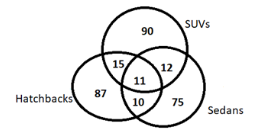
Study the given diagram carefully and answer the question. The number in different sections indicates the number of employees of ABC company owning different types of cars. Total number of employees = 300.

What is the percentage of employees who have both Hatchbacks and Sedans?

  1. AOption (a)

    7.0%

  2. BOption (b)

    3.66%

  3. COption (c)

    2.0%

  4. DOption (d)

    18.78%

View answer & explanation

Correct answer

Answer: (a)A.

7.0%

Why this answer is correct

The region that best represents the number of employees who have both Hatchbacks and Sedans is shown below:

Here, the marked area shows the number of employees who have both Hatchbacks and Sedans.

So, the number of employees who have both Hatchbacks and Sedans ⇒ 11 + 10 = 21 

The the percentage of employees who have both Hatchbacks and Sedans ⇒ 21 × (100 ÷ 300) ⇒ 7%

Hence, "Option 1" is the correct answer.

Question 48

The correct empirical relationship between the mean, the median, and the mode of a set of data is given by:

  1. AOption (a)

    Mean - Mode = 4 × (Mean - Median)

  2. BOption (b)

    Mean - Mode = 3 × (Mean - Median)

  3. COption (c)

    Mean - Mode = 1 × (Mean - Median)

  4. DOption (d)

    Mean - Mode = 2 × (Mean - Median)

View answer & explanation

Correct answer

Answer: (b)B.

Mean - Mode = 3 × (Mean - Median)

Why this answer is correct

Shortcut Trick

The standard Empirical Formula for a moderately skewed distribution is Mode = 3 × Median − 2 × Mean.

Rearranging this to match the options: Mean − Mode = Mean − (3 × Median − 2 × Mean).

⇒ Mean − Mode = 3 × Mean − 3 × Median = 3 × (Mean − Median).

∴ The correct answer is Mean − Mode = 3 × (Mean − Median).

Alternate Method

Given: The terms representing central tendency: Mean, Median, and Mode.

Formula Used: Empirical relation: Mode = 3 × Median − 2 × Mean

Calculations:

⇒ Standard Relation: Mode = 3 Median − 2 Mean

⇒ Subtracting both sides from Mean: Mean − Mode = Mean − (3 Median − 2 Mean)

⇒ Mean − Mode = Mean − 3 Median + 2 Mean

⇒ Mean − Mode = 3 Mean − 3 Median

⇒ Mean − Mode = 3 × (Mean − Median)

This is the required empirical relationship often used in statistics for unimodal distributions that are not perfectly symmetrical.

∴ The correct answer is Mean − Mode = 3 × (Mean − Median).

Additional Information

Symmetrical Distribution

In a perfectly symmetrical bell-shaped curve (Normal Distribution), the values of Mean, Median, and Mode are all equal (Mean = Median = Mode).

Skewed Distribution

For a positively skewed distribution, Mean > Median > Mode. For a negatively skewed distribution, Mode > Median > Mean.

Karl Pearson Formula

The empirical relation was proposed by Karl Pearson and is applicable to moderately skewed data only. It fails for highly skewed data.

Median Position

In any moderately skewed distribution, the Median always lies between the Mode and the Mean.

Question 49

The total number of elements known at present is:

  1. AOption (a)

    117

  2. BOption (b)

    116

  3. COption (c)

    118

  4. DOption (d)

    115

View answer & explanation

Correct answer

Answer: (c)C.

118

Why this answer is correct

The correct answer is 118.

Key Points

  • As of now, there are 118 confirmed elements in the periodic table, ranging from Hydrogen (element 1) to Oganesson (element 118).
  • These elements are classified into categories such as metals, nonmetals, and metalloids, and they are organized based on their atomic numbers.

Additional Information

Classification of elements:

  • S- block Elements - Group 1 (Alkali metals)  and Group 2 (Alkaline Earth Metals) of the periodic table are called S- block elements.
  • P-Block Elements - The atoms of the elements of which the last electron from their outer shell inters p- subshell is called P-block elements.
  • D- block Elements - They are commonly known as Transition Metals.
  • F- block Elements - They are commonly known as Inner- Transition Metals.
  • The f-block consists of the two series, lanthanoids (the fourteen elements following lanthanum) and actinoids (the fourteen elements following actinium).

Naturally Occurring Elements:

  • There are 94 naturally occurring elements out of which 6 are extremely trace elements.
  • 24 elements are synthetic out of a total of 118 elements which are produced by nuclear reactions.
  • Trace elements which are counted as naturally occurring are astatine, plutonium, technetium, neptunium, francium, promethium etc.
  • Some common naturally occurring elements are -  Carbon, nitrogen, oxygen, iron, noble gases, etc.

Question 50

For a neutralisation reaction, the reactants should be:

  1. AOption (a)

    base and water

  2. BOption (b)

    salt and water

  3. COption (c)

    acid and water

  4. DOption (d)

    acid and base

View answer & explanation

Correct answer

Answer: (d)D.

acid and base

Why this answer is correct

The correct answer is acid and base

Key Points

  • A neutralization reaction is a chemical reaction in which an acid reacts with a base to produce salt and water.
  • This process helps in neutralizing the properties of both the acid and the base.
  • For example, when hydrochloric acid (HCl) reacts with sodium hydroxide (NaOH), the products are sodium chloride (NaCl) and water (H₂O)

Additional Information

  • Acid:
  • Acids are substances that donate protons (

H^+H+) in a solution. They have a sour taste and can conduct electricity.

  • Examples include hydrochloric acid (HCl), sulfuric acid (H₂SO₄), and acetic acid (CH₃COOH).
  • Base:
  • Bases are substances that accept protons or donate hydroxide ions (

OH^-OH−) in a solution. They have a bitter taste and feel slippery.

  • Examples include sodium hydroxide (NaOH), potassium hydroxide (KOH), and calcium hydroxide (Ca(OH)₂).
  • Salt:
  • A salt is formed when the cation from the base combines with the anion from the acid. It is typically an ionic compound.
  • For example, when HCl reacts with NaOH, the resulting salt is sodium chloride (NaCl).
  • Water:
  • Water is produced in the reaction as a result of the combination of hydrogen ions from the acid and hydroxide ions from the base.
  • This is why neutralization reactions are also important in regulating pH levels in various environments.

Question 51

Which of the following festivals of Odisha State commemorates the rich maritime history of Odisha that is celebrated throughout the state?

  1. AOption (a)

    Bali Yatra

  2. BOption (b)

    Chhath Puja

  3. COption (c)

    Rath Yatra

  4. DOption (d)

    Amla Navami

View answer & explanation

Correct answer

Answer: (a)A.

Bali Yatra

Why this answer is correct

The correct answer is Bali Yatra

Key Points

  • Bali Yatra is a festival that commemorates the rich maritime history of Odisha and is celebrated throughout the state.
  • In the historic city of Cuttack, a week-long event is organised starting from the day of Kartika Purnima 
  • (full moon day in the month of Kartik i.e October-November).
  • Cuttack is also the commercial capital of Odisha which hosts a large number of trading and business houses in and around the city.
  • It is also famous for its Durga puja which is the most important festival in Odisha and West Bengal.
  • Cuttack is also the birthplace of Netaji Subhas Chandra Bose.

Additional Information

  • Chhath Puja
  • Chhath Puja is dedicated to Surya Dev (the Sun God) and Chhathi Maiya (the goddess of energy).
  • The festival is celebrated over four days, with rituals including fasting, taking holy baths, and making offerings of thekua (a traditional sweet), fruits, and kheer (rice pudding) to the Sun during sunrise and sunset
  • It involves offering prayers to the Sun for health, prosperity, and the well-being of family members.
  • Rath Yatra
  • Rath Yatra, primarily celebrated in Puri, Odisha, marks the annual journey of Lord Jagannath,
  • along with his siblings, Balabhadra and Subhadra, in a grand chariot procession.
  • The chariots are pulled by thousands of devotees.
  • This festival symbolizes the unity of people from different backgrounds and communities as they come together to pull the chariots and participate in the celebrations, showcasing devotion and camaraderie.
  • Amla Navami
  • Amla Navami is a Hindu festival that celebrates the Indian gooseberry (amla), which is considered sacred and believed to have numerous health benefits.
  • The festival typically falls on the Navami (ninth day) of the Shukla Paksha (waxing phase of the moon) in the month of Kartika.

Question 52

Two parallel lines I and m are intersected by a transversal p. The quadrilateral formed by the bisectors of the interior angles thus obtained is necessarily a:

  1. AOption (a)

    rhombus

  2. BOption (b)

    rectangle

  3. COption (c)

    square

  4. DOption (d)

    parallelogram, but not a rectangle

View answer & explanation

Correct answer

Answer: (b)B.

rectangle

Why this answer is correct

Shortcut Trick

The bisectors of interior angles on the same side of a transversal meet at 90°.

Since this occurs for both pairs of interior angles, the resulting quadrilateral has four right angles.

A quadrilateral with four right angles is necessarily a rectangle.

This is a fundamental property of parallel lines and their transversals.

∴ The correct answer is rectangle.

Alternate Method

Given: Parallel lines l ∥ m and a transversal p.

Formula Used: Sum of interior angles on the same side of a transversal = 180°.

Let the transversal p intersect parallel lines l and m at points A and B respectively.

⇒ Let the interior angles at A be α and 180° − α.

⇒ Since l ∥ m, the alternate interior angles at B are also α and 180° − α.

⇒ The angle between the bisectors of α and 180° − α at point A is ½(α) + ½(180° − α) = 90°.

⇒ Similarly, the angle between the bisectors at point B is 90°.

⇒ In ▵APB, the sum of angles = ½(α) + ½(180° − α) + ∠APB = 180°.

⇒ 90° + ∠APB = 180° ⇒ ∠APB = 90°.

⇒ Similarly, ∠AQB = 90°.

⇒ Since all four interior angles of quadrilateral APBQ are 90°, it is a rectangle.

∴ The correct answer is rectangle.

Additional Information

Consecutive Interior Angles

When two parallel lines are cut by a transversal, the pairs of interior angles on the same side are supplementary (sum = 180°).

Angle Bisector Property

The bisectors of two adjacent supplementary angles always intersect at a right angle (90°).

Rectangle vs Square

The quadrilateral is a square only if the transversal is perpendicular to the parallel lines; otherwise, it is always a rectangle.

2

Question 53

Read the given statement and the arguments carefully and select the appropriate answer from the given options.

Statement:

Schools should encourage self-discipline among children of all ages.

Arguments:

I. Children till the age of 7 years are not mature enough to understand the concept of discipline

II. Discipline lasts longer and more effective when instilled by oneself than by others from outside.

  1. AOption (a)

    Both I and II strengthen the statement.

  2. BOption (b)

    Both I and II weaken the statement.

  3. COption (c)

    I weakens while II strengthens the statement.

  4. DOption (d)

    II weakens while I strengthens the statement.

View answer & explanation

Correct answer

Answer: (c)C.

I weakens while II strengthens the statement.

Why this answer is correct

Given:

Statement :

Schools should encourage self-discipline among children of all ages.

Now,

Arguments :

I. Children till the age of 7 years are not mature enough to understand the concept of discipline - Weakens (This argument suggests that children under 7 lack the maturity for self-discipline, which contradicts the claim that it should be encouraged for 'all ages').

II. Discipline lasts longer and more effective when instilled by oneself than by others from outside - Strengthens (This argument justifies the efficacy and long-term benefit of self-discipline).

So, I weakens while II strengthens the statement.

Hence, the correct answer is "Option 3".

Question 54

What is cash reserve ratio?

  1. AOption (a)

    The portion that banks can invest in the market

  2. BOption (b)

    The minimum balance to be maintained by a customer in the bank

  3. COption (c)

    The minimum amount of deposit that the commercial banks have to hold as reserves with the RBI.

  4. DOption (d)

    The portion that banks must maintain before extending credit to customers

View answer & explanation

Correct answer

Answer: (c)C.

The minimum amount of deposit that the commercial banks have to hold as reserves with the RBI.

Why this answer is correct

The correct answer is option 3

Key Points

  • The Cash Reserve Ratio (CRR) is a regulatory requirement set by a country's central bank that mandates commercial banks
  • It is the minimum amount of deposit that the commercial banks have to hold as reserves with the RBI.
  • CRR( Cash Reserve Ratio) helps maintain liquidity in the banking system.
  • By requiring banks to hold a portion of their deposits in reserve,
  • the central bank ensures that banks have enough liquidity to meet the withdrawal demands of their customers.
  • It is a tool used by central banks to control the money supply in the economy which is called Monetary Policy
  • By adjusting the CRR, the central bank can influence the amount of money available for banks to lend.
  • A change in the CRR can influence interest rates, lending capacity, and overall economic activity.
  • For example,
  • During times of economic slowdown, a central bank might lower the CRR to encourage banks to lend more money to businesses and consumers.

Important Points

  • The Cash Reserve Ratio can be calculated using the following formula:
  • CRR=(Total Net Demand and Time Liabilities (NDTL)Cash Reserves)×100CRR=( Total Net Demand and Time Liabilities (NDTL) Cash Reserves )×100
  • Where:
  • Cash Reserves: The amount of cash a bank must hold with the central bank.
  • Total Net Demand and Time Liabilities (NDTL):
  • This includes the total demand deposits (savings and current accounts) and time deposits (fixed deposits) of the bank.

Question 55

Refer to the following letter, number, symbol series and answer the question.

C @ B N M K J % F K L I & S E W * P O $ E A

How many such symbols are there in the above series which are immediately preceded and followed by a vowel?

  1. AOption (a)

    Zero

  2. BOption (b)

    Two

  3. COption (c)

    One

  4. DOption (d)

    Three

View answer & explanation

Correct answer

Answer: (c)C.

One

Why this answer is correct

Given series: C @ B N M K J % F K L I & S E W * P O $ E A

According to the question, such symbols which are immediately preceded and followed by a vowel:

Required condition: Vowel - Symbol - Vowel

C @ B N M K J % F K L I & S E W * P O $ E A

Thus, there is one such symbols which are immediately preceded and followed by a vowel.

Hence, "Option 3" is the correct answer.

Question 56

Which statement about Mendeleev's Periodic Table is INCORRECT?

  1. AOption (a)

    Horizontal rows are called 'periods'.

  2. BOption (b)

    Vertical columns are called 'groups'.

  3. COption (c)

    The properties of elements are the periodic functions of their atomic numbers.

  4. DOption (d)

    Elements are arranged in the order of their increasing atomic masses.

View answer & explanation

Correct answer

Answer: (c)C.

The properties of elements are the periodic functions of their atomic numbers.

Why this answer is correct

The correct answer is option 3

Key Points

  • Mendeleev's Periodic Table, created in 1869 by Dmitri Mendeleev,
  • It was one of the first attempts to organize the known elements based on their properties and behaviors.
  • The table consists of horizontal rows called periods and vertical columns called groups or families.
  • He arranged the elements in order of increasing atomic mass.
  • He observed that when elements were listed this way, elements with similar chemical properties appeared at regular intervals.
  • This led to the recognition of periodic trends, such as similar reactivity or similar physical properties among elements in the same group.
  • He noted that certain properties of elements, such as atomic volume, density, and melting point, tended to recur at regular intervals when arranged by atomic mass.
  • This observation is known as the periodic law.
  • According to the third Statement,​
  • It reflects the principles of the modern periodic table developed after Mendeleev's work, which is arranged by atomic number (the number of protons in the nucleus of an atom).
  • Henry Moseley established that the atomic number is a more fundamental property than atomic mass, leading to the modern understanding of the periodic law.
  • In Mendeleev's time, atomic numbers were not known; therefore, his table could not have been based on atomic numbers.

Question 57

An article whose marked price is ₹800 is sold at a profit of 50% when there are successive discounts of 20%, 10%, and 5% offered by the shopkeeper. The selling price (rounded to the nearest rupee) when the article is sold at a profit of 60%, with the same cost price, is:

  1. AOption (a)

    ₹584

  2. BOption (b)

    ₹504

  3. COption (c)

    ₹604

  4. DOption (d)

    ₹684

View answer & explanation

Correct answer

Answer: (a)A.

₹584

Why this answer is correct

Shortcut Trick

Net multiplier for Successive Discounts of 20%, 10%, and 5% = 0.8 × 0.9 × 0.95 = 0.684.

Selling Price (SP1) = 800 × 0.684 = ₹547.2.

Given Profit is 50%, so CP × 1.5 = 547.2 ⇒ CP = 547.2 ÷ 1.5 = ₹364.8.

New Selling Price (SP2) at 60% profit = 364.8 × 1.6 = ₹583.68.

Rounding to the nearest rupee, we get ₹584.

∴ The correct answer is ₹584.

Alternate Method

Given: Marked Price (MP) = ₹800, Discounts = 20%, 10%, 5%, Initial Profit = 50%, Target Profit = 60%. Formulas: SP = MP × (100 − D1)% × (100 − D2)% ... | CP = SP ÷ (1 + P1%) | New SP = CP × (1 + P2%)

⇒ First, calculate the Final Selling Price after three discounts: ⇒ SP = 800 × (80/100) × (90/100) × (95/100) ⇒ SP = 800 × 0.8 × 0.9 × 0.95 = ₹547.2 ⇒ Now, find Cost Price (CP) using Profit = 50%: ⇒ CP = 547.2 ÷ (1 + 50/100) = 547.2 ÷ 1.5 = ₹364.8 ⇒ Calculate New Selling Price for 60% profit: ⇒ New SP = 364.8 × (1 + 60/100) = 364.8 × 1.6 = ₹583.68 ⇒ Rounding to the nearest integer, we get ₹584.

∴ The correct answer is ₹584.

Additional Information

Successive Discounts

When multiple discounts are applied one after another, the single equivalent discount is not the sum, but calculated as 100 − [100 × (1 − d1) × (1 − d2)...].

Relation between MP and CP

CP × (100 + Profit%) = MP × (100 − Discount%). This is useful for finding the ratio of MP to CP directly.

Question 58

If a constant current of 2 A is maintained in a conductor of resistance 100 Ω, then the potential difference across the conductor is:

  1. AOption (a)

    200 V

  2. BOption (b)

    0.02 V

  3. COption (c)

    50 V

  4. DOption (d)

    20 V

View answer & explanation

Correct answer

Answer: (a)A.

200 V

Why this answer is correct

The correct answer is 200V.

Key Points

  • To find the potential difference across a conductor when a constant current is maintained, we can use Ohm's Law, which is given by the formula:
  • V=I×R
  • Where,​
  • V = Potential Difference (Voltage)
  • IIII  = Current = 2 A
  • RRRR  = Resistance = 100 Ω
  • Substituting the given values into the formula
  • V=2A×100Ω=200V
  • Therefore, the potential difference across the conductor is 200 volts (V).

Question 59

As per the data from the National Statistical Office, as of the year 2021, which Indian state has the lowest female literacy rate?

  1. AOption (a)

    Rajasthan

  2. BOption (b)

    Gujarat

  3. COption (c)

    Himachal Pradesh

  4. DOption (d)

    Uttarakhand

View answer & explanation

Correct answer

Answer: (a)A.

Rajasthan

Why this answer is correct

The correct answer is Rajasthan

Key Points

  • As per the data from the National Statistical Office (NSO) for the year 2021, the Indian state with the lowest female literacy rate is Rajasthan.
  • Rajasthan has consistently been reported as having one of the lowest female literacy rates in India.
  • According to various surveys and reports, the literacy rate of women in Rajasthan is significantly lower than the national average,
  • largely due to socio-economic factors, cultural traditions, and limited access to education in rural areas.
  • Other states with relatively low female literacy rates include Bihar and Uttar Pradesh, but Rajasthan remains the lowest as per the 2021 data.
  • Efforts have been made through government programs like Beti Bachao, Beti Padhao to improve female literacy rates across India, including in states like Rajasthan.

Additional Information

  • Gujarat
  • Female Literacy Rate: Approximately 70%–72%.
  • Gujarat has shown steady improvement in female literacy over the years, especially in urban areas.
  • However, there is still a notable rural-urban divide.
  • Various government programs, such as providing scholarships and free education for girls, have been initiated to improve this further.
  • Himachal Pradesh
  • Female Literacy Rate: Around 80%.
  • Himachal Pradesh has one of the highest female literacy rates in India, reflecting strong emphasis on education in the state.
  • Both rural and urban areas have benefited from government initiatives and a robust school infrastructure, which has helped bridge the gender gap in literacy.
  • Uttarakhand
  • Female Literacy Rate: Around 70%–74%.
  • Uttarakhand's female literacy rate has seen improvements in recent years due to increased focus on girls’ education, particularly in rural and hilly areas.
  • Programs promoting education in these regions have contributed to raising the literacy rate.

Question 60

The numbers obtained when 200 is increased by 5% and decreased by 15% are respectively:

  1. AOption (a)

    180 and 170

  2. BOption (b)

    210 and 170

  3. COption (c)

    215 and 150

  4. DOption (d)

    210 and 175

View answer & explanation

Correct answer

Answer: (b)B.

210 and 170

Why this answer is correct

Shortcut Trick

Increased Value = 200 × (100 + 5)% = 200 × 1.05 = 210

Decreased Value = 200 × (100 − 15)% = 200 × 0.85 = 170

∴ The correct answer is 210 and 170.

Alternate Method

Given:

Initial Number = 200

Calculation 1: 5% Increase

⇒ Amount of increase = 5% of 200 = (5/100) × 200 = 10

⇒ New Number = 200 + 10 = 210

Calculation 2: 15% Decrease

⇒ Amount of decrease = 15% of 200 = (15/100) × 200 = 30

⇒ New Number = 200 − 30 = 170

∴ The correct answer is 210 and 170.

Additional Information

Percentage Change

To increase a value by x%, multiply it by (1 + x/100). To decrease by x%, multiply by (1 − x/100).

Successive Percentage Change

The effective change for two successive percentages a% and b% is given by [a + b + (ab/100)]%.

Question 61

If three wires of tungsten, manganin and hard rubber are identical in dimension then resistance of ______.

  1. AOption (a)

    Tungsten is least

  2. BOption (b)

    Hard rubber is least

  3. COption (c)

    Tungsten is highest

  4. DOption (d)

    Manganin is highest

View answer & explanation

Correct answer

Answer: (a)A.

Tungsten is least

Why this answer is correct

The correct answer is Tungsten is least.

Key Points

  • Tungsten has a relatively low electrical resistivity compared to Manganin and Hard Rubber.
  • Manganin is an alloy with higher resistivity compared to tungsten, often used in precision resistors.
  • Hard Rubber has a very high resistivity and acts as an insulator.
  • Given identical dimensions, the material's resistivity directly affects its resistance, making Tungsten the material with the least resistance.

Additional Information

  • Electrical Resistivity: This is a fundamental property of a material that quantifies how strongly it resists the flow of electric current. It is usually denoted by the Greek letter ρ (rho) and is measured in ohm-meters (Ω·m).
  • Tungsten:
  • Tungsten has a low resistivity of about 5.6 x 10⁻⁸ Ω·m.
  • It is commonly used in electrical applications like filaments in light bulbs due to its low resistivity and high melting point.
  • Manganin:
  • Manganin is an alloy typically composed of copper, manganese, and nickel.
  • It has a higher resistivity of about 48 x 10-8 Ω·m.
  • Due to its stable resistivity over a wide range of temperatures, it is used in precision resistors and measurement devices.
  • Hard Rubber:
  • Hard Rubber, also known as ebonite, is a material with very high resistivity.
  • It acts as an insulator and is used in various applications where electrical insulation is required.
  • Its resistivity is in the range of 1013 to 1016 Ω·m, which is significantly higher than that of metals like tungsten and manganin.
  • Resistance Calculation:
  • The resistance (R) of a wire is calculated using the formula R = ρ(L/A), where ρ is the resistivity, L is the length, and A is the cross-sectional area.
  • For wires of identical dimensions, the resistance is directly proportional to the resistivity of the material.

Question 62

Calcium sulphate hemihydrates is the chemical name for:

  1. AOption (a)

    washing soda

  2. BOption (b)

    gypsum

  3. COption (c)

    plaster of Paris

  4. DOption (d)

    baking powder

View answer & explanation

Correct answer

Answer: (c)C.

plaster of Paris

Why this answer is correct

The correct answer is Plaster of Paris.

Key Points

  • Calcium sulphate hemihydrate refers to the chemical compound with the formula
  • ​CaSO4⋅12H2O​CaSO4⋅12H2O​CaSO4⋅12H2O CaSO4​⋅21​H2​O.
  • It is commonly known as plaster of Paris and is formed by the partial hydration of gypsum
  • (which is calcium sulfate dihydrate, CaSO4⋅2H2OCaSO4⋅2H2OCaSO4⋅2H2O CaSO4​⋅2H2​O).
  • When the plaster of Paris is mixed with water, it rehydrates and hardens, making it suitable for construction, art, and medical applications
  • ​(like casts for broken bones).

Additional Information

  • Washing soda: This is sodium carbonate (Na2CO3⋅10H2ONa2CO3⋅10H2ONa2CO3⋅10H2O Na2​CO3​⋅10H2​O), used in cleaning and laundry.
  • Gypsum: This is calcium sulfate dihydrate (CaSO4⋅2H2OCaSO4⋅2H2OCaSO4⋅2H2O CaSO4​⋅2H2​O), which is not the same as plaster of Paris.
  • Baking powder: This is a leavening agent typically containing sodium bicarbonate and acid, used in baking.

Question 63

A, B and C can complete a piece of work in 48, 12 and 24 days, respectively. Working together, they will complete the work in _____ days.

  1. AOption (a)

    477\frac{47}{7}

  2. BOption (b)

    7

  3. COption (c)

    517\frac{51}{7}

  4. DOption (d)

    487\frac{48}{7}

View answer & explanation

Correct answer

Answer: (d)D.

487\frac{48}{7}

Why this answer is correct

Shortcut Trick

Total Work (LCM of 48, 12, 24) = 48 units.

Efficiency of A = 48 ÷ 48 = 1 unit/day.

Efficiency of B = 48 ÷ 12 = 4 units/day.

Efficiency of C = 48 ÷ 24 = 2 units/day.

Combined efficiency = 1 + 4 + 2 = 7 units/day.

Time taken = 48 ÷ 7 days.

∴ The correct answer is 48/7 days.

Alternate Method

Given:

Time taken by A = 48 days

Time taken by B = 12 days

Time taken by C = 24 days

PersonDaysTotal WorkEfficiency
A48481
B124
C242

Calculations:

⇒ Total Efficiency of (A + B + C) = Efficiency of A + Efficiency of B + Efficiency of C

⇒ Total Efficiency = 1 + 4 + 2 = 7 units/day

⇒ Time taken by all three working together = Total Work ÷ Total Efficiency

⇒ Time = 48 ÷ 7 days

∴ The correct answer is 48/7 days.

Additional Information

Combined Work Formula

If n persons can do a work in x1, x2... xn days, their combined 1-day work is (1/x1 + 1/x2 + ... + 1/xn).

Work and Wages

Wages are always distributed in the ratio of the efficiencies of the workers (or work done), not the number of days taken.

Efficiency and Time

Efficiency is inversely proportional to the time taken to complete the work. Efficiency = Work ÷ Time.

Question 64

What will be the percentage of tW gametes formed by a plant with genotype TtWw?

  1. AOption (a)

    25%

  2. BOption (b)

    37.5%

  3. COption (c)

    75%

  4. DOption (d)

    50%

View answer & explanation

Correct answer

Answer: (a)A.

25%

Why this answer is correct

The correct answer is 25%.

Key Points

  • The genotype TtWw represents a dihybrid organism with two heterozygous gene pairs.
  • According to Mendelian genetics, each gene pair segregates independently during gamete formation.
  • The possible gametes formed by the genotype TtWw are TW, Tw, tW, and tw.
  • Each gamete has an equal probability of 25% being formed.

Additional Information

  • Mendelian Genetics
  • Named after Gregor Mendel, the father of genetics, Mendelian genetics explains how traits are inherited from one generation to the next.
  • Mendel's principles include the Law of Segregation and the Law of Independent Assortment.
  • The Law of Segregation states that each individual has two alleles for each trait, which segregate during gamete formation so that each gamete receives only one allele.
  • The Law of Independent Assortment states that alleles of different genes assort independently of one another during gamete formation.
  • Genotype and Phenotype
  • The genotype refers to the genetic makeup of an organism, consisting of alleles inherited from the parents.
  • The phenotype is the observable physical or biochemical characteristics of an organism, as determined by both genotype and environmental influences.
  • Gamete Formation
  • Gametes are reproductive cells (sperm in males and eggs in females) that carry only one set of chromosomes.
  • During gamete formation, the alleles for each gene segregate, and each gamete ends up with only one allele for each gene.
  • Dihybrid Cross
  • A dihybrid cross is a breeding experiment between P generation (parental generation) organisms that differ in two traits.
  • The typical phenotypic ratio observed in the F2 generation of a dihybrid cross is 9:3:3:1, showing independent assortment of alleles.

Question 65

The equation (x + 1)2 -2(x + 1) = 0 has:

  1. AOption (a)

    no real roots

  2. BOption (b)

    two real roots

  3. COption (c)

    one real root

  4. DOption (d)

    two equal roots

View answer & explanation

Correct answer

Answer: (b)B.

two real roots

Why this answer is correct

Shortcut Trick

Factor out the common term (x + 1) from the equation.

(x + 1) [(x + 1) − 2] = 0

(x + 1) (x − 1) = 0

Equating each factor to zero, we get x = −1 and x = 1.

Since there are two distinct values, the equation has two distinct real roots.

∴ The correct answer is two real roots.

Alternate Method

Given: (x + 1)2 − 2(x + 1) = 0

Formula Used: Standard form of a quadratic equation is ax2 + bx + c = 0. The nature of roots is determined by the discriminant (D) = b2 − 4ac.

⇒ (x2 + 2x + 1) − 2(x + 1) = 0

⇒ x2 + 2x + 1 − 2x − 2 = 0

⇒ x2 − 1 = 0

Here, a = 1, b = 0, and c = −1.

⇒ D = (0)2 − 4 × (1) × (−1)

⇒ D = 0 + 4 = 4

Since D > 0, the quadratic equation has two real and distinct roots.

Solving x2 − 1 = 0:

⇒ x2 = 1

⇒ x = ±√1 = 1, −1

∴ The correct answer is two real roots.

Additional Information

Nature of Roots

For a quadratic equation, if the discriminant D > 0, roots are real and distinct; if D = 0, roots are real and equal; if D < 0, roots are imaginary.

Discriminant Formula

The discriminant D for the equation ax2 + bx + c = 0 is calculated as D = b2 − 4ac.

Difference of Squares

The expression x2 − a2 can be factorized using the identity (x − a)(x + a).

Question 66

The correct relation for heat produced by electric current is:

  1. AOption (a)

    H = I2.R

  2. BOption (b)

    H=V.I T\mathrm{H}=\frac{\mathrm{V} . I}{\mathrm{~T}}

  3. COption (c)

    H = V.I.T

  4. DOption (d)

    H = R/T

View answer & explanation

Correct answer

Answer: (c)C.

H = V.I.T

Why this answer is correct

The correct answer is H = V.I.T.

Key Points

  • The formula H = V.I.T correctly represents the heat produced by an electric current where H is the heat, V is the voltage, I is the current, and T is the time.
  • This relation is derived from Joule's Law of Heating which states that the heat produced in a resistor is directly proportional to the square of the current, the resistance, and the time for which the current flows through the resistor.
  • When considering the electrical power equation P = V.I, and noting that power P is also equal to the rate of heat produced, we can multiply by time T to get the total heat produced: H = P.T = V.I.T.
  • This formula is essential in understanding electrical heating in various appliances and circuits, ensuring their efficient and safe operation.

Additional Information

  • Joule's Law of Heating:
  • Joule's Law of Heating states that the heat produced in a resistor is proportional to the square of the current, the resistance, and the time for which the current flows through the resistor.
  • Mathematically, it is expressed as H = I².R.T.
  • This law is fundamental in understanding how electrical energy is converted into heat energy in resistive elements.
  • Voltage (V):
  • Voltage, or electric potential difference, is the difference in electric potential between two points.
  • It is the driving force that pushes electric current through a conductor.
  • Measured in volts (V), voltage can be thought of as the electrical pressure that causes current to flow in a circuit.
  • Current (I):
  • Electric current is the flow of electric charge through a conductor or a circuit.
  • It is measured in amperes (A).
  • Current can be direct (DC) or alternating (AC), depending on whether the flow of charge is constant or varies with time.
  • Time (T):
  • In the context of electrical heating, time refers to the duration for which the current flows through the resistor.
  • It is measured in seconds (s).
  • The longer the current flows, the more heat is produced, as indicated by the formula H = V.I.T.

Question 67

The average age of a class of 50 boys is 12.9 years. It increases to 13 years when one new boy joins the class. The age (in years) of the new boy is ______.

  1. AOption (a)

    15

  2. BOption (b)

    18

  3. COption (c)

    16

  4. DOption (d)

    19

View answer & explanation

Correct answer

Answer: (b)B.

18

Why this answer is correct

Shortcut Trick

Use the deviation method: Age of the new person = New Average + (Initial number of items × Increase in average)

Increase in average = 13 − 12.9 = 0.1 years

Age of the new boy = 13 + (50 × 0.1)

⇒ Age = 13 + 5 = 18 years

∴ The correct answer is 18 years.

Alternate Method

Given: Initial boys = 50, Initial Average = 12.9 years, New total boys = 51, New Average = 13 years.

Formula: Total Sum = Average × Number of items

⇒ Total age of 50 boys = 50 × 12.9 = 645 years

⇒ Total age of 51 boys (after one joins) = 51 × 13 = 663 years

⇒ Age of the new boy = Total age of 51 boys − Total age of 50 boys

⇒ Age of the new boy = 663 − 645 = 18 years

∴ The correct answer is 18 years.

Additional Information

Average of Group

The average (Arithmetic Mean) is calculated by dividing the sum of all values by the total number of values (Sum ÷ n).

Effect of Inclusion

When a new member joins, if the new average is higher than the original, the new member's value is greater than the original average.

Weighted Average

Used when two or more groups with different averages are combined: Averagetotal = (n1×A1 + n2×A2) ÷ (n1 + n2).

Question 68

Select the option that is related to the seventh number in the same way as the second number is related to the first number, the fourth number is related to the third number and the sixth number is related to the fifth number.

7 ∶ 2 ∶∶ 26 ∶ 3 ∶∶ 63 ∶ 4 ∶∶ 124 ∶ ?

  1. AOption (a)

    4

  2. BOption (b)

    7

  3. COption (c)

    5

  4. DOption (d)

    6

View answer & explanation

Correct answer

Answer: (c)C.

5

Why this answer is correct

The logic followed here is:

Logic: (2nd number)3 - 1 = 1st number.

Now,

For, 7 ∶ 2

⇒ (23) - 1 = 8 - 1 = 7.

For, 26 ∶ 3

⇒ (33) - 1 = 27 - 1 = 26.

For, 63 ∶ 4

⇒ (43) - 1 = 64 - 1 = 63.

Similarly, for 124 ∶ ?

⇒ (53) - 1 = 125 - 1 = 124.

Hence, the correct answer is "Option 3".

Question 69

Three statements are given, followed by four conclusions numbered I, II, III and IV. Assuming the statements to be true, even if they seem to be at variance with commonly known facts, decide which of the conclusions logically follow(s) from the statements

Statements:

  1. All cars are scooters.
  2. All scooters are trucks.
  3. No helicopter is truck.

Conclusions:

I. No truck is scooter.

II. All cars are trucks.

III. Some trucks are scooters.

IV. No car is helicopter.

  1. AOption (a)

    All the conclusions follow

  2. BOption (b)

    Only either conclusions I or IV follow and III follow

  3. COption (c)

    Only conclusions II, III and IV follow

  4. DOption (d)

    Only either conclusions I or IV follow

View answer & explanation

Correct answer

Answer: (c)C.

Only conclusions II, III and IV follow

Why this answer is correct

The least possible Venn diagram for the given statements is as shown below :

Conclusions:

I. No truck is scooter → Does not follow (As all scooters are trucks. As whole scooters comes in trucks, therefore it is false)

II. All cars are trucks → Follow (As all cars are scooters and all scooters are trucks. As whole cars comes in scooters which whole comes in trucks, therefore it is true.)

III. Some trucks are scooters → Follow (As (As all scooters are trucks. As whole scooters comes in trucks, therefore it is true)

IV. No car is helicopter → Follow (As all cars are scooters, all scooters are trucks and no helicopter is truck. As whole cars comes in scooters which whole comes in trucks which cannot be helicopter, therefore it is true.)

∴ Here, Only conclusions II, III and IV follow.​

Hence, the correct answer is "Option 3"

Question 70

Refer to the following letter, number, symbol series and answer the question.

(Left) F 1 % 5 & 2 L H 8 4 # T * G 2 7 F 8 C 2 Y $ M 6 F (Right).

How many such numbers are there which are immediately preceded by a letter and also immediately followed by a number?

  1. AOption (a)

    1

  2. BOption (b)

    4

  3. COption (c)

    2

  4. DOption (d)

    3

View answer & explanation

Correct answer

Answer: (c)C.

2

Why this answer is correct

Given series: (Left) F 1 % 5 & 2 L H 8 4 # T * G 2 7 F 8 C 2 Y $ M 6 F (Right)

According to the question, such numbers which are immediately preceded by a letter and also immediately followed by a number:

Required condition: Letter - Number - Number

(Left) F 1 % 5 & 2 L H 8 4 # T * G 2 7 F 8 C 2 Y $ M 6 F (Right)

Thus, there are two such numbers which are immediately preceded by a letter and also immediately followed by a number.

Hence, "Option 3" is the correct answer.

Question 71

Identify the state of India in which the Bandipur National Park is located?

  1. AOption (a)

    Odisha

  2. BOption (b)

    Karnataka

  3. COption (c)

    Andhra Pradesh

  4. DOption (d)

    Madhya Pradesh

View answer & explanation

Correct answer

Answer: (b)B.

Karnataka

Why this answer is correct

The correct answer is Karnataka.

Key Points

  • Bandipur National Park is located in the state of Karnataka, India
  • The park was established in 1974 as a tiger reserve under Project Tiger.
  • It is situated in the Chamarajanagar district and is part of the Nilgiri Biosphere Reserve,
  • which includes other protected areas like Nagarhole National Park and Mudumalai National Park.
  • Bandipur National Park is known for its rich biodiversity, including a variety of flora and fauna, such as tigers, elephants, leopards, and several species of birds.

Additional Information

  • Some national Parks of Karnataka
  • Nagarhole National Park (Rajiv Gandhi National Park)
  • Location: Kodagu and Chamarajanagar districts.
  • Established: 1983.
  • A significant tiger reserve, Nagarhole is known for its healthy population of elephants, leopards, and various species of birds.
  • Kudremukh National Park
  • Location: Chikmagalur district.
  • Established: 1987.
  • It is Known for its lush green mountains and rich biodiversity, including several endemic species of flora and fauna.
  • The park derives its name from Kudremukh peak, which resembles a horse's face.

Question 72

Amongst six friends, G,  K, M, P, R, and V, each has a different height. R is shorter than K but taller than V, who is taller than G. P is taller than M but shorter than G. Who is the shortest of all six friends?

  1. AOption (a)

    P

  2. BOption (b)

    V

  3. COption (c)

    G

  4. DOption (d)

    M

View answer & explanation

Correct answer

Answer: (d)D.

M

Why this answer is correct

Given: Amongst six friends, G,  K, M, P, R, and V, each has a different height. 

1) R is shorter than K but taller than V, who is taller than G. 

K > R > V > G

2) P is taller than M but shorter than G.

K > R > V > G > P > M

Thus, according to the final arrangement is the shortest of all six friends.

Hence, "Option 4" is the correct answer.

Question 73

Which of the following options is the closest approximate value which will come in place of question mark (?) in the following equation?

14.96 + 10.96 + 13.16 - 12.89 × 2.04 = ?

  1. AOption (a)

    13

  2. BOption (b)

    17

  3. COption (c)

    19

  4. DOption (d)

    15

View answer & explanation

Correct answer

Answer: (a)A.

13

Why this answer is correct

Given:

Equation: 14.96 + 10.96 + 13.16 - 12.89 × 2.04 = ?

Approximation:

Round the numbers for easier calculations:

14.96 ≈ 15

10.96 ≈ 11

13.16 ≈ 13

12.89 ≈ 13

2.04 ≈ 2

Calculation:

Now, substitute the rounded values:

15 + 11 + 13 - 13 × 2

⇒ 15 + 11 + 13 - 26

⇒ = 39 - 26

⇒ = 13

∴ The closest approximate value for ? is 13.

Question 74

Why was the use of 'kulhads' discontinued?

  1. AOption (a)

    They posed a health risk

  2. BOption (b)

    They hurt the animals

  3. COption (c)

    They were very expensive

  4. DOption (d)

    Use of clay resulted in the loss of the fertile top-soil

View answer & explanation

Correct answer

Answer: (d)D.

Use of clay resulted in the loss of the fertile top-soil

Why this answer is correct

The correct answer is Use of clay resulted in the loss of the fertile top-soil.

Key Points

  • Large-scale production of kulhads required significant amounts of clay, which often came from the top, fertile layer of soil.
  • This removal of topsoil could negatively impact agricultural productivity in the long run.
  • Kulhads sometimes called a shikora, is a traditional handleless pottery cup from South Asia that is typically undecorated and unglazed, and is meant to be disposable.
  • While kulhads have eco-friendly advantages, the depletion of fertile topsoil for mass production became a significant reason for their discontinuation, especially in trains where they were widely used.
  • They are still used in some areas and efforts are being made to use them sustainably, like sourcing clay from non-agricultural land or using different production methods.

Additional Information

  • Fertile top soil has the following characteristics:
  • It is rich in nutrients necessary for basic plant nourishment.
  • This includes nitrogen, phosphorus and potassium.
  • It consists of adequate minerals such as boron, chlorine, cobalt, copper, iron, manganese, magnesium, molybdenum, sulphur and zinc.

Question 75

Select the option that is related to the seventh number in the same way as the second number is related to the first number, the fourth number is related to the third number and the sixth number is related to the fifth number.

20 ∶ 5 ∶∶ 56 ∶ 8 ∶∶ 12 ∶ 4 ∶∶ 42 ∶ ?

  1. AOption (a)

    21

  2. BOption (b)

    7

  3. COption (c)

    6

  4. DOption (d)

    10

View answer & explanation

Correct answer

Answer: (b)B.

7

Why this answer is correct

The logic followed here is:

Logic: (2nd number - 1) × 2nd number = 1st number.

Now,

For, 20 : 5

⇒ (5 - 1) × 5 = 4 × 5 = 20.

For, 56 : 8

⇒ (8 - 1) × 8 = 7 × 8 = 56.

For, 12 : 4

⇒ (4 - 1) × 4 = 3 × 4 = 12.

Similarly, for 42 ∶ ?

⇒ (7 - 1) × 7 = 42

⇒ 6 × 7 = 42

Hence, the correct answer is "Option 2".

Question 76

Which property does NOT show gradation with increasing molecular mass in any homologous series of carbon compounds?

  1. AOption (a)

    Boiling point

  2. BOption (b)

    Solubility in a particular solvent

  3. COption (c)

    Melting point

  4. DOption (d)

    Combustion

View answer & explanation

Correct answer

Answer: (d)D.

Combustion

Why this answer is correct

The correct answer is Combustion

Key Points

  • Combustion does not follow a consistent trend with molecular mass.
  • This is because the combustion process depends on the chemical nature of the substance and the energy released when it reacts with oxygen, rather than solely on the molecular mass.
  • While larger molecules may release more energy per mole when burned, the process does not exhibit a simple, predictable pattern based on increasing molecular mass.
  • Each compound burns according to its specific chemical structure and the amount of heat energy it can release.

Additional Information

  • Boiling Point
  • It Increases with increasing molecular mass.
  • As molecular mass increases, the size of the molecules also increases,
  • which leads to greater van der Waals (dispersion) forces between the molecules.
  • These intermolecular forces require more energy (in the form of heat) to break, resulting in higher boiling points.
  • Melting Point
  • It Generally increases with increasing molecular mass but can vary based on molecular structure (e.g., branching).
  • It is Similar to boiling points, larger molecules tend to have higher melting points due to increased van der Waals forces.
  • However, branching in carbon chains can disrupt packing efficiency, leading to exceptions
  • Solubility in a Particular Solvent:
  • Solubility can show a gradation depending on the nature of the solvent and the compound.
  • For instance, in a homologous series like alcohols, solubility in water decreases with increasing molecular mass because larger alcohol molecules have a greater hydrophobic (water-repellent) hydrocarbon chain, making them less soluble in water.

Question 77

Each of the digits in the number 43162857 is arranged in descending order from left to right. What will be the difference of the digits which are second from the left and second from the right in the new number thus formed?

  1. AOption (a)

    3

  2. BOption (b)

    7

  3. COption (c)

    6

  4. DOption (d)

    5

View answer & explanation

Correct answer

Answer: (d)D.

5

Why this answer is correct

Given number: '43162857'

After arranging in descending order:

Digits43162857
Descending order87654321


Now,

the difference between the digits which are second from the left and second from the right in the new number is 7 - 2 = 5.

Hence, the correct answer is "Option 4".

Question 78

The present ages of Kamal and Keerthi are in the ratio 3 ∶ 5. After 9 years, the ratio of their ages will become 3 ∶ 4. The present age of Keerthi is _______.

  1. AOption (a)

    15 years

  2. BOption (b)

    17 years

  3. COption (c)

    12 years

  4. DOption (d)

    19 years

View answer & explanation

Correct answer

Answer: (a)A.

15 years

Why this answer is correct

Shortcut Trick

Ratio of Kamal and Keerthi = 3 : 5 (Diff = 2)

Ratio after 9 years = 3 : 4 (Diff = 1). Multiply by 2 to equate difference → 6 : 8

Increase in Keerthi's ratio units = 8 − 5 = 3 units

3 units = 9 years ⇒ 1 unit = 3 years

Keerthi's present age = 5 units × 3 = 15 years

∴ The correct answer is 15 years.

Alternate Method

Given: Present age ratio = 3 : 5 | Ratio after 9 years = 3 : 4

⇒ Let the present ages of Kamal and Keerthi be 3x and 5x.

⇒ (3x + 9) / (5x + 9) = 3 / 4

⇒ 4 × (3x + 9) = 3 × (5x + 9)

⇒ 12x + 36 = 15x + 27

⇒ 15x − 12x = 36 − 27

⇒ 3x = 9 ⇒ x = 3

⇒ Keerthi's present age = 5x = 5 × 3 = 15 years.

∴ The correct answer is 15 years.

Additional Information

Concept of Age Difference

The difference between the ages of two people remains constant regardless of the number of years passed.

Ratio Balancing Method

To solve age problems quickly, multiply ratios such that the numerical difference between the terms of each ratio becomes equal.

Direct Formula for Age

If ratio changes from a:b to c:d after T years, 1 unit = [T × (d − c)] / [ad − bc].

Question 79

Refer to the following number series and answer the question.

2 3 5 6 5 7 9 2 4 8 6 5 8 4 8 4 8 3 3 7 8 3

How many such odd numbers are there each of which is immediately preceded by an even number and also immediately followed by an even number?

  1. AOption (a)

    Four

  2. BOption (b)

    Two

  3. COption (c)

    One

  4. DOption (d)

    None

View answer & explanation

Correct answer

Answer: (c)C.

One

Why this answer is correct

Given series: 2 3 5 6 5 7 9 2 4 8 6 5 8 4 8 4 8 3 3 7 8 3

According to the question, such odd numbers which are immediately preceded by and also immediately followed by an even number:

Required condition: Even Number - Odd Number - Even Number

2 3 5 6 5 7 9 2 4 8 6 5 8 4 8 4 8 3 3 7 8 3

Thus, there is one such odd numbers which are immediately preceded by and also immediately followed by an even number.

Hence, "Option 3" is the correct answer.

Question 80

Out of the five constraints in life that the Jains need to follow, which of the following means non-acquisition?

  1. AOption (a)

    Asteya

  2. BOption (b)

    Aparigraha

  3. COption (c)

    Brahmacharya

  4. DOption (d)

    Ahimsa

View answer & explanation

Correct answer

Answer: (b)B.

Aparigraha

Why this answer is correct

The correct answer is Aparigraha.

Key Points

  • Rishabh Dev was the founder of Jainism.
  • Mahavir Swami was the 24th and the last Tirthankara of Jainism.
  • The founders of Jainism are known as Tirthankaras.
  • Mahavir Swami was born in 540 BCE in Kundagram (Vaishali).
  • At the age of 30 years, he adopted the life of an ascetic after the death of his parents.
  • After meditating rigidly for 12 years, he attained knowledge.

Additional Information

Right knowledge, right faith, and right conduct are the three most essentials for attaining liberation in Jainism. In order to acquire these, one must observe the five great vows:

  • Non-violence - Ahimsa
  • Truth - Satya
  • Non-stealing - Achaurya or Asteya
  • Celibacy/Chastity - Brahmacharya
  • Non-attachment/Non-possession/Non-acquisition- Aparigraha

Question 81

If 5, 15, 20, and y are in proportion, then the value of y is:

  1. AOption (a)

    60

  2. BOption (b)

    80

  3. COption (c)

    50

  4. DOption (d)

    40

View answer & explanation

Correct answer

Answer: (a)A.

60

Why this answer is correct

Shortcut Trick

For four numbers a, b, c, d to be in proportion, the product of means must equal the product of extremes: ad = bc.

Here, 5 × y = 15 × 20

y = (15 × 20) ÷ 5 = 3 × 20 = 60.

∴ The correct answer is 60.

Alternate Method

Given: The numbers 5, 15, 20, and y are in proportion.

Formula Used: If a, b, c, d are in proportion, then a/b = c/d.

⇒ 5/15 = 20/y

⇒ 1/3 = 20/y

⇒ y = 20 × 3

⇒ y = 60

∴ The correct answer is 60.

Additional Information

Continued Proportion

Three numbers a, b, c are in continued proportion if a:b = b:c, which means b2 = ac, where b is the mean proportional.

Fourth Proportional

In the proportion a:b :: c:d, the value d is called the fourth proportional to a, b, and c and is calculated as d = (b × c) ÷ a.

Third Proportional

The third proportional to two numbers a and b is a value c such that a:b :: b:c, resulting in c = b2 ÷ a.

Question 82

The following table shows the sales volume of three top selling products - A, B and C - of NOM Ltd. over the years 2016-2020. Study the table and answer the question.

YearQuantity (in lakhs)
ABC
2016342357370
2017284374400
2018315386315
2019298343416
2020252322290

 What is the approximate average number of product C (in lakhs) sold during the years 2016-2020?

  1. AOption (a)

    358

  2. BOption (b)

    390

  3. COption (c)

    447

  4. DOption (d)

    500

View answer & explanation

Correct answer

Answer: (a)A.

358

Why this answer is correct

Given:

Sales volumes of product C (in lakhs) for the years 2016-2020:

2016: 370

2017: 400

2018: 315

2019: 416

2020: 290

Formula used:

Average = (Sum of quantities) / (Number of years)

Calculation:

Sum of quantities = 370 + 400 + 315 + 416 + 290

⇒ Sum of quantities = 1791

Number of years = 5

⇒ Average = 1791 / 5

⇒ Average = 358.2

∴ The correct answer is option (1).

Question 83

Which of the following numbers will replace the question mark (?) in the given series?

5, 11, 7, 12, 10, 14, 14, 17, 19, ?

  1. AOption (a)

    20

  2. BOption (b)

    21

  3. COption (c)

    22

  4. DOption (d)

    23

View answer & explanation

Correct answer

Answer: (b)B.

21

Why this answer is correct

The logic followed here is :

Hence, "Option 2" is the correct answer.

Question 84

In the absence of indirect taxes or subsidies, the total value of the final goods output is distributed among different factors of production - wages to labour, interest to capital, rent to land, etc. Whatever is left over is appropriated by the entrepreneur and is called ______.

  1. AOption (a)

    saving

  2. BOption (b)

    expense

  3. COption (c)

    Income

  4. DOption (d)

    profit

View answer & explanation

Correct answer

Answer: (d)D.

profit

Why this answer is correct

The correct answer is profit

Key Points

  • In the context of economics, after all the costs of production (such as wages, rent, and interest) have been paid to the factors of production (labor, capital, land),
  • whatever remains is considered the income of the entrepreneur.
  • This residual income, after all expenses have been deducted, is known as profit.
  • Profit is essentially the reward for taking risks and for the entrepreneur's efforts in organizing production.

Additional Information

  • Saving: This refers to income that is not consumed or spent, not directly related to the profit of an entrepreneur.
  • Expense: This refers to the costs incurred in the production process and is not the leftover amount after costs are paid.
  • Income: While this is a broad term that can include various forms of earnings, in this context,
  • it specifically refers to the residual amount after other costs are accounted for, which is better defined as profit.

Question 85

Which of the following numbers is divisible by 11?

  1. AOption (a)

    8245964

  2. BOption (b)

    9248164

  3. COption (c)

    7247564

  4. DOption (d)

    9246864

View answer & explanation

Correct answer

Answer: (d)D.

9246864

Why this answer is correct

Shortcut Trick

Divisibility rule of 11: The difference between the sum of digits at odd positions and the sum of digits at even positions must be 0 or a multiple of 11.

For 9246864: Sum of odd digits (4+8+4+9) = 25; Sum of even digits (6+6+2) = 14.

Difference = 25 − 14 = 11 (which is divisible by 11).

∴ The correct answer is 9246864.

Alternate Method

Given: Four large numbers to check for divisibility by 11.

Formula Used: |(Sum of digits at odd places) − (Sum of digits at even places)| = 0, 11, 22, ...

Checking each option:

⇒ Option 1: 8245964 → (4+9+4+8) − (6+5+2) = 25 − 13 = 12 (No)

⇒ Option 2: 9248164 → (4+1+4+9) − (6+8+2) = 18 − 16 = 2 (No)

⇒ Option 3: 7247564 → (4+5+4+7) − (6+7+2) = 20 − 15 = 5 (No)

⇒ Option 4: 9246864 → (4+8+4+9) − (6+6+2) = 25 − 14 = 11 (Yes)

∴ The correct answer is 9246864.

Additional Information

Divisibility by 3 and 9

A number is divisible by 3 (or 9) if the sum of its digits is divisible by 3 (or 9).

Divisibility by 4 and 8

A number is divisible by 4 if its last two digits are divisible by 4; it is divisible by 8 if its last three digits are divisible by 8.

Divisibility by 6

A number is divisible by 6 if it satisfies the divisibility rules of both 2 (even number) and 3 (sum of digits).

Question 86

Magnetic field lines around a straight conductor carrying a current will always be:

  1. AOption (a)

    parallel to the direction of current

  2. BOption (b)

    parallel to the length of the conductor

  3. COption (c)

    intersecting each other

  4. DOption (d)

    perpendicular to the direction of current

View answer & explanation

Correct answer

Answer: (d)D.

perpendicular to the direction of current

Why this answer is correct

The correct answer is perpendicular to the direction of current.

Key Points

  • The magnetic field lines around a straight conductor carrying a current are circular loops centered on the conductor.
  • According to the right-hand rule, if you grasp the conductor with your right hand, with your thumb pointing in the direction of the current, your fingers will curl around the conductor in the direction of the magnetic field lines.
  • This demonstrates that the magnetic field lines are oriented in circles around the conductor and thus are perpendicular to the direction of the current, not parallel.

Additional Information

  • Magnetic field lines are imaginary lines used to represent the direction and strength of a magnetic field in a given area.
  • These lines provide a visual way to understand how magnetic fields behave around objects like magnets, current-carrying conductors, or other magnetic materials.

Question 87

Eight friends, A, B, C, D, E, F, G and H are sitting around a square table facing the centre of the table. Some of them are sitting at the corners while some are sitting at the exact centre of the sides. B is sitting to the immediate right of H who is sitting immediately right of E. C and D are immediate neighbors of A. C and F are immediate neighbors of G. E is immediate neighbour of F and H. If C, D, F and H are sitting at the corners of the table not necessarily in the same order, who is sitting to the immediate left of E?

  1. AOption (a)

    H

  2. BOption (b)

    D

  3. COption (c)

    F

  4. DOption (d)

    C

View answer & explanation

Correct answer

Answer: (c)C.

F

Why this answer is correct

Given: Eight friends, A, B, C, D, E, F, G and H are sitting around a square table facing the centre of the table. Some of them are sitting at the corners while some are sitting at the exact centre of the sides. 

1)  B is sitting to the immediate right of H who is sitting immediately right of E. 

2) E is immediate neighbour of F and H.

3) C, D, F and H are sitting at the corners of the table.

4) C and F are immediate neighbors of G.

5) C and D are immediate neighbors of A.

Thus, according to the final arrangement F is sitting to the immediate left of E.

Hence, "Option 3" is the correct answer.

Question 88

Five persons are sitting around a circular table facing the centre. Robin is an immediate neighbour of both Sudhakar and Rudra. Rajesh is sitting second to the left of Robin. Rudra is sitting second to the right of Sudhakar. Ramesh is an immediate neighbour of both Rajesh and Rudra. Who is an immediate neighbour of both Ramesh and Robin?

  1. AOption (a)

    Sudhakar

  2. BOption (b)

    Rudra

  3. COption (c)

    Cannot be determined

  4. DOption (d)

    Rajesh

View answer & explanation

Correct answer

Answer: (b)B.

Rudra

Why this answer is correct

Given: Five persons are sitting around a circular table facing the centre. 

1) Rajesh is sitting second to the left of Robin.

2) Ramesh is an immediate neighbour of both Rajesh and Rudra.

3) Robin is an immediate neighbour of both Sudhakar and Rudra.

4) Rudra is sitting second to the right of Sudhakar.

Thus, according to the final arrangement Rudra is an immediate neighbour of both Ramesh and Robin.

Hence, "Option 2" is the correct answer.

Question 89

Select the correct pair of personalities who are the recipients of the Padma Shri Award 2022 in Science and Engineering.

  1. AOption (a)

    Dr. Lata Desai and Basanti Devi

  2. BOption (b)

    Sanghamitra Bandyopadhyay and Subbanna Ayyappan

  3. COption (c)

    Sumit Antil and JK Bajaj

  4. DOption (d)

    Pramod Bhagat and Sulochana Chavan

View answer & explanation

Correct answer

Answer: (b)B.

Sanghamitra Bandyopadhyay and Subbanna Ayyappan

Why this answer is correct

The correct answer is option 2 

Key Points

  • The correct pair of recipients of the Padma Shri Award 2022 in the field of Science and Engineering is 
  • Sanghamitra Bandyopadhyay and Subbanna Ayyappan.
  • Sanghamitra Bandyopadhyay is a renowned Indian computer scientist and director of the Indian Statistical Institute.
  • She has made significant contributions in the field of computational biology and machine learning.
  • Subbanna Ayyappan is an agricultural scientist and former director-general of the Indian Council of Agricultural Research (ICAR).
  • He has contributed to the development of agricultural technologies and fisheries research in India.

Additional Information

  • Dr. Lata Desai and Basanti Devi
  • ​Dr. Lata Desai:
  • A medical professional and social worker, she has been recognized for her contributions to rural healthcare, particularly in Gujarat.
  • Her work has focused on improving healthcare access for marginalized communities.
  • Basanti Devi:
  • An environmentalist and social worker, she has been recognized for her contributions to environmental conservation, particularly in the Uttarakhand region:
  • Sumit Antil and JK Bajaj
  • Sumit Antil:
  • A para-athlete who won a gold medal in javelin throw at the 2020 Tokyo Paralympics.
  • He has been honoured for his achievements in sports.
  • JK Bajaj:
  • A scholar and social scientist, recognized for his work in social sciences and contributions to India's intellectual and cultural studies.
  • Pramod Bhagat and Sulochana Chavan
  • ​Pramod Bhagat  
  • A para-badminton player who won the gold medal in men's singles at the 2020 Tokyo Paralympics.
  • He has been recognized for his contributions to para-sports.
  • Sulochana Chavan
  • A veteran Lavani singer, recognized for her significant contributions to the traditional Maharashtrian folk music genre known as Lavani.

Question 90

The value of (yb+cy2a)(yc+ay2b)(ya+by2c)\left(\frac{y^{b+c}}{y^{2 a}}\right)\left(\frac{y^{c+a}}{y^{2 b}}\right)\left(\frac{y^{a+b}}{y^{2 c}}\right) is _____.

  1. AOption (a)

    yabcy^{\frac{a b}{c}}

  2. BOption (b)

    yabc

  3. COption (c)

    1

  4. DOption (d)

    0

View answer & explanation

Correct answer

Answer: (c)C.

1

Why this answer is correct

Given:

Expression: (yb+c / y2a) × (yc+a / y2b) × (ya+b / y2c)

Formula used:

Using the property of exponents: (ym / yn) = ym-n

Calculation:

Expression = (yb+c / y2a) × (yc+a / y2b) × (ya+b / y2c)

= y(b+c) - 2a × y(c+a) - 2b × y(a+b) - 2c

= y(b+c - 2a) + (c+a - 2b) + (a+b - 2c)

= y(b + c - 2a + c + a - 2b + a + b - 2c)

= y0

= 1

∴ The value of the expression is 1.

Question 91

Bambai Nazariya', a small café situated in Versova, Andheri West, Mumbai hires only trans/non-binary people as staff and is supported by which one of the following organisations?

  1. AOption (a)

    The Humsafar Trust

  2. BOption (b)

    Sahayatharika

  3. COption (c)

    Samabhavana Society

  4. DOption (d)

    Sahodari Foundation

View answer & explanation

Correct answer

Answer: (a)A.

The Humsafar Trust

Why this answer is correct

The correct answer is The Humsafar Trust.

Key Points

  • Bambai Nazariya, a unique café located in Versova, Andheri West, Mumbai, has gained significant attention for its commitment to inclusivity.
  • The café is exclusively staffed by transgender and non-binary individuals, offering them a dignified livelihood and challenging societal stereotypes.
  • Support from Humsafar Trust
  • One of the key organizations supporting Bambai Nazariya is the Humsafar Trust.
  • This non-governmental organization (NGO) has been instrumental in providing guidance, resources, and connections to the café.
  • Humsafar Trust's involvement has been crucial in ensuring that the café's mission of inclusivity and empowerment is realized.

Question 92

Which of the following options is the closest approximate value which will come in place of question mark(?) in the following equation?

17.99 - 16.02 + 19.89 × 8.19 = ?

  1. AOption (a)

    122

  2. BOption (b)

    330

  3. COption (c)

    42

  4. DOption (d)

    162

View answer & explanation

Correct answer

Answer: (d)D.

162

Why this answer is correct

Given:

Equation: 17.99 - 16.02 + 19.89 × 8.19 = ?

Approximation:

Round the numbers for easier calculations:

17.99 ≈ 18

16.02 ≈ 16

19.89 ≈ 20

8.19 ≈ 8

Calculation:

Now, substitute the rounded values:

18 - 16 + 20 × 8

= 2 + 160

= 162

∴ The closest approximate value for ? is 162.

Question 93

Which two signs should be interchanged to make the following equation mathematically correct?

69 - 23 + 15 ÷ 11 × 12 = -114

  1. AOption (a)

    × and -

  2. BOption (b)
    • and ÷
  3. COption (c)
    • and +
  4. DOption (d)

    + and ÷

View answer & explanation

Correct answer

Answer: (b)B.
  • and ÷

Why this answer is correct

Given : 69 - 23 + 15 ÷ 11 × 12 = -114

According to the question, after replacing the signs :

Option 1) × and -

69 - 23 + 15 ÷ 11 × 12 = -114 ⇒ 69 × 23 + 15 ÷ 11 - 12 = -114

⇒ 69 × 23 + 15 ÷ 11 - 12 = -114

⇒ 69 × 23 + 1.36 - 12 = -114

⇒ 1587 + 1.36 - 12 = -114

⇒ 1588.36 - 12 = -114

⇒ 1575.36 ≠ -114 (LHS ≠ RHS)

Option  2) - and ÷

69 - 23 + 15 ÷ 11 × 12 = -114 ⇒ 69 ÷ 23 + 15 - 11 × 12 = -114

⇒ 69 ÷ 23 + 15 - 11 × 12 = -114

⇒ 3 + 15 - 11 × 12 = -114

⇒ 3 + 15 - 132 = -114

⇒ 18 - 132 = -114

⇒ -114 = -114 (LHS = RHS)

Option  3) - and +

69 - 23 + 15 ÷ 11 × 12 = -114 ⇒ 69 + 23 - 15 ÷ 11 × 12 = -114

⇒ 69 + 23 - 15 ÷ 11 × 12 = -114

⇒ 69 + 23 - 1.36 × 12 = -114

⇒ 69 + 23 - 16.32 = -114

⇒ 92 - 16.32 = -114

⇒ 75.68 ≠ -114 (LHS ≠ RHS)

Option  4) + and ÷

69 - 23 + 15 ÷ 11 × 12 = -114 ⇒ 69 - 23 ÷ 15 + 11 × 12 = -114

⇒ 69 - 23 ÷ 15 + 11 × 12 = -114

⇒ 69 - 4.6 + 11 × 12 = -114

⇒ 69  + 132 - 4.6 = -114

⇒ 201 - 4.6 = -114

⇒ 196.4 ≠ -114 (LHS ≠ RHS)

Hence, "Option 2" is the correct answer.

Question 94

What is the full form of NBFC?

  1. AOption (a)

    Non-Banking Financial Commodity

  2. BOption (b)

    Non-Banking Financial Commission

  3. COption (c)

    Non-Banking Financial Corporation

  4. DOption (d)

    Non-Banking Financial Company

View answer & explanation

Correct answer

Answer: (d)D.

Non-Banking Financial Company

Why this answer is correct

The correct answer is Non-Banking Financial Company.

Key Points

  • Non-Banking Financial Companies are those companies that provide banking services without meeting the legal definition of a bank desirous of commencing the business of non-banking financial institution as defined under Section 45-IA of the RBI Act, 1934.
  • A Non-Banking Financial Company (NBFC) is a company registered under the Companies Act, 1956.
  • NBFC is engaged in the business of loans and advances, acquisition of shares/stock/bonds/debentures/ securities issued by a government or local authority or other securities of like marketable nature, leasing, hire-purchase, insurance business, chit business.
  • It does not include any institution whose principal business is that of agriculture activity, industrial activity, sale/purchase/construction of the immovable property.
  • They cannot accept demand deposits like commercial banks as they are not a part of the clearance and settlement system.

Additional Information 

  • All NBFCs are not allowed to take deposits.
  • Only those NBFCs which have specific authorization from RBI are allowed to accept/hold public deposits.
  • NBFCs cannot take demand deposits.
  • They can accept only term deposits with a tenure of a minimum of 12 months.
  • The NBFCs cannot offer interest rates higher than the ceiling rate prescribed by RBI from time to time.
  • The deposits with NBFCs are not insured under Deposit Insurance Scheme.
  • There is no Ombudsman for hearing complaints against NBFCs.
  • However, all NBFCs have in place a Grievance Redressal Officer, whose name and contact details have to be mandatorily displayed on the premises of the NBFCs.

Question 95

The value of [[(0.413) ÷ (0.00413)] - 74.27 - 25.72] is ______.

  1. AOption (a)

    0

  2. BOption (b)

    0.01

  3. COption (c)

    0.1

  4. DOption (d)

    1

View answer & explanation

Correct answer

Answer: (b)B.

0.01

Why this answer is correct

Given:

Expression: [[(0.413) ÷ (0.00413)] - 74.27 - 25.72]

Calculation:

First, calculate (0.413) ÷ (0.00413):

(0.413) ÷ (0.00413) = 100

Now substitute this value into the expression:

Expression = [100 - 74.27 - 25.72]

= 100 - 74.27 - 25.72

= 100 - 99.99

= 0.01

∴ The value of the expression is 0.01.

Question 96

Select the correct statement about a Balanced Chemical Equation. 

  1. AOption (a)

    The mass may or may not be the same on both the sides of the equation.

  2. BOption (b)

    Volume must be the same on both the sides of the equation

  3. COption (c)

    The mass must be the same on both the sides of the equation.

  4. DOption (d)

    Number of reactants and products must be same on both the sides of the equation.

View answer & explanation

Correct answer

Answer: (c)C.

The mass must be the same on both the sides of the equation.

Why this answer is correct

The correct answer is The mass must be the same on both the sides of the equation.

Key Points

  • 2Mg + O2 → 2MgO is an example of a balanced chemical reaction.
  • A chemical reaction is a process in which some substances undergo bond breaking and are transformed into new substances by the formation of new bonds.
  • The substances taking part in a chemical reaction are called reactants, whereas the substances formed as a result of a chemical reaction by the formation of new bonds are called products.
  • For example, the formation of carbon dioxide gas by combustion of coal in the air is a chemical reaction. In this reaction coal (carbon) and oxygen (from the air) are the reactants while carbon dioxide is the product.
  • A chemical reaction is denoted by writing a chemical equation.

Question 97

As of May 2022 , how many languages enjoy the 'Classical' status in India?

  1. AOption (a)

    Nine

  2. BOption (b)

    Eight

  3. COption (c)

    Seven

  4. DOption (d)

    Six

View answer & explanation

Correct answer

Answer: (d)D.

Six

Why this answer is correct

The correct answer is Six.

Key Points

  • The Government of India in 2004 declared that languages to meet certain requirements could be accorded the status of a 'Classical Languages in India'.
  • The Ministry of Culture provides the guidelines regarding Classical languages.
  • Criteria for being a classical language:
  • High antiquity of its early texts/recorded history over a period of 1500-2000 years.
  • A body of ancient literature/texts, which is considered a valuable heritage by generations of speakers.
  • The literary tradition is original and not borrowed from another speech community.
  • The classical language and literature being distinct from modern, there may also be a discontinuity between the classical language and its later forms or its offshoots.
  • The government provides certain benefits to promote a classical language:
  • Two major annual international awards for scholars of eminence in classical Indian languages
  • A Centre of Excellence for Studies in Classical Languages is set up
  • The University Grants Commission is requested to create, to start with at least in the Central Universities, a certain number of Professional Chairs for the Classical Languages so declared.
  • Currently, six languages enjoy the Classical status in India:
  • Tamil (declared in 2004),
  • Sanskrit (2005),
  • Kannada (2008),
  • Telugu (2008),
  • Malayalam (2013),
  • Odia (2014).

Question 98

Seven people, J, K, L, M, N, O and P, live on different floors of the same building. The lowermost floor in the building is numbered 1 , the floor above it is numbered 2 and so on till the topmost floor which is numbered 7. J lives on an odd numbered floor but not on floor number 5. Three people live between K and L, and L lives on the lowermost floor. O lives exactly between K and N. N lives on the topmost floor. P lives immediately above J. Who lives on the second floor?

  1. AOption (a)

    O

  2. BOption (b)

    J

  3. COption (c)

    P

  4. DOption (d)

    M

View answer & explanation

Correct answer

Answer: (d)D.

M

Why this answer is correct

Given: Seven people, J, K, L, M, N, O and P, live on different floors of the same building. The lowermost floor in the building is numbered 1 , the floor above it is numbered 2 and so on till the topmost floor which is numbered 7. 

1) N lives on the topmost floor.

2) J lives on an odd numbered floor but not on floor number 5.

3) Three people live between K and L, and L lives on the lowermost floor.

FloorPeople
7N
6
5K
4
3J
2
1L

4) O lives exactly between K and N. 

5) P lives immediately above J.

After position O and P only one position is left which will be occupied by the only person left i.e. M.

FloorPeople
7N
6O
5K
4P
3J
2M
1L

Thus, according to the final arrangement M lives on the second floor.

Hence, "Option 4" is the correct answer.

Question 99

This question is based on the five, three-digit numbers given below:

(Left) 158 518 182 305 510 (Right)

What will be the resultant if the third digit of the second smallest number is added to the first digit of the largest number?

  1. AOption (a)

    6

  2. BOption (b)

    7

  3. COption (c)

    8

  4. DOption (d)

    10

View answer & explanation

Correct answer

Answer: (b)B.

7

Why this answer is correct

Given: (left) 158 518 182 305 510 (right)

The second smallest number is: 182

The third digit of the second smallest number is: 2 (182)

The largest number is: 518

The first digit of the largest number is: 5 (518)

So, the addition of the third digit of the second smallest number and the first digit of the largest number is:

→ 2 + 5 = 7.

The correct answer is "Option 2".

Question 100

A 12 cm long object is placed at a distance of 15 cm from a concave lens. Its virtual image of 8 cm is obtained at a distance of _________.

  1. AOption (a)

    +10 cm

  2. BOption (b)

    +22.5 cm

  3. COption (c)

    -22.5 cm

  4. DOption (d)

    -10 cm

View answer & explanation

Correct answer

Answer: (d)D.

-10 cm

Why this answer is correct

The correct answer is -10 cm.

Key Points

Given, u = -15 cm (object distance is negative for concave lens), and magnification m = v/u = −8/12 = −2/3 

Solving for v using m = v/u

v = m × u = (−2/3) × (−15) = 10

Hence, the image is formed at -10 cm (virtual image denoted by negative sign).

100 questions in the full paper