Previous Year Paper

RRB Group D Official Paper (Held On: 27 Nov, 2025 Shift 3) (Previous Year Paper)

Held in 2025

100 questions90 minutes
With answers
Free

Paper last updated:

Practise under exam conditions

Take this paper as a timed mock test. Review your answers after you submit.

Attempt timed test

Questions & answers

Read the paper at your pace. Open an explanation when you need it.

General Science (25 questions)

Question 1

A body of mass ‘m’ kg is kept at a height of ‘h’ m from the surface of the Earth. What will be the potential energy possessed by this body?

  1. AOption (a)

    mgh mgh

  2. BOption (b)

    mh/g mh/g

  3. COption (c)

    m2gh m^2gh

  4. DOption (d)

    hg/m hg/m

View answer & explanation

Correct answer

Answer: (a)A.

mgh mgh

Why this answer is correct

The correct answer is mgh.

Key Points

  • Potential Energy (PE): Potential energy is the energy possessed by a body due to its position or configuration. For an object at height h above the Earth's surface, the potential energy is calculated as mgh, where:
  • m: Mass of the object (in kilograms).
  • g: Acceleration due to gravity (approximately 9.8 m/s² on Earth).
  • h: Height above the Earth's surface (in meters).
  • The formula PE = mgh is derived from the work done to raise the object against the force of gravity. Hence, this expression is universally accepted for calculating the gravitational potential energy.
  • The other options are incorrect:
  • mh/g: This formula incorrectly divides mass times height by gravity, which does not represent potential energy.
  • m²gh: Squaring the mass is unnecessary and does not fit the physical definition of potential energy.
  • hg/m: Dividing height times gravity by mass is mathematically and conceptually incorrect.
  • Gravitational potential energy is a scalar quantity, meaning it has magnitude but no direction.
  • Hence, the correct answer is mgh.

Additional Information

  • Gravitational Potential Energy:
  • It depends on the position of the object relative to a reference point, often taken as the Earth's surface.
  • The formula PE = mgh applies near the Earth's surface where the gravitational field is uniform.
  • For larger distances from Earth or in non-uniform gravitational fields, the formula becomes more complex and involves gravitational potential due to mass and distance.
  • Examples of Potential Energy:
  • An object placed on a shelf has potential energy due to its height above the ground.
  • A stretched spring has elastic potential energy due to its deformation.
  • Applications of Gravitational Potential Energy:
  • Hydropower plants: Water stored at a height has potential energy, which is converted to kinetic energy and then to electrical energy.
  • Roller coasters: Potential energy at the highest point is converted to kinetic energy during descent.
  • Acceleration due to Gravity (g):
  • The standard value of g on Earth's surface is 9.8 m/s².
  • The value of g decreases with altitude and varies slightly depending on location (e.g., poles vs. equator).
  • Important Points:
  • Potential energy is always relative to a reference point. If the reference point is changed, the value of potential energy changes accordingly.
  • In physics problems, the reference point is often assumed to be the ground or the Earth's surface unless specified otherwise.

Question 2

Magnification produced by a lens is related to object distance (u) (u) and image distance (v) (v) by the formula:

  1. AOption (a)

    m=u/v m = u / v

  2. BOption (b)

    m=v–u m = v – u

  3. COption (c)

    m=v/u m = v / u

  4. DOption (d)

    m=u+v m = u + v

View answer & explanation

Correct answer

Answer: (c)C.

m=v/u m = v / u

Why this answer is correct

The correct answer is m = v / u.

Key Points

  • Magnification (m) produced by a lens is defined as the ratio of the height of the image to the height of the object.
  • The formula for magnification is given as m = v / u, where:
  • v is the image distance (distance of the image from the lens).
  • u is the object distance (distance of the object from the lens).
  • This relationship is derived from the lens formula: 1/f = 1/v - 1/u, where f is the focal length of the lens.
  • The sign conventions for distances should be followed based on the Cartesian coordinate system. For instance:
  • Positive values are used for distances measured in the direction of light propagation.
  • Negative values are used for distances measured opposite to the direction of light propagation.
  • As per the sign convention, the nature of the magnification determines whether the image is erect (positive m) or inverted (negative m).

Additional Information

  • Lens Formula:
  • The lens formula relates the focal length (f) of a lens to the object distance (u) and the image distance (v).
  • The formula is expressed as: 1/f = 1/v - 1/u.
  • This formula applies to both convex and concave lenses but follows sign conventions.
  • Types of Magnification:
  • Positive Magnification: Indicates an erect and virtual image (e.g., in magnifying glasses).
  • Negative Magnification: Indicates an inverted and real image (e.g., in projection lenses).
  • Sign Conventions:
  • Distances are measured from the optical center of the lens.
  • Object distance (u) is taken negative as it is measured against the direction of light.
  • Image distance (v) is positive for real images and negative for virtual images.
  • Applications:
  • Microscopes: Use lenses to magnify small objects.
  • Telescopes: Use lenses to magnify distant objects.
  • Magnifying Glasses: Used for enlarging objects visually.
  • Important Note: The formula m = v / u is derived for thin lenses and assumes the paraxial approximation where light rays make small angles with the principal axis.

Question 3

Which of the following is a characteristic of gases?

  1. AOption (a)

    No fixed shape and no fixed volume

  2. BOption (b)

    No fixed shape but fixed volume

  3. COption (c)

    Fixed shape and volume

  4. DOption (d)

    Compressible but not fluid

View answer & explanation

Correct answer

Answer: (a)A.

No fixed shape and no fixed volume

Why this answer is correct

The correct answer is No fixed shape and no fixed volume.

Key Points

  • Characteristic of Gases: Gases have no fixed shape and no fixed volume. They take the shape and volume of their container, indicating their high level of fluidity and compressibility.
  • Molecular Arrangement: Gas molecules are loosely packed and have a large amount of empty space between them, which allows them to move freely in all directions.
  • Compressibility: Gases are highly compressible because their molecules are far apart and can be brought closer by applying pressure. This is not seen in solids and is limited in liquids.
  • Fluid Nature: Gases are considered fluids because their molecules can flow freely. This property allows them to fill the entire volume of the container they are in.
  • Diffusion: Gases exhibit high rates of diffusion, meaning they can mix evenly with other gases due to the constant, random motion of their particles.

Additional Information

  • States of Matter: Matter exists in three primary states: solids, liquids, and gases. Gases are the most energetic state of matter, with particles that are widely spaced and move independently.
  • Boyle's Law: This law states that the pressure of a gas is inversely proportional to its volume at constant temperature. It demonstrates the compressibility of gases.
  • Charles's Law: This law describes how gases expand when heated. At constant pressure, the volume of a gas is directly proportional to its temperature in Kelvin.
  • Real-Life Examples: Examples of gases include oxygen (O2), carbon dioxide (CO2), and hydrogen (H2). These gases are used in various industries, from respiration to manufacturing and energy production.
  • Applications of Gases: Gases play a critical role in several applications, such as oxygen cylinders in hospitals, compressed natural gas (CNG) in vehicles, and carbon dioxide in the food and beverage industry for carbonation.

Important Points

  • Incorrect Statements:
  • No fixed shape but fixed volume: This is a property of liquids, not gases. Hence, this statement is incorrect.
  • Fixed shape and volume: This is a property of solids, not gases. Hence, this statement is incorrect.
  • Compressible but not fluid: While gases are compressible, they are also fluid, unlike solids. Hence, this statement is incorrect.
  • Key Difference: The key difference between gases and other states of matter lies in their molecular arrangement and behavior under different conditions of pressure and temperature.

Question 4

When a gun is fired, the bullet moves forward because:

  1. AOption (a)

    air resistance acts forward

  2. BOption (b)

    the recoil of the gun acts backward as reaction

  3. COption (c)

    the barrel exerts no force

  4. DOption (d)

    gravity pushes it forward

View answer & explanation

Correct answer

Answer: (b)B.

the recoil of the gun acts backward as reaction

Why this answer is correct

The correct answer is the recoil of the gun acts backward as reaction.

Key Points

  • Newton's Third Law of Motion: When the gun is fired, it exerts a forward force on the bullet. In reaction, the bullet exerts an equal and opposite force on the gun. This is explained by Newton’s Third Law of Motion, which states, “For every action, there is an equal and opposite reaction.”
  • Recoil of the gun: The backward motion of the gun after firing a bullet is called recoil. The gun moves backward as a reaction to the forward motion of the bullet.
  • Conservation of Momentum: The firing process also illustrates the principle of conservation of momentum. Before firing, the total momentum of the system (gun and bullet) is zero. After firing, the backward momentum of the gun equals the forward momentum of the bullet, maintaining the total momentum of the system at zero.
  • Air resistance and gravity: The forward motion of the bullet is not caused by air resistance or gravity. Air resistance acts as a retarding force, while gravity pulls the bullet downward. These forces do not contribute to the bullet's initial forward motion. Hence, statements 1 and 4 are incorrect.
  • Force exerted by the barrel: The barrel guides the bullet's path but does not actively exert a forward force. The force comes from the combustion of gunpowder inside the chamber. Hence, statement 3 is incorrect.

Additional Information

  • Newton's Laws of Motion:
  • First Law: An object remains at rest or in uniform motion in a straight line unless acted upon by an external force.
  • Second Law: The force acting on an object is equal to the mass of the object multiplied by its acceleration (F = ma).
  • Third Law: For every action, there is an equal and opposite reaction.
  • Conservation of Momentum:
  • The total momentum of an isolated system remains constant if no external forces are acting on it.
  • For example, in the case of firing a gun, the backward momentum of the gun is equal and opposite to the forward momentum of the bullet.
  • This principle is fundamental in various fields, including rocketry and ballistics.
  • Recoil Velocity:
  • The backward velocity of the gun is called recoil velocity.
  • It can be calculated using the formula derived from the conservation of momentum: m₁v₁ = -m₂v₂, where m₁ and v₁ are the mass and velocity of the bullet, and m₂ and v₂ are the mass and velocity of the gun.
  • Applications of Conservation of Momentum:
  • Rocket Propulsion: Rockets work on the same principle. The expulsion of gases in one direction results in the rocket moving in the opposite direction.
  • Ballistics: The study of bullets and their motion also relies on the conservation of momentum.
  • Water Sprinklers: Water exiting the nozzle of a sprinkler causes it to spin due to the reactionary force.
  • Practical Implications:
  • Recoil can be significant in larger firearms, and mechanisms like recoil pads or hydraulic systems are used to absorb the shock.
  • In small firearms, the recoil is usually manageable but can still affect the shooter’s accuracy.

Important Points

  • Gunpowder Combustion: The forward motion of the bullet is due to the rapid expansion of gases from the combustion of gunpowder. This generates a high-pressure force that propels the bullet.
  • Air Resistance: While the bullet moves forward, air resistance acts as a drag force, slowing it down over time. It does not contribute to the bullet's initial motion.
  • Gravity's Role: Gravity influences the trajectory of the bullet, causing it to follow a parabolic path. However, it does not provide any forward force.
  • Ballistics: The study of the motion of projectiles like bullets is called ballistics. It involves understanding forces like gravity, air resistance, and the initial propulsion.
  • Safety Considerations: Recoil can impact the shooter, especially in high-caliber firearms. Proper training and equipment are essential to manage the recoil effectively.

Question 5

Which of the following statements is true about HIV transmission?

  1. AOption (a)

    HIV can be transmitted through aerosols.

  2. BOption (b)

    HIV can be transmitted through mosquito bites.

  3. COption (c)

    HIV can be transmitted through casual contact.

  4. DOption (d)

    HIV can be transmitted through sexual acts.

View answer & explanation

Correct answer

Answer: (d)D.

HIV can be transmitted through sexual acts.

Why this answer is correct

The correct answer is HIV can be transmitted through sexual acts.

Key Points

  • Statement 1: HIV cannot be transmitted through aerosols such as sneezing, coughing, or air particles. It requires direct contact with certain body fluids like blood, semen, vaginal fluids, or breast milk. Hence, statement 1 is incorrect.
  • Statement 2: HIV cannot be transmitted through mosquito bites. Mosquitoes do not inject blood from previous hosts into the next person they bite, making this mode of transmission biologically impossible. Hence, statement 2 is incorrect.
  • Statement 3: HIV cannot be transmitted through casual contact like shaking hands, hugging, or sharing food. The virus does not survive well outside the human body and cannot be spread through touch. Hence, statement 3 is incorrect.
  • Statement 4: HIV can be transmitted through sexual acts, specifically unprotected sex (vaginal, anal, or oral) with an infected person. This is a primary mode of transmission due to the exchange of bodily fluids like semen or vaginal fluids during intercourse. Hence, statement 4 is correct.
  • Statement 5: No additional statement provided; the correct answer aligns with statement 4.

Additional Information

  • HIV Transmission Modes:
  • HIV is primarily transmitted through sexual contact, sharing of needles, contaminated blood transfusions, and from mother to child during childbirth or breastfeeding.
  • It is not spread through saliva, sweat, tears, or casual contact like hugging, using the same toilet, or sharing utensils.
  • Preventive Measures:
  • Using condoms during sexual intercourse significantly reduces the risk of transmission.
  • Individuals can opt for Pre-Exposure Prophylaxis (PrEP), a medication that helps prevent HIV infection.
  • Avoid sharing needles or syringes and ensure blood transfusions are from certified and tested sources.
  • Global Statistics:
  • The UNAIDS Report 2022 states that approximately 38.4 million people globally were living with HIV.
  • Most new infections occur in regions like Sub-Saharan Africa, where awareness and prevention measures need strengthening.
  • Mother-to-Child Transmission:
  • Without treatment, the transmission rate from mother to child can be as high as 25%-30%.
  • With proper antiretroviral therapy during pregnancy and breastfeeding, transmission rates can be reduced to below 5%.

Important Points

  • HIV Testing: Regular testing is essential for early diagnosis and treatment. The ELISA test and Western Blot are commonly used diagnostic methods.
  • Antiretroviral Therapy (ART): ART helps manage HIV infection, allowing individuals to live longer and healthier lives by reducing the viral load to undetectable levels.
  • Social Awareness: Educating communities about HIV transmission and prevention helps combat stigma and discrimination against affected individuals.
  • Government Initiatives: In India, programs like the National AIDS Control Programme (NACP) aim to reduce HIV transmission rates and provide care for affected individuals.

Question 6

__________ is precipitated, when carbon dioxide is passed through lime water.

  1. AOption (a)

    Ca(OH)2 Ca(OH)_2

  2. BOption (b)

    CaCO3 CaCO_3

  3. COption (c)

    Ca(HCO3)2 Ca(HCO_3)_2

  4. DOption (d)

    CaSO4 CaSO_4

View answer & explanation

Correct answer

Answer: (b)B.

CaCO3 CaCO_3

Why this answer is correct

The correct answer is CaCO3.

Key Points

  • When carbon dioxide (CO2) is passed through lime water (Ca(OH)2), calcium carbonate (CaCO3) is formed as a precipitate. This is a well-known chemical reaction used to test for the presence of CO2.
  • The reaction occurs as follows:
  • CO2 + Ca(OH)2 → CaCO3 (precipitate) + H2O.
  • Calcium carbonate (CaCO3) is insoluble in water, which is why it precipitates out of the solution as a white solid.
  • If excess CO2 is bubbled through the solution, the precipitate dissolves, forming calcium bicarbonate Ca(HCO3)2, which is soluble in water:
  • CaCO3 + CO2 + H2O → Ca(HCO3)2.
  • This reaction is widely used in laboratories and is an important concept in the study of carbon dioxide's interaction with lime water.
  • Key observation: The formation of a white precipitate upon passing CO2 through lime water confirms the presence of CO2.

Additional Information

  • Calcium Hydroxide (Ca(OH)2):
  • Also known as lime water, it is a strong base used in various chemical reactions.
  • It is slightly soluble in water, forming a clear solution that reacts with carbon dioxide to form calcium carbonate.
  • Calcium Carbonate (CaCO3):
  • It is a white insoluble solid that is a common substance found in rocks as minerals like calcite and aragonite.
  • It is widely used in construction (as limestone and marble), in the production of cement, and as a dietary calcium supplement.
  • Calcium Bicarbonate (Ca(HCO3)2):
  • This compound is soluble in water and is formed when excess carbon dioxide reacts with calcium carbonate in the presence of water.
  • It is a key component in the natural carbon cycle and is often found in natural water systems, especially in hard water.
  • Application of the Reaction:
  • The reaction between carbon dioxide and lime water is a common laboratory test to detect the presence of CO2.
  • This reaction also occurs in nature, contributing to processes like the formation of stalactites and stalagmites in caves.

Important Points

  • The solubility of calcium carbonate decreases with an increase in temperature, which is why heating lime water causes the precipitate to settle faster.
  • This reaction is a key process in the carbon cycle, playing a role in the sequestration of CO2 in the form of carbonate minerals.
  • The lime water test is a simple and effective way to confirm the presence of carbon dioxide in exhaled air or combustion products.

Question 7

The weight of a body on the moon is less than on Earth because:

  1. AOption (a)

    Gravitational acceleration on the moon is smaller

  2. BOption (b)

    Mass of the body decreases on the moon

  3. COption (c)

    Mass of the moon is equal to Earth’s mass

  4. DOption (d)

    The moon has no atmosphere

View answer & explanation

Correct answer

Answer: (a)A.

Gravitational acceleration on the moon is smaller

Why this answer is correct

The correct answer is Gravitational acceleration on the moon is smaller..

Key Points

  • Gravitational Acceleration on the Moon: The moon's gravitational acceleration is approximately 1/6th that of Earth. This is because the moon has a much smaller mass and radius compared to Earth. Hence, the force of gravity acting on a body on the moon is significantly weaker. This explains why the weight of a body on the moon is less than on Earth.
  • Weight vs. Mass: Weight is the force exerted by gravity on an object and is calculated as Weight = Mass × Gravitational Acceleration (g). Since the moon's gravitational acceleration is lower, the weight of the same object will also be smaller on the moon. However, the mass of the object remains constant, irrespective of its location.
  • Atmosphere on the Moon: The moon has no significant atmosphere. However, the lack of an atmosphere does not directly affect the weight of an object. Weight is solely dependent on the gravitational force acting on it.
  • Mass of the Moon vs. Earth: The moon's mass is approximately 7.35 × 10²² kg, which is much smaller than Earth's mass (5.97 × 1024 kg). This reduced mass is a key reason for the weaker gravitational pull on the moon.
  • Statement Analysis:
  • Statement 1: "Gravitational acceleration on the moon is smaller." – This is correct. It explains the reduced weight of a body on the moon.
  • Statement 2: "Mass of the body decreases on the moon." – This is incorrect. Mass is an intrinsic property and remains unchanged regardless of location.
  • Statement 3: "Mass of the moon is equal to Earth's mass." – This is incorrect. The moon's mass is significantly smaller than Earth's mass.
  • Statement 4: "The moon has no atmosphere." – While this is true, it does not affect the weight of a body directly. Therefore, it is irrelevant to the question.

Additional Information

  • Gravitational Acceleration: Gravitational acceleration is the rate at which an object accelerates due to gravity. On Earth, it is approximately 9.8 m/s², while on the moon, it is only about 1.62 m/s².
  • Weight on Different Planets: The weight of an object varies depending on the planet or celestial body it is on, as gravitational acceleration differs across celestial bodies. For example, the weight of an object on Jupiter would be much greater than on Earth because Jupiter has a stronger gravitational pull.
  • Mass vs. Weight: Mass is a scalar quantity that represents the amount of matter in an object and is measured in kilograms (kg). Weight, on the other hand, is a vector quantity that depends on gravity and is measured in newtons (N).
  • Lunar Surface: The moon's surface has a weak gravitational pull because of its smaller size and mass. This weak gravity is why astronauts can jump higher and carry heavier loads more easily on the moon than on Earth.
  • Moon's Lack of Atmosphere: The absence of an atmosphere on the moon contributes to phenomena such as extreme temperature variations and the absence of weather or sound. However, it does not influence the weight of an object directly.

Important Points

  • Formula for Weight: The weight of an object is calculated using the formula W = m × g, where W is weight, m is mass, and g is the gravitational acceleration.
  • Moon's Gravity: The moon's gravitational acceleration is only about 16.5% of Earth's gravity. This means an object that weighs 60 kg on Earth will weigh only 10 kg on the moon.
  • Scientific Exploration: The concept of gravity was first explained by Sir Isaac Newton in the 17th century through his Law of Universal Gravitation. This law forms the foundation for understanding weight differences across celestial bodies.

Question 8

The relation between electric energy, power and time is:

  1. AOption (a)

    Energy = Power + Time

  2. BOption (b)

    Energy = Power / Time

  3. COption (c)

    Energy = Power × Time

  4. DOption (d)

    Energy = Time – Power

View answer & explanation

Correct answer

Answer: (c)C.

Energy = Power × Time

Why this answer is correct

The correct answer is Energy = Power × Time.

Key Points

  • The relationship between electric energy, power, and time is given by the equation: Energy (E) = Power (P) × Time (T). This is the correct and universally accepted formula.
  • Power is defined as the rate at which energy is transferred or converted. It is measured in watts (W), where 1 watt = 1 joule per second (J/s).
  • Energy is the total amount of work done or the total power consumed over a period of time. It is measured in joules (J) in the International System of Units (SI).
  • Time refers to the duration for which the power is being consumed or transferred. It is measured in seconds (s).
  • For practical applications, energy is often measured in units like kilowatt-hours (kWh) when dealing with electrical energy consumption. For example, energy consumed by household appliances is calculated in kWh.

Additional Information

  • Explanation of Units:
  • Power (P): Measured in watts (W), it represents the rate of energy consumption or production.
  • Energy (E): Measured in joules (J), it represents the total energy consumed or produced. For electricity billing, it is measured in kilowatt-hours (kWh), where 1 kWh = 3.6 × 10⁶ J.
  • Time (T): Measured in seconds (s) or hours (h), it refers to the duration of power usage.
  • Practical Applications:
  • The formula E = P × T is used in calculating the energy consumption of electrical devices. For example, a 100 W bulb running for 10 hours consumes 1 kWh of energy (100 W × 10 h = 1000 Wh = 1 kWh).
  • It is also used in industries to determine the energy efficiency of machines and devices.
  • Common Misconceptions:
  • The incorrect statement "Energy = Power + Time" violates the dimensional consistency of the formula, as power and time are measured in different units and cannot be added directly.
  • Similarly, "Energy = Power / Time" is incorrect because dividing power by time does not yield energy.
  • "Energy = Time - Power" is also incorrect, as subtraction of time and power is not mathematically or physically meaningful.
  • Additional Insights:
  • In mechanical systems, a similar relationship exists: Work = Force × Distance. This highlights the universality of the concept of energy transfer.
  • Modern electricity meters calculate energy consumption in terms of kWh, which is a direct application of the formula E = P × T.

Important Points

  • SI Units:
  • Power: 1 watt (W) = 1 joule/second (J/s).
  • Energy: 1 joule (J) = 1 watt-second (W·s).
  • Time: Measured in seconds (s) for scientific calculations and hours (h) for practical purposes.
  • Energy Billing: Energy consumed by households is typically billed in kilowatt-hours (kWh), a practical unit of electrical energy.
  • Examples of Power and Energy:
  • A 60 W lightbulb used for 5 hours consumes 0.3 kWh of energy.
  • An electric heater rated at 2000 W running for 2 hours consumes 4 kWh of energy.

Question 9

Which of the following has the highest acidity?

  1. AOption (a)

    Vinegar

  2. BOption (b)

    Milk

  3. COption (c)

    Lemon juice

  4. DOption (d)

    Water

View answer & explanation

Correct answer

Answer: (c)C.

Lemon juice

Why this answer is correct

The correct answer is Lemon juice.

Key Points

  • Lemon juice has the highest acidity among the given options due to its low pH value, which typically ranges between 2 to 3. This indicates a higher concentration of hydrogen ions compared to other substances.
  • Acidity is measured by the pH scale, where lower values (below 7) denote higher acidity. Substances like lemon juice are highly acidic due to the presence of citric acid.
  • Vinegar, while acidic, has a pH value ranging between 2.4 to 3.4, which is slightly higher than that of lemon juice. Its acidity is primarily due to the presence of acetic acid.
  • Milk is slightly acidic with a pH value of approximately 6.5 to 6.7. Its acidity is much lower compared to lemon juice and vinegar.
  • Water is neutral in nature with a pH value of approximately 7, indicating no acidity under normal conditions.

Additional Information

  • Lemon Juice:
  • Contains citric acid, which is responsible for its high acidity.
  • Widely used in culinary applications, cleaning, and preservation due to its acidic nature.
  • Rich in Vitamin C, making it beneficial for health and immunity.
  • Lemon juice's acidity can be harmful to tooth enamel if consumed excessively.
  • Vinegar:
  • Contains acetic acid, which gives it its acidic properties.
  • Used in cooking, cleaning, and as a preservative.
  • Different types of vinegar, such as white vinegar, apple cider vinegar, and balsamic vinegar, vary in acidity levels.
  • Milk:
  • Slightly acidic due to the presence of lactic acid and other compounds.
  • Rich in calcium and other nutrients, beneficial for bone health.
  • Its pH can vary depending on freshness and storage conditions.
  • Water:
  • Considered neutral with a pH value of approximately 7.
  • Pure water is not acidic or basic, but impurities can alter its pH.
  • Essential for maintaining bodily functions and overall health.

Important Points

  • pH Scale:
  • The pH scale ranges from 0 to 14, where 0-6 indicates acidity, 7 is neutral, and 8-14 indicates alkalinity.
  • Substances with lower pH values are more acidic, while higher pH values indicate basicity.
  • Citric Acid:
  • Found naturally in citrus fruits like lemons, limes, and oranges.
  • Used in food and beverages as a flavoring agent and preservative.
  • Acetic Acid:
  • Key component of vinegar, contributing to its acidic properties.
  • Commonly used in cleaning solutions and food preservation.

Question 10

How much work (W) (W) is done in moving a charge (Q) (Q) of 5 C 5 \text{ C} across two points that have a potential difference of 15 V 15 \text{ V} ?

  1. AOption (a)

    1/3 J 1/3 \text{ J}

  2. BOption (b)

    3 J 3 \text{ J}

  3. COption (c)

    75 J 75 \text{ J}

  4. DOption (d)

    15 J 15 \text{ J}

View answer & explanation

Correct answer

Answer: (c)C.

75 J 75 \text{ J}

Why this answer is correct

The correct answer is 75 J.

Key Points

  • Work done in moving a charge is calculated using the formula: W = Q × V, where:
  • W is the work done (in joules).
  • Q is the charge (in coulombs).
  • V is the potential difference (in volts).
  • In the given question, the charge (Q) is 5 C, and the potential difference (V) is 15 V.
  • Using the formula, W = 5 × 15 = 75 J.
  • This means the work done in moving a charge of 5 C across a potential difference of 15 V is 75 joules.
  • Option 3 is correct.

Additional Information

  • Electric Potential Difference:
  • The potential difference is the amount of work required to move a charge from one point to another in an electric field.
  • It is measured in volts (V), where 1 volt equals 1 joule per coulomb.
  • It plays a crucial role in understanding electric circuits and energy transfer.
  • Charge (Q):
  • Charge is a fundamental property of matter that causes it to experience a force in an electric field.
  • It is measured in coulombs (C), where 1 coulomb equals the charge of approximately 6.24 × 10¹⁸ electrons.
  • Work Done in Electricity:
  • Work is the transfer of energy, and in the context of electricity, it happens when a charge moves under the influence of a potential difference.
  • The relationship between work, charge, and voltage ensures the efficient functioning of various electrical systems.
  • Applications:
  • The concept of work done by charges is widely used in electric circuits, batteries, capacitors, and power generation systems.
  • It is also essential in understanding energy consumption and transfer in electrical devices.

Important Points

  • SI Units:
  • The SI unit of work is joule (J), which is equivalent to one newton-meter.
  • The SI unit of charge is coulomb (C).
  • The SI unit of potential difference is volt (V), where 1 volt = 1 joule per coulomb.
  • Key Formulas:
  • Work done (W): W = Q × V.
  • Energy: Energy = Work done, which is expressed in joules.
  • Power: Power = Work done / Time, measured in watts (W).
  • Practical Example:
  • In a circuit, moving a charge of 2 C across a potential difference of 10 V would require 20 J of work.
  • Such calculations are essential for designing efficient electrical systems and determining energy consumption.

Question 11

Which of the following cell organelles have enough surface area for ATP-generating chemical reactions?

  1. AOption (a)

    Lysosomes

  2. BOption (b)

    Vacuoles

  3. COption (c)

    Mitochondria

  4. DOption (d)

    Cell wall

View answer & explanation

Correct answer

Answer: (c)C.

Mitochondria

Why this answer is correct

The correct answer is Mitochondria.

Key Points

  • Mitochondria are often referred to as the "powerhouses of the cell" because they are the primary site for ATP generation through oxidative phosphorylation.
  • The inner membrane of mitochondria is highly folded into structures known as cristae, significantly increasing the surface area available for ATP-generating chemical reactions.
  • ATP generation occurs in the electron transport chain, located within the inner mitochondrial membrane, which is essential for cellular energy production.
  • Mitochondria have their own DNA and ribosomes, which allow them to produce some proteins necessary for their function, making them semi-autonomous organelles.
  • Other cell organelles like lysosomes, vacuoles, and the cell wall do not participate in ATP generation as they serve different functions such as digestion, storage, and structural support, respectively.

Additional Information

  • Mitochondria:
  • Mitochondria are double-membrane-bound organelles found in nearly all eukaryotic cells.
  • The outer membrane acts as a protective barrier, while the inner membrane contains the proteins and enzymes necessary for energy production.
  • ATP synthesis involves processes like the Krebs cycle (occurring in the mitochondrial matrix) and oxidative phosphorylation (occurring in the inner membrane).
  • They play roles in other metabolic tasks, including calcium homeostasis and apoptosis.
  • Functions of Lysosomes:
  • Lysosomes are membrane-bound organelles containing digestive enzymes. They break down waste materials, cellular debris, and foreign substances like pathogens.
  • They are involved in autophagy, a process for recycling cellular components.
  • Unlike mitochondria, lysosomes do not generate ATP.
  • Functions of Vacuoles:
  • Vacuoles are storage organelles found in plant and animal cells. They store nutrients, waste products, and water.
  • Plant vacuoles also maintain turgor pressure, which is essential for structural integrity and growth.
  • Vacuoles do not participate in energy production.
  • Cell Wall:
  • The cell wall is a rigid structure found in plant cells, fungi, and certain prokaryotes. It provides protection and structural support.
  • It is composed of cellulose in plants, chitin in fungi, and peptidoglycan in bacteria.
  • The cell wall does not facilitate ATP synthesis or any energy-related functions.

Important Points

  • ATP Production: ATP, or adenosine triphosphate, is the primary energy currency of the cell, and mitochondria are the main site of its production.
  • Electron Transport Chain: This is a series of complexes located on the inner mitochondrial membrane, where electrons are transferred to generate a proton gradient essential for ATP synthesis.
  • Cristae: The folded structure of the inner membrane increases surface area, allowing more space for enzymes involved in ATP production.
  • Semi-autonomy: Mitochondria have their own circular DNA, resembling bacterial DNA, which supports the theory that mitochondria evolved from ancient prokaryotic cells.

Question 12

Which of the following will show diffusion fastest?

  1. AOption (a)

    Solid in solid

  2. BOption (b)

    Gas in gas

  3. COption (c)

    Solid in liquid

  4. DOption (d)

    Liquid in gas

View answer & explanation

Correct answer

Answer: (b)B.

Gas in gas

Why this answer is correct

The correct answer is Gas in gas.

Key Points

  • Diffusion refers to the process where particles move from a region of higher concentration to a region of lower concentration until equilibrium is reached.
  • In the case of gases, the particles are widely spaced, have high kinetic energy, and move at high speeds. This enables them to diffuse faster compared to solids or liquids.
  • Among the given options, diffusion of gas in gas occurs the fastest because gases have negligible intermolecular forces and maximum freedom of movement.
  • Comparatively, solids have tightly packed particles with strong intermolecular forces, making diffusion extremely slow. Liquids are denser than gases, so diffusion in liquids is slower than in gases but faster than in solids.
  • The molecular velocity of gases is governed by the Kinetic Molecular Theory, which states that lighter gas molecules (low molecular weight) diffuse more rapidly than heavier ones. For example, hydrogen diffuses faster than oxygen.

Additional Information

  • Diffusion in Solids:
  • Diffusion in solids is extremely slow because particles are closely packed and vibrate in fixed positions.
  • This type of diffusion is usually observed in processes like alloy formation or interstitial diffusion in metals.
  • Example: Diffusion of carbon atoms in iron to form steel.
  • Diffusion in Liquids:
  • Particles in liquids have more freedom of movement compared to solids but less than gases.
  • Diffusion in liquids is slower than in gases due to higher density and intermolecular forces.
  • Example: Diffusion of sugar in water.
  • Diffusion in Gases:
  • Gases exhibit the fastest diffusion due to high kinetic energy and negligible intermolecular forces.
  • Example: The spread of perfume in a room.
  • The rate of diffusion in gases can be mathematically represented by Graham’s Law of Diffusion, which states that the rate of diffusion is inversely proportional to the square root of the molar mass of the gas.
  • Factors Affecting Diffusion Rate:
  • Temperature: Higher temperatures increase the kinetic energy of particles, accelerating diffusion.
  • Medium: Diffusion is faster in less dense mediums (e.g., gases) and slower in denser mediums (e.g., solids).
  • Particle Size: Smaller particles diffuse faster due to lower mass.

Important Points

  • Real-life Applications of Diffusion:
  • Respiration: Oxygen diffuses into the blood from the alveoli in the lungs, while carbon dioxide diffuses out.
  • Cooking: Aroma diffusion from spices or foods during cooking is an example of diffusion of gas in gas.
  • Industrial Processes: Diffusion is crucial in processes like gas purification and separation techniques.
  • Graham’s Law of Diffusion:
  • This law states that the rate of diffusion of a gas is inversely proportional to the square root of its molar mass.
  • Mathematically, Rate₁/Rate₂ = √(M₂/M₁), where M₁ and M₂ are the molar masses of gases.
  • Example: Hydrogen diffuses approximately 4 times faster than oxygen due to its lower molar mass.

Question 13

How is intercropping beneficial over single crop farming?

  1. AOption (a)

    Increases irrigation needs

  2. BOption (b)

    Reduces labour cost

  3. COption (c)

    Requires less land

  4. DOption (d)

    Utilises nutrients efficiently and prevents spread of diseases

View answer & explanation

Correct answer

Answer: (d)D.

Utilises nutrients efficiently and prevents spread of diseases

Why this answer is correct

The correct answer is Utilises nutrients efficiently and prevents spread of diseases.

Key Points

  • Efficient Nutrient Utilisation: Intercropping allows multiple crops to grow together, enabling better utilisation of soil nutrients. Different crops have varying nutrient demands, reducing competition and enhancing soil fertility.
  • Reduces Spread of Diseases: Growing different crops together can prevent the spread of diseases and pests. If one crop is affected, the others remain relatively safe, reducing overall crop loss.
  • Improved Soil Health: Certain intercropping systems, such as planting legumes with cereals, can enhance nitrogen fixation in the soil, improving its health and reducing the need for chemical fertilisers.
  • Higher Yield: Intercropping often results in greater productivity per unit area compared to monocropping, as crops complement each other in terms of growth and resource use.
  • Enhanced Biodiversity: Intercropping promotes biodiversity, which can improve ecological balance, attract beneficial insects, and reduce reliance on chemical pesticides.

Additional Information

  • Statement 1: Increases irrigation needs: Intercropping does not necessarily increase irrigation needs. In fact, it can reduce water wastage as the different root systems of crops help in better water absorption. Hence, this statement is incorrect.
  • Statement 2: Reduces labour cost: Intercropping can sometimes increase labour requirements for tasks such as planting, managing, and harvesting due to the complexity of managing multiple crops. Hence, this statement is incorrect.
  • Statement 3: Requires less land: Intercropping doesn’t reduce the total land required but optimises land use by growing more than one crop in the same area. Hence, this statement is incorrect.
  • Statement 4: Utilises nutrients efficiently and prevents spread of diseases: As explained earlier, intercropping improves nutrient use efficiency and reduces the spread of diseases, making it highly beneficial. Hence, this statement is correct.

Important Points

  • Intercropping Types:
  • Mixed Intercropping: Two or more crops are grown together without a specific arrangement.
  • Row Intercropping: Crops are grown in distinct rows to minimise competition and optimise sunlight exposure.
  • Strip Intercropping: Crops are grown in alternate strips to improve pest control and soil conservation.
  • Relay Intercropping: A second crop is planted before the first crop is harvested, maximising productivity.
  • Examples of Intercropping: Common intercropping systems include maize and beans, wheat and mustard, and sugarcane with pulses.
  • Environmental Benefits: Intercropping reduces reliance on chemical inputs, minimises soil erosion, and enhances carbon sequestration in the soil.
  • Economic Benefits: Farmers can diversify their income sources by growing different crops simultaneously, reducing economic risks associated with market fluctuations.
  • Global Relevance: Intercropping is widely practised in countries like India, China, Brazil, and African nations for sustainable agriculture and food security.

Question 14

Which of the following methods involves coating steel and iron with a layer of zinc to prevent rusting?

  1. AOption (a)

    Cathodic protection

  2. BOption (b)

    Passivation

  3. COption (c)

    Electroplating

  4. DOption (d)

    Galvanisation

View answer & explanation

Correct answer

Answer: (d)D.

Galvanisation

Why this answer is correct

The correct answer is Galvanisation.

Key Points

  • Galvanisation refers to the process of coating steel or iron with a layer of zinc to protect it from corrosion and rusting.
  • The zinc layer acts as a barrier that prevents moisture and oxygen from coming into contact with the underlying metal.
  • Even if the zinc coating is slightly damaged, it continues to protect the metal by acting as a sacrificial anode. Zinc oxidizes faster than steel or iron, thus preventing rust formation.
  • Galvanisation is widely used in industries such as construction, automobile manufacturing, and infrastructure development due to its ability to prolong the life of metal products.
  • Common examples include galvanized pipes, roofing sheets, and wire mesh used in fencing.

Additional Information

  • Cathodic Protection:
  • Cathodic protection is a technique used to control the corrosion of a metal surface by making it the cathode of an electrochemical cell.
  • This method is commonly applied in pipelines, ships, and storage tanks.
  • It does not involve coating the metal but rather uses methods such as attaching sacrificial anodes or impressed current systems.
  • Passivation:
  • Passivation involves treating or coating metal to reduce the chemical reactivity of its surface and improve corrosion resistance.
  • It is commonly used for stainless steel to enhance its natural resistance to rust.
  • The process includes the formation of a thin protective oxide layer, often through chemical treatments.
  • Electroplating:
  • Electroplating is the process of depositing a layer of metal (such as nickel, chromium, or gold) onto a surface using an electrochemical process.
  • Unlike galvanisation, electroplating is used more for decorative purposes or to improve electrical conductivity.
  • It is widely applied in jewelry manufacturing, electrical components, and automotive parts.
  • Galvanisation:
  • Galvanisation is a cost-effective method for protecting metals, particularly in environments exposed to moisture or harsh weather conditions.
  • The process involves dipping the metal into molten zinc or using electrochemical methods.
  • It is essential for industries that require durable materials for outdoor applications.

Important Points

  • Features of Zinc Coating:
  • Zinc provides dual protection—a physical barrier and sacrificial protection.
  • Galvanised steel lasts significantly longer than uncoated steel, making it ideal for applications like bridges, railings, and highways.
  • Galvanisation Methods:
  • Hot-Dip Galvanisation: The metal is dipped in molten zinc, forming a thick protective layer.
  • Electro-Galvanisation: Zinc is deposited through an electrochemical process, resulting in a thinner coating.
  • Applications:
  • Used in construction materials like roofing sheets and steel beams.
  • Essential in the automotive sector for producing rust-resistant car parts.
  • Widely applied in household items such as wire mesh and storage containers.

Question 15

When we hit a table lightly, the sound produced is soft because the:

  1. AOption (a)

    speed of sound decreases

  2. BOption (b)

    frequency of vibration is low

  3. COption (c)

    amplitude of vibration is small

  4. DOption (d)

    wavelength becomes shorter

View answer & explanation

Correct answer

Answer: (c)C.

amplitude of vibration is small

Why this answer is correct

The correct answer is amplitude of vibration is small.

Key Points

  • Amplitude of Vibration: The loudness of sound depends on the amplitude of vibration. A smaller amplitude results in a softer sound, while a larger amplitude leads to a louder sound. When the table is hit lightly, the vibrations produced have a small amplitude, resulting in a soft sound. Hence, this statement is correct.
  • Frequency of Vibration: Frequency refers to the number of vibrations or oscillations per second and determines the pitch of the sound. It is not directly related to the loudness of the sound in this context. Hence, this statement is incorrect.
  • Speed of Sound: The speed of sound depends on the medium through which it travels and does not change based on how lightly or strongly an object is hit. Hence, this statement is incorrect.
  • Wavelength: Wavelength is inversely related to frequency and does not directly affect the loudness of the sound. In this scenario, the wavelength remains unaffected by the force of the hit. Hence, this statement is incorrect.

Additional Information

  • Amplitude:
  • It is the maximum displacement of particles in a medium from their mean position when a wave propagates.
  • The amplitude of a sound wave determines its loudness. Higher amplitude results in louder sound and vice versa.
  • For example, when a drum is struck hard, the amplitude of the vibrations increases, producing a louder sound.
  • Frequency:
  • Frequency is measured in hertz (Hz) and determines the pitch of a sound.
  • A higher frequency corresponds to a higher-pitched sound, whereas a lower frequency produces a lower pitch.
  • For example, the sound of a flute has a higher frequency compared to the sound of a bass drum.
  • Speed of Sound:
  • The speed of sound is determined by the medium through which it travels. For example, sound travels faster in solids compared to liquids and gases.
  • In air at room temperature (approximately 20°C), the speed of sound is about 343 m/s.
  • The speed remains constant in a given medium and is unaffected by the force of the sound-producing action.
  • Wavelength:
  • It is the distance between two consecutive points in phase on a wave, such as crest to crest or trough to trough.
  • The wavelength is inversely proportional to the frequency of the wave: λ = v/f, where λ is the wavelength, v is the speed of sound, and f is the frequency.
  • In this context, the wavelength of the sound produced does not directly affect its loudness.

Important Points

  • Loudness and Amplitude: Loudness is a subjective property of sound that depends on the amplitude of the sound wave. When the amplitude increases, more energy is transmitted, resulting in a louder sound.
  • Pitch and Frequency: Pitch is directly related to frequency. A high-frequency sound (e.g., a whistle) has a high pitch, while a low-frequency sound (e.g., thunder) has a low pitch.
  • Practical Examples:
  • In musical instruments, striking or plucking with more force increases the amplitude of vibrations, creating louder sounds.
  • Conversely, soft strikes reduce the amplitude, resulting in softer sounds.

Question 16

Generally which of the following trophic levels have the least number of organisms?

  1. AOption (a)

    Primary consumers

  2. BOption (b)

    Secondary consumers

  3. COption (c)

    Tertiary consumers

  4. DOption (d)

    Producers

View answer & explanation

Correct answer

Answer: (c)C.

Tertiary consumers

Why this answer is correct

The correct answer is Tertiary consumers.

Key Points

  • Tertiary consumers occupy the highest position in a food chain. These organisms are generally carnivores and feed on secondary consumers. Examples include apex predators like lions, tigers, and hawks.
  • The population at the tertiary consumer level is the smallest due to the 10% energy transfer rule, which states that only about 10% of energy is passed on from one trophic level to the next, leading to limited energy availability for higher trophic levels.
  • The energy pyramid follows a pyramid shape, with producers forming the base and tertiary consumers forming the apex, indicating a decrease in both energy and population as one moves up the levels.
  • Compared to producers and primary consumers, tertiary consumers are fewer because they depend on multiple levels of the food chain for sustenance, and their energy requirements are higher.
  • Ecological stability is maintained by the balance between the populations of producers, primary consumers, secondary consumers, and tertiary consumers.

Additional Information

  • Producers:
  • Producers are organisms, such as plants, algae, and cyanobacteria, that can perform photosynthesis to synthesize their own food from sunlight.
  • They form the base of the food chain and have the largest population among all trophic levels.
  • Producers are the primary source of energy for all other organisms in the ecosystem.
  • Primary Consumers:
  • These are herbivores that feed on producers. Examples include deer, rabbits, and caterpillars.
  • They occupy the second trophic level in the food chain.
  • They play a crucial role in transferring energy from producers to higher trophic levels.
  • Secondary Consumers:
  • These are carnivores or omnivores that feed on primary consumers. Examples include frogs, small fish, and snakes.
  • Secondary consumers occupy the third trophic level and are fewer in number than primary consumers due to energy loss at each level.
  • Energy Transfer in Food Chain:
  • Energy transfer in an ecosystem is governed by the 10% law, which states that only 10% of the energy is transferred to the next level, while the remaining 90% is lost as heat, respiration, or waste.
  • This explains why the population and biomass decrease significantly at higher trophic levels.
  • Importance of Tertiary Consumers:
  • They help regulate the populations of secondary and primary consumers, ensuring ecological balance.
  • Tertiary consumers are often keystone species, meaning their presence or absence can significantly impact an ecosystem.

Important Points

  • Food Chain Dynamics:
  • Each step in a food chain is called a trophic level. The movement of energy and nutrients occurs through these levels.
  • Producers are at the first trophic level, followed by primary consumers, secondary consumers, and tertiary consumers.
  • Ecological Pyramids:
  • Ecological pyramids represent the relative energy or biomass at each trophic level, with the base being the widest (producers) and the apex being the narrowest (tertiary consumers).
  • Impact of Energy Loss:
  • Due to energy loss at each trophic level, ecosystems can support fewer organisms as one moves higher in the food chain.
  • This makes tertiary consumers the least abundant group in any ecosystem.

Question 17

Why can tiny molecules like oxygen easily pass through the cell membrane, but not the big ones like starch or proteins?

  1. AOption (a)

    The cell membrane is completely solid.

  2. BOption (b)

    Small molecules have special energy to push through.

  3. COption (c)

    The cell membrane is permeable to selective substances.

  4. DOption (d)

    Big molecules have to break down for entry.

View answer & explanation

Correct answer

Answer: (c)C.

The cell membrane is permeable to selective substances.

Why this answer is correct

The correct answer is The cell membrane is permeable to selective substances..

Key Points

  • The cell membrane is semi-permeable: The cell membrane, also known as the plasma membrane, is a selectively permeable structure. This means it allows certain substances, such as small molecules like oxygen and carbon dioxide, to pass through while restricting larger molecules like starch or proteins.
  • Size and polarity determine permeability: Small, non-polar molecules like oxygen (O2) can easily diffuse through the lipid bilayer of the membrane due to their size and lack of charge. Larger molecules like starch and proteins are too big to pass through without assistance.
  • Role of transport proteins: For larger or charged molecules, the cell membrane uses specific transport proteins, such as carrier or channel proteins, to facilitate their movement across the membrane.
  • Breaking down of larger molecules: Larger molecules like starch need to be broken down into smaller components (e.g., glucose) by enzymes before they can pass through the cell membrane.
  • Selective permeability is vital for survival: The selective nature of the cell membrane helps maintain the cell's internal environment, regulating the entry and exit of substances to ensure proper functioning and homeostasis.

Additional Information

  • Composition of the cell membrane:
  • The cell membrane is primarily made up of a phospholipid bilayer, with hydrophobic (water-repelling) tails and hydrophilic (water-attracting) heads. This unique structure makes the membrane selectively permeable.
  • It also contains proteins, cholesterol, and carbohydrates that contribute to its functionality and fluidity.
  • Simple diffusion: Small and non-polar molecules, such as oxygen and carbon dioxide, move across the cell membrane through simple diffusion without requiring energy.
  • Facilitated diffusion: Larger or polar molecules, such as glucose and ions, require the assistance of specific transport proteins to cross the membrane. This process does not require energy.
  • Active transport: Some molecules are transported against their concentration gradient using energy in the form of ATP. This process is called active transport and involves protein pumps.
  • Endocytosis and exocytosis: For very large molecules or particles, the cell uses processes like endocytosis (engulfing substances into the cell) and exocytosis (expelling substances out of the cell) to move materials across the membrane.

Important Points

  • Oxygen and carbon dioxide: These gases are crucial for cellular respiration and can easily diffuse across the membrane due to their small size and non-polar nature.
  • Starch and proteins: These are large, complex molecules that require enzymatic breakdown (e.g., starch into glucose) or specific transport mechanisms to pass through the cell membrane.
  • Role of enzymes: Enzymes like amylase break down starch into simpler sugars, and proteases break down proteins into amino acids, which can then be absorbed by cells.
  • Homeostasis: The selective permeability of the cell membrane is essential for maintaining homeostasis, ensuring that cells function efficiently by regulating the internal environment.

Question 18

Mitochondria are special because they have their own DNA and ribosomes. What can they do on this basis?

  1. AOption (a)

    Digest materials like lysosomes do

  2. BOption (b)

    Move around the cell on their own

  3. COption (c)

    Make food using sunlight like plants do

  4. DOption (d)

    Make some of their own proteins

View answer & explanation

Correct answer

Answer: (d)D.

Make some of their own proteins

Why this answer is correct

The correct answer is  Make some of their own proteins.

Key Points

  • Mitochondria are known as the powerhouses of the cell because they are responsible for producing energy in the form of ATP (adenosine triphosphate) through cellular respiration.
  • Unlike other organelles, mitochondria possess their own DNA (mitochondrial DNA or mtDNA) and ribosomes, which are similar to those found in prokaryotic cells.
  • Due to the presence of their own DNA and ribosomes, mitochondria can make some of their own proteins essential for their functions, although most mitochondrial proteins are encoded by nuclear DNA and imported into the mitochondria.
  • The ability to synthesize proteins independently is a feature inherited from their evolutionary origin, as mitochondria are believed to have evolved from free-living bacteria through endosymbiosis.
  • Other functions of mitochondria include regulating calcium levels, apoptosis (programmed cell death), and the production of reactive oxygen species as signaling molecules.

Additional Information

  • Option 1: Digest materials like lysosomes do
  • Lysosomes are specialized organelles responsible for digestion and recycling of cellular waste through hydrolytic enzymes. Mitochondria do not perform this function. Hence, this statement is incorrect.
  • Option 2: Move around the cell on their own
  • Mitochondria exhibit dynamic behavior, including movement within the cytoplasm along microtubules, but this movement is facilitated by cytoskeletal elements and motor proteins rather than autonomous movement. Hence, this statement is incorrect.
  • Option 3: Make food using sunlight like plants do
  • Plants use chloroplasts for photosynthesis, a process that converts sunlight, water, and carbon dioxide into glucose. Mitochondria do not perform photosynthesis. Hence, this statement is incorrect.
  • Mitochondrial DNA:
  • Mitochondrial DNA is circular and contains genes that code for essential proteins involved in oxidative phosphorylation. This DNA is maternally inherited and plays a role in tracing ancestry.
  • Endosymbiotic Theory:
  • The endosymbiotic theory explains the origin of mitochondria and chloroplasts as descendants of free-living prokaryotes that were engulfed by ancestral eukaryotic cells.
  • This theory is supported by the presence of double membranes, their own DNA, and ribosomes in both organelles.
  • Protein Synthesis in Mitochondria:
  • Mitochondrial ribosomes (mitoribosomes) are responsible for translating mitochondrial mRNA to produce proteins needed for energy generation and other mitochondrial functions.

Important Points

  • Comparison with Nuclear DNA:
  • Mitochondrial DNA is much smaller than nuclear DNA and primarily encodes proteins involved in energy production.
  • Most mitochondrial proteins are encoded by nuclear DNA, synthesized in the cytoplasm, and imported into mitochondria.
  • Diseases Related to Mitochondrial Dysfunction:
  • Mutations in mitochondrial DNA can lead to disorders such as Leber's hereditary optic neuropathy, mitochondrial myopathy, and MELAS syndrome.
  • Mitochondrial dysfunction is also implicated in aging and neurodegenerative diseases like Parkinson’s and Alzheimer’s.

Question 19

Which of the following observations best supports that liquids have a definite volume but no fixed shape?

  1. AOption (a)

    Water takes the shape of its container but retains its volume

  2. BOption (b)

    Air expands to fill the entire container

  3. COption (c)

    A sponge changes its shape when squeezed

  4. DOption (d)

    A solid iron block retains its shape in any container

View answer & explanation

Correct answer

Answer: (a)A.

Water takes the shape of its container but retains its volume

Why this answer is correct

The correct answer is Water takes the shape of its container but retains its volume.

Key Points

  • Liquids have a definite volume: Liquids maintain a consistent volume regardless of the container they are poured into. This property differentiates liquids from gases, which expand to occupy the entire volume of the container.
  • No fixed shape: Liquids adapt to the shape of the container they are poured into. For instance, water poured into a cylindrical container takes on a cylindrical shape, while in a square container, it assumes a square shape.
  • Correct observation: The statement "Water takes the shape of its container but retains its volume" accurately highlights the defining characteristics of liquids. This observation demonstrates the ability of liquids to change shape while maintaining their volume.
  • Statement analysis:
  • Option 1: "Water takes the shape of its container but retains its volume" – Correct. This accurately describes the behavior of liquids.
  • Option 2: "Air expands to fill the entire container" – Incorrect. This describes the behavior of gases, not liquids.
  • Option 3: "A sponge changes its shape when squeezed" – Incorrect. This refers to solids with elastic properties, not liquids.
  • Option 4: "A solid iron block retains its shape in any container" – Incorrect. This describes the fixed shape characteristic of solids, not liquids.
  • Physical properties of liquids: Liquids are incompressible to a certain extent and have fluidity, allowing them to flow and take the shape of their container while retaining their mass and volume.

Additional Information

  • States of matter: Matter exists in three primary states: solid, liquid, and gas. Each state is defined by its physical properties such as shape, volume, and compressibility.
  • Solids: Have a fixed shape and volume. Particles are closely packed and have minimal movement.
  • Liquids: Have a fixed volume but no fixed shape. Particles are less tightly packed compared to solids and can move freely.
  • Gases: Have neither a fixed shape nor a fixed volume. Particles are widely spaced and move randomly.
  • Compressibility: Liquids are relatively incompressible compared to gases because their particles are closely packed. However, they can exhibit slight compressibility under extreme pressure.
  • Fluidity: Liquids and gases are classified as fluids due to their ability to flow. This property is due to the mobility of their particles.
  • Applications of liquids: Liquids play a crucial role in various processes and industries:
  • Transport: Liquids like water and oil are transported in containers suited to their properties.
  • Cooling systems: Liquids like water and coolants are used in engines and machinery to absorb and dissipate heat.
  • Hydraulic systems: Liquids like oil are used in hydraulic machinery to transmit force.
  • Scientific principle: The unique properties of liquids are explained by intermolecular forces that are weaker than those in solids but stronger than those in gases.

Important Points

  • Intermolecular forces: Liquids exhibit moderate intermolecular forces, allowing particles to stay close together while still enabling mobility.
  • Surface tension: Liquids have surface tension due to cohesive forces between molecules. This explains phenomena like the formation of droplets.
  • Viscosity: The resistance of a liquid to flow is termed viscosity. Higher viscosity indicates slower flow, e.g., honey compared to water.
  • Evaporation: Liquids can transition to a gaseous state at their surface when molecules gain sufficient energy to overcome intermolecular forces.
  • Boiling point: The temperature at which a liquid turns into a gas throughout its volume is its boiling point, which varies based on pressure and intermolecular forces.

Question 20

The distance between the pole and the centre of curvature of a convex mirror is + 40 cm. What will be the distance between the pole and the focus of this mirror?

  1. AOption (a)

    +20 cm + 20 \text{ cm}

  2. BOption (b)

    −40 cm -40 \text{ cm}

  3. COption (c)

    +40 cm + 40 \text{ cm}

  4. DOption (d)

    −20 cm -20 \text{ cm}

View answer & explanation

Correct answer

Answer: (a)A.

+20 cm + 20 \text{ cm}

Why this answer is correct

The correct answer is + 20 cm.

Key Points

  • The distance between the pole (P) and the center of curvature (C) of a convex mirror is defined as the radius of curvature (R), which is given as + 40 cm.
  • The focal length (f) of a mirror is related to its radius of curvature (R) by the formula:

f = R / 2

  • Substituting the value of R = + 40 cm into the formula:

f = 40 / 2 = + 20 cm

  • The focal length of a convex mirror is always positive because the focus lies on the same side as the reflective surface, as per the sign conventions in optics.
  • Hence, the distance between the pole and the focus of the convex mirror is + 20 cm.

Additional Information

  • Convex Mirror:
  • A convex mirror is a spherical mirror with the reflective surface bulging outward.
  • It is also known as a diverging mirror because it spreads out light rays after reflection.
  • Convex mirrors are commonly used in rear-view mirrors for vehicles and in surveillance systems.
  • Sign Conventions in Optics:
  • Distances measured in the direction of the incident light (towards the reflective surface) are considered positive.
  • Distances measured against the direction of the incident light are considered negative.
  • For convex mirrors, the focal length (f) is always positive.
  • Radius of Curvature (R) and Focal Length (f):
  • The radius of curvature is the distance from the pole to the center of curvature of the mirror.
  • The focal length is half the radius of curvature: f = R / 2.
  • This relationship applies to both convex and concave mirrors.
  • Applications of Convex Mirrors:
  • Convex mirrors provide a wider field of view, making them suitable for vehicle rear-view mirrors.
  • They are used in security mirrors in stores to monitor large areas.
  • In automated teller machines (ATMs), convex mirrors are installed for surveillance purposes.

Important Points

  • Mirror Formula:
  • The mirror formula is:

1/f = 1/v + 1/u

where:

  • f = focal length
  • v = image distance
  • u = object distance
  • This formula is applicable for both convex and concave mirrors.
  • Significance of Positive Focal Length:
  • A positive focal length indicates that the focus lies on the same side as the reflective surface of the convex mirror.
  • It also signifies that the mirror forms virtual, upright, and diminished images for all object positions.

Question 21

Which of the following human diseases can be transmitted during sexual act?

  1. AOption (a)

    Protein Energy Malnutrition

  2. BOption (b)

    Acquired Immuno Deficiency Syndrome

  3. COption (c)

    Diabetes

  4. DOption (d)

    Cancer

View answer & explanation

Correct answer

Answer: (b)B.

Acquired Immuno Deficiency Syndrome

Why this answer is correct

The correct answer is Acquired Immuno Deficiency Syndrome.

Key Points

  • Acquired Immuno Deficiency Syndrome (AIDS) is caused by the Human Immunodeficiency Virus (HIV), which is primarily transmitted through unprotected sexual contact, contaminated blood, and from mother to child during childbirth or breastfeeding.
  • AIDS weakens the immune system, making individuals susceptible to opportunistic infections and certain cancers. The virus attacks CD4 cells (a type of T-cell), which play a crucial role in the immune response.
  • Unprotected sexual intercourse with an infected partner is one of the most common modes of HIV transmission globally. Hence, statement 2 is correct.
  • Diseases like Protein Energy Malnutrition (Statement 1), Diabetes (Statement 3), and Cancer (Statement 4) are not sexually transmitted. These are either non-communicable diseases or caused by other factors. Hence, statements 1, 3, and 4 are incorrect.
  • AIDS is preventable through safe sexual practices, regular testing, and the use of antiretroviral therapy for those diagnosed with HIV.

Additional Information

  • Characteristics of HIV/AIDS:
  • HIV belongs to a group of viruses called retroviruses. It has two main types: HIV-1 and HIV-2, with HIV-1 being more prevalent globally.
  • Symptoms of HIV infection include fever, fatigue, weight loss, recurrent infections, and skin rashes. In advanced stages, it leads to AIDS.
  • There is no cure for HIV/AIDS; however, Antiretroviral Therapy (ART) helps manage the disease and prolong the lives of infected individuals.
  • Protein Energy Malnutrition (PEM):
  • PEM is a form of malnutrition caused by a lack of calories and protein in the diet.
  • It is common in children in developing countries and leads to conditions such as Kwashiorkor and Marasmus.
  • PEM is not a communicable disease and is not transmitted through sexual contact.
  • Diabetes:
  • Diabetes is a chronic metabolic disorder characterized by high blood sugar levels due to insufficient insulin production or ineffective use of insulin by the body.
  • It is categorized into two types: Type 1 Diabetes (autoimmune) and Type 2 Diabetes (lifestyle-related).
  • Diabetes is a non-communicable disease and cannot be transmitted through sexual contact.
  • Cancer:
  • Cancer is the uncontrolled growth of abnormal cells in the body. It can occur in various organs and tissues.
  • While certain types of cancers, such as cervical cancer, are associated with sexually transmitted infections like HPV (Human Papillomavirus), cancer itself is not a communicable disease.

Question 22

A car starts from rest and accelerates uniformly at 2 m/s2 2 \text{ m/s}^2 for 5 seconds. What is the final velocity of the car?

  1. AOption (a)

    20 m/s

  2. BOption (b)

    10 m/s

  3. COption (c)

    15 m/s

  4. DOption (d)

    5 m/s

View answer & explanation

Correct answer

Answer: (b)B.

10 m/s

Why this answer is correct

The correct answer is 10 m/s.

Key Points

  • Uniform acceleration: The car starts from rest and accelerates uniformly, meaning the rate of change in velocity is constant (2 m/s²). This is a crucial factor in using the equations of motion.
  • Initial velocity (u): Since the car starts from rest, the initial velocity is 0 m/s.
  • Time (t): The car accelerates for a duration of 5 seconds, as mentioned in the question.
  • Equation of motion: To calculate the final velocity, the equation v = u + at is used, where:
  • v = Final velocity
  • u = Initial velocity
  • a = Acceleration
  • t = Time
  • Calculation: Substituting the given values into the equation:
  • v = u + at
  • v = 0 + (2 × 5)
  • v = 10 m/s

Thus, the final velocity of the car is 10 m/s.

  • Correct option: The correct answer is 10 m/s.

Additional Information

  • Equations of motion:
  • These equations are fundamental in kinematics, used to solve problems involving linear motion under uniform acceleration.
  • Key equations include:
  • v = u + at
  • s = ut + ½at²
  • v² = u² + 2as
  • They are applicable only when acceleration is constant.
  • Uniform acceleration:
  • Uniform acceleration refers to a scenario where the rate of change of velocity remains constant.
  • Examples include free-fall motion under gravity and linear acceleration in vehicles.
  • SI units:
  • In physics, the SI unit for velocity is meters per second (m/s), and for acceleration, it is meters per second squared (m/s²).
  • Using consistent units is critical to obtaining correct numerical results.
  • Applications:
  • Understanding these concepts is crucial in fields such as mechanical engineering, automobile design, and physics-based simulations.
  • They are also essential for calculating speeds and distances in real-world transportation scenarios.

Important Points

  • Constant acceleration: The assumption of constant acceleration simplifies calculations and is often used in introductory physics problems.
  • Initial velocity: In many problems, starting from rest (u = 0) is explicitly stated, making calculations straightforward.
  • Real-world relevance: While uniform acceleration is idealized, it provides a foundational understanding of motion, which can be adapted to more complex, real-world scenarios.
  • Critical thinking: Always verify the units and ensure that the given values align with the conditions of uniform acceleration before applying equations of motion.

Question 23

Which among the following organic compounds is saturated?

  1. AOption (a)

    Bromopropane

  2. BOption (b)

    Propyne

  3. COption (c)

    2-Bromopropene

  4. DOption (d)

    Propene

View answer & explanation

Correct answer

Answer: (a)A.

Bromopropane

Why this answer is correct

The correct answer is Bromopropane.

Key Points

  • Saturated hydrocarbons are compounds where all the carbon-carbon bonds are single bonds. These are also known as alkanes or their derivatives.
  • Bromopropane is a derivative of propane, which is an alkane. In bromopropane, one hydrogen atom in propane is replaced by a bromine atom, but the structure remains saturated as it contains only single bonds between carbon atoms.
  • Propyne contains a triple bond between two carbon atoms, making it an unsaturated compound. Hence, it is not saturated.
  • 2-Bromopropene contains a double bond between two carbon atoms, which also makes it unsaturated.
  • Propene contains a double bond between two carbon atoms, classifying it as an unsaturated compound.
  • Therefore, among the given options, Bromopropane is the only saturated compound because it contains only single bonds between carbon atoms.

Additional Information

  • Saturated Hydrocarbons:
  • Saturated hydrocarbons are also known as alkanes. The general formula for alkanes is CnH2n+2.
  • They are characterized by single covalent bonds between carbon atoms, which makes them relatively less reactive compared to unsaturated hydrocarbons.
  • Examples include methane (CH4), ethane (C2H6), and propane (C3H8).
  • Saturated hydrocarbons undergo substitution reactions rather than addition reactions due to the absence of multiple bonds.
  • Unsaturated Hydrocarbons:
  • Unsaturated hydrocarbons include alkenes and alkynes. Alkenes have at least one double bond (general formula: CnH2n), while alkynes have at least one triple bond (general formula: CnH2n-2).
  • They are more reactive due to the presence of double or triple bonds, which can participate in addition reactions.
  • Examples include ethene (C2H4), propene (C3H6), and ethyne (C2H2).
  • Functional Groups and Saturation:
  • The presence of functional groups (like bromine in bromopropane) does not affect the saturation of a hydrocarbon as long as the carbon-carbon bonds remain single.
  • For example, bromopropane is saturated despite the presence of a bromine atom because its carbon backbone contains only single bonds.
  • Applications of Saturated Compounds:
  • Saturated hydrocarbons like alkanes are widely used as fuels, such as propane and butane in LPG (Liquefied Petroleum Gas).
  • They are also used as solvents and in the production of various chemicals in the petrochemical industry.

Important Points

  • Bromopropane:
  • It is a saturated organic compound with the formula C3H7Br.
  • It is used as a solvent, especially in degreasing and cleaning applications.
  • Bromopropane is also employed in the synthesis of pharmaceuticals and agrochemicals.
  • Propyne:
  • Propyne (C3H4) is an alkyne with a triple bond and is used as a fuel and in organic synthesis.
  • 2-Bromopropene:
  • It contains a double bond and is classified as an alkene derivative. It is used in organic synthesis.
  • Propene:
  • Propene (C3H6) is an unsaturated hydrocarbon (alkene) used in the production of polypropylene and other chemicals.

Question 24

Which of the following has straight-chain hydrocarbons?

  1. AOption (a)

    3-Methylpentane

  2. BOption (b)

    2-Methylpropane

  3. COption (c)

    Isobutane

  4. DOption (d)

    Butane

View answer & explanation

Correct answer

Answer: (d)D.

Butane

Why this answer is correct

The correct answer is Butane.

Key Points

  • Butane is a straight-chain hydrocarbon belonging to the alkane family. Its chemical formula is C4H10, and it consists of four carbon atoms arranged in a continuous chain.
  • 3-Methylpentane, 2-Methylpropane, and Isobutane are branched-chain hydrocarbons. They contain substituent groups attached to the main chain, making them different from straight-chain hydrocarbons. Hence, these options are incorrect.
  • In straight-chain hydrocarbons, all the carbon atoms are connected in a linear sequence without any branching. This structure is characteristic of Butane.
  • Isomerism: While butane has isomers such as Isobutane, the straight-chain structure specifically refers to the unbranched form of butane.
  • Hence, the correct answer is Butane.

Additional Information

  • Hydrocarbons:
  • Hydrocarbons are organic compounds composed entirely of carbon and hydrogen atoms. They are classified as alkanes, alkenes, and alkynes based on the type of bonding between carbon atoms.
  • Alkanes are saturated hydrocarbons with single bonds between carbon atoms, while alkenes and alkynes have double and triple bonds, respectively.
  • Straight-chain hydrocarbons:
  • Straight-chain hydrocarbons have no branching in their structure. Examples include methane, ethane, propane, and butane.
  • They are usually named using the IUPAC nomenclature system, where the prefix indicates the number of carbon atoms in the chain.
  • Branched-chain hydrocarbons:
  • In branched-chain hydrocarbons, substituent groups (such as methyl or ethyl groups) are attached to the main chain.
  • Examples include 3-Methylpentane, 2-Methylpropane, and Isobutane.
  • Applications of Butane:
  • Butane is commonly used as a fuel in lighters and portable stoves.
  • It is also used in the production of liquefied petroleum gas (LPG) and as a raw material in the petrochemical industry.
  • Isomerism in Butane:
  • Butane has two isomers: n-Butane (straight-chain) and Isobutane (branched-chain).
  • Both isomers exhibit different physical properties, such as boiling points and melting points, due to differences in molecular structure.

Important Points

  • Alkane Naming Conventions: Alkanes are named based on the number of carbon atoms in the longest continuous chain. Prefixes like "meth-", "eth-", "prop-", and "but-" indicate one, two, three, and four carbon atoms, respectively.
  • Physical Properties: Straight-chain hydrocarbons generally have higher boiling points than their branched-chain counterparts due to stronger intermolecular forces.
  • Environmental Impact: Combustion of hydrocarbons such as butane releases carbon dioxide (CO2), a greenhouse gas contributing to global warming.
  • Industrial Usage: Hydrocarbons like butane are widely used in the manufacturing of plastics, synthetic rubber, and other chemical products.

Question 25

Which of the following plants reproduces asexually by budding along the margins of a leaf?

  1. AOption (a)

    Hydra

  2. BOption (b)

    Spirogyra

  3. COption (c)

    Bryophyllum

  4. DOption (d)

    Mango

View answer & explanation

Correct answer

Answer: (c)C.

Bryophyllum

Why this answer is correct

The correct answer is Bryophyllum.

Key Points

  • Bryophyllum is a plant known for its unique ability to reproduce asexually through budding along the margins of its leaves.
  • In Bryophyllum, small plantlets, often called buds, develop at the notches of the leaf margins. These plantlets have their own roots and can grow into a new plant when they fall off and come into contact with soil.
  • This method of reproduction is an example of vegetative propagation, a type of asexual reproduction where new plants grow from vegetative parts like leaves, stems, or roots.
  • The ability of Bryophyllum to reproduce in this manner ensures its survival and rapid propagation, especially in conditions where seeds may not germinate effectively.
  • Other plants, like Hydra and Spirogyra, reproduce asexually too, but their methods (budding in Hydra and fragmentation in Spirogyra) differ significantly from Bryophyllum's vegetative propagation through leaf margins.

Additional Information

  • Bryophyllum Characteristics:
  • Belongs to the family Crassulaceae and is native to Madagascar but is widely cultivated in tropical and subtropical regions.
  • Commonly known as the "Mother of Thousands" or "Miracle Leaf" because of its unique reproduction method.
  • Its leaves are fleshy and succulent, designed to store water, which makes it drought-resistant.
  • Asexual Reproduction in Plants:
  • Asexual reproduction is a mode of reproduction where offspring arise from a single parent without the involvement of gamete fusion.
  • Methods include vegetative propagation, budding, fragmentation, and spore formation.
  • Plants like Bryophyllum, onion, and potato reproduce through vegetative propagation.
  • Comparison with Other Options:
  • Hydra: Reproduces asexually through budding, where a new organism grows from the body of the parent (incorrect for this question).
  • Spirogyra: Reproduces asexually through fragmentation, where filaments break into pieces, and each piece grows into a new organism (incorrect for this question).
  • Mango: Reproduces sexually through seeds and does not show asexual reproduction through budding (incorrect for this question).
  • Importance of Vegetative Propagation:
  • Ensures rapid reproduction and survival of plants in unfavorable conditions.
  • Used in agriculture and horticulture to produce identical plants with desirable traits.
  • Allows propagation of plants that do not produce viable seeds.

Important Points

  • Key Terminology:
  • Asexual Reproduction: Reproduction without the involvement of gametes.
  • Vegetative Propagation: A method of asexual reproduction where new plants grow from vegetative parts like stems, roots, or leaves.
  • Budding: A process where a new organism develops from an outgrowth of a parent, common in organisms like Hydra.
  • Applications of Bryophyllum:
  • Used in traditional medicine for its anti-inflammatory and wound-healing properties.
  • Often cultivated as an ornamental plant due to its unique appearance and propagation method.

Mathematics (25 questions)

Question 26

The ratio of the volume of a sphere to the total surface area of a hemisphere is 28 : 3. If the radii of the sphere and the hemisphere are equal, find the volume of the sphere (in cubic centimetres).

(Use π=227) (\text{Use } \pi = \frac{22}{7})

  1. AOption (a)

    38,208

  2. BOption (b)

    38,460

  3. COption (c)

    38,808

  4. DOption (d)

    38,542

View answer & explanation

Correct answer

Answer: (c)C.

38,808

Why this answer is correct

Shortcut Trick

Ratio of Volume of Sphere to TSA of Hemisphere = (4/3) π r3 : 3 π r2 = 4r : 9

Given 4r / 9 = 28 / 3 ⇒ r = (28 × 9) / (3 × 4) = 7 × 3 = 21 cm

Volume = (4/3) × (22/7) × 21 × 21 × 21 = 88 × 441 = 38,808 cm3

Check Divisibility by 11: 38,808 ⇒ (3 + 8 + 8) − (8 + 0) = 19 − 8 = 11 (Divisible).

∴ The correct answer is 38,808 cm3.

Alternate Method

Given:

Radius of Sphere = Radius of Hemisphere = r

Ratio of Volume of Sphere (Vs) to Total Surface Area of Hemisphere (Ah) = 28 : 3

Formula Used:

Vs = (4/3) π r3

Ah = 3 π r2

Calculations:

⇒ Vs / Ah = [(4/3) × π × r3] / [3 × π × r2] = 28 / 3

⇒ [(4/3) × r] / 3 = 28 / 3

⇒ 4r / 9 = 28 / 3

⇒ r = (28 × 9) / (3 × 4)

⇒ r = 7 × 3 = 21 cm

⇒ Volume of Sphere = (4/3) × (22/7) × 21 × 21 × 21

⇒ Volume = (4/3) × (22/7) × 9261

⇒ Volume = 4 × 22 × (9261 / 21)

⇒ Volume = 88 × 441

⇒ Volume = 38,808 cm3

∴ The correct answer is 38,808 cm3.

Additional Information

Surface Area of Sphere

The total surface area of a sphere is given by 4πr2.

Hemisphere Formulas

The curved surface area (CSA) is 2πr2 and the volume is (2/3)πr3.

Ratio of Volumes

For a sphere and hemisphere with the same radius, the ratio of their volumes is always 2 : 1.

Question 27

Simplify:[72÷6×(3+2)+52−8]×597 \text{Simplify}: \frac{[72 \div {6 \times (3 + 2)} + 5^2 - 8] \times 5}{97}

  1. AOption (a)

    7

  2. BOption (b)

    1

  3. COption (c)

    5

  4. DOption (d)

    3

View answer & explanation

Correct answer

Answer: (b)B.

1

Why this answer is correct

Given:

Simplify: [72÷6×(3+2)+52−8]×597\dfrac{[72 ÷ {6 × (3 + 2)} + 5^2 - 8] × 5}{97}

Formula used:

Follow BODMAS: Brackets → Orders → Division → Multiplication → Addition → Subtraction

Calculation:

[72÷6×(3+2)+52−8]×597\dfrac{[72 ÷ {6 × (3 + 2)} + 5^2 - 8] × 5}{97}

⇒ [72÷6×5+25−8]×597\dfrac{[72 ÷ {6 × 5} + 25 - 8] × 5}{97}

⇒ [72÷30+25−8]×597\dfrac{[72 ÷ 30 + 25 - 8] × 5}{97}

⇒ [2.4+25−8]×597\dfrac{[2.4 + 25 - 8] × 5}{97}

⇒ [19.4]×597\dfrac{[19.4] × 5}{97}

⇒ 9797\dfrac{97}{97}

⇒ 1

∴ The correct answer is option (2).

Question 28

Anmol and Ayushi together invested ₹46,600 in a business. At the end of the year, out of a total profit of ₹7,500, Anmol's share was ₹2,700. What was Anmol's investment?

  1. AOption (a)

    ₹16,080

  2. BOption (b)

    ₹17,240

  3. COption (c)

    ₹16,776

  4. DOption (d)

    ₹18,740

View answer & explanation

Correct answer

Answer: (c)C.

₹16,776

Why this answer is correct

Shortcut Trick

Profit Ratio of Anmol to Ayushi = 2700 : (7500 − 2700) = 2700 : 4800 = 9 : 16.

Since the investment time is the same, Profit Ratio = Investment Ratio.

Sum of ratio parts = 9 + 16 = 25 units.

25 units = ₹46,600 ⇒ 1 unit = ₹1,864.

Anmol's Investment = 9 × 1864 = ₹16,776.

∴ The correct answer is ₹16,776.

Alternate Method

Given: Total Investment = ₹46,600 | Total Profit = ₹7,500 | Anmol's Profit = ₹2,700

Formula Used: Profit Ratio = Investment Ratio × Time Ratio

⇒ Ayushi's Profit = Total Profit − Anmol's Profit

⇒ Ayushi's Profit = 7,500 − 2,700 = ₹4,800

⇒ Ratio of Profits (Anmol : Ayushi) = 2,700 : 4,800 = 9 : 16

⇒ Since time is constant, Ratio of Investment = 9 : 16

⇒ Anmol's Investment = (9 / (9 + 16)) × 46,600

⇒ Anmol's Investment = (9 / 25) × 46,600

⇒ Anmol's Investment = 9 × 1,864 = ₹16,776

∴ The correct answer is ₹16,776.

Additional Information

Simple Partnership

In a simple partnership, all partners invest their capital for the same time period. The profit is distributed simply in the ratio of their investments.

Compound Partnership

If partners invest for different time periods, the profit is divided in the ratio of the product of capital and time: (C1 × T1) : (C2 × T2).

Ratio of Capitals

If the profit ratio and time ratio are known, the ratio of capitals can be found as (P1/T1) : (P2/T2).

Question 29

After selling an article at a discount of 29%, the profit percentage obtained is 4%. What is the mark-up percentage (rounded off to two decimal places)?

  1. AOption (a)

    48.51%

  2. BOption (b)

    45.31%

  3. COption (c)

    47.05%

  4. DOption (d)

    46.48%

View answer & explanation

Correct answer

Answer: (d)D.

46.48%

Why this answer is correct

Shortcut Trick

Direct formula for Marked Price (MP) to Cost Price (CP) ratio:

MP / CP = (100 + Profit%) / (100 − Discount%)

MP / CP = (100 + 4) / (100 − 29) = 104 / 71

Mark-up% = [(104 − 71) / 71] × 100 = (33 / 71) × 100 ≈ 46.478...

∴ The correct answer is 46.48%.

Alternate Method

Given:

Discount% = 29%

Profit% = 4%

Let CP be 100 units.

⇒ Selling Price (SP) = 100 + 4% of 100 = 104 units.

⇒ SP is obtained after 29% Discount on MP.

⇒ 0.71 × MP = 104

⇒ MP = 104 / 0.71 ≈ 146.4788 units.

⇒ Mark-up = MP − CP = 146.4788 − 100 = 46.4788 units.

⇒ Mark-up% = (46.4788 / 100) × 100 = 46.48%

∴ The correct answer is 46.48%.

Additional Information

Mark-up Percentage

It is the percentage by which the Marked Price is higher than the Cost Price. Formula: [(MP − CP) / CP] × 100.

Relation between CP, MP, Profit, and Discount

The bridge between CP and MP is SP. SP = CP × (1 + Profit/100) and SP = MP × (1 − Discount/100).

Successive Percentage Change

If mark-up is x% and discount is y%, the net Profit% is given by: x − y − (xy/100).

Question 30

The cost of a washing machine is 40% less than the cost of a TV. If the cost of the washing machine increases by 80% and that of the TV decreases by 22%, then what is the percentage change in the total cost of 7 washing machines and 6 TVs?

  1. AOption (a)

    Decrease by 18%

  2. BOption (b)

    Increase by 21%

  3. COption (c)

    Increase by 20%

  4. DOption (d)

    Decrease by 15%

View answer & explanation

Correct answer

Answer: (c)C.

Increase by 20%

Why this answer is correct

Shortcut Trick

Let the cost of a TV be 100 units. Then, the cost of a washing machine is 60 units (40% less).

Total initial cost = (7 × 60) + (6 × 100) = 420 + 600 = 1020 units.

Total final cost = (420 × 1.80) + (600 × 0.78) = 756 + 468 = 1224 units.

Percentage change = [(1224 − 1020) ÷ 1020] × 100 = (204 ÷ 1020) × 100 = 20%.

∴ The correct answer is Increase by 20%.

Alternate Method

Given: Cost of washing machine (W) is 40% less than TV (T). Number of items: 7W and 6T.

⇒ Let Cost of TV (T) = 100 and Cost of Washing Machine (W) = 100 − 40 = 60.

⇒ Total Initial Cost (7W + 6T) = (7 × 60) + (6 × 100) = 420 + 600 = 1020.

⇒ New Cost of W = 60 + 80% of 60 = 60 + 48 = 108.

⇒ New Cost of T = 100 − 22% of 100 = 78.

⇒ Total Final Cost = (7 × 10⁸) + (6 × 78) = 756 + 468 = 1224.

⇒ Net Increase = 1224 − 1020 = 204.

⇒ Percentage Change = (204 ÷ 1020) × 100 = 20%.

∴ The correct answer is Increase by 20%.

Additional Information

Percentage Change Formula

Percentage change is calculated as [(Final Value − Initial Value) ÷ Initial Value] × 100.

Weighted Average Concept

When components of a total change by different percentages, the total percentage change depends on the weight (initial value) of each component.

Successive Percentage Change

If a value changes by a% and then by b%, the net change is [a + b + (ab/100)]%.

Question 31

Mohan buys a watch for ₹460 and sells it for ₹483. Find his percentage of profit.

  1. AOption (a)

    5.5%

  2. BOption (b)

    4%

  3. COption (c)

    4.7%

  4. DOption (d)

    5%

View answer & explanation

Correct answer

Answer: (d)D.

5%

Why this answer is correct

Shortcut Trick

Cost Price (CP) = ₹460

Selling Price (SP) = ₹483

Profit % = (SP − CP) ÷ CP × 100

Profit % = (23 ÷ 460) × 100 = 1/20 × 100 = 5%

∴ The correct answer is 5%.

Alternate Method

Given:

Cost Price (CP) of the watch = ₹460

Selling Price (SP) of the watch = ₹483

Formula Used:

Profit = Selling Price − Cost Price

Profit Percentage = (Profit ÷ Cost Price) × 100

Calculations:

⇒ Profit = 483 − 460

⇒ Profit = ₹23

⇒ Profit % = (23 ÷ 460) × 100

⇒ Profit % = (1 ÷ 20) × 100

⇒ Profit % = 5%

∴ The correct answer is 5%.

Additional Information

Loss Percentage

When Cost Price is greater than Selling Price, Loss % = (CP − SP) ÷ CP × 100.

Marked Price & Discount

Discount % = (Marked Price − Selling Price) ÷ Marked Price × 100.

Effective Profit/Loss

For successive changes, the effective percentage is calculated using the formula a + b + (ab/100).

Question 32

The amount on a sum of ₹6,500 at 20% per annum compound interest, compounded annually, in 2 years will be:

  1. AOption (a)

    ₹9,360

  2. BOption (b)

    ₹8,411

  3. COption (c)

    ₹10,274

  4. DOption (d)

    ₹9,431

View answer & explanation

Correct answer

Answer: (a)A.

₹9,360

Why this answer is correct

Shortcut Trick

Effective Compound Interest rate for 2 years at 20% = 20 + 20 + (20 × 20)/100 = 44%.

Total Amount percentage = 100% (Principal) + 44% (Interest) = 144%.

Amount = 144% of ₹6,500 = 1.44 × 6500.

Amount = ₹9,360.

∴ The correct answer is ₹9,360.

Alternate Method

Given:

Principal (P) = ₹6,500

Rate (R) = 20% per annum

Time (n) = 2 years

Formula Used:

Amount (A) = P(1 + R/100)n

Calculations:

⇒ A = 6500 × (1 + 20/100)2

⇒ A = 6500 × (120/100) × (120/100)

⇒ A = 6500 × 1.2 × 1.2

⇒ A = 6500 × 1.44

⇒ A = 9360

∴ The correct answer is ₹9,360.

Additional Information

Effective Rate for 2 Years

For a rate R%, the effective compound interest rate for 2 years is given by R + R + (R × R)/100.

Difference between CI and SI

The difference between Compound Interest and Simple Interest for 2 years is P(R/100)2.

Compounding Half-Yearly

If interest is compounded half-yearly, the rate becomes R/2 and the time becomes 2n.

Question 33

The average age of 51 students in a class is 24 years. If the age of the teacher is also included, the average age of the whole group becomes 25 years. The age (in years) of the teacher is:

  1. AOption (a)

    71

  2. BOption (b)

    75

  3. COption (c)

    76

  4. DOption (d)

    77

View answer & explanation

Correct answer

Answer: (c)C.

76

Why this answer is correct

Shortcut Trick

When the teacher joins, the average age of all 52 people increases by 1 year (from 24 to 25).

Teacher's Age = New Average + (Old Count × Increase in Average)

Teacher's Age = 25 + (51 × 1) = 25 + 51 = 76 years.

∴ The correct answer is 76 years.

Alternate Method

Given:

Number of students = 51

Initial Average age = 24 years

Total number of people (including teacher) = 51 + 1 = 52

New Average age = 25 years

Formula: Total Age = Average Age × Number of Persons

Calculations:

⇒ Total age of 51 students = 51 × 24 = 1224 years

⇒ Total age of 52 people (including teacher) = 52 × 25 = 1300 years

⇒ Age of the teacher = Total age of group − Total age of students

⇒ Age of the teacher = 1300 − 1224

⇒ Age of the teacher = 76 years

∴ The correct answer is 76 years.

Additional Information

Definition of Average

Average is the sum of all observations divided by the total number of observations. Average = Σx ÷ n.

Inclusion Property

If a new member joins and the average increases, the new member's value is higher than the original average. If the average decreases, the value is lower.

Age/Observation Change Formula

New Entry Value = (New Average × New Strength) − (Old Average × Old Strength).

Comprehension :

Question 34

Based on Passage: View directions & passage

A train P going at the speed of 84 km/hr completely passes train Q of length 447 m, going in the same direction on parallel tracks, at 54 km/hr, in 4.5 minutes. How much time (in seconds) will P take to completely cross train R of length 287 m, going at 87 km/hr in the opposite direction?

  1. AOption (a)

    36

  2. BOption (b)

    34

  3. COption (c)

    39

  4. DOption (d)

    44

View answer & explanation

Correct answer

Answer: (d)D.

44

Why this answer is correct

Shortcut Trick

Relative speed (same direction) = 84 − 54 = 30 kmph.

Total distance (P + Q) = Speed × Time ⇒ 30 × (5/18) × 270 = 2250 m.

Length of train P = 2250 − 447 = 1803 m.

New relative speed (opposite direction) = 84 + 87 = 171 kmph.

Time to cross R = (1803 + 287) ÷ (171 × 5/18) = 2090 ÷ 47.5 = 44 seconds.

∴ The correct answer is 44 seconds.

Alternate Method

Given: Speed of P = 84 kmph, Speed of Q = 54 kmph, Length Q = 447 m, Time = 4.5 min = 270 sec.

Formula Used: Distance = Relative Speed × Time; Relative Speed (Same) = S1 − S2; Relative Speed (Opposite) = S1 + S2.

⇒ Relative Speed (P and Q) = (84 − 54) × 5/18 = 30 × 5/18 = 25/3 m/s.

⇒ Total distance = (Length P + Length Q) = (25/3) × 270 = 2250 m.

⇒ Length P = 2250 − 447 = 1803 m.

⇒ Relative Speed (P and R) = (84 + 87) × 5/18 = 171 × 5/18 = 47.5 m/s.

⇒ Total length to cross R = 1803 + 287 = 2090 m.

⇒ Time = 2090 ÷ 47.5 = 44 seconds.

∴ The correct answer is 44 seconds.

Additional Information

Relative Speed Concept

When two objects move in the same direction, relative speed is S1 − S2. When they move in opposite directions, relative speed is S1 + S2.

Unit Conversion

To convert speed from km/hr to m/s, multiply by 5/18. To convert minutes to seconds, multiply by 60.

Train Crossing Length

When a train crosses another train, the total distance covered is always the sum of the lengths of both trains (L1 + L2).

Question 35

11 men can dig a well 59 feet deep in 19 days. How many men can dig a well 118 feet deep in 2 days?

  1. AOption (a)

    206

  2. BOption (b)

    211

  3. COption (c)

    209

  4. DOption (d)

    208

View answer & explanation

Correct answer

Answer: (c)C.

209

Why this answer is correct

Shortcut Trick

Apply the Chain Rule formula: (M1 × D1) ÷ W1 = (M2 × D2) ÷ W2

Here, depth is the work (W). Since depth is doubled (59 → 118) and time is significantly reduced, the number of men must increase.

(11 × 19) ÷ 59 = (M2 × 2) ÷ 118

M2 = (11 × 19 × 118) ÷ (59 × 2) = 11 × 19 = 209

∴ The correct answer is 209 men.

Alternate Method

Given:

Initial men (M1) = 11, Initial days (D1) = 19, Initial depth (W1) = 59 feet

Final days (D2) = 2, Final depth (W2) = 118 feet

Formula Used:

M1D1H1 / W1 = M2D2H2 / W2

Calculations:

⇒ (11 × 19) ÷ 59 = (M2 × 2) ÷ 118

⇒ 11 × 19 × 118 = M2 × 2 × 59

⇒ 209 × 118 = M2 × 118

⇒ M2 = 209

∴ The correct answer is 209 men.

Additional Information

Chain Rule proportionality

Men (M) is inversely proportional to Days (D) and directly proportional to Work (W).

Work & Wages

Wages are always distributed in the ratio of the work done, which is usually Efficiency × Time.

Efficiency of Men

If efficiency changes, the formula becomes (M1D1E1)/W1 = (M2D2E2)/W2.

Question 36

120 is what percentage of 260? \frac{1}{20} \text{ is what percentage of } \frac{2}{60}?

  1. AOption (a)

    165%

  2. BOption (b)

    150%

  3. COption (c)

    300%

  4. DOption (d)

    160%

View answer & explanation

Correct answer

Answer: (b)B.

150%

Why this answer is correct

Given:

120\dfrac{1}{20} is what percentage of 260\dfrac{2}{60}?

Formula used:

Percentage = PartWhole×100\dfrac{\text{Part}}{\text{Whole}} \times 100

Calculation:

Part = 120\dfrac{1}{20}, Whole = 260\dfrac{2}{60}

⇒ Percentage = 120260×100\dfrac{\dfrac{1}{20}}{\dfrac{2}{60}} \times 100

⇒ Percentage = 120×602×100\dfrac{1}{20} \times \dfrac{60}{2} \times 100

⇒ Percentage = 6040×100\dfrac{60}{40} \times 100

⇒ Percentage = 32×100\dfrac{3}{2} \times 100

⇒ Percentage = 150%

∴ The correct answer is option (2).

Question 37

Simplify: 4÷24+3.6×19−115+(1−1.5) 4 \div 24 + 3.6 \times \frac{1}{9} - { \frac{1}{15} + (1 - 1.5) }

  1. AOption (a)

    0

  2. BOption (b)

    2

  3. COption (c)

    3

  4. DOption (d)

    1

View answer & explanation

Correct answer

Answer: (d)D.

1

Why this answer is correct

Given:

Simplify: 4 ÷ 24 + 3.6 × (1)/(9) - { (1)/(15) + (1 - 1.5) }

Formula used:

Use BODMAS (Brackets, Order, Division/Multiplication, Addition/Subtraction).

Calculation:

Expression: 4 ÷ 24 + 3.6 × (1)/(9) - { (1)/(15) + (1 - 1.5) }

⇒ 4 ÷ 24 = 1/6

⇒ 3.6 × (1)/(9) = 3.6 ÷ 9 = 0.4

⇒ (1)/(15) = 0.0667

⇒ (1 - 1.5) = -0.5

⇒ { (1)/(15) + (1 - 1.5) } = 0.0667 - 0.5 = -0.4333

⇒ 1/6 + 0.4 - (-0.4333)

⇒ 0.1667 + 0.4 + 0.4333 = 1

∴ The correct answer is option (4).

Question 38

A purse contains only ₹5 and ₹10 coins. The total number of coins is 118 and their total value is ₹855. How many coins of ₹5 are there?

  1. AOption (a)

    55

  2. BOption (b)

    65

  3. COption (c)

    53

  4. DOption (d)

    56

View answer & explanation

Correct answer

Answer: (b)B.

65

Why this answer is correct

Shortcut Trick

Assume all 118 coins are ₹10 coins.

Total value = 118 × 10 = ₹1180.

Difference from actual value = 1180 − 855 = ₹325.

Difference per coin replaced = 10 − 5 = ₹5.

Number of ₹5 coins = 325 ÷ 5 = 65.

∴ The correct answer is 65.

Alternate Method

Given:

Total coins = 118

Total value = ₹855

Let:

Number of ₹5 coins = x

Number of ₹10 coins = 118 − x

Calculation:

⇒ 5x + 10(118 − x) = 855

⇒ 5x + 1180 − 10x = 855

⇒ −5x = 855 − 1180

⇒ −5x = −325

⇒ x = 325 ÷ 5

⇒ x = 65

∴ The correct answer is 65.

Additional Information

Alligation Method

Find average value per coin (855/118) and use the alligation cross with ₹5 and ₹10 to find the ratio of quantities.

Substitution Method

Express one variable in terms of another from the total count equation and substitute it into the total value equation.

Question 39

If the third proportional of 32 and 24 is x, then what is the value of x?

  1. AOption (a)

    18

  2. BOption (b)

    16

  3. COption (c)

    20

  4. DOption (d)

    17

View answer & explanation

Correct answer

Answer: (a)A.

18

Why this answer is correct

Shortcut Trick

For third proportional x of two numbers a and b, use the formula x = b2 ÷ a.

Here, a = 32 and b = 24.

⇒ x = (24 × 24) ÷ 32

⇒ x = 576 ÷ 32 = 18.

∴ The correct answer is 18.

Alternate Method

Given: First number (a) = 32, Second number (b) = 24, Third proportional = x

Formula Used: If a, b, and x are in continued proportion, then a : b = b : x.

⇒ 32 ÷ 24 = 24 ÷ x

⇒ 32 × x = 24 × 24

⇒ 32x = 576

⇒ x = 576 ÷ 32

⇒ x = 18

∴ The correct answer is 18.

Additional Information

Mean Proportional

The mean proportional between two numbers a and b is calculated as √(a × b).

Fourth Proportional

If a : b :: c : d, then d is the fourth proportional, calculated as d = (b × c) ÷ a.

Compound Ratio

The compound ratio of a : b and c : d is expressed as (a × c) : (b × d).

Question 40

Two trains, measuring 267 metres and 153 metres in length, are moving in the same direction at speeds of 162 km/hr and 36 km/hr, respectively. How long will it take for the faster train to completely overtake the slower one?

  1. AOption (a)

    22 seconds

  2. BOption (b)

    17 seconds

  3. COption (c)

    18 seconds

  4. DOption (d)

    12 seconds

View answer & explanation

Correct answer

Answer: (d)D.

12 seconds

Why this answer is correct

Shortcut Trick

Total Distance = Sum of lengths = 267 + 153 = 420 m

Relative Speed (Same direction) = 162 − 36 = 126 km/hr

Convert speed to m/s: 126 × (5/18) = 7 × 5 = 35 m/s

Time = Distance ÷ Speed = 420 ÷ 35 = 12 sec

∴ The correct answer is 12 sec.

Alternate Method

Given:

Length of Train 1 (L1) = 267 m, Speed (S1) = 162 km/hr

Length of Train 2 (L2) = 153 m, Speed (S2) = 36 km/hr

Formula Used:

Time = (L1 + L2) ÷ (S1 − S2)

Calculations:

⇒ Total Distance = 267 + 153 = 420 m

⇒ Relative Speed = 162 − 36 = 126 km/hr

⇒ Speed in m/s = 126 × (5/18) m/s

⇒ Speed = 35 m/s

⇒ Time taken = 420 ÷ 35

⇒ Time taken = 12 sec

∴ The correct answer is 12 sec.

Additional Information

Relative Speed Concept

When two objects move in the same direction, relative speed = S1 − S2. When they move in opposite directions, relative speed = S1 + S2.

Unit Conversion

To convert km/hr to m/s, multiply by 5/18. To convert m/s to km/hr, multiply by 18/5.

Train Overtaking/Crossing

When a train crosses another train, the total distance traveled is always the sum of the lengths of both trains.

Question 41

A person saves 60% of his income. If his expenditure is ₹440, then his income (in ₹) is:

  1. AOption (a)

    1,100

  2. BOption (b)

    176

  3. COption (c)

    1,140

  4. DOption (d)

    264

View answer & explanation

Correct answer

Answer: (a)A.

1,100

Why this answer is correct

Shortcut Trick

Savings = 60%, so Expenditure = 100% − 60% = 40%.

Given, 40% of Income = ₹440.

100% of Income = (440 ÷ 40) × 100 = 11 × 100 = ₹1,100.

∴ The correct answer is ₹1,100.

Alternate Method

Given:

Savings Percentage = 60%

Expenditure = ₹440

Calculations:

⇒ Total Income = Expenditure + Savings

⇒ 100% = Expenditure % + 60%

⇒ Expenditure % = 40%

⇒ 40% of Income = ₹440

⇒ (40 ÷ 100) × Income = 440

⇒ Income = (440 × 100) ÷ 40

⇒ Income = 11 × 100 = ₹1,100

∴ The correct answer is ₹1,100.

Additional Information

Income Equation

Income is always the sum of Expenditure and Savings. Income = Expenditure + Savings.

Percentage Base Change

If savings are s%, then expenditure is (100 − s)% of the total income.

Ratio Method

Savings of 60% means Savings : Income = 3 : 5. Thus, Expenditure : Income = 2 : 5.

Question 42

What is the average of the first 50 even natural numbers?

  1. AOption (a)

    50

  2. BOption (b)

    52

  3. COption (c)

    54

  4. DOption (d)

    51

View answer & explanation

Correct answer

Answer: (d)D.

51

Why this answer is correct

Shortcut Trick

The average of the first n even natural numbers is always (n + 1).

Given value of n = 50.

⇒ Average = 50 + 1 = 51.

∴ The correct answer is 51.

Alternate Method

Given: Total count of numbers (n) = 50.

The first 50 even natural numbers are 2, 4, 6, ..., up to the 50th term.

Formula Used:

Average of an Arithmetic Progression (AP) = (First term + Last term) ÷ 2

Calculations:

⇒ First term (a) = 2

⇒ 50th term (l) = 2 × 50 = 100

⇒ Average = (2 + 100) ÷ 2

⇒ Average = 102 ÷ 2

⇒ Average = 51

∴ The correct answer is 51.

Additional Information

Average of first n natural numbers

The average of the first n natural numbers (1, 2, 3...n) is calculated as (n + 1) ÷ 2.

Average of first n odd natural numbers

The average of the first n odd natural numbers (1, 3, 5...up to n terms) is simply equal to n.

Sum of first n even natural numbers

The total sum of the first n even natural numbers is given by the formula n × (n + 1).

Question 43

If an item marked at ₹485 is sold for ₹293, then what is the discount percentage? (Round off your answer to two decimal places).

  1. AOption (a)

    36.76

  2. BOption (b)

    42.85%

  3. COption (c)

    39.59%

  4. DOption (d)

    38.99%

View answer & explanation

Correct answer

Answer: (c)C.

39.59%

Why this answer is correct

Shortcut Trick

Discount = 485 − 293 = 192

Discount % = (192 ÷ 485) × 100

Discount % ≈ 39.587% ≈ 39.59%

∴ The correct answer is 39.59%.

Alternate Method

Given:

Marked Price (MP) = ₹485

Selling Price (SP) = ₹293

Formula Used:

Discount = Marked Price − Selling Price

Discount Percentage = (Discount ÷ Marked Price) × 100

Calculations:

⇒ Discount = 485 − 293 = 192

⇒ Discount % = (192 ÷ 485) × 100

⇒ Discount % = 19200 ÷ 485

⇒ Discount % = 39.5876...

⇒ Rounding off to two decimal places, we get 39.59%.

∴ The correct answer is 39.59%.

Additional Information

Marked Price (MP)

It is the price displayed on the label of an item. Discount is always calculated on the Marked Price.

Successive Discounts

If two discounts d1% and d2% are given, the equivalent single discount is (d1 + d2 − (d1 × d2)/100)%.

Profit and Loss on CP

Unlike discounts, Profit and Loss percentages are always calculated on the Cost Price (CP) unless stated otherwise.
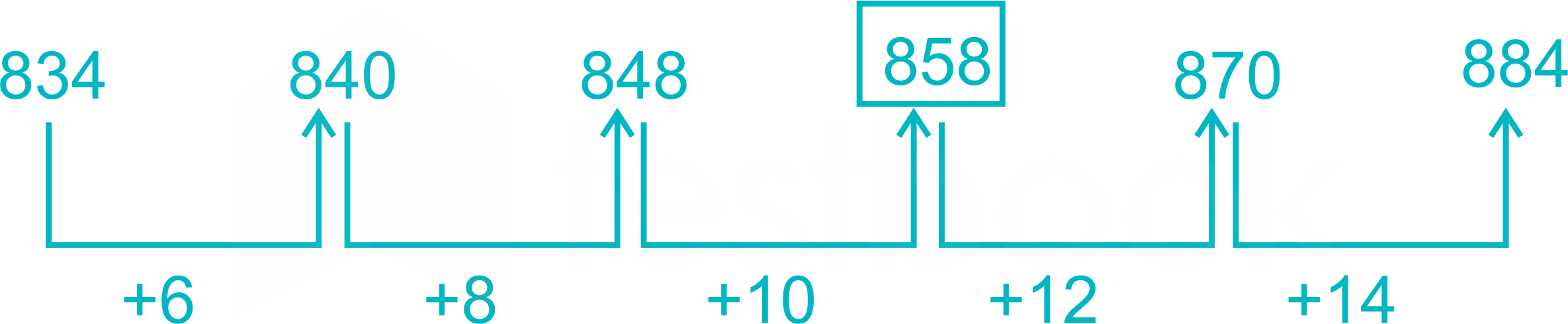
Question 44

In a ΔPMN, ∠P = 76°. The bisectors of the exterior angles at M and N intersect each other at point O. The degree measure of ∠MON is:

  1. AOption (a)

    38°

  2. BOption (b)

    52°

  3. COption (c)

    104°

  4. DOption (d)

    128°

View answer & explanation

Correct answer

Answer: (b)B.

52°

Why this answer is correct

Shortcut Trick

The angle formed by the bisectors of two exterior angles of a triangle is given by the direct formula:

∠MON = 90° − ∠P ÷ 2

Given, ∠P = 76°

∠MON = 90° − 76° ÷ 2 = 90° − 38° = 52°

∴ The correct answer is 52°.

Alternate Method

Given: In ΔPMN, ∠P = 76°. The bisectors of the exterior angles at M and N intersect at point O.

Formula Used: Sum of angles in a triangle = 180°, Linear pair angle sum = 180°

In ΔPMN:

⇒ ∠P + ∠PMN + ∠PNM = 180°

⇒ 76° + ∠PMN + ∠PNM = 180°

⇒ ∠PMN + ∠PNM = 180° − 76° = 104°

Let the exterior angles at M and N be ∠ExtM and ∠ExtN:

⇒ ∠ExtM = 180° − ∠PMN

⇒ ∠ExtN = 180° − ∠PNM

Since MO and NO are the bisectors of these exterior angles:

⇒ ∠OMN = ∠ExtM ÷ 2 = (180° − ∠PMN) ÷ 2 = 90° − ∠PMN ÷ 2

⇒ ∠ONM = ∠ExtN ÷ 2 = (180° − ∠PNM) ÷ 2 = 90° − ∠PNM ÷ 2

In ΔMON:

⇒ ∠MON + ∠OMN + ∠ONM = 180°

⇒ ∠MON + (90° − ∠PMN ÷ 2) + (90° − ∠PNM ÷ 2) = 180°

⇒ ∠MON + 180° − (∠PMN + ∠PNM) ÷ 2 = 180°

⇒ ∠MON = (∠PMN + ∠PNM) ÷ 2

⇒ ∠MON = 104° ÷ 2 = 52°

∴ The correct answer is 52°.

Additional Information

Incenter Angle Formula

The angle formed by the interior angle bisectors of ∠B and ∠C at the incenter I is given by ∠BIC = 90° + ∠A ÷ 2.

Excenter Angle Formula

The angle formed by the exterior angle bisectors of ∠B and ∠C at the excenter O is given by ∠BOC = 90° − ∠A ÷ 2.

Relation between Incenter and Excenter

The sum of the angles formed at the incenter and the opposite excenter is always 180° (i.e., ∠BIC + ∠BOC = 180°).

Question 45

If x2+1=2x x^2 + 1 = 2x , then (x4−1) (x^4 - 1) is equal to:

  1. AOption (a)

    x

  2. BOption (b)

    0

  3. COption (c)

    1

  4. DOption (d)

    2x

View answer & explanation

Correct answer

Answer: (b)B.

0

Why this answer is correct

Shortcut Trick

The equation x2 + 1 = 2x is a standard perfect square identity.

Rearranging gives x2 − 2x + 1 = 0, which is (x − 1)2 = 0.

This implies the value of x = 1.

Substitute x = 1 into the expression x4 − 1:

(1)4 − 1 = 1 − 1 = 0.

∴ The correct answer is 0.

Alternate Method

Given: x2 + 1 = 2x

To Find: x4 − 1

⇒ x2 − 2x + 1 = 0

⇒ x2 − x − x + 1 = 0

⇒ x(x − 1) − 1(x − 1) = 0

⇒ (x − 1)(x − 1) = 0

⇒ (x − 1)2 = 0

⇒ x − 1 = 0

⇒ x = 1

Now, substituting the value of x in the required algebraic expression:

⇒ x4 − 1 = (1)4 − 1

⇒ 1 − 1 = 0

∴ The correct answer is 0.

Additional Information

Perfect Square Identity

The formula (a − b)2 = a2 − 2ab + b2 is used to identify expressions that can be simplified into a single squared term.

Difference of Squares

The expression x4 − 1 is a difference of squares and can be factored as (x2 − 1)(x2 + 1) or (x − 1)(x + 1)(x2 + 1).

Nature of Roots

For a quadratic equation ax2 + bx + c = 0, if the discriminant (D = b2 − 4ac) is zero, the roots are real and equal.

Question 46

A, B and C can do a piece of work in 3, 8 and 24 days, respectively. How long (in days) will they take to do thrice the same work, working together?

  1. AOption (a)

    18

  2. BOption (b)

    7

  3. COption (c)

    6

  4. DOption (d)

    12

View answer & explanation

Correct answer

Answer: (c)C.

6

Why this answer is correct

Shortcut Trick

Combined efficiency of A, B, and C = (1/3 + 1/8 + 1/24) = (8 + 3 + 1)/24 = 12/24 = 1/2 unit/day.

Days to complete the original work = 1 ÷ (1/2) = 2 days.

Days to complete thrice the same work = 2 × 3 = 6 days.

∴ The correct answer is 6 days.

Alternate Method

Given: Time taken by A = 3 days, B = 8 days, C = 24 days.

Formula Used: Total Work = LCM of individual days; Efficiency = Total Work ÷ Time.

PersonDaysTotal WorkEfficiency
A324 units8
B83
C241

⇒ Total Efficiency of (A + B + C) = 8 + 3 + 1 = 12 units/day.

⇒ New Work to be done = 3 × 24 = 72 units.

⇒ Required Time = New Work ÷ Total Efficiency

⇒ Required Time = 72 ÷ 12 = 6 days.

∴ The correct answer is 6 days.

Additional Information

Work and Efficiency Relationship

Work is directly proportional to Efficiency and Time. If work is tripled, the time required at constant efficiency also triples.

Combined Work Formula

For three people, combined time T = (D1×D2×D3) ÷ (D1D2 + D2D3 + D3D1). Multiply this result by 'n' for 'n' times the work.

Question 47

If cos⁡θ=513 \cos \theta = \frac{5}{13} , then find the value of 1−sin⁡θ1+sin⁡θ \sqrt{\frac{1 - \sin \theta}{1 + \sin \theta}} .

  1. AOption (a)

    125 \frac{1}{25}

  2. BOption (b)

    13 \frac{1}{3}

  3. COption (c)

    1213 \frac{12}{13}

  4. DOption (d)

    15 \frac{1}{5}

View answer & explanation

Correct answer

Answer: (d)D.

15 \frac{1}{5}

Why this answer is correct

Shortcut Trick

Given cos θ = 5/13. In a Pythagorean triplet (5, 12, 13), sin θ = 12/13.

Expression √[(1 − sin θ)/(1 + sin θ)] = √[(1 − sin θ)2 / (1 − sin2 θ)] = (1 − sin θ) / cos θ.

Substituting values: (1 − 12/13) / (5/13) = (1/13) / (5/13) = 1/5.

∴ The correct answer is 1/5.

Alternate Method

Given: cos θ = Base / Hypotenuse = 5 / 13

Formula: Perpendicular (p) = √(h2 − b2) and sin θ = p / h

⇒ p = √(132 − 52) = √(169 − 25) = √144 = 12

⇒ sin θ = 12 / 13

⇒ Value = √[(1 − 12/13) / (1 + 12/13)]

⇒ Value = √[(1/13) / (25/13)] = √(1 / 25)

⇒ Value = 1 / 5

∴ The correct answer is 1/5.

Additional Information

Trigonometric Identities

Fundamental identity: sin2 θ + cos2 θ = 1. Also, 1 − sin2 θ = cos2 θ.

Rationalization Shortcut

√[(1 − sin θ)/(1 + sin θ)] = sec θ − tan θ and √[(1 + sin θ)/(1 − sin θ)] = sec θ + tan θ.

Question 48

A triangular field has sides measuring 42 cm, 34 cm and 20 cm. What is the length of the altitude corresponding to the longest side?

  1. AOption (a)

    18 cm

  2. BOption (b)

    16 cm

  3. COption (c)

    20 cm

  4. DOption (d)

    15 cm

View answer & explanation

Correct answer

Answer: (b)B.

16 cm

Why this answer is correct

Shortcut Trick

Recognize Pythagorean Triplets to split the base 42 cm into two parts: 12 cm and 30 cm.

For side 20 cm, triplet (3, 4, 5) × 4 → (12, 16, 20).

For side 34 cm, triplet (8, 15, 17) × 2 → (16, 30, 34).

Check: 12 + 30 = 42 cm (the longest side). The common height is 16 cm.

∴ The correct answer is 16 cm.

Alternate Method

Given: Sides of the triangle are a = 42 cm, b = 34 cm, and c = 20 cm.

Formula Used: Heron's Formula for Area = √[s(s−a)(s−b)(s−c)] and Area = 1/2 × base × height.

⇒ Semi-perimeter (s) = (42 + 34 + 20) ÷ 2

⇒ s = 96 ÷ 2 = 48 cm

⇒ Area = √[48 × (48 − 42) × (48 − 34) × (48 − 20)]

⇒ Area = √[48 × 6 × 14 × 28]

⇒ Area = √[(16 × 3) × (3 × 2) × (14) × (14 × 2)]

⇒ Area = √[16 × 32 × 22 × 142] = 4 × 3 × 2 × 14 = 336 cm2

⇒ For longest side (base = 42 cm), Area = 1/2 × 42 × height

⇒ 336 = 21 × height

⇒ height = 336 ÷ 21 = 16 cm

∴ The correct answer is 16 cm.

Additional Information

Heron's Formula

Used to find the area of any triangle when all three sides are known: Area = √[s(s−a)(s−b)(s−c)], where s is the semi-perimeter.

Altitude vs. Side Length

In any triangle, the longest side always has the shortest altitude corresponding to it, as Area = 1/2 × b × h remains constant.

Pythagorean Triplets

Common sets of integers (a, b, c) such that a2 + b2 = c2, helping solve triangle problems quickly without complex calculations.

Question 49

The average age of four children I, J, K and L is 9 years and the average age of I, J, L, M is 12 years. K is 5 years old. The age of M (in years) is:

  1. AOption (a)

    17

  2. BOption (b)

    18

  3. COption (c)

    20

  4. DOption (d)

    19

View answer & explanation

Correct answer

Answer: (a)A.

17

Why this answer is correct

Shortcut Trick

Sum difference = (Average2 − Average1) × Number of persons

(I + J + L + M) − (I + J + K + L) = (12 − 9) × 4

M − K = 3 × 4 = 12 years

M = K + 12 = 5 + 12 = 17 years

∴ The correct answer is 17 years.

Alternate Method

Given:

Average age of I, J, K, L = 9 years

Average age of I, J, L, M = 12 years

Age of K = 5 years

Formula Used:

Sum of observations = Average × Number of observations

Calculations:

⇒ Total age of I, J, K, L = 9 × 4 = 36 years

⇒ Total age of I, J, L, M = 12 × 4 = 48 years

⇒ (I + J + L + M) − (I + J + K + L) = 48 − 36

⇒ M − K = 12

⇒ M − 5 = 12

⇒ M = 12 + 5 = 17 years

∴ The correct answer is 17 years.

Additional Information

Net Change in Average

When one person is replaced by another, the change in sum equals the difference between the new and old person's values: Change = (New − Old).

Weighted Average

Combined average of two groups is given by (n1x1 + n2x2) ÷ (n1 + n2).

Question 50

3 men can do a piece of work in 20 days. How many men will do it in 2 days?

  1. AOption (a)

    32

  2. BOption (b)

    30

  3. COption (c)

    33

  4. DOption (d)

    31

View answer & explanation

Correct answer

Answer: (b)B.

30

Why this answer is correct

Shortcut Trick

Apply the Chain Rule formula: M1 × D1 = M2 × D2

3 × 20 = M2 × 2

60 = M2 × 2

M2 = 30 men

∴ The correct answer is 30 men.

Alternate Method

Given:

Number of men in first case (M1) = 3

Number of days in first case (D1) = 20

Number of days in second case (D2) = 2

Formula Used:

Total Work = Men × Days

Calculations:

⇒ Total work = 3 × 20 = 60 units

⇒ Let the required number of men be M2.

⇒ M2 × 2 = 60

⇒ M2 = 60 ÷ 2

⇒ M2 = 30 men

∴ The correct answer is 30 men.

Additional Information

General Chain Rule Formula

For different work or hours: (M1 × D1 × H1) ÷ W1 = (M2 × D2 × H2) ÷ W2, where H is hours and W is work.

Inverse Proportion

Men and Days are inversely proportional. If more men are employed, fewer days are required to complete the same work.

Work and Wages

Wages are generally distributed in the ratio of the work done by individuals (Efficiency × Time).

General Intelligence & Reasoning (30 questions)

Question 51

Seven boxes B, C, D, I, J, K and L are kept one over the other but not necessarily in the same order. Only I is kept above C. Only L is kept between C and J. Only K is kept below D. How many boxes are kept between B and I?7084

  1. AOption (a)

    Four

  2. BOption (b)

    Two

  3. COption (c)

    One

  4. DOption (d)

    Three

View answer & explanation

Correct answer

Answer: (d)D.

Three

Why this answer is correct

Given: Seven boxes B, C, D, I, J, K and L are kept one over the other but not necessarily in the same order.

Only I is kept above C.

Only L is kept between C and J.

Only K is kept below D.


Now, placing remaining box B in the remaining position:

PositionBox
1I
2C
3L
4J
5B
6D
7K

Now, The boxes are J, L, and C.

Hence, the correct answer is "Option 4".

Question 52

What should come in place of the question mark (?) in the given series?

267237209183159? 267 \quad 237 \quad 209 \quad 183 \quad 159 \quad ?

  1. AOption (a)

    137

  2. BOption (b)

    133

  3. COption (c)

    128

  4. DOption (d)

    145

View answer & explanation

Correct answer

Answer: (a)A.

137

Why this answer is correct

The logic followed here is:

thus, "137" will replace the question mark in the given series.

Hence, the correct option is "Option 1".

Question 53

In a certain code language, ‘nail post fish’ is coded as 'pl mg qn' and ‘fish urn knife’ is coded as ‘ix pl ko’. How is ‘fish’ coded in the given language?

  1. AOption (a)

    ix

  2. BOption (b)

    qn

  3. COption (c)

    mg

  4. DOption (d)

    pl

View answer & explanation

Correct answer

Answer: (d)D.

pl

Why this answer is correct

The logic followed here is:

‘nail post fish’ is coded as ‘pl mg qn’,

‘fish urn knife’ is coded as ‘ix pl ko’.

Here,

Here, the code for ‘fish’ is pl.

Hence, the correct answer is "Option 4".

Question 54

Read the given statements and conclusions carefully. Assuming that the information given in the statements is true, even if it appears to be at variance with commonly known facts, decide which of the given conclusions logically follow(s) from the statements.

Statements:

Some paddy are rice.

Some rice are wheat.

Conclusions:

(I) Some paddy are wheat.

(II) All wheat are rice.

  1. AOption (a)

    Only conclusion (II) follows

  2. BOption (b)

    Both conclusions (I) and (II) follow

  3. COption (c)

    Neither conclusion (I) nor (II) follows

  4. DOption (d)

    Only conclusion (I) follows

View answer & explanation

Correct answer

Answer: (c)C.

Neither conclusion (I) nor (II) follows

Why this answer is correct

Given Statements:

Some paddy are rice.

Some rice are wheat.

The least possible Venn diagram for the given statement is:

Conclusions:

I. Some paddy are wheat – False (Because, no definite relation is given between paddy and wheat, so it can be possible only).

II. All wheat are rice – False (Because, only some rice are wheat is given, so all wheat being rice is not certain).

So, Neither conclusion I nor II follow.

Hence, the correct answer is "Option 3".

Question 55

What should come in place of the question mark (?) in the given series?

834840848?870884 834 \quad 840 \quad 848 \quad ? \quad 870 \quad 884

  1. AOption (a)

    855

  2. BOption (b)

    856

  3. COption (c)

    858

  4. DOption (d)

    854

View answer & explanation

Correct answer

Answer: (c)C.

858

Why this answer is correct

The logic followed here is:

thus, "858" will replace the question mark in the given series.

Hence, the correct option is "Option 3".

Question 56

What should come in place of the question mark (?) in the given series?

2, 4, 12, 24, 72, ?

  1. AOption (a)

    144

  2. BOption (b)

    136

  3. COption (c)

    124

  4. DOption (d)

    92

View answer & explanation

Correct answer

Answer: (a)A.

144

Why this answer is correct

The logic followed here is:

thus, "144" will replace the question mark in the given series.

Hence, the correct option is "Option 1".

Question 57

In a certain code language,

A + B means ‘A is the sister of B’,

A @ B means ‘A is the brother of B’,

A - B means ‘A is the wife of B’ and

A # B means ‘A is the father of B’.

Based on the above, how is O related to V if ‘O + P @ T - G # V’?

  1. AOption (a)

    Sister

  2. BOption (b)

    Mother

  3. COption (c)

    Mother's mother

  4. DOption (d)

    Mother's sister

View answer & explanation

Correct answer

Answer: (d)D.

Mother's sister

Why this answer is correct

Family Chart:

Decoding the Symbols:

Symbol+@-#
MeaningSisterBrotherWifeFather

Given: ‘O + P @ T - G # V’

It means: O is the Sister of P, P is the Brother of T, T is the Wife of G, G is the Father of V.


So, O is the Mother's sister of V.

Hence, the correct answer is "Option 4".

Question 58

If ‘A’ stands for ‘÷’, ‘B’ stands for ‘×’, ‘C’ stands for ‘+’ and ‘D’ stands for ‘−’, what will come in place of the question mark (?) in the following equation?

21 B 16 C 20 D 26 A 2=? 21 \text{ B } 16 \text{ C } 20 \text{ D } 26 \text{ A } 2 = ?

  1. AOption (a)

    340

  2. BOption (b)

    341

  3. COption (c)

    343

  4. DOption (d)

    342

View answer & explanation

Correct answer

Answer: (c)C.

343

Why this answer is correct

BODMAS Table: 

Given equation: 21 B 16 C 20 D 26 A 2 = ?

Now, if ‘A’ stands for ‘÷’, ‘B’ stands for ‘×’, ‘C’ stands for ‘+’ and ‘D’ stands for ‘−’, then:

⇒ 21 × 16 + 20 − 26 ÷ 2 = ?

⇒ 336 + 20 − 13 = ?

⇒ 356 − 13 = ?

⇒ 343

Hence, the correct answer is "Option 3".

Question 59

Refer to the following number series and answer the question that follows (all numbers are single-digit numbers only). Counting to be done from left to right only.

(Left) 5 7 1 8 4 2 3 9 5 7 6 1 (Right)

How many even numbers are there which are immediately followed by odd numbers?

  1. AOption (a)

    Three

  2. BOption (b)

    One

  3. COption (c)

    Two

  4. DOption (d)

    More than three

View answer & explanation

Correct answer

Answer: (c)C.

Two

Why this answer is correct

Given: (Left) 5 7 1 8 4 2 3 9 5 7 6 1 (Right)

Now,

Even numbers which are immediately followed by odd numbers.

So, Needed pattern is: Even number − Odd number.

(Left) 5 7 1 8 4 2 3 9 5 7 6 1 (Right)

There are 2 even numbers which are immediately followed by odd numbers.

Hence, the correct answer is 'Option 3'.

Question 60

What should come in place of the question mark (?) in the given series based on the English alphabetical order?

GMP IOR KQT MSV ?

  1. AOption (a)

    QVX

  2. BOption (b)

    PVX

  3. COption (c)

    OUX

  4. DOption (d)

    OUY

View answer & explanation

Correct answer

Answer: (c)C.

OUX

Why this answer is correct

The logic followed here is:

So, 'OUX' will replace the question mark in the given series.

Hence, the correct answer is "Option 3".

Question 61

In the following triads, each group of letters is related to the subsequent one following a certain logic. Select from the given options, the one which follows the same logic.

MIST - TIMS - ISMT

HOPE - EOHP - OPHE

  1. AOption (a)

    PUTS - UPTS - SUTP

  2. BOption (b)

    BUSY - YUBS - USBY

  3. COption (c)

    WIDE - EIWD - DIWE

  4. DOption (d)

    NUMB - NMUB - BMUN

View answer & explanation

Correct answer

Answer: (b)B.

BUSY - YUBS - USBY

Why this answer is correct

The logic followed here is:

Logic: Rearrange letters in a specific pattern:

First word → second word (letters rearranged in a fixed order)

Second word → third word (letters rearranged in another fixed order)

Given,

MIST → TIMS → ISMT

HOPE → EOHP → OPHE

Now, checking the options:

Option 1) PUTS → UPTS → SUTP

Option 2) BUSY → YUBS → USBY

Option 3) WIDE → EIWD → DIWE

Option 4) NUMB → NMUB → BMUN

Hence, the correct option is "Option 2".

Question 62

A, B, C, D, E, F and G are sitting around a circular table facing the centre. C sits third to the right of D. E sits second to the right of C. F is the immediate neighbour of B and C. G is not an immediate neighbour of D. How many people sit between A and G when counted from the left of G?

  1. AOption (a)

    Three

  2. BOption (b)

    Four

  3. COption (c)

    One

  4. DOption (d)

    Two

View answer & explanation

Correct answer

Answer: (b)B.

Four

Why this answer is correct

Given: A, B, C, D, E, F and G are sitting around a circular table facing the centre.

C sits third to the right of D.

E sits second to the right of C.

F is the immediate neighbour of B and C.

G is not an immediate neighbour of D.

Here,There are Four people sitting between A and G when counted from the left of G.

Hence, the correct answer is "Option 2".

Question 63

Select the set in which the numbers are related in the same way as are the numbers of the following sets.

(NOTE: Operations should be performed on the whole numbers, without breaking down the numbers into their constituent digits. E.g. 13 – Operations on 13 such as adding to/subtracting from/multiplying with 13 can be performed. Breaking down 13 into 1 and 3 and then performing mathematical operations on 1 and 3 is not allowed.)

(3,−2,11) (3, -2, 11)

(46,2107,9) (46, 2107, 9)

  1. AOption (a)

    (33, 1081, 7)

  2. BOption (b)

    (34, 1135, 21)

  3. COption (c)

    (38, 1433, 10)

  4. DOption (d)

    (25, 607, 17)

View answer & explanation

Correct answer

Answer: (b)B.

(34, 1135, 21)

Why this answer is correct

The logic followed here is:

Logic: (1st number)² − (3rd number) = 2nd number

Given sets:

(3, -2, 11)

3² − 11 = 9 − 11 = -2 

(46, 2107, 9)

46² − 9 = 2116 − 9 = 2107 

Now, Checking the options:

Option 1) (33, 1081, 7)

33² − 7 = 1089 − 7 = 1082 ≠ 1081 

Option 2) (34, 1135, 21)

34² − 21 = 1156 − 21 = 1135 

Option 3) (38, 1433, 10)

38² − 10 = 1444 − 10 = 1434 ≠ 1433 

Option 4) (25, 607, 17)

25² − 17 = 625 − 17 = 608 ≠ 607 

Hence, the correct option is "Option 2".

Question 64

A, B, C, R, S, T and U are sitting around a circular table facing the centre of the table. Only two people sit between C and U when counted from the left of U. B sits third to the left of A. T sits to the immediate right of A.T sits second to the left of C. R is not an immediate neighbour of B. Who sits third to the right of S?

  1. AOption (a)

    C

  2. BOption (b)

    A

  3. COption (c)

    T

  4. DOption (d)

    U

View answer & explanation

Correct answer

Answer: (c)C.

T

Why this answer is correct

Given: A, B, C, R, S, T and U are sitting around a circular table facing the centre of the table.

Only two people sit between C and U when counted from the left of U.

B sits third to the left of A.

T sits to the immediate right of A.

T sits second to the left of C.

R is not an immediate neighbour of B.

Here,T sits third to the right of S.

Hence, the correct answer is "Option 3".

Question 65

Raman ranked 31st from the top and 12th from the bottom in his class. How many students are there in his class?

  1. AOption (a)

    42

  2. BOption (b)

    40

  3. COption (c)

    43

  4. DOption (d)

    41

View answer & explanation

Correct answer

Answer: (a)A.

42

Why this answer is correct

Given:

Raman ranked 31st from the top and 12th from the bottom.

Total students in the class = Rank from top + Rank from bottom − 1

⇒ 31 + 12 − 1 = 42

Hence, the total number of students in the class is 42.

Hence, the correct answer is "Option 1".

Question 66

If ‘A’ stands for ‘÷’, ‘B’ stands for ‘×’, ‘C’ stands for ‘+’ and ‘D’ stands for ‘−’, then what will come in place of the question mark (?) in the following equation?

11 B 22 C 288 A 18 D 50=? 11 \text{ B } 22 \text{ C } 288 \text{ A } 18 \text{ D } 50 = ?

  1. AOption (a)

    202

  2. BOption (b)

    212

  3. COption (c)

    220

  4. DOption (d)

    208

View answer & explanation

Correct answer

Answer: (d)D.

208

Why this answer is correct

BODMAS Table: 

Given equation: 11 B 22 C 288 A 18 D 50 = ?

Now, if ‘A’ stands for ‘÷’, ‘B’ stands for ‘×’, ‘C’ stands for ‘+’ and ‘D’ stands for ‘−’, then:

⇒ 11 × 22 + 288 ÷ 18 − 50 = ?

⇒ 242 + 16 − 50 = ?

⇒ 258 − 50 = ?

⇒ 208

Hence, the correct answer is "Option 4".

Question 67

Seven people, B, C, D, I, J, K and L, are sitting around a circular table, facing the centre of the table. I sits to the immediate left of D. J is the immediate neighbour of both B and K. K sits third to the left of D. L is not an immediate neighbour of K. Who sits second to the right of C?

  1. AOption (a)

    J

  2. BOption (b)

    D

  3. COption (c)

    I

  4. DOption (d)

    K

View answer & explanation

Correct answer

Answer: (b)B.

D

Why this answer is correct

Given: Seven people, B, C, D, I, J, K and L, are sitting around a circular table, facing the centre of the table.

I sits to the immediate left of D.

J is the immediate neighbour of both B and K.

K sits third to the left of D.

L is not an immediate neighbour of K.

Here, D sits second to the right of C.

Hence, the correct answer is "Option 2".

Question 68

Which of the following letter-number clusters will replace the question mark (?) in the given series to make it logically complete?

GKN19 HLO26 IMP33 JNQ40 ?

  1. AOption (a)

    KOR48

  2. BOption (b)

    KOR47

  3. COption (c)

    KOS48

  4. DOption (d)

    KOS47

View answer & explanation

Correct answer

Answer: (b)B.

KOR47

Why this answer is correct

The logic followed here is:

So, 'KOR47' will replace the question mark in the given series.

Hence, the correct answer is "Option 2".

Question 69

Based on the English alphabetical order, three of the following four letter-cluster pairs are alike in a certain way and thus form a group. Which letter-cluster pair DOES NOT belong to that group? (Note: The odd one out is not based on the number of consonants/vowels or their position in the letter-cluster.)

  1. AOption (a)

    OR - KN

  2. BOption (b)

    MP - IL

  3. COption (c)

    PS - LO

  4. DOption (d)

    IL - EL

View answer & explanation

Correct answer

Answer: (d)D.

IL - EL

Why this answer is correct

The logic followed here is:

Option 1) OR − KN

Option 2) MP − IL

Option 3) PS − LO

Option 4) IL − EL

Here, IL − EL is odd among the given options.

Hence, the correct answer is "Option 4".

Question 70

This question is based on the five, three-digit numbers given below.

(Left) 593 784 358 631 296 (Right)

(Example- 697 – First digit = 6, second digit = 9 and third digit = 7)

NOTE - All operations to be done from left to right.

What will be the resultant, if the third digit of the highest number is added to the second digit of the lowest number?

  1. AOption (a)

    14

  2. BOption (b)

    10

  3. COption (c)

    17

  4. DOption (d)

    13

View answer & explanation

Correct answer

Answer: (d)D.

13

Why this answer is correct

Given numbers: 593, 784, 358, 631, 296

The highest and lowest numbers

Highest number = 784

Lowest number = 296

Here,

Third digit of highest number (784) = 4

Second digit of lowest number (296) = 9

Thus, Add the digits

⇒ 4 + 9 = 13

Hence, the correct answer is 'Option 4'.

Question 71

EFJL is related to HKMQ in a certain way based on the English alphabetical order. In the same way, QZVF is related to TEYK. To which of the following options is ZOEU related, following the same logic?

  1. AOption (a)

    CGFR

  2. BOption (b)

    CTZS

  3. COption (c)

    CTHZ

  4. DOption (d)

    CTYU

View answer & explanation

Correct answer

Answer: (c)C.

CTHZ

Why this answer is correct

The logic followed here is:

For EFJL → HKMQ

For QZVF → TEYK

Similarly, for ZOEU

So, ZOEU will be related to CTHZ.

Hence, the correct answer is "Option 3".

Question 72

This question is based on the five, three-digit numbers given below.

(Left) 742 912 853 657 154 (Right)

(Example: 697 – First digit = 6, second digit = 9 and third digit = 7)

(NOTE: All operations to be done from left to right.)

If all the numbers are arranged in descending order, the position of how many numbers will remain unchanged?

  1. AOption (a)

    Two

  2. BOption (b)

    One

  3. COption (c)

    Four

  4. DOption (d)

    Three

View answer & explanation

Correct answer

Answer: (a)A.

Two

Why this answer is correct

Given numbers: 742, 912, 853, 657, 154

Descending order: 912, 853, 742, 657, 154

Now, Compare with original positions

742 → original position 1 → new position 3 → changed

912 → original position 2 → new position 1 → changed

853 → original position 3 → new position 2 → changed

657 → original position 4 → new position 4 → unchanged

154 → original position 5 → new position 5 → unchanged

So, 2 numbers remain in the same position.

Hence, the correct answer is 'Option 1'.

Question 73

In a certain code language, ‘ROME’ is coded as ‘1398’ and ‘DEMO’ is coded as ‘4138’. What is the code for ‘D’ in the given code language?

  1. AOption (a)

    1

  2. BOption (b)

    3

  3. COption (c)

    8

  4. DOption (d)

    4

View answer & explanation

Correct answer

Answer: (d)D.

4

Why this answer is correct

The logic followed here is:

‘ROME’ is coded as 1398,

‘DEMO’ is coded as 4138.

Here, Compare the codes and letters:

LetterCode
R1
O3
M9
E8

From the second word:

LetterCode
D4
E1
M3
O8

Here, the code for ‘D’ is 4.

Hence, the correct answer is "Option 4".

Question 74

Mukesh starts from Point A and drives 14 km towards the North. He then takes a left turn, drives 9 km, then turns left and drives 17 km. He then takes a left turn and drives 13 km. He takes a final left turn, drives 3 km, and stops at Point P. How far (shortest distance) and towards which direction should he drive in order to reach Point A again? (All turns are 90-degree turns only, unless specified.)

  1. AOption (a)

    4 km to the east

  2. BOption (b)

    5 km to the east

  3. COption (c)

    4 km to the west

  4. DOption (d)

    5 km to the west

View answer & explanation

Correct answer

Answer: (c)C.

4 km to the west

Why this answer is correct

Given: 

Mukesh starts from Point A and drives 14 km towards the North.

He then takes a left turn, drives 9 km, then turns left and drives 17 km.

He then takes a left turn and drives 13 km.

He takes a final left turn, drives 3 km, and stops at Point P.

So, He should drive 4 km to the west in order to reach Point A again.

Hence, the correct answer is "Option 3".

Question 75

Refer to the number series given below and answer the question that follows. Counting to be done from left to right only.

(NOTE: All numbers are single-digit numbers only.)

(Left) 3 1 3 9 6 3 4 1 1 5 6 9 9 6 8 9 7 5 6 6 2 (Right)

How many such even digits are there each of which is immediately preceded by a perfect square and also immediately followed by an even digit?

  1. AOption (a)

    2

  2. BOption (b)

    3

  3. COption (c)

    1

  4. DOption (d)

    4

View answer & explanation

Correct answer

Answer: (c)C.

1

Why this answer is correct

Given: (Left) 3 1 3 9 6 3 4 1 1 5 6 9 9 6 8 9 7 5 6 6 2 (Right)

Now, Even digits which are immediately preceded by a perfect square and immediately followed by an even digit.

So, Needed pattern is: Perfect square − Even digit − Even digit


So, there are 1such even digits.

Hence, the correct answer is 'Option 3'.

Question 76

Hemant starts from Point A and drives 3 km towards the east. He then takes a right turn, drives 5 km, turns right and drives 6 km. He then takes a right turn and drives 5 km. He takes a final left turn, drives 8 km and stops at Point P. How far (shortest distance) and towards which direction should he drive in order to reach Point A again? (All turns are 90 degrees turns only unless specified).

  1. AOption (a)

    5 km towards the south

  2. BOption (b)

    11 km towards the west

  3. COption (c)

    7 km towards the north

  4. DOption (d)

    11 km towards the east

View answer & explanation

Correct answer

Answer: (d)D.

11 km towards the east

Why this answer is correct

Given: 

Hemant starts from Point A and drives 3 km towards the east.

He then takes a right turn, drives 5 km, turns right and drives 6 km.

He then takes a right turn and drives 5 km.

He takes a final left turn, drives 8 km and stops at Point P.

So, He should drive 11 km towards the East in order to reach Point A again.

Hence, the correct answer is "Option 4".

Question 77

SDFH is related to VYIC in a certain way based on the English alphabetical order. In the same way, EJRN is related to HEUI. To which of the following options is NUAY related, following the same logic?

  1. AOption (a)

    QSER

  2. BOption (b)

    QWET

  3. COption (c)

    QPYU

  4. DOption (d)

    QPDT

View answer & explanation

Correct answer

Answer: (d)D.

QPDT

Why this answer is correct

The logic followed here is:

For SDFH → VYIC

For EJRN → HEUI

Similarly, for NUAY

So, NUAY will be related to QPDT.

Hence, the correct answer is "Option 4".

Question 78

Based on the English alphabetical order, three of the following four letter-clusters are alike in a certain way and thus form a group. Which letter-cluster DOES NOT belong to that group?

(Note: The odd one out is not based on the number of consonants/vowels or their position in the letter-cluster.)

  1. AOption (a)

    IOL

  2. BOption (b)

    CIE

  3. COption (c)

    PVS

  4. DOption (d)

    GMJ

View answer & explanation

Correct answer

Answer: (b)B.

CIE

Why this answer is correct

logic followed here is:

Option 1) IOL

Option 2) CIE 

Option 3) PVS

Option 4) GMJ

Hence, CIE is odd among the given options.

Hence, the correct answer is "Option 2".

Question 79

Read the given statements and conclusions carefully. Assuming that the information given in the statements is true, even if it appears to be at variance with commonly known facts, decide which of the given conclusion(s) logically follow(s) from the statements.

Statements:

Some oranges are peaches.

No peach is a carrot.

Conclusions:

(I) Some oranges are carrots.

(II) All carrots are peaches.

  1. AOption (a)

    Both conclusions (I) and (II) follow.

  2. BOption (b)

    Only conclusion (II) follows.

  3. COption (c)

    Neither conclusion (I) nor (II) follows.

  4. DOption (d)

    Only conclusion (I) follows.

View answer & explanation

Correct answer

Answer: (c)C.

Neither conclusion (I) nor (II) follows.

Why this answer is correct

Given Statements:

Some oranges are peaches.

No peach is a carrot.

The least possible Venn diagram for the given statement is:

Conclusions:

I. Some oranges are carrots – False (Because no definite relation is given between oranges and carrots, they may or may not overlap).

II. All carrots are peaches – False (Because no peach is a carrot, so carrots cannot be inside peaches).

So, Neither conclusion I nor II follow.

Hence, the correct answer is "Option 3".

Question 80

If + means −, − means ×, × means ÷ and ÷ means +, then what will come in place of the question mark (?) in the following equation?

43 - 17 ÷ 147 + 362 × 2

  1. AOption (a)

    691

  2. BOption (b)

    699

  3. COption (c)

    695

  4. DOption (d)

    697

View answer & explanation

Correct answer

Answer: (d)D.

697

Why this answer is correct

BODMAS Table: 

Given equation:  43 - 17 ÷ 147 + 362 × 2

Now, if + means −, − means ×, × means ÷ and ÷ means +

⇒ 43 × 17 + 147 - 362 ÷ 2 = ?

⇒ 731 + 147 - 181 = ?

⇒ 878 - 181= ?

⇒ 697

Hence, the correct answer is "Option 4".

General Awareness and Current Affairs (20 questions)

Question 81

With which country did India secure a 131milliondealinMay2025toacquire′HawkEye360′scutting−edgesurveillancetechnologytoadvanceitsmaritimedefenseinfrastructure131 million deal in May 2025 to acquire 'HawkEye 360's cutting-edge surveillance technology to advance its maritime defense infrastructure?

  1. AOption (a)

    Germany

  2. BOption (b)

    New Zealand

  3. COption (c)

    South Africa

  4. DOption (d)

    United States of America

View answer & explanation

Correct answer

Answer: (d)D.

United States of America

Why this answer is correct

The correct answer is United States of America.

Key Points

  • In May 2025, India secured a deal worth about $131 million with the United States of America to acquire advanced HawkEye 360 surveillance technology.
  • HawkEye 360 is a U.S.-based company that specializes in radio frequency (RF) geospatial intelligence using satellite constellations.
  • The technology helps detect and track radio frequency signals emitted by ships, communication devices, and radar systems even when vessels attempt to hide their location.
  • The system strengthens India’s maritime domain awareness and supports monitoring of the Indian Ocean Region (IOR).
  • This acquisition contributes to enhancing India’s maritime defense infrastructure, improving surveillance against threats such as illegal fishing, smuggling, and unauthorized naval activity.
  • Hence, the correct option is 4.

Additional Information

  • HawkEye 360
  • A U.S.-based satellite analytics company headquartered in Virginia.
  • Uses clusters of satellites to collect radio frequency (RF) data from across the globe.
  • Maritime Domain Awareness (MDA)
  • Refers to the effective understanding of all activities occurring in the maritime environment.
  • Important for monitoring shipping routes, naval operations, and illegal maritime activities.
  • India–US Defence Cooperation
  • India and the United States have strengthened defence ties through agreements such as LEMOA, COMCASA, and BECA.
  • These agreements facilitate logistics support, secure communications, and geospatial intelligence sharing$.

Question 82

Which state High Court in January 2025 has mandated that individuals in live-in relationships must sign a legal contract outlining financial responsibilities and childcare provisions?

  1. AOption (a)

    Goa

  2. BOption (b)

    Maharashtra

  3. COption (c)

    Rajasthan

  4. DOption (d)

    Gujarat

View answer & explanation

Correct answer

Answer: (c)C.

Rajasthan

Why this answer is correct

The correct answer is Rajasthan.

Key Points

  • In January 2025, the Rajasthan High Court directed that couples living in live-in relationships should sign a legal contract specifying their responsibilities.
  • The suggested agreement should clearly mention financial responsibilities, maintenance obligations, and childcare provisions.
  • The court observed that such contracts could help prevent future disputes between partners and provide legal clarity regarding rights and duties.
  • The direction was made during hearings involving petitions filed by couples seeking police protection for their live-in relationship.
  • The observation aimed to safeguard the interests of partners, particularly regarding financial security and responsibility towards children.
  • Hence, the correct option is 3.

Additional Information

  • Legal Status of Live-in Relationships in India
  • Live-in relationships are not illegal and have been recognised by the Supreme Court of India in several judgments.
  • They are considered part of the right to life and personal liberty under Article 21 of the Constitution.
  • Protection under Law
  • Women in live-in relationships are protected under the Protection of Women from Domestic Violence Act, 2005.
  • Children born from such relationships are considered legitimate under Indian law.
  • Purpose of the Court’s Observation
  • To establish legal clarity in live-in relationships.
  • To ensure proper arrangements for financial obligations and child welfare.

Question 83

Which two national parks achieved the highest scores of 92.97% in the Management Effectiveness Evaluation (MEE) 2020–2025 of National Parks and Protected Areas?

  1. AOption (a)

    Gir and Kaziranga

  2. BOption (b)

    Periyar and Sundarbans

  3. COption (c)

    Bandipur and Kanha

  4. DOption (d)

    Eravikulam and Dachigam

View answer & explanation

Correct answer

Answer: (d)D.

Eravikulam and Dachigam

Why this answer is correct

The correct answer is Eravikulam and Dachigam.

Key Points

  • The Management Effectiveness Evaluation (MEE) is an important framework developed by the Indian government to assess the performance of National Parks and Protected Areas.
  • In the MEE 2020–2025, the national parks of Eravikulam (located in Kerala) and Dachigam (located in Jammu & Kashmir) achieved the highest scores of 92.97%, reflecting their exceptional management and conservation efforts.
  • The evaluation process considers various parameters like biodiversity conservation, resource management, community participation, and sustainable tourism practices.
  • Eravikulam National Park is renowned for protecting the Nilgiri Tahr, an endangered mountain goat, and its unique montane grassland ecosystem.
  • Dachigam National Park is famous for its conservation of the Kashmir Stag (Hangul), which is critically endangered, and its pristine Himalayan landscapes.

Additional Information

  • Management Effectiveness Evaluation (MEE):
  • The MEE framework is globally recognized and implemented in India by the Ministry of Environment, Forest and Climate Change (MoEFCC).
  • It evaluates the effectiveness of management in protected areas and ensures they meet conservation and biodiversity goals.
  • The evaluation employs parameters such as context, planning, inputs, processes, outputs, and outcomes.
  • The results are used to improve the management strategies of protected areas and ensure sustainable conservation practices.
  • Eravikulam National Park:
  • Located in the Idukki District of Kerala, it was established in 1978.
  • It is home to the Nilgiri Tahr, which is endemic to the Western Ghats.
  • The park is also famous for the Kurinji flower, which blooms once every 12 years.
  • It encompasses unique grasslands and shola forests, supporting a wide variety of flora and fauna.
  • Dachigam National Park:
  • Located near Srinagar, Jammu & Kashmir, it was declared a national park in 1981.
  • It is the last stronghold of the critically endangered Kashmir Stag (Hangul).
  • The park is characterized by its alpine meadows, coniferous forests, and rugged mountainous terrain.
  • It also provides habitat for species such as Himalayan black bears, leopards, and various bird species.
  • Importance of National Parks:
  • National parks play a critical role in biodiversity conservation by protecting flora, fauna, and their ecosystems.
  • They help in climate regulation by acting as carbon sinks and preserving water resources.
  • They promote ecotourism and foster local community livelihoods.

Important Points

  • Comparison of other options:
  • Gir and Kaziranga: While Gir is known for the Asiatic Lion and Kaziranga for the one-horned rhinoceros, they did not achieve the highest MEE score.
  • Periyar and Sundarbans: Periyar in Kerala and Sundarbans in West Bengal are significant for tiger reserves, but neither ranked highest in the MEE.
  • Bandipur and Kanha: Both are renowned tiger reserves but did not achieve the top score in the 2020–2025 MEE.

Question 84

With which of the following institutes did the Data Informatics and Innovation Division of the Ministry of Statistics and Programme Implementation (MoSPI), sign a Memorandum of Understanding under the Data Innovation lab initiative in January 2025?

  1. AOption (a)

    Indraprastha Institute of Information Technology (IIIT-Delhi)

  2. BOption (b)

    National Institute of Technology Warangal

  3. COption (c)

    National Institute of Technology Durgapur

  4. DOption (d)

    International Institute of Information Technology – Hyderabad(IIIT-Hyderabad)

View answer & explanation

Correct answer

Answer: (a)A.

Indraprastha Institute of Information Technology (IIIT-Delhi)

Why this answer is correct

The correct answer is Indraprastha Institute of Information Technology (IIIT-Delhi).

Key Points

  • The Data Informatics and Innovation Division of the Ministry of Statistics and Programme Implementation (MoSPI) signed a Memorandum of Understanding (MoU) with Indraprastha Institute of Information Technology (IIIT-Delhi) under its Data Innovation Lab initiative in January 2025.
  • This collaboration aims to leverage the expertise of IIIT-Delhi in data science, machine learning, and artificial intelligence to enhance the quality and utility of statistical data collected by MoSPI.
  • The Data Innovation Lab initiative was introduced to foster partnerships between the government and academic institutions to promote data-driven decision-making and innovation.
  • IIIT-Delhi is renowned for its strong focus on research and development in emerging technologies and its contribution to data analytics and informatics projects.
  • The initiative is expected to facilitate the development of advanced analytical tools, enhance data collection methodologies, and provide solutions to complex statistical challenges faced by MoSPI.

Additional Information

  • Indraprastha Institute of Information Technology (IIIT-Delhi):
  • Established in 2008, located in New Delhi, India.
  • Specializes in computer science, electronics, communications, and informatics.
  • Known for its strong emphasis on research-oriented learning and collaboration with industry and government bodies.
  • Contributes significantly to projects involving data science, artificial intelligence, and computational biology.
  • Ministry of Statistics and Programme Implementation (MoSPI):
  • Responsible for the collection, analysis, and dissemination of statistical data in India.
  • Oversees national surveys such as the National Sample Survey (NSS) and works on GDP estimation.
  • Plays a pivotal role in policy formulation by providing statistical insights to the government.
  • Data Innovation Lab Initiative:
  • A project launched by MoSPI to enhance data management and innovation.
  • Focuses on utilizing academic partnerships to develop tools for better analysis and visualization of data.
  • Aims to improve the accessibility, reliability, and utility of government data for policy-making and planning.
  • Applications of Data Analytics in Governance:
  • Facilitates informed decision-making by analyzing large datasets.
  • Helps in tracking progress on Sustainable Development Goals (SDGs).
  • Enables prediction and mitigation of socio-economic challenges.

Important Points

  • National Statistical System:
  • India's statistical system is one of the largest in the world, involving multiple agencies and departments.
  • MoSPI ensures the coordination of data collection across states and sectors.
  • Role of Academic Institutions:
  • Institutions like IIIT-Delhi contribute to improving data accuracy and analytical methodologies.
  • They provide training for government personnel in advanced data techniques.

Question 85

Indicating a strong push toward sustainable energy development, the installed renewable energy generating capacity in India increased from 64.04 watts per capita in 2014-15 to what level per capita in 2024-25?

  1. AOption (a)

    156.31 watts

  2. BOption (b)

    85.21 watts

  3. COption (c)

    110.36 watts

  4. DOption (d)

    98.63 watts

View answer & explanation

Correct answer

Answer: (a)A.

156.31 watts

Why this answer is correct

The correct answer is 156.31 watts.

Key Points

  • India's installed renewable energy generating capacity has seen a significant increase from 64.04 watts per capita in 2014-15 to 156.31 watts per capita in 2024-25, indicating a strong push toward sustainable energy development.
  • This growth aligns with India's commitment to achieve 450 GW of renewable energy capacity by 2030, as part of its Nationally Determined Contributions (NDC) under the Paris Agreement.
  • The transition has been driven by initiatives like the National Solar Mission, National Wind-Solar Hybrid Policy, and Green Energy Corridor Project, which aim to enhance renewable energy adoption and infrastructure.
  • India has become one of the largest producers of renewable energy globally, leveraging resources such as solar power, wind energy, hydropower, and biomass energy.
  • Among the renewable sources, solar energy has seen the most rapid growth, with India emerging as the fourth largest solar power producer in the world.

Additional Information

  • National Solar Mission:
  • Launched in 2010, it aims to achieve 100 GW of solar power capacity by 2022.
  • India has developed large-scale solar parks like the Bhadla Solar Park in Rajasthan, which is one of the world's largest solar parks.
  • The mission also promotes decentralized solar applications such as rooftop solar systems and off-grid solar solutions.
  • Green Energy Corridor Project:
  • This project facilitates the integration of renewable energy into the grid by strengthening transmission infrastructure.
  • It covers states with high renewable energy potential like Rajasthan, Gujarat, Tamil Nadu, and Karnataka.
  • The project is supported by financing from international organizations like the Asian Development Bank and KfW Development Bank.
  • India's Renewable Energy Commitments:
  • India committed to achieving 50% of its energy requirements from renewable sources by 2030 during the COP26 summit in Glasgow.
  • The country aims to reduce its carbon intensity by 33%-35% by 2030, compared to 2005 levels.
  • Global Renewable Energy Status:
  • India ranks fourth globally in installed renewable energy capacity, following China, the USA, and Germany.
  • Globally, renewable energy accounts for over 30% of electricity generation, with solar and wind leading the charge.

Important Points

  • Paris Agreement:
  • India's renewable energy targets are aligned with its obligations under the Paris Agreement, signed in 2015.
  • The agreement aims to limit global warming to below 2°C, with efforts to restrict it to 1.5°C.
  • International Solar Alliance (ISA):
  • Launched by India and France in 2015, the ISA promotes solar energy deployment in 121 tropical countries.
  • It aims to mobilize $1 trillion in investments by 2030 for solar energy projects.
  • Renewable Energy Financing:
  • India has received funding from international institutions like the World Bank and ADB for renewable energy projects.
  • Domestic financing mechanisms like Renewable Energy Development Fund and Viability Gap Funding (VGF) have supported infrastructure development.
  • Challenges:
  • Despite progress, challenges include grid integration, storage solutions, and high initial costs of renewable projects.
  • Policies like Renewable Purchase Obligations (RPOs) aim to overcome these issues by mandating power utilities to purchase renewable energy$.

Question 86

Which rugby league legend became the first player in the sport's 130-year history to receive a knighthood, awarded by King Charles at Buckingham Palace in 2025?

  1. AOption (a)

    Billy Boston

  2. BOption (b)

    Kevin Sinfield

  3. COption (c)

    Ellery Hanley

  4. DOption (d)

    Martin Offiah

View answer & explanation

Correct answer

Answer: (c)C.

Ellery Hanley

Why this answer is correct

The correct answer is Ellery Hanley.

Key Points

  • Ellery Hanley is a legendary figure in the world of rugby league and is widely regarded as one of the greatest players in the sport's history.
  • In 2025, Ellery Hanley became the first rugby league player to be knighted in the sport’s 130-year history, a remarkable achievement that highlights his immense contributions to the game.
  • The knighthood was conferred by King Charles III at Buckingham Palace, recognizing Hanley’s exceptional career and his impact on rugby league, both as a player and a coach.
  • Throughout his career, Hanley played for prominent clubs such as Wigan Warriors, Leeds Rhinos, and Balmain Tigers, leaving an indelible mark with his skill, speed, and versatility on the field.
  • He also captained the Great Britain national team, leading them to notable victories and earning a reputation as a true leader and ambassador for the sport.

Additional Information

  • Ellery Hanley’s Career Highlights:
  • He was born on 27 March 1961 in Leeds, England, and began his professional rugby league career in the 1970s.
  • Hanley was known for his versatility, playing in multiple positions such as stand-off, centre, and loose forward.
  • He won numerous accolades during his career, including the prestigious Man of Steel Award three times, a record that stands to this day.
  • His tenure with the Wigan Warriors was particularly notable, as he led the team to multiple Challenge Cup victories in the late 1980s and early 1990s.
  • He was inducted into the Rugby League Hall of Fame in recognition of his outstanding contributions to the sport.
  • Knighthood and Recognition:
  • Ellery Hanley’s knighthood in 2025 is a historic milestone for rugby league, a sport that has often been overshadowed by other disciplines like rugby union and football.
  • The honor celebrates his enduring legacy and the inspiration he has provided to future generations of players.
  • Hanley has also been a prominent advocate for promoting diversity and inclusion within the sport, making his recognition even more significant.
  • Other Options:
  • Billy Boston: A rugby league icon who played for Wigan and Great Britain but did not receive a knighthood. However, he was honored with the MBE and OBE for his contributions to the sport.
  • Kevin Sinfield: Another rugby league great, known for his leadership at Leeds Rhinos and his charity work, but he has not been knighted.
  • Martin Offiah: A legendary winger nicknamed “Chariots,” Offiah is celebrated for his incredible try-scoring record but has not received a knighthood.

Important Points

  • Rugby League History: Rugby league originated in 1895 in England as a breakaway from rugby union, focusing on professional players and a faster-paced game.
  • Rugby League Hall of Fame: Established to honor the sport's greatest players, including Ellery Hanley, Billy Boston, and Martin Offiah.
  • Man of Steel Award: The highest individual accolade in British rugby league, awarded annually to the best player in the Super League.
  • Knighthoods in Sports: While rare, knighthoods are awarded to individuals who have made extraordinary contributions to their respective sports, such as Sir Alex Ferguson in football and Sir Ian Botham in cricket.

Question 87

Which of the following organisations received the 2025 Zayed Sustainability Prize in the Health category in January 2025?

  1. AOption (a)

    Doctors Without Borders

  2. BOption (b)

    Last Mile Health

  3. COption (c)

    PATH

  4. DOption (d)

    Periwinkle Technologies

View answer & explanation

Correct answer

Answer: (d)D.

Periwinkle Technologies

Why this answer is correct

The correct answer is Periwinkle Technologies.

Key Points

  • Periwinkle Technologies received the 2025 Zayed Sustainability Prize in the Health category in January 2025, recognizing their innovative contributions to the healthcare sector.
  • This award is part of the prestigious Zayed Sustainability Prize, which honors organizations and individuals making impactful contributions to sustainability across categories such as health, energy, food, and water.
  • Periwinkle Technologies is known for its pioneering work in medical diagnostics, particularly in developing solutions that are accessible and affordable for underserved communities.
  • The organization specializes in technologies aimed at early detection of diseases, including cervical cancer, leveraging advanced imaging techniques and artificial intelligence.
  • Their innovations have significantly enhanced healthcare delivery and disease prevention, particularly in regions with limited access to medical facilities.

Additional Information

  • Zayed Sustainability Prize:
  • Named after Sheikh Zayed bin Sultan Al Nahyan, the founding father of the United Arab Emirates, this prize aims to reward organizations and individuals contributing to global sustainability.
  • Established in 2008, it covers categories such as health, energy, food, and water, and provides financial grants to accelerate impactful solutions.
  • Recipients are chosen based on innovation, impact, and inspiration in their respective fields.
  • Periwinkle Technologies:
  • Periwinkle Technologies is an Indian organization focused on advancing healthcare through innovative diagnostic solutions.
  • It specializes in AI-driven medical imaging tools for early disease detection, particularly targeting cervical cancer and other life-threatening conditions.
  • Their solutions are designed to be cost-effective, enabling better access to healthcare in rural and underserved areas.
  • Other Nominees:
  • Doctors Without Borders: An international humanitarian organization providing medical aid in conflict zones, epidemics, and disasters.
  • Last Mile Health: Focuses on delivering healthcare to remote and underserved populations, especially in Africa.
  • PATH: A global nonprofit working to accelerate health equity through innovation and partnerships.
  • Impact of Periwinkle Technologies:
  • Periwinkle's innovations have reduced diagnostic costs, making healthcare more accessible to marginalized communities.
  • Their technologies contribute to early disease detection, significantly improving patient outcomes and reducing mortality rates.
  • They have collaborated with healthcare providers and governments to scale their solutions globally.

Important Points

  • Global Recognition: The Zayed Sustainability Prize is considered one of the most prestigious awards in sustainability, offering winners financial support and global exposure.
  • Healthcare Innovation: Periwinkle Technologies' focus on affordable diagnostics aligns with global goals to improve universal healthcare access.
  • AI Applications in Healthcare: Their use of artificial intelligence for medical imaging is a significant step towards modernizing healthcare delivery systems.
  • Social Impact: By addressing the healthcare gap in rural and underserved areas, Periwinkle Technologies exemplifies how technology can drive social equity.

Question 88

Which international day was observed for the first time on 12 April 2025, as declared by the United Nations?

  1. AOption (a)

    International Day of Clean Energy

  2. BOption (b)

    International Day of Human Space Flight

  3. COption (c)

    International Day for Dialogue Between Civilizations

  4. DOption (d)

    International Day of Plant Health

View answer & explanation

Correct answer

Answer: (b)B.

International Day of Human Space Flight

Why this answer is correct

The correct answer is International Day of Human Space Flight.

Key Points

  • The International Day of Human Space Flight is observed annually on 12 April to commemorate the first human space flight.
  • This day marks the anniversary of the first manned space mission by Yuri Gagarin, a Soviet cosmonaut, on 12 April 1961. This historic event made Yuri Gagarin the first human to travel into outer space.
  • The United Nations General Assembly declared the observance of this day on 7 April 2011, through a resolution to recognize the beginning of the space era for humanity.
  • The day celebrates human achievements in space exploration and promotes international cooperation for peaceful uses of outer space.
  • Yuri Gagarin’s spacecraft, Vostok 1, completed one orbit around the Earth in 108 minutes, a milestone in the history of space exploration.

Additional Information

  • Background of Human Space Flight:
  • The space era began with the launch of the first artificial satellite, Sputnik 1, by the Soviet Union on 4 October 1957.
  • Yuri Gagarin’s historic flight on 12 April 1961 made him an international hero and demonstrated the potential for human space exploration.
  • His spacecraft, Vostok 1, traveled at a speed of around 27,400 km/h, reaching an altitude of 327 kilometers.
  • This achievement paved the way for subsequent human space missions, including the Apollo Moon landings and the establishment of the International Space Station (ISS).
  • Importance of International Day of Human Space Flight:
  • The day highlights the significance of space technology and its contributions to scientific research, innovation, and global development.
  • It promotes the peaceful use of outer space and encourages international cooperation in space exploration.
  • The observance inspires new generations to pursue careers in science, technology, engineering, and mathematics (STEM) fields.
  • Other Related Observances:
  • World Space Week: Celebrated annually from 4 to 10 October, it highlights the benefits of space exploration.
  • Moon Day: Observed on 20 July, it commemorates the first human Moon landing by Apollo 11 in 1969.
  • Space Exploration Milestones:
  • 1969: Neil Armstrong became the first human to walk on the Moon during NASA’s Apollo 11 mission.
  • 2001: Dennis Tito became the first space tourist.
  • 2021: The first civilian spaceflight was launched by SpaceX under the Inspiration4 mission.

Important Points

  • Yuri Gagarin: He was a Russian pilot and cosmonaut who became the first human to journey into outer space. His flight lasted 108 minutes.
  • Vostok 1: This spacecraft carried Yuri Gagarin into space. It was launched from the Baikonur Cosmodrome in present-day Kazakhstan.
  • The United Nations Office for Outer Space Affairs (UNOOSA) plays a significant role in promoting international cooperation in space exploration.
  • The International Space Station (ISS) is an example of global collaboration in space research, involving countries like the USA, Russia, Japan, Canada, and European nations.
  • The advent of private companies like SpaceX, Blue Origin, and Virgin Galactic has further revolutionized space travel and exploration.

Question 89

Who received the Padma Shri in 2025 for their work in social service (North East India)?

  1. AOption (a)

    Jumde Yomgam

  2. BOption (b)

    Anand Kumar

  3. COption (c)

    Kiran Mazumdar-Shaw

  4. DOption (d)

    Binalakshmi Nepram

View answer & explanation

Correct answer

Answer: (a)A.

Jumde Yomgam

Why this answer is correct

The correct answer is Jumde Yomgam.

Key Points

  • Jumde Yomgam, a noted social worker from Arunachal Pradesh, was conferred the Padma Shri 2025 in the field of Social Work.
  • She has worked extensively for the empowerment of women, education, healthcare, and rural development in the remote tribal areas of North-East India.
  • Her initiatives have focused on improving the lives of tribal communities through community participation and sustainable development.
  • The Padma Awards are among India's highest civilian honours and are announced annually on the eve of Republic Day.
  • Hence, the correct answer is Option 1 – Jumde Yomgam.

Additional Information

  • Anand Kumar:
  • Founder of the Super 30 coaching programme in Bihar.
  • He received the Padma Shri 2025 for his contribution to the field of Education.
  • Kiran Mazumdar-Shaw:
  • Founder of Biocon Limited and a leading biotechnology entrepreneur.
  • She was awarded the Padma Shri (1989) and later the Padma Bhushan (2005), not the Padma Shri in 2025.
  • Binalakshmi Nepram:
  • A social activist from Manipur, known for her work on peacebuilding, women's rights, and disarmament.
  • She was not a recipient of the Padma Shri 2025.

Important Points

  • Padma Awards: Padma Vibhushan, Padma Bhushan, and Padma Shri.
  • Announced: Every year on the eve of Republic Day (26 January).
  • Padma Shri 2025 (Social Work – North-East India): Jumde Yomgam.
  • State: Arunachal Pradesh.

Question 90

According to ICRA, India’s general insurance sector is expected to see a growth of how much percentage in FY26?

  1. AOption (a)

    5.7%

  2. BOption (b)

    7.7%

  3. COption (c)

    8.7%

  4. DOption (d)

    6.7%

View answer & explanation

Correct answer

Answer: (c)C.

8.7%

Why this answer is correct

The correct answer is 8.7%.

Key Points

  • According to a report by the credit rating agency ICRA, India’s general insurance sector is expected to grow by around 8.7% in FY26.
  • The projected growth is driven by rising demand in segments such as health insurance, motor insurance, and increasing awareness of risk coverage.
  • Improved digital distribution channels, expansion of insurance products, and better penetration in semi-urban and rural markets are also expected to support growth.
  • The growth estimate reflects the overall increase in Gross Direct Premium Income (GDPI) in the non-life insurance segment.
  • This projection indicates steady expansion of India’s insurance market as the country aims to increase insurance penetration and financial protection.
  • Hence, the correct option is 3.

Additional Information

  • General Insurance
  • Also known as non-life insurance.
  • Covers risks related to health, motor vehicles, property, travel, and liability.
  • ICRA (Investment Information and Credit Rating Agency)
  • Established in 1991.
  • Provides credit ratings, research, and risk analysis for financial markets.
  • Headquartered in Gurugram, Haryana.
  • Insurance Regulation in India
  • Regulated by the Insurance Regulatory and Development Authority of India (IRDAI).
  • The authority promotes insurance penetration and protects the interests of policyholders.

Question 91

The theme of National Nurses Day 2025 was 'Our Nurses. Our Future. Caring for nurses strengthens economies'. When was this day celebrated in India?

  1. AOption (a)

    July

  2. BOption (b)

    June

  3. COption (c)

    12 May

  4. DOption (d)

    7 August

View answer & explanation

Correct answer

Answer: (c)C.

12 May

Why this answer is correct

The correct answer is 12 May.

Key Points

  • National Nurses Day is celebrated annually to honor the contributions of nurses and their pivotal role in healthcare systems.
  • The theme for National Nurses Day 2025 was "Our Nurses. Our Future. Caring for nurses strengthens economies," emphasizing the importance of nurses in building resilient healthcare systems and driving economic growth.
  • In India, National Nurses Day is celebrated on May 12 every year. This date coincides with the birth anniversary of Florence Nightingale, the founder of modern nursing.
  • The date mentioned in the question, "Tue May 12 2026 00:00:00 GMT+0530 (India Standard Time)," refers to the observance of National Nurses Day in India for the year 2026. Hence, this option is correct.
  • The event serves as a platform to recognize and appreciate the dedication and selflessness of nurses in improving public health and ensuring patient well-being.

Additional Information

  • Florence Nightingale:
  • Born on 12 May 1820, Florence Nightingale revolutionized nursing practices and established nursing as a professional discipline.
  • Her work during the Crimean War (1853–1856) highlighted the importance of sanitation, hygiene, and patient care in hospitals.
  • She is often referred to as the "Lady with the Lamp" due to her nightly rounds caring for injured soldiers.
  • Her efforts laid the foundation for modern nursing education and practices worldwide.
  • Significance of National Nurses Day:
  • The day is observed globally to recognize the indispensable role nurses play in healthcare delivery and community welfare.
  • It aims to raise awareness about the challenges faced by nurses and advocate for better working conditions, training, and career opportunities.
  • Events such as workshops, seminars, and award ceremonies are organized to celebrate the achievements of nurses.
  • Role of Nurses in Healthcare:
  • Nurses are responsible for patient care, health education, disease prevention, and post-treatment recovery.
  • They act as intermediaries between patients, doctors, and other healthcare professionals.
  • During crises such as the COVID-19 pandemic, nurses played a critical role in frontline healthcare services.
  • India's Nursing Workforce:
  • India has a robust nursing workforce, with approximately 3.07 million registered nurses, according to reports.
  • The government has implemented various initiatives to improve nursing education, such as establishing nursing colleges and training institutes.
  • Programs like the National Health Mission emphasize the integration of nurses into community healthcare services.

Important Points

  • Other Observances Related to Healthcare:
  • World Health Day: Celebrated on April 7 each year to commemorate the founding of the World Health Organization (WHO).
  • International Day of the Midwife: Observed on May 5, focusing on the contributions of midwives to maternal and newborn health.
  • World Mental Health Day: Observed on October 10, raising awareness about mental health issues and promoting mental well-being.
  • Key Government Initiatives in Nursing:
  • The Indian Nursing Council regulates nursing education and practice in India, ensuring high standards of care and training.
  • Programs like the Skill India Initiative aim to enhance the skills and employability of nurses.
  • Efforts to improve healthcare infrastructure and increase the nurse-patient ratio are ongoing under schemes like the Ayushman Bharat program.

Question 92

In June 2025, the Reserve Bank of India introduced relaxed norms for project finance provisioning bringing significant relief to lenders, with effect from _______.

  1. AOption (a)

    1 September 2025

  2. BOption (b)

    1 October 2025

  3. COption (c)

    1 August 2025

  4. DOption (d)

    1 November 2025

View answer & explanation

Correct answer

Answer: (b)B.

1 October 2025

Why this answer is correct

The correct answer is 1 October 2025.

Key Points

  • In June 2025, the Reserve Bank of India (RBI) announced relaxed prudential norms for project finance provisioning to ease the regulatory burden on banks and financial institutions.
  • The revised norms were scheduled to come into force from 1 October 2025.
  • The relaxation aimed to support lenders involved in financing large infrastructure projects such as roads, power, ports, and telecom.
  • Under the new framework, provisioning requirements during the construction phase of infrastructure projects were reduced compared to earlier proposals.
  • The move was expected to improve credit flow to infrastructure projects, reduce stress on lenders, and encourage long-term project financing.
  • Hence, the correct option is 2.

Additional Information

  • Reserve Bank of India (RBI)
  • Established in 1935 under the Reserve Bank of India Act, 1934.
  • Headquarters: Mumbai, Maharashtra.
  • Current functions include monetary policy regulation, bank supervision, and financial stability management.
  • Project Finance
  • Refers to long-term financing of infrastructure and industrial projects where repayment is primarily dependent on project cash flows.
  • Common sectors include power generation, transport infrastructure, urban infrastructure, and renewable energy.
  • Provisioning in Banking
  • Provisioning refers to the funds banks must set aside to cover potential loan losses.
  • It is a key regulatory measure used by the RBI to maintain banking system stability.
  • Importance of the Reform
  • Supports the expansion of infrastructure investment in India.
  • Reduces capital pressure on banks financing large projects.
  • Improves the overall credit growth in infrastructure sector.

Question 93

The ‘GenomeIndia’ project that has completed whole genome sequencing (WGS) on a database of thousands of individuals in April 2025 was launched in ____.

  1. AOption (a)

    2023

  2. BOption (b)

    2020

  3. COption (c)

    2019

  4. DOption (d)

    2014

View answer & explanation

Correct answer

Answer: (c)C.

2019

Why this answer is correct

The correct answer is 2019.

Key Points

  • The GenomeIndia Project was launched in 2019 by the Department of Biotechnology (DBT), Government of India.
  • The primary aim of the project is to create a genomic database representing the diverse genetic makeup of the Indian population.
  • The project involves sequencing the whole genome (WGS) of a large number of individuals from across India to better understand the role of genetics in health and disease.
  • As of April 2025, the project has successfully completed whole genome sequencing on a database of thousands of individuals.
  • The GenomeIndia initiative is expected to contribute to precision medicine, drug discovery, and healthcare advancements tailored to India's unique genetic diversity.

Additional Information

  • GenomeIndia Project Objectives:
  • To establish a comprehensive genomic map of the Indian population by sequencing the genomes of 10,000 individuals.
  • To enable research in personalized medicine and identify genetic markers for diseases common in India, such as diabetes and cardiovascular diseases.
  • To promote precision healthcare by tailoring treatments and therapies based on individual genetic profiles.
  • Significance of Genome Sequencing:
  • Genome sequencing helps identify genetic mutations responsible for diseases, enabling early detection and preventive measures.
  • It plays a crucial role in drug development by targeting specific genetic pathways.
  • Genome data can aid in studying ancestry and population migration patterns.
  • Other Global Genomic Initiatives:
  • The Human Genome Project (HGP), completed in 2003, was a global initiative to map all human genes.
  • The UK Biobank is a major resource containing genetic and health data from 500,000 UK participants.
  • China has launched its China Precision Medicine Initiative to sequence genomes of its population for healthcare advancements.
  • GenomeIndia and Diversity:
  • India is one of the most genetically diverse countries, with significant variations across regions, languages, and ethnic groups.
  • The project aims to bridge gaps in genomic research for underrepresented populations in India.

Important Points

  • Genome Sequencing Process:
  • Genome sequencing involves determining the exact order of the DNA nucleotides in an organism.
  • Technologies like Next-Generation Sequencing (NGS) and Sanger Sequencing are commonly used.
  • Applications in Healthcare:
  • Genomic data helps in developing targeted therapies for cancer and rare genetic disorders.
  • It is used in pharmacogenomics to understand how genes influence drug responses.
  • Challenges:
  • Ensuring the privacy and security of genomic data is a major concern.
  • Ethical considerations arise in the use of genetic data for research and healthcare.

Question 94

Which Indian personality headed the expert committee on digital competition law in 2025?

  1. AOption (a)

    Nandan Nilekani

  2. BOption (b)

    Manoj Joshi

  3. COption (c)

    Manoj Govil

  4. DOption (d)

    Ashwini Vaishnaw

View answer & explanation

Correct answer

Answer: (c)C.

Manoj Govil

Why this answer is correct

The correct answer is Manoj Govil.

Key Points

  • Manoj Govil, the Secretary of the Ministry of Corporate Affairs, was appointed as the head of the expert committee on Digital Competition Law in India in 2025. This committee was constituted to study antitrust issues in the digital economy.
  • The expert committee was tasked with examining the need for a specialized Digital Competition Act to address competition concerns arising in the rapidly evolving digital markets.
  • The committee was formed to evaluate practices like anti-competitive agreements, abuse of dominant positions, mergers, and acquisitions in digital markets to ensure fair competition and innovation.
  • This initiative aligns with India’s approach to maintaining transparency and fairness within its digital economy, which is experiencing exponential growth.
  • Manoj Govil's extensive expertise in corporate governance and regulatory frameworks made him a suitable choice to lead the committee and develop recommendations to tackle digital competition challenges.

Additional Information

  • Digital Economy:
  • The digital economy refers to economic activity resulting from billions of online connections between people, businesses, devices, data, and processes.
  • India’s digital economy is expected to contribute approximately $1 trillion to its GDP by 2030, propelled by initiatives like Digital India.
  • Key sectors include e-commerce, fintech, edtech, and digital services, offering immense growth opportunities.
  • Competition Law in India:
  • The Competition Act, 2002 regulates antitrust issues in India, focusing on preventing practices that harm fair competition.
  • The Competition Commission of India (CCI) is the statutory body responsible for enforcing competition law and ensuring a fair marketplace.
  • Global Context:
  • Several countries have already implemented specialized digital competition laws, including the European Union’s Digital Markets Act and Germany’s GWB Digitalization Act.
  • These frameworks aim to tackle anti-competitive practices by major digital platforms like Google, Amazon, Apple, Facebook, and Microsoft.
  • Significance of a Digital Competition Act:
  • A dedicated law could address data monopolies, algorithmic collusion, and platform neutrality, ensuring a level-playing field for startups and smaller players.
  • It will promote innovation, protect consumer interests, and encourage market fairness in the digital landscape.

Important Points

  • Manoj Govil:
  • He holds significant experience as Secretary of the Ministry of Corporate Affairs, responsible for implementing corporate governance policies and laws in India.
  • His leadership in the expert committee underscores India’s commitment to addressing digital competition issues and fostering a fair, inclusive economy.
  • Digital Competition Challenges:
  • Common issues include predatory pricing, exclusive agreements, misuse of algorithms, and data barriers, which can stifle smaller competitors.
  • India’s proactive stance in forming an expert committee demonstrates its focus on preparing for future challenges in the digital marketplace.
  • Global Examples:
  • The European Union has implemented the Digital Markets Act, which regulates large digital platforms to prevent anti-competitive behavior.
  • Similar frameworks are being adopted worldwide to ensure fair competition in the digital economy$.

Question 95

Which app was announced in June 2025 to identify sporting talent via videos?

  1. AOption (a)

    Sports Talent Search App

  2. BOption (b)

    Khelo India App

  3. COption (c)

    TOPS Talent App

  4. DOption (d)

    SAI Connect App

View answer & explanation

Correct answer

Answer: (c)C.

TOPS Talent App

Why this answer is correct

The correct answer is TOPS Talent App.

Key Points

  • The TOPS Talent App was announced in June 2025 by the Government of India to identify and nurture sporting talent across the country through user-uploaded videos.
  • This initiative is a part of the Target Olympic Podium Scheme (TOPS), which aims to provide support to athletes with potential to win medals at the Olympic Games.
  • The app leverages technology and artificial intelligence to analyze videos submitted by athletes, enabling the identification of raw and untapped talent from remote and rural areas.
  • It is designed to ensure a more inclusive and transparent talent selection process, reducing biases and ensuring equal opportunities for all participants.
  • The app is supported by the Sports Authority of India (SAI), which plays a critical role in evaluating the submissions and facilitating further training for selected athletes.

Additional Information

  • Target Olympic Podium Scheme (TOPS):
  • The TOPS initiative was launched in 2014 by the Ministry of Youth Affairs and Sports to enhance India’s performance at the Olympics and other international sporting events.
  • It focuses on providing financial assistance, training support, and world-class facilities to elite athletes.
  • The scheme has successfully supported several medal-winning athletes in events like the Tokyo 2020 Olympics.
  • Sports Authority of India (SAI):
  • SAI is a government body established in 1984 under the Ministry of Youth Affairs and Sports.
  • It is responsible for the promotion of sports and development of athletes through initiatives like Khelo India and the National Sports Development Fund.
  • SAI also manages various national sports academies and centers for excellence.
  • Features of the TOPS Talent App:
  • Enables athletes to upload videos showcasing their skills directly from their smartphones.
  • Uses AI-driven analytics to evaluate performance metrics like speed, strength, and technique.
  • Ensures participation from athletes across all age groups and geographical locations, including rural and underserved areas.
  • Provides a platform for connecting with coaches, scouts, and talent evaluators.
  • Other Initiatives for Sports Talent Identification:
  • Khelo India Programme: A flagship initiative launched in 2018 to promote grassroots sports and identify young talent.
  • SAI Schemes: Various schemes under SAI focus on providing training, scholarships, and infrastructure for budding athletes.
  • National Sports Talent Search Portal: An online portal launched in 2017 to scout and nurture young talent.

Important Points

  • The TOPS Talent App is a significant move toward leveraging digital technology for sports development in India.
  • It complements existing initiatives like Khelo India by focusing on Olympic-level athletes and providing them with targeted support.
  • The app encourages greater participation from marginalized communities, promoting inclusivity in the field of sports.
  • By using AI and data-driven insights, the app ensures a scientific approach to talent selection and development.

Question 96

Which state emerged as India’s first fully literate state, following a major literacy drive under the ULLAS scheme, in May 2025?

  1. AOption (a)

    Goa

  2. BOption (b)

    Mizoram

  3. COption (c)

    Gujarat

  4. DOption (d)

    Kerala

View answer & explanation

Correct answer

Answer: (b)B.

Mizoram

Why this answer is correct

The correct answer is Mizoram.

Key Points

  • In May 2025, Mizoram was officially declared India's first fully literate state under the framework of the ULLAS (Understanding Lifelong Learning for All in Society) scheme.
  • The declaration was made after the state achieved a literacy rate of more than 95%, the benchmark prescribed for attaining full literacy.
  • The achievement was the result of extensive efforts by the School Education Department, local communities, volunteers, and literacy workers across the state.
  • The ULLAS scheme, launched by the Ministry of Education, focuses on adult education and lifelong learning opportunities for citizens aged 15 years and above.
  • Mizoram's strong educational culture, community participation, and effective implementation of literacy programs played a crucial role in achieving this milestone.
  • Hence, Mizoram became India's first fully literate state in May 2025.

Additional Information

  • ULLAS Scheme:
  • ULLAS stands for Understanding Lifelong Learning for All in Society.
  • Launched in 2022 for the period 2022–2027.
  • Implemented by the Department of School Education and Literacy, Ministry of Education.
  • Objectives of ULLAS:
  • Foundational literacy and numeracy.
  • Critical life skills.
  • Basic education.
  • Vocational skills development.
  • Continuing education and lifelong learning.
  • Mizoram:
  • Capital: Aizawl.
  • Statehood attained on 20 February 1987.
  • Known for having one of the highest literacy rates in India.
  • Literacy Benchmark:
  • Under the ULLAS framework, a literacy rate of 95% or above is considered the threshold for full literacy.
  • Importance of Literacy:
  • Improves employability, social awareness, and economic development.
  • Promotes inclusive growth and citizen empowerment.

Important Points

  • State Declared Fully Literate: Mizoram.
  • Declaration Month: May 2025.
  • Scheme Involved: ULLAS.
  • Literacy Threshold: 95%.
  • Implementing Ministry: Ministry of Education, Government of India.

Question 97

Which team won the Laureus World Team of the Year in 2025?

  1. AOption (a)

    Los Angeles Lakers

  2. BOption (b)

    Barcelona

  3. COption (c)

    Real Madrid

  4. DOption (d)

    Spain Olympic Football Team

View answer & explanation

Correct answer

Answer: (c)C.

Real Madrid

Why this answer is correct

The correct answer is Real Madrid.

Key Points

  • Real Madrid won the Laureus World Team of the Year award in 2025 for their outstanding performance in football.
  • The club has a history of dominance in European football, having won numerous UEFA Champions League titles, including during the 2024-2025 season.
  • This recognition by the Laureus Sports Academy highlights not just their victories but also their contribution to the sport on a global scale.
  • The Laureus World Sports Awards are considered the Oscars of sports, and winning this award is a testament to Real Madrid's exceptional teamwork, discipline, and consistent excellence.
  • Real Madrid's success in 2025 was driven by a combination of experienced players, world-class coaching, and a strong support system from their fans worldwide.

Additional Information

  • Laureus World Sports Awards:
  • These awards were established in 2000 and are conferred annually to honor the best sportspeople, teams, and achievements worldwide.
  • The awards are organized by the Laureus Sports Academy, a global organization promoting social change through sports.
  • The winners are selected by a panel of 68 sporting legends, making the awards highly prestigious.
  • Real Madrid's Achievements:
  • Real Madrid is one of the most successful football clubs globally, with a record number of UEFA Champions League titles.
  • The club is based in Madrid, Spain, and was founded in 1902.
  • They have been home to some of the best players in football history, including Cristiano Ronaldo, Zinedine Zidane, and Alfredo Di Stéfano.
  • Other Laureus World Team of the Year Winners:
  • Previous winners include the French National Football Team (2019), Mercedes-AMG Petronas Formula One Team (2020), and Bayern Munich (2021).
  • These teams are recognized for their exceptional performance and impact on their respective sports.
  • Key Factors for Winning:
  • Teams are evaluated based on their performance, sportsmanship, and global influence.
  • The Laureus Awards also consider the team's ability to inspire fans and promote the values of sports.

Question 98

Which Indian bowler took 25 wickets to win IPL 2025 Purple Cap?

  1. AOption (a)

    Prasidh Krishna

  2. BOption (b)

    Jasprit Bumrah

  3. COption (c)

    Yuzvendra Chahal

  4. DOption (d)

    Arshdeep Singh

View answer & explanation

Correct answer

Answer: (a)A.

Prasidh Krishna

Why this answer is correct

The correct answer is  Prasidh Krishna.

Key Points

  • Prasidh Krishna of Gujarat Titans won the IPL 2025 Purple Cap, finishing as the leading wicket-taker with 25 wickets in 15 matches.
  • He secured the award by topping the bowling charts, ahead of other top performers in the tournament.
  • The Purple Cap is awarded to the leading wicket-taker in the Indian Premier League.
  • His performance was consistent throughout the tournament, helping his team significantly.

Additional Information

  • The Purple Cap Award:
  • The Purple Cap is an IPL award presented to the leading wicket-taker of the season. It was introduced in the inaugural season in 2008.
  • If two or more bowlers are tied for the most wickets, the bowler with the lower economy rate is awarded the Purple Cap.
  • Jasprit Bumrah (Mumbai Indians):
  • In the IPL 2024 season, Jasprit Bumrah was one of the top contenders, finishing with 20 wickets in 13 matches.
  • He maintained an extraordinary economy rate of 5.96, which was the best among the top wicket-takers in that edition.
  • Yuzvendra Chahal (Rajasthan Royals):
  • Yuzvendra Chahal holds the record for being the first bowler to reach 200 wickets in IPL history, achieving this milestone in April 2024.
  • He previously won the Purple Cap in 2022 by taking 27 wickets for the Rajasthan Royals.
  • Arshdeep Singh (Punjab Kings (PBKS)
  • He is a premier left-arm fast bowler who has been a cornerstone of the Punjab Kings (PBKS) in the IPL since his debut in 2019.
  • Known for his exceptional death-bowling yorkers, he has taken over 100+ IPL wickets in 90+ matches.

Question 99

The National Florence Nightingale Awards, conferred by the President of India in May 2025, are given to which of the following?

  1. AOption (a)

    Nursing professionals

  2. BOption (b)

    Educational institutions

  3. COption (c)

    Teaching professionals

  4. DOption (d)

    Doctors

View answer & explanation

Correct answer

Answer: (a)A.

Nursing professionals

Why this answer is correct

The correct answer is Nursing professionals.

Key Points

  • The National Florence Nightingale Awards are prestigious awards conferred by the President of India to honor excellence in the field of nursing services. This recognition was established to commemorate the contributions of Florence Nightingale, known as the "Lady with the Lamp" and the founder of modern nursing.
  • The awards are presented annually on International Nurses Day (May 12), which marks the birth anniversary of Florence Nightingale. These awards aim to acknowledge the exemplary work done by nursing professionals in public health and patient care.
  • The recipients of these awards include nurses working in various sectors like government hospitals, private healthcare facilities, community health, and other healthcare institutions across India.
  • The Ministry of Health and Family Welfare plays a pivotal role in organizing the awards. The selection process involves a rigorous evaluation of nominations sent by state governments, union territories, and institutions based on the nurses' contributions and dedication to healthcare.
  • The awards include a medal, a certificate, and a monetary award as a token of appreciation for their invaluable services to society.

Additional Information

  • About Florence Nightingale:
  • Florence Nightingale (1820–1910) was an English social reformer and founder of modern nursing. She gained prominence during the Crimean War (1853–1856) for her work in improving sanitation and reducing mortality rates in war hospitals.
  • Her efforts revolutionized healthcare practices and established nursing as a professional career.
  • The Florence Nightingale Pledge, often recited by nurses, emphasizes dedication, ethics, and compassion in nursing practice.
  • Significance of Nursing Professionals:
  • Nurses form the backbone of the healthcare system by delivering direct patient care, assisting in surgeries, and managing critical care units.
  • They play a crucial role in promoting public health initiatives, such as immunization drives, maternal and child health programs, and disease prevention campaigns.
  • During the COVID-19 pandemic, nurses worldwide demonstrated extraordinary courage and resilience in combating the crisis, often working under challenging conditions.
  • Other Healthcare Awards in India:
  • The Padma Awards (Padma Shri, Padma Bhushan, Padma Vibhushan) also recognize individuals for their exceptional contributions to medicine and healthcare.
  • The Dr. B.C. Roy National Award is another prominent recognition given to doctors for their excellence in the field of medicine.
  • The Ayushman Bharat Health Awards are conferred to healthcare professionals and institutions contributing to the success of the Ayushman Bharat Scheme.
  • Important Points:
  • The Indian Nursing Council (INC), established in 1947, regulates nursing education and practices in India, ensuring quality standards are maintained.
  • India faces a challenge in terms of the nurse-to-patient ratio, which is below the World Health Organization's recommended standards of 1 nurse per 300 patients.
  • Efforts are being made by the government to improve nursing education and infrastructure through initiatives like the Skill India Mission and the establishment of new nursing colleges across the country.

Question 100

The Prime Minister laid the foundation stone for the National Referral Centre for Wildlife in which city in 2025?

  1. AOption (a)

    Vadodara

  2. BOption (b)

    Junagadh

  3. COption (c)

    Pune

  4. DOption (d)

    Ahmedabad

View answer & explanation

Correct answer

Answer: (b)B.

Junagadh

Why this answer is correct

The correct answer is Junagadh.

Key Points

  • In 2025, the Prime Minister of India laid the foundation stone for the National Referral Centre for Wildlife in Junagadh, Gujarat.
  • The centre is being established to strengthen wildlife health management, advanced veterinary care, and disease diagnosis for wild animals.
  • It will function as a specialised national-level facility to handle complex wildlife cases and provide expert support to wildlife veterinarians across the country.
  • The facility is strategically located near the Gir landscape, which is the only natural habitat of the Asiatic Lion (Panthera leo persica).
  • The centre will contribute to strengthening India’s wildlife conservation infrastructure, research, and capacity building in wildlife medicine.
  • Hence, the correct option is 2.

Additional Information

  • Gir National Park and Wildlife Sanctuary
  • Located in Gujarat, near Junagadh and Gir Somnath districts.
  • It is the only natural habitat of the Asiatic Lion in the world.
  • Established as a wildlife sanctuary in 1965.
  • Asiatic Lion
  • Scientific name: Panthera leo persica.
  • Conservation status: Endangered on the IUCN Red List.
  • India’s Asiatic lion population is mainly concentrated in the Gir landscape of Gujarat.
  • Wildlife Conservation in India
  • Governed under the Wildlife (Protection) Act, 1972.
  • India has more than 100 national parks and over 500 wildlife sanctuaries.
  • Major conservation initiatives include Project Tiger (1973), Project Elephant (1992), and the Asiatic Lion Conservation Project.
  • About Junagadh
  • A historic city in Gujarat, located at the foothills of the Girnar Hills.
  • Known for important sites such as Girnar Temple, Uparkot Fort, and proximity to Gir National Park.

100 questions in the full paper