Previous Year Paper

RRB ALP CBT-I 2024 Official Paper (Held On: 29 Nov, 2024 Shift 3) (Previous Year Paper)

Held in 2024

75 questions60 minutes
With answers
Free

Paper last updated:

Practise under exam conditions

Take this paper as a timed mock test. Review your answers after you submit.

Attempt timed test

Questions & answers

Read the paper at your pace. Open an explanation when you need it.

Stage I (CBT I) (75 questions)

Question 1

Select the set in which the numbers are related in the same way as are the numbers of the following sets.

(NOTE: Operations should be performed on the whole numbers, without breaking down the numbers into its constituent digits. E.g. 13 – Operations on 13 such as adding /deleting /multiplying etc. to 13 can be performed. Breaking down 13 into 1 and 3 and then performing mathematical operations on 1 and 3 is not allowed.)

(144, 12, 6)

(210, 15, 7)

  1. AOption (a)

    (96, 8, 6)

  2. BOption (b)

    (156, 13, 7)

  3. COption (c)

    (180, 9, 11)

  4. DOption (d)

    (100, 10, 4)

View answer & explanation

Correct answer

Answer: (a)A.

(96, 8, 6)

Why this answer is correct

Logic followed here is,

(First number ÷ Third number) ÷ 2 = Second number 

Given, 

(144, 12, 6)

(144 ÷ 6) ÷ 2

(24) ÷ 2 = 12(Second number)

And,

(210, 15, 7)

(210 ÷ 7) ÷ 2

(30) ÷ 2 = 15 (Second number)

Check the option,

Option 1: (96, 8, 6)

(96 ÷ 6) ÷ 2

(16) ÷ 2 = 8 (Second number)

Option 2: (156, 13, 7)

(156 ÷ 7) ÷ 2 

(22.28) ÷ 2  = 11.14 ≠ 13

Option 3 (180, 9, 11)

(180 ÷ 11) ÷ 2 

(16.36) ÷ 2 = 8.18  ≠ 9

Option 4 (100, 10, 4)

(100 ÷ 4) ÷ 2

(25) ÷ 2 = 12.5 ≠ 10

Hence the correct answer is "Option 1"

Question 2

For which book did Gaurav Pandey win the Sahitya Akademi Yuva Puraskar in 2024?

  1. AOption (a)

    Smritiyon Ke Beech Ghiri Hai Prithvi

  2. BOption (b)

    Jeevan Ka Rang

  3. COption (c)

    Kavya Ka Prakash

  4. DOption (d)

    Manzil Ki Talaash

View answer & explanation

Correct answer

Answer: (a)A.

Smritiyon Ke Beech Ghiri Hai Prithvi

Why this answer is correct

The correct answer is Smritiyon Ke Beech Ghiri Hai Prithvi .

Key Points

  • The Sahitya Akademi announced the winners of the Yuva Puraskar and Bal Sahitya Puraskar for 2024, including K. Vaishali (English) for her memoir "Homeless: Growing up Lesbian and Dyslexic in India," and Gaurav Pandey (Hindi) for his poetry collection "Smritiyon Ke Beech Ghiri Hai Prithvi."

Additional Information

  • The winners of the 2024 Sahitya Akademi Yuva Puraskar
  • Assamese: Nayanjyoti Sarma, Jaal Kota Jui (Short stories)
  • Bengali: Sutapa Chakraborty, Deraje Halud Ful, Gatajanma (Poetry)
  • Bodo: Rani Baro, Saikhlum (Short stories)
  • Dogri: Heena Choudhary, Ek Rang Tere Range Chaa (Poetry)
  • Gujarati: Rinku Rathod, …To Tame Raaji? (Ghazal)
  • Hindi: Gaurav Pandey, Smritiyon Ke Beech Ghiri Hai Prithvi (Poetry)
  • Kannada: Shruthi BR, Zero Balance (Poetry)
  • Kashmiri: Mohd Ashraf Ziya, Aene Baedas (Articles)
  • Konkani: Adwait Salgaonkar, Pedanyacha Samaaram (Essays)
  • Maithili: Rinki Jha Rishika, Nadi Ghati Sabhyata (Poetry)
  • Malayalam: Shyamkrishnan R, Meeshakkallan (Short stories)
  • Manipuri: Waikhom Chingkheinganba, Ashiba Turel (Poetry)
  • Marathi: Devidas Saudagar, Usvan (Novel)
  • Nepali: Suraj Chapagain, Canvas Ko Xitiz (Poetry)
  • Odia: Sanjay Kumar Panda, Hu Baieaa (Short stories)
  • Punjabi: Randhir, Khat Jo Likhno Reh Gaye (Poetry)
  • Rajasthani: Sonali Suthar, Sudh Sodhun Jag Angane (Poetry)
  • Santhali: Anjan Karmakar, Jangbaha (Poetry)
  • Sindhi: Geeta Pradeep Rupani, Paper Parya (Articles)
  • Tamil: Lokesh Raghuraman, Vishnu Vandhar (Short stories)
  • Telugu: Ramesh Karthik Nayak, Dhaavlo (Short stories)
  • Urdu: Javed Amber Misbahi, Stepney (Short stories)
  • The winners of the 2024 Sahitya Akademi Bal Sahitya Puraskar
  • Assamese: Ranju Hazarika, Biponna Bismoi Khel (Novel)
  • Bengali: Dipanwita Roy, Mahidadur Antidote (Novel)
  • Bodo: Virgin Jekova Machahary, Buhuma Boynibw (Poetry)
  • Dogri: Bishan Singh ‘Dardi’, Kukdu Kadoon (Poetry)
  • Gujarati: Gira Pinakin Bhatt, Hasati Haveli (Short stories)
  • Hindi: Devender Kumar, 51 Baal Kahaniyan (Short stories)
  • Kannada: Krishnamurthy Biligere, Choomantrayyana Kathegalu (Short stories)
  • Kashmiri: Muzaffar Hussain Dilbar, Sone Gobrew (Poetry)
  • Konkani: Harsha Sadguru Shetye, Ek Ashil’lem Bayul (Novel)
  • Maithili: Narayanjee, Anar (Short stories)
  • Malayalam: Unni Ammayambalam, Algorithangalude Nadu (Novel)
  • Manipuri: Kshetrimayum Subadani, Malem Atiya (Novel)
  • Marathi: Bharat Sasane, Samsher Aani Bhootbangala (Novel)
  • Nepali: Basanta Thapa, Desh Ra Fuchhey (Poetry)
  • Odia: Manas Ranjan Samal, Gapa Kalika (Short stories)
  • Punjabi: Kuldeep Singh Deep, Mai Jalianwala Bagh Bolda Haan (Play)
  • Rajasthani: Prahlad Singh ‘Jhorda’, Mhari Dhani (Poetry)
  • Sanskrit: Harshdev Madhav, Bubhukshitah Kakah (Short stories)
  • Santhali: Dugai Tudu, Miru Arang (Poetry)
  • Sindhi: Lal Hotchandani ‘Lachaar’, Dostan Ji Dosti (Short stories)
  • Tamil: Yuma Vasuki, Thanviyin Piranthanal (Short stories)
  • Telugu: P Chandrashekhar Azad, Maya Lokam (Novel)
  • Urdu: Shamsul Islam Farooqi, Barf Ka Des Antarctica (Short stories)​

Question 3

What is used in the preparation of calcium sulphate hemihydrate?

  1. AOption (a)

    Sodium Hydrogen Carbonate

  2. BOption (b)

    Sodium Carbonate

  3. COption (c)

    Gypsum

  4. DOption (d)

    Copper Sulphate

View answer & explanation

Correct answer

Answer: (c)C.

Gypsum

Why this answer is correct

The correct answer is Gypsum.

Key Points

  • Calcium sulphate hemihydrate is commonly known as Plaster of Paris.
  • The preparation of calcium sulphate hemihydrate involves heating gypsum (CaSO₄·2H₂O) to approximately 150°C.
  • Gypsum is a naturally occurring mineral composed of calcium sulfate dihydrate.
  • When gypsum is heated, it loses water and forms calcium sulfate hemihydrate (CaSO₄·½H₂O).
  • Calcium sulphate hemihydrate is used in various applications, including construction, medical casts, and art.

Additional Information

  • Sodium Hydrogen Carbonate
  • Also known as baking soda, it is used in baking, cleaning, and fire extinguishers.
  • It is a chemical compound with the formula NaHCO₃.
  • Sodium Carbonate
  • Also known as soda ash, it is used in glass manufacturing, as a water softener, and in detergents.
  • It is a chemical compound with the formula Na₂CO₃.
  • Copper Sulphate
  • It is used in agriculture as a fungicide and herbicide.
  • It is also used in the electroplating process and as a laboratory reagent.
  • Copper sulfate is a chemical compound with the formula CuSO₄.

Question 4

Which of the following options should come in place of the question mark (?) in the given series?

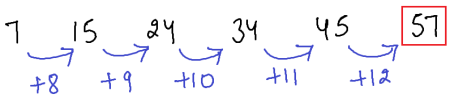
7 15 24 34 45 ?

  1. AOption (a)

    60

  2. BOption (b)

    55

  3. COption (c)

    57

  4. DOption (d)

    58

View answer & explanation

Correct answer

Answer: (c)C.

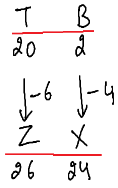
57

Why this answer is correct

The logic followed here is:

Hence, "Option 3" is the correct answer.

Question 5

In a certain code language, ‘NICE’ is coded as ‘2468’ and ‘CARS’ is coded as ‘1235’. What is the code for ‘C’ in the given code language?

  1. AOption (a)

    2

  2. BOption (b)

    1

  3. COption (c)

    5

  4. DOption (d)

    6

View answer & explanation

Correct answer

Answer: (a)A.

2

Why this answer is correct

The logic followed here is:

‘NICE’ is coded as ‘2468’

‘CARS’ is coded as ‘1235’

Thus,  code for 'C' is '2'.

Hence, "Option 1" is the correct answer.

Question 6

According to the Centre for Monitoring Indian Economy (CMIE), India's unemployment rate in June 2024 was _____.

  1. AOption (a)

    8.20%

  2. BOption (b)

    7.90%

  3. COption (c)

    10.20%

  4. DOption (d)

    9.20%

View answer & explanation

Correct answer

Answer: (d)D.

9.20%

Why this answer is correct

The correct answer is 9.20%.

Key Points

  • According to the Centre for Monitoring Indian Economy (CMIE), India's unemployment rate in June 2024 was 9.2%.
  • This figure represents a significant increase from the 7% recorded in May 2024, and highlights a concerning trend in India's labor market. Here's a more detailed breakdown:
  • Eight-Month High: The 9.2% unemployment rate in June 2024 was the highest India had seen in eight months. This suggests a worsening employment situation and raises concerns about the overall health of the economy.
  • Rising Trend: The increase in June continues a trend of rising unemployment rates in India. Over the past five years, the rate has climbed by almost 4%, indicating persistent challenges in generating sufficient employment opportunities.
  • Gender Disparity: The CMIE data reveals a significant gender gap in unemployment. The female unemployment rate stood at a staggering 18.5% in June 2024, more than double the national average. This highlights the particular difficulties women face in finding jobs in India. The male unemployment rate was considerably lower at 7.8%, though still a significant concern.
  • Rural vs. Urban: Unemployment rates increased in both rural and urban areas in June 2024. Rural unemployment rose to 9.3%, while urban unemployment reached 8.9%. This indicates that joblessness is a widespread issue affecting both rural and urban populations.
  • Labor Participation Rate: Interestingly, the rise in unemployment occurred even as the Labor Participation Rate (LPR) increased. The LPR, which measures the proportion of the working-age population that is either employed or actively seeking employment, rose to 41.4% in June 2024. This suggests that more people were entering the labor force, but a significant portion of them were unable to find jobs.
  • CMIE's Methodology: The CMIE's unemployment data is based on its Consumer Pyramids Household Survey, a large-scale survey that collects data on various economic indicators, including employment and unemployment. The CMIE is a well-respected private research firm that provides valuable insights into the Indian economy.

Additional Information

  • Factors Contributing to Unemployment:
  • While the CMIE data provides a snapshot of the unemployment situation, it's important to consider the underlying factors that contribute to it. Some of the key factors include:
  • Economic Slowdown: A slowdown in economic growth can lead to reduced job creation and increased unemployment.
  • Structural Issues: India's labor market faces structural challenges, such as a skills gap, where the skills of the workforce do not match the demands of the industry.
  • Informal Sector Dominance: A large portion of India's workforce is employed in the informal sector, which often lacks job security and decent working conditions.
  • Impact of the Pandemic: The COVID-19 pandemic had a significant impact on the Indian economy, leading to job losses and business closures. While the economy has recovered, the labor market is still facing challenges.
  • Addressing Unemployment:
  • Addressing India's unemployment challenge requires a multi-pronged approach that includes:
  • Boosting Economic Growth: Accelerating economic growth is crucial for generating more employment opportunities.
  • Investing in Skills Development: Bridging the skills gap through education and vocational training programs is essential.
  • Promoting Labor-Intensive Industries: Encouraging the growth of industries that are more labor-intensive can create more jobs.
  • Improving the Informal Sector: Providing better working conditions and social security benefits to workers in the informal sector is important.
  • Government Initiatives: The government has implemented various initiatives to address unemployment, such as the Mahatma Gandhi National Rural Employment Guarantee Act (MGNREGA) and the Pradhan Mantri Kaushal Vikas Yojana (PMKVY). Continued focus and investment in these areas are vital.

Question 7

If 8 : 4 :: 3.2 : x, what is the value of x?

  1. AOption (a)

    2.4

  2. BOption (b)

    1.6

  3. COption (c)

    3.2

  4. DOption (d)

    1.2

View answer & explanation

Correct answer

Answer: (b)B.

1.6

Why this answer is correct

Shortcut Trick

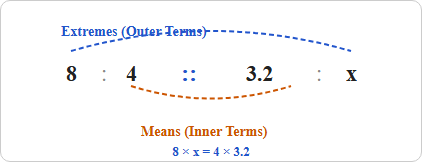
In a proportion a : b :: c : d, the Product of Extremes equals the Product of Means.

8 × x = 4 × 3.2

x = (4 × 3.2) ÷ 8

x = 12.8 ÷ 8 = 1.6

∴ The correct answer is 1.6.

Alternate Method

Given: The ratio expression is 8 : 4 :: 3.2 : x.

Formula Used: a : b :: c : d ⇒ a/b = c/d (Equality of two ratios)

Calculations:

⇒ 8 / 4 = 3.2 / x

⇒ 2 = 3.2 / x

⇒ x = 3.2 / 2

⇒ x = 1.6

∴ The correct answer is 1.6.

Additional Information

Fourth Proportional

In a : b :: c : d, d is called the fourth proportional to a, b, and c, calculated as (b × c) ÷ a.

Mean Proportional

The mean proportional between two numbers a and b is √(a × b).

Third Proportional

If a : b :: b : c, then c is the third proportional to a and b, calculated as c = b2 ÷ a.

Direct Proportion

Two quantities are in direct proportion if an increase in one leads to a corresponding increase in the other, maintaining a constant ratio.

Question 8

Which of the following options should come in place of the question mark (?) in the given series based on the English alphabetical order?

NJM, PLO, RNQ, TPS, ?

  1. AOption (a)

    RUV

  2. BOption (b)

    VRU

  3. COption (c)

    RVU

  4. DOption (d)

    VUR

View answer & explanation

Correct answer

Answer: (b)B.

VRU

Why this answer is correct

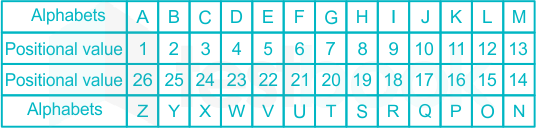
The logic followed here is:

Hence, "Option 2" is the correct answer.
Question 9

Mr. Hari spends 36% of his income on food items and 25% of the remaining amount on clothes, medical and conveyance. He saves half of the remaining amount every month. If he saves ₹1,80,000 every year, then find his monthly income.

  1. AOption (a)

    ₹6,50,040

  2. BOption (b)

    ₹7,50,000

  3. COption (c)

    ₹54,170

  4. DOption (d)

    ₹62,500

View answer & explanation

Correct answer

Answer: (d)D.

₹62,500

Why this answer is correct

Shortcut Trick

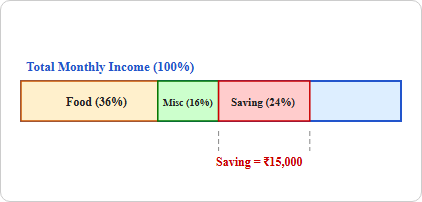
Monthly Saving = ₹1,80,000 ÷ 12 = ₹15,000

Let Monthly Income be 100%.

After Food (36%), Remainder = 64%. Spent on clothes/medical (25% of 64%) = 16%.

Final Remainder = 64% − 16% = 48%. Saving = 48% ÷ 2 = 24%.

⇒ 24% = ₹15,000 → 100% = (15,000 ÷ 24) × 100 = ₹62,500.

∴ The correct answer is ₹62,500.

Alternate Method

Given:

⇒ Annual Savings = ₹1,80,000

⇒ Expense on Food = 36% of Monthly Income

⇒ Expense on clothes, medical, conveyance = 25% of remaining amount

⇒ Monthly Savings = Half of the final remaining amount

Calculations:

⇒ Monthly Saving = 1,80,000 ÷ 12 = ₹15,000

⇒ Let Monthly Income = I

⇒ Amount left after Food = I − (36/100)I = 0.64I

⇒ Amount spent on clothes, medical, and conveyance = 25% of 0.64I = 0.25 × 0.64I = 0.16I

⇒ Remaining amount = 0.64I − 0.16I = 0.48I

⇒ Monthly Saving = 1/2 × 0.48I = 0.24I

⇒ 0.24I = 15,000

⇒ I = 15,000 ÷ 0.24

⇒ I = ₹62,500

∴ The correct answer is ₹62,500.

Additional Information

Successive Percentage Reduction

When values are reduced successively from the remaining part, the net multiplier is (1 − r1/100) × (1 − r2/100). For this problem: Net Multiplier = 0.64 × 0.75 × 0.50 = 0.24.

Income vs Savings Relationship

Total Income = Expenditure + Savings. If annual savings is provided, always convert it to a monthly value to match monthly expenditure data.

Base Value Conversion

To find the original 100% value from a given percentage part (P%), use: Total = (Given Value ÷ P) × 100.

Question 10

What is the purpose of making urine in the human body?

  1. AOption (a)

    To empty the urinary bladder

  2. BOption (b)

    To filter out waste products from the blood

  3. COption (c)

    To clean the impure blood coming to the heart

  4. DOption (d)

    To remove CO2 from the blood in the lungs

View answer & explanation

Correct answer

Answer: (b)B.

To filter out waste products from the blood

Why this answer is correct

The correct answer is To filter out waste products from the blood.

Key Points

  • The primary purpose of making urine in the human body is to filter out waste products from the blood.
  • Urine formation helps in maintaining the body’s fluid and electrolyte balance.
  • The kidneys are the main organs involved in urine production, and they function to remove toxins and excess substances from the bloodstream.
  • Urine contains urea, creatinine, and other metabolic waste products that need to be excreted to prevent their buildup in the body.
  • The process of urine formation involves three main steps: filtration, reabsorption, and secretion.

Additional Information

  • Kidneys
  • The kidneys are vital organs that perform the crucial function of filtering blood to form urine.
  • They help regulate blood pressure, red blood cell production, and calcium metabolism.
  • Nephron
  • The nephron is the functional unit of the kidney, where urine is formed through filtration, reabsorption, and secretion.
  • Each kidney contains about one million nephrons that work together to purify the blood.
  • Urea
  • Urea is a nitrogenous waste product formed from the breakdown of proteins.
  • It is excreted in urine to prevent the accumulation of toxic levels of nitrogen in the body.

Question 11

The pollen needs to be transferred from the stamen to the stigma. If this transfer of pollen occurs in the same flower, it is referred to as ______. On the other hand, if the pollen is transferred from one flower to another, it is known as ______.

  1. AOption (a)

    transversion, translocation

  2. BOption (b)

    cross pollination, self-pollination

  3. COption (c)

    translocation, transversion

  4. DOption (d)

    self-pollination, cross pollination

View answer & explanation

Correct answer

Answer: (d)D.

self-pollination, cross pollination

Why this answer is correct

The correct answer is self-pollination, cross pollination.

Key Points

  • Self-pollination occurs when pollen is transferred from the stamen to the stigma within the same flower.
  • Cross-pollination involves the transfer of pollen from the stamen of one flower to the stigma of another flower, which can be on the same plant or a different plant.
  • Self-pollination can lead to genetic uniformity since the offspring are genetically similar to the parent plant.
  • Cross-pollination promotes genetic diversity, which can enhance the adaptability and survival of species in changing environments.
  • Methods of cross-pollination include the use of pollinators such as bees, wind, water, and other animals.

Additional Information

  • Pollination Mechanisms
  • Wind pollination: Common in grasses and conifers, where pollen is carried by the wind to other flowers.
  • Animal pollination: Involves insects, birds, and mammals that carry pollen as they move from flower to flower.
  • Fertilization
  • Occurs when the pollen grain reaches the stigma and grows a pollen tube to the ovule.
  • The sperm cells travel down the pollen tube and fertilize the ovule, leading to the formation of seeds.
  • Plant Reproduction
  • Involves both sexual and asexual methods.
  • Sexual reproduction increases genetic variation, while asexual reproduction produces genetically identical offspring.

Question 12

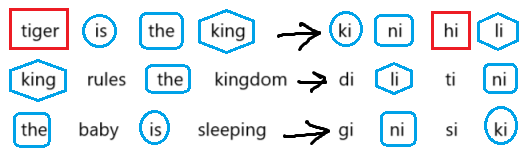
In a certain code language, ‘tiger is the king’ is written as ‘ki ni hi li’, ‘king rules the kingdom’ is written as ‘di li ti ni’, and ‘the baby is sleeping’ is written as ‘gi ni si ki’. How is ‘tiger’ written in the given language?

  1. AOption (a)

    ki

  2. BOption (b)

    ni

  3. COption (c)

    li

  4. DOption (d)

    hi

View answer & explanation

Correct answer

Answer: (d)D.

hi

Why this answer is correct

According to the given information,

Thus, according to the given codes the code 'hi' is for the word 'tiger'.

Hence, the correct answer is "Option 4".

Question 13

Which type of chemical reaction involves the exchange of ions between the reactants?

  1. AOption (a)

    Decomposition reaction

  2. BOption (b)

    Double displacement reaction

  3. COption (c)

    Displacement reaction

  4. DOption (d)

    Combination reaction

View answer & explanation

Correct answer

Answer: (b)B.

Double displacement reaction

Why this answer is correct

The correct answer is Double displacement reaction.

Key Points

  • In a double displacement reaction, ions from two compounds exchange places to form two new compounds.
  • This type of reaction generally occurs in aqueous solutions where the ions are free to move.
  • A common example of a double displacement reaction is the reaction between silver nitrate (AgNO3) and sodium chloride (NaCl) to form silver chloride (AgCl) and sodium nitrate (NaNO3).
  • Double displacement reactions are often characterized by the formation of a precipitate, a gas, or water.
  • These reactions are crucial in various industrial and laboratory processes, including the purification of compounds.

Additional Information

  • Decomposition Reaction
  • This type of reaction involves the breakdown of a single compound into two or more simpler substances.
  • An example is the decomposition of water (H2O) into hydrogen gas (H2) and oxygen gas (O2).
  • Displacement Reaction
  • In displacement reactions, one element displaces another in a compound, resulting in the formation of a new element and a new compound.
  • An example is the reaction between zinc (Zn) and hydrochloric acid (HCl) to form zinc chloride (ZnCl2) and hydrogen gas (H2).
  • Combination Reaction
  • These reactions involve the combination of two or more substances to form a single compound.
  • An example is the combination of hydrogen gas (H2) and oxygen gas (O2) to form water (H2O).

Question 14

Evaluate the given expression.

42 ÷ 7 × 2

  1. AOption (a)

    10

  2. BOption (b)

    8

  3. COption (c)

    12

  4. DOption (d)

    3

View answer & explanation

Correct answer

Answer: (c)C.

12

Why this answer is correct

Given:

Evaluate the given expression: 42 ÷ 7 × 2

Formula Used:

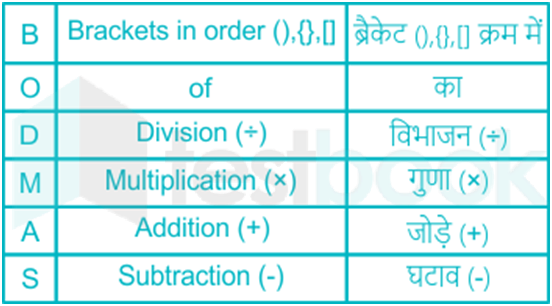
Order of Operations (BODMAS/BIDMAS): Brackets, Orders (i.e. powers and square roots, etc.), Division and Multiplication (left-to-right), Addition and Subtraction (left-to-right)

Calculation:

According to BODMAS/BIDMAS, we first perform the division and then the multiplication.

⇒ 42 ÷ 7 × 2

⇒ 6 × 2

⇒ 12

The correct answer is option 3.

Question 15

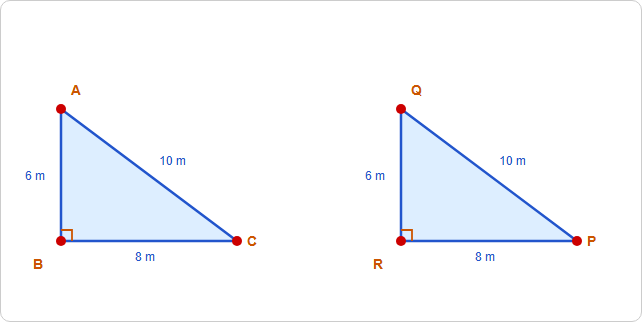
In triangle ABC, AB‾=6,m,BC‾=8,m,AC‾=10,m.\overline{AB} = 6 , m , \overline{BC} = 8 , m , \overline{AC} = 10 , m .. In triangle PRQ, PR‾=8,m,PQ‾=10,m,RQ‾=6,m.\overline{PR} = 8 , m , \overline{PQ} = 10 , m , \overline{RQ} = 6 , m . Which of the following is a correct order of congruency?

  1. AOption (a)

    △BCA congruent to △RPQ

  2. BOption (b)

    △ABC congruent to △RPQ

  3. COption (c)

    △BAC congruent to △RPQ

  4. DOption (d)

    △CBA congruent to △RPQ

View answer & explanation

Correct answer

Answer: (a)A.

△BCA congruent to △RPQ

Why this answer is correct

Shortcut Trick

Compare the lengths of the sides to find the corresponding vertices.

Matching equal sides: AB = RQ = 6 m, BC = PR = 8 m, and AC = PQ = 10 m.

Identify the vertex opposite to each side: ∠C = ∠P (opposite to 6m), ∠A = ∠Q (opposite to 8m), and ∠B = ∠R (opposite to 10m).

Mapping the vertices: A → Q, B → R, and C → P.

Check the order: BCA maps to RPQ.

∴ The correct answer is △BCA ≅ △RPQ.

Alternate Method

Given:

In △ABC: AB = 6 m, BC = 8 m, AC = 10 m.

In △PRQ: PR = 8 m, PQ = 10 m, RQ = 6 m.

Formula Used:

Side-Side-Side (SSS) Congruence Criterion: Two triangles are congruent if all three sides of one triangle are equal to the corresponding three sides of the other triangle. The order of vertices must match the corresponding equal sides.

Calculations:

⇒ In △ABC and △RPQ, let us check the side correspondences.

⇒ AB = 6 m and RQ = 6 m ∴ AB = RQ

⇒ BC = 8 m and PR = 8 m ∴ BC = PR

⇒ AC = 10 m and PQ = 10 m ∴ AC = PQ

⇒ Since all three corresponding sides are equal, the triangles are congruent by SSS criterion.

⇒ To write the correct order, match the vertices:

⇒ The vertex common to sides AB and BC is B; the vertex common to sides RQ and PR is R. ⇒ B ↔ R

⇒ The vertex common to sides BC and AC is C; the vertex common to sides PR and PQ is P. ⇒ C ↔ P

⇒ The vertex common to sides AB and AC is A; the vertex common to sides RQ and PQ is Q. ⇒ A ↔ Q

⇒ Using this mapping: BCA ≅ RPQ.

∴ The correct answer is △BCA ≅ △RPQ.

Additional Information

SAS (Side-Angle-Side) Congruence

Two triangles are congruent if two sides and the included angle of one triangle are equal to the corresponding parts of the other.

ASA (Angle-Side-Angle) Congruence

Two triangles are congruent if two angles and the included side of one triangle are equal to the corresponding parts of the other.

RHS (Right Angle-Hypotenuse-Side) Congruence

In two right-angled triangles, if the hypotenuse and one side of one triangle are equal to the hypotenuse and the corresponding side of the other, they are congruent.

Pythagorean Triplets

A set of three positive integers a, b, and c such that a2 + b2 = c2. Here, (6, 8, 10) is a triplet, meaning these triangles are right-angled.

Question 16

Select the pair which follows the same pattern as that followed by the two set of pairs given below. Both pairs follow the same pattern.

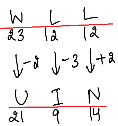
ARH : YOJ

SFP : QCR

  1. AOption (a)

    QPV : OLP

  2. BOption (b)

    FTH : BNZ

  3. COption (c)

    WBN : YFT

  4. DOption (d)

    WLL : UIN

View answer & explanation

Correct answer

Answer: (d)D.

WLL : UIN

Why this answer is correct

The logic followed here is:

​Given:

ARH : YOJ

And,

SFP : QCR

So, checking each option one by one:

Option 1) QPV : OLP

Option 2) FTH : BNZ

Option 3) WBN : YFT

Option 4) WLL : UIN

Thus, out of all the options, 'WLL : UIN' follows the same logic as given.

Hence, "Option 4" is the correct answer.

Question 17

Where were the indigenously developed Param Rudra Supercomputers deployed, in September 2024?

  1. AOption (a)

    Mumbai, Bengaluru and Kolkata

  2. BOption (b)

    Pune, Delhi and Kolkata

  3. COption (c)

    Bengaluru, Delhi and Mumbai

  4. DOption (d)

    Pune, Bengaluru and Kolkata

View answer & explanation

Correct answer

Answer: (b)B.

Pune, Delhi and Kolkata

Why this answer is correct

The correct answer is Pune, Delhi and Kolkata.

Key Points

  • Prime Minister Narendra Modi launched three "PARAM Rudra" supercomputers with a 1-petaflop processing capability, developed indigenously by C-DAC, Pune, under the National Supercomputing Mission (NSM).
  • The supercomputers are deployed in Pune, Delhi, and Kolkata to facilitate pioneering scientific research in various fields.
  • The "Giant Metre Radio Telescope" in Pune will leverage the supercomputer to explore Fast Radio Bursts (FRBs) and other astronomical phenomena.
  • NSM was launched in 2015 and is jointly steered by the Department of Science and Technology (DST) and the Ministry of Electronics and Information Technology (MeitY).

Additional Information

  • Other Supercomputers Under NSM
  • The first supercomputer under NSM, "PARAM Shivay," was installed at IIT BHU in 2019, followed by other supercomputers like "PARAM Shakti" and "PARAM Brahma."

Question 18

In organisms such as Amoeba, the splitting of the two cells during division can take place in _____.

  1. AOption (a)

    any plane

  2. BOption (b)

    one fixed plane

  3. COption (c)

    two fixed planes

  4. DOption (d)

    multiple equal planes

View answer & explanation

Correct answer

Answer: (a)A.

any plane

Why this answer is correct

The correct answer is any plane.

Key Points

  • In organisms such as Amoeba, cell division occurs through a process called binary fission.
  • During binary fission, the nucleus of the Amoeba divides first, followed by the division of the cytoplasm.
  • The splitting of the two cells during division in Amoeba can take place in any plane.
  • This flexibility in the plane of division allows Amoeba to reproduce efficiently under varying environmental conditions.
  • Amoebas are unicellular organisms, meaning they consist of a single cell that carries out all vital biological processes.

Additional Information

  • Binary Fission in Bacteria
  • Bacteria also reproduce through binary fission, where the DNA replicates and the cell splits into two identical daughter cells.
  • Mitotic Cell Division
  • In multicellular organisms, mitotic cell division ensures that each new cell receives an identical copy of the parent cell's DNA.
  • This type of division is essential for growth, repair, and asexual reproduction in eukaryotes.
  • Meiotic Cell Division
  • Meiosis is a type of cell division that reduces the chromosome number by half, resulting in four genetically diverse daughter cells.
  • This process is crucial for sexual reproduction, contributing to genetic variation in offspring.

Question 19

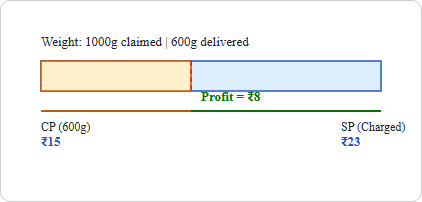
A dishonest shopkeeper claimed to have sold an item at ₹23/kg, which cost him ₹25/kg. However, by using faulty weights, he gave only 600 gm instead of 1 kg. What is his total percentage profit or loss?

  1. AOption (a)

    23% loss

  2. BOption (b)

    20% loss

  3. COption (c)

    62 ½% profit

  4. DOption (d)

    53 ⅓% profit

View answer & explanation

Correct answer

Answer: (d)D.

53 ⅓% profit

Why this answer is correct

Shortcut Trick

Net effective ratio method:

Price Ratio (CP : SP) = 25 : 23

Weight Ratio (Quantity) = 600 : 1000 = 3 : 5

Overall Ratio (CP : SP) = (25 × 3) : (23 × 5) = 75 : 115 = 15 : 23

Profit % = (8 ÷ 15) × 100 = 160/3% = 53 ⅓%

∴ The correct answer is 53 ⅓% profit.

Alternate Method

Given:

Cost Price (CP) = ₹25 per kg

Selling Price (SP) = ₹23 per kg

Actual weight given = 600 gm instead of 1000 gm

Formula Used:

Profit = SP − CP

Profit % = (Profit ÷ CP) × 100

Calculations:

⇒ CP of 1000 gm = ₹25

⇒ CP of 600 gm = (25 ÷ 1000) × 600

⇒ CP of 600 gm = ₹15

⇒ Shopkeeper sells this 600 gm for ₹23 (as he claims it to be 1 kg sold at discount)

⇒ Profit = ₹23 − ₹15 = ₹8

⇒ Profit % = (8 ÷ 15) × 100

⇒ Profit % = 160 ÷ 3 = 53 ⅓%

∴ The correct answer is 53 ⅓% profit.

Additional Information

Dishonest Dealer Concept

When a dealer sells at cost price but uses faulty weights, Profit % = [Error ÷ (True Value − Error)] × 100.

Successive Multiplication Factor

Total Multiplier = (SP ÷ CP)Price × (True Weight ÷ Faulty Weight). If result > 1, it is Profit; if < 1, it is Loss.

Profit/Loss on Weight

A shortage in weight always acts as a profit factor for the shopkeeper because he spends less on the actual quantity delivered.

Question 20

If LCM (27, n) = 54 and HCF (27, n) = 9, then the value of n is:

  1. AOption (a)

    24

  2. BOption (b)

    18

  3. COption (c)

    54

  4. DOption (d)

    36

View answer & explanation

Correct answer

Answer: (b)B.

18

Why this answer is correct

Shortcut Trick

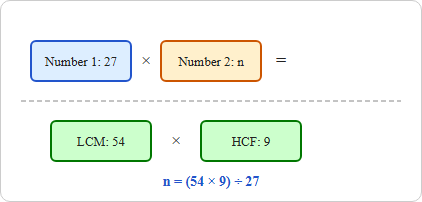
The product of two numbers is always equal to the product of their LCM and HCF.

First number × Second number = LCM × HCF

27 × n = 54 × 9

n = (54 × 9) ÷ 27 = 2 × 9 = 18

∴ The correct answer is 18.

Alternate Method

Given: First number = 27, LCM(27, n) = 54, HCF(27, n) = 9.

Formula Used: Product of two numbers = LCM × HCF

⇒ 27 × n = 54 × 9

⇒ 27n = 486

⇒ n = 486 ÷ 27

⇒ n = 18

∴ The correct answer is 18.

Additional Information

Fundamental Property of LCM and HCF

For any two positive integers a and b, the relationship is defined as: HCF(a, b) × LCM(a, b) = a × b.

Divisibility Rule

The HCF of any group of numbers is always a factor of their LCM. Here, 9 is a factor of 54.

Co-prime Numbers

If two numbers are co-prime, their HCF is 1, and their LCM is the product of the numbers themselves.

Question 21

The force exerted by the earth on the moon is:

(Consider G = 6 × 10⁻¹¹ Nm2kg−2; mass of the earth M = 6 × 1024 kg; mass of the moon = 8 × 10²² kg, and distance between earth and moon is 4 × 10⁸ m).

  1. AOption (a)

    1.8 x 10¹⁸ N

  2. BOption (b)

    1.8 x 10²⁰ N

  3. COption (c)

    1.8 x 10²⁴ N

  4. DOption (d)

    1.8 x 10²² N

View answer & explanation

Correct answer

Answer: (b)B.

1.8 x 10²⁰ N

Why this answer is correct

Concept:

Newton's Law of Universal Gravitation:

  • This law states that every particle in the universe attracts every other particle with a force that is proportional to the product of their masses and inversely proportional to the square of the distance between their centers.
  • Key Formula: F=Gm1m2r2F = G \frac{m_1 m_2}{r^2} where:
  • G is the gravitational constant (6 × 10-11 Nm2kg-2),
  • m_1 and m_2 are the masses of the two objects,
  • r is the distance between the centers of the two masses.
  • Gravitational Force (F) is measured in Newtons (N).
  • Dimensional Formula: [M1L3T−2][M^1L^3T^{-2}].

Calculation:

Given data:

Gravitational Constant, G = 6 × 10-11 Nm2kg-2

Mass of the Earth, M = 6 × 1024 kg

Mass of the Moon, m = 8 × 10²² kg

Distance between Earth and Moon, r = 4 × 10⁸ m

F=GMmr2F = G \frac{Mm}{r^2}

⇒ F=6×10−116×1024×8×1022(4×10⁸)2F = 6 \times 10^{-11} \frac{6 \times 10^{24} \times 8 \times 10^{22}}{(4 \times 10^8)^2}

⇒ F=6×10−1148×104616×1016F = 6 \times 10^{-11} \frac{48 \times 10^{46}}{16 \times 10^{16}}

⇒ F=6×10−11×3×1030=1.8×10²⁰NF = 6 \times 10^{-11} \times 3 \times 10^{30} = 1.8 \times 10^{20} N

∴ The gravitational force exerted by the Earth on the Moon is 1.8 × 10²⁰ N.

Question 22

Which of the following events is a consequence of atmospheric refraction?

  1. AOption (a)

    Shaving mirrors to form large image of face

  2. BOption (b)

    Image formation by plain mirrors

  3. COption (c)

    Rainbow formation

  4. DOption (d)

    Advance sunrise and delayed sunset

View answer & explanation

Correct answer

Answer: (d)D.

Advance sunrise and delayed sunset

Why this answer is correct

The correct answer is Advance sunrise and delayed sunset.

Key Points

  • Atmospheric refraction is the bending of light as it passes through the Earth's atmosphere.
  • This phenomenon causes the sun to appear above the horizon when it is actually below it during sunrise and sunset.
  • The refraction of light by the atmosphere extends the duration of daylight, leading to an earlier sunrise and later sunset.
  • The Earth's atmosphere consists of layers with varying densities, which bend the light rays.
  • Atmospheric refraction is responsible for various optical phenomena, including the apparent shift in the position of stars.

Additional Information

  • Rainbow Formation
  • Rainbows are formed by the refraction, dispersion, and reflection of light in water droplets.
  • They appear as a spectrum of light in the sky, creating a circular arc of colors.
  • Mirage
  • A mirage is an optical phenomenon that creates the illusion of water or a displaced image of distant objects.
  • It occurs due to the refraction of light rays in layers of air with different temperatures.
  • Twinkling of Stars
  • The twinkling of stars, also known as stellar scintillation, is caused by the atmospheric refraction of starlight.
  • Variations in air density and temperature cause the light from stars to bend and shift, making them appear to twinkle.

Question 23

Refer to the following number and symbol series and answer the question that follows. Counting to be done from left to right only.

(Left)

9 # 2 6 @ 8 $ Ω 1 * £ 5 7 & % 4 3 (Right)

How many such symbols are there, each of which is immediately preceded by a number and also immediately followed by a symbol$?

  1. AOption (a)

    More than two

  2. BOption (b)

    One

  3. COption (c)

    Zero

  4. DOption (d)

    Two

View answer & explanation

Correct answer

Answer: (a)A.

More than two

Why this answer is correct

Given series:

9 # 2 6 @ 8 $ Ω 1 * £ 5 7 & % 4 3

Condition to be checked:

Symbols which are immediately preceded by a number and also immediately followed by another symbol.

Number → Symbol → Symbol

Checking the given series:

9 # 2 6 @ 8 $ Ω 1 * £ 5 7 & % 4 3

Thus there are three such patterns (7 & %, 8 $ Ω, 1 * £) that follow the above condition.

Hence, the correct answer is Option 1.

Mistake Points

Immediately preceded by means immediately before or to come just before.

Immediately followed by means immediately after or to come just after$.

Question 24

If θ is an acute angle, find the denominator D when

(cot θ - cosec θ)2 = 1−cos⁡θD\frac{1 - \cos θ}{D}

  1. AOption (a)

    1 + sin θ

  2. BOption (b)

    -sin θ - 1

  3. COption (c)

    -1 - cos θ

  4. DOption (d)

    1 + cos θ

View answer & explanation

Correct answer

Answer: (d)D.

1 + cos θ

Why this answer is correct

Shortcut Trick

Simplify the expression using the identity (cosec θ − cot θ) = tan(θ/2).

Given (cot θ − cosec θ)2 is the same as (cosec θ − cot θ)2.

We know (1 − cos θ) / (1 + cos θ) = tan2(θ/2).

Comparing (1 − cos θ) / D = (1 − cos θ) / (1 + cos θ).

∴ The correct answer is 1 + cos θ.

Alternate Method

Given:

(cot θ − cosec θ)2 = (1 − cos θ) / D

Formula Used:

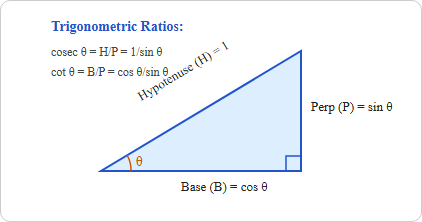
  1. cot θ = cos θ / sin θ
  2. cosec θ = 1 / sin θ
  3. sin2 θ + cos2 θ = 1 ⇒ sin2 θ = 1 − cos2 θ

Calculations:

⇒ [(cos θ / sin θ) − (1 / sin θ)]2 = (1 − cos θ) / D

⇒ [(cos θ − 1) / sin θ]2 = (1 − cos θ) / D

⇒ (cos θ − 1)2 / sin2 θ = (1 − cos θ) / D

⇒ Since (a − b)2 = (b − a)2, then (cos θ − 1)2 = (1 − cos θ)2

⇒ (1 − cos θ)2 / (1 − cos2 θ) = (1 − cos θ) / D

⇒ (1 − cos θ)2 / [(1 − cos θ)(1 + cos θ)] = (1 − cos θ) / D

⇒ (1 − cos θ) / (1 + cos θ) = (1 − cos θ) / D

⇒ 1 / (1 + cos θ) = 1 / D

⇒ D = 1 + cos θ

∴ The correct answer is 1 + cos θ.

Additional Information

Reciprocal Identities

Basic relations include cosec θ = 1/sin θ, sec θ = 1/cos θ, and cot θ = 1/tan θ.

Pythagorean Identities

Fundamental squares: sin2θ + cos2θ = 1; 1 + tan2θ = sec2θ; 1 + cot2θ = cosec2θ.

Difference of Squares in Trig

The expression 1 − cos2θ is frequently factored as (1 − cos θ)(1 + cos θ) to simplify rational trigonometric functions.

Question 25

What was the theme of 'Financial Literacy Week 2024', conducted by the Reserve Bank of India from 26 February to 01 March 2024?

  1. AOption (a)

    Credit Discipline and Credit from Formal Institutions

  2. BOption (b)

    Good Financial Behaviour, Your Saviour

  3. COption (c)

    Make a Right Start: Become Financially Smart

  4. DOption (d)

    Go Digital, Go Secure

View answer & explanation

Correct answer

Answer: (c)C.

Make a Right Start: Become Financially Smart

Why this answer is correct

The correct answer is Make a Right Start: Become Financially Smart.

Key Points

Financial Literacy Week 2024:

  • The theme for Financial Literacy Week 2024 was "Make a Right Start: Become Financially Smart".
  • This theme was specifically aimed at educating students and young adults about the importance of financial literacy.
  • Financial Literacy Week focuses on raising awareness and educating individuals about various financial concepts and practices.
  • Events and activities during the week included workshops, seminars, and interactive sessions to help young people understand the basics of managing finances, saving, and investing.

Objectives of Financial Literacy Week:

  • To enhance financial literacy among students and young adults, equipping them with the knowledge to make informed financial decisions.
  • To promote the importance of starting early in developing good financial habits and understanding financial products and services.
  • To encourage savings, responsible spending, and informed investment decisions among the younger generation.
  • To provide resources and tools that help young people navigate the financial landscape and avoid common financial pitfalls.

 Additional Information

Financial Literacy:

  • Financial literacy is the ability to understand and effectively use various financial skills, including personal financial management, budgeting, and investing.
  • It involves being aware of financial risks and opportunities to make sound financial decisions.
  • Improving financial literacy can lead to better financial health and stability, helping individuals achieve their financial goals.
  • Educational initiatives like Financial Literacy Week play a crucial role in empowering individuals with the knowledge and skills necessary to manage their finances effectively.

Question 26

8 men and 12 women can build a wall in 10 days. 6 men and 8 women can build the same wall in 14 days. How long will it take for 1 woman to build it alone?

  1. AOption (a)

    280 days

  2. BOption (b)

    140 days

  3. COption (c)

    350 days

  4. DOption (d)

    700 days

View answer & explanation

Correct answer

Answer: (a)A.

280 days

Why this answer is correct

Shortcut Trick

Equate the work: (8 Men + 12 Women) × 10 = (6 Men + 8 Women) × 14

80M + 120W = 84M + 112W ⇒ 4M = 8W ⇒ 1 Man = 2 Women

Total work in terms of Women = (8 × 2 + 12) × 10 = 28 × 10 = 280 Woman-days

Time taken by 1 Woman = 280 ÷ 1 = 280 days.

∴ The correct answer is 280 days.

Alternate Method

Given:

Case 1: 8 Men (M) and 12 Women (W) in 10 days.

Case 2: 6 Men (M) and 8 Women (W) in 14 days.

Formula Used:

Total Work = (M1 + W1) × D1 = (M2 + W2) × D2

Group of WorkersDaysTotal Work (LCM)Efficiency
8M + 12W1014014
6M + 8W1410

Calculations:

⇒ 8M + 12W = 14 (Equation 1)

⇒ 6M + 8W = 10 (Equation 2)

⇒ From Eq 1: 4M + 6W = 7

⇒ From Eq 2: 3M + 4W = 5

⇒ Multiply (4M + 6W = 7) by 3: 12M + 18W = 21

⇒ Multiply (3M + 4W = 5) by 4: 12M + 16W = 20

⇒ Subtracting the two: (12M + 18W) − (12M + 16W) = 21 − 20

⇒ 2W = 1 ⇒ Efficiency of 1 Woman = 0.5 units/day

⇒ Time taken by 1 Woman = Total Work ÷ Efficiency = 140 ÷ 0.5 = 280 days

∴ The correct answer is 280 days.

Additional Information

Work-Efficiency Relationship

Total Work is constant; therefore, the number of workers and the time taken are inversely proportional (M1D1 = M2D2).

Combined Efficiency

When multiple groups or individuals work together, their combined efficiency is the sum of their individual efficiencies (Total Efficiency = E1 + E2 + ...).

Man-Day-Hour Formula

For varying work conditions: (M1 × D1 × H1) / W1 = (M2 × D2 × H2) / W2, where H is hours and W is units of work.

Question 27

The kinetic energy of a moving object is dependent on which of the following quantities:

i) Mass of the body

ii) Square of the velocity

iii) Pressure

  1. AOption (a)

    Only (iii)

  2. BOption (b)

    Both (i) and (ii)

  3. COption (c)

    Only (i)

  4. DOption (d)

    Both (ii) and (iii)

View answer & explanation

Correct answer

Answer: (b)B.

Both (i) and (ii)

Why this answer is correct

The Correct answer is Both (i) and (ii).

Key Points

  • The kinetic energy of a moving object is directly proportional to its mass and the square of its velocity.
  • The formula for kinetic energy is given as KE = (1/2) mv², where:
  • m represents the mass of the object.
  • v represents the velocity of the object.
  • This implies that an increase in either the mass or the velocity (with velocity having a greater impact due to being squared) will result in an increase in the kinetic energy.
  • Pressure does not have a direct relationship with kinetic energy in this context. Pressure is defined as force per unit area and pertains to different physical phenomena.
  • Thus, the correct answer is that the kinetic energy depends on both the mass of the body and the square of its velocity.

 Additional Information

  • Mass of the body
  • The mass is a scalar quantity that represents the amount of matter contained in an object.
  • It is measured in kilograms (kg) in the SI unit system.
  • In the context of kinetic energy, the mass determines the proportion of energy for a given velocity.
  • Square of the velocity
  • The velocity of an object refers to its speed in a specific direction and is a vector quantity.
  • Since the velocity is squared in the formula, it has a larger influence on the kinetic energy than the mass.
  • For example, doubling the velocity of an object will quadruple its kinetic energy.
  • Pressure
  • Pressure is defined as the force exerted per unit area and is measured in Pascals (Pa).
  • It is unrelated to the kinetic energy of a moving object in this context.
  • Pressure is often studied in the context of fluids, gases, and thermodynamics.

Question 28

FIGH is related to KNLM in a certain way based on the English alphabetical order. In the same way, RUST is related to WZXY. To which of the following options is HKIJ related, following the same logic?

  1. AOption (a)

    MQNO

  2. BOption (b)

    MPNO

  3. COption (c)

    LQNO

  4. DOption (d)

    NPLO

View answer & explanation

Correct answer

Answer: (b)B.

MPNO

Why this answer is correct

The logic followed here is:

FIGH is related to KNLM

And,

RUST is related to WZXY

Similarly,

HKIJ is related to

Hence, "Option 2" is the correct answer.

Question 29

Based on the English alphabetical order, three of the following four letter-cluster pairs are alike in a certain way and thus form a group. Which pair does not belong to that group?

(Note: The odd one out is not based on the number of consonants/vowels or their position in the letter-cluster.)

  1. AOption (a)

    ME - JB

  2. BOption (b)

    UM - GZ

  3. COption (c)

    SK - PH

  4. DOption (d)

    FX - CU

View answer & explanation

Correct answer

Answer: (b)B.

UM - GZ

Why this answer is correct

The logic followed here is:

Option 1) ME - JB

Option 2) UM - GZ

Option 3) SK - PH

Option 4) FX - CU

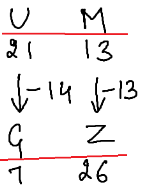
Thus, out of all the options 'UM - GZ' is the odd one out.

Hence, "Option 2" is the correct answer.

Question 30

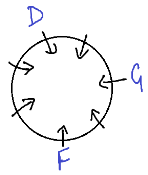
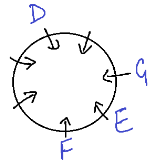
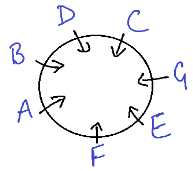
A, B, C, D, E, F and G are sitting around a circular table facing the Centre.

D sits third to the left of F. G sits second to the left of D. G sits to the immediate right of E. B sits to the immediate left of A.

What is the position of D with respect to B?

  1. AOption (a)

    Second to the left

  2. BOption (b)

    Immediate left

  3. COption (c)

    Second to the right

  4. DOption (d)

    Immediate right

View answer & explanation

Correct answer

Answer: (b)B.

Immediate left

Why this answer is correct

Given: A, B, C, D, E, F and G are sitting around a circular table facing the Centre.

1) D sits third to the left of F. 

2) G sits second to the left of D. 

3) G sits to the immediate right of E.

4) B sits to the immediate left of A.

After positioning B and A only one position is left which will be occupied by the only person left i.e. C.

Thus, according to the final arrangement, D is immediate left of B.

Hence, "Option 2" is the correct answer.

Question 31

Two circular coils A and B, have the same radius R, and carry the same current I, but have 50 and 100 turns, respectively. The magnetic field produced:

  1. AOption (a)

    by A = by B

  2. BOption (b)

    by B > that of A

  3. COption (c)

    by A and B are undetermined

  4. DOption (d)

    by A > that of B

View answer & explanation

Correct answer

Answer: (b)B.

by B > that of A

Why this answer is correct

The Correct answer is by B > that of A.

Key Points

  • The magnetic field at the center of a circular coil is given by the formula: B = (μ₀ × n × I) / (2R), where:
  • μ₀: Permeability of free space.
  • n: Number of turns in the coil.
  • I: Current flowing through the coil.
  • R: Radius of the coil.
  • In the given question, the radius R and current I are the same for both coils A and B.
  • However, the number of turns (n) differs: Coil A has 50 turns, while Coil B has 100 turns.
  • The magnetic field is directly proportional to the number of turns (n), so the magnetic field produced by B will be greater than that of A.
  • Using the ratio of turns, the magnetic field of B is twice that of A (since 100/50 = 2).
  • Thus, the correct answer is that the magnetic field produced by Coil B is greater than that of Coil A.

Additional Information

  • by A = by B
  • This is incorrect because the magnetic field depends on the number of turns (n), and since Coil B has more turns than Coil A, their magnetic fields cannot be equal.
  • by A and B are undetermined
  • This is incorrect because the formula B = (μ₀ × n × I) / (2R) allows us to determine the magnetic field if the values for n, I, and R are provided.
  • by A > that of B
  • This is incorrect because Coil A has fewer turns (50) compared to Coil B (100), and the magnetic field is directly proportional to the number of turns (n).

Question 32

In this question, two statements, I and II, have been given. These statements maybe independent causes, or effects of independent causes or a common cause. One of the statements maybe the effect of the other statement. Read both the statements and select the correct answer.

I. Citizens of city X have multiplied their wealth by investing in government schemes in the past two years.

II. City X has seen a recent rise in the number of luxury cars.

  1. AOption (a)

    II is the cause and I is its possible effect.

  2. BOption (b)

    Both I and II are effects of independent causes.

  3. COption (c)

    I is the cause and II is its possible effect.

  4. DOption (d)

    Both I and II are independent causes.

View answer & explanation

Correct answer

Answer: (c)C.

I is the cause and II is its possible effect.

Why this answer is correct

Statement I (Cause): Citizens increasing their wealth significantly provides them with higher disposable income.

Statement II (Effect): An increase in luxury car purchases is a direct consequence of people having more wealth and purchasing power.

Since the accumulation of wealth (I) logically leads to the ability to buy luxury goods (II), Statement I is the cause and Statement II is the effect.

Hence, the correct answer is option (3).

Question 33

Which of the following is the most common simple permanent tissue?

  1. AOption (a)

    Epidermis

  2. BOption (b)

    Parenchyma

  3. COption (c)

    Phloem

  4. DOption (d)

    Sclerenchyma

View answer & explanation

Correct answer

Answer: (b)B.

Parenchyma

Why this answer is correct

The correct answer is Parenchyma.

Key Points

  • Parenchyma is the most common simple permanent tissue found in plants.
  • It consists of living cells that are thin-walled, and is usually involved in storage, photosynthesis, and secretion.
  • These cells are generally isodiametric in shape, meaning they have roughly equal dimensions on all sides.
  • Parenchyma cells have large central vacuoles that store nutrients and waste products.
  • They also play a role in the healing and repair of plant tissues due to their ability to divide and differentiate.

Additional Information

  • Epidermis
  • The epidermis is the outermost layer of cells in plants, serving as a protective barrier against environmental factors.
  • It helps in reducing water loss and provides protection against pathogens.
  • Phloem
  • Phloem is a complex tissue responsible for the transport of nutrients, particularly sugars produced by photosynthesis, in plants.
  • It consists of various cell types, including sieve elements, companion cells, phloem fibres, and parenchyma.
  • Sclerenchyma
  • Sclerenchyma is a type of permanent tissue known for its role in providing mechanical support and strength to plant structures.
  • It consists of dead cells with thick, lignified cell walls.

Question 34

Based on the English alphabetical order, three of the following four letter-cluster pairs are alike in a certain way and thus form a group. Which pair does not belong to that group?

(Note: The odd one out is not based on the number of consonants/vowels or their position in the letter-cluster.)

  1. AOption (a)

    SA - PX

  2. BOption (b)

    LT - IQ

  3. COption (c)

    TB - ZF

  4. DOption (d)

    EM - BJ

View answer & explanation

Correct answer

Answer: (c)C.

TB - ZF

Why this answer is correct

The logic followed here is:

Option 1) SA - PX

Option 2) LT - IQ

Option 3) TB - ZF

Option 4) EM - BJ

Thus, out of all the options 'TB - ZF' is the odd one out.

Hence, "Option 3" is the correct answer.

Question 35

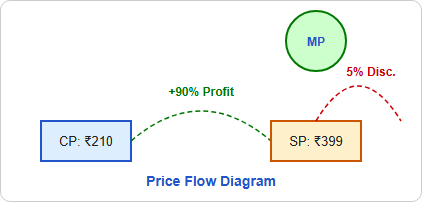
The cost price of a toy is ₹210. What should be its marked price so that, after a discount of 5%, the shopkeeper gains 90%?

  1. AOption (a)

    ₹480

  2. BOption (b)

    ₹450

  3. COption (c)

    ₹420

  4. DOption (d)

    ₹400

View answer & explanation

Correct answer

Answer: (c)C.

₹420

Why this answer is correct

Shortcut Trick

Direct relation between Marked Price (MP) and Cost Price (CP):

MP / CP = (100 + Profit%) / (100 − Discount%)

MP / 210 = (100 + 90) / (100 − 5)

MP / 210 = 190 / 95 ⇒ MP / 210 = 2

MP = 210 × 2 = ₹420

∴ The correct answer is ₹420.

Alternate Method

Given:

Cost Price (CP) = ₹210

Profit Percentage = 90%

Discount Percentage = 5%

Formula Used:

  1. Selling Price (SP) = CP × (100 + Profit%)/100
  2. Marked Price (MP) = SP × 100 / (100 − Discount%)

Calculations:

⇒ First, calculate the Selling Price (SP) to achieve 90% profit:

⇒ SP = 210 × (100 + 90) / 100

⇒ SP = 210 × 1.9 = ₹399

⇒ Now, this SP is obtained after giving a 5% discount on the Marked Price (MP):

⇒ SP = MP × (100 − 5) / 100

⇒ 399 = MP × 95 / 100

⇒ MP = (399 × 100) / 95

⇒ MP = 39900 / 95 = ₹420

∴ The correct answer is ₹420.

Additional Information

CP, SP, and MP Relationship

Profit is always calculated on Cost Price (CP), whereas Discount is always calculated on the Marked Price (MP). SP = CP + Profit = MP − Discount.

Markup Percentage

It is the extra price added to the CP to reach the MP. Markup % = [(MP − CP) / CP] × 100.

Successive Discounts

If two discounts d1% and d2% are given, the effective discount is [d1 + d2 − (d1×d2/100)]%.

Question 36

Where was the fifth India-U.S. 2+2 Ministerial Dialogue held on 10 November 2023?

  1. AOption (a)

    Mumbai

  2. BOption (b)

    New York

  3. COption (c)

    Washington, DC

  4. DOption (d)

    New Delhi

View answer & explanation

Correct answer

Answer: (d)D.

New Delhi

Why this answer is correct

The correct answer is New Delhi.

Key Points

  • The fifth India-U.S. 2+2 Ministerial Dialogue was held in New Delhi, India on November 10, 2023.
  • This high-level dialogue mechanism signifies the importance the two countries place on their strategic partnership. Here's a breakdown of key aspects:
  • What is the 2+2 Dialogue? It's a format where the Foreign and Defense Ministers of two countries meet with their counterparts to discuss strategic and security issues. In the case of India and the U.S., this involves the Indian External Affairs Minister and Defense Minister meeting with the U.S. Secretary of State and Secretary of Defense.
  • Significance: The 2+2 Dialogue allows for a comprehensive review of the bilateral relationship and provides a platform for in-depth discussions on issues of mutual concern. It signals a strong commitment to strategic partnership at the highest levels of government.
  • Key Focus Areas: The 2023 dialogue focused on several critical areas:
  • Defense and Security Cooperation: This included discussions on military exercises, defense technology cooperation, and maritime security in the Indo-Pacific region.
  • Technology Value Chain Collaboration: Both countries are keen to strengthen cooperation in critical and emerging technologies, including semiconductors, artificial intelligence, and space.
  • People-to-People Ties: Enhancing people-to-people connections through educational exchanges, cultural programs, and tourism was also on the agenda.
  • Indo-Pacific Region: The Indo-Pacific was a major focus, with both sides reiterating their commitment to a free, open, and inclusive region. Maritime security, counterterrorism, and regional stability were key discussion points.
  • Defense Cooperation: The dialogue saw progress in defense cooperation, with discussions on co-production and co-development of defense equipment, including potential deals for fighter jet engines and drones.
  • Terrorism: Both countries strongly condemned terrorism in all its forms and reiterated their commitment to counterterrorism cooperation.
  • Global Issues: The ministers also discussed global issues such as the war in Ukraine, the Israel-Hamas conflict, and the humanitarian situation in Gaza.
  • Bilateral Meetings: In addition to the 2+2 dialogue, the ministers also held separate bilateral meetings to further strengthen their respective partnerships.
  • Future Roadmap: The dialogue aimed to advance the futuristic roadmap for the India-U.S. partnership, as envisioned by Prime Minister Modi and President Biden.
  • Multilateral Cooperation: Both sides emphasized the importance of cooperation within multilateral frameworks such as the Quad (India, U.S., Japan, and Australia).

Question 37

The value of (x - y)(x + y) + (y - z)(y + z) + (z - x)(z + x) is:

  1. AOption (a)

    x² + y² + z²

  2. BOption (b)

    x + y + z

  3. COption (c)

    0

  4. DOption (d)

    xy + yz + zx

View answer & explanation

Correct answer

Answer: (c)C.

0

Why this answer is correct

Shortcut Trick

Apply the Difference of Squares identity: (a − b)(a + b) = a2 − b2.

The expression becomes: (x2 − y2) + (y2 − z2) + (z2 − x2).

Summing these cyclic terms results in all variables canceling out: x2 − x2 + y2 − y2 + z2 − z2.

The final value is 0.

∴ The correct answer is 0.

Alternate Method

Given: (x − y)(x + y) + (y − z)(y + z) + (z − x)(z + x)

Formula Used: (a − b)(a + b) = a2 − b2

⇒ First term: (x − y)(x + y) = x2 − y2

⇒ Second term: (y − z)(y + z) = y2 − z2

⇒ Third term: (z − x)(z + x) = z2 − x2

⇒ Total Expression = (x2 − y2) + (y2 − z2) + (z2 − x2)

⇒ Total Expression = x2 − x2 − y2 + y2 − z2 + z2

⇒ Total Expression = 0

∴ The correct answer is 0.

Additional Information

Difference of Squares

The identity (a − b)(a + b) = a2 − b2 is used to simplify the product of the sum and difference of the same two terms.

Cyclic Expressions

An expression is cyclic in x, y, z if it remains unchanged when x is replaced by y, y by z, and z by x. Often, the sum of cyclic differences equals 0.

Square of a Trinomial

Another related identity is (x + y + z)2 = x2 + y2 + z2 + 2(xy + yz + zx).

Question 38

Read the given statements and conclusions carefully. You have to take the given statements to be true even if they seem to be at variance from commonly known facts and decide which conclusion(s) logically follow(s) from the given statements.

Statements:

Some keys are pens.

All pens are watches.

Conclusions:

(I) Some watches are keys.

(II) All watches are pens.

  1. AOption (a)

    Only conclusion (I) follows.

  2. BOption (b)

    Neither conclusion (I) nor (II) follows.

  3. COption (c)

    Only conclusion (II) follows.

  4. DOption (d)

    Both conclusions (I) and (II) follow.

View answer & explanation

Correct answer

Answer: (a)A.

Only conclusion (I) follows.

Why this answer is correct

The least possible Venn diagram for the given statements is as shown below :

Conclusions:

(I) Some watches are keys → Follow (As some keys are pens and all pens are watches. As whole pens comes in watches and has some part common with keys, therefore it is true.)

(II) All watches are pens → Does not follow (As all pens are watches. So it is possible but not definite.)

∴ Here, Only conclusion (I) follows.​

Hence, the correct answer is "Option 1".

Question 39

A concave mirror having focal length of magnitude 20 cm forms a real image of an object placed at a distance of 60cm from the mirror. The image distance in (cm) will be:

  1. AOption (a)

    -30

  2. BOption (b)

    -15

  3. COption (c)

    +15

  4. DOption (d)

    +30

View answer & explanation

Correct answer

Answer: (a)A.

-30

Why this answer is correct

The correct answer is Option 1

Concept:

Mirror Formula for Concave Mirror:

  • The mirror formula relates the object distance (u), image distance (v), and focal length (f) of a spherical mirror.
  • For a concave mirror, the formula is given as: 1f=1v+1u\frac{1}{f} = \frac{1}{v} + \frac{1}{u}
  • Object Distance (u): Distance from the object to the mirror (in cm or m). For concave mirrors, it is considered negative.
  • Image Distance (v): Distance from the image to the mirror (in cm or m). Real images formed by concave mirrors are positive.
  • Focal Length (f): Distance from the focal point to the mirror (in cm or m). For concave mirrors, it is negative.
  • SI unit: The standard unit of measurement for these distances is the centimeter (cm).

Calculation:

Given,

Object Distance, u = -60 cm

Focal Length, f = -20 cm

Using the mirror formula,

1f=1v+1u\frac{1}{f} = \frac{1}{v} + \frac{1}{u}

⇒ 1−20=1v+1−60\frac{1}{-20} = \frac{1}{v} + \frac{1}{-60}

⇒ 1v=1−20−1−60\frac{1}{v} = \frac{1}{-20} - \frac{1}{-60}

⇒ 1v=−3+160\frac{1}{v} = \frac{-3 + 1}{60}

⇒ 1v=−260\frac{1}{v} = \frac{-2}{60}

⇒ 1v=−130\frac{1}{v} = \frac{-1}{30}

⇒ v = -30 cm

∴ The image distance is -30 cm.

Question 40

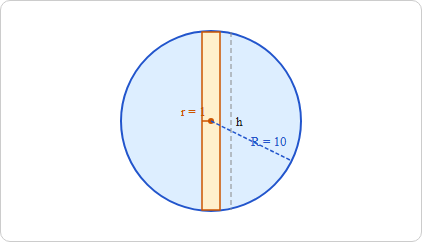
A ball of radius 10 cm is taken and a cylindrical hole of radius 1 cm is drilled through the centre. Which of the options listed below is the closest in value to the ratio of the total surface area of the hollowed out ball to the surface area of the original ball?

  1. AOption (a)

    219200\frac{219}{200}

  2. BOption (b)

    110\frac{1}{10}

  3. COption (c)

    221200\frac{221}{200}

  4. DOption (d)

    115\frac{11}{5}

View answer & explanation

Correct answer

Answer: (a)A.

219200\frac{219}{200}

Why this answer is correct

Shortcut Trick

Ratio = [Remaining Spherical Area + Inner Cylindrical Area] ÷ Original Surface Area

Ratio = [2πRh + 2πrh] ÷ 4πR2 = [h(R + r)] ÷ 2R2, where h = 2√(R2 − r2)

Ratio = [2√(102 − 12) × (10 + 1)] ÷ (2 × 10²) = [11 × √99] ÷ 100

Ratio ≈ [11 × 9.9498] ÷ 100 ≈ 1.0945

Comparing with options: 219/200 = 1.095, which is the closest value.

∴ The correct answer is 219/200.

Alternate Method

Given:

Radius of the ball (R) = 10 cm

Radius of the cylindrical hole (r) = 1 cm

Formula Used:

Surface area of original sphere = 4πR2

Surface area of spherical zone = 2πRh

Lateral surface area of cylinder = 2πrh

Height of the hole (h) = 2√(R2 − r2)

Calculations:

⇒ h = 2 × √(102 − 12) = 2 × √99 = 2 × 3√11 = 6√11 cm

⇒ Surface area of original ball = 4 × π × 102 = 400π cm2

⇒ Total Surface Area of hollowed ball = Area of Spherical Zone + Area of Internal Cylinder

⇒ Total S.A. = 2πRh + 2πrh = 2πh(R + r)

⇒ Total S.A. = 2 × π × (6√11) × (10 + 1) = 132π√11 cm2

⇒ Ratio = (132π√11) ÷ (400π) = (33√11) ÷ 100

⇒ √11 ≈ 3.3166

⇒ Ratio ≈ (33 × 3.3166) ÷ 100 = 109.4478 ÷ 100 = 1.094478

⇒ Checking Option 1: 219 ÷ 200 = 1.095

∴ The correct answer is 219/200.

Additional Information

Spherical Zone Area

The surface area of a portion of a sphere between two parallel planes is 2πRh, where h is the perpendicular distance between the planes.

Spherical Cap Area

The surface area of a spherical cap is 2πRhcap, where hcap is the height of the cap.

Napkin Ring Problem

The volume of the remaining part of the sphere (the napkin ring) depends only on the height h of the hole: V = (πh3)/6.

Question 41

If each vowel in the word FRIENDLY is changed to the letter following it in the English alphabetical order and each consonant is changed to the letter preceding it in the English alphabetical order, then which letter will be in the second position from the right in the new group of letters thus formed?

  1. AOption (a)

    K

  2. BOption (b)

    C

  3. COption (c)

    Q

  4. DOption (d)

    J

View answer & explanation

Correct answer

Answer: (a)A.

K

Why this answer is correct

Given word: 'FRIENDLY'

After applying the specified transformations:

AlphabetsFRIENDLY
Transformed AlphabetsEQJFMCKX


Second alphabet from the right end is: K,

Hence, the correct answer is "Option 1".

Question 42

In a certain code language,

‘A + B’ means ‘A is the mother of B’,

‘A – B’ means ‘A is the brother of B’,

‘A × B’ means ‘A is the wife of B’ and

‘A ÷ B’ means ‘A is the father of B’.

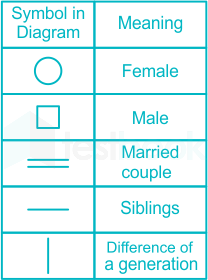
How is M related to T if ‘M + N × P – S ÷ T

  1. AOption (a)

    Father's sister's daughter

  2. BOption (b)

    Father's brother's wife's mother

  3. COption (c)

    Father's brother's wife

  4. DOption (d)

    Father's brother's wife's sister

View answer & explanation

Correct answer

Answer: (b)B.

Father's brother's wife's mother

Why this answer is correct

Decoding symbols:

A is
Symbol+–×÷
MeaningMotherBrotherWifeFather
to B

Given: M + N × P – S ÷ T

M + N → M is the mother of N.

N × P → N is the wife of P.

P – S → P is the brother of S.

S ÷ T → S is the father of T.

Thus, M is T's father's brother's wife's mother.

Hence, the correct answer is "Option 2"

Question 43

Select the set in which the numbers are related in the same way as are the numbers of the following sets.

(NOTE: Operations should be performed on the whole numbers, without breaking down the numbers into its constituent digits. E.g. 13 – Operations on 13 such as adding/deleting/multiplying etc. to 13 can be performed. Breaking down 13 into 1 and 3 and then performing mathematical operations on 1 and 3 is not allowed.)

(9, 6, 56)

(7, 8, 58)

  1. AOption (a)

    (8, 5, 40)

  2. BOption (b)

    (5, 11, 57)

  3. COption (c)

    (6, 5, 40)

  4. DOption (d)

    (12, 10, 118)

View answer & explanation

Correct answer

Answer: (b)B.

(5, 11, 57)

Why this answer is correct

Logic followed here is,

(First number × Second number) + 2 = Third number

Given, 

(9, 6, 56)

(9 × 6) + 2

(54) + 2 = 56 (Third number)

(7, 8, 58)

(7 × 8) + 2

(56) + 2 = 58 (Third number)

Check the option,

Option 1: (8, 5, 40)

(8 × 5) + 2

(40) + 2 = 42 ≠ 40

Option 2: (5, 11, 57)

(5 × 11) + 2

(55) + 2 = 57 (Third number)

Option 3: (6, 5, 40)

(6 × 5) + 2

(30) + 2 = 32 ≠ 40

Option 4: (12, 10, 118)

(12 × 10) + 2

(120) + 2 = 122 ≠ 118

Hence the correct answer is "Option 2"

Question 44

If the resistance of a conductor is increased to three times, then the current will be:

(voltage V remains constant)

  1. AOption (a)

    one ninth

  2. BOption (b)

    three times

  3. COption (c)

    one third

  4. DOption (d)

    nine times

View answer & explanation

Correct answer

Answer: (c)C.

one third

Why this answer is correct

The correct answer is one third.

Key Points

  • According to Ohm's Law, the current (I) flowing through a conductor is directly proportional to the voltage (V) across it and inversely proportional to the resistance (R), expressed as I = V/R.
  • If the resistance is increased to three times, the new resistance becomes 3R.
  • Keeping the voltage (V) constant, the new current (I') can be calculated using the modified resistance: I' = V/(3R).
  • This shows that the new current I' is one third of the original current I (since I' = I/3).
  • Therefore, if the resistance is increased to three times, the current will be reduced to one third of its original value.

Additional Information

  • Ohm's Law
  • Ohm's Law states that the current through a conductor between two points is directly proportional to the voltage across the two points.
  • The formula for Ohm's Law is I = V/R, where I is the current, V is the voltage, and R is the resistance.
  • Factors Affecting Resistance
  • Resistance in a conductor depends on its material, length, cross-sectional area, and temperature.
  • Increasing the length or temperature of the conductor generally increases resistance, while increasing the cross-sectional area decreases resistance.
  • Power Calculation
  • Electric power (P) can be calculated using the formula P = VI, where V is the voltage and I is the current.
  • For a given voltage, reducing the current by increasing resistance will also reduce the power consumption.

Question 45

Seven people, A, B, C, D, E, F and G are sitting in a row, facing north. Only five people sit between F and D. G sits third to the right of F. E is the immediate neighbour of C and D. B is not the immediate neighbour of G.

How many people sit between A and F?

  1. AOption (a)

    Four

  2. BOption (b)

    One

  3. COption (c)

    Three

  4. DOption (d)

    Two

View answer & explanation

Correct answer

Answer: (b)B.

One

Why this answer is correct

Given: Seven people, A, B, C, D, E, F and G are sitting in a row, facing north.

1) Only five people sit between F and D.

2) G sits third to the right of F.

3) E is the immediate neighbour of C and D.

4) B is not the immediate neighbour of G.

After positioning B only one position is left which will be occupied by the only person left i.e. A.

Thus, according to the final arrangement, one person sit between A and F.

Hence, "Option 2" is the correct answer.

Question 46

If 6 men and 8 boys can do a piece of work in 10 days while 26 men and 48 boys can do the same work in 2 days, then the time taken by 10 men and 20 boys for doing the same piece of work will be:

  1. AOption (a)

    3 days

  2. BOption (b)

    5 days

  3. COption (c)

    4 days

  4. DOption (d)

    2 days

View answer & explanation

Correct answer

Answer: (b)B.

5 days

Why this answer is correct

Shortcut Trick

Equate total work: 10(6M + 8B) = 2(26M + 48B) ⇒ 60M + 80B = 52M + 96B.

This gives 8M = 16B ⇒ 1 Man = 2 Boys.

Total Work in terms of boys: (6 × 2 + 8) × 10 = 200 units.

Required Group efficiency: 10M + 20B = (10 × 2 + 20) = 40 units.

Time Taken = 200 ÷ 40 = 5 days.

∴ The correct answer is 5 days.

Alternate Method

Given:

Case 1: (6 Men + 8 Boys) can do work in 10 days.

Case 2: (26 Men + 48 Boys) can do work in 2 days.

Formula Used:

Total Work = Efficiency × Time ⇒ (M1 × D1) = (M2 × D2)

Person GroupDaysTotal WorkEfficiency
6M + 8B10200 Units20
26M + 48B2100

Calculations:

⇒ 10 × (6M + 8B) = 2 × (26M + 48B)

⇒ 60M + 80B = 52M + 96B

⇒ 60M − 52M = 96B − 80B

⇒ 8M = 16B ⇒ 1M = 2B

⇒ Total Work = (6 × 2B + 8B) × 10 = (12B + 8B) × 10 = 200B

⇒ Required Time for (10M + 20B) = Total Work ÷ Efficiency of (10M + 20B)

⇒ Time = 200B ÷ (10 × 2B + 20B)

⇒ Time = 200B ÷ 40B

⇒ Time = 5 days

∴ The correct answer is 5 days.

Additional Information

Man-Days Concept

The total work is always constant for a specific task; if the number of people increases, the time taken decreases proportionally (M1D1H1/W1 = M2D2H2/W2).

Efficiency Ratio

When different categories (men, women, boys) work together, always find the efficiency ratio (e.g., 1M = 2B) to convert the entire group into a single unit.

Work and Wages

Wages are always distributed in the ratio of the work done by each individual or group, which is a product of their efficiency and time spent.

Question 47

______ the Managing Editor of Mongabay India, received the 2024 Greenaccord International Media Award at a ceremony in Frascati, Italy on October 12, 2024.

  1. AOption (a)

    Laxman Naik

  2. BOption (b)

    S Gopikrishna Warrier

  3. COption (c)

    Surjit Singh

  4. DOption (d)

    P Swaminathan Iyer

View answer & explanation

Correct answer

Answer: (b)B.

S Gopikrishna Warrier

Why this answer is correct

The correct answer is S Gopikrishna Warrier.

Key Points

  • The 2024 Greenaccord International Media Award was presented to Mongabay India and the China Biodiversity Conservation and Green Development Foundation (CBCGDF) Media. This prestigious award, given annually by the Italy-based non-profit Greenaccord, recognizes news organizations that demonstrate exceptional commitment to environmental journalism and raising awareness about critical ecological issues.
  • Here's a detailed look at the 2024 Greenaccord International Media Award:
  • Award Recipients:
  • Mongabay India: The India-specific bureau of Mongabay, a renowned global environmental news platform, was recognized for its in-depth and impactful reporting on India's biodiversity, climate change impacts, renewable energy transition, and other environmental topics.
  • China Biodiversity Conservation and Green Development Foundation (CBCGDF) Media: This Chinese media outlet was also honored for its contributions to environmental journalism and its efforts to promote ecological awareness in China.
  • Award Ceremony: The awards were presented on October 12th, 2024, at the Greenaccord International Forum for Information on Safeguarding Nature held in Frascati, Italy.

Additional Information

  • Significance of the Award:
  • Recognition of Excellence: The Greenaccord International Media Award is a significant recognition of journalistic excellence in the field of environmental reporting. It highlights the crucial role that media plays in informing the public and driving positive change for the environment.
  • Global Platform: The award provides a global platform for environmental journalists to showcase their work and connect with other professionals in the field.
  • Promotion of Sustainability: By recognizing outstanding environmental journalism, the award encourages media organizations to prioritize environmental coverage and contribute to a more sustainable future.
  • Mongabay India's Contribution:
  • In-depth Reporting: Mongabay India has consistently produced high-quality, deeply reported stories on a wide range of environmental issues in India.
  • Impactful Journalism: Their reporting has had a significant impact, raising awareness about critical environmental challenges and influencing policy decisions.
  • Multilingual Reach: Mongabay India publishes in both English and Hindi, ensuring that their content reaches a wider audience.
  • Greenaccord's Mission: Greenaccord is an Italian non-profit organization that promotes environmental awareness and sustainable development. The Greenaccord International Media Award is one of its key initiatives to recognize and support environmental journalism.
  • Selection Process: The award winners are selected by a jury of experts who evaluate the quality, originality, and impact of the news organizations' environmental reporting.

Question 48

The diagonal and one side of a rectangular plot are 65 m and 63 m, respectively. What is the perimeter of the rectangular plot?

  1. AOption (a)

    158 m

  2. BOption (b)

    164 m

  3. COption (c)

    166 m

  4. DOption (d)

    156 m

View answer & explanation

Correct answer

Answer: (a)A.

158 m

Why this answer is correct

Shortcut Trick

Identify the Pythagorean triplet: 16, 63, and 65.

Here, the diagonal is 65 m and one side is 63 m, so the other side must be 16 m.

Perimeter = 2 × (Length + Breadth)

⇒ Perimeter = 2 × (63 + 16) = 2 × 79 = 158 m.

∴ The correct answer is 158 m.

Alternate Method

Given:

Diagonal (d) of the rectangular plot = 65 m

One side (length, l) of the rectangular plot = 63 m

Formula Used:

In a rectangle, d2 = l2 + b2 (where b is the breadth)

Perimeter = 2(l + b)

Calculations:

⇒ 652 = 632 + b2

⇒ b2 = 652 − 632

⇒ b2 = (65 − 63)(65 + 63) (Using a2 − b2 = (a − b)(a + b))

⇒ b2 = 2 × 128 = 256

⇒ b = √256 = 16 m

⇒ Perimeter = 2(63 + 16)

⇒ Perimeter = 2 × 79 = 158 m

∴ The correct answer is 158 m.

Additional Information

Properties of a Rectangle

A rectangle is a quadrilateral with four right angles. Opposite sides are equal and parallel. The diagonals bisect each other and are equal in length.

Area of a Rectangle

The Area of a rectangle is calculated as Length × Breadth (l × b). For this plot, Area = 63 × 16 = 1008 m2.

Pythagorean Theorem

In a right-angled triangle, the square of the hypotenuse is equal to the sum of the squares of the other two sides: a2 + b2 = c2.

Common Triplets

Some common Pythagorean triplets useful for exams include (3, 4, 5), (5, 12, 13), (8, 15, 17), (7, 24, 25), and (16, 63, 65).

Question 49

A car decreases its speed from 40 m/s to 20 m/s in 5 s. Find the acceleration of the car.

  1. AOption (a)

    4 m/s²

  2. BOption (b)

    -4 m/s²

  3. COption (c)

    12 m/s²

  4. DOption (d)

    2 m/s²

View answer & explanation

Correct answer

Answer: (b)B.

-4 m/s²

Why this answer is correct

The correct answer is -4 m/s².

Key Points

  • Acceleration is defined as the rate of change of velocity.
  • A negative acceleration (deceleration) indicates that the object is slowing down.
  • The initial velocity of the car is 40 m/s and the final velocity is 20 m/s.
  • The time taken for this change in velocity is 5 seconds.
  • Acceleration is calculated using the formula, a=Δ vta=\frac{\Delta\ v}{t} , where Δ v\Delta\ v is the change in velocity and tttt is the time taken for the change.
  • Thus, Δ v =20 m/s − 40 m/s =−20 m/s\Delta\ v\ = 20\ m/s\ -\ 40\ m/s\ = -20\ m/s
  • a =−20 m/s5 s= −4 m/s2a\ = \frac{-20\ m/s}{5\ s}=\ -4\ m/s^2

Additional Information

  • Units of Acceleration:
  • Acceleration is measured in meters per second squared (m/s²).
  • Real-life Applications:
  • Understanding acceleration is crucial in fields such as automotive safety, where deceleration plays a key role in designing effective braking systems.

Question 50

Nadi Utsav 2024 was inaugurated at the ______.

  1. AOption (a)

    National Museum

  2. BOption (b)

    Lalit Kala Akademi

  3. COption (c)

    India Habitat Centre

  4. DOption (d)

    Indira Gandhi National Centre for the Arts (IGNCA)

View answer & explanation

Correct answer

Answer: (d)D.

Indira Gandhi National Centre for the Arts (IGNCA)

Why this answer is correct

The correct answer is Indira Gandhi National Centre for the Arts (IGNCA).

Key Points

  • The Nadi Utsav 2024 was a celebration of India's rivers, held at the Indira Gandhi National Centre for the Arts (IGNCA) in New Delhi from September 19th to 21st, 2024. This was the fifth edition of the festival, which aims to highlight the ecological and cultural importance of rivers in Indian civilization.
  • Here's a breakdown of the key aspects of the Nadi Utsav 2024:
  • Theme: The theme for the 2024 festival was "Rivers in Reverse: Making of a Lifeline." This theme emphasized the idea that rivers are not just bodies of water, but lifelines that sustain ecosystems, cultures, and civilizations.
  • Organizers: The Nadi Utsav is an initiative of the Indira Gandhi National Centre for the Arts (IGNCA), an autonomous institution under the Ministry of Culture, Government of India.1 IGNCA plays a vital role in preserving and promoting India's cultural heritage, including its rich traditions related to rivers.

Additional Information

  • Objectives: The primary objectives of the Nadi Utsav include:
  • Celebrating the ecological and cultural significance of rivers.
  • Raising awareness about the importance of river conservation.
  • Promoting dialogue and exchange on river-related issues.
  • Showcasing the diverse cultural traditions associated with rivers.
  • Events and Activities: The Nadi Utsav 2024 featured a wide range of events and activities, including:
  • Documentary Film Festival: A film festival titled "My River Story" showcased documentaries focused on rivers, riverine cultures, and related themes.
  • Cultural Performances: Renowned artists presented various forms of Indian classical and folk music and dance, highlighting the cultural connection with rivers.
  • National Seminar: A national seminar on "Rivers in Reverse - Making of a Lifeline" brought together experts and scholars to discuss various aspects of rivers, including their ecological importance, cultural significance, and the challenges they face.
  • Exhibitions: Exhibitions featured a photographic journey of the Kangsabati River, paintings by school students, and a display of traditional Indian boats.
  • Children's Art Workshops: Interactive workshops engaged children in creative activities related to rivers and the environment.
  • Environment Book Fair: A book fair showcased literature on rivers, ecosystems, and environmental conservation.

Question 51

Refer to the following number and symbol series and answer the question that follows. Counting to be done from left to right only.

(Left) 4 6 @ # 1 * £ 5 8 S 7 & 3 2 % Ω 9 (Right)

How many such numbers are there, each of which is immediately preceded by a symbol and also immediately followed by a number?

  1. AOption (a)

    More than two

  2. BOption (b)

    Two

  3. COption (c)

    One

  4. DOption (d)

    Zero

View answer & explanation

Correct answer

Answer: (b)B.

Two

Why this answer is correct

Given terms: (Left) 4 6 @ # 1 * £ 5 8 S 7 & 3 2 % Ω 9 (Right)

Here,

We need to find the numbers in the series that are immediately preceded by a symbol and also immediately followed by a number.

Required pattern: Symbol - Number - Number

Let's analyze the series step-by-step:

​(Left) 4 6 @ # 1 * £ 5 8 S 7 & 3 2 % Ω 9 (Right)

So, there are two such pairs(£ 5 8, & 3 2) in the series.

Hence, the correct answer is "Option 2".

Question 52

If A means +, B means −, C means ×, D means ÷, then what will come in place of the question mark (?) in the following equation?

18 D 2 A 4 C 5 B 15 = ?

  1. AOption (a)

    16

  2. BOption (b)

    14

  3. COption (c)

    12

  4. DOption (d)

    18

View answer & explanation

Correct answer

Answer: (b)B.

14

Why this answer is correct

Given Equation: 18 D 2 A 4 C 5 B 15 = ?

BODMAS Rule:

Decoding the given information:

AlphabetABCD
Meaning+−×÷

Now replacing the signs from left to right using BODMAS Rule, we get:

⇒ 18 ÷ 2 + 4 × 5 - 15

⇒ 9 + 4 × 5 - 15

⇒ 9 + 20 - 15

⇒ 29 - 15

⇒ 14

Hence, the correct option is "Option 2".

Question 53

If 1550.155=15.5K, then the value of K is:\text{If } \frac{155}{0.155} = \frac{15.5}{K}, \text{ then the value of } K \text{ is:}

  1. AOption (a)

    1.55

  2. BOption (b)

    15.51

  3. COption (c)

    0.0155

  4. DOption (d)

    155

View answer & explanation

Correct answer

Answer: (c)C.

0.0155

Why this answer is correct

Given:

1550.155=15.5K\frac{155}{0.155} = \frac{15.5}{K}

Calculation:

1550.155=15.5K\frac{155}{0.155} = \frac{15.5}{K}

⇒ 155 × K = 15.5 × 0.155

⇒ 155K = 15.5 × 0.155

⇒ K = 15.5×0.155155\frac{15.5 × 0.155}{155}

⇒ K = 0.0155

The correct answer is option 3.

Question 54

The smallest natural number that must be added to 1212 to make it a perfect square is:

  1. AOption (a)

    27

  2. BOption (b)

    13

  3. COption (c)

    18

  4. DOption (d)

    24

View answer & explanation

Correct answer

Answer: (b)B.

13

Why this answer is correct

Shortcut Trick Find the nearest square root of 1212: √1212 ≈ 34.81. The next perfect square after 1212 is the square of the next integer, 35. Calculate 352 = 35 × 35 = 1225. Smallest natural number to be added = 1225 − 1212 = 13. ∴ The correct answer is 13.

Alternate Method Given: The number is 1212. Method: We determine the perfect squares surrounding 1212 to find how much needs to be added.

⇒ Identify squares: 342 = 1156 and 352 = 1225. ⇒ Since 1156 < 1212 < 1225, the number must be increased to 1225. ⇒ Required addition = Next Perfect Square − Given Number ⇒ Required addition = 1225 − 1212 ⇒ Required addition = 13 ∴ The correct answer is 13.

Additional Information Perfect Square Properties A perfect square never ends with the digits 2, 3, 7, or 8 in the unit place. Long Division Method To find what to add, perform long division; the square of (quotient + 1) minus the number gives the result. Subtraction Rule To find what must be subtracted to make a perfect square, simply calculate the remainder using the long division method.

Question 55

Identify the correct match of plant hormones with their functions.

  1. AOption (a)

    Gibberellins: Help in the growth of the stem

    Cytokinins: Promote cell division

    Abscisic acid: Inhibits growth

  2. BOption (b)

    Gibberellins: Help in the growth of the stem

    Cytokinins: Inhibits growth

    Abscisic acid: Promote cell division

  3. COption (c)

    Gibberellins: Promote cell division

    Cytokinins: Help in the growth of the stem

    Abscisic acid: Inhibits growth

  4. DOption (d)

    Gibberellins: Inhibits growth

    Cytokinins: Promote cell division

    Abscisic acid: Help in the growth of the stem

View answer & explanation

Correct answer

Answer: (a)A.

Gibberellins: Help in the growth of the stem

Cytokinins: Promote cell division

Abscisic acid: Inhibits growth

Why this answer is correct

The correct answer is option 1.

Key Points

  • Gibberellins: Help in the growth of the stem by promoting cell elongation and division.
  • Cytokinins: Promote cell division and delay the aging of leaves by influencing cell processes.
  • Abscisic acid: Inhibits growth and promotes dormancy in seeds and buds.
  • These hormones play crucial roles in plant development and response to environmental stimuli.
  • Hormones in plants are often referred to as phytohormones and are involved in regulating various physiological processes.

Additional Information

  • Auxins
  • These hormones are primarily involved in the elongation of cells in shoots and are responsible for the phototropic response of plants.
  • Auxins also play a role in the formation of roots and the differentiation of vascular tissues.
  • Ethylene
  • This is a gaseous hormone that influences fruit ripening and the senescence of leaves and flowers.
  • Ethylene is also involved in the response to mechanical stress and pathogen attack in plants.
  • Brassinosteroids
  • These are a class of polyhydroxysteroids that promote cell expansion and elongation, as well as vascular differentiation.
  • They also play a role in stress tolerance and reproductive development in plants.

Question 56

Study the following graph and answer the given question.

The bar graph shows the annual exports (in crores) of a company during the period 2015 to 2019.

What is the respective ratio between the annual export of 2015 to the annual export of 2017?

  1. AOption (a)

    13:16

  2. BOption (b)

    4:9

  3. COption (c)

    6:11

  4. DOption (d)

    5 : 7

View answer & explanation

Correct answer

Answer: (d)D.

5 : 7

Why this answer is correct

Given:

Annual export in 2015 = 25cr

Annual export in 2017 = 35cr

Calculation:

Ratio of export in years 2015 and 2017 = 25 : 35 

⇒ 5 : 7

∴ The correct answer is option 4.

Question 57

Which of the following is the formulas unit mass of NaCl?

  1. AOption (a)

    71 u

  2. BOption (b)

    46.5 u

  3. COption (c)

    94 u

  4. DOption (d)

    58.5 u

View answer & explanation

Correct answer

Answer: (d)D.

58.5 u

Why this answer is correct

The correct answer is 58.5 u.

Key Points

  • The formula unit mass of a compound is the sum of the atomic masses of all the atoms in its formula.
  • Sodium (Na) has an atomic mass of approximately 23 u (atomic mass units).
  • Chlorine (Cl) has an atomic mass of approximately 35.5 u.
  • Therefore, the formula unit mass of NaCl is calculated by adding the atomic masses of Na and Cl.
  • The calculation is: 23 u (Na) + 35.5 u (Cl) = 58.5 u.

Additional Information

  • Atomic Mass
  • It is the mass of an atom, usually expressed in atomic mass units (u).
  • The atomic mass is roughly equal to the number of protons and neutrons in the atom.
  • Molecular Mass
  • It is the sum of the atomic masses of all the atoms in a molecule.
  • Molecular mass is often used for covalently bonded molecules, such as H2O.
  • Formula Unit
  • A formula unit is the empirical formula of an ionic or covalent network solid compound used as an independent entity for stoichiometric calculations.
  • For ionic compounds like NaCl, the formula unit represents the simplest ratio of the ions involved.

Question 58

Out of his total income, Sanjay spends 20% on house rent and 70% of the rest on household expenses. If he saves ₹1,800, then his total income is:

  1. AOption (a)

    ₹9,000

  2. BOption (b)

    ₹10,000

  3. COption (c)

    ₹7,500

  4. DOption (d)

    ₹8,000

View answer & explanation

Correct answer

Answer: (c)C.

₹7,500

Why this answer is correct

Shortcut Trick

Let Total Income be 100%.

Remaining income after 20% house rent = 80%.

Savings = 30% of remaining (since 70% was spent) ⇒ 30% × 80% = 24%.

Given, 24% = ₹1,800 ⇒ 1% = 75.

Total Income (100%) = 75 × 100 = ₹7,500.

∴ The correct answer is ₹7,500.

Alternate Method

Given:

Expenditure on house rent = 20%

Expenditure on household items = 70% of the remaining amount

Total Savings = ₹1,800

Let the total income of Sanjay be ₹x.

⇒ Amount left after house rent = x − 20% of x = 0.80x

⇒ Amount spent on household expenses = 70% of 0.80x = 0.56x

⇒ Total savings = 0.80x − 0.56x = 0.24x

⇒ 0.24x = 1800

⇒ x = 1800 ÷ 0.24

⇒ x = 180000 ÷ 24 = 7500

Thus, the total income is ₹7,500, which corresponds to Option (3).

∴ The correct answer is ₹7,500.

Additional Information

Successive Percentage Change

When values are reduced sequentially, the final remaining value is Principal × (1 − r1/100) × (1 − r2/100).

Income and Expenditure Relation

Income = Total Expenditure + Savings. If spending is on the 'remaining' amount, it represents a compound reduction.

Percentage to Fraction Conversion

20% = 1/5 and 70% = 7/10. Using fractions: x × (4/5) × (3/10) = 1800 ⇒ 12x/50 = 1800 ⇒ x = 7500.

Question 59

Which of the following is a saturated carbon compound?

  1. AOption (a)

    Alkane

  2. BOption (b)

    Alkyne

  3. COption (c)

    Alkene

  4. DOption (d)

    Ethylene

View answer & explanation

Correct answer

Answer: (a)A.

Alkane

Why this answer is correct

The correct answer is Alkane.

Key Points

  • Alkanes are saturated hydrocarbons, meaning they only contain single bonds between carbon atoms.
  • Saturated compounds have the maximum number of hydrogen atoms attached to each carbon atom.
  • The general formula for alkanes is CnH2n+2, where n is the number of carbon atoms.
  • Common examples of alkanes include methane, ethane, propane, and butane.
  • Alkanes are typically less reactive than alkenes and alkynes due to the presence of only single bonds.

Additional Information

  • Alkenes
  • Alkenes are unsaturated hydrocarbons containing at least one double bond between carbon atoms.
  • The general formula for alkenes is CnH2n.
  • Examples include ethylene (ethene) and propylene (propene).
  • Alkynes
  • Alkynes are unsaturated hydrocarbons containing at least one triple bond between carbon atoms.
  • The general formula for alkynes is CnH2n-2.
  • Examples include acetylene (ethyne) and propyne.
  • Ethylene
  • Ethylene is the simplest alkene, with the formula C2H4.
  • It is a colorless gas used as a plant hormone and in the production of polymers like polyethylene.

Question 60

The full form of SER, a cell organelle, which helps in the manufacture of fat molecules, or lipids, important for cell function is _____.

  1. AOption (a)

    Simple Endoplasmic Reticulum

  2. BOption (b)

    Species Endoplasmic Reticulum

  3. COption (c)

    Smooth Endoplasmic Reticulum

  4. DOption (d)

    Similar Endoplasmic Reticulum

View answer & explanation

Correct answer

Answer: (c)C.

Smooth Endoplasmic Reticulum

Why this answer is correct

The correct answer is Smooth Endoplasmic Reticulum.

Key Points

  • The Smooth Endoplasmic Reticulum (SER) is involved in the synthesis of lipids, including phospholipids and steroids.
  • It plays a crucial role in the metabolism of carbohydrates and detoxification of drugs and poisons.
  • SER also helps in the storage of calcium ions which are important for muscle contraction.
  • Unlike Rough Endoplasmic Reticulum (RER), SER lacks ribosomes on its surface, giving it a smooth appearance.
  • SER is present in both animal and plant cells, with a higher prevalence in cells that are active in lipid metabolism and detoxification.

Additional Information

  • Lysosomes
  • These are membrane-bound organelles that contain enzymes responsible for breaking down waste materials and cellular debris.
  • They are often referred to as the "digestive system" of the cell because they help in the degradation of macromolecules.
  • Chloroplast
  • These are organelles found in plant cells and eukaryotic algae that conduct photosynthesis.
  • Chloroplasts capture light energy and convert it into chemical energy in the form of glucose through the process of photosynthesis.
  • Endoplasmic Reticulum (ER)
  • It is a network of membranes within the cytoplasm of eukaryotic cells, involved in protein and lipid synthesis.
  • The ER is divided into two types: rough ER (with ribosomes) and smooth ER (without ribosomes).
  • Rough ER is involved in protein synthesis and folding, while smooth ER is associated with lipid synthesis and detoxification processes.

Question 61

A sum of money, on compound interest, amounts to ₹5,290 in 2 years and to ₹6,083.50 in 3 years. If interest is compounded annually, then the rate of interest per annum is:

  1. AOption (a)

    16 ⅔%

  2. BOption (b)

    15%

  3. COption (c)

    14%

  4. DOption (d)

    12%

View answer & explanation

Correct answer

Answer: (b)B.

15%

Why this answer is correct

Shortcut Trick

When interest is compounded annually, the interest earned in the 3rd year is simply the interest on the amount at the end of the 2nd year.

Rate % = [(Difference between successive amounts) ÷ (Preceding amount)] × 100

Rate % = [(6083.50 − 5290) ÷ 5290] × 100

Rate % = (793.50 ÷ 5290) × 100 = 15%

∴ The correct answer is 15%.

Alternate Method

Given:

Amount after 2 years (A2) = ₹5,290

Amount after 3 years (A3) = ₹6,083.50

Formula Used:

An = P(1 + R/100)n

Calculations:

⇒ A3 / A2 = [P(1 + R/100)3] / [P(1 + R/100)2]

⇒ 6083.50 / 5290 = (1 + R/100)

⇒ 1.15 = 1 + R/100

⇒ R/100 = 1.15 − 1 = 0.15

⇒ R = 0.15 × 100 = 15%

∴ The correct answer is 15%.

Additional Information

Compound Interest for Successive Years

If amounts for two consecutive years (n and n+1) are given, the rate R = [(An+1 − An) ÷ An] × 100.

Difference between CI and SI

For a period of 2 years, the difference between CI and SI is given by D = P × (R/100)2.

Half-Yearly Compounding

If interest is compounded half-yearly, the rate becomes R/2 and the time period becomes 2n.

Question 62

A 250 m long train running at a speed of 100 km/h crosses another train, coming from the opposite direction at a speed of 62 km/h, in 10 seconds. What is the length of the second train?

  1. AOption (a)

    200 m

  2. BOption (b)

    240 m

  3. COption (c)

    230 m

  4. DOption (d)

    270 m

View answer & explanation

Correct answer

Answer: (a)A.

200 m

Why this answer is correct

Shortcut Trick

Relative Speed in opposite direction = 100 + 62 = 162 km/h.

Convert speed to m/s: 162 × (5/18) = 45 m/s.

Total Distance covered (Sum of lengths) = Relative Speed × Time = 45 × 10 = 450 m.

Length of second train = Total Distance − Length of first train = 450 − 250 = 200 m.

∴ The correct answer is 200 m.

Alternate Method

Given:

Length of first train (L1) = 250 m

Speed of first train (S1) = 100 km/h

Speed of second train (S2) = 62 km/h

Time taken (T) = 10 sec

Formula Used:

Distance = Speed × Time

Relative Speed (Opposite Direction) = S1 + S2

Calculations:

⇒ Relative Speed = 100 + 62 = 162 km/h

⇒ Relative Speed in m/s = 162 × (5/18) m/s

⇒ Relative Speed = 9 × 5 = 45 m/s

⇒ Total Distance = L1 + L2

⇒ 250 + L2 = 45 × 10

⇒ 250 + L2 = 450

⇒ L2 = 450 − 250

⇒ L2 = 200 m

∴ The correct answer is 200 m.

Additional Information

Relative Speed Concepts

When two objects move in the opposite direction, their relative speed is the sum of their individual speeds (S1 + S2). If they move in the same direction, it is the difference (S1 − S2).

Unit Conversion

To convert speed from km/h to m/s, multiply by 5/18. To convert from m/s to km/h, multiply by 18/5.

Train Crossing Objects

When a train crosses a stationary point (pole, man), distance = Length of train. When it crosses a platform or another train, distance = Sum of both lengths.

Question 63

What is used to remove permanent hardness of water?

  1. AOption (a)

    Baking soda

  2. BOption (b)

    Bleaching powder

  3. COption (c)

    Washing soda

  4. DOption (d)

    Sodium Hydroxide

View answer & explanation

Correct answer

Answer: (c)C.

Washing soda

Why this answer is correct

The correct answer is Washing soda.

Key Points

  • Washing soda is chemically known as sodium carbonate (Na2CO3).
  • It is used to remove permanent hardness of water, which is caused by the presence of dissolved calcium and magnesium salts.
  • Washing soda works by reacting with calcium and magnesium ions to form insoluble carbonates, which can then be removed from the water.
  • This process is known as water softening and helps in improving the effectiveness of soaps and detergents.
  • Washing soda is also used in various household cleaning products and in the manufacturing of glass, paper, and textiles.

Additional Information

  • Baking Soda
  • Also known as sodium bicarbonate (NaHCO3), it is commonly used in baking as a leavening agent.
  • It is also used for cleaning, deodorizing, and in some fire extinguishers.
  • Bleaching Powder
  • Its chemical name is calcium hypochlorite (Ca(ClO)2).
  • It is used for disinfection, bleaching, and sanitizing purposes.
  • Sodium Hydroxide
  • Also known as caustic soda (NaOH), it is used in soap making, as a drain cleaner, and in the manufacture of various chemicals.
  • It is highly corrosive and should be handled with care.

Question 64

Which of the following options should come in place of the question mark (?) in the given series based on the English alphabetical order?

GJF, ILH, KNJ, MPL, ?

  1. AOption (a)

    ONR

  2. BOption (b)

    RNO

  3. COption (c)

    RON

  4. DOption (d)

    ORN

View answer & explanation

Correct answer

Answer: (d)D.

ORN

Why this answer is correct

The logic followed here is:

​

Hence, "Option 4" is the correct answer.

Question 65

Which of the following statements is correct about continuous movement of particles of matter?

  1. AOption (a)

    If we decrease the temperature, kinetic energy of particles increases.

  2. BOption (b)

    Change in temperature has no effect on the kinetic energy of particles.

  3. COption (c)

    If we increase the temperature, kinetic energy of particles decreases.

  4. DOption (d)

    If we increase the temperature, kinetic energy of particles increases.

View answer & explanation

Correct answer

Answer: (d)D.

If we increase the temperature, kinetic energy of particles increases.

Why this answer is correct

The correct answer is If we increase the temperature, kinetic energy of particles increases..

Key Points

  • The kinetic energy of particles is directly proportional to temperature.
  • As temperature increases, the movement of particles becomes more vigorous.
  • Temperature is a measure of the average kinetic energy of the particles in a substance.
  • Increasing temperature results in particles moving more rapidly and colliding more frequently.
  • Decreasing temperature reduces the kinetic energy, slowing down particle movement.

Additional Information

  • Brownian Motion
  • It is the random movement of particles in a fluid due to their collisions with other atoms or molecules.
  • This phenomenon provides evidence for the continuous movement of particles.
  • Diffusion
  • It is the process by which particles spread from an area of higher concentration to an area of lower concentration.
  • Diffusion rates increase with temperature due to increased particle movement.
  • States of Matter
  • Particles in solids have the least kinetic energy, followed by liquids, and gases have the most.
  • Temperature changes can cause transitions between these states by affecting particle movement.

Question 66

Read the given statements and conclusions carefully. You have to take the given statements to be true even if they seem to be at variance from commonly known facts and decide which conclusion(s) logically follow(s) from the given statements.

Statements:

All flowers are diamonds.

Some clips are flowers.

Conclusions:

(I) All diamonds are clips.

(II) Some diamonds are flowers.

  1. AOption (a)

    Only conclusion (II) follows

  2. BOption (b)

    Neither conclusion (I) nor (II) follows.

  3. COption (c)

    Both conclusions (I) and (II) follow.

  4. DOption (d)

    Only conclusion (I) follows.

View answer & explanation

Correct answer

Answer: (a)A.

Only conclusion (II) follows

Why this answer is correct

The least possible Venn diagram for the given statements is as shown below :

Conclusions:

(I) All diamonds are clips → Does not follow (As all flowers are diamonds and some clips are flowers. So it is possible but not definite.)

(II) Some diamonds are flowers → Follow (As all flowers are diamonds. As whole flowers comes in diamonds, therefore it is true.)

∴ Here, Only conclusion (II) follows.​

Hence, the correct answer is "Option 1".

Question 67

If ‘A’ stands for ‘÷’, ‘B’ stands for ‘×’, ‘C’ stands for ‘+’, and ‘D’ stands for ‘−’, what will come in place of the question mark ‘?’ in the following equation?

225 B 15 A 15 C 125 D 225 = ?

  1. AOption (a)

    125

  2. BOption (b)

    115

  3. COption (c)

    135

  4. DOption (d)

    105

View answer & explanation

Correct answer

Answer: (a)A.

125

Why this answer is correct

Given Equation: 225 B 15 A 15 C 125 D 225 = ?

BODMAS Rule:

Decoding the given information:

AlphabetABCD
Meaning÷×+−

Now replacing the signs from left to right using BODMAS Rule, we get:

⇒ 225 × 15 ÷ 15 + 125 - 225

⇒ 225 × 1 + 125 - 225

⇒ 225 + 125 - 225

⇒ 125

Hence, the correct option is "Option 1".

Question 68

The Central Universities (Amendment) Bill, 2023 was passed for the establishment of Sammakka Sarakka Central Tribal University in which state?

  1. AOption (a)

    Odisha

  2. BOption (b)

    Telangana

  3. COption (c)

    Manipur

  4. DOption (d)

    Jharkhand

View answer & explanation

Correct answer

Answer: (b)B.

Telangana

Why this answer is correct

The correct answer is Telangana.

Key Points

  • On December 14, 2023, Parliament passed the Central Universities (Amendment) Bill, 2023, to establish the Sammakka Sarakka Central Tribal University in Telangana.
  • The bill received approval from the Rajya Sabha by voice vote, following its clearance in the Lok Sabha the previous week.
  • Union Education Minister Dharmendra Pradhan, during the debate, emphasized that the establishment of this central tribal university is a mandatory provision under the Andhra Pradesh Reorganisation Act, 2014.
  • The university aims to enhance access and quality of higher education, promote tribal art, culture, and customs, and advance technology for the tribal population of India.
  • Despite delays in providing land by the Telangana government, the minister assured quick processes post the president's assent for the university to function as a national institution.
  • This development reflects the government's commitment to tribal welfare and educational progress in the country.

Question 69

Sally starts from Point A and drives 12 km towards North. She takes a right turn, drives 5 km, and takes another right turn and drives 24 km. She turns right again and drives 17 km, she takes a final right turn, drives 12 km and stops at Point P. How far (shortest distance) and in which direction is she from her starting point? (All turns are 90 degrees turns only unless specified.)

  1. AOption (a)

    12 km towards the East

  2. BOption (b)

    12 km towards the West

  3. COption (c)

    5 km towards the East

  4. DOption (d)

    22 km towards the North

View answer & explanation

Correct answer

Answer: (b)B.

12 km towards the West

Why this answer is correct

Given: 

Sally starts from Point A and drives 12 km towards North.

She takes a right turn, drives 5 km, and takes another right turn and drives 24 km.

She turns right again and drives 17 km, she takes a final right turn, drives 12 km and stops at Point P. 

Thus, Sally should drive (17 km - 5 km) 12 km in the west direction in order to reach Point P again.

Hence, "Option 2" is the correct answer.

Question 70

All 41 people are standing in a row, facing north. Juno is 23rd from the right end, while Cherry is 31st from the left end. How many people are there between Juno and Cherry?

  1. AOption (a)

    11

  2. BOption (b)

    12

  3. COption (c)

    10

  4. DOption (d)

    13

View answer & explanation

Correct answer

Answer: (a)A.

11

Why this answer is correct

Given: 41 people are standing in a straight row facing the north.

  1. Juno is standing 23rd from the right end.

  2. Cherry is standing 31st from the left end.

So, the people standing between Juno and Cherry:

= Total people - (Position of Juno from right end + Position of Cherry from left end)

= 41 - (23 + 31)

= 41 - 54 = -13.

Since the number of people cannot be negative, we need to consider the overlap:

Position of Juno from the left end = 41 - 23 + 1 = 19.

So, the people standing between Juno and Cherry:

= Position of Cherry from the left end - Position of Juno from the left end - 1

= 31 - 19 - 1

= 11.

So, there are '11' people standing between Juno and Cherry.

Hence, the correct answer is "Option 1".

Question 71

Who among the following won the Purple cap in the 17th Edition of Indian Premier League in 2024?

  1. AOption (a)

    T. Natarajan

  2. BOption (b)

    Jasprit Bumrah

  3. COption (c)

    Kuldeep Yadav

  4. DOption (d)

    Harshal Patel

View answer & explanation

Correct answer

Answer: (d)D.

Harshal Patel

Why this answer is correct

The correct answer is Harshal Patel.

Key Points

  • The Kolkata Knight Riders (KKR) won the 17th edition of the Indian Premier League (IPL) in 2024.
  • The KKR beat the Sunrisers Hyderabad by eight wickets in the final match on May 26, 2024.
  • The 17th edition of the IPL was held from March 22 to May 26, 2024.
  • The tournament was played across 13 cities in India, with Chennai hosting the opening ceremony and the final.
  • The KKR won their third IPL title with this victory.
  • Mitchell Starc, a player for the KKR, was named the player of the match.

Additional Information

  • The first edition of the Indian Premier League (IPL) cricket tournament was held in the year 2008.
  • The IPL is a professional Twenty20 cricket league in India, founded by the Board of Control for Cricket in India (BCCI).
  • The league has gained immense popularity and has become one of the most-watched cricket leagues in the world.
  • The inaugural season of the IPL featured eight teams representing different cities in India.
  • The league format includes a round-robin group stage followed by playoffs and a final match to determine the champion.

Question 72

Thirteen years ago, Manorama's age was 25\frac{2}{5} of that of her sister. The ratio of Manorama's and her sister's present ages is 3 : 4. What is the sum of their present ages?

  1. AOption (a)

    36 years

  2. BOption (b)

    39 years

  3. COption (c)

    48 years

  4. DOption (d)

    42 years

View answer & explanation

Correct answer

Answer: (b)B.

39 years

Why this answer is correct

Shortcut Trick

Ratio 13 years ago = 2 : 5 (Difference = 3 units)

Present ratio = 3 : 4 (Difference = 1 unit)

Equating age difference: Multiply present ratio by 3 → 9 : 12

Change in units (9 − 2) = 7 units → 13 years

Sum of present ages in units = 9 + 12 = 21 units

Since 7 units = 13 years, 21 units = 3 × 13 = 39 years

∴ The correct answer is 39 years.

Alternate Method

Given:

Present age ratio of Manorama and her sister = 3 : 4

Age 13 years ago was 2/5 of her sister's age.

Let the present ages be 3x and 4x.

Equation:

⇒ (3x − 13) = 2/5 × (4x − 13)

⇒ 5 × (3x − 13) = 2 × (4x − 13)

⇒ 15x − 65 = 8x − 26

⇒ 15x − 8x = 65 − 26

⇒ 7x = 39

The sum of present ages is (3x + 4x) = 7x.

⇒ Sum = 39 years.

∴ The correct answer is 39 years.

Additional Information

Constant Age Difference

The difference between the ages of two individuals always remains constant, regardless of how many years pass.

Ratio Adjustment

When solving age problems using ratios, always ensure the numerical difference between the ratio parts is equal for both time periods to find the value of one unit easily.

Sum Change Rule

If 'n' years pass, the sum of ages of 'k' people increases by (n × k) years.

Question 73

If the mean of 22, 25, 27, 24 and x is 26, then the value of x is:

  1. AOption (a)

    35

  2. BOption (b)

    28

  3. COption (c)

    32

  4. DOption (d)

    41

View answer & explanation

Correct answer

Answer: (c)C.

32

Why this answer is correct

Shortcut Trick

Assume the mean is 26.

Find deviations from 26: (22−26) = −4, (25−26) = −1, (27−26) = +1, (24−26) = −2.

Net deviation of known numbers = −4 − 1 + 1 − 2 = −6.

To balance the mean at 26, the deviation of x must be +6.

Value of x = Mean + Required Deviation = 26 + 6 = 32.

∴ The correct answer is 32.

Alternate Method

Given: Observations = 22, 25, 27, 24, x | Total count (n) = 5 | Mean = 26.

Formula: Mean = Sum of observations ÷ Total number of observations

⇒ Sum of observations = (22 + 25 + 27 + 24 + x)

⇒ Sum = 98 + x

⇒ Mean = Sum ÷ n

⇒ 26 = (98 + x) ÷ 5

⇒ 26 × 5 = 98 + x

⇒ 130 = 98 + x

⇒ x = 130 − 98

⇒ x = 32

∴ The correct answer is 32.

Additional Information

Arithmetic Mean

The average or mean is the sum of all values divided by the total count: Mean = ∑X ÷ N.

Property of Deviations

The algebraic sum of deviations of a set of observations from their arithmetic mean is always zero.

Effect of Change in Origin

If a constant k is added to every observation in a data set, the new mean will be (Original Mean + k).

Question 74

Which of the following statements is correct about suspension?

  1. AOption (a)

    A Suspension is a heterogeneous mixture.

  2. BOption (b)

    Solids dispersed in gas are called suspensions.

  3. COption (c)

    Particles of a suspension are invisible to the naked eye.

  4. DOption (d)

    A Suspension is a homogeneous mixture.

View answer & explanation

Correct answer

Answer: (a)A.

A Suspension is a heterogeneous mixture.

Why this answer is correct

The correct answer is A Suspension is a heterogeneous mixture..

Key Points

  • Suspensions are mixtures where particles are dispersed throughout the bulk of a fluid.
  • The particles in a suspension are larger and can be seen with the naked eye or under a microscope.
  • Suspensions are heterogeneous, meaning the components are not uniformly distributed.
  • The particles in a suspension will settle over time if left undisturbed.
  • Examples of suspensions include sand in water, flour in water, and chalk in water.

Additional Information

  • Solutions
  • These are homogeneous mixtures where the solute is completely dissolved in the solvent.
  • Examples include salt dissolved in water and sugar dissolved in tea.
  • Colloids
  • These are mixtures where very small particles of one substance are evenly distributed throughout another substance.
  • Examples include milk, mayonnaise, and fog.
  • Emulsions
  • A type of colloid where two immiscible liquids are mixed together, with one liquid dispersed in the other.
  • Examples include vinaigrette and certain cosmetic creams.

Question 75

Which of the following is NOT a pillar of strategic framework for achieving the objective of National State Policy 2024?

  1. AOption (a)

    Technological Intervention

  2. BOption (b)

    Restriction on Private Sector Engagement

  3. COption (c)

    Strong Professional Sports Governance, Implementation and Monitoring

  4. DOption (d)

    National Framework and Regulatory Bodies

View answer & explanation

Correct answer

Answer: (b)B.

Restriction on Private Sector Engagement

Why this answer is correct

The correct answer is Restriction on Private Sector Engagement.

Key Points

  • The National State Policy 2024 is a strategic framework designed to guide the governance, development, and welfare initiatives of a nation for the year 2024. While the specific objectives may vary depending on the country, the general goals of such policies typically include economic growth, social equity, environmental sustainability, and national security. These policies aim to address pressing challenges, such as poverty, unemployment, climate change, and infrastructure development, while ensuring inclusive progress for all citizens.​

Additional Information

  • Sustainable and Inclusive Development:
  • National Objective: India aims to achieve economic growth that is both environmentally sustainable and socially inclusive. This involves balancing development with environmental protection and ensuring that the benefits of growth reach all sections of society.
  • State Role: States play a crucial role in implementing national sustainable development goals. They formulate specific policies and programs tailored to their unique contexts, focusing on areas like renewable energy, climate action, and social welfare.
  • Economic Growth and Job Creation:
  • National Priority: Boosting economic growth and generating employment opportunities are key priorities at the national level. This involves policies related to investment, infrastructure development, industrial growth, and skill development.
  • State Initiatives: States contribute by attracting investments, developing industrial infrastructure, promoting local businesses, and implementing skill development programs to enhance employability.
  • Social Development and Welfare:
  • National Focus: The government aims to improve the quality of life for all citizens through policies related to education, healthcare, housing, and social security.
  • State Implementation: States are responsible for implementing many social welfare programs, adapting them to the specific needs of their populations and ensuring effective delivery of services.
  • Environmental Protection and Sustainability:
  • National Commitment: India is committed to protecting its environment and promoting sustainable practices. This involves policies related to climate change mitigation, conservation of natural resources, and pollution control.
  • State Action: States play a vital role in implementing environmental regulations, promoting renewable energy, and managing natural resources within their jurisdictions.
  • Good Governance and Transparency:
  • National Emphasis: The government emphasizes good governance, transparency, and accountability in all aspects of public administration. This includes policies related to e-governance, anti-corruption measures, and citizen participation.
  • State Responsibility: States are responsible for implementing good governance practices at the local level, ensuring efficient and transparent delivery of public services.

75 questions in the full paper