Previous Year Paper

RRB ALP CBT-I 2024 Official Paper (Held On: 29 Nov, 2024 Shift 1) (Previous Year Paper)

Held in 2024

75 questions60 minutes
With answers
Free

Paper last updated:

Practise under exam conditions

Take this paper as a timed mock test. Review your answers after you submit.

Attempt timed test

Questions & answers

Read the paper at your pace. Open an explanation when you need it.

Stage I (CBT I) (75 questions)

Question 1

Simplify the following expression: 9991 x 10009

  1. AOption (a)

    9999999

  2. BOption (b)

    91999919

  3. COption (c)

    9999919

  4. DOption (d)

    99999919

View answer & explanation

Correct answer

Answer: (d)D.

99999919

Why this answer is correct

Shortcut Trick

Identify the numbers as 10000 − 9 and 10000 + 9.

Apply the Difference of Squares trick: 100002 − 92.

100000000 − 81 = 99999919.

∴ The correct answer is 99999919.

Alternate Method

Given: 9991 × 10009

Formula Used: (a − b)(a + b) = a2 − b2

⇒ 9991 × 10009 = (10000 − 9) × (10000 + 9)

⇒ Here, a = 10000 and b = 9

⇒ Calculation = 100002 − 92

⇒ Calculation = 100,000,000 − 81

⇒ Result = 99999919

∴ The correct answer is 99999919.

Additional Information

Difference of Squares

The algebraic identity (a − b)(a + b) = a2 − b2 is highly effective for multiplying two numbers that are equidistant from a round base number.

Base 10 Squaring

When squaring a number like 10n, the number of zeros in the result is exactly 2 × n (e.g., 1002 = 10000).

BODMAS Rule

In complex simplification, always prioritize calculations in the order: Brackets, Orders, Division, Multiplication, Addition, and Subtraction.
Question 2

In two triangles ABC and DEF, if AB‾=EF‾\overline{AB} = \overline{EF} , BC‾=DF‾\overline{BC} = \overline{DF} and CA‾=DE‾\overline{CA} = \overline{DE} , then:

  1. AOption (a)

    ΔABC ≅ ΔDEF

  2. BOption (b)

    ΔDEF ≅ ΔBCA

  3. COption (c)

    ΔBAC ≅ ΔFDE

  4. DOption (d)

    ΔCBA ≅ ΔDFE

View answer & explanation

Correct answer

Answer: (d)D.

ΔCBA ≅ ΔDFE

Why this answer is correct

Shortcut Trick

To find the correct congruence relation, identify the corresponding vertices by looking at the shared sides.

Common vertex in AB and BC is B; common vertex in EF and DF is F ⇒ B corresponds to F.

Common vertex in BC and CA is C; common vertex in DF and DE is D ⇒ C corresponds to D.

Common vertex in CA and AB is A; common vertex in DE and EF is E ⇒ A corresponds to E.

Mapping vertices: C → D, B → F, A → E.

Arranging them in order gives ΔCBA ≅ ΔDFE.

∴ The correct answer is ΔCBA ≅ ΔDFE.

Alternate Method

Given:

In ΔABC and ΔDEF:

AB = EF

BC = DF

CA = DE

Formula Used:

SSS (Side-Side-Side) Congruence Rule: Two triangles are congruent if all three sides of one triangle are equal to the corresponding three sides of the other triangle. The order of vertices must match the equal sides.

To establish the symbolic form of congruence, we match vertices based on the given side lengths:

⇒ Given AB = EF, the vertices A and B correspond to E and F.

⇒ Given BC = DF, the vertices B and C correspond to F and D.

⇒ Looking at both, the common vertex B in the first triangle matches the common vertex F in the second triangle ⇒ B ↔ F.

⇒ From BC = DF and B ↔ F, it follows that C ↔ D.

⇒ From AB = EF and B ↔ F, it follows that A ↔ E.

⇒ Therefore, vertex C matches D, vertex B matches F, and vertex A matches E.

⇒ Writing this in order: ΔCBA is congruent to ΔDFE.

∴ The correct answer is ΔCBA ≅ ΔDFE.

Additional Information

SSS Congruence Criterion

If three sides of one triangle are equal to the three sides of another triangle, then the two triangles are congruent by SSS rule.

CPCT (Corresponding Parts of Congruent Triangles)

Once two triangles are proven congruent, their corresponding angles and remaining sides are automatically equal.

Congruence Naming Convention

The order of vertices in a congruence statement must strictly follow the correspondence of equal sides and equal angles.

Question 3

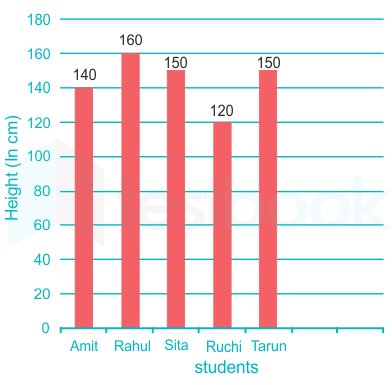
Study the following graph and answer the given question.

The graph shows the height of five students in a class.

<br>

What is the respective ratio between the height of Amit and height of Rahul?

  1. AOption (a)

    12 : 13

  2. BOption (b)

    5 : 6

  3. COption (c)

    7 : 8

  4. DOption (d)

    9 : 10

View answer & explanation

Correct answer

Answer: (c)C.

7 : 8

Why this answer is correct

Given:

From the graph:

Height of Amit = 140 cm

Height of Rahul = 160 cm

Formula Used:

Ratio = Height of Amit : Height of Rahul

Calculation:

Ratio = 140 : 160

Divide both terms by their HCF (20):

= (140 ÷ 20) : (160 ÷ 20)

= 7 : 8

Therefore, the respective ratio between the height of Amit and Rahul is 7 : 8.

Question 4

Which two numbers should be interchanged to make the given equation correct? 

75 ÷ 5 + 15 × 4 - 17 × 3 + (60 ÷ 6) × 10 = 100

(Note: Interchange should be done of the entire number and not individual digits of a given number.)

  1. AOption (a)

    5 and 3

  2. BOption (b)

    3 and 6

  3. COption (c)

    17 and 15

  4. DOption (d)

    3 and 4

View answer & explanation

Correct answer

Answer: (a)A.

5 and 3

Why this answer is correct

Given : 75 ÷ 5 + 15 × 4 - 17 × 3 + (60 ÷ 6) × 10 = 100

According to the question, after replacing the numbers: 

Option 1) 5 and 3

75 ÷ 5 + 15 × 4 - 17 × 3 + (60 ÷ 6) × 10 = 100 ⇒ 75 ÷ 3 + 15 × 4 - 17 × 5 + (60 ÷ 6) × 10 = 100

⇒ 75 ÷ 3 + 15 × 4 - 17 × 5 + (60 ÷ 6) × 10 = 100

⇒ 75 ÷ 3 + 15 × 4 - 17 × 5 + 10 × 10 = 100

⇒ 25 + 15 × 4 - 17 × 5 + 10 × 10 = 100

⇒ 25 + 60 + 100 - 85 = 100

⇒ 185 - 85 = 100

⇒ 100 = 100 (LHS = RHS)

Option  2) 3 and 6

75 ÷ 5 + 15 × 4 - 17 × 3 + (60 ÷ 6) × 10 = 100 ⇒ 75 ÷ 5 + 15 × 4 - 17 × 6 + (60 ÷ 3) × 10 = 100

⇒ 75 ÷ 5 + 15 × 4 - 17 × 6 + (60 ÷ 3) × 10 = 100

⇒ 75 ÷ 5 + 15 × 4 - 17 × 6 + 20 × 10 = 100

⇒ 25 + 15 × 4 - 17 × 6 + 20 × 10 = 100

⇒ 25 + 60 + 200 - 102 = 100

⇒ 285 - 102 = 100

⇒ 183 ≠ 100 (LHS ≠ RHS)

Option  3) 17 and 15

75 ÷ 5 + 15 × 4 - 17 × 3 + (60 ÷ 6) × 10 = 100 ⇒ 75 ÷ 5 + 17 × 4 - 15 × 3 + (60 ÷ 6) × 10 = 100

⇒ 75 ÷ 5 + 17 × 4 - 15 × 3 + (60 ÷ 6) × 10 = 100

⇒ 75 ÷ 5 + 17 × 4 - 15 × 3 + 10 × 10 = 100

⇒ 25 + 17 × 4 - 15 × 3 + 10 × 10 = 100

⇒ 25 + 68 + 100 - 45 = 100

⇒ 193 - 45 = 100

⇒ 148 ≠ 100 (LHS ≠ RHS)

Option  4) 3 and 4

75 ÷ 5 + 15 × 4 - 17 × 3 + (60 ÷ 6) × 10 = 100 ⇒ 75 ÷ 5 + 15 × 3 - 17 × 4 + (60 ÷ 6) × 10 = 100

⇒ 75 ÷ 5 + 15 × 3 - 17 × 4 + (60 ÷ 6) × 10 = 100

⇒ 75 ÷ 5 + 15 × 3 - 17 × 4 + 10 × 10 = 100

⇒ 25 + 15 × 3 - 17 × 4 + 10 × 10 = 100

⇒ 25 + 45 + 100 - 68 = 100

⇒ 170 - 68 = 100

⇒ 102 ≠ 100 (LHS ≠ RHS)

Hence, "Option 1" is the correct answer.

Question 5

Sharad starts from Point Y and drives 9 km towards the South. He then takes a left turn, drives 19 km, turns right and drives 23 km. He then takes a right turn and drives 8 km. He takes a right turn and drives 17 km. He then turns left, drives 11 km, turns left and drives 6 km to stop at Point Z. How far (shortest distance) and towards which direction should he drive in order to reach Point Y again? (All turns are 90 degrees turns only unless specified)

  1. AOption (a)

    15 km towards the south

  2. BOption (b)

    26 km towards the north

  3. COption (c)

    21 km towards the north

  4. DOption (d)

    23 km towards the south

View answer & explanation

Correct answer

Answer: (c)C.

21 km towards the north

Why this answer is correct

Given: 

Sharad starts from Point Y and drives 9 km towards the South.

He then takes a left turn, drives 19 km, turns right and drives 23 km.

He then takes a right turn and drives 8 km.

He takes a right turn and drives 17 km.

He then turns left, drives 11 km, turns left and drives 6 km to stop at Point Z.

Thus, Sharad should drive [(9 km) + (23 km - 17 km) + (6 km)] 21 km in the north direction in order to reach Point Y again.

Hence, "Option 3" is the correct answer.

Question 6

Given below is a statement followed by two possible reasons numbered I and II. Read the statement carefully and decide which of the two explain(s) the event/observation/information given in the statement.

Statement – Price of tomatoes has been steadily rising in the last two weeks and has crossed ₹200 per kg in most parts of the country.

Reasons:

(I) Farmers have reported a new unknown insect infestation in tomato crops, which has affected the crop output of tomatoes in many states across the country.

(II) Heavy flooding in many states during the monsoon season has destroyed many standing vegetable crops, leading to shortages in supplies.

  1. AOption (a)

    Both I and II are possible reasons.

  2. BOption (b)

    Only II is a possible reason.

  3. COption (c)

    Only I is a possible reason.

  4. DOption (d)

    Neither I nor II is a possible reason.

View answer & explanation

Correct answer

Answer: (a)A.

Both I and II are possible reasons.

Why this answer is correct

Given,

Statement:

Price of tomatoes has been steadily rising in the last two weeks and has crossed ₹200 per kg in most parts of the country.

Reasons:

I. Farmers have reported a new unknown insect infestation in tomato crops, which has affected the crop output of tomatoes in many states across the country - True (Because, an unknown insect infestation can reduce the yield of tomato crops, leading to a shortage and subsequent rise in prices).

II. Heavy flooding in many states during the monsoon season has destroyed many standing vegetable crops, leading to shortages in supplies - True (Because, heavy flooding can destroy crops, resulting in a shortage of supply and an increase in prices).

So, Both reasons I and II are possible.

Hence, the correct answer is "Option 1".

Question 7

P is 30% more efficient than Q. How much time will they, working together, take to complete a job that P alone could have done in 23 days?

  1. AOption (a)

    11 days

  2. BOption (b)

    13 days

  3. COption (c)

    20 (3)/(17)

  4. DOption (d)

    10 days

View answer & explanation

Correct answer

Answer: (b)B.

13 days

Why this answer is correct

Shortcut Trick

Ratio of efficiency P : Q = 130 : 100 = 13 : 10.

Total Work = Efficiency of P × Time taken by P = 13 × 23.

Combined Efficiency of P and Q = 13 + 10 = 23.

Time taken together = (13 × 23) ÷ 23 = 13 days.

∴ The correct answer is 13 days.

Alternate Method

Given: Efficiency of P is 30% more than Q. Time taken by P = 23 days.

PersonDaysTotal WorkEfficiency
P23299 units13
Q29.910

⇒ Let efficiency of Q = 10 units/day.

⇒ Efficiency of P = 130% of 10 = 13 units/day.

⇒ Total Work = Efficiency of P × Days = 13 × 23 = 299 units.

⇒ Combined Efficiency (P + Q) = 13 + 10 = 23 units/day.

⇒ Time taken together = Total Work ÷ Combined Efficiency

⇒ Time = 299 ÷ 23 = 13 days.

∴ The correct answer is 13 days.

Additional Information

Efficiency and Time Inversely Proportional

For the same total work, the ratio of time taken by two people is the inverse of the ratio of their efficiencies. If efficiency ratio is x : y, time ratio is y : x.

Work and Wages

Wages are always distributed in the ratio of the actual work done. If they work for the same number of days, the wage ratio equals the efficiency ratio.

Combined Work Formula

If person A can do work in 'a' days and B in 'b' days, together they take (a × b) ÷ (a + b) days to complete the work.

Question 8

Read the given statements and conclusions carefully. You have to take the given statements to be true even if they seem to be at variance from commonly known facts and decide which conclusion(s) logically follow(s) from the given statements.

<br>

Statements:

<br>

Some gold are silver.

<br>

Some silver are diamonds.

<br>

Conclusions:

<br>

(I) Some diamonds are gold.

<br>

(II) Some silver are gold.

  1. AOption (a)

    Both conclusions (I) and (II) follow

  2. BOption (b)

    Only conclusion (I) follows

  3. COption (c)

    Neither conclusion (I) nor (II) follows

  4. DOption (d)

    Only conclusion (II) follows

View answer & explanation

Correct answer

Answer: (d)D.

Only conclusion (II) follows

Why this answer is correct

The least possible Venn diagram for the given statements is as shown below :

Conclusions:

(I) Some diamonds are gold → Does not follow (As some gold are silver and some silver are diamonds. So it is possible but not definite.)

(II) Some silver are gold → Follow (As some gold are silver. As some part of gold is common with silver, therefore it is true.)

∴ Here, Only conclusion (II) follows.​

Hence, the correct answer is "Option 4".

Question 9

Who among the following is currently the Governor of the Reserve Bank of India (RBI) as of 2024?

  1. AOption (a)

    Shaktikanta Das

  2. BOption (b)

    Raghuram Rajan

  3. COption (c)

    Duvvuri Subbarao

  4. DOption (d)

    Urjit Patel

View answer & explanation

Correct answer

Answer: (a)A.

Shaktikanta Das

Why this answer is correct

The correct answer is Shaktikanta Das.

Key Points

  • शक्तिकांत दास ने 10 दिसंबर, 2024 को अपना कार्यकाल पूरा किया, सामान्य पाँच वर्ष की अवधि से परे सेवाएँ प्रदान कीं।
  • दास, दिसंबर 2018 में नियुक्त हुए, ने सरकार की वित्तीय नीतियों में महत्वपूर्ण भूमिका निभाई और 15वें वित्त आयोग और भारत के G20 शेरपा के सदस्य थे।
  • उन्होंने सेंट स्टीफेंस कॉलेज, दिल्ली विश्वविद्यालय से स्नातकोत्तर की डिग्री प्राप्त की है, और वित्त, कराधान और शासन में चार दशकों से अधिक का अनुभव रखते हैं।
  • संजय मल्होत्रा को 26वें RBI गवर्नर के रूप में नियुक्त किया गया है, जो शक्तिकांत दास के उत्तराधिकारी हैं।

Additional Information

  • Reserve Bank of India was established on 1 April, 1935.
  • The Reserve Bank of India is the central bank of the country.
  • The Reserve Bank of India was set up on the basis of the recommendations of the Hilton Young Commission.
  • The Reserve Bank of India Act, 1934  provides the statutory basis for the functioning of the Bank, which commenced operations on April 1, 1935.
  • The Bank was constituted to - Regulate the issue of banknotes, Maintain reserves with a view to securing monetary stability and operate the credit and currency system of the country to its advantage.

Question 10

Which of the following household items does NOT use the heating effect of current?

  1. AOption (a)

    Electric stove (heater)

  2. BOption (b)

    Electric water heater

  3. COption (c)

    Electric iron box

  4. DOption (d)

    Electric motor

View answer & explanation

Correct answer

Answer: (d)D.

Electric motor

Why this answer is correct

The correct answer is Electric motor.

Key Points

  • An electric motor converts electrical energy into mechanical energy, not heat.
  • Electric stoves, water heaters, and iron boxes use the heating effect of current to function.
  • In electric stoves, the current passes through resistive heating elements, generating heat.
  • Electric water heaters use heating elements that convert electrical energy into heat to warm water.
  • Electric iron boxes have resistive elements that produce heat to iron clothes.

Additional Information

  • Heating Elements
  • They are made of materials with high resistivity, such as nichrome, which converts electrical energy into heat efficiently.
  • Commonly used in household appliances like toasters, hair dryers, and space heaters.
  • Resistive Heating
  • This is the process by which an electric current passes through a resistive material, causing it to heat up.
  • It is widely used in various applications, including industrial heating and household appliances.
  • Electric Motors
  • They are used in a wide range of applications, from household appliances to industrial machinery.
  • Electric motors work based on electromagnetic induction and do not primarily rely on the heating effect of current.

Question 11

The median of the observations 4, 14, 11, 8, 7, 8, 9, 12, 4 and 6 is:

  1. AOption (a)

    11

  2. BOption (b)

    10

  3. COption (c)

    8

  4. DOption (d)

    9

View answer & explanation

Correct answer

Answer: (c)C.

8

Why this answer is correct

Shortcut Trick

Arrange observations in ascending order: 4, 4, 6, 7, 8, 8, 9, 11, 12, 14.

Total terms (n) = 10, which is an even number.

Identify the middle two terms: The 5th and 6th terms are both 8.

Median = (8 + 8) ÷ 2 = 8.

∴ The correct answer is 8.

Alternate Method

Given: Data set = {4, 14, 11, 8, 7, 8, 9, 12, 4, 6}

Formula Used: For an even number of observations (n), Median = [(n/2)th term + (n/2 + 1)th term] ÷ 2.

⇒ Arranging observations in ascending order: 4, 4, 6, 7, 8, 8, 9, 11, 12, 14

⇒ Total count (n) = 10

⇒ Median = (5th observation + 6th observation) ÷ 2

⇒ Median = (8 + 8) ÷ 2

⇒ Median = 16 ÷ 2 = 8

∴ The correct answer is 8.

Additional Information

Median for Odd N

If the number of observations (n) is odd, the median is the exactly middle value: Median = ((n+1)/2)th term.

Arithmetic Mean

The average value calculated by summing all observations and dividing by the total count: Mean = (Σx) ÷ n.

Mode of Data

The mode is the value that appears most frequently in the data set. A set can be unimodal, bimodal, or multimodal.

Range

The difference between the maximum and minimum values in the data set: Range = Max − Min.

Question 12

Based on the English alphabetical order, three of the following four letter-cluster pairs are alike in a certain way and thus form a group. Which pair does not belong to that group?

(Note: The odd one out is not based on the number of consonants/vowels or their position in the letter cluster.)

  1. AOption (a)

    DK-HO

  2. BOption (b)

    RY-VC

  3. COption (c)

    QX-UB

  4. DOption (d)

    AD-GJ

View answer & explanation

Correct answer

Answer: (d)D.

AD-GJ

Why this answer is correct

The logic followed here is:

Option 1) DK-HO

Option 2) RY-VC

Option 3) QX-UB

Option 4) AD-GJ

Thus, out of all the options 'AD-GJ' is the odd one out.

Hence, "Option 4" is the correct answer.

Question 13

Which of the following Acts was amended in 2023 to enhance child protection measures in India?

  1. AOption (a)

    Juvenile Justice (Care and Protection of Children) Act

  2. BOption (b)

    Right to Education Act

  3. COption (c)

    Child Labour (Prohibition and Regulation) Act

  4. DOption (d)

    Protection of Children from Sexual Offences Act

View answer & explanation

Correct answer

Answer: (a)A.

Juvenile Justice (Care and Protection of Children) Act

Why this answer is correct

The correct answer is Juvenile Justice (Care and Protection of Children) Act.

Key Points

  • Juvenile Justice (Care and Protection of Children) Act, 2015 has been passed by the Parliament of India amidst intense controversy, debate, and protest on many of its provisions by the Child Rights fraternity.
  • It replaced the Indian juvenile delinquency law, Juvenile Justice (Care and Protection of Children) Act, 2000, and allows for juveniles in conflict with Law in the age group of 16–18, involved in Heinous Offences, to be tried as adults.
  • The Act also sought to create a universally accessible adoption law for India, overtaking the Hindu Adoptions and Maintenance Act (1956) (applicable to Hindus, Buddhists, Jains, and Sikhs) and the Guardians and Wards Act (1890) (applicable to Muslims), though not replacing them.
  • The Act came into Enforcement on 15 January 2016.
  • It was passed on 7 May 2015 by the Lok Sabha amid intense protest by several Members of Parliament.
  • It was passed on 22 December 2015 by the Rajya Sabha.

 Additional Information

  • Right to Education Act
  • The RTE Act of the Parliament of  India was enacted on 4 August 2009 and came into force on 1 April 2010. This act is also known as the Right of Children to Free and Compulsory Education Act because of its provision of, “the fundamental right of every child between the ages of 6 to 14 with specifies minimum norms in elementary schools.”
  • Important Provisions of RTE are as follows:
  • Right of children to free and compulsory education till completion of elementary education in a neighbourhood school.
  • It makes provisions for a non-admitted child to be admitted to an age-appropriate class.
  • It specifies the duties and responsibilities of appropriate Governments, local authority and parents in providing free and compulsory education.
  • It lays down the norms and standards relating regarding Pupil Teacher Ratios (PTRs), buildings and infrastructure, school-working days, teacher-working hours.
  • It provides for the appointment of appropriately trained teachers, i.e. teachers with the requisite entry and academic qualifications.
  • The act prohibits physical punishment and mental harassment.
  • It provides for the development of curriculum in consonance with the values enshrined in the Constitution, and which would ensure the all-round development of the child.
  • Child Labour (Prohibition and Regulation) Act
  • The Child Labour (Prohibition and Regulation) Act was enacted in 1986.
  • It aims to prohibit the engagement of children in certain employments and regulate the conditions of work in others.
  • ​Protection of Children from Sexual Offences Act
  • To deal with child sexual abuse cases, the Government has brought in a special law, namely, The Protection of Children from Sexual Offences (POCSO) Act, 2012.
  • The Act has come into force with effect from 14th November 2012 along with the Rules framed thereunder.
  • The POCSO Act, 2012 is a comprehensive law to provide for the protection of children from the offences of
  • sexual assault
  • sexual harassment
  • pornography
  • While safeguarding the interests of the child at every stage of the judicial process by incorporating child-friendly mechanisms for reporting, recording of evidence, investigation and speedy trial of offences through designated Special Courts.

Question 14

Evaluate the given expression. (-4) + (-12) ÷ (-6)

  1. AOption (a)

    -6

  2. BOption (b)

    -2

  3. COption (c)

    -4

  4. DOption (d)

    -8

View answer & explanation

Correct answer

Answer: (b)B.

-2

Why this answer is correct

Given:

Expression: (-4) + (-12) ÷ (-6)

Formula Used:

Order of operations (PEMDAS/BODMAS): Parentheses, Exponents (ie Powers and Square Roots, etc.), Multiplication and Division (left-to-right), Addition and Subtraction (left-to-right)

Calculation:

First, perform the division:

⇒ (-12) ÷ (-6) = 2

Next, perform the addition:

⇒ (-4) + 2 = -2

The value of the given expression is -2.

Question 15

Umesh took 100 chocolates out of 250 chocolates from Ruchi. Umesh gave 20% of his chocolates to Shalaka and 35% of his chocolates to Marry. Then Ruchi gave 50% of her remaining chocolates to Umesh. Find the number of chocolates Umesh had at the end.

  1. AOption (a)

    125

  2. BOption (b)

    130

  3. COption (c)

    120

  4. DOption (d)

    75

View answer & explanation

Correct answer

Answer: (c)C.

120

Why this answer is correct

Shortcut Trick

Umesh left with: 100 × (100% − 20% − 35%) = 100 × 45% = 45.

Ruchi remaining: 250 − 100 = 150.

Transfer from Ruchi: 50% of 150 = 75.

Final count for Umesh: 45 + 75 = 120.

∴ The correct answer is 120 chocolates.

Alternate Method

Given:

Total chocolates = 250 | Umesh takes = 100 | Ruchi remaining = 150

Umesh gives away = 20% (to Shalaka) + 35% (to Marry) = 55%

Calculations:

⇒ Umesh initial count = 100 chocolates

⇒ Chocolates given by Umesh = (20 + 35)% of 100 = 55% of 100 = 55

⇒ Umesh remaining count = 100 − 55 = 45

⇒ Ruchi initial remaining = 250 − 100 = 150

⇒ Chocolates given by Ruchi to Umesh = 50% of 150 = 75

⇒ Final chocolates with Umesh = 45 + 75 = 120

∴ The correct answer is 120 chocolates.

Additional Information

Percentage Remaining

If a person spends x% and then y% of the initial amount, the remaining percentage is (100 − x − y)%.

Percentage of a Value

To find p% of a number N, use the formula: (p ÷ 100) × N.

Base Value Importance

Always identify the correct base for percentage calculations (e.g., 50% of remaining 150, not the original 250).

Question 16

Which of the following statements is correct according to the law of conservation of mass?

  1. AOption (a)

    Mass can be created but cannot be destroyed in a chemical reaction.

  2. BOption (b)

    Mass can neither be created nor be destroyed in a chemical reaction.

  3. COption (c)

    Mass can be destroyed in a chemical reaction.

  4. DOption (d)

    Mass can be created in a chemical reaction.

View answer & explanation

Correct answer

Answer: (b)B.

Mass can neither be created nor be destroyed in a chemical reaction.

Why this answer is correct

The correct answer is Mass can neither be created nor be destroyed in a chemical reaction..

Key Points

  • The law of conservation of mass states that mass can neither be created nor destroyed in a chemical reaction.
  • This principle was established by Antoine Lavoisier in the 18th century.
  • In a closed system, the total mass of the reactants equals the total mass of the products.
  • The law applies to both physical changes and chemical reactions.
  • This law is fundamental to the field of chemistry and underpins stoichiometric calculations in chemical reactions.

Additional Information

  • Law of Definite Proportions
  • This law states that a chemical compound always contains the same proportion of elements by mass.
  • It is also known as Proust's law.
  • Law of Multiple Proportions
  • This law states that when two elements combine to form more than one compound, the masses of one element that combine with a fixed mass of the other element are in ratios of small whole numbers.
  • It was formulated by John Dalton.
  • Stoichiometry
  • It involves the calculation of reactants and products in chemical reactions.
  • It is based on the laws of conservation of mass and definite proportions.

Question 17

The number of chromosomes become half in a daughter cell by the process of:

  1. AOption (a)

    binary fission

  2. BOption (b)

    meiosis

  3. COption (c)

    mitosis

  4. DOption (d)

    amitosis

View answer & explanation

Correct answer

Answer: (b)B.

meiosis

Why this answer is correct

The correct answer is meiosis.

Key Points

  • Meiosis is a type of cell division that reduces the chromosome number by half, resulting in four daughter cells, each with half the number of chromosomes of the parent cell.
  • This process is essential for sexual reproduction and occurs in the germ cells to produce gametes (sperm and eggs).
  • Meiosis involves two sequential divisions: meiosis I and meiosis II.
  • During meiosis I, homologous chromosomes are separated, and during meiosis II, sister chromatids are separated.
  • The reduction in chromosome number ensures that when fertilization occurs, the resulting zygote has the correct diploid number of chromosomes.

Additional Information

  • Binary Fission
  • Binary fission is a form of asexual reproduction commonly found in prokaryotes such as bacteria.
  • During binary fission, the parent cell divides into two genetically identical daughter cells.
  • Mitosis
  • Mitosis is a type of cell division that results in two daughter cells, each with the same number of chromosomes as the parent cell.
  • It is involved in growth, repair, and asexual reproduction in multicellular organisms.
  • Amitosis
  • Amitosis is a direct method of cell division where the nucleus and cytoplasm divide without the formation of chromosomes.
  • This process is less common and occurs in some single-celled organisms and certain tissues.

Question 18

In a certain code language,

A + B means ‘A is the mother of B’,

A − B means ‘A is the brother of B’,

A × B means ‘A is the wife of B’,

A ÷ B means ‘A is the father of B’,

and A # B means ‘A is the daughter of B’.

How is P related to K if ‘Q − R × P ÷ S − T + K’?

  1. AOption (a)

    Daughter's son

  2. BOption (b)

    Son's daughter

  3. COption (c)

    Father's father

  4. DOption (d)

    Mother's father

View answer & explanation

Correct answer

Answer: (d)D.

Mother's father

Why this answer is correct

Decoding symbols:

A is
Symbol+–×÷#
MeaningMotherBrotherWifeFatherDaughter
to B

Given: Q − R × P ÷ S − T + K

Q − R → Q is the brother of R.

R × P → R is the wife of P.

P ÷ S → P is the father of S.

S − T → S is the brother of T.

T + K → T is the mother of K.

Thus, P is K's mother's father or maternal grandfather.

Hence, the correct answer is "Option 4"

Question 19

The weights (in kg) of 9 members of a school cricket team are 50, 63, x, 62, 64, 48, 51, 55, 48. If the mean weight is 56 kg, then the value of x is ________.

  1. AOption (a)

    48

  2. BOption (b)

    63

  3. COption (c)

    64

  4. DOption (d)

    57

View answer & explanation

Correct answer

Answer: (b)B.

63

Why this answer is correct

Shortcut Trick

The sum of deviations from the mean is always zero.

Known deviations from 56: (50−56), (63−56), (62−56), (64−56), (48−56), (51−56), (55−56), (48−56)

⇒ −6, +7, +6, +8, −8, −5, −1, −8

Sum of known deviations = −7

For the total deviation to be zero, the deviation of x must be +7.

x = Mean + 7 = 56 + 7 = 63.

∴ The correct answer is 63.

Alternate Method

Given:

Weights of 9 members = 50, 63, x, 62, 64, 48, 51, 55, 48 kg

Mean weight = 56 kg

Number of members (n) = 9

Formula Used:

Mean = (Sum of all observations) ÷ (Total number of observations)

Calculations:

⇒ 56 = (50 + 63 + x + 62 + 64 + 48 + 51 + 55 + 48) ÷ 9

⇒ 56 × 9 = 441 + x

⇒ 504 = 441 + x

⇒ x = 504 − 441

⇒ x = 63

∴ The correct answer is 63.

Additional Information

Properties of Arithmetic Mean

The sum of the deviations of a set of observations from their arithmetic mean is always zero: Σ(xi − Mean) = 0.

Effect of Changes

If every observation is increased or decreased by a constant k, the mean is also increased or decreased by k.

Combined Mean

If two groups have means M1 and M2 with sizes n1 and n2, the combined mean is (n1M1 + n2M2) ÷ (n1 + n2).

Question 20

Which of the following metals CANNOT be cut with a knife?

  1. AOption (a)

    Sodium

  2. BOption (b)

    Copper

  3. COption (c)

    Lithium

  4. DOption (d)

    Potassium

View answer & explanation

Correct answer

Answer: (b)B.

Copper

Why this answer is correct

The correct answer is Copper.

Key Points

  • Sodium, lithium, and potassium are alkali metals that are soft and can be cut with a knife.
  • Alkali metals are known for their softness and low density.
  • Copper is a transition metal, which is much harder and cannot be cut with a knife.
  • The hardness of a metal is determined by its atomic structure and bonding.
  • Alkali metals have a single electron in their outer shell, which makes them highly reactive and soft.

Additional Information

  • Alkali Metals
  • These metals are found in Group 1 of the periodic table.
  • They are highly reactive, especially with water, and are stored in oil to prevent reactions with moisture in the air.
  • Examples include lithium, sodium, and potassium.
  • Transition Metals
  • These metals are found in the central block of the periodic table (Groups 3-12).
  • They are characterized by their ability to form variable oxidation states and colored compounds.
  • Examples include copper, iron, and gold.
  • Metals and Their Properties
  • Metals are generally malleable, ductile, and good conductors of electricity and heat.
  • The physical properties of metals vary widely across the periodic table.
  • Reactivity, hardness, and melting points of metals can differ significantly based on their atomic structure and bonding.

Question 21

If each vowel in the word ELASTIC is changed to the letter following it in the English alphabetical order and each consonant is changed to the letter following it in the English alphabetical order, then which of the following letters will be fourth from the right in the group of letters thus formed?

  1. AOption (a)

    B

  2. BOption (b)

    T

  3. COption (c)

    M

  4. DOption (d)

    U

View answer & explanation

Correct answer

Answer: (b)B.

T

Why this answer is correct

Given word: 'ELASTIC'

After changing vowels and consonants:

OriginalELASTIC
ChangedFMBTUJD


After changing vowels and consonants,

Fourth letter from the right end is: T,

Hence, the correct answer is "Option 2".

Question 22

The gravitational force between two objects of masses m1 and m2 is directly proportional to ______.

  1. AOption (a)

    m2 - m1

  2. BOption (b)

    m1 - m2

  3. COption (c)

    m1/ m2

  4. DOption (d)

    m1 * m2

View answer & explanation

Correct answer

Answer: (d)D.

m1 * m2

Why this answer is correct

The correct answer is m1 × m2.

Key Points

  • The gravitational force between two objects is governed by Newton's Law of Universal Gravitation.
  • The formula for gravitational force is F = G * (m1 * m2) / r2, where G is the gravitational constant.
  • The force is directly proportional to the product of the masses of the two objects (m1 and m2).
  • This means that if either mass increases, the gravitational force between them also increases.
  • The gravitational force is inversely proportional to the square of the distance between the centers of the two masses.

Additional Information

  • Gravitational Constant (G)
  • G is a universal constant with a value of approximately 6.674 × 10⁻¹¹ N(m/kg)2.
  • It is a key component in the formula for calculating gravitational force.
  • Inverse Square Law
  • This law states that the force between two masses is inversely proportional to the square of the distance between them.
  • This means that if the distance is doubled, the gravitational force becomes one-fourth.
  • Mass and Weight
  • Mass is a measure of the amount of matter in an object and is usually measured in kilograms.
  • Weight is the force exerted by gravity on an object and is dependent on both the mass of the object and the gravitational field strength.
  • Weight can be calculated using the formula Weight = Mass × Gravitational field strength.

Question 23

The HCF of the numbers 310, 208 and 180 is:

  1. AOption (a)

    2

  2. BOption (b)

    4

  3. COption (c)

    6

  4. DOption (d)

    8

View answer & explanation

Correct answer

Answer: (a)A.

2

Why this answer is correct

Shortcut Trick

The HCF of any set of numbers must divide the difference between any two of those numbers.

The difference between 208 and 180 is 28.

The factors of 28 are 1, 2, 4, 7, 14, and 28.

Since 310 is not divisible by 4, the HCF cannot be 4, 14, or 28.

Since all three numbers (310, 208, and 180) are even numbers, they are divisible by 2.

∴ The correct answer is 2.

Alternate Method

Given:

The numbers are 310, 208, and 180.

Formula Used:

HCF (Highest Common Factor) is the product of the lowest powers of all common prime factors.

Calculations:

Let us find the prime factorisation of each number:

⇒ 310 = 2 × 5 × 31

⇒ 208 = 24 × 13

⇒ 180 = 22 × 32 × 5

Identify the common prime factors:

⇒ The only prime factor common to all three numbers is 2.

⇒ The lowest power of 2 among the factorisations is 21.

⇒ HCF = 21 = 2.

∴ The correct answer is 2.

Additional Information

Highest Common Factor (HCF)

The greatest number that divides two or more numbers without leaving a remainder. It is also referred to as the Greatest Common Divisor (GCD).

Least Common Multiple (LCM)

The smallest non-zero common multiple of two or more numbers.

Relation between HCF and LCM

For any two numbers a and b, the product of their HCF and LCM is equal to the product of the two numbers: HCF(a, b) × LCM(a, b) = a × b.

Co-prime Numbers

Two numbers are said to be co-prime if their HCF is 1.

Question 24

Which Kashmiri wood carver was honoured with the Padma Shri award in 2024 for his contributions in the field of art?

  1. AOption (a)

    Bashir Ahmad Mir

  2. BOption (b)

    Shri Ghulam Nabi Dar

  3. COption (c)

    Mohammad Yousuf

  4. DOption (d)

    Abdul Rashid Khan

View answer & explanation

Correct answer

Answer: (b)B.

Shri Ghulam Nabi Dar

Why this answer is correct

The correct answer is Shri Ghulam Nabi Dar.

Key Points

  • The following are the names of Padma Award 2024 recipients:
Padma VibhushanPadma BhushanPadma Shri
1. Vyjayantimala Bali1. M Fathima Beevi1. Khalil Ahamad
2. Konidela Chiranjeevi2. Hormusji N Cama2. Badrappan M
3. M Venkaiah Naidu3. Mithun Chakraborty3. Kaluram Bamaniya
4. Bindeshwar Pathak4. Sitaram Jindal4. Rezwana Choudhury Bannya
5. Padma Subrahmanyam5. Young Liu5. Naseem Bano
6. Ashwin Balachand Mehta6. Ramlal Bareth
7. Satyabrata Mookherjee7. Gita Roy Barman
8. Ram Naik8. Parbati Baruah
9. Tejas Madhusudan Patel9. Sarbeswar Basumatary
10. Olanchery Rajagopal10. Som Datt Battu
11. Dattatray Ambadas Mayaloo Alias Rajdutt11. Takdira Begum
12. Togdan Rinpoche12. Sathyanarayana Beleri
13. Pyarelal Sharma13. Drona Bhuyan
14. Chandreshwar Prasad Thakur14. Ashok Kumar Biswas
15. Usha Uthup15. Rohan Machanda Bopanna
16. Vijaykanth16. Smriti Rekha Chakma
17. Narayan Chakraborty
18. A Velu Ananda Chari
19. Ram Chet Chaudhary
20. K Chellammal
21. Joshna Chinappa
22. Charlotte Chopin
23. Raghuveer Choudhary
24. Joe D Cruz
25. Ghulam Nabi Dar
26. Chitta Ranjan Debbarma
27. Uday Vishwanath Deshpande
28. Prema Dhanraj
29. Radha Krishan Dhiman
30. Manohar Krishana Dole
31. Pierre Sylvain Filliozat
32. Mahabir Singh Guddu
33. Anupama Hoskere
34. Yazdi Maneksha Italia
35. Rajaram Jain
36. Jankilal
37. Ratan Kahar
38. Yashwant Singh Kathoch
39. Zahir I Kazi
40. Gaurav Khanna
41. Surendra Kishore
42. Dasari Kondappa
43. Sridhar Makam Krishnamurthy
44. Yanung Jamoh Lego
45. Jordan Lepcha
46. Satendra Singh Lohia
47. Binod Maharana
48. Purnima Mahato
49. Uma Maheshwari D
50. Dukhu Majhi
51. Ram Kumar Mallick
52. Hemchand Manjhi
53. Chandrashekhar Mahadeorao Meshram
54. Surendra Mohan Mishra
55. Ali Mohammed & Shri Ghani Mohammed (Duo)
56. Kalpana Morparia
57. Chami Murmu
58. Sasindran Muthuvel
59. G Nachiyar
60. Kiran Nadar
61. Pakaravur Chithran Namboodiripad (Posthumous)
62. Narayanan E P
63. Shailesh Nayak
64. Harish Nayak
65. Fred Negrit
66. Hari Om
67. Bhagabat Padhan
68. Sanatan Rudra Pal
69. Shankar Baba Pundlikrao Papalkar
70. Radhe Shyam Pareek
71. Dayal Mavjibhai Parmar
72. Binod Kumar Pasayat
73. Silbi Passah
74. Shanti Devi Paswan & Shri Shivan Paswan (Duo)
75. Sanjay Anant Patil
76. Muni Narayana Prasad
77. K S Rajanna
78. Chandrashekar Channapatna Rajannachar
79. Bhagwatilal Rajpurohit
80. Romalo Ram
81. Navjivan Rastogi
82. Nirmal Rishi
83. Pran Sabharwal
84. Gaddam Sammaiah
85. Sangthankima
86. Machihan Sasa
87. Omprakash Sharma
88. Eklabya Sharma
89. Ram Chander Sihag
90. Harbinder Singh
91. Gurvinder Singh
92. Godawari Singh
93. Ravi Prakash Singh
94. Seshampatti T Sivalingam
95. Somanna
96. Kethavath Somlal
97. Shashi Soni
98. Urmila Srivastava
99. Nepal Chandra Sutradhar (Posthumous)
100. Gopinath Swain
101. Laxman Bhatt Tailang
102. Maya Tandon
103. Aswathi Thirunal Gouri Lakshmi Bayi Thampuratty
104. Jagdish Labhshanker Trivedi
105. Sano Vamuzo
106. Balakrishnan Sadanam Puthiya Veetil
107. Kurella Vittalacharya
108. Kiran Vyas
109. Jageshwar Yadav
110. Babu Ram Yadav

Question 25

Select the set, from the given options, in which the numbers are related in the same way as are the numbers of the following sets.

<br>

(NOTE: Operations should be performed on the whole numbers, without breaking down the numbers into its constituent digits. E.g. 13 – Operations on 13 such as adding/subtracting/multiplying etc. to 13 can be performed. Breaking down 13 into 1 and 3 and then performing mathematical operations on 1 and 3 is not allowed.)

<br>

(6, 13, 78)

(5, 22, 110)

  1. AOption (a)

    (24, 9, 206)

  2. BOption (b)

    (7, 13, 90)

  3. COption (c)

    (8, 19, 162)

  4. DOption (d)

    (8, 12, 96)

View answer & explanation

Correct answer

Answer: (d)D.

(8, 12, 96)

Why this answer is correct

Logic followed here is,

First number × Second number = Third number

Given, 

(6, 13, 78)

6 × 13 = 78(Third number)

(5, 22, 110)

5 × 22 = 110(Third number)

Check the option,

Option 1 (24, 9, 206)

24 × 9 = 216 ≠ 206

Option 2 (7, 13, 90)

7 × 13 = 91 ≠ 90

Option 3 (8, 19, 162)

8 × 19 = 152 ≠ 162

Option 4 (8, 12, 96)

8 × 12 = 96(Third number)

Hence the correct answer is "Option 4"

Question 26

The magnetic field produced by a current-carrying wire at a given point depends on which of the following factors?

  1. AOption (a)

    Neither distance from the wire nor current through the wire

  2. BOption (b)

    Current flowing through the wire Only

  3. COption (c)

    Distance from the wire Only

  4. DOption (d)

    Both distance from the wire and current through the wire

View answer & explanation

Correct answer

Answer: (d)D.

Both distance from the wire and current through the wire

Why this answer is correct

The correct answer is Both distance from the wire and current through the wire.

Key Points

  • The magnetic field produced by a current-carrying wire is directly proportional to the current flowing through the wire.
  • The strength of the magnetic field decreases as the distance from the wire increases.
  • The relationship between the magnetic field (B), current (I), and distance (r) is given by the Biot-Savart law and Ampère's circuital law.
  • The direction of the magnetic field can be determined using the right-hand rule: if you point your thumb in the direction of the current, your fingers will curl in the direction of the magnetic field.
  • The magnetic field forms concentric circles around the wire, with the wire itself being at the center of these circles.

Additional Information

  • Electromagnetic Induction
  • It is the process of generating an electromotive force (EMF) or voltage in a conductor due to a changing magnetic field.
  • This principle is the basis for the operation of transformers, electric generators, and induction motors.
  • Right-Hand Rule
  • This is a mnemonic used to determine the direction of the magnetic field relative to the direction of the current.
  • It states that if you point the thumb of your right hand in the direction of the current, your fingers will curl in the direction of the magnetic field.
  • Magnetic Flux
  • Magnetic flux is the measure of the quantity of magnetism, taking into account the strength and the extent of a magnetic field.
  • It is measured in Webers (Wb).
  • Magnetic flux through a surface is proportional to the number of magnetic field lines passing through that surface.

Question 27

If + means −, − means ×, × means ÷, ÷ means +, then what will come in place of the question mark (?) in the following equation?

28 − 6 ÷ 4 + 14 × 14 =

  1. AOption (a)

    171

  2. BOption (b)

    168

  3. COption (c)

    169

  4. DOption (d)

    160

View answer & explanation

Correct answer

Answer: (a)A.

171

Why this answer is correct

BODMAS Table: 

Given equation: 28 − 6 ÷ 4 + 14 × 14 = ?

Now, if ‘+’ means ‘-’, ‘-’ means ‘×’, ‘×’ means ‘÷’, and ‘÷’ means ‘+’, then:

⇒ 28 × 6 + 4 − 14 ÷ 14 = ?

⇒ 28 × 6 + 4 − 1 = ?

⇒ 168 + 4 − 1 = ?

⇒ 171.

Hence, the correct answer is "Option 1".

Question 28

Each letter in the word HYDROMETER is changed to the letter preceding it in the English alphabetical order and then all the letters thus formed are arranged in alphabetical order. Which of the following letters will be fifth from the right in the new group of letters thus formed?

  1. AOption (a)

    N

  2. BOption (b)

    Q

  3. COption (c)

    L

  4. DOption (d)

    G

View answer & explanation

Correct answer

Answer: (a)A.

N

Why this answer is correct

Given word: 'HYDROMETER'

After each letter is changed to the letter preceding it in the English alphabetical order, the new word is:

After arranged in alphabetical order:

AlphabetsHYDROMETER
Alphabetical orderGXCQNLDSDQ


After arranged in alphabetical order,

C D D G L N Q Q S X

Fifth alphabet from the right end is: N.

Hence, the correct answer is "Option 1".

Question 29

Evaluate the given expression. 16 + 8 ÷ 4 - 2 × 3

  1. AOption (a)

    18

  2. BOption (b)

    0

  3. COption (c)

    6

  4. DOption (d)

    12

View answer & explanation

Correct answer

Answer: (d)D.

12

Why this answer is correct

Given:

Expression: 16 + 8 ÷ 4 - 2 × 3

Formula Used:

Order of Operations (PEMDAS/BODMAS): Parentheses/Brackets, Exponents/Orders, Multiplication and Division (from left to right), Addition and Subtraction (from left to right)

Calculation:

Start with division and multiplication, from left to right:

⇒ 16 + 2 - 6

Then perform addition and subtraction, from left to right:

⇒ 18 - 6

⇒ 12

The correct answer is option 4.

Question 30

Based on the English alphabetical order, three of the following four letter-cluster pairs are alike in a certain way and thus form a group. Which pair does not belong to that group?

<br>

(Note: The odd one out is not based on the number of consonants/vowels or their position in the letter-cluster.)

  1. AOption (a)

    NJ-MP

  2. BOption (b)

    SO-RV

  3. COption (c)

    PL-OR

  4. DOption (d)

    LH-KN

View answer & explanation

Correct answer

Answer: (b)B.

SO-RV

Why this answer is correct

The logic followed here is:

Option 1) NJ-MP

Option 2) SO-RV

Option 3) PL-OR

Option 4) LH-KN

Thus, out of all the options 'SO-RV' is the odd one out.

Hence, "Option 2" is the correct answer.

Question 31

If a force F acts on a body such that the body gets displaced through the distance x in the direction of the force, then the work done by the force is _______.

  1. AOption (a)

    F/x

  2. BOption (b)

    x/F

  3. COption (c)

    x2F

  4. DOption (d)

    Fx

View answer & explanation

Correct answer

Answer: (d)D.

Fx

Why this answer is correct

The correct answer is Fx.

Key Points

  • The formula for work done (W) when a force (F) causes a displacement (x) in the direction of the force is given by W = Fx.
  • Work is a scalar quantity and is measured in joules (J) in the International System of Units (SI).
  • The displacement must be in the direction of the force for the formula W = Fx to hold true.
  • If the force and displacement are in the same direction, the work done is positive.
  • If the force and displacement are in opposite directions, the work done is negative, indicating that the force opposes the motion.

Additional Information

  • Energy
  • Energy is the ability to do work. It can exist in various forms such as kinetic, potential, thermal, electrical, and chemical energy.
  • Work and energy are closely related; work done on an object transfers energy to the object.
  • Power
  • Power is the rate at which work is done or energy is transferred. It is measured in watts (W) in the SI system.
  • One watt is equal to one joule per second (J/s).
  • Kinetic Energy
  • Kinetic energy is the energy possessed by an object due to its motion. It is given by the formula KE = 0.5 * m * v2, where m is mass and v is velocity.
  • Any object that is moving has kinetic energy.

Question 32

TRPMK is related to XVTQO in a certain way based on the English alphabetical order. In the same way, LJHEC is related to PNLIG. To which of the following options is KIGDB related, following the same logic?

  1. AOption (a)

    OMKIG

  2. BOption (b)

    OMKIF

  3. COption (c)

    NLJGE

  4. DOption (d)

    OMKHF

View answer & explanation

Correct answer

Answer: (d)D.

OMKHF

Why this answer is correct

The logic followed here is:

TRPMK is related to XVTQO

And,

LJHEC is related to PNLIG

Similarly,

KIGDB is related to

Hence, "Option 3" is the correct answer.

Question 33

Which of the following options does NOT represent a property of solids?

  1. AOption (a)

    It is not difficult to change their shape.

  2. BOption (b)

    They have distinct boundaries and fixed volumes.

  3. COption (c)

    They have a definite shape.

  4. DOption (d)

     They have a tendency to maintain their shape when subjected to outside force.

View answer & explanation

Correct answer

Answer: (a)A.

It is not difficult to change their shape.

Why this answer is correct

The correct answer is It is not difficult to change their shape..

Key Points

  • Solids have a definite shape that is maintained without external support.
  • Solids possess fixed volumes and distinct boundaries.
  • Solids are rigid and resist changes in shape when subjected to external forces.
  • Particles in solids are closely packed in a fixed arrangement, contributing to their rigidity.
  • Unlike liquids and gases, solids do not flow and maintain their form unless a significant force is applied.

Additional Information

  • Liquids
  • They have a definite volume but take the shape of their container.
  • Particles in liquids are less tightly packed compared to solids, allowing them to flow.
  • Gases
  • Gases neither have a definite shape nor a fixed volume, expanding to fill their container.
  • Particles in gases are widely spaced and move freely.
  • Plasma
  • Plasma is an ionized state of matter similar to gas but with charged particles.
  • It is found naturally in stars, including the sun.

Question 34

In a certain code language, ‘bright as day’ is coded as ‘cb mn ju’ and ‘day and night’ is coded as ‘mn fd rs’. How is ‘day’ coded in the given language?

  1. AOption (a)

    fd

  2. BOption (b)

    cb

  3. COption (c)

     ju

  4. DOption (d)

    mn

View answer & explanation

Correct answer

Answer: (d)D.

mn

Why this answer is correct

According to the given information,

Thus, according to the given codes the code 'mn' is for the word 'day'.

Hence, the correct answer is "Option 4".

Question 35

An order was placed for the supply of a carpet whose breadth was 6 m and whose length were 1.44 times the breadth. What is the cost of a carpet whose length and breadth are 40% more and 25% more respectively than the first carpet. [The cost of a carpet is Rs. 45 per sq m.]

  1. AOption (a)

    Rs. 3642.60

  2. BOption (b)

    Rs. 4216.20

  3. COption (c)

    Rs. 4082.40

  4. DOption (d)

    Rs. 3868.80

View answer & explanation

Correct answer

Answer: (c)C.

Rs. 4082.40

Why this answer is correct

Shortcut Trick

New Area = Old Area × (1 + % increase in length) × (1 + % increase in breadth)

Old Area = 6 × (1.44 × 6) = 51.84 m2

New Area = 51.84 × 1.40 × 1.25 = 51.84 × 1.75 = 90.72 m2

Total Cost = 90.72 × 45 = ₹4082.40

∴ The correct answer is ₹4082.40.

Alternate Method

Given:

First carpet breadth (B1) = 6 m

First carpet length (L1) = 1.44 × 6 = 8.64 m

Rate of carpet = ₹45 per sq m

Calculations:

⇒ Breadth of second carpet (B2) = 6 + (25% of 6) = 6 × 1.25 = 7.5 m

⇒ Length of second carpet (L2) = 8.64 + (40% of 8.64) = 8.64 × 1.4 = 12.096 m

⇒ Area of second carpet = L2 × B2

⇒ Area = 12.096 × 7.5 = 90.72 m2

⇒ Total Cost = Area × Rate

⇒ Total Cost = 90.72 × 45

⇒ Total Cost = ₹4082.40

∴ The correct answer is ₹4082.40.

Additional Information

Area of Rectangle

The total space occupied by a rectangle is given by the formula: Area = Length × Breadth.

Successive Percentage Increase

If two dimensions are increased by a% and b%, the resultant area increases by [a + b + (a×b)/100]%. In this case: 40 + 25 + (40×25)/100 = 75% total increase.

Unitary Method for Cost

Total Cost = (Total Quantity/Area) × (Rate per unit Quantity/Area).

Question 36

The simple interest on ₹1,280 at 5% p.a. in 3 years is:

  1. AOption (a)

    ₹192

  2. BOption (b)

    ₹180

  3. COption (c)

    ₹185

  4. DOption (d)

    ₹195

View answer & explanation

Correct answer

Answer: (a)A.

₹192

Why this answer is correct

Shortcut Trick

The effective rate of interest for 3 years at 5% per annum = 5% × 3 = 15%.

Calculate 15% of the Principal (₹1,280):

10% of 1,280 = 128 and 5% of 1,280 = 64.

Total Simple Interest = 128 + 64 = ₹192.

∴ The correct answer is ₹192.

Alternate Method

Given:

Principal (P) = ₹1,280

Rate of Interest (R) = 5% p.a.

Time period (T) = 3 years

Formula Used:

Simple Interest (SI) = (P × R × T) ÷ 100

Calculations:

⇒ SI = (1280 × 5 × 3) ÷ 100

⇒ SI = (1280 × 15) ÷ 100

⇒ SI = 19200 ÷ 100

⇒ SI = ₹192

∴ The correct answer is ₹192.

Additional Information

Relationship between SI and Amount

The total Amount (A) is calculated by adding the Principal (P) and the Simple Interest (SI): A = P + SI.

Constant Interest Property

In Simple Interest, the interest earned remains the same every year because it is always calculated on the original Principal.

Interest Rate Conversion

If the Time is given in months, divide it by 12 to convert it into years; if given in days, divide by 365 before applying the formula.

Question 37

A, B, E, F, L, M and P are sitting around a circular table, facing the centre. Only three people sit between P and E when counted from the left of P. Only three people sit between M and A when counted from the right of A. L sits to the immediate right of M. F is an immediate neighbour of A as well as E. Who sits second to the left of B?

  1. AOption (a)

    F

  2. BOption (b)

    P

  3. COption (c)

    E

  4. DOption (d)

    A

View answer & explanation

Correct answer

Answer: (a)A.

F

Why this answer is correct

Given: A, B, E, F, L, M and P are sitting around a circular table, facing the centre. 

1) Only three people sit between P and E when counted from the left of P.

2) F is an immediate neighbour of A as well as E.

3) Only three people sit between M and A when counted from the right of A.

As position of F with respect to E is not known yet, therefore there are two possible cases.

Case 1)

Case 2)

4) L sits to the immediate right of M. 

As there is no possible position for L in case 2, therefore is eliminated.

After positioning L only one position is left which will be occupied by the only person left i.e. B.

Case 1)

Thus, according to the final arrangement, F sits second to the left of B.

Hence, "Option 1" is the correct answer.

Question 38

Simplify: (1 - sec2 θ)(1 - sin θ)(1 + sin θ)(1 + cot2 θ).

  1. AOption (a)

    2

  2. BOption (b)

    -1

  3. COption (c)

    0

  4. DOption (d)

    1

View answer & explanation

Correct answer

Answer: (b)B.

-1

Why this answer is correct

Shortcut Trick

Put a specific value for θ to solve quickly, let θ = 45°.

⇒ (1 − sec2 45°)(1 − sin 45°)(1 + sin 45°)(1 + cot2 45°)

⇒ (1 − 2)(1 − 1/√2)(1 + 1/√2)(1 + 1)

⇒ (−1) × (1 − 1/2) × 2 = (−1) × (1/2) × 2 = −1.

∴ The correct answer is −1.

Alternate Method

Given: (1 − sec2 θ)(1 − sin θ)(1 + sin θ)(1 + cot2 θ)

Formula Used:

  1. sec2 θ − tan2 θ = 1 ⇒ 1 − sec2 θ = −tan2 θ
  2. (a − b)(a + b) = a2 − b2
  3. sin2 θ + cos2 θ = 1 ⇒ 1 − sin2 θ = cos2 θ
  4. cosec2 θ − cot2 θ = 1 ⇒ 1 + cot2 θ = cosec2 θ

Calculations:

⇒ [(1 − sec2 θ)] × [(1 − sin θ)(1 + sin θ)] × [1 + cot2 θ]

⇒ [−tan2 θ] × [1 − sin2 θ] × [cosec2 θ]

⇒ (−tan2 θ) × (cos2 θ) × (cosec2 θ)

⇒ (−sin2 θ / cos2 θ) × (cos2 θ) × (1 / sin2 θ)

⇒ −sin2 θ × (1 / sin2 θ)

⇒ −1

∴ The correct answer is −1.

Additional Information

Pythagorean Identities

Standard identities used in trigonometry: sin2 θ + cos2 θ = 1, 1 + tan2 θ = sec2 θ, and 1 + cot2 θ = cosec2 θ.

Reciprocal Relations

Important reciprocals: tan θ = sin θ / cos θ, cot θ = cos θ / sin θ, and sin θ × cosec θ = 1.

Algebraic Conjugates

The product of (1 − sin θ) and (1 + sin θ) is 1 − sin2 θ, which simplifies to cos2 θ.

Question 39

What is the title of Parimal Nathwan's book, which was presented to PM Modi in 2024?

  1. AOption (a)

    The Kingdom of Lions

  2. BOption (b)

    The Pride of Gujarat

  3. COption (c)

    Call of the Gir

  4. DOption (d)

    Asiatic Lions: A Conservation Story

View answer & explanation

Correct answer

Answer: (c)C.

Call of the Gir

Why this answer is correct

The correct answer is Call of the Gir.

Key Points

  • On July 31, 2024, Rajya Sabha MP Parimal Nathwani presented the first copy of his book "Call of the Gir" to Prime Minister Narendra Modi during a private family gathering at the PM's residence.​

Additional Information

  • The book is dedicated to PM Modi for his role as a visionary behind Project Lion and Lion@2047: Vision for Amrit Kaal.
  • The PM praised the book and engaged in a discussion about the status of tourism in Gir, stressing the importance of enhancing infrastructure to attract foreign tourists.
  • Modi also emphasized the need for increased forestation around the Gir sanctuary.
  • "Call of the Gir" is Nathwani’s second coffee-table book, following "Gir Lions: Pride of Gujarat," published in 2017.
  • The new book, published by QUIGNOG, features photography and narratives showcasing Gir’s landscapes and Asiatic lions.
  • The book aims to highlight the urgent need for conservation efforts for the Asiatic lions and their habitat.

Question 40

If a : b = 3 : 2 and b : c = 4 : 5 , then a : b : c = ?

  1. AOption (a)

    3 : 4 : 5

  2. BOption (b)

    6 : 4 : 5

  3. COption (c)

    4 : 5 : 3

  4. DOption (d)

    6 : 5 : 4

View answer & explanation

Correct answer

Answer: (b)B.

6 : 4 : 5

Why this answer is correct

Shortcut Trick

Write the ratios as: a : b = 3 : 2 and b : c = 4 : 5.

Multiply the first ratio by 2 to make the common term 'b' equal in both cases (LCM of 2 and 4 is 4).

a : b = (3 × 2) : (2 × 2) = 6 : 4.

Now, combine the values directly: a = 6, b = 4, and c = 5.

∴ The correct answer is 6 : 4 : 5.

Alternate Method

Given:

Ratio a : b = 3 : 2

Ratio b : c = 4 : 5

Formula Used:

To find the combined ratio a : b : c, the value of the common variable 'b' must be made identical in both given ratios by using its Least Common Multiple (LCM).

Calculations:

⇒ a/b = 3/2

⇒ b/c = 4/5

⇒ To equate 'b', find LCM of 2 and 4 = 4.

⇒ Multiply a/b by 2/2: (3 × 2) / (2 × 2) = 6/4

⇒ Now, a = 6, b = 4

⇒ From second ratio, b = 4, c = 5

⇒ a : b : c = 6 : 4 : 5

∴ The correct answer is 6 : 4 : 5.

Additional Information

Compound Ratio

When two or more ratios are multiplied together (antecedent with antecedent and consequent with consequent), it is called a compound ratio. For a : b and c : d, it is (a × c) : (b × d).

Duplicate Ratio

The duplicate ratio of a : b is a2 : b2. Similarly, the sub-duplicate ratio is √a : √b.

Proportion Rule

If four quantities a, b, c, d are in proportion (a : b = c : d), then the product of extremes equals the product of means: a × d = b × c.

Question 41

Which of the following types of reaction represents formation of slaked lime from calcium oxide and water?

  1. AOption (a)

    Decomposition reaction

  2. BOption (b)

    Precipitation reaction

  3. COption (c)

    Displacement reaction

  4. DOption (d)

    Combination reaction

View answer & explanation

Correct answer

Answer: (d)D.

Combination reaction

Why this answer is correct

The correct answer is Combination reaction.

Key Points

  • In a combination reaction, two or more substances combine to form a single product.
  • The formation of slaked lime (calcium hydroxide) from calcium oxide and water is a classic example of a combination reaction.
  • The chemical equation for this reaction is CaO + H2O → Ca(OH)2.
  • This type of reaction is exothermic, meaning it releases heat.
  • Combination reactions are also known as synthesis reactions.

Additional Information

  • Decomposition reaction
  • This type of reaction involves a single compound breaking down into two or more simpler substances.
  • An example of a decomposition reaction is the breakdown of hydrogen peroxide into water and oxygen.
  • Precipitation reaction
  • In a precipitation reaction, two solutions react to form an insoluble solid, known as the precipitate.
  • An example is the reaction between silver nitrate and sodium chloride to form silver chloride precipitate.
  • Displacement reaction
  • This type of reaction involves an element displacing another element in a compound, forming a new compound.
  • An example is the reaction between zinc and hydrochloric acid, where zinc displaces hydrogen to form zinc chloride and hydrogen gas.

Question 42

Which of the following is NOT an example of osmosis?

  1. AOption (a)

    Absorption of water by plant roots

  2. BOption (b)

    Movement of O2 and CO2 in and out of the living cell

  3. COption (c)

    Swelling of raisins when soaked in water

  4. DOption (d)

    Gaining of water by unicellular fresh water organisms

View answer & explanation

Correct answer

Answer: (b)B.

Movement of O2 and CO2 in and out of the living cell

Why this answer is correct

The correct answer is Movement of O2 and CO2 in and out of the living cell.

Note: According to the official answer key, the given answer is Option 4 but in actual the correct answer would be Option 2 because movement of O2 and CO2 in and out of living cells is not an example of osmosis; it occurs through the process of diffusion and gaining of water by unicellular freshwater organisms happens through osmosis as water enters the organism from the surrounding environment.

Key Points

  • Osmosis is the process of water molecules moving across a semipermeable membrane from an area of lower solute concentration to an area of higher solute concentration.
  • Absorption of water by plant roots is an example of osmosis, as water moves from the soil (lower solute concentration) into the roots (higher solute concentration).
  • Swelling of raisins when soaked in water occurs due to osmosis, where water moves into the raisins causing them to swell.
  • Gaining of water by unicellular freshwater organisms happens through osmosis as water enters the organism from the surrounding environment.
  • Movement of O2 and CO2 in and out of living cells is not an example of osmosis; it occurs through the process of diffusion.

Additional Information

  • Diffusion
  • Diffusion is the movement of molecules from an area of higher concentration to an area of lower concentration.
  • It does not require a semipermeable membrane and can involve various types of molecules including gases and small solutes.
  • Active Transport
  • Active transport is the movement of molecules against their concentration gradient, requiring energy in the form of ATP.
  • This process is essential for maintaining concentration gradients of ions across cell membranes.
  • Facilitated Diffusion
  • Facilitated diffusion is a type of passive transport that involves the use of carrier proteins to move molecules across a cell membrane.
  • It is important for the transport of substances that cannot diffuse freely across the membrane.

Question 43

8 men and 12 women can build a wall in 10 days. 6 men and 8 women can build the same wall in 14 days. How long will take for 2 women and 1 man to build it together?

  1. AOption (a)

    280 days

  2. BOption (b)

    35 days

  3. COption (c)

    140 days

  4. DOption (d)

    70 days

View answer & explanation

Correct answer

Answer: (d)D.

70 days

Why this answer is correct

Shortcut Trick

Equate work: 10(8M + 12W) = 14(6M + 8W) ⇒ 80M + 120W = 84M + 112W.

Efficiency ratio: 4M = 8W ⇒ 1 Man = 2 Women.

Total work (in women units) = (8 × 2 + 12) × 10 = 280 units.

Required efficiency (2W + 1M) = 2 + 2 = 4 units/day.

Time taken = 280 ÷ 4 = 70 days.

∴ The correct answer is 70 days.

Alternate Method

Given: 8 men and 12 women in 10 days; 6 men and 8 women in 14 days.

Formula: Total Work = (Number of people × Efficiency) × Time

GroupDaysTotal Work (LCM)Efficiency
8M + 12W107070 ÷ 10 = 7
6M + 8W1470 ÷ 14 = 5

⇒ 8M + 12W = 7 ......(i)

⇒ 6M + 8W = 5 ......(ii)

Multiply eq(i) by 2 and eq(ii) by 3 to eliminate W:

⇒ 16M + 24W = 14

⇒ 18M + 24W = 15

Subtracting gives: 2M = 1 ⇒ Efficiency of 1 Man = 0.5

Substitute M in eq(ii): 6(0.5) + 8W = 5 ⇒ 3 + 8W = 5 ⇒ 8W = 2 ⇒ Efficiency of 1 Woman = 0.25

Efficiency of 2 women and 1 man = 2(0.25) + 0.5 = 1 unit/day.

Time taken = Total Work ÷ Efficiency = 70 ÷ 1 = 70 days.

∴ The correct answer is 70 days.

Additional Information

Man-Days Concept

The total work is always constant for a given task and is expressed as M1D1H1 = M2D2H2 where M is the number of workers, D is days, and H is hours.

Work and Efficiency

Time taken to complete a work is inversely proportional to efficiency: Time = Total Work ÷ Efficiency.

Pipes and Cisterns

A similar concept where the rate of filling or emptying a tank follows the same logic as the efficiency of men and women.

Question 44

Which of the following options should come in place of the question mark (?) in the given series based on the English alphabetical order?

EGI, KMO, QSU, WYA, ?

  1. AOption (a)

    DGJ

  2. BOption (b)

    CEG

  3. COption (c)

    DFH

  4. DOption (d)

    CFI

View answer & explanation

Correct answer

Answer: (b)B.

CEG

Why this answer is correct

The logic followed here is:

​

Hence, "Option 2" is the correct answer.

Question 45

Which of the following compounds is unsaturated?

  1. AOption (a)

    C2​H6​

  2. BOption (b)

    C3H8​

  3. COption (c)

    C2​H4​

  4. DOption (d)

    C4​H10​

View answer & explanation

Correct answer

Answer: (c)C.

C2​H4​

Why this answer is correct

The correct answer is C2H4.

Key Points

  • Unsaturated compounds contain at least one double or triple bond between carbon atoms.
  • C2H4, also known as ethene, is an unsaturated hydrocarbon because it contains a carbon-carbon double bond.
  • Compounds like C2H6 (ethane) and C3H8 (propane) are saturated hydrocarbons, meaning they only have single bonds between carbon atoms.
  • Unsaturated hydrocarbons are more reactive than saturated hydrocarbons due to the presence of double or triple bonds.
  • Unsaturated compounds can participate in addition reactions, where the double or triple bonds are broken to add new atoms to the molecule.

Additional Information

  • Saturated Hydrocarbons
  • These are hydrocarbons that contain only single bonds between carbon atoms.
  • They are also known as alkanes.
  • Examples include methane (CH4), ethane (C2H6), and propane (C3H8).
  • Alkenes
  • Alkenes are unsaturated hydrocarbons containing at least one carbon-carbon double bond.
  • They are more reactive than alkanes due to the presence of the double bond.
  • Ethene (C2H4) is the simplest alkene.
  • Alkynes
  • Alkynes are unsaturated hydrocarbons containing at least one carbon-carbon triple bond.
  • They are even more reactive than alkenes.
  • Examples include ethyne (C2H2), also known as acetylene.

Question 46

A car moving along a straight path slows down and stops. The car is under which type of motion?

  1. AOption (a)

    Uniform motion

  2. BOption (b)

    Non-uniform motion

  3. COption (c)

    Circular motion

  4. DOption (d)

    Periodic motion

View answer & explanation

Correct answer

Answer: (b)B.

Non-uniform motion

Why this answer is correct

The correct answer is Non-uniform motion.

Key Points

  • A car slowing down and eventually stopping is an example of non-uniform motion, where the speed of the car changes over time.
  • In non-uniform motion, the velocity of the object is not constant, and there is an acceleration or deceleration involved.
  • This type of motion can be described by the change in speed and direction, indicating a varying rate of displacement.
  • Non-uniform motion is often analyzed using kinematic equations that take into account initial velocity, final velocity, acceleration, and time.
  • Examples of non-uniform motion include a car braking to a stop, a ball rolling down a hill, or a plane taking off and landing.

Additional Information

  • Uniform Motion
  • In uniform motion, an object travels equal distances in equal intervals of time without changing its speed or direction.
  • Examples include a car cruising at a constant speed on a straight road or the Earth orbiting the Sun at a constant speed.
  • Circular Motion
  • This type of motion occurs when an object moves along a circular path at a constant or varying speed.
  • Examples include the rotation of a fan blade or a satellite orbiting a planet.
  • Periodic Motion
  • Periodic motion is characterized by the repetition of motion at regular time intervals.
  • Examples include the swinging of a pendulum or the oscillation of a spring.

Question 47

In a row of 34 students facing North, Jignesh is 12th from the right end. If Kamlesh is 7th to the left of Jignesh, what is Kamlesh's position from the left end of the line?

  1. AOption (a)

    19th

  2. BOption (b)

    16th

  3. COption (c)

    18th

  4. DOption (d)

    17th

View answer & explanation

Correct answer

Answer: (b)B.

16th

Why this answer is correct

Given: 

Number of students in the row = 34

Jignesh's position from the right end = 12th

Kamlesh is 7th to the left of Jignesh

So, Kamlesh's position from the right end = Jignesh's position from the right end + 7

Kamlesh's position from the right end = 12 + 7 = 19

To find Kamlesh's position from the left end:

Kamlesh's position from the left end = Total number of students - Kamlesh's position from the right end + 1

Kamlesh's position from the left end = 34 - 19 + 1 = 16

Thus, Kamlesh's position from the left end is "16th".

Hence, the correct answer is "Option 2".

Question 48

Which of the following is formed when carbon dioxide reacts with calcium hydroxide?

  1. AOption (a)

    Carbon monoxide 

  2. BOption (b)

    Methane

  3. COption (c)

    Calcium oxide

  4. DOption (d)

    Calcium carbonate

View answer & explanation

Correct answer

Answer: (d)D.

Calcium carbonate

Why this answer is correct

The correct answer is Calcium carbonate.

Key Points

  • When carbon dioxide reacts with calcium hydroxide, the product formed is calcium carbonate.
  • The chemical reaction can be represented as: CO2 + Ca(OH)2 → CaCO3 + H2O.
  • This reaction is commonly used in the limewater test for the detection of carbon dioxide gas.
  • Calcium carbonate is a white, insoluble solid that precipitates out of the solution.
  • Calcium carbonate is commonly found in rocks as minerals calcite and aragonite, and it is the main component of shells of marine organisms, snails, and eggs.

Additional Information

  • Calcium hydroxide
  • Also known as slaked lime, it is a chemical compound with the formula Ca(OH)2.
  • It is a colorless crystal or white powder and is produced by mixing calcium oxide (lime) with water.
  • Carbon dioxide
  • A colorless, odorless gas found in Earth's atmosphere.
  • It is a key component in the process of photosynthesis and is also produced during the respiration of living organisms.
  • Limewater
  • A saturated solution of calcium hydroxide in water.
  • It is commonly used as a test for the presence of carbon dioxide, as it turns milky in the presence of CO2 due to the formation of calcium carbonate.

Question 49

In September 2024, Prime Minister Narendra Modi launched three ______ supercomputers, developed indigenously under the National Supercomputing Mission.

  1. AOption (a)

    Parma Chandra

  2. BOption (b)

    PARAM Surya

  3. COption (c)

    PARAM Rudra

  4. DOption (d)

    PARAM Shakti

View answer & explanation

Correct answer

Answer: (c)C.

PARAM Rudra

Why this answer is correct

The correct answer is PARAM Rudra.

Key Points

  • Prime Minister Narendra Modi launched three "PARAM Rudra" supercomputers with a 1-petaflop processing capability, developed indigenously by C-DAC, Pune, under the National Supercomputing Mission (NSM).
  • The supercomputers are deployed in Pune, Delhi, and Kolkata to facilitate pioneering scientific research in various fields.
  • The "Giant Metre Radio Telescope" in Pune will leverage the supercomputer to explore Fast Radio Bursts (FRBs) and other astronomical phenomena.
  • NSM was launched in 2015 and is jointly steered by the Department of Science and Technology (DST) and the Ministry of Electronics and Information Technology (MeitY).​

Additional Information

  • Other Supercomputers Under NSM
  • The first supercomputer under NSM, "PARAM Shivay," was installed at IIT BHU in 2019, followed by other supercomputers like "PARAM Shakti" and "PARAM Brahma."

Question 50

RGEL is related to VKAH in a certain way based on the English alphabetical order. In the same way, HWOV is related to LAKR. To which of the following options is TICJ related, following the same logic?

  1. AOption (a)

    XNYG

  2. BOption (b)

    XNYF

  3. COption (c)

    XMYF

  4. DOption (d)

    XMZF

View answer & explanation

Correct answer

Answer: (c)C.

XMYF

Why this answer is correct

The logic followed here is:

RGEL is related to VKAH

And,

HWOV is related to LAKR

Similarly,

TICJ is related to

Hence, "Option 3" is the correct answer.

Question 51

The Defence Research and Development Organisation’s headquarters is located in ______.

  1. AOption (a)

    New Delhi

  2. BOption (b)

    Hyderabad

  3. COption (c)

    Bengaluru

  4. DOption (d)

    Mumbai

View answer & explanation

Correct answer

Answer: (a)A.

New Delhi

Why this answer is correct

The correct answer is New Delhi.

Key Points

  • DRDO was formed in 1958 from the amalgamation of the then already functioning Technical Development Establishment (TDEs) of the Indian Army and the Directorate of Technical Development & Production (DTDP) with the Defence Science Organisation (DSO).
  • DRDO is the R&D wing of Ministry of Defence, Govt of India, with a vision to empower India with cutting-edge defence technologies.
  • The vision is empowering the nation with state-of-the-art indigenous Defence technologies and systems.
  • DRDO is a network of more than 50 laboratories which are deeply engaged in developing defence technologies covering various disciplines, like aeronautics, armaments, electronics, combat vehicles, engineering systems, instrumentation, missiles, advanced computing and simulation, special materials, naval systems, life sciences, training, information systems and agriculture.
  • DRDO's pursuit of self-reliance and successful indigenous development and production of strategic systems and platforms such as Agni and Prithvi series of missiles; light combat aircraft, Tejas; multi-barrel rocket launcher, Pinaka; air defence system, Akash; a wide range of radars and electronic warfare systems; etc., have given quantum jump to India's military might, generating effective deterrence and providing crucial leverage.

Additional Information

  • The mission of DRDO:
  • Design, develop and lead to the production of state-of-the-art sensors, weapon systems, platforms and allied equipment for our Defence Services.
  • Provide technological solutions to the Services to optimise combat effectiveness and to promote the well-being of the troops.
  • Develop infrastructure and committed quality manpower and build strong indigenous technology base.

Question 52

The nature of an image formed by a concave mirror when an object is kept at the position between the principal focus and the pole of the mirror is _________.

  1. AOption (a)

    virtual and inverted

  2. BOption (b)

    real and inverted

  3. COption (c)

    real and erect

  4. DOption (d)

    virtual and erect

View answer & explanation

Correct answer

Answer: (d)D.

virtual and erect

Why this answer is correct

The correct answer is virtual and erect.

Key Points

  • When an object is placed between the principal focus (F) and the pole (P) of a concave mirror, the image formed is virtual and erect.
  • The image appears on the same side of the mirror as the object.
  • This virtual image is enlarged compared to the actual object.
  • Concave mirrors are also known as converging mirrors as they converge light rays that are incident parallel to the principal axis.
  • Such mirrors are commonly used in applications like shaving mirrors, makeup mirrors, and certain optical instruments.

Additional Information

  • Convex Mirrors
  • Convex mirrors, or diverging mirrors, form virtual, diminished, and erect images regardless of the position of the object.
  • They are commonly used in vehicles as rear-view mirrors.
  • Plane Mirrors
  • Plane mirrors form virtual, erect images that are the same size as the object.
  • The image formed is laterally inverted.
  • Applications of Mirrors
  • Concave mirrors are used in telescopes, headlights, and solar furnaces due to their converging properties.
  • Convex mirrors are used in security and safety applications due to their wide field of view.

Question 53

A dishonest dealer professes to sell goods at the cost price, but uses a false weight of 900 grams instead of a kg. His gain percentage is:

  1. AOption (a)

    1129\frac{2}{9}

  2. BOption (b)

    11%

  3. COption (c)

    1119\frac{1}{9} %

  4. DOption (d)

    10%

View answer & explanation

Correct answer

Answer: (c)C.

1119\frac{1}{9} %

Why this answer is correct

Shortcut Trick

Gain % = [Error ÷ (True Value − Error)] × 100

Here, True Value = 1000 g and Error = 1000 − 900 = 100 g.

Gain % = [100 ÷ (1000 − 100)] × 100 = (100 ÷ 900) × 100

Gain % = 100 ÷ 9 = 11 1/9 %

∴ The correct answer is 11 1/9 %.

Alternate Method

Given:

True Weight = 1 kg = 1000 g

False Weight used by dealer = 900 g

Selling Price (SP) = Cost Price (CP) of 1000 g

Formula Used:

Profit % = (Profit ÷ Cost Price) × 100

Calculations:

⇒ Let the Cost Price (CP) of 1 g of goods be ₹1.

⇒ CP of 1000 g (True weight) = ₹1000.

⇒ The dealer sells 900 g for the price of 1000 g.

⇒ Selling Price (SP) of 900 g = ₹1000.

⇒ Actual CP of 900 g for the dealer = ₹900.

⇒ Profit = SP − CP = ₹1000 − ₹900 = ₹100.

⇒ Profit % = (100 ÷ 900) × 100

⇒ Profit % = 100 ÷ 9 = 11 1/9 %

∴ The correct answer is 11 1/9 %.

Additional Information

Dishonest Dealer Concept

When a dealer sells at Cost Price but uses a False Weight (Wf) instead of True Weight (Wt), the profit percentage is calculated on the weight actually given.

Combined Profit Formula

If a dealer marks up price by x% and also uses y% less weight, the Total Profit % = [(100 + x) ÷ (100 − y) − 1] × 100.

Successive Discount and Cheating

If a dealer cheats while buying (takes more) and while selling (gives less), the net profit depends on the Ratio of actual goods exchanged to the Price paid/received.

Question 54

Amit bought a laptop at a 25% discount on its marked price. If he paid ₹28,500 for the laptop, what was its marked price?

  1. AOption (a)

    ₹38,000

  2. BOption (b)

    ₹37,400

  3. COption (c)

    ₹37,000

  4. DOption (d)

    ₹38,600

View answer & explanation

Correct answer

Answer: (a)A.

₹38,000

Why this answer is correct

Shortcut Trick

Convert the discount percentage to a fraction: 25% = 1/4.

Ratio of Marked Price (MP) to Selling Price (SP) = 4 : (4 − 1) = 4 : 3.

Given 3 units = ₹28,500.

1 unit = ₹28,500 ÷ 3 = ₹9,500.

4 units (MP) = ₹9,500 × 4 = ₹38,000.

∴ The correct answer is ₹38,000.

Alternate Method

Given:

Paid Price (Selling Price) = ₹28,500

Discount Percentage = 25%

Formula Used:

Marked Price = (Selling Price × 100) ÷ (100 − Discount%)

Calculations:

⇒ Selling Price = 75% of Marked Price

⇒ ₹28,500 = (75 ÷ 100) × Marked Price

⇒ Marked Price = (28,500 × 100) ÷ 75

⇒ Marked Price = 28,500 × (4 ÷ 3)

⇒ Marked Price = 9,500 × 4

⇒ Marked Price = ₹38,000

∴ The correct answer is ₹38,000.

Additional Information

Relationship between MP and SP

The Selling Price is always calculated by subtracting the Discount from the Marked Price (SP = MP − Discount).

Successive Discounts

If two discounts d1% and d2% are given, the Equivalent Discount = (d1 + d2 − (d1 × d2) ÷ 100)%.

Mark-up Percentage

Mark-up = Marked Price − Cost Price. Mark-up% = (Mark-up ÷ Cost Price) × 100.

Question 55

Read the given statements and conclusions carefully. You have to take the given statements to be true even if they seem to be at variance from commonly known facts and decide which conclusion(s) logically follow(s) from the given statements.

<br>

Statements:

Some cars are bikes.

All bikes are trucks.

<br>

Conclusions:

(I) Some trucks are cars.

(II) All trucks are cars.

  1. AOption (a)

    Only conclusion (II) follows

  2. BOption (b)

    Only conclusion (I) follows

  3. COption (c)

    Neither conclusion (I) nor (II) follows

  4. DOption (d)

    Both conclusions (I) and (II) follow

View answer & explanation

Correct answer

Answer: (b)B.

Only conclusion (I) follows

Why this answer is correct

The least possible Venn diagram for the given statements is as shown below :

Conclusions:

(I) Some trucks are cars → Follow (As some cars are bikes and all bikes are trucks. As whole bikes comes in trucks and has some part common with cars, therefore it is true)

(II) All trucks are cars→ Does not follow (As some cars are bikes and all bikes are trucks. So it is possible but not definite.)

∴ Here, Only conclusion (I) follows.​

Hence, the correct answer is "Option 2"

Question 56

Select the correct option for liquid connective tissue.

  1. AOption (a)

    Cartilage

  2. BOption (b)

    Adipose connective tissue

  3. COption (c)

    Blood

  4. DOption (d)

    Areolar connective tissue

View answer & explanation

Correct answer

Answer: (c)C.

Blood

Why this answer is correct

The correct answer is Blood.

Key Points

  • Blood is considered a connective tissue because it has a matrix, called plasma, in which cells are suspended.
  • It plays a crucial role in transporting nutrients, oxygen, and waste products throughout the body.
  • Blood consists of red blood cells, white blood cells, and platelets, each serving distinct functions.
  • It helps in maintaining homeostasis by regulating pH, temperature, and water content of cells.
  • Blood also plays a vital role in the immune system, helping to protect the body against diseases and infections.

Additional Information

  • Cartilage
  • It is a flexible connective tissue found in joints, rib cage, ear, nose, bronchial tubes, and intervertebral discs.
  • Cartilage provides support and cushioning to the body structures and is more rigid than muscle but more flexible than bone.
  • Adipose connective tissue
  • This tissue stores fat and provides insulation and cushioning for the body.
  • It plays a role in energy storage and helps to protect organs.
  • Areolar connective tissue
  • This is a loose connective tissue that holds organs in place and attaches epithelial tissue to underlying tissues.
  • It contains a variety of cell types and fibers that provide support and elasticity.

Question 57

The sum of a two-digit number and the number obtained by reversing the digits is 99. If the digits of the number differ by 7, then the two-digit number can be:

  1. AOption (a)

    29

  2. BOption (b)

    92

  3. COption (c)

    19

  4. DOption (d)

    81

View answer & explanation

Correct answer

Answer: (d)D.

81

Why this answer is correct

Shortcut Trick

Sum of digits (x + y) = Total Sum ÷ 11 ⇒ 99 ÷ 11 = 9.

Difference of digits (x − y) is given as 7.

To find the larger digit (x): (Sum + Difference) ÷ 2 = (9 + 7) ÷ 2 = 8.

To find the smaller digit (y): (Sum − Difference) ÷ 2 = (9 − 7) ÷ 2 = 1.

Possible numbers are 81 or 18. From the options, 81 is the correct one.

∴ The correct answer is 81.

Alternate Method

Given: Sum of a two-digit number and its reverse is 99. The digits differ by 7.

Formula Used: Let a two-digit number be 10x + y, where x is the tens digit and y is the units digit.

⇒ (10x + y) + (10y + x) = 99

⇒ 11x + 11y = 99

⇒ x + y = 9 ... (Eq. 1)

⇒ Case 1: x − y = 7 ... (Eq. 2)

⇒ Adding Eq. 1 and Eq. 2: 2x = 16 ⇒ x = 8

⇒ Substituting x in Eq. 1: 8 + y = 9 ⇒ y = 1

⇒ The number is 10(8) + 1 = 81.

⇒ Case 2: y − x = 7 ⇒ y = 8, x = 1. Number = 18 (not in options).

∴ The correct answer is 81.

Additional Information

Divisibility by 11

The sum of any two-digit number and its reverse is always a multiple of 11. Specifically, (10x + y) + (10y + x) = 11(x + y).

Divisibility by 9

The difference between a two-digit number and its reverse is always a multiple of 9. Specifically, (10x + y) − (10y + x) = 9(x − y).

Expanded Notation

Any number can be expressed in terms of its place values. For a three-digit number 'abc', the value is 100a + 10b + c.

Question 58

Select the number from among the given options that can replace the question mark (?) in the following series.

175 221 267 313 359 ?

  1. AOption (a)

    413

  2. BOption (b)

    431

  3. COption (c)

    405

  4. DOption (d)

    429

View answer & explanation

Correct answer

Answer: (c)C.

405

Why this answer is correct

The logic followed here is:

Hence, "Option 3" is the correct answer.

Question 59

In the following number-pairs, the second number is obtained by applying certain mathematical operations to the first number. Which numbers should replace X and Y so that the pattern followed by the two numbers on the left side of :: is the same as that on the right side of :: ?

<br>

(NOTE: Operations should be performed on the whole numbers, without breaking down the numbers into its constituent digits. E.g. 13 – Operations on 13 such as adding /subtracting /multiplying etc. to 13 can be performed. Breaking down 13 into 1 and 3 and then performing mathematical operations on 1 and 3 is not allowed.)

<br>

X : 649 :: 956 : Y

  1. AOption (a)

    X=923,Y=738

  2. BOption (b)

    X=894,Y=711

  3. COption (c)

    X=944,Y=742

  4. DOption (d)

    X=876,Y=724

View answer & explanation

Correct answer

Answer: (b)B.

X=894,Y=711

Why this answer is correct

The logic followed here is:

Given: X : 649 :: 956 : Y

So, checking each option one by one:

Option 1) X=923,Y=738 → 923 : 649 :: 956 : 738

923 - 649 = 956 - 738

274 ≠ 218 (LHS ≠ RHS)

Option 2) X=894,Y=711 → 894 : 649 :: 956 : 711

894 - 649 = 956 - 711

245 = 245 (LHS = RHS)

Option 3) X=944,Y=742 → 944 : 649 :: 956 : 742

944 - 649 = 956 - 742

295 ≠ 214 (LHS ≠ RHS)

Option 4) X=876,Y=724 → 876 : 649 :: 956 : 724

876 - 649 = 956 - 724

227 ≠ 232 (LHS ≠ RHS)

Hence, "Option 2" is the correct answer.

Question 60

How many such pairs of letters are there in the word JOURNEY (in forward direction), each of which has as many letter in the same sequence between them in the word as in the English alphabet?

  1. AOption (a)

    Three 

  2. BOption (b)

    One 

  3. COption (c)

    Four

  4. DOption (d)

    Two

View answer & explanation

Correct answer

Answer: (d)D.

Two

Why this answer is correct

Given word: JOURNEY

According to the question:

Forward pairs: JN, UY

∴ The total number of pairs in both forward and backward directions is 'two'.

Hence, "Option 4" is the correct answer.

Question 61

India scripted history at the 2024 edition of Chess Olympiad, winning the gold medal in both the open and women's section for the __________.

  1. AOption (a)

    First Time

  2. BOption (b)

    Second Time

  3. COption (c)

    Third time

  4. DOption (d)

    Fourth Time

View answer & explanation

Correct answer

Answer: (a)A.

First Time

Why this answer is correct

The correct answer is First Time.

Key Points

  • The 45th Chess Olympiad was held in Budapest, Hungary.
  • India secured gold medals in both the open and women’s categories.
  • The open team, featuring players like Arjun Erigaisi and Gukesh D, claimed their first-ever gold after a critical win and China dropping points.
  • The women's team, led by Harika Dronavalli, dominated Azerbaijan to secure their victory.
  • This achievement marked India's first gold in the open section.
  • PM Modi praised the teams for their stellar performances on social media.

 Additional Information

  • The Indian men's team won gold after a decisive victory in the final round.
  • The women's team defeated Azerbaijan to clinch their gold medal.
  • This historic win is seen as a new chapter in India's sporting history.

Question 62

Which of the following options should come in place of the question mark (?) in the given series based on the English alphabetical order?

SHK, WLO, APS, ETW,?

  1. AOption (a)

    IXB

  2. BOption (b)

    IXA

  3. COption (c)

    JXA

  4. DOption (d)

    IYA

View answer & explanation

Correct answer

Answer: (b)B.

IXA

Why this answer is correct

The logic followed here is:

​

Hence, "Option 2" is the correct answer.

Question 63

Find the perimeter of a rhombus whose diagonals are of lengths 6 cm and 8 cm.

  1. AOption (a)

    24cm

  2. BOption (b)

    25cm

  3. COption (c)

    20cm

  4. DOption (d)

    26cm

View answer & explanation

Correct answer

Answer: (c)C.

20cm

Why this answer is correct

Shortcut Trick

In a rhombus, the side (a) and diagonals (d1, d2) are related by: a = ½ √(d12 + d22)

Given d1 = 6 cm and d2 = 8 cm, the side a = ½ √(62 + 82) = ½ √(36 + 64) = ½ √100 = 5 cm.

Perimeter = 4 × side = 4 × 5 = 20 cm.

∴ The correct answer is 20 cm.

Alternate Method

Given:

Length of first diagonal (d1) = 6 cm

Length of second diagonal (d2) = 8 cm

Formula Used:

Diagonals of a rhombus bisect each other at 90°. Using Pythagoras Theorem in the resulting right-angled triangles:

Side2 = (d1/2)2 + (d2/2)2

Perimeter = 4 × side

Calculations:

⇒ Half of first diagonal = 6 ÷ 2 = 3 cm

⇒ Half of second diagonal = 8 ÷ 2 = 4 cm

⇒ Side2 = 32 + 42

⇒ Side2 = 9 + 16 = 25

⇒ Side = √25 = 5 cm

⇒ Perimeter of Rhombus = 4 × 5 = 20 cm

∴ The correct answer is 20 cm.

Additional Information

Area of a Rhombus

The area is calculated using the product of the diagonals: Area = ½ × d1 × d2.

Properties of a Rhombus

All four sides are equal in length, and diagonals bisect each other at right angles (90°).

Pythagorean Triplet

The values (3, 4, 5) form a standard Pythagorean triplet, making calculations faster for right-angled triangles.

Question 64

Seven people, A, B, C, D, E, F and G, are sitting in a row, facing north. Only two people sit to the left of A. Only three people sit between G and A. C is an immediate neighbour of F and E. D sits second to the left of F. How many people sit to the left of F?

  1. AOption (a)

    Three 

  2. BOption (b)

    Two 

  3. COption (c)

    Four 

  4. DOption (d)

    One

View answer & explanation

Correct answer

Answer: (a)A.

Three 

Why this answer is correct

Given: Seven people, A, B, C, D, E, F and G, are sitting in a row, facing north.

1) Only two people sit to the left of A. 

2) Only three people sit between G and A. 

3) C is an immediate neighbour of F and E.

4) D sits second to the left of F.

After positioning D only one position is left which will be occupied by the only person left i.e. B.

Thus, according to the final arrangement, three people sit to the left of F.

Hence, "Option 1" is the correct answer.

Question 65

Which of the following organisms does NOT show asexual reproduction by means of fission?

  1. AOption (a)

    Leishmania

  2. BOption (b)

    Amoeba

  3. COption (c)

    Earthworm

  4. DOption (d)

    Plasmodium

View answer & explanation

Correct answer

Answer: (c)C.

Earthworm

Why this answer is correct

The correct answer is Earthworm.

Key Points

  • Leishmania reproduces asexually by binary fission, where the organism divides into two equal parts.
  • Amoeba also undergoes binary fission, a type of asexual reproduction where the cell splits into two identical daughter cells.
  • Earthworms reproduce sexually and do not undergo asexual reproduction by means of fission.
  • Plasmodium, the parasite responsible for malaria, reproduces asexually by multiple fission within the host's red blood cells and liver cells.
  • Earthworms are hermaphrodites, meaning each individual possesses both male and female reproductive organs, and they reproduce through copulation and exchange of sperm.

Additional Information

  • Binary Fission
  • A common method of asexual reproduction in prokaryotes and some single-celled eukaryotes.
  • Involves the division of a single organism into two parts, each of which grows into a new organism.
  • Multiple Fission
  • A form of asexual reproduction where the nucleus divides multiple times before the cell splits into many new cells.
  • Commonly seen in some protozoa and algae, like Plasmodium.
  • Hermaphroditism
  • A condition in which an organism has both male and female reproductive organs.
  • Common in some invertebrates like earthworms, as well as in many plants.

Question 66

Which element is needed by the thyroid gland to produce thyroxine hormone?

  1. AOption (a)

    Sodium

  2. BOption (b)

    Iodine

  3. COption (c)

    Calcium

  4. DOption (d)

    Potassium

View answer & explanation

Correct answer

Answer: (b)B.

Iodine

Why this answer is correct

The correct answer is Iodine.

Note: As per the official answer key, the given answer is Potassium but in actual the correct answer would be Iodine because the thyroid gland requires iodine to produce the hormone thyroxine (T4)

Key Points

  • The thyroid gland requires iodine to produce the hormone thyroxine (T4).
  • Thyroxine plays a crucial role in regulating metabolism, growth, and development.
  • Iodine deficiency can lead to thyroid-related issues such as goiter and hypothyroidism.
  • Seafood, dairy products, and iodized salt are good sources of dietary iodine.
  • The recommended daily intake of iodine varies by age, gender, and physiological status (e.g., pregnancy).

Additional Information

  • Sodium
  • Essential for maintaining fluid balance and nerve function.
  • Commonly found in table salt and processed foods.
  • Calcium
  • Vital for bone health and muscle function.
  • Found in dairy products, leafy greens, and fortified foods.
  • Potassium
  • Important for heart function and muscle contraction.
  • Present in bananas, oranges, and potatoes.

Question 67

Two trains of equal length, running at the speeds of 60 km/h and 40 km/h, take 50 seconds to cross each other while they are running in the same direction. What time will they take to cross each other if they are running in opposite directions?

  1. AOption (a)

    8 sec

  2. BOption (b)

    10 sec

  3. COption (c)

    9 sec

  4. DOption (d)

    7 sec

View answer & explanation

Correct answer

Answer: (b)B.

10 sec

Why this answer is correct

Shortcut Trick

Since the Total Distance (sum of train lengths) remains constant in both cases, the Time taken is inversely proportional to the Relative Speed.

Relative speed in Same Direction (S1 − S2) = 60 − 40 = 20 km/h

Relative speed in Opposite Direction (S1 + S2) = 60 + 40 = 100 km/h

Required Time = 50 sec × (20 / 100) = 50 × 1/5 = 10 sec

∴ The correct answer is 10 sec.

Alternate Method

Given:

Speed of Train 1 (S1) = 60 km/h, Speed of Train 2 (S2) = 40 km/h

Time to cross in Same Direction = 50 sec

Formula Used:

Distance = Speed × Time | Relative Speed (Same) = S1 − S2 | Relative Speed (Opposite) = S1 + S2

Calculations:

⇒ Relative Speed (Same) = (60 − 40) × 5/18 m/s = 20 × 5/18 = 50/9 m/s

⇒ Total Distance (D) = Relative Speed (Same) × Time = (50/9) × 50 = 2500/9 meters

⇒ Relative Speed (Opposite) = (60 + 40) × 5/18 m/s = 100 × 5/18 = 250/9 m/s

⇒ Time (Opposite) = Total Distance / Relative Speed (Opposite)

⇒ Time (Opposite) = (2500/9) / (250/9) = 2500 / 250 = 10 sec

∴ The correct answer is 10 sec.

Additional Information

Relative Speed Concepts

When two objects move in the same direction, relative speed is the difference (u − v). When they move in opposite directions, relative speed is the sum (u + v).

Unit Conversion

To convert speed from km/h to m/s, multiply by 5/18. To convert from m/s to km/h, multiply by 18/5.

Crossing Time Rule

The distance covered when two trains cross each other is always equal to the sum of the lengths of the two trains (L1 + L2).

Question 68

Ms. Yanung Jamoh Lego, who has been conferred with Padma Shri award in the field of Agriculture in 2024, belongs to which state of India?

  1. AOption (a)

    Madhya Pradesh

  2. BOption (b)

    Rajasthan

  3. COption (c)

    Maharashtra

  4. DOption (d)

    Arunachal Pradesh

View answer & explanation

Correct answer

Answer: (d)D.

Arunachal Pradesh

Why this answer is correct

The correct answer is Arunachal Pradesh.

Key Points

  • The following are the names of Padma Award 2024 recipients:
Padma VibhushanPadma BhushanPadma Shri
1. Vyjayantimala Bali1. M Fathima Beevi1. Khalil Ahamad
2. Konidela Chiranjeevi2. Hormusji N Cama2. Badrappan M
3. M Venkaiah Naidu3. Mithun Chakraborty3. Kaluram Bamaniya
4. Bindeshwar Pathak4. Sitaram Jindal4. Rezwana Choudhury Bannya
5. Padma Subrahmanyam5. Young Liu5. Naseem Bano
6. Ashwin Balachand Mehta6. Ramlal Bareth
7. Satyabrata Mookherjee7. Gita Roy Barman
8. Ram Naik8. Parbati Baruah
9. Tejas Madhusudan Patel9. Sarbeswar Basumatary
10. Olanchery Rajagopal10. Som Datt Battu
11. Dattatray Ambadas Mayaloo Alias Rajdutt11. Takdira Begum
12. Togdan Rinpoche12. Sathyanarayana Beleri
13. Pyarelal Sharma13. Drona Bhuyan
14. Chandreshwar Prasad Thakur14. Ashok Kumar Biswas
15. Usha Uthup15. Rohan Machanda Bopanna
16. Vijaykanth16. Smriti Rekha Chakma
17. Narayan Chakraborty
18. A Velu Ananda Chari
19. Ram Chet Chaudhary
20. K Chellammal
21. Joshna Chinappa
22. Charlotte Chopin
23. Raghuveer Choudhary
24. Joe D Cruz
25. Ghulam Nabi Dar
26. Chitta Ranjan Debbarma
27. Uday Vishwanath Deshpande
28. Prema Dhanraj
29. Radha Krishan Dhiman
30. Manohar Krishana Dole
31. Pierre Sylvain Filliozat
32. Mahabir Singh Guddu
33. Anupama Hoskere
34. Yazdi Maneksha Italia
35. Rajaram Jain
36. Jankilal
37. Ratan Kahar
38. Yashwant Singh Kathoch
39. Zahir I Kazi
40. Gaurav Khanna
41. Surendra Kishore
42. Dasari Kondappa
43. Sridhar Makam Krishnamurthy
44. Yanung Jamoh Lego
45. Jordan Lepcha
46. Satendra Singh Lohia
47. Binod Maharana
48. Purnima Mahato
49. Uma Maheshwari D
50. Dukhu Majhi
51. Ram Kumar Mallick
52. Hemchand Manjhi
53. Chandrashekhar Mahadeorao Meshram
54. Surendra Mohan Mishra
55. Ali Mohammed & Shri Ghani Mohammed (Duo)
56. Kalpana Morparia
57. Chami Murmu
58. Sasindran Muthuvel
59. G Nachiyar
60. Kiran Nadar
61. Pakaravur Chithran Namboodiripad (Posthumous)
62. Narayanan E P
63. Shailesh Nayak
64. Harish Nayak
65. Fred Negrit
66. Hari Om
67. Bhagabat Padhan
68. Sanatan Rudra Pal
69. Shankar Baba Pundlikrao Papalkar
70. Radhe Shyam Pareek
71. Dayal Mavjibhai Parmar
72. Binod Kumar Pasayat
73. Silbi Passah
74. Shanti Devi Paswan & Shri Shivan Paswan (Duo)
75. Sanjay Anant Patil
76. Muni Narayana Prasad
77. K S Rajanna
78. Chandrashekar Channapatna Rajannachar
79. Bhagwatilal Rajpurohit
80. Romalo Ram
81. Navjivan Rastogi
82. Nirmal Rishi
83. Pran Sabharwal
84. Gaddam Sammaiah
85. Sangthankima
86. Machihan Sasa
87. Omprakash Sharma
88. Eklabya Sharma
89. Ram Chander Sihag
90. Harbinder Singh
91. Gurvinder Singh
92. Godawari Singh
93. Ravi Prakash Singh
94. Seshampatti T Sivalingam
95. Somanna
96. Kethavath Somlal
97. Shashi Soni
98. Urmila Srivastava
99. Nepal Chandra Sutradhar (Posthumous)
100. Gopinath Swain
101. Laxman Bhatt Tailang
102. Maya Tandon
103. Aswathi Thirunal Gouri Lakshmi Bayi Thampuratty
104. Jagdish Labhshanker Trivedi
105. Sano Vamuzo
106. Balakrishnan Sadanam Puthiya Veetil
107. Kurella Vittalacharya
108. Kiran Vyas
109. Jageshwar Yadav
110. Babu Ram Yadav

Question 69

In a certain code language, ‘RUIN’ is coded as ‘3719’ and ‘RUNG’ is coded as ‘7916’. What is the code for ‘G’ in the given code language?

  1. AOption (a)

    7

  2. BOption (b)

    6

  3. COption (c)

    9

  4. DOption (d)

    1

View answer & explanation

Correct answer

Answer: (b)B.

6

Why this answer is correct

The logic followed here is:

‘RUIN’ is coded as ‘3719’

‘RUNG’ is coded as ‘7916’

Thus,  code for 'G' is '6'.

Hence, "Option 2" is the correct answer.

Question 70

When white light is incident on a glass prism, it undergoes dispersion. This phenomenon is due to ________.

  1. AOption (a)

    refractive index of the glass being different for different colours

  2. BOption (b)

    interference of the light

  3. COption (c)

    diffraction of the light

  4. DOption (d)

    refractive index of the glass being the same for different colours

View answer & explanation

Correct answer

Answer: (a)A.

refractive index of the glass being different for different colours

Why this answer is correct

The correct answer is refractive index of the glass being different for different colours.

Key Points

  • The phenomenon of dispersion occurs when white light is split into its constituent colours.
  • This happens because the refractive index of the glass prism is different for different wavelengths (colours) of light.
  • Shorter wavelengths (blue/violet light) are refracted more than longer wavelengths (red light).
  • As a result, each colour in the white light spectrum is bent by a different amount, creating a spectrum.
  • Dispersion is a key principle in the formation of rainbows and the use of prisms in spectroscopy.

Additional Information

  • Interference of Light
  • Interference is the phenomenon where two waves superpose to form a resultant wave of greater or lesser amplitude.
  • It is commonly observed in thin films and other wave-related experiments.
  • Diffraction of Light
  • Diffraction occurs when light waves bend around obstacles or pass through narrow openings, causing the waves to spread out.
  • This phenomenon is significant in understanding wave behavior and is observed in various optical instruments.
  • Refraction
  • Refraction is the bending of light as it passes from one medium to another with a different refractive index.
  • This principle is essential in the design of lenses and other optical devices.

Question 71

What organisation is hosting the six-day international festival on Indian dance from 16 October 2024 in Delhi?

  1. AOption (a)

    Kalakshetra Foundation

  2. BOption (b)

    Indian Council for Cultural Relations

  3. COption (c)

    Sangeet Natak Akademi

  4. DOption (d)

    Kathak Kendra

View answer & explanation

Correct answer

Answer: (c)C.

Sangeet Natak Akademi

Why this answer is correct

The correct answer is Sangeet Natak Akademi.

Key Points

  • The Sangeet Natak Akademi hosted its first-ever International Festival on Indian Dance from 16th to 21st October 2024.
  • The six-day festival was inaugurated by Gajendra Singh Shekhawat, Minister of Culture and Tourism.
  • This event brought together artists, scholars, and students to explore the diversity of Indian dance forms.
  • The festival is only the second such event in the history of Sangeet Natak Akademi.
  • The event featured participants from 60 countries and was organized in collaboration with the Indian Council for Cultural Relations (ICCR).

Additional Information

  • Seminars and Themes
  • The event included 30 seminars covering topics like the evolution of Indian dance and the role of artificial intelligence in the arts.
  • Other discussions focused on Corporate Social Responsibility (CSR) funding for sustainable livelihoods in the arts.
  • Exhibitions
  • The Lalit Kala Akademi featured an exhibition on the history of the Sangeet Natak Akademi.
  • A.P. Shinde Symposium Hall showcased the achievements of participating artists.
  • Festival Aim
  • The festival aimed to promote sustainable careers in the arts and foster institutional support for In

Question 72

A solution contains 40 g of common salt in 320 g of water. What is the concentration of the solution in terms of mass by mass percentage?

  1. AOption (a)

    11.0%

  2. BOption (b)

    11.3%

  3. COption (c)

    1.0%

  4. DOption (d)

    11.1%

View answer & explanation

Correct answer

Answer: (d)D.

11.1%

Why this answer is correct

The correct answer is option 4.

Key Points

  • To determine the concentration of a solution in terms of mass by mass percentage, you need to divide the mass of the solute (common salt) by the total mass of the solution.
  • The total mass of the solution is the sum of the mass of the solute and the solvent (water).
  • In this case, the mass of the solute (common salt) is 40 g and the mass of the solvent (water) is 320 g.
  • The total mass of the solution = 40 g + 320 g = 360 g.
  • Mass by mass percentage = (Mass of solute / Total mass of solution) x 100 = (40 g / 360 g) x 100 = 11.11%.

Additional Information

  • Mass by volume percentage
  • This is another common way to express the concentration of a solution, where the mass of the solute is divided by the volume of the solution, and the result is multiplied by 100.
  • Molarity
  • Molarity is the number of moles of solute per liter of solution. It is a commonly used unit for expressing the concentration of a solution in chemistry.
  • Molality
  • Molality is the number of moles of solute per kilogram of solvent. This unit is useful in various chemical calculations, particularly when dealing with temperature changes.

Question 73

Who among the following won the Gold Medal in 2020 Paralympics and Silver in 2024 Paralympics in Shooting?

  1. AOption (a)

    Nishad Kumar

  2. BOption (b)

    Manish Narwal

  3. COption (c)

    Pramod Bhagat

  4. DOption (d)

    Rubina Francis

View answer & explanation

Correct answer

Answer: (b)B.

Manish Narwal

Why this answer is correct

The correct answer is Manish Narwal.

Additional Information

  • Manish Narwal earned a silver medal in the men’s 10m air pistol SH1 event with a score of 234.9 points, showcasing resilience after briefly dropping to sixth place.​

Additional Information

  • India secured a record 29 medals at the Paris 2024 Paralympics: 7 gold, 9 silver, and 13 bronze.
  • This performance surpasses the 19 medals won at Tokyo 2020, including 5 golds.
  • India crossed the 50-medal mark in its Paralympic history.
  • A record 84 para-athletes represented India at Paris 2024, competing across 12 disciplines.
  • Three new sports were added: para cycling, para rowing, and blind judo.
  • Avani Lekhara became the first Indian woman to win two gold medals at a single Paralympic Games, setting a world record in the women's 10m air rifle standing SH1 event.

Question 74

By how much is 80% of 40 greater than 45\frac{4}{5} of 25?

  1. AOption (a)

    12

  2. BOption (b)

    6

  3. COption (c)

    9

  4. DOption (d)

    4

View answer & explanation

Correct answer

Answer: (a)A.

12

Why this answer is correct

Given:

80% of 40 and (4/5) of 25

Formula Used:

Percentage of a number = (Percentage × Number) / 100

Fraction of a number = (Fraction × Number)

Calculation:

80% of 40 = (80 × 40) / 100 = 3200 / 100 = 32

Now, (4/5) of 25

⇒ (4/5) × 25 = 4 × 5 = 20

Difference

⇒ 32 - 20 = 12

The difference is 12.

Question 75

Which of the following substances can move across the cell membrane by diffusion?

  1. AOption (a)

    Oxygen

  2. BOption (b)

    Nucleic 

  3. COption (c)

    Proteins

  4. DOption (d)

    Starch

View answer & explanation

Correct answer

Answer: (a)A.

Oxygen

Why this answer is correct

The correct answer is Oxygen.

Key Points

  • Diffusion is a passive transport mechanism where substances move from an area of higher concentration to an area of lower concentration.
  • Oxygen is a small, nonpolar molecule that can easily diffuse across the cell membrane without the need for transport proteins.
  • Nucleic acids, proteins, and starch are large molecules that cannot pass through the cell membrane by simple diffusion.
  • The cell membrane is selectively permeable, allowing only certain molecules to pass through while blocking others.
  • Oxygen diffusion is crucial for cellular respiration, a process that generates ATP, the energy currency of the cell.

Additional Information

  • Facilitated Diffusion
  • This process involves the use of transport proteins to move substances across the cell membrane.
  • It is used for molecules that cannot diffuse directly through the lipid bilayer, such as glucose and amino acids.
  • Active Transport
  • Active transport requires energy in the form of ATP to move substances against their concentration gradient.
  • This process involves transport proteins such as pumps and is essential for maintaining cellular homeostasis.
  • Endocytosis and Exocytosis
  • These are processes used by cells to transport large molecules or particles across the cell membrane.
  • Endocytosis involves the engulfing of substances into the cell, while exocytosis involves the expulsion of substances from the cell.

75 questions in the full paper