Previous Year Paper

RRB ALP CBT-I 2024 Official Paper (Held On: 25 Nov, 2024 Shift 1) (Previous Year Paper)

Held in 2024

75 questions60 minutes
With answers
Free

Paper last updated:

Practise under exam conditions

Take this paper as a timed mock test. Review your answers after you submit.

Attempt timed test

Questions & answers

Read the paper at your pace. Open an explanation when you need it.

Stage I (CBT I) (75 questions)

Question 1

Below is a question, followed by two reasons labeled as 1 and 2. Read the question carefully and analyze the given reasons to determine their relevance/completeness/justification.

Question:

On 14th June 2023, long queues were observed at the electricity bill payment counters in city X.

Reasons:

  1. The deadline for paying electricity bills for City X is the 15th of every month.
  2. Due to server failure, many individuals were unable to pay their electricity bills online in June 2023.
  1. AOption (a)

    Neither 1 or  2 are the incorrect reasons.

  2. BOption (b)

    Both 1 and 2 are the correct reasons.

  3. COption (c)

    Only 1 is the correct reason.

  4. DOption (d)

    Only 2 is the correct reason.

View answer & explanation

Correct answer

Answer: (b)B.

Both 1 and 2 are the correct reasons.

Why this answer is correct

Given,

Statement:

On 14th June 2023, long queues were observed at the electricity bill payment counters in city X.

Reasons:

  1. The deadline for paying electricity bills for City X is the 15th of every month: True (Because the deadline for paying electricity bills is the 15th of every month, it is logical that people would rush to pay their bills on the 14th to avoid late fees.)
  2. Due to server failure, many individuals were unable to pay their electricity bills online in June 2023: True (Because a server failure would prevent online payments, leading to more people paying their bills in person, thus causing long queues.)

So, both reasons are valid and justify the long queues observed at the electricity bill payment counters.

Hence, the correct answer is "Option 2".
Question 2

Select the pair which follows the same pattern as that followed by the two pair given below. Both pairs follow the same pattern.

FIND : URMW

BENT : YVMG

  1. AOption (a)

    FILE: VROV

  2. BOption (b)

    HERO: SVIL

  3. COption (c)

    BEAD: YVYW

  4. DOption (d)

    SAID: HZRV

View answer & explanation

Correct answer

Answer: (b)B.

HERO: SVIL

Why this answer is correct

The logic followed here is :

FIND : URMW

BENT : YVMG

Similarly, 

Option 1) 

FILE: VROV

This option not follows logic as, V is opposite E not to F. O is opposite to L not to V.

Option 2) HERO: SVIL


This option follows logic, as all letter are opposite to each other.

Option 3) BEAD: YVYW 

This option not follows logic as, Y is opposite to B not to A.

Option 4) SAID: HZRV

This option not follows logic as, V is opposite to E not D.

Hence, the correct answer is "Option 2".
Question 3

Particles of matter are continuously moving due to their:

  1. AOption (a)

    nuclear energy

  2. BOption (b)

    kinetic energy

  3. COption (c)

    chemical energy

  4. DOption (d)

    mechanical energy

View answer & explanation

Correct answer

Answer: (b)B.

kinetic energy

Why this answer is correct

The correct answer is kinetic energy.

Key Points

  • Kinetic energy is the energy that an object possesses due to its motion.
  • All particles of matter are in constant motion, and this motion is a result of their kinetic energy.
  • The temperature of a substance is a measure of the average kinetic energy of its particles.
  • Increased kinetic energy results in faster movement of particles, which can lead to changes in the state of matter (e.g., from solid to liquid).

Additional Information

  • Kinetic Energy:
  • Kinetic energy is a form of energy that an object or a particle has by reason of its motion.
  • It is defined as the work needed to accelerate a body of a given mass from rest to its stated velocity.
  • Once the object reaches this velocity, it maintains its kinetic energy unless its speed changes.
  • The formula for kinetic energy (KE) is given by KE = 1/2 mv², where m is the mass and v is the velocity.
  • Other Forms of Energy:
  • Nuclear Energy: Energy released during nuclear fission or fusion, especially when used to generate electricity.
  • Chemical Energy: Energy stored in the bonds of chemical compounds, released in a chemical reaction.
  • Mechanical Energy: The sum of kinetic and potential energy in an object that is used to do work.
  • State of Matter:
  • Solid: Particles are closely packed and only vibrate in place.
  • Liquid: Particles are close together but can move/slide past one another.
  • Gas: Particles are far apart and move freely.
  • Plasma: A state of matter similar to gas, but the particles are electrically charged.
  • Temperature and Kinetic Energy:
  • Temperature is a measure of the average kinetic energy of the particles in a substance.
  • Higher temperatures correspond to higher average kinetic energies.
  • As the temperature increases, the particles move faster, and thus the kinetic energy increases.

Question 4

Which of the following statements is/are related to ecosystem?

(i) It consists of biotic components comprising living organisms.

(ii) All green plants and certain bacteria are producers.

(iii) Decomposers break-down complex organic into simple organic substance.

  1. AOption (a)

    Only (i) and (iii)

  2. BOption (b)

    (i), (ii) and (iii)

  3. COption (c)

    Only (i) and (ii)

  4. DOption (d)

    Only (i)

View answer & explanation

Correct answer

Answer: (c)C.

Only (i) and (ii)

Why this answer is correct

The correct answer is Option 3) Only (i) and (ii).

Key Points

  • An ecosystem comprises both biotic (living organisms) and abiotic (non-living elements) components.
  • Green plants and certain bacteria are producers because they can manufacture their own food through photosynthesis or chemosynthesis.
  • Decomposers, such as fungi and bacteria, break down dead organic matter into simpler inorganic substances, recycling nutrients back into the ecosystem.
  • Statements (i) and (ii) are correct. Statement (iii) is incorrect because decomposers break down complex organic substances into simple inorganic substances, not organic.

Additional Information

  • Ecosystem:
  • An ecosystem is a community of living organisms (plants, animals, and microbes) interacting with their physical environment (air, water, soil).
  • It involves both biotic and abiotic components that interact as a system.
  • Energy flows through an ecosystem in one direction—usually from the sun, through photosynthetic organisms (producers), to herbivores (consumers), and finally to decomposers.
  • Producers:
  • Producers, or autotrophs, are organisms that produce their own food through photosynthesis (using sunlight) or chemosynthesis (using chemical energy).
  • Examples include green plants, algae, and certain bacteria.
  • Consumers:
  • Consumers, or heterotrophs, are organisms that cannot produce their own food and depend on other organisms for nutrition.
  • They are categorized into primary consumers (herbivores), secondary consumers (carnivores that eat herbivores), and tertiary consumers (carnivores that eat other carnivores).
  • Decomposers:
  • Decomposers are organisms that break down dead or decaying organisms, and in doing so, carry out the natural process of decomposition.
  • They play a critical role in nutrient cycling by converting organic materials back into inorganic substances, which can be used by producers.
  • Examples include fungi, bacteria, and certain insects.

Question 5

Electric devices like laundry iron, electric toaster, electric oven, electric kettle and electric heater are based on which effect of electric current?

  1. AOption (a)

    Chemical effect

  2. BOption (b)

    Magnetic effect

  3. COption (c)

    Physiological effect

  4. DOption (d)

    Heating effect

View answer & explanation

Correct answer

Answer: (d)D.

Heating effect

Why this answer is correct

The correct answer is Heating effect.

Key Points

  • The heating effect of electric current is utilized in devices like laundry iron, electric toaster, electric oven, electric kettle, and electric heater.
  • When an electric current flows through a conductor, it produces heat due to the resistance to the flow of electrons in the conductor.
  • The heat produced is directly proportional to the square of the current, the resistance of the conductor, and the time for which the current flows (Joule's law of heating).
  • This principle is employed in various household appliances to generate heat for different purposes such as cooking, heating water, and ironing clothes.

Additional Information

  • Chemical effect of electric current
  • When an electric current passes through a conducting solution, it causes chemical reactions. This is known as the chemical effect of electric current.
  • Examples include electroplating, electrolysis, and battery operation.
  • Magnetic effect of electric current
  • An electric current flowing through a wire creates a magnetic field around it. This is known as the magnetic effect of electric current.
  • Applications include electric motors, generators, and transformers.
  • Physiological effect of electric current
  • The physiological effect refers to the impact of electric current on living tissues.
  • Electric shocks, nerve stimulation, and muscle contractions are examples of physiological effects.

Question 6

In which year did the Delhi High Court issue a notice regarding a plea for 33% reservation for women lawyers in Bar Council elections?

  1. AOption (a)

    2023

  2. BOption (b)

    2021

  3. COption (c)

    2024

  4. DOption (d)

    2022

View answer & explanation

Correct answer

Answer: (c)C.

2024

Why this answer is correct

The correct answer is 2024.

Key Points

  • The Delhi High Court issued a notice regarding a plea for 33% reservation for women lawyers in Bar Council elections in 2024.
  • This plea was aimed at increasing the representation of women in the Bar Council, ensuring gender diversity.
  • The notice by the Delhi High Court signifies the judiciary's recognition of the need for gender equality in legal bodies.
  • This move is part of broader efforts to promote women's participation in various professional fields, including law.

Additional Information

  • Bar Council of India (BCI)
  • The BCI is a statutory body that regulates legal practice and legal education in India.
  • It was established under the Advocates Act, 1961.
  • The BCI sets standards for legal education and grants recognition to universities whose degree in law will serve as a qualification for enrollment as an advocate.
  • The BCI also conducts the All India Bar Examination (AIBE) for law graduates before they can practice law in India.
  • Reservation for Women
  • Reservation for women is a policy measure aimed at ensuring representation and participation of women in various sectors.
  • It is implemented in education, employment, and political bodies to address gender disparities.
  • In the context of the Bar Council elections, it aims to provide women lawyers with opportunities to participate in decision-making processes.
  • Such measures are crucial for achieving gender equality and empowering women in professional fields.
  • Delhi High Court
  • The Delhi High Court is one of the prominent high courts in India and exercises jurisdiction over the National Capital Territory of Delhi.
  • It was established on 31 October 1966.
  • The court has the authority to hear appeals from lower courts and also has original jurisdiction in certain cases.
  • It plays a crucial role in the administration of justice and upholding the rule of law in the capital region.

Question 7

A man loses 20% of his money. After spending 25% of the remaining amount, he has ₹480 left. What is the amount of money he originally had?

  1. AOption (a)

    ₹800

  2. BOption (b)

    ₹600

  3. COption (c)

    ₹720

  4. DOption (d)

    ₹840

View answer & explanation

Correct answer

Answer: (a)A.

₹800

Why this answer is correct

Shortcut Trick

Successive ratio method: 20% loss = 1/5 (Ratio 5 → 4) and 25% spent = 1/4 (Ratio 4 → 3).

Combined Ratio = (5 × 4) : (4 × 3) = 20 : 12 = 5 : 3.

Final 3 units = ₹480 ⇒ 1 unit = 480 ÷ 3 = 160.

Original amount = 5 units = 5 × 160 = ₹800.

∴ The correct answer is ₹800.

Alternate Method

Given: First loss = 20%, Second expenditure = 25% of the remaining amount, Final balance = ₹480.

Formula Used: Final Value = Initial Value × (1 − r1/100) × (1 − r2/100)

Calculations:

⇒ Let the original money be x.

⇒ After losing 20%, remaining money = x × (80/100) = 0.8x.

⇒ Spending 25% of remainder = 0.8x × (25/100) = 0.2x.

⇒ Final balance = 0.8x − 0.2x = 0.6x.

⇒ 0.6x = 480

⇒ x = 480 ÷ 0.6 = 800.

∴ The correct answer is ₹800.

Additional Information

Successive Percentage Change

When a value changes by a% and then b%, the net effective change is given by the formula (a + b + ab/100)%. For decreases, use negative values.

Fractional Equivalents

Simplifying percentages to fractions (e.g., 20% = 1/5, 25% = 1/4) allows for quicker ratio-based calculations in multi-step word problems.

Base Value Concept

Always distinguish whether a percentage applies to the original base or the remaining balance, as this significantly changes the final result.

Question 8

The average of the first 25 multiples of 3 is:

  1. AOption (a)

    39

  2. BOption (b)

    36

  3. COption (c)

    30

  4. DOption (d)

    25

View answer & explanation

Correct answer

Answer: (a)A.

39

Why this answer is correct

Shortcut Trick

The average of any Arithmetic Progression (AP) is given by: (First Term + Last Term) ÷ 2

First multiple of 3 = 3 × 1 = 3

25th multiple of 3 = 3 × 25 = 75

Average = (3 + 75) ÷ 2 = 78 ÷ 2 = 39

∴ The correct answer is 39.

Alternate Method

Given: The number of terms (n) = 25 and the base number (x) = 3.

Formula Used: Average of first n multiples of x = x × (n + 1) ÷ 2

⇒ First multiple = 3 × 1 = 3

⇒ Last multiple = 3 × 25 = 75

⇒ Average = (3 + 75) ÷ 2

⇒ Average = 78 ÷ 2

⇒ Average = 39

∴ The correct answer is 39.

Additional Information

Sum of First n Natural Numbers

The sum of the first n natural numbers is calculated using the formula: Sn = n(n + 1) ÷ 2.

Average of AP

For any sequence in Arithmetic Progression, the average is always the middle term (if n is odd) or the mean of the two middle terms (if n is even).

Sum of Multiples

The sum of the first n multiples of x is x × [n(n + 1) ÷ 2]. Dividing this by n gives the average formula: x × (n + 1) ÷ 2.

Question 9

If 9.6 : 16.8 :: 18 : x, what is the value of x?

  1. AOption (a)

    20.4

  2. BOption (b)

    25.5

  3. COption (c)

    24.8

  4. DOption (d)

    31.5

View answer & explanation

Correct answer

Answer: (d)D.

31.5

Why this answer is correct

Shortcut Trick

The given ratio is 9.6 : 16.8

Multiply both sides by 10 to remove decimals → 96 : 168

Divide by the common factor 24 to get the simplified ratio → 4 : 7

The second ratio 18 : x must be strictly equivalent to 4 : 7

If 4 parts = 18, then 1 part = 4.5

So, x = 7 parts = 7 × 4.5 = 31.5

∴ The correct answer is 31.5.

Alternate Method

Given:

The given proportion is 9.6 : 16.8 :: 18 : x

Formula Used:

For any proportion a : b :: c : d

Product of extreme terms = Product of mean terms

⇒ a × d = b × c

9.6

× (7/4)

16.8

Proportionate (::)

18

× (7/4)

x = 31.5

Calculations:

⇒ 9.6 × x = 16.8 × 18

⇒ x = (16.8 × 18) ÷ 9.6

⇒ Multiply the numerator and denominator by 10 to remove the decimal point:

⇒ x = (168 × 18) ÷ 96

⇒ Divide 168 and 96 by their greatest common divisor, 24:

⇒ x = (7 × 18) ÷ 4

⇒ x = 126 ÷ 4

⇒ x = 31.5

∴ The correct answer is 31.5.

Additional Information

Product Rule of Proportion

In any valid proportion a : b :: c : d, the product of extreme terms (a and d) is always mathematically equal to the product of mean terms (b and c).

Mean Proportional

The mean proportional between two numbers a and c is defined as √(a × c), derived from the continued proportion a : b :: b : c.

Fourth Proportional

If four quantities satisfy the relation a : b :: c : d, then d is identified as the fourth proportional to a, b, and c.

Question 10

The Government of India has come out with a new set of National Awards in the field of Science, Technology and Innovation known as 'Rashtriya Vigyan Puraskar' in _____ categories.

  1. AOption (a)

    two

  2. BOption (b)

    four

  3. COption (c)

    three

  4. DOption (d)

    five

View answer & explanation

Correct answer

Answer: (b)B.

four

Why this answer is correct

The correct answer is four.

Key Points

  • The Government of India has introduced a new set of National Awards in the field of Science, Technology, and Innovation.
  • These awards are known as the 'Rashtriya Vigyan Puraskar'.
  • The awards are categorized into four distinct categories.
  • The initiative aims to recognize and reward exceptional contributions in the fields of Science, Technology, and Innovation.

Additional Information

  • Rashtriya Vigyan Puraskar
  • This initiative is part of the Government of India's broader efforts to promote and encourage scientific research and innovation in the country.
  • The awards are designed to recognize individuals and institutions who have made significant contributions in the field of science and technology.
  • The four categories include awards for:
  • Excellence in Science and Technology
  • Innovation in Science and Technology
  • Young Scientists
  • Women in Science and Technology
  • The objective is to inspire more individuals, especially the younger generation and women, to pursue careers in science and technology.
  • Importance of Science and Technology Awards
  • These awards not only recognize excellence but also encourage further research and development in critical areas.
  • They serve as a motivation for scientists and researchers to push the boundaries of human knowledge and innovation.
  • Recognizing contributions through such awards helps in fostering a culture of scientific inquiry and innovation.
  • It also highlights the importance of science and technology in national development and global competitiveness.
  • Encouraging Innovation
  • Innovation is a key driver of economic growth and development.
  • By recognizing and rewarding innovators, the government aims to create a conducive environment for innovation and entrepreneurship.
  • This is crucial for addressing various socio-economic challenges and for achieving sustainable development goals.
  • Promoting Gender Equality in Science
  • One of the categories specifically focuses on recognizing the contributions of women in science and technology.
  • This is in line with efforts to promote gender equality and to encourage more women to pursue careers in STEM (Science, Technology, Engineering, and Mathematics).
  • It is crucial to ensure diverse perspectives and inclusive growth in scientific research and innovation.

Question 11

The amount of force needed to accelerate a 10 kg mass at 2.5m/s2 is ______.

  1. AOption (a)

    4 N

  2. BOption (b)

    7.5 N

  3. COption (c)

    25 N

  4. DOption (d)

    12.5 N

View answer & explanation

Correct answer

Answer: (c)C.

25 N

Why this answer is correct

The correct answer is 25 N.

Key Points

To find the amount of force needed to accelerate a mass, we use Newton's second law of motion, which states: F=ma\rm F= ma

Where:

  • F is the force,
  • m is the mass,
  • a is the acceleration.

Given:

  • m=10kg\rm m = 10 kg,
  • a=2.5m/s2\rm a= 2.5 m/s^2,

We can calculate F as follows:

F=10Kg×2.5m/s2=25N\rm F=10 Kg \times 2.5 m/s^2= 25N

Therefore, the force needed is 25 N.

Additional Information

  • Force:
  • Force is an interaction that, when unopposed, will change the motion of an object.
  • A force can cause an object with mass to change its velocity (which includes to begin moving from a state of rest), i.e., to accelerate.
  • Force is a vector quantity, meaning it has both magnitude and direction.
  • Newton's Second Law of Motion:
  • It states that the force acting on an object is equal to the mass of the object times its acceleration (F=ma\rm F= ma).
  • This law explains how the velocity of an object changes when it is subjected to an external force.
  • Mass:
  • Mass is a property of a physical body and a measure of its resistance to acceleration when a force is applied.
  • The mass of an object also determines the strength of its gravitational attraction to other bodies.
  • Acceleration:
  • Acceleration is the rate of change in the velocity of an object with respect to time.
  • It is a vector quantity, meaning it has both magnitude and direction.

Question 12

A 3-digit number is such that its units’ digit, tens’ digit and hundreds’ digit are in the ratio 2 : 3 : 4. The sum of this number and the number obtained by reversing its digits is 1332. Find the positive difference between the 3-digit number and the number formed by reversing its digit.

  1. AOption (a)

    594

  2. BOption (b)

    323

  3. COption (c)

    396

  4. DOption (d)

    414

View answer & explanation

Correct answer

Answer: (c)C.

396

Why this answer is correct

Shortcut Trick

Ratio of Hundreds : Tens : Units = 4 : 3 : 2. Let digits be 4k, 3k, and 2k.

Sum of number and reverse = (432k + 234k) = 666k.

Given 666k = 1332 ⇒ k = 2.

Digits are 8, 6, and 4. Original number = 864, Reversed number = 468.

Positive difference = 864 − 468 = 396.

∴ The correct answer is 396.

Alternate Method

Given:

Ratio of units' digit (U), tens' digit (T), and hundreds' digit (H) is 2 : 3 : 4.

Let U = 2k, T = 3k, and H = 4k.

Formula Used:

Value of a 3-digit number = 100H + 10T + U

Number obtained by reversing digits = 100U + 10T + H

Calculations:

⇒ Original number = 100(4k) + 10(3k) + 2k = 432k

⇒ Reversed number = 100(2k) + 10(3k) + 4k = 234k

⇒ Sum = 432k + 234k = 666k

⇒ 666k = 1332

⇒ k = 1332 ÷ 666 = 2

⇒ Hundreds digit = 4 × 2 = 8

⇒ Tens digit = 3 × 2 = 6

⇒ Units digit = 2 × 2 = 4

⇒ Original number = 864

⇒ Reversed number = 468

⇒ Positive difference = 864 − 468 = 396

∴ The correct answer is 396.

Additional Information

Difference of Reversed 3-Digit Numbers

The difference between a 3-digit number (ABC) and its reverse (CBA) is always 99 × |A − C|. In this case, 99 × (8 − 4) = 99 × 4 = 396.

Middle Digit Property

When a 3-digit number is subtracted from its reverse, the middle digit of the result is always 9, and the sum of the other two digits is also 9 (unless the difference is 0).

Sum of Reversed 3-Digit Numbers

The sum of a 3-digit number and its reverse is given by the formula 101(H + U) + 20T, where H, T, and U are hundreds, tens, and units digits respectively.

Question 13

In case of jelly, which of the following is the dispersed phase?

  1. AOption (a)

    Both solid and liquid phases

  2. BOption (b)

    Gas phase

  3. COption (c)

    Solid phase

  4. DOption (d)

    Liquid phase

View answer & explanation

Correct answer

Answer: (d)D.

Liquid phase

Why this answer is correct

The correct answer is Liquid phase.

Key Points

  • In jelly, the dispersed phase is the liquid phase while the dispersion medium is the solid phase.
  • Jelly is a type of gel where the liquid phase is dispersed in the solid network.
  • The liquid phase in jelly provides the fluidity and moisture content of the gel.
  • During the jelly-making process, the liquid phase solidifies upon cooling, forming a semi-solid structure.

Additional Information

  • Dispersed Phase:
  • The dispersed phase refers to the phase that is distributed or spread throughout another continuous phase known as the dispersion medium.
  • In the context of colloids, the dispersed phase can be solid, liquid, or gas.
  • Dispersion Medium:
  • The dispersion medium is the continuous phase in which the dispersed phase is distributed.
  • The dispersion medium can also be solid, liquid, or gas.
  • Colloids:
  • Colloids are mixtures where one substance is dispersed evenly throughout another without dissolving.
  • Common types of colloids include gels, sols, emulsions, and foams.
  • Gel:
  • A gel is a colloidal system in which the dispersed phase is a liquid and the dispersion medium is a solid.
  • Gels exhibit a semi-solid state and have properties of both solids and liquids.

Question 14

If x+1x=5, then x2+1x2=,?\text{If } x + \frac{1}{x} = 5, \text{ then } x^2 + \frac{1}{x^2} = , ?

  1. AOption (a)

    25

  2. BOption (b)

    24

  3. COption (c)

    23

  4. DOption (d)

    26

View answer & explanation

Correct answer

Answer: (c)C.

23

Why this answer is correct

Shortcut Trick

If x + 1/x = k, then x2 + 1/x2 = k2 − 2

Given the value k = 5:

Value = 52 − 2

Value = 25 − 2 = 23

∴ The correct answer is 23.

Alternate Method

Given:

x + 1/x = 5

Formula Used:

(a + b)2 = a2 + b2 + 2ab

Calculation:

⇒ x + 1/x = 5

Squaring both sides:

⇒ (x + 1/x)2 = 52

⇒ x2 + 1/x2 + 2 × x × (1/x) = 25

⇒ x2 + 1/x2 + 2 = 25

⇒ x2 + 1/x2 = 25 − 2

⇒ x2 + 1/x2 = 23

∴ The correct answer is 23.

Additional Information

Algebraic Cube Identity

If x + 1/x = k, then x3 + 1/x3 = k3 − 3k

Negative Sign Identity

If x − 1/x = k, then x2 + 1/x2 = k2 + 2

Negative Cube Identity

If x − 1/x = k, then x3 − 1/x3 = k3 + 3k

Question 15

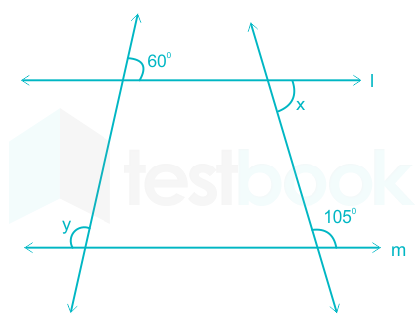
In the adjoining figure line l is parallel to line m. What is the value of (x + 2y) ?

  1. AOption (a)

    340°

  2. BOption (b)

    225°

  3. COption (c)

    270°

  4. DOption (d)

    315°

View answer & explanation

Correct answer

Answer: (d)D.

315°

Why this answer is correct

Shortcut Trick

Identify that line l and line m are parallel, making x and y co-interior angles.

The sum of co-interior angles is always 180°, so x + y = 180°.

The expression (x + 2y) can be rewritten as (x + y) + y.

From the geometric figure, the obtuse angle y is 135°, which means x = 45°.

⇒ (x + 2y) = 180° + 135° = 315°.

∴ The correct answer is 315°.

Alternate Method

Given:

⇒ Line l || m.

⇒ Angle x and angle y are interior angles on the same side of the transversal.

Formula Used:

⇒ Sum of co-interior angles = 180°.

⇒ Linear Pair property: Sum of angles on a straight line = 180°.

Calculations:

⇒ Since l || m, the co-interior angles x and y satisfy the condition: x + y = 180°.

⇒ From the given figure, the value of the obtuse angle y is observed to be 135°.

⇒ To find x: x = 180° − 135° = 45°.

⇒ Now, calculate the required value: (x + 2y).

⇒ (x + 2y) = 45° + 2(135°).

⇒ (x + 2y) = 45° + 270°.

⇒ (x + 2y) = 315°.

∴ The correct answer is 315°.

Additional Information

Corresponding Angles

When two parallel lines are cut by a transversal, the angles in matching corners are equal.

Alternate Interior Angles

Angles between parallel lines on opposite sides of a transversal are equal (Z-pattern).

Consecutive Interior Angles

Also known as co-interior angles, these are located between the parallel lines on the same side and sum to 180°.

Question 16

Who among the following is the author of the book 'The Miracle Makers: Indian Cricket's Greatest Epic'?

  1. AOption (a)

    Hrushikesh Kanitkar

  2. BOption (b)

    Bharat Sundaresan

  3. COption (c)

    Sunil Joshi

  4. DOption (d)

    Shiv Sundar Das

View answer & explanation

Correct answer

Answer: (b)B.

Bharat Sundaresan

Why this answer is correct

The correct answer is Bharat Sundaresan.

Key Points

  • *'*The Miracle Makers: Indian Cricket's Greatest Epic' is a book written by Bharat Sundaresan, a well-known cricket journalist and author.
  • The book highlights India's historic Test series win against Australia in 2020-21, often referred to as one of India's greatest cricketing achievements.
  • The victory was notable for India's comeback after being bowled out for 36 in the first Test, and their eventual triumph despite injuries and the absence of key players.
  • Bharat Sundaresan, along with co-author Gaurav Joshi, provides detailed insights, behind-the-scenes stories, and exclusive interviews about the series.

Additional Information

  • About the Book 'The Miracle Makers: Indian Cricket's Greatest Epic'
  • The book chronicles the remarkable journey of the Indian cricket team, highlighting their significant achievements and the challenges they overcame.
  • It provides an in-depth look at some of the most memorable matches and moments in Indian cricket history.
  • The book delves into the strategies, player performances, and the behind-the-scenes efforts that contributed to the team's success.
  • It is a tribute to the spirit, determination, and excellence of Indian cricketers over the years.
  • Indian Cricket Team
  • The Indian cricket team, also known as Team India, represents India in international cricket.
  • The team is governed by the Board of Control for Cricket in India (BCCI).
  • India is one of the strongest teams in international cricket, having won multiple ICC tournaments, including the Cricket World Cup and the T20 World Cup.
  • Indian cricket has produced numerous legendary players who have made significant contributions to the sport globally.
  • Cricket in India
  • Cricket is the most popular sport in India, enjoyed by millions of fans across the country.
  • The Indian Premier League (IPL) is one of the most-watched and lucrative cricket leagues globally.
  • Cricket has a rich history in India, with the first recorded match being played in 1721.
  • The sport has a significant cultural impact and is considered a unifying force in the diverse nation of India.

Question 17

In the following number-pairs, the second number is obtained by applying certain mathematical operations to the first number. Which numbers should replace X and Y so that the pattern followed by the two numbers on the left side of :: is same as that on the right side of ::?

<br>

(NOTE: Operations should be performed on the whole numbers, without breaking down the numbers into its constituent digits. E.g. 13 – Operations on 13 such as adding/subtracting/multiplying etc. to 13 can be performed. Breaking down 13 into 1 and 3 and then performing mathematical operations on 1 and 3 is not allowed.)

<br>

X : 679 :: 864 : Y

  1. AOption (a)

    X = 825, Y = 718

  2. BOption (b)

    X = 812, Y = 756

  3. COption (c)

    X = 834, Y = 704

  4. DOption (d)

    X = 898, Y = 649

View answer & explanation

Correct answer

Answer: (a)A.

X = 825, Y = 718

Why this answer is correct

The logic followed here is:

Logic: Difference of 1st Number and 2nd Number =  146.

For,

X : 679 

⇒ X = 679 + 146

⇒ X = 825.

Similarly,

864 : Y

⇒ Y = 864 - 146

⇒Y = 718.

Thus, X = 825, Y = 718,

Hence, the correct answer is "Option1".

Question 18

Which of the following options should come in place of the question mark (?) in the given series based on the English alphabetical order?

<br>

BEV, FIR, JMN, NQJ, RUF, ?

  1. AOption (a)

    TUS

  2. BOption (b)

    VYB

  3. COption (c)

    YVB

  4. DOption (d)

    STU

View answer & explanation

Correct answer

Answer: (b)B.

VYB

Why this answer is correct

The logic follows here is:

Hence, the correct answer is "Option 2".

Question 19

If the force of attraction between the earth and an apple separated by distance 'x' is 'F', then the force acting on the same apple kept at a distance '2x' will be ______.

  1. AOption (a)

    F/2

  2. BOption (b)

    F/4

  3. COption (c)

    4F

  4. DOption (d)

    2F

View answer & explanation

Correct answer

Answer: (b)B.

F/4

Why this answer is correct

The correct answer is F/4.

Key Points

  • According to Newton's law of universal gravitation, the force of attraction between two masses is inversely proportional to the square of the distance between them.
  • The mathematical formula is F=Gm1.m2r2F = G\frac{m_1.m_2}{r^2} , where F is the gravitational force, G is the gravitational constant, m1 and m2 are the masses of the objects, and r is the distance between the centres of the two masses.
  • When the distance between the earth and the apple is doubled to 2x, the square of the distance becomes (2x)2 = 4x.
  • As a result, the force acting on the apple at a distance of 2x will be F/4, since force is inversely proportional to the square of the distance (F ∝ 1/r2).

Additional Information

  • Newton's Law of Universal Gravitation
  • Sir Isaac Newton formulated the law of universal gravitation in 1687.
  • The law states that every point mass attracts every other point mass in the universe with a force that is directly proportional to the product of their masses and inversely proportional to the square of the distance between them.
  • The mathematical formula is F=Gm1.m2r2F = G\frac{m_1.m_2}{r^2} ,where F is the gravitational force, G is the gravitational constant (6.67430×10⁻¹¹N⋅m2/kg2\rm 6.67430 × 10^{-11} N⋅m^2/kg^2) m1 and m2 are the masses of the objects, and r is the distance between the centres of the two masses.
  • Inversely Proportional Relationship
  • In an inversely proportional relationship, as one quantity increases, the other quantity decreases.
  • In the context of gravitational force, as the distance between two objects increases, the force of attraction between them decreases.
  • This inverse square law is a fundamental principle in physics and applies to various forces such as gravitational, electrostatic, and magnetic forces.
  • Gravitational Constant (G)
  • The gravitational constant (G) is a key quantity in Newton's law of universal gravitation.
  • It is a measure of the strength of gravity and is constant throughout the universe.
  • The value of G is approximately 6.67430×10⁻¹¹N⋅m2/kg2\rm 6.67430 × 10^{-11} N⋅m^2/kg^2
  • The small value of G indicates that gravitational forces are relatively weak compared to other fundamental forces in nature.

Question 20

Which of the following is the characteristics of striated muscles?

  1. AOption (a)

    cylindrical, branched and multinucleate

  2. BOption (b)

    spindle-shaped, unbranched and multinucleate

  3. COption (c)

    spindle-shaped, unbranched and uninucleate

  4. DOption (d)

    cylindrical, unbranched and multinucleate

View answer & explanation

Correct answer

Answer: (d)D.

cylindrical, unbranched and multinucleate

Why this answer is correct

The correct answer is cylindrical, unbranched and multinucleate.

Key Points

  • Striated muscles are characterized by their cylindrical shape, which helps them to contract efficiently.
  • They are unbranched, meaning the muscle fibers run parallel to each other without dividing.
  • Striated muscle cells are multinucleate, containing multiple nuclei to support their high metabolic activity.
  • These muscles are also known as skeletal muscles as they are usually attached to bones and facilitate movement.

Additional Information

  • Striated Muscles

  • Striated muscles, also known as skeletal muscles, are under voluntary control, which means we can consciously control their movements.

  • They have a striped appearance due to the alternating dark and light bands, which are a result of the arrangement of actin and myosin filaments.

  • These muscles are responsible for the body's movements, posture, and balance.

  • Striated muscles are attached to bones by tendons, and they work in pairs to produce movement by contracting and relaxing.

  • Smooth Muscles

  • Smooth muscles are found in the walls of internal organs such as the stomach, intestines, and blood vessels.

  • They are involuntary muscles, meaning they operate without conscious control.

  • Smooth muscles have a spindle-shaped, unbranched, and uninucleate structure, which allows them to contract slowly and sustain contractions for a long time.

  • Cardiac Muscles

  • Cardiac muscles are found only in the heart and are responsible for pumping blood throughout the body.

  • They have a branched and striated appearance, similar to skeletal muscles, but they are involuntary like smooth muscles.

  • Cardiac muscle cells are typically uninucleate, but they can also be binucleate.

  • The cells are connected by intercalated discs, which allow for coordinated contractions and efficient heart function.

Question 21

In the following number-pairs, the second number is obtained by applying certain mathematical operations to the first number. Which numbers should replace X and Y so that the pattern followed by the two numbers on the left side of :: is the same as that on the right side of ::?

<br>

(NOTE: Operations should be performed on the whole numbers, without breaking down the numbers into its constituent digits. E.g. 13 - Operations on 13 such as adding/subtracting/multiplying etc. to 13 can be performed. Breaking down 13 into 1 and 3 and then performing mathematical operations on 1 and 3 is not allowed.)

<br>

X : 346 :: 9 : Y

  1. AOption (a)

    X = 8, Y = 756

  2. BOption (b)

    X = 5, Y = 612

  3. COption (c)

    X = 7, Y = 732

  4. DOption (d)

    X = 6, Y = 729

View answer & explanation

Correct answer

Answer: (c)C.

X = 7, Y = 732

Why this answer is correct

The logic followed here is:

Logic: (First number)3 +3 = Second number.

For,

X : 346

⇒X = 3√ (346 - 3)

⇒X = 3√ 343

⇒X = 7. 

Similarly,

9 : Y

⇒Y = (9)3 + 3

⇒Y = 729 + 3

⇒Y = 732

Thus, X = 7, Y = 732

Hence, the correct answer is "Option3".

Question 22

Seven boxes A, B, C, D, E, F and G are kept one over the other but not necessarily in the same order. D is kept third from the bottom. Only one box is kept between F and A. Only three boxes are kept between G and E. B is kept immediately above F. E is kept on one of the positions above D.

<br>

How many boxes are kept between E and C?

  1. AOption (a)

    One

  2. BOption (b)

    None

  3. COption (c)

    Two

  4. DOption (d)

    Three

View answer & explanation

Correct answer

Answer: (c)C.

Two

Why this answer is correct

Given: Seven boxes A, B, C, D, E, F, and G are kept one over the other, but not necessarily in the same order.

  1. D is kept third from the bottom.

2) E is kept on one of the positions above D.

3) Only three boxes are kept between G and E.

E
D
G


  1. Only one box is kept between F and A.

  2. B is kept immediately above F.

B
F
E
A
D
G


And, C will kept on the remaining position.

Now, After arranging the boxes:

B
F
E
A
D
C
G


So, there are two boxes between E and C.

Hence, the correct answer is "Option 3".

Question 23

Refer to the given number and symbol series and answer the question that follows. Counting to be done from left to right only.

<br>

(Left) 2 & % 4 6 @ & 3 Ω 9 # 1 * 8 £ 6 1 7 # (Right)

<br>

How many such symbols are there, each of which is immediately preceded by an even number and also immediately followed by an even number?

  1. AOption (a)

    None

  2. BOption (b)

    One

  3. COption (c)

    Two

  4. DOption (d)

    More than two

View answer & explanation

Correct answer

Answer: (b)B.

One

Why this answer is correct

Given: (Left) 2 & % 4 6 @ & 3 Ω 9 # 1 * 8 £ 6 1 7 # (Right)

Here, We need to find the numbers that are immediately preceded by a symbol and also immediately followed by a symbol.

Required pattern: Even Number - Symbol - Even Number

(Left) 2 & % 4 6 @ & 3 Ω 9 # 1 * 8 £ 6 1 7 # (Right)

So, there is only one such pair in the series '8 £ 6'.

Hence, the correct answer is "Option 2".

Question 24

At a particular time during the day, owing to the position of the sun, a 6 feet tall man casts a shadow of 4 feet, whereas a pole next to the man casts a shadow of 36 feet. What is the height of the pole?

  1. AOption (a)

    56 feet

  2. BOption (b)

    54 feet

  3. COption (c)

    63 feet

  4. DOption (d)

    60 feet

View answer & explanation

Correct answer

Answer: (b)B.

54 feet

Why this answer is correct

Shortcut Trick

The ratio of height to shadow is constant for all objects at the same time.

Shadow ratio of Man to Pole = 4 : 36 = 1 : 9

Height ratio of Man to Pole must also be 1 : 9

Given 1 unit (Man height) = 6 feet

∴ 9 units (Pole height) = 6 × 9 = 54 feet

∴ The correct answer is 54 feet.

Alternate Method

Given:

Height of the man = 6 feet

Shadow of the man = 4 feet

Shadow of the pole = 36 feet

Formula Used:

For objects at the same time, (Height1 ÷ Shadow1) = (Height2 ÷ Shadow2)

Calculations:

⇒ Let the height of the pole be 'H'

⇒ 6 ÷ 4 = H ÷ 36

⇒ 1.5 = H ÷ 36

⇒ H = 1.5 × 36

⇒ H = 54 feet

∴ The correct answer is 54 feet.

Additional Information

Properties of Similar Triangles

When the angle of elevation of the sun is the same, the triangles formed by vertical objects and their shadows are similar by AA (Angle-Angle) criteria.

Trigonometric Relation

The ratio of height to shadow corresponds to tan(θ), where θ is the sun's altitude. Thus, Height = Shadow × tan(θ).

Direct Variation

The length of the shadow is directly proportional to the actual height of the object at any given instant.

Question 25

Which of the following options represents metals that do NOT react with cold water?

  1. AOption (a)

    Sodium, calcium and zinc

  2. BOption (b)

    Sodium, iron and potassium

  3. COption (c)

    Sodium, calcium and potassium

  4. DOption (d)

    Aluminium, iron and zinc

View answer & explanation

Correct answer

Answer: (d)D.

Aluminium, iron and zinc

Why this answer is correct

The correct answer is Aluminium, iron and zinc.

Key Points

  • Aluminium, iron, and zinc do not react with cold water.
  • These metals require either hot water or steam to react, indicating a higher activation energy for the reaction.
  • The reactivity of metals with water decreases as you move from top to bottom in the reactivity series.
  • In general, metals like sodium and potassium react vigorously with cold water, while metals like aluminium, iron, and zinc do not.

Additional Information

  • Reactivity Series:
  • The reactivity series is a series of metals, arranged in order of their reactivity from highest to lowest.
  • Metals at the top of the series, such as potassium and sodium, are very reactive and can react with cold water.
  • Metals lower in the series, such as aluminium, iron, and zinc, are less reactive and do not react with cold water.
  • Reaction with Water:
  • When metals react with water, they form a metal hydroxide and hydrogen gas.
  • For example, sodium reacts with water to form sodium hydroxide and hydrogen gas.
  • However, metals like aluminium, iron, and zinc require hot water or steam for such reactions to occur.
  • Activation Energy:
  • Activation energy is the minimum energy required for a chemical reaction to occur.
  • Metals that do not react with cold water have a higher activation energy barrier that cold water cannot overcome.
  • Therefore, higher temperatures are needed to provide the necessary energy for the reaction.
  • Examples of Reactions:
  • Iron: 3Fe + 4H2O (steam) → Fe3O4 + 4H2
  • Zinc: Zn + H2O (steam) → ZnO + H2
  • These reactions show that steam (not cold water) is required for these metals to react.

Question 26

In a certain code language, ‘FROM’ is coded as ‘4935’ and ‘MORE’ is coded as ‘3154’. What is the code for ‘E’ in the given code language?

  1. AOption (a)

    5

  2. BOption (b)

    1

  3. COption (c)

    9

  4. DOption (d)

    3

View answer & explanation

Correct answer

Answer: (b)B.

1

Why this answer is correct

The logic followed here is:

The code for "F" is "9",

The code for "E" is "1".

Thus,  The code for "E" is "1".

Hence, the correct answer is "Option 2".

Question 27

Which Indian personality played the female protagonist in the movie Sister Midnight, showcased at the Cannes Film Festival in 2024?

  1. AOption (a)

    Radhika Apte

  2. BOption (b)

    Kriti Sanon

  3. COption (c)

    Aditi Rao Hydari

  4. DOption (d)

    Taapsee Pannu

View answer & explanation

Correct answer

Answer: (a)A.

Radhika Apte

Why this answer is correct

The correct answer is Radhika Apte.

Key Points

  • Radhika Apte is known for her versatile roles in Indian cinema and has garnered critical acclaim for her performances.
  • She has a significant presence in both mainstream Bollywood and independent films, often choosing strong, character-driven roles.
  • Radhika Apte has previously been associated with international projects and is recognized for her global appeal and talent.
  • The movie Sister Midnight, showcased at the Cannes Film Festival in 2024, highlights her as the female protagonist, further solidifying her status as a prominent actress in the global film industry.

Additional Information

  • Cannes Film Festival
  • The Cannes Film Festival, also known as Festival de Cannes, is one of the most prestigious and influential film festivals in the world.
  • It is held annually in Cannes, France, showcasing new films of all genres, including documentaries, from around the world.
  • The festival was founded in 1946 and has become a significant platform for filmmakers to present their work to an international audience.
  • Awards such as the Palme d'Or are given to the best films, making it a highly coveted prize in the film industry.
  • Radhika Apte's Career
  • Radhika Apte is an Indian actress who has worked in Hindi, Marathi, Tamil, Telugu, Malayalam, Bengali, and English-language films.
  • She began her acting career in theater before transitioning to films, gaining fame for her roles in movies like "Badlapur," "Phobia," "Andhadhun," and "Pad Man."
  • Radhika has also appeared in several web series, including "Sacred Games" and "Ghoul," which have contributed to her international recognition.
  • Her ability to portray complex characters and her dedication to her craft have earned her numerous accolades and a loyal fan base.
  • Sister Midnight
  • "Sister Midnight" is a film that was showcased at the Cannes Film Festival in 2024, featuring Radhika Apte as the female protagonist.
  • The film has been noted for its unique storyline and compelling performances, making it a highlight of the festival.
  • Details about the plot and other cast members have been kept under wraps, adding to the anticipation and excitement surrounding its release.
  • This project marks another significant milestone in Radhika Apte's career, demonstrating her ability to excel in international cinema.

Question 28

ZX is related to AC in a certain way. In the same way, US is related to FH. To which of the following options is PN related, following the same logic?

  1. AOption (a)

    KO

  2. BOption (b)

    LM

  3. COption (c)

    KM

  4. DOption (d)

    ML

View answer & explanation

Correct answer

Answer: (c)C.

KM

Why this answer is correct

The logic followed here is:

logic:  Opposite positional value of letters.

For, 

ZX : AC

US : FH

Similarly,

PN : ?

Thus, the PN is related to KM

Hence, the correct answer is "Option 3".

Question 29

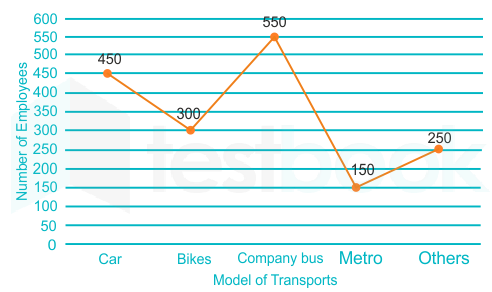
Study the given graph and answer the question that follows.

The graph shows the number of employees who used different modes of transport in the year 2010.

What is the respective ratio between the number of employees who used Bike to the number of employees who used Metro?

  1. AOption (a)

    4:5

  2. BOption (b)

    2:1

  3. COption (c)

    3:2

  4. DOption (d)

    5:2

View answer & explanation

Correct answer

Answer: (b)B.

2:1

Why this answer is correct

Given:

Number of employees who used Bike = 300

Number of employees who used Metro = 150

Formula used:

Ratio = Number of employees who used BikeNumber of employees who used Metro\frac{\text{Number of employees who used Bike}}{\text{Number of employees who used Metro}}

Calculation:

Ratio = 300150\frac{300}{150}

⇒ Ratio = 300÷150150÷150\frac{300 \div 150}{150 \div 150}

⇒ Ratio = 2 : 1

∴ The respective ratio is 2 : 1.

Question 30

If each vowel in the word CONSTRUCTION is changed to the letter following it in the English alphabetical order and each consonant is changed to the letter preceding it in the English alphabetical order, then which of the following letters will be sixth from the right in the group of letter thus formed?

  1. AOption (a)

    S

  2. BOption (b)

    B

  3. COption (c)

    Q

  4. DOption (d)

    V

View answer & explanation

Correct answer

Answer: (d)D.

V

Why this answer is correct

Given word: 'CONSTRUCTION'

After changing each vowel to the letter following it and each consonant to the letter preceding it:

OriginalCONSTRUCTION
ChangedBPMRSQVBSJPM


The changed word is: BPMRSQVBSJPM

Sixth letter from the right in the changed word: V

Hence, the correct answer is "Option 4".

Question 31

Select the number from among the given options that can replace the question mark (?) in the following series.

26 78 36 108 66 198 ?

  1. AOption (a)

    128

  2. BOption (b)

    164

  3. COption (c)

    142

  4. DOption (d)

    156

View answer & explanation

Correct answer

Answer: (d)D.

156

Why this answer is correct

Given:

So, 156 will be next in series.

Hence, the correct answer is "Option 4".

Question 32

Based on the English alphabetical order, three of the following four letter-clusters are alike in a certain way and thus form a group. Which letter-cluster does not belong to that group?

<br>

(Note: The odd one out is not based on the number of consonants/vowels or their position in the letter cluster.)

  1. AOption (a)

    JMR

  2. BOption (b)

    KNS

  3. COption (c)

    EHM

  4. DOption (d)

    RUY

View answer & explanation

Correct answer

Answer: (d)D.

RUY

Why this answer is correct

The logic followed here is: 

Logic: + 3 and + 5 respectively to the position of letters.

Option 1) JMR

Option 2) KNS

Option 3) EHM

Option 4) RUY 

Hence, the correct answer is "Option 4".

Question 33

Which natural disaster triggered storms, flash floods, and landslips in the northeastern states of India in 2024?

  1. AOption (a)

    Cyclone Remal

  2. BOption (b)

    Cyclone Yaas

  3. COption (c)

    Cyclone Amphan

  4. DOption (d)

    Cyclone Fani

View answer & explanation

Correct answer

Answer: (a)A.

Cyclone Remal

Why this answer is correct

The correct answer is Cyclone Remal.

Key Points

  • Cyclone Remal was a significant weather event that caused extensive damage in the northeastern states of India in 2024.
  • The cyclone brought about severe storms, flash floods, and landslips in the region, leading to widespread disruption.
  • It was among the most destructive cyclones to hit the northeastern part of India in recent history, impacting thousands of lives and properties.
  • Emergency response teams were deployed to assist in rescue and relief operations, highlighting the importance of disaster preparedness and management.

Additional Information

  • Cyclones:
  • A cyclone is a large scale air mass that rotates around a strong center of low atmospheric pressure.
  • Cyclones are characterized by inward spiraling winds that rotate counterclockwise in the Northern Hemisphere and clockwise in the Southern Hemisphere.
  • They are classified into different types such as tropical cyclones, extratropical cyclones, and subtropical cyclones based on their formation and characteristics.
  • Flash Floods:
  • Flash floods are rapid flooding of low-lying areas: washes, rivers, dry lakes, and basins.
  • They are caused by heavy rain associated with a severe thunderstorm, hurricane, or cyclone.
  • Flash floods can occur within minutes or hours of heavy rainfall, and can also occur when dams or levees break.
  • Landslips:
  • Landslips, also known as landslides, involve the movement of rock, earth, or debris down a sloped section of land.
  • They are often caused by rainfall, earthquakes, volcanic activity, or other factors that make the slope unstable.
  • Landslips can cause significant damage to infrastructure, property, and can also result in loss of life.

Question 34

Which of the following numbers is divisible by 11?

  1. AOption (a)

    9248164

  2. BOption (b)

    7247564

  3. COption (c)

    9246864

  4. DOption (d)

    8245964

View answer & explanation

Correct answer

Answer: (c)C.

9246864

Why this answer is correct

Shortcut Trick

For a number to be divisible by 11, the difference between the sum of digits at odd positions and the sum of digits at even positions must be 0 or a multiple of 11.

Check 9246864: Sum of odd positions (9 + 4 + 8 + 4) = 25.

Sum of even positions (2 + 6 + 6) = 14.

Difference = 25 − 14 = 11 (which is divisible by 11).

∴ The correct answer is 9246864.

Alternate Method

Given: A set of numbers to check for divisibility by 11.

Formula: Let Sodd be the sum of digits at positions 1, 3, 5... and Seven be the sum of digits at positions 2, 4, 6... Divisibility if |Sodd − Seven| = 11k (where k = 0, 1, 2...).

⇒ Let us verify the number 9246864.

⇒ Sum of digits at odd positions (1st, 3rd, 5th, 7th) = 9 + 4 + 8 + 4 = 25.

⇒ Sum of digits at even positions (2nd, 4th, 6th) = 2 + 6 + 6 = 14.

⇒ Difference = |25 − 14| = 11.

⇒ Since 11 is divisible by 11, the entire number 9246864 is divisible by 11.

∴ The correct answer is 9246864.

Additional Information

Divisibility by 3 and 9

A number is divisible by 3 (or 9) if the sum of all its digits is divisible by 3 (or 9).

Divisibility by 7

Double the last digit and subtract it from the remaining number. If the result is divisible by 7, the original number is too.

Divisibility by 13

Multiply the last digit by 4 and add it to the remaining number. Repeat if necessary to check for divisibility by 13.

Question 35

Traits can be influenced by:

  1. AOption (a)

    by both paternal DNA and maternal DNA

  2. BOption (b)

    only paternal DNA

  3. COption (c)

    only maternal DNA

  4. DOption (d)

    only maternal grandparent DNA

View answer & explanation

Correct answer

Answer: (a)A.

by both paternal DNA and maternal DNA

Why this answer is correct

The correct answer is by both paternal DNA and maternal DNA.

Key Points

  • Traits are inherited from both paternal (father's) DNA and maternal (mother's) DNA.
  • Each parent contributes 50% of the DNA, which combines to form the unique genetic makeup of an individual.
  • The combination of maternal and paternal DNA influences the traits and characteristics of the offspring.
  • This process of inheritance follows the principles of Mendelian genetics, which explains how traits are passed from parents to offspring.

Additional Information

  • DNA (Deoxyribonucleic Acid)
  • DNA is a molecule that contains the genetic instructions used in the growth, development, functioning, and reproduction of all known living organisms and many viruses.
  • It is composed of two strands that coil around each other to form a double helix.
  • Each strand is made up of a sequence of four types of nucleotides: adenine (A), thymine (T), cytosine (C), and guanine (G).
  • Genes
  • Genes are segments of DNA that carry hereditary information.
  • They are responsible for the inherited traits and characteristics of an organism.
  • Each gene occupies a specific location on a chromosome.
  • Chromosomes
  • Chromosomes are long DNA molecules with part or all of the genetic material of an organism.
  • Humans have 23 pairs of chromosomes, for a total of 46.
  • One set of 23 chromosomes is inherited from the mother, and the other set is inherited from the father.
  • Mendelian Genetics
  • Gregor Mendel, the father of genetics, discovered the basic principles of heredity through experiments with pea plants.
  • Mendelian genetics explains how traits are inherited through the interaction of alleles, which are different forms of a gene.
  • Traits can be dominant or recessive, and the combination of alleles from both parents determines the traits of the offspring.

Question 36

Find the compound interest on ₹11,000 in 2 years at 4% p.a., interest compounded yearly.

  1. AOption (a)

    ₹875.80

  2. BOption (b)

    ₹906.50

  3. COption (c)

    ₹786.60

  4. DOption (d)

    ₹897.60

View answer & explanation

Correct answer

Answer: (d)D.

₹897.60

Why this answer is correct

Shortcut Trick

For a 2-year period, the effective rate of compound interest at 4% p.a. can be calculated using the successive percentage formula: Reff = x + y + (xy/100).

Reff = 4 + 4 + (4 × 4)/100 = 8.16%

Compound Interest (CI) = Principal × Reff / 100

CI = 11,000 × 8.16 / 100 = 110 × 8.16 = 897.60

∴ The correct answer is ₹897.60.

Alternate Method

Given:

Principal (P) = ₹11,000

Rate of Interest (R) = 4% p.a.

Time (n) = 2 years

Formula Used:

Amount (A) = P(1 + R/100)n

Compound Interest (CI) = Amount − Principal

Calculations:

⇒ A = 11,000 × (1 + 4/100)2

⇒ A = 11,000 × (1 + 1/25)2

⇒ A = 11,000 × (26/25) × (26/25)

⇒ A = 11,000 × (676 / 625)

⇒ A = 11,000 × 1.0816

⇒ A = ₹11,897.60

⇒ CI = 11,897.60 − 11,000

⇒ CI = ₹897.60

∴ The correct answer is ₹897.60.

Additional Information

Compound Interest Formula

The amount is calculated as A = P(1 + R/100)n, where P is principal, R is rate, and n is time in years.

Difference between CI and SI

For a period of 2 years, the difference between Compound Interest and Simple Interest is given by CI − SI = P(R/100)2.

Effective Rate of Interest

For successive interest rates R1 and R2, the effective rate is R1 + R2 + (R1 × R2)/100.

Question 37

If 'I' stands for '+', 'J' stands for '×', 'K' stands for '÷', and 'L' stands for '-', what will come in place of the question mark '?' in the following equation?

38 I (3 J 4) L (16 K 2) I 11 =?

  1. AOption (a)

    34

  2. BOption (b)

    47

  3. COption (c)

    61

  4. DOption (d)

    53

View answer & explanation

Correct answer

Answer: (d)D.

53

Why this answer is correct

Given Equation: 38 I (3 J 4) L (16 K 2) I 11 = ?

BODMAS Rule:

Decoding the given information:

AlphabetIJKL
Meaning+×÷-


Now replacing the sign from left to right using BODMAS Rule, we get:

⇒ 38 + (3 × 4) - (16 ÷ 2) + 11 = ?

⇒ 38 + 12 - 8 + 11 = ?

⇒ 61 - 8 = 53.

Hence, the correct option is "Option 4".

Question 38

A, B, C, D, E and F are sitting around a circular table facing the centre. B sits second to the right of D. A is an immediate neighbour of E and C. E sits second to the left of F. What is the position of F with respect to B?

  1. AOption (a)

    Third to the right

  2. BOption (b)

    Immediate right

  3. COption (c)

    Immediate left

  4. DOption (d)

    Second to the left

View answer & explanation

Correct answer

Answer: (c)C.

Immediate left

Why this answer is correct

Given: A, B, C, D, E and F are sitting around a circular table facing the centre.

  1. E sits second to the left of F. 

2)  A is an immediate neighbour of E and C

3)  B sits second to the right of D.

Thus, the position of F with respect to B is Immediate left of B.

Hence, the correct answer is "Option 3".

Question 39

A car covers four successive 3 km stretches at speeds of 10 km/h, 20 km/h, 30 km/h and 60 km/h, respectively. Its average speed over this distance is:

  1. AOption (a)

    30 km/h

  2. BOption (b)

    15 km/h

  3. COption (c)

    20 km/h

  4. DOption (d)

    25 km/h

View answer & explanation

Correct answer

Answer: (c)C.

20 km/h

Why this answer is correct

Shortcut Trick

Since the distance for each of the 4 stretches is equal (3 km), the Average Speed is the Harmonic Mean of the speeds.

Average Speed = 4 ÷ (1/10 + 1/20 + 1/30 + 1/60)

Average Speed = 4 ÷ [(6 + 3 + 2 + 1) / 60] = 4 ÷ (12 / 60)

Average Speed = 4 × 5 = 20 km/h

∴ The correct answer is 20 km/h.

Alternate Method

Given:

Four stretches of distance (d) = 3 km each.

Speeds (v1, v2, v3, v4) = 10 km/h, 20 km/h, 30 km/h, and 60 km/h.

Formula Used:

Average Speed = Total Distance ÷ Total Time

Calculations:

⇒ Total Distance = 3 + 3 + 3 + 3 = 12 km

⇒ Time for 1st stretch (t1) = 3 ÷ 10 = 0.3 h

⇒ Time for 2nd stretch (t2) = 3 ÷ 20 = 0.15 h

⇒ Time for 3rd stretch (t3) = 3 ÷ 30 = 0.1 h

⇒ Time for 4th stretch (t4) = 3 ÷ 60 = 0.05 h

⇒ Total Time = 0.3 + 0.15 + 0.1 + 0.05 = 0.6 h

⇒ Average Speed = 12 ÷ 0.6 = 20 km/h

∴ The correct answer is 20 km/h.

Additional Information

Average Speed for Two Equal Distances

If a journey is divided into two equal distances with speeds v1 and v2, the average speed is 2v1v2 ÷ (v1 + v2).

Average Speed for Equal Time Intervals

If a body travels at speed v1 for time t and then at speed v2 for the same time t, the average speed is (v1 + v2) ÷ 2.

Unit Conversion

To convert speed from km/h to m/s, multiply the value by 5/18. To convert m/s to km/h, multiply by 18/5.

Question 40

A series of compounds in which the same functional group substitutes for hydrogen in a carbon chain is called ____________.

  1. AOption (a)

    catenation

  2. BOption (b)

    isomers

  3. COption (c)

    heterologous series

  4. DOption (d)

    homologous series

View answer & explanation

Correct answer

Answer: (d)D.

homologous series

Why this answer is correct

The correct answer is homologous series.

Key Points

  • A homologous series is a group of organic compounds that have the same functional group and similar chemical properties.
  • In a homologous series, each successive compound differs by a CH2 unit.
  • Members of a homologous series show a gradual change in physical properties, such as boiling and melting points.
  • Examples of homologous series include alkanes, alkenes, and alkynes.

Additional Information

  • Catenation:
  • Catenation is the ability of an element to form bonds with other atoms of the same element, leading to the formation of chains or rings.
  • This property is commonly seen in carbon, which can form long chains and complex structures.
  • Examples include diamond and graphite, which are allotropes of carbon.
  • Isomers:
  • Isomers are compounds with the same molecular formula but different structural arrangements.
  • There are different types of isomers, such as structural isomers and stereoisomers.
  • Structural isomers have different connectivity of atoms, while stereoisomers have the same connectivity but differ in spatial arrangement.
  • Heterologous series:
  • Heterologous series is not a standard term in organic chemistry and might be a confusion with "heteroatoms" which refers to atoms other than carbon and hydrogen in an organic molecule.
  • Common heteroatoms include oxygen, nitrogen, sulfur, and halogens.

Question 41

Read the given statements and conclusions carefully. You have to take the given statements to be true even if they seem to be at variance from commonly known facts and decide which conclusion(s) logically follow(s) from the given statements.

<br>

Statements:

All fishes are birds.

All birds are animals.

<br>

Conclusions:

(I) All animals are fishes.

(II) Some birds are fishes.

  1. AOption (a)

    Both conclusions (I) and (II) follow.

  2. BOption (b)

    Only conclusion (II) follows.

  3. COption (c)

    Neither conclusion (I) nor (II) follows.

  4. DOption (d)

    Only conclusion (I) follows.

View answer & explanation

Correct answer

Answer: (b)B.

Only conclusion (II) follows.

Why this answer is correct

Statements:

All fishes are birds.

All birds are animals.

The least possible venn digram for given statements are given:

<br>

Conclusions:

(I) All animals are fishes - False (Because, all  fishes are birds and all birds are animals it implies that the some animals are fishes, So, it can be possible only.

(II) Some birds are fishes - Ture (Because, all fishes are birds it implies that the some birds are fishes too.

Thus, Only conclusion (II) follows.

Hence, the correct answer is "Option 2".

Question 42

Cranial nerves arising from the brain and spinal nerves arising from the spinal cord together constitute the:

  1. AOption (a)

    peripheral nervous system

  2. BOption (b)

    autonomic nervous system

  3. COption (c)

    central nervous system

  4. DOption (d)

    endocrine system

View answer & explanation

Correct answer

Answer: (a)A.

peripheral nervous system

Why this answer is correct

The correct answer is peripheral nervous system.

Key Points

  • The peripheral nervous system (PNS) consists of the nerves and ganglia outside the brain and spinal cord.
  • The PNS includes cranial nerves, which emerge directly from the brain, and spinal nerves, which emerge from segments of the spinal cord.
  • The PNS connects the central nervous system (CNS) to the limbs and organs.
  • The primary function of the PNS is to relay information between the CNS and the rest of the body.

Additional Information

  • Central Nervous System (CNS)
  • The CNS consists of the brain and spinal cord.
  • It is the main control center for processing information and coordinating bodily functions.
  • The CNS is responsible for processing sensory data, generating thoughts, memories, and emotions, and initiating motor responses.
  • Autonomic Nervous System (ANS)
  • The ANS is a part of the PNS that controls involuntary bodily functions.
  • It regulates activities such as heart rate, digestion, respiratory rate, pupillary response, urination, and sexual arousal.
  • The ANS is divided into the sympathetic and parasympathetic nervous systems.
  • Endocrine System
  • The endocrine system is a network of glands that produce and secrete hormones to regulate various bodily functions.
  • These functions include metabolism, growth and development, tissue function, sexual function, reproduction, sleep, and mood.
  • Key glands of the endocrine system include the hypothalamus, pituitary gland, thyroid, adrenal glands, and pancreas.

Question 43

If the HCF and the LCM of two numbers are 7 and 245, respectively, then their product is:

  1. AOption (a)

    1517

  2. BOption (b)

    1175

  3. COption (c)

    1751

  4. DOption (d)

    1715

View answer & explanation

Correct answer

Answer: (d)D.

1715

Why this answer is correct

Shortcut Trick

The product of two numbers is always equal to the product of their HCF and LCM.

Required Product = HCF × LCM

⇒ Product = 7 × 245 = 1715

∴ The correct answer is 1715.

Alternate Method

Given:

⇒ HCF of two numbers = 7

⇒ LCM of two numbers = 245

Formula used:

⇒ Number1 × Number2 = HCF × LCM

Calculations:

⇒ Product of two numbers = 7 × 245

⇒ Product = 7 × (200 + 40 + 5)

⇒ Product = 1400 + 280 + 35

⇒ Product = 1715

∴ The correct answer is 1715.

Additional Information

Fundamental Property of HCF and LCM

For any two positive integers a and b, the relationship is HCF(a, b) × LCM(a, b) = a × b.

HCF as a Factor

The HCF of any set of numbers is always a factor of their LCM.

Co-prime Numbers

For co-prime numbers, the HCF is always 1 and the LCM is the product of the numbers themselves.

Question 44

The atomic number of an atom is equal to the:

  1. AOption (a)

    total number of protons present in the nucleus of an atom

  2. BOption (b)

    sum of the number of electrons and that of neutrons

  3. COption (c)

    half of the number of electrons present in the nucleus of an atom

  4. DOption (d)

    sum of the number of protons and that of neutrons

View answer & explanation

Correct answer

Answer: (a)A.

total number of protons present in the nucleus of an atom

Why this answer is correct

The correct answer is total number of protons present in the nucleus of an atom.

Key Points

  • The atomic number of an atom is defined as the number of protons present in the nucleus of an atom.
  • It is unique for each element and determines the identity of the element.
  • The atomic number is denoted by the symbol 'Z'.
  • In a neutral atom, the number of electrons is equal to the number of protons.

Additional Information

  • Protons:
  • Protons are positively charged particles found in the nucleus of an atom.
  • The number of protons in the nucleus determines the atomic number and the identity of the element.
  • Protons have a relative charge of +1 and a relative mass of 1 atomic mass unit (amu).
  • Neutrons:
  • Neutrons are neutral particles found in the nucleus of an atom.
  • They have no electrical charge but contribute to the atomic mass of an atom.
  • The number of neutrons in an atom can vary, resulting in different isotopes of an element.
  • Electrons:
  • Electrons are negatively charged particles that orbit the nucleus of an atom in various energy levels.
  • In a neutral atom, the number of electrons is equal to the number of protons.
  • Electrons have a relative charge of -1 and a very small relative mass (approximately 1/1836 of a proton).
  • Isotopes:
  • Isotopes are atoms of the same element that have the same number of protons but different numbers of neutrons.
  • This difference in neutron number results in different atomic masses for the isotopes.
  • For example, Carbon-12 and Carbon-14 are isotopes of carbon with 6 protons but 6 and 8 neutrons respectively.

Question 45

In a certain code language,

A + B means "A is the brother of B"

A - B means "A is the son of B"

A × B means "A is the wife of B"

A ÷ B means "A is the father of B"

Based on the above, how is Q related to S if "P - Q ÷ R × S + T

  1. AOption (a)

    Husband's brother

  2. BOption (b)

    Wife's father

  3. COption (c)

    Wife's brother

  4. DOption (d)

    Father

View answer & explanation

Correct answer

Answer: (b)B.

Wife's father

Why this answer is correct

Given :

A is
Symbol+-x÷
MeaningBrotherSonWifeFather
to B


Statements given : P - Q ÷ R × S + T

P - Q means P is the son of Q

Q ÷ R means Q is the father of R

R × S means R is the wife of S

S + T means S is the brother of T.

So, Q is father of R who is wife of S.

Hence, the correct answer is "Option 2".

Question 46

Evaluate the given expression.

23×(−9)0×332^3 \times (-9)^0 \times 3^3

  1. AOption (a)

    81

  2. BOption (b)

    216

  3. COption (c)

    36

  4. DOption (d)

    9

View answer & explanation

Correct answer

Answer: (b)B.

216

Why this answer is correct

Given:

Expression: 23×(−9)0×33 2^3 × (-9)^0 × 3^3

Formula Used:

Use the properties of exponents:

am×an=am+na^m × a^n = a^{m+n}

a0 = 1 for any non-zero a

Calculation:

Evaluate each term separately:

23 = 8

(-9)0 = 1

33 = 27

Combine the terms:

⇒ 23×(−9)0×33=8×1×272^3 × (-9)^0 × 3^3 = 8 × 1 × 27

⇒ 8 × 27 = 216

The correct answer is option 2.

Question 47

If each vowel in the word REALISM is changed to the letter following it in the English alphabetical order and each consonant is changed to the letter following it in the English alphabetical order and then arrange in reverse order of English alphabetical order, then which of the following letters will be fourth from the left in the group of letter thus formed?

  1. AOption (a)

    N

  2. BOption (b)

    F

  3. COption (c)

    J

  4. DOption (d)

    M

View answer & explanation

Correct answer

Answer: (d)D.

M

Why this answer is correct

Given word: REALISM

After changing vowels and consonants to the next letter:

REALISM
SFBMJTN


After arranging in reverse order:

TSNMJFB


Fourth from the left is: M,

Hence, the correct answer is "Option 4".

Question 48

In a certain code language, ‘NUMB’ is coded as ‘4618’ and ‘BUNT’ is coded as ‘6438’. What is the code for ‘T’ in the given code language?

  1. AOption (a)

    8

  2. BOption (b)

    3

  3. COption (c)

    6

  4. DOption (d)

    4

View answer & explanation

Correct answer

Answer: (b)B.

3

Why this answer is correct

Given:

B U N is common in both code language,

So, code for T is 3.

Hence, the correct answer is "Option 2".

Question 49

A alone can do a piece of work in 6 days and B alone in 8 days. A and B undertook to do it for ₹3,200. With the help of C, they completed the work in 3 days. How much is to be paid to C?

  1. AOption (a)

    ₹800

  2. BOption (b)

    ₹400

  3. COption (c)

    ₹375

  4. DOption (d)

    ₹600

View answer & explanation

Correct answer

Answer: (b)B.

₹400

Why this answer is correct

Shortcut Trick

Ratio of Efficiency is inversely proportional to Time taken when work is constant.

Total work (LCM of 6, 8, 3) = 24 units.

A efficiency = 4, B efficiency = 3, A+B+C efficiency = 8.

C efficiency = 8 − (4 + 3) = 1 unit.

Share of C = (1 ÷ 8) × ₹3200 = ₹400.

∴ The correct answer is ₹400.

Alternate Method

Given:

Time taken by A = 6 days

Time taken by B = 8 days

Time taken by A, B, and C together = 3 days

Total Contract Value = ₹3200

PersonDaysTotal WorkEfficiency
A6244
B83
A + B + C38

⇒ Efficiency of C = Efficiency of (A+B+C) − Efficiency of (A+B)

⇒ Efficiency of C = 8 − (4 + 3) = 1 unit/day

⇒ Total efficiency = 8 units/day

⇒ Share of C = (Efficiency of C ÷ Total Efficiency) × Total Amount

⇒ Share of C = (1 ÷ 8) × 3200

⇒ Share of C = ₹400

∴ The correct answer is ₹400.

Additional Information

Work and Wages Principle

Wages are distributed in the ratio of Work Done. If all persons work for the same duration, wages are distributed in the ratio of their Efficiencies.

Efficiency Formula

Efficiency = Total Work ÷ Time Taken. Total work is usually assumed as the LCM of time taken by individuals.

Combined Work

The reciprocal of time taken by a group is the sum of the reciprocals of time taken by individuals: 1/Ttotal = 1/TA + 1/TB + 1/TC.

Question 50

A shopkeeper provides successive discounts of 5% and 4%, which are equivalent to a single discount of ____

  1. AOption (a)

    9%

  2. BOption (b)

    8%

  3. COption (c)

    9.20%

  4. DOption (d)

    8.80%

View answer & explanation

Correct answer

Answer: (d)D.

8.80%

Why this answer is correct

Shortcut Trick

Use the successive discount formula: Net Discount = [a + b − (a × b / 100)]%

Here, a = 5% and b = 4%.

Net Discount = [5 + 4 − (5 × 4 / 100)]% = [9 − 0.20]% = 8.80%.

∴ The correct answer is 8.80%.

Alternate Method

Given: First discount (d1) = 5%, Second discount (d2) = 4%.

Formula Used: Selling Price (SP) = Marked Price (MP) × (100 − d1)/100 × (100 − d2)/100

⇒ Let the Marked Price (MP) of the article be 100.

⇒ Price after first discount = 100 − (5% of 100) = 100 − 5 = 95.

⇒ Price after second discount = 95 − (4% of 95) = 95 − 3.8 = 91.2.

⇒ Total Single Discount = Initial MP − Final SP = 100 − 91.2 = 8.8.

⇒ Equivalent Discount Percentage = (Total Discount / MP) × 100 = (8.8 / 100) × 100 = 8.80%.

∴ The correct answer is 8.80%.

Additional Information

Successive Discount Formula

For two successive discounts of x% and y%, the single equivalent discount is (x + y − xy/100)%.

Order of Discounts

The final price remains the same regardless of the order in which successive discounts are applied (e.g., 5% then 4% is same as 4% then 5%).

Three Successive Discounts

To find the net discount for three rates x, y, and z, first find the result of x and y, then apply the formula again using that result and z.

Question 51

A triangle has sides of length 5 cm, 7 cm and 10 cm. Find the area of the triangle (in cm2).

  1. AOption (a)

    2√66

  2. BOption (b)

    7/10

  3. COption (c)

    25

  4. DOption (d)

    350

View answer & explanation

Correct answer

Answer: (a)A.

2√66

Why this answer is correct

Shortcut Trick Calculate semi-perimeter (s) = (5 + 7 + 10) ÷ 2 = 11 cm. Use Heron's Formula: Area = √[s(s − a)(s − b)(s − c)] Area = √[11 × (11 − 5) × (11 − 7) × (11 − 10)] = √[11 × 6 × 4 × 1] Area = √264 = √(4 × 66) = 2√66 cm2. ∴ The correct answer is 2√66 cm2.

Alternate Method Given: Sides of the triangle are a = 5 cm, b = 7 cm, and c = 10 cm. Formula Used: Heron's Formula for the area of a triangle: Area = √[s(s − a)(s − b)(s − c)] Where s = (a + b + c) ÷ 2 is the semi-perimeter.

Calculations: ⇒ s = (5 + 7 + 10) ÷ 2 ⇒ s = 22 ÷ 2 = 11 cm ⇒ Area = √[11 × (11 − 5) × (11 − 7) × (11 − 10)] ⇒ Area = √[11 × 6 × 4 × 1] ⇒ Area = √264 ⇒ Area = √(4 × 66) ⇒ Area = 2√66 cm2 ∴ The correct answer is 2√66 cm2.

Additional Information Heron's Formula It is specifically used to find the area of a scalene triangle when the lengths of all three sides are known. Triangle Inequality Theorem For any triangle, the sum of the lengths of any two sides must be strictly greater than the length of the third side (a + b > c). Perimeter of a Triangle The total boundary length of a triangle is the sum of its three sides: P = a + b + c.

Question 52

Select the correct balanced reaction for CuO + NH3 → Cu + N2 + H2O.

  1. AOption (a)

    2CuO + 3NH₃ → 3Cu + N₂ + 3H₂O

  2. BOption (b)

    3CuO + 2NH₃ → 3Cu + 2N₂ + 3H₂O

  3. COption (c)

    3CuO + 2NH₃ → 3Cu + N₂ + 3H₂O

  4. DOption (d)

    3CuO + 2NH₃ → 3Cu + N₂ + 4H₂O

View answer & explanation

Correct answer

Answer: (c)C.

3CuO + 2NH₃ → 3Cu + N₂ + 3H₂O

Why this answer is correct

The correct answer is 3CuO + 2NH₃ → 3Cu + N₂ + 3H₂O.

Key Points

  • The balanced chemical equation is 3CuO + 2NH₃ → 3Cu + N₂ + 3H₂O.
  • This reaction involves the reduction of copper(II) oxide (CuO) to copper (Cu) and the oxidation of ammonia (NH₃) to nitrogen gas (N₂).
  • In the balanced equation, the number of atoms for each element is the same on both sides of the reaction.
  • Balancing chemical equations is essential to obey the Law of Conservation of Mass.

Additional Information

  • Copper(II) Oxide (CuO)
  • Copper(II) oxide, also known as cupric oxide, is an inorganic compound with the formula CuO.
  • It is a black solid and one of the two stable oxides of copper, the other being Cu₂O or cuprous oxide.
  • CuO is used as a pigment in ceramics to produce blue, green, and sometimes red glazes.
  • Ammonia (NH₃)
  • Ammonia is a compound of nitrogen and hydrogen with the formula NH₃.
  • It is a colorless gas with a characteristic pungent smell and is a common nitrogenous waste, particularly among aquatic organisms.
  • Ammonia is also used as a precursor to food and fertilizers.
  • Balancing Chemical Equations
  • Balancing chemical equations is the process of ensuring that the number of atoms for each element is the same on both sides of the equation.
  • This is necessary to satisfy the Law of Conservation of Mass, which states that mass in an isolated system is neither created nor destroyed by chemical reactions or physical transformations.
  • To balance a chemical equation, one must make sure that the same number of atoms of each element are present on both the reactant and product sides of the equation.
  • Redox Reactions
  • Redox reactions involve the transfer of electrons between two species.
  • An oxidation reaction is where a substance loses electrons, and a reduction reaction is where a substance gains electrons.
  • In the given reaction, CuO is reduced to Cu, and NH₃ is oxidized to N₂.

Question 53

Who among the following created the record in the boys' 1500m by completing the race in 3:51.12 mins at the 6th Khelo India Youth Games?

  1. AOption (a)

    Adi Sharma

  2. BOption (b)

    Jay Kumar Verma

  3. COption (c)

    Rahul Iyer

  4. DOption (d)

    Rahul Sarnaliya

View answer & explanation

Correct answer

Answer: (d)D.

Rahul Sarnaliya

Why this answer is correct

The correct answer is Rahul Sarnaliya

Key Points

  • Rahul Sarnaliya created the record in the boys' 1500m race.
  • He completed the race in 3:51.12 minutes, setting a new record.
  • This achievement took place at the 6th Khelo India Youth Games.
  • The Khelo India Youth Games is an initiative by the Indian Government to promote sports and fitness among the youth.

Additional Information

  • Khelo India Youth Games (KIYG):
  • The Khelo India Youth Games is a part of the Khelo India programme which was introduced to revive the sports culture in India at the grass-root level.
  • It is an annual event where students from schools and colleges across India compete in various sports disciplines.
  • The KIYG aims to scout young talent and provide them with a platform to showcase their skills.
  • Talented athletes identified through the games are provided with financial assistance and training by the government.
  • 1500 meters race:
  • This is a middle-distance race in track and field competitions, commonly referred to as the "metric mile".
  • The 1500m race is a standard middle-distance event in both outdoor and indoor track and field championships.
  • Runners need to maintain a balance of speed and endurance to excel in this event.
  • The current men's world record for the 1500m is held by Hicham El Guerrouj of Morocco with a time of 3:26.00 minutes, set in 1998.
  • Athletics:
  • Athletics is a collection of sporting events that involve competitive running, jumping, throwing, and walking.
  • It is one of the oldest forms of sport and is a core part of the Olympic Games.
  • Track and field, road running, cross country running, and racewalking are the four main categories of athletics competitions.
  • Athletes often specialize in one or more events, and they undergo rigorous training to excel in their respective disciplines.

Question 54

Water flows into a tank having the dimensions of its base given as 200 m × 150 m through a rectangular pipe having dimensions given as 1.5 m × 1.25 m @ 20 kmph. In what time (in minutes) will the water rise by 2 meters?

  1. AOption (a)

    234

  2. BOption (b)

    96

  3. COption (c)

    540

  4. DOption (d)

    72

View answer & explanation

Correct answer

Answer: (b)B.

96

Why this answer is correct

Shortcut Trick

Time = (Volume of tank) ÷ (Area of pipe cross-section × Speed of flow)

Total Volume required = 200 × 150 × 2 = 60,000 m3

Flow rate per hour = 1.5 × 1.25 × 20,000 = 37,500 m3/hr

Time (in hours) = 60,000 ÷ 37,500 = 1.6 hours

Time (in min) = 1.6 × 60 = 96 min

∴ The correct answer is 96 min.

Alternate Method

Given:

Tank dimensions: Length = 200 m, Breadth = 150 m, Height of water rise = 2 m

Pipe dimensions: Width = 1.5 m, Depth = 1.25 m

Speed of water = 20 kmph = 20,000 m/hr

⇒ Volume of water required = Length × Breadth × Height

⇒ Volume = 200 × 150 × 2 = 60,000 m3

⇒ Area of cross-section of pipe = 1.5 × 1.25 = 1.875 m2

⇒ Speed of water in m/min = (20 × 1000) ÷ 60 = 1000 ÷ 3 m/min

⇒ Volume of water flowing per minute = Area × Speed

⇒ Flow rate = 1.875 × (1000 ÷ 3) = 625 m3/min

⇒ Time taken = Total Volume ÷ Flow rate per minute

⇒ Time = 60,000 ÷ 625 = 96 min

∴ The correct answer is 96 min.

Additional Information

Volume of Cuboid

The volume of a rectangular tank is given by Length × Breadth × Height (L × B × H).

Rate of Flow

The amount of water flowing through a pipe per unit time is Area of cross-section × Velocity of flow.

Unit Conversion

To convert km/hr to m/min, multiply by (1000 ÷ 60) or 50 ÷ 3.

Question 55

Which two numbers should be interchanged to make the given equation correct?

<br>

21 × 4 + (84 ÷ 7) × 2 – 15 × 5 + 42 = 105

<br>

(Note: Interchange should be done of entire number and not individual digits of a given number.)

  1. AOption (a)

    4 and 2

  2. BOption (b)

    84 and 42

  3. COption (c)

    4 and 5

  4. DOption (d)

    7 and 21

View answer & explanation

Correct answer

Answer: (b)B.

84 and 42

Why this answer is correct

BODMAS Table: 


Given equation:  21 × 4 + (84 ÷ 7) × 2 – 15 × 5 + 42 = 105

Let's check each option one by one.

Option 1) 4 and 2

Given: 21 × 4 + (84 ÷ 7) × 2 – 15 × 5 + 42 = 105

After interchanging the numbers we get;

→ 21 × 2 + (84 ÷ 7) × 4 – 15 × 5 + 42 = 105

→ 42 + 12 × 4 – 15 × 5 + 42 = 105

→ 42 + 48 – 75 + 42 = 105

→ 132 – 75 = 105

→ 57 ≠ 105

Option 2) 84 and 42

Given: 21 × 4 + (84 ÷ 7) × 2 – 15 × 5 + 42 = 105

After interchanging the numbers we get;

→ 21 × 4 + (42 ÷ 7) × 2 – 15 × 5 + 84 = 105

→ 21 × 4 + 6 × 2 – 15 × 5 + 84 = 105

→ 84 + 12 - 75 + 84 = 105

→  180 - 75 = 105

→ 105 = 105.

Option 3) 4 and 5

Given: 21 × 4 + (84 ÷ 7) × 2 – 15 × 5 + 42 = 105

After interchanging the numbers we get;

→ 21 × 5 + (84 ÷ 7) × 2 – 15 × 4 + 42 = 105

→ 21 × 5 + 12 × 2 – 15 × 4 + 42 = 105

→ 105 + 24 – 60 + 42 = 105

→ 171 - 60 = 105

→ 111 ≠ 105

Option 4) 7 and 21

Given: 21 × 4 + (84 ÷ 7) × 2 – 15 × 5 + 42 = 105

After interchanging the numbers we get;

→ 7 × 4 + (84 ÷ 21) × 2 – 15 × 5 + 42 = 105

→ 7 × 4 + 4 × 2 – 15 × 5 + 42 = 105

→ 28 + 8 - 75 + 42 = 105

→ 78 - 75 = 105

→ 3 ≠ 105

Hence, the correct answer is "Option 2".

Question 56

Match the following:

QuestionOption
(i) The swollen bottom part of the pistil is(a) stigma
(ii) The middle elongated part of the pistil is(b) ovule
(iii) The terminal part of the pistil is(c) ovary
(iv) The ovary contains(d) style
  1. AOption (a)

    (i) - (c), (ii) - (d), (iii) - (a), (iv) - (b)

  2. BOption (b)

    (i) - (a), (ii) - (d), (iii) - (c), (iv) - (b)

  3. COption (c)

    (i) - (b), (ii) - (c), (iii) - (a), (iv) - (d)

  4. DOption (d)

    (i) - (c), (ii) - (b), (iii) - (a), (iv) - (d)

View answer & explanation

Correct answer

Answer: (a)A.

(i) - (c), (ii) - (d), (iii) - (a), (iv) - (b)

Why this answer is correct

The correct answer is Option 1.

Key Points

  • The swollen bottom part of the pistil is called the ovary. It contains the ovules, which develop into seeds after fertilization.
  • The middle elongated part of the pistil is known as the style. It connects the ovary to the stigma and serves as a pathway for pollen tubes to reach the ovules.
  • The terminal part of the pistil is referred to as the stigma. It is the receptive surface for pollen grains and is often sticky or feathery to capture pollen.
  • The ovary contains the ovules, which are the female gametophytes that, when fertilized, develop into seeds.

Additional Information

  • Pistil: The pistil is the female reproductive part of a flower. It typically consists of three parts: the stigma, style, and ovary.
  • Ovary: The ovary is the swollen base of the pistil that contains the ovules. After fertilization, the ovary matures into a fruit.
  • Style: The style is a slender stalk that connects the stigma to the ovary. It provides a conduit for pollen tubes to grow from the stigma to the ovary.
  • Stigma: The stigma is the top part of the pistil that receives pollen. It is often sticky to trap and hold pollen grains.
  • Ovule: The ovule is the structure within the ovary that develops into a seed after fertilization. It contains the female gametophyte, which includes the egg cell.

Question 57

Twinkling of stars is related to the phenomenon of ________.

  1. AOption (a)

    interference of light

  2. BOption (b)

    reflection of light

  3. COption (c)

    refraction of light

  4. DOption (d)

    dispersion of light

View answer & explanation

Correct answer

Answer: (c)C.

refraction of light

Why this answer is correct

The correct answer is refraction of light.

Key Points

  • The twinkling of stars is primarily caused by refraction of light as it passes through different layers of the Earth's atmosphere.
  • As the light from a star enters the Earth's atmosphere, it gets bent multiple times due to varying air densities, resulting in a change of direction.
  • This constant bending of light rays makes the stars appear to twinkle or flicker from our point of view on Earth.
  • Refraction is the bending of light as it passes from one medium to another with different densities, such as from space (vacuum) into the Earth's atmosphere (air).

Additional Information

  • Interference of Light
  • Interference is a phenomenon where two or more light waves superimpose to form a resultant wave of greater, lower, or the same amplitude.
  • It is responsible for patterns such as fringes seen in experiments like the double-slit experiment.
  • Reflection of Light
  • Reflection occurs when light bounces off a surface back into the original medium.
  • It is described by the law of reflection, which states that the angle of incidence is equal to the angle of reflection.
  • Dispersion of Light
  • Dispersion is the separation of light into its constituent colors due to different degrees of refraction for different wavelengths.
  • This phenomenon is observed when light passes through a prism, creating a spectrum of colors.

Question 58

Seven people, B, C, D, E, F, G, and K, are sitting in a straight line, facing north. Only three people sit to the left of B. Only K sits to the right of G. Only three people sit between G and D. C sits at some place to the left of F but at some place to the right of E.

<br>

How many people sit between E and F?

  1. AOption (a)

    One

  2. BOption (b)

    Four

  3. COption (c)

    Three

  4. DOption (d)

    Two

View answer & explanation

Correct answer

Answer: (c)C.

Three

Why this answer is correct

Given:

Seven people, B, C, D, E, F, G, and K, are sitting in a straight line, facing north.

Only K sits to the right of G.

Only three people sit between G and D

Only three people sit to the left of B

C sits at some place to the left of F but at some place to the right of E means C sit left to F and right to E.

3 people sit between E and F

Hence, the correct answer is "Option 3".

Question 59

In which state is the Gingee Fort, which was recently nominated for the UNESCO World Heritage status, located?

  1. AOption (a)

    Gujarat

  2. BOption (b)

    Rajasthan

  3. COption (c)

    Karnataka

  4. DOption (d)

    Tamil Nadu

View answer & explanation

Correct answer

Answer: (d)D.

Tamil Nadu

Why this answer is correct

The correct answer is Tamil Nadu.

Key Points

  • Gingee Fort, also known as Senji Fort, is located in the Viluppuram District of Tamil Nadu.
  • It is one of the few forts in Tamil Nadu and is sometimes called the "Troy of the East" due to its strategic position and formidable defenses.
  • The fort complex includes three hills, each with a citadel, and is surrounded by an extensive wall, making it one of the most impregnable forts in India.
  • Gingee Fort has a rich history, having been under the control of various dynasties such as the Cholas, Vijayanagar Empire, Marathas, Mughals, and the British.

Additional Information

  • UNESCO World Heritage Sites
  • A UNESCO World Heritage Site is a landmark or area with legal protection by an international convention administered by the United Nations Educational, Scientific and Cultural Organization (UNESCO).
  • These sites are designated for having cultural, historical, scientific, or other forms of significance, and are legally protected by international treaties.
  • India has numerous UNESCO World Heritage Sites, including the Taj Mahal, Qutub Minar, and the Sun Temple at Konark.
  • Historical Significance of Gingee Fort
  • Gingee Fort's strategic location and defensive capabilities made it a coveted possession for various South Indian dynasties and colonial powers.
  • The fortifications include a moat, drawbridges, and several temples, granaries, and reservoirs within its walls.
  • It has been declared a national monument, and efforts are ongoing to preserve and maintain its historical integrity.
  • Tourism in Tamil Nadu
  • Tamil Nadu is known for its rich cultural heritage, temples, and historical monuments.
  • Other major attractions include the Meenakshi Amman Temple in Madurai, the Brihadeeswarar Temple in Thanjavur, and the hill stations of Ooty and Kodaikanal.
  • The state is also known for its classical dance forms like Bharatanatyam and its vibrant festivals.

Question 60

In the Union Budget 2024, which initiative did the Finance Minister announce to enhance productivity in agriculture?

  1. AOption (a)

    Introduction of genetically modified crops

  2. BOption (b)

    Expansion of irrigation facilities nationwide

  3. COption (c)

    A new subsidy program for farmers

  4. DOption (d)

    A comprehensive review of the agriculture research setup

View answer & explanation

Correct answer

Answer: (c)C.

A new subsidy program for farmers

Why this answer is correct

The correct answer is A new subsidy program for farmers.

Key Points

  • The new subsidy program is aimed at providing financial assistance to farmers to help reduce the cost of production and increase profitability.
  • This initiative is expected to enhance productivity by enabling farmers to invest in better quality seeds, fertilizers, and other agricultural inputs.
  • The subsidy program will also focus on promoting sustainable agricultural practices to ensure long-term benefits for the sector.
  • By reducing the financial burden on farmers, the program aims to encourage more investment in agriculture, leading to overall growth in the agricultural sector.

Additional Information

  • Genetically Modified (GM) Crops
  • GM crops are plants used in agriculture, the DNA of which has been modified using genetic engineering techniques.
  • The primary aim of developing GM crops is to introduce new traits such as resistance to pests, diseases, environmental conditions, and reduction of spoilage, or to enhance the nutritional value of the crop.
  • While GM crops have the potential to increase agricultural productivity, there are concerns related to environmental impacts and food safety.
  • Irrigation Facilities
  • Irrigation is the artificial application of water to the land or soil to assist in growing agricultural crops.
  • Expansion of irrigation facilities includes the construction of dams, canals, and water reservoirs to ensure a steady supply of water to agricultural fields.
  • Efficient irrigation systems can significantly increase crop yields and reduce dependence on unpredictable rainfall.
  • Agricultural Research
  • Agricultural research involves studying various aspects of agriculture to develop new methods, technologies, and practices that can increase productivity and sustainability.
  • Comprehensive reviews of the agricultural research setup aim to identify gaps, improve research quality, and ensure that research findings are effectively translated into practice.
  • Investing in agricultural research can lead to innovations that address challenges such as climate change, pest resistance, and soil degradation.

Question 61

Brinda starts from Point A and drives 19 km towards West. She then takes a left turn, drives 22 km, turns left and drives 25 km. She takes a final left turn, drives 22 km and stops at Point P. How far (shortest distance) and towards which direction should she drive to reach Point A again? (All turns are 90 degrees turns only unless specified.)

  1. AOption (a)

    7 km towards the West

  2. BOption (b)

    7 km towards the South

  3. COption (c)

    6 km towards the West

  4. DOption (d)

    6 km towards the East

View answer & explanation

Correct answer

Answer: (c)C.

6 km towards the West

Why this answer is correct

Given: 

  1. Brinda starts from Point A and drives 19 km towards West.

  2. Then, She then takes a left turn, drives 22 km, turns left and drives 25 km.

  3. She takes a final left turn, drives 22 km and stops at Point P.

Thus, She needs to walk 6 km towards the West.

Hence, the correct answer is "Option 3".

Question 62

The average height of 50 pupils in a class is 150 cm. Five of them whose average height is 146 cm, leave the class, and five others whose average height is 156 cm, join. The new average height of the pupils of the class (in cm) is _________.

  1. AOption (a)

    152

  2. BOption (b)

    153

  3. COption (c)

    151

  4. DOption (d)

    149

View answer & explanation

Correct answer

Answer: (c)C.

151

Why this answer is correct

Shortcut Trick

Net change in total height = Number of pupils replaced × (Average of Joiners − Average of Leavers)

Net change = 5 × (156 − 146) = 5 × 10 = +50 cm.

Increase in class average = Net change ÷ Total pupils = 50 ÷ 50 = +1 cm.

New average height = Old average + Increase = 150 + 1 = 151 cm.

∴ The correct answer is 151 cm.

Alternate Method

Given: Initial Average Height = 150 cm, Total Pupils = 50.

Formula Used: Average = Sum of all observations ÷ Number of observations

⇒ Total initial height = 50 × 150 = 7500 cm. ⇒ Total height of 5 pupils who left = 5 × 146 = 730 cm. ⇒ Total height of 5 pupils who joined = 5 × 156 = 780 cm. ⇒ New total height of the class = 7500 − 730 + 780 = 7550 cm. ⇒ New average height = 7550 ÷ 50 = 151 cm.

∴ The correct answer is 151 cm.

Additional Information

General Average Formula

Average = (Sum of all observations) ÷ (Number of observations). To find the new sum, add the value of joining members and subtract the value of leaving members.

Replacement Rule

When the number of people remains the same, the New Average = Old Average + (Net Change in Values ÷ Total Number). This is the fastest way to solve exchange-based problems.

Weighted Average

For two groups, Average = (n1×A1 + n2×A2) ÷ (n1 + n2), where n is the count and A is the individual average.

Question 63

Which of the following is produced when hydrochloric acid reacts with water?

  1. AOption (a)

    Both H₃O⁺ and Cl⁻

  2. BOption (b)

    Both HO⁻ and Cl⁻

  3. COption (c)

    Only Cl⁻

  4. DOption (d)

    Only H₃O⁺

View answer & explanation

Correct answer

Answer: (a)A.

Both H₃O⁺ and Cl⁻

Why this answer is correct

The correct answer is Both H₃O⁺ and Cl⁻.

Key Points

  • When hydrochloric acid (HCl) reacts with water (H₂O), it dissociates completely to form hydronium ions (H₃O⁺) and chloride ions (Cl⁻).
  • This dissociation is a characteristic of strong acids like HCl, which ionize completely in aqueous solutions.
  • The reaction can be written as: HCl + H₂O → H₃O⁺ + Cl⁻.
  • Hydrochloric acid is a common laboratory reagent and is used in various industrial and chemical processes.

Additional Information

  • Dissociation of Acids:
  • Acids dissociate in water to release hydrogen ions (H⁺). In the case of strong acids like HCl, this process is complete.
  • The hydrogen ions do not exist freely in solution but rather associate with water molecules to form hydronium ions (H₃O⁺).
  • The general reaction for the dissociation of a strong acid HA in water is: HA + H₂O → H₃O⁺ + A⁻.
  • Hydronium Ion (H₃O⁺):
  • The hydronium ion is a positively charged ion formed when a hydrogen ion (H⁺) associates with a water molecule (H₂O).
  • It is represented as H₃O⁺ and is the form in which protons are found in aqueous solution.
  • Chloride Ion (Cl⁻):
  • The chloride ion is a negatively charged ion formed when hydrochloric acid dissociates in water.
  • It is represented as Cl⁻ and is a common anion found in various salts and solutions.
  • Hydrochloric Acid (HCl):
  • Hydrochloric acid is a strong acid that completely ionizes in water to form hydronium ions and chloride ions.
  • It is widely used in the chemical industry for pH control, as a reagent in laboratories, and in the production of chlorides.

Question 64

In the case of reflection of the light from a convex mirror, when a parallel beam of light is incident on the reflecting surface, reflected light ________.

  1. AOption (a)

    appears to converge at the principal focus

  2. BOption (b)

    appears to diverge from the principal focus

  3. COption (c)

    appears to converge at the centre of curvature

  4. DOption (d)

    appears to diverge from the centre of curvature

View answer & explanation

Correct answer

Answer: (b)B.

appears to diverge from the principal focus

Why this answer is correct

The correct answer is appears to diverge from the principal focus.

Key Points

  • When a parallel beam of light is incident on a convex mirror, the reflected rays appear to diverge from a single point known as the principal focus.
  • The principal focus is a point on the principal axis from which the reflected rays seem to originate.
  • In a convex mirror, the principal focus is virtual, meaning it cannot be reached physically as it is located behind the mirror.
  • This property of convex mirrors makes them useful for applications such as rearview mirrors in vehicles, where they provide a wider field of view.

Additional Information

  • Convex Mirror
  • A convex mirror is a spherical mirror in which the reflective surface bulges outward.Unlike concave mirrors which can form real and virtual images, convex mirrors always form virtual, erect, and diminished images regardless of the position of the object.
  • Convex mirrors are used in situations where a wider field of view is needed, such as in vehicle rearview mirrors and surveillance in stores.
  • Principal Focus
  • The principal focus (F) of a mirror is the point where parallel rays of light either converge or appear to diverge after reflecting from the mirror.
  • For a convex mirror, the principal focus is virtual and lies behind the mirror.
  • The distance between the mirror and the principal focus is known as the focal length (f).
  • Reflection of Light
  • Reflection is the phenomenon where light rays bounce off a surface.
  • The law of reflection states that the angle of incidence is equal to the angle of reflection.
  • In the case of spherical mirrors, the direction of the incident and reflected rays can be predicted using ray diagrams.
  • Ray Diagrams
  • Ray diagrams are graphical methods to trace the path of light rays reflecting from mirrors or passing through lenses.
  • They help in understanding the formation and nature of the image produced by mirrors and lenses.
  • Key rays used in ray diagrams for mirrors include the parallel ray (which reflects through the focal point), the focal ray (which reflects parallel to the principal axis), and the center of curvature ray (which reflects back along its own path).

Question 65

The sum of two numbers is 36. Five times one number is equal to 4 times the other. The greater of the two numbers is:

  1. AOption (a)

    20

  2. BOption (b)

    12

  3. COption (c)

    16

  4. DOption (d)

    15

View answer & explanation

Correct answer

Answer: (a)A.

20

Why this answer is correct

Shortcut Trick

Ratio of the two numbers (First : Second) is the inverse of their coefficients: 4 : 5.

Total ratio parts = 4 + 5 = 9 units.

Given sum of 9 units = 36 ⇒ 1 unit = 4.

Greater number = 5 units = 5 × 4 = 20.

∴ The correct answer is 20.

Alternate Method

Given: Sum of numbers = 36; 5 × (Number 1) = 4 × (Number 2).

Formula Used: Linear Equations in two variables.

Let the two numbers be x and y.

⇒ x + y = 36 --- (1)

⇒ 5x = 4y ⇒ x = 4y/5 --- (2)

Substitute (2) in (1):

⇒ 4y/5 + y = 36

⇒ (4y + 5y) / 5 = 36

⇒ 9y / 5 = 36

⇒ y = (36 × 5) ÷ 9

⇒ y = 4 × 5 = 20

Then, x = 36 − 20 = 16.

∴ The correct answer is 20.

Additional Information

Ratio and Proportion

If ax = by, then the ratio of x : y is b : a. This is an inverse relationship between the numbers and their multipliers.

Proportional Division

To divide a total S in the ratio a : b, the parts are [a/(a+b)] × S and [b/(a+b)] × S.

Linear Equations

A system of two linear equations with two variables can be solved using substitution, elimination, or cross-multiplication methods.

Question 66

Which of the following devices does NOT utilise the magnetic effects of electric current?

  1. AOption (a)

    Magnetic compass

  2. BOption (b)

    Electric generator

  3. COption (c)

    Electric motor

  4. DOption (d)

    Microphone

View answer & explanation

Correct answer

Answer: (a)A.

Magnetic compass

Why this answer is correct

The correct answer is Magnetic compass.

Key Points

  • A magnetic compass is a device that uses a magnetized needle to indicate the direction of the Earth's magnetic poles.
  • It operates on the principle of magnetism and does not utilize the magnetic effects of electric current.
  • Magnetic compasses have been used for navigation for centuries, long before the discovery of electric currents and electromagnetism.
  • The magnetic compass relies on the Earth's magnetic field to function, which is a natural phenomenon, rather than an artificial electric current.

Additional Information

  • Electric Generator
  • An electric generator is a device that converts mechanical energy into electrical energy.
  • It operates based on the principle of electromagnetic induction, where the movement of a conductor through a magnetic field induces an electric current.
  • Generators are essential for producing electricity in power plants and various other applications.
  • Electric Motor
  • An electric motor is a device that converts electrical energy into mechanical energy.
  • It works on the principle of the magnetic effects of electric current, where an electric current flowing through a coil in a magnetic field generates a force that causes rotation.
  • Electric motors are widely used in household appliances, industrial machinery, and electric vehicles.
  • Microphone
  • A microphone is a device that converts sound waves into electrical signals.
  • Dynamic microphones use the principle of electromagnetic induction to generate an electric current from sound waves.
  • Other types of microphones, such as condenser microphones, use variations in capacitance to produce electrical signals.

Question 67

A person buys some oranges at the rate of 3 oranges per rupee and the same number of oranges at the rate of 2 oranges per rupee. At what price per dozen should he sell them to make a profit of 20%?

  1. AOption (a)

    ₹7

  2. BOption (b)

    ₹4

  3. COption (c)

    ₹5

  4. DOption (d)

    ₹6

View answer & explanation

Correct answer

Answer: (d)D.

₹6

Why this answer is correct

Shortcut Trick

Assume the person buys 6 oranges (LCM of 3 and 2) at each rate.

CP of first 6 oranges at 3/₹1 = ₹2

CP of next 6 oranges at 2/₹1 = ₹3

Total CP of 12 oranges (1 dozen) = ₹2 + ₹3 = ₹5

To make 20% profit, SP = 120% of ₹5 = 5 × 1.2 = ₹6

∴ The correct answer is ₹6.

Alternate Method

Given:

Rate 1 = 3 oranges per ₹1

Rate 2 = 2 oranges per ₹1

Required Profit = 20%

Formula Used:

Selling Price (SP) = Cost Price (CP) × (100 + Profit%) ÷ 100

Calculations:

Let the person buy 12 oranges of each type (total 24 oranges = 2 dozen).

⇒ CP of 12 oranges at the first rate = 12 ÷ 3 = ₹4

⇒ CP of 12 oranges at the second rate = 12 ÷ 2 = ₹6

⇒ Total CP for 24 oranges = ₹4 + ₹6 = ₹10

⇒ Total CP per dozen (12 oranges) = 10 ÷ 2 = ₹5

⇒ Required Selling Price per dozen = 5 × (120 ÷ 100)

⇒ SP = 5 × 1.2 = ₹6

∴ The correct answer is ₹6.

Additional Information

Effective CP in Mixed Batches

When equal quantities of items are bought at different rates R1 and R2, the average CP per item = (1/R1 + 1/R2) ÷ 2.

Profit and Loss Percentage

Profit % = (Profit ÷ CP) × 100 | Loss % = (Loss ÷ CP) × 100. Always calculate on the Cost Price unless stated otherwise.

Successive Percentage Shortcut

If there are two successive changes a% and b%, the net change = a + b + (a × b) ÷ 100.

Question 68

Which cell organelle is associated with generation of ATP?

  1. AOption (a)

    Lysosomes

  2. BOption (b)

    Mitochondria

  3. COption (c)

    Chloroplast

  4. DOption (d)

    Endoplasmic reticulum

View answer & explanation

Correct answer

Answer: (b)B.

Mitochondria

Why this answer is correct

The correct answer is Mitochondria.

Key Points

  • Mitochondria are known as the powerhouses of the cell because they generate most of the cell's supply of adenosine triphosphate (ATP), which is used as a source of chemical energy.
  • They are double-membrane-bound organelles found in most eukaryotic organisms.
  • The inner membrane of the mitochondrion is folded into structures known as cristae, which increase the surface area for ATP production.
  • Mitochondria have their own DNA and ribosomes, and are believed to have originated from free-living prokaryotes through endosymbiosis.

Additional Information

  • Lysosomes
  • These are membrane-bound organelles that contain enzymes responsible for breaking down waste materials and cellular debris.
  • They are often referred to as the "digestive system" of the cell because they help in the degradation of macromolecules.
  • Chloroplast
  • These are organelles found in plant cells and eukaryotic algae that conduct photosynthesis.
  • Chloroplasts capture light energy and convert it into chemical energy in the form of glucose through the process of photosynthesis.
  • Endoplasmic Reticulum (ER)
  • It is a network of membranes within the cytoplasm of eukaryotic cells, involved in protein and lipid synthesis.
  • The ER is divided into two types: rough ER (with ribosomes) and smooth ER (without ribosomes).
  • Rough ER is involved in protein synthesis and folding, while smooth ER is associated with lipid synthesis and detoxification processes.

Question 69

Dr. Shankarbaba Pundlikrao Papalkar is known for his dedication to improving the lives of:

  1. AOption (a)

    those receiving education

  2. BOption (b)

    farmers

  3. COption (c)

    disabled and destitute children

  4. DOption (d)

    senior citizens

View answer & explanation

Correct answer

Answer: (c)C.

disabled and destitute children

Why this answer is correct

The correct answer is disabled and destitute children.

Key Points

  • Dr. Shankarbaba Pundlikrao Papalkar is renowned for his dedication to improving the lives of disabled and destitute children.
  • He has been actively involved in providing education, healthcare, and rehabilitation services to these children.
  • His efforts have led to the establishment of several institutions and support systems specifically aimed at the welfare of disabled and destitute children.
  • Through his initiatives, many disabled and destitute children have been able to lead better lives and integrate into mainstream society.

Additional Information

  • Disabled Children
  • Disabled children are those who have physical, sensory, intellectual, or developmental impairments that can affect their ability to participate in typical educational and social activities.
  • They may require special education services, assistive technologies, and tailored healthcare interventions to enhance their quality of life.
  • Organizations and individuals working for disabled children often focus on providing inclusive education, early intervention programs, and vocational training.
  • Support systems for disabled children aim to empower them to achieve their full potential and lead independent lives.
  • Destitute Children
  • Destitute children are those who lack basic necessities such as food, shelter, and parental care due to extreme poverty, abandonment, or loss of parents.
  • They are highly vulnerable and often require immediate intervention to ensure their safety and well-being.
  • Programs for destitute children typically include provision of shelter homes, nutritional support, educational opportunities, and psychological counseling.
  • Efforts are made to rehabilitate these children by reuniting them with family members if possible or by providing long-term care solutions such as adoption or foster care.
  • Rehabilitation Services
  • Rehabilitation services for children with disabilities and those in destitute situations include medical, psychological, social, and educational interventions aimed at improving their overall functioning.
  • These services help children develop essential life skills, improve mobility, and enhance their ability to communicate and interact with others.
  • Rehabilitation may involve physical therapy, speech therapy, occupational therapy, and counseling.
  • The goal is to enable these children to lead fulfilling lives and integrate into their communities.
  • Inclusive Education
  • Inclusive education is an approach that seeks to educate all children, regardless of their abilities or socio-economic background, in a common learning environment.
  • It promotes equality and participation by ensuring that every child has access to quality education.
  • Inclusive education involves adapting teaching methods, curricula, and learning environments to meet the diverse needs of all students.
  • This approach helps in breaking down barriers and fostering a culture of acceptance and respect for differences among students.

Question 70

Read the given statements and conclusions carefully. You have to take the given statements to be true even if they seem to be at variance from commonly known facts and decide which conclusion(s) logically follow(s) from the given statements.

<br>

Statements:

All plants are rhinos.

All plants are animals.

<br>

Conclusion:

(I) All rhinos are plants.

(II) Some animals are rhinos.

  1. AOption (a)

    Neither conclusion (I) nor (II) follows.

  2. BOption (b)

    Both conclusions (I) and (II) follow.

  3. COption (c)

    Only conclusion (II) follows.

  4. DOption (d)

    Only conclusion (I) follows.

View answer & explanation

Correct answer

Answer: (c)C.

Only conclusion (II) follows.

Why this answer is correct

Given:

Statements:

All plants are rhinos.

All plants are animals.

The least possible Venn diagram of given statements are given:

<br>

Conclusion:

(I) All rhinos are plants - False (Because all plants are rhinos it implies that some rhinos are plant, So, it can be possible only.

(II) Some animals are rhinos - True (Because all plants are rhinos and all plants are animal it implies that the part plants in the Rhinos are also some animals are rhinos, So, it is definite.

Thus, Only conclusion (II) follows.

Hence, the correct answer is "option 3".

Question 71

Anil spends 40% of his income on rent and 40% of the remaining income on medicines. If he saves ₹7,200 every month, then his monthly income is:

  1. AOption (a)

    ₹22,000

  2. BOption (b)

    ₹20,000

  3. COption (c)

    ₹36,000

  4. DOption (d)

    ₹25,000

View answer & explanation

Correct answer

Answer: (b)B.

₹20,000

Why this answer is correct

Shortcut Trick

Assume Total Income is 100 units.

Rent = 40% of 100 = 40 units | Remaining = 100 − 40 = 60 units.

Medicines = 40% of 60 = 24 units.

Net Savings = 60 − 24 = 36 units.

Since 36 units = ₹7,200 ⇒ 1 unit = ₹200.

Total Income = 100 × 200 = ₹20,000.

∴ The correct answer is ₹20,000.

Alternate Method

Given:

Spending on Rent = 40%

Spending on Medicines = 40% of remaining income

Total Savings = ₹7,200

Formula Used:

Final Value = Initial Value × (1 − r1/100) × (1 − r2/100)

Calculations:

Let the monthly income of Anil be x.

⇒ x × (1 − 40/100) × (1 − 40/100) = 7200

⇒ x × (60/100) × (60/100) = 7200

⇒ x × (3/5) × (3/5) = 7200

⇒ x × (9/25) = 7200

⇒ x = (7200 × 25) ÷ 9

⇒ x = 800 × 25

⇒ x = 20000

∴ The correct answer is ₹20,000.

Additional Information

Successive Percentage Decrease

When a value is reduced by a% and then the remainder is reduced by b%, the effective reduction is given by the formula: [a + b − (a × b)/100]%.

Remaining Balance Method

For multiple successive deductions, if the final value is S, then Initial Income = S ÷ [(1 − r1/100) × (1 − r2/100) × ...].

Income-Expenditure Relation

Income = Total Expenditure + Savings. In percentage terms, Total % = Σ(% Spent on each category) + % Saved.

Question 72

Based on the English alphabetical order, three of the following four letter-clusters are alike in a certain way and thus form a group. Which letter-cluster does not belong to that group?

<br>

(Note: The odd one out is not based on the number of consonants/vowels or their position in the letter cluster.)

  1. AOption (a)

    SVP

  2. BOption (b)

    OSL

  3. COption (c)

    HLE

  4. DOption (d)

    FJC

View answer & explanation

Correct answer

Answer: (a)A.

SVP

Why this answer is correct

The logic follows here is:

Logic: 1st letter + 4 =  2nd letter

2nd letter - 7 = 3rd letter

Option 1) SVP

Not follow the logic.

Option 2) OSL

Follow the logic.

Option 3) HLE

Follow the logic.

Option 4) FJC

Follow the logic.

Hence, the correct answer is, "Option 1".

Question 73

Who was appointed as the Director General of Sashastra Seema Bal (SSB) in September 2024?

  1. AOption (a)

    Kuldiep Singh

  2. BOption (b)

    Amrit Mohan Prasad

  3. COption (c)

    Subodh Kumar Jaiswal

  4. DOption (d)

    Rakesh Asthana

View answer & explanation

Correct answer

Answer: (b)B.

Amrit Mohan Prasad

Why this answer is correct

The correct answer is Amrit Mohan Prasad.

Key Points

  • Amrit Mohan Prasad was appointed as the Director General of Sashastra Seema Bal (SSB) in September 2024.
  • He has a vast experience in law enforcement and has served in various capacities in the police force.
  • His appointment to the SSB is expected to strengthen the security and operational efficiency of the organization.
  • Amrit Mohan Prasad is known for his strategic and leadership skills, which will be beneficial in managing the Indo-Nepal and Indo-Bhutan borders.

Additional Information

  • Sashastra Seema Bal (SSB)
  • SSB is one of the Central Armed Police Forces (CAPF) of India under the administrative control of the Ministry of Home Affairs (MHA).
  • It was established in 1963 to ensure the security of India's borders with Nepal and Bhutan.
  • The primary role of SSB is to prevent trans-border crimes, smuggling, and any other illegal activities.
  • SSB is also involved in various internal security duties, disaster management, and providing assistance to the local police in maintaining law and order.
  • Director General (DG)
  • The Director General is the highest-ranking officer of the Sashastra Seema Bal and is responsible for the overall command, control, and administration of the force.
  • The DG ensures the implementation of policies, the welfare of personnel, and efficient functioning of the organization.
  • The DG is typically an Indian Police Service (IPS) officer of the rank of Director General of Police (DGP).
  • Central Armed Police Forces (CAPF)
  • CAPFs are a group of seven security forces in India, which include the Border Security Force (BSF), Central Reserve Police Force (CRPF), Central Industrial Security Force (CISF), Indo-Tibetan Border Police (ITBP), Sashastra Seema Bal (SSB), National Security Guard (NSG), and Assam Rifles (AR).
  • These forces are responsible for maintaining internal security, border security, and counter-insurgency operations.
  • They operate under the Ministry of Home Affairs and play a crucial role in safeguarding the nation from various threats.

Question 74

Which of the following options should come in place of the question mark (?) in the given series based on the English alphabetical order?

DFH, KMO, RTV, YAC, ?

  1. AOption (a)

    EGI

  2. BOption (b)

    FHJ

  3. COption (c)

    FIL

  4. DOption (d)

    EGK

View answer & explanation

Correct answer

Answer: (b)B.

FHJ

Why this answer is correct

The logic follows here is:

Hence, the correct answer is "Option 2".

Question 75

Energy possessed by a body by virtue of its position or configuration is _______.

  1. AOption (a)

    potential energy

  2. BOption (b)

    nuclear energy

  3. COption (c)

    electromagnetic energy

  4. DOption (d)

    kinetic energy

View answer & explanation

Correct answer

Answer: (a)A.

potential energy

Why this answer is correct

The correct answer is potential energy.

Key Points

  • Potential energy is the energy that an object possesses due to its position relative to other objects, its state of stress, its electric charge, or other factors.
  • In physics, potential energy is often associated with systems where objects interact via forces such as gravity, electromagnetism, or nuclear force.
  • Common examples of potential energy include a rock perched at the edge of a cliff (gravitational potential energy) and a compressed spring (elastic potential energy).
  • Potential energy is a form of mechanical energy, which also includes kinetic energy.

Additional Information

  • Kinetic Energy
  • Kinetic energy is the energy that an object possesses due to its motion. It is given by the equation KE=12mv2KE=12mv2KE=12mv2 , where mmm is the mass of the object and vvv is its velocity.
  • Examples of kinetic energy include a moving car, a flying airplane, and a flowing river.
  • Kinetic energy and potential energy are two main forms of mechanical energy.
  • Electromagnetic Energy
  • Electromagnetic energy is the energy stored in electromagnetic waves. These waves include visible light, radio waves, X-rays, etc.
  • It is a form of energy that is propagated through space in the form of electromagnetic waves.
  • Nuclear Energy
  • Nuclear energy is the energy released during nuclear fission or fusion. It is used in nuclear power plants to generate electricity.
  • It is considered a potent source of energy capable of producing large amounts of energy from small amounts of fuel.

75 questions in the full paper