Previous Year Paper

RRB Group D Previous Year Paper (Held on: 7 Oct 2022 Shift 2)

Held in 2022

100 questions90 minutes
With answers
Free

Paper last updated:

Practise under exam conditions

Take this paper as a timed mock test. Review your answers after you submit.

Attempt timed test

Questions & answers

Read the paper at your pace. Open an explanation when you need it.

CBT (100 questions)

Question 1

Refer to the following letter series and answer the question.

(Left) T S A B N U V T D Q S N M L A L E (Right)

How many such consonants are there, each of which is immediately preceded by a vowel and also immediately followed by a vowel?

  1. AOption (a)

    1

  2. BOption (b)

    4

  3. COption (c)

    3

  4. DOption (d)

    6

View answer & explanation

Correct answer

Answer: (a)A.

1

Why this answer is correct

Given series:

T S A B N U V T D Q S N M L A L E

Condition to be checked:

Consonants which are immediately preceded by a vowel and also immediately followed by a vowel.

Required pattern: Vowel → Consonant → Vowel

In the given series, let's identify the pattern:

T S A B N U V T D Q S N M L A L E

Thus, there is one such pattern (A L E) that follows the above conditions.

Hence, "Option 1" is the correct answer.

Mistake Points

Immediately preceded by means immediately before or to come just before.

Immediately followed by means immediately after or to come just after.
Question 2

If one sees some marbles that are immersed in water, he/she will observe them as enlarged. This is because water acts as a:

  1. AOption (a)

    plane mirror

  2. BOption (b)

    plano-concave lens

  3. COption (c)

    concave lens

  4. DOption (d)

    convex lens

View answer & explanation

Correct answer

Answer: (d)D.

convex lens

Why this answer is correct

The correct answer is convex lens.

Key Points

  • When marbles are immersed in water, they appear enlarged due to the refraction of light.
  • A convex lens causes light rays to converge, making objects appear larger.
  • Water acts as a convex lens, bending light rays inward, creating a magnified image of the marbles.
  • This effect is due to the convex shape of the water surface around the marbles, which acts like a magnifying glass.

Additional Information

  • Refraction
  • Refraction is the bending of light as it passes from one medium to another with different densities.
  • It is described by Snell's Law, which relates the angle of incidence to the angle of refraction.
  • Convex Lens
  • A convex lens is thicker at the center than at the edges.
  • It converges light rays that are parallel to its principal axis.
  • Convex lenses are used in magnifying glasses, cameras, and corrective lenses for hyperopia (farsightedness).
  • Optical Magnification
  • Optical magnification is the process of enlarging the appearance of an object using lenses or mirrors.
  • The magnification factor is the ratio of the image size to the actual size of the object.
  • Snell's Law
  • Snell's Law formula: n₁ sin(θ₁) = n₂ sin(θ₂), where n₁ and n₂ are the refractive indices of the two media.
  • It explains the relationship between the angle of incidence and the angle of refraction.

Question 3

Which of the following statements is true?

  1. AOption (a)

    There are seven prime numbers between 1 and 20.

  2. BOption (b)

    1 is a prime number.

  3. COption (c)

    All prime numbers except the number 2 are odd numbers.

  4. DOption (d)

    If number x is prime, then number x + 1 is always prime.

View answer & explanation

Correct answer

Answer: (c)C.

All prime numbers except the number 2 are odd numbers.

Why this answer is correct

Shortcut Trick

Prime Numbers are numbers greater than 1 with exactly two factors (1 and itself).

Check options: (1) Primes ≤ 20 are 2, 3, 5, 7, 11, 13, 17, 19 (total 8). (2) 1 is neither prime nor composite. (3) 2 is the only even prime; all others are odd. (4) If x=3 (prime), x+1=4 (not prime).

Only statement (3) holds true for all cases.

∴ The correct answer is All prime numbers except the number 2 are odd numbers.

Alternate Method

Given: Four statements regarding properties of Prime Numbers.

Analyzing Statement (1):

⇒ Prime numbers between 1 and 20 = {2, 3, 5, 7, 11, 13, 17, 19}

⇒ Count = 8 (Statement 1 is False)

Analyzing Statement (2):

⇒ 1 has only one factor. Prime numbers must have exactly two factors.

⇒ Statement 2 is False.

Analyzing Statement (3):

⇒ Any even number greater than 2 is divisible by 2, hence not prime.

⇒ Therefore, 2 is the unique even prime. All other primes are odd.

⇒ Statement 3 is True.

Analyzing Statement (4):

⇒ Let x = 7 (prime), then x + 1 = 8 (not prime).

⇒ Statement 4 is False.

∴ The correct answer is All prime numbers except the number 2 are odd numbers.

Additional Information

Twin Primes

Pairs of prime numbers that have a difference of 2, such as (3, 5), (5, 7), and (11, 13).

Composite Numbers

Numbers greater than 1 that have more than two factors. 4 is the smallest composite number.

Co-prime Numbers

Two numbers are co-prime if their Highest Common Factor (HCF) is 1. They do not need to be prime themselves.

Prime number test

To check if n is prime, test divisibility by primes up to √n.

Question 4

Suppose a magic mirror is placed in front of a boy. As a result, the boy observes that the image of his head is of the same size, the middle portion of his body is smaller and that of his legs is bigger. Hence, from top to bottom, the magic mirror displays which of the following images?

  1. AOption (a)

    Convex, concave and plane

  2. BOption (b)

    Concave, plane and convex

  3. COption (c)

    Plane, convex and concave

  4. DOption (d)

    Plane, concave and convex

View answer & explanation

Correct answer

Answer: (c)C.

Plane, convex and concave

Why this answer is correct

The correct answer is Plane, convex and concave.

Key Points

  • A plane mirror produces images that are of the same size as the object; hence, the boy’s head appears to be of the same size.
  • A convex mirror diverges light rays and forms smaller images, making the middle portion of the boy’s body appear smaller.
  • A concave mirror converges light rays and can form magnified images, making the boy’s legs appear larger.
  • The arrangement of plane, convex, and concave mirrors would create the observed effect from top to bottom.
  • This specific combination of mirror types is used to create various optical illusions and is common in funhouse mirrors.

Additional Information

  • Plane Mirror:
  • A plane mirror reflects light without changing the image size.
  • The image is virtual, upright, and laterally inverted.
  • Commonly used in everyday life, such as in bathrooms and dressing rooms.
  • Convex Mirror:
  • Convex mirrors curve outward, causing light rays to diverge.
  • Produces virtual, diminished, and upright images.
  • Used in vehicle side mirrors and security mirrors for wider fields of view.
  • Concave Mirror:
  • Concave mirrors curve inward, causing light rays to converge.
  • Can produce real, inverted images or virtual, magnified images based on object distance.
  • Used in applications like shaving mirrors, telescopes, and headlights.
  • Optical Illusions:
  • Optical illusions are visual phenomena where the perceived image differs from reality.
  • Utilize various types of mirrors to create exaggerated or distorted images.
  • Commonly found in amusement parks, funhouses, and art installations.

Question 5

Suppose a doctor has prescribed a corrective lens of power +2.5 D. The focal length of the lens is:

  1. AOption (a)

    +40 cm

  2. BOption (b)

    -30 cm

  3. COption (c)

    -40 cm

  4. DOption (d)

    +30 cm

View answer & explanation

Correct answer

Answer: (a)A.

+40 cm

Why this answer is correct

The correct answer is +40 cm.

Key Points

  • The power of a lens (P) is the reciprocal of its focal length (f) in meters, given by the formula P=1fP=\frac{1}{f}
  • For a lens with Power+2.5DPower +2.5D, f=12.5mf=\frac{1}{2.5}m,
  • Calculating , we get f=0.4mf=0.4m.
  • To convert the focal length from meters to centimeters, multiply by 100.
  • Thus, f=0.4×100=40cmf=0.4\times100=40cm.

Additional Information

  • Diopters (D)
  • Diopter is the unit of measurement for the optical power of a lens.
  • It is the reciprocal of the focal length measured in meters (1/m).
  • Focal Length (f)
  • The focal length of a lens is the distance between the lens and the point where it converges or diverges light.
  • It is measured in meters or centimeters depending on the context.
  • Convex Lens
  • A convex lens is thicker at the center than at the edges and converges light rays to a focal point.
  • It has a positive focal length and power.
  • Optical Power
  • Optical power of a lens determines how strongly it converges or diverges light.
  • It is crucial in designing glasses, microscopes, and cameras.

Question 6

If x = 2, then the value of (-x)2 × (-x)3 is:

  1. AOption (a)

    (-2)6

  2. BOption (b)

    -32

  3. COption (c)

    (-2)1

  4. DOption (d)

    32

View answer & explanation

Correct answer

Answer: (b)B.

-32

Why this answer is correct

Given:

If x = 2, then the value of (-x)2 × (-x)3 is:

Formula used:

am × an = am+n

Calculation:

(-x)2 × (-x)3 = (-2)2 × (-2)3

⇒ (-2)2+3

⇒ (-2)5

⇒ -32

∴ The correct answer is option (2).

Question 7

If at 8:45 am, the minute hand of a clock is pointing towards the north, then in which direction will it point at 9:00 pm?

  1. AOption (a)

    North

  2. BOption (b)

    South

  3. COption (c)

    West

  4. DOption (d)

    East

View answer & explanation

Correct answer

Answer: (d)D.

East

Why this answer is correct

If at 8:45 am, the minute hand of a clock is pointing towards the north,

Thus, it clearly means that it point 90º Anti-clockwise.

After, 15 minutes will it point at 9:00 pm by moving 90º clockwise direction that is east.

Moving in the 90º in clockwise direction, direction's will be

→ North → East

→ East → South

→ South → West

→ West → North.


Thus, at the time of 9 PM. minute hand will be in the direction of East.

Hence, the correct answer is "Option 4".

Question 8

In a certain code language, 'TEMPLE' is written as 'QHJSIH' and 'MOSQUE' is written as 'JRPTRH'. How will 'SUPREME' be written in the same code language?

  1. AOption (a)

    PRMOBJB

  2. BOption (b)

    PXMUBPB

  3. COption (c)

    PRMOBJH

  4. DOption (d)

    PRMUBPB

View answer & explanation

Correct answer

Answer: (b)B.

PXMUBPB

Why this answer is correct

The logic followed here is:

'TEMPLE' is written as 'QHJSIH'

And,

'MOSQUE' is written as 'JRPTRH'

Similarly,

'SUPREME' is written as

Hence, "Option 2" is the correct answer.

Question 9

Consider the given statement and decide which of the given assumptions is/are implicit in the statement.

Statement:

A new holiday-special train has been introduced from Chennai to Patna to cater to the increased demand from passengers during the festival season. This will run on all Wednesdays in the months of September and October.

Assumptions:

I. More people are expected to travel from Chennai to Patna in September and October.

II. The existing trains from Chennai Patna have been cancelled.

  1. AOption (a)

    Only assumption II is implicit

  2. BOption (b)

    Only assumption I is implicit

  3. COption (c)

    Both assumptions I and II are implicit

  4. DOption (d)

    Neither assumption I nor II is implicit

View answer & explanation

Correct answer

Answer: (b)B.

Only assumption I is implicit

Why this answer is correct

Given Statement: A new holiday-special train has been introduced from Chennai to Patna to cater to the increased demand from passengers during the festival season. This will run on all Wednesdays in the months of September and October.

Now, 

Assumptions:

1. More people are expected to travel from Chennai to Patna in September and October - Implicit (The introduction of a holiday-special train suggests an expectation of increased travel demand during these months) 2. The existing trains from Chennai Patna have been cancelled - Not Implicit (The statement does not mention anything about the cancellation of existing trains, only the introduction of an additional train)

Here, Only assumption I is implicit.

Hence, the correct answer is "Option 2".

Question 10

Sunny starts from Point A and drives 17 km towards the east. He then takes a right turn, drives 12 km, turns right and drives 8 km. He then takes a right turn and drives 7 km. He takes a final left turn, drives 9 km and stops at Point B. How far and towards which direction should he drive in order to reach Point A from Point B? (All turns are 90 degree turns only)

  1. AOption (a)

    7 km towards the south

  2. BOption (b)

    5 km towards the south

  3. COption (c)

    3 km towards the north

  4. DOption (d)

    5 km towards the north

View answer & explanation

Correct answer

Answer: (d)D.

5 km towards the north

Why this answer is correct

Given: All turns are 90 degree turns only

Sunny starts from Point A and drives 17 km towards the east.

He then takes a right turn, drives 12 km, turns right and drives 8 km.

He then takes a right turn and drives 7 km.

He takes a final left turn, drives 9 km and stops at Point B. 

Thus, Sunny should drive (12 km - 7 km) = 5 km in north direction in order to reach Point A from Point B.

Hence, "Option 4" is the correct answer.

Question 11

A and B have undertaken to do a piece of work for ₹800. A alone can do it in 6 days, while B alone can do it in 8 days. With the help of C, they can finish it in 3 days. What is the share (in ₹) of A in the total amount received for completing the work?

  1. AOption (a)

    450

  2. BOption (b)

    400

  3. COption (c)

    350

  4. DOption (d)

    300

View answer & explanation

Correct answer

Answer: (b)B.

400

Why this answer is correct

Shortcut Trick

Wages are distributed in the ratio of work done or efficiency when time is constant.

Efficiency of A = Total Work ÷ Time taken by A = 24 ÷ 6 = 4 units/day.

Efficiency of A + B + C = 24 ÷ 3 = 8 units/day.

A's share = (A's Efficiency ÷ Total Efficiency) × Total Amount.

A's share = (4 ÷ 8) × ₹800 = ₹400.

∴ The correct answer is ₹400.

Alternate Method

Given: A alone = 6 days, B alone = 8 days, A+B+C together = 3 days, Total Wage = ₹800.

Formula Used: Efficiency = Total Work ÷ Days; Wage ∝ Efficiency.

PersonDaysTotal WorkEfficiency
A624 (LCM of 6, 8, 3)4
B83
A + B + C38

⇒ Efficiency of C = Efficiency of (A+B+C) − Efficiency of (A+B)

⇒ Efficiency of C = 8 − (4 + 3) = 1 unit/day.

⇒ Ratio of efficiency of A : B : C = 4 : 3 : 1.

⇒ Total ratio units = 4 + 3 + 1 = 8 units.

⇒ 8 units = ₹800.

⇒ 1 unit = ₹100.

⇒ A's share = 4 units = 4 × ₹100 = ₹400.

∴ The correct answer is ₹400.

Additional Information

Work and Wages Principle

Wages are always distributed in proportion to the actual work done by each person. If they work for the same duration, the ratio of wages is equal to the ratio of their efficiencies.

Efficiency Relationship

Efficiency is inversely proportional to the time taken to complete a task. Efficiency = 1 ÷ Time taken.

LCM Method for Total Work

Total Work is assumed as the Least Common Multiple (LCM) of the number of days taken by individuals to make calculations easier.

Question 12

Find the value of 'y' in the equation given below.

312+257×y−12÷2=414\rm 3\frac{1}{2}+2\frac{5}{7}\times y-\frac{1}{2}\div 2 = 4\frac{1}{4}

  1. AOption (a)

    0

  2. BOption (b)

    75\frac{7}{5}

  3. COption (c)

    719\frac{7}{19}

  4. DOption (d)

    197\frac{19}{7}

View answer & explanation

Correct answer

Answer: (c)C.

719\frac{7}{19}

Why this answer is correct

Given:

312+257×y−12÷2=4143\frac{1}{2} + 2\frac{5}{7} \times y - \frac{1}{2} \div 2 = 4\frac{1}{4}

Calculation:

Convert mixed fractions:

72+197×y−12÷2=174 \frac{7}{2} + \frac{19}{7} \times y - \frac{1}{2} \div 2 = \frac{17}{4}

Perform division:

⇒ 12÷2=12×12=14 \frac{1}{2} \div 2 = \frac{1}{2} \times \frac{1}{2} = \frac{1}{4}

Substituting:

⇒ 72+197×y−14=174 \frac{7}{2} + \frac{19}{7} \times y - \frac{1}{4} = \frac{17}{4}

Rearrange:

⇒ 197×y=174+14−72 \frac{19}{7} \times y = \frac{17}{4} + \frac{1}{4} - \frac{7}{2}

Simplify:

⇒ 197×y=184−144 \frac{19}{7} \times y = \frac{18}{4} - \frac{14}{4}

⇒ 197×y=44 \frac{19}{7} \times y = \frac{4}{4}

⇒ 197×y=1 \frac{19}{7} \times y = 1

⇒ y=1×719 y = 1 \times \frac{7}{19}

⇒ y=719 y = \frac{7}{19}

∴ The value of y is 719 \frac{7}{19} .

Question 13

The average temperature on Monday, Tuesday and Wednesday was 32°C, and the average temperature on Sunday, Monday and Tuesday was 36°C. If the temperature on Sunday was 39°C, then find the temperature on Wednesday.

  1. AOption (a)

    28°C

  2. BOption (b)

    26°C

  3. COption (c)

    27°C

  4. DOption (d)

    34°C

View answer & explanation

Correct answer

Answer: (c)C.

27°C

Why this answer is correct

Shortcut Trick

Difference in total temperature = (36 − 32) × 3 = 12°C.

Since Monday and Tuesday are common, the difference lies between Sunday and Wednesday.

Sunday − Wednesday = 12°C.

Wednesday = 39 − 12 = 27°C.

∴ The correct answer is 27°C.

Alternate Method

Given:

Average temperature of (Monday, Tuesday, Wednesday) = 32°C

Average temperature of (Sunday, Monday, Tuesday) = 36°C

Temperature of Sunday = 39°C

Formula Used:

Sum of observations = Average × Number of observations

⇒ Total temperature (M + T + W) = 32 × 3 = 96°C — (i)

⇒ Total temperature (S + M + T) = 36 × 3 = 108°C — (ii)

⇒ Subtracting (i) from (ii): (S + M + T) − (M + T + W) = 108 − 96

⇒ S − W = 12

⇒ 39 − W = 12

⇒ W = 39 − 12 = 27°C

∴ The correct answer is 27°C.

Additional Information

Average Calculation

The average of a set of values is the sum divided by the count. Formula: Average = (Sum of all values) ÷ (Number of values).

Net Deviation Method

The sum of deviations from the average is always zero. This property helps in finding missing values without calculating large sums.

Temperature Differences

When comparing two overlapping sets, the difference in totals is equal to the difference between the non-common elements.

Question 14

Identify the non-biodegradable substance that is generated in a kitchen.

  1. AOption (a)

    Tea leaves

  2. BOption (b)

    Paper bag

  3. COption (c)

    Vegetable peel

  4. DOption (d)

    Milk bag

View answer & explanation

Correct answer

Answer: (d)D.

Milk bag

Why this answer is correct

The correct answer is Milk bag.

Key Points

  • Milk bags are typically made from low-density polyethylene (LDPE), which is a type of plastic.
  • LDPE is not biodegradable, meaning it does not break down naturally in the environment.
  • Plastic waste, such as milk bags, can persist in the environment for hundreds of years.
  • Non-biodegradable plastics contribute to pollution and pose a threat to wildlife and marine life.

Additional Information

  • Biodegradable Substances:
  • Biodegradable substances are capable of being decomposed by bacteria or other living organisms.
  • Examples include food waste, paper, and plant material.
  • Environmental Impact of Plastics:
  • Plastics can release harmful chemicals into the soil and water.
  • Microplastics can enter the food chain, affecting both wildlife and humans.
  • Recycling of Plastics:
  • Recycling helps to reduce plastic waste but not all plastics are easily recyclable.
  • Proper segregation of waste and recycling can mitigate environmental damage.
  • Sustainable Alternatives:
  • Using biodegradable materials such as paper, cloth, and compostable plastics can reduce environmental impact.
  • Innovations in bioplastics are being developed to replace traditional plastics.

Question 15

Which of the following reactions occurs, - when the exchange of two ions takes place?

  1. AOption (a)

    Displacement reaction

  2. BOption (b)

    Decomposition reaction

  3. COption (c)

    Double displacement reaction

  4. DOption (d)

    Combination reaction

View answer & explanation

Correct answer

Answer: (c)C.

Double displacement reaction

Why this answer is correct

The correct answer is double displacement reaction.

Key Points

  • In a double displacement reaction, two compounds exchange ions to form two new compounds.
  • These reactions typically occur in aqueous solutions where ions are free to move.
  • Double displacement reactions can result in the formation of a precipitate, gas, or weak electrolyte.
  • An example of a double displacement reaction is the reaction between silver nitrate (AgNO3) and sodium chloride (NaCl) to form silver chloride (AgCl) and sodium nitrate (NaNO3).

Additional Information

  • Displacement Reaction
  • Involves the replacement of one element in a compound by another element.
  • Example: Zn + CuSO4 → ZnSO4 + Cu.
  • Decomposition Reaction
  • A single compound breaks down into two or more simpler substances.
  • Example: 2H2O → 2H2 + O2.
  • Combination Reaction
  • Two or more substances combine to form a single compound.
  • Example: 2H2 + O2 → 2H2O.
  • Precipitate Formation
  • It occurs when a solid forms from a solution during a chemical reaction.
  • The solid is called the precipitate.

Question 16

Which of the following elements has three valence electrons?

  1. AOption (a)

    Al

  2. BOption (b)

    Ca

  3. COption (c)

    N

  4. DOption (d)

    Mg

View answer & explanation

Correct answer

Answer: (a)A.

Al

Why this answer is correct

The correct answer is Al (Aluminum).

Key Points

  • Aluminum (Al) is the 13th element in the periodic table and belongs to group 13.
  • It has three valence electrons in its outermost shell, which is characteristic of group 13 elements.
  • Valence electrons in Aluminum play a key role in its chemical reactivity and bonding.
  • These three valence electrons make Aluminum a trivalent metal, forming compounds like Al2O3 (aluminum oxide).

Additional Information

  • Periodic Table
  • The periodic table arranges elements in order of increasing atomic number and groups with similar properties.
  • Group 13 elements include Boron (B), Aluminum (Al), Gallium (Ga), Indium (In), and Thallium (Tl).
  • These elements typically have three electrons in their outermost shell.
  • Valence Electrons
  • Valence electrons are the electrons in the outermost shell of an atom.
  • They are important in determining how an element reacts chemically with other elements.
  • Chemical Reactivity
  • Aluminum is a reactive metal, especially at higher temperatures.
  • It can form compounds with both metals and non-metals.
  • Uses of Aluminum
  • Due to its light weight, strength, and resistance to corrosion, Aluminum is used in a wide range of industries, including aerospace, automotive, and packaging.

Question 17

In the cases of the Fundamental Rights violations, the Supreme Court of India can be directly petitioned under which of the following Articles of the Constitution of India?

  1. AOption (a)

    Article 32

  2. BOption (b)

    Article 35

  3. COption (c)

    Article 34

  4. DOption (d)

    Article 33

View answer & explanation

Correct answer

Answer: (a)A.

Article 32

Why this answer is correct

The correct answer is Article 32.

Key Points

  • Article 32 of the Indian Constitution provides the right to individuals to move the Supreme Court to seek justice when they feel that their Fundamental Rights have been 'unduly deprived'.
  • This Article is known as the "Right to Constitutional Remedies" and it empowers the Supreme Court to issue appropriate orders or writs to enforce Fundamental Rights.
  • Dr. B.R. Ambedkar referred to Article 32 as the "heart and soul of the Constitution" because it provides a guaranteed right to constitutional remedies.
  • The writs that can be issued under Article 32 include Habeas Corpus, Mandamus, Prohibition, Certiorari, and Quo-Warranto.

Additional Information

  • Article 226: This Article grants similar powers to the High Courts to issue writs for the enforcement of Fundamental Rights and for any other purpose.
  • Fundamental Rights: These are a set of rights provided under Part III of the Indian Constitution which include rights such as Right to Equality, Right to Freedom, Right against Exploitation, Right to Freedom of Religion, Cultural and Educational Rights, and Right to Constitutional Remedies.
  • Habeas Corpus: A writ requiring a person under arrest to be brought before a judge or into court, especially to secure the person's release unless lawful grounds are shown for their detention.
  • Mandamus: A writ issued as a command to an inferior court or ordering a person to perform a public or statutory duty.
  • Certiorari and Prohibition: These writs are issued to lower courts or tribunals either to transfer a case to a higher authority or to stop proceedings in a case that falls outside their jurisdiction.

Question 18

Which company developed CoviSelf, a self-testing kit for the COVID-19 infection?

  1. AOption (a)

    Mylab

  2. BOption (b)

    Cipla

  3. COption (c)

    Johnson & Johnson

  4. DOption (d)

    SII

View answer & explanation

Correct answer

Answer: (a)A.

Mylab

Why this answer is correct

The correct answer is Mylab.

Key Points

  • Mylab Discovery Solutions developed CoviSelf, the first self-use COVID-19 test kit in India.
  • CoviSelf was approved by the Indian Council of Medical Research (ICMR) in May 2021.
  • This self-testing kit allows individuals to test for COVID-19 infection at home and provides results within 15 minutes.
  • CoviSelf uses a rapid antigen test method, which is a quick and efficient way to detect the presence of the virus.
  • The kit includes all necessary components such as a nasal swab, pre-filled extraction tube, and test card.

Additional Information

  • Rapid Antigen Tests (RAT)
  • Rapid antigen tests are point-of-care tests that detect the presence of viral proteins in a sample.
  • These tests are known for their quick turnaround time, providing results in as little as 15 minutes.
  • They are widely used for mass testing, especially during pandemics due to their ease of use and rapid results.
  • However, they are less sensitive compared to RT-PCR tests, which can lead to a higher rate of false negatives.
  • Indian Council of Medical Research (ICMR)
  • ICMR is the apex body in India for the formulation, coordination, and promotion of biomedical research.
  • It is one of the oldest medical research bodies in the world, established in 1911.
  • ICMR played a crucial role in the approval and validation of various COVID-19 testing kits and vaccines during the pandemic.
  • Nasal Swab Test
  • A nasal swab test involves collecting a sample from the nasal cavity using a swab.
  • This method is commonly used for the diagnosis of respiratory infections, including COVID-19.
  • The swab is then tested for the presence of viral RNA or proteins to confirm infection.
  • Self-Testing Kits
  • Self-testing kits empower individuals to conduct tests at home without the need for a healthcare professional.
  • These kits are designed to be user-friendly and include clear instructions for sample collection and result interpretation.
  • Self-testing helps in early detection and isolation of infected individuals, thereby reducing the spread of the virus.

Question 19

Find the value of 18 ÷ {(7 of 3 - 12)} × 9 × (11-7).

  1. AOption (a)

    64

  2. BOption (b)

    27

  3. COption (c)

    72

  4. DOption (d)

    58

View answer & explanation

Correct answer

Answer: (c)C.

72

Why this answer is correct

Given:

Find the value of 18 ÷ {(7 of 3 - 12)} × 9 × (11-7).

Formula used:

Operations inside the brackets should be performed first, followed by division and multiplication.

Calculation:

18 ÷ {(7 of 3 - 12)} × 9 × (11-7)

⇒ 18 ÷ {(7 × 3 - 12)} × 9 × 4

⇒ 18 ÷ (21 - 12) × 36

⇒ 18 ÷ 9 × 36

⇒ 2 × 36 = 72

∴ The correct answer is option (3).

Question 20

A 12 V battery is connected across a resistor of resistance R. If a current of 2.4 mA flows through the circuit, then the value of R is _______ ohm.

  1. AOption (a)

    5000 milli

  2. BOption (b)

    5000

  3. COption (c)

    2 × 10⁻⁴ milli

  4. DOption (d)

    2 × 10⁻⁴

View answer & explanation

Correct answer

Answer: (b)B.

5000

Why this answer is correct

The correct answer is 5000 ohms.

Key Points

  • The voltage (V) across the resistor is given as 12 V.
  • The current (I) flowing through the resistor is given as 2.4 mA (milliamperes).
  • Ohm's Law states that V = IR, where V is the voltage, I is the current, and R is the resistance.
  • Rearranging the formula to find R gives R = V/I.
  • Substituting the given values: R = 12 V / 2.4 mA = 12 / 0.0024 = 5000 ohms.

Additional Information

  • Ohm's Law
  • Ohm's Law is a fundamental principle in the field of electrical engineering and physics.
  • It relates the voltage (V), current (I), and resistance (R) in an electrical circuit.
  • The law is typically expressed as V = IR.
  • Units of Measurement
  • Voltage is measured in volts (V).
  • Current is measured in amperes (A), with milliamperes (mA) being 1/1000th of an ampere.
  • Resistance is measured in ohms (Ω).
  • Resistors in Circuits
  • Resistors are used to control the current flow in electrical circuits.
  • They are essential components in various electronic devices to ensure proper functionality.
  • Practical Applications
  • Understanding and applying Ohm's Law is crucial for designing and troubleshooting electrical circuits.
  • It helps in determining the required resistor values to achieve desired current levels in circuits.

Question 21

Seven people - N, O, P, S, W, X and Y are sitting in a straight line facing North. N sits fourth to the right of O. Neither N nor O sit at any of the extreme ends of the line. Only one person sits between N and P. S sits third to the right of P. W sits fourth to the right of X. Who sits to the immediate right of Y?

  1. AOption (a)

    P

  2. BOption (b)

    N

  3. COption (c)

    X

  4. DOption (d)

    O

View answer & explanation

Correct answer

Answer: (a)A.

P

Why this answer is correct

Given: Seven people - N, O, P, S, W, X and Y are sitting in a straight line facing North. 

1) N sits fourth to the right of O.

3) Neither N nor O sit at any of the extreme ends of the line.

3) Only one person sits between N and P.

4) S sits third to the right of P. 

5) W sits fourth to the right of X.

As after positioning W and X only one position is left which will be occupied by the one person i.e. Y.

Thus, according to the final arrangement, P sits to the immediate right of Y.

Hence, "Option 1" is the correct answer.

Question 22

Who among the following was the first to blend his knowledge of science and mathematics to keep count of individuals exhibiting a particular trait in each generation?

  1. AOption (a)

    Charles Robert Darwin

  2. BOption (b)

    Stanley L Miller

  3. COption (c)

    Gregor Johann Mendel

  4. DOption (d)

    JBS Haldane.

View answer & explanation

Correct answer

Answer: (c)C.

Gregor Johann Mendel

Why this answer is correct

The correct answer is Gregor Johann Mendel.

Key Points

  • Gregor Johann Mendel is known as the "Father of Genetics" for his pioneering work in the study of heredity.
  • He conducted experiments on pea plants (Pisum sativum) and formulated the laws of inheritance.
  • Mendel's work established the fundamental principles of dominant and recessive traits.
  • His research involved meticulous mathematical analysis to track the inheritance patterns of specific traits across generations.
  • Mendel's findings were published in 1866 but were largely unrecognized until the early 20th century.

Additional Information

  • Mendelian Inheritance
  • Refers to the patterns of inheritance that are characteristic of organisms that reproduce sexually.
  • It is based on the transmission of genetic information through alleles.
  • Key concepts include the Law of Segregation and the Law of Independent Assortment.
  • Dominant and Recessive Traits
  • Dominant traits are those that are expressed in the offspring even when only one allele is present.
  • Recessive traits require two copies of the same allele to be expressed.
  • Pea Plant Experiments
  • Mendel chose pea plants for their easily observable traits and ability to self-pollinate.
  • He studied seven different traits, each with two contrasting forms.
  • The results of these experiments formed the basis of Mendel's laws.
  • Rediscovery of Mendel's Work
  • In 1900, three scientists, Hugo de Vries, Carl Correns, and Erich von Tschermak, independently verified Mendel's findings.
  • This led to the widespread recognition of Mendelian genetics.
  • Mendel's work laid the groundwork for modern genetics and the study of heredity.

Question 23

A and B together can complete a piece of work in 5 days. They started working together but after 3 days, B left. If the work is completed after 3 more days, B alone could do the entire work in:

  1. AOption (a)

    13 days

  2. BOption (b)

    6.5 days

  3. COption (c)

    15 days

  4. DOption (d)

    7.5 days

View answer & explanation

Correct answer

Answer: (c)C.

15 days

Why this answer is correct

Shortcut Trick

Total work = (A + B) × 5 days.

Work done in 3 days = 3/5 part; Remaining work = 2/5 part.

A completes 2/5 work in 3 days → A takes 15/2 = 7.5 days for full work.

Efficiency B = (1/5) − (1/7.5) = 1/15.

∴ The correct answer is 15 days.

Alternate Method

PersonDaysTotal WorkEfficiency
A + B515 units3

Given: A and B work together for 5 days. Let Total Work = 15 units (Assumed LCM based on 5 and 3).

⇒ Efficiency of (A + B) = 15 ÷ 5 = 3 units/day.

⇒ Work done by (A + B) in 3 days = 3 × 3 = 9 units.

⇒ Remaining work = 15 − 9 = 6 units.

⇒ A completes these 6 units in 3 days → Efficiency of A = 6 ÷ 3 = 2 units/day.

⇒ Efficiency of B = Efficiency of (A + B) − Efficiency of A = 3 − 2 = 1 unit/day.

⇒ Time taken by B alone = Total Work ÷ Efficiency of B = 15 ÷ 1 = 15 days.

∴ The correct answer is 15 days.

Additional Information

Work-Efficiency Relationship

Total Work = Efficiency × Time. Efficiency is inversely proportional to the time taken to complete the work.

Pipes and Cisterns

Similar to time and work, but inlet pipes have positive efficiency and outlet (leakage) pipes have negative efficiency.

Work and Wages

Wages are always distributed in the ratio of the work done by the individuals, which is often the ratio of their efficiencies if they work for the same duration.

Question 24

The first Finance Commission was established in:

  1. AOption (a)

    1949

  2. BOption (b)

    1951

  3. COption (c)

    1950

  4. DOption (d)

    1952

View answer & explanation

Correct answer

Answer: (b)B.

1951

Why this answer is correct

The correct answer is 1951.

Key Points

  • The first Finance Commission of India was established in 1951.
  • It was constituted under Article 280 of the Indian Constitution.
  • The primary objective was to define the financial relations between the central government and individual state governments.
  • K.C. Neogy was the first Chairman of the Finance Commission.
  • The commission was tasked with recommending the distribution of the net proceeds of taxes to be shared between the Centre and the States.

Additional Information

  • Constitutional Provisions
  • Article 280 of the Indian Constitution provides for a Finance Commission as a quasi-judicial body.
  • The President of India appoints the Finance Commission every five years or earlier if necessary.
  • Functions of the Finance Commission
  • To recommend the distribution of net proceeds of taxes between the Center and the States.
  • To determine the principles that should govern the grants-in-aid to states by the Center.
  • To suggest measures needed to augment the Consolidated Fund of a State to supplement the resources of the Panchayats and the Municipalities.
  • Composition
  • The Finance Commission consists of a Chairman and four other members appointed by the President of India.
  • They hold office for the period specified by the President.
  • Reports
  • The recommendations made by the Finance Commission are advisory in nature and are not binding on the government.
  • The Commission submits its report to the President, who lays it before each House of Parliament.

Question 25

The first language which was given the status of a classical language in India is:

  1. AOption (a)

    Hindi

  2. BOption (b)

    Telugu

  3. COption (c)

    Kannada

  4. DOption (d)

    Tamil

View answer & explanation

Correct answer

Answer: (d)D.

Tamil

Why this answer is correct

The correct answer is Tamil.

Key Points

  • Tamil was the first language to be declared as a classical language in India.
  • The Government of India officially granted Tamil the status of classical language in 2004.
  • Classical languages are designated based on their ancient history and rich heritage in literature and culture.
  • As a classical language, Tamil has a long and well-documented history spanning over 2,000 years.
  • The classical status helps in promoting and preserving the language's heritage and provides opportunities for academic research.

Additional Information

  • Criteria for Classical Language
  • High antiquity of its early texts and recorded history over a period of 1500-2000 years.
  • A body of ancient literature/texts, which is considered a valuable heritage by generations.
  • The literary tradition should be original and not borrowed from another speech community.
  • The classical language and literature being distinct from the modern form of the language.
  • Other Classical Languages of India
  • Besides Tamil, other classical languages include Sanskrit, Kannada, Telugu, Malayalam, and Odia.
  • Sanskrit was declared as a classical language in 2005.
  • Kannada and Telugu were both declared in 2008.
  • Malayalam received the status in 2013, and Odia in 2014.
  • Benefits of Classical Language Status
  • Provision of funds for the development of the language.
  • Creation of centers of excellence for studies in the classical languages.
  • Promotion of the language through educational institutions.
  • Government support for preservation of manuscripts and ancient texts.
  • Historical Significance of Tamil
  • Tamil literature is among the oldest in the world, with Sangam literature dating back to the 3rd century BCE.
  • The language has a rich corpus of classical literature, including the famous epics Silappatikaram and Manimekalai.
  • Tamil is one of the longest-surviving classical languages in the world.
  • The language has had a significant impact on the cultural and intellectual history of South India.

Question 26

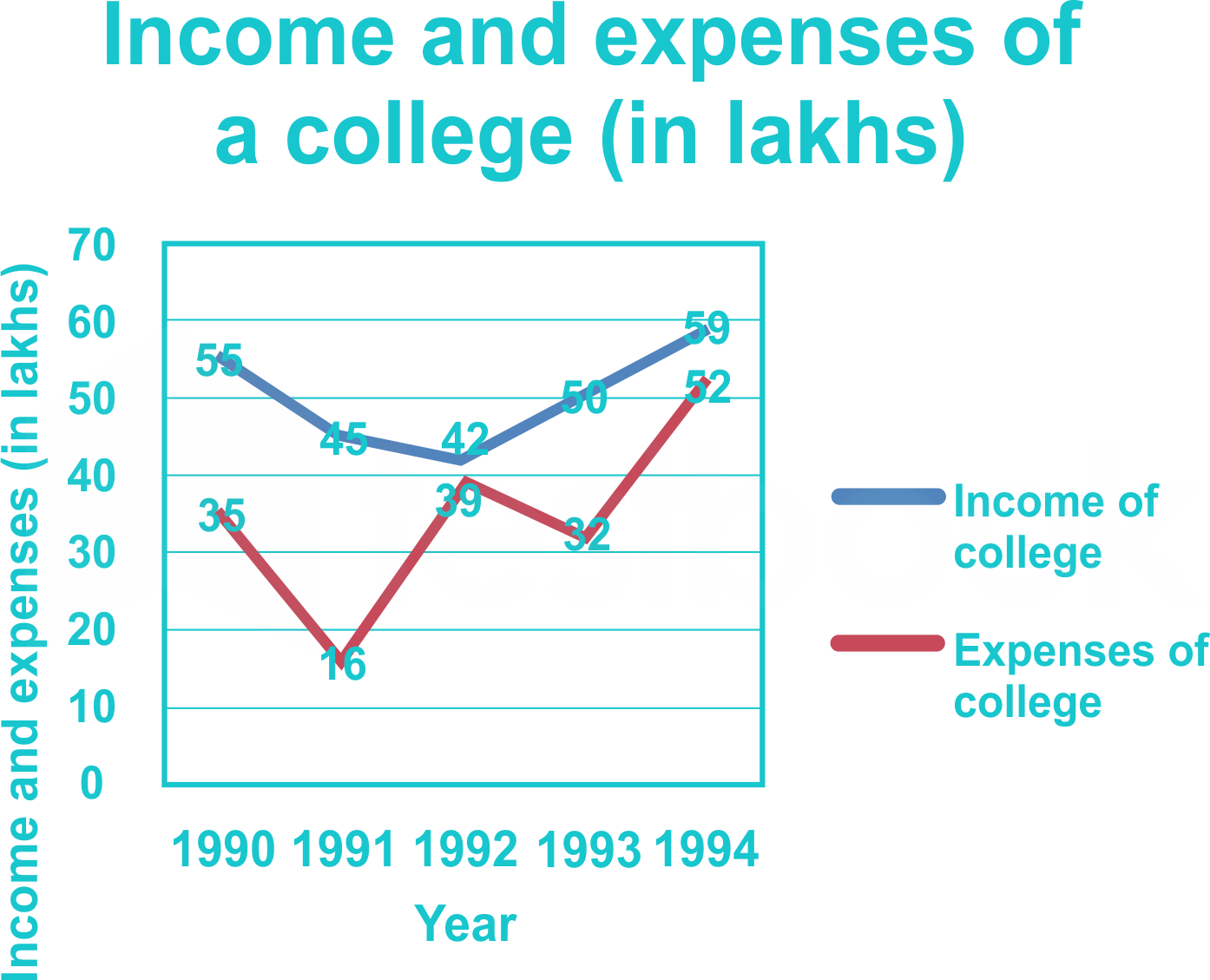
The given line graph shows the income and expenses of a college for different years. Study the graph and answer the question that follows.

What is the percentage increase in income from 1992 to 1993?

  1. AOption (a)

    19.04%

  2. BOption (b)

    14.03%

  3. COption (c)

    23.82%

  4. DOption (d)

    38.52%

View answer & explanation

Correct answer

Answer: (a)A.

19.04%

Why this answer is correct

Given:

The income of the college in 1992 = 42 lakhs

The income of the college in 1993 = 50 lakhs

Formula used:

Percentage increase = Increase in valueOriginal value×100\frac{\text{Increase in value}}{\text{Original value}} \times 100

Calculation:

Increase in income from 1992 to 1993:

⇒ 50−42=8,lakhs 50 - 42 = 8 , \text{lakhs}

Percentage increase:

⇒ 842×100=19.04% \frac{8}{42} \times 100 = 19.04\%

∴ The percentage increase in income from 1992 to 1993 is 19.04%.

Question 27

The coal that we use now comes from plants that lived around _________ years ago

  1. AOption (a)

    10,000,000

  2. BOption (b)

    10,000

  3. COption (c)

    1,000

  4. DOption (d)

    100,000

View answer & explanation

Correct answer

Answer: (a)A.

10,000,000

Why this answer is correct

The correct answer is 10,000,000 years.

Key Points

  • The coal we use today was formed from plants that existed around 10 million to 300 million years ago.
  • These plants were primarily large ferns, trees, and other vegetation that thrived in swampy environments.
  • Over millions of years, these plants were buried under layers of water and dirt, compressing them into peat and eventually into coal.
  • Coal formation is a process that involves the accumulation of plant debris in a swampy environment, followed by burial and compaction.
  • This process requires millions of years of geological time to transform plant material into coal.

Additional Information

  • Types of Coal
  • There are four main types of coal: anthracite, bituminous, sub-bituminous, and lignite.
  • Anthracite has the highest carbon content and energy density, while lignite has the lowest.
  • Coal Formation Stages
  • The stages of coal formation include peat, lignite, sub-bituminous, bituminous, and anthracite.
  • Each stage represents a different level of compression and heat applied over millions of years.
  • Uses of Coal
  • Coal is primarily used as a fuel for electricity generation.
  • It is also used in the production of steel and cement.
  • Environmental Impact
  • Coal mining and burning contribute to air pollution and greenhouse gas emissions.
  • Efforts are being made to reduce the environmental impact through cleaner coal technologies and alternative energy sources.

Question 28

Read the given statement(s) and conclusions carefully. Assuming that the information given in the statements is true, even if it appears to be at variance with commonly known facts, decide which of the given conclusions logically follow(s) from the statement(s).

Statements:

Some pens are scooters.

Some crowns are hats.

All balloons are globes.

Conclusions:

(I) All scooters are pens.

(II) Some crowns are globes.

(III) Some balloons are hats.

  1. AOption (a)

    Only conclusion II follows

  2. BOption (b)

    None of the conclusions follow

  3. COption (c)

    Either conclusion I or conclusion III follow

  4. DOption (d)

    Only conclusion I follows

View answer & explanation

Correct answer

Answer: (b)B.

None of the conclusions follow

Why this answer is correct

The least possible Venn diagram for the given statements is as shown below :

Conclusions:

(I) All scooters are pens → Does not follow (As some pens are scooters. So it is possible but not definite.)

(II) Some crowns are globes → Does not follow (As some crowns are hats and all balloons are globes. As no direct relation is given between crowns and globes, so it is possible but not definite.)

(III) Some balloons are hats → Does not follow (As some crowns are hats and all balloons are globes. As no direct relation is given between balloons and hats, so it is possible but not definite.)

∴ Here, None of the conclusions follow.​

Hence, the correct answer is "Option 2".

Question 29

The Ram Navami festival in India is celebrated as a Hindu festival on the _________ which marks the birth of Lord Ram.

  1. AOption (a)

    ninth day of Chaitra Navratri

  2. BOption (b)

    ninth day of Sharad Navratri

  3. COption (c)

    ninth day of Sawan month of Vikram Sambat Calendar

  4. DOption (d)

    ninth day of Phalguna month of Vikram Sambat Calendar

View answer & explanation

Correct answer

Answer: (a)A.

ninth day of Chaitra Navratri

Why this answer is correct

The correct answer is the ninth day of Chaitra Navratri.

Key Points

  • Ram Navami is celebrated on the ninth day of Chaitra Navratri, which falls in the month of Chaitra as per the Hindu lunar calendar.
  • This festival marks the birth of Lord Ram, the seventh incarnation of Lord Vishnu.
  • The day is observed with devotion and religious fervor, with devotees fasting and visiting temples.
  • Ram Navami also signifies the end of the nine-day-long Chaitra Navratri celebrations.

Additional Information

  • Chaitra Navratri
  • Chaitra Navratri is a nine-day festival dedicated to the nine forms of Goddess Durga.
  • It is celebrated in the month of Chaitra, which is the first month of the Hindu lunar calendar.
  • Each day of Navratri is dedicated to a different form of the goddess, and devotees perform rituals and prayers to honor her.
  • Lord Ram
  • Lord Ram is considered the seventh avatar of the Hindu god Vishnu.
  • He is the central figure in the epic Ramayana, which narrates his life, his ideals, and his journey.
  • Ram is revered for his adherence to dharma (righteousness) and his role as an ideal king, husband, and son.
  • Significance of Ram Navami
  • Ram Navami is not just a religious festival but also a cultural celebration that promotes the values of righteousness, bravery, and devotion.
  • It is celebrated with various cultural programs, recitations of the Ramayana, and enactments of episodes from Ram's life.
  • Fasting and Rituals
  • Devotees observe fasting, perform pujas, and chant mantras dedicated to Lord Ram.
  • Special prayers and bhajans are held in temples, and processions are carried out with the idol of Lord Ram.
  • The festival is an occasion for family gatherings and communal harmony, with people sharing sweets and festive meals.

Question 30

The ages of K and M are in the ratio of 7 ∶ 5 and the sum of their ages is 72 years. What will be the ratio of the ages of K and M, in the mentioned order, after 9 years?

  1. AOption (a)

    9 ∶ 8

  2. BOption (b)

    13 ∶ 11

  3. COption (c)

    17 ∶ 13

  4. DOption (d)

    12 ∶ 9

View answer & explanation

Correct answer

Answer: (c)C.

17 ∶ 13

Why this answer is correct

Shortcut Trick

Total ratio units = 7 + 5 = 12 units.

Current total age = 72 years ⇒ 1 unit = 72 ÷ 12 = 6 years.

Current ages: K = 7 × 6 = 42; M = 5 × 6 = 30.

After 9 years: K = 42 + 9 = 51; M = 30 + 9 = 39.

Required Ratio = 51 : 39 = 17 : 13.

∴ The correct answer is 17  :  13.

Alternate Method

Given: Current ratio of ages of K and M = 7 : 5. Sum of their ages = 72 years.

Method: We use the Unitary Method to find the actual current ages and then add the time increment.

⇒ Let the current ages of K and M be 7x and 5x.

⇒ Sum = 7x + 5x = 12x

⇒ 12x = 72

⇒ x = 72 ÷ 12 = 6

⇒ Current age of K = 7 × 6 = 42 years

⇒ Current age of M = 5 × 6 = 30 years

⇒ Age of K after 9 years = 42 + 9 = 51 years

⇒ Age of M after 9 years = 30 + 9 = 39 years

⇒ New ratio = 51 : 39

⇒ Simplifying by dividing both sides by 3: 51/3 : 39/3 = 17 : 13

∴ The correct answer is 17  :  13.

Additional Information

Ratio and Age Concept

When a constant number of years is added to the ages of two individuals, the difference between their ages remains constant, but their ratio changes.

Ratio Simplification

A ratio a : b is simplified by dividing both the antecedent (a) and the consequent (b) by their Highest Common Factor (HCF).

Sum of Ratio Parts

To divide a total value S into a ratio a : b, the value of one part is calculated as S ÷ (a + b). Individual values are then a × (one part) and b × (one part).

Question 31

Find the value of 7 × 8 + 11- (17-5).

  1. AOption (a)

    47

  2. BOption (b)

    55

  3. COption (c)

    45

  4. DOption (d)

    57

View answer & explanation

Correct answer

Answer: (b)B.

55

Why this answer is correct

Given:

Find the value of 7 × 8 + 11 - (17 - 5).

Formula used:

Use BODMAS rule (Bracket, Order, Division and Multiplication, Addition and Subtraction).

Calculation:

7 × 8 + 11 - (17 - 5)

⇒ 7 × 8 + 11 - 12

⇒ 56 + 11 - 12

⇒ 67 - 12

⇒ 55

∴ The correct answer is option 2.

Question 32

The line joining the two focii of a lens is called ________ .

  1. AOption (a)

    principal axis

  2. BOption (b)

    Focal length

  3. COption (c)

    paraxial ray

  4. DOption (d)

    radius of curvature

View answer & explanation

Correct answer

Answer: (a)A.

principal axis

Why this answer is correct

The correct answer is Principal Axis.

Key Points

  • The principal axis is an imaginary line that passes through the center of curvature and the optical center of a lens or mirror.
  • It is the main axis of symmetry for the lens or mirror, and it helps in defining the focal points.
  • In a lens, the principal axis intersects the lens at the optical center, which is the midpoint of the lens.
  • Light rays parallel to the principal axis converge (in a convex lens) or appear to diverge (in a concave lens) at the focal point on the principal axis.
  • The principal axis is crucial for understanding the formation of images by lenses and mirrors.

Additional Information

  • Focal Point
  • The point where parallel rays of light either converge or appear to diverge after passing through a lens or reflecting from a mirror.
  • In a convex lens, it is real and in front of the lens; in a concave lens, it is virtual and behind the lens.
  • Focal Length
  • The distance between the lens or mirror and its focal point.
  • It is a measure of how strongly the lens or mirror converges or diverges light.
  • Radius of Curvature
  • The radius of the sphere from which a spherical mirror or lens surface is a segment.
  • It is twice the focal length for mirrors.
  • Optical Center
  • The point on the principal axis of a lens where light passes through without being deviated.
  • It is the geometric center of a lens.

Question 33

Sunil made a paste of rice flour and added a drop of iodine solution to the paste. What will he see?

  1. AOption (a)

    The rice flour emits brown fumes

  2. BOption (b)

    The paste turns blue-black

  3. COption (c)

    The paste turns sky blue

  4. DOption (d)

    Formation of small bubbles (effervescence)

View answer & explanation

Correct answer

Answer: (b)B.

The paste turns blue-black

Why this answer is correct

The correct answer is The paste turns blue-black.

Key Points

  • When iodine solution is added to a paste of rice flour, the paste turns blue-black.
  • This color change is due to the presence of starch in the rice flour.
  • Iodine reacts with the amylose component of starch to form a blue-black complex.
  • This reaction is a common test for the presence of starch in a sample.
  • The intensity of the blue-black color can indicate the amount of starch present.

Additional Information

  • Starch:
  • Starch is a polysaccharide composed of glucose units.
  • It is commonly found in many plants as a storage form of energy.
  • Starch consists of two components: amylose and amylopectin.
  • Amylose is a linear polymer, while amylopectin is branched.
  • The blue-black color in the iodine test is specifically due to the amylose component.
  • Iodine Solution:
  • Iodine solution is typically made by dissolving iodine in potassium iodide solution.
  • It is used as a reagent to detect the presence of starch.
  • The solution is usually brownish-red but turns blue-black in the presence of starch.
  • Rice Flour:
  • Rice flour is made by grinding rice grains into a fine powder.
  • It is commonly used in cooking and baking.
  • Rice flour contains a significant amount of starch, making it suitable for the iodine test.
  • Other Applications of Iodine Test:
  • The iodine test is used in food industry to check for starch in products.
  • It is also used in laboratories for studying plant biology and biochemistry.

Question 34

Goods are sold such that when 5% discount is allowed, a profit of 33% is made. By what percentage is the list price more than the cost price?

  1. AOption (a)

    40%

  2. BOption (b)

    35%

  3. COption (c)

    25%

  4. DOption (d)

    30%

View answer & explanation

Correct answer

Answer: (a)A.

40%

Why this answer is correct

Shortcut Trick

Ratio of Marked Price (MP) to Cost Price (CP) = (100 + Profit%) ÷ (100 − Discount%).

MP ÷ CP = (100 + 33) ÷ (100 − 5) = 133 ÷ 95.

Dividing by 19: MP ÷ CP = 7 ÷ 5.

Markup Percentage = [(MP − CP) ÷ CP] × 100 = [(7 − 5) ÷ 5] × 100 = 2 ÷ 5 × 100 = 40%.

∴ The correct answer is 40%.

Alternate Method

Given: Discount = 5%, Profit = 33%.

Formulas: SP = CP × (100 + Profit%) ÷ 100 | SP = MP × (100 − Discount%) ÷ 100.

⇒ Let Cost Price (CP) be 100.

⇒ Since Profit is 33%, Selling Price (SP) = 100 + 33 = 133.

⇒ Discount is 5% on List Price (MP), so 0.95 × MP = 133.

⇒ MP = 133 ÷ 0.95 = 140.

⇒ Difference between MP and CP = 140 − 100 = 40.

⇒ Percentage increase = (40 ÷ 100) × 100 = 40%.

∴ The correct answer is 40%.

Additional Information

Marked Price & Discount

The List Price (or Marked Price) is the price printed on the label. Discount is always calculated on this price to reach the SP.

Relation between CP and MP

CP × (100 + P%) = MP × (100 − D%). This derived formula is the fastest way to solve markup problems when profit and discount are known.

Question 35

In a plant cell, the act of respiration to take in oxygen and release energy and carbon dioxide from food occurs in the _________ .

  1. AOption (a)

    mitochondria

  2. BOption (b)

    peroxisomes

  3. COption (c)

    chloroplasts and mitochondria

  4. DOption (d)

    vacuoles

View answer & explanation

Correct answer

Answer: (a)A.

mitochondria

Why this answer is correct

The correct answer is mitochondria.

Key Points

  • The mitochondria are known as the powerhouses of the cell because they generate most of the cell’s supply of adenosine triphosphate (ATP), used as a source of chemical energy.
  • In plant cells, mitochondria are the primary site of cellular respiration, where oxygen is used to convert nutrients into energy.
  • During respiration, mitochondria take in oxygen and release carbon dioxide and energy in the form of ATP.
  • They have their own DNA, which is separate from the nuclear DNA, and can replicate independently within the cell.
  • The process of cellular respiration in mitochondria occurs in three main stages: glycolysis, the citric acid cycle, and the electron transport chain.

Additional Information

  • Peroxisomes: Organelles that contain enzymes for oxidative reactions, important in the metabolism of fatty acids and the detoxification of harmful substances.
  • Chloroplasts: Organelles found in plant cells and eukaryotic algae that conduct photosynthesis, where light energy is converted into chemical energy stored in glucose.
  • Vacuoles: Large vesicles in plant cells that store nutrients, waste products, and help maintain turgor pressure against the cell wall.
  • Electron Transport Chain: A series of protein complexes within the inner mitochondrial membrane that transfer electrons from electron donors to electron acceptors via redox reactions, coupled with the transfer of protons (H+ ions) across the membrane.
  • Adenosine Triphosphate (ATP): The main energy currency of the cell, providing energy for various cellular processes, including muscle contraction, nerve impulse propagation, and chemical synthesis.

Question 36

If numbers 8452, 6327, 7524, 4598 and 5691 are arranged in descending order from left to right, than what will the product of third digit of the second number from the right end and second digit of the third number from the left end? (Example – 697 - First digit from left = 6, second digit from left = 9 and third digit from left = 7)

  1. AOption (a)

    27

  2. BOption (b)

    48

  3. COption (c)

    54

  4. DOption (d)

    26

View answer & explanation

Correct answer

Answer: (a)A.

27

Why this answer is correct

Given:  8452, 6327, 7524, 4598 and 5691

If arranged in descending order from left to right, 

Descending order → 8452, 7524, 6327, 5691, 4598,

After the rearrangement the second number from the right is "5691", 

 And third digit of the second number from the right is 9.

After the rearrangement the third number from the left is "6327".

second digit of the third number from the left 3,

Thus, the product of third digit of the second number from the right end and second digit of the third number from the left end​

⇒ 9 × 3 = 27.

Hence, the correct answer is "Option 1".

Question 37

In the given letter-cluster pairs, the first letter-cluster is related to the second letter-cluster following a certain logic. Study the given pairs carefully, and from the given options, select the pair that follows the same logic.

GKV ∶ IMX

PLR ∶ RNT

  1. AOption (a)

    UKM ∶ TPJ

  2. BOption (b)

    JWO ∶ LYQ

  3. COption (c)

    EMH ∶ VXR

  4. DOption (d)

    WDZ ∶ JAP

View answer & explanation

Correct answer

Answer: (b)B.

JWO ∶ LYQ

Why this answer is correct

The logic followed here is:

GKV ∶ IMX

And,

PLR ∶ RNT

So, checking each option one by one:

Option 1) UKM ∶ TPJ

Option 2) JWO ∶ LYQ

Option 3) EMH ∶ VXR

Option 4) WDZ ∶ JAP

Thus, out of all the options, 'JWO ∶ LYQ' follows the same logic as given.

Hence, "Option 2" is the correct answer.

Question 38

Which of the following numbers is divisible by both 6 and 9?

  1. AOption (a)

    2156

  2. BOption (b)

    4256

  3. COption (c)

    3186

  4. DOption (d)

    5186

View answer & explanation

Correct answer

Answer: (c)C.

3186

Why this answer is correct

Shortcut Trick

A number is divisible by 6 if it is even and the sum of its digits is divisible by 3.

A number is divisible by 9 if the sum of its digits is divisible by 9.

Therefore, we only need to check which even number has a sum of digits divisible by 9.

For 3186: 3 + 1 + 8 + 6 = 18. Since 18 is divisible by 9 and the number is even, it is divisible by both 6 and 9.

∴ The correct answer is 3186.

Alternate Method

Given: Numbers 2156, 4256, 3186, 5186.

Rule: Divisibility by 6 → Divisible by 2 AND 3. Divisibility by 9 → Sum of digits divisible by 9.

⇒ Check 2156: Sum = 2+1+5+6 = 14 (Not divisible by 9)

⇒ Check 4256: Sum = 4+2+5+6 = 17 (Not divisible by 9)

⇒ Check 3186: Sum = 3+1+8+6 = 18 (Divisible by 9 and 18 is also divisible by 3)

⇒ Since 3186 is even and its sum is divisible by 9, it satisfies both conditions.

∴ The correct answer is 3186.

Additional Information

LCM Method

If a number is divisible by both 6 and 9, it must be divisible by their LCM. LCM(6, 9) = 18.

Divisibility by 3

A number is divisible by 3 if the sum of its digits is a multiple of 3.

Divisibility by 18

A number is divisible by 18 if it is an even number and the sum of its digits is divisible by 9.

Question 39

Refer to the following letter, number, symbol series and answer the question.

(Left) T M % A 8 ? 4 D & S R # Y 7 Z * E 9 = 5 C (Right)

How many such symbols are there which are immediately preceded and immediately followed by a number?

  1. AOption (a)

    None

  2. BOption (b)

    Three

  3. COption (c)

    Two

  4. DOption (d)

    One

View answer & explanation

Correct answer

Answer: (c)C.

Two

Why this answer is correct

Given series:

(Left) T M % A 8 ? 4 D & S R # Y 7 Z * E 9 = 5 C (Right)

Condition to be checked:

1. Alphabets which is immediately preceded by a prime number. 2. Alphabets which is immediately followed by a symbol.

Required Pattern: Number → Symbol → Number 

Now, T M % A 8 ? 4 D & S R # Y 7 Z * E 9 = 5 C

Thus there are two such patterns (8 ? 4, 9 = 5) that are following the above conditions.

Hence, "Option 3" is the correct answer.

Mistake Points

Immediately preceded by means immediately before or to come just before.

Immediately followed by means immediately after or to come just after.
Question 40

Macroeconomics can be defined as:

  1. AOption (a)

    a branch of economics that studies the behaviour and performance of an economy as a whole

  2. BOption (b)

    a branch of economics that studies the individuals mode of investments

  3. COption (c)

    a study of individuals, households and firms' behaviour in decision making and allocation of resources

  4. DOption (d)

    a branch of economics that studies the methods of profits

View answer & explanation

Correct answer

Answer: (a)A.

a branch of economics that studies the behaviour and performance of an economy as a whole

Why this answer is correct

The correct answer is a branch of economics that studies the behaviour and performance of an economy as a whole.

Key Points

  • Macroeconomics focuses on aggregate indicators such as GDP, unemployment rates, and inflation.
  • It examines the economy-wide phenomena and policies that affect the economic performance of a country.
  • Key areas of study include national income, output, consumption, investment, savings, and overall economic growth.
  • Macroeconomics provides a comprehensive overview of how the economy operates as a whole, rather than individual markets.
  • This field of economics plays a vital role in formulating governmental policies to stabilize and grow the economy.

Additional Information

  • Gross Domestic Product (GDP): The total market value of all final goods and services produced within a country in a given period.
  • Inflation: The rate at which the general level of prices for goods and services is rising, eroding purchasing power.
  • Unemployment Rate: The percentage of the total labor force that is unemployed but actively seeking employment and willing to work.
  • Fiscal Policy: Government adjustments to its spending levels and tax rates to monitor and influence a nation's economy.
  • Monetary Policy: The process by which the monetary authority of a country controls the supply of money, often targeting an inflation rate or interest rate to ensure price stability and general trust in the currency.

Question 41

P, Q, R, S, T and U live on six different floors of the same building. The lowermost floor in the building is numbered 1, the floor above it is numbered 2 and so on till the topmost floor is numbered 6. Only two people live between P and S. S lives immediately below T. P lives on an even-numbered floor but not on floor number 2. R lives on the topmost floor. Q lives immediately below R. Who lives on floor number 3?

  1. AOption (a)

    U

  2. BOption (b)

    T

  3. COption (c)

    Q

  4. DOption (d)

    R

View answer & explanation

Correct answer

Answer: (a)A.

U

Why this answer is correct

Given: P, Q, R, S, T and U live on six different floors of the same building. The lowermost floor in the building is numbered 1, the floor above it is numbered 2 and so on till the topmost floor is numbered 6.

1) R lives on the topmost floor.

2) Q lives immediately below R.

FloorPerson
6R
5Q
4
3
2
1

3) P lives on an even-numbered floor but not on floor number 2. 

4) Only two people live between P and S. 

FloorPerson
6R
5Q
4P
3
2
1S

4) S lives immediately below T.

After positioning T only one position is left which will be occupied by the only person left i.e. U.

FloorPerson
6R
5Q
4P
3U
2T
1S

Thus. according to the final arrangement, U lives on floor number 3.

Hence, "Option 1" is the correct answer.

Question 42

A, B, C, D, E and F live on six different floors of the same building. The lowermost floor in the building is numbered 1, the floor above it, number 2 and so on till the topmost floor is numbered 6.

Only one person lives above E. D lives in an odd numbered floor. Only one person lives between E and C. C lives immediately above F. B does not live below A. Who lives on floor number 1 ?

  1. AOption (a)

    F

  2. BOption (b)

    C

  3. COption (c)

    B

  4. DOption (d)

    D

View answer & explanation

Correct answer

Answer: (d)D.

D

Why this answer is correct

Given: A, B, C, D, E and F live on six different floors of the same building. The lowermost floor in the building is numbered 1, the floor above it, number 2 and so on till the topmost floor is numbered 6.

1) Only one person lives above E. 

2) Only one person lives between E and C.

FloorPerson
6
5E
4
3C
2
1

3) C lives immediately above F.

4) D lives in an odd numbered floor.

FloorPerson
6
5E
4
3C
2F
1D

4) B does not live below A. 

After positioning T only one position is left which will be occupied by the only person left i.e. U.

FloorPerson
6B
5E
4A
3C
2F
1D

Thus. according to the final arrangement, D lives on floor number 1.

Hence, "Option 4" is the correct answer.

Question 43

Newlands arranged the then known elements in the order of _________ .

  1. AOption (a)

    increasing atomic masses

  2. BOption (b)

    increasing atomic radius

  3. COption (c)

    decreasing atomic radius

  4. DOption (d)

    decreasing atomic masses

View answer & explanation

Correct answer

Answer: (a)A.

increasing atomic masses

Why this answer is correct

The correct answer is increasing atomic masses.

Key Points

  • John Newlands, an English chemist, proposed the Law of Octaves in 1864, arranging elements in increasing atomic masses.
  • He observed that every eighth element had properties similar to the first element, creating a periodic pattern.
  • Newlands' arrangement was one of the earliest attempts to classify elements based on their properties and relative atomic mass.
  • This arrangement led to the development of the modern periodic table, although Newlands' work was initially met with skepticism.

Additional Information

  • Mendeleev's Periodic Table
  • Dmitri Mendeleev improved upon Newlands' work by arranging elements in order of increasing atomic mass but also by their chemical properties.
  • Mendeleev's table left gaps for undiscovered elements and predicted their properties accurately.
  • This table eventually evolved into the modern periodic table where elements are arranged by increasing atomic number.
  • Moseley's Contribution
  • Henry Moseley, in 1913, redefined the periodic table by arranging elements by increasing atomic number, not atomic mass.
  • This resolved inconsistencies in Mendeleev's table and provided a more accurate organization of the elements.
  • Periodic Law
  • The Periodic Law states that the properties of elements are a periodic function of their atomic numbers.
  • This means elements with similar properties recur at regular intervals when arranged by atomic number.
  • Modern Periodic Table
  • The modern periodic table is structured in periods (rows) and groups (columns) based on atomic number.
  • Elements in the same group have similar chemical properties due to having the same number of valence electrons.

Question 44

Two numbers, whose LCM is 416 and HCF is 2, are in the ratio 13: 16. Find the greater of these two numbers.

  1. AOption (a)

    34

  2. BOption (b)

    26

  3. COption (c)

    32

  4. DOption (d)

    42

View answer & explanation

Correct answer

Answer: (c)C.

32

Why this answer is correct

Shortcut Trick

Given Ratio = 13 : 16 and HCF = 2.

Numbers are obtained by multiplying Ratio parts with the HCF.

Smaller number = 13 × 2 = 26

Greater number = 16 × 2 = 32

∴ The correct answer is 32.

Alternate Method

Given:

LCM = 416

HCF = 2

Ratio of numbers = 13 : 16

Formula Used:

Product of two numbers = HCF × LCM

Calculations:

Let the common variable be x.

Since the HCF is the highest common factor, for the ratio 13 : 16, the numbers are 13x and 16x.

⇒ HCF of 13x and 16x is x (since 13 and 16 are co-prime).

⇒ x = 2

⇒ First number = 13 × 2 = 26

⇒ Second number = 16 × 2 = 32

Verification: LCM of 26 and 32

⇒ 26 = 2 × 13

⇒ 32 = 25

⇒ LCM = 25 × 13 = 32 × 13 = 416 (Matches given data).

∴ The correct answer is 32.

Additional Information

Product Rule

For any two numbers a and b, Product (a × b) = HCF(a, b) × LCM(a, b).

Co-prime Numbers

If two numbers are in the ratio x : y and are co-prime, then their HCF is the multiplier that gives the original numbers.

LCM of Ratio

If two numbers are Hx and Hy (where H is HCF), then their LCM = H × x × y.

Question 45

Which state has become India's first State Assembly to implement the National e-Vidhan Application (NeVA) programme to become paperless in March 2022?

  1. AOption (a)

    Kerala

  2. BOption (b)

    Madhya Pradesh

  3. COption (c)

    Nagaland

  4. DOption (d)

    Maharashtra

View answer & explanation

Correct answer

Answer: (c)C.

Nagaland

Why this answer is correct

The correct answer is Nagaland.

Key Points

  • Nagaland became the first state in India to implement the National e-Vidhan Application (NeVA) program in March 2022.
  • The NeVA program aims to make state legislatures paperless and more efficient.
  • The initiative is part of the Digital India campaign, aiming to digitize legislative processes.
  • NeVA allows for the electronic handling of legislative documents, reducing the need for physical paperwork.
  • The program enhances transparency and accessibility by making legislative proceedings available online.

Additional Information

  • National e-Vidhan Application (NeVA)
  • NeVA is a mission-mode project under the Digital India program, aimed at digitizing the functioning of state legislatures.
  • It facilitates the electronic submission, management, and tracking of legislative documents.
  • The application ensures accessibility, transparency, and better management of legislative processes.
  • NeVA is designed to work in a secure and user-friendly manner, enabling legislators to access documents and proceedings from anywhere.
  • Digital India Campaign
  • Launched by the Government of India in 2015, the Digital India campaign aims to transform India into a digitally empowered society and knowledge economy.
  • The initiative focuses on providing digital infrastructure, delivering government services digitally, and promoting digital literacy.
  • It includes various projects such as BharatNet, Digital Locker, e-Health, and e-Education.
  • The campaign seeks to bridge the digital divide and ensure that technology benefits all segments of society.
  • Paperless Governance
  • Paperless governance refers to the use of digital tools and technologies to carry out administrative and legislative functions without relying on physical paper documents.
  • It enhances efficiency, reduces costs, and minimizes the environmental impact of paper production and disposal.
  • Key components of paperless governance include electronic document management systems, digital signatures, and online portals for service delivery.
  • Many governments worldwide are adopting paperless governance to streamline processes and improve public service delivery.
  • Transparency and Accessibility in Government
  • Transparency in government refers to the openness and accountability of governmental operations, allowing citizens to access information and understand decision-making processes.
  • Accessibility ensures that all citizens, including those with disabilities, can access government services and information.
  • Digital tools such as online portals, mobile apps, and electronic databases enhance transparency and accessibility.
  • These initiatives promote trust in government, improve public participation, and ensure equitable access to services.

Question 46

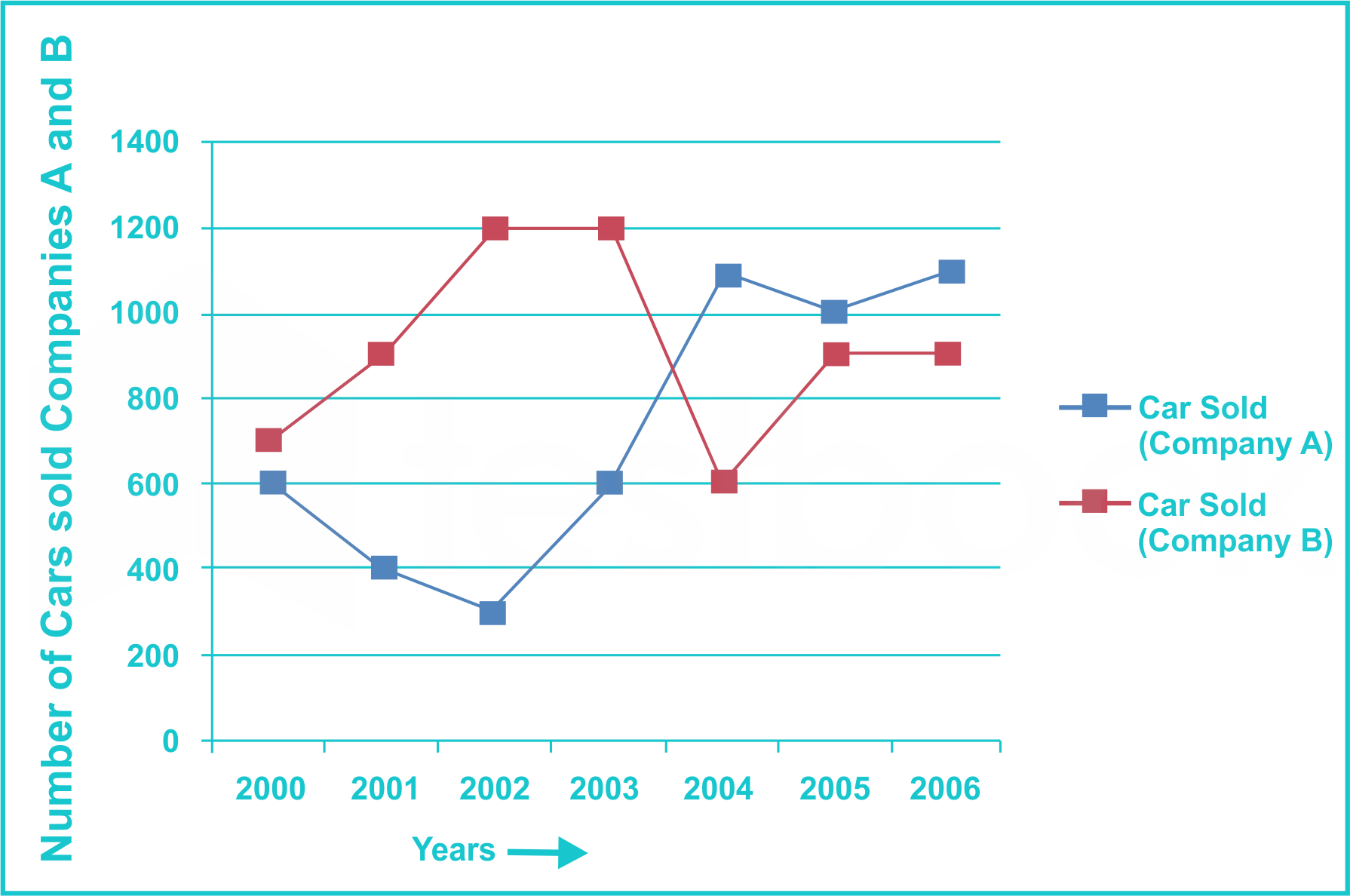
The following graph shows the number of cars sold by two companies A and B over the years. Study the graph and answer the question that follows.

During the year 2003-2004, the sales of cars of Company B declined drastically. Calculate the decrease in the number of cars sold by Company B in year 2004 as compared to the previous year.

  1. AOption (a)

    400

  2. BOption (b)

    600

  3. COption (c)

    700

  4. DOption (d)

    500

View answer & explanation

Correct answer

Answer: (b)B.

600

Why this answer is correct

Given:

Number of cars sold by Company B in 2003 = 1200

Number of cars sold by Company B in 2004 = 600

Formula used:

Decrease in sales = Previous year sales−Current year sales \text{Previous year sales} - \text{Current year sales}

Calculation:

Decrease in the number of cars sold:

⇒ 1200−600=600 1200 - 600 = 600

∴ The decrease in the number of cars sold by Company B in 2004 as compared to 2003 is 600.

Question 47

Select the option that is related to the third term in the same way as the second term is related to the first term and the sixth term is related to the fifth term.

77 ∶ 28 ∶∶ 89 ∶ ? ∶∶ 134 ∶ 47

  1. AOption (a)

    31

  2. BOption (b)

    32

  3. COption (c)

    34

  4. DOption (d)

    35

View answer & explanation

Correct answer

Answer: (b)B.

32

Why this answer is correct

The logic followed here is:

Logic: (2nd number × 3) - 7 = 1st number.

Now,

For, 77 : 28

⇒ (28 × 3) - 7 = 84 - 7 = 77.

For, 134 : 47

⇒ (47 × 3) - 7 = 141 - 7 = 134.

Similarly, for 89 : 32

⇒ (32 × 3) - 7 = 96 - 7 = 89.

Hence, the correct answer is "Option 2".

Question 48

Select the option that is related to the fifth number in the same way as the second number is related to the first number and the fourth number is related to the third number.

 8 ∶ 65 ∶∶ 12 ∶ 145 ∶∶ 13 ∶ ?

  1. AOption (a)

    171

  2. BOption (b)

    170

  3. COption (c)

    133

  4. DOption (d)

    169

View answer & explanation

Correct answer

Answer: (b)B.

170

Why this answer is correct

The logic followed here is:

Logic: **(**1st number)2 + 1 = 2nd number.

Now,

For, 8 : 65

⇒ (82) + 1 = 64 + 1 = 65.

For, 12 : 145

⇒ (122) + 1 = 144 + 1 = 145.

Similarly, for 13 ∶ ?

⇒ (132) + 1 = 169 + 1 = 170.

Hence, the correct answer is "Option 2".

Question 49

Which of the following numbers will replace the question mark (?) in the given series?

4 12 76 292 804 ?

  1. AOption (a)

    2000

  2. BOption (b)

    1000

  3. COption (c)

    2804

  4. DOption (d)

    1804

View answer & explanation

Correct answer

Answer: (d)D.

1804

Why this answer is correct

The logic followed here is:

​

Hence, "Option 4" is the correct answer.

Question 50

In which year was the National Policy on Electronics and Software Products enacted, with the goal of propelling India's rise as a Software Product Nation and collaborating with the IT/ITES sector?

  1. AOption (a)

    2020

  2. BOption (b)

    2019

  3. COption (c)

    2021

  4. DOption (d)

    2022

View answer & explanation

Correct answer

Answer: (b)B.

2019

Why this answer is correct

The correct answer is 2019.

Key Points

  • The National Policy on Electronics and Software Products was enacted in the year 2019.
  • This policy aims to propel India’s rise as a Software Product Nation.
  • The policy focuses on collaborating with the IT/ITES sector to achieve its goals.
  • It was designed to enhance the capabilities of India in software products and services.
  • The policy targets the creation of a conducive environment for the development and growth of the software product industry in India.

Additional Information

  • National Policy on Electronics (NPE) 2019
  • The National Policy on Electronics 2019 aims to position India as a global hub for Electronics System Design and Manufacturing (ESDM).
  • It includes initiatives to promote the manufacturing of core components and high-value products.
  • The policy emphasizes research and development, skill development, and infrastructure development.
  • It aims to attract investments and provide incentives for the electronics industry.
  • IT/ITES Sector in India
  • The IT/ITES sector has been a significant contributor to India’s GDP and employment.
  • India is a leading destination for IT/ITES services, including software development, BPO, and KPO.
  • The sector has seen substantial growth due to a skilled workforce and competitive costs.
  • Government policies have aimed at fostering innovation and improving infrastructure for this sector.
  • Software Products
  • Software products refer to commercially marketed software solutions developed for various industries.
  • They include enterprise software, system software, and application software.
  • The development of software products involves stages like requirements gathering, design, coding, testing, and maintenance.
  • Innovation in software products can drive efficiency, security, and new capabilities for users.
  • Importance of Policy Frameworks
  • Policy frameworks provide a structured approach to achieving national goals in technology and industry.
  • They help in creating a supportive environment for innovation and investment.
  • Policies can address challenges like infrastructure, funding, and regulatory issues.
  • Effective policies can lead to sustainable growth and global competitiveness.

Question 51

Who was the main proponent of the Young Bengal Movement whose followers cherished the ideals of the French Revolution (1789 AD) and the liberal thinking of Britain?

  1. AOption (a)

    Henry Louis Vivian Derozio

  2. BOption (b)

    Ishwar Chandra Vidyasagar

  3. COption (c)

    Annie Beasant

  4. DOption (d)

    Swami Vivekananda

View answer & explanation

Correct answer

Answer: (a)A.

Henry Louis Vivian Derozio

Why this answer is correct

The correct answer is Henry Louis Vivian Derozio.

Key Points

  • Henry Louis Vivian Derozio was the main proponent of the Young Bengal Movement.
  • He was a teacher and poet of Portuguese-Indian descent.
  • Derozio's followers, known as Derozians, cherished the ideals of the French Revolution and liberal thinking of Britain.
  • He taught at Hindu College, Calcutta, where he inspired his students to embrace free thinking and rationalism.

Additional Information

  • Young Bengal Movement
  • It was a movement in 19th-century Bengal spearheaded by Henry Louis Vivian Derozio.
  • The movement promoted rational thinking, freedom of thought, and social reform.
  • The Derozians questioned traditional practices and campaigned for women's rights and education.
  • It played a significant role in the Bengal Renaissance, which was a period of cultural, social, and intellectual awakening in Bengal.
  • French Revolution (1789 AD)
  • The French Revolution was a period of radical social and political change in France.
  • It led to the overthrow of the monarchy, the establishment of a republic, and significant societal reforms.
  • The Revolution's ideals of liberty, equality, and fraternity had a profound influence worldwide.
  • Liberal Thinking of Britain
  • Liberalism in Britain during the 19th century emphasized individual rights, civil liberties, and democracy.
  • Key figures included John Stuart Mill, who advocated for freedom of expression and utilitarianism.
  • The liberal ideas influenced many social reforms, such as the abolition of slavery and the expansion of suffrage.

Question 52

Which of the following numbers will replace the question mark (?) in the given series?

6, 9, 12, 16, 20, 25, ?

  1. AOption (a)

    29

  2. BOption (b)

    31

  3. COption (c)

    35

  4. DOption (d)

    30

View answer & explanation

Correct answer

Answer: (d)D.

30

Why this answer is correct

The logic followed here is:

​

Hence, "Option 4" is the correct answer.

Alternate Method

Question 53

Five friends live on five different floors of the same building. The lowermost floor in the building is numbered 1, the floor above it, number 2 and so on till the topmost floor is numbered 5. Sanjay lives on the floor immediately above Namrata. Anshika lives on the third floor. Heena lives on the lowermost floor. Namrata lives on the floor immediately above Anshika. Manvir lives on the floor immediately above Heena. Who lives on the topmost floor?

  1. AOption (a)

    Heena

  2. BOption (b)

    Namrata

  3. COption (c)

    Sanjay

  4. DOption (d)

    Manvir

View answer & explanation

Correct answer

Answer: (c)C.

Sanjay

Why this answer is correct

Given: Five friends live on five different floors of the same building. The lowermost floor in the building is numbered 1, the floor above it, number 2 and so on till the topmost floor is numbered 5.

1) Anshika lives on the third floor.

2) Heena lives on the lowermost floor.

FloorPerson
5
4
3Anshika
2
1Heena

3) Namrata lives on the floor immediately above Anshika. 

4) Manvir lives on the floor immediately above Heena.

FloorPerson
5
4Namrata
3Anshika
2Manvir
1Heena

4) Sanjay lives on the floor immediately above Namrata.

FloorPerson
5Sanjay
4Namrata
3Anshika
2Manvir
1Heena

Thus. according to the final arrangement, Sanjay lives on the topmost floor.

Hence, "Option 3" is the correct answer.

Question 54

A bank offers 7.5% compound interest per annum calculated on a half-yearly basis. A customer deposits Rs. 3,600 each on 1 January and 1 July of a year. At the end of the year, the amount he would have gained by way of interest is ________.

[Give your answer correct to 2 decimal places.]

  1. AOption (a)

    ₹410.06

  2. BOption (b)

    ₹405.06

  3. COption (c)

    ₹415.06

  4. DOption (d)

    ₹272.25

View answer & explanation

Correct answer

Answer: (a)A.

₹410.06

Why this answer is correct

Shortcut Trick

Effective half-yearly rate = 7.5% ÷ 2 = 3.75%.

Interest on 1st installment (2 cycles) = 3.75 + 3.75 + (3.75 × 3.75)/100 = 7.640625%.

Interest on 2nd installment (1 cycle) = 3.75%.

Total interest % = 7.640625% + 3.75% = 11.390625%.

Total interest = 11.390625% × 3600 = ₹410.0625.

∴ The correct answer is ₹410.06.

Alternate Method

Given:

Principal (P) = ₹3,600 per deposit.

Annual Rate (R) = 7.5%.

Compounding period = Half-yearly.

Formula Used:

Amount = P × (1 + r/100)n, where r is rate per period and n is number of periods.

Calculations:

⇒ Half-yearly rate (r) = 7.5 ÷ 2 = 3.75%.

⇒ Interest for 1st deposit (Jan 1 to June 30) = 3600 × 3.75/100 = ₹135.

⇒ Amount at start of second half for 1st deposit = 3600 + 135 = ₹3,735.

⇒ Interest for 1st deposit (July 1 to Dec 31) = 3735 × 3.75/100 = ₹140.0625.

⇒ Interest for 2nd deposit (July 1 to Dec 31) = 3600 × 3.75/100 = ₹135.

⇒ Total Interest = 135 + 140.0625 + 135 = ₹410.0625.

⇒ Rounding to 2 decimal places = ₹410.06.

∴ The correct answer is ₹410.06.

Additional Information

Compound Interest Compounded Half-Yearly

When interest is compounded half-yearly, the annual rate is divided by 2 (R/2) and the time is multiplied by 2 (2T).

Effective Rate of Interest

For a nominal rate R compounded n times a year, the effective rate E = [1 + (R/n)]n − 1.

Successive Percentage Change

For two successive changes of a% and b%, the net change is given by [a + b + (ab/100)]%.

Question 55

The circumference of magnetic field lines __________ as we move away from a current carrying a straight conductor.

  1. AOption (a)

    Decreases

  2. BOption (b)

    become zero

  3. COption (c)

    remains the same

  4. DOption (d)

    increases

View answer & explanation

Correct answer

Answer: (d)D.

increases

Why this answer is correct

The correct answer is increases.

Key Points

  • The circumference of magnetic field lines around a current-carrying conductor increases as the distance from the conductor increases.
  • This relationship is a direct consequence of the geometrical nature of magnetic field lines forming concentric circles around the conductor.
  • The magnetic field strength decreases with distance, but the circumference of the field lines grows, following the formula B ∝ 1/r, where B is the magnetic field strength and r is the radius.
  • According to Ampère's circuital law, the integral of the magnetic field around a closed loop is proportional to the electric current passing through the loop.

Additional Information

  • Magnetic Field Lines:
  • Imaginary lines used to represent the strength and direction of a magnetic field.
  • They form closed loops from the north pole to the south pole of a magnet.
  • Ampère's Circuital Law:
  • States that the line integral of the magnetic field around a closed loop is equal to the permeability times the electric current enclosed by the loop.
  • Mathematically represented as ∮B·dl = μ₀Iₑₙₚ.
  • Right-Hand Rule:
  • A mnemonic is used to determine the direction of the magnetic field relative to the current direction.
  • Point the thumb in the direction of the current, and the curl of the fingers shows the direction of the magnetic field lines.
  • Magnetic Field Strength (B):
  • Measured in teslas (T) or gauss (G), it represents the force exerted by the field on a moving charge.
  • Depends on the current and the distance from the conductor.

Question 56

The perimeter of a right-angled triangle is 80 cm. If the length of its hypotenuse is 34 cm, find the lengths of its other two sides.

  1. AOption (a)

    20 cm, 26 cm

  2. BOption (b)

    14 cm, 32 cm

  3. COption (c)

    16 cm, 30 cm

  4. DOption (d)

    18 cm, 28 cm

View answer & explanation

Correct answer

Answer: (c)C.

16 cm, 30 cm

Why this answer is correct

Shortcut Trick

Check for Pythagorean triplets involving hypotenuse = 34 cm.

Divide 34 by 2 ⇒ 17. The basic triplet is (8, 15, 17).

Multiplying by 2 ⇒ (16, 30, 34).

Verify sum: 16 + 30 + 34 = 80 cm (Matches given Perimeter).

∴ The correct answer is 16 cm, 30 cm.

Alternate Method

Given: Perimeter = 80 cm, Hypotenuse (h) = 34 cm.

Formula Used: Perimeter = a + b + h; Pythagoras Theorem: a2 + b2 = h2

⇒ Sum of other two sides (a + b) = 80 − 34 = 46 cm

⇒ We know a2 + b2 = 342 = 1156

⇒ Use identity: (a + b)2 = a2 + b2 + 2ab

⇒ 462 = 1156 + 2ab ⇒ 2116 = 1156 + 2ab

⇒ 2ab = 960 ⇒ ab = 480

⇒ Solve quadratic x2 − (sum)x + product = 0 ⇒ x2 − 46x + 480 = 0

⇒ (x − 16)(x − 30) = 0 ⇒ x = 16 or 30

∴ The correct answer is 16 cm, 30 cm.

Additional Information

Pythagorean Triplets

A set of three positive integers a, b, and c such that a2 + b2 = c2. Common examples: (3, 4, 5), (5, 12, 13), (8, 15, 17), (7, 24, 25).

Area of Right-Angled Triangle

Area = 1/2 × Base × Height. For this triangle, Area = 1/2 × 16 × 30 = 240 cm2.

Inradius of Right Triangle

Inradius (r) = (a + b − h) / 2. For this triangle, r = (16 + 30 − 34) / 2 = 6 cm.

Question 57

Which of the following options is the closest approximate value which will come in place of the question mark (?) in the following equation?

15.32 ÷ 4.37 + 2.11 × 14.47 = ?

  1. AOption (a)

    50

  2. BOption (b)

    61

  3. COption (c)

    16

  4. DOption (d)

    32

View answer & explanation

Correct answer

Answer: (d)D.

32

Why this answer is correct

Given:

15.32 ÷ 4.37 + 2.11 × 14.47 = ?

Formula used:

Basic arithmetic operations

Calculation:

15.32 ÷ 4.37 + 2.11 × 14.47 = ?

⇒ 3.505 + 30.5257 = ?

⇒ 34.0307 ≈ 32 (Closest Option)

∴ The correct answer is option (4).

Question 58

Which of the following is the largest mangrove forest in the world?

  1. AOption (a)

    Bhitarkanika mangroves

  2. BOption (b)

    The Sundarbans reserve forest

  3. COption (c)

    Pichavaram mangrove forest

  4. DOption (d)

    Godavari Krishna mangroves

View answer & explanation

Correct answer

Answer: (b)B.

The Sundarbans reserve forest

Why this answer is correct

The correct answer is The Sundarbans reserve forest.

Key Points

  • The Sundarbans reserve forest is located in the delta region of Padma, Meghna, and Brahmaputra river basins.
  • It spans across two countries: India and Bangladesh, with the majority of the forest located in Bangladesh.
  • The Sundarbans is the largest mangrove forest in the world, covering approximately 10,000 square kilometers.
  • This UNESCO World Heritage Site is known for its unique biodiversity, including the endangered Bengal tiger.
  • The forest plays a crucial role in protecting the coastal regions from storm surges and erosion.

Additional Information

  • Mangroves:
  • Mangroves are salt-tolerant trees that grow in coastal intertidal zones.
  • They are known for their complex root systems, which provide vital habitats for many marine species.
  • Mangroves help in stabilizing coastlines and preventing erosion.
  • They also play a significant role in carbon sequestration.
  • Biodiversity of Sundarbans:
  • The Sundarbans is home to a variety of wildlife, including the Bengal tiger, spotted deer, crocodiles, and various species of birds and fish.
  • It is also home to the Sundari tree, which gives the forest its name.
  • The unique ecosystem supports both terrestrial and aquatic life.
  • UNESCO World Heritage Site:
  • The Sundarbans was designated as a UNESCO World Heritage Site in 1987 for its exceptional biodiversity.
  • It is recognized for its outstanding natural beauty and ecological significance.
  • Conservation Efforts:
  • Various conservation programs are in place to protect the Sundarbans' unique ecosystem.
  • Efforts include habitat restoration, anti-poaching initiatives, and community involvement in conservation activities.
  • International cooperation between India and Bangladesh is crucial for the effective management of the Sundarbans.

Question 59

How many double bonds are present in propanone?

  1. AOption (a)

    3

  2. BOption (b)

    2

  3. COption (c)

    1

  4. DOption (d)

    0

View answer & explanation

Correct answer

Answer: (c)C.

1

Why this answer is correct

The correct answer is 1.

Key Points

  • Propanone, also known as acetone, has the chemical formula CH3COCH3.
  • In its structure, propanone has a carbonyl group (C=O), which contains one double bond.
  • The carbonyl group is positioned between two methyl groups (CH3-), making it a ketone.
  • Thus, propanone has only one double bond, which is the C=O bond.

Additional Information

  • Ketones:
  • Ketones are a class of organic compounds characterized by the presence of a carbonyl group (C=O) bonded to two carbon atoms.
  • Common examples include acetone (propanone) and butanone.
  • Carbonyl Group:
  • A carbonyl group is a functional group composed of a carbon atom double-bonded to an oxygen atom (C=O).
  • It is a key feature in various organic compounds such as aldehydes, ketones, carboxylic acids, and esters.
  • Propanone (Acetone):
  • Propanone is commonly used as a solvent in laboratories and in the manufacturing of plastics and other industrial products.
  • It is also used in household items like nail polish remover.
  • Double Bond:
  • A double bond in chemistry refers to a chemical bond in which two pairs of electrons are shared between two atoms.
  • Double bonds are stronger than single bonds and influence the shape and reactivity of molecules.

Question 60

Which of the following compounds of carbon does NOT exist?

  1. AOption (a)

    CH4

  2. BOption (b)

    CH6

  3. COption (c)

    C2H6

  4. DOption (d)

    C6H6

View answer & explanation

Correct answer

Answer: (b)B.

CH6

Why this answer is correct

The correct answer is CH6.

Key Points

  • CH6 does not exist because it is not possible to have six hydrogen atoms bonded to a single carbon atom under normal conditions.
  • The carbon atom can form a maximum of four covalent bonds due to its tetravalency, adhering to the octet rule.
  • Common carbon compounds include CH4 (methane), C2H6 (ethane), and C6H6 (benzene), all of which follow the valency rules of carbon.
  • In the case of CH4, carbon forms four single bonds with hydrogen atoms, while in C2H6, each carbon atom forms three single bonds with hydrogen and one single bond with another carbon atom.

Additional Information

  • Octet Rule
  • A chemical rule of thumb that reflects the observation that atoms of main-group elements tend to combine in such a way that each atom has eight electrons in its valence shell.
  • This rule is a guiding principle for understanding the bonding behavior of atoms.
  • Tetravalency of Carbon
  • Carbon has four valence electrons and thus can form four covalent bonds with other atoms.
  • This property allows carbon to form a wide variety of complex organic molecules.
  • Molecular Structures
  • The structure of a molecule is determined by the arrangement of its atoms and the bonds between them.
  • Methane (CH4) has a tetrahedral structure, while benzene (C6H6) has a planar hexagonal structure with alternating double bonds.
  • Hybridization
  • The concept of mixing atomic orbitals to form new hybrid orbitals suitable for the pairing of electrons to form chemical bonds.
  • For example, in methane (CH4), carbon undergoes sp3 hybridization to form four equivalent bonds with hydrogen atoms.

Question 61

What was the main focus of the First Five-Year Plan?

  1. AOption (a)

    The establishment of higher education institution

  2. BOption (b)

    Development of defence equipment

  3. COption (c)

    The agricultural development of the country

  4. DOption (d)

    Development of the service sector

View answer & explanation

Correct answer

Answer: (c)C.

The agricultural development of the country

Why this answer is correct

The correct answer is The agricultural development of the country.

Key Points

  • The First Five-Year Plan (1951-1956) of India primarily focused on the agricultural sector to address the food security needs of the country.
  • It aimed at increasing agricultural production by implementing measures such as land reforms, irrigation projects, and the use of improved seeds and fertilizers.
  • Major irrigation projects like the Bhakra Nangal Dam and the Hirakud Dam were initiated during this period to boost agricultural productivity.
  • The plan allocated around 31% of its total budget to the agriculture and irrigation sectors, highlighting the emphasis on rural development and food self-sufficiency.

Additional Information

  • Five-Year Plans in India
  • These are centralized and integrated national economic programs developed by the Planning Commission of India.
  • They were inspired by the Soviet model of planning and were used to guide the economic development of the country.
  • The first five-year plan was launched in 1951 and aimed to improve living standards through agricultural development, industrialization, and infrastructure expansion.
  • Irrigation Projects
  • Key projects initiated during the First Five-Year Plan include the Bhakra Nangal Dam, Hirakud Dam, and Damodar Valley Corporation.
  • These projects were crucial in providing water for irrigation, generating hydroelectric power, and controlling floods.
  • Green Revolution
  • Although the Green Revolution officially began in the 1960s, its seeds were sown during the First Five-Year Plan through the promotion of high-yielding varieties of seeds and the use of fertilizers and pesticides.
  • It led to a significant increase in food grain production in the following decades, especially in states like Punjab and Haryana.
  • Land Reforms
  • Land reforms were a crucial part of the First Five-Year Plan, aimed at redistributing land to the landless and marginal farmers to ensure equitable land ownership.
  • This included measures like the abolition of the Zamindari system and the introduction of land ceiling acts.

Question 62

A football player got fractured while playing football. He went to the hospital. The doctor took 'X' substance and mixed it with water for supporting the fractured bones in the right position. 

What is the name of substance 'X'?

  1. AOption (a)

    Gypsum

  2. BOption (b)

    Sodium hydroxide

  3. COption (c)

    Plaster of Paris

  4. DOption (d)

    Calcium sulphate

View answer & explanation

Correct answer

Answer: (c)C.

Plaster of Paris

Why this answer is correct

The correct answer is Plaster of Paris.

Key Points

  • Plaster of Paris is a quick-setting gypsum plaster consisting of a fine white powder (calcium sulfate hemihydrate).
  • When mixed with water, it forms a paste that hardens quickly, providing support to fractured bones.
  • It is widely used in medical applications for making casts to immobilize broken bones while they heal.
  • The compound is formed by heating gypsum (calcium sulfate dihydrate) to about 150°C (300°F).
  • Plaster of Paris is also used in arts and crafts, as well as for architectural moldings and other decorative elements.

Additional Information

  • Gypsum
  • Gypsum is a naturally occurring mineral composed of calcium sulfate dihydrate.
  • It is used in various industries, including construction (for drywall and plaster), agriculture (as a soil conditioner), and food (as a coagulant in tofu).
  • Gypsum can be transformed into Plaster of Paris by heating it to remove water content.
  • Calcium Sulfate
  • Calcium sulfate is a chemical compound with the formula CaSO4.
  • It appears in nature as the mineral gypsum and can be converted to Plaster of Paris by heating.
  • Calcium sulfate is used in the production of cement, plaster, and as a food additive.
  • Orthopedic Casts
  • Orthopedic casts are medical devices used to immobilize and protect a broken bone while it heals.
  • Casts are typically made from Plaster of Paris or fiberglass materials.
  • They provide a rigid and stable environment to ensure proper bone alignment during the healing process.
  • Setting Reaction
  • When Plaster of Paris is mixed with water, it undergoes an exothermic reaction, rehydrating to form gypsum.
  • This reaction causes the mixture to harden quickly, making it ideal for medical and construction applications.
  • The setting time can be controlled by adding various additives to the mixture.

Question 63

Which of the following is/are the correct conclusion(s) from Oersted's experiment?

(a) A magnetic compass needle placed along the side of a current carrying conductor deflects

(b) A current carrying conductor will produce magnetic field around it.

(c) The direction of deflection of the compass needle placed along the side of a current carrying conductor does not change with reversal in the direction of current.

  1. AOption (a)

    Only (c) and (a) are correct

  2. BOption (b)

    (a), (b) and (c) are correct

  3. COption (c)

    Only (a) and (b) are correct

  4. DOption (d)

    Only (b) and (c) are correct

View answer & explanation

Correct answer

Answer: (c)C.

Only (a) and (b) are correct

Why this answer is correct

The correct answer is Only (a) and (b) are correct.

Key Points

  • Oersted's experiment demonstrated that a magnetic compass needle placed along the side of a current-carrying conductor deflects, indicating the presence of a magnetic field.
  • This experiment was crucial in establishing that a current-carrying conductor produces a magnetic field around it.
  • The direction of the magnetic field around the conductor changes with the direction of the current, contradicting option (c).
  • Oersted’s findings laid the foundation for the field of electromagnetism, illustrating the direct relationship between electricity and magnetism.

Additional Information

  • Electromagnetism: A branch of physics involving the study of the electromagnetic force, a type of physical interaction that occurs between electrically charged particles.
  • Right-Hand Rule: A mnemonic for understanding the direction of the magnetic field relative to the direction of current flow in a conductor.
  • Magnetic Field: A vector field that describes the magnetic influence of electrical currents and magnetized materials.
  • Hans Christian Oersted: A Danish physicist and chemist who discovered the relationship between electricity and magnetism in 1820.
  • Current-Carrying Conductor: A wire or other material through which electric current flows, generating a surrounding magnetic field.

Question 64

A, B, C, D, E, F, G and H are sitting around a square table facing the centre of the table. Some of them are sitting at the comers while some are sitting at the exact centre of the sides. A sits in the middle of one of the sides. B sits third to the right of A. Only three people sit between B and H. C sits second to the left of H. D sits to the immediate right of G. E is not an immediate neighbour of B.

Who sits second to the left of F?

  1. AOption (a)

    E

  2. BOption (b)

    A

  3. COption (c)

    D

  4. DOption (d)

    H

View answer & explanation

Correct answer

Answer: (c)C.

D

Why this answer is correct

Given: A, B, C, D, E, F, G and H are sitting around a square table facing the centre of the table. Some of them are sitting at the comers while some are sitting at the exact centre of the sides.

1) A sits in the middle of one of the sides.

2) B sits third to the right of A.

3) Only three people sit between B and H.

4) C sits second to the left of H.

5) D sits to the immediate right of G.

  1. E is not an immediate neighbour of B.

After positioning G, D and E only one position is left which will be occupied by the only person left i.e. F.

Thus. according to the final arrangement, D sits second to the left of F.

Hence, "Option 3" is the correct answer.

Question 65

If '+' means '-', '-' means '×', '×' means '÷' , '÷' means '+', what will come in place of the question mark (?) in the following equation?

102 ÷ 15 × 5 - 7 + 10 × 2 = ?

  1. AOption (a)

    116

  2. BOption (b)

    119

  3. COption (c)

    117

  4. DOption (d)

    118

View answer & explanation

Correct answer

Answer: (d)D.

118

Why this answer is correct

Given Equation: 102 ÷ 15 × 5 - 7 + 10 × 2 = ?

BODMAS Rule:

Decoding the given information:

Symbol+-×÷
Meaning-×÷+

Now replacing the sign from left to right using BODMAS Rule, we get:

⇒ 102 + 15 ÷ 5 × 7 - 10 ÷ 2 = ?

⇒ 102 + 3 × 7 - 5 = ?

⇒ 102 + 21 - 5 = ?

⇒ 123 - 5 = 118

Hence, the correct option is "Option 4".

Question 66

Normally, in a healthy adult, the initial filtrate in the kidneys is about _________ daily.

  1. AOption (a)

    130 L

  2. BOption (b)

    150 L

  3. COption (c)

    160 L

  4. DOption (d)

    180 L

View answer & explanation

Correct answer

Answer: (d)D.

180 L

Why this answer is correct

The correct answer is 180 L.

Key Points

  • The initial filtrate in the kidneys of a healthy adult is about 180 liters daily.
  • This filtrate consists of water, glucose, salts, and waste products from the blood.
  • Approximately 99% of this filtrate is reabsorbed back into the bloodstream.
  • The remaining 1% forms urine, which is excreted from the body.
  • This process is crucial for maintaining the body's fluid and electrolyte balance.

Additional Information

  • Nephron
  • The nephron is the functional unit of the kidney responsible for the formation of urine.
  • Each kidney contains about 1 million nephrons.
  • Nephrons filter blood, reabsorb needed substances, and excrete waste as urine.
  • Glomerular Filtration Rate (GFR)
  • GFR is the rate at which the blood is filtered in the kidneys.
  • It is a measure of kidney function, with a normal GFR being around 90-120 mL/min.
  • Decreased GFR may indicate kidney disease.
  • Reabsorption in Kidneys
  • Reabsorption involves the movement of water and solutes back into the bloodstream.
  • It primarily occurs in the renal tubules of the nephron.
  • Essential substances like glucose, amino acids, and ions are selectively reabsorbed.
  • Urine Formation
  • Urine formation involves three main processes: filtration, reabsorption, and secretion.
  • The final urine is composed of water, urea, creatinine, and other waste products.
  • On average, a healthy adult excretes about 1-2 liters of urine daily.

Question 67

______ is the first of the 24 Tirthankaras of Jainism.

  1. AOption (a)

    Sambhavanatha

  2. BOption (b)

    Sumatinatha

  3. COption (c)

    Padmaprabha

  4. DOption (d)

    Rishabhanatha

View answer & explanation

Correct answer

Answer: (d)D.

Rishabhanatha

Why this answer is correct

The correct answer is Rishabhanatha.

Key Points

  • Rishabhanatha, also known as Adinatha, is the first Tirthankara of Jainism.
  • He is believed to have lived millions of years ago, with his time period not fixed but often considered to be in the pre-Vedic times.
  • Rishabhanatha is said to have attained Kevala Jnana (omniscience) under a banyan tree.
  • He is associated with the symbol of a bull and is often depicted in a meditative pose in Jain art and iconography.

Additional Information

  • Tirthankaras: In Jainism, Tirthankaras are spiritual teachers who have attained enlightenment and help others achieve liberation. There are 24 Tirthankaras, with Rishabhanatha being the first and Mahavira being the last.
  • Jainism: An ancient Indian religion that emphasizes non-violence, truth, and asceticism. It seeks liberation through self-discipline and non-attachment.
  • Kevala Jnana: This term refers to the highest form of knowledge or omniscience in Jain philosophy, achieved by Tirthankaras and other liberated souls.
  • Symbolism: Each Tirthankara is associated with a specific symbol; Rishabhanatha's symbol is the bull, representing strength and endurance.
  • Rishabhanatha's Legacy: He is often credited with teaching humans various skills, including agriculture, arts, and social organization, laying the foundation for a civilized society.

Question 68

Let n be the least number which when divided by 15, 18, 20 and 27, the remainder in each case is 3 and n is divisible by 53. What is the sum of the digits of n?

  1. AOption (a)

    9

  2. BOption (b)

    10

  3. COption (c)

    13

  4. DOption (d)

    12

View answer & explanation

Correct answer

Answer: (d)D.

12

Why this answer is correct

Shortcut Trick

LCM of 15, 18, 20, 27 = 540.

General form: n = 540k + 3.

Find least k such that 540k + 3 is divisible by 53.

540k + 3 = (53 × 10k) + 10k + 3 ⇒ Check 10k + 3 for divisibility by 53.

For k = 5, 10(5) + 3 = 53 (Divisible). ∴ n = 540(5) + 3 = 2703.

Sum of digits = 2 + 7 + 0 + 3 = 12.

∴ The correct answer is 12.

Alternate Method

Given: Divisors are 15, 18, 20, 27; Remainder = 3; Divisible by 53.

⇒ Step 1: Calculate LCM of 15, 18, 20, 27.

⇒ 15 = 3 × 5 | 18 = 2 × 32 | 20 = 22 × 5 | 27 = 33

⇒ LCM = 22 × 33 × 5 = 4 × 27 × 5 = 540.

⇒ Step 2: The number is of the form 540k + 3.

⇒ Step 3: Divide 540 by 53 to find remainder: 540 = 53 × 10 + 10.

⇒ Expression becomes (53 × 10k) + (10k + 3). For n to be divisible by 53, 10k + 3 must be divisible by 53.

⇒ If k = 1, 13; k = 2, 23; k = 3, 33; k = 4, 43; k = 5, 53 (Yes).

⇒ Step 4: Substitute k = 5 in n = 540k + 3.

⇒ n = 540(5) + 3 = 2700 + 3 = 2703.

⇒ Step 5: Sum of digits = 2 + 7 + 0 + 3 = 12.

∴ The correct answer is 12.

Additional Information

LCM and Remainder Theorem

The general form of a number which when divided by a, b, c leaves remainder r is LCM(a, b, c)k + r.

Divisibility and Coefficients

To solve Mk + r divisible by d, reduce M to its remainder when divided by d to simplify the search for k.

Sum of Digits

Sum of digits of a number is a common requirement in competitive exams to prevent solving via simple option substitution.

Question 69

How many such pairs of letters are there in the word HORIZON (in both forward and backward directions) which have as many letters between them as there are in the English alphabetical order?

  1. AOption (a)

    Four

  2. BOption (b)

    Three

  3. COption (c)

    Two

  4. DOption (d)

    One

View answer & explanation

Correct answer

Answer: (a)A.

Four

Why this answer is correct

Given word: HORIZON

According to the question:

Forward pairs: HN

Backward pairs: NO, NR, OR

∴ The total number of pairs in both forward and backward directions is 'four'.

Hence, "Option 1" is the correct answer.

Question 70

Which of the following statements is true?

  1. AOption (a)

    The resistance of a material is inversely proportional to the length of the wire.

  2. BOption (b)

    The resistance of a material is directly proportional to the radius of the wire.

  3. COption (c)

    The resistance of a material is directly proportional to the area of cross section.

  4. DOption (d)

    The resistance of a material is directly proportional to its length.

View answer & explanation

Correct answer

Answer: (d)D.

The resistance of a material is directly proportional to its length.

Why this answer is correct

The correct answer is The resistance of a material is directly proportional to its length..

Key Points

  • Resistance (R) of a material is given by the formula R = ρ(L/A), where ρ is the resistivity, L is the length, and A is the cross-sectional area.
  • The resistance of a wire is directly proportional to its length (L); as the length increases, the resistance increases.
  • This relationship is crucial in designing electrical circuits and components to ensure proper functionality and safety.
  • In practical applications, longer wires are used with higher resistance to control the current flow, ensuring that devices operate within safe limits.

Additional Information

  • Resistivity (ρ): This is a material property that indicates how much the material opposes the flow of electric current. It is measured in ohm-meters (Ω·m).
  • Cross-Sectional Area (A): The area of the wire's cross-section perpendicular to its length. Resistance is inversely proportional to this area; as the area increases, the resistance decreases.
  • Ohm's Law: A fundamental principle in electronics stating that the current (I) through a conductor between two points is directly proportional to the voltage (V) across the two points and inversely proportional to the resistance (R). Expressed as V = IR.
  • Conductivity: The reciprocal of resistivity, it measures a material's ability to conduct electric current. High conductivity materials have low resistivity and vice versa.
  • Factors Affecting Resistance: In addition to length and cross-sectional area, the resistance of a material can be affected by its temperature, with most materials having higher resistance at higher temperatures.

Question 71

In a certain code language, 'ISSUE' is coded as 'NPXRJ' and 'PAINT' is coded as 'UXNKY'. How will 'MEDIA' be coded in that language?

  1. AOption (a)

    RZIDF

  2. BOption (b)

    PBGFD

  3. COption (c)

    RBIFF

  4. DOption (d)

    PZGDD

View answer & explanation

Correct answer

Answer: (c)C.

RBIFF

Why this answer is correct

The logic followed here is:

'ISSUE' is coded as 'NPXRJ'

And,

'PAINT' is coded as 'UXNKY'

Similarly,

'MEDIA' is coded as

Hence, "Option 3" is the correct answer.

Question 72

In July 2022, the Ministry of Women and Child Development implemented a scheme called  _________ formerly known as Child Protection Services (CPS) Scheme since 2009-10-for the welfare and rehabilitation of children.

  1. AOption (a)

    Mission Bachpan

  2. BOption (b)

    Mission Matritv

  3. COption (c)

    Mission Mamta

  4. DOption (d)

    Mission Vatsalya

View answer & explanation

Correct answer

Answer: (d)D.

Mission Vatsalya

Why this answer is correct

The correct answer is Mission Vatsalya.

Key Points

  • Mission Vasalya is a scheme implemented by the Ministry of Women and Child Development in July 2022 for the welfare and rehabilitation of children.
  • It was previously known as the Child Protection Services (CPS) Scheme, which was operational since 2009-10.
  • The scheme focuses on providing a safe and secure environment for children in need of care and protection.
  • Mission Vatsalya aims to ensure that every child has access to education, health services, and opportunities for overall development.

Additional Information

  • Child Protection Services (CPS) Scheme
  • Initially launched in 2009-10, the CPS Scheme aimed at providing institutional and non-institutional care to children in need.
  • It included components such as child care institutions, adoption services, and emergency outreach services.
  • The scheme was designed to ensure the comprehensive development and rehabilitation of children.
  • Juvenile Justice (Care and Protection of Children) Act, 2015
  • This act is a major legislative framework for ensuring the protection, care, and development of children in India.
  • It provides guidelines for the establishment of Child Welfare Committees and Juvenile Justice Boards.
  • The act emphasizes rehabilitation and social reintegration of children in conflict with the law.
  • Integrated Child Development Services (ICDS)
  • ICDS is a flagship program of the Government of India aimed at improving the nutritional and health status of children aged 0-6 years.
  • It provides services such as supplementary nutrition, immunization, health check-ups, and preschool education.
  • The program also focuses on the nutrition and health of pregnant and lactating mothers.
  • Mid-Day Meal Scheme
  • Launched in 1995, this scheme aims to enhance enrollment, retention, and attendance of children in schools by providing free meals.
  • It targets children in primary and upper primary classes in government and government-aided schools.
  • The scheme also aims to improve the nutritional status of school-going children.

Question 73

Read the given statements and conclusions carefully. Assuming that the information given in the statements is true, even if it appears to be at variance with commonly known facts, decide which of the given conclusions logically follow(s) from the statements.

Statements:

All sandals are shoes.

Some heels are boots.

Some sandals are boots.

Conclusions:

I. Some heels are sandals.

II. Some boots are shoes.

  1. AOption (a)

    Only conclusion II follows.

  2. BOption (b)

    Neither conclusion I nor II follows.

  3. COption (c)

    Only conclusion I follows.

  4. DOption (d)

    Both conclusions I and II follow.

View answer & explanation

Correct answer

Answer: (a)A.

Only conclusion II follows.

Why this answer is correct

The least possible Venn diagram for the given statements is as shown below :

Conclusions:

I. Some heels are sandals → Does not follow (As some heels are boots and some sandals are boots. So it is possible but not definite.)

II. Some boots are shoes → Follow (As some sandals are boots and all sandals are shoes. As whole sandals comes in shoes and has some part common with boots, therefore it is true.)

∴ Here, Only conclusion II follows.​

Hence, the correct answer is "Option 1".

Question 74

Study the given arrangement of letters and answer the question that follows:

(LEFT) N C A H L M W U V G L I Q S P O Z (RIGHT)

How many consonants are there in this arrangement which are immediately preceded by a vowel?

  1. AOption (a)

    Four

  2. BOption (b)

    Two

  3. COption (c)

    Five

  4. DOption (d)

    Six

View answer & explanation

Correct answer

Answer: (a)A.

Four

Why this answer is correct

Given series:

N C A H L M W U V G L I Q S P O Z

Condition to be checked:

Consonants which are immediately preceded by a vowel.

Required pattern: Vowel → Consonant

N C A H L M W U V G L I Q S P O Z

Thus there are four such patterns (A H, U V, I Q, O Z) that are following the above conditions.

Hence, "Option 1" is the correct answer.

Mistake Points

Immediately preceded by means immediately before or to come just before.

Immediately followed by means immediately after or to come just after.

Question 75

Our body works within the pH range of:

  1. AOption (a)

    8 to 8.7

  2. BOption (b)

    7 to 7.8

  3. COption (c)

    6 to 7

  4. DOption (d)

    7.8 to 8.0

View answer & explanation

Correct answer

Answer: (b)B.

7 to 7.8

Why this answer is correct

The correct answer is 7 to 7.8.

Key Points

  • The normal pH range of the human body is tightly regulated between 7.35 and 7.45.
  • This pH range is considered slightly alkaline and is essential for the proper functioning of biochemical processes.
  • A pH below 7.35 indicates a condition called acidosis, while a pH above 7.45 indicates alkalosis.
  • Maintaining this pH range is crucial for the body's enzyme activity and metabolic processes.
  • The kidneys and lungs play a significant role in regulating the body’s pH balance.

Additional Information

  • Acidosis
  • Acidosis is a condition where the body’s pH falls below 7.35.
  • It can result from increased acid production, decreased acid excretion, or a loss of bicarbonate.
  • Symptoms may include fatigue, confusion, and shortness of breath.
  • Alkalosis
  • Alkalosis occurs when the body’s pH rises above 7.45.
  • It can be caused by a loss of acid or an excess of bicarbonate.
  • Symptoms may include muscle twitching, hand tremor, and light-headedness.
  • Buffer Systems
  • Buffer systems in the body, such as the bicarbonate buffer system, help maintain pH balance.
  • These systems neutralize excess acids or bases to prevent drastic changes in pH.
  • Role of Kidneys and Lungs
  • The kidneys regulate pH by excreting hydrogen ions and reabsorbing bicarbonate from urine.
  • The lungs regulate pH by controlling the levels of carbon dioxide through breathing.

Question 76

Find the volume of a sphere whose surface area is 5544 cm².

  1. AOption (a)

    96621 cm³

  2. BOption (b)

    10888 cm³

  3. COption (c)

    38808 cm³

  4. DOption (d)

    9261 cm³

View answer & explanation

Correct answer

Answer: (c)C.

38808 cm³

Why this answer is correct

Shortcut Trick

Surface Area of Sphere = 4πr2 = 5544 cm2.

r2 = 5544 ÷ (4 × 22/7) = 441 ⇒ r = 21 cm.

Volume = (4/3)πr3 = (4/3) × (22/7) × 21 × 21 × 21.

Volume = 88 × 441 = 38808 cm3.

∴ The correct answer is 38808 cm3.

Alternate Method

Given: Surface Area = 5544 cm2.

Formula Used: Surface Area = 4πr2 and Volume = (4/3)πr3.

⇒ 4 × (22/7) × r2 = 5544

⇒ r2 = (5544 × 7) ÷ 88

⇒ r2 = 63 × 7 = 441

⇒ r = √441 = 21 cm

⇒ Volume = (4/3) × (22/7) × 213

⇒ Volume = (88/21) × 9261

⇒ Volume = 88 × 441 = 38808 cm3

∴ The correct answer is 38808 cm3.

Additional Information

Properties of Sphere

Total Surface Area = Curved Surface Area = 4πr2. The volume is exactly 2/3 of the volume of a circumscribed cylinder.

Hemisphere formulas

Curved Surface Area = 2πr2; Total Surface Area = 3πr2; Volume = (2/3)πr3.

Ratio Tip

If the radius is doubled, the Surface Area increases by 4 times (22) and the Volume increases by 8 times (23).

Question 77

Three statements are given followed by two conclusions numbered I and II. You have to take the statements to be true, even if they seem to be at variance with commonly known facts and decide which of the conclusions logically follow(s) from the statements.

Statements:

Some Fairies are Angels.

Some Fairies are Witches.

All Witches are Brooms.

Conclusions:

(I) Some Brooms are Fairies.

(II) Some Witches are Angels.

  1. AOption (a)

    Both conclusions (I) and (II) follow.

  2. BOption (b)

    Only conclusion (II) follows.

  3. COption (c)

    Only conclusion (I) follows.

  4. DOption (d)

    Neither conclusion (I) nor (II) follows.

View answer & explanation

Correct answer

Answer: (c)C.

Only conclusion (I) follows.

Why this answer is correct

The least possible Venn diagram for the given statements is as shown below :

Conclusions:

(I) Some Brooms are Fairies → Does not follow (As some Fairies are Witches and all Witches are Brooms. As whole witches comes in brooms and has some part common with fairies, therefore it is true.)

(II) Some Witches are Angels → Follow (As some Fairies are Angels and some Fairies are Witches. So it is possible but not definite.)

∴ Here, Only conclusion II follows.​

Hence, the correct answer is "Option 3".

Question 78

Kamal has two children, Vishnu and Deeksha. At present, Kamal is 3 times as old as Vishnu. Deeksha is 3 years younger than Vishnu. 3 years ago, the sum of the then ages of all three of them was 63 years. Find the present age (in years) of Kamal.

  1. AOption (a)

    20

  2. BOption (b)

    54

  3. COption (c)

    46

  4. DOption (d)

    45

View answer & explanation

Correct answer

Answer: (d)D.

45

Why this answer is correct

Shortcut Trick

Let Vishnu's age be V. Then Kamal = 3V and Deeksha = V − 3.

Sum of ages 3 years ago = 63 ⇒ Sum of ages at present = 63 + (3 × 3) = 72 years.

Total Equation: 3V + V + (V − 3) = 72 ⇒ 5V − 3 = 72 ⇒ 5V = 75 ⇒ V = 15.

Kamal's age = 3 × 15 = 45 years.

∴ The correct answer is 45 years.

Alternate Method

Given:

Current age of Kamal = 3 × Vishnu's age.

Current age of Deeksha = Vishnu's age − 3.

Sum of ages 3 years ago = 63 years.

Let Vishnu's present age be x years.

⇒ Kamal's age = 3x

⇒ Deeksha's age = x − 3

⇒ (3x − 3) + (x − 3) + (x − 3 − 3) = 63

⇒ 5x − 12 = 63

⇒ 5x = 75

⇒ x = 15

⇒ Kamal's age = 3 × 15 = 45 years.

∴ The correct answer is 45 years.

Additional Information

Age Sum Property

If the sum of ages of 'n' persons is S, then 't' years ago, the sum was S − (n × t).

Ratio in Ages

The difference between the ages of two people always remains constant regardless of the time elapsed.

Question 79

If the areas of two similar triangles are in the ratio 361 ∶ 529. What would be the ratio of the corresponding sides?

  1. AOption (a)

    361 ∶ 529

  2. BOption (b)

    15 ∶ 23

  3. COption (c)

    19 ∶ 23

  4. DOption (d)

    23 ∶ 19

View answer & explanation

Correct answer

Answer: (c)C.

19 ∶ 23

Why this answer is correct

Shortcut Trick

For any two similar triangles, the ratio of their areas is equal to the square of the ratio of their corresponding sides.

Ratio of Areas = (Ratio of Sides)2

Ratio of Sides = √(Ratio of Areas) = √(361 ÷ 529) = 19 ÷ 23

∴ The correct answer is 19 : 23.

Alternate Method

Given:

Ratio of the areas of two similar triangles = 361 : 529

Formula Used:

According to the Area of Similar Triangles Theorem, the ratio of the areas of two similar triangles is equal to the square of the ratio of their corresponding sides.

Area(Triangle 1) ÷ Area(Triangle 2) = (Side1 ÷ Side2)2

Calculations:

Let the corresponding sides of the two similar triangles be Side1 and Side2.

⇒ Area(Triangle 1) ÷ Area(Triangle 2) = (Side1 ÷ Side2)2

⇒ 361 ÷ 529 = (Side1 ÷ Side2)2

⇒ Side1 ÷ Side2 = √(361 ÷ 529)

⇒ Side1 ÷ Side2 = 19 ÷ 23

⇒ Ratio of corresponding sides = 19 : 23

Option Analysis:

Option (1) 361 : 529 is incorrect because it represents the ratio of the areas, not the sides.

Option (2) 15 : 23 is incorrect because 152 = 225, not 361.

Option (4) 23 : 19 is incorrect because it is the reciprocal of the correct ratio of the corresponding sides of the first to the second triangle.

∴ The correct answer is 19 : 23.

Additional Information

Properties of Similar Triangles

If two triangles are similar, the ratio of their corresponding sides is equal to the ratio of their corresponding altitudes, medians, and angle bisectors.

Ratio of Perimeters

The ratio of the perimeters of two similar triangles is equal to the ratio of their corresponding sides: Perimeter1 ÷ Perimeter2 = Side1 ÷ Side2.

Square Roots of Key Numbers

Knowing perfect squares is highly useful for exams: 192 = 361 and 232 = 529.

Question 80

Select the correct order of Panchayat Institution titles according to the given sequence of their respective designation.

Chairperson of Gram Panchayat, Chairperson of Panchayat Samiti, Chairperson of Zila Parishad

  1. AOption (a)

    Mukhiya, Pramukh, Adhyaksha

  2. BOption (b)

    Mukhiya, Adhyaksha, Pramukh

  3. COption (c)

    Adhykasha, Mukhiya, Pramukh

  4. DOption (d)

    Pramukh, Mukhiya, Adhyaksha

View answer & explanation

Correct answer

Answer: (a)A.

Mukhiya, Pramukh, Adhyaksha

Why this answer is correct

The correct answer is Mukhiya, Pramukh, Adhyaksha.

Key Points

  • Mukhiya is the title for the Chairperson of Gram Panchayat, the basic unit of Panchayat Raj Institutions in India.
  • Pramukh is the title for the Chairperson of Panchayat Samiti, which functions at the block level in the Panchayat Raj system.
  • Adhyaksha is the title for the Chairperson of Zila Parishad, which operates at the district level in the Panchayat Raj framework.
  • The Panchayat Raj Institutions are a decentralized form of governance in which gram panchayats are the basic units of administration.
  • The system was formalized through the 73rd Constitutional Amendment Act of 1992, which aimed at empowering local self-governments.

Additional Information

  • Panchayati Raj System: It is a three-tier system of governance in rural India comprising Gram Panchayat (village level), Panchayat Samiti (block level), and Zila Parishad (district level).
  • 73rd Constitutional Amendment Act: This amendment, enacted in 1992, provided a constitutional status to the Panchayati Raj institutions and aimed at promoting decentralization of power.
  • Gram Sabha: It is a key component of the Panchayati Raj system, consisting of all the registered voters in a village. It serves as the decision-making body at the village level.
  • Functions of Panchayat Institutions: These include local administration, implementation of government schemes, and development activities such as water supply, sanitation, education, and health services.
  • Funding: Panchayati Raj Institutions are funded through grants from the central and state governments, local taxes, and other sources like property tax and professional tax.

Question 81

The gas used to prevent the oxidation of chips is:

  1. AOption (a)

    hydrogen

  2. BOption (b)

    nitrogen

  3. COption (c)

    argon

  4. DOption (d)

    oxygen

View answer & explanation

Correct answer

Answer: (b)B.

nitrogen

Why this answer is correct

The correct answer is nitrogen.

Key Points

  • Nitrogen is used to prevent the oxidation of chips due to its inert properties.
  • It effectively displaces oxygen and moisture, both of which can cause oxidation and spoilage.
  • Nitrogen is a non-reactive gas, making it an ideal choice for preserving food products.
  • The use of nitrogen in food packaging helps extend the shelf life of chips and other snack products.
  • It ensures that chips remain fresh and crispy by preventing exposure to oxygen.

Additional Information

  • Oxidation
  • Oxidation is a chemical reaction that occurs when food is exposed to oxygen, leading to spoilage and rancidity.
  • It can cause changes in flavor, color, and texture of food products.
  • Inert Gas
  • An inert gas is a gas that does not undergo chemical reactions under a set of given conditions.
  • Nitrogen is commonly used as an inert gas in food packaging to prevent oxidation.
  • Modified Atmosphere Packaging (MAP)
  • MAP is a technology used to extend the shelf life of perishable products.
  • It involves altering the atmosphere inside the packaging to slow down the decay process.
  • Nitrogen is frequently used in MAP to replace oxygen and reduce oxidation.
  • Food Preservation
  • Food preservation techniques are used to prevent food spoilage and extend shelf life.
  • Nitrogen flushing is one such technique used in the packaging industry.

Question 82

If cotθ - cosecθ = - 13\frac{1}{3}, find (1+cosθ)sinθ\rm \frac{(1+cos\theta)}{sin\theta}

  1. AOption (a)

    3

  2. BOption (b)

    4

  3. COption (c)

    2

  4. DOption (d)

    1

View answer & explanation

Correct answer

Answer: (a)A.

3

Why this answer is correct

Shortcut Trick

Given: cotθ − cosecθ = −1/3 → cosecθ − cotθ = 1/3.

Using the identity cosec2θ − cot2θ = 1, we know cosecθ + cotθ = 1 / (cosecθ − cotθ).

⇒ cosecθ + cotθ = 1 / (1/3) = 3.

The expression (1 + cosθ) / sinθ simplifies to (1/sinθ) + (cosθ/sinθ) = cosecθ + cotθ.

∴ The correct answer is 3.

Alternate Method

Given: cotθ − cosecθ = −1/3

Formula Used: cosec2θ − cot2θ = 1

⇒ cotθ − cosecθ = −1/3

⇒ −(cosecθ − cotθ) = −1/3

⇒ cosecθ − cotθ = 1/3

⇒ (cosecθ + cotθ)(cosecθ − cotθ) = 1

⇒ (cosecθ + cotθ) × (1/3) = 1

⇒ cosecθ + cotθ = 3

⇒ (1/sinθ) + (cosθ/sinθ) = 3

⇒ (1 + cosθ) / sinθ = 3

∴ The correct answer is 3.

Additional Information

Trigonometric Identities

Fundamental identities include sin2θ + cos2θ = 1, 1 + tan2θ = sec2θ, and 1 + cot2θ = cosec2θ.

Reciprocal Relations

If secθ + tanθ = x, then secθ − tanθ = 1/x. Similarly, if cosecθ + cotθ = y, then cosecθ − cotθ = 1/y.

Question 83

Which of the following terms will replace the question mark (?) in the given series to make it logically complete?

BGH 17, FKL 14, JOP 11, NST 8, ?

  1. AOption (a)

    RVW 7

  2. BOption (b)

    SWX 9

  3. COption (c)

    QVW 5

  4. DOption (d)

    RWX 5

View answer & explanation

Correct answer

Answer: (d)D.

RWX 5

Why this answer is correct

The logic followed here is:

Hence, "Option 4" is the correct answer.

Question 84

The product of two consecutive odd numbers is 1155. Represent the situation in the form of a quadratic equation, if x is smaller of the two numbers.

  1. AOption (a)

    x² + 2x - 1155= 0

  2. BOption (b)

    x² + x + 1155= 0

  3. COption (c)

    x² + 2x + 1155= 0

  4. DOption (d)

    x² - 2x - 1155= 0

View answer & explanation

Correct answer

Answer: (a)A.

x² + 2x - 1155= 0

Why this answer is correct

Shortcut Trick

Let the smaller odd number be x.

The next consecutive odd number will be x + 2.

Their product is given as 1155.

Equation: x × (x + 2) = 1155

⇒ x2 + 2x − 1155 = 0

∴ The correct answer is x2 + 2x − 1155 = 0.

Alternate Method

Given:

Smaller of the two consecutive odd numbers = x

Product of the two numbers = 1155

Method:

Consecutive odd numbers always have a common difference of 2. If the first number is x, the next odd number must be x + 2.

⇒ Larger odd number = x + 2

⇒ Product = Smaller number × Larger number

⇒ 1155 = x × (x + 2)

⇒ 1155 = x2 + 2x

⇒ x2 + 2x − 1155 = 0

This is the required quadratic equation representation of the given situation.

∴ The correct answer is x2 + 2x − 1155 = 0.

Additional Information

Quadratic Equation Standard Form

The general form of a quadratic equation is ax2 + bx + c = 0, where a ≠ 0.

Consecutive Numbers Property

For consecutive integers, the difference is 1 (x, x+1). For consecutive even or odd numbers, the difference is always 2 (x, x+2).

Discriminant and Roots

The nature of roots is determined by D = b2 − 4ac. For this equation, D = 22 − 4(1)(−1155) = 4 + 4620 = 4624, which is a perfect square (682), indicating real and rational roots.

Question 85

The least value of x so that the number 478265475x + 25481459x is divisible by 8, is given by:

  1. AOption (a)

    X = 3

  2. BOption (b)

    X = 2

  3. COption (c)

    X = 1

  4. DOption (d)

    X = 4

View answer & explanation

Correct answer

Answer: (b)B.

X = 2

Why this answer is correct

Shortcut Trick

For a number to be divisible by 8, the number formed by its last three digits must be divisible by 8.

Combine the numbers: ...75x + ...59x → Last three digits are (750 + x) + (590 + x) = 1340 + 2x.

Check options: If x = 2, 1340 + 4 = 1344. Since 1344 ÷ 8 = 168 (Perfectly divisible).

∴ The correct answer is 2.

Alternate Method

Given: Number N = 478265475x + 25481459x

Divisibility Rule for 8: Last 3 digits must be divisible by 8.

⇒ Last three digits of first number = 750 + x

⇒ Last three digits of second number = 590 + x

⇒ Sum of last three digits = (750 + x) + (590 + x) = 1340 + 2x

⇒ To be divisible by 8, (1340 + 2x) ÷ 8 must leave remainder 0.

⇒ 1340 ÷ 8 gives remainder 4 (since 1336 is 167 × 8).

⇒ Total remainder = (4 + 2x) ÷ 8

⇒ For remainder to be 0, 4 + 2x must be 8 or 16.

⇒ 4 + 2x = 8 ⇒ 2x = 4 ⇒ x = 2.

∴ The correct answer is 2.

Additional Information

Divisibility by 2n

A number is divisible by 2n if its last n digits are divisible by 2n. (e.g., 2: last 1 digit, 4: last 2 digits, 8: last 3 digits).

Divisibility by 3 and 9

A number is divisible by 3 or 9 if the sum of its digits is divisible by 3 or 9 respectively.

Divisibility by 11

Difference between the sum of digits at odd places and sum of digits at even places must be 0 or a multiple of 11.

Question 86

Which of the following is a sexually transmitted viral disease?

  1. AOption (a)

    Gonorrhoea

  2. BOption (b)

    Syphilis

  3. COption (c)

    AIDS

  4. DOption (d)

    Jaundice

View answer & explanation

Correct answer

Answer: (c)C.

AIDS

Why this answer is correct

The correct answer is AIDS.

Key Points

  • AIDS (Acquired Immunodeficiency Syndrome) is caused by the Human Immunodeficiency Virus (HIV).
  • It is a sexually transmitted infection that can also be spread through contact with infected blood, from mother to child during pregnancy, childbirth, or breastfeeding.
  • HIV attacks and weakens the body's immune system, making the individual more susceptible to infections and certain cancers.
  • There is currently no cure for AIDS, but antiretroviral therapy (ART) can manage and control the virus, improving the quality of life for those infected.

Additional Information

  • HIV (Human Immunodeficiency Virus)
  • HIV is a retrovirus that primarily infects components of the human immune system such as CD4+ T cells, macrophages, and dendritic cells.
  • Without treatment, HIV infection progresses in stages, starting with acute infection, then clinical latency, and finally, AIDS.
  • Antiretroviral Therapy (ART)
  • ART involves taking a combination of HIV medicines (called an HIV treatment regimen) every day.
  • ART helps reduce the viral load in the blood, maintain immune system function, and prevent onward transmission of the virus.
  • Prevention of HIV/AIDS
  • Practicing safe sex by using condoms.
  • Regular HIV testing and counseling.
  • Using pre-exposure prophylaxis (PrEP) for those at high risk.
  • Avoiding sharing needles or syringes.
  • Global Impact
  • According to UNAIDS, in 2020, there were approximately 37.7 million people living with HIV worldwide.
  • Sub-Saharan Africa remains the most severely affected region, with nearly 1 in every 25 adults (3.6%) living with HIV.

Question 87

If x – y = 9 and xy = 16, find the value of x² + y².

  1. AOption (a)

    49

  2. BOption (b)

    113

  3. COption (c)

    32

  4. DOption (d)

    115

View answer & explanation

Correct answer

Answer: (b)B.

113

Why this answer is correct

Shortcut Trick

Use the direct identity: x2 + y2 = (x − y)2 + 2xy

Substitute the given values: 92 + 2 × 16

Perform the calculation: 81 + 32 = 113

∴ The correct answer is 113.

Alternate Method

Given:

x − y = 9

xy = 16

Formula Used:

The standard algebraic identity for the square of a difference is: (x − y)2 = x2 + y2 − 2xy

Calculations:

⇒ Squaring both sides of the equation x − y = 9:

⇒ (x − y)2 = 92

⇒ x2 + y2 − 2xy = 81

⇒ Substitute xy = 16 into the equation:

⇒ x2 + y2 − 2(16) = 81

⇒ x2 + y2 − 32 = 81

⇒ x2 + y2 = 81 + 32

⇒ x2 + y2 = 113

∴ The correct answer is 113.

Additional Information

Square of a Sum

The identity for the square of a sum is (x + y)2 = x2 + y2 + 2xy.

Difference of Squares

The identity for the difference of two squares is x2 − y2 = (x + y)(x − y).

Relation between Identities

The relationship between the square of a sum and the square of a difference is (x + y)2 − (x − y)2 = 4xy.

Question 88

When the MP is positive but declining, it means __________

  1. AOption (a)

    TP increases at a constant rate

  2. BOption (b)

    TP increases at a decreasing rate

  3. COption (c)

    TP increases at an increasing rate

  4. DOption (d)

    TP is decreasing

View answer & explanation

Correct answer

Answer: (b)B.

TP increases at a decreasing rate

Why this answer is correct

The correct answer is TP increases at a decreasing rate.

Key Points

  • When Marginal Product (MP) is positive but declining, Total Product (TP) continues to increase but at a decreasing rate.
  • This indicates that each additional unit of input contributes less to the total output than the previous unit.
  • The phenomenon is often observed in the phase of diminishing returns in production processes.
  • It reflects the point where the efficiency of additional inputs starts to fall, though they still contribute positively to the overall output.

Additional Information

  • Marginal Product (MP):
  • Marginal Product is the additional output produced by adding one more unit of a specific input, keeping other inputs constant.
  • It is a key concept in the study of production and efficiency in economics.
  • When MP is positive but declining, it suggests diminishing marginal returns.
  • Total Product (TP):
  • Total Product represents the total quantity of output produced with a given quantity of inputs.
  • It is a cumulative measure of the production process efficiency.
  • TP increases initially at an increasing rate, then at a decreasing rate, and eventually may decline.
  • Diminishing Returns:
  • The law of diminishing returns states that as more of a variable input is added to a fixed input, the additional output produced from each additional unit of the variable input eventually decreases.
  • This principle is crucial in resource allocation and production planning.
  • Production Function:
  • A production function illustrates the relationship between inputs used in production and the resulting output.
  • It helps in understanding the efficiency and productivity of different input combinations.

Question 89

The quantity of a commodity that a consumer is willing to buy and is able to afford, given prices of goods and consumers' tastes and preferences is called _________  for the commodity.

  1. AOption (a)

    value

  2. BOption (b)

    supply

  3. COption (c)

    utility

  4. DOption (d)

    demand

View answer & explanation

Correct answer

Answer: (d)D.

demand

Why this answer is correct

The correct answer is demand.

Key Points

  • Demand refers to the quantity of a commodity that consumers are willing and able to purchase at various price levels during a given period.
  • It is a fundamental concept in economics that describes a consumer's desire and ability to pay for goods or services.
  • Demand is influenced by factors such as price, income, tastes, preferences, and prices of related goods.
  • The Law of Demand states that, all else being equal, an increase in the price of a good will decrease the quantity demanded, and vice versa.

Additional Information

  • Price Elasticity of Demand
  • It measures the responsiveness of the quantity demanded of a good to a change in its price.
  • Goods can be elastic (responsive to price changes) or inelastic (less responsive to price changes).
  • Income Elasticity of Demand
  • It measures the responsiveness of demand to a change in consumer income.
  • Normal goods have a positive income elasticity, while inferior goods have a negative income elasticity.
  • Cross Elasticity of Demand
  • It measures the responsiveness of the quantity demanded for one good when the price of another good changes.
  • Substitutes have a positive cross elasticity, while complements have a negative cross elasticity.
  • Determinants of Demand
  • Factors such as consumer preferences, population size, consumer incomes, prices of related goods, and future expectations about prices and income.
  • Understanding these determinants helps businesses and policymakers make informed decisions.

Question 90

The discriminant of the quadratic equation bx2 + cx + a = 0; b ≠ 0, is given by the expression:

  1. AOption (a)

    b2 - 4ac

  2. BOption (b)

    c2 - 4ab

  3. COption (c)

    b2 + 4ac

  4. DOption (d)

    a2 - 4ab

View answer & explanation

Correct answer

Answer: (b)B.

c2 - 4ab

Why this answer is correct

Shortcut Trick

For any quadratic equation in the form Ax2 + Bx + C = 0, the discriminant (D) is always B2 − 4AC.

In the given equation bx2 + cx + a = 0, the coefficient of x2 is b, the coefficient of x is c, and the constant term is a.

Applying the pattern: (Middle Coefficient)2 − 4 × (First Coefficient) × (Last Coefficient).

⇒ D = c2 − 4 × b × a = c2 − 4ab.

∴ The correct answer is c2 − 4ab.

Alternate Method

Given:

Quadratic equation: bx2 + cx + a = 0

Standard form of a quadratic equation: Ax2 + Bx + C = 0

Formula used:

Discriminant (D) = B2 − 4AC

Calculations:

Comparing the given equation bx2 + cx + a = 0 with the standard form Ax2 + Bx + C = 0:

⇒ A = b

⇒ B = c

⇒ C = a

Now, substitute these values into the discriminant formula:

⇒ D = (c)2 − 4 × (b) × (a)

⇒ D = c2 − 4ab

This expression represents the discriminant which determines the nature of the roots of the equation.

∴ The correct answer is c2 − 4ab.

Additional Information

Nature of Roots based on Discriminant

If D > 0, the roots are real and distinct. If D = 0, the roots are real and equal. If D < 0, the roots are complex (non-real).

Quadratic Formula

The roots of Ax2 + Bx + C = 0 are calculated as x = (−B ± √D) ÷ 2A, where D is the discriminant.

Relationship between Roots

For bx2 + cx + a = 0, the sum of roots is −c/b and the product of roots is a/b.

Question 91

Amongst six friends P, Q, R, S, T and U, each has a different height. R is taller than only one friend. Q is taller than only three friends. T is taller than R but shorter than U. U is not the tallest. U is taller than S. Who is the second tallest among all the friends?

  1. AOption (a)

    U

  2. BOption (b)

    R

  3. COption (c)

    Q

  4. DOption (d)

    T

View answer & explanation

Correct answer

Answer: (a)A.

U

Why this answer is correct

Given: Amongst six friends P, Q, R, S, T and U, each has a different height. 

1) R is taller than only one friend. 

_ > _ > _ > _ > R > _

2) Q is taller than only three friends.

_ > _ > Q > _ > R > _

3) T is taller than R but shorter than U. 

4) U is not the tallest.

_ > U > Q > T > R > _

5) U is taller than S.

After positioning S only one position is left which will be occupied by only person left i.e. P.

P > U > Q > T > R > S

Thus, according to the final arrangement, U is the second tallest among all the friends.

Hence, "Option 1" is the correct answer.

Question 92

Select the correct statement.

  1. AOption (a)

    Panchachuli peak is the highest peak in the Indian Himalayas.

  2. BOption (b)

    Dhupgarh is the highest peak of the Satpura Range.

  3. COption (c)

    Mahendragiri mountain is the highest peak of the Satpura Range.

  4. DOption (d)

    Dhupgarh is the highest peak of the Eastern Ghat.

View answer & explanation

Correct answer

Answer: (b)B.

Dhupgarh is the highest peak of the Satpura Range.

Why this answer is correct

The correct answer is Dhupgarh is the highest peak of the Satpura Range..

Key Points

  • Dhupgarh is the highest peak of the Satpura Range.
  • Located in Madhya Pradesh, India.
  • The peak reaches an elevation of 1,350 meters (4,429 feet) above sea level.
  • Dhupgarh is situated near the popular hill station of Pachmarhi.
  • It offers panoramic views of the surrounding Satpura hills and valleys.

Additional Information

  • Satpura Range:
  • A range of hills in central India, stretching through Maharashtra and Madhya Pradesh.
  • It forms the watershed between the Narmada and Tapti rivers.
  • Known for its rich biodiversity, including various flora and fauna.
  • The range is home to several national parks, including Satpura National Park and Pench National Park.
  • Panchachuli Peaks:
  • A group of five snow-capped Himalayan peaks located in the Pithoragarh district of Uttarakhand, India.
  • The highest of these peaks stands at an elevation of about 6,904 meters (22,651 feet).
  • Popular among mountaineers and trekkers for their challenging trails and breathtaking views.
  • Mahendragiri:
  • A mountain peak in the Eastern Ghats, located in the Gajapati district of Odisha, India.
  • It is the highest peak in the Eastern Ghats of Odisha, with an elevation of 1,501 meters (4,925 feet).
  • Known for its mythological significance and scenic beauty.
  • Eastern Ghats:
  • A range of mountains along India's eastern coast, extending from West Bengal to Tamil Nadu.
  • Lower in elevation compared to the Western Ghats, with an average height of about 600 meters (2,000 feet).
  • Comprises several distinct hill ranges, including the Nallamala, Velikonda, Palakonda, and Seshachalam hills.

Question 93

Which of the following states is NOT located in the Indian Himalayan region?

  1. AOption (a)

    Mizoram

  2. BOption (b)

    Uttarakhand

  3. COption (c)

    Sikkim

  4. DOption (d)

    Bihar

View answer & explanation

Correct answer

Answer: (d)D.

Bihar

Why this answer is correct

The correct answer is Bihar.

Key Points

  • Bihar is not geographically located in the Indian Himalayan region.
  • The Indian Himalayan Region (IHR) spans across 13 Indian states, including Jammu & Kashmir, Himachal Pradesh, Uttarakhand, Sikkim, and Arunachal Pradesh, among others.
  • States like Uttarakhand and Sikkim are part of the IHR, known for their mountainous terrain and significant Himalayan ranges.
  • Mizoram, although hilly, is part of the northeastern hill region and not the Indian Himalayan Region.

Additional Information

  • Indian Himalayan Region (IHR)
  • It extends across 13 Indian states and union territories from Jammu & Kashmir in the west to Arunachal Pradesh in the east.
  • The region plays a crucial role in influencing the climate, hydrology, and ecology of the Indian subcontinent.
  • The IHR is home to diverse flora and fauna, many of which are endemic to the region.
  • It is a major source of rivers like the Ganges, Brahmaputra, and Indus, which are vital for the water supply in India.
  • Bihar
  • Located in the eastern part of India, Bihar is known for its rich history and cultural heritage.
  • The state is predominantly a plain region, lying in the Gangetic plains.
  • Bihar experiences a tropical monsoon climate, unlike the cold climate of the Himalayan region.
  • It is an important agricultural state, with major crops including rice, wheat, and sugarcane.
  • Uttarakhand
  • Also known as the "Land of the Gods" due to its numerous Hindu pilgrimage sites.
  • Located in the northern part of India, it is home to the Garhwal and Kumaon Himalayan ranges.
  • Uttarakhand has a significant portion of its area covered by forests and is known for its biodiversity.
  • Popular hill stations like Nainital, Mussoorie, and pilgrimage sites like Kedarnath, Badrinath are located here.
  • Sikkim
  • A small northeastern Indian state bordered by Bhutan, Tibet, and Nepal.
  • It is famous for its mountainous terrain, including the Kanchenjunga, the third highest peak in the world.
  • Sikkim is known for its biodiversity, including alpine and subtropical climates.
  • It is the first fully organic state in India, with all farming practices being organic.

Question 94

Who among the following sportspersons won two consecutive Olympic medals for India?

  1. AOption (a)

    Sania Mirza

  2. BOption (b)

    Babita Phogat

  3. COption (c)

    Deepika Kumari

  4. DOption (d)

    PV Sindhu

View answer & explanation

Correct answer

Answer: (d)D.

PV Sindhu

Why this answer is correct

The correct answer is PV Sindhu.

Key Points

  • PV Sindhu is an Indian badminton player who has won two consecutive Olympic medals.
  • She won her first Olympic medal, a silver, at the Rio 2016 Olympics in the women's singles event.
  • Sindhu secured her second Olympic medal, a bronze, at the Tokyo 2020 Olympics, held in 2021.
  • PV Sindhu is the first Indian woman to win two consecutive Olympic medals in badminton.
  • Her achievements have made her one of India's most celebrated athletes.

Additional Information

  • Badminton in India
  • Badminton is a popular sport in India, governed by the Badminton Association of India (BAI).
  • India has produced several world-class badminton players, including Saina Nehwal, Kidambi Srikanth, and Lakshya Sen.
  • The sport has gained prominence and support due to the success of Indian players in international competitions.
  • Various national and international tournaments are organized in India to promote and develop badminton.
  • Olympic Games
  • The Olympic Games are a leading international sporting event featuring summer and winter sports competitions.
  • The Games are held every four years, with the Summer and Winter Games alternating every two years within the four-year period.
  • The International Olympic Committee (IOC) oversees the organization and promotion of the Games.
  • The Olympics aim to promote peace and unity through sportsmanship and global participation.
  • Achievements of Indian Athletes in the Olympics
  • India has a growing presence in the Olympic Games, with athletes winning medals in various sports.
  • Notable Indian Olympic medalists include Abhinav Bindra (shooting), Mary Kom (boxing), and Neeraj Chopra (javelin throw).
  • India's performance in the Olympics has improved over the years, reflecting increased investment in sports and athlete development.
  • The Indian government and sports bodies are actively working to support and nurture talented athletes for future Olympic success.

Question 95

Six children - 1, 2, 3, 4, 5 and 6-are in a room, each child having a different height. Only three children are taller than 4, 1 is taller than 3 but shorter than 4, 5 is taller than 2 but not the tallest in the group. Who is the second tallest person among the six children?

  1. AOption (a)

    6

  2. BOption (b)

    2

  3. COption (c)

    5

  4. DOption (d)

    3

View answer & explanation

Correct answer

Answer: (c)C.

5

Why this answer is correct

Given: Six children - 1, 2, 3, 4, 5 and 6-are in a room, each child having a different height. 

1) Only three children are taller than 4

_ > _ > _ > 4 > _ > _

2) 1 is taller than 3 but shorter than 4

_ > _ > _ > 4 > 1 > 3

3) 5 is taller than 2 but not the tallest in the group.

After positioning 5 and 2 only one position is left which will be occupied by only child left i.e. 6.

6 > 5 > 2 > 4 > 1 > 3

Thus, according to the final arrangement, 5 is the second tallest person among the six children.

Hence, "Option 3" is the correct answer.

Question 96

An electric lamp of 40 Ω, a toaster of resistance 200 Ω and a water filter of resistance 400 Ω are connected in parallel to a 220 V source. Suppose an electric iron when connected to a 220 V source draws the same current as that of the three appliances in the above, then the resistance and current flowing through the iron are:

  1. AOption (a)

    50.77 Ω and 4.15 A, respectively

  2. BOption (b)

    20.77 Ω and 9.15 A, respectively

  3. COption (c)

    40.77 Ω and 5.15 A, respectively

  4. DOption (d)

    30.77 Ω and 7.15 A, respectively

View answer & explanation

Correct answer

Answer: (d)D.

30.77 Ω and 7.15 A, respectively

Why this answer is correct

The correct answer is 30.77 Ω and 7.15 A, respectively.

Key Points

  • Given an electric lamp, a toaster, and a water filter with resistances of 40 Ω, 200 Ω, and 400 Ω respectively are connected in parallel.
  • The equivalent resistance (Req) of these resistors in parallel is calculated using the formula:

1/Req = 1/R1 + 1/R2 + 1/R3.

  • Applying the formula: 1/Req = 1/40 + 1/200 + 1/400 = (10+2.5+1.25)/400 = 13.75/400, Req = 400/13.75 ≈ 29.09 Ω.
  • The total current (I) drawn from the source is I = V/Req = 220 V / 29.09 Ω ≈ 7.57 A.
  • An electric iron drawing the same current (7.57 A) from a 220 V source has a resistance R = V/I = 220 V / 7.57 A ≈ 29.07 Ω, which matches closely with option 4.

Additional Information

  • Ohm's Law
  • Ohm's Law states that the current through a conductor between two points is directly proportional to the voltage across the two points.
  • The formula is V = IR, where V is voltage, I is current, and R is resistance.
  • Parallel Circuit
  • In a parallel circuit, the voltage across each component is the same, while the total current is the sum of the currents through each component.
  • The reciprocal of the total resistance is the sum of the reciprocals of the individual resistances.
  • Power Consumption
  • Power consumed by an electrical device is given by P = VI, where P is power, V is voltage, and I is current.
  • In a resistive circuit, power can also be calculated using P = I2R or P = V2/R.
  • Resistance and Conductance
  • Resistance is a measure of the opposition to the flow of current in a conductor, while conductance is the measure of the ease with which current flows.
  • Conductance is the reciprocal of resistance, G = 1/R, and is measured in Siemens (S).

Question 97

Which method of contraception can prevent the transmission of HIV?

  1. AOption (a)

    Copper T

  2. BOption (b)

    Barrier methods only

  3. COption (c)

    Copper T and condoms

  4. DOption (d)

    Oral contraceptives

View answer & explanation

Correct answer

Answer: (b)B.

Barrier methods only

Why this answer is correct

The correct answer is Barrier methods only.

Key Points

  • Barrier methods, such as male and female condoms, are effective in preventing the transmission of HIV during sexual intercourse.
  • Condoms act as a physical barrier, preventing the exchange of bodily fluids that can transmit HIV.
  • Consistent and correct use of condoms significantly reduces the risk of HIV transmission.
  • Barrier methods are the only contraceptive method that provides dual protection against both sexually transmitted infections (STIs) and unintended pregnancies.
  • Other contraceptive methods, like Copper T and oral contraceptives, do not protect against HIV or other STIs.

Additional Information

  • HIV Transmission
  • HIV is transmitted through contact with infected blood, semen, vaginal fluids, rectal fluids, and breast milk.
  • Sexual contact, sharing needles, and mother-to-child transmission are the most common modes of HIV spread.
  • Condom Usage
  • Using condoms correctly every time during vaginal, anal, or oral sex is crucial for effective protection.
  • Both male and female condoms are available and provide protection against HIV and other STIs.
  • Other Contraceptive Methods
  • Copper T (Intrauterine Device) and oral contraceptives are primarily used to prevent pregnancy.
  • These methods do not offer protection against HIV or other sexually transmitted infections.
  • Dual Protection
  • Using condoms along with another contraceptive method (e.g., oral contraceptives) provides protection against both unintended pregnancies and STIs.
  • This practice is known as dual protection and is recommended for sexually active individuals.

Question 98

The Indian player Sunil Chhetri, who received the Major Dhyan Chand Khel Ratna Award 2021, is associated with which of the following sports?

  1. AOption (a)

    Football

  2. BOption (b)

    Kabaddi

  3. COption (c)

    Cricket

  4. DOption (d)

    Hockey

View answer & explanation

Correct answer

Answer: (a)A.

Football

Why this answer is correct

The correct answer is Football.

Key Points

  • Sunil Chhetri is one of the most prominent footballers in India, often regarded as the face of Indian football.
  • He was honored with the Major Dhyan Chand Khel Ratna Award in 2021, which is India's highest sporting honor.
  • Chhetri is the captain of the Indian national football team and has been instrumental in many of their victories.
  • He is one of the top goal scorers for India, with numerous goals in international matches, placing him among the highest goal scorers in the world.

Additional Information

  • Major Dhyan Chand Khel Ratna Award
  • It is the highest sporting honor in India, awarded annually by the Ministry of Youth Affairs and Sports.
  • The award is named after hockey legend Major Dhyan Chand.
  • It is given to sportspersons for their outstanding performances in the field of sports over a period of four years.
  • The award includes a medallion, a certificate, and a cash prize.
  • Sunil Chhetri's Achievements
  • Chhetri has been awarded the Arjuna Award and the Padma Shri for his contributions to Indian football.
  • He has played for several prominent football clubs, including Bangalore FC and Mohun Bagan.
  • Chhetri is known for his leadership qualities and his ability to score crucial goals in high-pressure situations.
  • Indian Football
  • Indian football has seen significant growth in recent years, with the emergence of the Indian Super League (ISL).
  • The ISL has helped in improving the infrastructure and popularity of football in India.
  • Indian footballers are increasingly getting opportunities to play in international leagues, which is aiding in their development.

Question 99

If the volume of a sphere is 7927\frac{792}{7}cm3, then find the radius of the sphere.

(Use π = 22/7 for calculation)

  1. AOption (a)

    3 cm

  2. BOption (b)

    2 cm

  3. COption (c)

    2.5 cm

  4. DOption (d)

    3.5 cm

View answer & explanation

Correct answer

Answer: (a)A.

3 cm

Why this answer is correct

Shortcut Trick

Volume of Sphere = (4/3) × π × r3

792/7 = (4/3) × (22/7) × r3

r3 = (792 × 3) / (4 × 22) = 198 × 3 / 22 = 9 × 3 = 27

r = ³√27 = 3 cm

∴ The correct answer is 3 cm.

Alternate Method

Given: Volume of the sphere = 792/7 cm3, π = 22/7.

Formula Used: Volume of Sphere = 43\frac{4}{3} × π × r3

⇒ 792/7 = (4/3) × (22/7) × r3

⇒ 792 = (88/3) × r3

⇒ r3 = (792 × 3) / 88

⇒ r3 = 9 × 3

⇒ r3 = 27

⇒ r = 3 cm

∴ The correct answer is 3 cm.

Additional Information

Surface Area of Sphere

The total surface area of a sphere is given by 4πr2.

Hemisphere Properties

Volume = (2/3)πr3 and Total Surface Area = 3πr2.

Ratio of Volume

If the radii of two spheres are in ratio a:b, then their volumes are in ratio a3:b3.

Question 100

If u – v = 4 and uv = 20, then the value of u3 – v3 is:

  1. AOption (a)

    64

  2. BOption (b)

    224

  3. COption (c)

    176

  4. DOption (d)

    304

View answer & explanation

Correct answer

Answer: (d)D.

304

Why this answer is correct

Shortcut Trick

Use the direct algebraic expansion: u3 − v3 = (u − v)3 + 3uv(u − v).

Substitute the given values: u − v = 4 and uv = 20.

⇒ u3 − v3 = 43 + 3 × 20 × 4

⇒ u3 − v3 = 64 + 240 = 304.

∴ The correct answer is 304.

Alternate Method

Given:

Difference (u − v) = 4

Product (uv) = 20

Formula Used:

  1. (u − v)2 = u2 + v2 − 2uv

  2. u3 − v3 = (u − v)(u2 + v2 + uv)

Calculations:

First, find the sum of squares (u2 + v2) using the square of the difference:

⇒ (4)2 = u2 + v2 − 2 × 20

⇒ 16 = u2 + v2 − 40

⇒ u2 + v2 = 16 + 40 = 56

Now, substitute the values into the difference of cubes formula:

⇒ u3 − v3 = 4 × (56 + 20)

⇒ u3 − v3 = 4 × 76

⇒ u3 − v3 = 304

∴ The correct answer is 304.

Additional Information

Sum of Cubes

The algebraic identity for the sum of cubes is u3 + v3 = (u + v)(u2 − uv + v2) or (u + v)3 − 3uv(u + v).

Square of a Sum

The expansion for the square of a sum is (u + v)2 = u2 + v2 + 2uv.

Relationship Formula

The direct relationship between sum and difference squares is (u + v)2 − (u − v)2 = 4uv.

100 questions in the full paper