Previous Year Paper

RRB Group D Previous Year Paper (Held on: 7 Oct 2022 Shift 1)

Held in 2022

100 questions90 minutes
With answers
Free

Paper last updated:

Practise under exam conditions

Take this paper as a timed mock test. Review your answers after you submit.

Attempt timed test

Questions & answers

Read the paper at your pace. Open an explanation when you need it.

CBT (100 questions)

Question 1

The Basilica of Bom Jesus is a Roman Catholic basilica located in the state of ___________ and is a UNESCO world Heritage Site.

  1. AOption (a)

    Meghalaya

  2. BOption (b)

    Andhra Pradesh

  3. COption (c)

    Goa

  4. DOption (d)

    Kerala

View answer & explanation

Correct answer

Answer: (c)C.

Goa

Why this answer is correct

The correct answer is Goa.

Key Points

  • The Basilica of Bom Jesus is located in Old Goa, which was the capital of Portuguese India.
  • It is one of the oldest churches in Goa and is a significant example of Baroque architecture in India.
  • The basilica holds the mortal remains of St. Francis Xavier, a prominent Catholic missionary.
  • In 1986, the Basilica of Bom Jesus was declared a UNESCO World Heritage Site due to its historical and architectural significance.

Additional Information

  • Baroque Architecture
  • Baroque architecture is characterized by dramatic use of light, bold decorations, and grandeur.
  • It originated in Italy in the early 17th century and spread across Europe and the Americas.
  • St. Francis Xavier
  • St. Francis Xavier was a Spanish Roman Catholic missionary and co-founder of the Society of Jesus (Jesuits).
  • He is known for his extensive missionary work in Asia, especially in India and Japan.
  • UNESCO World Heritage Sites
  • UNESCO designates places of cultural or natural importance as World Heritage Sites to encourage their preservation.
  • As of 2023, India has 40 UNESCO World Heritage Sites, including monuments, natural parks, and historical buildings.
  • Portuguese India
  • Portuguese India refers to the territories in India that were under Portuguese colonial rule from 1505 to 1961.
  • Goa was the most prominent part of Portuguese India and served as the capital of Portuguese colonial possessions in Asia.
Question 2

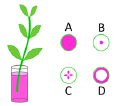
A cut twig is placed in coloured water as shown in the diagram below. After a few hours, when the twig is cut, how will it look (where will we find the coloured tissue)?

  1. AOption (a)

    Like figure C

  2. BOption (b)

    Like figure B

  3. COption (c)

    Like figure D

  4. DOption (d)

    Like figure A

View answer & explanation

Correct answer

Answer: (d)D.

Like figure A

Why this answer is correct

The correct answer is Like figure A.

Key Points

  • When a cut twig is placed in colored water, the colored water is absorbed through the xylem vessels.
  • Xylem vessels are responsible for the transport of water and nutrients from the roots to different parts of the plant.
  • The colored water travels up the stem and reaches the leaves, coloring the xylem tissue along the way.
  • The colored tissue will be visible in the xylem of the stem when the twig is cut after a few hours.

Additional Information

  • Xylem Tissue
  • Xylem is one of the two types of transport tissue in vascular plants, the other being phloem.
  • Xylem primarily conducts water and dissolved minerals from the roots to various parts of the plant.
  • It also provides mechanical support to the plant.
  • Xylem is composed of specialized cells like tracheids and vessel elements.
  • Capillary Action
  • Capillary action is the ability of a liquid to flow in narrow spaces without the assistance of external forces like gravity.
  • It plays a key role in the movement of water (and colored solution) through the xylem in plants.
  • This phenomenon is due to the adhesive and cohesive forces of water molecules.
  • Transpiration
  • Transpiration is the process of water movement through a plant and its evaporation from aerial parts, mainly from the leaves.
  • It creates a negative pressure that pulls water up through the xylem vessels from the roots.
  • Vascular Plants
  • Vascular plants are plants that have specialized tissues (xylem and phloem) for conducting water, minerals, and photosynthetic products throughout the plant.
  • Examples include ferns, conifers, and flowering plants.

Question 3

Formation of carbon monoxide from carbon dioxide is an example of ________.

  1. AOption (a)

    neutralisation reaction

  2. BOption (b)

    decomposition reaction

  3. COption (c)

    displacement reaction

  4. DOption (d)

    combination reaction

View answer & explanation

Correct answer

Answer: (b)B.

decomposition reaction

Why this answer is correct

The correct answer is decomposition reaction.

Key Points

  • A decomposition reaction is a type of chemical reaction where a single compound breaks down into two or more simpler substances.
  • The formation of carbon monoxide (CO) from carbon dioxide (CO₂) is an example of a decomposition reaction, as the compound (CO₂) breaks down under specific conditions.
  • 2CO2 → 2CO + O2
  • Decomposition reactions usually require an external energy source such as heat, light, or electricity, which helps break the chemical bonds within the compound.
  • In the given example, CO₂ decomposes into CO and oxygen (O₂) molecules, typically under high-temperature conditions or catalysis.
  • Decomposition reactions are essential in various industrial processes, such as the production of gases and extraction of metals.

Additional Information

  • Types of Decomposition Reactions:
  • Thermal decomposition: This occurs when a compound breaks down due to heat. For example, calcium carbonate (CaCO₃) decomposes into calcium oxide (CaO) and carbon dioxide (CO₂) when heated.
  • Photodecomposition: In this type, light energy causes the breakdown of a compound. For instance, silver chloride (AgCl) decomposes into silver (Ag) and chlorine gas (Cl₂) in the presence of sunlight.
  • Electrolytic decomposition: This type involves the use of electricity to decompose a compound, such as the breakdown of water (H₂O) into hydrogen (H₂) and oxygen (O₂) gases during electrolysis.
  • Other Reaction Types:
  • Neutralization reaction: It occurs when an acid reacts with a base to form salt and water. Example: HCl + NaOH → NaCl + H₂O.
  • Displacement reaction: In this reaction, one element displaces another in a compound. Example: Zn + CuSO₄ → ZnSO₄ + Cu.
  • Combination reaction: Two or more substances combine to form a single compound. Example: H₂ + O₂ → H₂O.
  • Applications of Decomposition Reactions:
  • Used in the extraction of metals from their ores, e.g., thermal decomposition of metal carbonates.
  • Important in the manufacturing of gases like oxygen and carbon dioxide.
  • Essential in chemical analysis to identify the composition of substances.
  • Industrial Significance:
  • Decomposition reactions are widely utilized in industries such as metallurgy, chemical manufacturing, and energy production.
  • Examples include the decomposition of limestone in cement production and the use of electrolytic decomposition in aluminum extraction.

Question 4

During a sale, a trader allows a 25% cash discount followed by a 10% trade discount. If the list price of an item is Rs. 800, then its selling price is:

  1. AOption (a)

    Rs. 510

  2. BOption (b)

    Rs. 280

  3. COption (c)

    Rs. 540

  4. DOption (d)

    Rs. 275

View answer & explanation

Correct answer

Answer: (c)C.

Rs. 540

Why this answer is correct

Shortcut Trick

Net discount % = a + b − (a × b) ÷ 100

Net discount = 25 + 10 − (25 × 10) ÷ 100 = 35 − 2.5 = 32.5%

Selling Price = List Price × (100 − Net Discount%) ÷ 100

SP = 800 × (100 − 32.5) ÷ 100 = 8 × 67.5 = 540

∴ The correct answer is Rs. 540.

Alternate Method

Given → List Price (MP) = Rs. 800, Cash Discount = 25%, Trade Discount = 10%. Formulas: SP = MP × (100 − D1%) ÷ 100 × (100 − D2%) ÷ 100

⇒ Price after 25% discount = 800 − (25% of 800) = 800 − 200 = 600 ⇒ Final Price after 10% trade discount = 600 − (10% of 600) = 600 − 60 = 540 ⇒ Selling Price = Rs. 540.

∴ The correct answer is Rs. 540.

Additional Information

Successive Discounts

When two or more discounts are applied one after another, the base for the second discount is the price obtained after the first discount.

List Price vs Selling Price

List Price is the printed price (MP), while Selling Price is the actual amount paid by the customer after all deductions.

Question 5

Which of the following is used for removing permanent hardness of water?

  1. AOption (a)

    CaOCl2

  2. BOption (b)

    NaHCO3

  3. COption (c)

    NaCl

  4. DOption (d)

    Na2CO3 10H2O

View answer & explanation

Correct answer

Answer: (d)D.

Na2CO3 10H2O

Why this answer is correct

The correct answer is Na2CO3 10H2O.

Key Points

  • Na2CO3 10H2O (Sodium Carbonate Decahydrate), also known as washing soda, is used to remove permanent hardness of water.
  • Permanent hardness of water is caused by the presence of dissolved calcium and magnesium salts, particularly in the form of chlorides and sulfates.
  • Washing soda works by precipitating out calcium and magnesium ions as their respective carbonates, thus softening the water.
  • This method is efficient and widely used in both domestic and industrial water softening processes.

Additional Information

  • Temporary Hardness
  • Temporary hardness is primarily caused by the presence of dissolved bicarbonate minerals (calcium bicarbonate and magnesium bicarbonate).
  • It can be removed by boiling the water, which decomposes the bicarbonates into carbonates, water, and carbon dioxide.
  • Permanent Hardness
  • Permanent hardness is caused by sulfate and chloride compounds of calcium and magnesium.
  • It cannot be removed by boiling and requires chemical treatment for removal.
  • Ion Exchange Method
  • Another method to remove permanent hardness is using ion exchange resins which replace calcium and magnesium ions with sodium or potassium ions.
  • This method is commonly used in water softeners.
  • Zeolite Process
  • In this method, hard water is passed through a bed of zeolite (hydrated sodium aluminosilicate) which exchanges its sodium ions for calcium and magnesium ions, thus softening the water.
  • The exhausted zeolite can be regenerated by washing it with a concentrated solution of sodium chloride.

Question 6

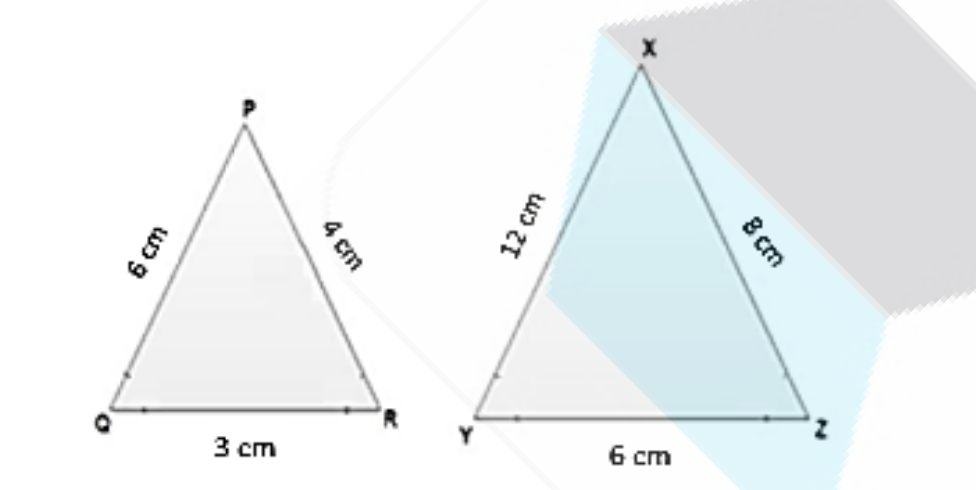
In the given figures (figures drawn are not to scale), by which of the following similarity criteria ΔPQR is similar to ΔXYZ, where S - side and A -Angle?

  1. AOption (a)

    SAS

  2. BOption (b)

    SSS

  3. COption (c)

    AAA

  4. DOption (d)

    AAS

View answer & explanation

Correct answer

Answer: (b)B.

SSS

Why this answer is correct

Shortcut Trick

Compare the three corresponding sides of both triangles.

⇒ 6 : 12 = 4 : 8 = 3 : 6 = 1 : 2

All three pairs of corresponding sides are proportional.

⇒ Therefore, the triangles are similar by the SSS criterion.

∴ The correct answer is SSS similarity criterion.

Alternate Method

Given:

△PQR: PQ = 6 cm, PR = 4 cm, QR = 3 cm

△XYZ: XY = 12 cm, XZ = 8 cm, YZ = 6 cm

Formula Used:

If the three corresponding sides of two triangles are proportional, then the triangles are similar by the SSS criterion.

P Q R 6 cm 4 cm 3 cm X Y Z 12 cm 8 cm 6 cm

Calculations:

⇒ PQ ÷ XY = 6 ÷ 12 = 1 ÷ 2

⇒ PR ÷ XZ = 4 ÷ 8 = 1 ÷ 2

⇒ QR ÷ YZ = 3 ÷ 6 = 1 ÷ 2

⇒ All three corresponding sides are proportional.

⇒ Therefore, △PQR ∼ △XYZ by the SSS similarity criterion.

∴ The correct answer is SSS similarity criterion.

Additional Information

SSS Similarity

If all three pairs of corresponding sides are proportional, the triangles are similar by the SSS criterion.

SAS Similarity

Two sides must be proportional and the included angle must be equal.

AAA Similarity

If all three corresponding angles are equal, the triangles are similar regardless of their side lengths.

Question 7

Two sides of a triangular field are 41 m and 28 m. If its perimeter is 84 m, then what is the length of the smallest altitude of the triangle? [Give your answer correct to two places of decimal.]

  1. AOption (a)

    6.12 m

  2. BOption (b)

    6.15 m

  3. COption (c)

    7.12 m

  4. DOption (d)

    7.15 m

View answer & explanation

Correct answer

Answer: (b)B.

6.15 m

Why this answer is correct

Shortcut Trick

Third side = 84 − (41 + 28) = 15 m.

Smallest altitude is always on the longest side (41 m).

Using Heron's Formula, Semi-perimeter (s) = 84 ÷ 2 = 42.

Area = √[42 × (42−41) × (42−28) × (42−15)] = √[42 × 1 × 14 × 27] = 126 m2.

Smallest Altitude = (2 × Area) ÷ Longest side = (2 × 126) ÷ 41 ≈ 6.15 m.

∴ The correct answer is 6.15 m.

Alternate Method

Given: Sides a = 41 m, b = 28 m, Perimeter = 84 m.

Formula: s = (a + b + c) ÷ 2 | Area = √[s(s−a)(s−b)(s−c)] | Area = (1/2) × base × height.

⇒ Third side c = 84 − (41 + 28) = 15 m.

⇒ Semi-perimeter s = 84 ÷ 2 = 42 m.

⇒ Area = √[42 × (42−41) × (42−28) × (42−15)]

⇒ Area = √[42 × 1 × 14 × 27] = √[15876] = 126 m2.

⇒ For smallest altitude, base must be the longest side (41 m).

⇒ 126 = (1/2) × 41 × hmin

⇒ hmin = 252 ÷ 41 ≈ 6.1463...

∴ The correct answer is 6.15 m.

Additional Information

Altitude and Side Relationship

In any triangle, the length of the altitude is inversely proportional to the length of the corresponding side. Thus, the longest side has the shortest altitude and vice versa.

Heron's Formula

Used to find the area of a triangle when all three sides are known: Area = √[s(s−a)(s−b)(s−c)], where s is the semi-perimeter.

Triangle Inequality

The sum of any two sides of a triangle must always be greater than the third side (e.g., 28 + 15 = 43 > 41).

Question 8

The ratio of currents flowing through two electric circuits is 1 ∶ 4. If the ratio of resistances is 2 ∶ 1. what is the ratio of their powers?

  1. AOption (a)

    32 ∶ 1

  2. BOption (b)

    1 ∶ 8

  3. COption (c)

    8 ∶ 1

  4. DOption (d)

    1 ∶ 32

View answer & explanation

Correct answer

Answer: (b)B.

1 ∶ 8

Why this answer is correct

The Correct answer is 1 ∶ 8.

Key Points

  • The formula for electric power is given by P = I²R, where:
  • P is the power,
  • I is the current,
  • R is the resistance.
  • The ratio of currents in the two circuits is given as 1 ∶ 4. This means the current in the second circuit is four times that in the first circuit.
  • The ratio of resistances in the two circuits is given as 2 ∶ 1. This means the resistance in the first circuit is double that in the second circuit.
  • To calculate the ratio of powers, substitute the given ratios into the formula for power:
  • For the first circuit: P₁ = I₁² × R₁
  • For the second circuit: P₂ = I₂² × R₂
  • Now, substitute the given ratios into the expressions for power:
  • I₁ : I₂ = 1 : 4, so I₁² : I₂² = 1² : 4² = 1 : 16
  • R₁ : R₂ = 2 : 1
  • Therefore, the ratio of powers is:
  • P₁ : P₂ = (I₁² × R₁) : (I₂² × R₂)
  • Substitute the values: P₁ : P₂ = (1 × 2) : (16 × 1) = 2 : 16 = 1 : 8
  • Hence, the ratio of powers in the two circuits is 1 ∶ 8.

 Additional Information

  • Important Concept: The formula for electric power is directly derived from Ohm's law and Joule's law of heating. It forms the basis of many practical applications in electrical engineering.
  • Current: The flow of electric charge is measured in amperes (A). Current plays a critical role in determining the power dissipation in a circuit.
  • Resistance: It opposes the flow of current and is measured in ohms (Ω). Higher resistance in a circuit leads to greater power dissipation.
  • Practical Example: This concept is often used in designing electrical circuits, such as in household appliances, to balance power usage efficiently.

Question 9

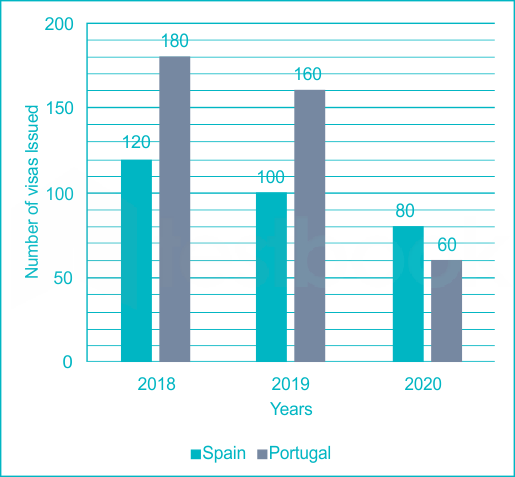
Study the given bar graph and answer the following question. The given bar graph depicts the number of visas issued for Spain and Portugal in 2018, 2019 and 2020.

What is the respective ratio between the total number of visas issued for both the countries in 2018 and the number of visas issued for Portugal in 2020?

  1. AOption (a)

    5 ∶ 2

  2. BOption (b)

    3 ∶ 1

  3. COption (c)

    5 ∶ 1

  4. DOption (d)

    3 ∶ 2

View answer & explanation

Correct answer

Answer: (c)C.

5 ∶ 1

Why this answer is correct

Formula Used:

To find the respective ratio, we calculate the total number of visas issued for both countries in 2018 and the number of visas issued for Portugal in 2020.

Calculation:

Total number of visas issued in 2018 for both Spain and Portugal:

Total for 2018 = Spain + Portugal = 120 + 180 = 300 visas

Number of visas issued for Portugal in 2020:

Portugal in 2020 = 60 visas

The ratio between the total visas issued in 2018 and the visas issued for Portugal in 2020:

Ratio = 300 / 60 = 5 : 1

∴ The ratio is 5 : 1.

Question 10

Which of the following Articles vests the executive powers of the State in the Governor?

  1. AOption (a)

    Article 181

  2. BOption (b)

    Article 154

  3. COption (c)

    Article 176

  4. DOption (d)

    Article 146

View answer & explanation

Correct answer

Answer: (b)B.

Article 154

Why this answer is correct

The correct answer is Article 154.

Key Points

  • Article 154 of the Indian Constitution vests the executive powers of the State in the Governor.
  • The Governor is the constitutional head of the state executive and exercises these powers either directly or through officers subordinate to him.
  • These executive powers are exercised in accordance with the Indian Constitution and the laws made by the State Legislature.
  • The Governor's powers include the appointment of the Chief Minister and other ministers, summoning and proroguing the state legislature, and dissolving the legislative assembly.

Additional Information

  • Governor's Role and Functions
  • The Governor acts as a link between the Union Government and the State Government.
  • They have the power to grant pardons, reprieves, respites, or remissions of punishment or to suspend, remit or commute the sentence of any person convicted of any offense against any law relating to a matter to which the executive power of the state extends.
  • In cases of constitutional crises, the Governor can assume the functions of the government of the state or any of its functions to himself.
  • The Governor also performs ceremonial duties, such as addressing the state legislature during budget sessions.
  • Executive Powers of the State
  • The executive power of the state is co-extensive with its legislative power and extends to all matters on which the State Legislature has the power to make laws.
  • It includes the implementation of laws, maintaining law and order, and ensuring that the provisions of the Constitution are upheld.
  • These powers are exercised in the name of the Governor, but decisions are taken by the Council of Ministers headed by the Chief Minister.
  • The Governor also has the power to appoint key officials such as the Advocate General and members of the State Public Service Commission.
  • Constitutional Provisions for the Governor
  • Article 153: Provides for the appointment of a Governor for each state.
  • Article 155: The Governor of a state shall be appointed by the President of India.
  • Article 156: The Governor holds office during the pleasure of the President and for a term of five years.
  • Article 161: The Governor has the power to grant pardons, reprieves, etc.

Question 11

In an electric motor, the forces acting on the arms of the armature of the motor that are perpendicular to the direction of magnetic field are:

  1. AOption (a)

    equal in magnitude and in the same direction

  2. BOption (b)

    equal in magnitude and opposite in direction

  3. COption (c)

    unequal in magnitude and along same direction

  4. DOption (d)

    unequal in magnitude and in the opposite direction

View answer & explanation

Correct answer

Answer: (b)B.

equal in magnitude and opposite in direction

Why this answer is correct

The correct answer is equal in magnitude and opposite in direction.

Key Points

  • In an electric motor, the armature is a rotating coil placed in a magnetic field.
  • When an electric current passes through the coil, the magnetic field interacts with the current, producing forces on the arms of the coil according to the Fleming's left-hand rule.
  • The forces acting on the two opposite arms of the armature are equal in magnitude because the current and the magnetic field are the same for both arms.
  • However, these forces act in opposite directions because the current flows in opposite directions in the two arms, resulting in opposite force directions as per the left-hand rule.
  • This difference in force directions creates a torque that rotates the armature, which is the fundamental working principle of an electric motor.
  • The equal and opposite forces ensure a balanced system, aiding in smooth and efficient rotation of the armature.

 Additional Information

  • Option 1: Equal in magnitude and in the same direction
  • If the forces were in the same direction, there would be no rotational motion because the forces would simply move the armature linearly.
  • This contradicts the principle of torque generation in an electric motor.
  • Option 3: Unequal in magnitude and along the same direction
  • Forces of unequal magnitude cannot balance the system, leading to instability and improper functioning of the motor.
  • Option 4: Unequal in magnitude and in the opposite direction
  • If the forces were unequal, the armature would experience an unbalanced torque, causing inefficient or erratic rotation.

Question 12

Find the smallest number from the options given below, by which 242 should be divided so as to make the quotient a perfect square.

  1. AOption (a)

    3

  2. BOption (b)

    1

  3. COption (c)

    4

  4. DOption (d)

    2

View answer & explanation

Correct answer

Answer: (d)D.

2

Why this answer is correct

Shortcut Trick

Perform Prime Factorization of 242.

242 = 2 × 121 = 2 × 11 × 11

In a perfect square, all prime factors must be in pairs.

Here, 11 is in a pair (112), but 2 is unpaired.

Divide by the unpaired factor 2 to make it a perfect square.

∴ The correct answer is 2.

Alternate Method

Given: Number = 242

Step 1: Find the prime factors of 242.

⇒ 242 ÷ 2 = 121

⇒ 121 ÷ 11 = 11

⇒ 11 ÷ 11 = 1

⇒ 242 = 21 × 112

Step 2: Identify the factor with an odd power.

⇒ The factor 2 has an exponent of 1 (odd).

Step 3: Divide 242 by this factor.

⇒ 242 ÷ 2 = 121

⇒ 121 = 112 (a perfect square).

∴ The correct answer is 2.

Additional Information

Perfect Square Property

A number is a perfect square if every prime factor in its prime factorization occurs an even number of times.

Making a Perfect Square (Multiplication/Division)

To make a number N a perfect square, multiply or divide it by the product of all prime factors that have odd exponents.

Smallest Perfect Squares

Familiarize with squares: 112 = 121, 122 = 144, 132 = 169, 142 = 196, 152 = 225.

Question 13

which two numbers from amongst the given options should be interchanged to make the given equation correct?

382 + 9 ÷ 4 - 39 × 172 = 74

  1. AOption (a)

    9 and 4

  2. BOption (b)

    4 and 172

  3. COption (c)

    382 and 39

  4. DOption (d)

    9 and 172

View answer & explanation

Correct answer

Answer: (d)D.

9 and 172

Why this answer is correct

Given: 382 + 9 ÷ 4 - 39 × 172 = 74

According to the question, after interchanging the numbers:

Option 1) 9 and 4 

382 + 9 ÷ 4 - 39 × 172 = 74 ⇒ 382 + 4 ÷ 9 - 39 × 172 = 74

⇒ 382 + 4 ÷ 9 - 39 × 172 = 74

⇒ 382 + 0.44 - 6708 = 74

⇒ 382.44 - 6708 = 74

⇒ -6325.56 ≠ 74 (LHS ≠ RHS)

Option  2) 4 and 172

382 + 9 ÷ 4 - 39 × 172 = 74 ⇒ 382 + 9 ÷ 172 - 39 × 4 = 74

⇒ 382 + 9 ÷ 172 - 39 × 4 = 74

⇒ 382 + 0.05 - 39 × 4 = 74

⇒ 382 + 0.05 - 156 = 74

⇒ 382.05 - 156 = 74

⇒ 226.05 ≠ 74 (LHS ≠ RHS)

Option  3) 382 and 39

382 + 9 ÷ 4 - 39 × 172 = 74 ⇒ 39 + 9 ÷ 4 - 382 × 172 = 74

⇒ 39 + 9 ÷ 4 - 382 × 172 = 74

⇒ 39 + 2.25 - 382 × 172 = 74

⇒ 39 + 2.25 - 65704 = 74

⇒ 41.25 - 65704 = 74

⇒ -65662.75 ≠ 74 (LHS ≠ RHS)

Option  4) 9 and 172

382 + 9 ÷ 4 - 39 × 172 = 74 ⇒ 382 + 172 ÷ 4 - 39 × 9 = 74

⇒ 382 + 172 ÷ 4 - 39 × 9 = 74

⇒ 382 + 43 - 39 × 9 = 74

⇒ 382 + 43 - 351 = 74

⇒ 425 - 351 = 74

⇒ 74 = 74 (LHS = RHS)

Hence, "Option 4" is the correct answer.

Question 14

The image produced by a concave mirror when an object is kept at the centre of the curvature of the mirror is:

  1. AOption (a)

    virtual and erect

  2. BOption (b)

    real and inverted

  3. COption (c)

    real and erect

  4. DOption (d)

    virtual and inverted

View answer & explanation

Correct answer

Answer: (b)B.

real and inverted

Why this answer is correct

The correct answer is real and inverted.

Key Points

  • When an object is placed at the center of curvature of a concave mirror, the image formed is real and inverted.
  • The image is formed at the center of curvature itself.
  • The size of the image is the same as the size of the object.
  • The focal length of a concave mirror is half of its radius of curvature.

Additional Information

  • Concave Mirror
  • A concave mirror, also known as a converging mirror, has a reflective surface that curves inward like a portion of the interior of a sphere.
  • It is used in various applications such as in telescopes, flashlights, and shaving mirrors to focus light.
  • Image Formation by Concave Mirrors
  • When the object is placed at the focus of a concave mirror, the image formed is at infinity, real, and inverted.
  • When the object is placed between the focus and the center of curvature, the image is formed beyond the center of curvature, is real, inverted, and larger than the object.
  • When the object is placed beyond the center of curvature, the image is formed between the focus and center of curvature, is real, inverted, and smaller than the object.
  • Mirror Equation
  • The mirror equation is given by 1/f = 1/v + 1/u, where f is the focal length, v is the image distance, and u is the object distance.
  • This equation helps in determining the nature and position of the image formed by mirrors.

Question 15

Which reaction occurs when a student adds a few drops of lemon in milk?

  1. AOption (a)

    Precipitation reaction

  2. BOption (b)

    Combination reaction

  3. COption (c)

    Hydrolysis

  4. DOption (d)

    Displacement reaction

View answer & explanation

Correct answer

Answer: (a)A.

Precipitation reaction

Why this answer is correct

The correct answer is Precipitation reaction.

Key Points

  • When lemon juice is added to milk, it causes the milk to curdle, forming lumps of curd.
  • This reaction is a classic example of a precipitation reaction.
  • The citric acid in lemon juice causes the proteins in the milk to denature and coagulate.
  • The solid particles (curds) formed during this process are the precipitate, and the liquid left behind is whey.

Additional Information

  • Precipitation Reaction:
  • A chemical reaction in which a solid is formed in a solution during a chemical reaction.
  • The solid formed is called the precipitate.
  • This type of reaction is often used in qualitative chemical analysis.
  • Curdling of Milk:
  • Occurs when the pH level of milk falls, causing proteins to clump together.
  • Commonly observed when an acid like lemon juice or vinegar is added to milk.
  • It is an essential process in the production of cheese and yogurt.
  • Denaturation of Proteins:
  • A process where proteins lose their structure due to the application of an external stress or compound.
  • This can be caused by acids, bases, heat, or heavy metals.
  • Denatured proteins can precipitate out of solution as seen in the curdling of milk.

Question 16

Refer to the following letter series and answer the question.

Y A B U Y H I R J S B R X M P Q S D I R A Y E F G

How many such consonants are there each of which is immediately preceded by a vowel and also immediately followed by a vowel?

  1. AOption (a)

    3

  2. BOption (b)

    2

  3. COption (c)

    1

  4. DOption (d)

    4

View answer & explanation

Correct answer

Answer: (a)A.

3

Why this answer is correct

Given series:

Y A B U Y H I R J S B R X M P Q S D I R A Y E F G

Condition to be checked:

Consonants which are immediately preceded by a vowel and also immediately followed by a vowel.

Vowel → Consonant → Vowel

Y A B U Y H I R J S B R X M P Q S D I R A Y E F G

Thus there are three such patterns (A B U, I R A, A Y E) that follow the above conditions.

Hence, "Option 1" is the correct answer.

Mistake Points

Immediately preceded by means immediately before or to come just before.

Immediately followed by means immediately after or to come just after.

Question 17

A statement is given followed by two possible conclusions numbered I and II. You have to assume everything in the statement to be true and on the basis of it, decide which of the conclusions logically follow(s).

Statement:

Playing with mud and butterflies in a garden is more beneficial for small children than watching academic videos on computers or mobile phones.

Conclusions:

I. Mobile phones and computers are harmful for small children.

II. Real experiences are more beneficial than virtual experiences for children's development.

  1. AOption (a)

    Only conclusion I follows

  2. BOption (b)

    Only conclusion II follows

  3. COption (c)

    Both the conclusions follow

  4. DOption (d)

    Neither conclusion follows

View answer & explanation

Correct answer

Answer: (b)B.

Only conclusion II follows

Why this answer is correct

Given,

Statement:

Playing with mud and butterflies in a garden is more beneficial for small children than watching academic videos on computers or mobile phones.

Conclusions:

I. Mobile phones and computers are harmful for small children - False

(Because the statement highlights the comparative benefits of playing outdoors versus watching academic videos on devices but does not explicitly claim that mobile phones or computers are harmful to children.)

II. Real experiences are more beneficial than virtual experiences for children's development - True

(Because the statement directly emphasizes that playing in a garden, which is a real experience, is more beneficial for small children than watching academic videos, which are virtual experiences.)

So, Only conclusion II follows.

Hence, the correct answer is "Option 2".

Question 18

If the cost price of 63 articles is equal to the selling price of 54 articles, then what is the percentage gain or loss?

  1. AOption (a)

    151/3% loss

  2. BOption (b)

    162/3% loss

  3. COption (c)

    151/3%  gain

  4. DOption (d)

    162/3% gain

View answer & explanation

Correct answer

Answer: (d)D.

162/3% gain

Why this answer is correct

Shortcut Trick

Ratio of Cost Price (CP) to Selling Price (SP) is inversely proportional to the number of articles.

Given: 63 × CP = 54 × SP ⇒ CP ÷ SP = 54 ÷ 63 = 6 ÷ 7.

Gain = SP − CP = 7 − 6 = 1 unit.

Gain% = (Gain ÷ CP) × 100 = (1 ÷ 6) × 100 = 16 2/3%.

Since SP > CP, it is a Gain.

∴ The correct answer is 16 2/3% gain.

Alternate Method

Given: CP of 63 articles = SP of 54 articles.

Formulas: Profit = SP − CP | Profit% = (Profit ÷ CP) × 100

⇒ Let the CP of 1 article be Re. 1.

⇒ Total CP of 63 articles = Rs. 63.

⇒ SP of 54 articles = CP of 63 articles = Rs. 63.

⇒ CP of 54 articles = Rs. 54.

⇒ Profit on 54 articles = SP − CP = 63 − 54 = Rs. 9.

⇒ Profit% = (9 ÷ 54) × 100 = (1 ÷ 6) × 100 = 16 2/3%.

∴ The correct answer is 16 2/3% gain.

Additional Information

Profit and Loss on Article Basis

When the CP of 'm' articles is equal to the SP of 'n' articles, the Profit or Loss percentage is calculated as [(m − n) ÷ n] × 100. A positive result indicates Gain, and a negative result indicates Loss.

Cost Price & Selling Price Relationship

Profit always occurs when the Selling Price is greater than the Cost Price. The percentage is always calculated on the Cost Price unless specified otherwise.

Question 19

The Indian Councils Act of 1909 is also termed as the ________.

  1. AOption (a)

    Simon Commission

  2. BOption (b)

    Quit India Movement

  3. COption (c)

    Chauri Chaura incident

  4. DOption (d)

    Morley-Minto Reforms

View answer & explanation

Correct answer

Answer: (d)D.

Morley-Minto Reforms

Why this answer is correct

The correct answer is Morley-Minto Reforms.

Key Points

  • The Indian Councils Act of 1909 is also known as the Morley-Minto Reforms.
  • This act was named after John Morley, the Secretary of State for India, and Lord Minto, the Viceroy of India.
  • The act introduced significant changes to the legislative councils in India, including the expansion of the councils and the introduction of separate electorates for Muslims.
  • The reforms aimed to increase Indian participation in governance while maintaining British control.
  • These reforms are considered a pivotal moment in the constitutional development of India, marking the beginning of the communal representation in Indian politics.

Additional Information

  • Separate Electorates:
  • The Morley-Minto Reforms introduced separate electorates for Muslims, allowing them to elect their representatives separately.
  • This system aimed to provide political representation to minority communities but later contributed to communal divisions.
  • Legislative Councils:
  • The act increased the size of the legislative councils at both the central and provincial levels.
  • Non-official members were allowed to discuss budgets and ask questions, enhancing their role in governance.
  • John Morley:
  • John Morley was the Secretary of State for India and played a key role in formulating the 1909 reforms.
  • He believed in the gradual introduction of self-governance in India.
  • Lord Minto:
  • Lord Minto was the Viceroy of India from 1905 to 1910 and collaborated with John Morley on the reforms.
  • He aimed to balance the demands for Indian participation with the need to maintain British control.
  • Impact on Indian Politics:
  • The introduction of separate electorates had long-term impacts on Indian politics, contributing to communal tensions.
  • Despite its limitations, the act was a step towards the eventual self-governance of India.

Question 20

The phenomena of scattering of light by colloidal particles gives rise to ________.

  1. AOption (a)

    dispersion

  2. BOption (b)

    Tyndall effect

  3. COption (c)

    Total internal reflection

  4. DOption (d)

    refraction of light

View answer & explanation

Correct answer

Answer: (b)B.

Tyndall effect

Why this answer is correct

The correct answer is Tyndall effect.

Key Points

  • The Tyndall effect is the scattering of light as it passes through a colloid.
  • This phenomenon is observed when light is scattered by particles in a colloid or in very fine suspensions.
  • It is named after the 19th-century physicist John Tyndall, who first studied the phenomenon.
  • The Tyndall effect is responsible for the blue color of the sky and the reddening of the sun at sunset and sunrise.

Additional Information

  • Colloids
  • A colloid is a mixture in which one substance consisting of microscopically dispersed insoluble particles is suspended throughout another substance.
  • Colloids can be solid, liquid, or gas.
  • Examples of colloids include fog, milk, and butter.
  • Dispersion of Light
  • Dispersion is the process in which white light separates into its constituent colors when passed through a prism.
  • This occurs because different colors of light bend by different amounts when they pass through the prism.
  • Refraction of Light
  • Refraction is the bending of light as it passes from one medium to another with a different density.
  • This is due to the change in speed of light in different media.
  • Total Internal Reflection
  • Total internal reflection occurs when light attempts to move from a denser medium to a less dense medium at an angle greater than the critical angle, causing it to be completely reflected within the denser medium.
  • This principle is used in fiber optics and other applications.

Question 21

If the mean and the mode of a data set are 5 and 8, respectively, then, using the relevant empirical relation, find the median of the same data set.

  1. AOption (a)

    6

  2. BOption (b)

    3.5

  3. COption (c)

    7

  4. DOption (d)

    14

View answer & explanation

Correct answer

Answer: (a)A.

6

Why this answer is correct

Shortcut Trick The Median is always located at exactly 1/3rd of the distance from the Mean towards the Mode. Total difference (Mode − Mean) = 8 − 5 = 3 Distance from Mean to Median = 1/3 × 3 = 1 Median = Mean + 1 = 5 + 1 = 6 ∴ The correct answer is 6. Alternate Method Given: Mean = 5 Mode = 8 Formula Used: The empirical relationship between Mean, Median, and Mode for a moderately skewed distribution is: Mode = 3 × Median − 2 × Mean

Mean = 5 Median = 6 Mode = 8

1 part

2 parts

Total Difference = 3

Median divides Mean and Mode distance in 1 : 2 ratio

Calculations: ⇒ 8 = 3 × Median − (2 × 5) ⇒ 8 = 3 × Median − 10 ⇒ 3 × Median = 8 + 10 ⇒ 3 × Median = 18 ⇒ Median = 18 ÷ 3 ⇒ Median = 6 ∴ The correct answer is 6. Additional Information Symmetrical Distribution For a perfectly symmetrical distribution (like the standard Normal Distribution), all three measures of central tendency coincide completely: Mean = Median = Mode. Positively Skewed Distribution The distribution is pulled by extreme high values creating a long right tail. The relationship is always: Mode < Median < Mean. Negatively Skewed Distribution The distribution is pulled by extreme low values creating a long left tail. The relationship is always: Mean < Median < Mode. (This matches the condition in the given question).

Question 22

How do you know if someone was infected with HIV a year ago?

  1. AOption (a)

    by anti-HIV antibodies in the blood

  2. BOption (b)

    Persistent fever (for more than a month)

  3. COption (c)

    by a low number of blood cells

  4. DOption (d)

    weight loss and fatigue

View answer & explanation

Correct answer

Answer: (a)A.

by anti-HIV antibodies in the blood

Why this answer is correct

The correct answer is by anti-HIV antibodies in the blood.

Key Points

  • HIV (Human Immunodeficiency Virus) infection is confirmed by detecting specific antibodies against the virus in the blood.
  • These antibodies typically become detectable within 3-12 weeks after the initial infection.
  • Standard HIV tests, such as ELISA (Enzyme-Linked Immunosorbent Assay), are commonly used to detect these antibodies.
  • A confirmatory test, such as a Western blot, is often used to validate the results of the initial screening test.
  • Early detection through these tests is crucial for timely initiation of antiretroviral therapy (ART) and better management of the infection.

Additional Information

  • HIV/AIDS:
  • HIV is a virus that attacks the body's immune system, specifically the CD4 cells (T cells).
  • If not treated, HIV can lead to the disease AIDS (Acquired Immunodeficiency Syndrome).
  • Unlike some other viruses, the human body cannot get rid of HIV completely, so once someone has HIV, they have it for life.
  • Antiretroviral Therapy (ART):
  • ART involves taking a combination of HIV medicines every day.
  • It helps reduce the viral load in the blood to undetectable levels, which helps maintain the immune system and prevent transmission.
  • While ART is not a cure, it enables individuals with HIV to live longer, healthier lives.
  • HIV Testing:
  • Regular HIV testing is recommended for individuals at higher risk of infection, such as those with multiple sexual partners or those who use intravenous drugs.
  • There are different types of HIV tests, including rapid tests, home testing kits, and laboratory-based tests.
  • Early diagnosis through testing is crucial for initiating treatment and preventing the spread of the virus.
  • Prevention:
  • Preventative measures include using condoms during sexual intercourse, taking pre-exposure prophylaxis (PrEP), and avoiding sharing needles.
  • Education and awareness programs play a vital role in reducing the incidence of new HIV infections.

Question 23

The SI unit of electric power is _______.

  1. AOption (a)

    Newton

  2. BOption (b)

    Watt

  3. COption (c)

    Joule

  4. DOption (d)

    Calorie

View answer & explanation

Correct answer

Answer: (b)B.

Watt

Why this answer is correct

The correct answer is Watt.

Key Points

  • The SI unit of electric power is the Watt (W).
  • One Watt is defined as the rate of energy transfer equivalent to one joule per second.
  • The unit is named after James Watt, the Scottish engineer who made significant contributions to the development of the steam engine.
  • Electric power is calculated using the formula P = V × I, where P is power in watts, V is voltage in volts, and I is current in amperes.
  • Devices such as light bulbs, appliances, and machinery commonly have their power ratings specified in watts.

Additional Information

  • Joule (J)
  • The Joule is the SI unit of energy, defined as the amount of work done when a force of one newton displaces an object by one meter.
  • It is also used to measure heat, mechanical work, and electrical energy.
  • Newton (N)
  • The Newton is the SI unit of force.
  • It is defined as the force that gives a mass of one kilogram an acceleration of one meter per second squared.
  • Calorie (cal)
  • A Calorie is a unit of energy commonly used to measure the energy content of foods.
  • One Calorie is the amount of energy needed to raise the temperature of one gram of water by one degree Celsius.
  • Electric Power
  • Electric power is the rate at which electrical energy is transferred by an electric circuit.
  • It is typically measured in watts (W) and can be derived from the product of voltage and current.

Question 24

When two resistors are connected in series, their total effective resistance is 120Ω. When the same two resistors are connected in parallel then their effective resistance is 30Ω. The resistances of the two resistors are:

  1. AOption (a)

    70Ω and 50Ω

  2. BOption (b)

    80Ω and 40Ω

  3. COption (c)

    90Ω and 30Ω

  4. DOption (d)

    60Ω and 60Ω each

View answer & explanation

Correct answer

Answer: (d)D.

60Ω and 60Ω each

Why this answer is correct

The Correct answer is 60Ω and 60Ω each.

Key Points

  • When two resistors are connected in series, their total resistance is the sum of their individual resistances. If the resistances are R₁ and R₂, then the total series resistance is R₁ + R₂.
  • In this case, the total series resistance is given as 120Ω. Therefore, R₁ + R₂ = 120Ω.
  • When the same two resistors are connected in parallel, the effective resistance is calculated using the formula: 1/R = 1/R₁ + 1/R₂.
  • The effective parallel resistance is given as 30Ω. Therefore, 1/30 = 1/R₁ + 1/R₂.
  • Using the two equations:
  • R₁ + R₂ = 120 (equation 1)
  • 1/R₁ + 1/R₂ = 1/30 (equation 2)
  • From equation 2, solving for R₁ and R₂, we find that the values of the resistances are 60Ω and 60Ω.
  • Substituting these values into both equations satisfies the conditions:
  • 60 + 60 = 120Ω (series connection).
  • 1/60 + 1/60 = 1/30, which simplifies to 30Ω (parallel connection).
  • Hence, the resistances of the two resistors are 60Ω and 60Ω each.

 Additional Information

  • Key Concept Explanation:
  • In a series circuit, the total resistance is the sum of the resistances because the current flows through each resistor sequentially.
  • In a parallel circuit, the reciprocal of the total resistance is the sum of the reciprocals of the individual resistances because the current splits and flows through multiple paths.
  • The condition of both series and parallel connections allows us to solve the problem using algebraic equations.
  • Why Other Options are Incorrect:
  • Options with resistances such as 70Ω and 50Ω, 80Ω and 40Ω, or 90Ω and 30Ω do not satisfy both the series and parallel conditions.
  • For example, if we try 70Ω and 50Ω, their series resistance is 120Ω, but their parallel resistance would be 28Ω, not 30Ω. Similar inconsistencies occur for the other options.

Question 25

Which Indian state celebrates Rongali Bihu, a spring dramatic-cultural festival?

  1. AOption (a)

    Tripura

  2. BOption (b)

    Assam

  3. COption (c)

    West Bengal

  4. DOption (d)

    Meghalaya

View answer & explanation

Correct answer

Answer: (b)B.

Assam

Why this answer is correct

The correct answer is Assam.

Key Points

  • Rongali Bihu, also known as Bohag Bihu, is the most celebrated festival in Assam, marking the Assamese New Year.
  • It is celebrated in April, usually around the 13th to 15th of the month, and marks the beginning of the Assamese calendar year.
  • The festival lasts for several days and includes various cultural activities such as traditional dance (Bihu dance), music, and feasting.
  • Rongali Bihu is a spring festival that signifies the arrival of spring and the agricultural season, reflecting the agrarian culture of Assam.

Additional Information

  • Bihu Festival Types:
  • There are three primary Bihu festivals in Assam: Rongali or Bohag Bihu (spring festival), Kongali or Kati Bihu (autumn festival), and Bhogali or Magh Bihu (winter festival).
  • Each of these festivals marks a significant phase in the Assamese agricultural calendar.
  • Traditional Attire:
  • During Rongali Bihu, people wear traditional Assamese attire. Women wear mekhela chador, and men wear dhotis and gamusas.
  • These garments are often adorned with traditional motifs and are usually handwoven.
  • Bihu Dance and Music:
  • The Bihu dance is a joyous and energetic form of dance performed by young men and women.
  • The music accompanying the dance is characterized by the use of traditional instruments such as the dhol (drum), pepa (a wind instrument), and gagana (a mouth organ).
  • Community Feasts:
  • Rongali Bihu is synonymous with community feasts where traditional Assamese dishes such as pitha (rice cakes), larus (sweets made from rice and coconut), and various fish and meat dishes are prepared and enjoyed.
  • It is a time for families and communities to come together and celebrate with much joy and camaraderie.
  • Symbol of Unity:
  • Rongali Bihu is not just a festival but a symbol of Assamese unity and identity, bringing people from all walks of life together to celebrate their shared heritage and culture.

Question 26

Which of the following can lead to sustainable management of forest resources?

  1. AOption (a)

    Adjusting the harvest of wood depending on the rate of growth of forests

  2. BOption (b)

    Making forests off-limits to human beings and their livestock

  3. COption (c)

    Using money from safari tourists to protect forests from logging

  4. DOption (d)

    Applying fertilisers and growth promoters to enhance the growth of trees

View answer & explanation

Correct answer

Answer: (a)A.

Adjusting the harvest of wood depending on the rate of growth of forests

Why this answer is correct

The correct answer is Adjusting the harvest of wood depending on the rate of growth of forests.

Key Points

  • Sustainable Yield Management: Adjusting the harvest of wood based on the natural growth rate of forests ensures that the extraction does not exceed the regeneration capacity, promoting long-term forest health.
  • Ecological Balance: This practice helps maintain the ecological balance, supporting biodiversity and the overall stability of forest ecosystems.
  • Resource Availability: Sustainable harvesting ensures continuous availability of forest resources for future generations, preventing depletion and over-exploitation.
  • Economic Stability: By regulating wood harvests, it provides economic stability to communities dependent on forestry, ensuring a steady supply of raw materials.
  • Compliance with Environmental Policies: It aligns with environmental policies and international agreements aimed at sustainable forest management.

Additional Information

  • Forest Management
  • Involves planning and implementing practices for the stewardship and use of forests to meet specific environmental, economic, social, and cultural objectives.
  • Key principles include sustainability, conservation, and ensuring the health and vitality of forest ecosystems.
  • Biodiversity
  • Refers to the variety of life in a particular habitat or ecosystem, crucial for resilience and adaptability of forests.
  • Sustainable forest management practices support biodiversity by preserving natural habitats and reducing the impact on wildlife.
  • Carbon Sequestration
  • The process by which forests capture and store carbon dioxide from the atmosphere, playing a vital role in mitigating climate change.
  • Sustainable forestry practices enhance carbon sequestration by maintaining healthy, growing forests.
  • Community Involvement
  • Involving local communities in forest management can lead to more effective and sustainable outcomes.
  • Provides livelihoods and empowers communities while promoting conservation and sustainable use of forest resources.
  • Forest Certification
  • A system for verifying that forests are managed sustainably according to specific environmental, social, and economic standards.
  • Examples include the Forest Stewardship Council (FSC) and Programme for the Endorsement of Forest Certification (PEFC).

Question 27

Read the given statements and conclusions carefully. Assuming that the information given in the statements is true, even if it appears to be at variance with commonly known facts, decide which of the given conclusions logically follow(s) from the statements.

Statements:

All lilies are daisies.

All roses are lilies.

All petunias are lilies.

Conclusions:

I. Some daisies are petunias.

II. Some roses are petunias.

  1. AOption (a)

    Only conclusion II follows

  2. BOption (b)

    Neither conclusion I nor II follows

  3. COption (c)

    Both conclusions I and II follow

  4. DOption (d)

    Only conclusion I follows

View answer & explanation

Correct answer

Answer: (d)D.

Only conclusion I follows

Why this answer is correct

The least possible Venn diagram for the given statements is as shown below :

Conclusions:

I. Some daisies are petunias → Follow (As all lilies are daisies and all petunias are lilies. As whole petunias comes in lilies which whole comes daisies, therefore it is true.)

II. Some roses are petunias → Does not follow (As all roses are lilies and all petunias are lilies. So it is possible but not definite.)

∴ Here, Only conclusion I follows.​

Hence, the correct answer is "Option 4".

Question 28

There are three pipes A, B and C in a tank. The first pipe A can fill the empty tank in 8 hours, the second pipe B can fill the empty tank in 10 hours, and the third pipe C can empty the completely filled tank in 20 hours. If the three pipes are opened together when the tank is completely empty, then in how many hours will the tank be completely filled?

  1. AOption (a)

    2511\frac{25}{11} hours

  2. BOption (b)

    2011\frac{20}{11} hours

  3. COption (c)

    307\frac{30}{7} hours

  4. DOption (d)

    407\frac{40}{7} hours

View answer & explanation

Correct answer

Answer: (d)D.

407\frac{40}{7} hours

Why this answer is correct

Shortcut Trick

Net efficiency = Efficiency of A + Efficiency of B − Efficiency of C

Total Work = LCM(8, 10, 20) = 40 units

Individual efficiencies: A = 5, B = 4, C = 2

Combined efficiency = 5 + 4 − 2 = 7 units/hr

Time taken = Total Work ÷ Net Efficiency = 40/7 hr

∴ The correct answer is 40/7 hr.

Alternate Method

Given:

Time taken by Pipe A (Filling) = 8 hours

Time taken by Pipe B (Filling) = 10 hours

Time taken by Pipe C (Emptying) = 20 hours

Formula Used:

Total Work = LCM of individual times

Efficiency = Total Work ÷ Time

PipeTime (hr)Total WorkEfficiency
A8405
B104
C20−2

Calculations:

⇒ Net efficiency of (A + B + C) = 5 + 4 − 2

⇒ Net efficiency = 7 units/hr

⇒ Time required to fill the tank = Total Work ÷ Net efficiency

⇒ Time = 40/7 hours

∴ The correct answer is 40/7 hr.

Additional Information

Inlet and Outlet Pipes

Inlet pipes have positive efficiency as they add water, while outlet pipes (leaks) have negative efficiency as they remove water.

Work & Time Relation

If a pipe fills a tank in 'x' hours, the part filled in 1 hour is 1/x. If all work together: 1/T = 1/A + 1/B − 1/C.

Question 29

A, B, C, D, E, F, G and H live on eight different floors of the same building. The lowermost floor in the building is numbered 1, the floor above it, number 2 and so on till the topmost floor is numbered 8.

D lives on an even numbered floor but does not live on floor number 4 or 2. Only five persons live between D and A.C lives immediately above A. H lives on floor number 1. Only B lives between the floors of F and D. E does not live on an even numbered floor. How many people live above E's floor?

  1. AOption (a)

    4

  2. BOption (b)

    1

  3. COption (c)

    2

  4. DOption (d)

    3

View answer & explanation

Correct answer

Answer: (d)D.

3

Why this answer is correct

Given: A, B, C, D, E, F, G and H live on eight different floors of the same building. The lowermost floor in the building is numbered 1, the floor above it, number 2 and so on till the topmost floor is numbered 8.

1) D lives on an even numbered floor but does not live on floor number 4 or 2.

2) Only five persons live between D and A. 

FloorPerson
8D
7
6
5
4
3
2A
1

3) C lives immediately above A. 

4) H lives on floor number 1.

FloorPerson
8D
7
6
5
4
3C
2A
1H

5) Only B lives between the floors of F and D.

FloorPerson
8D
7B
6F
5
4
3C
2A
1H
  1. E does not live on an even numbered floor.

After positioning E only one position is left which will be occupied by the only person left i.e. G.

FloorPerson
8D
7B
6F
5E
4G
3C
2A
1H

Thus. according to the final arrangement, three people live above E's floor.

Hence, "Option 4" is the correct answer.

Question 30

In a certain code language, 'PROOF' is written as 'OPLKA' and 'BONES' is written as 'AMKAN'. How will 'MINKS' be written in that language?

  1. AOption (a)

    LHKHO

  2. BOption (b)

    LGKGN

  3. COption (c)

    LKGKN

  4. DOption (d)

    LKHGO

View answer & explanation

Correct answer

Answer: (b)B.

LGKGN

Why this answer is correct

The logic followed here is:

'PROOF' is written as 'OPLKA'

And,

'BONES' is written as 'AMKAN'

Similarly,

'MINKS' is written as

Hence, "Option 2" is the correct answer.

Question 31

Match the columns.

Group - IGroup - II
I.solid wasteA.Composting
II.organic wasteB.open dumping
III.Hospital WasteC.Incineration
  1. AOption (a)

    I – B, II – C, III – A

  2. BOption (b)

    I – C, II – A, III – B

  3. COption (c)

    I – C, II – B, III – A

  4. DOption (d)

    I – B, II – A, III – C

View answer & explanation

Correct answer

Answer: (d)D.

I – B, II – A, III – C

Why this answer is correct

The correct answer is option 4: I – B, II – A, III – C.

Key Points

  • Solid Waste and Open Dumping: Solid waste, often comprising a mix of various kinds of wastes including both decomposable and non-decomposable materials, is frequently managed through open dumping, especially in less regulated areas.
  • Organic Waste and Composting: Organic waste, which includes food scraps, yard waste, and other biodegradable materials, is ideally suited for composting. Composting is a process that accelerates the natural decay of organic material and transforms it into a valuable fertilizer for soil enrichment.
  • Hospital Waste and Incineration: Hospital waste, which includes biohazardous materials and items that are potentially infectious or contaminated, is best disposed of through incineration. This method effectively destroys bacteria, viruses, and other pathogens.

Additional Information

  • Open Dumping: This is the least environmentally friendly method of waste disposal, leading to various problems such as air and water pollution, and impacting wildlife and human health.
  • Composting: This eco-friendly approach not only recycles organic waste but also reduces greenhouse gas emissions as compared to landfilling and incineration, by avoiding methane production.
  • Incineration: While effective in reducing the volume of waste and destroying hazardous substances, it can lead to the emission of toxic gases if not properly managed, necessitating advanced pollution control technologies.
  • Solid Waste Management: Involves various strategies including recycling, biological treatment, thermal treatment, and disposal, with the choice of strategy depending on the nature of the waste and local environmental regulations.

Question 32

Refer to the following number and symbol series and answer the question.

(Left) 8 # 7 * 3 $ 9 6 2 @ 7 & 9 % 4 3 7 % & 2 5 ^ 6(Right)

How many such symbols are there in the series which are immediately preceded by an odd number and also immediately followed by an even number?

  1. AOption (a)

    Five

  2. BOption (b)

    Four

  3. COption (c)

    Three

  4. DOption (d)

    Two

View answer & explanation

Correct answer

Answer: (d)D.

Two

Why this answer is correct

Given series:

8 # 7 * 3 $ 9 6 2 @ 7 & 9 % 4 3 7 % & 2 5 ^ 6

Condition to be checked:

Symbols which are immediately preceded by an odd number and also immediately followed by an even number.

Required pattern: Odd Number → Symbol → Even Number

Now, 8 # 7 * 3 $ 9 6 2 @ 7 & 9 % 4 3 7 % & 2 5 ^ 6

Thus there are two such patterns (9 % 4 , 5 ^ 6) that are following the above conditions.

Hence, "Option 4" is the correct answer.

Immediately preceded by means immediately before or to come just before.

Immediately followed by means immediately after or to come just after.

Question 33

On 1 March 2022, how many teachers across India were bestowed the National Information and Communication Technology (ICT) Awards 2022 by the Union Minister of State for Education Annpurna Devi?

  1. AOption (a)

    49

  2. BOption (b)

    79

  3. COption (c)

    59

  4. DOption (d)

    69

View answer & explanation

Correct answer

Answer: (a)A.

49

Why this answer is correct

The correct answer is Option 1: 49.

Key Points

  • On 1 March 2022, the Union Minister of State for Education Annpurna Devi honored 49 teachers from across India with the National ICT Awards 2022.
  • The awards recognize the innovative and effective integration of Information and Communication Technology (ICT) in school education.
  • The National ICT Awards aim to motivate and acknowledge teachers who have significantly contributed to enhancing the quality of education through ICT.
  • The awardees are selected based on their innovative teaching practices, the extent of ICT integration, and the impact on students' learning outcomes.
  • Each awardee receives a commendation certificate, a silver medal, and a cash prize.

Additional Information

  • National ICT Awards:
  • Instituted by the Ministry of Education, Government of India.
  • Aim to promote the use of ICT in education and recognize outstanding contributions by teachers.
  • Encourage teachers to use ICT tools for innovative and effective teaching practices.
  • ICT in Education:
  • Refers to the use of Information and Communication Technologies in teaching and learning processes.
  • Includes the use of digital tools, online resources, and educational software.
  • Aims to enhance students' engagement and improve learning outcomes.
  • Role of ICT in Enhancing Education:
  • Facilitates personalized learning experiences for students.
  • Enables access to a wide range of educational resources and materials.
  • Supports collaborative learning through online platforms and tools.
  • Helps in developing students' digital literacy skills.
  • Selection Criteria for National ICT Awards:
  • Innovative use of ICT in teaching.
  • Impact on students' learning outcomes.
  • Extent of ICT integration in lesson plans and curriculum.
  • Contribution to the professional development of peers through ICT.

Question 34

Each vowel in the word INTERNAL is changed to the letter following it in the English alphabetical order and each consonant is changed to the letter preceding it in the English alphabetical order. If each letter thus formed is arranged in alphabetical order, which letter will be the fifth from the right?

  1. AOption (a)

    K

  2. BOption (b)

    J

  3. COption (c)

    M

  4. DOption (d)

    F

View answer & explanation

Correct answer

Answer: (a)A.

K

Why this answer is correct

The logic follows here is :-

Given word: INTERNAL

Step 1: Change each vowel to the letter following it in the English alphabetical order and each consonant to the letter preceding it in the English alphabetical order.

  • I -> J (vowel)
  • N -> M (consonant)
  • T -> S (consonant)
  • E -> F (vowel)
  • R -> Q (consonant)
  • N -> M (consonant)
  • A -> B (vowel)
  • L -> K (consonant)

Step 2: Form the new sequence after the changes: JMSFQMBK

Step 3: Arrange the letters in alphabetical order: B F J K M M Q S

The fifth letter from the right in the alphabetical order is: K

Thus, the correct answer is "Option 1".

Question 35

A receipt that does NOT lead to a claim on the government is known as a ________.

  1. AOption (a)

    claimed receipt

  2. BOption (b)

    revenue receipt

  3. COption (c)

    redeemable receipt

  4. DOption (d)

    capital receipt

View answer & explanation

Correct answer

Answer: (b)B.

revenue receipt

Why this answer is correct

The correct answer is revenue receipt.

Key Points

  • A revenue receipt is a receipt that does not create a liability or lead to a claim on the government.
  • Revenue receipts include tax revenues and non-tax revenues.
  • Examples of revenue receipts are income tax, corporate tax, and dividends from public sector undertakings.
  • These receipts are recurring and received during the normal course of government operations.
  • Revenue receipts are part of the government’s revenue budget and are used to meet its day-to-day operational expenses.

Additional Information

  • Types of Government Receipts:
  • Revenue Receipts: Receipts that do not create any liabilities or result in a reduction of assets.
  • Capital Receipts: Receipts that create liabilities or result in a reduction of assets, such as loans raised by the government.
  • Tax Revenue:
  • Includes income tax, corporate tax, customs duties, excise duties, and GST.
  • Tax revenue is a major component of revenue receipts.
  • Non-Tax Revenue:
  • Includes interest receipts, dividends and profits from public sector enterprises, and fees and fines.
  • Non-tax revenue is also an important source of revenue receipts for the government.
  • Revenue Budget:
  • Part of the government budget that deals with revenue receipts and revenue expenditures.
  • Revenue expenditures are those that do not create assets or reduce liabilities.

Question 36

The presence of a magnetic field can be determined by ________.

  1. AOption (a)

    a voltmeter

  2. BOption (b)

    a galvanometer

  3. COption (c)

    a magnetic needle

  4. DOption (d)

    an ammeter

View answer & explanation

Correct answer

Answer: (c)C.

a magnetic needle

Why this answer is correct

The correct answer is a magnetic needle.

Key Points

  • A magnetic needle, or compass, aligns itself with the magnetic field lines, indicating the presence and direction of the magnetic field.
  • It is a simple and reliable tool to detect the magnetic field, commonly used in navigation and various scientific applications.
  • When placed in a magnetic field, the needle experiences a torque that aligns it with the field, making it a direct indicator of the magnetic field's direction.
  • The deflection of the magnetic needle can also provide information about the strength of the magnetic field.

Additional Information

  • Magnetic Field
  • A magnetic field is a vector field that describes the magnetic influence on moving electric charges, electric currents, and magnetic materials.
  • It is generated by electric currents and magnetic dipoles, and it exerts forces on other nearby moving charges and magnetic dipoles.
  • Magnetic fields can be visualized using magnetic field lines that emanate from the north pole and terminate at the south pole of a magnet.
  • The unit of magnetic field strength in the International System of Units (SI) is the tesla (T).
  • Galvanometer
  • A galvanometer is an instrument for detecting and measuring electric current.
  • It works on the principle that a current-carrying conductor placed in a magnetic field experiences a torque.
  • Although sensitive to magnetic fields, it is not typically used to detect the presence of a magnetic field directly.
  • Ammeter
  • An ammeter measures the current flowing through a circuit.
  • It is connected in series with the circuit whose current is to be measured.
  • While related to magnetic fields, it does not detect magnetic fields directly.
  • Voltmeter
  • A voltmeter measures the potential difference (voltage) between two points in an electrical circuit.
  • It is connected in parallel with the component across which the voltage is to be measured.
  • It is not used to detect magnetic fields.

Question 37

Padma Shri 2022 awardee para-javelin thrower Sumit Antil belongs to which of the following states?

  1. AOption (a)

    Karnataka

  2. BOption (b)

    Uttarakhand

  3. COption (c)

    Rajasthan

  4. DOption (d)

    Haryana

View answer & explanation

Correct answer

Answer: (d)D.

Haryana

Why this answer is correct

The correct answer is Haryana.

Key Points

  • Sumit Antil hails from the Sonipat district in Haryana, India.
  • He is a celebrated para-javelin thrower who secured the gold medal in the F64 category at the Tokyo 2020 Paralympics.
  • Sumit Antil was awarded the Padma Shri, India's fourth-highest civilian award, in 2022 for his outstanding contributions to sports.
  • He set a new world record in the F64 category at the Tokyo Paralympics with a throw of 68.55 meters.

Additional Information

  • Paralympics:
  • The Paralympic Games are a major international multi-sport event involving athletes with a range of disabilities.
  • They are governed by the International Paralympic Committee (IPC).
  • The Paralympics are held shortly after the Olympic Games in the same host city.
  • F64 Category:
  • This category is for athletes with a leg amputation who compete with a prosthesis in a standing position.
  • It is part of the classification system that ensures fair competition among athletes with different types of disabilities.
  • Padma Awards:
  • Instituted in 1954, the Padma Awards are one of the highest civilian honors in India.
  • They are awarded in various disciplines/fields of activities like arts, social work, public affairs, science and engineering, trade and industry, medicine, literature, and education, sports, etc.
  • The awards are announced annually on the occasion of Republic Day.
  • Javelin Throw:
  • It is a track and field event where the javelin, a spear about 2.5 meters in length, is thrown.
  • The objective is to throw it as far as possible.
  • Competitors take a run-up before throwing the javelin to gain momentum.

Question 38

What types of waste products are stored in Old Xylem?

  1. AOption (a)

    Uric acid

  2. BOption (b)

    Growth promoting substances

  3. COption (c)

    Resins and gums

  4. DOption (d)

    Ammonia, urea and amino acids

View answer & explanation

Correct answer

Answer: (c)C.

Resins and gums

Why this answer is correct

The correct answer is Resins and gums.

Key Points

  • Old Xylem, also known as heartwood, is the central, non-living part of a tree trunk.
  • It serves as a storage site for various waste products of the tree.
  • These waste products include resins and gums, which are deposited to avoid their toxic effects on the tree's living tissues.
  • Resins and gums are complex organic substances that can help protect the tree from pathogens and physical damage.
  • The accumulation of these substances makes heartwood more resistant to decay and insect attacks compared to the outer, younger wood (sapwood).

Additional Information

  • Heartwood: The central, non-living part of a tree trunk, which is typically darker and more resistant to decay than the surrounding sapwood.
  • Sapwood: The outer, living part of a tree trunk that transports water and nutrients from the roots to the leaves. It is usually lighter in color and more susceptible to decay.
  • Resins: Sticky, organic substances secreted by certain plants, often used in varnishes, adhesives, and incense. They can deter herbivores and protect against pathogens.
  • Gums: Water-soluble polysaccharides produced by plants as a response to injury. They can be used in food, pharmaceuticals, and other industrial applications.
  • Xylem: The vascular tissue in plants responsible for the transport of water and nutrients from the roots to the shoots and leaves.

Question 39

What will come in the place of '?' in the following equation, if '+' and '-' are interchanged and also '×' and '÷' interchanged?

100 × 25 - 10 ÷ 5 + 24 = ?

  1. AOption (a)

    30

  2. BOption (b)

    54

  3. COption (c)

    24

  4. DOption (d)

    40

View answer & explanation

Correct answer

Answer: (a)A.

30

Why this answer is correct

Given: 100 × 25 - 10 ÷ 5 + 24 = ?

According to the question, after '+' and '-' are interchanged and also '×' and '÷' interchanged:

100 × 25 - 10 ÷ 5 + 24 = ? ⇒ 100 ÷ 25 + 10 × 5 - 24 = ?

⇒ 100 ÷ 25 - 10 × 5 - 24 = ?

⇒ 4 + 10 × 5 - 24 = ?

⇒ 4 + 50 - 24 = ?

⇒ 54 - 24 = ?

⇒ 30 = ?

Hence, "Option 1" is the correct answer.

Question 40

Which of the following numbers will replace the question mark (?) in the given series?

11, 12, 14, 18, 26, ?

  1. AOption (a)

    42

  2. BOption (b)

    56

  3. COption (c)

    48

  4. DOption (d)

    34

View answer & explanation

Correct answer

Answer: (a)A.

42

Why this answer is correct

The logic followed here is:

Hence, "Option 1" is the correct answer.

Question 41

Select the correct statement.

  1. AOption (a)

    A fiscal deficit is a shortfall in a government's income compared with its spending.

  2. BOption (b)

    An annual statement of the government's fiscal revenue and fiscal expenditure known fiscal budget.

  3. COption (c)

    Capital budget is not a part of government budget.

  4. DOption (d)

    The amount collected by the government in the form of interest, fees, and dividends is known as tax revenue receipt.

View answer & explanation

Correct answer

Answer: (a)A.

A fiscal deficit is a shortfall in a government's income compared with its spending.

Why this answer is correct

The correct answer is A fiscal deficit is a shortfall in a government's income compared with its spending..

Key Points

  • A fiscal deficit occurs when a government's total expenditures exceed the revenue that it generates, excluding money from borrowings.
  • It is an important measure of a government's financial health, indicating the extent to which government spending exceeds income.
  • A high fiscal deficit can be a cause for concern as it implies that a government might be overspending or not generating sufficient revenue.
  • Fiscal deficits can lead to increased government borrowing, which may result in higher public debt and interest payments.

Additional Information

  • Fiscal Budget:
  • An annual statement of the government's fiscal revenue and fiscal expenditure, showing the allocation and utilization of financial resources.
  • It includes both the capital budget (long-term investments) and revenue budget (day-to-day expenditures).
  • Capital Budget:
  • Part of the government budget that includes spending on infrastructure, equipment, and other long-term investments.
  • It is crucial for economic development and improving the productivity of the nation.
  • Revenue Receipts:
  • Income earned by the government from its regular operations, including taxes, interest, fees, and dividends.
  • Tax revenue receipt specifically refers to income from taxes imposed on individuals and businesses.
  • Government Borrowing:
  • The process by which a government raises funds to cover its fiscal deficit.
  • This borrowing can be from domestic sources (e.g., issuing government bonds) or international sources (e.g., loans from foreign governments or international organizations).

Question 42

Which of the following best defines the Fiscal Deficit in Indian budget?

  1. AOption (a)

    Total expenditure plus total receipt including borrowing

  2. BOption (b)

    Total expenditure minus total receipt other than borrowing

  3. COption (c)

    Capital expenditure minus capital receipts

  4. DOption (d)

    Revenue expenditure plus capital expenditure minus revenue receipts

View answer & explanation

Correct answer

Answer: (b)B.

Total expenditure minus total receipt other than borrowing

Why this answer is correct

The correct answer is Total expenditure minus total receipt other than borrowing.

Key Points

  • Fiscal Deficit is the difference between the government's total expenditure and its total receipts excluding borrowing.
  • It indicates the total amount of money the government needs to borrow to cover its expenses.
  • Fiscal Deficit is expressed as a percentage of the country's Gross Domestic Product (GDP).
  • A high fiscal deficit can lead to higher public debt and affect the country's credit rating and economic stability.

Additional Information

  • Primary Deficit: It is the fiscal deficit minus interest payments on previous borrowings. It shows the borrowing requirement of the government excluding interest payments.
  • Revenue Deficit: It is the difference between the government's revenue expenditure and revenue receipts. It indicates the shortfall in the government's income compared to its current expenditure.
  • Capital Expenditure: These are expenses incurred by the government on the acquisition of assets such as land, buildings, machinery, and equipment, which provide benefits for several years.
  • Borrowings: These are funds raised by the government through issuing bonds, taking loans from international organizations, or borrowing from the domestic market to finance its deficit.
  • Gross Domestic Product (GDP): It is the total market value of all goods and services produced within a country in a given period, typically used as a measure of economic performance.

Question 43

Refer to the following letter, number, symbol series and answer the question.

(Left) $ Q 8 J & L N 9 % * K T # 6 2 V 4 @ 5 Z 7 (Right)

How many such symbols are there which are immediately preceded by a number and also immediately followed by a number?

  1. AOption (a)

    Two

  2. BOption (b)

    Four

  3. COption (c)

    Three

  4. DOption (d)

    One

View answer & explanation

Correct answer

Answer: (d)D.

One

Why this answer is correct

Given series:

$ Q 8 J & L N 9 % * K T # 6 2 V 4 @ 5 Z 7

Condition to be checked:

Symbols which are immediately preceded by a number and also immediately followed by a number.

Required Pattern: Number → Symbol → Number

$ Q 8 J & L N 9 % * K T # 6 2 V 4 @ 5 Z 7

Thus there is one such pattern (4 @ 5) that is following the above condition.

Hence, "Option 4" is the correct answer.

Mistake Points

Immediately preceded by means immediately before or to come just before.

Immediately followed by means immediately after or to come just after.

Question 44

There are three pipes K, L and M. Pipe K can fill a tank in 45 minutes and pipe L can fill the same tank in one hour Pipe M can empty the same tank, when filled, in 1 hour 45 minutes. If all three pipes are opened together when the tank is empty, then the tank will be filled in:

  1. AOption (a)

    4453744\frac{5}{37} minutes

  2. BOption (b)

    3423734\frac{2}{37} minutes

  3. COption (c)

    5493754\frac{9}{37}minutes

  4. DOption (d)

    2433724\frac{3}{37}minutes

View answer & explanation

Correct answer

Answer: (b)B.

3423734\frac{2}{37} minutes

Why this answer is correct

Shortcut Trick

Convert all times to minutes: K = 45 min, L = 60 min, M = 105 min.

Find LCM (Total Work) of 45, 60, and 105 = 1260 units.

Net efficiency = 28 (K) + 21 (L) − 12 (M) = 37 units/min.

Time taken = 1260 ÷ 37 = 34(2/37) minutes.

∴ The correct answer is 34(2/37) min.

Alternate Method

Given: Pipe K fills in 45 min, Pipe L fills in 1 hour (60 min), and Pipe M empties in 1 hour 45 min (105 min).

Formula Used: Total Work = Time × Efficiency; Time = Total Work ÷ Net Efficiency

PipeTime (min)Total Work (LCM)Efficiency
K (Inlet)45126028
L (Inlet)6021
M (Outlet)105−12

⇒ Total Work = LCM(45, 60, 105) = 1260 units

⇒ Net efficiency of (K + L + M) = 28 + 21 − 12

⇒ Net efficiency = 37 units/min

⇒ Time taken to fill the tank = 1260 ÷ 37

⇒ Time taken = 34(2/37) minutes

∴ The correct answer is 34(2/37) min.

Additional Information

Inlet and Outlet Pipes

An inlet pipe fills the tank (positive work), while an outlet pipe empties the tank (negative work).

Combined Efficiency

If pipe A fills in 'x' and pipe B empties in 'y', the net work per hour is (1/x − 1/y). If the result is positive, the tank fills.

Time Calculation

Total Time = Total Capacity of Tank ÷ Net Rate of Filling/Emptying.

Question 45

If 2 and 5 are the roots of a quadratic equation, then the quadratic equation is given by:

  1. AOption (a)

    x2 + 3x + 7 = 0

  2. BOption (b)

    2x2 + 7x + 10 = 0

  3. COption (c)

    x2 - 7x + 10 = 0

  4. DOption (d)

    x2 + 7x + 10 = 0

View answer & explanation

Correct answer

Answer: (c)C.

x2 - 7x + 10 = 0

Why this answer is correct

Shortcut Trick

For roots α and β, the equation is x2 − (Sum of Roots)x + (Product of Roots) = 0.

Sum of roots = 2 + 5 = 7

Product of roots = 2 × 5 = 10

Equation ⇒ x2 − 7x + 10 = 0

∴ The correct answer is x2 − 7x + 10 = 0.

Alternate Method

Given:

First root (α) = 2

Second root (β) = 5

Formula Used:

A quadratic equation with roots α and β is defined as: (x − α)(x − β) = 0

Calculations:

⇒ (x − 2)(x − 5) = 0

⇒ x(x − 5) − 2(x − 5) = 0

⇒ x2 − 5x − 2x + 10 = 0

⇒ x2 − 7x + 10 = 0

The resulting expression matches the third option.

∴ The correct answer is x2 − 7x + 10 = 0.

Additional Information

Relationship between Roots and Coefficients

For a quadratic equation ax2 + bx + c = 0, the sum of roots is −b/a and the product of roots is c/a.

Discriminant and Nature of Roots

The value D = b2 − 4ac determines the nature: D > 0 (real and distinct), D = 0 (real and equal), D < 0 (imaginary roots).

Quadratic Formula

Roots can be found using x = [−b ± √(b2 − 4ac)] / 2a.

Question 46

Which of the following provides proteins for growth?

  1. AOption (a)

    Pulses

  2. BOption (b)

    Cereals

  3. COption (c)

    Apple

  4. DOption (d)

    Leafy vegetables

View answer & explanation

Correct answer

Answer: (a)A.

Pulses

Why this answer is correct

The correct answer is Pulses.

Key Points

  • Pulses are a rich source of protein, which is essential for growth and repair of body tissues.
  • They provide an affordable source of protein, especially important in vegetarian and vegan diets.
  • Pulses include beans, lentils, chickpeas, and peas, all of which contribute significantly to dietary protein intake.
  • Protein from pulses helps in the development of muscles, bones, and other critical body structures.

Additional Information

  • Proteins
  • Proteins are made up of amino acids, which are the building blocks of the body.
  • They play a crucial role in the structure, function, and regulation of the body's tissues and organs.
  • Proteins are necessary for the body's immune response and the production of enzymes and hormones.
  • Pulses in Diet
  • Regular consumption of pulses can help manage weight, control blood sugar levels, and reduce the risk of heart disease.
  • Pulses are high in dietary fiber, which aids in digestion and promotes gut health.
  • They are also a good source of vitamins and minerals, including iron, zinc, folate, and magnesium.
  • Vegetarian Protein Sources
  • In addition to pulses, other plant-based protein sources include nuts, seeds, tofu, and quinoa.
  • Combining different plant proteins can provide all essential amino acids required by the body.
  • Plant-based proteins are often lower in saturated fat and cholesterol compared to animal proteins.

Question 47

Vimal starts from Point A and drives 6 km towards North. He then takes a right turn, drives 7 km, tums right and drives 19 km. He then takes a right turn and drives 7 km. He then takes a right turn and drives 8 km, turns right, drives 13 km. He then turns left, drives 5 km and stops at Point B. How far and towards which direction should he drive in order to reach Point A from Point B? (All turns are 90 degree turns only)

  1. AOption (a)

    9 km towards South

  2. BOption (b)

    6 km towards East

  3. COption (c)

    8 km towards South

  4. DOption (d)

    13 km towards West

View answer & explanation

Correct answer

Answer: (d)D.

13 km towards West

Why this answer is correct

Given: All turns are 90 degree turns only

Vimal starts from Point A and drives 6 km towards North.

He then takes a right turn, drives 7 km, tums right and drives 19 km.

He then takes a right turn and drives 7 km.

He then takes a right turn and drives 8 km, turns right, drives 13 km.

He then turns left, drives 5 km and stops at Point B. 

Thus, Vimal should drive 13 km in west direction in order to reach Point A from Point B.

Hence, "Option 4" is the correct answer.

Question 48

Straight lines l and m are parallel to each other. Points A and B lie on the line l, points C and D lie on the line m, and E is a point that lies between the straight lines l and m, all in such a manner that m∠EAB = 50º and m∠ECD = 70º. Find the measure of ∠AEC if points A and C lie on the same side of point E.

  1. AOption (a)

    100º

  2. BOption (b)

    60º

  3. COption (c)

    120º

  4. DOption (d)

    70º

View answer & explanation

Correct answer

Answer: (c)C.

120º

Why this answer is correct

Shortcut Trick

For two parallel lines l and m with a point E between them, if points A and C lie on the same side of point E, the angle ∠AEC is simply the sum of the angles made by the segments with the parallel lines.

∠AEC = m∠EAB + m∠ECD

∠AEC = 50º + 70º = 120º

∴ The correct answer is 120º.

Alternate Method

Given:

Line l || m

m∠EAB = 50º

m∠ECD = 70º

Points A and C lie on the same side of point E.

Formula Used:

When a transversal cuts two parallel lines, the alternate interior angles are equal.

Calculations:

⇒ Draw a line EX through point E such that EX || l and EX || m.

⇒ Since l || EX, ∠AEX = ∠EAB (Alternate interior angles).

⇒ ∴ ∠AEX = 50º.

⇒ Since m || EX, ∠CEX = ∠ECD (Alternate interior angles).

⇒ ∴ ∠CEX = 70º.

⇒ Since points A and C are on the same side of E, ∠AEC = ∠AEX + ∠CEX.

⇒ ∠AEC = 50º + 70º = 120º.

∴ The correct answer is 120º.

Additional Information

Alternate Interior Angles

When two parallel lines are intersected by a transversal, the pairs of angles on opposite sides of the transversal and between the parallel lines are equal.

Consecutive Interior Angles

Angles on the same side of the transversal and between the parallel lines are supplementary (sum to 180º).

M-Angle Property

In an 'M' shape formed by parallel lines, the reflex or interior angle at the middle vertex is the sum of the two interior angles at the parallel lines if the vertices are on the same side.

Question 49

Which of the following organisms break down food material outside the body and then absorb the digested food?

  1. AOption (a)

    Amoeba

  2. BOption (b)

    Deer

  3. COption (c)

    Lice

  4. DOption (d)

    Mushroom

View answer & explanation

Correct answer

Answer: (d)D.

Mushroom

Why this answer is correct

The correct answer is Mushroom.

Key Points

  • Mushrooms are fungi that obtain nutrients by breaking down organic material outside their body and then absorbing the digested nutrients.
  • They secrete digestive enzymes into the environment to decompose complex organic matter into simpler substances.
  • This extracellular digestion allows mushrooms to play a crucial role in nutrient cycling in ecosystems by decomposing dead organic material.
  • Mushrooms, along with other fungi, are essential decomposers in many ecosystems, recycling nutrients back into the soil.

Additional Information

  • Extracellular Digestion:
  • This process involves the breakdown of food outside the organism's body through the secretion of digestive enzymes.
  • Enzymes convert complex organic materials into simpler molecules that can be absorbed by the organism.
  • Roles of Fungi:
  • Fungi are primary decomposers in many ecosystems, breaking down dead organic material and recycling nutrients.
  • They form symbiotic relationships with plants (mycorrhizae) to enhance nutrient uptake.
  • Types of Fungi:
  • Mushrooms are a type of fungi known as basidiomycetes, which produce spores on basidia.
  • Other fungi include molds (zygomycetes) and yeasts (ascomycetes).
  • Nutrient Cycling:
  • Fungi play a crucial role in nutrient cycling by decomposing organic material and releasing nutrients back into the soil.
  • This process supports plant growth and maintains ecosystem health.

Question 50

Nandadevi Biosphere Reserve is located in:

  1. AOption (a)

    Himachal Pradesh

  2. BOption (b)

    Uttarakhand

  3. COption (c)

    Sikkim

  4. DOption (d)

    Ladakh

View answer & explanation

Correct answer

Answer: (b)B.

Uttarakhand

Why this answer is correct

The correct answer is Uttarakhand.

Key Points

  • Nanda Devi Biosphere Reserve is located in the state of Uttarakhand, India.
  • It was established as a biosphere reserve in 1988 and later included in the UNESCO World Network of Biosphere Reserves in 2004.
  • The reserve encompasses an area of 5,148.57 square kilometers, including the Nanda Devi and Valley of Flowers National Parks.
  • Nanda Devi Biosphere Reserve is known for its high biodiversity and is home to several endangered species like the snow leopard and Himalayan musk deer.
  • The reserve is located in the Western Himalayas and includes some of the highest peaks in India, such as Nanda Devi (7,816 meters).

Additional Information

  • UNESCO World Heritage Sites
  • Nanda Devi and Valley of Flowers National Parks were jointly designated as a UNESCO World Heritage Site in 2005.
  • The region is recognized for its exceptional natural beauty and rich floral diversity.
  • Flora and Fauna
  • The biosphere reserve hosts a variety of plant species, including rhododendrons and junipers.
  • It is a habitat for numerous animal species, such as the Asiatic black bear, blue sheep, and more.
  • Conservation Efforts
  • The Indian government, along with international organizations, has undertaken several initiatives to preserve the biodiversity and ecological integrity of the reserve.
  • Local communities are involved in conservation efforts to ensure sustainable development in the region.
  • Tourism
  • The Nanda Devi Biosphere Reserve attracts numerous tourists due to its scenic beauty and trekking opportunities.
  • Strict regulations are in place to minimize the impact of tourism on the delicate ecosystem.

Question 51

Select the option that represents the letters that, when placed from left to right in the same sequence in the blanks below, will complete the letter series.

K H U_H K_U S G K H U S_ _H U S E

  1. AOption (a)

    HSKF

  2. BOption (b)

    SHFK

  3. COption (c)

    SSFK

  4. DOption (d)

    HFHK

View answer & explanation

Correct answer

Answer: (b)B.

SHFK

Why this answer is correct

Given series: K H U_H K_U S G K H U S_ _H U S E

The logic followed here is:

Hence, "Option 2" is the correct answer.

Question 52

Who among the following was the First Vice Chancellor of Maulana Azad National Urdu University?

  1. AOption (a)

    Prof. Mohammed Shamim Jairajpuri

  2. BOption (b)

    Dr. Mohammad Aslam Parvaiz

  3. COption (c)

    Prof. Abdul Jaleelkhan M.Pathan

  4. DOption (d)

    Prof. Mohammad Miyan

View answer & explanation

Correct answer

Answer: (a)A.

Prof. Mohammed Shamim Jairajpuri

Why this answer is correct

The correct answer is Prof. Mohammed Shamim Jairajpuri.

Key Points

  • Prof. Mohammed Shamim Jairajpuri was the first Vice Chancellor of Maulana Azad National Urdu University (MANUU).
  • He served as the founding Vice Chancellor from 1998 to 2003.
  • MANUU was established in 1998 in Hyderabad, Telangana, India.
  • Prof. Jairajpuri is known for his contributions to the field of zoology and academia.

Additional Information

  • Maulana Azad National Urdu University (MANUU)
  • It is a Central University established by an Act of the Parliament in 1998.
  • Named after Maulana Abul Kalam Azad, the scholar and senior leader of the Indian independence movement.
  • The university aims to promote and develop the Urdu language and provide vocational and technical education in Urdu medium.
  • It offers various undergraduate, postgraduate, and doctoral programs across disciplines.
  • Prof. Mohammed Shamim Jairajpuri
  • He is a renowned zoologist specializing in nematology.
  • Authored several books and research papers in the field of zoology.
  • Recipient of various awards and honors for his contributions to science and education.
  • Vice Chancellor's Role
  • The Vice Chancellor is the chief executive officer of a university.
  • Responsible for the academic, administrative, and financial management of the institution.
  • Plays a crucial role in policy formulation and implementation to achieve the university's goals.

Question 53

In the given letter-cluster pairs, the first letter-cluster is related to the second letter-cluster following a certain logic. Study the given pairs carefully, and from the given options, select the pair that follows the same logic.

YRF : UNB

GLS : CHO

  1. AOption (a)

    TDU : GWF

  2. BOption (b)

    RJM : TSY

  3. COption (c)

    MPL : ILH

  4. DOption (d)

    OKA : LPZ

View answer & explanation

Correct answer

Answer: (c)C.

MPL : ILH

Why this answer is correct

The logic followed here is:

YRF : UNB

And,

GLS : CHO

So, checking each option one by one:

Option 1) TDU : GWF

Option 2) RJM : TSY

Option 3) MPL : ILH

Option 4) OKA : LPZ

Thus, out of all the options, 'MPL : ILH' follows the same logic as given.

Hence, "Option 3" is the correct answer.

Question 54

If 5 is subtracted from x, then the resulting number is exactly divisible by 18, 16, 24 and 32. The smallest value of x is:

  1. AOption (a)

    581

  2. BOption (b)

    293

  3. COption (c)

    283

  4. DOption (d)

    288

View answer & explanation

Correct answer

Answer: (b)B.

293

Why this answer is correct

Shortcut Trick

The smallest value of x − 5 must be the LCM of 18, 16, 24, and 32.

LCM(16, 18, 24, 32) → LCM of 16, 24, 32 is 96.

LCM(96, 18) → 288.

x − 5 = 288 ⇒ x = 288 + 5 = 293.

∴ The correct answer is 293.

Alternate Method

Given: Divisors are 18, 16, 24, and 32. Remainder when x is divided by these is 5.

Formula Used: Smallest number = LCM(divisors) + remainder

⇒ Prime Factorization:

⇒ 18 = 2 × 32

⇒ 16 = 24

⇒ 24 = 23 × 3

⇒ 32 = 25

⇒ LCM = 25 × 32 = 32 × 9 = 288

⇒ As per question: x − 5 = 288

⇒ x = 288 + 5 = 293

∴ The correct answer is 293.

Additional Information

LCM (Least Common Multiple)

The smallest positive integer that is divisible by each of the given numbers. Calculation: Product of highest powers of all prime factors.

Divisibility Rule of 5 Subtraction

If (x − k) is divisible by n, then x leaves a remainder k when divided by n. Formula: x = n × q + k.

HCF vs LCM Relation

For two numbers a and b: HCF(a, b) × LCM(a, b) = a × b.

Question 55

sec θ + tan θ = p, then find 4sec θ.

  1. AOption (a)

    2(1−p2)p2\frac{(1-p^2)}{p}

  2. BOption (b)

    2(1+p2)p2\frac{(1+p^2)}{p}

  3. COption (c)

    (1+p2)2p\frac{(1+p^2)}{2p}

  4. DOption (d)

    (1+p2)p\frac{(1+p^2)}{p}

View answer & explanation

Correct answer

Answer: (b)B.

2(1+p2)p2\frac{(1+p^2)}{p}

Why this answer is correct

Shortcut Trick

Using the identity sec2θ − tan2θ = 1, if secθ + tanθ = p, then secθ − tanθ = 1/p.

Adding both equations: 2secθ = p + 1/p = (p2 + 1)/p.

Multiply by 2 to find 4secθ: 4secθ = 2(p2 + 1)/p.

∴ The correct answer is 2(1 + p2)/p.

Alternate Method

Given: secθ + tanθ = p — (i)

Formula Used: sec2θ − tan2θ = 1 ⇒ (secθ + tanθ)(secθ − tanθ) = 1

⇒ p × (secθ − tanθ) = 1

⇒ secθ − tanθ = 1/p — (ii)

Adding equation (i) and (ii):

⇒ (secθ + tanθ) + (secθ − tanθ) = p + 1/p

⇒ 2secθ = (p2 + 1)/p

Multiplying both sides by 2:

⇒ 2 × 2secθ = 2 × (p2 + 1)/p

⇒ 4secθ = 2(1 + p2)/p

∴ The correct answer is 2(1 + p2)/p.

Additional Information

Trigonometric Identities

The three fundamental identities are sin2θ + cos2θ = 1, 1 + tan2θ = sec2θ, and 1 + cot2θ = cosec2θ.

Reciprocal Relations

If cosecθ + cotθ = x, then cosecθ − cotθ = 1/x. This follows the same logic as the secant-tangent identity.

Finding tanθ

To find 2tanθ, subtract the equations: (secθ + tanθ) − (secθ − tanθ) = p − 1/p = (p2 − 1)/p.

Question 56

Simplify the following. (-2)4 ÷ (-2)6

  1. AOption (a)

    1/4

  2. BOption (b)

    -4

  3. COption (c)
    • 1/4
  4. DOption (d)

    4

View answer & explanation

Correct answer

Answer: (a)A.

1/4

Why this answer is correct

Given:

Simplify the expression: (-2)4 ÷ (-2)6

Formula Used:

Use the property of exponents: am ÷ an = a(m-n)

Calculation:

(-2)4 ÷ (-2)6

⇒ (-2)(4-6)

⇒ (-2)-2

⇒ 1 / (-2)2

⇒ 1 / 4

The correct answer is 1/4.

Question 57

Which of the following Acts of Constitution, seeks to provide a common framework for the structure and mandate of urban local bodies to enable them to function as effective democratic units of Local Self Government?

  1. AOption (a)

    4th Amendment Act, 1956

  2. BOption (b)

    74th Amendment Act, 1992

  3. COption (c)

    10th Amendment Act, 1966

  4. DOption (d)

    70th Amendment Act, 1990

View answer & explanation

Correct answer

Answer: (b)B.

74th Amendment Act, 1992

Why this answer is correct

The correct answer is 74th Amendment Act, 1992.

Key Points

  • The 74th Amendment Act, 1992, was enacted to strengthen and empower urban local bodies (ULBs) in India.
  • This Act provides a constitutional status to ULBs, ensuring regular elections and greater autonomy.
  • It seeks to provide a common framework for the structure and functioning of municipal bodies, enhancing their efficiency and democratic governance.
  • The 74th Amendment introduced Part IXA (The Municipalities) and the Twelfth Schedule to the Constitution, detailing the powers, authority, and responsibilities of Municipalities.

Additional Information

  • Urban Local Bodies (ULBs):
  • ULBs are institutions of local self-governance, including Municipal Corporations, Municipalities, and Nagar Panchayats.
  • They are responsible for providing basic infrastructure and services such as water supply, sanitation, and urban planning.
  • Twelfth Schedule:
  • Introduced by the 74th Amendment, it lists 18 functions that Municipalities are responsible for, including urban planning, regulation of land use, and public health.
  • Part IXA of the Constitution:
  • Specifies the provisions related to the formation, structure, and functions of Municipalities.
  • It aims to ensure democratic decentralization and enhance the role of municipalities in urban governance.
  • State Finance Commissions:
  • Constituted under the 74th Amendment to review the financial position of ULBs and recommend measures to improve their financial health.

Question 58

Factorise: y3 - xy2 - x2y + x3

  1. AOption (a)

    (y + x)2(y - x)

  2. BOption (b)

    (y - x)(y2 + x2)

  3. COption (c)

    (y - x)2(y + x)

  4. DOption (d)

    (y - x)2(y - x)

View answer & explanation

Correct answer

Answer: (c)C.

(y - x)2(y + x)

Why this answer is correct

Shortcut Trick

Perform factorisation by grouping: (y3 − xy2) and −(x2y − x3).

Extract the common factors: y2(y − x) − x2(y − x).

This simplifies to (y − x)(y2 − x2), which further factors to (y − x)(y − x)(y + x).

∴ The correct answer is (y − x)2(y + x).

Alternate Method

Given: y3 − xy2 − x2y + x3

Formula Used: a2 − b2 = (a − b)(a + b)

⇒ (y3 − xy2) − (x2y − x3)

⇒ y2(y − x) − x2(y − x)

⇒ (y − x)(y2 − x2)

⇒ (y − x)(y − x)(y + x)

⇒ (y − x)2(y + x)

∴ The correct answer is (y − x)2(y + x).

Additional Information

Difference of Squares

The algebraic identity a2 − b2 = (a − b)(a + b) is used to factorize the difference of two perfect squares.

Factorisation by Grouping

This method involves rearranging the terms of a polynomial into groups that share a common factor, which can then be factored out.

Perfect Square Trinomial

The expression (a − b)2 = a2 − 2ab + b2 represents a squared binomial, frequently appearing in simplified factor forms.

Question 59

In this question, the statement is followed by four conclusions. Find out which conclusion is NOT true based on the given statement.

Statement: L > D = W ≥ K > Q < C ≤ P

  1. AOption (a)

    K ≤ D

  2. BOption (b)

    D ≤ Q

  3. COption (c)

    L > W

  4. DOption (d)

    P > Q

View answer & explanation

Correct answer

Answer: (b)B.

D ≤ Q

Why this answer is correct

Given Statement: L > D = W ≥ K > Q < C ≤ P

Now,

Conclusions:

Option 1: K ≤ D → True (K ≤ W = D It gives K ≤ D)

Option 2: D ≤ Q → False (D > K > Q It gives D > Q)

Option 3: L > W → True (L > D = W It gives L > W)

Option 4: P > Q → True (Q < C ≤ P It gives P > Q)

Hence, the correct answer is "Option 2".

Question 60

Select the set in which the numbers are related in the same way as are the numbers of the following sets.

(NOTE: Operations should be performed on the whole numbers, without breaking down the numbers into its constituent digits. E.g. 13 - Operations on 13 such as adding/subtracting /multiplying etc. to 13 can be performed. Breaking down 13 into 1 and 3 and then performing mathematical operations on 1 and 3 is not allowed.)

(32, 166, 19)

(49, 230, 17)

  1. AOption (a)

    (36, 186, 21)

  2. BOption (b)

    (36, 187, 21)

  3. COption (c)

    (36, 186, 20)

  4. DOption (d)

    (37, 186, 21)

View answer & explanation

Correct answer

Answer: (a)A.

(36, 186, 21)

Why this answer is correct

The logic followed here is:

Logic: (1st number × 4) + (3rd number × 2) = 2nd number.

Now,

For, (32, 166, 19)

⇒ (32 × 4) + (19 × 2) = 128 + 38 = 166.

For, (49, 230, 17)

⇒ (49 × 4) + (17 × 2) = 196 + 34 = 230.

Similarly, for (36, 186, 21)

⇒ (36 × 4) + (21 × 2) = 144 + 42 = 186.

Hence, the correct answer is "Option 1".

Question 61

How many atoms of oxygen are on the left side of the given chemical equation?

Ca (OH)2 + CO2 → CaCO3 + H2O

  1. AOption (a)

    4

  2. BOption (b)

    1

  3. COption (c)

    2

  4. DOption (d)

    3

View answer & explanation

Correct answer

Answer: (a)A.

4

Why this answer is correct

The correct answer is 4.

Key Points

  • The chemical equation given is: Ca(OH)2 + CO2 → CaCO3 + H2O.
  • On the left side of the equation, there are two compounds: Ca(OH)2 and CO2.
  • In Ca(OH)2, there are 2 oxygen atoms.
  • In CO2, there are 2 oxygen atoms.
  • Therefore, the total number of oxygen atoms on the left side is 2 (from Ca(OH)2) + 2 (from CO2) = 4 oxygen atoms.

Additional Information

  • Balancing Chemical Equations
  • Balancing chemical equations is essential to satisfy the law of conservation of mass.
  • Each side of the equation must have the same number of atoms of each element.
  • Types of Chemical Reactions
  • Common types include synthesis, decomposition, single replacement, double replacement, and combustion.
  • Stoichiometry
  • Stoichiometry involves the calculation of reactants and products in chemical reactions.
  • It helps in determining the proportions of elements in compounds and reactions.
  • Law of Conservation of Mass
  • This law states that mass is neither created nor destroyed in a chemical reaction.
  • It implies that the mass of the reactants must equal the mass of the products.

Question 62

Seven friends are sitting in a row on a bench facing the north direction. Only Dan is between Leo and Ben. Leo is sitting at the extreme left end of the bench. Harry is third from the right end. Only Peter is sitting between Tim and Harry. Flint is sitting in the exact middle of the row. Who is sitting to the immediate left of Flint?

  1. AOption (a)

    Ben

  2. BOption (b)

    Dan

  3. COption (c)

    Harry

  4. DOption (d)

    Peter

View answer & explanation

Correct answer

Answer: (a)A.

Ben

Why this answer is correct

Given: Seven friends are sitting in a row on a bench facing the north direction.

1) Leo is sitting at the extreme left end of the bench.

2) Only Dan is between Leo and Ben.

3) Harry is third from the right end. 

4) Only Peter is sitting between Tim and Harry. 

5) Flint is sitting in the exact middle of the row. 

Thus. according to the final arrangement, Ben is sitting to the immediate left of Flint.

Hence, "Option 1" is the correct answer.

Question 63

Amdavad Municipal Transport Service is India's largest Municipal Transport Service for local conveyance. R.T.A issued the permit to manage 29 routes for the bus service to Municipality of Amdavad in January _______.

  1. AOption (a)

    1952

  2. BOption (b)

    1947

  3. COption (c)

    1950

  4. DOption (d)

    1941

View answer & explanation

Correct answer

Answer: (b)B.

1947

Why this answer is correct

The correct answer is 1947.

Key Points

  • The Amdavad Municipal Transport Service (AMTS) was established in the year 1947.
  • AMTS started with a modest fleet of buses but has grown significantly over the decades.
  • It is now one of the largest municipal transport services in India for local conveyance.
  • The Regional Transport Authority (R.T.A) issued a permit to manage 29 routes initially to the Municipality of Amdavad.
  • AMTS plays a crucial role in providing affordable and reliable public transportation to the citizens of Ahmedabad.

Additional Information

  • History of AMTS:
  • Founded in 1947, AMTS initially operated with a small fleet of buses.
  • Over the years, it has expanded its service network extensively within the city.
  • It has played a significant role in the urban development of Ahmedabad.
  • Current Operations:
  • AMTS now operates hundreds of buses across numerous routes covering the entire city.
  • It offers both ordinary and air-conditioned bus services to cater to different segments of passengers.
  • Challenges Faced:
  • AMTS faces challenges such as traffic congestion, maintenance of aging fleet, and competition from private transport services.
  • Efforts are continually made to improve service efficiency and passenger comfort.
  • Future Plans:
  • Plans include modernization of the fleet with environmentally friendly buses.
  • Expansion of routes and introduction of advanced technologies to enhance service delivery.

Question 64

Read the given statements and conclusions carefully. Assuming that the information given in the statements is true, even if it appears to be at variance with commonly known facts, decide which of the given conclusions logically follow(s) from the statements.

Statements:

  1. Some roses are geraniums.
  2. Some roses are daisies.
  3. Some lilies are geraniums.

Conclusions:

I - Some geraniums are daisies.

II - Some lilies are roses.

  1. AOption (a)

    Neither conclusion I nor II follows.

  2. BOption (b)

    Only conclusion II follows.

  3. COption (c)

    Only conclusion I follows.

  4. DOption (d)

    Both conclusions I and II follow.

View answer & explanation

Correct answer

Answer: (a)A.

Neither conclusion I nor II follows.

Why this answer is correct

The least possible Venn diagram for the given statements is as shown below :

Conclusions:

I. Some geraniums are daisies → Does not follow (As some roses are geraniums and some roses are daisies. So it is possible but not definite.)

II. Some lilies are roses → Does not follow (As some roses are geraniums and some lilies are geraniums. So it is possible but not definite.)

∴ Here, Neither conclusion I nor II follows.​

Hence, the correct answer is "Option 1".

Question 65

Which of the following is NOT a scheme or initiative run by Ministry of Youth Affairs and Sports?

  1. AOption (a)

    National Sports Development Fund

  2. BOption (b)

    Shyama Prasad Mukherjee National Sports Welfare Fund

  3. COption (c)

    Khelo India Scheme

  4. DOption (d)

    National Sports Awards

View answer & explanation

Correct answer

Answer: (b)B.

Shyama Prasad Mukherjee National Sports Welfare Fund

Why this answer is correct

The correct answer is Shyama Prasad Mukherjee National Sports Welfare Fund.

Key Points

  • The Shyama Prasad Mukherjee National Sports Welfare Fund is not run by the Ministry of Youth Affairs and Sports.
  • It is a fund set up to provide financial assistance to outstanding sportspersons for medical treatment, support to their families, and other purposes.
  • This fund is managed by the Department of Sports under the Ministry of Youth Affairs and Sports.
  • Other schemes like National Sports Development Fund, Khelo India Scheme, and National Sports Awards are directly managed by the Ministry of Youth Affairs and Sports.

Additional Information

  • National Sports Development Fund (NSDF)
  • Established in 1998 with the aim of mobilizing resources from the government and non-government sectors for the promotion of sports.
  • Provides financial assistance to sportspersons, sports federations, and other organizations for training and development.
  • The fund is maintained by the Ministry of Youth Affairs and Sports.
  • Khelo India Scheme
  • Launched in 2018 to revive the sports culture in India at the grassroots level.
  • Aims to build a strong framework for all sports played in our country and establish India as a great sporting nation.
  • Includes the Khelo India Youth Games and Khelo India University Games.
  • National Sports Awards
  • Includes awards such as Rajiv Gandhi Khel Ratna, Arjuna Award, Dronacharya Award, and Dhyan Chand Award.
  • Awards are given annually to recognize and reward excellence in sports.
  • Managed by the Ministry of Youth Affairs and Sports.

Question 66

A group of numbers/symbols is coded using letters as per the table given below and the conditions which follow. The correct combination of codes following the conditions is your answer.

Number/symbol1&29*73$8564@#
CodeBFIKAVSUEQCPXT

Conditions:

(i) If the first element is a symbol and the second element is an even number, the first and the second elements are to be coded as ∈

(ii) If both the first and the last elements are numbers, the codes for these two (the first and the last elements) are to be interchanged

(iii) If last element is a symbol, the element is to be coded as β

5 @ & 2 7

  1. AOption (a)

    FXIQV

  2. BOption (b)

    VFXIV

  3. COption (c)

    QXFIV

  4. DOption (d)

    VXFIQ

View answer & explanation

Correct answer

Answer: (d)D.

VXFIQ

Why this answer is correct

Given pair: 5 @ & 2 7

Number/symbol1&29*73$8564@#
CodeBFIKAVSUEQCPXT


Now, Conditions:

  1. If the first element is a symbol and the second element is an even number, the first and the second elements are to be coded as ∈
  2. If both the first and the last elements are numbers, the codes for these two (the first and the last elements) are to be interchanged.
  3. If the last element is a symbol, the element is to be coded as β Now considering the group of numbers and symbols given:

While Checking the codes: 5 @ & 2 7 

Condition 2 will be follow for the given question: 5 @ & 2 7 

So, the codes for these two (the first and the last elements) are to be interchanged.

Therefore, '5 @ & 2 7' → 'V X F I Q'.

Hence, the correct answer is "Option 4".

Question 67

Centre for Excellence in Artificial Intelligence is an initiative by which organisation?

  1. AOption (a)

    Indian Space Research Organisation

  2. BOption (b)

    INFLIBNET

  3. COption (c)

    National Informatics Centre

  4. DOption (d)

    Indian Institute of Science

View answer & explanation

Correct answer

Answer: (c)C.

National Informatics Centre

Why this answer is correct

The correct answer is National Informatics Centre.

Key Points

  • The Centre for Excellence in Artificial Intelligence is an initiative by the National Informatics Centre (NIC).
  • NIC, under the Ministry of Electronics and Information Technology (MeitY), Government of India, established this centre to promote innovations in AI.
  • The Centre aims to provide a platform for collaborative research, development, and mentoring in the field of AI.
  • It focuses on creating solutions that can be applied to various sectors such as agriculture, healthcare, education, and governance.
  • The Centre for Excellence in AI also supports the skill development and training of government officials and other stakeholders.

Additional Information

  • National Informatics Centre (NIC)
  • NIC was established in 1976 and has been instrumental in steering e-Government/e-Governance applications in government departments at the Central, State, and District levels.
  • It provides a wide range of services including IT infrastructure, application development, and consultancy to the government.
  • NIC plays a critical role in implementing Digital India initiatives and enhancing the digital infrastructure of the country.
  • It also offers network services, including the National Knowledge Network (NKN), which connects institutions and research organizations across India.
  • Artificial Intelligence (AI)
  • AI is a branch of computer science that aims to create machines capable of intelligent behavior.
  • It encompasses a wide range of technologies, including machine learning, natural language processing, robotics, and computer vision.
  • AI has applications in various fields such as healthcare, finance, autonomous vehicles, and customer service.
  • The development of AI is accelerating, and it is expected to significantly impact the global economy and society.
  • Digital India Programme
  • Launched in 2015, the Digital India programme aims to transform India into a digitally empowered society and knowledge economy.
  • It focuses on three key areas: digital infrastructure, digital services, and digital literacy.
  • The programme includes initiatives such as BharatNet, e-Kranti, and the Common Services Centres (CSC) scheme.
  • Digital India is expected to improve access to government services, enhance transparency, and promote digital inclusion.

Question 68

If ax2 - 8x - 8 is divided by (x + 2), then the remainder is 24. Find the value of a.

  1. AOption (a)

    2

  2. BOption (b)

    4

  3. COption (c)

    1

  4. DOption (d)

    3

View answer & explanation

Correct answer

Answer: (b)B.

4

Why this answer is correct

Shortcut Trick

Apply the Remainder Theorem directly by substituting the zero of the divisor into the polynomial.

Divisor: x + 2 = 0 ⇒ x = −2

Remainder = f(−2) = a(−2)2 − 8(−2) − 8 = 24

⇒ 4a + 16 − 8 = 24

⇒ 4a = 16 ⇒ a = 4

∴ The correct answer is 4.

Alternate Method

Given:

Polynomial f(x) = ax2 − 8x − 8

Divisor = x + 2

Remainder = 24

Formula Used:

The Remainder Theorem states that if a polynomial f(x) is divided by (x − c), then the remainder is f(c).

Here, comparing the divisor (x + 2) with (x − c), we get c = −2.

Calculations:

⇒ Remainder = f(−2) = 24

Substitute x = −2 in f(x):

⇒ a(−2)2 − 8(−2) − 8 = 24

⇒ 4a + 16 − 8 = 24

⇒ 4a + 8 = 24

⇒ 4a = 24 − 8

⇒ 4a = 16

⇒ a = 16 ÷ 4

⇒ a = 4

∴ The correct answer is 4.

Additional Information

Remainder Theorem

It is an algebraic method to find the remainder when a polynomial is divided by a linear polynomial without performing long division.

Factor Theorem

If f(c) = 0, then (x − c) is a factor of the polynomial f(x), meaning the division is exact with zero remainder.

Linear Divisor Property

When dividing by a linear divisor of the form (px + q), the remainder is found by evaluating the polynomial at x = −q ÷ p.

Question 69

The sum of the numerator and the denominator of a fraction is 13. If 6 is added to both the numerator and the denominator, then the fraction becomes 8/17. Find the absolute difference between the numerator and the denominator of the given fraction.

  1. AOption (a)

    9

  2. BOption (b)

    10

  3. COption (c)

    12

  4. DOption (d)

    8

View answer & explanation

Correct answer

Answer: (a)A.

9

Why this answer is correct

Shortcut Trick

The total sum of the numerator and denominator increases by 6 + 6 = 12 when 6 is added to both.

New Sum = 13 + 12 = 25.

The new ratio is 8 : 17, and the sum of its parts is 8 + 17 = 25.

Since the ratio sum (25) matches the actual new sum (25), the new numerator is 8 and the new denominator is 17.

Original numerator = 8 − 6 = 2 and original denominator = 17 − 6 = 11.

Absolute difference = |11 − 2| = 9.

∴ The correct answer is 9.

Alternate Method

Given:

Sum of numerator (N) and denominator (D) = 13

New fraction after adding 6 to both = 8/17

Calculations:

⇒ N + D = 13 → (1)

⇒ (N + 6) ÷ (D + 6) = 8 ÷ 17

⇒ 17 × (N + 6) = 8 × (D + 6)

⇒ 17N + 102 = 8D + 48

⇒ 17N − 8D = 48 − 102 = −54 → (2)

From equation (1), we have D = 13 − N. Substituting this in (2):

⇒ 17N − 8 × (13 − N) = −54

⇒ 17N − 104 + 8N = −54

⇒ 25N = 104 − 54

⇒ 25N = 50

⇒ N = 2

Substituting N = 2 in (1):

⇒ 2 + D = 13

⇒ D = 11

⇒ Absolute Difference = |N − D| = |2 − 11| = 9

∴ The correct answer is 9.

Additional Information

Proper and Improper Fractions

A proper fraction has a numerator smaller than the denominator (e.g., 2/11), while an improper fraction has a numerator greater than or equal to the denominator.

Ratio Scaling

If a ratio a : b represents a total sum S, then the parts are (a × S) ÷ (a + b) and (b × S) ÷ (a + b).

Cross-Multiplication

To solve equations involving fractions like a/b = c/d, use the property a × d = b × c to remove denominators.

Question 70

A statement is given followed by four conclusions as options. Select which conclusion is true based on the given statement

Statement: R > M = N < Q < P = J

  1. AOption (a)

    J > M

  2. BOption (b)

    M > P

  3. COption (c)

    P < M

  4. DOption (d)

    R < Q

View answer & explanation

Correct answer

Answer: (a)A.

J > M

Why this answer is correct

Given Statement: R > M = N < Q < P = J

Now,

Conclusions:

Option 1: J > M → True (J = P > Q > N = M, It gives J > M)

Option 2: M > P → False (P = J > Q > N = M, It gives M < P)

Option 3: P < M → False (P = J > Q > N = M, It gives P > M)

Option 4: R < Q → False (R > M = N < Q, It gives R > Q)

Hence, the correct answer is "Option 1".

Question 71

The median of the following data is 28.5. The total frequency is 60. The values of x and y, respectively, are show in the table.

Age Group (Years)No. of Patients
0-105
10-20x
20-3020
30-4015
40-50y
50-605
Total60
  1. AOption (a)

    x = 7, y = 8

  2. BOption (b)

    x = 8, y = 7

  3. COption (c)

    x = 9, y = 6

  4. DOption (d)

    x = 6, y = 9

View answer & explanation

Correct answer

Answer: (b)B.

x = 8, y = 7

Why this answer is correct

Shortcut Trick

Total Frequency ⇒ 5 + x + 20 + 15 + y + 5 = 60 ⇒ x + y = 15.

Since Median = 28.5, the median class is 20-30.

Using Median formula: 28.5 = 20 + [(30 − (5 + x)) / 20] × 10.

8.5 = (25 − x) / 2 ⇒ 17 = 25 − x ⇒ x = 8.

Substitute x in sum: 8 + y = 15 ⇒ y = 7.

∴ The correct answer is x = 8, y = 7.

Alternate Method

Given: Median = 28.5, Total Frequency (N) = 60.

Formula: Median = l + [((N/2) − cf) / f] × h

Step 1: Calculate the cumulative frequency (cf):

0-10: 5

10-20: 5 + x

20-30: 25 + x (Median Class)

30-40: 40 + x

40-50: 40 + x + y

50-60: 45 + x + y

⇒ 45 + x + y = 60 ⇒ x + y = 15 --- (Eq. 1)

Step 2: Use Median formula for class 20-30:

⇒ l = 20, h = 10, f = 20, cf = 5 + x, N/2 = 30

⇒ 28.5 = 20 + [(30 − (5 + x)) / 20] × 10

⇒ 8.5 = (25 − x) / 2

⇒ 17 = 25 − x

⇒ x = 8

Step 3: Find y using Eq. 1:

⇒ 8 + y = 15

⇒ y = 7

∴ The correct answer is x = 8, y = 7.

Additional Information

Median of Grouped Data

The median is the value that divides the data into two equal halves. For grouped data, the median class is the class where the cumulative frequency exceeds N/2.

Empirical Relationship

The relationship between mean, median, and mode is given by: Mode = 3 × Median − 2 × Mean.

Cumulative Frequency (Ogive)

An Ogive is a graph of a cumulative frequency distribution. The point of intersection of 'less than' and 'more than' ogives gives the median on the x-axis.

Question 72

Which of the following numbers will replace the question mark (?) in the given number series?

176, 168, 160, 152, 144, ?

  1. AOption (a)

    138

  2. BOption (b)

    136

  3. COption (c)

    142

  4. DOption (d)

    132

View answer & explanation

Correct answer

Answer: (b)B.

136

Why this answer is correct

The logic followed here is:

Hence, "Option 2" is the correct answer.

Question 73

The ratio of the income of A to that of B is 3 ∶ 5. The expenditure of A is (7/12) of his income, and the expenditure of B is (8/15) of his income. The positive difference between their expenditures is Rs. 14,300. Find A's income.

  1. AOption (a)

    Rs. 16,800

  2. BOption (b)

    Rs. 46,800

  3. COption (c)

    Rs. 78,000

  4. DOption (d)

    Rs. 48,300

View answer & explanation

Correct answer

Answer: (b)B.

Rs. 46,800

Why this answer is correct

Shortcut Trick

Let Income of A = 300x and B = 500x.

Expenditure of A = 300x × (7/12) = 175x.

Expenditure of B = 500x × (8/15) = (800/3)x.

Difference = (800/3)x − 175x = (275/3)x = ₹14,300.

⇒ x = (14300 × 3) ÷ 275 = 156.

Income of A = 300 × 156 = ₹46,800.

∴ The correct answer is ₹46,800.

Alternate Method

Given:

Ratio of Income (A : B) = 3 : 5.

Expenditure of A = (7/12) of Income.

Expenditure of B = (8/15) of Income.

Calculations:

⇒ Let Income of A = 3x and B = 5x.

⇒ Expenditure A = 3x × (7/12) = 7x/4.

⇒ Expenditure B = 5x × (8/15) = 8x/3.

⇒ Difference = (8x/3) − (7x/4) = 14,300.

⇒ (32x − 21x) ÷ 12 = 14,300.

⇒ 11x ÷ 12 = 14,300.

⇒ x = (14,300 × 12) ÷ 11 = 1,300 × 12 = 15,600.

⇒ A's Income = 3x = 3 × 15,600 = 46,800.

∴ The correct answer is ₹46,800.

Additional Information

Income and Expenditure Formula

The fundamental relation is Income = Expenditure + Savings.

Ratio Scaling

When dealing with multiple fractions, scale the initial ratio by the LCM of the denominators to avoid complex calculations.

Percentage Conversion

Fractions can be converted to percentages where 7/12 ≈ 58.33% and 8/15 ≈ 53.33% to estimate differences.

Question 74

Three statements are given followed by two conclusions numbered I and II. You have to take the statements to be true, even if they seem to be at variance with commonly known facts and decide which of the conclusions logically follow(s) from the statements.

Statements:

All Umbrellas are Raincoats.

All Raincoats are Frogs.

Some Raincoats are Water.

Conclusions:

(I) Some Frogs are Water.

(II) All Umbrellas are Frogs.

  1. AOption (a)

    Neither conclusion (I) nor (II) follows.

  2. BOption (b)

    Both conclusions (I) and (II) follow.

  3. COption (c)

    Only conclusion (II) follows.

  4. DOption (d)

    Only conclusion (I) follows.

View answer & explanation

Correct answer

Answer: (b)B.

Both conclusions (I) and (II) follow.

Why this answer is correct

The least possible Venn diagram for the given statements is as shown below :

Conclusions:

(I) Some Frogs are Water → Follow (As all Raincoats are Frogs and some Raincoats are Water. As whole raincoats comes in frogs and has some part common with water, therefore it is true.)

(II) All Umbrellas are Frogs → Follow (As all Umbrellas are Raincoats and all Raincoats are Frogs. As whole umbrellas comes in raincoats which whole comes in frogs, therefore it is true.)

∴ Here, Both conclusions (I) and (II) follow.​

Hence, the correct answer is "Option 2".

Question 75

Unsaturated hydrocarbons that contain one or more double bonds are known as ________.

  1. AOption (a)

    ketones

  2. BOption (b)

    alkenes

  3. COption (c)

    Acids

  4. DOption (d)

    Alkanes

View answer & explanation

Correct answer

Answer: (b)B.

alkenes

Why this answer is correct

The correct answer is alkenes.

Key Points

  • Alkenes are unsaturated hydrocarbons containing at least one carbon-carbon double bond (C=C).
  • The general formula for alkenes is CnH2n, where 'n' is the number of carbon atoms.
  • Ethene (C2H4) is the simplest alkene, commonly known as ethylene.
  • Alkenes are more reactive than alkanes due to the presence of the double bond.
  • They are used in the production of polymers, alcohols, and other chemicals.

Additional Information

  • Ketones
  • Ketones are organic compounds with a carbonyl group (C=O) bonded to two carbon atoms.
  • An example of a ketone is acetone (CH3COCH3).
  • They are used as solvents and in the production of plastics and pharmaceuticals.
  • Acids
  • Carboxylic acids are organic compounds containing a carboxyl group (COOH).
  • An example is acetic acid (CH3COOH), the main component of vinegar.
  • They are used in the manufacturing of polymers, pharmaceuticals, and food additives.
  • Alkanes
  • Alkanes are saturated hydrocarbons with single bonds between carbon atoms.
  • The general formula for alkanes is CnH2n+2.
  • Examples include methane (CH4), ethane (C2H6), and propane (C3H8).
  • They are commonly used as fuels and in the production of chemicals.

Question 76

What is the basic difference in food intake by Amoeba and Paramoecium?

  1. AOption (a)

    Amoeba can take up food from entire cell surface Paramoecium only through specific spot

  2. BOption (b)

    Amoeba takes up food through specific spot while paramoecium can take up from 2 spots

  3. COption (c)

    Amoeba can take up through entire cell surface and paramecium through 4 spots on its cells surface

  4. DOption (d)

    Both of them can take up through the entire cell surface

View answer & explanation

Correct answer

Answer: (a)A.

Amoeba can take up food from entire cell surface Paramoecium only through specific spot

Why this answer is correct

The correct answer is Amoeba can take up food from entire cell surface Paramoecium only through specific spot.

Key Points

  • Amoeba can ingest food from any part of its cell surface.
  • Paramoecium has a specialized region called the oral groove where food intake occurs.
  • Amoeba uses pseudopodia to encircle and capture food particles.
  • Paramoecium uses cilia to sweep food particles towards the oral groove.

Additional Information

  • Pseudopodia: Temporary arm-like extensions used by Amoeba for movement and feeding.
  • Cilia: Hair-like structures on Paramoecium that help in movement and directing food into the oral groove.
  • Phagocytosis: The process by which Amoeba engulfs food particles.
  • Oral Groove: A specialized structure in Paramoecium that functions as the site of food intake.
  • Both organisms are unicellular protozoans but have different mechanisms for nutrient intake.

Question 77

The simple interest for 6 years, at a certain rate of interest per annum, is one-sixth of the principal. At the same rate of simple interest, what sum of money will amount to Rs. 6,000 total in 3 years? [Give your answer correct to 2 decimal places.]

  1. AOption (a)

    Rs. 6,539.65

  2. BOption (b)

    Rs. 6,565.39

  3. COption (c)

    Rs. 5,565.39

  4. DOption (d)

    Rs. 5,538.46

View answer & explanation

Correct answer

Answer: (d)D.

Rs. 5,538.46

Why this answer is correct

Shortcut Trick

Simple Interest (SI) for 6 years = 1/6 of Principal (P).

SI for 1 year = (1/6) ÷ 6 = 1/36 of P.

For 3 years, SI = 3 × (1/36) = 1/12 of P.

Total Amount = P + SI = P + P/12 = 13/12 of P.

13 units = ₹6,000 ⇒ 12 units = (6000 ÷ 13) × 12 = ₹5,538.46.

∴ The correct answer is Rs. 5538.46.

Alternate Method

Given:

Case 1: Time (T1) = 6 years, Simple Interest (SI1) = P/6.

Case 2: Amount (A2) = Rs. 6,000, Time (T2) = 3 years.

Formula Used:

Simple Interest (SI) = (P × R × T) ÷ 100

Amount (A) = P + SI = P × [1 + (R × T) ÷ 100]

Calculations:

⇒ From Case 1: P ÷ 6 = (P × R × 6) ÷ 100

⇒ 1 ÷ 6 = 6R ÷ 100

⇒ R = 100 ÷ 36 = 25/9 %

⇒ For Case 2: 6000 = P + (P × (25/9) × 3) ÷ 100

⇒ 6000 = P + (P × 25/3) ÷ 100

⇒ 6000 = P + P/12

⇒ 6000 = 13P/12

⇒ P = (6000 × 12) ÷ 13

⇒ P = 72000 ÷ 13 = 5538.4615...

∴ The correct answer is Rs. 5538.46.

Additional Information

Simple Interest vs Compound Interest

Simple interest is calculated only on the Principal amount, while Compound interest is calculated on the Principal plus any accumulated interest from previous periods.

Effective Rate of Interest

For Simple Interest, the effective rate for T years is simply R × T %. For example, 5% for 3 years results in an effective total interest of 15% of the Principal.

Amount Formula

The total Amount (A) after T years is A = P(1 + RT/100). If the SI is 1/n of the Principal, then A = P(1 + 1/n).

Question 78

If the numbers given below are arranged in ascending order, then which number is third from the right?

Left 11, 3, 2, 6, 14, 9, 7, 5, 2 Right

  1. AOption (a)

    3

  2. BOption (b)

    9

  3. COption (c)

    7

  4. DOption (d)

    11

View answer & explanation

Correct answer

Answer: (b)B.

9

Why this answer is correct

Given numbers: '11, 3, 2, 6, 14, 9, 7, 5, 2'

After arranged in ascending order:

Numbers22356791114


After arranged in ascending order,

Third number from the right end is: 9,

Hence, the correct answer is "Option 2".

Question 79

Which of the following statements about the Rann of Kutch is NOT correct?

  1. AOption (a)

    This famous desert of white salt is visible after the monsoon season.

  2. BOption (b)

    It is located in the Eastern Ghat in Odisha state.

  3. COption (c)

    It is famous for the wild ass.

  4. DOption (d)

    It is a salt marsh in the Thar Desert in the Kutch District of Gujarat.

View answer & explanation

Correct answer

Answer: (b)B.

It is located in the Eastern Ghat in Odisha state.

Why this answer is correct

The correct answer is It is located in the Eastern Ghat in Odisha state..

Key Points

  • The Rann of Kutch is located in the state of Gujarat, not Odisha.
  • The Eastern Ghats are a mountain range in eastern India, stretching through Odisha, but the Rann of Kutch is not part of this range.
  • The Rann of Kutch is a large area of salt marshes located in the Thar Desert in the Kutch District of Gujarat.
  • This region is famous for its seasonal salt deserts and unique ecosystem, including the Indian wild ass.

Additional Information

  • Geographical Significance:
  • The Rann of Kutch spans an area of around 7,505 square kilometers.
  • It remains submerged underwater during the monsoon season and transforms into a white salt desert after the water recedes.
  • Wildlife:
  • The region is home to the Indian wild ass (Equus hemionus khur), an endangered species.
  • Other notable fauna include flamingos, pelicans, and various migratory birds.
  • Tourism:
  • The Rann Utsav, a cultural festival, is held annually from November to February.
  • This festival showcases the cultural heritage of Gujarat and attracts tourists from around the world.
  • Historical and Cultural Importance:
  • The region has archaeological significance with sites dating back to the Indus Valley Civilization.
  • It is known for its traditional handicrafts, embroidery, and leatherwork created by local artisans.

Question 80

Which ministry launched a special campaign namely Kanya Shiksha Pravesh Utsav launched on 7th March, 2022 to re-enroll out of school adolescent girls (OoS AG) in the age group of 11-14 years?

  1. AOption (a)

    Ministry of Home Affairs

  2. BOption (b)

    Ministry of Women and Child Development

  3. COption (c)

    Ministry of Education

  4. DOption (d)

    Ministry of Health and family Welfare

View answer & explanation

Correct answer

Answer: (b)B.

Ministry of Women and Child Development

Why this answer is correct

The correct answer is Ministry of Women and Child Development.

Key Points

  • The Kanya Shiksha Pravesh Utsav campaign was launched by the Ministry of Women and Child Development on 7th March 2022.
  • This campaign aims to re-enroll out-of-school adolescent girls (OoS AG) in the age group of 11-14 years.
  • The initiative is in collaboration with the Ministry of Education and UNICEF.
  • The campaign focuses on fulfilling the right to education and ensuring that girls continue their education by addressing drop-out rates.
  • Efforts under this campaign include community mobilization, tracking, and monitoring of out-of-school adolescent girls to bring them back to the educational fold.

Additional Information

  • UNICEF
  • UNICEF, or the United Nations Children's Fund, is a UN agency responsible for providing humanitarian and developmental aid to children worldwide.
  • It is one of the most widely recognized and well-known social welfare organizations in the world.
  • UNICEF’s programs focus on child health and nutrition, safe water and sanitation, quality basic education, and the protection of children from violence, exploitation, and AIDS.
  • It works in over 190 countries and territories to save children's lives, to defend their rights, and to help them fulfill their potential.
  • Right to Education (RTE) Act, 2009
  • The Right to Education Act, also known as the RTE Act, was enacted by the Parliament of India on 4 August 2009.
  • It mandates free and compulsory education for children between the ages of 6 and 14 years under Article 21A of the Indian Constitution.
  • The Act lays down norms and standards relating to Pupil-Teacher Ratios (PTRs), buildings and infrastructure, school-working days, and teacher-working hours.
  • It also provides for the prohibition of unrecognized schools from practice, and the prohibition of private tuition by teachers.
  • Ministry of Women and Child Development (MWCD)
  • The Ministry of Women and Child Development is a branch of the Government of India.
  • It was established with the mandate to formulate and administer the rules and regulations and laws relating to women and child development in India.
  • The primary areas of concern for the Ministry include the welfare and development of women and children.
  • It is responsible for implementing various social welfare schemes and programs aimed at improving the lives of women and children in India.
  • Ministry of Education
  • The Ministry of Education is responsible for the formulation, implementation, and monitoring of education policies in India.
  • It oversees various educational levels ranging from primary and secondary to higher education.
  • The Ministry works to ensure that educational institutions maintain standards and provide quality education to all students.
  • It also collaborates with other ministries and international bodies to promote educational development in the country.

Question 81

If the product of the ages of M and N is 486 years and the ratio of their ages is 3 ∶ 2, what is the sum of their ages?

  1. AOption (a)

    60 years

  2. BOption (b)

    65 years

  3. COption (c)

    70 years

  4. DOption (d)

    45 years

View answer & explanation

Correct answer

Answer: (d)D.

45 years

Why this answer is correct

Shortcut Trick

Ratio of ages of M and N is 3 : 2.

Product of ratio parts = 3 × 2 = 6 units2.

6 units2 = 486 ⇒ 1 unit2 = 81 ⇒ 1 unit = 9 years.

Sum of ratio parts = 3 + 2 = 5 units.

Sum of ages = 5 × 9 = 45 years.

∴ The correct answer is 45 years.

Alternate Method

Given: Product of M and N = 486; Ratio M : N = 3 : 2.

⇒ Let the ages of M and N be 3x and 2x respectively.

⇒ According to the question: 3x × 2x = 486

⇒ 6x2 = 486

⇒ x2 = 486 ÷ 6 = 81

⇒ x = √81 = 9

⇒ Age of M = 3 × 9 = 27 years

⇒ Age of N = 2 × 9 = 18 years

⇒ Sum of ages = 27 + 18 = 45 years

∴ The correct answer is 45 years.

Additional Information

Ratio and Product Relationship

If the ratio is a:b and product is P, then (ax) × (bx) = P ⇒ x = √(P / (a × b)).

Sum and Difference in Ratios

Sum = (a + b)x and Difference = (a − b)x, where x is the common multiplier.

Question 82

The Narmada or Nerbudda is a river in central India that empties into the Arabian Sea in the state of _______.

  1. AOption (a)

    Gujarat

  2. BOption (b)

    Karnataka

  3. COption (c)

    Rajasthan

  4. DOption (d)

    Maharashtra

View answer & explanation

Correct answer

Answer: (a)A.

Gujarat

Why this answer is correct

The correct answer is Gujarat.

Key Points

  • The Narmada River, also known as the Rewa, is one of the major rivers in central India.
  • It flows westwards over a length of approximately 1,312 kilometers (815 miles).
  • The river originates from the Amarkantak plateau in the state of Madhya Pradesh.
  • It eventually drains into the Arabian Sea in the state of Gujarat.
  • The Narmada is known for its religious significance and is considered one of the seven holy rivers of India.

Additional Information

  • Geographical Importance:
  • The Narmada River basin spans over the states of Madhya Pradesh, Maharashtra, and Gujarat.
  • It forms the traditional boundary between North India and South India.
  • Religious Significance:
  • The Narmada is worshipped as a goddess by many people, and it is believed that a dip in the river can cleanse one of all sins.
  • Several ghats and temples are situated along its banks, making it a pilgrimage site.
  • Hydroelectric Projects:
  • Major dams on the Narmada include the Sardar Sarovar Dam, which is one of the largest dams in India.
  • These projects are crucial for irrigation, water supply, and hydroelectric power generation.
  • Ecological Aspects:
  • The Narmada Valley is home to diverse flora and fauna, including several endangered species.
  • Efforts are being made to conserve the river ecosystem amidst growing developmental challenges.

Question 83

For a given concave mirror of focal length 0.5 m if the object distance is 0.6 m, then the magnification produced is:

  1. AOption (a)

    5

  2. BOption (b)

    -0.5

  3. COption (c)

    0.5

  4. DOption (d)

    -5

View answer & explanation

Correct answer

Answer: (d)D.

-5

Why this answer is correct

The correct answer is -5.

Key Points

  • The magnification (m) in a concave mirror is given by the formula m = -v/u, where 'v' is the image distance and 'u' is the object distance.
  • Using the mirror formula, 1/f = 1/v + 1/u, where 'f' is the focal length, we can determine the image distance 'v'.
  • Given: Focal length (f) = -0.5 m (since it is a concave mirror), Object distance (u) = -0.6 m.
  • Substituting the given values into the mirror formula: 1/-0.5 = 1/v + 1/-0.6.
  • Solving for 'v', we get: v = - 3 m. Thus, the magnification (m) = -(-3)/(-0.6) = - 5.

Additional Information

  • Concave Mirror:
  • A concave mirror, or converging mirror, has a reflecting surface that is recessed inward (away from the incident light).
  • Such mirrors are used in applications where converging light is required, such as in reflecting telescopes and shaving mirrors.
  • Mirror Formula:
  • The mirror formula relates object distance (u), image distance (v), and focal length (f) as: 1/f = 1/v + 1/u.
  • This formula is applicable for both concave and convex mirrors.
  • Magnification:
  • Magnification (m) is the ratio of the height of the image to the height of the object.
  • In mirrors, it is also given by the formula: m = -v/u.
  • If magnification is negative, the image is inverted relative to the object.
  • Sign Convention:
  • In the mirror formula, distances measured in the direction of the incident light are positive, while those measured against the direction of the incident light are negative.
  • For concave mirrors, focal length (f) is negative.

Question 84

What is the atomic number and valency of sulphur, respectively?

  1. AOption (a)

    16 and 2

  2. BOption (b)

    15 and 3

  3. COption (c)

    14 and 4

  4. DOption (d)

    17 and 1

View answer & explanation

Correct answer

Answer: (a)A.

16 and 2

Why this answer is correct

The correct answer is 16 and 2.

Key Points

  • The atomic number of sulphur is 16, which means it has 16 protons in its nucleus.
  • Sulphur belongs to group 16 (chalcogens) of the periodic table and is a non-metal.
  • The common oxidation states of sulphur are -2, +2, +4, and +6, but in its elemental form, it commonly has a valency of 2.
  • Sulphur is essential for life and is a component of amino acids like cysteine and methionine.

Additional Information

  • Atomic Number
  • The atomic number of an element is the number of protons present in the nucleus of an atom of that element.
  • It uniquely identifies a chemical element and determines its position in the periodic table.
  • Valency
  • Valency is the combining capacity of an element, usually defined by the number of hydrogen atoms it can combine with or displace to form a compound.
  • It is determined by the number of electrons an atom can lose, gain, or share to achieve a full outer shell of electrons.
  • Sulphur in Nature
  • Sulphur is found in various forms in nature, including elemental sulphur, sulphides, and sulphates.
  • It is commonly obtained from volcanic emissions and from the processing of ores containing sulphur compounds.
  • Uses of Sulphur
  • Sulphur is used in the production of sulfuric acid, one of the most important industrial chemicals.
  • It is also used in the vulcanization of rubber, manufacture of fertilizers, and production of certain medicines and fungicides.

Question 85

Which of the following Articles of the Indian Constitution says that no child below the age of fourteen years shall be employed to work in any factory or mine or engaged in any other hazardous employment?

  1. AOption (a)

    Article 25

  2. BOption (b)

    Article 27

  3. COption (c)

    Article 24

  4. DOption (d)

    Article 26

View answer & explanation

Correct answer

Answer: (c)C.

Article 24

Why this answer is correct

The correct answer is Article 24.

Key Points

  • Article 24 of the Indian Constitution prohibits the employment of children below the age of fourteen years in any factory, mine, or other hazardous jobs.
  • This provision aims to protect children from exploitation and hazardous working conditions.
  • Article 24 is part of the Fundamental Rights enshrined in the Indian Constitution, specifically under the Right against Exploitation.
  • The enforcement of Article 24 is crucial for ensuring child welfare and safeguarding their rights to education and healthy development.

Additional Information

  • Child Labour (Prohibition and Regulation) Act, 1986:
  • This Act prohibits the employment of children in certain hazardous occupations and processes.
  • It also regulates the conditions of work for children in non-hazardous occupations and processes.
  • Right to Education Act, 2009:
  • This Act ensures free and compulsory education for all children aged 6 to 14 years in India.
  • It aims to eliminate child labour by ensuring that children are in schools rather than workplaces.
  • National Child Labour Project (NCLP) Scheme:
  • Implemented by the Ministry of Labour and Employment, this scheme focuses on rehabilitating children withdrawn from work.
  • It provides education and vocational training to rescued child labourers.
  • International Labour Organization (ILO) Conventions:
  • India has ratified ILO Conventions No. 138 (minimum age for employment) and No. 182 (worst forms of child labour).
  • These conventions aim to combat child labour and ensure children's rights worldwide.

Question 86

Which of the following compounds when treated with chlorine forms bleaching powder?

  1. AOption (a)

    quicklime

  2. BOption (b)

    calcium carbonate

  3. COption (c)

    Slaked lime

  4. DOption (d)

    Calcium Bicarbonate

View answer & explanation

Correct answer

Answer: (c)C.

Slaked lime

Why this answer is correct

The correct answer is Slaked lime.

Key Points

  • When slaked lime (calcium hydroxide) is treated with chlorine, it forms bleaching powder.
  • The chemical reaction involved is: Ca(OH)₂ + Cl₂ → Ca(OCl)₂ + CaCl₂ + H₂O.
  • Bleaching powder is chemically known as calcium oxychloride (Ca(OCl)₂).
  • It is widely used for bleaching cotton and linen in the textile industry, for bleaching wood pulp in paper manufacturing, and for disinfecting drinking water.

Additional Information

  • Slaked Lime (Calcium Hydroxide):
  • It is produced by adding water to quicklime (calcium oxide).
  • It is commonly used in water treatment, plaster, and mortars.
  • Chlorine:
  • A highly reactive halogen element, used extensively in disinfection and bleaching.
  • It is a yellow-green gas at room temperature.
  • Bleaching Powder:
  • It is used as a disinfectant and a bleaching agent.
  • It is effective against a wide range of microorganisms, making it suitable for water purification.
  • Calcium Compounds:
  • Calcium carbonate is found in rocks and is the main component of shells of marine organisms.
  • Calcium bicarbonate is a soluble form of calcium in water, often causing hardness.

Question 87

D, E, H, K, M, R, S and W are sitting around a square table facing the centre of the table. Some of them are sitting at the corners while some are sitting at the exact centre of the sides.

D sits at one of the corners of the table. E sits second to the left of D. Only three people sit between E and H. Only one person sits between H and M. S sits to the immediate left of M. W is not an immediate neighbour of D. K sits second to the right of R.

As per the given arrangement, _________ sits to the immediate left of R.

  1. AOption (a)

    M

  2. BOption (b)

    H

  3. COption (c)

    E

  4. DOption (d)

    D

View answer & explanation

Correct answer

Answer: (c)C.

E

Why this answer is correct

Given: D, E, H, K, M, R, S and W are sitting around a square table facing the centre of the table. Some of them are sitting at the corners while some are sitting at the exact centre of the sides.

1) D sits at one of the corners of the table.

  1. E sits second to the left of D. 

3) Only three people sit between E and H. 

4) Only one person sits between H and M.

  1. S sits to the immediate left of M. 

6) W is not an immediate neighbour of D.

7) K sits second to the right of R.

Thus, according to the final arrangement, E sits to the immediate left of R.

Hence, "Option 3" is the correct answer.

Question 88

Suresh starts from Point A and drives 7 km towards the east. He then takes a left tum, drives 4 km, turns right and drives 5 km. He then takes a right turn and drives 10 km, takes a right tum and drives 8 km. He then takes right tum and drives 13 km. He takes a final left turn, drives 4 km and stops at Point B. How far and towards which direction should be drive in order to reach Point A from Point B? (All turns are 90 degree turns only)

  1. AOption (a)

    7 km towards the south

  2. BOption (b)

    7 km towards the west

  3. COption (c)

    3 km towards the south

  4. DOption (d)

    5 km towards the north

View answer & explanation

Correct answer

Answer: (a)A.

7 km towards the south

Why this answer is correct

Given: All turns are 90 degree turns only

Suresh starts from Point A and drives 7 km towards the east.

He then takes a left tum, drives 4 km, turns right and drives 5 km.

He then takes a right turn and drives 10 km, takes a right tum and drives 8 km.

He then takes right tum and drives 13 km.

He takes a final left turn, drives 4 km and stops at Point B.  

Thus, Suresh should drive (13 km - 4 km) = 7 km in south direction in order to reach Point A from Point B.

Hence, "Option 1" is the correct answer.

Question 89

The correct relation between refractive index (μ), speed of light in air (c) and speed of light in the medium (v) is:

  1. AOption (a)

    1μ=cv\frac{1}{\mu}=\frac{c}{v}

  2. BOption (b)

    μ=cv\mu=\frac{c}{v}

  3. COption (c)

    c=μvc=\frac{\mu}{v}

  4. DOption (d)

    v=μcv=\frac{\mu}{c}

View answer & explanation

Correct answer

Answer: (b)B.

μ=cv\mu=\frac{c}{v}

Why this answer is correct

The correct answer is μ = (c) / (v).

Key Points

  • The refractive index (μ) of a medium is defined as the ratio of the speed of light in a vacuum (c) to the speed of light in the medium (v).
  • The formula is given by μ = c / v, where c is the speed of light in vacuum (approximately 3 x 10⁸ m/s) and v is the speed of light in the medium.
  • The refractive index indicates how much the light slows down when it enters the medium from a vacuum.
  • A higher refractive index means that light travels slower in the medium compared to a vacuum.

Additional Information

  • Speed of Light in Vacuum (c):
  • The speed of light in a vacuum is approximately 299,792,458 meters per second (m/s).
  • This is considered a fundamental constant in physics.
  • Refractive Index (μ):
  • The refractive index is a dimensionless number that describes how light propagates through a medium.
  • It is denoted by the Greek letter μ (mu).
  • Snell's Law:
  • Snell's Law relates the angles of incidence and refraction to the refractive indices of two media.
  • The law is given by n1sinθ1 = n2sinθ2, where n is the refractive index and θ is the angle.
  • Applications of Refractive Index:
  • Refractive index is used in designing lenses and optical instruments.
  • It is crucial in determining the focusing power of lenses.
  • Dispersion:
  • Dispersion occurs when light separates into its constituent colors due to varying refractive indices for different wavelengths.
  • This phenomenon is observed in prisms and rainbows.

Question 90

(x + 2y - 3z)2 is equal to:

  1. AOption (a)

    x2 + 4y2 - 9z2 + 4xy - 12yz - 6xz

  2. BOption (b)

    x2 + 4y2 + 9z2 + 4xy + 12yz - 6xz

  3. COption (c)

    x2 + 4y2 + 9z2 + 4xy - 12yz - 6xz

  4. DOption (d)

    x2 + 4y2 + 9z2 + 4xy - 12yz + 6yz

View answer & explanation

Correct answer

Answer: (c)C.

x2 + 4y2 + 9z2 + 4xy - 12yz - 6xz

Why this answer is correct

Shortcut Trick

Identify the terms in the trinomial expansion: a = x, b = 2y, and c = −3z.

Square each individual term: x2, (2y)2 = 4y2, and (−3z)2 = 9z2.

Calculate double products: 2(x)(2y) = 4xy, 2(2y)(−3z) = −12yz, and 2(−3z)(x) = −6xz.

Combine all terms: x2 + 4y2 + 9z2 + 4xy − 12yz − 6xz.

∴ The correct answer is x2 + 4y2 + 9z2 + 4xy − 12yz − 6xz.

Alternate Method

Given: The expression (x + 2y − 3z)2.

Formula Used: (a + b + c)2 = a2 + b2 + c2 + 2ab + 2bc + 2ca

⇒ Let a = x, b = 2y, and c = −3z.

⇒ Applying the Expansion Formula:

⇒ (x + 2y − 3z)2 = (x)2 + (2y)2 + (−3z)2 + 2(x)(2y) + 2(2y)(−3z) + 2(−3z)(x)

⇒ x2 + 4y2 + 9z2 + 4xy + (−12yz) + (−6xz)

⇒ x2 + 4y2 + 9z2 + 4xy − 12yz − 6xz

∴ The correct answer is x2 + 4y2 + 9z2 + 4xy − 12yz − 6xz.

Additional Information

Square of a Trinomial

The formula (a + b + c)2 = a2 + b2 + c2 + 2ab + 2bc + 2ca applies regardless of the signs of the individual terms.

Sign Convention Rule

When squaring negative terms like (−k)2, the result is always positive k2. However, the cross-product of one positive and one negative term remains negative.

Related Identity: Square of a Binomial

(a + b)2 = a2 + 2ab + b2 and (a − b)2 = a2 − 2ab + b2 are simpler forms of this polynomial expansion.

Question 91

N, R, S, W, X and Z live on six different floors of the same building. The lowermost floor in the building is numbered 1, the floor above it, number 2 and so on till the topmost floor is numbered 6. N lives on floor number 2. No one lives between N and R. Only three people live between R and S. W lives immediately above X. On which floor number does Z live?

  1. AOption (a)

    6

  2. BOption (b)

    5

  3. COption (c)

    3

  4. DOption (d)

    1

View answer & explanation

Correct answer

Answer: (a)A.

6

Why this answer is correct

Given: N, R, S, W, X and Z live on six different floors of the same building. The lowermost floor in the building is numbered 1, the floor above it, number 2 and so on till the topmost floor is numbered 6.

1) N lives on floor number 2.

FloorPerson
6
5
4
3
2N
1

2) No one lives between N and R. 

3) Only three people live between R and S.

FloorPerson
6
5S
4
3
2N
1R

4) W lives immediately above X.

After positioning W and X only one position is left which will be occupied by the only person left i.e. Z.

FloorPerson
6Z
5S
4W
3X
2N
1R

Thus. according to the final arrangement, Z lives on 6th floor.

Hence, "Option 1" is the correct answer.

Question 92

The Fundamental Duties in the Indian Constitution were added by which amendment to the Constitution?

  1. AOption (a)

    41st

  2. BOption (b)

    40th

  3. COption (c)

    43rd

  4. DOption (d)

    42nd

View answer & explanation

Correct answer

Answer: (d)D.

42nd

Why this answer is correct

The correct answer is 42nd Amendment.

Key Points

  • The Fundamental Duties were added to the Indian Constitution by the 42nd Amendment Act in 1976.
  • This amendment inserted a new part, Part IVA, which is titled "Fundamental Duties."
  • The Fundamental Duties are listed in Article 51A of the Indian Constitution.
  • Initially, there were ten Fundamental Duties; an eleventh duty was added by the 86th Amendment Act in 2002.
  • The Fundamental Duties are non-justiciable, meaning they are not enforceable by law.

Additional Information

  • 42nd Amendment Act
  • Passed during the Emergency period, the 42nd Amendment is also known as the "Mini-Constitution" due to the extensive changes it made.
  • It aimed to reduce the power of the judiciary and increase the strength of the executive and legislature.
  • Besides adding Fundamental Duties, it also laid down the Directive Principles of State Policy as fundamental to the governance of the country.
  • Article 51A
  • Article 51A outlines the Fundamental Duties of the citizens of India.
  • These duties include respect for the Constitution, the national flag, the national anthem, and more.
  • One of the duties added was to promote harmony and the spirit of common brotherhood.
  • 86th Amendment Act
  • Enacted in 2002, this amendment made education a fundamental right for children aged 6 to 14 years.
  • It also added the 11th Fundamental Duty, which requires parents/guardians to provide opportunities for education to their children.
  • Non-justiciable Nature
  • Fundamental Duties are not enforceable by law, meaning no legal action can be taken for their violation.
  • They serve as moral obligations for citizens to promote a sense of discipline and commitment.

Question 93

Select the option that is related to the third term in the same way as the second term is related to the first term and the sixth term is related to the fifth term.

57 : 39 :: 82 : ? :: 89 : 71

  1. AOption (a)

    66

  2. BOption (b)

    67

  3. COption (c)

    64

  4. DOption (d)

    62

View answer & explanation

Correct answer

Answer: (c)C.

64

Why this answer is correct

The logic followed here is:

Logic: 1st number - 18 = 2nd number

Now,

For, 57 : 39

⇒ 57 - 18 = 39.

For, 89 : 71

⇒ 89 - 18 = 71.

Similarly, for 82 ∶ ?

⇒ 82 - 18 = 64.

Hence, the correct answer is "Option 3".

Question 94

The perimeter of a regular pentagon whose each side is 2a cm long is:

  1. AOption (a)

    10a2 cm

  2. BOption (b)

    5a cm

  3. COption (c)

    5a5 cm

  4. DOption (d)

    10a cm

View answer & explanation

Correct answer

Answer: (d)D.

10a cm

Why this answer is correct

Shortcut Trick

A regular pentagon consists of 5 equal sides.

Perimeter = 5 × Side length

Given side = 2a cm

Perimeter = 5 × 2a = 10a cm

∴ The correct answer is 10a cm.

Alternate Method

Given:

Shape = Regular Pentagon

Length of each side (s) = 2a cm

Formula Used:

Perimeter of a regular polygon = n × s

Where n is the number of sides and s is the length of each side.

Calculations:

⇒ For a pentagon, the number of sides n = 5.

⇒ Perimeter = 5 × (2a)

⇒ Perimeter = 10a cm

∴ The correct answer is 10a cm.

Additional Information

Interior Angles of a Regular Pentagon

The sum of interior angles is (5 − 2) × 180° = 540°. Each interior angle of a regular pentagon is 108°.

Exterior Angles

The sum of exterior angles of any polygon is 360°. For a regular pentagon, each exterior angle is 360° ÷ 5 = 72°.

Area of a Regular Pentagon

The area can be calculated using the formula: Area = (5/4) × s2 × cot(36°), where s is the side length.

Question 95

The age of Raghu 8 years ago was thrice the then age of Mohan. Eight years hence, Raghu's age will be twice of Mohan's age. Find the ratio of the present ages of Mohan and Raghu, respectively.

  1. AOption (a)

    4 ∶ 5

  2. BOption (b)

    6 ∶ 7

  3. COption (c)

    3 ∶ 5

  4. DOption (d)

    3 ∶ 7

View answer & explanation

Correct answer

Answer: (d)D.

3 ∶ 7

Why this answer is correct

Shortcut Trick

Age difference (8 years ago to 8 years hence) = 8 + 8 = 16 years.

Ratios (R:M) → Past (3 : 1) and Future (2 : 1).

Make ratio differences equal: (3−1)=2 and (2−1)=1. Multiply Future ratio by 2 → 4 : 2.

Change in units: 4−3 = 1 unit → 16 years. Mohan's age 8 yrs ago = 16 years. Raghu's age 8 yrs ago = 48 years.

Present ages: Mohan = 16+8 = 24; Raghu = 48+8 = 56. Ratio M:R = 24:56 = 3:7.

∴ The correct answer is 3 : 7.

Alternate Method

Let the age of Mohan 8 years ago be x and Raghu be 3x.

Present ages: Mohan = x + 8, Raghu = 3x + 8.

Ages 8 years hence: Mohan = (x + 8) + 8 = x + 16, Raghu = (3x + 8) + 8 = 3x + 16.

According to the question:

⇒ 3x + 16 = 2 × (x + 16)

⇒ 3x + 16 = 2x + 32

⇒ x = 16

⇒ Present age of Mohan = 16 + 8 = 24 years

⇒ Present age of Raghu = 3(16) + 8 = 48 + 8 = 56 years

⇒ Ratio of Mohan to Raghu = 24 : 56 = 3 : 7

∴ The correct answer is 3 : 7.

Additional Information

Age Difference Property

The difference between the ages of two persons remains constant throughout their lives, regardless of the number of years passed.

Ratio Balancing Method

If the age difference in two ratios is not same, multiply the ratios by the cross-difference of the other ratio to balance the units.

Linear Equation in One Variable

Problems involving two timelines are best solved by assuming a variable for the earliest time period mentioned.

Question 96

Six friends L, M, N, O, P and Q live on six different floors of the same building. The lowermost floor in the building is numbered 1, the floor above it, number 2 and so on till the topmost floor is numbered 6.

Only O lives on the floor between the floors of M and Q. Only N lives on the floor between the floors of L and P. Q lives on one of the floors above the floor of L. On which floor does O live?

  1. AOption (a)

    2nd

  2. BOption (b)

    5th

  3. COption (c)

    4th

  4. DOption (d)

    3rd

View answer & explanation

Correct answer

Answer: (b)B.

5th

Why this answer is correct

Given: Six friends L, M, N, O, P and Q live on six different floors of the same building. The lowermost floor in the building is numbered 1, the floor above it, number 2 and so on till the topmost floor is numbered 6.

1) Q lives on one of the floors above the floor of L. 

2) Only N lives on the floor between the floors of L and P. 

FloorPerson
Case 1Case 2Case 3Case 4Case 5Case 6
6QQQ
5L / PQQ
4NL / PL / PQ
3L / PNL / PNL / PL / P
2L / PNL / PNN
1L / PL / PL / P

3) Only O lives on the floor between the floors of M and Q. 

As there is no possible position for M and O in cases 1, 2, 4 and 5, therefore are eliminated.

FloorPerson
Case 3Case 6
6QM
5OO
4MQ
3L / PL / P
2NN
1L / PL / P

Thus. in both cases, O lives on 5th floor.

Hence, "Option 2" is the correct answer.

Question 97

The LCM of two numbers is 10 times their HCF and the sum of the LCM and the HCF is 451. If the sum of the numbers is 287, then one of the two numbers is:

  1. AOption (a)

    82

  2. BOption (b)

    164

  3. COption (c)

    41

  4. DOption (d)

    123

View answer & explanation

Correct answer

Answer: (a)A.

82

Why this answer is correct

Shortcut Trick

Ratio of LCM : HCF is 10 : 1.

Sum of ratio parts = 10 + 1 = 11 units.

11 units = 451 ⇒ 1 unit (HCF) = 451 ÷ 11 = 41.

LCM = 10 × 41 = 410.

Product of numbers = 41 × 410 = 16810. Numbers must be multiples of 41. Since sum is 287 (7 × 41), pairs of factors of 10 that sum to 7 are 2 and 5. Number = 2 × 41 = 82.

∴ The correct answer is 82.

Alternate Method

Given: LCM = 10 × HCF, LCM + HCF = 451, Sum of numbers = 287.

Formula Used: 1st number × 2nd number = HCF × LCM

⇒ Let HCF be h. Then LCM = 10h.

⇒ h + 10h = 451 ⇒ 11h = 451 ⇒ h = 41.

⇒ HCF = 41 and LCM = 410.

⇒ Let the numbers be 41a and 41b, where a and b are co-prime.

⇒ 41a + 41b = 287 ⇒ 41(a + b) = 287 ⇒ a + b = 7.

⇒ Product of numbers: 41a × 41b = 41 × 410 ⇒ ab = 10.

⇒ Pairs for (a+b=7, ab=10) are (2, 5).

⇒ First number = 41 × 2 = 82.

⇒ Second number = 41 × 5 = 205.

∴ The correct answer is 82.

Additional Information

HCF and LCM Relation

For any two numbers x and y, the product of the numbers is always equal to the product of their HCF and LCM: x × y = HCF(x,y) × LCM(x,y).

Co-prime Property

If HCF is h, numbers can be represented as ha and hb where a and b are co-prime. Then LCM = h × a × b.

Sum and Difference Rule

The sum and difference of two numbers are always divisible by their HCF.

Question 98

Which of the options below represents a Pythagorean triplet?

  1. AOption (a)

    12, 143, 150

  2. BOption (b)

    20, 99, 101

  3. COption (c)

    15, 224, 223

  4. DOption (d)

    10, 99, 111

View answer & explanation

Correct answer

Answer: (b)B.

20, 99, 101

Why this answer is correct

Shortcut Trick

For any even number n, a Pythagorean triplet can be generated using the formula: n, (n/2)2 − 1, (n/2)2 + 1.

Let n = 20 (from option 2).

⇒ First number = 20

⇒ Second number = (20/2)2 − 1 = 102 − 1 = 100 − 1 = 99

⇒ Third number = (20/2)2 + 1 = 102 + 1 = 100 + 1 = 101

∴ The correct answer is 20, 99, 101.

Alternate Method

Given: Sets of numbers in options.

Formula Used: a2 + b2 = c2 (where c is the largest side).

Check Option (2): 20, 99, 101

⇒ a = 20, b = 99, c = 101

⇒ a2 + b2 = 202 + 992

⇒ 400 + 9801 = 10201

⇒ c2 = 1012 = 10201

⇒ Since 10201 = 10201, the condition a2 + b2 = c2 is satisfied.

∴ The correct answer is 20, 99, 101.

Additional Information

Question 99

Study the given bar-graph and answer the question that follows. The bar-graph depicts the number of applications received for two courses (BA and MA) in 2001 and 2003.

The number of applications received for BA from females in 2001 and 2003 was 73 and 101, respectively. What was the total number of applications received for BA from males in 2001 and 2003 together?

  1. AOption (a)

    126

  2. BOption (b)

    124

  3. COption (c)

    116

  4. DOption (d)

    128

View answer & explanation

Correct answer

Answer: (a)A.

126

Why this answer is correct

Calculation:

The total number of applications received for BA in 2001 = 125.

The number of applications received from females in 2001 = 73.

The number of applications received from males in 2001 = 125 - 73 = 52.

The total number of applications received for BA in 2003 = 175.

The number of applications received from females in 2003 = 101.

The number of applications received from males in 2003 = 175 - 101 = 74.

Total number of applications received for BA from males in 2001 and 2003 = 52 + 74 = 126.

The total number of applications received for BA from males in 2001 and 2003 together is 126.

Question 100

What is the position of zinc in the Modern Periodic Table?

  1. AOption (a)

    Group 12, Period 4

  2. BOption (b)

    Group 11, Period 4

  3. COption (c)

    Group 11, Period 3

  4. DOption (d)

    Group 12, Period 3

View answer & explanation

Correct answer

Answer: (a)A.

Group 12, Period 4

Why this answer is correct

The correct answer is Group 12, Period 4.

Key Points

  • Zinc (Zn) is located in Group 12 of the Modern Periodic Table, which is part of the d-block elements.
  • It is positioned in Period 4, indicating that it has four electron shells.
  • Zinc has the atomic number 30, which means it has 30 protons in its nucleus.
  • The electron configuration of zinc is [Ar] 3d10 4s2.

Additional Information

  • Transition Metals:
  • Zinc is classified as a transition metal, which typically have partially filled d orbitals.
  • Transition metals are known for their ability to form colored compounds and their use as catalysts in various chemical reactions.
  • Group 12 Elements:
  • Group 12 includes zinc (Zn), cadmium (Cd), and mercury (Hg).
  • These elements are characterized by having a filled d10 subshell in their most stable oxidation states.
  • Applications of Zinc:
  • Zinc is widely used for galvanizing iron to protect it from corrosion.
  • It is also an essential trace element necessary for the proper function of numerous enzymes in the human body.
  • Periodic Trends:
  • As you move across a period in the periodic table, the atomic number increases, and the elements show a gradual change in properties.
  • Down a group, the atomic size increases, and the elements tend to become more metallic in nature.

100 questions in the full paper