Previous Year Paper

RRB Group D Previous Year Paper (Held on: 6 Oct 2022 Shift 3)

Held in 2022

100 questions90 minutes
With answers
Free

Paper last updated:

Practise under exam conditions

Take this paper as a timed mock test. Review your answers after you submit.

Attempt timed test

Questions & answers

Read the paper at your pace. Open an explanation when you need it.

CBT (100 questions)

Question 1

Magnetic field lines are ___________.

  1. AOption (a)

    closed curves

  2. BOption (b)

    straight lines

  3. COption (c)

    open loops

  4. DOption (d)

    Dots

View answer & explanation

Correct answer

Answer: (a)A.

closed curves

Why this answer is correct

The correct answer is closed curves.

Key Points

Magnetic field lines:

  • A magnetic field line is an imaginary line such that tangent to it at any point gives the direction of the magnetic field at that point in space.
  • Magnetic field lines are drawn to represent the magnetic fields.
  • Magnetic field lines can be drawn with the help of a magnetic compass.
  • Magnetic field lines are also called magnetic lines of force.

Additional Information

Properties of magnetic field lines:

  1. The magnetic field lines of a magnet (or a solenoid) form continuous closed loops.
  2. The magnetic field lines start from the north pole and end on a south pole outside the magnet. Inside the magnet, the magnetic field lines start from the south pole and end on the north pole.
  3. The tangent to the field line at a given point represents the direction of the net magnetic field B at that point.
  4. The larger the number of field lines crossing per unit area, the stronger is the magnitude of the magnetic field B.
  5. The magnetic field lines do not intersect with each other if they did, there will be two directions of the magnetic field at that point which is not possible.
Question 2

Select the correct statement.

  1. AOption (a)

    Jawaharlal Nehru was the first deputy chairman of the planning commission.

  2. BOption (b)

    The Second Five-Year Plan was based on the PC Mahalanobis model.

  3. COption (c)

    The Second Five-Year Plan was based on the Russian model introduced by Joseph Stalin.

  4. DOption (d)

    The First Five-Year Plan was based on the PC Mahalanobis model.

View answer & explanation

Correct answer

Answer: (b)B.

The Second Five-Year Plan was based on the PC Mahalanobis model.

Why this answer is correct

The correct answer is The Second Five-Year Plan was based on the PC Mahalanobis model..

Key Points

  • The duration of the second five-year plan was 1956–61.
  • The five-year plans were one of the central plans.
  • The plans were formulated and were financed by the central government.
  • These were launched in 1951, with fist five-year plans covering the years 1951-56.
  • There were three breaks in five-year plans during 1966-69, 1978-80, and 1991-92.
  • During 1966-69, consequences of war, drought, and a misbalanced economy lead to the abandonment of a five-year plan and three annual plans were launched.
  • The breaks of 1978-80 and 19991-92 were due to a change of government and economic crisis respectively.

Main objectives of the second five-year plan:

  • It was also called Mahalanobis Plan after the name of its architect.
  • Rapid industrialization was the main objective of this plan.
  • Imports were encouraged that later led to the emptying of forex reserves.
  • The Agricultural sector was not given much importance.
  • As a result of all this Shortage of food, the increased price of goods and capital shortage was observed.

Additional Information

  • The Planning Commission
  • The Planning Commission, although no longer active (since it was replaced by the NITI Aayog), was an important feature of policymaking and governance in India.
  • The Planning Commission was reporting directly to the Prime Minister of India.
  • The Planning Commission was established in March 1950 by an executive resolution of the Government of India, on the recommendation of the Advisory Planning Board constituted in 1946, under the chairman of KC Neogi. Thus the Planning Commission was neither constitutional nor a statutory body. It was an advisory body.
  • It is a non-constitutional (not created by the Constitution) and a non-statutory body (not created by an act of Parliament).
  • In India, it was the supreme organ of planning for social and economic development.
  • It was not responsible for making and implementing decisions.
  • This responsibility rests with the Central and State governments.
  • The Planning Commission was only a staff agency- an advisory body and has no executive responsibility.
  • The critics have described it as a 'Super Cabinet', an 'Economic Cabinet' a 'Parallel Cabinet', the 'Fifth Wheel of the Coach' etc.

Question 3

In Δ ABC, DE‾\rm \overline{DE} is parallel to BC‾\rm \overline{BC}, where D is a point on AB‾\rm \overline{AB} and E is a point on AC‾\rm \overline{AC}, and m(AD‾\rm \overline{AD}) ∶ m(DB‾\rm \overline{DB}) is 2 ∶ 5. If m(AC‾\rm \overline{AC}) is 8.4 cm, find m(AE‾\rm \overline{AE}).

  1. AOption (a)

    2.8 cm

  2. BOption (b)

    2.4 cm

  3. COption (c)

    1.4 cm

  4. DOption (d)

    1.2 cm

View answer & explanation

Correct answer

Answer: (b)B.

2.4 cm

Why this answer is correct

Shortcut Trick

By Basic Proportionality Theorem (Thales's Theorem), since DE is parallel to BC, the ratio of segments on AB is equal to the ratio of segments on AC.

AE ÷ AC = AD ÷ AB = AD ÷ (AD + DB)

AE ÷ 8.4 = 2 ÷ (2 + 5) = 2 ÷ 7

AE = (2 ÷ 7) × 8.4 = 2.4 cm

∴ The correct answer is 2.4 cm.

Alternate Method

Given:

In triangle ABC, DE is parallel to BC.

D is a point on AB and E is a point on AC.

The ratio of AD to DB is: AD : DB = 2 : 5

The length of AC is: AC = 8.4 cm

Formula Used:

According to the Basic Proportionality Theorem (Thales's Theorem), if a line is drawn parallel to one side of a triangle intersecting the other two sides, then it divides the two sides in the same ratio.

Therefore, if DE || BC, then:

AD ÷ DB = AE ÷ EC

Calculations:

Let AD = 2x and DB = 5x.

⇒ AB = AD + DB = 2x + 5x = 7x

By Thales's Theorem, we have:

⇒ AE ÷ AC = AD ÷ AB

Substitute the given values into the ratio:

⇒ AE ÷ 8.4 = 2x ÷ 7x

⇒ AE ÷ 8.4 = 2 ÷ 7

Solve for AE:

⇒ AE = (2 ÷ 7) × 8.4

⇒ AE = 2 × 1.2

⇒ AE = 2.4 cm

Option Analysis:

⇒ Option (1) 2.8 cm: This would correspond to a ratio of 1 ÷ 3, which is incorrect.

⇒ Option (2) 2.4 cm: This is the correct value obtained using the ratio 2 ÷ 7.

⇒ Option (3) 1.4 cm: This would correspond to a ratio of 1 ÷ 6, which is incorrect.

⇒ Option (4) 1.2 cm: This is the value of 1 part out of 7 (8.4 ÷ 7 = 1.2 cm), not 2 parts.

∴ The correct answer is 2.4 cm.

Additional Information

Basic Proportionality Theorem (Thales's Theorem)

If a line is drawn parallel to one side of a triangle to intersect the other two sides in distinct points, the other two sides are divided in the same ratio: AD ÷ DB = AE ÷ EC.

Similarity of Triangles

Since DE || BC, ΔADE is similar to ΔABC by AA similarity. Thus, the ratio of their corresponding sides is equal: AD ÷ AB = AE ÷ AC = DE ÷ BC.

Ratio of Areas of Similar Triangles

The ratio of the areas of two similar triangles is equal to the square of the ratio of their corresponding sides: Area(ΔADE) ÷ Area(ΔABC) = (AD ÷ AB)2.

Question 4

Which of the following raw materials is used to make washing soda?

  1. AOption (a)

    MgCO3

  2. BOption (b)

    NaHCO3

  3. COption (c)

    NaOH

  4. DOption (d)

    NaCl

View answer & explanation

Correct answer

Answer: (d)D.

NaCl

Why this answer is correct

The correct answer is NaCl.

Key Points

  • washing soda
  • Sodium Carbonate is the chemical name for ‘washing soda’ (Na2CO3.10H2O.).
  • It is the water-soluble sodium salt of carbonic acid.
  • It is well known domestically for its everyday use as a water softener.
  • Washing soda is produced using Solvay's process.
  • The process includes the reaction of Sodium Chloride with ammonia, and carbon dioxide, in water.
  • Carbon Dioxide is produced through calcium carbonate from which calcium oxide that gets left is used in ammonia recovery from ammonium chloride.

Additional Information

  • NaCl (Sodium Chloride)
  • Common Name: Table salt
  • Composition: An ionic compound consisting of sodium (Na+) and chloride (Cl-) ions in a 1:1 ratio.
  • Properties: White crystalline solid, readily dissolves in water, essential for human and animal life.
  • Uses: Flavor enhancer, food preservative, de-icing roads, industrial processes.
  • MgCO3 (Magnesium Carbonate)
  • Composition: An inorganic compound containing magnesium, carbon, and oxygen.
  • Properties: White solid, slightly soluble in water, decomposes upon heating.
  • Uses: Antacid, dietary supplement, fire retardant, filler in plastics and rubber.
  • NaHCO3 (Sodium Bicarbonate)
  • Common Name: Baking soda
  • Composition: A chemical compound containing sodium, hydrogen, carbon, and oxygen.
  • Properties: White crystalline solid, slightly alkaline, decomposes upon heating to release carbon dioxide.
  • Uses: Baking leavening agent, antacid, cleaning agent, deodorizer.
  • NaOH (Sodium Hydroxide)
  • Common Name: Caustic soda
  • Composition: A strong alkali consisting of sodium and hydroxide ions.
  • Properties: White solid, highly corrosive, readily absorbs moisture from the air.
  • Uses: Soap and detergent production, paper making, water treatment, drain cleaner.

Question 5

Raja is the father of Vikram. Raja is now 13 times as old as Vikram. After 10 years, Raja's then age will be 3 times the then age of Vikram Find the present age (in years) of Vikram.

  1. AOption (a)

    3

  2. BOption (b)

    2

  3. COption (c)

    4

  4. DOption (d)

    1

View answer & explanation

Correct answer

Answer: (b)B.

2

Why this answer is correct

Shortcut Trick

Current age ratio Raja : Vikram = 13 : 1 (Difference = 12 units)

Age ratio after 10 years = 3 : 1 (Difference = 2 units)

Make differences equal: Multiply second ratio by 6 → 18 : 6

Increase in units = 18 − 13 = 5 units or 6 − 1 = 5 units

5 units = 10 years ⇒ 1 unit = 2 years

∴ The correct answer is 2 years.

Alternate Method

Given: Present age of Raja is 13 times Vikram. After 10 years, Raja will be 3 times as old as Vikram.

Let Vikram's present age = x years.

Then Raja's present age = 13x years.

⇒ According to the question: (13x + 10) = 3 × (x + 10)

⇒ 13x + 10 = 3x + 30

⇒ 13x − 3x = 30 − 10

⇒ 10x = 20

⇒ x = 20 ÷ 10 = 2

∴ The correct answer is 2 years.

Additional Information

Ratio Difference Method

In age problems, the difference between the ages of two people remains constant regardless of time. Always equate the difference in ratios to simplify calculations.

Cross Multiplication Shortcut

For equations like a/b = c/d, use cross multiplication: (Initial Ratio Product − Final Ratio Product) × x = Constant Term × Difference in Ratios.

Future and Past Ages

If present age is x, age after n years is (x + n) and age n years ago was (x − n).

Question 6

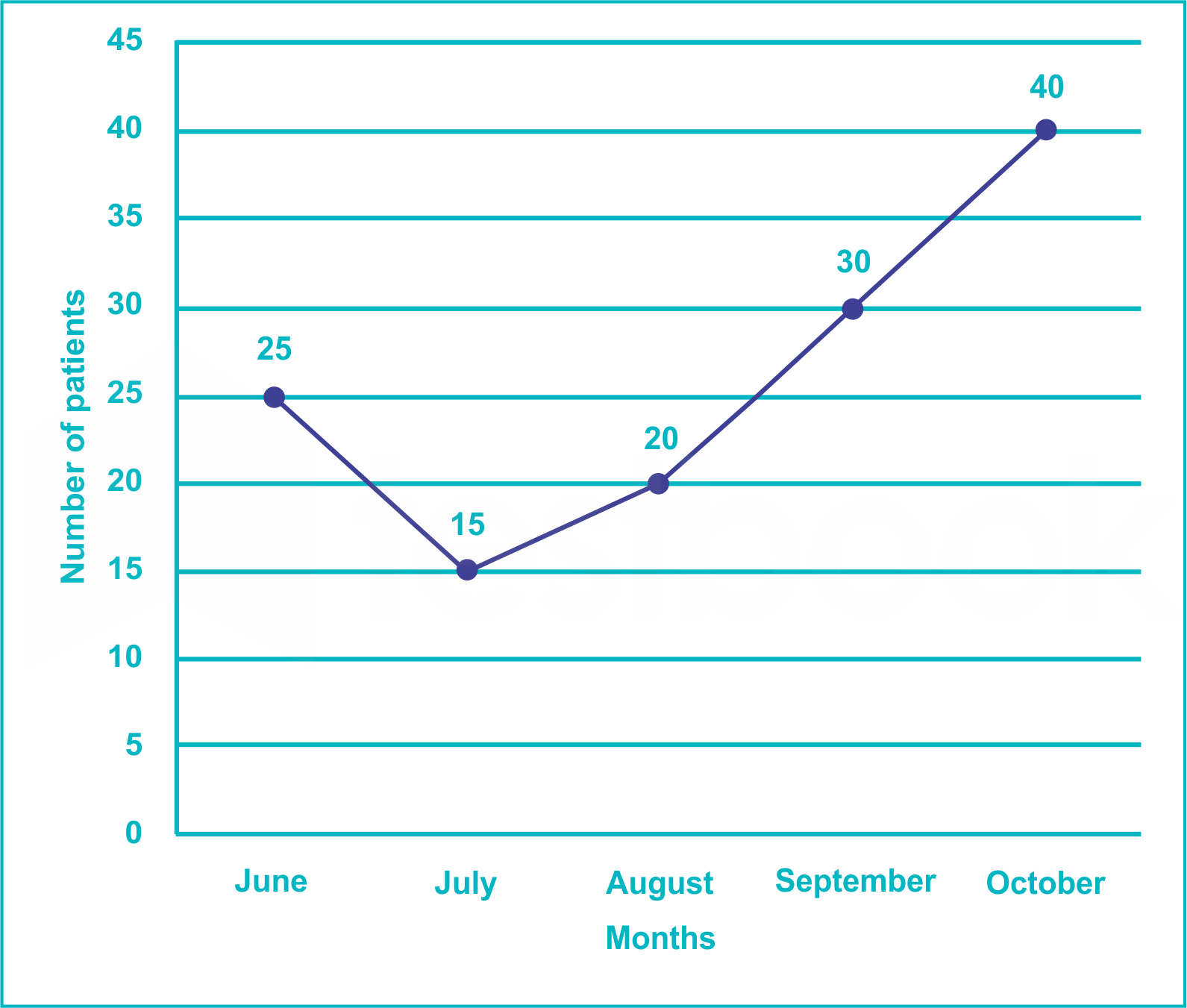
Study the given line graph and answer the following question.

The given line graph depicts the number of patients admitted in five months.


What is the total number of patients admitted in the given five months?

  1. AOption (a)

    140

  2. BOption (b)

    135

  3. COption (c)

    120

  4. DOption (d)

    130

View answer & explanation

Correct answer

Answer: (d)D.

130

Why this answer is correct

Given:

Number of patients admitted in June = 25

Number of patients admitted in July = 15

Number of patients admitted in August = 20

Number of patients admitted in September = 30

Number of patients admitted in October = 40

Formula used:

Total number of patients = Sum of patients admitted in all months

Calculation:

Total number of patients = 25 + 15 + 20 + 30 + 40

⇒ Total = 130

∴ The total number of patients admitted in the given five months is 130.

Question 7

The area of a triangle is 81 cm2 and its base is double the corresponding height. This height (in cm) of the triangle is:

  1. AOption (a)

    18

  2. BOption (b)

    81

  3. COption (c)

    10

  4. DOption (d)

    9

View answer & explanation

Correct answer

Answer: (d)D.

9

Why this answer is correct

Shortcut Trick

Let the height be h cm. Since the base is double the height, base = 2h.

Area = (1/2) × base × height = (1/2) × 2h × h = h2

Given Area = 81 cm2

⇒ h2 = 81 ⇒ h = 9 cm

∴ The correct answer is 9 cm.

Alternate Method

Given:

Area of the triangle = 81 cm2

Base = 2 × Height

Base = 2h Height = h Area = 81 cm²

Formula Used:

Area of a triangle = (1/2) × Base × Height

Calculations:

⇒ Let the height of the triangle be h cm.

⇒ Then, the base of the triangle = 2h cm.

⇒ Area = (1/2) × 2h × h

⇒ 81 = h2

⇒ h = √81

⇒ h = 9 cm

∴ The correct answer is 9 cm.

Additional Information

Area of Equilateral Triangle

For a triangle with all three sides equal to a, Area = (√3 ÷ 4) × a2.

Heron's Formula

For a triangle with sides a, b, and c, Area = √[s(s − a)(s − b)(s − c)], where s = (a + b + c) ÷ 2 is the semi-perimeter.

Right-Angled Triangle Area

If the triangle contains a 90° angle, Area = (1/2) × Base × Perpendicular.

Question 8

If a milkman sells milk at Rs. 50 a litre, he loses Rs. 2,000. If he sells it at Rs. 60 a litre, he gains Rs. 1,500. The total quantity of milk (in litres) he sells is:

  1. AOption (a)

    200

  2. BOption (b)

    350

  3. COption (c)

    400

  4. DOption (d)

    150

View answer & explanation

Correct answer

Answer: (b)B.

350

Why this answer is correct

Shortcut Trick

Difference in Selling Price per litre = 60 − 50 = Rs. 10.

Total difference in Profit/Loss amount = Gain − (−Loss) = 1,500 − (−2,000) = Rs. 3,500.

Total Quantity of milk = Total difference in amount ÷ Difference in rate per litre.

Quantity = 3,500 ÷ 10 = 350 litres.

∴ The correct answer is 350 litres.

Alternate Method

Given → Case 1: SP1 = Rs. 50, Loss = Rs. 2,000 | Case 2: SP2 = Rs. 60, Gain = Rs. 1,500. Formulas: CP = SP × Quantity + Loss | CP = SP × Quantity − Gain.

⇒ Let the total quantity of milk be Q litres. ⇒ In Case 1: Total CP = 50 × Q + 2,000. ⇒ In Case 2: Total CP = 60 × Q − 1,500. ⇒ Equating both: 50Q + 2,000 = 60Q − 1,500. ⇒ 60Q − 50Q = 2,000 + 1,500. ⇒ 10Q = 3,500 ⇒ Q = 350.

∴ The correct answer is 350 litres.

Additional Information

Total Cost Price calculation

Once quantity is known, CP can be found using CP = (50 × 350) + 2,000 = Rs. 19,500.

Relationship between Gain and Loss

The shift from a loss of Rs. 2,000 to a gain of Rs. 1,500 represents a total recovery of Rs. 3,500.

Question 9

The power of an electric fan is 10 Watt when it is connected to 20 V source. What is the current flowing through the fan?

  1. AOption (a)

    0.5 amp

  2. BOption (b)

    200 amp

  3. COption (c)

    0.005 amp

  4. DOption (d)

    2 amp

View answer & explanation

Correct answer

Answer: (a)A.

0.5 amp

Why this answer is correct

The correct answer is 0.5 amp.

Key Points

  • Given:
  • Power (P) = 10 Watts
  • Voltage (V) = 20 Volts
  • Rearranging the formula to find current (I):
  • Current (I) = Power (P) / Voltage (V)
  • Substituting the given values:
  • Current (I) = 10 Watts / 20 Volts
  • Current (I) = 0.5 Amperes
  • Therefore, the current flowing through the fan is 0.5 Amperes.

Question 10

Kamal is now four times as old as his son now is. After 18 years his son will be half as old as Kamal would then be. Find the present age (in years) of the son. 

  1. AOption (a)

    36

  2. BOption (b)

    9

  3. COption (c)

    24

  4. DOption (d)

    10

View answer & explanation

Correct answer

Answer: (b)B.

9

Why this answer is correct

Shortcut Trick

Ratio of Kamal and his son at present = 4 : 1 (Difference = 3 parts)

Ratio after 18 years = 2 : 1 (Difference = 1 part)

To equate the age difference, multiply the future ratio by 3: New ratio = 6 : 3

Increase in parts = 6 − 4 = 2 units or 3 − 1 = 2 units

2 units = 18 years ⇒ 1 unit = 9 years

∴ The correct answer is 9 years.

Alternate Method

Given:

Present age of Kamal = 4 × Present age of son

After 18 years, Son's age = 1/2 × Kamal's age

Let the present age of the son be x years.

∴ Present age of Kamal = 4x years.

After 18 years:

Age of son = x + 18

Age of Kamal = 4x + 18

According to the question:

⇒ x + 18 = 1/2 × (4x + 18)

⇒ 2 × (x + 18) = 4x + 18

⇒ 2x + 36 = 4x + 18

⇒ 4x − 2x = 36 − 18

⇒ 2x = 18

⇒ x = 9

∴ The correct answer is 9 years.

Additional Information

Constant Age Difference

The mathematical difference between the ages of two individuals always remains constant regardless of how many years pass.

Ratio Adjustment Rule

To solve age problems using ratios, ensure the difference between ratio parts is equal for both time periods to represent the constant age gap.

Age After 'n' Years

If the present age is x, then the age after n years is x + n, and the age n years ago was x − n.

Question 11

Which of the following institutions/bodies is NOT included in the three-tier of the Panchayati Raj system? 

  1. AOption (a)

    Gram Panchayat

  2. BOption (b)

    Panchayat Samiti

  3. COption (c)

    Tehsil Parishad

  4. DOption (d)

    Zila Parishad

View answer & explanation

Correct answer

Answer: (c)C.

Tehsil Parishad

Why this answer is correct

The correct answer is Tehsil Parishad.

Key Points

  • Balwant Rai Mehta Committee suggested the establishment of a democratic decentralized local government which came to be known as the Panchayati Raj.
  • Three-tier Panchayati Raj system: Gram Panchayat, Panchayat Samiti, and Zila Parishad.

 Additional Information

  • Ashok Mehta Committee was appointed in 1977 to suggest measures to revive and strengthen the declining Panchayati Raj system in India.
  • The key recommendations are:
  • The three-tier system should be replaced with a two-tier system: Zila Parishad (district level) and the Mandal Panchayat (a group of villages).
  • The district level is the first level of supervision after the state level.
  • Zila Parishad should be the executive body and responsible for planning at the district level.
  • The institutions (Zila Parishad and the Mandal Panchayat) have compulsory taxation powers to mobilize their own financial resources.

Question 12

The members of homologous series differ by __________.

  1. AOption (a)

    CH unit

  2. BOption (b)

    CH2 unit

  3. COption (c)

    C2H unit

  4. DOption (d)

    C2H2 unit

View answer & explanation

Correct answer

Answer: (b)B.

CH2 unit

Why this answer is correct

The correct answer is CH2 unit.

Key Points

  • Homologous series is defined as a series of compounds in which the same functional group substitutes for hydrogen in a carbon chain.
  • This series will be differing with a successive member of CH2.
  • Some examples are methane (CH4), ethane (C2H6), propane (C3H8) as they differ by CH2 and they have the same functional group called alkanes (General formula CnH2n+2).
  • As series differ by CH2 , Atomic mass units of CH2 = Atomic mass of carbon + Atomic mass of Hydrogen

          12 + 2 = 14 (as there are 2 atoms of hydrogen, therefore the atomic mass of H2 is taken as 2)

Hence, subsequent members of the homologous series differ by 14 atomic mass units.

Question 13

What is significant about the Easter festival for the Christians?

  1. AOption (a)

    It marks the new year of the Christians.

  2. BOption (b)

    It is celebrated as a birthday of Jesus Christ.

  3. COption (c)

    It is celebrated as an Autumn festival in Europe and North America.

  4. DOption (d)

    It marks the resurrection of Jesus Christ from the dead.

View answer & explanation

Correct answer

Answer: (d)D.

It marks the resurrection of Jesus Christ from the dead.

Why this answer is correct

The correct answer is It marks the resurrection of Jesus Christ from the dead..

Key Points

  • Easter is a religious festival celebrated by Christians.
  • It commemorates the resurrection of Jesus Christ from the dead, described in the New Testament as having occurred on the third day after his burial following his crucifixion by the Romans at Calvary c. 30 AD.
  • Easter is the culmination of the Passion of Jesus, preceded by Lent (or Great Lent), a 40-day period of fasting, prayer, and penance.
  • The week before Easter is known as Holy Week, and it contains the days of the Easter Triduum, including Maundy Thursday (commemorating the Maundy and Last Supper), and Good Friday (commemorating the crucifixion and death of Jesus).

Additional Information

  • Easter is linked to the Jewish Passover by much of its symbolism, as well as by its position in the calendar.
  • In many languages, the words for "Easter" and "Passover" are identical or very similar.
  • Easter customs vary across the Christian world, and include sunrise services, exclaiming the Paschal greeting, clipping the church, and decorating Easter eggs.
  • The Easter lily, a symbol of the resurrection in Western Christianity, traditionally decorates the chancel area of churches on Easter Day and throughout the Eastertide season.
  • Additional customs include egg hunting, the Easter Bunny, and Easter parades.

Question 14

A, B, C, D, E and F live on six different floors of the same building. The lowermost floor in the building is numbered 1, the floor above it is numbered 2 and so on till the topmost floor is numbered 6. A lives on floor number 5. Only two people live between A and C. Neither D nor B lives on the topmost floor. E lives immediately below C. B does not live on an even-numbered floor. Who lives on floor number 3?

  1. AOption (a)

    B

  2. BOption (b)

    C

  3. COption (c)

    D

  4. DOption (d)

    A

View answer & explanation

Correct answer

Answer: (a)A.

B

Why this answer is correct

Given: A, B, C, D, E and F live on six different floors of the same building. The lowermost floor in the building is numbered 1, the floor above it is numbered 2 and so on till the topmost floor is numbered 6.

1) A lives on floor number 5. 

2) Only two people live between A and C.

FloorPerson
6
5A
4
3
2C
1

3) E lives immediately below C.

FloorPerson
6
5A
4
3
2C
1E

3) Neither D nor B lives on the topmost floor. 

4) B does not live on an even-numbered floor.

After positioning D and B only one position is left which will be occupied by the only person left i.e. F.

FloorPerson
6F
5A
4D
3B
2C
1E

Thus. according to the final arrangement, B lives on floor number 3.

Hence, "Option 1" is the correct answer.

Question 15

Express 2.6ˉ2.\bar6 as an improper fraction.

  1. AOption (a)

    73\frac{7}{3}

  2. BOption (b)

    229\frac{22}{9}

  3. COption (c)

    83\frac{8}{3}

  4. DOption (d)

    209\frac{20}{9}

View answer & explanation

Correct answer

Answer: (c)C.

83\frac{8}{3}

Why this answer is correct

Given:

2.6‾\overline{6}

Formula used:

Let x = 2.6‾\overline{6}

To get rid of the repeating decimal, multiply by 10:

10x = 26.6‾\overline{6}

Subtract the original x from this equation:

10x - x = 26.6‾\overline{6} - 2.6‾\overline{6}

Calculation:

10x - x = 26.6‾\overline{6} - 2.6‾\overline{6}

⇒ 9x = 24

⇒ x = 24/9

⇒ x = 8/3

∴ The correct answer is option (3).

Question 16

Which of the following is the major river that flows across the western part of Rajasthan?

  1. AOption (a)

    Ghaggar

  2. BOption (b)

    Chambal

  3. COption (c)

    Luni

  4. DOption (d)

    Banas

View answer & explanation

Correct answer

Answer: (c)C.

Luni

Why this answer is correct

The correct answer is Luni.

Key Points

  • Luni River:
  • The Luni River is an important river in Rajasthan, India. It originates in the Aravalli Range near Ajmer and flows southwestwards through the Thar Desert.
  • Unlike many rivers, the Luni River does not flow into a sea or ocean. Instead, it ends in the marshy lands of the Rann of Kutch in Gujarat, making it an inland draining river.

Additional Information

  • Ghaggar
  • The Ghaggar River rises in Shivalik hills in the Solan district of Himachal Pradesh.
  • It enters Haryana from the Panchkula district.
  • Then after the river flows making the border between Punjab and Haryana for more than 100 Km.
  • And at the end, the river leaves Sirsa District of Haryana State and reaches Sri Ganga Nagar district, Rajasthan.
  • ​Chambal
  • The Chambal river originates in Manpura near Indore in Madhya Pradesh.
  • The length of the river is 900 km and it is a tributary of Yamuna river.
  • The Chambal River remains one of North India’s unpolluted rivers, home to a rich diversity of flora and fauna.
  • The National Chambal Gharial Wildlife Sanctuary is famous for the rare Ganges river dolphin.
  • Apart from the Ganges river dolphin, the other inhabitants of the sanctuary include magar (crocodile) and gharial (alligator). Migratory birds from Siberia form part of its rich avian fauna.
  • Banas
  • Banas river originates from Khamnor Hills of Aravalli Range, near Kumbhalgarh in Rajsamand, Rajasthan.  '
  • Banas river is a tributary of the Chambal River and ii is approximately 512 kilometers in length.
  • This river is also called ‘Van Ki Asha‘.
  • There is another river in Rajasthan with the name of Banas.
  • The Banas river entirely flows within the Rajasthan in:-
  • Ajmer, Bhilwara, Bundi, Chittorgarh, Dausa, Jaipur, Pali, Rajsamand, Sawai Madhopur, Sirohi, Tonk, and Udaipur districts of Rajasthan.
  • It flows northeast through the Mewar region of Rajasthan and meets the Chambal near the village of Rameshwar in Sawai Madhopur district.

Question 17

At what position of an object placed in front of a concave mirror is a diminished image formed?

  1. AOption (a)

    Beyond centre of curvature

  2. BOption (b)

    Between focus and centre of curvature

  3. COption (c)

    Between pole and focus

  4. DOption (d)

    At focus

View answer & explanation

Correct answer

Answer: (a)A.

Beyond centre of curvature

Why this answer is correct

The correct answer is Beyond centre of curvature .

Key Points 

  • A concave mirror is a type of curved mirror where the reflective surface bulges inward.
  • When light rays that are initially parallel to the principal axis reflect off the surface, they converge at a point known as the focal point.

Explanation: The behavior of a concave mirror depends on the position of the object:

  • Object at infinity: Produces a real image at the focal point.
  • Object beyond the focal point: Produces a real, inverted image between the focal point and the center of curvature.
  • Object at the focal point: No image is formed as rays reflect parallel and never meet.
  • Object between the focal point and the mirror: Produces a virtual, upright, and magnified image behind the mirror.

Additional Information

Different positions of the object and their image by a concave mirror: 

Position of the object (Concave mirror)Position of imagesize of the image in comparison to the objectNature of image
At InfinityAt focusHighly diminishedReal, inverted
Between Infinity and the centre of curvatureBetween the focus and centre of curvatureDiminishedReal, inverted
At the centre of curvatureAt the centre of curvatureOf the same sizeReal, inverted
At focusAt InfinityHighly enlargedReal, inverted
Between the focus (F) and centre of curvature (C)Between the centre of curvature and infinityEnlargedReal, inverted

Question 18

Select the set in which the numbers are related in the same way as are the numbers of the following sets.

(NOTE: Operations should be performed on the whole numbers, without breaking down the numbers into its constituent digits. E.g. 13 - Operations on 13 such as adding / subtracting /multiplying etc. to 13 can be performed. Breaking down 13 into 1 and 3 and then performing mathematical operations on 1 and 3 is not allowed.)

(75, 16, 67)

(33, 14, 26)

  1. AOption (a)

    (28, 72, 64)

  2. BOption (b)

    (88, 54, 76)

  3. COption (c)

    (40, 56, 96)

  4. DOption (d)

    (29, 6, 26)

View answer & explanation

Correct answer

Answer: (d)D.

(29, 6, 26)

Why this answer is correct

The logic followed here is: 

Logic: (2nd number ÷ 2) + 3rd number = 1st number.

Now,

For (75, 16, 67):

⇒ (16 ÷ 2) + 67

= 8 + 67 = 75.

For (33, 14, 26)

⇒ (14 ÷ 2) + 26

= 7 + 26 = 33.

Similarly, for Option 4: (29, 6, 26)

⇒ (6 ÷ 2) + 26

= 3 + 26 = 29.

Hence, the correct answer is Option 4.

Question 19

Arun bought 38 kg of rice for ₹1,710. He sold it at a profit equal to the selling price of 8 kg of it. What is the selling price of 5 kg of rice?

  1. AOption (a)

    ₹285

  2. BOption (b)

    ₹295

  3. COption (c)

    ₹290

  4. DOption (d)

    ₹280

View answer & explanation

Correct answer

Answer: (a)A.

₹285

Why this answer is correct

Shortcut Trick

Let the Selling Price (SP) of 1 kg rice be x.

Total SP of 38 kg = 38x and Profit = SP of 8 kg = 8x.

Cost Price (CP) of 38 kg = SP − Profit = 38x − 8x = 30x.

Given CP of 38 kg = 1710 ⇒ 30x = 1710 ⇒ x = 57.

SP of 5 kg rice = 5 × 57 = 285.

∴ The correct answer is ₹ 285.

Alternate Method

Given → CP of 38 kg rice = 1710 | Profit = SP of 8 kg. Formulas: Profit = SP − CP | SP = CP + Profit.

⇒ Let SP per kg be S. ⇒ 38 × S − 1710 = 8 × S ⇒ 38S − 8S = 1710 ⇒ 30S = 1710 ⇒ S = 1710 ÷ 30 = 57. ⇒ SP of 5 kg = 5 × 57 = 285.

∴ The correct answer is ₹ 285.

Additional Information

Profit and Loss in terms of Quantity

When profit is expressed as the selling price of certain items, the effective CP is the difference in quantity (Total units − Profit units).

Basic Relation

Profit % = [Profit units ÷ (Total units − Profit units)] × 100.

Question 20

Simplify:

[65 + {31 - (45 of 3 ÷ 5)} × 4]

  1. AOption (a)

    102

  2. BOption (b)

    79

  3. COption (c)

    80

  4. DOption (d)

    81

View answer & explanation

Correct answer

Answer: (d)D.

81

Why this answer is correct

Given:

[65+31−(45 of 3÷5)×4][65 + {31 - (45 \text{ of } 3 \div 5)} \times 4]

Formula used:

Order of operations (BODMAS): Brackets, Orders (i.e. powers and square roots, etc.), Division and Multiplication (left-to-right), Addition and Subtraction (left-to-right)

Calculation:

[65+31−(45×3÷5)×4][65 + {31 - (45 \times 3 \div 5)} \times 4]

[65+31−(135÷5)×4][65 + {31 - (135 \div 5)} \times 4]

[65+31−27×4][65 + {31 - 27} \times 4]

⇒ [65+4×4][65 + 4 \times 4]

⇒ [65+16][65 + 16]

⇒ 81

∴ The correct answer is option (4).

Question 21

A, B, C, D, E and F live on six different floors of the same building. The lowermost floor in the building is numbered 1, the floor above it is numbered 2, and so on till the topmost floor is numbered 6.

B lives immediately below C. C lives on an even numbered floor but not on the topmost floor. Only three people live between B and D. A lives immediately above F. Who lives on floor number 4?

  1. AOption (a)

    B

  2. BOption (b)

    F

  3. COption (c)

    C

  4. DOption (d)

    A

View answer & explanation

Correct answer

Answer: (d)D.

A

Why this answer is correct

Given: A, B, C, D, E and F live on six different floors of the same building. The lowermost floor in the building is numbered 1, the floor above it is numbered 2, and so on till the topmost floor is numbered 6.

1) C lives on an even numbered floor but not on the topmost floor. 

2) B lives immediately below C. 

FloorPerson
Case 1Case 2
6
5
4C
3B
2C
1B

3) Only three people live between B and D.

As there is no possible position for D in case 2, therefore is eliminated.

FloorPerson
Case 1
6
5D
4
3
2C
1B

3) A lives immediately above F.

After positioning A and F only one position is left which will be occupied by the only person left i.e. E.

FloorPerson
Case 1
6E
5D
4A
3F
2C
1B

Thus. according to the final arrangement, A lives on floor number 4.

Hence, "Option 4" is the correct answer.

Question 22

A student got a stain on his shirt while doing an activity in the science laboratory. Which chemical should he use to remove the stain?

  1. AOption (a)

    Sodium carbonate

  2. BOption (b)

    Sodium hydroxide

  3. COption (c)

    Sodium chloride

  4. DOption (d)

    Sodium hydrogencarbonate

View answer & explanation

Correct answer

Answer: (a)A.

Sodium carbonate

Why this answer is correct

The correct answer is Sodium carbonate.

Key Points

  • Sodium carbonate
  • It is commonly known as Na2CO3 or Washing Soda.
  • It is used in the softening of hard water i.e it is used to remove the temporary and permanent hardness of the water.
  • It is commonly used as a cleaning agent for domestic purposes.
  • It is also used in the manufacturing of paper, soap, textiles, paints, etc.

Additional Information

  • Sodium hydroxide​
  • Sodium hydroxide (NaOH) dissociates completely in water to give Na+ and OH−
  • Sodium hydroxide is considered a strong base as all the available [OH] in NaOH is present in the solution as [OH−] and available to accept protons.
  • Sodium hydroxide is the strongest base because it totally dissociates to form sodium ions and hydroxide ions.
  • These hydroxide ions are treated with hydrogen ions further from the acid and totally ionize the hydrogen ions.
  • Producers may utilize sodium hydroxide to manufacture soaps, rayon, paper, products that explode, dyes, and petroleum products.
  • Other works that may utilize sodium hydroxide comprise preparing cotton fabric, metal cleaning and preparing, oxide coating, electroplating, and electrolytic extraction.
  • ​Sodium chloride
  • Sodium Chloride is also known as Salt.
  • It is an ionic compound with the chemical formula NaCl.
  • It has a ratio of 1:1 of sodium and chloride ions, With molar masses of 22.99 and 35.45 g/mol respectively.
  • 100 g of NaCl contains 39.34 g Na and 60.66 g Cl.
  • Sodium chloride is used in the Solvay process to produce sodium carbonate and calcium chloride.
  • In the Mannheim process and in the Hargreaves process, sodium chloride is used for the production of sodium sulfate and hydrochloric acid.
  • Sodium hydrogencarbonate
  • Sodium hydrogencarbonate is also known as baking soda.
  • Baking soda is a white crystalline powder that is commonly used as a leavening agent in baking.
  • It is also used for cleaning and as a natural deodorizer.

Question 23

A man travelled a certain distance by bus at the rate of 40 km/h and returned walking at the rate of 5 km/h via the same route. If the two-way journey took him a total of 4 hours 30 minutes, the total distance covered by him in this 4.5 hour was:

  1. AOption (a)

    40 km

  2. BOption (b)

    20 km

  3. COption (c)

    25 km

  4. DOption (d)

    30 km

View answer & explanation

Correct answer

Answer: (a)A.

40 km

Why this answer is correct

Shortcut Trick

Average Speed for same distance = (2 × S1 × S2) ÷ (S1 + S2)

Average Speed = (2 × 40 × 5) ÷ (40 + 5) = 400 ÷ 45 = 80/9 km/h

Total Distance = Average Speed × Total Time

⇒ Total Distance = (80/9) × 4.5 = (80/9) × (9/2) = 40 km

∴ The correct answer is 40 km.

Alternate Method

Given:

Speed of bus (S1) = 40 km/h

Speed of walking (S2) = 5 km/h

Total time (T) = 4 hours 30 minutes = 4.5 hours

Calculations:

Let the one-way distance be d km.

⇒ Time taken by bus + Time taken walking = Total Time

⇒ (d/40) + (d/5) = 4.5

⇒ (d + 8d) / 40 = 4.5

⇒ 9d / 40 = 4.5

⇒ 9d = 4.5 × 40

⇒ 9d = 180

⇒ d = 20 km (One-way distance)

⇒ Total distance covered = 2 × d = 2 × 20 = 40 km

∴ The correct answer is 40 km.

Additional Information

Average Speed Formula

When a person travels equal distances at speeds x and y, the Average Speed is given by (2xy) / (x + y).

Speed-Time Relationship

For a fixed distance, Speed is inversely proportional to Time (S1/S2 = T2/T1).

Total Distance vs Displacement

In a round trip, Total Distance is the sum of both paths, while Displacement is zero as the starting and ending points are the same.

Question 24

Read the given statements and conclusions carefully. Assuming that the information given in the statements is true, even if it appears to be at variance with commonly known facts, decide which of the given conclusions logically follow(s) from the statements.

Statements:

  1. Some animals are plants.
  2. Some plants are birds.
  3. No duck is an animal.

Conclusions:

(I) Some ducks are birds

(II) No bird is an animal.

(III) Some animals are birds.

  1. AOption (a)

    Both conclusions I and III follow.

  2. BOption (b)

    None of the conclusions follow.

  3. COption (c)

    Only conclusion II follows.

  4. DOption (d)

    Only conclusion III follows.

View answer & explanation

Correct answer

Answer: (b)B.

None of the conclusions follow.

Why this answer is correct

The least possible Venn diagram for the given statements is as shown below :

Conclusions:

(I) Some ducks are birds → Does not follow (As some animals are plants, some plants are birds and no duck is an animal. So it is possible but not definite.)

(II) No bird is an animal → Does not follow (As some animals are plants and some plants are birds. As no direct relation is given between birds and animals, therefore it is false.)

(III) Some animals are birds → Does not follow (As some animals are plants and some plants are birds. So it is possible but not definite.)

∴ Here, None of the conclusions follow.​

Hence, the correct answer is "Option 2".

Question 25

Each of the digits in the number 56137428 is arranged in ascending order from left to right. The position of how many digits will remain unchanged as compared to that in the original number?

  1. AOption (a)

    Three

  2. BOption (b)

    One

  3. COption (c)

    None

  4. DOption (d)

    Two

View answer & explanation

Correct answer

Answer: (b)B.

One

Why this answer is correct

Given number: '56137428'

After arranged in ascending order:

Digits56137428
Ascending order12345678


Now,

there is One digit "8" that will remain unchanged if each of the digits in the number '56137428' is arranged in ascending order.

Hence, the correct answer is "Option 2".

Question 26

From the following, identify the correct properties of magnetic field lines.

(a) Magnetic field lines are closed loops.

(b) Magnetic field lines are from north pole of magnet to its south pole, outside the magnet.

(c) Magnetic field lines intersect each other.

(d) If magnetic field lines are crowded, the magnetic field strength in that region is high.

(e) The number of magnetic field lines per unit area is called magnetic flux.

  1. AOption (a)

    (a), (b), (c) and (d)

  2. BOption (b)

    (b), (c), (e)

  3. COption (c)

    (a), (c), (d)

  4. DOption (d)

    (a), (b), (d)

View answer & explanation

Correct answer

Answer: (d)D.

(a), (b), (d)

Why this answer is correct

The correct answer is (a), (b), (d).

Key Points

Magnetic field lines:

  • A magnetic field line is an imaginary line such that tangent to it at any point gives the direction of the magnetic field at that point in space.
  • Magnetic field lines are drawn to represent the magnetic fields.
  • Magnetic field lines can be drawn with the help of a magnetic compass.
  • Magnetic field lines are also called magnetic lines of force.

Additional Information 

Properties of magnetic field lines:

  1. The magnetic field lines of a magnet (or a solenoid) form continuous closed loops.
  2. The magnetic field lines start from the north pole and end on a south pole outside the magnet. Inside the magnet, the magnetic field lines start from the south pole and end on the north pole.
  3. The tangent to the field line at a given point represents the direction of the net magnetic field B at that point.
  4. The larger the number of field lines crossing per unit area, the stronger is the magnitude of the magnetic field B.
  5. The magnetic field lines do not intersect with each other if they did, there will be two directions of the magnetic field at that point which is not possible.
Question 27

The filament of an electric bulb is made up of which of the given materials?

  1. AOption (a)

    Tungsten

  2. BOption (b)

    Copper

  3. COption (c)

    Gold

  4. DOption (d)

    Nichrome

View answer & explanation

Correct answer

Answer: (a)A.

Tungsten

Why this answer is correct

The correct answer is Tungsten .

Key Points

  • Tungsten
  • Atomic Number: 74

Atomic Mass: 183.84 u

  • Highest Melting Point of Any Metal: This makes it incredibly resistant to heat, crucial for applications like light bulb filaments.
  • High Density: One of the densest metals, making it useful in applications where weight is a factor, such as in counterweights and projectiles.
  • Excellent Strength: Exhibits high tensile strength, even at elevated temperatures.
  • Applications:
  • Light Bulb Filaments: Its high melting point allows it to withstand the intense heat generated during operation.
  • Electrical Contacts: Used in applications requiring high current and resistance to wear and tear.
  • Hard Metals: Tungsten carbide is extremely hard and used in cutting tools and industrial machinery.
  • Medical Applications: Found in radiation shielding and some medical implants.

Additional Information 

  • Copper
  • Atomic Number: 29

Atomic Mass: 63.546 u

  • Excellent Electrical Conductivity: Copper is an excellent conductor of electricity, making it ideal for electrical wiring and electronics.
  • High Thermal Conductivity: It efficiently conducts heat, making it useful in heat exchangers and cooling systems.
  • Malleable and Ductile: Can be easily shaped into various forms like wires, sheets, and tubes.
  • Corrosion Resistance: Relatively resistant to corrosion, though it can react with certain chemicals.
  • Applications:
  • Electrical Wiring: Widely used in electrical wiring for homes, buildings, and power grids.
  • Electronics: Essential component in many electronic devices, including printed circuit boards and integrated circuits.
  • Plumbing: Used in pipes and fittings for water and other fluids.
  • Industrial Applications: Used in various industrial processes, such as heat exchangers and manufacturing.
  • Gold
  • Atomic Number: 79

Atomic Mass: 196.967 u

  • High Malleability and Ductility: Can be easily shaped into thin sheets (gold leaf) or drawn into fine wires.
  • High Luster and Corrosion Resistance: Retains its shine and resists corrosion, making it valuable for jewelry and decorative purposes.
  • High Electrical Conductivity: A good conductor of electricity, though not as conductive as copper.
  • Chemical Inertness: Relatively unreactive with most chemicals.
  • Applications:
  • Jewelry: The most common use, prized for its beauty and durability.
  • Investments: Gold is considered a valuable investment asset due to its rarity and stability.
  • Industrial Applications: Used in electronics, dentistry, and medical applications.
  • Monetary Purposes: Historically used as a medium of exchange and currency.
  • Nichrome
  • It's primarily composed of nickel (Ni) and chromium (Cr).​​
  • High Electrical Resistance: A nickel-chromium alloy known for its high electrical resistance.
  • High Melting Point: Can withstand high temperatures without melting.
  • Good Oxidation Resistance: Resists oxidation at high temperatures.
  • Applications:
  • Heating Elements: Widely used in heating elements for appliances like toasters, heaters, and hair dryers.
  • Resistance Wire: Used in resistors and other electrical components where high resistance is required.
  • Thermocouples: Used in thermocouples to measure temperature.

Question 28

A study centre has 5 classes with 50, 60, 25, 40 and 70 students. The pass percentage of these 5 classes are 20%, 25%, 20%, 10%, 30%, respectively. Find the average number of students per class in the centre who passed.

  1. AOption (a)

    55

  2. BOption (b)

    10

  3. COption (c)

    12

  4. DOption (d)

    11

View answer & explanation

Correct answer

Answer: (d)D.

11

Why this answer is correct

Shortcut Trick

Total students passed in 5 classes = (50 × 0.20) + (60 × 0.25) + (25 × 0.20) + (40 × 0.10) + (70 × 0.30)

Total passed = 10 + 15 + 5 + 4 + 21 = 55 students

Average passed students per class = Total passed ÷ Number of classes

Average = 55 ÷ 5 = 11 students

∴ The correct answer is 11.

Alternate Method

Given: Students in 5 classes = 50, 60, 25, 40, 70. Pass % = 20%, 25%, 20%, 10%, 30%.

Formula Used: Average = ∑(Class Students × Pass Percentage) ÷ Total Classes

⇒ Passed in Class 1 = 20% of 50 = (20/100) × 50 = 10

⇒ Passed in Class 2 = 25% of 60 = (25/100) × 60 = 15

⇒ Passed in Class 3 = 20% of 25 = (20/100) × 25 = 5

⇒ Passed in Class 4 = 10% of 40 = (10/100) × 40 = 4

⇒ Passed in Class 5 = 30% of 70 = (30/100) × 70 = 21

⇒ Total Passed Students = 10 + 15 + 5 + 4 + 21 = 55

⇒ Average Students Passed = 55 ÷ 5 = 11

∴ The correct answer is 11.

Additional Information

Weighted Average

It calculates the average by considering the weight (number of students) of each group: Average = ∑(wi × xi) ÷ ∑wi.

Percentage to Fraction Conversion

Common conversions include 20% = 1/5, 25% = 1/4, and 10% = 1/10 to speed up calculations.

Overall Pass Percentage

Overall Pass % = (Total students passed ÷ Total students in all classes) × 100.

Question 29

The lengths of two sides of a triangle are 24 cm and 26 cm. Which of the following can be the measure of the third side?

  1. AOption (a)

    54 cm

  2. BOption (b)

    55 cm

  3. COption (c)

    48 cm

  4. DOption (d)

    52 cm

View answer & explanation

Correct answer

Answer: (c)C.

48 cm

Why this answer is correct

Shortcut Trick

The third side of a triangle must always be less than the sum and greater than the difference of the other two sides.

Range: (26 − 24) < Third Side < (26 + 24)

Range: 2 < Third Side < 50

Among the given options, only 48 cm lies within this range.

∴ The correct answer is 48 cm.

Alternate Method

Given:

Side 1 (a) = 24 cm

Side 2 (b) = 26 cm

Formula Used:

Triangle Inequality Theorem: For any triangle with sides a, b, and c, the following condition must be satisfied: |a − b| < c < a + b.

Calculations:

⇒ Let the third side be c.

⇒ Sum of the two given sides = 24 + 26 = 50 cm.

⇒ Difference of the two given sides = 26 − 24 = 2 cm.

⇒ According to the Triangle Inequality Theorem, the third side must be greater than 2 cm and less than 50 cm.

⇒ 2 cm < c < 50 cm.

⇒ Checking the options: (1) 54 cm, (2) 55 cm, (3) 48 cm, (4) 52 cm.

⇒ Only 48 cm satisfies the condition 2 < 48 < 50.

∴ The correct answer is 48 cm.

Additional Information

Triangle Inequality Theorem

Question 30

What time will it be in 58 minutes from now, if the time is 1 ∶ 20 p.m.?

  1. AOption (a)

    2 ∶18 p.m.

  2. BOption (b)

    2 ∶ 10 p.m.

  3. COption (c)

    2 ∶ 15 p.m.

  4. DOption (d)

    2 ∶ 00 p.m.

View answer & explanation

Correct answer

Answer: (a)A.

2 ∶18 p.m.

Why this answer is correct

Given: if the time is 1 ∶ 20 p.m

Current time is 1 ∶ 20 p.m

Adding 58 minutes: 20 Minutes + 58 Minutes = 78 Minutes.

So, it can be written as 1 hours : 18 Minutes.

Now, adjusting the time.

Add 1 hour to 1:20 p.m. → 2:20 p.m.

Add 18 minutes to 2:20 p.m. → 2:38 p.m.

Thus, time after 58 minutes,  if the time is 1 ∶ 20 p.m. is "2 ∶18 p.m".

Hence, the correct answer is "Option 1".

Question 31

Which of the following statements is FALSE with respect to CNG and LPG

  1. AOption (a)

    CNG and LPG are labelled as 'clean fuels'.

  2. BOption (b)

    CNG and LPG can be piped to homes.

  3. COption (c)

    CNG and LPG are both carbon-based fuels.

  4. DOption (d)

    CNG and LPG do not contain carbon particles.

View answer & explanation

Correct answer

Answer: (d)D.

CNG and LPG do not contain carbon particles.

Why this answer is correct

The correct answer is CNG and LPG do not contain carbon particles.

Key Points

  • Composition: CNG is primarily methane (CH4) and LPG is mainly propane (C3H8) and butane (C4H10). Both are hydrocarbons — i.e., they contain carbon and hydrogen. (Statement 3: Correct)
  • Clean fuel label: Because CNG and LPG burn with lower particulate and NOx emissions compared with petrol/diesel, they are commonly promoted as 'clean fuels' for transport and cooking. This is a regulatory and policy designation in many countries. (Statement 1: Correct)
  • Piped supply to homes: CNG is often supplied as PNG (Piped Natural Gas) for domestic cooking in urban areas. LPG is usually distributed in cylinders, but piped LPG systems or bulk pipeline arrangements do exist in select locations and projects. Thus both can be delivered via pipelines in specific contexts. (Statement 2: Correct (context-dependent))
  • Carbon particles vs carbon atoms: The fuels themselves contain carbon atoms (they are hydrocarbons). Saying they “do not contain carbon particles” is misleading—while combustion of CNG/LPG produces far fewer soot/particulate emissions than diesel, the fuels inherently contain carbon. Therefore the absolute statement is incorrect. (Statement 4: False)

Additional Information

  • Applications: CNG is widely used in public transport and NG-based PNG for households; LPG is predominantly used for cooking, some rural heating and as an auto-fuel (autogas).
  • Safety & storage: Both require proper pressure vessels and leak detection. CNG is stored at high pressure; LPG is stored as a liquid under moderate pressure.
  • Environmental note: Switching to CNG/LPG reduces particulate matter and SOx emissions; however, being carbon-based, they still emit CO2 on combustion.

Important Points

  • The official answer key had incorrectly marked Option 2 as the correct answer. This has now been corrected, and the answer has been updated to reflect the accurate option.

Question 32

Short Run Average Cost is equal to ____________.

  1. AOption (a)

    Average Variable Cost × Average Fixed Cost

  2. BOption (b)

    Average Variable Cost + Average Fixed Cost

  3. COption (c)

    Average Variable Cost - Average Fixed Cost

  4. DOption (d)

    Average Variable CostAverage Fixed Cost\rm \frac{Average \ Variable \ Cost }{Average \ Fixed \ Cost}

View answer & explanation

Correct answer

Answer: (b)B.

Average Variable Cost + Average Fixed Cost

Why this answer is correct

The correct answer is Average Variable Cost + Average Fixed Cost.

Key Points

  • In cost theory, the point where the marginal cost curve intersects the average cost curve at its minimum indicates optimal production efficiency.
  • The intersection of LRMC and LRAC at the minimum point of LRAC signals the firm's most efficient scale in the long run.
  • This concept is essential in understanding cost minimization and firm behavior over time.

Additional Information

  • Long Run Marginal Cost (LRMC) and Long Run Average Cost (LRAC):
  • The long run marginal cost (LRMC) curve represents the additional cost incurred by producing one more unit of output in the long run.
  • The long run average cost (LRAC) curve reflects the per-unit cost of production when all inputs are variable in the long run.
  • The LRMC curve always intersects the LRAC curve at the minimum point of the LRAC curve, indicating the point of optimal efficiency.
  • At this point, the cost of producing an additional unit equals the average cost, which means the firm is operating at the most efficient scale of production.
  • The short run marginal cost (SRMC) curve does pass through the minimum point of the short run average cost (SRAC) curve, indicating the optimal output level in the short run.
  • The short run marginal cost curve does not necessarily relate to the upward-rising portion of the long run average cost curve.
  • The short run average cost curve may not necessarily touch the minimum point of the long run average cost curve.

Question 33

A convex lens has the radius of curvature as 40 cm. The power of the lens is: 

  1. AOption (a)

    +2.5 D

  2. BOption (b)

    -2.5 D

  3. COption (c)

    +5.0 D

  4. DOption (d)

    -5.0 D

View answer & explanation

Correct answer

Answer: (c)C.

+5.0 D

Why this answer is correct

The correct answer is +5 D.

Key Points

  • F = R/2
  • Where, F = focal length, R = radius of curvature
  • So, F = 40/2 = 20 cm = 0.2 m
  • Calculate Power:
  • Power (P) = 1/f (where f is in meters)
  • P = 1 / 0.2 m = 5 Diopters

Question 34

Which of the following financial institutions was set up by the Indian government to promote sustainable agriculture and rural development in the country?

  1. AOption (a)

    PNB

  2. BOption (b)

    RBI

  3. COption (c)

    SIDBI

  4. DOption (d)

    NABARD

View answer & explanation

Correct answer

Answer: (d)D.

NABARD

Why this answer is correct

The correct answer is NABARD.

Key Points

  • NABARD
  • NABARD is a Bank.
  • NABARD refers to the National Bank for Agriculture and Rural Development.
  • NABARD was formed on the recommendation of the committee formed on 30 March 1979, under the Chairmanship of Shri B. Sivaraman.
  • It came into existence on 12 July 1982 by transferring the agricultural credit functions of RBI and refinance functions of the then Agricultural Refinance and Development Corporation (ARDC).
  • NABARD today is fully owned by the Government of India.
  • NABARD Facts:-
  • | Founded | 12 July 1982 | | --- | --- | | Headquarter | Mumbai, India | | Chairman | Dr. G.R. Chintala |

Additional Information

  • PNB
  • Punjab National Bank:
  • It commenced its operations on April 12, 1895, from Lahore.
  • Tag Line: The Name You Can Bank Upon.
  • During the long history of the Bank, 9 banks have been merged with Punjab National Bank
  • The financial year 2019- 20 was significant in view of the announcement of amalgamation of Public sector Banks wherein Oriental Bank of Commerce and United Bank of India amalgamated with Punjab National Bank with effect from April 1, 2020.
  • Founder: Lala Lajpat Rai.
  • Products: Consumer Banking, Corporate Banking, Finance and Insurance, Investment Banking, Mortgage Loans, etc.
  • Headquarters: New Delhi.

​

  • RBI
  • RBI was nationalized in 1949.
  • The Reserve Bank of India was nationalised with effect from 1st January, 1949 on the basis of the Reserve Bank of India (Transfer to Public Ownership) Act, 1948.
  • All shares in the capital of the Bank were deemed transferred to the Central Government on payment of a suitable compensation.
  • SIDBI
  • SIDBI stands for Small Industries Development Bank of India.
  • Small Industries Development Bank of India (SIDBI) was set up on 2nd April 1990 under an Act of the Indian Parliament.
  • It was formed in the year 1990.
  • It is the apex regulatory body for the licensing and regulation of micro, small and medium enterprise finance companies in India.
  • It comes under the jurisdiction of the Ministry of Finance.
  • Its headquarters is located at Lucknow, Uttar Pradesh.
  • SIDBI is regulated and supervised by the Reserve Bank of India.

Question 35

Redox reaction is the reaction in which ___________.

  1. AOption (a)

    oxidation and reduction occur simultaneously

  2. BOption (b)

    only reduction occurs

  3. COption (c)

    neither oxidation nor reduction occur

  4. DOption (d)

    only oxidation occurs

View answer & explanation

Correct answer

Answer: (a)A.

oxidation and reduction occur simultaneously

Why this answer is correct

The correct answer is oxidation and reduction occur simultaneously.

Key Points

Redox reaction-

  • A redox (reduction-oxidation) reaction is a type of chemical reaction that involves the transfer of electrons between species.
  • It consists of two simultaneous processes: reduction and oxidation.
  • Reduction: In a redox reaction, reduction refers to the gain of electrons by a species. During reduction, the oxidation state of the species decreases, indicating a decrease in its positive charge or an increase in its negative charge.
  • Oxidation: Oxidation, on the other hand, involves the loss of electrons by a species. It leads to an increase in the oxidation state of the species, indicating an increase in its positive charge or a decrease in its negative charge.

Additional Information 

Example of redox reaction-

  • MnO2 + 4HCl → MnCl2 + 2H2O + Cl2
  • ​MnO2 is manganese dioxide, and HCl is hydrochloric acid.
  • In this reaction, manganese dioxide (MnO2) reacts with hydrochloric acid (HCl) to produce manganese(II) chloride (MnCl2), water (H2O), and chlorine gas (Cl2).
  • MnO2 acts as the oxidizing agent, while HCl acts as the reducing agent.
  • The manganese dioxide undergoes reduction, meaning it gains electrons. It is reduced from an oxidation state of +4 in MnO2 to +2 in MnCl2.
  • The hydrochloric acid undergoes oxidation, meaning it loses electrons. The chlorine atoms in HCl are oxidized from an oxidation state of -1 to 0 in Cl2.
  • As a result of the reaction, two hydrogen atoms from the hydrochloric acid combine with one oxygen atom from the manganese dioxide to form water (H2O).
  • Simultaneously, the remaining chlorine atoms from the hydrochloric acid combine to form chlorine gas (Cl2).
  • Overall, the reaction involves the transfer of electrons from manganese dioxide to hydrochloric acid, resulting in the formation of new compounds and the liberation of chlorine gas.

Question 36

Which of the following options is the closest approximate value which will come in place of question mark (?) in the following equation?

29.99 + 15.01 + 44.99 × 15.01 = ?

  1. AOption (a)

    735

  2. BOption (b)

    725

  3. COption (c)

    745

  4. DOption (d)

    720

View answer & explanation

Correct answer

Answer: (d)D.

720

Why this answer is correct

Given:

29.99 + 15.01 + 44.99 × 15.01 = ?

Formula used:

Basic arithmetic operations

Calculation:

29.99 + 15.01 + 44.99 × 15.01 = ?

⇒ 29.99 + 15.01 + 675.299

⇒ 45 + 675.299

⇒ 720 (approximately)

∴ The correct answer is option (4).

Question 37

Seven boxes M, N, O, P, Q, R and S are kept one over the other but not necessarily in the same order. Only three boxes are kept above P. Only two boxes are kept between P and M. Only R is kept between S and Q. Only N is kept between O and M. Neither Q nor M is at the top most position. Which box is kept between Q and O?

  1. AOption (a)

    P

  2. BOption (b)

    S

  3. COption (c)

    N

  4. DOption (d)

    R

View answer & explanation

Correct answer

Answer: (a)A.

P

Why this answer is correct

Given: Seven boxes M, N, O, P, Q, R and S are kept one over the other.

1) Only three boxes are kept above P.

2) Only two boxes are kept between P and M. 

Box orderBox
Case 1Case 2
1M
2
3
4PP
5
6
7M

3) Only N is kept between O and M. 

Box orderBox
Case 1Case 2
1M
2N
3O
4PP
5O
6N
7M

4) Only R is kept between S and Q. 

5) Neither Q nor M is at the top most position.

As M cannot be position at the top, therefore case 1 is eliminated.

Box orderBox
Case 2
1S
2R
3Q
4P
5O
6N
7M

Thus. according to the final arrangement, P box is kept between Q and O.

Hence, "Option 1" is the correct answer.

Question 38

Select the triad that follows the same pattern as that followed by the two triads given below. Both triads follow the same pattern.

LJ - HF - DB

WU - SQ - OM

  1. AOption (a)

    ZW - OR - FC

  2. BOption (b)

    TR - QS – GI

  3. COption (c)

    US - QO - MK

  4. DOption (d)

    SV - XV - TR

View answer & explanation

Correct answer

Answer: (c)C.

US - QO - MK

Why this answer is correct

The logic followed here is:

LJ - HF - DB

And,

WU - SQ - OM

So, checking each option one by one:

Option 1) ZW - OR - FC 

Option 2) TR - QS – GI

Option 3) US - QO - MK

Option 4) SV - XV - TR

Thus, out of all the options, 'US - QO - MK' follows the same logic as given.

Hence, "Option 3" is the correct answer.

Question 39

When was IFCI (Industrial Finance Corporation of India Ltd.) set up as a statutory corporation to provide medium and long-term finance to the industry?

  1. AOption (a)

    1969

  2. BOption (b)

    1975

  3. COption (c)

    1948

  4. DOption (d)

    1954

View answer & explanation

Correct answer

Answer: (c)C.

1948

Why this answer is correct

The correct answer is 1948 .

Key Points

  • Industrial Finance Corporation of India Ltd. (IFCI)
  • IFCI is one of the oldest development banks in India, primarily focused on providing financial assistance for industrial development.
  • The organization plays a significant role in promoting entrepreneurship and supporting large-scale projects across various sectors.
  • Rahul Bhave has been recommended for the position of MD & CEO at Industrial Finance Corporation of India Ltd. (IFCI).
  • Palash Srivastava has been recommended for the Deputy Managing Director position at India Infrastructure Finance Company Limited (IIFCL).
  • FSIB is responsible for recruiting chairpersons of public sector banks, insurers, and financial institutions.
  • These recommendations are part of FSIB's mandate to ensure effective leadership in financial institutions.

 Additional Information

  • Financial Services Institutions Bureau (FSIB)
  • FSIB is a government body responsible for the recruitment and recommendation of leadership positions in financial institutions.
  • The bureau aims to enhance governance and operational efficiency in the financial sector through effective leadership appointments.

Question 40

What is the given reaction an example of?

Na2CO3(aq) +CaCl2(aq) → CaCO3(s) + 2NaCl(aq)

  1. AOption (a)

    Combination and decomposition reaction

  2. BOption (b)

    Displacement and combination reaction

  3. COption (c)

    Only displacement reaction

  4. DOption (d)

    Double displacement and precipitation reaction

View answer & explanation

Correct answer

Answer: (d)D.

Double displacement and precipitation reaction

Why this answer is correct

The correct answer is Double displacement and precipitation reaction.

Key Points

  • Double displacement 
  • Double displacement reaction occurs between ionic compounds.
  • In a double displacement reaction, two ionic compounds exchange their ions to form two new compounds.
  • The reaction takes place in aqueous solutions or in the molten state.
  • The products of the reaction are usually a precipitate, water, or a gas.
  • Ionic compounds are composed of positively charged metal ions and negatively charged non-metal ions, and they dissociate into their ions in water or in the molten state.

Additional Information

  • Precipitation reactions
  • Precipitation reactions occur when two aqueous solutions containing soluble salts are mixed, and the resulting mixture leads to the formation of an insoluble solid product. This insoluble solid is called a precipitate.
  • In this specific reaction:
  • Reactants:
  • Sodium carbonate (Na2CO3) is dissolved in water (aq)
  • Calcium chloride (CaCl2) is also dissolved in water (aq)
  • Products:
  • Calcium carbonate (CaCO3) is formed as a solid precipitate (s).
  • Sodium chloride (NaCl) remains dissolved in water (aq).
  • The driving force behind this reaction is the formation of the insoluble calcium carbonate. When the solutions of sodium carbonate and calcium chloride are mixed, the calcium ions (Ca2+) from calcium chloride combine with the carbonate ions (CO3^2-) from sodium carbonate to form calcium carbonate, which is insoluble in water and thus precipitates out of the solution.

Question 41

Q, R, S, T, U and V are six family members sitting around a circular table, facing the centre in a restaurant. U is seated to the immediate left of S. V is seated third to the left of Q and is the immediate neighbour of U. R is seated second to the right of S. Who is seated second to the left of U?

  1. AOption (a)

    V

  2. BOption (b)

    R

  3. COption (c)

    T

  4. DOption (d)

    Q

View answer & explanation

Correct answer

Answer: (c)C.

T

Why this answer is correct

Given: Q, R, S, T, U and V are six family members sitting around a circular table, facing the centre in a restaurant.

1) U is seated to the immediate left of S.

2) R is seated second to the right of S.


3) V is seated third to the left of Q and is the immediate neighbour of U.

Thus, according to the final arrangement, T is seated second to the left of U.

Hence, "Option 3" is the correct answer.

Question 42

Which of the following combinations of hills and the states in which they are located is correct? 

  1. AOption (a)

    Cardamom Hills - Odisha

  2. BOption (b)

    Mahadeo Hills – Kerala

  3. COption (c)

    Garhjat Hills - Madhya Pradesh

  4. DOption (d)

    Kaimur Hills - Bihar

View answer & explanation

Correct answer

Answer: (d)D.

Kaimur Hills - Bihar

Why this answer is correct

The correct answer is Kaimur Hills - Bihar.

Key Points

Kaimur hills:

  • Kaimur Hills, also called Kaimur Range, the eastern portion of the Vindhya Range
  • Starting near Katangi in the Jabalpur district of Madhya Pradesh it running generally east for a distance of about 300 miles (480 km) to Sasaram in Bihar.
  • Its maximum width is about 50 miles (80 km).

 Additional Information

  • Cardamom Hills
  • The famous Cardamom hill is located in the Western Ghats.
  • Cardamom Hills is in southeastern Kerala.
  • The Cardamom Hills region is famous for the production of tea, coffee, teak, and bamboo as well as cardamom.
  • The name cardamom hills come from the cardamom spice grown in much of the hills.
  • ​Mahadeo Hills
  • The Mahadeo Hills are a range of hills in Madhya Pradesh state of central India.
  • These are located in the northern part of the Satpura Range.
  • Highest peak is Dhoopgarh.
  • Satpura Mountain Range is southward of Vindhya Hills and parallel to it.
  • Mahadeo Hills are located in Gujarat.
  • Satpura range is a range of hills in Central India.
  • The range rises in eastern Gujarat, through the border of Maharashtra and Madya Pradesh to the east of Chhattisgarh.
  • ​Garhjat Hills
  • The Garhjat Hills is a mountain range formed by a series low lying hills, plateaux, ridges, and meadows that stretch into Odisha from the Utkal Plains in the Chotanagpur region of Jharkhand and the Chhattisgarh Plains.
  • The Garhjat hill is also known as Odisha Highland.
  • Middle Mountain and Highland Region are well marked by a number of interfluves or watersheds.
  • The Eastern Ghats is interrupted by a number of broad and narrow river valleys and flood plains.
  • The average height of this region is about 900 meters above the mean sea level.
  • The highest peak of Odisha is Deomali.

Question 43

The State Governor may be transferred from one state to another by the _________ of India.

  1. AOption (a)

    Lok Sabha

  2. BOption (b)

    Prime Minister

  3. COption (c)

    President

  4. DOption (d)

    Rajya Sabha

View answer & explanation

Correct answer

Answer: (c)C.

President

Why this answer is correct

The correct answer is President.

Key Points

  • The President of India submits his resignation to the Vice President.
  • The President is elected by members of an electoral college consisting of elected members of both Houses of Parliament and Legislative Assemblies of the states in accordance with the system of proportional representation, by means of a single transferable vote.
  • The President must be a citizen of India, not less than 35 years of age, and qualified for election as a member of the Lok Sabha.
  • His term of office is five years, and he is eligible for re-election.
  • The President's removal from office is to be in accordance with the procedure prescribed in Article 61 of the Constitution.​

Additional Information

  • The Vice-President is elected by members of an electoral college consisting of members of both Houses of Parliament in accordance with the system of proportional representation by means of a single transferable vote.
  • He must be a citizen of India, not less than 35 years of age, and eligible for election as a member of the Rajya Sabha.
  • The Vice-President's term of office is five years, and he is eligible for re-election.
  • His removal from office is to be in accordance with the procedure prescribed in Article 67(b).

Question 44

Small carnivores or the secondary consumers come at __________ level.

  1. AOption (a)

    fourth trophic

  2. BOption (b)

    first trophic

  3. COption (c)

    second trophic

  4. DOption (d)

    third trophic

View answer & explanation

Correct answer

Answer: (d)D.

third trophic

Why this answer is correct

The correct answer is third trophic.

Key Points

  • Producers are the base of the food chain and support all other trophic levels.
  • They are the organisms that can make their own food through the process of photosynthesis or chemosynthesis.
  • Therefore, they have the highest number of individuals in the pyramid of numbers.
  • Producers are also known as autotrophs, which means "self-feeders."

 Additional Information

  • Primary consumers are the herbivores that eat producers.
  • They have fewer individuals than producers because they need to consume a larger quantity of producers to meet their energy requirements.
  • Secondary consumers are the carnivores that eat herbivores.
  • They have even fewer individuals than primary consumers because they need to consume a larger quantity of primary consumers to meet their energy requirements.
  • Tertiary consumers are the top predators that eat other carnivores.
  • They have the fewest individuals in the pyramid of numbers because they need to consume a larger quantity of secondary consumers to meet their energy requirements.

Question 45

Which of the following two elements contain the same number of valence electrons?

  1. AOption (a)

    F and Cl

  2. BOption (b)

    N and C

  3. COption (c)

    H and He

  4. DOption (d)

    B and Br

View answer & explanation

Correct answer

Answer: (a)A.

F and Cl

Why this answer is correct

The correct answer is F and Cl.

Key Points

  • Valence is the number of electrons an atom must lose or gain to attain the nearest noble gas or inert gas electronic configuration.
  • “Electrons in the outer shells that are not filled are called valence electrons”.
  • The valence electrons are part of most of the chemical reactions because they contain more energy compared to the electrons present in inner orbits.
  • Meanwhile, the number of valence electrons present also helps us determine a specific element’s chemical properties, such as its valence or valency, the formation of bonds with other elements.
  • It also gives us an idea of how readily the atoms can form bonds, the number of unpaired electrons, and how many atoms can take part.

 Additional Information

  • Some key characteristics of a valence electron are:
  • For the main group elements, the valence electron exists only in the outermost electron shell.
  • A valence electron can exist in the inner shell of a transition metal.
  • An atom consisting of a closed shell of valence electrons will usually be chemically inert.
  • A valence electron can either absorb or release energy in the form of a photon.
  • Valence electrons also determine the electrical conductivity of an element.

Question 46

Find the value of 3 × 6 + 5 - 6 ÷ 2 - 9 + 72 ÷ (3 × 4) + 42

  1. AOption (a)

    85

  2. BOption (b)

    72

  3. COption (c)

    149

  4. DOption (d)

    59

View answer & explanation

Correct answer

Answer: (d)D.

59

Why this answer is correct

Given:

Find the value of 3 × 6 + 5 - 6 ÷ 2 - 9 + 72 ÷ (3 × 4) + 42

Formula used:

Order of operations (BODMAS/BIDMAS): Brackets, Orders (i.e. powers and square roots, etc.), Division and Multiplication, Addition and Subtraction

Calculation:

3 × 6 + 5 - 6 ÷ 2 - 9 + 72 ÷ (3 × 4) + 42

⇒ 18 + 5 - 3 - 9 + 72 ÷ 12 + 42

⇒ 18 + 5 - 3 - 9 + 6 + 42

⇒ 23 - 3 - 9 + 6 + 42

⇒ 11 + 6 + 42

⇒ 59

∴ The correct answer is option (4).

Question 47

In a certain code language, MONKS’ is written as ‘LMMIR' and 'PRICE’ is written as ‘OPHAD'. How will ‘FROCK' be written in that language?

  1. AOption (a)

    EMPAK

  2. BOption (b)

    EMPAL

  3. COption (c)

    ENPAJ

  4. DOption (d)

    EPNAJ

View answer & explanation

Correct answer

Answer: (d)D.

EPNAJ

Why this answer is correct

The logic followed here is:

MONKS’ is written as ‘LMMIR'

And,

'PRICE’ is written as ‘OPHAD'

Similarly,

‘FROCK' is written as

Hence, "Option 4" is the correct answer.

Question 48

The LCM and the HCF of two numbers, x and y, are 286 and 2, respectively. If the sum of these two numbers is 48, then the value of 1x+1y\rm \frac{1}{x}+\rm \frac{1}{y} is :

  1. AOption (a)

    24167\frac{24}{167}

  2. BOption (b)

    48571\frac{48}{571}

  3. COption (c)

    57248\frac{572}{48}

  4. DOption (d)

    12143\frac{12}{143}

View answer & explanation

Correct answer

Answer: (d)D.

12143\frac{12}{143}

Why this answer is correct

Shortcut Trick

We know that 1/x + 1/y = (x + y) / (x × y)

Product of two numbers (x × y) = LCM × HCF

Given Sum (x + y) = 48 and LCM × HCF = 286 × 2

Direct Calculation: 48 / (286 × 2) = 48 / 572 = 12 / 143

∴ The correct answer is 12/143.

Alternate Method

Given:

LCM of x and y = 286

HCF of x and y = 2

Sum (x + y) = 48

Calculations:

⇒ x × y = LCM × HCF

⇒ x × y = 286 × 2 = 572

⇒ Required value = 1/x + 1/y

⇒ 1/x + 1/y = (y + x) / (x × y)

⇒ Substitute (x + y) = 48 and (x × y) = 572

⇒ 1/x + 1/y = 48 / 572

⇒ Dividing both numerator and denominator by 4: 12 / 143

∴ The correct answer is 12/143.

Additional Information

Product Rule

For any two numbers a and b, Product (a × b) = HCF(a, b) × LCM(a, b).

HCF and Ratios

If two numbers are in the ratio a:b and their HCF is h, then the numbers are ah and bh, and their LCM is abh.

Co-prime Numbers

The HCF of two co-prime numbers is always 1, and their LCM is the product of the numbers themselves.

Question 49

In an examination, Raman scored more marks than Prince. Robin scored less marks than Keshav and Deepak. Abhishek scored more marks than Deepak but less marks than Prince. Deepak scored more marks than Keshav. Who scored the third highest marks in the exam?

  1. AOption (a)

    Robin

  2. BOption (b)

    Deepak

  3. COption (c)

    Abhishek

  4. DOption (d)

    Prince

View answer & explanation

Correct answer

Answer: (c)C.

Abhishek

Why this answer is correct

Given:

1) In an examination, Raman scored more marks than Prince. 

Raman > Prince

2) Abhishek scored more marks than Deepak but less marks than Prince.

Raman > Prince > Abhishek > Deepak

3) Deepak scored more marks than Keshav.

Raman > Prince > Abhishek > Deepak > Keshav

4) Robin scored less marks than Keshav and Deepak.

Raman > Prince > Abhishek > Deepak > Keshav > Robin

Thus, according to the final arrangement, Abhishek scored the third highest marks in the exam.

Hence, "Option 3" is the correct answer.

Question 50

Archit starts from Point A and drives 6 km towards the east. He then takes a left turn, drives 24 km, turns right and drives 8 km. He then takes a right turn and drives 12 km. He takes a final right turn, drives 14 km and stops at Point B. How far and towards which direction should he drive in order to reach Point A from Point B? (All turns are 90 degree turns only)

  1. AOption (a)

    12 km towards the south

  2. BOption (b)

    12 km towards the north

  3. COption (c)

    14 km towards the east

  4. DOption (d)

    16 km towards the south

View answer & explanation

Correct answer

Answer: (a)A.

12 km towards the south

Why this answer is correct

Given: All turns are 90 degree turns only

Archit starts from Point A and drives 6 km towards the east.

He then takes a left turn, drives 24 km, turns right and drives 8 km.

He then takes a right turn and drives 12 km.

He takes a final right turn, drives 14 km and stops at Point B.

Thus, Archit should drive 12 km in the south direction to reach Point A from Point B.

Hence, "Option 1" is the correct answer.

Question 51

Bowman's capsule encloses ________.

  1. AOption (a)

    platelets

  2. BOption (b)

    nephrons

  3. COption (c)

    neurons

  4. DOption (d)

    the glomerulus

View answer & explanation

Correct answer

Answer: (d)D.

the glomerulus

Why this answer is correct

The correct answer is the glomerulus.

Key Points

  • Bowman’s capsules are found in the Kidney of Mammals.
  • Bowman’s capsules is a cup-like sack at the nephron in the mammalian's kidney that performs the filtration of blood to form urine.
  • The Bowman's capsule is a part of the excretion.

 Additional Information

  • Digestion
  • Biomacromolecules in food cannot be utilized by our body in their original form.
  • They have to be broken down and converted into simple substances in the digestive system.
  • This process of conversion of complex food substances to simple absorbable forms is called digestion and is carried out by our digestive system by mechanical and biochemical methods.
  • Respiration
  • This process of exchange of O2 from the atmosphere with CO2 produced by the cells is called breathing, commonly known as respiration.
  • The biological process involved in the removal of harmful metabolic wastes from the body is called excretion.
  • Animals accumulate ammonia, urea, uric acid, carbon dioxide, water, and ions like Na+, K+, Cl–, phosphate, sulfate, etc., either by metabolic activities or by other means like excess ingestion.
  • These substances have to be removed totally or partially. The mechanisms of elimination of these substances with special emphasis on common nitrogenous wastes.
  • Ammonia, urea, and uric acid are the major forms of nitrogenous wastes excreted by animals.

Question 52

Find the value of (6 × 16 - 9 ÷ 3) + 17 - 12.

  1. AOption (a)

    76

  2. BOption (b)

    98

  3. COption (c)

    67

  4. DOption (d)

    89

View answer & explanation

Correct answer

Answer: (b)B.

98

Why this answer is correct

Given:

Find the value of (6 × 16 - 9 ÷ 3) + 17 - 12.

Formula used:

BODMAS/BIDMAS rules (Brackets, Orders, Division/Multiplication, Addition/Subtraction)

Calculation:

(6 × 16 - 9 ÷ 3) + 17 - 12

⇒ (96 - 3) + 17 - 12

⇒ 93 + 5

⇒ 98

∴ The correct answer is option (2).

Question 53

Three statements are given followed by three conclusions numbered I, II and III. Assuming the statements to be true, even if they seem to be at variance with commonly known facts, decide

which of the conclusions logically follow(s) from the statements.

Statements:

All trees are plants.

All leaves are trees.

All greens are leaves.

Conclusions:

I. All plants are greens.

II. All trees are leaves.

III. Some plants are leaves.

  1. AOption (a)

    Only conclusions II and III follow

  2. BOption (b)

    Only conclusion I follows

  3. COption (c)

    Only conclusion III follows

  4. DOption (d)

    Only conclusions I and II follow

View answer & explanation

Correct answer

Answer: (c)C.

Only conclusion III follows

Why this answer is correct

The least possible Venn diagram for the given statements is as shown below :

Conclusions:

I. All plants are greens → Does not follow (As all trees are plants, all leaves are trees and all greens are leaves. So it is possible but not definite.)

II. All trees are leaves → Does not follow (As all leaves are trees. So it is possible but not definite.)

III. Some plants are leaves → Follow (As all trees are plants and all leaves are trees. As whole plants comes in trees which whole comes in plants, therefore it is true.)

∴ Here, Only conclusion III follows.​

Hence, the correct answer is "Option 3".

Question 54

The refractive index of a diamond is 2.42. Then the speed of light in the diamond is:

  1. AOption (a)

    3 × 108 m/s

  2. BOption (b)

    2.48 × 108 m/s

  3. COption (c)

    1.72 × 108 m/s

  4. DOption (d)

    1.24 ×10⁸ m/s

View answer & explanation

Correct answer

Answer: (d)D.

1.24 ×10⁸ m/s

Why this answer is correct

The correct answer is 1.24 ×10⁸ m/s .

Key Points

  • Refractive Index: The refractive index of a material is the ratio of the speed of light in a vacuum to the speed of light in that material.
  • Calculation:
  • Given:
  • Refractive index of diamond (n) = 2.42
  • Speed of light in vacuum (c) = 3 x 10^8 m/s
  • Formula:
  • Refractive index (n) = Speed of light in vacuum (c) / Speed of light in the medium (v)
  • Rearranging the formula to find the speed of light in diamond (v):
  • v = c / n
  • Substituting the values:
  • v = (3 x 10^8 m/s) / 2.42
  • v ≈ 1.24 x 10^8 m/s
  • Therefore, the speed of light in diamond is approximately 1.24 x 10^8 meters per second

Question 55

Riya walks 25 m towards north. Then she turns right and walks 30 m, then turns right and walks 40 m. She then turns left and walks 15 m. Finally, she turns left and walks 15 m. In which direction and at a distance of how many metres is she now from the starting point? (All turns are 90° turns only)

  1. AOption (a)

    45 m, west

  2. BOption (b)

    15 m, south

  3. COption (c)

    45 m, east

  4. DOption (d)

    15 m, north

View answer & explanation

Correct answer

Answer: (c)C.

45 m, east

Why this answer is correct

Given: All turns are 90 degree turns only

Riya walks 25 m towards north.

Then she turns right and walks 30 m, then turns right and walks 40 m.

She then turns left and walks 15 m.

Finally, she turns left and walks 15 m.

Thus, Riya is (30 m + 15 m) = 45 m far from the starting point in the east direction.

Hence, "Option 3" is the correct answer.

Question 56

A quadratic equation whose roots are m and n, is:

  1. AOption (a)

    x2 - (m + n) x + mn = 0

  2. BOption (b)

    x2 + (m + n) x + mn = 0

  3. COption (c)

    x2 - (m + n) x - mn = 0

  4. DOption (d)

    x2 - (m - n) x + mn = 0

View answer & explanation

Correct answer

Answer: (a)A.

x2 - (m + n) x + mn = 0

Why this answer is correct

Shortcut Trick

A quadratic equation can be directly formed using its roots m and n with the standard formula:

x2 − (Sum of Roots)x + (Product of Roots) = 0

Sum of roots = m + n

Product of roots = m × n = mn

Substituting these values gives: x2 − (m + n)x + mn = 0.

∴ The correct answer is x2 − (m + n)x + mn = 0.

Alternate Method

Given:

The roots of the quadratic equation are m and n.

Formula Used:

If α and β are the roots of a quadratic equation, then the equation is given by:

(x − α)(x − β) = 0

Calculations:

⇒ (x − m)(x − n) = 0

⇒ x(x − n) − m(x − n) = 0

⇒ x2 − nx − mx + mn = 0

⇒ x2 − (n + m)x + mn = 0

⇒ x2 − (m + n)x + mn = 0

∴ The correct answer is x2 − (m + n)x + mn = 0.

Additional Information

Sum and Product of Roots

For a standard quadratic equation ax2 + bx + c = 0, the sum of roots is −b/a and the product of roots is c/a.

Discriminant and Nature of Roots

The value D = b2 − 4ac determines the nature of roots. If D > 0, roots are real and distinct; if D = 0, roots are real and equal; if D < 0, roots are complex/imaginary.

Quadratic Formula

The roots can be found using x = [−b ± √(b2 − 4ac)] / 2a.

Question 57

Which of the following represents material in the increasing order of their resistance? 

  1. AOption (a)

    Insulators, conductors, alloys

  2. BOption (b)

    Insulator, alloys, conductors

  3. COption (c)

    Conductors, alloys, insulators

  4. DOption (d)

    Alloys, conductors, insulators

View answer & explanation

Correct answer

Answer: (c)C.

Conductors, alloys, insulators

Why this answer is correct

The correct answer is Conductors, alloys, insulators.

Key Points

  • Conductors
  • Definition: Materials that allow the easy flow of electric current through them.
  • Key Characteristics:
  • High electrical conductivity
  • Low electrical resistance
  • Contain free electrons that can move easily within the material.
  • Examples:
  • Metals (copper, silver, gold, aluminum)
  • Graphite
  • Saltwater
  • Alloys
  • Definition: Materials formed by combining two or more metals (or a metal and a non-metal).
  • Key Characteristics:
  • Often possess properties superior to those of the individual constituent metals.
  • Can be designed to have specific electrical, mechanical, and chemical properties.
  • Examples:
  • Steel (iron and carbon)
  • Brass (copper and zinc)
  • Bronze (copper and tin)
  • Nichrome (nickel and chromium) - used in heating elements
  • Insulators
  • Definition: Materials that strongly resist the flow of electric current.
  • Key Characteristics:
  • Low electrical conductivity
  • High electrical resistance
  • Have tightly bound electrons that cannot move freely.
  • Examples:
  • Rubber
  • Plastic
  • Glass
  • Wood
  • Ceramics

Question 58

An adult human urine consists of: 

  1. AOption (a)

    95% water, 2.0% urea and 2.0% ammonia

  2. BOption (b)

    85% water, 2.5% urea and 2.5% ammonia

  3. COption (c)

    95% water, 2.5% urea and 2.5% other waste products

  4. DOption (d)

    85% water, 2.0% urea and 2.0% creatinine

View answer & explanation

Correct answer

Answer: (c)C.

95% water, 2.5% urea and 2.5% other waste products

Why this answer is correct

The correct answer is 95% water, 2.5% urea and 2.5% other waste products.

Key Points

  • The human excretory system consists of a pair of kidneys, two ureters, a urinary bladder, and a urethra.
  • The kidney initiates the formation of urine, and the urethra facilitates urine excretion.
  • Humans are ureotelic, and excretion occurs in the form of urea, resulting in less loss of body water.
  • Kidneys are reddish-brown, bean-shaped structures. An adult human kidney measures 10-12cm in length, 5-7cm in width, and 2-3cm in thickness, with an average weight of 12-170gm.
  • Through nephrons (tiny filtering units), the kidneys remove waste products called urea, as well as extra water and ions from the blood to form urine.
  • The nephron is the functional unit of the kidney.
  • The pelvis of the kidney is continued as a ureter.
  • The ureter is a long and muscular tube.
  • The ureter carries urine from the kidneys to the bladder.
  • In the pelvic cavity, there is a thin-walled, pear-shaped, white transparent sac called the urinary bladder.
  • It temporarily stores the urine.
  • The urethra is a membranous tube that arises from the urinary bladder.
  • The urethra conducts urine to the exterior.

Thus, the Correct path of urine in our body is Kidney → ureter → urinary bladder → urethra.

Question 59

Study the given number, symbol series and answer the question that follows.

2 $ 3 @ 4 * 7 8 5 3 # 9 1 > 5 & 4 @ 3 $ # 5 * 6 ! 8 2 & 9 < 4 6 # 3 % 2 = 7 8 * 4 > 7

How many such odd numbers are there which are immediately preceded by a prime number and immediately followed by a symbol?

  1. AOption (a)

    Three

  2. BOption (b)

    None

  3. COption (c)

    Two

  4. DOption (d)

    One

View answer & explanation

Correct answer

Answer: (d)D.

One

Why this answer is correct

Given series:

2 $ 3 @ 4 * 7 8 5 3 # 9 1 > 5 & 4 @ 3 $ # 5 * 6 ! 8 2 & 9 < 4 6 # 3 % 2 = 7 8 * 4 > 7

Condition to be checked:

  1. Odd numbers which are immediately preceded by a prime number.
  2. Odd numbers which are immediately followed by a symbol.

Prime number → Odd number → Symbol

2 $ 3 @ 4 * 7 8 5 3 # 9 1 > 5 & 4 @ 3 $ # 5 * 6 ! 8 2 & 9 < 4 6 # 3 % 2 = 7 8 * 4 > 7

Thus, there are one such pair (5 3 #) that are following the above conditions.

Hence, "Option 4" is the correct answer.

Mistake Points

Immediately preceded by means immediately before or to come just before.

Immediately followed by means immediately after or to come just after.

Question 60

If the numbers given below are arranged in descending order, then what is the difference between the number which is fifth from the right and the number which is fourth from the left?

Left 202, 323, 266, 182, 315, 285, 193, 217, 231, 186 Right

  1. AOption (a)

    37

  2. BOption (b)

    27

  3. COption (c)

    29

  4. DOption (d)

    49

View answer & explanation

Correct answer

Answer: (d)D.

49

Why this answer is correct

Given numbers: Left 202, 323, 266, 182, 315, 285, 193, 217, 231, 186 Right

According to the question, the numbers given are arranged in descending order:

(Left) 202, 323, 266, 182, 315, 285, 193, 217, 231, 186 (Right) ⇒ (Left) 323, 315, 285, 266, 231, 217, 202, 193, 186, 182 (Right)

So, 

The number which is fifth from the right ⇒ (Left) 323, 315, 285, 266, 231, 217, 202, 193, 186, 182 (Right) → 217

The number which is fourth from the left ⇒ (Left) 323, 315, 285, 266, 231, 217, 202, 193, 186, 182 (Right) → 266

Thus, the difference between the number which is fifth from the right and the number which is fourth from the left ⇒ 266 - 217 = 49

Hence, "Option 4" is the correct answer.

Question 61

If the surface area of a sphere is 1144 cm2 , then find its diameter (in cm).

(Use π = 227\frac{22}{7})

  1. AOption (a)

    91\sqrt{91}

  2. BOption (b)

    19

  3. COption (c)

    2952\sqrt{95}

  4. DOption (d)

    2912\sqrt{91}

View answer & explanation

Correct answer

Answer: (d)D.

2912\sqrt{91}

Why this answer is correct

Shortcut Trick

Surface Area of sphere = 4πr2 = πd2

⇒ 1144 = (22/7) × d2

⇒ d2 = (1144 × 7) ÷ 22 = 52 × 7 = 364

⇒ d = √364 = √(4 × 91) = 2√91 cm

∴ The correct answer is 2√91 cm.

Alternate Method

Given: Surface Area of the sphere = 1144 cm2, π = 22/7

Formula Used: Surface Area = 4 × π × r2 | Diameter (d) = 2 × r

⇒ 4 × (22/7) × r2 = 1144

⇒ 88/7 × r2 = 1144

⇒ r2 = (1144 × 7) ÷ 88

⇒ r2 = 13 × 7 = 91

⇒ r = √91 cm

⇒ Diameter (d) = 2 × r = 2 × √91

∴ The correct answer is 2√91 cm.

Additional Information

Volume of Sphere

The volume of a sphere is given by V = (4/3)πr3, where r is the radius.

Hemisphere Properties

For a hemisphere, the Curved Surface Area (CSA) = 2πr2 and Total Surface Area (TSA) = 3πr2.

Ratio of Surface Area

If the radii of two spheres are in ratio a:b, then their surface areas are in the ratio a2:b2.

Question 62

In a certain code language, 'BOUTS’ is written as '54%8#' and 'ULTRA’ is written as '%38@9'. How will 'BLARE' be written in that language?

  1. AOption (a)

    543@%

  2. BOption (b)

    534#2

  3. COption (c)

    593#2

  4. DOption (d)

    539@2

View answer & explanation

Correct answer

Answer: (d)D.

539@2

Why this answer is correct

The logic followed here is:

'BOUTS’ is written as '54%8#'

'ULTRA’ is written as '%38@9'

Here, code for letter 'E' will be a new code other than the given codes.

Therefore, 'BLARE' is written as '539@2'

Hence, "Option 4" is the correct answer.

Question 63

This question is based on the five three-digit numbers given below.

573 136 357 442 814

(Example - 697 - First digit = 6, second digit = 9 and third digit = 7)

If 2 is added to the second digit of every

number, in how many numbers thus formed will the second digit be exactly divisible by the third digit?

  1. AOption (a)

    Two

  2. BOption (b)

    None

  3. COption (c)

    One

  4. DOption (d)

    Three

View answer & explanation

Correct answer

Answer: (d)D.

Three

Why this answer is correct

Given: (left) 573 136 357 442 814 (right)

If 2 is added to the second digit of every number, the numbers become:

  • 593 (573: 7+2 = 9)
  • 156 (136: 3+2 = 5)
  • 377 (357: 5+2 = 7)
  • 462 (442: 4+2 = 6)
  • 834 (814: 1+2 = 3)

Now, check which of these numbers have a second digit exactly divisible by the third digit:

  • 593: 9 is not divisible by 3
  • 156: 5 is not divisible by 6
  • 377: 7 is divisible by 7
  • 462: 6 is divisible by 2
  • 834: 3 is divisible by 4

There are three such numbers (377, 462, and 834).

The correct answer is "Option 4".

Question 64

What is the sum of 7xy + 5yz - 3zx, 4yz + 9zx - 4y, -3xy + 5x - 2xy?

  1. AOption (a)

    5x - 4y - 2xy - 9yz + 6zx

  2. BOption (b)

    5x - 4y + 2xy + 9yz + 6zx

  3. COption (c)

    5x - 4y + 6xy + 9yz - 6zx

  4. DOption (d)

    5x - 4y + 6xy + 9yz + 6zx

View answer & explanation

Correct answer

Answer: (b)B.

5x - 4y + 2xy + 9yz + 6zx

Why this answer is correct

Shortcut Trick

Combine the coefficients of like terms from all three expressions.

For xy: 7 − 3 − 2 = 2; For yz: 5 + 4 = 9.

For zx: −3 + 9 = 6; For x: 5; For y: −4.

Combine all results: 5x − 4y + 2xy + 9yz + 6zx.

∴ The correct answer is 5x − 4y + 2xy + 9yz + 6zx.

Alternate Method

Given:

Expression 1: 7xy + 5yz − 3zx

Expression 2: 4yz + 9zx − 4y

Expression 3: −3xy + 5x − 2xy

Calculation:

⇒ Simplify Expression 3: −3xy − 2xy + 5x = 5x − 5xy

⇒ Total Sum = (7xy + 5yz − 3zx) + (4yz + 9zx − 4y) + (5x − 5xy)

⇒ Grouping like terms: 5x − 4y + (7xy − 5xy) + (5yz + 4yz) + (−3zx + 9zx)

⇒ Sum = 5x − 4y + 2xy + 9yz + 6zx

Therefore, the correct answer is option (2).

∴ The correct answer is 5x − 4y + 2xy + 9yz + 6zx.

Additional Information

Like Terms

Terms that have the same variables raised to the same powers are called like terms and can be added or subtracted.

Commutative Property of Addition

The sum of algebraic expressions remains the same regardless of the order in which the terms are added (A + B = B + A).

Coefficient

The numerical factor of a term containing variables is known as its coefficient; only these are operated upon during addition of like terms.

Question 65

Who formed the Swaraj Party in 1923?

  1. AOption (a)

    Motilal Nehru and Chittaranjan Das

  2. BOption (b)

    Jawaharlal Nehru and Mahatma Gandhi

  3. COption (c)

    Motilal Nehru and Maulana Azad

  4. DOption (d)

    Subhash Chandra Bose and Bal Gangadhar Tilak

View answer & explanation

Correct answer

Answer: (a)A.

Motilal Nehru and Chittaranjan Das

Why this answer is correct

The correct answer is Motilal Nehru and Chittaranjan Das .

Key Points

  • Indian National Congress (Congress Party) members Motilal Nehru, one of the most well-known lawyers in northern India, and Chitta Ranjan Das, a nationalist politician from Bengal, founded the Swaraj Party in 1923.
  • The word "swaraj," which means "self-rule," was used to refer broadly to the campaign for independence from British control and serves as the inspiration for the name of the party.
  • The party's main objective was to run in the 1923 elections for the new Central Legislative Assembly and, if successful, to use its position of power to agitate against the British administration in India and disrupt official policies.
  • More than 40 Swarajists were elected to the Central Legislative Assembly in 1923, but their representation was never quite enough to stop the British from passing the legislation they sought or thought was necessary to protect internal order in India. The party was dissolved by 1927.

Thus we know that Swaraj Party was founded in 1923 by Motilal Nehru and C.R. Das.

Additional Information

  • Chittaranjan Das:
  • He was popularly called as Deshbandhu.
  • He defended Aurobindo Ghosh in the 1908 Alipore Bomb Case.
  • He was the co-founder of the Swarajya Party in 1923 along with Motilal Nehru.
  • He was the President of the Gaya session of INC in 1922.
  • He was known as the political guru of Subhas Chandra Bose.
  • Motilal Nehru:
  • 1919 session of the congress was held in Amritsar to condemn the Jallianwala Bagh massacre in the city.
  • The 1919 session was held under the presidentship of Motilal Nehru.
  • He was the secretary of the Swarajya party formed in the year 1923.

Question 66

Suppose Raghu has kept an object in front of a concave mirror of focal length (f) at various distances (u) and he has measured the corresponding image distances (v). From such an experiment, Raghu is able to plot a graph of u against 1/magnification, i.e. u vs.1/m. Which of the following options is true?

  1. AOption (a)

    It is a straight line with slope + f, and x intercept + 1 and y intercept - f

  2. BOption (b)

    It is a straight line with slope - 1/f, and x intercept +1 and y intercept - f

  3. COption (c)

    It is a straight line with slope + f, and x intercept -1 and y intercept + f

  4. DOption (d)

    It is a straight line with slope 1/f, and x intercept -1 and y intercept + f

View answer & explanation

Correct answer

Answer: (c)C.

It is a straight line with slope + f, and x intercept -1 and y intercept + f

Why this answer is correct

The correct answer is It is a straight line with slope + f, and x intercept + 1 and y intercept - f.

Key Points

  • Concave Mirror: Raghu is experimenting with a concave mirror, which can form both real and virtual images depending on the object's position.
  • Variables:
  • Object Distance (u): The distance of the object from the mirror.
  • Image Distance (v): The distance of the image formed by the mirror from the mirror.
  • Magnification (m): The ratio of the size of the image to the size of the object (m = v/u).
  • Plotting the Graph (u vs. 1/m)
  • Purpose: By plotting 'u' (object distance) against '1/m' (inverse of magnification), Raghu aims to analyze the relationship between these variables and potentially determine the focal length (f) of the concave mirror.
  • Expected Outcome
  • Linear Relationship: If the experiment is conducted accurately, the graph of 'u' versus '1/m' should result in a straight line.
  • Slope and Intercept:
  • The slope of the line will be equal to the focal length (f) of the concave mirror.
  • The intercept on the 'u' axis will be equal to the focal length (f).
  • Explanation
  • Mirror Formula: The relationship between object distance (u), image distance (v), and focal length (f) of a spherical mirror is given by the mirror formula:
  • 1/f = 1/v1 + 1/u

Additional Information

  • Magnification: The magnification (m) is related to image distance (v) and object distance (u) as:
  • m = -v/u
  • Rearranging for 1/m:
  • 1/m = -u/v
  • Substituting in the Mirror Formula:
  • 1/f = 1/v - 1/u
  • 1/f = 1/u - 1/m
  • Equation of the Line: This equation is in the form of y = mx + c, where:
  • y = 1/u
  • x = 1/m
  • slope (m) = 1/f
  • y-intercept (c) = 1/f

Question 67

The sum of three distinct prime numbers is 40. What is the product of these prime numbers? 

  1. AOption (a)

    682

  2. BOption (b)

    310

  3. COption (c)

    722

  4. DOption (d)

    434

View answer & explanation

Correct answer

Answer: (d)D.

434

Why this answer is correct

Shortcut Trick

Sum of three prime numbers is 40 (an even number).

Sum of three odd numbers is always odd; ∴ one prime number must be 2 (the only even prime).

Remaining sum = 40 − 2 = 38.

Possible pairs of distinct prime numbers whose sum is 38: (7, 31). Product = 2 × 7 × 31 = 434.

∴ The correct answer is 434.

Alternate Method

Given: Sum of three distinct prime numbers (P1 + P2 + P3) = 40.

Logic: Sum of three primes is even ⇒ At least one prime must be even.

⇒ Let P1 = 2.

⇒ P2 + P3 = 40 − 2 = 38.

⇒ Testing prime pairs for sum 38: (3, 35 - No), (5, 33 - No), (7, 31 - Yes).

⇒ Primes are 2, 7, and 31.

⇒ Product = 2 × 7 × 31

⇒ Product = 14 × 31 = 434.

∴ The correct answer is 434.

Additional Information

Even and Odd Prime Logic

The number 2 is the only even prime number. All other prime numbers are odd.

Sum Rules

Odd + Odd + Odd = Odd. Since 40 is even, one of the three primes must be even (2).

Prime Number Property

A prime number has exactly two factors: 1 and itself.

Question 68

Select the number that will replace the question mark (?) in the given series.

1  9  22  32  47  ?  76  90  109

  1. AOption (a)

    64

  2. BOption (b)

    59

  3. COption (c)

    69

  4. DOption (d)

    72

View answer & explanation

Correct answer

Answer: (b)B.

59

Why this answer is correct

The logic followed here is:

Hence, "Option 2" is the correct answer.

Question 69

The difference between the compound interest and the simple interest, compounded annually, on a certain sum of money for 4 years at 8% per annum is Rs. 20. Find the sum. [Give your answer correct to 2 decimal places.]

  1. AOption (a)

    Rs. 483.83

  2. BOption (b)

    Rs. 493.96

  3. COption (c)

    Rs. 473.83

  4. DOption (d)

    Rs. 463.83

View answer & explanation

Correct answer

Answer: (b)B.

Rs. 493.96

Why this answer is correct

Shortcut Trick

Effective Simple Interest (SI) rate for 4 years = 8% × 4 = 32%.

Effective Compound Interest (CI) rate for 4 years = (1.084 − 1) × 100 ≈ 36.0489%.

Difference in effective rates = 36.0489% − 32% = 4.0489%.

Principal (Sum) = (Actual Difference ÷ Rate Difference) × 100 = (20 ÷ 4.0489) × 100 ≈ ₹493.96.

∴ The correct answer is ₹493.96.

Alternate Method

Given: Rate (R) = 8% p.a., Time (T) = 4 years, CI − SI = ₹20.

Formula Used: Difference = P[(1 + R/100)T − 1 − (R × T)/100]

⇒ 20 = P[(1 + 8/100)4 − 1 − (8 × 4 / 100)]

⇒ 20 = P[(1.08)4 − 1 − 0.32]

⇒ 20 = P[1.36048896 − 1.32]

⇒ 20 = P[0.04048896]

⇒ P = 20 ÷ 0.04048896

⇒ P = 493.9619...

∴ The correct answer is ₹493.96.

Additional Information

Difference between CI and SI for 2 Years

The formula is Difference = P × (R/100)2.

Difference between CI and SI for 3 Years

The formula is Difference = P × (R/100)2 × (3 + R/100).

Effective Rate for Compound Interest

For n years at r% rate, the effective rate is [(1 + r/100)n − 1] × 100.

Question 70

Which of the following numbers will replace the question mark (?) in the given series?

1.6  2.5  3.6  ?  6.4  8.1

  1. AOption (a)

    8.1

  2. BOption (b)

    4.9

  3. COption (c)

    4.8

  4. DOption (d)

    2.5

View answer & explanation

Correct answer

Answer: (b)B.

4.9

Why this answer is correct

The logic followed here is:

Hence, "Option 2" is the correct answer.

Question 71

Which Indian football player broke legendary footballer Pele's record during a match against the Maldives in the 2021 SAFF Championship at Male in October 2021?

  1. AOption (a)

    Bhaichung Bhutia

  2. BOption (b)

    Jeje Lalpekhlua

  3. COption (c)

    Sandesh Jhingan

  4. DOption (d)

    Sunil Chhetri

View answer & explanation

Correct answer

Answer: (d)D.

Sunil Chhetri

Why this answer is correct

The correct answer is Sunil Chhetri.

Key Points

  • Sunil Chhetri:
  • Sunil Chhetri is associated with football.
  • Sunil Chhetri was the captain of the Indian Football Team.
  • Since his debut with Mohun Bagan in 2002, Chhetri has scored 157 goals in 361 appearances and remains the top Indian scorer in club football.
  • His latest strike now takes his tally to 94 international goals. That’s only third among active players behind Cristiano Ronaldo (128) and Lionel Messi (106).
  • He is popularly known as 'Captain Fantastic'.
  • He was awarded Arjuna Award in 2011 by the Government of India.
  • He was awarded Padma Shri in 2019, India's fourth-highest civilian award.

Additional Information

  • Football:
  • The first football club in the world ‘Sheffield Football Club’ was founded in the year 1857 in England.
  • The first Football club in India was ‘Dalhousie Club’.
  • The apex institution of football is the ‘Federation of International Football Association’ (FIFA) was formed on May 21, 1904.
  • The headquarters of FIFA is in Paris, France.
  • Football was included as a competitive game in Olympic Games officially in 1908.
  • India took part in the World Olympic Football Competition in 1948 in London.
  • The first World Cup was organised in Uruguay in 1930.
  • In India, Indian Football Association (IFA) organises National Football Championship.
  • The trophy awarded in this competition is called Santosh Trophy.

Question 72

Seven people - A, C, G, K, M, R and V are sitting in a straight line facing North. As many people sit to the left of A as to the right of A. C sits second to the right of A. Only three people sit between C and G. K is not an immediate neighbour of G. M sits second to the right of K. R does not sit at any of the extreme ends of the line. How many people sit between V and R?

  1. AOption (a)

    Two

  2. BOption (b)

    More than three

  3. COption (c)

    Three

  4. DOption (d)

    One

View answer & explanation

Correct answer

Answer: (d)D.

One

Why this answer is correct

Given: Seven people - A, C, G, K, M, R and V are sitting in a straight line facing North.

1) As many people sit to the left of A as to the right of A. 

  1. C sits second to the right of A.

  2. Only three people sit between C and G. 

4) K is not an immediate neighbour of G. 

5) M sits second to the right of K.

6) R does not sit at any of the extreme ends of the line. 

After positioning R only one position is left which will be occupied by the only person left i.e. V. 

Thus, according to the final arrangement, only one person i.e. G sits between V and R.

Hence, "Option 4" is the correct answer.

Question 73

Dihybrid cross between two traits in Mendel's experiments resulted in the ratio of:

  1. AOption (a)

    9 ∶ 3 ∶ 3 ∶ 1

  2. BOption (b)

    9 ∶ 4 ∶ 2 ∶ 1

  3. COption (c)

    1 ∶ 3 ∶ 9 ∶ 3

  4. DOption (d)

    9 ∶ 1 ∶ 3 ∶ 3

View answer & explanation

Correct answer

Answer: (a)A.

9 ∶ 3 ∶ 3 ∶ 1

Why this answer is correct

The correct answer is 9 ∶ 3 ∶ 3 ∶ 1.

Key Points

  • The dihybrid cross between two traits in Mendel's experiments resulted in a phenotypic ratio of 9:3:3:1.
  • Explanation:
  • Dihybrid Cross: This refers to a cross between two individuals that differ in two observed traits. Mendel studied pea plants, focusing on two traits like seed color (yellow or green) and seed shape (round or wrinkled).
  • Phenotypic Ratio: This ratio describes the proportion of offspring displaying different combinations of these two traits.
  • 9:3:3:1 Ratio:
  • 9: Represents the offspring that exhibit both dominant traits (e.g., yellow and round).
  • 3: Represents the offspring that exhibit the dominant trait for one characteristic and the recessive trait for the other (e.g., yellow and wrinkled).
  • 3: Represents the offspring that exhibit the recessive trait for the first characteristic and the dominant trait for the second (e.g., green and round).
  • 1: Represents the offspring that exhibit both recessive traits (e.g., green and wrinkled).

Question 74

In March 2022, the Union Ministry for Road Transport and Highways, inaugurated the first of its kind pilot project for hydrogen based advanced Fuel Cell Electric Vehicle (FCEV), known as _______.

  1. AOption (a)

    Hyundai NEXO

  2. BOption (b)

    Toyota Mirai

  3. COption (c)

    Honda FCX Clarity

  4. DOption (d)

    Honda Clarity Fuel Cell

View answer & explanation

Correct answer

Answer: (b)B.

Toyota Mirai

Why this answer is correct

The correct answer is Toyota Mirai.

Key Points

  • Union Minister for Road Transport and Highways Shri Nitin Gadkari launched the world's most advanced technology - developed Green Hydrogen Fuel Cell Electric Vehicle (FCEV) Toyota Mirai along with Union Minister Shri Hardeep Puri, Union Minister Shri RK Singh , Union Minister Shri Mahendra Nath Pandey,  MD Toyota Kirloskar Motor Ltd. Shri Masakazu Yoshimura, VC TKM Ltd. Shri Vikram Kirloskar and officials at New Delhi
  • It is an important initiative which will promote clean energy and environmental protection by reducing dependence on fossil fuels and  thereby make India 'Energy Self-reliant' by 2047.
  • Fuel Cell Electric Vehicle (FCEV), powered by Hydrogen is one of the best Zero Emission solutions. It is completely environment friendly with no tailpipe emissions other than water.
  • Green Hydrogen can be generated from renewable energy and abundantly available biomass. Introduction and adoption of technology to tap into the Green hydrogen’s potential  will play a key role in securing a clean and affordable energy future for India.

Question 75

Which element is NOT present in the VIII group and first series of the fourth period in Mendeleev's periodic table?

  1. AOption (a)

    Ni

  2. BOption (b)

    Fe

  3. COption (c)

    Co

  4. DOption (d)

    Cu

View answer & explanation

Correct answer

Answer: (d)D.

Cu

Why this answer is correct

The correct answer is Cu.

Key Points

  • Mendeleev's periodic table
  • ​Dmitri Mendeleev sought to establish a connection between the atomic masses of the elements and their observed chemical and physical properties.
  • The physical and chemical properties of the elements are a periodic function of their atomic masses, according to Mendeleev's Periodic Law.
  • The periodic table was created by Mendeleev and lists all of the known elements in order of their atomic masses. Groups of elements sharing common properties were arranged in rows. The spaces in between the vertical columns were called periods.

 Additional Information

  • Difference between Modern Periodic Table and Mendeleev's Periodic Table:
  • The periodic chart of Mendeleev is based on atomic mass whereas the atomic number is the foundation for the modern periodic table.
  • About 63 elements can be found on Mendeleev's periodic chart and roughly 118 elements can be found on the modern periodic table.
  • Noble gases were not listed in Mendeleev's periodic table (since they were not found at that time), but in the modern periodic table, noble gases are located in a separate group that is designated as group 18.
  • Mendeleev's periodic table contained gaps for undiscovered elements, whereas the present periodic table is uniform.
  • In Mendeleev's periodic table, transition elements are grouped with other elements, however, in the modern periodic table, they are arranged in separate blocks.

Question 76

677 NCC cadets wanted to participate in a parade. To participate in the said parade the cadets had to be arranged in a rectangular pattern where the number of rows is equal to the number of columns. What is the minimum number of NCC cadets who wanted to participate in the parade but had to be left out of the same?

  1. AOption (a)

    4

  2. BOption (b)

    1

  3. COption (c)

    2

  4. DOption (d)

    3

View answer & explanation

Correct answer

Answer: (b)B.

1

Why this answer is correct

Shortcut Trick For a rectangular pattern with equal rows and columns, the number of cadets must be a perfect square. The total number of cadets is 677. The nearest perfect square less than 677 is 262 = 676. Number of left-out cadets = 677 − 676 = 1. ∴ The correct answer is 1 cadet.

Alternate Method

Given: Total number of NCC cadets = 677 The pattern is a square where the number of rows (x) is equal to the number of columns (x).

Formula Used: Total cadets in the square pattern = x × x = x2 Left-out cadets = Total cadets − Largest perfect square less than or equal to total cadets

Calculations: ⇒ Let us find the square root of 677 using the long division or approximation method. ⇒ We know that 252 = 625 ⇒ We know that 262 = 676 ⇒ We know that 272 = 729 ⇒ Since 676 ≤ 677 < 729, the maximum size of the square formation can have 26 rows and 26 columns. ⇒ Number of cadets in the square pattern = 26 × 26 = 676 ⇒ Left-out cadets = 677 − 676 = 1 ∴ The correct answer is 1 cadet.

Additional Information

Perfect Squares and Formations When objects or people are arranged in a square pattern (equal rows and columns), the total count is always a perfect square (N = x2).

Adding to form a Perfect Square To find the minimum number of units to add to a number N to make it a perfect square, find the next higher perfect square and subtract N from it.

Question 77

Rashtriya Sanskrit Vidhyapeetha, Tirupati elevated to the status of a Central University in ____________.

  1. AOption (a)

    2022

  2. BOption (b)

    2018

  3. COption (c)

    2021

  4. DOption (d)

    2020

View answer & explanation

Correct answer

Answer: (d)D.

2020

Why this answer is correct

The correct answer is 2020.

Key Points

  • Rashtriya Sanskrit Vidyapeetha, Tirupati was elevated to the status of a Central University in 2020.
  • This significant development occurred through the passage of the Central Sanskrit Universities Act, 2020 by the Indian Parliament. This Act granted central university status to three institutions:
  • Rashtriya Sanskrit Vidyapeetha, Tirupati
  • Rashtriya Sanskrit Sansthan, New Delhi
  • Shri Lal Bahadur Shastri Rashtriya Sanskrit Vidyapeetha, New Delhi.

Additional Information

  • This elevation to Central University status provides several key benefits:
  • Enhanced autonomy and financial stability: Central universities receive direct funding from the central government, providing greater financial stability and autonomy in decision-making.
  • Increased prestige and recognition: Central university status enhances the institution's reputation and recognition both nationally and internationally.
  • Improved research and academic opportunities: The elevated status can facilitate greater access to research grants, collaborations, and academic resources.
  • Focus on national importance: As a central university, the institution will play a crucial role in promoting Sanskrit education and research at the national level.

Question 78

The sum of the ages of 4 boys born at intervals of 5 years each is 42 years. What is the age of the youngest boy?

  1. AOption (a)

    4 years

  2. BOption (b)

    6 years

  3. COption (c)

    5 years

  4. DOption (d)

    3 years

View answer & explanation

Correct answer

Answer: (d)D.

3 years

Why this answer is correct

Shortcut Trick

Average age of the 4 boys = 42 ÷ 4 = 10.5 years.

The middle point of the ages (between the 2nd and 3rd boy) is 10.5.

Since the interval is 5 years, the gap from the middle to the 2nd boy is 2.5 years.

Age of 2nd boy = 10.5 − 2.5 = 8 years.

Age of youngest boy (1st boy) = 8 − 5 = 3 years.

∴ The correct answer is 3 years.

Alternate Method

Given:

Number of boys = 4

Interval between births = 5 years

Total sum of ages = 42 years

Calculations:

Let the age of the youngest boy be x.

⇒ Ages of the 4 boys are: x, (x + 5), (x + 10), and (x + 15).

⇒ Sum = x + (x + 5) + (x + 10) + (x + 15) = 42

⇒ 4x + 30 = 42

⇒ 4x = 42 − 30

⇒ 4x = 12

⇒ x = 3

∴ The correct answer is 3 years.

Additional Information

Arithmetic Progression (AP) in Ages

When individuals are born at equal intervals, their ages form an AP where the interval is the common difference 'd'.

Average of AP

For an even number of terms, the average is the mean of the two middle terms. Average = Total Sum ÷ Number of terms.

Sum Formula

The sum of n terms of an AP is Sn = (n/2) × [2a + (n−1)d], where 'a' is the first term.

Question 79

What happens when plants are kept in dark room for three days?

  1. AOption (a)

    Plants oil reserves get used up

  2. BOption (b)

    Plants starch resources get used up

  3. COption (c)

    Plants hibernate for those 3 days

  4. DOption (d)

    Plants utilize protein reserves

View answer & explanation

Correct answer

Answer: (b)B.

Plants starch resources get used up

Why this answer is correct

The correct answer is Plants starch resources get used up.

Key Points

  • When plants are kept in a dark room for three days, they undergo significant changes due to the lack of sunlight, which is crucial for their survival and growth. Here's what happens:
  • Photosynthesis Stops: Plants rely on sunlight to perform photosynthesis, the process of converting light energy into chemical energy (glucose). In the absence of light, photosynthesis ceases. This means the plant can no longer produce its own food.
  • Starch Depletion: Plants store food in the form of starch. When photosynthesis stops, the plant starts utilizing the stored starch for energy. Over time, the starch reserves get depleted.
  • Chlorophyll Degradation: Chlorophyll, the green pigment responsible for capturing sunlight, starts to degrade in the absence of light. This leads to a loss of green color in the leaves, which may turn yellow or pale.
  • Growth Inhibition: Without the energy produced through photosynthesis, the plant cannot synthesize new cells and tissues. This results in stunted growth and development.
  • Withering and Death: If the plant is kept in the dark for an extended period, it will eventually exhaust its stored energy reserves and die.

Additional Information

  • Other Effects:
  • The plant may exhibit weakened stems and leaves.
  • It may become more susceptible to diseases and pests.
  • Flowering and fruiting may be significantly impacted or cease altogether.

Question 80

Some fishes breathe by gulping water. These fish gulp water ____________.

  1. AOption (a)

    more rapidly when they are near the surface of the water

  2. BOption (b)

    less times per minute than an animal breathing air

  3. COption (c)

    more times per minute than an animal breathing air

  4. DOption (d)

    less rapidly when they live in a turbulent river

View answer & explanation

Correct answer

Answer: (c)C.

more times per minute than an animal breathing air

Why this answer is correct

The correct answer is more times per minute than an animal breathing air.

Key Points

  • Some fish breathe by gulping water through their mouths. This is how they extract the oxygen they need to survive underwater.
  • Water Intake: The fish opens its mouth and takes in a mouthful of water.
  • Gill Passage: The water then passes over the gills, which are located on either side of the fish's head.
  • Oxygen Extraction: The gills, which are composed of delicate, feathery structures, are richly supplied with blood vessels. As the water flows over the gills, oxygen dissolved in the water diffuses into the bloodstream of the fish.
  • Carbon Dioxide Release: Simultaneously, carbon dioxide, a waste product of the fish's metabolism, diffuses from the blood into the water.
  • Water Expulsion: Finally, the water, now depleted of oxygen and enriched with carbon dioxide, is expelled from the fish's body through the gill slits.
  • This process of water intake, oxygen extraction, and carbon dioxide release is a continuous cycle that allows fish to obtain the oxygen they need for survival.

Additional Information

  • Gills are the primary respiratory organs of fish. They are highly specialized structures that maximize the efficiency of gas exchange.
  • Countercurrent Exchange: The flow of water over the gills and the flow of blood within the gill filaments are in opposite directions. This countercurrent exchange mechanism ensures that the blood is always exposed to water with a higher oxygen concentration, maximizing the amount of oxygen that can be absorbed.
  • Efficiency: Fish gills are incredibly efficient at extracting oxygen from water. This is crucial because the concentration of dissolved oxygen in water is much lower than the concentration of oxygen in air.

Question 81

Select the option that is related to the fifth number in the same way as the second number is related to the first number and the fourth number is related to the third number.

7 ∶ 40 ∶∶ 9 ∶ 50 ∶∶ 12 ∶ ?

  1. AOption (a)

    120

  2. BOption (b)

    65

  3. COption (c)

    70

  4. DOption (d)

    105

View answer & explanation

Correct answer

Answer: (b)B.

65

Why this answer is correct

The logic followed here is:

Logic: (1st number × 5) + 5 = 2nd number.

Now,

For, 7 : 40

→ (7 × 5) + 5 = 35 + 5 = 40.

For, 9 : 50

→ (9 × 5) + 5 = 45 + 5 = 50.

Similarly, for 12 ∶ ?

→ (12 × 5) + 5 = 60 + 5 = 65.

Hence, the correct answer is "Option 2".

Question 82

In the Financial Year 2020 - 21, which state registered the highest coal production? 

  1. AOption (a)

    Madhya Pradesh

  2. BOption (b)

    Uttar Pradesh

  3. COption (c)

    Bihar

  4. DOption (d)

    Chhattisgarh

View answer & explanation

Correct answer

Answer: (d)D.

Chhattisgarh

Why this answer is correct

The correct answer is Chhattisgarh.

Key Points

  • Chhattisgarh's Dominance: Chhattisgarh emerged as the top coal-producing state in FY 2020-21, surpassing other major coal-producing states like Odisha, Madhya Pradesh, and Jharkhand.
  • Abundant Reserves: Chhattisgarh possesses vast coal reserves, particularly in the Korba coalfield, which significantly contributes to its leading position in coal production.
  • Mining Infrastructure: The state has a well-developed mining infrastructure, including coal mines, transportation networks, and processing facilities, facilitating efficient coal extraction and transportation.
  • Economic Significance: Coal production plays a crucial role in the economy of Chhattisgarh, generating employment and contributing to industrial development.

Question 83

Amongst six friends A, B, C, D, E and F, each has a different height. B is taller than F but shorter than E. Only one person is shorter than D. Only three people are taller than C. F is not the shortest. Who is the shortest among all the friends?

  1. AOption (a)

    B

  2. BOption (b)

    D

  3. COption (c)

    A

  4. DOption (d)

    C

View answer & explanation

Correct answer

Answer: (c)C.

A

Why this answer is correct

Given: Amongst six friends A, B, C, D, E and F, each has a different height. 

1) Only one person is shorter than D.

  1. Only three people are taller than C.

_ > _ > _ > C > D > _

3) B is taller than F but shorter than E.

4) F is not the shortest.

After positioning B, F and E only one position is left which will be occupied by the only person left i.e. A.

E > B > F > C > D > A

Thus, according to the final arrangement, A is the shortest among all the friends.

Hence, "Option 3" is the correct answer.

Question 84

Read the given statement and conclusions carefully. Assuming that the information given in the statements is true, even if it appears to be at variance with commonly known facts, decide which of the given conclusions logically follow(s) from the statement.

Statement:

Restaurant X sold more pizzas than burgers in the last month.

Conclusion:

I. Pizzas are better than burgers

II. In Restaurant X, pizza seems to be more popular among buyers than burgers.

  1. AOption (a)

    Both conclusions I and II follow

  2. BOption (b)

    Only conclusion II follows

  3. COption (c)

    Neither conclusion I nor II follows

  4. DOption (d)

    Only conclusion I follows

View answer & explanation

Correct answer

Answer: (b)B.

Only conclusion II follows

Why this answer is correct

Given,

Statement:

Restaurant X sold more pizzas than burgers in the last month.

Conclusions:

I. Pizzas are better than burgers - False

(Because the statement only provides quantitative information about the sales of pizzas and burgers in Restaurant X. It does not provide any information to suggest that pizzas are objectively better than burgers.)

II. In Restaurant X, pizza seems to be more popular among buyers than burgers - True

(Because the statement explicitly states that more pizzas were sold than burgers in the last month, indicating that pizza is more popular among buyers at Restaurant X.)

So, Only conclusion II follows.

Hence, the correct answer is "Option 2".

Question 85

Mendel did two experiments: (1) Pollen from tall plants was taken to fertilise ovules of short plants, and (2) pollen from short plants was taken to fertilise ovules of tall plants. If we compare the plants produced from these two experiments, we will see that _________.

  1. AOption (a)

    experiment 1 will produce tall plants and experiment 2 will also produce tall plants

  2. BOption (b)

    experiment 1 will produce tall plants and experiment 2 will produce short plants

  3. COption (c)

    experiment 1 will produce short plants and experiment 2 will also produce short plants

  4. DOption (d)

    experiment 1 will produce short plants and experiment 2 will produce tall plants

View answer & explanation

Correct answer

Answer: (a)A.

experiment 1 will produce tall plants and experiment 2 will also produce tall plants

Why this answer is correct

The correct answer is experiment 1 will produce tall plants and experiment 2 will also produce tall plants.

Key Points

  • Pea Plants were famously used by Gregor Mendel in his genetic experiments.
  • Mendel's Experiments with pea plants helped establish the fundamental laws of inheritance.
  • Pea plants are easy to grow and have a relatively short generation time, making them ideal for genetic studies.
  • They exhibit clear and distinct traits, such as flower color and seed shape, which are easy to observe and categorize.

Additional Information

TermDescription
GeneticsThe study of heredity and the variation of inherited characteristics.
Gregor MendelA scientist and Augustinian friar who is known as the father of modern genetics.
InheritanceThe process by which genetic information is passed on from parent to offspring.
TraitsCharacteristics or features of an organism that can be inherited.

Question 86

India's first-ever mosque 'Cheraman Juma Masjid' was in the news due to its restoration after renovation in the year 2021. It is located in which of the following states?

  1. AOption (a)

    Rajasthan

  2. BOption (b)

    Uttar Pradesh

  3. COption (c)

    Kerala

  4. DOption (d)

    West Bengal

View answer & explanation

Correct answer

Answer: (c)C.

Kerala

Why this answer is correct

The correct answer is Kerala.

Key Points

  • The Cheraman Juma Masjid in Kodungallur, Kerala, India, is believed to be the first mosque built in India.
  • Historical Significance: Legend has it that the mosque was built in 629 CE during the lifetime of Prophet Muhammad. While the exact date of construction is debated by scholars, it is generally considered to be one of the oldest mosques in India.
  • Architectural Style: The mosque showcases a unique blend of Kerala's traditional architectural style with Islamic elements.
  • Restoration Project: In 2021, the mosque underwent a major restoration project to preserve its historical and architectural significance. The renovation aimed to restore the original structure, which had been concealed by later additions.
  • Key Features: The restored mosque features a more authentic appearance, reflecting its historical roots.
  • Cultural Importance: The Cheraman Juma Masjid holds significant cultural and historical importance, not only for the Muslim community but also for India as a whole. It stands as a testament to the long and rich history of Islam in the country.

Question 87

Ravi travels from City A to City B. If Ravi drives his car at two fifth of his normal speed, then he reaches City B 30 minutes late. Find the time (in minutes) that Ravi would have taken to travel from City A to City B if he drove at his normal speed.

  1. AOption (a)

    18

  2. BOption (b)

    20

  3. COption (c)

    22

  4. DOption (d)

    15

View answer & explanation

Correct answer

Answer: (b)B.

20

Why this answer is correct

Shortcut Trick

Speed ratio (Reduced : Normal) = 2 : 5

Since distance is constant, Time ratio = 5 : 2

Difference in time units = 5 − 2 = 3 units

3 units = 30 minutes ⇒ 1 unit = 10 minutes

Normal time = 2 units = 2 × 10 = 20 minutes

∴ The correct answer is 20 minutes.

Alternate Method

Given: Reduced speed = 2/5 × Normal speed; Delay = 30 minutes.

Formula Used: Distance = Speed × Time. For constant distance, S1T1 = S2T2.

⇒ Let Normal Speed be S and Normal Time be T.

⇒ Reduced Speed = (2/5)S and New Time = T + 30.

⇒ S × T = (2/5)S × (T + 30)

⇒ T = (2/5)(T + 30)

⇒ 5T = 2T + 60

⇒ 3T = 60

⇒ T = 20 minutes

∴ The correct answer is 20 minutes.

Additional Information

Inverse Proportion Rule

When Distance is constant, Speed is inversely proportional to Time (S ∝ 1/T). If speed becomes a/b of original, time becomes b/a of original.

Relative Speed

For two objects moving in the same direction, relative speed is the difference (S1 − S2). For opposite directions, it is the sum (S1 + S2).

Average Speed Formula

When a person travels equal distances at speeds x and y, the Average Speed = 2xy ÷ (x + y).

Question 88

Which telecom company became the first one in India to demonstrate the operation of the 5G network?

  1. AOption (a)

    BSNL

  2. BOption (b)

    Vi

  3. COption (c)

    Reliance Jio

  4. DOption (d)

    Airtel

View answer & explanation

Correct answer

Answer: (d)D.

Airtel

Why this answer is correct

The correct answer is Airtel.

Key Points

  • Leading telecom firm Bharti Airtel announced a strategic partnership with the steel-to-software conglomerate Tata group for 5G network solutions.
  • Based on open radio access network (ORAN) technology, the plan is to roll out the solution initially for India and subsequently for exports.

 Additional Information

  • Airtel's original plan of collaborating with hardware and software players to build a 5G network at the lowest price.
  • Bharti Airtel has roped in Tata Consultancy Service (TCS) for its system integration capability.
  • This will provide a big boost to Indian innovation and manufacturing destinations.

Question 89

Find the area of ABPD if AB = DC = 4 m, AD = BC = 2.5 m, and PC = 1 m.

  1. AOption (a)

    9.00 m2

  2. BOption (b)

    8.75 m2

  3. COption (c)

    6.25 m2

  4. DOption (d)

    7.85 m2

View answer & explanation

Correct answer

Answer: (b)B.

8.75 m2

Why this answer is correct

Shortcut Trick

The area of the required region ABPD can be found by subtracting the area of the right-angled triangle BCP from the total area of the rectangle ABCD.

Area of rectangle ABCD = Length × Breadth = AB × BC = 4 × 2.5 = 10 m2

Area of right-angled triangle BCP = 0.5 × Base × Height = 0.5 × PC × BC = 0.5 × 1 × 2.5 = 1.25 m2

Area of ABPD = Area of ABCD − Area of BCP = 10 − 1.25 = 8.75 m2

∴ The correct answer is 8.75 m2.

Alternate Method

Given:

Length of rectangle ABCD, AB = DC = 4 m

Breadth of rectangle ABCD, AD = BC = 2.5 m

Length of segment PC = 1 m

Formula Used:

Area of a trapezium = 0.5 × (Sum of parallel sides) × Height

Calculations:

Since ABCD is a rectangle, the side AB is parallel to DC, which implies AB is parallel to DP.

Thus, the quadrilateral ABPD is a trapezium with parallel sides AB and DP, and perpendicular height AD.

⇒ DP = DC − PC

⇒ DP = 4 − 1 = 3 m

⇒ The parallel sides of the trapezium are AB = 4 m and DP = 3 m

⇒ The height of the trapezium is AD = 2.5 m

⇒ Area of trapezium ABPD = 0.5 × (AB + DP) × AD

⇒ Area of trapezium ABPD = 0.5 × (4 + 3) × 2.5

⇒ Area of trapezium ABPD = 0.5 × 7 × 2.5

⇒ Area of trapezium ABPD = 3.5 × 2.5 = 8.75 m2

∴ The correct answer is 8.75 m2.

Additional Information

Area of a Trapezium

The area of a trapezium is calculated as half the sum of the parallel sides multiplied by the perpendicular distance (height) between them: Area = 0.5 × (a + b) × h.

Area of a Rectangle

The area of a rectangle is the product of its length and breadth: Area = Length × Breadth.

Area of a Right-Angled Triangle

The area of a right-angled triangle is half the product of its two perpendicular sides: Area = 0.5 × Base × Height.

Question 90

Which of the following festivals is also known as 'peerla panduga'?

  1. AOption (a)

    Lailat al-Qadr

  2. BOption (b)

    Bakrid

  3. COption (c)

    Ramadan

  4. DOption (d)

    Muharam

View answer & explanation

Correct answer

Answer: (d)D.

Muharam

Why this answer is correct

The correct answer is Muharam.

Key Points

  • Muharram, also called Peerla Panduga is an important festival in the state of Telangana.
  • Muharram is a festival marked by processions.
  • During this occasion, a relic called Alam is taken out as a procession.
  • Ashurkhana, representing a group of Sufi Shrines, is the area where the procession takes place, Many Muslims and even Hindus take part in this festival by chanting Ya Hussain as they participate eagerly in this procession.
  • On the last day in Hyderabad, the Peerlu (Alamrelic) is carried on top of an elephant and taken in procession from Bibi ka Alam to Chaderghat.

Additional Information


  • Muharram:
  • ​The first month of the Islamic calendar is Muharram.
  • The name Muharram is derived from the Arabic word Haram, which means forbidden.
  • The Shia Muslims refer to Muharram as Youme Ashura.
  • Imam Hussain and his followers were martyred in the battle of Karbala during the month of Muharram.
  • They spend these ten days remembering martyrs.
  • Muharram is celebrated by Shia Muslims.
  • Christmas:
  • ​

 Christmas is celebrated on December 25th each year.

  • It commemorates the birth of Jesus Christ and is a central festival in Christianity.
  • People decorate Christmas trees with lights, ornaments, and tinsel.
  • Gift-giving is common, symbolizing the gifts brought by the Magi to baby Jesus.
  • Santa Claus (or Father Christmas) brings gifts to children.
  • Eid-ul-Fitr:
  • Eid-ul-Fitr falls on the first day of Shawwal, the 10th month of the Islamic calendar.
  • It marks the end of Ramadan, the holy month of fasting and prayer for Muslims.
  • The greeting “Eid Mubarak” (meaning “Happy Eid”) is exchanged.
  • Navroz:
  • Navroz is celebrated on the day of the astronomical vernal equinox, usually around March 21st.
  • It marks the beginning of the Persian New Year.
  • Families gather for a festive meal called Haft-Seen, where seven symbolic items starting with the letter “S” are displayed.
  • Jumping over bonfires symbolizes purification and renewal.

Question 91

As on 4th February 2022 which one of the following scheme caters to primary needs of women in difficult circumstances - women and girls rendered homeless due to family discord, crime, violence, mental stress, social ostracism or are being forced into prostitution and are in moral danger?

  1. AOption (a)

    One Stop Centres (OSCs)

  2. BOption (b)

    Ujjawala Scheme

  3. COption (c)

    Swadhar Greh Scheme

  4. DOption (d)

    National Social Assistance Programme (NSAP)

View answer & explanation

Correct answer

Answer: (c)C.

Swadhar Greh Scheme

Why this answer is correct

The correct answer is Swadhar Greh Scheme.

Key Points

  • Swadhar Greh scheme
  • The scheme deals with providing basic facilities like food, clothing, shelter, and medical facilities for those women who are in distress.
  • The program is implemented by the Ministry of Women and Child Development.
  • It also envisions that the special needs of these women are properly taken care of and under no circumstances they should be left unattended or abandoned which could lead to their exploitation and desolation.
  • Women affected by domestic violence could stay up to one year.
  • Under the Scheme , Swadhar Greh will be set up in every district with capacity of 30 women.
  • For big cities and other districts having more than 40 lakh population or those districts where there is a need for additional support to the women, more than one Swadhar Greh could be established.

Additional Information

  • One Stop Centres (OSCs)
  • ​To help violence affected women, the centre has approved setting up of 100 additional One Stop Centres (OSC) in 9 states and these states are Haryana, Himachal Pradesh, Madhya Pradesh, Maharashtra, Mizoram, Nagaland, Odisha, Tamil Nadu and Uttar Pradesh. The scheme is operated by the Women and Child Development Ministry since 2015 having 189 branches across the country. The sole purpose of these OSCs is to facilitate integrated services to those women’s by providing them services like police assistance; medical aid, psycho-social counseling and all these can now be available under one roof.
  • ​​Ujjawala Scheme
  • It was launched by the prime minister of India Narendra Modi.
  • It was launched on 1st May 2016.
  • Its goal is to distribute 50 million LPG connections to women of BPL families.
  • It is a scheme introduced to safeguard the health of women and children by providing them with a clean cooking fuel LPG.
  • With the use of LPG, women don't have to compromise their health in smoking kitchens.
  • It also provided a safeguard against wandering in unsafe areas to collect firewood.
  • National Social Assistance Programme (NSAP)
  • NSAP primarily targets vulnerable sections of society, including elderly individuals, widows, and persons with disabilities.
  • The program provides monthly pensions to eligible beneficiaries to support their basic needs and livelihoods.
  • NSAP comprises various pension schemes such as the Indira Gandhi National Old Age Pension Scheme (IGNOAPS), Indira Gandhi National Widow Pension Scheme (IGNWPS), and Indira Gandhi National Disability Pension Scheme (IGNDPS).
  • NSAP operates across rural and urban areas of India, aiming to provide financial security and social assistance to disadvantaged individuals.
  • Eligibility for pension under NSAP typically depends on factors such as age, income status, disability, and marital status.
  • The program is funded and implemented by the central government, with the objective of ensuring a minimum level of financial support and social security for vulnerable groups in society.

Question 92

Which of the following terms will replace the question mark (?) in the given series to make it logically complete?

TRK52, AYR46, HFY40, OMF34,?

  1. AOption (a)

    VTM30

  2. BOption (b)

    VTM28

  3. COption (c)

    UTN30

  4. DOption (d)

    UTN28

View answer & explanation

Correct answer

Answer: (b)B.

VTM28

Why this answer is correct

The logic followed here is:

Hence, "Option 2" is the correct answer.

Question 93

When carbon dioxide is dissolved in an aqueous solution of sodium hydroxide, the mixture reacts to give aqueous sodium carbonate and liquid water. The correct balanced equation for this reaction is:

  1. AOption (a)

    CO2(aq) + 2NaOH(aq) → NaCO3(aq) + H2O(l)

  2. BOption (b)

    CO2(aq) + 2NaOH(aq) → Na2CO3(aq) + H2O(l)

  3. COption (c)

    2CO2(aq) + NaOH(aq) → 2NaCO3(aq) + H2O(l)

  4. DOption (d)

    2CO2(aq) + NaOH(aq) → 2Na2CO3(aq) + H2O(l)

View answer & explanation

Correct answer

Answer: (b)B.

CO2(aq) + 2NaOH(aq) → Na2CO3(aq) + H2O(l)

Why this answer is correct

The correct answer is CO2(aq) + 2NaOH(aq) → Na2CO3(aq) + H2O(l) .

Key Points

  • The reaction between carbon dioxide (CO2) and an aqueous solution of sodium hydroxide (NaOH) is a classic acid-base neutralization reaction. Here's a breakdown:
  • Reactants:
  • Carbon Dioxide (CO2): A colorless, odorless gas. It is slightly acidic in nature due to its ability to form carbonic acid (H2CO3) when dissolved in water.
  • Sodium Hydroxide (NaOH): A strong base, also known as caustic soda. It readily dissociates in water to produce sodium ions (Na+) and hydroxide ions (OH-).
  • Reaction:
  • When CO2 is bubbled through an NaOH solution, it reacts with the hydroxide ions (OH-) to form sodium carbonate (Na2CO3) and water (H2O).
  • The balanced chemical equation for this reaction is:
  • CO2 + 2NaOH → Na2CO3 + H2O
  • Products:
  • Sodium Carbonate (Na2CO3): A white, crystalline solid commonly known as washing soda. It has various industrial and household uses.
  • Water (H2O): A liquid compound essential for life.

Additional Information

  • The reaction proceeds in two steps:
  • Formation of Carbonic Acid: CO2 reacts with water to form carbonic acid (H2CO3):
  • CO2 + H2O → H2CO3
  • Neutralization: Carbonic acid then reacts with two molecules of NaOH to form sodium carbonate and water:
  • H2CO3 + 2NaOH → Na2CO3 + 2H2O

Question 94

Refer to the following five 3-letter words and answer the question.

MAY JUG TEN FOR CAN 

If in each of the words, each letter is changed to the immediate previous letter in the English alphabetical order, how many words thus formed will have at least one vowel? (Note - A is changed to Z)

  1. AOption (a)

    2

  2. BOption (b)

    3

  3. COption (c)

    4

  4. DOption (d)

    5

View answer & explanation

Correct answer

Answer: (a)A.

2

Why this answer is correct

Given five 3-letter words: MAY JUG TEN FOR CAN 

According to the question:

Given wordsMAYJUGTENFORCAN
Each letter is changed to the immediate previous letter in the English alphabetical order → (-1)
Resultant wordsLZTITFSDMENQBZN
Required answerNo vowelVowel → 'I'No vowelVowel → 'E'No vowel

Thus, according to the final arrangement, in only two words thus formed will have at least one vowel.

Hence, "Option 1" is the correct answer.

Question 95

Who among the following Prime Ministers constituted the Swaran Singh Committee, which recommended the incorporation of the Fundamental Duties in the Indian Constitution?

  1. AOption (a)

    Morarji Desai

  2. BOption (b)

    Indira Gandhi

  3. COption (c)

    Lal Bahadur Shastri

  4. DOption (d)

    Jawaharlal Nehru

View answer & explanation

Correct answer

Answer: (b)B.

Indira Gandhi

Why this answer is correct

The correct answer is Indira Gandhi.

Key Points

  • The Swaran Singh Committee was set up in 1976 to make recommendations regarding the incorporation of Fundamental Duties in the Indian Constitution.
  • The committee recommended the inclusion of 8 Fundamental Duties for citizens.
  • These recommendations were accepted and incorporated into the Constitution by the 42nd Amendment Act in 1976.
  • Initially, there were 10 Fundamental Duties listed in Part IVA (Article 51A) of the Indian Constitution, but the committee initially suggested only 8.

Additional Information

  • Fundamental Duties:
    • Fundamental Duties were added to the Indian Constitution by the 42nd Amendment Act, 1976.
  • They are listed in Part IVA under Article 51A.
  • These duties are moral obligations of all citizens to help promote a spirit of patriotism and uphold the unity of India.
  • Currently, there are 11 Fundamental Duties, but originally there were 10.
  • Swaran Singh Committee:
  • The Swaran Singh Committee was appointed by the Government of India in 1976.
  • The committee was headed by Swaran Singh, a senior Congress leader and former Union Minister.
  • The main objective of the committee was to make recommendations for the incorporation of Fundamental Duties in the Constitution.
  • Based on its recommendations, the 42nd Amendment Act was enacted, which added the Fundamental Duties to the Constitution.
  • 42nd Amendment Act, 1976:
  • The 42nd Amendment Act is also known as the "Mini-Constitution" due to its wide-ranging changes to the Constitution.
  • It was enacted during the Emergency period imposed by then Prime Minister Indira Gandhi.
  • Besides adding Fundamental Duties, it also brought changes to various parts of the Constitution, including the Preamble and the structure of the judiciary.
  • Some of the provisions introduced by the 42nd Amendment were later modified or repealed by subsequent amendments.

Question 96

The given pie chart shows the percentage of earnings in different families. Study the chart and answer the question.

What is the central angle for the total earnings of families A, C, D, F, G and H?

  1. AOption (a)

    310.7°

  2. BOption (b)

    316.8°

  3. COption (c)

    302.9°

  4. DOption (d)

    234.8°

View answer & explanation

Correct answer

Answer: (b)B.

316.8°

Why this answer is correct

Given:

The families A, C, D, F, G, and H have their earnings percentages given in the pie chart.

Family A = 30%

Family C = 10%

Family D = 5%

Family F = 12%

Family G = 20%

Family H = 11%

Formula used:

Central angle = (Percentage × 360°)/100

Calculation:

Total percentage of earnings = A + C + D + F + G + H

⇒ Total percentage = 30 + 10 + 5 + 12 + 20 + 11

⇒ Total percentage = 88%

Central angle = (Total percentage × 360°)/100

⇒ Central angle = (88 × 360)/100

⇒ Central angle = 316.8°

∴ The central angle for the total earnings of families A, C, D, F, G, and H is 316.8°.

Question 97

Three statements are given followed by two conclusions numbered I and II. You have to take the statements to be true, even if they seem to be at variance with commonly known facts and decide which of the conclusions logically follow(s) from the statements.

Statements:

All Buildings are Cements.

All Cements are Powders.

All Powders are Detergents.

Conclusions:

(I) All Powders are Buildings.

(II) Some Detergents are Cements.

  1. AOption (a)

    Both conclusions (I) and (II) follow.

  2. BOption (b)

    Only conclusion (II) follows.

  3. COption (c)

    Neither conclusion (I) nor (II) follows.

  4. DOption (d)

    Only conclusion (I) follows.

View answer & explanation

Correct answer

Answer: (b)B.

Only conclusion (II) follows.

Why this answer is correct

The least possible Venn diagram for the given statements is as shown below :

Conclusions:

(I) All Powders are Buildings → Does not follow (As all Buildings are Cements and all Cements are Powders. So it is possible but not definite.)

(II) Some Detergents are Cements → Follow (As all Cements are Powders and all Powders are Detergents. As whole cements comes in powders which whole comes in detergents, therefore it is true.)

∴ Here, Only conclusion (II) follows.​

Hence, the correct answer is "Option 2".

Question 98

Who was the most expensive player at the Indian Premier League (IPL) auction 2022? 

  1. AOption (a)

    Avesh Khan

  2. BOption (b)

    Ishan Kishan

  3. COption (c)

    Deepak Chahar

  4. DOption (d)

    Shreyas Iyer

View answer & explanation

Correct answer

Answer: (b)B.

Ishan Kishan

Why this answer is correct

The correct answer is Ishan Kishan.

Key Points

  • Indian Premier League (IPL) 2022:
  • It was the 15th edition of the Indian Premier League.
  • In this edition, Gujarat Titans defeated Rajasthan Royals by 7 wickets.
  • The franchise is owned by CVC Capital Partners.
  • The team played under the captaincy of Hardik Pandya and is coached by Ashish Nehra.
  • It was the maiden IPL for the Gujarat Titans.
  • The final match took place at the Narendra Modi Stadium in Ahmedabad.
  • Jos Buttler was given the Orange Cap in the Indian Premier League 2022.
  • Yuzvendra Chahal was given the Purple Cap.
  • Gujarat Titans and Rajasthan Royals were given the Fairplay Award.

Question 99

The value of 505cot⁡2θ−505cos⁡2θ+15tan⁡θcos⁡θsin⁡θ\rm \frac{505}{\cot^2 \theta}- \frac{505}{\cos^2 \theta}+ \frac{15\tan\theta\cos \theta}{\sin \theta} is

  1. AOption (a)

    520

  2. BOption (b)

    -490

  3. COption (c)

    490

  4. DOption (d)

    -520

View answer & explanation

Correct answer

Answer: (b)B.

-490

Why this answer is correct

Shortcut Trick

Put θ = 45° in the given expression.

Expression = 505/cot245° − 505/cos245° + 15 tan45° cos45° / sin45°

⇒ 505/12 − 505/(1/√2)2 + 15 × 1 × (1/√2) / (1/√2)

⇒ 505 − 1010 + 15 = −505 + 15 = −490

∴ The correct answer is -490.

Alternate Method

Given: 505/cot2θ − 505/cos2θ + 15tanθcosθ/sinθ

⇒ 505(tan2θ) − 505(sec2θ) + 15(sinθ/cosθ × cosθ / sinθ)

⇒ 505(tan2θ − sec2θ) + 15(1)

⇒ 505(−(sec2θ − tan2θ)) + 15

⇒ 505(−1) + 15

⇒ −505 + 15

⇒ −490

∴ The correct answer is -490.

Additional Information

Pythagorean Identities

sin2θ + cos2θ = 1, sec2θ − tan2θ = 1, and cosec2θ − cot2θ = 1.

Reciprocal Relations

tanθ = sinθ/cosθ, cotθ = cosθ/sinθ, secθ = 1/cosθ, and cosecθ = 1/sinθ.

Question 100

If a number is divisible by 4, then which of the following statements is true? 

  1. AOption (a)

    The unit place in the number is 0.

  2. BOption (b)

    The sum of the digits in the number is divisible by 4.

  3. COption (c)

    The number formed by its last two digit is divisible by 4.

  4. DOption (d)

    The number will be divisible by 2 and 6.

View answer & explanation

Correct answer

Answer: (c)C.

The number formed by its last two digit is divisible by 4.

Why this answer is correct

Shortcut Trick

Divisibility rule of 4: A number is divisible by 4 if the last two digits are divisible by 4 or if the last two digits are 00.

Example: In 1524, the last two digits are 24, which is divisible by 4 (24 ÷ 4 = 6).

Example: In 1900, the last two digits are 00, which is divisible by 4.

∴ The correct answer is The number formed by its last two digit is divisible by 4.

Alternate Method

Given: A number is divisible by 4.

Checking each option based on number theory properties:

⇒ Option 1: Unit digit 0 (e.g., 10, 30) is not always divisible by 4. (Incorrect)

⇒ Option 2: Sum of digits divisible by 4 (e.g., 13, sum = 4) is not always divisible by 4. (Incorrect)

⇒ Option 3: Last two digits divisible by 4 is the standard mathematical condition for divisibility by 4. (Correct)

⇒ Option 4: Divisibility by 4 does not imply divisibility by 6 (e.g., 4, 8, 16 are not divisible by 6). (Incorrect)

∴ The correct answer is The number formed by its last two digit is divisible by 4.

Additional Information

Divisibility by 2 and 8

A number is divisible by 2 if the unit digit is even (0, 2, 4, 6, 8). For 8, the last three digits must be divisible by 8.

Divisibility by 3 and 9

A number is divisible by 3 or 9 if the sum of its digits is divisible by 3 or 9 respectively.

Divisibility by 6

A number is divisible by 6 if it satisfies the divisibility rules of both 2 and 3 simultaneously.

100 questions in the full paper