Previous Year Paper

RRB Group D Previous Year Paper (Held on: 29 Sept 2022 Shift 2)

Held in 2022

100 questions90 minutes
With answers
Free

Paper last updated:

Practise under exam conditions

Take this paper as a timed mock test. Review your answers after you submit.

Attempt timed test

Questions & answers

Read the paper at your pace. Open an explanation when you need it.

CBT (100 questions)

Question 1

If x ≠ y, and x2y - xy2 : yz(x - y) : : xa2 - xb2 : w, then which of the options below gives an expression equivalent to w ?

  1. AOption (a)

    za2 + zb2

  2. BOption (b)

    za2 - zb2

  3. COption (c)

    yza2 - yzb2

  4. DOption (d)

    a2 - b2

View answer & explanation

Correct answer

Answer: (b)B.

za2 - zb2

Why this answer is correct

Shortcut Trick

Simplify the First Ratio by factoring common terms: $x2y − xy2 : yz(x − y) \Rightarrow xy(x − y) : yz(x − y) = x : z$.

The Proportion now becomes: $x : z :: x(a2 − b2) : w$.

Divide the first term of each ratio by xx: $1 : z :: (a2 − b2) : w$.

By Direct Comparison, $w = z \times (a2 − b2) = za2 − zb2$.

∴ The correct answer is za2 − zb2.

Alternate Method

Given: $x2y − xy2 : yz(x − y) :: xa2 − xb2 : wand and x \neq y$.

Formula Used: If A:B::C:DA : B :: C : D, then AB=CD\frac{A}{B} = \frac{C}{D}.

⇒ $\frac{x2y − xy2}{yz(x − y)} = \frac{xa2 − xb2}{w}$

⇒ $\frac{xy(x − y)}{yz(x − y)} = \frac{x(a2 − b2)}{w}$

Since x≠yx \neq y, we have (x−y)≠0(x − y) \neq 0, so we can cancel it:

⇒ $\frac{xy}{yz} = \frac{x(a2 − b2)}{w}$

⇒ $\frac{x}{z} = \frac{x(a2 − b2)}{w}$

⇒ $w \times x = z \times x(a2 − b2)$

⇒ $w = z(a2 − b2)$

⇒ $w = za2 − zb2$

∴ The correct answer is za2 − zb2.

Additional Information

Property of Proportion

For any four quantities a,b,c,da, b, c, d in proportion (a:b=c:da:b = c:d), the product of extremes equals the product of means: a×d=b×ca \times d = b \times c.

Algebraic Factorization

Factorization is the process of breaking down an expression into a product of simpler factors, such as $x2y − xy2 = xy(x − y)$.

Difference of Squares

The identity $(a2 − b2) = (a − b)(a + b)$ is commonly used to simplify ratios involving squared terms.
Question 2

Each vowel in the word HOCKEY is changed to the letter following it in the English alphabetical order and each consonant is changed to the letter preceding it in the English alphabetical order. If each letter thus formed is arranged in alphabetical order, which letter will be fourth from the right?

  1. AOption (a)

    J

  2. BOption (b)

    G

  3. COption (c)

    F

  4. DOption (d)

    P

View answer & explanation

Correct answer

Answer: (b)B.

G

Why this answer is correct

The word is "HOCKEY"

If we add 1 to Positional value of each vowel and subtract 1 from positional value of each consonant in the the given word then, we get :-

H → H - 1 = G

O → O + 1 = P

C → C - 1 = B

K → K - 1 = J

E → E + 1 = F

Y → Y -1 = X

The letters after arrangement → GPBJFX

After arranging each letter in alphabetical order we get → BFGJPX

Letter fourth from the right is "G".

Hence, the correct answer is "G".

Question 3

Which of the following languages does NOT enjoy classical status in India? 

  1. AOption (a)

    Kannada

  2. BOption (b)

    Telugu

  3. COption (c)

    Maithili

  4. DOption (d)

    Malayalam

View answer & explanation

Correct answer

Answer: (c)C.

Maithili

Why this answer is correct

The correct answer is Maithili.

Key Points

  • Maithili is a language spoken mainly in the eastern part of India, particularly in Bihar and Jharkhand.
  • It is among India's 22 official languages.
  • While it has a rich literary tradition and has been used in ancient texts, it has not been recognized as a classical language by the Indian government.

Additional Information

  • In contrast**, Sanskrit, Odia,** Kannada, Telugu, and Malayalam have all been recognized as classical languages due to their historical significance and rich literary traditions.
  • Kannada is spoken mainly in the state of Karnataka and has a rich literary tradition.
  • Telugu is spoken mainly in the states of Andhra Pradesh and Telangana and has a history of over 2,000 years.
  • Malayalam is spoken mainly in the state of Kerala and has a strong tradition of poetry and literature.
  • One of the classical languages of the Indo-European language family's branches is Sanskrit.
  • The Indo-Aryan language known as Odia is used in the Indian state of Odisha.

Question 4

The ages of two persons differ by 14 years. If 4 years ago, the elder one was three times as old as the younger one, then the present age of younger one is:

  1. AOption (a)

    10 years

  2. BOption (b)

    12 years

  3. COption (c)

    13 years

  4. DOption (d)

    11 years

View answer & explanation

Correct answer

Answer: (d)D.

11 years

Why this answer is correct

Shortcut Trick

The age difference (14 years) remains constant at all times.

4 years ago, the ratio of Elder : Younger = 3 : 1.

Difference in ratio parts = 3 − 1 = 2 units ⇒ 14 years.

1 unit = 7 years ⇒ Younger one's age 4 years ago was 7 years.

Present age of the younger one = 7 + 4 = 11 years.

∴ The correct answer is 11 years.

Alternate Method

Given: The difference in ages is 14 years and the elder was 3 times as old as the younger 4 years ago.

Formula Used: Age difference = Elder's Age − Younger's Age

⇒ Let the age of the younger person 4 years ago be x.

⇒ Then, the age of the elder person 4 years ago = 3x.

⇒ According to the question: 3x − x = 14

⇒ 2x = 14

⇒ x = 7 years (Age of younger person 4 years ago)

⇒ Present age of the younger person = x + 4 = 7 + 4 = 11 years.

∴ The correct answer is 11 years.

Additional Information

Constant Difference Property

The difference between the ages of two individuals is a constant value and does not change over time.

Ratio and Proportions in Ages

If the ratio of ages is a:b and the difference is D, then one part of the ratio is equal to D ÷ (a−b).

Time Shift Rule

If a person's current age is 'A', their age 'n' years ago was (A − n) and their age 'n' years hence will be (A + n).

Question 5

Kiran starts from Point A and drives 4 km towards the east. He then takes a right turn, drives 9 km, turns left and drives 5 km. He then takes a left turn and drives 17 km, takes a left turn and drives 14 km. He then turns left, drives 8 km and stops at Point B. How far and towards which direction should he drive in order to reach Point A from Point B? (All turns are 90 degree turns only)

  1. AOption (a)

    9 km towards the south

  2. BOption (b)

    6 km towards the east

  3. COption (c)

    5 km towards the east

  4. DOption (d)

    12 km towards the west

View answer & explanation

Correct answer

Answer: (c)C.

5 km towards the east

Why this answer is correct

As per the given information, the movement of Kiran is shown in the figure below.

AP = 4 km. PQ = 9 km. QR = 5 km. RS = 17 km. ST = 14 km. TB = 8 km.

So, as per the above figure, the required distance BA is,

BA = 14 - (4 + 5) ⇒ 14 - 9 = 5 km.

So, Kiran should drive 5 Km towards the east to reach point A from point B.

Hence the correct answer is, "5 km towards the east".

Question 6

After 2 to 3 days of whitewashing of walls with a solution of slaked lime, which of the following compounds is produced that gives a shiny finish to the walls?

  1. AOption (a)

    Calcium bicarbonate

  2. BOption (b)

    Calcium carbonate

  3. COption (c)

    Calcium hydroxide

  4. DOption (d)

    Calcium dioxide

View answer & explanation

Correct answer

Answer: (b)B.

Calcium carbonate

Why this answer is correct

The correct answer is Calcium carbonate.

Key Points

  • Calcium carbonate is produced when slaked lime reacts with carbon dioxide present in the atmosphere.
  • Calcium carbonate gives a shiny finish to the walls and also makes it more durable.
  • Slaked lime is a commonly used material for whitewashing walls as it is inexpensive and readily available.
  • GERD and CKD are the main conditions that calcium carbonate, an inorganic salt, is used to control and treat.
  • In addition to being an antacid and phosphate binder, calcium carbonate is a calcium supplement.

Additional Information

  • Calcium bicarbonate is not produced during the reaction as it is unstable and decomposes easily.
  • Only in an aqueous solution can calcium bicarbonate be found.
  • Calcium hydroxide is the main component of slaked lime and is produced when quicklime is mixed with water.
  • It is a strong base and is also used in various industrial processes.

Question 7

As on April 2022, under the RBI guidelines, the financial assets of Non Banking Financial Companies (NBFCs) should be more than _________ of the total assets (netted off by intangible assets).

  1. AOption (a)

    70%

  2. BOption (b)

    60%

  3. COption (c)

    80%

  4. DOption (d)

    50%

View answer & explanation

Correct answer

Answer: (d)D.

50%

Why this answer is correct

The correct answer is 50%.

Key Points

  • As per the RBI guidelines, the financial assets of Non-Banking Financial Companies (NBFCs) should be more than 50% of the total assets (netted off by intangible assets) as on April 2022.
  • NBFCs are financial institutions that provide banking services without having a banking license.
  • The RBI has set guidelines for NBFCs to ensure their financial stability and prevent any systemic risks to the financial sector.
  • The financial assets of an NBFC include loans and advances, investments, and other financial assets.
  • The 50% requirement ensures that NBFCs have enough financial assets to meet their obligations and maintain their liquidity.

Additional Information

  • The Reserve Bank of India is both the nation's central bank and the regulatory agency in charge of overseeing the country's banking industry.
  • The Indian government's Ministry of Finance is the owner of it.
  • It is in charge of managing the Indian rupee's supply, issuing it, and keeping it in circulation.
  • Shaktikanta Das is its governor.

Question 8

Which of the following Acts empowered the British East India Company to retain the territories and the revenues in India in trust for the crown not for any specified period?

  1. AOption (a)

    The Regulating Act, 1773

  2. BOption (b)

    The Charter Act, 1853

  3. COption (c)

    The Indian Council Act, 1909

  4. DOption (d)

    The Government of India Act, 1935

View answer & explanation

Correct answer

Answer: (b)B.

The Charter Act, 1853

Why this answer is correct

The correct answer is The Charter Act, 1853.

Key Points

  • The Charter Act, 1853, was a major British law that renewed the Company's charter for another 20 years and made significant changes to its governance and administration.
  • It gave the Company the power to retain territories and revenues in India in trust for the crown, without any specified period of time.
  • This meant that the Company was no longer just a commercial entity operating in India, but also a political and administrative authority that held significant power and influence over the Indian subcontinent.
  • The Charter Act, 1853, also introduced other important reforms, such as the establishment of a separate legislative council for India and the appointment of a Secretary of State for India in the British government.
  • These changes paved the way for further reforms and eventually the transfer of power from the Company to the British government in the late 19th and early 20th centuries.

Additional Information

  • The key word in the question is "empowered," which means to authorize or give power to someone.
  • In this case, it refers to the power given to the British East India Company to retain territories and revenues in India in trust for the crown.
  • The Regulating Act, 1773, was the first major British law regulating the governance of the East India Company's territories in India.
  • It established a Governor-General of Bengal and a Supreme Council of Bengal to oversee the Company's affairs.
  • The Indian Council Act, 1909, also known as the Morley-Minto Reforms, introduced some limited electoral reforms in India, allowing for the election of some Indians to legislative councils.
  • The Government of India Act, 1935, was a major constitutional reform that established a federal system of government in India, with separate provisions for British India and the princely states.
  • It also gave some limited powers to Indian elected representatives.

Question 9

Which of the following method(s) can be used to change the direction of force on a current carrying conductor?

(i) Changing the magnitude of current

(ii) Changing the strength of magnetic field

(iii) Changing the direction of current

  1. AOption (a)

    Both (i) and (iii)

  2. BOption (b)

    Only (i)

  3. COption (c)

    Only (iii)

  4. DOption (d)

    Both (ii) and (iii)

View answer & explanation

Correct answer

Answer: (c)C.

Only (iii)

Why this answer is correct

The correct answer is Only (iii).

Key Points

  • The direction of force on a current carrying conductor can be changed by changing the direction of current flowing through it.
  • The direction of force on a current carrying conductor is given by Fleming left-hand rule.
  • This rule states that if the thumb, forefinger, and middle finger of the left hand are held mutually perpendicular to each other, with the forefinger pointing in the direction of the magnetic field and the thumb points in the direction of the force acting on the conductor., then the middle finger points in the direction of the current.

Additional Information

  • Changing the magnitude of current also affects the force on the conductor.
  • Greater the current, greater will be the force.
  • Changing the strength of magnetic field also affects the force on the conductor.
  • Stronger the magnetic field, greater will be the force.
  • An external factor called force has the power to alter a body's state of motion or rest.
  • It has a direction and a magnitude.
  • The Newton is the S.I. unit of force.

Question 10

A certain number of people are sitting in a row, facing north. Only three people sit between F and C. D sits second to the right of C. A sits third to the left of F. Only one person sits between D and B. If no other person is sitting in the row, what is the total number of persons seated? 

  1. AOption (a)

    10

  2. BOption (b)

    12

  3. COption (c)

    14

  4. DOption (d)

    11

View answer & explanation

Correct answer

Answer: (b)B.

12

Why this answer is correct

There are a certain number of people sitting in the row facing north based on the instructions given below as per the question,

1) Only three people sit between F and C.

Then there will be two possible cases,

2. D sits second to the right of C.

3. A sits third to the left of F.

4. Only one person sits between D and B.

As case 2 will cease to exist, case 1 will proceed as given below,

As per the above arrangement, there are 12 people are sitting in the row.

Hence, the correct answer is "12".

Question 11

The given statements are followed by three conclusions. Find out which conclusion is true based on the given statements.

Statements:

L > M = N ≥ O, P ≥ Q ≤ R = O

Conclusions:

I. N ≥ O

II. L > R

III. M ≥ Q

  1. AOption (a)

    All conclusions I, II and III are true

  2. BOption (b)

    Only conclusion I is true

  3. COption (c)

    Only conclusion III is true

  4. DOption (d)

    Only conclusion II is true

View answer & explanation

Correct answer

Answer: (a)A.

All conclusions I, II and III are true

Why this answer is correct

Given statements:

L > M = N ≥ O, P ≥ Q ≤ R = O

I. N ≥ O → True (As L > M = N ≥ O, and a direct relation between N and O is established).

II. L > R → True (By combining the two given statements, we get L > M = N ≥ O = R, and a direct relation between L and R is established)

III. M ≥ Q → True (By combining the given statements, we get L > M = N ≥ O = R ≥ Q, and a direct relation between M and Q is established)

Hence, the correct answer is "All conclusions I, II and III are true".

Question 12

If 3 sin2 θ + 7 cos2 θ = 6 and 0 < θ ≤ 90°, then the value of θ is :

  1. AOption (a)

    30°

  2. BOption (b)

    90°

  3. COption (c)

    60°

  4. DOption (d)

    45°

View answer & explanation

Correct answer

Answer: (a)A.

30°

Why this answer is correct

Shortcut Trick

Test the standard angles from the options.

For θ = 30°: sin 30° = 1/2 and cos 30° = √3/2.

3 × (1/2)2 + 7 × (√3/2)2 = 3 × (1/4) + 7 × (3/4) = 3/4 + 21/4 = 24/4 = 6.

The equation is satisfied at θ = 30°.

∴ The correct answer is 30°.

Alternate Method

Given: 3 sin2 θ + 7 cos2 θ = 6

Formula Used: cos2 θ = 1 − sin2 θ

⇒ 3 sin2 θ + 7(1 − sin2 θ) = 6

⇒ 3 sin2 θ + 7 − 7 sin2 θ = 6

⇒ −4 sin2 θ = 6 − 7

⇒ −4 sin2 θ = −1

⇒ sin2 θ = 1/4

⇒ sin θ = √(1/4) = 1/2

⇒ sin θ = sin 30°

⇒ θ = 30°

∴ The correct answer is 30°.

Additional Information

Fundamental Identities

Standard square relations: sin2θ + cos2θ = 1, 1 + tan2θ = sec2θ, and 1 + cot2θ = cosec2θ.

Trigonometric Ratios of 30°

For 30°: sin = 1/2, cos = √3/2, tan = 1/√3, cosec = 2, sec = 2/√3, cot = √3.

Question 13

The force acting on a current carrying conductor placed in a magnetic field is ___________.

  1. AOption (a)

    parallel to the direction of magnetic field and perpendicular to the direction of current

  2. BOption (b)

    perpendicular to the direction of current and magnetic field

  3. COption (c)

    parallel to the direction of current and magnetic field

  4. DOption (d)

    parallel to the direction of current and perpendicular to the direction of magnetic field

View answer & explanation

Correct answer

Answer: (b)B.

perpendicular to the direction of current and magnetic field

Why this answer is correct

The correct answer is perpendicular to the direction of current and magnetic field.

Key Points

  • The force acting on a current carrying conductor placed in a magnetic field is perpendicular to the direction of current and magnetic field.
  • The direction of the force can be determined by Fleming's left-hand rule.
  • Fleming's Left-hand rule gives the force experienced by a charged particle moving in a magnetic field or a current-carrying wire placed in a magnetic field.
  • It states that "stretch the thumb, the forefinger, and the central finger of the left hand so that they are mutually perpendicular to each other.
  • If the forefinger points in the direction of the magnetic field, the central finger points in the direction of motion of charge, then the thumb points in the direction of force experienced by positively charged particles."

Additional Information

  • The magnitude of the force can be calculated using the formula F = BIL, where B is the magnetic field strength, I is the current and L is the length of the conductor.
  • According to this equation, the magnetic force F's magnitude is proportional to
  • the current I,
  • the magnetic flux density B, and
  • the conductor's length in the field L.

Question 14

Which two signs should be interchanged to make the following equation correct?

[{(15 + 3) - (4 × 2)} ÷ (4 - 6)] × 5 = 10

  1. AOption (a)
    • and -
  2. BOption (b)
    • and ÷
  3. COption (c)

    × and +

  4. DOption (d)

    × and ÷

View answer & explanation

Correct answer

Answer: (a)A.
  • and -

Why this answer is correct

Let's check each option,

1) + and - →

[{(15 - 3) + (4 × 2)} ÷ (4 + 6)] × 5 = 10

[{12 + 8} ÷ 10] × 5 = 10

[20 ÷ 10] × 5 = 10

[2] × 5 = 10

10 = 10 (LHS = RHS)

2) + and ÷ →

[{(15 ÷ 3) - (4 × 2)} + (4 - 6)] × 5 = 10

[{(5) - (8)} + (-2)] × 5 = 10 

[{-3} + (-2)] × 5 = 10

[-5] × 5 = 10

-25 = 10 (LHS ≠ RHS)

3) × and + →

[{(15 × 3) - (4 + 2)} ÷ (4 - 6)] + 5 = 10

[{45 - 6} ÷ (-2)] + 5 = 10

[{39 ÷ (-2)] + 5 = 10

-18.5 + 5 = 10

-13.5 = 10 (LHS ≠ RHS)

4) × and ÷ →

[{(15 + 3) - (4 ÷ 2)} × (4 - 6)] ÷ 5 = 10

[{(18) - (2)} × (-2)] ÷ 5 = 10

[{16} × (-2)] ÷ 5 = 10

[-32] ÷ 5 = 10

-6.4 = 10 (LHS ≠ RHS)

Here, we can see that only option 1 satisfies the equation.

Hence, the correct answer is "+ and -".

Question 15

If p and q are co-primes, then p7 and q9 are:

  1. AOption (a)

    composite numbers, but not co-primes

  2. BOption (b)

    co-primes, and composite numbers

  3. COption (c)

    primes

  4. DOption (d)

    co-primes, but not composite numbers

View answer & explanation

Correct answer

Answer: (b)B.

co-primes, and composite numbers

Why this answer is correct

Shortcut Trick If two numbers p and q are co-primes, they share no common prime factors. Any power of these numbers, such as p7 and q9, will still only consist of their respective original prime factors. Since the sets of prime factors remain distinct, p7 and q9 remain co-primes. Because the exponents (7 and 9) are greater than 1, these numbers have more than two factors, making them composite numbers. ∴ The correct answer is co-primes, and composite numbers.

Alternate Method Given: p and q are co-primes ⇒ HCF(p, q) = 1.

Step 1: Analyzing Co-prime Property ⇒ If p and q share no prime factors, then any power pn and qm will also share no prime factors. ⇒ Therefore, HCF(p7, q9) = 1, which means they are co-primes. Step 2: Analyzing Composite Property ⇒ A composite number is a positive integer greater than 1 that has more than two factors. ⇒ For p7, the factors include 1, p, p2, p3, p4, p5, p6, and p7. ⇒ Since there are more than two factors, p7 and q9 are composite numbers. ∴ The correct answer is co-primes, and composite numbers.

Additional Information Co-prime Numbers Two numbers are co-prime if their Highest Common Factor (HCF) is 1. Example: (8, 9), (15, 16). Composite Numbers Numbers that have more than two factors are called composite numbers. Every perfect power nk (where n > 1, k > 1) is always composite. Fundamental Theorem of Arithmetic Every composite number can be expressed as a unique product of prime numbers. If the base primes are different, their powers will never share a common factor.

Question 16

In the following table, mirror, its application and the justification for the application are given. Identify the rows in which the information is completely correct, with regard to given spherical mirrors in column 2.

MirrorApplicationJustification
1ConcaveDentist MirrorVirtual, Erect and Magnified Image
2ConvexStreet LightsDiverges the light rays hence wider field of view is possible
3ConcaveSolar FurnaceConverges light rays from a distant source like sun
4ConvexRearview MirrorsVirtual erect and enlarged images are formed
  1. AOption (a)

    1, 2, 3 and 4

  2. BOption (b)

    Only 1, 2 and 3

  3. COption (c)

    Only 1

  4. DOption (d)

    Only 1 and 2

View answer & explanation

Correct answer

Answer: (b)B.

Only 1, 2 and 3

Why this answer is correct

The correct answer is Only 1, 2 and 3.

Key Points

  • A dentist mirror is a concave mirror that is used to view the teeth of a patient.
  • It forms a virtual, erect, and magnified image of the teeth.
  • Convex mirrors are used in street lights as they provide a wider field of view by diverging the light rays that fall on them.
  • Concave mirrors are used in solar furnaces as they converge the light rays from the sun to produce high temperatures.
  • Convex mirrors are used in rearview mirrors of vehicles as they form virtual, erect, and diminished images of the objects behind the vehicle.

Additional Information

  • A concave mirror is a spherical mirror whose reflecting surface is curved inward.
  • It is also known as a converging mirror because it converges the light rays that fall on it.
  • A convex mirror is a spherical mirror whose reflecting surface is curved outward.
  • It is also known as a diverging mirror because it diverges the light rays that fall on it.

Question 17

What is the rumen?

  1. AOption (a)

    The first part of the duodenum of a cow

  2. BOption (b)

    The region of the gut where cud is formed

  3. COption (c)

    A chamber of the stomach to store food

  4. DOption (d)

    A sac-like structure of the oesophagus

View answer & explanation

Correct answer

Answer: (c)C.

A chamber of the stomach to store food

Why this answer is correct

The correct answer is A chamber of the stomach to store food.

Key Points

  • The rumen is the largest chamber of the stomach in ruminants like cows, sheep, and goats.
  • It has a capacity of up to 50 gallons in adult cows and is responsible for storing, fermenting, and breaking down the ingested food.
  • The rumen contains billions of microorganisms like bacteria, protozoa, and fungi that help in the digestion of cellulose and other complex carbohydrates present in the plant material.
  • The cud is formed in the rumen when the partially digested food is regurgitated and rechewed to further break down the fibers.

Additional Information

  • Rumen, Reticulum, Omasum, and Abomasum are the four stomach chambers found in ruminants, which are herbivorous animals.
  • The primary source of energy for cows is volatile fatty acids, which are produced by rumen microorganisms fermenting grain.
  • Amino acids, vitamin K, and B vitamins are also produced by rumen microorganisms.

Question 18

Which of the following belongs to homologous series of alkenes?

  1. AOption (a)

    C5H12

  2. BOption (b)

    C3H8

  3. COption (c)

    C3H6

  4. DOption (d)

    C3H4

View answer & explanation

Correct answer

Answer: (c)C.

C3H6

Why this answer is correct

The correct answer is C3H6 .

Key Points

  • Alkenes are hydrocarbons that contain a carbon-carbon double bond.
  • They are more reactive than alkanes due to the presence of a double bond.
  • Homologous series of alkenes have the same functional group (-C=C-) but differ in the number of carbon atoms and their arrangement.
  • Alkenes can undergo addition reactions, where the double bond is broken and two new single bonds are formed.
  • The molecular formula C3H6  suggests that it has a double bond between two carbon atoms, making it an alkene.

Additional Information

  • C3H8 is a propane, which is an alkane and does not contain a double bond.
  • C3H4 is a propyne, which is an alkyne and does not contain a double bond between two carbon atoms.
  • C3H6  is also known as propylene and is used in the production of polypropylene, a common plastic material.

Question 19

Bansi starts from Point A and drives 18 km towards the west. He then takes a left turn, drives 8 km, turns right and drives 3 km. He then takes a right turn and drives 4 km, takes a right turn and drives 21 km and stops at Point B. How far and towards which direction should he drive in order to reach Point A from Point B? (All turns are 90 degree turns only)

  1. AOption (a)

    4 km towards the north

  2. BOption (b)

    8 km towards the south

  3. COption (c)

    6 km towards the east

  4. DOption (d)

    4 km towards the south

View answer & explanation

Correct answer

Answer: (a)A.

4 km towards the north

Why this answer is correct

According to the information given,

  1. Bansi starts from point A and drives 18 km towards the west.

  2. He then takes a left turn, drives 8 km, turns right and drives 3 km.

He then takes a right turn and drives 4 km.

  1. He then takes a right turn and drives 21 km and stops at point B.

Here we can see that Point A is at a distance of 4 km from point B in the direction of North.

Hence, the correct answer is "4 km towards the North".

Question 20

___________ is defined as the output per unit of variable input.

  1. AOption (a)

    Total product

  2. BOption (b)

    Marginal product

  3. COption (c)

    Minimum product

  4. DOption (d)

    Average product

View answer & explanation

Correct answer

Answer: (d)D.

Average product

Why this answer is correct

The correct answer is Average product.

Key Points

  • Average product is a measure of productivity that calculates the output per unit of variable input.
  • It is calculated by dividing total product by the number of units of variable input.
  • The average product rises in proportion to the average productivity of input, and the more productive the input, the higher the average product.
  • In general, there is a linear relationship between input factors and total production.

Additional Information

  • Total product is the total output produced by a firm using a specific amount of input.
  • Formula for the Total Product is: TP is equal to AP*L, where L is labor and AP is the product/labor unit.
  • Marginal product is the additional output produced by using one more unit of input.
  • Therefore, changed output / changed input equals marginal product.
  • In other words, with the assistance of more labor or material, marginal product increases total product.

Question 21

According to the Constitution of India, the 'Protection of life and personal liberty' is a part of which Fundamental Right from the following?

  1. AOption (a)

    Right against Exploitation

  2. BOption (b)

    Right to Freedom

  3. COption (c)

    Right to Equality

  4. DOption (d)

    Right to Constitutional Remedies

View answer & explanation

Correct answer

Answer: (b)B.

Right to Freedom

Why this answer is correct

The correct answer is Right to Freedom.

Key Points

  • According to the Constitution of India, the 'Protection of life and personal liberty' is a part of the Right to Freedom.
  • This fundamental right ensures that every citizen has the right to live with dignity and freedom and cannot be deprived of their life or personal liberty except according to the procedure established by law.
  • A set of rights known as fundamental rights are those that are highly protected from infringement.
  • These rights have been established by a court of law or are expressly mentioned in a constitution.

Additional Information

  • Right against Exploitation: This fundamental right prohibits human trafficking, forced labor, and child labor.
  • Right to Equality: This fundamental right ensures that all citizens are equal before the law and prohibits discrimination based on religion, race, caste, sex, or place of birth.
  • Right to Constitutional Remedies: This fundamental right enables citizens to approach the courts for the enforcement of their fundamental rights.

Question 22

The correct relation between the focal length of a lens and its power is: 

  1. AOption (a)

    P = f

  2. BOption (b)

    P = 1f\rm \frac{1}{f}

  3. COption (c)

    P = −1f\rm -\frac{1}{f}

  4. DOption (d)

    P ∝ f

View answer & explanation

Correct answer

Answer: (b)B.

P = 1f\rm \frac{1}{f}

Why this answer is correct

The correct answer is P = 1/f.

Key Points

  • The correct relation between the focal length of a lens and its power is given by the formula P = 1/f.
  • The power of a lens is inversely proportional to its focal length.
  • This means that as the focal length increases, the power of the lens decreases and vice versa.
  • The unit of power is diopters (D) and the unit of focal length is meters (m).

Additional Information

  • A lens is a transmissive optical device that employs refraction to focus or disperse a light beam.
  • The center of a concave lens is thinner than the edges.
  • The center of a convex lens is thicker than the edges.
  • Focal length is the distance between the center of the lens and its focal point.
  • Power of a lens is a measure of its ability to converge or diverge light rays.

Question 23

What is the chemical behaviour of washing soda? 

  1. AOption (a)

    It is basic in nature.

  2. BOption (b)

    It is acidic in nature.

  3. COption (c)

    It is neutral in nature.

  4. DOption (d)

    It is amphoteric in nature.

View answer & explanation

Correct answer

Answer: (a)A.

It is basic in nature.

Why this answer is correct

The correct answer is It is basic in nature.

Key Points

  • Washing soda is also known as sodium carbonate and has the chemical formula Na2CO3.
  • It is a white, odorless powder that is highly alkaline in nature.
  • When dissolved in water, it forms a strongly alkaline solution, which makes it an effective cleaning agent.
  • Washing soda reacts with acids to form salt and water, which proves that it is basic in nature.

Additional Information

  • Any material that contains hydrogen and has the ability to transfer a proton, or hydrogen ion, to another substance is considered an acid.
  • Any molecule or ion that can take up a hydrogen ion from an acid is considered a base.
  • The sour taste of acidic chemicals is typically used to identify them.
  • A molecule or ion that has the ability to react as both an acid and a base is known as an amphoteric substance in chemistry.

Question 24

What is the compound interest, rounded to nearest rupee, on Rs. 82,000 for 3 years at 6% per annum compounded annually?

  1. AOption (a)

    Rs. 15,366

  2. BOption (b)

    Rs. 14,674

  3. COption (c)

    Rs. 15,000

  4. DOption (d)

    Rs. 15,663

View answer & explanation

Correct answer

Answer: (d)D.

Rs. 15,663

Why this answer is correct

Shortcut Trick

For 3 years, use the 3 : 3 : 1 ratio method to calculate Compound Interest.

1st year Interest = 6% of 82,000 = ₹4,920

2nd year Interest = 6% of 4,920 = ₹295.2

3rd year Interest = 6% of 295.2 = ₹17.712

Total CI = (3 × 4,920) + (3 × 295.2) + (1 × 17.712) = 14,760 + 885.6 + 17.712 = ₹15,663.312

∴ The correct answer is ₹15,663.

Alternate Method

Given:

Principal (P) = ₹82,000

Rate (R) = 6% per annum

Time (T) = 3 years

Formula Used:

Amount (A) = P × (1 + R/100)T

Compound Interest (CI) = A − P

Calculations:

⇒ A = 82,000 × (1 + 6/100)3

⇒ A = 82,000 × (1.06)3

⇒ A = 82,000 × (1.06 × 1.06 × 1.06)

⇒ A = 82,000 × 1.191016

⇒ A = 97,663.312

⇒ CI = 97,663.312 − 82,000

⇒ CI = 15,663.312

⇒ Rounding to the nearest rupee, CI ≈ ₹15,663

∴ The correct answer is ₹15,663.

Additional Information

Effective Rate of Interest

For a rate r% for 3 years, the effective rate is [3r + (3r2/100) + (r3/10000)]%.

CI vs SI Difference (3 Years)

The difference between CI and SI for 3 years is given by D = P(r/100)2 × (3 + r/100).

Compounding Periods

If compounded half-yearly, the rate becomes R/2 and the time becomes 2T periods.

Question 25

If the volume of a sphere is 4851 cm3, then find the radius of the sphere. [Use π = 227\frac{22}{7}]

  1. AOption (a)

    10.5 cm

  2. BOption (b)

    11.5 cm

  3. COption (c)

    12.5 cm

  4. DOption (d)

    13.5 cm

View answer & explanation

Correct answer

Answer: (a)A.

10.5 cm

Why this answer is correct

Shortcut Trick

Volume of sphere = (4/3) × π × r3

4851 = (4/3) × (22/7) × r3

r3 = (4851 × 3 × 7) / (4 × 22) = 1157.625

r = √3(1157.625) = 10.5 cm

∴ The correct answer is 10.5 cm.

Alternate Method

Given:

Volume (V) = 4851 cm3

Formula Used:

Volume of a sphere = 43\frac{4}{3} × π × r3

Calculations:

⇒ 4851 = 43\frac{4}{3} × 227\frac{22}{7} × r3

⇒ 4851 = 8821\frac{88}{21} × r3

⇒ r3 = (4851 × 21) / 88

⇒ r3 = (441 × 21) / 8 [Dividing 4851 and 88 by 11]

⇒ r3 = (21 × 21 × 21) / (2 × 2 × 2)

⇒ r = 21 / 2

⇒ r = 10.5 cm

∴ The correct answer is 10.5 cm.

Additional Information

Surface Area of Sphere

The total surface area of a sphere is given by the formula 4 × π × r2.

Hemisphere Properties

Volume of a hemisphere = (2/3) × π × r3 and its Total Surface Area = 3 × π × r2.

Volume Ratios

If the radii of two spheres are in ratio a:b, their volumes are in ratio a3:b3.

Question 26

Sarhul is the main festival of the tribal population of which of the following states?

  1. AOption (a)

    Jharkhand

  2. BOption (b)

    Nagaland

  3. COption (c)

    Assam

  4. DOption (d)

    Meghalaya

View answer & explanation

Correct answer

Answer: (a)A.

Jharkhand

Why this answer is correct

The correct answer is Jharkhand.

Key Points

  • Sarhul is the main festival of the tribal population of Jharkhand.
  • Jharkhand is a state in eastern India, which was carved out of the southern part of Bihar in 2000.
  • Sarhul is celebrated during the spring season and is dedicated to the worship of trees and nature.
  • The festival is marked by the sowing of seeds and the offering of prayers to the tribal deities.

Additional Information

  • The main festival of the tribal population in Nagaland is Hornbill Festival, which is celebrated in December.
  • Bihu is a major festival celebrated by the Assamese people, irrespective of their religious or ethnic background, which is celebrated in April.
  • The main festival of the tribal population in Meghalaya is Wangala, which is celebrated in November.

Question 27

The nature of the roots of the quadratic equation x2 + 4x + 8 = 0 is:

  1. AOption (a)

    not real roots

  2. BOption (b)

    real, irrational, unequal roots

  3. COption (c)

    real, rational, equal roots

  4. DOption (d)

    real, rational, unequal roots

View answer & explanation

Correct answer

Answer: (a)A.

not real roots

Why this answer is correct

Shortcut Trick Identify coefficients for x2 + 4x + 8 = 0: a = 1, b = 4, c = 8. Check the Discriminant (D): D = b2 − 4ac. D = 42 − 4 × 1 × 8 = 16 − 32 = −16. Since D < 0, the roots are not real. ∴ The correct answer is not real roots.

Alternate Method Given: The quadratic equation is x2 + 4x + 8 = 0. Formula Used: For a quadratic equation ax2 + bx + c = 0, the nature of roots is decided by Discriminant (D) = b2 − 4ac. ⇒ Here, a = 1, b = 4, and c = 8. ⇒ D = (4)2 − 4 × 1 × 8 ⇒ D = 16 − 32 ⇒ D = −16 ⇒ Since the value of the Discriminant is negative (D < 0), the roots of the equation are imaginary or not real. ∴ The correct answer is not real roots.

Additional Information Discriminant Rule The Discriminant (D) determines the nature of roots. If D > 0, roots are real and distinct. If D = 0, roots are real and equal. Rational vs Irrational Roots When D > 0 and is a perfect square, the roots are rational. If D is not a perfect square, the roots are irrational. Sum and Product of Roots For ax2 + bx + c = 0, the Sum of roots is −b/a and the Product of roots is c/a. Complex Conjugate Root Theorem If a quadratic equation has real coefficients and one root is not real (a + ib), then the other root must be its conjugate (a − ib).

Question 28

In a certain code language, 'QUILT’ is written as ‘RXJOU' and 'BLEAK’ is written as 'COFDL'. How will ‘CHAIR' be written in that language?

  1. AOption (a)

    DJBKT

  2. BOption (b)

    DJCLT

  3. COption (c)

    DKBLS

  4. DOption (d)

    DBLKS

View answer & explanation

Correct answer

Answer: (c)C.

DKBLS

Why this answer is correct

Here we are using the table given below:

The logic used here is,

The Words have been coded by adding 1 and 3 in the letters of the word on alternate basis.

QUILT:

BLEAK:

Similarly,

CHAIR:

Hence, the correct answer is "DKBLS".

Question 29

Identify the quadratic equation one of whose roots is 4 + 3\sqrt3.

  1. AOption (a)

    x2 + 8x + 13 = 0

  2. BOption (b)

    x2 – 8x + 13 = 0

  3. COption (c)

    x2 – 8x + 11 = 0

  4. DOption (d)

    x2 + 8x + 11 = 0

View answer & explanation

Correct answer

Answer: (b)B.

x2 – 8x + 13 = 0

Why this answer is correct

Shortcut Trick

If one root of a quadratic equation is given as x = 4 + √3, we can rearrange it to isolate the irrational part.

x − 4 = √3

Squaring both sides: (x − 4)2 = (√3)2

⇒ x2 − 8x + 16 = 3 ⇒ x2 − 8x + 13 = 0.

∴ The correct answer is x2 − 8x + 13 = 0.

Alternate Method

Given: One root (α) = 4 + √3.

Formula Used: For a quadratic equation with rational coefficients, irrational roots always occur in conjugate pairs. The equation is given by: x2 − (Sum of roots)x + (Product of roots) = 0.

⇒ Since one root α = 4 + √3, the other root β must be 4 − √3.

⇒ Sum of roots (S) = α + β = (4 + √3) + (4 − √3) = 8.

⇒ Product of roots (P) = α × β = (4 + √3)(4 − √3).

⇒ Using (a+b)(a−b) = a2 − b2, P = 42 − (√3)2 = 16 − 3 = 13.

⇒ Substituting S and P into the general form: x2 − 8x + 13 = 0.

Comparing this with the given options, we find it matches option (2).

∴ The correct answer is x2 − 8x + 13 = 0.

Additional Information

Irrational Conjugate Roots

If p + √q is a root of a quadratic equation with rational coefficients, then its conjugate p − √q is also a root.

Sum and Product of Roots

For ax2 + bx + c = 0, Sum = −b/a and Product = c/a. The equation is x2 − (Sum)x + Product = 0.

Complex Conjugate Roots

Similar to irrational roots, if a + ib is a root (where i = √−1), then its conjugate a − ib is also a root.

Question 30

Which of the following converts acidic food into alkaline in the alimentary canal?

  1. AOption (a)

    Intestinal juice

  2. BOption (b)

    Bile juice

  3. COption (c)

    Pancreatic juice

  4. DOption (d)

    Gastric juice

View answer & explanation

Correct answer

Answer: (b)B.

Bile juice

Why this answer is correct

The correct answer is Bile juice

Key Points

The alimentary canal, or the digestive tract, processes food from ingestion to digestion and absorption, and finally, the elimination of waste.

  • During this process, the pH of the ingested material changes multiple times to facilitate enzymatic actions necessary for breaking down the food into absorbable components.
  • One critical transition occurs when the acidic food from the stomach moves into the small intestine, where it must be neutralized for further digestion and absorption processes. This neutralization is achieved by bile juice.

Bile Juice:

  • Bile is a complex fluid containing water, electrolytes, and a battery of organic molecules including bile acids, cholesterol, phospholipids, and bilirubin, which flows through the biliary tract into the small intestine. Although bile is not an enzyme-rich fluid, it plays a crucial role in the digestion and absorption of lipids and fat-soluble vitamins in the small intestine.
  • One of its most crucial roles is the neutralization of stomach acid.

Neutralization of Acid: The stomach content (chyme) is highly acidic, with a pH of around 2, due to gastric juice, which primarily consists of hydrochloric acid (HCl) and pepsin. This acidic environment facilitates the initial breakdown of proteins. However, for further digestion and absorption in the small intestine, the pH needs to be more neutral.

Emulsification of Fats: Besides neutralizing the acidic chyme, bile salts in the bile juice emulsify fats into smaller globules. This increases the surface area available for lipase enzymes (from the pancreas) to work on, enhancing fat digestion.

  • Pancreatic juice contains bicarbonate ions that neutralize the acidic enzyme from the stomach, thereby converting acidic food into alkaline.
  • The bicarbonate ions in pancreatic juice raise the pH level of the enzyme, making it more alkaline and less acidic.
  • This alkaline environment is necessary for the optimal functioning of the digestive enzymes present in the small intestine.
  • The pancreas also secretes enzymes that break down carbohydrates, proteins, and fats in food, which further aids in digestion.

Additional Information

  • Pancreatic juice contains bicarbonate ions that neutralize the acidic enzyme from the stomach, thereby converting acidic food into alkaline.
  • Pancreatic juice contains digestive enzymes like amylase, lipase, and proteases, as well as bicarbonate. The bicarbonate in pancreatic juice does indeed help neutralize the stomach acid, similar to bile, but its main purpose is more about providing an optimal environment for the pancreatic enzymes to function rather than being the primary agent of neutralization.
  • The pancreas also secretes enzymes that break down carbohydrates, proteins, and fats in food, which further aids in digestion.
  • The bicarbonate ions in pancreatic juice raise the pH level of the enzyme, making it more alkaline and less acidic.
  • This alkaline environment is necessary for the optimal functioning of the digestive enzymes present in the small intestine.
  • Intestinal juice is secreted by the intestinal glands and contains enzymes that help in the digestion of carbohydrates, proteins, and fats.
  • It also contains mucus, which lubricates the intestinal wall and protects it from the acidic chyme.
  • Bile juice is produced by the liver and stored in the gallbladder.
  • It emulsifies fats and aids in their digestion.
  • Gastric juice is secreted by the gastric glands in the stomach and contains hydrochloric acid and enzymes that help in the digestion of proteins.

Question 31

According to Newlands law of octaves, which of the following elements have same properties?

  1. AOption (a)

    Be and Mg

  2. BOption (b)

    Na and CI

  3. COption (c)

    K and Co

  4. DOption (d)

    B and Si

View answer & explanation

Correct answer

Answer: (a)A.

Be and Mg

Why this answer is correct

The correct answer is Be and Mg.

Key Points

  • According to Newlands law of octaves, elements with similar properties occur after every eighth element.
  • Be and Mg have similar properties as they both belong to group 2 and have similar electronic configurations according to Newlands law of octaves.

Additional Information

  • Be (beryllium) is a metal that is lightweight, strong, and corrosion-resistant.
  • It is commonly used in aerospace and nuclear industries.
  • Mg (magnesium) is a metal that is lightweight, strong, and easily machinable.
  • It is commonly used in the automotive and aerospace industries.
  • Na (sodium) is a soft, silvery-white metal that is highly reactive and can explode when exposed to water.
  • It is commonly used in the production of chemicals, soaps, and detergents.
  • Cl (chlorine) is a greenish-yellow gas that is highly reactive and toxic.
  • It is commonly used in the production of chemicals, solvents, and disinfectants.
  • K (potassium) is a soft, silvery-white metal that is highly reactive and can ignite when exposed to water.
  • It is commonly used in the production of fertilizers, soaps, and detergents.
  • Co (cobalt) is a hard, silvery-gray metal that is magnetic and corrosion-resistant.
  • It is commonly used in the production of alloys, magnets, and batteries.

Question 32

Who can direct to transfer any civil or criminal case from one State High Court to another State High Court or from a Court subordinate to another State High Court in India?

  1. AOption (a)

    Supreme Court

  2. BOption (b)

    Governor of state

  3. COption (c)

    Law commission of India

  4. DOption (d)

    Chief justice of High Court

View answer & explanation

Correct answer

Answer: (a)A.

Supreme Court

Why this answer is correct

The correct answer is Supreme Court.

Key Points

  • The Supreme Court can direct the transfer of any civil or criminal case from one State High Court to another State High Court or from a Court subordinate to another State High Court in India.
  • Supreme Court is the highest court of appeal in India.
  • It has the power of judicial review.

Additional Information

  • The Law Commission of India is a statutory body constituted by the Government of India for legal reform.
  • The commission serves as an advisory body to the Ministry of Law and Justice and was constituted for a set period of time.
  • In India, the head of a state is called a governor. 
  • According to Articles 153 and 154 of the Indian Constitution, the Governor serves as the State's executive head.
  • The Governor is granted the executive powers of the State by Article 154, and he may carry them out directly or through persons who report to him in line with the Constitution.
  • The Chief Justice of High Court has the power to transfer cases within the jurisdiction of the High Court but not from one High Court to another.

Question 33

Which of the following compounds is formed when baking soda is heated?

  1. AOption (a)

    Calcium oxide

  2. BOption (b)

    Sodium oxide

  3. COption (c)

    Sodium hydroxide

  4. DOption (d)

    Sodium carbonate

View answer & explanation

Correct answer

Answer: (d)D.

Sodium carbonate

Why this answer is correct

The correct answer is Sodium carbonate.

Key Points

  • Baking soda is also known as sodium bicarbonate (NaHCO3).
  • When baking soda is heated, it undergoes a thermal decomposition reaction, resulting in the formation of sodium carbonate (Na2CO3), water (H2O), and carbon dioxide (CO2).
  • The chemical equation for the reaction is: 2NaHCO3 - Na2CO3 + H2O + CO2.
  • Sodium carbonate is commonly used in the manufacture of glass, detergents, and paper, as well as in water treatment and food processing industries.

Additional Information

  • Calcium oxide (CaO) is formed when calcium carbonate (CaCO3) is heated.
  • It is commonly used in the manufacture of cement, paper, and ceramics.
  • Sodium oxide (Na2O) is formed when sodium metal is burned in air or oxygen.
  • It is commonly used in the manufacture of glass and ceramics.
  • Sodium hydroxide (NaOH) is formed when sodium metal is reacted with water or when sodium carbonate is reacted with slaked lime (Ca(OH)2).
  • It is commonly used in the manufacture of soap, paper, and textiles.

Question 34

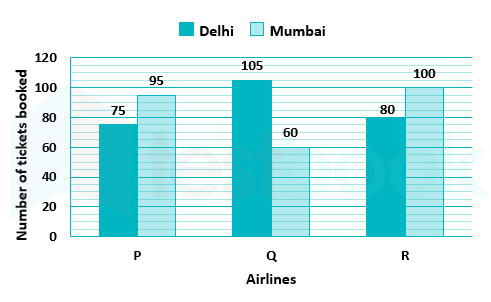
Study the given bar-graph and answer the question that follows.

The bar-graph depicts the number of tickets booked for Delhi and Mumbai by Airlines P, Q and R.

The total number of tickets booked for Mumbai by Airlines Q and R was what percent more than the number of tickets booked for Delhi by Airline R?

  1. AOption (a)

    150%

  2. BOption (b)

    100%

  3. COption (c)

    50%

  4. DOption (d)

    200%

View answer & explanation

Correct answer

Answer: (b)B.

100%

Why this answer is correct

Given:

The number of tickets booked for Mumbai by Airlines Q and R is 60 and 100 respectively.

The number of tickets booked for Delhi by Airline R is 80.

Concept Used:

Percentage

Calculation:

The number of tickets booked for Mumbai by Airlines Q and R is 60 + 100 = 160.

The number of tickets booked for Delhi by Airline R is 80.

According to the question:

⇒ (160-80)/80 × 100

⇒ 80/80 × 100

⇒ 100%

∴ Option 2 is the correct answer.

Question 35

Simplify (16a43b−56a−23b16)12\rm \left(\frac{16a^\frac{4}{3} b ^\frac{-5}{6}}{a^\frac{-2}{3}b^\frac{1}{6}} \right)^{\frac{1}{2}}.

  1. AOption (a)

    4ab12\rm \frac{4a}{b^\frac{1}{2}}

  2. BOption (b)

    ab12\rm \frac{a}{b^\frac{1}{2}}

  3. COption (c)

    4ab2\rm \frac{4a}{b^2}

  4. DOption (d)

    1(ab)12\rm \frac{1}{(ab)^\frac{1}{2}}

View answer & explanation

Correct answer

Answer: (a)A.

4ab12\rm \frac{4a}{b^\frac{1}{2}}

Why this answer is correct

Calculation:

(16a43b−56a−23b16)12\rm \left(\frac{16a^\frac{4}{3} b ^\frac{-5}{6}}{a^\frac{-2}{3}b^\frac{1}{6}} \right)^{\frac{1}{2}}

⇒ (16a43+23b16+56)12(\frac{16a^{\frac{4}{3}+\frac{2}{3}}}{b^{\frac{1}{6}+\frac{5}{6}}})^\frac{1}{2}

⇒(16a2b)12(\frac{16a^2}{b})^\frac{1}{2}

⇒ 4ab12\frac{4a}{b^\frac{1}{2} }

∴ Option 1 is the correct answer.

Question 36

If the base area of a right circular cylinder is 346.50 cm2 and its height is 21 cm, then find its total surface area. [USE π = 227\frac{22}{7}]

  1. AOption (a)

    2145 cm2

  2. BOption (b)

    2231 cm2

  3. COption (c)

    2079cm2

  4. DOption (d)

    2352 cm2

View answer & explanation

Correct answer

Answer: (c)C.

2079cm2

Why this answer is correct

Shortcut Trick

Radius r = √(Base Area × 7 ÷ 22) = √(346.5 × 7 ÷ 22) = 10.5 cm

Curved Surface Area = 2 × π × r × h = 2 × (22 ÷ 7) × 10.5 × 21 = 1386 cm2

Total Surface Area = 2 × Base Area + Curved Surface Area

Total Surface Area = (2 × 346.5) + 1386 = 693 + 1386 = 2079 cm2

∴ The correct answer is 2079 cm2.

Alternate Method

Given:

Base area of the right circular cylinder = 346.50 cm2

Height of the cylinder (h) = 21 cm

Formulas Used:

Base Area = π × r2

Total Surface Area = 2 × π × r × (r + h)

Total Surface Area = (2 × Base Area) + (2 × π × r × h)

r

h = 21 cm Base Area = 346.5 cm²

Calculations:

⇒ Base Area = π × r2 = 346.50

⇒ (22 ÷ 7) × r2 = 346.50

⇒ r2 = 346.50 × (7 ÷ 22)

⇒ r2 = 110.25

⇒ r = √110.25 = 10.5 cm

⇒ Curved Surface Area = 2 × π × r × h

⇒ Curved Surface Area = 2 × (22 ÷ 7) × 10.5 × 21

⇒ Curved Surface Area = 44 × 1.5 × 21 = 1386 cm2

⇒ Total Surface Area = (2 × Base Area) + Curved Surface Area

⇒ Total Surface Area = (2 × 346.50) + 1386

⇒ Total Surface Area = 693 + 1386 = 2079 cm2

∴ The correct answer is 2079 cm2.

Additional Information

Total Surface Area vs Curved Surface Area

Curved Surface Area (CSA) includes only the lateral surface of the cylinder (2 × π × r × h). Total Surface Area (TSA) includes the CSA plus both the circular top and bottom bases (2 × π × r × h + 2 × π × r2).

Volume of a Right Circular Cylinder

The volume represents the total capacity of the cylinder and is calculated by multiplying the base area by its height. The formula is V = π × r2 × h.

Divisibility by 11 Shortcut

In mensuration problems involving π (taken as 22 ÷ 7), the final area or volume is frequently a multiple of 11. You can quickly eliminate options by checking if the alternating sum of their digits equals 0 or a multiple of 11.

Question 37

Six workers with the initials C, E, G, J, L, and M are sitting around a circular table, facing the center and at equal distances from each other, not necessarily in the same order. J sits at the immediate right of E. E sits second to the left of M. L sits at the left of E. G sits second to the left of L. C sits at the immediate left of L. M sits at the immediate left of G. Who sits second to the left of E?

  1. AOption (a)

    C

  2. BOption (b)

    J

  3. COption (c)

    G

  4. DOption (d)

    M

View answer & explanation

Correct answer

Answer: (a)A.

C

Why this answer is correct

Six Workers: C, E, G, J, L, and M

According to the question,

All the workers are facing inside the circle at equal distances.

  1. J sits at the immediate right of E.

2) E sits second to the left of M.

  1. L sits at the left of E.

4) G sits second to the left of L.

  1. C sits at the immediate left of L.

  2. M sits at the immediate left of G

Here "C" sits second to the left of E.

Hence, the correct answer is "C".

Question 38

The formula for Joule's heating effect is represented as __________. (In the options, H denotes the heat produced, I is the current flowing through the conductor, R is the resistance and t is the time period.)

  1. AOption (a)

    H = VIR

  2. BOption (b)

    H = QIt

  3. COption (c)

    H = I2Rt

  4. DOption (d)

    H = VIt

View answer & explanation

Correct answer

Answer: (c)C.

H = I2Rt

Why this answer is correct

The correct answer is H = I2Rt.

Key Points

  • Joule's heating effect is the heat produced due to the resistance of a conductor when an electric current flows through it.
  • The formula for Joule's heating effect is given as H = I2Rt, where H represents the heat produced, I is the current flowing through the conductor, R is the resistance and t is the time period.
  • The formula shows that the heat produced is directly proportional to the square of the current flowing through the conductor and the resistance of the conductor.
  • The formula also shows that the heat produced is directly proportional to the time period for which the current flows through the conductor.

Additional Information

  • H = VIR: This formula represents Ohm's law, which relates the voltage (V), current (I) and resistance (R) of a conductor.
  • H = QIt: This formula represents the amount of charge (Q) passing through a conductor in time (t) and the potential difference (V) across the conductor.
  • H =VIt: This formula represents the work done (W) in moving a charge (Q) through a conductor with a potential difference (V) for a time (t).

Question 39

In the year 2022, tech giant Microsoft has announced to set up its fourth data centre in which of the following cities of India?

  1. AOption (a)

    Hyderabad

  2. BOption (b)

    Bengaluru

  3. COption (c)

    Mumbai

  4. DOption (d)

    Delhi

View answer & explanation

Correct answer

Answer: (b)B.

Bengaluru

Why this answer is correct

The correct answer is Bengaluru.

Key Points

  • Microsoft has already set up three data centres in India, located in Mumbai, Pune, and Chennai.
  • The new data centre in Bengaluru will be the fourth one and is expected to provide cloud services to Indian customers.
  • Microsoft's decision to set up a new data centre in Bengaluru is in line with its efforts to expand its presence in India's growing cloud market.
  • Bengaluru, also known as the Silicon Valley of India, is home to many technology companies and startups, making it an ideal location for Microsoft's new data centre.

Additional Information

  • Hyderabad is also a major technology hub in India, with a thriving IT industry.
  • Mumbai already has one of Microsoft's data centres, which was set up in 2015.
  • Delhi is the capital city of India and a major business hub.
  • The American multinational technology company Microsoft Corporation has its main office in Redmond, Washington. 
  • Paul Allen and Bill Gates are its founders.
  • It was established on April 4, 1975.

Question 40

Which of the following numbers will replace the question mark (?) in the given series?

5, 24, 61, 122, 213, ?

  1. AOption (a)

    340

  2. BOption (b)

    320

  3. COption (c)

    350

  4. DOption (d)

    334

View answer & explanation

Correct answer

Answer: (a)A.

340

Why this answer is correct

The pattern followed here is;

The logic followed is the multiple of 6 in ascending order.

Hence the correct answer is "340".

Alternate Method

2³ - 3 = 5 = 8 - 3 = 5,

3³ - 3 = 27 - 3 = 24,

4³ - 3 = 64 -3 = 61,

53 - 3 = 125 - 3 = 122

7³ - 3 = 343 - 3 = 340

Question 41

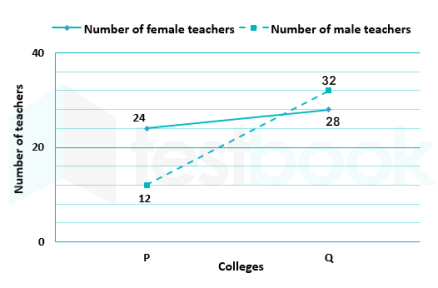
Study the given line graph and answer the following question.

The given line graph depicts the number of teachers (male and female) in two colleges P and Q.


The number of female teachers in college P is what percentage of male teachers in college Q?

  1. AOption (a)

    90%

  2. BOption (b)

    80%

  3. COption (c)

    75%

  4. DOption (d)

    85%

View answer & explanation

Correct answer

Answer: (c)C.

75%

Why this answer is correct

Calculation:

The number of female teachers in college P = 24

The number of male teachers in college Q = 32

According to the question:

⇒ (24/32) × 100 = 75%

∴ Option 3 is the correct answer.

Question 42

Which of the following statements is INCORRECT about soil formation?

  1. AOption (a)

    Temperature and rainfall influence rate of weathering.

  2. BOption (b)

    Time determines thickness of soil profile.

  3. COption (c)

    Parent rock determines colour.

  4. DOption (d)

    Altitude and slope determine the rate of humus formation.

View answer & explanation

Correct answer

Answer: (d)D.

Altitude and slope determine the rate of humus formation.

Why this answer is correct

The correct answer is 'Altitude and slope determine the rate of humus formation.'

Key Points

  • Altitude and slope:
  • While altitude and slope can affect various soil properties, they do not directly determine the rate of humus formation.
  • Humus formation is primarily influenced by organic matter decomposition, microbial activity, and environmental conditions such as temperature and moisture.
  • Steep slopes may lead to increased soil erosion, which can reduce the accumulation of organic matter, but this is an indirect effect rather than a determinant of humus formation rate.

Additional Information

  • Temperature and rainfall influence rate of weathering:
  • These factors significantly impact the weathering processes of rocks and minerals, leading to soil formation. High temperatures accelerate chemical weathering, while rainfall aids in physical weathering and transportation of materials.
  • Both chemical and physical weathering are essential for breaking down parent rock materials into finer soil particles.
  • Time determines thickness of soil profile:
  • The length of time affects soil maturity and profile development. Over extended periods, soils undergo various processes like leaching, accumulation of organic material, and horizon differentiation, leading to thicker soil profiles.
  • Longer periods allow for the development of distinct soil horizons, such as the accumulation of humus in the topsoil or clay in subsoils.
  • Parent rock determines colour:
  • The mineral composition of the parent rock influences the colour of the soil. For instance, soils derived from iron-rich parent materials are usually reddish, while those from limestone are often whitish or grey.
  • Other factors like organic matter content and soil moisture also influence soil colour but the parent material provides the fundamental mineralogical base.

Question 43

A ray of light in air is incident at an angle of 60° on the surface separating air from a medium of refractive index (3/2)\sqrt{(3/2)}.The ray is refracted in the medium at an angle of _________.

  1. AOption (a)

    45°

  2. BOption (b)

    60°

  3. COption (c)

    15°

  4. DOption (d)

    30°

View answer & explanation

Correct answer

Answer: (a)A.

45°

Why this answer is correct

The correct answer is 45°.

Key Points

  • The incident angle in air is 60 degrees.
  • The refractive index of the medium is(3/2)\sqrt{(3/2)}.
  • Using Snell's law, we can calculate the angle of refraction in the medium.
  • The angle of refraction is 45 degrees.

Additional Information

  • The angle of refraction is always less than the angle of incidence when light travels from a rarer to a denser medium.
  • The angle of refraction cannot be less than the critical angle, which is the angle of incidence that produces an angle of refraction of 90 degrees.
  • Refractive index is a measure of how much a material bends light as it passes through it.
  • The refractive index of a medium is the ratio of the speed of light in vacuum to the speed of light in that medium.
  • The refractive index of a medium depends on the wavelength of light.
  • The refractive index of a medium determines the amount of refraction that occurs when light passes from one medium to another.

Question 44

Double displacement reaction occurs between:

  1. AOption (a)

    neither ionic nor covalent compounds

  2. BOption (b)

    ionic compounds

  3. COption (c)

    covalent compounds

  4. DOption (d)

    both ionic and covalent compounds

View answer & explanation

Correct answer

Answer: (b)B.

ionic compounds

Why this answer is correct

The correct answer is ionic compounds.

Key Points

  • Double displacement reaction occurs between ionic compounds.
  • In a double displacement reaction, two ionic compounds exchange their ions to form two new compounds.
  • The reaction takes place in aqueous solutions or in the molten state.
  • The products of the reaction are usually a precipitate, water, or a gas.
  • Ionic compounds are composed of positively charged metal ions and negatively charged non-metal ions, and they dissociate into their ions in water or in the molten state.

Additional Information

  • In essence, molecules known as covalent compounds are created when two distinct atoms join forces to form a covalent bond.
  • They are usually non-metals with similar electronegativity.
  • Carbon and hydrogen are two examples of atom kinds that frequently combine to produce covalent compounds.

Question 45

Which of the following options is the closest approximate value which will come in place of the question mark (?) in the following equation?

2.59 × 1.3 - 4 + 3 = ?

  1. AOption (a)

    0

  2. BOption (b)

    4

  3. COption (c)

    1

  4. DOption (d)

    2

View answer & explanation

Correct answer

Answer: (d)D.

2

Why this answer is correct

According to the BODMAS Rule,

2.59 × 1.3 - 4 + 3 = x

x ⇒ 2.59 × 1.3 - 4 + 3

= 3.36 - 4 + 3

= 3.36 + 3 - 4

= 6.36 - 4

= 2.36 ≈ 2

Hence, the correct answer is "2".

Question 46

Which of the following players won a gold at the IBA Women's World Boxing Championship 2022?

  1. AOption (a)

    Nikhat Zareen

  2. BOption (b)

    Mary Kom

  3. COption (c)

    Lekha KC

  4. DOption (d)

    Sarita Devi

View answer & explanation

Correct answer

Answer: (a)A.

Nikhat Zareen

Why this answer is correct

The correct answer is Nikhat Zareen.

Key Points

  • Indian boxer Nikhat Zareen was born on June 14, 1996, and has won two world titles.
  • At the 2011 AIBA Women's Youth & Junior World Boxing Championships in Antalya, she took home a gold medal.
  • At the IBA Women's World Boxing Championships in 2022 Istanbul and 2023 New Delhi, Zareen took home gold medals.

Additional Information

  • Boxer Mary Kom has won five world championships and an Olympic bronze in 2012.
  • She is the first Padma Bhushan winner who is not a professional athlete.
  • Lekha KC is a Nepalese boxer who won a bronze medal at the 2019 South Asian Games.
  • In the 2006 Women's World Amateur Boxing Championships, she took home the gold medal.
  • Sarita Devi is an Indian boxer who has won multiple medals at various international tournaments including the Asian Games and Commonwealth Games.
  • The Indian government granted her the Arjuna award in 2009 in recognition of her accomplishments.

Question 47

Find the LCM of 20, 120 and 60.

  1. AOption (a)

    100

  2. BOption (b)

    60

  3. COption (c)

    80

  4. DOption (d)

    120

View answer & explanation

Correct answer

Answer: (d)D.

120

Why this answer is correct

Shortcut Trick

To find the LCM of a set of numbers, identify the largest number in the group.

Check if the largest number, 120, is divisible by the other numbers: 20 and 60.

120 ÷ 20 = 6 (fully divisible)

120 ÷ 60 = 2 (fully divisible)

Since 120 is the smallest multiple common to all, it is the LCM.

∴ The correct answer is 120.

Alternate Method

Given: Numbers are 20, 120, and 60.

Formula Used: Prime Factorization Method.

Calculations:

⇒ Prime factors of 20 = 2 × 2 × 5 = 22 × 51

⇒ Prime factors of 120 = 2 × 2 × 2 × 3 × 5 = 23 × 31 × 51

⇒ Prime factors of 60 = 2 × 2 × 3 × 5 = 22 × 31 × 51

⇒ LCM = 23 × 31 × 51

⇒ LCM = 8 × 3 × 5 = 120

∴ The correct answer is 120.

Additional Information

LCM (Least Common Multiple)

The smallest positive integer that is divisible by each of the given numbers.

HCF and LCM Relation

For two numbers a and b: Product of numbers = HCF × LCM (i.e., a × b = HCF(a,b) × LCM(a,b)).

LCM of Fractions

LCM of fractions = LCM of Numerators ÷ HCF of Denominators.

Question 48

If y÷121=0.03\rm \sqrt {y} \div \sqrt{121} = 0.03, then find the value of y, giving your answer correct to 3 decimal places.

  1. AOption (a)

    0.109

  2. BOption (b)

    1.760

  3. COption (c)

    1.640

  4. DOption (d)

    0.176

View answer & explanation

Correct answer

Answer: (a)A.

0.109

Why this answer is correct

Calculation:

y÷121=0.03\rm \sqrt {y} \div \sqrt{121} = 0.03

⇒ y121=0.03\frac{\sqrt{y}}{\sqrt{121}} = 0.03

Square both sides:

⇒ y121=0.032\frac{y}{121} = 0.03^2

⇒ y = 121 × 0.0009

⇒ 0.1089 or 0.109

∴ Option 1 is the correct answer.

Question 49

If 21.134 × 10x = 0.0021134, then find the value of x.

  1. AOption (a)

    -2

  2. BOption (b)

    0

  3. COption (c)

    -4

  4. DOption (d)

    -3

View answer & explanation

Correct answer

Answer: (c)C.

-4

Why this answer is correct

Calculation:

21.134 × 10x = 0.0021134

⇒ 10x = 0.0001

⇒ 10x = 10 - 4

⇒ x = - 4

∴ Option 3 is the correct answer.

Question 50

In which year was the Mahatma Gandhi National Rural Employment Guarantee Act passed by the Government of India?

  1. AOption (a)

    2003

  2. BOption (b)

    2005

  3. COption (c)

    2000

  4. DOption (d)

    2007

View answer & explanation

Correct answer

Answer: (b)B.

2005

Why this answer is correct

The correct answer is 2005.

Key Points

  • The Mahatma Gandhi National Rural Employment Guarantee Act was passed by the Government of India on August 25, 2005.
  • The Act aims to provide a legal guarantee for at least 100 days of employment in every financial year to adult members of rural households who are willing to do unskilled manual work.
  • The Act was initially implemented in 200 districts of India in February 2006 and was extended to cover all districts of India in 2008.
  • The Act has been successful in providing employment opportunities to millions of rural households and has helped in reducing rural poverty and distress migration.

Additional Information

  • The act, in contrast to previous employment guarantee programs, employs a rights-based approach to address the root causes of chronic poverty.
  • Women must make up at least one-third of the recipients.
  • The Minimum pay Act, 1948, stipulates the statutory minimum pay that must be paid to agricultural laborers in the state.
  • The legally-backed guarantee that any adult living in a rural area would find job within 15 days of requesting it, or else a "unemployment allowance" must be provided, is the most significant aspect of the MGNREGA framework.

Question 51

The second 'Muslim Women Rights Day' was observed across India on _________  to commemorate the enactment of the law against Triple Talaq.

  1. AOption (a)

    1 July 2021

  2. BOption (b)

    1 June 2021

  3. COption (c)

    1 September 2021

  4. DOption (d)

    1 August 2021

View answer & explanation

Correct answer

Answer: (d)D.

1 August 2021

Why this answer is correct

The correct answer is 1 August 2021.

Key Points

  • Muslim Women Rights Day is observed on 1 August every year in India to commemorate the enactment of the law against Triple Talaq.
  • The Muslim Women (Protection of Rights on Marriage) Act, 2019, criminalizes the practice of instant divorce by Muslim men by saying "talaq" three times in one go.
  • The first Muslim Women Rights Day was observed on 1 August 2020.

Additional Information

  • The Supreme Court of India ruled in a landmark decision that Triple Talaq was unconstitutional since it infringed upon the fundamental rights of Muslim women.
  • By quickly saying the word "talaq" three times, Muslim males might divorce their wives without getting their permission.
  • It was common among Muslims in India, the bulk of whom adhere to the Hanafi branch of Islamic law.

Question 52

The marked price of a car is Rs. 5,00,000. Under a scheme successive discount of 10% and 8% are offered on it. Find the total discount offered while selling the car under the given scheme.

  1. AOption (a)

    Rs. 76,000

  2. BOption (b)

    Rs. 86,000

  3. COption (c)

    Rs. 90,000

  4. DOption (d)

    Rs. 82,000

View answer & explanation

Correct answer

Answer: (b)B.

Rs. 86,000

Why this answer is correct

Shortcut Trick

Total discount% = a + b − (a × b) ÷ 100

Effective Discount% = 10 + 8 − (10 × 8) ÷ 100 = 18 − 0.8 = 17.2%

Total Discount = 17.2% of Rs. 5,00,000

Total Discount = (17.2 ÷ 100) × 5,00,000 = 17.2 × 5,000 = Rs. 86,000

∴ The correct answer is Rs. 86,000.

Alternate Method

Given: Marked Price (MP) = Rs. 5,00,000; First Discount = 10%; Second Discount = 8%. Formulas: SP = MP × (100 − D1)% × (100 − D2)% | Total Discount = MP − SP

⇒ Price after 1st discount = 5,00,000 × (90 ÷ 100) = Rs. 4,50,000 ⇒ Price after 2nd discount (Final SP) = 4,50,000 × (92 ÷ 100) = 4,500 × 92 = Rs. 4,14,000 ⇒ Total Discount = MP − Final SP = 5,00,000 − 4,14,000 ⇒ Total Discount = Rs. 86,000 ∴ The correct answer is Rs. 86,000.

Additional Information

Marked Price & Discount

Marked Price is the price printed on an item. Discount is always calculated on the Marked Price unless stated otherwise.

Successive Discounts

Two successive discounts of x% and y% are NOT equal to (x+y)%. They are equivalent to a single discount of [x + y − (xy/100)]%.

Question 53

In a certain code language, ‘ASIDE' is written as 'CVMIK' and 'ARRAY' is written as 'CUVFE’. How will 'BOUND' be written in that language?

  1. AOption (a)

    DRYSJ

  2. BOption (b)

    DRISY

  3. COption (c)

    DRSJY

  4. DOption (d)

    DRYJS

View answer & explanation

Correct answer

Answer: (a)A.

DRYSJ

Why this answer is correct

The positional value of alphabet series is;

The pattern for this code is as follows:

In ASIDE →

In ARRAY →

Similarly,

In BOUND →

Hence, the correct answer is "DRYSJ".

Question 54

As on August 2022, under the Pradhan Mantri Jeevan Jyoti Bima Yojana(PMJJBY), the life cover of Rs. _______ lakhs shall be for the one year period stretching from 1st June to 31st May and will be renewable.

  1. AOption (a)

    1.5

  2. BOption (b)

    2.5

  3. COption (c)

    1

  4. DOption (d)

    2

View answer & explanation

Correct answer

Answer: (d)D.

2

Why this answer is correct

The correct answer is 2.

Key Points

  • Under PMJJBY, the life cover provided is Rs. 2 lakhs for the one-year period from 1st June to 31st May.
  • PMJJBY is a government-backed life insurance scheme that provides life cover to individuals at a very low cost.
  • The scheme is available to anyone between the ages of 18 and 50 years and can be renewed annually.
  • PMJJBY also provides a death benefit to the nominee in case of the policyholder's death during the policy period.
  • The premium for the scheme is very low, and it can be paid annually through auto-debit from the policyholder's bank account.

Additional Information

  • Any cause of death is covered by PMJJBY.
  • Each subscriber must pay an annual premium of ₹ 436/-, which will be automatically deducted from their bank or post office account.
  • Enrollment in the program can be completed at the post office, in the event of a post office savings bank account, or by going to the bank's branch, BC point, or website.
  • According to a one-time directive from the account holder, the premium under the system is automatically deducted from the subscriber's bank account each year.

Question 55

Which of the following options explains the objectives of the National Informatics Centre (NIC)?

A) Technology partner of the government

B) Develops e-Content and learning materials for school education

C) Explores and advises on the use of emerging technologies

D) Provides data networks packages to the government and private institutes

  1. AOption (a)

    A and D

  2. BOption (b)

    B and C

  3. COption (c)

    C and D

  4. DOption (d)

    A and C

View answer & explanation

Correct answer

Answer: (d)D.

A and C

Why this answer is correct

The correct answer is A and C.

Key Points

  • NIC is the premier science and technology organization of the Indian Government in informatics services and information and communication technology (ICT) applications.
  • It is a technology partner of the government and provides e-governance solutions to various ministries, departments, and organizations of the Government of India.
  • NIC explores and advises on the use of emerging technologies.
  • NIC's RD division, NICSI (NIC Services Incorporated), is involved in research and development activities related to emerging technologies such as artificial intelligence (AI), blockchain, and internet of things (IoT).

Additional Information

  • This is partially correct as NIC provides data networks packages to the government, but not to private institutes.
  • NICNET (NIC's Network) is the communication backbone of the Indian Government's e-governance applications.
  • Under the auspices of the Indian Electronics Commission, Narasimaiah Seshagiri founded the National Informatics Centre (NIC) in 1976.
  • Before falling under the purview of the Ministry of Electronics and Information Technology, it was subsequently transferred to the Planning Commission of India.
  • For 2018–19, it had an annual budget of ₹11.5 billion.
  • The majority of this is used to give various government departments free services.

Question 56

Eight friends are sitting around a square table facing the centre. Four of them are sitting at the corners and remaining four are sitting at the exact middle of the four sides. Only Charu is sitting between Karan and Hitesh. Jay is sitting fourth to the left of Laxshita. Alok is sitting second to the left of Laxshita. Siya is sitting to the immediate right of Jay. Karan is sitting fourth to the left of Siya. Rashmi is sitting fourth to the right of Hitesh. Who is sitting to the immediate right of Alok?

  1. AOption (a)

    Jay

  2. BOption (b)

    Hitesh

  3. COption (c)

    Rashmi

  4. DOption (d)

    Siya

View answer & explanation

Correct answer

Answer: (c)C.

Rashmi

Why this answer is correct

Eight friends are sitting around a square table facing the centre. Four of them are sitting at the corners and remaining four are sitting at the exact middle of the four sides.

So, we draw the diagram as follows:

  1. Jay is sitting fourth to the left of Laxshita.

  2. Alok is sitting second to the left of Laxshita.

  3. Siya is sitting to the immediate right of Jay.

  4. Karan is sitting fourth to the left of Siya.


  1. Only Charu is sitting between Karan and Hitesh.


6) Rashmi is sitting fourth to the right of Hitesh.


Hence, the correct answer is "Rashmi".

Question 57

The marks of a student increased from 10 to 12. Find the percentage increase in the marks.

  1. AOption (a)

    2%

  2. BOption (b)

    20%

  3. COption (c)

    12%

  4. DOption (d)

    17%

View answer & explanation

Correct answer

Answer: (b)B.

20%

Why this answer is correct

Given:

The mark of the student is 10 and increased to 12.

Calculation:

Increase in marks = 12 - 10 = 2

Percentage change = (2/10) × 100

Percentage change = 20%

∴ The percentage change is 20%.

Question 58

The position of how many letters will remain unchanged if each of the letters in the word BRACKET is arranged in alphabetical order?

  1. AOption (a)

    One

  2. BOption (b)

    Two

  3. COption (c)

    Zero

  4. DOption (d)

    Three

View answer & explanation

Correct answer

Answer: (b)B.

Two

Why this answer is correct

The positional value of alphabet series is;

Given WordBRACKET
Arranged WordABCEKRT


The position of two (K and T) alphabet letters will remain unchanged.

Hence, the correct answer is "Two".

Question 59

What does a self-sustaining ecosystem mean?

  1. AOption (a)

    The organic matter remains almost constant generation over generation.

  2. BOption (b)

    It is not dependent on radiant energy for its maintenance.

  3. COption (c)

    No organisms are added or removed from the biotic component.

  4. DOption (d)

    The organisms are well adapted to the local biotic components.

View answer & explanation

Correct answer

Answer: (c)C.

No organisms are added or removed from the biotic component.

Why this answer is correct

The correct answer is No organisms are added or removed from the biotic component.

Key Points

  • Self-sustaining ecosystem refers to an ecosystem that can maintain its balance and function without external interference or inputs.
  • It means that the ecosystem is able to produce and recycle all the necessary resources required for the survival of its organisms.
  • A self-sustaining ecosystem means that no organisms are added or removed from the biotic component.

Additional Information

  • An ecosystem needs three primary elements in order to be sustainable.
  • Energy availability: In practically all societies, light from the sun serves as the primary energy source.
  • Nutritional availability: saprotrophic decomposers guarantee that inorganic nutrients are continuously recycled in an ecosystem.
  • Recycling of wastes: Some bacteria, such as denitrifying bacteria like Nitrosomonas, can detoxify toxic waste byproducts.

Question 60

Which of the following statements is INCORRECT Mendel's pea plant experiments?

  1. AOption (a)

    Appearance of both the tallness and shortness traits in F2 progeny indicated that both the traits were inherited in the F1 plants.

  2. BOption (b)

    In the second-generation, or F2 generation which are the progeny of the F1 tall plants, all the plants are tall.

  3. COption (c)

    Mendel used a number of contrasting visible characters of garden peas – round/wrinkled seeds, tall/short plants.

  4. DOption (d)

    He took a tall plant and a short plant, produced progeny by crossing them and in the resulting F1 progeny, all plants were tall.

View answer & explanation

Correct answer

Answer: (b)B.

In the second-generation, or F2 generation which are the progeny of the F1 tall plants, all the plants are tall.

Why this answer is correct

The correct answer is In the second-generation, or F2 generation which are the progeny of the F1 tall plants, all the plants are tall.

Key Points

  • Mendel's pea plant experiments are considered as the foundation of modern genetics.
  • Mendel used a number of contrasting visible characters of garden peas such as round/wrinkled seeds, yellow/green pods, and tall/short plants.
  • He took a tall plant and a short plant, produced progeny by crossing them and in the resulting F1 progeny, all plants were tall.
  • This indicated that the tall trait was dominant over the short trait.
  • In the second-generation, or F2 generation, which are the progeny of the F1 tall plants, the plants exhibited a 3:1 ratio of tall to short plants.
  • This was because the F1 plants were heterozygous, meaning they carried one dominant and one recessive allele for the trait.

Additional Information

  • A great deal of the genetic code was developed by Mendel's pea plant research, which he carried out between 1856 and 1863.
  • These days, it's known as the Mendelian inheritance laws.
  • Mendel created the terms "recessive" and "dominant" in regard to particular features in order to describe this phenomena.
  • His research, which was published in 1866, showed how genes—now known as unseen "factors"—predictably determine an organism's features.

Question 61

Refer to the following letter series and answer the question.

(Left) B E S U Y N O A P S B G S A X T G (Right)

How many letters are there in the English alphabetical series between the letter which is sixth from the left end and the letter which is fifth from the right end of the given series?

  1. AOption (a)

    3

  2. BOption (b)

    6

  3. COption (c)

    5

  4. DOption (d)

    4

View answer & explanation

Correct answer

Answer: (d)D.

4

Why this answer is correct

The following letter series is as follow:

 Left side :  B E S U Y N O A P S B G S A X T G : Right side

 Sixth letter from the left side: N

 Fifth letter from the right side : S

In the English alphabetical series, there are four letters between N and S : N, O , P , Q , R , S.

Hence, the correct answer "4".

<br>

Mistake Points Please read the question carefully. The question is, How many letters are there in "the English alphabetical series" between the letter which is sixth from the left end and the letter which is fifth from the right end of the given series?

So we have to find the number of letters between N and S in the English alphabetical Series (Not in the given series).

There are 4 letters between N and S in the English alphabetical series.

Question 62

A, B, C, D, E, F and G are seven students standing in a row facing North. D stands at the exact centre of the row. A stands second from the right end of the row. B stands second to the left of D. G stands exactly between D and A. F stands third from the left end of the row. C is the immediate neighbour of B. Who stands fifth from the left end of the row?

  1. AOption (a)

    G

  2. BOption (b)

    A

  3. COption (c)

    F

  4. DOption (d)

    E

View answer & explanation

Correct answer

Answer: (a)A.

G

Why this answer is correct

Arranging these seven students according to the given information -

1) D stands at the exact centre of the row.

2) A stands second from the right end of the row and G stands exactly between D and A.

3)  B stands second to the left of D and F stands third from the left end of the row.

4) C is the immediate neighbour of B.

So as per the final arrangement "G" stands fifth from the left.

Hence, the correct answers is "G".

Question 63

A certain number of people are sitting in a row, facing north. Only four people are sitting to the left of C. Only three people are sitting to the right of B. A is sitting fourth to the left of B. A is sitting fourth to the right of E. C is sitting third to the left of E. If no other person is sitting in the row, what is the total number of persons seated?

  1. AOption (a)

    21

  2. BOption (b)

    23

  3. COption (c)

    19

  4. DOption (d)

    24

View answer & explanation

Correct answer

Answer: (c)C.

19

Why this answer is correct

The following arrangement is as follows:

1) Only four people are sitting to the left of C.

2) Only three people are sitting to the right of B.

3) A is sitting fourth to the left of B and A is sitting fourth to the right of E.

4) C is sitting third to the left of E. 


Hence, the correct answers is "19".

Question 64

In this question, the statement is followed by four conclusions. Find out which conclusion is NOT true based on the given statement.

Statement: I > Q > P ≥ S = U < M ≤ Z

  1. AOption (a)

    I < P

  2. BOption (b)

    P ≥ U

  3. COption (c)

    Z > U

  4. DOption (d)

    Q > S

View answer & explanation

Correct answer

Answer: (a)A.

I < P

Why this answer is correct

Given Statement:- I > Q > P ≽ S = U ≺ M ≼ Z

Conclusions:-

(1) I ≺ P→ False (as I ≻ Q ≻ P i.e I ≻ P is definitely false)

(2) P ≽ U → True (as P ≽ S = U i.e P ≽ U is definitely true)

(3) Z ≻ U → True (as U ≺ M ≼ Z i.e Z ≻ U is definitely true)

(4) Q ≻ S → True (as Q ≻ P ≽ S i.e Q ≻ S is definitely true)

Hence, the correct answer is "I ≺ P".

Question 65

If pipe A can fill a cistern in X hours, pipe B can fill the same cistern in Y hours, and pipe C can empty the full cistern in Z hours, then find the time taken to completely fill the cistern, if Pipes A, B and C are opened together.

  1. AOption (a)

    XYZYZ−XZ−XY\rm \frac{XYZ}{YZ-XZ- XY}

  2. BOption (b)

    XYZYZ+XZ+XY\rm \frac{XYZ}{YZ+XZ+ XY}

  3. COption (c)

    XYZYZ+XZ−XY\rm \frac{XYZ}{YZ+XZ- XY}

  4. DOption (d)

    XYZYZ−XZ+XY\rm \frac{XYZ}{YZ-XZ+XY}

View answer & explanation

Correct answer

Answer: (c)C.

XYZYZ+XZ−XY\rm \frac{XYZ}{YZ+XZ- XY}

Why this answer is correct

Shortcut Trick

Net rate of filling = (1/X) + (1/Y) − (1/Z)

Net rate = (YZ + XZ − XY) / XYZ

Time taken = 1 / (Net rate) = XYZ / (YZ + XZ − XY)

∴ The correct answer is (XYZ)/(YZ+XZ−XY) hours.

Alternate Method

PipeTime (Hours)Total Work (LCM)Efficiency
Pipe A (+)XXYZYZ
Pipe B (+)YXZ
Pipe C (−)Z−XY

⇒ Total Work = LCM of X, Y, and Z = XYZ units.

⇒ Efficiency of Pipe A = XYZ ÷ X = YZ units/hr.

⇒ Efficiency of Pipe B = XYZ ÷ Y = XZ units/hr.

⇒ Efficiency of Pipe C = −(XYZ ÷ Z) = −XY units/hr (as it is an outlet pipe).

⇒ Combined Efficiency of (A + B + C) = YZ + XZ − XY units/hr.

⇒ Time taken = Total Work ÷ Combined Efficiency

⇒ Time taken = XYZ / (YZ + XZ − XY) hours.

∴ The correct answer is (XYZ)/(YZ+XZ−XY) hours.

Additional Information

Inlet and Outlet Pipes

An Inlet pipe (fills) has positive efficiency, while an Outlet pipe (empties) has negative efficiency.

Pipes and Cisterns Formula

If two pipes fill a tank in x and y hours, combined time = (xy) / (x + y). If one empties in z hours, use −1/z in the rate sum.

Efficiency Relationship

Efficiency is inversely proportional to the Time taken to complete the work (E × T = W).

Question 66

XS 18 is related to SN 22 in a certain way. In the same way, KN 28 is related to FI 32. To which of the following is PH 44 related following the same logic?

  1. AOption (a)

    CK 48

  2. BOption (b)

    KC 47

  3. COption (c)

    KC 48

  4. DOption (d)

    CK 74

View answer & explanation

Correct answer

Answer: (c)C.

KC 48

Why this answer is correct

The positional value of alphabet series is;

XS 18 is related to SN 22 as:-

And;

KN 28 is related to FI 32

Similarly,

PH 44 is related to KC 48

Hence, the correct answer is "KC 48".

Question 67

Which of the following statements regarding reproduction in flowering plants is FALSE?

  1. AOption (a)

    Reproduction may occur through seeds.

  2. BOption (b)

    Reproduction may occur through spores.

  3. COption (c)

    Reproduction may occur from fragments of stems.

  4. DOption (d)

    Reproduction may occur from tissues separated from the plant and grown on an artificial medium.

View answer & explanation

Correct answer

Answer: (b)B.

Reproduction may occur through spores.

Why this answer is correct

The correct answer is Reproduction may occur through spores.

Key Points

  • Spores are reproductive structures produced by some plants, including ferns and mosses.
  • Unlike seeds, spores do not contain an embryo and are not produced by flowers.
  • They can germinate into new plants under favorable conditions.
  • Spores are produced by certain bacteria as a self-defense mechanism.
  • Spore walls are thick.
  • They are resilient to a variety of environmental factors, including high temperatures and humidity.

Additional Information

  • Flowering plants reproduce through seeds, which are produced by the flowers after pollination and fertilization.
  • Reproduction from fragments of stems is called vegetative propagation, which is a form of asexual reproduction.
  • This method is commonly used in horticulture and agriculture to produce clones of desirable plants.
  • Reproduction from tissues separated from the plant and grown on an artificial medium is called tissue culture, another form of asexual reproduction.
  • This method is used in plant breeding and genetic engineering to produce large numbers of identical plants.

Question 68

Find the arithmetic mean of the following data.

X61018243036
F434211
  1. AOption (a)

    17

  2. BOption (b)

    12

  3. COption (c)

    13

  4. DOption (d)

    16

View answer & explanation

Correct answer

Answer: (d)D.

16

Why this answer is correct

Shortcut Trick

Assume a Mean (A) = 18. Calculate deviations (d = X − 18) and multiply by frequency (f).

∑fd = (4×−12) + (3×−8) + (4×0) + (2×6) + (1×12) + (1×18) = −48 − 24 + 0 + 12 + 12 + 18 = −30.

Total Frequency (∑f) = 4 + 3 + 4 + 2 + 1 + 1 = 15.

Mean = A + (∑fd / ∑f) = 18 + (−30 / 15) = 18 − 2 = 16.

∴ The correct answer is 16.

Alternate Method

Given: Data points (X) and their respective frequencies (F).

Formula Used: Arithmetic Mean (μ) = ∑fiXi / ∑fi

Calculations:

⇒ f1X1 = 6 × 4 = 24

⇒ f2X2 = 10 × 3 = 30

⇒ f3X3 = 18 × 4 = 72

⇒ f4X4 = 24 × 2 = 48

⇒ f5X5 = 30 × 1 = 30

⇒ f6X6 = 36 × 1 = 36

⇒ ∑fiXi = 24 + 30 + 72 + 48 + 30 + 36 = 240

⇒ ∑fi = 4 + 3 + 4 + 2 + 1 + 1 = 15

⇒ Mean = 240 ÷ 15 = 16

∴ The correct answer is 16.

Additional Information

Weighted Arithmetic Mean

Used when different data points have different levels of importance or frequency; calculated as ∑wX / ∑w.

Assumed Mean Method

A technique to simplify calculations by choosing an arbitrary central value (A) and using deviations: Mean = A + ∑fd/∑f.

Properties of Mean

The sum of deviations of a set of observations from their arithmetic mean is always zero, i.e., ∑(X − Mean) = 0.

Question 69

If a% is the first discount and b% is the second discount on the marked price of an article, then an equivalent single discount percentage is given by:

  1. AOption (a)

    a+b−a+b100\rm a + b-\frac{a+b}{100}

  2. BOption (b)

    a+b−a−b100\rm a + b-\frac{a-b}{100}

  3. COption (c)

    a+b+ab100\rm a + b+\frac{ab}{100}

  4. DOption (d)

    a+b−ab100\rm a + b-\frac{ab}{100}

View answer & explanation

Correct answer

Answer: (d)D.

a+b−ab100\rm a + b-\frac{ab}{100}

Why this answer is correct

Shortcut Trick

For two successive discounts of a% and b%, the equivalent single discount is calculated using the formula: a + b − (ab ÷ 100).

This formula is derived from the net change formula applied to reductions.

Here, the percentage decrease is treated as negative in the net change formula: −a − b + (−a × −b) ÷ 100.

Factor out the negative sign to represent total discount: −[a + b − (ab ÷ 100)].

∴ The correct answer is a + b − (ab ÷ 100).

Alternate Method

Given → First discount = a%, Second discount = b%. Formulas → Successive discount = a + b − ab ÷ 100 | SP = MP × (100 − d1)% × (100 − d2)%.

Steps: ⇒ Let the Marked Price (MP) be 100. ⇒ After first discount a%, Price = 100 − a. ⇒ After second discount b% on (100 − a), Price = (100 − a) − [b ÷ 100 × (100 − a)]. ⇒ Price = 100 − a − b + (ab ÷ 100). ⇒ Total Discount = MP − Final Price = 100 − [100 − a − b + (ab ÷ 100)]. ⇒ Total Discount = a + b − (ab ÷ 100). ∴ The correct answer is a + b − (ab ÷ 100).

Additional Information

Successive Discounts

When two or more discounts are allowed one after the other on the Marked Price, they are called successive discounts. The second discount is calculated on the price remaining after the first discount.

Marked Price & Discount

Discount is always calculated on the Marked Price (MP). Formula: SP = MP − Discount.

Question 70

Select the set in which the numbers are related in the same way as are the numbers of the given sets.

(NOTE : Operations should be performed on the whole numbers, without breaking down the numbers into its constituent digits. E.g. 13 - Operations on 13 such as adding /subtracting /multiplying etc. to 13 can be performed. Breaking down 13 into 1 and 3 and then performing mathematical operations on 1 and 3 is not allowed)

(1, 3, 4)

(8, 24, 18)

  1. AOption (a)

    (10, 23, 15)

  2. BOption (b)

    (8, 14, 10)

  3. COption (c)

    (19, 25, 12)

  4. DOption (d)

    (8, 13, 10)

View answer & explanation

Correct answer

Answer: (a)A.

(10, 23, 15)

Why this answer is correct

The logic followed here is:-

(First Number + Third Number) - 2 = Second Number

In (1, 3, 4) →

(1 + 4) - 2 → 5 - 2 = 3

In (8, 24, 18) →

(8 + 18) - 2 → 26 -2 = 24

Similarly,

In (10, 23, 15) →

(10 + 15) - 2 → 25 - 2 = 23

Hence the correct answer is "(10, 23, 15)".

Question 71

Three statements are followed by three conclusions numbered I, II and III. You have to consider these statements to be true, even if they seem to be at variance with commonly known facts. Decide which of the given conclusions logically follow(s) from the given statements.

Statements:

All apples are papayas

Some papayas are berries

Some berries are cherries

Conclusions:

(I) Some berries are papayas

(II) All papayas are apples

(III) Some cherries are berries

  1. AOption (a)

    Only conclusion I follows

  2. BOption (b)

    None of the conclusions follow

  3. COption (c)

    Only conclusion II follows

  4. DOption (d)

    Both conclusions I and III follow

View answer & explanation

Correct answer

Answer: (d)D.

Both conclusions I and III follow

Why this answer is correct

The least possible Venn Diagram of the given statements will be as follows:

(I) Some berries are papayas → Follows. (As some papayas are berries, we got the direct relation between papaya and berries, thus some berries are papayas is definite.

(II) All papayas are apples → Does not follows. (As all apples are papayas are given, but the reverse of it, i.e. all papayas are apples will not be definite. Hence, it will not hold.)

(III) Some cherries are berries → Follows. (As some berries are cherries are given, and the reverse of it, i.e. some cherries are berries is also definite. Hence, it follows.)

Hence, the correct answer is "Both conclusions I and III follow".

Additional Information

Question 72

Deeksha travels in her car from City A to City B at a speed of 120 km/h, and while coming back by the same route from City B to City A, she travels at a speed of 130 km/h. Find Deeksha's average speed during the whole journey

  1. AOption (a)

    124.8 km/h

  2. BOption (b)

    123.9 km/h

  3. COption (c)

    122.8 km/h

  4. DOption (d)

    125.0 km/h

View answer & explanation

Correct answer

Answer: (a)A.

124.8 km/h

Why this answer is correct

Shortcut Trick

When the distance is constant for two parts of a journey with speeds v1 and v2, the average speed is the harmonic mean of the speeds.

Average Speed = (2 × v1 × v2) ÷ (v1 + v2)

Average Speed = (2 × 120 × 130) ÷ (120 + 130)

Average Speed = 31200 ÷ 250 = 124.8 km/h.

∴ The correct answer is 124.8 km/h.

Alternate Method

Given:

Speed from City A to City B (v1) = 120 km/h

Speed from City B to City A (v2) = 130 km/h

Formula used:

Average Speed = Total Distance ÷ Total Time

Let the distance between City A and City B be d km.

⇒ Total distance for the whole journey = d + d = 2d km

⇒ Time taken to travel from A to B (t1) = Distance ÷ Speed = d ÷ 120

⇒ Time taken to travel from B to A (t2) = Distance ÷ Speed = d ÷ 130

⇒ Total Time = (d ÷ 120) + (d ÷ 130) = (130d + 120d) ÷ (120 × 130)

⇒ Total Time = 250d ÷ 15600

⇒ Average Speed = 2d ÷ (250d ÷ 15600)

⇒ Average Speed = (2d × 15600) ÷ 250d

⇒ Average Speed = 31200 ÷ 250 = 124.8 km/h.

∴ The correct answer is 124.8 km/h.

Additional Information

Average Speed (Equal Distances)

When a person covers three equal distances with speeds x, y, and z, then Average Speed = 3xyz ÷ (xy + yz + zx).

Average Speed (Equal Time)

If a person travels at speed v1 for time t and speed v2 for the same time t, Average Speed = (v1 + v2) ÷ 2.

Unit Conversion

To convert speed from km/h to m/s, multiply by 5 ÷ 18. To convert m/s to km/h, multiply by 18 ÷ 5.

Question 73

Which of the following sites is NOT suitable for building a water-harvesting pit?

  1. AOption (a)

    In the yard of a large housing complex

  2. BOption (b)

    Near a large open landfill site

  3. COption (c)

    In the corner of a small one-storey house

  4. DOption (d)

    Near a large and busy international airport

View answer & explanation

Correct answer

Answer: (b)B.

Near a large open landfill site

Why this answer is correct

The correct answer is 'Near a large open landfill site'

Key Points

  • Water Harvesting Pit:
  • A water harvesting pit is a structure designed to collect rainwater and recharge groundwater levels.
  • These structures should be built in locations where the water can be protected from pollution and contamination.
  • Landfill Site:
  • Landfill sites contain waste and various types of garbage, which can seriously pollute water.
  • A water harvesting pit near a landfill site can get contaminated by the leaching of waste materials into the ground, degrading water quality.
  • Therefore, constructing a water harvesting pit near a landfill site increases the risk of contamination and is unsuitable.

Additional Information

  • In the yard of a large housing complex:
  • Constructing a water harvesting pit in the yard of a large housing complex is suitable as it serves community needs and aids in groundwater recharge.
  • In the corner of a small one-storey house:
  • Building a water harvesting pit in the corner of a small one-storey house is also appropriate, fulfilling the water requirements of the household and aiding groundwater recharge.
  • Near a large and busy international airport:
  • While this location is often busy, it is not directly associated with water pollution. Therefore, it is potentially suitable for constructing a water harvesting pit.

Question 74

Why do plants lack a defined excretory system like kidneys in mammals?

  1. AOption (a)

    Because plants do not produce waste materials

  2. BOption (b)

    Because plants produce only gaseous wastes which diffuse out

  3. COption (c)

    They excrete through their vegetative parts

  4. DOption (d)

    Because plants lack a circulatory system

View answer & explanation

Correct answer

Answer: (c)C.

They excrete through their vegetative parts

Why this answer is correct

The correct answer is They excrete through their vegetative parts.

Key Points

  • Plants produce waste materials that are not harmful to their growth and development.
  • These waste materials are either stored in vacuoles or recycled by the plant as nutrients.
  • Plants mainly produce gaseous wastes, such as oxygen and carbon dioxide, through their stomata.
  • These gases diffuse out of the plant's leaves and stems, which eliminates the need for a specialized excretory system.
  • Plants excrete through their vegetative parts, such as leaves, roots, and stems.
  • This process is called transpiration, which involves the loss of water vapor through the stomata in the leaves.
  • Plants do not have a circulatory system like mammals, which means that they do not have a centralized organ like the kidney to filter and eliminate waste products.

Additional Information

  • A portion of the excretory wastes collect in the cell's vacuoles, where they eventually transform into gum and resin.
  • Older xylem tissues exhibit these wastes, finally drooping or withering away.
  • Tree bark contains latex and oil, which are some of the excretory secretions of plants.

Question 75

Which place receives the highest rainfall in the world?

  1. AOption (a)

    Dhupgarh

  2. BOption (b)

    Kangto

  3. COption (c)

    Mawsynram

  4. DOption (d)

    Tura Peak

View answer & explanation

Correct answer

Answer: (c)C.

Mawsynram

Why this answer is correct

The correct answer is Mawsynram.

Key Points

  • Mawsynram is located in the Indian state of Meghalaya, which is known for its high rainfall.
  • The region receives heavy rainfall due to its proximity to the Bay of Bengal, which brings in moisture-laden winds from the sea.
  • The average annual rainfall in Mawsynram is around 11,871 millimeters (467.4 inches), which is more than double the rainfall received by the second-highest place on record, Cherrapunji, also located in Meghalaya.
  • The heavy rainfall in Mawsynram has led to the formation of unique natural features such as the Living Root Bridges, which are made by training the roots of rubber trees to grow across streams and rivers.
  • The high rainfall in Mawsynram also has some negative impacts, such as soil erosion, landslides, and flooding.
  • However, the local communities have developed traditional practices such as terraced farming and water harvesting to mitigate these effects.

Additional Information

  • Dhupgarh is the highest peak in the Satpura range of Madhya Pradesh, India. 
  • One of the best places to see sunsets is at the top of the hill.
  • Near the summit lies Pachmarhi Hill station.
  • Kangto is the highest peak in the Indian state of Arunachal Pradesh.
  • It is a remote and difficult-to-access region that receives heavy snowfall in winter.
  • Tura Peak is a mountain peak in the West Garo Hills district of Meghalaya, India. 
  • Its highest point is 872 meters above sea level.

Question 76

Select the option that is related to the third term in the same way as the second term is related to the first term and the sixth term is related to the fifth term.

7 : 52 : : 11 : ? : : 9 : 84

  1. AOption (a)

    132

  2. BOption (b)

    119

  3. COption (c)

    152

  4. DOption (d)

    124

View answer & explanation

Correct answer

Answer: (d)D.

124

Why this answer is correct

The logic followed here is,

(First Number)2 + 3 = Second Number.

7 : 52 → 72 + 3 ⇒ 49 + 3  = 52

And,

9 : 84 → 92 + 3 ⇒ 81 + 3 = 84

Similarly,

11 : ? → 112 + 3 ⇒ 121 + 3 = 124

Hence, the correct answer is, "124".

Question 77

If 1 is added to each digit of the number 870548362, what will be the sum of the fourth, fifth and sixth digit when counted from left?

  1. AOption (a)

    16

  2. BOption (b)

    17

  3. COption (c)

    24

  4. DOption (d)

    20

View answer & explanation

Correct answer

Answer: (d)D.

20

Why this answer is correct

Given number: 870548362

Applying the operation on the above number as given in the question, we get:

Given Number870548362
Operation+1+1+1+1+1+1+1+1+1
New Number981659473

So, the sum of the fourth, fifth, and sixth digits will be,

Sum ⇒ (6 + 5 + 9) = 20 

Hence, the correct answer is, "20".

Question 78

Select the option that represents the letters that, when placed from left to right in the same sequence in the blanks below, will complete the letter series.

ZA _ _ XC _ _ CD _ A Y B X _ A B C _ Z _ Y B _ C A _ _ D

  1. AOption (a)

    Y B A B Z C D A X B C

  2. BOption (b)

    Y B D B A C D B X B C

  3. COption (c)

    Y B A C B C D A X A C

  4. DOption (d)

    Y B A A Z B D A Y B C

View answer & explanation

Correct answer

Answer: (a)A.

Y B A B Z C D A X B C

Why this answer is correct

Given: ZA _ _ XC _ _ CD _ A Y B X _ A B C _ Z _ Y B _ C A _ _ D

Let's check each option here,

1) YBABZCDAXBC: Z A Y B X C A B C D - Z A Y B X C A B C D - Z A Y B X C A B C D

  1. YBDBACDBXBC: Z A Y B X C D B C D - A A Y B X C A B C D - Z B Y B X C A B C D

3) YBACBCDAXAC: Z A Y B X C A C C D - B A Y B X C A B C D - Z A Y B X C A A C D 

4) YBAAZBDAYBC: Z A Y B X C A A C D - Z A Y B X B A B C D - Z A Y B Y C A B C D

Putting the letters of each option in the table,

1)ZAYBXCABCDZAYBXCABCDZAYBXCABCD
2)ZAYBXCDBCDAAYBXCABCDZBYBXCABCD
3)ZAYBXCACCDBAYBXCABCDZAYBXCAACD
4)ZAYBXCAACDZAYBXBABCDZAYBYCABCD

Here, we can see that option 1 forms a combination: ZAYBXCABCD - ZAYBXCABCD - ZAYBXCABCD

Hence, the correct answer is " YBABZCDAXBC ".

Question 79

Simplify the given expression.

3x(x - 9) - 9x2 + 2x + 24 - x3

  1. AOption (a)

    24 - 25x - 6x2 - x3

  2. BOption (b)

    24 + 25x - 6x2 - x3

  3. COption (c)

    24 - 25x - 6x2 + x3

  4. DOption (d)

    24 - 25x + 6x2 - x3

View answer & explanation

Correct answer

Answer: (a)A.

24 - 25x - 6x2 - x3

Why this answer is correct

Calculation:

3x(x−9)−9x2+2x+24−x33x(x - 9) - 9x^2 + 2x + 24 - x^3

⇒ 3x2 - 27x + 2x+ 24 - x3

⇒ 24 - 25x - 6x2 - x3 

∴ Option 1 is the correct answer.

Question 80

A heating device of power 1100 W is designed to operate at 220 V line voltage. If on a particular day the line voltage drops to 110 V, then the current through it and its output power will be _______ and _______.

  1. AOption (a)

    10 A, 1100 W

  2. BOption (b)

    5 A, 550 W

  3. COption (c)

    2.5 A, 275 W

  4. DOption (d)

    10 A, 275 W

View answer & explanation

Correct answer

Answer: (c)C.

2.5 A, 275 W

Why this answer is correct

Given:

  • Power = 1100 W
  • Line voltage = 220 V
  • New line voltage = 110 V

Step 1: Find the resistance of the heating device

  • Using the formula for power:
  • Power = Voltage² / Resistance
  • Solving for resistance: Resistance = Voltage² / Power = 220² / 1100 = 48400 / 1100 = 44 Ω

Step 2: Calculate the current at 220 V

  • Using Power = Voltage × Current, the current at 220 V is:
  • Current = Power / Voltage = 1100 / 220 = 5 A

Step 3: Calculate the current at 110 V

  • Now, calculate the current when the voltage drops to 110 V using Current = Voltage / Resistance:
  • Current = 110 / 44 = 2.5 A

Step 4: Calculate the output power at 110 V

  • Finally, calculate the output power at 110 V using Power = Current² × Resistance:
  • Power = (2.5)² × 44 = 6.25 × 44 = 275 W

Final Answer:

  • The current through the device is 2.5 A.
  • The output power is 275 W.

Additional Information

  • Key Formulas Used:
  • Power = Voltage² / Resistance
  • Current = Voltage / Resistance
  • Power = Current² × Resistance
  • Factors Affecting Power Output:
  • Power is proportional to the square of the voltage, meaning a reduction in voltage significantly reduces power output.
  • The resistance of the device remains constant, as it is a property of the heating element.

Question 81

Read the given statements and conclusions carefully. Assuming that the information given in the statements is true, even if it appears to be at variance with commonly known facts, decide which of the given conclusions logically follow(s) from the statements.

Statements:

All plums are guavas.

Some plums are mangoes.

No plum is a kiwi.

Conclusions:

I. Some guavas are kiwis.

II. Some mangoes are kiwis.

  1. AOption (a)

    Both conclusions I and II follow

  2. BOption (b)

    Only conclusion II follows

  3. COption (c)

    Neither conclusion I nor II follows

  4. DOption (d)

    Only conclusion I follows

View answer & explanation

Correct answer

Answer: (c)C.

Neither conclusion I nor II follows

Why this answer is correct

The least possible venn diagram is:

Conclusions:

I. Some guavas are kiwis → Not follows (It is possible but not definite → No direct relation between guavas and kiwis is given, however no plum is a kiwi is given, so some guavas can be kiwi but that's not definite) 

II. Some mangoes are kiwis → Not follows (It is possible but not definite → No direct relation between mangoes and kiwis is given, however no plum is a kiwi is given, so some mangoes can be kiwi but that's not definite) 

Hence, the correct answer is " Neither conclusion I nor II follows ".

Question 82

India's golden boy Neeraj Chopra secured a historic silver medal in the men's Javelin final event at the World Athletics Championships 2022 held at __________.

  1. AOption (a)

    Denmark

  2. BOption (b)

    Finland

  3. COption (c)

    United States of America

  4. DOption (d)

    United Kingdom

View answer & explanation

Correct answer

Answer: (a)A.

Denmark

Why this answer is correct

The correct answer is Denmark.

Key Points

  • Neeraj Chopra secured a silver medal in the men's Javelin final event at the World Athletics Championships 2022.
  • The event was held in Denmark, which is a country in Northern Europe.
  • This is a historic achievement for Neeraj Chopra as he became the first Indian to win a medal in Javelin at the World Athletics Championships.
  • Neeraj Chopra is a prominent Indian athlete who has won several medals in international competitions, including the Asian Games and Commonwealth Games.

Additional Information

  • The nineteenth World Athletics Championships, or the 2023 edition, took place in August 2023, from August 19 to August 27.
  • Budapest, Hungary's National Athletics Centre served as the venue.
  • Youhuu, a Racka, is the event's official mascot.

Question 83

Find the resistance of the conductor using the given graph.

  1. AOption (a)

    0.24 ohm

  2. BOption (b)

    600 ohm

  3. COption (c)

    60 ohm

  4. DOption (d)

    0.016 ohm

View answer & explanation

Correct answer

Answer: (c)C.

60 ohm

Why this answer is correct

The correct answer is 60 ohm.

Key Points

  • Resistance is the opposition offered by a conductor to the flow of current through it.
  • In the given graph, we can see that the current is directly proportional to the voltage.
  • This means that the resistance of the conductor is constant, i.e., it does not change with the change in voltage or current.
  • To find the resistance of the conductor, we need to use Ohm's law, which states that resistance (R) is equal to voltage (V) divided by current (I), i.e., R = V/I.
  • From the graph, we can see that the voltage is 12V and the current is 0.2A.
  • Therefore, the resistance of the conductor is R = V/I = 12/0.2 = 60 ohm.

Additional Information

  • The German physicist Georg Simon Ohm was the first to empirically validate Ohm's law.
  • The resistance constant, R, in the equation V=IR, is measured in ohms and is denoted by the symbol Ω.
  • Only when the given temperature and the other physical parameters stay constant does Ohm's law apply.
  • In some components, the temperature rises when the current is increased.
  • A light bulb's filament serves as an illustration of this, wherein increasing current causes the filament's temperature to rise.
  • Ohm's law cannot be applied in this situation.
  • The filament of the lightbulb defies Ohm's Law.

Question 84

What is the relation between m, v, and u for a spherical mirror ?

  1. AOption (a)

    m = v × u

  2. BOption (b)

    m = -v × u

  3. COption (c)

    m=vu\rm m = \frac{v}{u}

  4. DOption (d)

    m=−vu\rm m = \frac{-v}{u}

View answer & explanation

Correct answer

Answer: (d)D.

m=−vu\rm m = \frac{-v}{u}

Why this answer is correct

The correct answer is m = -v/u.

Key PointsThe relation between m, v, and u for a spherical mirror is given by the mirror formula, which is:

1/f = 1/v + 1/u

where f is the focal length of the mirror.

By rearranging the above formula, we get:

m = -v/u

where m is the magnification of the mirror.

However, if we define the magnification as the ratio of the size of the image to the size of the object, then we get:

m = v/u

This is because the negative sign in the mirror formula indicates that the image is inverted. So, by convention, the magnification is taken as negative for an inverted image. But, if we consider the absolute value of the magnification, then it is always positive.

Additional Information

  • The act of amplifying anything is referred to as magnification.
  • Moreover, it refers about expanding the perceived size rather than the actual size.
  • This expansion can undoubtedly be measured.
  • Magnification lenses come in two varieties: compound and simple.
  • Both simple and compound lenses have the ability to magnify objects, although they do so to differing degrees.
  • Furthermore, whereas a simple lens merely enlarges the image, a compound lens can both magnify objects and project a clearer image.

Question 85

Which of the following is NOT a leap year? 

  1. AOption (a)

    3600

  2. BOption (b)

    2800

  3. COption (c)

    2200

  4. DOption (d)

    6800

View answer & explanation

Correct answer

Answer: (c)C.

2200

Why this answer is correct

We know a year is a leap year, if 

• It is divisible by 4.

• For Centuries, it should be divisible by 400.

Here, all the years are centuries.

Let's check each option,

1) 3600: Divisible by 400.

2) 2800: Divisible by 400.

3) 2200: Not divisible by 400.

4) 6800: Divisible by 400.

Here, option 3 is not divisible by 400 and thus it is not a leap year.

Hence, the correct answer is " 2200 ".

Question 86

A number is split into two parts such that one part is 14 more than the other, and the ratio of the two parts is 7 : 5. Find the number.

  1. AOption (a)

    84

  2. BOption (b)

    49

  3. COption (c)

    35

  4. DOption (d)

    54

View answer & explanation

Correct answer

Answer: (a)A.

84

Why this answer is correct

Shortcut Trick

Ratio of two parts = 7 : 5

Difference in ratio units = 7 − 5 = 2 units

Given difference = 14 ⇒ 2 units = 14 ⇒ 1 unit = 7

Sum of ratio units = 7 + 5 = 12 units

Total number = 12 × 7 = 84

∴ The correct answer is 84.

Alternate Method

Given: Ratio of parts = 7 : 5; Difference between parts = 14

Formula Used: Ratio × constant = actual value

Let the two parts be 7x and 5x.

⇒ 7x − 5x = 14

⇒ 2x = 14

⇒ x = 7

⇒ First part = 7 × 7 = 49

⇒ Second part = 5 × 7 = 35

⇒ Total number = 49 + 35 = 84

∴ The correct answer is 84.

Additional Information

Ratio and Proportion

If a quantity is divided in the ratio a : b, then the parts are a/(a+b) and b/(a+b) of the total quantity.

Difference and Sum Relation

If the sum (S) and difference (D) of two numbers are known, the numbers are (S+D)/2 and (S−D)/2.

Question 87

How does the following organism get rid of its nitrogenous wastes?

  1. AOption (a)

    By secretion

  2. BOption (b)

    By depositing crystals in vacuoles

  3. COption (c)

    By simple diffusion

  4. DOption (d)

    Through excretory vacuoles

View answer & explanation

Correct answer

Answer: (c)C.

By simple diffusion

Why this answer is correct

The correct answer is By simple diffusion.

Key Points

  • The organism shown in the figure is an Amoeba, a unicellular protozoan.
  • Amoeba excretes nitrogenous wastes (mainly ammonia) directly through its cell membrane by simple diffusion, as ammonia is highly soluble in water.
  • Since Amoeba has a large surface area compared to its volume, diffusion is sufficient for the removal of metabolic wastes.
  • The contractile vacuole present in Amoeba is mainly concerned with osmoregulation (removal of excess water), not the excretion of nitrogenous wastes.
  • Hence, the correct answer is Option 3 – By simple diffusion.

Additional Information

  • Amoeba:
  • Kingdom: Protista
  • Locomotion: Pseudopodia
  • Nutrition: Holozoic
  • Respiration: By simple diffusion through the cell membrane.
  • Excretion of nitrogenous waste: By simple diffusion.
  • Osmoregulation: By contractile vacuole.
  • Contractile Vacuole:
  • Removes excess water from the cell.
  • Maintains osmotic balance in freshwater Amoeba.
  • It is not an excretory organ for nitrogenous wastes.

Important Points

  • Organism: Amoeba.
  • Nitrogenous Waste: Ammonia.
  • Mode of Excretion: Simple diffusion through the cell membrane.
  • Contractile Vacuole: Performs osmoregulation, not nitrogenous waste excretion.

Question 88

Which of the following factors does NOT determine the climate of India? 

  1. AOption (a)

    Distribution of land and water

  2. BOption (b)

    Surface area of the country

  3. COption (c)

    Altitude

  4. DOption (d)

    Latitude

View answer & explanation

Correct answer

Answer: (b)B.

Surface area of the country

Why this answer is correct

The correct answer is Surface area of the country.

Key Points

  • A nation's surface area is its entire territory, which includes the regions beneath some coastal waterways and inland bodies of water.
  • Natural elements like latitude, elevation and the existence of ocean currents affect a region's temperature characteristics.
  • A region's precipitation characteristics are determined by various elements, including its closeness to mountain ranges and the direction of the prevailing winds.
  • The surface area of the country does not determine the climate of India.
  • However, it does affect the distribution of population, resources, and economic activities.

Additional Information

  • India has a diverse topography with the Himalayas in the north, the Thar desert in the northwest, the Deccan Plateau in the south, and the coastal regions in the east and west.
  • This diverse topography affects the distribution of rainfall, temperature, and humidity across the country.
  • The distribution of land and water affects the monsoon winds, which are responsible for the majority of rainfall in India.
  • The presence of the Indian Ocean and the Bay of Bengal on either side of the country also affects the climate of the coastal regions.
  • The altitude affects the temperature and rainfall patterns.
  • For instance, the Western Ghats receive heavy rainfall due to their high altitude, while the Deccan Plateau is a rain shadow area due to its lower altitude.
  • India is located in the tropical region, which means it receives abundant sunshine throughout the year.
  • The amount of solar radiation received by the country affects the temperature and rainfall patterns.

Question 89

If a = 28 - 512\sqrt{12} and b = 2 + 3\sqrt{3}, find the value of (a3\sqrt{3} + b).

  1. AOption (a)

    -30 + 303\sqrt{3}

  2. BOption (b)

    32 + 273\sqrt{3}

  3. COption (c)

    31 - 83\sqrt{3}

  4. DOption (d)

    -28 + 293\sqrt{3}

View answer & explanation

Correct answer

Answer: (d)D.

-28 + 293\sqrt{3}

Why this answer is correct

Given:-

a = 28 - 5√12

b = 2 + √3

Calculation:-

⇒ a = 28 - 5√12

⇒ a = 28 - 10√3

⇒ a√3 + b = (28 - 10√3)√3 + 2 + √3

⇒ 28√3 - 30 + 2 + √3

⇒ 29√3 - 28

∴ Option 4 is the correct answer.

Question 90

Study the given diagram carefully and answer the question. The numbers in different sections indicate the number of persons.

How many such actors are there who are also directors but NOT play-writers?

  1. AOption (a)

    4

  2. BOption (b)

    32

  3. COption (c)

    23

  4. DOption (d)

    19

View answer & explanation

Correct answer

Answer: (d)D.

19

Why this answer is correct

The actors who are not also directors but NOT play-writers can be represented as -

The actors who are also directors but NOT play-writers are "19".

Hence, the correct answer is "19".

Question 91

In which of the following years was the Delhi Land Reforms Act enacted?

  1. AOption (a)

    1951

  2. BOption (b)

    1953

  3. COption (c)

    1956

  4. DOption (d)

    1954

View answer & explanation

Correct answer

Answer: (d)D.

1954

Why this answer is correct

The correct answer is 1954.

Key Points

  • The Delhi Land Reforms Act was enacted in 1954 to abolish the intermediaries or the zamindari system in Delhi.
  • The Act aimed to provide security of tenure to tenants and to regulate the rent of agricultural land.
  • The Act also provided for the distribution of surplus land among the landless and the poor.
  • The Act was a significant step towards land reforms in India and aimed to bring about social and economic equality.

Additional Information

  • A type of agrarian reform known as "land reform" is altering the laws, rules, or practices around land ownership.
  • A government-initiated or -backed redistribution of property, usually of agricultural land, can be considered land reform.
  • A wealthy minority of landowners (zamindars or landlords) and a majority of landless people (peasants) represent Indian rural society.
  • Thus, a crucial first step toward achieving economic and social equality is land reform.

Question 92

Which of the following numbers will replace the question mark (?) in the given series?

1.1 ? 3.3 4.4 5.5

  1. AOption (a)

    3.3

  2. BOption (b)

    2

  3. COption (c)

    1.1

  4. DOption (d)

    2.2

View answer & explanation

Correct answer

Answer: (d)D.

2.2

Why this answer is correct

The pattern followed here is;

Here each term is added by 1.1

Hence, the correct answer is "2.2"

Question 93

As of April 2022, what is the maximum strength of Rajya Sabha?

  1. AOption (a)

    250

  2. BOption (b)

    300

  3. COption (c)

    325

  4. DOption (d)

    275

View answer & explanation

Correct answer

Answer: (a)A.

250

Why this answer is correct

The correct answer is 250.

Key Points

  • The Rajya Sabha is the upper house of the Indian Parliament, and its members are elected by the members of the state legislative assemblies.
  • The maximum strength of the Rajya Sabha is determined by the Constitution of India, which sets the limit at 250 members.
  • However, this number can be increased by the President of India, if it is deemed necessary, but only with the approval of the Parliament.
  • The Rajya Sabha is a permanent body and is not subject to dissolution, unlike the Lok Sabha, which is dissolved every five years.
  • The Rajya Sabha has a special role in the Indian Constitution as it represents the interests of the states and acts as a check on the Lok Sabha.

Additional Information

  • The members of the Lok Sabha are chosen by direct election using adult suffrage as the basis for representation of the people.
  • The Constitution envisions 552 as the House's maximum strength.
  • The Indian Constitution of 1949, Article 81, stipulates that there can be a maximum of 552 members in the Lok Sabha.

Question 94

According to the Hindu Calendar, Buddha Purnima falls on the full moon day of __________.

  1. AOption (a)

    Chaitra

  2. BOption (b)

    Ashadha

  3. COption (c)

    Vaishakha

  4. DOption (d)

    Magha

View answer & explanation

Correct answer

Answer: (c)C.

Vaishakha

Why this answer is correct

The correct answer is Vaishakha.

Key Points

  • Buddha Purnima falls on the full moon day of Vaishakha according to the Hindu Calendar.
  • Vaishakha is the second month of the Hindu calendar and falls in April-May in the Gregorian calendar.
  • Buddha Purnima is also known as Vesak or Buddha Jayanti and commemorates the birth, enlightenment, and death of Gautama Buddha.
  • The festival is celebrated with great fervor and devotion by Buddhists all over the world.

Additional Information

  • Chaitra is the first month of the Hindu calendar and falls in March-April in the Gregorian calendar.
  • It marks the beginning of the Hindu New Year and is associated with the festival of Chaitra Navratri.
  • Ashadha is the fourth month of the Hindu calendar and falls in June-July in the Gregorian calendar.
  • It is considered an inauspicious month for starting new ventures and is associated with the festival of Guru Purnima.
  • Magha is the eleventh month of the Hindu calendar and falls in January-February in the Gregorian calendar.
  • It is associated with the festival of Magha Purnima and is considered an auspicious month for performing religious rituals.

Question 95

In this question, a statement is followed by two conclusions numbered I and II. You have to assume everything in the statement to be true and decide which of them logically follows beyond a reasonable doubt from the information given in the statement.

Statement - 

Price of onions has increased by 60 percent due to shortage of onions in the market.

Conclusion -

I. Government can consider importing onions to bring down prices.

II. People must stop eating onions and switch to potatoes instead.

  1. AOption (a)

    Only conclusion II follows

  2. BOption (b)

    Neither conclusion I nor II follows

  3. COption (c)

    Both conclusions I and II follow

  4. DOption (d)

    Only conclusion I follows

View answer & explanation

Correct answer

Answer: (d)D.

Only conclusion I follows

Why this answer is correct

In this question according to the statement,

"The price of onions has increased by 60 percent due to a shortage of onions in the market".

The conclusion first can be considered correct because to minimize the shortage of onions 

Government can consider importing onions into the market.

So, Conclusion I is correct.

Hence, the correct answer is "OPTION 4".

Question 96

Which of the following compounds has 7 covalent bonds?

  1. AOption (a)

    Butane

  2. BOption (b)

    Propane

  3. COption (c)

    Ethane

  4. DOption (d)

    Methane

View answer & explanation

Correct answer

Answer: (c)C.

Ethane

Why this answer is correct

The correct answer is Ethane.

Key Points

  • Covalent bonds are formed by sharing of electrons between two atoms.
  • Covalent bonding is the steady balance of repulsive and attractive interactions between atoms when they share electrons.
  • Methane has only 4 covalent bonds.
  • Ethane has 7 covalent bonds.
  • Propane has 10 covalent bonds.
  • Butane has 13 covalent bonds.
  • Hence, Ethane is the correct answer.

Additional Information

  • Butane is a hydrocarbon with the chemical formula C4H10.
  • 3 C–C bonds = 3; 10 C–H bonds = 10. Total = 13 bonds
  • Propane is a hydrocarbon with the chemical formula C3H8.
  • 2 C–C bonds = 2; 8 C–H bonds = 8. Total = 10 bonds
  • Ethane is a hydrocarbon with the chemical formula C2H6.
  • 1 C–C bond = 1; 6 C–H bonds = 6. Total = 7 bonds
  • Methane is a hydrocarbon with the chemical formula CH4.
  • 1 carbon forms 4 C–H bonds. Total = 4 bonds.

Question 97

Which of the following elements shows maximum metallic character?

  1. AOption (a)

    Ga

  2. BOption (b)

    Sc

  3. COption (c)

    Be

  4. DOption (d)

    As

View answer & explanation

Correct answer

Answer: (a)A.

Ga

Why this answer is correct

The correct answer is Ga.

Key Points

  • Ga (Gallium) shows maximum metallic character.
  • Gallium has a low ionization energy, which means it readily gives up its valence electrons to form positive ions.
  • It also has a low electronegativity, which means it is less likely to attract electrons towards itself.
  • Gallium exhibits metallic bonding, which is characterized by a sea of delocalized electrons that are free to move throughout the metal lattice.
  • It has a high thermal and electrical conductivity due to the presence of these delocalized electrons.

Additional Information

  • Scandium is a transition metal that exhibits metallic properties but is less metallic than Gallium.
  • It has a higher ionization energy and electronegativity than Gallium, which means it is less likely to form positive ions and attract electrons towards itself.
  • Scandium is used in alloys to improve their strength and durability.
  • Beryllium is a metal that exhibits some metallic properties but is less metallic than Gallium.
  • It has a high ionization energy and electronegativity, which means it is less likely to form positive ions and attract electrons towards itself.
  • Beryllium is used in alloys to improve their hardness and resistance to corrosion.
  • Arsenic is a metalloid that exhibits some metallic properties but is less metallic than Gallium.
  • It has a higher ionization energy and electronegativity than Gallium, which means it is less likely to form positive ions and attract electrons towards itself.
  • Arsenic is used in semiconductors and pesticides.

Question 98

In the given figure, AB ∥ CD ∥ EF. The value of x° is:

  1. AOption (a)

    148°

  2. BOption (b)

    147°

  3. COption (c)

    126°

  4. DOption (d)

    115°

View answer & explanation

Correct answer

Answer: (a)A.

148°

Why this answer is correct

Shortcut Trick

When two lines are parallel, the consecutive interior angles (angles on the same side of the transversal) are supplementary, meaning they sum to 180°.

Given AB ∥ CD, the angles ∠BAC and ∠ACD (which is x°) are consecutive interior angles.

Calculation: x° = 180° − 32° = 148°.

∴ The correct answer is 148°.

Alternate Method

Given:

⇒ AB ∥ CD ∥ EF

⇒ ∠BAC = 32°

⇒ ∠CEF = 148°

Formula Used:

⇒ Sum of consecutive interior angles between parallel lines = 180°.

Calculations:

⇒ Since AB ∥ CD and AC is the transversal:

⇒ ∠BAC + ∠ACD = 180° (Consecutive interior angles are supplementary)

⇒ 32° + x° = 180°

⇒ x° = 180° − 32°

⇒ x° = 148°

∴ The correct answer is 148°.

Additional Information

Consecutive Interior Angles

When two parallel lines are intersected by a transversal, the pair of interior angles on the same side of the transversal are supplementary (sum = 180°).

Alternate Interior Angles

When two parallel lines are intersected by a transversal, the alternate interior angles are equal (e.g., ∠ACD would equal ∠BAC if they were on opposite sides of the transversal).

Corresponding Angles

Angles in the same relative position at each intersection where a straight line crosses two parallel lines are equal.

Question 99

Straight line FB is parallel to straight line GD. A is a point on straight line FB and C is a point on straight line GD. E is a point between FB and GD such that ∠BAE = 118° and ∠DCE = 112°. What is the measure of 12\frac{1}{2} ∠AEC?

  1. AOption (a)

    65°

  2. BOption (b)

    72°

  3. COption (c)

    75°

  4. DOption (d)

    62°

View answer & explanation

Correct answer

Answer: (a)A.

65°

Why this answer is correct

Shortcut Trick

When a point E lies between two parallel lines FB and GD, the angle ∠AEC is the sum of the alternate interior angles formed by segments AE and CE with the parallel lines.

Angle 1 = 180° − 118° = 62°

Angle 2 = 180° − 112° = 68°

∠AEC = 62° + 68° = 130°

Required value = 1/2 × 130° = 65°

∴ The correct answer is 65°.

Alternate Method

Given: FB || GD, ∠BAE = 118°, ∠DCE = 112°.

Formula Used: Sum of consecutive interior angles on the same side of a transversal is 180°.

A B F C D G E 118°

Question 100

Prakash and Vinesh can complete a certain piece of work in 12 and 14 days, respectively, They started to work together, and after 3 days, Vinesh left. In how many days will Prakash complete the remaining work?

  1. AOption (a)

    438\frac{43}{8}

  2. BOption (b)

    447\frac{44}{7}

  3. COption (c)

    44

  4. DOption (d)

    457\frac{45}{7}

View answer & explanation

Correct answer

Answer: (d)D.

457\frac{45}{7}

Why this answer is correct

Shortcut Trick

Total Work = LCM(12, 14) = 84 units.

Efficiencies: Prakash = 7, Vinesh = 6; Combined = 13.

Work done in 3 days = 13 × 3 = 39 units.

Remaining work = 84 − 39 = 45 units.

Time taken by Prakash = 45 ÷ 7 = 45/7 days.

∴ The correct answer is 45/7 days.

Alternate Method

Given: Prakash takes 12 days, Vinesh takes 14 days. Work duration together = 3 days.

Formula Used: Total Work = Efficiency × Time

PersonDaysTotal WorkEfficiency
Prakash12847
Vinesh146

⇒ Work done by both in 1 day = 7 + 6 = 13 units

⇒ Work done in 3 days = 13 × 3 = 39 units

⇒ Remaining work = 84 − 39 = 45 units

⇒ Time taken by Prakash to finish remaining work = Remaining Work ÷ Prakash's Efficiency

⇒ Time = 45 ÷ 7 = 45/7 days

∴ The correct answer is 45/7 days.

Additional Information

Total Work Concept

In Time and Work problems, Total Work is usually assumed as the LCM of the individual time taken by persons to simplify efficiency calculations.

Work and Efficiency

Efficiency is inversely proportional to the Time taken to complete the work (Efficiency = 1/Time) when work is constant.

Leaving and Joining

When a person leaves, subtract the work done until that point from the Total Work and divide the remainder by the Efficiency of the person(s) still working.

100 questions in the full paper