Previous Year Paper

RRB Group D Previous Year Paper (Held on: 24 Aug 2022 Shift 1)

Held in 2022

100 questions90 minutes
With answers
Free

Paper last updated:

Practise under exam conditions

Take this paper as a timed mock test. Review your answers after you submit.

Attempt timed test

Questions & answers

Read the paper at your pace. Open an explanation when you need it.

CBT (100 questions)

Question 1

When the selling price of a TV is ₹18,700, the shopkeeper incurred a loss of 15%. What should be the selling price of that TV to gain 15%?

  1. AOption (a)

    ₹34,200

  2. BOption (b)

    ₹25,300

  3. COption (c)

    ₹43,200

  4. DOption (d)

    ₹19,800

View answer & explanation

Correct answer

Answer: (b)B.

₹25,300

Why this answer is correct

Shortcut Trick

Loss of 15% means SP1 = 85% of CP.

Gain of 15% means SP2 = 115% of CP.

Ratio of SP1 : SP2 = 85 : 115 = 17 : 23.

Given 17 units = ₹18,700 ⇒ 1 unit = ₹1,100.

New Selling Price = 23 units × ₹1,100 = ₹25,300.

∴ The correct answer is ₹25,300.

Alternate Method

Given: Initial SP = ₹18,700, Loss% = 15%, Target Profit% = 15%.

Formulas: CP = SP × 100 ÷ (100 − Loss%) | SP = CP × (100 + Profit%) ÷ 100

⇒ Step 1: Calculate Cost Price (CP) = 18,700 × 100 ÷ (100 − 15) = 18,700 × 100 ÷ 85.

⇒ CP = 220 × 100 = ₹22,000.

⇒ Step 2: Calculate New Selling Price (SP) for 15% gain = 22,000 × (100 + 15) ÷ 100.

⇒ New SP = 22,000 × 115 ÷ 100 = 220 × 115.

⇒ New SP = ₹25,300.

∴ The correct answer is ₹25,300.

Additional Information

Cost Price and Selling Price Relationship

When Profit% and Loss% are calculated on the same CP, the ratio of Selling Prices is directly proportional to (100 ± Percentage Change).

Percentage Multiplier

To calculate SP directly: New SP = Old SP × (Required 100 + Gain%) ÷ (Given 100 − Loss%).

Question 2

Who among the following is the Minister of Rural Development & Panchayati Raj as on 15th June 2022?

  1. AOption (a)

    Piyush Goyal

  2. BOption (b)

    Giriraj Singh

  3. COption (c)

    Dharmendra Pradhan

  4. DOption (d)

    Amit Shah

View answer & explanation

Correct answer

Answer: (b)B.

Giriraj Singh

Why this answer is correct

The correct answer is Giriraj Singh

Key Points

  • Giriraj Singh is the Minister of Rural Development & Panchayati Raj as on 15th June 2022.
  • Giriraj Singh is a member of the Bharatiya Janata Party (BJP) and has been serving as a Minister in the Government of India in various capacities.
  • He has been actively involved in rural development initiatives and policies aimed at improving the infrastructure and quality of life in rural areas of India.

Additional Information

  • The Ministry of Rural Development & Panchayati Raj is responsible for the implementation of various schemes and programs aimed at poverty alleviation, rural infrastructure development, and empowerment of Panchayati Raj Institutions.
  • Key schemes under this ministry include the Mahatma Gandhi National Rural Employment Guarantee Act (MGNREGA), Pradhan Mantri Awas Yojana (Gramin), and the National Rural Livelihood Mission (NRLM).
  • The ministry also focuses on improving rural roads, sanitation, and water supply through various initiatives.
  • Giriraj Singh has been known for his proactive approach in addressing rural issues and ensuring the effective implementation of government schemes.

Question 3

Two bulbs A and B are connected in parallel to a 3 V source. If the ratio of resistance of bulb A to that of bulb B is 1 : 3. The ratio of the heat produced by bulb A to that of bulb B in a given time is:

  1. AOption (a)

    1 : 9

  2. BOption (b)

    9 : 1

  3. COption (c)

    3 : 1

  4. DOption (d)

    1 : 3

View answer & explanation

Correct answer

Answer: (c)C.

3 : 1

Why this answer is correct

The correct answer is 3 : 1.

Key Points

  • In a parallel connection, both bulbs have the same voltage across them (V = 3 V).
  • Heat produced in time t is H = Pt = (V2/R) t, so H is inversely proportional to R when V is the same.
  • Given RA : RB = 1 : 3 ⇒ HA : HB = RB : RA = 3 : 1.
  • Quick numeric check: PA = 32/1 = 9 W, PB = 9/3 = 3 W ⇒ heat ratio in equal time = 3 : 1.

Additional Information

  • Joule’s Law of Heating
  • The thermal energy produced in a resistor over time t is H = I2Rt = VIt = (V2/R)t.
  • Which form to use depends on known quantities: at constant V (parallel), use V2/R; at constant I (series branch), use I2R.
  • Units: Heat/Energy in joules (J); Power in watts (W).
  • Parallel Circuits
  • All branches share the same potential difference; currents split according to branch resistances.
  • Branch current: I = V/R ⇒ lower resistance draws higher current.
  • Power per branch: P = V2/R ⇒ lower R dissipates more power and thus more heat for the same time.
  • Series vs Parallel: Heat Trends
  • Parallel (constant V): H ∝ 1/R (smaller R heats more).
  • Series (same I): H ∝ R (larger R heats more).
  • Understanding which quantity is common (V or I) is key to choosing the correct form of Joule’s law.
  • Brightness of Bulbs
  • Brightness is proportional to power (rate of energy dissipation).
  • Hence, in this setup bulb A (smaller R) glows brighter than bulb B in a 3 : 1 power ratio.

Question 4

Which of the following is the correct empirical formula?

  1. AOption (a)

    23\frac{2}{3} (Mode - Mean) = Median - Mean

  2. BOption (b)

    Mode−Mean3×2\frac{{{{Mode - Mean}}}}{{{{3 × 2}}}} = Median - Mean

  3. COption (c)

    3(mode - mean) = median - mean

  4. DOption (d)

    Mode,−,Mean3\frac{{{{Mode}},{{ - }},{{Mean}}}}{{{3}}} = Median - Mean

View answer & explanation

Correct answer

Answer: (d)D.

Mode,−,Mean3\frac{{{{Mode}},{{ - }},{{Mean}}}}{{{3}}} = Median - Mean

Why this answer is correct

Shortcut Trick The standard empirical relationship between the three measures of central tendency is: Mode = 3 × Median − 2 × Mean. To match the options, subtract Mean from both sides: Mode − Mean = 3 × Median − 2 × Mean − Mean. This simplifies to: Mode − Mean = 3 × (Median − Mean). Divide both sides by 3 to get: (Mode − Mean) ÷ 3 = Median − Mean. ∴ The correct answer is (Mode − Mean) ÷ 3 = Median − Mean.

Alternate Method

According to Karl Pearson's empirical formula for moderately skewed distributions: ⇒ Mode = 3 × Median − 2 × Mean Subtract Mean from both sides of the equation: ⇒ Mode − Mean = 3 × Median − 2 × Mean − Mean ⇒ Mode − Mean = 3 × Median − 3 × Mean Take 3 as a common factor on the right-hand side: ⇒ Mode − Mean = 3 × (Median − Mean) By transposing the factor 3 to the left-hand side, we get: ⇒ (Mode − Mean) ÷ 3 = Median − Mean ∴ The correct answer is (Mode − Mean) ÷ 3 = Median − Mean.

Additional Information Skewness and Central Tendency In a symmetrical distribution, Mean = Median = Mode. In a skewed distribution, the Median always lies between the Mean and the Mode. Positively Skewed Distribution In a distribution skewed to the right, the order of values is Mean > Median > Mode. Negatively Skewed Distribution In a distribution skewed to the left, the order of values is Mode > Median > Mean. Median as a Partition Value The Median is the most stable measure among the three in skewed data as it is not affected by extreme outliers unlike the Mean.

Question 5

In which state was the National senior women's football championship held from 28 November to 9 December 2021?

  1. AOption (a)

    Tamil Nadu

  2. BOption (b)

    Andhra Pradesh

  3. COption (c)

    Kerala

  4. DOption (d)

    Odisha

View answer & explanation

Correct answer

Answer: (c)C.

Kerala

Why this answer is correct

The correct answer is Kerala

Key Points

  • The National senior women's football championship was held from 28 November to 9 December 2021 in Kerala.
  • The championship featured teams from various states across India competing for the title.
  • Kerala hosted the event successfully, providing excellent facilities and support for the teams and officials.
  • This event was a significant step in promoting women's football in India and showcased the growing talent in the sport.

Additional Information

  • Kerala is known for its strong sports culture and has produced many notable athletes in various sports disciplines.
  • The state has a history of hosting national and international sports events, contributing to the development of sports infrastructure and talent.
  • The successful organization of the National senior women's football championship highlights Kerala's capability to host major sports events.

Question 6

The production function of a firm is a relationship between:

  1. AOption (a)

    inputs used and waste produced

  2. BOption (b)

    input used, and output and waste produced

  3. COption (c)

    waste and output produced

  4. DOption (d)

    inputs used and output produced

View answer & explanation

Correct answer

Answer: (d)D.

inputs used and output produced

Why this answer is correct

The correct answer is inputs used and output produced

Key Points

  • The production function of a firm represents the relationship between inputs used and output produced.
  • This function helps in understanding how various inputs such as labor, capital, and raw materials are transformed into outputs.
  • It is a fundamental concept in economics that shows the maximum amount of output that can be produced with a given set of inputs.
  • The production function is crucial for determining the efficiency of production processes and for making decisions about resource allocation.

Additional Information

  • In mathematical terms, a production function can be written as Q = f(L, K), where Q represents the quantity of output, L represents labor input, and K represents capital input.
  • The concept of returns to scale is also associated with the production function, indicating how output changes as all inputs are increased proportionally.
  • Understanding the production function is essential for firms to optimize production and increase profitability.

Question 7

What will be the angle of incidence for a ray of light incident along the principal axis of a convex mirror?

  1. AOption (a)

    60° 

  2. BOption (b)

    90°

  3. COption (c)

    0°

  4. DOption (d)

    30°

View answer & explanation

Correct answer

Answer: (c)C.

0°

Why this answer is correct

The correct answer is 0º

Key Points

  • The angle of incidence for a ray of light incident along the principal axis of a convex mirror is 0º.
  • When a ray of light travels along the principal axis, it strikes the mirror at the pole.
  • The principal axis is perpendicular to the surface of the mirror at the pole, so the angle between the incident ray and the normal (which is along the principal axis) is 0º.
  • In this scenario, the incident ray and the normal coincide, resulting in an angle of incidence of 0º.
  • This is a special case in optics where the angle of incidence is zero because the incident ray is along the normal to the surface.

Additional Information

  • The angle of incidence is defined as the angle between the incident ray and the normal to the surface at the point of incidence.
  • In a convex mirror, the principal axis is an imaginary line that passes through the center of curvature and the pole of the mirror.
  • The laws of reflection state that the angle of incidence is equal to the angle of reflection.
  • Convex mirrors are used in various applications, including vehicle side mirrors and security mirrors, due to their ability to diverge light rays and provide a wider field of view.

Question 8

Among six friends, Pulkit, Aryan, Mahi, Somi, Vinay and Zeenat, each person scores different marks in an examination. Aryan scores less marks than only four other persons. Somi scores less marks than Mahi. Zeenat scores less marks than Vinay. Pulkit scores less marks than Aryan. Mahi scores less marks than Zeenat. Who scores the highest marks among all six friends?

  1. AOption (a)

    Mahi

  2. BOption (b)

    Pulkit

  3. COption (c)

    Zeenat

  4. DOption (d)

    Vinay

View answer & explanation

Correct answer

Answer: (d)D.

Vinay

Why this answer is correct

Given: Among six friends, Pulkit, Aryan, Mahi, Somi, Vinay and Zeenat, each person scores different marks in an examination.

Based on the given conditions, we get the following table-

  1. Aryan scores less marks than only four other persons. Pulkit scores less marks than Aryan. From these, we get-
RANKPERSON
1
2
3
4
5Aryan
6Pulkit


  1. Zeenat scores less marks than Vinay. Somi scores less marks than Mahi. Mahi scores less marks than Zeenat. From these, we get the final table as follows-
RANKPERSON
1Vinay
2Zeenat
3Mahi
4Somi
5Aryan
6Pulkit


From the final table, we see that Vinay scores the highest marks among the group of friends.

Hence, the correct answer is “Option 4”.

Question 9

One of the goals of the Namami Gange Programme is to:

  1. AOption (a)

    perform religious rituals with water from the Ganga River

  2. BOption (b)

    start river cruises on the Ganga River to boost tourism

  3. COption (c)

    increase the supply of the Ganga River water for drinking purposes

  4. DOption (d)

    revitalise the Ganga River

View answer & explanation

Correct answer

Answer: (d)D.

revitalise the Ganga River

Why this answer is correct

The correct answer is revitalise the Ganga River

Key Points

  • One of the primary objectives of the Namami Gange Programme is to revitalise the Ganga River.
  • The programme aims to achieve effective abatement of pollution, conservation, and rejuvenation of the Ganga River.
  • It encompasses various activities such as sewage treatment, river surface cleaning, rural sanitation, and afforestation.
  • The initiative is crucial for restoring the ecological balance and ensuring the sustainable management of the river.

Additional Information

  • The Namami Gange Programme was approved as a flagship programme by the Union Government in 2014.
  • It is implemented by the National Mission for Clean Ganga (NMCG) and its state counterparts, known as State Program Management Groups (SPMGs).
  • The programme also focuses on promoting public awareness and community participation in the efforts to clean and rejuvenate the Ganga River.
  • It is a comprehensive initiative that addresses both the short-term and long-term needs for the sustainable management of the river.
  • The programme has received significant funding and support from the government, international organizations, and various stakeholders.

Question 10

Select the option that represents the letters that, when placed from left to right in the same sequence in the blanks below, will complete the letter series.

B _ G K M _T V _ CE _ L

  1. AOption (a)

    DPYH

  2. BOption (b)

    DPZH

  3. COption (c)

    DPYI

  4. DOption (d)

    DOYH

View answer & explanation

Correct answer

Answer: (a)A.

DPYH

Why this answer is correct

The English alphabetical series is given as-

The logic followed here is-

Therefore, by this logic, 'DPYH' fits exactly into the given series of alphabets. 

Hence, the correct answer is "Option 1".

Question 11

Systolic blood pressure is exerted by the blood against the walls of the artery during which of the following phases?

  1. AOption (a)

    Auricular contraction

  2. BOption (b)

    Ventricular relaxation

  3. COption (c)

    Auricular relaxation

  4. DOption (d)

    Ventricular contraction

View answer & explanation

Correct answer

Answer: (d)D.

Ventricular contraction

Why this answer is correct

The correct answer is Ventricular contraction

Key Points

  • Systolic blood pressure is the pressure exerted by the blood against the walls of the arteries when the heart's ventricles contract.
  • It is the highest pressure in the arteries and is a crucial measure of cardiovascular health.
  • During ventricular contraction, also known as systole, the heart pumps blood into the aorta and pulmonary arteries.
  • This phase is essential for maintaining adequate blood flow and ensuring oxygen and nutrients are delivered to tissues throughout the body.

Additional Information

  • Diastolic blood pressure is the pressure in the arteries when the heart's ventricles are relaxed and filling with blood.
  • Normal blood pressure is typically around 120/80 mmHg, where 120 represents the systolic pressure and 80 represents the diastolic pressure.
  • High systolic blood pressure can be an indicator of conditions like hypertension and increases the risk of heart disease and stroke.
  • Regular monitoring of blood pressure is important for early detection and management of cardiovascular diseases.

Question 12

Refer to the following number and symbol series and answer the question.

(Left) 5 2 # 3 %  2 3 & 8 $ 7 8 # 9 5 @ 6 & 4 9 $ 3 6  # 7 5 $ 8 % 6 2 & 8 2 % 3 8 @ 9 (Right)

If all the symbols are dropped from the series, which of the following will be seventh from the right?

  1. AOption (a)

    2

  2. BOption (b)

    8

  3. COption (c)

    5

  4. DOption (d)

    6

View answer & explanation

Correct answer

Answer: (d)D.

6

Why this answer is correct

The given arrangement is - (Left) 5 2 # 3 %  2 3 & 8 $ 7 8 # 9 5 @ 6 & 4 9 $ 3 6  # 7 5 $ 8 % 6 2 & 8 2 % 3 8 @ 9 (Right)

Now if we drop all the symbols from the above arrangement, we get-

(Left) 5 2  3   2 3  8  7 8  9 5  6  4 9  3 6  7 5  8  6 2  8 2  3 8 9 (Right)

Therefore, the seventh element from the right is '6'.

Hence, the correct answer is "Option 4".

Question 13

Predict the reactants for neutralisation reaction where the products are lithium sulphate and water.

  1. AOption (a)

    Sulphuric acid and lithium hydroxide

  2. BOption (b)

    Hydrochloric acid and lithium nitrate

  3. COption (c)

    Sulphuric acid and lithium carbonate

  4. DOption (d)

    Hydrochloric acid and lithium carbonate

View answer & explanation

Correct answer

Answer: (a)A.

Sulphuric acid and lithium hydroxide

Why this answer is correct

The correct answer is Sulphuric acid and lithium hydroxide

Key Points

  • The reactants for the neutralisation reaction producing lithium sulphate and water are sulphuric acid (H2SO4) and lithium hydroxide (LiOH).
  • In a neutralisation reaction, an acid reacts with a base to form a salt and water.
  • Here, sulphuric acid (a strong acid) reacts with lithium hydroxide (a strong base) to produce lithium sulphate (Li2SO4) and water (H2O).
  • The balanced chemical equation for this reaction is:

H2SO4 + 2 LiOH → Li2SO4 + 2 H2O

Additional Information

  • A neutralisation reaction is a type of chemical reaction in which an acid and a base react quantitatively with each other.
  • In the reaction, H+ ions from the acid combine with OH− ions from the base to form water (H2O).
  • The resulting product is a salt, which in this case is lithium sulphate (Li2SO4).
  • This type of reaction is commonly used in various applications, including titrations to determine the concentration of an unknown acid or base.

Question 14

Which of the following options is the closest approximate value which will come in place of question mark (?) in the following equation?

68.27- 140.1 + 9.99 × 7.7 = ?

  1. AOption (a)

    5.093

  2. BOption (b)

    10.12

  3. COption (c)

    3.35

  4. DOption (d)

    2.24

View answer & explanation

Correct answer

Answer: (a)A.

5.093

Why this answer is correct

Given:

68.27 - 140.1 + 9.99 × 7.7 = ?

Formula Used:

We need to perform the arithmetic operations in the given order.

Calculation:

68.27 - 140.1 + 9.99 × 7.7

⇒ 68.27 - 140.1 + 76.923

⇒ -71.83 + 76.923

⇒ 5.093

∴ The correct answer is option 1.

Question 15

A convex lens forms a real, inverted and diminished image. The position of the object is:

  1. AOption (a)

    at infinity

  2. BOption (b)

    between F and 2F

  3. COption (c)

    between O and F

  4. DOption (d)

    beyond 2F

View answer & explanation

Correct answer

Answer: (d)D.

beyond 2F

Why this answer is correct

The correct answer is beyond 2F

Key Points

  • A convex lens forms a real, inverted, and diminished image when the object is placed beyond 2F.
  • When the object is placed beyond 2F, the image is formed between F and 2F on the other side of the lens.
  • This type of image formation is a characteristic property of convex lenses.
  • The image formed is real, meaning it can be projected on a screen, and it is inverted compared to the object.
  • The diminished nature of the image means it is smaller than the object.

Additional Information

  • A convex lens is also known as a converging lens because it converges light rays that are initially parallel to its principal axis.
  • The focal point (F) is the point where light rays parallel to the principal axis converge after passing through the lens.
  • The distance from the optical center of the lens to the focal point is known as the focal length.
  • Convex lenses are used in various optical devices such as cameras, magnifying glasses, and corrective lenses for hyperopia (farsightedness).

Question 16

Which gas is utilised during the preparation of bleaching powder?

  1. AOption (a)

    Hydrogen

  2. BOption (b)

    Carbon dioxide

  3. COption (c)

    Chlorine

  4. DOption (d)

    Oxygen

View answer & explanation

Correct answer

Answer: (c)C.

Chlorine

Why this answer is correct

The correct answer is Chlorine

Key Points

  • Chlorine is utilised during the preparation of bleaching powder.
  • Bleaching powder, also known as calcium hypochlorite, is produced by the reaction of calcium hydroxide with chlorine gas.
  • The chemical equation for the preparation of bleaching powder is:
  • Ca(OH)2 + Cl2 ---> Ca(OCl)2- + H2O
  • Chlorine gas is essential for this reaction as it serves as the chlorine source in the bleaching powder.
  • Bleaching powder is widely used for disinfecting drinking water, bleaching fabrics, and in sanitation processes.

Additional Information

  • Chlorine is a greenish-yellow gas at room temperature and is highly reactive.
  • It is a strong oxidizing agent and is used in various industrial and household applications.
  • Aside from its use in bleaching powder, chlorine is also used in the production of PVC (polyvinyl chloride), disinfectants, and solvents.
  • Safety measures must be taken when handling chlorine gas due to its toxic and corrosive nature.

Question 17

If 10 August 2021 was a Tuesday, then what day of the week was 18 September 2021?

  1. AOption (a)

    Tuesday

  2. BOption (b)

    Saturday

  3. COption (c)

    Monday

  4. DOption (d)

    Sunday

View answer & explanation

Correct answer

Answer: (b)B.

Saturday

Why this answer is correct

Given: 10 August 2021 was a Tuesday.

Now, the number of odd days from 10th August 2021 to 18th September 2021 is as follows-

⇒ 21 days (Aug) + 18 days (Sept) = 39 odd days. 

⇒ 39/7 = 5 weeks and 4 odd days. 

If 10 August was a Tuesday, we add four more odd days to a Tuesday. 

Therefore, four days after Tuesday is 'Saturday'. 

Hence, the correct answer is "Option 2'.

Question 18

How many total electrons are shared by three carbon atoms with all the hydrogen atoms in a propane molecule?

  1. AOption (a)

    6

  2. BOption (b)

    8

  3. COption (c)

    4

  4. DOption (d)

    2

View answer & explanation

Correct answer

Answer: (b)B.

8

Why this answer is correct

The correct answer is 8

Key Points

  • 8 electrons are shared by three carbon atoms with all the hydrogen atoms in a propane molecule.
  • Propane (C3H8) is an alkane with three carbon atoms and eight hydrogen atoms.
  • Each carbon atom forms four covalent bonds: carbon-carbon or carbon-hydrogen bonds.
  • In a propane molecule, there are two carbon-carbon bonds and eight carbon-hydrogen bonds.

Additional Information

  • Alkanes are saturated hydrocarbons with single bonds between carbon atoms.
  • The general formula for alkanes is CnH2n+2.
  • Propane is commonly used as a fuel for heating, cooking, and in vehicles.
  • It is a colorless, odorless gas at room temperature but is often stored in liquid form under pressure.

Question 19

There are two consecutive natural numbers such that the sum of their squares is 313. Find the smaller of these two numbers.

  1. AOption (a)

    12

  2. BOption (b)

    14

  3. COption (c)

    15

  4. DOption (d)

    13

View answer & explanation

Correct answer

Answer: (a)A.

12

Why this answer is correct

Shortcut Trick

Approximate the square root of half the sum: 313 ÷ 2 = 156.5.

√156.5 is slightly more than 12 (since 122 = 144 and 132 = 169).

Check 12 and 13: 144 + 169 = 313.

The smaller number is 12.

∴ The correct answer is 12.

Alternate Method

Given: Sum of squares of two consecutive natural numbers is 313.

Formula Used: (a + b)2 = a2 + 2ab + b2

Let the smaller natural number be x. Then the next number is (x + 1).

⇒ x2 + (x + 1)2 = 313

⇒ x2 + x2 + 2x + 1 = 313

⇒ 2x2 + 2x − 312 = 0

⇒ x2 + x − 156 = 0

⇒ x2 + 13x − 12x − 156 = 0

⇒ x(x + 13) − 12(x + 13) = 0

⇒ (x − 12)(x + 13) = 0

⇒ x = 12 or x = −13

Since x is a natural number, x = 12.

∴ The correct answer is 12.

Additional Information

Consecutive Numbers

Numbers that follow each other in order, like n, n+1, n+2 etc. The difference between any two consecutive natural numbers is always 1.

Quadratic Roots

For ax2 + bx + c = 0, roots can be found using factorisation or the formula x = [−b ± √(b2 − 4ac)] / 2a.

Natural Numbers

The set of positive integers starting from 1 (1, 2, 3, ...). Negative values are excluded.

Question 20

A statement is given followed by two arguments I and II. Read the statement and the arguments carefully and select the appropriate answer from the given options.

Statement:

The government is proposing a ban on the export of wheat for the next 4 weeks in order to contain the rising prices in domestic markets.

Arguments:

I. Floods in various parts of the country has resulted in a steep drop in the output of wheat crop this season.

II. Ban on export of wheat will result in significant penalties in the international markets on non-fulfilment of existing contracts.

  1. AOption (a)

    Argument II weakens, while argument I strengthens the statement

  2. BOption (b)

    Both arguments I and II strengthen the statement

  3. COption (c)

    Both arguments I and II weaken the statement

  4. DOption (d)

    Argument I weakens, while argument II strengthens the statement

View answer & explanation

Correct answer

Answer: (a)A.

Argument II weakens, while argument I strengthens the statement

Why this answer is correct

Given:

Statement :

The government is proposing a ban on the export of wheat for the next 4 weeks in order to contain the rising prices in domestic markets.

Now,

Arguments :

I. Floods in various parts of the country has resulted in a steep drop in the output of wheat crop this season. True. (Since the domestic production of wheat has been hampered due to floods, export will only further reduce the amount available for the country. So, more wheat will be available for the citizens of the country to consume. So, the prices won't skyrocket. Hence, this is a strong argument.)

II. Ban on export of wheat will result in significant penalties in the international markets on non-fulfilment of existing contracts. False. (The main motive of the given statement is to bring down the price of wheat in domestic markets. This argument however doesn't help, rather it would impart fines on he government. Hence, this weakens the given statement.)

So, argument II weakens, while argument I strengthens the statement.

Hence, the correct answer is "Option 1".

Question 21

The East India Company Act, 1813, is also known as the ______.

  1. AOption (a)

    Charter Act

  2. BOption (b)

    British Parliament Act

  3. COption (c)

    Indian Council Act

  4. DOption (d)

    India Independence Act

View answer & explanation

Correct answer

Answer: (a)A.

Charter Act

Why this answer is correct

The correct answer is Charter Act

Key Points

  • The East India Company Act, 1813, is also known as the Charter Act.
  • This act was an important legislative measure enacted by the British Parliament.
  • It ended the trade monopoly of the East India Company in India, except for the trade in tea and trade with China.
  • The act allowed missionaries to enter British India and promote education and religious activities.
  • It also provided for the establishment of a regular system of courts and the codification of laws.

Additional Information

  • The Charter Act of 1813 is part of a series of Charter Acts that were enacted by the British Parliament to regulate the affairs of the East India Company.
  • Other significant Charter Acts include the Charter Act of 1833 and the Charter Act of 1853, which further reformed the administration of British India.
  • The East India Company, established in 1600, played a crucial role in the colonization and administration of India until its dissolution in 1858 following the Indian Rebellion of 1857.
  • The Government of India Act 1858 transferred the control of India from the East India Company to the British Crown.

Question 22

The 'Stree Manoraksha Project' was launched by the Union Minister for Women and Child Development, Smriti Zubin Irani in collaboration with:

  1. AOption (a)

    SBI

  2. BOption (b)

    NIMHANS

  3. COption (c)

    NCW

  4. DOption (d)

    Ministry of Health

View answer & explanation

Correct answer

Answer: (b)B.

NIMHANS

Why this answer is correct

The correct answer is NIMHANS

Key Points

  • The 'Stree Manoraksha Project' was launched by the Union Minister for Women and Child Development, Smriti Zubin Irani.
  • This project is in collaboration with NIMHANS (National Institute of Mental Health and Neurosciences).
  • The project aims to provide mental health support to women who are victims of violence and abuse.
  • It seeks to enhance the mental health and well-being of women and children affected by violence.

Additional Information

  • NIMHANS is a premier institution in the field of mental health and neurosciences in India.
  • The collaboration aims to leverage NIMHANS' expertise to address the mental health challenges faced by women and children.
  • The initiative includes training programs for caregivers and mental health professionals to better support victims of violence.

Question 23

Which of the following numbers will replace the question mark (?) in the given series?

225, 221, 214, 201, 176, ?

  1. AOption (a)

    129

  2. BOption (b)

    125

  3. COption (c)

    132

  4. DOption (d)

    127

View answer & explanation

Correct answer

Answer: (d)D.

127

Why this answer is correct

Given series: 225, 221, 214, 201, 176, ?

The logic followed here is-

Therefore, based on the given logic, we see that the next number in the given series will be 127.

Hence, the correct answer is "Option 4".

Question 24

License Raj was started during which of the following Five Year Plans?

  1. AOption (a)

    Sixth Five Year Plan

  2. BOption (b)

    Fifth Five Year Plan

  3. COption (c)

    Fourth Five Year Plan

  4. DOption (d)

    Second Five Year Plan

View answer & explanation

Correct answer

Answer: (d)D.

Second Five Year Plan

Why this answer is correct

The correct answer is Second Five Year Plan

Key Points

  • The License Raj was introduced during the Second Five Year Plan (1956-1961).
  • The system of License Raj involved the regulation of industries and businesses by requiring licenses and permits from the government for setting up and operating businesses.
  • The goal of License Raj was to control and regulate the economy, promote industrialization, and ensure equitable distribution of resources.
  • However, over time, it led to excessive bureaucracy and hindered economic growth and entrepreneurship.

Additional Information

  • The Second Five Year Plan was based on the Mahalanobis model, which emphasized the development of heavy industries and aimed at building a strong industrial base for the Indian economy.
  • The plan aimed to achieve rapid industrialization, reduce import dependency, and create employment opportunities.
  • While the plan had some successes, the License Raj system was criticized for creating inefficiencies and fostering corruption.
  • Economic reforms in the 1990s eventually dismantled the License Raj system, leading to liberalization and deregulation of the Indian economy.

Question 25

Simplify 423,,×,,423,,−,,325,,×,,325423,−,325\frac{{423,, \times ,,423,, - ,,325,, \times ,,325}}{{423, - ,325}}

  1. AOption (a)

    478

  2. BOption (b)

    748

  3. COption (c)

    487

  4. DOption (d)

    874

View answer & explanation

Correct answer

Answer: (b)B.

748

Why this answer is correct

Given:

 (423×423−325×325423−325)(\frac{{423 \times 423 - 325 \times 325}}{{423 - 325}})

Formula Used

Using the difference of squares formula:(a2 - b2 = (a - b)(a + b)

Calculation:

Let (a = 423)

and (b = 325)

(a2−b2a−b=(a−b)(a+b)a−b)(\frac{{a^2 - b^2}}{{a - b}} = \frac{{(a - b)(a + b)}}{{a - b}})

⇒((423−325)(423+325)423−325)(\frac{{(423 - 325)(423 + 325)}}{{423 - 325}})

⇒ 423 + 325

⇒ 748

The correct answer is option 2.

Question 26

As per a brand valuation report released by Brand Finance in February 2022, what is the rank of Life Insurance Corporation of India (LIC) in the list of insurance brands globally?

  1. AOption (a)

    10th

  2. BOption (b)

    9th

  3. COption (c)

    7th

  4. DOption (d)

    8th

View answer & explanation

Correct answer

Answer: (a)A.

10th

Why this answer is correct

The correct answer is 10th

Key Points

  • As per a brand valuation report released by Brand Finance in February 2022, the Life Insurance Corporation of India (LIC) is ranked at the 10th position among insurance brands globally.
  • Brand Finance is a leading brand valuation consultancy that assesses the value and strength of brands worldwide.
  • LIC is the only Indian insurance company to feature in the top 10 of this global list.
  • The ranking reflects LIC's strong market presence, brand value, and customer trust.

Additional Information

  • Life Insurance Corporation of India (LIC) was established in 1956 and is the largest insurance company in India.
  • LIC offers a wide range of life insurance products to cater to various customer needs, including life insurance, health insurance, pension plans, and unit-linked plans.
  • LIC has a vast network of agents and offices across India, making insurance accessible to a large population.
  • Brand Finance's report highlights the importance of brand strength and value in the competitive insurance industry.
  • LIC's inclusion in the top 10 global insurance brands showcases its significant role in the global insurance market.

Question 27

A current of 2.5 mA flows through a conductor having resistance 2Ω. The potential difference across the ends of the conductor is:

  1. AOption (a)

    5 V

  2. BOption (b)

    1.25 V

  3. COption (c)

    5 mV

  4. DOption (d)

    1.25 mV

View answer & explanation

Correct answer

Answer: (c)C.

5 mV

Why this answer is correct

The correct answer is 5 mV.

Key Points

  • The potential difference (V) across the ends of a conductor can be calculated using Ohm's Law, which states that V = I * R.
  • Here, the current (I) is 2.5 mA (which is 2.5 × 10⁻³ A) and the resistance (R) is 2 Ω.
  • Using the formula, V = 2.5 × 10⁻³ A * 2 Ω = 5 × 10⁻³ V, which is 5 mV.
  • However, to find the correct option, we need to convert mV to V. 5 mV is equivalent to 0.005 V, which matches none of the options given for V directly in volts.
  • On re-evaluating the provided options, the correct calculation should be 2.5 mA * 2 Ω = 5 mV (which is option 3).
  • Therefore, the correct answer is 5 mV (option 3).

Additional Information

  • Ohm's Law is a fundamental principle used in the field of electronics and electrical engineering.
  • It states that the current through a conductor between two points is directly proportional to the voltage across the two points.
  • This principle is crucial for understanding and designing electrical circuits.
  • It's important to ensure unit conversions are correctly handled to avoid calculation errors.

Question 28

Why do plants have low energy needs?

  1. AOption (a)

    Because they produce oxygen

  2. BOption (b)

    Because they have a lot of dead cells

  3. COption (c)

    Because they only increase in height

  4. DOption (d)

    Because they are self-sufficient in terms of food

View answer & explanation

Correct answer

Answer: (b)B.

Because they have a lot of dead cells

Why this answer is correct

The correct answer is Because they have a lot of dead cells

Key Points

  • Plants have low energy needs primarily because they have a lot of dead cells, such as xylem vessels, which do not require energy.
  • These dead cells are essential for the plant's structure and transport of water and nutrients.
  • Additionally, plants are autotrophic and produce their own food through photosynthesis, reducing the need for external energy sources.
  • Energy is mainly required for growth, reproduction, and repair processes, which are relatively slower in plants compared to animals.

Additional Information

  • Photosynthesis is the process by which plants convert light energy into chemical energy, producing glucose and oxygen.
  • The structure of plant cells includes a large central vacuole that helps maintain turgor pressure, which is crucial for maintaining the plant's rigidity.
  • Xylem and phloem are the two main types of transport tissues in vascular plants, where xylem consists mostly of dead cells.
  • Plants also have a slower metabolism compared to animals, which contributes to their overall lower energy requirements.

Question 29

Which of the following is an ore of aluminium?

  1. AOption (a)

    Siderite

  2. BOption (b)

    Monazite

  3. COption (c)

    Bauxite

  4. DOption (d)

    Hematite

View answer & explanation

Correct answer

Answer: (c)C.

Bauxite

Why this answer is correct

The correct answer is Bauxite

Key Points

  • Bauxite is the primary ore of aluminium.
  • It consists mainly of the minerals gibbsite (Al(OH)3), boehmite (γ-AlO(OH)), and diaspore (α-AlO(OH)), along with iron oxides, silica, and other impurities.
  • Aluminium is extracted from bauxite through the Bayer process, which involves refining bauxite to obtain alumina (aluminium oxide), and then smelting alumina to produce aluminium metal.
  • Bauxite deposits are typically found in tropical and subtropical regions.

Additional Information

  • Siderite is an ore of iron, not aluminium. It primarily contains iron carbonate (FeCO3).
  • Monazite is a rare earth phosphate mineral containing thorium and cerium, and is not an ore of aluminium.
  • Hematite is another ore of iron, consisting mainly of iron oxide (Fe2O3).
  • Aluminium is the most abundant metal in the Earth's crust, and bauxite is its most important commercial ore.

Question 30

Which of the following are neutralisation reactions?

(i) NaOH (aq) + HCl (aq) → NaCl (aq) + H2O (l)

(II) HNO3 (aq) + KOH (aq) → KNO3 (aq) + H2O (I)

(III) HCl (aq) + NaOH (aq) → NaCl (aq) + H2O (l))

  1. AOption (a)

    i, ii and iii

  2. BOption (b)

    i and iii

  3. COption (c)

    i and ii

  4. DOption (d)

    ii and iii

View answer & explanation

Correct answer

Answer: (a)A.

i, ii and iii

Why this answer is correct

The correct answer is 1.

Key Points

  • Neutralisation reactions are chemical reactions in which an acid and a base react to form water and a salt.
  • In reaction (i), NaOH (aq) + HCl (aq) → NaCl (aq) + H2O (l), sodium hydroxide (a base) reacts with hydrochloric acid to form sodium chloride (a salt) and water. This is a neutralisation reaction.
  • In reaction (ii), HNO3 (aq) + KOH (aq) → KNO3 (aq) + H2O (l), nitric acid reacts with potassium hydroxide (a base) to form potassium nitrate (a salt) and water. This is also a neutralisation reaction.
  • In reaction (iii), HCl (aq) + NaOH (aq) → NaCl (aq) + H2O (l), hydrochloric acid reacts with sodium hydroxide to form sodium chloride (a salt) and water. This is the same as reaction (i) and is a neutralisation reaction.
  • Therefore, all the given reactions (i, ii, and iii) are neutralisation reactions.

Question 31

Who among the following became the first film star of India to roll out his NFT (Non-Fungible tokens) collection in 2021?

  1. AOption (a)

    Rajnikanth

  2. BOption (b)

    Amitabh Bachchan

  3. COption (c)

    Salman Khan

  4. DOption (d)

    Shah Rukh Khan

View answer & explanation

Correct answer

Answer: (b)B.

Amitabh Bachchan

Why this answer is correct

The correct answer is Amitabh Bachchan

Key Points

  • Amitabh Bachchan became the first film star of India to roll out his NFT (Non-Fungible Tokens) collection in 2021.
  • Non-fungible tokens (NFTs) are unique digital assets verified using blockchain technology.
  • Amitabh Bachchan's NFT collection included autographed vintage posters of his movies, verses from his father's poems, and more.
  • The launch of his NFT collection marked a significant milestone in the Indian entertainment industry, embracing the digital and crypto revolution.

Additional Information

  • Non-Fungible Tokens (NFTs) are digital files that represent ownership of unique items or content, such as art, music, and videos.
  • Unlike cryptocurrencies like Bitcoin, NFTs are not interchangeable with each other, making them unique.
  • NFTs have gained popularity as a way for artists and celebrities to monetize their digital creations and connect with fans.
  • The blockchain technology behind NFTs ensures the authenticity and provenance of digital assets.

Question 32

8 men and 12 women can build a wall in 10 days. 6 men and 8 women can build the same in 14 days. How long will take 1 woman to build it alone?

  1. AOption (a)

    700 days

  2. BOption (b)

    140 days

  3. COption (c)

    350 days

  4. DOption (d)

    280 days

View answer & explanation

Correct answer

Answer: (d)D.

280 days

Why this answer is correct

Shortcut Trick

Using the chain rule formula: M1 × D1 = M2 × D2

10 × (8M + 12W) = 14 × (6M + 8W)

80M + 120W = 84M + 112W ⇒ 4M = 8W ⇒ 1M = 2W

Total Work in terms of women's efficiency = 10 × (8 × 2W + 12W) = 280W

Time taken by 1 woman alone = 280W ÷ 1W = 280 days

∴ The correct answer is 280 days.

Alternate Method

Given:

8 men and 12 women can build a wall in 10 days.

6 men and 8 women can build the same in 14 days.

Formula Used:

Total Work = Efficiency × Time

PersonDaysTotal WorkEfficiency
8 Men + 12 Women10707
6 Men + 8 Women145

Calculations:

Let the efficiency of 1 man be M and 1 woman be W.

⇒ 8M + 12W = 7   ... (i)

⇒ 6M + 8W = 5   ... (ii)

Multiplying equation (i) by 3 and equation (ii) by 4 to equate the men's efficiency:

⇒ 24M + 36W = 21

⇒ 24M + 32W = 20

Subtracting the second equation from the first:

⇒ 4W = 1 ⇒ W = 1/4

The efficiency of 1 woman is 1/4 unit per day.

⇒ Time taken by 1 woman = Total Work ÷ Efficiency of 1 woman

⇒ Time taken = 70 ÷ (1/4) = 70 × 4 = 280 days

∴ The correct answer is 280 days.

Additional Information

Chain Rule (MDH Concept)

If M1 persons can do W1 work in D1 days working H1 hours a day, and M2 persons do W2 work in D2 days working H2 hours a day, then (M1 × D1 × H1) ÷ W1 = (M2 × D2 × H2) ÷ W2.

Concept of Efficiency

Efficiency is inversely proportional to time. If group A takes x days and group B takes y days, the ratio of their efficiencies is y : x.

Total Work using LCM

Assuming the Total Work as the Least Common Multiple (LCM) of the given time periods avoids fractional calculations initially and significantly simplifies finding individual efficiencies.

Question 33

Using π = 227\frac{{22}}{7}, find the perimeter of the semi-circle whose diameter is 21 cm long.

  1. AOption (a)

    77.5 cm

  2. BOption (b)

    72.5 cm

  3. COption (c)

    64.5 cm

  4. DOption (d)

    54.0 cm

View answer & explanation

Correct answer

Answer: (d)D.

54.0 cm

Why this answer is correct

Shortcut Trick

Perimeter of a semi-circle is given by the formula: P = (π + 2) × r or P = (π/2 + 1) × d.

Given Diameter (d) = 21 cm.

P = (22/7 × 1/2 + 1) × 21 ⇒ (11/7 + 1) × 21 ⇒ (18/7) × 21.

P = 18 × 3 = 54 cm.

∴ The correct answer is 54.0 cm.

Alternate Method

Given:

Diameter (d) of the semi-circle = 21 cm

Radius (r) = d/2 = 21/2 = 10.5 cm

Value of π = 22/7

Formula Used:

Perimeter of Semi-circle = Length of curved arc + Diameter

Perimeter = πr + d

Calculations:

⇒ Perimeter = (22/7 × 10.5) + 21

⇒ Perimeter = (22 × 1.5) + 21

⇒ Perimeter = 33 + 21

⇒ Perimeter = 54.0 cm

∴ The correct answer is 54.0 cm.

Additional Information

Area of Semi-circle

The area of a semi-circle is half the area of a full circle: Area = (1/2) × πr2.

Circumference vs Perimeter

For a full circle, circumference = 2πr. For a semi-circle, the perimeter includes the curved boundary (πr) plus the straight diameter (2r).

Relationship between Radius and Diameter

The diameter is always twice the radius: d = 2r. In calculations, always ensure the correct unit is maintained.

Question 34

A ray of light travelling in air enters a glass slab. Which of the following statements is/are correct?

(i) Angle of incidence is greater than the angle of refraction.

(ii) Angle of incidence is equal to angle of emergence.

(iii) The emergent ray is parallel to the incident ray.

  1. AOption (a)

    Both (i) and (ii)

  2. BOption (b)

    Both (ii) and (iii)

  3. COption (c)

    (i), (ii) and (iii)

  4. DOption (d)

    Both (i) and (iii)

View answer & explanation

Correct answer

Answer: (c)C.

(i), (ii) and (iii)

Why this answer is correct

The correct answer is (i), (ii) and (iii).

Key Points

  • When a ray of light travels from a rarer medium (air) to a denser medium (glass), it bends towards the normal due to a decrease in speed. This implies that the angle of incidence is greater than the angle of refraction.
  • Hence, Statement (i) is correct.
  • When the light ray emerges from the glass slab back into the air, it bends away from the normal, and the angle of emergence becomes equal to the angle of incidence because the incident ray and the emergent ray are parallel.
  • Hence, Statement (ii) is correct.
  • The emergent ray is parallel to the incident ray because the light ray undergoes lateral displacement but does not change its overall direction of travel.
  • Hence, Statement (iii) is correct.

Therefore, all three statements (i), (ii), and (iii) are correct, making option 3 the correct answer.

Question 35

Red Sanders, an endemic tree species, is restricted to which of the following Indian physical divisions?

  1. AOption (a)

    Eastern Ghats

  2. BOption (b)

    Himalayan Mountain Region

  3. COption (c)

    Gangetic Plains

  4. DOption (d)

    Western Ghats

View answer & explanation

Correct answer

Answer: (a)A.

Eastern Ghats

Why this answer is correct

The correct answer is Eastern Ghats

Key Points

  • Red Sanders is an endemic tree species primarily found in the Eastern Ghats of India.
  • It is known for its rich red color and is highly valued for its wood, which is used in making furniture, musical instruments, and other artifacts.
  • The Eastern Ghats region provides the suitable climate and soil conditions required for the growth of Red Sanders.
  • Conservation efforts are in place to protect this species, as it is listed under the Convention on International Trade in Endangered Species (CITES).

Additional Information

  • The Eastern Ghats are a discontinuous range of mountains along India's eastern coast, extending from West Bengal in the north to Tamil Nadu in the south.
  • The region is known for its rich biodiversity and is home to various endemic species of flora and fauna.
  • Red Sanders, also known as Pterocarpus santalinus, is a species of flowering tree in the Fabaceae family.
  • Due to its over-exploitation, Red Sanders has been classified as endangered by the International Union for Conservation of Nature (IUCN).
  • Efforts are being made to restore its population through sustainable harvesting and reforestation programs.

Question 36

A, which has an anomalous position in the Modern Periodic Table, depends on its properties. It has an electronic configuration of alkali metals but exists as diatomic molecules. B is the element that comes immediately after sodium in the third period and belongs to group C in the modern periodic table. Identify A, B, and C.

  1. AOption (a)

    A = Hydrogen, B = Mg, C = 2

  2. BOption (b)

    A = Lithium, B = K, C = 1

  3. COption (c)

    A = Helium, B = Al, C = 13

  4. DOption (d)

    A = Lanthanoids, B = Ne, C = 3

View answer & explanation

Correct answer

Answer: (a)A.

A = Hydrogen, B = Mg, C = 2

Why this answer is correct

The correct answer is option 1

Key Points

  • A = Hydrogen has an anomalous position in the Modern Periodic Table because it has an electronic configuration similar to alkali metals but exists as a diatomic molecule.
  • B = Mg is the element that comes immediately after sodium (Na) in the third period and belongs to group 2 in the modern periodic table.
  • C = 2 is the group number to which magnesium (Mg) belongs in the modern periodic table.

Additional Information

  • Hydrogen is unique in the periodic table as it can act like an alkali metal as well as a halogen.
  • Magnesium (Mg) is an alkaline earth metal and is found in group 2 of the periodic table.
  • Group 2 elements are known for having two electrons in their outermost shell, which they tend to lose to form divalent cations.
  • Magnesium is essential for many biological functions and is a key component in chlorophyll.

Question 37

B was taking a morning walk. She started from a point and walked 50 m towards east. She then takes a right turn, walks 30 m, turns right again, and walks 50 m. She takes a final left turn, walks 10 m and stops. How far is she from the original starting point?

(All turns are 90 degree turns only)

  1. AOption (a)

    30 m

  2. BOption (b)

    50 m

  3. COption (c)

    40 m

  4. DOption (d)

    20 m

View answer & explanation

Correct answer

Answer: (c)C.

40 m

Why this answer is correct

Given: B was taking a morning walk.

She started from a point and walked 50 m towards east.

She then takes a right turn, walks 30 m,

turns right again, and walks 50 m.

She takes a final left turn, walks 10 m and stops.

Based on the above given movements, we get the direction diagram of B as follows-

Therefore, we see that B is (30 + 10) = 40 m away from her starting position. 

Hence, the correct answer is "Option 3".

Question 38

A, B and C can do a piece of work in 20, 30 and 60 days, respectively. In how many days can A complete the work if he is assisted by B and C on every third day?

  1. AOption (a)

    24 days

  2. BOption (b)

    15 days

  3. COption (c)

    12 days

  4. DOption (d)

    13 days

View answer & explanation

Correct answer

Answer: (b)B.

15 days

Why this answer is correct

Shortcut Trick

Let Total Work (LCM of 20, 30, 60) = 60 units.

Efficiencies: A = 3, B = 2, C = 1.

Work in 3 days: (A alone × 2 days) + (A + B + C × 1 day) = (3 × 2) + (3 + 2 + 1) = 6 + 6 = 12 units.

Total time for 60 units = (60 ÷ 12) × 3 days = 15 days.

∴ The correct answer is 15 days.

Alternate Method

PersonDaysTotal WorkEfficiency
A2060 units3
B302
C601

⇒ Work done by A on Day 1 = 3 units.

⇒ Work done by A on Day 2 = 3 units.

⇒ Work done by A, B and C on Day 3 = 3 + 2 + 1 = 6 units.

⇒ Total work done in a cycle of 3 days = 3 + 3 + 6 = 12 units.

⇒ Number of such cycles needed = 60 ÷ 12 = 5 cycles.

⇒ Total time = 5 cycles × 3 days/cycle = 15 days.

∴ The correct answer is 15 days.

Additional Information

Alternate Day Work

When people work on alternate days, calculate the total work done in one complete cycle before dividing the total work by the cycle sum.

Work and Efficiency

Efficiency is inversely proportional to the time taken to complete the work. Efficiency = Total Work ÷ Time Taken.

Assistance Problems

In assistance patterns, identify the repeating unit of time (e.g., every 2nd day or every 3rd day) to find the work done per period.

Question 39

Which of the following DOES NOT constitute a part of pubertal development?

  1. AOption (a)

    Getting pimples

  2. BOption (b)

    Menstruation

  3. COption (c)

    Obesity

  4. DOption (d)

    Voice change

View answer & explanation

Correct answer

Answer: (c)C.

Obesity

Why this answer is correct

The correct answer is option 3

Key Points

  • Getting pimples, menstruation, and voice change are all natural parts of pubertal development.
  • Obesity is not a direct part of pubertal development, although changes in body composition and weight can occur during puberty.
  • Puberty involves a series of physical changes that lead to sexual maturity, including the development of secondary sexual characteristics.
  • The process is driven by hormonal changes, primarily involving the hypothalamus, pituitary gland, and gonads.

Additional Information

  • Puberty typically begins between ages 8-13 for girls and 9-14 for boys, but the exact timing can vary widely.
  • Common signs of puberty in girls include breast development, the start of menstrual periods, and the growth of body hair.
  • In boys, puberty often starts with testicular enlargement, followed by penile growth, voice changes, and the development of facial and body hair.
  • While weight gain is common during puberty due to growth spurts, obesity is considered a separate health issue that can occur at any age.
  • It is important to distinguish between normal weight gain associated with growth and obesity, which is characterized by excessive body fat.

Question 40

To study chemical properties of elements, Mendeleev concentrated on their compounds formed by which two elements?

  1. AOption (a)

    N and Cl

  2. BOption (b)

    H and O

  3. COption (c)

    C and H

  4. DOption (d)

    O and S

View answer & explanation

Correct answer

Answer: (b)B.

H and O

Why this answer is correct

The correct answer is H and O

Key Points

  • H and O are the elements Mendeleev concentrated on for studying the chemical properties of elements.
  • Mendeleev's periodic table arranged elements based on their atomic mass and their chemical properties, which were observed through their compounds with hydrogen (H) and oxygen (O).
  • This approach allowed Mendeleev to predict the existence and properties of elements that had not yet been discovered.
  • By focusing on the compounds formed with hydrogen and oxygen, Mendeleev was able to highlight the periodicity and similarities in chemical properties among elements.

Additional Information

  • Dmitri Mendeleev is known as the father of the periodic table.
  • He published his periodic table in 1869, which was based on increasing atomic mass and grouped elements with similar properties together.
  • Mendeleev left gaps in his periodic table for elements that were not yet discovered and predicted their properties based on the trends he observed.
  • The modern periodic table is based on atomic number rather than atomic mass, but Mendeleev's periodic law laid the foundation for its development.
  • The periodic table has been expanded and refined over the years as new elements have been discovered and more about atomic structure has been understood.

Question 41

Why are mitochondria considered as a 'weird' organelle?

  1. AOption (a)

    Because they contain ribosomes and DNA

  2. BOption (b)

    Because they are the power-house of the cell

  3. COption (c)

    Because they are the store of cellular contents

  4. DOption (d)

    Because they can digest microorganisms

View answer & explanation

Correct answer

Answer: (a)A.

Because they contain ribosomes and DNA

Why this answer is correct

The correct answer is Because they contain ribosomes and DNA

Key Points

  • Mitochondria are considered 'weird' organelles because they contain their own ribosomes and DNA.
  • This is unusual for organelles as most do not have their own genetic material separate from the cell's nucleus.
  • The presence of DNA and ribosomes allows mitochondria to produce some of their own proteins independently.
  • This unique feature supports the endosymbiotic theory, which suggests that mitochondria originated from free-living prokaryotes that were engulfed by ancestral eukaryotic cells.
  • Their DNA is circular and resembles that of bacteria, further supporting their prokaryotic origin.

Additional Information

  • Mitochondria are known as the powerhouses of the cell because they generate most of the cell's supply of adenosine triphosphate (ATP), used as a source of chemical energy.
  • They play a crucial role in the regulation of the cell cycle and cell growth.
  • Mitochondria are involved in other processes such as signaling, cellular differentiation, and cell death, as well as maintaining control of the cell cycle and cell growth.
  • These organelles have a double membrane structure, with the inner membrane being highly folded into structures known as cristae, which increase the surface area for ATP production.

Question 42

Study the given diagram carefully and answer the question. The numbers in different sections indicate the number of persons.

How many such fathers are there who are also devotees?

  1. AOption (a)

    41

  2. BOption (b)

    25

  3. COption (c)

    16

  4. DOption (d)

    49

View answer & explanation

Correct answer

Answer: (a)A.

41

Why this answer is correct

The given Venn Diagram in the question is as follows-

Now, the shaded portion in the above diagram indicates the total number of fathers who are also devotees. 

Therefore, the total number of fathers who are also devotees is = 25 + 16 = 41. 

Hence, the correct answer is "Option 1".

Question 43

Given below are three statements and three conclusions. Take the statements to be true even if they are at variance with commonly known facts, and decide whether the conclusion/s follow/s the given statements.

Statements:

I. All candies are melons.

II. All biscuits are melons.

III. All cakes are biscuits.

Conclusions:

I. All cakes are melons.

II. Some candies are biscuits.

III. Some candies are not biscuits.

  1. AOption (a)

    Only conclusion III follows

  2. BOption (b)

    Conclusions I and either conclusion II or III follow

  3. COption (c)

    None of the conclusions follow

  4. DOption (d)

    Only conclusion I follows

View answer & explanation

Correct answer

Answer: (b)B.

Conclusions I and either conclusion II or III follow

Why this answer is correct

Given statements:

I. All candies are melons.

II. All biscuits are melons.

III. All cakes are biscuits.

The least possible Venn Diagram from the given statements is as follows-

Conclusions:

I. All cakes are melons. True. (Since, all cakes are biscuits and all biscuits are melons, therefore, this conclusion is definite and follows. we can clearly infer the relation between cakes and melons.)

II. Some candies are biscuits. False. (This is a possibility but not a definite conclusion, as no direct relationship is given between the two.)

III. Some candies are not biscuits. False. (This is a possibility but not a definite conclusion, as no direct relationship is given between the two.)

Note: Conclusions II and III contain the same variable objects and opposite relations. So, conclusion II and III are complements of each other, that is either of them can be true.

So, Conclusions I and either conclusion II or III follow. 

Hence, the correct answer is "Option 2".

Question 44

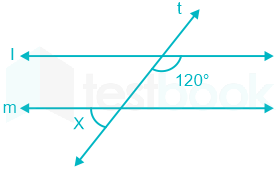
If the given figure line I is parallel to m and t is the transversal. Find the measure of angle x.

  1. AOption (a)

    60° 

  2. BOption (b)

    30°

  3. COption (c)

    120°

  4. DOption (d)

    40°

View answer & explanation

Correct answer

Answer: (a)A.

60° 

Why this answer is correct

Shortcut Trick

When two parallel lines are intersected by a transversal, the sum of consecutive interior angles (angles on the same side of the transversal) is always 180°.

Given angle = 120°.

x = 180° − 120° = 60°.

∴ The correct answer is 60°.

Alternate Method

Given: Line l is parallel to line m (l || m) and t is the transversal line.

Formula Used: The sum of interior angles on the same side of a transversal is 180° (Supplementary angles).

⇒ x + 120° = 180° (Consecutive interior angles are supplementary)

⇒ x = 180° − 120°

⇒ x = 60°

∴ The correct answer is 60°.

Additional Information

Corresponding Angles

When a transversal intersects two parallel lines, the corresponding angles are equal in measure.

Alternate Interior Angles

The pairs of angles on opposite sides of the transversal and between the two parallel lines are called alternate interior angles and are equal.

Vertically Opposite Angles

When two lines intersect, the angles opposite each other at the vertex are vertically opposite and always equal.

Question 45

In which different parts do the plants store their waste products?

  1. AOption (a)

    Leaves, lysosomes and leucoplast

  2. BOption (b)

    Lysosomes, fruits and leucoplasts

  3. COption (c)

    Vacuoles, bark and lysosomes

  4. DOption (d)

    Leaves, vacuoles and Old xylem

View answer & explanation

Correct answer

Answer: (d)D.

Leaves, vacuoles and Old xylem

Why this answer is correct

The correct answer is Leaves, vacuoles and Old xylem

Key Points

  • Plants store their waste products in leaves, vacuoles, and old xylem.
  • These parts help in isolating the waste substances from the living cells and tissues, thereby protecting the plant from potential damage.
  • Leaves often accumulate waste products which are eventually shed off during leaf fall.
  • Vacuoles are cellular organelles that store various substances, including waste products, in a plant cell.
  • Old xylem, also known as heartwood, stores waste products which contribute to its dark color and density.

Additional Information

  • Plants produce a variety of waste products as a result of metabolic activities.
  • In addition to leaves, vacuoles, and old xylem, some plants also excrete waste products through their roots or secrete them into the soil.
  • Some waste products are also stored in specialized structures like resin ducts or laticifers.
  • These mechanisms help the plant to manage and dispose of waste efficiently, ensuring healthy growth and development.

Question 46

In January 2022, the Punjab and Maharashtra Co-operative bank has been merged with which bank?

  1. AOption (a)

    Ujjivan Small Finance Bank

  2. BOption (b)

    AU Small Finance Bank

  3. COption (c)

    Capital Small Finance Bank

  4. DOption (d)

    Unity Small Finance Bank

View answer & explanation

Correct answer

Answer: (d)D.

Unity Small Finance Bank

Why this answer is correct

The correct answer is Unity Small Finance Bank

Key Points

  • Punjab and Maharashtra Co-operative Bank has been merged with Unity Small Finance Bank in January 2022.
  • This merger was a significant step to safeguard the interests of the depositors of Punjab and Maharashtra Co-operative Bank.
  • Unity Small Finance Bank aims to provide a robust banking structure and ensure financial stability post-merger.
  • The Reserve Bank of India (RBI) approved this merger to address the financial crisis faced by Punjab and Maharashtra Co-operative Bank.

Additional Information

  • Unity Small Finance Bank is a newly established bank that began its operations in 2021.
  • The bank is a joint venture between Centrum Financial Services Limited and BharatPe, a fintech company.
  • The merger aims to strengthen the financial ecosystem and provide better banking services to the customers of the merged entity.
  • The decision to merge was taken in the wake of the financial irregularities and crisis faced by Punjab and Maharashtra Co-operative Bank, which led to restrictions on withdrawals and operations.

Question 47

In November 2021, which state government released State Policy for Children 2021 to ensure prevention and protection of children from all forms of violence, abuse, and exploitation?

  1. AOption (a)

    Kerala

  2. BOption (b)

    Punjab

  3. COption (c)

    Tamil Nadu

  4. DOption (d)

    Rajasthan

View answer & explanation

Correct answer

Answer: (c)C.

Tamil Nadu

Why this answer is correct

The correct answer is Tamil Nadu

Key Points

  • The Tamil Nadu state government released the State Policy for Children 2021 in November 2021.
  • This policy aims to ensure the prevention and protection of children from all forms of violence, abuse, and exploitation.
  • It is a comprehensive framework designed to safeguard the rights and well-being of children in the state.
  • The policy includes measures for education, healthcare, and legal protection to create a safe and nurturing environment for children.

Additional Information

  • Kerala, Punjab, and Rajasthan were also considered, but the correct state implementing the policy in November 2021 was Tamil Nadu.
  • The policy aligns with various national and international child rights conventions and laws, including the United Nations Convention on the Rights of the Child (UNCRC).
  • The State Policy for Children 2021 emphasizes the importance of community involvement and multi-stakeholder collaboration in protecting children's rights.
  • It also focuses on addressing issues like child labor, trafficking, and discrimination against marginalized children.

Question 48

In this question, a group of numbers/symbols is coded using letters as per the table given below and the conditions which follow. The correct combination of codes following the condition is your answer.

Number/symbol54+@?3<#2%!9=6
CodeBSRTUPDYAVCXEH

Conditions:

(i) If the first element is a symbol and the last, a number, the codes for these two are to be interchanged.

(ii) If the first element is an odd number and the last, an even number, the first and last elements are to be coded as Ø.

(iii) If both second and third elements are either symbols or numbers, the third element is to be coded as the code for the second element.

How will '5 % = 3 ! 9' be coded?

  1. AOption (a)

    B V V P C X

  2. BOption (b)

    B V E P C X

  3. COption (c)

    X V E P C B

  4. DOption (d)

    Ø V E P C Ø

View answer & explanation

Correct answer

Answer: (a)A.

B V V P C X

Why this answer is correct

The given combination of codes is-

Number/symbol54+@?3<#2%!9=6
CodeBSRTUPDYAVCXEH


The given conditions are-

CONDITIONSCODED AS
The first element is a symbol and the last, a number.The codes for these two are to be interchanged.
The first element is an odd number and the last, an even number.The first and last elements are to be coded as Ø.
Both second and third elements are either symbols or numbers.The third element is to be coded as the code for the second element.


The given sequence is - 5 % = 3 ! 9

Now, in the above sequence, we notice that the third condition is applicable. 

Therefore, the element  '=' will be coded as 'V'. 

Then, the final code for '5 % = 3 ! 9' is 'B V V P C X'.

Hence, the correct answer is 'Option 1'.

Question 49

Each of K, L, M, N and P has an exam on a different day of a week starting from Monday and ending on Sunday of the same week. No exam is held on Friday and Saturday. Only two persons have exams between N and M. L's exam is held on Wednesday. Only one person has exam between N and L. P's exam is held on Sunday. Whose exam is held on Monday?

  1. AOption (a)

    K

  2. BOption (b)

    L

  3. COption (c)

    M

  4. DOption (d)

    N

View answer & explanation

Correct answer

Answer: (d)D.

N

Why this answer is correct

Given: Each of K, L, M, N and P has an exam on a different day of a week starting from Monday and ending on Sunday of the same week.

Based on the given conditions, we get the following table-

  1. P's exam is held on Sunday. L's exam is held on Wednesday. No exam is held on Friday and Saturday. From these, we get-
DAYPERSON
MONDAY
TUESDAY
WEDNESDAYL
THURSDAY
FRIDAY-
SATURDAY-
SUNDAYP


  1. Only two persons have exams between N and M. Only one person has exam between N and L. From these, we get the final table as follows-
DAYPERSON
MONDAYN
TUESDAYK
WEDNESDAYL
THURSDAYM
FRIDAY-
SATURDAY-
SUNDAYP


Therefore, we see that N’s exam is held on a Monday.

Hence, the correct answer is “Option 4”.

Question 50

Electromagnetic induction was discovered by:

  1. AOption (a)

    Michael Faraday

  2. BOption (b)

    Alessandro Volta

  3. COption (c)

    Isaac Newton

  4. DOption (d)

    Albert Einstein

View answer & explanation

Correct answer

Answer: (a)A.

Michael Faraday

Why this answer is correct

The correct answer is Michael Faraday

Key Points

  • Michael Faraday is credited with the discovery of electromagnetic induction.
  • His experiments in 1831 demonstrated that a changing magnetic field could induce an electric current in a circuit.
  • This discovery laid the groundwork for the development of modern electromagnetic technology, including electric generators and transformers.
  • Faraday's work in electromagnetism and electrochemistry earned him a place as one of the most influential scientists in history.

Additional Information

  • Alessandro Volta was known for his invention of the electric battery and the discovery of methane.
  • Isaac Newton made significant contributions to physics and mathematics, including the laws of motion and universal gravitation.
  • Albert Einstein is famous for his theory of relativity and his contributions to the understanding of quantum mechanics.
  • Electromagnetic induction is a fundamental principle utilized in various applications, including power generation and wireless charging.
  • Faraday's law of induction states that the induced electromotive force in any closed circuit is equal to the negative of the time rate of change of the magnetic flux through the circuit.

Question 51

What will come in place of the question mark (?) in the following equation if '+' and '-' are interchanged and also '×' and '÷' are interchanged?

15 - 8 ÷ 4 + 30 × 5 = ?

  1. AOption (a)

    40

  2. BOption (b)

    41

  3. COption (c)

    39

  4. DOption (d)

    42

View answer & explanation

Correct answer

Answer: (b)B.

41

Why this answer is correct

The BODMAS rule is given as follows-

Given: 15 - 8 ÷ 4 + 30 × 5 = ?

Directions given: '+' and '-' are interchanged and also '×' and '÷' are interchanged.

Now based on the sign interchange given, we get-

⇒ 15 + 8 × 4 - 30 ÷ 5

⇒  15 + 8 × 4 - 6

⇒ 15 + 32 - 6

⇒ 47 - 6 

⇒ 41

Therefore, the answer after applying the sign interchange and following the BODMAS rule is 41. 

Hence, the correct answer is "Option 2".

Question 52

Find the greatest 5-digit number that can be divisible by 18, 15 and 21.

  1. AOption (a)

    99545

  2. BOption (b)

    99540

  3. COption (c)

    99450

  4. DOption (d)

    99455

View answer & explanation

Correct answer

Answer: (b)B.

99540

Why this answer is correct

Shortcut Trick

Check divisibility by 9 (sum of digits) and 10 (last digit is 0) for 18 and 15.

Option 1 & 4: Not divisible by 2 or 5 (last digit is 5), so not divisible by 18 or 15.

Option 2: 9+9+5+4+0 = 27 (divisible by 9). Divisible by 10. Divisible by 7 (99540/7 = 14220).

Option 3: 9+9+4+5+0 = 27 (divisible by 9). Divisible by 10. Not divisible by 7 (99450/7 = 14207.14).

∴ The correct answer is 99540.

Alternate Method

Given: Divisors are 18, 15, and 21. We need the greatest 5-digit number.

Formula Used: Required Number = Greatest 5-digit number − Remainder of (Greatest 5-digit number ÷ LCM)

⇒ LCM of 18, 15, and 21:

⇒ 18 = 2 × 32

⇒ 15 = 3 × 5

⇒ 21 = 3 × 7

⇒ LCM = 2 × 32 × 5 × 7 = 630

⇒ Divide 99999 by 630:

⇒ 99999 ÷ 630 = 158 with Remainder 459

⇒ Required Number = 99999 − 459

⇒ Required Number = 99540

∴ The correct answer is 99540.

Additional Information

LCM Method for Divisibility

To find a number divisible by multiple divisors, first calculate their Least Common Multiple (LCM). Any number divisible by the LCM is also divisible by each individual divisor.

Divisibility Rule of 9

A number is divisible by 9 if the sum of its digits is divisible by 9. This is helpful for numbers involving divisors like 18 or 27.

Finding Largest N-digit Number

Largest N-digit number divisible by K = (Largest N-digit number) − (Remainder of Largest N-digit number ÷ K).

Question 53

The third proportional of 10 and 50 is

  1. AOption (a)

    300

  2. BOption (b)

    125

  3. COption (c)

    1250

  4. DOption (d)

    250

View answer & explanation

Correct answer

Answer: (d)D.

250

Why this answer is correct

Shortcut Trick

In a third proportional, the ratio between the first and second numbers is the same as the ratio between the second and third numbers.

Ratio of 10 : 50 = 1 : 5

Therefore, the ratio of 50 : Third Proportional must also be 1 : 5.

Third Proportional = 50 × 5 = 250.

∴ The correct answer is 250.

Alternate Method

Given: First number (a) = 10, Second number (b) = 50.

Formula Used: If a, b, and c are in continued proportion, then a : b = b : c, where c is the third proportional.

⇒ c = b2 ÷ a

Calculations:

⇒ Let the third proportional be x.

⇒ 10 : 50 :: 50 : x

⇒ 10 ÷ 50 = 50 ÷ x

⇒ 10 × x = 50 × 50

⇒ 10x = 2500

⇒ x = 2500 ÷ 10

⇒ x = 250

∴ The correct answer is 250.

Additional Information

Mean Proportional

The mean proportional between two numbers a and b is √(a × b).

Fourth Proportional

For four numbers a, b, c, d in proportion (a : b = c : d), the fourth proportional is d = (b × c) ÷ a.

Continued Proportion

Three quantities a, b, c are said to be in continued proportion if a : b = b : c.

Question 54

Refer to the following number series and answer the question.

(Left) 2 5 4 3 7 8 6 7 9 4 3 7 8 6 2 3 4 8 9 4 8 7 6 4 3 7 2 8 9 7 5 3 2 4 5 9 (Right)

How many such odd numbers are there which are immediately preceded by an even number and also immediately followed by an even number? (Consider counting from left to right only)

  1. AOption (a)

    Seven

  2. BOption (b)

    Five

  3. COption (c)

    Four

  4. DOption (d)

    Six

View answer & explanation

Correct answer

Answer: (c)C.

Four

Why this answer is correct

The given series is- (Left) 2 5 4 3 7 8 6 7 9 4 3 7 8 6 2 3 4 8 9 4 8 7 6 4 3 7 2 8 9 7 5 3 2 4 5 9 (Right)

Now, we take a look at the odd numbers which satisfy the given condition that is, immediately preceded by an even number and also immediately followed by an even number -

(Left) 2 5 4 3 7 8 6 7 9 4 3 7 8 6 2 3 4  8 9 4  8 7 6 4 3 7 2 8 9 7 5 3 2 4 5 9 (Right) 

The odd numbers which satisfy the given condition are given in bold and the sequence is underlined. 

Therefore, we see that there are four such odd numbers which satisfy the given conditions. 

Hence, the correct answer is "Option 3'.

Question 55

The LCM of two numbers is 84. If the numbers are in the ratio 2 : 3, then find the sum of the numbers.

  1. AOption (a)

    60

  2. BOption (b)

    25

  3. COption (c)

    40

  4. DOption (d)

    70

View answer & explanation

Correct answer

Answer: (d)D.

70

Why this answer is correct

Shortcut Trick

Ratio of numbers = 2 : 3

Let the HCF be x. Then LCM = 2 × 3 × x = 6x

Given 6x = 84 ⇒ x = 14

Sum of numbers = (2 + 3) × x = 5 × 14 = 70

∴ The correct answer is 70.

Alternate Method

Given:

LCM of two numbers = 84

Ratio of the two numbers = 2 : 3

Formula Used:

If numbers are in ratio a : b, let the numbers be ax and bx. Then LCM(ax, bx) = abx.

Calculations:

⇒ Let the first number be 2x and the second number be 3x.

⇒ LCM of 2x and 3x = 2 × 3 × x = 6x

⇒ 6x = 84

⇒ x = 84 ÷ 6 = 14

⇒ First number = 2 × 14 = 28

⇒ Second number = 3 × 14 = 42

⇒ Sum of numbers = 28 + 42 = 70

&there4$ The correct answer is 70.

Additional Information

Product of HCF and LCM

The product of two numbers is always equal to the product of their HCF and LCM. (Number1 × Number2 = HCF × LCM)

LCM of Fractions

The LCM of fractions is calculated as: (LCM of numerators) ÷ (HCF of denominators).

Co-prime Numbers Property

If two numbers are co-prime (their HCF is 1), then their LCM is simply the product of the two numbers.

Question 56

Zydus Cadila has received the approval for Emergency Use Authorization (EUA) from the Drug Controller General of India (DCGI) for which vaccine, in August 2021?

  1. AOption (a)

    ZyCorbeVax

  2. BOption (b)

    ZyCoV-D

  3. COption (c)

    ZyCovid

  4. DOption (d)

    ZyCovdila

View answer & explanation

Correct answer

Answer: (b)B.

ZyCoV-D

Why this answer is correct

The correct answer is ZyCoV-D

Key Points

  • ZyCoV-D is the vaccine developed by Zydus Cadila.
  • It received approval for Emergency Use Authorization (EUA) from the Drug Controller General of India (DCGI) in August 2021.
  • ZyCoV-D is notable for being the world's first DNA-based vaccine for COVID-19.
  • The vaccine is administered using a needle-free applicator, which is a unique feature compared to other COVID-19 vaccines.
  • ZyCoV-D is designed to be a three-dose vaccine, with doses administered on day 0, day 28, and day 56.

Additional Information

  • Zydus Cadila is an Indian multinational pharmaceutical company headquartered in Ahmedabad, India.
  • The company has been at the forefront of developing affordable and innovative medicines for patients worldwide.
  • Emergency Use Authorization is a mechanism to facilitate the availability and use of medical countermeasures, including vaccines, during public health emergencies.
  • As of the approval date, ZyCoV-D is aimed at immunizing individuals aged 12 years and above.
  • The development of ZyCoV-D is part of India's broader efforts to combat the COVID-19 pandemic through indigenous vaccine development and production.

Question 57

Select the option that is related to the fifth number in the same way as the second number is related to the first number and the fourth number is related to the third number.

18 : 96 : : 22 : 116 : : 23 : ?

  1. AOption (a)

    164

  2. BOption (b)

    132

  3. COption (c)

    121

  4. DOption (d)

    146

View answer & explanation

Correct answer

Answer: (c)C.

121

Why this answer is correct

Given: 18 : 96 : : 22 : 116 : : 23 : ?

Logic: Second Number = (First Number × 5) + 6. 

For, 18:96, we get-

⇒ (18 × 5) + 6

⇒ 90 + 6

⇒ 96

For, 22:116, we get-

⇒ (22 × 5) + 6

⇒ 110 + 6

⇒ 116

Similarly, 

For, 23: ? , we get-

⇒ (23 × 5) + 6

⇒ 115 + 6

⇒ 121.

Therefore. 121 is related to 23 by the same logic. 

Hence, the correct answer is "Option 3".

Question 58

According to the regulation of the Indus Water Treaty signed in 1960, India can use only ______ of the total water carried by the Indus River system.

  1. AOption (a)

    50%

  2. BOption (b)

    20%

  3. COption (c)

    10%

  4. DOption (d)

    40%

View answer & explanation

Correct answer

Answer: (b)B.

20%

Why this answer is correct

The correct answer is 20%

Key Points

  • According to the Indus Water Treaty signed in 1960, India can use only 0.2 of the total water carried by the Indus River system.
  • The treaty was brokered by the World Bank and is considered one of the most successful water-sharing agreements in the world.
  • The Indus River system comprises six rivers: the Indus, Jhelum, Chenab, Ravi, Beas, and Sutlej.
  • The treaty allocates the eastern rivers (Ravi, Beas, and Sutlej) to India for unrestricted use, while the western rivers (Indus, Jhelum, and Chenab) are allocated to Pakistan, with limited use by India.

Additional Information

  • The treaty has survived multiple conflicts between the two countries and is a critical component of their bilateral relations.
  • India is allowed to use the water for domestic, non-consumptive, and agricultural purposes, as well as for generating hydroelectric power, as long as it does not affect the flow to Pakistan.
  • Regular meetings of the Permanent Indus Commission, established by the treaty, help address disputes and ensure cooperation between the two countries.
  • The Indus Water Treaty is often cited as a model for resolving international water disputes.

Question 59

What is the rank of Bengali language in the world among the most spoken languages as per Forbes ?

  1. AOption (a)

    6th

  2. BOption (b)

    27th

  3. COption (c)

    10th

  4. DOption (d)

    17th

View answer & explanation

Correct answer

Answer: (a)A.

6th

Why this answer is correct

The correct answer is 6th

Key Points

  • The Bengali language ranks 6th among the most spoken languages in the world as per Forbes.
  • Bengali, also known as Bangla, is primarily spoken in Bangladesh and the Indian state of West Bengal.
  • It is the mother tongue of approximately 230 million people worldwide.
  • The language has a rich literary tradition and is known for its contributions to poetry, music, and literature.
  • Bengali is one of the 22 scheduled languages of India and the official language of Bangladesh.

Additional Information

  • International Mother Language Day is celebrated on February 21st each year to promote linguistic and cultural diversity and multilingualism. This date was chosen to honor the Bengali Language Movement in Bangladesh.
  • The Bengali script is derived from the Brahmi script and is written from left to right.
  • Notable Bengali literary figures include Rabindranath Tagore, who won the Nobel Prize in Literature in 1913, and Kazi Nazrul Islam, the national poet of Bangladesh.
  • Bengali has a significant presence in the digital world, with numerous websites, blogs, and social media platforms available in the language.

Question 60

Which of the following is NOT a unit of power?

  1. AOption (a)

    kilowatt hour

  2. BOption (b)

    watt

  3. COption (c)

    joule/second

  4. DOption (d)

    horsepower

View answer & explanation

Correct answer

Answer: (a)A.

kilowatt hour

Why this answer is correct

The correct answer is kilowatt hour

Key Points

  • Kilowatt hour (kWh) is a unit of energy, not power.
  • Power is the rate at which energy is used or transferred, measured in units such as watts (W), joules per second (J/s), and horsepower (hp).
  • The watt is the SI unit of power, which is equivalent to one joule per second.
  • Horsepower is a unit of power commonly used to measure engine output.
  • Therefore, among the given options, kilowatt hour is the only unit that does not measure power but rather energy.

Additional Information

  • A kilowatt hour is equivalent to the energy consumed by a 1-kilowatt device running for 1 hour.
  • It is commonly used by electric utilities for billing purposes.
  • 1 kilowatt hour is equal to 3.6 million joules (3.6 x 10⁶ J).
  • Understanding the distinction between energy and power is crucial in physics and engineering.

Question 61

The graph and the table below show the total units sold by three salesmen named Jeet, Mridul and Shashank in three different years i.e. 2015, 2016 and 2017. Study the graph and the table and answer the question.

If Jeet has sold an average of 40 units in five years i.e. from 2015 to 2019, and if the number of units sold by Jeet in 2018 and 2019 is exactly same then how many units did he sell in the years 2018?

  1. AOption (a)

    40

  2. BOption (b)

    30

  3. COption (c)

    45

  4. DOption (d)

    35

View answer & explanation

Correct answer

Answer: (d)D.

35

Why this answer is correct

Given:

Jeet has sold an average of 40 units in five years (2015 to 2019).

Number of units sold by Jeet in 2018 and 2019 is exactly the same.

Units sold by Jeet in 2015, 2016, and 2017 are provided in the table and graph.

Formula Used:

Average units sold = Total units sold / Number of years

Let the number of units sold by Jeet in 2018 and 2019 be X each.

Total units sold from 2015 to 2019 = Units sold in 2015 + Units sold in 2016 + Units sold in 2017 + Units sold in 2018 + Units sold in 2019

Calculation:

Average units sold = 40

Number of years = 5

Total units sold = 40 × 5 = 200

Units sold in 2015 = 35

Units sold in 2016 = 40

Units sold in 2017 = 55

Units sold in 2018 and 2019 = X each

Total units sold = 35 + 40 + 55 + X + X

⇒ 200 = 130 + 2X

⇒ 200 - 130 = 2X

⇒ 70 = 2X

⇒ X = 35

∴ The correct answer is 35.

Question 62

Which of the following relations correctly represents magnification m produced by a convex mirror?

  1. AOption (a)

    0 < m < 1

  2. BOption (b)

    m < 0

  3. COption (c)

    m = 1

  4. DOption (d)

    m > 1

View answer & explanation

Correct answer

Answer: (a)A.

0 < m < 1

Why this answer is correct

The correct answer is 0 < m < 1

Key Points

  • 0 < m < 1 correctly represents the magnification produced by a convex mirror.
  • A convex mirror always forms a virtual, erect, and diminished image of the object placed in front of it.
  • Magnification (m) is defined as the ratio of the height of the image (hi) to the height of the object (ho), and for a convex mirror, this value is always between 0 and 1.
  • The image formed by a convex mirror is always smaller than the object, hence the magnification is less than 1 but greater than 0.
  • This property of convex mirrors makes them useful for applications like vehicle rear-view mirrors, where a wider field of view is required.

Additional Information

  • Convex mirrors are diverging mirrors, meaning they spread out light rays that have been reflected off their surface.
  • The focal point of a convex mirror is virtual, as the reflected rays appear to diverge from a point behind the mirror.
  • Convex mirrors have a positive focal length, and the center of curvature and the focal point are located behind the mirror.
  • Due to their shape, convex mirrors provide a wider field of view compared to flat mirrors.
  • They are commonly used in various applications such as security mirrors, vehicle rear-view mirrors, and in architecture to provide a panoramic view.

Question 63

Study the given diagram carefully and answer the following question. The numbers in different sections indicate the number of persons in different professions. 

How many Masons are Tailors as well?

  1. AOption (a)

    45

  2. BOption (b)

    18

  3. COption (c)

    50

  4. DOption (d)

    32

View answer & explanation

Correct answer

Answer: (c)C.

50

Why this answer is correct

The given Venn Diagram in the question is as follows-

Now, the shaded portion in the above diagram indicates the total number of masons who are also tailors. 

Therefore, the total number of masons who are also tailors is = 18 + 32 = 50. 

Hence, the correct answer is "Option 3".

Question 64

As per Article 53 of the Constitution of India, with whom are all the executive powers of the Union vested?

  1. AOption (a)

    Governor

  2. BOption (b)

    Chief Justice

  3. COption (c)

    Prime Minister

  4. DOption (d)

    President

View answer & explanation

Correct answer

Answer: (d)D.

President

Why this answer is correct

The correct answer is President

Key Points

  • As per Article 53 of the Constitution of India, all the executive powers of the Union are vested in the President.
  • The President of India is the supreme commander of the defense forces of India and exercises executive powers either directly or through officers subordinate to him.
  • The President's executive powers are exercised in accordance with the Constitution and laws made by Parliament.
  • The President also has the power to appoint the Prime Minister and other ministers, who assist in the administration of the Union government.

Additional Information

  • The Constitution of India was adopted by the Constituent Assembly on 26th November 1949 and came into effect on 26th January 1950.
  • It lays down the framework defining fundamental political principles, establishes the structure, procedures, powers, and duties of government institutions, and sets out fundamental rights, directive principles, and the duties of citizens.
  • The Constitution of India is the longest written constitution of any country in the world.
  • It declares India a sovereign, socialist, secular, and democratic republic, assuring its citizens justice, equality, and liberty, and endeavors to promote fraternity.
  • The Seventh Schedule of the Constitution contains three lists which delineate the subjects under the Union, State, and Concurrent lists.
  • Amendments to the Constitution can be made through a process outlined in Article 368.
  • The executive powers of the President are exercised in accordance with the advice of the Council of Ministers headed by the Prime Minister.

Question 65

Which of the following scriptures is NOT a part of Vedic literature?

  1. AOption (a)

    Upanishads

  2. BOption (b)

    Brahmanas

  3. COption (c)

    Aranyakas

  4. DOption (d)

    Pitakas

View answer & explanation

Correct answer

Answer: (d)D.

Pitakas

Why this answer is correct

The correct answer is Pitakas

Key Points

  • Pitakas are not a part of Vedic literature.
  • Vedic literature primarily consists of the Vedas, Brahmanas, Aranyakas, and Upanishads.
  • The Vedas are the oldest and most authoritative scriptures of Hinduism, composed in ancient Sanskrit.
  • The Brahmanas are prose texts that explain the hymns in the Vedas and are associated with rituals and ceremonies.
  • The Aranyakas are texts that serve as a bridge between the ritualistic Brahmanas and the philosophical Upanishads.
  • The Upanishads are philosophical texts that explore the spiritual ideas and concepts found in the Vedas.
  • Pitakas, on the other hand, are a part of Buddhist scriptures and consist of three "baskets" or collections of teachings.

Additional Information

  • The Vedas are divided into four main categories: Rigveda, Samaveda, Yajurveda, and Atharvaveda.
  • The Brahmanas provide detailed instructions on the performance of rituals and the symbolic significance of the Vedic hymns.
  • The Aranyakas are sometimes referred to as "forest books" and were meant for study in the isolation of the forest.
  • The Upanishads are considered the end part of the Vedas and focus on meditation, morality, and philosophy.
  • The Pitakas are divided into three sections: Vinaya Pitaka (rules for monastic discipline), Sutta Pitaka (discourses), and Abhidhamma Pitaka (philosophical and doctrinal analysis).

Question 66

In which of the following case(s) will a current be registered by the galvanometer connected to a circular coil?

(i) When a magnet is held stationary near the coil.

(ii) When a magnet is moved towards the coil.

(iii) When a magnet is moved away from the coil.

  1. AOption (a)

    Both (ii) and (iii)

  2. BOption (b)

    Only (iii)

  3. COption (c)

    Both (i) and (ii)

  4. DOption (d)

    Only (i)

View answer & explanation

Correct answer

Answer: (a)A.

Both (ii) and (iii)

Why this answer is correct

The correct answer is Both (ii) and (iii).

Key Points

  • A galvanometer connected to a circular coil registers a current when there is a change in magnetic flux through the coil.
  • According to Faraday's Law of Electromagnetic Induction, an electromotive force (EMF) is induced in a coil when there is a change in the magnetic field around it.
  • Statement (i): When a magnet is held stationary near the coil, there is no change in the magnetic flux through the coil, and therefore no current is induced.
  • Hence, Statement (i) is incorrect.
  • Statement (ii): When a magnet is moved towards the coil, the magnetic flux through the coil changes, inducing a current in the coil.
  • Hence, Statement (ii) is correct.
  • Statement (iii): When a magnet is moved away from the coil, the magnetic flux through the coil also changes, inducing a current in the coil.
  • Hence, Statement (iii) is correct.
  • Therefore, a current will be registered by the galvanometer in both cases (ii) and (iii).

Question 67

Q, W, E, R, T and Y live on seven different floors of the same building with one floor being vacant. The lowermost floor in the building is numbered 1, the floor above it, number 2 and so on till the topmost floor is numbered 7. T lives on the 7th floor, and W lives on the 1st floor. Q lives between E and R. One floor immediately above E is vacant. Only Y lives between R and W. The 5th floor is occupied by E. On which floor does Q live?

  1. AOption (a)

    4th

  2. BOption (b)

    5th

  3. COption (c)

    2nd

  4. DOption (d)

    3rd

View answer & explanation

Correct answer

Answer: (a)A.

4th

Why this answer is correct

Given: Q, W, E, R, T and Y live on seven different floors of the same building with one floor being vacant. The lowermost floor in the building is numbered 1, the floor above it, number 2 and so on till the topmost floor is numbered 7.

Based on the given conditions, we get the following tables-

  1. T lives on the 7th floor, and W lives on the 1st floor. The 5th floor is occupied by E. From these, we get-
FLOOR NUMBERPERSON
7T
6
5E
4
3
2
1W


  1. Q lives between E and R. One floor immediately above E is vacant. Only Y lives between R and W. From these, we get the final table as follows-
FLOOR NUMBERPERSON
7T
6
5E
4Q
3R
2Y
1W


Therefore, we see that Q lives on the 4th floor.

Hence, the correct answer is “Option 1”.

Question 68

Simplify: (x2 + m2 - z2)2 - (x2 - m2 + z2)2 =

  1. AOption (a)

    4x2 (m2 - z2)

  2. BOption (b)

    2x2 (m2 - z2)

  3. COption (c)

    4x (m2 - z2)

  4. DOption (d)

    3x2(m2 - z2)

View answer & explanation

Correct answer

Answer: (a)A.

4x2 (m2 - z2)

Why this answer is correct

Shortcut Trick

The expression is in the form of a2 − b2, where a = (x2 + m2 − z2) and b = (x2 − m2 + z2).

Apply the algebraic identity: a2 − b2 = (a + b)(a − b).

Sum (a + b) = (x2 + m2 − z2) + (x2 − m2 + z2) = 2x2.

Difference (a − b) = (x2 + m2 − z2) − (x2 − m2 + z2) = 2m2 − 2z2 = 2(m2 − z2).

Product = 2x2 × 2(m2 − z2) = 4x2(m2 − z2).

∴ The correct answer is 4x2(m2 − z2).

Alternate Method

Given: (x2 + m2 − z2)2 − (x2 − m2 + z2)2

Formula Used: Difference of squares identity: a2 − b2 = (a + b)(a − b)

⇒ Let a = x2 + m2 − z2 and b = x2 − m2 + z2

⇒ a + b = (x2 + m2 − z2) + (x2 − m2 + z2)

⇒ a + b = x2 + x2 + m2 − m2 − z2 + z2 = 2x2

⇒ a − b = (x2 + m2 − z2) − (x2 − m2 + z2)

⇒ a − b = x2 − x2 + m2 + m2 − z2 − z2 = 2m2 − 2z2

⇒ a − b = 2(m2 − z2)

⇒ Total Expression = (2x2) × [2(m2 − z2)]

⇒ Total Expression = 4x2(m2 − z2)

∴ The correct answer is 4x2(m2 − z2).

Additional Information

Difference of Squares

The identity a2 − b2 = (a − b)(a + b) is one of the most used factorisation formulas in algebra for simplifying quadratic expressions.

Perfect Square Trinomial

The expansion of (a + b)2 is a2 + 2ab + b2 and (a − b)2 is a2 − 2ab + b2.

Square of a Trinomial

For any three terms, (a + b + c)2 = a2 + b2 + c2 + 2(ab + bc + ca). This can be used to expand each part of the given question individually before subtracting.

Question 69

Find the area of the parallelogram whose base is 15 cm and the corresponding height is 6 cm.

  1. AOption (a)

    60 cm2

  2. BOption (b)

    45 cm2

  3. COption (c)

    90 cm2

  4. DOption (d)

    80 cm2

View answer & explanation

Correct answer

Answer: (c)C.

90 cm2

Why this answer is correct

Shortcut Trick

The Area of a parallelogram is directly proportional to the product of its base and height.

Area = Base × Height

Area = 15 × 6 = 90 cm2.

∴ The correct answer is 90 cm2.

Alternate Method

Given:

Base (b) of the parallelogram = 15 cm

Corresponding Height (h) = 6 cm

Formula Used:

Area of a parallelogram = Base × Height

Calculations:

⇒ Area = 15 cm × 6 cm

⇒ Area = 90 cm2

∴ The correct answer is 90 cm2.

Additional Information

Area using Diagonals

If d1 and d2 are the diagonals and θ is the angle between them, then Area = 1/2 × d1 × d2 × sin(θ).

Perimeter of Parallelogram

The sum of all sides of the parallelogram is called its perimeter. Perimeter = 2 × (a + b), where a and b are adjacent sides.

Base-Height Relationship

Area can be calculated using any side as the base, provided the corresponding height (perpendicular distance to the opposite side) is used.

Question 70

The value of

12 + 12 × 12 - 12 ÷ 12 =

  1. AOption (a)

    155

  2. BOption (b)

    0

  3. COption (c)

    23

  4. DOption (d)

    140

View answer & explanation

Correct answer

Answer: (a)A.

155

Why this answer is correct

Given:

12 + 12 × 12 - 12 ÷ 12

Formula used:

Follow the BODMAS/BIDMAS rule (Brackets, Orders (i.e., powers and square roots, etc.), Division and Multiplication, Addition and Subtraction).

Calculation:

First, perform the multiplication and division operations:

12 + (12 × 12) - (12 ÷ 12)

12 + 144 - 1

Next, perform the addition and subtraction operations:

12 + 144 - 1

156 - 1

⇒ 155

∴ The value is 155.

Question 71

1500 people visited an exhibition on Saturday, while 1680 visited on Sunday. The percentage increase in the number of people visiting the exhibition is ______.

  1. AOption (a)

    18%

  2. BOption (b)

    13%

  3. COption (c)

    10%

  4. DOption (d)

    12%

View answer & explanation

Correct answer

Answer: (d)D.

12%

Why this answer is correct

Shortcut Trick

Percentage increase = (Change ÷ Original Value) × 100

Change in visitors = 1680 − 1500 = 180

Percentage increase = (180 ÷ 1500) × 100 = 180 ÷ 15 = 12%

∴ The correct answer is 12%.

Alternate Method

Given:

Number of people on Saturday = 1500

Number of people on Sunday = 1680

Formula Used:

Percentage Increase = [(Final Value − Initial Value) ÷ Initial Value] × 100

Calculations:

⇒ Increase in visitors = 1680 − 1500 = 180

⇒ Percentage increase = (180 ÷ 1500) × 100

⇒ Percentage increase = (180 ÷ 15)

⇒ Percentage increase = 12%

∴ The correct answer is 12%.

Additional Information

Percentage Change

It represents the relationship between an old value and a new value. If the new value is less than the old, it is a percentage decrease.

Successive Percentage Change

If a value changes by a% and then by b%, the net effective change is [a + b + (a × b)/100]%.

Base Change Rule

If A is x% more than B, then B is [x ÷ (100 + x)] × 100% less than A.

Question 72

The famous festival of India, Makar Sankranti is celebrated in which month?

  1. AOption (a)

    May

  2. BOption (b)

    July

  3. COption (c)

    March

  4. DOption (d)

    January

View answer & explanation

Correct answer

Answer: (d)D.

January

Why this answer is correct

The correct answer is January

Key Points

  • Makar Sankranti is celebrated in the month of January every year.
  • This festival marks the transition of the Sun into the zodiac sign of Capricorn (Makara Rashi).
  • It is one of the few Hindu festivals that are celebrated on a fixed date, that is, 14th January.
  • Makar Sankranti is celebrated with various cultural and traditional activities such as kite flying, bonfires, and feasts.
  • It signifies the end of the winter solstice and the beginning of longer days.

Additional Information

  • Makar Sankranti is known by different names in different parts of India, such as Pongal in Tamil Nadu, Lohri in Punjab, and Uttarayan in Gujarat.
  • It is a major harvest festival and is celebrated with great enthusiasm and joy across the country.
  • Traditional sweets made from sesame seeds and jaggery are an integral part of the celebrations.
  • The festival is considered highly auspicious and is believed to bring prosperity and happiness.

Question 73

Select the option that is related to the fifth number in the same way as the second number is related to the first number and the fourth number is related to the third number.

15 : 24 : : 35 : 48 : : 63 : ?

  1. AOption (a)

    42

  2. BOption (b)

    80

  3. COption (c)

    36

  4. DOption (d)

    75

View answer & explanation

Correct answer

Answer: (b)B.

80

Why this answer is correct

Given: 15 : 24 : : 35 : 48 : : 63 : ?

Logic: First Number = (A×B) (say); Second Number = ((A+1) × (B+1))

For 15:24, we get-

⇒ 15 = 3 × 5

⇒ (3+1) × (5+1)

⇒ 4 × 6 = 24.

For 35:48, we get-

⇒ 35 = 5 × 7

⇒ (5 + 1) × (7+1)

⇒ 6 × 8 = 48.

Similarly, 

For 63: ?, we get-

⇒ 63 = 7 × 9

⇒ (7+1) × (9+1)

⇒ 8 × 10 = 80.

Therefore, the number 80 is related to 63 by the same logic. 

Hence, the correct answer is "Option 2".

Question 74

6 men and 8 women could finish a work in 14 days. 8 men and 12 women could finish the same work in 10 days. How much time would be taken to finish the same work if one man worked alone?

  1. AOption (a)

    280 days

  2. BOption (b)

    210 days

  3. COption (c)

    140 days

  4. DOption (d)

    175 days

View answer & explanation

Correct answer

Answer: (c)C.

140 days

Why this answer is correct

Shortcut Trick

Apply M1D1 = M2D2: (6M + 8W) × 14 = (8M + 12W) × 10

⇒ 84M + 112W = 80M + 120W ⇒ 4M = 8W ⇒ 1M = 2W

Total Work (in terms of Men) = (6M + 4M) × 14 = 140 Man-days

Time for 1 Man = 140 ÷ 1 = 140 days

∴ The correct answer is 140 days.

Alternate Method

Given:

Case 1: 6 Men and 8 Women in 14 days.

Case 2: 8 Men and 12 Women in 10 days.

Formula Used:

Total Work = Efficiency × Time

Calculations:

⇒ (6M + 8W) × 14 = (8M + 12W) × 10

⇒ 42M + 56W = 40M + 60W

⇒ 42M − 40M = 60W − 56W

⇒ 2M = 4W

⇒ 1M = 2W (Efficiency of 1 Man is twice that of 1 Woman)

⇒ Total Work = (6M + 8W) × 14 = (6M + 4M) × 14

⇒ Total Work = 10M × 14 = 140M

⇒ Time taken by 1 Man = 140M ÷ 1M = 140 days

∴ The correct answer is 140 days.

Additional Information

Work Equivalence Formula

M1D1H1/W1 = M2D2H2/W2, where M is number of workers, D is days, H is hours, and W is work done.

Efficiency and Days

Efficiency is inversely proportional to the time taken. If the efficiency ratio of A:B is x:y, the time taken ratio is y:x.

Man-Days Concept

Total work can be represented as the product of the number of men and the number of days required to complete it.

Question 75

Simplify: 4.32,×4.32,−2.64,×2.64,1.68\frac{{4.32, \times 4.32, - 2.64, \times 2.64,}}{{1.68}}

  1. AOption (a)

    6.99

  2. BOption (b)

    6.96

  3. COption (c)

    6.94

  4. DOption (d)

    6.56

View answer & explanation

Correct answer

Answer: (b)B.

6.96

Why this answer is correct

Given:

Simplify: 4.32×4.32−2.64×2.641.68 \frac{{4.32 \times 4.32 - 2.64 \times 2.64}}{{1.68}}

Formula Used:

Use the formula for the difference of squares: a2−b2=(a−b)(a+b) a^2 - b^2 = (a - b)(a + b)

Calculation:

Given expression: 4.32×4.32−2.64×2.641.68 \frac{{4.32 \times 4.32 - 2.64 \times 2.64}}{{1.68}}

Let a=4.32 a = 4.32 and b=2.64 b = 2.64

⇒ a2−b21.68 \frac{{a^2 - b^2}}{{1.68}}

Using the difference of squares formula:

⇒ (a−b)(a+b)1.68 \frac{{(a - b)(a + b)}}{{1.68}}

Substitute the values of a a and b b :

⇒ (4.32−2.64)(4.32+2.64)1.68 \frac{{(4.32 - 2.64)(4.32 + 2.64)}}{{1.68}}

⇒ 1.68×6.961.68 \frac{{1.68 \times 6.96}}{{1.68}}

Cancel out 1.68 1.68 :

⇒ 6.96 6.96

∴ The correct answer is option 2.

Question 76

A can complete a certain job in 32 days. B is 60% more efficient than A. In how many days can B alone complete the job?

  1. AOption (a)

    10 days

  2. BOption (b)

    20 days

  3. COption (c)

    15 days

  4. DOption (d)

    32 days

View answer & explanation

Correct answer

Answer: (b)B.

20 days

Why this answer is correct

Shortcut Trick

Efficiency Ratio of A : B = 100 : 160 = 5 : 8

Time Ratio is inverse of Efficiency Ratio → A : B = 8 : 5

Given, 8 units = 32 days ⇒ 1 unit = 4 days

Time taken by B = 5 units = 5 × 4 = 20 days

∴ The correct answer is 20 days.

Alternate Method

PersonDaysTotal WorkEfficiency
A32160 units160 ÷ 32 = 5
B?5 × 1.6 = 8

⇒ Let efficiency of A = 100 units/day (simplified to 5)

⇒ Efficiency of B = 100 + 60% of 100 = 160 units/day (simplified to 8)

⇒ Total Work = Efficiency of A × Time of A = 5 × 32 = 160 units

⇒ Time taken by B = Total Work ÷ Efficiency of B = 160 ÷ 8

⇒ Time taken by B = 20 days

∴ The correct answer is 20 days.

Additional Information

Efficiency and Time Relationship

Efficiency is inversely proportional to the time taken. If the efficiency ratio is x:y, the time ratio will be y:x.

Work-Efficiency Formula

Total Work = Efficiency × Time. This base formula is used to derive all parameters in Time & Work problems.

Percentage to Ratio Conversion

60% more efficiency means the ratio of efficiencies is 100 : (100+60), which simplifies to 5 : 8.

Question 77

Chandrasekhar sold 12 identical articles for a total of ₹420, incurring a loss equal to the cost price of 7 such articles. The cost price of 1 such article is:

  1. AOption (a)

    ₹60

  2. BOption (b)

    ₹84

  3. COption (c)

    ₹48

  4. DOption (d)

    ₹35

View answer & explanation

Correct answer

Answer: (b)B.

₹84

Why this answer is correct

Shortcut Trick

Let the cost price (CP) of 1 article be x.

Total CP of 12 articles = 12x. Total Loss = 7x.

Selling Price (SP) = CP − Loss ⇒ 420 = 12x − 7x.

420 = 5x ⇒ x = 420 ÷ 5 = 84.

The cost price of 1 article is ₹ 84.

∴ The correct answer is ₹ 84.

Alternate Method

Given: Total articles = 12, Total SP = ₹ 420, Loss = CP of 7 articles. Formulas: Loss = CP − SP | Loss% = (Loss ÷ CP) × 100

⇒ Let CP of one article = C.

⇒ Total CP = 12 × C.

⇒ Loss = 7 × C.

⇒ SP = CP − Loss ⇒ 420 = 12C − 7C.

⇒ 420 = 5C.

⇒ C = 420 ÷ 5 = 84.

∴ The correct answer is ₹ 84.

Additional Information

Relationship between CP and SP in Loss

When a person incurs a loss, the Cost Price is always greater than the Selling Price. Loss = CP − SP.

Loss in terms of units

If loss is equal to the CP of 'n' articles, then SP of 'm' articles = CP of (m − n) articles.

Question 78

Which of the following reactions will be possible?

  1. AOption (a)

    CuSO4 + Ca → CaSO4 + Cu

  2. BOption (b)

    MgCl2 + Cu → CuCl2 + Mg

  3. COption (c)

    ZnSO4 + Fe → FeSO4 + Zn

  4. DOption (d)

    Al2(SO4)3 + Pb → PbSO4 + Al

View answer & explanation

Correct answer

Answer: (a)A.

CuSO4 + Ca → CaSO4 + Cu

Why this answer is correct

The correct answer is option 1

Key Points

  • Option 1: CuSO4 + Ca → CaSO4 + Cu is possible because calcium (Ca) is more reactive than copper (Cu) and can displace it from its compound.
  • Option 2: MgCl2 + Cu → CuCl2 + Mg is not possible because copper (Cu) is less reactive than magnesium (Mg) and cannot displace it from its compound.
  • Option 3: ZnSO4 + Fe → FeSO4 + Zn is not possible because iron (Fe) is less reactive than zinc (Zn) and cannot displace it from its compound.
  • Option 4: Al2(SO4)3 + Pb → PbSO4 + Al is not possible because lead (Pb) is less reactive than aluminum (Al) and cannot displace it from its compound.

Additional Information

  • The reactivity series is a list of metals arranged in order of their reactivity from highest to lowest.
  • Metals higher in the reactivity series can displace metals lower in the series from their compounds in a chemical reaction.
  • This principle is used to predict the feasibility of displacement reactions.

Question 79

Five girls, Amita, Fauzia, Gargi, Ranjita and Sucheta, are sitting in a straight line. All are facing the north direction. Sucheta sits second to the left of Gargi. Fauzia sits third to the right of Sucheta. Only one girl is sitting between Amita and Ranjita. Amita is not sitting at any of the extreme ends. Which two girls are sitting at the extreme ends?

  1. AOption (a)

    Ranjita and Fauzia

  2. BOption (b)

    Gargi and Sucheta

  3. COption (c)

    Sucheta and Fauzia

  4. DOption (d)

    Ranjita and Gargi

View answer & explanation

Correct answer

Answer: (a)A.

Ranjita and Fauzia

Why this answer is correct

Given: Five girls, Amita, Fauzia, Gargi, Ranjita and Sucheta, are sitting in a straight line. All are facing the north direction.

Based on the given conditions, we get the following arrangement-

  1. Only one girl is sitting between Amita and Ranjita. Amita is not sitting at any of the extreme ends. From these we get-

  2. Sucheta sits second to the left of Gargi. Fauzia sits third to the right of Sucheta. From these, we get the final arrangement as follows-

Therefore, from the given final arrangement we see that Ranjita and Fauzia sit at the extreme ends of the row.

Hence, the correct answer is “Option 1”.

Question 80

When coal and petroleum are burnt in insufficient air (oxygen), which harmful gas is produced, causing pollution?

  1. AOption (a)

    Oxides of nitrogen

  2. BOption (b)

    Carbon dioxide

  3. COption (c)

    Carbon monoxide

  4. DOption (d)

    Sulphur dioxide

View answer & explanation

Correct answer

Answer: (c)C.

Carbon monoxide

Why this answer is correct

The correct answer is Carbon monoxide.

Key Points

  • When coal and petroleum are burnt in insufficient air (oxygen), carbon monoxide (CO) is produced.
  • Carbon monoxide is a harmful gas that causes pollution.
  • It is a colorless, odorless, and tasteless gas that is produced by the incomplete combustion of carbon-containing fuels.
  • Carbon monoxide is a toxic gas that can cause headaches, dizziness, nausea, and even death at high concentrations.
  • Oxides of nitrogen (NOx), carbon dioxide (CO2), and sulfur dioxide (SO2) are also produced when coal and petroleum are burnt, but these gases are not produced in as large quantities as carbon monoxide when combustion is incomplete.

Therefore, the correct answer is 3) Carbon monoxide.

Question 81

P, Q, R, S, T, U and V were seven kids sitting around a square table, facing the centre. Three of them were sitting at the corners while four others were sitting at the exact centre of the sides. One of the corners was empty. U, sitting at one of the centre of the sides, was second to the right of T. There was one empty chair between P and U. R and Q were diagonally opposite to each other. T was at the immediate left of Q. S was to the immediate left of V. Who among the following was the kid at a corner position?

  1. AOption (a)

    U

  2. BOption (b)

    S

  3. COption (c)

    V

  4. DOption (d)

    T

View answer & explanation

Correct answer

Answer: (c)C.

V

Why this answer is correct

Given: P, Q, R, S, T, U and V were seven kids sitting around a square table, facing the centre. Three of them were sitting at the corners while four others were sitting at the exact centre of the sides. One of the corners was empty.

Based on the given conditions, we get the following arrangement-

  1. U, sitting at one of the centre of the sides, was second to the right of T. There was one empty chair between P and U. From these, we get-

  2. R and Q were diagonally opposite to each other. T was at the immediate left of Q. S was to the immediate left of V. From these, we get the final arrangement as follows-

Therefore, from the final arrangement we see that among the given options, V is the only one who sits at the corners. So, V is the only kid who sits at the corner position.

Hence, the correct answer is “Option 3”.

Question 82

In a certain code language, MARKS is written as QEVOW and CLOSE is written as GPSWI. How will DRIVE be written in the same language?

  1. AOption (a)

    HVMZI

  2. BOption (b)

    HVMZK

  3. COption (c)

    GVNZI

  4. DOption (d)

    HVMAJ

View answer & explanation

Correct answer

Answer: (a)A.

HVMZI

Why this answer is correct

The English alphabetical series is given as-

The logic followed here is-

For MARKS is written as QEVOW, we get-

For CLOSE is written as GPSWI. we get-

Similarly, DRIVE is written as-

Therefore, based on the given logic, 'DRIVE' is related to 'HVMZI'.

Hence, the correct answer is "Option 1".

Question 83

If, in the quadrilateral ABCD, the measures of the angles A, B, C, and D are in the ratio 2 : 3 : 5 : 6, then the quadrilateral is a:

  1. AOption (a)

    parallelogram

  2. BOption (b)

    square

  3. COption (c)

    Kite

  4. DOption (d)

    trapezium

View answer & explanation

Correct answer

Answer: (d)D.

trapezium

Why this answer is correct

Shortcut Trick

Sum of ratio parts = 2 + 3 + 5 + 6 = 16 units.

Total sum of angles in a quadrilateral = 360°.

Observe the pairs: (2 + 6) = 8 units and (3 + 5) = 8 units.

Since 8 units is exactly half of 16, the sum of these angle pairs is 180° (360° ÷ 2).

When the sum of consecutive interior angles is 180°, one pair of opposite sides is parallel.

A quadrilateral with at least one pair of parallel sides is a trapezium.

∴ The correct answer is trapezium.

Alternate Method

Given: Ratio of angles A : B : C : D = 2 : 3 : 5 : 6.

Formula Used: Sum of all interior angles of a quadrilateral = 360°.

Let the angles be 2x, 3x, 5x, and 6x.

⇒ 2x + 3x + 5x + 6x = 360°

⇒ 16x = 360°

⇒ x = 360° ÷ 16 = 22.5°

⇒ Angle A = 2 × 22.5° = 45°

⇒ Angle B = 3 × 22.5° = 67.5°

⇒ Angle C = 5 × 22.5° = 112.5°

⇒ Angle D = 6 × 22.5° = 135°

⇒ ∠A + ∠D = 45° + 135° = 180°

⇒ ∠B + ∠C = 67.5° + 112.5° = 180°

Since the sum of consecutive interior angles is 180°, the side AB is parallel to CD (AB || CD).

However, ∠A + ∠B = 45° + 67.5° = 112.5° ≠ 180°, so AD is not parallel to BC.

A quadrilateral with only one pair of parallel sides is a trapezium.

∴ The correct answer is trapezium.

Additional Information

Trapezium Properties

A trapezium is a quadrilateral with at least one pair of parallel sides. The parallel sides are called bases, and the non-parallel sides are called legs.

Parallelogram vs Trapezium

In a parallelogram, both pairs of opposite sides are parallel and equal, and opposite angles are equal. In this case, only one pair is parallel.

Consecutive Interior Angles

If a transversal intersects two parallel lines, the sum of the consecutive interior angles on the same side of the transversal is always 180°.

Question 84

Which of the following numbers will replace the question mark (?) in the given series?

13, 17, 19, 23, 29, ?

  1. AOption (a)

    35

  2. BOption (b)

    21

  3. COption (c)

    33

  4. DOption (d)

    31

View answer & explanation

Correct answer

Answer: (d)D.

31

Why this answer is correct

Given: 13, 17, 19, 23, 29, ?

Logic: Note that this is the prime number series given from 13 onward. 

All the given number in the series are prime numbers. 

Therefore, the next prime number in this series is 31. 

Hence, the correct answer is "Option 4".

Question 85

Find the median of:

CI0-1010-2020-3030-4040-5050-6060-70
F247910126
  1. AOption (a)

    43

  2. BOption (b)

    40

  3. COption (c)

    41

  4. DOption (d)

    42

View answer & explanation

Correct answer

Answer: (a)A.

43

Why this answer is correct

Shortcut Trick

Find total frequency N = 50, then N/2 = 25.

Locate the median class by cumulative frequency (cf): 2, 6, 13, 22, (32)... so the class is 40−50.

Apply direct interpolation: Median = Lower Limit + [(Target − Previous cf) / Frequency] × Class Width.

Median = 40 + [(25 − 22) / 10] × 10 = 40 + 3 = 43.

∴ The correct answer is 43.

Alternate Method

Given: Class Intervals (CI) and Frequencies (f) as provided in the table.

Formula Used: Median = l + [((N/2) − cf) / f] × h

Where: l = lower limit of median class, N = total frequency, cf = cumulative frequency of the preceding class, f = frequency of the median class, h = class size.

⇒ Step 1: Calculate Cumulative Frequencies (cf):

⇒ 0−10: 2

⇒ 10−20: 2 + 4 = 6

⇒ 20−30: 6 + 7 = 13

⇒ 30−40: 13 + 9 = 22

⇒ 40−50: 22 + 10 = 32 (Median Class)

⇒ 50−60: 32 + 12 = 44

⇒ 60−70: 44 + 6 = 50

⇒ Step 2: Since N/2 = 25, the median class is 40−50 because its cumulative frequency (32) is the first to exceed 25.

⇒ Step 3: Identify variables: l = 40, cf = 22, f = 10, h = 10.

⇒ Step 4: Median = 40 + [(25 − 22) / 10] × 10

⇒ Median = 40 + [3 / 10] × 10 = 40 + 3 = 43.

∴ The correct answer is 43.

Additional Information

Empirical Relationship

For a moderately skewed distribution, the relationship between Mean, Median, and Mode is Mode = 3 Median − 2 Mean.

Mode Calculation

Mode = l + [(f1 − f0) / (2f1 − f0 − f2)] × h, where f1 is the frequency of the modal class.

Effect of Outliers

The Median is a more robust measure of central tendency than the Mean because it is not significantly affected by extreme values or outliers.

Question 86

Refer to the following letter series and answer the question.

G Y A B B R I B R X M R A Y E J S F U Y H U Y H N R P Q S D A I

How many letters are there in the English alphabetical series between the letter that is seventh from the left end and the letter that is sixth from the left end of the given series?

  1. AOption (a)

    8

  2. BOption (b)

    6

  3. COption (c)

    5

  4. DOption (d)

    7

View answer & explanation

Correct answer

Answer: (a)A.

8

Why this answer is correct

The English alphabetical series is given as-

The given series is- (left end) G Y A B B R I B R X M R A Y E J S F U Y H U Y H N R P Q S D A I (right end)

The letter that is seventh from the left end is 'I' and the letter that is sixth from the left end of the series is 'R'.

Now, from the English alphabetical series, we see that there are 8 letters in between I and R. 

Hence, the correct answer is "Option 1".

Question 87

A statement is given, followed by four conclusions given in the options. Find out which conclusion is true based on the given statement.

Statement: Z > M = A < U ≥ G ≥ L = D

  1. AOption (a)

    A = G

  2. BOption (b)

    G < D

  3. COption (c)

    A > Z

  4. DOption (d)

    U > M

View answer & explanation

Correct answer

Answer: (d)D.

U > M

Why this answer is correct

Given Statement: Z > M = A < U ≥ G ≥ L = D 

Now,

Conclusions:

  1. A = G → False (A < U ≥ G. Two opposite signs are present between A and G. So, no relation can be formed.)
  2. G < D → False (G ≥ L = D. From this, we can conclude that G is definitely greater than or equal to D.)
  3. A > Z → False (Z > M = A. From this, we can clearly conclude that Z > A.)
  4. U > M → True ( Z > M = A < U. This clearly concludes that U is greater than A.)

Here, Conclusions 4 follows.

Hence, the correct answer is "Option 4".

Question 88

Which of the following is RHS of the equation

1+sin,A1−sin,A=\sqrt {\frac{{{\rm{1 + sin}},{\rm{A}}}}{{{\rm{1 - sin}},{\rm{A}}}}} =

  1. AOption (a)

    sec A + tan A

  2. BOption (b)

    1cosec,A\frac{{\rm{1}}}{{{\rm{cosec}},{\rm{A}}}}

  3. COption (c)

    sec A + cot A

  4. DOption (d)

    sin A + cos A

View answer & explanation

Correct answer

Answer: (a)A.

sec A + tan A

Why this answer is correct

Shortcut Trick

Multiply the numerator and denominator inside the square root by the conjugate of the denominator, i.e., (1 + sin A).

The expression becomes √[(1 + sin A)2 ÷ (1 − sin2 A)].

Since 1 − sin2 A = cos2 A, the square root simplifies to (1 + sin A) ÷ cos A.

Separating the terms gives: 1 / cos A + sin A / cos A = sec A + tan A.

∴ The correct answer is sec A + tan A.

Alternate Method

Given:

Expression: √[(1 + sin A) / (1 − sin A)]

Formula Used:

1 − sin2 A = cos2 A

1 / cos A = sec A

sin A / cos A = tan A

Calculations:

⇒ √[(1 + sin A) / (1 − sin A)]

Rationalizing the denominator by multiplying the numerator and denominator by (1 + sin A):

⇒ √[((1 + sin A) × (1 + sin A)) / ((1 − sin A) × (1 + sin A))]

⇒ √[(1 + sin A)2 / (1 − sin2 A)]

Using the identity 1 − sin2 A = cos2 A:

⇒ √[(1 + sin A)2 / cos2 A]

Taking the square root of both numerator and denominator:

⇒ (1 + sin A) / cos A

Dividing each term of the numerator by the denominator individually:

⇒ (1 / cos A) + (sin A / cos A)

Applying the reciprocal and quotient identities:

⇒ sec A + tan A

∴ The correct answer is sec A + tan A.

Additional Information

Pythagorean Identities

The fundamental relations in trigonometry are: sin2 A + cos2 A = 1, sec2 A − tan2 A = 1, and cosec2 A − cot2 A = 1.

Reciprocal Identities

The reciprocal of cosine is secant (sec A = 1 / cos A) and the reciprocal of sine is cosecant (cosec A = 1 / sin A).

Rationalizing Trigonometric Expressions

Multiplying and dividing by a conjugate expression (such as 1 + sin A for 1 − sin A) is a standard technique to remove square roots by forming perfect squares and utilizing Pythagorean identities.

Question 89

Find the roots of 3a2x2 + 8abx + 4b2 = 0

  1. AOption (a)

    −2ba{\rm{ - }}\frac{{{\rm{2b}}}}{{\rm{a}}} and −3b2a{\rm{ - }}\frac{{{\rm{3b}}}}{{\rm{2a}}}

  2. BOption (b)

    −2b3a{\rm{ - }}\frac{{{\rm{2b}}}}{{\rm{3a}}} and - 2b

  3. COption (c)

    −2ba{\rm{ - }}\frac{{{\rm{2b}}}}{{\rm{a}}} and −2ba{\rm{ - }}\frac{{{\rm{2b}}}}{{\rm{a}}}

  4. DOption (d)

    −2ba{\rm{ - }}\frac{{{\rm{2b}}}}{{\rm{a}}} and −2b3a{\rm{ - }}\frac{{{\rm{2b}}}}{{\rm{3a}}}

View answer & explanation

Correct answer

Answer: (d)D.

−2ba{\rm{ - }}\frac{{{\rm{2b}}}}{{\rm{a}}} and −2b3a{\rm{ - }}\frac{{{\rm{2b}}}}{{\rm{3a}}}

Why this answer is correct

Shortcut Trick

Split the middle term 8ab into two parts whose product is (3a2 × 4b2) = 12a2b2 and sum is 8ab.

The parts are 6ab and 2ab.

The roots are calculated by changing the sign and dividing by the leading coefficient (3a2).

Root 1 = −6ab / 3a2 = −2b/a

Root 2 = −2ab / 3a2 = −2b/3a

∴ The correct answer is −2b/a and −2b/3a.

Alternate Method

Given: The quadratic equation is 3a2x2 + 8abx + 4b2 = 0.

Formula: We use the factorization method by splitting the middle term.

⇒ 3a2x2 + 6abx + 2abx + 4b2 = 0

⇒ 3ax(ax + 2b) + 2b(ax + 2b) = 0

⇒ (3ax + 2b)(ax + 2b) = 0

To find the roots, set each factor to zero:

⇒ 3ax + 2b = 0 or ax + 2b = 0

⇒ 3ax = −2b or ax = −2b

⇒ x = −2b/3a or x = −2b/a

This result matches the values provided in Option (4).

∴ The correct answer is −2b/a and −2b/3a.

Additional Information

Discriminant and Nature of Roots

For a quadratic equation Ax2 + Bx + C = 0, the discriminant D is B2 − 4AC. If D > 0, the roots are real and distinct.

Sum and Product of Roots

The sum of roots is −B/A and the product of roots is C/A. Here, Sum = −8ab/3a2 = −8b/3a and Product = 4b2/3a2.

Quadratic Formula

Roots can also be found using x = [−B ± √(B2 − 4AC)] / 2A, which is useful when factorization is difficult.

Question 90

The table given below shows the production of different types of household items (in lakhs) by a certain company over the years. Study the table and the answer the question.

Items YearProduction of different household items
PQRSTU
2016708075905080
20177290701005285
20187595801005890
2019801009011060110
202085909511864120
20218811010012070148

Which of the following type of household item was recorded as having the highest annual growth rate over one year in terms of production and in which year?

  1. AOption (a)

    Items Q in 2018

  2. BOption (b)

    Items P in 2017

  3. COption (c)

    Items S in 2017

  4. DOption (d)

    Items R in 2018

View answer & explanation

Correct answer

Answer: (d)D.

Items R in 2018

Why this answer is correct

Given:

The table shows the production of different types of household items (in lakhs) by a certain company over the years.

Formula Used:

Annual growth rate for an item from year Y1 to year Y2 is given by:

Growth Rate=Production in Y2−Production in Y1Production in Y1×100 \text{Growth Rate} = \frac{\text{Production in Y}_2 - \text{Production in Y}_1}{\text{Production in Y}_1} \times 100

Calculation:

Calculating growth rates:

For Item P:

2017: 72−7070×100=270×100=2.86% \frac{72 - 70}{70} \times 100 = \frac{2}{70} \times 100 = 2.86\%

2018: 75−7272×100=372×100=4.17% \frac{75 - 72}{72} \times 100 = \frac{3}{72} \times 100 = 4.17\%

2019: 80−7575×100=575×100=6.67% \frac{80 - 75}{75} \times 100 = \frac{5}{75} \times 100 = 6.67\%

2020: 85−8080×100=580×100=6.25% \frac{85 - 80}{80} \times 100 = \frac{5}{80} \times 100 = 6.25\%

2021: 88−8585×100=385×100=3.53% \frac{88 - 85}{85} \times 100 = \frac{3}{85} \times 100 = 3.53\%

For Item Q:

2017: 90−8080×100=1080×100=12.5% \frac{90 - 80}{80} \times 100 = \frac{10}{80} \times 100 = 12.5\%

2018: 95−9090×100=590×100=5.56% \frac{95 - 90}{90} \times 100 = \frac{5}{90} \times 100 = 5.56\%

2019: 100−9595×100=595×100=5.26% \frac{100 - 95}{95} \times 100 = \frac{5}{95} \times 100 = 5.26\%

2020: 90−100100×100=−10100×100=−10% \frac{90 - 100}{100} \times 100 = \frac{-10}{100} \times 100 = -10\%

2021: 110−9090×100=2090×100=22.22% \frac{110 - 90}{90} \times 100 = \frac{20}{90} \times 100 = 22.22\%

For Item R:

2017: 70−7575×100=−575×100=−6.67% \frac{70 - 75}{75} \times 100 = \frac{-5}{75} \times 100 = -6.67\%

2018: 80−7070×100=1070×100=14.29% \frac{80 - 70}{70} \times 100 = \frac{10}{70} \times 100 = 14.29\%

2019: 90−8080×100=1080×100=12.5% \frac{90 - 80}{80} \times 100 = \frac{10}{80} \times 100 = 12.5\%

2020: 95−9090×100=590×100=5.56% \frac{95 - 90}{90} \times 100 = \frac{5}{90} \times 100 = 5.56\%

2021: 100−9595×100=595×100=5.26% \frac{100 - 95}{95} \times 100 = \frac{5}{95} \times 100 = 5.26\%

For Item S:

2017: 100−9090×100=1090×100=11.11% \frac{100 - 90}{90} \times 100 = \frac{10}{90} \times 100 = 11.11\%

2018: 100−100100×100=0100×100=0% \frac{100 - 100}{100} \times 100 = \frac{0}{100} \times 100 = 0\%

2019: 110−100100×100=10100×100=10% \frac{110 - 100}{100} \times 100 = \frac{10}{100} \times 100 = 10\%

2020: 118−110110×100=8110×100=7.27% \frac{118 - 110}{110} \times 100 = \frac{8}{110} \times 100 = 7.27\%

2021: 120−118118×100=2118×100=1.69% \frac{120 - 118}{118} \times 100 = \frac{2}{118} \times 100 = 1.69\%

For Item T:

2017: 52−5050×100=250×100=4% \frac{52 - 50}{50} \times 100 = \frac{2}{50} \times 100 = 4\%

2018: 58−5252×100=652×100=11.54% \frac{58 - 52}{52} \times 100 = \frac{6}{52} \times 100 = 11.54\%

2019: 60−5858×100=258×100=3.45% \frac{60 - 58}{58} \times 100 = \frac{2}{58} \times 100 = 3.45\%

2020: 64−6060×100=460×100=6.67% \frac{64 - 60}{60} \times 100 = \frac{4}{60} \times 100 = 6.67\%

2021: 70−6464×100=664×100=9.38% \frac{70 - 64}{64} \times 100 = \frac{6}{64} \times 100 = 9.38\%

For Item U:

2017: 85−8080×100=580×100=6.25% \frac{85 - 80}{80} \times 100 = \frac{5}{80} \times 100 = 6.25\%

2018: 90−8585×100=585×100=5.88% \frac{90 - 85}{85} \times 100 = \frac{5}{85} \times 100 = 5.88\%

2019: 110−9090×100=2090×100=22.22% \frac{110 - 90}{90} \times 100 = \frac{20}{90} \times 100 = 22.22\%

2020: 120−110110×100=10110×100=9.09% \frac{120 - 110}{110} \times 100 = \frac{10}{110} \times 100 = 9.09\%

2021: 148−120120×100=28120×100=23.33% \frac{148 - 120}{120} \times 100 = \frac{28}{120} \times 100 = 23.33\%

∴ The correct answer is option 4, Items R in 2018 with a growth rate of 14.29%.
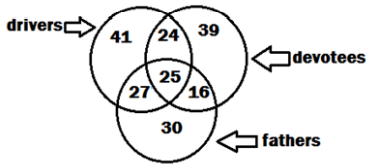
Question 91

Express 0.27‾0.2\overline 7  in the form pq\frac{{\rm{p}}}{{\rm{q}}}, where p and q are integers and q ≠ 0.

  1. AOption (a)

    185\frac{{\rm{18}}}{{\rm{5}}}

  2. BOption (b)

    718\frac{{\rm{7}}}{{\rm{18}}}

  3. COption (c)

    187\frac{{\rm{18}}}{{\rm{7}}}

  4. DOption (d)

    518\frac{{\rm{5}}}{{\rm{18}}}

View answer & explanation

Correct answer

Answer: (d)D.

518\frac{{\rm{5}}}{{\rm{18}}}

Why this answer is correct

Given:

Express 0.27 in the form p/q, where p and q are integers and q ≠ 0.

Formula used:

Let x = 0.27

Multiply by 10 to shift the decimal point:

10x = 2.77

Subtract the original equation from this new equation to eliminate the repeating part:

Calculation:

10x = 2.77

x = 0.27

Subtracting the second equation from the first:

10x - x = 2.77 - 0.27

⇒ 9x = 2.5

⇒ x = 2.5 / 9

⇒ x = 25 / 90

⇒ x = 5 / 18

∴ 0.27 = 5/18

Question 92

Select the option that shows the correct matching of Column I with Column II regarding Asexual Reproduction.

Column IColumn II
A.Leishmaniai)Regeneration
B.Yeastii)Binary fission
C.Plasmodiumiii)Multiple fission
D.Hydraiv)Budding
  1. AOption (a)

    A - iv, B - ii, C - i, D - iii

  2. BOption (b)

    A - ii, B - i, C - iii, D - iv

  3. COption (c)

    A - ii, B - iv, C - iii, D - i 

  4. DOption (d)

    A - i, B - ii, C - iii, D - iv

View answer & explanation

Correct answer

Answer: (c)C.

A - ii, B - iv, C - iii, D - i 

Why this answer is correct

The correct answer is 3 Only.

Key PointsExplanation:

  • Leishmania: It reproduces by binary fission. Hence, A - ii.
  • Yeast: It reproduces by budding. Hence, B - iv.
  • Plasmodium: It reproduces by multiple fission. Hence, C - iii.
  • Hydra: It reproduces by regeneration. Hence, D - i.

Thus, the correct matching is:

Column IColumn II
A.Leishmaniaii)Binary fission
B.Yeastiv)Budding
C.Plasmodiumiii)Multiple fission
D.Hydrai)Regeneration

Therefore, the correct option is: 3.

Question 93

Which two numbers should be interchanged to make the given equation correct?

11 + 13 × 3 - 14 ÷ 7 = 44

  1. AOption (a)

    14 and 11

  2. BOption (b)

    11 and 13

  3. COption (c)

    14 and 13

  4. DOption (d)

    11 and 7

View answer & explanation

Correct answer

Answer: (b)B.

11 and 13

Why this answer is correct

The BODMAS rule is given as follows-

Given equation: 11 + 13 × 3 - 14 ÷ 7 = 44 

Now, we check the given options as follows-

Option 1) 14 and 11

⇒ 14 + 13 × 3 - 11 ÷ 7 = 44 

⇒ 14 + 13 × 3 - 1.571 = 44 

⇒ 14 + 39 - 1.571 = 44

⇒ 53 - 1.571 = 44

⇒ 51.429 ≠ 44

⇒ LHS ≠ RHS

Option 2) 11 and 13

⇒ 13 + 11 × 3 - 14 ÷ 7 = 44 

⇒ 13 + 11 × 3 - 2 = 44 

⇒ 13 + 33 - 2 = 44

⇒ 46 - 2 = 44

⇒ 44 = 44

⇒ LHS = RHS

Option 3) 14 and 13

⇒ 11 + 14 × 3 - 13 ÷ 7 = 44 

⇒ 11 + 14 × 3 - 1.857 = 44 

⇒ 11 + 42 - 1.857 = 44

⇒ 53  - 1.857 = 44

⇒ 51.143 ≠ 44

⇒ LHS ≠ RHS

Option 4) 11 and 7

⇒ 7 + 13 × 3 - 14 ÷ 11 = 44

⇒ 7 + 13 × 3 - 1.27 = 44 

⇒ 7 + 39 - 1.27 = 44

⇒ 46  - 1.27 = 44

⇒ 44.72 ≠ 44

⇒ LHS ≠ RHS

Hence, the correct answer is "Option 2".

Question 94

The Indian Men's Cricket Team played their thousandth ODI match against which team?

  1. AOption (a)

    Sri Lanka

  2. BOption (b)

    West Indies

  3. COption (c)

    South Africa

  4. DOption (d)

    Australia

View answer & explanation

Correct answer

Answer: (b)B.

West Indies

Why this answer is correct

The correct answer is West Indies

Key Points

  • The Indian Men's Cricket Team played their thousandth ODI match against West Indies.
  • This milestone match was a significant event in the history of Indian cricket.
  • The Indian cricket team is one of the most successful teams in the world and has a rich history in ODI cricket.
  • Playing a thousand ODI matches is a testament to the team's longevity and success in the international arena.

Additional Information

  • ODI (One Day International) cricket is a format of limited overs cricket, played between two international teams, with each team facing a fixed number of overs, usually 50.
  • The first ODI was played on 5 January 1971 between Australia and England at the Melbourne Cricket Ground.
  • The Indian cricket team played its first ODI match on 13 July 1974 against England at the Headingley Stadium in Leeds.
  • India has won two ICC Cricket World Cups in 1983 and 2011.
  • Over the years, several Indian cricketers have achieved significant milestones in ODI cricket, contributing to the team's success.

Question 95

Shobha started from point A and walked 10 m towards the east. She then took a left turn and walked another 10 m. She then took a right turn and walked 30 m. She then took a right turn and walked 15 m. She then took a right turn and walked 40 m. She then took a left turn and walked 5 m to reach a shopping mall. How far and in which direction is point A from the shopping mall? (All turns are 90 degree turns only)

  1. AOption (a)

    5 m, South

  2. BOption (b)

    10 m, North

  3. COption (c)

    5 m, North

  4. DOption (d)

    10 m, South

View answer & explanation

Correct answer

Answer: (b)B.

10 m, North

Why this answer is correct

Given: Shobha started from point A and walked 10 m towards the east.

Shobha started from point A and walked 10 m towards the east.

She then took a left turn and walked another 10 m. 

She then took a right turn and walked 30 m.

She then took a right turn and walked 15 m. 

She then took a right turn and walked 40 m. 

She then took a left turn and walked 5 m to reach a shopping mall.

Based on the given movements, we get Shobha's final direction diagram as follows-

From the final direction diagram, we see that point A is located (5 + 5) = 10 m to the North of the mall.

Hence, the correct answer is "Option 2".

Question 96

If the simple interest on a sum of money at 8% per annum for 2 years is ₹1,000, find the compound interest on the same sum for the same period at the same rate in case of annual compounding.

  1. AOption (a)

    ₹1,140

  2. BOption (b)

    ₹1,060

  3. COption (c)

    ₹1,040

  4. DOption (d)

    ₹1,260

View answer & explanation

Correct answer

Answer: (c)C.

₹1,040

Why this answer is correct

Shortcut Trick

For a period of 2 years, the difference between Compound Interest (CI) and Simple Interest (SI) is given by the formula:

Difference = (SI × R) ÷ 200

Difference = (1000 × 8) ÷ 200 = 8000 ÷ 200 = ₹40

Total CI = SI + Difference = 1000 + 40 = ₹1,040

∴ The correct answer is ₹1,040.

Alternate Method

Given: Simple Interest (SI) = ₹1,000 | Rate (R) = 8% | Time (T) = 2 years

Formula Used:

  1. SI = (P × R × T) ÷ 100
  2. CI = P × [(1 + R/100)T − 1]

⇒ Principal (P) = (SI × 100) ÷ (R × T)

⇒ P = (1000 × 100) ÷ (8 × 2) = 100000 ÷ 16 = ₹6,250

⇒ Compound Interest (CI) = 6250 × [(1 + 8/100)2 − 1]

⇒ CI = 6250 × [(1.08)2 − 1]

⇒ CI = 6250 × [1.1664 − 1]

⇒ CI = 6250 × 0.1664 = ₹1,040

∴ The correct answer is ₹1,040.

Additional Information

Difference between CI and SI (2 Years)

The difference (D) for 2 years is D = P × (R/100)2.

Effective Rate of Compound Interest

For two years at rate R%, the effective rate is (R + R + R2/100)%.

Difference between CI and SI (3 Years)

The difference (D) for 3 years is D = P × (R/100)2 × (3 + R/100).

Question 97

Five persons, P, Q, R, S and T, got jobs in five different years, viz. 1991, 1992, 1993, 1994 and 1995. Q got the job immediately before T. R got the job immediately after P. S got the job immediately after R. T got the job in the year 1992. Who got the job in the year 1995?

  1. AOption (a)

    R

  2. BOption (b)

    P

  3. COption (c)

    Q

  4. DOption (d)

    S

View answer & explanation

Correct answer

Answer: (d)D.

S

Why this answer is correct

Given: Five persons, P, Q, R, S and T, got jobs in five different years, viz. 1991, 1992, 1993, 1994 and 1995.

Based on the given conditions, we get the following table-

  1. T got the job in the year 1992. Q got the job immediately before T. From these, we get-
YEARPERSON
1991Q
1992T
1993
1994
1995


  1. R got the job immediately after P. S got the job immediately after R. From these, we get the final table as follows-
YEARPERSON
1991Q
1992T
1993P
1994R
1995S


Therefore, from the final table we see that S got the job in the year 1995.

Hence, the correct answer is “Option 4”.

Question 98

By which of the following amendments was the Right to Education included in the Indian Constitution?

  1. AOption (a)

    85

  2. BOption (b)

    87

  3. COption (c)

    83

  4. DOption (d)

    86

View answer & explanation

Correct answer

Answer: (d)D.

86

Why this answer is correct

The correct answer is 86.

Key Points

  • The 86th amendment to the Constitution of India in 2002 provided the right to education as a fundamental right.
  • A new article 21A was added which made the right to education a fundamental right for children between  6-14 years.
  • Changes in Article 45 of the Directive Principle of State Policies were made.
  • It made education for all children below 6 years a Directive Principle of State Policies(DPSP).
  • It made the opportunities for education to the child a Fundamental Duty of parents of children.

Question 99

BTE 11 is related to DVG120 in a certain way. In the same way, PAN 9 is related to RCP 80. To which of the following is GMT 12 related following the same logic?

  1. AOption (a)

    IOW 143

  2. BOption (b)

    IOV 120

  3. COption (c)

    IOV 119

  4. DOption (d)

    IOV 143

View answer & explanation

Correct answer

Answer: (d)D.

IOV 143

Why this answer is correct

The English alphabetical series is given as-

The logic followed here is-

For BTE 11 is related to DVG 120, we have-

For PAN 9 is related to RCP 80, we have-

Similarly, for GMT 12 we have,

Therefore, by the same logic, IOV143 is related to GMT12. 

Hence, the correct answer is "Option 4".

Question 100

Which of the following is the correct structure of benzene molecule?

  1. AOption (a)

  2. BOption (b)

  3. COption (c)

  4. DOption (d)

View answer & explanation

Correct answer

Answer: (d)D.

Why this answer is correct

The correct answer is option 4

Key Points

  • Option 4 represents the correct structure of the benzene molecule.
  • Benzene is a cyclic hydrocarbon with the molecular formula C6H6.
  • It consists of six carbon atoms bonded in a planar hexagonal ring with alternating single and double bonds, known as a resonance structure.
  • This structure is responsible for benzene's stability and unique chemical properties.

Additional Information

  • The concept of aromaticity explains the stability of benzene due to the delocalized π-electrons above and below the plane of the ring.
  • Benzene is a fundamental component in organic chemistry and is used as a starting material for the synthesis of various chemicals.
  • It is also known for its presence in petroleum and its role in the production of plastics, resins, synthetic fibers, rubber, dyes, detergents, drugs, and pesticides.

100 questions in the full paper