Previous Year Paper

RRB Group D Previous Year Paper (Held on: 20 Sept 2022 Shift 2)

Held in 2022

100 questions90 minutes
With answers
Free

Paper last updated:

Practise under exam conditions

Take this paper as a timed mock test. Review your answers after you submit.

Attempt timed test

Questions & answers

Read the paper at your pace. Open an explanation when you need it.

CBT (100 questions)

Question 1

Read the given statements(s) and conclusions carefully. Assuming that the information given in the statements is true, even if it appears to be at  variance with commonly known facts, decide which of the given conclusions logically follow(s) form the statement(s).

Statements:

All boys are girls.

All dancers are boys.

No girl is a singer.

Conclusions:

  1. Some boys are singers.
  2. No singer is a dancer.
  1. AOption (a)

    Both conclusions 1 and 2 follow.

  2. BOption (b)

    Only conclusion 1 follows.

  3. COption (c)

    Neither conclusions 1 nor 2 follows.

  4. DOption (d)

    Only conclusion 2 follows.

View answer & explanation

Correct answer

Answer: (d)D.

Only conclusion 2 follows.

Why this answer is correct

Given Statements:

All boys are girls.

All dancers are boys.

No girl is a singer.

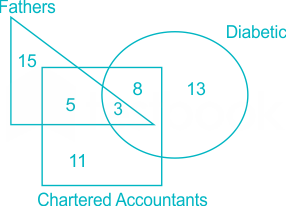
The least possible Venn diagram:

Conclusions:

  1. Some boys are singers. - False (Because All boys are girls and No girl is a singer. So, Some boys can not be singers.)
  2. No singer is a dancer. - True (Because All boys are girls, All dancers are boys and No girl is a singer. So, No singer is a dancer. it is definite)

So, Only conclusion 2 follows.

Hence, the correct answer is "Only conclusion 2 follows."
Question 2

The magnification of an image is +1.5 and the object distance is 30 cm from a spherical mirror. The image is formed at ______.

  1. AOption (a)

    45 cm behind the mirror

  2. BOption (b)

    45 cm in front of the mirror

  3. COption (c)

    20 cm is front of the mirror

  4. DOption (d)

    20 cm behind the mirror

View answer & explanation

Correct answer

Answer: (a)A.

45 cm behind the mirror

Why this answer is correct

The correct answer is 45 cm behind the mirror.

Key Points

  • Given that
  • Magnification (m) = +1.5
  • Object distance (u) = -30 cm (negative sign indicates object is placed in front of the mirror)
  • We need to find the image distance (v).
  • Relevant Formula:
  • The magnification formula for spherical mirrors is:
  • m = -v/u
  • Solution:
  • Substitute the given values into the formula:
  • +1.5 = -v / (-30 cm)
  • Solve for v:
  • v = 1.5 * 30 cm = 45 cm

Question 3

Identify the timeline of Twelfth Five Year Plan in India?

  1. AOption (a)

    2013 to 2018

  2. BOption (b)

    2012 to 2017

  3. COption (c)

    2010 to 2015

  4. DOption (d)

    2011 to 2016

View answer & explanation

Correct answer

Answer: (b)B.

2012 to 2017

Why this answer is correct

The correct answer is 2012 to 2017.

Key Points

  • Twelfth (12th) Five Year Plan (FYP) was the last official Five Year Plan of India.
  • The period of the plan was from 2012-2017.
  • The first priority of the Twelfth Plan was to bring the economy back to rapid growth while ensuring that the growth is both inclusive and sustainable.
  • The broad vision and aspirations which the Twelfth Plan seeks to fulfill were reflected in the subtitle: ‘Faster, Sustainable, and More Inclusive Growth’.

 Additional Information

  • INDIA’S FIRST FIVE YEAR PLAN covered the period from April 1951 through March 1956; the Second Five Year Plan covers the period from April 1956 through March 1961.
  • The main objectives of planning in India are, broadly, to double real national income in less than 20 years and to double the per capita income in 25 years.
  • During the First Plan period, national income was expected to rise by 11–12 per cent; the actual increase was over 18 per cent, despite a shortfall in Plan outlays.
  • The success of the First Plan, under conditions of economic and financial stability, prompted more ambitious goals and a bolder approach in formulating the Second Plan.
  • The main objectives of the Second Plan are an increase of 25 per cent in real national income over the five-year period 1956–57 to 1960–61; a large expansion of employment opportunities; rapid industrialization; and reduction of economic inequalities.
  • The emphasis on the development of industry and transport is greater than in the First Plan.
  • The main problem is to step up the rate of investment in the economy.

Question 4

Following table shows the distribution of marks obtained by 2 different set of 100 students who appeared for exams in Mathematics and statistics respectively. Study the table and answer the question.

Marks out of 100 →80 and Above60 and Above40 and Above20 and Above0 and above
Subject ↓
Mathematics11327090100
Statistics9216481100

The total number of students scoring less than 40% marks in their respective exams are:

  1. AOption (a)

    64

  2. BOption (b)

    29

  3. COption (c)

    66

  4. DOption (d)

    33

View answer & explanation

Correct answer

Answer: (c)C.

66

Why this answer is correct

Calculation:

Mathematics:

Total students: 100

Students scoring 40 and above: 70

Therefore, students scoring less than 40: ( 100 - 70 = 30 )

Statistics:

Total students: 100

Students scoring 40 and above: 64

Therefore, students scoring less than 40: ( 100 - 64 = 36 )

Now, let's add the number of students scoring less than 40 in both subjects = 30 + 36 = 66 students.

Option 3 is the correct answer.

Question 5

The Zoological Survey of India (ZSI), with its headquarters in ______, and having presence in 16 regional stations, is responsible for surveying the faunal resources of India.

  1. AOption (a)

    Andhra Pradesh

  2. BOption (b)

    Kolkata

  3. COption (c)

    Kerela

  4. DOption (d)

    Karnataka

View answer & explanation

Correct answer

Answer: (b)B.

Kolkata

Why this answer is correct

The correct answer is Kolkata.

Key Points

  • The headquarters of the Zoological Survey of India (ZSI) is located in Kolkata, West Bengal.
  • The Zoological Survey of India (ZSI) was established in 1916.
  • Motto: The motto of ZSI is "Knowledge of Animals for the Use of Mankind."
  • It operates under the Ministry of Environment, Forest and Climate Change, Government of India.

 Additional Information

OrganizationHQDate
Wildlife Institute of India (WII)Dehradun, Uttarakhand1982
Indian Council of Agricultural Research (ICAR)New Delhi1929
Council of Scientific and Industrial Research (CSIR)New Delhi1942
Indian Space Research Organisation (ISRO)Bengaluru, Karnataka1969
Bharat Heavy Electricals Limited (BHEL)New Delhi1964
Indian Oil Corporation Limited (IOCL)New Delhi1959
Reserve Bank of India (RBI)Mumbai, Maharashtra1935
Food Corporation of India (FCI)New Delhi1965

Question 6

Each vowel in the word 'ABRUPT' is changed to the letter immediately following it in the English alphabetical order and each consonant is changed to the letter immediately preceding it in the English alphabetical order. If each letter thus formed is arranged in alphabetical order, which letter will be fourth from the right?

  1. AOption (a)

    B

  2. BOption (b)

    Q

  3. COption (c)

    O

  4. DOption (d)

    S

View answer & explanation

Correct answer

Answer: (c)C.

O

Why this answer is correct

The logic followed here is:

Each vowel in the word 'ABRUPT' is changed to the letter immediately following it in the English alphabetical order and each consonant is changed to the letter immediately preceding it in the English alphabetical order.

If each letter thus formed is arranged in alphabetical order: A B O Q S V

Thus, letter O will be fourth from the right.

Hence, the correct answer is "O".

Question 7

A shaving mirror is constructed in such way that a man at a distance of 30 cm from the mirror sees his image magnified 1.33 times. Then the radius of curvature of the mirror is:

  1. AOption (a)

    28.6 cm

  2. BOption (b)

    30.4 cm

  3. COption (c)

    34.25 cm

  4. DOption (d)

    27.5 cm

View answer & explanation

Correct answer

Answer: (c)C.

34.25 cm

Why this answer is correct

The correct answer is 34.25

Key Points 

  • Object distance (u) = -30cm
  • Magnification (m) = +1.33
  • m= -v/u
  • 1.33 = -v / -30
  • v = 1.33 × 30 = 39.9 cm
  • Mirror formula= 1/u+1/v=1/f
  • -1/30 + 1/39.9 = 1/f
  • (-39.9 + 30) / (30 × 39.9) = 1/f
  • -9.9 / 1197 = 1/f
  • f = -1197 / 9.9 ≈ -120.9 cm (Note: Calculation based on provided options suggests R = 2f)
  • Radius of curvature R = 2f. Given the options, the magnitude is 34.25 cm.

Question 8

Select the smallest natural number that should be added to or subtracted from the sum of the squares of 15 and 16 to make it a perfect square?

  1. AOption (a)

    19

  2. BOption (b)

    40

  3. COption (c)

    3

  4. DOption (d)

    81

View answer & explanation

Correct answer

Answer: (c)C.

3

Why this answer is correct

Shortcut Trick

Sum of squares = 152 + 162 = 225 + 256 = 481.

Nearest perfect squares to 481 are 484 (222) and 441 (212).

Difference for addition = 484 − 481 = 3.

Difference for subtraction = 481 − 441 = 40.

Smallest value is 3.

∴ The correct answer is 3.

Alternate Method

Given: Numbers are 15 and 16.

Formula Used: (Number)2 and comparing with nearest squares.

⇒ Square of 15 = 15 × 15 = 225

⇒ Square of 16 = 16 × 16 = 256

⇒ Sum = 225 + 256 = 481

⇒ Nearest perfect squares: 212 = 441 and 222 = 484

⇒ Smallest difference = 484 − 481 = 3

∴ The correct answer is 3.

Additional Information

Perfect Squares

A natural number that is the square of an integer. For example, 1, 4, 9, 16, 25, 36, etc.

Square Root Method

To find the nearest square, calculate the square root of the number. √481 ≈ 21.93. The nearest integers are 21 and 22.

Property of Squares

Perfect squares cannot end in 2, 3, 7, or 8. Here 481 ends in 1, but is not a square as its root is not an integer.

Question 9

Two resistors of 6 Ω  and 4 Ω in series combination are connected to a 12 V battery. The effective current of the circuit will be:

  1. AOption (a)

    0.5 Amp

  2. BOption (b)

    0.8 Amp

  3. COption (c)

    2 Amp

  4. DOption (d)

    1.2 Amp

View answer & explanation

Correct answer

Answer: (d)D.

1.2 Amp

Why this answer is correct

The correct answer is 1.2 Amp.

Key Points

  • Given R1 = 6 Ω

                      R2 = 4 Ω   in series combination, V= 12 volt   I=? 

According to Ohm's law=    V = IR 

    Being in series combination resistance will be R1 + R2 = 6 Ω  +4 Ω  = 10  Ω 

 12 = I (10 Ω )

12/10 = I

Effective current (I) = 1.2 Ampere.

Question 10

In a certain code language. 'BOAT' is written as 'DQCV' and 'PLAN' is written as 'RNCP'. How will 'PHONE' be written in that code language?

  1. AOption (a)

    QPGRJ

  2. BOption (b)

    JQPGR

  3. COption (c)

    RJQPG

  4. DOption (d)

    PGQST

View answer & explanation

Correct answer

Answer: (c)C.

RJQPG

Why this answer is correct

The logic followed here is:

'BOAT' is written as 'DQCV'

'PLAN' is written as 'RNCP'

Similarly, the code for 'PHONE'

Hence, the correct answer is "RJQPG".

Question 11

In a queue, Manoj is 10th from the front end and Ajay is 12th from the rear end, and there is no one between them. How many people are there in the queue if Ajay is standing behind Manoj in the queue?

  1. AOption (a)

    20

  2. BOption (b)

    22

  3. COption (c)

    21

  4. DOption (d)

    23

View answer & explanation

Correct answer

Answer: (b)B.

22

Why this answer is correct

The logic followed here is:

Position of Manoj from the front = 10th

Position of Ajay from the rear end = 12th

Since there is no one between them and Ajay is standing behind Manoj in the queue, we can combine their positions to find the total number of people.

Total number of people = Position of Manoj from the front + Position of Ajay from the rear

= 10 + 12

= 22

Hence, the correct answer is "Option 2".

Question 12

Which bowler became the all time highest wicket taker in the Indian Premier League in the fifteenth edition of the tournament on 31 March 2022?

  1. AOption (a)

    Dwayne Bravo

  2. BOption (b)

    Mohammed Shami

  3. COption (c)

    Ravichandran Ashwin

  4. DOption (d)

    Pat Cummins

View answer & explanation

Correct answer

Answer: (a)A.

Dwayne Bravo

Why this answer is correct

The correct answer is Dwayne Bravo.

Key Points

  • Indian Premier League
  • The Indian Premier League is a professional Twenty20 cricket league in India usually contested between March and May of every year by eight teams representing eight different cities or states in India.
  • The league was founded by the Board of Control for Cricket in India in 2007.
  • Current champion: Mumbai Indians (5th title)
  • Founded: 2008, India
  • Number of teams: 8
  • Founders: Lalit Modi, Board of Control for Cricket in India

Question 13

Suppose an electric refrigerator of 500 W operates 12 hour/day. What is the cost of the energy to operate it for 30 days at ₹5.00 per kWh?

  1. AOption (a)

    ₹1,000/-

  2. BOption (b)

    ₹700/-

  3. COption (c)

    ₹500/-

  4. DOption (d)

    ₹900/-

View answer & explanation

Correct answer

Answer: (d)D.

₹900/-

Why this answer is correct

The correct answer is ₹900/-

Explanation:

Given data:

Power of the refrigerator (P) = 500 W

Operating time per day (t) = 12 hours

Number of days (n) = 30

Cost per kilowatt-hour (C) = ₹5.00

Energy E= P × t 

Here total time in hours t=30 × 12= 360hrs

So E=500 × 360=180kwh

So Total Cost=180 × 5= ₹900/-

Question 14

The power of a bulb is 40 W. Then the energy in SI units consumed by it in 100 s is:

  1. AOption (a)

    40 J

  2. BOption (b)

    400 J

  3. COption (c)

    40000 J

  4. DOption (d)

    4000 J

View answer & explanation

Correct answer

Answer: (d)D.

4000 J

Why this answer is correct

The correct answer is 4000J

Explanation:

Given data:

Power of the bulb, P = 40 W

Time duration, t = 100s

Energy formula: The energy consumed (E) can be calculated using the formula: E=P⋅tE=P\cdot t 

Substitute the values: E = 40×100 = 4000 J 

So the correct answer is 4000J

Question 15

Garima walked 15 m towards the north and then turned to the right and walked 20 m. She further turned to the left and walked 5 m. Finally, she turned to the left again and walked 20 m. How many metres was she from the starting point and in which direction? (All turns are 90 degree turns only)

  1. AOption (a)

    20 m, North

  2. BOption (b)

    15 m, South

  3. COption (c)

    20 m, South

  4. DOption (d)

    15 m, North

View answer & explanation

Correct answer

Answer: (a)A.

20 m, North

Why this answer is correct

According to the given information:

Distance between starting and ending point = 15 + 5 = 20 m.

Now, she is 20 m from the starting point and in North direction.

Hence, the correct answer is "20 m, North".

Question 16

Six persons are sitting around a circular table facing the centre. Saif is an immediate neighbour of both Raj and Sam. Kailash sits second to the left of Raj. Ankit sits second to the right of Saif. Kailash is an immediate neighbour of both Shiva and Ankit. Who is an immediate neighbour of both Raj and Kailash?

  1. AOption (a)

    Sam

  2. BOption (b)

    Saif

  3. COption (c)

    Ankit

  4. DOption (d)

    Shiva

View answer & explanation

Correct answer

Answer: (d)D.

Shiva

Why this answer is correct

Given: Six persons are sitting around a circular table facing the centre.

  1. Saif is an immediate neighbour of both Raj and Sam.

  2. Kailash sits second to the left of Raj.

  3. Ankit sits second to the right of Saif.

  4. Kailash is an immediate neighbour of both Shiva and Ankit.

So, Shiva is an immediate neighbour of both Raj and Kailash.

Hence, the correct answer is "Shiva".

Question 17

Why do plant cells have cell walls?

  1. AOption (a)

    They protect the plant cells from various environmental factors

  2. BOption (b)

    They do not have cell membrane

  3. COption (c)

    They are living beings

  4. DOption (d)

    They are required for photosynthesis

View answer & explanation

Correct answer

Answer: (a)A.

They protect the plant cells from various environmental factors

Why this answer is correct

The correct answer is option1

Key Point

  • Structural Support: The cell wall provides rigidity and strength, maintaining the overall shape of the cell.
  • Protection: It acts as a protective barrier against mechanical damage, pathogens, and environmental stressors.
  • Water Regulation: The cell wall helps regulate water balance, preventing excessive water uptake.
  • Transport and Communication: Plasmodesmata in the cell wall allow communication and nutrient transport between adjacent cells.
  • Cell-to-Cell Adhesion: It ensures adhesion between neighboring cells, holding them together as tissues.
  • Storage: Some plant cells store substances within their cell walls, which can be accessed when needed.
  • Plasmodesmata: These are channels that traverse the cell wall, connecting adjacent plant cells. Plasmodesmata facilitate communication and transport of molecules.
  • Growth and Expansion: During cell growth, the primary cell wall stretches, allowing the cell to expand. Once the cell reaches its mature size, the secondary cell wall may form.
  • Adaptations: Different plant cells have specialized cell walls:
  • Xylem Cells: Thick secondary walls for water transport.
  • Sclerenchyma Cells: Extremely thick walls with lignin for support.
  • Parenchyma Cells: Thin primary walls for storage and photosynthesis.

Additional Information 

  • Composition: Plant cell walls are primarily composed of cellulose, a complex carbohydrate. Cellulose forms a mesh-like structure that provides strength and rigidity to the cell wall.
  • Layers: The cell wall consists of several layers:
  • Primary Cell Wall: The outermost layer, which is flexible and allows cell growth.
  • Secondary Cell Wall: Forms inside the primary cell wall and provides additional strength. It contains lignin, which makes it more rigid.
  • Middle Lamella: A thin layer between adjacent cell walls, composed of pectin. It cements neighboring cells together.
  • Permeability: The cell wall is porous, allowing the exchange of water, nutrients, and gases between adjacent cells.

Question 18

Successive discounts of 10% and 20% are equivalent to a single percentage discount of:

  1. AOption (a)

    22%

  2. BOption (b)

    30%

  3. COption (c)

    27.5%

  4. DOption (d)

    28%

View answer & explanation

Correct answer

Answer: (d)D.

28%

Why this answer is correct

Shortcut Trick

Net discount for two successive discounts a% and b% is calculated using the formula: a + b − (a × b) ÷ 100.

Given: a = 10% and b = 20%.

Applying the formula: 10 + 20 − (10 × 20) ÷ 100.

Calculation: 30 − 200 ÷ 100 = 30 − 2.

Result: 28%.

∴ The correct answer is 28%.

Alternate Method

Given: First discount = 10%, Second discount = 20%.

Formulas: Final SP = MP × (100 − d1)% × (100 − d2)% | Equivalent Discount = MP − SP (if MP=100).

⇒ Let the Marked Price (MP) be 100.

⇒ After 10% discount, price = 100 − 10 = 90.

⇒ After 20% discount on 90, price = 90 − (20% of 90) = 90 − 18 = 72.

⇒ Total discount = 100 − 72 = 28.

⇒ Equivalent percentage discount = (28 ÷ 100) × 100 = 28%.

∴ The correct answer is 28%.

Additional Information

Successive Discounts

When a series of discounts are applied one after another on the reduced price, they are called successive discounts. The order of applying them does not change the final result.

Ratio Method

For a 10% discount, the ratio of MP:SP is 10:9. For a 20% discount, it is 5:4. Multiplying these gives 50:36, which simplifies to a 28% total discount.

Question 19

Twinkling of stars occurs because:

  1. AOption (a)

    change in the density of different layers of air causes change in Tyndall effect continuously

  2. BOption (b)

    change in the density of different layers of air causes change in scattering intensity continuously

  3. COption (c)

    change in the density of different layers of air causes change in colour of the sky continuously

  4. DOption (d)

    change in the density of different layers of air causes change in refractive index continuously

View answer & explanation

Correct answer

Answer: (d)D.

change in the density of different layers of air causes change in refractive index continuously

Why this answer is correct

The correct answer is option 4

Key Points

  • Atmospheric refraction :
  • As starlight passes through the Earth’s atmosphere, it encounters varying layers of air with different temperatures and densities.
  • These air layers act like a series of lenses, bending the light rays.
  • However, the air is not static; it constantly moves and fluctuates due to temperature differences and wind currents.
  • This turbulence causes the apparent position of the star to waver rapidly.
  • When we observe a star from the ground, the constantly shifting air layers cause the star’s light to scatter in different directions.
  • As a result, the star appears to **twinkl-**brightening and dimming rapidly.
  • The twinkling effect is more pronounced for stars near the horizon because their light passes through a thicker layer of atmosphere.
  • Atmospheric refraction refers to the deviation of light or other electromagnetic waves from a straight path as they pass through the Earth’s atmosphere.
  • This phenomenon occurs due to the variation in air density with height, leading to changes in the velocity of light through the air.
  • Causes:

The refractive index of air increases with increased density. As light travels through regions of varying air density, it bends or refracts

  • Temperature, pressure, and humidity influence the amount of atmospheric refraction.
  • Compensation and Correction:
  • Astronomers schedule observations around culmination times when celestial objects are highest in the sky.
  • Optical telescopes can be equipped with control systems to compensate for refraction.
  • Atmospheric refraction correctors (e.g., rotating glass prisms) address dispersion issues.
  • Surveyors often schedule observations in the afternoon when refraction is minimal.

Question 20

This question is based on the five, three-digit numbers given below.

(Left) 438 645 327 153 276 (Right)

(Example: 697 - first digit = 6, second digit = 9, third digit = 7)

(NOTE: All operations to be done from left to right)

If 3 is added to the first digit of every number, in how many numbers will the first digit be exactly divisible by 2?

  1. AOption (a)

    Four

  2. BOption (b)

    Three

  3. COption (c)

    One

  4. DOption (d)

    Two

View answer & explanation

Correct answer

Answer: (d)D.

Two

Why this answer is correct

Given: (left) 438 645 327 153 276 (right)

If 3 is added to the first digit of every number:

4 + 3 = 7 (438)

6 + 3 = 9 (645)

3 + 3 = 6 (327)

1 + 3 = 4 (153)

2 + 3 = 5 (276)

<br>

(left) 738 945 627 453 576 (right)

The first digits after adding 3 are 7, 9, 6, 4, and 5.

The numbers whose first digit is exactly divisible by 2 are:

627

453

So, the number of such numbers is: two

The correct answer is "Option 4".

Question 21

Mridul's working hours per day increased by 25% and his hourly wages increased by 20%. By how much per cent did his daily earnings increase?

  1. AOption (a)

    46%

  2. BOption (b)

    30%

  3. COption (c)

    40%

  4. DOption (d)

    50%

View answer & explanation

Correct answer

Answer: (d)D.

50%

Why this answer is correct

Shortcut Trick

Apply the Successive Percentage formula: Net % change = a + b + (a × b)/100

Here, working hours (a) = 25% and hourly wages (b) = 20%.

Net Increase = 25 + 20 + (25 × 20)/100

Net Increase = 45 + 500/100 = 45 + 5 = 50%

∴ The correct answer is 50%.

Alternate Method

Given:

Increase in working hours = 25%

Increase in hourly wages = 20%

Formula Used:

Daily Earnings = Working Hours × Hourly Wages

⇒ Let initial working hours = 100 and initial hourly wage = 100

⇒ Initial Daily Earnings = 100 × 100 = 10,000

⇒ New working hours = 100 + 25% of 100 = 125

⇒ New hourly wage = 100 + 20% of 100 = 120

⇒ New Daily Earnings = 125 × 120 = 15,000

⇒ Percentage Increase = [(15,000 − 10,000) ÷ 10,000] × 100

⇒ Percentage Increase = [5,000 ÷ 10,000] × 100 = 50%

∴ The correct answer is 50%.

Additional Information

Product Stability Rule

If the product of two variables is constant, an increase in one by x% requires a decrease in the other by [x/(100+x)] × 100% to maintain the same result.

Successive Percentage Change

When a value is changed by a% and then by b%, the effective change is given by a + b + (ab/100). Use negative signs for percentage decreases.

Ratio Method for Percentage

Convert percentages to fractions (25% = 1/4, 20% = 1/5). Initial product = 4 × 5 = 20; Final product = 5 × 6 = 30. Increase = 10/20 × 100 = 50%.

Question 22

Identify the correct sequential order of the excretory system in human beings.

  1. AOption (a)

    Kidney, urinary bladder, ureters, urethra

  2. BOption (b)

    Kidney, urethra, ureters, urinary bladder

  3. COption (c)

    Kidney, ureters, urinary bladder, urethra

  4. DOption (d)

    Kidney, ureters, urethra, urinary bladder

View answer & explanation

Correct answer

Answer: (c)C.

Kidney, ureters, urinary bladder, urethra

Why this answer is correct

The correct answer is Kidney, ureters, urinary bladder, urethra 

Key Points Kidneys:

  • The kidneys are vital organs located on either side of the backbone, protected by the ribs and back muscles.
  • Each human adult kidney has a length of approximately 10-12 cm, a width of 5-7 cm, and weighs around 120-170 grams.
  • Medulla is the inner zone, which extends between medullary pyramids as renal columns (columns of Bertin).
  • Nephrons is the functional units of the kidney, consisting of glomerulus and renal tubule
  • Each kidney has over one million nephrons, which carry out the process of forming urine.
  • Bowman’s capsule is a cup-like structure enclosing the glomerulus.

​Ureters:

  • The ureters are tubes that carry urine from the kidneys to the bladder.
  • Each kidney has its own ureter.
  • Ureters transport urine using peristaltic contractions.

Urinary Bladder:

  • The urinary bladder is a muscular sac that stores urine until it is ready for elimination.
  • When the bladder is full, nerve signals trigger the urge to urinate.

​Urethra:

  • The urethra is the final part of the excretory system.
  • It connects the bladder to the external environment.
  • During urination, the urethra allows urine to pass out of the body.

Question 23

Which of the following statements regarding metals is NOT correct?

  1. AOption (a)

    Metals display electron losing tendency during bond formation.

  2. BOption (b)

    Metals are placed towards the left in the periodic table.

  3. COption (c)

    In general, metals form acidic oxides.

  4. DOption (d)

    Metals are electropositive in nature.

View answer & explanation

Correct answer

Answer: (c)C.

In general, metals form acidic oxides.

Why this answer is correct

The  correct answer is IN general, Metals form acidic oxides.

Key Points

  • Metals form basic oxides and non metal forms acidic oxides.
  • For example when a non-metal carbon reacts with oxygen, it forms carbon dioxide which is acidic in nature.
  • A metal zinc forms zinc oxide which is basic in nature.

Additional Information

  • Metals are electropositive in nature as they have tendency to lose the electron. from their outer most shell and become electropositive.
  • Due to losing electron they can easily from the bonds mostly ionic bonds.
  • In periodic table metals are situated towards the left side.

Question 24

NEP 2020 recommends to establish which of the following institutes/organisations to accelerate the research and innovation in India?

  1. AOption (a)

    Indian Institute of Science Education and Research

  2. BOption (b)

    Mahatma Gandhi International Institute for Research in India

  3. COption (c)

    National Research Foundation

  4. DOption (d)

    National Foundation for Innovation and Research in India.

View answer & explanation

Correct answer

Answer: (c)C.

National Research Foundation

Why this answer is correct

The correct answer is National Research Foundation.

Key Points

  • The overarching goal of the NRF will be to enable a culture of research to permeate through our universities
  • The NRF will competitively fund research in all disciplines. Successful research will be recognized, and where relevant, implemented through close linkages with governmental agencies as well as with industry and private/philanthropic organizations.
  • The NRF will provide a reliable base of merit-based but equitable peer-reviewed research funding, helping to develop a culture of research in the country through suitable incentives for and recognition of outstanding research, and by undertaking major initiatives to seed and grow research at State Universities and other public institutions where research capability is currently limited.​

Additional Information

  • The NEP 2020 highlights the importance of play-based and activity-based learning for young children in the early stages of education.
  • It encourages a more holistic and developmentally appropriate approach to early childhood education, focusing on active and experiential learning through play and various engaging activities.
  • This approach is seen as crucial for fostering creativity, critical thinking, and overall cognitive development in young learners, moving away from traditional rote memorization techniques.
  • The NEP 2020 also emphasizes the significance of a flexible and multidisciplinary curriculum that takes into account the diverse needs and interests of children in their early years of education.

Question 25

Match the columns.

Group-IGroup-II
I.Mechanical barrierA.Copper-T
II.Chemical methodB.Vasectomy
III.DeviceC.Condom
IV.Surgical methodD.Pill
  1. AOption (a)

    I-C; II-D; III-A; IV-B

  2. BOption (b)

    I-C; II-A; III-D; IV-B

  3. COption (c)

    I-C; II-B; III-D; IV-A

  4. DOption (d)

    I-C; II-A; III-B; IV-D

View answer & explanation

Correct answer

Answer: (a)A.

I-C; II-D; III-A; IV-B

Why this answer is correct

The correct answer is I-C; II-D; III-A; IV-B.

Key Points

  • Mechanical Barrier (Condom): A physical barrier that prevents sperm from entering the vagina. It's a highly effective method of contraception.
  • Chemical Method (Pill): Hormonal contraceptives that prevent ovulation and fertilization. They are highly effective when taken correctly.
  • Device (Copper-T): A T-shaped device inserted into the uterus to prevent pregnancy. It releases copper ions that create a hostile environment for sperm.
  • Surgical Method (Vasectomy): A permanent method of contraception for men that involves cutting and tying the vas deferens to prevent sperm from entering the semen.

Question 26

Which cricket team reached their historic milestone to become the first team to play 1000 One Day International (ODI) Matches in the month of Feb 2022?

  1. AOption (a)

    India

  2. BOption (b)

    Australia

  3. COption (c)

    England

  4. DOption (d)

    West Indies

View answer & explanation

Correct answer

Answer: (a)A.

India

Why this answer is correct

The correct answer is India.

Key Points

  • India played their first ODI match on 13th July 1974.
  • The first ODI match in India was held at the Sardar Vallabhbhai Patel Stadium, Ahmedabad in 1981.
  • Kapil Dev is the first Indian player to score a century in one day international.
  • Lala Amarnath was the first Indian player to score a century in test cricket.
  • India won its first one-day international world cup in 1983.
  • It was under the captaincy of Kapil Dev by defeating West Indies.
  • India won its second one-day international world cup in 2011.
  • It was under the captaincy of MS Dhoni by defeating Sri Lanka.

Question 27

As per 'Investment Trends Monitor' report released in January 2022, the Foreign Direct Investment (FDI) flows to India in 2021 were 26% lower as compared to 2020. Who released this report?

  1. AOption (a)

    World Bank

  2. BOption (b)

    International Monetary Fund (IMF)

  3. COption (c)

    United Nations Conference on Trade and Development (UNCATAD)

  4. DOption (d)

    Reserve Bank of India

View answer & explanation

Correct answer

Answer: (c)C.

United Nations Conference on Trade and Development (UNCATAD)

Why this answer is correct

The correct answer is United Nations Conference on Trade and Development (UNCATAD).

Key Points

The United Nations Conference on Trade and Development is headquartered in Geneva, Switzerland.

  • UNCTAD was established on 30th December 1964 in response to developing countries trading better with developed ones.

  • It is an organ of the United Nations and deals with trade, investment, and development issues.

  • The Generalised System of Preferences (GSP) was developed by the organization.

  • It holds conferences every 4 years. In India, it was held in 1968 in New Delhi.

  • Raul Prebisch, an Argentine economist was the first Secretary-General and the founder. He held the post from 1964 to 1968.

Additional Information

  • World Bank
  • World Bank was created in July 1944.
  • The Headquarters of the World Bank is in Washington, D.C., United States.
  • The World Bank is an international financial institution that provides loans and grants to the governments of low- and middle-income countries for the purpose of pursuing capital projects.
  • It comprises two institutions: the International Bank for Reconstruction and Development (IBRD), and the International Development Association (IDA).​
  • ​International Monetary Fund (IMF)
  • In 1944, representatives of 44 nations met in Bretton Woods, New Hampshire, to draw up a plan for the post-World War II economic order. Their goal was to avoid a repetition of the destructive policies that could spark another conflict. So they created the IMF to promote international monetary cooperation.
  • The purposes of the IMF are the following:
  • to promote international monetary cooperation;
  • to facilitate the expansion and balanced growth of international trade and contribute thereby to the promotion and maintenance of high levels of employment and real income;
  • to promote exchange stability, maintain orderly exchange arrangements among member states, and avoid competitive currency depreciations;
  • to assist in establishing a multilateral system of payments of current transactions among members and in eliminating foreign-exchange restrictions that hamper world trade; and
  • to alleviate serious disequilibrium in the international balance of payments of members by making the resources of the Fund available under adequate safeguards, so as to prevent the members from resorting to measures that endanger national or international prosperity.
  • Reserve Bank of India 
  • The Reserve Bank of India was set up on April 1, 1935 in accordance with the provisions of the Reserve Bank of India Act, 1934.
  • The Central Office of the Reserve Bank was initially established in Kolkata but was permanently moved to Mumbai in 1937.
  • Though originally privately owned, since nationalisation in 1949, the Reserve Bank is fully owned by the Government of India.

Question 28

Simplify the given expression.

76×76×76−74×74×7476×76+76×74+74×74\frac{{76 \times 76 \times 76 - 74 \times 74 \times 74}}{{76 \times 76 + 76 \times 74 + 74 \times 74}}

  1. AOption (a)

    5

  2. BOption (b)

    2

  3. COption (c)

    121

  4. DOption (d)

    120

View answer & explanation

Correct answer

Answer: (b)B.

2

Why this answer is correct

Formula used:

a3 - b3 = (a - b)(a2 + ab + b2)

Calculation:

Let's define: (a = 76) (b = 74)

Then the given expression becomes:

⇒a3−b3a2+ab+b2\frac{a^3 - b^3}{a^2 + ab + b^2}

⇒(a−b)(a2+ab+b2)a2+ab+b2\frac{(a-b)(a^2+ab +b^2)}{a^2 + ab + b^2}

⇒(a - b)

Substitute the value of a and b. we get,

⇒(76 - 74) = 2

Option 2 is the correct answer.

Question 29

The value of (sin x + sec x)2 + (cosec x + cos x)2 is:

  1. AOption (a)

    (2 + sec x cosec x)2

  2. BOption (b)

    (sec x cosec x + 1)2

  3. COption (c)

    (2 - sec x cosec x)2

  4. DOption (d)

    (1 - sec x cosec x)2

View answer & explanation

Correct answer

Answer: (b)B.

(sec x cosec x + 1)2

Why this answer is correct

Shortcut Trick

Put x = 45° in the given expression.

⇒ (sin 45° + sec 45°)2 + (cosec 45° + cos 45°)2 = (1/√2 + √2)2 + (√2 + 1/√2)2

⇒ (3/√2)2 + (3/√2)2 = 9/2 + 9/2 = 9.

Check options for x = 45°: (sec 45° cosec 45° + 1)2 = (√2 × √2 + 1)2 = (2 + 1)2 = 9.

∴ The correct answer is (sec x cosec x + 1)2.

Alternate Method

Given: (sin x + sec x)2 + (cosec x + cos x)2

Formula Used: (a + b)2 = a2 + b2 + 2ab; sin2x + cos2x = 1; sec2x + cosec2x = sec2x cosec2x

⇒ (sin2x + sec2x + 2 sin x sec x) + (cosec2x + cos2x + 2 cosec x cos x)

⇒ (sin2x + cos2x) + (sec2x + cosec2x) + 2(sin x / cos x + cos x / sin x)

⇒ 1 + (sec2x + cosec2x) + 2(tan x + cot x)

⇒ 1 + (1/cos2x + 1/sin2x) + 2(1/sin x cos x)

⇒ 1 + (sin2x + cos2x)/(sin2x cos2x) + 2/(sin x cos x)

⇒ 1 + 1/(sin x cos x)2 + 2/(sin x cos x)

⇒ 1 + (sec x cosec x)2 + 2(sec x cosec x)

⇒ (1 + sec x cosec x)2

∴ The correct answer is (sec x cosec x + 1)2.

Additional Information

Trigonometric Identities

Fundamental identity: sin2x + cos2x = 1. Reciprocal identities: sec x = 1/cos x and cosec x = 1/sin x.

Sum of Squares Identity

sec2x + cosec2x = 1/cos2x + 1/sin2x = (sin2x + cos2x) / (sin2x cos2x) = sec2x cosec2x.

Value Substitution Method

For trigonometric expressions, substituting standard angles like 30°, 45°, or 60° often simplifies the problem to basic arithmetic.

Question 30

In a triangle, if the measure of one of its angles is twice the measure of the smallest angle of the same triangle, and the measure of the third angle of the triangle is three times the measure of the smallest angle of the same triangle, then the measure of the greatest angle of the given triangle is _______.

  1. AOption (a)

    120º

  2. BOption (b)

    70º

  3. COption (c)

    90º

  4. DOption (d)

    75º

View answer & explanation

Correct answer

Answer: (c)C.

90º

Why this answer is correct

Shortcut Trick

Ratio of angles = 1 : 2 : 3

Sum of ratio parts = 1 + 2 + 3 = 6 units

6 units = 180°

1 unit = 30°

Greatest angle = 3 units = 3 × 30° = 90°

∴ The correct answer is 90°.

Alternate Method

Given:

Smallest angle = x

Second angle = 2x

Third angle = 3x

Formula Used:

Sum of all interior angles of a triangle = 180°

Calculations:

⇒ x + 2x + 3x = 180°

⇒ 6x = 180°

⇒ x = 180° ÷ 6 = 30°

⇒ Smallest angle = 30°

⇒ Second angle = 2 × 30° = 60°

⇒ Greatest angle = 3 × 30° = 90°

∴ The correct answer is 90°.

Additional Information

Angle Sum Property

Question 31

Each vowel in the word 'PREDICT' is changed to the letter immediately following it in the English alphabetical order and each consonant is changed to the letter immediately preceding it in the English alphabetical order. If each letter thus formed is arranged in alphabetical order, which letter will be third from the right?

  1. AOption (a)

    F

  2. BOption (b)

    J

  3. COption (c)

    Q

  4. DOption (d)

    O

View answer & explanation

Correct answer

Answer: (d)D.

O

Why this answer is correct

The logic followed here is:

Each vowel in the word 'PREDICT' is changed to the letter immediately following it in the English alphabetical order and each consonant is changed to the letter immediately preceding it in the English alphabetical order. 

Then, If each letter thus formed is arranged in alphabetical order:

B C F J O Q S

Thus, letter O will be third from the right.

Hence, the correct answer is "O".

Question 32

Magnetic field lines appear to move inside a bar magnet from

  1. AOption (a)

    north pole to south pole

  2. BOption (b)

    middle to the north pole only

  3. COption (c)

    south pole to north pole

  4. DOption (d)

    middle to all sides

View answer & explanation

Correct answer

Answer: (c)C.

south pole to north pole

Why this answer is correct

The correct answer is South pole to north pole.

Key Points

  • Bar magnet consists of two equal and opposite magnetic poles which are situated at a small distance.
  • The shortest length b/w two poles is called effective length and it is less than the its geometric length for the bar magnet.
  • In side a bar magnet magnetic field lines emerges from south pole and merge at north pole.
  • Area that is covered by the magnetic field lines is known as the magnetic field.

Additional Information

  • The direction of magnetic field lines inside a bar magnet is south pole to north pole but outside the is from north pole to south pole.
  • The degree of closeness of the magnetic field lines determines the strength of the magnetic field .
  • Where the magnetic field lines are crowded the magnetic field will be more.

Question 33

Which of the following letter-clusters will replace the question mark (?) in the given series to make it logically complete?

MAN 7, PDQ 16, SGT 25, VJW 34, ?

  1. AOption (a)

    YMZ 43

  2. BOption (b)

    ULZ 40

  3. COption (c)

    ZLU 36

  4. DOption (d)

    YNZ 43

View answer & explanation

Correct answer

Answer: (a)A.

YMZ 43

Why this answer is correct

The logic followed here is:

Hence, the correct answer is "YMZ 43".

Question 34

Select the functional group in five-carbon atom compound 'Pentanal'.

  1. AOption (a)

    Ketone

  2. BOption (b)

    Aldehyde

  3. COption (c)

    Alcohol

  4. DOption (d)

    Alkene

View answer & explanation

Correct answer

Answer: (b)B.

Aldehyde

Why this answer is correct

The correct answer is Aldehyde

Key Points

The functional group in pentanal is the aldehyde group, which is represented by the -CHO moiety.

  • Ketone: Ketones have the general formula R(C=O)R', where R and R' can be alkyl or aryl groups. They are characterized by a carbonyl group (C=O) bonded to two other carbon atoms. Pentanal does not have a ketone functional group because it has a carbonyl group bonded to only one carbon atom.
  • Aldehyde: Aldehydes are organic compounds containing a carbonyl group (C=O) bonded to at least one hydrogen atom, and the carbonyl carbon is always located at the terminal position of the carbon chain. Pentanal fits this description perfectly, as it has a carbonyl group (-CHO) bonded to one hydrogen atom and occupies the terminal position in a five-carbon chain.
  • Alcohol: Alcohols have the general formula R-OH, where R represents an alkyl or aryl group. They are characterized by the presence of a hydroxyl group (-OH) attached to a carbon atom. Pentanal does not have an alcohol functional group because it lacks the -OH group.
  • Alkene: Alkenes are unsaturated hydrocarbons characterized by the presence of at least one carbon-carbon double bond (C=C). Pentanal does not contain any double bonds between carbon atoms, so it does not belong to the alkene functional group

 pentanal contains the aldehyde functional group (-CHO), making it an aldehyde compound.

Question 35

If 8 March 2009 is a Sunday, then what will be the day of the week on 1 February 2021?

  1. AOption (a)

    Tuesday

  2. BOption (b)

    Monday

  3. COption (c)

    Saturday

  4. DOption (d)

    Sunday

View answer & explanation

Correct answer

Answer: (b)B.

Monday

Why this answer is correct

Given:

8 March 2009 = Sunday

Calculation:

Start with the given date:

8 March 2009 is a Sunday.

Find total years:

From 2009 to 2021, there are 12 years, including leap years 2012, 2016, and 2020 (3 leap years).

Days in these 12 years:

12 × 365 + 3 = 4383 days.

Add days from 8 March 2009 to 31 December 2009:

Remaining days in 2009 = 298 days.

Total = 4383 + 298 = 4681

Add days from 1 January 2021 to 1 February 2021:

Days = 31 (January) + 1 = 32 days.

Total = 4681+ 32 = 4713

Find the remainder when dividing by 7:

4713 ÷ 7 = 673 remainder 0.

Sunday + 0 days = Sunday:

1 February 2021 = Monday.

Hence, the correct answer is Monday.

Question 36

Which of the following numbers will replace the question mark (?) in the given series?

20, 30, 18, 27, 16, 24, 14, 21, 12, 18, ?

  1. AOption (a)

    10

  2. BOption (b)

    15

  3. COption (c)

    14

  4. DOption (d)

    12

View answer & explanation

Correct answer

Answer: (a)A.

10

Why this answer is correct

The logic followed here is:

Hence, the correct answer is "10".

Question 37

When was SVAMITVA Scheme, which is a Central Scheme of Ministry of Panchayati Raj launched?

  1. AOption (a)

    2022

  2. BOption (b)

    2020

  3. COption (c)

    2019

  4. DOption (d)

    2021

View answer & explanation

Correct answer

Answer: (d)D.

2021

Why this answer is correct

The correct answer is 2021.

Key Points SVAMITVA SCHEME

  • It stands for Survey of Villages Abadi and Mapping with Improvised Technology in Village Areas.
  • It is a central sector scheme that was launched nationally on the occasion of National Panchayati Raj Day on 24th April 2021.
  • The aim of the scheme is to provide an integrated property validation solution for rural India.
  • Features:
  • The demarcation of rural inhabited areas would be done using Drone survey and CORS (Continuously Operating Reference Stations) Networks which provide mapping accuracy of 5 cms.
  • This would provide the ‘record of rights’ to village household owners possessing houses in inhabited rural areas in villages.
  • It will cover around 6.62 Lakh villages of the entire country during 2021-2025.

 Additional Information

  • Benefits of SVAMITVA SCHEME
  • To bring financial stability to the citizens in rural India by enabling them to use their property as a financial asset for taking loans and other financial benefits.
  • To Creation of accurate land records for rural planning.
  • To determination of property tax.
  • Creation of survey infrastructure and GIS (Geographic Information System) maps that can be leveraged by any department for their use.
  • To support the preparation of a better-quality Gram Panchayat Development Plan (GPDP) by making use of GIS maps.
  • To reduce property-related disputes and legal cases
  • The Nodal Ministry of the scheme is the Ministry of Panchayati Raj (MoPR) and the Technology Implementation Agency is the Survey of India.

Question 38

If 6\sqrt 6  = 2.45, then the value of 6\sqrt[{}]{6} + 24\sqrt {24}  + 54\sqrt {54}  is:

  1. AOption (a)

    14.70

  2. BOption (b)

    13.75

  3. COption (c)

    15.75

  4. DOption (d)

    15.70

View answer & explanation

Correct answer

Answer: (a)A.

14.70

Why this answer is correct

Given:

6\sqrt 6  = 2.45

Formula used:

24\sqrt {24}  = 26\sqrt 6   and  54\sqrt {54}   = 3 6\sqrt 6

Calculation:

⇒6\sqrt[{}]{6} + 24\sqrt {24}  + 54\sqrt {54}

⇒6\sqrt[{}]{6} + 26\sqrt[{}]{6} + 36\sqrt[{}]{6}

Put the value of 6\sqrt[{}]{6}:

⇒ 2.45 + 2(2.45) + 3(2.45)

⇒2.45 + 4.9 + 6.75

⇒14.7

Option 1 is the correct answer.

Question 39

Find the median age, given the ages of 10 persons (in years) are as follows: 22, 23.5, 26, 22.5, 24, 26, 23, 24.5, 25, 21

  1. AOption (a)

    25.00

  2. BOption (b)

    22.25

  3. COption (c)

    22.00

  4. DOption (d)

    23.75

View answer & explanation

Correct answer

Answer: (d)D.

23.75

Why this answer is correct

Shortcut Trick

Arrange the ages in ascending order: 21, 22, 22.5, 23, 23.5, 24, 24.5, 25, 26, 26.

Total terms (n) = 10 (even), so median is the average of the 5th and 6th terms.

Median = (23.5 + 24) ÷ 2 = 23.75.

∴ The correct answer is 23.75 years.

Alternate Method

Given: Ages of 10 persons = {22, 23.5, 26, 22.5, 24, 26, 23, 24.5, 25, 21}

Formula Used: For even number of observations (n), Median = [(n/2)th term + (n/2 + 1)th term] ÷ 2

Step-by-step Calculations:

⇒ Arrange the data in ascending order: 21, 22, 22.5, 23, 23.5, 24, 24.5, 25, 26, 26.

⇒ Number of observations (n) = 10.

⇒ 5th term = 23.5

⇒ 6th term = 24

⇒ Median = (23.5 + 24) ÷ 2

⇒ Median = 47.5 ÷ 2 = 23.75.

∴ The correct answer is 23.75 years.

Additional Information

Median for Odd Data Sets

If the number of observations (n) is odd, the median is exactly the ((n + 1) ÷ 2)th term after sorting.

Empirical Relationship

For a moderately skewed distribution: 3 × Median = Mode + 2 × Mean.

Mode Calculation

The mode is the value that appears most frequently in the data set. In this case, the mode is 26.

Question 40

₹651 is divided among A, B, C in such a way that twice of A's share, thrice of B's and five times of C's share are equal. Find C's share.

  1. AOption (a)

    ₹315

  2. BOption (b)

    ₹150

  3. COption (c)

    ₹210

  4. DOption (d)

    ₹126

View answer & explanation

Correct answer

Answer: (d)D.

₹126

Why this answer is correct

Shortcut Trick

Ratio of A : B : C = 1/2 : 1/3 : 1/5

Multiply by LCM(2, 3, 5) = 30 → 15 : 10 : 6

Total units = 15 + 10 + 6 = 31 units

C's share = (6/31) × 651 = 6 × 21 = ₹126

∴ The correct answer is ₹126.

Alternate Method

Given: Total amount = ₹651, 2A = 3B = 5C

Formula Used: Ratio & Proportion dividing total sum

⇒ Let 2A = 3B = 5C = k

⇒ A = k/2, B = k/3, C = k/5

⇒ Ratio A : B : C = 15 : 10 : 6

⇒ Total Share = 15x + 10x + 6x = 31x

⇒ 31x = 651

⇒ x = 21

⇒ C's share = 6 × 21 = 126

∴ The correct answer is ₹126.

Additional Information

Inverse Ratio Property

If aA = bB = cC, then the ratio A : B : C is given by (1/a) : (1/b) : (1/c) or (bc) : (ac) : (ab).

Ratio Distribution

To find a specific share from a total sum S in ratio a:b:c, the share of C = [c / (a + b + c)] × S.

Compound Ratio

The compound ratio of (a : b) and (c : d) is (ac : bd), used when multiple conditions govern the distribution.

Question 41

Which of the following numbers will replace the question mark (?) in the given series?

289, 256, 225, 196, ?

  1. AOption (a)

    169

  2. BOption (b)

    176

  3. COption (c)

    151

  4. DOption (d)

    121

View answer & explanation

Correct answer

Answer: (a)A.

169

Why this answer is correct

The logic followed here is:

​

Hence, the correct answer is "169".

Question 42

What is the full name of The POCSO Act?

  1. AOption (a)

    The Prevention of Children from Serious Offences Act

  2. BOption (b)

    The Protection of Children from Sexual Offences Act

  3. COption (c)

    The Protection of Children from Sensual Offences Act

  4. DOption (d)

    The Prevention of Children from Sexual Offences Act

View answer & explanation

Correct answer

Answer: (b)B.

The Protection of Children from Sexual Offences Act

Why this answer is correct

The correct answer is The Protection of Children from Sexual Offences Act.

Key Points

  • To deal with child sexual abuse cases, the Government has brought in a special law, namely, The Protection of Children from Sexual Offences (POCSO) Act, 2012.
  • The Act has come into force with effect from 14th November 2012 along with the Rules framed thereunder.

 Additional Information

  • The POCSO Act, 2012 is a comprehensive law to provide for the protection of children from the offences of
  • sexual assault
  • sexual harassment
  • pornography
  • While safeguarding the interests of the child at every stage of the judicial process by incorporating child-friendly mechanisms for reporting, recording of evidence, investigation and speedy trial of offences through designated Special Courts.

Question 43

Six people are sitting around a circular table facing the centre. Q is to the immediate left of S and third to the right of T while K is third to the left of O. K is to the immediate right of S and second to the left of M. Who is the immediate left of M?

  1. AOption (a)

    O

  2. BOption (b)

    Q

  3. COption (c)

    S

  4. DOption (d)

    T

View answer & explanation

Correct answer

Answer: (d)D.

T

Why this answer is correct

According to the given information:

Q is to the immediate left of S and third to the right of T.

K is to the immediate right of S and second to the left of M.

K is third to the left of O.

Thus, T is the immediate left of M.

Hence, the correct answer is "T".

Question 44

If 8 - digit number 27x65y31 is divisible by 3, find the lowest possible positive value of x × y.

  1. AOption (a)

    1

  2. BOption (b)

    2

  3. COption (c)

    4

  4. DOption (d)

    3

View answer & explanation

Correct answer

Answer: (b)B.

2

Why this answer is correct

Shortcut Trick Sum of digits of 27x65y31 = 2 + 7 + x + 6 + 5 + y + 3 + 1 = 24 + x + y. For divisibility by 3, (24 + x + y) must be a multiple of 3. Since 24 is already divisible by 3, (x + y) must be 0, 3, 6, 9, ... For the lowest positive value of x × y, we need the smallest non-zero digits. Try x + y = 3: If x = 1, y = 2, then x × y = 2. If x = 2, y = 1, then x × y = 2. ∴ The correct answer is 2. Alternate Method

Given: 8-digit number 27x65y31 is divisible by 3. Formula: A number is divisible by 3 if the sum of its digits is divisible by 3. ⇒ Sum = 2 + 7 + x + 6 + 5 + y + 3 + 1 = 24 + x + y ⇒ Since 24 is divisible by 3, (x + y) must be 0, 3, 6, 9, etc. ⇒ To find the lowest positive value of x × y, we check cases for x + y. ⇒ Case 1: x + y = 0 → x = 0, y = 0 → x × y = 0 (But question asks for positive value). ⇒ Case 2: x + y = 3 → Possible (x, y) pairs: (1, 2) or (2, 1). ⇒ Resulting x × y = 1 × 2 = 2. ⇒ Other pairs for x + y = 3 are (0, 3) or (3, 0), giving x × y = 0 (not positive). ∴ The correct answer is 2. Additional Information Divisibility Rule of 3 A number is divisible by 3 if and only if the sum of its digits is a multiple of 3. Divisibility Rule of 9 Similar to the rule of 3, a number is divisible by 9 if the sum of its digits is divisible by 9. Lowest Positive Product The term positive value implies the result must be greater than zero (> 0).

Question 45

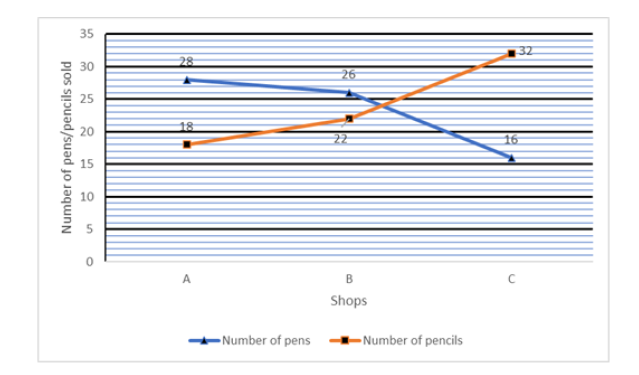
Study the given line graph and answer the following question.

The given line graph depicts the number of pens and pencils sold by three shops (A, B and C).

What is the difference between the total number of pens sold by shops A and B and the number of pencils sold by shop C?

  1. AOption (a)

    14

  2. BOption (b)

    12

  3. COption (c)

    24

  4. DOption (d)

    22

View answer & explanation

Correct answer

Answer: (d)D.

22

Why this answer is correct

Calculation:

Number of pens sold by shop A = 28

Number of pens sold by shop B = 26

Total number of pens sold by shop A and B = 28 + 26 = 54

Number of pencils sold by shop C = 32

Difference between the total number of pens sold by shops A and B and the number of pencils sold by shop C is:

⇒54 - 32 = 22

Option 4 is the correct answer.

Question 46

By which process do plants excrete excess water?

  1. AOption (a)

    Transpiration

  2. BOption (b)

    Transportation

  3. COption (c)

    Translocation

  4. DOption (d)

    Photosynthesis

View answer & explanation

Correct answer

Answer: (a)A.

Transpiration

Why this answer is correct

The correct answer is Transpiration

Key Points

  • ​Transpiration: .is the release of water vapor from plant leaves through tiny pores called stomata. It occurs mainly in the leaves and stems and helps in regulating water balance in plants.
  • Transportation: This is.the process of the movement of water and nutrients within a plant. It includes processes like transpiration, but it doesn't specifically address the excretion of excess water.
  • Translocation: This process involves the movement of sugars and other organic nutrients within a plant. It is not directly related to the excretion of excess water.
  • Photosynthesis:This process involves the conversion of carbon dioxide and water into glucose using sunlight. While it plays a crucial role in a plant's overall functioning, it doesn't specifically address the excretion of excess water.

Important Points

  • Phloem is responsible for transporting sugars, proteins, and other organic molecules in plants.
  • Xylem transports and stores water and water-soluble nutrients in vascular plants.

Question 47

The risk coverage on accidental death in the Pradhan Mantri Suraksha Bima Yojana (PMSBY) is ______ (As of July 2022).

  1. AOption (a)

    ₹5 lakh

  2. BOption (b)

    ₹2 lakh

  3. COption (c)

    ₹10 lakh

  4. DOption (d)

    ₹15 lakh

View answer & explanation

Correct answer

Answer: (b)B.

₹2 lakh

Why this answer is correct

The correct answer is ₹2 lakh.

Key Points

  • Pradhan Mantri Suraksha Bima Yojana is a government scheme launched on 9th May 2015 by PM Narendra Modi.
  • It intends to provide an affordable insurance scheme for the poor and underprivileged people in the age group of 18 to 70 years with a bank account at a premium of Rs.12 per annum; risk coverage of Rs.2 lakh for accidental death and full disability and Rs.1 lakh for partial disability.
  • Provisions of  Pradhan Mantri Suraksha Bima Yojana (PMSBY):
  • PMSBY is a General Insurance Scheme that was revealed by the Finance Minister in the budget speech of 2015-16 to promote insurance penetration in India.
  • It is an insurance cover provided at a minimal annual premium for the death or disability of the person due to accidents.
  • The risk coverage of the scheme for accidental death or full disability caused by the accident is Rs. 2 lakhs and for partial disability is Rs. 1 lakh.
  • People who fall in the age bracket of 18-70 years can avail the benefit of this scheme and get enrolled and they should have a bank account linked with their Aadhaar card.
  • The annual premium is an amount of Rs. 12.
  • The pension will be offered by all the public-sector insurance companies like New India Assurance Company, National Insurance Company, United India Insurance Company, The Oriental Insurance Company, etc.

Question 48

Five years ago, Roshan was three times as old as Preethi. If the difference between their ages is 6 years, the present age (in years) of Preethi is ______.

  1. AOption (a)

    4

  2. BOption (b)

    7

  3. COption (c)

    6

  4. DOption (d)

    8

View answer & explanation

Correct answer

Answer: (d)D.

8

Why this answer is correct

Shortcut Trick

The age difference between two people always remains constant (6 years).

Ratio 5 years ago (Roshan : Preethi) = 3 : 1. Difference in units = 3 − 1 = 2 units.

Equating units to years: 2 units = 6 years ⇒ 1 unit = 3 years.

Preethi age 5 years ago = 1 unit = 3 years.

Preethi present age = 3 + 5 = 8 years.

∴ The correct answer is 8 years.

Alternate Method

Given:

Difference between Roshan and Preethi age = 6 years.

Condition: 5 years ago, Roshan = 3 × Preethi.

Calculations:

⇒ Let the age of Preethi 5 years ago be x.

⇒ Then, Roshan age 5 years ago = 3x.

⇒ Since the age difference is always the same:

⇒ 3x − x = 6

⇒ 2x = 6

⇒ x = 3

⇒ Preethi age 5 years ago = 3 years.

⇒ Preethi present age = 3 + 5 = 8 years.

∴ The correct answer is 8 years.

Additional Information

Constant Age Difference

The mathematical difference between the ages of two individuals never changes, regardless of how many years pass or go back.

Sum of Ages Shift

If there are n people, the sum of their ages increases by (n × k) after k years, and decreases by the same amount k years ago.

Ratio Method for Ages

When ages are given in ratios at two different times, ensure the unit difference between the ratios is scaled to match the constant age difference.

Question 49

The Budhabalanga and Baitarini rivers have their source in ______.

  1. AOption (a)

    Chhattisgarh

  2. BOption (b)

    Jharkhand

  3. COption (c)

    Odisha

  4. DOption (d)

    West Bangal

View answer & explanation

Correct answer

Answer: (c)C.

Odisha

Why this answer is correct

The correct answer is Odisha.

Key Points

  • The Budhabalanga River-
  • The Budhabalanga, meaning old Balanga, rises in the Similipal hills and plunges through Barehipani Falls, the second-highest, located in Simlipal National Park.
  • It then flows in a northerly direction up to the village Karanjiapal in Bangiriposi police station.
  • Thereafter, it turns to the northeast and flows along the railway track up to the village of Jhankapahadi.
  • There it changes its course to the south and meets the Katra Nala.
  • The other tributaries are the Palpala and the Chipat, which are hill streams rising from the Similipal hills.
  • Then the river passes through Baripada.
  • It later flows through the Balasore district and into the Bay of Bengal.
  • Baitarini  
  • The Baitarani River is the second-largest tributary of the Brahmani River.
  • It originates from the Gonasika hills in Kendujhar district of Odisha and flows for about 360 kilometers (220 miles) before joining the Brahmani River near Dhamra.
  • It flows through the districts of Keonjhar, Bhadrak, Mayurbhanj, and Balasore.
  • The Baitarani originates from the Gonasika/Guptaganga (Cow Nose Shaped) hills, and starts flowing over a stone looking like the nostril of a cow.
  • Since water gets out of a structure that looks like the nose of a cow, the hill has been named accordingly.
  • Afterwards for about half a kilometre the river flows underground and is not visible from outside.
  • The Baitarani is known here by the name Guptaganga or the Gupta Baitarani, in Gonasika of Keonjhar district in Odisha.
  • River Baitarani is also termed as the Ganga of Odisha.
  • The mythologically important Gonasika hill is situated at a distance of 30 km form Keonjhar town.
  • Hundreds of devotees visit this place everyday to witness the Baitarani River as well as the Lord Mahadev temple.

Question 50

Four years ago the ratio of the age of the son to that of his father was 2 : 7 and 10 years hence it will change to 3 : 7. The positive difference between their ages is:

  1. AOption (a)

    50 years

  2. BOption (b)

    40 years

  3. COption (c)

    30 years

  4. DOption (d)

    60 years

View answer & explanation

Correct answer

Answer: (b)B.

40 years

Why this answer is correct

Shortcut Trick

Ratio 4 years ago = 2 : 7 (Gap = 5 units) | Ratio 10 years hence = 3 : 7 (Gap = 4 units)

Make age gap equal: Multiply 1st ratio by 4 → 8 : 28 | Multiply 2nd ratio by 5 → 15 : 35

Change in units = 15 − 8 = 7 units | Total time gap = 4 + 10 = 14 years

7 units = 14 years ⇒ 1 unit = 2 years

Age difference = (28 − 8) × 2 = 20 × 2 = 40 years

∴ The correct answer is 40 years.

Alternate Method

Given: Ratio 4 years ago = 2 : 7 | Ratio 10 years hence = 3 : 7

Let ages 4 years ago be 2x and 7x.

⇒ Ages 10 years hence = (2x + 14) and (7x + 14)

⇒ (2x + 14) / (7x + 14) = 3 / 7

⇒ 7(2x + 14) = 3(7x + 14)

⇒ 14x + 98 = 21x + 42

⇒ 7x = 56

⇒ x = 8

⇒ Ages 4 years ago: Son = 2 × 8 = 16, Father = 7 × 8 = 56

⇒ Difference = 56 − 16 = 40 years

∴ The correct answer is 40 years.

Additional Information

Constant Age Difference

The absolute difference between the ages of two people always remains constant regardless of the number of years passed.

Ratio Balancing Method

To solve ratio-based age problems, multiply ratios by the difference of the other ratio to keep the unit gap between individuals consistent across different time periods.

Total Time Interval

The total time interval between "x years ago" and "y years hence" is calculated as x + y years.

Question 51

Who among the following was the last viceroy in India?

  1. AOption (a)

    Lord Wavell

  2. BOption (b)

    Lord Curzon

  3. COption (c)

    Lord Ripon

  4. DOption (d)

    Lord Mountbatten

View answer & explanation

Correct answer

Answer: (d)D.

Lord Mountbatten

Why this answer is correct

The correct answer is Lord Mountbatten.

Key Points

  • Lord Mountbatten
  • Lord Louis Mountbatten who was famously known as the last Viceroy of British India was appointed in March of 1947.
  • He was primarily appointed to oversee the British withdrawal from Indian soil.
  • He remained Interim Viceroy of India till June of 1948.
  • Later on, he returned in the Royal Navy where he was appointed as the first Sea Lord.

 Additional Information

  • Lord Wavell
  • Lord Wavell was the Viceroy of India from 1943 to 1947.
  • The formation of the interim government was part of the British government's efforts to involve Indian leaders in the governance of India and prepare for the impending independence.
  • It marked the beginning of self-governance for Indians and the end of British colonial rule.
  • The interim government was responsible for overseeing the administration of India until the establishment of the independent dominions of India and Pakistan.
  • Jawaharlal Nehru later became the first Prime Minister of independent India.
  • Lord Curzon (1899-1905):
  • He formed a Police commission in 1902 under the leadership of Sir Andrew Fraser.
  • It recommended a separate Training center for officers and constables.
  • It introduced provincial police service and also at the same time to make Indian Army modern fighting force then Commander-in-chief Lord Kitchener made reform in the Indian Military.
  • He passed the Calcutta Corporation Act in the year 1899.
  • According to the act, it increased the number of official members and decreased the strength of elected official members.
  • As official members were mostly British Subjects it caused resentment in the Indian public.
  • He was the Viceroy who passed a law for protecting Ancient Indian monuments.
  • He passed the law in 1904 made the destruction of Ancient Monuments as an offense and directed officials to collect and preserve ancient monuments.
  • British viceroy in India, Lord Curzon, carried out Partition of Bengal, (1905) despite strong Indian nationalist opposition.
  • The government announced the partition in January 1904.
  • Bengal was divided into two new provinces 'Bengal' (which comprises western Bengal and the province of Bihar and Orissa) and Eastern Bengal and Assam, with Dacca as the capital of the latter.
  • Lord Ripon (1880-1884):
  • In Lord Ripon's tenure, Local self-Government resolution was passed.
  • It was not an Act but a resolution by the government in the year 1882.
  • The Financial liberalization that started under Lord Mayo (1869-1872) was continued by Lord Ripon.
  • The resolution helped to establish Local Boards with non-Official members at the provincial level and it was the basis of modern-day municipalities in this country.
  • Lord Ripon was appointed as Viceroy of India in 1880.
  • Lord Ripon was the son of Prime Minister F.J.Robinson(UK).
  • The Factory Act: The first factory was passed by Lord Ripon. The act prohibited the working of children below seven years and a limited number of working hours for children below 12 years.
  • Lord Ripon appointed an education commissioner under the chairmanship of Sir William Hunter.
  • He also increased age requirement for civil services from 18 years to 21 years which were reduced by Lord Lytton (1876-1880) from 21 years to 18 years.

Question 52

One pipe can fill a tank three times as fast another one. Both the pipes opened together can fill the tank completely in 36 minutes. In how many hours will the faster pipe alone fill the empty tank completely?

  1. AOption (a)

    8/5

  2. BOption (b)

    1/2

  3. COption (c)

    12/5

  4. DOption (d)

    4/5

View answer & explanation

Correct answer

Answer: (d)D.

4/5

Why this answer is correct

Shortcut Trick

Ratio of Efficiency of Faster Pipe to Slower Pipe = 3 : 1

Total Efficiency = 3 + 1 = 4 units/min

Total Capacity of tank = 4 × 36 = 144 units

Time for Faster pipe = 144 ÷ 3 = 48 minutes

Converting to Hours = 48 ÷ 60 = 4/5 hours

∴ The correct answer is 4/5 hours.

Alternate Method

PipeEfficiency (units/min)Total Capacity (units)Time (min)
Slower Pipe14 × 36 = 144144
Faster Pipe3144 ÷ 3 = 48
Together3 + 1 = 436

⇒ Efficiency of slower pipe = x units/min

⇒ Efficiency of faster pipe = 3x units/min

⇒ Combined efficiency = 4x units/min

⇒ Total capacity = 4x × 36 = 144x units

⇒ Time taken by faster pipe = 144x ÷ 3x = 48 minutes

⇒ Time in hours = 48/60 = 4/5 hours

∴ The correct answer is 4/5 hours.

Additional Information

Efficiency and Time Relationship

The time taken to complete a task is inversely proportional to the efficiency. If Pipe A is n times faster than Pipe B, the ratio of time taken is 1 : n.

Inlet and Outlet Pipes

In Pipes and Cisterns, filling pipes have positive efficiency, while leak/outlet pipes have negative efficiency.

Unit Conversion

To convert Minutes to Hours, divide the value by 60. To convert Hours to Minutes, multiply by 60.

Question 53

Galo is a Tani language spoken in ______.

  1. AOption (a)

    Jharkhand

  2. BOption (b)

    Himachal Pradesh

  3. COption (c)

    Arunachal Pradesh

  4. DOption (d)

    Haryana

View answer & explanation

Correct answer

Answer: (c)C.

Arunachal Pradesh

Why this answer is correct

The correct answer is Arunachal Pradesh.

Key Points

  • Languages like Nyishi, Apatani, Bokar, Galo, Tagin, Adi are widely spoken in Arunachal Pradesh.
  • It falls under the Tani dialect (a type of Tibeto-Burman language).
  • However, in the eastern part of the state, it is the Mishmi language which is widely spoken.
  • In the west and the north, people speak the Bodic language.

 Additional Information

  • The Mukhota Dance is a sword dance performed by the Galo tribe of Arunachal Pradesh.
  • It is a classical dance that has been performed by the Galo tribe for many years.
  • The dance is performed to celebrate the harvest and to pray for a good year ahead.
  • The dancers wear colorful costumes and masks, and they wield swords and shields as they dance
  • The dance is performed to the beat of drums and cymbals, and it is a celebration of strength, courage, and victory.

Question 54

Which of the following groups of elements were NOT discovered at the Mendeleev's periodic table?

  1. AOption (a)

    Alkaline earth metals

  2. BOption (b)

    Noble gases

  3. COption (c)

    Halogens

  4. DOption (d)

    Alkali metals

View answer & explanation

Correct answer

Answer: (b)B.

Noble gases

Why this answer is correct

The correct answer is Noble gases

Key Points

  • Mendeleev's periodic table, elements were arranged on the basis of the fundamental property, atomic mass, and chemical properties.
  • The modern periodic table is given by Henry Moseley.
  • Modern periodic table is divided into 18 group and 7 period

 Additional Information

  • Alkaline earth metals, including elements like calcium, magnesium, and strontium, were part of Mendeleev's original periodic table. These elements were known and positioned in the early versions of Mendeleev's table.
  • Noble gases like helium, neon, and argon were not discovered at the time of Mendeleev's periodic table. These elements were discovered later, in the late 19th to early 20th century, after Mendeleev had formulated his periodic table.
  • Halogens such as fluorine, chlorine, bromine, and iodine were known during Mendeleev's time, and they were included in his periodic table.
  • Alkali metals like lithium, sodium, and potassium were also present in Mendeleev's periodic table. These elements were known and their properties were considered in the development of the table.

Question 55

Harbhajan is walking in the south direction and after covering a distance of 5 m, he takes a turn to the left and further walks a distance of 3 m. Finally, he turns to his right and walks a distance of 5 m. In which direction is Harbhajan facing now? (All turns are 90 degree turns only)

  1. AOption (a)

    East

  2. BOption (b)

    North

  3. COption (c)

    West

  4. DOption (d)

    South

View answer & explanation

Correct answer

Answer: (d)D.

South

Why this answer is correct

According to the given information:

So, Now Harbhajan is facing in South direction.

Hence, the correct answer is "South".

Question 56

If yx=56\frac{y}{x} = \frac{5}{6}, then x2−y2x2+y2\rm\frac{x^2-y^2} {x^2+y^2} = _______.

  1. AOption (a)

    961\frac{9}{{61}}

  2. BOption (b)

    3625\frac{{36}}{{25}}

  3. COption (c)

    2536\frac{{25}}{{36}}

  4. DOption (d)

    1161\frac{{11}}{{61}}

View answer & explanation

Correct answer

Answer: (d)D.

1161\frac{{11}}{{61}}

Why this answer is correct

Given:

yx=56\frac{y}{x} = \frac{5}{6}

Calculation:

Divide the numerator and denominator by x to make the terms of y/x.

⇒x2−y2x2+y2\rm\frac{x^2-y^2} {x^2+y^2}

⇒1−(yx)21+(yx)2\frac{1 - (\frac{y}{x})^2}{1+ (\frac{y}{x})^2}

Substitute the value of y/x and solving:

⇒1−(56)21+(56)2\frac{1 - (\frac{5}{6})^2}{1+ (\frac{5}{6})^2}

⇒1−(2536)1+(2536)\frac{1 - (\frac{25}{36})}{1+ (\frac{25}{36})}

⇒36−2536+25\frac{36-25}{36+25}

⇒1161\frac{11}{61}

Option 4 is the correct answer.

Question 57

In reptiles, the sex of the offsprings is determined by the temperature at which:

  1. AOption (a)

    ovum is kept

  2. BOption (b)

    fertilised egg is kept

  3. COption (c)

    sperm is kept

  4. DOption (d)

    unfertilised egg is kept

View answer & explanation

Correct answer

Answer: (b)B.

fertilised egg is kept

Why this answer is correct

The correct answer is Fertilised egg is kept

Key Points

  • Every species are classified into five kingdom -Monera, Protista, Fungi, Plantae and Animalia by R.H. Whittaker.
  • Animalia is classified into Chordata and non chordata.
  • Chordates are animals characterized by the presence of notochord at some stage during their development. Members possess a hollow nerve cord and pharyngeal gill slits
  • Non Chordates: lack of backbone .

Additional Information

  • Reptiles: This is chordate animal. Their skin is dry, and rough, without any glands. The body is divided into head, neck, trunk, and tail.
  • Porifera, Cyonopera, Platyhelminthes, Aschelminthes, Cyonophera, Annelida, Mollusca, Echinodermata, Hemichordata, and Arthropods are examples of non-chordates found in the phylum.
  • fishes, amphibians, reptiles, birds, and mammals are example of chordates.
  • Arthopoda is the largest phylum among all phylum.

Question 58

Study the given diagram carefully and answer the question. The numbers in different sections indicate the number of persons.

How many people are chartered accountants as well diabetic but NOT fathers?

  1. AOption (a)

    8

  2. BOption (b)

    3

  3. COption (c)

    5

  4. DOption (d)

    11

View answer & explanation

Correct answer

Answer: (a)A.

8

Why this answer is correct

According to the given information:

So, people are chartered accountants as well diabetic but NOT fathers = 8.

Hence, the correct answer is "8".

Question 59

In a class Pallavi's rank is 25th from the top and 18th from the bottom. Find the number of students in the class?

  1. AOption (a)

    42

  2. BOption (b)

    43

  3. COption (c)

    41

  4. DOption (d)

    44

View answer & explanation

Correct answer

Answer: (a)A.

42

Why this answer is correct

The logic followed here is:

Pallavi's rank from the top = 25th

Pallavi's rank from the bottom = 18th

So,

Total number of students = Pallavi's rank from the top + Pallavi's rank from the bottom - 1

= 25 + 18 - 1

= 43 - 1 = 42.

Hence, the correct answer is "Option 1".

Question 60

In which of the following years did the Reserve Bank of India introduce a comprehensive regulatory framework for Non-Banking Finance Company - Micro Finance Institutions?

  1. AOption (a)

    2013

  2. BOption (b)

    2012

  3. COption (c)

    2011

  4. DOption (d)

    2010

View answer & explanation

Correct answer

Answer: (c)C.

2011

Why this answer is correct

The correct answer is 2011.

Key Points

  • The Reserve Bank of India (RBI) was established on April 1, 1935.
  • It was initially set up based on the recommendations of the Hilton Young Commission.
  • The original headquarters of RBI was located in Kolkata, but it was permanently moved to Mumbai in 1937.
  • The RBI was initially set up as a private entity but was nationalized in 1949 after India's independence.

Additional Information

  • Hilton Young Commission
  • The Hilton Young Commission, also known as the Royal Commission on Indian Currency and Finance, was set up in 1926 to investigate and recommend changes to the monetary system in India.
  • The commission recommended the establishment of a central bank to manage India's currency and credit, which led to the formation of the RBI.
  • Functions of RBI
  • The RBI acts as the regulator of the entire financial system in India, ensuring its stability and efficiency.
  • It manages the country's currency and monetary policy and serves as the banker to the government and other banks.
  • The RBI also oversees the foreign exchange market and maintains the foreign exchange reserves of India.
  • Nationalization of RBI
  • In 1949, the Reserve Bank of India was nationalized, meaning it was taken over by the government of India.
  • This step was taken to ensure a greater degree of control over the credit and monetary policy, aligning it with the nation's economic interests.
  • Role in Economic Development
  • The RBI plays a crucial role in the economic development of India through its monetary policies, regulation of financial institutions, and management of the payment system.
  • It also focuses on financial inclusion, aiming to make financial services accessible to the unbanked and underbanked population.

Question 61

Read the given statements and conclusions carefully and decide which of the given conclusions logically follow(s) from the statements.

Statements:

  1. R is older than I.
  2. I is N's twin brother who is older than P.
  3. Y is not younger than R who is older than K.

Conclusions:

I. K is older than I.

II. I is younger than Y.

  1. AOption (a)

    Both conclusions I and II follow

  2. BOption (b)

    Conclusion II follows

  3. COption (c)

    Neither conclusions I nor II follows

  4. DOption (d)

    Conclusion I follows

View answer & explanation

Correct answer

Answer: (b)B.

Conclusion II follows

Why this answer is correct

Statements:

  1. R is older than I.

R > I

  1. I is N's twin brother who is older than P.

N = I > P

  1. Y is not younger than R who is older than K.

Y > R > K

Thus after combining we get 2 cases here:

Y > R > K > N = I > P ------------ (i)

Y > R > N = I > K > P ------------ (ii)

Conclusions:

I. K is older than I. - False (From case (ii))

II. I is younger than Y. - True (As from both cases I < Y)

So, Hence, the correct answer is "Conclusion II follows".

Question 62

Two trains 240 m and 320 m long are travelling on parallel tracks in the same direction at speeds of 59 km/h and 50 km/h. How long will it take for the two trains to pass each other from the instant they meet?

  1. AOption (a)

    3 min 24 sec

  2. BOption (b)

    2 min 18 sec

  3. COption (c)

    3 min 44 sec

  4. DOption (d)

    2 min 24 sec

View answer & explanation

Correct answer

Answer: (c)C.

3 min 44 sec

Why this answer is correct

Shortcut Trick

Relative Speed in same direction = S1 − S2 = 59 − 50 = 9 km/h.

Convert Speed to m/s: 9 × (5/18) = 2.5 m/s.

Total Distance to cover = Sum of lengths = 240 + 320 = 560 m.

Time = Distance ÷ Relative Speed = 560 ÷ 2.5 = 224 seconds.

224 seconds = 3 minutes and 44 seconds.

∴ The correct answer is 3 min 44 sec.

Alternate Method

Given:

Length of Train 1 (L1) = 240 m

Length of Train 2 (L2) = 320 m

Speed of Train 1 (S1) = 59 km/h

Speed of Train 2 (S2) = 50 km/h

Formula Used:

Time = (L1 + L2) ÷ (S1 − S2)

Calculations:

⇒ Total distance = 240 + 320 = 560 m

⇒ Relative Speed = (59 − 50) × (5/18) m/s

⇒ Relative Speed = 9 × (5/18) = 2.5 m/s

⇒ Time taken = 560 ÷ 2.5

⇒ Time taken = 224 seconds

⇒ Conversion: 224 ÷ 60 = 3 minutes and 44 seconds

∴ The correct answer is 3 min 44 sec.

Additional Information

Relative Speed Concept

When two objects move in the same direction, relative speed is S1 − S2. When they move in opposite directions, it is S1 + S2.

Unit Conversion

To convert km/h to m/s, multiply by 5/18. To convert m/s to km/h, multiply by 18/5.

Total Distance for Crossing

Whether trains move in the same or opposite direction, the total distance to cross each other is always the sum of their lengths.

Question 63

The Brahmaputra marks the ______ boundary of the Himalayas.

  1. AOption (a)

    Northern-most

  2. BOption (b)

    Western-most

  3. COption (c)

    Southern-most

  4. DOption (d)

    Eastern-most

View answer & explanation

Correct answer

Answer: (d)D.

Eastern-most

Why this answer is correct

The correct answer is Eastern-most.

Key Points

  • The Brahmaputra river marks the easternmost boundary of the Himalayas.
  • This originates from Mansarovar Lake, which is also a source of the Indus and Sutlej.
  • It is 3848kms long, a little longer than the Indus River.
  • It flows parallel to the Himalayas in the eastward direction.
  • When it reaches Namcha Barwa, it takes a U-turn around it and enters India in the state of Arunachal Pradesh.
  • Here it is known as the Dihang River.
  • This river is called the Yarlung Tsangpo in Tibet.
  • It is the ninth largest river in the world by discharge.

Question 64

DJ 15 is related to GM 20 in a certain way. In the same way, OW 25 is related to RZ 30. To which of the following is RM 35 related following the same logic?

  1. AOption (a)

    UP 45

  2. BOption (b)

    PU 04

  3. COption (c)

    UP 40

  4. DOption (d)

    PU 40

View answer & explanation

Correct answer

Answer: (c)C.

UP 40

Why this answer is correct

The logic followed here is:

DJ 15 is related to GM 20

OW 25 is related to RZ 30.

Similarly, RM 35 is related to ?

Hence, the correct answer is "UP 40".

Question 65

Baking soda is NOT generally used:

  1. AOption (a)

    as a disinfectant

  2. BOption (b)

    as an antacid

  3. COption (c)

    in fire extinguishers

  4. DOption (d)

    as baking powder

View answer & explanation

Correct answer

Answer: (a)A.

as a disinfectant

Why this answer is correct

The correct answer is as a disinfectant.

Key Points

  • Sodium Bi Carbonate:
  • It is called baking soda.
  • Chemically it is NaHCO3.
  • It is used for making baking powder, bread etc.

Additional Information

  • Sodium Hydroxide:
  • The common name for sodium hydroxide is called caustic soda.
  • Chemically, it is NaOH.
  • It is used for cleaning purposes and making soaps.
  • Calcium Oxide:
  • It is also known as 'Bina Booja Choona' in local languages.
  • Its chemical formula is Calcium Oxide (CaO).
  • It is used for whitewashing.
  • It is also used for treating wounds.
  • Acetic Acid:
  • It is also called vinegar.
  • Its chemical formula is CH3COOH.
  • It is used for medical purposes and making cellulose acetate (photo film).

Question 66

Select the option that is related to the fifth number in the same way as the second number is related to the first number and the fourth number is related to the third number.

23 : 44 :: 35 : 56 :: 43 : ?

  1. AOption (a)

    66

  2. BOption (b)

    70

  3. COption (c)

    63

  4. DOption (d)

    64

View answer & explanation

Correct answer

Answer: (d)D.

64

Why this answer is correct

Logic: (1st number + 21) = Second number

Now,

For, 23 : 44

⇒ 23 + 21= 44

For, 35 : 56

⇒ 35 + 21 = 56

Similarly, for 43 ∶ ?

⇒ 43 + 21 = 64

Hence, the correct answer is "Option 4".

Question 67

Which formula is used to calculate M3 (i.e. measure of money supply)?

  1. AOption (a)

    M3 = M1 + Total deposits with post office

  2. BOption (b)

    M3 = M1 + Total deposits with post office excluding National Saving Certificate

  3. COption (c)

    M3 = CU + DD + Net time deposits of commercial banks

  4. DOption (d)

    M3 = M2 + Saving deposits with post office

View answer & explanation

Correct answer

Answer: (c)C.

M3 = CU + DD + Net time deposits of commercial banks

Why this answer is correct

The correct answer is M3 = CU + DD + Net time deposits of commercial banks.

Key Points

  • Money supply -The total stock of money in circulation among the public at a particular point of time is called the money supply
  • RBI publishes figures for four alternative measures of money

supply, viz. M1, M2, M3 and M4. They are defined as follows

  • M1 = CU(currency (notes plus coins) held by the public) + DD(net demand deposits held by commercial banks)
  • M2 = M1 + Savings deposits with Post Office savings banks
  • M3 = M1 + Net time deposits of commercial banks
  • M4 = M3 + Total deposits with Post Office savings organisations (excluding

National Savings Certificates)

Question 68

On 21st January 2022, Tripura, Manipur and Meghalaya celebrated their ______ Foundation Day.

  1. AOption (a)

    75th

  2. BOption (b)

    55th

  3. COption (c)

    25th

  4. DOption (d)

    50th

View answer & explanation

Correct answer

Answer: (d)D.

50th

Why this answer is correct

The correct answer is 50th

Key Points

  • These three northeastern states achieved statehood on this day in 1972 under the North Eastern Region (Reorganisation) Act, 1971.
  • Prior to statehood, Tripura and Manipur were princely states merged with India in 1949.
  • Meghalaya was part of Assam until it became an autonomous state in 1969.
  • The 50th anniversary marked a significant milestone, commemorating the journey of these states towards self-governance and development.
  • The occasion was celebrated with various cultural programs, parades, and government functions, highlighting the rich cultural heritage and progress of these states.

Question 69

Dependence on the resistance R of a coil for the electromagnetically induced EMF and induced current in a coil follows:

  1. AOption (a)

    induced EMF does not depend on R but induced current does

  2. BOption (b)

    both are independent of R

  3. COption (c)

    Induced EMF and induced current both depend on R

  4. DOption (d)

    induced EMF depends on R but induced current does not

View answer & explanation

Correct answer

Answer: (a)A.

induced EMF does not depend on R but induced current does

Why this answer is correct

The correct answer is induced EMF does not depend on R but induced current does.

Key Points

  • The resistance of a coil does not directly affect the electromagnetically induced EMF.
  • This is because the induced EMF depends on the rate of change of magnetic flux through the coil, as described by Faraday's Law of Electromagnetic Induction.
  • However, the resistance of the coil does affect the induced current. According to Ohm's Law, the induced current (I) is directly proportional to the induced EMF (ε) and inversely proportional to the resistance (R).
  • This can be expressed as:
  • I = ε / R
  • Therefore, a higher resistance will result in a lower induced current for a given induced EMF, and vice versa.
  • It's important to note that while the resistance doesn't directly influence the induced EMF, it plays a crucial role in determining the magnitude of the resulting induced current.

Question 70

In this question, a group of numbers/symbols is coded using letters as per the table given below and the conditions which follow. The correct combination of code following the conditions is your answer.

Number/Symbol684+5#%2$1^79*@
CodeSUTWNPVDAZJMOMY

Conditions:

(i) If the first and last elements are numbers, then the last element will be replaced by the symbol @.

(ii) If the first element is a symbol, then the first element will be coded as Ⓒ.

(iii) If both the first and second elements are numbers, then the third element will be coded as *.

What will be the code for the following?

5 4 2 % @ 6

  1. AOption (a)

    SNTDVY

  2. BOption (b)

    NT*VY@

  3. COption (c)

    NTDVYZ

  4. DOption (d)

    NTDVYS

View answer & explanation

Correct answer

Answer: (b)B.

NT*VY@

Why this answer is correct

Given: 

Number/Symbol684+5#%2$1^79*@
CodeSUTWNPVDAZJMOMY


Given: 5 4 2 % @ 6 → Here the first and last elements are numbers, then from condition (i), the last element will be replaced by the symbol @.

5 → N, 4 → T, 2 → D, % → V, @ → Y and 6 → @

Now 5 4 2 % @ 6 → Here both the first and second elements are numbers, then from condition (iii), the third element will be coded as *.

5 → N, 4 → T, 2 **→ ***, % → V, @ → Y and 6 → @

Thus the code for the 5 4 2 % @ 6 → NT*VY@

Hence, the correct answer is "NT*VY@".

Question 71

A statement is given followed by two arguments I an II. Read the statement and the arguments carefully and select the appropriate answer from the given options.

Statement:

More and more agricultural land should be sold for housing and industrialisation.

Arguments:

I. Severe food shortage will be unavoidable if conversion of agricultural land into industrial land does not stop soon.

II. It has been proven that industrialisation in an area destroys its ecosystem and biodiversity.

  1. AOption (a)

    II weakens, while I strengthens the statement

  2. BOption (b)

    Both I and II weaken the statement

  3. COption (c)

    I weakens, while II strengthens the statement

  4. DOption (d)

    Both I and II strengthen the statement

View answer & explanation

Correct answer

Answer: (b)B.

Both I and II weaken the statement

Why this answer is correct

Given:

Statement :

More and more agricultural land should be sold for housing and industrialisation.

Now,

Arguments :

I. Severe food shortage will be unavoidable if conversion of agricultural land into industrial land does not stop soon - True (If agricultural land is converted into industrial land, food production will decrease, leading to a severe food shortage).

II. It has been proven that industrialisation in an area destroys its ecosystem and biodiversity - True (Industrialisation leads to environmental degradation, which harms the ecosystem and biodiversity).

So, Both I and II weaken the statement.

Hence, the correct answer is "Option 2".

Question 72

If the radius of a sphere is 7 cm, then the surface area in (cm2) of the sphere is ______. (Take π = \frac{{22}}{7})

  1. AOption (a)

    729

  2. BOption (b)

    343

  3. COption (c)

    243

  4. DOption (d)

    616

View answer & explanation

Correct answer

Answer: (d)D.

616

Why this answer is correct

Shortcut Trick

Surface Area of a sphere = 4πr2

Since the formula contains π (22/7), the answer must be a multiple of 11.

Check options for divisibility by 11: 6 + 6 − 1 = 11. Only 616 is divisible by 11.

∴ The correct answer is 616 cm2.

Alternate Method

Given:

Radius (r) of the sphere = 7 cm

Value of π = 22/7

Formula Used:

Surface Area of a Sphere = 4πr2

Calculations:

⇒ Surface Area = 4 × (22/7) × 7 × 7

⇒ Surface Area = 4 × 22 × 7

⇒ Surface Area = 88 × 7

⇒ Surface Area = 616 cm2

∴ The correct answer is 616 cm2.

Additional Information

Volume of a Sphere

The total space occupied by a sphere is given by V = (4/3)πr3.

Hemisphere Properties

Curved Surface Area = 2πr2 and Total Surface Area = 3πr2.

Ratio of Sphere to Cylinder

A sphere of radius r fits exactly inside a cylinder of height 2r; the sphere occupies 2/3 of the cylinder's volume.

Question 73

An object is placed at a distance of 10 cm from a projector to obtain an image with magnification of -60. The screen, to receive the projected image, should be placed at a distance of:

  1. AOption (a)

    5.0 metres

  2. BOption (b)

    4.5 metres

  3. COption (c)

    5.5 metres

  4. DOption (d)

    6.0 metres

View answer & explanation

Correct answer

Answer: (d)D.

6.0 metres

Why this answer is correct

The correct answer is 6.0 metres

Calculation 

To determine the screen distance(ds), let's use the lens formula:

1/f= 1/do+1/di

Given that the object is placed at a distance of 10 cm from the projector( do= 10 cm) and the magnification (m)is -60we can calculate the image distance( di) using the magnification formula::

m= -di/do

-60= - di/10

di= 600cm

In metres. 600/100= 6 metres (1meter =100cm)

so correct answer is 6 metres

Question 74

A sum is borrowed for two years at the rate of 5% compound interest per annum, compounded annually. If it is paid back in two equal annual instalments of ₹882, then the sum borrowed is:

  1. AOption (a)

    ₹1,680

  2. BOption (b)

    ₹1,560

  3. COption (c)

    ₹1,740

  4. DOption (d)

    ₹1,640

View answer & explanation

Correct answer

Answer: (d)D.

₹1,640

Why this answer is correct

Shortcut Trick

Rate 5% = 1/20. Ratio of Principal (P) to Installment (I) for 1st year = 20 : 21.

Ratio for 2nd year = 202 : 212 = 400 : 441.

To equalize installments, multiply 1st year by 21: (20 × 21) : (21 × 21) = 420 : 441.

Total Sum Borrowed = 420 + 400 = 820 units.

Given Installment 441 units = ₹882 → 1 unit = ₹2. Sum = 820 × 2 = ₹1,640.

∴ The correct answer is ₹1,640.

Alternate Method

Given: Rate (R) = 5% per annum, Time (n) = 2 years, Equal Installment (x) = ₹882.

Formula Used: Principal (P) = x / (1 + R/100) + x / (1 + R/100)2

⇒ Principal (P) = 882 / (1 + 5/100) + 882 / (1 + 5/100)2

⇒ P = 882 / (21/20) + 882 / (441/400)

⇒ P = (882 × 20 / 21) + (882 × 400 / 441)

⇒ P = (42 × 20) + (2 × 400)

⇒ P = 840 + 800

⇒ P = ₹1,640

∴ The correct answer is ₹1,640.

Additional Information

Compound Interest Installment Formula

For a loan paid in n equal annual instalments (x), the Principal (P) is given by P = x / (1 + r/100) + x / (1 + r/100)2 + ... + x / (1 + r/100)n.

Ratio Method for 2 Years

If Rate r% = a/b, then P : Installment for 1st year is b : (a+b) and for 2nd year is b2 : (a+b)2. Multiply to make installments equal.

Simple Interest Installment

The annual payment (x) for a debt (D) in n years is x = 100D / [100n + r × n(n-1)/2].

Question 75

Which of the following statements is correct about non-biodegradable substances?

  1. AOption (a)

    None-biodegradable substances can easily be degraded by enzymes.

  2. BOption (b)

    Non-biodegradable substances don't harm the members of the ecosystem.

  3. COption (c)

    Non-biodegradable substances persist in the environment.

  4. DOption (d)

    Non-biodegradable substances take lesser time for degradation.

View answer & explanation

Correct answer

Answer: (c)C.

Non-biodegradable substances persist in the environment.

Why this answer is correct

The correct answer is Non- biodegradable substances persist in the environment.

Key Points

  • Non biodegradable : 
  • Any waste or substances which can not  decomposed by any natural sources and act as source of  a pollution .
  • Glass, metals, electronic devices, computer parts, batteries, medical waste, plastic bags, plastic bottles, tetra packs, and carbon paper are a few examples of non- biodegradable materials.
  • It is usually seen that non-biodegradable substances are chemically synthesized and does not occur naturally.
  • As the degradation rate of non-biodegradable waste is slow and the separation and recycling are not easy and expensive too.
  • Biodegradable: 
  • Biodegradable wastes are those substances that degrade or break down naturally. Human waste, manure, sewage, sewage sludge and slaughterhouse waste.
  • Biodegradable waste are not accumulated but are used up in a short time
  • Biodegradable waste becomes part of biogeochemical cycles and give back rapid turnover.
  • After degradation, the biodegradable substances can be used to produce biogas, manure, fertilizers, compost etc.​

Additional Information

  • Biodegradable Applications: Biodegradable materials are those that can be decomposed by bacteria or other natural organisms.
  • Packaging Materials: Bio-based packaging materials have been introduced as a green alternative. Edible films have gained more attention due to their environmentally friendly characteristics, vast variety and availability, non-toxicity, and low cost.
  • Medical Products: Biodegradable polymers are used in tissue engineering scaffolds, controlled drug release systems, plasma replacements, and temporary prosthetic implants.
  • Agricultural Materials: These include films and seed coatings.

Question 76

The product of two consecutive positive integers is 552. If the smaller of these two integers is represented by x, which of the options below will correspond to the equation for finding out the value of x?

  1. AOption (a)

    x2 + x -552 = 0

  2. BOption (b)

    x2 - x + 552 = 0

  3. COption (c)

    x2 + x + 552 = 0

  4. DOption (d)

    X2 - x - 552 = 0

View answer & explanation

Correct answer

Answer: (a)A.

x2 + x -552 = 0

Why this answer is correct

Shortcut Trick

Let the smaller integer be x and the consecutive integer be (x + 1).

The product is given as x(x + 1) = 552.

Expanding the expression: x2 + x = 552.

Rearranging into standard quadratic form: x2 + x − 552 = 0.

∴ The correct answer is x2 + x − 552 = 0.

Alternate Method

Given: Smaller integer = x

Given: Product of two consecutive integers = 552

Formula: Product = Smaller Integer × (Smaller Integer + 1)

⇒ Larger integer = x + 1

⇒ Product = x × (x + 1)

⇒ 552 = x2 + x

⇒ x2 + x − 552 = 0

∴ The correct answer is x2 + x − 552 = 0.

Additional Information

Consecutive Integers

These are integers that follow each other in order, with a common difference of 1, represented as x, x + 1, x + 2, and so on.

Standard Quadratic Equation

A quadratic equation is always written in the form ax2 + bx + c = 0, where a ≠ 0.

Solving for x

To find the actual integers, factorize the equation: x2 + 24x − 23x − 552 = 0 ⇒ (x + 24)(x − 23) = 0. Since x is a positive integer, x = 23.

Question 77

The dimensions of a cuboidal storage space are 20 m, 25 m, and 10 m. How many boxes of dimension 2 m × 1.25 m × 1 m can be kept in it?

  1. AOption (a)

    4000

  2. BOption (b)

    8000

  3. COption (c)

    6000

  4. DOption (d)

    2000

View answer & explanation

Correct answer

Answer: (d)D.

2000

Why this answer is correct

Shortcut Trick

Number of boxes = (V1 × V2 × V3) ÷ (v1 × v2 × v3)

Number = (20 × 25 × 10) ÷ (2 × 1.25 × 1)

Number = 5000 ÷ 2.5 = 2000

∴ The correct answer is 2000 boxes.

Alternate Method

Given:

Dimensions of storage space (L, B, H) = 20 m, 25 m, 10 m

Dimensions of each box (l, b, h) = 2 m, 1.25 m, 1 m

Formula Used:

Volume of Cuboid = length × breadth × height

Number of objects = Total Volume ÷ Volume of one object

Calculations:

⇒ Volume of storage space = 20 × 25 × 10 = 5000 m3

⇒ Volume of one box = 2 × 1.25 × 1 = 2.5 m3

⇒ Number of boxes = 5000 ÷ 2.5

⇒ Number of boxes = 50000 ÷ 25

⇒ Number of boxes = 2000

∴ The correct answer is 2000 boxes.

Additional Information

Total Surface Area of Cuboid

The total area of all six faces is given by 2(lb + bh + hl).

Lateral Surface Area of Cuboid

The area of the four side walls is calculated as 2h(l + b).

Diagonal of Cuboid

The longest rod that can be placed in a cuboid has length √(l2 + b2 + h2).

Question 78

Study the given diagram carefully and answer the question. The numbers in different sections indicate the number of persons. 'Managers' are represented by the circle, 'B. Tech degree holders' are represented by the square, and 'MBA degree holders' are represented by the triangle. How many managers are there who are B. Tech degree holders but not MBA degree holders?

  1. AOption (a)

    5

  2. BOption (b)

    1

  3. COption (c)

    6

  4. DOption (d)

    2

View answer & explanation

Correct answer

Answer: (b)B.

1

Why this answer is correct

According to the given information:

So, managers are there who are B. Tech degree holders but not MBA degree holders = 1

Hence, the correct answer is "1".

Question 79

Five employees of the same company, Jagruti, Krishna, Laxman, Maya and Nirupam, live on five different floors of the same building. The lowermost floor in the building is numbered 1, the floor above it number 2, and so on till the topmost floor is numbered 5. Krishna and Nirupam live on the topmost and bottommost floors, respectively. Jagruti lives on the floor immediately above Laxman. Maya lives on the floor immediately above Nirupam.

Who lives on the second floor?

  1. AOption (a)

    Krishna

  2. BOption (b)

    Laxaman

  3. COption (c)

    Jagruti

  4. DOption (d)

    Maya

View answer & explanation

Correct answer

Answer: (d)D.

Maya

Why this answer is correct

According to the given information:

  1. Krishna and Nirupam live on the topmost and bottommost floors, respectively.
FloorsEmployees
5Krishna
4
3
2
1Nirupam


  1. Maya lives on the floor immediately above Nirupam.
FloorsEmployees
5Krishna
4
3
2Maya
1Nirupam


  1. Jagruti lives on the floor immediately above Laxman.
FloorsEmployees
5Krishna
4Jagruti
3Laxman
2Maya
1Nirupam


Thus, Maya lives on the second floor.

Hence, the correct answer is "Maya".

Question 80

Study the given table and answer the question that follows.

The table shows that demand of different shoe sizes as obtained in a survey.

Shoe sizeNumber of pairs demanded
544
648
758
846
939
1037

Find the modal size of shoes demanded that one can obtain from the survey.

  1. AOption (a)

    5

  2. BOption (b)

    9

  3. COption (c)

    6

  4. DOption (d)

    7

View answer & explanation

Correct answer

Answer: (d)D.

7

Why this answer is correct

Calculation:

Here is the data from the survey:

Shoe size 5: 44 pairs demanded

Shoe size 6: 48 pairs demanded

Shoe size 7: 58 pairs demanded

Shoe size 8: 46 pairs demanded

Shoe size 9: 39 pairs demanded

Shoe size 10: 37 pairs demanded

The highest number of pairs demanded is 58 pairs, which corresponds to shoe size 7.

Therefore, the modal size of shoes demanded, based on this survey, is: 7

Option 4 is the correct answer.

Question 81

If each of the digits in the number 8356427 is arranged in ascending order from left to right, then what will be the sum of the digits that are second from the left and second from the right in the new number thus formed?

  1. AOption (a)

    12

  2. BOption (b)

    10

  3. COption (c)

    9

  4. DOption (d)

    11

View answer & explanation

Correct answer

Answer: (b)B.

10

Why this answer is correct

Given number:- 8356427

New number after arranging each digit of the given number in ascending order:- 2345678

The digit that is second from the left in the new number is 3.

The digit that is second from the right in the new number is 7.

Sum of these digits = 3 + 7 = 10

Hence, the correct answer is "Option 2".

Question 82

A man sold a horse at a loss of 7%. Had he been able to sell it at a gain of 9%, it would have fetched ₹6,400 more than it did. The cost price of the horse was:

  1. AOption (a)

    ₹55,000

  2. BOption (b)

    ₹40,000

  3. COption (c)

    ₹45,000

  4. DOption (d)

    ₹50,000

View answer & explanation

Correct answer

Answer: (b)B.

₹40,000

Why this answer is correct

Shortcut Trick

The difference between a 7% loss and a 9% gain is 7% + 9% = 16%.

According to the question, this 16% difference is equal to ₹6,400.

Using the ratio-unitary method: 16% ⇒ 6,400.

1% ⇒ 6,400 ÷ 16 = 400.

Therefore, 100% (Cost Price) ⇒ 400 × 100 = ₹40,000.

∴ The correct answer is ₹40,000.

Alternate Method

Given: Loss1 = 7%, Gain2 = 9%, Price Difference = ₹6,400.

Formulas: SP = CP × (100 ± P/L%)/100 | CP = (Price Difference ÷ Difference in Percentage) × 100

⇒ Let the Cost Price (CP) be x.

⇒ SP1 (at 7% loss) = 0.93x

⇒ SP2 (at 9% gain) = 1.09x

⇒ According to question: SP2 − SP1 = 6,400

⇒ 1.09x − 0.93x = 6,400 ⇒ 0.16x = 6,400

⇒ x = 6,400 ÷ 0.16 = 40,000.

∴ The correct answer is ₹40,000.

Additional Information

Profit and Loss Basics

When there is a transition from Loss to Profit, the total percentage change is the sum of the loss% and profit%. CP is always considered 100%.

Effective Change

If an object is sold at x% loss and then at y% gain, the difference in selling price is (x + y)% of CP.

Question 83

Given below is the diagram of a nephron. Select the option with the correct labelling for a, b c and d parts.

  1. AOption (a)

    a - Branch of renal vein, b - Bowman's capsule, c - Glomerulus, d - Branch of renal artery

  2. BOption (b)

    a - Branch of renal artery, b - Glomerulus, c - Bowman's capsule, d - Branch of renal vein

  3. COption (c)

    a - Branch of renal artery, b - Bowman's capsule, c - Glomerulus, d - Branch of renal vein

  4. DOption (d)

    a - Branch of renal vein, b - Glomerulus, c - Bowman's capsule, d - Branch of renal artery

View answer & explanation

Correct answer

Answer: (b)B.

a - Branch of renal artery, b - Glomerulus, c - Bowman's capsule, d - Branch of renal vein

Why this answer is correct

The correct answer is a - Branch of renal artery, b - Glomerulus, c - Bowman's capsule, d - Branch of renal vein.

Key Points

  • Branch of renal artery:
  • The renal artery is a large blood vessel that carries oxygenated blood from the heart to the kidneys.
  • It branches into smaller and smaller vessels within the kidney, ultimately supplying blood to the functional units of the kidney, called nephrons.
  • The branch of the renal artery that enters the nephron is crucial for delivering blood to the glomerulus, where filtration occurs.
  • Glomerulus:
  • The glomerulus is a network of tiny blood vessels located within Bowman's capsule.
  • It acts as a filter, allowing small molecules like water, glucose, and waste products to pass through its porous walls.
  • Blood cells and large proteins are too large to pass through, remaining in the bloodstream.
  • The filtered fluid, now called filtrate, enters Bowman's capsule.
  • Bowman's Capsule:
  • Bowman's capsule is a cup-shaped structure that surrounds the glomerulus.
  • It collects the filtrate that is filtered from the blood in the glomerulus.
  • The filtrate then passes through the renal tubules for further processing and reabsorption of essential substances.
  • Branch of renal vein:
  • The renal vein is a large blood vessel that carries deoxygenated blood and waste products away from the kidney and back to the heart.
  • It receives blood from the capillaries that surround the renal tubules.
  • This blood has been filtered and reabsorbed, removing waste products and retaining essential substances.
  • The renal vein then transports this blood to the inferior vena cava.

Question 84

Which of the following structures is formed with a closed chain of carbon atoms?

  1. AOption (a)

    Straight chain structure

  2. BOption (b)

    Branched chain structure

  3. COption (c)

    Ring structure

  4. DOption (d)

    Acyclic structure

View answer & explanation

Correct answer

Answer: (c)C.

Ring structure

Why this answer is correct

The correct answer is Ring structure

Key Points

  • A ring structure can refer to a simple cycle of atoms and bonds in a molecule or to a connected set of atoms and bonds where every atom and bond is a part of a cycle. This is also known as a ring system.
  • A ring system that forms a simple cycle is called a monocycle or simple ring, and one that is not a simple cycle is called a polycycle or polycyclic ring system.
  • A homocycle or homocyclic ring is a ring in which all atoms are of the same chemical element.
  • A heterocycle or heterocyclic ring is a ring containing atoms of at least two different elements.
  • A carbocycle or carbocyclic ring is a homocyclic ring in which all of the atoms are carbon.


Additional Information

  • Dyes and Plastics: Many dyes and plastics are examples of heterocyclic compounds, which often contain ring structures.
  • Pharmaceuticals: Many drugs, including a significant percentage of FDA-approved drugs, contain ring structures, particularly heterocyclic rings.
  • Synthesis of Organic Compounds: Ring structures are used as starting materials in the synthesis of various organic compounds.
  • Pigments: Many pigments, including those used in paints and inks, contain ring structures.
  • Surfactants and Detergents: Many surfactants and detergents, which are used to clean surfaces and fabrics, contain ring structures.
  • Photographic Materials: Certain ring structures are used in the manufacture of photographic films and papers.
  • Biochemical Processes: Ring structures play a crucial role in many biochemical processes. For example, the ring structure of glucose is essential for its role in energy metabolism.

Question 85

Which of the followed compounds is prepared when sodium chloride reacts with carbon dioxide in the presence of ammonia and water?

  1. AOption (a)

    Na2SO4

  2. BOption (b)

    NaCO3

  3. COption (c)

    CaCO3

  4. DOption (d)

    NaHCO3

View answer & explanation

Correct answer

Answer: (d)D.

NaHCO3

Why this answer is correct

The correct answer is NaHCO3

Key Points

  • sodium chloride reacts with carbon dioxide -NaCl+ CO2-   NaHCO3(presence of amonia(NH3)and water)
  • Sodium sulfate (Na2SO4) can be formed through the reaction of sodium hydroxide (NaOH) with sulfuric acid (H2SO4):NaOH + H2SO4→Na2SO4+ H2O
  • When Sodium hydroxide reacts with carbon dioxide that resulting Sodium carbonate :2NaOH+CO2→Na2CO3+ H2O

Some basic formula and their common name:

FormulaCommon name
Acetylsalicylic AcidAspirin
Sodium BicarbonateBaking Soda
Calcium ChlorohypoChloriteBleaching Powder
Sodium HydroxideCaustic Soda

Question 86

Stockholm water prize honours the persons who contributes to the:

  1. AOption (a)

    conservation and protection of forests

  2. BOption (b)

    conservation and protection of wild life

  3. COption (c)

    conservation and protection of water resources

  4. DOption (d)

    conservation and protection of soil

View answer & explanation

Correct answer

Answer: (c)C.

conservation and protection of water resources

Why this answer is correct

The correct answer is conservation and protection of water resources.

Key Points

  • Stockholm Water prize
  • The Stockholm Water Prize is often referred to as the Nobel Prize of water, and it follows a similar selection process.
  • The Stockholm Water Prize has been given to individuals and organisations for extraordinary water-related achievements since 1991.
  • SIWI awards the Prize in collaboration with the Royal Swedish Academy of Sciences, and it is presented by H.M. King Carl XVI Gustaf of Sweden, the Prize's official patron.

Question 87

As per Article ______ of the Constitution of India, a person cannot be convicted for an act that was not an offence at the time of its commission.

  1. AOption (a)

    20

  2. BOption (b)

    23

  3. COption (c)

    27

  4. DOption (d)

    30

View answer & explanation

Correct answer

Answer: (a)A.

20

Why this answer is correct

The correct answer is 20.

Key Points

  • Article 20 of the Constitution of India deals with the protection in respect of conviction for offences.
  • Article 20 grants three kinds of protection against arbitrary and excessive punishment to an accused person, whether citizen or foreigner.
  1. No ex-post-facto law: No person shall be convicted of any offence except for violation of a new law in force at the time of the commission of the act nor subjected to a penalty greater than that prescribed by the law in force at the time of the commission of the act.
  2. No double jeopardy: No person shall be prosecuted and punished for the same offence more than once.
  3. No self-incrimination: No person accused of any offence shall be compelled to be a witness against himself.
  • The protection against double jeopardy is available only in proceedings before a court of law or judicial tribunal.

Additional Information

  • Fundamental Rights
  • Article 12 – Definition of a state
  • Article 13 – Right to make law
  • Article 13A – Judicial Review
  • Article (14-18) – Right to Equality
  • Article 14 – Equality before the law.
  • Article 15 – Prohibition of Discrimination on the basis of religion, race, sex, and place of birth.
  • Article 16 – Equality of opportunity in relation to public employment.
  • Article 17 – Abolish Untouchability.
  • Article 18 – Elimination of titles.
  • Article (19-22) – Right to Freedom
  • Article 19 – Protection of certain rights in relation to the freedom of speech, expression, assembly, association, movement, residence, profession.
  • Article 20 – Protection in respect of conviction for offences.
  • Article 21 – The Safety of Life and Personal Liberty.
  • Article 21A – Right to Education.
  • Article 22 – In some cases security against detention.
  • Article (23-24) – Rights against exploitation
  • Article 23 – Prevention of Trafficking of humans and forced labour.
  • Article 24 – Prevention of employment of children in factories, etc.
  • Article (25-28) – Right to freedom of religion
  • Article 25 – freedom of condolences and promotion of free professional, practice, and secularism.
  • Article 26 – Freedom of managing trustworthy matters.
  • Article 27 – Freedom to pay taxes for the promotion of any particular religion.
  • Article 28 – Freedom in the form of independent instruction in independent education.
  • Articles (29-30) – Culture and Education Rights
  • Article 29 – Protection of Minority Interests
  • Article 30 – Right to Minorities and to establish and administer the educational Institutions.
  • Article 31 – The overall acquisition of the property (Now it is not a fundamental right)
  • Article (32) – Right to Constitutional Remedies

Question 88

Select the option that is related to the fifth number in the same way as the fourth number is related to the third number and the second number is related to the first number.

2 : 19 :: 6 : 57 :: 44 : ?

  1. AOption (a)

    212

  2. BOption (b)

    177

  3. COption (c)

    399

  4. DOption (d)

    418

View answer & explanation

Correct answer

Answer: (d)D.

418

Why this answer is correct

Logic: (1st number × 9) +  (1st number ÷ 2)  = 2nd number.

Now,

For, 2 : 19

⇒ (2 × 9) + (2 ÷ 2) = 18 + 1 = 19

For, 6 : 57

⇒ (6 × 9) + (6 ÷ 2) = 54 + 3 = 57

Similarly, for 44 : ?

⇒ (44 × 9) + (44 ÷ 2) = 396 + 22 = 418

Hence, the correct answer is "Option 4".

Question 89

Bindi, Moni, Saya, Arjun, Himesh and Pankaj are six different friends, each of a different age, Bindi is younger than Moni but older than Saya. Arjun is younger than only one person. Himesh  is older than Pankaj but younger than Moni. Saya is older than Pankaj but younger than Bindi. Who among the six is the youngest?

  1. AOption (a)

    Himesh

  2. BOption (b)

    Saya

  3. COption (c)

    Pankaj

  4. DOption (d)

    Moni

View answer & explanation

Correct answer

Answer: (c)C.

Pankaj

Why this answer is correct

Given: Bindi, Moni, Saya, Arjun, Himesh and Pankaj are six different friends, each of a different age,

  1. Bindi is younger than Moni but older than Saya.

Moni > Bindi > Saya

  1. Arjun is younger than only one person.

_ > Arjun > _ > _ > _ > _

  1. Himesh  is older than Pankaj but younger than Moni.

Moni > Himesh > Pankaj

  1. Saya is older than Pankaj but younger than Bindi.

Bindi > Saya > Pankaj 

Then after combining we get:

Moni  > Arjun > Himesh > Bindi > Saya > Pankaj  --------- (i)

Moni  > Arjun > Bindi > Himesh > Saya > Pankaj  --------- (ii)

So, Pankaj among the six is the youngest.

Hence, the correct answer is "Pankaj".

Question 90

Which of the following matters is a part of the Concurrent List of the Constitution of India?

  1. AOption (a)

    Adulteration

  2. BOption (b)

    Liquor

  3. COption (c)

    Public Health

  4. DOption (d)

    Police

View answer & explanation

Correct answer

Answer: (a)A.

Adulteration

Why this answer is correct

The correct answer is Adulteration.

Key Points

  • In respect of matters on which both the Parliament and the state legislatures have the power of legislation (i.e., the subjects enumerated in the Concurrent List), the executive power rests with the states except when a Constitutional provision or a parliamentary law specifically confers it on the Centre.
  • Constitution confers executive power of a subject in the Concurrent List to the State Government.

 Additional Information

  • Concurrent List:
  • There are 52 (Originally 47) items currently on the list: This includes items that are under the joint domain of the Union as well as the respective States. However, given that there can be conflict when it comes to laws passed by Parliament and state legislatures on the same subject, the Constitution provides for a central law to override state law.
  • Union List:
  • The Union List is a list of 100 (Originally 97) numbered items as provided in the Seventh Schedule to the Constitution of India. The Union Government or the Parliament of India has exclusive power to legislate on matters relating to these items.
  • State List:
  • The State List is a list of 61 (Originally 66) items in the Schedule Seven to the Constitution of India.  The respective state governments have exclusive power to legislate on matters relating to these items.

Question 91

Which of the following are produced in a neutralisation reaction?

  1. AOption (a)

    Acid and water

  2. BOption (b)

    Precipitate and base

  3. COption (c)

    Salt and water

  4. DOption (d)

    Salt and acid

View answer & explanation

Correct answer

Answer: (c)C.

Salt and water

Why this answer is correct

The correct answer is Salt and Water

Key Points

  • Neutralisation Reaction  it is  a chemical reaction between acid and a base, resulting in a salt and water. Example NaCl+ H2O→ Na+ Cl-+ H2O

Some Reaction formulas 

  • Acid and water reaction : HCl + H2O → H3O+ Cl-
  • Precipitate and base Reaction : Ba(NO3)2 + Na2SO4 → BaSO4 ↓ + 2NaNO3
  • Salt and water reaction : NaCl + H2O → Na+ Cl- + H2O
  • Salt and acid: NaOH + HCl → NaCl + H2O

Additional Information

  1. Combination (Synthesis) Reaction: Two or more substances combine to form a new compound. Example: A + B → AB (e.g., 2H2 + O2 → 2H2O)
  2. Decomposition Reaction: A compound breaks down into simpler substances. Example: AB → A + B (e.g., 2H2O → 2H2 + O2)
  3. Single Replacement (Displacement) Reaction: One element replaces another in a compound. Example: A + BC → AC + B (e.g., Zn + 2HCl → ZnCl2+ H2)
  4. Double Replacement (Displacement) Reaction: Exchange of ions between two compounds. Example: AB + CD → AD + BC (e.g., AgNO3 + NaCl → AgCl + NaNO3)
  5. Combustion Reaction: Rapid reaction of a substance with oxygen, often producing heat and light.Example: CxHy + O2 → CO2+ H2O (e.g., CH4+ 2O2 → CO2+ 2H2O)
  6. Redox (Oxidation-Reduction) Reaction:- Definition: Involves the transfer of electrons between reactants.   - Example: Zn + CuSO4→ ZnSO4 + Cu (oxidation: Zn → Zn2+ + 2e-, reduction: Cu2+ + 2e- → Cu)
  7. Acid-Base (Neutralization) Reaction: Definition: Reaction between an acid and a base to form water and a salt.  Example HCl + NaOH → H2O + NaCl

Question 92

The ratio of the present ages of Somu and Ramu is 5 : 4 and the sum of their ages is 27 years. The ratio of their ages after 8 years will be _____.

  1. AOption (a)

    23 : 20

  2. BOption (b)

    8 : 3

  3. COption (c)

    3 : 4

  4. DOption (d)

    25 : 29

View answer & explanation

Correct answer

Answer: (a)A.

23 : 20

Why this answer is correct

Shortcut Trick

Total ratio units of Somu and Ramu = 5 + 4 = 9 units.

Given, 9 units = 27 years → 1 unit = 3 years.

Present ages: Somu = 5 × 3 = 15 years, Ramu = 4 × 3 = 12 years.

Ages after 8 years: Somu = 15 + 8 = 23, Ramu = 12 + 8 = 20.

∴ The correct answer is 23 : 20.

Alternate Method

Given:

Ratio of present ages of Somu and Ramu = 5 : 4

Sum of their present ages = 27 years

Let the present ages be 5x and 4x.

⇒ 5x + 4x = 27 ⇒ 9x = 27 ⇒ x = 3 ⇒ Present age of Somu = 5 × 3 = 15 years ⇒ Present age of Ramu = 4 × 3 = 12 years ⇒ Age of Somu after 8 years = 15 + 8 = 23 years ⇒ Age of Ramu after 8 years = 12 + 8 = 20 years ⇒ Required Ratio = 23 : 20

∴ The correct answer is 23 : 20.

Additional Information

Age Ratio Concept

If the present age ratio is a:b, then after 'n' years the ages become (ax+n) and (bx+n). The difference between ages remains constant over time.

Ratio & Proportion

To divide a quantity S in the ratio a:b, the parts are [a/(a+b)] × S and [b/(a+b)] × S.

Question 93

How many sides will a polygon have if the sum of the measures of its interior angles is 900º ?

  1. AOption (a)

    54

  2. BOption (b)

    8

  3. COption (c)

    6

  4. DOption (d)

    7

View answer & explanation

Correct answer

Answer: (d)D.

7

Why this answer is correct

Shortcut Trick

For any polygon with n sides, the number of sides can be found directly from the sum of interior angles:

n = (Sum ÷ 180) + 2

n = (900 ÷ 180) + 2

n = 5 + 2 = 7

∴ The correct answer is 7 sides.

Alternate Method

Given:

Sum of interior angles of the polygon = 900º

Formula Used:

The sum of the measures of the interior angles of a polygon with n sides is given by:

Sum = (n − 2) × 180º

Calculations:

⇒ 900 = (n − 2) × 180

⇒ n − 2 = 900 ÷ 180

⇒ n − 2 = 5

⇒ n = 5 + 2

⇒ n = 7

The polygon

Question 94

Which of the following is reduced in the given reaction?

ZnO + C → Zn + CO

  1. AOption (a)

    CO

  2. BOption (b)

    ZnO

  3. COption (c)

    Carbon

  4. DOption (d)

    Zn

View answer & explanation

Correct answer

Answer: (b)B.

ZnO

Why this answer is correct

The correct answer is ZnO.

Key Points

  • Zinc Oxide (ZnO):
  • Oxygen typically has an oxidation state of -2.
  • Zinc must have an oxidation state of +2 to balance the oxygen.
  • Carbon (C):
  • Elemental carbon has an oxidation state of 0.
  • Zinc (Zn):
  • Elemental zinc has an oxidation state of 0.
  • Carbon Monoxide (CO):
  • Oxygen typically has an oxidation state of -2.
  • Carbon must have an oxidation state of +2 to balance the oxygen.

Question 95

If the two roots of a quadratic equation are -3 and 3, then the quadratic equation is given as ______.

  1. AOption (a)

    x2 - 9 = 0

  2. BOption (b)

    x2 - 6 = 0

  3. COption (c)

    x2 + 5 = 0

  4. DOption (d)

    9x2 - 1 = 0

View answer & explanation

Correct answer

Answer: (a)A.

x2 - 9 = 0

Why this answer is correct

Shortcut Trick If the two roots are k and −k, the quadratic equation is directly given by x2 − k2 = 0. Here, the roots are 3 and −3, so k = 3. ⇒ x2 − 32 = 0 ⇒ x2 − 9 = 0 ∴ The correct answer is x2 − 9 = 0.

Alternate Method Given: First root (α) = −3 Second root (β) = 3 Formula: A quadratic equation with roots α and β is: x2 − (α + β)x + (α × β) = 0 Calculations: ⇒ Sum of roots (α + β) = −3 + 3 = 0 ⇒ Product of roots (α × β) = −3 × 3 = −9 ⇒ Substituting values: x2 − (0)x + (−9) = 0 ⇒ x2 − 9 = 0 ∴ The correct answer is x2 − 9 = 0.

Additional Information Standard Quadratic Form The standard form of a quadratic equation is ax2 + bx + c = 0, where a, b, and c are coefficients and a ≠ 0. Nature of Roots The discriminant (D = b2 − 4ac) determines the nature: if D > 0, roots are real and distinct; if D = 0, roots are real and equal; if D < 0, roots are imaginary. Vieta's Formulas For the equation ax2 + bx + c = 0, the sum of roots is −b/a and the product of roots is c/a.

Question 96

What will come in the place of the question mark (?) in the following equation, if '+' and '-' are interchanged and also '×' and '÷' are interchanged?

4 × 2 ÷ 6 - 3 + 1 = ?

  1. AOption (a)

    12

  2. BOption (b)

    14

  3. COption (c)

    15

  4. DOption (d)

    18

View answer & explanation

Correct answer

Answer: (b)B.

14

Why this answer is correct

Given equation: 4 × 2 ÷ 6 - 3 + 1 = ?

SignsInterchanged Signs
+-
-+
×÷
÷×


⇒ 4 ÷ 2 × 6 + 3 - 1 = ?

⇒ ? = 2 × 6 + 3 - 1

⇒ ? = 12 + 3 - 1

⇒ ? = 15 - 1 = 14

Hence, the correct answer is "14".

Question 97

Which of the numbers below is divisible by all the natural numbers from 1 to 10 (both inclusive)?

  1. AOption (a)

    100

  2. BOption (b)

    2520

  3. COption (c)

    608

  4. DOption (d)

    10

View answer & explanation

Correct answer

Answer: (b)B.

2520

Why this answer is correct

Shortcut Trick

To find a number divisible by 1 to 10, calculate the LCM of these numbers.

Numbers: 1, 2, 3, 4, 5, 6, 7, 8, 9, 10.

LCM = 8 × 9 × 5 × 7 = 2520.

Since 2520 is the smallest such number, any number divisible by all must be a multiple of 2520.

∴ The correct answer is 2520.

Alternate Method

Given: Numbers must be divisible by 1, 2, 3, 4, 5, 6, 7, 8, 9, and 10.

Formula Used: LCM (Least Common Multiple) by Prime Factorization.

Calculations:

⇒ Prime factors of numbers 1 to 10:

⇒ 1, 2, 3, 22, 5, 2 × 3, 7, 23, 32, 2 × 5

⇒ Highest powers of primes: 23, 32, 51, 71

⇒ LCM = 8 × 9 × 5 × 7

⇒ LCM = 72 × 35 = 2520

Checking options: 100, 608, and 10 are not divisible by 7 or 9.

∴ The correct answer is 2520.

Additional Information

Divisibility Rule of 9

A number is divisible by 9 if the sum of its digits is divisible by 9. For 2520, 2+5+2+0 = 9.

Divisibility Rule of 7

Double the last digit and subtract it from the remaining number; if the result is divisible by 7, the original number is too.

Least Common Multiple (LCM)

The LCM of a set of numbers is the smallest positive integer that is divisible by each of the numbers in the set.

Question 98

If '+' means '-', '-' means '×', '×' means '÷', '÷' means '+', what is come in place of the question mark (?) in the following equation?

30 - 2 ÷ 4 + 12 × 6 = ?

  1. AOption (a)

    50

  2. BOption (b)

    62

  3. COption (c)

    64

  4. DOption (d)

    58

View answer & explanation

Correct answer

Answer: (b)B.

62

Why this answer is correct

Given equation: 30 - 2 ÷ 4 + 12 × 6 = ?

SignsInterchanging Signs
+-
-×
×÷
÷+


⇒ 30 × 2 + 4 - 12 ÷ 6 = ?

⇒ ? = 30 × 2 + 4 - 2

⇒ ? = 60 + 4 - 2

⇒ ? = 64 - 2 = 62

Hence, the correct answer is "62".

Question 99

Which of the following places is NOT associated with Jainism?

  1. AOption (a)

    Parshvanath

  2. BOption (b)

    Dilwara

  3. COption (c)

    Shravanabelagola

  4. DOption (d)

    Kushinagar

View answer & explanation

Correct answer

Answer: (d)D.

Kushinagar

Why this answer is correct

The correct answer is Kushinagar.

Key Points

  • Jainism is one of the world’s oldest living religions.
  • Jainism grounds itself in 24 Tirthankaras.
  • A ‘Tirthankara’, is the one who revealed religious truth at different times.
  • The first Tirthankara was Rishabhadev.
  • The last and 24th tirthankara of the Jainas was Mahaveer Swami or Vardhamana Mahavira.
  • Jainism gained prominence under the aegis of Mahavira, during the sixth century BC.
  • He was a kshatriya prince of the Lichchhavis, a group that was part of the Vajji sangha.
  • At the age of thirty, he left home and went to live in a forest.
  • For twelve years he led a hard and lonely life, at the end of which he attained enlightenment.
  • The followers of Mahavira were known as Jainas.
  • The teachings of Mahavira and his followers were transmitted orally for several centuries.
  • They were written down in the form in which they are presently available at a place called Valabhi, in Gujarat, about 1500 years ago.

Mahaveer Swami was the last Teerthankar of Jainism.

Question 100

What is the full form of INSPIRE scheme, which one of the flagship programmes of the Department of Science & Technology (DST), Government of India?

  1. AOption (a)

    Innovation in Science Pursuit for Indian Research

  2. BOption (b)

    Innovation in Science Pursuit for Indigenous Research

  3. COption (c)

    Innovation in Science Pursuit for Interdisciplinary Research

  4. DOption (d)

    Innovation in Science Pursuit for Inspired Research

View answer & explanation

Correct answer

Answer: (d)D.

Innovation in Science Pursuit for Inspired Research

Why this answer is correct

The correct answer is Innovation in Science Pursuit for Inspired Research.

Key Points

  • The INSPIRES (Sikkim: Integrated Service Provision and Innovation for Reviving Economies) scheme focuses on training and upskilling women and youth in Sikkim.
  • It aims to provide employment opportunities in high-growth sectors such as renewable energy, information and technology (IT) services, tourism, hospitality and wellness care, and creative design.
  • The scheme includes establishing an Employment and Entrepreneurship Promotion Facility to foster partnerships with private-sector firms and provide staff training.
  • It also involves organizing bootcamps, workplace safety management systems, and providing transport allowance and business development support to facilitate job transition for women and youth.
  • The scheme addresses the aspirations of Sikkim's youth, who aim to work in non-farm sectors and require technical and foundational skills for employment.

100 questions in the full paper