Previous Year Paper

RRB Group D Previous Year Paper (Held on: 19 Sept 2022 Shift 2)

Held in 2022

100 questions90 minutes
With answers
Free

Paper last updated:

Practise under exam conditions

Take this paper as a timed mock test. Review your answers after you submit.

Attempt timed test

Questions & answers

Read the paper at your pace. Open an explanation when you need it.

CBT (100 questions)

Question 1

At a health club, 80% of the members are men and the remaining 20% are women. The average age of the male members is 30 years and the average age of the female members is 40 years. The combined average age of all the members of this health club is _______ years.

  1. AOption (a)

    33

  2. BOption (b)

    32

  3. COption (c)

    31

  4. DOption (d)

    35

View answer & explanation

Correct answer

Answer: (b)B.

32

Why this answer is correct

Shortcut Trick

Ratio of Men to Women = 80 : 20 = 4 : 1.

Average age = [(Ratio1 × Value1) + (Ratio2 × Value2)] ÷ Total Ratio

Average age = [(4 × 30) + (1 × 40)] ÷ (4 + 1)

Average age = (120 + 40) ÷ 5 = 160 ÷ 5 = 32 years.

∴ The correct answer is 32 years.

Alternate Method

Given:

Percentage of Men = 80%

Percentage of Women = 20%

Average age of Men = 30 years

Average age of Women = 40 years

Formula Used:

Combined Average = (n1x1 + n2x2) ÷ (n1 + n2)

Calculations:

⇒ Let the total number of members in the club be 100.

⇒ Number of male members = 80% of 100 = 80

⇒ Number of female members = 20% of 100 = 20

⇒ Total age of male members = 80 × 30 = 2400 years

⇒ Total age of female members = 20 × 40 = 800 years

⇒ Total age of all members = 2400 + 800 = 3200 years

⇒ Combined Average = Total Age ÷ Total Members

⇒ Combined Average = 3200 ÷ 100 = 32 years

∴ The correct answer is 32 years.

Additional Information

Weighted Average Concept

When components have different weights (or frequencies), the combined average is calculated by multiplying each value by its weight and dividing by the total weight: Aavg = (Σwixi) ÷ Σwi.

Rule of Alligation

The ratio of quantities is inversely proportional to the deviation of their individual averages from the combined average: (Quantity1 ÷ Quantity2) = (Average2 − Combined Average) ÷ (Combined Average − Average1).

Arithmetic Mean Property

The sum of deviations of all observations from their arithmetic mean is always zero. This can be used to quickly check if a calculated average is correct.
Question 2

The correct relation between v, u, and f for a spherical mirror is:

  1. AOption (a)

    1f+1u=1v\rm \frac{1}{f}+\frac{1}{u}=\frac{1}{v}

  2. BOption (b)

    1f=1v−1u\rm \frac{1}{f}=\frac{1}{v}-\frac{1}{u}

  3. COption (c)

    1f=1u+1v\rm \frac{1}{f}=\frac{1}{u}+\frac{1}{v}

  4. DOption (d)

    v = u + f

View answer & explanation

Correct answer

Answer: (c)C.

1f=1u+1v\rm \frac{1}{f}=\frac{1}{u}+\frac{1}{v}

Why this answer is correct

The correct answer is option 3.

Key Points

  • The mirror formula for a spherical mirror is given by (1/f) = (1/u) + (1/v).
  • Here, f represents the focal length of the mirror.
  • u is the distance of the object from the mirror.
  • v is the distance of the image from the mirror.

Additional Information

  • Mirror Formula
  • The mirror formula relates the object distance (u), image distance (v), and the focal length (f) of a spherical mirror.
  • The formula is: (1/f) = (1/u) + (1/v).
  • This formula is applicable to both concave and convex mirrors.
  • Spherical Mirror
  • A spherical mirror is a mirror that has the shape of a piece cut out of a spherical surface.
  • There are two types of spherical mirrors: concave and convex.
  • A concave mirror converges light to a point, while a convex mirror diverges light from a point.
  • Focal Length (f)
  • The focal length is the distance between the mirror's surface and its focal point.
  • For concave mirrors, the focal length is negative, while for convex mirrors, it is positive.
  • Object Distance (u) and Image Distance (v)
  • The object distance (u) is the distance from the object to the mirror.
  • The image distance (v) is the distance from the image to the mirror.
  • In the mirror formula, distances are measured from the mirror's pole.
  • According to the sign convention, distances measured in the direction of the incident light are positive, and those measured against the direction of the incident light are negative.

Question 3

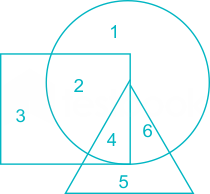
Study the given diagram carefully and answer the question. The numbers in different sections indicate the number of persons. 'Hindi speakers' are represented by the circle, ‘Urdu speakers are represented by the square, and 'Tamil speakers' are represented by the triangle. How many people can speak all the three languages?

  1. AOption (a)

    2

  2. BOption (b)

    3

  3. COption (c)

    5

  4. DOption (d)

    4

View answer & explanation

Correct answer

Answer: (c)C.

5

Why this answer is correct

According to the given information:

The shaded part represents "people can speak all the three languages".

So, people can speak all the three languages = 5.

Hence, the correct answer is "5".

Question 4

Which of the following is the least reactive metal in the reactivity series? 

  1. AOption (a)

    Ag

  2. BOption (b)

    Hg

  3. COption (c)

    Cu

  4. DOption (d)

    Au

View answer & explanation

Correct answer

Answer: (d)D.

Au

Why this answer is correct

The correct answer is Au.

Key Points

  • Gold (Au) is known for its exceptional resistance to corrosion and tarnishing, which is why it is considered the least reactive metal in the reactivity series.
  • Gold does not react with most acids; it only dissolves in a mixture of nitric acid and hydrochloric acid, known as aqua regia.
  • Gold is often found in its elemental form in nature, which indicates its low reactivity compared to other metals.
  • Due to its low reactivity, gold is widely used in jewelry and electronic components.

Additional Information

  • Reactivity Series of Metals
  • The reactivity series is a series of metals, listed in order of their reactivity, from highest to lowest.
  • Metals at the top of the series, like potassium, sodium, and calcium, are highly reactive and readily participate in chemical reactions.
  • Metals at the bottom of the series, such as gold, silver, and platinum, are very unreactive.
  • The reactivity series is crucial in predicting the outcomes of displacement reactions and understanding the extraction and corrosion processes of metals.
  • Aqua Regia
  • Aqua regia is a highly corrosive mixture of nitric acid and hydrochloric acid in a molar ratio of 1:3.
  • It is one of the few reagents capable of dissolving gold and platinum.
  • The name "aqua regia" means "royal water" in Latin, referring to its ability to dissolve the noble metals.
  • Applications of Gold
  • Due to its excellent conductivity and resistance to corrosion, gold is widely used in electronics, particularly in connectors and switches.
  • Gold's malleability makes it ideal for creating intricate jewelry and decorative items.
  • Gold is also used in dentistry and medicine, particularly in restorative procedures and medical devices.

Question 5

Who won the Men's Single title at the 2022 Australian Open tennis tournament?

  1. AOption (a)

    Daniil Medvedev

  2. BOption (b)

    Novak Djokovic

  3. COption (c)

    Rafael Nadal

  4. DOption (d)

    Roger Federer

View answer & explanation

Correct answer

Answer: (c)C.

Rafael Nadal

Why this answer is correct

The correct answer is Rafael Nadal.

Key Points

  • Rafael Nadal won the Men's Single title at the 2022 Australian Open tennis tournament.
  • He defeated Daniil Medvedev in the final match.
  • This victory marked Nadal's 21st Grand Slam singles title, setting a new record for the most Grand Slam titles won by a male player.
  • Nadal made an impressive comeback from two sets down to win the match in five sets.

Additional Information

  • Australian Open
  • The Australian Open is one of the four Grand Slam tennis tournaments, along with Wimbledon, the French Open, and the US Open.
  • It is held annually in Melbourne, Australia, over the last fortnight of January.
  • The tournament features men's and women's singles, men's and women's doubles, mixed doubles, and junior's championships.
  • The Australian Open is played on hard courts and is known for its extreme heat conditions.
  • Grand Slam
  • A Grand Slam in tennis refers to the four major championships: the Australian Open, the French Open, Wimbledon, and the US Open.
  • Winning all four major championships in a single calendar year is known as a "Calendar-Year Grand Slam".
  • Winning all four major championships at any point in a player's career is called a "Career Grand Slam".
  • Rafael Nadal is one of the few players to have achieved a Career Grand Slam.
  • Rafael Nadal
  • Rafael Nadal is a professional tennis player from Spain, widely regarded as one of the greatest tennis players of all time.
  • He has won numerous Grand Slam titles, including multiple victories at the French Open, where he is known as the "King of Clay".
  • Nadal is known for his incredible work ethic, athleticism, and competitive spirit.
  • His rivalry with Roger Federer and Novak Djokovic is one of the most celebrated in tennis history.

Question 6

Answer the questions with respect to the following number categories.

(Left) 7 5 3 3 9 1 4 6 2 7 8 3 7 5 6 8 9 1 3 9 5 3 (Right)

Find the sum of all the odd numbers in the above number class.

  1. AOption (a)

    70

  2. BOption (b)

    80

  3. COption (c)

    100

  4. DOption (d)

    90

View answer & explanation

Correct answer

Answer: (b)B.

80

Why this answer is correct

Given a sequence of numbers is 

7 5 3 3 9 1 4 6 2 7 8 3 7 5 6 8 9 1 3 9 5 3

The above-underlined numbers are odd numbers

The sum of all the odd numbers is 

7 + 5 + 3 + 3 + 9 + 1 + 7 + 3 + 7 + 5 + 9 + 1 + 5 + 3 = 80

Hence, the correct answer is "80".

Additional Information

  • The numbers that are not divisible by 2 are odd numbers.

Question 7

The part of the Himalayas lying between Satluj and Kali rivers is known as: 

  1. AOption (a)

    Purvanchal

  2. BOption (b)

    Kumaun Himalayas

  3. COption (c)

    Nepal Himalayas

  4. DOption (d)

    Assam Himalayas

View answer & explanation

Correct answer

Answer: (b)B.

Kumaun Himalayas

Why this answer is correct

The correct answer is Kumaun Himalayas.

Key Points

  • The Kumaun Himalayas stretch between the Satluj and Kali rivers.
  • This region includes major parts of Uttarakhand, particularly the districts of Nainital, Almora, and Pithoragarh.
  • It is known for its scenic beauty, including picturesque hill stations such as Nainital and Almora.
  • The Kumaun Himalayas are rich in biodiversity and have several protected areas, including the famous Jim Corbett National Park.

Additional Information

  • Purvanchal
  • The Purvanchal Himalayas extend from the east of Nepal across northern parts of West Bengal, Sikkim, Assam, Arunachal Pradesh, and the eastern states of India.
  • This range includes the Patkai, Naga, Mizo, and Manipur hills.
  • They are characterized by their rugged terrain and dense forests.
  • Nepal Himalayas
  • The Nepal Himalayas lie between the Kali river (west) and the Tista river (east).
  • It includes some of the world's highest peaks like Mount Everest, Kanchenjunga, and Lhotse.
  • This region is known for its significant cultural and religious heritage, as well as trekking and mountaineering opportunities.
  • Assam Himalayas
  • The Assam Himalayas extend from the eastern border of Bhutan to the bend of the Brahmaputra river in Arunachal Pradesh.
  • This region is characterized by its high rainfall and dense tropical forests.
  • It is known for its rich biodiversity, including numerous endemic species of flora and fauna.

Question 8

The area (in cm2) of a triangle, the lengths of whose sides are 5 cm, 7 cm and 8 cm, is _________.

  1. AOption (a)

    140

  2. BOption (b)

    280

  3. COption (c)

    603\sqrt3

  4. DOption (d)

    103\sqrt3

View answer & explanation

Correct answer

Answer: (d)D.

103\sqrt3

Why this answer is correct

Shortcut Trick

For sides 5, 7, 8: Semi-perimeter s = (5 + 7 + 8) ÷ 2 = 10 cm.

Area = √[s(s−a)(s−b)(s−c)] = √[10 × (10−5) × (10−7) × (10−8)]

Area = √[10 × 5 × 3 × 2] = √[300] = 10√3 cm2.

∴ The correct answer is 10√3 cm2.

Alternate Method

Given: Sides a = 5 cm, b = 7 cm, c = 8 cm.

Formula Used: Heron's Formula for Area of Triangle = √[s(s − a)(s − b)(s − c)], where s is the semi-perimeter.

⇒ Semi-perimeter (s) = (a + b + c) ÷ 2

⇒ s = (5 + 7 + 8) ÷ 2 = 20 ÷ 2 = 10 cm

⇒ Area = √[10 × (10 − 5) × (10 − 7) × (10 − 8)]

⇒ Area = √[10 × 5 × 3 × 2]

⇒ Area = √300 = √(100 × 3)

⇒ Area = 10√3 cm2

∴ The correct answer is 10√3 cm2.

Additional Information

Heron's Formula

Used for finding the area of a scalene triangle when all three sides are known: Area = √[s(s−a)(s−b)(s−c)].

Equilateral Triangle Area

If all sides are equal (side = a), the area is simplified to (√3 ÷ 4) × a2.

Right-Angled Triangle

If the triangle has a 90° angle, Area = 1/2 × base × height. Check for Pythagorean triplets (e.g., 3, 4, 5).

Question 9

Which of the following numbers will replace the question mark (?) in the given series?

6, 3,13, 7, 20, 11, 27, 15, 34, ?

  1. AOption (a)

    20

  2. BOption (b)

    17

  3. COption (c)

    18

  4. DOption (d)

    19

View answer & explanation

Correct answer

Answer: (d)D.

19

Why this answer is correct

The logic followed here is:

Hence, the correct answer is "19".

Question 10

In July 2022, the 17th campus of the National Institute of Fashion Technology (NIFT) was inaugurated by the Union Textile Minister Sri Piyush Goyal at which place?

  1. AOption (a)

    Shillong

  2. BOption (b)

    Rae Bareli

  3. COption (c)

    Panchkula

  4. DOption (d)

    Patna

View answer & explanation

Correct answer

Answer: (c)C.

Panchkula

Why this answer is correct

The correct answer is Panchkula.

Key Points

  • The 17th campus of the National Institute of Fashion Technology (NIFT) was inaugurated at Panchkula.
  • The inauguration was done by the Union Textile Minister Sri Piyush Goyal in July 2022.
  • Panchkula is located in the state of Haryana, India.
  • NIFT is a premier fashion institute in India known for its excellence in fashion education, research, and training.

Additional Information

  • National Institute of Fashion Technology (NIFT)
  • NIFT was established in 1986 under the aegis of the Ministry of Textiles, Government of India.
  • It is renowned for offering degree programs in Fashion Design, Leather Design, Accessory Design, Textile Design, Knitwear Design, Fashion Communication, Fashion Technology, and more.
  • NIFT has a network of campuses across India, making it accessible to students nationwide.
  • The institute collaborates with international universities and fashion institutes, offering students global exposure and opportunities.
  • Piyush Goyal
  • Piyush Goyal is a prominent Indian politician and a member of the Bharatiya Janata Party (BJP).
  • He has held various key positions in the Indian government, including Minister of Railways and Minister of Commerce and Industry.
  • As the Union Textile Minister, he has been instrumental in promoting and supporting the textile and fashion industries in India.
  • Panchkula
  • Panchkula is a planned city located in the state of Haryana, India.
  • It is part of the Chandigarh Tricity, which includes Chandigarh, Mohali, and Panchkula.
  • Panchkula is known for its well-organized infrastructure, green spaces, and proximity to the Shivalik hills.

Question 11

The price of a TV set increases by 20% in the first year and again by 5% in the next year. The net effect on the price of the TV set after two years compared to its initial price is a:

  1. AOption (a)

    15% increase

  2. BOption (b)

    25% increase

  3. COption (c)

    20% increase

  4. DOption (d)

    26% increase

View answer & explanation

Correct answer

Answer: (d)D.

26% increase

Why this answer is correct

Shortcut Trick

Apply the Successive Percentage formula: Net Change = a + b + (a × b) / 100

Here, a = 20% and b = 5%

Net Change = 20 + 5 + (20 × 5) / 100

Net Change = 25 + 1 = 26%

∴ The correct answer is 26% increase.

Alternate Method

Assume the Initial Price of the TV set is 100 units.

⇒ Price after 1st year increase (20%) = 100 + (20% of 100) = 120

⇒ Price after 2nd year increase (5%) = 120 + (5% of 120)

⇒ 5% of 120 = (5 × 120) / 100 = 6

⇒ Final Price after two years = 120 + 6 = 126

⇒ Net increase = Final Price − Initial Price = 126 − 100 = 26%

∴ The correct answer is 26% increase.

Additional Information

Successive Percentage Change

When a value changes by a% and then by b%, the effective change is given by [a + b + (ab/100)]%.

Decrease/Depreciation Case

If the price decreases, use a negative sign for the percentage value in the formula (e.g., −20% for a 20% decrease).

Successive Discount

For two successive discounts of x% and y%, the single equivalent discount is [x + y − (xy/100)]%.

Question 12

If all the directions are moved 135 degrees clockwise, then which new direction does the original south point to?

  1. AOption (a)

    South - East

  2. BOption (b)

    North - West

  3. COption (c)

    South - West

  4. DOption (d)

    North - East

View answer & explanation

Correct answer

Answer: (b)B.

North - West

Why this answer is correct

According to the given information:

If all the directions are moved 135 degrees clockwise,

Then new direction does the original south point to North-West direction.

Hence, the correct answer is "North-West".

Question 13

Find the scale with the greatest possible length which can measure poles of length 3 m 96 cm, 5 m 28 cm, and 7 m 92 cm exact number of times.

  1. AOption (a)

    66 cm

  2. BOption (b)

    1 m 32 cm

  3. COption (c)

    3 m 21 cm

  4. DOption (d)

    33 cm

View answer & explanation

Correct answer

Answer: (b)B.

1 m 32 cm

Why this answer is correct

Shortcut Trick

To find the greatest possible length, calculate the HCF of the given lengths.

Convert all lengths to cm: 396 cm, 528 cm, 792 cm.

HCF(396, 528, 792) ⇒ HCF(396, 528) = 132; HCF(132, 792) = 132.

Greatest length = 132 cm = 1 m 32 cm.

∴ The correct answer is 1 m 32 cm.

Alternate Method

Given:

Length 1 = 3 m 96 cm = (3 × 100) + 96 = 396 cm

Length 2 = 5 m 28 cm = (5 × 100) + 28 = 528 cm

Length 3 = 7 m 92 cm = (7 × 100) + 92 = 792 cm

Formula Used: Greatest common length = HCF of the given measurements.

Calculations:

⇒ Prime Factorisation of 396 = 22 × 32 × 11

⇒ Prime Factorisation of 528 = 24 × 3 × 11

⇒ Prime Factorisation of 792 = 23 × 32 × 11

⇒ HCF = 22 × 3 × 11 = 4 × 3 × 11 = 132 cm

⇒ 132 cm = 100 cm + 32 cm = 1 m 32 cm.

∴ The correct answer is 1 m 32 cm.

Additional Information

HCF (Highest Common Factor)

The greatest number that divides two or more numbers without leaving a remainder. Used for maximum capacity or greatest length problems.

LCM (Least Common Multiple)

The smallest number that is a multiple of two or more numbers. Used for traffic lights or bell ringing interval problems.

Unit Conversion

Always convert all quantities to the same unit (e.g., all to cm or all to meters) before performing HCF or LCM calculations.

Question 14

In a certain code language, ‘LALIT' is written as 'ODOLW' and 'MOHIT' is written as 'PRKLW'. How will 'SUMIT' be written in that code language?

  1. AOption (a)

    VXPLW

  2. BOption (b)

    VXLPW

  3. COption (c)

    LPWVX

  4. DOption (d)

    XVPWL

View answer & explanation

Correct answer

Answer: (a)A.

VXPLW

Why this answer is correct

The logic followed here is:

‘LALIT' is written as 'ODOLW'

'MOHIT' is written as 'PRKLW'.


Similarly, 'SUMIT' will be written as:

Hence, the correct answer is "VXPLW ".

Question 15

The 8th Schedule of the Constitution of India recognises a total of ___________ languages as the official languages.

  1. AOption (a)

    23

  2. BOption (b)

    22

  3. COption (c)

    20

  4. DOption (d)

    21

View answer & explanation

Correct answer

Answer: (b)B.

22

Why this answer is correct

The correct answer is 22.

Key Points

  • The 8th Schedule of the Constitution of India originally listed 14 languages, but it has been expanded to include a total of 22 languages.
  • The recognition of languages in the 8th Schedule is significant as it enables the government to promote these languages and ensure their preservation and development.
  • The 22 officially recognized languages include Assamese, Bengali, Bodo, Dogri, Gujarati, Hindi, Kannada, Kashmiri, Konkani, Maithili, Malayalam, Manipuri, Marathi, Nepali, Odia, Punjabi, Sanskrit, Santali, Sindhi, Tamil, Telugu, and Urdu.
  • The most recent additions to the 8th Schedule were Bodo, Dogri, Maithili, and Santhali, which were included in the 92nd Constitutional Amendment Act of 2003.

Additional Information

  • 8th Schedule of the Indian Constitution
  • The 8th Schedule lists the official languages recognized by the Indian Constitution. These languages are considered to be vital for the linguistic diversity of India.
  • The inclusion of a language in the 8th Schedule means that the language is entitled to representation on the Official Language Commission, and its use is encouraged in education and public administration.
  • Languages included in the 8th Schedule are also considered for the purposes of the All India Radio broadcast, Doordarshan telecast, and other forms of media communication.
  • 92nd Constitutional Amendment Act, 2003
  • This amendment added Bodo, Dogri, Maithili, and Santhali to the 8th Schedule, increasing the number of recognized languages from 18 to 22.
  • The inclusion of these languages was a step towards acknowledging the linguistic diversity and ensuring the preservation of these languages.
  • Constitutional Provisions for Language
  • Article 343 of the Indian Constitution designates Hindi in the Devanagari script as the official language of the Union.
  • Article 351 provides for the development and promotion of the Hindi language to serve as a medium of expression for all elements of the composite culture of India.
  • Articles 344(1) and 351 also provide for the formation of a Commission and a Committee to promote the spread of Hindi and to progressively increase its use for official purposes.
  • Language Policy in India
  • India follows a three-language formula in its education system, encouraging students to learn their regional language, Hindi, and English.
  • The policy aims to promote multilingualism and ensure that students are proficient in multiple languages, enabling them to communicate effectively across different regions and cultures.
  • The promotion and protection of linguistic diversity are also supported through various government initiatives and schemes.

Question 16

The value of [xm(n - p). xn(p - m). xp(m - n)] [4625−25][^4\sqrt{625}-\sqrt{25}] is __________.

  1. AOption (a)

    0

  2. BOption (b)

    1

  3. COption (c)

    5

  4. DOption (d)

    2

View answer & explanation

Correct answer

Answer: (a)A.

0

Why this answer is correct

Given:

The expression is [xm(n - p). xn(p - m). xp(m - n)] [4625−25][^4\sqrt{625}-\sqrt{25}].

Formula Used:

  1. 4√(625) = 5
  2. √(25) = 5

Calculation:

The expression simplifies as follows:

[xm(n - p). xn(p - m). xp(m - n)] [4√(625)-√(25)]

4√(625) = 5

√(25) = 5

⇒ 4√(625) - √(25) = 5 - 5

⇒ 0

The product of any expression multiplied by 0 is 0:

[xm(n - p). xn(p - m). xp(m - n)] × 0

⇒ 0

The correct answer is option 1.

Question 17

Which of the following terms will replace the question mark (?) in the given series to make it logically complete?

WXN13, UVL19, STJ25, QRH31, ?

  1. AOption (a)

    OPF37

  2. BOption (b)

    FPO37

  3. COption (c)

    OFP27

  4. DOption (d)

    PFO36

View answer & explanation

Correct answer

Answer: (a)A.

OPF37

Why this answer is correct

The logic followed here is:

Hence, the correct answer is "OPF37 ".

Question 18

Which of the following methods can be used to prevent STDs?

  1. AOption (a)

    Condom

  2. BOption (b)

    Tubectomy

  3. COption (c)

    Copper-T

  4. DOption (d)

    Vasectomy

View answer & explanation

Correct answer

Answer: (a)A.

Condom

Why this answer is correct

The correct answer is Condom.

Key Points

  • Condoms are a barrier method of contraception used during sexual intercourse to reduce the risk of pregnancy and sexually transmitted diseases (STDs).
  • They are highly effective in preventing the transmission of infections such as HIV/AIDS, gonorrhea, chlamydia, and syphilis.
  • Condoms are available for both males and females, providing a versatile option for protection.
  • In addition to their protective benefits, condoms have no side effects and can be easily obtained without a prescription.

Additional Information

  • Tubectomy
  • It is a permanent method of female sterilization where the fallopian tubes are cut, tied, or blocked to prevent pregnancy.
  • Tubectomy does not protect against STDs.
  • Copper-T
  • It is an intrauterine device (IUD) used for long-term contraception in women.
  • While effective at preventing pregnancy, Copper-T does not provide protection against STDs.
  • Vasectomy
  • It is a permanent method of male sterilization where the vas deferens are cut or sealed to prevent sperm from entering the ejaculate.
  • Vasectomy does not protect against STDs.

Question 19

The only thing that we do not get from natural resources but directly from outside the earth is __________.

  1. AOption (a)

    Coal

  2. BOption (b)

    Natural gases

  3. COption (c)

    Energy

  4. DOption (d)

    Minerals

View answer & explanation

Correct answer

Answer: (c)C.

Energy

Why this answer is correct

The correct answer is Energy.

Key Points

  • Energy can be harnessed from various natural resources like the sun (solar energy), wind (wind energy), and water (hydroelectric energy).
  • However, the energy itself is not directly obtained from natural resources; instead, it is converted from these resources through technological means.
  • We do not extract energy directly from the earth's crust as we do for coal, natural gases, or minerals.
  • Energy in the form of solar, wind, or hydroelectricity is harnessed through specific equipment and technology that converts these natural sources into usable energy.

Additional Information

  • Coal
  • Coal is a fossil fuel that is extracted from the earth through mining.
  • It is used primarily for electricity generation and in various industrial processes.
  • Natural Gases
  • Natural gases are also fossil fuels obtained through drilling into the earth's crust.
  • They are primarily used for heating, electricity generation, and as a fuel for vehicles.
  • Minerals
  • Minerals are naturally occurring substances extracted from the earth's crust through mining.
  • They are used in a wide range of industries, including construction, manufacturing, and technology.
  • Energy
  • Energy refers to the capacity to do work and comes in various forms such as thermal, electrical, chemical, and mechanical.
  • Renewable energy sources include solar, wind, hydro, and geothermal energy.
  • Non-renewable energy sources include fossil fuels like coal, oil, and natural gas.
  • Technological advancements have allowed us to harness and convert natural resources into usable energy efficiently.

Question 20

What is the percentage of oxygen in air normally inhaled and exhaled by human beings?

  1. AOption (a)

    Around 21% in inhaled air and 16% in exhaled air

  2. BOption (b)

    Around 18% in inhaled air and 10% in exhaled air

  3. COption (c)

    Around 19% in inhaled air and 17% in exhaled air

  4. DOption (d)

    Around 20% in inhaled air and 2% in exhaled air

View answer & explanation

Correct answer

Answer: (a)A.

Around 21% in inhaled air and 16% in exhaled air

Why this answer is correct

The correct answer is Around 21% in inhaled air and 16% in exhaled air.

Key Points

  • Inhaled air contains approximately 21% oxygen.
  • Exhaled air contains approximately 16% oxygen.
  • This difference of about 5% oxygen reflects the amount of oxygen used by the body during respiration.
  • Human respiration involves the intake of oxygen for metabolic processes and the release of carbon dioxide as a waste product.

Additional Information

  • Respiration:
  • It is the biochemical process in which cells of an organism obtain energy by combining oxygen and glucose, resulting in the release of carbon dioxide, water, and ATP (energy).
  • The primary purpose of respiration is to supply cells with oxygen for energy production and to remove carbon dioxide as a waste product.
  • Inhaled Air Composition:
  • Inhaled air consists primarily of nitrogen (about 78%), oxygen (about 21%), argon (about 0.93%), and carbon dioxide (about 0.04%).
  • Other trace gases and water vapor are also present in small quantities.
  • Exhaled Air Composition:
  • Exhaled air has a different composition due to the body's metabolic processes.
  • It contains about 16% oxygen, 4-5% carbon dioxide, and the remaining gases include nitrogen, argon, and water vapor.
  • Gas Exchange in Lungs:
  • Oxygen is absorbed into the bloodstream from the alveoli in the lungs.
  • Carbon dioxide, a metabolic waste product, is expelled from the blood into the alveoli to be exhaled.
  • This gas exchange is essential for maintaining the body's homeostasis and supporting cellular functions.

Question 21

Which of the following statement is INCORRECT?

  1. AOption (a)

    All children will inherit a Y chromosome from their mother.

  2. BOption (b)

    All human chromosomes are not paired.

  3. COption (c)

    Animals, such as snails, individuals can change sex.

  4. DOption (d)

    Sex is determined by different factors in various species.

View answer & explanation

Correct answer

Answer: (a)A.

All children will inherit a Y chromosome from their mother.

Why this answer is correct

The correct answer is All children will inherit a Y chromosome from their mother..

Key Points

  • The Y chromosome is one of two sex chromosomes in humans, the other being the X chromosome.
  • Females typically have two X chromosomes (XX), while males have one X and one Y chromosome (XY).
  • Since females do not possess a Y chromosome, they cannot pass it on to their offspring.
  • Only males can pass on a Y chromosome, determining the male sex of the offspring.

Additional Information

  • Human Chromosomes:
  • Humans have 23 pairs of chromosomes, totaling 46 chromosomes.
  • 22 pairs are autosomes, and one pair is sex chromosomes (XX or XY).
  • Sex Determination in Animals:
  • In mammals, sex is determined by the presence of the Y chromosome.
  • In birds, the ZW sex-determination system is used, where males are ZZ and females are ZW.
  • Other animals, like some reptiles, use temperature-dependent sex determination.
  • Sequential Hermaphroditism:
  • Some animals, such as snails and certain fish, can change sex in response to environmental conditions or social structure.
  • This process is known as sequential hermaphroditism.

Question 22

Which of the following compounds is used as a raw material for making plaster of Paris?

  1. AOption (a)

    Na2CO3. 10H2O

  2. BOption (b)

    CaSO4. 2H2O

  3. COption (c)

    CuSO4. 2H2O

  4. DOption (d)

    MgSO4. 2H2O

View answer & explanation

Correct answer

Answer: (b)B.

CaSO4. 2H2O

Why this answer is correct

The correct answer is CaSO4. 2H2O.

Key Points

  • CaSO4. 2H2O is commonly known as gypsum.
  • Gypsum is used as a raw material to make plaster of Paris.
  • When gypsum is heated to about 150°C, it loses water molecules and forms plaster of Paris (CaSO4. 0.5H2O).
  • Plaster of Paris is widely used in construction, art, and medical applications.

Additional Information

  • Na2CO3. 10H2O
  • Also known as washing soda or soda ash.
  • It is used in cleaning agents, water softening, and glass manufacturing.
  • CuSO4. 2H2O
  • Known as blue vitriol or copper sulfate.
  • Used in agriculture as a pesticide and in electroplating processes.
  • MgSO4. 2H2O
  • Commonly known as Epsom salt.
  • Used in bath salts, as a laxative, and in gardening to improve soil magnesium content.

Question 23

If the curved surface area of a solid right circular cylinder is 2310 cm2 and its radius of base is 21 cm, then the total surface area (in cm2) of the given cylinder is _______.

(Take π = 227\frac{22}{7})

  1. AOption (a)

    4250

  2. BOption (b)

    5082

  3. COption (c)

    3696

  4. DOption (d)

    5892

View answer & explanation

Correct answer

Answer: (b)B.

5082

Why this answer is correct

Shortcut Trick

Total Surface Area (TSA) = Curved Surface Area (CSA) + 2 × Area of Base

TSA = 2310 + 2 × π × r2

TSA = 2310 + 2 × (22/7) × 21 × 21

TSA = 2310 + 2772 = 5082 cm2

∴ The correct answer is 5082 cm2.

Alternate Method

Given:

Curved Surface Area (CSA) of cylinder = 2310 cm2

Radius (r) of base = 21 cm

Formula Used:

CSA = 2πrh

Total Surface Area (TSA) = 2πr(h + r) = 2πrh + 2πr2

Calculations:

⇒ Area of two circular bases = 2 × πr2

⇒ Area = 2 × (22/7) × 21 × 21

⇒ Area = 2 × 22 × 3 × 21

⇒ Area = 2772 cm2

⇒ TSA = CSA + Area of two bases

⇒ TSA = 2310 + 2772

⇒ TSA = 5082 cm2

∴ The correct answer is 5082 cm2.

Additional Information

Volume of Cylinder

The space occupied by a cylinder is given by V = πr2h.

Hollow Cylinder

For a hollow cylinder with outer radius R and inner radius r, the Volume = π(R2 − r2)h.

Surface Area Relations

TSA is always greater than CSA for any solid figure with a flat base. For a cylinder, TSA = CSA + 2 × Base Area.

Question 24

A watch passes through three hands and each gains 25%. If the third seller sells the watch for Rs. 1,250, the cost price of the watch to the first seller is:

  1. AOption (a)

    Rs. 540

  2. BOption (b)

    Rs. 840

  3. COption (c)

    Rs. 640

  4. DOption (d)

    Rs. 740

View answer & explanation

Correct answer

Answer: (c)C.

Rs. 640

Why this answer is correct

Shortcut Trick

Profit of 25% means the multiplier is (100 + 25) ÷ 100 = 1.25 or 5/4.

Let the initial cost price be CP.

CP × (5/4) × (5/4) × (5/4) = 1,250.

CP × (125/64) = 1,250.

CP = 1,250 × (64/125) = 10 × 64 = 640.

∴ The correct answer is Rs. 640.

Alternate Method

Given: Final Selling Price = Rs. 1,250, Profit at each stage = 25%.

Formulas: SP = CP × (100 + P%) ÷ 100.

⇒ Price for 3rd seller = 1,250 × (100/125) = Rs. 1,000.

⇒ Price for 2nd seller = 1,000 × (100/125) = Rs. 800.

⇒ Price for 1st seller = 800 × (100/125) = Rs. 640.

∴ The correct answer is Rs. 640.

Additional Information

Successive Percentage Change

When a value changes by multiple percentages in succession, the final value is Initial × (1 + r1/100) × (1 + r2/100)...

Effective Profit Percentage

For three successive profits of 25%, the overall profit is not 75%, but (1.253 − 1) × 100 = 95.3125%.

Question 25

Aakash starts from Point O and drives 3 km towards the north. He then takes a right turn, drives 5 km, turns right and drives 10 km. He then takes a right turn and drives 5 km. He takes a final right turn, drives 3 km and stops at Point Z. How far and towards which direction should he drive in order to reach Point O from Point Z? (All turns are 90 degree turns only)

  1. AOption (a)

    3 km towards the east

  2. BOption (b)

    2 km towards the west

  3. COption (c)

    4 km towards the north

  4. DOption (d)

    2 km towards the east

View answer & explanation

Correct answer

Answer: (c)C.

4 km towards the north

Why this answer is correct

According to the given information:

Aakash starts from Point O and drives 3 km towards the north.

He then takes a right turn, drives 5 km, turns right and drives 10 km.

He then takes a right turn and drives 5 km.

He takes a final right turn, drives 3 km and stops at Point Z.

Distance between O and Z = 10 - (3 + 3) = 10 - 6 = 4.

Thus he drives in 4 km towards the north to reach Point O from Point Z.

Hence, the correct answer is "4 km towards the north ".

Question 26

Why should plastic cups be replaced by paper cups for selling tea in public places?

  1. AOption (a)

    Plastic cups are cheaper

  2. BOption (b)

    Paper cups are biodegradable

  3. COption (c)

    Paper cups are stronger

  4. DOption (d)

    Paper cups keep things safe

View answer & explanation

Correct answer

Answer: (b)B.

Paper cups are biodegradable

Why this answer is correct

The correct answer is Paper cups are biodegradable.

Key Points

  • Environmental Impact: Paper cups are biodegradable, meaning they break down naturally over time and do not contribute to long-term environmental pollution like plastic cups.
  • Sustainability: Paper cups are often made from renewable resources such as wood pulp, which can be sustainably managed and harvested.
  • Recyclability: Many paper cups can be recycled, reducing the waste that ends up in landfills and supporting circular economy practices.
  • Reduced Plastic Waste: By replacing plastic cups with paper ones, we can significantly reduce the amount of plastic waste generated, which is crucial for protecting wildlife and ecosystems.

Additional Information

  • Biodegradable Materials:
  • Biodegradable materials are those that can decompose naturally by biological processes, involving microorganisms like bacteria and fungi.
  • These materials break down into natural elements like water, carbon dioxide, and biomass, which are less harmful to the environment.
  • Plastic Pollution:
  • Plastic pollution refers to the accumulation of plastic objects and particles in the environment that adversely affects wildlife, wildlife habitat, and humans.
  • Plastics are synthetic materials that are not biodegradable and can persist in the environment for hundreds of years.
  • Sustainable Resources:
  • Sustainable resources are those that can be continually replenished and managed so that they do not run out over time.
  • Examples include solar energy, wind energy, and materials like wood from well-managed forests.
  • Circular Economy:
  • The circular economy is an economic system aimed at eliminating waste and the continual use of resources.
  • This system employs reuse, sharing, repair, refurbishment, remanufacturing, and recycling to create a closed-loop system, minimizing resource inputs, and reducing waste, pollution, and carbon emissions.

Question 27

The words Socialist, Secular and Integrity were added in the preamble of Indian Constitution by which amendment?

  1. AOption (a)

    42nd

  2. BOption (b)

    52nd

  3. COption (c)

    44th

  4. DOption (d)

    72nd

View answer & explanation

Correct answer

Answer: (a)A.

42nd

Why this answer is correct

The correct answer is 42nd.

Key Points

  • The words "Socialist", "Secular", and "Integrity" were added to the Preamble of the Indian Constitution by the 42nd Amendment Act, 1976.
  • The 42nd Amendment is also known as the Mini-Constitution because of the extensive changes it made to the Constitution.
  • This amendment was enacted during the Emergency period under the prime ministership of Indira Gandhi.
  • The 42nd Amendment aimed at giving the Indian Constitution a socialist and secular character, reflecting the objectives of social justice and equality.

Additional Information

  • Socialist:
  • The term "Socialist" was added to emphasize India's commitment to social and economic equality.
  • It signifies that wealth should be distributed in a manner that serves the common good.
  • It aims to reduce the gap between the rich and the poor through government intervention in the economy.
  • Secular:
  • The term "Secular" signifies that India does not have an official state religion.
  • It ensures that all religions are treated equally and that the state does not favor or discriminate against any religion.
  • This term reinforces the commitment to religious freedom and tolerance.
  • Integrity:
  • The word "Integrity" was added to emphasize the unity and cohesiveness of the nation.
  • It signifies the importance of maintaining the territorial and communal integrity of the country.
  • This addition underscores the commitment to the unity of the nation amidst its diverse cultures and populations.
  • 42nd Amendment Act, 1976:
  • Also known as the Mini-Constitution due to the extensive changes it made.
  • It was enacted during the Emergency period (1975-1977) under Prime Minister Indira Gandhi.
  • It brought about significant changes in the Constitution, including the addition of fundamental duties and changes to the Preamble and the Seventh Schedule.
  • Many of its provisions were later undone or modified by subsequent amendments, particularly the 44th Amendment Act, 1978.

Question 28

This question is based on the following 3-letter words.

AID, BAD, CAT, DOG, EAT

If in each of the words, each letter is changed to the next letter in the English alphabetical order, how many words (not necessarily meaningful) thus formed will have no vowel?

  1. AOption (a)

    Two

  2. BOption (b)

    None

  3. COption (c)

    One

  4. DOption (d)

    Three

View answer & explanation

Correct answer

Answer: (b)B.

None

Why this answer is correct

Given words: AID, BAD, CAT, DOG, EAT

If in each of the words, each letter is changed to the next letter in the English alphabetical order:

Thus, None words (not necessarily meaningful) thus formed will have no vowel.

Hence, the correct answer is "None".

Question 29

A situation I And II conclusions drawn from the situation. All arguments given to you are true, and among the given conclusions, determine which/which conclusion(s) is/are correct or incorrect.

Statement:

Statement: An exhibition commemorating the Queen's Jubilee will run for a month in the summer and is open to the public.

Conclusion:

  1. The artworks are organized around the Queen's life and her legacy.
  2. Participation in the exhibition is free of charge.
  1. AOption (a)

    I and II Both are implicit.

  2. BOption (b)

    Only assumption II is implicit.

  3. COption (c)

    Only assumption I is implicit.

  4. DOption (d)

    I or II None are implicit.

View answer & explanation

Correct answer

Answer: (d)D.

I or II None are implicit.

Why this answer is correct

Given,

Statement:

An exhibition commemorating the Queen's Jubilee will run for a month in the summer and is open to the public.

Conclusions:

I. The artworks are organized around the Queen's life and her legacy. - False (Because, The statement does not provide any information about the content or theme of the artworks in the exhibition).

II. Participation in the exhibition is free of charge. - False (Because, The statement does not mention whether there is a fee for participation or not).

So, None of the conclusions follow.

Hence, the correct answer is "Option 4".

Question 30

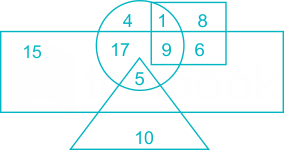
Study the given diagram carefully and answer the question. The numbers in different sections indicate the number of persons. The triangle represents ‘motivational speakers’, the circle represents 'women’, the square represents 'scientists', and the rectangle represents ‘married'. Find the number of married women who are scientists but NOT motivational speakers.

  1. AOption (a)

    5

  2. BOption (b)

    9

  3. COption (c)

    17

  4. DOption (d)

    6

View answer & explanation

Correct answer

Answer: (b)B.

9

Why this answer is correct

According to the given information:

So, the number of married women who are scientists but NOT motivational speakers = 9.

Hence, the correct answer is "9".

Question 31

Which of the following lies under the jurisdiction of the Central Government?

  1. AOption (a)

    District Board

  2. BOption (b)

    Municipal Board

  3. COption (c)

    Cantonment Board

  4. DOption (d)

    Town Area

View answer & explanation

Correct answer

Answer: (c)C.

Cantonment Board

Why this answer is correct

The correct answer is Cantonment Board.

Key Points

  • The Cantonment Board is a civic administration body in India under the control of the Ministry of Defence.
  • It is established for the administration of civilian areas in the cantonments.
  • The primary duty of the Cantonment Board is to ensure the overall development of the cantonment area and provide essential services to the residents.
  • They are responsible for maintaining proper sanitation, water supply, street lighting, and other civic amenities.

Additional Information

  • District Board
  • The District Board or Zila Parishad is a local government body at the district level in India.
  • It oversees the administration of rural areas in a district and works towards the development of these regions.
  • It is under the jurisdiction of the state government.
  • Municipal Board
  • The Municipal Board or Nagar Palika is an urban local body responsible for the administration of a city or town.
  • It looks after civic amenities like water supply, sewage, roads, and street lighting.
  • It operates under the jurisdiction of the state government.
  • Town Area
  • A Town Area is a smaller urban area with a local governing body responsible for basic civic administration.
  • It is typically managed by a Town Area Committee and is under the jurisdiction of the state government.

Question 32

The SVAMITVA (Survey of Villages Abadi and Mapping with Improvised Technology in Village Areas) Scheme, implemented by the Ministry of Panchayati Raj, uses _________ for mapping of land parcels.

  1. AOption (a)

    drones

  2. BOption (b)

    rockets

  3. COption (c)

    helicopters

  4. DOption (d)

    earth - orbiting satellites

View answer & explanation

Correct answer

Answer: (a)A.

drones

Why this answer is correct

The correct answer is drones.

Key Points

  • The SVAMITVA Scheme is a central sector scheme of the Ministry of Panchayati Raj, Government of India.
  • It aims to provide an integrated property validation solution for rural India using drone technology.
  • The utilization of drones helps in creating accurate land maps which are essential for the issuance of property cards to rural households.
  • This scheme helps in reducing property disputes and also facilitates monetization of rural residential assets.

Additional Information

  • Drone Technology
  • Drones, also known as Unmanned Aerial Vehicles (UAVs), are aircraft systems without a human pilot onboard.
  • They are controlled either by a remote control system or autonomously through software-controlled flight plans in their embedded systems.
  • Drones are used in various applications such as aerial photography, agriculture, surveillance, and mapping.
  • In the context of the SVAMITVA scheme, drones provide high-resolution images and accurate geospatial data which are critical for land mapping.
  • SVAMITVA Scheme Objectives
  • The SVAMITVA Scheme aims to map rural inhabited lands using drone technology and Continuously Operating Reference Station (CORS) networks.
  • It aims to provide a 'Record of Rights' to village household owners in rural areas and issue property cards for land parcels in the villages.
  • This will facilitate monetization of rural residential assets for credit and other financial services.
  • It will also help in reducing property-related disputes and legal cases.
  • Ministry of Panchayati Raj
  • The Ministry of Panchayati Raj is a branch of the Government of India that looks after the administration and functioning of Panchayati Raj Institutions (PRIs).
  • It is responsible for the implementation of schemes and programs aimed at empowering and strengthening rural local bodies.
  • The ministry works towards the development of rural areas through various initiatives and schemes, including the SVAMITVA scheme.

Question 33

This question is based on the five, four-digit numbers given below.

(Left) 6338 5345 4127 7253 6176 (Right)

(Example: 697 – first digit = 6, second digit = 9, third digit = 7)

(NOTE: All operations to be done from left to right)

If 3 is subtracted from the first digit of every number, in how many numbers will the first digit be exactly divisible by 3?

  1. AOption (a)

    Five

  2. BOption (b)

    Two

  3. COption (c)

    Four

  4. DOption (d)

    Three

View answer & explanation

Correct answer

Answer: (b)B.

Two

Why this answer is correct

Given: (left) 6338 5345 4127 7253 6176 (right)

If 3 is subtracted from the first digit of every number:

  • 6338: 6 - 3 = 3
  • 5345: 5 - 3 = 2
  • 4127: 4 - 3 = 1
  • 7253: 7 - 3 = 4
  • 6176: 6 - 3 = 3

Now checking which of these new first digits are exactly divisible by 3:

  • 3 (divisible by 3)
  • 2 (not divisible by 3)
  • 1 (not divisible by 3)
  • 4 (not divisible by 3)
  • 3 (divisible by 3)

The number of first digits that are exactly divisible by 3 is: 2

The correct answer is "Option 2".

Question 34

The table given shows the total number of students of a college and the number of girls who are studying in four different courses – Data science, Cloud computing, Statistics and Image processing in 3 different years.

Year/Courses201620172018
Total number of studentsTotal number of girlsTotal number of studentsTotal number of girlsTotal number of studentsTotal number of girls
Data science800500900450760400
Cloud computing1600400180010001500700
Statistics140060015007001040400
Image processing12006001300600800200

What is the average number of boys studying in all the four courses in the year 2017?

  1. AOption (a)

    492.5

  2. BOption (b)

    687.5

  3. COption (c)

    586.5

  4. DOption (d)

    734.5

View answer & explanation

Correct answer

Answer: (b)B.

687.5

Why this answer is correct

Given:

The table provides data for the total number of students and the number of girls for four courses in 2017. The task is to find the average number of boys studying across all courses in 2017.

Formula Used:

Number of boys = Total number of students - Number of girls

Average = Sum of boys in all courses / Number of courses

Calculation:

2017:

Data Science:

Number of boys = 900 - 450 = 450

Cloud Computing:

Number of boys = 1800 - 1000 = 800

Statistics:

Number of boys = 1500 - 700 = 800

Image Processing:

Number of boys = 1300 - 600 = 700

Total boys in 2017:

450 + 800 + 800 + 700 = 2750

Average number of boys:

Average = 2750 / 4 = 687.5

∴ The average number of boys in 2017 is 687.5.

Question 35

A shopkeeper sells pulses at Rs. 100 per kg that he purchased for Rs. 80 per kg. While selling, he cheats and gives 800 g instead of 1 kg. What is his actual profit?

  1. AOption (a)

    56.25%

  2. BOption (b)

    62.75%

  3. COption (c)

    58.00%

  4. DOption (d)

    64.00%

View answer & explanation

Correct answer

Answer: (a)A.

56.25%

Why this answer is correct

Shortcut Trick

Use the Successive Ratio method for dishonest dealers.

Price Ratio (CP : SP) = 80 : 100 = 4 : 5.

Weight Ratio (Quantity given : Quantity promised) = 800 : 1000 = 4 : 5.

Effective Ratio = (4 × 4) : (5 × 5) = 16 : 25.

Profit% = (Profit ÷ CP) × 100 = (9 ÷ 16) × 100 = 56.25%.

∴ The correct answer is 56.25%.

Alternate Method

Given → Cost Price (CP) = Rs. 80 per kg, Selling Price (SP) = Rs. 100 per kg, Actual Weight = 800 g, Claimed Weight = 1000 g. Formulas: Profit% = (Total SP − Total CP) ÷ Total CP × 100 | Effective CP = (Actual Weight ÷ Claimed Weight) × Purchased CP.

⇒ Cost of 1000 g = Rs. 80. ⇒ Cost of 800 g (which he actually gives) = (80 ÷ 1000) × 800 = Rs. 64. ⇒ Selling Price for that 800 g = Rs. 100. ⇒ Profit = SP − CP = 100 − 64 = Rs. 36. ⇒ Profit% = (36 ÷ 64) × 100 = 56.25%.

∴ The correct answer is 56.25%.

Additional Information

Dishonest Dealer Gain

When a dealer sells at cost price but uses less weight, Gain% = [Error ÷ (True Value − Error)] × 100.

Combined Profit

If there is a price markup and a weight cheat, the total profit is calculated on the actual cost of the goods delivered.

Question 36

Which of the following is the correct balanced equation for the given chemical reaction?

Fe + H2O → Fe3O4 + H2

  1. AOption (a)

    Fe(s) + 4H2O(g) → 3Fe3O4(s) + H2(g)

  2. BOption (b)

    3Fe(s) + 4H2O(g) → Fe3O4(s) + 4H2(g)

  3. COption (c)

    Fe(s) + 4H2O(g) → Fe3O4(s) + 2H2(g)

  4. DOption (d)

    3Fe(s) + H2O(g) → 3Fe3O4(s) + H2(g)

View answer & explanation

Correct answer

Answer: (b)B.

3Fe(s) + 4H2O(g) → Fe3O4(s) + 4H2(g)

Why this answer is correct

The correct answer is 3Fe(s) + 4H2O(g) → Fe3O4(s) + 4H2(g).

Key Points

  • To balance the given chemical reaction, the number of atoms of each element on the reactant side must equal the number of atoms of each element on the product side.
  • For the correct balanced equation: 3 moles of iron (Fe) react with 4 moles of water (H2O) to produce 1 mole of iron(II,III) oxide (Fe3O4) and 4 moles of hydrogen gas (H2).
  • In the equation, the iron atoms are balanced: 3 Fe atoms on the reactant side and 3 Fe atoms in Fe3O4 on the product side.
  • The hydrogen atoms are balanced: 8 H atoms on the reactant side (from 4 H2O) and 8 H atoms on the product side (from 4 H2).

Additional Information

  • Balancing Chemical Equations:
  • Chemical equations must be balanced to obey the Law of Conservation of Mass, which states that mass is neither created nor destroyed in a chemical reaction.
  • To balance a chemical equation, adjust the coefficients (the numbers in front of the chemical formulas) to ensure the same number of each type of atom on both sides of the equation.
  • Start by balancing the atoms of elements that appear in only one reactant and one product.
  • Balance the atoms of elements that appear in multiple reactants or products last.
  • Iron(II,III) Oxide (Fe3O4):
  • Iron(II,III) oxide, also known as magnetite, is a mixed oxide of iron where iron exists in both +2 and +3 oxidation states.
  • It is a black, magnetic mineral that is a common iron ore used in the production of iron and steel.
  • Hydrogen Gas (H2):
  • Hydrogen gas is a colorless, odorless, highly flammable diatomic gas.
  • It is the lightest and most abundant chemical element in the universe, primarily found in stars and gas giant planets.
  • Hydrogen gas is used in various industrial processes, including the production of ammonia for fertilizers and the hydrogenation of fats and oils.

Question 37

What approximate value should come in place of the question mark (?) in the following equation

55.98 ÷ 7.09 × 5.05 + 33.98 – 26.99 ÷ 2.97 = ?

  1. AOption (a)

    64

  2. BOption (b)

    62

  3. COption (c)

    63

  4. DOption (d)

    65

View answer & explanation

Correct answer

Answer: (d)D.

65

Why this answer is correct

Given:

55.98 ÷ 7.09 × 5.05 + 33.98 – 26.99 ÷ 2.97 = ?

Formula Used:

Basic arithmetic operations (Division, Multiplication, Addition, and Subtraction)

Calculation:

First, we perform the division operations:

55.98 ÷ 7.09 ⇒ 7.9

26.99 ÷ 2.97 ⇒ 9.09

Next, we perform the multiplication:

7.9 × 5.05 ⇒ 39.895

Now, we perform the addition and subtraction:

39.895 + 33.98 – 9.09 ⇒ 64.785

Approximate value of 64.785 is 65

The correct answer is option 4.

Question 38

If three taps are opened together, a tank is filled in 12 hrs. One of the taps can fill it in 10 hrs and another in 15 hrs, whereas the third pipe is a drainpipe that empties the tank. In how much time can the third pipe can empty the filled tank when no other pipe is open?

  1. AOption (a)

    10 hrs

  2. BOption (b)

    9 hrs

  3. COption (c)

    12 hrs

  4. DOption (d)

    11 hrs

View answer & explanation

Correct answer

Answer: (c)C.

12 hrs

Why this answer is correct

Shortcut Trick

Let the total capacity of the tank be the LCM of (12, 10, 15) = 60 units.

Combined efficiency of all three pipes (A + B − C) = 60 ÷ 12 = 5 units/hr.

Efficiency of 1st tap (A) = 60 ÷ 10 = 6 units/hr.

Efficiency of 2nd tap (B) = 60 ÷ 15 = 4 units/hr.

Efficiency of drain pipe (C) = (6 + 4) − 5 = 5 units/hr.

Time taken by drain pipe = 60 ÷ 5 = 12 hrs.

∴ The correct answer is 12 hr.

Alternate Method

Given:

Time taken by (Tap 1 + Tap 2 − Drain Pipe) = 12 hrs

Time taken by Tap 1 = 10 hrs

Time taken by Tap 2 = 15 hrs

PipeDays/Time (hr)Total Work (LCM)Efficiency
Tap 1 (A)1060 units6
Tap 2 (B)154
A + B − C125

Calculations:

⇒ Efficiency of (A + B − C) = 5

⇒ 6 + 4 − Efficiency of C = 5

⇒ 10 − Efficiency of C = 5

⇒ Efficiency of C = 10 − 5 = 5 units/hr

⇒ Time taken by pipe C alone = Total Work ÷ Efficiency of C

⇒ Time = 60 ÷ 5 = 12 hrs

∴ The correct answer is 12 hr.

Additional Information

Inlet and Outlet Pipes

Inlet pipes add water (positive work) while outlet/drain pipes remove water (negative work). Total efficiency = ∑(Inlet efficiencies) − ∑(Outlet efficiencies).

Work Done Formula

Work Done = Efficiency × Time. If a pipe fills a tank in 'x' hours, its 1-hour work is 1/x.

Negative Efficiency

Leakage or drain pipes are always assigned a negative sign in calculations to indicate the reduction in total volume.

Question 39

The circum-centre of a triangle is the:

  1. AOption (a)

    point of concurrence of bisectors of angles

  2. BOption (b)

    point of concurrence of perpendicular bisectors of its sides

  3. COption (c)

    point of concurrence of its medians

  4. DOption (d)

    point of concurrence of its altitudes

View answer & explanation

Correct answer

Answer: (b)B.

point of concurrence of perpendicular bisectors of its sides

Why this answer is correct

Shortcut Trick

Remember the 4 main centers of a triangle using this simple mapping:

  1. Incentre → Angle Bisectors
  2. Circumcentre → Perpendicular Bisectors of sides
  3. Centroid → Medians
  4. Orthocentre → Altitudes

Since the question asks for the circum-centre, it is the point where the perpendicular bisectors of the sides meet.

∴ The correct answer is point of concurrence of perpendicular bisectors of its sides.

Alternate Method

Given: A triangle and its circumcentre.

The circumcentre of a triangle is defined as the center of the circumcircle (the circle that passes through all three vertices of the triangle).

⇒ Any point on the perpendicular bisector of a segment is equidistant from the endpoints of that segment.

⇒ The circumcentre (O) must be equidistant from vertices A, B, and C (i.e., OA = OB = OC = Radius).

⇒ Therefore, it must lie on the perpendicular bisectors of all three sides: AB, BC, and CA.

⇒ The point where these three bisectors intersect (concurrence) is the circumcentre.

∴ The correct answer is point of concurrence of perpendicular bisectors of its sides.

Additional Information

Incentre

The point of concurrence of the internal angle bisectors of a triangle. It is the center of the incircle which touches all sides of the triangle.

Centroid

The point of concurrence of the medians (lines joining a vertex to the midpoint of the opposite side). It divides each median in the ratio 2:1.

Orthocentre

The point of concurrence of the altitudes (perpendiculars drawn from vertices to the opposite sides) of a triangle.

Euler Line

In any triangle (except equilateral), the Orthocentre, Centroid, and Circumcentre are collinear, and the Centroid divides the distance between the Orthocentre and Circumcentre in the ratio 2:1.

Question 40

Which of the following numbers will replace the question mark (?) in the given series?

45, 50, 60, 75, 95, ?

  1. AOption (a)

    115

  2. BOption (b)

    125

  3. COption (c)

    120

  4. DOption (d)

    130

View answer & explanation

Correct answer

Answer: (c)C.

120

Why this answer is correct

The logic followed here is:

Hence, the correct answer is "120".

Question 41

A statement is given below, followed by four conclusions given in the options. Find out which conclusion is true based on the given statement.

Statement: K ≥ L >T ≥ Z > V ≤ X < R

  1. AOption (a)

    X = T = K

  2. BOption (b)

    L > Z > V

  3. COption (c)

    K ≥ T > Z

  4. DOption (d)

    R > V > K

View answer & explanation

Correct answer

Answer: (b)B.

L > Z > V

Why this answer is correct

Given Statement: K ≥ L > T ≥ Z > V ≤ X

Now, Conclusions:

Option 1: X = T = K → False (Given K ≥ L > T ≥ Z > V ≤ X, it cannot be concluded that X = T = K)

Option 2: L > Z > V → True (Given L > T ≥ Z > V, it directly shows L > Z > V)

Option 3: K ≥ T > Z → True (Given K ≥ L > T ≥ Z, it follows that K ≥ T > Z)

Option 4: R > V > K → False (There is no information about R in the given statement, so this cannot be concluded)

Hence, the correct answer is "Option 2".

Question 42

Which sanctuary has the largest number of one-horned Rhinoceros as on June 2022?

  1. AOption (a)

    Mudumalai

  2. BOption (b)

    Kanha

  3. COption (c)

    Kaziranga

  4. DOption (d)

    Sariska

View answer & explanation

Correct answer

Answer: (c)C.

Kaziranga

Why this answer is correct

The correct answer is Kaziranga.

Key Points

  • Kaziranga National Park is located in the state of Assam, India.
  • It is renowned for having the largest population of the Indian one-horned rhinoceros in the world.
  • As of June 2022, Kaziranga houses approximately 2,400 one-horned rhinoceroses.
  • Kaziranga is recognized as a UNESCO World Heritage Site due to its significant biodiversity and conservation efforts.

Additional Information

  • Mudumalai Wildlife Sanctuary
  • Located in Tamil Nadu, India.
  • It is known for its population of tigers, leopards, and elephants.
  • It is part of the Nilgiri Biosphere Reserve.
  • Kanha National Park
  • Situated in Madhya Pradesh, India.
  • Famous for its tiger reserve and efforts in tiger conservation.
  • Home to the Barasingha or swamp deer.
  • Sariska Wildlife Sanctuary
  • Located in Rajasthan, India.
  • Known for its population of Bengal tigers.
  • It was declared a tiger reserve in 1978.
  • One-horned Rhinoceros
  • Also known as the Indian rhinoceros (Rhinoceros unicornis).
  • Primarily found in the grasslands and forests of Assam and Nepal.
  • Recognized for its single black horn and a grey-brown hide with skin folds.
  • Conservation efforts have led to a significant increase in their population over recent decades.

Question 43

Each of the digits in the number 1428935 is arranged in ascending order from left to right. The position of how many digits will remain unchanged as compared to that in the original number?

  1. AOption (a)

    Three

  2. BOption (b)

    One

  3. COption (c)

    None

  4. DOption (d)

    Two

View answer & explanation

Correct answer

Answer: (b)B.

One

Why this answer is correct

Given number:-1428935

New number after arranging each digit of the given number in ascending order:- 1234589

Given number1428935
After arrangement1234589


Only one digit is remain unchanged after arranging each digit of the given number in ascending order "1".

Hence, the correct answer is "Option 2".

Question 44

If each interior angle of a regular polygon measures 108°, that polygon has __________ sides.

  1. AOption (a)

    4

  2. BOption (b)

    6

  3. COption (c)

    5

  4. DOption (d)

    10

View answer & explanation

Correct answer

Answer: (c)C.

5

Why this answer is correct

Shortcut Trick

Exterior angle of a regular polygon = 180° − Interior angle

Exterior angle = 180° − 108° = 72°

Number of sides (n) = 360° ÷ Exterior angle

n = 360° ÷ 72° = 5

∴ The correct answer is 5 sides.

Alternate Method

Given: Each interior angle of a regular polygon = 108°

Formula Used: Interior angle = [(n − 2) × 180°] ÷ n

⇒ 108° = [(n − 2) × 180°] ÷ n

⇒ 108n = 180n − 360

⇒ 180n − 108n = 360

⇒ 72n = 360

⇒ n = 360 ÷ 72

⇒ n = 5

∴ The correct answer is 5 sides.

Additional Information

Sum of Interior Angles

Question 45

Tata Iron and Steel Company (TISCO) was incorporated in which of the following years?

  1. AOption (a)

    1907

  2. BOption (b)

    1906

  3. COption (c)

    1905

  4. DOption (d)

    1908

View answer & explanation

Correct answer

Answer: (a)A.

1907

Why this answer is correct

The correct answer is 1907.

Key Points

  • The Tata Iron and Steel Company (TISCO) was incorporated in the year 1907.
  • It was established by Jamsetji Tata and is now known as Tata Steel Limited.
  • TISCO was India's first integrated steel plant and has played a crucial role in the industrial development of India.
  • The company is headquartered in Mumbai, Maharashtra, India, and is a part of the Tata Group, one of India's largest and oldest conglomerates.

Additional Information

  • Jamsetji Tata:
  • Jamsetji Tata was an Indian pioneer industrialist who founded the Tata Group, India's biggest conglomerate company.
  • He is regarded as the "Father of Indian Industry" for his significant contributions to the country's industrial sector.
  • His vision included setting up an iron and steel plant, a unique hotel, a learning institution, and a hydroelectric plant.
  • Integrated Steel Plant:
  • An integrated steel plant is a factory where all the processes from the raw materials to the final product are carried out in one complex.
  • In the case of TISCO, it meant processes from iron ore mining to steel production and final product manufacturing were all performed within the same plant.
  • This approach helps in reducing costs, improving efficiency, and ensuring better control over the production process.
  • Tata Group:
  • The Tata Group is one of India's largest and most respected business conglomerates.
  • It was founded by Jamsetji Tata in 1868 and has since grown to include over 100 companies operating in various sectors, including steel, automobiles, information technology, telecommunications, hospitality, and more.
  • The Tata Group is known for its commitment to corporate social responsibility and ethical business practices.
  • Industrial Development in India:
  • The incorporation of TISCO marked a significant milestone in India's industrial development.
  • It laid the foundation for the country's steel industry, which has become one of the largest in the world.
  • Moreover, it contributed to the economic growth and modernization of India, providing employment opportunities and fostering technological advancements.

Question 46

The product of (x - 5) and (x + 3) is :

  1. AOption (a)

    x2 + 3x - 15

  2. BOption (b)

    x2 - 2x - 15

  3. COption (c)

    x2 + 3x + 15

  4. DOption (d)

    x2 + 2x + 15

View answer & explanation

Correct answer

Answer: (b)B.

x2 - 2x - 15

Why this answer is correct

Shortcut Trick

Use the Algebraic Identity: (x + a)(x + b) = x2 + (a + b)x + ab.

Identify a = −5 and b = 3 from the given expressions (x − 5) and (x + 3).

Coefficient of x is the sum: (−5 + 3) = −2.

The constant term is the product: (−5 × 3) = −15.

The resulting expression is x2 − 2x − 15.

∴ The correct answer is x2 − 2x − 15.

Alternate Method

Given binomials: (x − 5) and (x + 3)

Method: Distributive Law of Multiplication (often called the FOIL method).

⇒ (x − 5) × (x + 3) = x(x + 3) − 5(x + 3)

⇒ Multiply the first term: x × x = x2

⇒ Multiply the outer terms: x × 3 = 3x

⇒ Multiply the inner terms: −5 × x = −5x

⇒ Multiply the last terms: −5 × 3 = −15

⇒ Combine like terms: x2 + (3x − 5x) − 15

⇒ Final simplification: x2 − 2x − 15

∴ The correct answer is x2 − 2x − 15.

Additional Information

FOIL Method

A mnemonic for multiplying two binomials: First (first terms), Outer (outside terms), Inner (inside terms), and Last (last terms).

Sign Rules in Algebra

When multiplying, unlike signs always result in a negative product ((+) × (−) = (−)), while like signs result in a positive product.

Quadratic Expression

The product of two linear factors (x + a) and (x + b) always results in a Quadratic Expression of the form ax2 + bx + c.

Question 47

Who among the following was widely remembered for hoisting the Indian National flag at the Gowalia Tank maidan, Bombay during a Quit India Movement in 1942? 

  1. AOption (a)

    Velu Nachiyar

  2. BOption (b)

    Rani Gaidinliu

  3. COption (c)

    Aruna Asaf Ali

  4. DOption (d)

    Durgavati Devi

View answer & explanation

Correct answer

Answer: (c)C.

Aruna Asaf Ali

Why this answer is correct

The correct answer is Aruna Asaf Ali.

Key Points

  • Aruna Asaf Ali was a prominent leader in the Indian independence movement.
  • She is widely remembered for hoisting the Indian National flag at the Gowalia Tank Maidan, Bombay during the Quit India Movement in 1942.
  • Her act of defiance made her an iconic figure in the struggle against British colonial rule.
  • Due to her fearless participation, she was affectionately called the "Grand Old Lady of Indian Independence."

Additional Information

  • Quit India Movement
  • The Quit India Movement was launched by Mahatma Gandhi on 8 August 1942 at the Bombay session of the All India Congress Committee (AICC).
  • The movement called for an end to British rule in India and was marked by mass protests and acts of civil disobedience.
  • The British government responded with mass detentions, and most of the Indian National Congress leadership, including Gandhi, was imprisoned.
  • The movement is considered a crucial step towards India's independence, which was eventually achieved in 1947.
  • Gowalia Tank Maidan
  • Also known as August Kranti Maidan, this ground in Mumbai is historically significant for being the site where the Quit India Movement was launched.
  • On 8 August 1942, the AICC passed the Quit India resolution here, making it a landmark in India's freedom struggle.
  • The ground now has a memorial to commemorate the movement and the leaders who participated in it.
  • Aruna Asaf Ali's Contributions
  • Aside from her role in the Quit India Movement, Aruna Asaf Ali was also a social activist and a publisher.
  • She edited the Congress party's mouthpiece, "Inquilab," which was used to spread the message of independence and mobilize support.
  • After independence, she continued to work for social causes and was awarded the Bharat Ratna posthumously in 1997.

Question 48

Suppose a ball is placed in front of a concave mirror and a real image that is twice the size of the ball is formed on a screen. The ball and the screen are then moved until the image is five times the size of the object. If the shift of the screen is d, then the shift in the object is:

  1. AOption (a)

    d12\rm \frac{d}{12}

  2. BOption (b)

    d18\rm \frac{d}{18 }

  3. COption (c)

    d10\rm \frac{d}{10}

  4. DOption (d)

    d15\rm \frac{d}{15}

View answer & explanation

Correct answer

Answer: (c)C.

d10\rm \frac{d}{10}

Why this answer is correct

Concept:

  • Concave Mirror: A concave mirror is a spherical mirror that converges light to a focal point.
  • Magnification: The magnification (m) is the ratio of the height of the image (hi) to the height of the object (ho). It is also given by the ratio of the image distance (v) to the object distance (u).
  • Mirror Formula: The mirror formula relates object distance (u), image distance (v), and focal length (f) as:

1f=1u+1v\frac{1}{f} = \frac{1}{u} + \frac{1}{v}

  • Given that an image is twice the size of the object initially, we can write the initial magnification as:

m1=−v1u1=−2m_1 = -\frac{v_1}{u_1} = -2

  • When the image is five times the size of the object, the magnification is:

m2=−v2u2=−5m_2 = -\frac{v_2}{u_2} = -5

  • By solving these equations using the mirror formula, we can determine the shifts in the object and screen.

Calculations:

Step 1: Initial condition

Magnification, m1=−2m_1 = -2

So, v1=−2u1v_1 = -2u_1

Using the mirror formula:

1f=1u1+1v1\frac{1}{f} = \frac{1}{u_1} + \frac{1}{v_1}

1f=1u1−12u1=12u1\frac{1}{f} = \frac{1}{u_1} - \frac{1}{2u_1} = \frac{1}{2u_1}

f1=2u1f_1 = 2u_1

Step 2: New condition

Magnification, m2=−5m_2 = -5

So, v2=−5u2v_2 = -5u_2

Using the mirror formula:

1f=1u2+1v2\frac{1}{f} = \frac{1}{u_2} + \frac{1}{v_2}

1f=1u2−15u2=45u2\frac{1}{f} = \frac{1}{u_2} - \frac{1}{5u_2} = \frac{4}{5u_2}

f=5u24f = \frac{5u_2}{4}

Equating the two expressions for focal length:

2u1=5u242u_1 = \frac{5u_2}{4}

u2=8u15u_2 = \frac{8u_1}{5}

Step 3: Shift in object and screen

Shift in object, Δu=u2−u1=8u15−u1=3u15\Delta u = u_2 - u_1 = \frac{8u_1}{5} - u_1 = \frac{3u_1}{5}

Shift in screen, Δv=v2−v1=−5u2−(−2u1)=5.8u15+2u1=−8u1+2u1=−6u1\Delta v = v_2 - v_1 = -5u_2- ( -2u_1)= 5 .\frac{8u_1}{5} + 2u_1 = -8u_1 + 2u_1 = -6u_1

Given that Δv=d\Delta v = dΔv=dΔv=dΔv=dΔv=d , we have:

d=−6u1d = -6u_1

u1=−d6u_1 = -\frac{d}{6}

Substitute u1u_1u1u1u1u1 in Δu\Delta uΔuΔuΔuΔu :

Δu=35.(−d6)=−d10\Delta u = \frac{3}{5} . (-\frac{d}{6})= -\frac{d}{10}

So. the shift in the object is −d10-\frac{d}{10}

Additional Information

  • The magnification produced by a mirror is negative for real images and positive for virtual images.
  • The sign conventions for concave mirrors are that distances measured in the direction of the incident light are positive, and those measured against the direction of the incident light are negative.

Question 49

If the induced EMF in the coil of a conductor of resistance 10 Ω is -2 V, then the induced current in the coil is:

  1. AOption (a)

    2 A

  2. BOption (b)

    -2 A

  3. COption (c)

    -0.2 A

  4. DOption (d)

    0.2 A

View answer & explanation

Correct answer

Answer: (c)C.

-0.2 A

Why this answer is correct

The correct answer is -0.2 A.

Key Points

  • The resistance of the coil is given as 10 Ω.
  • The induced EMF in the coil is given as -2 V.
  • The formula to calculate current (I) in a circuit is given by Ohm's Law:   V=IRV=IR
  • Using the values provided, the induced current (I) can be calculated as follows:  I=VR=−2V10Ω=−0.2AI=\frac{V}{R}=\frac{-2V}{10 \Omega}=-0.2A

Additional Information

  • Ohm's Law
  • Ohm's Law states that the current through a conductor between two points is directly proportional to the voltage across the two points.
  • The law is usually expressed by the equation V=IRV=IR , where V is the voltage, I is the current, and R is the resistance.
  • This fundamental law is used extensively in electrical engineering and physics to analyze electrical circuits.
  • Electromotive Force (EMF)
  • Electromotive force (EMF) is the voltage generated by a battery or by the magnetic force according to Faraday's Law.
  • It is typically denoted by the symbol ε\varepsilon .
  • EMF is measured in volts, and it represents the energy provided per coulomb of charge by an energy source.
  • In the context of electromagnetic induction, EMF is induced when there is a change in magnetic flux.
  • Induced Current
  • Induced current is the current generated in a conductor due to a changing magnetic field.
  • According to Faraday's Law of Electromagnetic Induction, the induced EMF in any closed circuit is equal to the negative of the time rate of change of the magnetic flux through the circuit.
  • Induced current is a fundamental concept in electromagnetism and is utilized in various applications such as transformers, electric generators, and inductors.

Question 50

Eight politicians, Prudhvi, Samrat, Rajesh, Unadkat, Narayan, Vimal, Tapsvi and Wazid, are standing in a straight line facing north, but not necessarily in the same order. Rajesh and Wazid are the immediate neighbours of Samrat. Vimal is an immediate neighbour of Unadkat and Wazid. Tapasvi and Narayan are the immediate neighbours of Prudhvi. Neither Tapasvi nor Rajesh is at the extreme ends of the line. Unadkat is somewhere to the right of Tapasvi.

Who among the following is standing second to the right of Prudhvi?

  1. AOption (a)

    Rajesh

  2. BOption (b)

    Tapasvi

  3. COption (c)

    Wazid

  4. DOption (d)

    Vimal

View answer & explanation

Correct answer

Answer: (a)A.

Rajesh

Why this answer is correct

Given: 

  1. Rajesh and Wazid are the immediate neighbours of Samrat.

  2. Vimal is an immediate neighbour of Unadkat and Wazid.

  3. Tapasvi and Narayan are the immediate neighbours of Prudhvi.

  4. Unadkat is somewhere to the right of Tapasvi.

  5. Neither Tapasvi nor Rajesh is at the extreme ends of the line.

Here case 2 get eliminated.

So, Rajesh is standing second to the right of Prudhvi.

Hence, the correct answer is "Rajesh".

Question 51

Out of the following options, which is the best strategy to avoid acquiring HIV? 

  1. AOption (a)

    Only avoid sex with drug addicts

  2. BOption (b)

    Simply by avoiding sex with people who have AIDS

  3. COption (c)

    Restrict sex to a single known healthy person

  4. DOption (d)

    Only restrict sex with prostitutes

View answer & explanation

Correct answer

Answer: (c)C.

Restrict sex to a single known healthy person

Why this answer is correct

The correct answer is Restrict sex to a single known healthy person.

Key Points

  • Restricting sex to a single known healthy person significantly reduces the risk of HIV transmission.
  • Monogamous relationships with partners who have tested negative for HIV are considered safer.
  • Knowing the health status of your partner and maintaining mutual exclusivity is a proactive measure.
  • Regular testing for both partners is recommended to ensure ongoing safety and health.

Additional Information

  • HIV (Human Immunodeficiency Virus)
  • HIV is a virus that attacks the body's immune system, specifically the CD4 cells (T cells), which help the immune system fight off infections.
  • If left untreated, HIV reduces the number of CD4 cells in the body, making the person more vulnerable to infections or infection-related cancers.
  • Over time, HIV can destroy so many of these cells that the body can’t fight off infections and diseases. These opportunistic infections or cancers take advantage of a very weak immune system and signal that the person has AIDS (acquired immunodeficiency syndrome).
  • Transmission of HIV
  • HIV is transmitted through contact with certain body fluids such as blood, semen, vaginal and rectal fluids, and breast milk from a person who has HIV.
  • It can be transmitted through unprotected sex, sharing needles, or from mother to baby during childbirth or breastfeeding.
  • Preventive Measures
  • Using condoms correctly every time you have sex.
  • Taking pre-exposure prophylaxis (PrEP), a daily pill that can significantly reduce the risk of HIV infection.
  • Regular HIV testing and knowing your partner's HIV status.
  • Not sharing needles or syringes.
  • Antiretroviral Therapy (ART)
  • ART is the use of HIV medicines to treat HIV infection. People on ART take a combination of HIV medicines (called an HIV treatment regimen) every day.
  • ART is recommended for everyone who has HIV. ART can’t cure HIV, but HIV medicines help people with HIV live longer, healthier lives.
  • ART also reduces the risk of HIV transmission.

Question 52

The strength of magnetic field produced in a solenoid does not depend on which of the following factor:

  1. AOption (a)

    Strength of current in the solenoid

  2. BOption (b)

    Soft iron used as core material

  3. COption (c)

    Wooden rod used as core material

  4. DOption (d)

    Number of turns in the solenoid

View answer & explanation

Correct answer

Answer: (c)C.

Wooden rod used as core material

Why this answer is correct

The correct answer is Wooden rod used as core material.

Key Points

  • The strength of the magnetic field in a solenoid is dependent on the strength of the current passing through it.
  • Using a soft iron core can significantly enhance the magnetic field inside the solenoid.
  • The number of turns or coils in the solenoid also plays a crucial role in determining the strength of the magnetic field.
  • Unlike a soft iron core, a wooden rod does not impact the magnetic field strength because wood is not a magnetic material.

Additional Information

  • Solenoid
  • A solenoid is a coil of wire, usually cylindrical in shape, that generates a magnetic field when an electric current passes through it.
  • Solenoids are used in various applications such as electromagnets, inductors, antennas, valves, and even as basic components in relays and switches.
  • Factors Affecting Magnetic Field Strength in Solenoids
  • Current: The strength of the magnetic field is directly proportional to the current flowing through the solenoid. Higher current results in a stronger magnetic field.
  • Core Material: The type of material used as the core (inside the solenoid) can significantly affect the magnetic field. Soft iron, for instance, enhances the magnetic field, while non-magnetic materials like wood do not.
  • Number of Turns: More turns of the wire in the solenoid results in a stronger magnetic field, as the magnetic field lines become denser.
  • Magnetic Core
  • A core is a piece of magnetic material placed inside the solenoid to enhance its magnetic field.
  • Soft Iron Core: Soft iron is commonly used because it has high magnetic permeability, which means it can easily become magnetized and enhance the solenoid's magnetic field.
  • Wooden Core: Wood, being non-magnetic, does not affect the magnetic field strength in a solenoid.

Question 53

Seven friends, Monika, Janak, Pawan, Lokesh, Rupesh, Sohan and Anand, are sitting in a straight line facing north but not necessarily in the same order. Anand is sitting to the immediate right of Rupesh. Rupesh is sitting fourth to the right of Sohan. Pawan is an immediate neighbour of Janak and Lokesh. Lokesh is third to the right of Sohan, who is sitting at one of ends.

What is the position of Monika with respect to Lokesh?

  1. AOption (a)

    Immediate neighbour

  2. BOption (b)

    Second to the left

  3. COption (c)

    Third to the left

  4. DOption (d)

    Third to the right

View answer & explanation

Correct answer

Answer: (d)D.

Third to the right

Why this answer is correct

According to the given information:

Seven friends, Monika, Janak, Pawan, Lokesh, Rupesh, Sohan and Anand, are sitting in a straight line facing north but not necessarily in the same order.

  1. Anand is sitting to the immediate right of Rupesh.

  2. Rupesh is sitting fourth to the right of Sohan.

  3. Lokesh is third to the right of Sohan, who is sitting at one of ends.

  4. Pawan is an immediate neighbour of Janak and Lokesh.

So, only Monika is left and one position is vaccant. 

Then final arrangement:

Thus, the position of Monika is third to the right with respect to Lokesh.

Hence, the correct answer is "Third to the right".

Question 54

The correct relation between ρ, R, l and A is:

  1. AOption (a)

    R=ρAl\rm R =\frac{\rho A}{l}

  2. BOption (b)

    ρ=RAl\rm \rho =\frac{R A}{l}

  3. COption (c)

    R = ρlA

  4. DOption (d)

    ρ=RlA\rm \rho =\frac{R l}{A}

View answer & explanation

Correct answer

Answer: (b)B.

ρ=RAl\rm \rho =\frac{R A}{l}

Why this answer is correct

The correct answer is ρ=RAl\rm \rho =\frac{R A}{l}ρ=R⋅Alρ=R⋅Alρ=R⋅Al

Code
              .

Key Points

  • The correct relation between resistivity (ρ), resistance (R), length (l), and cross-sectional area (A) is given by the formula ρ=R⋅Alρ=R⋅Alρ=R⋅Alρ=R⋅Alρ=R⋅Alρ=R⋅Al .
  • This formula is derived from Ohm's Law and the definition of resistivity.
  • Resistivity is a material-specific property that indicates how strongly the material opposes the flow of electric current.
  • In this formula, R represents the resistance of the material, AA is the cross-sectional area, and l is the length through which the current flows.

Additional Information

  • Resistance (R):
  • Resistance is a measure of the opposition to the flow of electric current through a conductor.
  • It is dependent on the material, length, and cross-sectional area of the conductor.
  • The unit of resistance is Ohm (Ω).
  • Resistivity (ρ):
  • Resistivity is a fundamental property of materials that quantifies how strongly a given material opposes the flow of electric current.
  • The SI unit of resistivity is Ohm-meter (Ω·m).
  • Materials with low resistivity are good conductors of electricity, while those with high resistivity are good insulators.
  • Length (l) and Cross-sectional Area (A):
  • The length (l) is the distance between the two ends of the conductor through which the current flows.
  • The cross-sectional area (A) is the area of the conductor's cross-section perpendicular to the direction of current flow.
  • Both these factors affect the resistance of the conductor: resistance increases with length and decreases with an increase in cross-sectional area.
  • Ohm's Law:
  • Ohm's Law states that the current (I) through a conductor between two points is directly proportional to the voltage (V) across the two points and inversely proportional to the resistance (R), given by the formula V=I.RV=I.R
  • This law is fundamental in understanding the relationship between voltage, current, and resistance in electrical circuits.

Question 55

Study the given diagram carefully and answer the question. The numbers in different sections indicate the number of persons. The circle represents “healthy people’, the square represents 'men', and the triangle represents 'graduates'. How many men are there who are healthy but NOT graduates?

  1. AOption (a)

    2

  2. BOption (b)

    4

  3. COption (c)

    3

  4. DOption (d)

    1

View answer & explanation

Correct answer

Answer: (a)A.

2

Why this answer is correct

According to the given information:

The shaded part represents "men who are healthy but NOT graduates".

So, men who are healthy but NOT graduates = 2.

Hence, the correct answer is "2".

Question 56

The following observations are arranged in ascending order.

29, 32, 48, 50, x, x + 2, 72, 78, 84, 95

If the median is 63, then the value of x is:

  1. AOption (a)

    31

  2. BOption (b)

    62

  3. COption (c)

    50

  4. DOption (d)

    63

View answer & explanation

Correct answer

Answer: (b)B.

62

Why this answer is correct

Shortcut Trick

For an even number of observations (n = 10), the Median is the average of the two middle terms.

Middle terms are the 5th (x) and 6th (x + 2) terms.

Median = (x + x + 2) ÷ 2 = x + 1

Given Median = 63 ⇒ x + 1 = 63 ⇒ x = 62.

∴ The correct answer is 62.

Alternate Method

Given: Observations in ascending order are 29, 32, 48, 50, x, x + 2, 72, 78, 84, 95.

Number of observations (n) = 10.

Formula Used: Median = [(n/2)th term + (n/2 + 1)th term] ÷ 2

Calculations:

⇒ Median = (5th term + 6th term) ÷ 2

⇒ 63 = (x + (x + 2)) ÷ 2

⇒ 63 = (2x + 2) ÷ 2

⇒ 63 × 2 = 2x + 2

⇒ 126 = 2x + 2

⇒ 2x = 126 − 2

⇒ 2x = 124

⇒ x = 124 ÷ 2

⇒ x = 62

∴ The correct answer is 62.

Additional Information

Median for Odd Observations

If the number of observations (n) is odd, Median = ((n + 1) ÷ 2)th observation after arranging in ascending/descending order.

Empirical Relation

The relationship between Mean, Median, and Mode is given by: Mode = 3 Median − 2 Mean.

Range

The difference between the maximum and minimum value in a dataset: Range = Max Value − Min Value.

Question 57

The Ancient Indian Epic '________' Stands as the longest epic poem known, and has been described as 'the longest poem ever written'.

  1. AOption (a)

    The Mahabharata

  2. BOption (b)

    The Ramayana

  3. COption (c)

    The Bhagawad Gita

  4. DOption (d)

    The Buddhacharita

View answer & explanation

Correct answer

Answer: (a)A.

The Mahabharata

Why this answer is correct

The correct answer is The Mahabharata.

Key Points

  • The Mahabharata is an ancient Indian epic that is considered the longest epic poem in history.
  • It is attributed to the sage Vyasa and contains approximately 100,000 shlokas or over 200,000 individual verse lines.
  • The epic is divided into 18 Parvas or books, with an additional supplement called Harivamsa Parva.
  • It narrates the story of the Kurukshetra War and the fates of the Kaurava and the Pandava princes.

Additional Information

  • The Ramayana:
  • The Ramayana is another ancient Indian epic, attributed to the sage Valmiki.
  • It narrates the life of Prince Rama, his wife Sita, and his loyal companion Hanuman.
  • The epic consists of 24,000 verses divided into seven Kandas (books).
  • The Ramayana is a key text in Hindu literature and culture.
  • The Bhagawad Gita:
  • The Bhagawad Gita is a 700-verse Hindu scripture that is part of the Indian epic Mahabharata.
  • It is a sacred text of the Hindu religion and is in the form of a dialogue between Prince Arjuna and the god Krishna, who serves as his charioteer.
  • The Gita addresses the moral and philosophical dilemmas faced by Arjuna on the battlefield of Kurukshetra.
  • The Buddhacharita:
  • The Buddhacharita is an epic poem by Ashvaghosha, which details the life of Gautama Buddha.
  • It was composed in the early 2nd century CE and is one of the earliest works on the life of Buddha.
  • The poem is written in classical Sanskrit and is divided into 28 chapters.

Question 58

Which agency coordinates with various federal and state government agencies and departments to collect and compile the data required to calculate the GDP in India?

  1. AOption (a)

    Indian Statistical Institute

  2. BOption (b)

    National Statistical Office

  3. COption (c)

    Reserve Bank of India

  4. DOption (d)

    Ministry of Commerce and Industry

View answer & explanation

Correct answer

Answer: (b)B.

National Statistical Office

Why this answer is correct

The correct answer is National Statistical Office.

Key Points

  • The National Statistical Office (NSO) is responsible for coordinating with various federal and state government agencies to collect and compile data required to calculate the GDP in India.
  • The NSO operates under the Ministry of Statistics and Programme Implementation (MoSPI).
  • The NSO is divided into two wings: the Central Statistical Office (CSO) and the National Sample Survey Office (NSSO).
  • It plays a crucial role in providing statistical data on various economic indicators, including GDP, inflation, employment, and more.

Additional Information

  • Gross Domestic Product (GDP):
  • GDP is a monetary measure that represents the market value of all final goods and services produced in a country during a specified period.
  • It is used as a broad measure of a nation's overall economic activity and health.
  • GDP can be calculated using three approaches: the production approach, the income approach, and the expenditure approach.
  • Central Statistical Office (CSO):
  • CSO is responsible for coordinating statistical activities in the country and for evolving and maintaining statistical standards.
  • It compiles and publishes the National Accounts Statistics (NAS), including GDP estimates.
  • National Sample Survey Office (NSSO):
  • NSSO conducts large-scale sample surveys across various socio-economic subjects to collect data on household consumption expenditure, employment-unemployment, and more.
  • This data is crucial for planning and policy formulation by the government.
  • Ministry of Statistics and Programme Implementation (MoSPI):
  • MoSPI is the nodal ministry responsible for the development of the statistical system in India.
  • It oversees the functioning of NSO and ensures the implementation of statistical policies and standards.

Question 59

Select the option that is related to the fifth term in the same way as the second term is related to the first term and the fourth term is related to the third term.

A3E7S21 ∶ 1C5G19U ∶∶ B4111U23 ∶ 2D9K21W ∶∶ C5H10L14 ∶ ?

  1. AOption (a)

    3E8J13N

  2. BOption (b)

    3E8J13O

  3. COption (c)

    3E8J12O

  4. DOption (d)

    3E8J12N

View answer & explanation

Correct answer

Answer: (d)D.

3E8J12N

Why this answer is correct

The logic followed here is:

A3E7S21 ∶ 1C5G19U 

B4111U23 ∶ 2D9K21W 

Similarly, C5H10L14 ∶ ? 

Hence, the correct answer is "3E8J12N".

Question 60

If 12 April 2010 is a Monday, then what will be the day of the week on 8 March 2022? 

  1. AOption (a)

    Sunday

  2. BOption (b)

    Tuesday

  3. COption (c)

    Friday

  4. DOption (d)

    Wednesday

View answer & explanation

Correct answer

Answer: (b)B.

Tuesday

Why this answer is correct

Given: 12 April 2010 was Monday.

Now,

2010 to 2022 = 12 Years (9 Ordinary Years and 3 Leap Years).

And, In 12 Years = 3 Leap years and 9 Ordinary Years.

So, 3 Leap Years have 6 odd days,

And, 9 Ordinary Years have 9 odd days.

Total odd days = 6 + 9 = 15.

15 odd days → 15/7 = 2 weeks and 1 odd day.

then, 12 April 2022 will be Monday + 1 = Tuesday.

Now, the number of days between 12 April 2022 to 8 March 2022

= (31-8) (March) + 12 (April) = 23 + 12 = 35 days.

= 35 days → 35/7 = 5 weeks and 0 odd day.

So, 8 March 2022 will be Tuesday .

Hence, the correct answer is "Option 2".

Question 61

In the following question, the statement is followed by two conclusions. Which of the two conclusion(s) is/are true based on the given statement?

Statement: F ≤ I < G > J ≥ H > L

Conclusions: I. G > F

II. L < J

  1. AOption (a)

    Only conclusion I is true

  2. BOption (b)

    Neither conclusion I nor II is true

  3. COption (c)

    Both conclusions I and II are true

  4. DOption (d)

    Only conclusion II is true

View answer & explanation

Correct answer

Answer: (c)C.

Both conclusions I and II are true

Why this answer is correct

Given Statement: F ≤ I J ≥ H > L

Now, Conclusions:

Option 1: G > F → False (The statement does not provide any information about G in relation to F)

Option 2: L < H → True (H > L is given in the statement)

Option 3: I ≥ F → True (F ≤ I is given in the statement)

Option 4: J ≥ H → True (J ≥ H is given in the statement)

Option 5: L < I → True (Since H > L and J ≥ H, it can be inferred that J > L. Also, F ≤ I and J is related to F and I, it can be inferred that I > L)

Hence, the correct answer is "Option 3".

Question 62

Where was the latest Regional Centre of the Sports Authority of India opened on 2 November 2020?

  1. AOption (a)

    Imphal

  2. BOption (b)

    Bhopal

  3. COption (c)

    Zirakpur

  4. DOption (d)

    Sonipat

View answer & explanation

Correct answer

Answer: (c)C.

Zirakpur

Why this answer is correct

The correct answer is Zirakpur.

Key Points

  • The latest Regional Centre of the Sports Authority of India (SAI) was opened in Zirakpur, Punjab on 2 November 2020.
  • Zirakpur is strategically located close to Chandigarh, making it accessible for athletes from various parts of North India.
  • This new centre aims to provide world-class training facilities to athletes in the region.
  • The establishment of this centre is part of SAI's efforts to decentralize sports infrastructure and provide more localized training opportunities.

Additional Information

  • Sports Authority of India (SAI)
  • The Sports Authority of India (SAI) is the apex national sports body of India, established in 1984 by the Ministry of Youth Affairs and Sports of the Government of India.
  • It is responsible for the development and promotion of sports in India, providing training facilities, coaching, and financial support to athletes.
  • SAI operates various training centres and academies across the country, including the Netaji Subhas National Institute of Sports (NSNIS) in Patiala, which is one of the largest sports institutes in Asia.
  • Regional Centres of SAI
  • SAI has several regional centres across India to promote sports at the grassroots level and ensure that athletes have access to quality training facilities close to their hometowns.
  • These regional centres are equipped with modern infrastructure, including training grounds, gyms, and residential facilities for athletes.
  • The regional centres also conduct talent identification programs and provide scholarships to promising athletes.
  • Importance of Sports Infrastructure
  • Access to good sports infrastructure is crucial for the development of athletes as it provides them with the necessary facilities to train and improve their skills.
  • Quality infrastructure also helps in injury prevention and recovery, ensuring that athletes can train consistently and perform at their best.
  • Investing in sports infrastructure is essential for nurturing talent at the grassroots level and building a strong foundation for future champions.

Question 63

Select the option that is related to the fifth number in the same way as the second number is related to the first number and the fourth number is related to the third number.

(NOTE: Operations should be performed on the whole numbers, without breaking down the numbers into its constituent digits. EXAMPLE: 13 - Operations on 13 such as adding/subtracting/multiplying etc. to 13 can be performed. Breaking down 13 into 1 and 3 and then performing mathematical operations on 1 and 3 is not allowed)

32 ∶ 150 ∶∶ 22 ∶ 100 ∶∶ 12 ∶ ?

  1. AOption (a)

    55

  2. BOption (b)

    65

  3. COption (c)

    50

  4. DOption (d)

    60

View answer & explanation

Correct answer

Answer: (c)C.

50

Why this answer is correct

Logic followed here is:

Logic: (1st number × 5) - 10 = 2nd number

Now,

For 32 ∶ 150

⇒ (32 × 5) - 10 = 160 - 10 = 150

For 22 ∶ 100

⇒ (22 × 5) - 10 = 110 - 10 = 100

Similarly, for 12 ∶ ?

⇒ (12 × 5) - 10 = 60 - 10 = 50

Hence, the correct answer is "Option 3".

Question 64

In this question, a group of numbers/symbols is coded using letters as per the table given below and the conditions which follow. The correct combination of codes following the conditions is your answer.

Number/Symbol684+5#%2$1^79*@
CodeSUTWNPVDAZJMOMY

Conditions:

(i) If the first and last elements are numbers, then the last element will be replaced by the symbol @.

(ii) If the first element is a symbol, then the first element will be coded as ©.

(iii) If both the first and second elements are numbers, then the third element will be coded as *.

What will be the code for the following?

% 5 6 7 @

  1. AOption (a)

    NSMYV

  2. BOption (b)

    AYNSM

  3. COption (c)

    ©NSMY

  4. DOption (d)

    YMSN©

View answer & explanation

Correct answer

Answer: (c)C.

©NSMY

Why this answer is correct

The logic followed here is:

Given: 

Number/Symbol684+5#%2$1^79*@
CodeSUTWNPVDAZJMOMY


Given: % 5 6 7 @ ⇒ Here 1st element is a symbol then from condition (ii);

The first element will be coded as ©, then 

% ⇒ ©, 5 ⇒ N, 6 ⇒ S, 7 ⇒ M, @ ⇒ Y

The code for the "% 5 6 7 @" = "©NSMY".

Hence, the correct answer is "©NSMY".

Question 65

When you put a plant cell, fungal cell or a bacterial cell in a very dilute external medium, the plant cell or fungal cell will absorb water but will not burst, whereas an animal cell will burst. Which part of the plant cell helps it to withstand the pressure of incoming water?

  1. AOption (a)

    Cytoplasm

  2. BOption (b)

    Nucleus

  3. COption (c)

    Cell wall

  4. DOption (d)

    Plasma membrane

View answer & explanation

Correct answer

Answer: (c)C.

Cell wall

Why this answer is correct

The correct answer is Cell wall.

Key Points

  • The cell wall is a rigid layer that surrounds the cells of plants, fungi, and bacteria.
  • It provides structural support and protection to the cell.
  • The cell wall is composed mainly of cellulose in plants, chitin in fungi, and peptidoglycan in bacteria.
  • It helps prevent the cell from bursting when water enters due to osmosis by providing mechanical strength.

Additional Information

  • Osmosis:
  • Osmosis is the movement of water molecules through a selectively permeable membrane from a region of lower solute concentration to a region of higher solute concentration.
  • In biological systems, this process is crucial for maintaining cell turgor pressure and regulating fluid balance.
  • Cell Wall:
  • The cell wall is a tough, flexible, and sometimes rigid outer layer that provides cells with structural strength and protection against mechanical stress.
  • In plant cells, the cell wall is primarily composed of cellulose, hemicellulose, and lignin.
  • In fungal cells, the cell wall is made of chitin, while in bacterial cells, it is primarily made of peptidoglycan.
  • Plasma Membrane:
  • The plasma membrane, also known as the cell membrane, is a biological membrane that separates the interior of all cells from the outside environment.
  • It is composed of a lipid bilayer with embedded proteins that regulate the movement of substances in and out of the cell.
  • It is selectively permeable and is involved in a variety of cellular processes including cell signaling and homeostasis.
  • Cell Turgor Pressure:
  • Turgor pressure is the pressure of the cell contents against the cell wall in plant cells, caused by the osmotic flow of water into the cell.
  • This pressure is crucial for maintaining the structural integrity and rigidity of the plant cells, enabling the plant to stand upright.

Question 66

A father is four times as old as his son. After 10 years the father's age will be 2.5 times that of his son. Find the son's present age.

  1. AOption (a)

    60 years

  2. BOption (b)

    10 years

  3. COption (c)

    15 years

  4. DOption (d)

    40 years

View answer & explanation

Correct answer

Answer: (b)B.

10 years

Why this answer is correct

Shortcut Trick

Ratio of Father : Son present age = 4 : 1 (Difference = 3 units)

Ratio after 10 years = 2.5 : 1 = 5 : 2 (Difference = 3 units)

Since the difference is same, increase in units = 5 − 4 = 1 unit

1 unit → 10 years

Son's present age = 1 unit = 10 years

∴ The correct answer is 10 years.

Alternate Method

Let the present age of the son be x years.

Then, the present age of the father = 4x years.

After 10 years:

⇒ Father's age = 4x + 10

⇒ Son's age = x + 10

According to the question:

⇒ 4x + 10 = 2.5 × (x + 10)

⇒ 4x + 10 = 2.5x + 25

⇒ 4x − 2.5x = 25 − 10

⇒ 1.5x = 15

⇒ x = 15 ÷ 1.5

⇒ x = 10

∴ The correct answer is 10 years.

Additional Information

Age Difference Property

The difference between the ages of two persons remains constant at any point in time.

Ratio Method for Ages

When the time gap is the same for both people, ensure the ratio difference is balanced before calculating unit values.

Linear Equations in Ages

For 'n' years ago, subtract n; for 'n' years later, add n to the present ages.

Question 67

Which IIT, along with Visual Quest and Youth4Jobs, developed India's first AI-based job portal for persons with disabilities called 'Swarajability'?

  1. AOption (a)

    IIT-Kharagpur

  2. BOption (b)

    IIT-Bombay

  3. COption (c)

    IIT-Delhi

  4. DOption (d)

    IIT-Hyderabad

View answer & explanation

Correct answer

Answer: (d)D.

IIT-Hyderabad

Why this answer is correct

The correct answer is IIT-Hyderabad.

Key Points

  • IIT-Hyderabad is known for its research and innovation in various technological fields, including Artificial Intelligence.
  • In collaboration with Visual Quest and Youth4Jobs, IIT-Hyderabad developed 'Swarajability', India's first AI-based job portal for persons with disabilities.
  • 'Swarajability' aims to empower persons with disabilities by providing them with job opportunities tailored to their skills and capabilities.
  • The initiative is part of the broader efforts to increase inclusivity and accessibility in the job market for differently-abled individuals.

Additional Information

  • Artificial Intelligence (AI)
  • AI refers to the simulation of human intelligence in machines that are programmed to think like humans and mimic their actions.
  • It encompasses a range of technologies including machine learning, natural language processing, and robotics.
  • AI is used to automate tasks, analyze data, and provide insights that can lead to more informed decision-making.
  • Job Portals
  • Job portals are online platforms that connect job seekers with potential employers.
  • They usually allow users to search for jobs, upload resumes, and apply for positions directly through the website.
  • Some job portals also offer additional services such as career advice, resume building, and interview preparation tips.
  • Inclusivity in the Workplace
  • Inclusivity refers to creating a work environment where diverse groups of people, including those with disabilities, feel valued and respected.
  • It involves implementing policies and practices that ensure equal opportunities for all employees.
  • Inclusivity can lead to a more innovative and productive workplace as it brings together different perspectives and ideas.
  • Youth4Jobs
  • Youth4Jobs is a non-profit organization focused on creating job opportunities for youth with disabilities.
  • They provide training and support to help differently-abled individuals find employment and build sustainable careers.
  • Youth4Jobs collaborates with various organizations to promote inclusivity and equal opportunities in the job market.

Question 68

If a2 - 4a + 1 = 0, find a2 + 1a2\rm \frac{1}{a^2}.

  1. AOption (a)

    18

  2. BOption (b)

    12

  3. COption (c)

    14

  4. DOption (d)

    16

View answer & explanation

Correct answer

Answer: (c)C.

14

Why this answer is correct

Shortcut Trick

Divide the equation a2 − 4a + 1 = 0 by a to get a + 1/a = 4.

Apply the algebraic identity: If x + 1/x = k, then x2 + 1/x2 = k2 − 2.

Here, k = 4, so the required value is 42 − 2.

16 − 2 = 14.

∴ The correct answer is 14.

Alternate Method

Given: a2 − 4a + 1 = 0

Formula Used: (a + b)2 = a2 + b2 + 2ab

⇒ a2 − 4a + 1 = 0

⇒ a2 + 1 = 4a

⇒ (a2 + 1) ÷ a = 4

⇒ a + 1/a = 4

Squaring both sides:

⇒ (a + 1/a)2 = 42

⇒ a2 + (1/a)2 + 2 × a × (1/a) = 16

⇒ a2 + 1/a2 + 2 = 16

⇒ a2 + 1/a2 = 16 − 2

⇒ a2 + 1/a2 = 14

∴ The correct answer is 14.

Additional Information

Reciprocal Algebraic Identities

If x + 1/x = k, then x2 + 1/x2 = k2 − 2 and x3 + 1/x3 = k3 − 3k.

Negative Reciprocal Case

If x − 1/x = k, then x2 + 1/x2 = k2 + 2 and x3 − 1/x3 = k3 + 3k.

Higher Powers

x4 + 1/x4 can be found by squaring the value of (x2 + 1/x2) and subtracting 2.

Question 69

If a sec A + b tan A + c = 0 and a' sec A+ b' tan A + c' = 0, then (bc' – b'c)2 – (ca' - c'a)2 is equal to:

  1. AOption (a)

    (ab – a'b')2

  2. BOption (b)

    (ab' – a'b)2

  3. COption (c)

    (a'b + ab')2

  4. DOption (d)

    (ab + a'b')2

View answer & explanation

Correct answer

Answer: (b)B.

(ab' – a'b)2

Why this answer is correct

Shortcut Trick

Solve the given linear equations in sec A and tan A using Cramer's Rule (Cross-multiplication method).

sec A / (bc' − b'c) = tan A / (ca' − c'a) = 1 / (ab' − a'b)

From the first and third parts: sec A = (bc' − b'c) / (ab' − a'b)

From the second and third parts: tan A = (ca' − c'a) / (ab' − a'b)

Use the identity sec2 A − tan2 A = 1 ⇒ [(bc' − b'c)2 − (ca' − c'a)2] / (ab' − a'b)2 = 1

∴ The correct answer is (ab' − a'b)2.

Alternate Method

Given Equations:

  1. a sec A + b tan A + c = 0

  2. a' sec A + b' tan A + c' = 0

Formula Used:

Standard trigonometric identity: sec2 A − tan2 A = 1

Calculations:

⇒ By cross-multiplication: sec A / (bc' − b'c) = 1 / (ab' − a'b)

⇒ sec A = (bc' − b'c) / (ab' − a'b)

⇒ By cross-multiplication: tan A / (ca' − c'a) = 1 / (ab' − a'b)

⇒ tan A = (ca' − c'a) / (ab' − a'b)

⇒ Substituting in sec2 A − tan2 A = 1:

⇒ [(bc' − b'c) / (ab' − a'b)]2 − [(ca' − c'a) / (ab' − a'b)]2 = 1

⇒ (bc' − b'c)2 − (ca' − c'a)2 = (ab' − a'b)2

∴ The correct answer is (ab' − a'b)2.

Additional Information

Trigonometric Identities

Standard Pythagorean identities include sin2θ + cos2θ = 1, 1 + tan2θ = sec2θ, and 1 + cot2θ = cosec2θ.

System of Linear Equations

For equations a1x + b1y + c1 = 0 and a2x + b2y + c2 = 0, the solutions are found using x / (b1c2−b2c1) = y / (c1a2−c2a1) = 1 / (a1b2−a2b1).

Question 70

Two pipes A and B can fill a tank completely in 5 hours and 8 hours, respectively. Pipe C can empty the tank completely in 10 hours. If all the three pipes are opened simultaneously in an empty tank, then how much time will it take to fill the tank completely?

  1. AOption (a)

    6 hours

  2. BOption (b)

    3 hours 

  3. COption (c)

    449 hours\rm 4\frac{4}{9}\ hours

  4. DOption (d)

    429 hours\rm 4\frac{2}{9}\ hours

View answer & explanation

Correct answer

Answer: (c)C.

449 hours\rm 4\frac{4}{9}\ hours

Why this answer is correct

Shortcut Trick

Combined Efficiency = Efficiency(A) + Efficiency(B) − Efficiency(C)

Using LCM of 5, 8, and 10 = 40 units (Total Work).

Efficiencies: A = 40/5 = 8, B = 40/8 = 5, C = 40/10 = 4 (Emptying).

Net Efficiency = 8 + 5 − 4 = 9 units/hr.

Time Taken = 40 / 9 = 4(4/9) hours.

∴ The correct answer is 4(4/9) hr.

Alternate Method

Given: Filling time Pipe A = 5 hrs, Pipe B = 8 hrs. Emptying time Pipe C = 10 hrs.

PersonDaysTotal WorkEfficiency
Pipe A (+)5408
Pipe B (+)85
Pipe C (−)10−4

Formula: Total Time = Total Work ÷ Net Efficiency

⇒ Total Work = LCM(5, 8, 10) = 40 units

⇒ Net Efficiency = 8 + 5 − 4 = 9 units/hr

⇒ Time required = 40 ÷ 9

⇒ Time required = 4(4/9) hr

∴ The correct answer is 4(4/9) hr.

Additional Information

Pipes & Cisterns Sign Convention

Inlet pipes that fill the tank are taken as positive (+) work, while outlet (leak) pipes that empty the tank are taken as negative (−) work.

Work & Wages

Wages are always distributed in the ratio of work done, which is the product of efficiency × time.

Question 71

The Bhakhra Nangal dam is built on which river?

  1. AOption (a)

    Brahmaputra

  2. BOption (b)

    Sutlej

  3. COption (c)

    Godavari

  4. DOption (d)

    Jhelum

View answer & explanation

Correct answer

Answer: (b)B.

Sutlej

Why this answer is correct

The correct answer is Sutlej.

Key Points

  • The Bhakhra Nangal dam is built on the Sutlej river, which is one of the major rivers in the northern part of India.
  • The dam is situated on the border between the states of Himachal Pradesh and Punjab.
  • The Bhakhra Nangal dam is one of the highest gravity dams in the world, standing at a height of 226 meters.
  • The primary purpose of the dam is to provide irrigation, flood control, and hydroelectric power generation.

Additional Information

  • Sutlej River:
  • The Sutlej is the longest of the five rivers that flow through the historic crossroads region of Punjab in northern India and Pakistan.
  • It originates from Lake Rakshastal in Tibet near Mount Kailash and flows through the Indian states of Punjab and Himachal Pradesh before entering Pakistan.
  • The river is a key tributary of the Indus River system.
  • The Sutlej River plays a critical role in the agricultural economy of the regions it traverses, providing essential water resources for irrigation.
  • Bhakra Nangal Dam:
  • The Bhakra Dam is a concrete gravity dam on the Sutlej River in Bilaspur, Himachal Pradesh in northern India.
  • The dam forms the Gobind Sagar reservoir, which has a capacity of 9.34 billion cubic meters.
  • The Nangal Dam is located downstream of the Bhakra Dam and serves to divert water for irrigation purposes.
  • The Bhakra-Nangal project is a joint venture between the Indian states of Punjab, Haryana, and Rajasthan.
  • The hydroelectric power generated by the dam is distributed among the northern states of India.
  • Gravity Dam:
  • A gravity dam is a type of dam that relies on its own weight to resist the horizontal pressure of the water pushing against it.
  • Gravity dams are typically constructed from concrete or stone masonry.
  • They are designed to hold back large volumes of water and are characterized by their massive size and stability.
  • Examples of gravity dams include the Hoover Dam in the United States and the Bhakra Dam in India.
  • Hydroelectric Power Generation:
  • Hydroelectric power is generated by using the energy of falling or flowing water to turn turbines, which then drive generators to produce electricity.
  • It is a renewable and clean source of energy, as it does not produce greenhouse gas emissions during operation.
  • Hydroelectric plants can provide a stable and reliable source of electricity, particularly in regions with abundant water resources.
  • In addition to generating power, hydroelectric dams often provide benefits such as flood control, water supply, and recreational opportunities.

Question 72

A student measured the magnification of a spherical lens and a spherical mirror. He found that both are +3.0. He would conclude that:

  1. AOption (a)

    the lens and the mirror both are convex

  2. BOption (b)

    the lens and the mirror both are concave

  3. COption (c)

    the lens is convex but the mirror is concave

  4. DOption (d)

    the lens is concave but the mirror is convex

View answer & explanation

Correct answer

Answer: (c)C.

the lens is convex but the mirror is concave

Why this answer is correct

The correct answer is the lens is convex but the mirror is concave.

Key Points

  • A positive magnification indicates that the image formed is upright and virtual.
  • For a lens, a positive magnification indicates that it is a convex lens because a convex lens can produce a virtual image.
  • For a mirror, a positive magnification indicates that it is a concave mirror because a concave mirror can produce a virtual and upright image when the object is placed between the focal point and the mirror.
  • Thus, the correct conclusion is that the lens is convex and the mirror is concave.

Additional Information

  • Spherical Lens:
  • A spherical lens is a lens whose surfaces are parts of spheres.
  • There are two main types of spherical lenses: convex (converging) and concave (diverging).
  • Convex lenses can form real or virtual images depending on the object distance from the lens.
  • Concave lenses always form virtual, upright, and reduced images.
  • Spherical Mirror:
  • A spherical mirror is a mirror that has the shape of a piece cut out of a spherical surface.
  • There are two types of spherical mirrors: concave (converging) and convex (diverging).
  • Concave mirrors can form real or virtual images depending on the object distance from the mirror.
  • Convex mirrors always form virtual, upright, and reduced images.
  • Magnification (m):
  • Magnification is the ratio of the height of the image to the height of the object.
  • It is given by the formula:

m=hiho=−vum=hiho=−vum=hiho=−vum=hiho=−vum=hiho=−vum=hiho=−vum=hiho=−vum=hiho=−vu

Code
         for mirrors, where hihihihihi[Math Processing Error]hihi

         is the height of the image, hohohohoho[Math Processing Error]hoho

         is the height of the object, vvvvv[Math Processing Error]vv

         is the image distance, and uuuuu[Math Processing Error]uu

         is the object distance.
  • For lenses, the formula is:

m=hiho=vum=hiho=vum=hiho=vum=hiho=vu .

  • A positive magnification means the image is virtual and upright, while a negative magnification means the image is real and inverted.

Question 73

Who gave the concept of the Grameen Bank Model, which has inspired the creation of Regional Rural Banks (RRBs) in India?

  1. AOption (a)

    Rejwan Ahammad Taufiq

  2. BOption (b)

    Muhammad Yunus

  3. COption (c)

    Ziaur Rahman

  4. DOption (d)

    Abdul Hamid

View answer & explanation

Correct answer

Answer: (b)B.

Muhammad Yunus

Why this answer is correct

The correct answer is Muhammad Yunus.

Key Points

  • Muhammad Yunus is a Bangladeshi social entrepreneur and economist.
  • He is the founder of the Grameen Bank, which is known for its innovative microcredit and microfinance practices.
  • Yunus and the Grameen Bank jointly received the Nobel Peace Prize in 2006 for their efforts to create economic and social development from below.
  • The Grameen Bank model has inspired the creation of Regional Rural Banks (RRBs) in India to provide banking services to rural and underserved communities.

Additional Information

  • Grameen Bank
  • The Grameen Bank was founded by Muhammad Yunus in 1983 in Bangladesh.
  • It operates on the principle of providing microloans to the poor without requiring collateral.
  • The bank's aim is to empower impoverished individuals, especially women, by providing them with financial resources to start small businesses and improve their living conditions.
  • The success of the Grameen Bank model has influenced microfinance initiatives worldwide, including the establishment of RRBs in India.
  • Regional Rural Banks (RRBs)
  • RRBs were established in India under the Regional Rural Banks Act, 1976.
  • The primary objective of RRBs is to provide credit and other financial services to the rural population, particularly small and marginal farmers, agricultural laborers, and artisans.
  • RRBs operate at the regional level in different states of India and are jointly owned by the Central Government, State Government, and Sponsor Banks.
  • These banks play a crucial role in promoting financial inclusion and supporting rural development in India.
  • Microcredit and Microfinance
  • Microcredit refers to small loans provided to individuals who do not have access to traditional banking services.
  • Microfinance encompasses a broader range of financial services, including savings, insurance, and fund transfers, aimed at low-income individuals or groups.
  • The goal of microfinance is to promote financial inclusion and help reduce poverty by providing financial resources to the underserved population.
  • Microfinance institutions (MFIs) typically follow the Grameen Bank model, which emphasizes group lending and social collateral.

Question 74

Name the physico-chemical process by which plants convert light energy into chemical energy. 

  1. AOption (a)

    Physico-chemical conversions

  2. BOption (b)

    Starch synthesis

  3. COption (c)

    Photosynthesis

  4. DOption (d)

    Physical synthesis

View answer & explanation

Correct answer

Answer: (c)C.

Photosynthesis

Why this answer is correct

The correct answer is Photosynthesis.

Key Points

  • Photosynthesis is the process by which green plants and some other organisms use sunlight to synthesize foods with the help of chlorophyll.
  • During photosynthesis, plants convert light energy into chemical energy that is stored in glucose, a type of sugar.
  • The process primarily takes place in the chloroplasts of plant cells, which contain the pigment chlorophyll.
  • Photosynthesis is essential for life on Earth as it is the primary source of all organic matter for nearly all organisms, and it also releases oxygen into the atmosphere as a by-product.

Additional Information

  • Chlorophyll: This is the green pigment found in the chloroplasts of plant cells that is crucial for photosynthesis. It captures light energy from the sun.
  • Light Reactions: The first stage of photosynthesis where light energy is captured and used to produce ATP and NADPH, which are energy carriers.
  • Calvin Cycle: The second stage of photosynthesis, also known as the dark reactions, where ATP and NADPH produced in the light reactions are used to convert carbon dioxide and water into glucose.
  • Stomata: Small openings on the surface of leaves that allow for gas exchange. They play a crucial role in photosynthesis by allowing carbon dioxide to enter and oxygen to leave the plant.

Question 75

The equation ( x + 1)3 - (x - 1)3 = 0 is:

  1. AOption (a)

    a linear equation with real roots

  2. BOption (b)

    a linear equation with non-real roots

  3. COption (c)

    a quadratic equation with non-real roots

  4. DOption (d)

    a quadratic equation with real roots

View answer & explanation

Correct answer

Answer: (c)C.

a quadratic equation with non-real roots

Why this answer is correct

Shortcut Trick

Use the expansion identity: (x + a)3 − (x − a)3 = 2(3ax2 + a3).

Here, a = 1, so the expression simplifies to 2(3(1)x2 + 13) = 0.

⇒ 6x2 + 2 = 0.

Since the highest power is 2, it is a quadratic equation. Since x2 = −1/3, the roots are non-real.

∴ The correct answer is a quadratic equation with non-real roots.

Alternate Method

Given: (x + 1)3 − (x − 1)3 = 0

Formula Used: (a + b)3 = a3 + 3a2b + 3ab2 + b3 and (a − b)3 = a3 − 3a2b + 3ab2 − b3

⇒ (x3 + 3x2 + 3x + 1) − (x3 − 3x2 + 3x − 1) = 0

⇒ x3 + 3x2 + 3x + 1 − x3 + 3x2 − 3x + 1 = 0

⇒ 6x2 + 2 = 0

⇒ 6x2 = −2

⇒ x2 = −2/6 = −1/3

⇒ x = ± √(−1/3)

As the highest power of x is 2, the equation is quadratic. Because the value under the square root is negative, the roots are complex/non-real.

∴ The correct answer is a quadratic equation with non-real roots.

Additional Information

Nature of Roots using Discriminant

For a quadratic equation ax2 + bx + c = 0, the discriminant D = b2 − 4ac determines the nature. If D < 0, roots are non-real.

Degree of Equation

The degree is the highest power of the variable. Degree 1 is linear, Degree 2 is quadratic, and Degree 3 is cubic.

Imaginary Unit

The term √(−1) is denoted by i (iota). Roots of the form ±ki where k is real are purely imaginary.

Question 76

The HCF and the LCM of two numbers are 15 and 300, respectively. If the difference of the two numbers is 15, find the sum of those two numbers.

  1. AOption (a)

    140

  2. BOption (b)

    130

  3. COption (c)

    135

  4. DOption (d)

    145

View answer & explanation

Correct answer

Answer: (c)C.

135

Why this answer is correct

Shortcut Trick

Let the two numbers be 15a and 15b (where a and b are co-prime).

Product of numbers = HCF × LCM ⇒ 15a × 15b = 15 × 300 ⇒ ab = 20.

Given difference: 15a − 15b = 15 ⇒ a − b = 1. Factors of 20 with difference 1 are 5 and 4.

Sum = 15(a + b) = 15(5 + 4) = 15 × 9 = 135.

∴ The correct answer is 135.

Alternate Method

Given: HCF = 15, LCM = 300, Difference (x − y) = 15.

Formula: Product of two numbers (xy) = HCF × LCM.

⇒ xy = 15 × 300 = 4500

⇒ (x + y)2 = (x − y)2 + 4xy

⇒ (x + y)2 = (15)2 + 4(4500)

⇒ (x + y)2 = 225 + 18000 = 18225

⇒ x + y = √18225

⇒ x + y = 135

∴ The correct answer is 135.

Additional Information

Fundamental Property of HCF and LCM

For any two numbers, the product of the numbers is always equal to the product of their HCF and LCM.

Algebraic Identities for Numbers

Use (x + y)2 − (x − y)2 = 4xy to find the sum when the difference and product are known.

HCF as a Factor

Numbers can always be expressed as Hax and Hbx, where H is the HCF and a, b are co-prime integers.

Question 77

Sakshi got 18th rank from the top and Ravina got 13th rank from the bottom. Only three students have rank in between the ranks of Sakshi and Ravina. Sakshi got higher rank than Ravina. Find the number of students in the class.

  1. AOption (a)

    33

  2. BOption (b)

    34

  3. COption (c)

    32

  4. DOption (d)

    35

View answer & explanation

Correct answer

Answer: (b)B.

34

Why this answer is correct

The logic followed here is:

Sakshi's position from the top = 18th

Ravina's position from the bottom = 13th

Since there are only 3 students between Sakshi and Ravina, we can find Ravina's position from the top as follows:

Ravina's position from the top = Sakshi's position from the top + number of students between them + 1

= 18 + 3 + 1

= 22nd

Total number of students in the class = Ravina's position from the top + Ravina's position from the bottom - 1

= 22 + 13 - 1

= 34

Hence, the correct answer is "Option 2".

Code

Question 78

In an electric circuit 2 lamps of resistances 10 Ω and 20 Ω are in parallel and a battery of 20 V is applied. If power, voltage, current and resistance are represented by P, V, I and R, respectively, then which of the following relations holds true?

  1. AOption (a)

    P = V2R

  2. BOption (b)

    P = IR2

  3. COption (c)

    P=V2R\rm P = \frac{V^2}{R}

  4. DOption (d)

    P=VR2\rm P = \frac{V}{R^2}

View answer & explanation

Correct answer

Answer: (c)C.

P=V2R\rm P = \frac{V^2}{R}

Why this answer is correct

The correct answer is P = (V^2)/(R).

Key Points

  • The formula for electrical power in terms of voltage and resistance is derived from Ohm's Law and the power formula.
  • According to Ohm's Law, V = IR, where V is voltage, I is current, and R is resistance.
  • The power P in an electrical circuit is given by P = VI, where P is power, V is voltage, and I is current.
  • By substituting I from Ohm's Law (I = V/R) into the power formula (P = VI), we get P = V * (V/R) = V^2 / R.

Additional Information

  • Ohm's Law
  • Ohm's Law states that the current through a conductor between two points is directly proportional to the voltage across the two points. It is mathematically given by V = IR.
  • This law is fundamental in understanding the relationship between voltage, current, and resistance in electrical circuits.
  • Power in Electrical Circuits
  • Power is the rate at which electrical energy is transferred by an electric circuit. The SI unit of power is the watt (W).
  • It can be calculated using the formula P = VI, where P is power, V is voltage, and I is current.
  • Alternatively, using Ohm's Law, power can also be expressed as P = I^2R or P = V^2/R, depending on the known quantities.
  • Parallel Circuits
  • In a parallel circuit, the voltage across each component is the same, and the total current is the sum of the currents through each component.
  • The equivalent resistance (R_eq) of resistors in parallel is given by 1/R_eq = 1/R1 + 1/R2 + ... + 1/Rn.
  • Parallel circuits ensure that if one component fails, the others can continue to operate.

Question 79

The registry of The Supreme Court is headed by who among the following?

  1. AOption (a)

    Secretary General

  2. BOption (b)

    Chief Justice of India

  3. COption (c)

    President

  4. DOption (d)

    Attorney General

View answer & explanation

Correct answer

Answer: (a)A.

Secretary General

Why this answer is correct

The correct answer is Secretary General.

Key Points

  • The Secretary General is the head of the registry of the Supreme Court of India and is the highest-ranking official after the Chief Justice of India.
  • The Secretary General is responsible for the administration of the court and manages the registry, which includes case management and court procedures.
  • The appointment of the Secretary General is made by the Chief Justice of India, and the position is typically held by a senior judicial officer or an experienced legal professional.
  • The Secretary General plays a crucial role in ensuring the efficient functioning of the Supreme Court and the timely disposal of cases.

Additional Information

  • Chief Justice of India (CJI)
  • The Chief Justice of India is the head of the judiciary system in India and the Supreme Court, which is the highest court of the country.
  • The CJI is responsible for the allocation of cases and appointment of constitutional benches that deal with important matters of law.
  • The CJI also plays an administrative role, overseeing the functioning of the entire judiciary system and representing the judiciary in interactions with the executive and legislative branches of the government.
  • The CJI is appointed by the President of India and typically the senior-most judge of the Supreme Court is appointed as the CJI.
  • Attorney General of India
  • The Attorney General of India is the chief legal advisor to the Government of India and the primary lawyer in the Supreme Court of India.
  • The Attorney General is appointed by the President of India under Article 76 of the Constitution and holds office during the pleasure of the President.
  • The Attorney General has the right to speak and take part in the proceedings of both Houses of Parliament but does not have the right to vote.
  • The Attorney General performs duties of legal character that are assigned by the President and also represents the Government of India in any reference made by the President to the Supreme Court under Article 143 of the Constitution.
  • President of India
  • The President of India is the ceremonial head of state and the supreme commander of the armed forces in India.
  • The President is elected by an electoral college comprising elected members of both houses of Parliament and the legislative assemblies of states and union territories.
  • The President's primary role includes the promulgation of laws, summoning and proroguing sessions of Parliament, and granting pardons or clemency.
  • The President also appoints the Prime Minister and other key officials, including the Chief Justice of India and judges of the Supreme Court and High Courts.

Question 80

The value of 21623+1256−34+3215−110−2−2216^{\frac{2}{3}}+\frac{1}{256^{-\frac {3}{4}}}+32^{\frac{1}{5}}-\frac{1}{10^{-2}}-2 is ___________.

  1. AOption (a)

    0

  2. BOption (b)

    -1

  3. COption (c)

    -2

  4. DOption (d)

    1

View answer & explanation

Correct answer

Answer: (a)A.

0

Why this answer is correct

Given:

The value of 216(2/3) + (1/256)(-3/4) + 32(1/5) - (1/10-2) - 2

Formula Used:

Use the properties of exponents to simplify the expression.

Calculation:

Let's simplify each term step by step:

216(2/3) ⇒ 63× (2/3) ⇒ 62 ⇒ 36

(1/256)(-3/4) ⇒ 256(3/4) ⇒ 44× (3/4) ⇒ 43 ⇒ 64

32(1/5) ⇒ 25× (1/5) ⇒ 2

(1/10)(-2) ⇒ 102 ⇒ 100

Now, substituting the simplified values back into the original expression:

36 + 64 + 2 - 100 - 2

⇒ 36 + 64 + 2 - 100 - 2

⇒ 36 + 64 + 2 - 100 - 2

⇒ 0

The correct answer is option 1: 0

Question 81

Which of the following defines the functions of the Reserve Bank of India?

A. It issues the currency of the country.

B. It regulates the country’s monetary policy through various instruments.

C. It acts as a banker to the government.

D. It collects deposits from the public and lends loans to those who want to take loans by keeping a certain percentage of their deposits.

  1. AOption (a)

    A, B and C

  2. BOption (b)

    B, C and D

  3. COption (c)

    A, C and D

  4. DOption (d)

    A, B and D

View answer & explanation

Correct answer

Answer: (a)A.

A, B and C

Why this answer is correct

The correct answer is Option 1: A, B and C.

Key Points

  • The Reserve Bank of India (RBI) is the central bank of the country, and it performs several crucial functions to ensure the smooth functioning of the financial system.
  • One of the primary functions of the RBI is to issue and regulate the currency of the country, ensuring adequate circulation of money in the economy.
  • The RBI regulates the country's monetary policy using various instruments such as the repo rate, reverse repo rate, and others to control inflation and stabilize the economy.
  • It also acts as a banker to the government, managing its accounts, and providing loans when necessary.

Additional Information

  • Currency Issuance:
  • The RBI has the sole authority to issue currency notes in India, except for one-rupee notes and coins, which are issued by the Ministry of Finance. This function ensures a stable and uniform currency system across the country.
  • Monetary Policy Regulation:
  • The RBI formulates and implements monetary policy to control the supply of money and interest rates. Key tools include the repo rate, reverse repo rate, cash reserve ratio (CRR), and statutory liquidity ratio (SLR).
  • These tools help manage inflation, encourage investment, and promote economic growth.
  • Banker to the Government:
  • The RBI manages the banking needs of both the central and state governments. It handles the government's banking transactions, including the receipt and payment of funds and the management of public debt.
  • Public Deposits and Loans:
  • While the RBI does not collect deposits from the public or lend loans directly to individuals, it regulates and supervises the banking sector to ensure financial stability and consumer protection.
  • Commercial banks and other financial institutions perform these functions under the regulatory framework established by the RBI.

Question 82

Metals are electropositive in nature.

Which of the following is the correct explanation for the given assertion?

  1. AOption (a)

    Metals gain electrons to form cations.

  2. BOption (b)

    Metals gain electrons to form anions.

  3. COption (c)

    Metals lose electrons to form cations.

  4. DOption (d)

    Metals lose electrons to form anions.

View answer & explanation

Correct answer

Answer: (c)C.

Metals lose electrons to form cations.

Why this answer is correct

The correct answer is Metals lose electrons to form cations.

Key Points

  • Metals are generally electropositive, meaning they have a tendency to lose electrons during chemical reactions.
  • When metals lose electrons, they form positively charged ions known as cations.
  • The process of losing electrons by metals is called oxidation.
  • Metals such as sodium (Na), potassium (K), and calcium (Ca) readily lose electrons to form cations like Na+, K+, and Ca2+ respectively.

Additional Information

  • Electropositivity
  • Electropositivity refers to the tendency of an atom to donate electrons and form positive ions (cations).
  • It is the opposite of electronegativity, which is the tendency to attract electrons.
  • In the periodic table, electropositivity increases as we move down a group and decreases across a period from left to right.
  • Cations
  • A cation is a positively charged ion that is formed when an atom loses one or more electrons.
  • Cations are typically formed by metals.
  • The formation of cations leads to a decrease in the atomic radius due to the loss of electron(s).
  • Oxidation
  • Oxidation is the process in which an atom loses electrons, resulting in an increase in its oxidation state.
  • In the context of metals, oxidation involves the loss of electrons to form cations.
  • The term 'oxidation' originally referred to reactions involving oxygen, but it has been broadened to include all processes involving the loss of electrons.
  • Examples of Cation Formation
  • Sodium (Na) loses one electron to form Na+.
  • Calcium (Ca) loses two electrons to form Ca2+.
  • Aluminum (Al) loses three electrons to form Al3+.

Question 83

A ball of diameter 10 cm is placed at a distance of 40 cm in front of a lens with a power of +5.0 D. The diameter of the image of the ball will be:

  1. AOption (a)

    10 cm

  2. BOption (b)

    12 cm

  3. COption (c)

    6 cm

  4. DOption (d)

    8 cm

View answer & explanation

Correct answer

Answer: (a)A.

10 cm

Why this answer is correct

The correct answer is option 1: 10 cm.

Key Points

  • The power of the lens (P) is given as +5.0 D (diopters), which means it is a converging lens.
  • The focal length (f) of the lens is calculated using the formula f = 1/P. Therefore, f = 1/5 = 0.2 meters (20 cm).
  • The object distance (u) is given as 40 cm in front of the lens. Since it is in front of the lens, it is taken as negative, hence u = -40 cm.
  • Using the lens formula 1/f = 1/v - 1/u, we can find the image distance (v). Substituting the given values, we get 1/20 = 1/v + 1/40, solving for v gives us v = 40 cm. The magnification (m) is given by m = v/u. Therefore, m = 40/-40 = -1. Hence, the image diameter is the same as the object diameter, which is 10 cm.

Additional Information

  • Lens Power (P)
  • The power of a lens is a measure of its ability to converge or diverge light.
  • It is given in diopters (D), where P = 1/f (in meters).
  • Focal Length (f)
  • The focal length of a lens is the distance from the lens at which parallel rays of light converge or appear to diverge after passing through the lens.
  • It is positive for converging (convex) lenses and negative for diverging (concave) lenses.
  • Object Distance (u)
  • The distance between the object and the lens.
  • It is taken as negative if the object is on the same side as the incoming light (real object).
  • Image Distance (v)
  • The distance between the image and the lens.
  • It is taken as positive if the image is on the opposite side of the incoming light (real image).
  • Magnification (m)
  • The ratio of the height (or diameter) of the image to the height (or diameter) of the object.
  • It is given by m = v/u.

Question 84

If the principal amount is Rs. 13,000, then the simple interest for 4 years at a rate of 5% per annum is _________.

  1. AOption (a)

    Rs. 2,600

  2. BOption (b)

    Rs. 1,300

  3. COption (c)

    Rs. 5,200

  4. DOption (d)

    Rs. 2750

View answer & explanation

Correct answer

Answer: (a)A.

Rs. 2,600

Why this answer is correct

Shortcut Trick

Total simple interest percentage for the given period = Rate × Time

Effective Interest % = 5% × 4 = 20%

Simple Interest = 20% of ₹13,000

Simple Interest = 0.20 × 13,000 = 2,600

∴ The correct answer is ₹2,600.

Alternate Method

Given:

Principal (P) = ₹13,000

Rate of interest (R) = 5% per annum

Time period (T) = 4 years

Formula Used:

Simple Interest (SI) = (P × R × T) ÷ 100

Calculations:

⇒ SI = (13,000 × 5 × 4) ÷ 100

⇒ SI = (13,000 × 20) ÷ 100

⇒ SI = 130 × 20

⇒ SI = 2,600

∴ The correct answer is ₹2,600.

Additional Information

Total Amount Formula

The total amount (A) to be paid back is the sum of the principal and the simple interest: A = P + SI = P × (1 + RT/100).

Simple Interest vs Compound Interest

In Simple Interest, interest is calculated only on the principal amount, whereas in Compound Interest, interest is calculated on the principal plus the accumulated interest of previous periods.

Finding Rate or Time

Rate (R) = (SI × 100) ÷ (P × T) and Time (T) = (SI × 100) ÷ (P × R).

Question 85

What will come in the place of the question mark (?) in the following equation, if' '+' and '-' are interchanged and also '×' and '÷' are interchanged?

160 × 8 - 22 × 11 ÷ 180 × 6 - 4 = ?

  1. AOption (a)

    74

  2. BOption (b)

    94

  3. COption (c)

    64

  4. DOption (d)

    84

View answer & explanation

Correct answer

Answer: (d)D.

84

Why this answer is correct

Given equation: 160 × 8 - 22 × 11 ÷ 180 × 6 - 4 = ?

SignsInterchanged signs
+-
-+
×÷
÷×


⇒ 160 ÷ 8 + 22 ÷ 11 × 180 ÷ 6 + 4 = ?

⇒ ? = 20 + 2 × 30 + 4

⇒ ? = 20 + 60 + 4

⇒ ? = 84

Hence, the correct answer is "84".

Question 86

If x + 1x\rm \frac{1}{x} = 8, then the value of x3 + 1x3\rm \frac{1}{x^3} is :

  1. AOption (a)

    488

  2. BOption (b)

    588

  3. COption (c)

    388

  4. DOption (d)

    688

View answer & explanation

Correct answer

Answer: (a)A.

488

Why this answer is correct

Shortcut Trick

If x + 1/x = k, then the value of x3 + 1/x3 = k3 − 3k.

Here, k = 8.

Required value = 83 − 3 × 8

Required value = 512 − 24 = 488.

∴ The correct answer is 488.

Alternate Method

Given:

x + 1/x = 8

Formula Used:

The algebraic identity for the cube of a sum is: (a + b)3 = a3 + b3 + 3ab(a + b)

Calculations:

To find the value of x3 + 1/x3, we perform cubing on both sides of the given equation:

⇒ (x + 1/x)3 = 83

⇒ x3 + (1/x)3 + 3 × x × (1/x) × (x + 1/x) = 512

⇒ x3 + 1/x3 + 3(1)(x + 1/x) = 512

Substitute the value of (x + 1/x) = 8:

⇒ x3 + 1/x3 + 3 × 8 = 512

⇒ x3 + 1/x3 + 24 = 512

⇒ x3 + 1/x3 = 512 − 24

⇒ x3 + 1/x3 = 488

∴ The correct answer is 488.

Additional Information

Square Identity

If x + 1/x = k, then the value of x2 + 1/x2 = k2 − 2.

Negative Reciprocal Cube Identity

If x − 1/x = k, then the value of x3 − 1/x3 = k3 + 3k.

Special Case for k = 2

If x + 1/x = 2, then x = 1. Consequently, xn + 1/xn will always be 2 for any positive integer n.

Fourth Power Identity

x4 + 1/x4 = (x2 + 1/x2)2 − 2 = (k2 − 2)2 − 2.

Question 87

Select the option that is related to the fifth number in the same way as the second number is related to the first number and the fourth number is related to the third number.

(NOTE: Operations should be performed on the whole numbers, without breaking down the numbers into its constituent digits. EXAMPLE: 13 - Operations on 13 such as adding/subtracting/multiplying etc. to 13 can be performed. Breaking down 13 into 1 and 3 and then performing mathematical operations on 1 and 3 is not allowed)

62 ∶ 50 ∶∶ 72 ∶ 60 ∶∶ 82 ∶ ?

  1. AOption (a)

    76

  2. BOption (b)

    72

  3. COption (c)

    70

  4. DOption (d)

    74

View answer & explanation

Correct answer

Answer: (c)C.

70

Why this answer is correct

The logic followed here is:

Logic: (Second number + 12) = First number

Now,

For 62 : 50,

→ 50 + 12 = 62

For 72 : 60,

→ 60 + 12 = 72

Similarly, for 82 : ?

→ 82 - 12 = 70

Therefore, the correct answer is Option 3.

Question 88

The value of 326.786‾−10.193ˉ326.\overline{786}-10.19\bar3 is :

  1. AOption (a)

    316.50365‾316. 50 \overline{365}

  2. BOption (b)

    316.65345‾316. 65\overline{345}

  3. COption (c)

    316.49575‾316. 49\overline{575}

  4. DOption (d)

    316.59345‾316. 59\overline{345}

View answer & explanation

Correct answer

Answer: (d)D.

316.59345‾316. 59\overline{345}

Why this answer is correct

Shortcut Trick

Identify the number of non-repeating digits after decimal: max(0, 2) = 2.

Identify the LCM of repeating cycle lengths: LCM(3, 1) = 3.

Result format will have 2 non-repeating digits followed by 3 repeating digits: 316.ab‾cde.

Perform column subtraction for 326.786786... − 10.193333... to find the pattern.

∴ The correct answer is 316.59‾345.

Alternate Method

Given: A = 326.786786786... and B = 10.193333333...

Formula Used: Subtraction of recurring decimals by expanding to sufficient decimal places.

⇒ Expansion of 326.786786786... up to 9 decimal places.

⇒ Expansion of 10.193333333... up to 9 decimal places.

⇒ 326.786786786 − 10.193333333 = 316.593453453...

⇒ Observe the non-repeating part: 59

⇒ Observe the repeating part: 345

∴ The correct answer is 316.59‾345.

Additional Information

Pure Recurring Decimal

A decimal in which all the figures after the decimal point are repeated. Example: 0.‾6 = 6/9.

Mixed Recurring Decimal

A decimal in which at least one figure after the decimal point is not repeated. Example: 0.1‾6 = (16−1)/90.

Conversion Rule

Numerator = (Whole number − Non-repeating part). Denominator = (9 for each repeating digit followed by 0 for each non-repeating digit).

Question 89

A current of 15 mA is flowing through an electronic device when the voltage across the device is 0.3 mV. The resistance of the device is:

  1. AOption (a)

    0.2 mΩ

  2. BOption (b)

    20 mΩ

  3. COption (c)

    200 mΩ

  4. DOption (d)

    2.0 mΩ

View answer & explanation

Correct answer

Answer: (b)B.

20 mΩ

Why this answer is correct

The correct answer is 20 mΩ.

Key Points

  • The current flowing through the device is 15 mA (milliamperes), which is equal to 0.015 A (amperes).
  • The voltage across the device is 0.3 mV (millivolts), which is equal to 0.0003 V (volts).
  • Using Ohm's Law, which states that R = V/I, we can calculate the resistance of the device.
  • By substituting the values into the formula, we get R = 0.0003 V / 0.015 A = 0.02 Ω = 20 mΩ.

Additional Information

  • Ohm's Law:
  • Ohm's Law is a fundamental principle in electronics and electrical engineering which states that the current flowing through a conductor between two points is directly proportional to the voltage across the two points.
  • The formula is given as V = I * R, where V is the voltage, I is the current, and R is the resistance.
  • This law helps in determining one of the three values (voltage, current, resistance) if the other two values are known.
  • Resistance:
  • Resistance is a measure of the opposition to the flow of electric current in a conductor.
  • The unit of resistance is the ohm (Ω).
  • Materials with high resistance require more voltage to push the same amount of current compared to materials with low resistance.
  • Current:
  • Electric current is the flow of electric charge in a conductor.
  • The unit of current is the ampere (A).
  • Current can be measured using instruments such as ammeters.
  • Voltage:
  • Voltage, also known as electric potential difference, is the difference in electric potential between two points.
  • The unit of voltage is the volt (V).
  • Voltage can be measured using instruments such as voltmeters.

Question 90

Who among the following was first to find that every eighth element had properties similar to that of the first element?

  1. AOption (a)

    Dmitri lvanovich Mendeleev

  2. BOption (b)

    Henry Moseley

  3. COption (c)

    John Newlands

  4. DOption (d)

    Johann Wolfgang Döbereiner

View answer & explanation

Correct answer

Answer: (c)C.

John Newlands

Why this answer is correct

The correct answer is John Newlands.

Key Points

  • John Newlands was an English chemist who proposed the Law of Octaves in 1864.
  • He arranged the known elements in order of increasing atomic weights and noticed that every eighth element had properties similar to the first.
  • This observation led him to formulate the Law of Octaves, which was an early attempt to classify elements.
  • Although his idea was initially ridiculed, it paved the way for the development of the modern periodic table.

Additional Information

  • Dmitri Ivanovich Mendeleev:
  • Mendeleev was a Russian chemist who created the first widely recognized periodic table.
  • He arranged the elements by increasing atomic weight and predicted the discovery of new elements to fill gaps in his table.
  • His periodic table was published in 1869, five years after Newlands' Law of Octaves.
  • Henry Moseley:
  • Moseley was an English physicist who discovered the concept of atomic number.
  • He demonstrated that the atomic number, not atomic weight, is the proper basis for the organization of the periodic table.
  • His work led to the modern periodic law, which states that the properties of elements are a periodic function of their atomic numbers.
  • Johann Wolfgang Döbereiner:
  • Döbereiner was a German chemist who identified triads of elements with similar properties.
  • His work in the early 19th century was an early attempt to classify elements before the development of the periodic table.
  • Döbereiner's triads grouped elements in sets of three where the middle element had properties that were an average of the other two.

Question 91

Mayurbhanj Chhau dance is native to which state? 

  1. AOption (a)

    Jharkhand

  2. BOption (b)

    Manipur

  3. COption (c)

    Odisha

  4. DOption (d)

    Bihar

View answer & explanation

Correct answer

Answer: (c)C.

Odisha

Why this answer is correct

The correct answer is Odisha.

Key Points

  • Mayurbhanj Chhau is a traditional dance form that originated in the Mayurbhanj district of Odisha.
  • It is one of the three forms of Chhau dance, the other two being Seraikella Chhau of Jharkhand and Purulia Chhau of West Bengal.
  • This dance form is known for its vigorous martial movements and intricate footwork, which are inspired by the martial arts traditions of the region.
  • Mayurbhanj Chhau is performed during various festivals and occasions, most notably during the Chaitra Parva festival, which is celebrated in the month of April.

Additional Information

  • Chhau Dance:
  • Chhau is a semi-classical Indian dance with martial, tribal, and folk traditions, with origins in eastern India.
  • It is performed in the states of Odisha, Jharkhand, and West Bengal and is recognized as an intangible cultural heritage by UNESCO.
  • The dance incorporates masks in the Seraikella and Purulia styles, while the Mayurbhanj style does not use masks.
  • Chhau dance themes often revolve around mythological stories, epics like the Ramayana and Mahabharata, and local folklore.
  • Chaitra Parva:
  • Chaitra Parva is a significant festival in Odisha, celebrated in the month of Chaitra (March-April) according to the Hindu calendar.
  • It marks the beginning of the new year for the tribal communities in the region and is celebrated with great enthusiasm.
  • The festival is known for its vibrant cultural performances, including the Chhau dance, which is a major highlight.
  • People from various communities come together to participate in the festivities, showcasing their rich cultural heritage.
  • Martial Arts Influence:
  • Mayurbhanj Chhau dance is heavily influenced by the martial arts traditions of the region, incorporating dynamic movements and acrobatics.
  • Performers often undergo rigorous training to master the techniques and physical prowess required for the dance.
  • The dance movements depict various aspects of martial arts, including combat techniques, weapon usage, and defensive stances.
  • This influence adds a unique and energetic dimension to the Mayurbhanj Chhau dance, setting it apart from other dance forms.
  • UNESCO Recognition:
  • In 2010, Chhau dance was inscribed on the Representative List of the Intangible Cultural Heritage of Humanity by UNESCO.
  • This recognition highlights the cultural significance and unique heritage of the Chhau dance tradition.
  • UNESCO's recognition helps in preserving and promoting the art form, ensuring its continuation for future generations.
  • It also brings international attention to the rich cultural diversity and artistic expressions of India.

Question 92

Who is the Chairperson of the National Commission for Women as on 1 April 2022? 

  1. AOption (a)

    Mohini Giri

  2. BOption (b)

    Swati Maliwal

  3. COption (c)

    Rekha Sharma

  4. DOption (d)

    Jayanti Patnaik

View answer & explanation

Correct answer

Answer: (c)C.

Rekha Sharma

Why this answer is correct

The correct answer is Rekha Sharma.

Key Points

  • Rekha Sharma is the Chairperson of the National Commission for Women (NCW) as of 1 April 2022.
  • She was first appointed as a member of the NCW on August 7, 2015.
  • Rekha Sharma was appointed as the Chairperson of the NCW on August 7, 2018.
  • She has been actively involved in various initiatives aimed at promoting women’s rights and addressing issues related to gender-based violence.

Additional Information

  • National Commission for Women (NCW)
  • The NCW is a statutory body of the Government of India, established in January 1992 under the National Commission for Women Act, 1990.
  • The primary mandate of the NCW is to review constitutional and legal safeguards for women, recommend remedial legislative measures, facilitate redressal of grievances, and advise the government on all policy matters affecting women.
  • The commission consists of a chairperson, five members, and a member-secretary.
  • The NCW works towards ensuring that the laws and policies in India are framed and implemented in a manner that upholds the rights and dignity of women.
  • Other Key Personalities
  • Mohini Giri: She is a former Chairperson of the National Commission for Women, known for her work in the field of women's rights and empowerment.
  • Swati Maliwal: She is the Chairperson of the Delhi Commission for Women, known for her activism and efforts towards women's safety and rights in Delhi.
  • Jayanti Patnaik: She was the first Chairperson of the National Commission for Women, serving from 1992 to 1995.

Question 93

Following table shows the marks of five students in 5 different subjects in a school examination. Each subject carries a maximum of 100 marks. Study the table and answer the question.

StudentsRohanMohanRadhaAliJohan
Subject
Mathematics7088709095
Statistics7478757085
Hindi6578765350
English6064706585
Social Science5854624666

Who among them has achieved the second highest aggregated marks?

  1. AOption (a)

    Rohan

  2. BOption (b)

    Johan

  3. COption (c)

    Radha

  4. DOption (d)

    Mohan

View answer & explanation

Correct answer

Answer: (d)D.

Mohan

Why this answer is correct

Given:

The table shows marks of five students in five subjects. Each subject carries a maximum of 100 marks. The task is to determine the student with the second-highest aggregate marks.

Formula Used:

Aggregate marks = Sum of marks in all subjects

Calculation:

Rohan:

Marks = 70 + 74 + 65 + 60 + 58

Aggregate = 327

Mohan:

Marks = 88 + 78 + 78 + 64 + 54

Aggregate = 362

Radha:

Marks = 70 + 75 + 76 + 70 + 62

Aggregate = 353

Ali:

Marks = 90 + 70 + 53 + 65 + 46

Aggregate = 324

Johan:

Marks = 95 + 85 + 50 + 85 + 66

Aggregate = 381

Ranking:

  1. Johan: 381
  2. Mohan: 362
  3. Radha: 353
  4. Rohan: 327
  5. Ali: 324

∴ The student with the second-highest aggregate marks is Mohan.

Question 94

If a = x2x+y+z=yx+2y+z=zx+y+2z\rm \frac{x}{2x+y+z}=\frac{y}{x+2y+z}=\frac{z}{x+y+2z}, then find the value of a.

  1. AOption (a)

    32\frac{3 }{ 2 }

  2. BOption (b)

    25\frac{ 2 }{ 5 }

  3. COption (c)

    14\frac{ 1 }{ 4 }

  4. DOption (d)

    12\frac{ 1 }{ 2 }

View answer & explanation

Correct answer

Answer: (c)C.

14\frac{ 1 }{ 4 }

Why this answer is correct

Shortcut Trick

Apply the Property of Equal Ratios: If each ratio is equal to a, then a is also equal to (Sum of Numerators) ÷ (Sum of Denominators).

Sum of Numerators = x + y + z

Sum of Denominators = (2x + y + z) + (x + 2y + z) + (x + y + 2z) = 4x + 4y + 4z

Value of a = (x + y + z) ÷ 4(x + y + z) = 1/4

∴ The correct answer is 1/4.

Alternate Method

Given: a = x/(2x+y+z) = y/(x+2y+z) = z/(x+y+2z)

Formula Used: Addendo Property of Ratios: If p/q = r/s = t/u, then each ratio = (p+r+t)/(q+s+u).

Calculations:

⇒ a = (x + y + z) / [(2x + y + z) + (x + 2y + z) + (x + y + 2z)]

⇒ a = (x + y + z) / (2x + x + x + y + 2y + y + z + z + 2z)

⇒ a = (x + y + z) / (4x + 4y + 4z)

⇒ a = (x + y + z) / [4 × (x + y + z)]

⇒ a = 1/4

∴ The correct answer is 1/4.

Additional Information

Property of Addendo

For any number of equal ratios a1/b1 = a2/b2 = ... = an/bn, each ratio is equal to (a1 + a2 + ... + an) / (b1 + b2 + ... + bn).

Special Case: Sum of Numerators is Zero

If x + y + z = 0, then denominators also become zero in the sum property. In such cases, the value of the ratio is typically −1 or depends on individual substitutions (e.g., y + z = −x).

Ratio Multiplier

Each ratio can also be expressed as (la + mc + ne) / (lb + md + nf) where l, m, n are any non-zero constants.

Question 95

Five film makers, Pragati, Ratan, Tomar, Vihari and Ujwala, live on five different floors of the same building. The lowermost floor in the building is numbered 1, the floor above it number 2, and so on till the topmost floor is numbered 5. Vihari lives on the floor immediately below Ujwala. Pragati lives on the floor immediately above Tomar. Ratan lives on the floor immediately above Pragati. Ujwala lives on the floor immediately below Tomar.

Who lives on the third floor?

  1. AOption (a)

    Ujwala

  2. BOption (b)

    Tomar

  3. COption (c)

    Pragati

  4. DOption (d)

    Ratan

View answer & explanation

Correct answer

Answer: (b)B.

Tomar

Why this answer is correct

According to the given information:

  1. Pragati lives on the floor immediately above Tomar.

  2. Ratan lives on the floor immediately above Pragati.

FloorsMakers(Case 1)Makers (Case 2)Makers(Case 3)
5Ratan
4PragatiRatan
3TomarPragatiRatan
2TomarPragati
1Tomar


  1. Ujwala lives on the floor immediately below Tomar.
FloorsMakers(Case 1)Makers(Case 1)
5Ratan
4PragatiRatan
3TomarPragati
2UjwalaTomar
1Ujwala


  1. Vihari lives on the floor immediately below Ujwala.

Here case 2 get eliminated.

FloorsFilm makers
5Ratan
4Pragati
3Tomar
2Ujwala ​
1Vihari


So, Tomar lives on the third floor.

Hence, the correct answer is "Tomar".

Question 96

Which of the following is the general formula of alkene?   

  1. AOption (a)

    CnH2n+4

  2. BOption (b)

    CnH2n-2

  3. COption (c)

    CnH2n+2

  4. DOption (d)

    CnH2n

View answer & explanation

Correct answer

Answer: (d)D.

CnH2n

Why this answer is correct

The correct answer is CnH2n.

Key Points

  • An alkene is a hydrocarbon that contains a carbon-carbon double bond (C=C).
  • The general formula for alkenes is CnH2n, where n is the number of carbon atoms.
  • This formula indicates that alkenes have two fewer hydrogen atoms than the corresponding alkanes (CnH2n+2).
  • Alkenes are unsaturated hydrocarbons, meaning they have at least one double bond between carbon atoms.

Additional Information

  • Hydrocarbons:
  • Hydrocarbons are organic compounds composed entirely of hydrogen and carbon atoms.
  • They are classified into three main types: alkanes, alkenes, and alkynes based on the types of bonds between carbon atoms.
  • Alkanes:
  • Alkanes are saturated hydrocarbons with only single bonds between carbon atoms.
  • The general formula for alkanes is CnH2n+2.
  • Examples include methane (CH4), ethane (C2H6), and propane (C3H8).
  • Alkenes:
  • Alkenes are unsaturated hydrocarbons containing at least one carbon-carbon double bond.
  • The general formula for alkenes is CnH2n.
  • Examples include ethene (C2H4), propene (C3H6), and butene (C4H8).
  • Alkynes:
  • Alkynes are unsaturated hydrocarbons with at least one carbon-carbon triple bond.
  • The general formula for alkynes is CnH2n-2.
  • Examples include ethyne (C2H2) and propyne (C3H4).

Question 97

If α, β are the roots of px2 + qx + r = 0, then α2 + β2 __________.

  1. AOption (a)

    q2+2prp2\rm \frac{q^2+2pr}{p^2}

  2. BOption (b)

    -2pq

  3. COption (c)

    2pq

  4. DOption (d)

    q2−2prp2\rm \frac{q^2-2pr}{p^2}

View answer & explanation

Correct answer

Answer: (d)D.

q2−2prp2\rm \frac{q^2-2pr}{p^2}

Why this answer is correct

Shortcut Trick

For any quadratic equation ax2 + bx + c = 0, the sum of roots S = −b/a and product P = c/a.

The expression α2 + β2 can be written as (S)2 − 2P.

Here, S = −q/p and P = r/p.

Applying the trick: (−q/p)2 − 2(r/p) = (q2/p2) − (2r/p) = (q2 − 2pr)/p2.

∴ The correct answer is (q2 − 2pr)/(p2).

Alternate Method

Given:

Quadratic equation: px2 + qx + r = 0

Roots: α and β

Formula Used:

  1. Sum of roots (α + β) = −(coefficient of x) ÷ (coefficient of x2)
  2. Product of roots (αβ) = (constant term) ÷ (coefficient of x2)
  3. Algebraic identity: α2 + β2 = (α + β)2 − 2αβ

Calculations:

⇒ Sum of roots (α + β) = −q/p

⇒ Product of roots (αβ) = r/p

⇒ α2 + β2 = (α + β)2 − 2αβ

⇒ α2 + β2 = (−q/p)2 − 2(r/p)

⇒ α2 + β2 = q2/p2 − 2r/p

⇒ α2 + β2 = (q2 − 2pr) / p2

∴ The correct answer is (q2 − 2pr)/(p2).

Additional Information

Nature of Roots

The nature of roots is determined by the discriminant D = q2 − 4pr. If D > 0 roots are real and distinct, if D = 0 roots are real and equal, and if D < 0 roots are imaginary.

Difference of Roots

The absolute difference between roots is given by |α − β| = √D / |a|, where D is the discriminant.

Cubic Sum of Roots

The sum of cubes of roots α3 + β3 is calculated using the identity (α + β)3 − 3αβ(α + β).

Question 98

Which of the following compounds reacts with carbon dioxide to form lime stone?

  1. AOption (a)

    Calcium hydroxide

  2. BOption (b)

    Calcium oxide

  3. COption (c)

    Calcium

  4. DOption (d)

    Calcium carbide

View answer & explanation

Correct answer

Answer: (a)A.

Calcium hydroxide

Why this answer is correct

The correct answer is Calcium hydroxide.

Key Points

  • Calcium hydroxide, also known as slaked lime, reacts with carbon dioxide to form calcium carbonate, commonly known as limestone.
  • The chemical reaction is: Ca(OH)₂ + CO₂ → CaCO₃ + H₂O.
  • This reaction is commonly used in the limewater test to detect the presence of carbon dioxide gas.
  • Calcium hydroxide is widely used in various industrial processes, including water treatment, paper manufacturing, and construction.

Additional Information

  • Calcium Hydroxide (Ca(OH)₂)
  • Calcium hydroxide is a white powder obtained by mixing calcium oxide (lime) with water.
  • It is used in various applications, such as in the preparation of mortar and plaster, in water purification, and as a pH regulator in agriculture.
  • Calcium hydroxide is also used in the food industry for processing corn and in the treatment of wastewater.
  • Calcium Oxide (CaO)
  • Also known as quicklime or burnt lime, calcium oxide is a white, caustic, alkaline, crystalline solid at room temperature.
  • It is produced by heating limestone (calcium carbonate) in a kiln, a process known as calcination.
  • Calcium oxide is used in the production of cement, in the purification of sugar, and in the treatment of wastewater.
  • Calcium Carbonate (CaCO₃)
  • Calcium carbonate is a chemical compound found in rocks such as limestone, chalk, and marble.
  • It is used in the construction industry as a building material and as a component of cement.
  • Calcium carbonate is also used in the production of lime and in various industrial processes such as the manufacture of paper, plastics, and paints.

Question 99

What happens when concentrated hydrochloric acid is added to manganese dioxide? 

  1. AOption (a)

    Hydrochloric acid is reduced to chlorine gas.

  2. BOption (b)

    Hydrogen gas is liberated.

  3. COption (c)

    Manganese dioxide is reduced to manganese (II) chloride.

  4. DOption (d)

    Hydrochloric acid is reduced while MnO2 is oxidised.

View answer & explanation

Correct answer

Answer: (c)C.

Manganese dioxide is reduced to manganese (II) chloride.

Why this answer is correct

The correct answer is Manganese dioxide is reduced to manganese (II) chloride.

Key Points

  • When concentrated hydrochloric acid (HCl) is added to manganese dioxide (MnO2), a redox reaction takes place.
  • In this reaction, manganese dioxide (MnO2) is reduced to manganese (II) chloride (MnCl2).
  • Hydrochloric acid (HCl) is oxidized to chlorine gas (Cl2).
  • The balanced chemical equation for this reaction is: MnO2 + 4 HCl → MnCl2 + 2 H2O + Cl2

Additional Information

  • Redox Reactions:
  • Redox reactions are chemical reactions in which the oxidation states of atoms are changed.
  • These reactions involve the transfer of electrons between chemical species.
  • In a redox reaction, one substance is oxidized (loses electrons) and another is reduced (gains electrons).
  • Manganese Dioxide (MnO2):
  • Manganese dioxide is a chemical compound with the formula MnO2.
  • It is commonly used as a catalyst and as an oxidizing agent in various chemical reactions.
  • MnO2 is also used in the production of batteries, specifically alkaline and zinc-carbon batteries.
  • Hydrochloric Acid (HCl):
  • Hydrochloric acid is a strong, corrosive acid that is commonly used in laboratory and industrial applications.
  • It is a solution of hydrogen chloride (HCl) in water.
  • HCl is used in the production of chloride salts, as a pH regulator, and in various chemical synthesis processes.
  • Chlorine Gas (Cl2):
  • Chlorine gas is a greenish-yellow gas that is highly reactive and toxic.
  • It is used in the production of chlorinated compounds, disinfection of drinking water, and in the bleaching process of paper and textiles.
  • Chlorine gas can be harmful if inhaled and should be handled with caution.

Question 100

All 30 students of a class are standing in a straight row facing the north. Komal is 8th from the right end while Priya is 14th from the left end. How many students are standing between Komal and Priya?

  1. AOption (a)

    10

  2. BOption (b)

    7

  3. COption (c)

    8

  4. DOption (d)

    9

View answer & explanation

Correct answer

Answer: (c)C.

8

Why this answer is correct

The logic followed here is:

Total number of students in the class = 30

Position of Komal from the right end = 8th

Thus, position of Komal from the left end = (Total number of students + 1) - Position of Komal from the right end

= 30 + 1 - 8

= 31 - 8

= 23rd

Position of Priya from the left end = 14th

Number of students standing between Komal and Priya = Position of Komal from the left end - Position of Priya from the left end - 1

= 23 - 14 - 1

= 9 - 1

= 8

Hence, the correct answer is "Option 3".

100 questions in the full paper