Previous Year Paper

RRB Group D Previous Year Paper (Held on: 14 Sept 2022 Shift 2)

Held in 2022

100 questions90 minutes
With answers
Free

Paper last updated:

Practise under exam conditions

Take this paper as a timed mock test. Review your answers after you submit.

Attempt timed test

Questions & answers

Read the paper at your pace. Open an explanation when you need it.

CBT (100 questions)

Question 1

Autotrophs store their food in the form of:

  1. AOption (a)

    protein

  2. BOption (b)

    fats

  3. COption (c)

    glycogen

  4. DOption (d)

    starch

View answer & explanation

Correct answer

Answer: (d)D.

starch

Why this answer is correct

The correct answer is Starch

Key Points

  • Autotrophs store their food in the form of starch. Starch is a polymer of glucose, which is a carbohydrate that autotrophs produce through photosynthesis.
  • Photosynthesis: Autotrophs use sunlight and chlorophyll to convert carbon dioxide and water into carbohydrates, such as glucose.
  • Storage: Some of the glucose is used for life processes, while the rest is stored as starch for future use.
  • Water-insoluble: Starch is a good storage molecule because it is water-insoluble.
  • Fungi store their food reserves as glycogen, similar to animals.
  • Fungi digest food outside their bodies by releasing enzymes into the environment.

Additional Information

  • Proteins, fats, and glycogen are all macronutrients that provide energy to the body:
  • Glycogen:
  • A complex carbohydrate that stores glucose in the liver and muscles.
  • The body can quickly convert glycogen into energy, especially during intense exercise.
  • The body can store up to 100 grams of glycogen in the liver and 350 grams in the muscles.
  • Proteins: During digestion, proteins are broken down into amino acids.
  • Fats: During digestion, fats are broken down into fatty acids.
Question 2

ABCD is a quadrilateral in which P, Q, R and S are mid-points of the sides AB, BC, CD and DA, respectively. The quadrilateral PQRS is necessarily a:

  1. AOption (a)

    parallelogram

  2. BOption (b)

    rhombus

  3. COption (c)

    rectangle

  4. DOption (d)

    Trapezium, but not a parallelogram

View answer & explanation

Correct answer

Answer: (a)A.

parallelogram

Why this answer is correct

Shortcut Trick

According to Varignon's Theorem, the quadrilateral formed by joining the midpoints of the consecutive sides of any quadrilateral is always a parallelogram.

This property holds true for any general quadrilateral ABCD, regardless of its shape, side lengths, or angles.

∴ The correct answer is parallelogram.

Alternate Method

Given:

ABCD is a quadrilateral where P, Q, R, and S are the midpoints of sides AB, BC, CD, and DA respectively.

Theorem Used:

Midpoint Theorem: In a triangle, the line segment joining the midpoints of any two sides is parallel to the third side and is equal to half of its length.

Calculations and Proof:

Let us draw the diagonal AC of the quadrilateral ABCD.

In ΔABC, P and Q are the midpoints of sides AB and BC respectively.

⇒ PQ || AC and PQ = (1/2) × AC (By Midpoint Theorem) — (Equation 1)

In ΔADC, S and R are the midpoints of sides AD and CD respectively.

⇒ SR || AC and SR = (1/2) × AC (By Midpoint Theorem) — (Equation 2)

From Equation 1 and Equation 2, we get:

⇒ PQ || SR and PQ = SR

Since one pair of opposite sides of quadrilateral PQRS is both parallel and equal, PQRS is necessarily a parallelogram.

Analysis of other options:

⇒ Rhombus: PQRS is a rhombus only if the diagonals of ABCD are equal (AC = BD), which is not necessarily true for a general quadrilateral.

⇒ Rectangle: PQRS is a rectangle only if the diagonals of ABCD are perpendicular (AC ⊥ BD), which is not necessarily true for a general quadrilateral.

⇒ Trapezium: Since both pairs of opposite sides are parallel (PQ || SR and PS || QR), PQRS is a parallelogram, not just a trapezium.

∴ The correct answer is parallelogram.

Additional Information

Varignon's Theorem

The quadrilateral formed by joining the midpoints of the consecutive sides of any quadrilateral is a parallelogram, and its area is exactly half of the area of the original quadrilateral.

Special Cases of Varignon's Parallelogram

If the original quadrilateral is a rectangle or an isosceles trapezium, the midpoint quadrilateral is a rhombus. If the original quadrilateral is a rhombus or a kite, the midpoint quadrilateral is a rectangle. If the original quadrilateral is a square, the midpoint quadrilateral is also a square.

Midpoint Theorem

The line segment connecting the midpoints of two sides of a triangle is parallel to the third side and is exactly half the length of the third side.

Question 3

The value of 22\sqrt{2} sin 45° sin 30° + 2√3 cos 60° tan 60° - sin 90° is ________.

  1. AOption (a)

    3

  2. BOption (b)

    -1

  3. COption (c)

    1

  4. DOption (d)

    0

View answer & explanation

Correct answer

Answer: (a)A.

3

Why this answer is correct

Shortcut Trick

Directly substitute the standard trigonometric values for the given angles.

2√2 × (1/√2) × (1/2) + 2√3 × (1/2) × (√3) − 1

⇒ (2/2) + (2 × 3 / 2) − 1 = 1 + 3 − 1 = 3

∴ The correct answer is 3.

Alternate Method

Given: 2√2 sin 45° sin 30° + 2√3 cos 60° tan 60° − sin 90°

Trigonometric Values Used:

sin 45° = 1/√2

sin 30° = 1/2

cos 60° = 1/2

tan 60° = √3

sin 90° = 1

Calculations:

⇒ 2√2 × (1/√2) × (1/2) + 2√3 × (1/2) × √3 − 1

⇒ [ (2√2) / (2√2) ] + [ (2 × 3) / 2 ] − 1

⇒ 1 + 3 − 1

⇒ 4 − 1 = 3

∴ The correct answer is 3.

Additional Information

Standard Trigonometric Ratios

Standard angles (0°, 30°, 45°, 60°, 90°) have specific fixed values derived from right-angled triangles.

Complementary Angle Identities

sin(90°−θ) = cosθ and tan(90°−θ) = cotθ. This helps in simplifying expressions with related angles.

Pythagorean Identities

sin2θ + cos2θ = 1; 1 + tan2θ = sec2θ; 1 + cot2θ = cosec2θ.

Question 4

Seven boxes, O, P, Q, R, S, T and U, are kept one over the other, but not necessarily in the same order. Only four boxes are between Q and P. U is exactly in the middle of the pile. R is immediately below Q. S is exactly third from the bottom. Only T is between S and P. Q is immediately below O. Which box is at the top-most position?

  1. AOption (a)

    Q

  2. BOption (b)

    R

  3. COption (c)

    P

  4. DOption (d)

    O

View answer & explanation

Correct answer

Answer: (d)D.

O

Why this answer is correct

Given: Seven boxes, O, P, Q, R, S, T and U.

  1. Only four boxes are between Q and P. 

  2. R is immediately below Q.

Boxes (Case 1)Boxes (Case 2)
Q
QR
R
P
P


  1. S is exactly third from the bottom.

  2. Only T is between S and P.

Boxes (Case 1)Boxes (Case 2)
Q
QR
R
SS
TP
P


Case 2 gets eliminate.

  1. Q is immediately below O.

  2. U is exactly in the middle of the pile.

Boxes
O
Q
R
U
S
T
P


So, box O is at the top-most position.

Hence, the correct answer is "O".

Question 5

Which of the following fundamental duties is added by the 86th Amendment of the constitution in 2002?

  1. AOption (a)

    To defend the country and render national service when called upon to do so

  2. BOption (b)

    To safeguard public property and to abjure violence

  3. COption (c)

    To cherish and follow the noble ideals which inspired our national struggle for freedom

  4. DOption (d)

    Who is a parent or guardian, to provide opportunities for education to his child, or as the case may be, ward between the age of six and fourteen years

View answer & explanation

Correct answer

Answer: (d)D.

Who is a parent or guardian, to provide opportunities for education to his child, or as the case may be, ward between the age of six and fourteen years

Why this answer is correct

The correct answer is Option 4

Key Points

  • The 86th Amendment of the Constitution of India in 2002 added the fundamental duty of parents and guardians to provide educational opportunities for their children between the ages of six and fourteen years.
  • The 86th Amendment also added Article 21A to the Constitution, which made education a fundamental right for children in this age group.
  • The amendment mandates that the state provide free and compulsory education to all children in this age group.
  • The 42nd Amendment Act of 1976 originally added 10 fundamental duties to the Constitution.
  • These duties emphasize the moral obligations of citizens to uphold India's unity and promote patriotism.

Question 6

Three statements are given, followed by three conclusions numbered I, II and III. Assuming the statements to be true, even if they seem to be at variance with commonly known facts, decide which of the conclusions logically follow(s) from the statements.

Statements:

  1. All pens are sketch-pens.
  2. Some sketch-pens are markers.
  3. No marker is a drawing.

Conclusions:

I. Some drawings are markers.

II. No pen is a drawing.

III. Some sketch-pens are pens.

  1. AOption (a)

    Only conclusions II and III follow

  2. BOption (b)

    Only conclusions III follows

  3. COption (c)

    Only conclusion I follows

  4. DOption (d)

    Only conclusions I and II follow

View answer & explanation

Correct answer

Answer: (b)B.

Only conclusions III follows

Why this answer is correct

Given Statements:

  1. All pens are sketch-pens.
  2. Some sketch-pens are markers.
  3. No marker is a drawing.

The least possible Venn diagram:

Conclusions:

I. Some drawings are markers. - False (Because No marker is a drawing given, so Some drawings are not markers)

II. No pen is a drawing. - False (There is no direct relation given between pen and drawing, so it can be possible but not definite)

III. Some sketch-pens are pens. - True (Because All pens are sketch-pens. So, Some sketch-pens are also pens)

So, Only conclusions III follows.

Hence, the correct answer is "Only conclusions III follows".

Question 7

The Kanya Shiksha Pravesh Utsav campaign launched by the Government of India in March 2022 aims at enhancing enrolment and retention of girls between _________ of age in schools.

  1. AOption (a)

    11 to 14 years

  2. BOption (b)

    6 to 10 years

  3. COption (c)

    14 to 16 years

  4. DOption (d)

    15 to 18 years

View answer & explanation

Correct answer

Answer: (a)A.

11 to 14 years

Why this answer is correct

The correct answer is 11 to 14 Years

Key Points

  • The Kanya Shiksha Pravesh Utsav campaign is an initiative by the Government of India, introduced in March 2022, to address the issue of school dropout among adolescent girls.
  • The campaign specifically targets girls aged 11 to 14 who have left school for various reasons, such as economic challenges, family responsibilities, or social barriers, and aims to re-integrate them into the education system.
  • The campaign's main goal is to increase the enrollment and retention of girls in the specified age group.
  • By doing so, the initiative seeks to reduce dropout rates, which tend to increase as girls reach adolescence due to factors like early marriage, household chores, and limited access to educational facilities.
  • This campaign is a collaborative effort between the Ministry of Women and Child Development and the Ministry of Education in India, working alongside other organizations to create a more supportive environment for girls’ education.
  • The campaign focuses on a community-based approach by engaging with families and communities to raise awareness about the importance of girls’ education.
  • It encourages families to support girls in attending school by addressing some of the socio-cultural and economic barriers that often prevent girls from continuing their studies.
  • By focusing on adolescent girls’ education, the campaign aims to provide long-term social and economic benefits, such as reducing early marriages, improving literacy and employability, and enhancing gender equality.
  • Additional support, such as scholarships, counselling, and vocational training, may also be provided to encourage girls to stay in school and continue their education after reaching the secondary level.

Question 8

The average of the all natural numbers between 12 and 39 which are divisible by 5 is ___________.

  1. AOption (a)

    28

  2. BOption (b)

    21

  3. COption (c)

    25

  4. DOption (d)

    25.5

View answer & explanation

Correct answer

Answer: (c)C.

25

Why this answer is correct

Shortcut Trick

Identify the multiples of 5 between 12 and 39: 15, 20, 25, 30, and 35.

Since these numbers form an Arithmetic Progression (AP) with a common difference of 5, the average is the middle term or the mean of the first and last terms.

Average = (First Term + Last Term) ÷ 2

Average = (15 + 35) ÷ 2 = 50 ÷ 2 = 25

∴ The correct answer is 25.

Alternate Method

Given: Range = 12 to 39 | Condition = Divisible by 5.

Formula Used: Average = Sum of all observations ÷ Total number of observations

⇒ Natural numbers between 12 and 39 divisible by 5 are: 15, 20, 25, 30, 35

⇒ Sum = 15 + 20 + 25 + 30 + 35 = 125

⇒ Total count (n) = 5

⇒ Average = 125 ÷ 5

⇒ Average = 25

∴ The correct answer is 25.

Additional Information

Average of an Arithmetic Progression (AP)

For any series in AP, the average is always the middle term (if n is odd) or the mean of the two middle terms (if n is even). It can also be calculated as (a + l) ÷ 2.

Average of first 'n' natural numbers

The average of the first n natural numbers is given by the formula (n + 1) ÷ 2.

Sum of first 'n' multiples of 'k'

Sum = [n ÷ 2] × [2a + (n − 1)d], where a is the first multiple and d is the common difference (which is k).

Question 9

If the length of the wire is doubled and cross section area of the wire is halved then the resistivity of the material is: 

  1. AOption (a)

    halved

  2. BOption (b)

    increased by 4 times

  3. COption (c)

    doubled

  4. DOption (d)

    unchanged

View answer & explanation

Correct answer

Answer: (d)D.

unchanged

Why this answer is correct

The correct answer is unchanged.

Key Points

  • The resistivity (ρ) of a material is a property that depends only on the material itself and is independent of its dimensions.
  • When the length of a wire is doubled and the cross-sectional area is halved, these changes affect the resistance (R) of the wire, not the resistivity.
  • Since resistivity (ρ) is constant for a given material and does not depend on the wire's length or cross-sectional area, it will remain the same regardless of these changes.
  • Therefore, the correct answer is that the resistivity of the material is unchanged.

Question 10

Which of the following elements has three shells with two valence electrons?

  1. AOption (a)

    CI

  2. BOption (b)

    Si

  3. COption (c)

    Mg

  4. DOption (d)

    P

View answer & explanation

Correct answer

Answer: (c)C.

Mg

Why this answer is correct

The Correct answer is Magnesium (Mg).

Key Points

  • Magnesium (Mg) is a chemical element with an atomic number of 12.
  • The electronic configuration of Magnesium is 2, 8, 2, meaning it has three shells, with the outermost shell (valence shell) containing two valence electrons.
  • Magnesium belongs to the alkaline earth metal group (Group 2) in the Periodic Table.
  • It is a lightweight metal and an essential element for life, playing a critical role in biological systems such as chlorophyll in plants.
  • Magnesium is known for its high strength-to-weight ratio, making it useful in industries like aerospace, automobiles, and electronics.
  • In its natural state, Magnesium occurs in minerals like dolomite and magnesite.

Additional Information

  • Chlorine (Cl)
  • Chlorine is a non-metal element with an atomic number of 17.
  • Its electronic configuration is 2, 8, 7, meaning it has three shells but seven valence electrons, not two.
  • Chlorine is a member of the halogen group (Group 17) and is highly reactive.
  • It is widely used in disinfectants, bleaching agents, and water purification processes.
  • Silicon (Si)
  • Silicon is a metalloid with an atomic number of 14.
  • Its electronic configuration is 2, 8, 4, meaning it has four valence electrons, not two.
  • Silicon is a major component of sand and quartz and is extensively used in semiconductors and electronic devices.
  • Phosphorus (P)
  • Phosphorus is a non-metal with an atomic number of 15.
  • Its electronic configuration is 2, 8, 5, meaning it has five valence electrons, not two.
  • Phosphorus is essential for DNA, RNA, and ATP production in living organisms.
  • It is commonly found in phosphate rocks and is used in fertilizers.

Question 11

In Economics, Average product = ________ ÷ Labour

  1. AOption (a)

    Total product

  2. BOption (b)

    Marginal product

  3. COption (c)

    Variable cost

  4. DOption (d)

    Fixed cost

View answer & explanation

Correct answer

Answer: (a)A.

Total product

Why this answer is correct

The correct answer is Total Product

Key Points

  • In economics, average product (AP) is calculated by dividing total product (TP) by labor (L):
  • AP=TP/LAP=TP/L
  • The average product is a measure of productivity that shows how much output is produced per unit of input.
  • It's often used to measure labor productivity, and is calculated by dividing the total product of labor by the number of units of labor employed.
  • Businesses use average product, along with total product and marginal product, to make decisions about hiring, buying equipment, and expanding facilities.
  • Economists use these concepts to understand the production capacity of an economy or sector

Additional Information

  • Marginal product, variable cost, and fixed cost are all economic terms related to production:
  • Marginal product
  • The extra output that results from adding one unit of an input to the existing combination of productive factors.
  • For example, the marginal product of labor is the extra output that results from adding one unit of labor to the existing combination of productive factors.
  • Variable cost
  • A cost that changes with varying levels of output. Variable costs increase when more units are produced.
  • Fixed cost
  • A cost that does not change with an increase or decrease in production levels.
  • Examples of fixed costs include rent, salaries, utility bills, insurance, and loan repayments.
  • Marginal cost is the additional cost of producing just one more unit.
  • Marginal costs can include variable costs because they are part of the production process and expense.
  • Fixed costs do not affect the marginal cost of production since they do not typically vary with additional units.

Question 12

On 31st January 2022, who was appointed as Director General of the National Institute of Electronics and Information Technology?

  1. AOption (a)

    Dr. Narayan Pradhan

  2. BOption (b)

    Dr. Madan Mohan Tripathi

  3. COption (c)

    Dr. Amrita Hazra

  4. DOption (d)

    Dr. Pinaki Talukdar

View answer & explanation

Correct answer

Answer: (b)B.

Dr. Madan Mohan Tripathi

Why this answer is correct

The correct answer is Dr. Madan Mohan Tripathi

Key Points

  • On 31st January 2022, Dr. Madan Mohan Tripathi was appointed as the Director General of the National Institute of Electronics and Information Technology (NIELIT
  • He has a strong background in electronics and information technology, which aligns with NIELIT’s mission to promote the development and application of IT and electronics across India.

Additional Information

  • Dr. Narayan Pradhan – Dr. Narayan Pradhan is a well-known researcher in materials science and nanotechnology, particularly associated with the Indian Association for the Cultivation of Science (IACS).
  • Dr. Amrita Hazra – Dr. Amrita Hazra is recognized for her work in microbiology and biosciences. Her research focuses on enzyme mechanisms and antibiotic resistance.
  • Dr. Pinaki Talukdar – Dr. Pinaki Talukdar is a scientist known for his work in the field of chemical sciences, specifically organic and medicinal chemistry.

Question 13

In a code language, 'mangoes are here' is written as 'tod din mul', 'no fruit is like mangoes' as 'mado si fla pri tod' and 'I am here' as 'lopi din nro'. What code words are written for 'mangoes' and 'here' respectively?

  1. AOption (a)

    tod, din

  2. BOption (b)

    mul, tod

  3. COption (c)

    din, mul

  4. DOption (d)

    tod, mul

View answer & explanation

Correct answer

Answer: (a)A.

tod, din

Why this answer is correct

According to the given information:

The code for 'mangoes' = 'tod'

The code for 'here' = 'din'

Hence, the correct answer is "tod, din".

Question 14

Which of the following metals is the most reactive?

  1. AOption (a)

    Mg

  2. BOption (b)

    Zn

  3. COption (c)

    Cu

  4. DOption (d)

    Fe

View answer & explanation

Correct answer

Answer: (a)A.

Mg

Why this answer is correct

The correct answer is Mg

Key Points

  • Magnesium (Mg) is the most reactive of the metals Mg, Zn, Cu, and Fe
  • The reactivity of metals increases as you move up the metal activity series.
  • Magnesium is near the top of the list, making it the most reactive.
  • Reactivity of elements
  • The reactivity of elements increases with greater electropositivity or electronegativity.
  • The reactivity series can help predict the reactions between metals and acids.

Additional Information

  • Zinc (Zn) is more reactive than both Iron (Fe) and Copper (Cu).
  • Iron (Fe) is less reactive than Zinc (Zn) but more reactive than Copper (Cu).
  • Copper (Cu) is the least reactive of the three metals listed.
  • The reactivity order among these metals is:
  • Zinc (Zn) > Iron (Fe) > Copper (Cu).

Question 15

In India, __________ is observed as Rashtriya Ekta Diwas or National Unity Day every year.

  1. AOption (a)

    2 October

  2. BOption (b)

    15 December

  3. COption (c)

    31 October

  4. DOption (d)

    30 January

View answer & explanation

Correct answer

Answer: (c)C.

31 October

Why this answer is correct

The correct answer is 31 October.

Key Points

  • Rashtriya Ekta Diwas or National Unity Day is observed in India on 31 October every year.
  • This day marks the birth anniversary of Sardar Vallabhbhai Patel, who was the first Deputy Prime Minister and Home Minister of India.
  • Sardar Patel is known as the "Iron Man of India" for his role in the integration of over 500 princely states into the Indian Union after independence.
  • The day is celebrated to honor his contributions to the unity, integrity, and security of the nation.

Additional Information

  • Sardar Vallabhbhai Patel
  • Sardar Patel was born on 31 October 1875 in Nadiad, Gujarat.
  • He played a key role in India's freedom struggle and later in the integration of the princely states into India.
  • His efforts to unify the country earned him the title "Iron Man of India".
  • He was instrumental in the establishment of the Indian Administrative Service (IAS) and the Indian Police Service (IPS).
  • Rashtriya Ekta Diwas
  • Rashtriya Ekta Diwas was introduced by the Government of India in 2014.
  • The day is marked by various events, including the "Run for Unity," which promotes national unity and integrity.
  • It aims to foster and reinforce the government's dedication to preserve and strengthen the unity, integrity, and security of the nation.
  • Various programs are organized across the country to celebrate the contributions of Sardar Patel to the nation.
  • Statue of Unity
  • The Statue of Unity is a colossal statue of Sardar Vallabhbhai Patel located in the state of Gujarat, India.
  • It is the world's tallest statue, standing at a height of 182 meters (597 feet).
  • The statue was inaugurated on 31 October 2018 by Prime Minister Narendra Modi.
  • It serves as a tribute to Patel's efforts in unifying the country and stands as a symbol of national unity.

Question 16

Find the volume (in cm3) of a sphere having a diameter of 8 cm, giving your answer correct to two places of decimal.

Take π = 227\frac{22}{7}

  1. AOption (a)

    248.19

  2. BOption (b)

    278.19

  3. COption (c)

    268.19

  4. DOption (d)

    258.19

View answer & explanation

Correct answer

Answer: (c)C.

268.19

Why this answer is correct

Shortcut Trick

Radius of sphere (r) = Diameter ÷ 2 = 8 ÷ 2 = 4 cm.

Volume = (4/3) × π × r3 = (4/3) × (22/7) × 43.

Calculation: (88 × 64) ÷ 21 = 5632 ÷ 21 ≈ 268.19 cm3.

∴ The correct answer is 268.19 cm3.

Alternate Method

Given:

Diameter (d) = 8 cm

Value of π = 22/7

Formula Used:

Volume of a Sphere = (4/3)πr3, where r is the radius.

Calculations:

⇒ Radius (r) = 8/2 = 4 cm

⇒ Volume = (4/3) × (22/7) × (4)3

⇒ Volume = (4/3) × (22/7) × 64

⇒ Volume = (88 × 64) ÷ 21

⇒ Volume = 5632 ÷ 21

⇒ Volume = 268.19047...

⇒ Volume ≈ 268.19 cm3

∴ The correct answer is 268.19 cm3.

Additional Information

Surface Area of Sphere

The total surface area of a sphere is given by the formula: 4πr2.

Volume of Hemisphere

A hemisphere is exactly half of a sphere, so its volume is (2/3)πr3.

Total Surface Area of Hemisphere

For a solid hemisphere, the total surface area includes the curved surface and the base circle: 3πr2.

Question 17

The LCM of two numbers is 1260 and their HCF is 30. If one of the two numbers is 180, find the other number.

  1. AOption (a)

    210

  2. BOption (b)

    240

  3. COption (c)

    270

  4. DOption (d)

    200

View answer & explanation

Correct answer

Answer: (a)A.

210

Why this answer is correct

Shortcut Trick

Product of LCM and HCF = Product of the two numbers.

1260 × 30 = 180 × Other Number

Other Number = (1260 × 30) ÷ 180 = 1260 ÷ 6 = 210.

∴ The correct answer is 210.

Alternate Method

Given:

LCM of two numbers = 1260

HCF of two numbers = 30

First number (n1) = 180

Formula Used:

n1 × n2 = LCM × HCF

Calculations:

⇒ 180 × n2 = 1260 × 30

⇒ n2 = (1260 × 30) ÷ 180

⇒ n2 = 1260 ÷ (180 ÷ 30)

⇒ n2 = 1260 ÷ 6

⇒ n2 = 210

∴ The correct answer is 210.

Additional Information

Co-prime Numbers

For any two co-prime numbers, their HCF is always 1 and their LCM is equal to the product of the numbers.

HCF and LCM of Fractions

HCF = HCF of Numerators ÷ LCM of Denominators | LCM = LCM of Numerators ÷ HCF of Denominators.

HCF Factor Rule

The HCF of any set of numbers is always a factor of their LCM.

Question 18

Which of the following substances show biological magnification?

  1. AOption (a)

    Chemical pesticides

  2. BOption (b)

    Acidic fumes

  3. COption (c)

    Carbon soot deposits

  4. DOption (d)

    Greenhouse gases

View answer & explanation

Correct answer

Answer: (a)A.

Chemical pesticides

Why this answer is correct

The correct answer is Chemical pesticides

Key Points

  • Biological magnification, also known as biomagnification, refers to the process by which certain harmful substances increase in concentration as they move up the food chain.
  • This occurs with substances that are persistent, meaning they do not break down easily in the environment and tend to accumulate in the tissues of organisms.
  • These substances are generally fat-soluble, so they remain stored in organisms’ fatty tissues.
  • Chemical pesticides:
  • Many chemical pesticides, such as DDT, are known for their persistence in the environment.
  • They are not easily broken down and accumulate in the fatty tissues of organisms.
  • As these pesticides move up the food chain, from plants to herbivores and then to carnivores, their concentration increases.
  • Therefore, chemical pesticides are classic examples of substances that show biological magnification.

Additional Information

  • Acidic fumes: Acidic fumes, such as sulfur dioxide and nitrogen oxides, can lead to acid rain, but they do not accumulate in organisms or increase in concentration up the food chain. They are generally dispersed in the environment and do not show biological magnification.
  • Carbon soot deposits: Carbon soot is a particulate matter pollutant but does not bioaccumulate in the food chain or magnify biologically. It settles on surfaces and can be inhaled, leading to respiratory issues, but it does not increase in concentration up the food chain.
  • Greenhouse gases: Greenhouse gases (such as carbon dioxide and methane) contribute to climate change, but they do not bioaccumulate in organisms or magnify through trophic levels in a food chain.

Question 19

30 soldiers are standing in a straight row facing the north. Ramsingh is 6th from the right end and Abhimanyu is 14th from the right end as well. How many soldiers are standing between Ramsingh and Abhimanyu?

  1. AOption (a)

    8

  2. BOption (b)

    7

  3. COption (c)

    24

  4. DOption (d)

    16

View answer & explanation

Correct answer

Answer: (b)B.

7

Why this answer is correct

The logic followed here is:

Position of Ramsingh from the left = 30 - 6 + 1 = 25th

Position of Abhimanyu from the left = 30 - 14 + 1 = 17th

The number of soldiers standing between Ramsingh and Abhimanyu = Position of Ramsingh from the left - Position of Abhimanyu from the left - 1

= 25 - 17 - 1

= 8 - 1 = 7

Hence, the correct answer is "Option 2".

Question 20

January 2022, researchers at the IIT Kharagpur have developed a new highly accurate, portable, yet user-friendly, affordable and non-invasive device for detecting ___________ in resource-constrained clinical settings.

  1. AOption (a)

    oral cancer

  2. BOption (b)

    blood cancer

  3. COption (c)

    breast cancer

  4. DOption (d)

    lung cancer

View answer & explanation

Correct answer

Answer: (a)A.

oral cancer

Why this answer is correct

The correct answer is oral cancer.

Key Points

  • Researchers at IIT Kharagpur have developed a device specifically for detecting oral cancer.
  • The device is designed to be highly accurate, portable, user-friendly, affordable, and non-invasive.
  • This innovation is particularly significant for resource-constrained clinical settings, where access to advanced medical technology may be limited.
  • The development of this device aims to facilitate early detection and treatment, thereby improving patient outcomes and reducing healthcare costs.

Additional Information

  • Oral Cancer
  • Oral cancer refers to cancer that develops in any part of the mouth, including the lips, tongue, cheeks, floor of the mouth, hard and soft palate, and throat.
  • It is a significant health concern worldwide, with tobacco use, alcohol consumption, and human papillomavirus (HPV) infection being major risk factors.
  • Early detection is crucial for effective treatment and better prognosis, making non-invasive and affordable diagnostic tools highly valuable.
  • Symptoms of oral cancer may include mouth sores that do not heal, lumps, persistent pain, difficulty swallowing, and changes in voice.
  • Non-Invasive Devices
  • Non-invasive devices are medical tools that do not require insertion into the body or breaking the skin.
  • These devices are often used for diagnostics and monitoring, providing a safer and more comfortable experience for patients.
  • Examples include ultrasound machines, MRI scanners, and certain types of blood glucose monitors.
  • In the context of cancer detection, non-invasive devices can include imaging technologies and tools that analyze biological markers in saliva or breath.
  • Resource-Constrained Settings
  • Resource-constrained settings refer to environments where there are limited financial, technological, and human resources for healthcare.
  • These settings often face challenges such as lack of advanced medical equipment, insufficient trained healthcare professionals, and inadequate infrastructure.
  • Innovations that are affordable and easy to use can significantly impact healthcare delivery in these areas by providing access to essential diagnostic and treatment tools.
  • Improving healthcare in resource-constrained settings is crucial for achieving global health equity and reducing disparities in health outcomes.
  • Portable Medical Devices
  • Portable medical devices are designed for easy transport and use in various locations, including remote and underserved areas.
  • These devices can include portable ultrasound machines, handheld ECG monitors, and mobile diagnostic tools for diseases like diabetes and cancer.
  • Portability enhances the ability to provide timely and effective medical care, especially in emergency situations or areas with limited healthcare facilities.
  • The development of portable medical devices is a growing field, driven by the need for accessible and convenient healthcare solutions.

Question 21

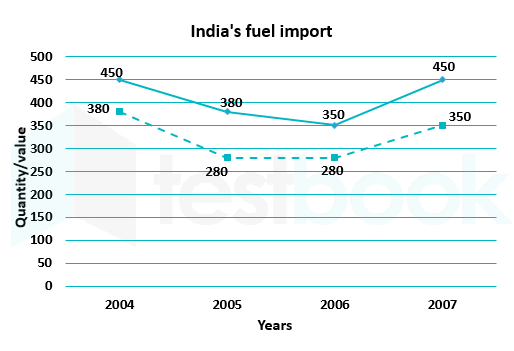
The line graph given below shows India's total quantity of fuel imported (in million tonnes) (dotted line) and the total value of that fuel imported (in USD billion) (solid line) for the year 2004-2007. Study the graph and answer the question.

What was the ratio of the quantity of fuel imported to the value of fuel imported in the year 2006?

  1. AOption (a)

    4 : 6

  2. BOption (b)

    4 : 5

  3. COption (c)

    7 : 9

  4. DOption (d)

    2 : 3

View answer & explanation

Correct answer

Answer: (b)B.

4 : 5

Why this answer is correct

Given:

Values of total quantity of fuel imported (in million tonnes) for the year 2004-2007 = 380, 280, 280, 350

Total value of that fuel imported (in USD billion) (solid line) for the year 2004-2007 = 450, 380, 350, 450

Calculation:

Quantity of fuel imported in 2006 = 280

Value of fuel imported in 2006 = 350

Ratio = 280 : 350

⇒ 4 : 5

∴ Option 2 is the correct answer.

Question 22

A train travels at an average speed of 30 miles per hour for 2½ hours and then travels at a speed of 60 miles per hour for 1½ hours. The total distance (in miles) covered by the train is _________.

  1. AOption (a)

    165

  2. BOption (b)

    135

  3. COption (c)

    90

  4. DOption (d)

    180

View answer & explanation

Correct answer

Answer: (a)A.

165

Why this answer is correct

Shortcut Trick

Total Distance = (Speed1 × Time1) + (Speed2 × Time2)

Distance = (30 × 2.5) + (60 × 1.5)

Distance = 75 + 90 = 165 miles

∴ The correct answer is 165 miles.

Alternate Method

Given:

Speed1 = 30 mph, Time1 = 2½ hours = 2.5 hours

Speed2 = 60 mph, Time2 = 1½ hours = 1.5 hours

Formula Used:

Distance = Speed × Time

Calculations:

⇒ Distance1 = 30 × 2.5 = 75 miles

⇒ Distance2 = 60 × 1.5 = 90 miles

⇒ Total Distance = 75 + 90

⇒ Total Distance = 165 miles

∴ The correct answer is 165 miles.

Additional Information

Average Speed Formula

Average Speed = Total Distance ÷ Total Time. In this case: 165 ÷ 4 = 41.25 mph.

Unit Conversion

To convert miles per hour (mph) to feet per second (fps), multiply by 1.467 or 22/15.

Relative Speed

If two objects move in the same direction, relative speed is S1 − S2; if opposite directions, it is S1 + S2.

Question 23

A shopkeeper offered a machine at a discount of 10% after setting its marked price at 10% above the cost price. His loss percentage is ____________.

  1. AOption (a)

    1%

  2. BOption (b)

    9.8%

  3. COption (c)

    7.8%

  4. DOption (d)

    10%

View answer & explanation

Correct answer

Answer: (a)A.

1%

Why this answer is correct

Shortcut Trick

Net percentage change = a + b + (ab ÷ 100)

Here, a = +10% (markup) and b = −10% (discount).

Net Profit/Loss% = 10 − 10 + (10 × (−10) ÷ 100) = 0 − 100 ÷ 100 = −1%.

The negative sign indicates a loss.

∴ The correct answer is 1%.

Alternate Method

Given → Markup% = 10%, Discount% = 10%. Formulas: SP = CP × (100 + P%) ÷ 100 | MP = CP × (100 + Markup%) ÷ 100 | SP = MP × (100 − D%) ÷ 100

⇒ Let the Cost Price (CP) be 100. ⇒ Marked Price (MP) = 100 + 10% of 100 = 110. ⇒ Selling Price (SP) = 110 − 10% of 110 = 110 − 11 = 99. ⇒ Loss = CP − SP = 100 − 99 = 1. ⇒ Loss Percentage = (1 ÷ 100) × 100 = 1%.

∴ The correct answer is 1%.

Additional Information

Constant Percentage Change

When an item is first increased by x% and then decreased by the same x%, there is always a net loss of (x2 ÷ 100)%.

Markup and Discount Relation

The relationship between CP and MP is given by: MP ÷ CP = (100 + P%) ÷ (100 − D%).

Question 24

A and B can do a piece of work in 12 days and 8 days, respectively. The number of days required to complete the work if both A and B work together is:

  1. AOption (a)

    3.2

  2. BOption (b)

    2.4

  3. COption (c)

    4.8

  4. DOption (d)

    6.4

View answer & explanation

Correct answer

Answer: (c)C.

4.8

Why this answer is correct

Shortcut Trick

Days taken by A = 12 days

Days taken by B = 8 days

Combined days = (Product of days) ÷ (Sum of days)

Combined days = (12 × 8) ÷ (12 + 8) = 96 ÷ 20 = 4.8 days

∴ The correct answer is 4.8 days.

Alternate Method

Given:

Time taken by A = 12 days

Time taken by B = 8 days

Formula Used:

Total Work = LCM of individual days

Efficiency = Total Work ÷ Time Taken

PersonDaysTotal WorkEfficiency
A12242
B83

Calculations:

⇒ Total Efficiency of A + B = 2 + 3 = 5 units/day

⇒ Time taken by A and B together = Total Work ÷ Total Efficiency

⇒ Time = 24 ÷ 5

⇒ Time = 4.8 days

∴ The correct answer is 4.8 days.

Additional Information

Individual Work Formula

If two people work together for T days and one takes X days alone, the other takes (X × T) ÷ (X − T) days.

Work and Wages

Wages are always distributed in the ratio of the efficiencies of the workers if they work for the same duration.

Pipes and Cisterns

This logic applies to pipes where inlet pipes have positive efficiency and outlet (leakage) pipes have negative efficiency.

Question 25

25% of a number is 1320. Find 35% of the same number. 

  1. AOption (a)

    1644

  2. BOption (b)

    1166

  3. COption (c)

    1260

  4. DOption (d)

    1848

View answer & explanation

Correct answer

Answer: (d)D.

1848

Why this answer is correct

Given:

25% of a number is 1320.

Calculation:

Let the number be x.

25% of a number is 1320

⇒ [25 × x]/100 = 1320

⇒ x/4 = 1320

⇒ x = 5280 

Number is 5280.

Now, 35% of 5280

⇒ [35/100] × 5280

⇒ 1848

∴ Option 4 is the correct answer.

Question 26

Which two languages got the Classical language status in 2008?

  1. AOption (a)

    Sanskrit and Malayalam

  2. BOption (b)

    Tamil and Sanskrit

  3. COption (c)

    Malayalam and Odia

  4. DOption (d)

    Kannada and Telugu

View answer & explanation

Correct answer

Answer: (d)D.

Kannada and Telugu

Why this answer is correct

The correct answer is Kannada and Telugu.

Key Points

  • Kannada is a Dravidian language spoken predominantly by people of Karnataka in the southwestern region of India.
  • Telugu is another Dravidian language spoken in the Indian states of Andhra Pradesh and Telangana.
  • Both Kannada and Telugu were given the status of Classical languages in 2008 by the Government of India.
  • Classical language status is granted to languages which have a rich heritage and independent nature, and meet certain criteria set by the Ministry of Culture in India.

Additional Information

  • Classical Language Status
  • The Government of India awards the Classical Language status to languages that have a rich historical and cultural heritage.
  • To be considered for Classical Language status, a language must have a recorded history of over 1500-2000 years, have a body of ancient literature/texts, and possess an original literary tradition that is not borrowed from another speech community.
  • Languages that have been conferred this status receive financial assistance for setting up study centers dedicated to the language and for the development of its literature.
  • Dravidian Languages
  • Dravidian languages form a family of languages spoken mainly in southern India and parts of eastern and central India.
  • There are around 80 languages in this family, with the major ones being Tamil, Telugu, Kannada, and Malayalam.
  • These languages have a distinct script and rich literary traditions dating back several centuries.
  • Kannada
  • Kannada is spoken by approximately 44 million people.
  • The earliest examples of Kannada literature date back to the 9th century.
  • The language has a rich literary tradition with significant contributions in poetry, drama, and prose.
  • Telugu
  • Telugu is spoken by over 75 million people.
  • It is one of the classical languages of India, with a rich literary history that dates back to the 2nd century BCE.
  • Telugu literature has a vast array of works ranging from classical poetry to modern novels and plays.

Question 27

Town F is to the north of Town M. Town B is to the west of Town M. Town C is to the east of Town M. Town D is to the south of Town C. What is the position of Town F with respect to Town D?

  1. AOption (a)

    South - East

  2. BOption (b)

    South - West

  3. COption (c)

    North - West

  4. DOption (d)

    North - East

View answer & explanation

Correct answer

Answer: (c)C.

North - West

Why this answer is correct

According to the given information:

  1. Town F is to the north of Town M.

  2. Town B is to the west of Town M.

  3. Town C is to the east of Town M.

  4. Town D is to the south of Town C.

So, North - West is the position of Town F with respect to Town D.

Hence, the correct answer is "North-West".

Question 28

____________ is a suitable mirror that can be used to focus sunlight to a point.

  1. AOption (a)

    A glass plate

  2. BOption (b)

    A convex mirror

  3. COption (c)

    A plane mirror

  4. DOption (d)

    A concave mirror

View answer & explanation

Correct answer

Answer: (d)D.

A concave mirror

Why this answer is correct

The correct answer is concave mirror.

Key Points

  • A concave mirror has a reflecting surface that bulges inward (away from the incident light).
  • It can converge light rays to a single focal point when the light rays are parallel to the principal axis of the mirror.
  • Concave mirrors are used in applications where light needs to be focused, such as in solar furnaces and reflecting telescopes.
  • The ability to focus light makes concave mirrors suitable for concentrating sunlight onto a small area, increasing the intensity of the light at that point.

Additional Information

  • Glass Plate: A glass plate is typically flat and does not focus light. It is usually used in window panes, photo frames, and for other flat surfaces.
  • Convex Mirror: A convex mirror has a reflecting surface that bulges outward. It diverges light rays and is used in applications like vehicle side mirrors because it provides a wider field of view.
  • Plane Mirror: A plane mirror has a flat reflective surface. It reflects light without converging or diverging it, maintaining the same image size and orientation. Commonly used in household mirrors.
  • Concave Mirror: A concave mirror can focus parallel light rays to a point. This property is utilized in devices like telescopes, headlamps, and solar concentrators.

Question 29

If '+' means '×', '×' means '÷', '÷' means '-', and '-' means '+' then what will be the value of the expression ?

215 × 5 ÷ 4 - 18 × 3

  1. AOption (a)

    86

  2. BOption (b)

    95

  3. COption (c)

    45

  4. DOption (d)

    39

View answer & explanation

Correct answer

Answer: (c)C.

45

Why this answer is correct

Given Equation: 215 × 5 ÷ 4 - 18 × 3

BODMAS Rule:

Decoding the given information:

Symbol+×÷-
Meaning×÷-+


Now replacing the signs and solving from left to right using BODMAS Rule, we get:

⇒ 215 ÷ 5 - 4 + 18 ÷ 3

⇒ 43 - 4 + 6

⇒ 49 - 4 = 45.

Hence, the correct option is "Option 3".

Question 30

Who was the mastermind behind the Arabari Project of West Bengal, which started in 1972?

  1. AOption (a)

    Dr. Rajendra Singh

  2. BOption (b)

    Dr. Sunita Narain

  3. COption (c)

    Sunder lal Bahuguna

  4. DOption (d)

    Dr. AK Banerjee

View answer & explanation

Correct answer

Answer: (d)D.

Dr. AK Banerjee

Why this answer is correct

The correct answer is Dr. AK Banerjee.

Key Points

  • Dr. AK Banerjee was the mastermind behind the Arabari Project in West Bengal, which started in 1972.
  • The Arabari Project aimed at involving the local community in forest management and conservation.
  • It was one of the pioneering projects in India that utilized the concept of Joint Forest Management (JFM).
  • Under Dr. Banerjee's leadership, the project successfully regenerated degraded forests and improved the livelihoods of local communities.

Additional Information

  • Arabari Project
  • The Arabari Project was initiated in the Midnapore district of West Bengal, covering around 1,272 hectares of forest land.
  • The project sought to involve local villagers in forest protection, in return for a share of the benefits derived from the forest resources.
  • This approach marked the beginning of Joint Forest Management (JFM) in India.
  • Joint Forest Management (JFM)
  • JFM is a concept where the local communities are involved in the management and conservation of forests.
  • It aims to enhance forest cover and improve the socio-economic conditions of the local communities.
  • The JFM approach has been recognized as a successful model for forest management in various parts of India.
  • Dr. AK Banerjee
  • Dr. AK Banerjee was a visionary forest officer who believed in the participation of local communities in forest conservation.
  • His work in the Arabari Project is considered a landmark in the history of forest management in India.
  • He demonstrated that sustainable forest management is possible through community involvement and benefit-sharing mechanisms.

Question 31

If the lengths of the sides of a triangle are x + 1, 7 - x and 4x - 2, then the value of x for which the triangle represents an isosceles triangle is ___________.

  1. AOption (a)

    1

  2. BOption (b)

    2.4

  3. COption (c)

    3

  4. DOption (d)

    1.8

View answer & explanation

Correct answer

Answer: (d)D.

1.8

Why this answer is correct

Given:

Length of the sides of an isosceles triangle are x + 1, 7 - x and 4x - 2.

Calculation:

Case I:

Let, (x + 1) and (7 - x) are two equal sides

∴ (x + 1) = (7 - x)

⇒ 2x = 6

⇒ x = 3

∴ Three sides of the triangle are,

⇒ x + 1 = 3 + 1 = 4

⇒ 7 - x = 7 – 3 = 4

⇒ 4x – 2 = 12 – 2 = 10

We can see, 10 > (4 + 4)

∴ This triangle is not possible.

Case II:

Let (4x – 2) and (7 - x) are two equal sides

∴ (4x – 2) = (7 - x)

⇒ 5x = 9

⇒ x = 9/5 = 1.8

∴ Three sides of the triangle are,

⇒ x + 1 = 1.8 + 1 = 2.8

⇒ 7 – x = 7 – 1.8 = 5.2

⇒ 4x – 2 = 7.2 – 2 = 5.2

We can see, 5.2 < (5.2 + 2)

∴ This triangle is possible.

Case III:

Let, (x + 1) and (4x – 2) are two equal sides

∴ (x + 1) = (4x – 2)

⇒ 3x = 3

⇒ x = 1

∴ Three sides of the triangle are,

⇒ x + 1 = 1 + 1 = 2

⇒ 7 – x = 7 – 1 = 6

⇒ 4x – 2 = 4 – 2 = 2

We can see, 6 > (2 + 2)

∴ This triangle is not possible.

∴ 1 such triangle is possible for the value of x =1.8.

∴ Option 4 is the correct answer.

Question 32

Which of the following statements is INCORRECT about plaster of Paris? 

  1. AOption (a)

    It is used for setting fractured bones.

  2. BOption (b)

    It is used in making cosmetics and casts for statues.

  3. COption (c)

    It is also known as calcium sulphate dihydrate.

  4. DOption (d)

    It is used for making surfaces smooth before painting.

View answer & explanation

Correct answer

Answer: (c)C.

It is also known as calcium sulphate dihydrate.

Why this answer is correct

The correct answer is It is also known as calcium sulphate dihydrate.

Key Points

  • Plaster of Paris is chemically known as calcium sulphate hemihydrate (CaSO₄·½H₂O), not calcium sulphate dihydrate.
  • It is widely used in the medical field for setting fractured bones because it quickly sets and forms a hard, stable structure.
  • Plaster of Paris is also utilized in the arts for making sculptures and casts due to its easy moldability.
  • Another common use of Plaster of Paris is in preparing surfaces for painting, as it can be applied to create a smooth, even finish.

Additional Information

  • Plaster of Paris (POP)
  • Plaster of Paris is a quick-setting gypsum plaster consisting of a fine white powder (calcium sulfate hemihydrate), which hardens when moistened and allowed to dry.
  • It is obtained by heating gypsum (calcium sulfate dihydrate) to about 150°C (300°F).
  • When mixed with water, the powder forms a paste that liberates heat and then hardens into a solid, stable mass.
  • Calcium Sulphate Dihydrate (Gypsum)
  • Gypsum is a soft sulfate mineral composed of calcium sulfate dihydrate (CaSO₄·2H₂O).
  • It is widely used as a fertilizer, in mold making for ceramics, and as a plaster material in construction.
  • It naturally occurs in sedimentary rocks and is often found in large beds associated with other evaporite minerals.
  • Uses of Plaster of Paris
  • Medical applications: Used to form casts around broken bones to immobilize them during healing.
  • Art: Utilized in creating sculptures, decorative items, and casts.
  • Construction: Used to coat walls and ceilings before painting to achieve a smooth finish.
  • Crafts: Employed in various DIY projects for making molds and small figures.

Question 33

Which of the following is a Middle Indian dialect that is closely related to Sanskrit, and is one of the major languages of Buddhist scriptures and literature?

  1. AOption (a)

    Saraiki

  2. BOption (b)

    Pali

  3. COption (c)

    Paisaci

  4. DOption (d)

    Varhadi

View answer & explanation

Correct answer

Answer: (b)B.

Pali

Why this answer is correct

The correct answer is Pali.

Key Points

  • Pali is an ancient Middle Indian language that is closely related to Sanskrit.
  • It is the language in which the earliest Buddhist scriptures, known as the Pali Canon or Tipitaka, were composed.
  • Pali is considered a significant liturgical language in Theravada Buddhism, which is practiced primarily in Sri Lanka, Thailand, Burma, Laos, and Cambodia.
  • Although Pali is not spoken as a native language today, it is still studied and used in religious contexts by Buddhist monks and scholars.

Additional Information

  • Sanskrit
  • Sanskrit is an ancient Indo-European language of India, in which the Hindu scriptures and classical Indian epic poems are written.
  • It is also the liturgical language of Hinduism, Buddhism, and Jainism.
  • Many modern Indian languages are derived from Sanskrit.
  • Middle Indo-Aryan languages
  • The Middle Indo-Aryan (MIA) languages, also known as Prakrits, are a group of languages that evolved from Old Indo-Aryan languages like Sanskrit.
  • These languages were spoken and written in the Indian subcontinent between 600 BCE and 1000 CE.
  • Examples include Pali, Ardhamagadhi, and Maharashtri.
  • Pali Canon (Tipitaka)
  • The Pali Canon, also known as the Tipitaka, is the collection of primary scriptures in Theravada Buddhism.
  • It is divided into three "baskets" (pitakas): the Vinaya Pitaka (monastic rules), the Sutta Pitaka (discourses), and the Abhidhamma Pitaka (philosophical and doctrinal analysis).
  • These texts form the doctrinal foundation of Theravada Buddhism.
  • Theravada Buddhism
  • Theravada Buddhism, meaning "Teaching of the Elders," is the oldest surviving Buddhist school.
  • It emphasizes the teachings of the Pali Canon and the practice of meditation and ethical conduct.
  • It is the dominant form of Buddhism in Sri Lanka, Thailand, Burma, Laos, and Cambodia.

Question 34

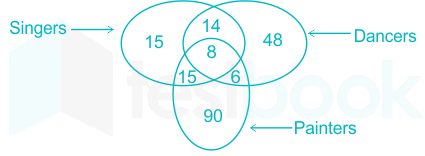
Study the given diagram carefully and answer the question. The numbers in different sections indicate the number of persons.

How many people are Singers as well Dancers but not Painters?

  1. AOption (a)

    15

  2. BOption (b)

    14

  3. COption (c)

    8

  4. DOption (d)

    22

View answer & explanation

Correct answer

Answer: (b)B.

14

Why this answer is correct

According to the given information:

The shaded part represents people are Singers as well Dancers but not Painters.

So, people are Singers as well Dancers but not Painters = 14

Hence, the correct answer is "14".

Question 35

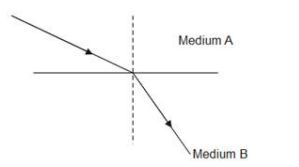
The path of a ray of light incident on an interface separating two transparent media is shown in the figure. The refractive index (n) of medium B with respect to medium A is given by:

  1. AOption (a)

    0 < n < 1

  2. BOption (b)

    n = 1

  3. COption (c)

    n > 1

  4. DOption (d)

    n = 0

View answer & explanation

Correct answer

Answer: (c)C.

n > 1

Why this answer is correct

The correct answer is n > 1.

Key Points

  • The refractive index (n) of a medium is a measure of how much the speed of light is reduced inside the medium compared to its speed in a vacuum.
  • When light travels from a medium with a lower refractive index (such as air) to a medium with a higher refractive index (such as water), it bends towards the normal line at the interface.
  • The condition n > 1 indicates that medium B is optically denser than medium A, causing the light ray to bend towards the normal.
  • This bending is described by Snell's Law, which relates the angles and the refractive indices of the two media.

Additional Information

  • Snell's Law:
  • Snell's Law states that the ratio of the sine of the angle of incidence (θ₁) to the sine of the angle of refraction (θ₂) is constant for light passing between two given media. This is expressed as: n₁ * sin(θ₁) = n₂ * sin(θ₂).
  • Here, n₁ and n₂ are the refractive indices of medium A and medium B, respectively.
  • Refractive Index:
  • The refractive index of a medium is defined as the ratio of the speed of light in a vacuum (c) to the speed of light in the medium (v), given by n = c/v.
  • A higher refractive index indicates that light travels more slowly in the medium.
  • Optical Density:
  • Optical density is a measure of how much a medium can slow down light. A medium with a higher refractive index is considered optically denser.
  • When light enters an optically denser medium, it slows down and bends towards the normal line.
  • Normal Line:
  • The normal line is an imaginary line perpendicular to the surface at the point of incidence where the light ray hits the interface between two media.
  • Light rays bend towards the normal when entering a denser medium and away from the normal when entering a less dense medium.

Question 36

In this question, the statement is followed by four conclusions. Find out which conclusion is true based on the given statement.

Statement: Z < X ≥ U = Y < V ≤ W

  1. AOption (a)

    Z > X

  2. BOption (b)

    V > U

  3. COption (c)

    Y > W

  4. DOption (d)

    X < Y

View answer & explanation

Correct answer

Answer: (b)B.

V > U

Why this answer is correct

Given Statement: Z < X ≥ U = Y < V ≤ W

Now,

Conclusions:

Option 1: Z > X → False (Z < X It gives Z < X)

Option 2: V > U → True (U = Y < V It gives V > U)

Option 3: Y > W → False (Y < V ≤ W It gives Y < W)

Option 4: X < Y → False (X ≥ U = Y It gives X ≥ Y)

Hence, the correct answer is "Option 2".

Question 37

Which of the following is the Modern Periodic Law?

  1. AOption (a)

    'Properties of elements are a periodic function of their atomic number'.

  2. BOption (b)

    'Properties of elements are a periodic function of their melting points'.

  3. COption (c)

    'Properties of elements are a periodic function of their boiling points'.

  4. DOption (d)

    'Properties of elements are a periodic function of their atomic mass'.

View answer & explanation

Correct answer

Answer: (a)A.

'Properties of elements are a periodic function of their atomic number'.

Why this answer is correct

The correct answer is 'Properties of elements are a periodic function of their atomic number'..

Key Points

  • The Modern Periodic Law states that the properties of elements are a periodic function of their atomic number, not their atomic mass, melting points, or boiling points.
  • This law was formulated after the discovery of the atomic number, which is the number of protons in the nucleus of an atom.
  • Henry Moseley, in 1913, established that the atomic number is the more fundamental property compared to atomic mass for the arrangement of elements.
  • The modern periodic table is therefore arranged in order of increasing atomic number, which corrects inconsistencies observed in the Mendeleev’s periodic table that was based on atomic mass.

Additional Information

  • Atomic Number
  • The atomic number is the number of protons in the nucleus of an atom and determines the chemical properties of an element and its place in the periodic table.
  • It is denoted by the symbol 'Z'.
  • Periodic Table
  • The periodic table is a tabular arrangement of the chemical elements, organized on the basis of their atomic numbers, electron configurations, and recurring chemical properties.
  • Elements are presented in order of increasing atomic number, which corresponds to the number of protons in the nucleus of an atom.
  • Mendeleev's Periodic Law
  • Dmitri Mendeleev, a Russian chemist, first devised a periodic table based on atomic mass in 1869, known as Mendeleev's Periodic Law.
  • According to Mendeleev's Periodic Law, the properties of elements are a periodic function of their atomic masses.
  • However, this arrangement left certain anomalies which were later corrected by the Modern Periodic Law.
  • Henry Moseley
  • Henry Moseley was an English physicist who, in 1913, discovered a systematic relationship between wave-length and atomic number.
  • His work resulted in the more accurate positioning of elements in the periodic table by atomic number, leading to the formulation of the Modern Periodic Law.

Question 38

If 1960.196=19.6n\frac{196}{0.196}=\frac{19.6}{n}, then the value of n = ___________.

  1. AOption (a)

    1.96

  2. BOption (b)

    0.00196

  3. COption (c)

    0.196

  4. DOption (d)

    0.0196

View answer & explanation

Correct answer

Answer: (d)D.

0.0196

Why this answer is correct

Shortcut Trick

Observe the decimal shifts: 196 → 19.6 (1 decimal place left).

Apply the same shift to the denominator: 0.196 → 0.0196 (1 decimal place left).

∴ The correct answer is 0.0196.

Alternate Method

Given: 196 ÷ 0.196 = 19.6 ÷ n

Formula Used: Cross-multiplication and decimal manipulation.

⇒ 196 × n = 19.6 × 0.196

⇒ n = (19.6 × 0.196) ÷ 196

⇒ n = (196 × 10−1 × 196 × 10−3) ÷ 196

⇒ n = 196 × 10−4

⇒ n = 0.0196

∴ The correct answer is 0.0196.

Additional Information

Decimal Division Rule

When dividing by a decimal, multiply both numerator and denominator by powers of 10 to make the divisor an integer.

Proportionality Rule

In an equation a/b = c/d, if a is multiplied by k to get c, then b must be multiplied by k to get d (d = b × k).

Question 39

Find the cost of tiling the verandah, at the rate of Rs. 24 per m2, if the length and breadth of the verandah are in the ratio 3 : 1 and its perimeter is 40 m.

  1. AOption (a)

    Rs. 1,600

  2. BOption (b)

    Rs. 1,800

  3. COption (c)

    Rs. 1,700

  4. DOption (d)

    Rs. 1,900

View answer & explanation

Correct answer

Answer: (b)B.

Rs. 1,800

Why this answer is correct

Shortcut Trick

Ratio of length (L) and breadth (B) is 3 : 1 → sum of parts = 4.

Perimeter (2 × sum of L+B parts) = 2 × 4 = 8 units → 40 m.

1 unit = 5 m ∴ L = 15 m and B = 5 m.

Area = 15 × 5 = 75 m2.

Total Cost = 75 × ₹24 = ₹1,800.

∴ The correct answer is ₹1,800.

Alternate Method

Given:

Ratio of Length (L) : Breadth (B) = 3 : 1

Perimeter = 40 m

Rate of tiling = ₹24 per m2

Let the Length be 3x and Breadth be x.

⇒ Perimeter = 2(L + B) = 40

⇒ 2(3x + x) = 40

⇒ 2(4x) = 40

⇒ 8x = 40

⇒ x = 5 m

⇒ Length = 3 × 5 = 15 m

⇒ Breadth = 1 × 5 = 5 m

⇒ Area of Verandah = L × B = 15 × 5 = 75 m2

⇒ Cost of tiling = Area × Rate = 75 × 24

⇒ Cost = ₹1,800

∴ The correct answer is ₹1,800.

Additional Information

Perimeter of Rectangle

The total boundary of a rectangle is given by 2 × (Length + Breadth).

Area of Rectangle

The space occupied within the boundaries is Length × Breadth (measured in sq. units).

Cost Calculation

Total Cost = Total Quantity (Area/Length/Volume) × Rate per unit quantity.

Question 40

Which of the following numbers will replace the question mark (?) in the given series?

14, 18, 26, 38, 54, ?

  1. AOption (a)

    72

  2. BOption (b)

    78

  3. COption (c)

    74

  4. DOption (d)

    70

View answer & explanation

Correct answer

Answer: (c)C.

74

Why this answer is correct

The logic followed here is:


Hence, the correct answer is "74".

Question 41

Conversion of energy in electric motor is: 

  1. AOption (a)

    Mechanical energy to electrical energy

  2. BOption (b)

    Electrical energy to heat energy

  3. COption (c)

    Electrical energy to mechanical energy

  4. DOption (d)

    Sunlight to electrical energy

View answer & explanation

Correct answer

Answer: (c)C.

Electrical energy to mechanical energy

Why this answer is correct

The correct answer is Electrical energy to mechanical energy.

Key Points

  • An electric motor converts electrical energy into mechanical energy.
  • This conversion is achieved through the interaction of magnetic fields and current-carrying conductors.
  • Electric motors are extensively used in various applications, including industrial machinery, household appliances, and electric vehicles.
  • The efficiency of electric motors can vary based on design and application, but modern motors are highly efficient.

Additional Information

  • Electrical Energy
  • Electrical energy is the energy derived from electric potential energy or kinetic energy. This energy is supplied by the movement of electrons from one atom to another.
  • It is used extensively in modern technology, from powering homes to running complex machinery in industries.
  • Mechanical Energy
  • Mechanical energy is the sum of potential energy and kinetic energy. It is the energy associated with the motion and position of an object.
  • This type of energy is crucial for performing mechanical work.
  • Electric Motors
  • Electric motors are devices that convert electrical energy into mechanical energy.They operate on the principle of electromagnetism, where an electric current flowing through a wire coil creates a magnetic field that interacts with a permanent magnet or another magnetic field, producing motion.
  • There are various types of electric motors, including AC motors, DC motors, and stepper motors, each suited for different applications.
  • Applications of Electric Motors
  • Electric motors are used in a wide range of applications, from small household appliances like fans and mixers to large industrial machines and electric vehicles.
  • They play a crucial role in automation and robotics, contributing significantly to modern manufacturing processes.

Question 42

If an object is placed 36 cm in front of a concave mirror of focal length 18 cm, then its image will be formed __________.

  1. AOption (a)

    at 36 cm in front of the mirror

  2. BOption (b)

    at 18 cm behind the mirror

  3. COption (c)

    at 18 cm in front of the mirror

  4. DOption (d)

    at 36 cm behind the mirror

View answer & explanation

Correct answer

Answer: (a)A.

at 36 cm in front of the mirror

Why this answer is correct

The correct answer is at 36 cm in front of the mirror.

Key Points

  • The focal length (f) of the concave mirror is given as 18 cm.
  • The object distance (u) is given as -36 cm (negative as per sign convention).
  • Using the mirror formula: 1/f = 1/v + 1/u.
  • Substituting the known values: 1/18 = 1/v - 1/36, solving this gives v = -36 cm (negative sign indicates that the image is formed in front of the mirror).

Additional Information

  • Concave Mirror:
  • A concave mirror is a spherical mirror that has a reflecting surface that bulges inward.
  • It converges light to a point in front of the mirror, which is why it is also called a converging mirror.
  • It is used in applications where focusing light is necessary, such as in telescopes, vehicle headlights, and shaving mirrors.
  • Mirror Formula:
  • The mirror formula is given by the equation: 1/f = 1/v + 1/u, where f is the focal length, v is the image distance, and u is the object distance.
  • According to the sign convention, all distances are measured from the pole of the mirror. Distances measured in the direction of the incident light are taken as positive, and those measured against the direction of the incident light are taken as negative.
  • This formula is essential in determining the position and nature (real or virtual) of the image formed by spherical mirrors.
  • Sign Convention:
  • For mirrors, the object distance (u) is always negative since the object is placed in front of the mirror.
  • The focal length (f) is negative for concave mirrors and positive for convex mirrors.
  • The image distance (v) is positive if the image is formed behind the mirror (virtual image) and negative if the image is formed in front of the mirror (real image).
  • Image Formation by Concave Mirror:
  • If the object is placed at the center of curvature (C), the image is formed at C, is real, inverted, and of the same size as the object.
  • If the object is placed between the center of curvature (C) and the focal point (F), the image is formed beyond C, is real, inverted, and larger than the object.
  • If the object is placed beyond the center of curvature (C), the image is formed between C and F, is real, inverted, and smaller than the object.

Question 43

Alok starts from Point B and drives 5 km towards the north. He then takes a right turn, drives 10 km, turns right and drives 5 km. He takes a final right turn, drives 3 km and stops at Point X. How far and towards which direction should he drive in order to reach Point B from Point X? (All turns are 90 degree turns only)

  1. AOption (a)

    5 km towards the east

  2. BOption (b)

    7 km towards the east

  3. COption (c)

    6 km towards the west

  4. DOption (d)

    7 km towards the west

View answer & explanation

Correct answer

Answer: (d)D.

7 km towards the west

Why this answer is correct

According to the given information:

Alok starts from Point B and drives 5 km towards the north.

He then takes a right turn, drives 10 km, turns right and drives 5 km.

He takes a final right turn, drives 3 km and stops at Point X.

Final arrangement:

Thus, Point B is in 7 km towards the west from Point X.

Hence, the correct answer is "7 km towards the west".

Question 44

Five persons are sitting in a straight row, facing North. K and N are sitting at the two extreme ends. R is sitting to the immediate left of L. M is sitting to the immediate left of N. K and L are the immediate neighbours of R. What is R's position when counted from the extreme left end?

  1. AOption (a)

    Second

  2. BOption (b)

    Fifth

  3. COption (c)

    Fourth

  4. DOption (d)

    Third

View answer & explanation

Correct answer

Answer: (a)A.

Second

Why this answer is correct

Given: Five persons are sitting in a straight row, facing North.

K and N are sitting at the two extreme ends.

M is sitting to the immediate left of N.

R is sitting to the immediate left of L.

K and L are the immediate neighbours of R.

Final arrangement:

So, R's position when counted from the extreme left end is Second.

Hence, the correct answer is "Second".

Question 45

Which of the following terms will replace the question mark (?) in the given series to make it logically complete?

ZRW21, XPU25, VNS29, TLQ33, ?

  1. AOption (a)

    OPJ36

  2. BOption (b)

    JRO37

  3. COption (c)

    ORJ37

  4. DOption (d)

    RJO37

View answer & explanation

Correct answer

Answer: (d)D.

RJO37

Why this answer is correct

The logic followed here is:

Hence, the correct answer is "RJO37".

Question 46

If the interest on a sum of Rs. y at 4% per annum compounded annually for 2 years is ₹612, then the total amount payable at the end of the two-year period will be _________.

  1. AOption (a)

    Rs. 8,112

  2. BOption (b)

    Rs. 8,262

  3. COption (c)

    Rs. 8,002

  4. DOption (d)

    Rs. 7,812

View answer & explanation

Correct answer

Answer: (a)A.

Rs. 8,112

Why this answer is correct

Shortcut Trick

Effective Compound Interest Rate for 2 years = 4 + 4 + (4 × 4) ÷ 100 = 8.16%

Given Compound Interest = 8.16% of y = ₹612

Total Amount = 100% (Principal) + 8.16% (Interest) = 108.16%

Value of Amount = (612 ÷ 8.16) × 108.16 = 75 × 108.16 = ₹8,112

∴ The correct answer is ₹8,112.

Alternate Method

Given: Principal (P) = ₹y, Rate (R) = 4% p.a., Time (n) = 2 years, Compound Interest (CI) = ₹612.

Formula Used: CI = P[(1 + R ÷ 100)n − 1] and Amount (A) = P + CI

⇒ 612 = y[(1 + 4 ÷ 100)2 − 1]

⇒ 612 = y[(1 + 1 ÷ 25)2 − 1]

⇒ 612 = y[(26 ÷ 25)2 − 1]

⇒ 612 = y[676 ÷ 625 − 1]

⇒ 612 = y[(676 − 625) ÷ 625]

⇒ 612 = y[51 ÷ 625]

⇒ y = (612 × 625) ÷ 51

⇒ y = 12 × 625 = 7,500

⇒ Total Amount = Principal (y) + Interest = 7,500 + 612 = 8,112

∴ The correct answer is ₹8,112.

Additional Information

Effective Rate of Compound Interest

For a rate R% for 2 years, the effective interest rate is calculated as R + R + (R × R) ÷ 100.

Difference between CI and SI

The difference (D) between Compound Interest and Simple Interest for 2 years is given by D = P × (R ÷ 100)2.

Amount Formula

The total Amount (A) in compound interest is A = P × (1 + R ÷ 100)n, where n is the number of years.

Question 47

If the number of turns in a solenoid increases, then:

  1. AOption (a)

    magnetic field increases

  2. BOption (b)

    magnetic field decreases to zero

  3. COption (c)

    magnetic field remains constant

  4. DOption (d)

    magnetic field decreases

View answer & explanation

Correct answer

Answer: (a)A.

magnetic field increases

Why this answer is correct

The correct answer is magnetic field increases.

Key Points

  • A solenoid is a coil of wire that generates a magnetic field when an electric current passes through it.
  • The magnetic field inside a solenoid is directly proportional to the number of turns per unit length of the coil.
  • Increasing the number of turns increases the number of magnetic field lines per unit length, thereby increasing the strength of the magnetic field.
  • This effect is due to the principle of superposition of magnetic fields created by each individual loop of the solenoid.

Additional Information

  • Solenoid:
  • A solenoid is a type of electromagnet formed by a helical coil of wire through which an electric current flows.
  • It generates a uniform magnetic field in a volume of space when a current passes through it.
  • Solenoids are used in a variety of applications including electromagnets, inductors, transformers, and valves.
  • Magnetic Field:
  • A magnetic field is a vector field that describes the magnetic influence on moving electric charges, electric currents, and magnetic materials.
  • Magnetic fields are generated by electric currents, which can be macroscopic currents in wires or microscopic currents associated with electrons in atomic orbits.
  • Electromagnetism:
  • Electromagnetism is a branch of physics that deals with the study of electromagnetic forces, a type of physical interaction that occurs between electrically charged particles.
  • This force is described by electromagnetic fields, which include electric fields and magnetic fields.

Question 48

What happens when a pencil is immersed in water?

  1. AOption (a)

    Pencil appears bent

  2. BOption (b)

    Colour of pencil changes

  3. COption (c)

    Pencil looks curved

  4. DOption (d)

    Pencil appears bright

View answer & explanation

Correct answer

Answer: (a)A.

Pencil appears bent

Why this answer is correct

The correct answer is Pencil appears bent.

Key Points

  • When a pencil is immersed in water, it appears bent due to the phenomenon of refraction of light.
  • Refraction occurs because light travels at different speeds in different mediums, such as air and water.
  • The pencil looks bent at the point where it enters the water because light rays bend as they pass from water to air, creating an optical illusion.
  • This bending of light rays makes the submerged part of the pencil appear at a different position compared to the part that is above water.

Additional Information

  • Refraction
  • Refraction is the change in direction of a wave passing from one medium to another caused by its change in speed.
  • When light travels from a less dense medium (like air) to a denser medium (like water), it slows down and bends towards the normal line (an imaginary line perpendicular to the surface).
  • Conversely, when light travels from a denser medium to a less dense medium, it speeds up and bends away from the normal line.
  • The amount by which the light bends depends on the refractive indices of the two media.
  • Optical Illusion
  • An optical illusion occurs when the information gathered by the eye is processed by the brain to give a perception that does not match the physical reality.
  • The bending of the pencil in water is a classic example of an optical illusion caused by refraction.
  • Refractive Index
  • The refractive index of a medium is a measure of how much the speed of light is reduced inside the medium.
  • It is defined as the ratio of the speed of light in a vacuum to the speed of light in the medium.
  • For example, the refractive index of water is approximately 1.33, meaning light travels 1.33 times slower in water than in a vacuum.
  • Snell's Law
  • Snell's Law relates the angle of incidence and the angle of refraction to the refractive indices of the two media.
  • It is given by the equation: n1 * sin(θ1) = n2 * sin(θ2), where n1 and n2 are the refractive indices of the two media, and θ1 and θ2 are the angles of incidence and refraction, respectively.

Question 49

An electric transformer works on the principle of: 

  1. AOption (a)

    Ohm's law

  2. BOption (b)

    photoelectric effect

  3. COption (c)

    Joule's heating effect

  4. DOption (d)

    electromagnetic induction

View answer & explanation

Correct answer

Answer: (d)D.

electromagnetic induction

Why this answer is correct

The correct answer is electromagnetic induction.

Key Points

  • Electromagnetic induction is the process of generating an electric current from the movement of a conductor through a magnetic field.
  • An electric transformer uses electromagnetic induction to transfer electrical energy between two or more circuits through inductively coupled conductors.
  • This principle was discovered by Michael Faraday in 1831.
  • Transformers are essential in the transmission and distribution of electrical energy across long distances.

Additional Information

  • Ohm's Law
  • Ohm's Law states that the current passing through a conductor between two points is directly proportional to the voltage across the two points.
  • It is usually formulated as V = IR, where V is the voltage, I is the current, and R is the resistance.
  • Ohm's Law is fundamental in understanding electrical circuits but does not explain the working of transformers.
  • Photoelectric Effect
  • The photoelectric effect is the emission of electrons when light shines on a material.
  • This phenomenon was explained by Albert Einstein, which supported the quantum theory of light.
  • The photoelectric effect is crucial for understanding semiconductor devices but is unrelated to transformers.
  • Joule's Heating Effect
  • Joule's heating effect states that the heat produced in a conductor is directly proportional to the square of the current, the resistance, and the time the current flows through the conductor.
  • It is formulated as H = I²Rt, where H is the heat energy, I is the current, R is the resistance, and t is the time.
  • This effect is important in resistive heating devices but does not explain how transformers work.
  • Electromagnetic Induction
  • Electromagnetic induction involves generating an electric current by changing the magnetic field around a conductor.
  • This principle is exploited in transformers, electric generators, and inductors.
  • Transformers use this principle to change the voltage level of alternating current (AC) in power transmission.
  • Faraday's Law of Induction quantifies this process, stating that the induced voltage is proportional to the rate of change of the magnetic flux.

Question 50

How many Indian Institutes of Technology were started under the First Five-Year Plan?

  1. AOption (a)

    Four

  2. BOption (b)

    Three

  3. COption (c)

    Five

  4. DOption (d)

    Two

View answer & explanation

Correct answer

Answer: (c)C.

Five

Why this answer is correct

The correct answer is Five.

Key Points

  • During the First Five-Year Plan in India, five Indian Institutes of Technology (IITs) were established to promote higher technical education and research.
  • The first IIT was established in Kharagpur in 1951, which set the precedent for others to follow.
  • Subsequently, four more IITs were established in Bombay (1958), Madras (1959), Kanpur (1959), and Delhi (1961).
  • The IITs were modeled after the Massachusetts Institute of Technology (MIT) and were intended to train scientists and engineers to support India's economic and industrial development.

Additional Information

  • First Five-Year Plan (1951-1956)
  • The First Five-Year Plan was launched in 1951 by India's first Prime Minister, Jawaharlal Nehru.
  • The plan focused on the agriculture sector, aiming to enhance food production and reduce import dependency.
  • It aimed to address the immediate need for food security, employment, and infrastructure development in the country.
  • The successful implementation of this plan laid the foundation for subsequent economic planning and development in India.
  • Indian Institutes of Technology (IITs)
  • IITs are autonomous public technical and research universities located across India.
  • They are governed by the Institutes of Technology Act, 1961 which declares them as institutions of national importance.
  • IITs offer undergraduate, postgraduate, and doctoral programs in various engineering, technology, science, and management disciplines.
  • They are known for their rigorous academic standards, world-class faculty, and significant contributions to research and innovation.
  • Technical Education in India
  • Technical education in India encompasses training and education in the fields of engineering, technology, applied sciences, and management.
  • Institutions such as IITs, National Institutes of Technology (NITs), and Indian Institutes of Information Technology (IIITs) play a pivotal role in this domain.
  • These institutions aim to provide quality education, foster research and innovation, and contribute to the technological and economic advancement of the country.
  • The emphasis is on creating a skilled workforce that can meet the demands of industry and drive the nation's growth.

Question 51

As of August 2022, which Article of the Constitution of India says “No child below the age of fourteen years shall be employed to work in any factory or mine or engaged in any other hazardous employment"?

  1. AOption (a)

    Article 32

  2. BOption (b)

    Article 19

  3. COption (c)

    Article 27

  4. DOption (d)

    Article 24

View answer & explanation

Correct answer

Answer: (d)D.

Article 24

Why this answer is correct

The correct answer is Article 24.

Key Points

  • Article 24 of the Indian Constitution expressly prohibits the employment of children below the age of fourteen years in any factory, mine, or other hazardous employment.
  • This provision aims to protect children from exploitation and to ensure their right to education and healthy development.
  • It is part of the Fundamental Rights enshrined in Part III of the Indian Constitution, which ensures the protection of various rights of citizens.
  • The enforcement of Article 24 is crucial to combat child labor and promote the welfare of children across India.

Additional Information

  • Constitution of India:
  • The Constitution of India is the supreme law of India, laying down the framework that defines the political principles, establishes the structure, procedures, powers, and duties of government institutions, and sets out fundamental rights, directive principles, and the duties of citizens.
  • It was adopted by the Constituent Assembly on 26 November 1949 and came into effect on 26 January 1950.
  • The Constitution is the longest written constitution of any country in the world.
  • Fundamental Rights:
  • Fundamental Rights are a set of rights that are recognized by the Supreme Court as requiring a high degree of protection from government encroachment.
  • These rights are enshrined in Part III of the Indian Constitution and include the right to equality, the right to freedom, the right against exploitation, the right to freedom of religion, cultural and educational rights, and the right to constitutional remedies.
  • Article 24 falls under the right against exploitation, which aims to prevent exploitation and human trafficking.
  • Child Labor in India:
  • Child labor refers to the employment of children in any work that deprives children of their childhood, interferes with their ability to attend regular school, and is mentally, physically, socially or morally harmful.
  • Despite legal provisions, child labor remains a significant issue in India due to various socio-economic factors.
  • Efforts to combat child labor include strict enforcement of laws, awareness campaigns, and educational initiatives.
  • International Conventions:
  • India is a signatory to several international conventions aimed at protecting children's rights, such as the United Nations Convention on the Rights of the Child (UNCRC) and International Labour Organization (ILO) Conventions.
  • These conventions emphasize the importance of safeguarding children from exploitative labor and ensuring their right to education and development.

Question 52

In the given double displacement reaction, identify the products X and Y.

Pb(NO3)2 (aq) + 2KI (aq) → X + Y

  1. AOption (a)

    PbI2 (S) + 2KNO3 (aq)

  2. BOption (b)

    No reaction occurs

  3. COption (c)

    PbI2 + HNO3

  4. DOption (d)

    PbI2 (s) + KCI (S)

View answer & explanation

Correct answer

Answer: (a)A.

PbI2 (S) + 2KNO3 (aq)

Why this answer is correct

The correct answer is PbI2 (S) + 2KNO3 (aq).

Key Points

  • In a double displacement reaction, the ions of two compounds exchange places to form two new compounds.
  • The reaction between lead(II) nitrate (Pb(NO3)2) and potassium iodide (KI) is a classic example of a double displacement reaction.
  • The products of this reaction are lead(II) iodide (PbI2), which precipitates out as a yellow solid (s), and potassium nitrate (KNO3), which remains dissolved in water (aq).
  • The balanced chemical equation for this reaction is:

Pb(NO3)2 (aq) + 2KI (aq) → PbI2 (s) + 2KNO3 (aq)

Additional Information

  • Double Displacement Reaction
  • Also known as a double replacement reaction, it involves the exchange of ions between two compounds to form new compounds.
  • These reactions generally occur in aqueous solutions where the ions are free to move and interact.
  • Common examples include precipitation reactions, where an insoluble solid (precipitate) forms, and neutralization reactions between acids and bases.
  • Precipitation Reaction
  • A type of chemical reaction where an insoluble solid (precipitate) forms and separates from the solution.
  • In the given reaction, PbI2 is the precipitate that forms.
  • Precipitation reactions are often used in qualitative analysis to identify the presence of certain ions in a solution.
  • Aqueous Solutions
  • Solutions where water is the solvent.
  • In aqueous solutions, ionic compounds dissociate into their constituent ions, which can then participate in chemical reactions.
  • The solubility of substances in water varies, and this property is crucial for predicting the outcomes of double displacement reactions.

Question 53

Select the option that is related to the fifth letter-cluster in the same way as the second letter-cluster is related to the first letter-cluster and the fourth letter-cluster is related to the third letter-cluster.

TXB : QWE : : REA : ODD : : DUW : ?

  1. AOption (a)

    ATX

  2. BOption (b)

    ATZ

  3. COption (c)

    BTZ

  4. DOption (d)

    AQX

View answer & explanation

Correct answer

Answer: (b)B.

ATZ

Why this answer is correct

The logic followed here is:

TXB : QWE

REA : ODD


Similarly, DUW : ? 

Hence, the correct answer is "ATZ".

Question 54

An alloy is made of aluminium and nickel in the ratio 3 : 4. The quantity (in kg) of nickel required to be melted with 36 kg of aluminium is __________.

  1. AOption (a)

    32

  2. BOption (b)

    48

  3. COption (c)

    18

  4. DOption (d)

    3

View answer & explanation

Correct answer

Answer: (b)B.

48

Why this answer is correct

Shortcut Trick

Ratio of Aluminium to Nickel = 3 : 4.

Given, 3 units of Aluminium = 36 kg.

⇒ 1 unit = 36 ÷ 3 = 12 kg.

⇒ Nickel (4 units) = 4 × 12 = 48 kg.

∴ The correct answer is 48 kg.

Alternate Method

Given:

Ratio of Aluminium and Nickel = 3 : 4

Weight of Aluminium = 36 kg

Calculations:

⇒ Let the quantity of Aluminium be 3x and Nickel be 4x.

⇒ 3x = 36

⇒ x = 36 ÷ 3

⇒ x = 12

⇒ Quantity of Nickel = 4x

⇒ Quantity of Nickel = 4 × 12 = 48 kg

∴ The correct answer is 48 kg.

Additional Information

Ratio and Proportion

If A : B = x : y and the value of A is given, then B = (Value of A ÷ x) × y.

Compound Ratio

The compound ratio of (a : b) and (c : d) is (ac : bd).

Invertendo

If a : b = c : d, then b : a = d : c.

Question 55

In a row of people all facing north, Mohit is at 20th position from the extreme left end and 30th from the extreme right end of the row. How many people are there in the row?

  1. AOption (a)

    40

  2. BOption (b)

    39

  3. COption (c)

    50

  4. DOption (d)

    49

View answer & explanation

Correct answer

Answer: (d)D.

49

Why this answer is correct

The logic followed here is:

Position of Mohit from the left = 20th

Position of Mohit from the right = 30th

So,

Total number of people = Position of Mohit from the left + Position of Mohit from the right - 1

= 20 + 30 - 1

= 50 - 1 = 49.

Hence, the correct answer is "Option 4".

Question 56

Nitu Ghangas won Gold in which sport at the Commonwealth Games 2022? 

  1. AOption (a)

    Boxing

  2. BOption (b)

    Athletics

  3. COption (c)

    Wrestling

  4. DOption (d)

    Judo

View answer & explanation

Correct answer

Answer: (a)A.

Boxing

Why this answer is correct

The correct answer is Boxing.

Key Points

  • Nitu Ghangas is an Indian boxer who clinched the gold medal at the Commonwealth Games 2022.
  • She competed in the Women's Minimumweight (45-48kg) category.
  • Her victory is significant as it adds to India's prestigious history in boxing at the Commonwealth Games.
  • Her achievement highlights the growing prominence of women in Indian sports, especially in traditionally male-dominated fields like boxing.

Additional Information

  • Commonwealth Games:
  • The Commonwealth Games is an international multi-sport event involving athletes from the Commonwealth of Nations.
  • The event was first held in 1930 and takes place every four years.
  • It is one of the world's largest multi-sport events, showcasing a wide array of sports including athletics, boxing, swimming, and more.
  • India has historically performed well in the Commonwealth Games, particularly in sports like weightlifting, shooting, wrestling, and boxing.
  • Boxing in India:
  • Boxing is a popular sport in India with a rich history, producing notable boxers like Mary Kom, Vijender Singh, and Amit Panghal.
  • The Boxing Federation of India (BFI) is the governing body for the sport in India.
  • Indian boxers have made significant strides on the international stage, earning medals in the Olympics, World Championships, and Commonwealth Games.
  • The sport has seen increased support and investment in recent years, leading to improved facilities and training for athletes.
  • Women in Indian Sports:
  • Women in India have been increasingly making their mark in various sports, breaking stereotypes and achieving international success.
  • Prominent female athletes include P.V. Sindhu (badminton), Mithali Raj (cricket), and Sania Mirza (tennis).
  • Government initiatives and sponsorships have played a crucial role in promoting women's participation in sports.
  • Success stories of female athletes have inspired many young girls to pursue careers in sports, contributing to a more inclusive sports culture in India.

Question 57

Which of the following numbers will replace the question mark (?) in the given series?

15, 17, 20, 25, 32, ?

  1. AOption (a)

    44

  2. BOption (b)

    43

  3. COption (c)

    45

  4. DOption (d)

    40

View answer & explanation

Correct answer

Answer: (b)B.

43

Why this answer is correct

The logic followed here is:

Given series: 15, 17, 20, 25, 32, ? 


Hence, the correct answer is "43".

Question 58

In which of the following cities is the Indian Institute of Tropical Meteorology located?

  1. AOption (a)

    Pune

  2. BOption (b)

    Kochi

  3. COption (c)

    Delhi

  4. DOption (d)

    Mumbai

View answer & explanation

Correct answer

Answer: (a)A.

Pune

Why this answer is correct

The correct answer is Pune.

Key Points

  • The Indian Institute of Tropical Meteorology (IITM) is located in Pune, Maharashtra.
  • IITM was established in 1962 by the Government of India under the Ministry of Earth Sciences.
  • The institute is dedicated to research in tropical meteorology and atmospheric sciences, including monsoon studies, climate change, and weather prediction models.
  • IITM is a premier research institute in India known for its significant contributions to the understanding of tropical weather patterns and phenomena.

Additional Information

  • Tropical Meteorology
  • Tropical meteorology is the study of weather and climate patterns in the tropics, which are regions of the Earth located between the Tropic of Cancer and the Tropic of Capricorn.
  • This field focuses on understanding phenomena like tropical cyclones, monsoons, and the Intertropical Convergence Zone (ITCZ).
  • Research in tropical meteorology is crucial for predicting weather patterns that affect a large portion of the global population living in tropical regions.
  • Monsoon Studies
  • Monsoons are seasonal wind patterns that cause significant changes in weather, particularly in South Asia, where they bring heavy rains crucial for agriculture.
  • IITM conducts extensive research on the Indian monsoon, aiming to improve prediction models and understand the impacts of climate change on monsoon patterns.
  • Climate Change
  • Climate change refers to long-term changes in temperature, precipitation, and other atmospheric conditions on Earth.
  • IITM is involved in studying the impacts of climate change, particularly in tropical regions, to develop strategies for mitigation and adaptation.
  • Weather Prediction Models
  • Weather prediction models are mathematical models that simulate the atmosphere to predict future weather conditions.
  • IITM develops and refines these models to improve the accuracy of weather forecasts, which are essential for disaster management and agricultural planning.

Question 59

Two numbers are in the ratio 11 : 17 and the difference between the numbers is 18. The HCF and the LCM of these numbers, respectively, are:

  1. AOption (a)

    9 and 567

  2. BOption (b)

    5 and 569

  3. COption (c)

    7 and 563

  4. DOption (d)

    3 and 561

View answer & explanation

Correct answer

Answer: (d)D.

3 and 561

Why this answer is correct

Shortcut Trick

Ratio difference = 17 − 11 = 6 units.

Given 6 units = 18 ⇒ 1 unit (HCF) = 3.

LCM = HCF × Product of ratio parts = 3 × 11 × 17.

LCM = 3 × 187 = 561.

∴ The correct answer is 3 and 561.

Alternate Method

Given: Ratio of numbers = 11 : 17, Difference = 18.

Let the numbers be 11x and 17x.

⇒ 17x − 11x = 18

⇒ 6x = 18

⇒ x = 3

⇒ HCF = x = 3

⇒ First number = 11 × 3 = 33

⇒ Second number = 17 × 3 = 51

⇒ LCM = 3 × 11 × 17 = 561

∴ The correct answer is 3 and 561.

Additional Information

Product Rule

For any two numbers A and B, the product of the numbers is equal to the product of their HCF and LCM: A × B = HCF × LCM.

LCM of Ratios

If two numbers are in the ratio a : b and their HCF is h, then the numbers are ah and bh, and their LCM is h × a × b.

Co-prime Numbers

If two numbers are co-prime (ratio in simplest form), their HCF is 1 and their LCM is simply the product of the numbers.

Question 60

How many molecules of carbon dioxide are formed during the breakdown of pyruvate using oxygen in the mitochondria?

  1. AOption (a)

    Two

  2. BOption (b)

    Three

  3. COption (c)

    Six

  4. DOption (d)

    Five

View answer & explanation

Correct answer

Answer: (b)B.

Three

Why this answer is correct

The correct answer is Three.

Key Points

  • During the complete aerobic breakdown of one molecule of glucose, two molecules of pyruvate are produced.
  • Each pyruvate molecule, when fully oxidized in the mitochondria, leads to the formation of three molecules of carbon dioxide.
  • This process includes one CO₂ molecule released during the conversion of pyruvate to Acetyl-CoA and two CO₂ molecules released during the Krebs cycle.
  • As two pyruvate molecules are generated from one glucose molecule, the total CO₂ molecules formed per glucose breakdown is six, but per pyruvate breakdown, it is three.

Additional Information

  • Pyruvate
  • Pyruvate is a key intermediate in several metabolic pathways throughout the cell.
  • In the presence of oxygen (aerobic conditions), pyruvate undergoes oxidative decarboxylation to form Acetyl-CoA, entering the Krebs cycle.
  • Krebs Cycle (Citric Acid Cycle)
  • The Krebs cycle is a series of chemical reactions used by all aerobic organisms to generate energy.
  • It takes place in the mitochondria, where Acetyl-CoA combines with oxaloacetate to form citrate, which is then processed through various steps, releasing CO₂ and generating ATP, NADH, and FADH₂.
  • Oxidative Decarboxylation
  • This is the process by which pyruvate is converted into Acetyl-CoA, releasing one molecule of CO₂ and generating NADH.
  • It is a crucial step linking glycolysis and the Krebs cycle.
  • Mitochondria
  • Mitochondria are known as the powerhouses of the cell because they produce the energy required for various cellular activities.
  • They are the site of the Krebs cycle and oxidative phosphorylation, where most ATP is generated.

Question 61

In terrestrial animals, exchange of gases takes place by diffusion. Which among the following statements are true about respiration in these animals?

a. Diffusion through their surface

b. They have fine and delicate surface that enables exchange of gases

c. They may have passages for flow of air

d. They have less surface area but heavy blood flow for respiration

  1. AOption (a)

    a, c and d

  2. BOption (b)

    a and d

  3. COption (c)

    a and b

  4. DOption (d)

    a, b and c

View answer & explanation

Correct answer

Answer: (d)D.

a, b and c

Why this answer is correct

The correct answer is a, b and c.

Key Points

  • Diffusion through their surface: Many small terrestrial animals rely on diffusion through their skin or surface for gas exchange.
  • Fine and delicate surface: These animals possess a fine and delicate respiratory surface that facilitates the exchange of gases efficiently.
  • Passages for flow of air: Some terrestrial animals have specialized structures or passages that allow the flow of air, aiding in respiration.
  • Not applicable: Option d ("less surface area but heavy blood flow for respiration") is not accurate for terrestrial respiration, making options a, b, and c the correct combination.

Additional Information

  • Respiration: The process by which organisms exchange gases with their environment, primarily involving the intake of oxygen and the release of carbon dioxide.
  • Diffusion: A passive process where molecules move from an area of higher concentration to an area of lower concentration. In respiration, this involves the movement of oxygen and carbon dioxide across respiratory surfaces.
  • Surface Area: The extent of the area exposed for gas exchange. A larger surface area typically enhances the efficiency of gas exchange.
  • Blood Flow: In some animals, a rich blood supply to the respiratory surface helps in the quick transportation of gases, although this is more common in aquatic animals and not typically a feature of terrestrial respiration.
  • Specialized Respiratory Structures: Many terrestrial animals have evolved structures like tracheae, lungs, or book lungs to facilitate efficient respiration.

Question 62

Simplify 12 of 3 - 24 of 4 ÷ 12.

  1. AOption (a)

    -5

  2. BOption (b)

    5

  3. COption (c)

    4

  4. DOption (d)

    28

View answer & explanation

Correct answer

Answer: (d)D.

28

Why this answer is correct

Concept used:

Calculation:

12 of 3 - 24 of 4 ÷ 12

⇒ 36 - 96 ÷ 12

⇒36 - 8

⇒ 28

∴ Option 4 is the correct answer.

Question 63

Read the given statements and conclusions carefully. Assuming that the information given in the statements is true, even if it appears to be at variance with commonly known facts, decide which of the given conclusions logically follow(s) from the statements.

Statements:

All TVs are radios.

Some radios are mobiles.

All mobiles are pen drives.

Conclusions:

(I) Some radios are pen drives.

(II) Some TVs are mobiles.

  1. AOption (a)

    Only conclusion I follows

  2. BOption (b)

    Only conclusion II follows

  3. COption (c)

    Both conclusions I and II follow

  4. DOption (d)

    Neither conclusion I nor II follow

View answer & explanation

Correct answer

Answer: (a)A.

Only conclusion I follows

Why this answer is correct

Given Statements:

All TVs are radios.

Some radios are mobiles.

All mobiles are pen drives.

The least possible Venn diagram:

Conclusions:

(I) Some radios are pen drives. - True (Because Some radios are mobiles and All mobiles are pen drives, so Some radios are also pen drives)

(II) Some TVs are mobiles. - False (Because there is no direct relation between TVs and mobiles so it can be possible but not definite)

So, Only conclusion I follows.

Hence, the correct answer is "Only conclusion I follows".

Question 64

Which of the following statements is INCORRECT?

  1. AOption (a)

    The pyruvate is converted into lactic acid which is a three-carbon molecule.

  2. BOption (b)

    Carbon dioxide is more soluble in water than oxygen.

  3. COption (c)

    The walls of the alveoli contain an extensive network of blood-vessels.

  4. DOption (d)

    The respiratory pigment is present in the white blood corpuscles.

View answer & explanation

Correct answer

Answer: (d)D.

The respiratory pigment is present in the white blood corpuscles.

Why this answer is correct

The correct answer is The respiratory pigment is present in the white blood corpuscles..

Key Points

  • The respiratory pigment hemoglobin is actually present in the red blood corpuscles (RBCs), not the white blood corpuscles (WBCs).
  • White blood corpuscles are mainly responsible for immune responses and do not carry respiratory pigments.
  • RBCs contain hemoglobin which binds to oxygen and facilitates its transport throughout the body.
  • WBCs include various types of cells such as neutrophils, lymphocytes, monocytes, eosinophils, and basophils, which play different roles in the immune system.

Additional Information

  • Pyruvate and Lactic Acid
  • Pyruvate is the end product of glycolysis, a process that breaks down glucose to produce energy.
  • In anaerobic conditions (lack of oxygen), pyruvate is converted into lactic acid, which is a three-carbon molecule.
  • This conversion allows glycolysis to continue by regenerating NAD+, which is essential for the glycolytic pathway.
  • Solubility of Gases
  • Carbon dioxide (CO₂) is more soluble in water than oxygen (O₂) due to its higher polarity and ability to react with water to form carbonic acid (H₂CO₃).
  • This increased solubility of CO₂ is important for its transport in the blood and for maintaining acid-base balance in the body.
  • Alveoli and Blood Vessels
  • The alveoli are tiny air sacs in the lungs where gas exchange occurs.
  • The walls of the alveoli are extremely thin and contain an extensive network of capillaries to facilitate the exchange of oxygen and carbon dioxide between the air in the alveoli and the blood.
  • Respiratory Pigment
  • Hemoglobin is the main respiratory pigment in humans and is present in red blood cells (erythrocytes).
  • It binds to oxygen in the lungs and releases it in the tissues, facilitating oxygen transport throughout the body.
  • Hemoglobin also carries a portion of the body's carbon dioxide back to the lungs for exhalation.

Question 65

Refer to the following number-symbol series and answer the question that follows.

(Left) 1 3 & > 3 84!>9341@ 8 4 ! > 9 3 4 1 @ 3 5 > @ # 2 9 8 6 9 ! 9 (Right)

If all the numbers are dropped from the series, which of the following symbols will be the seventh to the left of the third from the right?

  1. AOption (a)

    >

  2. BOption (b)

    @

  3. COption (c)

    $

  4. DOption (d)

    &

View answer & explanation

Correct answer

Answer: (a)A.

>

Why this answer is correct

Given series: (Left) 1 3 & > 3 84!>9341@ 8 4 ! > 9 3 4 1 @ 3 5 > @ # 2 9 8 6 9 ! 9 (Right)

If all the numbers are dropped from the series then we get:

(Left) & >   !> @  ! > @   > @ #  ! (Right)

So, the third from the right = @

And, the seventh to the left of the third from the right = >

Hence, the correct answer is ">".

Question 66

Six friends, F, G, H, J, K and L are having dinner sitting around a round table in a restaurant facing the center (but not necessarily in the same order). K is the immediate neighbor of H and J. F is sitting to the immediate right of H. L is to the immediate left of J. Who is sitting to the immediate right of G?

  1. AOption (a)

    F

  2. BOption (b)

    H

  3. COption (c)

    L

  4. DOption (d)

    J

View answer & explanation

Correct answer

Answer: (c)C.

L

Why this answer is correct

Given: Six friends, F, G, H, J, K and L. L is to the immediate left of J. Who is sitting to the immediate right of G 

  1. F is sitting to the immediate right of H.

2) K is the immediate neighbor of H and J.

3) L is to the immediate left of J.

Thus final arrangement:

So, L is sitting to the immediate right of G. 

Hence, the correct answer is "L".

Question 67

The line graph given below shows the total number of different products A, B, C, D and E (in lakh) are imported by a company in 2017 and 2018. Study the graph carefully and answer the following question.

What was the ratio of the number of type C products imported in the year 2017 to that in 2018?

  1. AOption (a)

    4 : 6

  2. BOption (b)

    5 : 7

  3. COption (c)

    7 : 5

  4. DOption (d)

    2 : 3

View answer & explanation

Correct answer

Answer: (b)B.

5 : 7

Why this answer is correct

Given:

Number of different products A, B, C, D and E (in lakh) are imported by a company in 2017 = 20, 25, 20, 30, 20

Number of different products A, B, C, D and E (in lakh) are imported by a company in 2018 = 30, 41.5, 28, 36, 32

Calculation:

Type C products imported in the year 2017 = 20

Type C products imported in the year 2018 = 28

Ratio = 20 : 28

⇒ 5 : 7

∴ Option 2 is the correct answer.

Question 68

Read the given statement and the arguments carefully and select the appropriate answer from the given options.

Statement:

Farmers in Village X should switch to crops that require comparatively less water for irrigation as compared to sugarcane.

Arguments:

I. Availability of water for irrigation has been on a constant decline in Village X for last few years.

II. Main source of income of farmers in Village X is through sale of sugarcane crop to the nearby sugar factories.

  1. AOption (a)

    Both I and II strengthen the statement.

  2. BOption (b)

    Both I and II weaken the statement.

  3. COption (c)

    I weakens while II strengthens the statement.

  4. DOption (d)

    II weakens while I strengthens the statement.

View answer & explanation

Correct answer

Answer: (d)D.

II weakens while I strengthens the statement.

Why this answer is correct

Given:

Statement :

Farmers in Village X should switch to crops that require comparatively less water for irrigation as compared to sugarcane.

Now,

Arguments :

I. Availability of water for irrigation has been on a constant decline in Village X for last few years - True (This supports the statement as it indicates a need to switch to crops that require less water).

II. Main source of income of farmers in Village X is through sale of sugarcane crop to the nearby sugar factories - False (This weakens the statement as it suggests that switching crops might negatively impact the farmers' income).

So, II weakens while I strengthens the statement.

Hence, the correct answer is "Option 4".

Question 69

Which system is affected the most by AIDS?

  1. AOption (a)

    Nervous system

  2. BOption (b)

    Circulatory system

  3. COption (c)

    Excretory system

  4. DOption (d)

    Immune system

View answer & explanation

Correct answer

Answer: (d)D.

Immune system

Why this answer is correct

The correct answer is Immune system.

Key Points

  • AIDS (Acquired Immunodeficiency Syndrome) primarily affects the immune system.
  • The virus responsible for AIDS is the Human Immunodeficiency Virus (HIV), which targets and destroys CD4 T cells, a type of white blood cell crucial for immune response.
  • The reduction in CD4 T cells weakens the immune system, making the body more susceptible to opportunistic infections and certain cancers that a healthy immune system would typically combat.
  • Without effective treatment, HIV can progressively damage the immune system, leading to the advanced stage known as AIDS.

Additional Information

  • HIV (Human Immunodeficiency Virus)
  • HIV is a virus that attacks the body's immune system. If not treated, it can lead to AIDS (Acquired Immunodeficiency Syndrome).
  • Unlike some other viruses, the human body cannot get rid of HIV completely, so once someone has HIV, they have it for life.
  • HIV is transmitted through contact with certain body fluids such as blood, semen, vaginal fluids, rectal fluids, and breast milk from a person who has HIV.
  • CD4 T Cells
  • CD4 T cells, also known as T-helper cells, play a significant role in the immune system.
  • They are a type of white blood cell that fights infection by signaling other cells in the immune system to perform their functions.
  • HIV targets and destroys these cells, weakening the immune response.
  • Opportunistic Infections
  • Opportunistic infections are infections that occur more frequently and are more severe in individuals with weakened immune systems, including people with HIV.
  • Examples include tuberculosis, certain types of pneumonia, and certain fungal infections.
  • Antiretroviral Therapy (ART)
  • Antiretroviral therapy (ART) involves taking a combination of HIV medicines (called an HIV treatment regimen) every day.
  • ART is recommended for everyone who has HIV. It helps people with HIV live longer, healthier lives and reduces the risk of HIV transmission.
  • ART works by reducing the viral load (amount of HIV in the blood) to undetectable levels.

Question 70

Select the set in which the numbers are related in the same way as are the numbers of the following sets.

(NOTE: Operations should be performed on the whole numbers, without breaking down the numbers into its constituent digits. E.g.13 - Operations on 13 such as adding /deleting /multiplying etc. to 13 can be performed. Breaking down 13 into 1 and 3 and then performing mathematical operations on 1 and 3 is not allowed)

(10, 144)

(17, 361)

  1. AOption (a)

    (12, 169)

  2. BOption (b)

    (9, 100)

  3. COption (c)

    (11, 144)

  4. DOption (d)

    (21, 529)

View answer & explanation

Correct answer

Answer: (d)D.

(21, 529)

Why this answer is correct

The logic followed here is:

Logic: (1st number + 2)2 = 2nd number.

Now,

For, 10 : 144

⇒ (10 + 2)2 = 122 = 144.

For, 17 : 361

⇒ (17 + 2)2 = 192 = 361.

Similarly, (21, 529)

⇒ (21 + 2)2 = 232 = 529.

Hence, the correct answer is "Option 4".

Question 71

Which Indian Chess player was in attendance along with other officials to receive the official hosting rights of FIDE 44th World Chess Olympiad 2022 on behalf of India?

  1. AOption (a)

    Dibyendu Barua

  2. BOption (b)

    Abhijit Kunte

  3. COption (c)

    Koneru Humpy

  4. DOption (d)

    Viswanathan Anand

View answer & explanation

Correct answer

Answer: (d)D.

Viswanathan Anand

Why this answer is correct

The correct answer is Viswanathan Anand.

Key Points

  • Viswanathan Anand is a former World Chess Champion and one of the most prominent figures in Indian chess.
  • He has won the World Chess Championship five times, making him one of the greatest chess players of all time.
  • Anand was the first Indian to achieve the title of Grandmaster in 1988.
  • He has received numerous awards, including the Padma Vibhushan, India's second-highest civilian award.

Additional Information

  • FIDE (Fédération Internationale des Échecs or International Chess Federation)
  • FIDE is the global organization responsible for overseeing international chess competitions and regulations.
  • Founded in 1924, it is recognized by the International Olympic Committee (IOC) as the governing body of chess.
  • FIDE organizes the World Chess Championship and other major chess tournaments.
  • It also maintains the official world chess ratings and titles, such as Grandmaster (GM), International Master (IM), and others.
  • World Chess Olympiad
  • The World Chess Olympiad is a biennial chess tournament organized by FIDE.
  • It is one of the most prestigious team competitions in chess, featuring teams from countries all over the world.
  • The first official Olympiad was held in 1927 in London.
  • The Olympiad consists of both open and women's tournaments, with teams competing in a round-robin or Swiss-system format.
  • Koneru Humpy
  • Koneru Humpy is an Indian chess player who achieved the title of Grandmaster in 2002.
  • She is one of the top female chess players in the world and has won numerous national and international titles.
  • Humpy has also been a strong representative for India in various Chess Olympiads and other team events.
  • Dibyendu Barua and Abhijit Kunte
  • Dibyendu Barua is an Indian Grandmaster who became the second Indian to achieve this title after Viswanathan Anand.
  • Abhijit Kunte is also an Indian Grandmaster who has represented India in multiple Chess Olympiads.

Question 72

Which zone separates the troposphere from the stratosphere?

  1. AOption (a)

    Tropopause

  2. BOption (b)

    Stratopause

  3. COption (c)

    Thermopause

  4. DOption (d)

    Mesopause

View answer & explanation

Correct answer

Answer: (a)A.

Tropopause

Why this answer is correct

The correct answer is Tropopause.

Key Points

  • The Tropopause is the boundary layer between the troposphere and the stratosphere.
  • It is characterized by a sudden change in temperature gradient.
  • The altitude of the Tropopause varies with latitude and season, generally higher over the equator and lower over the poles.
  • The Tropopause acts as a barrier that limits the mixing of air between the troposphere and the stratosphere.

Additional Information

  • Troposphere
  • The lowest layer of Earth's atmosphere, extending from the Earth's surface up to the Tropopause.
  • It contains approximately 75% of the atmosphere's mass and almost all of its water vapor.
  • Weather phenomena like clouds, rain, and storms occur in this layer.
  • The temperature generally decreases with altitude in the troposphere.
  • Stratosphere
  • The layer of the atmosphere above the troposphere, extending from the Tropopause to the Stratopause.
  • It contains the ozone layer, which absorbs and scatters ultraviolet solar radiation.
  • Unlike the troposphere, the temperature in the stratosphere increases with altitude.
  • This layer is more stable and less turbulent compared to the troposphere.
  • Stratopause
  • The boundary between the stratosphere and the mesosphere.
  • It is characterized by a temperature maximum.
  • Mesosphere
  • The layer of the atmosphere above the stratosphere, extending from the Stratopause to the Mesopause.
  • It is the layer where most meteors burn up upon entering Earth's atmosphere.
  • Temperature decreases with altitude in the mesosphere.
  • Mesopause
  • The boundary between the mesosphere and the thermosphere.
  • It is characterized by the coldest temperatures in Earth's atmosphere.
  • Thermopause
  • The boundary between the thermosphere and the exosphere.
  • It marks the upper limit of the thermosphere where the atmosphere transitions to the exosphere.

Question 73

m and n are two parallel lines. If l is a transversal intersecting m and n, then the sum of the interior angles formed on the same side of l is equal to:

  1. AOption (a)

    360°

  2. BOption (b)

    180°

  3. COption (c)

    90°

  4. DOption (d)

    270°

View answer & explanation

Correct answer

Answer: (b)B.

180°

Why this answer is correct

Shortcut Trick

For any two parallel lines intersected by a transversal, the interior angles on the same side of the transversal are always supplementary.

Sum of interior angles = 180°.

∴ The correct answer is 180°.

Alternate Method

Given: Lines m || n and transversal l.

Formula Used: Sum of co-interior angles = 180°.

⇒ When a transversal intersects two parallel lines, several pairs of angles are formed.

⇒ The interior angles located on the same side of the transversal are known as consecutive interior angles or co-interior angles.

⇒ According to the Consecutive Interior Angles Theorem, if the lines are parallel, these angles are supplementary.

⇒ Supplementary angles are those whose sum is exactly 180°.

⇒ ∴ ∠1 + ∠2 = 180°.

∴ The correct answer is 180°.

Additional Information

Corresponding Angles

When two parallel lines are cut by a transversal, the pairs of corresponding angles are equal.

Alternate Interior Angles

The alternate interior angles formed by a transversal intersecting two parallel lines are always equal.

Question 74

Farah got married 8 years ago. Today her age is 97\frac{9}{7} times her age at the time of her marriage. At present her daughter's age is 16\frac{1}{6} of her age. Her daughter's age 3 years ago was:

  1. AOption (a)

    12 years

  2. BOption (b)

    9 years

  3. COption (c)

    3 years

  4. DOption (d)

    6 years

View answer & explanation

Correct answer

Answer: (c)C.

3 years

Why this answer is correct

Shortcut Trick

Ratio of Present age to Marriage age = 9 : 7

Difference in ratio units = 9 − 7 = 2 units

Actual difference = 8 years ⇒ 2 units = 8 years ⇒ 1 unit = 4 years

Farah's present age = 9 × 4 = 36 years

Daughter's present age = 36 ÷ 6 = 6 years

Daughter's age 3 years ago = 6 − 3 = 3 years

∴ The correct answer is 3 years.

Alternate Method

Given: Wedding took place 8 years ago. Present age = 9/7 × Marriage age.

Formula: Let Farah's present age be X and age at marriage be (X − 8).

⇒ X = 9/7 × (X − 8)

⇒ 7X = 9X − 72

⇒ 2X = 72 ⇒ X = 36 years (Farah's Present Age)

⇒ Daughter's present age = 36 ÷ 6 = 6 years

⇒ Daughter's age 3 years ago = 6 − 3 = 3 years

∴ The correct answer is 3 years.

Additional Information

Ratio Method for Age Problems

When a ratio is given for two different time periods, the absolute difference in years corresponds to the difference in ratio units.

Age Calculations

Age 'n' years ago = Present Age − n. Age 'n' years hence = Present Age + n.

Proportionality in Ages

If A is k times B's age, then A = k × B. Always ensure all ages are calculated relative to the same reference year.

Question 75

If × stands for -, ÷ stands for +, + stands for ÷ and - stands for ×, what will come in place of the question mark (?) in the following equation?

24 ÷ 30 - 9 + 15 × 18 = ?

  1. AOption (a)

    24

  2. BOption (b)

    42

  3. COption (c)

    29

  4. DOption (d)

    32

View answer & explanation

Correct answer

Answer: (a)A.

24

Why this answer is correct

Given Equation: 24 ÷ 30 - 9 + 15 × 18 = ?

BODMAS Rule:

Decoding the given information:

Symbol×÷+-
Meaning-+÷×


Now replacing the sign from left to right using BODMAS Rule, we get:

⇒ 24 + 30 × 9 ÷ 15 - 18 = ?

⇒ 24 + 30 × 0.6 - 18 = ?

⇒ 24 + 18 - 18 = ?

⇒ 42 - 18 = 24.

Hence, the correct option is "Option 1".

Question 76

A dishonest vendor claims that he is selling goods at their cost price. But he is weighing 850 grams for 1000 grams. What is his profit percentage (rounded off to 2 decimal places)?

  1. AOption (a)

    14.65%

  2. BOption (b)

    16.65%

  3. COption (c)

    17.65%

  4. DOption (d)

    15.65%

View answer & explanation

Correct answer

Answer: (c)C.

17.65%

Why this answer is correct

Shortcut Trick

For a dishonest dealer who sells at cost price but uses less weight:

Profit% = (Error ÷ Weight Used) × 100

Profit% = (1000 − 850) ÷ 850 × 100

Profit% = 150 ÷ 850 × 100 = 1500 ÷ 85 ≈ 17.65%

∴ The correct answer is 17.65%.

Alternate Method

Given: True Weight = 1000g, False Weight = 850g, Selling Price = Cost Price. Formulas: Profit% = (Error ÷ (True − Error)) × 100 | Profit = SP − CP

⇒ Let the cost of 1g be Re. 1. ⇒ Cost Price (CP) of 850g = Rs. 850. ⇒ Selling Price (SP) as per claim (1000g) = Rs. 1000. ⇒ Profit = 1000 − 850 = Rs. 150. ⇒ Profit% = (150 ÷ 850) × 100 = 17.647...% ∴ The correct answer is 17.65%.

Additional Information

Dishonest Dealer Concept

When a dealer sells goods at cost price but uses a false weight, the profit percentage is calculated on the actual weight delivered to the customer.

Effective Profit Percentage

If a dealer also marks up the price by x% and then uses a false weight, the successive gain formula or ratio method should be applied.

Question 77

The value of 190+11+617+8\sqrt{190+\sqrt{11+\sqrt{617+8}}} is __________.

  1. AOption (a)

    16

  2. BOption (b)

    13

  3. COption (c)

    12

  4. DOption (d)

    14

View answer & explanation

Correct answer

Answer: (d)D.

14

Why this answer is correct

Calculation:

190+11+617+8\sqrt{190+\sqrt{11+\sqrt{617+8}}}

⇒190+11+625\sqrt{190+\sqrt{11+\sqrt{625}}}

⇒ 190+11+25\sqrt{190+\sqrt{11+25}}

⇒ 190+36\sqrt{190+\sqrt{36}}

⇒ 190+6\sqrt{190+6}

⇒ 196\sqrt{196}

⇒ 14

∴ Option 4 is the correct answer.

Question 78

Which of the following is NOT an example of fixed cost for a firm? 

  1. AOption (a)

    Property tax

  2. BOption (b)

    Insurance

  3. COption (c)

    Rental lease

  4. DOption (d)

    Maintenance and repair

View answer & explanation

Correct answer

Answer: (d)D.

Maintenance and repair

Why this answer is correct

The correct answer is Maintenance and repair.

Key Points

  • Fixed costs are expenses that do not change with the level of goods or services produced by the business.
  • Examples of fixed costs include property tax, insurance, and rental lease.
  • Maintenance and repair costs can vary depending on the condition of the equipment and the frequency of use, making them variable costs rather than fixed costs.
  • Understanding the distinction between fixed and variable costs is crucial for managerial decision-making and cost control.

Additional Information

  • Fixed Costs:
  • These are costs that remain constant regardless of the level of production or business activity.
  • Examples include rent, salaries of permanent staff, and depreciation of equipment.
  • Fixed costs are incurred even if the business produces nothing.
  • They are important for calculating the break-even point of a business.
  • Variable Costs:
  • These costs vary directly with the level of production.
  • Examples include raw materials, direct labor, and utility costs that fluctuate with production levels.
  • Variable costs increase as production increases and decrease as production decreases.
  • Understanding variable costs is crucial for pricing strategy and profit maximization.
  • Break-Even Analysis:
  • This is a financial calculation to determine the number of products or services a business needs to sell to cover its costs.
  • The break-even point is where total revenues equal total costs, resulting in zero profit or loss.
  • It helps businesses understand the impact of fixed and variable costs on profitability.
  • It is a critical tool for financial planning and risk management.
  • Cost Control:
  • This involves monitoring and managing expenses to align with budgeted amounts.
  • Effective cost control helps in maintaining profitability and ensuring long-term sustainability.
  • It includes various techniques such as budgeting, forecasting, and variance analysis.
  • Understanding fixed and variable costs is essential for effective cost control.

Question 79

If a toaster is connected to 440 V AC instead of 220 V AC, then the heat produced per second will be ___________ of the initial amount.

  1. AOption (a)

    four times

  2. BOption (b)

    twice

  3. COption (c)

    one-fourth

  4. DOption (d)

    half

View answer & explanation

Correct answer

Answer: (a)A.

four times

Why this answer is correct

The correct answer is four times.

Key Points

  • The heat produced in an electrical device is proportional to the square of the voltage (H ∝ V²).
  • If the voltage is doubled from 220 V to 440 V, the heat produced will be proportional to (440/220)² = 2² = 4 times.
  • This relationship is derived from the formula for electrical power: P = V²/R, where P is the power, V is the voltage, and R is the resistance.
  • Since resistance (R) remains constant, the increase in voltage directly increases the power (and thus heat) by the square of the voltage factor.

Additional Information

  • Ohm's Law:
  • Ohm's Law states that the current (I) through a conductor between two points is directly proportional to the voltage (V) across the two points and inversely proportional to the resistance (R) between them: V = IR.
  • This law is fundamental for understanding electrical circuits and the relationship between voltage, current, and resistance.
  • Power in Electrical Circuits:
  • The power (P) dissipated in a resistor can be calculated using the formula: P = VI, where V is the voltage across the resistor and I is the current through the resistor.
  • Alternatively, using Ohm's Law, power can also be expressed as P = V²/R or P = I²R, where R is the resistance.
  • Heat Production:
  • Heat produced in an electrical circuit is a result of the power dissipated in the form of heat energy, which is given by the formula H = P * t, where H is the heat energy, P is the power, and t is the time.
  • In the context of this question, increasing the voltage results in an increase in power dissipation, which directly increases the heat produced.

Question 80

The position of how many letters will remain unchanged if each of the letters in the word HMADIST is arranged in alphabetical order?

  1. AOption (a)

    Three

  2. BOption (b)

    One

  3. COption (c)

    None

  4. DOption (d)

    Two

View answer & explanation

Correct answer

Answer: (d)D.

Two

Why this answer is correct

Given word: 'HMADIST'

After arranged in alphabetical order:

AlphabetsHMADIST
Alphabetical orderADHIMST


Now,

there are Two alphabets "S" and "T" will remain unchanged if each of the letters in the word 'HMADIST' is arranged in English alphabetical order.

Hence, the correct answer is "Option 4".

Question 81

Select the option that is related to the fifth number in the same way as the second number is related to the first number and the fourth number is related to the third number.

13 : 19 : : 3 : 7 : : 31 : ?

  1. AOption (a)

    39

  2. BOption (b)

    47

  3. COption (c)

    51

  4. DOption (d)

    41

View answer & explanation

Correct answer

Answer: (d)D.

41

Why this answer is correct

The logic followed here is:

Logic: Alternate Prime Numbers.

Now,

For, 13 : 19

⇒ 13 and 19 are the Alternate Prime Numbers.

For, 3 : 7

⇒ 3 and 7 are the Alternate Prime Numbers.

Similarly, for 31 : ?

⇒ 31 and 41 are the Alternate Prime Numbers.

Hence, the correct answer is "Option 4".

Additional Information

Question 82

As per the report of the National Rubber Policy 2019, India is the __________ largest producer of Natural Rubber in the world.

  1. AOption (a)

    eighth

  2. BOption (b)

    seventh

  3. COption (c)

    fifth

  4. DOption (d)

    sixth

View answer & explanation

Correct answer

Answer: (d)D.

sixth

Why this answer is correct

The correct answer is sixth.

Key Points

  • India is the sixth largest producer of Natural Rubber in the world as per the National Rubber Policy 2019.
  • Natural rubber is a critical raw material used in various industries including automotive, defense, and aviation.
  • The rubber industry in India significantly contributes to the economy, providing employment to millions of people.
  • Kerala is the leading state in India for natural rubber production, contributing about 78% of the country's total output.

Additional Information

  • National Rubber Policy 2019
  • The National Rubber Policy 2019 was introduced by the Indian government to address issues related to the production, consumption, and export of natural rubber in India.
  • The policy aims to promote the sustainable development of the rubber sector, ensuring the welfare of rubber growers.
  • It encompasses various aspects such as planting material, cultivation practices, and processing technologies to improve productivity and quality.
  • Natural Rubber
  • Natural rubber is an elastic hydrocarbon polymer derived from the latex of rubber trees (Hevea brasiliensis).
  • It is used in the production of numerous products including tires, footwear, and medical devices due to its high elasticity, resilience, and waterproof properties.
  • Natural rubber is distinct from synthetic rubber, which is produced from petroleum-based monomers.
  • Kerala's Role in Rubber Production
  • Kerala is the top rubber-producing state in India, with its favorable climate and soil conditions ideal for rubber tree cultivation.
  • Approximately 90% of India's natural rubber plantations are located in Kerala.
  • The state's rubber plantations not only contribute to the economy but also play a crucial role in providing employment to rural communities.

Question 83

The roots of the quadratic equation x2 + 10x + 21 = 0 are:

  1. AOption (a)

    7, -3

  2. BOption (b)

    3, -7

  3. COption (c)

    -3, -7

  4. DOption (d)

    7, 3

View answer & explanation

Correct answer

Answer: (c)C.

-3, -7

Why this answer is correct

Shortcut Trick For the quadratic equation x2 + 10x + 21 = 0, find two numbers that multiply to 21 and add up to 10. The numbers are 7 and 3 (since 7 × 3 = 21 and 7 + 3 = 10). In a standard equation x2 + (a+b)x + ab = 0, the roots are −a and −b. ∴ The roots are −7 and −3. ∴ The correct answer is -3, -7.

Alternate Method Given Equation: x2 + 10x + 21 = 0 Method: Factorization by splitting the middle term. ⇒ x2 + 7x + 3x + 21 = 0 ⇒ x(x + 7) + 3(x + 7) = 0 ⇒ (x + 7)(x + 3) = 0 To find the roots, set each factor to zero: ⇒ x + 7 = 0 ⇒ x = −7 ⇒ x + 3 = 0 ⇒ x = −3 Comparing the results with the given options, we find that the values correspond to Option 3. ∴ The correct answer is -3, -7.

Additional Information Nature of Roots The nature of roots depends on the Discriminant (D = b2 − 4ac). If D > 0, roots are real and distinct; if D = 0, roots are real and equal; if D < 0, roots are imaginary. Sum and Product of Roots For ax2 + bx + c = 0, the sum of roots is −b/a and the product of roots is c/a. Quadratic Formula Roots can also be found using x = [−b ± √(b2 − 4ac)] ÷ 2a.

Question 84

The value of (625)-1/2 is ___________.

  1. AOption (a)

    0.04

  2. BOption (b)

    2.5

  3. COption (c)

    0.25

  4. DOption (d)

    25

View answer & explanation

Correct answer

Answer: (a)A.

0.04

Why this answer is correct

Calculation:

(625)-1/2

⇒ (252)−(1/2)(25^2)^{-(1/2)}

⇒ 25(−1)25^{(-1)}

⇒ 1/25

⇒ 0.04

∴ Option 1 is the correct answer.

Question 85

The roots of 6 - 4x2 + 5x = 0 are :

  1. AOption (a)

    2, 34\frac{3}{4}

  2. BOption (b)

    2, −34-\frac{3}{4}

  3. COption (c)

    -2, 34\frac{3}{4}

  4. DOption (d)

    -2, −34-\frac{3}{4}

View answer & explanation

Correct answer

Answer: (b)B.

2, −34-\frac{3}{4}

Why this answer is correct

Shortcut Trick

Rearrange the Quadratic Equation to standard form: 4x2 − 5x − 6 = 0.

Find two numbers that multiply to (4 × −6) = −24 and add to −5: These are −8 and +3.

The Roots are obtained by changing the signs of these numbers and dividing by the coefficient of x2 (which is 4).

Roots = −(−8)/4 and −(3)/4 ⇒ 8/4 and −3/4.

Roots = 2 and −3/4.

∴ The correct answer is 2, −3/4.

Alternate Method

Given: 6 − 4x2 + 5x = 0

To solve for x, first arrange the equation in the standard form ax2 + bx + c = 0:

⇒ −4x2 + 5x + 6 = 0

Multiply the entire equation by −1 to make the x2 coefficient positive:

⇒ 4x2 − 5x − 6 = 0

Using the Middle Term Splitting method, we split −5x into −8x and 3x (since −8 × 3 = −24):

⇒ 4x2 − 8x + 3x − 6 = 0

⇒ 4x(x − 2) + 3(x − 2) = 0

⇒ (x − 2)(4x + 3) = 0

Equating each factor to zero to find the Roots:

⇒ x − 2 = 0 OR 4x + 3 = 0

⇒ x = 2 OR 4x = −3

⇒ x = 2 OR x = −3/4

∴ The correct answer is 2, −3/4.

Additional Information

Nature of Roots

The value of the Discriminant (D) = b2 − 4ac determines the nature. If D > 0, roots are real and distinct; if D = 0, roots are real and equal; if D < 0, roots are imaginary.

Quadratic Formula

For any equation ax2 + bx + c = 0, the roots can be calculated using the formula: x = (−b ± √(b2 − 4ac)) / 2a.

Relation between Roots and Coefficients

For roots α and β, the Sum of roots (α + β) = −b/a and the Product of roots (α × β) = c/a.

Question 86

Which of the following is/are an abiotic component of an ecosystem?

  1. AOption (a)

    Fungi

  2. BOption (b)

    Soil

  3. COption (c)

    Microorganisms

  4. DOption (d)

    Insects

View answer & explanation

Correct answer

Answer: (b)B.

Soil

Why this answer is correct

The correct answer is Soil.

Key Points

  • Soil is a non-living component of an ecosystem, making it an abiotic factor.
  • It provides essential nutrients for plant growth and acts as a medium for various biogeochemical cycles.
  • Soil influences the types of vegetation and organisms that can thrive in an ecosystem.
  • It plays a crucial role in water filtration, carbon storage, and as a habitat for many microorganisms.

Additional Information

  • Abiotic Components
  • Abiotic components are the non-living chemical and physical parts of the environment that affect living organisms and the functioning of ecosystems.
  • Examples include sunlight, temperature, wind, water, soil, and minerals.
  • They are essential for life processes and influence the survival, growth, and reproduction of biotic components (living organisms).
  • Biotic Components
  • Biotic components are the living things that shape an ecosystem, such as plants, animals, fungi, and microorganisms.
  • They interact with each other and with abiotic factors to create a functioning ecosystem.
  • Examples include producers (plants), consumers (animals), and decomposers (fungi and bacteria).
  • Fungi
  • Fungi are biotic components of ecosystems, playing a vital role in decomposition and nutrient cycling.
  • Microorganisms
  • Microorganisms, such as bacteria and protists, are biotic factors that contribute to nutrient cycling, decomposition, and various biochemical processes.
  • Insects
  • Insects are biotic components that play significant roles as pollinators, decomposers, and as part of the food web.

Question 87

Which of the following Articles discusses the veto power of the President of India?

  1. AOption (a)

    Article 145

  2. BOption (b)

    Article 111

  3. COption (c)

    Article 114

  4. DOption (d)

    Article 122

View answer & explanation

Correct answer

Answer: (b)B.

Article 111

Why this answer is correct

The correct answer is Article 111.

Key Points

  • Article 111 of the Indian Constitution deals with the President's power to grant assent to bills passed by the Parliament.
  • It provides the President with three options: give assent, withhold assent, or return the bill (if it is not a money bill) for reconsideration by the Parliament.
  • If the Parliament passes the bill again, with or without amendments, the President cannot withhold assent.
  • This veto power is an essential part of the checks and balances in the Indian legislative process.

Additional Information

  • Veto Power
  • The veto power refers to the authority of the President to refuse to approve a bill or joint resolution and thus prevent its enactment into law.
  • In India, the President has three types of veto powers: Absolute Veto, Suspensive Veto, and Pocket Veto.
  • Absolute Veto: The President can withhold assent to the bill, effectively nullifying it.
  • Suspensive Veto: The President can return the bill (except money bills) for reconsideration. If the bill is passed again by the Parliament with or without amendments, the President has to give assent.
  • Pocket Veto: The President neither ratifies nor rejects nor returns the bill, effectively keeping it pending for an indefinite period.
  • Article 145
  • Article 145 deals with the rules of the Supreme Court.
  • It empowers the Supreme Court to make rules for regulating its practice and procedures.
  • Article 114
  • Article 114 deals with the appropriation bills.
  • It concerns the appropriation of funds from the Consolidated Fund of India for meeting the expenditure of the government.
  • Article 122
  • Article 122 deals with the courts not to inquire into proceedings of the Parliament.
  • It ensures the autonomy and independence of the Parliament from the judicial scrutiny of its internal procedures.

Question 88

In a certain code language, the numbers/symbols are coded using letters as per the table given below and as per the given conditions.

Number/ Symbol1!2@3#4$5%6^7&8*9
CodeTDCRGBYHNJPLQSDFZ

Conditions:

I. If the first element is an even number and the last is an odd number, the code for the first and last elements will be K.

II. If both the second and third elements are even numbers, the codes for these two are to be interchanged.

III. If the first element is a number and the last a symbol, the code for the first element is to be used for the last element also.

What will be the code for 2$4%3& ?

  1. AOption (a)

    CHYJGS

  2. BOption (b)

    CHYJGC

  3. COption (c)

    SHYJGS

  4. DOption (d)

    SHYJGC

View answer & explanation

Correct answer

Answer: (b)B.

CHYJGC

Why this answer is correct

According to the given information:

Given: 

Number/ Symbol1!2@3#4$5%6^7&8*9
CodeTDCRGBYHNJPLQSDFZ


We need to find the code for 2$4%3&: 

In '2$4%3&' the first element is a number and the last a symbol then condition III will be use here then 1st and last element code will be same.

2$4%3& ⇒ C$4%3C (Each element will be coded according to given conditions in table)

So, the code for 2$4%3& = CHYJGC

Hence, the correct answer is "CHYJGC".

Question 89

In the given question, the statement is followed by two conclusions. Which of the two conclusion(s) is/are true based on the given statement?

Statement: B = T < E ≤ G > H > Q

Conclusions: I. G > B

II. G > Q

  1. AOption (a)

    Neither conclusion I nor II is true

  2. BOption (b)

    Only conclusion II is true

  3. COption (c)

    Both conclusions I and II are true

  4. DOption (d)

    Only conclusion I is true

View answer & explanation

Correct answer

Answer: (c)C.

Both conclusions I and II are true

Why this answer is correct

Given Statement: B = T < E ≤ G > H > Q

Now,

Conclusions:

Option 1: G > B → True (B = T < E ≤ G It gives G > B)

Option 2: G > Q → True (G > H > Q It gives G > Q)

So, Both conclusions I and II are true 

Hence, the correct answer is "Option 3".

Question 90

If 53n+254n−1=25\rm \frac{5^{3n +2}}{5^{4n-1}}=25, then n = ________.

  1. AOption (a)

    5

  2. BOption (b)

    1

  3. COption (c)

    2

  4. DOption (d)

    -1

View answer & explanation

Correct answer

Answer: (b)B.

1

Why this answer is correct

Calculation:

53n+254n−1=25\rm \frac{5^{3n +2}}{5^{4n-1}}=25

⇒ 53n+2−4n+1=52{5^{3n +2 -4n + 1}}=5^2

⇒ 3n + 2 - 4n + 1 = 2

⇒ -n + 3 = 2

⇒ -n = -1

⇒ n = 1

∴ Option 2 is the correct answer.

Question 91

Copper reacts with conc. nitric acid to produce cupric nitrate and nitrogen dioxide as follows.

Cu + HNO3 → Cu(NO3)2 + NO2 + H2O

Which of the following balanced equations is correct?

  1. AOption (a)

    Cu + 4 HNO3 → Cu(NO3)2 + 2 NO2 + 2H2O

  2. BOption (b)

    2 Cu + 4 HNO3 → 2 Cu(NO3)2 + 2 NO2 + 2H2O

  3. COption (c)

    Cu + 2 HNO3 → Cu(NO3)2 + NO2 + 2 H2O

  4. DOption (d)

    Cu + 4 HNO3 → Cu(NO3)2 + 2 NO2 + H2O

View answer & explanation

Correct answer

Answer: (a)A.

Cu + 4 HNO3 → Cu(NO3)2 + 2 NO2 + 2H2O

Why this answer is correct

The correct answer is Cu + 4 HNO3 → Cu(NO3)2 + 2 NO2 + 2H2O.

Key Points

  • The balanced chemical equation for the reaction between copper and concentrated nitric acid is: Cu + 4 HNO3 → Cu(NO3)2 + 2 NO2 + 2H2O.
  • This equation ensures that the number of atoms for each element is the same on both sides of the equation, maintaining the Law of Conservation of Mass.
  • Copper (Cu) reacts with nitric acid (HNO3) to form cupric nitrate (Cu(NO3)2), nitrogen dioxide (NO2), and water (H2O).
  • The coefficients in the balanced equation indicate that one mole of copper reacts with four moles of nitric acid to produce one mole of cupric nitrate, two moles of nitrogen dioxide, and two moles of water.

Additional Information

  • Balancing Chemical Equations
  • Balancing chemical equations involves adjusting the coefficients of the reactants and products to ensure that the number of atoms for each element is equal on both sides of the equation.
  • It is essential to follow the Law of Conservation of Mass, which states that matter cannot be created or destroyed in a chemical reaction.
  • Coefficients are the numbers placed before the molecules or compounds in a chemical equation to indicate the number of units (moles) of each substance involved in the reaction.
  • Nitric Acid (HNO3)
  • Nitric acid is a highly corrosive and toxic strong acid commonly used in the production of fertilizers, explosives, and in various industrial processes.
  • It acts as a powerful oxidizing agent and can react with metals to produce nitrogen dioxide (NO2), a brown gas with a characteristic sharp, biting odor.
  • Copper (Cu)
  • Copper is a reddish-brown metal that is highly conductive of electricity and heat.
  • It reacts with nitric acid to form cupric nitrate (Cu(NO3)2), a blue crystalline solid that is soluble in water.
  • Nitrogen Dioxide (NO2)
  • Nitrogen dioxide is a toxic gas with a characteristic sharp, biting odor and is one of the significant pollutants in the atmosphere.
  • It is a key component in the formation of smog and acid rain and is produced from various combustion processes, including the reaction of nitric acid with metals.

Question 92

In all Panchayat institutions, not less than ___________ of the total number of seats reserved, shall be reserved for women belonging to the Scheduled Castes or, as the case may be, the Scheduled Tribes.

  1. AOption (a)

    One-third

  2. BOption (b)

    Half

  3. COption (c)

    Two-third

  4. DOption (d)

    Three-fourths

View answer & explanation

Correct answer

Answer: (a)A.

One-third

Why this answer is correct

The correct answer is One-third.

Key Points

  • The reservation of seats for women in Panchayat institutions is mandated to ensure gender equality and empowerment.
  • The Constitution (73rd Amendment) Act, 1992 introduced mandatory reservation for women in Panchayats.
  • The provision ensures that not less than one-third of the total number of seats reserved for Scheduled Castes and Scheduled Tribes are reserved for women.
  • This reservation policy aims to enhance women's participation in the local self-governance system, thereby promoting their active role in decision-making processes.

Additional Information

  • Panchayati Raj Institutions (PRIs)
  • PRIs are a system of local self-governance in rural India.
  • They were institutionalized through the 73rd Constitutional Amendment Act, 1992.
  • PRIs include three levels: Gram Panchayat (village level), Panchayat Samiti (block level), and Zila Parishad (district level).
  • The aim of PRIs is to decentralize power and resources, bringing governance closer to the grassroots level.
  • Scheduled Castes (SC) and Scheduled Tribes (ST)
  • SCs and STs are groups of historically disadvantaged people recognized in the Indian Constitution.
  • They receive special protections and reservations in various sectors, including education, employment, and political representation.
  • The aim of these reservations is to promote social, economic, and political inclusion of these communities.
  • 73rd Constitutional Amendment Act, 1992
  • This amendment provided constitutional status to PRIs and introduced mandatory reservations for Scheduled Castes, Scheduled Tribes, and women.
  • It ensured that not less than one-third of the total seats in Panchayats are reserved for women, including the seats reserved for SCs and STs.
  • The Act also introduced the concept of Gram Sabha, a body consisting of all the registered voters in the village, to enhance direct participation in governance.

Question 93

In case of N2, the molecule has __________.

  1. AOption (a)

    a single bond between the two nitrogen atoms

  2. BOption (b)

    a triple bond between the two nitrogen atoms

  3. COption (c)

    a double bond between the two nitrogen atoms

  4. DOption (d)

    an ionic bond between the two nitrogen atoms

View answer & explanation

Correct answer

Answer: (b)B.

a triple bond between the two nitrogen atoms

Why this answer is correct

The correct answer is a triple bond between the two nitrogen atoms.

Key Points

  • Nitrogen (N₂) is a diatomic molecule consisting of two nitrogen atoms.
  • In the nitrogen molecule (N₂), the two nitrogen atoms are connected by a triple bond (N≡N).
  • This triple bond consists of one sigma (σ) bond and two pi (π) bonds, making it very strong and stable.
  • The bond dissociation energy of the N≡N bond is very high, which is why nitrogen gas is relatively inert under standard conditions.

Additional Information

  • Bond Types
  • Single Bond: A single covalent bond involves the sharing of one pair of electrons (two electrons) between two atoms.
  • Double Bond: A double bond involves the sharing of two pairs of electrons (four electrons) between two atoms.
  • Triple Bond: A triple bond involves the sharing of three pairs of electrons (six electrons) between two atoms. It is stronger and shorter than single and double bonds.
  • Ionic Bond: An ionic bond is a type of chemical bond formed through the electrostatic attraction between oppositely charged ions. It generally occurs between a metal and a non-metal.
  • Bond Strength and Stability
  • Bond Dissociation Energy: It is the energy required to break a bond in a molecule to form separate atoms. Triple bonds have higher bond dissociation energy compared to double and single bonds, making them more stable.
  • Inert Nature of N₂: Due to the high bond dissociation energy of the N≡N bond, nitrogen gas (N₂) is relatively inert and does not react easily under standard conditions. This is why it is used as an inert atmosphere in various chemical processes.
  • Applications of Nitrogen Gas (N₂)
  • It is used in the production of ammonia (NH₃) through the Haber process.
  • Nitrogen gas is used to create an inert atmosphere in chemical reactions to prevent oxidation or other unwanted reactions.
  • It is also used in the food industry for packaging and preservation to extend the shelf life of products.
  • Nitrogen is used in various industrial applications, including welding, electronics manufacturing, and cryogenics.

Question 94

Refer to the following letter-symbol series and answer the question that follows.

N S F F  & H H Y T G B R ^ @ D R $ V % ^ V # D % C D @

How many such symbols are there that are immediately preceded by a letter and also immediately followed by a letter?

  1. AOption (a)

    4

  2. BOption (b)

    2

  3. COption (c)

    3

  4. DOption (d)

    1

View answer & explanation

Correct answer

Answer: (a)A.

4

Why this answer is correct

Given series: N S F F  & H H Y T G B R ^ @ D R $ V % ^ V # D % C D @

Symbols are there that are immediately preceded by a letter and also immediately followed by a letter.

Conditions to be check: Letter → Symbols → Letter

N S $ F $ & H H Y T G B R ^ @ D R $ V % ^ V # D % C D @

So, 4 (S F, R F, R V, V # D, D % C) Symbols are there that are immediately preceded by a letter and also immediately followed by a letter.

Hence, the correct answer is "4".

Question 95

If 13 May 2007 is a Sunday, then what will be the day of the week on 17 May 2013?

  1. AOption (a)

    Sunday

  2. BOption (b)

    Friday

  3. COption (c)

    Wednesday

  4. DOption (d)

    Monday

View answer & explanation

Correct answer

Answer: (b)B.

Friday

Why this answer is correct

Given: 13 May 2007 was Sunday.

Now,

2007 to 2013 = 6 Years (4 Ordinary Years and 2 Leap Year).

And, In 6 Years = 2 Leap year(2008, 2012) and 4 Ordinary Years.

So, 2 Leap Year has 4 odd days,

And, 4 Ordinary Years have 4 odd days.

Total odd days = 4 + 4 = 8.

8 odd days → 8/7 = 1 week and 1 odd days.

then, 13 May 2013 will be Sunday + 1 = Monday.

Now, the number of days between 13 May 2013 to 17 May 2013

= 4 days.

= 4 days → 4/7 = 0 week and 4 odd days.

So, 17 May 2013 will be Monday + 4 = Friday.

Hence, the correct answer is "Option 2".

Question 96

Who among the following was the founder of the Arya Samaj?

  1. AOption (a)

    Dayanand Saraswati

  2. BOption (b)

    Ishwar Chandra Vidyasagar

  3. COption (c)

    Bal Gangadhar Tilak

  4. DOption (d)

    Ram Mohan Roy

View answer & explanation

Correct answer

Answer: (a)A.

Dayanand Saraswati

Why this answer is correct

The correct answer is Dayanand Saraswati.

Key Points

  • Dayanand Saraswati was an Indian philosopher, social leader, and founder of the Arya Samaj, a reform movement of the Vedic dharma.
  • He was born on February 12, 1824, in Tankara, Gujarat, and his original name was Mool Shankar Tiwari.
  • Dayanand Saraswati promoted the values of the Vedas and advocated for social reforms such as the abolition of the caste system and child marriage.
  • His motto was "Back to the Vedas," emphasizing the importance of returning to the teachings of the Vedas to reform society.

Additional Information

  • Arya Samaj:
  • The Arya Samaj is a Hindu reform movement that promotes values and practices based on the infallibility of the Vedas.
  • It was established on April 7, 1875, in Bombay (now Mumbai).
  • The Arya Samaj has been instrumental in promoting education, social reform, and the removal of superstitions and caste discrimination in India.
  • Ishwar Chandra Vidyasagar:
  • He was a prominent Indian educator and social reformer of the 19th century.
  • He is best known for his efforts to promote education, especially for women, and for his role in the widow remarriage movement.
  • Bal Gangadhar Tilak:
  • Tilak was an Indian nationalist, teacher, and an independence activist.
  • He was one of the first leaders of the Indian Independence Movement and is often referred to as "Lokmanya" Tilak.
  • Ram Mohan Roy:
  • He was a prominent Indian social reformer and the founder of the Brahmo Samaj.
  • He is known for his efforts to abolish practices such as Sati and child marriage and for promoting modern education in India.

Question 97

A train goes from A to B at a speed of 20 km/h and returns from B to A by the same route at 30 km/h. The average speed (in km/h) of the train during the two-way journey is:

  1. AOption (a)

    22

  2. BOption (b)

    24

  3. COption (c)

    23

  4. DOption (d)

    25

View answer & explanation

Correct answer

Answer: (b)B.

24

Why this answer is correct

Shortcut Trick

When the distance covered is constant for two speeds x and y, use the harmonic mean formula.

Average Speed = [2 × x × y] ÷ (x + y)

Average Speed = [2 × 20 × 30] ÷ (20 + 30) = 1200 ÷ 50 = 24 km/h.

∴ The correct answer is 24 km/h.

Alternate Method

Given:

Speed from A to B (x) = 20 km/h

Speed from B to A (y) = 30 km/h

Formula Used:

Average Speed = Total Distance ÷ Total Time

Calculations:

⇒ Let the distance between A and B be the LCM of 20 and 30 = 60 km.

⇒ Time taken from A to B (t1) = Distance ÷ Speed = 60 ÷ 20 = 3 hours.

⇒ Time taken from B to A (t2) = Distance ÷ Speed = 60 ÷ 30 = 2 hours.

⇒ Total Distance = 60 + 60 = 120 km.

⇒ Total Time = 3 + 2 = 5 hours.

⇒ Average Speed = 120 ÷ 5 = 24 km/h.

∴ The correct answer is 24 km/h.

Additional Information

Average Speed Formula

For three equal distances covered at speeds u, v, and w, Average Speed = [3 × u × v × w] ÷ (uv + vw + wu).

Constant Time Case

If a body travels at speed v1 for time t and speed v2 for the same time t, Average Speed = (v1 + v2) ÷ 2.

Units Conversion

To convert km/h to m/s, multiply by 5/18. To convert m/s to km/h, multiply by 18/5.

Question 98

If '+' means '×', '×' means '÷', '÷', means '-', and '-' means '+', then what will be the value of the given expression?

87 × 3 - 8 + 5 ÷ 10

  1. AOption (a)

    47

  2. BOption (b)

    57

  3. COption (c)

    59

  4. DOption (d)

    19

View answer & explanation

Correct answer

Answer: (c)C.

59

Why this answer is correct

Given Equation: 87 × 3 - 8 + 5 ÷ 10 = ?

BODMAS Rule:

Decoding the given information:

Symbol+×÷-
Meaning×÷-+


Now replacing the sign from left to right using BODMAS Rule, we get:

⇒ 87 ÷ 3 + 8 × 5 - 10 = ?

⇒ 29 + 8 × 5 - 10 = ?

⇒ 29 + 40 - 10 = ?

⇒ 69 - 10 = 59.

Hence, the correct option is "Option 3".

Question 99

In which year was Operation Flood started with an aim to create a nationwide milk grid?

  1. AOption (a)

    1979

  2. BOption (b)

    1985

  3. COption (c)

    1970

  4. DOption (d)

    1981

View answer & explanation

Correct answer

Answer: (c)C.

1970

Why this answer is correct

The correct answer is 1970.

Key Points

  • Operation Flood, launched in 1970, was a project of the National Dairy Development Board (NDDB) of India.
  • It is also known as the White Revolution of India and is one of the largest dairy development programs in the world.
  • The initiative transformed India from a milk-deficient nation into the world's largest milk producer.
  • It was aimed at creating a nationwide milk grid, linking producers with consumers in over 700 towns and cities.

Additional Information

  • National Dairy Development Board (NDDB)
  • NDDB was established in 1965 by Dr. Verghese Kurien, who is considered the architect of Operation Flood.
  • The board aims to promote, finance, and support producer-owned and controlled organizations.
  • White Revolution
  • The White Revolution refers to the rapid development of the dairy sector in India, primarily due to Operation Flood.
  • It led to a significant increase in milk production, making India self-sufficient in dairy products.
  • The revolution also improved rural incomes and provided a sustainable livelihood to millions of small and marginal farmers.
  • Three Phases of Operation Flood
  • Operation Flood was carried out in three phases: Phase I (1970-1980), Phase II (1981-1985), and Phase III (1985-1996).
  • Phase I focused on creating milk-sheds and establishing a nationwide milk grid.
  • Phase II expanded the program to more regions and enhanced milk production and procurement.
  • Phase III aimed at consolidating gains, improving processing infrastructure, and ensuring the financial viability of dairy cooperatives.
  • Impact on Dairy Farmers
  • Operation Flood enabled small and marginal farmers to gain access to markets and receive fair prices for their milk.
  • It also provided technical support, training, and veterinary services to farmers, enhancing their productivity and income.

Question 100

Which of the following reactions is an example of double displacement ?

  1. AOption (a)

    Pb(s) + CuCl2(aq) → PbCl2(aq) + Cu(s)

  2. BOption (b)

    Fe(s) + CuSO4(aq) → FeSO4(aq) + Cu(s)

  3. COption (c)

    Zn(s) + CuSO4(aq) → ZnSO4(aq) + Cu(s)

  4. DOption (d)

    Na2SO4(aq) + BaCl2 (aq) → BaSO4(s) + 2NaCl(aq)

View answer & explanation

Correct answer

Answer: (d)D.

Na2SO4(aq) + BaCl2 (aq) → BaSO4(s) + 2NaCl(aq)

Why this answer is correct

The correct answer is Na2SO4(aq) + BaCl2 (aq) → BaSO4(s) + 2NaCl(aq).

Key Points

  • This reaction is an example of a double displacement reaction where the ions of two compounds exchange places in an aqueous solution to form two new compounds.
  • In the reaction, sodium sulfate (Na2SO4) and barium chloride (BaCl2) exchange ions to form barium sulfate (BaSO4) and sodium chloride (NaCl).
  • Double displacement reactions typically occur in solutions and result in the formation of a precipitate, a gas, or water.
  • Here, barium sulfate (BaSO4) is the precipitate formed, which is insoluble in water.

Additional Information

  • Double Displacement Reaction:
  • A double displacement reaction, also known as a metathesis reaction, involves the exchange of ions between two compounds to form new compounds. The general form is AB + CD → AD + CB.
  • These reactions usually occur in aqueous solutions where the ions can move freely and interact with each other.
  • They often result in the formation of a precipitate, a gas, or a weak electrolyte like water.
  • Precipitate:
  • A precipitate is an insoluble solid that emerges from a liquid solution during a chemical reaction.
  • For example, in this reaction, BaSO4 is the precipitate that forms when Ba^2+ ions from BaCl2 react with SO4^2- ions from Na2SO4.
  • Single Displacement Reaction:
  • A single displacement reaction, or single replacement reaction, involves one element being displaced from a compound by another element. The general form is A + BC → AC + B.
  • Examples include reactions like Fe + CuSO4 → FeSO4 + Cu.
  • Examples of Double Displacement Reactions:
  • NaOH + HCl → NaCl + H2O, where water is the product formed.
  • AgNO3 + NaCl → AgCl + NaNO3, where AgCl is the precipitate formed.

100 questions in the full paper