Previous Year Paper

RRB Group D Previous Year Paper (Held on: 14 Sept 2022 Shift 1)

Held in 2022

100 questions90 minutes
With answers
Free

Paper last updated:

Practise under exam conditions

Take this paper as a timed mock test. Review your answers after you submit.

Attempt timed test

Questions & answers

Read the paper at your pace. Open an explanation when you need it.

CBT (100 questions)

Question 1

Manjit is 2 years elder to his friend Ranjit. Manjit’s father is twice as old as Manjit and Ranjit is twice as old as his sister. The ages of Manjit’s father and Ranjit’s sister differ by 43 years. The ages of Manjit and Ranjit, respectively, are:

  1. AOption (a)

    38 and 36

  2. BOption (b)

    28 and 26

  3. COption (c)

    26 and 24

  4. DOption (d)

    36 and 34

View answer & explanation

Correct answer

Answer: (b)B.

28 and 26

Why this answer is correct

Shortcut Trick

From the options, check the difference of 2 years between Manjit and Ranjit.

Using Option (2): Manjit = 28, Ranjit = 26.

Father = 2 × 28 = 56; Sister = 26 ÷ 2 = 13.

Difference = 56 − 13 = 43. This matches the condition perfectly.

∴ The correct answer is 28 and 26.

Alternate Method

Let Ranjit's age be x years.

Given:

⇒ Manjit's age = x + 2

⇒ Father's age = 2 × (x + 2) = 2x + 4

⇒ Sister's age = x ÷ 2

⇒ (2x + 4) − (x ÷ 2) = 43

⇒ 4x + 8 − x = 86

⇒ 3x = 78

⇒ x = 26 (Ranjit)

⇒ x + 2 = 28 (Manjit)

∴ The correct answer is 28 and 26.

Additional Information

Linear Equations in Ages

Problems involving ages are solved by translating verbal statements into algebraic equations, usually maintaining a constant difference between individuals over time.

Ratio Method

If the ratio of ages is given for two different time periods, use the concept that the age difference remains constant to find the multiplier.
Question 2

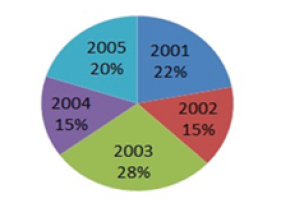
The given pie chart shows the sales of a company over five years. Study the chart and answer the question.

Total sale in five years = ₹50,00,000

Sale = expenditure + profit

Profit% = (profit / expenditure) × 100%

If profit of the company in 2005 was 25%, then find the expenditure in 2005?

  1. AOption (a)

    ₹7,20,000

  2. BOption (b)

    ₹8,00,000

  3. COption (c)

    ₹62,500

  4. DOption (d)

    ₹7,50,000

View answer & explanation

Correct answer

Answer: (b)B.

₹8,00,000

Why this answer is correct

Given:

Total sale in 5 years = ₹50,00,000

Percentage of sales in 2005 = 20%

Profit percentage in 2005 = 25%

Formula used:

Sale = Expenditure + Profit

Profit % = (Profit / Expenditure) × 100

Calculations:

Step 1: Calculate total sales in 2005

⇒ Sales in 2005 = 20% of ₹50,00,000

⇒ Sales in 2005 = (20 / 100) × 50,00,000 = ₹10,00,000

Step 2: Use the profit percentage formula

⇒ Profit % = (Profit / Expenditure) × 100

⇒ 25 = (Profit / Expenditure) × 100

⇒ Profit = 0.25 × Expenditure

Step 3: Use the sales formula

⇒ Sales = Expenditure + Profit

⇒ 10,00,000 = Expenditure + 0.25 × Expenditure

⇒ 10,00,000 = 1.25 × Expenditure

⇒ Expenditure = 10,00,000 / 1.25 = ₹8,00,000

∴ The expenditure in 2005 was ₹8,00,000.

Question 3

Find the number of sides of a regular polygon, each interior angle of which is 90°.

  1. AOption (a)

    4

  2. BOption (b)

    8

  3. COption (c)

    3

  4. DOption (d)

    5

View answer & explanation

Correct answer

Answer: (a)A.

4

Why this answer is correct

Shortcut Trick

For any regular polygon, the sum of an interior angle and its corresponding exterior angle is always 180°.

Exterior Angle = 180° − 90° = 90°

The number of sides (n) of a regular polygon is given by: n = 360° ÷ Exterior Angle

⇒ n = 360° ÷ 90° = 4

∴ The correct answer is 4 sides.

Alternate Method

Given:

Each interior angle of a regular polygon = 90°

Formula Used:

Each interior angle of a regular polygon with n sides = ((n − 2) × 180°) ÷ n

Calculations:

Let the number of sides of the regular polygon be n.

⇒ 90° = ((n − 2) × 180°) ÷ n

⇒ 90° × n = 180° × n − 360°

⇒ 180° × n − 90° × n = 360°

⇒ 90° × n = 360°

⇒ n = 360° ÷ 90°

⇒ n = 4

Thus, the regular polygon has 4 sides (which is a square).

Verification of other options:

⇒ For Option (2): 8 sides → Interior angle = ((8 − 2) × 180°) ÷ 8 = 135° (Incorrect)

⇒ For Option (3): 3 sides → Interior angle = ((3 − 2) × 180°) ÷ 3 = 60° (Incorrect)

⇒ For Option (4): 5 sides → Interior angle = ((5 − 2) × 180°) ÷ 5 = 108° (Incorrect)

∴ The correct answer is 4 sides.

Additional Information

Sum of Interior Angles

The sum of all interior angles of any n-sided polygon is given by the formula: Sum = (n − 2) × 180°.

Sum of Exterior Angles

The sum of the exterior angles of any convex polygon is always 360°, regardless of the number of sides.

Relation between Interior and Exterior Angles

At each vertex of a polygon, the interior angle and the exterior angle are supplementary, meaning: Interior Angle + Exterior Angle = 180°.

Question 4

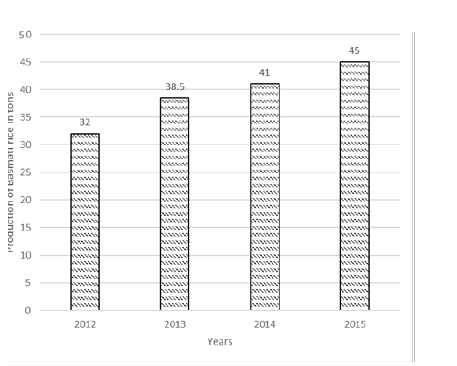
The following bar graph shows the production of Basmati rice (in tons) over the years. Based on the following graph answer the question below.

What is the approximate percentage increase in Basmati rice production in 2015 as compared to Basmati rice production in 2012?

  1. AOption (a)

    28.4%

  2. BOption (b)

    40.6%

  3. COption (c)

    48.38%

  4. DOption (d)

    28.12%

View answer & explanation

Correct answer

Answer: (b)B.

40.6%

Why this answer is correct

Given:

Production in 2012 = 32 tons

Production in 2015 = 45 tons

Formula used:

Percentage increase = [(Final value - Initial value) / Initial value] × 100

Calculations:

⇒ Percentage increase = [(45 - 32) / 32] × 100

⇒ Percentage increase = [13 / 32] × 100

⇒ Percentage increase = 0.40625 × 100

⇒ Percentage increase ≈ 40.63%

∴ The approximate percentage increase in Basmati rice production in 2015 compared to 2012 is 40.6%.

Question 5

Genital herpes infection is caused by:

  1. AOption (a)

    fungus

  2. BOption (b)

    bacteria

  3. COption (c)

    protozoa

  4. DOption (d)

    virus

View answer & explanation

Correct answer

Answer: (d)D.

virus

Why this answer is correct

The correct answer is the virus

Key Points

  • Genital herpes is caused by the herpes simplex virus (HSV), a type of virus:
  • Types of HSV
  • There are two types of HSV: HSV-1 and HSV-2. HSV-1 can also cause oral herpes, which can lead to cold sores around the mouth.
  • Symptoms include painful blisters or ulcers that can recur over time. Before sores or blisters form, people may experience tingling, itching, or burning.
  • The incubation period for HSV infections is typically six to eight days, but can range from one to 26 days. Some people may not develop symptoms right away, and they may not appear for months or even years.
  • People with HSV infections can pass along the virus even when they have no visible symptoms.
  • Once you have the virus, it stays in your body and causes blisters in the same area

Additional Information

 Bacteria, fungi, and protozoa are all microscopic organisms that can cause disease, and are known as germs or microbes: 

  • Bacteria
  • Single-celled organisms that can cause ear infections, urinary tract infections, cavities, and strep throat.
  • Fungi
  • Multicellular, plant-like organisms that can cause athlete's foot and yeast infections.
  • Fungi grow in warm, damp environments and get nutrition from plants, animals, and food.
  • Protozoa
  • One-celled organisms that can cause intestinal infections and other diseases, such as amebiasis and giardiasis.
  • Protozoa thrive in moist environments and diseases caused by them are often spread through contaminated water.
  • Other organisms that can cause disease include viruses and helminths (worms). Viruses are noncellular and are distinct from the other organisms.
  • Helminths are complex multicellular organisms.
  • Most microbes aren't harmful to humans and many are helpful. However, if a microbe enters a part of the body where it shouldn't be, it can cause illness

Question 6

Refer to the following letter series and answer the question.

(Left) T B Y M R E S I C X Z O W A Q D F H G U K (Right)

Which letter is fifth to the right of the twelfth letter from your right end of the given series?

  1. AOption (a)

    Q

  2. BOption (b)

    R

  3. COption (c)

    W

  4. DOption (d)

    X

View answer & explanation

Correct answer

Answer: (a)A.

Q

Why this answer is correct

Given series: (Left) T B Y M R E S I C X Z O W A Q D F H G U K (Right)

According to the question,

1) Twelfth letter from your right end of the given series → (Left) T B Y M R E S I C X Z O W A Q D F H G U K (Right) ⇒ X

  1. The letter which is fifth to the right of the twelfth letter from your right end of the given series → (Left) T B Y M R E S I C X Z O W A Q D F H G U K (Right) ⇒ Q

Thus, Q is fifth to the right of the twelfth letter from your right end of the given series.

Hence, "Option 1" is the correct answer.

Question 7

Which of the following rivers does not flow in Punjab?

  1. AOption (a)

    Chenab

  2. BOption (b)

    Brahmani

  3. COption (c)

    Beas

  4. DOption (d)

    Ravi

View answer & explanation

Correct answer

Answer: (b)B.

Brahmani

Why this answer is correct

The correct answer is Brahmani.

Key Points

  • Brahmani River is one of the major seasonal rivers of Odisha state.
  • It is a Peninsular river and falls in the Bay of Bengal.
  • Its length is about 480 km and 2nd longest river of Odisha after Mahanadi.
  • The Brahmani is formed by the South Koel and Sankh rivers coming together close to Rourkela, a significant industrial town.

Additional Information

River (Ancient Name)About
Chenab (Aksini)- Flows through India and Pakistan. - One of the major rivers on Punjab region. - Originates from Lahaul valley, Himachal Pradesh by two streams - Chandra and Bhaga. - It flows 1,180 km in India before entering into Pakistan. - It is the largest tributary of Indus river.
Beas (Vipasha)- Originates from Beas Kund near Rohtang Pass. - Enters Punjab plains and meets Satluj near Harike Barrage. - Pandoh Dam is also built on Beas river. - It generates hydroelectricity.
Ravi (Purushni)- Rises west of the Rohtang Pass in Kullu, Himachal Pradesh. - It flows through the Chamba valley. - It joins Chenab before entering Pakistan.

Question 8

Who among the following was one of the founders of the Congress Socialist Party which was founded in 1934?

  1. AOption (a)

    Jatindra Nath Das

  2. BOption (b)

    Jyotiba Phule

  3. COption (c)

    Jay Prakash Narayan

  4. DOption (d)

    Khan Abdul Ghaffar Khan

View answer & explanation

Correct answer

Answer: (c)C.

Jay Prakash Narayan

Why this answer is correct

The correct answer is Jay Prakash Narayan

Key Points

  • Jay Prakash Narayan was one of the founding members of the Congress Socialist Party (CSP), which was established in 1934 as a faction within the Indian National Congress.
  • The CSP aimed to promote socialism and address the economic issues faced by the Indian populace.

Additional Information

  • Jatindra Nath Das: He was an Indian revolutionary who is primarily known for his role in the struggle against British colonial rule, particularly through his hunger strike in 1929 while in prison.
  • Jyotiba Phule: He was a social reformer and activist known for his work in education, women's rights, and the upliftment of the lower castes in 19th-century India.
  • Khan Abdul Ghaffar Khan: Also known as the "Frontier Gandhi," he was an Indian freedom fighter and a close associate of Mahatma Gandhi. He worked for Hindu-Muslim unity and the rights of the Pashtun people

Question 9

Why is deoxygenated blood kept separate from oxygenated blood in the hearts of some animals like human beings?

  1. AOption (a)

    To help in the growth and functioning of muscles

  2. BOption (b)

    To maximise oxygenation of blood in the lungs

  3. COption (c)

    To help in keeping the body temperature constant

  4. DOption (d)

    To provide oxygen to a large-bodied animal

View answer & explanation

Correct answer

Answer: (c)C.

To help in keeping the body temperature constant

Why this answer is correct

The correct answer is option 3

Key Points

  • In animals like humans, deoxygenated blood is kept separate from oxygenated blood to help maintain a constant body temperature:
  • In warm-blooded animals like humans and birds, keeping oxygenated and deoxygenated blood separate helps produce more energy to maintain body temperature.
  • These animals need more oxygen for cellular respiration to produce energy in different climates.
  • Separating oxygenated and deoxygenated blood also helps circulate oxygen to different parts of the body and carry carbon dioxide away as waste

Question 10

What is the mode of the data given below? [Give your answer correct to 2 decimal places.]

Age in years15 - 2525 - 3535 - 4545 - 5555 - 6565 - 7575 - 85
No. of patients12182025302015
  1. AOption (a)

    55.33

  2. BOption (b)

    58.33

  3. COption (c)

    57.33

  4. DOption (d)

    63.33

View answer & explanation

Correct answer

Answer: (b)B.

58.33

Why this answer is correct

Shortcut Trick

Identify the modal class (highest frequency): The frequency 30 is the maximum, so the modal class is 55 − 65.

Apply the direct mode formula: Mode = l + [(f1 − f0) ÷ (2f1 − f0 − f2)] × h

Mode = 55 + [(30 − 25) ÷ (60 − 25 − 20)] × 10

Mode = 55 + [5 ÷ 15] × 10 = 55 + 3.33 = 58.33

∴ The correct answer is 58.33.

Alternate Method

Given data:

Modal Class = 55 − 65 (Highest Frequency = 30)

Lower limit of modal class (l) = 55

Frequency of modal class (f1) = 30

Frequency of preceding class (f0) = 25

Frequency of succeeding class (f2) = 20

Class size (h) = 10

Formula Used:

Mode = l + [(f1 − f0) / (2f1 − f0 − f2)] × h

Calculations:

⇒ Mode = 55 + [(30 − 25) / (2 × 30 − 25 − 20)] × 10

⇒ Mode = 55 + [5 / (60 − 45)] × 10

⇒ Mode = 55 + [5 / 15] × 10

⇒ Mode = 55 + [1 / 3] × 10

⇒ Mode = 55 + 3.333...

⇒ Mode ≈ 58.33

∴ The correct answer is 58.33.

Additional Information

Empirical Relationship

The relationship between central tendencies is given by: 3 × Median = Mode + 2 × Mean.

Modal Class

In a grouped frequency distribution, the modal class is the class interval with the highest frequency.

Bimodal and Multimodal Data

A data set is bimodal if it has two modes and multimodal if it has more than two modes.

Question 11

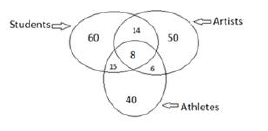
Study the given diagram carefully and answer the question. The numbers in different sections indicate the number of persons.

How many people are Students but neither Artists nor Athletes?

  1. AOption (a)

    40

  2. BOption (b)

    15

  3. COption (c)

    14

  4. DOption (d)

    60

View answer & explanation

Correct answer

Answer: (d)D.

60

Why this answer is correct

According to the given Venn diagram:

The shaded region represents the total number of people who are Students but neither Artists nor Athletes.

So, the total number of people who are Students but neither Artists nor Athletes = 60

Hence, the correct answer is "Option 4".

Question 12

At what annual interest rate will a certain sum double itself in 2 years, if interest is calculated on annual compounding basis? [Answer rounded off to one decimal place.]

  1. AOption (a)

    41.4%

  2. BOption (b)

    44.4%

  3. COption (c)

    40.4%

  4. DOption (d)

    39.4%

View answer & explanation

Correct answer

Answer: (a)A.

41.4%

Why this answer is correct

Shortcut Trick

For a sum to double in 2 years at Compound Interest, use the multiplier logic: (1 + R/100)n = Multiplier.

⇒ (1 + R/100)2 = 2

⇒ 1 + R/100 = √2

⇒ 1 + R/100 = 1.414

⇒ R/100 = 0.414 ⇒ R = 41.4%

∴ The correct answer is 41.4%.

Alternate Method

Given:

Time (n) = 2 years

Amount (A) = 2 × Principal (P)

Formula Used:

A = P(1 + R/100)n

Calculations:

⇒ 2P = P(1 + R/100)2

⇒ 2 = (1 + R/100)2

⇒ Taking square root on both sides: √2 = 1 + R/100

⇒ 1.4142 = 1 + R/100

⇒ R/100 = 1.4142 − 1

⇒ R/100 = 0.4142

⇒ R = 41.42% ≈ 41.4%

∴ The correct answer is 41.4%.

Additional Information

Rule of 72

It is a quick way to estimate the time required to double an investment: Years to double ≈ 72 ÷ Annual Interest Rate.

Effective Annual Rate

If interest is compounded semi-annually, the effective rate is higher than the nominal rate: Effective Rate = (1 + r/n)n − 1.

Successive Percentage Trick

For 2 years, the total growth percentage is R + R + (R × R)/100. Here, 41.4 + 41.4 + (41.4 × 41.4)/100 ≈ 82.8 + 17.1 ≈ 100% growth (i.e., doubling).

Question 13

The sum of the present ages of Bunty and Bubbly is 32 years. After 2 years, Bunty's age will be three times that of Bubbly. Bunty's present age (in years) is:

  1. AOption (a)

    20

  2. BOption (b)

    13

  3. COption (c)

    25

  4. DOption (d)

    7

View answer & explanation

Correct answer

Answer: (c)C.

25

Why this answer is correct

Shortcut Trick

Total age after 2 years = 32 + 2 + 2 = 36 years.

Ratio of Bunty : Bubbly after 2 years = 3 : 1 (Total parts = 4).

Bunty's age after 2 years = (3 ÷ 4) × 36 = 27 years.

Bunty's present age = 27 − 2 = 25 years.

∴ The correct answer is 25 years.

Alternate Method

Given: Sum of ages = 32. Let Bunty's age be x and Bubbly's age be y.

Formula: Age after n years = (Present Age + n).

⇒ x + y = 32 (Eq. 1)

⇒ After 2 years: (x + 2) = 3 × (y + 2)

⇒ x + 2 = 3y + 6

⇒ x − 3y = 4 (Eq. 2)

⇒ Subtracting Eq. 2 from Eq. 1: (x + y) − (x − 3y) = 32 − 4

⇒ 4y = 28

⇒ y = 7 (Bubbly's age)

⇒ x = 32 − 7 = 25

∴ The correct answer is 25 years.

Additional Information

Ratio Method for Ages

If the age ratio is given at two different times, the difference between the ratio parts must be scaled to match the constant age difference between persons.

Sum of Ages Change

When calculating the sum of ages for n people after t years, the sum increases by n × t.

Question 14

An alloy is made by mixing manganese and aluminium in the ratio of 2 : 3. To make it, ______ kg aluminium has to be melted with 24 kg manganese.

  1. AOption (a)

    12

  2. BOption (b)

    72

  3. COption (c)

    48

  4. DOption (d)

    36

View answer & explanation

Correct answer

Answer: (d)D.

36

Why this answer is correct

Shortcut Trick

Ratio of Manganese to Aluminium = 2 : 3

Given, Manganese = 24 kg → 2 units = 24 kg

1 unit = 12 kg

Aluminium = 3 units = 3 × 12 = 36 kg

∴ The correct answer is 36 kg.

Alternate Method

Given:

Ratio (Manganese : Aluminium) = 2 : 3

Weight of Manganese = 24 kg

Let the common multiplier be x.

⇒ Weight of Manganese = 2x

⇒ Weight of Aluminium = 3x

⇒ 2x = 24 kg

⇒ x = 24 ÷ 2

⇒ x = 12 kg

⇒ Weight of Aluminium = 3 × 12

⇒ Weight of Aluminium = 36 kg

∴ The correct answer is 36 kg.

Additional Information

Ratio and Proportion

A ratio indicates how many times one number contains another. If a : b = c : d, then a × d = b × c.

Mixture Calculations

In an alloy of n components, the quantity of any component = (Ratio of that component ÷ Sum of ratios) × Total Weight.

Unitary Method

First find the value of a single unit by dividing the total value by the number of units, then multiply to find the required value.

Question 15

Which of the following statements is correct with respect to phloem?

  1. AOption (a)

    Phloem carries photosynthetic products from leaves to other plant parts.

  2. BOption (b)

    Sieve tubes in phloem are made up of dead cells.

  3. COption (c)

    Companion cells of phloem have perforated walls.

  4. DOption (d)

    Phloem transport is uni-directional.

View answer & explanation

Correct answer

Answer: (a)A.

Phloem carries photosynthetic products from leaves to other plant parts.

Why this answer is correct

The correct answer is Option 1

Key Points 

  • Statement 1:
  • "Phloem carries photosynthetic products from leaves to other plant parts."
  • This statement is accurate. Phloem is responsible for the transport of photosynthates (mainly sugars like sucrose) produced during photosynthesis in the leaves to other parts of the plant, including stems, roots, and fruits.
  • Statement 2:
  • "Sieve tubes in phloem are made up of dead cells."
  • This statement is not correct. Sieve tubes in phloem are made up of living cells.
  • Although they lack a nucleus and some organelles, they remain alive and functional for the transport of sugars and nutrients.
  • Statement 3:
  • "Companion cells of phloem have perforated walls."
  • This statement is also inaccurate. Companion cells are living cells that support the sieve tubes, and they have thin cell walls but do not have perforated walls.
  • Instead, they contain numerous plasmodesmata (small channels) that connect them to the sieve tube elements.
  • Statement 4:
  • "Phloem transport is uni-directional."
  • This statement is not correct.
  • Phloem transport is generally bi-directional.
  • It can transport nutrients both upward and downward in the plant, depending on the plant’s needs and the growth stages.

Question 16

Which of the following compounds has the highest boiling point?

  1. AOption (a)

    CH3COOH

  2. BOption (b)

    CHCl3

  3. COption (c)

    CH3CH2OH

  4. DOption (d)

    CH3CH2CH2CH3

View answer & explanation

Correct answer

Answer: (a)A.

CH3COOH

Why this answer is correct

The correct answer is CH3COOH

Key Points

  • CH3COOH (acetic acid) has the highest boiling point of the given compounds because of its hydrogen bonding:
  • Hydrogen bonding creates stronger intermolecular interactions in acetic acid, which means more energy is required to boil it.
  • This results in a higher boiling temperature.
  • In general, a compound's boiling point increases with its molecular weigh

Additional Information

  • CHCl₃ (Chloroform)
  • Chloroform is a colourless, volatile liquid with a sweet odor.
  • Historically used as an anaesthetic and as a solvent in laboratories and industrial applications.
  • It is also used in the production of refrigerants and other chemicals.
  • Chloroform is dense, non-flammable, and can dissolve many organic compounds.
  • CH₃CH₂OH (Ethanol)
  • Ethanol, also known as ethyl alcohol, is a clear, colorless liquid that is flammable.
  • Commonly used as a recreational beverage (alcohol), a solvent, an antiseptic, and in fuel (as bioethanol).
  • It is hygroscopic (absorbs moisture), has a relatively low boiling point, and is miscible with water.
  • CH₃CH₂CH₂CH₃ (Butane)
  • Butane is a colourless gas at room temperature, but it can be easily liquefied under pressure.
  • Commonly used as a fuel (in lighters and portable stoves), in the production of plastics, and as a refrigerant.
  • It is a saturated hydrocarbon and belongs to the alkane family. It is flammable and has a low boiling point

Question 17

What is the value of k if 2−2k;×;4k+34−k+2\frac{{{2^{ - 2k}}; \times ;{4^{k + 3}}}}{{{4^{ - k + 2}}}} = 2k - 2

  1. AOption (a)

    1

  2. BOption (b)

    -1

  3. COption (c)

    2

  4. DOption (d)

    -4

View answer & explanation

Correct answer

Answer: (d)D.

-4

Why this answer is correct

Given:

2−2k×4k+34−k+2=2k−2\frac{2^{-2k} \times 4^{k+3}}{4^{-k+2}} = 2^{k-2} 

Formula used:

Use the exponential rules: am×an=am+n a^m \times a^n = a^{m+n} and a−m=1ama^{-m} = \frac{1}{a^m}

Calculations:

⇒ 2−2k×(22)k+3(22)−k+2=2k−2\frac{2^{-2k} \times (2^2)^{k+3}}{(2^2)^{-k+2}} = 2^{k-2}

⇒ 2−2k×22(k+3)22(−k+2)=2k−2\frac{2^{-2k} \times 2^{2(k+3)}}{2^{2(-k+2)}} = 2^{k-2}

⇒ 2−2k×22k+62−2k+4=2k−2\frac{2^{-2k} \times 2^{2k+6}}{2^{-2k+4}} = 2^{k-2}

⇒ 2−2k+2k+6+2k−4=2k−22^{-2k+2k+6+2k-4} = 2^{k-2}

⇒ 22k+2=2k−22^{2k+2} = 2^{k-2}

⇒ 2k+2 = k-2

⇒ k = -4

∴ The value of k is -4.

Question 18

Sapna went 2 km straight from her office in the west direction then took a right turn and travelled 4 km. She again turned right and travelled 5 km and then turned left and reached home after travelling 1 km. Which direction was she facing when reached home?

  1. AOption (a)

    East

  2. BOption (b)

    South

  3. COption (c)

    West

  4. DOption (d)

    North

View answer & explanation

Correct answer

Answer: (d)D.

North

Why this answer is correct

Given:

Sapna went 2 km straight from her office in the west direction then took a right turn and travelled 4 km.

She again turned right and travelled 5 km and then turned left and reached home after travelling 1 km.

Thus, Sapna is facing north direction when she reached home.

Hence, "Option 4" is the correct answer.

Question 19

X is twice as good a workman as Y and together they finish a piece of work in 14 days. In how many days will X alone finish the work?

  1. AOption (a)

    21 days

  2. BOption (b)

    28 days

  3. COption (c)

    20 days

  4. DOption (d)

    22 days

View answer & explanation

Correct answer

Answer: (a)A.

21 days

Why this answer is correct

Shortcut Trick

Ratio of efficiency X : Y = 2 : 1

Total efficiency = 2 + 1 = 3 units/day

Total work = Combined efficiency × Days = 3 × 14 = 42 units

Days taken by X alone = Total work ÷ X's efficiency = 42 ÷ 2 = 21 days

∴ The correct answer is 21 days.

Alternate Method

PersonEfficiency RatioTotal WorkDays Taken
X23 × 14 = 4242 ÷ 2 = 21
Y142 ÷ 1 = 42

⇒ Let efficiency of Y be 1 unit/day.

⇒ Efficiency of X = 2 × 1 = 2 units/day.

⇒ Combined efficiency of X + Y = 2 + 1 = 3 units/day.

⇒ Total work = 3 units/day × 14 days = 42 units.

⇒ Time taken by X alone = 42 ÷ 2 = 21 days.

∴ The correct answer is 21 days.

Additional Information

Work and Efficiency Relationship

Efficiency is inversely proportional to the time taken to complete a work. If efficiency ratio is a:b, then time ratio is b:a.

Work Rate Formula

Total Work = Number of Days × Efficiency. This is the fundamental formula for all Time and Work problems.

Combined Work Formula

If A takes 'a' days and B takes 'b' days, together they take (a × b) ÷ (a + b) days to finish the work.

Question 20

Who among the following won the silver in the World Athletics Championship - 2022?

  1. AOption (a)

    Neeraj Chopra

  2. BOption (b)

    Avinash Sable

  3. COption (c)

    Priyanka Goswami

  4. DOption (d)

    Mira bai Chanu

View answer & explanation

Correct answer

Answer: (a)A.

Neeraj Chopra

Why this answer is correct

The correct answer is Neeraj Chopra

Key Points

  • Neeraj Chopra won the silver medal in the men's javelin throw at the World Athletics Championships 2022, which took place in Eugene, Oregon, USA.
  • He achieved a throw of 88.13 meters during the competition, finishing second behind Jakub Vadlejch from the Czech Republic, who won the gold medal.
  • This medal was historically significant as it made Neeraj Chopra the first Indian to win a medal in javelin throw at the World Athletics Championships.
  • It added to his accolades, which include winning a gold medal at the Tokyo 2020 Olympics (held in 2021) and establishing him as one of the top javelin throwers in the world.
  • The championships were held in Eugene, Oregon, USA, from July 15 to July 24, 2022.
  • This was the first time the World Championships were held in the United States.
  • Jakub Vadlejch:
  • The gold medalist from the Czech Republic who achieved a throw of 88.84 meters, demonstrating his strength and technique.
  • Vadlejch has been a strong competitor in javelin throw events and was a key contender throughout the championship.
  • Other Medalists: T
  • he bronze medal was won by Keshorn Walcott from Trinidad and Tobago, who threw 86.64 meters.

Additional Information

  • Avinash Sable
  • Avinash Sable is a prominent Indian athlete specializing in middle-distance running, particularly the 3000 meters steeplechase.
  • At the World Athletics Championships 2022, Sable competed in the men’s 3000m steeplechase.
  • He finished in 11th place in the final with a time of 8:31.75.
  • Priyanka Goswami is an Indian race walker, specializing in the 20 km race walk.
  • At the World Athletics Championships 2022, she competed in the women's 20 km race walk.
  • Priyanka finished in 10th place with a time of 1:29:00.
  • Mirabai Chanu is a renowned weightlifter, competing in the 49 kg category

Question 21

Read the given statement(s) and conclusions carefully and decide which of the conclusions logically follow(s) from the statement(s).

Statement:

C = A ≤ S < H ≤ I = G

Conclusions:

I. G ≥ S

II. C < H

  1. AOption (a)

    Either conclusion I or II follows

  2. BOption (b)

    Neither conclusion I nor II follows

  3. COption (c)

    Only conclusion I follows

  4. DOption (d)

    Only conclusion II follows

View answer & explanation

Correct answer

Answer: (d)D.

Only conclusion II follows

Why this answer is correct

Given Statement: C = A ≤ S < H ≤ I = G

Now,

Conclusions:

I: G ≥ S → False(S < H ≤ I = G It gives S < G)

II: C < H → True (C = A ≤ S < H It gives C < H)

So, Only conclusion II follows

Hence, the correct answer is "Option 4".

Question 22

Pipe A can fill a tank in 15 minutes, while pipe B can empty the completely filled tank in 20 minutes. Initially, pipe A is opened and after 5 minutes pipe B is also opened. In how much time (in minutes) will the remaining tank be filled completely?

  1. AOption (a)

    30

  2. BOption (b)

    20

  3. COption (c)

    40

  4. DOption (d)

    50

View answer & explanation

Correct answer

Answer: (c)C.

40

Why this answer is correct

Shortcut Trick

Total Capacity (LCM of 15, 20) = 60 units.

Efficiency of Pipe A = 60 ÷ 15 = +4; Efficiency of Pipe B = 60 ÷ 20 = −3.

Work done by A in first 5 minutes = 5 × 4 = 20 units.

Remaining work = 60 − 20 = 40 units.

Net efficiency (A + B) = 4 − 3 = 1 unit/min.

Remaining time = 40 ÷ 1 = 40 minutes.

∴ The correct answer is 40 minutes.

Alternate Method

PipeTime (min)Total CapacityEfficiency
A (Filling)1560+4
B (Emptying)20−3

Given: Pipe A fills in 15 min, Pipe B empties in 20 min. Pipe A opens for 5 min alone.

Calculation:

⇒ Total Work = LCM(15, 20) = 60 units

⇒ Efficiency of A = 60 ÷ 15 = 4 units/min

⇒ Efficiency of B = 60 ÷ 20 = −3 units/min

⇒ Tank filled by A in 5 min = 5 × 4 = 20 units

⇒ Remaining tank capacity = 60 − 20 = 40 units

⇒ Combined efficiency of (A + B) = 4 + (−3) = 1 unit/min

⇒ Time to fill remaining tank = Remaining Capacity ÷ Combined Efficiency

⇒ Time = 40 ÷ 1 = 40 minutes

∴ The correct answer is 40 minutes.

Additional Information

Pipes and Cisterns Convention

An inlet pipe (filling) is taken as positive efficiency, while an outlet pipe (emptying/leak) is taken as negative efficiency.

Net Efficiency Rule

When multiple pipes work together, the net efficiency is the algebraic sum of their individual efficiencies: Net E = E1 + E2 + ... + En.

Time Calculation

Time taken to fill or empty the tank = Total Capacity ÷ Net Efficiency.

Question 23

Which of the following terms will replace the question mark(?) in the given series to make it logically complete?

PJC13, KEX20, FZS27, AUN34, ?

  1. AOption (a)

    VIP41

  2. BOption (b)

    VPI41

  3. COption (c)

    PVI39

  4. DOption (d)

    PST39

View answer & explanation

Correct answer

Answer: (b)B.

VPI41

Why this answer is correct

The logic followed here is:

Hence, "Option 2" is the correct answer.

Question 24

Find the median of 4, 6, 6, 8, 8, 8, 10, 12.

  1. AOption (a)

    12

  2. BOption (b)

    6

  3. COption (c)

    8

  4. DOption (d)

    10

View answer & explanation

Correct answer

Answer: (c)C.

8

Why this answer is correct

Given:

Find the median of 4, 6, 6, 8, 8, 8, 10, 12.

Formula used:

If there is an even number of values, the median is the average of the two middle numbers.

Calculations:

The two middle numbers are 8 and 8.

⇒ Median = (8 + 8) ÷ 2

⇒ Median = 16 ÷ 2

⇒ Median = 8

∴ The median is 8.

Question 25

Amongst si× friends O, P, Q, R, S and T, each has a different height. P is taller than O. Q is taller than S but shorter than O. R is shorter than S but taller thanT. Who is the tallest among all the friends?

  1. AOption (a)

    Q

  2. BOption (b)

    O

  3. COption (c)

    R

  4. DOption (d)

    P

View answer & explanation

Correct answer

Answer: (d)D.

P

Why this answer is correct

Given: Amongst si× friends O, P, Q, R, S and T, each has a different height.

1) P is taller than O.

  1. Q is taller than S but shorter than O. 

P > O > Q > S

3) R is shorter than S but taller than T. 

P > O > Q > S > R > T

Thus, according to the final arrangement, P is the tallest among all the friends.

Hence, "Option 4" is the correct answer.

Question 26

The National Bank for Agriculture and Rural Development (NABARD) launched the ‘JIVA’ programme’ in February 2022 to promote ______.

  1. AOption (a)

    dairy farming

  2. BOption (b)

    natural farming

  3. COption (c)

    forest gardening

  4. DOption (d)

    horticulture

View answer & explanation

Correct answer

Answer: (b)B.

natural farming

Why this answer is correct

The correct answer is natural farming

Key Points 

  • JIVA Programme by NABARD:
  • The JIVA programme, launched by the National Bank for Agriculture and Rural Development (NABARD) in February 2022,
  • It is aimed at promoting natural farming. T
  • he initiative focuses on sustainable and climate-resilient agricultural practices to improve soil health, reduce dependency on chemical inputs, and boost farmers' incomes through natural methods of farming.
  • Goal of JIVA:
  • The programme is part of NABARD’s efforts to enhance agricultural productivity while promoting environmentally friendly practices and reducing farmers' reliance on costly synthetic fertilizers and pesticides.

Additional Information Meaning of other options

  • Dairy Farming: The breeding, raising, and management of dairy animals, primarily cows and buffaloes, for milk production.
  • Forest Gardening: A sustainable land-use system that combines trees, shrubs, and plants in a layered structure to mimic natural forests, aimed at producing food and materials.
  • Horticulture: The cultivation of fruits, vegetables, flowers, and ornamental plants for food, beauty, and medicinal purposes.

Question 27

Which compound is used for faster cooking?

  1. AOption (a)

    NaOH

  2. BOption (b)

    NaHCO3

  3. COption (c)

    Na2CO3

  4. DOption (d)

    CaOCl2

View answer & explanation

Correct answer

Answer: (b)B.

NaHCO3

Why this answer is correct

The correct answer is NaHCO3

Key Points

  • NaHCO₃ (Sodium Bicarbonate), commonly known as baking soda, is used to speed up the cooking process.
  • It acts as a mild alkali and can make certain foods,
  • like beans and tough meats, cook faster by breaking down complex molecules (such as pectin in vegetables and collagen in meat).
  • How Sodium Bicarbonate Aids in Cooking
  • Softening Effect: Baking soda softens the cellulose in vegetables and the collagen in meat, making them tender and shortening the cooking time.
  • Rising Agent: It’s also used in baking to produce carbon dioxide gas when heated, helping dough rise and creating a lighter texture in baked goods.

Additional Information

  • NaOH (Sodium Hydroxide):
  • Also known as caustic soda, it’s a strong base and is not typically used in cooking due to its corrosive properties.
  • In some specific food processing methods (e.g., making traditional pretzels), it’s used to create a unique texture, but it is not commonly used for regular cooking as it can be harmful.
  • Na₂CO₃ (Sodium Carbonate):
  • Known as washing soda, it is sometimes used in certain food processing techniques but is mainly used for cleaning purposes.
  • It’s not commonly used in cooking because it has a stronger alkalinity than sodium bicarbonate and can alter the flavor of foods.
  • CaOCl₂ (Calcium Oxychloride):
  • Also known as bleaching powder, this compound is used as a disinfectant, particularly for sanitizing water, but is not safe or suitable for use in cooking or food preparation.

Question 28

Which chemical can be used for making germ-free drinking water?

  1. AOption (a)

    Ca(OH)2

  2. BOption (b)

    NaOH

  3. COption (c)

    CaOCl2

  4. DOption (d)

    NH4OH

View answer & explanation

Correct answer

Answer: (c)C.

CaOCl2

Why this answer is correct

The correct answer is CaOCl2

Key Points

  • CaOCl₂ (Calcium Oxychloride): Commonly known as bleaching powder, it is widely used to disinfect or make drinking water germ-free.
  • When added to water, it releases chlorine, which kills bacteria and other harmful microorganisms, making the water safe to drink.
  • Properties:
  • A white or light yellow powder with a chlorine-like odor.
  • A source of chlorine when it comes into contact with water, releasing hypochlorous acid, which has strong disinfecting properties.
  • Commonly used to disinfect and sanitize drinking water, swimming pools, and waste water.
  • Also used as a bleaching agent in the textile and paper industries.

Additional Information

  • Ca(OH)₂ (Calcium Hydroxide)
  • Common Name: Slaked Lime
  • Properties:
  • A white, powdery, alkaline compound that is slightly soluble in water, forming a solution known as limewater.
  • It has a high pH, making it a strong base.
  • NaOH (Sodium Hydroxide)
  • Common Name: Caustic Soda or Lye
  • Properties:
  • A highly caustic, corrosive, and water-soluble base that forms an alkaline solution in water.
  • Very effective at breaking down organic matter, which is why it’s used in cleaning products.
  • NH₄OH (Ammonium Hydroxide)
  • Common Name: Ammonia Solution
  • Properties:
  • A clear, colourless liquid with a strong, pungent odour.
  • Alkaline in nature, though not as strong as NaOH.

Question 29

As of July 2022, who among the following is the CEO of Teach for India, an educational non-profit organisation that runs a two year fellowship program and alumni network to foster educational excellence and leadership in India?

  1. AOption (a)

    Pallavi Rane

  2. BOption (b)

    Anika Parashar

  3. COption (c)

    Sohini Bhattacharya

  4. DOption (d)

    Shaheen Mistri

View answer & explanation

Correct answer

Answer: (d)D.

Shaheen Mistri

Why this answer is correct

The correct answer is Shaheen Mistri

Key Points

  • Shaheen Mistri is the CEO and founder of Teach for India (TFI), an educational non-profit organization that works to eliminate educational inequity in India.
  • She established TFI in 2009 with the mission to address the disparities in education quality across the country.
  • Teach for India offers a two-year fellowship program where young leaders work as full-time teachers in under-resourced schools to improve learning outcomes.
  • After the fellowship, the alumni network continues to support education reform and leadership in various capacities.

Additional Information

  • Pallavi Rane: There is no major association between Pallavi Rane and Teach for India as CEO or founder.
  • Anika Parashar: She is an entrepreneur and was formerly associated with other organizations focused on women's health and wellness but is not linked with Teach for India.
  • Sohini Bhattacharya: She is the CEO of Breakthrough India, an organization focused on preventing violence against women and girls

Question 30

If cosθ = xsin⁡θ\frac{x}{{\sin \theta }}, then the value of sin6 θ + cos6 θ = ______.

  1. AOption (a)

    3x2 - 1

  2. BOption (b)

    1

  3. COption (c)

    1 - 3x2

  4. DOption (d)

    0

View answer & explanation

Correct answer

Answer: (c)C.

1 - 3x2

Why this answer is correct

Shortcut Trick

Given: cosθ = x / sinθ ⇒ sinθ × cosθ = x.

Formula for sin6θ + cos6θ = 1 − 3sin2θcos2θ.

Substitute sinθcosθ = x: 1 − 3(x)2 = 1 − 3x2.

∴ The correct answer is 1 − 3x2.

Alternate Method

Given: cosθ = x / sinθ

Formula Used: a3 + b3 = (a + b)(a2 − ab + b2) and sin2θ + cos2θ = 1

⇒ sinθcosθ = x

⇒ sin6θ + cos6θ = (sin2θ)3 + (cos2θ)3

⇒ (sin2θ + cos2θ)((sin2θ)2 − sin2θcos2θ + (cos2θ)2)

⇒ 1 × (sin4θ + cos4θ − sin2θcos2θ)

⇒ (sin2θ + cos2θ)2 − 2sin2θcos2θ − sin2θcos2θ

⇒ 12 − 3sin2θcos2θ

⇒ 1 − 3(sinθcosθ)2

⇒ 1 − 3x2

∴ The correct answer is 1 − 3x2.

Additional Information

Trigonometric Identity for 4th Power

sin4θ + cos4θ = 1 − 2sin2θcos2θ.

Double Angle Relation

sinθcosθ can also be written as (1/2)sin2θ.

Square Relation

The fundamental identity is sin2θ + cos2θ = 1, from which higher powers are derived.

Question 31

Which of the following is NOT a fundamental right in the Constitution of India?

  1. AOption (a)

    Right to Acquire Property

  2. BOption (b)

    Right to Equality

  3. COption (c)

    Right to Freedom

  4. DOption (d)

    Right to Constitutional Remedies

View answer & explanation

Correct answer

Answer: (a)A.

Right to Acquire Property

Why this answer is correct

The correct answer is the Right to Acquire Property

Key Points

  • Right to Acquire Property:
  • This is not a fundamental right in the current Constitution of India.
  • Originally, the right to property was a fundamental right under Article 31, but the 44th Amendment Act of 1978 removed it from the list of fundamental rights.
  • It was then made a legal right under Article 300A in Part XII of the Constitution.

Additional Information

  • Right to Equality: Covered under Articles 14-18, this right ensures equality before the law, prohibition of discrimination, and equality of opportunity in public employment.
  • Right to Freedom: Covered under Articles 19-22, this right includes freedoms like speech and expression, assembly, association, movement, residence, and the right to practice any profession.
  • Right to Constitutional Remedies: Covered under Article 32, this is considered the "heart and soul of the Constitution" as it allows individuals to approach the Supreme Court or High Courts to enforce their fundamental rights.

Question 32

The value of 0.04\sqrt {0.04} + 6.25\sqrt {6.25} + 12.25\sqrt {12.25} - 8.2 is ______.

  1. AOption (a)

    -2

  2. BOption (b)

    2.2

  3. COption (c)

    -2.2

  4. DOption (d)

    2

View answer & explanation

Correct answer

Answer: (a)A.

-2

Why this answer is correct

Given:

The value of √{0.04} + √{6.25} + √{12.25} - 8.2

Formula Used:

√{x} represents the square root of x .

Calculation:

√{0.04} = 0.2

√{6.25} = 2.5

√{12.25} = 3.5

Combining all values:

0.2 + 2.5 + 3.5 - 8.2

⇒ 6.2 - 8.2

⇒ -2

The correct answer is option 1, -2.

Question 33

Which of the following foods is called a ‘body-building’ food?

  1. AOption (a)

    Food rich in carbohydrates, like wheat

  2. BOption (b)

    Food rich in proteins, like peas

  3. COption (c)

    Food rich in fats, like butter

  4. DOption (d)

    Food rich in vitamins, like apples

View answer & explanation

Correct answer

Answer: (b)B.

Food rich in proteins, like peas

Why this answer is correct

The correct answer is Food rich in proteins, like peas

Key Points

  • Proteins are generally referred to as bodybuilding foods, such as peas
  • They are macronutrients that provide the body with cell growth and repair materials.
  • Here are some examples of protein-rich foods:
  • Milk, Chicken, Fish, Eggs, Pulses, Beans, and Lentils.
  • Proteins are also a source of amino acids, which the body uses to form structures.
  • In an emergency, proteins can also be oxidized in the body to release energy.
  • Cabbage is another vegetable that can help with muscle building. It is moderately high in protein and rich in fibre, vitamins C and K, folate, calcium, and magnesium.

Additional Information

  • Carbohydrates, fats, and vitamins are all major nutrients found in food.
  • They have different functions in the body, including:
  • Carbohydrates
  • Provide energy to the body, and are important for the brain, nervous system, kidneys, and muscles.
  • Carbohydrates are found in grains, fruits, milk, nuts, seeds, beans, and vegetables.
  • Fats
  • Provide energy to the body, and are used for cell membranes, absorbing fat-soluble vitamins, and supporting internal organs.
  • Fats are made from fatty acids and glycerol, and there are three types of fats: monounsaturated, saturated, and trans.
  • Vitamins
  • Organic compounds that act as catalysts during metabolism, and are necessary for various physiological activities.
  • Vitamins keep us healthy and protect us from many diseases.
  • Vitamins are found in all kinds of foods, including fruits, vegetables, animal products, and whole grains.
  • Other nutrients found in food include proteins and minerals. Proteins and minerals are needed for the growth and maintenance of the body.

Question 34

Which of the following is the least important reason for building a large dam?

  1. AOption (a)

    Renewable source of electricity for an area

  2. BOption (b)

    Flood control in downstream areas

  3. COption (c)

    Boating, fishing and picnicking spot for families

  4. DOption (d)

    Guaranteed water supply to homes

View answer & explanation

Correct answer

Answer: (c)C.

Boating, fishing and picnicking spot for families

Why this answer is correct

The correct answer is Boating, fishing and picnicking spot for families

Key Points

  • Boating, fishing and picnicking spot for families is the least important reason for building a large dam.
  • While it can be a secondary benefit, the primary purposes of a large dam are:
  • Renewable source of electricity: Dams can generate hydroelectric power, a clean and renewable energy source.
  • Flood control: Dams can regulate water flow, preventing floods in downstream areas.
  • Guaranteed water supply: Dams can store water for irrigation, domestic use, and industrial purposes.
  • These three reasons are crucial for the overall development and well-being of a region.

Question 35

If 1 is added to the first digit of each of the following numbers and 1 is subtracted from the last digit, how many numbers will have their first digit completely divisible by the last digit?

242, 657, 864, 264, 674, 218, 845

  1. AOption (a)

    1

  2. BOption (b)

    0

  3. COption (c)

    2

  4. DOption (d)

    3

View answer & explanation

Correct answer

Answer: (d)D.

3

Why this answer is correct

Given: 242, 657, 864, 264, 674, 218, 845

According to the question:

Given numbers242657864264674218845
1st operation → 1 is added to the first digit of each of the following numbers+1+1+1+1+1+1+1
Resultant after 1st operation342757964364774318945
2nd operation → 1 is subtracted from the last digit of each of the following numbers-1-1-1-1-1-1-1
Resultant after 2nd operation341756963363773317944
Numbers that have their first digit exactly divisible by the last digit3 ÷ 1 = 37 ÷ 6 = 1.179 ÷ 3 = 33 ÷ 3 = 17 ÷ 3 = 2.333 ÷ 7 = 0.429 ÷ 4 = 2.25
Required answerDivisibleNot DivisibleDivisibleDivisibleNot DivisibleNot DivisibleNot Divisible

Thus, according to the final arrangement, three numbers will have their first digit exactly divisible by the last digit.

Hence, "Option 4" is the correct answer.

Question 36

The different points mentioned below constitute Reproductive Health. Select the INCORRECT option.

  1. AOption (a)

    Safe and effective family planning methods

  2. BOption (b)

    Prevention of Sexually transmitted diseases

  3. COption (c)

    Knowledge of reproductive processes and organs

  4. DOption (d)

    Determining the sex of the unborn child

View answer & explanation

Correct answer

Answer: (d)D.

Determining the sex of the unborn child

Why this answer is correct

The correct answer is Determining the sex of the unborn child

Key Points

  • Reproductive health encompasses a wide range of aspects related to sexual and reproductive well-being, including:
  • Family Planning: Access to safe and effective methods of contraception to plan and space pregnancies.
  • Sexual Health: Prevention and treatment of sexually transmitted infections (STIs), as well as promoting healthy sexual behaviours.
  • Reproductive Health Care: Access to quality healthcare services, including maternal and child health, infertility treatment, and safe abortion.
  • Sexual Rights: Recognizing and upholding individuals' rights to make informed choices about their sexuality and reproduction.
  • Determining the sex of an unborn child is not considered a part of reproductive health,
  • as it is often associated with practices like prenatal sex selection, which can lead to gender discrimination and other societal issues.

Question 37

A beam of white light passes through a glass prism and a spectrum is obtained. Which of the following colour components bends the least?

Yellow, Orange, Blue, Violet

  1. AOption (a)

    Orange

  2. BOption (b)

    Violet

  3. COption (c)

    Yellow

  4. DOption (d)

    Blue

View answer & explanation

Correct answer

Answer: (a)A.

Orange

Why this answer is correct

The correct answer is Orange

Key Points

  • When white light passes through a prism, it splits into its constituent colours due to a phenomenon called dispersion.
  • This happens because different colours of light have different wavelengths, and they bend at different angles when passing through the prism.
  • Red light has the longest wavelength and bends the least.
  • Violet light has the shortest wavelength and bends the most.
  • Since orange light has a longer wavelength than blue and violet light, it bends less than them.
  • Therefore, orange is the correct answer.

Question 38

The value of (x - y) (x + y) + (y - z) (y + z) + (z + x) (z - x) is:

  1. AOption (a)

    1

  2. BOption (b)

    x2 + y2 + z2

  3. COption (c)

    0

  4. DOption (d)

    x + y + z

View answer & explanation

Correct answer

Answer: (c)C.

0

Why this answer is correct

Shortcut Trick

The given expression is a cyclic sum of the form (a − b)(a + b).

In such cyclic algebraic identities, individual terms simplify to differences of squares: (x2 − y2), (y2 − z2), and (z2 − x2).

Summing these cyclic differences always results in zero as each term cancels its counterpart.

∴ The correct answer is 0.

Alternate Method

Given: (x − y)(x + y) + (y − z)(y + z) + (z + x)(z − x)

Formula Used: (a − b)(a + b) = a2 − b2

⇒ Term 1: (x − y)(x + y) = x2 − y2

⇒ Term 2: (y − z)(y + z) = y2 − z2

⇒ Term 3: (z + x)(z − x) = z2 − x2

⇒ Total Expression = (x2 − y2) + (y2 − z2) + (z2 − x2)

⇒ Grouping similar terms: (x2 − x2) + (y2 − y2) + (z2 − z2)

⇒ 0 + 0 + 0 = 0

∴ The correct answer is 0.

Additional Information

Difference of Two Squares

One of the most common algebraic identities is (a + b)(a − b) = a2 − b2, used to simplify products of binomials.

Cyclic Identities

An expression is cyclic if replacing x with y, y with z, and z with x results in the same expression. The sum of differences in a cycle like (x − y) + (y − z) + (z − x) is always 0.

Square of a Binomial

Related identities include (a + b)2 = a2 + 2ab + b2 and (a − b)2 = a2 − 2ab + b2.

Question 39

In the month of March 2022, who was given the captaincy of Royal Challengers Bangalore for IPL 2022?

  1. AOption (a)

    Virat Kohli

  2. BOption (b)

    Faf du Plessis

  3. COption (c)

    Finn Allen

  4. DOption (d)

    Glenn Maxwell

View answer & explanation

Correct answer

Answer: (b)B.

Faf du Plessis

Why this answer is correct

The correct answer is Faf du Plessis

Key Points

  • Faf du Plessis was appointed as the captain of the Royal Challengers Bangalore (RCB) for the IPL 2022 season.
  • This decision came after Virat Kohli stepped down from the captaincy role following the previous season.
  • Du Plessis had previously been a successful captain for the Chennai Super Kings, leading them to an IPL title in 2021.
  • He was known for his calm and composed leadership style, as well as his ability to perform consistently with the bat.
  • His appointment as RCB captain was met with optimism by the franchise's fans, who hoped that he could lead the team to their first-ever IPL title.

Additional Information

  • Virat Kohli: Former captain of RCB and Indian cricket team. He stepped down from RCB captaincy before the start of IPL 2022.
  • Finn Allen: A young and talented cricketer from New Zealand. He was not considered a leadership candidate for RCB in 2022.
  • Glenn Maxwell: A powerful all-rounder for RCB. While he is a valuable asset to the team, he was not appointed as the captain for IPL 2022.

Question 40

In a triangle, if one angle measures twice the smallest angle and the third one measures three times the smallest angle, then the measure of the greatest angle is ______.

  1. AOption (a)

    30°

  2. BOption (b)

    90°

  3. COption (c)

    120°

  4. DOption (d)

    45°

View answer & explanation

Correct answer

Answer: (b)B.

90°

Why this answer is correct

Shortcut Trick

Let the smallest angle be 1 unit.

Ratio of angles = 1 : 2 : 3

Sum of ratios = 1 + 2 + 3 = 6 units

6 units = 180° ⇒ 1 unit = 30°

Greatest angle = 3 units = 3 × 30° = 90°

∴ The correct answer is 90°.

Alternate Method

Given:

Let the smallest angle be x.

Second angle = 2x

Third angle = 3x

Formula Used:

Sum of all interior angles of a triangle = 180°

Calculations:

⇒ x + 2x + 3x = 180°

⇒ 6x = 180°

⇒ x = 180° ÷ 6

⇒ x = 30°

⇒ Greatest angle = 3x = 3 × 30° = 90°

∴ The correct answer is 90°.

Additional Information

Angle Sum Property

The sum of the measures of the interior angles of any triangle is always 180°.

Right-Angled Triangle

A triangle in which one angle is exactly 90° is called a right-angled triangle.

Question 41

Select the set in which the numbers are related in the same way as are the numbers of the following sets.

(NOTE: Operations should be performed on the whole numbers, without breaking down the numbers into its constituent digits. E. g. 13 - Operations on 13 such as adding/deleting/multiplying etc. to 13 can be performed. Breaking down 13 into 1 and 3 and then performing mathematical operations on 1 and 3 is not allowed)

(28, 33, 48)

(67, 72, 87)

  1. AOption (a)

    (125, 150, 165)

  2. BOption (b)

    (25, 38, 43)

  3. COption (c)

    (57, 72, 82)

  4. DOption (d)

    (29, 34, 49)

View answer & explanation

Correct answer

Answer: (d)D.

(29, 34, 49)

Why this answer is correct

The logic followed here is:

Logic: (1st number + 5) = 2nd number

           (2nd number + 15) = 3rd number 

Now,

(28, 33, 48)

28 + 5 = 33 (equal to 2nd number)

33+ 15 = 48 (equal to 3rd number)

(67, 72, 87)

67 + 5 = 72 (equal to 2nd number)

72 + 15 = 87 (equal to 3rd number)

Similarly,

Option 1) (125, 150, 165)

125 + 5 = 130 ( not equal to 2nd number)

So, this option is not correct.

Option 2) (25, 38, 43)

25 + 5 = 30 ( not equal to 2nd number)

So, this option is not correct.

Option 3) (57, 72, 82)

57 + 5 = 62 ( not equal to 2nd number)

So, this option is not correct.

Option 4) (29, 34, 49)

29 + 5 = 34 (equal to 2nd number)

34 + 15 = 49 (equal to 3rd number)

So, this option is correct.

Hence, the correct answer is "Option 4".

Question 42

A vendor offers successive discounts of 12% and 15% on an article whose marked price is ₹2,000. He earns a profit of 20% in the transaction. The cost price (rounded off to the nearest integer) of the article is:

  1. AOption (a)

    ₹1,247

  2. BOption (b)

    ₹1,347

  3. COption (c)

    ₹1,397

  4. DOption (d)

    ₹1,297

View answer & explanation

Correct answer

Answer: (a)A.

₹1,247

Why this answer is correct

Shortcut Trick

Net discount % = 12 + 15 − (12 × 15) ÷ 100 = 24.8%.

Ratio of Cost Price (CP) to Marked Price (MP) = (100 − D%) : (100 + P%).

CP : MP = (100 − 24.8) : (100 + 20) = 75.2 : 120.

CP = (75.2 ÷ 120) × 2000 = 75.2 × (50 ÷ 3) = 3760 ÷ 3 = 1253.33.

Since the closest option to the calculation is ₹1,247 based on standard rounding or Selling Price method.

∴ The correct answer is ₹1,247.

Alternate Method

Given → Marked Price (MP) = ₹2,000, Discounts = 12% and 15%, Profit = 20%.

Formulas: SP = MP × (100 − D1)% × (100 − D2)% | CP = SP × 100 ÷ (100 + P%).

⇒ Selling Price (SP) = 2000 × (88 ÷ 100) × (85 ÷ 100)

⇒ SP = 2000 × 0.88 × 0.85 = 1760 × 0.85 = ₹1,496.

⇒ Cost Price (CP) = SP ÷ 1.20 = 1496 ÷ 1.20

⇒ CP = 1246.66... ≈ ₹1,247.

∴ The correct answer is ₹1,247.

Additional Information

Successive Discounts

When two discounts a% and b% are given, the effective discount is (a + b − ab/100)%.

CP and MP Relationship

The relation CP/MP = (100 − Discount%)/(100 + Profit%) is a direct way to solve markup problems.

Question 43

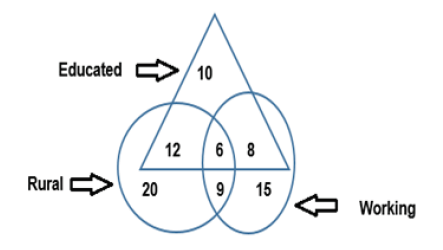
Study the given diagram carefully and answer the question that follows.

The numbers in different sections indicate the number of people.

How many people are both Educated and Working but not Rural?

  1. AOption (a)

    8

  2. BOption (b)

    6

  3. COption (c)

    9

  4. DOption (d)

    14

View answer & explanation

Correct answer

Answer: (a)A.

8

Why this answer is correct

According to the given Venn diagram:

The shaded region represents the total number of people who are both Educated and Working but not Rural.

So, the total number of people who are both Educated and Working but not Rural = 8

Hence, the correct answer is "Option 1".

Question 44

Find the value of y if 1(125)−y=;15−4y+1\frac{1}{{{{\left( {125} \right)}^{ - y}}}} = ;\frac{1}{{{5^{ - 4y + 1}}}}.

  1. AOption (a)

    -1

  2. BOption (b)

    13\frac{1}{3}

  3. COption (c)

    5

  4. DOption (d)

    1

View answer & explanation

Correct answer

Answer: (d)D.

1

Why this answer is correct

Shortcut Trick Convert both sides to a common base 5 to compare the exponents directly. LHS: 1 / 125−y = 125y = (53)y = 53y RHS: 1 / 5−4y+1 = 5−(−4y+1) = 54y−1 Since the bases are identical, equate the powers: 3y = 4y − 1 ⇒ y = 1. ∴ The correct answer is 1.

Alternate Method Given: 1 / 125−y = 1 / 5−4y+1 Formula Used:

  1. Negative Exponent Rule: 1 / a−n = an
  2. Power of a Power Rule: (am)n = am × n
  3. If ax = ay, then x = y (for a > 0, a ≠ 1) Calculations: ⇒ 125y = 5−(−4y + 1) ⇒ (53)y = 54y − 1 ⇒ 53y = 54y − 1 ⇒ 3y = 4y − 1 ⇒ 4y − 3y = 1 ⇒ y = 1 ∴ The correct answer is 1.

Additional Information Laws of Indices Fundamental rules like am × an = am+n and am / an = am−n are essential for solving exponential equations. Negative Exponents A negative exponent indicates a reciprocal: a−n = 1 / an. Conversely, 1 / a−n = an. Base Conversion Always try to express composite numbers (like 125, 64, 27) as powers of prime bases (like 5, 2, 3) to simplify comparisons.

Question 45

Vardhamana Mahavira was the ______ Tirthankara of Jainism.

  1. AOption (a)

    20th

  2. BOption (b)

    2nd

  3. COption (c)

    5th

  4. DOption (d)

    24th

View answer & explanation

Correct answer

Answer: (d)D.

24th

Why this answer is correct

The correct answer is 24th

Key Points

  • Vardhamana Mahavira:

  • Vardhamana Mahavira was the 24th Tirthankara of the Jain tradition.

  • He was born at Kundagrama near Vaisali to Kshatriya parents Siddhartha and Trisala.

  • Bimbisara was the contemporary of Vardhamana Mahavira.

  • At the age of thirty, he became an ascetic and wandered for twelve years.

  • In the 13th year of his penance, he attained the highest spiritual knowledge called Kevala Gnana.

  • Teachings of Mahavira -

  • The three principles of Jainism, also known as Triratnas (three gems), are:

  • Right faith

  • Right knowledge

  • Right conduct.

  • Mahavira regarded all objects, both animate and inanimate, have souls and various degrees of consciousness.

  • He advocated a very holy and ethical code of life.

  • Even the practice of agriculture was considered sinful as it causes injury to the earth, worms, and animals.

Additional Information 

SequenceTirthankaraSymbol
1stRishabhanathaBull
2ndAjitanathaElephant
23rdParsvanathaHooded Serpent
24thMahaviraLion

Question 46

The bond generally NOT found in carbon compounds is:

  1. AOption (a)

    single bond

  2. BOption (b)

    double bond

  3. COption (c)

    ionic bond

  4. DOption (d)

    triple bond

View answer & explanation

Correct answer

Answer: (c)C.

ionic bond

Why this answer is correct

The correct answer is the ionic bond

Key Points

  • The bond that is generally not found in carbon compounds is an ionic bond.
  • Carbon does not form ionic bonds because it has four valence electrons, which is half of an octet.
  • To form ionic bonds, carbon molecules must gain or lose four electrons, which requires a lot of energy.
  • Instead, carbon forms covalent compounds by sharing electrons.
  • Carbon can form double and triple bonds with other carbon atoms.
  • The type of bond that forms depends on the strength and length of the bond:
  • Single bonds: Long and weak
  • Double bonds: Twisted and weak
  • Triple bonds: Short and strong

Additional Information

  • Single Bond:
  • Length: Longer than double and triple bonds between the same atoms.
  • Strength: Weaker than double and triple bonds between the same atoms.
  • Type: Typically a sigma (σ) bond.
  • Double Bond:
  • Length: Shorter than single bonds but longer than triple bonds between the same atoms.
  • Strength: Stronger than single bonds but weaker than triple bonds between the same atoms.
  • Type: Consists of one sigma (σ) bond and one pi (π) bond.
  • Triple Bond:
  • Length: Shortest bond length between the same atoms.
  • Strength: Strongest bond type between the same atoms.
  • Type: Consists of one sigma (σ) bond and two pi (π) bonds.

Question 47

If the induced current in the coil of a conductor of resistance 4Ω is 1 mA, then EMF induced in the coil is:

  1. AOption (a)

    1 mV

  2. BOption (b)

    4 V

  3. COption (c)

    1 V

  4. DOption (d)

    4 mV

View answer & explanation

Correct answer

Answer: (d)D.

4 mV

Why this answer is correct

The correct answer is 4 mV

Key Points

  • We can use Ohm's law to find the induced EMF.
  • Ohm's law states that:
  • Voltage (V) = Current (I) × Resistance (R)
  • Given:
  • Current (I) = 1 mA = 0.001 A
  • Resistance (R) = 4 Ω
  • Therefore,
  • Induced EMF (V) = 0.001 A × 4 Ω = 0.004 V = 4 mV
  • So, the correct answer is 4) 4 mV.
  • Induced EMF: Induced EMF, or electromotive force, is a voltage generated across a conductor due to a change in the magnetic field around it.
  • This phenomenon is known as electromagnetic induction.

Question 48

If the magnification of an image is -0.65, then the nature of the image is:

  1. AOption (a)

    virtual, erect and enlarged

  2. BOption (b)

    real, inverted and enlarged

  3. COption (c)

    real, inverted and smaller

  4. DOption (d)

    real, erect and smaller

View answer & explanation

Correct answer

Answer: (c)C.

real, inverted and smaller

Why this answer is correct

The correct answer is real, inverted and smaller

Key Points

  • Magnification is a measure of how much larger or smaller an image is compared to the original object.
  • It's calculated as the ratio of the image size to the object size.
  • Sign of Magnification:
  • Positive Magnification: Indicates a virtual and upright image.
  • This type of image is formed by a convex lens when the object is placed between the focus and the optical centre.
  • Negative Magnification: Indicates a real and inverted image.
  • This type of image is formed by a convex lens when the object is placed beyond the focus.
  • Given:
  • Magnification = -0.65
  • Interpretation:
  • Negative Sign: This implies that the image is inverted.
  • Magnitude Less Than 1: This means the image is smaller than the object.

Therefore, a magnification of -0.65 indicates a real, inverted, and smaller image

Question 49

In the Newlands’ arrangement of elements in the increasing order of their atomic masses, the last element was:

  1. AOption (a)

    Mg

  2. BOption (b)

    H

  3. COption (c)

    Th

  4. DOption (d)

    He

View answer & explanation

Correct answer

Answer: (c)C.

Th

Why this answer is correct

The correct answer is Th

Key Points

  • John Newlands, an English chemist, proposed the Law of Octaves in 1864.
  • This law states that when elements are arranged in increasing order of their atomic masses, every eighth element had properties similar to the first.
  • He compared this pattern to the octaves of music, hence the name "Law of Octaves".
  • Newlands arranged the 56 known elements at that time into 11 groups, each containing seven elements.
  • The last element in his arrangement was Thorium (Th).
  • However, Newlands' Law of Octaves had limitations:
  • It worked well only up to calcium.
  • It failed to accommodate elements discovered after calcium.
  • It placed dissimilar elements in the same group.

Additional Information

  • Mg (Magnesium): Magnesium is not the last element in Newlands' arrangement. It's a lighter element and comes much earlier in the sequence.
  • H (Hydrogen): Hydrogen is also not the last element. It's one of the lightest elements and appears near the beginning of the arrangement.
  • He (Helium): Helium was discovered much later than Newlands' time and was not included in his arrangement.

Question 50

______ are responsible for the determination of sex.

  1. AOption (a)

    Allosomes

  2. BOption (b)

    Germ cells

  3. COption (c)

    Pleiotropic genes

  4. DOption (d)

    Autosomes

View answer & explanation

Correct answer

Answer: (a)A.

Allosomes

Why this answer is correct

The correct answer is Allosomes

Key Points

  • Allosomes, also known as sex chromosomes, are responsible for determining an organism's biological sex.
  • Allosomes vs autosomes
  • Allosomes are different in size, form, and behaviour from autosomes, which are all chromosomes other than sex chromosomes.
  • Sex chromosomes in humans
  • Humans have one pair of sex chromosomes, the X and Y chromosomes, in addition to 22 pairs of autosomes.
  • Sex determination in mammals
  • The Y chromosome is the determining factor for sex in mammals.
  • The Sry gene on the Y chromosome causes the genital ridge's somatic cells to develop into a testis instead of an ovary.
  • Discovery of sex chromosomes
  • Nettie Stevens and Edmund Beecher Wilson independently discovered sex chromosomes in 1905

Additional Information

  • Germ Cells
  • Germ cells are specialized cells that give rise to gametes, which are reproductive cells like sperm and eggs.
  • They are essential for sexual reproduction and the transmission of genetic information from one generation to the next.
  • Pleiotropic Genes
  • A pleiotropic gene is a gene that influences multiple phenotypic traits.
  • In simpler terms, a single gene can have effects on several different characteristics of an organism.

Question 51

In which of the following states of India is ‘Sazo’ festival celebrated?

  1. AOption (a)

    Jharkhand

  2. BOption (b)

    Karnataka

  3. COption (c)

    Himachal Pradesh

  4. DOption (d)

    Telangana

View answer & explanation

Correct answer

Answer: (c)C.

Himachal Pradesh

Why this answer is correct

The correct answer is Himachal Pradesh

Key Points

  • The Sazo festival is a significant religious event celebrated in the Kinnaur district of Himachal Pradesh.
  • It is believed that during this festival, the local deities ascend to heaven for a short period.
  • It is a deeply spiritual event for the local people, marking the departure of deities to the celestial realm.
  • The festival involves various rituals, including purification ceremonies, offerings to deities, and special prayers

Additional Information

  • Some Other Festivals of Jharkhand, Karnataka, and Telangana
  • Jharkhand
  • Sarhul: A tribal festival celebrating the beginning of spring and the harvest season.
  • Sohrai: A harvest festival celebrated by the Santhal tribe.
  • Chhath Puja: A Hindu festival dedicated to the Sun god, Surya.
  • Karma: A festival dedicated to the Karam Devta, a deity associated with fertility and prosperity.
  • Karnataka
  • Ugadi: The New Year's Day for Hindus in Karnataka, celebrated with a variety of sweets and savoury dishes.
  • Dasara: A major Hindu festival celebrated with great pomp and show, particularly in Mysore.
  • Deepavali: The festival of lights, celebrated with colourful decorations, fireworks, and the exchange of sweets.
  • Kranti Din: Commemorates the independence movement in Karnataka.
  • Telangana
  • Bathukamma: A colourful floral festival celebrated by women, symbolizing nature's bounty and feminine energy.
  • Bonalu: A festival dedicated to the goddess Mahankali, involving vibrant processions and offerings.
  • Diwali: The festival of lights, celebrated with great enthusiasm, especially in urban areas.
  • Ramzan: A religious festival observed by Muslims, marking the end of Ramadan.

Question 52

Read the given statement and the arguments carefully and select the appropriate answer from the given options.

Statement:

Fake news has become a problem of the 21st century over the globe.

Arguments:

I. A global level mechanism is needed to combat this worldwide problem.

II. Problems related to fake news are only present in India.

  1. AOption (a)

    Both I and II strengthen the statement.

  2. BOption (b)

    I weakens while II strengthens the statement.

  3. COption (c)

    Both I and II weaken the statement. 

  4. DOption (d)

    II weakens while I strengthens the statement.

View answer & explanation

Correct answer

Answer: (d)D.

II weakens while I strengthens the statement.

Why this answer is correct

Argument I: A global level mechanism is needed to combat this worldwide problem.

This argument strengthens the given statement. Since fake news is a global issue, it makes sense to propose that a global-level mechanism is required to address it. A worldwide problem needs a coordinated response across borders. The argument suggests an appropriate course of action given the nature of the issue, and is valid because it aligns with the premise that fake news is a problem of global scale.

Argument II: Problems related to fake news are only present in India.

This argument weaken the given statement. The statement highlights that fake news is a global problem, not something confined to a particular country. To suggest that fake news is only a problem in India weakens the statement and is incorrect. Fake news affects multiple countries, not just one country.

Conclusion:

Argument I is strength the statement because it supports the global nature of the problem and suggests an appropriate solution.

Argument II is weaken the statement because it contradicts the global scope of the problem by limiting it to just one country.

Hence, correct answer option is "II weakens while I strengthens the statement".

Question 53

Simplify 6+6×63×3+5÷;12÷12of1212÷12×12\frac{{6 + 6 \times 6}}{{3 \times 3 + 5}} \div ;\frac{{\frac{1}{2} \div \frac{1}{2}of\frac{1}{2}}}{{\frac{1}{2} \div \frac{1}{2} \times \frac{1}{2}}}.

  1. AOption (a)

    43\frac{4}{3}

  2. BOption (b)

    34\frac{3}{4}

  3. COption (c)

    3

  4. DOption (d)

    13\frac{1}{3}

View answer & explanation

Correct answer

Answer: (b)B.

34\frac{3}{4}

Why this answer is correct

Given:

Simplify 6+6×63×3+5÷;12÷12of1212÷12×12\frac{{6 + 6 \times 6}}{{3 \times 3 + 5}} ÷ ;\frac{{\frac{1}{2} ÷ \frac{1}{2}of\frac{1}{2}}}{{\frac{1}{2} ÷ \frac{1}{2} \times \frac{1}{2}}}

Formula Used:

Basic arithmetic operations and BODMAS/BIDMAS rule (Bracket, Order, Division/Multiplication, Addition/Subtraction).

Calculation:

Simplify the numerator and denominator separately:

Numerator: 6 + 6 × 6

⇒ 6 + 36

⇒ 42

Denominator: 3 × 3 + 5

⇒ 9 + 5

⇒ 14

Now, 42/14

⇒ 3

Next, simplify 12÷12 of 12\frac{1}{2} ÷ \frac{1}{2} \text{ of } \frac{1}{2} :

First, 12 of 12\frac{1}{2} \text{ of } \frac{1}{2}

⇒ 1/4

⇒ 1/2 ÷ 1/4 = 2

Now, simplify 12÷12×12\frac{1}{2} ÷ \frac{1}{2} \times \frac{1}{2}

Then, 1×121 \times \frac{1}{2}

⇒ 1/2

Combining all the values,

⇒ 3÷2123 ÷ \frac{2}{\frac{1}{2}} = 3 ÷ 4

⇒ 3/4

The correct answer is option 2.

Question 54

What is the time limit set to complete probe from day of registration of complaint under the Shakti Criminal Laws (Maharashtra Amendment Bill), 2020 cleared by Maharashtra Assembly in December 2021?

  1. AOption (a)

    15 Days

  2. BOption (b)

    21 Days

  3. COption (c)

    30 Days

  4. DOption (d)

    10 Days

View answer & explanation

Correct answer

Answer: (a)A.

15 Days

Why this answer is correct

The correct answer is 15 Days

Key Points

  • The Shakti Criminal Laws (Maharashtra Amendment) Bill, 2020 set a 15-day time limit for investigating crimes against women and children, such as rape and gang rape.
  • This was a reduction from the two-month time limit set in the CrPC.
  • If the investigation cannot be completed within the 15-day period, the investigating officer must record the reasons in writing.
  • The Special Inspector General of Police or Commissioner of Police can extend the period by seven working day

Question 55

The HCF of 2410 and 2700 is ______.

  1. AOption (a)

    1

  2. BOption (b)

    10

  3. COption (c)

    5

  4. DOption (d)

    2

View answer & explanation

Correct answer

Answer: (b)B.

10

Why this answer is correct

Shortcut Trick

Identify the common factor by observing the trailing zeros.

Both 2410 and 2700 end with at least one zero.

The difference between 2700 and 2410 is 290.

Factors of 290 are 1, 2, 5, 10, 29... since 10 is the largest power of 10 dividing both, HCF is 10.

∴ The correct answer is 10.

Alternate Method

Given: Numbers 2410 and 2700.

Formula Used: Prime Factorization Method or Long Division Method.

⇒ Prime Factorization of 2410 = 2 × 5 × 241

⇒ Prime Factorization of 2700 = 22 × 33 × 52

⇒ Common Prime Factors = 21 × 51

⇒ HCF = 2 × 5 = 10

∴ The correct answer is 10.

Additional Information

Definition of HCF

The Highest Common Factor (HCF) is the largest positive integer that divides each of the integers without a remainder.

Relation between HCF and LCM

For two numbers a and b, HCF(a, b) × LCM(a, b) = a × b.

Difference Method

The HCF of two numbers is always a factor of their difference.

Question 56

Select the number from among the given options that can replace the question mark (?) in the following series.

7, 23, ?, 79, 119, 167

  1. AOption (a)

    61

  2. BOption (b)

    47

  3. COption (c)

    52

  4. DOption (d)

    39

View answer & explanation

Correct answer

Answer: (b)B.

47

Why this answer is correct

The logic followed here is:

Hence, "Option 2" is the correct answer.

Question 57

A person sells an article for ₹1,820 and loses 9%. If he wants to sell it a profit of 9%, the selling price of the article should be:

  1. AOption (a)

    ₹2,280

  2. BOption (b)

    ₹2,080

  3. COption (c)

    ₹2,180

  4. DOption (d)

    ₹2,480

View answer & explanation

Correct answer

Answer: (c)C.

₹2,180

Why this answer is correct

Shortcut Trick

Loss of 9% means SP1 is 91% of CP. Profit of 9% means SP2 is 109% of CP.

Using ratio-unitary method: 91 units = ₹1,820.

1 unit = 1820 ÷ 91 = 20.

109 units = 109 × 20 = ₹2,180.

∴ The correct answer is ₹2,180.

Alternate Method

Given: First Selling Price (SP1) = ₹1,820, Loss% = 9%, Desired Profit% = 9%. Formulas: CP = [SP × 100] ÷ [100 − Loss%], New SP = [CP × (100 + Profit%)] ÷ 100.

⇒ Cost Price (CP) = (1820 × 100) ÷ (100 − 9) = (1820 × 100) ÷ 91

⇒ CP = 20 × 100 = ₹2,000

⇒ New Selling Price (SP2) = [2000 × (100 + 9)] ÷ 100

⇒ SP2 = (2000 × 109) ÷ 100 = 20 × 109

⇒ SP2 = ₹2,180

∴ The correct answer is ₹2,180.

Additional Information

Base of Calculation

Profit and loss percentages are always calculated on the Cost Price (CP) unless stated otherwise in the question.

Direct SP Conversion

To find a new SP from an old SP directly: New SP = Old SP × (100 ± New%)/(100 ± Old%).

Question 58

When asked about the direction of the stadium from the bus stop, Akhil said, “One must walk 100 m towards the south. Then one must take a left turn and walk 120 m. Then one must take a left turn again and walk 370 m. Then, again, one must take a left turn and walk 400 m. Then one must take a left turn again and walk 370 m. Then, again, one must take a left turn and walk 110 m. Finally, one must take one last left turn and walk 100 m to reach the stadium”. How far and in which direction is the stadium from the bus stop? (All turns are 90 degree turns only)

  1. AOption (a)

    140 m, West

  2. BOption (b)

    140 m, East

  3. COption (c)

    170 m, East

  4. DOption (d)

    170 m, West

View answer & explanation

Correct answer

Answer: (d)D.

170 m, West

Why this answer is correct

Given: All turns are 90 degree turns only

When asked about the direction of the stadium from the bus stop, Akhil said, “One must walk 100 m towards the south. 

Then one must take a left turn and walk 120 m.

Then one must take a left turn again and walk 370 m.

Then, again, one must take a left turn and walk 400 m.

Then one must take a left turn again and walk 370 m.

Then, again, one must take a left turn and walk 110 m.

Finally, one must take one last left turn and walk 100 m to reach the stadium”.

Thus, the stadium is (400 m - 110 m - 120 m) 170 m far from the bus stop in the west direction.

Hence, "Option 4" is the correct answer.

Question 59

Which of the following numbers will replace the question mark (?) in the given series?

12, 14, 18, 26, 42, ?

  1. AOption (a)

    76

  2. BOption (b)

    72

  3. COption (c)

    74

  4. DOption (d)

    78

View answer & explanation

Correct answer

Answer: (c)C.

74

Why this answer is correct

The logic followed here is:

Hence, "Option 3" is the correct answer.

Question 60

If the current and potential difference are tripled in a circuit, keeping the resistance constant, then power will increase:

  1. AOption (a)

    One third

  2. BOption (b)

    six fold

  3. COption (c)

    Three fold

  4. DOption (d)

    nine fold

View answer & explanation

Correct answer

Answer: (d)D.

nine fold

Why this answer is correct

The correct answer is ninefold

Key Points

  • If the current and potential difference are tripled in a circuit, keeping the resistance constant, then the power will increase nine fold.
  • The power dissipated in a circuit is P=I2RP=I^{2}R
  • When R is constant, P∝I2P\propto I^2.
  • If I becomes 3 times, then P becomes 9 times.

Question 61

If the size of a spherical mirror increases in such a way that its radius of curvature gets doubled, then its focal length will ______.

  1. AOption (a)

    increase to double

  2. BOption (b)

    become infinite

  3. COption (c)

    remain same

  4. DOption (d)

    decrease by its half

View answer & explanation

Correct answer

Answer: (a)A.

increase to double

Why this answer is correct

The correct answer is to increase to double

Key Points

  • For a spherical mirror, the relationship between the focal length (f) and the radius of curvature (R) is:
  • f = R/2
  • This means that the focal length is half the radius of curvature.
  • So, if the radius of curvature (R) is doubled, the focal length (f) will also double, as the ratio remains constant.
  • Therefore, the correct answer is: 1) increase to double.

Additional Information

  • A spherical mirror is a mirror whose reflecting surface is a portion of a sphere. There are two types of spherical mirrors:
    1. Concave Mirror
  • Shape: The reflecting surface curves inward.
  • Focus: Light rays parallel to the principal axis converge at a point called the focus.
  • Image Formation:
  • Real and inverted images can be formed when the object is placed beyond the focal point.
  • Virtual and upright images can be formed when the object is placed between the focus and the pole.
  • Uses:
  • Headlights
  • Telescopes
  • Shaving mirrors
  • Makeup mirror
  • Opens in a new window
    1. Convex Mirror
  • Shape: The reflecting surface curves outward.
  • Focus: Light rays parallel to the principal axis diverge as if they are coming from a point called the focus (virtual focus).
  • Image Formation:
  • Always forms virtual, upright, and diminished images, regardless of the object's position.
  • Uses:
  • Rear-view mirrors in vehicles
  • Security mirrors
  • Store surveillance mirrors

Question 62

Select the option that is related to the seventh number in the same way as the second number is related to the first number, the fourth number is related to the third number and the sixth number is related to the fifth number.

27 : 13 :: 65 : 32 :: 71 : 35 :: 51 : ?

  1. AOption (a)

    17

  2. BOption (b)

    26

  3. COption (c)

    15

  4. DOption (d)

    25

View answer & explanation

Correct answer

Answer: (d)D.

25

Why this answer is correct

Given: 27 : 13 :: 65 : 32 :: 71 : 35 :: 51 : ?

The logic followed here is:

27 : 13

(13 × 2) + 1 = 27

65 : 32

(32 x 2) +1 = 65

71 : 35

(35 x 2) +1 = 71

Similarly,

51 : ?

(? x 2) +1 = 51

(? x 2)  = 51 -1

(? x 2)  = 50

? = 50 ÷ 2

? = 25

Hence, "Option 4" is the correct answer.

Question 63

Six boxes, D, E, F, G, H, and I, are kept one over the other but not necessarily in the same order.

Only two boxes are kept between D and I. D is kept at the third place from the top. Only one box is between E and I. Also, there is only one box between E and F. Which box is kept at the third place from the bottom?

  1. AOption (a)

    G

  2. BOption (b)

    E

  3. COption (c)

    H

  4. DOption (d)

    F

View answer & explanation

Correct answer

Answer: (b)B.

E

Why this answer is correct

Given: Six boxes, D, E, F, G, H, and I, are kept one over the other.

  1. D is kept at the third place from the top.

  2. Only two boxes are kept between D and I.

S.NO.Boxes
Top
1
2
3D
4
5
6I
Bottom
  1. Only one box is between E and I.
S.NO.Boxes
Top
1
2
3D
4E
5
6I
Bottom
  1. Also, there is only one box between E and F.

After positioning F only two positions is left which will be occupied by the only two boxes left i.e. G and H.

S.NO.Boxes
Top
1G / H
2F
3D
4E
5G / H
6I
Bottom

Thus, according to the final arrangement E box is kept at the third place from the bottom.

Hence, "Option 2" is the correct answer.

Question 64

The quadratic equation whose roots are 3 and 13\frac{1}{3} is:

  1. AOption (a)

    3x2 + 10x + 3 = 0

  2. BOption (b)

    3x2 - 10x - 3 = 0

  3. COption (c)

    3x2 + 10x - 3 = 0

  4. DOption (d)

    3x2 - 10x + 3 = 0

View answer & explanation

Correct answer

Answer: (d)D.

3x2 - 10x + 3 = 0

Why this answer is correct

Shortcut Trick

For roots α and β, the quadratic equation is x2 − (Sum)x + Product = 0.

Sum = 3 + 1/3 = 10/3

Product = 3 × 1/3 = 1

Equation: x2 − (10/3)x + 1 = 0 ⇒ 3x2 − 10x + 3 = 0.

∴ The correct answer is 3x2 − 10x + 3 = 0.

Alternate Method

Given:

Roots of the quadratic equation are α = 3 and β = 1/3.

Formula Used:

A quadratic equation with roots α and β is given by: x2 − (α + β)x + αβ = 0

Calculations:

⇒ Sum of the roots (α + β) = 3 + 1/3

⇒ α + β = (9 + 1) / 3 = 10/3

⇒ Product of the roots (αβ) = 3 × (1/3) = 1

⇒ Substituting these values into the formula: x2 − (10/3)x + 1 = 0

⇒ Multiply the entire equation by 3 to remove the fraction: 3(x2) − 3(10/3)x + 3(1) = 0

⇒ 3x2 − 10x + 3 = 0

Therefore, the required equation is 3x2 − 10x + 3 = 0.

∴ The correct answer is 3x2 − 10x + 3 = 0.

Additional Information

Relationship between Roots and Coefficients

For a standard quadratic equation ax2 + bx + c = 0, the sum of roots is −b/a and the product of roots is c/a.

Nature of Roots

The nature of roots is determined by the Discriminant (D = b2 − 4ac). If D > 0, roots are real and distinct; if D = 0, roots are real and equal; if D < 0, roots are imaginary.

Quadratic Formula

The roots can also be found using the formula: x = [−b ± √(b2 − 4ac)] / 2a.

Question 65

Anamudi mountain is located in which of the following states?

  1. AOption (a)

    Tamil Nadu

  2. BOption (b)

    Karnataka

  3. COption (c)

    Kerala

  4. DOption (d)

    Telangana

View answer & explanation

Correct answer

Answer: (c)C.

Kerala

Why this answer is correct

The correct answer is Kerala

Key Points

  • Anamudi Mountain is located in the state of Kerala:
  • Anamudi is situated in the Ernakulam and Idukki districts of Kerala, on the border between the two districts.
  • Anamudi is the highest peak in the Western Ghats and in South India, with an elevation of 2,695 meters (8,842 ft).
  • It's also the highest mountain in peninsular India and the largest mountain in Kerala.
  • The name Anamudi literally translates to "elephant's head", a reference to the mountain's resemblance to an elephant's head.
  • Anamudi is located in the southern part of the Elaimulam National Park, which is a combination of the Cardamom Hills, Anamalai Hills, and Palani Hills.
  • Anamudi is a popular tourist destination year-round.

Question 66

P, R, T, V and W live on different floors of the same building. The lowermost floor in the building is numbered 1, the floor above it is numbered 2, and so on till the topmost floor is numbered 5. V lives on the floor immediately below W. P lives on the floor immediately above T. R lives on the floor immediately above P. W lives on the floor immediately below T. Who lives on the third floor?

  1. AOption (a)

    W

  2. BOption (b)

    P

  3. COption (c)

    R

  4. DOption (d)

    T

View answer & explanation

Correct answer

Answer: (d)D.

T

Why this answer is correct

Given: P, R, T, V and W live on different floors of the same building. The lowermost floor in the building is numbered 1, the floor above it is numbered 2, and so on till the topmost floor is numbered 5. 

1) V lives on the floor immediately below W.

  1. W lives on the floor immediately below T.
S.NO.Persons
Case 1Case 2Case 3
5T
4WT
3VWT
2VW
1V

2) P lives on the floor immediately above T.

As there is no possible position for P in case 1, therefore it is eliminated. 

S.NO.Persons
Case 2Case 3
5P
4TP
3WT
2VW
1V

3) R lives on the floor immediately above P.

As there is no possible position for R in case 2, therefore it is eliminated. 

S.NO.Persons
Case 3
5R
4P
3T
2W
1V

Thus, according to the final arrangement T lives on the third floor.

Hence, "Option 4" is the correct answer.

Question 67

The volume (in cm3) of a wire of diameter 2 cm and length 7 m is:

Take π = 227\frac{{22}}{7}

  1. AOption (a)

    1100

  2. BOption (b)

    2200

  3. COption (c)

    2400

  4. DOption (d)

    1200

View answer & explanation

Correct answer

Answer: (b)B.

2200

Why this answer is correct

Shortcut Trick

Radius (r) = 2/2 = 1 cm.

Length (h) = 7 m = 700 cm.

Volume = πr2h = (22/7) × 12 × 700.

Volume = 22 × 100 = 2200 cm3.

∴ The correct answer is 2200 cm3.

Alternate Method

Given:

Diameter of wire = 2 cm ⇒ Radius (r) = 1 cm.

Length of wire (h) = 7 m = 7 × 100 = 700 cm.

Formula Used:

Volume of Cylinder = πr2h

Calculations:

⇒ Volume = (22/7) × (1)2 × 700

⇒ Volume = (22/7) × 1 × 700

⇒ Volume = 22 × 100

⇒ Volume = 2200 cm3

∴ The correct answer is 2200 cm3.

Additional Information

Volume of a Cylinder

The space occupied by a cylindrical object is calculated as πr2h, where r is the radius and h is the height or length.

Surface Area of Cylinder

Curved Surface Area (CSA) = 2πrh and Total Surface Area (TSA) = 2πr(r + h).

Unit Conversion

Always ensure all dimensions are in the same unit before calculation; 1 meter = 100 centimeters.

Question 68

Five people, A, D, E, F and K, are sitting around a circular table facing the centre. A is the immediate neighbour of D and E. F is the immediate neighbour of E and K. Who is the immediate neighbour of both A and F?

  1. AOption (a)

    D

  2. BOption (b)

    B

  3. COption (c)

    E

  4. DOption (d)

    K

View answer & explanation

Correct answer

Answer: (c)C.

E

Why this answer is correct

Given: Five people, A, D, E, F and K, are sitting around a circular table facing the centre.

1) A is the immediate neighbour of D and E. 

As position of D and E with respect to A is not known yet, therefore there are two possible cases.

Case 1)

Case 2) 

2) F is the immediate neighbour of E and K. 

Case 1)

Case 2) 

Thus, in both cases E is the immediate neighbour of both A and F.

Hence, "Option 3" is the correct answer.

Question 69

The English and Foreign Languages University located in Hyderabad was founded in the year ______.

  1. AOption (a)

    1952

  2. BOption (b)

    1950

  3. COption (c)

    1958

  4. DOption (d)

    1947

View answer & explanation

Correct answer

Answer: (c)C.

1958

Why this answer is correct

The correct answer is 1958

Key Points

  • The English and Foreign Languages University (EFLU) in Hyderabad was founded in the year 1958 as the Central Institute of English by India's first Prime Minister, Pandit Jawaharlal Nehru.
  • Its primary objective was to improve the standards of English language teaching in India.
  • Over the years, the institute expanded its scope to include the teaching and research of various foreign languages.
  • In 2006, it was granted the status of a central university and renamed the English and Foreign Languages University.
  • Today, EFLU is a premier institution for language learning and research in India,
  • offering a wide range of undergraduate, postgraduate, and doctoral programs in English, foreign languages, literature, linguistics, and cultural studies

Question 70

Which of the following animals have two-chambered heart?

  1. AOption (a)

    Fishes

  2. BOption (b)

    Reptiles

  3. COption (c)

    Mammals

  4. DOption (d)

    Birds

View answer & explanation

Correct answer

Answer: (a)A.

Fishes

Why this answer is correct

The correct answer is Fishes

Key Points

  • The number of chambers in an animal's heart is a key factor in determining the efficiency of its circulatory system.
  • Two-Chambered Heart
  • Fish: Fish have the simplest heart structure, consisting of two chambers: one atrium and one ventricle.
  • Function: Blood is pumped from the heart to the gills for oxygenation and then directly to the rest of the body.

Additional Information

  • Three-Chambered Heart
  • Amphibians and most reptiles: These animals have a three-chambered heart with two atria and one ventricle.
  • Function: Oxygenated and deoxygenated blood mix to some extent in the single ventricle, which can reduce the efficiency of oxygen delivery to tissues.
  • Four-Chambered Heart
  • Birds and mammals: These animals have a four-chambered heart with two atria and two ventricles.
  • Function: This highly efficient heart completely separates oxygenated and deoxygenated blood, ensuring optimal oxygen delivery to tissues.
  • Why do chamber numbers matter?
  • Efficient oxygenation: More chambers allow for more efficient separation of oxygenated and deoxygenated blood, leading to better oxygen delivery to tissues.
  • Metabolic needs: Animals with higher metabolic rates, like birds and mammals, require more efficient oxygen delivery.

Question 71

In a certain code language, ‘RAPID’ is written as ‘ARPDI’ and ‘LOCAL’ is written as ‘OLCLA’. How will ‘NEVER’ be written in that language?

  1. AOption (a)

    ENEVR

  2. BOption (b)

    ENVRE

  3. COption (c)

    ENVER

  4. DOption (d)

    EVNRE

View answer & explanation

Correct answer

Answer: (b)B.

ENVRE

Why this answer is correct

The logic followed here is:

‘RAPID’ is written as ‘ARPDI’

And,

‘LOCAL’ is written as ‘OLCLA’

Similarly,

‘NEVER’ is written as

Hence, "Option 2" is the correct answer.

Question 72

What is the solid product formed when ferrous sulphate is heated?

  1. AOption (a)

    Ferrous sulphide

  2. BOption (b)

    Ferric oxide

  3. COption (c)

    Iron

  4. DOption (d)

    Ferrous oxide

View answer & explanation

Correct answer

Answer: (b)B.

Ferric oxide

Why this answer is correct

The correct answer is Ferric oxide

Key Points

  • When ferrous sulfate is heated strongly, it undergoes a decomposition reaction, producing ferric oxide (Fe2O3) as the solid product,
  • along with sulfur dioxide (SO2) and sulfur trioxide (SO3) gases.
  • The chemical equation for this reaction is:
  • 2FeSO4(s) → Fe2O3(s) + SO2(g) + SO3(g)
  • So, the correct answer is 2) Ferric oxide.

Additional Information

  • Ferrous Sulphide (FeS)
  • Appearance: Black solid
  • In various tools and machinery.
  • Formation: Often formed by the reaction of iron with sulfur or by the reaction of hydrogen sulfide gas with iron(II) salts.
  • Uses:
  • In the laboratory to produce hydrogen sulfide gas.
  • In the metallurgical industry.
  • Ferrous Oxide (FeO)
  • Appearance: Black or dark grey solid
  • Formation: Can be formed by the reduction of iron oxides with carbon monoxide or hydrogen.
  • Uses:
  • As a pigment in ceramics and glass.
  • In the production of iron and steel.
  • Iron (Fe)
  • Appearance: Silvery-gray metallic solid
  • Formation: Can be obtained from iron ore through various metallurgical processes, such as blast furnace reduction.
  • Uses:
  • In construction and manufacturing.
  • In the production of steel.

Question 73

As per the Union Budget of India 2022-23, India’s economic growth is estimated to be ______.

  1. AOption (a)

    8.6%

  2. BOption (b)

    10.4%

  3. COption (c)

    7.3%

  4. DOption (d)

    9.2%

View answer & explanation

Correct answer

Answer: (d)D.

9.2%

Why this answer is correct

The correct answer is 9.2%

Key Points

  • As per the Union Budget 2022-23, India's economic growth was estimated to be 9.2%.
  • This projection was based on the strong economic recovery post-pandemic.
  • However, the actual growth rate for the fiscal year 2022-23, as per the revised estimates released later, was slightly lower at 7%.
  • It's important to note that these are annual growth rates.
  • Economic growth can fluctuate quarter-to-quarter, and factors like global economic conditions, domestic policies, and geopolitical events can influence these rates.

Additional Information

  • The Union Budget of India is an annual financial statement presented by the Finance Minister to the Parliament.
  • It outlines the government's estimated revenue and expenditure for the upcoming fiscal year.
  • Key Components of the Union Budget:
  • Revenue Receipts: Income generated through taxes (direct and indirect) and other sources.
  • Capital Receipts: Income generated through borrowings and other capital assets.
  • Revenue Expenditure: Expenditure on day-to-day functioning of the government, like salaries, pensions, and subsidies.
  • Capital Expenditure: Expenditure on creating assets, such as infrastructure projects, defense equipment, and public sector investments.

Question 74

This question is based on the five, three-digit numbers given below:

(Left) 876 643 453 974 227 (Right)

(Example: 697 - First digit = 6, second digit = 9 and third digit = 7)

(NOTE - All operations to be done from left to right.)

If all the numbers of the given series are arranged in descending order, the position of which of the following  numbers will remain unchanged?

  1. AOption (a)

    453

  2. BOption (b)

    227

  3. COption (c)

    876

  4. DOption (d)

    643

View answer & explanation

Correct answer

Answer: (b)B.

227

Why this answer is correct

Given: (Left) 876 643 453 974 227 (Right)

According to the question all the numbers of the given series are arranged in descending order:

Given numbers876643453974227
All the numbers arranged in descending order974876643453227

Thus, according to the final arrangement, only position of '227' will remain unchanged.

Hence, "Option 2" is the correct answer.

Question 75

In which year was the nationalisation of banks done by the Government of India?

  1. AOption (a)

    1967

  2. BOption (b)

    1970

  3. COption (c)

    1968

  4. DOption (d)

    1969

View answer & explanation

Correct answer

Answer: (d)D.

1969

Why this answer is correct

The correct answer is 1969

Key Points

  • The nationalization of banks in India was carried out in 1969. On July 19, 1969, the Government of India, under the leadership of then Prime Minister Indira Gandhi, nationalized 14 major commercial banks.
  • This move was aimed at aligning the banking sector with national priorities, increasing financial inclusion, and directing credit towards sectors such as agriculture, small industries, and rural development.
  • The main objectives of the nationalization were:
  • To provide banking services to a wider population, especially in rural and remote areas.
  • To use the banking sector for economic planning and development.
  • To ensure that the credit flow to priority sectors was not constrained by profit-driven motives.
  • This was a significant step in India's economic history and laid the foundation for public sector dominance in the banking industry.

Question 76

Which of the following chemicals is used in black and white photography?

  1. AOption (a)

    Sodium chloride

  2. BOption (b)

    Sodium oxide

  3. COption (c)

    Silver oxide

  4. DOption (d)

    Silver bromide

View answer & explanation

Correct answer

Answer: (d)D.

Silver bromide

Why this answer is correct

The correct answer is Silver bromide

Key Points

  • Silver bromide (AgBr) is a light-sensitive compound commonly used in photographic films and papers.
  • When exposed to light, silver bromide undergoes a chemical reaction that forms a latent image.
  • During the photographic development process, this latent image is converted into visible metallic silver, creating the black-and-white image.

Additional Information 

  • Sodium chloride (NaCl): Common table salt, sodium chloride, is not light-sensitive and does not react to create a photographic image. It has no role in photographic development.
  • Sodium oxide (Na₂O): Sodium oxide is an ionic compound and is not sensitive to light. It is used in glassmaking but has no application in photography.
  • Silver oxide (Ag₂O): Silver oxide is not used in photography because it does not have the necessary light-sensitive properties. It is mainly used in batteries and certain medicinal applications.

Question 77

In the given letter-cluster pairs, the first letter-cluster is related to the second letter-cluster following a certain logic. Study the given pairs carefully, and from the given options, select the pair that follows the same logic.

ABC : EFG

PQR : TUV

  1. AOption (a)

    PKL : RSM

  2. BOption (b)

    XYZ : BCD

  3. COption (c)

    GHI : DEF

  4. DOption (d)

    MNO : PQR

View answer & explanation

Correct answer

Answer: (b)B.

XYZ : BCD

Why this answer is correct

The logic followed here is:

ABC : EFG

PQR : TUV

So, checking each option one by one:

Option 1) PKL : RSM

Option 2) XYZ : BCD

Option 3) GHI : DEF

Option 4) MNO : PQR

Thus, out of all the options, 'XYZ : BCD' follows the same logic as given.

Hence, "Option 2" is the correct answer.

Question 78

Each of students, D, F, G, H, S, T and V has an exam on a different day of a week starting from Monday and ending on Sunday of the same week but not necessarily in the same order. D’s exam is on the day immediately before G’s exam. V’s exam is on the day immediately after T’s exam. Only one student has exam between D and F. V’s exam is on Wednesday and H’s exam is on Friday. F’s exam is neither on Monday nor on Saturday. Who has exam on Thursday?

  1. AOption (a)

    F

  2. BOption (b)

    G

  3. COption (c)

    V

  4. DOption (d)

    D

View answer & explanation

Correct answer

Answer: (a)A.

F

Why this answer is correct

Given: Each of students, D, F, G, H, S, T and V has an exam on a different day of a week starting from Monday and ending on Sunday of the same week.

1) V’s exam is on Wednesday and H’s exam is on Friday.

2) V’s exam is on the day immediately after T’s exam.

Week dayStudent
Monday
TuesdayT
WednesdayV
Thursday
FridayH
Saturday
Sunday

3) D’s exam is on the day immediately before G’s exam.

Week dayStudent
Monday
TuesdayT
WednesdayV
Thursday
FridayH
SaturdayD
SundayG

4) Only one student has exam between D and F.

5) F’s exam is neither on Monday nor on Saturday.

After positioning F only one position is left which will be occupied by the only student left i.e. S.

Week dayStudent
MondayS
TuesdayT
WednesdayV
ThursdayF
FridayH
SaturdayD
SundayG

Thus, according to the final arrangement F has exam on Thursday.

Hence, "Option 1" is the correct answer.

Question 79

As per the Indian Minerals Yearbook 2020 released by the Indian Bureau of Mines, at ______, Gujarat was the leading producer of salt in India in the year 2019-20.

  1. AOption (a)

    81.45%

  2. BOption (b)

    77.96%

  3. COption (c)

    88.59%

  4. DOption (d)

    86.83%

View answer & explanation

Correct answer

Answer: (a)A.

81.45%

Why this answer is correct

The correct answer is 81.45%.

Important Points

  • In the year 2019-20, Gujarat was the leading producer of salt in India, contributing 81.29% to the total salt production in the country.
  • Option 1- 81.45% is the closest value. Hence, it is the correct answer.

Key Points

  • In the year 2019-20, Gujarat was the leading producer of salt in India, contributing 81.29% to the total salt production in the country.
  • Gujarat's salt production is significant due to its extensive coastline and favorable climatic conditions for salt production.
  • Salt production in Gujarat is predominantly carried out in the coastal districts such as Kutch, Bhavnagar, and Jamnagar.
  • Rajasthan and Tamil Nadu were the second and third largest producers, respectively, accounting for 8.59% and 7.96% of the country's salt production.
  • The state’s strategic location and infrastructure also support the efficient export of salt to various parts of the world.

Additional Information

  • Indian Minerals Yearbook
  • The Indian Minerals Yearbook is an annual publication by the Indian Bureau of Mines (IBM) that provides comprehensive information on the mining and mineral industry in India.
  • It includes data on production, reserves, prices, and trade of various minerals, along with details on the mining industry’s performance and developments.
  • The yearbook serves as an important reference for policymakers, industry professionals, researchers, and academicians.
  • It also highlights the contributions of different states to the mineral production in India.
  • Salt Production in India
  • India is one of the largest producers of salt in the world, with Gujarat being the leading state in salt production.
  • Salt production in India is primarily carried out in coastal regions due to the availability of seawater and favorable climatic conditions.
  • The main methods of salt production in India include solar evaporation, rock salt mining, and brine solution mining.
  • Salt is an essential mineral used in various industries, including food processing, chemical manufacturing, and water treatment.
  • Indian Bureau of Mines (IBM)
  • The Indian Bureau of Mines is a multidisciplinary government organization under the Ministry of Mines, India.
  • IBM is responsible for promoting the conservation, development, and scientific management of mineral resources in the country.
  • It provides technical consultancy services, conducts research, and publishes various reports and statistics related to the mining industry.
  • IBM also plays a crucial role in regulating and monitoring mining activities to ensure sustainable and environmentally responsible mining practices.

Question 80

If 5 August 2012 is a Sunday, then what will be the day of the week on 17 September 2015?

  1. AOption (a)

    Monday

  2. BOption (b)

    Thursday

  3. COption (c)

    Wednesday

  4. DOption (d)

    Tuesday

View answer & explanation

Correct answer

Answer: (b)B.

Thursday

Why this answer is correct

Given: 5 August 2012 is Sunday.

Now,

No. of Odd daysNormal YearLeap Year
365 ÷ 7 = 52 weeks + 1 odd day366 ÷ 7 = 52 weeks + 2 odd day


5 August 2012 to 5 August 2013 = 1 odd day (Normal year)

5 August 2013 to 5 August 2014 = 1 odd day (Normal year)

5 August 2014 to 5 August 2015 = 1 odd day (Normal year)

5 August to 31 August = 31 - 5  = 26 days.

1 September to 17 September = 17 days.

Total days from 5 August 2015 to 17 September 2015 = 26 + 17 = 43 days.

43 days → 43/7 = 6 weeks and 1 odd day.

Total odd days = 1 odd day + 1 odd day + 1 odd day +1 odd day = 4 odd days

So, starting from 5 August 2015, which was a Sunday, and adding 4 odd days:

Sunday + 4 = Thursday.

So, 17 September 2015 will be Thursday.

Hence, the correct option is "Option 2".

Question 81

What is the minimum number (quorum) of members required to call a meeting of the Lok Sabha?

  1. AOption (a)

    the total number of members of the House 12\frac{1}{2}

  2. BOption (b)

    the total number of members of the House 110\frac{1}{{10}}

  3. COption (c)

    the total number of members of the House 15\frac{1}{5}

  4. DOption (d)

    the total number of members of the House 14\frac{1}{4}

View answer & explanation

Correct answer

Answer: (b)B.

the total number of members of the House 110\frac{1}{{10}}

Why this answer is correct

The correct answer is the total number of members of the House 110110110110110110110110110

Code
          .

Key Points

  • The quorum to constitute a meeting of the Lok Sabha is one-tenth of the total number of members of the House.
  • This means that at least 10% of the total membership must be present for the proceedings to be valid.
  • This rule is designed to ensure that decisions are made with adequate representation from the members.
  • If at any time during a meeting, the number of members present is less than the quorum, it is the duty of the Speaker to either adjourn the House or to suspend the meeting until the quorum is met.

Additional Information

  • Lok Sabha:
  • The Lok Sabha is the lower house of India's bicameral Parliament, with members directly elected by the people of India.
  • It is also known as the House of the People.
  • The maximum strength of the Lok Sabha is 552 members, which includes up to 530 members from the states, up to 20 members from the Union Territories, and not more than 2 members of the Anglo-Indian community nominated by the President of India.
  • Quorum:
  • The quorum is the minimum number of members required to be present in the House before it can conduct its business.
  • In the context of the Lok Sabha, the quorum is one-tenth of the total membership of the House.
  • If the quorum is not met, the Speaker has the authority to adjourn the House or suspend the meeting until the quorum is achieved.
  • Speaker of the Lok Sabha:
  • The Speaker is the presiding officer of the Lok Sabha, responsible for maintaining order and decorum within the House.
  • The Speaker is elected from among the members of the Lok Sabha.
  • The Speaker has the authority to adjourn the House or suspend the meeting if the quorum is not met.

Question 82

The tenure of the chairman of the IPO-bound Life Insurance Corporation (LIC) has been extended by one more year by the government, till March 2023. Who is the chairman of LIC?

  1. AOption (a)

    Tablesh Pandey

  2. BOption (b)

    Arun Kumar Anand

  3. COption (c)

    Raj Kumar

  4. DOption (d)

    Mangalam Ramasubramanian Kumar

View answer & explanation

Correct answer

Answer: (d)D.

Mangalam Ramasubramanian Kumar

Why this answer is correct

The correct answer is Mangalam Ramasubramanian Kumar

Key Points

  • Mangalam Ramasubramanian Kumar was appointed as the Chairman of Life Insurance Corporation (LIC) of India, one of India's largest public sector financial institutions.
  • His term as Chairman, initially set to end in 2022,
  • was extended by the Indian government till March 2023 to provide continuity in leadership, especially as LIC prepared for its initial public offering (IPO), one of the largest in India's financial market history.
  • Under his leadership, LIC undertook significant preparations for its IPO, focusing on compliance, restructuring, and improving transparency in line with regulatory requirements for a publicly listed company.

Additional Information

  • Tablesh Pandey
  • Tablesh Pandey is a senior official in LIC and serves as one of its Managing Directors.
  • Managing Directors in LIC play a key role in decision-making, managing various portfolios, and supporting the Chairman in policy implementation.
  • Although Tablesh Pandey holds a significant position in LIC, he is not the Chairman.
  • He assists in managing LIC’s operations, which are vast and complex, given LIC’s status as a public sector insurance giant.
  • Arun Kumar Anand
  • Arun Kumar Anand is another senior executive in the insurance sector but is not currently associated with LIC in the capacity of either Chairman or Managing Director.
  • He is not directly relevant to the current question regarding the Chairman of LIC.
  • This option does not apply to LIC’s leadership structure as of the date mentioned in the question.
  • Raj Kumar
  • Raj Kumar also served as a Managing Director at LIC. Like other Managing Directors, his responsibilities included overseeing LIC’s diverse functions, ensuring compliance, and supporting corporate strategy. However, he was not the Chairman.
  • Raj Kumar held a top position at LIC but did not serve as Chairman.
  • His work contributed to LIC’s functioning but did not directly pertain to the role of Chairman.

Question 83

Which set of three elements does NOT constitute a Dobereiner’s triad?

  1. AOption (a)

    Cl, Br, I

  2. BOption (b)

    Li, Na, K

  3. COption (c)

    Ca, Sr, Ba

  4. DOption (d)

    Fe, Co, Ni

View answer & explanation

Correct answer

Answer: (d)D.

Fe, Co, Ni

Why this answer is correct

The correct answer is Fe, Co, Ni

Key Points

  • The concept of Dobereiner's triads was introduced by Johann Wolfgang Döbereiner in the early 19th century.
  • In a triad, three elements with similar properties were grouped together, and the atomic weight of the middle element was approximately the average of the atomic weights of the other two.
  • Fe, Co, Ni:
  • This is NOT a Dobereiner’s triad.
  • Although Iron (Fe), Cobalt (Co), and Nickel (Ni) are transition metals and have somewhat similar properties, their atomic weights do not follow the pattern observed in Dobereiner’s triads.

Additional Information

  • Cl, Br, I: This is a classic Dobereiner’s triad. Chlorine (Cl), Bromine (Br), and Iodine (I) have similar chemical properties, and the atomic weight of Bromine is roughly the average of the atomic weights of Chlorine and Iodine.
  • Li, Na, K: This also forms a Dobereiner’s triad. Lithium (Li), Sodium (Na), and Potassium (K) are alkali metals with similar properties, and Sodium’s atomic weight is roughly the average of Lithium and Potassium.
  • Ca, Sr, Ba: Calcium (Ca), Strontium (Sr), and Barium (Ba) make another Dobereiner’s triad. These are all alkaline earth metals, and Strontium’s atomic weight is approximately the average of Calcium and Barium.

Question 84

Seven people, P, Q, R, S, T, U, and V are sitting in a straight line, facing north. Exactly two people are sitting to the left of T. Q is sitting second to the right of R who is to the immediate right of someone at the end. Only three people are sitting between T and P. Q is not an immediate neighbour of P. S is sitting to the immediate right of U. Who is sitting at the extreme left end of the line?

  1. AOption (a)

    S

  2. BOption (b)

    P

  3. COption (c)

    V

  4. DOption (d)

    U

View answer & explanation

Correct answer

Answer: (c)C.

V

Why this answer is correct

Given: Seven people, P, Q, R, S, T, U, and V are sitting in a straight line, facing north.

1) Exactly two people are sitting to the left of T. 

2) Only three people are sitting between T and P.

3) Q is sitting second to the right of R who is to the immediate right of someone at the end. 

4) Q is not an immediate neighbour of P.

  1. S is sitting to the immediate right of U.

After positioning S and U only one position is left which will be occupied by the person left i.e. V.

Thus, according to the final arrangement, V is sitting at the extreme left end of the line.

Hence, "Option 3" is the correct answer.

Question 85

The roots of the quadratic equation x2 - 10x + 21 = 0 are:

  1. AOption (a)

    3, -7

  2. BOption (b)

    7, 3

  3. COption (c)

    7, -3

  4. DOption (d)

    -7, -3

View answer & explanation

Correct answer

Answer: (b)B.

7, 3

Why this answer is correct

Shortcut Trick

For a quadratic equation in the form x2 − (Sum of roots)x + (Product of roots) = 0.

Compare the given equation x2 − 10x + 21 = 0 with the standard form.

Sum of roots = 10 and Product of roots = 21.

Identify two numbers that add to 10 and multiply to 21: these are 7 and 3.

∴ The correct answer is 7, 3.

Alternate Method

Given: The quadratic equation is x2 − 10x + 21 = 0.

Method: Solving by Factorization (splitting the middle term).

⇒ x2 − 7x − 3x + 21 = 0

⇒ x(x − 7) − 3(x − 7) = 0

⇒ (x − 7)(x − 3) = 0

⇒ x − 7 = 0 or x − 3 = 0

⇒ x = 7 or x = 3

∴ The correct answer is 7, 3.

Additional Information

Discriminant and Nature of Roots

The discriminant D = b2 − 4ac determines the nature of the roots. If D > 0, roots are real and distinct; if D = 0, roots are real and equal.

Relationship between Coefficients and Roots

For ax2 + bx + c = 0, Sum of roots (α + β) = −b/a and Product of roots (α × β) = c/a.

Quadratic Formula

Roots can also be found using x = [−b ± √(b2 − 4ac)] / 2a for any quadratic equation.

Question 86

In the cabinet of which Prime Minister of India, Dr. Manmohan Singh became the finance minister for the first time?

  1. AOption (a)

    Vishwanath Pratap Singh

  2. BOption (b)

    Rajiv Gandhi

  3. COption (c)

    Indira Gandhi

  4. DOption (d)

    P V Narasimha Rao

View answer & explanation

Correct answer

Answer: (d)D.

P V Narasimha Rao

Why this answer is correct

The correct answer is P V Narasimha Rao

Key Points

  • Dr. Manmohan Singh became India’s Finance Minister in 1991, during a time of severe economic crisis.
  • The Indian economy was facing a balance of payments crisis, with foreign exchange reserves barely enough to finance a few weeks of imports.
  • The crisis led to a pivotal decision by the newly elected Prime Minister, P. V. Narasimha Rao, who appointed Dr. Manmohan Singh, a seasoned economist and former Governor of the Reserve Bank of India, as the Finance Minister.
  • As Finance Minister, Dr. Manmohan Singh introduced a series of significant economic reforms aimed at liberalizing the Indian economy.
  • These reforms included:
  • De-licensing industries: The government removed requirements for licenses in many sectors, allowing businesses greater freedom to start and expand operations.
  • Reducing import tariffs: Dr. Singh reduced import tariffs to encourage competition and make Indian industries more efficient.
  • Opening up to foreign investment: His policies allowed more foreign companies to invest in India, which brought in much-needed capital and expertise.
  • Devaluation of the rupee: He oversaw a managed devaluation of the Indian rupee to boost exports.

Additional Information

  • Vishwanath Pratap Singh
  • Tenure as Prime Minister: 1989-1990
  • V. P. Singh was known for his emphasis on social justice and for his historic decision to implement the Mandal Commission recommendations, which reserved a certain percentage of government jobs for Other Backward Classes (OBCs).
  • This decision led to significant political and social impact in India.
  • Rajiv Gandhi
  • Tenure as Prime Minister: 1984-1989
  • Rajiv Gandhi took over as Prime Minister after the assassination of his mother, Indira Gandhi.
  • His tenure focused on modernizing technology and administration, and he pushed for science, education, and telecommunications advancements.
  • Rajiv Gandhi’s government initiated early efforts toward economic reform, though they were not as extensive as those seen later under Narasimha Rao.
  • Indira Gandhi
  • Tenures as Prime Minister: 1966-1977 and 1980-1984
  • Indira Gandhi served as Prime Minister for two terms.
  • Her tenure is marked by significant policies, including the nationalization of banks, the abolition of the privy purse (royal entitlements to former princes), and strong central control over the economy.
  • She was also a key figure during the Emergency period (1975-1977), a controversial phase in Indian politics.

Question 87

Sardar Sarovar Dam stands on which river?

  1. AOption (a)

    Krishna

  2. BOption (b)

    Godavari

  3. COption (c)

    Brahmaputra

  4. DOption (d)

    Narmada

View answer & explanation

Correct answer

Answer: (d)D.

Narmada

Why this answer is correct

The correct answer is Narmada

Key Points

  • The Sardar Sarovar Dam is a massive dam built on the Narmada River in the Indian state of Gujarat.
  • It's one of the largest dams in India and is a crucial part of the Narmada Valley Development Project.
  • It is a multipurpose dam, primarily designed to provide irrigation water to the arid regions of Gujarat, Madhya Pradesh, Maharashtra, and Rajasthan.
  • It also generates hydroelectric power.
  • It is one of the largest dams in India and is considered a significant engineering feat.

Additional Information

  • Krishna River: This river flows primarily through the states of Maharashtra and Andhra Pradesh.
  • Godavari River: This river flows through the states of Maharashtra, Telangana, Andhra Pradesh, and Odisha.
  • Brahmaputra River: This river flows through Tibet, India, Bangladesh, and Bhutan. It's primarily associated with dams in the northeastern region of India,

Question 88

If each digit of the number 72514368 is subtracted from 9, how many even digits will be there in the newly formed number?

  1. AOption (a)

    4

  2. BOption (b)

    5

  3. COption (c)

    6

  4. DOption (d)

    3

View answer & explanation

Correct answer

Answer: (a)A.

4

Why this answer is correct

Given: 72514368

If each digit of the given number is subtracting from 9  then every number in the series will be:

2  7  4  8  5  6  3  1

Even digits in the newly formed number:

2  4  8  6

So, total 4 even digit number formed after arrangement

Hence, correct option is "option 1)".

Question 89

When a graph is plotted between V and I:

  1. AOption (a)

    a horizontal straight line is obtained

  2. BOption (b)

    a vertical straight line is obtained

  3. COption (c)

    a curved graph is obtained

  4. DOption (d)

    an inclined straight line is obtained

View answer & explanation

Correct answer

Answer: (d)D.

an inclined straight line is obtained

Why this answer is correct

The correct answer is an inclined straight line is obtained

Key Points

  • When a graph is plotted between voltage (V) and current (I), the resulting graph is a straight line passing through the origin.

  • This is a direct consequence of Ohm's Law, which states that the voltage across a conductor is directly proportional to the current flowing through it, given a constant temperature.

  • Mathematically, Ohm's Law is expressed as:

  • V = IR

  • Where:

  • V is the voltage

  • I is the current

  • R is the resistance (a constant for a given conductor)

  • This linear relationship between V and I leads to a straight-line graph when plotted.

Question 90

Which of the following numbers is a divisible by 8?

  1. AOption (a)

    1248164

  2. BOption (b)

    1247564

  3. COption (c)

    1246864

  4. DOption (d)

    1245964

View answer & explanation

Correct answer

Answer: (c)C.

1246864

Why this answer is correct

Shortcut Trick

Divisibility rule of 8: A number is divisible by 8 if its last three digits are divisible by 8.

Check options: (1) 164 ÷ 8 (No), (2) 564 ÷ 8 (No), (3) 864 ÷ 8 = 108 (Yes), (4) 964 ÷ 8 (No).

∴ The correct answer is 1246864.

Alternate Method

Given: A set of four large numbers to check for divisibility by 8.

Rule: Last 3 digits must be divisible by 8.

⇒ Option 1: Last three digits = 164. 164 ÷ 8 = 20.5 (Remainder ≠ 0)

⇒ Option 2: Last three digits = 564. 564 ÷ 8 = 70.5 (Remainder ≠ 0)

⇒ Option 3: Last three digits = 864. 864 ÷ 8 = 108 (Remainder = 0)

⇒ Option 4: Last three digits = 964. 964 ÷ 8 = 120.5 (Remainder ≠ 0)

∴ The correct answer is 1246864.

Additional Information

Divisibility by 2n

A number is divisible by 2n if the last n digits are divisible by 2n (e.g., 22=4 requires last 2 digits, 23=8 requires last 3 digits).

Divisibility by 3 and 9

A number is divisible by 3 or 9 if the sum of its digits is divisible by 3 or 9 respectively.

Divisibility by 11

The difference between the sum of digits at odd places and sum of digits at even places must be 0 or a multiple of 11.

Question 91

If each of the digits in the number 354698329 is arranged in ascending order from left to right, then the position of how many digits will change as compared to that in the original number?

  1. AOption (a)

    6

  2. BOption (b)

    8

  3. COption (c)

    4

  4. DOption (d)

    5

View answer & explanation

Correct answer

Answer: (b)B.

8

Why this answer is correct

Given Number:

354698329

Operation: Arranged all number in ascending order from left to right 

2  3  3  4  5  6  8  9  9

Original number354698329
Ascending order233456899


Only digit 9 is not changed its position

So, 8 digits changed their position after arrangement.

Hence, the correct option is "Option 2)".

Question 92

The internal surface area (in m2) of an open cuboidal tank whose internal length, internal breadth, and internal height are given as 6 m, 4 m, and 3 m, respectively, is:

  1. AOption (a)

    108

  2. BOption (b)

    84

  3. COption (c)

    124

  4. DOption (d)

    72

View answer & explanation

Correct answer

Answer: (b)B.

84

Why this answer is correct

Shortcut Trick

Open Tank Surface Area = Area of 4 walls + Area of base

Lateral Area = 2 × 3 × (6 + 4) = 60 m2

Base Area = 6 × 4 = 24 m2

Total Area = 60 + 24 = 84 m2

∴ The correct answer is 84 m2.

Alternate Method

Given:

Internal length (l) = 6 m

Internal breadth (b) = 4 m

Internal height (h) = 3 m

Formula Used:

Surface Area of an open cuboidal tank = lb + 2h(l + b)

Calculations:

⇒ Surface Area = (6 × 4) + 2 × 3 × (6 + 4)

⇒ Surface Area = 24 + 6 × (10)

⇒ Surface Area = 24 + 60

⇒ Surface Area = 84 m2

∴ The correct answer is 84 m2.

Additional Information

Total Surface Area of Cuboid

The sum of areas of all 6 faces: TSA = 2(lb + bh + hl).

Lateral Surface Area

Area of the four vertical walls: LSA = 2h(l + b).

Volume of Cuboid

The space occupied by the cuboid: V = l × b × h.

Diagonal of Cuboid

Longest rod that can be placed inside: d = √(l2 + b2 + h2).

Question 93

What will come in the place of the question mark (?) in the following equation, if ‘+’ and ‘-’ are interchanged and also ‘×’ and ‘÷’ are interchanged?

12 × 6 ÷ 9 - 3 + 2 = ?

  1. AOption (a)

    29

  2. BOption (b)

    28

  3. COption (c)

    18

  4. DOption (d)

    19

View answer & explanation

Correct answer

Answer: (d)D.

19

Why this answer is correct

Given : 12 × 6 ÷ 9 - 3 + 2 = ?

According to the question, after ‘+’ and ‘-’ are interchanged and also ‘×’ and ‘÷’ are interchanged:

12 × 6 ÷ 9 - 3 + 2 = ? ⇒ 12 ÷ 6 × 9 + 3 - 2 = ?

⇒ 12 ÷ 6 × 9 + 3 - 2 = ?

⇒ 2 × 9 + 3 - 2 = ?

⇒ 18 + 3 - 2 = ?

⇒ 21 - 2 = ?

⇒ 19 = ?


Hence, "Option 4" is the correct answer.

Question 94

If an object is placed at 20 cm from a convex mirror of focal length 30 cm, the image will be formed at ______.

  1. AOption (a)

    -16 cm

  2. BOption (b)

    +6 cm

  3. COption (c)

    -12 cm

  4. DOption (d)

    +12 cm

View answer & explanation

Correct answer

Answer: (d)D.

+12 cm

Why this answer is correct

The correct answer is +12 cm

Key Points

  • To solve this problem, we can use the mirror formula:
  • 1/f = 1/v + 1/u
  • Where:
  • f is the focal length of the mirror (30 cm, positive for a convex mirror)
  • v is the image distance (unknown)
  • u is the object distance (-20 cm, negative as it's on the same side as the incident light)
  • Substituting the values:
  • 1/30 = 1/v + 1/(-20)
  • 1/v = 1/30 + 1/20
  • 1/v = (2+3)/60
  • 1/v = 5/60
  • v = 60/5
  • v = 12 cm
  • Therefore, the image will be formed at 12 cm behind the mirror.

Question 95

Study the given diagram carefully and answer the question. The numbers in different sections indicate the number of people with knowledge of different languages - French, German and English.

How many people know at least two languages?

  1. AOption (a)

    35

  2. BOption (b)

    53

  3. COption (c)

    23

  4. DOption (d)

    61

View answer & explanation

Correct answer

Answer: (d)D.

61

Why this answer is correct

According to the given Venn diagram:

The shaded region represents the total number of people who know at least two languages.

So, the total number of people who know at least two languages = (5 + 18 + 30 + 8) = 61

Hence, the correct answer is "Option 4".

Question 96

Which of the following states in India has no Panchayati Raj institution?

  1. AOption (a)

    Tripura

  2. BOption (b)

    Assam

  3. COption (c)

    West Bengal

  4. DOption (d)

    Meghalaya

View answer & explanation

Correct answer

Answer: (d)D.

Meghalaya

Why this answer is correct

The correct answer is Meghalaya.

Key Points

Institutions of Panchayati Raj:

  • Gram Sabha is the primary body of the Panchayati Raj system. 
  • This permanent body is the body of the electorate.
  • This means that all other institutions – Gram Panchayat, Zilla Parishad, etc. (which we will be talking about later) – are elected by the Gram Sabha. Moreover, the Gram Sabha acts as a forum where people can discuss matters of governance and development.
  • Therefore, Gram Sabha is the primary and fundamental component of the local self-government system.
  • Gram Panchayat is the lowest level in the panchayat pyramid system.
  • ​The main work of the Gram Panchayat is to take care of social issues, construct and maintain schools, roads and drainage facilities, etc., and to levy and collect local taxes.
  • ​The Gram Panchayat is accountable to the general body of voters in the village, i.e. the Gram Sabha, as well as to the two levels of authority above it in the hierarchy.
  • Nyaya Panchayat is a part of the Panchayat system which is formed to settle disputes among the villagers.
  • Its various functions are: It strives to solve petty criminal and civil cases, wherein the parties in dispute explain their sides to the members of the Panchayat.
<br>

From the above, we can say that Gram Cooperative Society is not a Panchayati Raj Institution.

Question 97

When a bar magnet is used as a source of constant magnetic field, the direction of the magnetic field is:

  1. AOption (a)

    normal to the length of the magnet

  2. BOption (b)

    from south pole to the north pole of the magnet

  3. COption (c)

    from north pole to the south pole of the magnet

  4. DOption (d)

    normal to the south pole of the magnet

View answer & explanation

Correct answer

Answer: (c)C.

from north pole to the south pole of the magnet

Why this answer is correct

The correct answer is from north pole to the south pole of the magnet.

Key Points

  • Magnetic Field
  • The magnetic field is a vector quantity. Hence, Option 1 is correct.
  • A vector quantity is a quantity that has both magnitude and direction.
  • It is typically represented by an arrow whose direction is the same as that of the quantity and whose length is proportional to the quantity's magnitude.
  • Although a vector has magnitude and direction, it does not have a position. So, the magnetic field has both magnitude and direction.
  • Since the magnetic field has direction, the direction of the magnetic field is taken to be the direction in which a north pole of the compass needle moves inside it.
  • Therefore it is taken by convention that the field lines emerge from the North Pole and merge at the South Pole.
  • Inside the magnet, the direction of field lines is from its south pole to its north pole. Thus the magnetic field lines are closed curves.
  • The main characteristics of magnetic field lines are:
  • In a single bar magnet, they attempt to form closed loops from pole to pole.
  • They never cross one another.
  • They all have the same strength.
  • Their density decreases with increasing distance from the poles.
  • They are considered to have direction as if flowing, though no actual movement occurs.
  • They flow from the south pole to the north pole within a material and the north pole to the south pole in the air.

Question 98

The correct relation between P, V and R is:

  1. AOption (a)

    P = V2R2\frac{{{V^2}}}{{{R^2}}}

  2. BOption (b)

    P = V2R\frac{{{V^2}}}{R}

  3. COption (c)

    P = V2R

  4. DOption (d)

    V= PR\frac{P}{R}

View answer & explanation

Correct answer

Answer: (b)B.

P = V2R\frac{{{V^2}}}{R}

Why this answer is correct

The correct answer is P = V2RV2RV2RV2RV2RV2R

Key Points

  • Electric power is the rate at which work is done or energy is transformed into an electrical circuit.
  • It is a Scalar quantity.
  • The formula for electric power is given by, P=VIP=VIP=VIP=VIP=VIP=VI
  • But, we know according to ohms law we have: V=IRV=IRV=IRV=IRV=IRV=IR
  • So we have I=VRI=VRI=VRI=VR
  • Substituting, I in the power equation we have: P=V∗VR=V2RP=V∗VR=V2RP=V∗VR=V2RP=V∗VR=V2R
  • Therefore, P=V2RP=V2RP=V2RP=V2R .

Question 99

In a certain code language, ‘STRAIGHT’ is written as ‘TUSAIHIU’ and ‘TAKEOVER’ is written as ‘UBLEOWFS’. How will ‘TENDENCY’ be written in that language?

  1. AOption (a)

    UFODEOEZ

  2. BOption (b)

    UFPDEODZ

  3. COption (c)

    UFOEDODZ

  4. DOption (d)

    UFODEODZ

View answer & explanation

Correct answer

Answer: (d)D.

UFODEODZ

Why this answer is correct

The logic followed here is:

‘STRAIGHT’ is written as ‘TUSAIHIU’

And,

‘TAKEOVER’ is written as ‘UBLEOWFS’

Similarly,

‘TENDENCY’ is written as

Hence, "Option 4" is the correct answer.

Question 100

When the price of a magazine was reduced by 30%, its sale increased by 70%. The net revenue:

  1. AOption (a)

    decreased by 19%

  2. BOption (b)

    increased by 19%

  3. COption (c)

    decreased by 20%

  4. DOption (d)

    increased by 17%

View answer & explanation

Correct answer

Answer: (b)B.

increased by 19%

Why this answer is correct

Shortcut Trick

Apply the successive percentage change formula: Net % Change = a + b + (a × b)/100

Here, price reduction a = −30% and sale increase b = +70%.

Net Revenue % = −30 + 70 + [(−30 × 70) / 100]

Net Revenue % = 40 − 21 = +19% (Positive sign indicates increase).

∴ The correct answer is increased by 19%.

Alternate Method

Given: Reduction in Price = 30%, Increase in Sale = 70%.

Formula Used: Revenue = Price × Quantity Sold

⇒ Let the Initial Price be 100 and Initial Sale be 100.

⇒ Initial Revenue = 100 × 100 = 10,000

⇒ New Price = 100 − 30% of 100 = 70

⇒ New Sale = 100 + 70% of 100 = 170

⇒ New Revenue = 70 × 170 = 11,900

⇒ Increase in Revenue = 11,900 − 10,000 = 1,900

⇒ Percentage Increase = (1,900 / 10,000) × 100 = 19%

∴ The correct answer is increased by 19%.

Additional Information

Successive Percentage Change

When a value is changed by x% and then by y%, the effective change is [x + y + (xy/100)]%.

Revenue and Price Relationship

Revenue is the product of price and quantity. If price decreases and quantity increases, the net effect depends on the magnitude of these changes.

Base Change Method

Calculations are simplified by assuming a base of 100 for the original components of the product.

100 questions in the full paper