Previous Year Paper

RRB Group D Previous Year Paper (Held on: 12 Sept 2022 Shift 1)

Held in 2022

100 questions90 minutes
With answers
Free

Paper last updated:

Practise under exam conditions

Take this paper as a timed mock test. Review your answers after you submit.

Attempt timed test

Questions & answers

Read the paper at your pace. Open an explanation when you need it.

CBT (100 questions)

Question 1

Hornbill and Moatsu Festivals are predominantly celebrated in which of the following states?

  1. AOption (a)

    Nagaland

  2. BOption (b)

    Himachal Pradesh

  3. COption (c)

    West Bengal

  4. DOption (d)

    Uttar Pradesh

View answer & explanation

Correct answer

Answer: (a)A.

Nagaland

Why this answer is correct

The correct answer is Nagaland.

Key Points

  • The Hornbill Festival and the Moatsu Festival are two of the most significant cultural festivals of Nagaland.
  • Hornbill festival is celebrated annually from December 1st to December 10th.
  • It was started by Government of Nagaland in 2000 and named on Hornbill bird.
  • The Hornbill International Rock Contest is a major attraction.
  • The festival features traditional Naga cuisine, including smoked pork, bamboo shoot dishes, rice beer, and more.
  • The celebration encourgae : ​Cultural Preservation, economic boost, a sense of unity among the diverse tribes of Nagaland.
  • Moatsu festival is celebrated Annually in the first week of May  by the Ao tribe.
  • It is an agricultural festival celebrated after the completion of sowing and other agricultural activities.
  • Peu (Meritorious Feast) where wealthy members of the community host feasts and distribute food and drink as a sign of their prosperity and generosity.

Additional Information

​StatesSome important festivals
NagalandSekrenyi, Tsukheneye, Aoleang, Naknyulem, Mimkut, Tokhu and Tuluni.
Himachal PradeshPori Festival, Minjar Fair, Summer Festival Shimla, Halda Festival, Himachal Winter Carnival and Losar Festival.
West BengalDurga Puja, Kali Puja, Saraswati Puja, Dol Jatra, Ganga Sagar Mela, Poush Mela, Jamai Shoushti and Bhai Phota.
Uttar PradeshKumbh Mela, Buddha Purnima, Barsana and Braj Holi.

Question 2

Which of the following compounds is used in the manufacture of borax?

  1. AOption (a)

    Washing soda

  2. BOption (b)

    Chlorine water

  3. COption (c)

    Bleaching powder

  4. DOption (d)

    Brine water

View answer & explanation

Correct answer

Answer: (a)A.

Washing soda

Why this answer is correct

The correct answer is Washing Soda.

Key Points

  • Washing soda (Sodium carbonate (Na2CO3)), is utilized in the chemical process to produce Borax (sodium tetraborate, Na2B4O7).
  • Borax is usually found in borate minerals such as colemanite, ulexite, and kernite.
  • The chemical reaction between boric acid (produced from borate minerals) and washing soda produces borax, which is then refined for various industrial applications.
  • It is used in:
  • ​ in many household cleaners and detergents and having whitening property.
  • in the production of glass and ceramics, particularly borosilicate glass.
  • acts as a micronutrient in fertilizers, supplying required boron to crops.
  • used to make buffer solutions, which help to maintain stable pH in chemical preparations.

Additional Information

  • Chlorine water is an aqueous solution of chlorine gas (Cl2) dissolved in water.
  • It is known for its strong oxidizing properties, as a disinfectant and bleaching agent.
  • When chlorine gas dissolves in water, it forms a mixture of hypochlorous acid (HOCl) and hydrochloric acid (HCl).
  • Bleaching powder, also known as chlorinated lime, is a chemical compound with the formula Ca(OCl)₂.
  • It is a mixture of calcium hypochlorite (Ca(OCl)₂), calcium chloride (CaCl₂), and calcium hydroxide (Ca(OH)₂).
  • It is used as:
  • Disinfectant: in Water Treatment and Sanitizing Surfaces.
  • Bleaching Agent: in Textile Industry and Paper Industry.
  • Oxidizing Agent: in chemical processes that require oxidation.
  • Brine water is a highly concentrated solution of salt (typically sodium chloride, NaCl) in water.
  • Other salts and minerals depending on the source (e.g., magnesium chloride, calcium chloride, potassium chloride).
  • it is used in: 
  • in cooling systems as a secondary refrigerant due to their low freezing points and high thermal capacity.
  • used in quenching processes to harden metals.
  • Applied on roads and bridges during winter to prevent ice formation and facilitate melting.

Question 3

Each vowel in the word SURPRISING is changed to the letter following it in the English alphabetical order and each consonant is changed to the letter preceding it in the English alphabetical order. How many letters will appear twice in the group thus formed?

  1. AOption (a)

    Two

  2. BOption (b)

    Three

  3. COption (c)

    Five

  4. DOption (d)

    Four

View answer & explanation

Correct answer

Answer: (b)B.

Three

Why this answer is correct

The positions of the letters according to the English alphabet series:

By changing vowels to the succeeding letter and changing consonants to the preceding letter, we get

So, the newly formed word is RVQOQJRJMF.

And the letters that appear twice are Q, J and R.

Hence, the correct answer is "3".

Question 4

Each of A. B, C, D and E has an exam on a different day of a week, starting from Monday and ending on Friday of the same week.

A has the exam on Thursday. Only one person has the exam between D and E. D has the exam on the day immediately before B. Who has the exam on Friday?

  1. AOption (a)

    E

  2. BOption (b)

    C

  3. COption (c)

    B

  4. DOption (d)

    D

View answer & explanation

Correct answer

Answer: (b)B.

C

Why this answer is correct

Let's create the order using the information given,

  1. A has exam on Thursday.
Monday
Tuesday
Wednesday
ThursdayA
Friday
  1. Only one person has the exam between D and E.

  2. D has the exam on the day immediately before B.

MondayD
TuesdayB
WednesdayE
ThursdayA
Friday

Thus, the final arrangement is:

MondayD
TuesdayB
WednesdayE
ThursdayA
FridayC

Here, we can see that C has the exam on Friday.

Hence, the correct answer is "C".

Question 5

The least 3-digit number that is completely divisible by 8 and 12 is:

  1. AOption (a)

    120

  2. BOption (b)

    144

  3. COption (c)

    124

  4. DOption (d)

    108

View answer & explanation

Correct answer

Answer: (a)A.

120

Why this answer is correct

Shortcut Trick

LCM of 8 and 12 is 24.

We need the least 3-digit multiple of 24.

The smallest 3-digit number is 100.

The first multiple of 24 greater than 100 is 24 × 5 = 120.

∴ The correct answer is 120.

Alternate Method

Given:

Numbers = 8 and 12

Smallest 3-digit number = 100

Concept Used:

A number completely divisible by two or more numbers must be a multiple of their Least Common Multiple (LCM).

Calculation:

⇒ Prime factorization of 8 = 23

⇒ Prime factorization of 12 = 22 × 3

⇒ LCM of 8 and 12 = 23 × 3 = 24

⇒ We take the smallest 3-digit number, which is 100.

⇒ When dividing 100 by 24, we get a quotient of 4 and a remainder of 4.

⇒ To make it perfectly divisible, we must add the difference between the divisor and the remainder to 100.

⇒ Required number = 100 + (24 − 4)

⇒ Required number = 100 + 20 = 120

∴ The correct answer is 120.

Additional Information

Lowest Common Multiple (LCM)

The smallest positive integer that is a multiple of two or more given numbers. It is calculated by taking the highest powers of all prime factors present in the numbers.

Highest Common Factor (HCF)

The largest positive integer that divides two or more given numbers without a remainder. It is calculated by taking the lowest powers of common prime factors.

Product Rule

For any two positive integers A and B, the product of their LCM and HCF is exactly equal to the product of the numbers themselves: LCM × HCF = A × B.

Divisibility Rules

A number is divisible by 8 if its last three digits form a number divisible by 8. It is divisible by 12 if it is perfectly divisible by both 3 and 4.

Question 6

The focal length of a spherical mirror is the distance between _______

  1. AOption (a)

    centre of curvature and infinity

  2. BOption (b)

    pole and principal focus

  3. COption (c)

    focal plane and centre of curvature

  4. DOption (d)

    infinity and principal focus

View answer & explanation

Correct answer

Answer: (b)B.

pole and principal focus

Why this answer is correct

The correct answer is pole and principal focus.

Key Points

  • Focal Length is the distance from the mirror's surface (along the principal axis) to the focal point.
  • The focal length is negative for Concave mirror and is half the distance to the center of curvature.
  • For a convex mirror, the focal length is positive and is half the distance to the center of curvature.
  • Mathematically Radius of curvature (r) = 2 x focal length (f).

Additional Information

  • Some important terms related to spherical mirrors: 
  • Spherical mirrors: A mirror with a surface that forms part of the surface of a sphere. There are two types: concave and convex mirrors.
  • Concave mirror: A spherical mirror with a reflective surface that curves inward. It converges light rays to a focal point
  • Convex mirror: A spherical mirror with a reflective surface that curves outward. It diverges light rays.
  • Principal mirror: An imaginary line passing through the center of curvature and the vertex (center of the mirror). It is the optical axis of the mirror.
  • Centre of Curvature: The center of the sphere from which the mirror segment is taken. It is a point on the principal axis and is equidistant from all points on the mirror's surface.
  • Radius of Curvature: The distance from the mirror's surface to the center of curvature. For spherical mirrors, this is twice the focal length ((R = 2f)).
  • Pole (Vertex): The central point on the mirror’s surface. It is the midpoint of the mirror.
  • Focal Point: The point on the principal axis where parallel rays of light either converge or appear to converge after reflecting from the mirror. For concave mirrors, it is in front of the mirror; for convex mirrors, it is behind the mirror.
  • Focal length: The distance between the mirror's surface (at the vertex) and the focal point. It is half the radius of curvature ((f = R/2)). For concave mirrors, it is negative, and for convex mirrors, it is positive.
  • Aperture: The effective diameter of the mirror. It is the portion of the mirror through which light is reflected.
  • Real image: An image formed by the actual convergence of light rays. It can be projected onto a screen and is inverted relative to the object.
  • Virtual image: An image formed by the apparent divergence of light rays from a point behind the mirror. It cannot be projected onto a screen and is upright relative to the object.

Question 7

Select the set in which the numbers are related in the same way as are the numbers of the following sets. (NOTE: Operations should be performed on the whole numbers, without breaking down he numbers into its constituent digits. E.g. 12 - Operations on 12 such as adding/ subtracting/multiplying etc. to 12 can be performed. Breaking down 12 into 1 and 2 and then performing mathematical operations on 1 and 2 is not allowed) 

(5, 144, 7)

(9, 225, 6)

  1. AOption (a)

    (9, 256, 7)

  2. BOption (b)

    (9, 99, 10)

  3. COption (c)

    (4, 100, 5)

  4. DOption (d)

    (10, 145, 13)

View answer & explanation

Correct answer

Answer: (a)A.

(9, 256, 7)

Why this answer is correct

The logic used here is,

(Second Number) = (First Number + Third Number)2

(5, 144, 7):

As per the logic,

144 = (5 + 7)2

144 = (12)2

144 = 144 → (LHS = RHS)

(9, 225, 6):

225 = (9 + 6)2

225 = (15)2

225 = 225 → (LHS = RHS)

Let's check each option,

1) (9, 256, 7):

As per the logic,

256 = (9 + 7)2

256 = (16)2

256 = 256

LHS = RHS → (Satisfies the logic)

2) (9, 99, 10):

As per the logic,

99 = (9 + 10)2

99 = (19)2

99 ≠ 381

LHS ≠ RHS.

3) (4, 100, 5):

As per the logic,

100 = (4 + 5)2

100 = (9)2

100 ≠ 81

LHS ≠ RHS.

4) (10, 145, 13):

As per the logic,

145 = (10 + 13)2

145 = (23)2

145 ≠ 529

LHS ≠ RHS.

Here, we can see that only option 1 satisfies the logic.

Hence, the correct answer is "(9, 256, 7)".

Question 8

The value of \(\left{14+\left(2\frac{1}{2}+\frac{4}{5}+1\right)\right}\times\frac{1}{100}\) is:

  1. AOption (a)

    0.0183

  2. BOption (b)

    0.183

  3. COption (c)

    18.3

  4. DOption (d)

    1.83

View answer & explanation

Correct answer

Answer: (b)B.

0.183

Why this answer is correct

Shortcut Trick

Convert fractions into decimals for faster addition:

⇒ 21/2 = 2.5 and 4/5 = 0.8

⇒ Expression = {14 + (2.5 + 0.8 + 1)} × 1/100

⇒ Expression = {14 + 4.3} ÷ 100

⇒ 18.3 ÷ 100 = 0.183

∴ The correct answer is 0.183.

Alternate Method

Given:

Expression: {14 + (21/2 + 4/5 + 1)} × 1/100

Calculation:

⇒ Convert the mixed fraction into an improper fraction: 21/2 = 5/2

⇒ Solve the inner bracket first (BODMAS rule): (5/2 + 4/5 + 1)

⇒ Take the LCM of the denominators 2, 5, and 1, which is 10.

⇒ Inner bracket sum = (25/10 + 8/10 + 10/10) = 43/10

⇒ Now substitute this back into the original expression:

⇒ {14 + 43/10} × 1/100

⇒ Take LCM to add 14 and 43/10:

⇒ {140/10 + 43/10} × 1/100

⇒ 183/10 × 1/100

⇒ 183 / 1000 = 0.183

∴ The correct answer is 0.183.

Additional Information

BODMAS Rule

Always simplify expressions in the order of Brackets, Orders, Division, Multiplication, Addition, and Subtraction. Inner brackets must be solved first before moving to outer operations.

Converting Fractions to Decimals

Fractions with denominators that are factors of 10 or 100 can be quickly converted to decimals to speed up calculation (e.g., 1/2 = 0.5, 4/5 = 0.8).

Division by Powers of 10

When dividing any number by 10, 100, or 1000, simply shift the decimal point to the left by the number of zeros in the denominator. For example, 18.3 ÷ 100 = 0.183.

Question 9

Six friends M, N, O, P, Q and R are sitting in a row facing north. Only O is seated between P and M. Only R is seated between N and Q. M is not seated at either of the ends and not an immediate neighbour of Q. P is sitting at immediate left of O. Where is N seated?

  1. AOption (a)

    Immediate right of M

  2. BOption (b)

    2nd from the extreme left end

  3. COption (c)

    At one of the extreme ends

  4. DOption (d)

    2nd from the extreme right end

View answer & explanation

Correct answer

Answer: (a)A.

Immediate right of M

Why this answer is correct

Let's make the arrangement using the information given,

  1. Only O is seated between P and M.

  2. P is seating at immediate left of O.

  3. M is not seated at either of the ends.

  4. Only R is seated between N and Q.

  5. M is not an immediate neighbour of Q.

Here, we can see that N is seating to the immediate right of M.

Hence, the correct answer is " Immediate right of M ".

Question 10

Which of the following numbers will replace the question mark (?) in the given series?

176, 174, 171, 166, 159, ?

  1. AOption (a)

    148

  2. BOption (b)

    138

  3. COption (c)

    145

  4. DOption (d)

    135

View answer & explanation

Correct answer

Answer: (a)A.

148

Why this answer is correct

The logic followed here is;

Hence, the correct answer is "148".

Question 11

This question is based on the following 3-letter words.

(Left) CAT OWN EYE AND SAD (Right)

If in each of the given words, each alphabet is changed to the following letter in the English alphabetical series, how many words thus formed will have at least one vowel?

  1. AOption (a)

    Two

  2. BOption (b)

    Three

  3. COption (c)

    One

  4. DOption (d)

    Four

View answer & explanation

Correct answer

Answer: (d)D.

Four

Why this answer is correct

Given: (Left) CAT OWN EYE AND SAD (Right)

If each alphabet is changed to the following letter in the English alphabetical series

(Left) DBU PXO FZF BOE TBE (Right)

Words which have at least one vowel: DBU, PXO​, BOE​, TBE

So, there are 4 words which have at least one vowel.

Hence, the correct answer is "Four".

Question 12

The process by which electrical energy can be produced in a coil involves:

  1. AOption (a)

    inclusion of commutator in the system

  2. BOption (b)

    relative motion of the coil and magnet

  3. COption (c)

    magnet and coil under stationary positions

  4. DOption (d)

    presence of galvanometer in the system

View answer & explanation

Correct answer

Answer: (b)B.

relative motion of the coil and magnet

Why this answer is correct

The correct answer is Relative motion of the coil and magnet.

Key Points

  • The process by which electrical energy can be produced in a coil primarily involves the principle of electromagnetic induction.
  • This involves changing magnetic fields inducing electromotive force (EMF) in the coil, as described by Faraday's Law of Electromagnetic Induction.
  • Some methods to induce emf in a coil are:
  • When a magnet is moved towards or away from a coil, or the coil is moved in relation to the magnet, the flux through the coil changes, inducing an EMF.
  • In generators, coils of wire are rotated within a magnetic field. As the coil rotates, the angle between the magnetic field and the plane of the coil changes, altering the magnetic flux and inducing an EMF.
  • A changing current in an adjacent coil can alter the magnetic field through the primary coil, thereby inducing an EMF in the secondary coil.

 Additional Information

  • Lenz's Law states that the direction of the induced EMF (and hence the induced current) will be such that it opposes the change in magnetic flux that caused it.
  • Magnetic flux is defined by the product of the magnetic field ( B ), the area of the coil ( A ), and the cosine of the angle between the magnetic field and the normal to the surface of the coil.

Question 13

The following table shows the monthly expenditure (in Rs. thousand) by three persons on rent, food, clothing and traveling. Study the table and answer the question.

RentFoodClothingTraveling
Rahul12.310.012.715.0
Geeta14.315.011.711.5
Madhu14.525.020.022.0
<br>

What is the average expenditure of Madhu on all the four expenses together?

  1. AOption (a)

    Rs. 20,377

  2. BOption (b)

    Rs. 20,537

  3. COption (c)

    Rs. 20,375

  4. DOption (d)

    Rs. 20,357

View answer & explanation

Correct answer

Answer: (c)C.

Rs. 20,375

Why this answer is correct

Calculation:

According to question:

⇒ (14 .5 + 25 + 20 + 22)/4

⇒ 20375

∴ Option 3 is the correct answer.

Question 14

Two statement are given below, followed by four conclusions given in the options. Find out which conclusion is NOT true based on the given statements.

Statement:

P > M > N  = O, X > Y > P

  1. AOption (a)

    Y < N

  2. BOption (b)

    X > M

  3. COption (c)

    N < Y

  4. DOption (d)

    O < X

View answer & explanation

Correct answer

Answer: (a)A.

Y < N

Why this answer is correct

Given statement : P > M > N  = O, X > Y > P

On combining the Equation →  (X > Y > P > M > N  = O)

Option 1 → Y < N ( This relationship is NOT true based on the given statement.) "ANSWER"

Option 2 → X > M ( This relationship is TRUE based on the given statement.)

Option 3 → N < Y  ( This relationship is TRUE based on the given statement.)

Option 4 → O < X ( This relationship is TRUE based on the given statement.)

Hence, "Option 1" is the correct answer.

Question 15

A man bought mangoes at the rate of 12 for Rs. 900 and sold them at the rate of 9 for Rs. 1,200. His profit percentage in the transaction is:

  1. AOption (a)

    6679%66\frac{7}{9}\%

  2. BOption (b)

    8889%88\frac{8}{9}\%

  3. COption (c)

    7779%77\frac{7}{9}\%

  4. DOption (d)

    9989%99\frac{8}{9}\%

View answer & explanation

Correct answer

Answer: (c)C.

7779%77\frac{7}{9}\%

Why this answer is correct

Shortcut Trick

Equate the quantity of mangoes to find the overall profit easily.

LCM of 12 and 9 is 36.

Cost Price (CP) for 36 mangoes = (900 ÷ 12) × 36 = 2,700.

Selling Price (SP) for 36 mangoes = (1,200 ÷ 9) × 36 = 4,800.

Profit % = (4,800 − 2,700) ÷ 2,700 × 100 = 2,100 ÷ 2,700 × 100 = 7 ÷ 9 × 100 = 77(7)/(9)%.

∴ The correct answer is 77(7)/(9)%.

Alternate Method

Given: CP of 12 mangoes = Rs. 900, SP of 9 mangoes = Rs. 1,200.

Formulas: Profit = SP − CP | Profit % = (Profit ÷ CP) × 100

⇒ Cost Price (CP) of 1 mango = 900 ÷ 12 = Rs. 75.

⇒ Selling Price (SP) of 1 mango = 1,200 ÷ 9 = Rs. 400/3 ≈ Rs. 133.33.

⇒ Profit per mango = 400/3 − 75 = (400 − 225)/3 = 175/3.

⇒ Profit % = [(175/3) ÷ 75] × 100 = (175 ÷ 225) × 100 = 7/9 × 100.

⇒ Profit % = 700/9 = 77(7)/(9)%.

∴ The correct answer is 77(7)/(9)%.

Additional Information

Unitary Method in Profit and Loss

Always calculate the price of a single unit or a common multiple of units to compare CP and SP accurately.

Percentage Conversion

The fraction 1/9 is equal to 11(1)/(9)%. Therefore, 7/9 is 7 × 11(1)/(9)% = 77(7)/(9)%.

Question 16

Which of the following numbers will replace the question mark (?) in the given series?

5, 5, 7, 21, 25, ?

  1. AOption (a)

    120

  2. BOption (b)

    125

  3. COption (c)

    45

  4. DOption (d)

    65

View answer & explanation

Correct answer

Answer: (b)B.

125

Why this answer is correct

The pattern followed here is:-

Hence, the correct answer is "125".

Question 17

If the 5-digit number 688 xy is divisible by 11 and 21, then what is the value of (8x - 3y+ xy)?

  1. AOption (a)

    24

  2. BOption (b)

    13

  3. COption (c)

    6

  4. DOption (d)

    15

View answer & explanation

Correct answer

Answer: (a)A.

24

Why this answer is correct

Shortcut Trick

Number 688xy is divisible by 11 and 21 (3 × 7), so it must be divisible by LCM(11, 21) = 231.

Divide the largest 5-digit number 68899 by 231 to find the range: 68899 ÷ 231 ≈ 298.26.

Check 231 × 298 = 68838. Comparing 68838 with 688xy, we get x = 3 and y = 8.

Value = (8 × 3 − 3 × 8 + 3 × 8) = 24 − 24 + 24 = 24.

∴ The correct answer is 24.

Alternate Method

Given: Number 688xy is divisible by 11 and 21.

Divisibility Rule: The number must be divisible by 11, 3, and 7.

⇒ Divisibility by 3: (6 + 8 + 8 + x + y) = (22 + x + y) must be a multiple of 3.

⇒ Divisibility by 11: (6 + 8 + y) − (8 + x) = (6 + y − x) must be 0 or 11.

⇒ Case 1: 6 + y − x = 0 ⇒ x − y = 6. Possible pairs (x,y): (6,0), (7,1), (8,2), (9,3).

⇒ Case 2: 6 + y − x = 11 ⇒ y − x = 5. Possible pairs (x,y): (0,5), (1,6), (2,7), (3,8), (4,9).

⇒ Testing Case 2 for 231: If x=3, y=8, number is 68838. 68838 ÷ 231 = 298 (Exact).

⇒ Therefore, x = 3 and y = 8.

⇒ Required value = 8x − 3y + xy = 8(3) − 3(8) + (3 × 8)

⇒ Value = 24 − 24 + 24 = 24.

∴ The correct answer is 24.

Additional Information

Divisibility Rule of 11

The difference between the sum of digits at odd places and the sum of digits at even places must be 0 or a multiple of 11.

Composite Divisibility

If a number is divisible by two co-prime numbers a and b, it is also divisible by their product a × b.

Divisibility Rule of 3

A number is divisible by 3 if the sum of its digits is divisible by 3.

Question 18

The concept of indifference curve is based on the law of ______.

  1. AOption (a)

    diminishing marginal utility

  2. BOption (b)

    demand and supply

  3. COption (c)

    marginal rate of substitution

  4. DOption (d)

    diminishing marginal rate of substitution

View answer & explanation

Correct answer

Answer: (d)D.

diminishing marginal rate of substitution

Why this answer is correct

The correct answer is diminishing marginal rate of substitution.

Key Points

  • ​This principle states that as a person, the additional satisfaction (or utility) gained from consuming an additional unit of that good decreases.
  • This principle underpins the shape and slope of indifference curves.
  • An indifference curve represents a locus of points that show different combinations of two goods that give a consumer the same level of satisfaction or utility.
  • Essentially, the first unit of a good consumed provides more satisfaction than the second, and the second more than the third, and so on.

Question 19

Refer to the following letter, number, symbol series and answer the question.

(Left) G $ 5 & 2 P H 8 # T * S 2 F 8 C 2 7 $ Y 6 F (Right)

How many such symbols are there which are immediately preceded by a letter and also immediately followed by a number?

  1. AOption (a)

    2

  2. BOption (b)

    1

  3. COption (c)

    3

  4. DOption (d)

    4

View answer & explanation

Correct answer

Answer: (b)B.

1

Why this answer is correct

Given series:

(Left) G $ 5 & 2 P H 8 # T * S 2 F 8 C 2 7 $ Y 6 F (Right)

Symbols are there which are immediately preceded by a letter and also immediately followed by a number.

Letter → Symbol → Number

(Left) G $ 5 & 2 P H 8 # T * S 2 F 8 C 2 7 $ Y 6 F (Right)

The above underlined symbol are immediately preceded by a letter and also immediately followed by a number.

Hence, the correct answer is "1".

Question 20

The resistance of a wire of length L and area of cross-section A is 0.4 Ω. The resistance of a wire of the same material, of the same length (L) and area of cross-section 4 A will be:

  1. AOption (a)

    0.2 Ω

  2. BOption (b)

    0.8 Ω

  3. COption (c)

    1.6 Ω

  4. DOption (d)

    0.1 Ω

View answer & explanation

Correct answer

Answer: (d)D.

0.1 Ω

Why this answer is correct

The correct answer is 0.1 Ω.

Key Points

  • The resistance RR of a wire is given by the formula: R = ρ l/al/a. where  is the resistivity of the material,  is the length of the wire, and  is the cross-sectional area.
  • Given that the resistance of the first wire (length  and area ) is : 0.4= ρ A/LA/L .
  • Now, for the second wire, which has the same length LLL[Math Processing Error]L  but an area of cross-section 4A4A4A[Math Processing Error]4, the resistance can be calculated as follows: R′=ρL/4AR' = ρ L/4A.​
  • R′=1/4(ρL/A)=1/4∗0.4=0.1Ω.R' = 1/4 (ρ L/A) = 1/4 * 0.4 = 0.1Ω.

Question 21

After fertilisation in plants, the ovule gets converted into:

  1. AOption (a)

    zygote

  2. BOption (b)

    fruit

  3. COption (c)

    seed

  4. DOption (d)

    embryo

View answer & explanation

Correct answer

Answer: (c)C.

seed

Why this answer is correct

The correct answer is Seed.

Key Points

  • After fertilization in plants, the ovule gets converted into a seed.
  • The involves several changes:
  • the fertilized egg within the ovule develops into an embryo,
  • the ovule itself forms a seed coat, and
  • the surrounding ovary tissue typically develops into a fruit.
  • This transformation is crucial for the plant's reproductive cycle.
  • Within the ovule, the zygote forms an embryo and integuments become the seed coat.

Additional Information

  • The zygote is the initial cell formed when two gamete cells (sperm and egg) are fused during fertilization.
  • The zygote is a diploid cell, meaning it has two sets of chromosomes—one from the male gamete (sperm) and one from the female gamete (egg).
  • The zygote undergoes its first mitotic division to form a two-celled embryo. The division is asymmetric, resulting in two cells of different sizes: a smaller apical cell and a larger basal cell.
  • An embryo is a stage of development in multicellular offspring that follows fertilization and occurs before birth or hatching.
  • In humans, the embryonic stage spans from the time of fertilization, up to the end of the 8th week of pregnancy.
  • During this period, the foundations for all major organs and body systems are established through a series of complex developmental processes.

Question 22

In the wake of the Andhra Pradesh microfinance crisis of 2010, RBI had constituted which committee to study issues and concerns in the Microfinance Institutions sector in India?

  1. AOption (a)

    Malegam Committee

  2. BOption (b)

    Kelkar Committee

  3. COption (c)

    RV Gupta Committee

  4. DOption (d)

    Parthasarathi Shome Committee

View answer & explanation

Correct answer

Answer: (a)A.

Malegam Committee

Why this answer is correct

The correct answer is Malegam Committee.

Key Points

  • The committee was set up by the RBI in October 2010, chaired by Y.H. Malegam.
  • The committee sets guidelines to ensure the sector's stability and growth while protecting borrowers' interests.
  • Imposed a cap on the interest rate MFIs could charge, suggesting an average cost of funds plus a margin cap of 10-12%.
  • Suggested that MFIs should lend only to families with an annual income of up to INR 60,000 in rural areas and INR 1,20,000 in urban areas.

Additional Information

  • The R. V. Gupta Committee was established in the late 1990s by the Reserve Bank of India (RBI) to examine.
  • The committee provide recommendations on issues related to rural credit and microfinance.
  • The committee was chaired by R. V. Gupta, a former Deputy Governor of the RBI.
  • Key recommendations of committee are: 
  • ​Promotion of Self-Help Groups (SHGs) as a means to improve financial inclusion.
  • Simplification of the procedures and documentation required for obtaining rural credit.
  • Strengthening the role of the National Bank for Agriculture and Rural Development (NABARD).
  • Enhanced monitoring and supervision of rural branches and credit institutions.
  • The Parthasarathi Shome Committee, also formally known as the Committee on Tax Administration Reforms Commission (TARC), was constituted by the Government of India.
  • It was constituted  to suggest measures to reform the country's tax administration system.
  • key recommendations are: 
  • ​Recommendations to simplify tax procedures and enforcement to increase taxpayer compliance and reduce evasion.
  • Enhancing the services provided to taxpayers to make the process more transparent and taxpayer-friendly.
  • Greater use of information technology in tax administration to streamline processes and improve data management.
  • Providing a framework for the smooth implementation of the Goods and Services Tax (GST).

Question 23

Twice the present age of X is 9 years less than thrice the present age of Y. At present, X’s father P is twice as old as X, and Y is 9 years younger than her sister Q. If P is 20 years older than Q, then the present age (in years) of Y is

  1. AOption (a)

    21

  2. BOption (b)

    18

  3. COption (c)

    23

  4. DOption (d)

    19

View answer & explanation

Correct answer

Answer: (d)D.

19

Why this answer is correct

Shortcut Trick

From the given conditions, father P age is related to Y in two ways:

  1. P = 2X = 3Y − 9
  2. P = Q + 20 = (Y + 9) + 20 = Y + 29

Equating both expressions for P: 3Y − 9 = Y + 29

2Y = 38 ⇒ Y = 19

∴ The correct answer is 19 years.

Alternate Method

Given:

Present age of X, Y, P (X's father), and Q (Y's sister).

Equation 1: 2X = 3Y − 9

Equation 2: P = 2X

Equation 3: Y = Q − 9 ⇒ Q = Y + 9

Equation 4: P = Q + 20

Calculations:

From Equation 2 and Equation 4:

⇒ 2X = Q + 20

Substitute Equation 1 (2X = 3Y − 9) into the above:

⇒ 3Y − 9 = Q + 20

Substitute Equation 3 (Q = Y + 9) into the above:

⇒ 3Y − 9 = (Y + 9) + 20

⇒ 3Y − 9 = Y + 29

⇒ 3Y − Y = 29 + 9

⇒ 2Y = 38

⇒ Y = 19

∴ The correct answer is 19 years.

Additional Information

Constant Age Difference

The difference between the ages of two individuals remains constant at any point in time.

Age Linear Equations

Always express all individual ages in terms of a single variable (like Y) to simplify the calculation.

Time Shift in Ages

If a person is n years older than another now, they were n years older 10 years ago and will be n years older 10 years later.

Question 24

The focal length of a concave mirror is:

  1. AOption (a)

    always positive

  2. BOption (b)

    always negative

  3. COption (c)

    zero

  4. DOption (d)

    positive or negative

View answer & explanation

Correct answer

Answer: (b)B.

always negative

Why this answer is correct

The correct answer is always negative.

Key Points

  • Focal Length is the distance from the mirror's surface (along the principal axis) to the focal point.
  • The focal length is positive for Concave mirror and is half the distance to the center of curvature.
  • For a concave mirror, the focal length is positive and is half the distance to the center of curvature.
  • Mathematically Radius of curvature (r) = 2 x focal length (f).

Additional Information

  • Some important terms related to spherical mirrors:
  • ​Spherical mirrors: A mirror with a surface that forms part of the surface of a sphere. There are two types: concave and convex mirrors.
  • Concave mirror: A spherical mirror with a reflective surface that curves inward. It converges light rays to a focal point
  • Convex mirror: A spherical mirror with a reflective surface that curves outward. It diverges light rays.
  • Principal mirror: An imaginary line passing through the center of curvature and the vertex (center of the mirror). It is the optical axis of the mirror.
  • Centre of Curvature: The center of the sphere from which the mirror segment is taken. It is a point on the principal axis and is equidistant from all points on the mirror's surface.
  • Radius of Curvature: The distance from the mirror's surface to the center of curvature. For spherical mirrors, this is twice the focal length ((R = 2f)).
  • Pole (Vertex): The central point on the mirror’s surface. It is the midpoint of the mirror.
  • Focal Point: The point on the principal axis where parallel rays of light either converge or appear to converge after reflecting from the mirror. For concave mirrors, it is in front of the mirror; for convex mirrors, it is behind the mirror.
  • Focal length: The distance between the mirror's surface (at the vertex) and the focal point. It is half the radius of curvature ((f = R/2)). For concave mirrors, it is positive, and for convex mirrors, it is negative.
  • Aperture: The effective diameter of the mirror. It is the portion of the mirror through which light is reflected.
  • Real image: An image formed by the actual convergence of light rays. It can be projected onto a screen and is inverted relative to the object.
  • Virtual image: An image formed by the apparent divergence of light rays from a point behind the mirror. It cannot be projected onto a screen and is upright relative to the object.

Question 25

The sum of two positive numbers is 34 and their product is 64. The positive difference between them is:

  1. AOption (a)

    50

  2. BOption (b)

    30

  3. COption (c)

    40

  4. DOption (d)

    60

View answer & explanation

Correct answer

Answer: (b)B.

30

Why this answer is correct

Shortcut Trick

Apply the direct Algebraic Identity: (Difference)2 = (Sum)2 − 4 × (Product).

Difference2 = 342 − 4 × 64

Difference2 = 1156 − 256 = 900

Difference = √900 = 30

∴ The correct answer is 30.

Alternate Method

Given:

Sum of two positive numbers (x + y) = 34

Product of the numbers (xy) = 64

Formula Used:

To find the positive difference (x − y), we use the relation:

(x − y)2 = (x + y)2 − 4xy

Calculations:

⇒ (x − y)2 = (34)2 − 4 × (64)

⇒ (x − y)2 = 1156 − 256

⇒ (x − y)2 = 900

⇒ x − y = √900

⇒ x − y = 30

∴ The correct answer is 30.

Additional Information

Important Algebraic Identities

  1. (a + b)2 = a2 + 2ab + b2
  2. (a − b)2 = a2 − 2ab + b2
  3. (a + b)2 − (a − b)2 = 4ab

Quadratic Equations Connection

If sum (S) and product (P) are given, the numbers are roots of t2 − St + P = 0. Here, t2 − 34t + 64 = 0 factors into (t − 32)(t − 2) = 0, so numbers are 32 and 2.

Difference calculation

The positive difference is always the absolute value |x − y| = √[ (x + y)2 − 4xy ].

Question 26

In 1896, Maharshi Dhondo Keshav Karve set up an Ashram at _______ to educate widows and other women as he believed in empowerment through education.

  1. AOption (a)

    Nagpur

  2. BOption (b)

    Surat

  3. COption (c)

    Poona

  4. DOption (d)

    Madras

View answer & explanation

Correct answer

Answer: (c)C.

Poona

Why this answer is correct

The correct answer is Poona.

Key Points

  • Maharshi Dhondo Keshav Karve, (known as Maharshi Karve), was a social reformer in India who dedicated his life to the cause of women's education and empowerment.
  • His efforts laid the foundation for many educational initiatives for women in India.
  • Karve established the first institution Hingane Stree Shikshan Samstha for the education and upliftment of widows at Hingane at Pune, in 1896.
  • Karve founded the first women's university in India in 1916, named Shreemati Nathibai Damodar Thackersey (SNDT) Women's University,
  • Karve was an active advocate for social reforms. He worked tirelessly to change societal attitudes towards widow remarriage and women's rights.

Question 27

After the changes brought about by the 73rd amendment in Panchayati Raj institutions, all states in India have a uniform ______ tier Panchayati Raj structure.

  1. AOption (a)

    3

  2. BOption (b)

    5

  3. COption (c)

    4

  4. DOption (d)

    2

View answer & explanation

Correct answer

Answer: (a)A.

3

Why this answer is correct

The correct answer is 3.

Key Points

  • The salient features of the act are : 
  • Gram Sabha - It is a body consisting of persons registered in the electoral rolls of a village comprised within the area of Panchayat at the village level.
  • Three-Tier System - The act provides for a three-tier system of Panchayati raj in every state, that is, panchayats at the village, intermediate, and district levels.
  • State Election Commission to hold Election of Members and Chairpersons at every level. Hence, statement 2 is correct.
  • Reservation of Seats
  • Duration of Panchayats - The act provides for a five-year term of office to the panchayat at every level.
  • State Election Commission - The superintendence, direction and control of the preparation of electoral rolls and the conduct of all elections to the panchayats shall be vested in the state election commission. Hence, statement 3 is correct.
  • Finance Commission - The governor of a state shall, after every five years, constitute a finance committee to review the financial position of the panchayats.
  • Every state shall constitute at the District level, a District planning committee to consolidate the plans prepared by panchayats and municipalities in the District and to prepare a draft development plan for District as a whole. This provision is mandated by the 74th constitutional amendment act, 1992. This provision deals with the Urban Local bodies, Article 243-ZD.

Question 28

Two statement are given below, followed by four conclusions given in the options. Find out which conclusion is true based on the given statements.

Statement: P < Q = R < T = M, J < N < P

  1. AOption (a)

    M > J

  2. BOption (b)

    N > R

  3. COption (c)

    J > T

  4. DOption (d)

    R < J

View answer & explanation

Correct answer

Answer: (a)A.

M > J

Why this answer is correct

Given statement is:

P < Q = R < T = M, J < N < P 

Combination of statements;

J < N < P < Q = R < T = M 

Conclusion:

1) M > J → Followed (as J < N < P < Q = R < T = M i.e M > J direct relationship established between M and J)

2) N > R → Does not Followed (as N < P < Q = R i.e N < R direct relationship not established between N and R)

3) J > T → Does not Followed (as J < N < P < Q = R < T i.e J < T direct relationship not established between J and T)

4) R < J → Does not Followed (as J < N < P < Q = R i.e J < R direct relationship not established between R and J)

Hence, the correct answer is "M > J".

Question 29

Which of the following statements is correct with reference to aerobic respiration?

  1. AOption (a)

    Aerobic respiration takes places in the absence of oxygen.

  2. BOption (b)

    The release of energy in aerobic respiration is lower than that in anaerobic respiration. 

  3. COption (c)

    In mitochondria, one molecule of pyruvate breaks down to give three molecules of carbon dioxide.

  4. DOption (d)

    Only carbon dioxide is released in the process of aerobic respiration.

View answer & explanation

Correct answer

Answer: (c)C.

In mitochondria, one molecule of pyruvate breaks down to give three molecules of carbon dioxide.

Why this answer is correct

The correct answer is In mitochondria, one molecule of pyruvate breaks down to give three molecules of carbon dioxide.

Key Points

  • Aerobic respiration is a metabolic process that takes place in the presence of oxygen.
  • It is the primary method by which cells convert glucose (a type of sugar) into ATP (adenosine triphosphate), the energy currency of the cell.
  • It is more efficient than anaerobic respiration and results in the complete oxidation of glucose.
  • aerobic respiration consists of four main stages: ​
GlycolysisIt occurs in the cytoplasm of the cell. One molecule of glucose (six-carbon compound) is broken down into two molecules of pyruvate (three-carbon compound)
Pyruvate OxidationIt takes place in the mitochondria. Each pyruvate molecule is converted into acetyl-CoA. Produces one NADH molecule per pyruvate and releases one molecule of carbon dioxide per pyruvate.
Citric Acid Cycle (Krebs Cycle)It occurs in the mitochondrial matrix. Each acetyl-CoA molecule enters the cycle and is fully oxidized. For each acetyl-CoA, the cycle produces 3 NADH molecules, 1 FADH2 molecule (another high-energy electron carrier), 1 GTP (or ATP), and 2 carbon dioxide molecules.
Electron Transport Chain (ETC) and ChemiosmosisIt takes place in the inner mitochondrial membrane. High-energy electrons from NADH and FADH2 are transferred through a series of protein complexes in the ETC, leading to the pumping of protons (H+) across the inner mitochondrial membrane, creating a proton gradient. Oxygen acts as the final electron acceptor, combining with electrons and protons to form water. The flow of protons back into the mitochondrial matrix through ATP synthase drives the production of ATP from ADP and inorganic phosphate. This stage produces the bulk of the ATP, around 34 ATP molecules from one glucose molecule.

Question 30

The correct relation between H (heat), I (current), R (resistance) and T (time) is:

  1. AOption (a)

    H = I2 RT2

  2. BOption (b)

    H = I2 RT

  3. COption (c)

    H = IR2T

  4. DOption (d)

    H = IRT2

View answer & explanation

Correct answer

Answer: (b)B.

H = I2 RT

Why this answer is correct

The correct answer is H = I2 RT.

Key Point

  • ​J

oule's Law states that when an electric current passes through a conductor, it produces heat due to the resistance of the conductor. The formula is: H=I2RTH = I^2 RT. where,

  • H is the heat produced (in joules),
  • II  is the current (in amperes),
  • RR  is the resistance (in ohms),
  • TT  is the time (in seconds) for which the current flows.
  • Joule's Law helps us understand the relationship between electricity and heat generation, allowing for safer and more efficient electrical designs.
  • It has various applications such as: 
  • Electric Heaters: The Joule's Law can applied in electric heating devices, where resistive heating is used to generate warmth.
  • Fuses: The heat generated by the excess current discontinue the circuit.
  • Wiring: In electrical installations, the resistance of wires must be considered to prevent excessive heat buildup, which can lead to fires.

Question 31

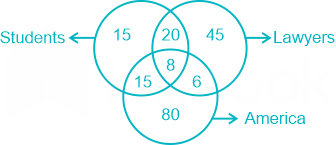
Study the given diagram carefully and answer the question. The numbers in different sections indicate the number of persons.

<br>

How many such students are there who are also lawyers but NOT from America?

  1. AOption (a)

    45

  2. BOption (b)

    8

  3. COption (c)

    15

  4. DOption (d)

    20

View answer & explanation

Correct answer

Answer: (d)D.

20

Why this answer is correct

According to given information:

We can see that the shaded part denotes the number of students are there who are also lawyers but NOT from America = 20

Hence, the correct answer is "20".

Question 32

Which of the following elements has the highest atomic radius?

  1. AOption (a)

    Li

  2. BOption (b)

    N

  3. COption (c)

    Be

  4. DOption (d)

    O

View answer & explanation

Correct answer

Answer: (a)A.

Li

Why this answer is correct

The  correct answer is Li.

Key Points

  • Atomic radius is defined as the distance from the center of the nucleus to the outermost electron shell.
  • As we move across a period from left to right in the periodic table, the atomic number (number of protons) increases.
  • The increase in positive charge in the nucleus attracts the electron cloud more strongly.
  • This results in a higher effective nuclear charge (net positive charge experienced by electrons), pulling the electrons closer to the nucleus and thus decreasing the atomic radius.
  • Atomic radii values (in picometres):
  • Lithium (Li): 152 pm
  • Beryllium (Be): 112 pm
  • Nitrogen (N): 70 pm
  • Oxygen (O): 66 pm

Question 33

What will be the product when CO(g) reacts with H2 (g) at 340 atm pressure?

  1. AOption (a)

    CH3OH

  2. BOption (b)

    C2H5OH

  3. COption (c)

    HCHO

  4. DOption (d)

    HCOOH

View answer & explanation

Correct answer

Answer: (a)A.

CH3OH

Why this answer is correct

The correct answer is CH3OH.

Key Points

  • When carbon monoxide (CO) reacts with hydrogen gas (H₂) at high pressures, such as 340 atm, the reaction typically produces methanol (CH3OH). The reaction can be represented as follows: CO(g)+〖2H〗2(g)(340atm)⃗〖CH〗3OH(l)CO(g)+〖2H〗_2 (g) ( 340 atm ) ⃗〖CH〗_3 OH(l)
  • This reaction is part of the industrial process known as the "Synthesis Gas" or "Syngas" conversion.
  • The use of methanol as a fuel or fuel additive reduces emissions of particulate matter, CO₂, and other pollutants compared to conventional fossil fuels.
  • Methanol is used as an antifreeze agent in windshield washer fluid and natural gas pipelines.

Question 34

If (a - b) = 8 and (a2 + b2) = 160, then the value of ab is:

  1. AOption (a)

    40

  2. BOption (b)

    32

  3. COption (c)

    48

  4. DOption (d)

    36

View answer & explanation

Correct answer

Answer: (c)C.

48

Why this answer is correct

Given:

a2 + b2 = 160 and (a - b) = 8

Concept used:

a2 + b2 = (a - b)2 +  2ab

Calculation:

Here,

a2 + b2 = (a - b)2 +  2ab

⇒ 160 = (8)2 +  2 × ab

⇒ 2ab = 160 - 64

⇒ ab = 80 - 32

⇒ ab = 48

∴ Option 3 is the correct answer.

Question 35

In January 2022, who became India’s first UNDP youth climate champion?

  1. AOption (a)

    Riya Singh

  2. BOption (b)

    Priyanka Chaudhary

  3. COption (c)

    Prajakta Koli

  4. DOption (d)

    Medha Patkar

View answer & explanation

Correct answer

Answer: (c)C.

Prajakta Koli

Why this answer is correct

The correct answer is Prajakta Koli.

Key Points

  • In January 2022, Prajakta Koli became India’s first UNDP Youth Climate Champion.
  • Prajakta Koli is a popular Indian content creator, actress, and well-known for her YouTube channel, "MostlySane,"
  • UNDP was founded in 1965 as part of the United Nations system.
  • The headquarters of the United Nations Development Programme (UNDP) is located in New York City, United States.

Additional Information

  • List of the Youth Climate Champions announced in 2022
Name of PersonalityCountry
Sandeep SinghIndia
Prajakta KoliIndia
Sheila M. C. VillanuevaPhilippines
Madeline S. MoutonSouth Africa
Gintare BurokieneLithuania
Samir RehmanPakistan
Yamuna BhatiaIndia
Olivia C. D. SuriaKenya
Felicity I. AragonPhilippines
Mahlet A. TesfayeEthiopia

Question 36

The ratio of the radius of the base to the height of a cylinder is 2 ∶ 1. If its volume is 4312 cm3, then the curved surface area of the cylinder is:

  1. AOption (a)

    734 cm2

  2. BOption (b)

    668 cm2

  3. COption (c)

    946 cm2

  4. DOption (d)

    616 cm2

View answer & explanation

Correct answer

Answer: (d)D.

616 cm2

Why this answer is correct

Shortcut Trick

Ratio of radius (r) to height (h) is 2 : 1.

Let r = 2x and h = x.

Volume = πr2h ⇒ (22/7) × (2x)2 × x = 4312

⇒ (22/7) × 4x3 = 4312 ⇒ x3 = 343 ⇒ x = 7.

CSA = 2πrh = 2 × (22/7) × 14 × 7 = 616 cm2.

∴ The correct answer is 616 cm2.

Alternate Method

Given: Ratio r : h = 2 : 1 and Volume (V) = 4312 cm3.

Formula Used: Volume of cylinder = πr2h; Curved Surface Area (CSA) = 2πrh.

⇒ Let radius (r) = 2x and height (h) = x.

⇒ Volume = (22/7) × (2x)2 × x = 4312

⇒ (22/7) × 4x3 = 4312

⇒ 4x3 = (4312 × 7) / 22

⇒ 4x3 = 196 × 7 = 1372

⇒ x3 = 1372 / 4 = 343

⇒ x = 7 cm.

⇒ Radius (r) = 2 × 7 = 14 cm; Height (h) = 7 cm.

⇒ Curved Surface Area (CSA) = 2 × (22/7) × 14 × 7

⇒ CSA = 2 × 22 × 14 = 616 cm2.

∴ The correct answer is 616 cm2.

Additional Information

Total Surface Area of Cylinder

It is the sum of CSA and the area of the two circular bases: TSA = 2πrh + 2πr2 = 2πr(h + r).

Hollow Cylinder Volume

The volume of a hollow cylinder with outer radius R and inner radius r is V = π(R2 − r2)h.

Unit Conversions

1 liter = 1000 cm3 and 1 m3 = 1,000,000 cm3.

Question 37

Which of the following options is the closest approximate value which will come in place of question mark(?) in the following equation?

13.99 - 4.02 + 19.89 × 5.99 = ?

  1. AOption (a)

    180

  2. BOption (b)

    130

  3. COption (c)

    210

  4. DOption (d)

    30

View answer & explanation

Correct answer

Answer: (b)B.

130

Why this answer is correct

Given equation → 13.99 - 4.02 + 19.89 × 5.99 = ?

Approximate value of → 13.99 ≈ 14; 4.02 ≈ 4; 19.89 ≈ 20; 5.99 ≈ 6

Given equation becomes → 14 - 4 + 20 × 6

By using BODMAS rule, we get :-

= 14 - 4 + 20 × 6

= 14 - 4 + 120

= 14 + 116

= 130

Hence, the correct answer is "130".

Question 38

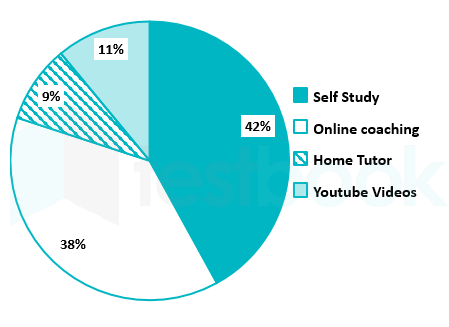
The given pie chart provides details of the study modes used by students of class XII. Study the pie chart and answer the question.

<br>

If 18 students study using home tutors, how many total students are there in class XII?

  1. AOption (a)

    200

  2. BOption (b)

    300

  3. COption (c)

    350

  4. DOption (d)

    180

View answer & explanation

Correct answer

Answer: (a)A.

200

Why this answer is correct

Calculation:

Let the total number of students in class XII be x.

According to question

⇒ x × 9% = 18

⇒ x = 200

∴ Option 1 is the correct answer.

Question 39

Three statements are given followed by three conclusions. Consider the statements and conclusions to be true even if. they vary from commonly known facts and then decide which of the conclusions follow(s) from the given statements.

Statements:

  1. All birds are lions.
  2. No goat is a lion.
  3. Some tigers are goats.

Conclusions:

(I) Some tigers are lions.

(II) No lion is a tiger.

(III) Some lions are birds.

  1. AOption (a)

    None of the conclusions follow.

  2. BOption (b)

    Only conclusion II follows.

  3. COption (c)

    Only conclusion III follows.

  4. DOption (d)

    Only conclusions I and III follow.

View answer & explanation

Correct answer

Answer: (c)C.

Only conclusion III follows.

Why this answer is correct

The least possible Venn diagram for the given statement is as follows:

Conclusion:

I) Some tigers are lions. Not Follows (There is no relationship between tigers and lions)

II) No lion is a tiger. Not Follows (There is no relationship between tigers and lions)

III) Some lions are birds. Follows (Given statement is all birds are lions. So the conclusion follows)

Hence, the correct answer is "Only conclusion III follows".

Question 40

Which group of the following metals are obtained by reduction using carbon?

Na, Zn, Ca, Pb, Mg, Fe, Al, Cu, Ag

  1. AOption (a)

    Na, Zn, Ca, Pb

  2. BOption (b)

    Zn, Fe, Cu

  3. COption (c)

    Ca, Pb, Mg

  4. DOption (d)

    Fe, Al, Cu, Ag

View answer & explanation

Correct answer

Answer: (b)B.

Zn, Fe, Cu

Why this answer is correct

The correct answer is Zn, Fe, Cu.

Key Points

  • Zinc (Zn): Obtained from zinc oxide (ZnO) using carbon.
  • Iron (Fe): Extracted from iron ore (Fe2O3 or Fe3O4) using carbon in a blast furnace.
  • Copper (Cu): Obtained from copper oxide (CuO) using carbon.
  • Atomic no. of Zn, Fe and Cu is 30,26,29 respectively.

Additional Information

ElementSymbolAtomic Number
SodiumNa11
ZincZn30
CalciumCa20
LeadPb82
MagnesiumMg12
IronFe26
AluminumAl13
CopperCu29
SilverAg47

Question 41

As per the Reserve Bank of India notification of March 2022 the minimum requirement of microfinance loans for NBFC-MFIs should be ______ per cent of the total assets

  1. AOption (a)

    80

  2. BOption (b)

    50

  3. COption (c)

    75

  4. DOption (d)

    25

View answer & explanation

Correct answer

Answer: (c)C.

75

Why this answer is correct

The correct answer is 75.

Key Points

  • The RBI regulation mandates that at least 75% of the total assets of an NBFC-MFI must be microfinance loans.
  • Microfinance loans are small loans provided to individuals or small businesses, typically those who lack access to traditional banking services.
  • For households with annual income of up to ₹3 lakh, loans are classified as microfinance.
  • Total loans for households with annual income under ₹3 lakh should not exceed 50% of the household income.

Additional Information

  • The RBI was established on April 1, 1935, under the Reserve Bank of India Act, 1934.
  • Non-Banking Financial Companies that exclusively deal in microfinance. These are regulated by the RBI.
  • The RBI sets a cap on how much an MFI can lend to a borrower. For instance, the total indebtedness of a borrower should not exceed ₹1.25 lakh from all sources.
  • MUDRA (Micro Units Development and Refinance Agency) Scheme: Provides financial support to small businesses through MFIs, NBFCs, and banks.
  • Self-Help Group-Bank Linkage Program (SHG-BLP): Promoted by NABARD, it links SHGs to banks, enabling them to access formal banking services.

Question 42

Given below is a decision followed by two statements I and II. Read the information carefully and select the correct option

Decision:

The Board of Directors of a Digital Marketing Company AMX have decided to shift their headquarters from the city centre to the business towers located on the outskirts of the city.

Statements:

I. Low property rent in outskirts would help reduce the overall expenditure of the company substantially.

II. The business towers is the hub of multiple MNCs with frequent visitors from international companies as well. This will give more visibility to AMX.

  1. AOption (a)

    Statement I strengthens the decision but statement II is neutral.

  2. BOption (b)

    Statement I weakens the decision but statement II is neutral.

  3. COption (c)

    Both statements I and II weaken the decision.

  4. DOption (d)

    Both statements I and II strengthen the decision.

View answer & explanation

Correct answer

Answer: (d)D.

Both statements I and II strengthen the decision.

Why this answer is correct

Decision:

The Board of Directors of the Digital Marketing Company AMX have decided to shift their headquarters from the city center to the business towers located on the outskirts of the city.

Statements:

I) Low property rent in the outskirts would help reduce the overall expenditure of the company substantially. → Strengthen (It is beneficial as the company income will be increased due to low property rent.)

II) The business towers are the hub of multiple MNCs with frequent visitors from international companies as well. This will give more visibility to AMX.  → Strengthen (This statement is helpful to take decisions for the company because all the MNCs are located nearby as big towers will help MNCs in long-term performance.)

Hence, the correct answer is "Both statements I and II strengthen the decision".

Question 43

Urdu was declared the second official language of which one of the following state in 2017?

  1. AOption (a)

    Telangana

  2. BOption (b)

    Odisha

  3. COption (c)

    West Bengal

  4. DOption (d)

    Chhattisgarh

View answer & explanation

Correct answer

Answer: (a)A.

Telangana

Why this answer is correct

The correct answer is Telangana.

Key Points

  • In 2017, Telangana declared Urdu as the second official language of the state.
  • Bihar declared Urdu as its second official language in 1981
  • Uttar Pradesh declared Urdu as its second official language in 1989.
  • Urdu was given the status of an official language in 1950 when the Indian Constitution came into force.

Additional Information

  • Urdu was included as one of the 15 languages initially listed in the Eighth Schedule of the Constitution.
  • Article 343 of the Indian Constitution: Declares Hindi in the Devanagari script as the official language of the Union.
  • The Eighth Schedule of the Constitution lists the recognized languages that are entitled to develop and be promoted by the government.
  • Bodo, Dogri, Maithili, and Santhali were the latest additions, included in 2003 by the 92nd Constitutional Amendment.
  • India protects minority languages under Article 29 of the Constitution, which provides for the protection of cultural and linguistic rights.

Question 44

Select the triad that follows the same pattern as that followed by the two triads given below. Both triads follow the same pattern.

BG - FK - JO

NS - RW - VA

  1. AOption (a)

    DI - HM - LQ 

  2. BOption (b)

    TY - XB - AF

  3. COption (c)

    SW - VA - ZE

  4. DOption (d)

    MR - QV - UY

View answer & explanation

Correct answer

Answer: (a)A.

DI - HM - LQ 

Why this answer is correct

The table is alphabet place value:

The pattern followed is: 

BG - FK - JO →

NS - RW - VA →

Similarly,

DI - HM - LQ →

Hence, the correct answer is "DI - HM - LQ".

Question 45

Three statements are given followed by three conclusions. Consider the statements and conclusions to be true even if they vary from commonly known facts and then decide which of the conclusions follow/(s) from the given statements.

Statements:

  1. Some flowers are petals.
  2. Some birds are petals.
  3. No bird is a flower.

Conclusions:

(I) Some petals are birds.

(II) Some flowers are birds.

(III) Some petals are flowers.

  1. AOption (a)

    Only conclusion III follows.

  2. BOption (b)

    Only conclusion II follows.

  3. COption (c)

    Only conclusions I and III follow.

  4. DOption (d)

    None of the conclusions follow.

View answer & explanation

Correct answer

Answer: (c)C.

Only conclusions I and III follow.

Why this answer is correct

The least possible Venn diagram for the given statement is as follows:

Conclusions:

I) Some petals are birds. Follows (In the given statements mentioned some birds are petals. So some petals are birds as follows)

II) Some flowers are birds. Not Follows (In the given statement mentioned no bird is a flower. So some flowers are birds is not followed)

III) Some petals are flowers. Follows (In the given statement mentioned some flowers are petals. So this conclusion is followed)

Hence, the correct answer is "Only conclusions I and III follow".

Question 46

Two trains of lengths 160 m and 90 m are running in the same direction with velocities of 40 km/h and 50 km/h, respectively. The time taken by them to cross each other is: 

  1. AOption (a)

    90 sec

  2. BOption (b)

    75 sec

  3. COption (c)

    80 sec

  4. DOption (d)

    95 sec

View answer & explanation

Correct answer

Answer: (a)A.

90 sec

Why this answer is correct

Shortcut Trick

Total distance = sum of lengths = 160 + 90 = 250 m.

Relative speed (same direction) = 50 − 40 = 10 km/h.

Convert speed to m/s: 10 × (5/18) = 25/9 m/s.

Time = Distance ÷ Relative Speed = 250 ÷ (25/9) = 10 × 9 = 90 sec.

∴ The correct answer is 90 sec.

Alternate Method

Given:

Length of Train 1 (L1) = 160 m

Length of Train 2 (L2) = 90 m

Speed of Train 1 (V1) = 40 km/h

Speed of Train 2 (V2) = 50 km/h

Formula Used:

Time = (L1 + L2) ÷ Relative Speed

Relative Speed (Same Direction) = |V1 − V2|

Calculations:

⇒ Total distance to cover = 160 + 90 = 250 m

⇒ Relative speed = 50 − 40 = 10 km/h

⇒ Converting speed into m/s = 10 × (5/18) = 25/9 m/s

⇒ Time taken = 250 ÷ (25/9)

⇒ Time taken = (250 × 9) ÷ 25

⇒ Time taken = 10 × 9 = 90 seconds

∴ The correct answer is 90 sec.

Additional Information

Relative Speed in Opposite Direction

When two objects move in opposite directions, their relative speed is the sum of their individual speeds: Vrel = V1 + V2.

Unit Conversion

To convert km/h to m/s, multiply by 5/18. To convert m/s to km/h, multiply by 18/5.

Crossing a Stationary Object

If a train crosses a pole or a man, the distance covered is equal to the length of the train itself.

Question 47

If each of the following numbers is multiplied by 2 and the digits of each number are written in reverse order and then the numbers are arranged in descending order, the position of how many numbers will NOT change?

57, 87, 35, 97, 56, 74

  1. AOption (a)

    Two

  2. BOption (b)

    Four

  3. COption (c)

    Three

  4. DOption (d)

    One

View answer & explanation

Correct answer

Answer: (d)D.

One

Why this answer is correct

57, 87, 35, 97, 56, 74

  1. The above numbers are multiplied by 2, and we get 114, 174, 70, 112, 148

  2. The digits of each number are written in reverse order

114, 174, 70, 112, 148 → 411, 471, 07, 211, 841

  1. The numbers are arranged in descending order, and we get: 841, 471, 411, 211, 07

After arranging numbers in descending order only one number 211 does not change its position.

Hence, the correct answer is "One".

Question 48

Which of the following statements is true about the nature of roots for the equation 11x2 + 19x + 8 = 0?

  1. AOption (a)

    Both roots are imaginary or non-real

  2. BOption (b)

    Both roots are negative real

  3. COption (c)

    Both roots are positive real

  4. DOption (d)

    One root is positive real, and one is negative real

View answer & explanation

Correct answer

Answer: (b)B.

Both roots are negative real

Why this answer is correct

Shortcut Trick

In a quadratic equation ax2 + bx + c = 0, if a, b, and c all have the same sign (all positive), then the roots must be negative.

Here, a = 11, b = 19, and c = 8 (all positive), so the roots cannot be positive.

Calculate Discriminant D = b2 − 4ac = 192 − 4 × 11 × 8 = 361 − 352 = 9.

Since D > 0 and a perfect square, the roots are real, rational, and distinct.

Combining these, the roots are negative real.

∴ The correct answer is Both roots are negative real.

Alternate Method

Given Equation: 11x2 + 19x + 8 = 0

We can find the nature of the roots by factorization or by calculating the Discriminant and Sum/Product of roots.

Step 1: Calculate the Discriminant (D)

⇒ D = b2 − 4ac

⇒ D = 192 − 4 × 11 × 8

⇒ D = 361 − 352 = 9

⇒ Since D > 0, the roots are real and distinct.

Step 2: Check the signs of the roots

⇒ Sum of roots (α + β) = −b/a = −19/11 (Negative)

⇒ Product of roots (α × β) = c/a = 8/11 (Positive)

⇒ A positive product means both roots have the same sign; a negative sum means that sign must be negative.

Step 3: Solving for roots (Verification)

⇒ 11x2 + 11x + 8x + 8 = 0

⇒ 11x(x + 1) + 8(x + 1) = 0

⇒ (11x + 8)(x + 1) = 0

⇒ x = −8/11 and x = −1

⇒ Both roots are negative and real.

∴ The correct answer is Both roots are negative real.

Additional Information

Nature of Roots (D = b2 − 4ac)

If D > 0, roots are real and distinct. If D = 0, roots are real and equal. If D < 0, roots are imaginary/non-real.

Signs of Roots Rule

For ax2 + bx + c = 0, if all coefficients a, b, c have the same sign, roots are negative. If a and c have the same sign but b has the opposite sign, roots are positive.

Sum and Product of Roots

For a quadratic equation, the Sum of roots is −b/a and the Product of roots is c/a.

Perfect Square Discriminant

If D is a perfect square and a, b, c are rational, the roots are rational numbers.

Question 49

Which of the following will NOT show covalent bonding?

  1. AOption (a)

    Ammonia (NH3)

  2. BOption (b)

    Oxygen (O2)

  3. COption (c)

    Magnesium chloride (MgCl2)

  4. DOption (d)

    Methane (CH4)

View answer & explanation

Correct answer

Answer: (c)C.

Magnesium chloride (MgCl2)

Why this answer is correct

The correct answer is Magnesium chloride (MgCl2).

Key Points

  • The compound that will NOT show covalent bonding is Magnesium chloride (MgCl2).
  • Magnesium chloride (MgCl2) forms ionic bonds, not covalent bonds.
  • Magnesium (Mg) is a metal, and chlorine (Cl) is a non-metal. Magnesium loses two electrons to form a Mg²⁺ ion.
  • Each chlorine atom gains one electron to form two Cl⁻ ions, resulting in an ionic bond between them.

Additional Information

  • Ammonia (NH3): Shows covalent bonding, with nitrogen sharing electrons with hydrogen atoms.
  • Oxygen (O2): Forms a covalent bond between two oxygen atoms through a double bond.
  • Methane (CH4): Shows covalent bonding, with carbon sharing electrons with four hydrogen atoms.
  • Ionic Bonds are formed through the transfer of electrons from one atom to another.
  • Covalent Bonds are formed through the sharing of electrons between atoms.

Question 50

How many times does an adult human breathe per minute at rest?

  1. AOption (a)

    72-75

  2. BOption (b)

    70-72

  3. COption (c)

    12-15

  4. DOption (d)

    15-18

View answer & explanation

Correct answer

Answer: (d)D.

15-18

Why this answer is correct

The correct answer is 15-18.

Key Points

  • An adult human typically breathes 15 to 18 times per minute while at rest.
  • Children tend to breathe faster, with rates often exceeding 20 breaths per minute.
  • Athletes may have lower resting respiratory rates due to more efficient lung function.
  • The average resting respiratory rate for adults is generally around 16 breaths per minute.

Additional Information

  • External Respiration: The process of exchanging gases (oxygen and carbon dioxide) between the lungs and the blood.
  • Internal Respiration: The exchange of gases between the blood and body tissues at the cellular level.
  • Inhalation (Inspiration): The Diaphragm contracts and moves downward, and the intercostal muscles contract, expanding the chest cavity and decreasing pressure, allowing air to flow into the lungs.
  • Exhalation (Expiration): Diaphragm and intercostal muscles relax, the chest cavity decreases, and air is pushed out of the lungs. This process can be passive at rest or active during exertion.
  • Oxygen is transported from the alveoli into the bloodstream, where it binds to hemoglobin in red blood cells.
  • Carbon dioxide, produced by cells as a waste product, is transported from the blood to the alveoli to be exhaled.

Question 51

A can complete 23\frac{2}{3} of a certain work in 12 days and B can complete 14\frac{1}{4} of the same work in 3 days. Working together, the number of days they will take to finish the work is:

  1. AOption (a)

    7157\frac{1}{5}

  2. BOption (b)

    6156\frac{1}{5}

  3. COption (c)

    5155\frac{1}{5}

  4. DOption (d)

    8158\frac{1}{5}

View answer & explanation

Correct answer

Answer: (a)A.

7157\frac{1}{5}

Why this answer is correct

Shortcut Trick

A completes 1 work in 12 × (3/2) = 18 days.

B completes 1 work in 3 × 4 = 12 days.

Combined Time = (18 × 12) ÷ (18 + 12) = 216 ÷ 30 = 36 ÷ 5 days.

∴ The correct answer is 7(1/5) days.

Alternate Method

Given:

A can do 2/3 of work in 12 days.

B can do 1/4 of work in 3 days.

Formula Used:

Efficiency = Total Work ÷ Time taken

Total time for full work = (Days × Total fraction) ÷ Work fraction

PersonDays (Total)Total WorkEfficiency
A18362
B123

⇒ Total days for A = 12 × (3/2) = 18 days

⇒ Total days for B = 3 × 4 = 12 days

⇒ LCM of 18 and 12 = 36 units (Total Work)

⇒ Combined Efficiency of A + B = 2 + 3 = 5 units/day

⇒ Time taken = 36 ÷ 5 = 7(1/5) days

∴ The correct answer is 7(1/5) days.

Additional Information

Work and Efficiency

Efficiency is inversely proportional to the time taken to complete the work when total work is constant.

Combined Work Formula

If person X takes x days and person Y takes y days, together they take (xy) ÷ (x + y) days.

Fractional Work Rule

If 1/n of work is done in T days, the whole work is done in n × T days.

Question 52

A Data-Driven Research, has been launched by the Department of Biotechnology, Ministry of Science and Technology on 24 March 2022 with the objective to eradicate which disease?

  1. AOption (a)

    AIDS

  2. BOption (b)

    Tuberculosis

  3. COption (c)

    Covid

  4. DOption (d)

    Cancer

View answer & explanation

Correct answer

Answer: (b)B.

Tuberculosis

Why this answer is correct

The correct answer is Tuberculosis. 

Key Points

  • The Data-Driven Research initiative launched by the Department of Biotechnology, Ministry of Science and Technology on March 24, 2022, focuses on eradicating Tuberculosis (TB).
  • World TB Day: The initiative was announced on World TB Day, which is observed on March 24 each year.
  • Global Health Concern TB is a significant public health issue in India, accounting for a substantial number of TB cases worldwide.
  • The primary objective of the initiative is to eradicate TB in India by utilizing a data-driven approach.

Additional Information

  • AIDS is caused by HIV (Human Immunodeficiency Virus), which attacks the immune system, specifically CD4 cells (T cells).
  • HIV is transmitted through blood, semen, vaginal fluids, rectal fluids, and breast milk.
  • COVID-19 is caused by the SARS-CoV-2 virus, a novel coronavirus that emerged in late 2019.
  • COVID-19 is diagnosed through RT-PCR tests or rapid antigen tests that detect the presence of the virus.
  • Cancer is a group of diseases characterized by the uncontrolled growth and spread of abnormal cells in the body.
  • There are many types of cancer, classified based on the tissue or organ affected. Common types include breast cancer, lung cancer, prostate cancer, colorectal cancer, and skin cancer.
  • Treatment options vary depending on the type and stage of cancer and may include surgery, radiation therapy, chemotherapy, immunotherapy, and targeted therapy.
  • New treatments, such as CAR-T cell therapy and personalized medicine, are emerging in oncology.

Question 53

Which of the following methods can be used to conserve our natural resources?

  1. AOption (a)

    Not recycling goods

  2. BOption (b)

    Turning on lights even when not required

  3. COption (c)

    Walking to nearby places without using vehicles

  4. DOption (d)

    Using more water

View answer & explanation

Correct answer

Answer: (c)C.

Walking to nearby places without using vehicles

Why this answer is correct

The correct answer is Walking to nearby places without using vehicles.

Key Points

  • Natural resources are materials and components that occur naturally in the environment and can be used for economic gain or to meet human needs.
  • They are typically classified into two main categories: renewable and non-renewable resources.
  • Renewable Resources are those resources that can be replenished naturally over time.
  • Non-renewable resources are those Resources that do not replenish at a sustainable rate.

Additional Information

  • Importance of Natural Resources
  • Economic Development: Natural resources are crucial for industries and agriculture, driving economic growth.
  • Energy Production: Many resources provide energy necessary for modern life, from electricity to transportation.
  • Ecosystem Services: They support ecosystems that provide clean air, water, and biodiversity, which are essential for life.
  • Raw Materials: Used in manufacturing and construction, contributing to infrastructure and technological advancement.
  • Challenges and Issues
  • Overexploitation: Unsustainable use of resources can lead to depletion, habitat destruction, and biodiversity loss.
  • Pollution: Extraction and use of natural resources can lead to air, water, and soil pollution.
  • Climate Change: Fossil fuel consumption significantly contributes to greenhouse gas emissions, affecting global temperatures and weather patterns.
  • Resource Conflicts: Competition for limited resources can lead to social and political tensions, especially in areas with scarce water or arable land.

Question 54

National air sports policy 2022 lays out the vision of making India one of the top nations by the year:

  1. AOption (a)

    2040

  2. BOption (b)

    2030

  3. COption (c)

    2025

  4. DOption (d)

    2035

View answer & explanation

Correct answer

Answer: (b)B.

2030

Why this answer is correct

The correct answer is 2030.

Key Points

  • The National Air Sports Policy (NASP) 2022 aims to make India one of the top nations in air sports by the year 2030.
  • The policy focuses on promoting various air sports such as drones, paragliding, skydiving, hang gliding, and aerobatics.
  • The National Air Sports Policy (NASP) 2022 was launched by the Ministry of Civil Aviation in India.
  • The National Air Sports Policy (NASP) 2022 was launched by Jyotiraditya Scindia, who was the Minister of Civil Aviation at the time.

Additional Information 

SCHEME/POLICYLAUNCHED IN YEAR
Pradhan Mantri Jan Dhan Yojana(PMJDY)2014
Make in India Scheme2014
Swachh Bharat Mission2014
Pradhan Mantri Awaas Yojana2015
Pradhan Mantri Ujjwala Yojana2016
Pradhan Mantri Fasal Bima Yojana(PMFBY)2016
Pradhan Mantri Garib kalyan Yojana(PMGKY)2020
Jal Jeevan Mission2019
Atal Pension Yojana(APY)2015

Question 55

40% of 60% of 58\frac{5}{8} of a number is 339. The number is:

  1. AOption (a)

    2260

  2. BOption (b)

    3260

  3. COption (c)

    5260

  4. DOption (d)

    4260

View answer & explanation

Correct answer

Answer: (a)A.

2260

Why this answer is correct

Calculation:

Let the number be x.

According to question:

40% of 60% of 58\frac{5}{8} × x = 339

⇒ 2/5 × 3/5 × 5/8 × x = 339

⇒ x = 113 × 20

⇒ x = 2260

∴ Option 1 is the correct answer.

Question 56

The random wavering of objects seen through a turbulent stream of hot air rising above a fire can be explained using:

  1. AOption (a)

    Total internal reflection

  2. BOption (b)

    atmospheric refraction

  3. COption (c)

    dispersion of light

  4. DOption (d)

    scattering of light

View answer & explanation

Correct answer

Answer: (b)B.

atmospheric refraction

Why this answer is correct

The correct answer is atmospheric refraction.

Key Point

  • The random wavering of objects seen through a turbulent stream of hot air rising above a fire is atmospheric refraction.
  • The refractive index of air is approximately 1.0003 under standard conditions, which means light travels slightly slower in air than in a vacuum.
  • Higher humidity decreases the density of air, which can also influence the refractive index.
  • Atmospheric refraction causes stars to appear to twinkle as their light passes through varying layers of the atmosphere.

Additional Information

  • Total internal reflection is the complete reflection of light within a medium. It occurs when light travels from a medium with a higher refractive index to a medium with a lower refractive index.
  • The critical angle is the minimum angle of incidence at which total internal reflection occurs. It is specific to the pair of media involved.
  • Dispersion of light is the process by which light separates into its constituent colors when passing through a medium, such as a prism.
  • Visible Spectrum: The visible spectrum consists of seven colors, often remembered by the acronym VIBGYOR: Violet, Indigo, Blue, Green, Yellow, Orange, and Red.
  • Scattering of light is the process by which light is redirected in various directions as it encounters particles or irregularities in a medium.

Question 57

A class of 20 students took a science test. 8 students had an average (arithmetic mean) score of 60. The remaining students had an average score of 40. The average score of the whole class is:

  1. AOption (a)

    68

  2. BOption (b)

    58

  3. COption (c)

    40

  4. DOption (d)

    48

View answer & explanation

Correct answer

Answer: (d)D.

48

Why this answer is correct

Shortcut Trick

Ratio of students in the two groups = 8 : 12 = 2 : 3

Weighted Average score = [ (2 × 60) + (3 × 40) ] ÷ (2 + 3)

Average score = (120 + 120) ÷ 5 = 240 ÷ 5 = 48

∴ The correct answer is 48.

Alternate Method

Given:

Total students in the class = 20

Number of students in Group 1 = 8 | Average score = 60

Number of students in Group 2 = 20 − 8 = 12 | Average score = 40

Formula: Average = (Total sum of scores) ÷ (Total number of students)

⇒ Total score of 8 students = 8 × 60 = 480

⇒ Total score of remaining 12 students = 12 × 40 = 480

⇒ Total score of the whole class = 480 + 480 = 960

⇒ Average score of 20 students = 960 ÷ 20

⇒ Average score = 48

∴ The correct answer is 48.

Additional Information

Weighted Average Formula

When multiple groups are combined, the weighted average is calculated as Aw = (n1a1 + n2a2 + ...) ÷ (n1 + n2 + ...).

Net Deviation Method

The sum of deviations of all observations from their arithmetic mean is always zero (Σ(xi − xavg) = 0).

Effect of Operations on Average

If every value in a set is multiplied or divided by a constant k, the average of the set is also multiplied or divided by k.

Question 58

A Sravan leaves point Y and travels 5 km towards north. Then he turned right, walked 5 km, turned right and walked 7 km. Then he turned right and walked 15 km. Then he turned right and walked 2 km. Finally he turns right, travels 5 km and stops at point M. In which direction and how far must he travel from point M to point Y? (All rotations are only 90 degree rotations.)

  1. AOption (a)

    East direction, 5 km

  2. BOption (b)

    West direction, 5 km

  3. COption (c)

    East direction, 15 km

  4. DOption (d)

    North direction 10 km

View answer & explanation

Correct answer

Answer: (a)A.

East direction, 5 km

Why this answer is correct

Given: 

A Sravan leaves point Y and travels 5 km towards the north.

Then he turned right, walked 5 km, turned right and walked 7 km.

Then he turned right and walked 15 km.

Then he turned right and walked 2 km.

Finally, he turns right, travels 5 km and stops at point M. 

Thus, Sravan must travel (15 km - 5 km - 5 km) 5 km from point M to point Y in the east direction.

Hence, "Option 1" is the correct answer.

Question 59

Identify the committee constituted for the promotion of small scale industries.

  1. AOption (a)

    Raja Chelliah Committee

  2. BOption (b)

    Karve Committee

  3. COption (c)

    Hanumanth Committee

  4. DOption (d)

    Kelkar Committee

View answer & explanation

Correct answer

Answer: (c)C.

Hanumanth Committee

Why this answer is correct

The correct answer is Hanumanth Commitee.

 Key Points

  • The committee constituted for the promotion of small-scale industries is the Hanumanth Committee.
  • Hanumanth Committee: Formed in 1997, it focused on issues related to the growth and promotion of small-scale and medium-sized enterprises in India.
  • It was headed by Dr. C. H. Hanumantha Rao, an economist and former Director of the National Institute of Rural Development.
  • Emphasized the role of small industries in promoting regional development and balancing industrial growth across different areas.

Additional Information

  • The Karve Committee, officially known as the “Committee on the Status of Women in India,” was established in 1971.
  • The committee was constituted by the Government of India under the chairmanship of Dr. D. D. Karve in 1971.
  • The Raja Chelliah Committee, formally known as the Committee on Tax Reforms, was established in 1991.
  • It was chaired by Dr. Raja J. Chelliah, an eminent economist and a prominent figure in India's economic policy formulation.
  • The Kelkar Committee, officially known as the Task Force on the Goods and Services Tax (GST), was constituted in 2003.
  • It was chaired by Dr. Vijay Kelkar, an eminent economist and former Chairman of the Finance Commission.

Question 60

(x4 - 625) can be factorised as:

  1. AOption (a)

    (x + 5)2 (x2 - 25)

  2. BOption (b)

    (x2​ - 25) (x2​ - 5)

  3. COption (c)

    (x2​ + 25) (x2​ + 25)

  4. DOption (d)

    (x - 5) (x + 5) (x2​ + 25)

View answer & explanation

Correct answer

Answer: (d)D.

(x - 5) (x + 5) (x2​ + 25)

Why this answer is correct

Shortcut Trick

Apply the difference of squares formula a2 − b2 = (a − b)(a + b) twice.

x4 − 625 = (x2)2 − (25)2 = (x2 − 25)(x2 + 25).

Further factorise (x2 − 25) as (x − 5)(x + 5).

Final expression: (x − 5)(x + 5)(x2 + 25).

∴ The correct answer is (x − 5)(x + 5)(x2 + 25).

Alternate Method

Given: Algebraic expression x4 − 625.

Formula Used: a2 − b2 = (a − b)(a + b)

Calculations:

⇒ x4 − 625

⇒ (x2)2 − (25)2

⇒ (x2 − 25)(x2 + 25)

⇒ [(x)2 − (5)2](x2 + 25)

⇒ (x − 5)(x + 5)(x2 + 25)

∴ The correct answer is (x − 5)(x + 5)(x2 + 25).

Additional Information

Difference of Squares

A polynomial of the form a2 − b2 is always factorable into (a − b)(a + b).

Sum of Squares

An expression like a2 + b2 cannot be factorised further using real numbers.

Higher Power Factorisation

For xn − an, if n is even, it can always be reduced using the difference of squares method repeatedly.

Question 61

The fourth proportional to 0.15, 0.35 and 12 is:

  1. AOption (a)

    58

  2. BOption (b)

    38

  3. COption (c)

    48

  4. DOption (d)

    28

View answer & explanation

Correct answer

Answer: (d)D.

28

Why this answer is correct

Shortcut Trick

For fourth proportional of a, b, c, use the ratio a : b = c : d.

0.15 : 0.35 ⇒ 15 : 35 ⇒ 3 : 7

If 3 units = 12, then 1 unit = 4.

7 units = 7 × 4 = 28.

∴ The correct answer is 28.

Alternate Method

Given: First term (a) = 0.15, Second term (b) = 0.35, Third term (c) = 12

Formula Used: Fourth Proportional (d) = (b × c) ÷ a

⇒ Let the fourth proportional be x.

⇒ 0.15 / 0.35 = 12 / x

⇒ x = (0.35 × 12) ÷ 0.15

⇒ x = (35 × 12) ÷ 15

⇒ x = (7 × 12) ÷ 3

⇒ x = 7 × 4 = 28

∴ The correct answer is 28.

Additional Information

Mean Proportional

The mean proportional between two numbers a and b is √(a × b).

Third Proportional

The third proportional to two numbers a and b is calculated as b2 ÷ a.

Basic Proportion Rule

In any proportion a : b :: c : d, the product of extremes equals the product of means (a × d = b × c).

Question 62

_______ of the Constitution of India deals with the prohibition of traffic in human beings and forced labour.

  1. AOption (a)

    Article 21

  2. BOption (b)

    Article 26

  3. COption (c)

    Article 28

  4. DOption (d)

    Article 23

View answer & explanation

Correct answer

Answer: (d)D.

Article 23

Why this answer is correct

The correct answer is Article 23.

Key Points

  • Article 23 of the Indian Constitution prohibits human trafficking and forced labor.
  • Article 23(1) explicitly prohibits the trafficking of human beings and any form of forced labor.
  • Article 23(2) provides for exceptions where compulsory service may be mandated for public purposes.
  • The Immoral Traffic (Prevention) Act, 1956: This act aims to combat trafficking for commercial sexual exploitation.
  • The Bonded Labor System (Abolition) Act, 1976: This act prohibits the bonded labor system, which often leads to forced labor conditions.

Additional Information

  • Article 21 states, “No person shall be deprived of his life or personal liberty except according to procedure established by law.”
  • Article 26 grants every religious denomination or any section thereof the right to:
  • Establish and maintain institutions for religious and charitable purposes.
  • Manage its own affairs in matters of religion.
  • Own and acquire movable and immovable property.
  • Administer such property in accordance with law.
  • Article 28 prohibits the state from imposing religious instruction in educational institutions wholly maintained by the state.
  • Article 28(1) allows religious instruction in educational institutions administered by a minority community, provided it does not receive government funding.

Question 63

In a certain code language, ‘ADMIT is written as 'BFPMY' and ‘ACTOR’ is written as "BEWSW". How will 'ABUSE' be written in that language?

  1. AOption (a)

    BDYWJ

  2. BOption (b)

    BDGWJ

  3. COption (c)

    BDXWJ

  4. DOption (d)

    BDZWJ

View answer & explanation

Correct answer

Answer: (c)C.

BDXWJ

Why this answer is correct

The logic here is as follows:

The position values of the letters, according to the English alphabet series:

'ADMIT is written as 'BFPMY'

‘ACTOR’ is written as "BEWSW"

Similarly;

'ABUSE' will be written as 

Hence, the correct answer is "BDXWJ".

Question 64

Which of the following is NOT a common route of transmission of HIV from one person to another?

  1. AOption (a)

    Casual contacts like handshakes or hugs with the infected people

  2. BOption (b)

    Blood to blood contact with the infected people

  3. COption (c)

    Unprotected sexual contact with the infected person

  4. DOption (d)

    Infected mother to foetus during pregnancy

View answer & explanation

Correct answer

Answer: (a)A.

Casual contacts like handshakes or hugs with the infected people

Why this answer is correct

The correct answer is Casual contacts like handshakes or hugs with the infected people.

Key Points

  • HIV is a virus that attacks the body's immune system, specifically targeting CD4 cells (T cells), which are crucial for fighting infections.
  • If not treated, HIV can lead to the disease AIDS (Acquired Immunodeficiency Syndrome).
  • Initial symptoms may appear 2 to 4 weeks after infection and can include flu-like symptoms such as fever, headache, fatigue, and swollen lymph nodes.
  • After the initial infection, the virus may become less active but still remain in the body. This stage can last several years.

Additional Information

  • Ways HIV is Transmitted: HIV can be transmitted through:
  • Unprotected sexual contact with an infected person.
  • Sharing needles or syringes.
  • From mother to child during childbirth or breastfeeding.
  • Exposure to infected blood or body fluids.
  • Common tests include:
  • Antibody Tests: Detect antibodies to HIV.
  • Antigen Tests: Detect HIV proteins (antigens).
  • Nucleic Acid Tests (NAT): Detect the virus itself.

Question 65

Amit, Bineet, Chandan, Dipti, Gyan and Farhaan live on six different floors of the same building. The lowermost floor in the building is numbered 1, the floor above it number 2, and so on till the topmost floor is numbered 6. Dipti lives on an even numbered floor but not on floor number 4. Only two people live between Dipti and Amit. Chandan lives immediately below Farhaan. Farhaan lives on an even numbered floor. Neither Chandan nor Bineet live on the lowermost floor. Who lives on floor number 4?

  1. AOption (a)

    Amit

  2. BOption (b)

    Chandan

  3. COption (c)

    Farhaan

  4. DOption (d)

    Bineet

View answer & explanation

Correct answer

Answer: (c)C.

Farhaan

Why this answer is correct

The following arrangement is as follows:

Amit, Bineet, Chandan, Dipti, Gyan and Farhaan live on six different floors of the same building.

1) Dipti lives on an even numbered floor but not on floor number 4 and only two people live between Dipti and Amit.\

Case 1:

6Dipti
5
4
3Amit
2
1


Case 2: 

6
5Amit
4
3
2Dipti
1


2) Farhaan lives on an even numbered floor and Chandan lives immediately below Farhaan.

Case 1: 

6Dipti
5
4
3Amit
2Farhan
1Chandan


Case 2:

6
5Amit
4Farhaan
3Chandan
2Dipti
1

3) Neither Chandan nor Bineet live on the lowermost floor.

Here this conditions contradicts in Case (1), neither Chandan nor Bineet live on the lowermost floor.

6Bineet
5Amit
4Farhaan
3Chandan
2Dipti
1Gyan


So this is the final arrangement.

Hence, the correct answer is "Farhaan".

Question 66

Which of the following is a china dish?

  1. AOption (a)

  2. BOption (b)

  3. COption (c)

  4. DOption (d)

View answer & explanation

Correct answer

Answer: (a)A.

Why this answer is correct

The correct answer is 

Key Points

  • Commonly used to describe fine ceramic or porcelain dinnerware. The term "China" is derived from the country of China.
  • The production of ceramics in China dates back to around 18,000 BCE. The country is known as the birthplace of porcelain.
  • The chemical composition of china (or porcelain) is primarily based on kaolin, feldspar, and quartz, with variations for specific types like bone china.
  • High-quality china dishes are durable and resistant to chipping, making them suitable for everyday use.

Additional Information

  • Types of China:
  • Porcelain: Made from kaolin clay, feldspar, and quartz, porcelain is fired at high temperatures, resulting in a strong, durable, and translucent finish.
  • Bone China: A type of porcelain that includes bone ash, making it lighter and more chip-resistant than standard porcelain.
  • Stoneware: Made from denser clay, stoneware is fired at high temperatures, resulting in a robust product often used for everyday items.
  • Chinaware—primarily includes the following components:
  • Kaolin (Alumina Silicate): Al₂Si₂O₅(OH)₄
  • Feldspar: KAlSi₃O₈ (for potassium feldspar), NaAlSi₃O₈ (for sodium feldspar), CaAl₂Si₂O₈ (for calcium feldspar).
  • Quartz (Silica): SiO₂
  • Bone Ash (for Bone China): Primarily composed of calcium phosphate (Ca₃(PO₄)₂).

Question 67

A ray of light is incident on a refracting surface AB of glass prism, Kept in air, and emerges out of the other refracting surface AC. Consider the following statements:

(a) The angle of refraction at surface AB is less than the angle of incidence.

(b) The angle of refraction at the surface AC is less than the angle of incidence.

Which of the above statements is/are correct?

  1. AOption (a)

    Only (b)

  2. BOption (b)

    Neither (a) nor (b)

  3. COption (c)

    Only (a)

  4. DOption (d)

    Both (a) and (b)

View answer & explanation

Correct answer

Answer: (c)C.

Only (a)

Why this answer is correct

The correct answer is Only (a).

Key Points

  • The phenomenon of change in the direction/path of light rays when it travel from one medium to another is called refraction of light.
  • When light moves from air (n ≈ 1) to glass (n ≈ 1.5), it slows down and bends towards the normal.
  • The First Law of Refraction of Light states that the incident ray, refracted ray, and normal to the interface at the point of incidence all lie in the same plane.
  • The second Law of Refraction of Light states that the ratio of the sine of the angle of incidence (i) and the sine of the angle of refraction (r) is constant.

Additional Information

  • The visible spectrum ranges from approximately 400 nm (violet) to 700 nm (red). This is the portion of the spectrum visible to the human eye.
  • Light can be polarized by reflection, scattering, or passing through polarizing filters.
  • Polarization is used in sunglasses to reduce glare and in various optical devices.
  • Light exhibits both wave-like and particle-like properties, leading to concepts like wave functions and photon behavior.
  • The frequency of visible light ranges from about 400 THz (terahertz) for red light to about 789 THz for violet light.
  • The energy of light photons increases with increasing frequency (or decreasing wavelength).

Question 68

Which of the following terms will replace the question mark (?) in the given series to make it logically complete?

RMI3C, WRI7H, BW21M, GB25R,?

  1. AOption (a)

    LG29W

  2. BOption (b)

    GW29L

  3. COption (c)

    WG33L

  4. DOption (d)

    LG33W

View answer & explanation

Correct answer

Answer: (a)A.

LG29W

Why this answer is correct

The logic here is as follows:

Logic: Alphabet + 5 and Number + 4.

Hence, the correct answer is "LG29W".

Question 69

Following the Indian Constitution and respecting the national anthem and flag is the _____ fundamental duty included in our Constitution.

  1. AOption (a)

    Fourth

  2. BOption (b)

    Third

  3. COption (c)

    Second

  4. DOption (d)

    First

View answer & explanation

Correct answer

Answer: (d)D.

First

Why this answer is correct

The correct answer is First.

Key Points

  • The Fundamental Duties were recommended by the Swaran Singh Committee in 1976.
  • Based on its recommendations, the 42nd Amendment Act of 1976 added ten Fundamental Duties to the Indian Constitution1.
  • The Fundamental Duties are listed under Article 51A of the Indian Constitution.
  • The 11th Fundamental Duty was added later by the 86th Amendment Act of 2002.
  • These duties are non-justiciable, meaning they are not enforceable by law but are considered moral obligations for citizens.

Additional InformationAccording to Article 51A, it shall be the duty of every citizen of India:

  1. to abide by the Constitution and respect its ideals and institutions, the National Flag and the National Anthem;
  2. to cherish and follow the noble ideals that inspired the national struggle for freedom;
  3. to uphold and protect the sovereignty, unity and integrity of India;
  4. to defend the country and render national service when called upon to do so;
  5. to promote harmony and the spirit of common brotherhood amongst all the people of India transcending religious, linguistic and regional or sectional diversities and to renounce practices derogatory to the dignity of women;
  6. to value and preserve the rich heritage of the country’s composite culture;
  7. to protect and improve the natural environment including forests, lakes, rivers and wildlife and to have compassion for living creatures;
  8. to develop scientific temper, humanism and the spirit of inquiry and reform;
  9. to safeguard public property and to abjure violence;
  10. to strive towards excellence in all spheres of individual and collective activity so that the nation constantly rises to higher levels of endeavor and achievement; and
  11. to provide opportunities for education to his child or ward between the age of six and fourteen years. This duty was added by the 86th Constitutional Amendment Act, 2002.

Question 70

The first oil-field in Independent India was discovered in ________.

  1. AOption (a)

    Assam

  2. BOption (b)

    Maharashtra

  3. COption (c)

    Gujarat

  4. DOption (d)

    Rajasthan

View answer & explanation

Correct answer

Answer: (a)A.

Assam

Why this answer is correct

The correct answer is Assam.

Key Points

  • The first oil field in independent India was discovered in Assam.
  • While oil extraction had already begun in Assam during British rule, the first discovery made after India's independence in 1947 occurred in Nahorkatia, Assam, in 1953.
  • This discovery was followed by another in Moran, Assam, in 1956.
  • Both were made by the Assam Oil Company (AOC).

Additional Information

  • Oil and gas were indeed discovered in Mumbai High, Maharashtra, in 1970s.
  • Gujarat has become a major oil and gas producer for India, but significant discoveries began in the 1960s.
  • Petroleum is present on Earth as a naturally occurring dark oil liquid beneath the surface.
  • Petroleum is the source of both diesel and petrol.

Question 71

In the year 2022, at what altitude was the Earth Observation Satellite (EOS-04) placed into a sun-synchronous polar orbit?

  1. AOption (a)

    714 km

  2. BOption (b)

    612 km

  3. COption (c)

    529 km

  4. DOption (d)

    317 km

View answer & explanation

Correct answer

Answer: (c)C.

529 km

Why this answer is correct

The correct answer is 529 km.

Key Points

  • An Earth observation satellite (EOS) is a type of satellite specifically designed to monitor and collect data about the Earth’s surface and atmosphere.
  • These satellites play a crucial role in various applications, including environmental monitoring, meteorology, cartography, and disaster management.
  • EOS-04 also known as RISAT-1A; it is an Earth Observation Satellite launched by ISRO.
  • The satellite was placed at an altitude of 529 km to achieve this orbit.
  • A Sun-synchronous orbit keeps a satellite at the same local solar time over a specific part of the Earth.
  • EOS-04 was launched on February 14, 2022, from the Satish Dhawan Space Centre.

Important Points

Orbit TypeAltitudeKey Points
Low Earth Orbit (LEO)180 km to 2,000 kmShort orbital period (~90 minutes) Used for Earth observation, ISS Examples: Hubble Space Telescope, ISS
Medium Earth Orbit (MEO)2,000 km to 35,786 kmLonger orbital period Used for navigation systems (GPS, GLONASS) Examples: GPS satellites
Geostationary Orbit (GEO)~35,786 km above equatorAppears stationary relative to Earth Ideal for communication, weather satellites Examples: Weather satellites, TV broadcasting satellites
Sun-Synchronous Orbit (SSO)600 km to 800 kmConsistent lighting conditions for imaging Passes over same part of Earth at same local solar time Examples: Earth observation satellites like EOS-04
Geostationary Transfer Orbit (GTO)Varies (elliptical)Intermediate step to GEO Elliptical orbit with low perigee and high apogee Examples: Satellites moving to GEO
Polar Orbit200 km to 1,000 kmPasses over Earth’s poles Covers entire Earth surface over time Examples: Earth observation, spy satellites
Highly Elliptical Orbit (HEO)Varies (elliptical)Used for high latitude coverage Examples: Molniya orbit

Question 72

Which of the following statements for the reaction of copper oxide with HCl is correct?

  1. AOption (a)

    CuSO4 is formed.

  2. BOption (b)

    Cu is formed.

  3. COption (c)

    Cl2 is liberated.

  4. DOption (d)

    CuCl2 formed.

View answer & explanation

Correct answer

Answer: (d)D.

CuCl2 formed.

Why this answer is correct

The correct answer is CuCl2 is formed.

Key Points

  • Copper oxide (CuO) reacts with hydrochloric acid (HCl) to form copper chloride (CuCl2) and water (H2O).
  • The balanced chemical equation for this reaction is: CuO+2HCl→CuCl2​+H2​O
  • Copper chloride is a soluble salt that forms a blue-green solution in water.
  • This reaction is an example of a neutralization reaction where a base (CuO) reacts with an acid (HCl) to form a salt (CuCl2) and water.

Additional InformationCopper Sulfate (CuSO₄)

Typically found as a bright blue crystalline solid in its pentahydrate form (CuSO₄·5H₂O).

  • Used as a fungicide and herbicide.
  • Utilized in water treatment to control algae growth.
  • Highly soluble in water.

Copper (Cu)

Reddish-brown metal with high electrical and thermal conductivity.

  • Electrical Wiring
  • Forms important alloys like bronze (with tin) and brass (with zinc).
  • Reacts with oxygen to form copper oxide but is relatively resistant to corrosion.

Chlorine Gas (Cl₂)

Greenish-yellow gas with a pungent odor.

  • Used to disinfect drinking water and swimming pools.
  • Bleaching Agent: Employed in the production of paper and textiles.
  • Essential in the production of PVC and other chemicals.
  • Highly reactive, especially with metals to form chlorides

Question 73

If all the letters in each of the following words are rearranged as per English alphabetical order, and the newly formed words/clusters are arranged as per the dictionary arrangement, which initial word/cluster will appear exactly in the middle?

LIKE, LIVE, LOVE, LIME, LUCK

  1. AOption (a)

    LOVE

  2. BOption (b)

    LIVE

  3. COption (c)

    LUCK

  4. DOption (d)

    LIME

View answer & explanation

Correct answer

Answer: (d)D.

LIME

Why this answer is correct

The following words after arranging as per English alphabetical order are as follows:

 LIKE, LIVE, LOVE, LIME, LUCK

Rearrange letters in alphabetical order

LIKE → EIKL

LIVE → EILV

LOVE → ELOV

LIME → EILM

LUCK → CKLU

Arrange the clusters in dictionary order

Dictionary order of clusters: CKLU, EIKL, EILM, EILV, ELOV

The middle cluster

Number of clusters = 5 → Middle = 3rd cluster = EILM (The 3rd is EILM, which came from LIME.)

The original word = EILM → LIME

Hence, the correct answer is "LIME".

Question 74

The value of (225 ÷ 215) × 24 is:

  1. AOption (a)

    213

  2. BOption (b)

    210

  3. COption (c)

    214

  4. DOption (d)

    211

View answer & explanation

Correct answer

Answer: (c)C.

214

Why this answer is correct

Calculation:

 (225 ÷ 215) × 24

⇒  (210) × 24

⇒  214

∴ Option 3 is the correct answer.

Question 75

Roots of the equation x2 = 24 - 10x are:

  1. AOption (a)

    2, -11

  2. BOption (b)

    2, -12

  3. COption (c)

    3, -11

  4. DOption (d)

    3, -12

View answer & explanation

Correct answer

Answer: (b)B.

2, -12

Why this answer is correct

Shortcut Trick

Rewrite the equation in standard form: x2 + 10x − 24 = 0.

Identify two numbers that multiply to −24 and add up to +10.

The numbers are +12 and −2.

The roots are these numbers with their signs reversed: −12 and +2.

∴ The correct answer is 2, −12.

Alternate Method

Given Equation: x2 = 24 − 10x

Method: Factorization of Quadratic Equation

⇒ x2 + 10x − 24 = 0

⇒ x2 + 12x − 2x − 24 = 0

⇒ x(x + 12) − 2(x + 12) = 0

⇒ (x − 2)(x + 12) = 0

⇒ x − 2 = 0 OR x + 12 = 0

⇒ x = 2 OR x = −12

∴ The correct answer is 2, −12.

Additional Information

Standard Form

A quadratic equation is generally expressed as ax2 + bx + c = 0.

Sum and Product of Roots

For the equation ax2 + bx + c = 0, the Sum of roots = −b/a and the Product of roots = c/a.

Discriminant (D)

The value D = b2 − 4ac determines the nature of roots (real, equal, or imaginary).

Quadratic Formula

Roots can also be found using x = (−b ± √(b2 − 4ac)) / 2a.

Question 76

Which letter represents the region Bowman's capsule in the diagram below?

  1. AOption (a)

    Region a

  2. BOption (b)

    Region b

  3. COption (c)

    Region c

  4. DOption (d)

    Region d

View answer & explanation

Correct answer

Answer: (a)A.

Region a

Why this answer is correct

The correct answer is Region a.

Key Points

  • Bowman capsule is a cup-like sac at the beginning of the tubular component of a nephron in the mammalian kidney.
  • It performs the first step in the filtration of blood to form urine.
  • The Bowman capsule surrounds the glomerulus and together they form the renal corpuscle.
  • Blood enters the glomerulus through the afferent arteriole and is filtered through the capillary walls into the Bowman capsule.

Question 77

Six persons, Prem, Amit, Ram, Shyam, Tarun and Uma travelled in different months of the same year viz. January, February, March, July, September and December. Prem travelled in September. Only one person travelled between Prem and Uma. No one travelled between Tarun and Amit. Amit travelled in a month after Tarun. More than two persons travelled between Amit and Ram. Who among them travelled in July?

  1. AOption (a)

    Ram

  2. BOption (b)

    Tarun

  3. COption (c)

    Shyam

  4. DOption (d)

    Uma

View answer & explanation

Correct answer

Answer: (c)C.

Shyam

Why this answer is correct

The given arrangment is as follows

Six persons, Prem, Amit, Ram, Shyam, Tarun and Uma travelled in different months of the same year

1) Prem travelled in September.

January
February
March
July
SeptemberPrem
December


2) Only one person travelled between Prem and Uma.

January
February
MarchUma
July
SeptemberPrem
December

3) No one travelled between Tarun and Amit.

  1. Amit travelled in a month after Tarun.
JanuaryTarun
FebruaryAmit
MarchUma
July
SeptemberPrem
December

5) More than two persons travelled between Amit and Ram.

JanuaryTarun
FebruaryAmit
MarchUma
JulyShyam
SeptemberPrem
DecemberRam

So, this is this the final arrangement.

Hence the correct answer is "Shyam".

Question 78

The mode of the observations 20, 23, 25, 30, 20, 31, 32, 35, 20, 41, 42, 43, 20 and 20 is:

  1. AOption (a)

    35

  2. BOption (b)

    20

  3. COption (c)

    30

  4. DOption (d)

    40

View answer & explanation

Correct answer

Answer: (b)B.

20

Why this answer is correct

Shortcut Trick

Identify the observation that appears most frequently in the given data set.

By inspection, the number 20 repeats 5 times, while all other numbers appear only once.

Since the mode is defined as the value with the maximum frequency, the result is immediate.

∴ The correct answer is 20.

Alternate Method

Given: Observations = {20, 23, 25, 30, 20, 31, 32, 35, 20, 41, 42, 43, 20, 20}

Formula Used: Mode = Value with the highest frequency (repetition count) in a data set.

⇒ Count of observation 20 = 5

⇒ Count of observation 23 = 1

⇒ Count of observation 25 = 1

⇒ Count of observation 30 = 1

⇒ Count of other individual observations = 1 each

⇒ Comparing all frequencies, 5 is the maximum value.

⇒ The value corresponding to the maximum frequency 5 is 20.

⇒ Mode = 20.

∴ The correct answer is 20.

Additional Information

Measures of Central Tendency

The three main measures are Mean (average), Median (middle value), and Mode (most frequent value).

Empirical Relationship

For a moderately skewed distribution, the relationship is: Mode ≈ 3 × Median − 2 × Mean.

Types of Mode

A data set can be unimodal (one mode), bimodal (two modes), or multimodal (more than two modes).

Question 79

Six friends E, F, G, H, l and J are seated around a round table facing the centre. E is seated 2nd to the tight of I. Only G is seated between H and J. Where is F seated?

  1. AOption (a)

    2nd to the left of I

  2. BOption (b)

    2nd​ to the right of I

  3. COption (c)

    3rd to the left of G

  4. DOption (d)

    2nd​ to the left of G

View answer & explanation

Correct answer

Answer: (c)C.

3rd to the left of G

Why this answer is correct

Given → Six friends E, F, G, H, l and J are seated around a round table facing the centre.

  1. E is seated 2nd to the right of I.

  2. Only G is seated between H and J.

  3. F will be seated at the empty place around a round table.

Hence, the correct answer is "3rd to the left of G".

Question 80

Select the option that is related to the fifth number in the same way as the fourth number is related to the third number and the second number is related to the first number.

9 : 83 :: 5 : 47 :: 4 : ?

  1. AOption (a)

    37

  2. BOption (b)

    33

  3. COption (c)

    38

  4. DOption (d)

    32

View answer & explanation

Correct answer

Answer: (c)C.

38

Why this answer is correct

The logic followed here is:-

(First number × 9) + 2

In 9 : 83 →

(9 × 9) + 2 → 81 + 2 = 83

In 5 : 47 →

(5 × 9) + 2 → 45 + 2 = 47

Similarly,

In 4 : 38 →

(4 × 9) + 2 → 36 + 2 = 38

Hence, the correct answer is "38".

Question 81

A merchant purchased an item for Rs. 21,500. How much should he mark on the item to earn 20% profit after allowing 20% discount?

  1. AOption (a)

    ₹ 31,800

  2. BOption (b)

    ₹32,250

  3. COption (c)

    ₹31,650

  4. DOption (d)

    ₹ 32,000

View answer & explanation

Correct answer

Answer: (b)B.

₹32,250

Why this answer is correct

Shortcut Trick

Use the CP : MP relationship ratio: CP / MP = (100 − Discount%) / (100 + Profit%).

Given Discount = 20% and Profit = 20%.

Ratio CP : MP = (100 − 20) : (100 + 20) = 80 : 120 = 2 : 3.

Given CP = 2 units = 21,500 ⇒ 1 unit = 10,750.

MP = 3 units = 3 × 10,750 = 32,250.

∴ The correct answer is ₹ 32,250.

Alternate Method

Given Cost Price (CP) = 21,500, Profit% = 20%, Discount% = 20%.

Formulas: SP = CP × (100 + P%) ÷ 100 | MP = SP × 100 ÷ (100 − D%)

⇒ Selling Price (SP) = 21,500 × (120 ÷ 100) = 21,500 × 1.2 = 25,800.

⇒ Let Marked Price (MP) be M. Then M × (80 ÷ 100) = 25,800.

⇒ M = 25,800 × (100 ÷ 80) = 25,800 × 1.25.

⇒ M = 32,250.

∴ The correct answer is ₹ 32,250.

Additional Information

Marked Price & Discount

Discount is always calculated on the Marked Price (MP). SP = MP − Discount.

Cost Price & Profit

Profit is always calculated on the Cost Price (CP). SP = CP + Profit.

Question 82

If south is changed to north-west, north-west is changed to east, east is changed to south-west and so on, which direction is north-east changed to?

  1. AOption (a)

    North

  2. BOption (b)

    South

  3. COption (c)

    West

  4. DOption (d)

    East

View answer & explanation

Correct answer

Answer: (b)B.

South

Why this answer is correct

Given:-

  1. South is changed to North-West (135 º clockwise rotation) 

  2. North-West is changed to East (135 º clockwise rotation)

  3. East is changed to South-West (135 º clockwise rotation)

  4. Similarly, North-East changed to South (135 º clockwise rotation)

Hence, the correct answer is "South".

Question 83

Which of the following not-for-profit organisations runs a flagship programme called Udaan that supports accelerated learning of out of school adolescent girls (aged 11-14 years), as of July 2022?

  1. AOption (a)

    CARE

  2. BOption (b)

    Save the Children

  3. COption (c)

    YUVA

  4. DOption (d)

    SEEDS

View answer & explanation

Correct answer

Answer: (a)A.

CARE

Why this answer is correct

The correct answer is CARE.

Key Points

  • CARE India is a not-for-profit organization that focuses on empowering marginalized communities, especially women and girls.
  • The Udaan programme is designed to support the accelerated learning of out-of-school adolescent girls aged 11-14 years.
  • The programme aims to bridge the educational gap for these girls and reintegrate them into the formal education system.
  • CARE India has been actively working in various states to address issues related to education, health, and livelihood.

Additional Information

  • Save the Children runs the Khilta Bachpan program, which focuses on providing quality education and creating child-friendly learning environments. It aims to ensure that children, especially girls, have access to education and are protected from exploitation and abuse.
  • YUVA implements the YUVA Urban Initiatives program, which focuses on education, employment, and civic engagement for youth. It aims to empower young people by providing them with the skills and opportunities needed to succeed.
  • SEEDS operates the School Safety Programme, which aims to build resilience among school children and communities to withstand natural disasters. It includes training on disaster preparedness and creating safe learning environments.

Question 84

The transport of food and other substances takes place in the sieve tubes with the help of adjacent companion cells both in upward and downward directions. Name the process.

  1. AOption (a)

    Diffusion

  2. BOption (b)

    Translocation

  3. COption (c)

    Transpiration

  4. DOption (d)

    Osmosis

View answer & explanation

Correct answer

Answer: (b)B.

Translocation

Why this answer is correct

The correct answer is Translocation.

Key Points

  • Translocation is the process by which food (mainly in the form of sucrose) and other substances are transported in the phloem of vascular plants.
  • It occurs in the sieve tubes with the help of adjacent companion cells.
  • This process can move substances in both upward and downward directions.
  • Energy-dependent process, requiring ATP for the active transport of substances.

Additional Information

  • Diffusion is a passive movement of molecules from an area of higher concentration to an area of lower concentration. It does not require energy.
  • Transpiration is the process of water movement through a plant and its evaporation from aerial parts, mainly from the leaves.
  • Osmosis is a movement of water molecules through a selectively permeable membrane from a region of lower solute concentration to a region of higher solute concentration.

Question 85

______ covers most of the Deccan Plateau. which includes parts of Maharashtra, Madhya Pradesh, Gujarat and Andhra Pradesh and some parts of Tamil Nadu. 

  1. AOption (a)

    Black soil

  2. BOption (b)

    Peaty soil

  3. COption (c)

    Laterite soil

  4. DOption (d)

    Alluvial soil

View answer & explanation

Correct answer

Answer: (a)A.

Black soil

Why this answer is correct

The correct answer is Black soil.

Key Points

  • Black soil is also known as Regur soil or cotton soil.
  • It is rich in iron, lime, calcium, potassium, aluminum, and magnesium.
  • This soil is highly moisture-retentive and becomes sticky when wet.
  • It is ideal for growing cotton, which is why it is also called cotton soil.

Additional InformationPeaty soil founds in areas with high rainfall and high humidity, rich in organic matter.

Laterite soil founds in areas with high temperature and heavy rainfall, rich in iron and aluminum.

Alluvial soil founds in river basins, very fertile, and ideal for agriculture.

Question 86

If the digits of each number are written in reverse order and then the numbers are arranged in descending order, the position of how many numbers will NOT change?

7846, 6354, 8745, 4653

  1. AOption (a)

    One

  2. BOption (b)

    Zero

  3. COption (c)

    Two

  4. DOption (d)

    Three

View answer & explanation

Correct answer

Answer: (c)C.

Two

Why this answer is correct

Given:-

7846, 6354, 8745, 4653

Arrangement of digits of each number in reverse order:-

7846 → 6487; 6354 → 4536; 8745 → 5478; 4653 → 3564 

Numbers after arrangement:-

6487, 4536, 5478, 3564

Arrangement of numbers in descending order:-

6487 > 5478 > 4536 > 3564

Hence, the correct answer is "Two".

Question 87

The volume of a sphere having radius 6 cm is:

  1. AOption (a)

    488 π cm3

  2. BOption (b)

    388 π cm3

  3. COption (c)

    288 π cm3

  4. DOption (d)

    588 π cm3

View answer & explanation

Correct answer

Answer: (c)C.

288 π cm3

Why this answer is correct

Shortcut Trick

Apply the Volume of Sphere formula: V = (4/3)πr3

Given radius (r) = 6 cm

V = (4/3) × π × 6 × 6 × 6 = 4 × π × 2 × 6 × 6

V = 8 × 36 × π = 288π cm3

∴ The correct answer is 288π cm3.

Alternate Method

Given:

Radius (r) of the sphere = 6 cm

Formula Used:

Volume of a Sphere (V) = (4/3) × π × r3

Calculations:

⇒ V = (4/3) × π × (6)3

⇒ V = (4/3) × π × (6 × 6 × 6)

⇒ V = (4/3) × π × 216

⇒ V = 4 × π × 72

⇒ V = 288π cm3

∴ The correct answer is 288π cm3.

Additional Information

Surface Area of Sphere

The total surface area of a sphere is calculated as 4πr2.

Hemisphere Calculations

Volume of a hemisphere is (2/3)πr3 and its Total Surface Area is 3πr2.

Properties of Sphere

A sphere is a perfectly symmetrical geometrical object where every point on the surface is at an equal distance (radius) from the center.

Question 88

What is the process of accumulation of chemicals in higher trophic levels called?

  1. AOption (a)

    Biological magnification

  2. BOption (b)

    Biological remediation

  3. COption (c)

    Biological oxidation

  4. DOption (d)

    Biological reduction

View answer & explanation

Correct answer

Answer: (a)A.

Biological magnification

Why this answer is correct

The correct answer is Biological magnification.

Key Points

  • Biological magnification, also known as biomagnification, is the process where the concentration of toxic substances increases in organisms at higher trophic levels in a food chain.
  • Common examples include the accumulation of pesticides like DDT and heavy metals like mercury in aquatic food chains.
  • This process can lead to harmful effects on wildlife and humans, as top predators accumulate the highest concentrations of toxins.
  • Toxins are ingested by organisms at lower trophic levels and are not easily broken down or excreted, leading to higher concentrations as they move up the food chain.

Additional Information

  • Biological remediation is the process of using microorganisms to remove or neutralize contaminants from a polluted area. It is not related to the accumulation of chemicals in trophic levels.
  • Biological oxidation refers to the process where organic substances are oxidized by microorganisms, often used in wastewater treatment.
  • Biological reduction involves the reduction of substances by biological means, such as the reduction of nitrate to nitrogen gas by bacteria in the nitrogen cycle.

Question 89

Who won the men's singles Yonex Sunrise India Open 2022?

  1. AOption (a)

    Lakshya Sen

  2. BOption (b)

    Satwiksairaj Rankireddy

  3. COption (c)

    Mohammad Ahsan

  4. DOption (d)

    Chirag Shetty

View answer & explanation

Correct answer

Answer: (a)A.

Lakshya Sen

Why this answer is correct

The correct answer is Lakshya Sen.

Key Points

  • Lakshya Sen won the men’s singles title at the Yonex Sunrise India Open 2022.
  • He secured his maiden Super 500 title.
  • Lakshya Sen defeated the reigning world champion Loh Kean Yew of Singapore in the final.
  • The victory was achieved in straight games, showcasing his dominance in the match.

Additional Information

  • Satwiksairaj Rankireddy and Chirag Shetty won the men’s doubles title at the same tournament.
  • Mohammad Ahsan is a renowned Indonesian badminton player, known for his achievements in men’s doubles.
  • The Yonex Sunrise India Open is part of the BWF World Tour Super 500 series, attracting top international players.

Question 90

_________ is considered as the holy person who gave Jainism its present form.

  1. AOption (a)

    Mahavira

  2. BOption (b)

    Rishabhanatha

  3. COption (c)

    Vasudev

  4. DOption (d)

    Digambar

View answer & explanation

Correct answer

Answer: (a)A.

Mahavira

Why this answer is correct

The correct answer is Mahavira.

Key Points

  • Mahavira, also known as Vardhamana, was the 24th and last Tirthankara of Jainism.
  • He is credited with formulating the core principles and teachings of Jainism as we know them today.
  • Mahavira is credited with adding the fifth vow, Brahmacharya (Chastity), to the existing four vows, making up the Panchamahavrat (Five Great Vows) in Jainism.
  • Mahavira’s teachings emphasize non-violence (Ahimsa), truth (Satya), non-stealing (Asteya), chastity (Brahmacharya), and non-possession (Aparigraha).
  • He attained enlightenment through intense meditation and asceticism.

Additional Information

  • Rishabhanatha is believed to be the first Tirthankara of Jainism and is also known as Adinatha.
  • Vasudev and Digambar are not directly related to the reformulation of Jainism; Vasudev is often associated with Hindu mythology, and Digambara is one of the two main sects of Jainism, the other being Svetambara.
  • The teachings of Mahavira and the philosophy of Jainism are detailed in texts like the Agamas and Kalpasutra.

Important PointsDigambara (Sky-Clad)

  • Monks do not wear any clothes, symbolizing renunciation of worldly possessions.
  • Believe that women must be reborn as men to achieve liberation.
  • Recognize texts like the Samayasara and Pravachanasara.
  • Sub-sects:
  • Bisapantha
  • Terapantha
  • Taranapantha
  • Gumanapantha

Svetambara (White-Clad)

  • Monks and nuns wear white clothes.
  • Believe that women can achieve liberation.
  • Recognize texts like the Agamas and Kalpa Sutra.
  • Sub-sects:
  • Murtipujaka (Idol Worshippers)
  • Sthanakvasi (Non-Idol Worshippers)
  • Terapanthi (Reformist group within Sthanakvasi)

Question 91

Hirakud Dam was in news due to the conflict between Odisha and Chhattisgarh over the distribution of water from the ____ river on which the dam has been erected.  

  1. AOption (a)

    Damodar

  2. BOption (b)

    Mahanadi

  3. COption (c)

    Indravati

  4. DOption (d)

    Sankh

View answer & explanation

Correct answer

Answer: (b)B.

Mahanadi

Why this answer is correct

The correct answer is Mahanadi.

Key Points

  • Hirakud Dam is built on the Mahanadi River.
  • The dam is located near Sambalpur in Odisha.
  • The conflict between Odisha and Chhattisgarh over the Mahanadi river water distribution began in 2016.
  • Chhattisgarh’s construction of dams and barrages upstream has led to concerns in Odisha about reduced water flow downstream.

Additional Information

  • Damodar River also known as the “Sorrow of Bengal” due to its flooding history.
  • Indravati River is a tributary of the Godavari River, flowing through Odisha and Chhattisgarh.
  • Sankh River is a tributary of the Brahmani River, originating in Jharkhand.

Important Points

RiverStates Involved
CauveryKarnataka, Tamil Nadu, Kerala, Puducherry
KrishnaMaharashtra, Karnataka, Andhra Pradesh, Telangana
GodavariMaharashtra, Andhra Pradesh, Chhattisgarh, Odisha
MahanadiOdisha, Chhattisgarh
Ravi-BeasPunjab, Haryana, Rajasthan
MahadayiGoa, Karnataka, Maharashtra
VamsadharaAndhra Pradesh, Odisha
YamunaHaryana, Uttar Pradesh, Himachal Pradesh, Delhi

Question 92

In the given figure, if Δ ABC and ΔDEF are similar, then the ratio of CA to FD will be:

  1. AOption (a)

    3 ∶ 4

  2. BOption (b)

    3 ∶ 8

  3. COption (c)

    3 ∶ 7

  4. DOption (d)

    5 ∶ 7

View answer & explanation

Correct answer

Answer: (b)B.

3 ∶ 8

Why this answer is correct

26px" />Alternate Method

Given: Δ ABC ∼ Δ DEF, AB = 9, BC = 6, AC = 12, DE = 24, EF = 16, DF = 32.

Formula: If Δ ABC ∼ Δ DEF, then AB/DE = BC/EF = CA/FD.

[SVG]

⇒ AB ÷ DE = 9 ÷ 24 = 3 ÷ 8

⇒ BC ÷ EF = 6 ÷ 16 = 3 ÷ 8

⇒ CA ÷ FD = 12 ÷ 32 = 3 ÷ 8

∴ The correct answer is 3 : 8.

Perfect.

  • Final check on the "Additional Information" section:

Additional Information

Properties of Similar Triangles

The ratio of the areas of two similar triangles is equal to the square of the ratio of their corresponding sides.

Perimeter Ratio

The ratio of the perimeters of two similar triangles is the same as the ratio of their corresponding sides.

Perfect.

  • Wait, the prompt says: "Always write ONLY this format for every question:

∴ The correct answer is [value with unit].

".

  • I will use "3 : 8" as the value.

  • One more check on the SVG:

  • The prompt says: "Every segment must display at minimum 70px on screen."

  • AB=9×14=126AB = 9 \times 14 = 126 px. (OK)

  • BC=6×14=84BC = 6 \times 14 = 84 px. (OK)

  • AC=12×14=168AC = 12 \times 14 = 168 px. (OK)

  • DE=24×14=336DE = 24 \times 14 = 336 px. (OK)

  • EF=16×14=224EF = 16 \times 14 = 224 px. (OK)

  • DF=32×14=448DF = 32 \times 14 = 448 px. (OK)

  • Everything looks good.

  • Final check on the "Shortcut Trick" section:

  • "Maximum 6 lines only — strictly no more."

  • "No algebra. No step-by-step derivation."

  • "Write only the core trick logic and the final answer."

  • "Use the fastest known shortcut based on question type."

  • "Use only

tags. No tables, no lists, no SVG."

  • "Write all math as plain HTML text — no LaTeX."

  • "End with the FINAL ANSWER LINE RULE applied correctly."

  • My draft:

Shortcut Trick

For similar triangles, the ratio of corresponding sides is always constant.

Ratio = AB ÷ DE = 9 ÷ 24 = 3 ÷ 8.

Since CA and FD are corresponding sides, CA : FD = 3 : 8.

∴ The correct answer is 3 : 8.

(4 lines total). Perfect.

  • Final check on the "Alternate Method" section:

  • "Structure: Header → Given → Formula Used → [Correct Format] → Calculations → Final Answer"

  • "Use fewer words and more numbers throughout."

  • "Start every calculation step with ⇒"

  • "Write ALL math as plain HTML — no LaTeX, no math-tex spans."

  • "Always end with the FINAL ANSWER LINE RULE."

  • My draft:

Question 93

Mendeleev’s Periodic Table was published in ______.

  1. AOption (a)

    1842

  2. BOption (b)

    1852

  3. COption (c)

    1872

  4. DOption (d)

    1862

View answer & explanation

Correct answer

Answer: (c)C.

1872

Why this answer is correct

The correct answer is 1872

Key Points

  • Dmitri Mendeleev published his periodic table in 1872.
  • Mendeleev’s periodic table was based on atomic mass and the properties of elements.
  • He left gaps in his table for elements that were not yet discovered, predicting their properties.
  • Mendeleev’s work laid the foundation for the modern periodic table, which is now arranged by atomic number.

Additional Information There have been several different periodic tables throughout history.

  1. Dmitri Mendeleev's Periodic Table (1872)
  • Arranged elements by atomic mass and chemical properties
  1. Henry Moseley's Periodic Table (1913)
  • Arranged elements by atomic number, which is the number of protons in the nucleus
  1. Modern Periodic Table
  • Arranged elements by atomic number, grouped into periods (horizontal rows) and groups (vertical columns) based on their electron configurations
  1. Bohr's Periodic Table (1921)
  • Arranged elements based on their electron shells, using Bohr's model of the atom
  1. Periodic Table of the Elements (IUPAC)
  • The standard periodic table used worldwide, based on the Modern Periodic Table and incorporating the latest discoveries and conventions.

Question 94

Which of the following numbers is divisible by 4?

  1. AOption (a)

    9876754

  2. BOption (b)

    9876342

  3. COption (c)

    8978624

  4. DOption (d)

    7864534

View answer & explanation

Correct answer

Answer: (c)C.

8978624

Why this answer is correct

Shortcut Trick

A number is divisible by 4 if its last two digits are divisible by 4.

Checking last two digits: 54 (No), 42 (No), 24 (Yes), 34 (No).

Since 24 ÷ 4 = 6, the number 8978624 is divisible by 4.

∴ The correct answer is 8978624.

Alternate Method

Given: Four large numbers to check for divisibility by 4.

Divisibility Rule for 4: Check if the number formed by the tens and units digit is a multiple of 4.

⇒ Option 1: 9876754 → 54 ÷ 4 = 13.5 (Not divisible)

⇒ Option 2: 9876342 → 42 ÷ 4 = 10.5 (Not divisible)

⇒ Option 3: 8978624 → 24 ÷ 4 = 6 (Divisible)

⇒ Option 4: 7864534 → 34 ÷ 4 = 8.5 (Not divisible)

∴ The correct answer is 8978624.

Additional Information

Divisibility by 2

A number is divisible by 2 if its last digit is even (0, 2, 4, 6, or 8).

Divisibility by 8

A number is divisible by 8 if the last three digits are divisible by 8.

Divisibility by 3

A number is divisible by 3 if the sum of its digits is divisible by 3.

Question 95

Using empirical relation between the mean, median and mode, find the value of the mode if the median is 30 and mean is 25.

  1. AOption (a)

    30

  2. BOption (b)

    60

  3. COption (c)

    50

  4. DOption (d)

    40

View answer & explanation

Correct answer

Answer: (d)D.

40

Why this answer is correct

Shortcut Trick

The Empirical Relation for moderately skewed distributions is: Mode = 3 × Median − 2 × Mean.

Mode = 3 × 30 − 2 × 25

Mode = 90 − 50 = 40

∴ The correct answer is 40.

Alternate Method

Given: Median = 30 and Mean = 25.

Formula Used: Mode = 3(Median) − 2(Mean)

⇒ Mode = (3 × 30) − (2 × 25)

⇒ Mode = 90 − 50

⇒ Mode = 40

∴ The correct answer is 40.

Additional Information

Symmetric Distribution

In a perfectly symmetrical distribution, the values of Mean, Median, and Mode are all equal (Mean = Median = Mode).

Karl Pearson Formula

The empirical relation can also be written as: Mean − Mode = 3 × (Mean − Median).

Skewed Distribution

For a positively skewed distribution: Mean > Median > Mode. For a negatively skewed distribution: Mode > Median > Mean.

Question 96

In this question, a group of numbers/symbols is coded using letters as per the table given below and the conditions which follow. The correct combination of codes following the condition is your answer.

Number/Symbol26=@?8<57#!/74
CodeKSRTUMWYAVCXEB
<br>

Conditions:

(i) If the first element is a number and the last. a symbol, the codes for these two are to be interchanged.

(ii) If the first element is an even number and the last, an odd number, the first and last elements are to be coded as O.

(iii) If both second and third elements are perfect squares, the third element is to be coded as the code for the second element.

How will '5 # / 4 = ' be coded?

  1. AOption (a)

    RCXBY

  2. BOption (b)

    RVXBY

  3. COption (c)

    YVXBR

  4. DOption (d)

    YVEBY

View answer & explanation

Correct answer

Answer: (b)B.

RVXBY

Why this answer is correct

According to the given information, the number and symbol are coded as:

Number/Symbol26=@?8<57#!/74
CodeKSRTUMWYAVCXEB

Conditions:

Part 1:

Sr. NoFirst ElementLast ElementBoth Coded as
i)NumberSymbolCodes for both are interchanged
ii)Even NumberOdd NumberBoth coded as O

Part 2:

Sr. NoSecond ElementThird ElementCode for third element
iii)Perfect SquaresPerfect SquaresCode of the second element

Now, let's do the coding for " 5 # / 4 = ",

Using the given information, " 5 # / 4 = " can be coded as " Y V X B R ". 

" 5 # / 4 = " meets the condition 1, so the codes for the first and last element will be interchanged.

Thus, the final code for " 5 # / 4 = " will be " R V X B Y ".

Hence, the correct answer is " RVXBY ".

Question 97

If tan x = 34\frac{3}{4} for 0 < x < 90°, then the value of 1−sin⁡x1+sin⁡x\rm \frac{1-\sin x}{1+\sin x} will be:

  1. AOption (a)

    13\frac{1}{3}

  2. BOption (b)

    12\frac{1}{2}

  3. COption (c)

    15\frac{1}{5}

  4. DOption (d)

    14\frac{1}{4}

View answer & explanation

Correct answer

Answer: (d)D.

14\frac{1}{4}

Why this answer is correct

Shortcut Trick Given tan x = 3/4, we identify the (3, 4, 5) Pythagorean triplet where Perpendicular (P) = 3, Base (B) = 4, and Hypotenuse (H) = 5. ⇒ sin x = P/H = 3/5 Expression: (1 − 3/5) / (1 + 3/5) = (2/5) / (8/5) = 2/8 = 1/4 ∴ The correct answer is 1/4. Alternate Method

Given: tan x = 3/4, where 0 < x < 90° Formula Used: sin x = Perpendicular / Hypotenuse ⇒ Let Perpendicular (P) = 3k and Base (B) = 4k ⇒ Hypotenuse (H) = √(P2 + B2) = √((3k)2 + (4k)2) = √(9k2 + 16k2) = 5k ⇒ sin x = 3k / 5k = 3/5 ⇒ Required value = (1 − sin x) / (1 + sin x) ⇒ Required value = (1 − 3/5) / (1 + 3/5) ⇒ Required value = (2/5) / (8/5) = 2/8 = 1/4 ∴ The correct answer is 1/4. Additional Information Trigonometric Identities Fundamental identity: sin2x + cos2x = 1. Also, sec2x − tan2x = 1. Pythagorean Triplets Common triplets used in exams include (3, 4, 5), (5, 12, 13), (8, 15, 17), and (7, 24, 25). Rationalization Shortcut For expressions like (1 − sin x)/(1 + sin x), multiplying by (1 − sin x) gives (1 − sin x)2 / cos2x = (sec x − tan x)2.

Question 98

If equal potential difference is applied across tungsten, manganin and hard rubber wires of the same length and thickness, then: 

  1. AOption (a)

    maximum current will pass through tungsten

  2. BOption (b)

    maximum current will pass through hard rubber

  3. COption (c)

    maximum current will pass through manganin

  4. DOption (d)

    equal current will flow through all wires

View answer & explanation

Correct answer

Answer: (a)A.

maximum current will pass through tungsten

Why this answer is correct

The correct answer is maximum current will pass through tungsten.

Key Points

  • Tungsten has a lower resistivity compared to manganin and hard rubber, meaning it allows more current to pass through for the same potential difference.
  • Resistivity is a material property that indicates how strongly a material opposes the flow of electric current.
  • Given the same length and thickness of the wires and the same applied potential difference, the wire with the lowest resistivity will have the highest current flow.
  • Resistivity of tungsten is approximately 5.6 x 10⁻⁸ Ω·m, manganin is approximately 4.82 x 10⁻⁷ Ω·m, and hard rubber is around 1013 Ω·m.

Additional Information

  • Resistivity (ρ)
  • Resistivity is a fundamental property of materials that quantifies how strongly they resist electric current.
  • The unit of resistivity is ohm meter (Ω·m).
  • Lower resistivity indicates better conductivity, meaning the material allows current to flow more easily.
  • Ohm's Law
  • Ohm's Law states that the current (I) flowing through a conductor between two points is directly proportional to the voltage (V) across the two points and inversely proportional to the resistance (R) of the conductor: V = IR.
  • This law is fundamental for understanding how electrical circuits operate.
  • Current (I)
  • Current is the rate of flow of electric charge in a conductor, measured in amperes (A).
  • Higher current means more charge is flowing through the conductor per unit time.
  • Potential Difference (Voltage, V)
  • Potential difference or voltage is the work needed to move a charge from one point to another, measured in volts (V).
  • It is the driving force that pushes electric charge through a circuit.

Question 99

The sum lent at the rate of 25% per annum simple interest, that produces interest of Rs. 2.00 a day, for a year of 365 days, is:

  1. AOption (a)

    Rs. 2,820

  2. BOption (b)

    Rs. 2,800

  3. COption (c)

    Rs. 2,902

  4. DOption (d)

    Rs. 2,920

View answer & explanation

Correct answer

Answer: (d)D.

Rs. 2,920

Why this answer is correct

Shortcut Trick

Annual Interest = Daily Interest × Number of days = ₹2 × 365 = ₹730.

Rate of 25% is equivalent to the fraction 1/4.

In Simple Interest, if 1/4 of the Principal is ₹730, then the full Principal (Sum) = 730 × 4.

Principal = ₹2,920.

∴ The correct answer is ₹2,920.

Alternate Method

Given:

Interest per day = ₹2.00

Time (T) = 1 year = 365 days

Rate (R) = 25% per annum

Formula Used:

Simple Interest (SI) = (P × R × T) / 100

Calculations:

⇒ Total Simple Interest for the year = 2 × 365 = ₹730

⇒ 730 = (P × 25 × 1) / 100

⇒ 730 = P / 4

⇒ P = 730 × 4

⇒ P = ₹2,920

∴ The correct answer is ₹2,920.

Additional Information

Simple Interest (SI) Properties

Simple interest is calculated only on the Principal amount. The formula is SI = (P × R × T) / 100, where P is Principal, R is Rate, and T is Time in years.

Maturity Amount

The total Amount (A) received at the end of the period is the sum of the Principal and the Interest: A = P + SI = P(1 + RT/100).

Time Conversion

If time is given in days, divide by 365 (or 366 for a leap year) to convert it to years. If interest is given per day, multiply by the number of days in the year to find the Annual Interest.

Question 100

Select the INCORRECT statement related to magnetic field lines outside a bar magnet.

  1. AOption (a)

    Field lines merge at south pole.

  2. BOption (b)

    Field lines do not intersect each other.

  3. COption (c)

    Field lines emerge from north pole.

  4. DOption (d)

    Field lines intersect each other.

View answer & explanation

Correct answer

Answer: (d)D.

Field lines intersect each other.

Why this answer is correct

The correct answer is Field lines intersect each other.

Key Points

  • Magnetic field lines never intersect each other because each point in space can only have one direction of the magnetic field.
  • Field lines emerge from the north pole and merge at the south pole of a bar magnet, showing the direction of the magnetic field.
  • The density of magnetic field lines represents the strength of the magnetic field; closer lines indicate a stronger field.
  • Field lines form closed loops, starting from the north pole and ending at the south pole outside the magnet, and continuing inside the magnet.

Additional Information

  • Magnetic Field Lines
  • Magnetic field lines are imaginary lines that represent the direction and strength of a magnetic field.
  • The direction of the magnetic field at any point is given by the tangent to the magnetic field line at that point.
  • The field lines are closer together where the magnetic field is stronger.
  • Magnetic field lines outside a bar magnet originate from the north pole and terminate at the south pole.
  • Bar Magnet
  • A bar magnet is a rectangular piece of an object, made up of iron, steel, or any ferromagnetic material, that generates a magnetic field.
  • It has two poles: the north pole and the south pole.
  • The magnetic field is strongest at the poles where the field lines are the densest.
  • Magnetic Field Strength
  • The strength of a magnetic field is proportional to the density of the magnetic field lines.
  • It is measured in Tesla (T) or Gauss (G), with 1 Tesla being equal to 10,000 Gauss.
  • Properties of Magnetic Field Lines
  • Magnetic field lines never cross each other. If they did, it would imply two different directions for the magnetic field at that point, which is impossible.
  • They always form closed loops, continuing inside the magnet from the south pole to the north pole.
  • The magnetic field is stronger where the field lines are closer together and weaker where they are further apart.

100 questions in the full paper