Previous Year Paper

RRB Group D Previous Year Paper (Held on: 11 Oct 2022 Shift 3)

Held in 2022

100 questions90 minutes
With answers
Free

Paper last updated:

Practise under exam conditions

Take this paper as a timed mock test. Review your answers after you submit.

Attempt timed test

Questions & answers

Read the paper at your pace. Open an explanation when you need it.

CBT (100 questions)

Question 1

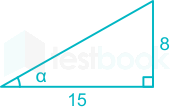
In the given right-angled triangle, where the lengths of the sides given are in cm, find the value of cos α + cot α

  1. AOption (a)

    333136\frac{333}{136}

  2. BOption (b)

    1517\frac{15}{17}

  3. COption (c)

    198\frac{19}{8}

  4. DOption (d)

    375136\frac{375}{136}

View answer & explanation

Correct answer

Answer: (d)D.

375136\frac{375}{136}

Why this answer is correct

Shortcut Trick

Identify sides relative to angle α: Opposite = 8 cm, Hypotenuse = 17 cm.

Apply Pythagorean triplet (8, 15, 17) → Adjacent = 15 cm.

cos α = Adjacent/Hypotenuse = 15/17 and cot α = Adjacent/Opposite = 15/8.

Sum = 15/17 + 15/8 = (120 + 255) / 136 = 375/136.

∴ The correct answer is 375/136.

Alternate Method

Given: Perpendicular (p) = 8 cm, Hypotenuse (h) = 17 cm.

Formula Used: b2 = h2 − p2; cos α = b/h; cot α = b/p

⇒ Base (b) = √(172 − 82)

⇒ b = √(289 − 64) = √225 = 15 cm

⇒ cos α = 15/17

⇒ cot α = 15/8

⇒ cos α + cot α = (15/17) + (15/8)

⇒ LCM of 17 and 8 = 136

⇒ (15 × 8 + 15 × 17) / 136 = (120 + 255) / 136 = 375/136

∴ The correct answer is 375/136.

Additional Information

Pythagorean Triplets

Sets of three integers (a, b, c) that satisfy a2 + b2 = c2, such as (3, 4, 5), (5, 12, 13), and (8, 15, 17).

Trigonometric Ratios

For a right triangle: sin = p/h, cos = b/h, tan = p/b, cosec = h/p, sec = h/b, and cot = b/p.

Relationship between Tan and Cot

cot α = 1 / tan α = cos α / sin α.
Question 2

Orchidarium and the orchid production unit on the premises of the Institute of Bioresources and Sustainable Development (IBSD), is coming up in the state of __________ which has about 300 of the world's 17,000 species of orchids.

  1. AOption (a)

    Arunachal Pradesh

  2. BOption (b)

    Meghalaya

  3. COption (c)

    Uttarakhand

  4. DOption (d)

    Himachal Pradesh

View answer & explanation

Correct answer

Answer: (b)B.

Meghalaya

Why this answer is correct

The correct answer is Meghalaya.

Key Points

  • The Orchidarium and the orchid production unit are located on the premises of the Institute of Bioresources and Sustainable Development (IBSD) in Meghalaya.
  • Meghalaya is home to about 300 species of the world's 17,000 orchid species.
  • Orchids are a significant part of Meghalaya's rich biodiversity and are found abundantly in its forests.
  • The IBSD is working towards the conservation and sustainable development of orchids in the region.

Additional Information

  • Orchid Diversity:
  • Globally, there are about 17,000 known species of orchids.
  • Orchids are among the most diverse and widespread families of flowering plants.
  • Institute of Bioresources and Sustainable Development (IBSD):
  • The IBSD is an autonomous institute under the Department of Biotechnology, Government of India.
  • It focuses on the sustainable development and conservation of bioresources in the Northeast region of India.
  • Conservation Efforts:
  • Conservation of orchids involves both in-situ (natural habitat) and ex-situ (controlled environment) strategies.
  • Efforts include habitat protection, cultivation, and propagation techniques.
  • Economic Importance:
  • Orchids have significant economic value due to their ornamental use.
  • They are also used in traditional medicine and have potential pharmaceutical applications.

Question 3

Three statements are followed by three conclusions numbered I, II and III. You have to consider these statements to be true, even if they seem to be at variance with commonly known facts. Decide which of the given conclusions logically follow(s) from the given statements.

Statements:

Some eggs are wheats

Some fruits are guavas

All guavas are lemons

Conclusions:

(I) Some fruits are wheats

(II) Some lemons are fruits

(III) Some eggs are guavas

  1. AOption (a)

    Either conclusion I or III follows

  2. BOption (b)

    None of the conclusions follow

  3. COption (c)

    Only conclusion I follows

  4. DOption (d)

    Only conclusion II follows

View answer & explanation

Correct answer

Answer: (d)D.

Only conclusion II follows

Why this answer is correct

Given Statements:

Some eggs are wheats

Some fruits are guavas

All guavas are lemons

The least possible Venn diagram for the given statement is:

Conclusions:

I. Some fruits are wheats - False (Because, No definite relation given between fruits and wheats. So, Some fruits are wheats can be possible only).

II. Some lemons are fruits - True (Because, Those fruits which is guavas will lemons also).

III. Some eggs are guavas - False (Because, No definite relation given between eggs and guavas. So, Some eggs are guavas can be possible only).

So, Only conclusion II follows.

Hence, the correct answer is "Option 4".

Question 4

A and B can do a piece of work in 28 days and 35 days, respectively. They work on alternate days starting with A till the work gets completed. How long (in days) would it take A and B to complete the work?

  1. AOption (a)

    311531\frac{1}{5}

  2. BOption (b)

    311231\frac{1}{2}

  3. COption (c)

    31

  4. DOption (d)

    311931\frac{1}{9}

View answer & explanation

Correct answer

Answer: (c)C.

31

Why this answer is correct

Shortcut Trick

Total Work (LCM of 28, 35) = 140 units.

Efficiency of A = 5, Efficiency of B = 4.

2-day cycle (A + B) work = 5 + 4 = 9 units.

In 15 cycles (30 days), work done = 15 × 9 = 135 units. Remaining = 5 units.

On 31st day, A completes the remaining 5 units (as efficiency is 5).

∴ The correct answer is 31 days.

Alternate Method

Given: Time taken by A = 28 days, Time taken by B = 35 days.

Formula: Total Work = LCM of individual days; Efficiency = Total Work ÷ Days.

PersonDaysTotal WorkEfficiency
A281405
B354

⇒ Work done in 1st day by A = 5 units

⇒ Work done in 2nd day by B = 4 units

⇒ Work done in 2 days (1 cycle) = 5 + 4 = 9 units

⇒ Number of complete cycles = 140 ÷ 9 = 15 cycles with remainder 5

⇒ Time for 15 cycles = 15 × 2 = 30 days

⇒ Work completed in 30 days = 15 × 9 = 135 units

⇒ Remaining work = 140 − 135 = 5 units

⇒ On 31st day, it is A's turn. Time taken by A = 5 ÷ 5 = 1 day

⇒ Total time = 30 + 1 = 31 days

∴ The correct answer is 31 days.

Additional Information

Alternate Day Work

In alternate day problems, always identify the work done in one full cycle (sum of efficiencies of all participants) before calculating the total time.

Work and Efficiency

Efficiency is inversely proportional to the time taken to complete the work. Efficiency × Time = Total Work.

Question 5

A pipe can fill an empty tank in 15 hours, but due to a leakage at the bottom, it is filled in 20 hours. If the tank is full, how long will the leakage take to empty it if no other entry or exit point in the tank is open?

  1. AOption (a)

    50 hours

  2. BOption (b)

    60 hours

  3. COption (c)

    40 hours

  4. DOption (d)

    30 hours

View answer & explanation

Correct answer

Answer: (b)B.

60 hours

Why this answer is correct

Shortcut Trick

Product of times ÷ Difference of times

Time taken by leakage = (15 × 20) ÷ (20 − 15)

⇒ 300 ÷ 5 = 60 hours

∴ The correct answer is 60 hr.

Alternate Method

Given: Filling Pipe (A) = 15 hr, Combined (A + Leakage B) = 20 hr.

Formula: Total Work = LCM of individual times; Efficiency = Total Work ÷ Time.

Person/PipeDays/HoursTotal WorkEfficiency
Pipe A15604
A + Leakage B203

⇒ Efficiency of Leakage B = (Efficiency of A + B) − (Efficiency of A)

⇒ Efficiency of B = 3 − 4 = −1 (Negative sign indicates emptying)

⇒ Time taken by Leakage B = Total Work ÷ Efficiency of B

⇒ Time = 60 ÷ 1 = 60 hr

∴ The correct answer is 60 hr.

Additional Information

Pipes and Cisterns Concept

Inlet pipes have positive efficiency while outlet pipes (leaks) have negative efficiency. Net work done is the algebraic sum of efficiencies.

LCM Method

Taking the LCM of individual times as the total capacity of the tank simplifies the calculation of individual rates per hour.

Leakage logic

If an inlet fills in 'x' hours and with a leak it fills in 'y' hours, the leak alone empties the tank in (xy) ÷ (y − x) hours.

Question 6

Which of the following languages has maximum number of speakers in India according to the Census 2011 data?

  1. AOption (a)

    Odia

  2. BOption (b)

    Kannada

  3. COption (c)

    Malayalam

  4. DOption (d)

    Bengali

View answer & explanation

Correct answer

Answer: (d)D.

Bengali

Why this answer is correct

The correct answer is Bengali.

Key Points

  • Bengali is the second most spoken language in India according to the Census 2011 data, following Hindi.
  • There are approximately 83 million Bengali speakers in India as per Census 2011.
  • Bengali is predominantly spoken in the Indian states of West Bengal, Tripura, and Assam.
  • The language has a rich literary heritage and is one of the 22 scheduled languages of India recognized by the Indian Constitution.
  • Bengali is also the official language of the state of West Bengal.

Additional Information

  • Hindi:
  • Hindi is the most spoken language in India with over 528 million speakers according to Census 2011.
  • It is the official language of the central government of India.
  • Hindi is written in the Devanagari script and has a rich tradition of literature and poetry.
  • Languages of India:
  • India is a multilingual country with 22 officially recognized languages listed in the Eighth Schedule of the Indian Constitution.
  • These languages include Assamese, Bengali, Bodo, Dogri, Gujarati, Hindi, Kannada, Kashmiri, Konkani, Maithili, Malayalam, Manipuri, Marathi, Nepali, Odia, Punjabi, Sanskrit, Santali, Sindhi, Tamil, Telugu, and Urdu.
  • Census 2011:
  • The Census 2011 is the 15th National Census of India conducted by the Office of the Registrar General and Census Commissioner, India.
  • It provides detailed information about the population, economic activity, literacy, housing, and amenities, among other demographic data.
  • Sanskrit:
  • Sanskrit is an ancient language of India and is known as the mother of many Indian languages.
  • It is used extensively in classical Indian literature, philosophy, and religious texts.
  • Though not widely spoken, it holds significant cultural and historical importance.

Question 7

According to the NREGA 'At a Glance' report, the average MGNREGA wages paid in the financial year 2021-2022 remain at only Rs. 208.85 per day. What is the full form of MGNREGA?

  1. AOption (a)

    Mahatma Gandhi National Rural Employment Guarantee Activity

  2. BOption (b)

    Mahatma Gandhi National Rural Employer Guarantee Action

  3. COption (c)

    Mahatma Gandhi National Rural Employee Guarantee Act

  4. DOption (d)

    Mahatma Gandhi National Rural Employment Guarantee Act

View answer & explanation

Correct answer

Answer: (d)D.

Mahatma Gandhi National Rural Employment Guarantee Act

Why this answer is correct

The correct answer is Mahatma Gandhi National Rural Employment Guarantee Act.

Key Points

  • The Mahatma Gandhi National Rural Employment Guarantee Act (MGNREGA) was enacted in 2005 by the Indian Parliament.
  • MGNREGA aims to enhance livelihood security in rural areas by providing at least 100 days of wage employment in a financial year to every household whose adult members volunteer to do unskilled manual work.
  • The scheme covers all districts in India except those that have a 100% urban population.
  • MGNREGA is demand-driven, meaning that employment is provided based on the demand for work by the rural populace.
  • The wage payments under MGNREGA are made through direct bank transfers to the beneficiaries to ensure transparency and minimize corruption.

Additional Information

  • Objectives of MGNREGA:
  • To provide a social safety net for vulnerable groups by guaranteeing wage employment opportunities.
  • To create durable assets that can improve rural infrastructure and enhance the overall quality of life.
  • To strengthen the rural economy by providing employment and increasing the purchasing power of rural households.
  • Implementation Mechanism:
  • The Ministry of Rural Development (MoRD) is the nodal agency for the implementation of MGNREGA at the national level.
  • At the state level, the State Rural Development Department oversees the implementation, while at the district level, it is managed by the District Programme Coordinator (DPC).
  • Gram Panchayats play a crucial role in the planning and execution of the works under MGNREGA.
  • Funding Pattern:
  • MGNREGA is a centrally sponsored scheme with the central government bearing the full cost of wages and a significant portion of the material cost.
  • The state governments are responsible for a part of the material cost and administrative expenses.
  • Monitoring and Evaluation:
  • Various monitoring mechanisms, including social audits, are put in place to ensure transparency and accountability in the implementation of MGNREGA.
  • Regular evaluations and third-party assessments are conducted to assess the impact and effectiveness of the scheme.

Question 8

In a certain code language, “WORSE' is written as 'K#2&6' and 'STEAK' is written as '&@689'. How will ‘THORN' be written in that language?

  1. AOption (a)

    @5#27

  2. BOption (b)

    @5#86

  3. COption (c)

    #5@27

  4. DOption (d)

    #5@86

View answer & explanation

Correct answer

Answer: (a)A.

@5#27

Why this answer is correct

The logic followed here is:

'WORSE' is written as 'K#2&6',

WordsWORSE
Written asK#2&6


'STEAK' is written as '&@689'

WordsSTEAK
Written as&@689


Similarly, for, 'THORN'

WordsTHORN
Written as@#2


From the given option only '@5#27' code can be possible.

Thus, 'THORN' will be written as '@5#27'

Hence, the correct answer is "Option 1".

Question 9

Mangal walks 30 m north from his house, then he takes a right turn and walks 20 m. He then takes a right turn and walks 30 m, then turns left and walks 20 m, then he turns right and walks 10 m. Finally, he takes a right turn and walks 40 m. In which direction and how many metres is Mangal now from his house? (All turns are 90° turns only)

  1. AOption (a)

    10 m, south

  2. BOption (b)

    10 m, west

  3. COption (c)

    20 m, east

  4. DOption (d)

    20 m, north

View answer & explanation

Correct answer

Answer: (a)A.

10 m, south

Why this answer is correct

Given: 

Mangal walks 30 m north from his house,

then he takes a right turn and walks 20 m.

He then takes a right turn and walks 30 m,

then turns left and walks 20 m,

then he turns right and walks 10 m.

Finally, he takes a right turn and walks 40 m.

So, Mangal is 10 m to the south from his house.

Hence, the correct answer is "Option 1".

Question 10

What is the full form of 'MICR' in MICR code?

  1. AOption (a)

    Magnetic Ink Character Registration

  2. BOption (b)

    Marking Ink Character Recognition

  3. COption (c)

    Magnetic Ink Character Reconstruction

  4. DOption (d)

    Magnetic Ink Character Recognition

View answer & explanation

Correct answer

Answer: (d)D.

Magnetic Ink Character Recognition

Why this answer is correct

The correct answer is Magnetic Ink Character Recognition.

Key Points

  • MICR stands for Magnetic Ink Character Recognition, a technology used primarily in the banking industry.
  • It involves the use of magnetic ink and special characters to print information on documents like cheques.
  • MICR codes are used to verify the authenticity of paper documents, reducing the risk of fraud.
  • This technology allows for the fast and efficient processing of cheques and other financial documents.

Additional Information

  • MICR Code Structure:
  • The MICR code is a 9-digit code printed on cheques to identify the bank and branch.
  • The first three digits represent the city, the next three represent the bank, and the last three represent the branch.
  • Magnetic Ink:
  • Magnetic ink contains iron oxide particles, which allow the characters to be read by MICR readers.
  • It is used to print the MICR line on the bottom of cheques and other negotiable documents.
  • Benefits of MICR:
  • Ensures accuracy and speed in the processing of cheques.
  • Reduces the risk of human error in cheque clearing.
  • Enhances security and helps in the detection of fraudulent documents.
  • Applications of MICR:
  • Primarily used in the banking sector for the processing of cheques.
  • Also used in other industries that require secure and efficient document processing.

Question 11

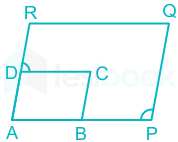
In the given figure, ABCD and APQR are two parallelograms. If ∠APQ = 100°, find ∠CDR.  

  1. AOption (a)

    36°

  2. BOption (b)

    80°

  3. COption (c)

    100°

  4. DOption (d)

    40°

View answer & explanation

Correct answer

Answer: (b)B.

80°

Why this answer is correct

Shortcut Trick

In parallelogram APQR: consecutive angles are supplementary

⇒ ∠PAR = 180° − ∠APQ = 180° − 100° = 80°

In parallelogram ABCD: AB ∥ CD ⇒ ∠CDR = ∠PAR (corresponding angles)

⇒ ∠CDR = 80°

∴ The correct answer is 80°.

Alternate Method

Given:

ABCD and APQR are two parallelograms.

∠APQ = 100°

Formula used:

Consecutive angles of a parallelogram are supplementary.

Corresponding angles are equal when a transversal intersects two parallel lines.

Calculation:

In parallelogram APQR,

⇒ ∠APQ = 100°

⇒ ∠PAR = 180° − 100°

⇒ ∠PAR = 80°

In parallelogram ABCD,

⇒ AB ∥ CD

⇒ ∠PAR = ∠CDR

⇒ ∠CDR = 80°

∴ Option (2) is the correct answer.

Additional Information

Properties of a Parallelogram

Opposite sides are equal and parallel. Opposite angles are equal, and any two consecutive angles are supplementary (∠A + ∠B = 180°).

Diagonals of a Parallelogram

The diagonals of a parallelogram bisect each other, meaning they divide each other into two equal parts at the point of intersection.

Area of a Parallelogram

The area is calculated as Base × Height. If two sides a, b and the included angle θ are known, Area = a × b × sin(θ).

Question 12

The base of the right-angled triangle is 3 m greater than its height. If its hypotenuse is 15 m, then find its area.

  1. AOption (a)

    84 m2

  2. BOption (b)

    72 m2

  3. COption (c)

    54 m2

  4. DOption (d)

    64 m2

View answer & explanation

Correct answer

Answer: (c)C.

54 m2

Why this answer is correct

Shortcut Trick

In a right-angled triangle, the hypotenuse is 15 m.

Check common Pythagorean triplets for hypotenuse 15: (9, 12, 15).

Here, the difference between sides is 12 − 9 = 3 m, which matches the condition.

Area = 1/2 × base × height = 1/2 × 12 × 9 = 54 m2.

∴ The correct answer is 54 m2.

Alternate Method

Given: Hypotenuse (H) = 15 m, Base (b) = Height (h) + 3 m.

Formula Used: b2 + h2 = H2 (Pythagoras Theorem); Area = 1/2 × b × h

⇒ (h + 3)2 + h2 = 152

⇒ h2 + 6h + 9 + h2 = 225

⇒ 2h2 + 6h − 216 = 0

⇒ h2 + 3h − 108 = 0

⇒ h2 + 12h − 9h − 108 = 0 ⇒ (h + 12)(h − 9) = 0

⇒ h = 9 m (height), then b = 9 + 3 = 12 m (base)

⇒ Area = 1/2 × 12 × 9 = 54 m2

∴ The correct answer is 54 m2.

Additional Information

Pythagoras Theorem

In a right-angled triangle, the square of the hypotenuse equals the sum of squares of the other two sides (a2 + b2 = c2).

Pythagorean Triplets

Sets of integers that satisfy the theorem, such as (3, 4, 5), (5, 12, 13), (8, 15, 17), and their multiples like (9, 12, 15).

Area of Triangle

For any triangle, Area = 1/2 × base × perpendicular height.

Question 13

Match the mountain ranges in column-A with their states in column-B.

Column – A (Mountain range)Column – B (State)
a.Aravali mountain1.Himachal Pradesh and Uttarakhand
b.Vindhya range2.Kerala and Karnataka
c.Western ghat3.Rajasthan
d.Himalaya range4.Madhya Pradesh
  1. AOption (a)

    a - 3, b - 4, c - 2, d - 1

  2. BOption (b)

    a - 4, b - 3, c - 1, d - 2

  3. COption (c)

    a - 4, b - 3, c - 2, d - 1

  4. DOption (d)

    a - 1, b - 2, c - 3, d - 4

View answer & explanation

Correct answer

Answer: (a)A.

a - 3, b - 4, c - 2, d - 1

Why this answer is correct

The correct answer is a - 3, b - 4, c - 2, d - 1.

Key Points

  • The Aravali mountain range is located in the state of Rajasthan.
  • The Vindhya range passes through the state of Madhya Pradesh.
  • The Western Ghats traverse the states of Kerala and Karnataka.
  • The Himalaya range spans across the states of Himachal Pradesh and Uttarakhand.

Additional Information

  • Aravali Mountain Range:
  • The Aravali range is one of the oldest mountain ranges in the world.
  • It spans approximately 692 km in a northeastern direction across Indian states such as Gujarat, Rajasthan, Haryana, and Delhi.
  • Vindhya Range:
  • The Vindhya range runs parallel to the Narmada river in central India.
  • This range forms the southern boundary of the Malwa Plateau.
  • Western Ghats:
  • The Western Ghats, also known as Sahyadri, are a UNESCO World Heritage site.
  • They cover a stretch of 1,600 km parallel to the western coast of the Indian peninsula.
  • Himalaya Range:
  • The Himalayas are the highest mountain range in the world, home to Mount Everest.
  • This range extends across five countries: Bhutan, India, Nepal, China, and Pakistan.

Question 14

If K + 1K\rm \frac{1}{K} = -2, then the value of K3 + 1K3\rm \frac{1}{K^3} is :

  1. AOption (a)

    -1

  2. BOption (b)

    -3

  3. COption (c)

    -2

  4. DOption (d)

    -4

View answer & explanation

Correct answer

Answer: (c)C.

-2

Why this answer is correct

Shortcut Trick

If K + 1/K = −2, then the only possible value for K is −1.

Directly substitute K = −1 into the required expression K3 + 1/K3:

⇒ (−1)3 + 1/(−1)3 = −1 + (−1) = −2

∴ The correct answer is −2.

Alternate Method

Given: K + 1/K = −2

Formula Used: x3 + 1/x3 = (x + 1/x)3 − 3(x + 1/x)

⇒ Let x = K and x + 1/x = −2

⇒ K3 + 1/K3 = (K + 1/K)3 − 3(K + 1/K)

⇒ K3 + 1/K3 = (−2)3 − 3(−2)

⇒ K3 + 1/K3 = −8 − (−6)

⇒ K3 + 1/K3 = −8 + 6

⇒ K3 + 1/K3 = −2

∴ The correct answer is −2.

Additional Information

Special Values for Reciprocals

If x + 1/x = 2, then x = 1. If x + 1/x = −2, then x = −1. These are common identities in algebraic simplifications.

Square of Reciprocal Sum

If x + 1/x = a, then x2 + 1/x2 = a2 − 2.

Cube of Reciprocal Sum

If x + 1/x = a, then x3 + 1/x3 = a3 − 3a.

Cube of Reciprocal Difference

If x − 1/x = a, then x3 − 1/x3 = a3 + 3a.

Question 15

What is the discount percentage in the scheme of buy 5 get 3 free?

  1. AOption (a)

    37.5%

  2. BOption (b)

    39.25%

  3. COption (c)

    60%

  4. DOption (d)

    36.5%

View answer & explanation

Correct answer

Answer: (a)A.

37.5%

Why this answer is correct

Shortcut Trick

Discount % in 'Buy X Get Y Free' schemes = [Free items ÷ Total items] × 100.

Here, Free items = 3 and Purchased items = 5.

Total items (X + Y) = 5 + 3 = 8.

Discount % = (3 ÷ 8) × 100.

Discount % = 37.5%.

∴ The correct answer is 37.5%.

Alternate Method

Given: Buy 5 items and get 3 free.

Formulas: Discount% = (Discount ÷ Marked Price) × 100 | Total Items = Paid Items + Free Items

⇒ Let the Marked Price (MP) of 1 item be 1 unit.

⇒ Total items given to customer = 5 + 3 = 8 items.

⇒ Total MP = 8 × 1 = 8 units.

⇒ The customer only pays for 5 items, so Selling Price (SP) = 5 × 1 = 5 units.

⇒ Discount = MP − SP = 8 − 5 = 3 units.

⇒ Discount % = (3 ÷ 8) × 100 = 37.5%.

∴ The correct answer is 37.5%.

Additional Information

Marked Price & Discount

Marked Price is the price printed on the label. Discount is always calculated on the MP unless specified otherwise. Formula: SP = MP − Discount.

Buy X Get Y Free

This is a marketing strategy where the effective discount is based on the total quantity (X+Y) leaving the store versus the quantity (Y) given for free.

Question 16

Select the option that is related to the third term in the same way as the second term is related to the first term and the sixth term is related to the fifth term.

15 : 4913 :: 8 : ? :: 11 : 2197

  1. AOption (a)

    1001

  2. BOption (b)

    1000

  3. COption (c)

    1003

  4. DOption (d)

    1002

View answer & explanation

Correct answer

Answer: (b)B.

1000

Why this answer is correct

The logic followed here is:

Logic: (1st number + 2)3 = 2nd number.

Now,

For, 15 : 4913

⇒ (15 + 2)3 

⇒ 173 = 4913.

For, 11 : 2197

⇒ (11 + 2)3 

⇒ 133 = 2197.

Similarly, for 8 ∶ ?

⇒ (8 + 2)3 

⇒ 103 = 1000.

Hence, the correct answer is "Option 2".

Question 17

Which group of organisation/institutes is an example of Constitutional bodies in India?

  1. AOption (a)

    Election Commission of India, Attorney General of India, Union Public Service Commission

  2. BOption (b)

    National Human Right Commission, National Commission for Minorities, Election Commission of India

  3. COption (c)

    Comptroller and Auditor General of India, National Human Rights Commission, Election Commission of India

  4. DOption (d)

    National Commission of India, Securities and Exchange Board of India, Attorney General of India

View answer & explanation

Correct answer

Answer: (a)A.

Election Commission of India, Attorney General of India, Union Public Service Commission

Why this answer is correct

The correct answer is Election Commission of India, Attorney General of India, Union Public Service Commission.

Key Points

  • Election Commission of India: An autonomous constitutional authority responsible for administering election processes in India at both national and state levels.
  • Attorney General of India: The chief legal advisor to the Government of India and is appointed by the President of India under Article 76 of the Constitution.
  • Union Public Service Commission (UPSC): A constitutional body that conducts examinations for the appointment to the services of the Union.
  • These bodies are established by the Constitution of India and have a significant role in the governance and administration of the country.

Additional Information

  • Constitutional Bodies: These are bodies in India that derive their powers and functions from the Constitution of India.
  • They are mentioned in the Constitution and cannot be altered or abolished without a constitutional amendment.
  • Election Commission of India
  • Formed on January 25, 1950, it ensures free and fair elections in the country.
  • It administers elections to the Lok Sabha, Rajya Sabha, and State Legislative Assemblies.
  • Attorney General of India
  • The highest law officer in the country, appointed by the President of India.
  • He/she has the right of audience in all courts in India.
  • Union Public Service Commission (UPSC)
  • Formed on October 1, 1926, it is responsible for recruiting all the Group 'A' officers under the Government of India.
  • It conducts the Civil Services Examination, Engineering Services Examination, and other competitive exams.

Question 18

Which of the following statements is/are true in case of an incandescent filament bulb?

(a) Filament can be made of tungsten or nichrome.

(b) The glass envelope covering the filament is filled with inactive gases such as nitrogen or argon.

(c) Since the filament used is thin, its resistivity is very low.

(d) The resistivity of the filament is low to allow more current.

(e) The filament material used should have high melting point.

  1. AOption (a)

    (a), (b), (e)

  2. BOption (b)

    (c), (d), (e)

  3. COption (c)

    (b), (c), (d)

  4. DOption (d)

    (a), (c), (d)

View answer & explanation

Correct answer

Answer: (a)A.

(a), (b), (e)

Why this answer is correct

The correct answer is 1)(a), (b), (e).

Key Points

  • Filament Materials: The filament in an incandescent bulb can be made of tungsten or nichrome. Tungsten is more commonly used due to its high melting point and efficiency.
  • Inactive Gases: The glass envelope of the bulb is filled with inactive gases such as nitrogen or argon to prevent the filament from oxidizing and to prolong its life.
  • High Melting Point: The filament material, especially tungsten, is chosen because of its high melting point, allowing it to operate at high temperatures without melting.

Additional Information

  • Resistivity of Filament: The resistivity of the filament is not low; it is designed to be relatively high to ensure that it heats up and emits light when current passes through.
  • Thin Filament: The filament used is thin to increase resistance, which in turn increases the temperature and light emission.
  • Filament Efficiency: Tungsten is preferred for its efficiency in converting electrical energy into visible light.
  • Working Principle: Incandescent bulbs work on the principle of incandescence, where the filament glows due to the heat produced by the current.

Question 19

Seven people - B, D, F, K, M, Q and W are sitting in a straight line facing North. D sits second from one of the extreme ends of the line. Only two people sit between D and F. M sits fourth to the right of F. Q sits second to the right of W. K is not an immediate neighbour of W.

How many people sit to the left of B?

  1. AOption (a)

    Three

  2. BOption (b)

    Two

  3. COption (c)

    None

  4. DOption (d)

    One

View answer & explanation

Correct answer

Answer: (c)C.

None

Why this answer is correct

Given: Seven people - B, D, F, K, M, Q and W are sitting in a straight line facing North.

  1. D sits second from one of the extreme ends of the line.

  2. Only two people sit between D and F.

  3. M sits fourth to the right of F.

  4. Q sits second to the right of W.

  5. K is not an immediate neighbour of W.

And, B sits at the remaining place.

Here, None of the people sits to the left of B.

Hence, the correct answer is "Option 3".

Question 20

Bleaching powder is formed when dry slaked lime reacts with ________.

  1. AOption (a)

    bromine

  2. BOption (b)

    hydrogen

  3. COption (c)

    nitrogen

  4. DOption (d)

    chlorine

View answer & explanation

Correct answer

Answer: (d)D.

chlorine

Why this answer is correct

The correct answer is chlorine.

Key Points

  • Bleaching powder, also known as calcium hypochlorite, is chemically represented as Ca(OCl)2.
  • It is produced by the reaction of chlorine gas with dry slaked lime (calcium hydroxide), represented by the chemical equation: Ca(OH)2 + Cl2 → Ca(OCl)2 + H2O.
  • Bleaching powder is widely used for disinfecting water, bleaching fabrics, and in sanitation processes.
  • It is a strong oxidizing agent and releases chlorine when exposed to atmospheric carbon dioxide and moisture.

Additional Information

  • Slaked Lime (Calcium Hydroxide):
  • Slaked lime is chemically represented as Ca(OH)2 and is commonly used in construction, agriculture, and water treatment.
  • It is produced by adding water to quicklime (calcium oxide).
  • Chlorine:
  • Chlorine is a highly reactive halogen element, represented by the symbol Cl, and is used in disinfectants, bleaches, and plastics.
  • It is a greenish-yellow gas at room temperature and has a strong, pungent odor.
  • Calcium Hypochlorite:
  • It is a chemical compound with the formula Ca(OCl)2 and is commonly used for water purification and as a bleaching agent.
  • Calcium hypochlorite is a white powder that decomposes in water, releasing chlorine.
  • Oxidizing Agent:
  • An oxidizing agent is a substance that has the ability to oxidize other substances, meaning it can accept electrons from them.
  • Bleaching powder acts as an oxidizing agent, making it effective for disinfecting and bleaching.

Question 21

If '+' means '-', '-' means '+', '×' means '÷', and '÷' means '×', what will come in place of the question mark (?) in the following equation ?

15 - 8 + 7 ÷ 6 × 3 = ?

  1. AOption (a)

    10

  2. BOption (b)

    12

  3. COption (c)

    6

  4. DOption (d)

    9

View answer & explanation

Correct answer

Answer: (d)D.

9

Why this answer is correct

Given Equation: 15 - 8 + 7 ÷ 6 × 3 = ?

BODMAS Rule:

Decoding the given information:

Alphabet+-×÷
Meaning-+÷×


Now replacing the sign from left to right using BODMAS Rule, we get:

⇒ 15 + 8 - 7 × 6 ÷ 3 = ?

⇒ 15 + 8 - 7 × 2 = ?

⇒ 15 + 8 - 14 = ?

⇒ 23 - 14 = 9.

Hence, the correct option is "Option 4".

Question 22

object is placed _____________ to obtain an inverted and enlarged image. 

  1. AOption (a)

    between C and F of concave mirror

  2. BOption (b)

    between C and F of convex mirror

  3. COption (c)

    at infinity from concave mirror

  4. DOption (d)

    at infinity from convex mirror

View answer & explanation

Correct answer

Answer: (a)A.

between C and F of concave mirror

Why this answer is correct

The correct answer is 1) between C and F of concave mirror.

Key Points

  • When an object is placed between the center of curvature (C) and the focal point (F) of a concave mirror, the image formed is inverted and enlarged.
  • The image formed in this position is real, meaning it can be projected onto a screen.
  • This property of concave mirrors is utilized in devices such as reflecting telescopes and shaving mirrors.
  • In this scenario, the image is formed beyond the center of curvature (C) on the opposite side of the mirror.

Additional Information

  • Concave Mirror:
  • A concave mirror, or converging mirror, has a reflective surface that curves inward, resembling a portion of the interior of a sphere.
  • It can produce real or virtual images depending on the object's position relative to the mirror's focal point.
  • Focal Point (F):
  • The focal point is the point where parallel rays of light either converge or appear to diverge after reflecting from the mirror.
  • For a concave mirror, the focal point lies on the principal axis in front of the mirror.
  • Center of Curvature (C):
  • The center of curvature is the center of the sphere of which the mirror is a part.
  • It lies on the principal axis and is twice the distance from the mirror as the focal length.
  • Magnification:
  • Magnification refers to the ratio of the height of the image to the height of the object.
  • In the case of a concave mirror, when the object is between C and F, the magnification is greater than one, indicating an enlarged image.

Question 23

Select the option that is related to the fifth term in the same way as the fourth term is related to the third term and the second term is related to the first term.

STUDENT : HGFWVMG :: TEACHER : GVZXSVI :: SCHOOL : ?

  1. AOption (a)

    SLOLXH

  2. BOption (b)

    XSHLLO

  3. COption (c)

    HXSOLL

  4. DOption (d)

    HXSLLO

View answer & explanation

Correct answer

Answer: (d)D.

HXSLLO

Why this answer is correct

The logic followed here is:

For, STUDENT : HGFWVMG

For, TEACHER : GVZXSVI

Similarly, for SCHOOL : ?

Hence, the correct answer is "Option 4".

Question 24

A total of 50 students are in a row. Ankit is at the 19th position from the start of the row. What is the position of Ankit from the end of the row?

  1. AOption (a)

    32nd

  2. BOption (b)

    31st

  3. COption (c)

    33rd

  4. DOption (d)

    30th

View answer & explanation

Correct answer

Answer: (a)A.

32nd

Why this answer is correct

Given: 50 students.

Position of Ankit from the start of the row = 19th

So, the position of Ankit from the end of the row = Total Students - Position of Ankit from the start of the row + 1

= 50 - 19 + 1 = 32.

So, position of Ankit from the end of the row is 32nd.

Hence, the correct answer is "Option 1".

Question 25

If K is the mean of 2, 3, 4, K, then the mode is:

  1. AOption (a)

    1

  2. BOption (b)

    4

  3. COption (c)

    3

  4. DOption (d)

    2

View answer & explanation

Correct answer

Answer: (c)C.

3

Why this answer is correct

Shortcut Trick

Total observations n = 4. Mean is K.

Sum = 4 × K ⇒ 2 + 3 + 4 + K = 4K

9 + K = 4K ⇒ 3K = 9 ⇒ K = 3

The set is {2, 3, 4, 3}. Here, 3 repeats 2 times while others repeat 1 time.

∴ The correct answer is 3.

Alternate Method

Given: Observations = 2, 3, 4, K; Mean = K.

Formula Used: Mean = (Sum of all observations) ÷ (Total number of observations)

⇒ Mean = (2 + 3 + 4 + K) ÷ 4

⇒ K = (9 + K) ÷ 4

⇒ 4K = 9 + K

⇒ 4K − K = 9

⇒ 3K = 9 ⇒ K = 3

⇒ Now, the observations are 2, 3, 4, 3.

⇒ Frequency of 2 = 1, Frequency of 3 = 2, Frequency of 4 = 1.

⇒ Since 3 has the highest frequency, Mode = 3.

∴ The correct answer is 3.

Additional Information

Arithmetic Mean

The mean is the sum of all observations divided by the total count of observations (Σx ÷ n).

Mode

The mode is the observation that occurs most frequently in the data set. A set can be unimodal, bimodal, or multimodal.

Empirical Relationship

For a moderately skewed distribution: Mode = 3 × Median − 2 × Mean.

Median

The median is the middle value when data is arranged in ascending order. If n is even, it is the average of the two middle terms.

Question 26

Which of the following is NOT a body of the urban local body administration? 

  1. AOption (a)

    Nagar Panchayat

  2. BOption (b)

    Zila panchayat

  3. COption (c)

    Municipality

  4. DOption (d)

    Municipal Corporation

View answer & explanation

Correct answer

Answer: (b)B.

Zila panchayat

Why this answer is correct

The correct answer is Zila Panchayat.

Key Points

  • Zila Panchayat is a rural local government body at the district level in India.
  • It does not fall under the urban local body administration category.
  • Zila Panchayat is responsible for the administration of rural areas and villages.
  • It operates under the Panchayati Raj system and focuses on the development of the district as a whole.
  • Urban local bodies like Nagar Panchayat, Municipality, and Municipal Corporation handle the administration of urban and semi-urban areas.

Additional Information

  • Nagar Panchayat:
  • Nagar Panchayat is an urban local body for areas in transition from rural to urban.
  • It is responsible for providing basic services and infrastructure to small towns.
  • Municipality:
  • Municipality, also known as Municipal Council, is an urban local body for smaller urban areas.
  • It is responsible for the administration of the town and providing civic amenities.
  • Municipal Corporation:
  • Municipal Corporation is the highest form of urban local body administration, found in large cities.
  • It is responsible for managing city infrastructure, public services, and local governance.
  • Panchayati Raj:
  • Panchayati Raj is a system of local self-government for rural areas in India.
  • It consists of three levels: Gram Panchayat (village level), Panchayat Samiti (block level), and Zila Panchayat (district level).

Question 27

Padma Vibhushan award of 2022 has not been given in which of the following fields? 

  1. AOption (a)

    Civil Service

  2. BOption (b)

    Literature and Education

  3. COption (c)

    Art

  4. DOption (d)

    Trade and Industry

View answer & explanation

Correct answer

Answer: (d)D.

Trade and Industry

Why this answer is correct

The correct answer is option 4.

Key Points

  • The Padma Vibhushan award is the second-highest civilian award in India, given for exceptional and distinguished service in various fields.
  • In 2022, the Padma Vibhushan award was conferred in various fields including Civil Service, Literature and Education, and Art.
  • Trade and Industry was not one of the fields in which the Padma Vibhushan award was given in 2022.
  • Recipients of the Padma Vibhushan award are announced annually on Republic Day and the awards are conferred by the President of India.

Additional Information

  • Padma Awards:
  • The Padma Awards are one of the highest civilian honors in India, instituted in 1954.
  • They are categorized into three awards: Padma Vibhushan, Padma Bhushan, and Padma Shri.
  • The awards recognize achievements in all fields of activities or disciplines where an element of public service is involved.
  • Fields Recognized:
  • Fields include Art, Literature and Education, Civil Service, Public Affairs, Science and Engineering, Trade and Industry, Medicine, Social Work, and others.
  • The awards aim to recognize 'work of distinction' and are given for distinguished and exceptional achievements/service in all fields of activities/disciplines.
  • Selection Process:
  • The Padma Awards Committee is constituted by the Prime Minister every year.
  • The recommendations for the Padma Awards are submitted to the Padma Awards Committee and the final list is approved by the Prime Minister and the President of India.
  • Award Ceremony:
  • The awards are announced on the occasion of Republic Day every year and are conferred by the President of India at ceremonial functions held at Rashtrapati Bhavan usually around March/April.

Question 28

Select the option that represents the letters that, when placed from left to right in the same sequence in the blanks below, will complete the letter series.

M N O _ M N _ _ M N _ P _ _ O P

  1. AOption (a)

    POPOMN

  2. BOption (b)

    POPOMM

  3. COption (c)

    NMPONM

  4. DOption (d)

    MNPOPP

View answer & explanation

Correct answer

Answer: (a)A.

POPOMN

Why this answer is correct

The logic followed here is:

Given Sequence: M N O _ M N _ _ M N _ P _ _ O P

Now, putting the letters in the blank spaces given in the option one by one:

Option 1) POPOMN → M N O P / M N O P / M N O P / M N O P

Here, 'MNOP' followed a pattern.

Option 2) POPOMM → M N O P / M N O P / M N O P / M M O P

Option 3) NMPONM → M N O N / M N M P / M N O P / N M O P

Option 4) MNPOPP → M N O M / M N N P / M N O P / P P O P

Hence, the correct answer is "Option 1".

Question 29

Mohan, Meena and Madhav enter into a partnership investing Rs. 3,000, Rs. 2,000 and Rs. 5,000 respectively. Find their respective shares in the annual profit of Rs. 5,600 in the given order of the names mentioned here.

  1. AOption (a)

    Rs. 1,752, Rs. 1,168, Rs. 2,680

  2. BOption (b)

    Rs. 1,680, Rs. 1,120, Rs. 2,800

  3. COption (c)

    Rs. 1,680, Rs. 1,240, Rs. 2,680

  4. DOption (d)

    Rs. 1,480, Rs. 1,320, Rs. ​2,800

View answer & explanation

Correct answer

Answer: (b)B.

Rs. 1,680, Rs. 1,120, Rs. 2,800

Why this answer is correct

Shortcut Trick

Profit ratio = Investment ratio = 3000 : 2000 : 5000 = 3 : 2 : 5.

Total ratio parts = 3 + 2 + 5 = 10 units.

10 units = Rs. 5,600 ⇒ 1 unit = Rs. 560.

Mohan = 3 × 560 = Rs. 1,680; Meena = 2 × 560 = Rs. 1,120; Madhav = 5 × 560 = Rs. 2,800.

∴ The correct answer is Rs. 1,680, Rs. 1,120, Rs. 2,800.

Alternate Method

Given → Mohan investment = Rs. 3,000, Meena investment = Rs. 2,000, Madhav investment = Rs. 5,000, Total Profit = Rs. 5,600. Formulas: Profit Share = (Individual Investment × Time) / Total Investment-Time product | Ratio of Profit = I1 : I2 : I3 (for same time period).

⇒ Ratio of investments = 3000 : 2000 : 5000 = 3 : 2 : 5. ⇒ Sum of ratios = 3 + 2 + 5 = 10. ⇒ Mohan share = (3/10) × 5600 = 3 × 560 = Rs. 1,680. ⇒ Meena share = (2/10) × 5600 = 2 × 560 = Rs. 1,120. ⇒ Madhav share = (5/10) × 5600 = 5 × 560 = Rs. 2,800.

∴ The correct answer is Rs. 1,680, Rs. 1,120, Rs. 2,800.

Additional Information

Partnership Investment Rule

When the time period for which the investments are made is the same, the profit is distributed in the ratio of the capitals invested.

Compound Partnership

If investments are for different time periods, the profit ratio is (Capital1 × Time1) : (Capital2 × Time2).

Question 30

A galvanometer when connected in a circuit, detects the presence of:

  1. AOption (a)

    Resistance

  2. BOption (b)

    Current

  3. COption (c)

    Frequency

  4. DOption (d)

    Potential difference

View answer & explanation

Correct answer

Answer: (b)B.

Current

Why this answer is correct

The correct answer is Current.

Key Points

  • A galvanometer is an instrument used to detect and measure small electric currents in a circuit.
  • It works based on the principle of electromagnetic deflection, where a current-carrying coil experiences a torque in a magnetic field.
  • The deflection of the needle in a galvanometer is directly proportional to the amount of current flowing through it.
  • Galvanometers are primarily used in laboratories and electrical experiments to check the presence and direction of current.

Additional Information

  • The working of a galvanometer is based on the Motor Principle, where a current-carrying conductor placed in a magnetic field experiences a force.
  • A galvanometer consists of a moving coil suspended in a magnetic field, and the deflection is observed on a calibrated scale.
  • It is different from an ammeter, which is a modified galvanometer designed to measure larger currents with negligible resistance.
  • For detecting potential difference, a voltmeter is used, and for measuring resistance, an ohmmeter is employed.
  • Modern galvanometers have been replaced by digital multimeters in many practical applications, but they are still used for precision measurements in labs.
  • One common type of galvanometer is the moving coil galvanometer, which is widely used due to its high sensitivity and accuracy.

Question 31

Which of the following with respect to the Modern Periodic Table is NOT correct?

  1. AOption (a)

    It has 18 groups and 7 periods.

  2. BOption (b)

    The number of shells increases as we go down the group.

  3. COption (c)

    The elements present in the same group have same number of valence electrons.

  4. DOption (d)

    Na, Mg and S belongs to the 4th period of the Modern Periodic Table.

View answer & explanation

Correct answer

Answer: (d)D.

Na, Mg and S belongs to the 4th period of the Modern Periodic Table.

Why this answer is correct

The correct answer is Na, Mg and S belongs to the 4th period of the Modern Periodic Table.

Key Points

  • The Modern Periodic Table consists of 18 groups and 7 periods.
  • The number of electron shells increases as we move down a group in the periodic table.
  • Elements in the same group have the same number of valence electrons.
  • Sodium (Na), Magnesium (Mg), and Sulfur (S) actually belong to the 3rd period of the Modern Periodic Table, not the 4th period.

Additional Information

  • Periods in the Periodic Table:
  • Periods are horizontal rows in the periodic table.
  • The period number indicates the number of electron shells in the atoms of the elements in that period.
  • Groups in the Periodic Table:
  • Groups are vertical columns in the periodic table.
  • Elements in the same group have similar chemical properties and the same number of valence electrons.
  • Valence Electrons:
  • Valence electrons are the electrons in the outermost shell of an atom.
  • They determine the chemical properties and reactivity of an element.
  • Periodic Trends:
  • Periodic trends refer to patterns in the periodic table that show the variation of certain properties of elements.
  • Common periodic trends include atomic radius, ionization energy, and electronegativity.

Question 32

If yesterday was Monday, then which day of the week it will be after 89 days from today? 

  1. AOption (a)

    Saturday

  2. BOption (b)

    Monday

  3. COption (c)

    Tuesday

  4. DOption (d)

    Sunday

View answer & explanation

Correct answer

Answer: (d)D.

Sunday

Why this answer is correct

Given: The day on Yesterday = Monday.

So, Today will be: Monday + 1 = Tuesday.

Now,

Now, after 89 days from today

As, we know 7 days = 1 week.

So, 89 days = 89/7 = 12 week and 5 odd days.

Then,

after 89 days from today will be Tuesday + 5 = Sunday.

Hence, the correct answer is "Option 4".

Question 33

Which of the following is NOT correctly matched? 

  1. AOption (a)

    Indian Sandalwood – Deciduous forests of Deccan Plateau

  2. BOption (b)

    Neem - Alpine region

  3. COption (c)

    Ficus - Malabar coast moist forests

  4. DOption (d)

    Pine - Himalayan subtropical forest

View answer & explanation

Correct answer

Answer: (b)B.

Neem - Alpine region

Why this answer is correct

The correct answer is Neem - Alpine region.

Key Points

  • Neem (Azadirachta indica) is a tree native to the Indian subcontinent and grows predominantly in tropical and semi-tropical regions.
  • Neem is well-suited to sub-tropical and tropical regions; it does not thrive in alpine or cold climatic conditions.
  • Alpine regions are characterized by high altitudes and cold temperatures, which are unsuitable for the growth of Neem trees.
  • Neem trees are commonly found in dry, arid regions and are known for their drought-resistant properties.

Additional Information

  • Indian Sandalwood (Santalum album):
  • Indian Sandalwood is native to the dry deciduous forests of the Deccan Plateau in India.
  • It is highly valued for its aromatic heartwood and oil, used in perfumes and traditional medicine.
  • Ficus (Ficus species):
  • Ficus species, such as the Banyan tree, are common in the Malabar Coast moist forests.
  • These trees thrive in humid and tropical climates.
  • Pine (Pinus species):
  • Pine trees are typically found in the Himalayan subtropical forests.
  • They are well-adapted to cooler climates and higher altitudes.
  • Alpine Region Characteristics:
  • Alpine regions are characterized by their high altitude and cold climate.
  • Vegetation in alpine regions includes hardy shrubs and grasses, with few trees due to harsh conditions.

Question 34

Which of the following is a Buddhist temple in India?

  1. AOption (a)

    Nidhivan Temple

  2. BOption (b)

    Gorakhnath Temple

  3. COption (c)

    Mahabodhi Temple

  4. DOption (d)

    Vishwanath Temple

View answer & explanation

Correct answer

Answer: (c)C.

Mahabodhi Temple

Why this answer is correct

The correct answer is Mahabodhi Temple.

Key Points

  • Mahabodhi Temple is a UNESCO World Heritage Site located in Bodh Gaya, Bihar, India.
  • This temple marks the location where Siddhartha Gautama, the Buddha, is said to have attained enlightenment under the Bodhi Tree.
  • The current structure of the Mahabodhi Temple was built during the Gupta period in the 5th-6th century CE.
  • It is one of the earliest Buddhist temples built entirely of brick and considered one of the most significant shrines in Buddhism.

Additional Information

  • UNESCO World Heritage Sites in India:
  • There are 40 UNESCO World Heritage Sites in India, including cultural, natural, and mixed properties.
  • These sites are recognized for their exceptional cultural or natural importance to the common heritage of humanity.
  • Buddhism in India:
  • Buddhism originated in India around the 5th century BCE with Siddhartha Gautama, known as the Buddha.
  • Key Buddhist pilgrimage sites in India include Lumbini (birthplace of Buddha), Bodh Gaya (enlightenment), Sarnath (first sermon), and Kushinagar (death).
  • Other Significant Buddhist Temples in India:
  • Mahaparinirvana Temple in Kushinagar, Uttar Pradesh
  • Dhamek Stupa in Sarnath, Uttar Pradesh
  • Ramabhar Stupa in Kushinagar, Uttar Pradesh
  • Architecture of Mahabodhi Temple:
  • The temple complex includes a large central tower, standing 55 meters tall, surrounded by four smaller towers.The temple has a central shrine housing a large gilded statue of Buddha in the "touching the ground" posture.
  • The Bodhi Tree adjacent to the temple is believed to be a direct descendant of the original tree under which Buddha attained enlightenment.

Question 35

In a certain code language, ‘FRAME’ is written as 'HPCKG’, and ‘PEACH' is written as ‘RCCAJ’. How will BROOM' be written in that language?

  1. AOption (a)

    DPQMO

  2. BOption (b)

    CPPMO

  3. COption (c)

    DTQQO

  4. DOption (d)

    APQNO

View answer & explanation

Correct answer

Answer: (a)A.

DPQMO

Why this answer is correct

The logic followed here is:

'FRAME’ is written as 'HPCKG’,

‘PEACH' is written as ‘RCCAJ’,

Similarly, for  ‘BROOM’

So, 'BROOM' will be written as 'DPQMO'.

Hence, the correct answer is "Option 1".

Question 36

Which NRI was awarded Padma Vibhushan in the field of Science and Engineering posthumously in 2022 ?

  1. AOption (a)

    Sanjay Rajaram

  2. BOption (b)

    Rattan Lal

  3. COption (c)

    Thiruvengadam Veeraraghavan

  4. DOption (d)

    Narinder Singh Kapany

View answer & explanation

Correct answer

Answer: (d)D.

Narinder Singh Kapany

Why this answer is correct

The correct answer is 4) Narinder Singh Kapany.

Key Points

  • Narinder Singh Kapany is widely recognized as the "Father of Fiber Optics" for his pioneering work in the field of fiber optics.
  • He was awarded the Padma Vibhushan posthumously in 2022 in the field of Science and Engineering.
  • Kapany's research and innovations in fiber optics have significantly impacted telecommunications and medical technologies.
  • He held over 100 patents and was a prolific author, contributing extensively to scientific literature.

Additional Information

  • Fiber Optics:
  • A technology that uses glass (or plastic) threads (fibers) to transmit data.
  • It has revolutionized telecommunications, allowing for faster and more reliable data transmission over long distances.
  • Padma Vibhushan:
  • The second-highest civilian award in India, given for exceptional and distinguished service in any field.
  • It was instituted in 1954 and has been awarded to notable individuals in various sectors.
  • Telecommunications:
  • The transmission of information over significant distances to communicate, typically using electronic means.
  • Fiber optic technology is a key component in modern telecommunications infrastructure.
  • Medical Technologies:
  • Fiber optics are used in medical instruments such as endoscopes, which allow doctors to see inside the human body without invasive surgery.
  • This technology has improved diagnostic and treatment options in modern medicine.

Question 37

The power of an electric bulb of resistance 18 ohm if no voltage is applied across it is ____________.

  1. AOption (a)

    18 W

  2. BOption (b)

    9 W

  3. COption (c)

    infinity

  4. DOption (d)

    0 W

View answer & explanation

Correct answer

Answer: (d)D.

0 W

Why this answer is correct

The correct answer is 0 W.

Key Points

  • The power of an electrical device is given by the formula: P = V² / R, where P is power, V is voltage, and R is resistance.
  • If no voltage is applied across the electric bulb, then V = 0.
  • Substituting in the formula, we get P = (0)² / 18 = 0 W.
  • This means that without any applied voltage, the bulb does not consume power and remains turned off.

Additional Information

  • Electric Power Formula: Power (P) in an electrical circuit is given by multiple expressions:
  • P = V × I (Voltage × Current)
  • P = I² × R (Current² × Resistance)
  • P = V² / R (Voltage² ÷ Resistance)
  • Ohm’s Law: States that V = I × R, meaning that if no voltage is applied, no current flows through the circuit.
  • The power of an electrical device depends on the applied voltage and the resistance of the device.
  • Since power is directly proportional to voltage, if voltage is zero, the power must also be zero.
  • Options like "infinity" are incorrect because infinite power would require infinite voltage, which is unrealistic.
  • Electric bulbs work based on the heating effect of current; without current (which requires voltage), there is no heat or light production.

Question 38

Meristematic tissue cells lack ___________.

  1. AOption (a)

    cytoplasm

  2. BOption (b)

    vacuoles

  3. COption (c)

    cell wall

  4. DOption (d)

    nucleus

View answer & explanation

Correct answer

Answer: (b)B.

vacuoles

Why this answer is correct

The correct answer is vacuoles.

Key Points

  • Meristematic tissue cells are responsible for plant growth and are found in regions like root tips and shoot tips.
  • These cells are characterized by their capability to divide and form new cells, which contribute to the growth of the plant.
  • Meristematic cells have dense cytoplasm and a prominent nucleus, essential for their role in cell division.
  • They lack vacuoles, which are typically present in mature plant cells, to maintain their capacity for rapid division.

Additional Information

  • Types of Meristematic Tissue:
  • Apical Meristem: Found at the tips of roots and shoots, responsible for the primary growth of the plant.
  • Intercalary Meristem: Located at the base of leaves or internodes, contributing to the regrowth of grasses and other monocots.
  • Lateral Meristem: Present along the sides of stems and roots, responsible for secondary growth, increasing the girth of the plant.
  • Cell Wall: The cell wall of meristematic cells is thin and primary in nature to allow for flexibility and cell division.
  • Cell Differentiation: As meristematic cells divide, they eventually differentiate into various specialized cell types, forming different tissues and organs of the plant.
  • Importance in Plant Growth: Meristematic tissues are crucial for the continuous growth and formation of new organs in plants, enabling them to adapt to their environment.

Question 39

If the length l of a room is reduced by 10% and breadth b is increased by 10%, then find the positive change in its perimeter.

  1. AOption (a)

    25(l+b)\frac{2}{5}(l+b)

  2. BOption (b)

    l+b5\frac{l+b}{5}

  3. COption (c)

    l−b5\frac{l-b}{5}

  4. DOption (d)

    25(l−b)\frac{2}{5}(l-b)

View answer & explanation

Correct answer

Answer: (c)C.

l−b5\frac{l-b}{5}

Why this answer is correct

Shortcut Trick

Initial Perimeter = 2(l + b)

New Perimeter = 2(0.9l + 1.1b)

Change = |2(l + b) − 2(0.9l + 1.1b)| = |2l + 2b − 1.8l − 2.2b|

Change = |0.2l − 0.2b| = 0.2(l − b) = (l − b)/5

∴ The correct answer is (l−b)/5.

Alternate Method

Given:

Initial Length = l, Initial Breadth = b

New Length (l') = l − 10% of l = 0.9l

New Breadth (b') = b + 10% of b = 1.1b

Formula Used:

Perimeter of a Rectangle = 2(Length + Breadth)

Calculations:

⇒ Initial Perimeter (P1) = 2(l + b)

⇒ New Perimeter (P2) = 2(0.9l + 1.1b)

⇒ Positive Change = P1 − P2 (assuming l > b for positive result)

⇒ Change = 2l + 2b − (1.8l + 2.2b)

⇒ Change = 2l − 1.8l + 2b − 2.2b = 0.2l − 0.2b

⇒ Change = 0.2(l − b) = (2/10)(l − b) = (l − b)/5

∴ The correct answer is (l−b)/5.

Additional Information

Area Change

If length increases by x% and breadth decreases by y%, net Area change % = x − y − (xy/100).

Perimeter of Square

If the side 'a' of a square changes by k%, the perimeter also changes exactly by k%.

Rectangle Properties

For a given perimeter, a square has the maximum area among all rectangles.

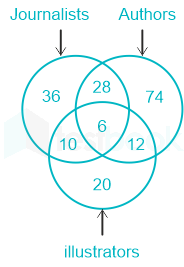
Question 40

Study the given diagram carefully and answer the question. The numbers in different sections indicate the number of persons.

How many such authors are there who are also illustrators but are NOT journalists?

  1. AOption (a)

    54

  2. BOption (b)

    18

  3. COption (c)

    28

  4. DOption (d)

    12

View answer & explanation

Correct answer

Answer: (d)D.

12

Why this answer is correct

According to the given Venn diagram:

The shaded area shows the "total number of authors who are also illustrators but are NOT journalists".

So, the total number of 'authors who are also illustrators but are NOT journalists' = 12.

Hence, the correct answer is "Option 4".

Question 41

Seven people A, B, D, E, G, H and K are sitting in a straight line facing the north. E is sitting at an extreme end of the line. B is an immediate neighbour of E. Only three people are sitting between A and E. A is sitting second to the right of G. H is neither an immediate neighbour of A nor B. K is sitting second to the right of D. How many people are sitting to the right of K?

  1. AOption (a)

    Zero

  2. BOption (b)

    Three

  3. COption (c)

    One

  4. DOption (d)

    Two

View answer & explanation

Correct answer

Answer: (c)C.

One

Why this answer is correct

Given: Seven people A, B, D, E, G, H and K are sitting in a straight line facing the north.

  1. E is sitting at an extreme end of the line.

  2. B is an immediate neighbour of E.

  3. Only three people are sitting between A and E.

  4. A is sitting second to the right of G.


  1. H is neither an immediate neighbour of A nor B.

  2. K is sitting second to the right of D.

So, 'One' people are sitting to the right of K.

Hence, the correct answer is "Option 3".

Question 42

How many number of bonds do the single carbon atom form?

  1. AOption (a)

    1

  2. BOption (b)

    3

  3. COption (c)

    2

  4. DOption (d)

    4

View answer & explanation

Correct answer

Answer: (d)D.

4

Why this answer is correct

The correct answer is 4.

Key Points

  • A single carbon atom forms four covalent bonds.
  • This bonding occurs because carbon has four electrons in its outer shell and needs four more to achieve a stable octet configuration.
  • Carbon can form single, double, and triple bonds with other atoms, including other carbon atoms.
  • The ability of carbon to form four bonds makes it incredibly versatile and a fundamental component of organic molecules.

Additional Information

  • Covalent Bonding
  • Covalent bonds involve the sharing of electron pairs between atoms.
  • These bonds can be single, double, or triple, based on the number of shared electron pairs.
  • Octet Rule
  • The octet rule states that atoms tend to form bonds until they are surrounded by eight valence electrons, achieving a stable configuration similar to noble gases.
  • Organic Molecules
  • Carbon is the backbone of organic molecules due to its ability to form four bonds, allowing for complex and diverse structures.
  • Hybridization
  • Carbon atoms undergo hybridization to form sp3, sp2, or sp hybrid orbitals, which explains their bonding and geometry in molecules.

Question 43

Select the option that is related to the third term in the same way as the second term is related to the first term and the sixth term is related to the fifth term.

32 : 56 :: 52 : ? :: 42 : 66

  1. AOption (a)

    73

  2. BOption (b)

    75

  3. COption (c)

    76

  4. DOption (d)

    71

View answer & explanation

Correct answer

Answer: (c)C.

76

Why this answer is correct

The logic followed here is:

Logic: (1st number + 24) = 2nd number.

Now,

For, 32 : 56

⇒ 32 + 24 = 56.

For, 42 : 66

⇒ 42 + 24 = 66.

Similarly, for 52 ∶ ?

⇒ 52 + 24 = 76.

Hence, the correct answer is "Option 3".

Question 44

The voltages across three resistances R1, R2 and R3 connected in series are V1, V2 and V3, respectively. What is the net voltage V across them if I represents the net current flowing through them?

  1. AOption (a)

    V = (1/V1) + (1/V2) + (1/V3)

  2. BOption (b)

    V = (1/R1) + (1/R2) + (1/R3)

  3. COption (c)

    V = R1 + R2  + R3

  4. DOption (d)

    V = V1 + V2  + V3

View answer & explanation

Correct answer

Answer: (d)D.

V = V1 + V2  + V3

Why this answer is correct

The correct answer is option 4.

Key Points

  • When resistors are connected in series, the voltage across each resistor adds up to the total voltage.
  • In a series circuit, the same current flows through each resistor.
  • The total voltage across the series resistors is the sum of the individual voltages: V = V1 + V2 + V3.
  • This principle is derived from Kirchhoff’s Voltage Law (KVL), which states that the sum of all voltages around a closed loop is equal to zero.

Additional Information

  • Kirchhoff’s Voltage Law (KVL): States that the sum of all electrical potential differences around a loop is zero.
  • Series Circuit: A type of circuit where components are connected end-to-end so that current flows through each component sequentially.
  • Ohm’s Law: States that the current through a conductor between two points is directly proportional to the voltage across the two points (V = IR).
  • Equivalent Resistance in Series: The total resistance of resistors in series is the sum of their individual resistances (R_total = R1 + R2 + R3).
  • Voltage Divider Rule: In a series circuit, the voltage is divided among the resistors in proportion to their resistance values.

Question 45

Parts of which present state had evolved a local system of canal irrigation called 'kulhs' over 400 years ago? 

  1. AOption (a)

    Uttar Pradesh

  2. BOption (b)

    Madhya Pradesh

  3. COption (c)

    Jammu and Kashmir

  4. DOption (d)

    Himachal Pradesh

View answer & explanation

Correct answer

Answer: (d)D.

Himachal Pradesh

Why this answer is correct

The correct answer is Himachal Pradesh.

Key Points

  • Himachal Pradesh has a unique traditional irrigation system known as 'kulhs'.
  • Kulhs are small, perennial streams diverted from natural flowing water bodies to supply water to the fields.
  • This irrigation system has been in use for over 400 years.
  • It reflects the indigenous knowledge and sustainable water management practices of the region.
  • Farmers in the region rely on kulhs for irrigation, especially in hilly terrains.

Additional Information

  • Traditional Irrigation Systems:
  • Different regions in India have developed their own traditional irrigation systems such as tanks, wells, and stepwells.
  • Sustainable Water Management:
  • Traditional systems like kulhs are examples of sustainable water management, ensuring efficient use of water resources in agriculture.
  • Community Participation:
  • Maintenance and management of kulhs involve active community participation, ensuring shared responsibility among farmers.
  • Impact on Agriculture:
  • Kulhs have significantly boosted agricultural productivity in the hilly regions by providing a reliable source of irrigation.
  • Modern-Day Relevance:
  • Despite advancements in irrigation technology, traditional systems like kulhs are still relevant and are being revived for their ecological and economic benefits.

Question 46

If i=73j and j=45k\rm i = \frac{7}{3}j \ and \ j = \frac{4}{5}k, then the ration of i ∶ j ∶ k is :

  1. AOption (a)

    7 ∶ 12 ∶ 5

  2. BOption (b)

    28 ∶ 12 ∶ 15

  3. COption (c)

    21 ∶ 12 ∶ 20

  4. DOption (d)

    28 ∶ 4 ∶ 15

View answer & explanation

Correct answer

Answer: (b)B.

28 ∶ 12 ∶ 15

Why this answer is correct

Shortcut Trick

Given i : j = 7 : 3 and j : k = 4 : 5.

Make the common term j equal in both ratios by multiplying first ratio by 4 and second by 3.

i : j = 7 × 4 : 3 × 4 = 28 : 12

j : k = 4 × 3 : 5 × 3 = 12 : 15

Combining the ratios, we get i : j : k = 28 : 12 : 15.

∴ The correct answer is 28 : 12 : 15.

Alternate Method

Given: i = (7/3)j and j = (4/5)k

⇒ From i = (7/3)j, the ratio i/j = 7/3 → i : j = 7 : 3.

⇒ From j = (4/5)k, the ratio j/k = 4/5 → j : k = 4 : 5.

⇒ To combine i : j : k, multiply the ratios: i : j : k = (7 × 4) : (3 × 4) : (3 × 5).

⇒ i : j : k = 28 : 12 : 15.

∴ The correct answer is 28 : 12 : 15.

Additional Information

Compound Ratio

The compound ratio of a : b and c : d is (a × c) : (b × d).

Ratio Balancing

To combine two ratios with a common term, multiply each ratio by the value of the common term from the other ratio to make them equal.

Question 47

Observe the given pattern and the find the missing number.

222 = 484

2022 = 40804

20022 = 4008004

200022 = ______

  1. AOption (a)

    4840000

  2. BOption (b)

    400800400

  3. COption (c)

    2000220002

  4. DOption (d)

    400080004

View answer & explanation

Correct answer

Answer: (d)D.

400080004

Why this answer is correct

Shortcut Trick

Observe the pattern of zeros between the digits 4 and 8 in the result.

The number of zeros in the square is equal to the number of zeros in the base number.

Base 20002 has 3 zeros, so the square will have 3 zeros after the first 4 and 3 zeros before the last 4.

Pattern: 4 [n zeros] 8 [n zeros] 4 → 400080004.

∴ The correct answer is 400080004.

Alternate Method

Given:

⇒ 222 = 484 (0 zeros in base → 0 zeros in result)

⇒ 2022 = 40804 (1 zero in base → 1 zero between digits)

⇒ 20022 = 4008004 (2 zeros in base → 2 zeros between digits)

222

484 →

2022

40804 →

20022

4008004 →

400080004

Calculations:

⇒ For the number 20002, there are 3 zeros between the digit 2 and 2.

⇒ Following the logic, the square must have 3 zeros between 4 and 8, and 3 zeros between 8 and 4.

⇒ Missing Number = 400080004.

∴ The correct answer is 400080004.

Additional Information

Square of Palindromic Patterns

Numbers like 101, 202, 1001 follow a symmetric expansion where the number of zeros in the middle reflects the number of zeros in the base.

Algebraic Identity (a+b)2

200022 can be written as (20000 + 2)2 = 200002 + 2×20000×2 + 22 = 400000000 + 80000 + 4 = 400080004.

Question 48

The SI unit of power of a lens is: 

  1. AOption (a)

    newton

  2. BOption (b)

    dioptre

  3. COption (c)

    joule

  4. DOption (d)

    metre

View answer & explanation

Correct answer

Answer: (b)B.

dioptre

Why this answer is correct

The correct answer is dioptre.

Key Points

  • The SI unit of the power of a lens is the dioptre (D).
  • One dioptre is equivalent to the power of a lens with a focal length of one meter.
  • The power of a lens (P) is given by the formula P = 1/f, where f is the focal length in meters.
  • A positive dioptre value indicates a converging lens, while a negative value indicates a diverging lens.
  • Dioptres are commonly used by optometrists and ophthalmologists to prescribe corrective lenses.

Additional Information

  • Lens Formula: The lens formula is given by 1/f = (n-1) * [1/R1 - 1/R2], where n is the refractive index of the lens material, and R1 and R2 are the radii of curvature of the two surfaces of the lens.
  • Converging and Diverging Lenses: Converging lenses (convex) have positive focal lengths, while diverging lenses (concave) have negative focal lengths.
  • Focal Length: The focal length of a lens is the distance from the lens to the point where parallel rays of light converge (or appear to diverge from) after passing through the lens.
  • Optical Power: Optical power is a measure of how much a lens converges or diverges light. It is an important parameter in designing optical systems.
  • Prescription Lenses: The power of prescription lenses is specified in dioptres. For example, a prescription of -2.0 D indicates a lens with a focal length of -0.5 meters.

Question 49

What are the four factors of production? 

  1. AOption (a)

    Labour, transportation, excise duty and entrepreneurship

  2. BOption (b)

    Man power, transportation, excise duty and import

  3. COption (c)

    Capital, transportation, excise duty and entrepreneurship

  4. DOption (d)

    Land, labour, capital, and entrepreneurship

View answer & explanation

Correct answer

Answer: (d)D.

Land, labour, capital, and entrepreneurship

Why this answer is correct

The correct answer is Land, labour, capital, and entrepreneurship.

Key Points

  • Land: Refers to all natural resources that are used to produce goods and services. It includes everything that nature provides, such as minerals, forests, water, and land itself.
  • Labour: Encompasses the human effort, both physical and mental, used in the production process. It includes all types of work done by people, from manual labor to intellectual efforts.
  • Capital: Consists of the tools, equipment, machinery, and buildings used to produce goods and services. It is different from financial capital, which is the money used to purchase these physical assets.
  • Entrepreneurship: Involves the skills and risk-taking abilities required to bring the other three factors together to produce goods and services. Entrepreneurs are responsible for decision-making, innovation, and managing resources.

Additional Information

  • Natural Resources: These include anything provided by nature that can be used to produce goods and services, such as water, oil, fish, soil, and forests.
  • Human Capital: A term for the economic value that an employee's skill set brings to a company. It includes education, experience, and abilities that contribute to productivity.
  • Physical Capital: Refers to the physical assets that are used in the production process, such as machinery, buildings, and vehicles.
  • Innovation: A key component of entrepreneurship, involving the creation of new products or processes that improve efficiency and productivity.
  • Economic Systems: Different economic systems (capitalism, socialism, mixed economies) prioritize these factors differently, influencing how resources are allocated and managed.

Question 50

While packing birthday caps for a party in packs of 8 or 10, one cap was always left out. How many caps were there if there were more than 250 but less than 300 caps in the lot?

  1. AOption (a)

    268

  2. BOption (b)

    275

  3. COption (c)

    281

  4. DOption (d)

    261

View answer & explanation

Correct answer

Answer: (c)C.

281

Why this answer is correct

Shortcut Trick Since 1 cap is left out, subtracting 1 from the correct answer must yield a number fully divisible by both 8 and 10. Let's check the given options: 268, 275, 281, and 261. Subtracting 1 gives: 267, 274, 280, and 260. Only 280 is completely divisible by both 8 and 10. ∴ The correct answer is 281 caps. Alternate Method Given: Caps are packed in groups of 8 or 10. Remainder left out each time = 1. Total caps are strictly between 250 and 300. Formula Used: Required Number (N) = LCM(a, b) × k + R, where k is an integer and R is the remainder. Calculations: ⇒ Prime factors: 8 = 23 | 10 = 2 × 5 ⇒ LCM(8, 10) = 23 × 5 = 40 ⇒ General form for total caps (N) = 40k + 1 ⇒ Condition given: 250 < N < 300 ⇒ 250 < 40k + 1 < 300 ⇒ 249 < 40k < 299 ⇒ 6.225 < k < 7.475 ⇒ Possible integer value for k = 7 ⇒ N = 40 × 7 + 1 = 280 + 1 = 281 ∴ The correct answer is 281 caps. Additional Information LCM (Least Common Multiple) The smallest positive integer that is uniformly divisible by given numbers. Used for simultaneous events or grouping problems. Same Remainder Case To find a number that leaves the same remainder 'r' when divided by a, b, and c: N = LCM(a, b, c) × k + r (where k = 1, 2, 3...). Different Remainders Case If dividing by a, b, c leaves remainders x, y, z respectively, and (a − x) = (b − y) = (c − z) = d, then N = LCM(a, b, c) × k − d.

Question 51

What is the sum of the digits placed at the even places when counted from left to right in the number 479812356 ?

  1. AOption (a)

    22

  2. BOption (b)

    26

  3. COption (c)

    32

  4. DOption (d)

    18

View answer & explanation

Correct answer

Answer: (a)A.

22

Why this answer is correct

The logic followed here is:

Given number: 479812356.

the digits placed at the even places when counted from left to right is: 7825

Now, the sum of these numbers are: 7 + 8 + 2 + 5 = 22.

Hence, the correct answer is "Option 1".

Question 52

Simplify the following.

(3x2)5(6x−2)2\rm \frac{(3x^2)^5}{(6x^{-2})^2}

  1. AOption (a)

    27x144\rm \frac{27x^{14}}{4}

  2. BOption (b)

    27x636\rm \frac{27x^{6}}{36}

  3. COption (c)

    81x1436\rm \frac{81x^{14}}{36}

  4. DOption (d)

    81x636\rm \frac{81x^{6}}{36}

View answer & explanation

Correct answer

Answer: (a)A.

27x144\rm \frac{27x^{14}}{4}

Why this answer is correct

Shortcut Trick

Simplify coefficients and powers of x independently.

Coefficient = 35 ÷ 62 = 243 ÷ 36 = 27 / 4

Power of x = (2 × 5) − (−2 × 2) = 10 − (−4) = 14

Combine both results → (27/4) × x14

∴ The correct answer is (27x14)/4.

Alternate Method

Given Expression: ((3x2)5) / ((6x−2)2)

Formula Used: (am)n = am×n and (ab)n = anbn

⇒ Numerator: (3x2)5 = 35 × x2 × 5 = 243x10

⇒ Denominator: (6x−2)2 = 62 × x−2 × 2 = 36x−4

⇒ Result = (243x10) / (36x−4)

⇒ Result = (243 / 36) × x10 − (−4)

⇒ Result = (27 / 4) × x10 + 4

⇒ Result = 27x14 / 4

∴ The correct answer is (27x14)/4.

Additional Information

Laws of Exponents

Product Law: am × an = am+n. Quotient Law: am ÷ an = am−n.

Power Rules

Power of a Power: (am)n = amn. Power of a Product: (ab)n = anbn.

Negative Exponents

A negative exponent denotes a reciprocal: a−n = 1/an.

Question 53

Which of the following numbers will replace the question mark (?) in the given series?

3 13 21 27 31 ?

  1. AOption (a)

    34

  2. BOption (b)

    33

  3. COption (c)

    35

  4. DOption (d)

    36

View answer & explanation

Correct answer

Answer: (b)B.

33

Why this answer is correct

The logic followed here is:

​

So, '33' will replace the question mark in the given series.

Hence, the correct answer is "Option 2".

Question 54

Which of the following vessels carries blood away from the heart to various organs of the body, except the lungs?

  1. AOption (a)

    Pulmonary artery

  2. BOption (b)

    Pulmonary vein

  3. COption (c)

    Vena cava

  4. DOption (d)

    Aorta

View answer & explanation

Correct answer

Answer: (d)D.

Aorta

Why this answer is correct

The correct answer is Aorta.

Key Points

  • The aorta is the main and largest artery in the human body.
  • It originates from the left ventricle of the heart and extends down to the abdomen, where it branches off into two smaller arteries.
  • The aorta is responsible for transporting oxygen-rich blood from the heart to various parts of the body.
  • It does not carry blood to the lungs; instead, it supplies blood to the systemic circulation.
  • Branches of the aorta supply blood to all major organs and tissues except the lungs.

Additional Information

  • Arteries vs. Veins:
  • Arteries carry blood away from the heart, while veins carry blood towards the heart.
  • Arteries have thicker walls to withstand higher pressure from the heart's pumping action.
  • Pulmonary Circulation:
  • Pulmonary arteries carry deoxygenated blood from the right ventricle to the lungs.
  • Pulmonary veins return oxygenated blood from the lungs to the left atrium of the heart.
  • Vena Cava:
  • The superior and inferior vena cava are large veins that carry deoxygenated blood from the body back to the heart.
  • They empty into the right atrium.
  • Circulatory System Components:
  • The circulatory system includes the heart, arteries, veins, and capillaries.
  • It is responsible for the transport of nutrients, gases, and wastes to and from cells.

Question 55

If '+' means '-', '-' means '÷', '×' means '+', and '÷' means '×', what will be the value of the following expression ?

[{(6 × 9) + (3 ÷ 2)} - (7 + 4)] ÷ 2

  1. AOption (a)

    4

  2. BOption (b)

    6

  3. COption (c)

    8

  4. DOption (d)

    2

View answer & explanation

Correct answer

Answer: (b)B.

6

Why this answer is correct

Given Equation: [{(6 × 9) + (3 ÷ 2)} - (7 + 4)] ÷ 2

BODMAS Rule:

Decoding the given information:

Alphabet+-×÷
Meaning-÷+×


Now replacing the sign from left to right using BODMAS Rule, we get:

⇒ [{(6 + 9) - (3 × 2)} ÷ (7 - 4)] × 2

⇒ [{15 - 6} ÷ (7 - 4)] × 2

⇒ [9 ÷ 3] × 2

⇒ 3 × 2 = 6.

Hence, the correct option is "Option 2".

Question 56

In the given figure, triangle ABC is similar to triangle ADE. If the area of triangle ADE = 18 cm2, then the area of triangle ABC is:

  1. AOption (a)

    45 cm2

  2. BOption (b)

    90 cm2

  3. COption (c)

    50 cm2

  4. DOption (d)

    55 cm2

View answer & explanation

Correct answer

Answer: (c)C.

50 cm2

Why this answer is correct

Shortcut Trick

Since ΔABC ∼ ΔADE, the ratio of their areas is equal to the square of the ratio of their corresponding sides:

Area(ΔABC) ÷ Area(ΔADE) = (AB ÷ AD)2

Given AD = 3 cm and BD = 2 cm ⇒ AB = 3 + 2 = 5 cm.

Area(ΔABC) ÷ 18 = (5 ÷ 3)2 = 25 ÷ 9

Area(ΔABC) = 18 × (25 ÷ 9) = 50 cm2.

∴ The correct answer is 50 cm2.

Alternate Method

Given:

⇒ Area of ΔADE = 18 cm2

⇒ AD = 3 cm

⇒ BD = 2 cm

⇒ ΔABC ∼ ΔADE

Formula Used:

⇒ For any two similar triangles, the ratio of their areas is equal to the square of the ratio of their corresponding sides:

Area(ΔABC) ÷ Area(ΔADE) = (AB ÷ AD)2

Calculations:

From the given figure, we have:

⇒ AD = 3 cm

⇒ BD = 2 cm

⇒ AB = AD + BD = 3 + 2 = 5 cm

Since ΔABC is similar to ΔADE (ΔABC ∼ ΔADE):

⇒ Area(ΔABC) ÷ Area(ΔADE) = (AB ÷ AD)2

⇒ Area(ΔABC) ÷ 18 = (5 ÷ 3)2

⇒ Area(ΔABC) ÷ 18 = 25 ÷ 9

⇒ Area(ΔABC) = (25 ÷ 9) × 18

⇒ Area(ΔABC) = 25 × 2

⇒ Area(ΔABC) = 50 cm2

Let us evaluate the given options:

⇒ Option (1) 45 cm2: Incorrect, as the ratio of areas would be 45 ÷ 18 = 2.5, which is not equal to (5/3)2.

⇒ Option (2) 90 cm2: Incorrect, as the ratio of areas would be 90 ÷ 18 = 5, which is not equal to (5/3)2.

⇒ Option (3) 50 cm2: Correct, as the ratio of areas is exactly 50 ÷ 18 = 25/9 = (5/3)2.

⇒ Option (4) 55 cm2: Incorrect, as the ratio of areas would be 55 ÷ 18 ≈ 3.06, which is not equal to (5/3)2.

∴ The correct answer is 50 cm2.

Additional Information

Area Ratio Theorem

For any two similar triangles, the ratio of their areas is equal to the square of the ratio of their corresponding sides, altitudes, medians, or perimeters.

Basic Proportionality Theorem (Thales's Theorem)

If a line is drawn parallel to one side of a triangle intersecting the other two sides, then it divides the two sides in the same ratio (i.e., AD ÷ DB = AE ÷ EC).

Similarity Criteria

Two triangles are similar if their corresponding angles are equal (AAA similarity) or if their corresponding sides are in the same ratio (SSS similarity).

Question 57

How many elements exist in nature according to Newlands law of octaves? 

  1. AOption (a)

    46

  2. BOption (b)

    56

  3. COption (c)

    76

  4. DOption (d)

    36

View answer & explanation

Correct answer

Answer: (b)B.

56

Why this answer is correct

The correct answer is 56.

Key Points

  • Newlands Law of Octaves is an early attempt to classify elements, formulated by John Newlands in 1864.
  • According to Newlands, when elements are arranged in increasing order of atomic masses, every eighth element shows similar properties, akin to the octaves of music.
  • Newlands' classification included elements up to calcium, after which the periodic repetition broke down.
  • The total number of elements known to Newlands at the time of his classification was 56.

Additional Information

  • Mendeleev’s Periodic Table:
  • Developed by Dmitri Mendeleev in 1869, it arranged elements by increasing atomic mass and grouped elements with similar properties.
  • Mendeleev left gaps for undiscovered elements and predicted their properties, which were later confirmed.
  • Modern Periodic Table:
  • Developed based on increasing atomic number, not atomic mass.
  • Currently, there are 118 confirmed elements in the modern periodic table.
  • Law of Triads:
  • Proposed by Johann Döbereiner in 1817, it grouped elements in sets of three (triads) where the middle element had properties that were an average of the other two.
  • Periodic Law:
  • States that the properties of elements are a periodic function of their atomic numbers.
  • It’s the basis for the modern arrangement of the periodic table.

Question 58

Burning of natural gas is: 

  1. AOption (a)

    a substitution reaction

  2. BOption (b)

    a decomposition reaction

  3. COption (c)

    an endothermic reaction

  4. DOption (d)

    an exothermic reaction

View answer & explanation

Correct answer

Answer: (d)D.

an exothermic reaction

Why this answer is correct

The correct answer is an exothermic reaction.

Key Points

  • Burning of natural gas is a combustion reaction, which is a type of exothermic reaction.
  • In an exothermic reaction, energy is released in the form of heat and light.
  • When natural gas (primarily methane) burns, it reacts with oxygen to produce carbon dioxide and water, releasing a significant amount of energy.
  • This released energy is utilized in various industrial and domestic applications for heating and power generation.
  • The reaction can be represented as: CH4 + 2O2 → CO2 + 2H2O + energy.

Additional Information

  • Combustion Reaction:
  • Combustion is a chemical process in which a substance reacts rapidly with oxygen and gives off heat.
  • It typically involves hydrocarbons reacting with oxygen to produce carbon dioxide, water, and energy.
  • Endothermic Reaction:
  • In contrast to exothermic reactions, endothermic reactions absorb energy from the surroundings.
  • An example is the process of photosynthesis in plants.
  • Substitution Reaction:
  • A chemical reaction where one functional group in a chemical compound is replaced by another functional group.
  • Common in organic chemistry, such as in alkyl halides.
  • Decomposition Reaction:
  • A type of chemical reaction in which a single compound breaks down into two or more elements or new compounds.
  • For example, the decomposition of water into hydrogen and oxygen gases.

Question 59

Among the following situations, potential difference is induced in a closed conducting coil when:

  1. AOption (a)

    the closed coil is moved towards the bar magnet only

  2. BOption (b)

    either the bar magnet is moved towards the closed coil or the closed coil is moved towards the bar magnet

  3. COption (c)

    both the bar magnet and the closed coil are moving with same speed and in the same direction

  4. DOption (d)

    a bar magnet is moved towards the closed coil only

View answer & explanation

Correct answer

Answer: (b)B.

either the bar magnet is moved towards the closed coil or the closed coil is moved towards the bar magnet

Why this answer is correct

The correct answer is either the bar magnet is moved towards the closed coil or the closed coil is moved towards the bar magnet.

Key Points

  • Electromagnetic induction occurs when there is a relative motion between a magnetic field and a conductor.
  • Both the movement of the bar magnet towards the coil and the movement of the coil towards the bar magnet induce a potential difference.
  • The direction of the induced current depends on the direction of the relative motion between the magnet and the coil.
  • This phenomenon is described by Faraday's Law of Electromagnetic Induction.

Additional Information

  • Faraday's Law of Electromagnetic Induction:
  • The induced electromotive force (EMF) in any closed circuit is equal to the negative of the time rate of change of the magnetic flux through the circuit.
  • Lenz's Law:
  • The direction of the induced current will be such that it opposes the change in magnetic flux that produced it.
  • Magnetic Flux:
  • It is the measure of the magnetic field passing through a given surface area.
  • Relative Motion:
  • The movement between the magnet and the coil must be relative to each other to induce a potential difference.

Question 60

The best practice that is involved in biological waste disposal is:

  1. AOption (a)

    reusing

  2. BOption (b)

    incineration

  3. COption (c)

    recycling

  4. DOption (d)

    open dumping

View answer & explanation

Correct answer

Answer: (b)B.

incineration

Why this answer is correct

The correct answer is incineration.

Key Points

  • Incineration is a widely accepted method for the disposal of biological waste, involving the burning of waste materials at high temperatures.
  • This process reduces the volume of waste significantly, often by up to 90%, and destroys harmful pathogens, rendering the waste non-infectious.
  • Modern incineration plants are equipped with pollution control devices to minimize the release of harmful emissions, making it an environmentally safer option compared to open dumping.
  • Incineration of biological waste helps in the recovery of energy, which can be used for heating or generating electricity.
  • This method is highly effective for the disposal of high-risk medical waste such as sharps, contaminated materials, and pathological waste.

Additional Information

  • Autoclaving:
  • This method involves the use of steam under pressure to sterilize biological waste, effectively killing all pathogens.
  • It is suitable for the treatment of a variety of medical waste, including cultures, stocks, and other infectious waste.
  • Microwave Treatment:
  • This technology uses microwave energy to disinfect medical waste, breaking down pathogens through heat and steam.
  • Microwave treatment is effective and environmentally friendly, with minimal emissions.
  • Landfill Disposal:
  • Specially designed sanitary landfills are used for the disposal of treated biological waste.
  • These landfills are equipped with liners and leachate collection systems to prevent soil and groundwater contamination.
  • Plasma Gasification:
  • This advanced technology uses plasma torches to convert waste into syngas, which can be used for energy production.
  • Plasma gasification is an environmentally friendly option that reduces the volume of waste and eliminates harmful pathogens.

Question 61

A sum was invested at a certain rate of simple interest per annum for 8 years. Had it been invested at a rate of simple interest per annum that is 8% higher than the rate at which the sum had been actually invested, it would have fetched Rs. 4,000 more as interest at the end of the 8-year period. What was the sum invested?

  1. AOption (a)

    Rs. 6,925

  2. BOption (b)

    Rs. 6,500

  3. COption (c)

    Rs. 6,250

  4. DOption (d)

    Rs. 6,750

View answer & explanation

Correct answer

Answer: (c)C.

Rs. 6,250

Why this answer is correct

Shortcut Trick

Total interest increase percentage = Rate increase × Time

Total interest increase % = 8% × 8 = 64%

According to the question, 64% of the Principal = ₹4,000

Principal (100%) = (4000 ÷ 64) × 100

Principal = 62.5 × 100 = ₹6,250

∴ The correct answer is ₹6,250.

Alternate Method

Given: Time (T) = 8 years, Rate increase (ΔR) = 8% p.a., Extra Interest (ΔI) = ₹4,000

Formula Used: Simple Interest (SI) = (P × R × T) ÷ 100

⇒ Let the Principal sum be P.

⇒ Actual Interest (SI1) = (P × R × 8) ÷ 100

⇒ New Interest (SI2) = (P × (R + 8) × 8) ÷ 100

⇒ SI2 − SI1 = 4000

⇒ [P × (R + 8) × 8 ÷ 100] − [P × R × 8 ÷ 100] = 4000

⇒ (P × 8 ÷ 100) × [(R + 8) − R] = 4000

⇒ (P × 8 × 8) ÷ 100 = 4000

⇒ 64P ÷ 100 = 4000

⇒ 64P = 400000

⇒ P = 400000 ÷ 64

⇒ P = 6250

∴ The correct answer is ₹6,250.

Additional Information

Simple Interest (SI) formula

The interest is calculated only on the principal amount: SI = (P × R × T) ÷ 100, where P is Principal, R is Rate, and T is Time.

Effect of Rate Change

If the Rate increases by x% for t years, the Simple Interest increases by (P × x × t) ÷ 100.

Total Amount

The total amount (A) after T years is the sum of Principal and Simple Interest: A = P + SI = P(1 + RT/100).

Question 62

Which statement regarding molecular movement (living character) of viruses is correct?

  1. AOption (a)

    Inactive until they infect some cell.

  2. BOption (b)

    Metabolism is absent in viruses.

  3. COption (c)

    A virus does not grow in an artificial medium.

  4. DOption (d)

    Viruses do not respire.

View answer & explanation

Correct answer

Answer: (a)A.

Inactive until they infect some cell.

Why this answer is correct

The correct answer is Inactive until they infect some cell..

Key Points

  • Viruses are considered inactive or inert outside a host cell, lacking metabolic activities until they infect a host cell and begin replication. (Source: CDC)
  • They rely entirely on the host's cellular machinery for replication and do not display any signs of life outside the host. (Source: National Institutes of Health)
  • When outside a host cell, viruses exist as virions, consisting of genetic material encased in a protein coat. (Source: World Health Organization)
  • The activation of a virus occurs only after it enters a host cell and begins to hijack the host’s cellular machinery to replicate. (Source: Nature Reviews Microbiology)

Additional Information

  • Metabolism in Viruses:
  • Viruses do not possess their own metabolic machinery; they are metabolically inert outside a host cell. (Source: Microbiology Society)
  • Growth in Artificial Media:
  • Viruses cannot grow or replicate in artificial media; they require living cells to reproduce. (Source: American Society for Microbiology)
  • Respiration in Viruses:
  • Viruses do not respire as they lack the necessary cellular structures for respiration. (Source: Virology Journal)
  • Structure of Viruses:
  • Viruses are composed of nucleic acids (DNA or RNA) enclosed in a protein coat called a capsid; some viruses also have an outer lipid envelope. (Source: Journal of General Virology)

Question 63

In August 2022, Rameshbabu Praggnanandhaa, the 17-year-old Indian Chess master, defeated world champion Magnus Carlsen in the last round of the FTX Crypto Cup in _________.

  1. AOption (a)

    Austin

  2. BOption (b)

    Miami

  3. COption (c)

    San Jose

  4. DOption (d)

    Boston

View answer & explanation

Correct answer

Answer: (b)B.

Miami

Why this answer is correct

The correct answer is Miami.

Key Points

  • In August 2022, Rameshbabu Praggnanandhaa, an Indian chess prodigy, defeated reigning world champion Magnus Carlsen in the final round of the FTX Crypto Cup.
  • The tournament took place in Miami, Florida, USA, marking a significant achievement in Praggnanandhaa's career.
  • Praggnanandhaa, who was only 17 years old at the time, showcased his exceptional skills against one of the best chess players in the world.
  • The victory over Carlsen was a highlight in the FTX Crypto Cup, demonstrating Praggnanandhaa's potential to become one of the top players in the chess world.

Additional Information

  • FTX Crypto Cup:
  • The FTX Crypto Cup is part of the Meltwater Champions Chess Tour, a prestigious series of online chess tournaments.
  • It features some of the world's top grandmasters competing in rapid format games.
  • The tournament is sponsored by FTX, a cryptocurrency exchange platform.
  • The event aims to blend the excitement of chess with the emerging world of cryptocurrency.
  • Magnus Carlsen:
  • Magnus Carlsen is a Norwegian chess grandmaster who has been the reigning World Chess Champion since 2013.
  • He is widely considered one of the greatest chess players of all time.
  • Carlsen has held the No. 1 position in the FIDE world chess rankings for the longest period.
  • He is known for his deep understanding of chess, exceptional endgame skills, and versatile playing style.
  • Rameshbabu Praggnanandhaa:
  • Rameshbabu Praggnanandhaa is an Indian chess grandmaster who achieved the title at the age of 12, becoming one of the youngest to do so.
  • He has consistently performed well in both national and international tournaments.
  • Praggnanandhaa is known for his aggressive playing style and tactical prowess.
  • His victory against Carlsen in the FTX Crypto Cup was a significant milestone in his career.

Question 64

Avinash's age is 5 times his son Aravind's age. Four years hence, the age of Avinash will be four times Aravind's age. Find the average of their present ages.

  1. AOption (a)

    28 years

  2. BOption (b)

    36 years

  3. COption (c)

    24 years

  4. DOption (d)

    30 years

View answer & explanation

Correct answer

Answer: (b)B.

36 years

Why this answer is correct

Shortcut Trick

Present age ratio = 5 : 1 (Difference = 4)

Ratio after 4 years = 4 : 1 (Difference = 3)

Equating age difference: Multiply present by 3 → 15 : 3, future by 4 → 16 : 4

1 ratio part increase (16 − 15) corresponds to 4 years.

Total present age parts = 15 + 3 = 18 parts → Total age = 18 × 4 = 72 years.

Average of present ages = 72 ÷ 2 = 36 years.

∴ The correct answer is 36 years.

Alternate Method

Given:

Avinash's present age is 5 times Aravind's age.

Four years hence, Avinash's age will be 4 times Aravind's age.

Calculations:

Let Aravind's present age be x years.

⇒ Avinash's present age = 5x years

After 4 years:

⇒ Aravind's age = (x + 4) years

⇒ Avinash's age = (5x + 4) years

According to the given condition:

⇒ 5x + 4 = 4 × (x + 4)

⇒ 5x + 4 = 4x + 16

⇒ 5x − 4x = 16 − 4

⇒ x = 12

Finding their present ages:

⇒ Aravind's age = 12 years

⇒ Avinash's age = 5 × 12 = 60 years

Average of their present ages = (Aravind's age + Avinash's age) ÷ 2

⇒ Average = (12 + 60) ÷ 2

⇒ Average = 72 ÷ 2 = 36 years

∴ The correct answer is 36 years.

Additional Information

Ratio Difference Method for Ages

Since the age difference between two individuals remains constant throughout their lifetime, equating the difference in their ratio parts helps find the equivalent age directly without variables.

Cross-Multiplication Trick

For an initial ratio a:b, if an equal quantity x is added to both to form a new ratio c:d, then 1 ratio part = x(c − d) ÷ (ad − bc).

Concept of Average Ages

The average age of n persons is the sum of their ages divided by n. If every person's age increases by x years, the new average naturally becomes (Old Average + x).

Question 65

Find the mode for the following data of student ages:

16, 17, 15, 17, 16, 15, 14, 14, 13, 17, 13, 12, 12, 16, 10, 14, 17, 10, 11.

  1. AOption (a)

    11

  2. BOption (b)

    17

  3. COption (c)

    15

  4. DOption (d)

    16

View answer & explanation

Correct answer

Answer: (b)B.

17

Why this answer is correct

Shortcut Trick

The Mode is simply the value that appears most frequently in a given data set.

By inspection, count the occurrences of each age:

10 (2), 11 (1), 12 (2), 13 (2), 14 (3), 15 (2), 16 (3), 17 (4).

Since 17 appears the maximum number of times (4 times), it is the mode.

∴ The correct answer is 17 years.

Alternate Method

Given: Data set = {16, 17, 15, 17, 16, 15, 14, 14, 13, 17, 13, 12, 12, 16, 10, 14, 17, 10, 11}

Formula Used: Mode = Value with the highest frequency.

Frequency table of observations:

⇒ Age 10: 2 times

⇒ Age 11: 1 time

⇒ Age 12: 2 times

⇒ Age 13: 2 times

⇒ Age 14: 3 times

⇒ Age 15: 2 times

⇒ Age 16: 3 times

⇒ Age 17: 4 times

⇒ The observation 17 has the highest frequency (4).

∴ The correct answer is 17 years.

Additional Information

Empirical Relationship

For a moderately skewed distribution: Mode = 3 × Median − 2 × Mean.

Types of Mode

A data set with one mode is unimodal, two modes is bimodal, and more than two is multimodal.

Mode of Grouped Data

Mode = l + [(f1 − f0) ÷ (2f1 − f0 − f2)] × h, where l is lower limit of modal class and h is class size.

Question 66

A statement is given below, followed by four conclusions given in the options. Find out which conclusion is true based on the given statement.

Statement: S < T ≤ G < M < K > P ≥ O

  1. AOption (a)

    O = S = T

  2. BOption (b)

    M ≥ P ≥ O

  3. COption (c)

    K > O > S

  4. DOption (d)

    K > G > S

View answer & explanation

Correct answer

Answer: (d)D.

K > G > S

Why this answer is correct

Given Statement: S < T ≤ G < M < K > P ≥ O

Now,

Conclusions:

  1. O = S = T → False (S < T ≤ G < M < K > P ≥ O It gives S < T ≥ O) 2. M ≥ P ≥ O → False (M < K > P ≥ O No relation can be established between M and P)
  2. K > O > S → False (S < T ≤ G < M < K > P ≥ O it gives S < K ≥ O)
  3. K > G > S → True (S < T ≤ G < M < K It gives K > G > S)

Here, Conclusions 4 follows.

Hence, the correct answer is "Option 4".

Question 67

The roots of the quadratic equation x2 - 6x + 5 = 0 are:

  1. AOption (a)

    5, 1

  2. BOption (b)

    3, 2

  3. COption (c)

    -5, -1

  4. DOption (d)

    -3, -2

View answer & explanation

Correct answer

Answer: (a)A.

5, 1

Why this answer is correct

Given:

Quadratic equation x2 - 6x + 5 = 0

Calculation:

⇒ x2 - 6x + 5 = 0

⇒ x2 - 5x - x + 5 = 0

⇒ x(x - 5) - (x - 5) = 0

⇒ (x - 5) (x - 1) = 0

⇒ x = 5 and 1

Roots of quadractic equations are 5 and 1.

 ∴ Option 1 is the correct answer.

Question 68

Study the given diagram carefully and answer the question. The numbers in different sections indicate the number of persons.

How many rural females are there who are NOT employed?

  1. AOption (a)

    3

  2. BOption (b)

    6

  3. COption (c)

    1

  4. DOption (d)

    7

View answer & explanation

Correct answer

Answer: (b)B.

6

Why this answer is correct

According to the given Venn diagram:

The shaded area shows the "total number of rural females who are NOT employed".

So, the total number of 'rural females who are NOT employed' = 6.

Hence, the correct answer is "Option 2".

Question 69

One of the following is NOT a bacterial disease?

  1. AOption (a)

    Tuberculosis

  2. BOption (b)

    Syphilis

  3. COption (c)

    AIDS

  4. DOption (d)

    Gonorrhoea

View answer & explanation

Correct answer

Answer: (c)C.

AIDS

Why this answer is correct

The correct answer is AIDS.

Key Points

  • AIDS (Acquired Immunodeficiency Syndrome) is caused by the Human Immunodeficiency Virus (HIV).
  • Unlike bacterial diseases, AIDS is a viral infection.
  • HIV attacks the body's immune system, specifically the CD4 cells (T cells), which can lead to AIDS if not treated.
  • AIDS is transmitted primarily through unprotected sex, sharing of needles, and from mother to child during childbirth or breastfeeding.
  • There is no cure for AIDS, but it can be managed with antiretroviral therapy (ART), which helps people live longer, healthier lives.

Additional Information

  • Tuberculosis (TB):
  • TB is caused by the bacterium Mycobacterium tuberculosis.
  • It primarily affects the lungs but can also affect other parts of the body.
  • TB is a contagious disease spread through the air when people with active TB cough, sneeze, or spit.
  • Syphilis:
  • Syphilis is a bacterial infection caused by Treponema pallidum.
  • It is usually spread through sexual contact.
  • Syphilis can cause long-term complications if not treated adequately.
  • Gonorrhoea:
  • Gonorrhoea is caused by the bacterium Neisseria gonorrhoeae.
  • It is a sexually transmitted infection (STI).
  • Gonorrhoea can affect the genitals, rectum, and throat.
  • Difference between Bacterial and Viral Infections:
  • Bacterial infections are caused by bacteria, while viral infections are caused by viruses.
  • Antibiotics can treat bacterial infections but are ineffective against viral infections.
  • Vaccines can prevent certain viral infections.
  • Both types of infections can cause mild to severe diseases.

Question 70

Which is the apex governing body of air sports in India? 

  1. AOption (a)

    Aero Club of India

  2. BOption (b)

    Ministry of Youth Affairs and Sports

  3. COption (c)

    Air Sports Federation of India

  4. DOption (d)

    Ministry of Civil Aviation

View answer & explanation

Correct answer

Answer: (c)C.

Air Sports Federation of India

Why this answer is correct

The correct answer is Air Sports Federation of India.

Key Points

  • The Air Sports Federation of India (ASFI) was established to govern and promote air sports in India.
  • ASFI works under the guidelines of the Federation Aeronautique Internationale (FAI), the world governing body for air sports.
  • The federation aims to provide a structured framework and ensure safety standards in various air sports activities.
  • ASFI collaborates with different stakeholders, including government agencies, to develop infrastructure and training facilities for air sports enthusiasts.
  • The organization plays a crucial role in organizing national and international air sports events in India.

Additional Information

  • Federation Aeronautique Internationale (FAI)
  • FAI is the world governing body for air sports, founded in 1905.
  • It oversees various air sports disciplines including paragliding, ballooning, and aerobatics.
  • FAI sets international standards and regulations for air sports to ensure safety and fair competition.
  • Types of Air Sports
  • Air sports include activities such as paragliding, hang gliding, skydiving, and hot air ballooning.
  • Each sport has specific training and certification requirements to ensure participant safety.
  • Safety in Air Sports
  • Safety is a primary concern in air sports, with strict regulations and guidelines in place.
  • Participants are required to undergo thorough training and certification before engaging in these activities.
  • Infrastructure for Air Sports
  • Developing infrastructure such as airfields, training centers, and equipment is crucial for the growth of air sports.
  • Government and private sector collaboration is essential to build and maintain these facilities.

Question 71

3 kg of apples and 4 kg of oranges cost Rs. 210, and 5 kg of apples and 2 kg of oranges cost Rs. 175. Find the cost of 1 kg of apples.

  1. AOption (a)

    Rs. 37.5

  2. BOption (b)

    Rs. 25

  3. COption (c)

    Rs. 35.7

  4. DOption (d)

    Rs. 20

View answer & explanation

Correct answer

Answer: (d)D.

Rs. 20

Why this answer is correct

Shortcut Trick

To find the cost of apples, equate the quantity of oranges in both scenarios.

Second case (doubled): 10 kg apples + 4 kg oranges = Rs. 350 (i.e., 175 × 2).

Difference in apples = 10 kg − 3 kg = 7 kg.

Difference in total cost = Rs. 350 − Rs. 210 = Rs. 140.

Cost of 1 kg apples = 140 ÷ 7 = Rs. 20.

∴ The correct answer is Rs. 20.

Alternate Method

Given:

Cost of 3 kg apples and 4 kg oranges = Rs. 210

Cost of 5 kg apples and 2 kg oranges = Rs. 175

Let the cost of 1 kg of apples be Rs. x and 1 kg of oranges be Rs. y.

⇒ 3x + 4y = 210 --- (Eq. 1)

⇒ 5x + 2y = 175 --- (Eq. 2)

To eliminate y, multiply Eq. 2 by 2:

⇒ 2 × (5x + 2y) = 2 × 175

⇒ 10x + 4y = 350 --- (Eq. 3)

Subtracting Eq. 1 from Eq. 3:

⇒ (10x + 4y) − (3x + 4y) = 350 − 210

⇒ 7x = 140

⇒ x = 140 ÷ 7

⇒ x = 20

∴ The correct answer is Rs. 20.

Additional Information

Simultaneous Linear Equations

These are a set of equations with multiple variables that are solved together to find a common solution where all equations are satisfied.

Elimination Method

A process of solving a system of equations by adding or subtracting them to remove one variable, making it easier to solve for the remaining variable.

Substitution Method

Expressing one variable in terms of another from one equation (e.g., y = (210 − 3x) ÷ 4) and substituting it into the second equation.

Question 72

The area of a triangle is 85 cm2 and its base is 5 cm. Find the height of the triangle corresponding to this given base.

  1. AOption (a)

    17 cm

  2. BOption (b)

    51 cm

  3. COption (c)

    24 cm

  4. DOption (d)

    34 cm

View answer & explanation

Correct answer

Answer: (d)D.

34 cm

Why this answer is correct

Shortcut Trick

Height of a triangle = (2 × Area) ÷ Base

Height = (2 × 85) ÷ 5

Height = 170 ÷ 5 = 34 cm

∴ The correct answer is 34 cm.

Alternate Method

Given:

Area of triangle = 85 cm2

Base of triangle (b) = 5 cm

Formula used:

Area = (1/2) × Base × Height

Calculations:

⇒ 85 = (1/2) × 5 × h

⇒ 85 × 2 = 5 × h

⇒ 170 = 5 × h

⇒ h = 170 ÷ 5

⇒ h = 34 cm

∴ The correct answer is 34 cm.

Additional Information

Heron's Formula

Used when all three sides (a, b, c) are known: Area = √(s(s−a)(s−b)(s−c)), where s = (a+b+c)/2.

Right-Angled Triangle

Area = (1/2) × product of the two sides containing the right angle.

Equilateral Triangle

Area = (√3/4) × side2 and Height = (√3/2) × side.

Question 73

Which of the following is NOT among the groups organised by microfinance institutions in India?

  1. AOption (a)

    Grameen Model Bank

  2. BOption (b)

    Joint Liability Group (JLG)

  3. COption (c)

    Urban Model Bank

  4. DOption (d)

    Self Help Group (SHG)

View answer & explanation

Correct answer

Answer: (c)C.

Urban Model Bank

Why this answer is correct

The correct answer is Urban Model Bank.

Key Points

  • The Urban Model Bank is not a recognized model within microfinance institutions in India.
  • Microfinance institutions primarily focus on rural and semi-urban areas to provide financial services to the underserved population.
  • Urban Model Banks are not typically associated with microfinance activities aimed at low-income groups.
  • Microfinance models like Self Help Groups (SHGs) and Joint Liability Groups (JLGs) are more prevalent for financial inclusion in India.

Additional Information

  • Grameen Model Bank:
  • A microfinance model that originated in Bangladesh and focuses on providing small loans to the poor without requiring collateral.
  • It promotes financial inclusion and empowers women by forming groups for collective borrowing.
  • Self Help Group (SHG):
  • A village-based financial intermediary committee usually composed of 10-20 local women or men.
  • They pool their savings together and use the collective fund to make small loans to group members.
  • Joint Liability Group (JLG):
  • A microfinance model where a group of individuals come together to jointly receive and repay loans.
  • It is based on mutual guarantee, which reduces the risk of default and enhances credit access for the poor.
  • Microfinance Institutions (MFIs):
  • Organizations that provide financial services to low-income individuals or groups who lack access to traditional banking services.
  • They offer services like microloans, savings, insurance, and remittance to promote financial inclusion.

Question 74

The average age of Yamuna and her daughter, Sathvika, is 21 years. The ratio of their ages is 5 : 2. Find the age of Sathvika.

  1. AOption (a)

    15 years

  2. BOption (b)

    10 years

  3. COption (c)

    17 years

  4. DOption (d)

    12 years

View answer & explanation

Correct answer

Answer: (d)D.

12 years

Why this answer is correct

Shortcut Trick

Total age = Average × Number of persons = 21 × 2 = 42 years.

Ratio of Yamuna : Sathvika = 5 : 2.

Total ratio units = 5 + 2 = 7 units → 42 years.

1 unit = 42 ÷ 7 = 6 years.

Sathvika's age = 2 units = 2 × 6 = 12 years.

∴ The correct answer is 12 years.

Alternate Method

Given:

Average age = 21 years

Ratio of ages = 5 : 2

Formula: Sum of observations = Average × Number of observations

⇒ Let the age of Yamuna be 5x and Sathvika be 2x.

⇒ (5x + 2x) ÷ 2 = 21

⇒ 7x = 21 × 2

⇒ 7x = 42

⇒ x = 6

⇒ Sathvika's age = 2x = 2 × 6 = 12 years.

∴ The correct answer is 12 years.

Additional Information

Average Concept

Average is the sum of all values divided by the total count. Sum = Average × Count.

Ratio and Proportion

If a total value T is divided in ratio a:b, then the parts are [a/(a+b)]×T and [b/(a+b)]×T.

Age Problems

The difference between ages of two people remains constant regardless of the number of years passed.

Question 75

Study the given table and answer the following question.

Number of words translated
MondayTuesdayWednesday
Puneet548581628
Mohit696684692

If Rs. 2 was paid for the translation of one word, what was the total amount received by Puneet and Mohit on Monday?

  1. AOption (a)

    Rs. 2,312

  2. BOption (b)

    Rs. 2,966

  3. COption (c)

    Rs. 2,488

  4. DOption (d)

    Rs. 2,916

View answer & explanation

Correct answer

Answer: (c)C.

Rs. 2,488

Why this answer is correct

Given:

Rs. 2 was paid for the translation of one word.

Calculation:

Total words translated by Mohit and Puneet by Monday = 548 + 696 = 1244

Rs. 2 was paid for the translation of one word.

Total amount received by Puneet and Mohit on Monday = 1244 × 2 = Rs. 2488

∴ Option 3 is the correct answer.

Question 76

Which of the following salts is an active ingredient in antacids?

  1. AOption (a)

    Na2CO3

  2. BOption (b)

    CaOCl2

  3. COption (c)

    CaCl2

  4. DOption (d)

    NaHCO3

View answer & explanation

Correct answer

Answer: (d)D.

NaHCO3

Why this answer is correct

The correct answer is NaHCO3.

Key Points

  • Sodium bicarbonate (NaHCO3) is commonly known as baking soda.
  • It is an effective antacid used to neutralize stomach acid.
  • NaHCO3 reacts with hydrochloric acid in the stomach to form salt, water, and carbon dioxide, which helps relieve heartburn and indigestion.
  • It provides quick relief from acid reflux and is a key ingredient in many over-the-counter antacid preparations.

Additional Information

  • Antacids are substances that neutralize stomach acidity and are used to relieve heartburn, indigestion, or an upset stomach.
  • Other common antacid ingredients include magnesium hydroxide, calcium carbonate, and aluminum hydroxide.
  • Overuse of antacids can lead to side effects such as alkalosis, a condition where the body's pH is elevated beyond normal levels.
  • It is important to follow the dosage instructions on antacid products to avoid potential side effects.
  • People with kidney disease or those on a sodium-restricted diet should consult their doctor before using sodium bicarbonate as an antacid.

Question 77

Which of the following events of modern Indian history is NOT correctly matched?

  1. AOption (a)

    Partition of Bengal by Lord Curzon - 1905

  2. BOption (b)

    Quit India movement - 1942

  3. COption (c)

    Jallianwala Bagh massacre at Amritsar – 1919

  4. DOption (d)

    Dandi March by Mahatma Gandhi – 1910

View answer & explanation

Correct answer

Answer: (d)D.

Dandi March by Mahatma Gandhi – 1910

Why this answer is correct

The correct answer is Dandi March by Mahatma Gandhi – 1910.

Key Points

  • The Dandi March, also known as the Salt March, was a major non-violent protest action in India led by Mahatma Gandhi.
  • It commenced on 12th March 1930 and concluded on 6th April 1930.
  • The march was a direct action campaign of tax resistance and nonviolent protest against the British salt monopoly.
  • Gandhi walked 240 miles from Sabarmati Ashram to the coastal village of Dandi in Gujarat to produce salt from seawater.

Additional Information

  • Partition of Bengal by Lord Curzon - 1905
  • Lord Curzon, the Viceroy of India, ordered the partition of Bengal on 16 October 1905.
  • This event led to widespread agitation and was a significant moment in the Indian independence movement.
  • The partition was intended to divide the large province of Bengal into East Bengal and Assam, and West Bengal.
  • It was later annulled in 1911 due to strong opposition.
  • Quit India Movement - 1942
  • The Quit India Movement, also known as the August Movement, was launched on 8 August 1942 by Mahatma Gandhi.
  • It called for an end to British rule in India and was a significant event in the Indian freedom struggle.
  • The movement saw mass protests, strikes, and acts of civil disobedience.
  • Despite the suppression by the British government, it united the Indian populace against colonial rule.
  • Jallianwala Bagh Massacre at Amritsar – 1919
  • The Jallianwala Bagh massacre occurred on 13 April 1919 in Amritsar, Punjab.
  • British troops under the command of General Dyer fired upon a peaceful gathering, killing hundreds of unarmed civilians.
  • The massacre was a turning point in the Indian independence movement, leading to widespread outrage and condemnation.
  • It highlighted the brutal nature of British colonial rule and galvanized Indian resistance.

Question 78

Refer to the following number series and answer the question that follows.

4 3 9 1 5 3 9 2 4 3 5 9 5 7 9 2 6 8 7

How many such odd digits are there, each of which is immediately preceded by an even digit and also immediately followed by an odd digit?

  1. AOption (a)

    One

  2. BOption (b)

    Four

  3. COption (c)

    Two

  4. DOption (d)

    Three

View answer & explanation

Correct answer

Answer: (c)C.

Two

Why this answer is correct

Given numbers: 4 3 9 1 5 3 9 2 4 3 5 9 5 7 9 2 6 8 7

Odd digits which is immediately preceded by an even digit and also immediately followed by an odd digit.

So, the pattern needed is: Even Digit - Odd Digit - Odd Digit

Now,

So, there are 'Two' such odd digits which is immediately preceded by an even digit and also immediately followed by an odd digit.

Hence, the correct answer is "Option 3".

Question 79

When a magnet is moved into a coil connected to a galvanometer, the current is induced in the coil. The induced current does not depend on which of the following factor?

  1. AOption (a)

    Number of turns of the coil

  2. BOption (b)

    The pole strength of the magnet

  3. COption (c)

    Speed of movement of the magnet

  4. DOption (d)

    Resistance of the galvanometer connected in the coil

View answer & explanation

Correct answer

Answer: (d)D.

Resistance of the galvanometer connected in the coil

Why this answer is correct

The correct answer is Resistance of the galvanometer connected in the coil.

Key Points

  • The induced current in a coil due to a moving magnet depends on the rate of change of magnetic flux through the coil.
  • Key factors affecting induced current include the number of turns in the coil, the strength of the magnet, and the speed at which the magnet is moved.
  • The resistance of the galvanometer connected in the coil does not affect the induced current.
  • The induced emf and current are governed by Faraday's Law of Electromagnetic Induction.

Additional Information

  • Faraday's Law of Electromagnetic Induction:
  • States that the induced emf in a circuit is directly proportional to the rate of change of magnetic flux through the circuit.
  • Magnetic Flux:
  • Defined as the product of the magnetic field and the area through which the field lines pass, perpendicular to the area.
  • Lenz's Law:
  • States that the direction of the induced current is such that it opposes the change in magnetic flux that produced it.
  • Galvanometer:
  • An instrument used for detecting and measuring small electric currents.

Question 80

In order to make the simplification problem given below correct, which of the pairs of signs given in the options needs to be interchanged?

25 ÷ 5 - 2 × 30 + 3 = 10

  1. AOption (a)

    ÷ and +

  2. BOption (b)

    × and +

  3. COption (c)

    ÷ and -

  4. DOption (d)

    × and -

View answer & explanation

Correct answer

Answer: (a)A.

÷ and +

Why this answer is correct

Given equation: 25 ÷ 5 - 2 × 30 + 3 = 10.

BODMAS Table: 

Let's check each option one by one.

Option 1) ÷ and +

Given: 25 ÷ 5 - 2 × 30 + 3 = 10

After interchanging the symbols, we get;

⇒ 25 + 5 - 2 × 30 ÷ 3 = 10

⇒ 25 + 5 - 2 × 10 = 10

⇒ 25 + 5 - 20 = 10

⇒ 30 - 20 = 10

⇒ 10 = 10

⇒ LHS = RHS

Option 2) × and +

Given: 25 ÷ 5 - 2 × 30 + 3 = 10

After interchanging the symbols we get;

⇒ 25 ÷ 5 - 2 + 30 × 3 = 10

⇒ 5 - 2 + 30 × 3 = 10

⇒ 5 - 2 + 90 = 10

⇒ 95 - 2 = 10

⇒ 93 ≠ 10

⇒ LHS ≠ RHS

Option 3) ÷ and -

Given: 25 ÷ 5 - 2 × 30 + 3 = 10

After interchanging the symbols we get;

⇒ 25 - 5 ÷ 2 × 30 + 3 = 10

⇒ 25 - 2.5 × 30 + 3 = 10

⇒ 25 - 75 + 3 = 10

⇒ 28 - 75 = 10

⇒ -47 ≠ 10

⇒ LHS ≠ RHS

Option 4) × and -

Given: 25 ÷ 5 - 2 × 30 + 3 = 10

After interchanging the symbols we get;

⇒ 25 ÷ 5 × 2 - 30 + 3 = 10

⇒ 5 × 2 - 30 + 3 = 10

⇒ 10 - 30 + 3 = 10

⇒ 13 - 30 = 10

⇒ -17 ≠ 10

⇒ LHS ≠ RHS

Hence, the correct answer is "Option 1".

Question 81

The HCF of 16, 20 and 24 is :

  1. AOption (a)

    6

  2. BOption (b)

    4

  3. COption (c)

    2

  4. DOption (d)

    8

View answer & explanation

Correct answer

Answer: (b)B.

4

Why this answer is correct

Shortcut Trick

Difference Method: Find the smallest difference between any two numbers.

Differences: 20 − 16 = 4 and 24 − 20 = 4.

Since 4 divides all three numbers (16, 20, and 24) exactly, the HCF is 4.

∴ The correct answer is 4.

Alternate Method

Given: Numbers are 16, 20 and 24.

Formula Used: Prime Factorization Method.

Prime factorization of 16: 2 × 2 × 2 × 2 = 24

Prime factorization of 20: 2 × 2 × 5 = 22 × 51

Prime factorization of 24: 2 × 2 × 2 × 3 = 23 × 31

⇒ Common prime factor is 2.

⇒ Lowest power of 2 present in all factorizations is 22.

⇒ HCF = 22 = 4.

∴ The correct answer is 4.

Additional Information

Highest Common Factor (HCF)

The greatest number that divides two or more numbers without leaving a remainder. Also known as GCD (Greatest Common Divisor).

Least Common Multiple (LCM)

The smallest non-zero number that is a multiple of two or more numbers. For 16, 20, 24, the LCM is 240.

HCF and LCM Relation

For two numbers a and b, HCF(a, b) × LCM(a, b) = a × b. Note: This rule does not directly apply to three or more numbers.

Question 82

Five boxes containing different items, namely scales, pens, tapes, erasers and pencils, are kept one above the other, not necessarily in the same order. The box with pens is on the topmost position. The box with erasers is the only box between the boxes with pencils and scales. There is only one box below the box with scales and that is the box with tapes. Which box is immediately below the box containing pencils?

  1. AOption (a)

    Erasers

  2. BOption (b)

    Scales

  3. COption (c)

    Tapes

  4. DOption (d)

    Pens

View answer & explanation

Correct answer

Answer: (a)A.

Erasers

Why this answer is correct

Given: Five boxes containing different items, namely scales, pens, tapes, erasers and pencils, are kept one above the other, not necessarily in the same order.

  1. The box with pens is on the topmost position.

  2. The box with erasers is the only box between the boxes with pencils and scales.

  3. There is only one box below the box with scales and that is the box with tapes.

Pens
Pencils
Erasers
Scales
Tapes


So, Eraser box is immediately below the box containing pencils.

Hence, the correct answer is "Option 1".

Question 83

aHNO3(aq) + bCa(OH)2(aq) → Ca(NO3)2 + cH2O

The coefficients a, b and c in the given balanced chemical equation are:

  1. AOption (a)

    1, 2 and 1, respectively

  2. BOption (b)

    2, 1 and 1, respectively

  3. COption (c)

    2, 1 and 2, respectively

  4. DOption (d)

    2, 2 and 2, respectively

View answer & explanation

Correct answer

Answer: (c)C.

2, 1 and 2, respectively

Why this answer is correct

The correct answer is 2, 1 and 2, respectively.

Key Points

  • The given reaction is a neutralization reaction between nitric acid (HNO₃) and calcium hydroxide (Ca(OH)₂).
  • The correct balanced chemical equation is:

2HNO₃ (aq) + 1Ca(OH)₂ (aq) → Ca(NO₃)₂ + 2H₂O.

  • Here, a = 2, b = 1, and c = 2, ensuring the number of atoms of each element is balanced on both sides.
  • The reaction forms calcium nitrate (Ca(NO₃)₂) and water (H₂O) as products.

Additional Information

  • Balancing Chemical Equations: The number of atoms of each element on the reactant side must be equal to the number on the product side.
  • Neutralization Reaction: When an acid reacts with a base to form a salt and water, it is known as a neutralization reaction.
  • Calcium Hydroxide (Ca(OH)₂): Also known as slaked lime, it is a strong base commonly used in industrial applications.
  • Nitric Acid (HNO₃): A strong acid widely used in fertilizer production and laboratory applications.
  • Calcium Nitrate (Ca(NO₃)₂): A salt formed in this reaction, which is commonly used as a fertilizer.
  • Water (H₂O) is produced as a byproduct of the neutralization process.

Question 84

The given pie chart shows the percentage of expenditure on electricity by a family in different months. Study the chart and answer the question.

What is the central angle for the total expenditure on electricity in all the months together, EXCEPT May and August?

  1. AOption (a)

    248.4°

  2. BOption (b)

    210.7°

  3. COption (c)

    216.8°

  4. DOption (d)

    234.8°

View answer & explanation

Correct answer

Answer: (a)A.

248.4°

Why this answer is correct

Calculation:

Total expenditure on electricity in all the months together, except May and August = 15% + 5% + 22% + 5% + 12% + 10%

⇒ 69%

Central angle for the total expenditure on electricity in all the months together, except May and August = (69/100) × 360

⇒ 248.4° 

∴ Option 1 is the correct answer.

Question 85

Refer to the following letter, number, symbol series and answer the question.

(Left) E 7 8 # K 2 L ? = R 3 @ W * X 5 C H D 4 (Right).

If all numbers are dropped from the series, which of the following will be seventh from the left?

  1. AOption (a)
  2. BOption (b)

    R

  3. COption (c)

    =

  4. DOption (d)

    W

View answer & explanation

Correct answer

Answer: (b)B.

R

Why this answer is correct

Given terms: (Left) E 7 8 # K 2 L ? = R 3 @ W * X 5 C H D 4 (Right)

If all the numbers are dropped from the series then the arrangements are:

(Left) E # K L ? = R @ W * X C H D (Right)

Here,

Seventh from the left is: 'R'

Hence, the correct answer is "Option 2".

Question 86

As of August 2022, the Maintenance and Welfare of Parents and Senior Citizens Act of which year governs the financial security, welfare and protection of senior citizens?

  1. AOption (a)

    2014

  2. BOption (b)

    2005

  3. COption (c)

    2002

  4. DOption (d)

    2007

View answer & explanation

Correct answer

Answer: (d)D.

2007

Why this answer is correct

The correct answer is 2007.

Key Points

  • The Maintenance and Welfare of Parents and Senior Citizens Act was enacted in 2007.
  • This Act aims to ensure the financial security and welfare of senior citizens and parents.
  • It provides a legal framework to mandate children and relatives to provide for the maintenance of senior citizens.
  • The Act allows for the establishment of Old Age Homes and ensures proper medical facilities for senior citizens.
  • It includes provisions for the protection of the life and property of senior citizens.

Additional Information

  • Key Terminology:
  • Maintenance: Refers to the provision of basic necessities such as food, clothing, and healthcare.
  • Senior Citizen: Defined as any person being a citizen of India, who has attained the age of sixty years or above.
  • Legal Obligations:
  • Children and relatives are legally obligated to provide maintenance to senior citizens and parents.
  • Failure to comply may result in legal action and penalties.
  • Tribunal:
  • The Act provides for the establishment of Maintenance Tribunals to hear and decide the cases of senior citizens and parents seeking maintenance.
  • These Tribunals have the authority to order children/relatives to provide maintenance.
  • Healthcare Facilities:
  • The Act mandates the provision of affordable healthcare and medical facilities for senior citizens.
  • It also includes provisions for the establishment of Old Age Homes with appropriate medical care.

Question 87

What would have happened if Mendel had NOT studied the F2 generation?

  1. AOption (a)

    He would not have been able to study multiple characters

  2. BOption (b)

    He would not have discovered which traits were dominant

  3. COption (c)

    He would not have been able to get hybrid plants

  4. DOption (d)

    He would not have discovered that recessive traits are not lost

View answer & explanation

Correct answer

Answer: (d)D.

He would not have discovered that recessive traits are not lost

Why this answer is correct

The correct answer is He would not have discovered that recessive traits are not lost.

Key Points

  • Mendel's study of the F2 generation was crucial in establishing that recessive traits can reappear, proving they are not lost in the hybrid generation.
  • The F2 generation allowed Mendel to observe the 3:1 ratio of dominant to recessive traits, which was essential for developing his laws of inheritance.
  • Without studying the F2 generation, Mendel would not have been able to demonstrate the segregation of alleles during gamete formation.
  • Understanding the F2 generation results was fundamental in formulating the concept of dominant and recessive alleles.

Additional Information

  • Gregor Mendel
  • Often referred to as the "father of modern genetics" for his work on pea plants.
  • His experiments laid the foundation for the laws of inheritance.
  • F1 and F2 Generations
  • F1 generation: The first filial generation, offspring of the initial parental (P) generation.
  • F2 generation: The second filial generation, offspring of the F1 generation.
  • Laws of Inheritance
  • Mendel's laws include the Law of Segregation and the Law of Independent Assortment.
  • These laws explain how traits are inherited from one generation to the next.
  • Dominant and Recessive Traits
  • Dominant traits are expressed in the presence of another allele, while recessive traits are only expressed when the individual has two copies of the recessive allele.

Question 88

From the following, identify the applications of scattering of light.

(a) Danger signals being red

(b) Advanced sun rise and delayed sun set

(c) Twinkling of stars

(d) Tyndall effect

(e) Redness of sun and blueness of sky

  1. AOption (a)

    (d), (e), (a)

  2. BOption (b)

    (c), (d), (e)

  3. COption (c)

    (a), (b), (c)

  4. DOption (d)

    (b), (c), (d)

View answer & explanation

Correct answer

Answer: (a)A.

(d), (e), (a)

Why this answer is correct

The correct answer is 1)(d), (e), (a).

Key Points

  • Tyndall effect:
  • Occurs when light is scattered by particles in its path.
  • Commonly observed in colloidal solutions and fine suspensions.
  • Redness of sun and blueness of sky:
  • Caused by scattering of light by air molecules.
  • Shorter blue wavelengths scatter more, making the sky appear blue.
  • During sunrise and sunset, the sun appears red due to scattering of shorter wavelengths, leaving longer red wavelengths.

Additional Information

  • Rayleigh Scattering:
  • Responsible for the blue color of the sky and red color of sunsets.
  • Occurs when light is scattered by particles much smaller than the wavelength of the light.
  • Mie Scattering:
  • Occurs when the scattering particles are similar in size to the wavelength of the light.
  • Responsible for the white appearance of clouds.
  • Compton Scattering:
  • Involves the scattering of X-rays or gamma rays by electrons.
  • Important in the field of quantum mechanics.
  • Scattering Applications:
  • Used in medical imaging, atmospheric science, and optical communications.
  • Helps in understanding the properties and behaviors of different materials and particles.

Question 89

There is a 20% discount on a dozen pairs of identical shoes marked at a combined price of Rs. 7,200. How many such pairs of shoes can be bought for Rs. 1,440?

  1. AOption (a)

    5

  2. BOption (b)

    2

  3. COption (c)

    4

  4. DOption (d)

    3

View answer & explanation

Correct answer

Answer: (d)D.

3

Why this answer is correct

Shortcut Trick

The total marked price of 12 pairs (1 dozen) of shoes is Rs. 7,200.

With a 20% discount, the selling price of 12 pairs = 7,200 × (100 − 20) ÷ 100 = Rs. 5,760.

The cost of 1 pair of shoes = 5,760 ÷ 12 = Rs. 480.

Number of pairs that can be bought for Rs. 1,440 = 1,440 ÷ 480 = 3 pairs.

∴ The correct answer is 3.

Alternate Method

Given:

Marked Price (MP) of 12 pairs of shoes = Rs. 7,200

Discount% = 20%

Available Amount = Rs. 1,440

Formulas:

Discount = MP × (Discount% ÷ 100)

Selling Price (SP) = MP − Discount

Cost per pair = Total SP ÷ Number of pairs

⇒ Step 1: Calculate the marked price of 1 pair of shoes.

⇒ MP of 1 pair = 7,200 ÷ 12 = Rs. 600.

⇒ Step 2: Calculate the selling price of 1 pair of shoes after a 20% discount.

⇒ SP of 1 pair = 600 − (20% of 600) = 600 − 120 = Rs. 480.

⇒ Step 3: Find the number of pairs that can be purchased for Rs. 1,440.

⇒ Number of pairs = Total budget ÷ SP of 1 pair = 1,440 ÷ 480 = 3.

∴ The correct answer is 3.

Additional Information

Marked Price & Discount

Marked Price (MP) is the price printed on the label of an article. The reduction offered on this price is called the Discount. The actual price after discount is the Selling Price (SP). Formula: SP = MP × (100 − Discount%) ÷ 100.

Unitary Method

The unitary method involves finding the value of a single unit first, and then multiplying that single unit value to find the required value of multiple units.

Question 90

Ravi starts from Point A and drives 8 km towards the west. He then takes a left turn, drives 5 km, turns left and drives 19 km. He then takes a right turn and drives 2 km. He takes a final right turn, drives 11 km and stops at Point B. How far and towards which direction should he drive in order to reach Point A from Point B? (All turns are 90 degree turns only)

  1. AOption (a)

    7 km towards the north

  2. BOption (b)

    5 km towards the south

  3. COption (c)

    2 km towards the north

  4. DOption (d)

    3 km towards the south

View answer & explanation

Correct answer

Answer: (a)A.

7 km towards the north

Why this answer is correct

Given: 

Ravi starts from Point A and drives 8 km towards the west.

He then takes a left turn, drives 5 km, turns left and drives 19 km.

He then takes a right turn and drives 2 km.

He takes a final right turn, drives 11 km and stops at Point B.

So, Point A is '7 km towards the north' from Point B.

Hence, the correct answer is "Option 1".

Question 91

In 1955 a special committee known as the Karve Committee was constituted. This committee advised: 

  1. AOption (a)

    the promotion of small-scale industries for the purpose of rural development

  2. BOption (b)

    the promotion of the agriculture sector

  3. COption (c)

    the rapid export of cotton and fresh fruits

  4. DOption (d)

    the promotion of large industries for the purpose of urban development

View answer & explanation

Correct answer

Answer: (a)A.

the promotion of small-scale industries for the purpose of rural development

Why this answer is correct

The correct answer is the promotion of small-scale industries for the purpose of rural development.

Key Points

  • The Karve Committee was established in 1955 to focus on rural development through the promotion of small-scale industries.
  • The committee emphasized the importance of developing rural industries to reduce the gap between urban and rural economies.
  • Recommendations included providing financial assistance, technical support, and training to rural artisans and small-scale entrepreneurs.
  • The committee's work led to the development of policies aimed at decentralizing industrial growth and promoting self-employment in rural areas.

Additional Information

  • Small-Scale Industries (SSI):
  • SSIs are industries with a small investment in plant and machinery, and they play a crucial role in the Indian economy by generating employment and promoting industrialization in rural areas.
  • They often include sectors like handicrafts, handloom, and agro-based industries.
  • Rural Development:
  • Rural development focuses on improving the quality of life and economic well-being of people living in rural areas, often through infrastructure development, education, and healthcare.
  • Technical Support and Training:
  • Providing technical support and training to rural entrepreneurs helps in skill development and enhances the productivity and quality of goods produced.
  • Financial Assistance:
  • Access to financial resources, such as loans and grants, is essential for the growth of small-scale industries, enabling them to invest in new technologies and expand their operations.
  • Decentralized Industrial Growth:
  • This approach aims to spread industrial activities across various regions rather than concentrating them in a few urban areas, thus promoting balanced regional development.

Question 92

In which part of the Indian Constitution are the Fundamental Rights explained?

  1. AOption (a)

    Part III

  2. BOption (b)

    Part VI

  3. COption (c)

    Part IV

  4. DOption (d)

    Part V

View answer & explanation

Correct answer

Answer: (a)A.

Part III

Why this answer is correct

The correct answer is Part III.

Key Points

  • Part III of the Indian Constitution deals with Fundamental Rights, which are enshrined in Articles 12 to 35.
  • Fundamental Rights are meant to protect the citizens from any arbitrary actions by the state and ensure personal freedoms.
  • These rights are enforceable by the courts, subject to certain restrictions, and are a crucial part of the democratic framework of India.
  • Key rights include the Right to Equality, Right to Freedom, Right against Exploitation, Right to Freedom of Religion, Cultural and Educational Rights, and Right to Constitutional Remedies.

Additional Information

  • Directive Principles of State Policy (Part IV):
  • These principles, enshrined in Articles 36 to 51, guide the state in making policies and laws aimed at establishing a just society.
  • They are non-justiciable, meaning they are not enforceable by the courts.
  • They cover various aspects such as social welfare, economic welfare, legal and administrative reforms, and international peace and security.
  • Fundamental Duties (Part IVA):
  • Added by the 42nd Amendment Act, 1976, these duties are listed in Article 51A and are applicable to all citizens of India.
  • They emphasize respect for the Constitution, national symbols, and promote harmony and spirit of common brotherhood.
  • Part V (Union):
  • Deals with the Union Executive, including the President, Vice-President, Council of Ministers, and the Attorney General of India.
  • Covers the structure, powers, and functions of the Parliament and the Union Judiciary.
  • Part VI (States):
  • Concerns the state governments, including the Governor, State Council of Ministers, and the State Legislature.
  • Also covers the structure, powers, and functions of the High Courts and subordinate courts in the states.

Question 93

G, K, M, P, S and V live on six different floors of the same building. The lowermost floor in the building is numbered 1, the floor above it, number 2 and so on till the topmost floor is numbered 6. G lives on floor number 3. Only one person lives between G and M. As many people live below K as above M. P lives immediately below S. How many people live above P?

  1. AOption (a)

    Two

  2. BOption (b)

    Four

  3. COption (c)

    One

  4. DOption (d)

    Three

View answer & explanation

Correct answer

Answer: (a)A.

Two

Why this answer is correct

Given: G, K, M, P, S and V live on six different floors of the same building.

The lowermost floor in the building is numbered 1, the floor above it, number 2 and so on till the topmost floor is numbered 6.

  1. G lives on floor number 3.

  2. Only one person lives between G and M.

  3. As many people live below K as above M.

FloorPerson
6K
5
4
3G
2
1M


  1. P lives immediately below S.
FloorPerson
6K
5S
4P
3G
2V
1M


So, There are 'Two' people live above P.

Hence, the correct answer is "Option 1".

Question 94

During which of the following festivals is the Puli Kali (Tiger dance) event the main attraction?

  1. AOption (a)

    Bihu

  2. BOption (b)

    Baisakhi

  3. COption (c)

    Pongal

  4. DOption (d)

    Onam

View answer & explanation

Correct answer

Answer: (d)D.

Onam

Why this answer is correct

The correct answer is Onam.

Key Points

  • Puli Kali, also known as Tiger Dance, is a folk art form performed during the festival of Onam.
  • It is mainly celebrated in the Thrissur district of Kerala, India.
  • Artists paint themselves as tigers and hunters in bright yellow, red, and black and dance to traditional beats.
  • The performance is a significant part of the Onam celebrations, attracting numerous spectators and tourists.

Additional Information

  • Onam is a major annual festival in Kerala, celebrating the harvest season and the mythological return of King Mahabali.
  • The festival is marked by various cultural events, including boat races, flower decorations (Pookalam), and traditional feasts (Onasadya).
  • Thrikkakara Temple is considered the epicenter of Onam celebrations, where the deity Vamana is worshipped.
  • Onam is celebrated over a period of ten days, starting from Atham and culminating on Thiruvonam.
  • The festival is a symbol of Kerala's rich cultural heritage and promotes unity and community spirit among its people.

Question 95

Formation of slaked lime by the reaction of calcium oxide with water is an example of ______.

  1. AOption (a)

    displacement reaction

  2. BOption (b)

    combination reaction

  3. COption (c)

    endothermic reaction

  4. DOption (d)

    decomposition reaction

View answer & explanation

Correct answer

Answer: (b)B.

combination reaction

Why this answer is correct

The correct answer is combination reaction.

Key Points

  • A combination reaction is a chemical change in which two or more substances react to form a single new substance.
  • The reaction between calcium oxide (CaO) and water (H2O) to form calcium hydroxide (Ca(OH)2) is an example of a combination reaction.
  • This specific reaction is represented by the equation: CaO + H2O → Ca(OH)2.
  • Combination reactions are exothermic in nature, meaning they release heat during the reaction process.

Additional Information

  • Displacement Reaction:
  • A displacement reaction occurs when an element reacts with a compound, displacing another element from it.
  • For example, Zn + CuSO4 → ZnSO4 + Cu.
  • Endothermic Reaction:
  • An endothermic reaction absorbs energy from its surroundings in the form of heat.
  • An example is the reaction between barium hydroxide and ammonium thiocyanate.
  • Decomposition Reaction:
  • A decomposition reaction occurs when a single compound breaks down into two or more simpler substances.
  • For example, 2HgO → 2Hg + O2.
  • Exothermic Reaction:
  • An exothermic reaction releases energy in the form of heat.
  • An example is the combustion of methane: CH4 + 2O2 → CO2 + 2H2O + heat.

Question 96

This question consists of a statement followed by two arguments I and II. Read the statement and the arguments carefully and select the appropriate answer from the given options.

Statement:

Eating frozen foods is advantageous.

Arguments:

I. Frozen foods sometimes may have more vitamins and minerals compared to fresh food, because fresh foods lose vitamins and minerals over time while freezing preserves nutrients.

II. Sodium present in frozen foods can lead to increased blood pressure level.

  1. AOption (a)

    Both I and II weaken the statement

  2. BOption (b)

    Both I and II strengthen the statement

  3. COption (c)

    II weakens while I strengthens the statement

  4. DOption (d)

    I weakens while II strengthens the statement

View answer & explanation

Correct answer

Answer: (c)C.

II weakens while I strengthens the statement

Why this answer is correct

Given:

Statement :

Eating frozen foods is advantageous.

Now,

Arguments :

I. Frozen foods sometimes may have more vitamins and minerals compared to fresh food, because fresh foods lose vitamins and minerals over time while freezing preserves nutrients - Strong (Because, It explains a potential advantage of frozen food - preserving vitamins and minerals compared to fresh food that loses them over time).

II. Sodium present in frozen foods can lead to increased blood pressure level - Week (Because, It points out a potential disadvantage of frozen food - containing sodium, which can be harmful to health.).

So, II weakens while I strengthens the statement.

H3ence, the correct answer is "Option 3".

Question 97

In this question, the statement is followed by four conclusions. Find out which conclusion is true based on the given statement:

Statement: N > W = E ≥ D < Y = P ≤ K

  1. AOption (a)

    K ≤ Y

  2. BOption (b)

    W ≥ D

  3. COption (c)

    D > N

  4. DOption (d)

    N < E

View answer & explanation

Correct answer

Answer: (b)B.

W ≥ D

Why this answer is correct

Given Statement: N > W = E ≥ D < Y = P ≤ K

Now,

Conclusions:

1. K ≤ Y → False (Y = P ≤ K it gives K ≥ Y) 2. W ≥ D → True (W = E ≥ D it gives W ≥ D) 3. D > N → False (N > W = E ≥ D it gives D < N) 4. N < E → False (N > W = E it gives N > E)

Here, Option 2 follows.

Hence, the correct answer is "Option 2".

Question 98

Some bacteria are photosynthetic. Where are the photosynthetic pigments located in these cells? 

  1. AOption (a)

    In chloroplasts

  2. BOption (b)

    On special membranes

  3. COption (c)

    In the cell cytoplasm

  4. DOption (d)

    In the infolding of the plasma membrane

View answer & explanation

Correct answer

Answer: (d)D.

In the infolding of the plasma membrane

Why this answer is correct

The correct answer is In the infolding of the plasma membrane.

Key Points

  • Photosynthetic bacteria, such as cyanobacteria, have their photosynthetic pigments located in the infoldings of the plasma membrane.
  • These infoldings are known as thylakoids, which house pigments like chlorophyll a and phycobiliproteins.
  • The arrangement of these infoldings increases the surface area for light absorption and photosynthesis.
  • Unlike plants, photosynthetic bacteria do not have chloroplasts, so their pigments are integrated into the plasma membrane itself.

Additional Information

  • Thylakoids: Membrane-bound compartments inside chloroplasts and cyanobacteria where photosynthesis occurs.
  • Cyanobacteria: Also known as blue-green algae, these are a phylum of bacteria that obtain their energy through photosynthesis.
  • Chlorophyll a: A type of chlorophyll that is the primary pigment involved in the photosynthesis of cyanobacteria and plants.
  • Phycobiliproteins: Pigments found in cyanobacteria that assist in capturing light energy for photosynthesis.
  • Plasma Membrane: The cell membrane that separates the interior of the cell from the outside environment, involved in various cellular processes including photosynthesis in bacteria.

Question 99

Refer to the given letter-cluster series and answer the question that follows.

AKMG, RTDC, WQCT, PILE, VTXF, HRXW

If in each of the letter-clusters, each letter is changed to the next letter in the English alphabetical order, how many letter-clusters thus formed will have exactly two vowels?

  1. AOption (a)

    2

  2. BOption (b)

    3

  3. COption (c)

    0

  4. DOption (d)

    1

View answer & explanation

Correct answer

Answer: (d)D.

1

Why this answer is correct

Given: AKMG, RTDC, WQCT, PILE, VTXF, HRXW

Now, In each of the words, each letter is changed to the next letter in the English alphabetical order,

WordsEach letter is changed to it's next letter
AKMGBLNH
RTDCSUED
WQCTXRDU
PILEQJMF
VTXFWUYG
HRXWISYX


then there are '1' words having two vowel: 'SUED'.

Hence, the correct answer is "Option 4".

Question 100

Which of the following numbers will replace the question mark (?) in the given series?

6, 6, 8, 24, 28, ?

  1. AOption (a)

    112

  2. BOption (b)

    32

  3. COption (c)

    130

  4. DOption (d)

    140

View answer & explanation

Correct answer

Answer: (d)D.

140

Why this answer is correct

The logic followed here is:

​

So, '140' will replace the question mark in the given series.

Hence, the correct answer is "Option 4".

100 questions in the full paper