Previous Year Paper

RRB Group D Previous Year Paper (Held on: 11 Oct 2022 Shift 1)

Held in 2022

100 questions90 minutes
With answers
Free

Paper last updated:

Practise under exam conditions

Take this paper as a timed mock test. Review your answers after you submit.

Attempt timed test

Questions & answers

Read the paper at your pace. Open an explanation when you need it.

CBT (100 questions)

Question 1

Refer to the following letter series and answer the question.

(Left) B Z C T B Z T E S B C Z T W A Z T F Z T U K R B Z T V (Right)

How many Z are there in the series which are immediately followed by T but not immediately preceded by B?

  1. AOption (a)

    Two

  2. BOption (b)

    Five

  3. COption (c)

    Four

  4. DOption (d)

    Three

View answer & explanation

Correct answer

Answer: (d)D.

Three

Why this answer is correct

Given series:

B Z C T B Z T E S B C Z T W A Z T F Z T U K R B Z T V

Condition to be checked:

Z immediately followed by T but not immediately preceded by B.

(not)B → Z → T

B Z C T B Z T E S B C Z T W A Z T F Z T U K R B Z T V

Thus, there are three such pattern (C Z T,  A Z T, F Z T) that is following the above conditions.

Hence, the correct answer is "Option 4".

Mistake Points

Immediately preceded by means immediately before or to come just before.

Immediately followed by means immediately after or to come just after.
Question 2

Which is the first country to play 1000 One-Day International matches?

  1. AOption (a)

    Australia

  2. BOption (b)

    Pakistan

  3. COption (c)

    Sri Lanka

  4. DOption (d)

    India

View answer & explanation

Correct answer

Answer: (d)D.

India

Why this answer is correct

The correct answer is India.

Key Points

  • India reached this milestone in February 2022, becoming the first nation to play 1000 ODIs. This is a testament to the immense popularity of cricket in India and the country's consistent participation in international cricket.  India's journey to 1000 ODIs has been filled with memorable moments, including two World Cup victories (1983 and 2011) and numerous other triumphs. The sheer volume of matches played reflects the passion for the game in India and the constant demand for cricket entertainment.  This achievement also highlights the BCCI's (Board of Control for Cricket in India) role in organizing and promoting ODI cricket within the country and internationally.  India's reaching this milestone is a significant event in the history of ODI cricket.

Additional Information

  • Australia:
  • While Australia has a very long and storied ODI history and has played a massive number of ODIs, they were not the first to reach the 1000-match mark.
  • They have won the Cricket World Cup multiple times and have been a dominant force in the format for many years.
  • Australia's contribution to ODI cricket is immense, but in this particular race, they were second.
  • Pakistan:
  • Pakistan is another cricketing nation with a rich ODI history.
  • They have produced many world-class players and have had their share of success in the format.
  • However, they were not the first to reach the 1000 ODI milestone.
  • While they have played a significant number of ODIs, they haven't yet reached the same number as India.
  • Sri Lanka:
  • Sri Lanka, while being a strong ODI team and having won the World Cup once, has played fewer ODIs than both India and Australia.
  • They have a dedicated fan base and have contributed many exciting moments to ODI cricket.
  • However, they were not even close to being the first to the 1000 ODI mark.

Question 3

system of ad hoc treasury bills to finance the budget deficit was discontinued in India with effect from April 1, ______.

  1. AOption (a)

    1997

  2. BOption (b)

    2004

  3. COption (c)

    2007

  4. DOption (d)

    1994

View answer & explanation

Correct answer

Answer: (a)A.

1997

Why this answer is correct

The correct answer is 1997.

Key Points

  • The system of ad hoc treasury bills to finance the budget deficit was discontinued in India with effect from April 1, 1997.
  • Ad Hoc Treasury Bills?
  • Ad hoc treasury bills were a type of short-term debt instrument issued by the Reserve Bank of India (RBI) on behalf of the Indian government to finance its budget deficit. Essentially, they were a way for the government to borrow money from the RBI to cover the gap between its spending and its revenue. These bills were issued "on tap," meaning the government could obtain them whenever needed, and the interest rates were relatively low.
  • The system of ad hoc treasury bills had several drawbacks:
  • Automatic Monetization of Deficit:
  • It led to the automatic monetization of the budget deficit, meaning the RBI essentially printed money to finance the government's spending. This could fuel inflation and undermine the central bank's ability to control monetary policy.
  • Fiscal Indiscipline: T
  • he easy availability of funds through ad hoc treasury bills could encourage fiscal indiscipline on the part of the government, as it reduced the pressure to manage spending and revenue effectively.
  • Weakening of Monetary Policy:
  • The system limited the RBI's independence and its ability to conduct monetary policy effectively. The central bank's primary role is to control inflation and maintain price stability, but the need to accommodate the government's borrowing needs could conflict with these objectives.
  • Replaced
  • The system of ad hoc treasury bills was replaced by Ways and Means Advances (WMA) with effect from April 1, 1997. WMA is a temporary overdraft facility provided by the RBI to the government to meet temporary mismatches in its receipts and expenditure. Unlike ad hoc treasury bills, WMA is not a source of financing the government's deficit. It is a short-term mechanism to help the government manage its cash flow.

Question 4

For a spherical mirror, when a ray is passed through the centre of curvature C, the angle formed between the reflected ray and incident ray will be:

  1. AOption (a)

    270° 

  2. BOption (b)

    90°

  3. COption (c)

    0°

  4. DOption (d)

    180°

View answer & explanation

Correct answer

Answer: (c)C.

0°

Why this answer is correct

The correct answer is 0°.

Key Points

  • When a ray of light passes through the center of curvature (C) of a spherical mirror (whether concave or convex), it strikes the mirror perpendicularly to the surface at the point of incidence.
  • This is a crucial point to understand.
  • The normal to the spherical mirror at any point on its surface is a line that passes through the center of curvature.
  • Since the incident ray is already along this normal (because it passes through C), the angle of incidence (the angle between the incident ray and the normal) is zero degrees.
  • The law of reflection states that the angle of incidence is equal to the angle of reflection.
  • Therefore, if the angle of incidence is 0 degrees, the angle of reflection must also be 0 degrees.
  • This means the reflected ray will travel along the same path as the incident ray, but in the opposite direction.
  • Essentially, the ray retraces its path back through the center of curvature.
  • Imagine a line drawn from the center of curvature to any point on the mirror's surface.
  • This line is perpendicular to the mirror's surface at that point.
  • If a ray of light travels along this line (i.e., passes through the center of curvature), it hits the mirror at a 90-degree angle (normal incidence).
  • Because the angle of incidence is zero, the angle of reflection is also zero.
  • The reflected ray will then travel back along the same line, again passing through the center of curvature.

Question 5

A statement is given followed by four conclusions. Find out which conclusion is true based on the given statement.

Statement: L ≤ H = P > O > D ≥ S = U

Conclusions:

  1. L ≤ P

  2. U ≥ D

  3. L > D

  4. L > O

  1. AOption (a)

    2

  2. BOption (b)

    1

  3. COption (c)

    3

  4. DOption (d)

    4

View answer & explanation

Correct answer

Answer: (b)B.

1

Why this answer is correct

Given Statement: L ≤ H = P > O > D ≥ S = U

Now,

Conclusions:

Option 1: L ≤ P → True (L ≤ H = P It gives L ≤ P)

Option 2: U ≥ D → False (D ≥ S = U It gives D ≥ U)

Option 3: L > D → False (L ≤ H = P > O > D, there is no direct relation between L and D)

Option 4: L > O → False (L ≤ H = P > O, there is no direct relation between L and O)

Hence, the correct answer is "Option 2".

Question 6

According to the Census of India 2011, ______ has the largest number of Christians among the states.

  1. AOption (a)

    Nagaland

  2. BOption (b)

    Kerela

  3. COption (c)

    Mizoram

  4. DOption (d)

    Goa

View answer & explanation

Correct answer

Answer: (b)B.

Kerela

Why this answer is correct

The correct answer is Kerela.

Key Points

  • Kerala has the largest Christian population among Indian states, with 6.14 million Christians, making up 18.38% of the state's population, followed by Tamil Nadu with 4.41 million Christians (6.12% of the state population).
  • While Kerala has the highest absolute number of Christians, states like Nagaland, Mizoram, and Meghalaya have a higher proportion of Christians in their population.
  • Christianity is the third largest religion in India, with 27.8 million followers in 2011, constituting 2.3% of the total population.
  • The Christian population is distributed across the country, with significant concentrations in the Northeast, South, and some parts of Western India.
  • The 2011 Census data provides valuable insights into the religious demographics of India, highlighting the diversity and distribution of various faiths across the country.

Additional Information

  • The Census of India 2011, conducted in two phases, provided a comprehensive snapshot of India's population, revealing demographic, social, and economic data, with key findings including a population of 1.21 billion, a sex ratio of 940 females per 1000 males, a literacy rate of 74%, and diverse religious and linguistic distributions.

Question 7

Which of the following statements about real wage rate is correct?

  1. AOption (a)

    Real wage rate is equal to the Marginal Productivity of Labour.

  2. BOption (b)

    Real wage rate is more than the Marginal Productivity of Labour.

  3. COption (c)

    Real wage rate has no relation to Marginal Productivity of Labour.

  4. DOption (d)

    Real wage rate is less than the Marginal Productivity of Labour.

View answer & explanation

Correct answer

Answer: (a)A.

Real wage rate is equal to the Marginal Productivity of Labour.

Why this answer is correct

The correct answer is Real wage rate is equal to the Marginal Productivity of Labour.

Key Points

  • The real wage rate represents the purchasing power of wages, adjusted for inflation.
  • It reflects the actual amount of goods and services a worker can buy with their earnings, rather than just the nominal value of their wages.
  • Understanding the real wage rate is crucial for assessing living standards and the economic well-being of workers.
  • While nominal wages might increase over time, if inflation rises faster, real wages can actually decline, meaning workers can afford less despite earning more in monetary terms.

Additional Information

  • Calculating the real wage rate typically involves using a price index, such as the Consumer Price Index (CPI), to adjust nominal wages.
  • The CPI measures changes in the price level of a basket of goods and services consumed by households.
  • By dividing the nominal wage by the CPI and multiplying by 100, we can express real wages in constant dollars, effectively removing the impact of inflation.
  • This allows for meaningful comparisons of purchasing power over different time periods.
  • The real wage rate is a key indicator of economic health.
  • Rising real wages generally suggest improved living standards, as workers have greater purchasing power.
  • Conversely, declining real wages can lead to economic hardship and social unrest.
  • Governments and policymakers often monitor real wage trends to gauge the effectiveness of their economic policies and to identify potential issues related to income inequality and poverty.

Question 8

The present age of Arun is 13\frac{1}{3} of his uncle's age. After 5 years, the sum of their ages will be 86 years. The present age of Arun is:

  1. AOption (a)

    25 years

  2. BOption (b)

    23 years

  3. COption (c)

    19 years

  4. DOption (d)

    21 years

View answer & explanation

Correct answer

Answer: (c)C.

19 years

Why this answer is correct

Shortcut Trick

Sum of ages after 5 years = 86 years.

Sum of present ages = 86 − (5 × 2) = 76 years.

Ratio of Arun to Uncle = 1 : 3 (Total parts = 4).

Arun's present age = (1 ÷ 4) × 76 = 19 years.

∴ The correct answer is 19 years.

Alternate Method

Given:

Ratio of Arun to Uncle = 1/3

Sum of ages after 5 years = 86

Let the present age of Arun be x and Uncle be 3x.

⇒ After 5 years, Arun's age = x + 5

⇒ After 5 years, Uncle's age = 3x + 5

⇒ (x + 5) + (3x + 5) = 86

⇒ 4x + 10 = 86

⇒ 4x = 76

⇒ x = 19

∴ The correct answer is 19 years.

Additional Information

Age Ratio Concepts

If the ratio of ages is a:b, their ages can be assumed as ax and bx. The difference between ages remains constant throughout life.

Sum of Ages after 'n' years

If there are 'k' people, the sum of their ages after 'n' years increases by (k × n).

Average Age

The average age of a group also increases by exactly 'n' years after 'n' years, provided no one leaves or joins the group.

Question 9

Which of the following is required for the formation of human blood?

  1. AOption (a)

    Nickel

  2. BOption (b)

    Copper

  3. COption (c)

    Cobalt

  4. DOption (d)

    Iron

View answer & explanation

Correct answer

Answer: (d)D.

Iron

Why this answer is correct

The correct answer is Iron.

Key Points

  • Iron is absolutely essential for the formation of human blood. It's the core component of hemoglobin, the protein within red blood cells responsible for oxygen transport.  Each hemoglobin molecule contains four iron atoms, and these are the very sites where oxygen molecules bind.  Without sufficient iron, the body cannot produce enough hemoglobin, leading to iron-deficiency anemia, characterized by fatigue, weakness, and shortness of breath due to reduced oxygen delivery to tissues.
  • Here's the chemical information about iron:
  • Atomic Number: 26 (meaning iron has 26 protons in its nucleus).
  • Atomic Mass: Approximately 55.845 amu (atomic mass units). This is the average mass of an iron atom.
  • Electronic Configuration: [Ar] 3d⁶ 4s². This notation describes how electrons are arranged in the atom's energy levels and orbitals. "[Ar]" represents the electron configuration of argon, the noble gas preceding iron. The 3d⁶ 4s² part indicates that iron has 6 electrons in its 3d orbitals and 2 electrons in its 4s orbital.
  • Iron's ability to readily lose and gain electrons (due to its electronic configuration) is crucial for its role in hemoglobin. The iron atom in hemoglobin exists in two oxidation states: Fe²⁺ (ferrous) and Fe³⁺ (ferric). This allows it to reversibly bind and release oxygen.  The change in oxidation state of Iron is responsible for the red colour of blood.

Additional Information

  • Nickel
  • ​(Atomic Number: 28, Atomic Mass: 58.693 amu, Electronic Configuration: [Ar] 3d⁸ 4s²): Nickel plays some biological roles, including involvement in certain enzymes. However, it's not a direct constituent of hemoglobin or directly involved in the core process of oxygen transport in blood. Its role in human physiology is less central than iron's.
  • Copper
  • ​(Atomic Number: 29, Atomic Mass: 63.546 amu, Electronic Configuration: [Ar] 3d¹⁰ 4s¹): Copper is a trace mineral essential for various functions, including enzyme activity, iron metabolism, and connective tissue formation.  It plays an indirect role in blood formation by aiding iron absorption and utilization. Copper-containing enzymes are involved in hemoglobin synthesis.  However, copper is not a direct component of hemoglobin itself.
  • Cobalt
  • ​(Atomic Number: 27, Atomic Mass: 58.933 amu, Electronic Configuration: [Ar] 3d⁷ 4s²): Cobalt is a component of vitamin B12 (cobalamin), which is crucial for red blood cell production, DNA synthesis, and the maturation of red blood cells in the bone marrow.
  • A deficiency in vitamin B12 (and thus cobalt) can lead to megaloblastic anemia.  However, like copper, cobalt's role is indirect. It's necessary for healthy red blood cell production, but it's not a constituent of hemoglobin.  Iron is the element that directly binds oxygen

Question 10

In Rajasthan, ______ is a nature loving community that conserves forest and wildlife.

  1. AOption (a)

    Bhil

  2. BOption (b)

    Bishnoi

  3. COption (c)

    Chhipa

  4. DOption (d)

    Banjara

View answer & explanation

Correct answer

Answer: (b)B.

Bishnoi

Why this answer is correct

The correct answer is Bishnoi.

Key Points

  • The Bishnoi community in Rajasthan is renowned for its deep commitment to environmental conservation, particularly the protection of forests and wildlife.
  • Their philosophy is rooted in the teachings of Guru Jambheshwar, who in the 15th century laid down 29 tenets (bish means twenty, noi means nine) that guide their lives.
  • These principles emphasize living in harmony with nature, protecting animals, and conserving trees, especially the Khejri tree (Prosopis cineraria), which is vital in the arid landscape of Rajasthan.
  • The Bishnois are particularly famous for their unwavering protection of the blackbuck antelope (Antilope cervicapra).
  • Throughout history, there have been numerous instances where Bishnois have risked their lives to prevent the felling of trees and the poaching of animals, demonstrating their extraordinary dedication to conservation.
  • The Chipko movement of the 1970s, although more prominent in Uttarakhand, was inspired by the Bishnoi's historical resistance to deforestation.
  • The Bishnoi community's legacy is a powerful example of how cultural beliefs and religious principles can drive environmental stewardship and inspire others to protect nature.

Additional Information

  • Bhil:
  • The Bhil are a large tribal group in India, including Rajasthan.
  • They have a rich cultural heritage and a traditional way of life closely connected to the forests.
  • They possess valuable traditional knowledge of local ecosystems and have a deep respect for nature.
  • However, their primary focus is not specifically on the conservation of forests and wildlife in the way the Bishnois are.
  • Their traditions encompass a wider range of cultural practices and livelihoods.
  • Chhipa:
  • The Chhipa are a community traditionally involved in textile printing and dyeing.
  • They are an important part of Rajasthan's cultural heritage, contributing significantly to the region's artistic traditions.
  • However, their primary focus is on their craft and trade, not specifically on environmental conservation.
  • Banjara:
  • The Banjara are a nomadic trading community historically known for their travels across India.
  • Their traditional lifestyle involved moving with their caravans, trading goods between different regions.
  • While they have a connection to the land and its resources, their main focus was trade and livelihood, not specifically the conservation of forests and wildlife.

Question 11

Which of the following options is the closest approximate value which will come in place of the question mark (?) in the following equation?

8.99 + 17.99 - 3.99 × 2.99 = ?

  1. AOption (a)

    32

  2. BOption (b)

    24

  3. COption (c)

    15

  4. DOption (d)

    9

View answer & explanation

Correct answer

Answer: (c)C.

15

Why this answer is correct

Given:

8.99 + 17.99 - 3.99 × 2.99 = ?

Formula used:

Basic Arithmetic Operations

Calculation:

8.99 + 17.99 - 3.99 × 2.99 = ?

⇒ 8.99 + 17.99 - (3.99 × 2.99)

⇒ 8.99 + 17.99 - 11.92

⇒ 26.98 - 11.92

⇒ 15.06

∴ The correct answer is option (3).

Shortcut Trick8.99 + 17.99 - 3.99 × 2.99 = ?

Closest approximate value :- 

8.99 = 9, 17.99 = 18, 3.99 = 4, 2.99 = 3.

⇒ 9 + 18 - 4 × 3 = ?

⇒ 27 - 12 = 15.

Question 12

The variable X takes values 3 and 7, with frequencies of K and K - 2, respectively. If the arithmetic mean of X is 4, then the value of K is :

  1. AOption (a)

    4

  2. BOption (b)

    6

  3. COption (c)

    3

  4. DOption (d)

    5

View answer & explanation

Correct answer

Answer: (c)C.

3

Why this answer is correct

Shortcut Trick

Net deviation from the Arithmetic Mean is always zero: ∑ fi(xi − Mean) = 0.

Deviation of 3 from 4 is (3 − 4) = −1. Deviation of 7 from 4 is (7 − 4) = +3.

Total deviation: K(−1) + (K − 2)(+3) = 0

⇒ −K + 3K − 6 = 0 ⇒ 2K = 6 ⇒ K = 3.

∴ The correct answer is 3.

Alternate Method

Given:

Values (x): 3, 7

Frequencies (f): K, (K − 2)

Arithmetic Mean (χ): 4

Formula Used:

Arithmetic Mean = (∑ fixi) ÷ (∑ fi)

Calculations:

⇒ Mean = [3 × K + 7 × (K − 2)] ÷ [K + (K − 2)]

⇒ 4 = (3K + 7K − 14) ÷ (2K − 2)

⇒ 4 × (2K − 2) = 10K − 14

⇒ 8K − 8 = 10K − 14

⇒ 14 − 8 = 10K − 8K

⇒ 6 = 2K

⇒ K = 3

∴ The correct answer is 3.

Additional Information

Properties of Arithmetic Mean

The sum of the deviations of a set of observations from their arithmetic mean is always zero, i.e., ∑(xi − χ) = 0.

Weighted Mean Formula

When values x1, x2, ..., xn have weights w1, w2, ..., wn, the weighted mean is calculated as (∑wixi) ÷ ∑wi.

Effect of Change of Origin and Scale

If each observation is increased by a constant a, the mean increases by a. If each observation is multiplied by h, the mean is multiplied by h.

Question 13

Six friends are sitting around a circular table facing the centre. Gabriel is sitting second to the right of Suchita. Ritesh is sitting second to the right of Trinabh. Sourav is an immediate neighbour of both Gabriel and Dhruv. Who is an immediate neighbour of both Ritesh and Trinabh?

  1. AOption (a)

    Suchita

  2. BOption (b)

    Gabriel

  3. COption (c)

    Sourav

  4. DOption (d)

    Dhruv

View answer & explanation

Correct answer

Answer: (a)A.

Suchita

Why this answer is correct

Given: Six friends are sitting around a circular table facing the centre. 

1) Gabriel is sitting second to the right of Suchita.

2) Sourav is an immediate neighbour of both Gabriel and Dhruv.

3) Ritesh is sitting second to the right of Trinabh.

Thus, according to the final arrangement, Suchita is an immediate neighbour of both Ritesh and Trinabh.

Hence, "Option 1" is the correct answer.

Question 14

3 solid hemispheres of radius 2 unit each are melted and recast into a single sphere. Find the radius (in given units) of the newly cast single sphere.

  1. AOption (a)

    103\sqrt[3]{{10}}

  2. BOption (b)

    153\sqrt[3]{{15}}

  3. COption (c)

    3

  4. DOption (d)

    123,\sqrt[3]{{12}},

View answer & explanation

Correct answer

Answer: (d)D.

123,\sqrt[3]{{12}},

Why this answer is correct

Shortcut Trick

Total volume of 3 hemispheres = Volume of 1 new sphere.

3 × (2/3 × π × r3) = 4/3 × π × R3

2 × 23 = 4/3 × R3 ⇒ 2 × 8 = 4/3 × R3

16 = 4/3 × R3 ⇒ 12 = R3 ⇒ R = 3√12

∴ The correct answer is 3√12 unit.

Alternate Method

Given: Radius of each hemisphere (r) = 2 units. Number of hemispheres = 3.

Formula Used: Volume of Hemisphere = 2/3πr3; Volume of Sphere = 4/3πR3.

Calculations:

⇒ Volume of 3 hemispheres = 3 × [2/3 × π × (2)3]

⇒ Volume of 3 hemispheres = 2 × π × 8 = 16π cubic units

⇒ Let the radius of the new sphere be R.

⇒ Volume of new sphere = 4/3 × π × R3

⇒ 4/3 × π × R3 = 16π

⇒ R3 = (16 × 3) ÷ 4

⇒ R3 = 12

⇒ R = 3√12 units

∴ The correct answer is 3√12 unit.

Additional Information

Recasting Rule

When one or more solid objects are melted and recast into a new shape, the total volume remains constant.

Surface Area of Sphere

The total surface area of a sphere with radius R is given by the formula 4πR2.

Hemisphere Properties

Curved Surface Area = 2πr2 and Total Surface Area = 3πr2.

Question 15

If '+' means '×', '-' means '÷', '×' means '-', and '÷' means '+', what will come in place of the question mark (?) in the following equation?

9 + 7 ÷ 8 - 4 × 2 = ?

  1. AOption (a)

    68

  2. BOption (b)

    60

  3. COption (c)

    74

  4. DOption (d)

    63

View answer & explanation

Correct answer

Answer: (d)D.

63

Why this answer is correct

Given: 9 + 7 ÷ 8 - 4 × 2 = ?

Decoding the given information:

Symbol+-×÷
Means×÷-+


Now replacing the sign from left to right using BODMAS Rule, we get:

⇒ 9 × 7 + 8 ÷ 4 - 2

= 63 + 8 ÷ 4 - 2

⇒ 63 + 2 - 2

= 65 - 2 = 63

Hence, the correct answer is "Option 4".

Question 16

What is the scientific name of baking soda?

  1. AOption (a)

    Sodium carbonate (NaCO3)

  2. BOption (b)

    Sodium bicarbonate (NaHCO3)

  3. COption (c)

    Sodium chloride (NaCl)

  4. DOption (d)

    Sodium sulphate (Na2SO4)

View answer & explanation

Correct answer

Answer: (b)B.

Sodium bicarbonate (NaHCO3)

Why this answer is correct

The correct answer is Sodium bicarbonate (NaHCO3).

Key Points

  • Sodium bicarbonate (NaHCO₃) is the scientific name for baking soda.
  • It's a chemical compound commonly used in baking and cooking due to its ability to release carbon dioxide gas when heated or combined with an acid.
  • This gas creates bubbles that cause dough or batter to rise, giving baked goods a light and airy texture.
  • Sodium bicarbonate is also used in various other applications, including as an antacid to relieve heartburn, as a cleaning agent, and in some personal care products.
  • It is a white crystalline powder that is soluble in water.
  • The chemical reaction that produces carbon dioxide gas when baking soda is used in baking is a reaction between the bicarbonate ion (HCO₃⁻) and an acid.
<br>

Additional Information

  • Sodium carbonate (Na₂CO₃):
  • Sodium carbonate is also known as washing soda.
  • It's a stronger alkali than sodium bicarbonate and is not typically used in baking.
  • Instead, it's used in cleaning products and as a water softener.
  • It can be irritating to the skin and eyes and is not safe for consumption in the same way baking soda is.
  • Chemically, it's a different compound with different properties.
  • Sodium chloride (NaCl):
  • Sodium chloride is common table salt.
  • It's essential for human health in small amounts, but it doesn't have the leavening properties of baking soda.
  • It's used primarily for flavoring food.  Chemically, it's an ionic compound formed from sodium and chloride ions, and it plays a very different role in cooking and other applications.
  • Sodium sulfate (Na₂SO₄):
  • Sodium sulfate is used in some industrial processes, as a drying agent, and sometimes as a laxative.
  • It is not used in baking as a leavening agent.
  • Chemically, it's a salt formed from sodium ions and sulfate ions.
  • Its properties and uses are distinct from those of sodium bicarbonate.

Question 17

Which female tennis player has won the most Grand Slam tournament titles as of February 2021?

  1. AOption (a)

    Martina Navratilova

  2. BOption (b)

    Steffi Grafa

  3. COption (c)

    Chris Evert

  4. DOption (d)

    Serena Williams

View answer & explanation

Correct answer

Answer: (d)D.

Serena Williams

Why this answer is correct

The correct answer is Serena Williams.

Key Points

  • Serena Williams is an American tennis legend, widely regarded as one of the greatest female tennis players of all time, who holds the record for the most Grand Slam singles titles won by a woman during the Open Era, with 23 titles.  Here's a deeper look at her remarkable career:
  • Dominance in the Open Era: Her 23 Grand Slam singles titles are the most won by any female player since the Open Era began in 1968.
  • Grand Slam Breakdown: Serena's Grand Slam titles are distributed across the four majors: 7 Australian Opens, 3 French Opens, 7 Wimbledons, and 6 US Opens.
  • Multiple "Serena Slams": She has twice held all four Grand Slam titles simultaneously, a feat known as the "Serena Slam."
  • Olympic Gold Medalist: Serena is also a four-time Olympic gold medalist, winning gold in singles (2012) and three times in doubles with her sister, Venus.
  • Long Reign at World No. 1: She has held the world No. 1 ranking in singles for a total of 319 weeks, the third-longest reign in women's tennis history.
  • Powerful Serve and Groundstrokes: Serena is known for her incredibly powerful serve and aggressive groundstrokes, which have overwhelmed opponents throughout her career.
  • Sister Act: Her partnership with her sister, Venus, has been one of the most successful doubles teams in history, winning 14 Grand Slam doubles titles together.
  • Impact Beyond the Court: Serena has been a vocal advocate for gender equality and racial justice, using her platform to inspire and empower others.
  • Comeback from Childbirth: She returned to professional tennis after a difficult childbirth, demonstrating her resilience and determination.
  • 23 Grand Slam Singles Titles: This is the core fact of her legendary status.
  • Four Olympic Gold Medals: Highlighting her dominance not just in Slams, but also on the Olympic stage.
  • 319 Weeks at World No. 1: Demonstrates her consistent high level of play over many years.
  • 14 Grand Slam Doubles Titles (with Venus): Showcases their incredible synergy and success as a doubles team.

Question 18

Which of the following is a premier national research funding agency with the mission to raise the quality and footprint of Indian science and engineering to the highest global levels in an accelerated mode, through calibrated, competitive support of research and development?

  1. AOption (a)

    Department of Science & Industrial Research

  2. BOption (b)

    Department of Scientific Research

  3. COption (c)

    Department of Space

  4. DOption (d)

    Science and Engineering Research Board (SERB)

View answer & explanation

Correct answer

Answer: (d)D.

Science and Engineering Research Board (SERB)

Why this answer is correct

The correct answer is Science and Engineering Research Board (SERB).

Key Points

  • Science and Engineering Research Board (SERB):
  • SERB is a statutory body under the Department of Science and Technology (DST), Government of India.
  • Its primary mandate is to promote and fund scientific research in various disciplines of science and engineering.
  • SERB's mission aligns perfectly with the question's description:  It aims to improve the quality and global standing of Indian science and engineering through competitive funding.
  • SERB supports a wide range of research activities, including basic research, applied research, and translational research.
  • It provides grants to individual researchers, research groups, and institutions.
  • SERB also fosters international collaborations and supports the development of research infrastructure.
  • The organization emphasizes peer review and merit-based selection in its funding process to ensure that the most promising research proposals receive support.  SERB plays a crucial role in nurturing scientific talent and driving innovation in India.
  • It strives to create a vibrant research ecosystem that can contribute to the nation's economic and social development.  SERB's funding mechanisms are designed to be flexible and responsive to the evolving needs of the research community.
  • It actively seeks to identify and support emerging areas of research that have the potential to address critical challenges facing the country.
  • SERB also works to promote science communication and outreach to enhance public understanding of science.

Additional Information

  • Department of Science & Industrial Research (DSIR):
  • The Department of Scientific and Industrial Research (DSIR) is a part of the Ministry of Science and Technology in the Indian government.
  • While DSIR is involved in promoting scientific and industrial research, its focus is broader than just funding.
  • It plays a key role in formulating policies related to science and technology, promoting technology transfer, and fostering collaboration between research institutions and industry.
  • DSIR also supports autonomous research institutions and public sector undertakings.
  • While funding is a component of its activities, DSIR's mandate encompasses a wider range of functions related to scientific and industrial development.  It plays a crucial role in linking research with industrial applications and promoting innovation.
  • DSIR also works to create a conducive environment for research and development in the country.
  • It supports the development of scientific infrastructure and promotes scientific temper among the public.
  • While DSIR contributes significantly to the growth of Indian science and technology, SERB's specific focus on competitive research funding makes it the more accurate answer to the question.
  • Department of Scientific Research:
  • There isn't a specific Indian government department officially named "Department of Scientific Research."
  • The Department of Science and Technology (DST) is the primary government body responsible for formulating and implementing policies related to science and technology in India.
  • The DST plays a crucial role in funding scientific research, supporting research institutions, and promoting scientific temper in the country.
  • It works to create a vibrant research ecosystem that can contribute to India's economic and social development.
  • The DST also fosters international collaborations in science and technology.
  • While the concept of "scientific research" is central to the work of many government departments, there's no single department with that exact name.
  • Department of Space (DOS):
  • The Department of Space (DOS) is responsible for the Indian space program.
  • While the Indian space program involves a significant amount of scientific research and development, the DOS's primary focus is on space-related activities.
  • This includes the development of launch vehicles, satellites, and other space technologies.
  • The DOS also conducts scientific research related to space, such as astrophysics, planetary science, and remote sensing.
  • However, the DOS's mandate is specifically focused on space, whereas the question asks about a more general national research funding agency covering diverse fields of science and engineering.
  • ISRO, the Indian Space Research Organisation, functions under the DOS and is responsible for the execution of the Indian space program.
  • While the research conducted under the DOS is of high quality, it is primarily directed towards space-related objectives.

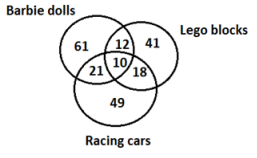
Question 19

Study the given Venn diagram carefully and answer the question that follows. The numbers in different sections indicate the number of children who play with a particular toy at a day care.

How many such children are there, who play neither with barbie dolls nor with racing cars?

  1. AOption (a)

    41

  2. BOption (b)

    67

  3. COption (c)

    82

  4. DOption (d)

    53

View answer & explanation

Correct answer

Answer: (a)A.

41

Why this answer is correct

According to the given Venn diagram:

The shaded region represents the number of children who play neither with barbie dolls nor with racing cars.

So, the number of children who play neither with barbie dolls nor with racing cars = 41

Hence, the correct answer is "Option 1".

Question 20

A capsule is in the shape of a sphere of diameter 3.5 mm. Find the amount of medicine required to fill the capsule (in mm3). [Use π = 227\frac{{22}}{7}, and give your answer correct to 2 places of decimal.]

  1. AOption (a)

    22.46

  2. BOption (b)

    22.42

  3. COption (c)

    22.41

  4. DOption (d)

    22.43

View answer & explanation

Correct answer

Answer: (a)A.

22.46

Why this answer is correct

Shortcut Trick

Diameter of the spherical capsule = 3.5 mm

Radius (r) = 3.5 ÷ 2 = 1.75 mm

Volume formula = (4/3) × π × r3

Volume ≈ 1.333 × 3.142 × (1.75)3 ≈ 22.458 mm3

∴ The correct answer is 22.46 mm3.

Alternate Method

Given:

Diameter (d) = 3.5 mm

Radius (r) = d ÷ 2 = 3.5 ÷ 2 = 1.75 mm = 7/4 mm

Formula Used:

Volume of a Sphere = 43\frac{4}{3} π r3

Calculations:

⇒ Volume = 43\frac{4}{3} × 227\frac{22}{7} × (1.75)3

⇒ Volume = 43\frac{4}{3} × 227\frac{22}{7} × 74\frac{7}{4} × 74\frac{7}{4} × 74\frac{7}{4}

⇒ Volume = 13\frac{1}{3} × 11 × 72\frac{7}{2} × 74\frac{7}{4}

⇒ Volume = (11 × 49) ÷ (3 × 2 × 4) = 539 ÷ 24

⇒ Volume ≈ 22.45833...

⇒ Rounding to 2 decimal places, Volume = 22.46 mm3

∴ The correct answer is 22.46 mm3.

Additional Information

Surface Area of a Sphere

The total surface area of a sphere is given by the formula 4πr2.

Volume of a Hemisphere

The volume of a hemisphere is exactly half of a sphere: (2/3)πr3.

Relation between Radius and Diameter

Radius (r) is always half of the diameter (d), i.e., r = d/2.

Question 21

Simplify the following.

112\frac{1}{2} × 22 + 10 ÷ 5 - 2 × 8

  1. AOption (a)

    19

  2. BOption (b)

    −61344 - \frac{{613}}{{44}}

  3. COption (c)

    −132 - \frac{{13}}{2}

  4. DOption (d)

    17

View answer & explanation

Correct answer

Answer: (a)A.

19

Why this answer is correct

Given:

1(1)/(2) × 22 + 10 ÷ 5 - 2 × 8

Formula used:

BODMAS

Calculation:

1(1)/(2) × 22 + 10 ÷ 5 - 2 × 8

⇒ 1.5 × 22 + 10 ÷ 5 - 2 × 8

⇒ 33 + 2 - 16

⇒ 35 - 16

⇒ 19

∴ The correct answer is option (1).

Question 22

Which of the following cities is NOT situated on banks of the Ganga?

  1. AOption (a)

    Kanpur

  2. BOption (b)

    Haridwar

  3. COption (c)

    Patna

  4. DOption (d)

    Lucknow

View answer & explanation

Correct answer

Answer: (d)D.

Lucknow

Why this answer is correct

The correct answer is Lucknow.

Key Points

  • River Ganga:
  • The River Ganga originates from the Gangotri glacier in Uttarakhand.
  • Alaknanda River joins Bhagirathi at Devprayag and from there the river is called Ganga.
  • Yamuna(Largest right bank tributary of Ganga), Damodar (Sorrow of Bengal), Ghagra, Gomti, Gandak, Ramganga, Kosi (Sorrow of Bihar), Son, Mahananda are major tributaries of River Ganga.
  • It flows through the states of Uttarakhand, Uttar Pradesh, Bihar, Jharkhand, and West Bengal.
  • It is a transboundary river, flows through India and Bangladesh.
  • The total length of the river is 2525 km

Question 23

Who founded the Indian Statistical Institute and is considered the Father of Modern Statistics in India?

  1. AOption (a)

    Prasanta Chandra Mahalanobis

  2. BOption (b)

    Debabrata Basu

  3. COption (c)

    Anil Kumar Bhattacharya

  4. DOption (d)

    Raghu Raj Bahadur

View answer & explanation

Correct answer

Answer: (a)A.

Prasanta Chandra Mahalanobis

Why this answer is correct

The correct answer is Prasanta Chandra Mahalanobis.

Key Points 

  • P.C. Mahalanobis
  • P.C. Mahalanobis OBE, FNA, FASc, FRS (29 June 1893– 28 June 1972) was an Indian scientist and statistician.
  • He is best remembered for the Mahalanobis distance, a statistical measure, and for being one of the members of the first Planning Commission of free India.
  • He made pioneering studies in anthropometry in India. He founded the Indian Statistical Institute and contributed to the design of large-scale sample surveys.
  • For his contributions, Mahalanobis has been considered the father of modern statistics in India.
  • Mahalanobis was deeply influenced by the wisdom and guidance of Rabindranath Tagore and Brajendranath Seal.
  • Under his leadership, the institute initiated and promoted the interaction of Statistics with natural and social sciences to advance the role of Statistics as a key technology by explicating the twin aspects – its general applicability and its dependence on other disciplines for its own development.

Additional Information

  • Indian Statistical Institute (ISI) is a higher education and research institute which is recognized as an Institute of National Importance by the 1959 act of the Indian parliament.
  • It grew out of the Statistical Laboratory set up by P.C. Mahalanobis in Presidency College, Kolkata.
  • Established in 1931, this unique institution of India is one of the oldest institutions focused on statistics, and its early reputation led it to be adopted as a model for the first US institute of Statistics set up at the Research Triangle, North Carolina by Gertrude Mary Cox.
  • The institute is now considered one of the foremost centers in the world for training and research in Computer science, Statistics, Quantitative Economics, and related sciences.

Thus, P.C. Mahalanobis established the Indian Statistical Institute.

Question 24

Town C is south of the mid-point of the straight line joining town A and B. Town B is to the East of Town A. Town D is west of town C. Town M is north-east of town B. What is the position of town D with respect to M?

  1. AOption (a)

    South

  2. BOption (b)

    South-east

  3. COption (c)

    South-west

  4. DOption (d)

    West

View answer & explanation

Correct answer

Answer: (c)C.

South-west

Why this answer is correct

Given:

Town C is south of the mid-point of the straight line joining town A and B.

Town B is to the East of Town A.

Town D is west of town C.

Town M is north-east of town B.

Thus, town D is to southwest of town M.

Hence, "Option 3" is the correct answer.

Question 25

Refer to the following letter, number, symbol series and answer the question.

(Left) S = N 4 & % L A * 6 T & C @ 4 B % 2 X L (Right)

How many such numbers are there which are immediately preceded by a letter and also immediately followed by a symbol?

  1. AOption (a)

    1

  2. BOption (b)

    3

  3. COption (c)

    6

  4. DOption (d)

    4

View answer & explanation

Correct answer

Answer: (a)A.

1

Why this answer is correct

Given series:

N 4 & % L A * 6 T & C @ 4 B % 2 X L

Condition to be checked:

Numbers which are immediately preceded by a letter and also immediately followed by a symbol.

Letter → Number → Symbol

N 4 & % L A * 6 T & C @ 4 B % 2 X L

Thus there is one such pattern (N 4 &) that is following the above conditions.

Hence, "1" is the correct answer.

Mistake Points

Immediately preceded by means immediately before or to come just before.

Immediately followed by means immediately after or to come just after.
Question 26

If y : 196 : : 196 : 784, then what is the value of y?

  1. AOption (a)

    7

  2. BOption (b)

    4

  3. COption (c)

    16

  4. DOption (d)

    49

View answer & explanation

Correct answer

Answer: (d)D.

49

Why this answer is correct

Shortcut Trick

In a continued proportion a : b : : b : c, the first term is calculated as y = b2 ÷ c.

Given proportion is y : 196 : : 196 : 784.

⇒ y = (196 × 196) ÷ 784

⇒ y = 196 ÷ 4 = 49

∴ The correct answer is 49.

Alternate Method

Given: y : 196 : : 196 : 784

Formula Used: Product of Extremes = Product of Means

⇒ y ÷ 196 = 196 ÷ 784

⇒ y × 784 = 196 × 196

⇒ y = (196 × 196) ÷ 784

⇒ y = 38416 ÷ 784

⇒ y = 49

∴ The correct answer is 49.

Additional Information

Fourth Proportional

If four quantities a, b, c, d are in proportion, then a/b = c/d, where d is the fourth proportional.

Third Proportional

In a continued proportion a : b : : b : c, the term 'c' is called the third proportional to a and b.

Mean Proportional

The mean proportional between two numbers a and b is given by √(a × b).

Question 27

The fuse used for domestic purpose is rated in the range of ______. 

  1. AOption (a)

    1000 Ampere - 2000 Ampere

  2. BOption (b)

    500 Ampere - 1000 Ampere

  3. COption (c)

    100 Ampere - 200 Ampere

  4. DOption (d)

    1 Ampere - 10 Ampere

View answer & explanation

Correct answer

Answer: (d)D.

1 Ampere - 10 Ampere

Why this answer is correct

The correct answer is 1 Ampere - 10 Ampere.

Key Points

  • Fuse: A fuse is a safety device that protects electrical circuits from overcurrent. It's a thin wire designed to melt and break the circuit if the current exceeds a safe level.
  • work:  When excessive current flows through the fuse, the wire heats up and melts. This breaks the circuit, preventing damage to appliances and wiring.  The melting of the fuse wire is due to the heat generated by the current flowing through it (Joule's Law).
  • Fuses important: Fuses are crucial for preventing electrical fires and protecting valuable equipment. Overcurrent can cause wires to overheat, potentially igniting flammable materials.  They also protect appliances from damage due to power surges.
  • Fuse Ratings: Fuses are rated in Amperes (A), which indicates the maximum current they can safely carry without melting.  The rating must be selected carefully based on the circuit's requirements.
  • Domestic Fuse Ratings (1-10A):  Household circuits typically use fuses in the 1 to 10 Ampere range.  Lower amperage fuses (e.g., 1-3A) are often used for sensitive electronic devices, while higher amperage fuses (e.g., 5-10A) are used for lighting circuits and appliances like fans and refrigerators.
  • Types of Fuses:  Various types of fuses exist, including cartridge fuses, plug fuses, and high-rupturing capacity (HRC) fuses.  Domestic wiring often uses cartridge or plug fuses.
  • Choosing the Right Fuse:  It's essential to use the correct fuse rating for a given circuit. Using a fuse with a lower rating than required will cause it to blow prematurely, while using a fuse with a higher rating may not provide adequate protection.
  • Replacing a Fuse:  When a fuse blows, it must be replaced with one of the same rating.  Never replace a fuse with one of a higher rating, as this can create a fire hazard.  It's always a good idea to identify the cause of the blown fuse before replacing it.
  • Modern Circuit Breakers:  Many modern homes use circuit breakers instead of fuses. Circuit breakers perform the same function as fuses but can be reset after tripping, eliminating the need for replacement.  However, fuses are still used in some applications and are important to understand.
  • Fuse Wire Material:  The fuse wire is usually made of a metal or alloy with a low melting point, such as tin or lead.  This ensures that the fuse melts quickly and reliably when the current exceeds the rated value.
  • Importance of Correct Installation: Fuses should be installed correctly by a qualified electrician to ensure proper operation and safety.  Improperly installed fuses can be ineffective or even create a safety hazard.
  • Regular Inspection: Fuses should be inspected periodically for signs of damage or deterioration.  A blown fuse indicates a problem in the circuit that needs to be addressed.
  • Double-Pole Fuses: Some circuits, especially those for appliances like water heaters, may use double-pole fuses, which interrupt both the live and neutral wires.
  • Fuse Symbol: Electrical diagrams use specific symbols to represent fuses, making it easy to identify them in circuit schematics.
  • Fuse Testing:  A multimeter can be used to test a fuse to determine if it is still good.  A good fuse will show continuity, while a blown fuse will not.
  • Safety Precautions: Always disconnect the power before replacing a fuse to avoid electric shock.  Use insulated tools when working with fuses.
  • Fuse Box/Panel: Fuses are typically located in a fuse box or panel, which provides a central location for managing the electrical circuits in a building.
  • Overcurrent Protection: Fuses are a vital part of the overall overcurrent protection system in a building's electrical wiring.
  • Earthing and Fuses: Fuses work in conjunction with earthing (grounding) to provide comprehensive electrical safety.  Earthing provides a path for fault current to flow to ground, while fuses interrupt the current flow in case of an overcurrent.
  • Understanding Fuse Characteristics:  Understanding the characteristics of different types of fuses, such as their time-current characteristics, is important for selecting the right fuse for a specific application.  The time-current characteristic describes how long it takes for a fuse to blow at different current levels.

Question 28

Select the set in which the numbers are related in the same way as are the numbers of the following sets. (NOTE: Operations should be performed on the whole numbers, without breaking down the numbers into its constituent digits. E.g. 13 - Operations on 13 such as adding / subtracting / multiplying etc. to 13 can be performed. Breaking down 13 into 1 and 3 and then performing mathematical operations on 1 and 3 is not allowed.)

(2, 6, 22)

(4, 13, 47)

  1. AOption (a)

    (9, 5, 33)

  2. BOption (b)

    (7, 4, 36)

  3. COption (c)

    (29, 35, 68)

  4. DOption (d)

    (23, 41, 77)

View answer & explanation

Correct answer

Answer: (a)A.

(9, 5, 33)

Why this answer is correct

The logic followed here is:

Logic: 1st number × 2 + 2nd number × 3 = 3rd number.

Now,

For (2, 6, 22):

⇒ 2 × 2 + 6 × 3

= 4 + 18 = 22.

For (4, 13, 47):

⇒ 4 × 2 + 13 × 3

= 8 + 39 = 47.

Similarly, 

Option 1) For (9, 5, 33):

⇒ 9 × 2 + 5 × 3

= 18 + 15 = 33.

Option 2) For (7, 4, 36):

⇒ 7 × 2 + 4 × 3

= 14 + 12 = 26, which is not equal to 36.

Option 3) For (29, 35, 68):

⇒ 29 × 2 + 35 × 3

= 58 + 105 = 163, which is not equal to 68.

Option 4) For (23, 41, 77):

⇒ 23 × 2 + 41 × 3

= 46 + 123 = 169, which is not equal to 77.

Hence, the correct answer is Option 1.

Question 29

If A is an acute angle, then 1+,tan2A1+,cot2A\frac{{{\rm{1 + }},{\rm{ta}}{{\rm{n}}^{\rm{2}}}{\rm{A}}}}{{{\rm{1 + }},{\rm{co}}{{\rm{t}}^{\rm{2}}}{\rm{A}}}} is equal to:

  1. AOption (a)

    tan2 A

  2. BOption (b)

    sec2 A

  3. COption (c)

    sin2 A

  4. DOption (d)

    cos2 A

View answer & explanation

Correct answer

Answer: (a)A.

tan2 A

Why this answer is correct

Shortcut Trick

Put a specific value for acute angle A = 45°.

tan 45° = 1 and cot 45° = 1.

Expression = (1 + 12) ÷ (1 + 12) = 2 ÷ 2 = 1.

Checking options: (1) tan2 45° = 12 = 1. Matches.

∴ The correct answer is tan2 A.

Alternate Method

Given: Angle A is an acute angle.

Formula Used: 1 + tan2A = sec2A and 1 + cot2A = cosec2A

⇒ Expression = (1 + tan2A) ÷ (1 + cot2A)

⇒ Expression = sec2A ÷ cosec2A

⇒ Expression = (1/cos2A) ÷ (1/sin2A)

⇒ Expression = (1/cos2A) × (sin2A/1)

⇒ Expression = sin2A ÷ cos2A = tan2A

∴ The correct answer is tan2 A.

Additional Information

Trigonometric Identities

Standard Pythagorean identities include sin2θ + cos2θ = 1, 1 + tan2θ = sec2θ, and 1 + cot2θ = cosec2θ.

Reciprocal Relations

tan A = sin A ÷ cos A and cot A = cos A ÷ sin A, which implies tan A = 1 ÷ cot A.

Acute Angle Range

An acute angle is an angle measuring between 0° and 90°, where all primary trigonometric ratios are positive.

Question 30

The position of how many letters will remain unchanged if each of the letters in the word BRIGHT is arranged in alphabetical order?

  1. AOption (a)

    One

  2. BOption (b)

    Two

  3. COption (c)

    Three

  4. DOption (d)

    None

View answer & explanation

Correct answer

Answer: (b)B.

Two

Why this answer is correct

Given word: BRIGHT

According to the question all the letters in the word given are arranged in English alphabetical order:

Given wordBRIGHT
Arranged in English alphabetical orderBGHIRT

Thus, two letters i.e. B and T holds the same position in the word as its position in the English alphabetical order.

Hence, "Option 2" is the correct answer.

Question 31

Consider a horse shoe magnet with its north pole towards west and south pole towards east. A conducting rod is loosely connected to a galvanometer. If this rod is now moved between the poles of the magnet vertically downwards, the direction of the induced current in it will be ______.

  1. AOption (a)

    east to west direction

  2. BOption (b)

    west to east direction

  3. COption (c)

    north to south direction

  4. DOption (d)

    south to north direction

View answer & explanation

Correct answer

Answer: (c)C.

north to south direction

Why this answer is correct

The correct answer is north to south direction.

Key Points

Magnetic field lines:

  • A magnetic field line is an imaginary line such that tangent to it at any point gives the direction of the magnetic field at that point in space.
  • Magnetic field lines are drawn to represent the magnetic fields.
  • Magnetic field lines can be drawn with the help of a magnetic compass.
  • Magnetic field lines are also called magnetic lines of force.

Properties of magnetic field lines:

  1. The magnetic field lines of a magnet (or a solenoid) form continuous closed loops.
  2. The magnetic field lines start from the north pole and end on a south pole outside the magnet. Inside the magnet, the magnetic field lines start from the south pole and end on the north pole.
  3. The tangent to the field line at a given point represents the direction of the net magnetic field B at that point.
  4. The larger the number of field lines crossing per unit area, the stronger is the magnitude of the magnetic field B.
  5. The magnetic field lines do not intersect with each other if they did, there will be two directions of the magnetic field at that point which is not possible.

Question 32

In electric circuits, losses take place in the form of ______ due to flow of electric current.

  1. AOption (a)

    heat

  2. BOption (b)

    Magnetic losses

  3. COption (c)

    sound

  4. DOption (d)

    light

View answer & explanation

Correct answer

Answer: (a)A.

heat

Why this answer is correct

The correct answer is heat.

Key Points

  • Heat:
  • Electrical losses in circuits primarily occur as heat.
  • This is due to the resistance of the conductors, known as Joule heating.
  • Electrons collide with atoms in the wire, causing vibrations and generating heat.
  • The amount of heat is proportional to the square of the current and the resistance.
  • Heat is a loss because it's energy not used for useful work.
  • Excessive heat can damage components and cause fires.
  • Minimizing resistive losses is crucial for efficient electrical systems.
  • Thicker wires with lower resistance reduce heat losses.
  • Superconductors eliminate heat losses but need extremely low temperatures.
  • Heat dissipation is important in electronic device design to prevent overheating.
  • Cooling mechanisms like heat sinks and fans remove waste heat.
  • The efficiency of electrical devices is related to heat loss.

Additional Information

  • Magnetic Losses:
  • Magnetic fields are generated by electric currents.
  • "Magnetic losses" refer to energy dissipated in ferromagnetic materials.
  • Hysteresis losses occur due to magnetic domains lagging behind the changing field.
  • Eddy currents are induced within the core, generating heat.
  • These losses are significant in devices with magnetic cores.
  • They are not the primary loss in simple conductive circuits like wires.
  • Laminating the core reduces eddy current losses.
  • Soft magnetic materials minimize hysteresis losses.
  • Magnetic losses are important in transformers, motors, and electromagnetic devices.
  • These losses contribute to the device's inefficiency.
  • Sound:
  • Some electrical devices produce sound.
  • This sound is not the primary energy loss in a simple circuit.
  • Sound energy is typically small compared to the heat generated.
  • Sound can be produced by vibrations or electrical discharges.
  • In some cases, sound indicates a problem in the circuit.
  • In most basic circuits, the sound produced is negligible in energy loss.
  • Light:
  • Light is not the primary energy loss in a typical circuit.
  • Some devices produce light as their function, not a loss.
  • In a simple resistive circuit, energy is mainly lost as heat.
  • Light can be produced by electrical discharges.
  • The light produced by a simple resistive circuit is generally very small.
  • Incandescent bulbs produce light by heating a filament, but this is the desired output.

Question 33

A, B, C, D, E and F live on six different floors of the same building. The lowermost floor in the building is numbered 1, the floor above it, number 2 and so on till the topmost floor is numbered 6.

C lives immediately above F, on an even numbered floor but not on the 6th floor. Only three people live between F and E. If B lives two floors below E, and A is not on the topmost floor, then how many people live exactly between D and C?

  1. AOption (a)

    2

  2. BOption (b)

    4

  3. COption (c)

    3

  4. DOption (d)

    1

View answer & explanation

Correct answer

Answer: (c)C.

3

Why this answer is correct

Given: A, B, C, D, E and F live on six different floors of the same building. The lowermost floor in the building is numbered 1, the floor above it, number 2 and so on till the topmost floor is numbered 6.

1) C lives immediately above F, on an even numbered floor but not on the 6th floor. 

FloorPerson
Case 1Case 2
6
5
4C
3F
2C
1F

2) Only three people live between F and E. 

As there is no possible position for E in case 1, therefore is eliminated.

FloorPerson
Case 2
6
5E
4
3
2C
1F

3) B lives two floors below E, and A is not on the topmost floor.

After positioning B and A only one position is left which will be occupied by the only person is left i.e. D.

FloorPerson
Case 2
6D
5E
4A
3B
2C
1F

Thus, according to the final arrangement, three people live exactly between D and C.

Hence, "Option 3" is the correct answer.

Question 34

The process by which a changing magnetic field in a conductor induces a potential difference that sets up an induced electric current is called ______.

  1. AOption (a)

    thermal induction

  2. BOption (b)

    magnetic induction

  3. COption (c)

    electric induction

  4. DOption (d)

    electromagnetic induction

View answer & explanation

Correct answer

Answer: (d)D.

electromagnetic induction

Why this answer is correct

The correct answer is electromagnetic induction.

Key Points

  • Faraday's law of electromagnetic induction: It states that an emf or voltage is induced in a current-carrying conductor if there is a change in magnetic flux through the coil and the magnitude of emf induced in the coil is equal to the rate of change of flux that linkages with the coil. The flux linkage of the coil is the product of the number of turns in the coil and flux associated with the coil.
  • AC generator: A mechanical device that converts mechanical energy into AC electrical power is called an AC generator.
  • It works on the principle of Faraday’s law of electromagnetic induction.
  • In an AC generator, the electrical current reverses direction periodically.
  • In an AC generator, the coil through which the current flows is fixed while the magnet moves. The construction is simple and costs are less.
  • When the armature of the generator rotates between two poles of the magnet on an axis perpendicular to the magnetic field then the magnetic flux linkage of the armature changes continuously. Due to this change, an emf is induced in the armature and finally, the current is induced.

Additional Information

Magnetic field lines:

  • A magnetic field line is an imaginary line such that tangent to it at any point gives the direction of the magnetic field at that point in space.
  • Magnetic field lines are drawn to represent the magnetic fields.
  • Magnetic field lines can be drawn with the help of a magnetic compass.
  • Magnetic field lines are also called magnetic lines of force.

Properties of magnetic field lines:

  1. The magnetic field lines of a magnet (or a solenoid) form continuous closed loops.
  2. The magnetic field lines start from the north pole and end on a south pole outside the magnet. Inside the magnet, the magnetic field lines start from the south pole and end on the north pole.
  3. The tangent to the field line at a given point represents the direction of the net magnetic field B at that point.
  4. The larger the number of field lines crossing per unit area, the stronger is the magnitude of the magnetic field B.
  5. The magnetic field lines do not intersect with each other if they did, there will be two directions of the magnetic field at that point which is not possible.

Question 35

Six students, Madhu, Anshul, Avani, Aarav, Priti, and Shikha, gave their presentations on different days in the month of March. The presentation was from 11th March to 16th March. Anshul presented on 14th March and Shikha presented immediately before Anshul. Only one person presented between Shikha and Priti. Shikha presented after Priti but before Avani. Avani presented immediately before Madhu. Who presented on 15th March?

  1. AOption (a)

    Aarav

  2. BOption (b)

    Madhu

  3. COption (c)

    Priti

  4. DOption (d)

    Avani

View answer & explanation

Correct answer

Answer: (d)D.

Avani

Why this answer is correct

Given: Six students, Madhu, Anshul, Avani, Aarav, Priti, and Shikha, gave their presentations on different days in the month of March. The presentation was from 11th March to 16th March. 

1) Anshul presented on 14th March and Shikha presented immediately before Anshul. 

DateStudent
11th March
12th March
13th MarchShikha
14th MarchAnshul
15th March
16th March

2) Only one person presented between Shikha and Priti.

  1. Shikha presented after Priti but before Avani. 
DateStudent
Case 1Case 2
11th MarchPritiPriti
12th March
13th MarchShikhaShikha
14th MarchAnshulAnshul
15th MarchAvani
16th MarchAvani

4) Avani presented immediately before Madhu.

As there is no possible position for Madhu in case 2, therefore is eliminated.

After positioning Madhu only one position is left which will be occupied by the only person left i.e. Aarav.

DateStudent
Case 1
11th MarchPriti
12th MarchAarav
13th MarchShikha
14th MarchAnshul
15th MarchAvani
16th MarchMadhu

Thus, according to the final arrangement, Avani presented on 15th March.

Hence, "Option 4" is the correct answer.

Question 36

A dishonest merchant claims to sell his items at cost price, but gives 200 kg of an item instead of the 250 kg he charges for. What is his percentage of profit in this transaction?

  1. AOption (a)

    20%

  2. BOption (b)

    15%

  3. COption (c)

    10%

  4. DOption (d)

    25%

View answer & explanation

Correct answer

Answer: (d)D.

25%

Why this answer is correct

Shortcut Trick

Profit% for a dishonest dealer = (Error ÷ True Value − Error) × 100

True weight = 250 kg, Actual weight given = 200 kg

Error = 250 − 200 = 50 kg

Profit% = (50 ÷ 200) × 100 = 25%

∴ The correct answer is 25%.

Alternate Method

Given: Claimed selling weight = 250 kg, Actual weight delivered = 200 kg. Formulas: Profit% = (Profit ÷ Cost Price) × 100

⇒ Let the cost price (CP) of 1 kg be Rs. 1. ⇒ Total CP for 200 kg = Rs. 200. ⇒ Total selling price (SP) (charged for 250 kg at CP) = Rs. 250. ⇒ Profit = SP − CP = 250 − 200 = Rs. 50. ⇒ Profit% = (50 ÷ 200) × 100 = 25%.

∴ The correct answer is 25%.

Additional Information

Dishonest Dealer Concept

When a merchant claims to sell at cost price but uses lesser weight, the profit is calculated on the amount actually given to the customer, not the claimed amount.

Ratio Method

Profit ratio = (True Weight) : (False Weight). In this case, 250:200 which simplifies to 5:4. Since SP corresponds to 5 and CP to 4, Profit% = (1/4) × 100 = 25%.

Question 37

Select the set in which the numbers are related in the same way as are the numbers of the following sets. (NOTE: Operations should be performed on the whole numbers, without breaking down the numbers into its constituent digits. E.g. 13 - Operations on 13 such as adding / subtracting / multiplying etc. to 13 can be performed. Breaking down 13 into 1 and 3 and then performing mathematical operations on 1 and 3 is not allowed)

(15, 405, 9)

(13, 273, 7)

  1. AOption (a)

    (9, 405, 9)

  2. BOption (b)

    (12, 360, 5)

  3. COption (c)

    (14, 490, 7)

  4. DOption (d)

    (11, 165, 5)

View answer & explanation

Correct answer

Answer: (d)D.

(11, 165, 5)

Why this answer is correct

The logic followed here is: 

Logic: (1st number × 3rd number) × 3 = 2nd number.

Now,

For (15, 405, 9):

⇒ (15 × 9) × 3

= 135 × 3 = 405.

For (13, 273, 7)

⇒ (13 × 7) × 3

= 91 × 3 = 273.

Similarly, for Option 4: (11, 165, 5)

⇒ (11 × 5) × 3

= 55 × 3 = 165.

Hence, the correct answer is Option 4.

Question 38

In the Modern Periodic Table elements present in one group have the same number of ______

  1. AOption (a)

    shells

  2. BOption (b)

    electrons

  3. COption (c)

    protons

  4. DOption (d)

    valence electrons

View answer & explanation

Correct answer

Answer: (d)D.

valence electrons

Why this answer is correct

The correct answer is valence electrons.

Key Points

  • Valence Electrons:
  • Elements in the same group have the same number of valence electrons.
  • Valence electrons are in the outermost shell.
  • They are responsible for the element's chemical properties.
  • The number of valence electrons determines how an element interacts with others.
  • Elements in a group exhibit similar chemical behavior.
  • This is because they have the same valence electron configuration.
  • Group 1 elements (alkali metals) have one valence electron.
  • Group 17 elements (halogens) have seven valence electrons.
  • The periodic table is organized based on electronic configurations.
  • Groups reflect recurring patterns in these configurations.
  • Shared valence electrons are why elements in a group share properties.
  • This is a fundamental principle of the periodic table.
  • Understanding valence electrons is key to predicting compound formation.
  • The number of valence electrons influences bond types.

Additional Information

  • Shells:
  • Elements in the same period have the same number of shells.
  • Moving across a period, electrons are added to the same shell.
  • The number of shells relates to an atom's size.
  • Elements in the same group do not have the same number of shells.
  • Lithium and Sodium are in the same group but have different numbers of shells.
  • The number of shells increases down a group.
  • Each period represents filling a new electron shell.
  • The number of shells is related to the principal quantum number.
  • Electrons:
  • Elements in the same group do not have the same total number of electrons.
  • Moving down a group, the atomic number increases.
  • The number of protons (and electrons) increases.
  • The total number of electrons is not a defining characteristic of a group.
  • The total number of electrons determines atom size and some physical properties.
  • Valence electrons dictate chemical behavior.
  • The total number of electrons is related to the atomic number.
  • The number of electrons must equal the number of protons in a neutral atom.
  • Protons:
  • Elements in the same group do not have the same number of protons.
  • The number of protons is the atomic number.
  • It defines which element it is.
  • Each element has a unique number of protons.
  • Moving down a group, the atomic number (and protons) increases.
  • Protons are heavier than electrons and reside in the nucleus.
  • The number of protons determines the nucleus's charge.
  • The periodic table is arranged by increasing atomic number.
  • Changing the number of protons changes the element's identity.

Question 39

If the HCF of 408 and 1032 is expressed as 516m - 252 × 4, then m is:

  1. AOption (a)

    -6

  2. BOption (b)

    6

  3. COption (c)

    -2

  4. DOption (d)

    2

View answer & explanation

Correct answer

Answer: (d)D.

2

Why this answer is correct

Shortcut Trick Find HCF of 408 and 1032 using division: 1032 = 408 × 2 + 216; 408 = 216 × 1 + 192; 216 = 192 × 1 + 24; 192 = 24 × 8 + 0. HCF = 24. Equation: 24 = 516m − 1008. 516m = 1032 ⇒ m = 2. ∴ The correct answer is 2. Alternate Method

Given: Numbers are 408 and 1032. Step 1: Calculate the HCF of 408 and 1032. ⇒ 1032 = 408 × 2 + 216 ⇒ 408 = 216 × 1 + 192 ⇒ 216 = 192 × 1 + 24 ⇒ 192 = 24 × 8 + 0 ⇒ HCF = 24 Step 2: Set the given expression equal to the HCF. ⇒ 516m − 252 × 4 = 24 ⇒ 516m − 1008 = 24 ⇒ 516m = 24 + 1008 ⇒ 516m = 1032 ⇒ m = 1032 ÷ 516 ⇒ m = 2 ∴ The correct answer is 2. Additional Information Euclid Division Lemma It states that for any two positive integers a and b, there exist unique integers q and r such that a = bq + r, where 0 ≤ r < b. HCF Property The Highest Common Factor (HCF) of two numbers is the largest positive integer that divides each of the integers without a remainder. Linear Combination The HCF of two numbers a and b can always be expressed in the form of am + bn for some integers m and n (Bezout's Identity).

Question 40

Complete the given step of anaerobic respiration:

Glucose (C6H12O6) → ______ + Carbon Dioxide (CO2)+ Energy (ATP)

  1. AOption (a)

    Pyruvate

  2. BOption (b)

    Water

  3. COption (c)

    Lactic Acid

  4. DOption (d)

    Ethanol (C2H5OH)

View answer & explanation

Correct answer

Answer: (d)D.

Ethanol (C2H5OH)

Why this answer is correct

The correct answer is Ethanol (C2H5OH).

Key Points

  • Ethanol (C2H5OH)
  • Ethanol is a product of alcoholic fermentation.
  • This is another type of anaerobic respiration.
  • It's carried out by some microorganisms, like yeast.
  • Glucose is broken down into pyruvate.
  • Pyruvate is converted into ethanol and carbon dioxide.
  • This fermentation is used in producing alcoholic beverages.
  • It's also used in some food products.
  • Both lactic acid and alcoholic fermentation are anaerobic.
  • But they produce different end products.
  • The question specifies carbon dioxide and ATP as products.
  • This corresponds to lactic acid fermentation in muscles.

Additional Information

  • Lactic Acid:
  • Anaerobic respiration occurs without oxygen.
  • It generates ATP from glucose when oxygen is limited.
  • Lactic acid fermentation is a common type of anaerobic respiration.
  • Glucose is broken down into pyruvate during glycolysis.
  • Without oxygen, pyruvate is converted into lactic acid.
  • This conversion regenerates NAD+, essential for glycolysis.
  • Lactic acid fermentation is used by some bacteria and animal muscle cells.
  • It occurs during intense exercise when oxygen supply is limited.
  • Lactic acid accumulation in muscles causes fatigue.
  • Lactic acid is later transported to the liver.
  • In the liver, it's converted back into glucose.
  • Anaerobic respiration produces less ATP than aerobic respiration.
  • It provides crucial energy for short bursts of activity.
  • This process is vital for survival in low-oxygen environments.
  • Pyruvate:
  • Pyruvate is an intermediate product of glycolysis.
  • Glycolysis is the first step in both aerobic and anaerobic respiration.
  • In aerobic respiration, pyruvate is further oxidized.
  • In anaerobic respiration, pyruvate is converted into lactic acid.
  • Glycolysis is common to both aerobic and anaerobic pathways.
  • Pyruvate is a key molecule in cellular metabolism.
  • It serves as a branch point for different metabolic fates.
  • If oxygen is present, pyruvate enters the citric acid cycle.
  • If oxygen is absent, pyruvate is converted to fermentation products.
  • Water:
  • Water is a product of aerobic respiration.
  • It's formed when oxygen is the final electron acceptor.
  • This occurs in the electron transport chain.
  • This process generates a large amount of ATP.
  • Anaerobic respiration does not involve the electron transport chain.
  • Therefore, water is not a direct product.
  • Water is essential for many biological processes.
  • But it's not a direct product of the anaerobic pathway described.

Question 41

Which method of contraception changes the hormonal balance of the body?

  1. AOption (a)

    Insertion of Copper-T

  2. BOption (b)

    Surgical blockage of the fallopian tubes

  3. COption (c)

    Use of condoms

  4. DOption (d)

    Intake of pills

View answer & explanation

Correct answer

Answer: (d)D.

Intake of pills

Why this answer is correct

The correct answer is Intake of pills.

Key Points

  • Intake of Pills (Hormonal Contraceptives):
  • Birth control pills, also known as oral contraceptives, contain synthetic hormones, usually a combination of estrogen and progestin.
  • These hormones work primarily by preventing the release of an egg from the ovaries (ovulation).
  • They can also thicken cervical mucus, making it harder for sperm to reach the egg, and alter the lining of the uterus, making it less receptive to a fertilized egg.
  • Because they introduce exogenous hormones, they directly change the body's natural hormonal balance.
  • Different types of pills have varying dosages and combinations of hormones, affecting individuals differently.
  • Hormonal pills are highly effective when used correctly and consistently.
  • They offer some additional health benefits, such as regulating periods and reducing menstrual cramps.
  • However, they can also have potential side effects, including mood changes, weight fluctuations, and, in rare cases, more serious health risks.
  • It's important to consult a doctor before starting or stopping any hormonal contraceptive.
  • The hormonal changes induced by the pill are reversible upon discontinuation.
  • These pills affect the levels of hormones like estrogen and progesterone.
  • They can impact the menstrual cycle and other hormone-related functions.

Additional Information

  • Insertion of Copper-T (Intrauterine Device - IUD):
  • The Copper-T is a type of intrauterine device (IUD) that releases copper into the uterus.
  • Copper is toxic to sperm, creating an environment that is hostile to them and thus preventing fertilization.
  • It primarily works by preventing sperm from surviving in the female reproductive tract.
  • It does not primarily change the hormonal balance of the body.
  • Some IUDs contain hormones, but the Copper-T specifically is non-hormonal.
  • The copper IUD's effects are mainly localized to the uterus.
  • It's a long-acting reversible contraceptive (LARC) method.
  • It does not prevent ovulation in most women.
  • It can sometimes cause heavier or more painful periods.
  • Surgical Blockage of the Fallopian Tubes (Tubal Ligation):
  • Tubal ligation is a surgical procedure that blocks or cuts the fallopian tubes.
  • This prevents the egg from traveling from the ovaries to the uterus and thus prevents fertilization.
  • It is a permanent method of contraception.
  • It does not directly change the hormonal balance of the body.
  • Hormone levels remain largely unaffected.
  • It is considered a highly effective method of birth control.
  • It is generally not easily reversible.
  • It does not affect the menstrual cycle in most women.
  • Use of Condoms (Barrier Method):
  • Condoms are barrier methods of contraception.
  • They prevent sperm from entering the vagina and reaching the egg.
  • They do not change the hormonal balance of the body.
  • They are a readily available and relatively inexpensive method of contraception.
  • Condoms also offer protection against sexually transmitted infections (STIs).
  • They are a temporary method of contraception.
  • They are effective when used correctly and consistently.
  • Their use does not interfere with natural hormone production.

Question 42

If a and b are two co-prime numbers, then their LCM is :

  1. AOption (a)

    a - b

  2. BOption (b)

    a + b

  3. COption (c)

    a × b

  4. DOption (d)

    a,−,ba,+,b\frac{{{\rm{a}},{\rm{ - }},{\rm{b}}}}{{{\rm{a}},{\rm{ + }},{\rm{b}}}}

View answer & explanation

Correct answer

Answer: (c)C.

a × b

Why this answer is correct

Shortcut Trick

For any two co-prime numbers, the only common factor they share is 1.

Since there are no other common prime factors, their Least Common Multiple (LCM) is simply the product of the numbers.

Product = a × b.

∴ The correct answer is a × b.

Alternate Method

Given: Two numbers a and b are co-prime.

Formula Used: LCM × HCF = Product of two numbers

⇒ By definition, the Highest Common Factor (HCF) of co-prime numbers is 1.

⇒ Substitute HCF = 1 in the formula:

⇒ LCM × 1 = a × b

⇒ LCM = a × b

∴ The correct answer is a × b.

Additional Information

Co-prime Numbers

Numbers that have no common positive factor other than 1. Examples: (8, 9), (15, 16).

HCF and LCM Relation

For any two numbers x and y, HCF(x, y) × LCM(x, y) = x × y.

Prime Numbers

All pairs of distinct prime numbers are always co-prime, and their LCM is their product.

Question 43

If x−1xx - \frac{1}{x} = 2, then find the value of x4+1x4{x^4} + \frac{1}{{{x^4}}}.

  1. AOption (a)

    16

  2. BOption (b)

    24

  3. COption (c)

    36

  4. DOption (d)

    34

View answer & explanation

Correct answer

Answer: (d)D.

34

Why this answer is correct

Shortcut Trick

If x − 1/x = k, then x2 + 1/x2 = k2 + 2.

If x2 + 1/x2 = m, then x4 + 1/x4 = m2 − 2.

Given k = 2 ⇒ x2 + 1/x2 = 22 + 2 = 6.

Then, x4 + 1/x4 = 62 − 2 = 36 − 2 = 34.

∴ The correct answer is 34.

Alternate Method

Given: x − 1/x = 2

Formula Used: (a − b)2 = a2 + b2 − 2ab and (a + b)2 = a2 + b2 + 2ab

Calculations:

First, squaring both sides of the given equation:

⇒ (x − 1/x)2 = 22

⇒ x2 + (1/x)2 − 2 × x × (1/x) = 4

⇒ x2 + 1/x2 − 2 = 4

⇒ x2 + 1/x2 = 6

Now, squaring both sides again to reach the fourth power:

⇒ (x2 + 1/x2)2 = 62

⇒ (x2)2 + (1/x2)2 + 2 × x2 × (1/x2) = 36

⇒ x4 + 1/x4 + 2 = 36

⇒ x4 + 1/x4 = 36 − 2

⇒ x4 + 1/x4 = 34

∴ The correct answer is 34.

Additional Information

Algebraic Identities for Reciprocals

For any non-zero value x, the relation (x + 1/x)2 = x2 + 1/x2 + 2 and (x − 1/x)2 = x2 + 1/x2 − 2 are fundamental in solving higher power expressions.

Successive Squaring Property

To find the value of x4 + 1/x4, we must first find the value of x2 + 1/x2 as an intermediate step. The constant term 2 is added or subtracted based on the sign of the binomial being squared.

Conversion Rule

x2 + 1/x2 = (x − 1/x)2 + 2 | x2 + 1/x2 = (x + 1/x)2 − 2. Always check the given sign carefully before applying the constant adjustment.

Question 44

The effective diameter of the circular outline of a spherical lens is called ______.

  1. AOption (a)

    centre of curvature

  2. BOption (b)

    aperture

  3. COption (c)

    focus

  4. DOption (d)

    radius of curvature

View answer & explanation

Correct answer

Answer: (b)B.

aperture

Why this answer is correct

The correct answer is aperture.

Key Points

  • Aperture:
  • The aperture of a lens is the diameter of the opening that controls how much light enters the lens.
  • It's specifically the diameter of the effective circular outline through which light can pass. This might be smaller than the physical size of the lens.
  • The aperture is a crucial factor in determining the lens's light-gathering ability and its depth of field.
  • A larger aperture (wider opening) allows more light to enter, which is useful in low-light conditions.
  • A smaller aperture (narrower opening) allows less light to enter but increases the depth of field (the portion of the image that appears in focus).
  • Aperture is often expressed as an f-number (e.g., f/2.8, f/5.6), which is the ratio of the lens's focal length to the diameter of the aperture.
  • The terms "aperture" and "effective diameter" are often used interchangeably in the context of lenses.
  • The aperture is adjustable in many cameras and optical instruments.
  • The size of the aperture affects the brightness of the image formed by the lens.
  • It also plays a role in controlling diffraction, which can affect image sharpness.
  • The aperture is a key parameter in photography, influencing exposure and artistic effects.

Additional Information

  • Centre of Curvature:
  • The center of curvature is the center of the sphere of which the lens surface is a part.
  • It's a geometric point, not a physical diameter.
  • It's important for understanding the lens's shape and how it refracts light.
  • The radius of curvature is the distance from the center of curvature to the lens surface.
  • Light rays passing through the center of curvature pass undeviated.
  • The center of curvature is used in lens design and calculations.
  • It's related to the focal length of the lens.
  • It is not related to the amount of light entering the lens.
  • Focus:
  • The focus (or focal point) is the point where parallel light rays converge after passing through the lens.
  • It's a point, not a diameter.
  • The distance from the lens to the focus is called the focal length.
  • The focus is crucial for image formation.
  • A sharp image is formed when the object is at the correct distance for the lens to focus the light onto the image plane (e.g., film or sensor).
  • The focal length determines the magnification of the lens.
  • Different lenses have different focal lengths.
  • The focus is not directly related to the light-gathering ability of the lens.
  • Radius of Curvature:
  • The radius of curvature is the distance from the center of curvature to the lens surface.
  • It's a distance, not a diameter related to light entering the lens.
  • It describes the curvature of the lens surface.
  • It's related to the focal length of the lens.
  • The radius of curvature is a parameter used in lens design.
  • A shorter radius of curvature means a more curved lens surface.
  • The radius of curvature is important for determining the lens's optical power.
  • It is not the same as the aperture.

Question 45

The process of using electricity to decompose water into oxygen and hydrogen gas is called ______.

  1. AOption (a)

    hydrolysis of water

  2. BOption (b)

    atomisation of water

  3. COption (c)

    electrolysis of water

  4. DOption (d)

    ionisation of water

View answer & explanation

Correct answer

Answer: (c)C.

electrolysis of water

Why this answer is correct

The correct answer is electrolysis of water.

Key Points

  • Electrolysis of Water:
  • Electrolysis is the process of using an electric current to drive a non-spontaneous chemical reaction.
  • In the case of water, electrolysis involves passing a direct current (DC) through water.
  • This causes the water molecules to split into their constituent elements: hydrogen and oxygen gas.
  • The reaction occurs at two electrodes: the anode (positive) and the cathode (negative).
  • At the anode, water molecules are oxidized, releasing oxygen gas and hydrogen ions (H+).
  • At the cathode, hydrogen ions are reduced, forming hydrogen gas.
  • The overall reaction is: 2H₂O(l) → 2H₂(g) + O₂(g)
  • Electrolysis of water requires an electrolyte (like an acid or a salt) to be present in the water to carry the current. Pure water is a poor conductor of electricity.
  • This process is used in various applications, including hydrogen production for fuel cells and other industrial uses.
  • Electrolysis is a fundamental electrochemical process.
  • It's a key method for producing pure hydrogen.

Additional Information

  • Hydrolysis of Water:
  • Hydrolysis is a chemical reaction in which water is used to break down a substance.
  • While electrolysis of water is a type of reaction involving water, "hydrolysis" usually refers to reactions where water itself is a reactant in the breaking of chemical bonds, not simply being split itself by electricity.
  • Hydrolysis can occur under acidic or basic conditions, or with the help of enzymes.
  • It does not necessarily involve electricity.
  • Examples of hydrolysis include the breakdown of carbohydrates into sugars and the breakdown of proteins into amino acids.
  • While related to water, it's a broader term and not specific to the electrically driven splitting of water.
  • Atomisation of Water:
  • Atomization refers to the process of breaking a liquid into a fine spray of droplets.
  • This is typically done mechanically (e.g., using a nozzle) or by using compressed gas.
  • Atomization does not involve changing the chemical composition of the water. It is a physical process, not a chemical one.
  • It's used in applications like fuel injection in engines, spray painting, and humidification.
  • It's a physical process of dispersion, not a chemical change like the decomposition of water into its elements.
  • Ionisation of Water:
  • Ionization is the process of adding or removing electrons from an atom or molecule to create ions.
  • Water undergoes a small degree of autoionization, where it forms hydronium ions (H₃O+) and hydroxide ions (OH-).
  • However, this is a spontaneous and reversible process, not driven by electricity like electrolysis.
  • Ionization is a fundamental concept in chemistry and physics.
  • It plays a role in many chemical reactions and physical phenomena.
  • While related to water's properties, it's not the term for the specific process of electrically splitting water into hydrogen and oxygen.

Question 46

In this question, the statement is followed by four conclusions. Find out which conclusion is NOT true based on the given statement.

Statement: Y < V = X ≤ L < A > C ≥ H

  1. AOption (a)

    X > Y

  2. BOption (b)

    L ≥ V

  3. COption (c)

    X > A

  4. DOption (d)

    A > H

View answer & explanation

Correct answer

Answer: (c)C.

X > A

Why this answer is correct

Given Statement: Y < V = X ≤ L < A > C ≥ H

Now,

Conclusions:

Option 1: X > Y → True (Y < V = X, so X > Y holds true)

Option 2: L ≥ V → True (V = X ≤ L, so L ≥ V holds true)

Option 3: X > A → False (X ≤ L < A , so X > A  not true)

Option 4: A > H → True (A > C ≥ H, so, A > H holds true)

Hence, the correct answer is "Option 3".

Question 47

Ratio of Sin i and Sin r is known as :

  1. AOption (a)

    dispersion

  2. BOption (b)

    magnification

  3. COption (c)

    refraction

  4. DOption (d)

    refractive index

View answer & explanation

Correct answer

Answer: (d)D.

refractive index

Why this answer is correct

The correct answer is refractive index.

Key Points

  • Refractive Index:
  • The ratio of the sine of the angle of incidence (i) to the sine of the angle of refraction (r) is defined as the refractive index.
  • This relationship is known as Snell's Law: n₁sin(i) = n₂sin(r), where n₁ and n₂ are the refractive indices of the two media.
  • The refractive index is a measure of how much light bends when it passes from one medium to another.
  • It's a dimensionless quantity.
  • A higher refractive index means that light bends more.
  • The refractive index of a vacuum is defined as 1.
  • The refractive index of other media is relative to the refractive index of a vacuum.
  • When light travels from a medium with a lower refractive index to a medium with a higher refractive index, it bends towards the normal.
  • When light travels from a medium with a higher refractive index to a medium with a lower refractive index, it bends away from the normal.
  • The refractive index is dependent on the wavelength of light. This is why dispersion occurs.
  • Snell's Law is fundamental to understanding how lenses and prisms work.

Additional Information

  • Dispersion:
  • Dispersion is the phenomenon of light splitting into its constituent colors (like a rainbow) when it passes through a prism or other medium.
  • This happens because the refractive index of the medium varies slightly with the wavelength of light.
  • Different colors of light bend by different amounts, causing them to separate.
  • Dispersion is not the ratio of sin i to sin r, but a consequence of the fact that this ratio (refractive index) is wavelength-dependent.
  • Prisms utilize dispersion to separate white light into its spectrum.
  • Rainbows are a natural example of dispersion caused by raindrops acting as prisms.
  • Magnification:
  • Magnification is the apparent enlargement of an object by an optical instrument like a lens or a microscope.
  • It's a measure of how much larger the image appears compared to the object.
  • Magnification is not directly related to the ratio of sin i to sin r.
  • Magnification is calculated based on the lens's focal length and the object/image distances.
  • It can be linear (related to size) or angular (related to the angle subtended by the object/image).
  • Refraction:
  • Refraction is the bending of light as it passes from one medium to another.
  • It's the phenomenon that is described by Snell's Law and the refractive index.
  • Refraction is not the ratio of sin i to sin r itself, but the process governed by it.
  • Refraction occurs because light travels at different speeds in different media.
  • The change in speed causes the light to bend.
  • Refraction is responsible for many optical illusions.

Question 48

During heavy exercise when the demand for energy is high, but the supply of oxygen to produce the energy is limited, the muscle cells show ______.

  1. AOption (a)

    synthesis of ethanol

  2. BOption (b)

    accumulation of pyruvate

  3. COption (c)

    loss of water

  4. DOption (d)

    formation of lactic acid

View answer & explanation

Correct answer

Answer: (d)D.

formation of lactic acid

Why this answer is correct

The correct answer is formation of lactic acid.

Key Points

  • Formation of Lactic Acid:
  • During heavy exercise, the demand for energy in muscle cells increases significantly.
  • When the oxygen supply is limited, the muscle cells switch to anaerobic respiration to produce ATP (energy).
  • Anaerobic respiration in muscle cells involves the breakdown of glucose into lactic acid.
  • This process allows for the continued production of ATP even in the absence of sufficient oxygen.
  • Lactic acid is a byproduct of this anaerobic process.
  • The accumulation of lactic acid in muscle cells contributes to muscle fatigue and soreness.
  • This is a temporary adaptation to meet the energy demands when oxygen is scarce.
  • Once the exercise stops and oxygen becomes available, the lactic acid is converted back to pyruvate or glucose in the liver.
  • This process provides a short-term solution for energy production during intense activity.
  • It is less efficient than aerobic respiration, producing much less ATP per glucose molecule.
  • This metabolic pathway is crucial for short bursts of high-intensity activity.

Additional Information

  • Synthesis of Ethanol:
  • Ethanol is a product of anaerobic respiration, but specifically alcoholic fermentation.
  • Alcoholic fermentation is carried out by microorganisms like yeast, not by human muscle cells.
  • Muscle cells do not produce ethanol during exercise.
  • This process is used in the production of alcoholic beverages.
  • It involves the conversion of pyruvate to ethanol and carbon dioxide.
  • Accumulation of Pyruvate:
  • Pyruvate is an intermediate product in the breakdown of glucose during glycolysis.
  • If oxygen is available, pyruvate is further processed in the mitochondria to produce more ATP through aerobic respiration.
  • When oxygen is limited, pyruvate is converted into lactic acid, not accumulated.
  • The conversion of pyruvate to lactic acid is essential to regenerate NAD+, which is needed for glycolysis to continue.
  • Accumulation of pyruvate would halt the energy production process during anaerobic conditions.
  • Loss of Water:
  • While the body does lose water during exercise through sweating, this is not directly related to the shift to anaerobic respiration.
  • Sweating is a mechanism for thermoregulation (cooling the body).
  • Water loss can lead to dehydration, which can impair performance.
  • However, it's a separate process from the metabolic shift to lactic acid production.
  • Dehydration can indirectly affect cellular respiration but is not the primary factor in anaerobic respiration taking place.
  • s not the primary factor in anaerobic respiration taking place.

Question 49

Three statements are followed by three conclusions numbered I, II and III. You have to consider these statements to be true, even if they seem to be at variance with commonly known facts. Decide which of the given conclusions logically follow(s) from the given statements.

Statements:

Few oxen are peacocks

All peacocks are cheetahs

All cheetahs are horses

Conclusions:

(I) Some horses are peacocks

(II) Some cheetahs are peacocks

(III) All peacocks are horses

  1. AOption (a)

    Only conclusion II follows

  2. BOption (b)

    Only conclusion I follows

  3. COption (c)

    All conclusions I, II and III follow

  4. DOption (d)

    Either conclusion I or III follows

View answer & explanation

Correct answer

Answer: (c)C.

All conclusions I, II and III follow

Why this answer is correct

The least possible Venn diagram for the given statements is as shown below :

Conclusions:

(I) Some horses are peacocks → Follow (As all peacocks are cheetahs and all cheetahs are horses. As whole peacocks comes in cheetahs which whole comes in horses, therefore is true.)

(II) Some cheetahs are peacocks → Follow (As all peacocks are cheetahs. As whole peacocks comes in cheetahs, therefore is true.)

(III) All peacocks are horses → Follow (As all peacocks are cheetahs and all cheetahs are horses. As whole peacocks comes in cheetahs which whole comes in horses, therefore is true.

∴ Here, All conclusions I, II and III follow.​

Hence, the correct answer is "Option 3".

Question 50

Which of the following reactions is an example of a displacement reaction?

  1. AOption (a)

    2FeSO4 (s) ——→ Fe2O3 (s) + SO2 (g) +SO3 (g)

  2. BOption (b)

    3Fe (s) + 4H2O (I) ——→ Fe3O4 (s) + 2H2 (I)

  3. COption (c)

    Zn (s) + CuSO4 (aq) ——→ ZnSO4 (aq) + Cu (s)

  4. DOption (d)

    CaO (s) + H2O (I) ——→ Ca(OH)2 (aq) + Heat

View answer & explanation

Correct answer

Answer: (c)C.

Zn (s) + CuSO4 (aq) ——→ ZnSO4 (aq) + Cu (s)

Why this answer is correct

The correct answer is Zn (s) + CuSO4 (aq) ——→ ZnSO4 (aq) + Cu (s).

Key Points

Displacement reaction

  • The chemical reaction in which a more reactive element displaces a less reactive element from its compound is called displacement reaction.
  • Metal activity series: The metal reactivity series is an array of metals arranged in descending order of their reactivities. It is also known as the metal activity series.

Additional Information

  • The top metals in the series (K, Na, Ca, Mg, and Al) are so reactive that they are never found as free elements in nature.
  • The metals at the bottom of the activity series are the least reactive.
  • Some of these metals can be found in their natural state in the earth's crust.

Question 51

Six girls with the initials V, M, S, E, N and C are sitting around a circular table, facing the centre and at equal distance from each other, not necessarily in the same order.

E sits second to the left of C. S sits second to the right of V. C sits at the immediate left of V. N sits second to the left of E. Who sits at the immediate left of C?

  1. AOption (a)

    S

  2. BOption (b)

    V

  3. COption (c)

    M

  4. DOption (d)

    N

View answer & explanation

Correct answer

Answer: (c)C.

M

Why this answer is correct

Given: Six girls with the initials V, M, S, E, N and C are sitting around a circular table, facing the centre and at equal distance from each other.

1) E sits second to the left of C.

2) C sits at the immediate left of V. 

3) S sits second to the right of V.

4) N sits second to the left of E.

After positioning N only one position is left which will be occupied by the only person left i.e. M.

Thus, according to the final arrangement, M sits at the immediate left of C.

Hence, "Option 3" is the correct answer.

Question 52

A statement is given followed by two assumptions numbered I and II. You have to assume everything in the statement to be true and decide which of the assumptions is / are implicit in the statement.

Statement:

The Union Road Transport and Highways Ministry is gearing up to build a super expressway to connect Delhi and Mumbai, which would allow commuters to finish the 1,400 km long journey within 12 hours.

Assumptions:

I. The road between the two cities is in very bad shape.

II. Currently there are no roads to connect these two cities of India.

  1. AOption (a)

    Neither assumption I nor II is implicit

  2. BOption (b)

    Only assumption I is implicit

  3. COption (c)

    Both assumptions I and II are implicit

  4. DOption (d)

    Only assumption II is implicit

View answer & explanation

Correct answer

Answer: (a)A.

Neither assumption I nor II is implicit

Why this answer is correct

Given Statement: The Union Road Transport and Highways Ministry is gearing up to build a super expressway to connect Delhi and Mumbai, which would allow commuters to finish the 1,400 km long journey within 12 hours.

Now,

Assumptions:

  1. The road between the two cities is in very bad shape - Not Implicit (The statement does not provide any information about the current condition of the road between Delhi and Mumbai.)
  2. Currently there are no roads to connect these two cities of India - Not Implicit (The statement mentions the construction of a super expressway to reduce travel time, but it does not imply that there are no existing roads connecting Delhi and Mumbai.)

Here, Neither assumption I nor II is implicit.

Hence, the correct answer is "Option 1".

Question 53

In this question, a group of letters is coded using numbers / symbols as per the table given below and the conditions which follow. The correct combination of codes following the conditions is your answer.

LettersEOLYAWNS
Numbers/Symbols5%7#14@S

Conditions:

(i) If a word has a vowel at the end, the vowel present at the end will be coded as 6.

(ii) If a word has more than 2 vowels, all the vowels will be coded as 8.

(iii) If a letter is present exactly twice in a word, it will be coded as 2 in both such places

What will be the correct code for YELLOW?

  1. AOption (a)

    #82284

  2. BOption (b)

    #522%4

  3. COption (c)

    #577%4

  4. DOption (d)

    #577%6

View answer & explanation

Correct answer

Answer: (b)B.

#522%4

Why this answer is correct

Given:

LettersEOLYAWNS
Numbers/Symbols5%7#14@S


ConditionsCoded As
(i) If a word has a vowel at the endThe vowel present at the end will be coded as 6.
(ii) If a word has more than 2 vowelsAll the vowels will be coded as 8.
(iii) If a letter is present exactly twice in a wordIt will be coded as 2 in both such places

Now, the group of letters is: YELLOW

Following the conditions:

Condition (iii) is applied: The letter O is present exactly twice in a word. So, the codes for these word is

After applying Condition (iii):

Number/SymbolYELLOW
Code#522%4

Hence, the correct answer is "Option 2".

Question 54

A sum of ₹7,250 is lent under simple interest at the beginning of a year at a certain rate of interest per annum. After 6 months, a sum of ₹3,625 more is lent under simple interest but at a rate that is twice the former. At the end of the year, ₹335 is earned as interest from both the loans taken together. What was the rate of interest per annum at which the initial ₹7,250 was lent? [Give your answer correct to 2 decimal places.]

  1. AOption (a)

    3.08%

  2. BOption (b)

    3.10%

  3. COption (c)

    3.00%

  4. DOption (d)

    3.12%

View answer & explanation

Correct answer

Answer: (a)A.

3.08%

Why this answer is correct

Shortcut Trick

Convert all loans to an equivalent principal for 1 year at the initial rate (R%).

Equivalent Principal = P1 + (P2 × Rate Factor × Time Factor)

Equivalent Principal = 7250 + (3625 × 2 × 0.5) = 7250 + 3625 = ₹10,875

Rate (R) = (Total Interest ÷ Equivalent Principal) × 100

R = (335 ÷ 10875) × 100 ≈ 3.08%

∴ The correct answer is 3.08%.

Alternate Method

Given:

Initial Sum (P1) = ₹7,250 | Time (T1) = 1 year | Rate (R1) = R%

Additional Sum (P2) = ₹3,625 | Time (T2) = 6 months = 0.5 year | Rate (R2) = 2R%

Total Interest Earned = ₹335

Formula Used:

Simple Interest (SI) = (P × R × T) ÷ 100

Calculations:

⇒ SI1 = (7250 × R × 1) ÷ 100 = 72.5R

⇒ SI2 = (3625 × 2R × 0.5) ÷ 100 = (3625 × R) ÷ 100 = 36.25R

⇒ Total SI = SI1 + SI2

⇒ 335 = 72.5R + 36.25R

⇒ 335 = 108.75R

⇒ R = 335 ÷ 108.75

⇒ R ≈ 3.080459...

⇒ R ≈ 3.08%

∴ The correct answer is 3.08%.

Additional Information

Simple Interest (SI) Properties

Interest is calculated only on the original principal for each period. It does not earn interest on interest.

Effective Rate of Interest

If multiple rates or time periods are involved, the average rate can be found by weighting the rates by the respective Principal × Time products.

SI vs Compound Interest (CI)

For the first period (e.g., 1 year with annual compounding), SI = CI. In subsequent periods, CI will always be greater than SI if interest is reinvested.

Question 55

Select the combination of letters that when placed from left to right in the same sequence in the blanks of the given series will complete the series.

MN_ LMM PLM NP_MMNN _M

  1. AOption (a)

    NPNNMNLPL

  2. BOption (b)

    NPNNMNLPP

  3. COption (c)

    NNNNMNLPL

  4. DOption (d)

    MPNNMNLPL

View answer & explanation

Correct answer

Answer: (a)A.

NPNNMNLPL

Why this answer is correct

Given series: MN_ LMM PLM NP_MMNN _M

Option 1) NPNNMNLPL → MNN PLMMN NPLMM NNPLMMNNP LM → (It follows the pattern of: MNNPL - MMNNPL - MMNNPL - MMNNPL)

Option 2) NPNNMNLPP → MNN PLMMN NPLMM NNPLMMNNP LM → (It doesn't follow any pattern)

Option 3) NNNNMNLPL → MNN PLMMN NPLMM NNPLMMNNP LM → (It doesn't follow any pattern)

Option 4) MPNNMNLPL → MNN PLMMN NPLMM NNPLMMNNP LM → (It doesn't follow any pattern)

Hence, "Option 1" is the correct answer.

Question 56

The interior angles of an 8-sided polygon are in the ratio 1 : 3 : 4 : 6 : 7 : 11 : 13 : 15. Find the measure of the largest interior angle in this polygon.

  1. AOption (a)

    270°

  2. BOption (b)

    234°

  3. COption (c)

    300°

  4. DOption (d)

    288°

View answer & explanation

Correct answer

Answer: (a)A.

270°

Why this answer is correct

Shortcut Trick

Sum of interior angles of an 8-sided polygon = (8 − 2) × 180° = 1080°.

Sum of ratio parts = 1 + 3 + 4 + 6 + 7 + 11 + 13 + 15 = 60.

Value of 1 part = 1080° ÷ 60 = 18°.

Largest interior angle = 15 × 18° = 270°.

∴ The correct answer is 270°.

Alternate Method

Given:

Number of sides (n) = 8

Ratio of interior angles = 1 : 3 : 4 : 6 : 7 : 11 : 13 : 15

Formula Used:

Sum of interior angles of a polygon = (n − 2) × 180°

Calculations:

⇒ Sum of interior angles = (8 − 2) × 180°

⇒ Sum = 6 × 180° = 1080°

⇒ Let the angles be 1x, 3x, 4x, 6x, 7x, 11x, 13x, and 15x.

⇒ 1x + 3x + 4x + 6x + 7x + 11x + 13x + 15x = 1080°

⇒ 60x = 1080°

⇒ x = 1080° ÷ 60 = 18°

⇒ Largest interior angle = 15x = 15 × 18° = 270°

∴ The

Question 57

Select the option that does NOT support the role of the Indian Parliament.

  1. AOption (a)

    To settle disputes and makes judgments between different level of governments

  2. BOption (b)

    The function of law making

  3. COption (c)

    To control, guide and inform the government

  4. DOption (d)

    To select the national government

View answer & explanation

Correct answer

Answer: (a)A.

To settle disputes and makes judgments between different level of governments

Why this answer is correct

The correct answer is To settle disputes and makes judgments between different level of governments.

Key Points

  • Indian Parliament:
  • The Indian Parliament is a bicameral legislature consisting of two houses – the Lok Sabha and the Rajya Sabha.
  • The members of the Lok Sabha (House of the People) are directly elected by the people through the voting process.
  • The members of the Rajya Sabha (Council of States) are elected by the members of the states’ legislative assemblies.
  • The Parliament consists of the two Houses and the President of India.
  • India has a parliamentary system of government.
  • The Union Parliament is the supreme legislative body in the country.

 Additional Information

  • Functions of Parliament:
  • Legislative Functions:
  • The Parliament legislates on all matters mentioned in the Union List and the Concurrent List.
  • In the case of the Concurrent List, where the state legislatures and the Parliament have joint jurisdiction, the union law will prevail over the states unless the state law had received the earlier presidential assent.
  • However, the Parliament can any time, enact a law adding to, amending, varying, or repealing a law made by a state legislature.
  • Executive Functions (Control over the Executive):
  • By a vote of no-confidence, the Parliament can remove the Cabinet (executive) out of power.
  • It can reject a budget proposal or any other bill brought by the Cabinet.
  • A motion of no-confidence is passed to remove a government from office.
  • The MPs (Members of Parliament) can ask questions to the ministers on their ommissions and commissions.
  • Any lapses on the part of the government can be exposed in the Parliament.
  • Financial Functions:
  • The Union Budget prepared by the Cabinet is submitted for approval by the Parliament.
  • All proposals to impose taxes should also be approved by the Parliament.
  • There are two standing committees (Public Accounts Committee and Estimates Committee) of the Parliament to keep a check on how the executive spends the money granted to it by the legislature.
  • Amending Powers:
  • The Parliament has the power to amend the Constitution of India.
  • Both Houses of Parliament have equal powers as far as amending the Constitution is concerned.
  • Amendments will have to be passed in both the Lok Sabha and the Rajya Sabha for them to be effective.

Question 58

Which of the following is responsible for bringing western disturbances from the Mediterranean region into the Indian subcontinent?

  1. AOption (a)

    Anabatic winds

  2. BOption (b)

    Mango shower

  3. COption (c)

    Jet stream

  4. DOption (d)

    Relief rain

View answer & explanation

Correct answer

Answer: (c)C.

Jet stream

Why this answer is correct

The correct answer is Jet stream.

Key Points

  • Jet stream:
  • Jet streams are fast-flowing, narrow air currents in the upper levels of the atmosphere.
  • They are formed due to temperature differences between different air masses.
  • The subtropical jet stream is a key factor in bringing western disturbances to India.
  • These disturbances are extra-tropical cyclones that originate in the Mediterranean region.
  • The jet stream acts as a carrier, steering these disturbances eastward towards the Indian subcontinent.
  • Western disturbances bring winter rainfall to the northern parts of India, which is crucial for agriculture.
  • They also influence the weather patterns in other parts of the subcontinent.
  • The intensity and track of the jet stream can vary, affecting the timing and impact of western disturbances.
  • These disturbances are important for replenishing groundwater and snowpack in the Himalayas.
  • The interaction of western disturbances with the local weather systems can sometimes lead to severe weather events.

Additional Information

  • Anabatic winds:
  • Anabatic winds are local winds that blow upslope due to daytime heating.
  • They are common in mountainous regions.
  • The sun heats the mountain slopes, causing the air to rise.
  • This rising air creates a localized upward current.
  • Anabatic winds are not responsible for bringing western disturbances to India.
  • They are a localized phenomenon driven by diurnal temperature variations.
  • They influence local weather patterns in mountainous areas.
  • Mango shower:
  • Mango showers are pre-monsoon showers that occur in some parts of India, particularly in the southern states.
  • They are associated with the heating of the land before the monsoon season.
  • These showers are beneficial for mango crops, hence the name.
  • They are a localized phenomenon and not related to western disturbances.
  • They occur primarily in the pre-monsoon season (March-May).
  • They are distinct from the winter rainfall brought by western disturbances.
  • Relief rain:
  • Relief rain, also known as orographic rain, occurs when moist air is forced to rise over mountains.
  • As the air rises, it cools and condenses, leading to precipitation.
  • This type of rainfall is common on the windward side of mountain ranges.
  • While mountains can influence the path of western disturbances, relief rain is not the primary mechanism for their transport.
  • Relief rain is a localized effect caused by the interaction of air masses with topography.

Question 59

Simplify the following.

(y2x)4 × (y2x)-4, x ≠ 0, y ≠ 0.

  1. AOption (a)

    1

  2. BOption (b)

    0

  3. COption (c)

    (y2 x)8

  4. DOption (d)

    (y2x) -16

View answer & explanation

Correct answer

Answer: (a)A.

1

Why this answer is correct

Shortcut Trick

When the base is the same, use the property am × a−m = 1.

Here, the base is (y2x) and the powers are 4 and −4.

Product = (y2x)4 − 4 = (y2x)0 = 1.

∴ The correct answer is 1.

Alternate Method

Given: (y2x)4 × (y2x)−4 where x ≠ 0 and y ≠ 0.

Formula Used: am × an = am+n and a0 = 1 (for a ≠ 0).

⇒ (y2x)4 × (y2x)−4

⇒ (y2x)4 + (−4)

⇒ (y2x)0

⇒ 1

∴ The correct answer is 1.

Additional Information

Product Law of Exponents

For any non-zero base a, am × an = am+n. Powers are added when multiplying the same base.

Zero Exponent Rule

Any non-zero expression raised to the power of zero is always equal to 1 (a0 = 1).

Negative Exponents

A negative exponent indicates the reciprocal of the base raised to the positive power: a−n = 1 / an.

Question 60

Which of the following numbers will replace the question mark (?) in the given series?

1331   729   343   125   ?

  1. AOption (a)

    8

  2. BOption (b)

    1

  3. COption (c)

    27

  4. DOption (d)

    64

View answer & explanation

Correct answer

Answer: (c)C.

27

Why this answer is correct

The logic followed here is:

Hence, "Option 3" is the correct answer.

Question 61

If the sum of a number and its reciprocal is 7, then which of the options below can be such a number?

  1. AOption (a)

    3−752\frac{{3 - 7\sqrt 5 }}{2}

  2. BOption (b)

    7+352\frac{{7 + 3\sqrt 5 }}{2}

  3. COption (c)

    −7+352\frac{{ - 7 + 3\sqrt 5 }}{2}

  4. DOption (d)

    3+752\frac{{3 + 7\sqrt 5 }}{2}

View answer & explanation

Correct answer

Answer: (b)B.

7+352\frac{{7 + 3\sqrt 5 }}{2}

Why this answer is correct

Shortcut Trick

If the sum of a number and its reciprocal is k, then the number is a root of the equation x2 − kx + 1 = 0.

Here, k = 7, so the equation is x2 − 7x + 1 = 0.

The roots of this quadratic equation are given by [k ± √(k2 − 4)] / 2.

Substituting k = 7: [7 ± √(72 − 4)] / 2 = [7 ± √(49 − 4)] / 2 = (7 ± √45) / 2.

Simplified roots: (7 ± 3√5) / 2.

∴ The correct answer is (7 + 3√5)/2.

Alternate Method

Given:

The sum of a number (x) and its reciprocal (1/x) is 7.

Formula Used:

For a quadratic equation ax2 + bx + c = 0, the roots are x = [−b ± √(b2 − 4ac)] / 2a.

Calculations:

⇒ x + 1/x = 7

⇒ (x2 + 1) / x = 7

⇒ x2 + 1 = 7x

⇒ x2 − 7x + 1 = 0

Comparing with ax2 + bx + c = 0, we have a = 1, b = −7, and c = 1.

⇒ Discriminant (D) = b2 − 4ac = (−7)2 − 4(1)(1)

⇒ D = 49 − 4 = 45

⇒ x = [−(−7) ± √45] / (2 × 1)

⇒ x = (7 ± √(9 × 5)) / 2

⇒ x = (7 ± 3√5) / 2

The possible values for the number are (7 + 3√5) / 2 and (7 − 3√5) / 2.

∴ The correct answer is (7 + 3√5)/2.

Additional Information

Algebraic Identities for Reciprocals

If x + 1/x = k, then x2 + 1/x2 = k2 − 2 and x3 + 1/x3 = k3 − 3k. These are frequently used in competitive exams for quick calculations.

Nature of Roots

When the discriminant D is positive but not a perfect square, the roots are irrational and always occur in conjugate pairs of the form (p + √q) and (p − √q).

Relation between Roots and Coefficients

For the equation ax2 + bx + c = 0, the sum of roots is −b/a and the product of roots is c/a. In this problem, the product of roots is 1/1 = 1, confirming they are reciprocals.

Question 62

If each of the letters in the word 'CAUTIONED' is arranged in the English alphabetical order, which letter will be in the exact middle position after such arrangement?

  1. AOption (a)

    E

  2. BOption (b)

    I

  3. COption (c)

    O

  4. DOption (d)

    N

View answer & explanation

Correct answer

Answer: (b)B.

I

Why this answer is correct

Given word: 'CAUTIONED'

After arranged in alphabetical order:

AlphabetsCAUTIONED
Alphabetical orderACDEINOTU


After arranged in alphabetical order I is the exact middle position after such arrangement.

Hence, the correct answer is "Option 2".

Question 63

Centre for Excellence of Classical Tamil was shifted from Mysore to Chennai in ______.

  1. AOption (a)

    2008

  2. BOption (b)

    2004

  3. COption (c)

    2006

  4. DOption (d)

    2010

View answer & explanation

Correct answer

Answer: (a)A.

2008

Why this answer is correct

The correct answer is 2008.

Key Points

  • The Centre for Excellence for Classical Tamil (CECT) was initially established in Mysore, Karnataka.
  • It was later relocated to Chennai, Tamil Nadu, in 2008.
  • The shift aimed to consolidate the center's operations and bring it closer to the heart of the Tamil linguistic and cultural community.
  • Chennai, being the capital of Tamil Nadu, offered better infrastructure and resources for the center's activities.
  • The move facilitated greater collaboration with Tamil scholars, institutions, and the general public.
  • The CECT plays a crucial role in promoting research and study in Classical Tamil literature, linguistics, and culture.
  • It supports various academic initiatives, including conferences, seminars, and workshops.
  • The center also provides fellowships and scholarships to researchers and students.
  • It works towards preserving and digitizing ancient Tamil texts.
  • The CECT aims to make Classical Tamil literature accessible to a wider audience.
  • It collaborates with universities and research institutions globally to promote Tamil studies.
  • The center's activities contribute to the understanding and appreciation of the rich heritage of the Tamil language.
  • Classical Tamil is recognized as one of the oldest surviving classical languages in the world.
  • The CECT's work is essential for preserving this linguistic and cultural treasure.
  • The shift to Chennai has strengthened the center's ability to achieve its objectives.
  • The relocation has provided the CECT with a more conducive environment for its research and academic endeavors.
  • The center actively engages in outreach programs to promote the study of Classical Tamil.
  • It publishes research findings and educational materials related to Classical Tamil.
  • The CECT serves as a hub for scholars and enthusiasts of the Tamil language and its literature.

Question 64

During which period did the amount of ozone in the atmosphere begin to drop sharply?

  1. AOption (a)

    In the 1960s

  2. BOption (b)

    In the 1990s

  3. COption (c)

    In the 1970s

  4. DOption (d)

    In the 1980s

View answer & explanation

Correct answer

Answer: (d)D.

In the 1980s

Why this answer is correct

The correct answer is In the 1980s.

Key Points

  • This thinning of the ozone layer was particularly pronounced during the spring months (August-October) in the Southern Hemisphere.
  • The phenomenon was termed the "ozone hole" due to the dramatic reduction in ozone concentration.
  • Measurements from ground-based stations and satellite observations confirmed the rapid ozone depletion.
  • The most significant and well-documented ozone hole is the one over Antarctica.
  • Similar, though less severe, ozone depletion has also been observed over the Arctic region.
  • The primary cause of this ozone depletion is the release of human-made chemicals, particularly chlorofluorocarbons (CFCs).
  • CFCs were widely used in refrigerants, aerosols, and other industrial applications.
  • When released into the atmosphere, CFCs drift up to the stratosphere.
  • In the stratosphere, they are broken down by ultraviolet radiation, releasing chlorine atoms.
  • Chlorine acts as a catalyst in the destruction of ozone molecules.
  • A single chlorine atom can destroy thousands of ozone molecules.
  • This catalytic destruction of ozone leads to the thinning of the ozone layer.
  • The ozone layer is crucial for absorbing harmful ultraviolet (UV) radiation from the sun.
  • Depletion of the ozone layer increases the amount of UV radiation reaching the Earth's surface.
  • Increased UV radiation can have detrimental effects on human health, including increased risk of skin cancer and cataracts.
  • It can also harm marine life and terrestrial ecosystems.
  • The Montreal Protocol, an international treaty, was signed in 1987 to phase out the production and consumption of ozone-depleting substances like CFCs.
  • Thanks to the Montreal Protocol, the ozone layer is slowly recovering.
  • However, it is expected to take several decades for the ozone layer to fully recover to pre-1980 levels.
  • Continued monitoring of the ozone layer is essential to ensure its long-term recovery.

Question 65

Simplify the following.

1 - 2 × [{-2(2 + 3) × 20} ÷ 2]

  1. AOption (a)

    -200

  2. BOption (b)

    −150 - \frac{1}{{50}}

  3. COption (c)

    -50

  4. DOption (d)

    201

View answer & explanation

Correct answer

Answer: (d)D.

201

Why this answer is correct

Given:

1 - 2 × [{-2(2 + 3) × 20} ÷ 2]

Formula used:

BODMAS

Calculation:

1 - 2 × [{-2(2 + 3) × 20} ÷ 2]

⇒ 1 - 2 × [{-2(5) × 20} ÷ 2]

⇒ 1 - 2 × [{-10 × 20} ÷ 2]

⇒ 1 - 2 × {-200 ÷ 2}

⇒ 1 - 2 × {-100}

⇒ 1 - (-200)

⇒ 1 + 200

⇒ 201

∴ The correct answer is option (4).

Question 66

10 women can do a piece of work in 8 days. 8 men can complete the same work in 12 days. What is the ratio of the amounts of work that can be done in a day by a man and a woman?

  1. AOption (a)

    4 : 3

  2. BOption (b)

    3 : 2

  3. COption (c)

    5 : 6

  4. DOption (d)

    2 : 1

View answer & explanation

Correct answer

Answer: (c)C.

5 : 6

Why this answer is correct

Shortcut Trick

Total work remains same: 10 Women × 8 Days = 8 Men × 12 Days

Equating the work units: 80W = 96M

Simplifying the ratio of Efficiency (Work/Day): M/W = 80/96 = 5/6

∴ The correct answer is 5 : 6.

Alternate Method

Given:

Time taken by 10 women = 8 days

Time taken by 8 men = 12 days

Formula Used:

Total Work = Number of Persons × Efficiency × Days

PersonDaysTotal WorkEfficiency
10 Women848060
8 Men1240

⇒ Efficiency of 10 women = 480 ÷ 8 = 60 units/day

⇒ Efficiency of 1 woman (W) = 60 ÷ 10 = 6 units/day

⇒ Efficiency of 8 men = 480 ÷ 12 = 40 units/day

⇒ Efficiency of 1 man (M) = 40 ÷ 8 = 5 units/day

⇒ Ratio of Man : Woman = 5 : 6

∴ The correct answer is 5 : 6.

Additional Information

Work Equivalence Formula

The work done by different groups can be related as M1D1H1E1 = M2D2H2E2, where M is number of people, D is days, H is hours, and E is efficiency.

Efficiency vs Time

Efficiency is inversely proportional to the Time taken to complete a specific task. If ratio of time is a:b, ratio of efficiency is b:a.

Question 67

Which of the following State Governments launched the 'Ghar Ghar Ration Yojna' in March 2022?

  1. AOption (a)

    Punjab

  2. BOption (b)

    Odisha

  3. COption (c)

    Rajasthan

  4. DOption (d)

    Bihar

View answer & explanation

Correct answer

Answer: (a)A.

Punjab

Why this answer is correct

The correct answer is Punjab.

Key Points

Question 68

The Chairman of the Block Panchayat Samiti is elected by the :

  1. AOption (a)

    village Pradhan

  2. BOption (b)

    members of the State Legislative

  3. COption (c)

    members of the samiti

  4. DOption (d)

    members of the Zila Panchayat

View answer & explanation

Correct answer

Answer: (c)C.

members of the samiti

Why this answer is correct

The correct answer is members of the samiti.

Key Points

  • Members of the samiti:
  • The Block Panchayat Samiti, also known as the Panchayat Samiti or Block Samiti, is a local government body at the intermediate level between the Gram Panchayat (village level) and the Zila Parishad (district level).
  • The Chairman of the Block Panchayat Samiti is elected by and from among the elected members of the Samiti itself.
  • These members are directly elected by the people residing within the block.
  • The election of the Chairman usually takes place soon after the general elections for the Block Panchayat Samiti.
  • The Chairman presides over the meetings of the Samiti and plays a key role in its functioning.
  • The Chairman's responsibilities include coordinating development activities within the block.
  • The Chairman works in close collaboration with other members and government officials.
  • The position of Chairman is an important one in local governance, as it involves overseeing the implementation of various schemes and programs at the block level.
  • The Chairman is accountable to the members of the Samiti and the people of the block.
  • The tenure of the Chairman is usually the same as that of the elected members of the Samiti.

Additional Information

  • Village Pradhan:
  • The village Pradhan is the head of the Gram Panchayat, the village-level local government body.
  • The Pradhan is elected directly by the residents of the village.
  • The Pradhan's role is distinct from that of the Block Panchayat Samiti Chairman.
  • The Pradhan focuses on village-level development and administration.
  • The Pradhan does not have any direct role in the election of the Block Panchayat Samiti Chairman.
  • Members of the State Legislative:
  • Members of the State Legislative Assembly (MLAs) are elected by the people of their respective constituencies to the state legislative assembly.
  • MLAs play a role in state-level legislation and policy-making.
  • They do not have any direct involvement in the election of the Block Panchayat Samiti Chairman.
  • Their responsibilities are at the state level, while the Block Panchayat Samiti operates at the block level.
  • Members of the Zila Panchayat:
  • Members of the Zila Panchayat are elected representatives at the district level.
  • The Zila Panchayat is the apex body of the Panchayati Raj system at the district level.
  • While there may be some coordination between the Zila Panchayat and the Block Panchayat Samiti, members of the Zila Panchayat do not elect the Chairman of the Block Panchayat Samiti.
  • The Zila Panchayat's role is broader, encompassing the entire district.

Question 69

India has a ______ form of government.

  1. AOption (a)

    communalism

  2. BOption (b)

    monarchy

  3. COption (c)

    parliamentary

  4. DOption (d)

    oligarchy

View answer & explanation

Correct answer

Answer: (c)C.

parliamentary

Why this answer is correct

The correct answer is parliamentary.

Key Points

  • Parliamentary:
  • India has a parliamentary form of government, also known as a Westminster system.
  • In this system, the head of state (President) is different from the head of government (Prime Minister).
  • The President is the nominal head of state, while the Prime Minister is the real executive authority.
  • The Prime Minister is usually the leader of the party that commands a majority in the Lok Sabha (lower house of Parliament).
  • The Prime Minister and the Council of Ministers are collectively responsible to the Lok Sabha.
  • The government can remain in power as long as it enjoys the confidence of the Lok Sabha.
  • The Lok Sabha can remove the government through a vote of no confidence.
  • The executive branch (government) is drawn from and accountable to the legislative branch (Parliament).
  • This system emphasizes collective responsibility and accountability of the government.
  • India's parliamentary system is inspired by the British system but has its own unique features.
  • The President is elected indirectly by an electoral college.
  • The Rajya Sabha (upper house of Parliament) also plays a role in legislation and oversight.

Additional Information

  • Communalism:
  • Communalism refers to the tendency of people belonging to different religious or ethnic communities to prioritize their own group's interests over the interests of the nation as a whole.
  • It is a social and political issue, not a form of government.
  • Communalism can lead to tensions and conflicts between different communities.
  • India is a secular country, and its Constitution guarantees equal rights and opportunities to all citizens regardless of their religion.
  • The Indian government is committed to combating communalism and promoting social harmony.
  • Monarchy:
  • A monarchy is a form of government in which a single person, usually a king or queen, holds supreme power.
  • The power is typically inherited.
  • India is not a monarchy. It is a republic.
  • The head of state is elected, not hereditary.
  • Monarchies can be absolute or constitutional.
  • In a constitutional monarchy, the monarch's power is limited by a constitution.
  • Oligarchy:
  • An oligarchy is a form of government in which a small group of people holds power.
  • This group can be based on wealth, social status, or other factors.
  • India is not an oligarchy. It is a democracy.
  • Power rests with the people, who exercise it through elected representatives.
  • Oligarchies are often characterized by inequality and lack of representation

Question 70

Generally, plants have low energy needs when compared to animals. The main reason for this is the:

(A) presence of large proportion of dead cells in the tissues

(B) absence of mobility

(C) plants synthesise their own food

(D) plants release O2 during respiration

  1. AOption (a)

    A and B

  2. BOption (b)

    A and C

  3. COption (c)

    A and D

  4. DOption (d)

    B and C

View answer & explanation

Correct answer

Answer: (a)A.

A and B

Why this answer is correct

The correct answer is ​A and B.

Key Points

  • Absence of mobility:
  • Plants are generally stationary, rooted in one place.
  • This lack of movement significantly reduces their energy expenditure.
  • Animals, on the other hand, require a lot of energy for locomotion, hunting, finding food, escaping predators, and other activities.
  • Plants primarily use energy for growth, reproduction, and basic metabolic processes.
  • These processes are less energy-intensive compared to the activities of mobile animals.
  • Plants' sessile nature allows them to conserve energy.
  • They don't need to expend energy searching for food or water in the same way animals do.
  • Their energy needs are primarily met through photosynthesis.
  • The absence of complex muscular systems also contributes to lower energy requirements.
  • Plants' structural support comes from rigid cell walls, which require less energy to maintain than animal skeletons and muscles.
  • This difference in lifestyle significantly contributes to the lower energy needs of plants.
  • Presence of a large proportion of dead cells in the tissues:
  • While it's true that plants have a significant proportion of dead cells in their tissues (like xylem), this is more of a consequence of their lower energy needs than the cause.
  • The dead cells provide structural support, reducing the need for energy-intensive living tissues for that purpose.
  • It's not the presence of dead cells that causes lower energy needs; it's the lack of mobility that allows for the efficient use of dead cells for structural support, reducing overall energy needs.
  • The presence of dead cells is an adaptation to a stationary lifestyle.
  • Plants synthesise their own food:
  • Plants do synthesize their own food through photosynthesis.
  • However, photosynthesis itself requires energy (sunlight).
  • While plants don't need to hunt for food, they still need energy to carry out photosynthesis and other metabolic processes.
  • The fact that plants are autotrophs (produce their own food) doesn't fully explain their lower energy needs compared to animals.
  • It's more accurate to say that synthesizing their own food contributes to their ability to have lower energy needs, but the primary reason remains their lack of mobility.
  • Plants release O2 during respiration:
  • Plants release oxygen during photosynthesis, not respiration.
  • During respiration, plants, like animals, consume oxygen and release carbon dioxide.
  • Respiration is a process that consumes energy, not generates it in the way photosynthesis does.
  • The fact that they release oxygen during photosynthesis is related to their ability to produce their own food, but it's not directly related to their lower energy needs compared to animals.

Question 71

An atom of element with electronic configuration of 2, 8, 8. To which group does it belong?

  1. AOption (a)

    18th group

  2. BOption (b)

    10th group

  3. COption (c)

    4th group

  4. DOption (d)

    6th group

View answer & explanation

Correct answer

Answer: (a)A.

18th group

Why this answer is correct

The correct answer is 18th group.

Key Points

  • 18th group:
  • An element with the electronic configuration 2, 8, 8 has a total of 18 electrons.
  • Since it's a neutral atom, it also has 18 protons, meaning its atomic number is 18.
  • The element with atomic number 18 is Argon (Ar).
  • Argon is a noble gas, and noble gases are located in the 18th group (also known as Group 0) of the periodic table.
  • The 18th group elements have a full outermost electron shell (either 8 electrons, as in the case of Argon, or 2 electrons for Helium).
  • This full outer shell makes them chemically inert or very unreactive.
  • Other noble gases include Helium (He), Neon (Ne), Krypton (Kr), Xenon (Xe), and Radon (Rn).
  • The 18th group elements are often used in lighting, welding, and other applications where their inertness is beneficial.
  • The stability of their electron configuration is the reason for their lack of reactivity.

Additional Information

  • 10th group:
  • The 10th group elements are transition metals.
  • They do not have a simple electronic configuration ending in 8 like the element described.
  • The 10th group includes elements like Nickel (Ni), Palladium (Pd), and Platinum (Pt).
  • These elements have partially filled d orbitals.
  • They are known for their catalytic properties and their use in various alloys.
  • 4th group:
  • The 4th group elements are also known as the carbon group.
  • They have four valence electrons in their outermost shell.
  • Carbon (C), Silicon (Si), Germanium (Ge), Tin (Sn), and Lead (Pb) are in this group.
  • They exhibit a wide range of properties, from non-metallic (Carbon) to metallic (Tin and Lead).
  • 6th group:
  • The 6th group elements are also known as the oxygen group or the chalcogens.
  • They have six valence electrons in their outermost shell.
  • Oxygen (O), Sulfur (S), Selenium (Se), Tellurium (Te), and Polonium (Po) are in this group.
  • Oxygen is essential for life, while other elements in the group have diverse applications.

Question 72

Which of the following numbers will replace the question mark (?) in the given series?

9.6  8.4  7.2  6  ?

  1. AOption (a)

    4.2

  2. BOption (b)

    5.4

  3. COption (c)

    3.6

  4. DOption (d)

    4.8

View answer & explanation

Correct answer

Answer: (d)D.

4.8

Why this answer is correct

The logic followed here is:

Hence, "Option 4" is the correct answer.

Question 73

If an object is placed at a distance of 5 cm from the pole of a given concave mirror of focal length 2.5 cm, then the magnification produced is:

  1. AOption (a)

    2

  2. BOption (b)

    -1

  3. COption (c)

    1

  4. DOption (d)

    -2

View answer & explanation

Correct answer

Answer: (b)B.

-1

Why this answer is correct

The correct answer is -1.

Key Points

  • Given:
  • Object distance (u) = -5 cm (negative because it's to the left of the mirror)
  • Focal length (f) = -2.5 cm (negative for a concave mirror)
  • Using the mirror formula: 1/v + 1/u = 1/f
  • Substituting the values: 1/v + 1/(-5) = 1/(-2.5)
  • Solving for image distance (v):
  • 1/v = 1/(-2.5) + 1/5
  • 1/v = (-2 + 1)/5
  • 1/v = -1/5
  • v = -5 cm
  • Calculating magnification (m): m = -v/u
  • Substituting the values: m = -(-5)/(-5)
  • Therefore: m = -1

Question 74

Which of the following is a correct pair for homologous series?

  1. AOption (a)

    C3H7OH and CH3OH

  2. BOption (b)

    CH3OH and C3H7OH

  3. COption (c)

    CH3OH and CH4

  4. DOption (d)

    CH3OH and C2H5OH

View answer & explanation

Correct answer

Answer: (d)D.

CH3OH and C2H5OH

Why this answer is correct

The correct answer is CH3OH and C2H5OH.

Key Points

  • CH3OH and C2H5OH:
  • A homologous series is a series of organic compounds with the same functional group but differing by a CH2 group in their carbon chain.
  • CH3OH (methanol) and C2H5OH (ethanol) both belong to the alcohol family (functional group -OH).
  • Ethanol has one more CH2 group than methanol.
  • The difference in their molecular formulas is CH2 (C2H5OH - CH3OH = CH2).
  • Therefore, they are consecutive members of the same homologous series (alcohols).
  • Members of a homologous series have similar chemical properties due to the same functional group.
  • Their physical properties show a gradual change with increasing carbon chain length.
  • The general formula for alcohols is CnH2n+1OH.
  • Methanol (CH3OH) has n=1.
  • Ethanol (C2H5OH) has n=2.

Additional Information

  • C3H7OH and CH3OH:
  • C3H7OH (propanol) and CH3OH (methanol) are both alcohols.
  • However, the difference between them is two CH2 groups (C3H7OH - CH3OH = C2H4), not one.
  • While they belong to the same homologous series (alcohols), they are not consecutive members.
  • For a correct pair, the difference should be exactly one CH2 unit.
  • CH3OH and CH4:
  • CH3OH (methanol) is an alcohol (functional group -OH).
  • CH4 (methane) is an alkane (no functional group).
  • They belong to different homologous series.
  • Alkanes are hydrocarbons with only single bonds.
  • Alcohols contain the hydroxyl (-OH) group.
  • These two compounds have vastly different chemical properties due to the difference in their functional groups.
  • CH3OH and C3H7OH:
  • As explained before, both are alcohols, but the difference between them is two CH2 groups, not one.
  • They are not consecutive members of the homologous series.
  • The difference in their molecular formulas is C2H4.

Question 75

How many people have received the Shanti Swaroop Bhatnagar Award in 2021 ?

  1. AOption (a)

    11

  2. BOption (b)

    9

  3. COption (c)

    10

  4. DOption (d)

    12

View answer & explanation

Correct answer

Answer: (a)A.

11

Why this answer is correct

The correct answer is 11.

Key Points

The Shanti Swaroop Bhatnagar Prize for Science and Technology is an award given by the Government of India to recognize outstanding contributions to science. It is considered one of the most prestigious awards in the country for scientific achievement.

  • The award is named after Shanti Swaroop Bhatnagar, the founder and first Director-General of the Council of Scientific and Industrial Research (CSIR) in India.
  • It is presented annually by the Prime Minister of India.
  • The award recognizes scientists who have made exceptional contributions to any branch of science, including engineering, medical, agricultural, and mathematical sciences.
  • Individuals of Indian origin engaged in research in any field of science and technology up to the age of 45 years are eligible for this award.
  • The award consists of a citation, a plaque, and a cash prize.
  • The cash prize is typically a significant amount, though the exact sum can vary.
  • The Shanti Swaroop Bhatnagar Prize is awarded for research contributions made primarily in India during the five years preceding the award.
  • The selection process is rigorous and involves a panel of eminent scientists who evaluate the nominations.
  • The award is usually announced in September each year.
  • The number of awardees can vary from year to year, depending on the quality of nominations received.
  • There's no fixed number of awards given each year.
  • It's not uncommon for the award to be shared by multiple scientists in a particular category.
  • The Shanti Swaroop Bhatnagar Prize plays a vital role in promoting scientific excellence in India.
  • It inspires young scientists to pursue careers in research and development.
  • The award recognizes and celebrates the achievements of Indian scientists who are making significant contributions to their respective fields.

Question 76

The length of a rectangle is 5 cm more than its width. If the area of the rectangle is 215 cm2, then the equation to find the width (w) of the rectangle is:

  1. AOption (a)

    w2 - 5w - 215 = 0

  2. BOption (b)

    w2 + 5w - 215 = 0

  3. COption (c)

    2w2 + 5w - 215 = 0

  4. DOption (d)

    w2 + 5w + 215 = 0

View answer & explanation

Correct answer

Answer: (b)B.

w2 + 5w - 215 = 0

Why this answer is correct

Shortcut Trick

Let the width be w.

Length = w + 5.

Area = Length × Width ⇒ w(w + 5) = 215.

Expanding gives w2 + 5w − 215 = 0.

∴ The correct answer is w2 + 5w − 215 = 0.

Alternate Method

Given:

Width of the rectangle = w cm

Length of the rectangle = w + 5 cm

Area of the rectangle = 215 cm2

Formula Used:

Area = Length × Width

Calculations:

⇒ 215 = (w + 5) × w

⇒ 215 = w2 + 5w

⇒ w2 + 5w − 215 = 0

∴ The correct answer is w2 + 5w − 215 = 0.

Additional Information

Quadratic Equation Standard Form

A quadratic equation is typically written in the form ax2 + bx + c = 0, where a ≠ 0.

Perimeter of a Rectangle

The distance around the outside of a rectangle is given by P = 2 × (Length + Width).

Nature of Roots

For a quadratic equation, the discriminant D = b2 − 4ac determines if the roots are real or imaginary.

Question 77

The following graph shows the expenditure of a family over different months. Study the graph and answer the question.

What is the approximate average of the total expenditure in April, May, June, August, September and October (in thousands)?

  1. AOption (a)

    84

  2. BOption (b)

    26

  3. COption (c)

    16

  4. DOption (d)

    39

View answer & explanation

Correct answer

Answer: (d)D.

39

Why this answer is correct

Given:

Expenditure (in thousands):

April = 35

May = 40

June = 45

August = 45

September = 45

October = 25

To find the average of the expenditures in April, May, June, August, September, and October.

Formula used:

Average = (Sum of expenditures) ÷ (Number of months)

Calculation:

Sum of expenditures = 35 + 40 + 45 + 45 + 45 + 25

⇒ Sum = 235

Number of months = 6

Average = 235 ÷ 6

⇒ Average = 39.16 = 39

∴ The approximate average expenditure is 39 thousand.

Question 78

If the sum of two numbers is 25 and the product is 136, then the sum of their cubes is :

  1. AOption (a)

    5524

  2. BOption (b)

    4524

  3. COption (c)

    4525

  4. DOption (d)

    5425

View answer & explanation

Correct answer

Answer: (d)D.

5425

Why this answer is correct

Shortcut Trick

Use the Algebraic Identity: a3 + b3 = (a + b)3 − 3ab(a + b)

Given Sum (a + b) = 25 and Product (ab) = 136.

⇒ Sum of cubes = 253 − 3 × 136 × 25

⇒ Sum of cubes = 15625 − 10200 = 5425

∴ The correct answer is 5425.

Alternate Method

Given:

Sum of numbers (a + b) = 25

Product of numbers (ab) = 136

Formula Used:

  1. a2 + b2 = (a + b)2 − 2ab

  2. a3 + b3 = (a + b)(a2 − ab + b2)

Calculations:

⇒ a2 + b2 = 252 − 2 × 136

⇒ a2 + b2 = 625 − 272 = 353

⇒ a3 + b3 = 25 × (353 − 136)

⇒ a3 + b3 = 25 × 217

⇒ a3 + b3 = 5425

∴ The correct answer is 5425.

Additional Information

Difference of Cubes

The formula for the difference of two cubes is a3 − b3 = (a − b)(a2 + ab + b2).

Square of a Trinomial

For three numbers, the identity is (a + b + c)2 = a2 + b2 + c2 + 2(ab + bc + ca).

Sum and Product Relation

The individual numbers can be found using the quadratic equation x2 − (sum)x + (product) = 0.

Question 79

Which law states that 'as the quantity of one factor is increased, keeping the other factors fixed, the marginal product of that factor will eventually decline'?

  1. AOption (a)

    The law of unstable economy

  2. BOption (b)

    The law of variable proportions

  3. COption (c)

    The law of constant proportions

  4. DOption (d)

    The law of money savings

View answer & explanation

Correct answer

Answer: (b)B.

The law of variable proportions

Why this answer is correct

The correct answer is The law of variable proportions.

Key Points

  • The law of variable proportions:
  • This law, also known as the law of diminishing returns, states that as the quantity of one input (factor of production) is increased, while keeping other inputs constant, the marginal product of the variable input will eventually decline.
  • In simpler terms, if you keep adding more of one resource (like labor) to a fixed amount of other resources (like land or capital), the additional output you get from each extra unit of the variable resource will eventually start to decrease.
  • This law is a fundamental concept in economics and applies to various production processes.
  • It highlights the importance of optimal resource allocation.
  • Initially, increasing the variable input might lead to increasing returns (marginal product increases).
  • However, at some point, the marginal product starts to diminish.
  • This happens because the fixed resources become increasingly strained as more of the variable input is added.
  • Eventually, adding even more of the variable input might even lead to negative marginal product (total output decreases).
  • The law of variable proportions is a short-run concept, as it assumes at least one input is fixed.
  • In the long run, all inputs can be varied.
  • This law explains why simply adding more workers to a factory, for example, won't necessarily lead to a proportional increase in output indefinitely.

Additional Information

  • The law of unstable economy:
  • There's no recognized economic law specifically called "the law of unstable economy."
  • Economic instability is a complex issue influenced by various factors, including government policies, global events, and market fluctuations.
  • While economies can experience periods of instability, there isn't a single law that governs it in the way the law of variable proportions governs production.
  • The law of constant proportions:
  • The law of constant proportions, also known as the law of definite proportions, is a chemical law that states that a given chemical compound always contains its component elements in a fixed ratio by mass.
  • This law applies to chemistry, not to production in economics.
  • It's not related to the relationship between inputs and outputs in production.
  • The law of money savings:
  • There's no specific economic law called "the law of money savings."
  • Savings are an important economic concept, but there's no single law that dictates how much people save.
  • Savings behavior is influenced by various factors, including income levels, interest rates, and consumer confidence.

Question 80

The mean of the first 7 prime numbers is :

  1. AOption (a)

    507\frac{{50}}{7}

  2. BOption (b)

    637\frac{{63}}{7}

  3. COption (c)

    587\frac{{58}}{7}

  4. DOption (d)

    757\frac{{75}}{7}

View answer & explanation

Correct answer

Answer: (c)C.

587\frac{{58}}{7}

Why this answer is correct

Shortcut Trick

List the first 7 prime numbers: 2, 3, 5, 7, 11, 13, 17.

Sum = 2 + 3 + 5 + 7 + 11 + 13 + 17 = 58.

Mean = Sum ÷ Count = 58 ÷ 7.

∴ The correct answer is 58/7.

Alternate Method

Given: First 7 prime numbers.

Formula Used: Mean = (Sum of all observations) ÷ (Total number of observations)

⇒ First 7 prime numbers are: 2, 3, 5, 7, 11, 13, 17.

⇒ Sum = 2 + 3 + 5 + 7 + 11 + 13 + 17

⇒ Sum = 58

⇒ Number of terms (n) = 7

⇒ Mean = 58/7

∴ The correct answer is 58/7.

Additional Information

Definition of Prime Numbers

A prime number is a natural number greater than 1 that has no positive divisors other than 1 and itself. Note that 2 is the only even prime number.

Arithmetic Mean

The Arithmetic Mean (Average) of a set of n numbers x1, x2, ..., xn is given by ∑xi / n.

Composite Numbers

Numbers that have more than two factors are called composite numbers. The number 1 is neither prime nor composite.

Question 81

Effective resistance of the parallel combination of two resistors with 2 Ω and 3 Ω resistance, respectively, is:

  1. AOption (a)

    1.2 Ω

  2. BOption (b)

    5 Ω

  3. COption (c)

    0.83 Ω

  4. DOption (d)

    8.3 Ω

View answer & explanation

Correct answer

Answer: (a)A.

1.2 Ω

Why this answer is correct

The correct answer is 1.2 Ω.

Key Points

  • Formula for parallel resistance: 1/R_effective = 1/R1 + 1/R2 + ... + 1/Rn, where R1, R2,... Rn are the resistances in parallel.
  • In this case: R1 = 2 Ω and R2 = 3 Ω
  • Applying the formula: 1/R_effective = 1/2 + 1/3
  • Finding a common denominator: 1/R_effective = (3 + 2)/6
  • Simplifying: 1/R_effective = 5/6
  • Solving for R_effective: R_effective = 6/5 = 1.2 Ω

Question 82

If a transversal cuts two parallel lines, then which of the options below is necessarily true?

  1. AOption (a)

    the vertically opposite angles are supplementary

  2. BOption (b)

    the interior alternate angles are equal

  3. COption (c)

    the interior opposite angles on the same side of the transversal are equal

  4. DOption (d)

    the adjacent angles formed are equal

View answer & explanation

Correct answer

Answer: (b)B.

the interior alternate angles are equal

Why this answer is correct

Shortcut Trick

When a transversal intersects two parallel lines, the following properties are always true:

  1. Corresponding angles are equal.
  2. Alternate interior angles are equal.
  3. Alternate exterior angles are equal.
  4. Consecutive interior angles (on the same side) are supplementary (sum = 180°).
  5. Vertically opposite angles are always equal (regardless of parallel lines).

∴ The correct answer is the interior alternate angles are equal.

Alternate Method

Given: Two parallel lines (L1 || L2) and a transversal line (T).

Formula Used: Parallel line theorems and angle relationships.

Calculations:

⇒ Let the two parallel lines be L1 and L2, and the transversal be T.

⇒ When T intersects L1 and L2, eight angles are formed.

⇒ Interior alternate angles are the pairs of angles on opposite sides of the transversal and between the two parallel lines (e.g., ∠3 and ∠6 in the diagram).

⇒ According to the Alternate Interior Angles Theorem, if two parallel lines are cut by a transversal, then the pairs of alternate interior angles are equal.

⇒ Checking other options: Vertically opposite angles are equal (not necessarily supplementary), Interior opposite angles on the same side are supplementary (sum to 180°), and Adjacent angles are supplementary.

∴ The correct answer is the interior alternate angles are equal.

Additional Information

Corresponding Angles

Angles in the same relative position at each intersection where a straight line crosses two others. If the two lines are parallel, the corresponding angles are equal.

Co-interior Angles

Also known as consecutive interior angles, these are located on the same side of the transversal and inside the parallel lines. Their sum is always 180°.

Vertically Opposite Angles

The angles opposite each other when two lines cross. They are always equal to each other, regardless of whether any lines are parallel.

Question 83

At Devprayag (Uttarakhand), which of the following two rivers confluence and form river Ganga?

  1. AOption (a)

    Alaknanda and Yamuna

  2. BOption (b)

    Alaknanda and Bhagirathi

  3. COption (c)

    Bhagirathi and Yamuna

  4. DOption (d)

    Yamuna and Gomti

View answer & explanation

Correct answer

Answer: (b)B.

Alaknanda and Bhagirathi

Why this answer is correct

The correct answer is Alaknanda and Bhagirathi.

Key Points

  • Alaknanda and Bhagirathi:
  • Devprayag is a significant pilgrimage site in Uttarakhand, India.
  • It is one of the five "Prayags" (confluences) where major rivers meet.
  • At Devprayag, the Alaknanda and Bhagirathi rivers converge.
  • This confluence is considered the origin point of the Ganga River.
  • The Bhagirathi is often considered the primary source stream of the Ganga, originating from the Gangotri Glacier.
  • The Alaknanda originates from the Satopanth Glacier.
  • The meeting of these two rivers is a visually striking event.
  • Devprayag is a town nestled amidst the hills, offering scenic views.
  • The confluence holds deep religious and cultural importance for Hindus.
  • Pilgrims frequently visit Devprayag to witness the confluence and bathe in the holy waters.
  • The Ganga, formed at Devprayag, is one of India's most sacred and important rivers.

Additional Information

  • Alaknanda and Yamuna:
  • The Yamuna is a major tributary of the Ganga.
  • However, the Yamuna does not meet the Alaknanda at Devprayag.
  • The Yamuna meets the Ganga later, at the Triveni Sangam in Prayagraj (Allahabad).
  • The confluence of the Yamuna and Ganga is also a significant pilgrimage site.
  • Bhagirathi and Yamuna:
  • As mentioned above, the Yamuna meets the Ganga at Prayagraj, not Devprayag.
  • The Bhagirathi and Yamuna do not meet at Devprayag.
  • Yamuna and Gomti:
  • The Gomti is a tributary of the Ganga.
  • It meets the Ganga in Uttar Pradesh, not in Uttarakhand.
  • The Yamuna and Gomti do not meet at Devprayag.

Question 84

A certain number of people are sitting in a row, facing north. Only Q sits exactly between W and Z. G sits sixth to the right of W. Only three people sit to the right of G. Z sits at the extreme left end of the row.

If no other person is sitting in the row, what is the total number of people seated?

  1. AOption (a)

    10

  2. BOption (b)

    14

  3. COption (c)

    13

  4. DOption (d)

    12

View answer & explanation

Correct answer

Answer: (d)D.

12

Why this answer is correct

Given: A certain number of people are sitting in a row, facing north. 

1) Only three people sit to the right of G. 

2) G sits sixth to the right of W. 

3) Only Q sits exactly between W and Z.

4) Z sits at the extreme left end of the row.

Thus, according to the final arrangement, 12 people are sitting in a row.

Hence, "Option 4" is the correct answer.

Question 85

On 5th August 2021 which one of the following state launched 'Makkalai Thedi Maruthuvam' Scheme that helps the poor, sick who can't visit hospitals and the chronically ill, by providing medical facilities at their doorstep?

  1. AOption (a)

    Telangana

  2. BOption (b)

    Karnataka

  3. COption (c)

    Tamil Nadu

  4. DOption (d)

    Kerala

View answer & explanation

Correct answer

Answer: (c)C.

Tamil Nadu

Why this answer is correct

The correct answer is Tamil Nadu.


Key Point

  • The 'Makkalai Thedi Maruthuvam' (which translates to "Medicine in search of the people") scheme is a flagship healthcare initiative of the Tamil Nadu government.
  • It was launched by Chief Minister M.K. Stalin on August 5, 2021.
  • The scheme aims to provide healthcare services at the doorsteps of people who are unable to visit hospitals.
  • This includes individuals who are poor, sick, chronically ill, or have disabilities that restrict their mobility.
  • The initiative focuses on providing essential medical care to those who are most in need and often lack access to healthcare facilities.
  • Under the scheme, mobile medical teams consisting of doctors, nurses, and other healthcare professionals visit designated areas.
  • These teams conduct health check-ups, provide treatment for common ailments, and dispense necessary medications.
  • The scheme also focuses on early detection and management of chronic diseases.
  • It aims to reduce the burden on hospitals and improve access to primary healthcare in remote and underserved areas.
  • The 'Makkalai Thedi Maruthuvam' scheme is a significant step towards strengthening primary healthcare infrastructure in Tamil Nadu.
  • It utilizes a proactive approach to healthcare delivery, reaching out to individuals rather than waiting for them to come to hospitals.
  • The scheme has been praised for its focus on accessibility and equity in healthcare.
  • It has made a significant impact on the lives of many people, particularly those in rural and marginalized communities.

Question 86

What kind of diet does an adolescent require to develop a healthy reproductive system?

  1. AOption (a)

    Rich in proteins

  2. BOption (b)

    Low in saturated fats

  3. COption (c)

    Nutritionally well-balanced

  4. DOption (d)

    Fortified with iron

View answer & explanation

Correct answer

Answer: (c)C.

Nutritionally well-balanced

Why this answer is correct

The correct answer is Nutritionally well-balanced.

Key Points

  • The most comprehensive and accurate answer is Nutritionally well-balanced. While the other options are important components, a truly healthy reproductive system requires a balanced approach.
  • Nutritionally well-balanced:
  • Adolescence is a crucial period for growth and development, including the reproductive system.
  • A well-balanced diet provides all the essential nutrients needed for this development.
  • This includes macronutrients (carbohydrates, proteins, and fats) and micronutrients (vitamins and minerals).
  • A balanced diet supports the proper functioning of hormones, which are critical for reproductive health.
  • It ensures the healthy development of reproductive organs and the onset of puberty.
  • It also plays a role in future fertility and reproductive health.
  • A balanced diet provides energy for growth and other activities.
  • It helps maintain a healthy weight, which is important for hormonal balance.
  • It strengthens the immune system, reducing the risk of infections that can affect reproductive health.
  • A well-balanced diet during adolescence sets the foundation for lifelong reproductive well-being.
  • It should include a variety of fruits, vegetables, whole grains, lean proteins, and healthy fats.

Additional Information

  • Rich in proteins:
  • Proteins are essential for growth and development, including the development of reproductive tissues.
  • However, a diet only rich in protein is not sufficient for a healthy reproductive system.
  • Other nutrients, such as carbohydrates, fats, vitamins, and minerals, are also necessary.
  • An excessive intake of protein can also put a strain on the kidneys.
  • While protein is important, it should be part of a balanced diet.
  • Low in saturated fats:
  • A diet high in saturated fats can have negative effects on overall health, including potentially affecting hormone production.
  • However, completely eliminating fats is not healthy.
  • The body needs healthy fats for various functions, including hormone production.
  • It's important to choose unsaturated fats over saturated and trans fats.
  • Focusing solely on low saturated fat intake doesn't address the need for other essential nutrients.
  • Fortified with iron:
  • Iron is crucial for blood production and is particularly important for menstruating females.
  • Iron deficiency can lead to anemia, which can affect reproductive health.
  • However, iron is just one nutrient among many that are needed.
  • Focusing only on iron intake does not guarantee a healthy reproductive system.
  • A balanced diet should include iron-rich foods, but it should also include other essential nutrients.

Question 87

In which group and period is carbon present?

  1. AOption (a)

    Group 13 and period 4

  2. BOption (b)

    Group 14 and period 2

  3. COption (c)

    Group 5 and period 5

  4. DOption (d)

    Group 1 and period 2

View answer & explanation

Correct answer

Answer: (b)B.

Group 14 and period 2

Why this answer is correct

The correct answer is Group 14 and period 2.

Key Points

  • Group 14 and period 2:
  • Carbon (C) is located in Group 14 (also known as the carbon group) and Period 2 of the periodic table.
  • Group 14 elements have four valence electrons in their outermost shell.
  • Period 2 indicates that carbon has two electron shells.
  • Carbon's atomic number is 6, meaning it has 6 protons and 6 electrons.
  • Its electronic configuration is 1s² 2s² 2p².
  • Carbon is a nonmetal and a very versatile element.
  • It is the basis of organic chemistry and is essential for all known life.
  • Carbon forms a wide variety of compounds with other elements.
  • It can form single, double, and triple covalent bonds.
  • Carbon exists in various allotropic forms, such as diamond, graphite, and fullerene.

Additional Information

  • Group 13 and period 4:
  • Group 13 elements have three valence electrons.
  • Period 4 indicates four electron shells.
  • An element in group 13 and period 4 would have an electronic configuration that fills the 4s and some of the 4p orbitals.
  • This would correspond to elements like Gallium (Ga).
  • Carbon does not fit this description.
  • Group 5 and period 5:
  • Group 5 elements have five valence electrons.
  • Period 5 indicates five electron shells.
  • An element in group 5 and period 5 would have an electronic configuration filling the 5s and some of the 5p orbitals.
  • This would correspond to elements like Antimony (Sb).
  • Carbon does not fit this description.
  • Group 1 and period 2:
  • Group 1 elements have one valence electron.
  • Period 2 indicates two electron shells.
  • An element in group 1 and period 2 would have an electronic configuration of 1s¹.
  • This corresponds to Lithium (Li).
  • Carbon does not fit this description.

Question 88

Read the given statements and conclusions carefully. Assuming that the information given in the statements is true, even if it appears to be at variance with commonly known facts, decide which of the given conclusions logically follow(s) from the statements.

Statements:

  1. Some flowers are leaves.
  2. Some flowers are stems.
  3. Some fruits are flowers.

Conclusions:

I - Some stems are flowers.

II - Some fruits are leaves.

  1. AOption (a)

    Only conclusion II follows.

  2. BOption (b)

    Only conclusion I follows.

  3. COption (c)

    Both conclusions I and II follow.

  4. DOption (d)

    Neither conclusion I nor II follows.

View answer & explanation

Correct answer

Answer: (b)B.

Only conclusion I follows.

Why this answer is correct

The least possible Venn diagram for the given statements is as shown below :

Conclusions:

I - Some stems are flowers → Follow (As some flowers are stems and some fruits are flowers. As some part of flowers is common with stems, therefore it is true.)

II - Some fruits are leaves → Does not follow (As some fruits are flowers and some flowers are leaves. So it is possible but not true.)

∴ Here, Only conclusion I follows.​

Hence, the correct answer is "Option 2".

Question 89

Who among the following was a well-known revolutionary activist and leader of the Hindustan Socialist Republican Association (HSRA)?

  1. AOption (a)

    Bhulabhai Desai

  2. BOption (b)

    Chandra Shekhar Azad

  3. COption (c)

    Chhakravarti Rajagopalachari

  4. DOption (d)

    Behramji M Malabari

View answer & explanation

Correct answer

Answer: (b)B.

Chandra Shekhar Azad

Why this answer is correct

The correct answer is Chandra Shekhar Azad.

Key Points

  • Chandra Shekhar Azad:
  • Chandra Shekhar Azad was a prominent Indian revolutionary and freedom fighter.
  • He was a key leader of the Hindustan Socialist Republican Association (HSRA).
  • Azad played a crucial role in several revolutionary activities against the British Raj.
  • He was known for his bravery and his commitment to Indian independence.
  • He was involved in the Kakori train robbery (1925), the killing of British police officer John Saunders (1928), and the bombing of the Central Assembly in Delhi (1929).
  • Azad believed in complete independence and was against any form of compromise with the British.
  • He reorganized the HSRA after the execution of Bhagat Singh, Rajguru, and Sukhdev.
  • He vowed never to be captured alive by the British and kept his promise.
  • Azad died in a shootout with the police in Allahabad (now Prayagraj) in 1931.
  • He is considered a martyr and a symbol of resistance against British rule.
  • His life and sacrifices continue to inspire generations of Indians.

Additional Information

  • Bhulabhai Desai:
  • Bhulabhai Desai was a prominent lawyer, freedom fighter, and politician.
  • He played a significant role in the Indian National Congress.
  • He is known for his legal defense of the INA prisoners during World War II.
  • He was not directly associated with the HSRA or revolutionary activities in the same way as Chandra Shekhar Azad.
  • Chakravarti Rajagopalachari:
  • Chakravarti Rajagopalachari, also known as Rajaji, was an Indian statesman, freedom fighter, and politician.
  • He was a prominent leader of the Indian National Congress.
  • He served as the last Governor-General of India and the first President of India.
  • He was not involved in revolutionary activities in the same manner as Azad.
  • Behramji M Malabari:
  • Behramji M Malabari was a Parsi social reformer, writer, and journalist.
  • He was known for his efforts to improve the status of women and children in India.
  • He campaigned against child marriage and advocated for widow remarriage.
  • He was not associated with revolutionary activities or the HSRA.

Question 90

Ujwal has ₹5,250 in currency notes of denominations ₹50, ₹100 and ₹200. The number of notes of each denomination are equal. How many notes in total does Ujwal have?

  1. AOption (a)

    45

  2. BOption (b)

    30

  3. COption (c)

    15

  4. DOption (d)

    60

View answer & explanation

Correct answer

Answer: (a)A.

45

Why this answer is correct

Shortcut Trick

Total value of one set of notes (one of each) = ₹50 + ₹100 + ₹200 = ₹350.

Number of notes of each denomination = Total Amount ÷ Sum of one set = 5250 ÷ 350 = 15.

Total number of notes = 15 × 3 = 45.

∴ The correct answer is 45 notes.

Alternate Method

Given: Total amount = ₹5,250. Denominations are ₹50, ₹100, and ₹200. Number of notes for each is equal.

Formula: Total Value = ∑(Denomination × Number of notes)

⇒ Let the number of notes of each denomination be x.

⇒ 50x + 100x + 200x = 5250

⇒ 350x = 5250

⇒ x = 5250 ÷ 350

⇒ x = 15

⇒ Total notes = x + x + x = 3x

⇒ Total notes = 3 × 15 = 45

∴ The correct answer is 45 notes.

Additional Information

Ratio of Notes

If the number of notes are in a ratio a:b:c, then the value ratio is (Denomination1 × a) : (Denomination2 × b) : (Denomination3 × c).

Total Value Calculation

To find the total amount, multiply the number of units of each note by its respective face value and sum them up.

Variable Method

Always assume a common multiplier 'x' when ratios or equal quantities are given to form a linear equation.

Question 91

In a certain code language, 'BLAME' is written as '4%5@2' and 'MEDIA' is written as '@2Ω95'. How will 'DELTA' be written in that language?

  1. AOption (a)

    92$Ω5

  2. BOption (b)

    Ω2%35

  3. COption (c)

    2Ω%53

  4. DOption (d)

    92%35

View answer & explanation

Correct answer

Answer: (b)B.

Ω2%35

Why this answer is correct

The logic followed here is:

'BLAME' is written as '4%5@2'

'MEDIA' is written as '@2Ω95'

Here, 'T' will be written as the one which is not given.

So, 'DELTA' is written as 'Ω2%35'.

Hence, "Option 2" is the correct answer.

Question 92

Nowruz is popularly known as the new year of which religious group / community?

  1. AOption (a)

    Buddhism

  2. BOption (b)

    Sikhism

  3. COption (c)

    Muslim

  4. DOption (d)

    Parsi

View answer & explanation

Correct answer

Answer: (d)D.

Parsi

Why this answer is correct

The correct answer is Parsi.

Key Points

  • Parsi:
  • Nowruz, also spelled as Navroz or Noruz, is the Parsi New Year.
  • It is a significant festival for the Parsi community, who are followers of Zoroastrianism.
  • Nowruz is celebrated on the spring equinox, usually around March 21st.
  • It marks the first day of the Farvardin, the first month of the Zoroastrian calendar.
  • Nowruz is a time for renewal, reflection, and celebration.
  • It is a secular holiday with roots in ancient Persian traditions.
  • The celebrations often include special prayers, feasts, and gatherings with family and friends.
  • Traditional Parsi dishes and sweets are prepared for the occasion.
  • New clothes are often worn, and homes are decorated.
  • Nowruz is a symbol of hope and new beginnings.
  • It is a time to reflect on the past year and look forward to the new year.
  • The festivities often last for several days.
  • The observance of Nowruz varies slightly among different Zoroastrian communities.
  • It is a joyous occasion marked by cultural performances and festive events.

Additional Information

  • Buddhism:
  • Buddhism has its own calendar and festivals, but Nowruz is not one of them.
  • Buddhist New Year celebrations vary depending on the specific Buddhist tradition.
  • They often involve religious observances and practices.
  • Sikhism:
  • Sikhs have their own distinct calendar and celebrate Vaisakhi as their New Year, which typically falls in April.
  • Nowruz is not a Sikh festival.
  • Muslim:
  • The Islamic calendar is a lunar calendar, and the Muslim New Year is celebrated on the first day of Muharram.
  • It is a solemn occasion, not typically associated with the spring equinox.
  • Nowruz is not a Muslim festival. Although some Muslim-majority countries like Iran, Afghanistan, and parts of Central Asia celebrate Nowruz as a cultural and secular holiday.

Question 93

Ram is to the south-west of Abhishek. Arjun is to the north of Ram as well as to the west of Abhishek. Pooja is to the west of Arjun. What is the position of Pooja with respect to Abhishek?

  1. AOption (a)

    West

  2. BOption (b)

    South-West

  3. COption (c)

    East

  4. DOption (d)

    North-East

View answer & explanation

Correct answer

Answer: (a)A.

West

Why this answer is correct

Given: 

Ram is to the south-west of Abhishek.

Arjun is to the north of Ram as well as to the west of Abhishek.

Pooja is to the west of Arjun.

Thus, the position of Pooja with respect to Abhishek is West.

Hence, the correct answer is "Option 1".

Question 94

By which process do we get washing soda?

  1. AOption (a)

    By heating of NaHCO3

  2. BOption (b)

    By mixing NaHCO3 with an edible acid

  3. COption (c)

    By reaction between NaCl(aq), NH3 and CO2

  4. DOption (d)

    By recrystallisation of Na2CO3

View answer & explanation

Correct answer

Answer: (d)D.

By recrystallisation of Na2CO3

Why this answer is correct

The correct answer is By recrystallisation of Na2CO3.

Key Points

  • By recrystallisation of Na2CO3:
  • Washing soda is sodium carbonate decahydrate (Na2CO3·10H2O).
  • It is produced from sodium carbonate (Na2CO3) through a process of recrystallization.
  • Sodium carbonate is obtained as a product in the Solvay process.
  • In recrystallization, sodium carbonate is dissolved in water.
  • The solution is then allowed to cool and evaporate.
  • As the water evaporates, crystals of sodium carbonate decahydrate form.
  • These crystals contain ten water molecules of crystallization for each Na2CO3 unit.
  • The water molecules are loosely bound and can be lost upon heating, converting washing soda back to anhydrous sodium carbonate.
  • Recrystallization purifies the sodium carbonate and also incorporates the water of crystallization.
  • Washing soda is a common household chemical used for washing clothes and softening hard water.
  • It is also used in the manufacturing of glass, soap, and paper.

Additional Information

  • By heating of NaHCO3:
  • Heating sodium bicarbonate (NaHCO3), also known as baking soda, produces sodium carbonate (Na2CO3), water (H2O), and carbon dioxide (CO2).
  • The reaction is: 2NaHCO3 → Na2CO3 + H2O + CO2
  • This produces anhydrous sodium carbonate (Na2CO3), not washing soda (Na2CO3·10H2O).
  • While this is a step in the production of sodium carbonate, it doesn't directly give washing soda.
  • By mixing NaHCO3 with an edible acid:
  • Mixing sodium bicarbonate (NaHCO3) with an edible acid, such as citric acid or tartaric acid, results in a chemical reaction that produces carbon dioxide gas.
  • This is the principle behind baking powder, used in cooking.
  • The reaction does not produce washing soda.
  • It produces a salt, water, and carbon dioxide.
  • By reaction between NaCl(aq), NH3 and CO2:
  • This describes the Solvay process, which is used to manufacture sodium carbonate (Na2CO3).
  • The Solvay process involves the reaction of brine (NaCl solution), ammonia (NH3), and carbon dioxide (CO2).
  • This process produces sodium bicarbonate (NaHCO3) as an intermediate product.
  • The sodium bicarbonate is then heated to produce anhydrous sodium carbonate (Na2CO3).
  • This anhydrous sodium carbonate is then recrystallized to form washing soda (Na2CO3·10H2O).

Question 95

Shyam and Sundar can do a piece of work in 16 days and 24 days, respectively. Shyam started the work alone and after 10 days Sundar joined him and the duo worked together till the completion of the work. What was the total time taken for the work to be completed?

  1. AOption (a)

    153515\frac{3}{5} days

  2. BOption (b)

    103510\frac{3}{5} days

  3. COption (c)

    133513\frac{3}{5} days

  4. DOption (d)

    123512\frac{3}{5} days

View answer & explanation

Correct answer

Answer: (c)C.

133513\frac{3}{5} days

Why this answer is correct

Shortcut Trick

Total Work (LCM of 16, 24) = 48 units.

Efficiency of Shyam = 3 units/day, Sundar = 2 units/day.

Work done by Shyam in 10 days = 3 × 10 = 30 units.

Remaining work = 48 − 30 = 18 units.

Time taken by both to finish remaining work = 18 ÷ (3 + 2) = 3(3/5) days.

Total time = 10 + 3(3/5) = 13(3/5) days.

∴ The correct answer is 13(3/5) days.

Alternate Method

Given: Time taken by Shyam = 16 days, Sundar = 24 days. Shyam worked alone for 10 days.

PersonDaysTotal WorkEfficiency
Shyam16483
Sundar242

⇒ Total work = LCM(16, 24) = 48 units.

⇒ Shyam Efficiency = 48 ÷ 16 = 3 units/day.

⇒ Sundar Efficiency = 48 ÷ 24 = 2 units/day.

⇒ Work done by Shyam in first 10 days = 10 × 3 = 30 units.

⇒ Remaining work = 48 − 30 = 18 units.

⇒ Combined efficiency of Shyam and Sundar = 3 + 2 = 5 units/day.

⇒ Time taken for remaining work = 18 ÷ 5 = 3(3/5) days.

⇒ Total time = 10 + 3(3/5) = 13(3/5) days.

∴ The correct answer is 13(3/5) days.

Additional Information

LCM Method for Time and Work

Total work is assumed as the LCM of individual days. Efficiency is the work done per unit time (Total Work ÷ Days).

Work and Wages

Wages are always distributed in the ratio of work done by each person, which is the product of their efficiency and time worked.

Combined Efficiency

When multiple people work together, their efficiencies are added to find the combined rate of completion.

Question 96

If each even digit is divided by 2 and 2 is added to each odd digit in the number 4723361, what will be the sum of the largest and the smallest digits thus formed?

  1. AOption (a)

    9

  2. BOption (b)

    11

  3. COption (c)

    10

  4. DOption (d)

    12

View answer & explanation

Correct answer

Answer: (c)C.

10

Why this answer is correct

Given: 4723361

If each even digit is divided by 2 and 2 is added to each odd digit in the number.

New Number → 2915533

The sum of the largest and the smallest digits thus formed.

→ The largest number of newly formed word is 9.

→ The smallest number of newly formed word is 1.

⇒ 9 + 1 = 10

Thus, the sum of the largest and the smallest digits thus formed is "10".

Hence, the correct answer is "Option 3".

Question 97

During a sale, a TV shop owner offers four different types of successive discounts for any consumer to choose from. Which of the following options will give the best possible price to the shop owner as a percentage of the marked price of an item?

  1. AOption (a)

    25% and 15%

  2. BOption (b)

    30% and 10%

  3. COption (c)

    20% and 20%

  4. DOption (d)

    35% and 5%

View answer & explanation

Correct answer

Answer: (c)C.

20% and 20%

Why this answer is correct

Shortcut Trick

To find the best possible price for the shop owner, we need to find the option with the minimum total discount.

For two successive discounts a% and b%, if the sum (a + b) is constant (here 40%), the net discount is minimum when the difference between a and b is minimum.

Differences: (1) |25−15|=10, (2) |30−10|=20, (3) |20−20|=0, (4) |35−5|=30.

Option (3) has the smallest difference (0), resulting in the highest Selling Price for the owner.

∴ The correct answer is 20% and 20%.

Alternate Method

Formula: Net Discount = a + b − (a × b) ÷ 100

Calculating Net Discount for each option:

⇒ Option 1: 25 + 15 − (25 × 15) ÷ 100 = 40 − 3.75 = 36.25%

⇒ Option 2: 30 + 10 − (30 × 10) ÷ 100 = 40 − 3 = 37%

⇒ Option 3: 20 + 20 − (20 × 20) ÷ 100 = 40 − 4 = 36%

⇒ Option 4: 35 + 5 − (35 × 5) ÷ 100 = 40 − 1.75 = 38.25%

⇒ Minimum discount (36%) gives the highest Selling Price (64% of MP).

∴ The correct answer is 20% and 20%.

Additional Information

Successive Discounts

Net discount for two successive discounts x% and y% is calculated as (x + y − xy/100)%.

Customer vs Shopkeeper Perspective

The Customer prefers the maximum discount (highest x + y − xy/100), while the Shopkeeper prefers the minimum discount to maximize revenue.

Question 98

If 144 : y : : y : 225, and y > 0, find the value of y.

  1. AOption (a)

    210

  2. BOption (b)

    130

  3. COption (c)

    120

  4. DOption (d)

    180

View answer & explanation

Correct answer

Answer: (d)D.

180

Why this answer is correct

Shortcut Trick When three numbers a, y, b are in continued proportion (a : y : : y : b), y is the mean proportional. Shortcut formula: y = √(a × b) ⇒ y = √(144 × 225) ⇒ y = 12 × 15 = 180 ∴ The correct answer is 180. Alternate Method Given: 144 : y : : y : 225 and y > 0 Formula Used: Product of Extremes = Product of Means

Calculations: ⇒ 144/y = y/225 ⇒ y2 = 144 × 225 ⇒ y = √(144 × 225) ⇒ y = √144 × √225 ⇒ y = 12 × 15 ⇒ y = 180 ∴ The correct answer is 180. Additional Information Mean Proportional For two numbers a and b, the mean proportional x is defined as a : x = x : b, which gives x = √(ab). Third Proportional For two numbers a and b, the third proportional c is defined as a : b = b : c, which gives c = b2/a. Fourth Proportional For three numbers a, b, and c, the fourth proportional d is defined as a : b = c : d, which gives d = (b × c)/a.

Question 99

Study the given pie-chart and answer the following question.

The given pie chart depicts the number of complaints received in four years. The total number of complaints received in the four years together is 200. ​

What is the difference between the total number of complaints received in 2001 and 2003 together and the number of complaints received in 2002?

  1. AOption (a)

    100

  2. BOption (b)

    90

  3. COption (c)

    120

  4. DOption (d)

    110

View answer & explanation

Correct answer

Answer: (a)A.

100

Why this answer is correct

Given:

Total complaints = 200

Percentage of complaints in:

2001 = 25%

2002 = 20%

2003 = 45%

2004 = 10%

Formula used:

Complaints in a year = (Percentage × Total Complaints) ÷ 100

Difference = Complaints in (2001 + 2003) - Complaints in 2002

Calculation:

Complaints in 2001 = (25 × 200) ÷ 100

⇒ Complaints in 2001 = 50

Complaints in 2003 = (45 × 200) ÷ 100

⇒ Complaints in 2003 = 90

Complaints in 2002 = (20 × 200) ÷ 100

⇒ Complaints in 2002 = 40

Total complaints in 2001 and 2003 = 50 + 90

⇒ Total = 140

Difference = 140 - 40

⇒ Difference = 100

∴ The correct answer is 100 complaints.

Question 100

In the given letter-cluster pairs, the first letter-cluster is related to the second letter-cluster following a certain logic. Study the given pairs carefully, and from the given options, select the pair that follows the same logic.

WQN : VPM

JRE : IQD

  1. AOption (a)

    GKV : OSN

  2. BOption (b)

    TGI : SFH

  3. COption (c)

    PKM : UGI

  4. DOption (d)

    FCH : TBY

View answer & explanation

Correct answer

Answer: (b)B.

TGI : SFH

Why this answer is correct

The logic followed here is:

WQN : VPM

JRE : IQD

So, checking each option one by one:

Option 1) GKV : OSN

Option 2) TGI : SFH

Option 3) PKM : UGI

Option 4) FCH : TBY

Thus, out of all the options 'TGI : SFH' follows the same logic as given.

Hence, "Option 2" is the correct answer.

100 questions in the full paper