Previous Year Paper

RRB Group D Previous Year Paper (Held on: 1 Sept 2022 Shift 3)

Held in 2022

100 questions90 minutes
With answers
Free

Paper last updated:

Practise under exam conditions

Take this paper as a timed mock test. Review your answers after you submit.

Attempt timed test

Questions & answers

Read the paper at your pace. Open an explanation when you need it.

CBT (100 questions)

Question 1

HARKED is related to RAHDEK in a certain way. In the same way, RACIAL is related to CARLAI. To which of the following is NIMBLE related, following the same logic?

  1. AOption (a)

    NIMELB

  2. BOption (b)

    MINELB

  3. COption (c)

    NIMLEB

  4. DOption (d)

    MINLEB

View answer & explanation

Correct answer

Answer: (b)B.

MINELB

Why this answer is correct

The logic followed here is:

For, HARKED is related to RAHDEK 

For, RACIAL is related to CARLAI

Similarly, for NIMBLE

So, NIMBLE will be related to MINLEB.

Hence the correct answer is "Option 2".

Question 2

If an exterior angle of a regular polygon is 40°, then the number of sides in the regular polygon is:

  1. AOption (a)

    9

  2. BOption (b)

    7

  3. COption (c)

    8

  4. DOption (d)

    10

View answer & explanation

Correct answer

Answer: (a)A.

9

Why this answer is correct

Shortcut Trick

For any regular polygon, the sum of all exterior angles is always 360°.

Number of sides (n) = 360° ÷ Exterior Angle

n = 360° ÷ 40° = 9

∴ The correct answer is 9.

Alternate Method

Given: Exterior angle of a regular polygon = 40°

Formula Used: Sum of exterior angles = 360°

⇒ Number of sides (n) × Exterior angle = 360°

⇒ n × 40° = 360°

⇒ n = 360° ÷ 40°

⇒ n = 9

∴ The correct answer is 9.

Additional Information

Interior Angle of a Regular Polygon

The measure of each interior angle is 180° − Exterior Angle. For this polygon, it is 180° − 40° = 140°

Question 3

Which of the following formulas is used to determine the Gross Fiscal Deficit?

  1. AOption (a)

    Total Receipt - Total Expenditure

  2. BOption (b)

    Capital Receipt - (Revenue Expenditure + Capital Expenditure)

  3. COption (c)

    Total Expenditure - (Revenue Receipts + Non-debt creating Capital Receipts)

  4. DOption (d)

    Total Expenditure – (Revenue Receipts + Capital Receipt)

View answer & explanation

Correct answer

Answer: (c)C.

Total Expenditure - (Revenue Receipts + Non-debt creating Capital Receipts)

Why this answer is correct

The correct answer is Total Expenditure - (Revenue Receipts + Non-debt creating Capital Receipts)

Key Points

  • The formula used to determine the Gross Fiscal Deficit is Total Expenditure - (Revenue Receipts + Non-debt creating Capital Receipts).
  • This formula helps in understanding the gap between the government's total expenditure and its total revenue receipts along with non-debt creating capital receipts.
  • It is a critical measure to assess the financial health of the government.
  • Gross Fiscal Deficit indicates the total borrowing requirements of the government.
  • It is an important metric for economic policy makers and analysts to gauge the sustainability of government finances.

Additional Information

  • Fiscal Deficit is a broader measure compared to budget deficit as it includes not just the shortfall in revenue but also the expenditure on capital outlays.
  • Understanding fiscal deficit helps in planning effective fiscal policies to ensure economic stability and growth.
  • Governments often finance their fiscal deficits through borrowing from domestic or foreign sources.
  • High fiscal deficits can lead to higher public debt and interest rates, impacting the economy's overall health.

Question 4

Pole F is to the north of pole B and west of pole E. Pole R is to the east of pole E and north of pole U. What is the position of pole R with respect to pole B?

  1. AOption (a)

    North

  2. BOption (b)

    North-east

  3. COption (c)

    South-east

  4. DOption (d)

    South

View answer & explanation

Correct answer

Answer: (b)B.

North-east

Why this answer is correct

The correct answer is North-East

Key Points

  • Pole F is to the north of pole B and west of pole E.
  • Pole R is to the east of pole E and north of pole U.
  • To determine the position of pole R with respect to pole B, consider the relative positions of poles E and F.
  • Since pole F is north of pole B and west of pole E, and pole R is east of pole E, pole R will be to the north-east of pole B.

Additional Information

  • Understanding relative positioning is crucial in solving direction-based questions.
  • Visualizing or drawing a simple diagram can help in determining the correct relative positions.
  • Direction-based questions often involve multiple steps; ensure each step is logically consistent with the given information.

Question 5

What is the waste product in photosynthesis?

  1. AOption (a)

    Water

  2. BOption (b)

    Oxygen

  3. COption (c)

    Glucose

  4. DOption (d)

    Carbon dioxide

View answer & explanation

Correct answer

Answer: (b)B.

Oxygen

Why this answer is correct

The correct answer is Oxygen

Key Points

  • In the process of photosynthesis, plants convert carbon dioxide and water into glucose and oxygen using sunlight.
  • The overall chemical equation for photosynthesis can be represented as: 6CO2 + 6H2O + light energy → C6H12O6 + 6O2.
  • Oxygen is released as a by-product of this reaction.
  • This oxygen is essential for the survival of aerobic organisms, including humans.

Additional Information

  • Photosynthesis primarily occurs in the chloroplasts of plant cells, specifically within the thylakoid membranes.
  • Chlorophyll, the green pigment in plants, plays a crucial role in capturing light energy required for the process.
  • While oxygen is a waste product for plants, it is vital for the respiration of most living organisms.
  • Photosynthesis also contributes to the carbon cycle, helping to regulate atmospheric CO2 levels.

Question 6

In this question, a statement is followed by two conclusions. Which of the two conclusions is/are true with respect to the statement?

Statement: X > E ≥ U < W = T > J < L

Conclusions:

I. T < E

II. X < U

  1. AOption (a)

    Only conclusion II is true

  2. BOption (b)

    Neither conclusion I nor II is true

  3. COption (c)

    Only conclusion I is true

  4. DOption (d)

    Both conclusions I and II are true

View answer & explanation

Correct answer

Answer: (b)B.

Neither conclusion I nor II is true

Why this answer is correct

Given Statement: X > E ≥ U < W = T > J < L

Now,

Conclusions:

Conclusion I: T < E → False (E ≥ U < W = T It gives T > E)

Conclusion II: X < U → False (X > E ≥ U It gives X > U)

So, Neither conclusion I nor II is true.

Hence, the correct answer is "Option 2".

Question 7

Who suggested that the origin of life must have been from simple inorganic substances?

  1. AOption (a)

    Stanley L Miller

  2. BOption (b)

    Gregor Mendel

  3. COption (c)

    Charles Darwin

  4. DOption (d)

    JBS Haldane

View answer & explanation

Correct answer

Answer: (d)D.

JBS Haldane

Why this answer is correct

The correct answer is JBS Haldane

Key Points

  • JBS Haldane suggested that the origin of life must have been from simple inorganic substances.
  • Haldane, along with Alexander Oparin, independently proposed the hypothesis of the "primordial soup" where life began in a warm pond with a mix of chemicals.
  • His ideas contributed significantly to the field of abiogenesis, the study of how life on Earth could have arisen from inanimate matter.
  • This hypothesis laid the foundation for future experimental work, such as the Miller-Urey experiment, which tested the chemical origins of life.

Additional Information

  • JBS Haldane was a British-born Indian scientist known for his works in physiology, genetics, evolutionary biology, and mathematics.
  • He was one of the founders of the field of population genetics.
  • Haldane's work in evolutionary biology and genetics helped bridge the gap between Darwinian evolution and Mendelian genetics.
  • He proposed that the early Earth's atmosphere was reducing, which was essential for the chemical reactions that led to the formation of organic molecules.

Question 8

Which of the following is the most electronegative element?

  1. AOption (a)

    S

  2. BOption (b)

    Al

  3. COption (c)

    Cl

  4. DOption (d)

    Mg

View answer & explanation

Correct answer

Answer: (c)C.

Cl

Why this answer is correct

The correct answer is Cl.

Key Points

  • Chlorine (Cl) is the most electronegative element among the given options.
  • Electronegativity is a measure of the tendency of an atom to attract a bonding pair of electrons.
  • In the periodic table, electronegativity increases across a period and decreases down a group.
  • Chlorine, being in Group 17 (halogens), has a high electronegativity compared to sulfur (S), aluminum (Al), and magnesium (Mg).

Additional Information

  • Fluorine (F) is the most electronegative element in the periodic table, but it is not listed as an option in this question.
  • Electronegativity is a crucial concept in understanding the behavior of atoms in molecules and their chemical reactions.
  • The concept of electronegativity was introduced by Linus Pauling, and the Pauling scale is the most commonly used scale for electronegativity values.
  • Chlorine's high electronegativity makes it a strong oxidizing agent and plays a vital role in various chemical reactions, including disinfection and organic synthesis.

Question 9

At which place ARTPARK, India's first AI and Robotics Technology Park was launched with a seed funding of ₹230 crore, in March 2022?

  1. AOption (a)

    Chennai

  2. BOption (b)

    Lucknow

  3. COption (c)

    Bengaluru

  4. DOption (d)

    Mumbai

View answer & explanation

Correct answer

Answer: (c)C.

Bengaluru

Why this answer is correct

The correct answer is Bengaluru

Key Points

  • ARTPARK (AI & Robotics Technology Park) was launched in Bengaluru.
  • It is India's first AI and Robotics Technology Park.
  • The park was initiated with a seed funding of ₹230 crore.
  • The funding was provided by the Department of Science & Technology (DST), Government of India, under the National Mission on Interdisciplinary Cyber-Physical Systems (NM-ICPS).
  • The primary objective of ARTPARK is to promote technology innovations in AI and robotics, supporting startups and research in these fields.
  • ARTPARK aims to create a collaborative ecosystem bringing together academia, industry, and government to drive technological advancements and commercialization.

Additional Information

  • ARTPARK is hosted at the Indian Institute of Science (IISc), Bengaluru.
  • The initiative is expected to foster interdisciplinary research and innovation in AI and robotics, making India a global leader in these technologies.
  • ARTPARK will also focus on creating a sustainable pipeline of skilled professionals in AI and robotics through education and training programs.
  • The park will serve as a hub for AI and robotics startups, providing them with resources and support to grow and scale their innovations.

Question 10

If x2 - 4x + 4 = 0, then the value of x3 + x2 + 1x,+,1x2\frac{1}{x}, + ,\frac{1}{{{x^2}}} is :

  1. AOption (a)

    13.75

  2. BOption (b)

    12.75

  3. COption (c)

    15.75

  4. DOption (d)

    14.75

View answer & explanation

Correct answer

Answer: (b)B.

12.75

Why this answer is correct

Shortcut Trick

The equation x2 − 4x + 4 = 0 is a perfect square: (x − 2)2 = 0.

Solving this gives x = 2.

Substitute x = 2 into the expression: 23 + 22 + 1/2 + 1/22.

Calculation: 8 + 4 + 0.5 + 0.25 = 12.75.

∴ The correct answer is 12.75.

Alternate Method

Given: x2 − 4x + 4 = 0

Formula Used: (a − b)2 = a2 − 2ab + b2

Calculations:

⇒ x2 − 4x + 4 = 0

⇒ x2 − 2(x)(2) + 22 = 0

⇒ (x − 2)2 = 0

⇒ x − 2 = 0

⇒ x = 2

Now, finding the value of x3 + x2 + 1/x + 1/x2:

⇒ Value = 23 + 22 + 1/2 + 1/22

⇒ Value = 8 + 4 + 0.5 + 0.25

⇒ Value = 12.75

Therefore, the correct option is (2).

∴ The correct answer is 12.75.

Additional Information

Perfect Square Discriminant

For a quadratic equation ax2 + bx + c = 0, if the discriminant D = b2 − 4ac is equal to 0, the equation has two equal real roots.

Algebraic Identities

(a − b)2 = a2 − 2ab + b2 and (a + b)2 = a2 + 2ab + b2 are fundamental identities used to simplify quadratic expressions.

Reciprocal Relations

If x = n, then 1/x = 1/n and 1/xk = 1/nk. These terms are commonly used in algebraic sum problems.

Question 11

When a 24 V potential is applied across a conductor and 96 mA current is flowing through it then the resistance of the conductor is:

  1. AOption (a)

    250 Ω

  2. BOption (b)

    0.250 Ω

  3. COption (c)

    40 Ω

  4. DOption (d)

    0.04 Ω

View answer & explanation

Correct answer

Answer: (a)A.

250 Ω

Why this answer is correct

The correct answer is 0.250 Ω

Key Points

  • The resistance of a conductor can be calculated using Ohm's Law, which states that V = IR, where V is the voltage, I is the current, and R is the resistance.
  • Given that the potential difference (V) is 24 V and the current (I) is 96 mA (which is 0.096 A), we can rearrange the formula to find the resistance (R).
  • Using the formula: R = V / I
  • Substitute the given values: R = 24 V / 0.096 A
  • This gives us: R = 250 Ω

Additional Information

  • Ohm's Law is fundamental in the field of electronics and electrical engineering, allowing for the calculation of voltage, current, or resistance in a circuit.
  • The unit of resistance is the ohm (Ω), named after German physicist Georg Simon Ohm.
  • It's important to convert all units to the standard SI units before performing calculations to ensure accuracy.

Question 12

The State Election Commission does NOT conduct elections to ______. 

  1. AOption (a)

    State Legislative Assemblies

  2. BOption (b)

    Gram Panchayats

  3. COption (c)

    Municipal Corporations

  4. DOption (d)

    Town Municipal Councils

View answer & explanation

Correct answer

Answer: (a)A.

State Legislative Assemblies

Why this answer is correct

The correct answer is State Legislative Assemblies

Key Points

  • The State Election Commission is responsible for conducting elections to local bodies such as Gram Panchayats, Municipal Corporations, and Town Municipal Councils.
  • However, elections to State Legislative Assemblies are conducted by the Election Commission of India.
  • The State Election Commission operates at the state level, whereas the Election Commission of India is a federal authority.
  • This distinction ensures that local and state elections are managed by specialized bodies suited to their respective scopes.

Additional Information

  • The State Election Commission was constituted under the provisions of the 73rd and 74th Amendments to the Constitution of India.
  • The Election Commission of India was established on 25th January 1950 and is responsible for administering elections to the Parliament, State Legislatures, and the offices of the President and Vice-President in India.
  • The 73rd Amendment pertains to the Panchayati Raj Institutions (rural local governments), while the 74th Amendment pertains to Municipalities (urban local governments).
  • Both commissions play a crucial role in ensuring free and fair elections in their respective domains.
  • The Constitution of India provides the framework for the division of responsibilities between these electoral bodies.

Question 13

In a code language, BRAIN is coded as YIZRM and COACH is coded as XLZXS. What is the code for ENTRY in that language?

  1. AOption (a)

    UNGIB

  2. BOption (b)

    UMFIB

  3. COption (c)

    VNFIB

  4. DOption (d)

    VMGIB

View answer & explanation

Correct answer

Answer: (d)D.

VMGIB

Why this answer is correct

The logic followed here is:

For 'BRAIN' is coded as 'YIZRM'

For 'COACH' is coded as 'XLZXS'

Similarly, for 'ENTRY'

So, 'ENTRY' will be coded as 'VMGIB'.

Hence, the correct answer is "Option 4".

Question 14

C6H12O6 (aq) + 6O2(aq) → 6 CO2 (aq) + 6H2O (l) + energy

The special name for the given reaction is:

  1. AOption (a)

    metabolism

  2. BOption (b)

    digestion

  3. COption (c)

    respiration

  4. DOption (d)

    energy conversion

View answer & explanation

Correct answer

Answer: (c)C.

respiration

Why this answer is correct

The correct answer is respiration

Key Points

  • Respiration is the special name for the given reaction.
  • The reaction involves the breakdown of glucose (C6H12O6) in the presence of oxygen (O2) to produce carbon dioxide (CO2), water (H2O), and energy.
  • This process is essential for cellular respiration, which is how cells obtain energy from nutrients.
  • Respiration is a metabolic process that occurs in the mitochondria of cells.

Additional Information

  • There are two main types of respiration: aerobic (requires oxygen) and anaerobic (does not require oxygen).
  • The given reaction is an example of aerobic respiration.
  • Aerobic respiration is more efficient in terms of energy production compared to anaerobic respiration.
  • The energy produced during respiration is stored in the form of ATP (adenosine triphosphate), which is used by cells for various functions.
  • Respiration is a crucial process for the survival of most organisms, including humans.

Question 15

If the ratio of two numbers is 4 ∶ 3 and the product of their LCM and their HCF is 432, then the sum of the reciprocals of the LCM and the HCF is:

  1. AOption (a)

    1372\frac{{13}}{{72}}

  2. BOption (b)

    1327\frac{{13}}{{27}}

  3. COption (c)

    132\frac{{13}}{{2}}

  4. DOption (d)

    137\frac{{13}}{{7}}

View answer & explanation

Correct answer

Answer: (a)A.

1372\frac{{13}}{{72}}

Why this answer is correct

Shortcut Trick

Ratio of numbers = 4 : 3 → Let numbers be 4x and 3x.

Product of LCM × HCF = Product of numbers ⇒ 432 = 4x × 3x ⇒ 12x2 = 432.

x2 = 36 ⇒ x = 6. Numbers are 24 and 18.

HCF = 6, LCM = 72.

Sum of reciprocals = 1/6 + 1/72 = (12 + 1)/72 = 13/72.

∴ The correct answer is 13/72.

Alternate Method

Given: Ratio = 4 : 3, Product of LCM and HCF = 432.

Formula: Product of two numbers = LCM × HCF

⇒ Let the numbers be 4x and 3x.

⇒ (4x) × (3x) = 432

⇒ 12x2 = 432 ⇒ x2 = 36 ⇒ x = 6

⇒ Numbers are 4 × 6 = 24 and 3 × 6 = 18.

⇒ HCF of 24 and 18 = 6.

⇒ LCM of 24 and 18 = 72.

⇒ Sum of reciprocals = (1 / 72) + (1 / 6)

⇒ Sum = (1 + 12) / 72 = 13/72.

∴ The correct answer is 13/72.

Additional Information

Fundamental Property of HCF and LCM

For any two positive integers a and b, a × b = HCF(a, b) × LCM(a, b).

HCF and LCM of Fractions

HCF = HCF of Numerators ÷ LCM of Denominators. LCM = LCM of Numerators ÷ HCF of Denominators.

Co-prime Numbers

If two numbers are co-prime, their HCF is 1 and their LCM is equal to their product.

Question 16

Which of the following has the highest boiling point?

  1. AOption (a)

    NaCl

  2. BOption (b)

    LiCl

  3. COption (c)

    CaCl2

  4. DOption (d)

    CaO

View answer & explanation

Correct answer

Answer: (d)D.

CaO

Why this answer is correct

The correct answer is CaO

Key Points

  • CaO has the highest boiling point among the given options.
  • Boiling points are influenced by the strength of the ionic bonds in the compound.
  • CaO has a very high lattice energy due to the strong ionic bond between Ca2+ and O2-.
  • In comparison, NaCl, LiCl, and CaCl2 have lower boiling points because their ionic bonds are not as strong as in CaO.

Additional Information

  • Lattice energy is a measure of the strength of the forces between the ions in an ionic solid.
  • Higher lattice energy generally results in higher boiling points.
  • CaO, being an oxide, has a stronger ionic bond compared to chlorides due to the higher charge of O2- compared to Cl-.
  • The melting and boiling points of ionic compounds are generally high due to the strong electrostatic forces between the ions.

Question 17

Which of the following interchanges of numbers would make the given equation correct?

5 × 15 ÷ 5 + 22 - 18 = 25

  1. AOption (a)

    22, 18

  2. BOption (b)

    22, 25

  3. COption (c)

    5, 15

  4. DOption (d)

    5, 25

View answer & explanation

Correct answer

Answer: (b)B.

22, 25

Why this answer is correct

Given : 5 × 15 ÷ 5 + 22 - 18 = 25

According to the question, after replacing the numbers :

Option 1) 22, 18

5 × 15 ÷ 5 + 22 - 18 = 25 ⇒ 5 × 15 ÷ 5 + 18 - 22 = 25

5 × 15 ÷ 5 + 18 - 22 = 25

5 × 3 + 18 - 22 = 25

15 + 18 - 22 = 25

33 - 22 = 25

11 ≠ 25 (LHS ≠ RHS)

Option  2) 22, 25

5 × 15 ÷ 5 + 22 - 18 = 25 ⇒ 5 × 15 ÷ 5 + 25 - 18 = 22

5 × 15 ÷ 5 + 25 - 18 = 22

5 × 3 + 25 - 18 = 22

15 + 25 - 18 = 22

40 - 18 = 22

22 = 22 (LHS = RHS)

Option  3) 5, 15

5 × 15 ÷ 5 + 22 - 18 = 25 ⇒ 15 × 5 ÷ 15 + 22 - 18 = 25

15 × 5 ÷ 15 + 22 - 18 = 25

15 × 0.33 + 22 - 18 = 25

5 + 22 - 18 = 25

27 - 18 = 25

9 ≠ 25 (LHS ≠ RHS)

Option  4) 5, 25

5 × 15 ÷ 5 + 22 - 18 = 25 ⇒ 25 × 15 ÷ 25 + 22 - 18 = 5

25 × 15 ÷ 25 + 22 - 18 = 5

25 × 0.6 + 22 - 18 = 5

15 + 22 - 18 = 5

37 - 18 = 5

19 ≠ 5 (LHS ≠ RHS)

Hence, "Option 2" is the correct answer.

Question 18

There are eight persons P, Q, R, S, T, U, V and W, sitting around a rectangular table in such a way that four of them sit at four corners of the table while the other four sit in the middle of each of the four sides. All the eight persons face toward the centre. T sits third to the right of V, but T is not the immediate neighbour of U. R sits second to the right of Q. S sits second to the right of U. P sits third to the right Q. Who among the following is sitting 4th to the right of P?

  1. AOption (a)

    W

  2. BOption (b)

    R

  3. COption (c)

    S

  4. DOption (d)

    U

View answer & explanation

Correct answer

Answer: (c)C.

S

Why this answer is correct

Given: There are eight persons P, Q, R, S, T, U, V and W, sitting around a rectangular table All the eight persons face toward the centre.

  1. T sits third to the right of V, but T is not the immediate neighbour of U.

  2. R sits second to the right of Q.

  3. S sits second to the right of U.

  4. P sits third to the right Q.

So, 'S' sits fourth to the right of P

Hence the correct answer is "Option 3".

Question 19

A sum of ₹36,000 deposited at a certain rate of compound interest, compounded annually, becomes three times itself after 6 years. How much will it become after 18 years at the same rate of compound interest?

  1. AOption (a)

    ₹9,72,000

  2. BOption (b)

    ₹8,72,000

  3. COption (c)

    ₹10,72,000

  4. DOption (d)

    ₹7,72,000

View answer & explanation

Correct answer

Answer: (a)A.

₹9,72,000

Why this answer is correct

Shortcut Trick

In Compound Interest, if a sum becomes n times in t years, it becomes nk times in k × t years.

Given: Sum becomes 3 times in 6 years (n = 3, t = 6).

Target time = 18 years ⇒ 3 × 6 years (so k = 3).

New Amount = Principal × 33 ⇒ 36,000 × 27.

New Amount = ₹9,72,000.

∴ The correct answer is ₹9,72,000.

Alternate Method

Given: Principal (P) = ₹36,000, Time (t1) = 6 years, Amount (A1) = 3 × P.

Formula Used: A = P(1 + r/100)t

⇒ For the first 6 years: 3P = P(1 + r/100)6

⇒ (1 + r/100)6 = 3

⇒ For 18 years, Amount (A2) = P(1 + r/100)18

⇒ A2 = P[(1 + r/100)6]3

⇒ A2 = 36,000 × (3)3

⇒ A2 = 36,000 × 27

⇒ A2 = ₹9,72,000

∴ The correct answer is ₹9,72,000.

Additional Information

Compound Interest Multiplication Rule

If a sum becomes 'x' times in 'T' years, it will become xn times in (n × T) years under annual compounding.

Effective Rate of Interest

The effective rate for two years at r% is given by the successive percentage formula: r + r + (r × r)/100.

Rule of 72

A quick way to estimate the time required to double an investment is: Time ≈ 72 ÷ Annual Interest Rate.

Question 20

A conductor is connected to a battery of 6V. Let V1 be the potential difference across the conductor. When a battery of 9 V is connected, the potential difference becomes V2 · (V1 / V2) is:

  1. AOption (a)

    13\frac{1}{3}

  2. BOption (b)

    1.5

  3. COption (c)

    3

  4. DOption (d)

    23\frac{2}{3}

View answer & explanation

Correct answer

Answer: (d)D.

23\frac{2}{3}

Why this answer is correct

The correct answer is 2/3.

Key Points

  • The potential difference across a conductor is directly proportional to the voltage applied.
  • Given a 6V battery, let the potential difference be V1.
  • When a 9V battery is connected, the potential difference becomes V2.
  • According to Ohm's Law, V1/V2=6V/9V=2/3[Math Processing Error]V1/V2=6V/9V=2/3 .

Additional Information

  • Ohm's Law states that the current through a conductor between two points is directly proportional to the voltage across the two points.
  • It is usually formulated as V=IRV=IRV=IRV=IRV=IRV=IRV=IRV=IR , where V is the voltage, I is the current, and R is the resistance.
  • This relationship implies that as the voltage increases, the potential difference across the conductor increases proportionally if the resistance remains constant.

Question 21

The following table shows the marks scored by A, B, C and D in four subjects i.e., Mathematics, Hindi, English and Science. Marks given are out of 100. Study the table and answer the question.

Subject/Student ↓       →ABCD
Mathematics94858378
Hindi86787482
English75737074
Science92886668

What is the ratio of 'the sum of the marks scored by A in Mathematics and Hindi' to 'the sum of the marks scored by C in Science and Hindi"?

  1. AOption (a)

    8 ∶ 9

  2. BOption (b)

    5 ∶ 3

  3. COption (c)

    9 ∶ 7

  4. DOption (d)

    1 ∶ 2

View answer & explanation

Correct answer

Answer: (c)C.

9 ∶ 7

Why this answer is correct

Given:

A's marks in Mathematics = 94

A's marks in Hindi = 86

C's marks in Science = 66

C's marks in Hindi = 74

Formula used:

Ratio = (Sum of A's marks in Mathematics and Hindi) : (Sum of C's marks in Science and Hindi)

Calculation:

⇒ Sum of A's marks = 94 + 86 = 180

⇒ Sum of C's marks = 66 + 74 = 140

⇒ Ratio = 180 : 140

⇒ Simplified ratio = 9 : 7

∴ The correct answer is option (3), 9:7.

Question 22

Which gases are evolved during complete decomposition of ferrous sulphate crystals?

  1. AOption (a)

    Only SO3

  2. BOption (b)

    Both SO2 and SO3

  3. COption (c)

    Only SO2

  4. DOption (d)

    O2

View answer & explanation

Correct answer

Answer: (b)B.

Both SO2 and SO3

Why this answer is correct

The correct answer is Both SO2 and SO3.

Key Points

  • During the complete decomposition of ferrous sulphate crystals, both SO2 (Sulfur Dioxide) and SO3 (Sulfur Trioxide) gases are evolved.
  • Ferrous sulphate crystals (FeSO4·7H2O) first lose water molecules to form anhydrous ferrous sulphate (FeSO4).
  • Upon further heating, anhydrous ferrous sulphate decomposes to form ferric oxide (Fe2O3), sulfur dioxide (SO2), and sulfur trioxide (SO3).
  • The chemical reaction can be summarized as follows: 2FeSO4 → Fe2O3 + SO2 + SO3.
  • This reaction highlights the evolution of both SO2 and SO3 gases during the decomposition process.

Additional Information

  • Ferrous sulphate crystals are commonly known as green vitriol or iron vitriol.
  • They are used in various applications including water treatment, as a fertilizer, and in the production of other iron compounds.
  • The decomposition process is typically carried out in a controlled environment to prevent the release of sulfur gases into the atmosphere, as they can contribute to air pollution and acid rain.
  • Proper safety measures should be taken while handling and decomposing ferrous sulphate crystals to avoid exposure to sulfur gases.

Question 23

Aashi, by mistake used an unknown solution to clean her clothes, in place of detergent. Her clothes faded. The solution could be:

  1. AOption (a)

    baking soda powder

  2. BOption (b)

    talcum powder

  3. COption (c)

    bleaching powder

  4. DOption (d)

    common salt

View answer & explanation

Correct answer

Answer: (c)C.

bleaching powder

Why this answer is correct

The correct answer is bleaching powder.

Key Points

  • Bleaching powder is a strong oxidizing agent and is commonly used for bleaching purposes.
  • When used on clothes, it can cause the colors to fade, which explains why Aashi's clothes faded when she used it by mistake.
  • Bleaching powder is often used to whiten fabrics and remove stains, but it is not suitable for regular cleaning of colored clothes.
  • Other options like baking soda powder, talcum powder, and common salt do not have the same bleaching effect and are less likely to cause colors to fade.

Additional Information

  • Baking soda powder is often used for cleaning and deodorizing but does not typically cause fading of colors.
  • Talcum powder is used to absorb moisture and reduce friction but has no bleaching properties.
  • Common salt can be used in some cleaning processes but does not have a bleaching effect.

Question 24

Six girls, P, Q, R, S, T and V, are sitting in a circle, facing the centre of the circle. P sits to the immediate right of Q. S is 3rd to the right of P, and to the immediate left of R. V and T are immediate neighbours. T is second to the left of R. Who is to the immediate left of V?

  1. AOption (a)

    Q

  2. BOption (b)

    T

  3. COption (c)

    S

  4. DOption (d)

    P

View answer & explanation

Correct answer

Answer: (d)D.

P

Why this answer is correct

Given: Six girls, P, Q, R, S, T and V, are sitting in a circle, facing the centre of the circle.

  1. P sits to the immediate right of Q. S is 3rd to the right of P, and to the immediate left of R.

  2. V and T are immediate neighbours.

  3. T is second to the left of R. 

So, 'P' sits to the immediate left of V

Hence the correct answer is "Option 4".

Question 25

In a chemical equation, the arrow head points towards :

  1. AOption (a)

    products

  2. BOption (b)

    Solvent

  3. COption (c)

    Reactants

  4. DOption (d)

    reaction conditions

View answer & explanation

Correct answer

Answer: (a)A.

products

Why this answer is correct

The correct answer is products

Key Points

  • In a chemical equation, the arrow head points towards the products.
  • The products are the substances formed as a result of the chemical reaction.
  • The arrow separates the reactants (substances that start the reaction) from the products.
  • It signifies the direction of the reaction, indicating that reactants are transformed into products.

Additional Information

  • A chemical equation represents a chemical reaction where the reactants are listed on the left side and the products on the right side.
  • Coefficients in a chemical equation represent the number of units of each substance involved in the reaction.
  • Balancing a chemical equation is essential to satisfy the Law of Conservation of Mass, which states that mass is neither created nor destroyed in a chemical reaction.
  • Symbols and formulas are used to represent elements and compounds, respectively, in a chemical equation.
  • Conditions such as temperature, pressure, and catalysts, if any, are often indicated above or below the arrow in a chemical equation.

Question 26

This question is based on the five, three-digit numbers given below.

(Left) 534  945  317  354  781  (Right)

(Example: 697 - first digit = 6, second digit = 9, third digit = 7)

NOTE: All operations to be done from left to right.

If all the numbers are arranged in ascending order, the position of how many numbers will remain unchanged?

  1. AOption (a)

    3

  2. BOption (b)

    0

  3. COption (c)

    1

  4. DOption (d)

    2

View answer & explanation

Correct answer

Answer: (b)B.

0

Why this answer is correct

Given: (left) 534 945 317 354 781 (right)

To find the number of positions that remain unchanged when the numbers are arranged in ascending order:

Original order: 534, 945, 317, 354, 781

Numbers arranged in ascending order: 317, 354, 534, 781, 945

None of the numbers remain in their original positions.

The correct answer is "Option 2".

Question 27

Which of the following parts of the human body is / are NOT lined with squamous epithelium?

  1. AOption (a)

    Mouth

  2. BOption (b)

    Skin

  3. COption (c)

    Oesophagus

  4. DOption (d)

    Kidney tubules

View answer & explanation

Correct answer

Answer: (d)D.

Kidney tubules

Why this answer is correct

The correct answer is Kidney tubules

Key Points

  • The Kidney tubules are not lined with squamous epithelium.
  • Squamous epithelium is a type of epithelial tissue that consists of flat, scale-like cells.
  • It is found lining surfaces such as the mouth, skin, and oesophagus, which are places where rapid diffusion or filtration is required.
  • In contrast, the kidney tubules are lined with cuboidal epithelium, which is specialized for secretion and absorption.

Additional Information

  • The cuboidal epithelium consists of cube-shaped cells and is found in glandular tissues and in the lining of kidney tubules.
  • Kidney tubules play a crucial role in the filtration and reabsorption processes of the kidney, helping to maintain the body's electrolyte balance and remove waste products.
  • The presence of cuboidal epithelium allows for the efficient processing of filtrate and the selective reabsorption of essential substances.
  • Understanding the specific types of epithelial tissue and their locations in the body is essential for comprehending their functions in different physiological processes.

Question 28

Study the following arrangement and answer the question given below. All numbers given below are 2 digit numbers.

85  34  @  36  #  56  67 * 79  $  42  48  %  32  81 Ø 57 38 ^ 73 / 51

What will be the sum of those odd numbers which are followed by symbols and even numbers which are preceded by symbols?

  1. AOption (a)

    548

  2. BOption (b)

    498

  3. COption (c)

    523

  4. DOption (d)

    466

View answer & explanation

Correct answer

Answer: (d)D.

466

Why this answer is correct

Given series: 85  34  @  36  #  56  67 * 79  $  42  48  %  32  81 Ø 57 38 ^ 73 / 51

According to the question 

  1. Such odd numbers which are followed by symbols

Required condition: Odd number - Symbol

85  34  @  36  #  56  **67 *** 79  $  42  48  %  32  81 Ø 57 38 ^ 73 / 51

Odd numbers → 67, 79, 81, and 73

  1. Such even numbers which are preceded by symbols:

Required condition: Symbol - Even number

85  34  @  36  #  56  67 * 79  $  42  48  %  32  81 Ø 57 38 ^ 73 / 51

Even numbers → 36, 56, 42, and 32

So, sum of those odd numbers which are followed by symbols and even numbers which are preceded by symbols.

67 + 79 + 81 + 73 + 36 + 56 + 42 + 32 = 466

Hence, "Option 4" is the correct answer.

Question 29

India's First Five Year Plan covered the period from ______, which mainly focused in the development of the primary sector.

  1. AOption (a)

    1956 to 1961

  2. BOption (b)

    1947 to 1952

  3. COption (c)

    1951 to 1956

  4. DOption (d)

    1949 to 1954

View answer & explanation

Correct answer

Answer: (c)C.

1951 to 1956

Why this answer is correct

The correct answer is 1951 to 1956

Key Points

  • 1951 to 1956 marks the period of India's First Five Year Plan.
  • The First Five Year Plan was primarily focused on the development of the primary sector, which includes agriculture, irrigation, and power.
  • The plan aimed to improve the living standards of the people by making the economy self-sufficient and independent.
  • Key initiatives included major investments in dams, irrigation projects, and other infrastructure to boost agricultural productivity.

Additional Information

  • The First Five Year Plan was based on the Harrod-Domar model, which emphasizes the importance of savings and investments for economic growth.
  • The plan was launched and supervised by India's first Prime Minister, Pandit Jawaharlal Nehru.
  • The success of the First Five Year Plan laid the foundation for subsequent plans and contributed to the establishment of a planned economy in India.
  • By the end of the plan, significant progress was made in food production, and many irrigation projects were completed, contributing to the overall growth of the primary sector.

Question 30

If α and β are the roots of the equation 6x2 + x - 15 = 0, where α > β, then the value of (α - β) is:

  1. AOption (a)

    203\frac{{20}}{3}

  2. BOption (b)

    196\frac{{19}}{6}

  3. COption (c)

    16\frac{{1}}{6}

  4. DOption (d)

    13\frac{{1}}{3}

View answer & explanation

Correct answer

Answer: (b)B.

196\frac{{19}}{6}

Why this answer is correct

Given: 

 6x2 + x - 15 = 0

Concept:

If α and β are the roots of the equation, ax2 + bx + c = 0

​Calculation:

 6x2 + x - 15 = 0

⇒ 6x2 + 10x - 9x - 15 = 0

⇒ 2x(3x + 5) - 3(3x + 5) = 0

⇒ (2x - 3)(3x + 5) = 0

⇒ x = 3/2, -5/3

Now we will find the value of (α - β)

⇒ 3/2 - (-5/3)

⇒ 3/2 + 5/3

⇒ (9 + 10)/6

⇒19/6

∴ Option 2 is the correct answer.

Question 31

Select the option that is related to the fifth number in the same way as the second number is related to the first number and the fourth number is related to the third number. 

13 : 31 :: 15 : 33 :: 20 : ?

  1. AOption (a)

    36

  2. BOption (b)

    40

  3. COption (c)

    38

  4. DOption (d)

    32

View answer & explanation

Correct answer

Answer: (c)C.

38

Why this answer is correct

The logic followed here is:

Logic: 1st number + 18 = 2nd number.

Now,

for, 13 : 31

→ 13 + 18 = 31

for, 15 : 33

→ 15 + 18 = 33

Similarly, for 20 : ?

→ 20 + 18 = 38

Hence the correct answer is "Option 3".

Question 32

An object of size 1.0 cm is placed in front of a concave mirror of focal length 16 cm, at a distance of 24 cm. The image formed is ______ and its height is ______.

  1. AOption (a)

    inverted, 2.0 cm

  2. BOption (b)

    erect, 0.4 cm

  3. COption (c)

    erect, 2.0 cm

  4. DOption (d)

    inverted, 0.4 cm

View answer & explanation

Correct answer

Answer: (a)A.

inverted, 2.0 cm

Why this answer is correct

The correct answer is Inverted, 2.0 cm.

Key Points

  • Given:
  • Object height, ho = 1.0 cm
  • Focal length of concave mirror, f = -16 cm
  • Object distance, u = -24 cm

Using the mirror formula:

  • 1/f = 1/v + 1/u
  • 1/(-16) = 1/v + 1/(-24)
  • 1/v = -1/16 + 1/24 = -1/48
  • v = -48 cm
  • Magnification: m = -v/u = -(-48)/(-24) = -2
  • Image height: hi = m × ho = (-2) × 1.0 = -2.0 cm
  • The negative sign indicates that the image is inverted, and its magnitude is 2.0 cm.
  • Hence, the correct answer is Option 1: Inverted, 2.0 cm.

Additional Information

  • Sign Convention for Mirrors:
  • Distances measured towards the incident light are negative.
  • Distances measured opposite to the incident light are positive.
  • For a concave mirror, the focal length is always negative.
  • Magnification:
  • m = hi/ho = -v/u
  • Negative magnification indicates a real and inverted image.

Important Points

  • Object placed between the focus (F) and centre of curvature (C) of a concave mirror forms a real, inverted, and magnified image beyond C.
  • Mirror Formula: 1/f = 1/v + 1/u
  • Magnification Formula: m = -v/u

Question 33

How many languages are included in the Indo-Aryan language family as per Family-Wise Grouping of The 122 Scheduled and Non-Scheduled Languages - 2001?

  1. AOption (a)

    12

  2. BOption (b)

    15

  3. COption (c)

    21

  4. DOption (d)

    25

View answer & explanation

Correct answer

Answer: (c)C.

21

Why this answer is correct

The correct answer is 21

Key Points

  • 21 languages are included in the Indo-Aryan language family as per the Family-Wise Grouping of the 122 Scheduled and Non-Scheduled Languages - 2001.
  • The Indo-Aryan languages constitute a major language family of South Asia and form a subgroup of the Indo-Iranian branch of the Indo-European languages.
  • Languages such as Hindi, Bengali, Marathi, and Gujarati are part of the Indo-Aryan language family.
  • This language family is the largest in India in terms of the number of speakers.

Additional Information

  • The census of 2001 provided detailed data on the linguistic diversity of India.
  • India is home to several language families, including Indo-Aryan, Dravidian, Austroasiatic, and Tibeto-Burman, among others.
  • Language classification helps in understanding the linguistic landscape and planning for educational and administrative needs.
  • Efforts are made to preserve and promote all languages spoken in India, reflecting the nation's cultural diversity.

Question 34

'Loo' winds are usually associated with ______ in India.

  1. AOption (a)

    retreating monsoons

  2. BOption (b)

    advancing monsoons

  3. COption (c)

    winter seasons

  4. DOption (d)

    summer seasons

View answer & explanation

Correct answer

Answer: (d)D.

summer seasons

Why this answer is correct

The correct answer is summer seasons

Key Points

  • Loo' winds are characterized by their hot and dry nature.
  • These winds typically blow in the northern plains of India during the summer season.
  • The temperature associated with Loo winds can rise drastically, sometimes reaching up to 45°C to 50°C.
  • They usually occur during the months of May and June when the summer is at its peak.
  • These winds can cause severe dehydration and heat strokes if proper precautions are not taken.

Additional Information

  • The summer season in India is generally from March to June.
  • During this period, temperatures soar, especially in the northern and northwestern parts of India.
  • The presence of Loo winds is a common phenomenon in states like Rajasthan, Punjab, Haryana, and Uttar Pradesh.
  • To combat the effects of Loo winds, it is advised to stay hydrated and avoid direct exposure to the sun during peak hours.

Question 35

The sum of two times the present age of A and three times the present age of B is 106 years. Four times the present age of B exceeds three times the present age of A by 11 years. What will be the sum of the ages (in years) of A and B, 4 years from now?

  1. AOption (a)

    51

  2. BOption (b)

    43

  3. COption (c)

    47

  4. DOption (d)

    49

View answer & explanation

Correct answer

Answer: (a)A.

51

Why this answer is correct

Shortcut Trick

Equation 1: 2A + 3B = 106

Equation 2: 4B − 3A = 11 ⇒ −3A + 4B = 11

Multiply Eq 1 by 3 and Eq 2 by 2 to eliminate A: (6A + 9B = 318) + (−6A + 8B = 22) ⇒ 17B = 340 ⇒ B = 20

Substitute B in Eq 1: 2A + 60 = 106 ⇒ 2A = 46 ⇒ A = 23

Present sum = 23 + 20 = 43. After 4 years, total sum = 43 + (4 × 2) = 51 years.

∴ The correct answer is 51 years.

Alternate Method

Let present age of A be x and present age of B be y.

According to the question:

⇒ 2x + 3y = 106 --- (i)

⇒ 4y − 3x = 11 ⇒ −3x + 4y = 11 --- (ii)

Multiplying (i) by 3 and (ii) by 2:

⇒ 6x + 9y = 318

⇒ −6x + 8y = 22

Adding both equations:

⇒ 17y = 340

⇒ y = 20

Substituting y in (i):

⇒ 2x + 3(20) = 106

⇒ 2x = 106 − 60 = 46

⇒ x = 23

Sum of ages after 4 years:

⇒ (x + 4) + (y + 4) = (23 + 4) + (20 + 4) = 27 + 24 = 51 years.

∴ The correct answer is 51 years.

Additional Information

Linear Equations in Two Variables

To solve for two variables, we use the elimination method or substitution method to reduce them to a single variable equation.

Age Problems Rule

If the current sum of ages is S, the sum of ages for 'n' people after 't' years will be S + (n × t).

Difference of Ages

The difference between the ages of two people always remains constant regardless of the number of years passed.

Question 36

A 280 m long train overtakes a man moving at a speed of 8 km/h (in same direction) in 16 seconds. How much time (in seconds) will it take this train to completely cross another 380 m long train, moving in the opposite direction at a speed of 37 km/h?

  1. AOption (a)

    25

  2. BOption (b)

    22

  3. COption (c)

    20

  4. DOption (d)

    28

View answer & explanation

Correct answer

Answer: (b)B.

22

Why this answer is correct

Shortcut Trick

Relative speed with man → SpeedT − 8 = (280 ÷ 16) × (18 ÷ 5) = 63 km/h.

Speed of Train 1 = 63 + 8 = 71 km/h.

Relative speed with Train 2 → 71 + 37 = 108 km/h = 108 × (5 ÷ 18) = 30 m/s.

Required Time = (280 + 380) ÷ 30 = 660 ÷ 30 = 22 seconds.

∴ The correct answer is 22 seconds.

Alternate Method

Case 1: Train overtakes a man

⇒ Relative Speed = 280 m ÷ 16 s = 17.5 m/s

⇒ Speed in km/h = 17.5 × (18 ÷ 5) = 63 km/h

⇒ Speed of Train 1 − Speed of Man = 63 km/h

⇒ Speed of Train 1 − 8 = 63 ⇒ Speed of Train 1 = 71 km/h

Case 2: Crossing another train in opposite direction

⇒ Relative Speed = 71 + 37 = 108 km/h

⇒ Relative Speed in m/s = 108 × (5 ÷ 18) = 30 m/s

⇒ Total Distance = Length of Train 1 + Length of Train 2 = 280 + 380 = 660 m

⇒ Time taken = 660 ÷ 30 = 22 seconds

∴ The correct answer is 22 seconds.

Additional Information

Relative Speed Concept

When two objects move in the same direction, relative speed = S1 − S2. When they move in opposite directions, relative speed = S1 + S2.

Unit Conversion

To convert km/h to m/s, multiply by 5 ÷ 18. To convert m/s to km/h, multiply by 18 ÷ 5.

Train Crossing Objects

When a train crosses a man/pole, distance = length of train. When it crosses another train/platform, distance = sum of both lengths.

Question 37

Which of the following events related to India's freedom struggle is matched correctly with its year of occurence?

  1. AOption (a)

    1932 - Dr. B.R. Ambedkar, organized the Dalits into the Depressed Classes Association

  2. BOption (b)

    1922 - Mahatma Gandhi halted the Non-cooperation Movement on the national level as a direct result of the Chauri Chaura incident

  3. COption (c)

    1918 - General Dyer opened fire at a gathering at Jallianwala Bagh

  4. DOption (d)

    1928 - The Indian National Congress passed the resolution on Purna Swaraj

View answer & explanation

Correct answer

Answer: (b)B.

1922 - Mahatma Gandhi halted the Non-cooperation Movement on the national level as a direct result of the Chauri Chaura incident

Why this answer is correct

The correct answer is 1922 - Mahatma Gandhi halted the Non-cooperation Movement on the national level as a direct result of the Chauri Chaura incident

Key Points

  • 1922 - Mahatma Gandhi halted the Non-cooperation Movement on the national level as a direct result of the Chauri Chaura incident is correctly matched with its year of occurrence.
  • The Non-cooperation Movement was a significant phase of the Indian independence movement from British rule, led by Mahatma Gandhi.
  • The movement aimed to resist British rule in India through non-violent means or "Ahimsa".
  • The Chauri Chaura incident occurred on 4th February 1922, where a violent clash between the police and protesters led to the death of three civilians and 22 policemen.
  • In response to this violence, Mahatma Gandhi decided to halt the Non-cooperation Movement, emphasizing his commitment to non-violence.

Additional Information

  • Dr. B.R. Ambedkar organized the Dalits into the Depressed Classes Association in 1930, not 1932.
  • General Dyer opened fire at a gathering at Jallianwala Bagh in 1919, not 1918.
  • The Indian National Congress passed the resolution on Purna Swaraj in 1929, not 1928.
  • The Non-cooperation Movement was one of the first organized movements of mass civil disobedience (satyagraha) against the British empire.
  • The movement's suspension was a strategic decision by Gandhi to prevent further escalation of violence and maintain the integrity of the non-violent struggle.

Question 38

When Mendel studied the inheritance of two traits in the pea plant, in what phenotypic ratio did he get for the plants in F2 generation?

  1. AOption (a)

    9 : 3 : 3 : 1

  2. BOption (b)

    9 : 7

  3. COption (c)

    9 : 3 : 2 : 2

  4. DOption (d)

    9 : 4 : 2 : 1

View answer & explanation

Correct answer

Answer: (a)A.

9 : 3 : 3 : 1

Why this answer is correct

The correct answer is 9 : 3 : 3 : 1

Key Points

  • 9 : 3 : 3 : 1 is the phenotypic ratio observed by Mendel for the inheritance of two traits in the F2 generation of pea plants.
  • This ratio is a result of the independent assortment of genes, where two traits are considered simultaneously.
  • Mendel's experiments on the pea plant involved traits such as seed shape and seed color, which segregated independently of each other.
  • The 9 : 3 : 3 : 1 ratio indicates that there are four phenotypic categories resulting from the combination of the two traits.

Additional Information

  • Gregor Mendel is known as the father of modern genetics for his work on the inheritance patterns in pea plants.
  • His experiments laid the foundation for the laws of inheritance, including the Law of Segregation and the Law of Independent Assortment.
  • Mendel's findings were initially overlooked but were rediscovered at the turn of the 20th century, leading to the development of classical genetics.
  • Understanding the phenotypic ratios helps in predicting the outcomes of genetic crosses and is fundamental in the study of genetics.

Question 39

When resistors are connected in series combination, then potential difference across each resistor will be :

  1. AOption (a)

    Proportional to thickness

  2. BOption (b)

    Proportional to resistance

  3. COption (c)

    Equally divided

  4. DOption (d)

    Similar

View answer & explanation

Correct answer

Answer: (b)B.

Proportional to resistance

Why this answer is correct

The correct answer is Proportional to resistance

Key Points

  • When resistors are connected in series, the potential difference across each resistor is proportional to its resistance.
  • In a series circuit, the same current flows through all the resistors.
  • According to Ohm's Law, V=IRV=IR where VV is the potential difference, II is the current, and RR is the resistance.
  • Since the current II is the same for all resistors in series, the potential difference VV  across each resistor depends on its resistance RR.
  • Therefore, higher the resistance, higher the potential difference across that resistor in a series circuit.

Additional Information

  • In a series circuit, the total resistance is the sum of individual resistance: Rtotal=R1+R2+R3+....R_{total}=R_1+R_2+R_3+....
  • The total potential difference across the series combination is the sum of the potential differences across each resistor: Vtotal=V1+V2+V3+....V_{total}=V_1+V_2+V_3+....
  • This characteristic is useful in designing circuits where specific voltage drops are required across different components.

Question 40

Consumer theory is how people decide to spend their ______.

  1. AOption (a)

    time

  2. BOption (b)

    relations

  3. COption (c)

    energy

  4. DOption (d)

    money

View answer & explanation

Correct answer

Answer: (d)D.

money

Why this answer is correct

The correct answer is money

Key Points

  • Consumer theory deals with how people decide to spend their money.
  • It examines the preferences and choices of consumers and how they allocate their income to different goods and services.
  • The theory is fundamental in understanding consumer behavior and the demand for goods and services in the market.
  • It helps in predicting how changes in prices and income levels affect consumer spending patterns.

Additional Information

  • Consumer theory is a branch of microeconomics that analyzes how individuals make decisions to allocate their resources.
  • It involves concepts such as utility, budget constraints, and consumer equilibrium.
  • Utility refers to the satisfaction or pleasure a consumer derives from consuming goods and services.
  • Budget constraints represent the limitations on the consumer's spending based on their income and the prices of goods and services.
  • Consumer equilibrium is achieved when a consumer maximizes their utility given their budget constraint.
  • The theory also explores how changes in economic factors such as prices, income, and preferences impact consumer choices.

Question 41

Find the value of 529 ÷ 23 × 61 - 1403.

  1. AOption (a)

    3

  2. BOption (b)

    1

  3. COption (c)

    0

  4. DOption (d)

    2

View answer & explanation

Correct answer

Answer: (c)C.

0

Why this answer is correct

Given:

529 ÷ 23 × 61 - 1403.

Concept used:

Calculation:

529 ÷ 23 × 61 - 1403.

⇒ 23 × 61 -1403

⇒ 1403 -1403

⇒ 0

∴ The simplified value is 0.

Question 42

A unicellular organism has a definite shape, takes food in at a specific spot, and uses hair like cilia to move food to that spot. Identify the organism,

  1. AOption (a)

    Lice

  2. BOption (b)

    Paramaecium

  3. COption (c)

    Euglena

  4. DOption (d)

    Plasmodium

View answer & explanation

Correct answer

Answer: (b)B.

Paramaecium

Why this answer is correct

The correct answer is Paramaecium

Key Points

  • A Paramaecium is a unicellular organism that has a definite shape.
  • It takes food in at a specific spot called the oral groove.
  • It uses hair-like structures called cilia to move food to the oral groove.
  • Paramaecium is a type of protozoa found in freshwater environments.

Additional Information

  • Paramaecium belongs to the kingdom Protista.
  • It reproduces asexually through binary fission and can also undergo conjugation for genetic variation.
  • The presence of cilia not only helps in feeding but also in locomotion, allowing the organism to move through water.
  • Paramaecium has a pellicle that provides it with a fixed shape and flexibility.

Question 43

The water currents flowing from tropical zones of lower latitudes to higher temperate and sub-polar zones are known as

  1. AOption (a)

    tides

  2. BOption (b)

    warm currents

  3. COption (c)

    water drift

  4. DOption (d)

    cold currents

View answer & explanation

Correct answer

Answer: (b)B.

warm currents

Why this answer is correct

The correct answer is warm currents

Key Points

  • Warm currents are water currents that flow from tropical zones of lower latitudes to higher temperate and sub-polar zones.
  • These currents transfer heat from the equator towards the poles, affecting the climate of the coastal regions they flow past.
  • Examples of warm currents include the Gulf Stream in the Atlantic Ocean and the Kuroshio Current in the Pacific Ocean.
  • Warm currents can influence weather patterns, marine life, and human activities such as fishing and navigation.

Additional Information

  • Ocean currents are continuous, directed movements of seawater generated by various factors including wind, salinity differences, and the Coriolis effect.
  • There are two main types of ocean currents: warm currents and cold currents.
  • While warm currents flow from the equator towards the poles, cold currents flow from polar and temperate regions towards the equator.
  • Understanding ocean currents is crucial for navigation, climate prediction, and marine ecosystems.
  • Ocean currents play a significant role in regulating the Earth's climate by distributing heat across the globe.

Question 44

A car covers certain distance in 2142\frac{1}{4} hours at 36 miles/h and another distance in 1341\frac{3}{4} hours at 56 miles/h. Find the total distance (in miles) travelled by the car.

  1. AOption (a)

    200

  2. BOption (b)

    159

  3. COption (c)

    139

  4. DOption (d)

    179

View answer & explanation

Correct answer

Answer: (d)D.

179

Why this answer is correct

Shortcut Trick

Total Distance = (Speed1 × Time1) + (Speed2 × Time2)

Distance 1 = 36 × 9/4 = 81 miles

Distance 2 = 56 × 7/4 = 98 miles

Total Distance = 81 + 98 = 179 miles

∴ The correct answer is 179 miles.

Alternate Method

Given:

Speed1 = 36 miles/h, Time1 = 2¼ hours = 9/4 hours

Speed2 = 56 miles/h, Time2 = 1¾ hours = 7/4 hours

Formula Used:

Distance = Speed × Time

Calculations:

⇒ First part distance (D1) = 36 × (9/4)

⇒ D1 = 9 × 9 = 81 miles

⇒ Second part distance (D2) = 56 × (7/4)

⇒ D2 = 14 × 7 = 98 miles

⇒ Total Distance = D1 + D2

⇒ Total Distance = 81 + 98 = 179 miles

∴ The correct answer is 179 miles.

Additional Information

Average Speed

Average Speed = Total Distance ÷ Total Time. In this case: 179 ÷ 4 = 44.75 miles/h.

Unit Conversion

To convert miles to kilometers, multiply by 1.609. To convert miles/h to m/s, multiply by 0.447.

Relative Speed

Objects moving in the same direction: Srel = |S1 − S2|. Opposite direction: Srel = S1 + S2.

Question 45

The sides of a triangle are 15 cm, 28 cm, and 41 cm. What is the length of its altitude corresponding to the side with a length of 28 cm?

  1. AOption (a)

    14 cm

  2. BOption (b)

    10 cm

  3. COption (c)

    12 cm

  4. DOption (d)

    9 cm

View answer & explanation

Correct answer

Answer: (d)D.

9 cm

Why this answer is correct

Shortcut Trick

Calculate semi-perimeter (s) = (15 + 28 + 41) ÷ 2 = 42 cm.

Area = √[s(s−a)(s−b)(s−c)] = √[42 × 27 × 14 × 1] = 126 cm2.

Altitude (h) = (2 × Area) ÷ Base = (2 × 126) ÷ 28 = 9 cm.

∴ The correct answer is 9 cm.

Alternate Method

Given: Sides of triangle a = 15 cm, b = 28 cm, and c = 41 cm.

Formula Used: Heron's Formula for Area = √[s(s−a)(s−b)(s−c)] and Area = (1/2) × base × height.

⇒ Semi-perimeter (s) = (15 + 28 + 41) / 2 = 84 / 2 = 42 cm

⇒ Area = √[42 × (42 − 15) × (42 − 28) × (42 − 41)]

⇒ Area = √[42 × 27 × 14 × 1]

⇒ Area = √[14 × 3 × 9 × 3 × 14 × 1] = 14 × 3 × 3 = 126 cm2

⇒ Area = (1/2) × Base × Altitude

⇒ 126 = (1/2) × 28 × Altitude

⇒ 126 = 14 × Altitude

⇒ Altitude = 126 ÷ 14 = 9 cm

∴ The correct answer is 9 cm.

Additional Information

Heron's Formula

Used for finding the area of any triangle when all three sides are known: Area = √[s(s−a)(s−b)(s−c)], where s is the semi-perimeter.

Altitude of a Triangle

The altitude (h) corresponding to a side (base) is given by h = (2 × Area) ÷ base.

Triangle Inequality Theorem

For any triangle, the sum of any two sides must be greater than the third side (e.g., 15 + 28 > 41).

Question 46

If x2 - 2x + 1 = 0, then it has :

  1. AOption (a)

    four roots

  2. BOption (b)

    three roots

  3. COption (c)

    two roots

  4. DOption (d)

    five roots

View answer & explanation

Correct answer

Answer: (c)C.

two roots

Why this answer is correct

Shortcut Trick The number of roots of a polynomial equation is always equal to its degree (highest power of the variable). Given equation: x2 − 2x + 1 = 0. The degree of this equation is 2. According to the Fundamental Theorem of Algebra, it must have exactly 2 roots. ∴ The correct answer is two roots. Alternate Method Given: Quadratic equation: x2 − 2x + 1 = 0 Formula Used: Factorisation method or Discriminant (D) formula: D = b2 − 4ac. Calculations: ⇒ x2 − 2x + 1 = 0 ⇒ x2 − x − x + 1 = 0 ⇒ x(x − 1) − 1(x − 1) = 0 ⇒ (x − 1)(x − 1) = 0 ⇒ (x − 1)2 = 0 ⇒ x = 1, 1 Since the values of x are 1 and 1, the equation has two roots (which are real and equal). ∴ The correct answer is two roots. Additional Information Fundamental Theorem of Algebra Every non-zero, single-variable polynomial of degree n has exactly n complex roots, counted with multiplicity. Nature of Roots (Discriminant) For ax2 + bx + c = 0, if D = b2 − 4ac = 0, the equation has two real and equal roots. Complex Roots If D < 0, the equation has two imaginary (complex conjugate) roots. All quadratic equations have exactly two roots regardless of their nature.

Question 47

Select the combination of letters that when placed from left to right in the same sequence in the blanks of the given series will complete the series.

XY_YZ_ XYY ABXY ZAB YYZA

  1. AOption (a)

    YZBYZYYXYB

  2. BOption (b)

    YABYZYYXYY

  3. COption (c)

    XABYZYYXYB

  4. DOption (d)

    YABYZYYXYB

View answer & explanation

Correct answer

Answer: (d)D.

YABYZYYXYB

Why this answer is correct

Given series: XY_YZ_ XYY ABXY ZAB YYZA

Option 1) YZBYZYYXYB → XYYYZZ BXYYY ZABXYY YZABX YYYZA B → (It doesn't follow any pattern)

Option 2) YABYZYYXYY → XYYYZA BXYYY ZABXYY YZABX YYYZA Y → (It doesn't follow any pattern)

Option 3) XABYZYYXYB → XYXYZA BXYYY ZABXYY YZABX YYYZA B → (It doesn't follow any pattern)

Option 4) YABYZYYXYB → XYYYZA BXYYY ZABXYY YZABX YYYZA B → (It follows the pattern of: XYYYZAB - XYYYZAB - XYYYZAB - XYYYZAB)

Hence, "Option 4" is the correct answer.

Question 48

Which of the following numbers will replace the question mark (?) in the given series?

4, 21, 47, 100, 198, ?

  1. AOption (a)

    359

  2. BOption (b)

    355

  3. COption (c)

    395

  4. DOption (d)

    399

View answer & explanation

Correct answer

Answer: (a)A.

359

Why this answer is correct

The logic followed here is:

​

Hence, "Option 3" is the correct answer.

Question 49

Five persons, P, Q, R, S and T travelled in different months of the same year viz. January, February, March, April and May.

R travelled in February. Only one person travelled between R and S. Only three people travelled between Q and T. T travelled in a month after S. Who among them travelled in May?

  1. AOption (a)

    P

  2. BOption (b)

    T

  3. COption (c)

    S

  4. DOption (d)

    Q

View answer & explanation

Correct answer

Answer: (b)B.

T

Why this answer is correct

Given: Five persons, P, Q, R, S and T travelled in different months of the same year viz. January, February, March, April and May.

  1. R travelled in February.

  2. Only one person travelled between R and S.

MonthPersons
January (31)
February (28/29)R
March (31)
April (30)S
May (31)
  1. Only three people travelled between Q and T.

  2. T travelled in a month after S.

MonthPersons
January (31)Q
February (28/29)R
March (31)P
April (30)S
May (31)T

So, 'T' travelled in may

Hence the correct answer is "Option 2".

Question 50

Which of the following CANNOT be explained using the phenomenon of scattering of light?

  1. AOption (a)

    Red colour used for danger signals

  2. BOption (b)

    Blue colour of sky

  3. COption (c)

    Twinkling of stars

  4. DOption (d)

    Reddening of sun during sunrise

View answer & explanation

Correct answer

Answer: (c)C.

Twinkling of stars

Why this answer is correct

The correct answer is Twinkling of stars

Key Points

  • Twinkling of stars cannot be explained using the phenomenon of scattering of light.
  • Twinkling of stars is actually due to the atmospheric refraction of starlight.
  • As starlight passes through the Earth's atmosphere, it is refracted (bent) multiple times, causing the light to change direction and intensity, making the stars appear to twinkle.
  • Scattering of light, on the other hand, explains phenomena like the blue colour of the sky and the reddening of the sun during sunrise and sunset.

Additional Information

  • Scattering of light is the process by which small particles and molecules in the atmosphere deflect light rays in different directions.
  • The blue colour of the sky is due to Rayleigh scattering, where shorter wavelengths of light (blue) are scattered more than longer wavelengths (red).
  • The reddening of the sun during sunrise and sunset occurs because the sun's light has to pass through a greater thickness of the Earth's atmosphere, scattering away the shorter blue wavelengths and allowing the longer red wavelengths to reach the observer.
  • Red colour used for danger signals is because red light is scattered the least by air molecules, making it visible from a longer distance.

Question 51

From the given numbers 452, 243, 361, 579 and 674, if in each number, the first and the second digits of each number are interchanged, than which of the following will be the highest number?

(Example - 697 - First digit = 6, second digit = 9 and third digit = 7)

  1. AOption (a)

    674

  2. BOption (b)

    361

  3. COption (c)

    452

  4. DOption (d)

    579

View answer & explanation

Correct answer

Answer: (a)A.

674

Why this answer is correct

Given: (left) 452 243 361 579 674 (right)

After interchanging the first and second digits of each number, we get:

524, 423, 631, 759, 764

The highest number is: 764 (obtained from 674)

Hence, the correct answer is "Option 1".

Question 52

An optical device X forms an image CD for an object AB as shown in the figure. The device X is a :

  1. AOption (a)

    convex lens

  2. BOption (b)

    convex mirror

  3. COption (c)

    concave mirror

  4. DOption (d)

    concave lens

View answer & explanation

Correct answer

Answer: (c)C.

concave mirror

Why this answer is correct

The correct answer is concave mirror.

Key Points

  • A concave mirror can form real and inverted images for objects placed beyond its focal point.
  • In the given figure, the image (CD) is inverted and larger than the object (AB).
  • If the object is placed between the focal point (F) and the pole (P), a virtual, upright, magnified image is formed behind the mirror.
  • Given that the image CD is inverted and located further from device X than the object AB, while still being on the same side as the object, the device X must be a concave mirror.

Additional Information

  • Convex Lens:
  • A optical device with both surfaces curved outward.
  • It bends light rays to converge at a single point called the focal point.
  • Image Formation by Convex Lens:
  • If the object is placed beyond the focal length, a real and inverted image is formed.
  • When the object is within the focal length, a virtual, upright, and magnified image is produced.
  • Applications of Convex Lens:
  • Used in optical instruments like telescopes, microscopes, and cameras.
  • Helps correct hyperopia (farsightedness) in eyeglasses.
  • Key Difference from Concave Lens:
  • Concave lenses diverge light rays and form virtual, upright, and reduced images.
  • Convex lenses converge light rays and can form real or virtual images based on object placement.

Question 53

The simplified value of (0.11)2+(0.06)2+(0.031)2(0.011)2+(0.006)2+(0.0031)2\frac{{{{\left( {0.11} \right)}^2} + {{\left( {0.06} \right)}^2} + {{\left( {0.031} \right)}^2}}}{{{{\left( {0.011} \right)}^2} + {{\left( {0.006} \right)}^2} + {{\left( {0.0031} \right)}^2}}} is :

  1. AOption (a)

    1

  2. BOption (b)

    1000

  3. COption (c)

    10

  4. DOption (d)

    100

View answer & explanation

Correct answer

Answer: (d)D.

100

Why this answer is correct

Shortcut Trick

Observe that each term in the numerator is exactly 10 times the corresponding term in the denominator.

Since the terms are squared, the ratio becomes 102.

Simplified Value = 102 = 100.

∴ The correct answer is 100.

Alternate Method

Given:

Numerator = (0.11)2 + (0.06)2 + (0.031)2

Denominator = (0.011)2 + (0.006)2 + (0.0031)2

Method: Decimal Manipulation

⇒ 0.11 = 10 × 0.011

⇒ 0.06 = 10 × 0.006

⇒ 0.031 = 10 × 0.0031

⇒ Numerator = (10 × 0.011)2 + (10 × 0.006)2 + (10 × 0.031)2

⇒ Numerator = 100 × (0.011)2 + 100 × (0.006)2 + 100 × (0.0031)2

⇒ Numerator = 100 × [(0.011)2 + (0.006)2 + (0.0031)2]

⇒ Expression = {100 × [(0.011)2 + (0.006)2 + (0.0031)2]} ÷ [(0.011)2 + (0.006)2 + (0.0031)2]

⇒ Expression = 100

∴ The correct answer is 100.

Additional Information

Decimal Squaring Rule

When a number with n decimal places is squared, the resulting number will have 2n decimal places. For example, (0.1)2 = 0.01.

Powers of 10 in Fractions

Multiplying a decimal by 10 shifts the decimal point one place to the right, and dividing by 10 shifts it one place to the left.

Distributive Property with Squares

The expression (ka)2 + (kb)2 can be written as k2(a2 + b2). This is a common pattern in simplification problems involving ratios.

Question 54

In which Indian state will you find The Sumi Baptist Church?

  1. AOption (a)

    Manipur

  2. BOption (b)

    Nagaland

  3. COption (c)

    Kerala

  4. DOption (d)

    Goa

View answer & explanation

Correct answer

Answer: (b)B.

Nagaland

Why this answer is correct

The correct answer is Nagaland

Key Points

  • The Sumi Baptist Church is located in the Indian state of Nagaland.
  • Nagaland is known for its rich tribal culture and traditions.
  • The Sumi tribe is one of the major Naga tribes in Nagaland.
  • The church plays a significant role in the community life of the Sumi tribe.

Additional Information

  • Nagaland became the 16th state of India on 1st December 1963.
  • The state is predominantly mountainous and is known as the "Land of Festivals" due to its vibrant and colorful tribal festivals.
  • The capital of Nagaland is Kohima, and its largest city is Dimapur.
  • Nagaland is bordered by the states of Assam to the west, Arunachal Pradesh to the north, Manipur to the south, and shares an international border with Myanmar to the east.
  • The official language of Nagaland is English.

Question 55

Which of the following issues is NOT a problem concerning large dams?

  1. AOption (a)

    Deforestation and the loss of biological diversity

  2. BOption (b)

    Low benefits compared to costs involved

  3. COption (c)

    Storage of water for irrigation

  4. DOption (d)

    Displacement of people

View answer & explanation

Correct answer

Answer: (c)C.

Storage of water for irrigation

Why this answer is correct

The correct answer is Storage of water for irrigation

Key Points

  • Storage of water for irrigation is not considered a problem concerning large dams.
  • Large dams are often constructed specifically to store water for irrigation purposes, which is one of their primary benefits.
  • Other issues related to large dams include deforestation, loss of biological diversity, high costs compared to benefits, and displacement of people.
  • These concerns highlight the environmental and social impacts of dam construction, which can be significant.

Additional Information

  • Deforestation and loss of biological diversity occur because large areas of land are submerged, affecting ecosystems and wildlife habitats.
  • The high costs of building and maintaining large dams often outweigh the benefits, especially when considering environmental and social impacts.
  • Displacement of people is a major issue as communities living in the area to be submerged are often relocated, leading to loss of homes and livelihoods.
  • While large dams provide benefits such as water storage for irrigation, hydroelectric power, and flood control, the negative impacts must be carefully managed and mitigated.

Question 56

Three statements are given, followed by three conclusions numbered I, II and III. Assuming the statements to be true, even if they seem to be at variance with commonly known facts, decide which of the conclusions logically follow(s) from the statements.

Statements:

  1. All envelopes are letters.
  2. No letter is a paper.
  3. Some papers are notebook.

Conclusions:

I. Some papers are envelopes.

II. All notebooks can never be letters.

III. Some notebooks are envelopes.

  1. AOption (a)

    Only conclusion II follows

  2. BOption (b)

    Only conclusion I follows

  3. COption (c)

    None of the conclusions follow

  4. DOption (d)

    Only conclusion III follows

View answer & explanation

Correct answer

Answer: (a)A.

Only conclusion II follows

Why this answer is correct

The least possible Venn diagram for the given statements is as shown below :

Conclusions:

I. Some papers are envelopes → Does not follow (As all envelopes are letters and no letter is a paper. As no direct relation is given between paper and envelopes, therefore it is false)

II. All notebooks can never be letters → Follow (As no letter is a paper and some papers are notebook. As no letter is paper which has some part common with notebooks, therefore all notebooks cannot be letters.)

III. Some notebooks are envelopes → Does not follow (As all envelopes are letters, no letter is a paper and some papers are notebook. As no direct relation is given between notebooks and envelopes, therefore it is false)

∴ Here, Only conclusion II follows.​

Hence, the correct answer is "Option 1"

Question 57

A man covers distances of 300 km, 225 km, and 375 km at the speed of 15 km/h, x km/h and 30 km/h, respectively. If his average speed for the whole journey is 20 km/h, then what is the value of x ?

  1. AOption (a)

    20

  2. BOption (b)

    15

  3. COption (c)

    18

  4. DOption (d)

    24

View answer & explanation

Correct answer

Answer: (c)C.

18

Why this answer is correct

Shortcut Trick

Total distance = 300 + 225 + 375 = 900 km.

Total time at 20 km/h = 900 ÷ 20 = 45 hours.

Time for 1st and 3rd parts = (300 ÷ 15) + (375 ÷ 30) = 20 + 12.5 = 32.5 hours.

Time for 2nd part = 45 − 32.5 = 12.5 hours.

x = 225 ÷ 12.5 = 18 km/h.

∴ The correct answer is 18 km/h.

Alternate Method

Given:

Distances (d1, d2, d3) = 300 km, 225 km, 375 km

Speeds (s1, s2, s3) = 15 km/h, x km/h, 30 km/h

Formula Used:

Average Speed = Total Distance ÷ Total Time

Time = Distance ÷ Speed

Calculations:

⇒ Total Distance = 300 + 225 + 375 = 900 km

⇒ Total Time = (300/15) + (225/x) + (375/30)

⇒ Total Time = 20 + (225/x) + 12.5 = 32.5 + (225/x)

⇒ 20 = 900 ÷ [32.5 + (225/x)]

⇒ 32.5 + (225/x) = 900 ÷ 20

⇒ 32.5 + (225/x) = 45

⇒ 225/x = 45 − 32.5

⇒ 225/x = 12.5

⇒ x = 225 ÷ 12.5 = 18

∴ The correct answer is 18 km/h.

Additional Information

Average Speed (Equal Distances)

If a person covers two equal distances at speeds u and v, then Average Speed = (2 × u × v) ÷ (u + v).

Relative Speed

When two objects move in the same direction, relative speed is (u − v). In opposite directions, it is (u + v).

Conversion Units

To convert km/h to m/s, multiply by 5/18. To convert m/s to km/h, multiply by 18/5.

Question 58

Which of the following numbers will replace the question mark (?) in the given series?

99, 101, 104, 109, 116, ?

  1. AOption (a)

    127

  2. BOption (b)

    128

  3. COption (c)

    132

  4. DOption (d)

    124

View answer & explanation

Correct answer

Answer: (a)A.

127

Why this answer is correct

Shortcut Trick

Identify the pattern of differences between consecutive terms.

The differences are: 2, 3, 5, 7. This is a sequence of prime numbers.

The next prime number after 7 is 11.

Next term = 116 + 11 = 127.

∴ The correct answer is 127.

Alternate Method

Given Series: 99, 101, 104, 109, 116, ?

99

+2 →

101

+3 →

104

+5 →

109

+7 →

116

+11 →

127

The logic follows an addition of prime numbers starting from 2.

⇒ 99 + 2 = 101

⇒ 101 + 3 = 104

⇒ 104 + 5 = 109

⇒ 109 + 7 = 116

⇒ 116 + 11 = 127

∴ The correct answer is 127.

Additional Information

Prime Number Series

A Prime Number is a natural number greater than 1 that has no positive divisors other than 1 and itself. The sequence starts: 2, 3, 5, 7, 11, 13, 17, ...

Arithmetic Difference Series

In these series, the difference between consecutive terms forms a logical sequence such as squares, cubes, odd numbers, or prime numbers.

Question 59

In this question, a statement is followed by four conclusions. Find out which conclusion is true based on the given statement.

Statement:

H ≥ Y < T ≤ L = X > W

Conclusions:

  1. H > T
  2. H < T
  3. Y < X
  4. L = W
  1. AOption (a)

    2

  2. BOption (b)

    3

  3. COption (c)

    4

  4. DOption (d)

    1

View answer & explanation

Correct answer

Answer: (b)B.

3

Why this answer is correct

Given Statement: H ≥ Y < T ≤ L = X > W

Now,

Conclusions:

Option 1: H > T → False (H ≥ Y < T It gives Y < T but H can be equal to Y)

Option 2: H < T → False (H ≥ Y < T It gives H can be greater than or equal to Y which is less than T)

Option 3: Y < X → True (Y < T ≤ L = X It gives Y < X)

Option 4: L = W → False (L = X > W It gives L > W)

Hence, the correct answer is "Option 2".

Question 60

A dealer buys apples at ₹50, ₹40 and ₹30 per kilogram. He mixes them in the ratio 2 ∶ 4 ∶ 9 respectively, by weight, and sells at a profit of 30%. At what approximate price per kilogram does he sell the apples?

  1. AOption (a)

    ₹10.8/kg

  2. BOption (b)

    ₹45.9/kg

  3. COption (c)

    ₹75/kg

  4. DOption (d)

    ₹23.5/kg

View answer & explanation

Correct answer

Answer: (b)B.

₹45.9/kg

Why this answer is correct

Shortcut Trick

Ratio of weights = 2 : 4 : 9. Total weight = 2 + 4 + 9 = 15 kg.

Weighted average CP = [(50 × 2) + (40 × 4) + (30 × 9)] ÷ 15 = [100 + 160 + 270] ÷ 15 = 530 ÷ 15 = ₹ 35.33/kg.

SP = CP × (100 + P%) ÷ 100 = 35.33 × 130 ÷ 100 = 35.33 × 1.3 = ₹ 45.929/kg.

Approximate selling price = ₹ 45.9/kg.

∴ The correct answer is ₹ 45.9/kg.

Alternate Method

Given → CP1 = ₹ 50, CP2 = ₹ 40, CP3 = ₹ 30. Ratio = 2 : 4 : 9. Profit = 30%. Formulas: Average CP = Total Cost ÷ Total Quantity | SP = CP × (1 + Profit/100).

⇒ Let the weights be 2 kg, 4 kg, and 9 kg. ⇒ Total Cost = (50 × 2) + (40 × 4) + (30 × 9) = 100 + 160 + 270 = ₹ 530. ⇒ Total Weight = 2 + 4 + 9 = 15 kg. ⇒ Cost Price per kg = 530 ÷ 15 = ₹ 35.333. ⇒ Selling Price per kg = 35.333 × 1.30 = ₹ 45.933.

∴ The correct answer is ₹ 45.9/kg.

Additional Information

Weighted Average Cost

When items of different costs are mixed, the mean CP is calculated as (n1c1 + n2c2 + ...) ÷ (n1 + n2 + ...).

Profit Margin on Mixture

Profit is always calculated on the final combined cost price of the mixture to find the target selling price.

Question 61

Seven boxes A, B, C, D, E, F and G are kept one above the other, not necessarily in the same order. Box E is the topmost box. Box G is the third box above box A. Box F is immediately above box G. Box B is immediately below box C. There is only one box between box B and box D.

How many boxes are there between D and G?

  1. AOption (a)

    Four

  2. BOption (b)

    Three

  3. COption (c)

    One

  4. DOption (d)

    Two

View answer & explanation

Correct answer

Answer: (b)B.

Three

Why this answer is correct

Given: Seven boxes A, B, C, D, E, F and G are kept one above the other

  1. Box E is the topmost box.

  2. Box G is the third box above box A.

BoxesPersons
1E
2
3
4
5
6
7
  1. Box F is immediately above box G.

  2. Box B is immediately below box C.

  3. There is only one box between box B and box D.

BoxesPersons
1E
2F
3G
4C
5B
6A
7D


So, 'Three' boxes are there between D and G

Hence, the correct answer is "Option 2".

Question 62

How many such pairs of letters are there in the word FRANCK (in both forward and backward directions) which have as many letters between them in the word as there are in the English alphabetical order?

  1. AOption (a)

    One

  2. BOption (b)

    Two

  3. COption (c)

    None

  4. DOption (d)

    Three

View answer & explanation

Correct answer

Answer: (b)B.

Two

Why this answer is correct

Given word: FRANCK

According to the question:

There are two pairs in the forward direction: FK, AC

There is no pair in the backward direction.

∴ The total number of pairs in both forward and backward directions is 'two'.

Hence, "Option 2" is the correct answer.

Question 63

Some statements about food chain and energy flow through an ecosystem are given below. Select the INCORRECT statement.

  1. AOption (a)

    Food webs include two or more food chains.

  2. BOption (b)

    The lower the trophic level at which an organism feeds, the less energy it has.

  3. COption (c)

    All organisms that are not producers are consumers.

  4. DOption (d)

    A single organism can feed at several trophic levels.

View answer & explanation

Correct answer

Answer: (b)B.

The lower the trophic level at which an organism feeds, the less energy it has.

Why this answer is correct

The correct answer is The lower the trophic level at which an organism feeds, the less energy it has.

Key Points

  • Food webs include two or more food chains.
  • The lower the trophic level at which an organism feeds, the more energy it has, not less.
  • All organisms that are not producers are consumers.
  • A single organism can feed at several trophic levels.

Additional Information

  • In an ecosystem, energy flow is unidirectional, moving from producers to various levels of consumers.
  • The 10% law of energy transfer states that only about 10% of the energy is transferred from one trophic level to the next.
  • Producers (like plants) form the base of the food chain and have the highest energy content.
  • Consumers are divided into primary, secondary, and tertiary levels based on their dietary habits and position in the food chain.

Question 64

In the year 2022, ______ player Mithali Raj announced her retirement.

  1. AOption (a)

    cricket

  2. BOption (b)

    hockey

  3. COption (c)

    badminton

  4. DOption (d)

    football

View answer & explanation

Correct answer

Answer: (a)A.

cricket

Why this answer is correct

The correct answer is cricket

Key Points

  • Mithali Raj is a renowned Indian cricketer who has announced her retirement in the year 2022.
  • She is considered one of the greatest female cricketers of all time and has had a significant impact on women's cricket in India and globally.
  • Mithali Raj has been the captain of the Indian women's national cricket team and has set numerous records in her career.
  • Her retirement marks the end of an illustrious career spanning over two decades.

Additional Information

  • Mithali Raj made her debut in international cricket in 1999 at the age of 16.
  • She is the highest run-scorer in women's international cricket and the only female cricketer to surpass the 7,000 run mark in Women's One Day International (ODI) matches.
  • Mithali has received several awards including the prestigious Arjuna Award and Padma Shri for her contributions to cricket.
  • Her leadership and performance have inspired many young girls to take up cricket as a profession.

Question 65

All 50 students of a class are standing in a straight row facing north. Rakesh is 17th from the right end, while Kamlesh is 22nd from the left end. How many students are standing between Rakesh and Kamlesh?

  1. AOption (a)

    11

  2. BOption (b)

    16

  3. COption (c)

    8

  4. DOption (d)

    5

View answer & explanation

Correct answer

Answer: (a)A.

11

Why this answer is correct

The logic followed here is:

Position of Rakesh from the right = 17th

Position of Kamlesh from the left = 22nd

Position of Rakesh from the left = Total students - Position of Rakesh from the right + 1

= 50 - 17 + 1

= 34th from the left.

So,

Number of students between Rakesh and Kamlesh = Position of Rakesh from the left - Position of Kamlesh from the left - 1

= 34 - 22 - 1

= 11.

Hence, the correct answer is "Option 1".

Question 66

Refer to the following letter series and answer the question.

J F V I E J E M V E F O J V E J J V M E X

How many such consonants are there each of which is immediately preceded by a vowel and also immediately followed by a vowel?

  1. AOption (a)

    Two

  2. BOption (b)

    Four

  3. COption (c)

    One

  4. DOption (d)

    Three

View answer & explanation

Correct answer

Answer: (a)A.

Two

Why this answer is correct

Given series: J F V I E J E M V E F O J V E J J V M E X

According to the question such consonants are there each of which is immediately preceded by a vowel and also immediately followed by a vowel:

Required condition: Vowel - Consonants - Vowel

J F V I E J E M V E F O J V E J J V M E X

Thus, there are two such consonants are there each of which is immediately preceded by a vowel and also immediately followed by a vowel.

Hence, "Option 1" is the correct answer.

Question 67

There are 4 pipes attached to a tank. Two to fill the tank and the other two to transfer the water into a cistern. The first two pipes can fill the tank in 40 sec and 80 sec, respectively, when opened alone, while the last two can empty in 80 sec and 160 sec, respectively, when opened alone. If all the pipes are opened together, in how much time will the tank be filled?

  1. AOption (a)

    16.8 sec

  2. BOption (b)

    24.44 sec

  3. COption (c)

    53.33 sec

  4. DOption (d)

    21.2 sec

View answer & explanation

Correct answer

Answer: (c)C.

53.33 sec

Why this answer is correct

Shortcut Trick

Total Capacity (LCM of 40, 80, 80, 160) = 160 units.

Inlet efficiencies: 160 ÷ 40 = 4; 160 ÷ 80 = 2. Total Inlet = 6.

Outlet efficiencies: 160 ÷ 80 = 2; 160 ÷ 160 = 1. Total Outlet = 3.

Net Efficiency = 6 − 3 = 3 units/sec.

Time = 160 ÷ 3 = 53.33 sec.

∴ The correct answer is 53.33 sec.

Alternate Method

Given: Filling times = 40 sec, 80 sec; Emptying times = 80 sec, 160 sec.

Formula Used: Total Work = Time × Efficiency

PipeTime (sec)Total CapacityEfficiency
Pipe 1 (Inlet)40160+4
Pipe 2 (Inlet)80+2
Pipe 3 (Outlet)80−2
Pipe 4 (Outlet)160−1

⇒ Total Efficiency of all pipes = 4 + 2 − 2 − 1 = 3 units/sec

⇒ Time taken to fill the tank = Total Capacity ÷ Combined Efficiency

⇒ Time = 160 ÷ 3

⇒ Time = 53.333... sec

∴ The correct answer is 53.33 sec.

Additional Information

Pipes and Cisterns Efficiency

Filling pipes have positive efficiency, whereas emptying pipes (leaks) have negative efficiency. Net work is the algebraic sum of efficiencies.

Time and Work Relation

Time taken is inversely proportional to efficiency: Time = Work ÷ Efficiency. If the net efficiency is negative, the tank will never be filled.

Question 68

In a certain code language, 'ENTER' is written as 'UBWKH' and ‘SHIFT' is written as 'WCLEV'. How will 'TOUCH' be written in that language?

  1. AOption (a)

    KZXLW

  2. BOption (b)

    KFXRW

  3. COption (c)

    WLXZK

  4. DOption (d)

    WXLKZ

View answer & explanation

Correct answer

Answer: (a)A.

KZXLW

Why this answer is correct

The logic followed here is:

'ENTER' is written as 'UBWKH'

And,

‘SHIFT' is written as 'WCLEV'

Similarly,

'TOUCH' will be written as

Hence, "Option 1" is the correct answer.

Question 69

Which of the following mountain ranges is NOT a part of the Himalayan mountains?

  1. AOption (a)

    Zanskar Range

  2. BOption (b)

    Pir Panjal Range

  3. COption (c)

    Mahadeo Range

  4. DOption (d)

    Karakoram Range

View answer & explanation

Correct answer

Answer: (c)C.

Mahadeo Range

Why this answer is correct

The correct answer is Mahadeo Range

Key Points

  • The correct answer is Mahadeo Range.
  • The Mahadeo Range is not a part of the Himalayan mountains.
  • The Himalayan mountain ranges include the Zanskar Range, Pir Panjal Range, and Karakoram Range.
  • The Mahadeo Range is part of the Satpura Range located in central India.
  • The Himalayas are a major mountain range in Asia, separating the plains of the Indian subcontinent from the Tibetan Plateau.

Additional Information

  • The Himalayas are home to the planet's highest peaks, including the highest, Mount Everest in Nepal.
  • The range has many of the Earth's highest peaks, including over fifty mountains exceeding 7,200 meters (23,600 ft) in elevation.
  • The Himalayas play an important role in regulating the climate of the Indian subcontinent.
  • They are also a source of many major rivers, including the Ganges, Indus, and Brahmaputra.
  • The formation of the Himalayas is the result of a collision between the Indian Plate and the Eurasian Plate.

Question 70

The Ministry of Civil Aviation released the Draft National Air Sports Policy, 2022 with a vision to make India one of the top Air Sports nations by the year ______.

  1. AOption (a)

    2035

  2. BOption (b)

    2032

  3. COption (c)

    2030

  4. DOption (d)

    2027

View answer & explanation

Correct answer

Answer: (c)C.

2030

Why this answer is correct

The correct answer is 2030

Key Points

  • The Ministry of Civil Aviation has released the Draft National Air Sports Policy, 2022.
  • The policy aims to make India one of the top Air Sports nations by the year 2030.
  • The vision includes promoting air sports by providing a safe, affordable, accessible, enjoyable, and sustainable environment for all stakeholders.
  • Key focus areas include infrastructure development, training programs, and safety regulations.

Additional Information

  • The Draft National Air Sports Policy encompasses various air sports such as aerobatics, ballooning, drones, gliding, hang gliding, paragliding, and skydiving.
  • The policy outlines the roles and responsibilities of different stakeholders, including the central government, state governments, air sports federations, and participants.
  • It emphasizes the need for a dedicated governing body for air sports to ensure adherence to international standards and best practices.
  • Public feedback and suggestions have been invited to refine and finalize the policy.

Question 71

Mendeleev's period table examined the relationship between the atomic mass of elements and their ______.

  1. AOption (a)

    physical and chemical properties both

  2. BOption (b)

    chemical properties only

  3. COption (c)

    physical properties only

  4. DOption (d)

    colour

View answer & explanation

Correct answer

Answer: (a)A.

physical and chemical properties both

Why this answer is correct

The correct answer is physical and chemical properties both

Key Points

  • Mendeleev's periodic table examined the relationship between the atomic mass of elements and their physical and chemical properties both.
  • Mendeleev arranged the elements in order of increasing atomic mass, which highlighted periodic trends in their properties.
  • This arrangement allowed Mendeleev to predict the existence and properties of elements that had not yet been discovered, demonstrating the utility of considering both physical and chemical properties.
  • The periodic table has since been refined, but Mendeleev's approach laid the foundation for the modern periodic table.

Additional Information

  • Dmitri Mendeleev was a Russian chemist who created the first version of the periodic table in 1869.
  • He left gaps in his periodic table for elements that were not known at the time, predicting their properties based on the trends he observed.
  • Mendeleev's table was instrumental in the discovery of several elements, such as gallium and germanium, which fit into the gaps he had predicted.
  • The modern periodic table is organized by increasing atomic number rather than atomic mass, but it still reflects the periodicity of element properties that Mendeleev's original table demonstrated.

Question 72

Select the option that is related to the fifth number in the same way as the second number is related to the first number and the fourth number is related to the third number.

2 : 10 :: 3 : 30 :: 4 : ?

  1. AOption (a)

    70

  2. BOption (b)

    68

  3. COption (c)

    72

  4. DOption (d)

    58

View answer & explanation

Correct answer

Answer: (b)B.

68

Why this answer is correct

The logic followed here is:

Logic: (1st number)3 + 1st number = 2nd number.

Now,

For, 2 : 10

⇒ (23) + 2 = 8 + 2 = 10.

For, 3 : 30

⇒ (33) + 3 = 27 + 3 = 30.

Similarly, for 4 ∶ ?

⇒ (43) + 4 = 64 + 4 = 68.

Hence, the correct answer is "Option 2".

Question 73

The sum of two positive numbers is 45 and their difference is 19. What are the numbers?

  1. AOption (a)

    25, 20

  2. BOption (b)

    32, 13

  3. COption (c)

    30, 15

  4. DOption (d)

    31, 15

View answer & explanation

Correct answer

Answer: (b)B.

32, 13

Why this answer is correct

Shortcut Trick

To find two numbers when their sum and difference are known:

Larger Number = (Sum + Difference) ÷ 2 = (45 + 19) ÷ 2 = 32

Smaller Number = (Sum − Difference) ÷ 2 = (45 − 19) ÷ 2 = 13

∴ The correct answer is 32, 13.

Alternate Method

Given: Sum of two numbers = 45 | Difference between them = 19

Let the two positive numbers be x and y (where x > y).

⇒ x + y = 45 (Equation 1)

⇒ x − y = 19 (Equation 2)

Adding Equation 1 and Equation 2:

⇒ (x + y) + (x − y) = 45 + 19

⇒ 2x = 64

⇒ x = 32

Substitute the value of x in Equation 1:

⇒ 32 + y = 45

⇒ y = 45 − 32

⇒ y = 13

∴ The correct answer is 32, 13.

Additional Information

Linear Equations in Two Variables

A system of equations like ax + by = c can be solved using elimination or substitution methods to find unique values for the variables.

Average of Numbers

The arithmetic mean of the sum and difference of two numbers always yields the larger number: Large = (S + D) ÷ 2.

Verification Rule

Always verify the result by ensuring the calculated numbers are positive as per the question's constraint (32 > 0 and 13 > 0).

Question 74

In India, the constitutional head of the Executive of the Union is the ______.

  1. AOption (a)

    Prime Minister

  2. BOption (b)

    Speaker of Lok Sabha

  3. COption (c)

    Vice President

  4. DOption (d)

    President

View answer & explanation

Correct answer

Answer: (d)D.

President

Why this answer is correct

The correct answer is President

Key Points

  • The President of India is the constitutional head of the Executive of the Union.
  • As per the Constitution, the President is the supreme commander of the defense forces of India.
  • The President of India exercises executive powers on the advice of the Prime Minister and the Council of Ministers.
  • The President represents the unity, integrity, and solidarity of the nation.

Additional Information

  • The President of India is elected by an electoral college consisting of the elected members of both houses of Parliament, as well as the elected members of the Legislative Assemblies of States and Union territories.
  • The President holds office for a term of five years and is eligible for re-election.
  • In the event of a vacancy due to death, resignation, or removal, the Vice President serves as the acting President until a new President is elected.
  • The President has the power to appoint the Prime Minister, the Chief Justice and other judges of the Supreme Court and High Courts, and various other constitutional positions.
  • The President also has the power to grant pardons, reprieves, respites, or remissions of punishment or to suspend, remit or commute the sentence of any person convicted of any offense.

Question 75

Which of the following schemes of the Government of India aims to empower the students belonging to minority communities and prepare them for competitive examinations?

  1. AOption (a)

    Maulana Azad National Fellowship

  2. BOption (b)

    Nai Udaan

  3. COption (c)

    Naya Savera

  4. DOption (d)

    Nai Manzil

View answer & explanation

Correct answer

Answer: (c)C.

Naya Savera

Why this answer is correct

The correct answer is Naya Savera

Key Points

  • Naya Savera is a scheme launched by the Government of India to empower students belonging to minority communities.
  • The scheme aims to provide free coaching to students from minority communities for competitive examinations.
  • It is part of the government's efforts to ensure equal opportunities for education and employment for all sections of society.
  • The scheme covers various competitive exams including civil services, medical, engineering, banking, and other professional courses.

Additional Information

  • Maulana Azad National Fellowship provides financial assistance to students from minority communities to pursue higher education such as M.Phil and Ph.D.
  • Nai Udaan supports minority candidates who clear preliminary examinations conducted by Union Public Service Commission (UPSC), State Public Service Commissions (SPSCs), and Staff Selection Commission (SSC).
  • Nai Manzil aims to benefit the minority youth who do not have a formal school-leaving certificate, i.e., those in the category of school-dropouts or educated in community education institutions like Madrasas.

Question 76

Rays coming from the sun are refracted by the atmosphere. Due to this, the apparent sunset is about ______ the actual sunset.

  1. AOption (a)

    2 minutes after

  2. BOption (b)

    2 minutes before

  3. COption (c)

    1 minute after

  4. DOption (d)

    1 minute before

View answer & explanation

Correct answer

Answer: (a)A.

2 minutes after

Why this answer is correct

The correct answer is 2 minutes after

Key Points

  • Rays coming from the sun are refracted by the atmosphere.
  • Due to atmospheric refraction, the apparent sunset is observed to occur about 2 minutes after the actual sunset.
  • This phenomenon occurs because the bending of light rays causes the sun to appear slightly higher in the sky than its actual position.
  • As a result, we continue to see the sun even after it has technically dipped below the horizon.

Additional Information

  • Atmospheric refraction is the bending of light as it passes through different layers of the atmosphere with varying densities.
  • This bending effect is more pronounced during sunrise and sunset when the sun's rays pass through a larger thickness of the atmosphere.
  • The same effect is responsible for the apparent earlier rise of the sun during sunrise.
  • Understanding atmospheric refraction is important for accurate astronomical observations and navigation.

Question 77

If the product of two numbers, not necessarily distinct from each other, is 25 and their HCF is 5, then their LCM is :

  1. AOption (a)

    5

  2. BOption (b)

    4

  3. COption (c)

    6

  4. DOption (d)

    7

View answer & explanation

Correct answer

Answer: (a)A.

5

Why this answer is correct

Shortcut Trick

Use the fundamental property of HCF and LCM.

Product of two numbers = HCF × LCM

25 = 5 × LCM

LCM = 25 ÷ 5 = 5

∴ The correct answer is 5.

Alternate Method

Given:

Product of numbers = 25

HCF = 5

Formula Used:

First Number × Second Number = HCF × LCM

Calculations:

⇒ Product = HCF × LCM

⇒ 25 = 5 × LCM

⇒ LCM = 25 ÷ 5

⇒ LCM = 5

∴ The correct answer is 5.

Additional Information

HCF and LCM Relation

For any two positive integers a and b, HCF(a, b) × LCM(a, b) = a × b.

HCF of Fractions

HCF = HCF of Numerators ÷ LCM of Denominators.

LCM of Fractions

LCM = LCM of Numerators ÷ HCF of Denominators.

Question 78

Three statements are followed by three conclusions numbered I, II and III. You have to consider these statements to be true, even if they seem to be at variance with commonly known facts. Decide which of the given conclusions logically follow(s) from the given statement.

Statements:

All bins are plastics

Some plastics are nylon

Some nylons are green

Conclusions:

(I) Some nylons are plastics

(II) All plastics are bins

(III) Some greens are nylons

  1. AOption (a)

    None of the conclusions follow

  2. BOption (b)

    Only conclusions I and III follow

  3. COption (c)

    Only conclusion II follows

  4. DOption (d)

    Only conclusion I follows

View answer & explanation

Correct answer

Answer: (b)B.

Only conclusions I and III follow

Why this answer is correct

The least possible Venn diagram for the given statements is as shown below :

Conclusions:

I. Some nylons are plastics → Follow (As some plastics are nylon. As some part of plastics is common with nylon, therefore it is true.)

II. All plastics are bins → Does not follow (As all bins are plastics. So it is possible but not definite.)

III. Some greens are nylons → Follow (As some nylons are green. As some parts of nylons are common with greens, therefore it is true.)

∴ Here, Only conclusions I and III follow.​

Hence, the correct answer is "Option 2"

Question 79

Krishna has a few coins of 1 rupee, 50 paise and 25 paise in the ratio 14,:,,12,,:,,12\frac{1}{4},:,,\frac{1}{2},,:,,\frac{1}{2} . If the number of 25 paise coins is 100, then the total amount with Krishna is:

  1. AOption (a)

    ₹125

  2. BOption (b)

    ₹75

  3. COption (c)

    ₹100

  4. DOption (d)

    ₹120

View answer & explanation

Correct answer

Answer: (a)A.

₹125

Why this answer is correct

Shortcut Trick

Convert ratio to whole numbers: 1/4 : 1/2 : 1/2 × 4 ⇒ 1 : 2 : 2.

Given 25 paise coins (2 units) = 100, so 1 unit = 50.

Coins: ₹1 = 50, 50p = 100, 25p = 100.

Total Value = (50 × 1) + (100 × 0.5) + (100 × 0.25) = 50 + 50 + 25 = ₹125.

∴ The correct answer is ₹125.

Alternate Method

Given: Ratio of coins = 1/4 : 1/2 : 1/2. Number of 25 paise coins = 100.

Formula Used: Total Value = ∑(Number of coins × Denomination value)

⇒ Simplified Ratio = 1/4 : 2/4 : 2/4 = 1 : 2 : 2

⇒ Let the number of coins be 1x, 2x, and 2x.

⇒ Number of 25 paise coins = 2x = 100

⇒ x = 50

⇒ ₹1 coins = 1 × 50 = 50; Value = ₹50

⇒ 50 paise coins = 2 × 50 = 100; Value = 100 × 0.50 = ₹50

⇒ 25 paise coins = 2 × 50 = 100; Value = 100 × 0.25 = ₹25

⇒ Total Amount = 50 + 50 + 25 = ₹125

∴ The correct answer is ₹125.

Additional Information

Ratio of Values vs Ratio of Numbers

If the ratio of values is given as a:b:c, the ratio of the number of coins is (a/Value1) : (b/Value2) : (c/Value3).

Denomination Conversion

Always convert all denominations to the same unit (either all ₹ or all paise) to avoid calculation errors.

Question 80

How much energy is released when water is used to break down the terminal link of ATP?

  1. AOption (a)

    31.5 kJ/mol

  2. BOption (b)

    35.6 kJ/mol

  3. COption (c)

    37.2 kJ/mol

  4. DOption (d)

    30.5 kJ/mol

View answer & explanation

Correct answer

Answer: (d)D.

30.5 kJ/mol

Why this answer is correct

The correct answer is 30.5 kJ/mol

Key Points

  • 30.5 kJ/mol of energy is released when water is used to break down the terminal link of ATP.
  • ATP (Adenosine Triphosphate) is a high-energy molecule that stores and supplies the cell with needed energy.
  • The hydrolysis of ATP to ADP (Adenosine Diphosphate) and inorganic phosphate releases energy that is used in various biological processes.
  • This energy release is crucial for driving endergonic reactions, muscle contractions, and active transport mechanisms in cells.

Additional Information

  • ATP is often referred to as the "molecular unit of currency" of intracellular energy transfer.
  • It consists of adenine, ribose (a sugar), and three phosphate groups.
  • The energy stored in ATP is used for various cellular activities such as biosynthetic reactions, motility, and cell division.
  • ATP is continuously recycled in the cell, with the average human body turning over its own weight in ATP each day.
  • The hydrolysis of ATP to ADP and phosphate is an exergonic reaction, meaning it releases energy.

Question 81

At the inauguration of 'Tech NEEV @ 75' in November 2021, Union Minister of State for Science and Technology, Jitendra Singh announced the setting up of 30 STI Hubs in different parts of the country for Scheduled Tribes (STs) by the end of 2022. STI stands for ______.

  1. AOption (a)

    Science, Technology and Innovation

  2. BOption (b)

    Science, Technology and Industrialization

  3. COption (c)

    Special Technological Industry

  4. DOption (d)

    Scientific and Technological Investigation

View answer & explanation

Correct answer

Answer: (a)A.

Science, Technology and Innovation

Why this answer is correct

The correct answer is Science, Technology, and Innovation (STI).

Key Points

  • STI Hubs are being set up to promote scientific talent among Scheduled Tribes (STs).
  • The initiative aims to establish 30 STI Hubs by the end of 2022 for overall socio-economic development.
  • Out of 75 proposed STI Hubs for SCs/STs, 20 have already been set up, benefiting about 20,000 people.
  • The focus of these hubs is on sustainable development through scientific interventions in agriculture, non-farm sectors, and livelihoods.

Additional Information

  • STI (Science, Technology, and Innovation): Refers to the use of scientific knowledge and technological innovations to address societal challenges and improve socio-economic conditions.
  • Janjatiya Gaurav Diwas: Celebrated on the birth anniversary of Bhagwan Birsa Munda to honor the contributions of tribal communities to India's development.
  • Global Innovation Index (GII): A ranking that measures a country's innovation performance. India ranked 46th in 2021, showing significant progress due to investment in R&D and scientific output.
  • Vocal for Local: A concept that emphasizes the importance of developing technology and solutions that cater to local needs while promoting indigenous talent.

Question 82

A shopkeeper has the following 3 schemes:

(I) Two successive discounts of 30% and 35%

(II) Buy 6, get 4 free

(III) Buy 5, get 6 free

Which scheme has the maximum discount percentage?

  1. AOption (a)

    Both II and III

  2. BOption (b)

    Only II

  3. COption (c)

    Only III

  4. DOption (d)

    Only I

View answer & explanation

Correct answer

Answer: (c)C.

Only III

Why this answer is correct

Shortcut Trick

Scheme (I) Discount = 30 + 35 − (30 × 35 ÷ 100) = 65 − 10.5 = 54.5%.

Scheme (II) Discount = [Free items ÷ Total items] × 100 = [4 ÷ (6 + 4)] × 100 = 40%.

Scheme (III) Discount = [Free items ÷ Total items] × 100 = [6 ÷ (5 + 6)] × 100 ≈ 54.54%.

Comparing the values, Scheme III (54.54%) is slightly higher than Scheme I (54.5%).

∴ The correct answer is Only III.

Alternate Method

Formulas: Successive Discount = a + b − (ab ÷ 100) | Buy X Get Y Free Discount% = [Y ÷ (X + Y)] × 100

⇒ Scheme I: Successive discounts of 30% and 35% ⇒ 30 + 35 − (30 × 35)/100 = 65 − 10.5 = 54.5%. ⇒ Scheme II: Buy 6, Get 4 Free ⇒ Discount % = (4 ÷ 10) × 100 = 40%. ⇒ Scheme III: Buy 5, Get 6 Free ⇒ Discount % = (6 ÷ 11) × 100 = 600 ÷ 11 ≈ 54.5454%. ⇒ Comparing all three: 54.5454% > 54.5% > 40%.

∴ The correct answer is Only III.

Additional Information

Successive Discounts

When two or more discounts are applied one after another, the effective discount is calculated using the formula a + b − ab/100.

Buy X Get Y Free

In this scheme, the customer gets X+Y items but pays for only X items. The discount is always calculated on the total number of items (X+Y) received by the customer.

Question 83

Find the area of a trapezium (in sq. unit) with parallel sides of length 3 unit and 5 unit and the shortest distance between its parallel sides is 6 unit.

  1. AOption (a)

    24

  2. BOption (b)

    12

  3. COption (c)

    48

  4. DOption (d)

    15

View answer & explanation

Correct answer

Answer: (a)A.

24

Why this answer is correct

Shortcut Trick

Area of trapezium = Average of parallel sides × height

Area = [(3 + 5) ÷ 2] × 6

Area = 4 × 6 = 24 sq. unit

∴ The correct answer is 24 sq. unit.

Alternate Method

Given:

Parallel side a = 3 unit

Parallel side b = 5 unit

Shortest distance (height h) = 6 unit

Formula Used:

Area of Trapezium = 1/2 × (Sum of parallel sides) × Height

Calculations:

⇒ Area = 1/2 × (3 + 5) × 6

⇒ Area = 1/2 × 8 × 6

⇒ Area = 4 × 6

⇒ Area = 24 sq. unit

∴ The correct answer is 24 sq. unit.

Additional Information

Isosceles Trapezium

A trapezium where the non-parallel sides are equal in length and the base angles are also equal.

Median of a Trapezium

The segment connecting the midpoints of the non-parallel sides. Length = (a + b) ÷ 2.

Perimeter of Trapezium

The total boundary length calculated by the sum of all four sides (a + b + c + d).

Question 84

In ΔABC, DE || AC, where D and E are the points on sides AB and BC, respectively. If BD = 4 cm and AD = 2√2 cm, then what is the ratio of the area of ΔBDE to the trapezium ADEC?

  1. AOption (a)

    2,:,(1,+,2)2,:,\left( {1, + ,\sqrt 2 } \right)

  2. BOption (b)

    2,:,(1,+,22)2,:,\left( {1, + ,2\sqrt 2 } \right)

  3. COption (c)

    1,,:,(1,+,22)1,,:,\left( {1, + ,2\sqrt 2 } \right)

  4. DOption (d)

    2,,:,(1,+,32)2,,:,\left( {1, + ,3\sqrt 2 } \right)

View answer & explanation

Correct answer

Answer: (b)B.

2,:,(1,+,22)2,:,\left( {1, + ,2\sqrt 2 } \right)

Why this answer is correct

Shortcut Trick

Since DE || AC, ΔBDE is similar to ΔBAC.

Ratio of corresponding sides: BD/BA = 4 / (4 + 2√2) = 2 / (2 + √2) = √2 / (√2 + 1).

Ratio of areas: Area(ΔBDE) / Area(ΔBAC) = (BD/BA)2 = (√2 / (√2 + 1))2 = 2 / (3 + 2√2).

Area of trapezium ADEC = Area(ΔBAC) − Area(ΔBDE) = (3 + 2√2) − 2 = 1 + 2√2.

Ratio of Area(ΔBDE) to Area(ADEC) = 2 : (1 + 2√2).

∴ The correct answer is 2 : (1 + 2√2).

Alternate Method

Given:

In ΔABC, DE || AC, where D and E are points on sides AB and BC respectively.

BD = 4 cm

AD = 2√2 cm

Formula Used:

If two triangles are similar, the ratio of their areas is equal to the square of the ratio of their corresponding sides:

Area(ΔBDE) / Area(ΔBAC) = (BD / AB)2

Calculations:

⇒ AB = BD + AD

⇒ AB = 4 + 2√2 cm

⇒ Since DE || AC, in ΔBDE and ΔBAC:

⇒ ∠BDE = ∠BAC (Corresponding angles)

⇒ ∠BED = ∠BCA (Corresponding angles)

⇒ ∴ ΔBDE ∼ ΔBAC (By AA similarity criterion)

⇒ Area(ΔBDE) / Area(ΔBAC) = (BD / AB)2

⇒ Area(ΔBDE) / Area(ΔBAC) = [4 / (4 + 2√2)]2

⇒ Area(ΔBDE) / Area(ΔBAC) = [2 / (2 + √2)]2

⇒ Area(ΔBDE) / Area(ΔBAC) = [√2 / (√2 + 1)]2

⇒ Area(ΔBDE) / Area(ΔBAC) = 2 / (√2 + 1)2

⇒ Area(ΔBDE) / Area(ΔBAC) = 2 / (2 + 1 + 2√2) = 2 / (3 + 2√2)

⇒ Let Area(ΔBDE) = 2k and Area(ΔBAC) = (3 + 2√2)k

⇒ Area of trapezium ADEC = Area(ΔBAC) − Area(ΔBDE)

⇒ Area of trapezium ADEC = (3 + 2√2)k − 2k = (1 + 2√2)k

⇒ Ratio of Area(ΔBDE) to Area of trapezium ADEC = 2k / [(1 + 2√2)k] = 2 / (1 + 2√2)

⇒ Ratio = 2 : (1 + 2√2)

∴ The correct answer is 2 : (1 + 2√2).

Additional Information

Basic Proportionality Theorem (Thales Theorem)

If a line is drawn parallel to one side of a triangle intersecting the other two sides, then it divides the two sides in the same ratio. Thus, BD/DA = BE/EC.

Area of Similar Triangles

The ratio of the areas of two similar triangles is equal to the square of the ratio of their corresponding sides, altitudes, medians, or angle-bisectors.
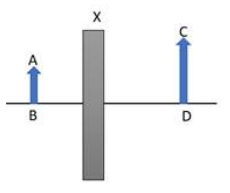
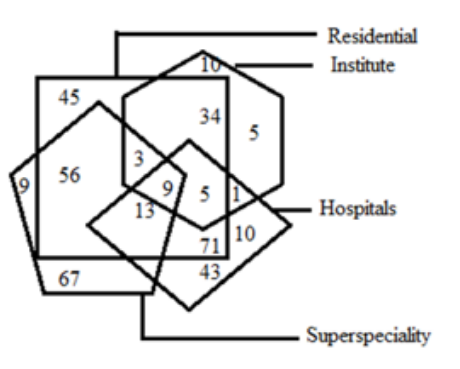
Question 85

Baisakhi festival is celebrated in the month of ______ in India.

  1. AOption (a)

    March

  2. BOption (b)

    April

  3. COption (c)

    January

  4. DOption (d)

    February

View answer & explanation

Correct answer

Answer: (b)B.

April

Why this answer is correct

The correct answer is April

Key Points

  • Baisakhi is celebrated in the month of April every year in India.
  • It marks the beginning of the harvest season for the rabi crops.
  • This festival is also significant for Sikhs as it commemorates the formation of the Khalsa in 1699 by Guru Gobind Singh.
  • It is celebrated with great enthusiasm, especially in the state of Punjab.
  • People participate in processions, fairs, and perform the traditional Bhangra dance.

Additional Information

  • Baisakhi is also known as Vaisakhi in some regions.
  • It is observed on 13th or 14th April each year.
  • In addition to Punjab, Baisakhi is celebrated in various parts of India, including Haryana, Himachal Pradesh, and Uttarakhand.
  • It is considered an auspicious day for new beginnings and many people take a holy dip in rivers.
  • In rural areas, it is a time for community gatherings and traditional sports.

Question 86

Study the given Venn diagram and answer the question that follows.

How many residential super-specialty hospitals are institutes?

  1. AOption (a)

    13

  2. BOption (b)

    5

  3. COption (c)

    3

  4. DOption (d)

    9

View answer & explanation

Correct answer

Answer: (d)D.

9

Why this answer is correct

The given Venn diagram:

The shaded region shows the number of residential super-specialty institutes

So, the number of residential super-specialty institutes are '9'.

Hence the correct answer is "Option 4".

Question 87

Which of the following options is the closest approximate value which will come in place of question mark (?) in the following equation?

14.96 + 10.96 + 13.16 - 12.89 × 2.04 + 24.93 ÷ 5.1 = ?

  1. AOption (a)

    20

  2. BOption (b)

    16

  3. COption (c)

    18

  4. DOption (d)

    22

View answer & explanation

Correct answer

Answer: (c)C.

18

Why this answer is correct

Given:

14.96 + 10.96 + 13.16 - 12.89 × 2.04 + 24.93 ÷ 5.1 = ?

Formula used:

Basic arithmetic operations

Calculation:

14.96 + 10.96 + 13.16 - 12.89 × 2.04 + 24.93 ÷ 5.1 = ?

⇒ 14.96 + 10.96 + 13.16 - 26.2956 + 4.89

⇒ 14.96 + 10.96 + 13.16 + 4.89 - 26.2956

⇒ 43.97 - 26.2956

⇒ 17.6744

∴ The correct answer is option (3).

Question 88

If (sin β + cosec β)2 + (sec β - cos β)2 = a + tan2 β + cot2 β, then the value of a is:

  1. AOption (a)

    2

  2. BOption (b)

    5

  3. COption (c)

    0

  4. DOption (d)

    3

View answer & explanation

Correct answer

Answer: (d)D.

3

Why this answer is correct

Shortcut Trick

Put β = 45° in the given equation.

LHS = (1/√2 + √2)2 + (√2 − 1/√2)2 = (3/√2)2 + (1/√2)2 = 9/2 + 1/2 = 5

RHS = a + tan2 45° + cot2 45° = a + 1 + 1 = a + 2

Equating LHS and RHS: a + 2 = 5 ⇒ a = 3

∴ The correct answer is 3.

Alternate Method

Given:

(sin β + cosec β)2 + (sec β − cos β)2 = a + tan2 β + cot2 β

Formula Used:

(a + b)2 = a2 + b2 + 2ab

(a − b)2 = a2 + b2 − 2ab

sin2 β + cos2 β = 1

sec2 β = 1 + tan2 β

cosec2 β = 1 + cot2 β

Calculations:

⇒ LHS = (sin2 β + cosec2 β + 2 × sin β × cosec β) + (sec2 β + cos2 β − 2 × sec β × cos β)

⇒ LHS = sin2 β + cosec2 β + 2 + sec2 β + cos2 β − 2

⇒ LHS = (sin2 β + cos2 β) + cosec2 β + sec2 β

⇒ LHS = 1 + (1 + cot2 β) + (1 + tan2 β)

⇒ LHS = 3 + tan2 β + cot2 β

⇒ 3 + tan2 β + cot2 β = a + tan2 β + cot2 β

⇒ a = 3

∴ The correct answer is 3.

Additional Information

Pythagorean Identities

sin2 θ + cos2 θ = 1, 1 + tan2 θ = sec2 θ, 1 + cot2 θ = cosec2 θ

Reciprocal Trigonometric Ratios

sin θ = 1 ÷ cosec θ, cos θ = 1 ÷ sec θ, tan θ = 1 ÷ cot θ

Important Result

(sin θ + cosec θ)2 + (cos θ + sec θ)2 = 7 + tan2 θ + cot2 θ

Question 89

Study the given pie-chart and answer the question that follows.

The pie-chart presents the percentage of law students enrolled in different colleges of Agra district.

If the total number of law students in the district is 23786, how many students are studying in colleges A, D and G taken together? (approximately)

  1. AOption (a)

    9520

  2. BOption (b)

    9514

  3. COption (c)

    10701

  4. DOption (d)

    7134

View answer & explanation

Correct answer

Answer: (b)B.

9514

Why this answer is correct

Given:

Total number of law students in the district = 23786

Percentage of students in colleges A, D, and G:

College A = 17%

College D = 9%

College G = 14%

Formula used:

Number of students in a college = (Percentage of students in the college / 100) × Total number of students in the district

Calculation:

Number of students in College A:

⇒ 17100×23786\dfrac{17}{100} \times 23786

⇒ 0.17 × 23786 = 4043.62

Number of students in College D:

⇒ 9100×23786\dfrac{9}{100} \times 23786

⇒ 0.09 × 23786 = 2140.74

Number of students in College G:

⇒ 14100×23786\dfrac{14}{100} \times 23786

⇒ 0.14 × 23786 = 3330.04

Total number of students in colleges A, D, and G:

⇒ 4043.62 + 2140.74 + 3330.04 = 9514.40

∴ The correct answer is option (2).

Question 90

Given below is a decision followed by two statements I and II. Read the information carefully and select the correct option.

Decision:

The state government has decided to start free education programs for all uneducated females living in villages in order to provide them with basic education.

Statements:

I. Similar programs in other states had resulted in 63% more employed women in just 2 years.

II. Some of the women in the said state, currently have children below 5 years of age, due to which they do not have much free time.

  1. AOption (a)

    Both statements I and II strengthen the decision.

  2. BOption (b)

    Statement I strengthens the decision but statement II is neutral.

  3. COption (c)

    Both statements I and II weaken the decision.

  4. DOption (d)

    Statement I is neutral but statement II weakens the decision.

View answer & explanation

Correct answer

Answer: (b)B.

Statement I strengthens the decision but statement II is neutral.

Why this answer is correct

Given,

Decision:

The state government has decided to start free education programs for all uneducated females living in villages in order to provide them with basic education.

Statements:

I. Similar programs in other states had resulted in 63% more employed women in just 2 years.

II. Some of the women in the said state, currently have children below 5 years of age, due to which they do not have much free time.

So,

Statement I strengthens the decision because it provides evidence that similar programs have been successful in other states, leading to a significant increase in the employment rate of women.

Statement II is neutral because it highlights a potential challenge but does not directly weaken the overall decision to start free education programs for uneducated females.

Hence, the correct answer is Option 2.

Question 91

In 1993, the Government of India established an institution, the NHRC, to monitor the violations of human rights. What is the full form of NHRC?

  1. AOption (a)

    National Hindu Rights Commission

  2. BOption (b)

    National Human Rights Constitution

  3. COption (c)

    National Human Rights Commission

  4. DOption (d)

    National Human Rights Committee

View answer & explanation

Correct answer

Answer: (c)C.

National Human Rights Commission

Why this answer is correct

The correct answer is National Human Rights Commission

Key Points

  • The National Human Rights Commission (NHRC) was established in 1993 by the Government of India.
  • NHRC is responsible for the protection and promotion of human rights in India.
  • Human rights are defined as the rights relating to life, liberty, equality, and dignity of the individual guaranteed by the Constitution or embodied in the international covenants and enforceable by courts in India.
  • The NHRC investigates complaints regarding the violation of human rights and provides recommendations to the government for the effective implementation of human rights protections.
  • NHRC also reviews the factors, including acts of terrorism, that inhibit the enjoyment of human rights and recommends appropriate remedial measures.

Additional Information

  • The NHRC was established under the Protection of Human Rights Act, 1993.
  • The Commission is composed of a Chairperson and other members appointed by the President of India.
  • The Chairperson of NHRC should be a retired Chief Justice of India, and other members should be serving or retired judges of the Supreme Court, Chief Justices of High Courts, and persons having knowledge or practical experience in matters relating to human rights.
  • The Commission also works in coordination with state human rights commissions to ensure the protection and promotion of human rights across the country.

Question 92

When magnetic field is acting towards north and current is moving in east to west direction through a conductor, then the conductor will move  ______ direction

  1. AOption (a)

    towards left

  2. BOption (b)

    in the downward

  3. COption (c)

    in the upward

  4. DOption (d)

    towards right

View answer & explanation

Correct answer

Answer: (b)B.

in the downward

Why this answer is correct

The correct answer is in the downward

Key Points

  • When a magnetic field is acting towards the north and the current is moving from east to west through a conductor, the conductor will experience a force due to the interaction of the magnetic field and the current.
  • This phenomenon is explained by the Fleming's Left-Hand Rule, which helps determine the direction of the force acting on a current-carrying conductor in a magnetic field.
  • According to Fleming's Left-Hand Rule, if you align your left hand with the thumb pointing in the direction of the current (east to west), the forefinger pointing in the direction of the magnetic field (north), then the middle finger will point in the direction of the force (downward).
  • Therefore, the conductor will move in the downward direction.

Additional Information

  • Fleming's Left-Hand Rule is a visual mnemonic used in physics to predict the direction of the force exerted on a current-carrying conductor in a magnetic field.
  • The rule states that if you hold your left hand with the thumb, forefinger, and middle finger mutually perpendicular to each other, with the thumb pointing in the direction of the current, the forefinger in the direction of the magnetic field, the middle finger will point in the direction of the force or motion.
  • This principle is crucial in the functioning of electric motors, where the interaction between the magnetic field and the current produces motion.
  • Understanding the direction of forces in magnetic fields is essential for designing and operating various electrical devices and systems.

Question 93

The 'SMILE' Scheme, which is a Central Sector Scheme, an acronym of 'Support for Marginalised Individuals for Livelihood and Enterprise' was launched in February 2022 by the Union Minister for Social Justice and Empowerment, ______, in Delhi.

  1. AOption (a)

    Amit Shah

  2. BOption (b)

    Smriti Zubin Iran

  3. COption (c)

    Arjun Munda

  4. DOption (d)

    Virendra Kumar

View answer & explanation

Correct answer

Answer: (d)D.

Virendra Kumar

Why this answer is correct

The correct answer is Virendra Kumar

Key Points

  • The 'SMILE' Scheme is a Central Sector Scheme launched to support marginalized individuals for livelihood and enterprise.
  • It was launched in February 2022 by the Union Minister for Social Justice and Empowerment, Virendra Kumar, in Delhi.
  • The scheme is aimed at providing welfare and rehabilitation to the marginalized sections of society, focusing on their socio-economic upliftment.
  • Key components of the scheme include providing education, skill development, and entrepreneurship opportunities to the beneficiaries.
  • The scheme is expected to create a significant impact on the lives of marginalized individuals by offering them sustainable livelihood options.

Additional Information

  • The Ministry of Social Justice and Empowerment is responsible for the implementation of the SMILE scheme.
  • The scheme aligns with the government's vision of 'Sabka Saath, Sabka Vikas, Sabka Vishwas' (Collective Efforts, Inclusive Growth, Trust of All).
  • Various stakeholders, including NGOs and state governments, are involved in the execution of the scheme to ensure its wide reach and effectiveness.
  • The scheme also focuses on providing health care services and legal support to the beneficiaries.
  • Periodic reviews and monitoring mechanisms are in place to assess the progress and impact of the scheme on the targeted population.

Question 94

The first member of the alkyne group of hydrocarbons is :

  1. AOption (a)

    propyne

  2. BOption (b)

    ethyne

  3. COption (c)

    methyne

  4. DOption (d)

    butyne

View answer & explanation

Correct answer

Answer: (b)B.

ethyne

Why this answer is correct

The correct answer is ethyne

Key Points

  • The first member of the alkyne group of hydrocarbons is ethyne.
  • Alkynes are hydrocarbons that contain at least one carbon-carbon triple bond.
  • Ethyne, also known as acetylene, has the chemical formula C2H2.
  • It is the simplest alkyne and is used in welding and as a raw material in the chemical industry.

Additional Information

  • Alkynes are part of the larger family of hydrocarbons, which also includes alkanes and alkenes.
  • The general formula for alkynes is CnH2n-2, where n is the number of carbon atoms.
  • Alkynes are unsaturated hydrocarbons, meaning they have fewer hydrogen atoms attached to the carbon chain compared to alkanes.
  • They exhibit unique chemical properties due to the presence of the triple bond, making them useful in various chemical reactions and industrial applications.

Question 95

The cost of 2 tables and 3 chairs is ₹540, while that of 2 tables and 1 chair is ₹470. What is the cost of 5 chairs?

  1. AOption (a)

    ₹205

  2. BOption (b)

    ₹185

  3. COption (c)

    ₹245

  4. DOption (d)

    ₹175

View answer & explanation

Correct answer

Answer: (d)D.

₹175

Why this answer is correct

Shortcut Trick

Difference in quantity of items: (2 tables + 3 chairs) − (2 tables + 1 chair) = 2 chairs.

Difference in price: ₹540 − ₹470 = ₹70.

Therefore, price of 2 chairs = ₹70 ⇒ price of 1 chair = ₹35.

Required: Cost of 5 chairs = 5 × 35 = ₹175.

∴ The correct answer is ₹ 175.

Alternate Method

Given:

Let the cost of one table be T and the cost of one chair be C.

  1. 2T + 3C = 540

  2. 2T + 1C = 470

Subtracting equation (2) from equation (1):

⇒ (2T + 3C) − (2T + C) = 540 − 470

⇒ 2C = 70

⇒ C = 70 ÷ 2

⇒ C = 35

Now, calculate the cost of 5 chairs:

⇒ 5 × C = 5 × 35

⇒ 5C = 175

∴ The correct answer is ₹ 175.

Additional Information

Elimination Method

A technique to solve systems of linear equations by adding or subtracting them to eliminate one variable, making it easier to solve for the other.

Unitary Method

Finding the value of a single unit (like one chair) first, then multiplying by the desired quantity to find the total value.

Cost Price Relations

Total Cost = (Price per Unit × Quantity1) + (Price per Unit × Quantity2). Comparison of such totals helps identify individual prices.

Question 96

While returning home from school Rana misdirected from his way. From school he first walked for 3 km towards the south and then turned left and walked for 2 km. From there, he turned towards the left and further walked for 3 km. Finally he again turned to his left and walked for 1 km to reach his home. In which direction is his home from school?

(All turns are 90 degree turns only)

  1. AOption (a)

    South

  2. BOption (b)

    East

  3. COption (c)

    West

  4. DOption (d)

    North

View answer & explanation

Correct answer

Answer: (b)B.

East

Why this answer is correct

Given: While returning home from school Rana misdirected from his way.

From school he first walked for 3 km towards the south and then turned left and walked for 2 km.

From there, he turned towards the left and further walked for 3 km.

Finally he again turned to his left and walked for 1 km to reach his home.

So, Home is in east direction from school

Hence the correct answer is "Option 2".

Question 97

If 9.6 : 16.8 :: 18 : x, what is the value of x?

  1. AOption (a)

    20.4

  2. BOption (b)

    25.5

  3. COption (c)

    31.5

  4. DOption (d)

    24.8

View answer & explanation

Correct answer

Answer: (c)C.

31.5

Why this answer is correct

Shortcut Trick

In a proportion a : b :: c : d, the Product of extremes = Product of means.

⇒ 9.6 × x = 16.8 × 18

⇒ x = (16.8 × 18) ÷ 9.6

⇒ x = (168 × 18) ÷ 96 = 21 × 1.5 = 31.5

∴ The correct answer is 31.5.

Alternate Method

Given: 9.6 : 16.8 :: 18 : x

Formula Used: a/b = c/d

⇒ 9.6 ÷ 16.8 = 18 ÷ x

⇒ x = (18 × 16.8) ÷ 9.6

⇒ x = (18 × 168) ÷ 96

⇒ x = (18 × 7) ÷ 4

⇒ x = 126 ÷ 4

⇒ x = 31.5

∴ The correct answer is 31.5.

Additional Information

Fourth Proportional

If a, b, and c are three numbers, then the fourth proportional x is calculated as d = (b × c) ÷ a.

Mean Proportional

The mean proportional between two numbers a and b is given by √(a × b).

Third Proportional

If a : b :: b : c, then c is called the third proportional and c = b2 ÷ a.

Question 98

Which is the correct formula for median of grouped data?

Consider:

L = lower limit of median class

CF0 = cumulative frequency of preceding class

F = frequency of median class

H = class width

N = the total of frequency

  1. AOption (a)

    N2−,CF0F×,H\frac{{\frac{{\rm{N}}}{{\rm{2}}}{\rm{ - }},{\rm{C}}{{\rm{F}}_{\rm{0}}}}}{{\rm{F}}}{\rm{ \times }},{\rm{H}}

  2. BOption (b)

    L,+,N2,,−,,CF0−F,×,H{\rm{L}},{\rm{ + }},\frac{{\rm{N}}}{{\rm{2}}},,{\rm{ - }},,{\rm{C}}{{\rm{F}}_{\rm{0}}}{\rm{ - F}},{\rm{ \times }},{\rm{H}}

  3. COption (c)

    L,+,N2,,−,,CF0F,×,H{\rm{L}},{\rm{ + }},\frac{{\frac{{\rm{N}}}{{\rm{2}}},,{\rm{ - }},,{\rm{C}}{{\rm{F}}_{\rm{0}}}}}{{\rm{F}}},{\rm{ \times }},{\rm{H}}

  4. DOption (d)

    L,+,N2,,−,,CF0F{\rm{L}},{\rm{ + }},\frac{{\frac{{\rm{N}}}{{\rm{2}}},,{\rm{ - }},,{\rm{C}}{{\rm{F}}_{\rm{0}}}}}{{\rm{F}}}

View answer & explanation

Correct answer

Answer: (c)C.

L,+,N2,,−,,CF0F,×,H{\rm{L}},{\rm{ + }},\frac{{\frac{{\rm{N}}}{{\rm{2}}},,{\rm{ - }},,{\rm{C}}{{\rm{F}}_{\rm{0}}}}}{{\rm{F}}},{\rm{ \times }},{\rm{H}}

Why this answer is correct

Shortcut Trick

To find the Median of grouped data, first locate the Median Class where the cumulative frequency is just greater than or equal to N/2.

The formula interpolates the median value within this class using the Lower Limit (L) and Class Width (H).

The correct structure is: L + [((N/2) − CF0) ÷ F] × H.

∴ The correct answer is L + [((N/2) − CF0) / F] × H.

Alternate Method

Given Parameters:

L = Lower limit of the median class

N = Total frequency (Total number of observations)

CF0 = Cumulative frequency of the class preceding the median class

F = Frequency of the median class

H = Width of the class interval

The Median formula for grouped data is derived from the linear interpolation of the values within the median class interval.

⇒ Median = Lower Limit + [(Half of Total Frequency − Preceding Cumulative Frequency) ÷ Frequency of Median Class] × Class Width

⇒ Median = L + [((N/2) − CF0) ÷ F] × H

∴ The correct answer is L + [((N/2) − CF0) / F] × H.

Additional Information

Mode for Grouped Data

The value that appears most frequently: Mode = L + [(f1 − f0) / (2f1 − f0 − f2)] × H, where f1 is the modal class frequency.

Mean for Grouped Data (Direct Method)

The average value: Mean (χ) = ∑(fi × xi) / ∑fi, where xi is the class mark (mid-point).

Empirical Relationship

For a moderately skewed distribution: 3 × Median = Mode + 2 × Mean.

Cumulative Frequency (CF)

Obtained by adding the frequencies of all previous classes to the frequency of the current class.

Question 99

In which year was Bandhan Financial Services, a micro lender based out of Kolkata granted in-principle approval by RBI to start a universal bank?

  1. AOption (a)

    2010

  2. BOption (b)

    2018

  3. COption (c)

    2004

  4. DOption (d)

    2014

View answer & explanation

Correct answer

Answer: (d)D.

2014

Why this answer is correct

The correct answer is 2014

Key Points

  • 2014 was the year when Bandhan Financial Services, a micro lender based out of Kolkata, was granted in-principle approval by the Reserve Bank of India (RBI) to start a universal bank.
  • Bandhan Financial Services was among the two entities that received this approval in 2014, the other being IDFC Limited.
  • This approval marked a significant step in Bandhan’s transition from a microfinance institution to a full-fledged bank.
  • The objective was to enhance financial inclusion and provide a wider range of banking services to its customers.

Additional Information

  • Bandhan Bank officially commenced its banking operations on August 23, 2015.
  • It was the first instance in over a decade that the RBI had granted a banking license to a microfinance institution.
  • Bandhan Bank's establishment aimed at catering to the unbanked and underbanked population in India, with a focus on the eastern and northeastern regions.
  • As of now, Bandhan Bank has grown significantly, expanding its branch network and diversifying its financial services portfolio.

Question 100

Direction of rotation of armature of motor can be found with the help of ______.

  1. AOption (a)

    Fleming's right-hand rule

  2. BOption (b)

    Fleming's left-hand rule

  3. COption (c)

    Maxwell's corkscrew rule

  4. DOption (d)

    Right hand thumb rule

View answer & explanation

Correct answer

Answer: (b)B.

Fleming's left-hand rule

Why this answer is correct

The correct answer is Fleming's left-hand rule

Key Points

  • Fleming's left-hand rule is used to determine the direction of rotation of the armature in a motor.
  • According to this rule, if you align your left hand such that the thumb, forefinger, and middle finger are mutually perpendicular to each other, the thumb represents the direction of the thrust or motion, the forefinger represents the direction of the magnetic field, and the middle finger represents the direction of the current.
  • This rule is specifically applicable to electric motors, where the direction of force (motion) on the conductor is determined by the magnetic field and the current.

Additional Information

  • Fleming's right-hand rule is used for generators and is not applicable for motors.
  • Maxwell's corkscrew rule and Right hand thumb rule are used in different contexts, such as determining the direction of the magnetic field around a current-carrying conductor.

100 questions in the full paper