Previous Year Paper

RRB Group D Previous Year Paper (Held on: 8 Sept 2022 Shift 1)

Held in 2022

100 questions90 minutes
With answers
Free

Paper last updated:

Practise under exam conditions

Take this paper as a timed mock test. Review your answers after you submit.

Attempt timed test

Questions & answers

Read the paper at your pace. Open an explanation when you need it.

CBT (100 questions)

Question 1

Consider the following statements about a commercial motor:

(a) It uses an electromagnet in place of a permanent magnet.

(b) It uses a soft-iron core.

Which of the following statements is/are correct?

  1. AOption (a)

    Both (a) and (b)

  2. BOption (b)

    Only (b)

  3. COption (c)

    Only (a)

  4. DOption (d)

    Neither (a) nor (b)

View answer & explanation

Correct answer

Answer: (a)A.

Both (a) and (b)

Why this answer is correct

The correct answer is Both (a) and (b).

Key Points

  • A commercial electric motor is one which uses the following:
  • An electromagnet in place of permanent magnet.
  • Large number of turns of the conducting wire in the current carrying coil.
  • A soft iron core on which the coil is wound.
  • The combination of soft iron core and coil is called an armature.
  • It enhances the power of motor.
  • Thus, commercial electric motors do not use permanent magnet to rotate the armature because permanent magnets are weak and do not produce strong magnetic field in the region.
  • Commercial electric motors require large magnetic field which they obtain using a solenoid having large number of turns with a soft iron core at the centre.
  • The magnetic field due to solenoid is: Bα;nIB\alpha ;nI
  • Large number of turns (n) provide large magnetic field at the center.
  • A permanent magnet is a weak magnet which is unable to provide the large magnetic field require for commercial applications.
Question 2

The sum of the age of A and twice the age of B is 42 years. When two times the age of A is added to three times the age of B, the result is 69 years. The sum of the ages (in years) of A and B is:

  1. AOption (a)

    27

  2. BOption (b)

    30

  3. COption (c)

    31

  4. DOption (d)

    29

View answer & explanation

Correct answer

Answer: (a)A.

27

Why this answer is correct

Shortcut Trick

Subtract the first equation from the second equation directly.

(2A + 3B) − (A + 2B) = 69 − 42

A + B = 27

∴ The correct answer is 27 years.

Alternate Method

Given:

Let the age of A be 'A' and the age of B be 'B'.

⇒ A + 2B = 42 --- (Equation 1)

⇒ 2A + 3B = 69 --- (Equation 2)

Calculations:

Subtracting (Equation 1) from (Equation 2):

⇒ (2A + 3B) − (A + 2B) = 69 − 42

⇒ 2A − A + 3B − 2B = 27

⇒ A + B = 27

∴ The correct answer is 27 years.

Additional Information

Linear Equations in Two Variables

Equations of the form ax + by = c can be solved using elimination or substitution methods to find individual values.

Sum and Difference Logic

If asked for a composite value like (A+B) or (A−B), always check if direct addition or subtraction of the given equations yields the result faster.

Age Problems

The difference between the ages of two people remains constant over time, regardless of how many years pass.

Question 3

The Eleventh Schedule to the Constitution of India lists _______ subjects.

  1. AOption (a)

    23

  2. BOption (b)

    21

  3. COption (c)

    26

  4. DOption (d)

    29

View answer & explanation

Correct answer

Answer: (d)D.

29

Why this answer is correct

The correct answer is 29.

 Key Points

  • The Eleventh Schedule of the Constitution relating to the Panchayats contains 29 items.
  • It contains provisions related to the three-tier Panchyati Raj system.
  • This schedule was added to the Indian constitution by the 73rd amendment act 1992 which came into effect on 24-April-1993.
  • While Rajasthan was the first state to introduce the Panchayati Raj system in 1959, Madhya Pradesh was the first to enact legislation in conformity with the 73rd Amendment.

Important Points

Some of the items mentioned in the schedule are:

  • Agriculture, including agricultural extension
  • Land improvement, implementation of land reforms, land consolidation and soil conservation
  • Animal husbandry, dairying and poultry
  • Fisheries
  • Social forestry and farm forestry
  • Minor forest produce
  • Rural housing
  • Drinking water
  • Fuel and fodder
  • Rural electrification, including distribution of electricity
  • Health and sanitation including hospitals, primary health centers and dispensaries
  • Family welfare
  • Women and child development
  • Social welfare, including the welfare of the handicapped and mentally retarded
  • The welfare of the weaker sections, and in particular, of the scheduled castes and the scheduled tribes.

Additional Information

  • Madhya Pradesh was the first state to implement Panchayati Raj System under the 73rd amendment act 1992.
  • Panchayati Raj is included in the 40th Article of the Indian constitution.
  • The three-tier system of the Panchayati Raj system was recommended by the Balwantrai Mehta committee.
  • There are a total of 12 schedules in the Indian constitution.

Question 4

Seven people are sitting in a straight row all facing towards north. E is not an immediate neighbour of M and N. N is also not an immediate neighbour of M. M is sitting 4th to the right of L. I is sitting on extreme right end of the row. N is sitting fourth to the left of B. P is sitting third to the left of M and second to the right of N. Who is sitting at extreme left end?

  1. AOption (a)

    E

  2. BOption (b)

    I

  3. COption (c)

    P

  4. DOption (d)

    N

View answer & explanation

Correct answer

Answer: (d)D.

N

Why this answer is correct

Given: Seven people are sitting in a straight row all facing towards north. 

1) I is sitting on extreme right end of the row.

2) P is sitting third to the left of M and second to the right of N. 

3) M is sitting 4th to the right of L.

4) N is also not an immediate neighbour of M.

5) N is sitting fourth to the left of B.

6) E is not an immediate neighbour of M and N.

Thus, according to the final arrangement N is sitting at extreme left end.

Hence, "Option 4" is the correct answer.

Question 5

Six years ago, the average age of L and M was 39 years and the average of the present ages of L, M and N is 54 years. What will be the age of N 5 years from now?

  1. AOption (a)

    92 years

  2. BOption (b)

    72 years

  3. COption (c)

    77 years

  4. DOption (d)

    97 years

View answer & explanation

Correct answer

Answer: (c)C.

77 years

Why this answer is correct

Shortcut Trick

Current average of L and M = 39 + 6 = 45 years.

Total age of L, M, and N = 54 × 3 = 162 years.

Total age of L and M = 45 × 2 = 90 years.

Present age of N = 162 − 90 = 72 years.

Age of N after 5 years = 72 + 5 = 77 years.

∴ The correct answer is 77 years.

Alternate Method

Given: Average age of L and M (6 years ago) = 39 years.

Given: Average age of L, M, and N (Present) = 54 years.

Formula: Total Sum = Average × Number of entities

⇒ Sum of ages of L and M (6 years ago) = 39 × 2 = 78 years.

⇒ Present sum of ages of L and M = 78 + (6 × 2) = 78 + 12 = 90 years.

⇒ Present sum of ages of L, M, and N = 54 × 3 = 162 years.

⇒ Present age of N = (L + M + N) − (L + M) = 162 − 90 = 72 years.

⇒ Age of N after 5 years = 72 + 5 = 77 years.

∴ The correct answer is 77 years.

Additional Information

Average Age Shift

If the average age of n people is X now, then after k years, the average age will be X + k.

Total Sum of Ages

To find the total age from an average, always use the relation: Sum = Average × Count.

Age of a New Member

New member age = (New Average × New Strength) − (Old Average × Old Strength).

Question 6

Select the option that is related to the fifth number in the same way as the second number is related to the first number and the fourth number is related to the third number.

4 : 20 :: 15 : 240 :: 19 : ?

  1. AOption (a)

    380

  2. BOption (b)

    390

  3. COption (c)

    388

  4. DOption (d)

    391

View answer & explanation

Correct answer

Answer: (a)A.

380

Why this answer is correct

The logic followed here is:

Logic: (1st number × (1st number + 1)) = 2nd number.

Now,

For, 4 : 20

⇒ 4 × (4 + 1) = 4 × 5 = 20.

For, 15 : 240

⇒ 15 × (15 + 1) = 15 × 16 = 240.

Similarly, for 19 : ?

⇒ 19 × (19 + 1) = 19 × 20 = 380.

Hence, the correct answer is "Option 1".

Question 7

The circumference of the base of a solid right circular cylinder is 136.4 cm and its height is 50 cm. What is the volume (in cm3) of the cylinder? (Take π = (22)/(7)).

  1. AOption (a)

    10571

  2. BOption (b)

    31713

  3. COption (c)

    73997

  4. DOption (d)

    63426

View answer & explanation

Correct answer

Answer: (c)C.

73997

Why this answer is correct

Shortcut Trick

Check for divisibility by 11 as the Volume of a Cylinder formula involves π (22/7).

Option 3: 7 + 9 + 7 = 23; 3 + 9 = 12; Difference = 23 − 12 = 11 (Divisible by 11).

Calculated Radius (r) from circumference 136.4 cm ≈ 21.7 cm.

Volume ≈ (22/7) × 21.7 × 21.7 × 50 ≈ 73997 cm3.

∴ The correct answer is 73997 cm3.

Alternate Method

Given: Circumference = 136.4 cm, Height (h) = 50 cm, π = 22/7.

Formula Used: Circumference = 2πr; Volume = πr2h

⇒ 2 × (22/7) × r = 136.4

⇒ r = (136.4 × 7) ÷ (2 × 22)

⇒ r = 31.15 × 0.7 = 21.7 cm

⇒ Volume = (22/7) × 21.7 × 21.7 × 50

⇒ Volume = 22 × 3.1 × 21.7 × 50

⇒ Volume = 73997 cm3

∴ The correct answer is 73997 cm3.

Additional Information

Curved Surface Area (CSA)

The area of the side surface of the cylinder is 2πrh.

Total Surface Area (TSA)

The sum of CSA and the area of two circular bases is 2πr(h + r).

Hollow Cylinder Volume

The volume of material in a hollow cylinder is π(R2 − r2)h, where R is outer and r is inner radius.

Question 8

Gopal went to a bank to withdraw Rs. 4,000. He asked the cashier to give the cash in Rs. 50 and Rs. 100 notes only. Gopal got 50 notes in all. How many Rs. 50 notes did he receive?

  1. AOption (a)

    20

  2. BOption (b)

    24

  3. COption (c)

    32

  4. DOption (d)

    30

View answer & explanation

Correct answer

Answer: (a)A.

20

Why this answer is correct

Shortcut Trick

Assume all 50 notes were ₹100 notes: Total value = 50 × 100 = ₹5,000.

Excess value over actual amount = 5,000 − 4,000 = ₹1,000.

Difference between note denominations = 100 − 50 = ₹50.

Number of ₹50 notes = 1,000 ÷ 50 = 20.

∴ The correct answer is 20.

Alternate Method

Given:

Total amount withdrawn = ₹4,000

Total notes received = 50

Let the number of ₹50 notes be x and the number of ₹100 notes be y.

Average value per note:

⇒ Mean Value = 4,000 ÷ 50 = ₹80

Using the Alligation Method:

⇒ (Number of ₹50 notes) : (Number of ₹100 notes) = (100 − 80) : (80 − 50)

⇒ Ratio = 20 : 30 = 2 : 3

⇒ Sum of ratio parts = 2 + 3 = 5 units

⇒ 5 units = 50 notes

⇒ 1 unit = 10 notes

⇒ Number of ₹50 notes = 2 × 10 = 20

∴ The correct answer is 20.

Additional Information

Linear Equations in Two Variables

Solve using x + y = Total Quantity and (Value1 × x) + (Value2 × y) = Total Value.

Alligation Rule

The ratio of quantities is the inverse difference of their values from the mean: Q1/Q2 = (N2 − Mean)/(Mean − N1).

Substitution Method

Express one variable in terms of the other (e.g., y = 50 − x) and substitute it into the value equation to solve for x.

Question 9

What will come in place of the question mark (?) in the following equation, if '+' and '-' are interchanged and also '×' and '÷' are interchanged?

17 ÷ 5 + 216 × 3 + 33 - 930 × 3 + 28 = ?

  1. AOption (a)

    246

  2. BOption (b)

    222

  3. COption (c)

    232

  4. DOption (d)

    262

View answer & explanation

Correct answer

Answer: (d)D.

262

Why this answer is correct

Given : 17 ÷ 5 + 216 × 3 + 33 - 930 × 3 + 28 = ?

According to the question, '+' and '-' are interchanged and also '×' and '÷' are interchanged:

17 ÷ 5 + 216 × 3 + 33 - 930 × 3 + 28 = ? ⇒ 17 × 5 - 216 ÷ 3 - 33 + 930 ÷ 3 - 28 = ?

⇒ 17 × 5 - 216 ÷ 3 - 33 + 930 ÷ 3 - 28 = ?

⇒ 17 × 5 - 72 - 33 + 310 - 28 = ?

⇒ 85 + 310 - 72 - 33 - 28 = ?

⇒ 395 - 72 - 33 - 28 = ?

⇒ 262 = ?

Hence, "Option 4" is the correct answer.

Question 10

Which Indian River that starts from Gangotri is polluted largely by human activities and industries?

  1. AOption (a)

    Brahmaputra

  2. BOption (b)

    Cauvery

  3. COption (c)

    Krishna

  4. DOption (d)

    Ganga

View answer & explanation

Correct answer

Answer: (d)D.

Ganga

Why this answer is correct

The correct answer is Ganga.

Key Points

  • Almost 75% of pollution in the river Ganga is due to untreated discharge of sewage wastewater from rapidly-growing urban settlements along the river.
  • Most of the water used is discharged as waste water.
  • The waste water contains toxic substances which deplete the Oxygen content of the clean river water in which they are discharged.
  • The Ganga at Kanpur, Uttar Pradesh has most polluted stretches of Ganga river.
  • Kanpur is one of most populated towns in U.P. People wash clothes, bath, urinate and discharge sewage in the water bodies leading to its contamination.

Additional Information

  • River Ganga:
  • River Ganga is a transboundary river that flows through India and Bangladesh.
  • The Upper Ganga canal starts from the Bhimgoda Barrage near Harki Pauri at Haridwar.
  • Sources of river Ganga are: Gangotri Glacier, Satopanth Glacier, Kedarnath, Trisul, Kamet, Nanda Kot
  • Tributaries of river Ganga are: Yamuna, Bhagirathi Tamsa, Son, Punpun, Kiul, Karamnasa, Chandan, Damodar etc.

Question 11

If the angles (3x - 5)º and 80º form a pair of supplementary angles, then the value of x is:

  1. AOption (a)

    45º

  2. BOption (b)

    35º

  3. COption (c)

    50º

  4. DOption (d)

    90º

View answer & explanation

Correct answer

Answer: (b)B.

35º

Why this answer is correct

Shortcut Trick

Supplementary angles always sum up to 180º.

Directly calculate: 3x − 5 = 180 − 80 = 100

3x = 105 ⇒ x = 35

∴ The correct answer is 35º.

Alternate Method

Given:

First angle = (3x − 5)º

Second angle = 80º

Formula Used:

If two angles are supplementary angles, their sum is equal to 180º.

Calculations:

According to the definition of supplementary angles:

⇒ (3x − 5)º + 80º = 180º

⇒ 3x − 5 + 80 = 180

⇒ 3x + 75 = 180

⇒ 3x = 180 − 75

⇒ 3x = 105

⇒ x = 105 ÷ 3

⇒ x = 35

Option Analysis:

⇒ If x = 45º, then 3(45) − 5 = 130º. Since 130º + 80º = 210º ≠ 180º, Option (1) is incorrect.

⇒ If x = 35º, then 3(35) − 5 = 100º. Since 100º + 80º = 180º, Option (2) is correct.

⇒ If x = 50º, then 3(50) − 5 = 145º. Since 145º + 80º = 225º ≠ 180º, Option (3) is incorrect.

⇒ If x = 90º, then 3(90) − 5 = 265º. Since 265º + 80º = 345º ≠ 180º, Option (4) is incorrect.

∴ The correct answer is 35º.

Additional Information

Supplementary Angles

Two angles are supplementary if the sum of their measures is exactly 180º. They form a straight angle when placed adjacent to each other.

Complementary Angles

Two angles are complementary if the sum of their measures is exactly 90º. For example, 30º and 60º are complementary angles.

Linear Pair of Angles

A linear pair is a pair of adjacent angles formed by two intersecting lines. The measure of a linear pair always adds up to 180º.

Question 12

Which of the following is a classical Dravidian language?

  1. AOption (a)

    Tamil

  2. BOption (b)

    Odia

  3. COption (c)

    Bengali

  4. DOption (d)

    Gujarati

View answer & explanation

Correct answer

Answer: (a)A.

Tamil

Why this answer is correct

The correct answer is Tamil.

Key Points

  • Dravidian languages are a family of around 70 languages spoken primarily in South Asia.
  • These languages are divided into 4 main groups:
  • South
  • South-Central
  • Central
  • North
  • These groups are further divided into 24 sub-groups.
  • The four major and classical Dravidian languages are:
  • Telugu
  • Tamil
  • Malayalam
  • Kannada

Additional Information

 Classical Languages: 

  • A classical language is a language with an independent literary tradition and a large and ancient body of written literature.
  • Classical languages are typically dead languages or show a high degree of diglossia, as the spoken varieties of the language diverge further away from the classical written language over time.
  • Six languages in India namely Tamil, Telugu, Sanskrit, Kannada, Malayalam, and Odia have been given the status of classical languages.
  • The first language to be accorded that status is Tamil. Tamil was declared the classical language back in 2004.
  • As per Schedule VIII of the Constitution of India, 22 languages have been recognized as Scheduled languages.

Question 13

The total expenditure of Krishna in a year is Rs. 4,20,000. If his salary per month is Rs. 45,000, then find his average savings per month.

  1. AOption (a)

    Rs. 12,000

  2. BOption (b)

    Rs. 10,000

  3. COption (c)

    Rs. 14,000

  4. DOption (d)

    Rs. 16,000

View answer & explanation

Correct answer

Answer: (b)B.

Rs. 10,000

Why this answer is correct

Shortcut Trick

Monthly Expenditure = Total Yearly Expenditure ÷ 12 = 4,20,000 ÷ 12 = ₹35,000

Average Monthly Savings = Monthly Salary − Monthly Expenditure

Average Monthly Savings = 45,000 − 35,000 = ₹10,000

∴ The correct answer is ₹10,000.

Alternate Method

Given:

Total annual expenditure = ₹4,20,000

Monthly salary of Krishna = ₹45,000

Formula Used:

Average Monthly Savings = (Total Annual Income − Total Annual Expenditure) ÷ 12

Calculations:

⇒ Total annual income = 45,000 × 12 = ₹5,40,000

⇒ Total annual savings = Total Income − Total Expenditure

⇒ Total annual savings = 5,40,000 − 4,20,000 = ₹1,20,000

⇒ Average monthly savings = 1,20,000 ÷ 12

⇒ Average monthly savings = ₹10,000

∴ The correct answer is ₹10,000.

Additional Information

Income, Expenditure and Savings Relation

The fundamental relation is Income = Expenditure + Savings. To find any one component, subtract the other from the total income.

Average Calculation

The average of a quantity over a period is the total sum of that quantity divided by the total number of time units (e.g., 12 months for a year).

Annual to Monthly Conversion

To convert an annual value to a monthly average, divide by 12. To convert a monthly value to an annual value, multiply by 12.

Question 14

A bulb draws a current of 5 A when connected to a battery of 12 V. The power of the bulb is: 

  1. AOption (a)

    60 W

  2. BOption (b)

    2.4 W

  3. COption (c)

    1.2 W

  4. DOption (d)

    0.41 W

View answer & explanation

Correct answer

Answer: (a)A.

60 W

Why this answer is correct

The correct answer is 60 W.

Key Points

Given:

The potential difference, V = 12V

Steady current flowing,  I = 5 A

Formula used:

Power(P) = Voltage(v) x current(l)

Calculation:

=> P = V x I

=> P= 12 x 5 = 60 W

Hence, the correct answer is '60 W'.

Additional Information

  • Potential difference:
  • It refers to the difference in electrical potential between two points in a circuit.
  • The electric potential difference between two points in an electric circuit carrying some current is the work done to move a unit charge from one point to the other.
  • The standard metric unit of electric potential difference is volt, abbreviated V.
  • The potential difference is also defined as the work done per unit charge. V=WQV=WQ
  • Resistance:
  • If the pure resistive element is present in the circuit, then the current is in phase with the voltage.
  • The power factor, in this case, is unity.
  • Inductance:
  • If the pure inductive element is present in the circuit, then the current lags the voltage by 90 degrees.
  • The power factor in this case is lagging.
  • Capacitance:
  • If the pure capacitive element is present in the circuit, then the current leads the voltage by 90 degrees.
  • The power factor, in this case, is leading.​

Question 15

Which of the following options is the closest approximate value which will come in place of question mark (?) in the following equation? 7.98 - (6.064 + 6.003 ÷ 6.003) + 2.003 - 1.02 = ?

  1. AOption (a)

    22

  2. BOption (b)

    8

  3. COption (c)

    12

  4. DOption (d)

    2

View answer & explanation

Correct answer

Answer: (d)D.

2

Why this answer is correct

Given:

Equation: 7.98 - (6.064 + 6.003 ÷ 6.003) + 2.003 - 1.02 = ?

Formula Used:

Basic arithmetic operations (addition, subtraction, division).

Calculation:

First, simplify the division inside the parentheses:

6.003 ÷ 6.003 = 1

Next, substitute this value back into the equation:

7.98 - (6.064 + 1) + 2.003 - 1.02

Simplify inside the parentheses:

6.064 + 1 = 7.064

Substitute this value back into the equation:

7.98 - 7.064 + 2.003 - 1.02

Perform the subtraction and addition step by step:

7.98 - 7.064 = 0.916

0.916 + 2.003 = 2.919

2.919 - 1.02 = 1.899

Therefore, the closest approximate value which will come in place of question mark (?) is 2.

Question 16

Amongst six friends B, I, H, J, O and U, each has a different height. H is taller than only four other friends. O is taller than only one friend. B is taller than U but shorter than J. J is not the tallest. Who is the shortest among all the friends?

  1. AOption (a)

    B

  2. BOption (b)

    U

  3. COption (c)

    H

  4. DOption (d)

    I

View answer & explanation

Correct answer

Answer: (b)B.

U

Why this answer is correct

Given: Six friends B, I, H, J, O, and U each has a different height.

  1. H is taller than only four other friends.

__ < H < __ < __ < __ < __ 

  1. O is taller than only one friend.

__ < H < __ < __ < O < __ 

  1. B is taller than U but shorter than J and J is not the tallest.

__ < H < J < B < O < U

So, the remaining person 'I' will be the tallest.

I < H < J < B < O < U

So, U is the shortest among them.

Hence, the correct answer is Option 2.

Question 17

In which of the following countries was the Men's T-20 ICC World Cup -2021 staged?

  1. AOption (a)

    South Africa-Namibia

  2. BOption (b)

    Oman- UAE

  3. COption (c)

    Sri Lanka-Maldives

  4. DOption (d)

    India -Bangladesh

View answer & explanation

Correct answer

Answer: (b)B.

Oman- UAE

Why this answer is correct

The correct answer is Oman- UAE.

Key Points 2021 ICC Men's T20 World Cup

  • The T20 World Cup 2021 was started on 17th October in UAE and Oman.
  • The final match was played between Australia and New Zealand.
  • Australia is the winner of the ICC Men's T20 World Cup 2021.
  • That was the first time when the Australian cricket team won the T20 World Cup 2021.
  • Australian cricketer Mitchell Marsh was the player of the match in the T20 World Cup 2021.

Additional Information

  • ICC headquarter is located in Dubai, United Arab Emirates.
  • It was established in 1909 by the representatives of Australia, England, and South Africa as Imperial Cricket Conference.
  • The ICC is the global governing body for cricket which is also responsible for all ICC events.

Question 18

If the current passing through a heater is tripled by keeping resistance and time of the current flow unaltered, then the heat produced is:

  1. AOption (a)

    Becomes nine times

  2. BOption (b)

    Tripled

  3. COption (c)

    Becomes six times

  4. DOption (d)

    Doubled

View answer & explanation

Correct answer

Answer: (a)A.

Becomes nine times

Why this answer is correct

The correct answer is Becomes nine times.

Key Points

  • The heat produced in a resistor is given by the formula H = I2RT.
  • If the current (I) is tripled, then the new current is 3I.
  • Substituting the new current into the formula, the heat produced becomes (3I)2RT = 9I2RT.
  • This shows that the heat produced is nine times the original heat.

Additional Information

  • Current (I)
  • Current is the flow of electric charge in a conductor.
  • It is measured in amperes (A).
  • Current can be direct (DC) or alternating (AC).
  • Resistance (R)
  • Resistance is the opposition to the flow of electric current.
  • It is measured in ohms (Ω).
  • Materials with high resistance are called insulators, while those with low resistance are called conductors.
  • Heat (H)
  • Heat produced in a resistor due to current flow is known as Joule heating.
  • It is given by the formula H = I2RT, where I is current, R is resistance, and T is time.
  • Joule heating is used in applications like electric heaters and incandescent bulbs.
  • Time (T)
  • Time is the duration for which the current flows through the resistor.
  • It is usually measured in seconds (s).

Question 19

Refer to the following number-symbol series and answer the question that follows.

1 * 2 9 8 4 ! ^ 3 5 4 # 9 ! $ 3 ^ 1 3 & 9 6 8 $ * $ 9 3

How many such symbols are there that are immediately preceded by a number and immediately followed by a number?

  1. AOption (a)

    6

  2. BOption (b)

    4

  3. COption (c)

    2

  4. DOption (d)

    3

View answer & explanation

Correct answer

Answer: (b)B.

4

Why this answer is correct

The logic follows here is :-

Given sequence : 1 * 2 9 8 4 ! ^ 3 5 4 # 9 ! $ 3 ^ 1 3 & 9 6 8 $ * $ 9 3

We need to find the symbols that are immediately preceded by a number and immediately followed by a number.

So, required sequence is: Number → Symbol → Number

Let's examine each symbol in the given sequence: 1 * 2 9 8 4 ! ^ 3 5 4 # 9 ! $ 3 ^ 1 3 & 9 6 8 ∗ * 9 3

Total pairs = 4 (1 * 2, 4 # 9, 3 ^ 1, 3 & 9)

Thus, the correct answer is "Option 2".

Question 20

Which of the following is/are NOT a source of geothermal energy?

  1. AOption (a)

    Biomass

  2. BOption (b)

    Lava flows

  3. COption (c)

    Fumaroles

  4. DOption (d)

    Geysers

View answer & explanation

Correct answer

Answer: (a)A.

Biomass

Why this answer is correct

The correct answer is Biomass.

Key Point

  • Geothermal Energy:
  • The heat that comes from the earth's subsurface is known as geothermal energy.
  • It can be present in the minerals and fluids underneath the earth's surface, as well as in the hot molten rock known as magma.
  • Mile-deep wells are drilled into underground lakes to access steam and hot water, which can then be used to power turbines attached to electricity generators.
  • Dry steam, flash, and binary geothermal power plants are the three types of geothermal power plants.
  • The oldest type of geothermal technology is dry steam, which extracts steam from the ground and uses it to directly drive a turbine.
  • Binary plants move hot water into a second liquid with a lower boiling point, which transforms to vapour to drive the turbine,
  • Flash plants use high-pressure hot water in cold, low-pressure water.

Additional Information

  • Uses of geothermal energy -
  • The heating system of buildings :
  • Individual buildings can be heated directly with geothermal energy, or multiple buildings can be heated with district heating systems.
  • For heating, hot water near the earth's surface is piped into houses.
  • Generating electricity:
  • ​It is used to generate electricity.
  • The USA is one of the largest generators of geothermally induced electricity.
  • The electricity generated can be used for different purposes.
  • It acts as a green fuel and is eco-friendly.
  • Heat pumps:
  • ​A geothermal heat pump, also known as a ground source heat pump, is a form of heat pump that exchanges heat with the ground, usually via a vapour-compression refrigeration cycle, to heat and/or cool a house.
  • The three uses of geothermal energy are generating electricity, using it for the heating system of buildings, and as heat pumps.

Question 21

Consider the below statement and identify the correct answer.

Statement I: The reaction between an acid and a base to form salt and water is known as a neutralisation reaction.

Statement II: A neutralisation reaction can be written as: Acid + Base → Salt + Water

  1. AOption (a)

    Statement I is correct, and Statement II is incorrect

  2. BOption (b)

    Both statements are incorrect.

  3. COption (c)

    Statement II is correct, and Statement I is incorrect.

  4. DOption (d)

    Both statements are correct.

View answer & explanation

Correct answer

Answer: (d)D.

Both statements are correct.

Why this answer is correct

The correct answer is Both statements are correct.

Key Points

  • The neutralization reaction is the reaction between an acid and a base where both neutralise the effect of each other.
  • In this reaction, heat is always produced, or evolved.
  • In the neutralisation reaction, a new substance is formed is called salt.
  • Acid+Base → Salt+Water (Heat is evolved)
  • For example - Hydrochloric acid (HCl) + Sodium hydroxide (NaOH) →Sodium chloride (NaCl) + Water (H2O).

Additional Information 

SubstanceChemical FormulaUse
Washing sodaNa₂CO₃Removes stains, Removes greasy build-up in pots and Unclogs drains.
Baking sodaNaHCO₃Mouthwash, Teeth whitener and Deodorant
PepperC17H19NO3High in antioxidants, lower cholesterol levels and anti-inflammatory properties

Question 22

For excellence in the field of medical services, which of the following awards is given?

  1. AOption (a)

    Shanti Swarup Bhatnagar Award

  2. BOption (b)

    Daly Memorial Award

  3. COption (c)

    Borlaug Award

  4. DOption (d)

    Dhanvantari Award

View answer & explanation

Correct answer

Answer: (d)D.

Dhanvantari Award

Why this answer is correct

The correct answer is Dhanvantari Award.

Key Points

  • For excellence in medical services, Dhanvantari Award is given.
  • Dhanvantari is the 'Hindu god of medicines and the physicians of the god' and this award in named on this legendry god.

Additional Information

  • Daly Memorial Award: For excellence in undergraduate research in psychological science.
  • Shanti Swarup Bhatnagar Award: For excellence in the field of science and technology.
  • Borlaug Award: For outstanding research and contributions in the field of agriculture and environment.

Question 23

There is an aqueous solution X, whose pH is 2.6. It represents that the solution is:

  1. AOption (a)

    strongly basic in nature

  2. BOption (b)

    strongly acidic in nature

  3. COption (c)

    neutral in nature

  4. DOption (d)

    weakly basic in nature

View answer & explanation

Correct answer

Answer: (b)B.

strongly acidic in nature

Why this answer is correct

The correct answer is strongly acidic in nature.

Key Points

  • The pH scale ranges from 0 to 14, with 7 being neutral. A pH less than 7 indicates acidity, while a pH greater than 7 indicates basicity.
  • A pH value of 2.6 is significantly lower than 7, indicating that the solution is strongly acidic.
  • Strong acids dissociate completely in water, resulting in a high concentration of hydrogen ions (H+).
  • Common examples of strong acids include hydrochloric acid (HCl), sulfuric acid (H2SO4), and nitric acid (HNO3).

Additional Information

  • pH Scale
  • The pH scale measures the acidity or basicity of an aqueous solution.
  • It is logarithmic, meaning each whole pH value below 7 is ten times more acidic than the next higher value.
  • Similarly, each whole pH value above 7 is ten times more basic than the next lower value.
  • Acids and Bases
  • Acids are substances that increase the concentration of hydrogen ions (H+) in solution.
  • Bases are substances that increase the concentration of hydroxide ions (OH-) in solution.
  • Strong acids and bases dissociate completely in water, while weak acids and bases do not.
  • Neutralization Reaction
  • A neutralization reaction occurs when an acid and a base react to form water and a salt.
  • For example, hydrochloric acid (HCl) reacting with sodium hydroxide (NaOH) forms water (H2O) and sodium chloride (NaCl).

Question 24

Which of the following Veda is also called the "Book of Song," "Veda of Chants" or even "Yoga of Song"?

  1. AOption (a)

    Atharva Veda

  2. BOption (b)

    Rig Veda

  3. COption (c)

    Sama Veda

  4. DOption (d)

    Yajur Veda

View answer & explanation

Correct answer

Answer: (c)C.

Sama Veda

Why this answer is correct

The correct answer is Sama Veda.

Key Points Sama Veda

  • "Sama Veda" is an ancient Hindu scripture and one of the four main Vedas of Hinduism.
  • It is a collection of melodies and chants, and is also called the "Book of Song," "Veda of Chants" or even "Yoga of Song."
  • It is basically the words of the "Rig Veda" put to music.
  • Gandharvaveda deals with various aspects of aesthetics including art forms like music, dance, poetry, sculpture, erotica etc. It is associated with Samaveda.

Additional Information

Rigveda:

  • The Rig Veda is the earliest of the four Vedas and one of the most important texts of the Hindu tradition.
  • It is a large collection of hymns in praise of the gods, which are chanted in various rituals.
  • Ayurveda is a Upveda of Rigveda.

Atharvaveda:

  • The Atharvaveda is commonly referred to as the "Veda of magical formulae".
  • This Veda enumerates all of life's routines in great detail.
  • It comprises three fundamental Upanishads – Mundaka Upanishad, Mandukya Upanishad, and Prashna Upanishad – and is known as a Veda of magical formulae.

Yajur Veda: 

  • The Yajur Veda (“Worship Knowledge” or “Ritual Knowledge”) consists of recitations, ritual worship formulas, mantras, and chants directly involved in worship services.
  • Yajurveda was written by Veda Vyasa.

Question 25

In which stage of production does the marginal product curve become negative?

  1. AOption (a)

    Stage 2

  2. BOption (b)

    Stage 3

  3. COption (c)

    Stage 1

  4. DOption (d)

    Stage 4

View answer & explanation

Correct answer

Answer: (b)B.

Stage 3

Why this answer is correct

The correct answer is Stage 3.

Key Points

  • Stage 3 of production is characterized by a decline in total output as more units of a variable input are added.
  • In this stage, the marginal product of the variable input becomes negative, indicating inefficiencies and overutilization of resources.
  • This stage signals that adding more of the variable input actually reduces total production, a phenomenon known as negative returns.
  • Understanding the onset of Stage 3 is crucial for firms to avoid unnecessary costs and resource wastage.

Additional Information

  • Marginal Product (MP)
  • Marginal Product refers to the additional output that is produced by adding one more unit of a specific input, keeping all other inputs constant.
  • It is calculated as the change in total output divided by the change in the quantity of the input.
  • MP = Δ Total Output / Δ Input Quantity
  • Stages of Production
  • Production can be divided into three stages based on the behavior of the Marginal Product.
  • Stage 1: Increasing returns due to the efficient use of fixed and variable inputs.
  • Stage 2: Diminishing returns where the Marginal Product starts to decrease but remains positive.
  • Stage 3: Negative returns where the Marginal Product becomes negative.
  • Law of Diminishing Returns
  • This economic principle states that as additional units of a variable input are added to fixed inputs, the marginal product of the variable input eventually decreases.
  • This law is a fundamental concept in the short run, where at least one input is held constant.
  • Economic Implications
  • Understanding the different stages of production helps firms optimize input allocation.
  • Avoiding Stage 3 helps prevent inefficiencies and unnecessary costs.
  • Firms aim to operate in Stage 2, where resource use is optimized and marginal returns are positive but decreasing.

Question 26

8 : 4 :: 3.2 : x and 3 : 6 :: 6 : y. What is the ratio of x to y?

  1. AOption (a)

    3 : 8

  2. BOption (b)

    4 : 9

  3. COption (c)

    1 : 3

  4. DOption (d)

    2 : 15

View answer & explanation

Correct answer

Answer: (d)D.

2 : 15

Why this answer is correct

Shortcut Trick

For Proportion a : b :: c : d, the product of Extremes = product of Means (ad = bc).

From 8 : 4 :: 3.2 : x ⇒ x = (4 × 3.2) ÷ 8 = 1.6.

From 3 : 6 :: 6 : y ⇒ y = (6 × 6) ÷ 3 = 12.

Required Ratio x : y = 1.6 : 12 = 16 : 120 = 2 : 15.

∴ The correct answer is 2 : 15.

Alternate Method

Given: 8 : 4 :: 3.2 : x and 3 : 6 :: 6 : y

Formula: If a : b :: c : d, then a/b = c/d

⇒ 8/4 = 3.2/x

⇒ 2 = 3.2/x

⇒ x = 3.2 / 2 = 1.6

⇒ 3/6 = 6/y

⇒ 1/2 = 6/y

⇒ y = 6 × 2 = 12

⇒ x : y = 1.6 : 12

⇒ x : y = 16/120 = 2/15

∴ The correct answer is 2 : 15.

Additional Information

Fourth Proportional

In the proportion a : b :: c : d, d is called the fourth proportional to a, b, and c. It is calculated as d = (b × c) ÷ a.

Third Proportional

In a continued proportion a : b :: b : c, c is the third proportional to a and b. It is calculated as c = b2 ÷ a.

Mean Proportional

The mean proportional between two numbers a and b is given by √(a × b).

Question 27

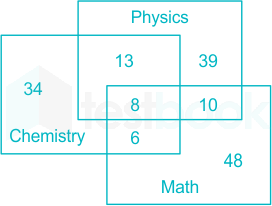
The diagram given below represents those students who study Physics, Chemistry and Math. Find the number of students who study Physics and Chemistry but not Math.

  1. AOption (a)

    8

  2. BOption (b)

    13

  3. COption (c)

    6

  4. DOption (d)

    10

View answer & explanation

Correct answer

Answer: (b)B.

13

Why this answer is correct

According to the given Venn diagram:

The shaded area shows the "total number of who study Physics and Chemistry but not Math".

So, the total number of 'who study Physics and Chemistry but not Math.' = 13.

Hence, the correct answer is "Option 2".

Question 28

Refer to the following letter, symbol series and answer the question.

D & C N E ^ & G ^ Y % % @ G Y & I & * H K Z

How many consonants are there that are immediately preceded by a symbol?

  1. AOption (a)

    Six

  2. BOption (b)

    Five

  3. COption (c)

    Eight

  4. DOption (d)

    Four

View answer & explanation

Correct answer

Answer: (b)B.

Five

Why this answer is correct

Given series: D & C N E ^ & G ^ Y % % @ G Y & I & * H K Z

According to the question, such consonants which are immediately preceded by a symbol:

Required condition: Symbol - Consonant

D & C N E ^ & G ^ Y % % @ G Y & I & * H K Z

Thus, there are five such consonants which are immediately preceded by a symbol.

Hence, "Option 2 " is the correct answer.

Question 29

The amount of carbon dioxide in the atmosphere is:

  1. AOption (a)

    0.03%

  2. BOption (b)

    21%

  3. COption (c)

    71%

  4. DOption (d)

    0.3%

View answer & explanation

Correct answer

Answer: (a)A.

0.03%

Why this answer is correct

The correct answer is 0.0003.

Key Points

  • The amount of carbon dioxide in the atmosphere is approximately 0.0003 or 0.03%.
  • Carbon dioxide is a significant greenhouse gas, contributing to the greenhouse effect and global warming.
  • Despite its relatively low concentration, it plays a crucial role in regulating Earth's temperature and climate.
  • Human activities, particularly burning fossil fuels and deforestation, have significantly increased the concentration of carbon dioxide in the atmosphere since the industrial revolution.

Additional Information

  • Greenhouse Gas:
  • Greenhouse gases are gases that can trap heat in the Earth's atmosphere, contributing to the greenhouse effect.
  • Major greenhouse gases include carbon dioxide (CO2), methane (CH4), nitrous oxide (N2O), and fluorinated gases.
  • Greenhouse Effect:
  • The greenhouse effect is a natural process that warms the Earth's surface.
  • When the Sun's energy reaches the Earth's atmosphere, some of it is reflected back to space and the rest is absorbed and re-radiated by greenhouse gases.
  • This effect keeps the Earth's temperature at a level suitable for life.
  • Carbon Cycle:
  • The carbon cycle is the process through which carbon is exchanged among the atmosphere, oceans, soil, and living organisms.
  • This cycle is crucial for maintaining the balance of carbon dioxide in the atmosphere.
  • Anthropogenic Emissions:
  • Human activities, such as burning fossil fuels (coal, oil, and natural gas), deforestation, and industrial processes, are major sources of anthropogenic carbon dioxide emissions.
  • These activities have significantly increased the concentration of carbon dioxide in the atmosphere, contributing to global warming and climate change.

Question 30

Each of P, Q, R, S, T, U and V has an exam on a different day of a week, starting from Monday and ending on Sunday of the same week.

S has the exam on Thursday. Only one person has the exam between S and V. Q has the exam on the day immediately before V but not on a Monday. Only two people have exams between Q and U. P's exam is on one of the days before T but on one of the days after R. Who among the following has the exam on Monday?

  1. AOption (a)

    Q

  2. BOption (b)

    P

  3. COption (c)

    T

  4. DOption (d)

    R

View answer & explanation

Correct answer

Answer: (d)D.

R

Why this answer is correct

Given: Each of P, Q, R, S, T, U and V has an exam on a different day of a week, starting from Monday and ending on Sunday of the same week.

1) S has the exam on Thursday.

2) Only one person has the exam between S and V. 

3) Q has the exam on the day immediately before V but not on a Monday. 

Week DayPerson
Monday
Tuesday
Wednesday
ThursdayS
FridayQ
SaturdayV
Sunday

4) Only two people have exams between Q and U.

  1. P's exam is on one of the days before T but on one of the days after R.
Week DayPerson
MondayR
TuesdayU
WednesdayP
ThursdayS
FridayQ
SaturdayV
SundayT

Thus, according to the final arrangement R has exam on Monday.

Hence, "Option 4" is the correct answer.

Question 31

A hallow spherical shell is made of a metal of density 6 g/cm3. Its internal and external radii are 8 cm and 9 cm, respectively. What is the weigh (in kg) of the shell (take π = (22)/(7))?

  1. AOption (a)

    4.546

  2. BOption (b)

    6.642

  3. COption (c)

    5.456

  4. DOption (d)

    6.462

View answer & explanation

Correct answer

Answer: (c)C.

5.456

Why this answer is correct

Shortcut Trick

Mass = Volume × Density

Volume = (4/3) × π × (R3 − r3) = (4/3) × (22/7) × (93 − 83)

Volume = (4/3) × (22/7) × (729 − 512) = (4/3) × (22/7) × 217 = 909.33 cm3

Mass = 909.33 × 6 = 5456 g = 5.456 kg

∴ The correct answer is 5.456 kg.

Alternate Method

Given:

Internal radius (r) = 8 cm

External radius (R) = 9 cm

Density (ρ) = 6 g/cm3

Formula Used:

Volume of hollow sphere = (4/3)π(R3 − r3)

Weight (Mass) = Volume × Density

Calculations:

⇒ Volume = (4/3) × (22/7) × (93 − 83)

⇒ Volume = (4/3) × (22/7) × (729 − 512)

⇒ Volume = (4/3) × (22/7) × 217

⇒ Volume = 4 × 22 × 31 ÷ 3 = 2728 ÷ 3 cm3

⇒ Weight (in g) = (2728/3) × 6

⇒ Weight = 2728 × 2 = 5456 g

⇒ Weight (in kg) = 5456 ÷ 1000 = 5.456 kg

∴ The correct answer is 5.456 kg.

Additional Information

Volume of Solid Sphere

The volume of a solid sphere is given by V = (4/3)πr3.

Surface Area of Sphere

Total surface area of a sphere is 4πr2.

Mass-Density Relation

Mass = Density × Volume. Ensure units are consistent (e.g., g/cm3 with cm3 results in grams).

Question 32

Which of the following is the world's largest basaltic impact crater lake found in India?

  1. AOption (a)

    Pulicat Lake

  2. BOption (b)

    Wular Lake

  3. COption (c)

    Lonar Lake

  4. DOption (d)

    Loktak Lake

View answer & explanation

Correct answer

Answer: (c)C.

Lonar Lake

Why this answer is correct

The correct answer is Lonar Lake.

Key Points

  • Lonar Lake, also known as Lonar Crater, is a saline soda lake located at Lonar in Maharashtra, India.
  • It is the world's largest basaltic impact crater lake formed by a meteorite impact during the Pleistocene Epoch, approximately 52,000 ± 6,000 years ago.
  • The lake has a unique ecosystem with both saline and alkaline environments, supporting diverse flora and fauna.
  • Lonar Lake is a notified National Geo-heritage Monument and attracts scientists, geologists, and tourists from around the world.

Additional Information

  • Impact Crater:
  • An impact crater is a circular depression on the surface of a planet, moon, or other celestial body formed by the hypervelocity impact of a smaller body, such as a meteorite.
  • Impact craters are characterized by a raised rim and, in larger craters, a central peak caused by the rebound of the crust after the impact.
  • Basaltic Rock:
  • Basalt is a common extrusive igneous rock formed from the rapid cooling of basaltic lava exposed at or very near the surface of a planet or moon.
  • It is rich in iron and magnesium and low in silica, which gives it a dark color.
  • National Geo-heritage Monument:
  • National Geo-heritage Monuments are sites that have been identified by the Geological Survey of India (GSI) as being important for geological studies, education, and tourism.
  • These sites are protected and preserved for their scientific value and natural beauty.

Question 33

An article is sold at a profit of 28%. If the cost price is increased by Rs. 50 and the selling price is reduced by Rs. 18, then the profit would be 11.6%. What is the original cost price (in Rs.) of the article?

  1. AOption (a)

    350

  2. BOption (b)

    400

  3. COption (c)

    480

  4. DOption (d)

    450

View answer & explanation

Correct answer

Answer: (d)D.

450

Why this answer is correct

Shortcut Trick

Let Original CP = 100%, then Original SP = 128%.

New CP = 100% + 50, and New SP = 128% − 18.

As the new profit is 11.6%, (100% + 50) × 1.116 = 128% − 18

⇒ 111.6% + 55.8 = 128% − 18 ⇒ 16.4% = 73.8

⇒ 1% = 4.5 ⇒ 100% = 450

∴ The correct answer is ₹450.

Alternate Method

Given:

Original profit = 28%

New CP = Original CP + ₹50

New SP = Original SP − ₹18

New profit = 11.6%

Formula Used:

Selling Price (SP) = Cost Price (CP) × (1 + Profit% ÷ 100)

Old CP: 100x

  • 28% Profit

Old SP: 128x

  • ₹50

− ₹18

New CP: 100x + 50

  • 11.6%

New SP: 128x − 18

Calculation:

⇒ Let original CP be 100x.

⇒ Original SP = 100x × 1.28 = 128x

⇒ New CP = 100x + 50

⇒ New SP = 128x − 18

⇒ New SP = New CP × 1.116

⇒ 128x − 18 = (100x + 50) × 1.116

⇒ 128x − 18 = 111.6x + 55.8

⇒ 128x − 111.6x = 55.8 + 18

⇒ 16.4x = 73.8

⇒ x = 73.8 ÷ 16.4 = 4.5

⇒ Original CP = 100x = 100 × 4.5 = 450

∴ The correct answer is ₹450.

Additional Information

Marked Price and Discount

Discount is always calculated on the Marked Price (MP). SP = MP × (1 − Discount% ÷ 100).

Successive Discount

For two successive discounts of a% and b%, the equivalent single discount is (a + b − a × b ÷ 100)%.

Dishonest Dealer

When a dealer sells at Cost Price but uses a false weight, Profit % = (True Weight − False Weight) ÷ False Weight × 100.

Question 34

The value of 2+[2+2÷{2+2÷(2+13)}]2 + [2 + 2 \div \lbrace {2 + 2 \div (2 + \frac{1}{3})}\rbrace] is:

  1. AOption (a)

    3710\frac{37}{10}

  2. BOption (b)

    4710\frac{47}{10}

  3. COption (c)

    5710\frac{57}{10}

  4. DOption (d)

    6710\frac{67}{10}

View answer & explanation

Correct answer

Answer: (b)B.

4710\frac{47}{10}

Why this answer is correct

Given:

2+[2+2÷{2+2÷(2+13)}]2 + [2 + 2 \div \lbrace {2 + 2 \div (2 + \frac{1}{3})}\rbrace]

Formula used:

Follow BODMAS (Bracket, Order, Division, Multiplication, Addition, Subtraction)

Calculation:

⇒ 2 + [2 + 2 ÷ {2 + 2 ÷ (2 + 1/3)}]

⇒ 2 + [2 + 2 ÷ {2 + 2 ÷ (7/3)}]

⇒ 2 + [2 + 2 ÷ {2 + 6/7}]

⇒ 2 + [2 + 2 ÷ (20/7)]

⇒ 2 + [2 + 2 × (7/20)]

⇒ 2 + [2 + 7/10]

⇒ 2 + (27/10)

⇒ 47/10

⇒ 47/10

∴ The value is 47/10.

Question 35

Which of the following options is the closest approximate value which will come in place of question mark (?) in the following equation?

4.99 ÷ .99 - 4.01 × 2 + 3.59 = ?

  1. AOption (a)

    5

  2. BOption (b)

    1

  3. COption (c)

    3

  4. DOption (d)

    2

View answer & explanation

Correct answer

Answer: (b)B.

1

Why this answer is correct

Given:

4.99 ÷ 0.99 - 4.01 × 2 + 3.59 = ?

Formula Used:

Basic arithmetic operations (division, multiplication, addition, and subtraction)

Calculation:

Step-by-step solving:

4.99 ÷ 0.99

⇒ 5.04 (approximately 5)

4.01 × 2

⇒ 8.02 (approximately 8)

Now, substitute these values back into the equation:

5 - 8 + 3.59

Perform the subtraction and addition:

⇒ 5 - 8 = -3

⇒ -3 + 3.59 = 0.59 (approximately 0.6)

The closest approximate value is 1.

Question 36

If one root of the equation 4x2 - 2x + k - 4 = 0 is reciprocal of the other, the value of k is:

  1. AOption (a)

    -4

  2. BOption (b)

    8

  3. COption (c)

    -8

  4. DOption (d)

    4

View answer & explanation

Correct answer

Answer: (b)B.

8

Why this answer is correct

Shortcut Trick In a quadratic equation ax2 + bx + c = 0, if roots are reciprocal, their product is 1. Product of roots = c / a = 1 ⇒ c = a. From 4x2 − 2x + (k − 4) = 0, we have a = 4 and c = k − 4. Equating them: k − 4 = 4 ⇒ k = 8. ∴ The correct answer is 8.

Alternate Method Given: Quadratic equation: 4x2 − 2x + k − 4 = 0 Condition: One root is the reciprocal of the other. Formula Used: For ax2 + bx + c = 0, Product of roots = c / a Calculations: Let the roots be α and 1/α. ⇒ Product of roots = α × (1/α) = 1 ⇒ c / a = 1 Comparing the given equation with ax2 + bx + c = 0: ⇒ a = 4 ⇒ c = k − 4 Substituting values in the product formula: ⇒ (k − 4) / 4 = 1 ⇒ k − 4 = 4 ⇒ k = 4 + 4 ⇒ k = 8 ∴ The correct answer is 8.

Additional Information Sum of Roots For any quadratic equation ax2 + bx + c = 0, the sum of the roots is given by −b/a. Product of Roots The product of the roots of a quadratic equation is given by c/a. If roots are reciprocal, c = a. Nature of Roots The nature of roots depends on the Discriminant (D) = b2 − 4ac. If D > 0, roots are real and distinct; if D = 0, roots are real and equal; if D < 0, roots are imaginary.

Question 37

What is the product of UV radiations acting on oxygen molecules at higher levels of the atmosphere?

  1. AOption (a)

    Chlorofluorocarbons

  2. BOption (b)

    Ozone

  3. COption (c)

    Water

  4. DOption (d)

    Carbon dioxide

View answer & explanation

Correct answer

Answer: (b)B.

Ozone

Why this answer is correct

The correct answer is Ozone.

Key Points

  • Ozone is formed when ultraviolet (UV) light interacts with oxygen molecules (O2) in the Earth's stratosphere.
  • This process involves the splitting of an oxygen molecule (O2) into two individual oxygen atoms, which then combine with other oxygen molecules to form ozone (O3).
  • The ozone layer is crucial for life on Earth as it absorbs the majority of the sun's harmful ultraviolet radiation, preventing it from reaching the surface.
  • Without the ozone layer, life on Earth would be exposed to high levels of UV radiation, which can cause skin cancer and cataracts, and affect ecosystems.

Additional Information

  • Chlorofluorocarbons (CFCs)
  • These are man-made chemical compounds used in refrigeration, air conditioning, and aerosol propellants.
  • CFCs are harmful to the ozone layer as they release chlorine atoms when they are broken down by UV radiation in the stratosphere.
  • Chlorine atoms react with ozone (O3) molecules, leading to the depletion of the ozone layer.
  • Water (H2O)
  • Water is a vital compound for all known forms of life.
  • In the atmosphere, water vapor can act as a greenhouse gas, trapping heat and contributing to the greenhouse effect.
  • Carbon Dioxide (CO2)
  • Carbon dioxide is a greenhouse gas that is produced by natural processes and human activities such as burning fossil fuels.
  • It is a significant contributor to global warming and climate change.
  • Ozone Layer
  • The ozone layer is a region in the Earth's stratosphere that contains a high concentration of ozone (O3).
  • It is located about 10 to 30 kilometers above the Earth's surface.
  • The ozone layer absorbs most of the sun's harmful ultraviolet (UV) radiation, protecting living organisms from its damaging effects.
  • Ultraviolet (UV) Radiation
  • UV radiation is a type of electromagnetic radiation emitted by the sun.
  • It is divided into three types: UVA, UVB, and UVC, with UVC being the most harmful but mostly absorbed by the ozone layer.
  • UV radiation can cause skin cancer, cataracts, and other health issues in humans, and it can also affect ecosystems.

Question 38

A ray of light is incident on a concave mirror (pole P) of radius of curvature 8 cm, parallel to its principal axis. After reflection, it passes through a point Q on its principal axis. Following New Cartesian Sign Convention PQ = _______.

  1. AOption (a)

    -8 cm

  2. BOption (b)

    8 cm

  3. COption (c)

    -4 cm

  4. DOption (d)

    4 cm

View answer & explanation

Correct answer

Answer: (c)C.

-4 cm

Why this answer is correct

The correct answer is -4 cm.

Key Points

  • A ray of light is made incident on a concave mirror, parallel to its principal axis.
  • After reflection, it will pass through the principal focus for point Q(given in question).
  • The relation between focal length (f) and radius of curvature (R) of a Concave mirror is that the focal length is equal to half of the radius of curvature i.e. f=R2f={R\over 2}
  • PQ = f = 82\large8\over 2 = 4cm
  • Sign convention in the case of the concave mirror:
  • Since the object is always placed in front of the mirror hence the sign of the object is taken as negative. Since, the center of curvature and focus lie in front of the concave mirror, signs of the radius of curvature and focal length are taken as negative in the case of the concave mirror.
  • When an image is formed in front of the mirror, the distance of the image is taken as – (negative), and when the image is formed behind the mirror, the distance of the image is taken as + (positive).

Therefore, New Cartesian Sign Convention, PQ =  -4 cm.

Question 39

This question is based on the five, three-digit numbers given below.

(Left) 577 534 249 842 718 (Right)

(Example: 697 - first digit = 6, second digit = 9, third digit = 7)

NOTE: All operations to be done from left to right.

If 2 is added to the second digit of every number, in how many numbers will the second digit be exactly divided by the first digit of that number?

  1. AOption (a)

    4

  2. BOption (b)

    3

  3. COption (c)

    1

  4. DOption (d)

    2

View answer & explanation

Correct answer

Answer: (d)D.

2

Why this answer is correct

Given: (Left) 577 534 249 842 718 (Right)

According to the question:

Given numbers577534249842718
2 is added to the second digit of every number+2+2+2+2+2
Resultant numbers597554269862738
If the second digit be exactly divided by the first digit of that number9 ÷ 55 ÷ 56 ÷ 26 ÷ 83 ÷ 7
Required answerNot divisible0 ⇒ Divisible3 ⇒ DivisibleNot divisibleNot divisible

Thus, according to the final arrangement, in only two numbers will the second digit be exactly divided by the first digit of that number.

Hence, "Option 4" is the correct answer.

Question 40

A train overtakes two persons who are walking at 15 m/s and 35 m/s, respectively, in the same direction as that of the train in 20 seconds and 40 seconds, respectively. The length of the train is:

  1. AOption (a)

    900 m

  2. BOption (b)

    1000 m

  3. COption (c)

    800 m

  4. DOption (d)

    700 m

View answer & explanation

Correct answer

Answer: (c)C.

800 m

Why this answer is correct

Shortcut Trick

Let Train Speed be S. Distance (Length) is constant in both cases.

L = (S − 15) × 20 = (S − 35) × 40

⇒ (S − 15) = 2 × (S − 35) ⇒ S − 15 = 2S − 70 ⇒ S = 55 m/s.

Length = (55 − 15) × 20 = 40 × 20 = 800 m.

∴ The correct answer is 800 m.

Alternate Method

Given: Speed of persons v1 = 15 m/s, v2 = 35 m/s. Times t1 = 20 s, t2 = 40 s.

Formula Used: Distance = Relative Speed × Time

⇒ Let L be the length of the train and S be its speed.

⇒ Case 1: L = (S − 15) × 20

⇒ Case 2: L = (S − 35) × 40

⇒ Equating L: 20S − 300 = 40S − 1400

⇒ 20S = 1100 ⇒ S = 55 m/s

⇒ L = (55 − 15) × 20 = 40 × 20 = 800 m

∴ The correct answer is 800 m.

Additional Information

Relative Speed

When two objects move in the same direction, relative speed is the difference (S1 − S2). In opposite directions, it is the sum (S1 + S2).

Train Overtaking Logic

To cross a point object (person, pole, tree), the train must cover a distance equal to its own length (L).

Unit Conversion

To convert km/hr to m/s, multiply by 5/18. To convert m/s to km/hr, multiply by 18/5.

Question 41

Two positive numbers differ by 3422. When the greater number is divided by the smaller number, the quotient is 4 and the remainder is 290. What is the HCF of the greater of the two given numbers and 4292?

  1. AOption (a)

    58

  2. BOption (b)

    74

  3. COption (c)

    148

  4. DOption (d)

    116

View answer & explanation

Correct answer

Answer: (a)A.

58

Why this answer is correct

Shortcut Trick Let smaller number be s. Then greater number g = 4s + 290. Given g − s = 3422 ⇒ (4s + 290) − s = 3422. 3s = 3132 ⇒ s = 1044. Greater number g = 1044 + 3422 = 4466. HCF(4466, 4292): Difference = 4466 − 4292 = 174. Check factors of 174: 174, 87, 58, ... 4466 ÷ 58 = 77 and 4292 ÷ 58 = 74. HCF is 58. ∴ The correct answer is 58.

Alternate Method

Let the smaller number be x and the greater number be y. According to the question: ⇒ y − x = 3422 --- (1) ⇒ y = 4x + 290 (Dividend = Divisor × Quotient + Remainder) --- (2) Substitute (2) in (1): ⇒ (4x + 290) − x = 3422 ⇒ 3x = 3422 − 290 = 3132 ⇒ x = 1044 ⇒ y = 1044 + 3422 = 4466 Now, find HCF of 4466 and 4292: ⇒ 4466 = 58 × 77 ⇒ 4292 = 58 × 74 ⇒ HCF = 58 ∴ The correct answer is 58.

Additional Information Division Algorithm For any two integers, Dividend = (Divisor × Quotient) + Remainder, where 0 ≤ Remainder < Divisor. HCF by Difference The HCF of two numbers always divides their difference. This is a fast way to find common factors. Euclidean Algorithm HCF(a, b) = HCF(b, r) where r is the remainder when a is divided by b.

Question 42

The curved surface area of a cylinder having radius 15 cm and height 32 cm is:

  1. AOption (a)

    860 π cm2

  2. BOption (b)

    760 π cm2

  3. COption (c)

    960 π cm2

  4. DOption (d)

    1060 π cm2

View answer & explanation

Correct answer

Answer: (c)C.

960 π cm2

Why this answer is correct

Shortcut Trick

Curved Surface Area of a cylinder = 2πrh

Given radius (r) = 15 cm and height (h) = 32 cm.

CSA = 2 × π × 15 × 32 = 30 × 32 × π = 960π.

∴ The correct answer is 960 π cm2.

Alternate Method

Given:

Radius (r) of the cylinder = 15 cm

Height (h) of the cylinder = 32 cm

Formula Used:

Curved Surface Area (CSA) of cylinder = 2πrh

Calculations:

⇒ CSA = 2 × π × 15 × 32

⇒ CSA = (2 × 15) × 32 × π

⇒ CSA = 30 × 32 × π

⇒ CSA = 960π cm2

∴ The correct answer is 960 π cm2.

Additional Information

Total Surface Area of Cylinder

The total area including the curved surface and two circular bases: TSA = 2πr(h + r).

Volume of Cylinder

The amount of space occupied by the cylinder: Volume = πr2h.

Hollow Cylinder

For a cylinder with outer radius R and inner radius r, the Volume = πh(R2 − r2).

Question 43

A sum of Rs. 5,800 is invested at 6% per annum simple interest. How much will the sum become after 4 years?

  1. AOption (a)

    Rs. 6,192

  2. BOption (b)

    Rs. 8,192

  3. COption (c)

    Rs. 7,192

  4. DOption (d)

    Rs. 9,192

View answer & explanation

Correct answer

Answer: (c)C.

Rs. 7,192

Why this answer is correct

Shortcut Trick

Effective rate of interest for 4 years at 6% per annum = 6% × 4 = 24%

Total Amount = 100% (Principal) + 24% (Interest) = 124% of Principal

Amount = 5800 × 124% = 58 × 124

Amount = 58 × (100 + 20 + 4) = 5800 + 1160 + 232 = 7192

∴ The correct answer is Rs. 7,192.

Alternate Method

Given:

Principal (P) = Rs. 5,800

Rate (R) = 6% per annum

Time (T) = 4 years

Formula Used:

Simple Interest (SI) = (P × R × T) ÷ 100

Total Amount (A) = Principal + Simple Interest

Calculations:

⇒ SI = (5800 × 6 × 4) ÷ 100

⇒ SI = 58 × 24

⇒ SI = Rs. 1,392

⇒ Amount = 5800 + 1392

⇒ Amount = Rs. 7,192

∴ The correct answer is Rs. 7,192.

Additional Information

Simple Interest Property

In Simple Interest, the interest remains constant for every year as it is always calculated on the original Principal.

Relationship between SI and CI

For the first year (if compounded annually), Simple Interest and Compound Interest are always equal.

Total Amount Formula

The direct formula for Amount is A = P(1 + RT/100), where R is the Rate and T is the Time duration.

Question 44

India's first fisheries business incubator was inaugurated by the Union Minister of Fisheries, Animal Husbandry and Dairying in _______.

  1. AOption (a)

    Gurugram

  2. BOption (b)

    Noida

  3. COption (c)

    Karnal

  4. DOption (d)

    Rohtak

View answer & explanation

Correct answer

Answer: (a)A.

Gurugram

Why this answer is correct

The correct answer is Gurugram.

Key Points

  • India's first fishery business incubator was inaugurated by the Union Minister of Fisheries, Animal Husbandry and Dairying in Gurugram in 2021.
  • The government is expecting 22 million tonnes of fish production and Rs. One Lakh Crore export by 2025.
  • The incubation unit can serve as a milestone for the future of the fishery sector.

Question 45

The 'Stree Manoraksha' project aimed at extending mental health training to 6000 OSC (One Stop Centre) functionaries across India was launched by _______ in March 2022.

  1. AOption (a)

    Narendra Modi

  2. BOption (b)

    Amit Shah

  3. COption (c)

    Smriti Zubin Irani

  4. DOption (d)

    Dr. Mansukh Mandaviya

View answer & explanation

Correct answer

Answer: (c)C.

Smriti Zubin Irani

Why this answer is correct

The correct answer is Smriti Zubin Irani.

Key Points

  • ‘STREE MANORAKSHA’– an initiative aimed at “Integrating Training and Supervision in Psychosocial and Mental Health Care for One Stop Centre (OSC) staffs to support Women Facing Violence” is a project started in The National Institute of Mental Health and Neurosciences (NIMHANS)
  • The project is headed by Dr. Prabha S. Chandra, Professor of Psychiatry and Associate Dean, of NIMHANS.
  • Stree Manoraksha project” was launched by the Union Minister for Women and Child Development, Smt. Smriti Zubin Irani on the occasion of International Women's Day Week.

Question 46

Which of the following is NOT a part of the human excretory system?

  1. AOption (a)

    Urethra

  2. BOption (b)

    Urinary bladder

  3. COption (c)

    Bronchioles

  4. DOption (d)

    Ureters

View answer & explanation

Correct answer

Answer: (c)C.

Bronchioles

Why this answer is correct

The correct answer is Bronchioles.

Key Points

  • In humans, the kidney is one of the main organs of the excretory system.
  • The function of the kidney is to filter the blood and remove waste (toxic) products.
  • Waste products and excess fluids are removed through urine.
  • If the kidney gets damaged then the person has to undergo dialysis.
  • Dialysis is a treatment that filters and purifies the blood using a machine.
  • The human excretory system consists of organs that remove wastes such as salts, carbon dioxide, urea, uric acid, and water produced by the body.
  • The route of urine in the human excretory system is After being filtered by
  • kidney → urine through ureter → stored in bladder → out through urethra.

Additional Information

  • Urethra the duct which takes the urine out from the urinary bladder to the outside of the body.
  • ​The urethra is a tube that binds the urinary bladder to the urinary meatus for the removal of both female and male urine from the body.
  • It ties up with the urinary meatus above the vagina in human females and other primates.
  • The ureters are tubes formed from smooth muscle fibres that carry urine to the urinary bladder from the kidneys.
  • The dorsal aorta is a blood vessel that brings oxygenated blood from the gills to the rest of the body in a single pass circulatory system.
  • Excretion is the removal of waste from the body.
  • The excretory waste of humans is urea.
  • The excretory system of humans consists of a pair of kidneys, pair of ureters, a urinary bladder, and a urethra.
  • In the kidney, filtration of urine takes place.
  • Ureters carry the urine to the urinary bladder.
  • Urinary bladder stores the urine.
  • The urethra is an opening of the urinary bladder.
  • It consists of external and internal sphincters.
  • Internal is regulated involuntarily by the brain.
  • It opens when the bladder gets filled with urine.
  • The external sphincter is regulated voluntarily.
  • It opens outside the body.
  • It helps in the removal of waste.

Question 47

Pole E is to the east of pole R. Pole G is to the west of pole R and north of pole A. Pole T is to the south of pole A. What is the position of pole R with respect to pole A?

  1. AOption (a)

    North-east

  2. BOption (b)

    North

  3. COption (c)

    South-east

  4. DOption (d)

    North-west

View answer & explanation

Correct answer

Answer: (a)A.

North-east

Why this answer is correct

Given:

Pole E is to the east of pole R.

Pole G is to the west of pole R and north of pole A.

Pole T is to the south of pole A. 

Thus, pole R is to the northeast of pole A.

Hence, "Option 1" is the correct answer.

Question 48

Select the number from among the given options that can replace the question mark (?) in the following series.

5, 12, ?, 96, 285, 852

  1. AOption (a)

    56

  2. BOption (b)

    27

  3. COption (c)

    33

  4. DOption (d)

    48

View answer & explanation

Correct answer

Answer: (c)C.

33

Why this answer is correct

The logic followed here is:

Hence, "Option 3" is the correct answer.

Alternate Method

Question 49

In February 2022, the Ministry of Women and Child Development, Government of India extended the PM Cares for Children Scheme till _______.

  1. AOption (a)

    30 June, 2022

  2. BOption (b)

    31 December, 2022

  3. COption (c)

    28 February 2022

  4. DOption (d)

    31 March 2022

View answer & explanation

Correct answer

Answer: (c)C.

28 February 2022

Why this answer is correct

The correct answer is 28 February 2022.

Key Points

  • In February 2022, the Ministry of Women and Child Development, Government of India extended the PM Cares for Children Scheme till 28 February 2022.
  • Earlier, the scheme was valid only till 31st December 2021.
  • The scheme covers all children who have lost:
  1. Both parents or
  2. Surviving parent or
  3. Legal guardian/adoptive parents/single adoptive parent
  • due to the COVID-19 pandemic, starting from 11.03.2020 the date on which WHO declared and characterized COVID-19 as a pandemic till 28.02.2022.
  • ​​​This is a kind of comprehensive support for children which ensures their care and protection.

Question 50

Five boxes A, B, C, D and E are kept one over the other but not necessarily in the same order. A is kept third from the bottom. Only one box is kept between A and B. There are only three boxes between D and B. C is placed immediately above B. How many boxes are placed between A and D?

  1. AOption (a)

    3

  2. BOption (b)

    0

  3. COption (c)

    2

  4. DOption (d)

    1

View answer & explanation

Correct answer

Answer: (d)D.

1

Why this answer is correct

Given: Five boxes A, B, C, D and E are kept one over the other.

  1. A is kept third from the bottom.
Boxes
Top To
A
Bottom

2) Only one box is kept between A and B.  

3) C is placed immediately above B.

Boxes
Top To
A
C
B
Bottom

4) There are only three boxes between D and B.

After positioning D only one position is left which will be occupied by the only box left i.e. E.

Boxes
Top To
D
E
A
C
B
Bottom

Thus, according to the final arrangement one boxes i.e. E is placed between A and D.

Hence, "Option 4" is the correct answer.

Question 51

Which of the following banks was the organiser of the global hackathon, HARBINGER 2021 - Innovation for Transformation, with the theme 'Smarter Digital Payments'?

  1. AOption (a)

    Reserve Bank of India

  2. BOption (b)

    HSBC Bank

  3. COption (c)

    HDFC Bank

  4. DOption (d)

    State Bank of India

View answer & explanation

Correct answer

Answer: (a)A.

Reserve Bank of India

Why this answer is correct

The correct answer is Reserve Bank of India.

Key Points

  • Reserve Bank is organising its first global hackathon – “HARBINGER 2021 – Innovation for Transformation” with the theme ‘Smarter Digital Payments’.
  • Objective:
  • The Hackathon invites participants to identify and develop solutions that have the potential to m digital payments accessible to the under-served and enhance the ease of payments and user experience while strengthening the security of digital payments and promoting customer protection.
  • HARBINGER 2021 invites innovative ideas for the following problem statements in the payment and settlement system landscape:
  • Innovative, easy-to-use, non-mobile digital payment solutions for converting small-ticket cash transactions to d mode.
  • Context-based retail payments to remove the physical act of payment.
  • The alternate authentication mechanism for digital payments.
  • Social Media Analysis Monitoring tool for detection of digital payment fraud and disruption.
  • Prizes:
  • Being part of HARBINGER 2021 gives an opportunity to the participants to get mentored by industry experts and exhibit innovative solutions before an eminent jury and win exciting prizes in each category.
  • Winner: ₹ 40 lakh
  • Runner-up: ₹ 20 lakh

Question 52

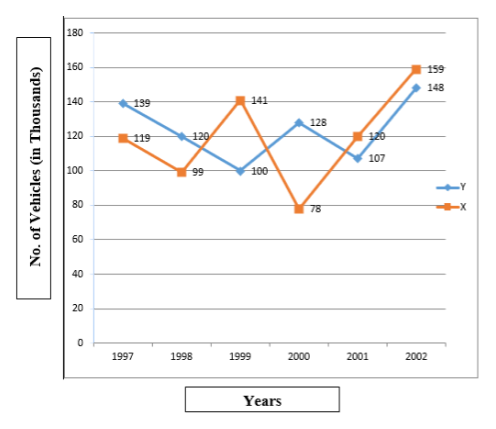
The number of vehicles caught for speeding in different years in two cities X and Y are shown in the following graph. Study the graph and answer the question.

Which city has more total number of vehicles which are caught speeding between the years 1998 - 2001? In which years, the difference in the number of vehicles caught between the two cities is maximum?

  1. AOption (a)

    X, 1999

  2. BOption (b)

    Y, 1999

  3. COption (c)

    Y, 2000

  4. DOption (d)

    X, 2000

View answer & explanation

Correct answer

Answer: (c)C.

Y, 2000

Why this answer is correct

Given:

The number of vehicles caught speeding between the years 1998 - 2001 in cities X and Y.

Data for City X (Orange Line):

1998: 99

1999: 141

2000: 78

2001: 120

Total for City X:

99 + 141 + 78 + 120 = 438

Data for City Y (Blue Line):

1998: 120

1999: 100

2000: 128

2001: 120

Total for City Y:

120 + 100 + 128 + 107 = 455

Conclusion: City Y has more total vehicles caught speeding between 1998 and 2001, with 455 vehicles compared to 438 for City X.

Maximum difference in number of vehicles caught:

1997: |139 - 119| = 20

1998: |120 - 99| = 21

1999: |141 - 100| = 41

2000: |128 - 78| = 50

2001: |120 - 107| = 13

2002: |159 - 148| = 11

Conclusion: The maximum difference occurred in the year 2000 with a difference of 50.

Question 53

Mendeleev's Periodic Law could not explain the position of _______ in the periodic table.

  1. AOption (a)

    Isobars

  2. BOption (b)

    Isodiaphers

  3. COption (c)

    Isotopes

  4. DOption (d)

    Isotones

View answer & explanation

Correct answer

Answer: (c)C.

Isotopes

Why this answer is correct

The correct answer is Isotopes.

Key Points

  • Mendeleev arranges the elements in the increasing order of their atomic masses. According to Mendeleev, the physical and chemical properties are the periodic function of their atomic mass.
  • The limitations of Mendeleev's periodic tables are as under:
  • Position of hydrogen: The position of a hydrogen atom is uncertain because it shows a resemblance with alkali metals and halogens. But in Mendeleev's periodic table, Hydrogen is placed with alkali metals in group 1A.
  • Position of isotopes: There is no separate position given to the isotopes of an element.
  • Cause of periodicity: Mendeleev's periodic table does not explain successfully the cause of periodicity. Some dissimilar elements are placed together. Some elements having higher atomic mass are placed before the elements with lower atomic mass.

Additional Information

  • Isobars: 
  • Isobars are atoms (nuclides) of different chemical elements that have the same number of nucleons.
  • Correspondingly, isobars differ in atomic number (or number of protons) but have the same mass number.
  • An example of a series of isobars is 40S, 40Cl, 40Ar, 40K, and 40Ca.
  • Isodiaphers :
  • Isodiaphers are a pair of nuclides with the identical number of protons and neutrons in the atom's nucleus.
  • Although the nuclei of both nuclides have different numbers of protons and neutrons, the difference between them is the same.
  • An example of a series of isodiaphers is Thorium-234 and Uranium-238.
  • Isotones:
  • Two nuclides to be isotones if they have the same neutron number N, but different proton number Z.
  • For example, boron-12 and carbon-13 nuclei both contain 7 neutrons,
  • Similarly, ³⁶S, ³⁷Cl, ³⁸Ar, ³⁹K, and ⁴⁰Ca nuclei are all isotones of 20 because they all contain 20 neutrons.

Question 54

Which constitutional authority established under Article 148 of the Constitution of India, has the power to audit the receipts and expenditure of the Central and the Government of each State and Union Territory?

  1. AOption (a)

    Attorney General of India

  2. BOption (b)

    Advocate General of the India

  3. COption (c)

    Finance Commission of India

  4. DOption (d)

    Comptroller and Auditor General of India

View answer & explanation

Correct answer

Answer: (d)D.

Comptroller and Auditor General of India

Why this answer is correct

The correct answer is Comptroller and Auditor General of India.

Key Points

  • According to Article 148 of the Indian Constitution, the Comptroller and Auditor General of India is the country's top auditing body.
  • They have the authority to examine every rupee that the Indian government and the state governments receive and spend.
  • The CAG is also the statutory auditor of Government-owned corporations.
  • It performs extra audits of government-owned businesses or the subsidiaries of existing government-owned businesses in which the government owns at least a 51 per cent equity stake.
  • In terms of precedent, the CAG is placed ninth and has the same authority as a sitting Supreme Court of India judge.
  • The current CAG of India is G. C. Murmu (as of February 2023), a former lieutenant governor of the UT of Jammu and Kashmir.​

Additional Information

  • Attorney General of India
  • The Att orney General (AG) of India is a part of the Union Executive.
  • He is the highest law officer in the country who can be part of any court in the Indian Territory.
  • He got the right to speak and to take part in the proceedings of both the Houses of Parliament or their joint sitting and any committee of the Parliament of which he may be named a member.
  • He has no right to vote when he participates in the proceedings of the Indian Parliament.
  • Similar to a Member of Parliament, he also enjoys all powers related to immunities and privileges.
  • He is not considered a government servant.
  • He can practice privately too as he is not debarred from private legal practice.

Thus, the Pr esident of India appoints a person who is qualified for the post of Attorney General on the advice of the government.

  • Advocate General of the India
  • The Advocate General is a constitutional post in India, created by the Constitution of India under Article 165.
  • The Advocate General is appointed by the Governor of the State and holds office during the pleasure of the Governor.
  • The Advocate General is the highest law officer in the state and is responsible for providing legal advice to the government of the state.
  • The Advocate General can appear in any court of law within the state and can also participate in the proceedings of the state legislature.
  • Finance Commission of India
  • The Finance Commission in India is constituted by the President under article 280 of the Constitution.
  • The first finance commission was constituted in 1951.
  • Finance Commission is a constitutional body for the purpose of allocation of certain revenue resources between the Union and the State Governments.
  • The finance commission is appointed every five years.
  • The President lays the reports of the Finance commission before both the Houses of the Parliament.
  • The finance commission recommends to the President relating to the distribution of the net taxes to be shared between the centre and the states.
  • The finance commission consists of a Chairman and four members.

Question 55

Three statements are followed by three conclusions numbered I, II and III. You have to consider these statements to be true, even if they seem to be at variance with commonly known facts. Decide which of the given conclusions logically follow(s) from the given statement.

Statements:

Few melons are bananas

No banana is a cherry

All cherries are litchis

Conclusions:

(I) Some litchis are not bananas

(II) All bananas are melons

(III) All litchis are cherries

  1. AOption (a)

    Only conclusion I and III follows

  2. BOption (b)

    None of the conclusions follow

  3. COption (c)

    Only conclusion I follows

  4. DOption (d)

    Only conclusion II follows

View answer & explanation

Correct answer

Answer: (c)C.

Only conclusion I follows

Why this answer is correct

The least possible Venn diagram for the given statements is as shown below :

Conclusions:

(I) Some litchis are not bananas → Follow (As no banana is a cherry and all cherries are litchis. As Bananas cannot be cherries which whole comes in litchis, therefore it is true.)

(II) All bananas are melons → Does not follow (As few melons are bananas. So it is possible but not definite.)

(III) All litchis are cherries → Does not follow (As all cherries are litchis. So it is possible but not definite.)

∴ Here, Only conclusion I follows.

Hence, "Option 3" is the correct answer.

Question 56

Gulshan drove his car for 77 km towards north, then he turned left and drove for 109 km. Again, he turned left and drove yet another 77 km. Again, he turned left, drove his car 127 km and stopped. What is the shortest distance between the starting point and the stopping point?

(All turns are 90 degree turns only)

  1. AOption (a)

    18 km

  2. BOption (b)

    127 km

  3. COption (c)

    109 km

  4. DOption (d)

    154 km

View answer & explanation

Correct answer

Answer: (a)A.

18 km

Why this answer is correct

Given: All turns are 90 degree turns only.

Gulshan drove his car for 77 km towards north

Then he turned left and drove for 109 km.

Again, he turned left and drove yet another 77 km.

Again, he turned left, drove his car 127 km and stopped. 


Thus, the shortest distance between the starting point and the end point is (127 km - 109 km) = 18 km.

Hence, "Option 1" is the correct answer.

Question 57

Given below is a statement followed by two possible underlying assumptions I and II. Read the information carefully and select the correct option.

Statement:

As per reports by International recruiters, around 25% of the candidates are rejected just on the basis of insufficient data in their CVs or due to the format of the CVs auto-created by some websites.

Which of the following can be assumed from the given statement?

I. CVs manually created by job seekers have more chances of being viewed / selected than auto created CVs.

II. No criteria other than insufficient information and formatting results in rejection of CVs.

  1. AOption (a)

    Neither I nor II can be assumed

  2. BOption (b)

    Only II can be assumed

  3. COption (c)

    Only I can be assumed

  4. DOption (d)

    Both I and II can be assumed

View answer & explanation

Correct answer

Answer: (c)C.

Only I can be assumed

Why this answer is correct

Given Statement: As per reports by International recruiters, around 25% of the candidates are rejected just on the basis of insufficient data in their CVs or due to the format of the CVs auto-created by some websites.

Now, 

Assumptions:

1. CVs manually created by job seekers have more chances of being viewed / selected than auto created CVs - Implicit (Because the statement indicates that auto-created CVs are rejected due to format issues, it implies that manually created CVs might not have these issues and thus have a better chance.) 2. No criteria other than insufficient information and formatting results in rejection of CVs - Not Implicit (The statement only specifies two reasons for rejection but doesn't rule out other possible criteria for rejection.)

Here, Only assumption I is implicit.

Hence, the correct answer is "Option 3".

Question 58

How do contraceptive pills help in birth control?

  1. AOption (a)

    By blocking sperm production

  2. BOption (b)

    By killing the zygote

  3. COption (c)

    By preventing release of eggs from the ovary

  4. DOption (d)

    By inhibiting menstruation

View answer & explanation

Correct answer

Answer: (c)C.

By preventing release of eggs from the ovary

Why this answer is correct

The correct answer is By preventing release of eggs from the ovary.

Key Points

  • Oral contraceptive pills or birth control pills are a type of contraception that contains hormones that prevent pregnancy. It is also known as “the pill” because it comes in pill form.

Oral contraceptive pills are of two types:

  • Combination pills contain estrogen and progestin.
  • Progestin-only pills are also known as “the minipill.”
  • This is administered in women who are breastfeeding or have a history of blood clots and strokes and shouldn’t take estrogen.

Additional Information

Mechanism of action:

  • Birth control pills prevent follicular development and hence, prevent ovulation. To understand this, let us look at a negative feedback loop involved in this process:
  • The hypothalamus secretes a hormone human gonadotropin-releasing hormone (GnRH).
  • GnRH signals the pituitary gland to release gonadotropins like stimulating follicle hormone (FSH) and luteinizing hormone (LH).
  • In females, FSH and LH cause the ovaries to secrete estrogen and progesterone.
  • Progesterone supplied in the oral contraceptive pills initiates a negative feedback loop by signaling the hypothalamus to reduce the production of GnRH.
  • Thus, FSH and LH production is reduced.
  • Since follicles are not developing, there is no secretion of estrogen by follicles.
  • The progesterone negative feedback loop prevents an increase in LH levels in mid-cycle.
  • In normal conditions, LH in midcycle causes rupturing of Graffian follicle and ovulation.
  • But ovulation is prevented because of the negative feedback loop and low levels of LH in the midcycle.

​​

  • Thus, hormones in birth control pills prevent pregnancy by:
  • By stopping or reducing ovulation
  • Thickening cervical mucus to keep sperm from entering the uterus.
  • Thinning the lining of the uterus so that a fertilized egg is less likely to attach.

Question 59

Washing soda is used in the manufacture of which of the following compounds?

  1. AOption (a)

    Borax

  2. BOption (b)

    Bleaching powder

  3. COption (c)

    Green vitriol

  4. DOption (d)

    Blue vitriol

View answer & explanation

Correct answer

Answer: (a)A.

Borax

Why this answer is correct

The correct answer is Borax.

Key Points

  • Borax is the sodium salt of boric acid.
  • Chemical formula:- Na2B4O7.10H2O
  • Borax occurs naturally as Tincal (suhaga) in certain dried-up lakes of India, Tibet, Srilanka and the USA. It contains about 55% borax.
  • Tincal is the crude form of borax, and it contains many impurities. Borax is also found as tincal in Ceylon, Tibet and California.
  • In Tibet, tincal is used as a cleaning product by the native tribes.
  • Preparation Methods of Borax:-

Preparation of Borax from Colemanite (Ca2B6O11)

  • In this method, the colemanite mineral is finely powdered and boiled with a solution of sodium carbonate solution. As a result, borax and sodium metaborate is formed.
  • The white precipitate of calcium carbonate obtained during the reaction is removed by the process of filtration, and the solution upon concentration and then cooling gives the pure crystals of borax. By passing carbon dioxide gas through the sodium metaborate, which is present in the mother liquor, it can be converted to borax.

Additional Information

Preparation of Borax from Tincal

  • Tincal can be transformed into borax by being dissolved in boiling water. The resulting solution is filtered to get rid of any insoluble contaminants like sand, clay, etc.
  • The resulting solution can be concentrated to get the pure crystals of borax.

Preparation of Borax from Boric acid

  • Boric acid and sodium carbonate can be combined to create borax in modest quantities.

Question 60

Two identical bulbs are connected in parallel to a battery of 4 V. If the current in the circuit is 0.2 A, the power dissipated by the battery is:

  1. AOption (a)

    0.05 W

  2. BOption (b)

    10 W

  3. COption (c)

    0.8 W

  4. DOption (d)

    20 W

View answer & explanation

Correct answer

Answer: (c)C.

0.8 W

Why this answer is correct

The correct answer is 0.8 W.

Key Points

Given,

The potential difference, V = 4V

Steady current flowing,  I = 0.2 A

According to Ohm's law,

Power(P) = Voltage(v) x current(l)

P = V x I

P= 4 x 0.2 = 0.8 W

Additional Information

  • Ohm’s law states that the voltage across a conductor is directly proportional to the current flowing through it, provided all physical conditions and temperatures remain constant.
  • Mathematically, this current-voltage relationship is written as,
  • V = IR
  • Power: The capacity to do work is termed Energy. The Energy expended to do work in unit time is termed as Power. It is represented as P.
  • Power Formula is articulated as
  • P = V I
  • P = (IR) I
  • P = I2 R

Question 61

Each of D, E, F, G, H, I and J has a football match to participate on a different day of a week, starting from Monday to Sunday of the same week. E has a match on the day immediately after I. G has a match immediately after H. J has a match immediately after E, but not on Sunday. D has a match on Wednesday. Who among the following has a match on Sunday?

  1. AOption (a)

    F

  2. BOption (b)

    E

  3. COption (c)

    G

  4. DOption (d)

    H

View answer & explanation

Correct answer

Answer: (a)A.

F

Why this answer is correct

Given: Each of D, E, F, G, H, I and J has a football match to participate on a different day of a week, starting from Monday to Sunday of the same week. 

1) D has a match on Wednesday.

2) J has a match immediately after E, but not on Sunday. 

Week DayPerson
Case 1Case 2Case 3
MondayE
TuesdayJ
WednesdayDDD
ThursdayE
FridayJE
SaturdayJ
Sunday

3) E has a match on the day immediately after I. 

  1. G has a match immediately after H.

As there is no possible position for I in case 1 and 2, therefore are eliminated.

After positioning I, G, and H only one position is left which will be occupied by the only person left i.e. F.

Week DayPerson
Case 3
MondayH
TuesdayG
WednesdayD
ThursdayI
FridayE
SaturdayJ
SundayF

Thus, according to the final arrangement F has a match on Sunday.

Hence, "Option 1" is the correct answer.

Question 62

The value of [cos⁡40∘1+sin⁡40∘]+[1+sin40∘cos⁡40∘][\frac{\cos 40^{\circ}}{1+ \sin 40^{\circ}}]+[\frac{1+sin40^{\circ}}{\cos 40^{\circ}}] is:

  1. AOption (a)

    2 cot 40°

  2. BOption (b)

    2 sec 40°

  3. COption (c)

    2 tan 40°

  4. DOption (d)

    2 cosec 40°

View answer & explanation

Correct answer

Answer: (b)B.

2 sec 40°

Why this answer is correct

Shortcut Trick

The expression is in the form (cos θ / (1 + sin θ)) + ((1 + sin θ) / cos θ).

By cross-multiplication: (cos2 θ + (1 + sin θ)2) / (cos θ (1 + sin θ)).

Numerator: cos2 θ + 1 + sin2 θ + 2 sin θ = 2 + 2 sin θ = 2(1 + sin θ).

Expression simplifies to: 2(1 + sin θ) / (cos θ (1 + sin θ)) = 2 / cos θ = 2 sec θ.

Given θ = 40°, the result is 2 sec 40°.

∴ The correct answer is 2 sec 40°.

Alternate Method

Given: [cos 40° / (1 + sin 40°)] + [(1 + sin 40°) / cos 40°]

Formula Used: sin2 θ + cos2 θ = 1 and sec θ = 1 / cos θ

Calculations:

⇒ Let θ = 40°

⇒ Expression = [cos θ / (1 + sin θ)] + [(1 + sin θ) / cos θ]

⇒ Expression = [cos2 θ + (1 + sin θ)2] / [cos θ (1 + sin θ)]

⇒ Expression = [cos2 θ + 1 + sin2 θ + 2 sin θ] / [cos θ (1 + sin θ)]

⇒ Since cos2 θ + sin2 θ = 1, Expression = [1 + 1 + 2 sin θ] / [cos θ (1 + sin θ)]

⇒ Expression = [2 + 2 sin θ] / [cos θ (1 + sin θ)]

⇒ Expression = 2(1 + sin θ) / [cos θ (1 + sin θ)]

⇒ Expression = 2 / cos θ

⇒ Expression = 2 sec θ = 2 sec 40°

∴ The correct answer is 2 sec 40°.

Additional Information

Trigonometric Identities

Standard identities include sin2θ + cos2θ = 1, 1 + tan2θ = sec2θ, and 1 + cot2θ = cosec2θ.

Reciprocal Relations

sec θ = 1/cos θ, cosec θ = 1/sin θ, and cot θ = 1/tan θ.

Symmetry in Fractions

The structure (cos θ / (1 + sin θ)) is equal to ((1 − sin θ) / cos θ).

Question 63

Which of the following teams won the Tata Indian Premier League (IPL) 2022?

  1. AOption (a)

    Gujarat Titans (GT)

  2. BOption (b)

    Kolkata Knight Riders (KKR)

  3. COption (c)

    Chennai Super Kings (CSK)

  4. DOption (d)

    Rajasthan Royals (RR)

View answer & explanation

Correct answer

Answer: (a)A.

Gujarat Titans (GT)

Why this answer is correct

The correct answer is Gujarat Titans (GT).

Key Points

  • The Indian Premier League (IPL) 2022 ended with Gujarat Titans (GT) lifting the trophy by defeating inaugural champions Rajasthan Royals (RR) at the Narendra Modi Stadium, Ahmedabad.
  • The Indian Premier League (IPL) 2022, was the 15th edition of the professional Twenty20 cricket league established by the Board of Control for Cricket in India (BCCI).
  • The host country for IPl 2022 was India.
  • The Orange Cap title winner is Jos Butler (Rajasthan Royals) with Total runs: 863 runs.
  • The Purple Cap title winner is Yuzvendra Chahal (Rajasthan Royals) with total of 27 Wickets.
  • IPL 2022 Sponsorer was TATA.​

Additional Information

  • TATA group has been adjudged as the sponsor of WPL 2023.
  • The media rights for the Women's IPL have been sold for INR 951 crores.
  • The Women's IPL is set to get underway in 2023.
  • Franchise-based model is likely to see five teams in the inaugural season.
  • The Board of Control for Cricket in India (BCCI) was formed in 1928  as a society.
  • ​BCCI does not depend on the Government for its finances.
  • Roger Binny is the incumbent BCCI president and Jay Shah is the secretary.

Question 64

Seven people, A, B, C, D, E, F and G, are sitting in a straight row, facing north. Only three people sit between B and D. Only two people sit to the left of B. F is not an immediate neighbour of D. F sits second to the right of G. A sits to the immediate right of E. Who sits at the extreme left end of the row?

  1. AOption (a)

    C

  2. BOption (b)

    G

  3. COption (c)

    B

  4. DOption (d)

    D

View answer & explanation

Correct answer

Answer: (a)A.

C

Why this answer is correct

Given: Seven people, A, B, C, D, E, F and G, are sitting in a straight row, facing north. 

1) Only two people sit to the left of B. 

2) Only three people sit between B and D. 

3) F sits second to the right of G. 

4) A sits to the immediate right of E.

5) F is not an immediate neighbour of D.

After positioning G, F, A and E only one position is left which will be occupied by the only person left i.e. C.

Thus, according to the final arrangement C sits at the extreme left end of the row.

Hence, "Option 1" is the correct answer.

Question 65

The value of 53 - 92 + (12 ÷ 4)2 - 32 + 8 × 0 =

  1. AOption (a)

    61

  2. BOption (b)

    25

  3. COption (c)

    -15

  4. DOption (d)

    21

View answer & explanation

Correct answer

Answer: (d)D.

21

Why this answer is correct

Given:

53 - 92 + (12 ÷ 4)2 - 32 + 8 × 0

Formula used:

Follow BODMAS (Bracket, Order, Division, Multiplication, Addition, Subtraction)

Calculation:

⇒ 53 - 92 + (12 ÷ 4)2 - 32 + 8 × 0

⇒ 125 - 81 + (3)2 - 32 + 0

⇒ 125 - 81 + 9 - 32

⇒ 134 - 113

⇒ 21

∴ The value is 21.

Question 66

Plants use a completely different process for exertion as compared to animals. Which of the following processes is NOT followed by plants for excretion?

  1. AOption (a)

    Filter toxic substances through the leaves

  2. BOption (b)

    Excess water thrown out by transpiration

  3. COption (c)

    Excrete some waste into the soil

  4. DOption (d)

    Store waste products in Vacuoles

View answer & explanation

Correct answer

Answer: (a)A.

Filter toxic substances through the leaves

Why this answer is correct

The correct answer is Filter toxic substances through the leaves.

Key Points

  • In plant excretion:
  • They get rid of excess water through transpiration
  • The plant cannot selectively filter toxic substances through its leaves.
  • Store waste products in Vacuoles
  • Waste products are stored as resins and gums in old xylem.
  • They excrete waste substances into the soil around them.

Question 67

A ray of light in air is incident at an angle of 30° on the surface of water in a jar. The ray is refracted in the water at an angle of _______ and _______ in the plane of the incident ray.

  1. AOption (a)

    more than 30°, lies

  2. BOption (b)

    more than 30°, does not lie

  3. COption (c)

    less than 30°, lies

  4. DOption (d)

    less than 30°,does not lie

View answer & explanation

Correct answer

Answer: (c)C.

less than 30°, lies

Why this answer is correct

The correct answer is less than 30°, lies.

Key Points

Refraction of light: When a ray of light passes from one transparent medium to another, it bends its path. This phenomenon is called refraction.

Snell's law: When light passes from one medium 1 (refractive index n1 ) to water medium 2 (refractive index n2 ), then

n1  Sin i = n2  Sin r ,

Here i is the angle of incidence, r is the angle of refraction.

Here light passes from one medium 1 (refractive index n1 ) to water medium 2 (refractive index n2 ), then the ray will be refracted at an angle less than 30° in water, and will lie in the plane of the incident ray.

Question 68

What will be the next homologous member of compound CH3OH?

  1. AOption (a)

    C3H5OH

  2. BOption (b)

    C2H3OH

  3. COption (c)

    C3H7OH

  4. DOption (d)

    C2H5OH

View answer & explanation

Correct answer

Answer: (d)D.

C2H5OH

Why this answer is correct

The correct answer is C2H5OH.

Key Points

  • Homologue differs by −CH2 group.
  • The next higher homologue of methanol is ethanol (C2H5OH).

Additional Information

  • Homologue:  
  • The term homologue is used to describe a compound belonging to a series of compounds differing from each other by a repeating unit, such as a methylene group, a peptide residue, etc.

Question 69

The drug Diclofenac is one of the prime reasons for wiping out most of the _______ population in India.

  1. AOption (a)

    one-horned rhinoceros

  2. BOption (b)

    sparrrow

  3. COption (c)

    vulture

  4. DOption (d)

    blackbuck

View answer & explanation

Correct answer

Answer: (c)C.

vulture

Why this answer is correct

The correct answer is vulture.

Key Points

  • India's three vulture species saw an unprecedented decline of 97 to 99.9 percent between 1992 and 2007 owing to ingesting diclofenac through cattle carcasses.
  • The near-extinction of this efficient scavenger is linked to the spread of zoonotic diseases and increased incidence of rabies.

Additional Information

  • Reasons for Death of Vultures
  • The major reason behind the vulture population getting nearly wiped out was the drug Diclofenac.
  • It was found in the carcass of cattle on which the vultures feed.
  • The drug was commonly administered to cattle to treat inflammation.
  • Its veterinary use was banned in 2008 by the Government of India.
  • Bioaccumulation (the gradual accumulation of substances, such as pesticides, or other chemicals in an organism) of Diclofenac caused kidney failure in Vultures, leading to death.
  • Diclofenac is dangerously fatal for Vultures.
  • Even 1% of it in carcass would kill the Vulture in a short time after it feeds such carcass.
  • The poisoned carcasses were dumped to kill some local stray animals.
  • But when vultures fed on them, it became one of the vital reasons leading to their death.
  • It is imperative to manage our carcass dumps and make sure that poisoned carcasses are not dumped for the vultures to feed on.
  • The forest department cremates the animal carcasses instead of burying them, to keep the poachers away.
  • But this practice is denying food to vultures leading to their death out of starvation.

Question 70

In a certain code language, the numbers/symbols are coded using letters as per the table given below and as per the given conditions.

Number/Symbol*1&2>3^4%5$11#6@7!8
CodeQAZXSWEDCVFRTGBNHY


Conditions:

I. If the first element is an odd number and the last also is an odd number, the code for the first element will be P and for the last element will be K.

II. If the last two elements are numbers the codes for these two are to be interchanged.

III. If the first two elements are symbols, both these elements will be codes as UU.

What will be the code for 3$7%68?

  1. AOption (a)

    WFNCGY

  2. BOption (b)

    PFNCGK

  3. COption (c)

    WFNCYG

  4. DOption (d)

    WUNCYG

View answer & explanation

Correct answer

Answer: (c)C.

WFNCYG

Why this answer is correct

Given Table:

Number/Symbol*1&2>3^4%5$11#6@7!8
CodeQAZXSWEDCVFRTGBNHY

According to the given condition:

Rule no.ConditionResult
IFirst and the last element is an odd numberCode for the first element will be P and for the last element will be K
IILast two elements are numbersCodes for these two are to be interchanged
IIIFirst two elements are symbolsBoth elements will be codes as UU

Given: 3$7%68

Here, II rule applies i.e. last two elements are numbers.

3 → coded as W 

$ → coded as F

7 → coded as N 

% → coded as C

6 → coded as Y (As codes interchanged)

8 → coded as G (As codes interchanged)

So, 3$7%68 → Coded as WFNCYG

Hence, "Option 3" is the correct answer.

Question 71

The image below shows a cross between two plants up to F2 generation. Some conclusions that can be drawn from this cross are stated below. Which option gives the INCORRECT conclusion?

  1. AOption (a)

    Traits are inherited but not expressed.

  2. BOption (b)

    Both red and green are dominant though less number of green are produced.

  3. COption (c)

    Only red colour is dominant.

  4. DOption (d)

    Green is recessive.

View answer & explanation

Correct answer

Answer: (b)B.

Both red and green are dominant though less number of green are produced.

Why this answer is correct

The correct answer is Both red and green are dominant though less number of green are produced.

Key Points

  • Monohybrid Cross: A cross between two types of plants of the same species considering only the transmission of one character is called a monohybrid cross.
  • Explanation:
  • Gregor Johann Mendel used the monohybrid cross to determine the dominant and recessive traits in the case of peas.
  • He first crossed true-breeding tall pea plants with true-breeding dwarf pea plants.
  • The homozygous allele for the tall pea plant is represented by TT, and the homozygous allele for the short/dwarf pea plant is represented by tt.
  • A monohybrid cross between the two plants results in the production of a heterozygous genotype (Tt).
  • In terms of phenotype, the F1 generation has all tall pea plants, thus indicating that the tall trait is the dominant trait and the short trait is a recessive trait.
  • The F1 generation is then self-fertilized to get F2 generation.
  • In F2 generation tall and dwarf plants can be seen in a ratio 3:1.


  • Phenotype: It refers to the external appearance.
  • Genotype: It refers to the genetic constitution i.e., the types of genes present in the organism.

Question 72

A can do a piece of work in 12 days, B can do the same work in 15 days. C can do the same work in 9 days. The time taken by them to finish the same work if they work together is:

  1. AOption (a)

    4(39)/(47) days

  2. BOption (b)

    5(39)/(47) days

  3. COption (c)

    2(39)/(47) days

  4. DOption (d)

    3(39)/(47) days

View answer & explanation

Correct answer

Answer: (d)D.

3(39)/(47) days

Why this answer is correct

Shortcut Trick

Total Work = LCM(12, 15, 9) = 180 units.

Efficiencies: A = 180 ÷ 12 = 15; B = 180 ÷ 15 = 12; C = 180 ÷ 9 = 20.

Combined Efficiency = 15 + 12 + 20 = 47 units/day.

Time Required = 180 ÷ 47 = 3(39/47) days.

∴ The correct answer is 3(39/47) days.

Alternate Method

Given:

Time taken by A = 12 days

Time taken by B = 15 days

Time taken by C = 9 days

Formula Used:

1/Total Time = 1/TA + 1/TB + 1/TC

PersonDaysTotal WorkEfficiency
A1218015
B1512
C920

⇒ Total Efficiency of (A + B + C) = 15 + 12 + 20 = 47

⇒ Time taken to finish the work together = Total Work ÷ Total Efficiency

⇒ Time = 180 ÷ 47

⇒ Time = 3(39/47) days

∴ The correct answer is 3(39/47) days.

Additional Information

Work and Efficiency Relationship

Efficiency is inversely proportional to the time taken to complete a work. Efficiency × Time = Total Work.

Combined Work Formula

For two people A and B, the time taken together is (A × B) ÷ (A + B). For three people, it is (A × B × C) ÷ (AB + BC + CA).

Question 73

A person can complete a journey in 14 hours. He covers the first one-third of the distance at the rate of 40 km/h and the remaining distance at the rate of 60 km/h. What is the total distance of his journey?

  1. AOption (a)

    360 km

  2. BOption (b)

    720 km

  3. COption (c)

    480 km

  4. DOption (d)

    540 km

View answer & explanation

Correct answer

Answer: (b)B.

720 km

Why this answer is correct

Shortcut Trick

Let the total distance be 3d. Parts of distance are d and 2d.

Total Time = (Distance1 ÷ Speed1) + (Distance2 ÷ Speed2)

14 = (d ÷ 40) + (2d ÷ 60) ⇒ 14 = (d ÷ 40) + (d ÷ 30)

14 = (3d + 4d) ÷ 120 ⇒ 14 = 7d ÷ 120 ⇒ d = 240 km

Total Distance = 3 × d = 3 × 240 = 720 km

∴ The correct answer is 720 km.

Alternate Method

Given: Total time = 14 hours, Speed1 = 40 km/h for 1/3 distance, Speed2 = 60 km/h for 2/3 distance.

Formula Used: Time = Distance ÷ Speed

Let the total distance be x km.

⇒ Time for first part = (x/3) ÷ 40 = x/120

⇒ Time for second part = (2x/3) ÷ 60 = 2x/180 = x/90

⇒ x/120 + x/90 = 14

⇒ (3x + 4x) ÷ 360 = 14

⇒ 7x ÷ 360 = 14

⇒ x = (14 × 360) ÷ 7

⇒ x = 2 × 360 = 720 km

∴ The correct answer is 720 km.

Additional Information

Average Speed

Average Speed = Total Distance ÷ Total Time. For unequal distances, use the weighted average of speeds.

Speed-Time Relation

For a constant distance, speed is inversely proportional to time (S1 × T1 = S2 × T2).

Unit Conversion

To convert km/h to m/s, multiply by 5/18. To convert m/s to km/h, multiply by 18/5.

Question 74

Which of the following numbers will replace the question mark (?) in the given series?

33, 36, 42, 51, 63, ?

  1. AOption (a)

    80

  2. BOption (b)

    78

  3. COption (c)

    79

  4. DOption (d)

    75

View answer & explanation

Correct answer

Answer: (b)B.

78

Why this answer is correct

The logic followed here is:

Hence, "Option 2" is the correct answer.

Alternate Method

Question 75

Express 0.359‾0.3\overline{59} in the form (p)/(q), where p and q are integers and q ≠ 0.

  1. AOption (a)

    (178)/(495)

  2. BOption (b)

    (359)/(990)

  3. COption (c)

    (119)/(330)

  4. DOption (d)

    (179)/(495)

View answer & explanation

Correct answer

Answer: (a)A.

(178)/(495)

Why this answer is correct

Shortcut Trick

To convert non-terminating repeating decimals to fractions:

Numerator = (Total number without decimal) − (Non-repeating part)

Denominator = (Write 9 for each repeating digit) followed by (Write 0 for each non-repeating digit after decimal)

For 0.35959... ⇒ Numerator = 359 − 3 = 356

Denominator = 990 (Two 9s for '59' and one 0 for '3')

Fraction = 356 ÷ 990 = 178 ÷ 495

∴ The correct answer is 178/495.

Alternate Method

Given: Decimal = 0.3595959...

Formula Used: Algebraic manipulation of repeating decimals.

⇒ Let x = 0.3595959... — (Eq 1)

⇒ Multiply (Eq 1) by 10: 10x = 3.595959... — (Eq 2)

⇒ Multiply (Eq 1) by 1000: 1000x = 359.595959... — (Eq 3)

⇒ Subtract (Eq 2) from (Eq 3):

⇒ 1000x − 10x = 359.5959... − 3.5959...

⇒ 990x = 356

⇒ x = 356 ÷ 990

⇒ x = 178 ÷ 495 (Dividing by 2)

∴ The correct answer is 178/495.

Additional Information

Pure Recurring Decimal

A decimal in which all digits after the decimal point repeat, e.g., 0.333... = 3/9 = 1/3.

Mixed Recurring Decimal

A decimal in which some digits do not repeat and some digits repeat, e.g., 0.1222... = (12−1)/90 = 11/90.

Rational Number Property

Any recurring decimal is a rational number because it can always be expressed in the form p/q.

Question 76

Which of the following is a quadratic equation whose roots are 7 adn 12?

  1. AOption (a)

    x2 - 19x + 84 = 0

  2. BOption (b)

    2x2 - 19x + 84 = 0

  3. COption (c)

    x2 - 19x + 34 = 0

  4. DOption (d)

    x2 - 14 x + 84 = 0

View answer & explanation

Correct answer

Answer: (a)A.

x2 - 19x + 84 = 0

Why this answer is correct

Shortcut Trick

Sum of roots (α + β) = 7 + 12 = 19

Product of roots (α × β) = 7 × 12 = 84

Required Quadratic Equation: x2 − (Sum of roots)x + (Product of roots) = 0

Substituting the values: x2 − 19x + 84 = 0

∴ The correct answer is x2 − 19x + 84 = 0.

Alternate Method

Given: The roots of the quadratic equation are α = 7 and β = 12.

Formula Used: If α and β are the roots, the equation is (x − α)(x − β) = 0.

⇒ (x − 7)(x − 12) = 0

⇒ x(x − 12) − 7(x − 12) = 0

⇒ x2 − 12x − 7x + 84 = 0

⇒ x2 − 19x + 84 = 0

∴ The correct answer is x2 − 19x + 84 = 0.

Additional Information

Standard Form of Quadratic Equation

A quadratic equation is generally expressed as ax2 + bx + c = 0, where a ≠ 0.

Nature of Roots

The nature is determined by the Discriminant (D = b2 − 4ac). If D > 0, roots are real and distinct; if D = 0, roots are real and equal; if D < 0, roots are imaginary.

Relation between Roots and Coefficients

For the equation ax2 + bx + c = 0, the Sum of roots = −b/a and the Product of roots = c/a.

Question 77

The focus of a convex mirror is at a distance of 30 cm from its pole. Its centre of curvature will be at a distance of _______ from the focus.

  1. AOption (a)

    15 cm

  2. BOption (b)

    45 cm

  3. COption (c)

    60 cm

  4. DOption (d)

    30 cm

View answer & explanation

Correct answer

Answer: (d)D.

30 cm

Why this answer is correct

The correct answer is 30 cm.

Key Points

  • The focal length (f) of a convex mirror is positive and equals half the radius of curvature (R).
  • Given f = 30 cm, thus R = 2f = 2 × 30 cm = 60 cm.
  • The centre of curvature (C) is twice the distance from the pole (P) to the focus (F), making C 60 cm from P but only 30 cm from F, as F is halfway to C

Question 78

Amongst six friends G, H, I, J, K and L, each has a different height. G is taller than only two other friends. I is shorter than only one friend. K is shorter than G but taller than J. H is shorter than L. Who is the shortest among all the friends?

  1. AOption (a)

    L

  2. BOption (b)

    J

  3. COption (c)

    G

  4. DOption (d)

    K

View answer & explanation

Correct answer

Answer: (b)B.

J

Why this answer is correct

Given: Six friends G, H, I, J, K, and L are comparing their heights.

1) G is taller than only two other friends. I is shorter than only one friend.

__ > I > __ > G > __ > __

2) K is shorter than G but taller than J.

__ > I > __ > G > K > J

3) H is shorter than L.

L > I > H > G > K > J

Therefore, the shortest among all the friends is J.

Hence, the correct answer is **"**Option 2".

Question 79

A school has four sections i.e. A, B, C, D in Class IX. The result of annual exam and half yearly exams for the students of these four sections is given in the following table. Study the table carefully  and answer the question that follows.

ResultNo. of Students
Section ASection BSection CSection D
Students failed in both exams27252326
Students failed in half-yearly but passed in annual eams17151819
Students passed in half-yearly but failed in annual exams6897
Students passed in both exams62576059


A student is declared pass if he passes in at least one of the two examinations (half-yearly/annual). Which section has the maximum pass percentage?

  1. AOption (a)

    Section C

  2. BOption (b)

    Section B

  3. COption (c)

    Section D

  4. DOption (d)

    Section A

View answer & explanation

Correct answer

Answer: (a)A.

Section C

Why this answer is correct

Given:

A table of results showing the number of students in different sections who passed or failed in both half-yearly and annual exams.

Formula used:

A student is declared "passed" if they pass in at least one exam (half-yearly or annual).

Pass percentage = Number of students who passed/Total students × 100

Calculation:

Total students in each section:

Section A = 27 + 17 + 6 + 62 = 112

Section B = 25 + 15 + 8 + 57 = 105

Section C = 23 + 18 + 9 + 60 = 110

Section D = 26 + 19 + 7 + 59 = 111

Students who passed in each section:

Section A = 17 + 6 + 62 = 85

Section B = 15 + 8 + 57 = 80

Section C = 18 + 9 + 60 = 87

Section D = 19 + 7 + 59 = 85

Pass percentage in each section:

Section A = 85/112 × 100 = 75.89%

Section B = 80/105 × 100 = 76.19%

Section C = 87/110 × 100 = 79.09%

Section D = 85/111 × 100 = 76.58%

∴ Section C has the maximum pass percentage of 79.09%.

Question 80

Match the following characteristics in Modern Periodic Table:

i. smallest atoma. cesium
ii. metalloidb. Fluorine
iii. most metallic natural elementc. silicone
iv. most electronegatived. iodine
v. least electronegativee. lithium
  1. AOption (a)

    i - e, ii - c, iii - a, iv - b, v - d

  2. BOption (b)

    i - e, ii - c, iii - a, iv - d, v - b

  3. COption (c)

    i - a, ii - b, iii - c, iv - d, v - d

  4. DOption (d)

    i - a, ii - d, iii - b, iv - e, v - c

View answer & explanation

Correct answer

Answer: (a)A.

i - e, ii - c, iii - a, iv - b, v - d

Why this answer is correct

The correct answer is i - e, ii - c, iii - a, iv - b, v - d.

Key Points

  • Cesium
  • Cesium (Cs) is the most electropositive element.
  • Electropositivity increases down the group and decreases in a period.
  • Cs is a chemical element of Group 1 of the periodic table, the alkali metal group.
  • The atomic number of Cs is 55.
  • The most common use for cesium compounds is as a drilling fluid.
  • It is also used to make special optical glass, as a catalyst promoter, in vacuum tubes, and in radiation monitoring equipment.
  • One of its most important uses is in the 'cesium clock' (atomic clock).

Additional Information

  • Fluorine
  • Fluorine is an halogen element.
  • It is represented by the symbol F.
  • Fluorine is the most reactive non-metal element.
  • Fluorine alone cannot cause ozone depletion, only the compounds containing fluorine like chlorofluorocarbons (CFC) are responsible for ozone depletion.
  • Fluorine is an halogen element.
  • It is the most electronegative element of periodic table.
  • Silicone​
  • Silicon is the second most abundant element in the crust, after Oxygen, and makes up 27.7% of Earth’s crust and is present in nature in the form of silica and silicates.
  • Silicon dioxide, commonly known as silica, occurs in several crystallographic forms.
  • Pure silicon is too reactive to be found in nature, but it is found in practically all rocks as well as in sand, clays, and soils, combined either with oxygen as silica (SiO2, silicon dioxide) or with oxygen and other elements like aluminium, magnesium, calcium, sodium, potassium, or iron as silicates.
  • Quartz, cristobalite, and tridymite are some of the crystalline forms of silica, and they are interconvertible at a suitable temperature.
  • Silicon is a very important component of ceramics, glass and cement.
  • Iodine​
  • An iodine test is used to check the presence of carbohydrates.
  • Carbohydrates are organic compounds in which the ratio of Carbon, Hydrogen, and Oxygen is 1: 2: 1.
  • Carbohydrates are classified into three major groups:
  • Monosaccharides
  • Oligosaccharides
  • Polysaccharides
  • In the iodine test if the sample contains carbohydrates then the sample turns blue-black in colour with a few drops of a potassium iodide solution.
  • ​Lithium​
  • Lithium compounds, also known as lithium salts, are primarily used as psychiatric medication.
  • It appears to be safe to use while breastfeeding.
  • Lithium salts are classified as mood stabilizers.
  • Lithium is used primarily for bipolar disorder.
  • In the nineteenth century, lithium was used in people who had gout, epilepsy, and cancer.
  • Its use in the treatment of mental disorders began in 1948 by John Cade in Australia.
  • It is on the World Health Organization's List of Essential Medicines.

Question 81

Why do we measure the presence of starch in the experiments of photosynthesis?

  1. AOption (a)

    Glucose is insoluble in water

  2. BOption (b)

    Starch is soluble in water

  3. COption (c)

    Starch is formed as a result of photosynthesis

  4. DOption (d)

    Glucose formed is converted into starch

View answer & explanation

Correct answer

Answer: (d)D.

Glucose formed is converted into starch

Why this answer is correct

The correct answer is Glucose formed is converted into starch.

Key Points

Starch is a powdery white substance consisting of glucose and is used by plants as food.

Presence of starch can be tested by Iodine test.

AIM: Test the presence of starch in leaves.

Requirements:

  • Glass Jar
  • Stove and pan
  • Iodine solution
  • A leaf
  • Alcohol

METHOD/PROCEDURE:

  • Step1: First Boil the leaf in a glass jar of alcohol with the help of stove (This action will remove the green pigment chlorophyll).
  • Step-2: Insert two drops of iodine solution on a leaf.
  • Step-3: Color of the leaf changes to blue colour. (This indicates the presence of starch in leaves.)

Additional Information

  • Alcohol Test: When we drink alcohol it gets mixed with our bloodstreams and from there it is carried through our whole body including brain and lings. Alcohol tests measure how much alcohol is in your blood.
  • The greeny area changes into a blue colour. That indicates the starch is present in leaves.
  • Hence Iodine test for the presence of starch in the leaf is the correct answer.

Question 82

In the given letter-cluster triads, the letter-cluster in a particular triad are related following a certain logic. Study the given triads carefully and from the given options, select the triad that follows the same logic,

(ACE : BDF : CEG)

(SUW : TVX : UWY)

  1. AOption (a)

    (SUW : TVX : YAC)

  2. BOption (b)

    (KMO : LNP : MOQ)

  3. COption (c)

    (QRS : TUV : WXY)

  4. DOption (d)

    (ACF : BDE : CFH)

View answer & explanation

Correct answer

Answer: (b)B.

(KMO : LNP : MOQ)

Why this answer is correct

The logic followed here is:

(ACE : BDF : CEG)

And,

(SUW : TVX : UWY)

So, checking each option one by one:

Option 1) (SUW : TVX : YAC)

Option 2) (KMO : LNP : MOQ)

Option 3) (QRS : TUV : WXY)

Option 4) (ACF : BDE : CFH)

Thus, out of all the options, '(KMO : LNP : MOQ)' follows the same logic as given.

Hence, "Option 2" is the correct answer.

Question 83

What is the mode of the following data? 43, 41, 46, 48, 43, 50, 54, 41, 48, 54, 46, 43, 48, 50, 46, 48, 50, 54

  1. AOption (a)

    50

  2. BOption (b)

    54

  3. COption (c)

    46

  4. DOption (d)

    48

View answer & explanation

Correct answer

Answer: (d)D.

48

Why this answer is correct

Shortcut Trick

The mode of a dataset is the value that appears most frequently.

Count the occurrences of each number: 41 → 2, 43 → 3, 46 → 3, 48 → 4, 50 → 3, 54 → 3.

Since the value 48 has the highest frequency (it appears 4 times), it is the mode.

∴ The correct answer is 48.

Alternate Method

Given: Data set = 43, 41, 46, 48, 43, 50, 54, 41, 48, 54, 46, 43, 48, 50, 46, 48, 50, 54

Formula Used: Mode = Value with the Maximum Frequency in the distribution.

To find the frequency of each observation:

⇒ Value 41 appears: 2 times

⇒ Value 43 appears: 3 times

⇒ Value 46 appears: 3 times

⇒ Value 48 appears: 4 times

⇒ Value 50 appears: 3 times

⇒ Value 54 appears: 3 times

⇒ Since the value 48 repeats the maximum number of times (4), it is the mode.

∴ The correct answer is 48.

Additional Information

Empirical Formula

The relationship between the three measures of central tendency is given by: Mode = 3 Median − 2 Mean.

Types of Mode

A dataset can be Unimodal (one mode), Bimodal (two modes), or Multimodal (more than two modes) depending on frequency peaks.

Mean and Median

Mean is the arithmetic average (∑x/n), and Median is the middle-most value when the data is arranged in ascending or descending order.

Question 84

When a coil carrying a current is placed in a magnetic field, a force is produced on it. This is the working principle of:

  1. AOption (a)

    cooler

  2. BOption (b)

    motor

  3. COption (c)

    turbine

  4. DOption (d)

    generator

View answer & explanation

Correct answer

Answer: (b)B.

motor

Why this answer is correct

The correct answer is motor.

Key Points

  • The electric motor is an electrical device that is capable of converting electrical energy into mechanical energy by using the magnetic effect of electric current.
  • In an electric motor, we place a current-carrying conductor in a magnetic field that experiences a force.
  • When an electric current is passed through a rectangular coil, this current produces a magnetic field around the coil. Thereafter the magnetic field of the magnet interacts with the magnetic field of the coil and causes the coil to rotate continuously.
  • the working of the electric motor is purely based on Faraday’s law of electromagnetic induction where the magnetic effect of electric current is involved.
  • The law states that the changing fields produce electromotive force or emf.

Question 85

Refer to the following letter, symbol series and answer the question.

D & C N ^ E G ^ Y T % @ G R I & * H K & Z $ P * ^

How many consonants are there that are immediately preceded by a consonant and immediately followed by symbol?

  1. AOption (a)

    Two

  2. BOption (b)

    Six

  3. COption (c)

    Three

  4. DOption (d)

    Four

View answer & explanation

Correct answer

Answer: (c)C.

Three

Why this answer is correct

Given series: D & C N ^ E G ^ Y T % @ G R I & * H K & Z $ P * ^

According to the question, such consonants which are immediately preceded by a consonant and immediately followed by symbol:

Required condition: Consonant - Consonant - Symbol

D & C N ^ E G ^ Y T % @ G R I & * H K & Z $ P * ^

Thus, there are three such consonants which are immediately preceded by a consonant and immediately followed by symbol.

Hence, "Option 3" is the correct answer.

Question 86

Study the given diagram carefully and answer the question. The numbers in different sections indicate the number of persons.

In the following Venn diagram, how many girls are there who are players but not coaches?

  1. AOption (a)

    11

  2. BOption (b)

    9

  3. COption (c)

    7

  4. DOption (d)

    6

View answer & explanation

Correct answer

Answer: (b)B.

9

Why this answer is correct

According to the given Venn diagram:

The shaded area shows the "total number of girls who are there who are players but not coaches".

So, the total number of 'girls who are there who are players but not coaches' = 9.

Hence, the correct answer is "Option 2".

Question 87

Three children are making cards for people at an old age home. They take 12 min, 18 min and 20 min respectively to complete a card. If they start making the cards at the same time, after how many minutes, will they again start a new card together?

  1. AOption (a)

    140 min

  2. BOption (b)

    110 min

  3. COption (c)

    130 min

  4. DOption (d)

    180 min

View answer & explanation

Correct answer

Answer: (d)D.

180 min

Why this answer is correct

Shortcut Trick

To find when they start a new card together, we find the LCM of their individual completion times.

Times are 12 min, 18 min, and 20 min.

LCM(12, 18, 20) = LCM(4 × 3, 2 × 9, 4 × 5) = 4 × 9 × 5 = 180.

∴ The correct answer is 180 min.

Alternate Method

Given:

Time taken by Child 1 = 12 min

Time taken by Child 2 = 18 min

Time taken by Child 3 = 20 min

Calculations:

⇒ Prime factors of 12 = 22 × 31

⇒ Prime factors of 18 = 21 × 32

⇒ Prime factors of 20 = 22 × 51

⇒ LCM = Highest power of all prime factors = 22 × 32 × 51

⇒ LCM = 4 × 9 × 5

⇒ LCM = 180 minutes

∴ The correct answer is 180 min.

Additional Information

LCM Concept in Events

LCM is used to find the simultaneous occurrence of periodic events like tolling bells, traffic lights, or athletes running on a track.

LCM and HCF Relationship

For two numbers A and B, Product of numbers = HCF × LCM. This is a fundamental rule for finding missing values.

Finding LCM of Fractions

LCM of (a/b, c/d, e/f) = LCM(a, c, e) ÷ HCF(b, d, f). This is used when times are given in fractional minutes or seconds.

Question 88

Select the term from among the given options that can replace the question mark (?) in the following series.

A3J5R, E6K6S, I9L7T, 012M8U, ?, A18O10W

  1. AOption (a)

    U15N9A

  2. BOption (b)

    U15N10A

  3. COption (c)

    U15N9V

  4. DOption (d)

    P15N9A

View answer & explanation

Correct answer

Answer: (c)C.

U15N9V

Why this answer is correct

The logic followed here is:


Hence, "Option 3" is the correct answer.

Question 89

How many petroleum products were kept outside the purview of GST as on 31st December 2021?

  1. AOption (a)

    9

  2. BOption (b)

    5

  3. COption (c)

    12

  4. DOption (d)

    3

View answer & explanation

Correct answer

Answer: (b)B.

5

Why this answer is correct

The correct answer is 5.

Key Points

  • The idea of a nationwide GST in India was first proposed by the Kelkar Task Force on Indirect taxes in 2000.
  • The objective was to replace the prevailing complex and fragmented tax structure with a unified system that would simplify compliance, reduce tax cascading, and promote economic integration.
  • After years of deliberation and negotiations between the Central and State Governments, the Constitution (122nd Amendment) Bill, 2014, was introduced in the Parliament.
  • The bill has been ratified by the required number of States and has since received the assent of the President on 8th September 2016, and has been enacted as the 101st Constitution Amendment Act, 2016.
  • On 1st July 2017, GST laws were implemented, replacing a complex web of Central and State taxes.
  • Under the Indian GST, goods and services are categorized into different tax slabs, including 5%, 12%, 18%, and 28%.

Question 90

What would be the colour of the sky as viewed by an astronaut at the International Space Station?

  1. AOption (a)

    Black

  2. BOption (b)

    Blue

  3. COption (c)

    Red

  4. DOption (d)

    White

View answer & explanation

Correct answer

Answer: (a)A.

Black

Why this answer is correct

The correct answer is Black.

Key Points

  • The sky appears black to an astronaut because there is no atmosphere in outer space that can scatter the sunlight.
  • As sunlight does not scatter in space, no scatter light reaches the eyes of the astronauts and the sky appears black to them.
  • Light can travel through space because it is an EM(electromagnetic) wave, but the scattering will not take place because of the lack of atmosphere.

Question 91

Select the option that is related to the fifth number in the same way as the second number is related to the first number and the fourth number is related to the third number.

(NOTE: Operations should be performed on the whole numbers, without breaking down the numbers into its constituent digits. E.g. 13 - Operations on 13 such as adding/ subtracting/ multiplying etc. to 13 can be performed. Breaking down 13 into 1 and 3 and then performing mathematical operations on 1 and 3 is not allowed)

1 : 10 :: 3 : 18 :: 9 : ?

  1. AOption (a)

    54

  2. BOption (b)

    79

  3. COption (c)

    42

  4. DOption (d)

    71

View answer & explanation

Correct answer

Answer: (c)C.

42

Why this answer is correct

The logic followed here is:

Logic: (1st number × 4) + 6 = 2nd number.

Now,

For, 1 : 10

⇒ (1 × 4) + 6 = 4 + 6 = 10.

For, 3 : 18

⇒ (3 × 4) + 6 = 12 + 6 = 18.

Similarly, for 9 ∶ ?

⇒ (9 × 4) + 6 = 36 + 6 = 42.

Hence, the correct answer is "Option 3".

Question 92

Under which Article of the Indian Constitution is the annual financial statement prepared?

  1. AOption (a)

    Article 101

  2. BOption (b)

    Article 130

  3. COption (c)

    Article 140

  4. DOption (d)

    Article 112

View answer & explanation

Correct answer

Answer: (d)D.

Article 112

Why this answer is correct

The correct answer is Article 112.

Key Points

  • According to Article 112 of the Indian Constitution, the Union Budget of a year, also referred to as the Annual Financial Statement is a statement of the estimated receipts and expenditure of the government for that particular year.
  • Budget is nothing but a statement of income and expenditure.
  • According to Article 112 of the Constitution, "the Union Government lays a statement of its estimated receipts and expenditure for that year, from April 1 to March 31, before both the Houses of Parliament".
  • The term budget is derived from the old French word “Bougette” which means purse.
  • It is a quantified financial plan for the present, past, and future revenue and expenditure of the Central Government.
  • Union Budget keeps the account of the government's finances for the fiscal year that runs from 1st April to 31st March.
  • Union Budget is classified into Revenue Budget and Capital Budget.
  • The revenue budget includes the government's revenue receipts and expenditure.
  • There are two kinds of revenue receipts - tax and non-tax revenue.
  • Capital Budget includes capital receipts and payments of the government.
  • Loans from the public, foreign governments, and RBI form a major part of the government's capital receipts.

Additional Information

Article 93The speakers and Deputy speakers of the house of the people
Article 100Voting in Houses, power of Houses to act notwithstanding vacancies and quorum.
Article 101Vacation of seats.
Article 110Definition of “Money Bills”.
Article 112Annual financial statement.
Article 124Establishment and constitution of Supreme Court.
Article 143Power of President to consult Supreme Court.
Article 148Comptroller and Auditor-General of India.
Article 219Oath or affirmation by Judges of High Courts.

Question 93

If Rs. 2,400 is to be distributed between A and B in the ratio of 7 : 5, then the share of B is:

  1. AOption (a)

    Rs. 1,600

  2. BOption (b)

    Rs. 1,300

  3. COption (c)

    Rs. 1,900

  4. DOption (d)

    Rs. 1,000

View answer & explanation

Correct answer

Answer: (d)D.

Rs. 1,000

Why this answer is correct

Shortcut Trick

Total Ratio parts = 7 + 5 = 12 units.

12 units = ₹2,400

1 unit = 2,400 ÷ 12 = ₹200

Share of B = 5 units = 5 × 200 = ₹1,000

∴ The correct answer is ₹1,000.

Alternate Method

Given:

Total Amount = ₹2,400

Ratio of A : B = 7 : 5

Formula Used:

Share of an individual = (Individual Ratio ÷ Sum of Ratios) × Total Amount

Calculations:

⇒ Sum of ratio parts = 7 + 5 = 12

⇒ Share of B = (5 ÷ 12) × 2,400

⇒ Share of B = 5 × 200

⇒ Share of B = ₹1,000

∴ The correct answer is ₹1,000.

Additional Information

Ratio Distribution

To divide a quantity X in the ratio a:b, the parts are [a/(a+b)]×X and [b/(a+b)]×X.

Compound Ratio

The compound ratio of a:b and c:d is calculated as (ac):(bd).

Inverse Ratio

The inverse ratio of a:b is b:a, often used in time and speed problems.

Question 94

During which period were the Khilafat movement and Non-Cooperation movement organised to oppose British rule in India?

  1. AOption (a)

    1919-1922

  2. BOption (b)

    1943-1947

  3. COption (c)

    1931-1933

  4. DOption (d)

    1850-1857

View answer & explanation

Correct answer

Answer: (a)A.

1919-1922

Why this answer is correct

The correct answer is 1919-1922.

Key Points

  • The Khilafat Movement (1919-20 ) was essentially a movement to express Muslim support for the Caliph of Turkey against the allied powers particularly Britain.
  • It was led by Shaukat Ali, Maulana Mohammad Ali Jauhar, Hakim Ajmal Khan, and Abul Kalam Azad to restore the caliph of the Ottoman Caliphate,
  • Muslims were especially upset about the future of the Islamic places of worship after the allied powers had partitioned the Turkish Empire.
  • On November 23, 1919, the All India Khilafat Conference was organized in New Delhi.
  • The movement collapsed by late 1922 when Turkey gained a more favourable diplomatic position and moved towards secularism.
  • By 1924 Turkey simply abolished the role of the caliph.

Question 95

Complete the double displacement reaction.

2NaOH + CuSO4 → X + Na2SO4, here X will be _______.

  1. AOption (a)

    CuCl2

  2. BOption (b)

    Ca(OH)2

  3. COption (c)

    CaCl2

  4. DOption (d)

    Cu(OH)2

View answer & explanation

Correct answer

Answer: (d)D.

Cu(OH)2

Why this answer is correct

The correct answer is Cu(OH)2.

Key Points

  • Here, the number of Na, O, and H atoms is different in the LHS & RHS of the given equation.
  • We need to take 2 moles of NaOH to balance those atoms.
  • Hence, the balanced equation is:  
  • CuSO4 + 2NaOH ⟶ Cu(OH)2 + Na2SO4​

Additional Information

Double Displacement reaction :

  • A double displacement reaction is a type of reaction where part of one reactant is replaced by part of another reactant.
  • Double displacement reactions take the form: AB + CD → AD + CB
  • Example: AgNO3 + NaCl → AgCl + NaNO3

Question 96

As per Article 51A (d) of the Constitution of India, _______

  1. AOption (a)

    every adult is entitled to be registered as a voter at an election

  2. BOption (b)

    untouchability is abolished and its practice in any form is forbidden

  3. COption (c)

    a citizen of the country must defend the country and render national service when called upon to do so

  4. DOption (d)

    the State shall not deny to any person equality before the law or the equal protection of the laws within the territory of India

View answer & explanation

Correct answer

Answer: (c)C.

a citizen of the country must defend the country and render national service when called upon to do so

Why this answer is correct

The correct answer is a citizen of the country must defend the country and render national service when called upon to do so.

Key Points

  • The list of 11 Fundamental Duties under article 51-A to be obeyed by every Indian citizen is given in the table below:
  • Abide by the Indian Constitution and respect its ideals and institutions, the National Flag and the National Anthem
  • Cherish and follow the noble ideals that inspired the national struggle for freedom
  • Uphold and protect the sovereignty, unity and integrity of India
  • Defend the country and render national service when called upon to do so.
  • Promote harmony and the spirit of common brotherhood amongst all the people of India transcending religious, linguistic and regional or sectional diversities and to renounce practices derogatory to the dignity of women
  • Value and preserve the rich heritage of the country’s composite culture
  • Protect and improve the natural environment including forests, lakes, rivers and wildlife and to have compassion for living creatures
  • Develop scientific temper, humanism and the spirit of inquiry and reform
  • Safeguard public property and to abjure violence
  • Strive towards excellence in all spheres of individual and collective activity so that the nation constantly rises to higher levels of endeavour and achievement
  • Provide opportunities for education to his child or ward between the age of six and fourteen years.

Additional Information 

  • Background:​
  • The Fundamental Duties are dealt with Article 51A under Part-IV A of the Indian Constitution.
  • 42nd Amendment Act of 1976 added 10 Fundamental Duties to the Indian Constitution. 86th Amendment Act 2002 later added 11th Fundamental Duty to the list.
  • Swaran Singh Committee in 1976 recommended Fundamental Duties, the necessity of which was felt during the internal emergency of 1975-77.

Question 97

The list price of an article is Rs. 1,200 and a discount of 15% is offered on the list price. What additional discount percent on the already discounted price must be offered to a customer to bring the net selling price to Rs. 887.40?

  1. AOption (a)

    11.5%

  2. BOption (b)

    12.5%

  3. COption (c)

    12%

  4. DOption (d)

    13%

View answer & explanation

Correct answer

Answer: (d)D.

13%

Why this answer is correct

Shortcut Trick

First Discounted Price = 1200 × (100 − 15)% = 1200 × 0.85 = Rs. 1,020.

Required Net Selling Price = Rs. 887.40.

Amount of Additional Discount = 1020 − 887.40 = Rs. 132.60.

Additional Discount % = (132.60 ÷ 1020) × 100 = 13%.

∴ The correct answer is 13%.

Alternate Method

Given → List Price (MP) = Rs. 1,200, First Discount = 15%, Final SP = Rs. 887.40. Formulas: Price after Discount = MP × (100 − D1)% | Additional Discount% = (Difference ÷ Price after 1st Discount) × 100.

⇒ Price after 1st discount = 1200 − (15% of 1200) = 1200 − 180 = Rs. 1,020. ⇒ Let additional discount be x%. ⇒ 1020 × (100 − x) ÷ 100 = 887.40. ⇒ 1020 − 10.2x = 887.40. ⇒ 10.2x = 1020 − 887.40 = 132.60. ⇒ x = 132.60 ÷ 10.2 = 13.

∴ The correct answer is 13%.

Additional Information

Successive Discounts

When two discounts a% and b% are given, the Equivalent Single Discount is (a + b − ab ÷ 100)%.

Marked Price (MP)

The List Price or Marked Price is the price printed on the article. Discount is always calculated on the MP.

Question 98

The then Indonesia President _______ was the first chief guest to grace Republic Day of India in 1950.

  1. AOption (a)

    Suharto

  2. BOption (b)

    B. J. Habibie

  3. COption (c)

    Sukarno

  4. DOption (d)

    Abdurrahman Wahid

View answer & explanation

Correct answer

Answer: (c)C.

Sukarno

Why this answer is correct

The correct answer is Sukarno.

Key Points

  • The first Republic Day Parade was held on 26 January 1950, during which the President of Indonesia Sukarno was the chief guest.
  • Between 1950 and 1954, Republic Day parades were held at Irwin Stadium (now National Stadium), Kingsway, Red Fort and Ramlila Maidan.
  • Dr Rajendra Prasad began his first tenure as President of the Indian Union on this day.
  • The President addresses the country on the eve of Republic Day.
  • The republic day celebrations are majorly divided into three parts i.e.
  • the Republic Day Parade.
  • the Beating Retreat.
  • the Award Distributions.

Question 99

In a code language, the numbers/symbols are coded using letters as per the table given below and as per the given conditions.

Number/Symbol2$7@4#9&1!3*
CodeTDCRGBYHNJPL


Conditions:

I. If the first element is a symbol and the last, a number, the codes for these two (the first and the last elements) are to be interchanged.

II. If the first element is an odd number and the last, an even number the first and last elements are to be coded as @.

III. If both the second and third elements are perfect squares, the third element is to be coded as the coder for the second element.

What will be the code for @4#3*9?

  1. AOption (a)

    RGCPLY

  2. BOption (b)

    YGCPLR

  3. COption (c)

    YGBPLR

  4. DOption (d)

    RGBPLY

View answer & explanation

Correct answer

Answer: (c)C.

YGBPLR

Why this answer is correct

Given Table:

Number/Symbol2$7@4#9&1!3*
CodeTDCRGBYHNJPL

According to the given condition:

Rule no.ConditionResult
IFirst element is a symbol and the last, a numberCode for these two are to be interchanged
IIfirst element is an odd number and the last, an even numberFirst and last elements are to be coded as @
IIIBoth the second and third elements are perfect squaresThird element is to be coded as the coder for the second element

Given: @4#3*9

Here, I rule applies i.e. first element is a symbol and the last, a number.

@ → coded as Y (As code interchanged with last element's code)

4 → coded as G

# → coded as B 

3 → coded as P

  • → coded as L

9 → coded as R (As code interchanged with first element's code)

So, @4#3*9 → Coded as YGBPLR

Hence, "Option 3" is the correct answer.

Question 100

Which of the following has the fastest breathing rate?

  1. AOption (a)

    Fish

  2. BOption (b)

    Human

  3. COption (c)

    Elephant

  4. DOption (d)

    Pigeon

View answer & explanation

Correct answer

Answer: (a)A.

Fish

Why this answer is correct

The correct answer is Fish.

Key Points

  • The smaller the size of the animal, the higher is the metabolic rate and the higher the respiratory (breathing) rate.
  • This is because a smaller size means a higher surface area to volume ratio and, therefore, a higher need for oxygen to be supplied to the different tissues.
  • Since fishes are smaller in size they will have a much higher breathing rate.
  • So, the correct option is 'fish'.

Additional Information

  • Difference in breathing rate of terrestrial and aquatic animal: 
  • The breathing rate of aquatic animals is faster than that of terrestrial animals because the amount of dissolved oxygen in the water in much less than the amount on land, so they have to breathe more in order to get more oxygen.

100 questions in the full paper