Previous Year Paper

RRB Group D Previous Year Paper (Held on: 5 Sept 2022 Shift 1)

Held in 2022

100 questions90 minutes
With answers
Free

Paper last updated:

Practise under exam conditions

Take this paper as a timed mock test. Review your answers after you submit.

Attempt timed test

Questions & answers

Read the paper at your pace. Open an explanation when you need it.

CBT (100 questions)

Question 1

Select the option that is related to the fifth number in the same way as the second number is related to the first number and the fourth number is related to the third number.

(NOTE : Operations should be performed on the whole numbers, without breaking down the numbers into its constituent digits. E.g. 13 - Operations on 13 such as adding /deleting /multiplying etc. to 13 can be performed. Breaking down 13 into 1 and 3 and then performing mathematical operations on 1 and 3 is not allowed)

22 : 440 :: 14 : 168 :: 19 : ?

  1. AOption (a)

    323

  2. BOption (b)

    228

  3. COption (c)

    95

  4. DOption (d)

    380

View answer & explanation

Correct answer

Answer: (a)A.

323

Why this answer is correct

The logic followed here is:

Logic: (1st number - 1)2 - 1 = 2nd number.

Now,

For, 22 : 440

⇒ (22 - 1)2 - 1 = 212 - 1 = 441 - 1 = 440.

For, 14 : 168

⇒ (14 - 1)2 - 1 = 132 - 1 = 169 - 1 = 168.

Similarly, for 19 : ?

⇒ (19 - 1)2 - 1 = 182 - 1 = 324 - 1 = 323.

Hence, the correct answer is "Option 1".
Question 2

If ABCD is a rhombus such that ∠ACB = 40º, then ∠ADB is:

  1. AOption (a)

    50º

  2. BOption (b)

    40º

  3. COption (c)

    45º

  4. DOption (d)

    60º

View answer & explanation

Correct answer

Answer: (a)A.

50º

Why this answer is correct

Shortcut Trick

In a rhombus, the diagonals intersect at 90º and bisect the interior angles.

In right-angled triangle BOC (where O is the intersection of diagonals AC and BD):

∠OBC = 90º − ∠OCB = 90º − 40º = 50º.

Since opposite sides of a rhombus are parallel (AD || BC), the alternate interior angles are equal:

∠ADB = ∠OBC = 50º.

∴ The correct answer is 50º.

Alternate Method

Given:

Rhombus ABCD with ∠ACB = 40º.

Properties Used:

  1. The diagonals of a rhombus are perpendicular to each other (intersect at 90º).
  2. Opposite sides of a rhombus are parallel (AD || BC).
  3. Alternate interior angles formed by a transversal intersecting parallel lines are equal.

Calculations:

Let the diagonals AC and BD intersect at point O.

⇒ ∠BOC = 90º

In right-angled triangle BOC, the sum of angles is 180º:

⇒ ∠OBC + ∠BOC + ∠OCB = 180º

⇒ ∠OBC + 90º + 40º = 180º

⇒ ∠OBC + 130º = 180º

⇒ ∠OBC = 180º − 130º = 50º

Since AD is parallel to BC (AD || BC) and BD acts as a transversal line:

⇒ ∠ADB = ∠DBC (Alternate interior angles)

Since ∠DBC is the same angle as ∠OBC:

⇒ ∠ADB = 50º

Option Analysis:

• Option (1) 50º is correct as calculated above.

• Option (2) 40º is incorrect because ∠ADB is complementary to ∠CAD (which is 40º), making it 90º − 40º = 50º, not 40º.

• Option (3) 45º is incorrect because the angle depends on the specific shape of the rhombus and is not fixed at 45º unless the rhombus is a square.

• Option (4) 60º is incorrect because the sum of angles in triangle AOD would exceed 180º if ∠ADB were 60º (since 90º + 40º + 60º = 190º).

∴ The correct answer is 50º.

Additional Information

Properties of a Rhombus

All four sides of a rhombus are equal in length, and opposite angles are equal. The diagonals bisect each other at right angles and also bisect the vertex angles.

Alternate Interior Angles

When two parallel lines are cut by a transversal, the alternate interior angles are equal. In rhombus ABCD, AD || BC, so ∠ADB = ∠DBC.

Area of a Rhombus

The area of a rhombus can be calculated using its diagonals: Area = (1 ÷ 2) × d1 × d2, where d1 and d2 are the lengths of the diagonals.

Question 3

Starting from point P, Sheetal walks 50 m towards the west. She takes a right turn and walks 20 m. Then she takes a left turn and walks 47 m. She takes a left turn again and walks 75 m. Again, she takes a left turn and walks 47 m. She takes a left turn again and walks 20 m. Then she takes a right turn and walks 50 m. Finally, she takes a left turn and walks 10 m to reach point Q. How far and in which direction is point P from point Q? (All turns are 90 degree turns only)

  1. AOption (a)

    25 m due north

  2. BOption (b)

    25m due south

  3. COption (c)

    35 m due north

  4. DOption (d)

    15 m due north

View answer & explanation

Correct answer

Answer: (a)A.

25 m due north

Why this answer is correct

Given: All turns are 90 degree turns only

Starting from point P, Sheetal walks 50 m towards the west.

She takes a right turn and walks 20 m.

Then she takes a left turn and walks 47 m.

She takes a left turn again and walks 75 m.

Again, she takes a left turn and walks 47 m.

She takes a left turn again and walks 20 m.

Then she takes a right turn and walks 50 m.

Finally, she takes a left turn and walks 10 m to reach point Q. 

Thus, point P is (75 - 20 - 20 - 10) = 25 m away from the point Q in the north direction.

Hence, "Option 1" is the correct answer.

Question 4

Three statements are followed by three conclusions numbered I, II and III. Assuming the statements to be true, even if they do not conform to real world knowledge, decide which of the given conclusions/possibilities can be true on the basis of the statements.

Statements:

  1. All sparrows are birds.
  2. Some birds are animals.
  3. All dogs are animals.

Conclusions:

I. Some dogs are sparrows.

II. All animals are birds is a possibility.

III. Some animals are sparrows.

  1. AOption (a)

    Only conclusion II is true

  2. BOption (b)

    Only conclusion I is true

  3. COption (c)

    Only conclusion III is true

  4. DOption (d)

    Only conclusion I and II are true

View answer & explanation

Correct answer

Answer: (a)A.

Only conclusion II is true

Why this answer is correct

The least possible Venn diagram for the given statements is as shown below :

Conclusions:

I. Some dogs are sparrows → Does not follow (As all sparrows are birds, some birds are animals and all dogs are animals. So it is possible but not definite)

II. All animals are birds is a possibility → Follow (As Some birds are animals. As no statement restricts all animals being birds so it is a possibility, therefore is true)

III. Some animals are sparrows → Does not follow (As all sparrows are birds and some birds are animals. So it is possible but not definite)

∴ Here, Only conclusion II follows.​

Hence, the correct answer is "Option 1"

Question 5

3 bags and 4 pens together cost Rs. 1,285, whereas 5 bags and 3 pens together cost Rs. 1,995. The cost of 2 bags exceeds the cost of 11 pens by:

  1. AOption (a)

    Rs. 350

  2. BOption (b)

    Rs. 390

  3. COption (c)

    Rs. 300

  4. DOption (d)

    Rs. 310

View answer & explanation

Correct answer

Answer: (d)D.

Rs. 310

Why this answer is correct

Shortcut Trick

Let the cost of a bag be B and a pen be P.

Subtracting the equations: (5B + 3P) − (3B + 4P) = 1,995 − 1,285 ⇒ 2B − P = 710.

Multiplying Eq(1) by 5 and Eq(2) by 3 and subtracting gives 11P = 440 ⇒ P = 40.

Required value: 2B − 11P = (2B − P) − 10P = 710 − 10(40) = 310.

∴ The correct answer is Rs. 310.

Alternate Method

Given:

Cost of 3 bags and 4 pens = Rs. 1,285

Cost of 5 bags and 3 pens = Rs. 1,995

Formula Used:

System of linear equations in two variables: ax + by = c and dx + ey = f.

Calculations:

Let the cost of one bag be x and one pen be y.

⇒ 3x + 4y = 1,285 --- (Equation 1)

⇒ 5x + 3y = 1,995 --- (Equation 2)

To eliminate y, multiply Eq 1 by 3 and Eq 2 by 4:

⇒ 9x + 12y = 3,855

⇒ 20x + 12y = 7,980

Subtracting the equations:

⇒ (20x − 9x) = 7,980 − 3,855

⇒ 11x = 4,125

⇒ x = 375 (Cost of 1 bag)

Substitute x = 375 in Equation 1:

⇒ 3(375) + 4y = 1,285

⇒ 1,125 + 4y = 1,285

⇒ 4y = 160 ⇒ y = 40 (Cost of 1 pen)

Now, we need to find the difference between 2 bags and 11 pens:

⇒ (2 × 375) − (11 × 40)

⇒ 750 − 440 = 310

∴ The correct answer is Rs. 310.

Additional Information

Linear Equations in Two Variables

An equation of the form ax + by + c = 0 where a and b are not zero is a linear equation in two variables. It represents a straight line on a graph.

Elimination Method

This involves multiplying the equations by suitable non-zero constants so that the coefficients of one variable become equal, then adding or subtracting to remove that variable.

Substitution Method

This involves expressing one variable in terms of the other from one equation and substituting it into the second equation to find the values.

Question 6

According to Global MPI 2021, India's rank is ________ out of 109 countries.

  1. AOption (a)

    99

  2. BOption (b)

    66

  3. COption (c)

    96

  4. DOption (d)

    87

View answer & explanation

Correct answer

Answer: (b)B.

66

Why this answer is correct

The correct answer is 66

Key Points

  • According to the Global Multidimensional Poverty Index (MPI) 2021, India's rank is 66th out of 109 countries.
  • The MPI measures poverty through various indicators,
  • assessing factors such as health, education, and living standards to provide a more comprehensive understanding of poverty beyond just income levels.
  • The report indicated that India has made significant progress in reducing multidimensional poverty, particularly in the years leading up to the pandemic.
  • The MPI report showed that approximately 228 million people in India were multidimensionally poor as of the 2021 assessment.

Additional Information

  • The Global Multidimensional Poverty Index (MPI) is a comprehensive measure developed to assess poverty across multiple dimensions rather than relying solely on income levels.
  • It was developed by the Oxford Poverty and Human Development Initiative (OPHI) and the United Nations Development Programme (UNDP).
  • The MPI score is calculated using the formula:
  • MPI=Poverty Headcount Ratio × Intensity of Poverty

Question 7

Who discovered the law of octaves and compared this to the octaves found in music?

  1. AOption (a)

    Johann Dobereiner

  2. BOption (b)

    Johann Jakob Balmer

  3. COption (c)

    John Newlands

  4. DOption (d)

    Dmitri Mendeléev

View answer & explanation

Correct answer

Answer: (c)C.

John Newlands

Why this answer is correct

The correct answer is John Newlands

Key Points

  • John Newlands, an English scientist, discovered the law of octaves and compared this to the octaves found in music.
  • The law of octaves found to be applicable up to the element Calcium (Ca).
  • He started with the element having the lowest atomic mass (hydrogen) and ended at thorium which was the 56th element.
  • He found that every eighth element has properties similar to that of the first.
  • He compared this to the octaves found in music.
  • Therefore, he called it the ‘Law of Octaves’ and hence it is known as ‘Newlands’ Law of Octaves’.
  • It was found that the Law of Octaves was applicable only upto calcium,
  • as after calcium every eighth element did not possess properties similar to that of the first.

Additional Information

  • Dmitri Mendeléev
  • The periodic table was discovered by Dimitri Ivanovich Mendeleev.
  • The periodic table of Mendeleev was based on the increasing order of atomic mass.
  • Dmitri Mendeleev is also known as the father of the periodic table.
  • Johann Dobereiner
  • T​he German chemist, Johann Dobereiner in the early 1800s was the first to consider the idea of trends among properties of elements.
  • By 1829 he noted a similarity among the physical and chemical properties of several groups of three elements (Triads).
  • Johann Jakob Balmer
  • ​He​ Discovered a mathematical formula predicting wavelengths of hydrogen spectral lines (1885)
  • He also Derived an empirical equation for calculating hydrogen spectrum wavelengths.

Question 8

Some features of a prokaryotic cell are mentioned below. Select the INCORRECT option.

  1. AOption (a)

    Very small in size

  2. BOption (b)

    Membrane-bound cell organelles present

  3. COption (c)

    Single chromosome

  4. DOption (d)

    Nuclear region known as nucleoid

View answer & explanation

Correct answer

Answer: (b)B.

Membrane-bound cell organelles present

Why this answer is correct

The correct answer is ​Membrane-bound cell organelles present

Key Points

  • Prokaryotic cells do not have membrane-bound organelles unlike eukaryotic cells.
  • Instead, they have simple structures called organelles that are not enclosed by membranes.
  • Characteristics of Prokaryotic Cells:
  • It is Small in size (typically 1-5 μm)
  • It has a Single circular chromosome (no true nucleus)
  • Its Nuclear region is called nucleoid (no nuclear membrane)
  • In this, the Cell wall is present (peptidoglycan or pseudo peptidoglycan)


Additional Information

  • A eukaryotic cell is a type of cell that contains a nucleus and other membrane-bound organelles.
  • These cells are more complex than prokaryotic cells and are found in a wide range of organisms, including animals, plants, fungi, and protists.

Question 9

What is the product of the following combination reaction?

SO3 + H2O → ?

  1. AOption (a)

    H2SO4

  2. BOption (b)

    H2O2

  3. COption (c)

    H2S

  4. DOption (d)

    SO2

View answer & explanation

Correct answer

Answer: (a)A.

H2SO4

Why this answer is correct

The correct answer is H2SO4

Key Points

  • This is a combination reaction, where two or more reactants combine to form a single product. In this case, the reactants are sulfur trioxide (SO₃) and water (H₂O), and the product is sulfuric acid (H₂SO₄).
  • The combination reaction between sulfur trioxide (SO₃) and water (H₂O) produces sulfuric acid (H₂SO₄).
  • The balanced chemical equation for this reaction is: SO3  + H2O→H2SO4
  • This reaction is highly exothermic, meaning it releases a significant amount of heat.
  • The direct contact between SO₃ and water can produce a violent reaction due to the heat release,
  • It forms a dense mist of sulfuric acid, so in industrial settings, SO₃ is usually absorbed into concentrated sulfuric acid to form oleum.

Question 10

Due to atmospheric refraction, the apparent position of a star is slightly ________ than its actual position, when viewed from near the horizon, and this apparent position _________. This results in twinkling of stars.

  1. AOption (a)

    lower, is stationary

  2. BOption (b)

    higher, keeps on changing

  3. COption (c)

    higher, is stationary

  4. DOption (d)

    lower, keeps on changing

View answer & explanation

Correct answer

Answer: (b)B.

higher, keeps on changing

Why this answer is correct

The correct answer is higher, keeps on changing

Key Points

  • The starlight, on entering the earth’s atmosphere, undergoes refraction continuously before it reaches the earth's surface.
  • The atmosphere bends starlight towards the normal, the apparent position of the star is slightly different from its actual position.
  • The star appears slightly higher (above) than its actual position when viewed near the horizon.
  • This apparent position of the star is not stationary but keeps on changing slightly since the physical conditions of the earth’s atmosphere are not stationary.
  • As the path of rays of light coming from the star goes on varying slightly, the apparent position of the star fluctuates and the amount of starlight entering the eye flickers – the star sometimes appears brighter and at some other time, fainter, which is the twinkling effect.            

Additional Information

  • Early sunrise and later sunset appear due to atmospheric refraction.
  • The blue color of the sky is the result of the scattering of light by dust particles.
  • Dispersion of light by water droplets causes rainbow formation.

Question 11

Which of the following Fundamental Rights stands violated in a hypothetical situation where an officer of the armed forces is not promoted because she is a woman?

  1. AOption (a)

    Right to Freedom

  2. BOption (b)

    Right to Equality

  3. COption (c)

    Right to Constitutional Remedies

  4. DOption (d)

    Right against Exploitation

View answer & explanation

Correct answer

Answer: (b)B.

Right to Equality

Why this answer is correct

The correct answer is the Right to Equality

Key Points

  • Right to Equality is the Fundamental Right that stands violated in a hypothetical situation where an officer of the armed forces is not promoted because she is a woman.
  • The situation describes discrimination based on gender, which violates the Right to Equality guaranteed by the Indian Constitution. Specifically:
  • Article 15(1) prohibits discrimination on grounds of sex.
  • Article 16(2) prohibits discrimination in employment under public authorities on grounds of sex.
  • Right to Equality (Articles 14, 15, and 16 of the Indian Constitution):
  • Article 14 guarantees equality before the law and equal protection of the laws to all individuals.
  • Article 15 prohibits discrimination on grounds of religion, race, caste, sex, or place of birth.
  • Article 16 ensures equal opportunity in matters of public employment and prohibits discrimination on grounds of sex.

Additional Information

  • **Right to Freedom(**Articles 19, 20, 21, 22)
  • This generally pertains to various freedoms, such as freedom of speech, assembly, and movement.
  • Right to Constitutional Remedies (Article 32)
  • This right allows individuals to approach the courts to seek enforcement of their Fundamental Rights.
  • ​**Right against Exploitation(**Articles 23, 24)
  • This right prohibits human trafficking and forced labor.

Question 12

If the mode of a data exceeds its mean by 16.2, then the mode exceeds the median by _______. (Use empirical formula to find the answer.)

  1. AOption (a)

    10.2

  2. BOption (b)

    10.8

  3. COption (c)

    8.25

  4. DOption (d)

    12.4

View answer & explanation

Correct answer

Answer: (b)B.

10.8

Why this answer is correct

Shortcut Trick

From the empirical formula, the differences between Mode, Median, and Mean always follow a fixed 2 : 1 ratio.

⇒ (Mode − Median) : (Median − Mean) = 2 : 1

⇒ Total difference (Mode − Mean) = 3 parts = 16.2

⇒ 1 part = 16.2 ÷ 3 = 5.4

⇒ Mode − Median = 2 parts = 2 × 5.4 = 10.8

∴ The correct answer is 10.8.

Alternate Method

Given:

Mode − Mean = 16.2

Formula Used:

Empirical formula: Mode = 3 × Median − 2 × Mean

Mean

Median

Mode

1 part (x)

2 parts (2x)

Total Difference = 3 parts = 16.2

Calculations:

⇒ Mode − Mean = 16.2

⇒ Mean = Mode − 16.2

Substituting Mean in the empirical formula:

⇒ Mode = 3 × Median − 2 × (Mode − 16.2)

⇒ Mode = 3 × Median − 2 × Mode + 32.4

⇒ Mode + 2 × Mode = 3 × Median + 32.4

⇒ 3 × Mode = 3 × Median + 32.4

⇒ 3 × (Mode − Median) = 32.4

⇒ Mode − Median = 32.4 ÷ 3

⇒ Mode − Median = 10.8

∴ The correct answer is 10.8.

Additional Information

Empirical Relationship

For a moderately skewed distribution, the relationship between Mean, Median, and Mode is given by: Mode = 3 × Median − 2 × Mean.

Mean (Average)

It is the sum of all observations divided by the total number of observations. It is highly affected by extreme values.

Median

It is the middlemost value of a sorted data set. It divides the distribution into two equal halves and is not affected by extreme outliers.

Mode

It is the value that appears most frequently in a data set. A data set may have one mode, multiple modes, or no mode at all.

Question 13

Refer to the following letter, number, symbol series and answer the question. ​

(Left) B 8 D 5 6 M S 8 # Z @ 7 K $ 2 C B 4 5 N R (Right)

How many such numbers are there which are immediately preceded by a letter and also immediately followed by a number?

  1. AOption (a)

    2

  2. BOption (b)

    4

  3. COption (c)

    1

  4. DOption (d)

    3

View answer & explanation

Correct answer

Answer: (a)A.

2

Why this answer is correct

Given series: (Left) B 8 D 5 6 M S 8 # Z @ 7 K $ 2 C B 4 5 N R (Right)

According to the question such numbers which are immediately preceded by a letter and also immediately followed by a number:

Required condition: Letter - Number - Number

(Left) B 8 D 5 6 M S 8 # Z @ 7 K $ 2 C B 4 5 N R (Right)

Thus, there are two such numbers which are immediately preceded by a letter and also immediately followed by a number.

Hence, "Option 1" is the correct answer.

Question 14

How many electrons are shared by one oxygen atom with a carbon atom in a carbon dioxide molecule?

  1. AOption (a)

    1

  2. BOption (b)

    2

  3. COption (c)

    4

  4. DOption (d)

    3

View answer & explanation

Correct answer

Answer: (b)B.

2

Why this answer is correct

The correct answer is 2.

Key Points

  • In a carbon dioxide (CO2) molecule, one oxygen atom shares 2 electrons with the carbon atom.
  • The carbon atom forms double bonds with each oxygen atom, and each double bond consists of
  • 1 sigma (σ) bond (2 shared electrons)
  • 1 pi (π) bond (2 shared electrons)
  • So, in total, each oxygen atom shares 4 electrons with the carbon atom.
  • The molecular structure of CO2 can be represented as:
  • O=C=O or, O double bond C double bond O

Question 15

Tamil, the official and most prominent language of Tamil Nadu, is a member of ________ language family.

  1. AOption (a)

    Munda

  2. BOption (b)

    Indo-Aryan

  3. COption (c)

    Kra-Dai

  4. DOption (d)

    Dravidian

View answer & explanation

Correct answer

Answer: (d)D.

Dravidian

Why this answer is correct

The correct answer is Dravidian.

Key Points

  • Tamil, the official and most prominent language of Tamil Nadu is a member of the Dravidian language family.
  • The Dravidian language family comprises approximately 80 languages, predominantly spoken in southern India and Sri Lanka.
  • Tamil is one of the classical languages of India and the oldest surviving Dravidian language, with a rich literary and cultural heritage.
  • The  notable Dravidian languages include: Telugu, Kannada, Malayalam, Tulu

 Additional Information

  • Munda
  • ​The Munda languages belong to the Austroasiatic language family, predominantly spoken in eastern and central India, Bangladesh, and Nepal.
  • They are spoken by approximately 10 million people, mainly from the Munda ethnic group.
  • The notable Munda languages: Santhali, Mundari, Ho, Korku, Kharia.
  • Indo-Aryan
  • It is the language belonging to the Indo-European language family, spoken predominantly in the Indian subcontinent and surrounding regions.
  • They are spoken by approximately 800 million people, making them one of the largest language families in the world.
  • The notable Indo-Aryan languages: Hindi, Bengali, Punjabi, Marathi, Gujarati, Rajasthani, Sindhi, Urdu, Nepali.​

Question 16

If the product of two numbers is 8410 and their HCF is 29, then their LCM is:

  1. AOption (a)

    290

  2. BOption (b)

    310

  3. COption (c)

    270

  4. DOption (d)

    330

View answer & explanation

Correct answer

Answer: (a)A.

290

Why this answer is correct

Shortcut Trick

LCM × HCF = Product of two numbers

LCM = 8410 ÷ 29

LCM = 290

∴ The correct answer is 290.

Alternate Method

Given:

Product of two numbers = 8410

HCF of two numbers = 29

Formula Used:

Product of two numbers = HCF × LCM

Calculations:

⇒ 8410 = 29 × LCM

⇒ LCM = 8410 ÷ 29

⇒ LCM = 290

∴ The correct answer is 290.

Additional Information

HCF and LCM Relation

For any two numbers 'a' and 'b', the relation is always a × b = HCF(a, b) × LCM(a, b).

Co-prime Numbers

For co-prime numbers, the HCF is always 1, and their LCM is equal to the product of the numbers.

HCF of Fractions

HCF of Fractions = (HCF of Numerators) ÷ (LCM of Denominators).

Question 17

Refer to the following number, symbol series and answer the question.

7 4 & @ 3 4 % @ 4@34%4 4 @ 3 4 \% 4 5 * @ 4 3 4 5 * 3

How many 4s are there that are immediately followed by a symbol?

  1. AOption (a)

    Five

  2. BOption (b)

    Nine

  3. COption (c)

    Seven

  4. DOption (d)

    Three

View answer & explanation

Correct answer

Answer: (a)A.

Five

Why this answer is correct

Given series: (Left) 7 4 & @ 3 4 % @ 4@34%4 4 @ 3 4 \% 4 5 * @ 4 3 4 5 * 3 (Right)

According to the question, the numbers 4(s) are there that are immediately followed by a symbol:

Required condition: 4 - Symbol

(Left) 7 4 & @ 3 4 % @ $ 4 @ 3 4 % 4 $ 5 * @ 4 3 4 5 * 3 (Right)

Thus, there are five such the numbers 4(s) are there that are immediately followed by a symbol.

Hence, "Option 1" is the correct answer.

Question 18

In a certain code language, the numbers/symbols are coded using letters as per the table given below and as per the given conditions.

Number/Symbol$5%6^74&8*91!2@3#
CodeASDFGHJKLMNBVCXZQ


Conditions:

I. If the first element is an even number and the last is an odd number, the codes for the first and last elements are to be interchanged.

Il. If both the second and third elements are even numbers, the code for these two will be K.

IIl. If the first element is a number and the last a symbol, the last element code is to be used for the first element also.

What will be the code for 8%7$9@ ?

  1. AOption (a)

    LDHANX

  2. BOption (b)

    XDHANX

  3. COption (c)

    LDHANL

  4. DOption (d)

    XDHANL

View answer & explanation

Correct answer

Answer: (b)B.

XDHANX

Why this answer is correct

Given Table:

Number/Symbol$5%6^74&8*91!2@3#
CodeASDFGHJKLMNBVCXZQ

According to the given condition:

Rule no.ConditionResult
1.First element is an even number and the last is an odd numberCodes of both are to be interchanged
2.Both the second and third elements are even numbersBoth are to be coded as K
3.First element is a number and the last is a symbolLast element's code is the code for the first element

Given: 8%7$9@

Here, 3rd rule applies i.e. first element is a number and the last a symbol.

8 → coded as X (as last element's i.e. '@' code is to be used for the first element)

% → coded as D

7 → coded as H

$ → coded as A

9 → coded as N

@ → coded as X 

So, 8%7$9@ → Coded as XDHANX

Hence, "Option 2" is the correct answer.

Question 19

The position of how many letters will remain unchanged if each of the letters in the word AMBUSHED is arranged in the reverse alphabetical order?

  1. AOption (a)

    Three

  2. BOption (b)

    Zero

  3. COption (c)

    One

  4. DOption (d)

    Two

View answer & explanation

Correct answer

Answer: (b)B.

Zero

Why this answer is correct

Given word: 'AMBUSHED'

After arranged in reverse alphabetical order:

AlphabetsAMBUSHED
Reverse alphabetical orderUSMHEDBA


Now,

there are no alphabets that will remain unchanged if each of the letters in the word 'AMBUSHED' is arranged in reverse alphabetical order.

Hence, the correct answer is "Option 2".

Question 20

Shri Lal Bahadur Shastri National Sanskrit University is located at _______.

  1. AOption (a)

    Jaipur

  2. BOption (b)

    Lucknow

  3. COption (c)

    New Delhi

  4. DOption (d)

    Dehradun

View answer & explanation

Correct answer

Answer: (c)C.

New Delhi

Why this answer is correct

The correct answer is New Delhi

Key Points

  • It is located in New Delhi and was formed on 8th October 1962 as a central university.
  • The University Grants Commission gave the status of being deemed to be a university to Shri Lal Bahadur Shastri National Sanskrit University in 1987.
  • The university specializes in teaching and research in Sanskrit and Indian philosophy.
  • The primary goal is to revive the cultural and intellectual heritage of India through Sanskrit education.
  • It promotes research in ancient Indian texts and traditions, encouraging scholarly activities to preserve and propagate knowledge.

Additional Information

  • Shri Lal Bahadur Shastri 
  • Lal Bahadur Shastri was a pivotal figure in India's history, serving as the country's second Prime Minister from 1964 to 1966.
  • He was Born on October 2, 1904, in Uttar Pradesh, Shastri was deeply influenced by Mahatma Gandhi's non-cooperation movement
  • He played a crucial role in India's freedom struggle and later became a key leader in the Indian National Congress
  • He served as Minister for Railways, Commerce and Industry, and Home Affairs before becoming Prime Minister in 1964 .

Question 21

Tamanna started her walk at 6 a.m. On her way she saw a tree in front of her. She noted that the shadow of the tree was exactly to her left. In which direction was Tamanna walking?

  1. AOption (a)

    South

  2. BOption (b)

    North

  3. COption (c)

    East

  4. DOption (d)

    West

View answer & explanation

Correct answer

Answer: (b)B.

North

Why this answer is correct

Given: 

Tamanna started her walk at 6 a.m. On her way, she saw a tree in front of her. She noted that the shadow of the tree was exactly to her left. 

As it is given 6 a.m., therefore it is morning and the sun rises from east. 

As it is given shadow of the tree was exactly to Tamanna's left, it means the sun was to to her right.

So, sun rises from the east, and the shadow of the tree falls to her left, it means Tamanna's right side would be east.

Thus, Tamanna is walking in the north direction.

Hence, "Option 2" is the correct answer.

Question 22

Select the option that is related to the fifth number in the same way as the second number is related to the first number and the fourth number is related to the third number.

59 : 45 :: 46 : 24 : 85 : ?

  1. AOption (a)

    35

  2. BOption (b)

    38

  3. COption (c)

    40

  4. DOption (d)

    44

View answer & explanation

Correct answer

Answer: (c)C.

40

Why this answer is correct

The logic followed here is:

Logic: Product or 1st number = 2nd number

Now,

For, 59 : 45

⇒ 5 × 9 = 45

For, 46 : 24

⇒ 4 × 6 = 24

Similarly, for 85 : ?

⇒ 8 × 5 = 40.

Hence, the correct answer is "Option 3".

Question 23

Three pipes A, B and C can fill a tank in 5 hours, 8 hours and 12 hours, respectively. If all the pipes are opened at the same time, then the time taken to fill the tank is:

  1. AOption (a)

    52249\frac{22}{49}  hours

  2. BOption (b)

    42249\frac{22}{49} hours

  3. COption (c)

    32249\frac{22}{49} hours

  4. DOption (d)

    22249\frac{22}{49} hours

View answer & explanation

Correct answer

Answer: (d)D.

22249\frac{22}{49} hours

Why this answer is correct

Shortcut Trick

Total Work = LCM(5, 8, 12) = 120 units.

Efficiencies: A = 24, B = 15, C = 10.

Combined Efficiency = 24 + 15 + 10 = 49 units/hr.

Time taken = 120 ÷ 49 = 2 (22/49) hr.

∴ The correct answer is 2 (22/49) hr.

Alternate Method

Given: Time for A = 5 hr, B = 8 hr, C = 12 hr.

Formula Used: Total Work = Time × Efficiency

PersonDaysTotal WorkEfficiency
Pipe A512024
Pipe B815
Pipe C1210

⇒ Total Efficiency of (A + B + C) = 24 + 15 + 10 = 49

⇒ Time Taken = Total Work ÷ Total Efficiency

⇒ Time = 120 ÷ 49

⇒ Time = 2 (22/49) hr

∴ The correct answer is 2 (22/49) hr.

Additional Information

Pipes and Cisterns Concept

If an inlet pipe fills a tank in 'x' hours, its 1-hour work is 1/x. If all pipes work together, add their individual hourly rates.

Negative Work (Outlet Pipe)

If an outlet pipe empties the tank, its efficiency is taken as negative in the total efficiency calculation.

Question 24

The value of (xbxc)b+c×(xcxa)c+a×(xaxb)a+b{\left( {\frac{{{x^b}}}{{{x^c}}}} \right)^{b + c}} \times {\left( {\frac{{{x^c}}}{{{x^a}}}} \right)^{c + a}} \times {\left( {\frac{{{x^a}}}{{{x^b}}}} \right)^{a + b}} is equal to:

  1. AOption (a)

    2

  2. BOption (b)

    0

  3. COption (c)

    3

  4. DOption (d)

    1

View answer & explanation

Correct answer

Answer: (d)D.

1

Why this answer is correct

Given:

 (xbxc)b+c×(xcxa)c+a×(xaxb)a+b{\left( {\frac{{{x^b}}}{{{x^c}}}} \right)^{b + c}} \times {\left( {\frac{{{x^c}}}{{{x^a}}}} \right)^{c + a}} \times {\left( {\frac{{{x^a}}}{{{x^b}}}} \right)^{a + b}} 

Calculation:

⇒  (xbxc)b+c×(xcxa)c+a×(xaxb)a+b{\left( {\frac{{{x^b}}}{{{x^c}}}} \right)^{b + c}} \times {\left( {\frac{{{x^c}}}{{{x^a}}}} \right)^{c + a}} \times {\left( {\frac{{{x^a}}}{{{x^b}}}} \right)^{a + b}} 

⇒ (xb−c)b+c×(xc−a)c+a×(xa−b)a+b(x^{b-c})^{b + c} \times (x^{c-a})^{c + a} \times (x^{a-b})^{a + b}

⇒ (xb2−c2)×(xc2−a2)×(xa2−b2)(x^{b^2-c^2}) \times (x^{c^2-a^2}) \times (x^{a^2-b^2})

⇒ (xb2−c2+c2−a2+a2−b2)(x^{b^2-c^2+c^2-a^2+a^2-b^2})

⇒ x0x^0 = 1

∴ The value of given expression is 1.

Question 25

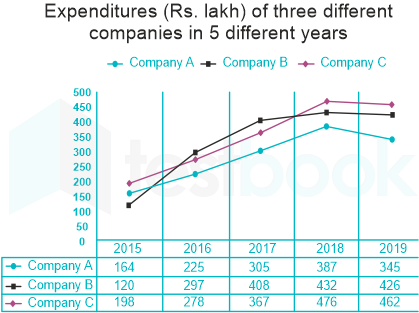
Study the graph and answer the question.

Total expenditure of all three companies together in the year 2018 was what percentage of the total expenditure of company B over all the years together?

  1. AOption (a)

    77.32%

  2. BOption (b)

    75.86%

  3. COption (c)

    76.95%

  4. DOption (d)

    78.65%

View answer & explanation

Correct answer

Answer: (c)C.

76.95%

Why this answer is correct

Formula Used:

Percentage = (Part / Whole) × 100

Calculation:

Total expenditure of all three companies in 2018 = 387 + 432 + 476 = 1295 lakh

Total expenditure of Company B over all years = 120 + 297 + 408 + 432 + 426 = 1683 lakh

Percentage = (1295 / 1683) × 100

⇒ Percentage ≈ 76.95%

∴ The total expenditure of all three companies together in 2018 was approximately 76.95% of the total expenditure of Company B over all the years together.

Question 26

If the simple interest on a certain sum for 8 years is 11/25 of the sum, then the rate of interest per annum is:

  1. AOption (a)

    8128\frac{1}{2} %

  2. BOption (b)

    5125\frac{1}{2} %

  3. COption (c)

    7127\frac{1}{2} %

  4. DOption (d)

    6126\frac{1}{2} %

View answer & explanation

Correct answer

Answer: (b)B.

5125\frac{1}{2} %

Why this answer is correct

Shortcut Trick

Rate (R) = [ (Simple Interest ÷ Principal) × 100 ] ÷ Time

Given SI = 11/25 of Sum, so SI ÷ P = 11/25

R = (11/25 × 100) ÷ 8

R = 44 ÷ 8 = 5.5%

∴ The correct answer is 5(1)/(2) %.

Alternate Method

Given:

Time (T) = 8 years

Simple Interest (SI) = 11/25 of Principal (P)

Formula Used:

SI = (P × R × T) ÷ 100

Calculations:

⇒ Substitute the given values into the formula:

⇒ (11/25) × P = (P × R × 8) ÷ 100

⇒ 11/25 = (R × 8) ÷ 100

⇒ 11/25 = 8R ÷ 100

⇒ 8R = (11 × 100) ÷ 25

⇒ 8R = 11 × 4

⇒ 8R = 44

⇒ R = 44 ÷ 8 = 5.5%

⇒ R = 5(1)/(2) %

∴ The correct answer is 5(1)/(2) %.

Additional Information

Relationship between SI and Amount

The total Amount (A) is the sum of Principal and Simple Interest: A = P + SI = P × [1 + (R × T) ÷ 100].

Constant Interest Property

In Simple Interest, the interest earned remains the same every year because it is always calculated on the initial principal.

Finding Rate when Sum Doubles

If a sum doubles itself in T years at SI, then the rate of interest R = 100 ÷ T.

Question 27

The Corresponding sides of two similar triangles are in the ratio of 2 : 3. If the area of the smaller triangle is 48 cm2, then the area of the bigger triangle is:

  1. AOption (a)

    230 cm2

  2. BOption (b)

    107 cm2

  3. COption (c)

    106 cm2

  4. DOption (d)

    108 cm2

View answer & explanation

Correct answer

Answer: (d)D.

108 cm2

Why this answer is correct

Shortcut Trick

Ratio of sides of two similar triangles = 2 : 3

Ratio of areas = (Ratio of sides)2 = 22 : 32 = 4 : 9

Given Area of smaller triangle (4 units) = 48 cm2

⇒ 1 unit = 12 cm2

⇒ Area of bigger triangle (9 units) = 9 × 12 = 108 cm2

∴ The correct answer is 108 cm2.

Alternate Method

Given:

Ratio of sides (s1/s2) = 2/3

Area of smaller triangle (A1) = 48 cm2

Formula Used:

For two similar triangles, the ratio of their areas is equal to the square of the ratio of their corresponding sides.

(Area1 / Area2) = (Side1 / Side2)2

Calculations:

⇒ 48 / A2 = (2 / 3)2

⇒ 48 / A2 = 4 / 9

⇒ A2 × 4 = 48 × 9

⇒ A2 = (48 × 9) ÷ 4

⇒ A2 = 12 × 9

⇒ A2 = 108 cm2

∴ The correct answer is 108 cm2.

Additional Information

Similarity Property of Triangles

If two triangles are similar, the ratio of their perimeters, medians, and altitudes is the same as the ratio of their corresponding sides.

Area and Side Relationship

The ratio of the areas is always the square of the ratio of any linear dimension (side, perimeter, radius) in similar geometric figures.

Criteria for Similarity

Triangles are similar if they satisfy AAA (Angle-Angle-Angle), SAS (Side-Angle-Side ratio), or SSS (Side-Side-Side ratio) conditions.

Question 28

Which player among the following won individual silver medal in the women’s 10 m air pistol event in International Shooting Sport Federation (ISSF) World Cup 2022?

  1. AOption (a)

    Manu Bhaker

  2. BOption (b)

    Esha Singh

  3. COption (c)

    Shreya Aggarwal

  4. DOption (d)

    Rajshree Sancheti

View answer & explanation

Correct answer

Answer: (b)B.

Esha Singh

Why this answer is correct

The correct answer is Esha Singh.

Key Points

  • The ISSF World Cup is an international shooting sport competition organized by the International Shooting Sport Federation (ISSF)
  • The first ISSF World Cup was held in 1986 to promote shooting sports globally.
  • The ISSF World Cup includes disciplines like 10m air rifle, 10m air pistol, trap, and skeet.
  • The ISSF World Cup is a major qualification event for the Olympic Games.

Additional Information

  • Manu Bhaker:
  • Young Achiever: Manu Bhaker won the gold medal at the 2018 ISSF World Cup at the age of 16 in the 10m Air Pistol event.
  • Olympic Glory: Manu Bhaker won two bronze medals at the 2024 Paris Olympics.
  • She secured one bronze in the 10m air pistol individual event and another in the mixed team event.
  • In the 25m pistol event, she narrowly missed a medal, finishing in fourth place.
  • Shreya Aggarwal:
  • She won gold at the ISSF Junior World Cup and has been part of the national shooting team.
  • Rajshree Sanchet:
  • Rajshree Sancheti won the gold medal in the Women's 10m Air Rifle category at the 64th National Shooting Championship in Bhopal.

Question 29

If 3 and -7 are the roots of a quadratic equation, then the quadratic equation is:

  1. AOption (a)

    x2 + 4x - 21 = 0

  2. BOption (b)

    -x2 + 4x + 21 = 0

  3. COption (c)

    x2 - 4x - 21 = 0

  4. DOption (d)

    x2 - 4x + 21 = 0

View answer & explanation

Correct answer

Answer: (a)A.

x2 + 4x - 21 = 0

Why this answer is correct

Shortcut Trick

For any quadratic equation with roots α and β, the equation is x2 − (Sum of roots)x + (Product of roots) = 0.

Sum of roots (S) = 3 + (−7) = −4

Product of roots (P) = 3 × (−7) = −21

Equation: x2 − (−4)x + (−21) = 0 ⇒ x2 + 4x − 21 = 0

∴ The correct answer is x2 + 4x − 21 = 0.

Alternate Method

Given:

Roots of the quadratic equation are α = 3 and β = −7.

Formula Used:

If α and β are roots, the equation is given by (x − α)(x − β) = 0.

Calculations:

⇒ (x − 3)(x − (−7)) = 0

⇒ (x − 3)(x + 7) = 0

⇒ x(x + 7) − 3(x + 7) = 0

⇒ x2 + 7x − 3x − 21 = 0

⇒ x2 + 4x − 21 = 0

∴ The correct answer is x2 + 4x − 21 = 0.

Additional Information

Standard Form of Quadratic Equation

A quadratic equation is expressed as ax2 + bx + c = 0, where a ≠ 0.

Sum and Product of Roots

For ax2 + bx + c = 0, Sum of roots = −b/a and Product of roots = c/a.

Nature of Roots (Discriminant)

D = b2 − 4ac. If D > 0, roots are real and distinct; if D = 0, roots are real and equal; if D < 0, roots are imaginary.

Question 30

Read the given statements and conclusions carefully and decide which of the given conclusions logically follow(s) from the statements.

Statements:

In a race,

  1. G is behind L who is behind D.
  2. D is ahead of G who is ahead of R.
  3. F is not behind V who is ahead of R.

Conclusions:

I. V is behind D.

II. F is ahead of R.

IIl. D is ahead of R.

  1. AOption (a)

    Conclusions I and III follow

  2. BOption (b)

    Conclusion III follows

  3. COption (c)

    Conclusions II and III follow

  4. DOption (d)

    Conclusions I and II follow

View answer & explanation

Correct answer

Answer: (c)C.

Conclusions II and III follow

Why this answer is correct

Given Statements: In a race,

  1. G is behind L who is behind D. ⇒ D - L - G
  2. D is ahead of G who is ahead of R. ⇒ D - G - R
  3. F is not behind V who is ahead of R. ⇒ F - V - R

Conclusions:

I) V is behind D → False (From statements 2 and 3 we get, D is ahead R and R is behind V, but cannot be determined whether V is behind D or not).

II) F is ahead of R → True (From statement 3 we get, F is ahead of V who is ahead of R, therefore F is ahead of R).

IIl. D is ahead of R → True (From statement 2 we get, D is ahead of G who is ahead of R, therefore D is ahead of R).

∴ Here, Only conclusions II and III follow.

Hence, the correct answer is 'Option 3'.

Question 31

A shopkeeper sells an item for Rs. 571.20 after giving two successive discounts of 20% and 15% on its marked price. Had he not given any discount, he would have earned a profit of 12%. What is the cost price (in Rs.) of the item?

  1. AOption (a)

    780

  2. BOption (b)

    720

  3. COption (c)

    750

  4. DOption (d)

    700

View answer & explanation

Correct answer

Answer: (c)C.

750

Why this answer is correct

Shortcut Trick

Effective discount = 20 + 15 − (20 × 15) ÷ 100 = 32%.

SP = 68% of MP ⇒ 571.20 = 0.68 × MP ⇒ MP = 840.

If no discount, SP = MP = 840. Here, Profit = 12%.

Multiplier: CP × 1.12 = 840.

CP = 840 ÷ 1.12 = 750.

∴ The correct answer is Rs. 750.

Alternate Method

Given: Selling Price (SP) = Rs. 571.20, Discounts = 20% and 15%, Profit without discount = 12%. Formulas: SP = MP × (100 − D1)% × (100 − D2)%, CP = MP ÷ (1 + P%).

⇒ Let Marked Price be M.

⇒ M × 80/100 × 85/100 = 571.20

⇒ M × 0.8 × 0.85 = 571.20 ⇒ M × 0.68 = 571.20

⇒ M = 571.20 ÷ 0.68 = 840

⇒ Since no discount means SP = MP, New SP = 840.

⇒ CP × (112/100) = 840 ⇒ CP = (840 × 100) ÷ 112

⇒ CP = 7.5 × 100 = 750.

∴ The correct answer is Rs. 750.

Additional Information

Successive Discounts

When two discounts a% and b% are given, the total discount is (a + b − ab/100)%.

Marked Price (MP)

MP is the price printed on the label. If no discount is offered, Marked Price becomes the Selling Price.

Question 32

Anu is four times as good as Binni in doing a work. Together they finish the same work in 12 hrs. In how many hrs will Anu alone finish the work?

  1. AOption (a)

    10 hrs

  2. BOption (b)

    11 hrs

  3. COption (c)

    15 hrs

  4. DOption (d)

    13 hrs

View answer & explanation

Correct answer

Answer: (c)C.

15 hrs

Why this answer is correct

Shortcut Trick

Ratio of efficiency Anu : Binni = 4 : 1

Total efficiency = 4 + 1 = 5 units/hr

Total Work = Total efficiency × Total time = 5 × 12 = 60 units

Time taken by Anu = Total Work ÷ Anu efficiency = 60 ÷ 4 = 15 hrs

∴ The correct answer is 15 hr.

Alternate Method

PersonEfficiency (Units/hr)Total Work (Units)Time (hrs)
Anu46060 ÷ 4 = 15
Binni160 ÷ 1 = 60

Given:

⇒ Efficiency of Anu is 4 times that of Binni.

⇒ Time taken by Anu + Binni = 12 hrs.

Formula Used:

⇒ Total Work = (Efficiency1 + Efficiency2) × Timetogether

⇒ Timealone = Total Work ÷ Individual Efficiency

Calculations:

⇒ Let Binni efficiency = 1 unit/hr, then Anu efficiency = 4 units/hr.

⇒ Combined efficiency = 4 + 1 = 5 units/hr.

⇒ Total Work = 5 × 12 = 60 units.

⇒ Time taken by Anu alone = 60 ÷ 4 = 15 hrs.

∴ The correct answer is 15 hr.

Additional Information

Efficiency and Time Relationship

Efficiency is inversely proportional to the time taken to complete a work. If the efficiency ratio is a : b, the time ratio is b : a.

Work and Wages

Wages are always distributed in the ratio of the work done or the efficiency of the individuals when they work for the same duration.

Man-Day Formula

M1D1H1 / W1 = M2D2H2 / W2, where M is men, D is days, H is hours, and W is work.

Question 33

Where is India’s only confirmed active volcano located, which lies about 135 km south of the Andaman and Nicobar Island's capital, Port Blair?

  1. AOption (a)

    Barren Island

  2. BOption (b)

    Havelock island

  3. COption (c)

    Wilson Island

  4. DOption (d)

    Neill Island

View answer & explanation

Correct answer

Answer: (a)A.

Barren Island

Why this answer is correct

The correct answer is Barren Island.

Key Points

  • Barren Island is part of the Andaman Islands group.
  • It lies on the boundary of the Indian and Burmese tectonic plates, contributing to its volcanic activity.
  • It is classified as a stratovolcano, characterized by steep slopes and explosive eruptions.
  • Consideration for UNESCO World Heritage status due to its unique geological and ecological characteristics.

Additional Information

  • Havelock Island:
  • It is known for its white sandy beaches like Radhanagar Beach, which has been ranked as one of the best beaches in Asia.
  • It is part of the Andaman Islands, rich in marine biodiversity, including coral reefs and tropical fish.
  • Wilson Island:
  • Wilson Island is one of the small and lesser-known islands in the region, not widely associated with volcanic activity.
  • The island is not a major tourist spot or research area, contributing to its relatively unknown status.
  • Neil Island:
  • Neil Island is known for its agriculture, producing vegetables for the nearby islands.
  • It is a popular eco-tourism destination with attractions like the natural bridge and coral reefs, though less frequented than Havelock Island.

Question 34

What kind of resources are the fossil fuels coal and petroleum?

  1. AOption (a)

    Exhaustible and renewable

  2. BOption (b)

    Inexhaustible

  3. COption (c)

    Exhaustible and non-renewable

  4. DOption (d)

    Renewable

View answer & explanation

Correct answer

Answer: (c)C.

Exhaustible and non-renewable

Why this answer is correct

The correct answer is Exhaustible and non-renewable.

Key Points

  • Fossil fuels like coal and petroleum are exhaustible and non-renewable.
  • Exhaustible: Fossil fuels like coal and petroleum are formed from the buried remains of dead organisms over millions of years.
  • This process is extremely slow and cannot be replicated within human timescales.
  • Therefore, these resources are finite and will eventually run out.
  • Non-renewable: Unlike renewable resources like sunlight, wind, and water that are constantly replenished, fossil fuels cannot be readily replaced once they are extracted and used.
  • Their formation takes millions of years, making them essentially non-renewable in practical terms.

Additional Information

  • Renewable Energy sources:
  • These are those that come from naturally occurring, self-replenishing sources.
  • They are becoming increasingly important as we look to move away from fossil fuels and reduce our impact on the environment.
  • Here are some of the most common types of renewable energy sources :
  • Solar energy, Wind energy, Hydropower, Geothermal energy, Biomass energy, Ocean energy, etc.

Question 35

The position of how many letters will remain unchanged if each of the letters in the word DUPLICATE is arranged in alphabetical order?

  1. AOption (a)

    4

  2. BOption (b)

    2

  3. COption (c)

    1

  4. DOption (d)

    3

View answer & explanation

Correct answer

Answer: (b)B.

2

Why this answer is correct

Given word: 'DUPLICATE'

After arranged in alphabetical order:

AlphabetsDUPLICATE
Alphabetical orderACDEILPTU


Now,

there are Two alphabets "I" and "T" will remain unchanged if each of the letters in the word 'DUPLICATE' is arranged in English alphabetical order.

Hence, the correct answer is "Option 2".

Question 36

T, U, V, W, X, Y, Z and A are sitting in a straight row, facing north. Only Z sits between T and V.  A sits at the extreme left end of the row. Only three people sit between Z and Y. Only X sits between V and W. T sits to the immediate right of U. Who sits to the immediate right of A?

  1. AOption (a)

    T

  2. BOption (b)

    W

  3. COption (c)

    U

  4. DOption (d)

    Z

View answer & explanation

Correct answer

Answer: (c)C.

U

Why this answer is correct

Given: T, U, V, W, X, Y, Z and A are sitting in a straight row, facing north.

1) A sits at the extreme left end of the row. 

2) Only three people sit between Z and Y.

As positions of Z and Y is not known yet, therefore there are three possible cases.

Case 1)

Case 2)

Case 3)

3) Only Z sits between T and V.

4) Only X sits between V and W. 

5) T sits to the immediate right of U.

As there is no possible position for U in Case 1 and Case 2, therefore both cases are eliminated.

Case 3)

Thus, according to the final arrangement U sits to the immediate right of A.

Hence, "Option 3" is the correct answer.

Question 37

Toothpaste is generally ________ in nature.

  1. AOption (a)

    harmful

  2. BOption (b)

    acidic

  3. COption (c)

    neutral

  4. DOption (d)

    basic

View answer & explanation

Correct answer

Answer: (d)D.

basic

Why this answer is correct

The correct answer is Basic.

Key Points

  • Toothpaste is basic in nature to neutralize the acids produced by bacteria in the mouth, helping prevent tooth decay and maintain oral hygiene.
  • A common household item, baking soda is a weak base used for baking, cleaning, and neutralizing odors.
  • It’s often used in experiments to demonstrate acid-base reactions.
  • Soaps and detergents are basic.
  • They help break down grease and dirt by interacting with the oils, making them soluble in water for effective cleaning.
  • Antacid Tablets: Used to relieve indigestion and heartburn, antacids are basic substances that neutralize excess stomach acid, providing relief from acidity.

Additional Information

  • Acidic Substances:
  • Acidic substances have a pH value of less than 7, which indicates a higher concentration of hydrogen ions (H⁺).
  • Vinegar (acetic acid) and lemon juice (citric acid) are examples of acidic substances commonly found in households.
  • Neutral Substances:
  • Neutral substances have a pH value of exactly 7, meaning they are neither acidic nor basic.
  • Example - Water: Pure water is a neutral substance and serves as a baseline in the pH scale for comparison with acids and bases.
  • Basic (Alkaline) Substances:
  • Basic substances have a pH value greater than 7, which indicates a lower concentration of hydrogen ions and a higher concentration of hydroxide ions (OH⁻).

Question 38

Five persons, P, Q, R, S and T travelled in different months of the same year viz. January, February, March, April and May.

Q travelled in February. Only one person travelled between Q and P. Only three people travelled between T and R. R travelled in a month after P. Who among them travelled in May?

  1. AOption (a)

    T

  2. BOption (b)

    R

  3. COption (c)

    S

  4. DOption (d)

    P

View answer & explanation

Correct answer

Answer: (b)B.

R

Why this answer is correct

Given: Five persons, P, Q, R, S and T travelled in different months of the same year viz. January, February, March, April and May.

1) Q travelled in February.

  1. Only one person travelled between Q and P. 
MonthPerson
January
FebruaryQ
March
AprilP
May

3) Only three people travelled between T and R.

  1. R travelled in a month after P. 

After positioning T and R only one position is left which will be occupied by the only person left i.e. S.

MonthPerson
JanuaryT
FebruaryQ
MarchS
AprilP
MayR

Thus, according to the final arrangement  R travelled in May.

Hence, "Option 2" is the correct answer.

Mistake Points Here, R travelled in a month after P doesn't mean immediately after P, it means R travelled in any month after P.

Question 39

lf

'-' means '÷', 

‘+' means '×’,

'÷' stands for '-' and

'×’ means ‘+',

then which of the following equations is correct?

  1. AOption (a)

    20 ÷ 3 × 9 + 5 - 2 = 50

  2. BOption (b)

    20 + 3 - 9 ÷ 5 × 2 = 20

  3. COption (c)

    20 - 3 + 9 × 5 ÷ 2 = 63

  4. DOption (d)

    20 × 3 ÷ 9 - 5 + 2 = 63

View answer & explanation

Correct answer

Answer: (c)C.

20 - 3 + 9 × 5 ÷ 2 = 63

Why this answer is correct

Decoding signs:

Sign-+÷×
Stands for÷×-+

So checking each option one by one:

Option 1) 20 ÷ 3 × 9 + 5 - 2 = 50 ⇒ 20 - 3 + 9 × 5 ÷ 2 = 50

⇒ 20 - 3 + 9 × 5 ÷ 2 = 50

⇒ 20 - 3 + 9 × 2.5 = 50

⇒ 20 + 22.5 - 3 = 50

⇒ 42.5 - 3 = 50

⇒ 39.5 ≠ 50 (LHS ≠ RHS)

Option  2) 20 + 3 - 9 ÷ 5 × 2 = 20 ⇒ 20 × 3 ÷ 9 - 5 + 2 = 20

⇒ 20 × 3 ÷ 9 - 5 + 2 = 20

⇒ 20 × 0.33 - 5 + 2 = 20

⇒ 6.6 + 2 - 5 = 20

⇒ 8.6 - 5 = 20

⇒ 3.6 ≠ 20 (LHS ≠ RHS)

Option  3) 20 - 3 + 9 × 5 ÷ 2 = 63 ⇒ 20 ÷ 3 × 9 + 5 - 2 = 63

⇒ 20 ÷ 3 × 9 + 5 - 2 = 63

⇒ 6.67 × 9 + 5 - 2 = 63

⇒ 60 + 5 - 2 = 63

⇒ 65 - 2 = 63

⇒ 63 = 63 (LHS = RHS)

Option  4) 20 × 3 ÷ 9 - 5 + 2 = 63 ⇒ 20 + 3 - 9 ÷ 5 × 2 = 63

⇒ 20 + 3 - 9 ÷ 5 × 2 = 63

⇒ 20 + 3 - 1.8 × 2 = 63

⇒ 20 + 3 - 3.6 = 63

⇒ 23 - 3.6 = 63

⇒ 19.4 ≠ 63 (LHS ≠ RHS)

Hence, "Option 3" is the correct answer.

Question 40

________ ​refers to the cessation of menstruation.

  1. AOption (a)

    Menses

  2. BOption (b)

    Menopause

  3. COption (c)

    Menarche

  4. DOption (d)

    Hypermenorrhea

View answer & explanation

Correct answer

Answer: (b)B.

Menopause

Why this answer is correct

The correct answer is Menopause.

Key Points

  • Menopause marks the permanent cessation of menstrual cycles, typically occurring between the ages of 45-55, signaling the end of a woman's reproductive phase.
  • It is caused by a decline in the production of hormones such as estrogen and progesterone by the ovaries, leading to various physiological changes.
  • Common symptoms include hot flashes, night sweats, mood swings, and changes in sleep patterns, often requiring medical attention.
  • Post-menopausal Health Risks: Women are at increased risk of osteoporosis and cardiovascular diseases after menopause due to reduced estrogen levels, making post-menopausal care essential.

Additional Information

  • Menses:
  • Menses refers to the regular monthly shedding of the uterine lining, known as menstruation, in women of reproductive age.
  • It is part of the menstrual cycle, typically lasting 28 days, with menses marking the beginning of each cycle (days 1–5).
  • Menarche:
  • Menarche is the term for the first occurrence of menstruation, signaling the onset of puberty in girls, usually between the ages of 11-14.
  • It marks the beginning of a female's reproductive capability and is an important biological and social milestone.
  • Hypermenorrhea:
  • Hypermenorrhea refers to abnormally heavy or prolonged menstrual bleeding, often exceeding 7 days.
  • It can be caused by hormonal imbalances, uterine fibroids, or other medical conditions and may require medical evaluation and treatment.

Question 41

Jawaharlal Nehru classified which of the following Acts as ‘a new charter of slavery’?

  1. AOption (a)

    Government of India Act, 1935

  2. BOption (b)

    The Charter Act, 1853

  3. COption (c)

    Rowlatt Act

  4. DOption (d)

    Government of India Act, 1919

View answer & explanation

Correct answer

Answer: (a)A.

Government of India Act, 1935

Why this answer is correct

The correct answer is the Government of India Act, 1935.

Key Points

  • The Act introduced provincial autonomy, granting limited self-governance to provinces while maintaining British control over critical matters.
  • It established a bicameral legislature at the center with the Federal Assembly and the Council of States, marking a significant shift in governance.
  • The Act proposed a federal structure with provinces, princely states, and British India, though the federation never fully came into effect.
  • It introduced dyarchy at the central level, dividing subjects into "Federal" and "Provincial" categories, but retaining key powers with the British.

Additional Information

  • The Charter Act, 1853:
  • This Act separated the legislative and executive functions of the Governor-General's Council.
  • It introduced an open competition for the recruitment of civil servants.
  • Rowlatt Act (1919):
  • It is also known as the Anarchical and Revolutionary Crimes Act.
  • it allowed the British government to imprison individuals suspected of sedition without trial for up to two years.
  • The Act led to widespread protests across India, including the infamous Jallianwala Bagh massacre in 1919.
  • Government of India Act, 1919 (Montagu-Chelmsford Reforms):
  • This Act introduced dyarchy at the provincial level, dividing subjects into "Transferred" and "Reserved" categories, with Indian ministers responsible for the former.
  • It expanded the legislative councils at both the central and provincial levels, but the franchise remained limited to a small, privileged section of the population.

Question 42

Which city of India will host the 2023 International Olympic Committee Session?

  1. AOption (a)

    Shimla

  2. BOption (b)

    Guwahati

  3. COption (c)

    Chennai

  4. DOption (d)

    Mumbai

View answer & explanation

Correct answer

Answer: (d)D.

Mumbai

Why this answer is correct

The correct answer is Mumbai.

Key Points

  • India is hosting an IOC session after 40 years, with the last one held in New Delhi in 1983.
  • The session will be hosted at the Jio World Centre.
  • The previous session of the International Olympic Committee (IOC) was held in Beijing, China, from January 18 to 22, 2022.
  • The most recent International Olympic Committee (IOC) session was held in Paris, where eight new IOC members were elected.

Additional Information

  • ​The IOC was founded in 1894 by Pierre de Coubertin to revive the Olympic Games.
  • The IOC is headquartered in Lausanne, Switzerland.
  • The IOC operates under the Olympic Charter, which outlines the rules for the organization and conduct of the Olympic Games.
  • The IOC consists of 100+ members, including athletes, officials, and representatives from National Olympic Committees (NOCs).
  • The IOC is responsible for selecting the host cities for the Olympic Games, with the next Summer Games set for 2028 in Los Angeles.

Question 43

Which of the following is a public sector bank in India?

  1. AOption (a)

    Tamilnad Mercantile Bank

  2. BOption (b)

    Indian Overseas Bank

  3. COption (c)

    IndusInd Bank

  4. DOption (d)

    Bandhan Bank

View answer & explanation

Correct answer

Answer: (b)B.

Indian Overseas Bank

Why this answer is correct

The correct answer is Indian Overseas Bank.

Key Points

  • Public sector banks are majority-owned by the government.
  • They operate under the regulatory framework of the Reserve Bank of India (RBI).
  • They provide various services, including loans, savings accounts, and government schemes.
  • Promote Financial Inclusion: Public sector banks focus on extending banking services to rural and underserved areas.

Additional Information

  • Private sector banks are owned by private individuals or corporations, distinguishing them from public sector banks, which are government-owned.
  • Prominent private sector banks include HDFC Bank, ICICI Bank, Axis Bank, and Kotak Mahindra Bank.
  • These banks are regulated by the Reserve Bank of India (RBI), ensuring adherence to banking norms and guidelines.
  • Private sector banks often lead in digital banking solutions, offering advanced mobile banking services and customer-centric financial products.

Question 44

Which of the following molecules has three carbon atoms in it?

  1. AOption (a)

    Glucose

  2. BOption (b)

    Pyruvic acid

  3. COption (c)

    Carbon dioxide

  4. DOption (d)

    Ethanol

View answer & explanation

Correct answer

Answer: (b)B.

Pyruvic acid

Why this answer is correct

The correct answer is Pyruvic acid.

Key Points

  • Pyruvic acid is a key intermediate in several metabolic pathways, including glycolysis, where glucose is converted into pyruvate, generating ATP.
  • Pyruvic acid serves as a critical substrate for the Krebs cycle (Citric Acid Cycle), linking glycolysis with aerobic respiration and energy production.
  • Pyruvic acid: 3 carbon atoms (C₃H₄O₃).
  • Pyruvic acid is used in various applications, including cosmetic treatments.

Additional Information 

Glucose:

  • Glucose is the main source of energy for cells in the body and is crucial for cellular respiration.
  • It is a simple sugar (monosaccharide) with the chemical formula C₆H₁₂O₆, consisting of six carbon atoms.
  • Excess glucose can be stored as glycogen in the liver and muscles through a process called glycogenesis for future energy needs.

Carbon Dioxide:

  • Carbon dioxide (CO₂) is a byproduct of cellular respiration and is expelled from the body through exhalation.
  • It is essential for photosynthesis in plants, where it is used along with sunlight and water to produce glucose and oxygen.
  • Carbon dioxide is a significant greenhouse gas, contributing to climate change and global warming when present in excess in the atmosphere.

Ethanol:

  • Ethanol (C₂H₅OH) is produced through the fermentation of sugars by yeast, commonly used in the production of alcoholic beverages.
  • It serves as a solvent, and fuel additive (ethyl alcohol), and is used in the manufacture of various chemicals.

Medical Applications:

  • Ethanol has antiseptic properties and is used in medical settings for disinfecting and as a preservative in some medicines.

Question 45

If the numerator of a fraction be increased by 10% and its denominator be reduced by 5%, then the fraction becomes 4/5. Find the original fraction.

  1. AOption (a)

    17/25

  2. BOption (b)

    23/55

  3. COption (c)

    38/55

  4. DOption (d)

    19/25

View answer & explanation

Correct answer

Answer: (c)C.

38/55

Why this answer is correct

Shortcut Trick

Let the original fraction be x/y.

New fraction = (Original Fraction) × (100 + % increase in numerator) ÷ (100 − % decrease in denominator)

4/5 = (x/y) × (110 / 95)

x/y = (4/5) × (95 / 110) = (4 × 19) / (1 × 110) = 76 / 110 = 38 / 55

∴ The correct answer is 38/55.

Alternate Method

Given:

Increase in numerator = 10%

Decrease in denominator = 5%

Resultant fraction = 4/5

Calculations:

Let the original fraction be x/y.

⇒ New Numerator = x + 10% of x = 1.1x

⇒ New Denominator = y − 5% of y = 0.95y

⇒ According to the question: (1.1x) / (0.95y) = 4/5

⇒ x/y = (4/5) × (0.95 / 1.1)

⇒ x/y = (4/5) × (95 / 110)

⇒ x/y = (4 × 19) / 110

⇒ x/y = 76 / 110

⇒ x/y = 38 / 55

∴ The correct answer is 38/55.

Additional Information

Percentage Change in Fractions

If the numerator increases by a% and denominator increases by b%, the new fraction is [x(100+a)] / [y(100+b)].

Base Change Property

To find the original value after a percentage change, multiply the final value by the inverse of the change factor.

Ratio and Proportion

Fractions can be treated as ratios where x:y represents the relationship between numerator and denominator.

Question 46

Which disease in human beings is caused by UV radiation from the Sun?

  1. AOption (a)

    Pneumonia

  2. BOption (b)

    Skin cancer

  3. COption (c)

    Smallpox

  4. DOption (d)

    Parkinson’s disease

View answer & explanation

Correct answer

Answer: (b)B.

Skin cancer

Why this answer is correct

The correct answer is Skin cancer.

Key Points

  • The main types of skin cancer caused by UV radiation are basal cell carcinoma, squamous cell carcinoma, and melanoma.
  • Melanomas: Cancers that arise from melanocytes, the pigment-producing cells in the skin.
  • Ultraviolet (UV) radiation was discovered in 1801 by German physicist Johann Wilhelm Ritter.
  • UV rays were classified as part of the electromagnetic spectrum, situated between visible light and X-rays, with wavelengths ranging from 10 nm to 400 nm.

Additional Information

  • Pneumonia:
  • Pneumonia is a significant cause of mortality worldwide, especially among young children and the elderly.
  • Vaccines such as the pneumococcal vaccine and influenza vaccine effectively reduce the incidence and severity of pneumonia.
  • Smallpox:
  • Smallpox was declared eradicated by the World Health Organization (WHO) in 1980.
  • the first disease to be eliminated through vaccination.
  • The development of the smallpox vaccine by Edward Jenner in 1796 laid the groundwork for modern immunology and vaccination practices.
  • Parkinson’s Disease:
  • Parkinson’s disease is a common neurodegenerative disorder that affects approximately 1% of the population over the age of 60.
  • Symptoms include tremors, rigidity, and bradykinesia (slowness of movement), impacting daily life and motor functions.

Question 47

Which of the following festivals is celebrated in the month of January every year?

  1. AOption (a)

    Pongal

  2. BOption (b)

    Ugadi

  3. COption (c)

    Gudi Padwa

  4. DOption (d)

    Onam

View answer & explanation

Correct answer

Answer: (a)A.

Pongal

Why this answer is correct

The correct answer is Pongal.

Key Points

  • Pongal, is also referred to as Thai Pongal, is a multi-day Hindu harvest festival of South India, particularly in the Tamil community.
  • It is observed at the start of the month Tai according to the Tamil solar calendar, and this is typically about January 14.
  • Pongal is celebrates the harvest, particularly rice, and marks the beginning of the sun’s northward journey (Uttaraayanam).
  • It includes various rituals and community activities, emphasizing gratitude to nature and farmers.

Additional Information

  • Ugadi
  • Ugadi is celebrated with enthusiasm in Andhra Pradesh, Karnataka, and Telangana.
  • It signifies the beginning of the New Year according to the Hindu lunisolar calendar.
  • The name "Ugadi" is derived from the Sanskrit words "Yuga" (age) and "Adi" (beginning), meaning the start of a new age.
  • Gudi Padwa
  • Gudi Padwa is also known as Samvatsar Padvo, celebrated on the first day of the Chaitra month in the Hindu calendar.
  • Marks the New Year for people in Maharashtra and the Konkan region.
  • The name comes from "gudi," meaning flag or emblem of Lord Brahma, and "padwa," meaning the first day of the moon's phase.
  • According to Hindu mythology, Lord Brahma created the universe on Gudi Padwa.
  • Onam
  • Marks the end of monsoons and welcomes the harvest season.
  • Celebrated for 10 days during the Malayalam month of Chingam.
  • The history of the Onam festival dates back to the Sangam period.
  • This festival commemorates the arrival of Asura King Mahabali’s annual visit from Pataal lok.
  • Various events like Tripunithura Athachamayam, Pookalam- The Floral Decorations & Arrangement.
  • Pulikali- The Grand Tiger Dance, and Vallamkali-The Snake Boat Race are done during this festival.

Question 48

Vamsi's father is 60 years old. He is 20 years older than twice Vamsi's age. Find Vamsi's age.

  1. AOption (a)

    20 years

  2. BOption (b)

    30 years

  3. COption (c)

    25 years

  4. DOption (d)

    15 years

View answer & explanation

Correct answer

Answer: (a)A.

20 years

Why this answer is correct

Shortcut Trick

Subtract the extra age from the father's age: 60 − 20 = 40 years.

Divide the remaining age by the multiplier (twice): 40 ÷ 2 = 20 years.

∴ The correct answer is 20 years.

Alternate Method

Given:

Father's age = 60 years

Let Vamsi's age be x years.

Equation Formulation:

⇒ Father's Age = 2 × (Vamsi's Age) + 20

⇒ 60 = 2x + 20

⇒ 2x = 60 − 20

⇒ 2x = 40

⇒ x = 40 ÷ 2

⇒ x = 20

∴ The correct answer is 20 years.

Additional Information

Linear Equations in One Variable

Equations of the form ax + b = c are solved by isolating the variable x using inverse operations.

Age Relation Problems

Always define the current age of the youngest person as 'x' to simplify the ratio and comparison calculations.

Question 49

An object is placed in front of a concave mirror of focal length 6 cm, at a distance of 24 cm. The magnification produced by the mirror is ________.

  1. AOption (a)

    3

  2. BOption (b)

    -13\frac{1}{3}

  3. COption (c)

    13\frac{1}{3}

  4. DOption (d)

    -3

View answer & explanation

Correct answer

Answer: (b)B.

-13\frac{1}{3}

Why this answer is correct

Concept:

Concave Mirror

  • A concave mirror is a spherical mirror that curves inward, like the inside of a bowl.
  • The focal length (f) is the distance from the mirror to the focal point, where parallel rays of light converge after reflection.
  • The mirror formula relates the object distance (u), the image distance (v), and the focal length (f) and is given by:

1f=1v+1u\frac{1}{f} = \frac{1}{v} + \frac{1}{u} --- (1)

  • The magnification (m) produced by a mirror is defined as the ratio of the height of the image (h') to the height of the object (h) and is also related to the object and image distances:

m=h′h=−vum = \frac{h'}{h} = -\frac{v}{u} --- (2)

Calculation:

Given:

  • Focal length, f = 6 cm (since it's a concave mirror, f will be negative, so f = -6 cm)
  • Object distance, u = 24 cm (object distance is always taken as negative in mirror formula, so u = -24 cm)

Using the mirror formula (1):

1f=1v+1u\frac{1}{f} = \frac{1}{v} + \frac{1}{u}

Substitute the given values:

1−6=1v+1−24\frac{1}{-6} = \frac{1}{v} + \frac{1}{-24}

Rearrange to solve for 1v :

1v=1−6+124\frac{1}{v} = \frac{1}{-6} + \frac{1}{24}

Find a common denominator (24):

1v=−4+124=−324=−18\frac{1}{v} = \frac{-4 + 1}{24} = \frac{-3}{24} = \frac{-1}{8}

Therefore, the image distance v is:

v=−8 v = -8

Using the magnification formula (2):

m=−vu m = -\frac{v}{u}

Substitute the values of v and u :

m=−−8−24=−824=−13 m = -\frac{-8}{-24} = -\frac{8}{24} = -\frac{1}{3}

So, the magnification produced by the mirror is −13-\frac{1}{3}

Question 50

Seven people, A, B, C, D, E, F and G, are sitting in a straight row, facing north. Only three people sit between A and D. Only two people sit to the left of A. G is not an immediate neighbour of D. G sits second to the right of E. F sits to the immediate right of C. Who sits at the extreme left end of the row?

  1. AOption (a)

    E

  2. BOption (b)

    A

  3. COption (c)

    B

  4. DOption (d)

    G

View answer & explanation

Correct answer

Answer: (c)C.

B

Why this answer is correct

Given: Seven people, A, B, C, D, E, F and G, are sitting in a straight row, facing north. 

1) Only two people sit to the left of A.

2) Only three people sit between A and D. 

3) G sits second to the right of E.

4) G is not an immediate neighbour of D. 

5) F sits to the immediate right of C. 

After positioning F and C only one position is left which will be occupied by the only person left i.e. B.

Thus, B sits at the extreme left end of the row.

Hence, "Option 3" is the correct answer.

Question 51

In Economics, Total variable cost / Units of output produced = ________.

  1. AOption (a)

    Average product

  2. BOption (b)

    Average fixed cost

  3. COption (c)

    Total product

  4. DOption (d)

    Average variable cost

View answer & explanation

Correct answer

Answer: (d)D.

Average variable cost

Why this answer is correct

The correct answer is Average variable cost .

Key Points

  • Total Variable Cost (TVC) refers to costs that change with the level of output, such as materials and labor.
  • Total Cost (TC) is calculated by adding fixed costs (which do not change with output) to total variable costs.
  • Average Variable Cost (AVC) can be determined by dividing total variable costs by the number of units produced.
  • Understanding TVC helps businesses optimize production levels and pricing strategies by analyzing cost behavior with changes in output.

Additional Information

  • Marginal Cost (MC) The change in total variable cost resulting from producing one additional unit can help determine the marginal cost of production, which is crucial for pricing decisions.
  • Cost-Volume Relationship: Analyzing the relationship between total variable costs and output helps businesses understand how costs scale with production levels, assisting in budgeting and financial planning.
  • Break-Even Analysis: Knowing total variable costs per unit aids in calculating the break-even point, where total revenue equals total costs, helping businesses assess profitability.
  • Operational Efficiency: Monitoring total variable costs relative to output can highlight areas for improving operational efficiency, such as reducing waste or optimizing resource allocation.

Question 52

Consider the following statement about a fuse wire:

(a) It is connected in series with a device.

(b) It is made of a material of low melting point.

Which of the above statements is/are correct?

  1. AOption (a)

    Only (b)

  2. BOption (b)

    Only (a)

  3. COption (c)

    Both (a) and (b)

  4. DOption (d)

    Neither (a) nor (b)

View answer & explanation

Correct answer

Answer: (c)C.

Both (a) and (b)

Why this answer is correct

The correct answer is Both (a) and (b).

Key Points

  • A device connected in series with a low melting point material often serves as a safety feature to prevent overheating or excessive current flow.
  • If the current exceeds a certain level, the low melting point material melts and interrupts the circuit, protecting the device from damage.
  • The low melting point allows for a quick response to overcurrent situations, minimizing potential hazards and equipment failure.
  • Common materials used for this purpose include lead, tin, or specific alloys, chosen for their predictable melting characteristics under specified conditions.

Additional Information

  • The low melting point material is designed with a specific current rating, ensuring it only melts under predetermined current conditions to protect the connected device effectively.
  • Some low melting point materials are used in resettable fuses, which can restore functionality after cooling, providing convenience over traditional fuses that need replacement.
  • The material must exhibit good thermal stability to ensure reliable operation over time, even under varying environmental conditions.
  • Devices using low melting point materials often have a compact design, making them suitable for applications where space is limited, such as in electronics and appliances.
  • These devices are commonly found in household appliances, automotive circuits, and electronic devices, where protection against overloads is crucial for safety and functionality.

Question 53

In January 2022, who launched NIPER Research Portal?

  1. AOption (a)

    Narendra Modi

  2. BOption (b)

    Mansukh Mandaviya

  3. COption (c)

    Piyush Goyal

  4. DOption (d)

    Amit Shah

View answer & explanation

Correct answer

Answer: (b)B.

Mansukh Mandaviya

Why this answer is correct

The correct answer is Mansukh Mandaviya.

Key Points

  • Mansukh Mandaviya serves as the Minister of Health and Family Welfare in India, having taken office in July 2021.
  • He is a member of the Bharatiya Janata Party (BJP) and has been a Member of Parliament (MP) for the Vadodara constituency since 2019.
  • Mandaviya has held various ministerial roles, including Minister of State for Chemicals and Fertilizers, where he worked on enhancing India's fertilizer production and chemical sector.
  • He has been instrumental in managing India's COVID-19 response, focusing on vaccination drives and healthcare infrastructure improvements.

Additional Information

  • Narendra Modi 
  • Narendra Modi has been the Prime Minister of India since May 2014 and is a prominent leader of the Bharatiya Janata Party (BJP) and the Rashtriya Swayamsevak Sangh (RSS).
  • His government has implemented significant economic reforms, including the Goods and Services Tax (GST) and initiatives like Make in India, aimed at boosting manufacturing and foreign investment.
  • Modi has focused on strengthening India’s global presence, fostering closer ties with countries like the U.S., Japan, and Australia, while also emphasizing India's role in international forums.
  • Modi's administration has promoted technology and digital infrastructure, aiming to enhance governance, improve public service delivery, and increase internet access across the country.
  • Piyush Goyal
  • Piyush Goyal is the Minister of Commerce and Industry and the Minister of Consumer Affairs, Food and Public Distribution in India, serving in the Cabinet of Prime Minister Narendra Modi.
  • He has played a key role in international trade negotiations, working to enhance India’s trade relationships with various countries and organizations.
  • Goyal is an advocate for sustainability and renewable energy, promoting initiatives aimed at boosting India's solar energy capacity and reducing carbon emissions.
  • Amit Shah
  • Amit Shah is the Union Home Minister of India and a key leader of the Bharatiya Janata Party (BJP), playing a pivotal role in shaping the party's strategies and policies.
  • Shah is known for his effective electoral strategies, focusing on grassroots mobilization and strengthening the BJP's presence in various states across India.
  • Shah has been instrumental in several major legislative changes, including the abrogation of Article 370 in Jammu and Kashmir and the passage of the Citizenship Amendment Act (CAA).

Question 54

The value of (6425)−32×(25)4÷(32)−35{\left( {\frac{{64}}{{25}}} \right)^{ - \frac{3}{2}}} \times {\left( {\frac{2}{5}} \right)^4} \div \sqrt[5]{{{{\left( {32} \right)}^{ - 3}}}}  is:

  1. AOption (a)

    120\frac{1}{20}

  2. BOption (b)

    825\frac{8}{25}

  3. COption (c)

    15\frac{1}{5}

  4. DOption (d)

    25\frac{2}{5}

View answer & explanation

Correct answer

Answer: (a)A.

120\frac{1}{20}

Why this answer is correct

Calculation:

⇒ (6425)−32×(25)4÷(32)−35{\left( {\frac{{64}}{{25}}} \right)^{ - \frac{3}{2}}} \times {\left( {\frac{2}{5}} \right)^4} \div \sqrt[5]{{{{\left( {32} \right)}^{ - 3}}}}

⇒ (85)2×−32×(25)4÷25×−3×15{\left( {\frac{{8}}{{5}}} \right)^{ 2 \times - \frac{3}{2}}} \times {\left( {\frac{2}{5}} \right)^4} \div 2^{5 \times -3 \times \frac{1}{5}}

⇒ (85)−3×(25)4÷2−3(\frac{8}{5})^{-3} \times {\left( {\frac{2}{5}} \right)^4} \div 2^{-3}

⇒ (58)3×(25)4×23(\frac{5}{8})^{3} \times {\left( {\frac{2}{5}} \right)^4} \times 2^{3}

⇒ 120\frac{1}{20}

∴ Option 1 is the correct answer.

Question 55

The current population of a town is 15,625. It increases by 8% and 12% in two successive years but decreases by 22% in the third, year. What is the population of the town at the end of the third year? ​

  1. AOption (a)

    15,120

  2. BOption (b)

    14,742

  3. COption (c)

    13,230

  4. DOption (d)

    14,042

View answer & explanation

Correct answer

Answer: (b)B.

14,742

Why this answer is correct

Shortcut Trick

Use the Successive Multiplier method based on percentage changes.

Population = 15,625 × (108/100) × (112/100) × (78/100)

Population = 15,625 × (27/25) × (28/25) × (39/50)

Population = 1 × 27 × 14 × 39 = 14,742

∴ The correct answer is 14,742.

Alternate Method

Given: Current Population = 15,625 | Year 1 Increase = 8% | Year 2 Increase = 12% | Year 3 Decrease = 22%

Formula: Final Value = Initial Value × (1 ± r1/100) × (1 ± r2/100) × (1 ± r3/100)

⇒ Population after 1st year = 15,625 × (1 + 8/100) = 15,625 × 1.08 = 16,875

⇒ Population after 2nd year = 16,875 × (1 + 12/100) = 16,875 × 1.12 = 18,900

⇒ Population after 3rd year = 18,900 × (1 − 22/100) = 18,900 × 0.78 = 14,742

∴ The correct answer is 14,742.

Additional Information

Successive Percentage Change

For two successive changes of a% and b%, the effective change is (a + b + ab/100)%.

Population Growth Formula

If population grows at a constant rate R for n years, Pn = P(1 + R/100)n.

Depreciation Rule

When a value decreases, the sign of the rate (R) in the calculation becomes negative, effectively using (1 − R/100).

Question 56

What is the median of the following data? 41, 32, 50, 28, 35, 19, 27, 31, 45, 16, 34, 37

  1. AOption (a)

    33

  2. BOption (b)

    34

  3. COption (c)

    32.5

  4. DOption (d)

    33.5

View answer & explanation

Correct answer

Answer: (a)A.

33

Why this answer is correct

Shortcut Trick

Arrange the observations in ascending order: 16, 19, 27, 28, 31, 32, 34, 35, 37, 41, 45, 50.

Total number of terms (n) = 12 (even).

Median = Average of the middle two terms (6th and 7th term).

Median = (32 + 34) ÷ 2 = 33.

∴ The correct answer is 33.

Alternate Method

Given: Data set = {41, 32, 50, 28, 35, 19, 27, 31, 45, 16, 34, 37}

Formula Used:

If n is even, Median = [(n/2)th term + (n/2 + 1)th term] ÷ 2

⇒ Arrange in ascending order: 16, 19, 27, 28, 31, 32, 34, 35, 37, 41, 45, 50

⇒ n = 12 (even number of observations)

⇒ 6th observation = 32

⇒ 7th observation = 34

⇒ Median = (32 + 34) ÷ 2

⇒ Median = 66 ÷ 2

⇒ Median = 33

∴ The correct answer is 33.

Additional Information

Median for Odd Number of Terms

If n is odd, the Median is simply the middle term located at the ((n + 1)/2)th position after sorting.

Relationship between Mean, Median, and Mode

For a moderately skewed distribution, the empirical relation is: Mode = 3 × Median − 2 × Mean.

Range of Data

The Range is the difference between the highest and lowest values in a data set: Range = Maximum − Minimum.

Question 57

The volume of a cuboid whose length, breadth and height are 3 cm, 4 cm and 5 cm, respectively, is:

  1. AOption (a)

    80 cm3

  2. BOption (b)

    70 cm3

  3. COption (c)

    60 cm3

  4. DOption (d)

    90 cm3

View answer & explanation

Correct answer

Answer: (c)C.

60 cm3

Why this answer is correct

Shortcut Trick

Volume of a cuboid is the product of its three dimensions.

Volume = 3 × 4 × 5 = 60 cm3.

∴ The correct answer is 60 cm3.

Alternate Method

Given:

Length (l) = 3 cm

Breadth (b) = 4 cm

Height (h) = 5 cm

Formula Used:

Volume of Cuboid = Length × Breadth × Height

Calculations:

⇒ Volume = 3 cm × 4 cm × 5 cm

⇒ Volume = 12 cm2 × 5 cm

⇒ Volume = 60 cm3

∴ The correct answer is 60 cm3.

Additional Information

Total Surface Area of Cuboid

The total area of all six faces is given by 2 × (lb + bh + hl).

Diagonal of a Cuboid

The length of the longest rod that can be placed inside is √(l2 + b2 + h2).

Lateral Surface Area

The area of the four side walls is given by 2h × (l + b).

Question 58

Many of the excretory products produced by plants are useful to humans. Identify the product that is harmful for humans when inhaled.

  1. AOption (a)

    Gums

  2. BOption (b)

    Resins

  3. COption (c)

    Carbon dioxide

  4. DOption (d)

    Oxygen

View answer & explanation

Correct answer

Answer: (c)C.

Carbon dioxide

Why this answer is correct

The correct answer is Carbon dioxide.

Key Points

  • Carbon dioxide is a colorless, odorless gas composed of one carbon atom and two oxygen atoms (CO₂)
  • It is a major greenhouse gas, contributing to global warming by trapping heat in the Earth's atmosphere, largely from human activities like fossil fuel combustion.
  • CO₂ is a natural part of Earth's carbon cycle, released through processes like respiration, volcanic eruptions, and the decomposition of organic matter.
  • Carbon dioxide is used in various industries for refrigeration, carbonation of beverages, fire extinguishers, and as a solvent in industrial processes.
  • It is essential for plant life, as plants absorb CO₂ during photosynthesis to produce oxygen and glucose, which are critical for life on Earth.

Additional Information

  • Gums produced by plants 
  • Plant gums are complex carbohydrates (polysaccharides) that are water-soluble and form gels, used by plants for wound healing and protection.
  • They have wide applications in industries like food (as thickeners, stabilizers), pharmaceuticals, and cosmetics due to their emulsifying and binding properties.
  • These gums can absorb water and form viscous solutions, making them useful in hydrating agents, adhesives, and even printing inks.
  • Plant gums are biodegradable and renewable, making them an eco-friendly alternative to synthetic additives in various applications.
  • Resins
  • Resins can be naturally derived from plants (e.g., pine trees) or synthetically produced, often used in industrial applications for their adhesive and protective properties.
  • In plants, resins act as a defense against herbivores and pathogens, sealing wounds and preventing infection.
  • They are widely used in manufacturing, especially in varnishes, adhesives, paints, coatings, and in producing plastics and composites.
  • Natural resins include amber and rosin, while synthetic resins include epoxy, polyester, and phenolic resins, each with different applications.
  • Many resins harden upon exposure to air, heat, or chemical reactions, making them valuable in creating durable, long-lasting materials.
  • Oxygen
  • Oxygen (O₂) is vital for respiration in most living organisms, enabling the production of energy in cells through the process of cellular respiration.
  • Oxygen supports combustion, making it necessary for burning fuels and powering various industrial processes.
  • It makes up about 21% of Earth's atmosphere and is the third most abundant element in the universe.
  • Plants release oxygen as a byproduct of photosynthesis, contributing to the oxygen cycle that sustains life on Earth.

Question 59

During fermentation in yeast, pyruvate is converted into which of the following products?

  1. AOption (a)

    Glucose and carbon dioxide

  2. BOption (b)

    Lactic acid and carbon dioxide

  3. COption (c)

    Water and carbon dioxide

  4. DOption (d)

    Ethanol and carbon dioxide

View answer & explanation

Correct answer

Answer: (d)D.

Ethanol and carbon dioxide

Why this answer is correct

The correct answer is Ethanol and carbon dioxide.

Key Points

  • Ethanol is a renewable biofuel primarily produced from crops like corn and sugarcane.
  • When ethanol burns, it primarily produces carbon dioxide (CO₂) and water, making it a cleaner alternative to fossil fuels, although it still contributes to CO₂ emissions.
  • Ethanol has the potential to be carbon-neutral if the CO₂ released during its combustion is offset by the CO₂ absorbed by the plants grown to produce it.
  • CO₂ is a byproduct of ethanol fermentation, which can be captured for industrial use.
  • The use of ethanol in fuels can help reduce greenhouse gas emissions compared to conventional petroleum-based fuels, contributing to the fight against climate change.

Additional Information

  • Glucose and carbon dioxide
  • Glucose is a primary energy source for cells, broken down during cellular respiration.
  • Carbon dioxide is produced as a byproduct when glucose is metabolized in the body.
  • In photosynthesis, plants use carbon dioxide and convert it into glucose and oxygen.
  • Glucose breakdown releases CO₂ during aerobic respiration, contributing to the carbon cycle.
  • Lactic acid and carbon dioxide
  • actic acid is produced during anaerobic respiration when oxygen levels are low, especially in muscles.
  • Lactic acid buildup can cause muscle fatigue and soreness during intense exercise.
  • Carbon dioxide is not produced in lactic acid fermentation; it's primarily a byproduct of aerobic respiration.
  • Carbon dioxide is still released from the body through breathing, even when anaerobic respiration occurs.
  • Water and carbon dioxide
  • Water and carbon dioxide are the main byproducts of cellular respiration in living organisms.
  • Plants use CO₂ and water in photosynthesis to produce glucose and oxygen.
  • Water vapor and CO₂ are both key greenhouse gases, affecting Earth's climate.
  • In combustion, fuels burn to produce water and carbon dioxide as waste products.

Question 60

The Fundamental Duties of Indian citizens are found in which Article of the Constitution of India?

  1. AOption (a)

    Article 51A

  2. BOption (b)

    Article 244

  3. COption (c)

    Article 307

  4. DOption (d)

    Article 13

View answer & explanation

Correct answer

Answer: (a)A.

Article 51A

Why this answer is correct

The correct answer is Article 51A.

Key Points

  • Fundamental Duties are listed under Part IV-A of the Indian Constitution, specifically in Article 51A.
  • The Swaran Singh Committee was the committee that recommended the inclusion of Fundamental Duties in the Indian Constitution.
  • They were introduced through the 42nd Constitutional Amendment Act in 1976.
  • These duties are moral obligations for every citizen to promote patriotism and uphold the unity of India.
  • Initially, 10 Fundamental Duties were listed, and later, an 11th duty was added in 2002 through the 86th Amendment
  • Fundamental Rights, Fundamental Duties are not legally enforceable but serve as guidelines for responsible citizenship..

Additional Information

  • Administration of Scheduled and Tribal Areas
  • Article 244 provides special provisions for the administration of Scheduled Areas and Tribal Areas in India, ensuring the protection of the rights and interests of indigenous communities.
  • It outlines the application of the Fifth Schedule (for Scheduled Areas in mainland India) and the Sixth Schedule (for Tribal Areas in Assam, Meghalaya, Tripura, and Mizoram), granting autonomy and special governance structures.
  • Article 307 empowers Parliament to appoint an authority for overseeing the implementation of inter-state trade and commerce regulations.
  • Article 13
  • Article 13 defines "law" to include any ordinance, order, by-law, rule, regulation, notification, or customs and usages having the force of law.
  • Article 13(1) states that any law in force before the Constitution that conflicts with the Fundamental Rights becomes invalid to the extent of such inconsistency.
  • Article 13(2) empowers the courts to review and declare any laws that are inconsistent with the Fundamental Rights as void. It provides the foundation for judicial review in India.
  • It ensures that no law can infringe upon the Fundamental Rights of citizens, acting as a safeguard against arbitrary or unconstitutional legislation.

Important Points

  1. To abide by the Constitution and respect its ideals and institutions, the National Flag, and the National Anthem.
  2. To cherish and follow the noble ideals that inspired the national struggle for freedom.
  3. To uphold and protect the sovereignty, unity, and integrity of India.
  4. To defend the country and render national service when called upon to do so.
  5. To promote harmony and the spirit of common brotherhood amongst all people of India, transcending religious, linguistic, regional, or sectional diversities.To renounce practices derogatory to the dignity of women.
  6. To value and preserve the rich heritage of India’s composite culture.
  7. To protect and improve the natural environment including forests, lakes, rivers, and wildlife, and to have compassion for living creatures.
  8. To develop the scientific temper, humanism, and the spirit of inquiry and reform.
  9. To safeguard public property and to abjure violence.
  10. To strive towards excellence in all spheres of individual and collective activity so that the nation constantly rises to higher levels of endeavor and achievement.
  11. To provide opportunities for education to children between the ages of 6 and 14 years.

Question 61

Select the option that is related to the fifth letter-cluster in the same way as the second letter-cluster is related to the first letter-cluster and the fourth letter-cluster is related to the third letter-cluster.

LAPTOP : QPUQBM :: MOBILE : FMJCPN :: DEVICE : ?

  1. AOption (a)

    FDJFEW

  2. BOption (b)

    EFWJDF

  3. COption (c)

    FDJFFW

  4. DOption (d)

    FDJWFE

View answer & explanation

Correct answer

Answer: (d)D.

FDJWFE

Why this answer is correct

The logic followed here is:

LAPTOP : QPUQBM

And,

 MOBILE : FMJCPN

Similarly,

DEVICE : ?

Hence, "Option 4" is the correct answer.

Question 62

In this question, a group of letters is coded using letters/symbols as per the table given below, and the conditions that follow. The correct combination of codes following the conditions is your answer. ​

Letter/SymbolsOERLAV&$@
Code761482359

Condition 1: If a word starts with a vowel but ends with a consonant then codes for first and last letter to be reversed.

Condition 2: If there are more than two vowels in a word, then first vowel is to be coded as 1, second vowel as 2 and so on.

Condition 3: If a word starts with a consonant and also ends with a consonant then vowels are to be coded after coding all the consonants.

What is the code for "ALOEVERA"?

  1. AOption (a)

    84762618

  2. BOption (b)

    14232415

  3. COption (c)

    14762618

  4. DOption (d)

    84232615

View answer & explanation

Correct answer

Answer: (b)B.

14232415

Why this answer is correct

Given Table:

Letter/SymbolsOERLAV&$@
Code761482359

According to the given condition:

Rule no.ConditionResult
1.Word starts with a vowel but ends with a consonantCodes for first and last letter to be reversed
2.More than two vowels in a wordFirst vowel is to be coded as 1, second vowel as 2 and so on
3.Word starts and ends with a consonantVowels are to be coded after coding all the consonant

Given: ALOEVERA

Here, 2nd rule applies i.e. more than two vowels in a word.

A → coded as 1 (as first vowel is to be coded as 1)

L → coded as 4

O → coded as 2 (as second vowel is to be coded as 2)

E → coded as 3 (as third vowel is to be coded as 3)

V → coded as 2

E → coded as 4 (as fourth vowel is to be coded as 4)

R → coded as 1 

A → coded as 5 (as fifth vowel is to be coded as 5)

So, ALOEVERA → Coded as 14232415

Hence, "Option 2" is the correct answer.

Question 63

Select the number from among the given options that can replace the question mark (?) in the following series.

12, 10, 11.5, 10.5, 11, 11, 10.5, 11.5, 10,?

  1. AOption (a)

    12

  2. BOption (b)

    13

  3. COption (c)

    8.5

  4. DOption (d)

    11

View answer & explanation

Correct answer

Answer: (a)A.

12

Why this answer is correct

The logic followed here is:

Hence, "Option 1" is the correct answer.

Question 64

The river when in its lower course while entering the sea splits into numerous smaller channels known as ________.

  1. AOption (a)

    tributaries

  2. BOption (b)

    arêtes

  3. COption (c)

    distributaries

  4. DOption (d)

    gorges

View answer & explanation

Correct answer

Answer: (c)C.

distributaries

Why this answer is correct

The correct answer is distributaries.

Key Points

  • Distributaries: When a river reaches its lower course and slows down due to the flatter terrain, its sediment load (sand, silt, etc.) gets deposited.
  • This can cause the river to split into multiple smaller channels, known as distributaries, before finally emptying into the sea.
  • This creates a fan-shaped delta at the river's mouth.

Additional Information

  • Tributaries: These are smaller streams or rivers that flow into a larger river, not the other way around.
  • Arêtes: These are sharp ridges formed by glacial erosion, not related to rivers.
  • Usually, two glaciers erode parallel U-shaped valleys to make it.
  • It can also occur when two glacial cirques erode in the direction of one another, however this usually leaves a saddle-shaped pass known as a col instead.
  • After that, the slope on each side of the arête steepened due to mass wasting episodes and the erosion of exposed, unstable rock, sharpening the edge.
  • Gorges: A Gorge, also known as a canyon or chasm, is a deep fissure formed between cliffs or escarpments due to river erosion and weathering over geologic time scales.
  • A fissure between two mountain peaks, such as those seen in ranges like the Andes, the Alps, the Himalayas, or the Rocky Mountains, can also be referred to as a canyon.
  • Typically, these divisions between mountains are created by rivers or streams.

Question 65

A ray of light in air is incident at an angle of 45° on the surface separating air from a medium of refractive index 2\sqrt{2}.The ray is refracted in the medium at an angle of ________.

  1. AOption (a)

    45°

  2. BOption (b)

    15°

  3. COption (c)

    30°

  4. DOption (d)

    60°

View answer & explanation

Correct answer

Answer: (c)C.

30°

Why this answer is correct

The correct answer is 30º.

Using Snell's Law:

n₁ * sin(θ₁) = n₂ * sin(θ₂)

Here,

n₁ = Refractive index of air = 1

θ₁ = Angle of incidence = 45º

n₂ = Refractive index of the medium = √2

θ₂ = Angle of refraction

Putting these values in Snell's Law, we get:

1 * sin(45º) = √2 * sin(θ₂)

sin(45º) = 1/√2

Therefore,

1/√2 = √2 * sin(θ₂)

sin(θ₂) = (1/√2) / √2

sin(θ₂) = 1/2

Therefore, θ₂ = sin⁻¹(1/2) = 30º

Question 66

There are 43 cadets in a battalion, and the commander is planning for an straight row arrangement of cadets on stage, facing north. P is 18th from the left side of the row and Q is 31st from the right side of the row. Find the number of cadets standing between P and Q.

  1. AOption (a)

    5

  2. BOption (b)

    6

  3. COption (c)

    3

  4. DOption (d)

    4

View answer & explanation

Correct answer

Answer: (d)D.

4

Why this answer is correct

The logic followed here is:

Position of P from the left = 18th

Position of Q from the right = 31st

Total cadets in the row = 43

Position of Q from the left = Total cadets - Position of Q from the right + 1

= 43 - 31 + 1

= 13th

Number of cadets standing between P and Q = Position of P from the left - Position of Q from the left - 1

= 18 - 13 - 1

= 4

Hence, the correct answer is "Option 4".

Question 67

A certain number of people are sitting in a row, facing the north. R sits third to the left of P. Q sits fourth to the right of P. Only two persons sit between Q and T. If no other person is sitting in the row, what is the total number of persons seated?

  1. AOption (a)

    12

  2. BOption (b)

    13

  3. COption (c)

    11

  4. DOption (d)

    15

View answer & explanation

Correct answer

Answer: (c)C.

11

Why this answer is correct

Given: A certain number of people are sitting in a row, facing the north

1) R sits third to the left of P.

  1. Q sits fourth to the right of P. 

3) Only two persons sit between Q and T.

As position of T with respect to Q is not known yet, therefore there are two possible cases.

Case 1)

Case 2)

Thus, according to the final arrangement if no other person is sitting in the row, then the total number of persons seated in a row can be either 11 or 8.

As out of all the options only 11 is given, therefore case 2 will be eliminated.

Case 1)

So the total number of persons seated in a row is 11.

Hence, "Option 3" is the correct answer.

Question 68

Which of the following is the scheme of interest subsidy on educational loans for overseas studies for students belonging to the minority communities?

  1. AOption (a)

    Naya Savera

  2. BOption (b)

    Padho Pardesh

  3. COption (c)

    Padho Videsh

  4. DOption (d)

    Nai Udaan

View answer & explanation

Correct answer

Answer: (b)B.

Padho Pardesh

Why this answer is correct

The correct answer is Padho Pardesh

Key Points

  • Padho Pardesh is the scheme of interest subsidy on educational loans for overseas studies for students belonging to minority communities.
  • This initiative was launched by the Ministry of Minority Affairs in 2006.
  • The Padho Pardesh scheme aims to provide interest subsidies to deserving students from economically weaker sections 
  • including Muslims, Christians, Sikhs, Buddhists, Jains, and Parsis.
  • It Provided on the interest payable for the moratorium period of the education loan
  • Padho Videsh is now replaced by Padho Pardesh

Additional Information

  • Naya Savera
  • It is the  Scholarship scheme for minority students pursuing higher education.
  • It  Focuses on economically weaker sections.
  • It Provides financial assistance for undergraduate, postgraduate, and technical courses.
  • Nai Udaan
  • It is the Scholarship scheme for minority students clearing entrance exams.
  • It  Focuses on students pursuing higher education in prestigious institutions.
  • It Provides financial assistance for coaching, living expenses, and tuition fees.

Question 69

If the armature of an AC generator is rotated faster, then:

  1. AOption (a)

    induced potential difference decreases

  2. BOption (b)

    induced current decreases

  3. COption (c)

    there is no change in induced current

  4. DOption (d)

    induced potential difference increases

View answer & explanation

Correct answer

Answer: (d)D.

induced potential difference increases

Why this answer is correct

The correct answer is induced potential difference increases.

Key Points

  • The frequency of the alternating current (AC) generated will increase
  • This is because the number of rotations of the armature per second is directly related to the frequency of the generated voltage.
  • Faster rotation results in more cycles of the current per unit of time, increasing the frequency.
  • According to Faraday's Law of Electromagnetic Induction,
  • the induced electromotive force (EMF) is proportional to the rate of change of magnetic flux.
  • Rotating the armature faster increases the rate at which the magnetic flux changes, resulting in a higher voltage output.

Question 70

(1+cot⁡θ−cosec θ)(1+tan⁡θ+sec⁡θ)(sec⁡2θ)(sec⁡θ,−,cos⁡θ)(cot⁡θ,+tan⁡θ)\frac{{\left( {1 + \cot θ - \rm cosec \ θ } \right)\left( {1 + \tan θ + \sec θ } \right)\left( {{{\sec }^2}θ } \right)}}{{\left( {\sec θ , - ,\cos θ } \right)\left( {\cot θ , + \tan θ } \right)}} , 0° < θ < 90°, is equal to:

  1. AOption (a)

    2 cosec θ

  2. BOption (b)

    sin θ ​

  3. COption (c)

    cos θ ​

  4. DOption (d)

    2 sec θ ​

View answer & explanation

Correct answer

Answer: (a)A.

2 cosec θ

Why this answer is correct

Shortcut Trick

Put θ = 30° in the given expression.

Numerator = (1 + √3 − 2)(1 + 1/√3 + 2/√3) × (2/√3)2 = (√3 − 1)(√3 + 1) × (4/3) = 8/3

Denominator = (2/√3 − √3/2)(√3 + 1/√3) = (1 / 2√3) × (4/√3) = 2/3

Expression = (8/3) ÷ (2/3) = 4

Checking the correct value for θ = 30°: 2 cosec 30° = 2 × 2 = 4.

∴ The correct answer is 2 cosec θ.

Alternate Method

Given:

Expression: [ (1 + cot θ − cosec θ)(1 + tan θ + sec θ) × sec2 θ ] ÷ [ (sec θ − cos θ)(cot θ + tan θ) ]

Formula Used:

sin2 θ + cos2 θ = 1

tan θ = sin θ / cos θ , cot θ = cos θ / sin θ

sec θ = 1 / cos θ , cosec θ = 1 / sin θ

Calculations:

⇒ Numerator = (1 + cos θ / sin θ − 1 / sin θ)(1 + sin θ / cos θ + 1 / cos θ) × sec2 θ

⇒ Numerator = [ (sin θ + cos θ − 1) / sin θ ] × [ (cos θ + sin θ + 1) / cos θ ] × sec2 θ

⇒ Numerator = [ (sin θ + cos θ)2 − 12 ] / (sin θ cos θ) × sec2 θ

⇒ Numerator = [ sin2 θ + cos2 θ + 2 sin θ cos θ − 1 ] / (sin θ cos θ) × sec2 θ

⇒ As sin2 θ + cos2 θ = 1

⇒ Numerator = [ 1 + 2 sin θ cos θ − 1 ] / (sin θ cos θ) × sec2 θ

⇒ Numerator = (2 sin θ cos θ / sin θ cos θ) × sec2 θ = 2 sec2 θ

⇒ Denominator = (1 / cos θ − cos θ)(cos θ / sin θ + sin θ / cos θ)

⇒ Denominator = [ (1 − cos2 θ) / cos θ ] × [ (cos2 θ + sin2 θ) / (sin θ cos θ) ]

⇒ Denominator = (sin2 θ / cos θ) × (1 / sin θ cos θ)

⇒ Denominator = sin θ / cos2 θ

⇒ Expression = (2 sec2 θ) ÷ (sin θ / cos2 θ)

⇒ Expression = (2 / cos2 θ) × (cos2 θ / sin θ)

⇒ Expression = 2 / sin θ = 2 cosec θ

∴ The correct answer is 2 cosec θ.

Additional Information

Pythagorean Identities

Fundamental rules: sin2θ + cos2θ = 1 | sec2θ − tan2θ = 1 | cosec2θ − cot2θ = 1

Reciprocal Identities

Inverses: sinθ = 1/cosecθ | cosθ = 1/secθ | tanθ = 1/cotθ

Quotient Identities

Ratio form: tanθ = sinθ/cosθ | cotθ = cosθ/sinθ

Question 71

Resistivity of material depends on ________.

  1. AOption (a)

    thickness

  2. BOption (b)

    length

  3. COption (c)

    pressure

  4. DOption (d)

    temperature

View answer & explanation

Correct answer

Answer: (d)D.

temperature

Why this answer is correct

The correct answer is temperature.

Key Points 

  • Resistivity (ρ): The property of a conductor that opposes the flow of electric current through them and independent of the shape and size of the materials but depends on the nature and temperature of the materials is called resistivity.
  • The unit for resistivity is the ohm-meter (Ω-m).
  • The resistivity of a material depends on its nature and the temperature of the conductor.
  • The resistivity of a material doesn't depend on its shape and size (length and area).
  • Materials that conduct electrical current easily are called conductors and have a low resistivity.
  • Materials that do not conduct electricity easily are called insulators and these materials have a high resistivity.
  • Resistivity is inversely proportional to the number of free electrons per unit volume of the conductor and to the average relaxation time of the free electrons in the conductor.
  • Resistance: The property of any conductor that opposes the flow of electric current through it and depends on the shape and size of the materials, temperature, and nature of the materials is called resistance.
  • It is denoted by R and the SI unit is the ohm (Ω).

The resistance is given by:

R = ρL/A

where ρ is resistivity, L is the length and A is the area of the cross-section. 

EXPLANATION:

From the above discussion, we can say that

  1. The resistivity doesn't depend on the dimensions (length and area) of the conductor.
  2. The resistivity depends on the material of the conductor.
  3. The resistivity depends on the temperature of the conductor.

Additional Information

Difference between resistivity and resistance:

RESISTANCERESISTIVITY
The property of any conductor that opposes the flow of electric current through it and depends on the shape and size (length and area) of the materials, temperature, and nature of the materials is called resistance.The property of a conductor that opposes the flow of electric current through them and independent of the shape and size (length and area) of the materials but depends on the nature and temperature of the materials is called resistivity.
It is denoted by R.It is denoted by ρ.
The SI unit is the ohm(Ω).The SI unit is ohm-meter (Ω-m).
It is not a constant term for a given material. It can be changed by changing the length or cross-sectional area of that material.It is a constant term for a given material. It doesn't change by changing the length and cross-sectional area of the material.

Question 72

The three-tier system of Panchayati Raj was first recommended by the ________ in 1957.

  1. AOption (a)

    Ashok Mehta Committee

  2. BOption (b)

    Singhvi Committee

  3. COption (c)

    GKV Rao Committee

  4. DOption (d)

    Balwant Rai Mehta Committee

View answer & explanation

Correct answer

Answer: (d)D.

Balwant Rai Mehta Committee

Why this answer is correct

The correct answer is Balwant Rai Mehta Committee

Key Points

  • The Balwant Rai Mehta Committee was appointed by the Government of India in 1957 to examine the working of the Community Development Programme (1952) and the National Extension Service (1953) and to suggest measures for better working of these programmes.
  • The Committee recommended the establishment of a three-tier Panchayati Raj system at the village, block, and district levels.
  • This structure was aimed at decentralizing power and ensuring greater participation of people in the administration of rural areas.
  • The three tiers proposed were: Gram Panchayat at the village level, Panchayat Samiti at the block level, and Zila Parishad at the district level.
  • The recommendations of the Balwant Rai Mehta Committee were accepted by the Government, and the Panchayati Raj system was first introduced in Rajasthan in 1959.

Additional Information

  • The Panchayati Raj system is a system of rural local self-government in India.
  • The system was constitutionalized through the 73rd Constitutional Amendment Act of 1992.
  • The Amendment provided a constitutional status to the Panchayati Raj institutions and brought them under the purview of justiciable part of the Constitution.
  • It added a new part IX to the Constitution titled "The Panchayats" and a new Eleventh Schedule covering 29 subjects within the functions of Panchayats.
  • The Act aims to provide a three-tier system of Panchayati Raj for all States having a population of over 2 million, to hold Panchayat elections regularly every five years, to provide reservation of seats for Scheduled Castes, Scheduled Tribes, and women, and to appoint a State Finance Commission to make recommendations regarding the financial powers of the Panchayats.

Question 73

The Constitution divided the powers between the Centre and the States in the terms of ________ lists.

  1. AOption (a)

    2

  2. BOption (b)

    3

  3. COption (c)

    4

  4. DOption (d)

    5

View answer & explanation

Correct answer

Answer: (b)B.

3

Why this answer is correct

The correct answer is 3.

Key Points

  • The Constitution of India divides the powers between the Centre and the States in terms of three lists, as outlined in the Seventh Schedule.
  • The Constitution divided the powers between the Centre and the states in terms of the Union List, State List and Concurrent List
  • Union List:
  • It Contains subjects on which only the Central Government can legislate, such as defense, foreign affairs, banking, and atomic energy.
  • The Union List consists of 100 subjects (originally 97).
  • State List:
  • Contains subjects on which only the State Governments can legislate, such as police, public health, agriculture, and local government.
  • The State List contains 61 subjects (originally 66).
  • Concurrent List:
  • Contains subjects on which both the Centre and the States can legislate, such as education, marriage and divorce, bankruptcy, and forests.
  • However, in case of a conflict, the law made by the Centre prevails.
  • The Concurrent List contains 52 subjects (originally 47).

Question 74

Which of the following terms will replace the question mark (?) in the given series to make it logically complete?

17KDP, 20TMY, 23CVH, 26LEQ,?

  1. AOption (a)

    29NZW

  2. BOption (b)

    27UNZ

  3. COption (c)

    29UNZ

  4. DOption (d)

    27NZW

View answer & explanation

Correct answer

Answer: (c)C.

29UNZ

Why this answer is correct

The logic followed here is:

Hence, "Option 4" is the correct answer.

Question 75

The list price of a washing machine is Rs. 13,200. It is sold to a retailer after two successive discounts of 25% and 15%. The retailer wants to earn a profit of 20% on his cost after allowing a 25% discount (on its new list price) to the customer. At what price should he list the washing machine?

  1. AOption (a)

    Rs. 13,664

  2. BOption (b)

    Rs. 13,644

  3. COption (c)

    Rs. 13,466

  4. DOption (d)

    Rs. 13,464

View answer & explanation

Correct answer

Answer: (d)D.

Rs. 13,464

Why this answer is correct

Shortcut Trick

Retailer Cost Price (CP) = 13200 × (75/100) × (85/100) = Rs. 8415.

To find the New List Price (MP): CP × (100 + P%) = MP × (100 − D%).

8415 × 120 = MP × 75.

MP = 8415 × (120 ÷ 75) = 8415 × 1.6 = Rs. 13464.

∴ The correct answer is Rs. 13,464.

Alternate Method

Given → List Price = Rs. 13,200, Successive Discounts = 25% and 15%, Desired Profit = 20%, New Discount = 25%. Formulas: SP = MP × (100 − D%) ÷ 100 | CP = SP | MP = CP × (100 + P%) ÷ (100 − D%)

⇒ Cost Price (CP) for retailer = 13200 × (1 − 25/100) × (1 − 15/100)

⇒ CP = 13200 × 0.75 × 0.85 = Rs. 8415

⇒ Retailer wants 20% profit, so Selling Price (SP) = 8415 × 1.20 = Rs. 10098

⇒ This SP is after 25% discount on New List Price (MP): 10098 = MP × (75/100)

⇒ New List Price = (10098 × 100) ÷ 75 = Rs. 13464

∴ The correct answer is Rs. 13,464.

Additional Information

Successive Discounts

When two discounts a% and b% are given, the effective discount is (a + b − ab/100)%.

Relation between CP and MP

The ratio of Marked Price to Cost Price is given by: MP/CP = (100 + Profit%)/(100 − Discount%).

Question 76

A statement and two possible conclusions I and II are given below. Read the information carefully and choose the correct option.

Statement:

After the recession in country F, many small companies have decided to retrench all the employees who were on a six-month probation period. As a result, a little more than 48% of the employees of company M were laid off.

Which of the following conclusions can be drawn on the basis of the given information?

I. The number of employees in company M has almost doubled recently.

II. Retrenchment due to recession is not based on performance (of employees).

  1. AOption (a)

    Only conclusion I can be drawn from the given information.

  2. BOption (b)

    Neither I nor II can be concluded from the given information.

  3. COption (c)

    Both conclusions I and II can be drawn from the given information.

  4. DOption (d)

    Only conclusion II can be drawn from the given information.

View answer & explanation

Correct answer

Answer: (d)D.

Only conclusion II can be drawn from the given information.

Why this answer is correct

Given,

Statement:

After the recession in country F, many small companies have decided to retrench all the employees who were on a six-month probation period. As a result, a little more than 48% of the employees of company M were laid off.

Conclusions:

I. The number of employees in company M has almost doubled recently - False (Because, the statement does not mention anything about the number of employees in company M doubling recently. It only mentions that a little more than 48% of the employees were laid off).

II. Retrenchment due to recession is not based on performance (of employees) - True (Because, the statement mentions that the retrenchment decision was based on the probation period and not on the performance of the employees).

So, Only conclusion II follows.

Hence, the correct answer is "Option 4".

Question 77

Which of the following metals is obtained by electrolysis?

Na, Zn, Au, Ag, Mg, Al, Cu

  1. AOption (a)

    Mg, Al, Cu

  2. BOption (b)

    Au, Ag, Mg

  3. COption (c)

    Na, Zn, Au

  4. DOption (d)

    Na, Mg, Al

View answer & explanation

Correct answer

Answer: (d)D.

Na, Mg, Al

Why this answer is correct

The correct answer is Na, Mg, Al

Key Points

  • The metals obtained by electrolysis are Sodium (Na), Magnesium (Mg), and Aluminum (Al).
  • Sodium (Na) is obtained by the electrolysis of molten sodium chloride (NaCl) through the Downs process.
  • Magnesium (Mg) is obtained by the electrolysis of molten magnesium chloride (MgCl₂).
  • Aluminum (Al) is obtained by the electrolysis of alumina (Al₂O₃) dissolved in molten cryolite (Na₃AlF₆) through the Hall-Héroult process.

Additional Information

  • The other metals in the list (Zn, Au, Ag, Cu) are typically extracted by other methods, though some may undergo refining by electrolysis (e.g., Cu for purification).
  • Zinc (Zn) is primarily extracted from zinc sulfide ore (ZnS) through the roasting process, which converts ZnS to zinc oxide (ZnO).
  • Gold (Au) is typically extracted using the Cyanide Process, where gold ore is treated with sodium cyanide solution.
  • Silver (Ag) is extracted similarly to gold using the Cyanide Process, or sometimes through smelting in the case of silver-rich ores.
  • Copper (Cu) is mainly extracted from copper sulfide ores (e.g., chalcopyrite) by smelting, where the ore is heated to produce copper matte

Question 78

When a number is divided by 15, the reminder is 9. What will be the remainder when the same number is divided by 5?

  1. AOption (a)

    1

  2. BOption (b)

    4

  3. COption (c)

    2

  4. DOption (d)

    3

View answer & explanation

Correct answer

Answer: (b)B.

4

Why this answer is correct

Shortcut Trick Since the new divisor 5 is a factor of the original divisor 15, we can directly find the new remainder by dividing the original remainder by the new divisor. Original Remainder = 9 New Remainder = 9 ÷ 5 = 1 with a remainder of 4. ∴ The correct answer is 4.

Alternate Method Given: Original divisor (D1) = 15 Original remainder (R1) = 9 New divisor (D2) = 5 Formula Used: Number = (Divisor × Quotient) + Remainder

Calculations: Let the number be N and the quotient be k. ⇒ N = 15 × k + 9 ⇒ N = 5 × (3 × k) + (5 × 1 + 4) ⇒ N = 5 × (3k + 1) + 4 This is of the form N = 5 × m + 4, where m is an integer. ⇒ Remainder = 4 ∴ The correct answer is 4.

Additional Information Divisibility Rule for Remainder Theorems If a number N leaves a remainder R1 when divided by D1, and is then divided by D2 (where D2 is a factor of D1), the new remainder is simply the remainder of R1 divided by D2. Euclid's Division Lemma For any positive integers a and b, there exist unique integers q and r satisfying a = b × q + r, where 0 ≤ r < b.

Question 79

A train crosses a platform of length 200 metres in 40 seconds and a man in 20 seconds. The length of the train is:

  1. AOption (a)

    400 metres

  2. BOption (b)

    500 metres

  3. COption (c)

    300 metres

  4. DOption (d)

    200 metres

View answer & explanation

Correct answer

Answer: (d)D.

200 metres

Why this answer is correct

Shortcut Trick

Time taken to cross the man = 20 seconds (Time to cover Train Length).

Time taken to cross the platform = 40 seconds (Time to cover Train Length + Platform Length).

Difference in time = 40 − 20 = 20 seconds (Time to cover 200 m platform).

Since time for train length is also 20 seconds, the Train Length = 200 m.

∴ The correct answer is 200 metres.

Alternate Method

Given: Platform length = 200 m, Time for platform = 40 s, Time for man = 20 s.

Formula Used: Speed = Distance ÷ Time

⇒ Let the length of the train be L.

⇒ Speed when crossing the man = L ÷ 20

⇒ Speed when crossing the platform = (L + 200) ÷ 40

⇒ L ÷ 20 = (L + 200) ÷ 40

⇒ 2 × L = L + 200

⇒ L = 200 metres.

∴ The correct answer is 200 metres.

Additional Information

Crossing Stationary Objects

When a train crosses a pole or a man, distance = length of train. When it crosses a platform or bridge, distance = train length + object length.

Speed Conversion

To convert km/hr to m/s, multiply by 5/18. To convert m/s to km/hr, multiply by 18/5.

Relative Speed

If two objects move in the same direction, subtract speeds (S1 − S2). If opposite directions, add speeds (S1 + S2).

Question 80

Reactions in which there is an exchange of ions, between the reactants are called:

  1. AOption (a)

    exchange reactions

  2. BOption (b)

    displacement reactions

  3. COption (c)

    double displacement reactions

  4. DOption (d)

    precipitation reactions

View answer & explanation

Correct answer

Answer: (c)C.

double displacement reactions

Why this answer is correct

The correct answer is double displacement reactions.

Key Points

  • Reactions in which there is an exchange of ions between the reactants are called double displacement reactions or metathesis reactions.
  • The general form of the equation is shown below:

AB(aq)+CD(aq)→AD(aq)+CB(aq)\rm AB(aq)+CD(aq) \to AD(aq)+CB(aq)

  • Further double displacement reactions can be classified into two types:
  • Neutralisation reactions:
  • They take place between an acid and a base.
  • HCl(aq)+NaOH(aq)→NaCl(aq)+H2O(l)\rm HCl(aq)+NaOH(aq) \to NaCl(aq)+H_2O(l)
  • Precipitation reactions:
  • Involve the formation of the undissolved residue
  • AgNO3(aq)+KCl(aq)→KNO3(aq)+AgCl(s)\rm AgNO_3(aq)+KCl(aq) \to KNO_3(aq)+AgCl(s)
  • In these reactions, the cations and anions of the reactants switch places, forming new compounds.

Additional Information

  • Exchange Reactions
  • Exchange reactions involve the exchange of parts between two compounds.
  • This category can encompass a variety of reactions, including double displacement reactions.
  • Example: A general form can be represented as:AB+CD→AD+CB
  • Displacement Reactions
  • ​ Displacement reactions occur when one element displaces another in a compound.
  • These reactions can be categorized into single displacement (or single replacement) and double displacement.
  • Example: A single displacement reaction can be represented as:A+BC→A C + B
  • Double Displacement Reactions   ​
  • Double displacement reactions (also known as double replacement reactions) involve two compounds exchanging their ions to form two new compounds.
  • Example: A typical double displacement reaction can be represented as:A B + C D → A D + C B

Question 81

An object, 2.0 cm in height, is placed at a distance of 6.0 cm in front of a concave mirror of focal length 8.0 cm, on its principal axis. Its image has a height of ________ and is ________.

  1. AOption (a)

    more than 2.0 cm, erect

  2. BOption (b)

    less than 2.0 cm, inverted

  3. COption (c)

    more than 2.0 cm, inverted

  4. DOption (d)

    less than 2.0 cm, erect

View answer & explanation

Correct answer

Answer: (a)A.

more than 2.0 cm, erect

Why this answer is correct

The correct answer is more than 2.0 cm, erect

Key Points

  • Given:
  • Object height, ho = 2.0 cm
  • Object distance, u = –6.0 cm
  • Focal length of concave mirror, f = –8.0 cm
  • Using the mirror formula: 1/f = 1/v + 1/u
  • Substituting the values:

1/(-8) = 1/v + 1/(-6)

1/v = -1/8 + 1/6 = 1/24

v = +24 cm

  • The positive value of v indicates that the image is formed behind the mirror, i.e., it is virtual.
  • Magnification:

m = -v/u = -24/(-6) = 4

  • Image height:

hi = m × ho = 4 × 2.0 = 8.0 cm

  • Since the magnification is positive, the image is erect.

Additional Information

  • When an object is placed between the pole (P) and the focus (F) of a concave mirror:
  • The image formed is virtual.
  • The image is erect.
  • The image is magnified.
  • The image is formed behind the mirror.
  • Mirror Formula: 1/f = 1/v + 1/u
  • Magnification: m = -v/u = hi/ho

Question 82

Consider the below statements and identify the correct answer.

Statement - I: Dobereiner made the first observations on platinum as a catalyst and discovered similar triads of elements which led to the development of the periodic table of elements.

Statement - II: JW Dobereiner was the professor of chemistry and pharmacy at the University of Jena.

  1. AOption (a)

    Only statement II is true.

  2. BOption (b)

    Both the statements are false.

  3. COption (c)

    Only statement I is true.

  4. DOption (d)

    Both the statements are true.

View answer & explanation

Correct answer

Answer: (d)D.

Both the statements are true.

Why this answer is correct

The correct answer is Both the statements are true.

Key Points

  • Johann Wolfgang Dobereiner (1780-1849) observed platinum's catalytic properties
  • He identified "triads" of elements with similar chemical properties, such as:
  • Calcium (Ca), Strontium (Sr), Barium (Ba)
  • Lithium (Li), Sodium (Na), Potassium (K)
  • Chlorine (Cl), Bromine (Br), Iodine (I)
  • These triads showed regular patterns in atomic weights and chemical behaviour.
  • Dobereiner's work laid the groundwork for the development of the periodic table.
  • Hence statement 1 is true.
  • Johann Wolfgang Dobereiner was a German chemist.
  • He held the position of professor of chemistry and pharmacy at the University of Jena (Germany).
  • This academic affiliation facilitated his research and teaching.
  • Hence statement II is also true

Question 83

Which of the following options is the closest approximate value which will come in place of question mark(?) in the following equation? 4.49 ÷ 1.49 - 3.33 × 3 + 4.49 = ?

  1. AOption (a)

    -2.5

  2. BOption (b)

    -4.5

  3. COption (c)

    4.5

  4. DOption (d)

    2.5

View answer & explanation

Correct answer

Answer: (a)A.

-2.5

Why this answer is correct

Given:

Equation: 4.49 ÷ 1.49 - 3.33 × 3 + 4.49 = ?

Formula Used:

Basic arithmetic operations: Division (÷), Multiplication (×), and Addition/Subtraction.

Calculation:

First, solve the division part:

4.49 ÷ 1.49

⇒ 3.01 ≈ 3 (approximately)

Next, solve the multiplication part:

3.33 × 3

⇒ 9.99 ≈ 10 (approximately)

Now, substitute these values back into the equation:

3 - 10 + 4.49

Perform the subtraction and addition:

⇒ 3 - 10 + 4.49

⇒ -7 + 4.49

⇒ -2.51 ≈ -2.5 (approximately)

The closest approximate value is -2.5.

Question 84

Find the surface area of a sphere whose diameter is equal to 14 cm.

  1. AOption (a)

    1048 cm2

  2. BOption (b)

    616 cm2

  3. COption (c)

    1232 cm2

  4. DOption (d)

    524 cm2

View answer & explanation

Correct answer

Answer: (b)B.

616 cm2

Why this answer is correct

Shortcut Trick

For a sphere, Surface Area = 4πr2

Given diameter = 14 cm, so radius (r) = 7 cm.

Surface Area = 4 × (22/7) × 7 × 7 = 88 × 7 = 616 cm2.

∴ The correct answer is 616 cm2.

Alternate Method

Given:

Diameter (d) of the sphere = 14 cm

Formula Used:

Radius (r) = d/2

Surface Area of sphere = 4πr2

Calculations:

⇒ Radius (r) = 14 ÷ 2 = 7 cm

⇒ Surface Area = 4 × (22/7) × (7)2

⇒ Surface Area = 4 × (22/7) × 49

⇒ Surface Area = 4 × 22 × 7

⇒ Surface Area = 88 × 7 = 616 cm2

∴ The correct answer is 616 cm2.

Additional Information

Volume of Sphere

The amount of space occupied by a sphere is given by V = (4/3)πr3.

Surface Area of Hemisphere

Curved Surface Area = 2πr2 and Total Surface Area = 3πr2.

Volume of Hemisphere

The volume of a hemisphere is exactly half of a sphere: V = (2/3)πr3.

Question 85

If L denotes ÷, M denotes ×, P denotes + and Q denotes -, than which of the following statements is true out of the options given below?

  1. AOption (a)

    17 Q 22 M 18 P 13 L 7 = 473

  2. BOption (b)

    12 Q 13 L 15 M 19 P 23 = 96

  3. COption (c)

    11 L 34 M 17 P 8 Q 3 = 42/4

  4. DOption (d)

    13 M 64 P 24 L 18 Q 6 = 36

View answer & explanation

Correct answer

Answer: (c)C.

11 L 34 M 17 P 8 Q 3 = 42/4

Why this answer is correct

Decoding symbols:

SymbolLMPQ
Stands for÷×+-

So checking each option one by one:

Option 1) 17 Q 22 M 18 P 13 L 7 = 473 ⇒ 17 - 22 × 18 + 13 ÷ 7 = 473

⇒ 17 - 22 × 18 + 13 ÷ 7 = 473

⇒ 17 - 22 × 18 + 1.86 = 473

⇒ 17 + 1.86 - 396 = 473

⇒ 18.86 - 396 = 473

⇒ -377.14 ≠ 473 (LHS ≠ RHS)

Option  2) 12 Q 13 L 15 M 19 P 23 = 96 ⇒ 12 - 13 ÷ 15 × 19 + 23 = 96

⇒ 12 - 13 ÷ 15 × 19 + 23 = 96

⇒ 12 - 0.87 × 19 + 23 = 96

⇒ 12 + 23 - 16.53 = 96

⇒ 35 - 16.53 = 96

⇒ 18.47 ≠ 96 (LHS ≠ RHS)

Option  3) 11 L 34 M 17 P 8 Q 3 = 42/4 ⇒ 11 ÷ 34 × 17 + 8 - 3 = 42/4

 ⇒ 11 ÷ 34 × 17 + 8 - 3 = 42/4

 ⇒ 0.32 × 17 + 8 - 3 = 10.5

⇒ 5.5 + 8 - 3 = 10.5

⇒13.5 - 3 = 10.5

⇒ 10.5 = 10.5 (LHS = RHS)

Option  4) 13 M 64 P 24 L 18 Q 6 = 36 ⇒ 13 × 64 + 24 ÷ 18 - 6 = 36

⇒ 13 × 64 + 24 ÷ 18 - 6 = 36

⇒ 13 × 64 + 1.33 - 6 = 36

⇒ 832 + 1.33 - 6 = 36

⇒ 833.33 - 6 = 36

⇒ 827.22 ≠ 36 (LHS ≠ RHS)

Hence, "Option 3" is the correct answer.

Question 86

If 4x - 4x-1 = 24 then the value of 2x−12x+3\frac{2x-1}{2x+3} is:

  1. AOption (a)

    15\frac{1}{5}

  2. BOption (b)

    12\frac{1}{2}

  3. COption (c)

    37\frac{3}{7}

  4. DOption (d)

    13\frac{1}{3}

View answer & explanation

Correct answer

Answer: (b)B.

12\frac{1}{2}

Why this answer is correct

Given:

4x - 4x-1 = 24 

Calculation:

⇒ 4x - 4x-1 = 24

⇒ 4x - 4x/4 = 24

⇒ 4x[1 - 1/4] = 24

⇒ 4x ×  3/4 = 24

⇒ 4x = 32

⇒ 22x = 25

⇒ 2x = 5

⇒ x = 5/2

Value of 2x−12x+3\frac{2x-1}{2x+3}= 2×52−12×52+3\frac{2 \times \frac{5}{2}-1}{2\times \frac{5}{2}+3}

⇒ 4/8 = 1/2

Therefore the value of expression is 1/2.

Question 87

Study the given table and answer the question that follows.

The table presents the total expenditure made by a company under different heads during the years 2016 to 2022.

Expenditure
YearRaw MaterialTransportSalaryEstablishmentsTax
202278912312298797
202178611213278998
2020798109189678112
2019879101196897134
201898798199876141
201789095173766108
201690878166567111

The total expenditure of the company in 2020 was approximately what per cent of the total expenditure in 2022?

  1. AOption (a)

    82%

  2. BOption (b)

    93%

  3. COption (c)

    89%

  4. DOption (d)

    95%

View answer & explanation

Correct answer

Answer: (c)C.

89%

Why this answer is correct

Given:

The total expenditure of the company in 2020 and 2022 is given.

Formula used:

Percentage = Total expenditure in 2020Total expenditure in 2022×100\frac{\text{Total expenditure in 2020}}{\text{Total expenditure in 2022}} \times 100

Calculation:

Total expenditure in 2020 = 798 + 109 + 189 + 678 + 112 = ₹1,886

Total expenditure in 2022 = 789 + 123 + 122 + 987 + 97 = ₹2,118

Percentage = 18862118×100\frac{1886}{2118} \times 100

Percentage ≈ 89%

∴ The total expenditure of the company in 2020 was approximately 89% of the total expenditure in 2022.

Question 88

Study the given diagram carefully and answer the question. The numbers in different sections indicate the number of things.

How many such walkers are there that are also highchairs but NEITHER prams NOR strollers?

  1. AOption (a)

    5

  2. BOption (b)

    8

  3. COption (c)

    9

  4. DOption (d)

    6

View answer & explanation

Correct answer

Answer: (a)A.

5

Why this answer is correct

The region that best represents the number of walkers which are also highchairs but NEITHER prams NOR strollers:

Here, the marked area shows the number of walkers which are also highchairs but NEITHER prams NOR strollers.

So, the number of walkers which are also highchairs but NEITHER prams NOR strollers ⇒ 5

Hence, "Option 1" is the correct answer.

Question 89

Consider the following chemical reaction.

CO(g) + 2H2(g) → P

Predict the product (P) of this reaction.

  1. AOption (a)

    CH3OH

  2. BOption (b)

    CHO + 2H2

  3. COption (c)

    COOH + H2

  4. DOption (d)

    CHO + H2

View answer & explanation

Correct answer

Answer: (a)A.

CH3OH

Why this answer is correct

The correct answer is CH3OH

Key Points

  • The given reaction is:
  • CO(g)+2H2(g)→P
  • In this reaction, carbon monoxide (CO) reacts with hydrogen gas (H₂) to produce methanol (CH₃OH) under suitable conditions (usually with the presence of a catalyst).
  • Here, The predicted product (P) of the reaction is methanol (CH₃OH).
  • The balanced equation for the formation of methanol from carbon monoxide and hydrogen is CO(g)+2H2(g)  → CH3OH(l)
  • This reaction is part of the hydrogenation of carbon monoxide,
  • commonly used in industrial processes such as the Catalytic Hydrogenation and Fischer-Tropsch synthesis.

Question 90

‘e-RUPI’ is a ________ based payments system to promote cashless transactions, launched by the National Payments Corporation of India (NPCI) in 2021.

  1. AOption (a)

    voucher

  2. BOption (b)

    credit card

  3. COption (c)

    mobile wallet

  4. DOption (d)

    debit card

View answer & explanation

Correct answer

Answer: (a)A.

voucher

Why this answer is correct

The correct answer is voucher

Key Points

  • e-RUPI is a cashless and contactless Voucher for digital payment.
  • It is a QR code or SMS string-based e-Voucher, which is delivered to the mobile of the beneficiaries.
  • The one-time payment mechanism allows users to redeem vouchers without needing a card, digital payments app, or internet banking access at the service provider.
  • It has been developed by the National Payments Corporation of India on its UPI platform,
  • ​ In collaboration with the Department of Financial Services, Ministry of Health & Family Welfare and National Health Authority.
  • e-RUPI connects the sponsors of the services with the beneficiaries and service providers in a digital manner without any physical interface.

Additional Information

  • National Payments Corporation of India (NPCI) 
  • ​NPCI was established in December 2008, under the Payment and Settlement Systems Act, 2007.
  • It is headquartered in Mumbai, India.
  • The objective is to facilitate and promote digital payments in India.
  • NPCI plays a crucial role in ensuring interoperability among different payment systems, enabling users to transact seamlessly across various platforms.

Question 91

Select the number from among the given options that can replace the question mark (?) in the following series.

1.6, 2.3, 3, 3.7, 4.4, 5.1, 5.8, 6.5, ?, 7.9, 8.6

  1. AOption (a)

    7.1

  2. BOption (b)

    7.4

  3. COption (c)

    7.3

  4. DOption (d)

    7.2

View answer & explanation

Correct answer

Answer: (d)D.

7.2

Why this answer is correct

The logic followed here is:

Hence, "Option 4" is the correct answer.

Question 92

If a 4 Ω resistor is connected to a 12 V battery, then the power consumed is:

  1. AOption (a)

    9 Watt

  2. BOption (b)

    1.25 Watt

  3. COption (c)

    36 Watt

  4. DOption (d)

    3 Watt

View answer & explanation

Correct answer

Answer: (c)C.

36 Watt

Why this answer is correct

The correct answer is 36 Watt

Key Points

  • The formula for calculating power dissipated by a resistor is P=V2R,
  • Where V is the voltage across the resistor and R is the resistance.
  • Substituting the given values, P = 12² / 4 = 144 / 4 = 36 Watt.
  • Therefore, the power consumed by the 4Ω resistor connected to a 12 V battery is 36 Watt.

Question 93

Six children, F, G, H, I, J and K, were examined for intelligence and were given marks according to their performance in the test. Each child scored different marks. H scored more than J. H scored less than G and K. J scored less than I. F scored more than G. Who among the six children scored the least?

  1. AOption (a)

    H

  2. BOption (b)

    I

  3. COption (c)

    K

  4. DOption (d)

    J

View answer & explanation

Correct answer

Answer: (d)D.

J

Why this answer is correct

Given: Six children, F, G, H, I, J and K, were examined for intelligence and were given marks according to their performance in the test. Each child scored different marks. 

1) H scored more than J.

  1. H scored less than G and K.

G / K > H > J

3) F scored more than G.

Case 1) F > G / K > H > J

Case 2) K > F > G > H > J

  1. J scored less than I. 

Case 1) F > G / K > H > J < I

Case 2) K > F > G > H > J < I

Thus, in both cases, J scored the least.

Hence, "Option 4" is the correct answer.

Question 94

Which of the following companies launched India’s first hydrogen fuel cell-powered electric car in March 2022?

  1. AOption (a)

    Toyota Kirloskar Motor Private Limited

  2. BOption (b)

    Hyundai Motor India Limited

  3. COption (c)

    Tata Motors Limited

  4. DOption (d)

    Renault India Private Limited

View answer & explanation

Correct answer

Answer: (a)A.

Toyota Kirloskar Motor Private Limited

Why this answer is correct

The correct answer is Toyota Kirloskar Motor Private Limited

In News

  • Toyota Kirloskar Motor Private Limited  launched India’s first hydrogen fuel cell-powered electric car in March 2022

Key Points

  • This innovative vehicle runs on hydrogen fuel cells, producing zero tailpipe emissions, with water being the only by-product
  • The Toyota Mirai boasts an impressive range of around 640 km on a single refill, and its hydrogen tank can be topped up quickly
  • The launch was inaugurated by Union Minister for Road Transport and Highways, Nitin Gadkari,
  • who emphasized the importance of transitioning to clean energy and reducing dependence on fossil fuels

Additional Information

  • Hydrogen Fuel Cell Technology generates electricity by combining hydrogen with oxygen.
  • Benefits of  Hydrogen fuel- 
  • Zero emissions (only water vapour and heat)
  • Energy efficiency
  • Reduced greenhouse gas emissions
  • Improved air quality

Question 95

The cost of 3 pens and 2 pencils is Rs. 53 and the cost of 2 pens and 5 pencils Rs. 50. The cost of 5 pens and 3 pencils is:

  1. AOption (a)

    Rs. 72

  2. BOption (b)

    Rs. 81

  3. COption (c)

    Rs. 95

  4. DOption (d)

    Rs. 87

View answer & explanation

Correct answer

Answer: (d)D.

Rs. 87

Why this answer is correct

Shortcut Trick

Let the cost of one pen be P and one pencil be p.

Given: 3P + 2p = 53 and 2P + 5p = 50.

Using elimination: Multiply first by 5 and second by 2 ⇒ 15P + 10p = 265 and 4P + 10p = 100.

Subtracting gives 11P = 165 ⇒ P = 15. Then, 2(15) + 5p = 50 ⇒ 5p = 20 ⇒ p = 4.

Required cost: 5 × 15 + 3 × 4 = 75 + 12 = 87.

∴ The correct answer is Rs. 87.

Alternate Method

Given:

Cost of 3 pens and 2 pencils = Rs. 53

Cost of 2 pens and 5 pencils = Rs. 50

Formula Used:

Linear Equation solving by elimination method.

⇒ Let the cost of one pen be x and one pencil be y.

⇒ 3x + 2y = 53 ... (i)

⇒ 2x + 5y = 50 ... (ii)

⇒ Multiply (i) by 2 and (ii) by 3 to eliminate x:

⇒ 6x + 4y = 106

⇒ 6x + 15y = 150

⇒ Subtracting the equations: (15y − 4y) = (150 − 106)

⇒ 11y = 44 ⇒ y = 4 (Cost of one pencil)

⇒ Substitute y = 4 in (ii): 2x + 5(4) = 50 ⇒ 2x + 20 = 50 ⇒ 2x = 30 ⇒ x = 15 (Cost of one pen)

⇒ Cost of 5 pens and 3 pencils = 5(15) + 3(4)

⇒ Total Cost = 75 + 12 = 87

∴ The correct answer is Rs. 87.

Additional Information

Linear Equations in Two Variables

Equations of the form ax + by + c = 0 where a and b are not zero. These represent straight lines on a graph.

Method of Elimination

A process where you multiply equations by constants to make the coefficients of one variable equal, then add or subtract to remove that variable.

Method of Substitution

Expressing one variable in terms of the other from one equation (e.g., x = (53 − 2y) ÷ 3) and substituting it into the second equation.

Question 96

The shorter side of a rectangle is 10 cm less than the longer side. The numerical value of its area is equal to 6 times the numerical value of its perimeter. What is the length (in cm) of its longer side?

  1. AOption (a)

    30

  2. BOption (b)

    35

  3. COption (c)

    20

  4. DOption (d)

    25

View answer & explanation

Correct answer

Answer: (a)A.

30

Why this answer is correct

Shortcut Trick

Let the longer side be L and shorter side be (L − 10).

Area = 6 × Perimeter ⇒ L(L − 10) = 6 × 2(L + L − 10)

L2 − 10L = 12(2L − 10) ⇒ L2 − 10L = 24L − 120

L2 − 34L + 120 = 0 ⇒ (L − 30)(L − 4) = 0

Since L must be greater than 10 (as L − 10 > 0), L = 30.

∴ The correct answer is 30 cm.

Alternate Method

Given:

Longer side = x cm

Shorter side = (x − 10) cm

Formula Used:

Area of Rectangle = Length × Breadth

Perimeter of Rectangle = 2(Length + Breadth)

Calculations:

⇒ Area = x(x − 10)

⇒ Perimeter = 2[x + (x − 10)] = 2(2x − 10) = 4x − 20

⇒ According to question: Area = 6 × Perimeter

⇒ x(x − 10) = 6(4x − 20)

⇒ x2 − 10x = 24x − 120

⇒ x2 − 34x + 120 = 0

⇒ x2 − 30x − 4x + 120 = 0

⇒ x(x − 30) − 4(x − 30) = 0

⇒ (x − 30)(x − 4) = 0

⇒ x = 30 or x = 4

⇒ Since side length x − 10 must be positive, x > 10. ∴ x = 30.

∴ The correct answer is 30 cm.

Additional Information

Properties of Rectangle

Opposite sides are equal and parallel, and each interior angle is 90°.

Diagonal of Rectangle

Diagonal (d) = √(L2 + B2). Diagonals are equal and bisect each other.

Quadratic Roots Rule

For a quadratic equation ax2 + bx + c = 0, roots are given by [−b ± √(b2 − 4ac)] / 2a.

Question 97

Study the Venn diagram given below and answer the question that follows.

How many hosteller sportspersons are NOT males but rank holders?

  1. AOption (a)

    34

  2. BOption (b)

    13

  3. COption (c)

    24

  4. DOption (d)

    5

View answer & explanation

Correct answer

Answer: (c)C.

24

Why this answer is correct

The region that best represents the number of hosteller sportspersons who are NOT males but rank holders is shown below:

Here, the marked area shows the number of hosteller sportspersons who are NOT males but rank holders.

So, the number of hosteller sportspersons who are NOT males but rank holders ⇒ 24

Hence, "Option 3" is the correct answer.

Question 98

India is a member of the General Agreement on Tariffs and Trade (GATT) since _______.

  1. AOption (a)

    1990

  2. BOption (b)

    1985

  3. COption (c)

    1962

  4. DOption (d)

    1948

View answer & explanation

Correct answer

Answer: (d)D.

1948

Why this answer is correct

The correct answer is 1948.

Key Point

  • India has been a WTO member since 1 January 1995 and a member of GATT since 8 July 1948.
  • World Trade Organization:
  • The World Trade Organization(WTO) was founded in the year 1995 as the successor organisation to the General Agreement on Trade and Tariffs (GATT).
  • GATT was established in 1948 with 23 countries as the global trade organisation to administer all multilateral trade agreements by providing equal opportunities to all countries in the international market for trading purposes.
  • WTO was established to enlarge the production and trade of services, to ensure the optimum utilisation of world resources and to protect the environment.
  • India has kept its commitments towards the liberalisation of trade, made in the WTO, by removing restrictions on imports and reducing tariff rates.

Additional Information

  • The headquarters of WTO is in Geneva, Switzerland.
  • WTO has had 164 members since 29 July 2016, Afghanistan is the 164th member of the WTO.
  • Roberto Azevedo is the director general of WTO.

Question 99

What did Mendel discover about the factors that influence heredity?

  1. AOption (a)

    All offspring in one generation appear like only one of the parents.

  2. BOption (b)

    Traits are expressed due to production of hormones.

  3. COption (c)

    Self-fertilisation shows paternal traits only.

  4. DOption (d)

    A pair of factors in sexually reproducing organisms defines their characteristics.

View answer & explanation

Correct answer

Answer: (d)D.

A pair of factors in sexually reproducing organisms defines their characteristics.

Why this answer is correct

The correct answer is option 4

Key Points

  • A pair of factors in sexually reproducing organisms define Mendel's Discover as it is  based on Gregor Mendel's foundational discoveries in genetics, which are now known as Mendel's Laws of Inheritance
  • Mendel experimented with pea plants to study how traits are inherited
  • It showed that every trait in sexually reproducing organisms is determined by a pair of alleles (factors), one from each parent.
  • These alleles define the organism's characteristics, depending on whether the alleles are dominant or recessive.
  • For example 
  • Consider the trait for flower colour in pea plants:
  • A pea plant might have two alleles for flower colour, one for purple (P) and one for white (p).
  • If the plant has a pair of alleles, PP or Pp, the plant will have purple flowers because "P" is dominant.
  • If the plant has the pair pp, it will have white flowers because "p" is recessive.

Question 100

The area around a magnet in which force is exerted by the magnet is called:

  1. AOption (a)

    magnetic lines

  2. BOption (b)

    magnetic field

  3. COption (c)

    pole

  4. DOption (d)

    magnetic material

View answer & explanation

Correct answer

Answer: (b)B.

magnetic field

Why this answer is correct

The correct answer is magnetic field

Key Points

  • The area around a magnet where it can exert force is known as the magnetic field.
  • This field is visualized through magnetic lines of force, originating from the magnet's north pole and ending at the south pole, essentially forming a magnetic circuit around the magnet.

Additional Information

  • Magnetic Lines It refers to the lines used to represent the magnetic field, it does not define the area itself.
  • Pole: It refers to the ends of a magnet (north and south poles) where the magnetic force is strongest, but it does not describe the area around the magnet.
  • Magnetic Material: It refers to substances that can be magnetized or are attracted to magnets, not the area surrounding a magnet.

100 questions in the full paper

RRB Group D Previous Year Paper (Held on: 5 Sept 2022 Shift 1) — Questions with Answers | YourMockTest