Previous Year Paper

RRB Group D Previous Year Paper (Held on: 29 Sept 2022 Shift 3)

Held in 2022

100 questions90 minutes
With answers
Free

Paper last updated:

Practise under exam conditions

Take this paper as a timed mock test. Review your answers after you submit.

Attempt timed test

Questions & answers

Read the paper at your pace. Open an explanation when you need it.

CBT (100 questions)

Question 1

The uterine wall in females prepares itself to receive the developing fertilised egg. In case there is no fertilisation, the thickened lining of the uterine wall breaks down and goes out of the body along with blood. This is called:

  1. AOption (a)

    menstruation

  2. BOption (b)

    menopause

  3. COption (c)

    Adam's apple

  4. DOption (d)

    secondary sexual characters

View answer & explanation

Correct answer

Answer: (a)A.

menstruation

Why this answer is correct

The correct answer is menstruation.

Key Points

  • Menstruation:
  • The monthly shedding of the lining of the uterus (womb) in females who are not pregnant. It's a natural part of the reproductive cycle and typically occurs every 21 to 35 days.

Additional Information

  • Menopause:
  • The natural cessation of menstruation and the end of a woman's reproductive ability. It usually occurs between the ages of 45 and 55.
  • Adam's apple:
  • A visible protrusion in the front of the neck, formed by the thyroid cartilage of the larynx. It's typically more prominent in males due to hormonal influences.
  • Secondary sexual characteristics:
  • ​ Physical characteristics that differentiate males and females beyond the primary reproductive organs. Examples include:
Question 2

Find the HCF of 0.24 and 0.36.

  1. AOption (a)

    0.52

  2. BOption (b)

    0.72

  3. COption (c)

    0.32

  4. DOption (d)

    0.12

View answer & explanation

Correct answer

Answer: (d)D.

0.12

Why this answer is correct

Shortcut Trick

To find the HCF of decimals, convert them to integers by multiplying by a power of 10.

0.24 → 24 and 0.36 → 36 (Multiplied by 100)

HCF of 24 and 36 is 12.

Divide the result by the same power of 10: 12 ÷ 100 = 0.12.

∴ The correct answer is 0.12.

Alternate Method

Given: Numbers are 0.24 and 0.36.

Formula Used: HCF of fractions = HCF of Numerators ÷ LCM of Denominators

⇒ Convert decimals to fractions: 0.24 = 24/100 and 0.36 = 36/100.

⇒ Required HCF = HCF(24, 36) ÷ LCM(100, 100)

⇒ Factors of 24 = 23 × 3

⇒ Factors of 36 = 22 × 32

⇒ HCF(24, 36) = 22 × 3 = 12

⇒ HCF of decimals = 12 ÷ 100 = 0.12

∴ The correct answer is 0.12.

Additional Information

HCF of Fractions

HCF = HCF of Numerators ÷ LCM of Denominators. Ensure fractions are in their simplest form or have common denominators.

LCM of Fractions

LCM = LCM of Numerators ÷ HCF of Denominators.

Decimal to Integer Rule

When calculating HCF/LCM of decimals, multiply all numbers by the same power of 10 to remove decimals, calculate, then divide back.

Question 3

Refer to the following letter, symbol series and answer the question.

(Left) E + Z = D * P B U V @ L & F $ O G Q % & M E ? A (Right)

Which of the following is the tenth letter/symbol to the left of the thirteenth letter/symbol from the left end of the given series?

  1. AOption (a)

    Z

  2. BOption (b)

    D

  3. COption (c)
  4. DOption (d)

    =

View answer & explanation

Correct answer

Answer: (a)A.

Z

Why this answer is correct

Given terms: (Left) E + Z = D * P B U V @ L & F $ O G Q % & M E ? A (Right)

Here,

The thirteenth letter/symbol from the left end is: & [E + Z = D * P B U V @ L & F $ O G Q % & M E ? A]

And, tenth letter/symbol to the left of & is: Z [E + Z = D * P B U V @ L & F $ O G Q % & M E ? A]

So, 'Z' is the tenth letter/symbol to the left of the thirteenth letter/symbol from the left end of the given series.

Hence, the correct answer is "Option 1".

Question 4

If '+' means '-', '-' means '×', '×' means ' ÷', '÷' means ' +', what will come in place of the question mark (?) in the following equation?

15 - 2 ÷ 90 × 9 + 10 = ?

  1. AOption (a)

    28

  2. BOption (b)

    30

  3. COption (c)

    29

  4. DOption (d)

    32

View answer & explanation

Correct answer

Answer: (b)B.

30

Why this answer is correct

Given Equation: 15 - 2 ÷ 90 × 9 + 10 = ?

BODMAS Rule:

Decoding the given information:

Alphabet+-×÷
Meaning-×÷+


Now replacing the sign from left to right using BODMAS Rule, we get:

⇒ 15 × 2 + 90 ÷ 9 - 10 = ?

⇒ 15 × 2 + 10 - 10 = ?

⇒ 30 + 10 - 10 = ?

⇒ 40 - 10 = 30

Hence, the correct option is "Option 2".

Question 5

This question is based on the seven, three-digit numbers given below.

365, 125, 486, 548, 654, 552, 354

If 3 is added to first digit of every number, in how many numbers will the first digit be exactly divisible by the second digit?

(Example- 697 - First digit = 6, second digit = 9 and third digit = 7)

  1. AOption (a)

    Four

  2. BOption (b)

    One

  3. COption (c)

    Three

  4. DOption (d)

    Two

View answer & explanation

Correct answer

Answer: (c)C.

Three

Why this answer is correct

Given: (left) 365, 125, 486, 548, 654, 552, 354 (right)

If 3 is added to the first digit of every number, we get the following numbers:

  • 365: 3 + 3 = 6, so the new number is 665
  • 125: 1 + 3 = 4, so the new number is 425
  • 486: 4 + 3 = 7, so the new number is 786
  • 548: 5 + 3 = 8, so the new number is 848
  • 654: 6 + 3 = 9, so the new number is 954
  • 552: 5 + 3 = 8, so the new number is 852
  • 354: 3 + 3 = 6, so the new number is 654

Now, we check how many numbers have the first digit exactly divisible by the second digit:

  • 665: 6 is divisible by 6
  • 425: 4 is divisible by 2
  • 786: 7 is not divisible by 2
  • 848: 8 is divisible by 4
  • 954: 9 is not divisible by 5
  • 852**:** 8 is not divisible by 5
  • 654**:** 6 is not divisible by 5

So, there are 3 numbers where the first digit is exactly divisible by the second digit.

The correct answer is Option 3.

Question 6

In a certain code language, 'QUART' is written as 'RSBPU' and 'LEMON' is written as 'MCNMO'. How will 'JUMPY' be written in that language?

  1. AOption (a)

    KSNNZ

  2. BOption (b)

    KTNMZ

  3. COption (c)

    KWNRZ

  4. DOption (d)

    KSMNZ

View answer & explanation

Correct answer

Answer: (a)A.

KSNNZ

Why this answer is correct

The logic followed here is:

'QUART' is written as 'RSBPU',

‘LEMON' is written as 'MCNMO’

Similarly, for 'JUMPY'

So, 'JUMPY' will be written as 'KSNNZ'.

Hence, the correct answer is "Option 1".

Question 7

Which of the four Vedas is known as 'Veda of Sacrificial Formulas' and contains prose formulas applicable to various rites, along with verses intended for a similar purpose?

  1. AOption (a)

    Atharvaveda

  2. BOption (b)

    Samaveda

  3. COption (c)

    Yajurveda

  4. DOption (d)

    Rigveda

View answer & explanation

Correct answer

Answer: (c)C.

Yajurveda

Why this answer is correct

The correct answer is Yajurveda.

Key Points

  • Yajurveda
  • Yajurveda is one of the four Vedas, which also include Rigveda, Samaveda, and Atharvaveda.
  • The Yajurveda is primarily a compilation of ritual offering formulas that were said by a priest while an individual performed ritual actions such as those before the yajna fire.
  • It is divided into two major recensions known as the "black" (Krishna) and the "white" (Shukla) Yajurveda.
  • Shukla Yajurveda, or White Yajurveda, contains only the mantras, while Krishna Yajurveda, or Black Yajurveda, has a mixture of prose and verses.

 Additional Information

VedaBrahmanasUpanishadOfficiating priest
Rig VedaAitareya, KaushitakiAitareya, KaushitakiHotri
Sama VedaTandyamaha, JaiminiyaChandogya, JaiminiyaUdgatri
Yajur VedaTaittiriya, SatapathaTaittiriya, Katha, Svetasvatara, Brihadaranyaka, IsaAdhvaryu
Atharva VedaGopathaMundaka, Prasna, MandukyaBrahman

Question 8

Which of the following statements is INCORRECT?

  1. AOption (a)

    We should use coal, petroleum and natural gas judiciously.

  2. BOption (b)

    Coke, coal tar and coal gas are the products of coal.

  3. COption (c)

    Coal, petroleum and natural gas are fossil fuels.

  4. DOption (d)

    Fossil fuels are inexhaustible resources.

View answer & explanation

Correct answer

Answer: (d)D.

Fossil fuels are inexhaustible resources.

Why this answer is correct

The correct answer is Fossil fuels are inexhaustible resources.

Key Points

  • Fossil fuels
  • Non-renewable energy sources include any sort of energy or material that cannot be promptly renewed or replenished.
  • Because they take hundreds or millions of years to develop, fossil fuels are considered non-renewable resources. They cannot be reused immediately after being consumed.
  • Rock strata can build over the remnants of plants and animals. These are known as organic remnants by scientists.
  • High pressures and temperatures can convert organic matter into three valuable commodities: coal, oil, and natural gas. Fossil fuels include coal, oil, and natural gas.​

Additional Information

  • Renewable and nonrenewable resources are energy sources used by human society on a regular basis.
  • The distinction between these two categories of resources is that renewable resources can replace themselves naturally, whereas nonrenewable resources cannot.
  • This signifies that nonrenewable resources are finite and cannot be used indefinitely.
  • Nonrenewable resources are classified into four categories: oil, natural gas, coal, and nuclear energy. Oil, natural gas, and coal are all examples of fossil fuels.
  • Over millions of years, fossil fuels were produced within the Earth from dead plants and animals, hence the moniker "fossil" fuels. They are found in rock and sediment layers underground.
  • The plant and animal leftovers were transformed into crude oil (also known as petroleum), coal, and natural gas by the combination of pressure and heat.

Question 9

Which of the following cities hosted the first Khelo India Fencing Women's League in July 2022?

  1. AOption (a)

    New Delhi

  2. BOption (b)

    Chandigarh

  3. COption (c)

    Chennai

  4. DOption (d)

    Karnal

View answer & explanation

Correct answer

Answer: (a)A.

New Delhi

Why this answer is correct

The correct answer is New Delhi.

Key Points

  • The first Khelo India Fencing Women's League in July 2022 was held in New Delhi and Patiala.
  • New Delhi: Hosted the first two phases of the league.
  • Patiala: Hosted the final phase of the league.
  • This inaugural league was a significant step towards promoting women's fencing in India. It provided a platform for talented female fencers to compete at the national level and showcase their skills. The league was held across three phases, with over 300 women fencers from 20 states participating in the Cadet (U-17), Junior (U-20), and Senior (13 and above) categories.
  • The Khelo India Fencing Women's League is an open national-level ranking tournament for women fencers registered with the Fencing Association of India (FAI). It aims to identify and nurture young talent in women's fencing and encourage greater participation in the sport.
  • The league received significant support from the Ministry of Youth Affairs and Sports, with a total of Rs 1.54 crore sanctioned for its conduct across the three phases. The prize money for each phase was earmarked at Rs 17.10 lakh.

Question 10

The income of Hari is ₹42,000 per month. He spends 15% on rent, 8% on food, 45% on other things, and saves the remaining amount. What is the amount he saves per month?

  1. AOption (a)

    ₹28,560

  2. BOption (b)

    ₹25,440

  3. COption (c)

    ₹14,400

  4. DOption (d)

    ₹13,440

View answer & explanation

Correct answer

Answer: (d)D.

₹13,440

Why this answer is correct

Shortcut Trick

Total Income is always 100%.

Total Expenditure = 15% (Rent) + 8% (Food) + 45% (Others) = 68%.

Savings % = 100% − 68% = 32%.

Savings Amount = 32% of ₹42,000 = 0.32 × 42,000 = ₹13,440.

∴ The correct answer is ₹13,440.

Alternate Method

Given:

Monthly Income = ₹42,000

Rent = 15%, Food = 8%, Others = 45%

Formula Used:

Savings = Income − Total Expenditure

Calculations:

⇒ Total spending = (15 + 8 + 45)% of ₹42,000

⇒ Total spending = 68% of ₹42,000

⇒ Total spending = (68/100) × 42,000 = ₹28,560

⇒ Savings = ₹42,000 − ₹28,560

⇒ Savings = ₹13,440

∴ The correct answer is ₹13,440.

Additional Information

Percentage Base Change

When calculation is based on the remaining amount (successive), use: Remaining = Total × (100−a)/100 × (100−b)/100.

Income-Expenditure-Savings Relation

Income = Savings + Expenditure. If expenditure % is given as a sum, ensure the base is the same for all categories.

Question 11

The Tropic of Cancer does not pass through _______.

  1. AOption (a)

    Nagaland

  2. BOption (b)

    Jharkhand

  3. COption (c)

    Gujarat

  4. DOption (d)

    Madhya Pradesh

View answer & explanation

Correct answer

Answer: (a)A.

Nagaland

Why this answer is correct

The correct answer is Nagaland.

Key Points

  • Tropic of Cancer passes through the Banswara district of Rajasthan.
  • It is at the latitude approximately 23°27′ N of the terrestrial equator is called tropic of cancer.
  • There are 17 countries(Including Taiwan) through which the tropic of cancer passes.
  • The tropic of cancer is the only latitude pass through India.
  • The tropic of cancer passes through 8 Indian states.
  • Gujarat.
  • Rajasthan.
  • Madhya Pradesh.
  • Chhatisgarh.
  • Jharkhand.
  • West Bengal.
  • Tripura.
  • Mizoram.
  • Mahi River is the only river in India that passes the tropic of cancer twice.
  • The city nearest to the tropic of cancer in India is Udaipur city in Tripura.

Question 12

The formation of zinc ion from zinc is due to:

  1. AOption (a)

    oxidation

  2. BOption (b)

    hydrolysis

  3. COption (c)

    combination reaction

  4. DOption (d)

    reduction

View answer & explanation

Correct answer

Answer: (a)A.

oxidation

Why this answer is correct

The correct answer is oxidation.

Key Points

  • Oxidation
  • Oxidation is a chemical reaction that involves the loss of electrons by a molecule, atom, or ion.
  • Increase in oxidation state: The oxidation number of the species undergoing oxidation increases.
  • Loss of hydrogen: In some cases, oxidation can be defined as the loss of hydrogen atoms.

Additional Information

  • Hydrolysis
  • Hydrolysis is a chemical reaction in which a molecule of water is used to break one or more chemical bonds.
  • Involves water: Water is a reactant in the process.
  • Bond breaking: Bonds within the molecule are broken down by the addition of water.
  • Combination Reaction
  • A combination reaction is a type of chemical reaction where two or more substances combine to form a single new substance.1   
  • Synthesis: Also known as a synthesis reaction.
  • Formation of a single product: Two or more reactants combine to produce a single compound.
  • Reduction
  • Reduction is a chemical reaction that involves the gain of electrons by a molecule, atom, or ion.
  • Decrease in oxidation state: The oxidation number of the species undergoing reduction decreases.
  • Gain of hydrogen: In some cases, reduction can be defined as the gain of hydrogen atoms.

Question 13

If x =  5, then find the value of 16 × x x3−x2\sqrt{x^3-x^2}.

  1. AOption (a)

    800

  2. BOption (b)

    900

  3. COption (c)

    600

  4. DOption (d)

    700

View answer & explanation

Correct answer

Answer: (a)A.

800

Why this answer is correct

Shortcut Trick

Given x = 5, we need to evaluate the expression 16 × x √(x3 − x2).

Simplify the radical part first: √(x3 − x2) = √(x2(x − 1)) = x√(x − 1).

Expression becomes: 16 × x × x√(x − 1) = 16x2√(x − 1).

Putting x = 5: 16 × 25 × √(5 − 1) = 400 × √4 = 400 × 2 = 800.

∴ The correct answer is 800.

Alternate Method

Given:

Variable x = 5

Expression: 16 × x × √(x3 − x2)

Method:

Direct Substitution and Simplification using the BODMAS rule.

⇒ 16 × 5 × √(53 − 52)

⇒ 80 × √(125 − 25)

⇒ 80 × √100

⇒ 80 × 10

⇒ 800

∴ The correct answer is 800.

Additional Information

Perfect Square Simplification

A perfect square is an integer that is the square of an integer; for example, √100 = 10 and √4 = 2.

Laws of Exponents in Radicals

Expressions under a square root can often be factored to simplify calculations, such as √(a3 − a2) = a√(a − 1).

BODMAS/VBODMAS Rule

Always solve the terms inside grouping symbols (like square roots or parentheses) before performing multiplication or addition outside them.

Question 14

Where can we find such cells with thickened cell walls in a plant?

  1. AOption (a)

    In meristem

  2. BOption (b)

    In phloem

  3. COption (c)

    In epidermis

  4. DOption (d)

    In xylem

View answer & explanation

Correct answer

Answer: (d)D.

In xylem

Why this answer is correct

The correct answer is In meristem.

Key Points

  • In Meristem
  • Meristems are the growth regions of plants, composed of undifferentiated cells capable of continuous cell division.
  • These cells have a large nucleus, dense cytoplasm, and lack prominent vacuoles.
  • Meristems are responsible for primary growth (length) and secondary growth (width) in plants.
  • They are classified into apical, lateral, and intercalary meristems based on their location and function.
  • Apical meristems are found at the tips of roots and shoots, promoting primary growth.
  • Lateral meristems, like the vascular cambium, are responsible for secondary growth by producing new xylem and phloem cells.
  • Intercalary meristems are found at the base of nodes or internodes in some plants, contributing to growth in length.

Additional Information

  • In Phloem
  • Phloem is a complex tissue responsible for transporting sugars, amino acids, and other organic compounds produced by photosynthesis from leaves to other parts of the plant.
  • It consists of sieve tube elements, companion cells, phloem parenchyma, and phloem fibers.
  • Sieve tube elements are elongated cells with perforated end walls called sieve plates, facilitating the flow of phloem sap.
  • Companion cells are specialized cells that support and regulate the metabolic activities of sieve tube elements.
  • Phloem parenchyma cells store food and provide structural support.
  • Phloem fibers provide mechanical support to the plant.
  • In Epidermis
  • The epidermis is the outermost layer of cells that covers and protects the plant body.
  • It forms a barrier against water loss, pathogens, and physical damage.
  • Epidermal cells are typically flattened and covered with a waxy cuticle that reduces water loss.
  • Specialized epidermal cells include guard cells, which regulate gas exchange through stomata, and trichomes, which may have various functions like defense, reducing water loss, or increasing surface area.
  • In some plants, the epidermis may be modified to form root hairs, which increase the surface area for water and mineral absorption.
  • In Xylem
  • Xylem is a complex tissue responsible for transporting water and minerals from roots to other parts of the plant.
  • It consists of tracheids, vessel elements, xylem parenchyma, and xylem fibers.
  • Tracheids are elongated cells with lignified cell walls, providing structural support and facilitating water conduction.
  • Vessel elements are wider and shorter than tracheids, forming continuous tubes for efficient water transport.
  • Xylem parenchyma cells store food and provide structural support.
  • Xylem fibers provide mechanical support to the plant.

Question 15

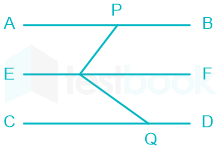
In the given figure, AB || CD || EF, ∠APO = 35° and ∠CQO = 43°. The value of ∠EOP + ∠EOQ is:

  1. AOption (a)

    282°

  2. BOption (b)

    276°

  3. COption (c)

    264°

  4. DOption (d)

    290°

View answer & explanation

Correct answer

Answer: (a)A.

282°

Why this answer is correct

Shortcut Trick

Since AB || EF || CD, the consecutive interior angles on the same side of the transversals PO and QO are supplementary (sum to 180°):

∠EOP = 180° − ∠APO = 180° − 35° = 145°

∠EOQ = 180° − ∠CQO = 180° − 43° = 137°

Adding both angles gives:

∠EOP + ∠EOQ = 145° + 137° = 282°

∴ The correct answer is 282°.

Alternate Method

Given:

Parallel lines: AB || CD || EF

Angles: ∠APO = 35° and ∠CQO = 43°

Formula Used:

When two parallel lines are intersected by a transversal, the consecutive interior angles on the same side of the transversal are supplementary (their sum is 180°).

Calculations:

⇒ Since AB || EF and PO is the transversal line:

⇒ ∠APO + ∠EOP = 180° (Consecutive interior angles)

⇒ 35° + ∠EOP = 180°

⇒ ∠EOP = 180° − 35° = 145°

⇒ Similarly, since EF || CD and QO is the transversal line:

⇒ ∠CQO + ∠EOQ = 180° (Consecutive interior angles)

⇒ 43° + ∠EOQ = 180°

⇒ ∠EOQ = 180° − 43° = 137°

⇒ Now, we calculate the required sum:

⇒ ∠EOP + ∠EOQ = 145° + 137° = 282°

∴ The correct answer is 282°.

Additional Information

Consecutive Interior Angles

When two parallel lines are cut by a transversal, the pairs of interior angles on the same side of the transversal are supplementary, summing to exactly 180°.

Alternate Interior Angles

If two parallel lines are cut by a transversal, the alternate interior angles are equal (e.g., ∠APO = ∠FOP if they lie on opposite sides of the transversal).

Angles on a Straight Line

The sum of angles on a straight line at any point is always 180°.

Question 16

Find the simple interest on ₹9,600 at 7.2% per annum for 5 years.

  1. AOption (a)

    ₹3,456

  2. BOption (b)

    ₹3,546

  3. COption (c)

    ₹2,416

  4. DOption (d)

    ₹4,356

View answer & explanation

Correct answer

Answer: (a)A.

₹3,456

Why this answer is correct

Shortcut Trick

Total Simple Interest percentage = Rate × Time

Interest % = 7.2% × 5 = 36%

Simple Interest = 36% of ₹9,600

SI = 0.36 × 9600 = 3456

∴ The correct answer is ₹3,456.

Alternate Method

Given:

Principal (P) = ₹9,600

Rate of Interest (R) = 7.2% per annum

Time (T) = 5 years

Formula Used:

Simple Interest (SI) = (P × R × T) ÷ 100

Calculations:

⇒ SI = (9600 × 7.2 × 5) ÷ 100

⇒ SI = 96 × 7.2 × 5

⇒ SI = 96 × 36

⇒ SI = ₹3,456

∴ The correct answer is ₹3,456.

Additional Information

Total Amount Formula

The total Amount (A) to be paid at the end of the tenure is the sum of Principal and Simple Interest: A = P + SI.

Rate of Interest Calculation

If the SI, Principal, and Time are known, the Rate (R) can be calculated as R = (SI × 100) ÷ (P × T).

Nature of Simple Interest

Simple Interest remains constant for every year if the Principal and Rate are unchanged, unlike Compound Interest where interest is calculated on the accumulated interest.

Question 17

How many 5 s are there in the following sequence which is immediately followed by 7 and immediately preceded by 8?

8 5 7 4 3 2 7 5 6 9 8 5 7 8 5 7 4 5 7 6 8 6 9 8 5 7 9 3

  1. AOption (a)

    Two

  2. BOption (b)

    Five

  3. COption (c)

    Three

  4. DOption (d)

    Four

View answer & explanation

Correct answer

Answer: (d)D.

Four

Why this answer is correct

Given numbers: 8 5 7 4 3 2 7 5 6 9 8 5 7 8 5 7 4 5 7 6 8 6 9 8 5 7 9 3

How many 5 s are there in the following sequence which is immediately followed by 7 and immediately preceded by 8.

So, the pattern needed is: 

Now, 8 5 7

Total pairs are: 8 5 7 4 3 2 7 5 6 9 8 5 7 8 5 7 4 5 7 6 8 6 9 8 5 7 9 3

So, there are Four pairs of 8 5 7 in the given series.

Hence, the correct answer is "Option 4".

Question 18

A material of length 1 and area of cross section A has a resistance R. What should be changes in the area of cross section A if its length is tripled to produce the same resistance R?

  1. AOption (a)

    The area of cross section should be increased by 9 times.

  2. BOption (b)

    The area of cross section should be decreased by 9 times.

  3. COption (c)

    The area of cross section should be decreased by 3 times.

  4. DOption (d)

    The area of cross section should be increased by 3 times.

View answer & explanation

Correct answer

Answer: (d)D.

The area of cross section should be increased by 3 times.

Why this answer is correct

The correct answer is The area of the cross section should be increased by 3 times.

Key Points

  • The resistance (R) of a material is related to its length (L) and cross-sectional area (A) by the following formula:
  • R = ρL/A
  • Where ρ (rho) is the resistivity of the material (a constant).
  • We are given an initial resistance R with length L and area A.
  • We want to find the new area (A') when the length is tripled (3L) while keeping the resistance the same (R).
  • Initial state: R = ρL/A
  • Final state: R = ρ(3L)/A'
  • Solving for A'
  • Since the resistance R is the same in both cases, we can set the two equations equal to each other:
  • ρL/A = ρ(3L)/A'
  • Notice that ρ and L appear on both sides of the equation, so we can cancel them out:
  • 1/A = 3/A'
  • Now, cross-multiply:
  • A' = 3A
  • The new area (A') is three times the original area (A).
  • Therefore, the correct answer is
  • The area of cross section should be increased by 3 times.

Question 19

A certain number of people are sitting in a row, facing north. Z sits second to the right of T. S sits second to the right of V. R sits to the immediate left of T. Only three people sit between K and R. S sits third to the left of K.

If no other person is sitting in the row, what is the total number of people seated?

  1. AOption (a)

    11

  2. BOption (b)

    13

  3. COption (c)

    14

  4. DOption (d)

    12

View answer & explanation

Correct answer

Answer: (b)B.

13

Why this answer is correct

Given: A certain number of people are sitting in a row, facing north.

  1. Z sits second to the right of T.

  2. R sits to the immediate left of T.

3) Only three people sit between K and R.

  1. S sits third to the left of K. 

5) S sits second to the right of V.

If no other person is sitting in the row, then '13' people seated in that row.

Hence, the correct answer is "Option 2".

Question 20

Which of the following sexually transmitted diseases affects our immune system?

  1. AOption (a)

    Gonorrhoea

  2. BOption (b)

    Syphilis

  3. COption (c)

    HIV-AIDS

  4. DOption (d)

    Warts

View answer & explanation

Correct answer

Answer: (c)C.

HIV-AIDS

Why this answer is correct

The correct answer is HIV-AIDS.

Key Points

  • HIV-AIDS:
  • ​ HIV is a virus that attacks the immune system, specifically CD4 cells.
  • Without treatment, HIV can progress to AIDS, making individuals highly susceptible to infections and certain cancers.
  • Transmission occurs primarily through bodily fluids like blood, semen, and vaginal secretions.

Additional Information

  • Gonorrhea:
  • A bacterial infection primarily affecting the genitals, rectum, and throat.
  • Symptoms may include unusual discharge, burning urination, and pain during intercourse.
  • Gonorrhea can have serious complications if left untreated, such as infertility and increased risk of other STIs.
  • Syphilis:
  • A sexually transmitted infection caused by the bacterium Treponema pallidum.
  • It progresses through stages with varying symptoms, including sores, rashes, and neurological problems.
  • Syphilis can have severe long-term consequences if untreated, affecting the heart, brain, and nervous system.
  • Warts:
  • Warts are growths on the skin caused by the Human Papillomavirus (HPV).
  • They can appear in various locations, including the genitals, hands, and feet.
  • Most genital warts are harmless, but some HPV types can increase the risk of cervical cancer in women.

Question 21

In this question, a group of letters is coded using numbers/symbols as per the table given below and the conditions which follow. The correct combination of codes following the conditions is your answer.

LettersTPJQSUERHA
Numbers/symbol-68%7@39#1

Conditions:

(i) If there is more than 1 vowel in the word, all the vowels will be coded as 4 .

(ii) If a word has consonants at both ends, both the consonants present at both ends will be coded as 2.

What will be the correct code for EARTH?

  1. AOption (a)

    319-#

  2. BOption (b)

    449-#

  3. COption (c)

    349-#

  4. DOption (d)

    419-#

View answer & explanation

Correct answer

Answer: (b)B.

449-#

Why this answer is correct

Given:

LettersTPJQSUERHA
Numbers/symbol-68%7@39#1


ConditionsCoded As
More than 1 vowel in the wordAll the vowels will be coded as 4
If a word has consonants at both endsboth the consonants will be coded as 2


Now, the code for: EARTH

Here, First conditions followed in the given group,

So, All the vowels will be coded as 4.

Then, the code for 'EARTH' is → '449-#'.

Hence, the correct answer is "Option 2".

Question 22

The ______ originates from the confluence of two rivers, the Chandra and the Bhaga, which themselves originate from either side of the Bara Lacha Pass in Lahul.

  1. AOption (a)

    Sutlej

  2. BOption (b)

    Chenab

  3. COption (c)

    Beas

  4. DOption (d)

    Jhelum

View answer & explanation

Correct answer

Answer: (b)B.

Chenab

Why this answer is correct

The correct answer is Chenab.

Key Points

  • Chenab
  • The Chenab River is a major river that flows in India and Pakistan and is one of the 5 major rivers of the Punjab region.
  • The Chenab river was called Asikni in Rigveda.
  • The name meant that it was seen to have dark-colored waters.
  • It is formed by the union of two headwaters, Chandra and Bhaga, which rise in the upper Himalayas in Himachal Pradesh.
  • The Chenab flows through Jammu and Kashmir, India into the plains of Punjab, Pakistan, before ultimately flowing into the Indus River.
  • The waters of the Chenab were allocated to Pakistan under the terms of the Indus Waters Treaty.​

Additional Information

  • Sutlej
  • River Sutlej originates from Rakshastal Lake.
  • Rakshastal Lake is located near Lake Manasarovar and Mount Kailash.
  • Sutlej River is also known as Shatadru (Ancient name).
  • River Sutlej is one of the major tributaries of Indus.
  • Only tributary of Indus which originates from Tibet.
  • Sutlej River enters India through Shipki La pass.
  • The Bhakra-Nangal Dam is constructed across the Sutlej river.
  • The Indira Gandhi canal is situated on the Sutlej river.
  • The West flowing peninsular river Narmada originates from Amarkantak plateau.
  • The Himalayan river Indus originates in the northern slopes of the Kailash range in Tibet near Lake Manasarovar.
  • The river Jhelum rises from Verinag Spring at the foot of the Pir Panjal.
  • Beas
  • Beas is part of the Indus river system and one of the tributaries of the Indus river.
  • The Beas originates near the Rohtang Pass on the southern end of the Pir Panjal Range.
  • It is 460 km and flows within the Indian territory.
  • It crosses the Dhaola Dhar range and it takes a south-westerly direction to meets the Satluj river at Harike in Punjab.​​
  • Jhelum
  • The length of the Jhelum river is 725 km. This river that flows from the Indian-administered Union territory of Jammu and Kashmir, through the POK and into Pakistani Punjab region.
  • It is a tributary of the Chenab River. It is the westernmost of the five rivers of the Punjab region, and passes through the Kashmir Valley.
  • The Sanskrit name of the Jhelum river is Vitasta. The Battle of the Hydaspes River where Alexander the Great and his army crossed the Jhelum in BC 326 where he defeated the Indian king, Porus.

Question 23

Seven people (L, M, N, O, P, Q, and R) are sitting in a straight row, facing north. L sits third to the left of Q. Only two people sit to the left of L. M sits second to the left of Q. P is an immediate neighbour of O and L. Only two people sit between P and N. Who sits at the extreme right end of the row?

  1. AOption (a)

    M

  2. BOption (b)

    Q

  3. COption (c)

    R

  4. DOption (d)

    N

View answer & explanation

Correct answer

Answer: (c)C.

R

Why this answer is correct

Given: Seven people (L, M, N, O, P, Q, and R) are sitting in a straight row, facing north.

  1. Only two people sit to the left of L.

2) L sits third to the left of Q. 

  1. M sits second to the left of Q.

  2. P is an immediate neighbour of O and L.

  3. Only two people sit between P and N.

And, R sits on the remaining place.

So, 'R' sits at the extreme right end of the row.

Hence, the correct answer is "Option 3".

Question 24

Choose the right combination of the famous celebrity and their respective outfit.

  1. AOption (a)

    Poona Public Meeting - Subhash Chandra Bose

  2. BOption (b)

    Hindustan Socialist Republican Association - Annie Besant

  3. COption (c)

    Theosophical Society - Sarojini Naidu

  4. DOption (d)

    Satyashodhak Samaj - Jyotiba Phule

View answer & explanation

Correct answer

Answer: (d)D.

Satyashodhak Samaj - Jyotiba Phule

Why this answer is correct

The correct answer is Satyashodhak Samaj - Jyotiba Phule.

Key Points

  • Satyashodhak Samaj
  • Satyasodhak Samaj was founded with a purpose to give education to the lower castes, scheduled castes, scheduled tribes and make them aware of the exploiting tradition of the society.
  • It was founded by Jyotitrao Phule in 1873 in Pune.
  • Satyashodhak Samaj rejected all kinds of Brahman domination and exploitation based on religion and all religious sources of inequality.

 Additional Information

  • ​Jyotirao Phule
  • ​He was an Indian social activist, thinker, anti-caste social reformer, and writer from Maharashtra.
  • His work extended to many fields, including eradicating untouchability, and the caste system, and his efforts to educate women and people of exploited castes.

Question 25

The HCF of fractions is calculated as HCF of the numerators  LCM of the denominators \frac{\mathrm{HCF} \text { of the numerators }}{\text { LCM of the denominators }}. Find the HCF of 23,45\frac{2}{3}, \frac{4}{5} and 32\frac{3}{2}.

  1. AOption (a)

    140\frac{1}{40}

  2. BOption (b)

    350\frac{3}{50}

  3. COption (c)

    130\frac{1}{30}

  4. DOption (d)

    530\frac{5}{30}

View answer & explanation

Correct answer

Answer: (c)C.

130\frac{1}{30}

Why this answer is correct

Shortcut Trick

HCF of Fractions = HCF(Numerators) ÷ LCM(Denominators)

Numerators: 2, 4, 3 → HCF = 1 (no common factor other than 1)

Denominators: 3, 5, 2 → LCM = 3 × 5 × 2 = 30

Required HCF = 1/30

∴ The correct answer is 1/30.

Alternate Method

Given: Fractions are 2/3, 4/5, and 3/2.

Formula Used: HCF of fractions = HCF of Numerators / LCM of Denominators

⇒ Numerators are 2, 4, and 3.

⇒ Factors of 2 = 1, 2

⇒ Factors of 4 = 1, 2, 4

⇒ Factors of 3 = 1, 3

⇒ HCF(2, 4, 3) = 1

⇒ Denominators are 3, 5, and 2.

⇒ Since 3, 5, and 2 are prime numbers, their LCM is their product.

⇒ LCM(3, 5, 2) = 3 × 5 × 2 = 30

⇒ HCF of fractions = 1/30

∴ The correct answer is 1/30.

Additional Information

LCM of Fractions

LCM of fractions = LCM of Numerators / HCF of Denominators.

Product of Numbers

For any two numbers a and b, HCF(a, b) × LCM(a, b) = a × b.

Co-prime Numbers

HCF of any two or more co-prime numbers is always 1, and their LCM is their product.

Question 26

If θ is an acute angle, and cos θ=1213θ=\frac{12}{13}, then the value of 13sin⁡θ+12sec⁡θ12tan⁡θ+5cosec⁡θ\frac{13 \sin θ+12 \sec θ}{12 \tan θ+5 \operatorname{cosec} θ} is:

  1. AOption (a)

    12\frac{1}{2}

  2. BOption (b)

    32\frac{3}{2}

  3. COption (c)

    2

  4. DOption (d)

    1

View answer & explanation

Correct answer

Answer: (d)D.

1

Why this answer is correct

Shortcut Trick

Using the standard Pythagorean triplet (5, 12, 13), if cos θ = 12/13, then sin θ = 5/13, tan θ = 5/12, sec θ = 13/12, and cosec θ = 13/5.

Substitute these values directly into the given expression:

Numerator = 13 × (5/13) + 12 × (13/12) = 5 + 13 = 18.

Denominator = 12 × (5/12) + 5 × (13/5) = 5 + 13 = 18.

Therefore, Value = 18 ÷ 18 = 1.

∴ The correct answer is 1.

Alternate Method

Given: cos θ = 12/13, where θ is an acute angle.

Formula Used:

sin2 θ + cos2 θ = 1

tan θ = sin θ ÷ cos θ

sec θ = 1 ÷ cos θ

cosec θ = 1 ÷ sin θ

Calculations:

⇒ Base (B) = 12, Hypotenuse (H) = 13

⇒ Perpendicular (P) = √(H2 − B2) = √(132 − 122) = √(169 − 144) = √25 = 5

⇒ sin θ = P ÷ H = 5/13

⇒ sec θ = H ÷ B = 13/12

⇒ tan θ = P ÷ B = 5/12

⇒ cosec θ = H ÷ P = 13/5

Now substitute the values in the expression:

⇒ [13 × (5/13) + 12 × (13/12)] ÷ [12 × (5/12) + 5 × (13/5)]

⇒ [5 + 13] ÷ [5 + 13]

⇒ 18 ÷ 18 = 1

∴ The correct answer is 1.

Additional Information

Trigonometric Identities

Fundamental identities like sin2θ + cos2θ = 1 and sec2θ − tan2θ = 1 are crucial for simplifying expressions.

Pythagorean Triplets

Standard integer sets such as (3, 4, 5), (5, 12, 13), and (8, 15, 17) represent the sides of a right-angled triangle and help in extremely fast calculations.

Question 27

What will come in the place of '?' in the following equation, if '+' and '-' are interchanged and also '×' and '÷' are interchanged?

55 +  34 × 17 ÷ 7 - 51 = ?

  1. AOption (a)

    91

  2. BOption (b)

    90

  3. COption (c)

    92

  4. DOption (d)

    85

View answer & explanation

Correct answer

Answer: (c)C.

92

Why this answer is correct

BODMAS Table: 

Given equation: 55 +  34 × 17 ÷ 7 - 51 = ?

Now, if ‘+’ and ‘-‘ and ‘×' and '÷’ are interchanged, then:

⇒ 55 - 34 ÷ 17 × 7 + 51 = ?

⇒ 55 - 2 × 7 + 51 = ?

⇒ 55 - 14 + 51 = ?

⇒ 106 - 14 = 92

Hence, the correct answer is "Option 3".

Question 28

If x=13+240x=\sqrt{13+2 \sqrt{40}} and y=13−240y=\sqrt{13-2 \sqrt{40}}, then what is the value of (x - y)?

  1. AOption (a)

    323 \sqrt{2}

  2. BOption (b)

    252 \sqrt{5}

  3. COption (c)

    626 \sqrt{2}

  4. DOption (d)

    454 \sqrt{5}

View answer & explanation

Correct answer

Answer: (b)B.

252 \sqrt{5}

Why this answer is correct

Shortcut Trick

For any surd in the form √(a ± 2√b), find two numbers whose sum is a and product is b.

Here, a = 13 and b = 40. The factors are 8 and 5 (8 + 5 = 13 and 8 × 5 = 40).

∴ x = √8 + √5 and y = √8 − √5.

x − y = (√8 + √5) − (√8 − √5) = 2√5.

∴ The correct answer is 2√5.

Alternate Method

Given: x = √(13 + 2√40) and y = √(13 − 2√40)

Using the algebraic identity (x − y)2 = x2 + y2 − 2xy:

⇒ x2 = 13 + 2√40

⇒ y2 = 13 − 2√40

⇒ xy = √((13 + 2√40) × (13 − 2√40))

⇒ xy = √(132 − (2√40)2)

⇒ xy = √(169 − 160) = √9 = 3

⇒ (x − y)2 = (13 + 2√40) + (13 − 2√40) − 2(3)

⇒ (x − y)2 = 26 − 6 = 20

⇒ x − y = √20 = 2√5

∴ The correct answer is 2√5.

Additional Information

Square Root of a Surd

To simplify √(a ± 2√b), identify two numbers m and n such that m + n = a and mn = b. The simplified form is √m ± √n.

Algebraic Identity

The identity (a − b)2 = a2 + b2 − 2ab is essential for solving problems involving the difference of square root terms.

Conjugate Surds

The terms (a + √b) and (a − √b) are conjugates. Their product results in a rational number (a2 − b).

Question 29

In 2021, the Government of West Bengal state launched the 'Maa' scheme for provision of meals at a nominal cost of ______ per meal to poor people.

  1. AOption (a)

    ₹10

  2. BOption (b)

    ₹5

  3. COption (c)

    ₹15

  4. DOption (d)

    ₹20

View answer & explanation

Correct answer

Answer: (b)B.

₹5

Why this answer is correct

The correct answer is ₹5.

Key Points

  • In 2021, the Government of West Bengal launched the 'Maa' scheme to provide subsidized cooked meals to the poor and destitute at a nominal cost of ₹5 per meal.
  • Under this scheme, the state government provides a subsidy of ₹15 per meal, while beneficiaries contribute only ₹5. The meals are typically served in community kitchens run by Self-Help Groups (SHGs).
  • The 'Maa' scheme aims to address food insecurity and provide affordable, nutritious meals to vulnerable sections of society. It has been implemented across various parts of the state, with the goal of expanding its reach to ensure that no one goes hungry.
  • The scheme has been lauded for its potential to improve food security and reduce poverty in the state. It also provides employment opportunities for women involved in the operation of the community kitchens.

Question 30

Which of the following numbers will replace the question mark (?) in the given number series?

99, 92, 83, 76, 67, ?

  1. AOption (a)

    60

  2. BOption (b)

    54

  3. COption (c)

    58

  4. DOption (d)

    62

View answer & explanation

Correct answer

Answer: (a)A.

60

Why this answer is correct

The logic followed here is:

So, '60' will replace the question mark in the given series.

Hence, the correct answer is "Option 1".

Question 31

Rays of which of the following colours show the highest deviation by a prism?

  1. AOption (a)

    Red

  2. BOption (b)

    Violet

  3. COption (c)

    Yellow

  4. DOption (d)

    Green

View answer & explanation

Correct answer

Answer: (b)B.

Violet

Why this answer is correct

The correct answer is Violet.

Key Points

  • Dispersion of light is the phenomenon of splitting of a beam of white light into its constituent colours on passing through a prism.
  • The band of seven colours so obtained is called the (visible) spectrum.
  • The dispersion of white light occurs because the colours of white light travel at different speeds through the glass prism.

EXPLANATION:

  • When the dispersion of white light takes place through a prism, the maximum deviation is suffered by violet colour and minimum deviation suffered red colour.
  • Dispersion of light:

Question 32

In the given letter-cluster pairs, the first letter-cluster is related to the second letter-cluster following a certain logic. Study the given pairs carefully, and from the given options, select the pair that follows the same logic.

CRH ∶ APF

TON ∶ RML

  1. AOption (a)

    QLF ∶ MBV

  2. BOption (b)

    UIR ∶ NSH

  3. COption (c)

    EKN ∶ YUF

  4. DOption (d)

    IWZ ∶ GUX

View answer & explanation

Correct answer

Answer: (d)D.

IWZ ∶ GUX

Why this answer is correct

The logic followed here is:

CRH ∶ APF

TON ∶ RML

Similarly, for Option 4: IWZ ∶ GUX

Hence, the correct answer is "Option 4".

Question 33

Which of the following is NOT a crystalline allotrope of carbon?

  1. AOption (a)

    Coke

  2. BOption (b)

    Graphite

  3. COption (c)

    Fullerene

  4. DOption (d)

    Diamond

View answer & explanation

Correct answer

Answer: (a)A.

Coke

Why this answer is correct

The correct answer is Coke.

Key Points

  • Allotropes:
  • Depending on the conditions of formation like temperature and pressure, different forms of compounds of the same element may be formed.
  • These compounds are called allotropes and the element is said to exhibit allotropy.
  • Carbon occurs in nature abundantly in both free and compound forms.
  • Carbon has allotropes in crystalline as well as amorphous forms.
  • The allotropes of carbon like a diamond, graphite, etc are crystalline solid but wood, stone are non-crystalline solid.
  • Crystals:
  • Crystals are formed by the symmetrical arrangement of constituent atoms.
  • The atoms are arranged in repeating units and the basic unit is called a unit cell.
  • There are three types of unit cells depending on the arrangement of atoms.
  • A unit cell tells us about the number of atoms and the nature of the arrangement.
  • Multiple unit cells put together in an ordered manner give us a Crystal lattice.

Additional Information

  • Graphite:
  • Graphite is an allotropic form of carbon that has units of six carbon atoms grouped together forming a crystal structure.
  • The units in the crystal structure are arranged in an ordered hexagonal manner.
  • In each of the hexagonal unit cells, the carbon atoms are attached to the neighboring three carbon atoms.
  • Graphite has hexagonal layers of carbons that can slip on each other and thus it is slippery in nature.
  • Graphite is lustrous and brittle in nature.
  • The structure of graphite is given as follows:

Question 34

In a movie theatre, the price of the ticket per kid is 2whileperadultitis2 while per adult it is 5. On a particular day, 2000 people bought tickets and an amount of 5,050wascollected.Findthenumberof5,050 was collected. Find the number of 2 tickets sold on that day.

  1. AOption (a)

    1560

  2. BOption (b)

    1650

  3. COption (c)

    350

  4. DOption (d)

    1570

View answer & explanation

Correct answer

Answer: (b)B.

1650

Why this answer is correct

Shortcut Trick

Assume all 2000 people bought $5 adult tickets.

Total hypothetical collection = 2000 × 5 = $10,000.

Difference from actual collection = 10,000 − 5,050 = $4,950.

Difference between adult and kid ticket prices = 5 − 2 = $3.

Number of $2 tickets = 4,950 ÷ 3 = 1650.

∴ The correct answer is 1650.

Alternate Method

Given:

Price of kid ticket = $2

Price of adult ticket = $5

Total people = 2000

Total collection = $5,050

Calculations:

⇒ Average price per ticket = Total collection ÷ Total people

⇒ Average price = 5050 ÷ 2000 = $2.525

Using the Alligation Method to find the ratio of kids to adults:

⇒ Ratio of Kid tickets to Adult tickets = 2.475 : 0.525

⇒ Simplifying the ratio = 2475 : 525 = 33 : 7

⇒ Sum of ratio parts = 33 + 7 = 40 units

⇒ 40 units = 2000 tickets

⇒ 1 unit = 2000 ÷ 40 = 50

⇒ Number of $2 tickets (Kids) = 33 × 50 = 1650

∴ The correct answer is 1650.

Additional Information

Alligation Rule

It is a rule that enables us to find the ratio in which two or more ingredients at their respective prices must be mixed to produce a mixture at a given price.

Linear Equation Method

If x = number of kids and y = number of adults, then x + y = Total People and (Pricex × x) + (Pricey × y) = Total Collection.

Weighted Average

Average = (n1v1 + n2v2) ÷ (n1 + n2), where n is the quantity and v is the value per unit.

Question 35

What does Article 243D of the Panchayat Constitution speak about?

  1. AOption (a)

    Composition of Panchayats

  2. BOption (b)

    Constitution of Panchayats

  3. COption (c)

    Gram Sabha

  4. DOption (d)

    Reservation of seats in Panchayat

View answer & explanation

Correct answer

Answer: (d)D.

Reservation of seats in Panchayat

Why this answer is correct

The correct answer is Reservation of seats in Panchayat.

Key Points

  • Reservation of seats for women in Panchayats
  • As per provisions contained in Article 243 D of the Constitution, 1/3rd of the Seats of Panchayati Raj Institutions and 1/3rd offices of the Chairperson at all levels of Panchayati Raj Institutions covered by Part IX of the Constitution are reserved for women. Hence, Option 4 is correct.
  • The following states have made legal provisions for 50% reservation for women among members and Sarpanches: Andhra Pradesh, Bihar, Chhattisgarh, Jharkhand, Kerala, Maharashtra, Orissa, Rajasthan, Tripura, and Uttarakhand.

 Additional Information

  • Article 243 – Definitions.
  • Article 243A – Gram Sabha.
  • Article 243B – Constitution of Panchayats.
  • Article 243C – Composition of Panchayats.
  • Article 243D – Reservation of seats.
  • Article 243E – Duration of Panchayats, etc.
  • Article 243F – Disqualifications for membership.
  • Article 243G – Powers, authority, and responsibilities of Panchayats.
  • Article 243H – Powers to impose taxes by, and Funds of, the Panchayats.
  • Article 243I – Constitution of Finance Commission to review financial position.
  • Article 243J – Audit of accounts of Panchayats.
  • Article 243K – Elections to the Panchayats.
  • Article 243L – Application to Union territories.
  • Article 243M – Part not to apply to certain areas.
  • Article 243N – Continuance of existing laws and Panchayats.
  • Article 243O – Bar to interference by courts in electoral matters.

Question 36

The field produced by n turns of a coil is _______ times that of a single turn.

  1. AOption (a)

    1/n

  2. BOption (b)

    n2

  3. COption (c)

    n

  4. DOption (d)

    1/n2

View answer & explanation

Correct answer

Answer: (c)C.

n

Why this answer is correct

The correct answer is n.

Key Points

  • Magnetic field: The space or region around the current-carrying wire/moving electric charge or around the magnetic material in which force of magnetism can be experienced by other magnetic material is called as magnetic field/magnetic induction by that material/current.

 Additional Information

  • It is denoted by B and the SI unit of the magnetic field is the tesla (T).
  • The magnetic field at the center of a circular coil is given by:

B=;μ0I2RB = ;\frac{{{\mu _0{}}I}}{{2R}}

  • Where B = magnetic field at the center of the coil, μ0 is the permeability of free space = 4π × 10-7, I is current and R is the radius of the circular coil.
  • When there are n turns in the coil then the magnetic field produced by the coil at the center is given by:

B′=;μ0nI2RB' = ;\frac{{{\mu _0{n}}I}}{{2R}}

  • EXPLANATION:
  • As it can be seen that the magnetic field (B) ∝ n therefore if turns increase n times the field will increase by n times as well.
  • So B' = n B.

Question 37

When was the Council of States (Rajya Sabha) constituted for the first time?

  1. AOption (a)

    7 May 1951

  2. BOption (b)

    26 January 1950

  3. COption (c)

    3 April 1952

  4. DOption (d)

    15 August 1947

View answer & explanation

Correct answer

Answer: (c)C.

3 April 1952

Why this answer is correct

The correct answer is 3 April 1952.

Key Points

  • The term of members of Rajya Sabha is 6 years and one-third members retire after every 2 years.
  • Also, one-third of Rajya Sabha members retire every 2 years, so the total tenure should be three times that of two years.
  • The 'Council of States' also known as Rajya Sabha, a nomenclature announced by the Chairman in the House on 23 August 1954, has its own distinctive features.
  • The origins of the Second House can be traced back to the Montagu-Chelmsford Report of 1918.

 Additional Information

  • Qualifications of Rajya Sabha Member:
  • Article 84 of the Constitution lays down the qualifications for membership in Parliament.
  • A person to be qualified for membership of the Rajya Sabha should possess the following qualifications:
  • he must be a citizen of India and make and subscribe before some person authorized on that behalf by the Election Commission an oath or affirmation according to the form set out for the purpose in the Third Schedule to the Constitution;
  • he must be not less than 30 years of age;
  • he must possess such other qualifications as may be prescribed on that behalf by or under any law made by Parliament.

Question 38

Simplify the given expression.

3x (x - 3) + 2(3x2 - 4)

  1. AOption (a)

    9x2 + 9x - 8

  2. BOption (b)

    9x2 - 9x + 8

  3. COption (c)

    9x2 - 9x - 8

  4. DOption (d)

    9x2 + 9x + 8

View answer & explanation

Correct answer

Answer: (c)C.

9x2 - 9x - 8

Why this answer is correct

Shortcut Trick

Multiply the coefficients and distribute variables: 3x(x) − 3x(3) + 2(3x2) − 2(4).

This results in: 3x2 − 9x + 6x2 − 8.

Group the like terms (x2 terms together): (3 + 6)x2 − 9x − 8.

Simplify to get: 9x2 − 9x − 8.

∴ The correct answer is 9x2 − 9x − 8.

Alternate Method

Given Expression: 3x(x − 3) + 2(3x2 − 4)

Method Used: Distributive Property and Combination of Like Terms

⇒ 3x(x) − 3x(3) + 2(3x2) − 2(4)

⇒ 3x2 − 9x + 6x2 − 8

⇒ 3x2 + 6x2 − 9x − 8

⇒ (3 + 6)x2 − 9x − 8

⇒ 9x2 − 9x − 8

Comparing the simplified expression with the given options, we find it matches Option 3.

∴ The correct answer is 9x2 − 9x − 8.

Additional Information

Distributive Property

This property states that a(b + c) = ab + ac, which is essential for removing parentheses in algebraic expressions.

Like Terms

Terms that have the same variables raised to the same powers. Only like terms can be added or subtracted to simplify an expression.

Standard Form

A quadratic expression is usually written in the standard form ax2 + bx + c, where terms are arranged in descending order of their exponents.

Question 39

The average of 7 numbers was given as 53 . Later it was found that one number was misread as 16 instead of 58. What is the correct average of the given 7 numbers?

  1. AOption (a)

    56

  2. BOption (b)

    55

  3. COption (c)

    52

  4. DOption (d)

    59

View answer & explanation

Correct answer

Answer: (d)D.

59

Why this answer is correct

Shortcut Trick

Net Deviation = Correct Value − Incorrect Value = 58 − 16 = +42

Average Increase = Net Deviation ÷ Total Numbers = 42 ÷ 7 = 6

Correct Average = Original Average + Increase = 53 + 6 = 59

∴ The correct answer is 59.

Alternate Method

Given:

Total numbers (n) = 7

Initial average = 53

Incorrectly read value = 16

Correct value = 58

Formula Used:

Average = Sum of observations ÷ Total number of observations

Correct Average = [ (Initial Average × n) − Wrong Value + Correct Value ] ÷ n

Calculations:

⇒ Incorrect Total Sum = 7 × 53 = 371

⇒ Correct Total Sum = 371 − 16 + 58

⇒ Correct Total Sum = 371 + 42 = 413

⇒ Correct Average = 413 ÷ 7

⇒ Correct Average = 59

∴ The correct answer is 59.

Additional Information

Correction in Average

Correct Average = Old Average + [(Correct Value − Incorrect Value) ÷ Total Number]. If the result is negative, the average decreases.

Constant Change Property

If each number in a data set is increased or decreased by a constant k, the new average also increases or decreases by k.

Weighted Average

When groups with different averages are combined: Average = (n1A1 + n2A2) ÷ (n1 + n2).

Question 40

Read the given statements and conclusions carefully. Assuming that the information given in the statements is true, even if it appears to be at variance with commonly known facts, decide which of the given conclusions logically follow(s) from the statements.

Statements:

Some balloons are flowers.

All flowers are colours.

All colours are rainbows.

Conclusions:

I. All flowers are rainbows.

II. Some balloons are colours.

  1. AOption (a)

    Both conclusion (I) and conclusion (II) follow.

  2. BOption (b)

    Both conclusion (I) and conclusion (II) do not follow.

  3. COption (c)

    Only conclusion (I) follows.

  4. DOption (d)

    Only conclusion (II) follows.

View answer & explanation

Correct answer

Answer: (a)A.

Both conclusion (I) and conclusion (II) follow.

Why this answer is correct

Given Statements:

Some balloons are flowers.

All flowers are colours.

All colours are rainbows.

The least possible Venn diagram for the given statement is:

Conclusions:

I. All flowers are rainbows - True (Because, All flowers are colours and All colours are rainbows, so All the flowers are part of rainbows).

II. Some balloons are colours - True (Because, Those part of balloons which is flowers will also colours).

So, Both conclusion (I) and conclusion (II) follow.

Hence, the correct answer is "Option 1".

Question 41

Which of the following is a microfinance institution of India?

  1. AOption (a)

    Ascend Financial Services

  2. BOption (b)

    Industrial Finance Corporation of India

  3. COption (c)

    Small Industries Development Bank of India

  4. DOption (d)

    National Housing Bank

View answer & explanation

Correct answer

Answer: (a)A.

Ascend Financial Services

Why this answer is correct

The correct answer is Ascend Financial Services.

Key Points

  • Microfinance institutions do not focus exclusively on urban areas; in fact, they are often focused on rural and underserved areas where financial services are scarce.
  • Providing loan facilities in rural areas is a more typical goal, not just in urban areas
  • Microfinance institutions (MFIs) in India are primarily aimed at providing financial services, especially small loans, to individuals and communities who lack access to traditional banking services
  • MFIs may also offer other financial services, such as: Savings accounts, Insurance, Money transfers, and Energy loans. ​

Additional Information

  • MFIs often provide loans through Joint Lending Groups (JLGs), which are informal groups of 4–10 people who work in similar economic activities and jointly repay loans.
  • Other types of groups that MFIs may organize include: Self Help Groups (SHGs), Grameen Model Banks, and Rural Cooperatives.
  • MFIs can be regulated by the RBI in different ways depending on their type: 
  • Bank-led MFIs: These are subsidiaries of banks and are regulated by the RBI.
  • NBFC MFIs: These are categorized as Non-Banking Financial Companies (NBFCs) and are regulated by the RBI.
  • Non-profit MFIs: These are typically registered as societies or trusts and operate on a not-for-profit basis.

Question 42

For a concave mirror, the position of the image for an object placed at infinity is _______.

  1. AOption (a)

    Between focus and centre of curvature

  2. BOption (b)

    pole

  3. COption (c)

    focus

  4. DOption (d)

    centre of curvature

View answer & explanation

Correct answer

Answer: (c)C.

focus

Why this answer is correct

The correct answer is focus.

Key Points

  • A concave mirror is a type of curved mirror where the reflective surface bulges inward.
  • Depending on the position of the object relative to the focal point, a concave mirror can form either real or virtual images.

Explanation:

The behavior of a concave mirror and the analysis of each statement:

  • Option 1 - "will definitely be real if the object is virtual": Incorrect. The image formation by a concave mirror when the object is virtual depends on specific arrangements and distances. A virtual object does not inherently lead to a real image.
  • Option 2 - "is always real": Incorrect. While a concave mirror can produce real images, it can also form virtual images if the object is placed between the focal point and the mirror (virtual, upright, and magnified).
  • Option 3 - "is always virtual": Incorrect. Concave mirrors often produce real images, especially when the object is placed beyond the focal length.
  • Option 4 - "more than one of the above": Incorrect. Since none of the statements are universally true, this option is also not valid.
  • Option 5 - "none of the above": Correct. The image formation by a concave mirror depends on the object's position relative to the focal point, which makes none of the previous statements universally applicable.

Analysis of different statements about concave mirror image formation:

OptionStatementAccuracy
1Will definitely be real if the object is virtualIncorrect
2Is always realIncorrect
3Is always virtualIncorrect
4More than one of the aboveIncorrect
5None of the aboveCorrect
<br>

Different positions of the object and their image by a concave mirror:

Position of the object (Concave mirror)Position of imagesize of the image in comparison to the objectNature of image
At InfinityAt focusHighly diminishedReal, inverted
Between Infinity and the centre of curvatureBetween the focus and centre of curvatureDiminishedReal, inverted
At the centre of curvatureAt the centre of curvatureOf the same sizeReal, inverted
At focusAt InfinityHighly enlargedReal, inverted
Between the focus (F) and centre of curvature (C)Between the centre of curvature and infinityEnlargedReal, inverted

Question 43

If 3 + 2√2 and 3 - 2√2 are the roots of a quadratic equation, then the quadratic equation is:

  1. AOption (a)

    x2 + 6x + 1 = 0

  2. BOption (b)

    x2 - 6x + 1 = 0

  3. COption (c)

    x2 + 6x - 1 = 0

  4. DOption (d)

    x2 - 6x - 1 = 0

View answer & explanation

Correct answer

Answer: (b)B.

x2 - 6x + 1 = 0

Why this answer is correct

Shortcut Trick

Sum of roots = (3 + 2√2) + (3 − 2√2) = 6

Product of roots = (3 + 2√2)(3 − 2√2) = 32 − (2√2)2 = 9 − 8 = 1

Required Equation: x2 − (Sum of roots)x + (Product of roots) = 0

⇒ x2 − 6x + 1 = 0

∴ The correct answer is x2 − 6x + 1 = 0.

Alternate Method

Given:

The roots of the quadratic equation are α = 3 + 2√2 and β = 3 − 2√2.

Formula Used:

For any quadratic equation with roots α and β, the equation is given by:

x2 − (α + β)x + (α × β) = 0

Calculations:

⇒ Sum of roots (α + β) = (3 + 2√2) + (3 − 2√2)

⇒ α + β = 3 + 3 + 2√2 − 2√2 = 6

⇒ Product of roots (α × β) = (3 + 2√2) × (3 − 2√2)

⇒ Applying identity (a + b)(a − b) = a2 − b2:

⇒ α × β = (3)2 − (2√2)2

⇒ α × β = 9 − (4 × 2) = 9 − 8 = 1

⇒ Substituting the Sum and Product in the formula:

⇒ x2 − (6)x + (1) = 0

⇒ x2 − 6x + 1 = 0

∴ The correct answer is x2 − 6x + 1 = 0.

Additional Information

Conjugate Roots Theorem

If a quadratic equation has rational coefficients and one root is of the form p + √q, then the other root must be its conjugate, p − √q.

Relation between Roots and Coefficients

For ax2 + bx + c = 0, the sum of roots is −b/a and the product of roots is c/a.

Discriminant and Nature of Roots

The value D = b2 − 4ac decides if roots are real and distinct (D > 0), real and equal (D = 0), or imaginary (D < 0).

Question 44

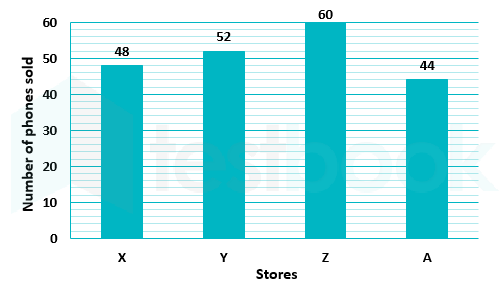
Study the given bar graph and answer the following question.

The given bar graph depicts the number of phones sold by stores X, Y, Z and A.

What is the total number of phones sold by the given four stores?

  1. AOption (a)

    204

  2. BOption (b)

    206

  3. COption (c)

    210

  4. DOption (d)

    208

View answer & explanation

Correct answer

Answer: (a)A.

204

Why this answer is correct

Calculation:

Total number of phones sold by the given four stores = 48 + 52 + 60 + 44 = 204.

∴ Option 1 is the correct answer.

Question 45

Using π=227\pi=\frac{22}{7}, find the circumference of a circle whose diameter is 38.5 cm.

  1. AOption (a)

    154 cm

  2. BOption (b)

    170 cm

  3. COption (c)

    121 cm

  4. DOption (d)

    165 cm

View answer & explanation

Correct answer

Answer: (c)C.

121 cm

Why this answer is correct

Shortcut Trick

Circumference of a circle = π × Diameter (d)

Given d = 38.5 cm and π = 22/7

Circumference = (22/7) × 38.5 = 22 × 5.5 = 121 cm

∴ The correct answer is 121 cm.

Alternate Method

Given:

Diameter (d) = 38.5 cm

Value of π = 22/7

Formula Used:

Circumference (C) = 2 × π × r OR π × d

Calculations:

⇒ C = (22/7) × 38.5

⇒ C = 22 × (38.5 ÷ 7)

⇒ C = 22 × 5.5

⇒ C = 121 cm

∴ The correct answer is 121 cm.

Additional Information

Area of Circle

The total space occupied by the circle is given by Area = πr2 or (πd2)/4.

Relation between Radius and Diameter

The diameter is always twice the radius (d = 2r).

Semicircle Perimeter

The perimeter of a semicircle includes the arc and the diameter: P = πr + 2r.

Question 46

Pipes A and B can fill an empty cistern in 16 minutes and 32 minutes, respectively. Both Pipe A and Pipe B are opened together. After how much time should Pipe A be turned off so that the empty cistern is completely filled in a total of 16 minutes?

  1. AOption (a)

    9 min

  2. BOption (b)

    7 min

  3. COption (c)

    6 min

  4. DOption (d)

    8 min

View answer & explanation

Correct answer

Answer: (d)D.

8 min

Why this answer is correct

Shortcut Trick

Let Total Capacity of the cistern be the LCM of 16 and 32 = 32 units.

Efficiency of Pipe A = 32 ÷ 16 = 2 units/min | Efficiency of Pipe B = 32 ÷ 32 = 1 unit/min.

Pipe B runs for the full 16 minutes → Work by B = 16 × 1 = 16 units.

Remaining work for Pipe A = 32 − 16 = 16 units.

Time for Pipe A = 16 ÷ 2 = 8 minutes.

∴ The correct answer is 8 min.

Alternate Method

PersonDaysTotal WorkEfficiency
Pipe A16 min32 units2
Pipe B32 min1

Given:

Time for A = 16 min, Time for B = 32 min.

Total time the cistern is filled = 16 min.

Calculations:

⇒ Total Capacity = LCM(16, 32) = 32 units.

⇒ Efficiency of A (EA) = 32 ÷ 16 = 2 units/min.

⇒ Efficiency of B (EB) = 32 ÷ 32 = 1 unit/min.

⇒ Since Pipe B was open for the entire 16 minutes, work done by B = 1 × 16 = 16 units.

⇒ Work required from Pipe A = Total Capacity − Work by B = 32 − 16 = 16 units.

⇒ Time for which Pipe A was open = Work ÷ EA = 16 ÷ 2 = 8 minutes.

∴ The correct answer is 8 min.

Additional Information

Total Work and Efficiency

Total Capacity = Time × Efficiency. For pipes and cisterns, efficiency is the rate of filling or emptying per unit time.

Inlet and Outlet Pipes

Inlet pipes have positive efficiency (filling), while outlet pipes (leaks) have negative efficiency (emptying).

Pipes & Cisterns Logic

If multiple pipes work together, their net efficiency is the sum of their individual efficiencies: Net E = E1 + E2 − Eleak.

Question 47

The net resistance of two resistors R1 and R2 connected in series is 8 ohm and their net resistance in parallel is 2 ohm. What are the values of individual resistances R1 and R2, respectively?

  1. AOption (a)

    4 ohm; 4 ohm

  2. BOption (b)

    8 ohm; 0 ohm

  3. COption (c)

    2 ohm; 6 ohm

  4. DOption (d)

    6 ohm; 2 ohm

View answer & explanation

Correct answer

Answer: (a)A.

4 ohm; 4 ohm

Why this answer is correct

The correct answer is 4 ohm; 4 ohm.

  • Series Connection: When resistors are connected in series, the total resistance is the sum of the individual resistances:
  • Resistance for series = R1 + R2
  • Parallel Connection: When resistors are connected in parallel, the reciprocal of the total resistance is equal to the sum of the reciprocals of the individual resistances:
  • 1/R = 1/R1 + 1/R2
  • Set up the Equations
  • Series Connection:
  • R1 + R2 = 8
  • Parallel Connection:
  • 1/R1 + 1/R2 = 1/2
    1. Solve the Equations
  • From the Series Connection:
  • R2 = 8 - R1
  • Substitute R2 in the Parallel Connection Equation:
  • 1/R1 + 1/(8 - R1) = 1/2
  • Simplify and Solve:
  • Find a common denominator for the fractions:
  • (8 - R1 + R1) / (R1 * (8 - R1)) = 1/2
  • 8 / (8R1 - R1^2) = 1/2
  • Cross-multiply:
  • 8R1 - R1^2 = 16
  • Rearrange to form a quadratic equation:
  • R1^2 - 8R1 + 16 = 0
  • Solve the quadratic equation (using factoring or the quadratic formula):
  • (R1 - 4)(R1 - 4) = 0
  • R1 = 4 ohms
  • Find R2:
  • R2 = 8 - R1 = 8 - 4 = 4 ohms
  • Therefore, the values of the individual resistances are R1 = 4 ohms and R2 = 4 ohms.

Question 48

The Annual Boat Race Festival is held in which state?

  1. AOption (a)

    Odisha

  2. BOption (b)

    Kerala

  3. COption (c)

    Goa

  4. DOption (d)

    Tamil Nadu

View answer & explanation

Correct answer

Answer: (b)B.

Kerala

Why this answer is correct

The correct answer is Kerala.

Key Points

  • Onam is the festival during which boat races are celebrated in Kerala.
  • The Vallam Kali, also known as the boat race, is a traditional event held during the Onam festival.
  • Onam is an annual harvest festival celebrated predominantly in the Indian state of Kerala.
  • The festival commemorates the homecoming of the legendary King Mahabali.
  • It is celebrated with numerous festivities including boat races, cultural programs, traditional games, and elaborate feasts.

Additional Information

  • Onam is celebrated in the month of Chingam, which is the first month of the Malayalam calendar (August-September).
  • The festival lasts for ten days, starting on Atham and culminating on Thiruvonam.
  • The Snake Boat Race is one of the most iconic events during Onam, attracting participants and spectators from all over the world.
  • Other major attractions include the pookalam (floral arrangements), Onasadya (grand feast), and traditional dances like Thiruvathira and Pulikali.
  • Onam is a symbol of unity and prosperity, bringing together people of all communities and religions in Kerala.

Question 49

A 12 V car head light lamp draws a current of 3 A for 15 minutes. The energy transferred during this time by the car battery is

  1. AOption (a)

    0.009 kWh

  2. BOption (b)

    5.4 kWh

  3. COption (c)

    0.54 kWh

  4. DOption (d)

    0.008 kWh

View answer & explanation

Correct answer

Answer: (a)A.

0.009 kWh

Why this answer is correct

The correct answer is 0.009 kWh.

Key Points

  • Calculate Power (P)
  • Power (P) = Voltage (V) * Current (I)
  • P = 12 V * 3 A = 36 Watts
  • Convert Time to Hours
  • Time (t) = 15 minutes = 15/60 hours = 0.25 hours
  • Calculate Energy Transferred in Kilowatt-hours (kWh)
  • Energy (E) = Power (P) * Time (t)
  • E = 36 Watts * 0.25 hours = 9 Watt-hours
  • E = 9/1000 kilowatt-hours = 0.009 kWh
  • Therefore, the energy transferred by the car battery during this time is 0.009 kilowatt-hours.

Question 50

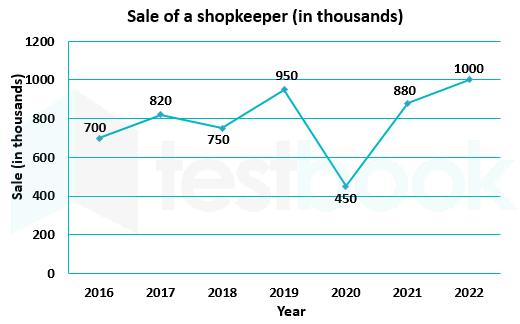
The given line graph shows the sale of a shopkeeper (in thousands) from the year 2016 to 2022. Study the graph and answer the question that follows.

The sale in 2020 is what percentage of sale in 2021?

  1. AOption (a)

    73.08%

  2. BOption (b)

    51.13%

  3. COption (c)

    61.73%

  4. DOption (d)

    59 .31%

View answer & explanation

Correct answer

Answer: (b)B.

51.13%

Why this answer is correct

Calculation:

Sales in 2020 = 450.

Sales in 2021 = 880.

According to the question

⇒ 450/880 × 100 = 51.13%

∴ Option 2 is the correct answer.

Question 51

In March 2022 which company among the following founded the Startups Founders Hub, it is a new digital and inclusive platform for startup founders in India?

  1. AOption (a)

    Microsoft

  2. BOption (b)

    Apple

  3. COption (c)

    Google

  4. DOption (d)

    IBM

View answer & explanation

Correct answer

Answer: (a)A.

Microsoft

Why this answer is correct

The correct answer is Microsoft.

Key Points

  • Microsoft
  • Founders: Bill Gates and Paul Allen
  • Establishment: April 4, 1975
  • Headquarters: Redmond, Washington, U.S.
  • Current Chairman & CEO: Satya Nadella

Additional Information

  • Apple
  • Founders: Steve Jobs, Steve Wozniak, and Ronald Wayne
  • Establishment: April 1, 1976
  • Headquarters: Cupertino, California, U.S.
  • Current Chairman & CEO: Tim Cook
  • Google
  • Founders: Larry Page and Sergey Brin
  • Establishment: September 4, 1998
  • Headquarters: Mountain View, California, U.S.
  • Current CEO: Sundar Pichai
  • IBM
  • Founder: Thomas J. Watson
  • Establishment: 1911 (as the Computing-Tabulating-Recording Company)
  • Headquarters: Armonk, New York, U.S.
  • Current Chairman & CEO: Arvind Krishna

Question 52

Which of the following letter-clusters will replace the question mark (?) in the given series to make it logically complete?

AZP 13, DXR 17, GVT 21, JTV 25, ?

  1. AOption (a)

    MRX 29

  2. BOption (b)

    MSX 29

  3. COption (c)

    MRY 29

  4. DOption (d)

    MSY 29

View answer & explanation

Correct answer

Answer: (a)A.

MRX 29

Why this answer is correct

The logic followed here is:

So, 'MRX 29' will replace the question mark in the given series.

Hence, the correct answer is "Option 1".

Question 53

The cost of two chairs and three tables is ₹1,650. If the cost of a chair is ₹150 less than that of a table, then find the cost of a table.

  1. AOption (a)

    ₹290

  2. BOption (b)

    ₹390

  3. COption (c)

    ₹400

  4. DOption (d)

    ₹380

View answer & explanation

Correct answer

Answer: (b)B.

₹390

Why this answer is correct

Shortcut Trick

Assume the cost of a table is T.

Cost of a chair = T − 150.

Total cost = 2 × (T − 150) + 3T = 1650.

5T − 300 = 1650 ⇒ 5T = 1950.

T = 1950 ÷ 5 = 390.

∴ The correct answer is ₹390.

Alternate Method

Given → Total cost of 2 chairs and 3 tables is ₹1,650. Cost of 1 chair = Cost of 1 table − ₹150. Formulas: Total Cost = (Quantity1 × Price1) + (Quantity2 × Price2)

Steps: ⇒ Let the cost of a table be x. ⇒ Then, the cost of a chair = x − 150. ⇒ 2(x − 150) + 3x = 1650 ⇒ 2x − 300 + 3x = 1650 ⇒ 5x = 1650 + 300 ⇒ 5x = 1950 ⇒ x = 390.

∴ The correct answer is ₹390.

Additional Information

Linear Equations in One Variable

A linear equation is an algebraic equation where each term has an exponent of one and the graphing of the equation results in a straight line.

Substitution Method

Expressing one variable in terms of another (e.g., Chair = Table − 150) to reduce the equation to a single variable for easy solving.

Question 54

In which of the following animals does blood go through the heart twice during each cycle?

  1. AOption (a)

    Mammals, fishes and reptiles

  2. BOption (b)

    Fishes, birds and reptiles

  3. COption (c)

    Mammals, birds and reptiles

  4. DOption (d)

    Mammals, birds and fishes

View answer & explanation

Correct answer

Answer: (c)C.

Mammals, birds and reptiles

Why this answer is correct

The correct answer is Mammals, birds and reptiles.

Key Points

  • Mammals, birds, and reptiles have a double circulatory system, where blood passes through the heart twice during each complete cycle.
  • In these animals, the heart is divided into four chambers: two atria and two ventricles.
  • This system allows for separation of oxygenated and deoxygenated blood, improving the efficiency of oxygen transport to body tissues.
  • Double circulation helps maintain higher blood pressure in systemic circulation, which is necessary for the active lifestyle of these animals.

Additional Information

  • Double Circulatory System:
  • In a double circulatory system, the blood passes through the heart twice during each complete circuit of the body.
  • First, the blood is pumped from the heart to the lungs (pulmonary circulation) where it gets oxygenated.
  • Then, the oxygenated blood returns to the heart and is pumped out again to the rest of the body (systemic circulation).
  • Heart Chambers:
  • Mammals and birds have a four-chambered heart consisting of two atria and two ventricles.
  • Reptiles, with few exceptions, have a three-chambered heart, but some like crocodiles have a four-chambered heart.
  • Advantages of Double Circulation:
  • It allows for complete separation of oxygenated and deoxygenated blood, which is more efficient for oxygen transport.
  • Double circulation maintains higher blood pressure in systemic circulation, which is vital for the active lifestyles of mammals and birds.

Question 55

Three statements are given followed by three conclusions numbered I, II and III. Assuming the statements to be true, even if they seem to be at variance with commonly known facts, decide which of the conclusions logically follow(s) from the statements.

Statements:

All valleys are mountains.

Some mountains are hills.

Some hills are plateaus.

Conclusions:

I. Some plateaus are mountains.

II. Some valleys are plateaus.

III. Some mountains are valleys.

  1. AOption (a)

    Only conclusions II and III follow

  2. BOption (b)

    Only conclusion III follows

  3. COption (c)

    Only conclusions I and II follow

  4. DOption (d)

    Only conclusions I and III follow

View answer & explanation

Correct answer

Answer: (b)B.

Only conclusion III follows

Why this answer is correct

Given Statements:

All valleys are mountains.

Some mountains are hills.

Some hills are plateaus.

The least possible Venn diagram for the given statement is:

Conclusions:

I. Some plateaus are mountains - False (Because, no definite relation given between plateaus and mountains, so it can be possible only).

II. Some valleys are plateaus - False (Because, no definite relation given between valleys and plateaus, so it can be possible only).

III Some mountains are valleys - True (Because, All valleys are mountains implies that some mountains are also valleys).

So, Only conclusion III follows.

Hence, the correct answer is "Option 2".

Question 56

Each interior angle of a regular polygon of n sides is 144°. The number of sides (n) of the polygon is:

  1. AOption (a)

    9

  2. BOption (b)

    12

  3. COption (c)

    10

  4. DOption (d)

    8

View answer & explanation

Correct answer

Answer: (c)C.

10

Why this answer is correct

Shortcut Trick

For any regular polygon, the interior angle and its corresponding exterior angle are supplementary (they sum up to 180°).

⇒ Exterior angle = 180° − Interior angle

⇒ Exterior angle = 180° − 144° = 36°

Since the sum of all exterior angles of any polygon is always 360°:

⇒ Number of sides (n) = 360° ÷ Exterior angle

⇒ n = 360° ÷ 36° = 10

∴ The correct answer is 10 sides.

Alternate Method

Given:

Each interior angle of a regular polygon = 144°

Formula Used:

Each interior angle of a regular polygon of n sides = ((n − 2) × 180°) ÷ n

Calculations:

Substitute the given interior angle into the formula:

⇒ ((n − 2) × 180) ÷ n = 144

⇒ (n − 2) × 180 = 144n

⇒ 180n − 360 = 144n

⇒ 180n − 144n = 360

⇒ 36n = 360

⇒ n = 360 ÷ 36

⇒ n = 10

Verification of other options:

• Option 1 (9 sides): Each interior angle = ((9 − 2) × 180°) ÷ 9 = (7 × 180°) ÷ 9 = 140° ≠ 144° (Incorrect).

• Option 2 (12 sides): Each interior angle = ((12 − 2) × 180°) ÷ 12 = (10 × 180°) ÷ 12 = 150° ≠ 144° (Incorrect).

• Option 4 (8 sides): Each interior angle = ((8 − 2) × 180°) ÷ 8 = (6 × 180°) ÷ 8 = 135° ≠ 144° (Incorrect).

∴ The correct answer is 10 sides.

Additional Information

Sum of Interior Angles

The sum of all interior angles of a polygon with n sides is given by the formula: Sum = (n − 2) × 180°.

Sum of Exterior Angles

The sum of all exterior angles of any convex polygon is always constant and equals 360°.

Interior and Exterior Angle Relationship

At any vertex of a polygon, the interior angle and the exterior angle lie on a straight line, making them supplementary: Interior Angle + Exterior Angle = 180°.

Question 57

If a parallel beam of light is not parallel to the principal axis of a concave mirror, then such rays will converge at the _______.

  1. AOption (a)

    centre of curvature

  2. BOption (b)

    principal focal plane

  3. COption (c)

    pole

  4. DOption (d)

    infinity

View answer & explanation

Correct answer

Answer: (b)B.

principal focal plane

Why this answer is correct

The correct answer is principal focal plane.

Key Points

  • In a concave mirror, parallel rays that are not parallel to the principal axis converge at a point on the principal focal plane.
  • The principal focal plane is a plane that passes through the focus and is perpendicular to the principal axis.
  • Rays parallel to the principal axis converge at the focal point, while non-parallel rays converge on the focal plane, but not necessarily at the focal point.
  • This phenomenon is due to the reflective properties and curvature of the concave mirror.

Additional Information

  • Concave Mirror
  • A concave mirror, or converging mirror, has a reflecting surface that bulges inward (away from the incident light).
  • Concave mirrors are used to focus light and are commonly used in devices such as telescopes, headlamps, and shaving mirrors.
  • Principal Axis
  • The principal axis is a straight line that passes through the center of curvature and the pole of the mirror.
  • It is the reference line used to describe the formation of images by the mirror.
  • Focal Point (Focus)
  • The focal point is the point on the principal axis where parallel rays of light converge after being reflected from the mirror.
  • In concave mirrors, the focal point lies between the pole and the center of curvature.
  • Center of Curvature
  • The center of curvature is the center of the sphere from which the concave mirror is a part.
  • It is located on the principal axis and is twice the distance from the mirror as the focal point.

Question 58

A seller makes a profit of 20%. If he uses 10% less weight than the actual weight while selling goods, what is his actual profit percent?

  1. AOption (a)

    15%

  2. BOption (b)

    33.3%

  3. COption (c)

    36.6%

  4. DOption (d)

    30%

View answer & explanation

Correct answer

Answer: (b)B.

33.3%

Why this answer is correct

Shortcut Trick

Let the Cost Price (CP) of 1000g be Rs. 1000.

Selling Price with 20% profit = 1000 × (120 ÷ 100) = Rs. 1200.

Weight used = 10% less than 1000g = 900g.

Actual CP of 900g = Rs. 900.

Actual Profit = 1200 − 900 = Rs. 300.

Profit% = (300 ÷ 900) × 100 = 33.33%.

∴ The correct answer is 33.3%.

Alternate Method

Given → Profit% = 20%, Weight Error = 10% less. Formulas: Total Profit% = [(100 + P%) ÷ (100 − Error%)] × 100 − 100.

Steps: ⇒ Multiplier for weight = 100 ÷ (100 − 10) = 100 ÷ 90 = 10 ÷ 9. ⇒ Multiplier for stated profit = (100 + 20) ÷ 100 = 120 ÷ 100 = 6 ÷ 5. ⇒ Net Multiplier = (10 ÷ 9) × (6 ÷ 5) = 60 ÷ 45 = 4 ÷ 3. ⇒ Profit% = [(4 − 3) ÷ 3] × 100 = (1 ÷ 3) × 100. ⇒ Profit% = 33.33%.

∴ The correct answer is 33.3%.

Additional Information

Dishonest Dealer Concept

When a dealer sells goods at cost price but uses less weight, Gain% = [Error ÷ (True Value − Error)] × 100.

Successive Percentage for Profit

If there is a markup and a weight cheat, the effective profit is calculated by multiplying the respective ratios of SP to CP.

Question 59

Select the option that is related to the third term in the same way as the second term is related to the first term and the sixth term is related to the fifth term.

24 ∶ 144 ∶∶ 16 ∶ ? ∶∶ 8 ∶ 48

  1. AOption (a)

    93

  2. BOption (b)

    94

  3. COption (c)

    96

  4. DOption (d)

    95

View answer & explanation

Correct answer

Answer: (c)C.

96

Why this answer is correct

The logic followed here is:

Logic: 1st number × 6 = 2nd number.

Now,

For, 24 ∶ 144

⇒ 24 × 6 = 144.

For, 8 ∶ 48

⇒ 8 × 6 = 48.

Similarly, for 16 ∶ ?

⇒ 16 × 6 = 96.

Hence, the correct answer is "Option 3".

Question 60

Which aquaculture scientist from Karnataka was awarded the Padma Shri 2022 in the Science and Engineering category?

  1. AOption (a)

    Sanghamitra Bandopadhyay

  2. BOption (b)

    Subba Nanna  Ayyappan

  3. COption (c)

    Aditya Prasad Das

  4. DOption (d)

    Moti Lal Madan

View answer & explanation

Correct answer

Answer: (b)B.

Subba Nanna  Ayyappan

Why this answer is correct

The correct answer is Subba Nanna Ayyappan.

Key Points

  • Subba Nanna Ayyappan is a renowned aquaculture scientist from Karnataka.
  • He was awarded the Padma Shri in the Science and Engineering category in 2022.
  • Ayyappan has made significant contributions to the field of aquaculture and fisheries science in India.
  • He has held various key positions, including the Director General of the Indian Council of Agricultural Research (ICAR).

Additional Information

  • Padma Shri
  • The Padma Shri is the fourth highest civilian award in the Republic of India, instituted in 1954.
  • It is awarded to citizens of India in recognition of their distinguished contribution in various spheres of activity including the Arts, Education, Industry, Literature, Science, Sports, Medicine, Social Service, and Public Affairs.
  • The award is announced on the occasion of Republic Day every year.
  • Aquaculture
  • Aquaculture, also known as aquafarming, is the controlled process of cultivating aquatic organisms, especially for human consumption.
  • It involves cultivating freshwater and saltwater populations under controlled conditions, as opposed to commercial fishing, which is the harvesting of wild fish.
  • Aquaculture encompasses the farming of fish, shellfish, and aquatic plants.
  • It contributes to food security, income, and employment for millions of people globally.
  • Indian Council of Agricultural Research (ICAR)
  • The Indian Council of Agricultural Research (ICAR) is an autonomous body responsible for coordinating agricultural education and research in India.
  • It reports to the Department of Agricultural Research and Education, Ministry of Agriculture.

Question 61

What is a good strategy of serving food, if you have to serve buffet food to around 150 guests in a family function? Note that this means the person has to hold the plate while standing and eating.

  1. AOption (a)

    Plastic plates

  2. BOption (b)

    Banana leaves

  3. COption (c)

    Metal plates

  4. DOption (d)

    Banana leaves on washable and reusable plastic plates

View answer & explanation

Correct answer

Answer: (d)D.

Banana leaves on washable and reusable plastic plates

Why this answer is correct

The correct answer is Banana leaves on washable and reusable plastic plates.

Key Points

  • Using banana leaves on washable and reusable plastic plates is eco-friendly as banana leaves are biodegradable.
  • Banana leaves are large and sturdy, making them an ideal choice for holding food without spillage.
  • The combination of banana leaves and plastic plates is hygienic since the leaves can be disposed of after use, and the plates can be washed and reused, reducing waste.
  • This method is cost-effective for serving a large number of guests, as it minimizes the need for buying disposable plates.

Additional Information

  • Banana leaves have been traditionally used in many cultures for serving food.
  • They are biodegradable and eco-friendly but might be difficult to manage without any support structure.
  • Banana leaves add an eco-friendly layer that can be easily disposed of after use.

Question 62

Which set of the statements is true about land use?

  1. The use of land is determined by physical factors such as topography, soil, climate, minerals and availability of water.
  2. Human factors such as population and technology are not determinants of land use patterns.
  3. People and their demands are ever growing but the availability of land is limited.
  4. Expansion of construction activities is one of the reasons for land degradation, landslides and soil erosion.
  1. AOption (a)

    1, 2 and 4

  2. BOption (b)

    2, 3 and 4

  3. COption (c)

    4, 3 and 1

  4. DOption (d)

    1, 2 and 3

View answer & explanation

Correct answer

Answer: (c)C.

4, 3 and 1

Why this answer is correct

The correct answer is 4, 3 and 1.

Key Points

  • The use of land is determined by physical factors such as topography, soil, climate, minerals and availability of water.
  • Human factors such as population and technology significantly influence land use patterns.
  • People and their demands are ever growing but the availability of land is limited.
  • Expansion of construction activities is one of the reasons for land degradation, landslides and soil erosion.

Additional Information

  • Topography: The arrangement of the natural and artificial physical features of an area. It influences land use as certain activities may be more suitable for specific terrains.
  • Soil: The type and quality of soil determine its suitability for various agricultural practices. Fertile soil is necessary for high crop yields, while poor soil may limit agricultural potential.
  • Climate: The climate of an area influences the type of vegetation and the kind of crops that can be grown. It also affects human settlement patterns and economic activities.
  • Minerals: The presence of minerals can lead to mining activities, which can significantly alter land use patterns and impact the environment.
  • Water Availability: Access to water sources is crucial for agriculture, industry, and human settlements. Areas with abundant water resources are more likely to be developed and densely populated.
  • Population: High population density often leads to increased demand for land for housing, infrastructure, and agriculture, leading to changes in land use patterns.
  • Technology: Technological advancements can lead to more efficient land use and can transform previously unusable land into productive areas.
  • Land Degradation: The decline in the quality of the land due to human activities such as deforestation, overgrazing, and improper agricultural practices.
  • Landslides: The movement of rock, earth, or debris down a slope, often triggered by factors like heavy rainfall, earthquakes, or human activities such as construction.
  • Soil Erosion: The process by which the top layer of soil is removed by wind, water, or human activities, leading to loss of fertile land and other environmental issues.

Question 63

Read the given statements and conclusions carefully. Assuming that the information given in the statements is true, even if it appears to be at variance with commonly known facts, decide which of the given conclusions logically follow(s) from the statements.

Statements:

Some balloons are flowers.

All flowers are colours.

All colours are rainbows.

Conclusions:

(I) All flowers are rainbows.

(II) Some balloons are colours.

  1. AOption (a)

    Only conclusion (I) follows.

  2. BOption (b)

    Both conclusion (I) and conclusion (II) follow.

  3. COption (c)

    Both conclusion (I) and conclusion (II) do not follow.

  4. DOption (d)

    Only conclusion (II) follows.

View answer & explanation

Correct answer

Answer: (b)B.

Both conclusion (I) and conclusion (II) follow.

Why this answer is correct

Given Statements:

Some balloons are flowers.

All flowers are colours.

All colours are rainbows.

The least possible Venn diagram for the given statement is:

Conclusions:

I. All flowers are rainbows - True (Because, All flowers are colours and All colours are rainbows, so All the flowers are part of rainbows).

II. Some balloons are colours - True (Because, Those part of balloons which is flowers will also colours).

So, Both conclusion (I) and conclusion (II) follow.

Hence, the correct answer is "Option 2".

Question 64

What is the difference between the biggest and the smallest fractions among 12,34,45\frac{1}{2}, \frac{3}{4}, \frac{4}{5} and 56?\frac{5}{6} ?

  1. AOption (a)

    112\frac{1}{12}

  2. BOption (b)

    19\frac{1}{9}

  3. COption (c)

    16\frac{1}{6}

  4. DOption (d)

    13\frac{1}{3}

View answer & explanation

Correct answer

Answer: (d)D.

13\frac{1}{3}

Why this answer is correct

Calculation:

1/2 = 0.5

3/4 = 0.75

4/5 = 0.8

5/6 ≈ 0.833

Based on the decimal values:

The smallest fraction is 1/2 (0.5).

The biggest fraction is 5/6 (≈0.833).

Difference: ⇒ 5/6 - 1/2

Difference: ⇒ 5/6 - 3/6 = 2/6 = 1/3

So, the difference between the biggest and the smallest fractions among 1/2, 3/4, 4/5, and 5/6 is 1/3.

Question 65

A cuboidal hall is 15 m long and 10 m broad. If the sum of the areas of the floor and the ceiling is equal to the sum of the areas of the four walls, then the volume of the hall is:

  1. AOption (a)

    840 m3

  2. BOption (b)

    900 m3

  3. COption (c)

    790 m3

  4. DOption (d)

    930 m3

View answer & explanation

Correct answer

Answer: (b)B.

900 m3

Why this answer is correct

Shortcut Trick

Given: 2(lb) = 2h(l + b)

⇒ lb = h(l + b)

⇒ 15 × 10 = h(15 + 10)

⇒ 150 = 25h ⇒ h = 6 m

Volume = l × b × h = 15 × 10 × 6 = 900 m3

∴ The correct answer is 900 m3.

Alternate Method

Given: Length (l) = 15 m, Breadth (b) = 10 m

Formula Used: Area of floor/ceiling = l × b; Area of four walls = 2h(l + b); Volume = l × b × h

⇒ Area of floor + Area of ceiling = 2 × (15 × 10) = 300 m2

⇒ Area of four walls = 2 × h × (15 + 10) = 2 × h × 25 = 50h

⇒ According to the question: 50h = 300

⇒ h = 300 ÷ 50 = 6 m

⇒ Volume of the hall = 15 × 10 × 6

⇒ Volume = 900 m3

∴ The correct answer is 900 m3.

Additional Information

Total Surface Area of Cuboid

The total surface area includes all six faces and is given by 2(lb + bh + hl).

Lateral Surface Area

The area of the four walls of a room is known as the lateral surface area: 2h(l + b).

Diagonal of a Cuboid

The longest rod that can be placed in a cuboidal room is the diagonal: √(l2 + b2 + h2).

Question 66

Five girls, M, N, O, P, and Q are sitting around a circular table facing the centre. P is an immediate neighbour of M and N. Q is second to the left of P. N and Q are the immediate neighbours of O. Who is sitting third to the right of Q?

  1. AOption (a)

    O

  2. BOption (b)

    P

  3. COption (c)

    N

  4. DOption (d)

    M

View answer & explanation

Correct answer

Answer: (c)C.

N

Why this answer is correct

Given: Five girls, M, N, O, P, and Q are sitting around a circular table facing the centre.

1) Q is second to the left of P.

  1. P is an immediate neighbour of M and N.

  2. N and Q are the immediate neighbours of O.

So, 'N' is sitting third to the right of Q.

Hence, the correct answer is "Option 3".

Question 67

Select the number that will replace the question mark (?) in the given series.

1  11  20  28  ?

  1. AOption (a)

    34

  2. BOption (b)

    36

  3. COption (c)

    37

  4. DOption (d)

    35

View answer & explanation

Correct answer

Answer: (d)D.

35

Why this answer is correct

The logic followed here is:

So, '35' will replace the question mark in the given series.

Hence, the correct answer is "Option 4".

Question 68

Each vowel in the word COMPLAINED is changed to the letter following it in the English alphabetical order and each consonant is changed to the letter preceding it in the English alphabetical order. Which of the following letters will appear twice in the group of letters thus formed?

  1. AOption (a)

    C

  2. BOption (b)

    B

  3. COption (c)

    K

  4. DOption (d)

    P

View answer & explanation

Correct answer

Answer: (b)B.

B

Why this answer is correct

Given word: COMPLAINED 

Each vowel in the word COMPLAINED is changed to the letter following.

Each consonant in the word COMPLAINED is changed to the letter preceding.

LettersCOMPLAINED
Vowels getting replaced by it's next letter & Vowels getting replaced by it's prev. letterBPLOKBJMFC


After rearranging the letters will be: BPLOKBJMFC

Here, B appear twice.

Hence, the correct answer is "Option 2".

Question 69

_______ is the collection of all bundles of goods that a consumer can purchase with his income at prevailing market prices  .

  1. AOption (a)

    Budget Models

  2. BOption (b)

    Budget Set

  3. COption (c)

    Budget Line

  4. DOption (d)

    Budget Price

View answer & explanation

Correct answer

Answer: (b)B.

Budget Set

Why this answer is correct

The correct answer is Budget Set

Key Points

  • The budget set is simply a collection of all goods that a consumer can purchase at the prevailing market price using his/her income.
  • All the bundles which follow the following criteria form a part of the budget set,
  • {p1 x1 + p2 x2 ≤ M}
  • where p1 and p2 are the prices of two goods and x1 and x2 are their respective quantities. M represents the consumer's income.
  • The set of bundles available to the consumer is called the budget set.
  • The budget set is thus the collection of all bundles that the consumer can buy with her income at the prevailing market prices.
  • This inequality equation depicts the budget constraint of a consumer, that is, a consumer can only purchase those goods whose market value is either equal to or less than his/her income

Additional Information

  • Budget Model
  • ​A budget model is a quantitative system that helps manage resources within an institution.
  • It is not a financial accounting system and does not create or reduce capacity.
  • Some types of budgets include:
  • Zero-based budget
  • Flexible budget
  • Operating budget
  • Financial budget
  • Production budget
  • Budget Line
  • ​A budget line is a graph that shows all the possible combinations of two goods that a consumer can buy with a certain income and prices
  • A budget line shows the combinations of two goods that a consumer can afford.
  • The quantity of one good is on the horizontal axis, and the quantity of the other good is on the vertical axis.
  • Budget Price
  • ​A budget price is a price that is considered to be affordable or inexpensive.
  • People often look for budget prices when they are trying to save money or when they have limited funds available.
  • Some synonyms for budget price include: 
  • bargain, discount, deal, good deal, reduction, and value.

Question 70

If 2xy2 ∶ 2x2y ∶∶ 2x2y ∶ z, which of the options below gives an expression equivalent to z?

  1. AOption (a)

    2x2

  2. BOption (b)

    4xy

  3. COption (c)

    4x2 y2

  4. DOption (d)

    2x3

View answer & explanation

Correct answer

Answer: (d)D.

2x3

Why this answer is correct

Shortcut Trick

For a continued proportion a : b :: b : z, the third proportional is calculated as z = b2 ÷ a.

Here, a = 2xy2 and b = 2x2y.

z = (2x2y)2 ÷ (2xy2) = 4x4y2 ÷ 2xy2

z = (4/2) × (x4/x) × (y2/y2) = 2x3.

∴ The correct answer is 2x3.

Alternate Method

Given:

The proportion is 2xy2 : 2x2y :: 2x2y : z

Formula Used:

In a proportion a : b :: c : d, the Product of Extremes = Product of Means.

a × d = b × c

Calculations:

⇒ (2xy2) × z = (2x2y) × (2x2y)

⇒ 2xy2 × z = 4x4y2

⇒ z = 4x4y2 ÷ 2xy2

⇒ z = (4/2) × x(4−1) × y(2−2)

⇒ z = 2 × x3 × y0

⇒ z = 2 × x3 × 1

⇒ z = 2x3

∴ The correct answer is 2x3.

Additional Information

Continued Proportion

Three non-zero quantities a, b, c are said to be in continued proportion if a : b = b : c, which implies b2 = ac.

Third Proportional

In the ratio a : b = b : c, the term c is called the third proportional to a and b. It is given by c = b2 / a.

Rules of Exponents

When dividing terms with the same base, subtract the exponents: xm ÷ xn = xm−n. Any non-zero base to the power of zero is 1 (x0 = 1).

Fourth Proportional

If four quantities a, b, c, d are in proportion (a : b :: c : d), then d is the fourth proportional, where d = (b × c) / a.

Question 71

Hema can do a certain piece of work in 21 days. Hema and Raji can together do the same work in 18 days, and Hema, Raji and Smitha can do the same work together in 14 days. In how many days can Hema and Smitha do the same work, working together?

  1. AOption (a)

    365\frac{36}{5}

  2. BOption (b)

    635\frac{63}{5}

  3. COption (c)

    63

  4. DOption (d)

    634\frac{63}{4}

View answer & explanation

Correct answer

Answer: (d)D.

634\frac{63}{4}

Why this answer is correct

Shortcut Trick

Let Total Work = LCM(21, 18, 14) = 126 units.

Efficiency of Hema = 126 ÷ 21 = 6 units/day.

Efficiency of Hema + Raji + Smitha = 126 ÷ 14 = 9 units/day.

Efficiency of Hema + Raji = 126 ÷ 18 = 7 units/day.

Efficiency of Smitha = (H+R+S) − (H+R) = 9 − 7 = 2 units/day.

Combined Efficiency of Hema + Smitha = 6 + 2 = 8 units/day.

Time taken = 126 ÷ 8 = 63/4 days.

∴ The correct answer is 63/4 days.

Alternate Method

Given:

Time taken by Hema = 21 days

Time taken by Hema and Raji = 18 days

Time taken by Hema, Raji and Smitha = 14 days

PersonDaysTotal WorkEfficiency
Hema211266
Hema + Raji187
Hema + Raji + Smitha149

Calculations:

⇒ Efficiency of Hema = 6

⇒ Efficiency of Raji = Efficiency of (H+R) − Efficiency of (H) = 7 − 6 = 1

⇒ Efficiency of Smitha = Efficiency of (H+R+S) − Efficiency of (H+R) = 9 − 7 = 2

⇒ Combined efficiency of Hema and Smitha = 6 + 2 = 8

⇒ Time taken by Hema and Smitha together = Total Work ÷ Combined Efficiency

⇒ Time = 126 ÷ 8

⇒ Time = 63/4 days

∴ The correct answer is 63/4 days.

Additional Information

Work and Efficiency

Efficiency is inversely proportional to the time taken to complete a work. Total Work = Efficiency × Time.

Combined Work Formula

If A can do a work in x days and B in y days, together they do it in (xy) ÷ (x + y) days.

Negative Work

In Pipes and Cisterns, an outlet pipe performs negative work, which is subtracted from the total efficiency.

Question 72

If one root of the equation (k + 1) x2 - 13kx +7 - 2k = 0 is the reciprocal of the other, then the value of k is:

  1. AOption (a)

    2

  2. BOption (b)

    4

  3. COption (c)

    -2

  4. DOption (d)

    -4

View answer & explanation

Correct answer

Answer: (a)A.

2

Why this answer is correct

Shortcut Trick If the roots of a quadratic equation are reciprocal to each other, the product of roots is 1. For ax2 + bx + c = 0, this directly implies a = c. Here, a = k + 1 and c = 7 − 2k. ⇒ k + 1 = 7 − 2k ⇒ 3k = 6 ⇒ k = 2 ∴ The correct answer is 2.

Alternate Method Given Equation: (k + 1)x2 − 13kx + 7 − 2k = 0 Comparing with the standard quadratic equation ax2 + bx + c = 0, we get: ⇒ a = k + 1 ⇒ b = −13k ⇒ c = 7 − 2k Let the roots of the equation be α and β. Since one root is the reciprocal of the other, we have: ⇒ β = 1/α Formula Used: Product of roots of a quadratic equation = c/a ⇒ α × β = c/a ⇒ α × (1/α) = (7 − 2k) / (k + 1) ⇒ 1 = (7 − 2k) / (k + 1) ⇒ k + 1 = 7 − 2k ⇒ k + 2k = 7 − 1 ⇒ 3k = 6 ⇒ k = 2 ∴ The correct answer is 2.

Additional Information Product of Roots For any quadratic equation ax2 + bx + c = 0, the product of roots is given by c/a. If the roots are reciprocal, then product = 1, which implies a = c. Sum of Roots The sum of roots (α + β) is given by −b/a. Nature of Roots Determined by the discriminant D = b2 − 4ac. Roots are real and distinct if D > 0, real and equal if D = 0, and complex if D < 0.

Question 73

The unit of resistance is _______.

  1. AOption (a)

    Ampere

  2. BOption (b)

    Ohm

  3. COption (c)

    Volt

  4. DOption (d)

    Coulomb

View answer & explanation

Correct answer

Answer: (b)B.

Ohm

Why this answer is correct

The correct answer is Ohm.

Key Points

  • Ohm (Ω) is the SI unit of electrical resistance, named after the German physicist Georg Simon Ohm.
  • 1 Ohm is defined as the resistance between two points of a conductor when a constant potential difference of 1 Volt produces a current of 1 Ampere.
  • The formula for resistance is R = V/I, where R is resistance in ohms, V is voltage in volts, and I is current in amperes.
  • Ohm’s Law states that the current through a conductor between two points is directly proportional to the voltage across the two points.
  • The symbol used for Ohm is Ω (Greek letter Omega).

Additional Information

  • Ampere (A): The unit of electric current; 1 Ampere is the current that flows with an electric charge of 1 Coulomb per second.
  • Volt (V): The unit of electric potential; 1 Volt is the potential difference that will drive 1 Ampere of current against 1 Ohm of resistance.
  • Coulomb (C): The unit of electric charge; 1 Coulomb is the amount of charge transported by a current of 1 Ampere in 1 second.
  • Resistivity: A material-specific property that determines how strongly a material opposes the flow of electric current, measured in ohm-meter (Ω·m).
  • Conductors and Insulators: Materials with low resistance (like copper) are conductors; those with high resistance (like rubber) are insulators.

Question 74

Under the Indian budgetary classification of Central or State governments, which of the following would be classified as revenue receipts?

  1. AOption (a)

    Borrowings

  2. BOption (b)

    Tax receipts

  3. COption (c)

    Recoveries of loans

  4. DOption (d)

    Receipts from disinvestment

View answer & explanation

Correct answer

Answer: (b)B.

Tax receipts

Why this answer is correct

The correct answer is Tax receipts

Key Points

  • Under the Indian budgetary classification, tax receipts are classified as revenue receipts
  • Tax receipts are documents issued by the government or relevant authorities to acknowledge the payment of taxes by individuals or entities.
  • They serve as proof that a tax liability has been settled
  • Tax receipts are crucial for record-keeping and may be required for various purposes, such as filing returns, applying for loans, or during audits.

Additional Information

  • Borrowings
  • Funds raised by the government to finance its fiscal deficit, which occurs when expenditure exceeds revenue.
  • Types of Borrowings:
  • Internal Borrowings: Raised within the country through instruments like treasury bills, government bonds, and market borrowings.
  • External Borrowings: Loans taken from foreign countries, international financial institutions (e.g., IMF, World Bank), or through issuance of sovereign bonds.
  • Recoveries of Loans
  • Repayments received by the government on loans it had previously disbursed to states, union territories, or other entities.
  • Sources:
  • Loans given to state governments or public sector enterprises.
  • Loans for specific development projects or economic activities.
  • ​Receipts from Disinvestment
  • Revenue generated by the government through the sale of its stake in public sector undertakings (PSUs).
  • Types:
  • Strategic Disinvestment: Selling a significant portion (or all) of the government’s stake to private players.
  • Minority Stake Sale: Retaining majority control while selling a smaller portion.
  • Initial Public Offering (IPO)/Follow-on Public Offering (FPO): Listing PSUs on stock exchanges or selling additional shares.

Question 75

The 16th Annual Status of Education Report (ASER) 2021 (Rural) was released by ________ in November 2021.

  1. AOption (a)

    Navjyoti Foundation

  2. BOption (b)

    Bhumi

  3. COption (c)

    Goonj

  4. DOption (d)

    Pratham foundation

View answer & explanation

Correct answer

Answer: (d)D.

Pratham foundation

Why this answer is correct

The correct answer is Pratham foundation

Key Points

  • The 16th Annual Status of Education Report (ASER) 2021 (Rural) was released by the Pratham Foundation on November 17, 2021.
  • The ASER is a citizen-led survey that provides data on the status of school education in India.
  • The report covers the following areas: 
  • Enrollment: The rate of children enrolled in school, and the rate of children who drop out
  • The trend of children taking paid tuition classes
  • Smartphones: Whether households have smartphones, and if so, whether children have access to them
  • Learning materials: Whether children received textbooks and other learning materials from schools
  • Learning support: How families support children at home as schools reopen
  • The ASER has been conducted annually since 2005 in almost all rural districts of India​

Additional Information

  • Navjyoti Foundation
  • It was ​Founded by Dr. Kiran Bedi along with 16 police officers, since our inception in 1988 we have been working seamlessly towards the upliftment of underprivileged sections of the society and provide marginalized groups with an opportunity to live a dignified life.
  • Focusing at the grassroot level, our approach comprises advocacy, spreading awareness, policy intervention which has helped us take substantial strides towards crime prevention.
  • Bhumi
  • Bhumi was started in 2006 by a few students and young professionals in the Indian city of Chennai.
  • The organisation was started by ophthalmologist Dr. Prahalathan KK and his friends Ayyanar Elumalai, and Dr. Harishankar Namasivayam
  • Bhumi is one of India's largest independent youth volunteer non-profit organisations.
  • Bhumi helps to educate over 25,000 children across India as of 2020.
  • Goonj
  • Goonj is a non-governmental organisation headquartered in New Delhi, India.
  • Goonj is working to bring equity and dignity between cities and villages using underutilised urban material particularly cloth as a tool for development across the country.
  • Goonj undertakes disaster relief, humanitarian aid and community development in parts of 23 states across India.
  • It focuses on clothing as a basic but unaddressed need

Question 76

Who among the following became the first para-athlete to be conferred with the Padma Bhushan award, in 2022?

  1. AOption (a)

    Suhas L Yathiraj

  2. BOption (b)

    Pramod Bhagat

  3. COption (c)

    Devendra Jhajharia

  4. DOption (d)

    Manish Narwal

View answer & explanation

Correct answer

Answer: (c)C.

Devendra Jhajharia

Why this answer is correct

The correct answer is Devendra Jhajharia

Key Points

  • Devendra Jhajharia  became the first para-athlete to be conferred with the Padma Bhushan, India's third-highest civilian award, in 2022.
  • Devendra Jhajharia is a javelin thrower who competes in the F46 category for athletes with upper limb impairments.
  • He has won two gold medals at the Paralympic Games:
  • 2004 Athens Paralympics – Set a new world record in the F46 javelin throw category.
  • 2016 Rio Paralympics – Broke his own world record with a throw of 63.97 meters.
  • Won a silver medal at the 2020 Tokyo Paralympics, demonstrating his consistent excellence over nearly two decades.

Additional Information

  • Suhas L Yathiraj​
  • Suhas Yathiraj became the first IAS officer to win a Paralympic medal.
  • Yathiraj is an officer in the Indian Administrative Service (IAS), having achieved success in one of the toughest examinations in the country at the very first attempt.
  • Yathiraj graduated in computer engineering from the National Institute of Technology, Surathkal, Karnataka in 2004.
  • The bright Yathiraj went on to clear the Civil Services examination in 2006 and then began his career as an IAS officer in 2007.
  • It was only in 2015-16 that he turned into a professional para-badminton player and has since then been managing his duty as the District Magistrate of Gautam Buddha Nagar and his training as a sportsperson to good effect.
  • Pramod Bhagat 
  • ​He is an Indian professional Para-badminton player from Odisha.
  • He won a gold medal at the 2020 Summer Paralympics in Men's singles SL3.
  • Manish Narwal​
  • Manish Narwal (born 17 October 2001) is an Indian Para Pistol Shooter.
  • He ranks fourth in the world in Men's 10m Air Pistol SH1 according to the World Shooting Para Sports Rankings.
  • Manish is also supported by GoSports Foundation through the Para Champions Programme.
  • Shooting has inspired competition, and in several countries, rifle clubs started to form in the 19th century.

Question 77

In this question, the statement is followed by four conclusions. Find out which conclusion is NOT true based on the given statement.

Statement: J > S ≥ C > Q ≥ T = A < N

  1. AOption (a)

    S ≥ T

  2. BOption (b)

    C < J

  3. COption (c)

    N > T

  4. DOption (d)

    C > A

View answer & explanation

Correct answer

Answer: (a)A.

S ≥ T

Why this answer is correct

Given Statement: J > S ≥ C > Q ≥ T = A < N

Now,

Conclusions:

Option 1: S ≥ T → False (S ≥ C > Q ≥ T It gives S > T)

Option 2: C < J → True (J > S ≥ C It gives J > C)

Option 3: N > T → True (T = A < N It gives N > T)

Option 4: C > A → True (C > Q ≥ T = A It gives C > A)

Hence, the correct answer is "Option 1".

Question 78

A statement is given followed by two conclusions numbered I and II. You have to assume everything in the statement to be true and decide which of the conclusions logically follow(s) beyond a reasonable doubt from the information given in the statement.

Statement:

The findings according to a recent study on marine life stated that plastic and other non-biodegradable waste material disposed in water bodies is one of the leading causes of harm to sea creatures.

Conclusions:

I. Non-biodegradable materials should not be disposed of in water bodies.

II. More research is being conducted on marine life to better understand sea creatures.

  1. AOption (a)

    Both conclusions I and II follow

  2. BOption (b)

    Neither conclusion I nor II follows

  3. COption (c)

    Only conclusion II follows

  4. DOption (d)

    Only conclusion I follows

View answer & explanation

Correct answer

Answer: (d)D.

Only conclusion I follows

Why this answer is correct

Given,

Statement:

The findings according to a recent study on marine life stated that plastic and other non-biodegradable waste material disposed in water bodies is one of the leading causes of harm to sea creatures.

Conclusions:

I. Non-biodegradable materials should not be disposed of in water bodies - True (Because, The statement mentions that plastic and other non-biodegradable waste material disposed in water bodies is one of the leading causes of harm to sea creatures, which suggests that disposing of non-biodegradable materials in water bodies is harmful).

II. More research is being conducted on marine life to better understand sea creatures - False (Because, it does not provide any evidence to support the claim that more research is being conducted on marine life).

So, Only conclusion I follows.

Hence, the correct answer is "Option 4".

Question 79

A student performs an experiment wherein he adds barium chloride to aluminium sulphate. Which of the following reaction is correct?

  1. AOption (a)

    3BaCl2(aq) + Al2(SO4)3(aq) → 3BaSO4(s) + 2AlCl3 (aq)

  2. BOption (b)

    3BaCl2(aq) + Al2(SO4)3(aq) → BaSO4(s) + AlCl3 (aq)

  3. COption (c)

    BaCl2(aq) + Al2(SO4)3(aq) → 3BaSO4(s) + Al(s) + Cl2 (g)

  4. DOption (d)

    BaCl2(aq) + Al2(SO4)3(aq) → Ba(s) + SO2(g) + 2AlCl3(aq)

View answer & explanation

Correct answer

Answer: (a)A.

3BaCl2(aq) + Al2(SO4)3(aq) → 3BaSO4(s) + 2AlCl3 (aq)

Why this answer is correct

The correct answer is 3BaCl2(aq) + Al2(SO4)3(aq) → 3BaSO4(s) + 2AlCl3 (aq)

Key Points

  • The  reaction 3BaCl₂(aq) + Al₂(SO₄)₃(aq) → 3BaSO₄(s) + 2AlCl₃(aq) is correct
  • This reaction is a double displacement (or metathesis) reaction.
  • In a double displacement reaction, the cations and anions of two reactants switch places, forming two new products.
  • Barium sulfate (BaSO₄) is insoluble in water and forms a white precipitate (s). Aluminum chloride (AlCl₃) remains in solution (aq).
  • Balancing the Equation:
  • The equation needs to be balanced to ensure that the number of atoms of each element is the same on both sides.
  • The balanced equation shows the correct stoichiometry (3 moles of BaCl₂ react with 1 mole of Al₂(SO₄)₃ to produce 3 moles of BaSO₄ and 2 moles of AlCl₃).

Additional Information

  • Chemical reactions can be classified into five basic types:
  • Combination reaction: Two or more compounds combine to form one compound.
  • Decomposition reaction: A complex molecule breaks down to make simpler ones.
  • Combustion reaction: A reactant, usually a hydrocarbon, reacts with oxygen gas to produce carbon dioxide gas and water vapor.
  • Single replacement reaction: One element displaces another element from its salt.
  • Double replacement reaction: Two aqueous ionic compounds exchange their ions to produce two new compounds.

Question 80

One evening, Rohan walked 1 kilometre on a straight road, then turned left and walked 2 kilometres. Then he took a right turn and walked 1 kilometre again. At that time, he was facing the west direction. In which direction did he start to walk initially? (All turns are 90 degree turns only)

  1. AOption (a)

    North

  2. BOption (b)

    East

  3. COption (c)

    West

  4. DOption (d)

    South

View answer & explanation

Correct answer

Answer: (c)C.

West

Why this answer is correct

Given: 

One evening, Rohan walked 1 kilometre on a straight road,

then turned left and walked 2 kilometres.

Then he took a right turn and walked 1 kilometre again.

At that time, he was facing the west direction.

So, he started to walk initially in the 'West' direction.

Hence, the correct answer is "Option 3".

Question 81

In a row of people standing facing north, Vikram stands 11th from the left end of the row. His friend Aditya stands 3rd from the right end. There are 14 people standing between Vikram and Aditya. How many people are standing in that row?

  1. AOption (a)

    28

  2. BOption (b)

    30

  3. COption (c)

    25

  4. DOption (d)

    32

View answer & explanation

Correct answer

Answer: (a)A.

28

Why this answer is correct

Given: 

Vikram stands 11th from the left end of the row.

Aditya stands 3rd from the right end.

There are 14 people standing between Vikram and Aditya.

So, Total Person = 11 + 3 + 14 = 28.

So, Total '28' people are standing in that row.

Hence, the correct answer is "Option 1".

Question 82

Select the set in which the numbers are related in the same way as are the numbers of the following sets.

(NOTE: Operations should be performed on the whole numbers, without breaking down the numbers into its constituent digits.

EXAMPLE: 13 - Operations on 13 such as adding/subtracting/multiplying etc. to 13 can be performed. Breaking down 13 into 1 and 3 and then performing mathematical operations on 1 and 3 is not allowed)

(17, 4913, 3)

(9, 6561, 4)

  1. AOption (a)

    (16, 1536, 2)

  2. BOption (b)

    (8, 512, 6)

  3. COption (c)

    (2, 64, 4)

  4. DOption (d)

    (7, 49, 2)

View answer & explanation

Correct answer

Answer: (d)D.

(7, 49, 2)

Why this answer is correct

The logic followed here is:

Logic: (1st number)3rd number = 2nd number.

Now,

For, (17, 4913, 3)

⇒ (17)3 = 4913.

For, (9, 6561, 4)

⇒ (9)4 = 6561.

Similarly, for Option 4: (7, 49, 2)

⇒ (7)2 = 49.

Hence, the correct answer is "Option 4".

Question 83

The North Eastern Regional Language Centre is located in ______.

  1. AOption (a)

    Guwahati

  2. BOption (b)

    Kohima

  3. COption (c)

    Dispur

  4. DOption (d)

    Itanagar

View answer & explanation

Correct answer

Answer: (a)A.

Guwahati

Why this answer is correct

The correct answer is Guwahati

Key Points

  • The North Eastern Regional Language Centre (NERLC) is located in Guwahati.
  • The North Eastern Regional Language Centre (NERLC) is one of the regional language centers under the Central Institute of Indian Languages (CIIL).
  • It plays a significant role in promoting linguistic diversity, preserving endangered languages, and fostering multilingual education in the northeastern states of India.
  • It Operates under the Ministry of Education, Government of India

Additional Information

  • The main functions of the Regional Language Centres include the following:
  • To offer intensive courses in various Indian languages (other than their mother tongue) for in-service secondary school teachers (deputed by different state governments) through modern methods, including instruction in the language laboratory in three levels, viz., basic, intermediate and advanced courses (special emphasis is given to speaking and comprehension in the first stage and speaking, reading and writing at the subsequent stages).
  • To train these teachers in the methodology of teaching the second language by giving them linguistic orientation; to enable them to prepare teaching material and use it in their institution after the completion of the course.
  • To prepare suitable instructional materials for the learning and teaching of Indian languages as a second language at different levels for different cross sections of the society.
  • To evaluate the performance of ex-teacher trainees in teaching and to conduct refresher courses.
  • To help the governments in states and union territories in preparing second language curriculum, textbooks and in material production and teacher training.
  • To undertake research related to language teaching theories and methods as well as learners’ performance.
  • To organize short term need based courses for Indians and Foreign nationals under Indian Studies Programme.
  • To conduct national and international level seminars and conferences on themes related to language education.

Question 84

Vishnu purchased 8000 products for ₹1.2 each, another 3000 products for ₹1.5 each and another 5000 products for ₹1.4 each. Find the average cost per product. (Round the answer to two decimal places.)

  1. AOption (a)

    ₹1.39

  2. BOption (b)

    ₹1.32

  3. COption (c)

    ₹1.41

  4. DOption (d)

    ₹1.27

View answer & explanation

Correct answer

Answer: (b)B.

₹1.32

Why this answer is correct

Shortcut Trick

Ratio of quantities = 8000 : 3000 : 5000 = 8 : 3 : 5

Total units in ratio = 8 + 3 + 5 = 16

Sum of weighted prices = (8 × 1.2) + (3 × 1.5) + (5 × 1.4) = 9.6 + 4.5 + 7.0 = 21.1

Average cost = 21.1 ÷ 16 = 1.31875 ≈ ₹1.32

∴ The correct answer is ₹1.32.

Alternate Method

Given:

Quantity1 = 8000, Price1 = ₹1.2

Quantity2 = 3000, Price2 = ₹1.5

Quantity3 = 5000, Price3 = ₹1.4

Formula: Average Cost = (Total Cost) ÷ (Total Quantity)

⇒ Total Cost = (8000 × 1.2) + (3000 × 1.5) + (5000 × 1.4)

⇒ Total Cost = 9600 + 4500 + 7000 = ₹21100

⇒ Total Quantity = 8000 + 3000 + 5000 = 16000

⇒ Average Cost = 21100 ÷ 16000

⇒ Average Cost = 21.1 ÷ 16 = 1.31875

⇒ Rounding to two decimal places, Average Cost ≈ ₹1.32

∴ The correct answer is ₹1.32.

Additional Information

Weighted Average Formula

It is calculated as Σ(wi × xi) ÷ Σwi, where w represents the weight (quantity) and x represents the value (price).

Rounding Rules

When rounding to two decimal places, if the third decimal digit is 5 or more, the second digit is increased by 1.

Combined Average

If group A has n1 items with average x1 and group B has n2 items with average x2, the combined average is (n1x1 + n2x2) ÷ (n1 + n2).

Question 85

16 years ago, the age of the father was 4 times the age of his son. Now the father is twice as old as his son. What is the difference between the present ages of the father and his son?

  1. AOption (a)

    28 years

  2. BOption (b)

    12 years

  3. COption (c)

    16 years

  4. DOption (d)

    24 years

View answer & explanation

Correct answer

Answer: (d)D.

24 years

Why this answer is correct

Shortcut Trick

Age ratio (Father : Son) 16 years ago = 4 : 1 (Difference = 3 units)

Age ratio Now = 2 : 1 (Difference = 1 unit). Multiply by 3 to equate difference → 6 : 3

Increase in units = 6 − 4 = 2 units. Given 2 units = 16 years → 1 unit = 8 years.

Difference between ages = 3 units = 3 × 8 = 24 years.

∴ The correct answer is 24 years.

Alternate Method

Given: 16 years ago, Father = 4 × Son. Present age Father = 2 × Son.

⇒ Let the present age of the son be x years.

⇒ Present age of the father = 2x years.

⇒ 16 years ago: (2x − 16) = 4 × (x − 16)

⇒ 2x − 16 = 4x − 64

⇒ 2x = 48 ⇒ x = 24 years (Son's present age)

⇒ Father's present age = 2 × 24 = 48 years.

⇒ Difference = 48 − 24 = 24 years.

∴ The correct answer is 24 years.

Additional Information

Constant Age Difference

The difference between the ages of two individuals remains constant regardless of the number of years passed.

Ratio Balancing

To solve age ratio problems quickly, multiply the ratios so that the numerical difference between ratio parts is the same for both time periods.

General Age Equation

If current age is x, then age n years ago is (x − n) and age n years hence is (x + n).

Question 86

A coin of diameter 4 cm is placed at a distance of 45 cm in front of a convex lens of focal length 30 cm. Then the diameter of the image of the coin will be:

  1. AOption (a)

    6 cm

  2. BOption (b)

    10 cm

  3. COption (c)

    8 cm

  4. DOption (d)

    12 cm

View answer & explanation

Correct answer

Answer: (c)C.

8 cm

Why this answer is correct

The correct answer is 8 cm.

Key Points

Given: u=−45cmu=-45cm, f=30cmf=30cm

Using the lens formula, 1f=1v−1u\frac{1}{f}=\frac{1}{v}-\frac{1}{u}

⇒130=1v−1−45\Rightarrow \frac{1}{30}=\frac{1}{v}-\frac{1}{-45}

⇒1v=130−145=3−290=190\Rightarrow \frac{1}{v}=\frac{1}{30}-\frac{1}{45}=\frac{3-2}{90}=\frac{1}{90}

Thus, v=90cmv=90cm

Using magnification formula, m=vu=90−45=−2m=\frac{v}{u}=\frac{90}{-45}=-2 (negative sign indicates, image will be inverted).

Diameter of image = m * Diameter of the object = −2×4cm=8cm-2\times4cm=8cm.

Additional Information

  • Convex Lens:
  • A convex lens is a converging lens that converges light rays passing through it to a point.
  • It has a positive focal length.
  • Convex lenses are used in various optical instruments like cameras, magnifying glasses, and eyeglasses.
  • Lens Formula:
  • The lens formula is given by: 1f=1v−1u\frac{1}{f}=\frac{1}{v}-\frac{1}{u} where ff is the focal length of the lens, vv is the image distance from the lens, and uu is the object distance from the lens.
  • The distances are measured from the optical center of the lens, with the convention that distances measured in the direction of the incident light are positive, and those against the direction are negative.
  • Magnification:
  • Magnification (mm) is given by the ratio of the height of the image (hih_ihi ) to the height of the object (hoh_o) and can also be expressed as the ratio of the image distance (vv) to the object distance (uu): m=hiho=vum=\frac{h_i}{h_o}=\frac{v}{u}
  • In this case, the diameter of the coin is used instead of height, as both are proportional.

Question 87

Select the correct conclusion that can be drawn from the given statements.

Statements:

  1. X > Z = C ≥ K
  2. E ≥ G ≤ H = K
  1. AOption (a)

    C < E

  2. BOption (b)

    X > H

  3. COption (c)

    C ≥ E

  4. DOption (d)

    Z ≥ E

View answer & explanation

Correct answer

Answer: (b)B.

X > H

Why this answer is correct

Given Statement: 

  1. X > Z = C ≥ K
  2. E ≥ G ≤ H = K

After combining the statements: X > Z = C ≥ K = H ≥ G ≤ E

Now,

Conclusions:

Option 1: C < E → False (C ≥ K = H ≥ G ≤ E No relation can be established between C and E)

Option 2: X > H → True (X > Z = C ≥ K = H It gives X > H)

Option 3: C ≥ E → False (C ≥ K = H ≥ G ≤ E No relation can be established between C and E)

Option 4: Z ≥ E → False (Z = C ≥ K = H ≥ G ≤ E No relation can be established between Z and E)

Hence, the correct answer is "Option 2".

Question 88

Which of the following is the correct chemical formula of bleaching powder?

  1. AOption (a)

    CaO

  2. BOption (b)

    CaCl2

  3. COption (c)

    CaOCl2

  4. DOption (d)

    Ca(OH)2

View answer & explanation

Correct answer

Answer: (c)C.

CaOCl2

Why this answer is correct

The correct answer is CaOCl2

Key Points

  • The chemical formula for bleaching powder is Ca(OCl)2.
  • The chemical name for bleaching powder is calcium hypochlorite.
  • Bleaching powder is made up of one calcium atom, one oxygen atom, and two chlorine atoms.
  • Bleaching powder is a white solid that smells strongly of chlorine.
  • It is soluble in water, but impurities make the solution appear unclear.
  • Bleaching powder is used for bleaching clothes, disinfecting water, and as an oxidizer in many industries.
  • Bleaching powder is made by passing chlorine gas through a solution of calcium hydroxide, also known as slaked lime.
  • The chemical equation for this process is Ca(OH)2 + Cl2 → Ca(OCl)2 + H2O.

Additional Information

PropertyCalcium Oxide (CaO)Calcium Chloride (CaCl₂)Calcium Hydroxide (Ca(OH)₂)
Common NameQuicklime or LimeCalcium ChlorideSlaked Lime
AppearanceWhite or grayish-white solidWhite crystalline or granular solidWhite powder or suspension in water
Molecular Weight56.08 g/mol110.98 g/mol74.09 g/mol
NatureBasicNeutralBasic
Solubility in WaterReacts vigorously to form slaked limeHighly solubleSparingly soluble
Chemical FormulaCaOCaCl₂Ca(OH)₂
Uses- Manufacture of cement- De-icing roads- Neutralizing acids
- Production of slaked lime- Desiccant (moisture absorber)- Water purification
- Soil treatment- Food additive (preservative)- Construction (plaster, mortar)
Reaction with WaterForms slaked lime: CaO + H₂O → Ca(OH)₂No significant reactionDissociates partially in water to form OH⁻
HazardsCorrosive, reacts exothermically with waterNon-toxic but hygroscopic (absorbs moisture)Irritant to skin and eyes

Question 89

In each of the triads, how many elements were identified by Doberenier?

  1. AOption (a)

    3

  2. BOption (b)

    2

  3. COption (c)

    9

  4. DOption (d)

    6

View answer & explanation

Correct answer

Answer: (a)A.

3

Why this answer is correct

The correct answer is 3

Key Points

  • Dobereiner's triads were groups of elements with similar properties that were identified by the German chemist Johann Wolfgang Dobereiner.
  • He observed that groups of three elements (triads) could be formed in which all the elements shared similar physical and chemical properties.
  • Dobereiner stated in his law of triads that the arithmetic mean of the atomic masses of the first and third element in a triad would be approximately equal to the atomic mass of the second element in that triad.
  • This first  triad was made up of the alkali metals lithium, sodium and potassium.
  • The second triad was made up by calcium, barium and strontium .
  • The third triads are made up of  chlorine, bromine and iodine.

Additional Information

  • Dobereiner's Triads
  • History: Johann Wolfgang Dobereiner, a German chemist, proposed the concept of triads in 1829. It was one of the earliest attempts to classify elements based on their properties.
  • Significance: Although only a few triads were identified, Dobereiner's work was significant because it highlighted the relationships between the properties of elements and their atomic weights, paving the way for the development of the periodic table.
  • Limitations: Not all known elements at the time could be grouped into triads, and some triads did not fit perfectly into Dobereiner's rule.
  • Development of the Periodic Table
  • Following Dobereiner, other scientists like John Newlands and Dmitri Mendeleev made further advancements in the classification of elements, eventually leading to the modern periodic table.
  • John Newlands: Proposed the Law of Octaves, which arranged elements in order of increasing atomic weights and noted that properties repeated every eighth element.
  • Dmitri Mendeleev: Created the first widely recognized periodic table, arranging elements by increasing atomic weight and leaving gaps for yet-to-be-discovered elements, predicting their properties.

Question 90

Which of the following statements is/are INCORRECT?

A) Oxides of metals are basic and that of non-metals are acidic in nature.

B) Oxides of metals are acidic and that of non-metals are basic in nature.

C) Non-metals are electronegative in nature while metals are electropositive in nature.

  1. AOption (a)

    Only B

  2. BOption (b)

    Both A and B

  3. COption (c)

    Only A

  4. DOption (d)

    Both A and C

View answer & explanation

Correct answer

Answer: (a)A.

Only B

Why this answer is correct

The correct answer is Only B

Key Points

  • Oxides of metals are acidic and that of non-metals are basic in nature.
  • This is a false statement
  • It is because metallic oxides are basic, while non-metallic oxides are acidic, not the reverse.
  • Metallic Oxides
  • Most metallic oxides are basic.
  • Example: Sodium oxide (Na₂O) reacts with water to form a base:Na2​O+H2​O→2NaOH
  • Non-Metallic Oxides
  • Most non-metallic oxides are acidic.
  • Example: Carbon dioxide (CO₂) reacts with water to form an acid:CO2​+H2​O→H2​CO3​ (carbonic acid)
  • Hence The statement reverses the actual nature of these oxides, making it incorrect.

Additional Information

  • Oxides of metals are basic and that those on-metals are acidic in nature.
  • This statement is correct
  • Metallic oxides (e.g., Na₂O, MgO) generally react with water to form bases like NaOH and Mg(OH)₂.
  • Non-metallic oxides (e.g., CO₂, SO₂) react with water to form acids like H₂CO₃ and H₂SO₃.
  • Non-metals are electronegative in nature while metals are electropositive in nature.
  • This statement is also Correct:
  • Non-metals have a tendency to gain electrons (high electronegativity).
  • Metals tend to lose electrons (high electropositivity).

Question 91

Which of the following takes up carbon dioxide at night and prepares an intermediate which is acted upon by the energy absorbed by the chlorophyll during the day?

  1. AOption (a)

    Blue-green algae

  2. BOption (b)

    Fungi

  3. COption (c)

    Bacteria

  4. DOption (d)

    Desert plants

View answer & explanation

Correct answer

Answer: (d)D.

Desert plants

Why this answer is correct

The correct answer is Desert plants 

Key Points

  • Plants grown in Desert places take up carbon dioxide during the night.
  • The desert plants which grow in semi-arid conditions fix atmospheric CO2 to form malic acid in the dark.
  • These plants accumulate organic acid intermediate during the night to be used during the daytime.
  • This pathway is called Crassulacean acid metabolism (CAM) and the plants which carry out crassulacean metabolism are termed CAM plants.

Additional Information

  • Different Parts of a Plant: A detailed description of each of the parts of plants is mentioned below:
  • Roots: Roots are the most important part of a plant as they are responsible for transferring the necessary nutrients to the plant. They are the agents responsible for delivering water and minerals to the plants.
  • Stems: Stems are also support systems for the plants. Their main function is to act as delivery agents for the nutrients and water stored in the roots and transfer them to the other plant parts in the form of glucose.
  • Leaves: Leaves are a fundamental part of a plant as all the necessary food for the plants are stored in the leaves.
  • Flowers: Flowers are known as the reproductive products of plants. They are mostly responsible for producing fruits.
  • Fruits: Fruits are the products of reproduction in plants. The most essential component from which reproduction starts, that is the seed, is present in the fruit.
  • Seeds: Seeds are the main agents for reproduction. They can be found most commonly in fruits from where they germinate and develop into new plants.

Question 92

The removal of poverty was the foremost objective of which Five-Year Plan in India?

  1. AOption (a)

    Fifth

  2. BOption (b)

    Seventh

  3. COption (c)

    Sixth

  4. DOption (d)

    Fourth

View answer & explanation

Correct answer

Answer: (a)A.

Fifth

Why this answer is correct

The correct answer is Fifth

Key Points 

  • The Fifth Five-year Plan emphasized the ‘removal of poverty and attainment of self-reliance.
  • The fifth Five Year Plan duration was 1974 to 1978. This plan focussed on Garibi Hatao, employment, justice, agricultural production, and defense.
  • This plan was terminated in 1978 by the newly elected Moraji Desai government.
  • The Electricity Supply Act was amended in 1975, a Twenty-point program was launched in 1975, the Minimum Needs Programme (MNP), and the Indian National Highway System was introduced. ​

Additional Information

  • Planning Commission was set up on 15 March 1950 and the plan era started from 1 April 1951 with the launching of the First Five Year Plan (1951-56).
  • The term economic planning is used to describe the long-term plans of the government of India to develop and coordinate the economy with the efficient utilization of resources.
  • Economic planning in India started after independence, in the year 1950 when it was deemed necessary for the economic growth and development of the nation.
  • The first eight five-year plans in India emphasized growing the public sector with huge investments in heavy and basic industries, but since the launch of the Ninth five-year plan in 1997, attention has shifted towards making the government a growth facilitator.
  • The basic objective of the Eleventh Five-year Plan is rapid and inclusive growth.
  • It also emphasizes empowerment through education and skill development, reduction of gender inequality, environmental sustainability and increase the growth rate in agriculture, industry, and services to 4%,10%, and 9% resp. Provide clean drinking water for all by 2009.

Question 93

How many more Fundamental duty/duties had been added to the Indian Constitution by 86th Amendment Act 2002?

  1. AOption (a)

    Four

  2. BOption (b)

    Two

  3. COption (c)

    One

  4. DOption (d)

    Three

View answer & explanation

Correct answer

Answer: (c)C.

One

Why this answer is correct

The correct answer is One

Key Points

  • The 86th Amendment Act of 2002 added one fundamental duty to the Indian Constitution
  • The 42nd Amendment Act of 1976 added 10 fundamental duties to the Constitution, and the 86th Amendment Act of 2002 added the 11th.
  • All 11 duties are listed in Article 51A of the Constitution.
  • The 11th fundamental duty which was added to this list is:
  • To provide opportunities for education to children between 6-14 years of age, and duty as parents to ensure that such opportunities are being awarded to their child

Additional Information

  • The same amendment inserted Article 21A which made the Right to Education a fundamental right for children between 6-14 years.
  • The Fundamental Duty added by the Constitution (86th Amendment) Act, 2002 is that it is the duty of a parent or guardian to provide opportunities for education to his child or, as the case may be ward between the age of six and fourteen years
  • Fundamental duties are sections of the Constitution of India that prescribe the fundamental obligations of the states to its citizens and the duties.

Question 94

Where can we find the glomerulus in a human being?

  1. AOption (a)

    In the bone marrow

  2. BOption (b)

    In the uterus

  3. COption (c)

    In the kidney

  4. DOption (d)

    In the liver

View answer & explanation

Correct answer

Answer: (c)C.

In the kidney

Why this answer is correct

The correct answer is In the Kidney

Key Points

  • The glomerulus is a network of tiny blood vessels (capillaries) located in the kidney, specifically in the nephron.
  • It plays a crucial role in filtering blood to form urine.
  • Glomerulus:
  • It helps in filtration of blood through 3 layers - endothelium of glomerular blood vessels, epithelium of Bowman's capsule and the basement membrane between the two layers.
  • The process is termed as ultrafiltration as the blood is so finely filtered that all plasma contents except proteins pass onto the Bowman's capsule.

Additional Information

  • Internally, the kidney has 2 zones:
  • Medulla - is present on the inner side and divided into conical masses.
  • Cortex - is present on the outer side and also extends in between the medullary pyramids.
  • The mammalian kidney consists of numerous tubular structures called nephrons.
  • Each nephron has 2 parts:
  • Glomerulus - is a tuft of capillaries that takes part in the first step of urine formation, i.e. glomerular filtration.
  • Renal Tubule - starts with the Bowman's capsule, continues as proximal convoluted tubule(PCT), Henle's loop and the distal convoluted tubule(DCT).
  • The glomerulus together with Bowman's capsule is called malpighian or renal corpuscle.
  • The renal corpuscle, PCT and DCT are present in the cortical region of the kidney.
  • The loop of Henle is present in the renal medulla (as shown in diagram)

Question 95

pH paper shows light blue colour when dipped into milk of magnesia. This indicates that milk of magnesia is:

  1. AOption (a)

    a mild acid

  2. BOption (b)

    neutral

  3. COption (c)

    a strong acid

  4. DOption (d)

    a mild base

View answer & explanation

Correct answer

Answer: (d)D.

a mild base

Why this answer is correct

The correct answer is a mild base

Key Points

  • When dipped into milk of magnesia, pH paper that turns light blue indicates that milk of magnesia is a mild base
  • Milk of magnesia is a suspension of magnesium hydroxide (Mg(OH)2) in water, and has a pH of about 10.5.
  • The pH scale ranges from 0 to 14, with solutions with a pH less than 7 being acids and solutions with a pH greater than 7 being bases.
  • Milk of magnesia is used as an antacid to neutralize excess stomach acid.
  • It can also be used as a saline laxative to help loosen stool

Additional Information Litmus paper test

  • Litmus paper is a type of pH paper made by treating the paper with natural dyes from lichens.
  • The litmus test is performed by placing a small drop of sample onto the coloured paper.
  • Usually, litmus paper is either red or blue. Red paper turns blue when the pH is alkaline, while blue paper turns red when the pH turns acidic.
  • Litmus paper is most often used to test the pH of liquids, it can also be used to test gases if the paper is dampened with distilled water before exposure to the gas.
  • LItmus paper that has changed from red to blue can be reused as blue litmus paper. Paper that has changed from blue to red can be reused as red litmus paper.
  • Bases turn red litmus blue and acids turn blue litmus red.
  • Neutral paper turns into red colour under acidic conditions and blue colour under alkaline conditions.​

Question 96

A shopkeeper sells a pair of shoes at a discount of 34% and still makes a profit of 10%. If the cost price of the pair of shoes is ₹480, find its marked price.

  1. AOption (a)

    ₹820

  2. BOption (b)

    ₹850

  3. COption (c)

    ₹800

  4. DOption (d)

    ₹700

View answer & explanation

Correct answer

Answer: (c)C.

₹800

Why this answer is correct

Shortcut Trick

Use the direct relationship: CP ÷ MP = (100 − D%) ÷ (100 + P%).

Ratio CP : MP = (100 − 34) : (100 + 10) = 66 : 110.

Simplify the ratio: 66 : 110 = 3 : 5.

Given CP = 3 units = ₹480 ⇒ 1 unit = ₹160.

Marked Price (MP) = 5 units = 5 × 160 = ₹800.

∴ The correct answer is ₹800.

Alternate Method

Given → Cost Price (CP) = ₹480, Profit% = 10%, Discount% = 34%. Formulas: SP = CP × (100 + P%) ÷ 100 | MP = SP × 100 ÷ (100 − D%)

⇒ Selling Price (SP) = 480 × (110 ÷ 100) = 480 × 1.1 = ₹528. ⇒ Marked Price (MP) = 528 × 100 ÷ (100 − 34). ⇒ MP = 528 × 100 ÷ 66. ⇒ MP = 8 × 100 = ₹800.

∴ The correct answer is ₹800.

Additional Information

Relation between CP and MP

The ratio of Cost Price to Marked Price is always constant for a given profit and discount percentage: CP/MP = (100 − D%)/(100 + P%).

Marked Price & Discount

Discount is always calculated on the Marked Price (MP). SP = MP − Discount.

Question 97

Which of the following statements correctly describes a homologous series?

  1. AOption (a)

    The members of a homologous series have different chemical properties due to the same functional group.

  2. BOption (b)

    The members of a homologous series have almost the same chemical properties due to the same functional group.

  3. COption (c)

    The members of a homologous series have different chemical properties due to different functional groups.

  4. DOption (d)

    The members of a homologous series have almost the same chemical properties due to different functional groups.

View answer & explanation

Correct answer

Answer: (b)B.

The members of a homologous series have almost the same chemical properties due to the same functional group.

Why this answer is correct

The correct answer is The members of a homologous series have almost the same chemical properties due to the same functional group.

Key Points

  • The correct statement about a homologous series is that all members have the same functional group.
  • A homologous series is a group of organic compounds that share a common structural feature and have similar chemical properties:
  • All members of a homologous series have the same functional group.
  • The chemical properties of homologous series are similar because they have the same functional group.
  • The members of the series differ by the number of repeating units they contain.
  • Homologous series exhibit a regular increase in molecular structure.
  • The physical properties of homologous series, like boiling points, melting points, and solubility, tend to show a trend within the series.
  • An example of a homologous series is the alkaline homologous series which contains methane, ethane, propane, butane, etc.

Additional Information

  • Characteristics of Homologous Series
  • We can represent each homologous series by a general formula.
  • All the members of a given homologous series possess the same functional group.
  • E.g., the functional group of alcohol is a hydroxyl group, and the functional group of aldehydes is an aldehydic group.
  • CH2 group is the difference between two consecutive members of this series.
  • General preparation methods developed for a homologous series can be implemented to prepare individual members of that series.
  • The physical properties such as density, melting point, and boiling point of the members of the homologous series show a regular gradation with the rise in molecular mass.
  • The chemical properties of members of a homologous series are similar though the first member may vary considerably from the rest of the members.

Question 98

A certain number of people are sitting in a row, facing north. Only three people sit between P and Q. N sits second to the left of P. L sits to the immediate left of N. M sits second to the left of L. M is not an immediate neighbour of Q. If no other person is sitting in the row, what is the total number of persons seated?

  1. AOption (a)

    11

  2. BOption (b)

    10

  3. COption (c)

    8

  4. DOption (d)

    9

View answer & explanation

Correct answer

Answer: (b)B.

10

Why this answer is correct

Given: A certain number of people are sitting in a row, facing north.

  1. N sits second to the left of P. 

  2. L sits to the immediate left of N. 

3) M sits second to the left of L.

  1. Only three people sit between P and Q. 

  2. M is not an immediate neighbour of Q.

If no other person is sitting in the row, then total '10 persons seated in that row.

Hence, the correct answer is "Option 2".

Question 99

Laxmi walks 12 m towards the east. She turns left and walks 5 m. She again turns left to walk 12 m. Finally, she turns left and walks 5 m. In which direction is she facing by the end of her walk? (All turns are 90 degree turns only)

  1. AOption (a)

    South

  2. BOption (b)

    North

  3. COption (c)

    East

  4. DOption (d)

    West

View answer & explanation

Correct answer

Answer: (a)A.

South

Why this answer is correct

Given: 

Laxmi walks 12 m towards the east.

She turns left and walks 5 m.

She again turns left to walk 12 m.

Finally, she turns left and walks 5 m.

So, She is facing at the 'South' by the end of her walk.

Hence, the correct answer is "Option 1".

Question 100

If '×' means '÷', '÷' means '+', '+' means '-', '-' means '×', what will come in place of the question mark (?) in the following equation?

2 - (684 + 228 × 19) × 21 ÷ 4 = ?

  1. AOption (a)

    62

  2. BOption (b)

    65

  3. COption (c)

    68

  4. DOption (d)

    60

View answer & explanation

Correct answer

Answer: (c)C.

68

Why this answer is correct

Given Equation: 2 - (684 + 228 × 19) × 21 ÷ 4 = ? 

BODMAS Rule:

Decoding the given information:

Alphabet×÷+-
Meaning÷+-×


Now replacing the sign from left to right using BODMAS Rule, we get:

⇒ 2 × (684 - 228 ÷ 19) ÷ 21 + 4 = ? 

⇒ 2 × (684 - 12) ÷ 21 + 4 = ? 

⇒ 2 × 672 ÷ 21 + 4 = ? 

⇒ 2 × 32 + 4 = ? 

⇒ 64 + 4 = 68

Hence, the correct option is "Option 3".

100 questions in the full paper