Previous Year Paper

RRB Group D Previous Year Paper (Held on: 29 Sept 2022 Shift 1)

Held in 2022

100 questions90 minutes
With answers
Free

Paper last updated:

Practise under exam conditions

Take this paper as a timed mock test. Review your answers after you submit.

Attempt timed test

Questions & answers

Read the paper at your pace. Open an explanation when you need it.

CBT (100 questions)

Question 1

If 2 and –3 are the roots of a quadratic equation, then the quadratic equation is:

  1. AOption (a)

    x2 + x + 6 = 0

  2. BOption (b)

    x2 – x – 6 = 0

  3. COption (c)

    x2 + x – 6 = 0

  4. DOption (d)

    x2 – x + 6 = 0

View answer & explanation

Correct answer

Answer: (c)C.

x2 + x – 6 = 0

Why this answer is correct

Shortcut Trick For any roots α and β, the quadratic equation is x2 − (Sum)x + (Product) = 0. Sum of roots = 2 + (−3) = −1 Product of roots = 2 × (−3) = −6 Equation ⇒ x2 − (−1)x + (−6) = x2 + x − 6 = 0. ∴ The correct answer is x2 + x − 6 = 0. Alternate Method Given: The roots of the required quadratic equation are 2 and −3. Formula Used: If α and β are the roots, then the equation is x2 − (α + β)x + αβ = 0 Calculations: ⇒ Let α = 2 and β = −3 ⇒ Sum of roots (α + β) = 2 + (−3) = −1 ⇒ Product of roots (αβ) = 2 × (−3) = −6 ⇒ Substituting these values into the formula: ⇒ x2 − (−1)x + (−6) = 0 ⇒ x2 + x − 6 = 0 ∴ The correct answer is x2 + x − 6 = 0. Additional Information General Form of Quadratic Equation A quadratic equation is typically expressed as ax2 + bx + c = 0, where a, b, and c are constants and a ≠ 0. Nature of Roots The discriminant D = b2 − 4ac determines the nature: D > 0 (real and distinct), D = 0 (real and equal), and D < 0 (imaginary). Vieta's Formulas For the equation ax2 + bx + c = 0, the sum of roots is −b/a and the product of roots is c/a.
Question 2

In a certain code language, 'Peaches were sweet' is written as 'go la ba'. 'Sour grapes and sweet apples' is written as 'bimb ko da go sa'. Which of the following codes represents the word 'Sweet'?

  1. AOption (a)

    go

  2. BOption (b)

    bimb

  3. COption (c)

    ba

  4. DOption (d)

    la

View answer & explanation

Correct answer

Answer: (a)A.

go

Why this answer is correct

Given:

'Peaches were sweet' is written as 'go la ba'

'Sour grapes and sweet apples' is written as 'bimb ko da go sa'

The code for 'Sweet' is 'go'.

Hence, the correct answer is "Option 1".

Question 3

The length of a rectangle is 20 cm and its breadth is 8 cm. When the length is increased to 25 cm, what will be the breadth of this rectangle if its area remains the same as before?

  1. AOption (a)

    6.7 cm

  2. BOption (b)

    7.5 cm

  3. COption (c)

    6.4 cm

  4. DOption (d)

    7.2 cm

View answer & explanation

Correct answer

Answer: (c)C.

6.4 cm

Why this answer is correct

Shortcut Trick

Since Area is constant, Length and Breadth are inversely proportional.

Length Ratio → 20 : 25 = 4 : 5

Breadth Ratio → 5 : 4

Original breadth (5 units) = 8 cm ⇒ 1 unit = 1.6 cm

New breadth (4 units) = 4 × 1.6 = 6.4 cm

∴ The correct answer is 6.4 cm.

Alternate Method

Given: Original Length (L1) = 20 cm, Original Breadth (B1) = 8 cm, New Length (L2) = 25 cm.

Formula Used: Area of Rectangle = Length × Breadth

⇒ Original Area = L1 × B1 = 20 × 8 = 160 cm2

⇒ Since Area remains same, New Area = 160 cm2

⇒ L2 × B2 = 160

⇒ 25 × B2 = 160

⇒ B2 = 160 ÷ 25

⇒ B2 = 6.4 cm

∴ The correct answer is 6.4 cm.

Additional Information

Perimeter of Rectangle

The total boundary length is given by P = 2 × (Length + Breadth).

Diagonal of Rectangle

The distance between opposite corners is found using Pythagoras theorem: d = √(L2 + B2).

Area and Percentage Change

If Length increases by x% and Breadth decreases by y%, net change in area = [x − y − (xy/100)]%.

Question 4

When was the Asiatic Society formed by Sir William Jones at Calcutta?

  1. AOption (a)

    1784

  2. BOption (b)

    1782

  3. COption (c)

    1780

  4. DOption (d)

    1788

View answer & explanation

Correct answer

Answer: (a)A.

1784

Why this answer is correct

The correct answer is 1784.

Key Points

  • ​Sir William Jones (an Anglo philologist) created the Asiatic Society to promote oriental research and studies in India.
  • The Asiatic Society publishes books in different series, viz.,
  • Bibliotheca Indica,
  • Monograph,
  • Seminar & Public Lecture,
  • Catalogues
  • Bibliographical Works besides some books under Miscellaneous publications.
  • Moreover, it publishes periodicals, i.e. a quarterly Journal of the Asiatic Society and Monthly Bulletin of the Asiatic Society.
  • James Prinsep bought the first issue of the journal, The Journal of the Asiatic Society of Bengal.

Question 5

What annual equal payment (in ₹) will discharge a debt of ₹28,700 due in 2 years at 5% p.a., interest compounded annually?

  1. AOption (a)

    15,543

  2. BOption (b)

    15,534

  3. COption (c)

    15,435

  4. DOption (d)

    15,345

View answer & explanation

Correct answer

Answer: (c)C.

15,435

Why this answer is correct

Shortcut Trick

Rate 5% = 1/20 → Ratio is 20 : 21.

For 2 years, Principal : Installment ratio:

Year 1: 20 × 21 : 21 × 21 = 420 : 441

Year 2: 202 : 212 = 400 : 441

Total Principal = 420 + 400 = 820 units.

820 units = ₹28,700 ⇒ 1 unit = ₹35.

Installment = 441 units × 35 = ₹15,435.

∴ The correct answer is ₹15,435.

Alternate Method

Given:

Debt (P) = ₹28,700

Time (n) = 2 years

Rate (r) = 5% p.a.

Formula Used:

P = x / (1 + r/100) + x / (1 + r/100)2

Where x = Equal Annual Installment.

Calculations:

⇒ 28,700 = x / (1 + 5/100) + x / (1 + 5/100)2

⇒ 28,700 = x / (21/20) + x / (21/20)2

⇒ 28,700 = 20x/21 + 400x/441

⇒ 28,700 = (420x + 400x) / 441

⇒ 28,700 = 820x / 441

⇒ x = (28,700 × 441) / 820

⇒ x = 35 × 441

⇒ x = 15,435

∴ The correct answer is ₹15,435.

Additional Information

CI Installment General Formula

For n installments, P = [x / k1] + [x / k2] + ... + [x / kn], where k = (1 + r/100).

SI Installment Formula

Installment (x) = [100 × Due Debt] / [100t + rt(t−1)/2], used for simple interest debts.

Present Value Concept

Each installment represents the present value of the debt component discounted at the given interest rate.

Question 6

Who was the Prime Minister of India when the Third Five-Year Plan was made? 

  1. AOption (a)

    Indira Gandhi

  2. BOption (b)

    Morarji Desai

  3. COption (c)

    Rajiv Gandhi

  4. DOption (d)

    Jawaharlal Nehru

View answer & explanation

Correct answer

Answer: (d)D.

Jawaharlal Nehru

Why this answer is correct

The correct answer is Jawaharlal Nehru.

Key Points

  • The third five-year plan had set a target of a 5.6 percent growth rate but it could only achieve a 2.5 percent growth.
  • The third five-year plan was incorporated in the period from 1961 to 1966 which saw two wars and a draught.
  • The wars were fought between India and China in 1962 and between India and Pakistan in 1965.
  • India was hit by drought in 1965 and 1966 across different parts of the country.
  • The lower growth rate during that period can be attributed to these natural and man-made calamities.
  • The main target of this plan was to make the economy independent. The stress was laid on agriculture and the improvement in the production of wheat.
  • However, after the wars, India recognized the need to focus on the development of its defense sector.
  • After this combination of events, India had to face Inflation, which is a common term used for the rise in prices of items of common use.
  • The prime minister of India during that period was Jawaharlal Nehru.
  • This plan is also called Gadgil Yojna, after the Deputy Chairman of Planning Commission D.R. Gadgil.
  • Basic information about planning commission and 5- year plans:
  • Planning commission founded: 1950.
  • Planning Commission head: Prime Minister
  • First five-year plan launched: 1951
  • A total number of 5- year plans: 12.
  • Last five-year plan: 2012 to 2017 (Under PM Manmohan Singh).
  • Planning Commission dissolved: 2014 (By PM Narendra Modi).

Question 7

Consider the given statement and decide which of the given assumptions is/are implicit in the statement.

Statement:

Eating foods which have been heated in plastic containers causes cancer, therefore it should be avoided.

Assumptions:

(I) Only storing food in plastic containers is not harmful for health.

(II) Non-plastic containers which can be used to heat food are available.

  1. AOption (a)

    Only assumption II is implicit.

  2. BOption (b)

    Neither assumption I nor II is implicit.

  3. COption (c)

    Only assumption I is implicit.

  4. DOption (d)

    Both assumptions I and II are implicit.

View answer & explanation

Correct answer

Answer: (a)A.

Only assumption II is implicit.

Why this answer is correct

Given:

Statement:

Eating foods which have been heated in plastic containers causes cancer, therefore it should be avoided.

Assumptions:

(I) Only storing food in plastic containers is not harmful for health - False (Nothing mention about the storing food in the statement, so it does not followed).

(II) Non-plastic containers which can be used to heat food are available - True (There is clearly mention plastic containers should be avoided, it gives the other containers will be available in the market to store food).

So, Only assumption II is implicit.

Hence, the correct answer is "Option 1".

Question 8

Eduardo, Abraham and Xavier can finish a certain piece of work in 12, 10 and 15 days, respectively. All three of them started the work together. Eduardo left the work after 2 days and Abraham left just three days before the work was completed. Find the total number of days taken for the work to be completed.

  1. AOption (a)

    8

  2. BOption (b)

    6.8

  3. COption (c)

    8.6

  4. DOption (d)

    7.8

View answer & explanation

Correct answer

Answer: (b)B.

6.8

Why this answer is correct

Shortcut Trick

Let the total work be 60 units (LCM of 12, 10, 15).

Efficiencies: Eduardo (E) = 5, Abraham (A) = 6, Xavier (X) = 4.

E worked for 2 days (5 × 2 = 10 units). Remaining = 50 units.

Trick: Total days (D) = (Remaining Work + Work of person leaving before end) ÷ (Combined Efficiency of remaining persons).

D = (50 + 6 × 3) ÷ (6 + 4) = 68 ÷ 10 = 6.8 days.

∴ The correct answer is 6.8 days.

Alternate Method

Given: Time taken by Eduardo = 12 days, Abraham = 10 days, Xavier = 15 days.

PersonDaysTotal WorkEfficiency
Eduardo12605
Abraham106
Xavier154

Let the total work be completed in x days.

⇒ Work done by Eduardo = 5 × 2 = 10 units (left after 2 days).

⇒ Work done by Abraham = 6 × (x − 3) units (left 3 days before end).

⇒ Work done by Xavier = 4 × x units (worked till the end).

⇒ 10 + 6(x − 3) + 4x = 60

⇒ 10 + 6x − 18 + 4x = 60

⇒ 10x − 8 = 60

⇒ 10x = 68

⇒ x = 6.8 days

∴ The correct answer is 6.8 days.

Additional Information

Leaving from Beginning vs End

When a person leaves after n days from the start, subtract their work. When a person leaves n days before completion, add their potential work to the total.

Efficiency Formula

Efficiency = Total Work ÷ Time taken. Efficiency is inversely proportional to time taken to complete a task.

Question 9

The Purandaradasa Aradhana is principally a ________ Festival.

  1. AOption (a)

    Classical Music

  2. BOption (b)

    Dance

  3. COption (c)

    Martial Art

  4. DOption (d)

    Theater

View answer & explanation

Correct answer

Answer: (a)A.

Classical Music

Why this answer is correct

The correct answer is Classical Music.

Key Points

  • Purandaradasa was a renowned 16th-century Carnatic music composer and saint.
  • He is revered as the "Pitamaha" (grandfather) of Carnatic music for his significant contributions to its development and systematization.
  • The Purandaradasa Aradhana is an annual festival held in his honor, primarily in Hampi, Karnataka, where he lived and attained Samadhi.
  • The festival is observed on Pushya Bahula Amavasya day, the new moon day in the Pushya month of the Indian lunar calendar, which usually falls in February or March.
  • During the Aradhana, numerous Carnatic music concerts are held, featuring performances by renowned musicians.
  • These concerts showcase the rich heritage of Carnatic music and pay homage to Purandaradasa's invaluable contributions to this art form.
  • The festival attracts a large number of music enthusiasts and devotees from across India and beyond, making it a significant cultural event in Karnataka.
  • The Purandaradasa Aradhana serves as a platform for the appreciation and propagation of Carnatic music, keeping alive the legacy of this legendary composer and saint.

Question 10

When a thin beam of white light is passed through a prism then: 

  1. AOption (a)

    light will reflect

  2. BOption (b)

    light will disperse

  3. COption (c)

    light will converge

  4. DOption (d)

    light will twinkle

View answer & explanation

Correct answer

Answer: (b)B.

light will disperse

Why this answer is correct

The correct answer is light will disperse.

Key Points

  • Dispersion of light:

  • The white light is formed by seven visible colours called VIBGYOR. (Violet, Indigo, Blue, Green, Yellow, Orange, Red).

  • Dispersion of light is the phenomenon of splitting of a beam of white light into its constituent colours when passing through a prism.

  • The band of seven colours so obtained is called the (visible) spectrum.

  • Dispersion of white light occurs because the colours of white light travel at different speeds through the glass prism.

  • All colours have different wavelengths.

  • Light bends when its travels from one medium to another. So, it bends when it travels from air to the prism.

  • The light with the least wavelength bends the most. Red bends the least as it has a maximum wavelength and violet bends the most.

  • The white light is formed by seven visible colours called VIBGYOR. Among these, the light bent the most after Violet is Indigo following the sequence VIBGYOR.

  • So, the light which will bend most is Violet. and least is Red.

Question 11

ABHA (Ayushman Bharat Health Account) number is a/an  ___________ number that will uniquely identify a person as a participant in India's digital healthcare ecosystem.

  1. AOption (a)

    14 - digit

  2. BOption (b)

    16 - digit

  3. COption (c)

    10 - digit

  4. DOption (d)

    8 - digit

View answer & explanation

Correct answer

Answer: (a)A.

14 - digit

Why this answer is correct

The correct answer is 14 - digit.

Key Points

  • Ayushman Bharat Health Account (ABHA): A health savings account that allows individuals to store and access their health records digitally, issued by the National Health Authority (NHA) under the Ayushman Bharat Pradhan Mantri Jan Arogya Yojana (AB-PMJAY).
  • ABHA ID: A 14-digit unique identification number provided under the Ayushman Bharat Health Account, allowing individuals to access healthcare services and store medical records.
  • Ayushman Bharat Pradhan Mantri Jan Arogya Yojana (AB-PMJAY): A government health insurance scheme aimed at providing affordable healthcare to economically weaker sections of society.
  • National Health Authority (NHA): The apex body responsible for implementing India's public health insurance scheme, including Ayushman Bharat.

Question 12

Eight persons are sitting around a circular table facing the centre. Z is an immediate neighbour of both U and V. Z is second to the left of X. S is an immediate neighbour of both U and T. U sits third to the left of X. W is an immediate neighbour of T. Y sits second to the right of V. Who sits third to the left of T?

  1. AOption (a)

    W

  2. BOption (b)

    Y

  3. COption (c)

    Z

  4. DOption (d)

    X

View answer & explanation

Correct answer

Answer: (d)D.

X

Why this answer is correct

Given: Eight persons are sitting around a circular table facing the centre.

  1. Z is second to the left of X.

2) U sits third to the left of X.

  1. S is an immediate neighbour of both U and T.

  2. Z is an immediate neighbour of both U and V.

  3. W is an immediate neighbour of T.

  4. Y sits second to the right of V.

So, 'X' sits third to the left of T.

Hence, the correct answer is "Option 4".

Question 13

The average of the first 7 multiples of 3 is:

  1. AOption (a)

    12

  2. BOption (b)

    10.5

  3. COption (c)

    11.3

  4. DOption (d)

    12.5

View answer & explanation

Correct answer

Answer: (a)A.

12

Why this answer is correct

Shortcut Trick

The average of a set of numbers in an Arithmetic Progression (AP) with an odd number of terms is always the middle term.

The first 7 multiples of 3 are: 3, 6, 9, 12, 15, 18, 21.

In a set of 7 terms, the middle term is the 4th term.

4th multiple of 3 = 3 × 4 = 12.

∴ The correct answer is 12.

Alternate Method

Given: We need to find the average of the first 7 multiples of 3.

Formula Used: Average of an Arithmetic Progression = (First term + Last term) ÷ 2

⇒ First term (a) = 3 × 1 = 3

⇒ Last term (l) = 3 × 7 = 21

⇒ Total terms (n) = 7

⇒ Average = (3 + 21) ÷ 2

⇒ Average = 24 ÷ 2

⇒ Average = 12

∴ The correct answer is 12.

Additional Information

Average of First n Multiples of x

The formula to directly calculate the average of the first n multiples of a number x is [x × (n + 1)] ÷ 2.

Sum of First n Multiples

The sum of the first n multiples of x is x × [n(n + 1) ÷ 2]. For n = 7 and x = 3, Sum = 3 × [7 × 8 ÷ 2] = 3 × 28 = 84.

Middle Term in AP

If the number of terms n is odd, the average is the [(n + 1) ÷ 2]th term. If n is even, the average is the mean of the (n ÷ 2)th and [(n ÷ 2) + 1]th terms.

Question 14

In a certain code language, 'SLEEK' is written as 'QICBI' and 'FROGS' is written as 'DOMDQ’. How will ‘HOPES be written in that language?

  1. AOption (a)

    ELKBN

  2. BOption (b)

    FNLCQ

  3. COption (c)

    FLNBQ

  4. DOption (d)

    ELMBP

View answer & explanation

Correct answer

Answer: (c)C.

FLNBQ

Why this answer is correct

The logic followed here is:

'SLEEK' is written as 'QICBI',

For, 'FROGS' is written as 'DOMDQ’,

Similarly, for 'HOPES':

So, 'HOPES' will be written as 'FLNBQ'.

Hence, the correct answer is "Option 3".

Question 15

Which of the following is a common evidence for being alive?

  1. AOption (a)

    Visible growth of plants in front of our eyes.

  2. BOption (b)

    Without visible movement some animal can breathe.

  3. COption (c)

    Visible movement of plants.

  4. DOption (d)

    Some sort of movement, either growth-related or respiration.

View answer & explanation

Correct answer

Answer: (d)D.

Some sort of movement, either growth-related or respiration.

Why this answer is correct

The correct answer is Some sort of movement, either growth-related or respiration.

Key Points

  • Metabolism: Living organisms undergo continuous chemical reactions to maintain life, such as breaking down food for energy (respiration) and building new cells (growth).
  • Growth and Development: Living things increase in size and complexity over time. This can involve physical changes, like getting taller, and internal changes, like developing specialized organs.
  • Reproduction: Living organisms produce offspring, passing on their genetic information to the next generation. This ensures the continuation of the species.
  • Response to Stimuli: Living things react to changes in their environment. For example, plants turn towards the sun, and animals move away from danger.
  • Homeostasis: Living organisms maintain a stable internal environment despite external changes. This includes regulating temperature, fluid balance, and pH levels.
  • Cellular Organization: All living things are composed of one or more cells, the basic units of life. Cells carry out the essential functions that keep an organism alive.
  • Adaptation and Evolution: Living organisms can adapt to changes in their environment over time, allowing them to survive and reproduce. This process of adaptation drives the evolution of species.

Question 16

Which of the following statements is/are true regarding the centre of curvature of a spherical mirror?

(S - I) Rays of light passing in any direction through the centre of curvature are normal to the mirror,

(S - II) A ray of light passing through the centre of curvature, and the principal focus is also normal to the mirror.

(S - III) The angle of incidence of the ray of light passing through the centre of curvature on to the mirror is 90°.

  1. AOption (a)

    (S - I) only

  2. BOption (b)

    (S - I) and (S - III) only

  3. COption (c)

    (S - I), (S - II) and (S - III)

  4. DOption (d)

    (S - I) and (S - II) only

View answer & explanation

Correct answer

Answer: (a)A.

(S - I) only

Why this answer is correct

The correct answer is (S - I) only.

Key Points

  • The point in the center of the sphere from which the glass was sliced is known as the center of the curve and is denoted by the letter C in the illustration.
  • This point is equidistant from all points on the reflecting face of the glass.
  • The shaft illustration for the image conformation by a hollow glass when the size of an object and its image are the same is given above.
  • Then, in the illustration, if we put the object in the center of the curve also the image will have the same size as that of the object.

Additional Information

  • Mirror Formula:
  • Mirror Formula is given by:-

1/f=1/v+1/u1/f=1/v+1/u1/u

​where,

f = Focal length of the mirror.

v = Distance of image from the mirror.

u = Distance of the object from the mirror.

Question 17

The edges of a cuboid are in the ratio 1 : 2 : 3 and its volume is 1296 cm3. The surface area of the cuboid is:

  1. AOption (a)

    824 cm2

  2. BOption (b)

    792 cm2

  3. COption (c)

    684 cm2

  4. DOption (d)

    748 cm2

View answer & explanation

Correct answer

Answer: (b)B.

792 cm2

Why this answer is correct

Shortcut Trick

Ratio of edges = 1 : 2 : 3. Let edges be 1x, 2x, 3x.

Volume = 1x × 2x × 3x = 6x3 = 1296 ⇒ x3 = 216 ⇒ x = 6.

Ratio of Surface Area = 2(1×2 + 2×3 + 3×1) = 2(2 + 6 + 3) = 22 units.

Surface Area = 22 × x2 = 22 × 36 = 792 cm2.

∴ The correct answer is 792 cm2.

Alternate Method

Given: Ratio of length (l), breadth (b), and height (h) = 1 : 2 : 3. Volume = 1296 cm3.

Formula Used: Volume of cuboid = l × b × h; Total Surface Area = 2(lb + bh + hl).

⇒ Let the dimensions be x, 2x, and 3x.

⇒ Volume = x × 2x × 3x = 6x3

⇒ 1296 = 6x3

⇒ x3 = 216 ⇒ x = 6 cm

⇒ Dimensions: l = 18 cm, b = 12 cm, h = 6 cm

⇒ Surface Area = 2[(18 × 12) + (12 × 6) + (6 × 18)]

⇒ Surface Area = 2[216 + 72 + 108]

⇒ Surface Area = 2[396] = 792 cm2

∴ The correct answer is 792 cm2.

Additional Information

Diagonal of a Cuboid

The length of the longest rod that can be placed inside a cuboid is given by √(l2 + b2 + h2).

Lateral Surface Area

The area of the four walls of a room (cuboid) is 2h(l + b).

Cube Properties

When l = b = h = a, Volume = a3 and Total Surface Area = 6a2.

Question 18

If a dishonest shop keeper claims to sell rice at cost price but uses a faulty weight and thus gains 14%, then find the weight he actually gives per kilogram of rice for which a customer pays. (Round the answer to the nearest whole number.)

  1. AOption (a)

    877 gm

  2. BOption (b)

    857 gm

  3. COption (c)

    867 gm

  4. DOption (d)

    887 gm

View answer & explanation

Correct answer

Answer: (a)A.

877 gm

Why this answer is correct

Shortcut Trick

Dishonest dealer gain% = (Error ÷ (True Weight − Error)) × 100.

Let the actual weight be x gm. True weight = 1000 gm.

14 = ((1000 − x) ÷ x) × 100 ⇒ 14x = 100000 − 100x.

114x = 100000 ⇒ x = 100000 ÷ 114 ≈ 877.19 gm.

Rounding to the nearest whole number, we get 877 gm.

∴ The correct answer is 877 gm.

Alternate Method

Given: Rice sold at Cost Price, Profit% = 14%, Standard Weight = 1000 gm. Formula: Actual Weight = (100 × True Weight) ÷ (100 + Gain%).

⇒ Let the Cost Price of 1 gm be Re. 1. True CP of 1000 gm = Rs. 1000.

⇒ Since he sells at CP, Selling Price = Rs. 1000.

⇒ CP of actual weight = (SP × 100) ÷ (100 + Profit%).

⇒ CP of actual weight = (1000 × 100) ÷ 114.

⇒ Actual Weight = 100000 ÷ 114 = 877.1929... gm.

∴ The correct answer is 877 gm.

Additional Information

Dishonest Dealer Concept

When a shopkeeper claims to sell at Cost Price but uses less weight, the Profit% is calculated on the Actual weight given, not the True weight.

Weight-Ratio Relation

The ratio of True Weight to Actual Weight is equivalent to the ratio of Selling Price to Cost Price: (100 + P%) : 100.

Question 19

Which term usually refers to a Buddhist monastery in which Buddhist monks live?

  1. AOption (a)

    Chaitya

  2. BOption (b)

    Stupas

  3. COption (c)

    Grihas

  4. DOption (d)

    Viharas

View answer & explanation

Correct answer

Answer: (d)D.

Viharas

Why this answer is correct

The correct answer is Viharas.

Key Points

  • Viharas:
  • These were Buddhist monasteries, serving as dwelling places for monks and nuns.
  • They provided living quarters, spaces for meditation and study, and often included shrines for worship.

Additional Information

  • Chaityas:
  • These were prayer halls or temples within a Buddhist monastery.
  • They typically housed a stupa, a dome-shaped structure containing relics of the Buddha or other sacred objects, which served as a focal point for worship.
  • Stupas:
  • As mentioned above, stupas are dome-shaped structures that hold relics of the Buddha or other sacred figures.
  • They are considered sacred sites for Buddhist pilgrimage and meditation.
  • Grihas:
  • While "Griha" generally refers to a house or dwelling in Sanskrit, it is not typically used specifically in the context of Buddhist monasteries.
  • The terms "Vihara" and "Chaitya" are more commonly used to describe the different structures within a monastic complex.

Question 20

Amongst six friends A, B, C, D, E and F, each has a different height. C is taller than only two other friends. E is shorter than only one friend. B is shorter than C but taller than A. D is shorter than F. Who is the shortest among all the friends?

  1. AOption (a)

    B

  2. BOption (b)

    D

  3. COption (c)

    C

  4. DOption (d)

    A

View answer & explanation

Correct answer

Answer: (d)D.

A

Why this answer is correct

Given: Six friends A, B, C, D, E and F.

  1. C is taller than only two other friends.

__ > __ > __ > C > __ > __

  1. E is shorter than only one friend.

__ > E > __ > C > __ > __

  1. B is shorter than C but taller than A.

__ > E > __ > C > B > A

  1. D is shorter than F.

F > E > D > C > B > A

So, 'A' is the shortest among all the friends.

Hence, the correct answer is "Option 4".

Question 21

Read the given statements and conclusions carefully. Assuming that the information given in the statements is true, even if it appears to be at variance with commonly known facts, decide which of the given conclusions logically follow(s) from the statements.

Statements:

Some teeth are brushes.

All brushes are pastes.

Some pastes are gels.

Conclusions:

(I) Some brushes are gels.

(II) Some teeth are pastes.

  1. AOption (a)

    Only conclusion (I) follows.

  2. BOption (b)

    Both conclusion (I) and conclusion (II) do not follow.

  3. COption (c)

    Only conclusion (II) follows.

  4. DOption (d)

    Both conclusion (I) and conclusion (II) follow.

View answer & explanation

Correct answer

Answer: (c)C.

Only conclusion (II) follows.

Why this answer is correct

Statement:

Some teeth are brushes.

All brushes are pastes.

Some pastes are gels.

The least possible diagram for the given statements is as follows:

Conclusions:

(i) Some brushes are gels - False (Because No definite relation given between brushes and gels, so it can be possible only).

(ii) Some teeth are pastes - True (Those Teeth who are Brushes is definitely Pastes).

So, Only conclusion (II) follows.

Hence, the correct answer is "Option 3".

Question 22

Find the smaller of the two roots of the equation

x2 + 8x + 15 = 0.

  1. AOption (a)

    x = 5

  2. BOption (b)

    x = -5

  3. COption (c)

    x = -3

  4. DOption (d)

    x = 3

View answer & explanation

Correct answer

Answer: (b)B.

x = -5

Why this answer is correct

Shortcut Trick

For the equation x2 + 8x + 15 = 0, find two factors of the constant 15 that add up to the middle coefficient 8.

The factors are 5 and 3 (since 5 + 3 = 8 and 5 × 3 = 15).

The roots are obtained by reversing the signs of these factors: −5 and −3.

Comparing the two roots, −5 is smaller than −3.

∴ The correct answer is x = −5.

Alternate Method

Given: The quadratic equation is x2 + 8x + 15 = 0.

Method: Factorization by splitting the middle term.

⇒ x2 + 5x + 3x + 15 = 0

⇒ x(x + 5) + 3(x + 5) = 0

⇒ (x + 3)(x + 5) = 0

⇒ Set each factor to zero: x + 3 = 0 or x + 5 = 0

⇒ x = −3 or x = −5

⇒ The two roots are −3 and −5. The smaller value is −5.

∴ The correct answer is x = −5.

Additional Information

Nature of Roots

For a quadratic equation ax2 + bx + c = 0, the nature of roots is determined by the discriminant D = b2 − 4ac. If D > 0, the roots are real and distinct.

Sum and Product of Roots

The sum of the roots is given by −b/a and the product of the roots is given by c/a.

Quadratic Formula

Roots can also be found using the formula x = [−b ± √(b2 − 4ac)] / 2a.

Question 23

In 2014, the Government of India extended the validity of industrial licenses to as much as ________  to encourage domestic manufacturing.

  1. AOption (a)

    nine

  2. BOption (b)

    eight

  3. COption (c)

    seven

  4. DOption (d)

    ten

View answer & explanation

Correct answer

Answer: (c)C.

seven

Why this answer is correct

The correct answer is seven.

Key Points

  • The government further extended the validity of industrial licences to as much as seven years from three to encourage domestic manufacturing.
  • “As a measure of ‘ease of doing business’, henceforth, two extensions of two years each in the initial validity of three years of (an) industrial licence shall be allowed up to seven years,” the department of industrial policy and promotion (DIPP) said in a notification.
  • In July, DIPP had extended the validity of an industrial licence to three years from two, as part of measures to cut red tape.
  • The BJP government is working to promote India as a manufacturing hub, with Prime Minister Narendra Modi launching the ‘Make In India’ drive last month. Manufacturing contracted by 0.7% in 2013-14, but recovered to 3.5% in the first quarter of the fiscal.

Question 24

Which Indian badminton player won the Women's Singles Title at the Singapore Open in 2022? 

  1. AOption (a)

    Ashwini Ponappa

  2. BOption (b)

    PV Sindhu

  3. COption (c)

    PC Thulasi

  4. DOption (d)

    Saina Nehwal

View answer & explanation

Correct answer

Answer: (b)B.

PV Sindhu

Why this answer is correct

The correct answer is PV Sindhu.

Key Points

  • Indian shuttler PV Sindhu clinched her maiden Women's Single title of the Singapore Open Badminton tournament on 17 July 2022.
  • She defe in the final of the Singapore Open.
  • Sindhu has won three titles in 2022 - the Swiss Open, Syed Modi India International, and now the Singapore Open.​

Additional Information

  • The Singapore Open tournament:
  • The Singapore Open is an annual badminton tournament held in Singapore.
  • It is part of the BWF World Tour and is a Super 500 level event, which makes it one of the most prestigious badminton tournaments in the world.
  • The tournament features events for men's and women's singles, doubles, and mixed doubles, and attracts top players from around the world.
  • The Singapore Open has been held since 1987 and is organized by the Badminton Association of Singapore.
  • The tournament offers significant prize money and world ranking points, making it an important event for professional badminton players.
  • The Singapore Open is typically held in April each year and has been won by many of the greatest badminton players in history.

Question 25

Which of the following peaks of the Himalayas is located in India?

  1. AOption (a)

    Kamet

  2. BOption (b)

    Dhaulagiri

  3. COption (c)

    Annapurna

  4. DOption (d)

    Makalu

View answer & explanation

Correct answer

Answer: (a)A.

Kamet

Why this answer is correct

The correct answer is Kamet.

Key Points

  • Kamet Peak is the highest point in the Zanskar range located at an altitude of 7756 meters.
  • Zaskar Range also called Zanskar, group of mountains in the Himalayas, of northern India and the western Tibet Autonomous Region of China.
  • They extend southeastward for some 640 km from the Karcha  River to the upper Karnali River.
  • The most important passes are Shipki, Lipu Lekh, and Mana.
  • Zaskar is drained by the Zaskar River which flows northward, joining the Indus River below Leh.

Additional Information 

  • Dhaulagiri 
  • Mount Dhaulagiri is located in the west-central Nepal.
  • Mount Dhaulagiri, at 8,167 metres (26,795 feet) above sea level, is the seventh-highest mountain in the world and the tallest mountain that is entirely contained inside one nation's borders (Nepal).
  • Around 40 miles (65 km) northwest of Annapurna, it is located on the western side of the vast Kali (Kali Gandak) River valley.
  • The majority of the Himalayas, the highest mountain range in the world, are found in Nepal. The nation is home to eight of the fourteen eight-thousanders, either entirely or in part by way of a shared border with China or India.
  • Mount Everest, the tallest mountain in the world, and 1,310 other peaks that rise beyond 6,000 metres are both found in Nepal.

Question 26

One reason why Mendel was successful in discovering the laws governing inheritance of traits was __________.

  1. AOption (a)

    he was trained in scientific methods

  2. BOption (b)

    he kept numerical count of the progeny

  3. COption (c)

    he used plants instead of animals

  4. DOption (d)

    he used his knowledge of evolutionary processes

View answer & explanation

Correct answer

Answer: (b)B.

he kept numerical count of the progeny

Why this answer is correct

The correct answer is he kept numerical count of the progeny.

Key Points

Mendel chose to study pea plants (Pisum sativum) for his experiments, and this choice proved to be highly advantageous. Pea plants exhibit several characteristics that made them ideal for genetic studies:

  • Clearly defined traits: Pea plants display a variety of easily distinguishable traits, such as flower color (purple or white), seed shape (round or wrinkled), and plant height (tall or short). This clear-cut distinction allowed Mendel to accurately observe and categorize the inheritance patterns of these traits.
  • Self-pollination and controlled cross-pollination: Pea plants can self-pollinate, meaning that pollen from the same plant can fertilize its own ovules. However, they can also be easily cross-pollinated by manually transferring pollen from one plant to another. This control over pollination allowed Mendel to precisely manipulate the breeding process and study the inheritance of specific traits.
  • Short life cycle and high fecundity: Pea plants have a relatively short life cycle, allowing Mendel to conduct multiple generations of experiments within a reasonable timeframe. Additionally, they produce a large number of offspring, providing ample data for statistical analysis.

Question 27

_________ protects circuits and appliances by stopping the flow of excessively high electric current. 

  1. AOption (a)

    Bulb

  2. BOption (b)

    Electric heater

  3. COption (c)

    Fuse

  4. DOption (d)

    Electric metre

View answer & explanation

Correct answer

Answer: (c)C.

Fuse

Why this answer is correct

The correct answer is Fuse.

Key Points

  • Fuse 
  • A fuse is a short piece of metal, inserted in the series with the circuit, which melts when excessive current flows through it and thus breaks the circuit.
  • The function of a fuse is to carry the normal current without overheating but when the current exceeds its normal value.
  • It rapidly heats up to the melting point and disconnects the circuit protected by it.

Additional Information

  • ​Electric heater
  • The Element of an electric heater is made up of Nichrome.
  • This is because Nichrome has very high melting point when compared to other elements.
  • Hence Nichrome converts the Electrical energy into Heat energy.

Question 28

A can do a certain piece of work in 8 days, B can do the same work in 18 days and C can do the same work in 12 days. Find the number of days it will take to complete the same work, if they all work together.

  1. AOption (a)

    1972\frac{19}{72}

  2. BOption (b)

    1948\frac{19}{48}

  3. COption (c)

    7219\frac{72}{19}

  4. DOption (d)

    4819\frac{48}{19}

View answer & explanation

Correct answer

Answer: (c)C.

7219\frac{72}{19}

Why this answer is correct

Shortcut Trick

Total Work = LCM of 8, 18, and 12 = 72 units.

Combined Efficiency = (72 ÷ 8) + (72 ÷ 18) + (72 ÷ 12) = 9 + 4 + 6 = 19 units/day.

Time Required = Total Work ÷ Combined Efficiency = 72 ÷ 19 days.

∴ The correct answer is 72/19 days.

Alternate Method

Given:

Time taken by A = 8 days

Time taken by B = 18 days

Time taken by C = 12 days

Formula Used:

Efficiency = Total Work ÷ Time Taken

PersonDaysTotal WorkEfficiency
A8729
B184
C126

Calculations:

⇒ Total efficiency of A + B + C = 9 + 4 + 6 = 19

⇒ Total work to be completed = 72 units

⇒ Days required = Total Work ÷ Total Efficiency

⇒ Days required = 72 ÷ 19

∴ The correct answer is 72/19 days.

Additional Information

Combined Work Formula

For three people working together, if they take x, y, and z days respectively, the total time T is given by 1/T = 1/x + 1/y + 1/z.

Pipes & Cisterns

The same logic applies where inlet pipes have positive efficiency and outlet (leakage) pipes have negative efficiency.

Work & Wages

Wages are distributed in the ratio of the work done, which is equivalent to the ratio of efficiencies if everyone works for the same duration.

Question 29

Consider a circuit in which three resistors of 10 Ω, 20 Ω and 30 Ω are connected in parallel to each other to a cell of 220 V. The effective resistance and the current in the 20 Ω resistor are __________ and _________, respectively.

  1. AOption (a)

    3011 Ω, 11 A\rm \frac{30}{11 }\ \Omega, \ 11\ A

  2. BOption (b)

    3011 Ω, 22 A\rm \frac{30}{11 }\ \Omega, \ 22\ A

  3. COption (c)

    6011 Ω, 22 A\rm \frac{60}{11 }\ \Omega, \ 22\ A

  4. DOption (d)

    6011 Ω, 11 A\rm \frac{60}{11 }\ \Omega, \ 11\ A

View answer & explanation

Correct answer

Answer: (d)D.

6011 Ω, 11 A\rm \frac{60}{11 }\ \Omega, \ 11\ A

Why this answer is correct

The correct answer is 60/11Ω, 11A.

Key Points 

  • For resistors in parallel, 

the reciprocal of the total resistance (1/R_total) is equal to the sum of the reciprocals of the individual resistances.

  • 1/R_total 1 = 1/R1 + 1/R2 + 1/R3 1/R_total = 1/10 + 1/20 + 1/30 1/R_total = (6 + 3 + 2) / 60 1/R_total = 11/60 R_total = 60/11Ω

  • In a parallel circuit, the voltage across each resistor is the same (220V in this case).

  • Using Ohm's Law (V = I * R), we can find the current through the 20 Ω resistor:

I = V / R I = 220V / 20 Ω I = 11 A

Question 30

Select the correct homologous series of alkane. 

  1. AOption (a)

    CH4, C2H4, C3H4, C4H10

  2. BOption (b)

    CH4, C2H4, C3H8, C4H10

  3. COption (c)

    CH4, C3H8, C2H6, C4H10

  4. DOption (d)

    CH4, C2H6, C3H8, C4H10

View answer & explanation

Correct answer

Answer: (d)D.

CH4, C2H6, C3H8, C4H10

Why this answer is correct

The correct answer is CH4, C2H6, C3H8, C4H10.

Key Points

  • Hydrocarbons
  • Compounds made of carbon and hydrogen atoms only are called hydrocarbons.
  • Saturated hydrocarbons:
  • The hydrocarbons in which carbon atoms are singly bonded are called saturated hydrocarbons.
  • Saturated hydrocarbons are also called alkanes or paraffin.
  • The general formula of alkane– CnH2n+2.
  • Unsaturated hydrocarbons:
  • The hydrocarbons in which carbon atoms are either doubly or triply bonded are called unsaturated hydrocarbons.
  • Doubly bonded (carbon atoms) hydrocarbons are called alkenes.
  • The general formula of alkene is CnH2n.
  • Triply-bonded carbon:
  • Hydrocarbons containing at least one carbon-carbon triple bond between two carbon atoms are called alkynes.
  • The general formula of alkynes is CnH2n-2.

Question 31

If the numbers given below are arranged in descending order, then what is the sum of the number which is second from the right and the number which is fifth from the left?

Left 106, 91, 131, 95, 144, 123, 88, 93, 127, 73 Right

  1. AOption (a)

    216

  2. BOption (b)

    226

  3. COption (c)

    198

  4. DOption (d)

    194

View answer & explanation

Correct answer

Answer: (d)D.

194

Why this answer is correct

Given: 

Left 106, 91, 131, 95, 144, 123, 88, 93, 127, 73 Right

Now, The numbers given below are arranged in descending order,

Sequence1069113195144123889312773
Descending Order1441311271231069593918873


Here, the second number from the right end is 88.

And, the fifth number from the left end is 106.

then sum of the numbers is: 88 + 106 = 194.

Hence, the correct answer is "194".

Question 32

Which of the following numbers will replace the question mark (?) in the given series?

200 119 70 45 36 ?

  1. AOption (a)

    35

  2. BOption (b)

    36

  3. COption (c)

    34

  4. DOption (d)

    37

View answer & explanation

Correct answer

Answer: (a)A.

35

Why this answer is correct

The logic followed here is:

So, '35' will complete the series.

Hence, the correct answer is "35".

Question 33

How many such pairs of letters are there in the word 'RIPOSTE' (in both forward and backward directions) which have as many letters between them in the word as there are in the English alphabetical order?

  1. AOption (a)

    Two

  2. BOption (b)

    Three

  3. COption (c)

    More than three

  4. DOption (d)

    One

View answer & explanation

Correct answer

Answer: (c)C.

More than three

Why this answer is correct

Given word: 'RIPOSTE'

Now, checking the pairs in both forward and backward directions:

The pairs in forward direction are: ST

The pairs in backward direction are: OP, OR, PR

So, Total four pairs are formed from the given word.

Hence, the correct answer is "Option 3".

Question 34

Simplify the given expression.

2(2x−3)+4(x22−3x+4)\rm 2(2x - 3) + 4 \left(\frac{x^2}{2}-3x+4\right)

  1. AOption (a)

    2x2 + 8x + 10

  2. BOption (b)

    2x2 - 8x + 10

  3. COption (c)

    2x2 + 8x - 10

  4. DOption (d)

    2x2 - 8x -10

View answer & explanation

Correct answer

Answer: (b)B.

2x2 - 8x + 10

Why this answer is correct

Shortcut Trick

Directly expand the brackets: 2(2x − 3) = 4x − 6.

Simplify the second expression: 4 × (x2/2 − 3x + 4) = 2x2 − 12x + 16.

Combine the resulting like terms: 2x2 + (4x − 12x) + (−6 + 16) = 2x2 − 8x + 10.

∴ The correct answer is 2x2 − 8x + 10.

Alternate Method

Given Expression: 2(2x − 3) + 4((x2/2) − 3x + 4)

To simplify, we apply the Distributive Property (a(b + c) = ab + ac) to both parts of the expression:

⇒ [2 × 2x + 2 × (−3)] + [4 × (x2/2) + 4 × (−3x) + 4 × 4]

⇒ [4x − 6] + [2x2 − 12x + 16]

Now, group the like terms (terms with the same power of x):

⇒ 2x2 + (4x − 12x) + (−6 + 16)

⇒ 2x2 − 8x + 10

∴ The correct answer is 2x2 − 8x + 10.

Additional Information

BODMAS Rule

Always prioritize operations in the order of Brackets, Orders, Division/Multiplication, and Addition/Subtraction.

Distributive Property

The rule states that a × (b + c) = (a × b) + (a × c). This is essential for removing parentheses in algebraic expressions.

Combining Like Terms

Only terms with the exact same variable and exponent can be combined through addition or subtraction.

Question 35

In an electric motor, the direction of currents flowing through the arms of the coil will be ___________ to each other due to Fleming's left hand rule.

  1. AOption (a)

    Opposite

  2. BOption (b)

    Perpendicular

  3. COption (c)

    parallel

  4. DOption (d)

    in the same direction

View answer & explanation

Correct answer

Answer: (a)A.

Opposite

Why this answer is correct

The correct answer is Opposite.

Key Points

  • Fleming's Left-hand rule states that if we arrange our thumb, forefinger, and middle finger of the left - hand perpendicular (900) to each other, then the thumb points towards the direction of the force experienced by the conductor, the forefinger points towards the direction of magnetic field and the middle finger points towards the direction of electric current.

Additional Information

  • When a current-carrying conductor is placed in an external magnetic field, the conductor experiences a force perpendicular to both the field and the current flow's direction.
  • Application of Fleming's left-hand rule-
  • Fleming's left-hand rule is used to find the direction of the force acting on the current-carrying conductor placed in a magnetic field.
  • This rule is used for Electric motors.
  • Fleming's right-hand rule states that if we arrange our thumb, forefinger, and middle finger of the right-hand perpendicular to each other, then the thumb points towards the direction of motion of the conductor relative to the magnetic field, the forefinger points towards the direction of magnetic field and the middle finger points towards the direction of the induced current.
  • This rule is used for Electric Generators.

Question 36

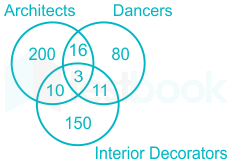
Study the given diagram carefully and answer the question. The numbers in different sections indicate the number of persons.

How many such interior decorators are there who are NEITHER architects NOR dancers?

  1. AOption (a)

    160

  2. BOption (b)

    174

  3. COption (c)

    171

  4. DOption (d)

    150

View answer & explanation

Correct answer

Answer: (d)D.

150

Why this answer is correct

According to the given Venn diagram:

The shaded area shows the interior decorators are there who are NEITHER architects NOR dancers.

So, there are '150' interior decorators are there who are NEITHER architects NOR dancers.

Hence, the correct answer is "150".

Question 37

Which of the following outcomes is NOT caused due to the burning of fossil fuels?

  1. AOption (a)

    Acid rain

  2. BOption (b)

    Formation of oxides of nitrogen and sulphur

  3. COption (c)

    Smog formation

  4. DOption (d)

    Decrease in ozone levels in the upper layers of the atmosphere

View answer & explanation

Correct answer

Answer: (d)D.

Decrease in ozone levels in the upper layers of the atmosphere

Why this answer is correct

The correct answer is Decrease in ozone levels in the upper layers of the atmosphere.

Key Points

Fossil fuels:

  • Fossil fuels are obtained from dead remains of living organisms buried under the earth crust millions of years ago.
  • Fossil fuels are combustible hydrocarbons formed millions of years ago from the dead decaying plants and animals buried under sediment.
  • Over millions of years, these decaying remains of living organisms were covered by layers and layers of silt and buried deep underground.
  • The pressure and heat at those depths transformed them into fossil fuels oil, natural gas and coal.

Thus we can conclude that Fossil fuels are obtained from dead remains of living organisms.

Question 38

If 43x – 8x+1 +16 = 0 is written as a quadratic equation where y = 23x, then which of the options below will represent the quadratic equation mentioned above?

  1. AOption (a)

    y2 – 4y + 16 = 0

  2. BOption (b)

    4y2 – 8y + 16 = 0

  3. COption (c)

    4y2 – 4y + 16 = 0

  4. DOption (d)

    y2 – 8y + 16 = 0

View answer & explanation

Correct answer

Answer: (d)D.

y2 – 8y + 16 = 0

Why this answer is correct

Shortcut Trick

Convert all terms to base 2 using the substitution y = 23x.

Term 1: 43x = (22)3x = (23x)2 = y2.

Term 2: 8x+1 = 23(x+1) = 23x × 23 = 8y.

Substitute these into 43x − 8x+1 + 16 = 0 to get y2 − 8y + 16 = 0.

∴ The correct answer is y2 − 8y + 16 = 0.

Alternate Method

Given: Equation 43x − 8x+1 + 16 = 0 and y = 23x.

Formula Used: Indices rules: (am)n = amn and am+n = am × an.

⇒ 43x − 8x+1 + 16 = 0

⇒ (22)3x − 8x × 81 + 16 = 0

⇒ 22 × 3x − (23)x × 8 + 16 = 0

⇒ (23x)2 − 23x × 8 + 16 = 0

⇒ Now, substitute y = 23x into the equation:

⇒ y2 − y × 8 + 16 = 0

⇒ y2 − 8y + 16 = 0

∴ The correct answer is y2 − 8y + 16 = 0.

Additional Information

Laws of Indices

Key rules include (am)n = am×n and am × an = am+n, which are essential for changing bases in exponential equations.

Standard Quadratic Form

A quadratic equation is generally expressed as ax2 + bx + c = 0, where a, b, and c are constants.

Perfect Square Trinomial

The expression y2 − 8y + 16 can be factored as (y − 4)2, which represents a perfect square where the discriminant D = 0.

Question 39

A table and a swing were sold for Rs. 9,936 each. The table was sold for a profit of 8% and the swing was sold for a loss of 8%. What is the gain or loss percentage in the whole transaction?

  1. AOption (a)

    0.64% profit

  2. BOption (b)

    0.64% loss

  3. COption (c)

    2% profit

  4. DOption (d)

    No profit no loss

View answer & explanation

Correct answer

Answer: (b)B.

0.64% loss

Why this answer is correct

Shortcut Trick

When two articles are sold at the exact same selling price, one at a profit of x% and the other at a loss of x%, the entire transaction always results in an overall loss.

Overall Loss % = (x2 ÷ 100)%

⇒ Overall Loss % = (82 ÷ 100)% = (64 ÷ 100)% = 0.64%

∴ The correct answer is 0.64% loss.

Alternate Method

Given:

Selling Price (SP) of the table = ₹9936

Selling Price (SP) of the swing = ₹9936

Profit on the table = 8%

Loss on the swing = 8%

CP1 = 9200

Profit = +8% (+736)

SP1 = 9936

CP2 = 10800

Loss = −8% (−864)

SP2 = 9936

Total CP = 20000 | Total SP = 19872 | Loss = 128 Overall Loss % = (128 ÷ 20000) × 100 = 0.64%

Calculations:

⇒ Total Selling Price = 9936 + 9936 = ₹19872

⇒ Cost Price of the table (CP1) = SP × [100 ÷ (100 + Profit%)]

⇒ CP1 = 9936 × (100 ÷ 108) = 9936 × (25 ÷ 27) = ₹9200

⇒ Cost Price of the swing (CP2) = SP × [100 ÷ (100 − Loss%)]

⇒ CP2 = 9936 × (100 ÷ 92) = 9936 × (25 ÷ 23) = ₹10800

⇒ Total Cost Price = 9200 + 10800 = ₹20000

⇒ Total Loss = Total CP − Total SP = 20000 − 19872 = ₹128

⇒ Overall Loss % = (Total Loss ÷ Total CP) × 100

⇒ Overall Loss % = (128 ÷ 20000) × 100 = 0.64%

∴ The correct answer is 0.64% loss.

Additional Information

Same SP, Same Profit & Loss %

When two items are sold at the same selling price, one at a profit of x% and the other at a loss of x%, there is always a net loss. The loss percentage is consistently determined using the formula (x2 ÷ 100)%.

Same CP, Same Profit & Loss %

When two items are bought at the identical cost price, and one is sold at a profit of x% while the other at a loss of x%, the net result is zero, meaning there is no net profit and no net loss overall.

Marked Price and CP Relation

The direct ratio comparing Marked Price (MP) and Cost Price (CP) when dealing with profit and discount is written directly as: MP ÷ CP = (100 + Profit%) ÷ (100 − Discount%).

Question 40

Constant returns to scale (CRS) is a property of production function that holds when ___________.

  1. AOption (a)

    a proportional increase in all inputs results in an increase in output by more than the proportion

  2. BOption (b)

    a proportional increase in all inputs may results in an increase in output by less than or more than the proportion

  3. COption (c)

    a proportional increase in all inputs results in an increase in output by less than the proportion

  4. DOption (d)

    a proportional increase in all inputs results in an increase in output by the same proportion

View answer & explanation

Correct answer

Answer: (d)D.

a proportional increase in all inputs results in an increase in output by the same proportion

Why this answer is correct

The correct answer is a proportional increase in all inputs results in an increase in output by the same proportion.

Key Points

  • There are three types of returns to scale: increasing returns to scale, constant returns to scale, and decreasing returns to scale.
  • When all inputs in a production process are tripled, the scale of production is increased by a factor of three.
  • If the output is also tripled, then there are constant returns to scale, because the increase in output is proportional to the increase in inputs.
  • However, if the output is more than tripled, then increasing returns to scale apply.
  • This means that the increase in output is greater than the increase in inputs, indicating that the production process is becoming more efficient as the scale of production increases.
  • On the other hand, if the output is less than tripled, then decreasing returns to scale apply. This means that the increase in output is less than the increase in inputs, indicating that the production process is becoming less efficient as the scale of production increases.

Question 41

In the 2022 - 2023 budget, the Government of Rajasthan announced that it would provide free electricity of up to 50 units for domestic users consuming upto __________ units per month.

  1. AOption (a)

    100

  2. BOption (b)

    150

  3. COption (c)

    200

  4. DOption (d)

    250

View answer & explanation

Correct answer

Answer: (a)A.

100

Why this answer is correct

The correct answer is 100.

Key Points

  • The Rajasthan government announced in the 2022-2023 budget that it would provide free electricity of up to 50 units for domestic users consuming up to 100 units per month.
  • This was part of a larger initiative to provide relief to domestic consumers, with subsidies also offered for those using between 100 and 300 units.
  • The government estimated that this scheme would cost approximately Rs 4,500 crore.

Question 42

Which of the following options is the closest approximate value which will come in place of the question mark (?) in the following equation?

625 × 31 ÷ 233 – 59 = ?

  1. AOption (a)

    24

  2. BOption (b)

    33

  3. COption (c)

    20

  4. DOption (d)

    13

View answer & explanation

Correct answer

Answer: (a)A.

24

Why this answer is correct

Given: 

625 × 31 ÷ 233 – 59 = ?

Concept used:

Calculation:

⇒ 625 × 31 ÷ 233 – 59 = ?

⇒ 83.15 – 59 = ?

⇒ 24.15 = ?

⇒ ? ≈ 24 

∴ Option 1 is the correct answer.

Question 43

If the first and second, third and fourth, fifth and sixth and so on, letters of the word 'FORMULIZED' are interchanged, then the ninth letter from the left will be:

  1. AOption (a)

    D

  2. BOption (b)

    I

  3. COption (c)

    U

  4. DOption (d)

    Z

View answer & explanation

Correct answer

Answer: (a)A.

D

Why this answer is correct

Given word: 'FORMULIZED'

Now, the first and second, third and fourth, fifth and sixth, seventh and eighth, ninth and tenth is interchanged.

then,

AlphabetsFORMULIZED
After InterchangeOFMRLUZIDE


Now, the ninth letter from the left after interchange is 'D'.

Hence, the correct answer is "D".

Question 44

The difference between two numbers is 18. If the difference between their squares is 360, find the larger number.

  1. AOption (a)

    15

  2. BOption (b)

    19

  3. COption (c)

    18

  4. DOption (d)

    16

View answer & explanation

Correct answer

Answer: (b)B.

19

Why this answer is correct

Shortcut Trick

Sum of numbers = Difference of squares ÷ Difference of numbers

Sum = 360 ÷ 18 = 20

Larger number = (Sum + Difference) ÷ 2

Larger number = (20 + 18) ÷ 2 = 19

∴ The correct answer is 19.

Alternate Method

Given:

Difference (x − y) = 18

Difference of squares (x2 − y2) = 360

Formula Used:

x2 − y2 = (x − y)(x + y)

⇒ x2 − y2 = (x − y)(x + y)

⇒ 360 = 18 × (x + y)

⇒ x + y = 360 ÷ 18 = 20

⇒ Now, adding (x + y) and (x − y):

⇒ (x + y) + (x − y) = 20 + 18

⇒ 2x = 38

⇒ x = 38 ÷ 2 = 19

∴ The correct answer is 19.

Additional Information

Algebraic Identity

The formula for the difference of two squares is a2 − b2 = (a − b)(a + b), which is useful for simplifying quadratic expressions.

Finding Numbers from Sum and Difference

If the sum (S) and difference (D) of two numbers are known, the larger number is (S + D) ÷ 2 and the smaller number is (S − D) ÷ 2.

Consecutive Integers Property

For any two consecutive integers n and n+1, the difference of their squares (n+1)2 − n2 is always equal to their sum (2n + 1).

Question 45

Evaluate 21+19−6+3\sqrt{21+\sqrt{19-\sqrt{6+3}}} .

  1. AOption (a)

    5

  2. BOption (b)

    4

  3. COption (c)

    3

  4. DOption (d)

    7

View answer & explanation

Correct answer

Answer: (a)A.

5

Why this answer is correct

Shortcut Trick

Solve the expression by simplifying from the innermost square root moving outwards.

First part: √(6 + 3) = √9 = 3

Second part: √(19 − 3) = √16 = 4

Final part: √(21 + 4) = √25 = 5

∴ The correct answer is 5.

Alternate Method

Given: √(21 + √(19 − √(6 + 3)))

Following the BODMAS rule, we evaluate the operations inside the radical signs sequentially:

⇒ √(21 + √(19 − √9))

⇒ √(21 + √(19 − 3))

⇒ √(21 + √16)

⇒ √(21 + 4)

⇒ √25

⇒ 5

∴ The correct answer is 5.

Additional Information

Perfect Squares

A perfect square is an integer that is the square of another integer. Common examples include 32 = 9, 42 = 16, and 52 = 25.

VBODMAS Rule

In nested mathematical operations, Vinculum (Bar), Brackets, and operations inside Orders (Roots/Powers) are prioritized from the innermost level to the outermost level.

Surds Property

While √(a × b) = √a × √b, it is important to remember that √(a + b) ≠ √a + √b.

Question 46

Priyanka walks 9 m towards the south. She turns left and walks 7 m. Then she turns right and walks 5 m. She again turns right and walks 9 m. In which direction is Priyanka facing now? (All turns are 90 degree turns only)

  1. AOption (a)

    South

  2. BOption (b)

    North

  3. COption (c)

    East

  4. DOption (d)

    West

View answer & explanation

Correct answer

Answer: (d)D.

West

Why this answer is correct

Given:

Priyanka walks 9 m towards the south.

She turns left and walks 7 m.

Then she turns right and walks 5 m.

She again turns right and walks 9 m.

So, Priyanka is facing at the 'West' direction now.

Hence, the correct answer is "West".

Question 47

Which of the following statements is true about combination reaction? 

  1. AOption (a)

    Only two products are formed.

  2. BOption (b)

    Only two elements react to give the products.

  3. COption (c)

    A single product is formed from two or more reactants.

  4. DOption (d)

    A single reactant changes to a single product.

View answer & explanation

Correct answer

Answer: (c)C.

A single product is formed from two or more reactants.

Why this answer is correct

The correct answer is A single product is formed from two or more reactants.

Key Points

  • Combination reaction
  • ​A combination reaction is when two or more reactants combine to form a single product.
  • The three types of combination reactions are between two elements, two compounds, or between an element and a compound.

Additional Information

  • Displacement reaction:
  • The reaction in which an ion (or an atom) in a compound is replaced by an ion (or an atom) of another element is known as a displacement reaction.
  • It is denoted by X + YZ  → XZ+Y
  • Fe (s) + CuSO4 (aq) → FeSO4 (aq) + Cu (s)
  • In the above reaction, iron is more reactive than copper, it displaces copper, resulting in the formation of ferrous sulphate.
  • Fe2O3 (s) + 2Al (s) → Al2O3 (s) + 2F3 (s)
  • In the above reaction, aluminium is more reactive than iron, it displaces iron, resulting in the formation of aluminium oxide.
  • Decomposition reaction:
  • In a Decomposition reaction, a compound breaks down into two or more components, in which one component must be in the elemental state.
  • Decomposition reaction is the opposite reaction of the combination reaction.
  • CaCO3 (s) → CaO (s) + CO2 (g)

Question 48

A certain number of people are sitting in a straight line facing north. Only one person is sitting between C and R. Only one person is sitting to the left of C. Only two people are sitting to the right of F. R is sitting to the immediate left of F. How many people are sitting in the row?

  1. AOption (a)

    6

  2. BOption (b)

    8

  3. COption (c)

    7

  4. DOption (d)

    5

View answer & explanation

Correct answer

Answer: (c)C.

7

Why this answer is correct

Given: A certain number of people are sitting in a straight line facing north.

  1. Only one person is sitting to the left of C.

  2. Only one person is sitting between C and R.

3) R is sitting to the immediate left of F.

  1. Only two people are sitting to the right of F. 

Here, Total '7' people are sitting in the row.

Hence, the correct answer is "Option 3".

Question 49

In Δ ABC and Δ DEF, if AB = DE, AC = EF and BC = DF, then which of the following is true based on SSS theorem?

  1. AOption (a)

    Δ ΑΒC ≅ Δ EFD

  2. BOption (b)

    Δ ΑΒC ≅ Δ EDF

  3. COption (c)

    Δ ΑΒC ≅ Δ DEF

  4. DOption (d)

    ΔΑΒC ≅ Δ FDE

View answer & explanation

Correct answer

Answer: (b)B.

Δ ΑΒC ≅ Δ EDF

Why this answer is correct

Shortcut Trick

Identify the corresponding vertices by matching the equal sides given in the problem:

  1. AB = DE and BC = DF ⇒ Vertex B (common to AB, BC) corresponds to D (common to DE, DF).
  2. AB = DE and AC = EF ⇒ Vertex A (common to AB, AC) corresponds to E (common to DE, EF).
  3. BC = DF and AC = EF ⇒ Vertex C (common to BC, AC) corresponds to F (common to DF, EF).

Mapping the vertices: A → E, B → D, and C → F.

∴ The correct answer is Δ ABC ≅ Δ EDF.

Alternate Method

Given: AB = DE, AC = EF, and BC = DF.

Formula Used: SSS (Side-Side-Side) Congruence Theorem states that if three sides of one triangle are equal to the three sides of another triangle, then the triangles are congruent.

A B C E D F c a b c

Question 50

A participative model with four interconnected tracks has been envisioned to formulate the STIP (Science, Technology and Innovation Policy) 2020. Identify the option that contains the four interconnected tracks mentioned in STIP 2020.

A) Extended public and expert consultation

B) Thematic group consultation

C) Ministries and State consultation

D) Apex level multi stakeholder consultation

E) School student consultation

  1. AOption (a)

    A, B, C, and D

  2. BOption (b)

    B, C, D and E

  3. COption (c)

    A, B, C and E

  4. DOption (d)

    A, B, D and E

View answer & explanation

Correct answer

Answer: (a)A.

A, B, C, and D

Why this answer is correct

The correct answer is A, B, C, and D.

Key Points

  • In a first of its kind policy consultation, Science and Technology Minister Harsh Vardhan interacted with the highly-skilled Indian diaspora to facilitate channels for them to contribute to India’s Science Technology and Innovation Policy (STIP) 2020.
  • The Minister stressed that India aims to connect the diaspora with the Indian scientific and economic ecosystem to accelerate the growth.

Question 51

A certain number of people are sitting in a row, facing north. M sits third to the right of A. M is second to the left of P. Only one person sits between P and S. Q sits to the immediate right of S, and no other person is sitting in the row. What is the total number of people seated in the row?

  1. AOption (a)

    10

  2. BOption (b)

    7

  3. COption (c)

    8

  4. DOption (d)

    9

View answer & explanation

Correct answer

Answer: (d)D.

9

Why this answer is correct

Given: A certain number of people are sitting in a row facing north.

1) M sits third to the right of A.

  1. M is second to the left of P.

3) Only one person sits between P and S.

  1. Q sits to the immediate right of S. 

Here, Total '9' people are sitting in the row.

Hence, the correct answer is "Option 4".

Question 52

The Fundamental Duties in the Constitution of India are given in which part of the Constitution?

  1. AOption (a)

    Part V

  2. BOption (b)

    Part VA

  3. COption (c)

    Part IV

  4. DOption (d)

    Part IVA

View answer & explanation

Correct answer

Answer: (d)D.

Part IVA

Why this answer is correct

The correct answer is Part IVA.

Key Points

  • Article 51 A in Part IV of the Indian constitution deals with the fundamental duties of the citizens.
  • They serve as a reminder to the citizens that while enjoying their rights, they should also be conscious of duties they owe to their country, their society and to their fellow citizens.
  • The features of Fundamental duties are as follows:
  • Fundamental duties are non-enforceable in nature.
  • Citizens are morally obligated by the Constitution to perform these duties.
  • The fundamental duties are not enforceable in nature. No legal sanction can be enforced by the government in case of their violation.
  • From the above, it is clear that Fundamental Duties do not enjoy any legal sanction.

Additional Information

There is a total of eleven fundamental duties enshrined in the constitution. They are as follows:

  • to abide by the Constitution and respect its ideals and institutions, the National Flag and the National Anthem;
  • to cherish and follow the noble ideals which inspired our national struggle for freedom;
  • to uphold and protect the sovereignty, unity and integrity of India;
  • to defend the country and render national service when called upon to do so;
  • to promote harmony and the spirit of common brotherhood amongst all the people of India transcending religious, linguistic and regional or sectional diversities; to renounce practices derogatory to the dignity of women;
  • to value and preserve the rich heritage of our composite culture;
  • to protect and improve the natural environment including forests, lakes, rivers and wildlife, and to have compassion for living creatures;
  • to develop the scientific temper, humanism and the spirit of inquiry and reform;
  • to safeguard public property and to abjure violence;
  • to strive towards excellence in all spheres of individual and collective activity so that the nation constantly rises to higher levels of endeavour and achievement;
  • who is a parent or guardian to provide opportunities for education to his child or, as the case may be, ward between the age of six and fourteen years.

Question 53

512\frac{5}{12} is the same as :

  1. AOption (a)

    0.416‾0.4\overline{16}

  2. BOption (b)

    0.417ˉ0.41\bar{7}

  3. COption (c)

    0.416ˉ0.41\bar{6}

  4. DOption (d)

    0.416‾0.\overline {416}

View answer & explanation

Correct answer

Answer: (c)C.

0.416ˉ0.41\bar{6}

Why this answer is correct

Calculation:

5/12 = 0.4166666.... = 0.416ˉ0.41\bar{6}

∴ Option 3 is the correct answer.

Question 54

Find the HCF of 12, 16 and 24. 

  1. AOption (a)

    16

  2. BOption (b)

    24

  3. COption (c)

    4

  4. DOption (d)

    48

View answer & explanation

Correct answer

Answer: (c)C.

4

Why this answer is correct

Shortcut Trick

Find the minimum difference between any two given numbers: 16 − 12 = 4.

Check if 4 divides all the given numbers: 12, 16, and 24 are all perfectly divisible by 4.

Thus, the greatest common divisor is 4.

∴ The correct answer is 4.

Alternate Method

Given numbers: 12, 16, and 24.

Write the prime factorization of each number:

⇒ 12 = 2 × 2 × 3 = 22 × 3

⇒ 16 = 2 × 2 × 2 × 2 = 24

⇒ 24 = 2 × 2 × 2 × 3 = 23 × 3

To find the HCF (Highest Common Factor), take the lowest power of the common prime factors:

⇒ Common prime factor is 2, and its lowest power is 22.

⇒ HCF = 22 = 4

∴ The correct answer is 4.

Additional Information

Highest Common Factor (HCF)

The greatest number that divides two or more numbers without leaving any remainder is called their HCF or GCD (Greatest Common Divisor).

Least Common Multiple (LCM)

The smallest positive integer that is perfectly divisible by each of the given numbers. For any two numbers a and b, HCF(a, b) × LCM(a, b) = a × b.

HCF of Fractions

The HCF of given fractions is calculated as: HCF = (HCF of Numerators) ÷ (LCM of Denominators).

Question 55

Two years ago, the ratio of the respective ages of Subash and Pranav was 4 ∶ 5. Three years hence, this ratio will become 5 ∶ 6. The present age of Pranav is:

  1. AOption (a)

    22 years

  2. BOption (b)

    20 years

  3. COption (c)

    27 years

  4. DOption (d)

    25 years

View answer & explanation

Correct answer

Answer: (c)C.

27 years

Why this answer is correct

Shortcut Trick

Ratio 2 years ago = 4 : 5 (Diff = 1 unit)

Ratio 3 years hence = 5 : 6 (Diff = 1 unit)

Change in ratio units = 5 − 4 = 1 unit (for both Subash and Pranav)

Total time gap = 2 + 3 = 5 years

⇒ 1 unit = 5 years

⇒ Pranav's age 2 years ago = 5 × 5 = 25 years

∴ The correct answer is 27 years.

Alternate Method

Given: Ratio 2 years ago = 4 : 5 | Ratio 3 years hence = 5 : 6

Let the ages of Subash and Pranav 2 years ago be 4x and 5x.

⇒ Present age of Subash = 4x + 2

⇒ Present age of Pranav = 5x + 2

According to the condition 3 years hence:

⇒ (4x + 2 + 3) / (5x + 2 + 3) = 5 / 6

⇒ (4x + 5) / (5x + 5) = 5 / 6

⇒ 6 × (4x + 5) = 5 × (5x + 5)

⇒ 24x + 30 = 25x + 25

⇒ x = 5

⇒ Present age of Pranav = 5(5) + 2 = 25 + 2 = 27 years

∴ The correct answer is 27 years.

Additional Information

Ratio Difference Method

If the difference between ratio terms is the same (5 − 4 = 1 and 6 − 5 = 1), the increase in units directly corresponds to the total time elapsed.

Age Problems Logic

The difference between the ages of two people remains constant regardless of the number of years that pass.

Cross Multiplication Shortcut

For equations of type (ax + b)/(cx + d) = m/n, use n(ax + b) = m(cx + d) to find x rapidly.

Question 56

Under Article 243 Q of the Constitution of India, Municipalities are categorised in how many categories?

  1. AOption (a)

    Three

  2. BOption (b)

    Six

  3. COption (c)

    Five

  4. DOption (d)

    Four

View answer & explanation

Correct answer

Answer: (a)A.

Three

Why this answer is correct

The correct answer is Three .

Key Points

Article 243Q: Constitution of Municipalities

  • Core Function: This article deals with the establishment of different types of municipalities in every state. It recognizes the need for varying levels of urban governance based on the size and needs of the urban area.
  • Types of Municipalities:
  • Nagar Panchayat: For transitional areas, meaning those transitioning from rural to urban.
  • Municipal Council: For smaller urban areas.
  • Municipal Corporation: For larger urban areas.
  • Key Points:
  • The specific type of municipality to be constituted in a particular area is determined by factors like the size of the area, the level of urbanization, and the municipal services required.
  • The establishment and functioning of these municipalities are governed by state laws enacted under the provisions of Part IXA of the Constitution.

Part IXA of the Constitution (Articles 243P to 243(ZT))

Part IXA, introduced by the 74th Amendment Act, 1992, deals with the constitution of municipalities and their powers, authorities, and responsibilities. Here's a brief overview of some key articles:

  • Article 243P: Defines "municipality" and outlines the objectives of municipal governance.
  • Article 243R: Deals with the composition of municipalities, including provisions for reservation of seats for Scheduled Castes, Scheduled Tribes, and other backward classes.
  • Article 243S: Outlines the powers, authorities, and responsibilities of municipalities, covering a wide range of areas such as urban planning, public health, sanitation, and social welfare.
  • Article 243T: Provides for the constitution of finance commissions in states to review the financial position of municipalities and recommend measures for their financial upgradation.
  • Article 243U: Establishes state finance commissions to review the financial position of panchayats and recommend measures for their financial upgradation.

Question 57

A rectangular courtyard, 7.35 meters long and 5.25 meters wide, is paved with square tiles of the same size. Find the longest possible length of the tiles used for this purpose.

  1. AOption (a)

    105 centimeters

  2. BOption (b)

    120 centimeters

  3. COption (c)

    125 centimeters

  4. DOption (d)

    115 centimeters

View answer & explanation

Correct answer

Answer: (a)A.

105 centimeters

Why this answer is correct

Shortcut Trick

To find the longest possible length of the tiles, calculate the HCF of the dimensions.

Length = 735 cm, Width = 525 cm.

HCF(735, 525) = 105 cm.

∴ The correct answer is 105 cm.

Alternate Method

Given:

Length of the courtyard = 7.35 m = 735 cm

Width of the courtyard = 5.25 m = 525 cm

Formula Used:

Side of the largest square tile = HCF (Length, Width)

Calculations:

⇒ Prime factors of 735 = 3 × 5 × 7 × 7

⇒ Prime factors of 525 = 3 × 5 × 5 × 7

⇒ Common factors = 3 × 5 × 7

⇒ HCF = 105

⇒ Longest possible length of the tile = 105 cm

∴ The correct answer is 105 cm.

Additional Information

HCF (Highest Common Factor)

The greatest number that divides two or more numbers without leaving a remainder. Used to find the maximum size or greatest length.

Number of Tiles

Total number of tiles required = (Area of Floor) ÷ (Area of one Tile) = (L × W) ÷ (Side2).

LCM (Least Common Multiple)

The smallest number that is a multiple of two or more numbers. Used for problems involving minimum time or next meeting point.

Question 58

Which of the following options gives the correct empirical relationship between mean, median and mode of a data set?

  1. AOption (a)

    Mean - Mode = 3 (Mean - Median)

  2. BOption (b)

    Mean + Mode = 3 (Mean - Median)

  3. COption (c)

    Mean - Mode = 3 (Mean + Median)

  4. DOption (d)

    Mean + Mode = 3 (Mean + Median)

View answer & explanation

Correct answer

Answer: (a)A.

Mean - Mode = 3 (Mean - Median)

Why this answer is correct

Shortcut Trick According to Karl Pearson's empirical formula for a moderately skewed distribution: Mode = 3 × Median − 2 × Mean Adding Mean to both sides gives: Mean + Mode = 3 × Median − Mean Rearranging the equation yields: Mean − Mode = 3(Mean − Median) ∴ The correct answer is Mean − Mode = 3 (Mean − Median).

Alternate Method Given: Options showing relationships between mean, median, and mode. Formula Used: Empirical relationship: Mode = 3 × Median − 2 × Mean

Mode Median Mean

x

3x

Mean − Mode = 3 × (Mean − Median)

Calculations: ⇒ Mode = 3 × Median − 2 × Mean ⇒ Mode = 3 × Median − 3 × Mean + Mean ⇒ Mean − Mode = 3 × Mean − 3 × Median ⇒ Mean − Mode = 3(Mean − Median) ∴ The correct answer is Mean − Mode = 3 (Mean − Median).

Additional Information Symmetric Distribution In a perfectly symmetric or normal distribution, the values of all three measures are equal: Mean = Median = Mode.

Positively Skewed Distribution The tail of the distribution extends to the right. In this case, the order of averages is generally: Mean > Median > Mode.

Negatively Skewed Distribution The tail of the distribution extends to the left. The order of averages follows: Mean < Median < Mode.

Karl Pearson's Coefficient of Skewness Skewness = (Mean − Mode) ÷ Standard Deviation, which can also be approximated as 3(Mean − Median) ÷ Standard Deviation.

Question 59

Select the option that is related to the third term in the same way as the second term is related to the first term and the sixth term is related to the fifth term.

27 : 6 :: 18 : ? :: 36 : 8

  1. AOption (a)

    4

  2. BOption (b)

    5

  3. COption (c)

    3

  4. DOption (d)

    6

View answer & explanation

Correct answer

Answer: (a)A.

4

Why this answer is correct

The logic followed here is:

Logic: (2nd number × 4) + (2nd number ÷ 2) = 1st number.

Now,

For, 27 : 6

→ (6 × 4) + (6 ÷ 2)

⇒ 24 + 3 = 27.

For, 36 : 8

→ (8 × 4) + (8 ÷ 2)

⇒ 32 + 4 = 36.

Similarly, for 18 : ?

→ (4 × 4) + (4 ÷ 2)

⇒ 16 + 2 = 18.

So, ? = 4.

Hence, the correct answer is "Option 1".

Question 60

Which two numbers should be interchanged to make the given equation correct?

25 × 9 – 74 + 459 ÷ 3 = 52

  1. AOption (a)

    9 and 3

  2. BOption (b)

    74 and 3

  3. COption (c)

    25 and 74

  4. DOption (d)

    25 and 3

View answer & explanation

Correct answer

Answer: (a)A.

9 and 3

Why this answer is correct

Given equation: 25 × 9 – 74 + 459 ÷ 3 = 52.

BODMAS Table: 

Let's check each option one by one.

Option 1) 9 and 3 

Given: 25 × 9 – 74 + 459 ÷ 3 = 52.

After interchanging the numbers we get;

⇒ 25 × 3 – 74 + 459 ÷ 9 = 52

⇒ 25 × 3 – 74 + 51 = 52

⇒ 75 – 74 + 51 = 52

⇒ 126 - 74 = 52

⇒ 52 = 52

⇒ LHS = RHS

Option 2) 74 and 3 

Given: 25 × 9 – 74 + 459 ÷ 3 = 52

After interchanging the numbers we get;

⇒ 25 × 9 – 3 + 459 ÷ 74 = 52

⇒ 25 × 9 – 3 + 6.2 = 52

⇒ 225 – 3 + 6.2 = 52

⇒ 231.2 - 3 = 52

⇒ 228.2 ≠ 52

⇒ LHS ≠ RHS

Option 3) 25 and 74

Given: 25 × 9 – 74 + 459 ÷ 3 = 52

After interchanging the numbers we get;

⇒ 74 × 9 – 25 + 459 ÷ 3 = 52

⇒ 74 × 9 – 25 + 153 = 52

⇒ 666 – 25 + 153 = 52

⇒ 819 - 25 = 52

⇒ 794 ≠ 52

⇒ LHS ≠ RHS

Option 4) 25 and 3

Given: 25 × 9 – 74 + 459 ÷ 3 = 52

After interchanging the numbers we get;

⇒ 3 × 9 – 74 + 459 ÷ 25 = 52

⇒ 3 × 9 – 74 + 18.36 = 52

⇒ 27 – 74 + 18.36 = 52

⇒ 45.36 - 74 = 52

⇒ -28.64 ≠ 52

⇒ LHS ≠ RHS

Hence, the correct answer is "Option 1".

Question 61

The value of cosec (47° + θ) - sec (43° - θ) + tan (61° + θ) - cot (29° - θ) + cos (45° + θ) - sin (45° - θ) is equal to :

  1. AOption (a)

    12\frac{1}{\sqrt2}

  2. BOption (b)

    32\frac{\sqrt3}{2}

  3. COption (c)

    1

  4. DOption (d)

    0

View answer & explanation

Correct answer

Answer: (d)D.

0

Why this answer is correct

Shortcut Trick

Put θ = 0° to simplify the trigonometric expression quickly.

Expression ⇒ cosec 47° − sec 43° + tan 61° − cot 29° + cos 45° − sin 45°

Using complementary angles: cosec 47° = sec 43°, tan 61° = cot 29°, and cos 45° = sin 45°.

The terms cancel out: (sec 43° − sec 43°) + (cot 29° − cot 29°) + (1/√2 − 1/√2) = 0.

∴ The correct answer is 0.

Alternate Method

Given: cosec (47° + θ) − sec (43° − θ) + tan (61° + θ) − cot (29° − θ) + cos (45° + θ) − sin (45° − θ)

Formula Used:

  1. cosec A = sec (90° − A)
  2. tan A = cot (90° − A)
  3. cos A = sin (90° − A)

Calculations:

⇒ [sec (90° − (47° + θ))] − sec (43° − θ) + [cot (90° − (61° + θ))] − cot (29° − θ) + [sin (90° − (45° + θ))] − sin (45° − θ)

⇒ sec (43° − θ) − sec (43° − θ) + cot (29° − θ) − cot (29° − θ) + sin (45° − θ) − sin (45° − θ)

⇒ 0 + 0 + 0

⇒ 0

∴ The correct answer is 0.

Additional Information

Complementary Angle Trigonometric Ratios

When two angles A and B sum to 90°, sin A = cos B, tan A = cot B, and sec A = cosec B.

Trigonometric Substitution

In identity-based questions, substituting common angles like 0°, 30°, or 45° for θ can quickly yield the numerical result if the answer is independent of θ.

Question 62

If tomorrow is Sunday, which day of the week will it be after 121 days from today?

  1. AOption (a)

    Tuesday

  2. BOption (b)

    Sunday

  3. COption (c)

    Wednesday

  4. DOption (d)

    Monday

View answer & explanation

Correct answer

Answer: (d)D.

Monday

Why this answer is correct

Given: Tomorrow is Sunday.

It means,

Today is Sunday - 1 = Saturday.

Now, after 121 days from today.

As, we know 7 days = 1 week.

So, 121 days = 121/7 = 17 week and 2 odd days.

Then,

After 121 days from today will be Saturday + 2 = Monday.

Hence, the correct answer is "Monday".

Question 63

Which of the following numbers will replace the question mark (?) in the given series?

3 3.5 4.5 6 8 ?

  1. AOption (a)

    10.5

  2. BOption (b)

    12.5

  3. COption (c)

    11

  4. DOption (d)

    9.5

View answer & explanation

Correct answer

Answer: (a)A.

10.5

Why this answer is correct

The logic followed here is:

So, '10.5' will complete the series.

Hence, the correct answer is "Option 1".

Question 64

When an object is placed at a distance of 60 cm from a concave lens of focal length 30 cm then the magnification of the image is:

  1. AOption (a)

    +0.33

  2. BOption (b)

    +1.33

  3. COption (c)

    -1.33

  4. DOption (d)

    -0.33

View answer & explanation

Correct answer

Answer: (a)A.

+0.33

Why this answer is correct

The correct answer is +0.33.

Key Points 

To find the magnification, we'll use the lens formula:

1/f = 1/v - 1/u  

where:

  • f = focal length of the lens (-30 cm for a concave lens)
  • v = image distance
  • u = object distance (-60 cm, as it's placed in front of the lens)

Plug in the values:

1/(-30) = 1/v - 1/(-60)

Simplify:

-1/30 = 1/v + 1/60

Find a common denominator:

-2/60 = 1/v + 1/60

Isolate 1/v:

1/v = -2/60 - 1/60

1/v = -3/60

1/v = -1/20

Therefore, v = -20 cm

Now, calculate the magnification (m):

m = v/u

m = (-20) / (-60)

m = +1/3

The magnification of the image is +1/3 = +0.33.

Explanation:

  • Negative Magnification: The negative sign indicates that the image is virtual and erect.
  • Value less than 1: The absolute value of the magnification is less than 1, which means the image is smaller than the object.

In summary, when an object is placed 60 cm from a concave lens with a focal length of 30 cm, a virtual, erect, and diminished image is formed with a magnification of +1/3 = +0.33.

Question 65

The general formula of alkene is:

  1. AOption (a)

    CnH2n

  2. BOption (b)

    CnH2n+2

  3. COption (c)

    CnHn

  4. DOption (d)

    CnH2n-2

View answer & explanation

Correct answer

Answer: (a)A.

CnH2n

Why this answer is correct

The correct answer is CnH2n.

Key Points

Hydrocarbons:

  • These are organic compounds composed of carbon (C) and hydrogen (H).
  • The carbon atoms join together to form the framework of the compound, and the hydrogen atoms attach to them in many different configurations.
  • They are classified into aliphatic and aromatic hydrocarbons on the basis of their structure.

​Explanation: 

Aliphatic hydrocarbons are divided into three main groups according to the types of bonds they contain: alkanes, alkenes, and alkynes.

Alkanes:

  • The hydrocarbons in which all the bonds are single.
  • They are characterized by the molecular formula: CnH2n + 2 (where n is an integer).
  • The simplest alkane is methane (CH4).

Alkenes

  • These hydrocarbons contain a carbon-carbon double bond.
  • They are characterized by the molecular formula: CnH2n.
  • The simplest alkene is ethene (C2H4).

Alkyne:

  • These hydrocarbons have a carbon-carbon triple bond.
  • They are characterized by the molecular formula: CnH2n − 2.
  • The simplest alkyne is ethyne (C2H2).

Question 66

A doublet is a combination of two lenses. One such doublet is made with a convex lens of focal length of 20 cm and a concave lens of focal length of 50 cm. The effective focal length and power of this doublet is ___________ and ____________, respectively.

  1. AOption (a)

    33.3 cm, 3D

  2. BOption (b)

    14.28 cm, 7D

  3. COption (c)

    20 cm, 5D

  4. DOption (d)

    50 cm, 2D

View answer & explanation

Correct answer

Answer: (a)A.

33.3 cm, 3D

Why this answer is correct

The Correct answer is 33.3 cm, 3D

Given: 

Focal length of convex lens (f1) = 20 cm

Focal length of the concave lens (f2) = -50 cm 

Formulas Used:

To find the effective focal length (F) and power (P) of a doublet made with a convex lens and a concave lens, we use the following formulas:

1/F = 1/f1+ 1/f2

P = 1/F

Calculations:

Effective focal length (F) of the doublet:

1/F = 120+1−50\frac{1}{20} + \frac{1}{-50}

1/F = 1/20 - 1/50

1/F = 3/100

1/F = 33.33 cm

Power (P) of the doublet:

P = 1/F 

Here F = 33.33 cm = 0.333 m

P = 1/ 0.33

P = 3D

The effective focal length and power of the doublet are:33.3 cm, 3D

∴ The Correct answer is Option 1: 33.3 cm, 3D

Question 67

Veer starts from Point A and drives 7 km towards the north. He then takes a right turn, drives 8 km, turns right and drives 19 km. He then takes a right turn and drives 3 km, takes a right turn and drives 12 km and stops at Point B. How far and towards which direction should he drive in order to reach Point A from Point B? (All turns are 90 degree turns only)

  1. AOption (a)

    9 km towards the south

  2. BOption (b)

    5 km towards the west

  3. COption (c)

    8 km towards the south

  4. DOption (d)

    6 km towards the east

View answer & explanation

Correct answer

Answer: (b)B.

5 km towards the west

Why this answer is correct

Given:

Veer starts from Point A and drives 7 km towards the north.

He then takes a right turn, drives 8 km, 

turns right and drives 19 km.

He then takes a right turn and drives 3 km,

takes a right turn and drives 12 km and stops at Point B.

So, the distance between A to B is: 8 - 3 = 5 km.

And, Veer should drive '5 km towards the West' direction to reach Point A from Point B.

Hence, the correct answer is "Option 2".

Question 68

Which organization/institute received the Subhas Chandra Bose Aapda Prabandhan Puraskar for year 2022?

  1. AOption (a)

    Indian Institute of Technology Delhi

  2. BOption (b)

    Indian Institute of Science Bengaluru

  3. COption (c)

    Gujarat Institute of Disaster Management

  4. DOption (d)

    Indian Institute of Technology Gandhinagar

View answer & explanation

Correct answer

Answer: (c)C.

Gujarat Institute of Disaster Management

Why this answer is correct

The correct answer is Gujarat Institute of Disaster Management.

Key Points

  • 23 January 2022, marked the 125th birth anniversary of freedom fighter Netaji Subhas Chandra Bose.
  • The day will also be celebrated as ‘Parakram Diwas’ from 2022 onwards.
  • PM Modi conferred the Subhas Chandra Bose Aapda Prabandhan Puraskars, for the years 2019, 2020, 2021, and 2022.
  • The award carries a cash prize of Rs 51 lakh for an institution and Rs 5 lakh for an individual.

Additional Information

  • For the award this year, nominations were solicited from 1st July, 2021 onwards.
  • In response to the award scheme, 243 valid nominations were received from institutions and individuals.
  • For the year 2022, the following have been selected for the Subhash Chandra Bose Aapda Prabandhan Puraskar for their excellent work in Disaster Management:
  • Gujarat Institute of Disaster Management (in the Institutional category)
  • Professor Vinod Sharma (in the Individual category).

Question 69

In which year was the SHG-Bank Linkage Programme (SHG - BLP) launched for the first time in India to improve the microfinance sector?

  1. AOption (a)

    1996 - 97

  2. BOption (b)

    1992 - 93

  3. COption (c)

    1985 - 86

  4. DOption (d)

    2001 - 02

View answer & explanation

Correct answer

Answer: (b)B.

1992 - 93

Why this answer is correct

The correct answer is 1992 - 93.

Key Points

  • National Bank for Agriculture and Rural Development (NABARD):
  • India's top development bank, NABARD, aims to support fair and sustainable rural and agricultural development.
  • The Sivaraman Committee, which was constituted on March 30, 1979, recommended the establishment of NABARD.
  • As per the National Bank for Agriculture and Rural Development Act, 1981, it is a statutory body that was founded in 1982 by Parliament.
  • Its headquarter is located in Mumbai, India.
  • It supervises Regional Rural Banks (RRBs) and Cooperative Banks, assisting them in establishing safe banking procedures and integrating them with the CBS (Core Banking Solution) system.
  • Chairman: Shri. Shaji K V
  • It was established with the aim of providing credit flow for the development of agriculture, cottage and village industries, handicrafts, and small-scale industries in rural areas.
  • Self Help Group - Bank Linkage Programme (SHG-BLP):
  • It is the world's largest microfinance initiative initiated by NABARD in 1992 and has since been growing.
  • It was started to provide financial assistance to self-help groups (SHGs) through banks with the objective to promote financial inclusion and empower women through microfinance.
  • Banks were permitted to open savings accounts for SHGs under this policy.
  • Components of SHG-BPL:
  • Bank Branch Managers: Education and Sensitization
  • Bank Sakhis' orientation and training at rural bank branches
  • Community Based Repayment Mechanism (CBRM) should be implemented in rural bank branches.
  • SHG Credit Linkage

Question 70

Where is the Maulana Azad National Urdu University located?

  1. AOption (a)

    Bhopal

  2. BOption (b)

    Aligarh

  3. COption (c)

    Patna

  4. DOption (d)

    Hyderabad

View answer & explanation

Correct answer

Answer: (d)D.

Hyderabad

Why this answer is correct

The correct answer is Hyderabad.

Key Points

  • Maulana Azad National Urdu University (MANUU) was established by an Act of Parliament in 1998.
  • It is a central university located in Hyderabad, Telangana. It was named after Maulana Abul Kalam Azad, who was a freedom fighter, an educationist, and the first Education Minister of independent India.
  • The university is known for promoting Urdu language and literature. It has a dedicated Department of Urdu, which offers courses in Urdu language, literature, and culture.
  • It has campuses in Hyderabad, Lucknow, and Srinagar. It also has centers in various cities across India.

 Additional Information

Maulana Abul Kalam Azad:

  • He was the nation's first minister of education from 1948 to 1958.
  • He led the Khilafat movement from the front.
  • He chose the pen name "Azad," which means "freedom," in order to distance himself from dogmatic religious beliefs.
  • He fought for children's right to free education until the age of fourteen.
  • He was also a pioneer in the establishment of India's higher education board, the University Grants Commissi

Question 71

Select the set in which the numbers are related in the same way as are the numbers of the following sets. (NOTE: Operations should be performed on the whole numbers, without breaking down the numbers into its constituent digits. E.g. 13 - Operations on 13 such as adding / subtracting /multiplying etc. to 13 can be performed. Breaking down 13 into 1 and 3 and then performing mathematical operations on 1 and 3 is not allowed.)

(6, 17, 40)

(13, 9, 31)

  1. AOption (a)

    (6, 13, 25)

  2. BOption (b)

    (27, 14, 49)

  3. COption (c)

    (21, 15, 51)

  4. DOption (d)

    (31, 16, 45)

View answer & explanation

Correct answer

Answer: (c)C.

(21, 15, 51)

Why this answer is correct

The logic followed here is:

Logic: 1st number + (2nd number × 2) = 3rd number.

Now,

For (6, 17, 40)

→ 6 + (17 × 2)

⇒ 6 + 34 = 40.

(13, 9, 31)

→ 13 + (9 × 2)

⇒ 13 + 18 = 31.

Now, checking the options:

Option 1: (6, 13, 25)

→ 6 + (13 × 2)

⇒ 6 + 26 = 32 ≠ 25.

Option 2: (27, 14, 49)

→ 27 + (14 × 2)

⇒ 27 + 28 = 55 ≠ 49.

Option 3: (21, 15, 51)

→ 21 + (15 × 2)

⇒ 21 + 30 = 51.

Option 4: (31, 16, 45)

→ 31 + (16 × 2)

⇒ 31 + 32 = 63 ≠ 45.

Hence, the correct answer is "Option 3".

Question 72

Elements were classified on the basis of their _________

  1. AOption (a)

    different valency

  2. BOption (b)

    different physical as well different chemical properties

  3. COption (c)

    state of matter

  4. DOption (d)

    different physical but same chemical properties

View answer & explanation

Correct answer

Answer: (b)B.

different physical as well different chemical properties

Why this answer is correct

The correct answer is different physical as well different chemical properties.

Key Points

  • Mendeleev's Periodic Law: The physical and chemical properties of elements are periodic functions of their atomic masses.
  • Mendeleev arranged all the elements known at that time in increasing order of atomic mass and this arrangement became a periodic table.
  • In Mendeleev's Periodic Table: The total number of periods in the periodic table was seven and the total number of groups was nine.
  • That is, 63 elements were known when Mendeleev started his work.​

Additional Information

s-block element

  • The elements in which the valence electron is present in the outermost s-orbital of an atom are called s-block elements.
  • The elements of groups 1 and 2 are called s-block elements.

p-block elements

  • The elements in which the valence electron is present in the outermost p-orbital of an atom are called p-block elements.
  • The elements of groups 13, 14, 15, and 16 are the p-block elements except for the helium atom.

d-block elements

  • The transition metal elements are d-block elements.
  • The d-block elements are formed due to the addition of the last electrons in the d-sublevel of an atom.
  • The series of the d-block element is classified as 3d, 4d, 5d, and 6d series.
  • They are good conductors of heat and electricity

f-block elements

  • The elements in which the valence electron is present in the outermost f-orbital of an atom are called f-block elements.
  • The elements of lanthanide and actinide series are the f-block elements.

Question 73

Six presidents with the initials O, P, S, B, N and K are sitting around a circular table, facing the centre and at equal distance from each other, not necessarily in the same order.

P sits exactly between B and S. N sits exactly between K and O. B sits at the immediate right of K. O sits at the immediate right of S. Who sits second to the left of O?

  1. AOption (a)

    S

  2. BOption (b)

    N

  3. COption (c)

    K

  4. DOption (d)

    P

View answer & explanation

Correct answer

Answer: (d)D.

P

Why this answer is correct

Given: Six presidents O, P, S, B, N and K.

  1. B sits at the immediate right of K.

2) P sits exactly between B and S.

3) O sits at the immediate right of S.

  1. N sits exactly between K and O.

So, 'P' sits second to the left of O.

Hence, the correct answer is "Option 4".

Question 74

A, B, C, D, E and F live on six different floors of the same building. The lowermost floor in the building is numbered 1, the floor above it is numbered 2 and so on till the topmost floor is numbered 6. B lives immediately below A and immediately above C. Only one person lives above E. Neither B nor C lives on the lowermost floor. A does not live on the topmost floor. Only two people live between A and D. Who lives immediately below C?

  1. AOption (a)

    A

  2. BOption (b)

    D

  3. COption (c)

    F

  4. DOption (d)

    E

View answer & explanation

Correct answer

Answer: (b)B.

D

Why this answer is correct

Given: A, B, C, D, E and F live on six different floors of the same building.

  1. Only one person lives above E.
6th floor
5th floorE
4th floor
3rd floor
2nd floor
1st floor


  1. B lives immediately below A and immediately above C.

  2. Neither B nor C lives on the lowermost floor.

  3. A does not live on the topmost floor.

6th floor
5th floorE
4th floorA
3rd floorB
2nd floorC
1st floor


  1. Only two people live between A and D (This implies D will lives in 1st floor).
6th floor
5th floorE
4th floorA
3rd floorB
2nd floorC
1st floorD


And, 'F' will lives on the remaining floor.

6th floorF
5th floorE
4th floorA
3rd floorB
2nd floorC
1st floorD


So, 'D' lives immediately below C.

Hence, the correct answer is "Option 2".

Question 75

Which of the following mild non-corrosive basic salts is prepared by the reaction of aqueous sodium chloride solution with ammonia and carbon dioxide?

  1. AOption (a)

    Baking soda

  2. BOption (b)

    Washing soda

  3. COption (c)

    Baking powder

  4. DOption (d)

    Bleaching powder

View answer & explanation

Correct answer

Answer: (a)A.

Baking soda

Why this answer is correct

The correct answer is Baking soda.

Key Points

Baking Soda

  • Chemical Name: Sodium Bicarbonate (NaHCO3)
  • Properties: White crystalline powder, slightly alkaline, reacts with acids to produce carbon dioxide gas.
  • Uses:
  • Cooking: Leavening agent in baked goods, neutralizes acidic ingredients in recipes.
  • Cleaning: Deodorizes refrigerators, cleans surfaces, removes stains.
  • Health: Can be used as an antacid to relieve heartburn.

Additional Information

Washing Soda

  • Chemical Name: Sodium Carbonate (Na2CO3)
  • Properties: White, water-soluble powder, strong alkaline nature.
  • Uses:
  • Cleaning: Water softener, boosts the effectiveness of detergents, cleans greasy surfaces.
  • Industrial Applications: Used in glass and paper manufacturing.

Baking Powder

  • Composition: A mixture of baking soda (sodium bicarbonate) and a dry acid (like cream of tartar).
  • Properties: Fine white powder, reacts with moisture to release carbon dioxide gas.
  • Uses:
  • Cooking: Primary leavening agent in many baked goods, provides a more consistent rise than baking soda alone.

Bleaching Powder

  • Chemical Name: Calcium Oxychloride (CaOCl2)
  • Properties: Strong oxidizing agent, produces chlorine gas when exposed to moisture or acids.
  • Uses:
  • Water Treatment: Disinfecting water supplies.
  • Bleaching: Used to bleach textiles and paper.
  • Sanitation: Disinfecting surfaces and equipment.

Question 76

Which statement regarding HIV is FALSE?

  1. AOption (a)

    Once HIV has weakened your immune system, germs can take over your body, and you become sick.

  2. BOption (b)

    HIV attacks your immune system by entering your red blood cells.

  3. COption (c)

    HIV stops your immune system from being able to protect your body.

  4. DOption (d)

    HIV can be transmitted through sexual intercourse with an infected partner.

View answer & explanation

Correct answer

Answer: (b)B.

HIV attacks your immune system by entering your red blood cells.

Why this answer is correct

The correct answer is HIV attacks your immune system by entering your red blood cells.

Key Points

  • The full form of HIV is Human Immunodeficiency Virus.
  • The human immunodeficiency viruses are two species of Lentivirus that infect humans.
  • Over time, they cause acquired immunodeficiency syndrome, a condition in which progressive failure of the immune system allows life-threatening opportunistic infections and cancers to thrive.

 Additional Information

  • HIV (human immunodeficiency virus) is a virus that attacks the immune system, the body's natural defence system.
  • Without a strong immune system, the body has trouble fighting off disease.
  • Both the virus and the infection it causes are called HIV. White blood cells are an important part of the immune system.
Column - AColumn - B
(a) BacteriaPertussis
(b) FungiRing worm
(c) HelminthesElephantiasis
(d) ProtozoaAmoebiasis
(e) VirusHydrophobia

Question 77

Tawa dam was built in: 

  1. AOption (a)

    1960 s

  2. BOption (b)

    1990 s

  3. COption (c)

    1970 s

  4. DOption (d)

    1980 s

View answer & explanation

Correct answer

Answer: (c)C.

1970 s

Why this answer is correct

The correct answer is 1970 s.

Key Points

  • Tawa Reservoir is a reservoir on the Tawa River in central India. It is located in Itarsi of Hoshangabad District of Madhya Pradesh state, above Betul district.
  • The reservoir was formed by the construction of the Tawa Dam, which began in 1958 and was completed in 1978.
  • The dam provides water for irrigation in Hoshangabad and Harda districts.
  • The Tawa reservoir forms the western boundary of Satpura National Park and Bori Wildlife Sanctuary.

 Additional Information

  • The Tawa Matsya Sangh – a federation of Fisherworker’s cooperatives – an organization fighting for the rights of the displaced forest dwellers of the Satpura forest in Madhya Pradesh.
  • The newly formed Tawa Matsya Sangh (TMS) organized rallies and a chakka jam (road blockade), demanding their right to continue fishing for their livelihood.
  • In response to their protests, the government created a committee to assess the issue.
  • The committee recommended that fishing rights be granted to the villagers for their livelihood.
  • In 1996, the Madhya Pradesh government decided to give to the people displaced by the Tawa dam the fishing rights for the reservoir.

Question 78

Which of the following ionic compounds has the highest boiling point?

  1. AOption (a)

    NaCl

  2. BOption (b)

    MgCl2

  3. COption (c)

    LiCl

  4. DOption (d)

    CaCl2

View answer & explanation

Correct answer

Answer: (d)D.

CaCl2

Why this answer is correct

The correct answer is CaCl2.

Key Points

 CaCl2 (Calcium Chloride)

  • Chemical Nature: An inorganic salt composed of calcium and chlorine ions.
  • Properties: White, crystalline solid, highly soluble in water, hygroscopic (absorbs moisture from the air).
  • Uses: De-icing roads, dust control, food additive, desiccant (drying agent).

Additional Information

NaCl (Sodium Chloride)

  • Chemical Nature: Common table salt, an ionic compound of sodium and chlorine.
  • Properties: White, crystalline solid, readily dissolves in water, essential for human and animal life.
  • Uses: Seasoning food, preserving food, industrial applications (e.g., chemical production).

MgCl2 (Magnesium Chloride)

  • Chemical Nature: An inorganic salt of magnesium and chlorine.
  • Properties: White, crystalline solid, highly soluble in water, deliquescent (absorbs moisture from the air and dissolves in it).
  • Uses: De-icing roads, fireproofing agents, magnesium production, nutritional supplement.

LiCl (Lithium Chloride)

  • Chemical Nature: An inorganic salt of lithium and chlorine.
  • Properties: White, crystalline solid, highly soluble in water and polar organic solvents.
  • Uses: Batteries (lithium-ion batteries), air conditioning systems, psychiatric medications.

Question 79

If each of the letters in the word FATIGUE is arranged in alphabetical order, then after rearrangement how many letters will be there in the English alphabetical series between the letter that is fourth from the left and the one that is second from the right?

  1. AOption (a)

    Nine

  2. BOption (b)

    Twelve

  3. COption (c)

    Eleven

  4. DOption (d)

    Ten

View answer & explanation

Correct answer

Answer: (b)B.

Twelve

Why this answer is correct

Given word: 'FATIGUE'

After arranged in alphabetical order:

AlphabetsFATIGUE
Alphabetical orderAEFGITU


After arranged in alphabetical order,

Fourth alphabet from the left end is: G,

Second alphabet from the right is: T,

Now,

there are 12 letters between G and T.

GHIJKLMNOPQRST


Hence, the correct answer is "Option 2".

Question 80

As per provisions given in Article 76 of the Indian Constitution, the President shall appoint a person as Attorney-General for India who is qualified to be ____________.

  1. AOption (a)

    appointed as Judge of any High Court

  2. BOption (b)

    appointed as Minister in any State Cabinet

  3. COption (c)

    appointed as Minister in the Union Cabinet

  4. DOption (d)

    appointed as Judge of the Supreme Court

View answer & explanation

Correct answer

Answer: (d)D.

appointed as Judge of the Supreme Court

Why this answer is correct

The correct answer is appointed as Judge of the Supreme Court.

Key Points

  • Attorney General of India is part of the Union Executive of India. AG is the highest law officer of India.
  • Article 76 talks about the office of the Attorney General of India.
  • AG is the chief legal advisor to the government of India.
  • AG is not considered a government servant.
  • The remuneration of the Attorney General is determined by the President.

Hence, Article 76 of the Indian Constitution deals with the provision of the Attorney-General of India.

Additional Information

Eligibility: 

  • She/ He must be qualified to be appointed as Supreme Court judge.
  • Must be a citizen of India.
  • Served as a Judge of the High Court for 5 years as an advocate.
  • Should be an eminent jurist in the President's opinion.
  • Appointment: Appointed by the President on the advice of the government.
  • The tenure of AG is not fixed by the Constitution.
  • AG holds office during the pleasure of the government. She/He can be removed by the President any time.
  • Functions of Attorney General:
  • Performs legal duties on behalf of the Government of India.
  • Right to participate in the proceedings of the Parliament and though he/she does not have the right to vote.
  • Appears on behalf of the Government of India in all cases in the apex court.
  • AG is assisted by two Solicitor Generals and four Additional Solicitor Generals.

Question 81

The following figure shows the right human kidney. At which point does the ureter exit the kidney?

  1. AOption (a)

    Point 2

  2. BOption (b)

    Point 4

  3. COption (c)

    Point 1

  4. DOption (d)

    Point 3

View answer & explanation

Correct answer

Answer: (a)A.

Point 2

Why this answer is correct

The correct answer is Point 2.

Key Points

Human Excretory system: Kidney

  • The organ system which is used to remove the waste product from the body is called the human excretory system and Kidneys play an important role.
  • Therefore Option 2 is Correct.
  • The major waste product generated in the human body is urea, along with which some other toxins are also generated.
  • Urea is eliminated by kidneys by the process of urination and solid wastes are removed from the body by the intestines.

Kidney

  • The kidney is a bean-shaped organ.
  • Its function is to clean blood and eliminate the waste from the blood in form of urine
  • It is present in the abdomen, just below the diaphragm, and is protected by ribs.
  • Each kidney weighs 120 g to 170 g and 10-12 cm long and 5-7 cm wide and is the size of a fist.
  • Kidneys are made up of subunits called Nephron.

Explanation-

  • Each kidney has nearly one million complex tubular structures called Nephrons.
  • A nephron can be divided into the following regions-
  • Bowman's capsule- Within the Bowman's capsule a network or tuft of capillaries is present, it is called Glomerulus.
  • Malpighian body
  • Loop of Henle
  • PCT and DCT

Question 82

5650 increased by 15% equals how much?

  1. AOption (a)

    6497.50

  2. BOption (b)

    6795.50

  3. COption (c)

    6997.25

  4. DOption (d)

    6435.00

View answer & explanation

Correct answer

Answer: (a)A.

6497.50

Why this answer is correct

Shortcut Trick

Initial Value = 5650

Increase = 15%

Multiplying Factor = 1 + 0.15 = 1.15

New Value = 5650 × 1.15 = 6497.50

∴ The correct answer is 6497.50.

Alternate Method

Given:

Original Number = 5650

Percentage Increase = 15%

Formula Used:

Final Value = Original Value + (Original Value × Increase% ÷ 100)

Calculations:

⇒ Amount of increase = 5650 × 15 ÷ 100

⇒ Amount of increase = 5650 × 0.15 = 847.50

⇒ Final Value = 5650 + 847.50

⇒ Final Value = 6497.50

∴ The correct answer is 6497.50.

Additional Information

Percentage Change

Percentage change = (New Value − Old Value) ÷ Old Value × 100.

Successive Percentage

If a value is increased by a% and then by b%, effective increase = (a + b + ab/100)%.

Base Change Rule

If A is x% more than B, then B is [x ÷ (100 + x)] × 100% less than A.

Question 83

The frequency of AC supply for house-hold purpose is __________.

  1. AOption (a)

    50 Hz

  2. BOption (b)

    150 Hz

  3. COption (c)

    200 Hz

  4. DOption (d)

    100 Hz

View answer & explanation

Correct answer

Answer: (a)A.

50 Hz

Why this answer is correct

The correct answer is 50 Hz.

Key Points

  • As per Indian standard for our domestic power supply we us A.C current, which is also known as alternating current, since they change its polarity at a certain interval of time.
  • Now the two principal properties of the A.C electric power supply are Voltage and frequency.
  • And we use 220 V and 50 Hz power supply for our common domestic use
  • Where 220 V is potential difference and 50 Hz is its frequency

Question 84

Which of the following helps in temperature regulation in plants? 

  1. AOption (a)

    Root pressure

  2. BOption (b)

    Absorption

  3. COption (c)

    Photosynthesis

  4. DOption (d)

    Transpiration

View answer & explanation

Correct answer

Answer: (d)D.

Transpiration

Why this answer is correct

The correct answer is Transpiration.

Key Points

Transpiration

  • Definition: The process by which plants lose water vapor through their leaves, primarily through tiny pores called stomata.
  • Mechanism: Water is absorbed by roots, transported through the plant's vascular system (xylem), and exits as vapor from the leaves.
  • Significance:
  • Cooling: Cools the plant by evaporative cooling.
  • Water Transport: Creates a pulling force (transpiration pull) that helps move water and minerals from roots to leaves.
  • Mineral Transport: Facilitates the transport of essential minerals from the soil to the plant.

Additional Information

Root Pressure

  • Definition: The upward pressure exerted by the roots of a plant that forces water and dissolved minerals into the plant's vascular system.
  • Mechanism: Roots actively absorb water and minerals, creating a higher concentration of solutes within the root cells. This osmotic pressure drives water movement upwards.
  • Significance: Contributes to the initial upward movement of water in plants, especially in young plants and at night when transpiration is low.

Absorption

  • Definition: The process by which plant roots take in water and dissolved minerals from the soil.
  • Mechanism: Roots have specialized structures like root hairs that increase their surface area for absorption. Water and minerals are absorbed through the root hairs and transported to the root cortex.
  • Significance: Provides essential nutrients and water for plant growth, development, and survival.

Photosynthesis

  • Definition: The process by which green plants and some other organisms convert light energy into chemical energy.
  • Mechanism: In the presence of sunlight, chlorophyll in plant cells captures light energy and uses it to convert carbon dioxide (CO2) and water (H2O) into glucose (sugar) and oxygen (O2).
  • Significance:
  • Energy Production: Provides the primary source of energy for most living organisms.
  • Oxygen Production: Releases oxygen into the atmosphere, essential for the survival of many organisms.
  • Food Production: Produces glucose, the building block for plant growth and development.

Question 85

The resistance of the given circuit in ohm is:

  1. AOption (a)

    3

  2. BOption (b)

    5

  3. COption (c)

    2

  4. DOption (d)

    10

View answer & explanation

Correct answer

Answer: (d)D.

10

Why this answer is correct

The correct answer is 10.

Key Points

We have to find the highest and lowest total resistance that can be secured by the combinations of 2 ohm, 3 ohm and 5 ohm.


Take R1 = 5 ohm, R2 = 3 ohm, R3 = 2 ohm.


There are two ways to find the resistance. First by using series combination and second by using parallel combination.


To find lowest resistance we have to add the resistors in the parallel combination and to find the highest resistance we have to add the resistors in the series combination.


For highest resistance:


Rs = R1 + R2 + R3


Rs = 5 + 3 + 2

Rs = 10 ohm

Question 86

Identify the following type of reaction.

NaCl (aq) + AgNO3(aq) → AgCl(s) + NaNO3(aq)

  1. AOption (a)

    Combination reaction

  2. BOption (b)

    Decomposition reaction

  3. COption (c)

    Double displacement reaction

  4. DOption (d)

    Combustion reaction

View answer & explanation

Correct answer

Answer: (c)C.

Double displacement reaction

Why this answer is correct

The correct answer is Double displacement reaction.

Key Points

 Double Displacement Reaction

  • Definition: Involves the exchange of ions between two compounds.
  • General Form: AB + CD → AD + CB
  • Where A and C are cations (positively charged ions)
  • B and D are anions (negatively charged ions)
  • Key Features:
  • Often occurs in aqueous solutions.
  • May result in the formation of a precipitate (solid), a gas, or water.
  • Example:
  • Precipitation: BaCl2 (aq) + Na2SO4 (aq) → BaSO4 (s) + 2NaCl (aq)
  • Barium chloride reacts with sodium sulfate to form insoluble barium sulfate (precipitate) and soluble sodium chloride.

Additional Information

Combination Reaction

  • Definition: Two or more substances combine to form a single, more complex product.
  • General Form: A + B → AB
  • Key Features:
  • Often involves the formation of a compound from its elements.
  • Can also involve the combination of two compounds to form a more complex one.
  • Example:
  • Formation of water: 2H2 (g) + O2 (g) → 2H2O (l)
  • Hydrogen gas reacts with oxygen gas to form liquid water.

Decomposition Reaction

  • Definition: A single compound breaks down into two or more simpler substances.
  • General Form: AB → A + B
  • Key Features:
  • Often requires an input of energy, such as heat or light.
  • Examples:
  • Electrolysis of water: 2H2O (l) → 2H2 (g) + O2 (g)
  • Water decomposes into hydrogen and oxygen gas in the presence of an electric current.
  • Thermal decomposition of calcium carbonate: CaCO3 (s) → CaO (s) + CO2 (g)
  • Calcium carbonate decomposes into calcium oxide and carbon dioxide when heated.

Combustion Reaction

  • Definition: A rapid reaction that involves the combination of a substance with oxygen, usually releasing heat and light.
  • General Form: Fuel + Oxygen → Carbon dioxide + Water + Heat + Light
  • Key Features:
  • Often involves the burning of organic compounds (hydrocarbons).
  • Examples:
  • Burning of methane: CH4 (g) + 2O2 (g) → CO2 (g) + 2H2O (l) + Heat + Light
  • Methane reacts with oxygen to produce carbon dioxide, water, heat, and light.

Question 87

Which of the following terms will replace the question mark (?) in the given series to make it logically complete?

OWJ 4, MUH 9, KSF 14, IQD 19, ?

  1. AOption (a)

    KLB 25

  2. BOption (b)

    GOB 24

  3. COption (c)

    GLC 23

  4. DOption (d)

    JOB 22

View answer & explanation

Correct answer

Answer: (b)B.

GOB 24

Why this answer is correct

The logic followed here is:

So, 'GOB 24' will complete the series.

Hence, the correct answer is "Option B".

Question 88

What is the best diet for a pregnant woman? 

  1. AOption (a)

    A diet rich in proteins and vitamins.

  2. BOption (b)

    A special diet prescribed by a dietician

  3. COption (c)

    Diet rich in Ghee

  4. DOption (d)

    Adding iron supplements to a high calorie diet

View answer & explanation

Correct answer

Answer: (b)B.

A special diet prescribed by a dietician

Why this answer is correct

The correct answer is A special diet prescribed by a dietician.

Key Points Personalized Nutrition:

  • Dietitians consider individual health, dietary preferences, and nutritional requirements, ensuring a balanced diet.

Addresses Nutritional Deficiencies:

  • Special diets can target nutritional deficiencies, critical for fetal development and maternal health.

Weight Management:

  • Helps in managing healthy weight gain during pregnancy, important for reducing risk of complications.

Medical Conditions:

  • Tailors dietary needs for those with gestational diabetes, hypertension, or other pregnancy-related conditions.

Fetal Development:

  • Ensures adequate intake of key nutrients like folic acid, iron, calcium, and DHA for fetal brain and bone development.

Varied Diet Plans:

  • Provides diverse and culturally appropriate meal plans that fit the expectant mother’s lifestyle.

Education on Portion Control:

  • Teaches portion control, which is crucial for preventing excessive weight gain.

Avoids Harmful Substances:

  • Guidance on avoiding foods that could harm the fetus, like certain fish high in mercury.

Hydration:

  • Emphasizes the importance of staying hydrated, crucial for supporting increased blood volume.

Long-term Health:

  • Advises on eating habits that benefit long-term health post-pregnancy, setting the stage for continued well-being.

Question 89

The following graph shows the savings of Arvind over the months. Study the graph and answer the question.

What is the average savings of Arvind for all the given months?

  1. AOption (a)

    400

  2. BOption (b)

    250

  3. COption (c)

    395

  4. DOption (d)

    380

View answer & explanation

Correct answer

Answer: (a)A.

400

Why this answer is correct

Calculation:

Total savings = 375 + 300 + 325 + 425 + 450 + 425 + 500 = 2800

Average = 2800/7 = 400.

∴ Option 1 is the correct answer.

Question 90

The approximate total length of the coastline of the mainland of India, Lakshadweep Islands and Andaman & Nicobar Islands is:

  1. AOption (a)

    11098.81 km

  2. BOption (b)

    10516.6 km

  3. COption (c)

    8516.6 km

  4. DOption (d)

    9516.6 km

View answer & explanation

Correct answer

Answer: (a)A.

11098.81 km

Why this answer is correct

The correct answer is 11098.81 km.

Key Points

  • Lakshadweep is the smallest union territory in India.
  • The word meaning of Lakshadweep is 'one hundred thousand islands'.
  • It is located in the Arabian sea.
  • The old name of Lakshadweep was Laccadive.
  • Formed on 1st November 1956.
  • Adopted the name Lakshadweep on 1st November 1973.
  • Capital: Kavaratti.
  • Former capital: Kozhikode.
  • Official Languages: Malayalam, English
  • The union territory comes under the jurisdiction of the Kerala High Court at Kochi.
  • Maldives is the country nearest to Lakshadweep.
  • Agatti Airport is the only airport located in Lakshadweep.

 Additional Information

  • Andaman and Nicobar Islands is a group of 572 islands/islets located at the juncture of the Bay of Bengal and the Andaman Sea.
  • Murga Island, Aves Island and Baratang Island are some of the important islands of Andaman Group of Islands.

Question 91

Which of the options below give the solution to the equation 1x+3+1x+5=16\rm \frac{1}{x+3}+\frac{1}{x+5}=\frac{1}{6} ?

  1. AOption (a)

    x = 2 ± 39\sqrt{39}

  2. BOption (b)

    x = 3 ± 37\sqrt{37}

  3. COption (c)

    x = 4 ± 37\sqrt{37}

  4. DOption (d)

    x = 2 ± 37\sqrt{37}

View answer & explanation

Correct answer

Answer: (d)D.

x = 2 ± 37\sqrt{37}

Why this answer is correct

Shortcut Trick

Combine the fractions on the left side: (2x + 8) / (x2 + 8x + 15) = 1/6.

Cross-multiply to get the quadratic equation: x2 − 4x − 33 = 0.

Apply the quadratic formula: x = 2 ± √(22 − (−33)) = 2 ± √(4 + 33).

This directly gives x = 2 ± √37.

∴ The correct answer is x = 2 ± √37.

Alternate Method

Given Equation: (1)/(x + 3) + (1)/(x + 5) = 1/6

Formula Used: For a quadratic equation ax2 + bx + c = 0, the solutions are x = [−b ± √(b2 − 4ac)] / 2a

⇒ [(x + 5) + (x + 3)] / [(x + 3)(x + 5)] = 1/6

⇒ (2x + 8) / (x2 + 5x + 3x + 15) = 1/6

⇒ (2x + 8) / (x2 + 8x + 15) = 1/6

⇒ 6 × (2x + 8) = 1 × (x2 + 8x + 15)

⇒ 12x + 48 = x2 + 8x + 15

⇒ x2 + 8x − 12x + 15 − 48 = 0

⇒ x2 − 4x − 33 = 0

Applying the quadratic formula where a = 1, b = −4, and c = −33:

⇒ x = [−(−4) ± √((−4)2 − 4 × 1 × (−33))] / (2 × 1)

⇒ x = [4 ± √(16 + 132)] / 2

⇒ x = [4 ± √148] / 2

⇒ x = [4 ± √(4 × 37)] / 2

⇒ x = [4 ± 2√37] / 2

⇒ x = 2 ± √37

∴ The correct answer is x = 2 ± √37.

Additional Information

Discriminant (D)

The term b2 − 4ac is called the discriminant. It determines the nature of the roots: if D > 0, roots are real and distinct.

Sum and Product of Roots

For the equation ax2 + bx + c = 0, the sum of roots is −b/a and the product of roots is c/a.

Quadratic Completing the Square

Another method to solve is completing the square, where we transform x2 − 4x − 33 = 0 into (x − 2)2 − 4 − 33 = 0, leading to (x − 2)2 = 37.

Question 92

In the given letter-cluster pairs, the first letter-cluster is related to the second letter-cluster following a certain logic. Study the given pairs carefully, and from the given options, select the pair that follows the same logic.

LGE : QLJ

KRB : PWG

  1. AOption (a)

    CTJ : HYO

  2. BOption (b)

    SQG : HJT

  3. COption (c)

    WSN : RNJ

  4. DOption (d)

    PUN : KFD

View answer & explanation

Correct answer

Answer: (a)A.

CTJ : HYO

Why this answer is correct

The logic followed here is:

Now,

LGE : QLJ

KRB : PWG

Similarly, for 'CTJ : HYO'

Hence, the correct answer is "Option 1".

Question 93

In a group of six people, each has a different height. Reshma is the tallest and Kavita is taller than Surbhi, who is shorter than Lalita. Pallavi is taller than Ganga but shorter than Surbhi. Kavita is taller than Lalita. Who among the following is the shortest?

  1. AOption (a)

    Lalita

  2. BOption (b)

    Kavita

  3. COption (c)

    Ganga

  4. DOption (d)

    Surbhi

View answer & explanation

Correct answer

Answer: (c)C.

Ganga

Why this answer is correct

Given: Six people.

  1. Reshma is the tallest.

Reshma > __ > __ > __ > __ > __

2) Kavita is taller than Surbhi, who is shorter than Lalita.

Kavita > Surbhi

Lalita > Surbhi

  1. Kavita is taller than Lalita.

Kavita > Lalita > Surbhi

  1. Pallavi is taller than Ganga but shorter than Surbhi.

Surbhi > Pallavi > Ganga

After combining statement 2, 3, and 4.

Kavita > Lalita > Surbhi > Pallavi > Ganga

So the arrangement will be:

Reshma > Kavita > Lalita > Surbhi > Pallavi > Ganga

So, 'Ganga' is the shortest among all person.

Hence, the correct answer is "Ganga".

Question 94

The length of each side of a rhombus is 20 cm, and the length of one of its diagonal is 30 cm. Find the length (in cm) of its other diagonal.

  1. AOption (a)

    7\sqrt7

  2. BOption (b)

    676\sqrt7

  3. COption (c)

    175\sqrt{175}

  4. DOption (d)

    10710\sqrt7

View answer & explanation

Correct answer

Answer: (d)D.

10710\sqrt7

Why this answer is correct

Shortcut Trick

In a rhombus, the diagonals bisect each other at 90°, forming four identical right-angled triangles.

Half of the given diagonal (d1/2) = 30 ÷ 2 = 15 cm.

Using Pythagoras theorem in one such triangle: (d2/2) = √(side2 − (d1/2)2)

⇒ d2/2 = √(202 − 152) = √(400 − 225) = √175 = 5√7 cm.

Length of the other diagonal (d2) = 2 × 5√7 = 10√7 cm.

∴ The correct answer is 10√7 cm.

Alternate Method

Given:

Length of each side (s) = 20 cm

Length of one diagonal (d1) = 30 cm

Formula Used:

For a rhombus with side 's' and diagonals 'd1' and 'd2':

4s2 = d12 + d22

A B C D O

Question 95

In which of the following states was the Santosh Trophy 2021-22 held in the month of April-May 2022?

  1. AOption (a)

    Goa

  2. BOption (b)

    Tamil Nadu

  3. COption (c)

    Andhra Pradesh

  4. DOption (d)

    Kerala

View answer & explanation

Correct answer

Answer: (d)D.

Kerala

Why this answer is correct

The correct answer is Kerala.

Key Points

  • Kerala won the Santosh Trophy 2021-22, marking the 75th edition of the tournament.
  • The Santosh Trophy is a prestigious football tournament in India, organized by the All India Football Federation (AIFF).
  • The final match saw Kerala triumph over West Bengal, securing their victory.
  • This win adds to Kerala's illustrious history in the tournament, showcasing their strong football culture and talent.

Additional Information 

  • The Santosh Trophy was started in 1941 and is named after the late Maharaja Sir Manmatha Nath Roy Chowdhary of Santosh.
  • The tournament is an annual competition in Indian football and is contested by states and government institutions.
  • West Bengal has historically been one of the most successful teams in the Santosh Trophy, with numerous titles to their name.
  • The competition provides a platform for players from different states to showcase their talent and potentially get selected for the national team.

Question 96

Study the given table and answer the question that follows.

The table represents the number of Rajasthani, Chinese and Gujarati dishes sold by three different restaurants (N, O and P) in one day.

DishesRestaurant
NOP
Rajasthani410560710
Chinese330410370
Gujarati190250450

What is the ratio of the total number of dishes sold by ‘O' to the total number of dishes sold by 'P'?

  1. AOption (a)

    182 ∶ 171

  2. BOption (b)

    171 ∶ 182

  3. COption (c)

    153 ∶ 122

  4. DOption (d)

    122 ∶ 153

View answer & explanation

Correct answer

Answer: (d)D.

122 ∶ 153

Why this answer is correct

Calculation:

Total dishes sold by O = 560 (Rajasthani) + 410 (Chinese) + 250 (Gujarati) = 1220

Total dishes sold by P = 710 (Rajasthani) + 370 (Chinese) + 450 (Gujarati) = 1530

⇒ Ratio = Total dishes sold by O / Total dishes sold by P

⇒ Ratio = 1220 / 1530

⇒ Ratio = 122/153

Therefore, the ratio of the total number of dishes sold by restaurant O to the total number of dishes sold by restaurant P is 122:153.

Question 97

Which type of forest is a major source of shrubs, scrubs and resources such as silver fir, junipers, pines and birches to nomadic tribes, like the Gujjars and the Bakarwals?

  1. AOption (a)

    Mangrove forests

  2. BOption (b)

    Tropical evergreen forests

  3. COption (c)

    Montane forests

  4. DOption (d)

    Tropical deciduous forests

View answer & explanation

Correct answer

Answer: (c)C.

Montane forests

Why this answer is correct

The correct answer is Montane forests.

Key Points

  • Montane Forests: The Verdant Highlands
  • Montane forests, also known as mountain forests, are ecosystems found at high altitudes, typically above 1,000 meters.
  • These forests are characterized by cooler temperatures, higher precipitation, and a diverse array of plant and animal life adapted to the harsh conditions of the mountainous terrain.
  • Montane forests play a crucial role in regulating the Earth's climate and water cycle, and are home to many endangered species.

Additional Information

  • Mangrove Forests: The Coastal Guardians
  • Mangrove forests are unique ecosystems found along tropical and subtropical coastlines.
  • These forests are characterized by salt-tolerant trees, known as mangroves, that thrive in brackish water.
  • Mangroves play a vital role in coastal protection, carbon sequestration, and biodiversity conservation.
  • They act as natural barriers against storms, filter pollutants from water, and provide habitat for a wide range of marine and terrestrial species.
  • Tropical Evergreen Forests: The Lush Rainforests
  • Tropical evergreen forests are dense, lush forests found in regions with high rainfall and warm temperatures throughout the year.
  • These forests are characterized by a diverse array of plant and animal life, including towering trees, epiphytes, and a wide variety of insects, birds, and mammals.
  • Tropical evergreen forests play a crucial role in regulating the global climate and are home to a significant portion of the world's biodiversity.
  • Tropical Deciduous Forests: The Seasonal Savannas
  • Tropical deciduous forests are found in regions with distinct wet and dry seasons.
  • These forests are characterized by trees that shed their leaves during the dry season to conserve water.
  • Tropical deciduous forests support a diverse range of wildlife, including deer, elephants, tigers, and a variety of bird species.
  • These forests also play an important role in regulating the regional climate and water cycle.

Question 98

If element 'X' belongs to group 17 and period 4 in the periodic table, then how many shells will be completely filled?

  1. AOption (a)

    2

  2. BOption (b)

    3

  3. COption (c)

    4

  4. DOption (d)

    1

View answer & explanation

Correct answer

Answer: (b)B.

3

Why this answer is correct

The correct answer is 3.

Key Points

The halogens are the elements belonging to Group 17 in the periodic table.

Element NameSymbolAtomic Number
FluorineF9
Chlorine​Cl17
Bromine ​Br35
Iodine​I53
AstatineAt85

Question 99

Three statements are given followed by three conclusions numbered I, II and III. Assuming the statements to be true, even if they seem to be at variance with commonly known facts, decide

which of the conclusions logically follow(s) from the statements.

Statements:

All clouds are waters.

Some waters are juices.

All juices are sugars.

Conclusions:

I. Some clouds are sugars.

II. Some waters are sugars.

III. Some waters are clouds.

  1. AOption (a)

    Only conclusion III follows

  2. BOption (b)

    Only conclusions I and II follow

  3. COption (c)

    Only conclusions I and III follow

  4. DOption (d)

    Only conclusions II and III follow

View answer & explanation

Correct answer

Answer: (d)D.

Only conclusions II and III follow

Why this answer is correct

Statement:

All clouds are waters.

Some waters are juices.

All juices are sugars.

The least possible diagram for the given statements is as follows:

Conclusions:

(i) Some clouds are sugars - False (Because No definite relation given between clouds and sugars, so it can be possible only).

(ii) Some waters are sugars - True (Those Waters which is Juices is also Sugars).

(iii) Some waters are clouds - True (All clouds are waters, so some waters is also clouds).

Here, Both conclusions II and III follows.

Hence, the correct answer is "Option 4".

Question 100

If 0.4 ∶ X ∶∶ X ∶ 6.4, and x > 0, then find the value of x.

  1. AOption (a)

    1.6

  2. BOption (b)

    16

  3. COption (c)

    4.64

  4. DOption (d)

    0.5

View answer & explanation

Correct answer

Answer: (a)A.

1.6

Why this answer is correct

Shortcut Trick For a mean proportional relationship a : x :: x : b, the value of x is √(a × b). x = √(0.4 × 6.4) x = √2.56 x = 1.6 ∴ The correct answer is 1.6. Alternate Method Given: 0.4 : x :: x : 6.4 and x > 0 Formula Used: Product of extremes = Product of means

⇒ 0.4 / x = x / 6.4 ⇒ x2 = 0.4 × 6.4 ⇒ x2 = 2.56 ⇒ x = √2.56 ⇒ x = 1.6 ∴ The correct answer is 1.6. Additional Information Mean Proportional If three quantities a, b, c are in continued proportion, then b is the mean proportional between a and c, where b = √(a × c). Fourth Proportional In the ratio a : b :: c : d, d is the fourth proportional and is calculated as d = (b × c) ÷ a. Third Proportional In the ratio a : b :: b : c, c is the third proportional and is calculated as c = b2 ÷ a.

100 questions in the full paper