Previous Year Paper

RRB Group D Previous Year Paper (Held on: 29 Aug 2022 Shift 2)

Held in 2022

100 questions90 minutes
With answers
Free

Paper last updated:

Practise under exam conditions

Take this paper as a timed mock test. Review your answers after you submit.

Attempt timed test

Questions & answers

Read the paper at your pace. Open an explanation when you need it.

CBT (100 questions)

Question 1

How many double bonds are there in a structure of benzene?

  1. AOption (a)

    4

  2. BOption (b)

    3

  3. COption (c)

    2

  4. DOption (d)

    1

View answer & explanation

Correct answer

Answer: (b)B.

3

Why this answer is correct

The correct answer is 3.

Key Points:

  • The broad family of chemical molecules known as aromatic compounds, which includes benzene, has its origins in this substance.
  • In contrast to cyclohexane, benzene only has six hydrogen atoms, which gives the perception that the ring is unsaturated and that each carbon atom is a part of one double bond.
  • For benzene, two distinct configurations with alternating single and double bonds around the ring are possible.
  • There are 9 single bonds and 3 double bonds between alternate carbon atoms in benzene (C6H6).

Additional Information:

  • A double bond is formed when the two atoms share two sets of electrons.
  • Electron pair sharing is constant.
  • A shared pair of electrons constitutes a covalent bond.
  • Because the two atoms sharing a double bond share four electrons, it takes more energy to break a double bond than a single one.
Question 2

Simplify:

9991 × 10009 =

  1. AOption (a)

    99,999,99

  2. BOption (b)

    91,999,919

  3. COption (c)

    99,999,19

  4. DOption (d)

    99,999,919

View answer & explanation

Correct answer

Answer: (d)D.

99,999,919

Why this answer is correct

Shortcut Trick

Use the algebraic identity (a − b)(a + b) = a2 − b2.

Identify the base value: 10000.

9991 × 10009 = (10000 − 9) × (10000 + 9)

= 100002 − 92 = 100000000 − 81 = 99999919.

∴ The correct answer is 99,999,919.

Alternate Method

Given: 9991 × 10009

Formula Used: (a − b)(a + b) = a2 − b2

⇒ Let a = 10000 and b = 9

⇒ 9991 = 10000 − 9

⇒ 10009 = 10000 + 9

⇒ (10000 − 9) × (10000 + 9)

⇒ (10000)2 − (9)2

⇒ 100,000,000 − 81

⇒ 99,999,919

∴ The correct answer is 99,999,919.

Additional Information

Algebraic Identities

Commonly used identities in simplification include (a + b)2 = a2 + 2ab + b2 and (a − b)2 = a2 − 2ab + b2.

BODMAS Rule

Always follow the order of operations: Brackets, Orders, Division, Multiplication, Addition, and Subtraction.

Unit Digit Check

Multiplying the last digits 1 × 9 gives a unit digit of 9, which helps in eliminating options quickly.

Question 3

C3H6 belongs to the homologous series of _______.

  1. AOption (a)

    alkane

  2. BOption (b)

    cycloalkane

  3. COption (c)

    alkene

  4. DOption (d)

    alkyne

View answer & explanation

Correct answer

Answer: (c)C.

alkene

Why this answer is correct

The correct answer is alkene.

Key Points:

  • An organic compound collection with the same functional group is referred to as a homologous series.
  • A homologous series has members that are all distinct from one another by a group.
  • A homologous series' members all have the same chemical characteristics.
  • A homologue is a component of any homologous series.
  • Butene(C4H8) and pentene (C3H6) are members of the alkene homologous series and differ from one another by a group.

Additional Information:

  • Alkenes are a group of unsaturated hydrocarbons (i.e., molecules with solely carbon and hydrogen) that include at least one double bond from carbon to carbon.
  • Olefins is a different name for alkenes.
  • Due to the double bond, alkenes are more reactive than alkanes.
  • Alkenes have a double bond made of carbon and carbon.
  • This double bond between carbon atoms alters the physicochemical characteristics of alkenes.
  • Alkenes can be found at room temperature in solid, liquid, and gaseous states.

Question 4

Which of the following terms will replace the question mark (?) and complete the given alpha-numeric series?

15M, 17P, 20S, 25V, ?

  1. AOption (a)

    37Y

  2. BOption (b)

    32Z

  3. COption (c)

    31Z

  4. DOption (d)

    32Y

View answer & explanation

Correct answer

Answer: (d)D.

32Y

Why this answer is correct

The logic followed here is

Thus, the next term is 32Y

Hence, the correct answer is 'option 4'.

Question 5

What approximate value should come in place of the question mark (?) in the following equation?

30.01% of 199.99 + 35.023% of 550.045 = ? - 540.078

  1. AOption (a)

    890

  2. BOption (b)

    790

  3. COption (c)

    580

  4. DOption (d)

    640

View answer & explanation

Correct answer

Answer: (b)B.

790

Why this answer is correct

Calculations:

30% of 199.99 + 35.023% of 550.045 = ? - 540.078

⇒ 30.01% of 199.99 + 35.023% of 550.045 = ? - 540.078

⇒ 0.3001 × 199.99 + 0.35023 × 550.045 = ? - 540.078

⇒ 60.016999 + 192.64226035 + 540.078 = ?

⇒ ? = 792.737

792.737 ~ 790

Hence, The Required value is 790.

Question 6

Arun starts from his office and drives 5 km towards the east. He then takes a right turn, drives 4 km, turns right and drives 5 km. He then takes a right turn and drives 3 km and stops at a shop. Which direction should he drive now in order to reach his office from that shop? (All turns are 90° turns only.)

  1. AOption (a)

    North-east

  2. BOption (b)

    South

  3. COption (c)

    North-west

  4. DOption (d)

    North

View answer & explanation

Correct answer

Answer: (d)D.

North

Why this answer is correct

Given:

Arun starts from his office and drives 5 km towards the east.

He then takes a right turn, drives 4 km,

turns right, and drives 5 km.

He then takes a right turn and drives 3 km and stops at a shop.

According to the given statements we have:

So, He needs to drive in the North direction to reach his office from the shop. 

Hence, the correct answer is 'option 4'.

Question 7

Find the positive difference between the roots of the equation 2x2 - 7x + 5 = 0.

  1. AOption (a)

    32\frac{3}{2}

  2. BOption (b)

    −52-\frac{5}{2}

  3. COption (c)

    −32-\frac{3}{2}

  4. DOption (d)

    52\frac{5}{2}

View answer & explanation

Correct answer

Answer: (a)A.

32\frac{3}{2}

Why this answer is correct

Shortcut Trick

For a quadratic equation ax2 + bx + c = 0, the positive difference between the roots is given by the formula: √D / |a|.

Here, a = 2, b = −7, and c = 5.

Discriminant (D) = b2 − 4ac = (−7)2 − 4 × 2 × 5 = 49 − 40 = 9.

Positive Difference = √9 / 2 = 3/2.

∴ The correct answer is 3/2.

Alternate Method

Given: The quadratic equation is 2x2 − 7x + 5 = 0.

We can find the roots using the factorization method (splitting the middle term):

⇒ 2x2 − 2x − 5x + 5 = 0

⇒ 2x(x − 1) − 5(x − 1) = 0

⇒ (2x − 5)(x − 1) = 0

Setting each factor to zero:

⇒ 2x − 5 = 0 ⇒ x = 5/2

⇒ x − 1 = 0 ⇒ x = 1

Let the roots be α = 5/2 and β = 1.

⇒ Positive Difference = |α − β| = |5/2 − 1|

⇒ Difference = 5/2 − 2/2 = 3/2

∴ The correct answer is 3/2.

Additional Information

Sum and Product of Roots

For ax2 + bx + c = 0, the sum of roots (α + β) = −b/a and the product of roots (αβ) = c/a.

Nature of Roots

The nature depends on D = b2 − 4ac: If D > 0, roots are real and distinct; if D = 0, roots are real and equal; if D < 0, roots are imaginary.

Root Difference Identity

The difference of roots can also be expressed as |α − β| = √[(α + β)2 − 4αβ].

Question 8

Which of the given number is NOT divisible by 3?

  1. AOption (a)

    687

  2. BOption (b)

    713

  3. COption (c)

    927

  4. DOption (d)

    453

View answer & explanation

Correct answer

Answer: (b)B.

713

Why this answer is correct

Shortcut Trick

Check the sum of digits for each number.

If the sum is divisible by 3, the number is divisible by 3.

Option 1: 6+8+7 = 21 (Divisible by 3)

Option 2: 7+1+3 = 11 (NOT divisible by 3)

∴ The correct answer is 713.

Alternate Method

Given: Numbers 687, 713, 927, 453.

Formula Used: Divisibility rule of 3 states that a number is divisible by 3 if the sum of its digits is a multiple of 3.

Calculations:

⇒ Case 1: 687 → 6 + 8 + 7 = 21. Since 21 ÷ 3 = 7, it is divisible.

⇒ Case 2: 713 → 7 + 1 + 3 = 11. Since 11 is not divisible by 3, 713 is not divisible.

⇒ Case 3: 927 → 9 + 2 + 7 = 18. Since 18 ÷ 3 = 6, it is divisible.

⇒ Case 4: 453 → 4 + 5 + 3 = 12. Since 12 ÷ 3 = 4, it is divisible.

∴ The correct answer is 713.

Additional Information

Divisibility by 9

Similar to 3, a number is divisible by 9 if the sum of its digits is divisible by 9.

Divisibility by 6

A number is divisible by 6 if it is simultaneously divisible by both 2 (even number) and 3 (sum of digits rule).

Prime Numbers

713 is not divisible by 3, but it is a composite number (23 × 31 = 713).

Question 9

Every year on 2nd October, the Prime Minister of India pays homage to Mahatma Gandhi at ______.

  1. AOption (a)

    India Gate

  2. BOption (b)

    Raj Ghat

  3. COption (c)

    Amar Jawan Jyoti

  4. DOption (d)

    Vijay Ghat

View answer & explanation

Correct answer

Answer: (b)B.

Raj Ghat

Why this answer is correct

The correct answer is Raj Ghat.

Key Points

  • Mohandas Karamchand Gandhi:-
  • He is commonly known as Mahatma Gandhi, was born on October 2, and every year on that day, a celebration known as Gandhi Jayanti is held in his honour.
  • Mahatma Gandhi, who is revered as the "Father of the Nation," was one of the most important figures in the Indian freedom struggle.
  • In New Delhi's Raj Ghat, prayer vigils are held in front of Gandhi's statue as a mark of respect.
  • The President and Prime Minister of India are present at Mahatma Gandhi's memorial to pay their respects.
  • To recognise his contribution to the nation, October 2 is recognised as a national holiday.

Additional Information

  • India Gate
  • ​The All-India Military Memorial, formerly known as the India Gate, is a military memorial that can be found next to the Kartavya route on the eastern edge of New Delhi's "ceremonial axis," also known as the duty path.
  • It serves as a memorial to the 84,000 British Indian Army personnel who lost their lives between 1914 and 1921 while serving in the Third Anglo-Afghan War, in France, Flanders, Mesopotamia, Persia, East Africa, Gallipoli, and other locations in the Near and Far East.
  • Amar Jawan Jyoti
  • ​After the Indo-Pakistani War of 1971, an Indian memorial known as Amar Jawan Jyoti was conceptualized, built, and dedicated on January 26, 1972.
  • Up until February 2019, when the new National War Monument and its own flame were erected and lighted, it served as India's national war monument.
  • Vijay Ghat
  • ​Lal Bahadur Shastri was the second Prime Minister of India, and his memorial park is called Vijay Ghat, which translates to "Victory Bank." Its location next to a man-made lake gives the area a pleasant atmosphere, and the well-kept landscaped gardens, lawns, and trees around the area contribute to preserving the tranquilly of the place.

Question 10

Which of the following interchanges of numbers would make the given equation correct?

2 × 10 ÷ 8 + 6 - 4 = 9

  1. AOption (a)

    2, 4

  2. BOption (b)

    6, 8

  3. COption (c)

    9, 10

  4. DOption (d)

    2, 8

View answer & explanation

Correct answer

Answer: (a)A.

2, 4

Why this answer is correct

BODMAS table:

Given equation: 2 × 10 ÷ 8 + 6 - 4 = 9

Let's check all the options

1) 2, 4

Apply the changes

⇒ 4 × 10 ÷ 8 + 6 - 2 = 9

Use BODMAS rule

⇒ 4 × 1.25 + 6 - 2 = 9

⇒ 5 + 6 - 2 = 9

⇒ 11 - 2 = 9

⇒ 9 = 9, true


  1. 6, 8

Apply the changes

⇒ 2 × 10 ÷ 6 + 8 - 4 = 9

Use BODMAS rule

⇒ 2 × 1.66 + 8 - 4 = 9

⇒ 3.33 + 8 - 4 = 9

⇒ 11.33 - 4 = 9

⇒ 7.33 = 9, false


  1. 9,10

Apply the changes

⇒ 2 × 9 ÷ 8 + 6 - 4 = 10

Use BODMAS rule

⇒ 2 × 1.125 + 6 - 4 = 10

⇒ 2.25 + 6 - 4 = 10

⇒ 8.25 - 4 = 10

⇒ 4.25 = 10, false


  1. 2, 8

Apply the changes

⇒ 8 × 10 ÷ 2 + 6 - 4 = 9

Use BODMAS rule

⇒ 8 × 5 + 6 - 4 = 9

⇒ 40 + 6 - 4 = 9

⇒ 46 - 4 = 9

⇒ 42 = 9, false


So, the numbers 2, 4 are interchanged to get the correct answer. 

Hence, the correct answer is 'option 1'.

Question 11

The median of 9, 11, 15, 17, x, 19, 21 is x, where x is an integer. Which of the following can be the value of x?

  1. AOption (a)

    18

  2. BOption (b)

    16

  3. COption (c)

    13

  4. DOption (d)

    14

View answer & explanation

Correct answer

Answer: (b)B.

16

Why this answer is correct

Shortcut Trick

Total number of terms n = 7 (odd), so the median is the 4th term.

Arranging known terms in ascending order: 9, 11, 15, 17, 19, 21.

For x to be the 4th term, it must satisfy the condition: 15 ≤ x ≤ 17.

Possible integer values for x are 15, 16, or 17.

From the given options, only 16 satisfies this condition.

∴ The correct answer is 16.

Alternate Method

Given: Observations = {9, 11, 15, 17, x, 19, 21}; Median = x; x is an integer.

Formula Used: For n odd terms, Median = (n + 1)/2th term.

⇒ Total terms n = 7.

⇒ Position of median = (7 + 1) / 2 = 4th term.

⇒ Arranging the 6 known values: 9 < 11 < 15 < 17 < 19 < 21.

⇒ To make x the 4th term, it must be placed such that there are 3 terms smaller than or equal to it and 3 terms greater than or equal to it.

⇒ This implies 15 ≤ x ≤ 17.

⇒ Since x is an integer, x ∈ {15, 16, 17}.

⇒ Evaluating options: (1) 18 (False), (2) 16 (True), (3) 13 (False), (4) 14 (False).

∴ The correct answer is 16.

Additional Information

Median for Even Number of Terms

If n is even, the median is the average of the (n/2)th and (n/2 + 1)th terms after sorting.

Median vs Mean

The Median is a measure of central tendency that is less affected by outliers compared to the Mean.

Empirical Relationship

For moderately skewed distributions: Mode = 3 × Median − 2 × Mean.

Question 12

Which of the following is NOT necessary for autotrophic nutrition?

  1. AOption (a)

    Oxygen

  2. BOption (b)

    Light

  3. COption (c)

    Chlorophyll

  4. DOption (d)

    Carbon dioxide

View answer & explanation

Correct answer

Answer: (a)A.

Oxygen

Why this answer is correct

The correct answer is Oxygen.

Key Points:

  • During autotrophic nutrition, the organism uses readily available inorganic components including water, mineral salts, and carbohydrates to make its own food in the presence of sunlight.
  • All green plants, cyanobacteria-containing microorganisms, red and green algae, and other organisms all utilise an autotrophic mode of nutrition.
  • Prerequisites for autotrophic nutrition include the following:
  • The existence of sunlight serves as the main source of energy.
  • supply of water and carbon dioxide.
  • Chlorophyll is a pigment that is present in plant leaves and helps in sun energy absorption.
  • The byproducts of the autotrophic mode of nutrition include oxygen and carbohydrates (glucose).

Additional Information:

  • All plants have an autotrophic nutrition strategy that allows them to continue making their own nourishment.
  • These are the two varieties of autotrophic nutrition:
  • Photosynthesis:
  • In the presence of sunshine, photosynthesis occurs when carbon dioxide and water are used to create nutrition.
  • Plants, animals, microbes, and protists all use it.
  • Chemosynthesis:
  • A few uncommon autotrophs employ chemical processes rather than light energy to create their own sustenance.
  • Living things produce organic substances, typically when there is no sunshine, by obtaining energy from chemical processes.

Question 13

In which Indian state do 'Ahars', a type of water harvesting system, exist?

  1. AOption (a)

    Bihar

  2. BOption (b)

    Rajasthan

  3. COption (c)

    Kerala

  4. DOption (d)

    Madhya Pradesh

View answer & explanation

Correct answer

Answer: (a)A.

Bihar

Why this answer is correct

The correct answer is Bihar.

Key Points

  • South Bihar's Ahar pynes, which are regionally endemic floodwater gathering systems, have historically been the main source of irrigation in this area.
  • Ahars, reservoirs with embankments on three sides, are constructed at the termini of natural drainage systems like rivulets or man-made structures like Pynes.
  • Pynes are rivers' diversion canals that are led off for irrigation and water storage in Ahars.
  • When compared to North Bihar, this area receives very little rainfall, hence it is primarily to their credit that paddy agriculture has been made practicable there.
  • The district of Gaya was where the system reached its pinnacle of development.

Additional Information

  • Rainwater harvesting
  • Technology that collects and stores rainwater for human use is known as a rainwater harvesting system, also known as a rainwater collecting system or a rainwater catchment system.
  • Rainwater collection systems can be as basic as buckets or as complex as buildings with pumps, tanks, and purification systems.
  • The nonpotable water can be filtered for use as drinking water and utilized to irrigate lawns, wash automobiles, wash clothes, and flush toilets.
  • In affluent nations, rainwater collection is frequently used to augment the primary supply of water during times of regional water shortages.
  • When a drought strikes, it supplies water, can lessen flooding in low-lying areas, and lessens the need for wells, which might allow groundwater levels to be sustained.
  • By increasing the number of dried borewells and wells, rainwater collection increases the amount of water that is available during dry seasons.

Question 14

If the sum of two numbers is 54 and the LCM and HCF of these numbers are 84 and 6, respectively, the the sum of the reciprocal of the numbers is:

  1. AOption (a)

    328\frac{3}{{28}}

  2. BOption (b)

    528\frac{5}{{28}}

  3. COption (c)

    728\frac{7}{{28}}

  4. DOption (d)

    928\frac{9}{{28}}

View answer & explanation

Correct answer

Answer: (a)A.

328\frac{3}{{28}}

Why this answer is correct

Shortcut Trick

Sum of reciprocals = (Sum of numbers) ÷ (Product of numbers)

Product of numbers = LCM × HCF = 84 × 6

Sum of reciprocals = 54 ÷ (84 × 6) = 9 ÷ 84 = 3 ÷ 28

∴ The correct answer is 3/28.

Alternate Method

Given:

Sum of two numbers (x + y) = 54

LCM = 84, HCF = 6

Formula: Sum of reciprocals = (1/x) + (1/y) = (x + y) / (xy)

Step 1: Calculate the product of numbers (xy)

⇒ xy = LCM × HCF

⇒ xy = 84 × 6 = 504

Step 2: Calculate the sum of reciprocals

⇒ Sum of reciprocals = 54 / 504

⇒ Divide both by 18: 54 ÷ 18 = 3 and 504 ÷ 18 = 28

⇒ Sum of reciprocals = 3/28

∴ The correct answer is 3/28.

Additional Information

Fundamental Property of HCF and LCM

For any two numbers a and b, Product of numbers = HCF(a, b) × LCM(a, b).

HCF as a Factor

HCF is always a factor of the LCM and also a factor of the sum and difference of the numbers.

Co-prime Representation

Two numbers can be represented as Hx and Hy, where H is the HCF and x, y are co-prime numbers.

Question 15

An object is placed on the principal axis of a convex lens, at a point between F1 and 2F1. its image formed is ______.

  1. AOption (a)

    real and enlarged

  2. BOption (b)

    virtual and enlarged

  3. COption (c)

    virtual and of the same size

  4. DOption (d)

    real and of the same size

View answer & explanation

Correct answer

Answer: (a)A.

real and enlarged

Why this answer is correct

The correct answer is real and enlarged.

Key Points:

  • The convex lens is a lens that converges rays of light that convey parallel to its principal axis.
  • We can have diminished inverted image, small sizes inverted image, enlarged inverted image, enlarged erect image formed by convex lens.
  • When an object is placed in front of the convex lens i.e., between 2F1 and F1 its image is formed beyond 2F2 and on the other side of the lens.
  • The image produced is real, inverted and enlarged.

Additional Information

  • Convex lens is used  in microscopes, telescopes and magnifying glasses to converge all light to a specific object.
  • There are different types of convex lens as Plano-convex lens, Concavo-convex lens.
  • It is also called as converging lens.

Question 16

Which of the following has the maximum electrical resistivity?

Silver, Copper, Iron, Nichrome

  1. AOption (a)

    Nichrome

  2. BOption (b)

    Iron

  3. COption (c)

    Silver

  4. DOption (d)

    Copper

View answer & explanation

Correct answer

Answer: (a)A.

Nichrome

Why this answer is correct

The correct answer is Nichrome.

Key Points:

  • Of all the materials, nichrome has the highest resistance.
  • Chromium, nickel, and iron are combined to create nichrome.
  • These metals are composed of:
  • Cr=15%
  • Ni=60%
  • Fe=25%
  • Brightray is another name for Nichrome.
  • Due to the extremely high resistance that opposes the flow of electric current and consequently generates a lot of heat, it exhibits the heating effect of electric current.
  • Nichrome alloy therefore has the highest resistivity, 1.10× 10⁻⁶ Ωm.

Additional Information:

  • A force that opposes the flow of current is called resistance.
  • Resistivity, then, is the particular resistance of a particular conductor (material) of a particular size (length and area of cross-section).
  • Additionally called electrical resistivity.
  • The symbol (ρ) "rho" is used to represent it.
  • The "ohm-meter," which can alternatively be written as Ωm, is the SI unit of resistivity.

Question 17

Find the circumference of a circle that circumscribes a square of side 7 cm. (Use π = 227\frac{{22}}{7}.)

  1. AOption (a)

    44 cm

  2. BOption (b)

    222\sqrt 2 cm

  3. COption (c)

    22 cm

  4. DOption (d)

    442\sqrt 2 cm

View answer & explanation

Correct answer

Answer: (b)B.

222\sqrt 2 cm

Why this answer is correct

Shortcut Trick

The diagonal of the square is equal to the diameter of the circumscribing circle.

Side of square (a) = 7 cm ⇒ Diagonal (d) = a√2 = 7√2 cm.

Circumference of circle = π × diameter = (22/7) × 7√2.

Circumference = 22√2 cm.

∴ The correct answer is 22√2 cm.

Alternate Method

Given: Side of square (a) = 7 cm.

Formula Used: Diameter of circumscribed circle = Diagonal of square = a√2; Circumference = πd.

⇒ Diagonal of square = √2 × 7 = 7√2 cm.

⇒ Diameter (d) of circle = 7√2 cm.

⇒ Circumference = π × d = (22/7) × 7√2.

⇒ Circumference = 22 × √2 = 22√2 cm.

∴ The correct answer is 22√2 cm.

Additional Information

Circumradius of a Square

The radius (R) of a circle circumscribing a square of side 'a' is given by R = (a√2)/2 = a/√2.

Inradius of a Square

The radius (r) of a circle inscribed inside a square of side 'a' is given by r = a/2.

Area of Circle

The area of the circumscribed circle is πR2 = π(a/√2)2 = πa2/2.

Question 18

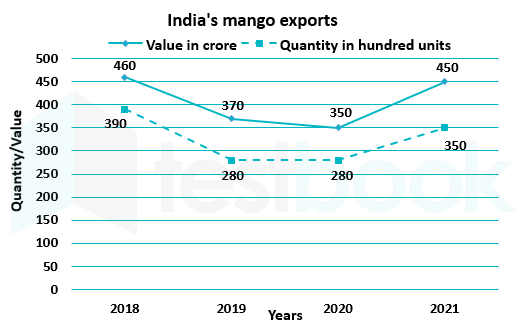
The given line graph shows the data of Mango exports in India from year 2018 to 2021. Study the given line graph and answer the question.

In which year was the value per hundred units the minimum?

  1. AOption (a)

    2018

  2. BOption (b)

    2020

  3. COption (c)

    2021

  4. DOption (d)

    2019

View answer & explanation

Correct answer

Answer: (a)A.

2018

Why this answer is correct

Calculation:

According to the question:

In 2018, 460/390 = 1.179

In 2019, 370/280 = 1.32

In 2020, 350/280 = 1/25

In 2021, 450/350 = 1.28.

So, in 2018 the value per hundred units is minimal.

Question 19

In this question, a group of numbers/symbols is coded using letters as per the table given below and the conditions which follow. The correct combination of codes following the condition is your answer.

Number/Symbol2<47^%>3!?58$6
CodeAFTJDGEZVWKUPL

Condition:

(i) If the first element is a symbol and the last a number, the codes for these two are to be interchanged.

(ii) If the first element is an odd number and the last an even number, the first and the last elements are to be coded as Φ.

(iii) If both the second and third elements are symbols, the third elements is to be code for the second element.

How will '3 < 5 ! 2' be coded?

  1. AOption (a)

    Z F K V A

  2. BOption (b)

    Φ F K V Φ

  3. COption (c)

    Φ F K W Φ

  4. DOption (d)

    Φ F K V A

View answer & explanation

Correct answer

Answer: (b)B.

Φ F K V Φ

Why this answer is correct

Given: 

Number/Symbol2<47^%>3!?58$6
CodeAFTJDGEZVWKUPL


Code for: 3 < 5 ! 2

Let's check all the conditions given:

  1. 1st and 3rd conditions are not true

  2. 2nd Condition is true 

so, we have the code as Φ F K V Φ.

Thus, the code for the given set is Φ F K V Φ.

Hence, the correct answer is 'option 2'.

Question 20

If 2 is added to each odd digit and 3 is subtracted from each even digit in the number 835647, what will be the sum of the digits that are second from the left and second from the right in the new number thus formed?

  1. AOption (a)

    10

  2. BOption (b)

    8

  3. COption (c)

    14

  4. DOption (d)

    6

View answer & explanation

Correct answer

Answer: (d)D.

6

Why this answer is correct

Given Numbers: '835647'

2 is added to each odd digit and,

3 is subtracted from each even digit.

Here,

The second number from the left is: 5

and the second number from the right is: 1

So, the sum of 5 + 1 = 6

Thus, the sum of the second digits from left and right will be 6.

Hence, the correct answer is 'option 4'.

Question 21

Three statements are followed by three conclusions numbered I, II and III. You have to consider these statements to be true, even if they seem to be at variance with commonly known facts. Decide which of the given conclusions logically follow(s) from the given statement.

Statements:

All lamps are lanterns.

All lanterns are torches.

All torches are candles.

Conclusions:

(i) Some candles are lamps

(II) All lanterns are lamps

(III) No lantern is a lamp

  1. AOption (a)

    Only conclusion I and III follows

  2. BOption (b)

    Only conclusion II follows

  3. COption (c)

    Only conclusion I follows

  4. DOption (d)

    None of the conclusions follow

View answer & explanation

Correct answer

Answer: (c)C.

Only conclusion I follows

Why this answer is correct

Statements:

All lamps are lanterns.

All lanterns are torches.

All torches are candles.

Venn diagram:

Conclusions:

(I) Some candles are lamps → Follow → (All lamps are lanterns, all lanterns are torches & all torches are candles which means there is an indirect relation between some candles and lamps, so Some candles are lamps will be follow).

(II) All lanterns are lamps → Does not follow → (It can be possible not definite, so does not follow).

(III) No lantern is a lamp → Does not follow → (It is clearly given that all lamps are lanterns which means there are some lanterns which are definitely lamps thus the conclusion does not follow).

Thus, only conclusion I follow.

Hence, the correct answer is Option 3.

Question 22

The value of 0.2×0.2×0.2−0.02×0.02×0.022×2×2\frac{{0.2 \times 0.2 \times 0.2 - 0.02 \times 0.02 \times 0.02}}{{2 \times 2 \times 2}} =

  1. AOption (a)

    0.00999

  2. BOption (b)

    0.000999

  3. COption (c)

    0.0090

  4. DOption (d)

    0.999

View answer & explanation

Correct answer

Answer: (b)B.

0.000999

Why this answer is correct

Given:

0.2×0.2×0.2−0.02×0.02×0.022×2×2\frac{{0.2 \times 0.2 \times 0.2 - 0.02 \times 0.02 \times 0.02}}{{2 \times 2 \times 2}}

Concept used:

Simple calculation is used here

Calculation:

⇒ 0.2×0.2×0.2−0.02×0.02×0.022×2×2\frac{{0.2 \times 0.2 \times 0.2 - 0.02 \times 0.02 \times 0.02}}{{2 \times 2 \times 2}}

⇒ 0.008−0.0000088\frac{0.008 - 0.000008}{8}

⇒ 8(0.001−0.000001)8\frac{8(0.001-0.000001)}{8}

⇒ 0.001 - 0.000001

⇒ 0.000999

⇒ Hence, The value of above equation is 0.000999

Question 23

Consider the following statements about magnetic field due to a current-carrying straight conductor:

(a) The magnetic field at a distance r from the wire is in the form of a concentric circle.

(b) The radius of the concentric circle increases as the distance from the conductor increases.

Which of the above statements is/are correct?

  1. AOption (a)

    Both (a) and (b)

  2. BOption (b)

    Only (a)

  3. COption (c)

    Only (b)

  4. DOption (d)

    Neither (a) nor (b)

View answer & explanation

Correct answer

Answer: (a)A.

Both (a) and (b)

Why this answer is correct

The correct answer is Both (a) and (b).

Key Points

  • Given a conductor, if we connect it to a battery with some iron filings surrounding it we can see when the battery is on, the current starts flowing.
  • This flowing current makes the iron fillings arrange themselves in a specific pattern which are like concentric circles indicating magnetic field lines.
  • We can find the direction of the magnetic field produced by the right-hand thumb rule.
  • The magnitude of this magnetic field is given by: B=μo∗I2πrB={μo*I\over2πr}.
  • As, the distance between the conductor is increases the value of r also increases.

Thus, the given 2 statements are all true.

Additional Information

  • Right hand thumb rule is used to find the direction of the magnetic field.
  • The rule states that: "If you point the thumb in the direction of the current , the direction of fingers curl the conductor will give you the direction of the magnetic field."

Question 24

Five students - 1, 2, 3, 4 and 5 - are sitting around a circular table facing away from the centre. 3 is sitting second to the right of 4 and to the immediate left of 5. 3 and 4 are immediate neighbours of 1. Which of the following statements is true?

  1. AOption (a)

    1 and 2 are the immediate neighbours of 4.

  2. BOption (b)

    1 is sitting third to the left of 5.

  3. COption (c)

    2 is sitting second to the right of 1.

  4. DOption (d)

    2 is sitting to the immediate left of 5. 

View answer & explanation

Correct answer

Answer: (a)A.

1 and 2 are the immediate neighbours of 4.

Why this answer is correct

Given: Five students - 1, 2, 3, 4 and 5.

  1. 3 is sitting second to the right of 4 and to the immediate left of 5.

  2. 3 and 4 are immediate neighbors of 1.

And, 2 will sit in the remaining place.

Now, Options:

1) 1 and 2 are the immediate neighbors of 4 - True.

2) 1 is sitting third to the left of 5 - False.

3) 2 is sitting second to the right of 1 - False.

4) 2 is sitting to the immediate left of 5 - False.

Hence, the correct answer is 'option 1'.

Question 25

In this question, the statement is followed by two conclusions. Which of the two conclusion(s) is/are true based on the given statement?

Statement: T = S ≥ N = A ≤ U > P < Q

Conclusions:

I. S > Q

II. A < T

  1. AOption (a)

    Only conclusion I is true

  2. BOption (b)

    Neither conclusion I nor II is true

  3. COption (c)

    Both conclusions I and II are true

  4. DOption (d)

    Only conclusion II is true

View answer & explanation

Correct answer

Answer: (b)B.

Neither conclusion I nor II is true

Why this answer is correct

Given: T = S ≥ N = A ≤ U > P < Q

Conclusions:

I. S > Q ⇒ False (S ≥ N = A ≤ U > P < Q, No relation can be established).

II. A < T ⇒ False (T = S ≥ N = A, Gives T ≥ A).

So, neither conclusion I nor II is true.

Hence, the correct answer is 'option 2'.

Question 26

In May 2022, the Supreme Court has restrained the state and central governments from invoking which charges, under Section 124A of the Indian Penal Code, against anybody?

  1. AOption (a)

    Inchoate

  2. BOption (b)

    Sedition

  3. COption (c)

    Bankruptcy

  4. DOption (d)

    Homicide

View answer & explanation

Correct answer

Answer: (b)B.

Sedition

Why this answer is correct

The correct answer is Sedition.

Key Points

  • The state and federal governments are not allowed to accuse anyone of sedition invoking Section 124A of the Indian Penal Code, according to the Supreme Court.
  • Until the Center analyses the statute from the British era, the order will be in effect.
  • It stated that until the law is reviewed, no new FIRs will be filed, investigations won't be conducted, and no further coercive actions under sedition will be performed.
  • It is a cognizable, non-bailable, non-compoundable offence.
  • It can be punished by imprisonment of three years or a fine or both.

Additional Information

  • Inchoate
  • ​Inchoate crimes are actions taken that are intended to be criminal acts or that amount to indirect participation in illegal acts.
  • Although such a deed might not be a criminal in and of itself, it is done to further or advance a crime.
  • Bankruptcy
  • ​Through the legal process of bankruptcy, individuals or other entities that cannot pay their creditors back can seek partial or complete relief from their debts.
  • Bankruptcy is typically imposed by a court order frequently requested by the debtor.
  • A person who is insolvent may have more than one legal status; consequently, the term "bankruptcy" is not a synonym for insolvency.
  • Homicide
  • ​When someone kills another person, it is called homicide.
  • A homicide merely needs to be a voluntary action or omission that results in the death of another person; therefore, it can result from careless, irresponsible, or accidental behaviour even when no malice was intended.

Question 27

Three successive discounts of 4%, 5% and 14% are equal to a single discount of _______ (rounded off to two decimal places).

  1. AOption (a)

    20.57%

  2. BOption (b)

    22.57%

  3. COption (c)

    23.57%

  4. DOption (d)

    21.57%

View answer & explanation

Correct answer

Answer: (d)D.

21.57%

Why this answer is correct

Shortcut Trick

Combine the first two discounts: 4 + 5 − (4 × 5)/100 = 9 − 0.2 = 8.8%

Combine with the third: 8.8 + 14 − (8.8 × 14)/100 = 22.8 − 1.232 = 21.568%

Rounding to two decimal places, we get 21.57%.

∴ The correct answer is 21.57%.

Alternate Method

Given: Successive discounts are 4%, 5%, and 14%.

Formula Used: Equivalent Discount = [1 − (1 − d1/100) × (1 − d2/100) × (1 − d3/100)] × 100%

⇒ Let Marked Price (MP) = 100

⇒ After 1st discount (4%): 100 − 4% of 100 = 96

⇒ After 2nd discount (5%): 96 − 5% of 96 = 96 − 4.8 = 91.2

⇒ After 3rd discount (14%): 91.2 − 14% of 91.2 = 91.2 − 12.768 = 78.432

⇒ Total Discount = MP − Final SP = 100 − 78.432 = 21.568%

⇒ Rounded to two decimal places = 21.57%

∴ The correct answer is 21.57%.

Additional Information

Successive Discount Formula

For two successive discounts x% and y%, the single equivalent discount is (x + y − xy/100)%.

Relationship between SP and MP

The Selling Price (SP) can be calculated as SP = MP × (100 − d1)/100 × (100 − d2)/100...

Net Percentage Change

A successive discount is a series of percentage decreases applied to the updated value at each step.

Question 28

Which of the following relations would calculate the cost x of m notebooks, if the cost of n notebooks is Rs. 1,680

  1. AOption (a)

    mx=n1680\frac{m}{x} = \frac{n}{{1680}}

  2. BOption (b)

    mx=1680n\frac{m}{x} = \frac{1680}{{n}}

  3. COption (c)

    xm=nm\frac{x}{m} = \frac{n}{{m}}

  4. DOption (d)

    x = 1680m\frac{1680}{{m}}

View answer & explanation

Correct answer

Answer: (a)A.

mx=n1680\frac{m}{x} = \frac{n}{{1680}}

Why this answer is correct

Shortcut Trick

In direct proportion, the ratio of quantity to cost remains constant.

Ratio of notebooks (n) to their cost (1,680) = Ratio of notebooks (m) to their cost (x).

⇒ n / 1680 = m / x

∴ The correct answer is (m)/(x) = n/1680.

Alternate Method

Given:

Cost of n notebooks = ₹ 1,680

Cost of m notebooks = ₹ x

Calculations:

⇒ Unitary Method: Cost of 1 notebook = 1,680 / n

⇒ Cost of m notebooks (x) = m × (1,680 / n)

⇒ x = (m × 1,680) / n

⇒ By rearranging the terms to match the options:

⇒ x / m = 1,680 / n

⇒ Taking reciprocal on both sides:

⇒ m / x = n / 1,680

∴ The correct answer is (m)/(x) = n/1680.

Additional Information

Direct Proportion

Two quantities x and y are in direct proportion if the ratio x/y remains constant (k). If x increases, y also increases.

Inverse Proportion

Two quantities x and y are in inverse proportion if the product x × y remains constant (k). If x increases, y decreases.

Unitary Method

A technique where you first find the value of a single unit and then multiply by the required number of units.

Question 29

All 38 students of a class are standing in a straight row facing the north. Ashok is 16th from the right end, while Aruna is 19th from the left end. How many students stand between Ashok and Aruna?

  1. AOption (a)

    Four

  2. BOption (b)

    One

  3. COption (c)

    Three

  4. DOption (d)

    Two

View answer & explanation

Correct answer

Answer: (c)C.

Three

Why this answer is correct

Given: 38 students in a class standing in a straight row facing north.

Ashok is 16th from the right end and Aruna is 19th from the left end.

So, the number of students standing between Ashok and Aruna is:

= 38 - (16 + 19)

= 38 - 35

= 3 Students.

So, there are three students between Ashok and Aruna in the class.

Hence, the correct answer is 'option 3'.

Question 30

Simplify: x(2x - 5) + 6(x2 - 4) + 18

  1. AOption (a)

    8x2 - 5x + 6

  2. BOption (b)

    8x2 - 5x - 6

  3. COption (c)

    8x2 + 5x - 6

  4. DOption (d)

    8x2 + 5x + 6

View answer & explanation

Correct answer

Answer: (b)B.

8x2 - 5x - 6

Why this answer is correct

Shortcut Trick

Expand the expression using the BODMAS rule: x(2x − 5) + 6(x2 − 4) + 18.

Step 1: (2x2 − 5x) + (6x2 − 24) + 18.

Step 2: Combine like terms (2x2 + 6x2) − 5x + (18 − 24) ⇒ 8x2 − 5x − 6.

∴ The correct answer is 8x2 − 5x − 6.

Alternate Method

Given:

The algebraic expression: x(2x − 5) + 6(x2 − 4) + 18

Formula Used:

Distributive Property: a(b + c) = ab + ac

Calculations:

⇒ x × 2x − x × 5 + 6 × x2 − 6 × 4 + 18

⇒ 2x2 − 5x + 6x2 − 24 + 18

⇒ (2x2 + 6x2) − 5x + (18 − 24)

⇒ 8x2 − 5x − 6

∴ The correct answer is 8x2 − 5x − 6.

Additional Information

Distributive Law

The distributive law allows for the expansion of brackets by multiplying the outer term with every term inside: a(b + c) = ab + ac.

Like Terms

Terms that have the same variable raised to the same power (e.g., 2x2 and 6x2) are called like terms and can be simplified together.

BODMAS Rule

Simplification always follows the BODMAS order: Brackets, Orders (Exponents), Division, Multiplication, Addition, and Subtraction.

Question 31

An object is placed on the principal axis of a lens of power 4.0 D, at a distance of 30 cm. The image formed is ______.

  1. AOption (a)

    virtual and erect

  2. BOption (b)

    virtual and inverted

  3. COption (c)

    real and inverted

  4. DOption (d)

    real and erect

View answer & explanation

Correct answer

Answer: (c)C.

real and inverted

Why this answer is correct

The correct answer is real and inverted.

Given:

Power of the lens is 4.0 D, object distance is 30cm.

Formula:

P=1fP={1\over f}

Calculations:

As, P=1fP={1\over f} we have:

f=1P=14=0.25mf={1\over P}={1\over 4}=0.25m

As focal length is positive and object distance is negative.

Thus, the lens used here is convex lens.

Image formed convex lens it is always real and inverted.

Question 32

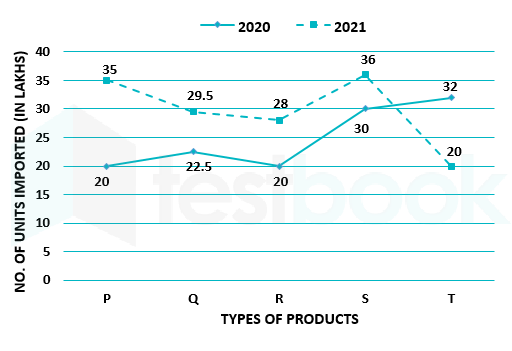
The given line graph shows the total number of different cosmetic products P, Q, R, S and T (in lakhs) imported by company 'XYZ' in the years 2020 and 2021. Study the line graph and answer the question.

The average import of Q type of products in both the years 2020 and 2021 was equal to the average import of which type of product in the same years?

  1. AOption (a)

    S

  2. BOption (b)

    R

  3. COption (c)

    T

  4. DOption (d)

    P

View answer & explanation

Correct answer

Answer: (c)C.

T

Why this answer is correct

Concept used:

Study the graph

Calculation:

⇒ The average of Q in 2020 and 2021 = 29.5+22.52\frac{29.5+22.5}{2} = 26

⇒ The average of P in 2020 and 2021 = 35+202\frac{35+20}{2} = 27.5

⇒ The average of R = 28+202\frac{28+20}{2} = 24

⇒ The average of S = 30+362\frac{30+36}{2} = 28

⇒ The average of T = 32+202\frac{32+20}{2} = 26

⇒ Hence, The T has same average as Q

Question 33

When solutions of lead (II) nitrate and potassium iodide are mixed together, which of the following observations will be true?

  1. AOption (a)

    A white precipitate of potassium nitrate will be formed.

  2. BOption (b)

    A yellow precipitate of lead iodide will be formed.

  3. COption (c)

    No reaction will occur.

  4. DOption (d)

    A white precipitate of lead iodide will be formed. 

View answer & explanation

Correct answer

Answer: (b)B.

A yellow precipitate of lead iodide will be formed.

Why this answer is correct

The correct answer is A yellow precipitate of lead iodide will be formed.

Key Points:

  • A yellowish solid precipitates when a solution of potassium iodide is added to a solution of lead nitrate that has been taken in a test tube.
  • 2KI (aq.) + Pb(NO3)2 (aq.) → 2KNO3 (aq.) + PbI2(s).
  • Lead iodide is this opalescent solid.
  • Lead iodide and potassium nitrate are created together.
  • It's double displacement reaction.

Additional Information:

  • When the reactant ions shift around to produce new products, chemical processes known as double displacement reactions take place.
  • A double displacement procedure frequently results in the formation of precipitates.
  • Chemical bonds between the reactants might be ionic or covalent.
  • Other names for a double displacement process include double replacement, salt metathesis, and double decomposition.

Question 34

Refer to the following letter, number, symbol series and answer the question.

(Left) & X Y # F K & 3 T & * 8 W ¥ % ^ D U G  ϵϕ ϵ ϕ 5 S @ J (Right)

How many such numbers are there which are immediately preceded by a symbol and immediately followed by a consonant?

  1. AOption (a)

    3

  2. BOption (b)

    1

  3. COption (c)

    4

  4. DOption (d)

    2

View answer & explanation

Correct answer

Answer: (a)A.

3

Why this answer is correct

Given: (Left) & X Y # F K & 3 T & * 8 W ¥ % ^ D U G  ϵϕ ϵ ϕ 5 S @ J (Right)

Numbers immediately preceded by a symbol and immediately followed by a consonant:

The pattern should be:- Symbol - Number - Consonant

Now,

(Left) & X Y # F K & 3 T & *** 8 W** ¥ % ^ D U G $ ϵ ϕ $ 5 S @ J (Right)

Thus there are 3 such numbers that are immediately preceded by a symbol and immediately followed by a consonant.

The pairs are: & 3 T,  * 8 W,  $ 5 S

Hence, the correct answer is 'option 1'.

Question 35

Consider the below statements and identify the correct answer.

Statement I: According to Newland's assumption, only 56 elements existed in the nature.

Statement II: Newland found that every eighth element had properties similar to that of the first.

  1. AOption (a)

    Both statements are incorrect.

  2. BOption (b)

    Statement I is correct, Statement II is incorrect.

  3. COption (c)

    Both statements are correct.

  4. DOption (d)

    Statement II is correct, Statement I is incorrect.

View answer & explanation

Correct answer

Answer: (c)C.

Both statements are correct.

Why this answer is correct

The correct answer is Both statements are correct.

Key Points:

  • The atomic masses of the elements were used by Newlands to arrange them.
  • He noticed that every eighth element has the same attribute when he grouped the elements in order of their atomic masses.
  • After every 8 elements, the same attributes reappear, giving the law its name, the Newlands law of octave.
  • Then, known elements including hydrogen, lithium, beryllium, boron, carbon, nitrogen, oxygen, fluorine, sodium, magnesium, aluminium, silicon, phosphorus, sulphur, and chlorine were placed in order of increasing atomic mass.
  • This indicates that lithium and sodium, the eighth element relative to lithium, have features in common and so on.
  • He believed that there were only 56 elements in nature and that no new elements will ever be found.
  • Later he was proved wrong.

Additional Information:

  • British chemist John Alexander Reina Newlands, who researched on the periodicity of elements, was born on November 26, 1837, and died on July 29, 1898.
  • The first periodic table of chemical elements organised according to their respective atomic masses was created by Newlands and published in Chemical News in February 1863.
  • In 1865, Johann Wolfgang Döbereiner released his "Law of Octaves," which declared that "every given element will display analogous behaviour to the eighth element following it in the table," as a continuation of his work with triads and Jean-Baptiste Dumas' families of related components.

Question 36

Find the value of 9604\sqrt {9604} .

  1. AOption (a)

    72

  2. BOption (b)

    74

  3. COption (c)

    89

  4. DOption (d)

    98

View answer & explanation

Correct answer

Answer: (d)D.

98

Why this answer is correct

Shortcut Trick Identify the range: 902 = 8100 and 1002 = 10000. Since 8100 < 9604 < 10000, the square root lies between 90 and 100. The unit digit of 9604 is 4, so the square root must end in either 2 or 8. Check 982: 98 is 2 less than 100, so 982 = (100−2)2 = 10000 − 400 + 4 = 9604. ∴ The correct answer is 98.

Alternate Method Given: Number = 9604 Method: Prime Factorisation ⇒ 9604 = 2 × 4802 ⇒ 9604 = 2 × 2 × 2401 ⇒ 9604 = 2 × 2 × 7 × 343 ⇒ 9604 = 2 × 2 × 7 × 7 × 49 ⇒ 9604 = 2 × 2 × 7 × 7 × 7 × 7 ⇒ √9604 = √(22 × 72 × 72) ⇒ √9604 = 2 × 7 × 7 ⇒ √9604 = 98 ∴ The correct answer is 98.

Additional Information Perfect Square Unit Digits A perfect square ending in 4 must have a square root ending in either 2 or 8 because 22=4 and 82=64. Estimation Method For any number N, if x2 < N < (x+1)2, the square root lies between x and x+1. This narrows down the tens digit instantly. Square of numbers ending in 5 To find (n5)2, the result is always [n×(n+1)] followed by 25. Example: 952 = 9×10 and 25 = 9025.

Question 37

Seven men can complete a work in 12 days. They start the work and after 5 days, 3 men leave. In how many days will the remaining work be completed by the remaining men?

  1. AOption (a)

    12

  2. BOption (b)

    14

  3. COption (c)

    1314\frac{1}{4}

  4. DOption (d)

    1214\frac{1}{4}

View answer & explanation

Correct answer

Answer: (d)D.

1214\frac{1}{4}

Why this answer is correct

Shortcut Trick

Remaining work in terms of man-days = 7 men × (12 − 5) days = 49 man-days.

Remaining men = 7 − 3 = 4 men.

Days required = 49 ÷ 4 = 12 1/4 days.

∴ The correct answer is 12 1/4 days.

Alternate Method

Given:

Total men (M1) = 7, Total days (D1) = 12

Days worked = 5, Men remaining (M2) = 7 − 3 = 4

Formula Used:

Total Work = Men × Days

M1 × D1 = M1 × d1 + M2 × d2

Calculations:

⇒ Total work = 7 × 12 = 84 units

⇒ Work done in 5 days = 7 × 5 = 35 units

⇒ Remaining work = 84 − 35 = 49 units

⇒ Time taken by 4 men = 49 ÷ 4

⇒ Time = 12 1/4 days

∴ The correct answer is 12 1/4 days.

Additional Information

Chain Rule

The relationship between men, days, and work is given by (M1×D1×H1)/W1 = (M2×D2×H2)/W2.

Work and Efficiency

Work is directly proportional to the number of men and time, while time is inversely proportional to the number of men for constant work.

Question 38

What is the usual shape for an average fixed cost curve?

  1. AOption (a)

    Inverted V-shaped

  2. BOption (b)

    Horizontal line

  3. COption (c)

    Rectangular hyperbola

  4. DOption (d)

    U-shaped

View answer & explanation

Correct answer

Answer: (c)C.

Rectangular hyperbola

Why this answer is correct

The correct answer is a rectangular hyperbola.

Key Points

  • Average fixed cost
  • The fixed cost that stays the same no matter how many goods and services a company produces are called the average fixed cost (AFC).
  • In a nutshell, the average fixed cost (AFC) is determined by dividing the total fixed cost by the output level and representing the fixed cost per unit.
  • The average fixed cost is just for the short term because no expense is fixed for an extended period of time.
  • The average fixed cost per unit of output lowers as manufacturing units rise.
  • The average cost per unit also rises as the company produces fewer units.
  • AFC = Total fixed cost/Output (Q)
  • The typically fixed-cost AFC curve resembles a rectangle-shaped hyperbola.** It occurs as a result of the fixed cost being divided by rising output.**
  • **As a result, the AFC curve slopes downward and is a rectangular hyperbola, meaning that **the area beneath the curve is constant throughout.
  • Asymptotes or axes on a rectangular hyperbola are parallel to one another.
  • The conjugate axis and transverse axes have lengths that are identical.

Additional Information

  • Inverted V-shaped
  • ​The lateral umbilical ligament sign, commonly known as the inverted "V" sign, is a symptom of pneumoperitoneum that appears as an inverted "V" shape in the pelvis on supine abdominal radiographs.
  • The lateral umbilical ligaments are symbolised by free gas. The inferior epigastric vessels are located in the lateral umbilical ligaments in adults as opposed to neonates, who have umbilical arteries.
  • ​Horizontal line
  • ​A straight line that is parallel to the horizon or the ground is referred to as a horizontal line. There is no slope.
  • It is a straight line that is drawn from right to left or left to right in the coordinate plane, parallel to the x-axis. In other words, a horizontal line is a straight line that has an intercept solely on the y-axis and not on the x-axis.

Question 39

Express sin 58° + cos 82° in terms of Trigonometric ratios of angles between 0° and 45°.

  1. AOption (a)

    cos 32° + sin 8°

  2. BOption (b)

    sin 32° + cos 8°

  3. COption (c)

    cos 32° + cos 8°

  4. DOption (d)

    sin 32° + sin 8° 

View answer & explanation

Correct answer

Answer: (a)A.

cos 32° + sin 8°

Why this answer is correct

Shortcut Trick

Apply the Complementary Angle conversion: sin θ = cos (90° − θ) and cos θ = sin (90° − θ).

For sin 58° → cos (90° − 58°) = cos 32°.

For cos 82° → sin (90° − 82°) = sin 8°.

Summing both results gives cos 32° + sin 8°, where both angles are between 0° and 45°.

∴ The correct answer is cos 32° + sin 8°.

Alternate Method

Given: sin 58° + cos 82°

Formula Used:

  1. sin θ = cos (90° − θ)

  2. cos θ = sin (90° − θ)

Calculations:

⇒ sin 58° = sin (90° − 32°)

⇒ Using formula (1): sin (90° − 32°) = cos 32°

⇒ cos 82° = cos (90° − 8°)

⇒ Using formula (2): cos (90° − 8°) = sin 8°

⇒ Therefore, sin 58° + cos 82° = cos 32° + sin 8°

∴ The correct answer is cos 32° + sin 8°.

Additional Information

Complementary Angle Identities

For any angle θ, sin (90° − θ) = cos θ, tan (90° − θ) = cot θ, and sec (90° − θ) = cosec θ.

Trigonometric Range Conversion

To express ratios for angles > 45° into the range 0°-45°, always subtract the given angle from 90° and change the ratio to its co-function.

Question 40

Select the set in which the numbers are related in the same way as are the numbers of the following sets.

(NOTE: Operations should be performed on the whole numbers, without breaking down the numbers into its constituent digits. E.g. 13 - Operations on 13 such as adding / subtracting / multiplying etc. to 13 can be performed. Breaking down 13 into 1 and 3 and then performing mathematical operations on 1 and 3 is not allowed)

(14, 60, 16)

(25, 80, 15)

  1. AOption (a)

    (21, 120, 15)

  2. BOption (b)

    (20, 30, 40)

  3. COption (c)

    (19, 80, 21)

  4. DOption (d)

    (15, 45, 30)

View answer & explanation

Correct answer

Answer: (c)C.

(19, 80, 21)

Why this answer is correct

Logic: 2 × (First Number + Third Number) = Second Number

Given:

(14, 60, 16) 

→ 2 × (14 + 16)

⇒ 2 × 30 = 60.

(25, 80, 15) 

→ 2 × (25 + 15)

⇒ 2 × 40 = 80.

Let's check all the options as

1) (21, 120, 15) 

→ 2 × (21 + 15)

⇒ 2 × 36 = 72 ≠\ne 120

2) (20, 30, 40) 

→ 2 × (20 + 40)

⇒ 2 × 60 = 120 ≠\ne 30

3) (19, 80, 21) 

→ 2 × (19 + 21)

⇒ 2 × 40 = 80

4) (15, 45, 30) 

→ 2 × (15 + 30)

⇒ 2 × 45 = 90 ≠\ne 45

Thus, the set of numbers (19, 80, 21) follows the same pattern.

Hence, the correct answer is 'option 3'.

Question 41

India's first Artificial Intelligence and Robotics Technological Park was launched in ______ in March 2022.

  1. AOption (a)

    Chandigarh

  2. BOption (b)

    Bhopal

  3. COption (c)

    Chennai

  4. DOption (d)

    Bengaluru

View answer & explanation

Correct answer

Answer: (d)D.

Bengaluru

Why this answer is correct

The correct answer is Bengaluru.

Key Points

  • At the Indian Institute of Science (IISc) in Bengaluru, an Artificial Intelligence and Robotics Technology Park (ARTPARK) with seed funding of Rs 230 crore was inaugurated in March 2022.
  • The Karnataka government would be responsible for the remaining Rs 230 crore, while the Center would cover Rs 170 crore.
  • It would seek to develop a highly innovative ecosystem for AI and robotics in the nation.

Additional Information

  • ARTPARK wants to connect the disconnected through cutting-edge technology.
  • By carrying out ambitious mission-mode R&D initiatives in healthcare, education, mobility, infrastructure, agriculture, retail, and cyber-security that target solving problems specific to India**, the ARTPARK seeks to harness discoveries to have a positive social impact.**
  • By 2030, it's anticipated that AI would reach $15.7 trillion.

Question 42

We, on an individual basis, can help to reduce the production of waste by following certain practices. Which of the following will however cause increase in waste?

  1. AOption (a)

    Reusing empty containers and bottles

  2. BOption (b)

    Using cloth or jute bags for shopping

  3. COption (c)

    Donating used goods

  4. DOption (d)

    Using tin foil, plastic wraps, paper towels and plastic zip bags

View answer & explanation

Correct answer

Answer: (d)D.

Using tin foil, plastic wraps, paper towels and plastic zip bags

Why this answer is correct

The correct answer is Using tin foil, plastic wraps, paper towels, and plastic zip bags.

Key Points

  • Decreasing and adopting a more waste-free lifestyle is one of the most crucial things we can do to help the environment.
  • Waste is a problem on many different levels.
  • The fact that it pollutes the environment and depletes our planet's limited resources are perhaps the two most glaring.
  • Using things like tin foil, plastic wrap, paper towels, and plastic zip bags results in more waste.
  • Ways to reduce waste:
  • For refreshments on the go, use a reusable bottle or cup.
  • Use reusable shopping bags for more than just groceries.
  • Recycle and make smart purchases.
  • Avoid serving food and beverages in single-use containers.
  • Buy used products and donate your old ones.
  • Buy in bulk and at local farmers' markets to reduce packaging.
  • Reduce your consumption of paper for periodicals, receipts, and mail.

Additional Information

  • 4R of Recycling
  • REDUCE: This refers to utilizing environmental resources in a sustainable manner and avoiding waste. For instance, taking a bath with a bucket of water rather than a shower.
  • REUSE: This indicates that we can put anything to multiple uses. Consider repurposing a polythene bag for several uses.
  • RECYCLE: This refers to the processing and possible conversion of materials into other products that allow for their reuse. Paper, for instance, is recycled.
  • RECOVER: This indicates that a safe and environmentally friendly substitute should be employed in its place. Using a clothes bag as opposed to a plastic bag is one illustration.

Question 43

Which of the following is an overhead expense in a production cost?

  1. AOption (a)

    Labour

  2. BOption (b)

    Raw materials 

  3. COption (c)

    Consumable manufacturing supplies

  4. DOption (d)

    Insurance

View answer & explanation

Correct answer

Answer: (d)D.

Insurance

Why this answer is correct

The correct answer is Insurance.

Key Points

  • The ongoing costs associated with maintaining a business are known as overhead or overhead charges in the business sector. Unlike operating expenses like raw materials and labour, overheads cannot easily be linked to or recognised with any one revenue unit.
  • All costs on the income statement other than direct labour, direct supplies, and direct expenses are referred to as overhead expenses.
  • Accounting fees, advertising, insurance, interest, legal fees, labour costs, rent, repairs, supplies, taxes, phone bills, travel expenses, and utilities are examples of overhead costs.
  • Indirect expenses and fixed costs, two accounting concepts, are frequently linked to overheads.

Additional Information

  • Labour
  • A labourer (or labourer) is a person employed in the construction industry who does manual labour. Workers are members of a working-class who only own their labour as a significant tangible possession.

Raw materials ​

  • Materials or substances used in the initial stages of producing or manufacturing items are known as raw materials.
  • On commodity exchanges around the world, raw materials are commodities that are purchased and sold. Because raw materials are production factors, businesses trade them on the factor market.
  • Consumable manufacturing supplies
  • ​Consumable materials include things like solder that are used up during production but do not include things like the packaging for finished goods, labels, skids, pallets, or shipping packing materials.

Question 44

Select the option that is related to the fifth number in the same way as the second number is related to the first mumber and the fourth number is related to the third mumber.

(NOTE: Operations should be performed on the whole numbers, without breaking down the numbers into its constituent digits. E. g. 13 - Operations on 13 such as adding / subtracting / multiplying etc. to 13 can be performed. Breaking down 13 into 1 and 3 and then performing mathematical operations on 1 and 3 is not allowed)

16 ∶ 2 ∶∶ 36 ∶ 3 ∶∶ 64 ∶ ?

  1. AOption (a)

    3

  2. BOption (b)

    4

  3. COption (c)

    5

  4. DOption (d)

    6

View answer & explanation

Correct answer

Answer: (b)B.

4

Why this answer is correct

The logic followed in the given series is:

Logic: √(First term ÷ 4) = Second Number

Now we apply the pattern on the given series:

For, 16 ∶ 2

 ⇒ 16÷4=4\sqrt{16 \div 4} = \sqrt{4}  = 2

For, 36 ∶ 3

 ⇒ 36÷4=9\sqrt{36 \div 4} = \sqrt{9} = 3

Similarly, for 64 ∶ ?

 ⇒ 64÷4=16\sqrt{64 \div 4} = \sqrt{16}  = 4

Thus, the next term will be 4.

Hence, the correct answer is Option 2.

Question 45

_______ is the climate at the centre of large landmasses, typified by a large annual range in temperature, with precipitation most likely in the summer.

  1. AOption (a)

    Temperature Climate

  2. BOption (b)

    Extreme Climate

  3. COption (c)

    Maritime Climate

  4. DOption (d)

    Continental climate

View answer & explanation

Correct answer

Answer: (d)D.

Continental climate

Why this answer is correct

The correct answer is Continental climate.

Key Points

  • There is frequently a sizable annual temperature range in continental climates (warm summers and cold winters).
  • They typically occur in big landmasses at intermediate latitudes (40 to 55 north), when prevailing winds blow overland and bring some precipitation, and where seas do not act as a temperature regulator.
  • Because of the substantial landmasses present there, continental climates are primarily found in the Northern Hemisphere.
  • Precipitation in continental regions typically occurs in moderate amounts, mainly during the warmer months.

Additional Information

  • Temperature Climate
  • ​Geographically, the middle latitudes (23.5° to 66.5° N/S of Equator), which are between the tropics and the polar regions of Earth, are where moderate climates on Earth are found.
  • Compared to tropical climates, where such fluctuations are frequently minimal and typically simply involve changes in precipitation, these zones typically have greater temperature ranges throughout the year and more pronounced seasonal changes.
  • Extreme Climate
  • ​Unexpected, uncommon, severe, or out-of-season weather as well as the weather at the extremes of the historical distribution—the range that has been experienced in the past—are examples of extreme weather or extreme climate occurrences.
  • Extreme events are frequently characterized as occurring in the top ten percent of all observed occurrences based on a location's historical meteorological data.
  • The three main categories of extreme weather are tropical cyclones, heat waves, and cold waves.
  • Maritime Climate
  • ​The humid temperate climate sub-type Cfb known as an oceanic climate also referred to as a marine climate, is typical of west coasts in higher middle latitudes of continents.
  • It is characterized by generally cool summers and mild winters (for their latitude), with a relatively narrow annual temperature range and few temperature extremes.

Question 46

An object is placed at 40 cm in front of a converging mirror having focal length 20 cm. The magnification of the image is:

  1. AOption (a)

    -0.5

  2. BOption (b)

    +1

  3. COption (c)

    -1

  4. DOption (d)

    +0.5

View answer & explanation

Correct answer

Answer: (c)C.

-1

Why this answer is correct

The correct answer is -1.

Given:

Object distance u is -40cm and focal length is -20cm as it is converging.

To find:

Magnification of the image produced

Formula:

m=−vum=-{v\over u}

1f=1v+1u{1\over f}={1\over v}+{1\over u}

Calculations:

As, the mirror formula

1f=1v+1u{1\over f}={1\over v}+{1\over u}

1−20=1v+1−40{1\over -20}={1\over v}+{1\over -40}

1v=1−20−1−40{1\over v}={1\over -20}-{1\over -40}

1v=−2+140=1−40{1\over v}={-2 + 1\over 40}={1\over -40}

v=−40cmv= - 40cm

Therefore, the magnification produced is

m=−vu=−−40−40=−1m=-{v\over u}=-{-40\over -40}=-1

Thus, the magnification produced is -1.

Question 47

Find the compound interest on Rs. 12,500 at 3% per annum for 3 years when interest is compounded annually (correct to the nearest rupees).

  1. AOption (a)

    Rs. 1,159

  2. BOption (b)

    Rs. 1,170

  3. COption (c)

    Rs. 1,140

  4. DOption (d)

    Rs. 1,180

View answer & explanation

Correct answer

Answer: (a)A.

Rs. 1,159

Why this answer is correct

Shortcut Trick

The net effective rate for 3% for 3 years is calculated as: 3 + 3 + 3 + (3×3 + 3×3 + 3×3)/100 + (3×3×3)/10000 = 9.2727%.

Compound Interest = Principal × Net Effective Rate

⇒ CI = 12,500 × 9.2727% = 125 × 9.2727 = 1159.0875

Rounding to the nearest rupee, we get ₹1,159.

∴ The correct answer is ₹1,159.

Alternate Method

Given:

Principal (P) = ₹12,500

Rate (R) = 3% per annum

Time (T) = 3 years

Formula Used:

Amount (A) = P(1 + R/100)T

Compound Interest (CI) = A − P

Calculations:

⇒ A = 12,500 × (1 + 3/100)3

⇒ A = 12,500 × (1.03)3

⇒ A = 12,500 × (1.03 × 1.03 × 1.03)

⇒ A = 12,500 × 1.092727

⇒ A = 13,659.0875

⇒ CI = A − P

⇒ CI = 13,659.0875 − 12,500

⇒ CI = 1,159.0875

⇒ CI ≈ ₹1,159 (Correct to the nearest rupee)

∴ The correct answer is ₹1,159.

Additional Information

Compound Interest Properties

In Compound Interest, the interest from the previous year is added to the principal to calculate the interest for the next period, leading to exponential growth.

Difference between CI and SI

For 2 years: CI − SI = P(R/100)2. For 3 years: CI − SI = P(R/100)2 × (3 + R/100).

Effective Rate of Interest

The effective rate for 3 years can be found using the successive percentage change formula: a + b + (ab/100) applied twice.

Question 48

Dev walks 23 m towards the west from his hostel gate. He takes a left turn and walks 14 m. Then he takes a right turn and walks 63 m. Then he takes a left turn and walks 32 m. He takes a left turn again and walks 86 m. Again, he takes a left turn and walks 16 m to reach a canteen. How far and in which direction is the canteen from Dev's hostel gate? (All turns are 90 degree turns only)

  1. AOption (a)

    30 m, South

  2. BOption (b)

    16 m, North

  3. COption (c)

    16 m, South

  4. DOption (d)

    30 m, North

View answer & explanation

Correct answer

Answer: (a)A.

30 m, South

Why this answer is correct

From the given information:

Dev walks 23 m towards the west from his hostel gate. He takes a left turn and walks 14 m.

Then he takes a right turn and walks 63 m. Then he takes a left turn and walks 32 m.

[He takes a left turn again and walks 86 m. Again, he takes a left turn and walks 16 m to reach a canteen.


So, the Distance from hostel to canteen = 14m + 32 m - 16m = 46m - 16m = 30m

Thus, the canteen is 30m south of Dev's hostel gate.

Hence, the correct answer is "Option 1".

Question 49

In which year was The Indian Toll Act passed?

  1. AOption (a)

    1864

  2. BOption (b)

    1861

  3. COption (c)

    1853

  4. DOption (d)

    1851

View answer & explanation

Correct answer

Answer: (d)D.

1851

Why this answer is correct

The correct answer is 1851.

Key Points

  • The "Indian Tolls Act, 1851," as it is called, was passed on July 4th of that year. Governments are now permitted to charge tolls on these routes and specific bridges thanks to the passage of the law.
  • The legislation covers the areas that, as of July 4, 1851, were under the council-mandated rule of the Governor and Presidency of Fort William of the Bengal region and the Governor of Fort St. George's presidency.
  • Any road or bridge that has been built or will be repaired at the government's expense may be subject to tolls at whatever rates the government deems appropriate.
  • The government may also assign responsibility for managing the toll collection to whomever it deems appropriate, and any individuals working in this capacity will be subject to the same obligations as those who work in the actual toll collection.

Additional Information

  • Indian Tolls Act 1901:
  • The Indian Tolls (Army & Air Force) Act, 1901 is a law that was passed by the Indian Parliament and put forth by the Ministry of Defence to address the exemption of toll charges for regular armed forces, including all family members of Indian Armed Forces extending from Indian Army to Central Armed Police Forces, where applicable.
  • The requirements of sections 3 and 4 were later removed from the act by the Ministry of Road Transport and Highways, and those only "on duty" would be entitled to the exemption, which does not apply to the retired individual.
  • This was done in response to new legislation and policy formulation.

Question 50

From where do the roots of the plants take in oxygen?

  1. AOption (a)

    The oxygen taken by stomata reaches the roots

  2. BOption (b)

    From the water present in the soil

  3. COption (c)

    From the air spaces in between the soil particles

  4. DOption (d)

    Roots do not need oxygen

View answer & explanation

Correct answer

Answer: (c)C.

From the air spaces in between the soil particles

Why this answer is correct

The correct answer is From the air spaces in between the soil particles.

Key Points:

  • In addition to the leaves, the root system also contributes to plant respiration.
  • The soil's tiny air pockets can provide the roots with oxygen to breathe.
  • Oxygen (O2) from the soil pores diffuses into the root hairs of root systems, where it is carried to all regions of the roots.
  • During respiration, plant roots utilize photosynthates for a variety of purposes, including nutrition intake, tissue maintenance, and growth.
  • The created carbon dioxide (CO2) is subsequently released into the soil, where it diffuses into the atmosphere through soil pores.

Additional Information:

  • Plant cells are constantly utilising oxygen, which is required for plant survival.
  • Plant cells occasionally need to consume more oxygen from the air than they produce on their own.
  • Like animals, plants also breathe.
  • Breathing is not the only definition of respiration.
  • All living organisms go through this procedure to release energy for utilisation in their cells.
  • In plants, respiration is similar to photosynthesis done backwards; rather than storing energy by producing sugars and releasing oxygen, cells instead release energy for their own needs by dissolving carbohydrates and consuming oxygen.

Question 51

A 1.5 m tall boy is standing at a distance of 3 m from a 4 m high light post. The light from top of post casts his shadow. What is the length of the boy's shadow?

  1. AOption (a)

    0.91 m

  2. BOption (b)

    1.8 m

  3. COption (c)

    1.62 m

  4. DOption (d)

    4.4 m

View answer & explanation

Correct answer

Answer: (b)B.

1.8 m

Why this answer is correct

Shortcut Trick

For problems involving shadows and similar triangles, use the direct formula:

Shadow Length = (Boy height × Distance from post) ÷ (Post height − Boy height)

⇒ Shadow = (1.5 × 3) ÷ (4 − 1.5)

⇒ Shadow = 4.5 ÷ 2.5 = 1.8 m

∴ The correct answer is 1.8 m.

Alternate Method

Given:

Height of the light post (H) = 4 m

Height of the boy (h) = 1.5 m

Distance of the boy from the post (d) = 3 m

By the property of Similar Triangles, the ratio of the height to the total base is constant:

⇒ (Height of Post) ÷ (Distance + Shadow) = (Height of Boy) ÷ Shadow

Let the length of the shadow be s.

⇒ 4 ÷ (3 + s) = 1.5 ÷ s

⇒ 4 × s = 1.5 × (3 + s)

⇒ 4s = 4.5 + 1.5s

⇒ 4s − 1.5s = 4.5

⇒ 2.5s = 4.5

⇒ s = 4.5 ÷ 2.5

⇒ s = 1.8 m

Comparing this result with the given options, we find that Option (2) matches the calculated value.

∴ The correct answer is 1.8 m.

Additional Information

Properties of Similar Triangles

Two triangles are similar if their corresponding angles are equal; consequently, the ratios of their corresponding sides are equal (Side-Side-Side similarity).

Angle of Elevation

In shadow problems, the angle of elevation of the light source is the same for all objects at the same time, creating similar right-angled triangles.

Shadow Inversion Rule

For a fixed object height, as the object moves closer to the light source, the shadow length increases, and as it moves away, the shadow decreases.

Question 52

Which of the following bills is NOT passed by both Houses. Parliament of India, during Winter Session: 29 November 2021 to 22 December 2021?

  1. AOption (a)

    The Prohibition of Child Marriage (Amendment) Bill, 2021

  2. BOption (b)

    The Farm Laws Repeal Bill, 2021

  3. COption (c)

    The Narcotic Drugs and Psychotropic Substances (Amendment) Bill, 2021

  4. DOption (d)

    The Surrogacy (Regulation) Bill, 2021

View answer & explanation

Correct answer

Answer: (a)A.

The Prohibition of Child Marriage (Amendment) Bill, 2021

Why this answer is correct

The correct answer is The Prohibition of Child Marriage (Amendment) Bill, 2021.

Key Points

  • The National Family Health Survey 2019–21 reports that 23% of women get married before turning 18 years old.
  • On December 21, 2021, the Prohibition of Child Marriage Amendment Bill was introduced.
  • The Prohibition of Child Marriage Act of 2006 is amended, raising the legal age of consent for girls to marry from 18 to 21. The Hindu Marriage Act, the Special Marriage Act, and other relevant marriage laws were also altered by the bill.
  • The age requirement for marriage is 21, which is older than the requirement for becoming a majority (18 years).
  • Marriage between consenting adults is now recognised as a basic right by the Supreme Court.

Additional Information

  • The Farm Laws Repeal Bill, 2021
  • ​On November 29, 2021, Mr Narendra Singh Tomar, the Minister of Agriculture and Farmers' Welfare, introduced the Farm Laws Repeal Bill, 2021 in the Lok Sabha.
  • Three farm laws passed by Parliament in September 2020 are repealed by the Bill. These include:
  • (i) Farmers (Empowerment and Protection) Price Assurance and Farm Services Act.

(ii) the Farmers' Produce Trade and Commerce Act (Promotion and Facilitation).

  • (iii) the Essential Commodities (Amendment) Act, all of which are slated to take effect in 2020.
  • Amendment to the Narcotic Drugs and Psychotropic Substances Act of 2021
  • ​On December 6, 2021, the Narcotic Drugs and Psychotropic Substances (Amendment) Bill, 2021, was presented to Lok Sabha.
  • The Narcotic Drugs and Psychotropic Substances (Amendment) Ordinance, 2021 is intended to be replaced by this one.
  • The Narcotic Drugs and Psychotropic Substances Act, of 1985 is amended by the bill to fix a drafting mistake.
  • The Surrogacy (Regulation) Bill, 2021
  • If a medical condition dictates it, a couple, defined as a woman and man who are legally married, or a woman who is a widow or a divorcee between the ages of 35 and 45, may choose to utilise a surrogate.

Question 53

Nine people, 1 to 9, are sitting in a straight row, facing the south. 8 is sitting in the middle of the row and his immediate left and right neighbours are 5 and 1, respectively. 9 is sitting at one of the extreme ends and his immediate right neighbour is 2. Only five people are there between 2 and 3. 3 is sitting between 7 and 4. 1 and 7 are immediate neighbours. If 7 and 6 exchange their positions, then who among the following will be the immediate left neighbour of 7?

  1. AOption (a)

    1

  2. BOption (b)

    3

  3. COption (c)

    5

  4. DOption (d)

    2

View answer & explanation

Correct answer

Answer: (d)D.

2

Why this answer is correct

Given: Nine people, 1 to 9, are sitting in a straight row, facing south.

  1. 8 sits in the middle of the row and his immediate left and right neighbors are 5 and 1, respectively.

2) 3 sits between 7 and 4. 1 and 7 are immediate neighbors.

  1. 9 sits at one of the extreme ends and his immediate right neighbor is 2.

  2. Only five people are there between 2 and 3.

Thus the final arrangement is:

Thus, if 7 and 6 exchange their positions then 2 will be the immediate left neighbor of 7.

Hence, the correct answer is 'option 4'.

Question 54

Which of the following numbers replace the question mark (?) in the given series?

40, 66, 100, 142, ?

  1. AOption (a)

    192

  2. BOption (b)

    194

  3. COption (c)

    190

  4. DOption (d)

    198

View answer & explanation

Correct answer

Answer: (a)A.

192

Why this answer is correct

The logic followed here used is:

Thus, the next number is 192.

Hence, the correct answer is 'option 1'.

Question 55

Consider the following statements about the force acting on a current-carrying straight conductor placed in a magnetic field:

(a) The direction of the force does not depend on the direction of current in the conductor.

(b) The direction of the force depends on the direction of the magnetic field in which the conductor is placed.

Which of the above statements is/are correct?

  1. AOption (a)

    Only (a)

  2. BOption (b)

    Neither (a) nor (b)

  3. COption (c)

    Only (b)

  4. DOption (d)

    Both (a) and (b)

View answer & explanation

Correct answer

Answer: (c)C.

Only (b)

Why this answer is correct

The correct answer is "The direction of the force depends on the direction of the magnetic field in which the conductor is placed".

Key Points

  • A push or a pull of an object is called the force.
  • Force can make a body move at rest or accelerate the object's speed.
  • Force can change the direction of a moving body.
  • So, the direction of the force depends on the direction of the magnetic field in which a conductor is placed.

Additional Information

  • Force is of two types:
  • Contact force
  • Non-contact force
  • Contact force is a force that acts on a body either directly or through a medium.
  • Examples: Muscular force, Mechanical force, Frictional force.
  • Non-contact force is a force that makes contact without direct contact.
  • Examples: Gravitational force, Electrostatic force, Magnetic force.

Question 56

Refer to the following letter and symbol series and answer the question.

(Left) E # R & H & @ J & M N # B & V & & D # P @ W % & Q & A % & # E & (Right)

How many such letters are there in the series which are immediately preceded and immediately followed by the symbol '&'?

  1. AOption (a)

    Five

  2. BOption (b)

    Two

  3. COption (c)

    Four

  4. DOption (d)

    Three

View answer & explanation

Correct answer

Answer: (d)D.

Three

Why this answer is correct

Given terms: (Left) E # R & H & @ J & M N # B & V & & D # P @ W % & Q & A % & # E & (Right)

Now, the letters immediately preceded and immediately followed by the symbol '&'.

Here, there are three pairs: & H &, & V &, & Q &.

Hence, the correct answer is "Option 4".

Question 57

There are four elements P, Q, R and S and their atomic numbers are 2, 6, 13 and 18, respectively. Which of the following pairs has elements having similar valency?

  1. AOption (a)

    Q and S

  2. BOption (b)

    R and S

  3. COption (c)

    P and S

  4. DOption (d)

    P and Q

View answer & explanation

Correct answer

Answer: (c)C.

P and S

Why this answer is correct

The correct answer is P and S.

Key Points

Valency is defined as the combining capacity of an atom. The number of bonds that an atom can form as part of a compound is expressed by the valency of the element. Here, the electronic configuration determines the valency of a particular atom. Thus, the electronic configuration of the given atoms is:

P (Atomic number 2) -> 2 (Helium, Noble gas, Valency = 0) Q (Atomic number 6) -> 2, 4 (Valency = 4) R (Atomic number 13) -> 2, 8, 3 (Valency = 3) S (Atomic number 18) -> 2, 8, 8 (Argon, Noble gas, Valency = 0)

Therefore, the atoms P and S have the same valency i.e., 0, as both are noble gases with completely filled outermost shells.

Additional Information

Valency also indicates the number of atoms with which a particular atom can form a covalent bond with the other atom. This concept is very important as it determines how strong the bond can be. It also helps to find how atoms join together to form molecules.

Question 58

Consider the below statements and identify the correct answer.

Statement-I: Plaster of Paris has a very remarkable property of setting into hard mass on wetting with water.

Statement-II: Plaster of Paris is used in chemistry laboratories for sealing air gaps in apparatus where air tight arrangement is required.

  1. AOption (a)

    Statement-I is true, and Statement-II is false.

  2. BOption (b)

    Both the statements are false.

  3. COption (c)

    Both the statements are true.

  4. DOption (d)

    Statement-II is true, and Statement-I is false.

View answer & explanation

Correct answer

Answer: (c)C.

Both the statements are true.

Why this answer is correct

The correct answer Both the statements are true.

Key Points:

  • Plaster of Paris's characteristics:
  • When wetted with water or exposed to a mixture and left to dry, it solidifies into a hard mass.
  • The substance is a fine white powder.
  • Applications:
  • In order to assure proper healing, it is used in hospitals to fix broken bones.
  • Due to its setting property, it is used to make toys, decorative items, inexpensive ornaments, cosmetics, blackboard chalk, and statue casts.
  • It serves as a fire-retardant substance.
  • It is used in chemistry labs to close air gaps in equipment when an airtight arrangement is necessary.

Additional Information:

  • Calcium sulphate hemihydrate is what makes plaster of Paris (calcium sulphate half-hydrate).
  • CaSO4.12H2O is the plaster of Paris's chemical formula.
  • Gypsum (CaSO4.2H2O) is heated to a temperature of 100 °C to prepare it.
  • Gypsum loses three-fourths of its water of crystallization when heated to a temperature of 100°C (373K), creating Plaster of Paris.

Question 59

Which of the following numbers will replace the question mark (?) in the given series?

4, 22, 43, 69, 102, 144, ?

  1. AOption (a)

    199

  2. BOption (b)

    197

  3. COption (c)

    179

  4. DOption (d)

    177

View answer & explanation

Correct answer

Answer: (b)B.

197

Why this answer is correct

The logic followed here is:

Thus, the next term is 197.

Hence, the correct answer is 'option 2'.

Question 60

Which football player was the highest goal scorer in the 3rd edition of the SAFF U-18 Women's Football Championship held at Jamshedpur in March 2022?

  1. AOption (a)

    Lynda Kom

  2. BOption (b)

    Babina Devi

  3. COption (c)

    Purnima Kumari

  4. DOption (d)

    Ritu Rani

View answer & explanation

Correct answer

Answer: (a)A.

Lynda Kom

Why this answer is correct

The correct answer is Lynda Kom.

Key Points

  • The third SAFF U-18 Women's Football Championship has been crowned as India's victory.
  • The JRD Tata Sports Complex in Jamshedpur hosted the 2022 edition of the international football tournament for women's under-18 national teams.
  • Lynda Kom, who scored a total of five goals, was the most valuable player and top goal scorer in the competition.

Additional Information

  • Purnima Kumari
  • ​One of the six girls from the state, Purnima Kumari (17), who will represent India in the U-17 FIFA World Cup in Bhubaneswar, has overcome several challenges, including extreme poverty, to pursue her love.
  • Her family members reside in a mud home in Simdega district's Jambahar village, which is part of the Thethaitangar block. While Purnima's mother Chaiti Devi passed away in 2006 from probable meningitis when she was just one and a half years old, Purnima's father, Jitu Manjhi (70), has been bedridden since 2018.
  • Ritu Rani
  • ​Ritu Rani, an international football player for both the India women's team and Gokulam Kerala, was born on May 25, 1997. She plays as a defender.
  • Ritu presently plays for Gokulam Kerala in India after having previously played for FC Alakhpura.
  • In 2017, Ritu was selected to play for the national squad in a series of exhibition games in Malaysia. During the 2019 Cotif Women's Tournament, she earned a senior-level cap for India.

Question 61

Who has been appointed as a full-time member of the Economic Advisory Council to the Prime Minister of India in February 2022?

  1. AOption (a)

    Anuradha Guru

  2. BOption (b)

    Ravi Mittal

  3. COption (c)

    Sanjeev Sanyal

  4. DOption (d)

    Shashank Saksena

View answer & explanation

Correct answer

Answer: (c)C.

Sanjeev Sanyal

Why this answer is correct

The correct answer is Sanjeev Sanyal.

Key Points

  • Sanjeev Sanyal
  • Sanjeev Sanyal has been appointed as a full-time member of the Economic Advisory Council to the Prime Minister of India in February 2022.
  • An economist and popular historian from India is named Sanjeev Sanyal. He has assisted in the creation of six versions of the Economic Survey of India since its inception in 2017,
  • He is a member of the Economic Advisory Council to the Prime Minister of India. Several works on Indian history that Sanyal has published have received mixed reviews.
  • Sanyal champions the application of the Complex Adaptive Systems paradigm to economic concerns and hails the 1991 liberalisation reforms as the beginning of the Indian Renaissance
  • Sanyal asserts that Ashoka did not become a Buddhist because of sorrow for the Kalinga War but rather as a result of political pressure from the Jains.
  • Sanyal emphasises the urgent necessity for a post-socialist understanding of history and places the blame for Ashoka's elevation to the status of "great king" squarely on the Nehruvian ambition.
  • Sanyal's work on urban challenges earned him an Eisenhower Fellowship in 2007. He received the World Economic Forum's Young Global Leader award in 2010.

Question 62

Cost price of a toy is Rs. 210. What should be its MRP so that after a discount of 5% shopkeeper gains 90%.

  1. AOption (a)

    Rs. 450

  2. BOption (b)

    Rs. 420

  3. COption (c)

    Rs. 400

  4. DOption (d)

    Rs. 480

View answer & explanation

Correct answer

Answer: (b)B.

Rs. 420

Why this answer is correct

Shortcut Trick

Ratio of Cost Price (CP) to Marked Price (MP) is given by (100 − Discount%) : (100 + Profit%).

CP : MP = (100 − 5) : (100 + 90) = 95 : 190.

Simplifying the ratio, CP : MP = 1 : 2.

Given CP = 1 unit = Rs. 210.

Therefore, MP = 2 units = 2 × 210 = Rs. 420.

∴ The correct answer is Rs. 420.

Alternate Method

Given → Cost Price (CP) = Rs. 210, Gain% = 90%, Discount% = 5%. Formulas: SP = CP × (100 + Gain%) ÷ 100 | MP = (SP × 100) ÷ (100 − Discount%).

⇒ Calculate Selling Price (SP): SP = 210 × (100 + 90) ÷ 100. ⇒ SP = 210 × 190 ÷ 100 = 21 × 19 = Rs. 399. ⇒ Calculate Marked Price (MP): MP = (399 × 100) ÷ (100 − 5). ⇒ MP = (399 × 100) ÷ 95 = 39900 ÷ 95 = Rs. 420.

∴ The correct answer is Rs. 420.

Additional Information

Marked Price & Discount

Marked Price (MP) is the price printed on the label. Discount is always calculated on the MP to arrive at the Selling Price (SP).

Profit and CP-MP Relation

Profit is always calculated on the Cost Price (CP). The formula linking CP, MP, Discount%, and Profit% is: CP ÷ MP = (100 − D%) ÷ (100 + P%).

Question 63

The value of

37+27+114+27−3\frac{3}{7} + \frac{2}{7} + \frac{1}{{14}} + \frac{2}{7} - 3 =

  1. AOption (a)

    −2714-\frac{{27}}{{14}}

  2. BOption (b)

    2714\frac{{27}}{{14}}

  3. COption (c)

    −1314-\frac{{13}}{{14}}

  4. DOption (d)

    1314\frac{{13}}{{14}}

View answer & explanation

Correct answer

Answer: (a)A.

−2714-\frac{{27}}{{14}}

Why this answer is correct

Calculation:

37+27+114+27−3\frac{3}{7} + \frac{2}{7} + \frac{1}{{14}} + \frac{2}{7} - 3

6+4+1+4−4214\frac{6+ 4 + 1 + 4 - 42}{14}

⇒ −2714\frac{-27}{14}

⇒ Hence, Option 1 is correct

Question 64

In India, which vegetation has dominating species i.e., teak and sal?

  1. AOption (a)

    Tropical Thorn Forests and Scrubs

  2. BOption (b)

    Tropical Deciduous Forests

  3. COption (c)

    Mangrove Forests

  4. DOption (d)

    Tropical Evergreen Forests

View answer & explanation

Correct answer

Answer: (b)B.

Tropical Deciduous Forests

Why this answer is correct

The correct answer is Tropical Deciduous Forests. 

Key Points

  • Tropical Deciduous Forests
  • ​In India, Tropical Deciduous Forests has dominating species i.e., teak, sal and shisha.
  • In regions with significant yearly rainfall followed by a definite dry season, tropical deciduous forests develop.
  • These forest formations are dense and lush in the wet summers, but they become a bleak scene in the dry winters when most of the trees lose their leaves.
  • Tropical deciduous forests grow in warm, year-round conditions that occasionally get several hundred centimetres of rain.
  • They have long dry seasons that can extend for several months.
  • Tropical deciduous forests are often found in two bands, one between 10° and 20°N latitude and the other between 10° and 20°S latitude.

Additional Information

  • Tropical Thorn Forests and Scrubs
  • The tropical Thorn forests and Scrubs are a type of forest or area that receives too little or inadequate rainfall, with an average annual total of less than 70 cm. Typically, they can be found in India's semi-arid states of Rajasthan, Gujarat, Chhattisgarh, Madhya Pradesh, Uttar Pradesh, Haryana, and the dry Deccan Plateau regions.
  • Mangrove Forests
  • ​Mangrove forests are fertile wetlands that grow in coastal intertidal zones.
  • They are also known as mangrove swamps, mangrove thickets, or mangals. Due to mangroves' inability to survive subfreezing temperatures, mangrove forests are primarily found in tropical and subtropical latitudes.
  • Tropical Evergreen Forests
  • ​A forest with evergreen trees is known as an evergreen forest.
  • Conifers and holly in frigid regions, eucalyptus, Live oak, acacias, magnolias, and banksia in more moderate zones, and rainforest trees in tropical zones are just a few examples of the diverse range of trees that may be found in these ecosystems.

Question 65

Which of the following is/are NOT use(s) of washing soda?

(i) Manufacture of glass, soap and paper

(ii) In soda-acid fire extinguisher

(iii) For removing permanent hardness of water

  1. AOption (a)

    Only i

  2. BOption (b)

    Only ii

  3. COption (c)

    i and iii

  4. DOption (d)

    Only iii

View answer & explanation

Correct answer

Answer: (b)B.

Only ii

Why this answer is correct

The correct answer is Only ii.

Key Points:

  • Washing soda is a frequent name for sodium carbonate decahydrate.
  • It resembles a white crystalline solid in appearance.
  • It has a fundamental nature.
  • Uses:
  • It's used in laboratories as a reagent.
  • It is used to eliminate stains.
  • It is used to remove the lingering hardness of the water.
  • It is also used to make paper and soap in addition to glass.
  • It is used in both the refinement of oil and textiles.

Additional Information:

  • In soda-acid fire extinguishers, sodium bicarbonate and sulfuric acid are both used.
  • It is the best fire extinguisher to use at home.
  • Sulfuric acid is included in a separate bottle along with sodium bicarbonate in water solution in the fire extinguisher.
  • Sulphuric acid combines with sodium bicarbonate solution when fire extinguisher's knob is turned, resulting in production of a small amount of carbon dioxide gas.

Question 66

The primary excretory product of _______ is uric acid.

  1. AOption (a)

    fish

  2. BOption (b)

    cows

  3. COption (c)

    birds

  4. DOption (d)

    humans

View answer & explanation

Correct answer

Answer: (c)C.

birds

Why this answer is correct

The correct answer is birds.

Key Points:

  • Ammonia, urea, uric acid, carbon dioxide, water, and ions are all accumulated by animals either by metabolic processes or through other methods, such as excessive intake.
  • Ammonotelism is the process of excreting ammonia.
  • The liver of the animal converts ammonia produced by metabolism into urea, which is then released into the blood and filtered and eliminated by the kidneys.
  • To maintain the desired osmolarity, some of these animals may retain a little quantity of urea in their kidney matrix.
  • Animals that excrete nitrogenous wastes as uric acid in the form of pellets or paste while losing the least amount of water are referred to as uricotelic.
  • These include reptiles, birds, land snails, and insects.

Additional Information:

  • Uric acid is a typical bodily waste substance.
  • It grows as purine-containing compounds break down.
  • Purines are a substance that the human body naturally contains.
  • A number of foods, such as liver, seafood, and alcohol, also contain them.
  • They may potentially arise within the body when DNA is damaged.

Question 67

if cos4 θ - sin4 θ = k, then the value of 1+k1−k\frac{{1 + k}}{{1 - k}} is:

  1. AOption (a)

    cot2 θ

  2. BOption (b)

    24

  3. COption (c)

    tan2 θ

  4. DOption (d)

    cosec2 θ

View answer & explanation

Correct answer

Answer: (a)A.

cot2 θ

Why this answer is correct

Shortcut Trick

Apply Value Substitution: Let θ = 30°.

cos4 30° − sin4 30° = (√3/2)4 − (1/2)4 = 9/16 − 1/16 = 8/16 = 1/2. ∴ k = 1/2.

Expression (1 + k)/(1 − k) = (1 + 1/2)/(1 − 1/2) = (3/2)/(1/2) = 3.

Check options: cot2 30° = (√3)2 = 3. This matches.

∴ The correct answer is cot2 θ.

Alternate Method

Given: cos4θ − sin4θ = k

Formula Used: a2 − b2 = (a − b)(a + b) and cos2θ − sin2θ = cos 2θ

⇒ (cos2θ − sin2θ)(cos2θ + sin2θ) = k

⇒ cos 2θ × 1 = k ⇒ k = cos 2θ

⇒ (1 + k)/(1 − k) = (1 + cos 2θ)/(1 − cos 2θ)

⇒ (1 + 2 cos2θ − 1) / (1 − (1 − 2 sin2θ))

⇒ 2 cos2θ / 2 sin2θ = cot2θ

∴ The correct answer is cot2 θ.

Additional Information

Double Angle Formulas

cos 2θ can be written as cos2θ − sin2θ, 2 cos2θ − 1, or 1 − 2 sin2θ.

Pythagorean Identity

The fundamental identity is sin2θ + cos2θ = 1.

Trigonometric Ratios

cot θ = cos θ / sin θ and tan θ = sin θ / cos θ.

Question 68

Two resistors, A(10 Ω) and B (15 Ω), are connected in parallel. The combination is connected to a 3 V battery. The current through the battery is:

  1. AOption (a)

    0.3 A

  2. BOption (b)

    0.12 A

  3. COption (c)

    0.25 A

  4. DOption (d)

    0.50 A

View answer & explanation

Correct answer

Answer: (d)D.

0.50 A

Why this answer is correct

The correct answer is 0.50 A.

Key Points

  • Parallel combination
  • Three resistors connected in parallel to a battery of voltage V are depicted in the figure below.
  • In this type of connection, the resistors are typically connected on parallel wires that originate from a common point.
  • The voltage that flows through each resistor is the same in this instance. The equivalent resistance of the three resistances is depicted in the figure on the right.
  • The equation for the relationship between voltage and current is, V=IR
  • The voltages across individual resistors will be, 

I1 = V/R1, I2 = V/R2, I3 = V/R<sub>3​​</sub>

​

Additional Information

  • Calculation
  • ​Two resistors, A=10 Ω and B=15 Ω, are connected in parallel

we know, 1/Rt= 1/R1+ 1/R2

1/Rt= 1/10+ 1/15

1/Rt= 3+2/30= 5/30= 1/6

Rt= 6Ω

The combination is connected to a 3 V battery,

As we know, V= IR

3= I× 6

I= 1/2= 0.5A

Question 69

As per the new format, IPL 2022 was played among how many teams in total?

  1. AOption (a)

    12

  2. BOption (b)

    9

  3. COption (c)

    10

  4. DOption (d)

    7

View answer & explanation

Correct answer

Answer: (c)C.

10

Why this answer is correct

The correct answer is 10.

Key Points

  • Indian Premier League
  • As per the new format, IPL 2022 was played among 10 teams in total.
  • The 2022 Indian Premier League, often referred to as IPL 15 or, for sponsorship purposes, Tata IPL 2022, was the league's fifteenth season (IPL).
  • The competition took place between 26 March 2022 and 29 May 2022. Mumbai and Pune, both in the state of Maharashtra, hosted the games during the competition's group stage.
  • The entire tournament schedule was published on March 6, 2022. Yeh Ab Normal Hai was the slogan.

Additional Information

  • Additionally, the BCCI declared that two of the six towns it shortlisted—Ahmedabad, Cuttack, Dharamshala, Guwahati, Indore, and Lucknow—would serve as the locations for the franchises.
  • On January 11, 2022, Vivo resigned as the tournament's title sponsor. Vivo secured a contract to serve as the title sponsor through 2023 after withdrawing as a sponsor in 2020.
  • For the remaining year of Vivo's deal, The Tata Group was designated as the title sponsor.

Question 70

A statement is given followed by two arguments I and II. Read the statement and the arguments carefully and select the appropriate answer from the given options.

Statement:

Floods caused widespread damage to crops in Odisha this year.

Arguments:

I. There has been a bumper production of food grains in Odisha this year.

II. The number of crop insurance claims has seen a significant increase in Odisha this year.

  1. AOption (a)

    Argument I weakens, while argument II strengthens the statement

  2. BOption (b)

    Both arguments I and II weaken the statement

  3. COption (c)

    Argument II weakens, while argument I strengthens the statement

  4. DOption (d)

    Both arguments I and II strengthen the statement

View answer & explanation

Correct answer

Answer: (a)A.

Argument I weakens, while argument II strengthens the statement

Why this answer is correct

Statement:

Floods caused widespread damage to crops in Odisha this year.

Arguments:

I. There has been a bumper production of food grains in Odisha this year - False (Flood causes damage, so this argument is totally vague according to the statement).

II. The number of crop insurance claims has seen a significant increase in Odisha this year - True (Flood causes damage to the crop which in turn affect directly on the number of crop insurance claims so this argument strengthens the statement).

Thus, argument I weakens, while argument II strengthens the statement.

Hence, the correct answer is Option 1.

Question 71

H, I, J, K, L, M and N are seven boxes that are kept one over the other but not necessarily in the same order. K is kept on one of the positions above L. Only one box is kept between K and L. J is kept immediately above M. H is kept immediately below L. Only two boxes are kept between M and H. Only one box in kept between L and N. How many boxes are kept between N and K?

  1. AOption (a)

    One

  2. BOption (b)

    Four

  3. COption (c)

    Two

  4. DOption (d)

    Three

View answer & explanation

Correct answer

Answer: (d)D.

Three

Why this answer is correct

According to the given statement:

Step 1) K is kept on one of the positions above L. Only one box is kept between K and L.

K
L

We place K at top then we place L leaving one position.

Step 2) Only two boxes are kept between M and H. Only one box in kept between L and N.

K
L
H
N
M

We place M and H such that only two boxes are kept between them. Then we place N such that only one box in kept between L and N.

Step 3) J is kept immediately above M. H is kept immediately below L. 

K
I
L
H
N
J
M

We place J above M and H below L.

From the arrangement we can see that, there are three boxes are kept between N and K.

Hence, the correct answer is Option 4.

Question 72

Study the given diagram carefully and answer the question. The numbers in different sections indicate the number of persons.

How many such medallists are there who are also Indians?

  1. AOption (a)

    36

  2. BOption (b)

    55

  3. COption (c)

    50

  4. DOption (d)

    19

View answer & explanation

Correct answer

Answer: (b)B.

55

Why this answer is correct

Given:

The shaded part shows the medallists who are also Indians.

So, the medallists who are also Indians are 36 + 19 = 55.

Thus, there are 55 such medallists who are also Indians.

Hence, the correct answer is 'option 2'.

Question 73

Monohybrid cross is the combining of two plants with ______ ​different versions of a trait.

  1. AOption (a)

    four

  2. BOption (b)

    six

  3. COption (c)

    two

  4. DOption (d)

    eight

View answer & explanation

Correct answer

Answer: (c)C.

two

Why this answer is correct

The correct answer is two.

Key Points:

  • Two organisms that have different variations at the same genetic locus are combined to form a monohybrid cross.
  • In a monohybrid cross, two or more mutations at a single gene locus control the features being studied.
  • After that, each parent is chosen to have the desired characteristic in homozygosity, or true breeding (locus).
  • The monohybrid ratio, also known as the distribution of second-generation (F2) offspring, is often used to determine if a cross qualifies as a monohybrid cross.

Additional Information:

  • Austrian monk Gregor Mendel (1822–1884) developed the basic principles of heredity theory.
  • In his monastery garden from 1858 to 1866, he crossed garden peas (Pisum sativum) and studied the progeny.
  • The garden pea was chosen as the experimental organism because it was widely available, bred accurately for qualitative features, and allowed for controlled pollination.
  • Mendel looked into seven different traits in pea plants, including:
  • seed texture (round vs wrinkled).
  • seed color (yellow vs green).
  • flower color (white vs purple).
  • growth habit (tall vs dwarf).
  • pod shape (pinched or inflated).
  • pod color (green vs yellow).
  • flower position (axial or terminal).

Question 74

FM 25 is related to IJ 125 in a certain way. In the same way, NO 36 is related to QL 216. To which of the following is MP16 related following the same logic?

  1. AOption (a)

    ON 64

  2. BOption (b)

    PM 64

  3. COption (c)

    PM 32

  4. DOption (d)

    PN 64

View answer & explanation

Correct answer

Answer: (b)B.

PM 64

Why this answer is correct

The alphabets and their positions:

The logic followed in the given codes is:

First term is increased by 3.

Second term is decreased by 3.

The number is multiplied by its root value.

Now, FM 25 is related to IJ 125

For, NO 36 is related to QL 216

Similarly, for MP16:

Hence, the correct answer is Option 2.

Question 75

Each of R, S, T, U, V, W and X has a duty as a cleaning agent on a different day of a week, starting from Monday to Sunday of the same week. X has duty on a day immediately before U. S and T have duties on one of the days before X. Only W has duty on the day between S and T. V has duty on Tuesday. Who has duty on Monday?

  1. AOption (a)

    R

  2. BOption (b)

    U

  3. COption (c)

    S

  4. DOption (d)

    X

View answer & explanation

Correct answer

Answer: (a)A.

R

Why this answer is correct

According to the given statements:

X has duty on a day immediately before U. S and T have duties on one of the days before X. Only W has duty on the day between S and T. V has duty on Tuesday.

1) X has duty on a day immediately before U. 

  1. V has duty on Tuesday.
Monday
TuesdayV
Wednesday
Thursday
Friday
SaturdayX
SundayU
<br>
  1. S and T have duties on one of the days before X. 

4) Only W has duty on the day between S and T. 

Monday
TuesdayV
WednesdayS
ThursdayW
FridayT
SaturdayX
SundayU
<br>

And, R will done his duties on remaining day.

MondayR
TuesdayV
WednesdayS
ThursdayW
FridayT
SaturdayX
SundayU
<br>

From the arrangement we can see that, R has duty on Monday. 

Hence, the correct answer is "Option 1".

Question 76

In which of the following cities is the Headquarters of the Ministry of Panchayati Raj located?

  1. AOption (a)

    Jaipur

  2. BOption (b)

    New Delhi

  3. COption (c)

    Chennai

  4. DOption (d)

    Pune

View answer & explanation

Correct answer

Answer: (b)B.

New Delhi

Why this answer is correct

The correct answer is New Delhi.

Key Points

  • Ministry of Panchayati Raj
  • The Headquarters of the Ministry of Panchayati Raj is located in New Delhi.
  • One of the departments of the Indian government is the Ministry of Panchayati Raj. All issues involving Panchayati Raj and Panchayati Raj Institutions are investigated by the Ministry of Panchayati Raj.
  • The ministry, which distributes payments to rural local authorities for civic activities including maintaining and building roads, pavements, bridges, etc., is led by a minister of cabinet rank or Minister of State.
  • An expert group was established by the Ministry of Panchayati Raj in June 2007 NIC, Government of India, Director General Dr B.K. Gairola is in charge.

Important Points

  • New Delhi
  • The National Capital Territory of Delhi includes New Delhi, the capital of India (NCT). The Rashtrapati Bhavan, Parliament House, and the Indian Supreme Court are all located in New Delhi, which serves as the home of all three branches of the Indian government.
  • The NDMC is in charge of running New Delhi, a municipality in the NCT that mostly encompasses Lutyens' Delhi and a few nearby localities.
  • Both the municipality and the New Delhi district make up a very minor portion of the megacity of Delhi, which is referred to as the National Capital Territory of Delhi and can be referred to by the names Delhi or New Delhi interchangeably.

Question 77

The 'Urea Cycle' takes place in the human _______.

  1. AOption (a)

    pancreas

  2. BOption (b)

    lungs

  3. COption (c)

    kidney

  4. DOption (d)

    liver

View answer & explanation

Correct answer

Answer: (d)D.

liver

Why this answer is correct

The correct answer is liver.

Key Points:

  • Urea, which is produced in the cytosol and mitochondrial matrix of liver cells, accounts for over 80% of the nitrogen excreted by people and other mammals.
  • These reactions are collectively known as the Krebs-Henseleit cycle or the urea cycle.
  • Ammonia, a dangerous consequence of nitrogen metabolism, needs to be expelled from the body.
  • The urea cycle, often referred to as the ornithine cycle, converts extra ammonia into urea in the mitochondria of liver cells.
  • After forming, urea enters the bloodstream, is filtered by the kidneys, and then is finally excreted as urine.

Additional Information:

  • Pancreas:​
  • ​For proper digestion, the pancreas is essential.
  • It is located inside the abdomen, toward the back of your stomach.
  • Lungs:
  • The lungs are the primary respiratory organs in humans.
  • The majority of vertebrates, including mammals, have two lungs, one on either side of the heart, near to the backbone.
  • They carry out the respiratory system's gas exchange function.
  • Kidneys:
  • ​The kidneys are two bean-shaped organs that filter your blood.
  • Your kidneys are a part of your urinary system.
  • Your kidneys filter about 200 quarts of fluid each day.

Question 78

In a class there are 40 students (only boys and girls). The number of girls is three-sevenths of the number of boys. Find the number of boys in the class.

  1. AOption (a)

    28

  2. BOption (b)

    24

  3. COption (c)

    12

  4. DOption (d)

    32

View answer & explanation

Correct answer

Answer: (a)A.

28

Why this answer is correct

Shortcut Trick

Since girls are 3/7 of the boys, Ratio of Boys to Girls = 7 : 3

Total units = 7 + 3 = 10 units.

10 units = 40 students ⇒ 1 unit = 4 students.

Number of boys = 7 units = 7 × 4 = 28.

∴ The correct answer is 28 boys.

Alternate Method

Given:

Total number of students = 40

Number of girls = 3/7 × Number of boys

Total Students = 10 Units = 40

Boys (7 Units)

Girls (3 Units)

Boys = 7 × 4 = 28

Girls = 3 × 4 = 12

Calculations:

⇒ Let the number of boys in the class be B.

⇒ The number of girls in the class will be (3/7) × B.

⇒ Total number of students = Boys + Girls = 40

⇒ B + (3/7)B = 40

⇒ (7B + 3B) ÷ 7 = 40

⇒ 10B ÷ 7 = 40

⇒ 10B = 40 × 7

⇒ 10B = 280

⇒ B = 280 ÷ 10 = 28

⇒ The number of boys in the class is 28.

∴ The correct answer is 28 boys.

Additional Information

Fraction to Ratio Rule

If Quantity A is x/y of Quantity B, then the exact ratio of A to B is logically represented as x : y.

Ratio and Proportion

A ratio compares the sizes of two related quantities. The sum of all ratio parts equals the total given quantity, which permits straightforward distribution of a total value.

Unitary Method

This method determines the value of a single foundational unit from a combined multiple-unit value, and multiplies that single unit value to find any required proportion.

Question 79

How many pillars are the core beliefs and practices of Islam?

  1. AOption (a)

    5

  2. BOption (b)

    9

  3. COption (c)

    7

  4. DOption (d)

    3

View answer & explanation

Correct answer

Answer: (a)A.

5

Why this answer is correct

The correct answer is 5.

Key Points

  • Islam
  • Islam's fundamental principles and practices are known as the Five Pillars. They are:
  • ​The profession of Faith (shahada): "There is no god but God, and Muhammad is the Messenger of God," is the central tenet of Islam.
  • salat (prayer): They perform in the morning, at noon, in the middle of the afternoon, and in the evening. Some people pray, reciting the first verse (sura) of the Qur'an, on a small rug or mat set aside expressly for this purpose.
  • Alms (zakat): Muslims are required by Islamic law to give a set percentage of their income to neighbourhood residents in need.
  • Fasting (sawm): During Ramadan, the ninth month of the Islamic calendar, all healthy adult Muslims are required to observe a complete daytime fast.
  • Pilgrimage (hajj): Every Muslim who is in good health and has the resources to do so must pay at least one visit to Mecca, which is located in modern-day Saudi Arabia.

Additional Information

  • The fundamental principles and practices of Islam are known as the Five Pillars: (shahada).
  • Similar customs were followed by Jews, Christians, and people of Arabian descent before Islam, but the Qur'an and Hadith modified them.
  • One of the most common misconceptions regarding Islamic history is that the Five Pillars were already established and in place in 632 CE, when the Prophet died.

Question 80

Which of the following quadratic equations has one of its roots as 2 + 5\sqrt5?

  1. AOption (a)

    x2 + 4x + 1 = 0

  2. BOption (b)

    x2​ - 4x - 1 = 0

  3. COption (c)

    x2​ - 5x - 1 = 0

  4. DOption (d)

    x2​ + 5x + 1 = 0

View answer & explanation

Correct answer

Answer: (b)B.

x2​ - 4x - 1 = 0

Why this answer is correct

Shortcut Trick

If one root is 2 + √5, the conjugate root must be 2 − √5.

Sum of roots = (2 + √5) + (2 − √5) = 4

Product of roots = (2 + √5)(2 − √5) = 22 − (√5)2 = 4 − 5 = −1

Equation formula: x2 − (Sum)x + (Product) = 0 ⇒ x2 − 4x − 1 = 0

∴ The correct answer is x2 − 4x − 1 = 0.

Alternate Method

Given: One root (α) = 2 + √5

Formula Used: For a quadratic equation ax2 + bx + c = 0 with rational coefficients, irrational roots occur in conjugate pairs. The equation is formed by: x2 − (α + β)x + αβ = 0.

⇒ Let the first root be α = 2 + √5.

⇒ The second root β must be the conjugate surd: β = 2 − √5.

⇒ Sum of roots (S) = α + β = (2 + √5) + (2 − √5) = 4.

⇒ Product of roots (P) = α × β = (2 + √5) × (2 − √5).

⇒ Using the identity (a + b)(a − b) = a2 − b2:

⇒ P = 22 − (√5)2 = 4 − 5 = −1.

⇒ Substituting the values into the standard quadratic form:

⇒ x2 − (4)x + (−1) = 0

⇒ x2 − 4x − 1 = 0

∴ The correct answer is x2 − 4x − 1 = 0.

Additional Information

Irrational Roots Property

If p + √q is a root of a quadratic equation with rational coefficients, then its conjugate p − √q is also a root.

Nature of Roots

The nature is determined by the Discriminant D = b2 − 4ac. If D > 0 and not a perfect square, roots are irrational and distinct.

Relations between Roots and Coefficients

For ax2 + bx + c = 0, the sum of roots is −b/a and the product of roots is c/a.

Complex Roots

Similarly, if a + ib is a root (where i = √−1), then its complex conjugate a − ib must also be a root.

Question 81

In October 2011, which country signed a five-year partnership agreement with India to implement a 'Green Strategic Partnership' for strengthening scientific and technology collaboration?

  1. AOption (a)

    Denmark

  2. BOption (b)

    America

  3. COption (c)

    Russia

  4. DOption (d)

    Israel

View answer & explanation

Correct answer

Answer: (a)A.

Denmark

Why this answer is correct

The correct answer is Denmark.

Key Points

  • Green Strategic Partnership
  • ​The virtual summit between India and Denmark was co-chaired by H.E. Mette Frederiksen, Prime Minister of Denmark, and H.E. Narendra Modi, Prime Minister of India, on September 28, 2020. The two Prime Ministers decided to upgrade the ties between India and Denmark to a Green Strategic Partnership at this point.
  • They expressed delight at the continuous growth of bilateral ties, which are founded on shared democratic traditions, historical ties, and a desire for regional and global peace and stability.
  • The agreement establishing a Joint Commission for Cooperation between India and Denmark is built upon and strengthened by the Green Strategic cooperation.

Additional Information

  • Both India and Denmark have high aspirations for the global climate agenda. India is currently the third-largest CO2 emitter in the world, and by 2030, it is anticipated that its carbon emissions would have doubled.
  • The Danish government wants to take global leadership on SDG 7 on access to affordable and clean energy and has a goal of reducing CO2 emissions by 70% by 2030.
  • By working together, India and Denmark will show the rest of the world that it is possible to achieve ambitious climate and sustainable energy targets.

Question 82

How many such pairs of letters are there in the word 'DABSTER' (in both forward and backward directions) which have as many letters between them in the word as there are in the English alphabetical order?

  1. AOption (a)

    Three

  2. BOption (b)

    Two

  3. COption (c)

    One

  4. DOption (d)

    More than three

View answer & explanation

Correct answer

Answer: (d)D.

More than three

Why this answer is correct

The Positional value Table:

In a forward direction : AB, BE, ST, AE

In a backward direction : DB, RT

Thus, there are 6 (more than three) pairs of words have as many letters between them as there are in the English alphabetical order.

Hence, the correct answer is Option 4.

Question 83

Which of the statements about the reaction below is/are correct?

2ZnO (s) + C(s) → 2 Zn (s) + CO2 (g)

(i) Zinc is getting reduced

(ii) Carbon is getting oxidised

(iii) Zinc is getting oxidized.

(iv) Carbon is getting reduced

  1. AOption (a)

    only (ii)

  2. BOption (b)

    Both (i) and (ii)

  3. COption (c)

    All (i), (ii), (iv)

  4. DOption (d)

    only (i)

View answer & explanation

Correct answer

Answer: (b)B.

Both (i) and (ii)

Why this answer is correct

The correct answer is Both (i) and (ii).

Key Points:

  • A chemical reaction known as an oxidation-reduction (redox) reaction includes the exchange of electrons between two substances.
  • In a redox reaction, an electron is either gained or lost, changing the oxidation number of a molecule, an atom, or an ion.
  • The given equation is redox reaction.
  • 2ZnO (s) + C(s) → 2 Zn (s) + CO2 (g)
  • Here in this reaction Zn is reduced because it has gained electrons.
  • While Carbon is oxidized because it has lost electrons.

Additional Information:

  • The oxidation states of the reactants change during redox reactions, which are oxidation-reduction chemical processes.
  • Reduction-oxidation is referred to as redox.
  • All redox reactions can be divided into two parts:
  • reduction reactions.
  • oxidation reactions.
  • Oxidation and reduction reactions occur simultaneously during all redox or oxidation-reduction processes.
  • The substance that is being reduced in a chemical reaction is referred to as the reducing agent, and the substance that is being oxidised is referred to as the oxidising agent.

Question 84

In an election between two candidates, the winner received 1854 votes and the loser received 618 votes. What percentage of the total number of votes received by the two candidates went in favour of the winning candidate?

  1. AOption (a)

    60

  2. BOption (b)

    75

  3. COption (c)

    80

  4. DOption (d)

    70

View answer & explanation

Correct answer

Answer: (b)B.

75

Why this answer is correct

Shortcut Trick

Identify the ratio of votes: Winner : Loser = 1854 : 618 = 3 : 1

Total ratio parts = 3 + 1 = 4

Winning percentage = (Winner part ÷ Total parts) × 100

⇒ (3 ÷ 4) × 100 = 75%

∴ The correct answer is 75%.

Alternate Method

Given:

Votes for Winning Candidate = 1854

Votes for Losing Candidate = 618

Calculation:

⇒ Total Votes = Votes of Winner + Votes of Loser

⇒ Total Votes = 1854 + 618 = 2472

⇒ Required Percentage = (Winner Votes ÷ Total Votes) × 100

⇒ Percentage = (1854 ÷ 2472) × 100

⇒ Percentage = 0.75 × 100 = 75%

∴ The correct answer is 75%.

Additional Information

Percentage Composition

To find what percentage a part is of the whole, use: (Part ÷ Whole) × 100.

Election Problems - Margin of Victory

The margin of victory is the difference between the winner's and loser's votes (Winner − Loser).

Invalid Votes

In advanced problems, Total Votes Cast = Valid Votes + Invalid Votes. Winners/Losers are usually calculated on valid votes.

Question 85

A car travrls 80 km at the speed of 20 km/h and the next 30 km at the speed of 30 km/h. What is its average speed?

  1. AOption (a)

    30 km/h

  2. BOption (b)

    22 km/h

  3. COption (c)

    20 km/h

  4. DOption (d)

    40 km/h

View answer & explanation

Correct answer

Answer: (b)B.

22 km/h

Why this answer is correct

Shortcut Trick

Average Speed = Total Distance ÷ Total Time

Total Distance = 80 + 30 = 110 km

Total Time = (80 ÷ 20) + (30 ÷ 30) = 4 + 1 = 5 hours

Average Speed = 110 ÷ 5 = 22 km/h

∴ The correct answer is 22 km/h.

Alternate Method

Given:

Distance 1 (d1) = 80 km, Speed 1 (s1) = 20 km/h

Distance 2 (d2) = 30 km, Speed 2 (s2) = 30 km/h

Formula Used:

Time = Distance ÷ Speed

Average Speed = (d1 + d2) ÷ (t1 + t2)

Calculations:

⇒ Time taken for first part (t1) = 80 ÷ 20 = 4 hours

⇒ Time taken for second part (t2) = 30 ÷ 30 = 1 hour

⇒ Total Distance = 80 + 30 = 110 km

⇒ Total Time = 4 + 1 = 5 hours

⇒ Average Speed = 110 ÷ 5 = 22 km/h

∴ The correct answer is 22 km/h.

Additional Information

Average Speed for Equal Distances

If a car covers two equal distances at speeds x and y, the average speed is given by (2 × x × y) ÷ (x + y).

Relative Speed

When two objects move in the same direction, relative speed is s1 − s2. In opposite directions, it is s1 + s2.

Unit Conversion

To convert km/h to m/s, multiply by 5/18. To convert m/s to km/h, multiply by 18/5.

Question 86

If the area of a circle is 196π m2 then the circumference of the circle is _______

  1. AOption (a)

    88 m

  2. BOption (b)

    76 m

  3. COption (c)

    44 m

  4. DOption (d)

    58 m

View answer & explanation

Correct answer

Answer: (a)A.

88 m

Why this answer is correct

Shortcut Trick

Given Area = 196π

Since Area = πr2, then r2 = 196 ⇒ r = 14 m

Circumference = 2πr = 2 × (22/7) × 14

Circumference = 44 × 2 = 88 m

∴ The correct answer is 88 m.

Alternate Method

Given:

Area of circle = 196π m2

Formula Used:

Area of circle = πr2

Circumference of circle = 2πr

Calculations:

⇒ πr2 = 196π

⇒ r2 = 196

⇒ r = √196 = 14 m

⇒ Circumference = 2 × (22/7) × 14

⇒ Circumference = 2 × 22 × 2

⇒ Circumference = 88 m

∴ The correct answer is 88 m.

Additional Information

Diameter of Circle

The diameter is the longest chord and is twice the radius: D = 2r.

Area of Semi-circle

The area of a semi-circle is half the area of a full circle: A = (πr2) / 2.

Perimeter of Semi-circle

The perimeter includes the arc and the diameter: P = πr + 2r.

Question 87

In the Rajya Sabha, how many members are nominated by the President of India?

  1. AOption (a)

    15

  2. BOption (b)

    12

  3. COption (c)

    2

  4. DOption (d)

    5

View answer & explanation

Correct answer

Answer: (b)B.

12

Why this answer is correct

The correct answer is 12.

Key Points

  • Rajya Sabha:
  • The Rajya Sabha was constituted on 3 April 1952, but it met for the first time on 13 May 1952.
  • As India has a bicameral legislature, the Rajya Sabha is the upper house of the Parliament.
  • The Vice-President serves as the Rajya Sabha's ex-officio chairman.
  • According to the Representation of People's Act, of 1951, each member has a tenure of 6 years which can be reduced by the President.
  • The 4th schedule of the constitution deals with the distribution of seats among the states and Union territories.

Additional Information

  • The Rajya Sabha was created by the Indian constitution's creators as a check on the authority of the Lok Sabha, the lower chamber of the legislature. The interests of the states and union territories are represented.
  • There can be a maximum of 250 members of the Rajya Sabha, the majority of whom are chosen for six-year terms by the legislative bodies of the states and union territories; 12 are chosen by the Indian president.
  • The Rajya Sabha has similar authority to the Lok Sabha. Any house can introduce the majority of bills. They need to be passed by both houses and the president of India in order to become law.

Question 88

The section on Fundamental Duties in the Indian Constitution has been adopted from ______.

  1. AOption (a)

    Germany

  2. BOption (b)

    USSR

  3. COption (c)

    USA

  4. DOption (d)

    England

View answer & explanation

Correct answer

Answer: (b)B.

USSR

Why this answer is correct

The correct answer is USSR.

Key Points

  • Fundamental Duties:
  • The section on Fundamental Duties in the Indian Constitution has been adopted from USSR.
  • It was added in Part IV-A and Article 51-A of the constitution by the 42nd constitutional amendment act, 1976.
  • They were based on the Swaran Singh committee's recommendations.
  • They are not legally enforceable, unlike fundamental rights.
  • Originally there were only ten fundamental duties. The eleventh was added by the 86th constitutional amendment act, of 2002.

Additional Information

  • Sources of Indian Constitution
SourceProvisions
Indian Govt. Act 1935- Federal system - Power of the judiciary - Public service commission, - Emergency provisions, - Governor's office, - Administrative details.
USA- Fundamental Rights - Independence of Judiciary - Judicial Review - Impeachment of the President - Removal of Supreme Court and High Court Judges - Post of Vice President
Britain- Parliamentary government - Rule of Law - Legislative Procedure - Single citizenship - Cabinet system - Parliamentary privileges - Bicameral system - Prerogative writs
Irish- DPSPs - Nomination of members to Rajya Sabha - Method of election of President
Russia (Soviet Union)- Fundamental Duties - The ideal of Justice in the Preamble
France- Republic - Ideals of liberty, equality, and fraternity

Question 89

The Nubra and the Shyok are the tributaries of River _______

  1. AOption (a)

    Sutlej

  2. BOption (b)

    Kaveri

  3. COption (c)

    Narmada

  4. DOption (d)

    Indus

View answer & explanation

Correct answer

Answer: (d)D.

Indus

Why this answer is correct

The correct answer is Indus.

Key Points

  • Indus river
  • The Nubra and the Shyok are the tributaries of the River Indus.
  • The Indus is a transboundary river in Asia and a river that runs through South and Central Asia across the Himalayas.
  • The 3,120 km (1,940 mi) river originates in mountain springs northeast of Mount Kailash in Western Tibet, flows through the contentious region of Kashmir to the northwest, makes a sharp left turn after the Nanga Parbat massif, and then flows through Pakistan.
  • The river's drainage area is approximately 1,120,000 km2 (430,000 sq mi).

Additional Information

  • Sutlej
  • ​The Sutlej or Satluj River, which flows through the historic crossroads region of Punjab in northern India and Pakistan, is the longest of the five rivers.
  • The Satadru name for the Sutlej River is also used. It is the Indus River's easternmost tributary.
  • Kaveri
  • ​One of the largest rivers in India, the Kaveri flows through the states of Karnataka and Tamil Nadu.
  • The Kaveri River originates at Talakaveri in the Brahmagiri range in the Western Ghats, Kodagu district of the state of Karnataka, at an elevation of 1,341 metres above mean sea level. It then flows for about 800 kilometres until emptying into the Bay of Bengal.
  • Narmada
  • ​The Narmada River, also known as the Reva and formerly as Narbada or Nerbudda in English, is the fifth-longest river in India and the longest west-flowing river altogether.
  • It is also the state of Madhya Pradesh's greatest flowing river. This river traverses the Indian states of Gujarat and Madhya Pradesh.

Question 90

Study the given diagram carefully and answer the question. The numbers in different sections indicate the number of persons.

How many Africans are there who are also authors?

  1. AOption (a)

    8

  2. BOption (b)

    22

  3. COption (c)

    45

  4. DOption (d)

    14

View answer & explanation

Correct answer

Answer: (b)B.

22

Why this answer is correct

Given:

The shaded part shows the Africans who are also authors,

So, the Africans who are also authors are 8 + 14 = 22.

Thus, there are 22 such Africans are there who are also authors.

Hence, the correct answer is 'option 2'.

Question 91

Which of the following language institutes is located in Maharashtra?

  1. AOption (a)

    Maulana Azad National Urdu University

  2. BOption (b)

    English and Foreign Languages University

  3. COption (c)

    Mahatma Gandhi Antarrashtriya Hindi Vishwavidyalaya

  4. DOption (d)

    Rashtriya Sanskrit Vidyapeetha

View answer & explanation

Correct answer

Answer: (c)C.

Mahatma Gandhi Antarrashtriya Hindi Vishwavidyalaya

Why this answer is correct

The correct answer is Mahatma Gandhi Antarrashtriya Hindi Vishwavidyalaya.

Key Points

  • Mahatma Gandhi Antarrashtriya Hindi Vishwavidyalaya
  • ​The goal of the Mahatma Gandhi Antarrashtriya Hindi Vishwavidyalaya, a central university founded in 1997, is to advance Hindi language and literature via study and instruction.
  • With numerous national and international organisations, the Mahatma Gandhi Antarrashtriya Hindi Vishwavidyalaya has engaged in a number of significant research initiatives that are conducted in Hindi.
  • There are eight schools at MGAHV University, including the schools of law, education, languages, and management. The university provides over 45 courses through the numerous departments housed within these schools.

Additional Information

  • On January 8, 1997, the President approved a parliamentary act that established the university. The act's goal was to create and incorporate a teaching university for the advancement of Hindi literature and language.
  • With numerous national and international organisations, the Mahatma Gandhi Antarrashtriya Hindi Vishwavidyalaya has engaged in a number of significant research initiatives that are conducted in Hindi.

Question 92

10 buckets of water fill a tank when the capacity of each bucket is 14 litres. How many buckets will be needed to fill the same tank, if the capacity of each bucket is 7 litres?

  1. AOption (a)

    20

  2. BOption (b)

    23

  3. COption (c)

    18

  4. DOption (d)

    15

View answer & explanation

Correct answer

Answer: (a)A.

20

Why this answer is correct

Shortcut Trick

Total Capacity = Number of buckets × Capacity per bucket

N1 × C1 = N2 × C2

10 × 14 = N2 × 7

N2 = (10 × 14) ÷ 7 = 10 × 2 = 20

∴ The correct answer is 20 buckets.

Alternate Method

Given:

Initial buckets (N1) = 10

Initial capacity (C1) = 14 litres

New capacity (C2) = 7 litres

Calculations:

⇒ Total capacity of the tank = 10 × 14 litres = 140 litres

⇒ New capacity per bucket = 7 litres

⇒ Number of buckets needed = Total capacity ÷ New capacity per bucket

⇒ Number of buckets = 140 ÷ 7

⇒ Number of buckets = 20

∴ The correct answer is 20 buckets.

Additional Information

Inverse Proportion

When the total volume remains constant, the number of buckets is inversely proportional to the capacity of each bucket (N ∝ 1/C).

Product Consistency Rule

In problems involving work, volume, or distance, if the result is constant, the product of the variables (x × y = k) remains the same.

Question 93

In this question, a statement is followed by two conclusions. Which of the two conclusions is/are true with respect to the statement?

Statement: D < Y > E ≥ A < O < C

Conclusions:

I. D < O

II. E > C

  1. AOption (a)

    Neither conclusion I nor II is true

  2. BOption (b)

    Only conclusion II is true

  3. COption (c)

    Only conclusion I is true

  4. DOption (d)

    Both conclusions I and II are true

View answer & explanation

Correct answer

Answer: (a)A.

Neither conclusion I nor II is true

Why this answer is correct

Given: 

D < Y > E ≥ A < O < C 

Conclusions:

I. D < O ⇒ False (D < Y > E ≥ A < O Relation can't be established between D and O).

II. E > C ⇒ False (E ≥ A < O < C Relation can't be established between E and C).

So, neither conclusion I nor II is true.

Hence, the correct answer is 'option 1'.

Question 94

The second five-year plan gave high priority to industrial development aimed at setting up a number of heavy industries such as steel plants, capital goods industries, etc., for which direct government participation and state involvement was needed and hence the _______ was launched.

  1. AOption (a)

    Industrial Policy Resolution 1956

  2. BOption (b)

    Industrial Policy Resolution 1948

  3. COption (c)

    Industrial Policy Statement 1980

  4. DOption (d)

    Industrial Policy Statement 1977

View answer & explanation

Correct answer

Answer: (a)A.

Industrial Policy Resolution 1956

Why this answer is correct

The correct answer is Industrial Policy Resolution 1956. 

Key Points

  • Industrial Policy Resolution 1956
  • The establishment of several heavy industries, including steel plants and capital goods sectors, was a top objective for the second five-year plan. Since these businesses required direct government involvement and the state, the Industrial Policy Resolution 1956 was established.
  • After the Industrial Policy of 1948, it was India's second in-depth pronouncement on industrial growth.
  • For a very long time, the 1956 policy remained the cornerstone of economic policy.

Additional Information

  • Indian five-year plans. This resolution states that the establishment of a socialistic social structure was the goal of India's social and economic policy. It gave the governmental apparatus more authority.
  • The IPR 1956 also emphasised the need to provide facilities for employees, a favourable attitude toward foreign investment, and fair and non-discriminatory treatment for the private sector. It also encouraged village and small-scale firms and worked to eliminate regional inequities.

Question 95

In this question, a group of numbers/symbols is coded using letters as per the table given below and the conditions which follow. The correct combination of codes following the condition is your answer.

Number/Symbol8=/&37@$2<%6+4
CodeFRDSZBPKUHYXTG

Conditions:

(i) If the first element is a symbol and the last a number, the first element is to be coded as the code for the last element.

(ii) If the first element is a number that is completely divisible by 3, it is to be coded as Ø.

(iii) If both the second and third elements are perfect squares, the third element is to be coded as the code for the second element.

How will '6 @ & 4 =' be coded?

  1. AOption (a)

    Ø P S G R

  2. BOption (b)

    T K Z G R

  3. COption (c)

    X P S G R

  4. DOption (d)

    Ø P S T D

View answer & explanation

Correct answer

Answer: (a)A.

Ø P S G R

Why this answer is correct

Given: 

Number/Symbol8=/&37@$2<%6+4
CodeFRDSZBPKUHYXTG


Code for: 6 @ & 4 =

Let's check all the conditions:

  1. 1st condition does not follow.

  2. 2nd condition is followed - Here, 6 will be coded as Ø.

  3. 3rd condition does not follow.

Thus, the code for the given '6 @ & 4 =' is 'Ø P S G R'.

Hence, the correct answer is 'option 1'.

Question 96

An object is placed in front of a concave mirror at a point between its focus F and pole P. The image is formed at a point ______ and is ______.

  1. AOption (a)

    between F and C, enlarged

  2. BOption (b)

    behind the mirror, enlarged

  3. COption (c)

    between F and C, diminished

  4. DOption (d)

    behind the mirror, diminished

View answer & explanation

Correct answer

Answer: (b)B.

behind the mirror, enlarged

Why this answer is correct

The correct answer is behind the mirror, enlarged.

Key Points

  • The Object is Placed Between F and P
  • In figure, Object AB is kept between P and F.
  • First, we draw a ray parallel to principal axis. So, it passes through focus after reflection.
  • We draw another ray which passes through center of curvature. So, the ray will go back along the same path after reflection.
  • We observe that both reflected rays are diverging that means that they would have met at some point. Hence, we extent both reflected rays behind the mirror.
  • We see that the rays form an image behind the mirror. So, the image is virtual, erect and image formed would be larger than the object.

Additional Information

  • Properties of Concave Mirrors
  • When light strikes and reflects back from the concave mirror's reflecting surface, it converges at a point. As a result, it's also known as a converging mirror.
  • A virtual and magnified image is observed when the converging mirror is placed very close to the object.
  • On the other hand, if we have a tendency to increase the distance between the object and the mirror, the size of the image will decrease, and a real image will be formed.
  • The concave mirror can produce a small, large, or both real and virtual image.

Question 97

Three identical bulbs are connected in parallel to a battery of 6 V. If the current in the circuit is 0.6 A, the power dissipated by the battery is:

  1. AOption (a)

    10 W

  2. BOption (b)

    3.6 W

  3. COption (c)

    5 W

  4. DOption (d)

    0.1 W

View answer & explanation

Correct answer

Answer: (b)B.

3.6 W

Why this answer is correct

The correct answer is 3.6 W.

Key Points

  • Parallel combination
  • Three resistors connected in parallel to a battery of voltage V are depicted in the figure below.
  • In this type of connection, the resistors are typically connected on parallel wires that originate from a common point.
  • The voltage that flows through each resistor is the same in this instance.
  • The formula for electric power is given by, P=IV

where V is the potential difference in the circuit and P is the power and I is the current of electricity.

  • Power can also be written as P= I2R and P=V2/R​

Additional Information

  • Calculation
  • Three identical bulbs are connected in parallel to a battery, V=6 V.

Current in the circuit, I= 0.6 A​

We know, Power P=IV

P= 0.6 × 6

P= 3.6W

Question 98

If 5 January 2016 was a Tuesday, then what day of the week was 8 November 2015?

  1. AOption (a)

    Sunday

  2. BOption (b)

    Friday

  3. COption (c)

    Saturday

  4. DOption (d)

    Thursday

View answer & explanation

Correct answer

Answer: (a)A.

Sunday

Why this answer is correct

Given : 5 January 2016 was Tuesday.

Now, 5 January 2016 to 8 November 2015

= 5(January) + 31(December) + 22(November)

= 5 + 31 + 22 = 58 Days = 8 weeks and 2 days.

So, Tuesday - 2 = Sunday.

Thus, 8 November 2015 was Sunday.

Hence, the correct answer is Option 1.

Question 99

If the age of Ratan is one-third the age of Jatin and the sum of their ages is 84 years, then find the age of Jatin.

  1. AOption (a)

    52 years

  2. BOption (b)

    36 years

  3. COption (c)

    25 years

  4. DOption (d)

    63 years

View answer & explanation

Correct answer

Answer: (d)D.

63 years

Why this answer is correct

Shortcut Trick

Age ratio Ratan : Jatin = 1 : 3

Total ratio parts = 1 + 3 = 4 units

4 units = 84 years → 1 unit = 21 years

Jatin's age = 3 units = 3 × 21 = 63 years

∴ The correct answer is 63 years.

Alternate Method

Given:

Sum of ages = 84 years

Ratan's age = 1/3 × Jatin's age

Calculations:

⇒ Let Jatin's age be J

⇒ Ratan's age = J/3

⇒ J/3 + J = 84

⇒ (J + 3J) / 3 = 84

⇒ 4J / 3 = 84

⇒ J = (84 × 3) ÷ 4

⇒ J = 21 × 3 = 63 years

∴ The correct answer is 63 years.

Additional Information

Ratio and Proportion in Ages

If A's age is 1/n of B's age, the ratio A:B is 1:n. The sum of ages is distributed in the same ratio parts.

Age Difference Property

The difference between the ages of two people remains constant regardless of how many years pass.

Average Age

Average age = (Sum of ages) ÷ (Number of persons). In this case, average = 84 ÷ 2 = 42 years.

Question 100

During puberty, a woman's first menstrual flow is known as _______.

  1. AOption (a)

    menopause

  2. BOption (b)

    menarche

  3. COption (c)

    menorrhagia

  4. DOption (d)

    amenorrhea

View answer & explanation

Correct answer

Answer: (b)B.

menarche

Why this answer is correct

The correct answer is menarche

Key Points:

  • Menarche is the term for a female adolescent's first menstrual cycle.
  • The average age at which menarche starts is 12.4 years, and it often happens between the ages of 10 and 16.
  • However, socioeconomic level, genetics, general health, dietary status, physical activity, seasonality, and family size are likely to be significant menarcheal age-related factors.
  • Menarche often occurs abruptly and painlessly.
  • The early cycles, which are typically anovulatory, can differ in length and flow.
  • Menarche, which denotes the beginning of sexual maturity, is closely related to the maturation of secondary sexual characteristics.

Additional Information:

  • Menopause: 
  • During menopause, your menstrual periods come to an end.
  • It is diagnosed after 12 months without menstruation.
  • The average age in US is 51, even though menopause might start in your 40s or 50s.
  • Menorrhagia:
  • ​Menorrhagia is the term for prolonged menstrual bleeding that lasts longer than seven days.
  • The danger of severe bleeding is another.
  • Amenorrhea:
  • ​Missing one or more menstrual periods refers to the absence of menstruation, commonly known as amenorrhea.

100 questions in the full paper