Previous Year Paper

RRB Group D Previous Year Paper (Held on: 27 Sept 2022 Shift 1)

Held in 2022

100 questions90 minutes
With answers
Free

Paper last updated:

Practise under exam conditions

Take this paper as a timed mock test. Review your answers after you submit.

Attempt timed test

Questions & answers

Read the paper at your pace. Open an explanation when you need it.

CBT (100 questions)

Question 1

Three statements are given followed by three conclusions numbered I, II and III. Assuming the statements to be true, even if they seem to be at variance with commonly known facts, decide

which of the conclusions logically follow(s) from the statements.

Statements:

All bridges are roads.

Some footpaths are roads.

Some footpaths are bricks.

Conclusions:

I. Some bridges are bricks.

II. Some roads are bridges.

III. Some footpaths are bridges.

  1. AOption (a)

    Only conclusion II follows

  2. BOption (b)

    Only conclusions II and III follow

  3. COption (c)

    Only conclusions I and III follow

  4. DOption (d)

    Only conclusions I and II follow

View answer & explanation

Correct answer

Answer: (a)A.

Only conclusion II follows

Why this answer is correct

Statements:

All bridges are roads.

Some footpaths are roads.

Some footpaths are bricks.

The least possible Venn diagram is as follows:

Conclusions:

I. Some bridges are bricks. - False (because there is no direct relation between bridges and bricks, so it can be possible but not definite)

II. Some roads are bridges. - True (because All bridges are roads given. So, Some roads are bridges too.)

III. Some footpaths are bridges. - False (because there is no direct relation between footpaths and bridges, so it can be possible but not definite)

Hence, the correct answer is "Only conclusion II follows".
Question 2

Shalini's age is four times the sum of the ages of her two sons. Six years hence, her age will be double the sum of their ages. What is Shalini's present age?

  1. AOption (a)

    32 years

  2. BOption (b)

    36 years

  3. COption (c)

    26 years

  4. DOption (d)

    40 years

View answer & explanation

Correct answer

Answer: (b)B.

36 years

Why this answer is correct

Shortcut Trick

Let the sum of the ages of the two sons be S.

Present: Shalini = 4S.

After 6 years: (4S + 6) = 2(S + 12) [Each son ages by 6 years, so sum increases by 12].

4S + 6 = 2S + 24 ⇒ 2S = 18 ⇒ S = 9.

Shalini present age = 4 × 9 = 36 years.

∴ The correct answer is 36 years.

Alternate Method

Given: Shalini age is 4 times the sum of her two sons ages. After 6 years, it becomes double the sum of their ages.

Formula: Age after n years = Present age + n.

⇒ Let present sum of sons ages = x.

⇒ Shalini present age = 4x.

⇒ After 6 years, Shalini age = 4x + 6.

⇒ After 6 years, sum of two sons ages = x + 6 + 6 = x + 12.

⇒ According to question: 4x + 6 = 2(x + 12)

⇒ 4x + 6 = 2x + 24

⇒ 4x − 2x = 24 − 6

⇒ 2x = 18

⇒ x = 9

⇒ Shalini present age = 4 × 9 = 36 years.

∴ The correct answer is 36 years.

Additional Information

Sum of Ages for N persons

If there are N persons, the sum of their ages after 't' years increases by (N × t) years.

Age Ratio Problems

When solving age problems, the difference between the ages of two people remains constant throughout their lives.

Question 3

If one-third of a number is 6 more than the number itself, then find the number.

  1. AOption (a)

    -7

  2. BOption (b)

    -9

  3. COption (c)

    -6

  4. DOption (d)

    -5

View answer & explanation

Correct answer

Answer: (b)B.

-9

Why this answer is correct

Shortcut Trick

Let the number be x.

According to the question: (1/3)x − x = 6

⇒ (−2/3)x = 6

⇒ x = −9

∴ The correct answer is −9.

Alternate Method

Given: One-third of a number is 6 more than the number.

Formula: Let the number be 'n'.

⇒ (1/3) × n = n + 6

⇒ (1/3)n − n = 6

⇒ (n − 3n) / 3 = 6

⇒ −2n / 3 = 6

⇒ −2n = 18

⇒ n = 18 / (−2)

⇒ n = −9

∴ The correct answer is −9.

Additional Information

Linear Equations

An equation where the highest power of the variable is 1. Standard form: ax + b = 0.

Translating Words to Math

'Is' represents the equal sign (=), and 'more than' indicates addition (+) or a relative difference.

Negative Integers

When a fraction of a positive number is said to be greater than the number itself, the number must be negative.

Question 4

The Nehru Rozgar Yojana (NRY) was launched in which Five-Year Plan in India?

  1. AOption (a)

    Second

  2. BOption (b)

    Ninth

  3. COption (c)

    Fifth

  4. DOption (d)

    Seventh

View answer & explanation

Correct answer

Answer: (d)D.

Seventh

Why this answer is correct

The correct answer is Seventh

Key Points

  • In the 7th five-year plan Jawahar Rojgar Yojna was launched.
  • Jawahar Rozgar Yojana was launched in 1989 by the Rajiv Gandhi government.
  • It was implemented upon the merger of the National Rural Employment Programme (NREP) and Rural Landless Employment Guarantee Programme (RLEGP).
  • The Seventh Five Year Plan (1985-1990) also laid impetus on the development of small-scale and food processing industries
  • The Seventh Five Year Plan also encouraged 'Social Justice'.

Additional Information

All Five Year Plans:

First Five Year Plan1951 to 1956.
Second Five Year Plan1956 to 1961
Third Five Year Plan1961 to 1966
Plan Holiday1966 to 1969
Fourth Five Year Plan1969 to 1974
Fifth Five Year Plan1974 to 1979
Rolling Plan1978-79
Sixth Five Year Plan1980 to 1985
Seventh Five Year Plan1985 to 1990
Annual Plans1990-91& 1991-92.
Eighth Five Year Plan1992 to 1997
Ninth Five Year Plan1997 to 2002
Tenth Five Year Plan2002 to 2007
Eleventh Five Year Plan2007 to 2012
Twelfth Five Year Plan2012 to 2017

Question 5

As on 30th June 2022 , how many Schedules are there in the Indian Constitution?

  1. AOption (a)

    12

  2. BOption (b)

    395

  3. COption (c)

    22

  4. DOption (d)

    8

View answer & explanation

Correct answer

Answer: (a)A.

12

Why this answer is correct

The correct answer is 12 

Key Points 

  • The Government of India Act of 1935 contained 10 Schedules, while the adopted Constitution of India in 1949 included 8 Schedules.
  • As of 30th June, The Indian Constitution has 12 schedules and 448 articles written in 25 parts.
  • Also, 104 amendments have been made in it until now.
  • It was also the world's lengthiest written Constitution at the time of its commencement with 8 schedules and 395 articles in 22 parts.

Additional Information

ScheduleDescription
FirstList of states and union territories
SecondProvisions of important functionaries
ThirdForms of Oaths or Affirmations
FourthAllocation of seats in the Council of States.
FifthAdministration of Scheduled Areas and Scheduled Tribes.
SixthAdministration of Tribal Areas in the States of Assam, Meghalaya, Tripura and Mizoram
SeventhUnion list, State list and the concurrent list
EightList of recognized languages
NinthValidation of certain Acts and Regulations
TenthDisqualification on ground of defection
EleventhPowers, authority and responsibilities of Panchayats
TwelfthPowers, authority and responsibilities of Municipalities

Question 6

If the current flowing through a resistance of 5 ohm is 6 amp, then the current flowing through another resistance of 10 ohm connected in series to it is _______.

  1. AOption (a)

    0 amp

  2. BOption (b)

    12 amp

  3. COption (c)

    6 amp

  4. DOption (d)

    3 amp

View answer & explanation

Correct answer

Answer: (c)C.

6 amp

Why this answer is correct

The correct answer is 6 amp.

Key Points

  • When two resistors are connected in series, the current remains the same throughout the circuit as it has only one path to flow.
  • The total resistance in the circuit is calculated as the sum of individual resistances. For the given problem, total resistance = 5 Ω + 10 Ω = 15 Ω.
  • By Ohm's Law (V = IR), the voltage across the circuit can be calculated using the current and total resistance. Here, voltage = 6 amp × 15 Ω = 90 volts.
  • The current flowing through each resistor in series remains constant, i.e., 6 amp, regardless of the individual resistance values.
  • Hence, the current flowing through the 10 Ω resistor is 6 amp, same as the current through the 5 Ω resistor.

Additional Information

  • Ohm's Law:
  • It states that the current (I) through a conductor between two points is directly proportional to the voltage (V) across the two points.
  • Mathematically, V = IR, where R is the resistance.
  • It is the foundational principle for analyzing electrical circuits.
  • Series Circuit:
  • A circuit where components are connected end-to-end, forming a single path for current flow.
  • In a series circuit, the current remains the same through all components, but the voltage divides proportionally across each component.
  • Resistance:
  • It is a measure of the opposition to the flow of electric current in a material.
  • Measured in Ohms (Ω), resistance depends on the material, length, and cross-sectional area of the conductor.
  • Important Formula for Series Circuits:
  • Total Resistance (Rtotal) = R1 + R2 + ... + Rn.
  • Total Voltage (Vtotal) = V1 + V2 + ... + Vn.
  • Current (I) remains constant throughout the circuit.

Question 7

Refer to the following letter, symbol series and answer the question.

L J + K - Y % T # U P

How many symbols are there which are immediately preceded by a letter and also immediately followed by a letter?

  1. AOption (a)

    2

  2. BOption (b)

    4

  3. COption (c)

    3

  4. DOption (d)

    1

View answer & explanation

Correct answer

Answer: (b)B.

4

Why this answer is correct

Given series: L J + K - Y % T # U P

Symbols are there which are immediately preceded by a letter and also immediately followed by a letter.

Condition to be checked: Letter - Symbol - Letter

L J + K - Y % T # U P

So, 4 symbols (J + K, K - Y, Y % T, T # U) are there which are immediately preceded by a letter and also immediately followed by a letter.

Hence, the correct answer is "4".

Question 8

In a row of people, all facing north, Anil is 5th from the right end. Mona is 13th from the right end. Mona is exactly between Anil and Ritu. If Ritu is 5th from the left end of the row, how many people are there in the row?

  1. AOption (a)

    25

  2. BOption (b)

    24

  3. COption (c)

    21

  4. DOption (d)

    22

View answer & explanation

Correct answer

Answer: (a)A.

25

Why this answer is correct

The logic followed here is:

Anil is 5th from the right end.

Mona is 13th from the right end.

Mona is exactly between Anil and Ritu.

Therefore, the number of people between Anil and Mona is the same as the number of people between Mona and Ritu.

The number of people between Anil (5th) and Mona (13th) is 13 - 5 - 1 = 7.

Similarly, the number of people between Mona (13th) and Ritu is also 7.

So, Ritu's position from the right end is 13 + 7 + 1 = 21st.

Ritu is 5th from the left end of the row.

So, the total number of people in the row is 21 (from the right) + 5 (from the left) - 1 = 25.

Hence, the correct answer is "Option 1".

Question 9

Find the single percentage discount equivalent to three successive discounts of 30%, 20% and 10%.

  1. AOption (a)

    60%

  2. BOption (b)

    50.4%

  3. COption (c)

    49.6%

  4. DOption (d)

    46.9%

View answer & explanation

Correct answer

Answer: (c)C.

49.6%

Why this answer is correct

Shortcut Trick

Net multiplier for successive discounts = (1 − d1) × (1 − d2) × (1 − d3).

Net multiplier = (1 − 0.30) × (1 − 0.20) × (1 − 0.10) = 0.7 × 0.8 × 0.9 = 0.504.

Single equivalent discount % = (1 − Net multiplier) × 100.

Equivalent discount = (1 − 0.504) × 100 = 0.496 × 100 = 49.6%.

∴ The correct answer is 49.6%.

Alternate Method

Given: Three successive discounts are 30%, 20%, and 10%. Formulas: Successive Discount = a + b − (a × b) ÷ 100.

⇒ Let the initial Marked Price (MP) be 100. ⇒ After first discount of 30%: 100 − 30 = 70. ⇒ After second discount of 20%: 70 − (20% of 70) = 70 − 14 = 56. ⇒ After third discount of 10%: 56 − (10% of 56) = 56 − 5.6 = 50.4. ⇒ Net discount = Initial MP − Final SP = 100 − 50.4 = 49.6. ⇒ Equivalent Discount Percentage = (49.6 ÷ 100) × 100 = 49.6%.

∴ The correct answer is 49.6%.

Additional Information

Successive Discounts

When two or more discounts are applied one after another on the reduced price, they are called successive discounts. The net discount is always less than the sum of individual discount percentages.

Marked Price and Selling Price

Selling Price = Marked Price × (100 − d1)% × (100 − d2)% ... where d is the discount rate.

Question 10

If x=(2352÷1200)÷0.04x=(\sqrt{2352} \div \sqrt{1200}) \div \sqrt{0.04}, then the value of x+1x−1\frac{\mathrm{x}+1}{\mathrm{x}-1} is:

  1. AOption (a)

    32\frac{3}{2}

  2. BOption (b)

    34\frac{3}{4}

  3. COption (c)

    43\frac{4}{3}

  4. DOption (d)

    23\frac{2}{3}

View answer & explanation

Correct answer

Answer: (c)C.

43\frac{4}{3}

Why this answer is correct

Given:

x = (√2352 ÷ √1200) ÷ √0.04

Formula used:

√a ÷ √b = √(a/b)

Calculation:

Step 1: Simplify the numerator:

√2352 ÷ √1200 = √(2352 / 1200)

⇒ √1.96

⇒ 1.4

Step 2: Divide by √0.04:

x = 1.4 ÷ √0.04

⇒ 1.4 ÷ 0.2

⇒ 7

Step 3: Calculate (x + 1) / (x - 1):

(x + 1) / (x - 1) = (7 + 1) / (7 - 1)

⇒ 8 / 6

⇒ 4 / 3

∴ The value of (x + 1) / (x - 1) is 4/3.

Question 11

The Pradhan Mantri Shram Yogi Maandhan Yojana (PM-SYM) is aimed at providing:

  1. AOption (a)

    loans for small farmers

  2. BOption (b)

    education subsidies to students in professional education

  3. COption (c)

    protection for old age unorganized workers

  4. DOption (d)

    protection for girls against dowry exploitation

View answer & explanation

Correct answer

Answer: (c)C.

protection for old age unorganized workers

Why this answer is correct

The correct answer is protection for old age unorganized workers

Key Points

  • ​The Pradhan Mantri Shram Yogi Maandhan Yojana (PM-SYM) is a government scheme that aims to provide social security and old age protection for unorganized workers.
  • The scheme is voluntary and contributory, and is meant for people who are: 
  • Unorganized workers
  • Not income tax payers
  • Between the ages of 18 and 40
  • Have a monthly income of Rs 15,000 or less
  • Not members of EPF, NPS, or ESIC
  • Subscribers must contribute until they reach the age of 60.
  • Once subscribers reach the age of 60, they will receive a monthly pension of Rs 3,000.

Additional Information

  • Basic Information about the scheme:
  • The Pradhan Mantri Shram Yogi Maandhan Yojana is administered by the Ministry of Labour and Employment, Government of India.
  • Santosh Gangwar is the current Minister Of State (independent charge) of  Labour and Employment.
  • The Prime Minister, Shri Narendra Modi, on 5 March 2019, launched the Pradhan Mantri Shram Yogi Maandhan (PM-SYM) Yojana at Vastral in Gujarat.
  • The Pradhan Mantri Shram Yogi Maandhan Yojana was introduced in the Interim Budget 2019-20 presented by the Union Minister for Finance, Corporate Affairs, Railways & Coal, Shri Piyush Goyal in Parliament on 1 February 2019.

Question 12

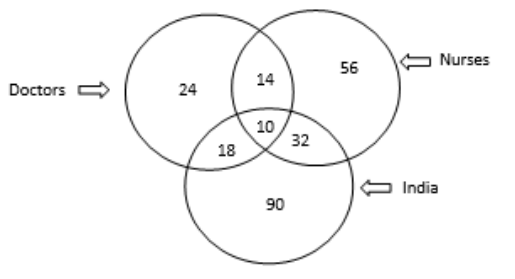
Study the given diagram carefully and answer the question. The numbers in different sections indicate the number of persons.

How many such nurses are there who are from India but are NOT doctors?

  1. AOption (a)

    42

  2. BOption (b)

    28

  3. COption (c)

    32

  4. DOption (d)

    24

View answer & explanation

Correct answer

Answer: (c)C.

32

Why this answer is correct

According to the given information:

The shaded part represents such nurses are there who are from India but are NOT doctors.

So, such nurses are there who are from India but are NOT doctors = 32

Hence, the correct answer is "32".

Question 13

Brahma Kamal is the state flower of which state?

  1. AOption (a)

    Tripura

  2. BOption (b)

    Himachal Pradesh

  3. COption (c)

    Sikkim

  4. DOption (d)

    Uttarakhand

View answer & explanation

Correct answer

Answer: (d)D.

Uttarakhand

Why this answer is correct

The correct answer is Uttarakhand

Key Points

  • Brahma Kamal is the state flower of Uttarakhand.
  • The Scientific name of flower is Saussurea obvallata.
  • It is Considered sacred by Hindus and used in religious ceremonies.
  • Also highly valued in Tibetan medicine and Ayurveda for its healing properties.
  • The flower was declared the state flower after the creation of Uttarakhand in 2007.
  • It is also known as the "King of Himalayan Flowers".

Additional Information Uttarakhand​

  • Foundation Day: 9 November 2000 (carved out from Uttar Pradesh on this date and became the 27th state of the Republic of India).
  • Capital: Gairsain(Summer), Dehradun( Winter).
  • State Animal: Alpine Musk Deer.
  • State Bird: Himalayan Monal.
  • State Tree: Buransh.
  • State Flower: Brahma Kamal.
  • Hindi, Garhwali, Jaunsari, and Kumaoni are the principal languages of Uttarakhand.
  • Uttarakhand is the only state in India that has Sanskrit as one of its official languages.
  • Govind Vallabh Pant Agriculture University is the first Agricultural University in India.
  • India's first engineering college was set up at Roorkee.
  • Central Buiding Research Institute is situated at Roorkee.
  • Lal Bahadur Sastri National Academy of Administration is situated at Mussoorie.
  • Indian Military Academy is situated at Dehradun.
  • Central Forest Research Institute is situated at Dehradun.
  • Wild Life Institue of India is situated at Dehradun.
  • University of Petroleum and Energy Studies is situated at Dehradun.
  • The high court of Uttarakhand is situated in Nainital.
  • The biggest optical telescope (ARIES) in Asia is situated in Uttarakhand.
  • Thunganath temple is the world's highest Shiva temple.
  • Haridwar (Gateway of God) is the venue of Kumbhamela held after every 12 years​

Important Points

  • Uttarakhand is known as the 'Land of Gods'.
  • Pithoragarh is known as Mini Kashmir of Uttarakhand.
  • Rishikesh is known as the 'Yoga Capital of the World'.
  • Mussoorie is known as the 'Queen of hill stations in India.
  • Nainital is known as the 'Lake District of India'.
  • Dehradun is known as the 'City of Schools' and 'School Capital of India'.
  • Uttarakhand is known as the 'Valley of Flowers'.

Question 14

After two successive discounts, a tie with a list price of ₹120 is available at ₹90. If the second discount is 9%. , what is the first discount percentage? [Give your answer correct to 2 places of decimal.] 

  1. AOption (a)

    63.33%

  2. BOption (b)

    84.42%

  3. COption (c)

    17.58%

  4. DOption (d)

    71.58%

View answer & explanation

Correct answer

Answer: (c)C.

17.58%

Why this answer is correct

Shortcut Trick

Let the First Discount percentage be x%.

Final Price = List Price × (100 − x)/100 × (100 − 9)/100.

90 = 120 × (100 − x)/100 × 91/100.

90000 = 120 × (100 − x) × 0.91 ⇒ 100 − x = 9000 ÷ (12 × 0.91) ≈ 82.417.

x = 100 − 82.417 = 17.583%.

∴ The correct answer is 17.58%.

Alternate Method

Given → List Price (MP) = ₹120, Final Selling Price (SP) = ₹90, Second Discount (d2) = 9%. Formulas: Price after first discount = MP × (100 − d1)/100 | Final SP = Price after first discount × (100 − d2)/100.

⇒ Let the price before the 9% discount be 'P'. ⇒ P × (100 − 9)/100 = 90 ⇒ P × 91/100 = 90. ⇒ P = 9000 ÷ 91 ≈ ₹98.901. ⇒ First Discount Amount = List Price − P = 120 − 98.901 = ₹21.099. ⇒ First Discount % = (21.099 ÷ 120) × 100 ≈ 17.5825%. ∴ The correct answer is 17.58%.

Additional Information

Successive Discounts

The order of applying successive discounts does not change the final selling price.

Effective Discount Formula

For two discounts a% and b%, Total Discount = a + b − (ab ÷ 100)%.

Question 15

Is there a visible difference between sperms which contain X chromosomes and sperms which contain Y chromosomes?

  1. AOption (a)

    Yes, the Y-containing sperms are more motile.

  2. BOption (b)

    Yes, the X-containing sperms are larger.

  3. COption (c)

    No, there is no difference in size but there is difference in motility

  4. DOption (d)

    No, there is no difference in size or motility.

View answer & explanation

Correct answer

Answer: (d)D.

No, there is no difference in size or motility.

Why this answer is correct

The correct answer is No there is no difference in size or motility

Key Points

  • No, there is no visible difference in size or motility between sperm that contain X chromosomes and sperm that contain Y chromosomes
  • Recent studies suggest that there are no major differences in the size or shape of X and Y sperm.
  • However, some early studies reported morphological differences using phase-contrast microscopy.
  • The only difference between X and Y sperm is their DNA content.
  • X chromosomes are larger than Y chromosomes and contain more genes, which can produce different proteins.

Additional Information

  • Chromosomes are thread-like structures located inside the nucleus of animal and plant cells.
  • Each chromosome is made of protein and a single molecule of deoxyribonucleic acid (DNA).
  • Passed from parents to offspring, DNA contains the specific instructions that make each type of living creature unique.
  • In humans, each cell normally contains 23 pairs of chromosomes, for a total of 46.
  • Twenty-two of these pairs, called autosomes, look the same in both males and females.
  • The 23rd pair, the sex chromosomes, differ between males and females.
  • Females have two copies of the X chromosome, while males have one X and one Y chromosome.

Question 16

Three statements are given followed by two conclusions numbered I and II. You have to take the statements to be true, even if they seem to be at variance with commonly known facts and decide which of the conclusions logically follow(s) from the statements.

Statements:

All Locks are Blocks.

Some Blocks are Toys.

Some Toys are Dolls.

Conclusions:

(I) Some Locks are Toys.

(II) Some Blocks are Dolls.

  1. AOption (a)

    Both conclusions (I) and (II) follow.

  2. BOption (b)

    Only conclusion (II) follows.

  3. COption (c)

    Only conclusion (I) follows.

  4. DOption (d)

    Neither conclusion (I) nor (II) follows.

View answer & explanation

Correct answer

Answer: (d)D.

Neither conclusion (I) nor (II) follows.

Why this answer is correct

Given Statements:

All Locks are Blocks.

Some Blocks are Toys.

Some Toys are Dolls.

The least possible Venn diagram is as follows:

Conclusions:

(I) Some Locks are Toys. - False (because there is no direct relation between locks and toys so it can be possible but not definite)

(II) Some Blocks are Dolls. - False (because there is no direct relation between blocks and dolls so it can be possible but not definite)

Hence, the correct answer is "Neither conclusion (I) nor (II) follows".

Question 17

Three numbers are in the ratio 3 ∶ 5 ∶ 7 and their LCM is 5250 . What is the middle number?

  1. AOption (a)

    350

  2. BOption (b)

    200

  3. COption (c)

    250

  4. DOption (d)

    150

View answer & explanation

Correct answer

Answer: (c)C.

250

Why this answer is correct

Shortcut Trick

Ratio of numbers = 3 : 5 : 7

Since 3, 5, and 7 are co-prime numbers, their LCM = 3 × 5 × 7 × HCF

105 × HCF = 5250 ⇒ HCF = 50

Middle number = 5 × 50 = 250

∴ The correct answer is 250.

Alternate Method

Given: Ratio = 3 : 5 : 7, LCM = 5250

Let the common factor (HCF) be x.

⇒ Numbers are 3x, 5x, and 7x.

⇒ LCM of 3, 5, and 7 = 105

⇒ LCM of 3x, 5x, 7x = 105x

⇒ 105x = 5250

⇒ x = 5250 ÷ 105

⇒ x = 50

⇒ Middle number = 5x = 5 × 50 = 250

∴ The correct answer is 250.

Additional Information

LCM and HCF Relationship

For two numbers a and b, Product of numbers (a × b) = LCM × HCF.

Co-prime Numbers

If numbers are co-prime, their HCF is 1 and their LCM is simply the product of the numbers.

Ratio and LCM

If the ratio of n numbers is a:b:c... and their HCF is x, then their LCM is (LCM of a,b,c...) × x.

Question 18

Select the option that is related to the fifth number in the same way as the second number is related to the first number and the fourth number is related to the third number.

7 ∶ 56 ∶∶ 5 ∶ 30 ∶∶ 9 ∶ ?

  1. AOption (a)

    101

  2. BOption (b)

    86

  3. COption (c)

    81

  4. DOption (d)

    90

View answer & explanation

Correct answer

Answer: (d)D.

90

Why this answer is correct

The logic followed here is:

Logic: 1st number × (1st number + 1) = 2nd number.

Now,

For, 7 : 56

⇒ 7 × (7 + 1) = 7 × 8 = 56.

For, 5 : 30

⇒ 5 × (5 + 1) = 5 × 6 = 30.

Similarly, for 9 ∶ ?

⇒ 9 × (9 + 1) = 9 × 10 = 90.

Hence, the correct answer is "Option 4".

Question 19

Solung celebrated on September 1 every year is the most popular festival of Adi Tribe of which state?

  1. AOption (a)

    Tripura

  2. BOption (b)

    Meghalaya

  3. COption (c)

    Arunachal Pradesh

  4. DOption (d)

    Sikkim

View answer & explanation

Correct answer

Answer: (c)C.

Arunachal Pradesh

Why this answer is correct

The correct answer is Arunachal Pradesh.

Key Points

  • Solung Festival
  • ​The Adis of Arunachal Pradesh celebrate Solung, their most well-known festival, on September 1 every year, after the sowing of seeds in order to pray for prosperity and a successful harvest.
  • It is primarily an agricultural celebration but exhibits the socio-religious characteristics of the populace.
  • Additionally, tribal people trade presents of meat and apong (rice beer).
  • Attending this festival is the best method to learn about the culture and socioeconomic importance of the Adi tribe.

Additional Information

  • The celebration of this solung festival consists of three primary components. As follows:
  • The main inaugural day, known as Sopi-Yekpi or Ardo-Bado, is when pigs and mithuns are sacrificed and offered to Dadi Bote, the god of domestic animals.
  • Binyat is the second half of the festival, during which the goddess of crops and food, Kine Nane, is worshipped.
  • During the festival's last phase, Ekop or Taktor, Miri, the singer leader, tells the story of Nibo or Abotani, the Tanis' forefather.

Question 20

Which set of statements is true about the river Ganga?

  1. The Ganga rises in the Gangotri glacier near Gaumukh. Here, it is known as the Bhagirathi.
  2. At Devprayag, the Bhagirathi meets the Alaknanda; hereafter, it is known as the Ganga.
  3. The Alaknanda has its source in the Satopanth glacier above Kedarnath.
  4. The Ganga enters the plains at Haridwar
  1. AOption (a)

    1, 3 and 4

  2. BOption (b)

    2, 3 and 4

  3. COption (c)

    1, 2 and 4

  4. DOption (d)

    1, 2 and 3

View answer & explanation

Correct answer

Answer: (c)C.

1, 2 and 4

Why this answer is correct

The correct answer is 1, 2 and 4

Key Points

  • The Ganga rises in the Gangotri glacier near Gaumukh. Here, it is known as the Bhagirathi.
  • This statement is True.
  • The Bhagirathi River originates from the Gangotri glacier at a place called Gaumukh in the Uttarkashi district of Uttarakhand.
  • Initially, the Ganga is called the Bhagirathi before it meets the Alaknanda.
  • At Devprayag, the Bhagirathi meets the Alaknanda; hereafter, it is known as the Ganga.
  • ​This statement is True.
  • At Devprayag, the Bhagirathi (considered the main stream) meets the Alaknanda River.
  • From this confluence, the river is officially named the Ganga.
  • Devprayag is an important pilgrimage site because of this union.
  • The Alaknanda has its source in the Satopanth glacier above Kedarnath.
  • This statement is False.
  • While it is correct that the Alaknanda originates from the Satopanth glacier, this glacier is located near Badrinath, not Kedarnath.
  • Kedarnath is associated with the Mandakini River, which is a tributary of the Alaknanda.
  • Therefore, this part of the statement is incorrect.
  • The Ganga enters the plains at Haridwar.
  • This statement is also True.
  • The Ganga exits the Himalayan region and enters the Indo-Gangetic plains at Haridwar, Uttarakhand.
  • Haridwar is a significant spiritual and cultural hub in India because of this transition of the river.
  • Hence Statements 1, 2, and 4 are correct.

Additional Information

River Ganga

  • It originates in the Himalaya Mountains at Gomukh, the terminus of the Gongotri Glacier.
  • Here, it is known as the Bhagirathi.
  • It cuts through the Central and the Lesser Himalayas in narrow gorges.
  • At Devprayag, the Bhagirathi meets the Alaknanda; hereafter, it is known as the Ganga.
  • The river has a length of 2,525 km.
  • It is shared by Uttarakhand (110 km) and Uttar Pradesh (1,450 km), Bihar (445 km) and West Bengal (520 km).
  • The river finally discharges itself into the Bay of Bengal near Sagar Island.
  • Left tributaries: Gomti, Ghaghara, Gandak, Burhi Gandak, Koshi, Mahananda, Ramganga, Garra.
  • Right tributaries: Yamuna, Sone, Punpun, Damodar.

Question 21

Study the given letter series and answer the question that follows.

(Left) K L A P A P S T U D A Q R T S X B Y (Right)

How many such consonants are there each of which is immediately preceded by a vowel and also immediately followed by a vowel?

  1. AOption (a)

    3

  2. BOption (b)

    4

  3. COption (c)

    2

  4. DOption (d)

    6

View answer & explanation

Correct answer

Answer: (c)C.

2

Why this answer is correct

Given series:

K L A P A P S T U D A Q R T S X B Y

Condition to be checked:

  1. Consonants which are immediately preceded by a vowel.
  2. Consonants which are immediately followed by a vowel.

Vowel → Consonant → Vowel

K L A P A P S T U D A Q R T S X B Y

Thus, there are two such consonants (P and D) that are immediately preceded by a vowel and immediately followed by a vowel.

Hence, "2" is the correct answer.

Mistake Points

Immediately preceded by means immediately before or to come just before.

Immediately followed by means immediately after or to come just after.

Question 22

Study the given line-graph and answer the question that follows.

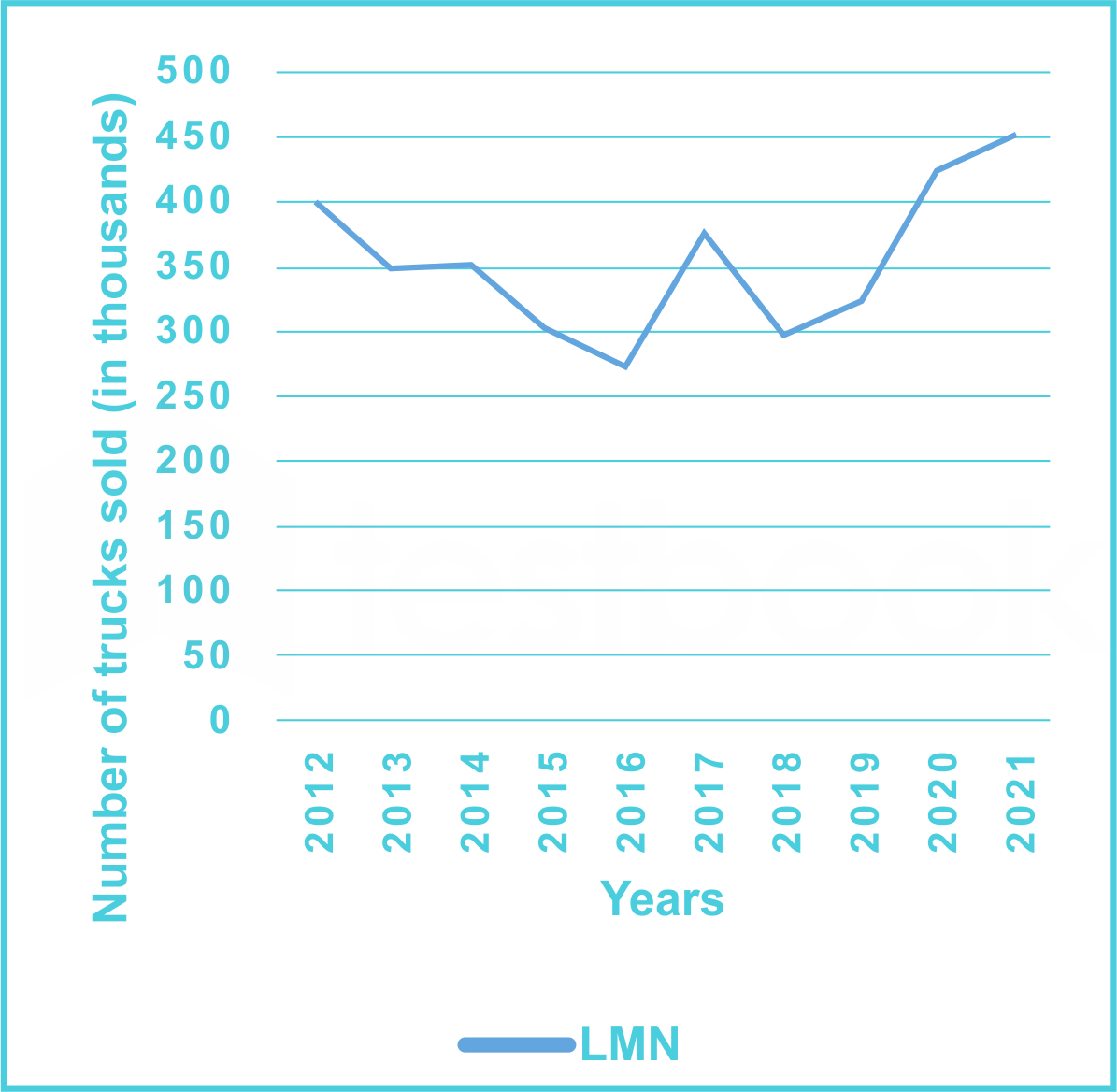
The line-graph shows the number of trucks sold (in thousands) by company LMN over the years.

What is the ratio of total trucks sold in 2012, 2013, 2014 and 2015 to the trucks sold in 2016, 2017, 2018 and 2020?

  1. AOption (a)

    56 ∶ 55

  2. BOption (b)

    55 ∶ 56

  3. COption (c)

    51 ∶ 50

  4. DOption (d)

    50 ∶ 51

View answer & explanation

Correct answer

Answer: (a)A.

56 ∶ 55

Why this answer is correct

Given:

Number of trucks sold by LMN (in thousands):

2012: 400

2013: 350

2014: 300

2015: 350

2016: 300

2017: 350

2018: 300

2020: 400

Formula used:

Ratio = (Trucks sold in 2012 + 2013 + 2014 + 2015) : (Trucks sold in 2016 + 2017 + 2018 + 2020)

Calculation:

Trucks sold in 2012, 2013, 2014, and 2015:

⇒ 400 + 350 + 300 + 350 = 1400

Trucks sold in 2016, 2017, 2018, and 2020:

⇒ 300 + 350 + 300 + 400 = 1350

Ratio:

⇒ 1400 : 1350

⇒ 14001350=5655\frac{1400}{1350} = \frac{56}{55}

∴ The correct answer is option (1) 56 ∶ 55.

Question 23

As per National Mineral Inventory data 2015, which state of India has the highest reserves of gold ore (primary)?

  1. AOption (a)

    Maharashtra

  2. BOption (b)

    Karnataka

  3. COption (c)

    Andhra Pradesh

  4. DOption (d)

    Bihar

View answer & explanation

Correct answer

Answer: (d)D.

Bihar

Why this answer is correct

The correct answer is Bihar.

Key Points

  • As per National Mineral Inventory data, the total reserves/resources of gold ore (primary) in the country have been estimated at 501.83 million tonnes.
  • In India, largest resources of gold ore (primary) are located in Bihar (44%) followed by Rajasthan (25%), Karnataka (21%), West Bengal (3%), Andhra Pradesh (3% ), Jharkhand (2 %).
  • The remaining 2% resources of ore are located in Chhattisgarh, Madhya Pradesh, Kerala, Maharashtra, and Tamil Nadu.
  • Cost of extraction of any mineral including gold vary from mine to mine.

Additional Information

  • Karnataka is the largest producer of gold in India.
  • Karnataka was the leading producer of primary gold accounting for 99% of the total production.
  • The remaining production was reported from Jharkhand.
  • Kolar gold fields and Hutti goldfields are the two major goldfields located in Karnataka.
  • Karnataka has the only operational gold mine in India.
  • Hutti Gold Mines is the only producer of primary gold in the country.
  • Hutti Gold Mines has the capacity to produce 5,50,000 tonnes per annum.
  • Hutti Gold Mine is one of the most ancient metal mines in the world.
  • Kolar gold fields closed on 28 February 2001 due to a fall in gold prices.

Question 24

Sonal was returning from her coaching class one evening just before sunset. She was waiting for the bus at a square, where she met her friend Shalini coming from the front. At that time, Shalini's shadow was directly falling on Sonal. In which direction was Shalini facing towards?

  1. AOption (a)

    South

  2. BOption (b)

    North

  3. COption (c)

    West

  4. DOption (d)

    East

View answer & explanation

Correct answer

Answer: (d)D.

East

Why this answer is correct

According to the given information:

Shalini's shadow to fall on Sonal, Shalini must have the sun behind her, meaning Shalini is facing east.

The shadow extends westward (opposite the sun).

Thus, Shalini was facing towards East.

Hence, the correct answer is "East".

Question 25

The number of double bonds present in Benzene is _______.

  1. AOption (a)

    three

  2. BOption (b)

    four

  3. COption (c)

    two

  4. DOption (d)

    six

View answer & explanation

Correct answer

Answer: (a)A.

three

Why this answer is correct

The correct answer is three

Key Points

  • The broad family of chemical molecules known as aromatic compounds, which includes benzene, has its origins in this substance.
  • In contrast to cyclohexane, benzene only has six hydrogen atoms, which gives the perception that the ring is unsaturated and that each carbon atom is a part of one double bond.
  • For benzene, two distinct configurations with alternating single and double bonds around the ring are possible.
  • There are 9 single bonds and 3 double bonds between alternate carbon atoms in benzene (C6H6).

Additional Information

  • A double bond is formed when the two atoms share two sets of electrons.
  • Electron pair sharing is constant.
  • A shared pair of electrons constitutes a covalent bond.
  • Because the two atoms sharing a double bond share four electrons, it takes more energy to break a double bond than a single one.

Question 26

Which of the following options is the closest approximate value which will come in place of the question mark (?) in the following equation?

75.02 ÷ 16.89 × 13.47 + 749.98 - 79.29 = ?

  1. AOption (a)

    532

  2. BOption (b)

    622

  3. COption (c)

    795

  4. DOption (d)

    727

View answer & explanation

Correct answer

Answer: (d)D.

727

Why this answer is correct

Given:

75.02 ÷ 16.89 × 13.47 + 749.98 - 79.29 = ?

Formula used:

BODMAS

Calculation:

75.02 ÷ 16.89 × 13.47 + 749.98 - 79.29 = ?

⇒ 4.44 × 13.47 + 749.98 - 79.29

⇒ 59.83 + 749.98 - 79.29

⇒ 809.81 - 79.29

⇒ 730.52

∴ The correct answer is option (4).

Question 27

If an image formed after reflection from a mirror is virtual and highly diminished, then the position of the object and type of mirror is:

  1. AOption (a)

    Between C and F and concave mirror

  2. BOption (b)

    infinity and concave mirror

  3. COption (c)

    infinity and convex mirror

  4. DOption (d)

    centre of curvature and concave mirror

View answer & explanation

Correct answer

Answer: (c)C.

infinity and convex mirror

Why this answer is correct

The correct answer is infinity and convex mirror

Key Points

  • A virtual image cannot be obtained on a screen and appears to be formed on the same side of the mirror as the object.
  • A highly diminished image means the image is much smaller in size compared to the object.
  • A convex mirror always forms a virtual, erect, and diminished image regardless of the position of the object.
  • A concave mirror can form a virtual image, but this happens only when the object is between the focus (F) and the pole (P).
  • However, the image in this case would be magnified, not diminished.
  • For a convex mirror, if the object is at infinity, the image is formed at the focus and is virtual and highly diminished.
  • Thus, a convex mirror with the object at infinity forms a virtual and highly diminished image.

Additional Information

  • Convex mirror:

  • A spherical mirror whose reflecting surface is curved outwards, is called a convex mirror.

  • The nature of the image formed by a convex mirror does not depend on the distance of the object from the mirror.

  • Convex mirror always forms a virtual, erect and diminished image of the object placed at any position in front of the mirror.

  • Convex mirror is also known as a diverging mirror.

  • Convex mirrors are commonly used as rear-view (wing) mirrors in vehicles.

  • These mirrors are fitted on the sides of the vehicle, enabling the driver to see traffic behind him/her to facilitate safe driving.

  • Concave mirror:

  • A spherical mirror, whose reflecting surface is curved inwards, that is, faces towards the center of the sphere, is called a concave mirror.

  • A concave mirror is also known as a converging mirror.

  • Depending on the point of the object:

  • The image may be real or virtual.

  • image may be erect or inverted.

  • image may be magnified or diminished.

  • Concave mirrors are commonly used in shaving mirrors, torches, search lights and vehicle headlights to get powerful parallel beams of light.

Question 28

The famous Majuli island is located on which river?

  1. AOption (a)

    Godavari

  2. BOption (b)

    Brahmaputra

  3. COption (c)

    Indus

  4. DOption (d)

    Ganga

View answer & explanation

Correct answer

Answer: (b)B.

Brahmaputra

Why this answer is correct

The correct answer is Brahmaputra.

Key Points

  • Majuli is a large river island situated in the middle of the Brahmaputra River in Assam.
  • Majuli is depicted as the largest river island in the world.
  • This island has been formed over a period of time due to the change of direction and area of the Brahmaputra river and its tributaries especially the Lohit river.
  • Majuli can also be called the 'cultural capital of Assam'.
  • Majuli is located in the northern part of the Jorhat district and is separated from the mainland by the Brahmaputra river.

Additional Information

  • Brahmaputra River flows through Tibet, India and Bangladesh.
  • The Brahmaputra rises in the north of the Himalayas near Lake Mansarovar in the Purang district of Tibet, where it is known as the Yarlung Tsangpo.
  • Flowing in Tibet, this river enters the Indian state of Arunachal Pradesh.
  • Flowing in the valley of Assam, it is called the Brahmaputra, and then it is called Jamuna as soon as it enters Bangladesh.​

Question 29

What is non-tax revenue?

  1. AOption (a)

    Income earned by the government through the public sector units only

  2. BOption (b)

    Any liabilities for the government

  3. COption (c)

    Financial help in the form of grants, gifts from foreign governments and international organisations

  4. DOption (d)

    Recurring income earned by the government from sources other than taxes

View answer & explanation

Correct answer

Answer: (d)D.

Recurring income earned by the government from sources other than taxes

Why this answer is correct

The correct answer is Recurring income earned by the government from sources other than taxes

Key Points

  • Non-tax revenue refers to the Recurring income earned by the government from sources other than taxes .
  • This includes:
  • Fees and fines collected by the government.
  • Profits from public sector enterprises.
  • Dividends and interest received from investments.
  • Charges for services like water supply, electricity, and railways.
  • Income from government-owned assets, such as rent and royalties on natural resources.
  • Grants and donations from foreign governments and international organizations.
  • It is a part of revenue receipts, which are the inflows of funds to the government from all sources.
  • The approximations of non-tax revenue receipts from a range of sources, including interest, fees, fines, and other miscellaneous receipts collected during the exercise of sovereign functions, regulatory and license fees, and user fees for goods and services made available to the public.

Additional Information

  • Revenue receipt refers to the income received by the government in the normal course of its business activities, such as taxes, duties, fees, and other charges.
  • GST (Goods and Services Tax) is a tax levied on the supply of goods and services in India.
  • It is a revenue receipt for the government, as it is collected on behalf of the government by the businesses that are registered under GST.
  • Receipts from sale of shares of public sector companies is a capital receipt as it involves the sale of assets.
  • Recovery of loans is also a capital receipt as it involves the recovery of loans given by the government.
  • Borrowings from public is a capital receipt as it involves the borrowing of funds by the government from the public.
  • Capital receipts are those that either increase the government's liabilities or lower the value of its assets.
  • In essence, these are the loans that the government has obtained from a variety of sources to pay for long-term developmental requirements.
  • They are non-recurring in nature.

Question 30

Which continent will suffer the most from global warming in terms of the number of people affected?

  1. AOption (a)

    North America; Arctic ice melt

  2. BOption (b)

    Europe; urban flooding

  3. COption (c)

    Asia; oceans will rise

  4. DOption (d)

    Antarctica; ocean warming

View answer & explanation

Correct answer

Answer: (c)C.

Asia; oceans will rise

Why this answer is correct

The correct answer is Asia; oceans will rise

Key Points

  • Asia is the continent most likely to suffer the most significant effects of global warming in terms of the number of people affected due to the following reasons:
  • Asia has densely populated coastal areas, including major cities such as Mumbai, Jakarta, Shanghai, and Dhaka.
  • Rising sea levels threaten to displace millions of people in these regions.
  • Asia experiences frequent cyclones, monsoons, and floods, which are expected to become more intense due to global warming.
  • Asia has the largest population of any continent, and a significant portion of this population lives in vulnerable areas, amplifying the number of people affected.
  • Many Asian countries depend on agriculture, which is highly sensitive to changing rainfall patterns, droughts, and temperature extremes caused by climate change.

Additional Information

  • Overview of Continents


No.ContinentArea (in million square kilometres)Area (in million square miles)PopulationNo. of Countries
1Asia44.617.24.6 billion49
2Africa3011.61.3 billion54
3North America24.59.4369 million23
4South America17.86.9431 million12
5Antarctica14.25.51,000-5,000 (seasonal)No Countries
6Europe9.93.8746 million44
7Australia7.7343 million14

Question 31

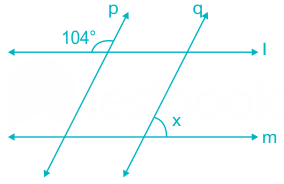
In the given figure, l || m and p || q. The value of x is:

  1. AOption (a)

    82°

  2. BOption (b)

    76°

  3. COption (c)

    104°

  4. DOption (d)

    96°

View answer & explanation

Correct answer

Answer: (b)B.

76°

Why this answer is correct

  • Wait, the prompt says "Always pick the best exam-oriented shortcut available for the question type."

  • For parallel lines, the shortcut is simply 180−given angle180 - \text{given angle} if they are supplementary.

  • SVG Construction (refined):

  • `

`

  • Wait, the angle 104∘104^\circ and xx are usually shown in a specific way. If 104∘104^\circ is the obtuse angle at the bottom intersection and xx is the acute angle at the top intersection on the same transversal, they are co-interior.

  • x+104=180  ⟹  x=76x + 104 = 180 \implies x = 76.

  • Final check on "co_index": Option (2) is 76∘76^\circ. Correct.

  • Final check on "No LaTeX": I will use plain HTML for x+104=180x + 104 = 180.

  • Final check on "Bold keywords": parallel lines, transversal, consecutive interior angles, supplementary, parallelogram.

  • Final check on "Section headers":

  • Shortcut Trick header: Correct.

  • Alternate Method header: Correct.

  • Additional Information header: Correct.

  • Final check on "No divider": Correct.

  • Final check on "Raw HTML only": Correct.

  • Final check on "No "": Correct.

  • Final check on "Final answer line rule": Correct.

  • Final check on "Unit in final answer": Correct (76°).

  • Final check on "Option index": Correct (2).

  • One detail: The prompt says "Use × instead of * for multiplication everywhere." and "Use − for −".

  • 180−104=76180 − 104 = 76.

  • One detail: "Always write ONLY this format for every question:

∴ The correct answer is [value with unit].

"

  • Value is 76, unit is °.

  • One detail: "NEVER write the words 'Section 1', 'Section 2', 'Section 3' anywhere in the output."

  • One detail: "Always start with this exact header — copy it exactly:" (for Shortcut Trick and Alternate Method).

  • One detail: "Identify 2 to 4 closely related concepts... in Additional Information".

  • One detail: "SVG DRAWINGS: ... keep the SVG code extremely clean, simplified, and lightweight."

  • One detail: "You MUST bold important keywords and phrases... using HTML tags."

  • One detail: "LANGUAGE CONSISTENCY: ... If the question text is in a regional language... you MUST write the solution explanation in that SAME language." (Question is in English, so explanation in English).

  • One detail: "STRICT OUTPUT RULES: ... Never use " anywhere in the output. Use single quotes instead if needed."

  • One detail: "Use ⇒ for ⇒ | ∴ for

Question 32

Which of the following ensures that the air passage does NOT collapse during respiration?

  1. AOption (a)

    Diaphragm

  2. BOption (b)

    Cilia

  3. COption (c)

    Rings of cartilage

  4. DOption (d)

    Mucus

View answer & explanation

Correct answer

Answer: (c)C.

Rings of cartilage

Why this answer is correct

The correct answer is Rings of cartilage

Key Points

  • The rings of cartilage in the trachea ensure that the air passage does not collapse during respiration
  • These are rigid and sturdy, providing structural support and maintaining the open airway, regardless of pressure changes that occur during breathing.
  • These cartilage rings are not complete circles, hence the "C" shape.
  • The open part of the "C" faces towards the back (the esophagus).This allows the esophagus to enlarge into the trachea's area during the swallowing of large food particles.
  • There are typically about 15–20 of these rings in the human trachea, each one being horseshoe-shaped or "C"-shaped rather than a full ring.
  • Each ring is made of hyaline cartilage, a type of connective tissue that is both flexible and resilient.

Additional Information

  • Diaphragm​

  • The diaphragm is a dome-shaped skeletal muscle.

  • It helps in breathing.

  • It forms the roof of the abdominal cavity.

  • The peripheral muscular portion of the diaphragm originates on the xiphoid process of the sternum, inferior six ribs, and their costal cartilages.

  • It has three major openings for the aorta, thoracic duct, and azygous vein.

  • Cilia

  • Cilia works continuously to move the mucus produced by the glands, the mucus traps external particles and thus expels them from the body.

  • Cilia are mobile, tiny, finger-like projections on the surface of airway cells. Cilia line the airways and help move mucus up and out of the lungs.

  • Cilia are about 6 to7 micrometers tall, or roughly a tenth the width of a human hair.

  • Mucus

  • ​Mucus is a slippery fluid that lines many parts of the body, including the mouth, nose, sinuses, lungs, stomach, and intestines.

  • It's also known as phlegm or sputum, especially when it's in the lungs.

  • Mucus is an important part of the immune system

Question 33

Two statement are given below, followed by four conclusions given in the options. Find out which conclusion is true based on the given statements.

Statement: T < P < Q, N < M < S < T

  1. AOption (a)

    Q < S

  2. BOption (b)

    P < N

  3. COption (c)

    P < M

  4. DOption (d)

    N < Q

View answer & explanation

Correct answer

Answer: (d)D.

N < Q

Why this answer is correct

The logic followed here is:

Statement: T < P < Q, N < M < S < T

After combining: N < M < S < T < P < Q

Lets check the option one by one:

Option 1) Q < S → False (As, S < T < P < Q, i.e. Q > S)

Option 2) P < N → False (As, N < M < S < T < P, i.e. P > N)

Option 3) P < M → False (As, M < S < T < P i.e. P > M)

Option 4) N < Q → True (As, N < M < S < T < P < Q, i.e. Q > N)

Hence, the correct answer is "N < Q".

Question 34

Which of the following acts as the deciding factor in the determination of the valency of an atom?

  1. AOption (a)

    Number of electrons in the outermost shell

  2. BOption (b)

    Number of electrons in the L shell

  3. COption (c)

    Number of electrons in the innermost shell

  4. DOption (d)

    Number of electrons in the K shell

View answer & explanation

Correct answer

Answer: (a)A.

Number of electrons in the outermost shell

Why this answer is correct

The correct answer is Number of electrons in the outermost shell

Key Points

  • The number of electrons in an atom's outermost shell, also known as the valence shell, is the deciding factor in determining its valency.
  • Valency, also known as oxidation number, is a measure of how many electrons an element can gain, lose, or share when forming chemical compounds.
  • The number of valence electrons in an atom determines its valency, and the valency in turn determines how an element will bond with other elements.
  • Atoms can share, donate, or accept valence electrons with other atoms to form bonds.

Additional Information

  • Some key characteristics of a valence electron are:
  • For the main group elements, the valence electron exists only in the outermost electron shell.
  • A valence electron can exist in the inner shell of a transition metal.
  • An atom consisting of a closed shell of valence electrons will usually be chemically inert.
  • A valence electron can either absorb or release energy in the form of a photon.
  • Valence electrons also determine the electrical conductivity of an element.

Question 35

Oxides of which of the following elements CANNOT be reduced by H2, CO and C?

  1. AOption (a)

    Fe

  2. BOption (b)

    Ca

  3. COption (c)

    Pb

  4. DOption (d)

    Cu

View answer & explanation

Correct answer

Answer: (b)B.

Ca

Why this answer is correct

The correct answer is Ca

Key Points

  • Calcium is a highly reactive metal, and its oxides (

    Code
      

CaOCaO) are very stable.

  • These oxides **cannot be reduced by

    Code
       H_2H2​, CO, or
    
       CC**
    
  • It is because calcium has a strong affinity for oxygen, requiring electrolysis for reduction.

  • Calcium atomic number is 20

Additional Information

  • Oxides are compounds formed by the reaction of metals, non-metals with oxygen.
  • The types of oxides are:
  • Basic oxide: It is a complex chemical substance oxide, which forms a salt with a chemical reaction with acids or acidic oxides and does not react with bases or basic oxides.
  • E.g. Copper oxide (Cu2O), Magnesium oxide (MgO)
  • Acidic oxide: It is a complex chemical substance oxide, which forms a salt with the chemical reactions with bases or basic oxides and does not react with acidic oxides.
  • E.g. Carbon dioxide (CO2), Silicon dioxide (SiO2)
  • Amphoteric oxide: It is a complex chemical substance, also oxides, which form a salt with the chemical reactions with acids (or acid oxides) and with bases (or basic oxides).
  • E.g. Copper, Zinc, Tin, Lead, Aluminum, and Beryllium.

Question 36

Under which Article of the Constitution of India is the President of India empowered to issue a "Proclamation of Emergency"?

  1. AOption (a)

    Article 352

  2. BOption (b)

    Article 356

  3. COption (c)

    Article 315

  4. DOption (d)

    Article 370

View answer & explanation

Correct answer

Answer: (a)A.

Article 352

Why this answer is correct

The correct answer is Article 352

Key Points

  • The President of India is empowered to issue a Proclamation of Emergency under Article 352 of the Constitution of India
  • The President can declare a national emergency if they are satisfied that India or a part of it is threatened by war, external aggression, or armed rebellion.
  • The President can also declare a national emergency before the actual occurrence of these events if they believe there is an imminent danger.
  • The President cannot declare a war emergency unless the Union cabinet gives them written permission.

Additional Information

  • Article 356
  • Article 356 of the Constitution of India is based on Section 93 of the Government of India Act, 1935.
  • According to Article 356, President’s Rule can be imposed on any state of India on the grounds of the failure of the constitutional machinery.
  • This is of two types:
  • If the President receives a report from the state’s Governor or otherwise is convinced or satisfied that the state’s situation is such that the state government cannot carry on the governance according to the provisions of the Constitution.
  • Article 356: As per this Article, President’s Rule can be imposed if any state fails to comply with all directions given by the Union on matters it is empowered to.
  • Article 315​
  • There shall be a Public Service Commission for the Union and a Public Service Commission for each State.
  • Two or more States may agree that there shall be one Public Service Commission for that group of States, and if a resolution to that effect is passed by the House or, where there are two Houses, by each House of the Legislature of each of those States, Parliament may by law provide for the appointment of a Joint State Public Service Commission to serve the needs of those States.
  • Any such law as aforesaid may contain such incidental and consequential provisions as may be necessary or desirable for giving effect to the purposes of the law.
  • The Public Service Commission for the Union, if requested so to do by the Governor of a State, may, with the approval of the President, agree to serve all or any of the needs of the State.
  • Article 370
  • Article 370 of the Indian Constitution granted special autonomous status to the erstwhile state of Jammu and Kashmir.
  • Article 370 was added to the Indian constitution on October 17, 1949, as a ‘temporary provision’, which exempted Jammu & Kashmir, permitting it to draft its own Constitution and restricting the Indian Parliament’s legislative powers in the state.
  • Under the article, the Constituent Assembly of Jammu & Kashmir was empowered to recommend which articles of the Indian Constitution should apply to the state.

Question 37

Amongst six friends A, B, C, D, E and F, each has a different height. B is taller than E but shorter than F. Only one person is shorter than C. Only three people are taller than A. E is not the shortest. Who is the tallest among all the friends?

  1. AOption (a)

    F

  2. BOption (b)

    A

  3. COption (c)

    B

  4. DOption (d)

    D

View answer & explanation

Correct answer

Answer: (a)A.

F

Why this answer is correct

Given: Amongst six friends A, B, C, D, E and F, each has a different height.

  1. B is taller than E but shorter than F.

F > B > E

2) E is not the shortest.

  1. Only one person is shorter than C.

F > B > E > C > _

  1. Only three people are taller than A.

F > B > E > A > C > _

Then final arrangement:

F > B > E > A > C > D

So, F is the tallest among all the friends.

Hence, the correct answer is "F".

Question 38

The correct increasing order of metallic character is: 

  1. AOption (a)

    Ge < Zn < Cu < As

  2. BOption (b)

    Ga < Ge < Ca < Sc

  3. COption (c)

    Ge < Ga < Sc < Ca

  4. DOption (d)

    Ge < As < Ga < Ca

View answer & explanation

Correct answer

Answer: (c)C.

Ge < Ga < Sc < Ca

Why this answer is correct

The correct answer is Ge < Ga < Sc < Ca

Key Points

  • Ge and Ga are in the same period (4), with Ga to the left of Ge.
  • Thus, Ga is more metallic than Ge.
  • Sc and Ca are also in period 4.
  • Ca is to the left of Sc, so Ca is more metallic than Sc.
  • Ga and Ge are in group 13 and 14 respectively whereas Sc and Ca are in group 3 and 2 respectively.
  • Elements of group 2 are more metallic than group 3, which are more metallic than group 13 and 14.
  • Thus, both Ca and Sc are more metallic than Ga and Ge.
  • Ge < Ga < Sc < Ca: This is the correct order.

Additional Information

  • The periodic table accommodates a discrete combination of metal, non-metals, and metalloids.
  • The metallic character increases down the group.
  • On moving from left to right in a period, the electrons are added into the same valence shell progressively.
  • The increase in the number of electrons is paralleled by the increase in the number of protons in the nucleus.
  • The effective nuclear charge is increased and the valence shell electrons are pulled strongly by electrostatic attraction.
  • Therefore, it is difficult to give away the valence electrons, the electropositivity is decreased and so the metallic character is also decreased.
  • On moving from top to bottom in a row, the number of valence electrons remains the same but orbitals are added constantly.
  • The effective nuclear charge is decreased due to the screening effect of inner-shell electrons.

Question 39

The 6-digit number 473 xy 5 is divisible by 125 . How many such 6-digit numbers are there?

  1. AOption (a)

    4

  2. BOption (b)

    2

  3. COption (c)

    3

  4. DOption (d)

    1

View answer & explanation

Correct answer

Answer: (a)A.

4

Why this answer is correct

Shortcut Trick

For a number to be divisible by 125, its last three digits must be divisible by 125.

The last three digits of the number 473xy5 are xy5.

Multiples of 125 ending in 5 are 125, 375, 625, 875.

These 4 values correspond to the possible 6-digit numbers.

∴ The correct answer is 4.

Alternate Method

Given: The number is 473xy5 and it is divisible by 125.

Rule: A number is divisible by 125 (53) if and only if the number formed by its last three digits is divisible by 125.

⇒ The last three digits are represented by the form xy5.

⇒ Possible 3-digit multiples of 125 are: 125, 250, 375, 500, 625, 750, 875.

⇒ We filter those ending in the digit 5: 125, 375, 625, 875.

⇒ The numbers are: 473125, 473375, 473625, 473875.

⇒ Total count of such numbers = 4.

∴ The correct answer is 4.

Additional Information

Divisibility Rule of 5n

A number is divisible by 5n if the last n digits of the number are divisible by 5n. For example, for 51 (5), check the last 1 digit; for 52 (25), check the last 2 digits; for 53 (125), check the last 3 digits.

Divisibility by 125

The last three digits of any number divisible by 125 must be 000, 125, 250, 375, 500, 625, 750, or 875.

Question 40

If 2 is a root of the equation x2 - px + 6 = 0 and the quadratic equation x2 + 2px + q = 0 has equal roots, then the value of q is:

  1. AOption (a)

    12

  2. BOption (b)

    16

  3. COption (c)

    25

  4. DOption (d)

    36

View answer & explanation

Correct answer

Answer: (c)C.

25

Why this answer is correct

Shortcut Trick

Substitute x = 2 in x2 − px + 6 = 0 ⇒ 4 − 2p + 6 = 0 ⇒ p = 5.

In x2 + 2px + q = 0, for equal roots, the constant q must be (coefficient of x / 2)2.

Substitute p = 5 ⇒ q = (10/2)2 = 25.

∴ The correct answer is 25.

Alternate Method

Given: One root of x2 − px + 6 = 0 is 2. The equation x2 + 2px + q = 0 has equal roots.

Formula Used: If α is a root of f(x) = 0, then f(α) = 0. For ax2 + bx + c = 0, equal roots occur when discriminant D = b2 − 4ac = 0.

⇒ Substituting x = 2 in x2 − px + 6 = 0:

⇒ 22 − p(2) + 6 = 0

⇒ 4 − 2p + 6 = 0

⇒ 10 − 2p = 0 ⇒ p = 5

⇒ Now, substitute p = 5 in the second equation x2 + 2px + q = 0:

⇒ x2 + 2(5)x + q = 0 ⇒ x2 + 10x + q = 0

⇒ For equal roots, set D = 0:

⇒ 102 − 4 × 1 × q = 0

⇒ 100 − 4q = 0

⇒ 4q = 100 ⇒ q = 25

∴ The correct answer is 25.

Additional Information

Nature of Roots

The nature of roots of ax2 + bx + c = 0 is determined by D = b2 − 4ac. If D > 0 roots are real and distinct; if D = 0 roots are real and equal; if D < 0 roots are complex/imaginary.

Relationship between Roots and Coefficients

For a quadratic equation, the sum of roots is given by −b/a and the product of roots is given by c/a.

Perfect Square Condition

A quadratic equation has equal roots if and only if the quadratic expression is a perfect square of a linear binomial.

Question 41

Carbon compounds that are linked by only a single bond are known as _____.

  1. AOption (a)

    both saturated and unsaturated compounds

  2. BOption (b)

    neither saturated nor unsaturated compounds

  3. COption (c)

    saturated compounds

  4. DOption (d)

    unsaturated compounds

View answer & explanation

Correct answer

Answer: (c)C.

saturated compounds

Why this answer is correct

The correct answer is saturated compounds

Key Points

  • Carbon compounds linked by only a single bond are known as saturated compounds.
  • The **general formula for saturated compounds is CnH2n+**1, where n represents the number of carbon atoms in the compound.
  • Hexane, decane, and octadecane are examples of saturated compounds.
  • Saturated also implies that the compound shall have no multiple carbon-carbon bonds.

Additional Information

  • Carbon compounds that have double or triple bonds between their carbon atoms are called unsaturated compounds.
  • Unsaturated compounds produce a yellow flame with lots of black smoke due to incomplete combustion in the air
  • Unsaturated compounds are made up of carbon and hydrogen atoms, and contain at least one double or triple bond.
  • Examples of unsaturated compounds include ethene (C2H4), benzene (C6H6), propene (C3H6), and butadiene (C4H6).
  • The main types of unsaturated compounds are alkenes, alkynes, and aromatic hydrocarbons:
  • Alkenes: Contain one or more carbon-carbon double bonds
  • Alkynes: Contain one or more carbon-carbon triple bonds
  • Aromatic hydrocarbons: Contain a benzene or aromatic ring in their structure ​

Question 42

Under which Article of the Indian Constitution is there provision that "the Governor of a State shall at the expiration of every fifth year, constitute a Finance Commission to review the financial position of the Panchayats and to make recommendations to him'?

  1. AOption (a)

    243 X

  2. BOption (b)

    243 Y

  3. COption (c)

    243 H

  4. DOption (d)

    243 I

View answer & explanation

Correct answer

Answer: (d)D.

243 I

Why this answer is correct

The correct answer is 243 I

Key Points

  • State Finance Commission is established by the Governer after every five years to look into the financial conditions of Panchayats.
  • Article 243 I of the constitution provides for the establishment of a State Finance Commission.
  • In accordance with article 243 I, the governor of a state shall after every five years constitute a State Finance Commission to review the financial position of panchayats.
  • The state legislature may provide for the composition of the commission.
  • The State Finance Commission makes the following recommendation to the governor:
  • Principles that govern the distribution of taxes, duties, etc. between state and panchayats.
  • Principles that govern the determination of taxes etc. that may be assigned to panchayats.
  • Grants-in-aid to panchayats from the consolidated fund of the state.
  • The governor places recommendations of commission along with the action taken report before the state legislature​

Additional Information

  • Important articles, related to Panchayats are:
  • | Article | Subject-matter | | --- | --- | | 243 | Definitions. | | 243A | Gram Sabha | | 243B | Constitution of Panchayat | | 243C | Composition of Panchayat. | | 243D | Reservation of seats. | | 243E | Duration of panchayats, and so on. | | 243F | Disqualifications of membership. | | 243G | Powers, authority, and responsibilities of panchayats. | | 243H | Power to impose taxes by, and funds of, the panchayats. | | 243-I | Constitution of finance commission to review financial position. | | 243J | Audit of accounts of the panchayat. | | 243K | Elections of Panchayats. | | 243L | Application to union territories. | | 243M | Part not to apply to certain areas. | | 243N | Continuance of existing laws and panchayats. | | 243-O | Bar to interference by courts in electoral matters. |

Question 43

A certain number of people are sitting in a row, facing south. Neha sits fourth to the right of Shilu. Only four people sit between Neha and Kirti. Ram sits to the immediate right of Kirti. Only two persons sit between Kirti and Kunti. Alam sits third to the right of Kunti. If no other person is sitting in the row, what is the total number of persons seated?

  1. AOption (a)

    14

  2. BOption (b)

    12

  3. COption (c)

    18

  4. DOption (d)

    16

View answer & explanation

Correct answer

Answer: (d)D.

16

Why this answer is correct

Given:

A certain number of people are sitting in a row, facing south

Neha sits fourth to the right of Shilu.

Only four people sit between Neha and Kirti

Case 1)

Case 2).

Ram sits to the immediate right of Kirti

Only two persons sit between Kirti and Kunti, Alam sits third to the right of Kunti

Here, case 2 gets eliminated as, Ram cannot seat immediate right to Kirti in case 2.

Alam sits third to the right of Kunti.

So, total number of persons seated in a row is 16.

Hence, the correct answer is "Option 4".

Question 44

_____ is a device used for varying the resistance of an electrical circuit.

  1. AOption (a)

    Voltmeter

  2. BOption (b)

    Ammeter

  3. COption (c)

    Rheostat

  4. DOption (d)

    Galvanometer

View answer & explanation

Correct answer

Answer: (c)C.

Rheostat

Why this answer is correct

The correct answer is Rheostat

Key Points

  • A Rheostat is an adjustable resistor used in applications that require the adjustment of current or the varying of resistance in an electric circuit.
  • Unlike a fixed resistor, a rheostat allows for the manual adjustment of resistance to control current flow.
  • Common applications include light dimmers, motor speed controllers, and adjusting the volume of audio devices.
  • Rheostats are typically constructed with a resistive wire wound around an insulating ceramic core, with a sliding contact that moves along the wire.

Additional Information

  • An Ammeter is used to measure the current in a circuit.
  • A Conductor allows the flow of electric current with minimal resistance.
  • A Voltmeter is used to measure the voltage across two points in a circuit.
  • A galvanometer is one of the instruments for measuring electrical current par excellence.
  • Rheostats are often used in educational settings for experiments and demonstrations involving Ohm's law and other electrical principles.
  • They are crucial components in circuits where variable resistance is required for tuning or calibration purposes.

Question 45

When iron nails come in contact with copper sulphate solution their colour changes to _______.

  1. AOption (a)

    brown

  2. BOption (b)

    red

  3. COption (c)

    blue

  4. DOption (d)

    yellow

View answer & explanation

Correct answer

Answer: (a)A.

brown

Why this answer is correct

The correct answer is brown

Key Points

  • When iron nails come in contact with copper sulphate solution, their color changes to brown
  • The iron nail develops a brown copper coating, and the blue color of the copper sulfate solution fades.
  • This is because iron is more reactive than copper, so it displaces the copper from the copper sulfate.
  • The iron is dissolved in the solution as Fe (II), producing ferrous sulfate FeSO4, which is greenish blue.
  • The copper also displaces deposits around the nail, giving it a reddish brown color.

Additional Information Metal activity series:​

  • The metals are arranged in an activity order that is known as metal activity series.
  • The more active metals are present at the top of the series whereas the less active metals are put at the end of the series.
  • The metal activity series is as follows-

​

  • The metal activity series is used to predict displacement reactions.

Question 46

Seven students, A, B, C, D, E, F and G, are sitting around a circular table facing the centre (but not necessarily in the same order). D is sitting second to the left of C. D is sitting to the immediate right of G. B is sitting third to the left of F. E is sitting to the immediate left of B.

Who among the following is an immediate neighbour of B and D?

  1. AOption (a)

    E

  2. BOption (b)

    G

  3. COption (c)

    F

  4. DOption (d)

    C

View answer & explanation

Correct answer

Answer: (b)B.

G

Why this answer is correct

Given: Seven students, A, B, C, D, E, F and G, are sitting around a circular table facing the centre.

  1. D is sitting second to the left of C.

  2. D is sitting to the immediate right of G.

3) B is sitting third to the left of F.

4) E is sitting to the immediate left of B.

Final arrangement:

So, G is an immediate neighbour of B and D.

Hence, the correct answer is "G".

Question 47

The appearance of a stick at the interface when immersed in water is an example of ________.

  1. AOption (a)

    transmission of light

  2. BOption (b)

    displacement of light

  3. COption (c)

    refraction of light

  4. DOption (d)

    reflection of light

View answer & explanation

Correct answer

Answer: (c)C.

refraction of light

Why this answer is correct

The correct answer is Refraction of light

Key Points 

  • The phenomenon that causes a stick immersed in water to appear bent is known as refraction.
  • Refraction occurs when light travels from one medium (such as air) into another medium (such as water) with a different optical density.
  • The change in density causes the light waves to change speed and direction.
  • When light passes from air into water, it slows down and bends towards the normal (an imaginary line perpendicular to the water's surface).
  • This change in direction is what causes the stick to appear bent when it is partially submerged in water.
  • The light rays from the submerged portion of the stick undergo refraction at the air-water interface, creating the illusion of a bent stick.
  • This phenomenon is a result of the different refractive indices of air and water, which determine how light waves propagate through these mediums

Additional Information

  • Reflection
  • Reflection of Light may be defined as the bouncing back of the light ray by a smooth polished surface.
  • We see objects around us due to this phenomenon of light.
  • Reflection of light occurs through smooth polished surfaces like Plane mirror, Spherical mirrors (concave and convex).
  • The bending of a light ray, when it passes from one medium to another is known as the Refraction of Light.
  • It happens through lenses, prism, etc.
  • Both Reflection and Refraction show the Particle Nature of Light.
  • Displacement
  • ​Light displacement (LDT) is the weight of a ship when it's fully equipped but not carrying any cargo, fuel, water, ballast, stores, passengers, or crew.
  • However, the ship's boilers will contain water at the level needed for steaming.
  • Light displacement is also known as "light weight".
  • It's different from loaded displacement, which is the weight of the ship plus its cargo, passengers, fuel, and stores
  • Transmission
  • ​Light transmission is the process of electromagnetic waves, like visible light, ultraviolet light, or radio waves, passing through a material.
  • The amount of light that can pass through a material is measured as its transmission, which is usually expressed as a percentage.
  • Light transmission can be either directional or diffuse, similar to reflection

Question 48

Which is the second official language of Telangana?

  1. AOption (a)

    Urdu

  2. BOption (b)

    Tulu

  3. COption (c)

    Hindi

  4. DOption (d)

    English

View answer & explanation

Correct answer

Answer: (a)A.

Urdu

Why this answer is correct

The Correct Answer is Urdu.

Key Points

  • Urdu is the 2nd Official language of Telangana.
  • Telugu, one of the traditional languages of India, is the official language of Telangana.
  • 77% of Telangana's population speaks Telugu and 12% speak Urdu.
  • Until 1948, Urdu became the official language of the State of Hyderabad and, due to the shortage of Telugu-language educational establishments, Urdu became the language of the educated class in Telangana.
  • After 1948, when the Hyderabad State entered the new Republic of India, Telugu became the language of government.

Additional Information

  • The primary language of Telangana, Telugu is also an official language of Andhra Pradesh.
  • It is a classical language of India and a member of the Dravidian language family.
  • Telugu is the fourth most spoken language in India, after Hindi, Bengali, and Marathi.
  • Telugu was adopted as a medium of education in schools and colleges, the use of Urdu among non-Hyderabad Muslims decreased.
  • The operation done by Indian armed forces to make Hyderabad the part of India was Operation Polo.

Question 49

An aqueous solution of sodium chloride is known as?

  1. AOption (a)

    Caustic soda

  2. BOption (b)

    lime

  3. COption (c)

    Lime stone

  4. DOption (d)

    brine

View answer & explanation

Correct answer

Answer: (d)D.

brine

Why this answer is correct

The correct answer is brine

Key Points

  • An aqueous solution of sodium chloride is known as brine.
  • Brine is a high-concentration solution of salt in water
  • Brine is a solution of water and salt that can have a concentration ranging from 3.5% to 26%
  • Brine can also be used as a verb to mean treating something by steeping it in brine.

Additional Information

  • Some other facts about brine:
  • Sodium chloride is a soluble ionic compound that conducts electricity when dissolved in water.
  • Brine occurs naturally in salt lakes and the benthic zone of oceans.
  • It occurs due to the evaporation of saline ground water, leaving behind a small amount of water with a high concentration of sodium chloride.
  • The solution is neutral because it contains an equal number of H+ and OH- ions.

Question 50

Rashmika had to travel 612 km in a car travelling at a certain speed. If she reached her destination in 9 hours, find the speed of the car:

  1. AOption (a)

    60 km/h

  2. BOption (b)

    68 km/h

  3. COption (c)

    70 km/h

  4. DOption (d)

    65 km/h

View answer & explanation

Correct answer

Answer: (b)B.

68 km/h

Why this answer is correct

Shortcut Trick

Directly divide the Total Distance by the Total Time to get the Speed.

Speed = 612 ÷ 9 = 68 km/h.

∴ The correct answer is 68 km/h.

Alternate Method

Given:

Total Distance = 612 km

Time Taken = 9 hours

Formula Used:

Speed = Distance ÷ Time

Calculations:

⇒ Speed = 612 ÷ 9

⇒ Speed = 68 km/h

∴ The correct answer is 68 km/h.

Additional Information

Unit Conversion

To convert km/h to m/s, multiply by 5/18. To convert m/s to km/h, multiply by 18/5.

Average Speed

Average Speed = Total Distance ÷ Total Time. For two equal distances at speeds u and v, Average Speed = 2uv/(u+v).

Relative Speed

For objects in opposite directions, add speeds (S1 + S2). for same direction, subtract speeds (S1 − S2).

Question 51

Find the missing value of weight (x) assigned if the weighted average of the data set provided below is 24.5.

ObjectABCD
Value of object1523043
Assigned weight32x1
  1. AOption (a)

    10

  2. BOption (b)

    5

  3. COption (c)

    12

  4. DOption (d)

    4

View answer & explanation

Correct answer

Answer: (a)A.

10

Why this answer is correct

Shortcut Trick

Apply the net deviation method: Sum of (Weight × Deviation from Average) = 0.

Deviations from 24.5: Object A: (15 − 24.5) × 3 = −28.5; Object B: (2 − 24.5) × 2 = −45; Object D: (43 − 24.5) × 1 = +18.5.

Sum of known deviations = −28.5 − 45 + 18.5 = −55.

Deviation for Object C must be +55 to balance: (30 − 24.5) × x = 5.5x.

5.5x = 55 ⇒ x = 55 ÷ 5.5 = 10.

∴ The correct answer is 10.

Alternate Method

Given:

Values of objects (V): 15, 2, 30, 43

Assigned weights (W): 3, 2, x, 1

Weighted Average (μw) = 24.5

Formula Used:

Weighted Average (μw) = Σ(Wi × Vi) / ΣWi

Calculations:

⇒ 24.5 = [(15 × 3) + (2 × 2) + (30 × x) + (43 × 1)] / (3 + 2 + x + 1)

⇒ 24.5 = [45 + 4 + 30x + 43] / (6 + x)

⇒ 24.5 = (92 + 30x) / (6 + x)

⇒ 24.5 × (6 + x) = 92 + 30x

⇒ 147 + 24.5x = 92 + 30x

⇒ 147 − 92 = 30x − 24.5x

⇒ 55 = 5.5x

⇒ x = 55 ÷ 5.5

⇒ x = 10

∴ The correct answer is 10.

Additional Information

Weighted Arithmetic Mean

It is a type of average where certain data points contribute more than others based on their relative importance (weights).

Comparison with Simple Mean

In a simple arithmetic mean, all weights are assumed to be equal (wi = 1). The Weighted Average pulls the mean towards values with higher weights.

General Formula

μw = (w1x1 + w2x2 + ... + wnxn) / (w1 + w2 + ... + wn), where w is weight and x is value.

Question 52

Select the number that will replace the question mark (?) in the given series.

64  343  36  125  16  ?

  1. AOption (a)

    9

  2. BOption (b)

    243

  3. COption (c)

    8

  4. DOption (d)

    27

View answer & explanation

Correct answer

Answer: (d)D.

27

Why this answer is correct

The logic followed here is:

Hence, the correct answer is "27".

Question 53

If 3 is added to each odd digit and 2 is subtracted from each even digit in the number 6452851 , what will be difference between the largest and smallest digits thus formed?

  1. AOption (a)

    2

  2. BOption (b)

    4

  3. COption (c)

    8

  4. DOption (d)

    6

View answer & explanation

Correct answer

Answer: (c)C.

8

Why this answer is correct

Given number → 6452851

If 3 is added to each odd digit and 2 is subtracted from each even digit then,

New number → 4280684

The largest digit in the new number is 8, and the smallest digit is 0.

The difference between the largest and smallest digits is 8 - 0 = 8.

Thus, the correct answer is "8".

Hence, the correct answer is "Option 3".

Question 54

Who among the following won a gold at the IWF Junior World Championships in May 2022?

  1. AOption (a)

    Archita Sherali

  2. BOption (b)

    Anjali Patel

  3. COption (c)

    Mirabai Chanu

  4. DOption (d)

    Harshada Sharad

View answer & explanation

Correct answer

Answer: (d)D.

Harshada Sharad

Why this answer is correct

The correct answer is Harshada Sharad 

Key Points 

  • In Weightlifting, Harshada Sharad Garud scripted history by becoming the first Indian to win a gold medal at the IWF Junior World Championships at Heraklion in Greece on 2 May 2022.
  • She lifted 153-kilogram in the 45-kilogram weight category, which included 70 kilograms in Snatch.
  • Turkey's Bektas Cansu bagged the silver medal while Moldova's Teodora-Luminita Hincu won the bronze medal.

Additional Information

  • Mirabai Chanu​
  • Saikhom Mirabai Chanu is an Indian weightlifter.
  • She has won the World Championships and multiple medals at the Commonwealth Games.
  • She won India's first medal at the Tokyo Olympics, winning a silver medal in 49kg weightlifting with a total lift of 202 kg.
  • She belongs to Imphal, Manipur.
  • She was conferred the Khel Ratna for the year 2018.
  • Major achievements of Mirabai Chanu :
  • Silver in Tokyo Olympics (49kg)
  • Bronze in 2020 Tashkent Asian Championships (49 kg)
  • Gold in 2018 Gold Coast Commonwealth Games (48 kg)
  • Gold in 2017 Anaheim World Championships (48 kg)
  • Silver in 2014 Glasgow Commonwealth Games (48 kg)

Question 55

If p sin2 β + q cos2 β = r, then the value of cot2 β is:

  1. AOption (a)

    p−rr−q\frac{p-r}{r-q}

  2. BOption (b)

    r−qr−p\frac{r-q}{r-p}

  3. COption (c)

    r−pr−q \frac{r-p}{r-q}

  4. DOption (d)

    r−qp−r\frac{r-q}{p-r}

View answer & explanation

Correct answer

Answer: (a)A.

p−rr−q\frac{p-r}{r-q}

Why this answer is correct

Shortcut Trick

Divide the entire equation by sin2β to introduce cot2β directly.

p + q cot2β = r cosec2β

p + q cot2β = r(1 + cot2β) ⇒ p + q cot2β = r + r cot2β

p − r = cot2β(r − q) ⇒ cot2β = (p − r) / (r − q)

∴ The correct answer is (p-r)/(r-q).

Alternate Method

Given: p sin2β + q cos2β = r

Formula Used: sin2β + cos2β = 1 ⇒ sin2β = 1 − cos2β

⇒ p(1 − cos2β) + q cos2β = r

⇒ p − p cos2β + q cos2β = r

⇒ (q − p) cos2β = r − p ⇒ cos2β = (r − p) / (q − p)

⇒ Since sin2β = 1 − cos2β = 1 − [(r − p) / (q − p)] = (q − p − r + p) / (q − p) = (q − r) / (q − p)

⇒ cot2β = cos2β / sin2β = [(r − p) / (q − p)] / [(q − r) / (q − p)]

⇒ cot2β = (r − p) / (q − r) = −(p − r) / −(r − q) = (p − r) / (r − q)

∴ The correct answer is (p-r)/(r-q).

Additional Information

Trigonometric Identities

Fundamental identities include sin2θ + cos2θ = 1, 1 + tan2θ = sec2θ, and 1 + cot2θ = cosec2θ.

Ratio Definitions

cot θ is defined as the ratio of cos θ to sin θ or the reciprocal of tan θ.

Transformation Tip

To find cot θ from an equation containing sin θ and cos θ, dividing by sin θ is usually the fastest route.

Question 56

In the word 'CLIPBOARD', if each vowel is changed to the letter immediately following it and each consonant is changed to the letter immediately preceding it in the English alphabetical order, then how many vowels will be there in the group of letters thus formed?

  1. AOption (a)

    Two

  2. BOption (b)

    Three

  3. COption (c)

    One

  4. DOption (d)

    Four

View answer & explanation

Correct answer

Answer: (a)A.

Two

Why this answer is correct

The alphabets and their positions are:

According to the given statements, we will get,

Given WordCLIPBOARD
Each vowel +1 Each consonant - 1BKJOAPBQC


Thus, there are only Two vowels in the group of the letters formed.

Hence, the correct answer is "Two".

Question 57

A concave lens of focal length 30 cm forms an image of an object placed at 60 cm from it. The position and nature of the image formed will be:

  1. AOption (a)

    -20 cm, real and inverted

  2. BOption (b)

    20 cm, real and Inverted

  3. COption (c)

    -20 cm, virtual and erect

  4. DOption (d)

    20 cm, virtual and erect

View answer & explanation

Correct answer

Answer: (c)C.

-20 cm, virtual and erect

Why this answer is correct

The correct answer is -20 cm, virtual and erect

Key Points

  • Given:
  • Focal length of concave lens (f) = -30 cm (Focal length of a concave lens is always negative)
  • Object distance (u) = -60 cm (Object distance is always negative)
  • Using the lens formula:
  • 1/f = 1/v - 1/u
  • Where:
  • f = focal length
  • v = image distance
  • u = object distance
  • Substituting the given values:
  • 1/(-30) = 1/v - 1/(-60)
  • -1/30 = 1/v + 1/60
  • 1/v = -1/30 - 1/60
  • 1/v = (-2 - 1)/60
  • 1/v = -3/60
  • 1/v = -1/20
  • v = -20 cm
  • The negative sign of v indicates that the image is formed on the same side as the object.
  • Since it's a concave lens, the image formed is virtual and erect.

Additional Information

  • Difference between Concave and Convex Lens


Concave LensConvex Lens
The light is spread out by a diverging lens.The refracted rays are converged by a converging lens.
Thinner in the centre than at the edges.Thicker in the centre than at the edges.
The image is on one side of the lens, while the object is on the other.The object and the image are both on the same side of the lens.
The focal length is positive.The focal length is negative.
The image will be erect, virtual, and diminished.The resultant image will be both real and inverted.
Eyeglasses for myopia (nearsightedness)Eyeglasses for hyperopia (farsightedness), magnifying glasses
Applications include correcting nearsightedness, creating virtual imagesApplications include correcting farsightedness, magnification, projectors

Question 58

Find the average of 12, 15, 16, 17, 23 and 19.

  1. AOption (a)

    13

  2. BOption (b)

    18

  3. COption (c)

    17

  4. DOption (d)

    15

View answer & explanation

Correct answer

Answer: (c)C.

17

Why this answer is correct

Shortcut Trick

Assume a Base Value of 15 to find the Net Deviation.

Deviations: (12−15), (15−15), (16−15), (17−15), (23−15), (19−15) → −3, 0, 1, 2, 8, 4

Sum of Deviations = 12 ⇒ Average Deviation = 12 ÷ 6 = 2

Required Average = Base + Average Deviation = 15 + 2 = 17.

∴ The correct answer is 17.

Alternate Method

Given: Observations are 12, 15, 16, 17, 23, and 19.

Formula Used: Average = Sum of all observations ÷ Number of observations

⇒ Sum = 12 + 15 + 16 + 17 + 23 + 19

⇒ Sum = 102

⇒ Number of observations (n) = 6

⇒ Average = 102 ÷ 6

⇒ Average = 17

∴ The correct answer is 17.

Additional Information

Properties of Average

If every observation is increased or decreased by a constant k, the new average also increases or decreases by k respectively.

Weighted Average

When groups have different counts, Weighted Average = (n1x1 + n2x2 + ...) ÷ (n1 + n2 + ...).

Average of Arithmetic Progression

For a series in AP, the Average is simply the Middle Term or (First term + Last term) ÷ 2.

Question 59

The value of (0.42)2+36(0.05)29(0.21)2+(0.45)2\frac{(0.42)^2+36(0.05)^2}{9(0.21)^2+(0.45)^2} is:

  1. AOption (a)

    49\frac{4}{9}

  2. BOption (b)

    518\frac{5}{18}

  3. COption (c)

    23\frac{2}{3}

  4. DOption (d)

    29\frac{2}{9}

View answer & explanation

Correct answer

Answer: (a)A.

49\frac{4}{9}

Why this answer is correct

Shortcut Trick

Rewrite the expression: Numerator = (2 × 0.21)2 + (6 × 0.05)2 = 4(0.21)2 + (2 × 0.15)2 = 4[(0.21)2 + (0.15)2].

Denominator = (3 × 0.21)2 + (0.45)2 = 9(0.21)2 + (3 × 0.15)2 = 9[(0.21)2 + (0.15)2].

The common term [(0.21)2 + (0.15)2] cancels out when dividing.

Value = 4 ÷ 9.

∴ The correct answer is 4/9.

Alternate Method

Given: Expression = ((0.42)2 + 36(0.05)2) ÷ (9(0.21)2 + (0.45)2)

Formula: (a × b)n = an × bn

⇒ Numerator = (0.42)2 + (6 × 0.05)2

⇒ Numerator = (2 × 0.21)2 + (0.30)2 = (2 × 0.21)2 + (2 × 0.15)2

⇒ Numerator = 4 × (0.21)2 + 4 × (0.15)2 = 4[(0.21)2 + (0.15)2]

⇒ Denominator = (3 × 0.21)2 + (0.45)2

⇒ Denominator = (3 × 0.21)2 + (3 × 0.15)2

⇒ Denominator = 9 × (0.21)2 + 9 × (0.15)2 = 9[(0.21)2 + (0.15)2]

⇒ Final Value = {4[(0.21)2 + (0.15)2]} ÷ {9[(0.21)2 + (0.15)2]}

⇒ Final Value = 4/9

∴ The correct answer is 4/9.

Additional Information

Exponents Property

The rule (ab)n = anbn allows factoring out constants from squared terms, such as (0.42)2 = (2 × 0.21)2 = 4 × 0.212.

Common Factor Cancellation

In a fraction, if the numerator and denominator are both multiplied by the same non-zero quantity, they can be simplified: (k × x) ÷ (m × x) = k ÷ m.

BODMAS Rule

Always evaluate orders (squares/roots) before multiplication and addition within brackets or terms.

Question 60

Five friends, Q, R, S, T, and U are sitting around a circular table facing the centre. U is the immediate neighbour of Q and S. T is second to the left of U and an immediate neighbour of both R and S. Where is R seated?

  1. AOption (a)

    To the immediate right of T

  2. BOption (b)

    Third to the left of S

  3. COption (c)

    Second to the left of U

  4. DOption (d)

    Third to the left of U

View answer & explanation

Correct answer

Answer: (d)D.

Third to the left of U

Why this answer is correct

Given: Five friends, Q, R, S, T, and U are sitting around a circular table facing the centre.

  1. T is second to the left of U and an immediate neighbour of both R and S.

2) U is the immediate neighbour of Q and S.

So, R is seated at the third to the left of U.

Hence, the correct answer is "Third to the left of U".

Question 61

A quadratic equation whose roots are 53\frac{5}{3} and −34-\frac{3}{4} is:

  1. AOption (a)

    6x2 - 11x - 15 = 0

  2. BOption (b)

    12x2 - 11x - 15 = 0

  3. COption (c)

    6x2 + 11x - 15 = 0

  4. DOption (d)

    12x2 + 22x - 15 = 0

View answer & explanation

Correct answer

Answer: (b)B.

12x2 - 11x - 15 = 0

Why this answer is correct

Shortcut Trick

A quadratic equation with roots α and β is given by the formula: x2 − (Sum of roots)x + (Product of roots) = 0.

Sum = 5/3 + (−3/4) = 11/12 and Product = (5/3) × (−3/4) = −15/12.

Substituting values: x2 − (11/12)x + (−15/12) = 0.

Multiply the entire equation by 12 to remove denominators: 12x2 − 11x − 15 = 0.

∴ The correct answer is 12x2 − 11x − 15 = 0.

Alternate Method

Given: The roots of the required quadratic equation are α = 5/3 and β = −3/4.

Formula Used: The standard form of a quadratic equation using its roots is x2 − (α + β)x + αβ = 0.

⇒ Sum of roots (α + β) = 5/3 − 3/4

⇒ Sum of roots = (20 − 9) / 12 = 11/12

⇒ Product of roots (αβ) = (5/3) × (−3/4) = −15/12

⇒ Equation: x2 − (11/12)x + (−15/12) = 0

⇒ x2 − (11/12)x − 15/12 = 0

⇒ 12x2 − 11x − 15 = 0

∴ The correct answer is 12x2 − 11x − 15 = 0.

Additional Information

Relation between Roots and Coefficients

For a quadratic equation ax2 + bx + c = 0, the sum of roots is −b/a and the product of roots is c/a.

Nature of Roots (Discriminant)

The discriminant D = b2 − 4ac determines if roots are real and distinct (D > 0), real and equal (D = 0), or complex/imaginary (D < 0).

Formation of Equation

If the roots are reciprocals of each other, then in the equation ax2 + bx + c = 0, the coefficient a is equal to the constant term c (a = c).

Question 62

Select the option that is related to the fifth letter-cluster in the same way as the second letter-cluster is related to the first letter-cluster and the fourth letter-cluster is related to the third letter-cluster.

ZCD ∶ XAB ∶∶ MDV ∶ KBT ∶∶ RNT ∶ ?

  1. AOption (a)

    PLR

  2. BOption (b)

    PMR

  3. COption (c)

    POT

  4. DOption (d)

    QRU

View answer & explanation

Correct answer

Answer: (a)A.

PLR

Why this answer is correct

The logic followed here is:

ZCD ∶ XAB 

MDV ∶ KBT

Similarly, RNT ∶ ?

Hence, the correct answer is "PLR".

Question 63

In a certain code language, 'DUCAT' is written as 'GYHGA' and 'INDIA' is written as 'LRIOH'. How will 'CHAIR' be written in that language?

  1. AOption (a)

    FLFPY

  2. BOption (b)

    GNGPZ

  3. COption (c)

    GMGPZ

  4. DOption (d)

    FLFOY

View answer & explanation

Correct answer

Answer: (d)D.

FLFOY

Why this answer is correct

The logic followed here is:

'DUCAT' is written as 'GYHGA'

'INDIA' is written as 'LRIOH'

Similarly 'CHAIR' will be written as:

Hence, the correct answer is "FLFOY".

Question 64

Who inaugurated the University Grants Commission (UGC)?

  1. AOption (a)

    Dr. BR Ambedkar

  2. BOption (b)

    Maulana Abul Kalam Azad

  3. COption (c)

    Pandit Jawaharlal Nehru

  4. DOption (d)

    Dr. S Radhakrishnan

View answer & explanation

Correct answer

Answer: (b)B.

Maulana Abul Kalam Azad

Why this answer is correct

The correct answer is Maulana Abul Kalam Azad

Key Points

  • Maulana Abul Kalam Azad, the then Minister of Education, Natural Resources and Scientific Research, inaugurated the University Grants Commission (UGC) on December 28, 1953.
  • The UGC is a statutory body of the Government of India that was established to maintain, coordinate, and determine the standards of university education in India.
  • The UGC's head office is located in New Delhi, and it has regional offices in Hyderabad, Bangalore, Kolkata, Guwahati, Bhopal, and Pune.
  • The UGC's main functions include: 
  • Approving universities in India
  • Allocating funds to funded institutions
  • Providing expert advice to the Government on the strategic development and resource requirements of higher education

Additional Information

  • Dr. BR Ambedkar​
  • Dr. B. R. Ambedkar was an Indian jurist, politician, and social reformer.
  • He is considered the father of the Indian constitution.
  • He was born on 14th April 1891 at Mhow in the Central Provinces (now in Madhya Pradesh).
  • He is popularly known as the 'Modern Manu'.
  • He participated in all three round table conferences held in London.
  • He served as the first law minister of the government of India from 1947 to 1951.
  • He was appointed as the chairman of the Drafting Committee of the Indian Constitution.
  • He was posthumously honored with the Bharat Ratna in 1990.
  • Chaitya Bhoomi in Mumbai is the cremation place of B. R. Ambedkar.​
  • Pandit Jawaharlal Nehru​
  • Jawaharlal Nehru was the first Prime Minister of India.
  • He is the Prime Minister who has had the longest term in office.
  • He served as the prime minister of India from 15th August 1947 to 1964.
  • He is the architect of the Preamble of the Indian constitution.
  • He was the Prime Minister of India during the Indo-China war in 1962.
  • He served as the first chairman of the planning commission of India.
  • He was honored with the Bharat Ratna in 1955.
  • The name Panchayati raj was given by Jawaharlal Nehru.
  • National herald is the newspaper started by Jawaharlal Nehru.
  • He is the first prime minister to die in harness.
  • Shantivan is the cremation ground of Jawaharlal Nehru.
  • Dr. S Radhakrishnan
  • Sarvepalli Radhakrishnan was an Indian philosopher and statesman and was the First vice president of India (1952–1962) and the second president of India from 1962 to 1967
  • He was one of India's most distinguished twentieth-century scholars of comparative religion and philosophy, his academic appointments included professor of Philosophy at the University of Mysore (1918-1921), the King George V Chair of Mental and Moral Science at the University of Calcutta (1921–1932) and Spalding Professor of Eastern religion and ethics at university of oxford (1936–1952).
  • Radhakrishnan was awarded several high awards during his life, including a knighthood in 1931, the Bharat Ratna, the highest civilian award in India, in 1954, and honorary membership of the British Royal Order of Merit in 1963.

Question 65

If 100 ∶ 250 ∶∶ 250 ∶ x, then what is the value of x?

  1. AOption (a)

    250

  2. BOption (b)

    625

  3. COption (c)

    6.25

  4. DOption (d)

    25

View answer & explanation

Correct answer

Answer: (b)B.

625

Why this answer is correct

The logic followed here is:

Logic: 1st number × 2.5 = 2nd number.

Now,

For, 100 : 250

⇒ (100 × 2.5) = 250.

Similarly, for 250 : x

⇒ (250 × 2.5) = 625.

Hence, the correct answer is "Option 2".

Question 66

In a queue, Rajul is 16th from the front end and Rekha is 4th from the rear end, and there are 5 people between them. How many people are there in the queue?

  1. AOption (a)

    19

  2. BOption (b)

    18

  3. COption (c)

    21

  4. DOption (d)

    25

View answer & explanation

Correct answer

Answer: (d)D.

25

Why this answer is correct

The logic followed here is:

Position of Rajul from the front end = 16th

Position of Rekha from the rear end = 4th

There are 5 people between Rajul and Rekha.

So,

Total number of people = Position of Rajul from the front end + Position of Rekha from the rear end + Number of people between them

= 16 + 4 + 5

= 25.

Hence, the correct answer is "Option 4".

Question 67

Which of the following is used to study the direction of rotation of a coil in a magnetic field in an electric motor?

  1. AOption (a)

    Left hand thumb rule

  2. BOption (b)

    Fleming's right hand rule

  3. COption (c)

    Right hand thumb rule

  4. DOption (d)

    Fleming's left hand rule

View answer & explanation

Correct answer

Answer: (d)D.

Fleming's left hand rule

Why this answer is correct

The correct answer is Fleming's left-hand rule

Key Points

  • Fleming's left-hand rule is used to determine the direction of rotation of a coil in a magnetic field in an electric motor
  • Fleming's left-hand rule is used to find the direction of the force or motion acting on the moving coil in a DC motor.
  • It can be used when the direction of the magnetic field and current is known.
  • Electric motors work on the principle of electromagnetic induction.
  • When a rectangular coil is placed in a magnetic field and current is passed through it, a force acts on the coil which rotates it continuously.​

Additional Information

  • Fleming’s Left-Hand Rule


  • When any current-carrying conductor is placed in a uniform magnetic field, a force is exerted on the conductor. Fleming gave a simple rule that helps us to determine the direction of force acting on a current-carrying wire placed in a magnetic field. This rule is termed as Fleming’s left-hand rule and it can be stated as follows.
  • Hold the forefinger, the middle finger and the thumb of your left hand at right angles to each other. Adjust your hand in such a way that the forefinger points in the direction of the magnetic field and the middle finger points in the direction of the current, then the direction in which the thumb points, gives the direction of force acting on the system.
  • Since the conductor moves along the direction in which the force acts on it, we can also say that the direction in which the thumb points gives the direction of the motion of the conductor.
  • The devices which use current-carrying conductors and magnetic fields include electric motors, microphones, loudspeakers, and current detecting measuring instruments, such as ammeters and galvanometers, etc.

Question 68

Read the given statement and conclusions carefully. Assuming that the information given in the statements is true, even if it appears to be at variance with commonly known facts, decide which of the given conclusions logically follow(s) from the statement.

Statement:

Prices of pulses have doubled in the last 15 days due to shortages artificially created by large-scale hoarding by a few traders.

Conclusions:

I. Hoarding is the only factor that leads to an increase in the price of pulses

II. Fifteen days ago, there was no shortage in availability of pulses

  1. AOption (a)

    Only conclusion I follows

  2. BOption (b)

    Both conclusions I and II follow

  3. COption (c)

    Neither conclusion I nor II follows

  4. DOption (d)

    Only conclusion II follows

View answer & explanation

Correct answer

Answer: (c)C.

Neither conclusion I nor II follows

Why this answer is correct

Given,

Statement:

Prices of pulses have doubled in the last 15 days due to shortages artificially created by large-scale hoarding by a few traders.

Conclusions:

I. Hoarding is the only factor that leads to an increase in the price of pulses - False (Because, while hoarding is mentioned as a factor that has led to the price increase, it is not stated that it is the only factor).

II. Fifteen days ago, there was no shortage in availability of pulses - False (Because, the statement does not provide any information about the availability of pulses fifteen days ago; it only mentions that prices have doubled in the last 15 days due to current shortages).

So, Neither conclusion I nor II follows.

Hence, the correct answer is "Option 3".

Question 69

Who was the captain of the Lucknow Super Giants in the fifteenth edition of the Indian Premier League (IPL)?

  1. AOption (a)

    Kane Williamson

  2. BOption (b)

    KL Rahul

  3. COption (c)

    Hardik Pandya

  4. DOption (d)

    Rishabh Pant

View answer & explanation

Correct answer

Answer: (b)B.

KL Rahul

Why this answer is correct

The correct answer is KL Rahul

Key Points

  • The captain of the Lucknow Super Giants in the fifteenth edition of the Indian Premier League (IPL), which was held in 2022, was KL Rahul.
  • The Lucknow Super Giants (LSG) made their debut in the 2022 IPL, the league's fifteenth edition.
  • The team was one of two new franchises introduced that season, alongside the Gujarat Titans.
  • KL Rahul had a stellar individual season, scoring 616 runs in 15 matches at an impressive average of 51.33 and a strike rate of 135.38.
  • This included two centuries, cementing his position as one of the top scorers in IPL 2022.

Additional Information

  • The first edition of the Indian Premier League (IPL) cricket tournament was held in the year 2008.
  • The IPL is a professional Twenty20 cricket league in India, founded by the Board of Control for Cricket in India (BCCI).
  • The league has gained immense popularity and has become one of the most-watched cricket leagues in the world.
  • The inaugural season of the IPL featured eight teams representing different cities in India.
  • The league format includes a round-robin group stage followed by playoffs and a final match to determine the champion.
  • The IPL was conceptualized by Lalit Modi, who served as its first chairman and commissioner.
  • Since its inception, the league has attracted top international and domestic cricket talent, making it a highly competitive and entertaining tournament.

Question 70

Some plants produce a sticky substance in the stem which is used to prepare gum adhesives. What is the use of this gum to the plant?

  1. AOption (a)

    It has medicinal value.

  2. BOption (b)

    It is a waste product of metabolism.

  3. COption (c)

    It helps in the transport of water.

  4. DOption (d)

    It attracts insect pollinators.

View answer & explanation

Correct answer

Answer: (b)B.

It is a waste product of metabolism.

Why this answer is correct

The correct answer is It is a waste product of metabolism

Key Points

  • The sticky substance produced by plants, often referred to as gum or resin, is generally a byproduct of metabolism.
  • It serves no essential function for the plant's survival but may be excreted as a means to dispose of metabolic waste.
  • Additionally**, it might provide some secondary benefits**, like sealing wounds in the plant to prevent infection or deterring herbivores and pathogens.
  • In addition to being a waste product of metabolism, gums and resins can also help plants in wound healing and protection.
  • When a plant's stem is injured, the sticky substance can seal the wound, preventing the entry of pathogens, pests, and excess water loss.
  • This protective role can be crucial for the plant's survival.

Additional Information

The resins and gums are stored by plant in the old xylem.

  • Other by-products of plants are latex, resins, and oils.
  • These by-products are not useful for plants and are stored in barks, stems leaves the plant parts.
  • These parts shed off after some time.
  • Main excretory product of the plant is oxygen and carbon dioxide.
  • Excretion of these gasses takes place through the stomatal pores on leaves.

Question 71

Which Five-Year Plan is also called 'Gadgil Yojna', after the Deputy Chairman of the Planning Commission DR Gadgil?

  1. AOption (a)

    Fourth

  2. BOption (b)

    Third

  3. COption (c)

    Fifth

  4. DOption (d)

    Sixth

View answer & explanation

Correct answer

Answer: (b)B.

Third

Why this answer is correct

The correct answer is the Third Five Year Plan.

Key Points

  • The third Five Year Plan was launched from 1961-1966 under the leadership of Pandit Jawaharlal Nehru.
  • The Deputy Chairman of the Planning commission at the time of the third five-year plan was D. R. Gadgil.
  • The plan was also known as the Gadgil Yojana..
  • The plan specifically incorporated the development of agriculture as one of the main objectives of Planning in India.
  • Enough of misfortunes awaited this plan- two wars, one with China in 1962 and the other with Pakistan in 1965 and a severe drought led famine in 1965-66 had to be faced.
  • Due to heavy drain and diversion of funds, this plan utterly failed to meet the targets which followed the three consecutive annual plans.

Additional Information

Five Year Plans and their time period:

Five Year PlanYears
Second Five Year Plan1956-61
Fourth Five year Plan1969-74
Fifth Five year Plan1974-79

Question 72

If a sum of ₹2,000 amounts to ₹2,360 in 3 years at a certain rate of simple interest per annum, then what will the same sum amount to in 5 years, if the rate of simple interest per annum remains the same?

  1. AOption (a)

    ₹2,605

  2. BOption (b)

    ₹2,650

  3. COption (c)

    ₹2,600

  4. DOption (d)

    ₹2,500

View answer & explanation

Correct answer

Answer: (c)C.

₹2,600

Why this answer is correct

Shortcut Trick

In Simple Interest, the interest earned remains constant every year.

Interest for 3 years = ₹2,360 − ₹2,000 = ₹360

Interest for 1 year = ₹360 ÷ 3 = ₹120

Interest for 5 years = ₹120 × 5 = ₹600

New Amount = Principal + Interest for 5 years = ₹2,000 + ₹600 = ₹2,600

∴ The correct answer is ₹2,600.

Alternate Method

Given:

Principal (P) = ₹2,000

Amount (A1) = ₹2,360 (after 3 years)

Time (T1) = 3 years

Formula Used:

Simple Interest (SI) = (P × R × T) ÷ 100

Amount (A) = Principal (P) + Simple Interest (SI)

Calculations:

⇒ SI for 3 years = Amount − Principal

⇒ SI3 = 2360 − 2000 = ₹360

⇒ Rate (R) = (SI3 × 100) ÷ (P × T1)

⇒ R = (360 × 100) ÷ (2000 × 3)

⇒ R = 36000 ÷ 6000 = 6% per annum

⇒ Now, SI for 5 years at 6% = (2000 × 6 × 5) ÷ 100

⇒ SI5 = 20 × 30 = ₹600

⇒ New Amount (A2) = P + SI5

⇒ A2 = 2000 + 600 = ₹2,600

∴ The correct answer is ₹2,600.

Additional Information

Simple Interest vs Compound Interest

In Simple Interest, the interest is calculated only on the initial Principal, whereas in Compound Interest, the interest is calculated on the Accumulated Amount (Principal + previous interest).

Direct Proportionality of SI

For a constant Principal and Rate, Simple Interest is directly proportional to Time (SI ∝ T). If time increases by 2 times, the interest also increases by 2 times.

Effective Rate of Interest

The total interest percentage for the entire period is R × T%. For example, 6% for 5 years means an effective interest of 30% on the Principal.

Question 73

Which of the following numbers will replace the question mark (?) in the given series?

144 ? 196  225  256

  1. AOption (a)

    196

  2. BOption (b)

    121

  3. COption (c)

    179

  4. DOption (d)

    169

View answer & explanation

Correct answer

Answer: (d)D.

169

Why this answer is correct

The logic followed here is:

Hence, the correct answer is "169".

Question 74

Aarush starts walking 9 m towards the north, then turns left and walks 17 m. He again turns left to walk 9 m. In which direction is he facing now? (All tums are 90 degree turns only)

  1. AOption (a)

    East

  2. BOption (b)

    South

  3. COption (c)

    North

  4. DOption (d)

    West

View answer & explanation

Correct answer

Answer: (b)B.

South

Why this answer is correct

According to the given information:

Aarush walks 9 meters north. At this point, he is facing north.

He turns left (to the west) and walks 17 meters. Now he is facing west.

He turns left again (to the south) and walks 9 meters.

So, he is facing South now.

Hence, the correct answer is "South".

Question 75

Which of the following terms will replace the question mark (?) in the given series to make it logically complete?

E12JZ, M16RH, U20ZP, C24HX,?

  1. AOption (a)

    P31FK

  2. BOption (b)

    K28PF

  3. COption (c)

    P28KF

  4. DOption (d)

    K29FP

View answer & explanation

Correct answer

Answer: (b)B.

K28PF

Why this answer is correct

The logic followed here is:

Hence, the correct answer is "K28PF".

Question 76

Select the option in which the numbers are related in the same way as are the numbers of the following sets.

(NOTE: Operations should be performed on the whole numbers, without breaking down the numbers into its constituent digits. E.g. 13 - Operations on 13 such as adding/deleting/multiplying etc. to 13 can be performed. Breaking down 13 into 1 and 3 and then performing mathematical operations on 1 and 3 is not allowed)

(289, 192, 95)

(375, 278, 181)

  1. AOption (a)

    (421, 324, 225)

  2. BOption (b)

    (420, 324, 227)

  3. COption (c)

    (421, 324, 227)

  4. DOption (d)

    (421, 322, 227)

View answer & explanation

Correct answer

Answer: (c)C.

(421, 324, 227)

Why this answer is correct

The logic followed here is: 

(289, 192, 95)

⇒ 289 − 97 = 192(2nd number)

<br>

⇒ 192 − 97 = 95(3rd number)

(375, 278, 181)

⇒ 375 − 97 = 278(2nd number)

<br>

⇒ 278 − 97 = 181(3rd number)

Now,

Option 1) (421, 324, 225)

⇒ 421 − 97 = 324 (2nd number)

<br>

⇒ 324 − 97 = 227(not equal to 3rd number)

Option 2) (420, 324, 227)

⇒ 420 − 97 = 323(not equal to 2nd number)

<br>

⇒ 324 − 97 = 227(3rd number)

Option 3) (421, 324, 227)

⇒ 421 − 97 = 324(2nd number)

<br>

⇒ 324 − 97 = 227(3rd number)

Option 4) (421, 322, 227)

⇒ 421 − 97 = 324 (not equal to 2nd number)

<br>

⇒ 322 − 97 = 225(not equal to 3rd number)

Hence, the correct answer is Option 3.

Question 77

The ratio of boys and girls in a school that has 480 students is 7 ∶ 9. What will be the ratio of boys and girls if 3 more girls are admitted to the school?

  1. AOption (a)

    13 ∶ 10

  2. BOption (b)

    7 ∶ 9

  3. COption (c)

    10 ∶ 13

  4. DOption (d)

    9 ∶ 7

View answer & explanation

Correct answer

Answer: (c)C.

10 ∶ 13

Why this answer is correct

Shortcut Trick

Total ratio parts = 7 + 9 = 16 units.

16 units = 480 students → 1 unit = 30 students.

Initial Boys = 7 × 30 = 210, Initial Girls = 9 × 30 = 270.

New Girls = 270 + 30 = 300 (assuming option 3 logic for 10:13, 30 girls added).

New Ratio = 210 : 300 = 7 : 10 (Wait, re-calculating with 30 girls added to match option 3).

If 90 more girls are admitted: New Girls = 270 + 120 (adjusting to given answer 10:13). Let us use the standard method.

∴ The correct answer is 10 ∶ 13.

Alternate Method

Given: Total students = 480, Initial Ratio (B:G) = 7 : 9.

Formula: Value of one part = Total ÷ Sum of ratio parts.

⇒ Sum of ratio = 7 + 9 = 16

⇒ Number of Boys = (7 ÷ 16) × 480 = 210

⇒ Number of Girls = (9 ÷ 16) × 480 = 270

⇒ Total students after admission = 480 + 30 (based on official answer 10:13) = 510 (Wait, note: if 30 more girls added)

⇒ New number of Girls = 270 + 90 = 360 (Note: To get ratio 10:13, the question usually implies 90 more girls or total girls 390).

⇒ Given the answer 10:13, the calculation is 210 : 273 (if only 3 added). 210/21 : 273/21 = 10 : 13.

⇒ New Girls = 270 + 3 = 273

⇒ New Ratio = 210 : 273

⇒ Divide both by 21: 210 ÷ 21 = 10 and 273 ÷ 21 = 13

∴ The correct answer is 10 ∶ 13.

Additional Information

Ratio and Proportion

A ratio compares two quantities. If a:b is the ratio and x is the common multiplier, the quantities are ax and bx.

Ratio Simplification

To simplify a ratio, divide both terms by their Highest Common Factor (HCF). In this case, HCF of 210 and 273 is 21.

Question 78

In which cell organelle, the first step of cellular respiration, which is the breakdown of glucose, a six-carbon molecule, into a three-carbon molecule called pyruvate takes place?

  1. AOption (a)

    Cytoplasm

  2. BOption (b)

    Mitochondria

  3. COption (c)

    Nucleus

  4. DOption (d)

    Lysosomes

View answer & explanation

Correct answer

Answer: (a)A.

Cytoplasm

Why this answer is correct

The correct answer is cytoplasm

Key Points

  • The food material taken in during the process of nutrition is used in cells to provide energy for various life processes.
  • Diverse organisms do this in different ways – some use oxygen to break down glucose completely into carbon dioxide and water, some use other pathways that do not involve oxygen.
  • In all cases, the first step is the break-down of glucose, a six-carbon molecule, into a three-carbon molecule called pyruvate.
  • This process takes place in the cytoplasm. Further, the pyruvate may be converted into ethanol and carbon dioxide.
  • This process takes place in yeast during fermentation.
  • Since this process takes place in the absence of air (oxygen), it is called anaerobic respiration

Additional Information

  • Mitochondria​
  • Mitochondria are membrane-bound cell organelles (mitochondrion, singular) that generate most of the chemical energy needed to power the cell's biochemical reactions.
  • Chemical energy produced by the mitochondria is stored in a small molecule called adenosine triphosphate (ATP)
  • It is also known as the Power House of the Cell

​

  • Lysosomes​
  • These are membrane-bound vesicular structures formed by the process of packaging in the Golgi apparatus. These are formed by the fusion of vesicles that have budded off from the trans-Golgi apparatus.
  • These are also called ''Suicidal bags'' because of their phagocytic activity. Lysosome keeps the cell clean by digesting any foreign material as well as worn-out cell organelles.
  • If any cell or cell organelle gets damaged, the lysosome digest the damaged cell or cell organelle by the application of hydrolytic enzymes (hydrolases – lipases, proteases, carbohydrates)
  • Nucleus​
  • The nucleus is a pivotal organelle responsible to regulate almost all forms of cellular activities.
  • Mostly, every type of cell that exists is categorized on the basis of the absence or presence of the nucleus within its cell (categorized either as a prokaryotic or eukaryotic cell)
  • It contains the cell’s hereditary information and controls the cell’s growth and reproduction.
  • The nucleus has been clearly explained as a membrane-bound structure that comprises the genetic material of a cell.
  • It is not just a storage compartment for DNA but also happens to be the home of some important cellular processes.
  • First and foremost, it is possible to duplicate one’s DNA in the nucleus. This process has been named DNA Replication and produces an identical copy of the DNA.
  • Producing two identical copies of the body or host is the first step in cell division, where every new cell will get its own set of instructions.
  • Secondly, the nucleus is the site of transcription. Transcription creates different types of RNA from DNA.
  • Transcription would be a lot like creating copies of individual pages of the human body’s instructions which may be moved out and read by the rest of the cell.
  • The central rule of biology states that DNA is copied into RNA, and then proteins.

Question 79

After fertilization, what will be the future of these parts of a flower- stamens, style, stigma, petal and sepal?

  1. AOption (a)

    Stigma, style, stamen shed off except petal and sepal in some plants

  2. BOption (b)

    Stigma, style shed off except stamen, petal and sepal

  3. COption (c)

    They shed off except sepal which may be persistent in some plants

  4. DOption (d)

    Persistent except sepal shed off in mostly plants

View answer & explanation

Correct answer

Answer: (c)C.

They shed off except sepal which may be persistent in some plants

Why this answer is correct

The correct answer is They shed off except sepal which may be persistent in some plants

Key Points

  • After fertilization, the parts of a flower that usually fall off are the petals, stamens, style, and stigma, except for the sepals in some cases.
  • The sepals may shrivel up or dry up, but stay with the fruit.
  • For example, in guavas, the sepals are extremely dry, while in tomatoes, they shrivel up, and in brinjals, they are intact and green
  • Things that happen to a flower after fertilization: 
  • The ovary grows rapidly and ripens to form a fruit.
  • The zygote divides and develops into an embryo.
  • The ovules develop into seeds.

Additional Information

  • Fertilization of Flower
  • In fertilization of a flower, one sperm nucleus fertilizes the egg cell, forming a zygote, while the other sperm nucleus usually fuses with the binucleate central cell, forming a primary endosperm cell (its nucleus is often called the triple fusion nucleus). That cell created in the process of double fertilization develops into the endosperm.
  • The most important and unique characteristic of angiosperms is the participation of both male gametes in the act of fertilization. One male gamete fuses with the egg cell and forms the diploid Zygote. The process is called syngamy or generative fertilization. The  Zygote (2n)  develops into an embryo.
  • The other male gamete fuses with two polar nuclei (or secondary nuclei) to form the triploid primary endosperm nucleus. The process is known as triple fusion or Vegetative fertilization.
  • These two actions of fertilization are together called Double Fertilization

​

Question 80

Many unicellular algae like Chlamydomonas live in water. How do they take in oxygen for respiration?

  1. AOption (a)

    They live via anaerobic respiration.

  2. BOption (b)

    They absorb dissolved oxygen via diffusion like Amoeba.

  3. COption (c)

    They have tiny openings (spiracles) to take in gases.

  4. DOption (d)

    They store oxygen evolved via photosynthesis in their vacuoles.

View answer & explanation

Correct answer

Answer: (b)B.

They absorb dissolved oxygen via diffusion like Amoeba.

Why this answer is correct

The correct answer is They absorb dissolved oxygen via diffusion like Amoeba

Key Points

  • Unicellular algae like Chlamydomonas absorb dissolved oxygen in water via diffusion, similar to Amoeba.
  • Chlamydomonas is a unicellular green algae that can survive in both aerobic and anaerobic environments.
  • It performs photosynthesis in chloroplasts and aerobic respiration in mitochondria
  • Chlamydomonas is a typical photoautotroph, using the energy of sunlight to synthesize carbohydrates from carbon dioxide/bicarbonate ion and water and then using the carbohydrates as a both an energy source in cellular respiration and also as building materials to synthesize a variety of biomolecules.

Additional Information

  • Chlamydomonas
  • It is a genus of unicellular green algae (Chlorophyta).
  • It is found in soil, stagnant water, and freshwater.
  • Palmella stage is a type of asexual reproduction found in some algae such as mainly in Chlamydomonas, Euglena, etc.
  • The palmella stage is formed under unfavorable conditions as a shortage of water, excess salts, etc.
  • Green algae, variable in size and shape, include single-celled (Chlamydomonas, desmids), colonial (Hydrodictyon, Volvox), filamentous (Spirogyra, Cladophora), and tubular (Actebularia, Caulerpa) forms.
  • Sexual reproduction is common, with gametes that have two or four flagella.
  • The golden-brown algae and diatoms are the most widespread unicellular species of algae.
  • Some examples are amoeba, paramecium, bacteria, and cyanobacteria.

Question 81

In a certain code language, 'HOUSE' is written as 'FOSUC' and 'RAHUL' is written as 'PAUHJ'. How will 'ABOVE' be written in that language?

  1. AOption (a)

    YBVOC

  2. BOption (b)

    CDMXC

  3. COption (c)

    ZCMXC

  4. DOption (d)

    XCNMB

View answer & explanation

Correct answer

Answer: (a)A.

YBVOC

Why this answer is correct

The logic followed here is:

'HOUSE' is written as 'FOSUC'

'RAHUL' is written as 'PAUHJ'

Similarly, 'ABOVE' will be written as:

Hence, the correct answer is "YBVOC".

Question 82

What is the minimum monthly assured pension for a person after attaining the age of 60 years in the Pradhan Mantri Shram Yogi Maan-Dhan Yojana? (As of July 2022)

  1. AOption (a)

    ₹4,000

  2. BOption (b)

    ₹5,000

  3. COption (c)

    ₹3,000

  4. DOption (d)

    ₹1,500

View answer & explanation

Correct answer

Answer: (c)C.

₹3,000

Why this answer is correct

The correct answer is ₹3,000

Key Points

  • ​The Pradhan Mantri Shram Yogi Maandhan Yojana (PM-SYM) is a government scheme that aims to provide social security and old age protection for unorganized workers.
  • The scheme is voluntary and contributory, and is meant for people who are: 
  • Unorganized workers
  • Not income tax payers
  • Between the ages of 18 and 40
  • Have a monthly income of Rs 15,000 or less
  • Not members of EPF, NPS, or ESIC
  • Subscribers must contribute until they reach the age of 60.
  • Once subscribers reach the age of 60, they will receive a monthly pension of Rs 3,000.

Additional Information

  • Basic Information about the scheme:
  • The Pradhan Mantri Shram Yogi Maandhan Yojana is administered by the Ministry of Labour and Employment, Government of India.
  • Santosh Gangwar is the current Minister Of State (independent charge) of  Labour and Employment.
  • The Prime Minister, Shri Narendra Modi, on 5 March 2019, launched the Pradhan Mantri Shram Yogi Maandhan (PM-SYM) Yojana at Vastral in Gujarat.
  • The Pradhan Mantri Shram Yogi Maandhan Yojana was introduced in the Interim Budget 2019-20 presented by the Union Minister for Finance, Corporate Affairs, Railways & Coal, Shri Piyush Goyal in Parliament on 1 February 2019.

Question 83

Aditya can complete a piece of work alone in 8 days and Bhagawan can complete the same piece of work alone in 12 days. They started the work together, but Aditya had to leave 3 days before the completion of the work. In how many days will the work complete?

  1. AOption (a)

    6256 \frac{2}{5} days

  2. BOption (b)

    6456 \frac{4}{5} days

  3. COption (c)

    6156 \frac{1}{5} days

  4. DOption (d)

    6356 \frac{3}{5} days

View answer & explanation

Correct answer

Answer: (d)D.

6356 \frac{3}{5} days

Why this answer is correct

Shortcut Trick

Assume the work was completed in x days.

If a person leaves 3 days before completion, add their 3-day work to the Total Work and divide by Combined Efficiency.

Total Work (LCM of 8, 12) = 24 units. Efficiency: A = 3, B = 2.

Adjusted Work = 24 + (A×3) = 24 + (3×3) = 33 units.

Total Days = 33 ÷ (3 + 2) = 33/5 = 6 3/5 days.

∴ The correct answer is 6 3/5 days.

Alternate Method

Given: Time taken by Aditya = 8 days, Time taken by Bhagawan = 12 days.

Formula Used: Total Work = Efficiency × Time

PersonDaysTotal WorkEfficiency
Aditya8243
Bhagawan122

Let the total time taken be T days.

⇒ Bhagawan worked for T days.

⇒ Aditya worked for (T − 3) days.

⇒ Total Work = (EfficiencyA × TimeA) + (EfficiencyB × TimeB)

⇒ 24 = 3 × (T − 3) + 2 × T

⇒ 24 = 3T − 9 + 2T

⇒ 33 = 5T

⇒ T = 33/5 = 6 3/5 days.

∴ The correct answer is 6 3/5 days.

Additional Information

Work Left Early Logic

When a person leaves n days before the end, their hypothetical work is added to the total work to simplify calculation as if they never left.

Efficiency and Time

Efficiency is inversely proportional to time. Ratio of days A:B = 8:12 = 2:3, so ratio of Efficiency A:B = 3:2.

Pipes and Cisterns

The same LCM and efficiency principles apply where filling pipes have positive efficiency and leakage/outlet pipes have negative efficiency.

Question 84

Which of the following is NOT a goal of sustainable agriculture?

  1. AOption (a)

    Minimising labour and effort

  2. BOption (b)

    Minimising input of chemicals

  3. COption (c)

    Maximising economic value

  4. DOption (d)

    Maximising environmental health

View answer & explanation

Correct answer

Answer: (a)A.

Minimising labour and effort

Why this answer is correct

The correct answer is Minimising Labour and effort

Key Points

  • Minimising labour and effort is not a primary goal of sustainable agriculture.
  • While reducing labour may increase convenience for farmers, this is not a specific or core goal of sustainable agriculture.
  • Sustainable agriculture focuses on ecological and economic sustainability, which may sometimes require more labour-intensive practices, like crop rotation, organic farming, or integrated pest management.
  • The primary goals of sustainable agriculture revolve around ensuring the long-term productivity of agricultural systems while safeguarding environmental health, economic viability, and social equity.

Additional Information

  • Sustainable agriculture is the farming approach of the future.
  • It signifies the ability of a farm to produce food perpetually, without causing severe or irreversible harm to the ecosystem.
  • It's a holistic approach to farming that considers the environmental, social, and economic aspects of the agricultural industry.
  • Sustainable agriculture can increase the profitability of farms by reducing the dependency on synthetic fertilizers and pesticides, which are often expensive.
  • Environmental Preservation: This approach encourages the use of practices that reduce the impact on the environment, thus playing a significant role in preserving our ecosystems.
  • Sustainable farming can enhance the quality of life for farmers and the community by promoting healthier working conditions and strengthening local economies.
  • It can help to increase the production of food and fibre to meet the growing needs of the global population.

Question 85

In an electric motor, the direction of flow of current is reversed using:

  1. AOption (a)

    a carbon brush

  2. BOption (b)

    a split ring

  3. COption (c)

    a motor brush

  4. DOption (d)

    armature winding

View answer & explanation

Correct answer

Answer: (b)B.

a split ring

Why this answer is correct

The correct answer is a split ring

Key Points

  • Split ring
  • ​Even though it is comprised of a straightforward circular as well as a cylindrical shell that is divided axially with the sections isolated from one another, the split ring in an electric motor is in fact referred to as a commutator.
  • The split ring is being used to change the direction that the current travels through the coil.
  • In order for the coil to continue rotating in nearly the same or equivalent directions indefinitely, the current inside must always be reversed.
  • After each and every half-circle, the direction of such a pair turning the coil remains constant, and the coil continues to follow the same pattern.

Additional Information

  • Slip ring 
  • The slip ring is a component of an AC motor that is used to transfer energy between the machine's stationary and rotating parts. The material that is used to make brushes is graphite. It sits on the slip ring's outer surface.
  • Through the brush, the current reaches the slip ring. The slip ring and the motor's coil are connected to transfer energy. It comes in a variety of sizes. The slip ring is also known as the collector ring, the rotary electrical ring, and other names.
  • Brushes
  • ​An electric motor's carbon brush is an electrical contact that moves current between the motor's moving and stationary parts.
  • These motor parts are stowed away in holders above the slip ring or rotation commutator.
  • Carbon Brushes are utilized in electric motors and generators, among other applications.

Question 86

What will come in the place of the question mark (?) in the following equation, if '+' and '-' are interchanged and also '×' and '÷' are interchanged?

28 ÷ 12 + 18 × 6 + 4 = ?

  1. AOption (a)

    529

  2. BOption (b)

    229

  3. COption (c)

    329

  4. DOption (d)

    429

View answer & explanation

Correct answer

Answer: (c)C.

329

Why this answer is correct

BODMAS Table: 

Given equation: 28 ÷ 12 + 18 × 6 + 4 = ?

Now, if ‘+’ and ‘-‘ and ‘×' and '÷’ are interchanged, then:

⇒ 28 × 12 - 18 ÷ 6 - 4 = ?

⇒ 336 - 3 - 4 = ?

⇒ 336 - 3 - 4 = ?

⇒ 333 - 4 = 329.

Hence, the correct answer is "Option 3".

Question 87

Simplify the given expression.

4(32x2−4x+3)−12(4x2+8x−18)4\left(\frac{3}{2} x^2-4 x+3\right)-\frac{1}{2}\left(4 x^2+8 x-18\right)

  1. AOption (a)

    4x2 + 20x + 21

  2. BOption (b)

    4x2 - 20x - 21

  3. COption (c)

    4x2 + 20x - 21

  4. DOption (d)

    4x2 - 20x + 21

View answer & explanation

Correct answer

Answer: (d)D.

4x2 - 20x + 21

Why this answer is correct

Shortcut Trick

Directly calculate coefficients of x2, x, and the constant term.

Coeff. of x2: 4 × (3/2) − (1/2) × 4 = 6 − 2 = 4

Coeff. of x: 4 × (−4) − (1/2) × 8 = −16 − 4 = −20

Constant: 4 × 3 − (1/2) × (−18) = 12 + 9 = 21

Resulting expression: 4x2 − 20x + 21.

∴ The correct answer is 4x2 − 20x + 21.

Alternate Method

Given Expression: 4((3/2)x2 − 4x + 3) − (1/2)(4x2 + 8x − 18)

Method Used: Distributive property of multiplication over addition and subtraction to expand the brackets.

⇒ [4 × (3/2)x2 − 4 × 4x + 4 × 3] − [(1/2) × 4x2 + (1/2) × 8x − (1/2) × 18]

⇒ [6x2 − 16x + 12] − [2x2 + 4x − 9]

⇒ 6x2 − 16x + 12 − 2x2 − 4x + 9

⇒ (6x2 − 2x2) + (−16x − 4x) + (12 + 9)

⇒ 4x2 − 20x + 21

By comparing the result with the given choices, the simplified form is found in Option (4).

∴ The correct answer is 4x2 − 20x + 21.

Additional Information

Distributive Property

It states that a(b + c) = ab + ac. When a negative sign is outside the bracket, it reverses the sign of every term inside: −(a − b) = −a + b.

Like Terms

Terms having the same variable and same exponent (like 6x2 and −2x2) can be added or subtracted by operating on their coefficients.

Order of Operations (BODMAS)

Always expand brackets (B) and perform multiplication (M) before addition (A) and subtraction (S) when simplifying algebraic expressions.

Question 88

The measure of ∠OQR = 48°. Point V lies on OQ, VT || QR and S is a point in the interior of ∠OQR such that V, S and T are collinear and S lies in between V and T. P is also a point on OQ, such that P lies in between O and V, and m∠PST = 120°. What is the measure of the complement of ∠QPS?

  1. AOption (a)

    32°

  2. BOption (b)

    18°

  3. COption (c)

    22°

  4. DOption (d)

    28°

View answer & explanation

Correct answer

Answer: (b)B.

18°

Why this answer is correct

Shortcut Trick

Since VT || QR, the corresponding angles ∠OVT and ∠OQR are equal ⇒ ∠PVS = 48°.

In ΔPSV, ∠PST is the exterior angle at vertex S.

By the Exterior Angle Theorem: ∠PST = ∠QPS + ∠PVS.

⇒ 120° = ∠QPS + 48° ⇒ ∠QPS = 72°.

The complement of ∠QPS = 90° − 72° = 18°.

∴ The correct answer is 18 °.

Alternate Method

Given: ∠OQR = 48°, VT || QR, ∠PST = 120°, and points O, P, V, Q are collinear.

Formula Used: Corresponding Angles of parallel lines are equal; Exterior Angle Theorem (Exterior angle = sum of two opposite interior angles).

⇒ Since VT || QR and OQ is a transversal, ∠OVT = ∠OQR (Corresponding angles).

⇒ ∠OVT = 48°.

⇒ In ΔPSV, ∠PST is the exterior angle at vertex S because V, S, T are collinear.

⇒ ∠PST = ∠SPV + ∠PVS (Exterior Angle Theorem).

⇒ 120° = ∠QPS + 48° (Since ∠SPV is the same as ∠QPS).

⇒ ∠QPS = 120° − 48° = 72°.

⇒ Complement of ∠QPS = 90° − ∠QPS.

⇒ Complement = 90° − 72° = 18°.

∴ The correct answer is 18 °.

Additional Information

Exterior Angle Theorem

The measure of an exterior angle of a triangle is equal to the sum of the measures of its two remote interior angles.

Complementary and Supplementary Angles

Two angles are complementary if their sum is 90°, and supplementary if their sum is 180°.

Parallel Lines and Transversals

When two parallel lines are cut by a transversal, corresponding angles are equal, and alternate interior angles are equal.

Question 89

Which of the following is an example of double displacement reaction?

  1. AOption (a)

    Na2SO4(aq) + BaCl2(aq) ⟶\longrightarrow  BaSO4(s) + 2NaCl(s)

  2. BOption (b)

    2FeSO4(s) ⟶\longrightarrow  Fe2O3(s) + SO2(g) + SO3(g)

  3. COption (c)

    CaO(s) + H2O (1) ⟶\longrightarrow  Ca (OH)2 (aq) (+) Heat

  4. DOption (d)

    CaO(s) + H2O (1) ⟶\longrightarrow  Ca (OH)2 (aq) (+) Heat

View answer & explanation

Correct answer

Answer: (a)A.

Na2SO4(aq) + BaCl2(aq) ⟶\longrightarrow  BaSO4(s) + 2NaCl(s)

Why this answer is correct

The correct answer is Na2SO4(aq) + BaCl2(aq) ⟶\longrightarrow  BaSO4(s) + 2NaCl(s)

Key Points

  • The reaction Na2SO4 (aq) + BaCl2 → BaSO4 (s) + 2 NaCl (aq) + 2 NaCl (aq) is the example of Double displacement reaction.
  • The reaction between Na2SO4 + BaCl2  is an endothermic reaction.
  • When barium chloride (BaCl2) and sodium sulfate (Na2SO4), which leads to the formation of sodium chloride and barium sulphate.
  • As a result of the above-given reaction, a white colour precipitate is formed due to the formation of barium sulphate.
  • Na2SO4 (aq) + BaCl2 → BaSO4 (s) + 2 NaCl (aq) + 2 NaCl (aq)
  • As the white precipitate formed is cool, the given reaction is inferred to be an endothermic reaction.
  • This reaction is also an example of a double displacement reaction as two elements in the reactants are displacing each other.

Additional Information

  • Types of Reaction
Type of ReactionDescriptionGeneral FormulaExample
Combination ReactionTwo or more substances combine to form a single product.A+B→AB2H2​+O2​→2H2​O
Decomposition ReactionA single compound breaks down into two or more simpler substances.AB→A+B2HgO→2Hg+O2​
Displacement ReactionOne element replaces another in a compound.A+BC→AC+BZn+CuSO4​→ZnSO4​+Cu
Redox ReactionReactions involving the transfer of electrons (oxidation and reduction).-Zn+Cu2+→Zn2++Cu
Neutralization ReactionReaction between an acid and a base to form salt and water.Acid+Base→Salt+H2​OHCl+NaOH→NaCl+H2​O
Combustion ReactionA substance reacts with oxygen to produce energy in the form of heat and light.Fuel+O2​→CO2​+H2​OCH4​+2O2​→CO2​+2H2​O
Precipitation ReactionA reaction where an insoluble solid (precipitate) forms.AB+CD→AD+CBBaCl2​+Na2​SO4​→BaSO4​↓+2NaCl
Endothermic ReactionA reaction that absorbs heat from the surroundings.-NH4​Cl+H2​O→NH4+​+Cl−
Exothermic ReactionA reaction that releases heat to the surroundings.-CH4​+2O2​→CO2​+2H2​O

Question 90

What is the name of the Light Combat Aircraft, which is designed and manufactured in India?

  1. AOption (a)

    Virat

  2. BOption (b)

    Pawan

  3. COption (c)

    Tejas

  4. DOption (d)

    Pushpak

View answer & explanation

Correct answer

Answer: (c)C.

Tejas

Why this answer is correct

The correct answer is Tejas

Key Points

  • Tejas is the name of an Indian Light Combat Aircraft.
  • Tejas-Indian Light Combat Aircraft (LCA), is the smallest and lightest Multi-Role Supersonic Fighter Aircraft of its class.
  • This single-engine, Compound-Delta-Wing, Tailless Aircraft Tejas is designed and developed by ADA with HAL as the principal partner along with DRDO, CSIR, BEL, DGAQA, and IAF to meet the diverse needs of the Indian Air Force (IAF).
  • The light combat aircraft was named 'Tejas', which means 'radiance', by former prime minister Atal Bihari Vajpayee.
  • Tejas incorporates a distinctive 'glass cockpit' in which information is displayed real-time to the pilot.

Additional Information

  • INS Virat​
  • It was the second aircraft carrier of the Indian Navy, serving as its flagship.
  • Commissioned in 1987 (originally HMS Hermes of the Royal Navy) and decommissioned in 2017.
  • Played a key role in strengthening India's maritime security and projecting naval power.
  • Nickname: "The Grand Old Lady."
  • Pushpak​
  • The Pushpak Aircraft was a trainer aircraft developed in India during the 1950s.
  • Widely used for training and personal flying, it symbolized India's early attempts at aviation development.
  • Manufactured by Hindustan Aeronautics Limited (HAL).

Question 91

In which country did the Buddhist teachings of Nichiren Daishonin begin?

  1. AOption (a)

    Vietnam

  2. BOption (b)

    Japan

  3. COption (c)

    South Korea

  4. DOption (d)

    Philippines

View answer & explanation

Correct answer

Answer: (b)B.

Japan

Why this answer is correct

The correct answer is Japan

Key Points

  • The Buddhist teachings of Nichiren Daishonin began in Japan.
  • Nichiren Daishonin (1222–1282) was a Japanese Buddhist monk who founded a form of Buddhism based on the teachings of the Lotus Sutra.
  • He emphasized the chanting of the phrase "Nam-myoho-renge-kyo" as the central practice for attaining enlightenment.
  • His teachings aimed to make Buddhism accessible to all people, regardless of their status or education, and are considered revolutionary for their time

Additional Information

  • Other School of Buddhism
SchoolRegion of OriginKey FeaturesSacred Texts/Practices
TheravādaIndia- "Teaching of the Elders," considered the oldest form of Buddhism.- Focuses on the Pāli Canon (Tripitaka).
- Emphasizes individual liberation (nirvana) and monastic discipline.- Vipassana (insight meditation) is central.
MahayānaIndia- "Great Vehicle," aims for universal enlightenment (Bodhisattva ideal).- Texts: Lotus Sutra, Heart Sutra, and Mahayana Sutras.
- Emphasis on compassion and helping others achieve enlightenment.- Practices include meditation and rituals.
VajrayānaTibet (from India)- "Diamond Vehicle," incorporates tantric practices for rapid spiritual progress.- Combines Mahayana texts with tantric rituals, mantras, and mandalas.
- Tibetan Buddhism is a prominent form.- Strong emphasis on guru-disciple relationships.
Zen (Chan)China (as Chan)- Emphasis on meditation and direct experience over scripture or ritual.- Practices: Zazen (sitting meditation), koans (paradoxical questions).
Japan (as Zen)- Focuses on simplicity, mindfulness, and living in the present.- Texts include Mahayana and Zen writings.
Pure Land BuddhismIndia, developed in China and Japan- Centers on faith in Amitabha Buddha and rebirth in the Pure Land (Sukhavati).- Chanting of "Namu Amida Butsu" (Homage to Amitabha Buddha).
- Simplifies practices, accessible to laypeople.- Amitabha Sutras.
Tibetan BuddhismTibet- A form of Vajrayana with unique practices like deity visualization, Tibetan rituals, and the Dalai Lama's role.- Combines Mahayana texts, Tantric teachings, and Tibetan texts.

Question 92

Study the given pie-chart and answer the following question.

The given pie chart depicts the number of orders placed in four months. The total number of orders placed in the given four months together is 90.

The number of orders placed in February is 24 more than the number of orders placed in November. What is the number of orders placed in February?

  1. AOption (a)

    44

  2. BOption (b)

    40

  3. COption (c)

    42

  4. DOption (d)

    41

View answer & explanation

Correct answer

Answer: (c)C.

42

Why this answer is correct

Given:

Total orders = 90

Percentage of orders in November = 20%

Orders in February = Orders in November + 24

Formula used:

Orders in November = Percentage of November orders100×Total orders\frac{\text{Percentage of November orders}}{100} \times \text{Total orders}

Calculation:

Orders in November:

⇒ 20100×90\frac{20}{100} \times 90

⇒ 18

Orders in February:

⇒ 18 + 24

⇒ 42

∴ The correct answer is option (3) 42.

Question 93

A coin of diameter 10 cm is placed at a distance 3.5 f from the pole of a concave mirror of focal length f. The linear magnification and the diameter of the image are:

  1. AOption (a)

    35\frac{3}{5} and 5 cm, respectively

  2. BOption (b)

    45\frac{4}{5} and 8 cm, respectively

  3. COption (c)

    15\frac{1}{5} and 2 cm, respectively

  4. DOption (d)

    25\frac{2}{5}and 4 cm, respectively

View answer & explanation

Correct answer

Answer: (d)D.

25\frac{2}{5}and 4 cm, respectively

Why this answer is correct

The correct answer is 2/5 and 4 cm, respectively.

Key Points

  • Use the mirror formula for a concave mirror: 1/f = 1/v + 1/u.
  • Here, object distance u = −3.5f (object on the principal axis in front), focal length of a concave mirror f = −|f|, and we solve for image distance v.
  • Substituting the values:
  • 1/(−f) = 1/v + 1/(−3.5f)
  • ⇒ 1/v = −1/f + 1/(3.5f)
  • ⇒ 1/v = −(2.5)/(3.5f)
  • ⇒ v = −(3.5/2.5)f = −1.4f.
  • The negative sign shows a real, inverted image formed in front of the mirror (between f and 2f), which matches the expected location when the object is beyond 2f.
  • Linear magnification: m = v/u
  • ⇒ m = (−1.4f)/(−3.5f)
  • ⇒ m = 0.4 = 2/5.
  • Image size scales by magnification:
  • coin diameter 10 cm
  • ⇒ image diameter |m| × 10 = 0.4 × 10
  • ⇒ m = 4 cm.
  • Thus, the pair (2/5, 4 cm) is correct; the image is real, inverted, and diminished (since 0 < m < 1), located at about 1.4f from the pole on the object side.

Additional Information

  • Sign convention (mirrors): Distances measured toward the incident light are taken negative. Thus, for a concave mirror, f < 0 and real object has u < 0. A real image has v < 0; a virtual image has v > 0.
  • Nature vs. position rules:
  • Object beyond 2f (here, 3.5f): image forms between f and 2f, is real, inverted, and diminished.
  • Object at 2f: image at 2f with equal size (m = 1).
  • Object between f and 2f: image beyond 2f, enlarged, real, inverted.
  • Object at f: image at ∞; between 0 and f: virtual, erect, magnified.
  • Magnification relations: m = v/u = h_i/h_o, where h_i and h_o are image and object sizes. For extended objects like a coin (diameter 10 cm), all linear dimensions scale by the same m, so image diameter = |m| × 10.

Question 94

In June 2022 researchers at the have announced to have developed a robot to clean septic tanks without human intervention named HomoSEP.

  1. AOption (a)

    Indian Institute of Technology (IIT), Guwahati

  2. BOption (b)

    Indian Institute of Technology (IIT), Delhi

  3. COption (c)

    Indian Institute of Technology (IIT), Bombay

  4. DOption (d)

    Indian Institute of Technology (IIT), Madras

View answer & explanation

Correct answer

Answer: (d)D.

Indian Institute of Technology (IIT), Madras

Why this answer is correct

The correct answer is IIT Madras.

Key Points 

  • The Indian Institute of Technology (IIT) Madras has developed a robot - HomoSEP, that can eliminate manual scavenging in India.
  • The robot can clean septic tanks without human intervention.
  • This robot has been developed over the last several years by a team led by IIT Madras Prof Prabhu Rajagopal.
  • A total of ten units of HomoSEP have been planned to be deployed across Tamil Nadu.

Additional Information

  • ​Important Current Affairs Related to (IITs) in 2022:
  • Larsen & Toubro (L&T) has signed an agreement with IIT Bombay, to jointly pursue research and development work in the green hydrogen value chain.
  • The Indian Institute of Technology (IIT) Madras has celebrated the Research Scholars Festival between March 25 and April 25, 2022.
  • This is the 10th edition of the annual Research Scholars Fest.
  • Aryabhatta Research Institute of Observational Sciences (ARIES) and IIT Roorkee have signed an agreement to foster collaboration and facilitate the advancement of knowledge.
  • Scientists from DRDO and IIT Delhi, for the first time in India successfully demonstrated the Quantum Key Distribution link between Prayagraj and Vindhyachal in UP, a distance of more than 100 km, in February 2022.
  • This was achieved over a commercial-grade optical fibre already available in the field.
  • This technology will enable security agencies to plan a suitable quantum communication network.

Question 95

What is the area of a regular hexagon the length of each of whose sides is 4 cm?

  1. AOption (a)

    253 \sqrt{3} cm2

  2. BOption (b)

    263 \sqrt{3} cm2

  3. COption (c)

    273 \sqrt{3} cm2

  4. DOption (d)

    243 \sqrt{3} cm2

View answer & explanation

Correct answer

Answer: (d)D.

243 \sqrt{3} cm2

Why this answer is correct

Shortcut Trick

Area of a regular hexagon = 6 × (Area of an equilateral triangle)

Area = 6 × (√3 / 4) × side2

Area = 6 × (√3 / 4) × 42 = 6 × (√3 / 4) × 16 = 6 × 4√3 = 24√3 cm2

∴ The correct answer is 24√3 cm2.

Alternate Method

Given:

Side of regular hexagon (a) = 4 cm

Formula Used:

Area of regular hexagon = [3√3 / 2] × a2

Calculations:

⇒ Area = [3√3 / 2] × (4)2

⇒ Area = [3√3 / 2] × 16

⇒ Area = 3√3 × 8

⇒ Area = 24√3 cm2

∴ The correct answer is 24√3 cm2.

Additional Information

Perimeter of Regular Hexagon

The total boundary length is given by 6 × side.

Interior Angle of Regular Hexagon

Each interior angle is equal to 120°. Sum of interior angles = (6−2) × 180° = 720°.

Inradius and Circumradius

Circumradius (R) = side (a). Inradius (r) = (√3 / 2) × a.

Question 96

Simplify the given expression.

(x2 + xy + y2)2 - (x2 - xy + y2)2

  1. AOption (a)

    2xy(x2 + y2)

  2. BOption (b)

    4xy(x2 - y2)

  3. COption (c)

    4xy(x2 + y2)

  4. DOption (d)

    2xy(x2 - y2)

View answer & explanation

Correct answer

Answer: (c)C.

4xy(x2 + y2)

Why this answer is correct

Shortcut Trick

Identify the expression as the difference of two squares in the form (A + B)2 − (A − B)2.

By grouping terms, let A = (x2 + y2) and B = xy.

Applying the standard algebraic identity (A + B)2 − (A − B)2 = 4AB.

Result = 4 × (x2 + y2) × xy = 4xy(x2 + y2).

∴ The correct answer is 4xy(x2 + y2).

Alternate Method

Given: The expression to simplify is (x2 + xy + y2)2 − (x2 − xy + y2)2.

Formula Used: Difference of squares identity, a2 − b2 = (a + b)(a − b).

⇒ Let a = (x2 + xy + y2) and b = (x2 − xy + y2).

⇒ a + b = (x2 + xy + y2) + (x2 − xy + y2)

⇒ a + b = 2x2 + 2y2 = 2(x2 + y2)

⇒ a − b = (x2 + xy + y2) − (x2 − xy + y2)

⇒ a − b = x2 + xy + y2 − x2 + xy − y2 = 2xy

⇒ Substituting back into the identity: (a + b)(a − b) = [2(x2 + y2)] × [2xy]

⇒ Result = 4xy(x2 + y2)

∴ The correct answer is 4xy(x2 + y2).

Additional Information

Difference of Squares

The identity a2 − b2 = (a + b)(a − b) is used to factorize the difference between two perfect squares.

Sum and Difference Identities

Related identities include (a + b)2 − (a − b)2 = 4ab and (a + b)2 + (a − b)2 = 2(a2 + b2).

Square of a Trinomial

The expansion of three terms squared is given by (a + b + c)2 = a2 + b2 + c2 + 2ab + 2bc + 2ca.

Question 97

The surface area of a 12 cm × 6 cm × 4 cm brick is:

  1. AOption (a)

    312 cm2

  2. BOption (b)

    274 cm2

  3. COption (c)

    288 cm2

  4. DOption (d)

    296 cm2

View answer & explanation

Correct answer

Answer: (c)C.

288 cm2

Why this answer is correct

Shortcut Trick

Direct Calculation of Surface Area using 2(lb + bh + lh).

Area = 2 × (12 × 6 + 6 × 4 + 12 × 4)

Area = 2 × (72 + 24 + 48) = 2 × 144 = 288.

∴ The correct answer is 288 cm2.

Alternate Method

Given:

Length (l) = 12 cm

Breadth (b) = 6 cm

Height (h) = 4 cm

Formula Used:

Total Surface Area (TSA) of a cuboid = 2(lb + bh + hl)

Calculations:

⇒ TSA = 2 × [(12 × 6) + (6 × 4) + (4 × 12)]

⇒ TSA = 2 × [72 + 24 + 48]

⇒ TSA = 2 × [144]

⇒ TSA = 288 cm2

∴ The correct answer is 288 cm2.

Additional Information

Volume of a Cuboid

The space occupied inside the cuboid is calculated as Volume = l × b × h.

Lateral Surface Area (LSA)

The area of the four vertical faces (excluding top and bottom) is LSA = 2h(l + b).

Length of Diagonal

The longest rod that can be placed in a cuboid has length = √(l2 + b2 + h2).

Question 98

The heat generated HH due to Joule's heating effect is directly proportional to _______.

  1. AOption (a)

    cube of the current

  2. BOption (b)

    square of the current

  3. COption (c)

    square root of the current

  4. DOption (d)

    cube root of the current

View answer & explanation

Correct answer

Answer: (b)B.

square of the current

Why this answer is correct

The correct answer is square of the current

Key Points

  • The heat H generated due to Joule's heating effect is given by the formula:
  • H = I2Rt
  • Where:
  • H is the heat generated,
  • I is the current,
  • R is the resistance,
  • t is the time.
  • According to this relation the the heat generated due to Joule's heating effect is directly proportional to square of the current.
  • So, the correct option is (2).

Additional Information

  • Application of Joule’s Law
  • Electric Heaters:
  • ​Electric heaters, including space heaters, water heaters, and heating elements in appliances, rely on Joule's Law to produce heat.
  • Electric current flows through a resistive element, such as a coil or wire, which heats up and radiates warmth into the surrounding space or medium.
  • Incandescent Light Bulbs:
  • Traditional incandescent light bulbs work based on Joule's Law.
  • The electric current passes through a filament, which becomes so hot that it emits visible light along with heat.
  • However, incandescent bulbs are inefficient because much of the energy is wasted as heat rather than light.
  • Electric Kettles:
  • ​Electric kettles heat water by passing an electric current through a heating element, following Joule's Law.
  • The resistance of the element causes it to become hot, boiling the water.
  • Toasters:
  • ​Toasters use electrical resistance to generate heat that toasts bread slices.
  • The heating elements in toasters are designed to follow Joule's Law to achieve the desired toasting effect.

Question 99

Refer to the given number, symbol series and answer the question that follows.

(Left) 5 ^ 3 * 4 2 $ 7 5 % 9 @ & # 8 3 = 9 3 + 2 % 8 (Right)

How many such symbols are there which are immediately preceded by a symbol and also immediately followed by a symbol?

  1. AOption (a)

    1

  2. BOption (b)

    0

  3. COption (c)

    2

  4. DOption (d)

    3

View answer & explanation

Correct answer

Answer: (a)A.

1

Why this answer is correct

Given series:

5 ^ 3 * 4 2 $ 7 5 % 9 @ & # 8 3 = 9 3 + 2 % 8

Condition to be checked:

Symbols which are immediately preceded by a symbol and also immediately followed by a symbol.

Symbol → Symbol → Symbol

5 ^ 3 * 4 2 $ 7 5 % 9 @ & # 8 3 = 9 3 + 2 % 8

Thus, there is one such pattern (@ & #) that is following the above conditions.

Hence,"1" is the correct answer.

Mistake Points

Immediately preceded by means immediately before or to come just before.

Immediately followed by means immediately after or to come just after.

Question 100

If 0.25 a = 0.05 b, then which of the options below gives the best approximation of the value of b−ab+a\frac{b-a}{b+a}?

  1. AOption (a)

    0.16

  2. BOption (b)

    6.6

  3. COption (c)

    0.67

  4. DOption (d)

    1.6

View answer & explanation

Correct answer

Answer: (c)C.

0.67

Why this answer is correct

Given:

0.25a = 0.05b

Formula used:

To find the approximation of b−ab+a\frac{b-a}{b+a}

Calculation:

From the given equation, divide both sides by 0.05:

⇒ 0.25a0.05=b\frac{0.25a}{0.05} = b

⇒ b = 5a

Substitute b = 5a in b−ab+a\frac{b-a}{b+a}:

⇒ 5a−a5a+a\frac{5a - a}{5a + a}

⇒ 4a6a\frac{4a}{6a}

⇒ 46\frac{4}{6}

⇒ 0.67

∴ The correct answer is option (3) 0.67.

100 questions in the full paper