Previous Year Paper

RRB Group D Previous Year Paper (Held on: 26 Sept 2022 Shift 2)

Held in 2022

100 questions90 minutes
With answers
Free

Paper last updated:

Practise under exam conditions

Take this paper as a timed mock test. Review your answers after you submit.

Attempt timed test

Questions & answers

Read the paper at your pace. Open an explanation when you need it.

CBT (100 questions)

Question 1

In Flemming's left hand rule; the thumb, fore finger and centre finger respectively represent,

  1. AOption (a)

    Direction of magnetic field, current and force experienced

  2. BOption (b)

    Direction of magnetic field, force experienced and current

  3. COption (c)

    Direction of force experienced, magnetic field and current

  4. DOption (d)

    Direction of current, magnetic field and force experienced

View answer & explanation

Correct answer

Answer: (c)C.

Direction of force experienced, magnetic field and current

Why this answer is correct

The correct answer is 'Direction of force experienced,magnetic field and current'.

Key Points

  • When a current-carrying conductor is placed in an external magnetic field, the conductor experiences a force perpendicular to both the field and the current flow’s direction.
  • Fleming’s left-hand rule is used to find the direction of the force acting on the current carrying conductor placed in a magnetic field.
  • Fleming’s Left Hand Rule states that if we arrange our thumb, forefinger and middle finger of the left-hand perpendicular to each other, then the thumb points towards the direction of the force experienced by the conductor, the forefinger points towards the direction of the magnetic field and the middle finger points towards the direction of the electric current.
Question 2

What is the term used for an assessment of an individual's past credit history, which is usually shown as a number between 300 and 900?

  1. AOption (a)

    Accept Rating

  2. BOption (b)

    Status Rating

  3. COption (c)

    Trust Rating

  4. DOption (d)

    Credit Rating

View answer & explanation

Correct answer

Answer: (d)D.

Credit Rating

Why this answer is correct

The correct answer is Credit Rating.

Key Points

  • A credit score is a number from 300 to 850 that rates a consumer’s creditworthiness.
  • The higher the score, the better a borrower looks to potential lenders.
  • A credit score is based on credit history: number of open accounts, total levels of debt, repayment history, and other factors.
  • Lenders use credit scores to evaluate the probability that an individual will repay loans in a timely manner.
  • A credit rating is a numerical evaluation of a borrower's creditworthiness, either generally or in relation to a specific debt or financial obligation.
  • The approval of a borrower for credit as well as the interest rate at which it will be repaid are both based on their credit scores.
  • Any organization seeking to borrow money - whether it be a person, a business, a state or provincial body, or a sovereign government - is given a credit rating or score.

Question 3

A boat goes 30 km upstream and 44 km downstream in a total of 10 hours. It also goes 40 km upstream and 55 km downstream in a total of 13 hours. The speed of the stream is:

  1. AOption (a)

    2 km/h

  2. BOption (b)

    3 km/h

  3. COption (c)

    5 km/h

  4. DOption (d)

    4 km/h

View answer & explanation

Correct answer

Answer: (b)B.

3 km/h

Why this answer is correct

Shortcut Trick

Use the HCF method for downstream distances: HCF(44, 55) = 11. Assume downstream speed (v + u) = 11 km/h.

From Case 1: 44/11 = 4 hours. Remaining time = 10 − 4 = 6 hours for 30 km upstream. Upstream speed (v − u) = 30/6 = 5 km/h.

Verify Case 2: 40/5 + 55/11 = 8 + 5 = 13 hours. This matches the given data.

Speed of stream (u) = (Downstream Speed − Upstream Speed) ÷ 2 = (11 − 5) ÷ 2 = 3 km/h.

∴ The correct answer is 3 km/h.

Alternate Method

Given: Upstream distances (30, 40 km), Downstream distances (44, 55 km), Total times (10, 13 hours).

Formula Used: Time = Distance ÷ Speed; Speed of stream = (D − U)/2.

Let 1/x = upstream speed and 1/y = downstream speed.

⇒ 30/x + 44/y = 10 --- (Equation 1)

⇒ 40/x + 55/y = 13 --- (Equation 2)

⇒ Multiplying Eq 1 by 4 and Eq 2 by 3:

⇒ 120/x + 176/y = 40

⇒ 120/x + 165/y = 39

⇒ Subtracting: 11/y = 1 ⇒ y = 11 km/h (Downstream Speed)

⇒ Substituting y in Eq 1: 30/x + 44/11 = 10 ⇒ 30/x + 4 = 10 ⇒ 30/x = 6 ⇒ x = 5 km/h (Upstream Speed)

⇒ Speed of Stream = (11 − 5) ÷ 2 = 6 ÷ 2 = 3 km/h.

∴ The correct answer is 3 km/h.

Additional Information

Downstream and Upstream Speed

Downstream Speed (D) = v + u and Upstream Speed (U) = v − u, where v is boat speed in still water and u is stream speed.

Calculating Component Speeds

Boat Speed (v) = (D + U) ÷ 2 and Stream Speed (u) = (D − U) ÷ 2.

Average Speed of Boat

Average Speed = (Downstream Speed × Upstream Speed) ÷ Boat Speed in Still Water (when distances are equal).

Question 4

Refer to the given number, symbol series and answer the question that follows.

(Left) 4 * 2 % 3 + = 3 2 % 5 9 & 4 $ 7 5 & # * 8 5 @ 3 (Right)

How many such symbols are there, which are immediately preceded by a number and also immediately followed by a number?

  1. AOption (a)

    8

  2. BOption (b)

    5

  3. COption (c)

    6

  4. DOption (d)

    7

View answer & explanation

Correct answer

Answer: (c)C.

6

Why this answer is correct

According to the given information,

A symbols should come immediately preceded by a number and immediately followed by a number.

  • Number → Symbol → Number


Here, there are Six symbols, which are immediately preceded by a number and also immediately followed by a number.

Hence, 'option 3' is correct.

Question 5

The sum of the interior angles of a quadrilateral is equal to:

  1. AOption (a)

    180°

  2. BOption (b)

    270°

  3. COption (c)

    390°

  4. DOption (d)

    360°

View answer & explanation

Correct answer

Answer: (d)D.

360°

Why this answer is correct

Shortcut Trick

The sum of the interior angles of any polygon with n sides is given by the formula: (n − 2) × 180°.

For a quadrilateral, the number of sides is n = 4.

Substituting n = 4 into the formula:

Sum of interior angles = (4 − 2) × 180° = 2 × 180° = 360°.

∴ The correct answer is 360°.

Alternate Method

Given:

A polygon is a quadrilateral (number of sides, n = 4).

Formula Used:

Any quadrilateral can be divided into two triangles by drawing a single diagonal.

The sum of the interior angles of a triangle is always 180°.

Calculations:

Let ABCD be a quadrilateral. Draw diagonal AC, which divides the quadrilateral into two triangles: ΔADC and ΔABC.

⇒ Sum of angles in ΔADC = ∠D + ∠DAC + ∠DCA = 180°

⇒ Sum of angles in ΔABC = ∠B + ∠BAC + ∠BCA = 180°

⇒ Total sum of interior angles of quadrilateral ABCD = Sum of angles in ΔADC + Sum of angles in ΔABC

⇒ Total sum = 180° + 180°

⇒ Total sum = 360°

Let us analyze why the other options are incorrect:

⇒ Option (1) 180° is incorrect because 180° is the sum of the interior angles of a triangle (3-sided polygon).

⇒ Option (2) 270° is incorrect because there is no standard convex polygon whose interior angle sum is 270°.

⇒ Option (3) 390° is incorrect because the sum of interior angles of any polygon must be a multiple of 180°.

∴ The correct answer is 360°.

Additional Information

Sum of Exterior Angles

For any convex polygon, regardless of the number of sides, the sum of the exterior angles is always 360°.

Interior Angle of a Regular Polygon

Each interior angle of a regular polygon with n sides is given by the formula: [(n − 2) × 180°] ÷ n.

Types of Quadrilaterals

Common quadrilaterals include squares, rectangles, parallelograms, trapezoids, rhombuses, and kites, all of which have interior angles summing to exactly 360°.

Question 6

44, 96 and 184, when divided by a number x, leaves the same remainder in each case. The largest value of x is:

  1. AOption (a)

    6

  2. BOption (b)

    3

  3. COption (c)

    8

  4. DOption (d)

    4

View answer & explanation

Correct answer

Answer: (d)D.

4

Why this answer is correct

Shortcut Trick

To find the largest value of x leaving the same remainder, find the HCF of the differences.

Differences: (96 − 44) = 52 and (184 − 96) = 88.

HCF of 52 and 88 is 4.

∴ The correct answer is 4.

Alternate Method

Given values: Numbers are 44, 96, and 184.

Concept: If numbers a, b, and c leave the same remainder when divided by x, then x must be the HCF of |a−b|, |b−c|, and |c−a|.

⇒ Difference 1 = 96 − 44 = 52

⇒ Difference 2 = 184 − 96 = 88

⇒ Difference 3 = 184 − 44 = 140

⇒ Factors of 52 = 2 × 2 × 13

⇒ Factors of 88 = 2 × 2 × 2 × 11

⇒ Common factors = 2 × 2 = 4

⇒ HCF(52, 88, 140) = 4

∴ The correct answer is 4.

Additional Information

HCF of Differences Rule

When finding the largest divisor that leaves the same remainder for given numbers, always calculate the HCF of their absolute differences.

Case of Known Remainder

If the remainder 'r' is known, the required number is HCF((a−r), (b−r), (c−r)).

LCM vs HCF

Use LCM when looking for the 'smallest number' being divided; use HCF when looking for the 'largest number' that divides others.

Question 7

Express 4.142‾4.\overline{142} in the form pq\frac{p}{q}, where p and q are integers and q ≠ 0.

  1. AOption (a)

    4136999\frac{4136}{999}

  2. BOption (b)

    4140999\frac{4140}{999}

  3. COption (c)

    4142999\frac{4142}{999}

  4. DOption (d)

    4138999\frac{4138}{999}

View answer & explanation

Correct answer

Answer: (d)D.

4138999\frac{4138}{999}

Why this answer is correct

Shortcut Trick

For a pure recurring decimal like N.abc..., the fraction is: (Whole number × 999 + Repeating part) ÷ 999

Here, the whole number is 4 and the repeating part is 142.

Numerator = (4 × 999) + 142 = 3996 + 142 = 4138

Denominator = 999 (as 3 digits are repeating)

∴ The correct answer is 4138/999.

Alternate Method

Given: x = 4.142142142...

Formula Used: Multiplying by 10n where n is the number of repeating digits to eliminate the decimal part.

⇒ Let x = 4.142142... ---- (i)

⇒ Multiplying equation (i) by 1000:

⇒ 1000x = 4142.142142... ---- (ii)

⇒ Subtracting equation (i) from equation (ii):

⇒ 1000x − x = 4142.142142... − 4.142142...

⇒ 999x = 4138

⇒ x = 4138/999

∴ The correct answer is 4138/999.

Additional Information

Pure Recurring Decimals

A decimal in which all the figures after the decimal point are repeated. Example: 0.333... = 1/3.

Mixed Recurring Decimals

A decimal in which some figures do not repeat while others do. To convert, subtract non-repeating part from the total number for the numerator.

Rational Number Property

Every recurring decimal can be expressed in the form p/q, making it a rational number.

Question 8

Three statements are followed by three conclusions numbered I, II and III. You have to consider these statements to be true, even if they seem to be at variance with commonly known facts. Decide which of the given conclusions logically follow(s) from the given statements.

Statements:

Few calciums are aldehydes

All aldehydes are rubidiums

All rubidiums are hydrogens

Conclusions:

(I) Some hydrogens are aldehydes

(II) Some rubidiums are aldehydes

(III) All aldehydes are hydrogens

  1. AOption (a)

    Only conclusion II follows

  2. BOption (b)

    Only conclusion I follows

  3. COption (c)

    Either conclusion I or III follows

  4. DOption (d)

    All conclusions I, II and III follow

View answer & explanation

Correct answer

Answer: (d)D.

All conclusions I, II and III follow

Why this answer is correct

Statements:

Few calciums are aldehydes

All aldehydes are rubidiums

All rubidiums are hydrogens

The least possible Venn diagram for the given statements is as follows:

Conclusions: 

I. Some hydrogens are aldehydes → True (As All rubidiums are hydrogens and All aldehydes are rubidiums . So definitely some hydrogens are aldehydes. )

II. Some rubidiums are aldehydes → Ture(All aldehydes are rubidiums, so definitely Some rubidiums are aldehyde)

III. All aldehydes are hydrogens → True (As All aldehydes are rubidiums, and  All rubidiums are hydrogens . hence definitely All rubidiums are hydrogens)

Hence, 'All conclusions I, ll and III follow'.

Question 9

Under the Ayushman Bharat Pradhan Mantri Jan Arogya Yojana (AB-PMJAY), which is being implemented by the National Health Authority (NHA) in partnership with state governments, a health cover of up to what amount per family per year for secondary and tertiary care hospitalisation is being provided, as on August 2022?

  1. AOption (a)

    ₹4 lakhs

  2. BOption (b)

    ₹5 lakhs

  3. COption (c)

    ₹6 lakhs

  4. DOption (d)

    ₹2 lakhs

View answer & explanation

Correct answer

Answer: (b)B.

₹5 lakhs

Why this answer is correct

The correct answer is ₹5 lakhs.

Key Points

  • It is one of the world’s largest health insurance schemes financed by the government of India.
  • Coverage of Rs.5 lakh per family per annum for secondary and tertiary care across public and private hospitals.
  • Approximately 50 crore beneficiaries (over 10 crore poor and vulnerable entitled families) are eligible for the scheme.
  • Cashless hospitalization.
  • Covers up to 3 days of pre-hospitalization expenses such as medicines and diagnostics.
  • Covers up to 15 days of post-hospitalization expenses which include medicines and diagnostics.
  • No restriction on family size, gender, or age.

​ 

Additional Information

  • **​Ayushman Bharat Pradhan Mantri Jan Arogya Yojana (AB-PMJAY):**​
  • The largest government-funded health assurance programme in the world is called AB-PMJAY.
  • For secondary and tertiary hospitalizations, AB-PMJAY offers health assurance of up to Rs. 5 Lakh per family per year.
  • The AB-PMJAY programme is entirely cashless and paperless.
  • The advantages of AB-PMJAY are transferable throughout the nation.
  • No restrictions on family size, age, or gender exist.
  • National Health Authority (NHA):
  • The "Ayushman Bharat Pradhan Mantri Jan Arogya Yojana" is India's premier public health insurance/assurance programme, and the National Health Authority (NHA) is in charge of putting it into action.
  • Additionally, the NHA is in charge of developing the technological foundation and carrying out the "National Digital Health Mission" to establish a National Digital Health Eco-system.

Question 10

[{(54.36 × 0.4) + 0.256} ÷ 121\sqrt{121}] equals:

  1. AOption (a)

    1

  2. BOption (b)

    22

  3. COption (c)

    11

  4. DOption (d)

    2

View answer & explanation

Correct answer

Answer: (d)D.

2

Why this answer is correct

Given:

Equation = [{(54.36 × 0.4) + 0.256} ÷121\sqrt{121} ]

Concept:

According to BODMAS,

So the brackets will be solved in order () , {} , [].

Calculation:

[{(54.36 × 0.4) + 0.256} ÷121\sqrt{121} ]

= [{(54.36 × 0.4) + 0.256} ÷11 ]

=[{21.744 + 0.256} ÷11 ]

= [22 ÷ 11 ]

= 2

Hence, the correct answer is '2'.

Question 11

The Santosh Trophy is related to which of the following sports in India?

  1. AOption (a)

    Chess

  2. BOption (b)

    Cricket

  3. COption (c)

    Badminton

  4. DOption (d)

    Football

View answer & explanation

Correct answer

Answer: (d)D.

Football

Why this answer is correct

The correct answer is Football.

Key Points

  • The All India Football Federation (AIFF), the country's governing body for football, sponsors the Santosh Trophy, a state-level national football competition that is played out between state associations and government organisations.
  • Before the starting of the first national club league, the National Football League in 1996, the Santosh Trophy was considered the top domestic honor in India.
  • It is also called as National Football Championship for Hero Santosh Trophy.
  • Karnataka defeated Meghalaya in the Santosh Trophy 2022–23 final on March 4 at the King Fahd Stadium in Riyadh, Saudi Arabia.

Additional Information

  • Chess:
  • India's yearly national chess championship is known as the National Premier Chess Championship.
  • The Andhra State Chess Association founded it in 1955 as a biannual competition, but it has been held annually since 1971.
  • Ramchandra Sapre and D. Venkayya shared first place honours in the first edition, which was held at Eluru, Andhra Pradesh, from May 15 to May 28.
  • Cricket:
  • The International Cricket Council hosts the ICC Champions Trophy, an ODI (One-Day International) cricket competition.
  • The Champion's Trophy was supposed to have its final edition in 2013, but due to its enormous popularity, it was postponed until 2017.
  • ICC decided that The World Twenty20 championship will take the place of the championship from 2018, and the Champions Trophy was not played in 2021.
  • Badminton:
  • The Rajiv Gandhi Khel Ratna, Arjuna Award, Dhyan Chand Award, and Dronacharya Award are the four awards given in badminton.
  • The Arjuna Award in badminton has been given to 32 people in total since it was first given out in 1961 for their "good performance at the international level" over the previous four years.
  • Four coaches have received the Dronacharya Award in badminton, which was first given out in 2000, for their "outstanding work on a consistent basis and enabling sportspersons to excel in international events" over the previous four years.
  • The Rajiv Gandhi Khel Ratna, India's highest sporting prize, has been given to three athletes in badminton for their "most outstanding performance at the international level" over the course of the past four years since it was first presented in the years 2000–2001.
  • The Dhyan Chand Award, India's lifetime achievement sporting prize, was first given out in 2020, and two retired athletes have received it in badminton for their "good performance at the international level."

Question 12

In which year can the calendar of the year 2024 be used again?

  1. AOption (a)

    2051

  2. BOption (b)

    2048

  3. COption (c)

    2052

  4. DOption (d)

    2050

View answer & explanation

Correct answer

Answer: (c)C.

2052

Why this answer is correct

In the case of the repeating year, we add 28 with the given year if the given year is a leap year.

2024 is a leap year.

so we add 28. 

2024 + 28 = 2052

In the year 2052, the calendar of the year 2024 be used again.

Hence, 'option 3' is the correct answer.

Additional Information

Repetition of the Calendar year:-

YearRepetition after year
Leap Year + 1+ 6 Year
Leap Year + 2+ 11 Year
Leap Year + 3+ 11 Year
Leap Year+ 28 Year

Question 13

The power input to the circuit when charge of Q coulomb is flowing for t seconds for a potential difference of V volt is ________.

  1. AOption (a)

    P = VQ/t

  2. BOption (b)

    P = VQt

  3. COption (c)

    P = Qt/V

  4. DOption (d)

    P = Vt/Q

View answer & explanation

Correct answer

Answer: (a)A.

P = VQ/t

Why this answer is correct

The correct answer is 'P = VQ/t'.

Key Points

  • Electric power is the rate at which work is done or energy is transformed into an electrical circuit.
  • Power can be defined as
  • Power=Voltage×Current=V×IPower=Voltage×Current\P=V×I
  • And charge can be defined as 
  • Charge=Current×timeRightarrowQ=I×tCharge=Current×time\\Rightarrow Q=I×t
  • Now 
  • P=V×IVˉ×Q/tP=V \times I\=V \times Q/t

Question 14

Which state government in 2022 has proposed to offer identity cards to six religious minority communities, which they can submit to avail benefits of the schemes meant for the minorities?

  1. AOption (a)

    Haryana

  2. BOption (b)

    Nagaland

  3. COption (c)

    Assam

  4. DOption (d)

    Odisha

View answer & explanation

Correct answer

Answer: (c)C.

Assam

Why this answer is correct

The correct answer is Assam.

Key Points

  • Assam government has decided to provide minority certificates to six communities including muslim, Christians, Sikhs, Buddhists, Jains, and Parsis.
  • The cabinet meeting has decided that there is a scheduled caste certificate and likewise there is a scheduled caste certificate or another backward caste certificate however there is no certificate for minorities.
  • Hence, decided to offer identity cards to six religious minority communities.

Additional Information

  • Haryana:
  • Guidelines for granting minority status to minority educational institutions in the state have been changed by the Haryana government.
  • The application of these rules is immediate.
  • An official from the Education Department stated as much today, noting that the Principal Secretary of the Higher Education Department would be the appropriate person to recognise minority educational institutions in Haryana.
  • Nagaland:
  • The Government of Nagaland's Department of Social Welfare was created in 1968 with the specific aim of carrying out social welfare programmes.
  • The department now oversees five different ministries:
  1. Ministry of Human Resource
  2. Ministry of Minority Affairs
  3. Ministry of Women and Child Development.
  4. Ministry of Social Justice and Empowerment.
  5. Ministry of Tribal Affairs
  • Odisha:
  • As part of Mission Jeevika, the department is investigating the possibility of promoting Farmers Producer Organisations (FPO) through XIMB collaboration after becoming aware of the issues faced by small and marginal farmers.
  • Mission Jeevika is the name of a new livelihood ecosystem that the ST & SC Development, Minorities and Backward Classes Welfare Department.
  • It was launched in order to promote the development of a scalable and repeatable livelihood cluster model appropriate to the local circumstances of tribal groups.

Question 15

Select the set in which the numbers are related in the same way as are the numbers of the following sets. (NOTE: Operations should be performed on the whole numbers, without breaking down the numbers into its constituent digits. E.g. 13 - Operations on 13 such as adding/ subtracting multiplying etc. to 13 can be performed Breaking down 13 into 1 and 3 and then performing mathematical operations on 1 and 3 is not allowed.)

(13, 16, 21)

(28, 34, 45)

  1. AOption (a)

    (37, 18, 46)

  2. BOption (b)

    (72, 45, 27)

  3. COption (c)

    (64, 26, 90)

  4. DOption (d)

    (35, 12, 59)

View answer & explanation

Correct answer

Answer: (a)A.

(37, 18, 46)

Why this answer is correct

The logic follows here as is,

  • Logic: 3rd number = 1st number + (2nd number ÷ 2)

(i): 3rd number = 13 + (16 ÷ 2) = 13 + 8 = 21

(ii): 3rd number = 28 + (34 ÷ 2) = 28 + 17 = 45

Apply the logic on the options,

Option 1: (37,18, 46)

3rd number = 37 + (18 ÷ 2) = 37 + 9 = 46 (true)

Option 2: (72, 45, 27)

3rd number = 72 + (45 ÷ 2) = 72 + 22.5 = 94.5 (false)

Option 3: (64, 26, 90)

3rd number = 64 + (26 ÷ 2) = 64 + 13 = 77 (false)

Option 4: (35, 12, 59)

3rd number = 35 + (12 ÷ 2) = 35 + 6 = 41 (false)

Here, the logic applies only to option 1.

Hence, 'option 1' is correct.

Question 16

Suppose you are given three mediums, A, B, and C, with refractive indexes 1.47, 1.33, and 1.44 respectively. If the velocity of light in A, B, and C are VA, VB, and VC, respectively, then which of the following is true?

  1. AOption (a)

    VB > Vc > VA

  2. BOption (b)

    Vc > VB > VA

  3. COption (c)

    VA > VC > VB

  4. DOption (d)

    VA > VB > Vc

View answer & explanation

Correct answer

Answer: (a)A.

VB > Vc > VA

Why this answer is correct

The correct answer is 'VB > Vc > VA'

Key Points

  • The velocity of light through a medium is indirectly proportional to the refractive index of the medium.
  • Now velocity \(\mathrm{V}{\mathrm{A}}:\mathrm{V}{\mathrm{B}}:\mathrm{V}_{\mathrm{B}}=\frac{1}{1.47}:\frac{1}{1.33}:\frac{1}{1.44}\=0.68:0.75:0.69\=68:75:69\)

Question 17

Match the columns.

Group-IGroup-II
I.MouthA.Chewing of food
II.TeethB.Rolling of food
III.TongueC.Intake of whole food
IV.SalivaD.Swallowing of food
  1. AOption (a)

    I - A; II - B; III - C; IV - D

  2. BOption (b)

    I - C; II - A; III - B; IV - D

  3. COption (c)

    I - A; II - D; III - A; IV - A

  4. DOption (d)

    I - B; II - C; III - D; IV - C

View answer & explanation

Correct answer

Answer: (b)B.

I - C; II - A; III - B; IV - D

Why this answer is correct

The correct answer is 'I - C; II - A; III - B; IV - D'.

Key Points

  • Mouth allows air and nutrients to enter your body, and it also helps you speak. It's also called the oral cavity.
  • The primary function of teeth is mastication, which involves the cutting, mixing, and grinding food to allow the tongue and oropharynx to shape it into a bolus that can be swallowed.
  • Tongue moves food around your mouth to help you chew and swallow.
  • Salvia plants are traditionally noted for their antioxidant effects and ability to enhance 'head and brain' function, improve memory, quicken the senses, and delay age-associated cognitive decline

Question 18

Every germ cell will take one chromosome from each pair and these may be of either maternal or paternal origin. When two germ cells combine, they will restore the normal number of chromosomes in the progeny, ensuring the stability of the DNA of the species.

Such a mechanism of inheritance is explained in _______________.

  1. AOption (a)

    mutation in species

  2. BOption (b)

    variation in chromosomal number

  3. COption (c)

    speciation of organisms

  4. DOption (d)

    the results of the Mendel's experiments

View answer & explanation

Correct answer

Answer: (d)D.

the results of the Mendel's experiments

Why this answer is correct

The correct answer is 'the results of the Mendel's experiments'.

Key Points

  • Genes are present as units in a DNA called chromosomes now for a gene there are two chromosomes.
  • Hence the male parent will give two chromosomes and the female parent will give two chromosomes the germ cell chooses one chromosome from the male parent and one chromosome from the female parent.
  • As a gene has two chromosomes the chosen female chromosome and the male chromosome will make a single gene for a gem cell.
  • Hence this is how a gem cell makes one gene from two gene sets.

Additional Information

  • ​Mutation can occur due to the radiation or chemical change in the environment.
  • Variation in chromosomal number can occur by addition of a part of a chromosome or by losing one part.
  • Speciation can occur when a group of a species seperates and produce some new characteristic.

Question 19

Three statements are given followed by two conclusions numbered I and II. You have to take the statements to be true, even if they seem to be at variance with commonly known facts and decide which of the conclusions logically follow(s) from the statements.

Statements:

Some Beaches are Sands.

Some Sands are Deserts.

All Beaches are Oceans.

Conclusions:

(I) Some Deserts are Beaches.

(II) Some Sands are Oceans.

  1. AOption (a)

    Both conclusions (I) and (II) follow.

  2. BOption (b)

    Only conclusion (II) follows.

  3. COption (c)

    Neither conclusion (I) nor (II) follows.

  4. DOption (d)

    Only conclusion (I) follows.

View answer & explanation

Correct answer

Answer: (b)B.

Only conclusion (II) follows.

Why this answer is correct

The least possible Venn diagram for the given statements is as follow:

Conclusions: 

I. Some Deserts are Beaches. → False (As there is no direct relation given between Desert and Beaches,so it can be possible only).

II. Some Sands are Oceans → True (Those part of Sand that is Beaches is also Ocean).

Hence, Only conclusion (II) follows.

Question 20

AD and BC are two poles, that are respectively 30 metres and 15 metres tall, and both stand upright in a playground, A and B, respectively the feet of the two poles AD and BC, are 36 metres apart and CE‾\overline{CE} ∥ BA‾\overline{BA}, intersecting AD‾\overline{AD} at E. Find the ratio of the area of ΔDEC to the area of the rectangle ABCE.

  1. AOption (a)

    3 ∶ 1

  2. BOption (b)

    2 ∶ 1

  3. COption (c)

    1 ∶ 3

  4. DOption (d)

    1 ∶ 2

View answer & explanation

Correct answer

Answer: (d)D.

1 ∶ 2

Why this answer is correct

Shortcut Trick

Both shapes share the same base (AB = CE = 36 m).

Height of rectangle ABCE = 15 m (height of pole BC).

Height of triangle DEC = 30 m − 15 m = 15 m.

Ratio = (1/2 × Base × Triangle Height) : (Base × Rectangle Height)

Ratio = (1/2 × 15) : 15 = 1/2 : 1 = 1 : 2.

∴ The correct answer is 1 : 2.

Alternate Method

Given: Height of pole AD = 30 m, Height of pole BC = 15 m, Distance AB = 36 m.

Formula Used: Area of rectangle = length × width; Area of triangle = 1/2 × base × height.

⇒ In rectangle ABCE, AE = BC = 15 m and CE = AB = 36 m.

⇒ Area of rectangle ABCE = AB × BC = 36 × 15 = 540 m2.

⇒ Height of ΔDEC, DE = AD − AE = 30 − 15 = 15 m.

⇒ Base of ΔDEC, CE = 36 m.

⇒ Area of ΔDEC = 1/2 × CE × DE = 1/2 × 36 × 15 = 270 m2.

⇒ Required Ratio = Area(ΔDEC) : Area(ABCE) = 270 : 540.

⇒ Ratio = 1 : 2.

∴ The correct answer is 1 : 2.

Additional Information

Area of Triangle

The basic formula for the area of any triangle is Area = 1/2 × base × height, where the height is the perpendicular distance from the base to the opposite vertex.

Rectangle Properties

In a rectangle, opposite sides are parallel and equal in length, and all interior angles are 90°. Area = length × width.

Ratio and Proportions

A ratio compares two quantities of the same unit by division. It is expressed in the simplest form by dividing both terms by their Highest Common Factor (HCF).

Question 21

Which of the following terms will replace the question mark (?) in the given series to make it logically complete?

L 16, M 20, O 24, R 28, V 32, ?

  1. AOption (a)

    A 36

  2. BOption (b)

    Z 36

  3. COption (c)

    A 34

  4. DOption (d)

    Z 34

View answer & explanation

Correct answer

Answer: (a)A.

A 36

Why this answer is correct

the logic follows here is as,

Hence, 'A36' is the correct answer.

Question 22

In this question, the statement is followed by four conclusions. Find out which conclusion is NOT true based on the given statement.

Statement : P ≥ T = W > L < S ≤ B

  1. AOption (a)

    T > L

  2. BOption (b)

    P > L

  3. COption (c)

    P ≤ W

  4. DOption (d)

    L < B

View answer & explanation

Correct answer

Answer: (c)C.

P ≤ W

Why this answer is correct

Given Statements: P ≥ T = W > L < S ≤ B

Now,

Conclusions: 

I. T > L → True (as T = W > L → It gives T > L)

II. P > L → True (as P ≥ T = W > L  → It gives P > L)

III. P ≤ W → False (as in P ≥ T = W → It gives P ≤ W)

IV. L < B → True (as L < S ≤ B → It gives L < B)

Hence, 'Option 3' is the correct answer.

Question 23

A certain number of people are sitting in a straight line facing north. T is sitting to the immediate left of S. Only two people are sitting to the left of P. Only two people are sitting between P and S. T is third to the left of the person sitting at the extreme right end. How many people are sitting in the row?

  1. AOption (a)

    6

  2. BOption (b)

    5

  3. COption (c)

    8

  4. DOption (d)

    7

View answer & explanation

Correct answer

Answer: (c)C.

8

Why this answer is correct

Given: A certain number of people are sitting in a straight line facing north.

Solution: 

(1) T is sitting to the immediate left of S. 

(2) Only two people are sitting between P and S.

(3) Only two people are sitting to the left of P. 

  • Only case 2 is qualify because In case 1 there are more than 2 people left to P.

(4)  T is third to the left of the person sitting at the extreme right end. 

Thus, 8 people are sitting in the row.

Hence, 'option 3' is correct.

Question 24

Find the roots of the quadratic equation x2 + 30x + 104 = 0

  1. AOption (a)

    12, 18

  2. BOption (b)

    4, 26

  3. COption (c)

    14, 16

  4. DOption (d)

    -4, -26

View answer & explanation

Correct answer

Answer: (d)D.

-4, -26

Why this answer is correct

Shortcut Trick

For the quadratic equation x2 + 30x + 104 = 0, we find two numbers whose sum is 30 and product is 104.

Factors of 104 are 26 and 4, which satisfy: 26 + 4 = 30 and 26 × 4 = 104.

Since the coefficient of x2 is 1, the roots are the negative of these factors: −26 and −4.

∴ The correct answer is −4, −26.

Alternate Method

Given Equation: x2 + 30x + 104 = 0

Method: Splitting the middle term (Factorisation)

⇒ x2 + 26x + 4x + 104 = 0

⇒ x(x + 26) + 4(x + 26) = 0

⇒ (x + 4)(x + 26) = 0

⇒ x + 4 = 0 OR x + 26 = 0

⇒ x = −4 OR x = −26

∴ The correct answer is −4, −26.

Additional Information

Nature of Roots

The Discriminant D = b2 − 4ac determines the nature. If D > 0, roots are real and distinct; if D = 0, roots are real and equal; if D < 0, roots are imaginary.

Sum and Product of Roots

For ax2 + bx + c = 0, the sum of roots is −b/a and the product of roots is c/a.

Quadratic Formula

The roots can also be found using x = [−b ± √(b2 − 4ac)] / 2a.

Question 25

K, L, M, N, O and P are six people sitting around a circular table facing the centre of the table at a wedding. K is the immediate neighbour of P and is seated second to the right of O. O is seated to the immediate left of M. N is an immediate neighbour of both P and L. Who is seated second to the right of L?

  1. AOption (a)

    N

  2. BOption (b)

    P

  3. COption (c)

    M

  4. DOption (d)

    O

View answer & explanation

Correct answer

Answer: (c)C.

M

Why this answer is correct

Given: 

K, L, M, N, O, and P are six people sitting around a circular table facing the centre of the table at a wedding.

Solution: 

(1) K is the immediate neighbour of P and is seated second to the right of O.

(2) O is seated to the immediate left of M.

  • Only case 2 is possible where the right of O is Unoccupied.

(3) N is an immediate neighbour of both P and L

here, M is seated second to the right of L.

Hence, 'Option 3' is correct.

Question 26

simplify (x + 2) (2x + 5)(x - 4) + x2 + 5x - 12.

  1. AOption (a)

    2x3 + 2x2 - 21x - 52

  2. BOption (b)

    2x3 + x2 - 21x - 52

  3. COption (c)

    x3 + 2x2 - 21x - 52

  4. DOption (d)

    2x3 + 2x2 - 21x - 12

View answer & explanation

Correct answer

Answer: (a)A.

2x3 + 2x2 - 21x - 52

Why this answer is correct

Shortcut Trick

Use the Value Substitution method: Let x = 0 to find the constant term of the simplified expression.

Expression: (0 + 2)(2 × 0 + 5)(0 − 4) + 02 + 5 × 0 − 12 = 2 × 5 × (−4) − 12 = −40 − 12 = −52.

Now, check the options for the constant term −52. Only option (1) satisfies this condition.

∴ The correct answer is 2x3 + 2x2 − 21x − 52.

Alternate Method

Given Expression: (x + 2)(2x + 5)(x − 4) + x2 + 5x − 12

Formula Used: Distributive Property of multiplication: a(b + c) = ab + ac.

⇒ Step 1: Multiply the first two linear factors (x + 2) and (2x + 5):

⇒ x(2x + 5) + 2(2x + 5) = 2x2 + 5x + 4x + 10 = 2x2 + 9x + 10

⇒ Step 2: Multiply the result by the third factor (x − 4):

⇒ (2x2 + 9x + 10)(x − 4) = x(2x2 + 9x + 10) − 4(2x2 + 9x + 10)

⇒ 2x3 + 9x2 + 10x − 8x2 − 36x − 40 = 2x3 + x2 − 26x − 40

⇒ Step 3: Add the remaining quadratic expression to the result:

⇒ (2x3 + x2 − 26x − 40) + (x2 + 5x − 12)

⇒ Combine like terms: 2x3 + (1 + 1)x2 + (−26 + 5)x + (−40 − 12)

⇒ 2x3 + 2x2 − 21x − 52

∴ The correct answer is 2x3 + 2x2 − 21x − 52.

Additional Information

Degree of Polynomial

When multiplying three linear factors (x), the resulting highest power is x3, making it a Cubic Polynomial.

Like Terms Rule

Simplification only occurs by adding or subtracting like terms, which are terms with the same base and exponent.

Polynomial Multiplication

The number of terms in the product of two polynomials (before combining like terms) is the product of the number of terms in each polynomial.

Question 27

If '×' means '÷',  '÷' means '+' What will be the value of the following expression?

[{(12 - 2) × (3 ÷ 2)} + (12 × 4)]

  1. AOption (a)

    2

  2. BOption (b)

    5

  3. COption (c)

    4

  4. DOption (d)

    3

View answer & explanation

Correct answer

Answer: (b)B.

5

Why this answer is correct

Decoding the information, 

Symbol-×÷+
Meaning-÷++

Given:

[{(12 - 2) × (3 ÷ 2)} + (12 × 4)]

After replacing the signs from left to right and using the BODMAS rule,

= [{(12 - 2) ÷ (3 + 2)} + (12 ÷ 4)]

= [{10 ÷ 5} + (12 ÷ 4)]

= [2 + (12 ÷ 4)]

= [2 + 3]

= 5

Hence, “5” is the correct answer.

Question 28

If 0.72 45‾=ab\overline{45}=\frac{a}{b} where the HCF of a and b is 1, then what is the value of (b - a)?

  1. AOption (a)

    113

  2. BOption (b)

    303

  3. COption (c)

    313

  4. DOption (d)

    606

View answer & explanation

Correct answer

Answer: (b)B.

303

Why this answer is correct

Given:

0.7245‾=ab\overline{45}=\frac{a}{b}

HCF of a and b = 1

Calculation:

Let, x = 0.72454545...... (1)

multiply eq (1) by 100, we get

100x = 72.454545......... (2)

multiply eq (2) by 100, we get 

10000x = 7245.454545..... (3)

Now, subtract eq(2) by eq (3),

9900x = 7173

x = 71739900\frac{7173}{9900}

simplifying the value of x, we get x = 7971100\frac{797}{1100}

Now, a = 797 and b = 1100 

also, their HCF = 1

now the value of (b - a) = (1100 - 797)

= 303

Hence, the correct answer is '303'.

Question 29

In plants during the spring season, food material stored in the roots usually moves into the _______.

  1. AOption (a)

    fruits

  2. BOption (b)

    flowers

  3. COption (c)

    buds

  4. DOption (d)

    leaves

View answer & explanation

Correct answer

Answer: (c)C.

buds

Why this answer is correct

The correct answer is 'buds'.

Key Points

  • Food like sucrose, is transported by the vascular tissue phloem from a source to a sink
  • The food is stored in the leaf, and sink, the part that needs or stores the food.
  • The source and sink for the food may be reversed depending on the season, or the plant's needs.
  • Sugar stored in roots becomes a source of food in the early spring when the buds of trees, act as a sink.
  • They need energy for the growth and development of the photosynthetic apparatus.
  • Thus during the season of spring transport of sugar in plants occurs from Roots to Buds

Additional Information

  • The direction of movement in the phloem can be upwards or downwards, i.e., bi-directional.
  • This direction of flow of the xylem is always unidirectional, i.e., upwards.
  • Hence, unlike the one-way flow of water in transpiration, food in phloem sap can be transported in any required direction so long as there is a source of sugar and a sinkable to use, store or remove the sugar.
  • Phloem sap is mainly water and sucrose, but other sugars, hormones, and amino acids are also transported or translocated through the phloem.

Question 30

Blood coagulation occurs with the help of _____________.

  1. AOption (a)

    platelet cells

  2. BOption (b)

    red blood cells

  3. COption (c)

    white blood cells

  4. DOption (d)

    blood plasma

View answer & explanation

Correct answer

Answer: (a)A.

platelet cells

Why this answer is correct

The correct answer is 'platelet cells'.

Key Points

  • Blood clotting normally occurs when there is damage to a blood vessel. Platelets (a type of blood cell) and proteins in your plasma (the liquid part of blood) work together to stop the bleeding by forming a clot over the injury.
  • Platelets immediately begin to adhere to the cut edges of the vessel and release chemicals to attract even more platelets.
  • A platelet plug is formed, and the external bleeding stops.

Question 31

Eight friends. A, B, C, D, E, F, G and H, are sitting around a circular table facing the centre (but not necessarily in the same order). Only D is sitting between A and E. E is sitting second to the right of F. Only B is sitting between C and G. Only F is sitting between G and H.

What is F's position with respect to D?

  1. AOption (a)

    Third to the left

  2. BOption (b)

    Third to the right

  3. COption (c)

    To the immediate right

  4. DOption (d)

    To the immediate left

View answer & explanation

Correct answer

Answer: (a)A.

Third to the left

Why this answer is correct

Given:

Eight friends. A, B, C, D, E, F, G, and H are sitting around a circular table facing the centre.

Solution:

(1) Only D is sitting between A and E.

(2) E is sitting second to the right of F.

  • only case 1 is possible because the second left of E is occupied by A in case 2.

(3) Only B is sitting between C and G.

(4) Only F is sitting between G and H.

  • only case 2 is possible.

here, F is Third to the left of D.

Hence, 'Option 1' is the correct answer.

Question 32

If α and β are the roots of the equation 2x2 - 3x - 5 = 0, then the quadratic equation whose roots are αβ\frac{\alpha}{\beta} and βα\frac{\beta}{\alpha} is:

  1. AOption (a)

    10x2 - 29x + 10 = 0

  2. BOption (b)

    10x2 + 29x + 10 = 0

  3. COption (c)

    10x2 + 29x - 10 = 0

  4. DOption (d)

    10x2 - 29x - 10 = 0

View answer & explanation

Correct answer

Answer: (b)B.

10x2 + 29x + 10 = 0

Why this answer is correct

Shortcut Trick

For any quadratic equation ax2 + bx + c = 0 having roots α and β, the equation with roots α/β and β/α is given by the formula: acx2 − (b2 − 2ac)x + ac = 0.

Given: a = 2, b = −3, c = −5.

Substitute values: (2 × −5)x2 − [(−3)2 − 2(2)(−5)]x + (2 × −5) = 0

⇒ −10x2 − [9 + 20]x − 10 = 0 ⇒ −10x2 − 29x − 10 = 0

Multiply the entire equation by −1: 10x2 + 29x + 10 = 0.

∴ The correct answer is 10x2 + 29x + 10 = 0.

Alternate Method

Given: Equation 2x2 − 3x − 5 = 0 with roots α and β.

Formula Used:

  1. Sum of roots (α + β) = −b/a
  2. Product of roots (αβ) = c/a
  3. New quadratic equation: x2 − (Sum of new roots)x + (Product of new roots) = 0

Calculations:

⇒ α + β = −(−3)/2 = 3/2

⇒ αβ = −5/2

Let the new roots be y1 = α/β and y2 = β/α.

⇒ Sum of new roots (S) = α/β + β/α = (α2 + β2) / αβ

⇒ S = [(α + β)2 − 2αβ] / αβ

⇒ S = [(3/2)2 − 2(−5/2)] / (−5/2) = [9/4 + 5] / (−5/2)

⇒ S = (29/4) / (−5/2) = (29/4) × (−2/5) = −29/10

⇒ Product of new roots (P) = (α/β) × (β/α) = 1

⇒ Required Equation: x2 − (−29/10)x + 1 = 0

⇒ x2 + 29x/10 + 1 = 0 ⇒ 10x2 + 29x + 10 = 0

This corresponds to Option (2).

∴ The correct answer is 10x2 + 29x + 10 = 0.

Additional Information

Nature of Roots

The discriminant D = b2 − 4ac determines the nature: D > 0 means real and distinct roots, D = 0 means real and equal, and D < 0 means imaginary roots.

Transformation of Equations

If roots are replaced by their reciprocals (1/α, 1/β), the new equation is obtained by swapping 'a' and 'c' (cx2 + bx + a = 0).

Vieta's Formulas

For a polynomial of any degree, the sum of roots taken one at a time is always −(coefficient of next highest power) / (leading coefficient).

Question 33

Who among the following won her maiden Commonwealth Games gold medal in 62 kg Wrestling at the Commonwealth Games 2022?

  1. AOption (a)

    Kavita Devi

  2. BOption (b)

    Babita Kumari

  3. COption (c)

    Vinesh Phogat

  4. DOption (d)

    Sakshi Malik

View answer & explanation

Correct answer

Answer: (d)D.

Sakshi Malik

Why this answer is correct

The correct answer is "Sakshi Malik".

Key Points

  • Sakshi Malik is a freestyle wrestler from India.
  • In 2010 at the Junior World Championships, Malik achieved her first professional victory in the international ring when she earned the bronze medal in the 58 kg freestyle competition.
  • Sakshi malik won the gold medal in 62kg wrestling at commonwealth games 2022.
  • This was Sakshi Malik’s third straight medal at the CWG.
  • She won the 58kg silver at Glasgow 2014 and a bronze at Gold Coast 2018.
  • ​Malik currently works for Indian Railways in the Delhi division's commercial department, in the Northern Railway zone.

Additional Information

  • Kavita Devi:
  • Indian professional wrestler Kavita Dalal competed for the WWE on their developmental network NXT between 2017 and 2021 with the ring name Kavita Devi.
  • Devi is the first professional female wrestler of Indian descent to compete in the WWE.
  • Under the ring aliases Kavita and Hard KD, Devi has previously competed on the indie scene, most notably for Continental Wrestling Entertainment in India.
  • Babita Kumari:
  • Babita Kumari Phogat, an Indian wrestler who won the gold medal in the 2014 Commonwealth Games, was born on November 20, 1989.
  • She also received bronze at the 2012 World Wrestling Championships, silver at the 2018 Commonwealth Games, and silver in the 2010 Commonwealth Games.
  • 2019 saw Babita Phogat enter politics by affiliating with the Bharatiya Janata Party.
  • Vinesh Phogat:
  • Vinesh Phogat is an Indian wrestler who was born on August 25, 1994.
  • She became the first female wrestler from India to win gold at the Asian and Commonwealth Games.
  • Only she has won numerous medals at the World Wrestling Championships among Indian women wrestlers.
  • In 2019, Phogat became the first sportsperson from India to be nominated for a Laureus World Sports Award.

Question 34

According to ______, the Parliament amended the Constitution (42nd Constitutional Amendment) and inserted 'Secular', 'Socialist', and 'Integrity' in the Preamble of the Constitution.

  1. AOption (a)

    Article 359

  2. BOption (b)

    Article 366

  3. COption (c)

    Article 358

  4. DOption (d)

    Article 368

View answer & explanation

Correct answer

Answer: (d)D.

Article 368

Why this answer is correct

The correct answer is "Article 368".

Key Points

  • The Parliament was given unrestrained power to amend any parts of the Constitution without judicial review.
  • This essentially invalidated the Supreme Court's ruling in Kesavananda Bharati v. State of Kerala in 1973.
  • The amendment to article 368 prevented any constitutional amendment from being "called in question in any Court on any ground".
  • It also declared that there would be no limitation whatever on the constituent power of Parliament to amend the Constitution.
  • The 42nd Amendment also restricted the power of the courts to issue stay orders or injunctions.
  • The 42nd Amendment revoked the courts' power to determine what constituted an office of profit.
  • A new article 228A was inserted in the Constitution which would give High Courts the authority to "determine all questions as to the constitutional validity of any State law".
  • The amendment's fifty-nine clauses stripped the Supreme Court of many of its powers and moved the political system toward parliamentary sovereignty.
  • The 43rd and 44th Amendments reversed these changes.

Additional Information

  • Article 359:
  • ​During a National Emergency, the president is permitted by Article 359 to suspend the ability to petition any court to enforce fundamental rights.
  • This indicates that only their enforcement is stopped by Article 359 and not the Fundamental Rights themselves.
  • Although the right to seek redress is suspended, the aforementioned rights technically still exist.
  • Only those Fundamental Rights mentioned in the Presidential Order are subject to the suspension of enforcement.
  • The suspension may also be for the duration of the emergency or for a shorter time period specified in the order, and it may apply to the entire nation or just a specific region.
  • It should be presented for approval to each House of Parliament.
  • Article 366:
  • It states that an Anglo-Indian is someone whose father or any other male progenitors in the male line are or were of European descent, but who is or was domiciled in India and is or was born there of parents who are habitually resident there and are not established there for temporary purposes only.
  • Article 358:
  • Article 358 of the Indian Constitution addresses the issue of suspending citizens' fundamental rights.
  • Citizens of India are granted a number of fundamental rights as outlined in Article 19 of the Indian Constitution.
  • But in certain unique emergency situations, these fundamental rights may be curtailed.

Question 35

Which of the following materials are NOT biodegradable?

  1. AOption (a)

    A woollen blanket and a jute rope

  2. BOption (b)

    Glass dish and plastic covers

  3. COption (c)

    A leather belt and a canvas shoe

  4. DOption (d)

    A cardboard box and a paper bag

View answer & explanation

Correct answer

Answer: (b)B.

Glass dish and plastic covers

Why this answer is correct

The correct answer is 'Glass dish and plastic covers'.

Key Points

  • A biodegradable material or substance can be defined as a material that can be decomposed easily by bacteria or any other natural organisms and not become part of pollution.
  • Biodegradable wastes are the waste materials that are and can be easily degraded by natural factors like microbes (e.g. bacteria, fungi and a few others), abiotic components like temperature, UV, oxygen, etc. few examples of such wastes are kitchen wastes, food materials, and other natural wastes.
  • A Non-Biodegradable material can be defined as a type of material that cannot be broken down by natural organisms and serve as a source of pollution.Unlike biodegradable wastes, non-biodegradable wastes cannot be easily taken care of.
  • Non-biodegradable wastes are those which cannot be decomposed or degraded by natural agents. They remain on earth for thousands of years without any degradation or decomposition. Therefore, the threat caused by them is also more dangerous.

Question 36

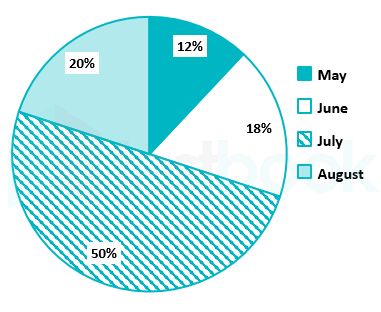
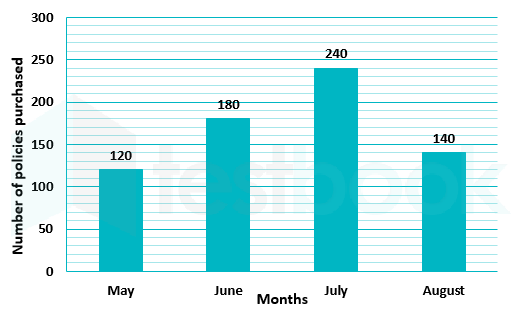
Study the given bar-graph and answer question that follows.

The bar-graph depicts the number of policies purchased in May, June, July and August.

The number of policies purchased in July increased by approximately what per cent as compared to June?

  1. AOption (a)

    75%

  2. BOption (b)

    66%

  3. COption (c)

    40%

  4. DOption (d)

    33%

View answer & explanation

Correct answer

Answer: (d)D.

33%

Why this answer is correct

Given:

May = 120

June = 180

July = 240

August = 140

Concept:

Percentage increase = ∣V1−V2∣V1×100\frac {|V_1 - V_2|}{V_1} \times 100

Calculation:

The number of policies purchased in July increased by approximately what percent as compared to June is 

=> June = 180 and July = 240

= ∣180−240∣180×100\frac{|180 - 240|}{180} \times 100

= 60180×100\frac{60}{180} \times 100 

= 33.33%

~ 33%

Hence, the correct answer is  33%.

Question 37

In a particular language, AC is written as 13 and FG is written as 67. How will HI be written in that language?

  1. AOption (a)

    81

  2. BOption (b)

    89

  3. COption (c)

    73

  4. DOption (d)

    75

View answer & explanation

Correct answer

Answer: (b)B.

89

Why this answer is correct

The logic followed here is,

AC is written as 13

FG is written as 67

Similarly, for 'HI'

So, HI will be written as 89.

Hence, 'option 2' is the correct answer.

Question 38

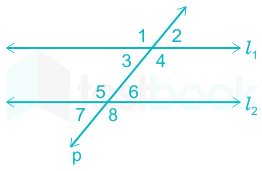
In the given figure, l1 || l2 and p is their transversal with angle 4 = 5x + 35° and angle 7 = 45°. Find the value of x.

  1. AOption (a)

    40°

  2. BOption (b)

    45°

  3. COption (c)

    20°

  4. DOption (d)

    10°

View answer & explanation

Correct answer

Answer: (c)C.

20°

Why this answer is correct

Shortcut Trick

In parallel lines, ∠4 and ∠8 are corresponding angles, so ∠4 = ∠8.

∠7 and ∠8 form a linear pair on line l2, so ∠7 + ∠8 = 180°.

Substituting ∠8 with ∠4: ∠4 + ∠7 = 180°.

(5x + 35°) + 45° = 180° ⇒ 5x + 80° = 180°.

5x = 100° ⇒ x = 20°.

∴ The correct answer is 20 °.

Alternate Method

Given: l1 || l2, ∠4 = 5x + 35°, ∠7 = 45°.

Formula Used: Sum of angles in a linear pair = 180°; Corresponding angles are equal when lines are parallel.

⇒ ∠8 = ∠4 (Corresponding angles as l1 || l2)

⇒ ∠7 + ∠8 = 180° (Linear pair on line l2)

⇒ 45° + (5x + 35°) = 180°

⇒ 5x + 80° = 180°

⇒ 5x = 180° − 80°

⇒ 5x = 100°

⇒ x = 100° ÷ 5 = 20°

∴ The correct answer is 20 °.

Question 39

Which of the following options is the closest approximate value which will come in place of the question mark (?) in the following equation?

12.01 ÷ 5.99 + 13.89 - 3.002 = ?

  1. AOption (a)

    9

  2. BOption (b)

    13

  3. COption (c)

    18

  4. DOption (d)

    24

View answer & explanation

Correct answer

Answer: (b)B.

13

Why this answer is correct

Given:

equation = 12.01 ÷ 5.99 + 13.89 - 3.002 

Concept:

Using BODMAS,

Calculation:

= 12.01 ÷ 5.99 + 13.89 - 3.002 

= 2.0050084 + 13.89 - 3.002 

= 15.8950084 - 3.002

= 12.8930

⇒ 13

hence, the correct answer is '13'.

Question 40

Which Act provided constitutional status to the Panchayati Raj institutions?

  1. AOption (a)

    73rd Constitutional Amendment Act 1991

  2. BOption (b)

    73rd Constitutional Amendment Act 1993

  3. COption (c)

    73rd Constitutional Amendment Act 1990

  4. DOption (d)

    73rd Constitutional Amendment Act 1992

View answer & explanation

Correct answer

Answer: (d)D.

73rd Constitutional Amendment Act 1992

Why this answer is correct

The correct answer is "73rd Constitutional Amendment Act 1992".

Key Points

  • Due to a number of factors, such as the lack of regular elections, protracted supersession, inadequate representation of weaker groups like women and Scheduled Castes and Tribes, insufficient devolution of power, and a lack of financial resources, it has been observed that Panchayati Raj institutions have not been able to achieve the status and dignity of viable and responsive people's bodies.
  • As a result, a new amendment to the constitution was added to address gramme panchayat-related issues.

Additional Information

  • Following were the changes made in the constitution:-
  1. Gram Sabha in a village or group of villages.
  2. Panchayats are organised at the village level and other levels.
  3. All positions in Panchayats at the village and intermediate levels, if any, as well as the positions of Panchayat Chairpersons at such levels, shall be filled by direct elections.
  4. Reservation of Panchayat membership and the position of Chairperson in Panchayats at each level for the Scheduled Castes and Scheduled Tribes in proportion to their population.
  5. At least one-third of the seats must be set aside for women.
  6. In the case that a Panchayat is superseded, elections must be held within six months and Panchayats are given a five-year term limit.
  7. Disqualifications for Panchayat membership.
  8. The State Legislature has delegated authority and accountability for developing plans for social justice and economic development as well as carrying out development initiatives to the Panchayats.
  • 73rd Constitutional Amendment Act 1992:
  1. State Elections Commission is created to conduct elections to PRIs.
  2. Each state must establish a State Finance Commission for a period of five years in order to examine the PRIs' financial standing.
  3. PRIs have a fixed five-year term, and if they are dissolved prematurely, new elections must be held within six months.
  4. The establishment of a three-tier Panchayati Raj system at the zila, block, and village levels,
  5. Elections to PRIs require candidates to be at least 18 years old.
  6. Up to one-third of the seats in panchayats (chairperson and members) are reserved for women.
  7. Reservation of chairman and member positions in panchayats for SC/ST in proportion to their population
  8. At the intermediate and apical tiers, indirect elections for the position of chairman,
  9. Direct elections will be used to fill all positions at all levels (with the exception of two), and
  10. Gram sabhas will be organised.

Question 41

Where was Swami Mahavir born?

  1. AOption (a)

    Pataliputra

  2. BOption (b)

    Kundagram

  3. COption (c)

    Lumbini

  4. DOption (d)

    Pavapuri

View answer & explanation

Correct answer

Answer: (b)B.

Kundagram

Why this answer is correct

The correct answer is "Kundagram".

Key Points

  • Mahavira was born in the year 540 B.C.
  • He was born in a place called Kundagrama, near Vaishali in present-day Bihar.
  • Mahavira grew up as a prince.
  • According to the researchers, his parents were lay devotees of Parshvanatha.
  • He was the founder of Jainism.
  • Jainism:
  • Jainism, often called Jain Dharma, is a religion practised in India.
  • Jainism links its philosophical underpinnings and historical development through the succession of twenty-four tirthankaras (ultimate Dharma lecturers).
  • Jain monks take five fundamental vows: ahimsa (non-violence), satya (truth), asteya (not stealing), brahmacharya (chastity), and aparigraha (non-possessiveness) after entering the sublime condition of soul consciousness.
  • One of the oldest religions that is still practised today is jainism.
  • Digambaras and Śvētāmbaras, two important ancient sub-traditions, have opposing perspectives on ascetic practises, gender, and the writings that are regarded as canonical.

Question 42

The radius of curvature of a spherical mirror is 40 cm. Its focal length is ________ cm.

  1. AOption (a)

    30

  2. BOption (b)

    20

  3. COption (c)

    40

  4. DOption (d)

    10

View answer & explanation

Correct answer

Answer: (b)B.

20

Why this answer is correct

Given:

The radius of curvature of a  spherical mirror =40 cm.

Formula used:

 Focal length =12 (Radius of curvature) \text { Focal length }=\frac{1}{2} \text { (Radius of curvature) }

Calculation:

 Focal length =12×40cm2ˉ0cm\text { Focal length }=\frac{1}{2}×40 cm\=20 cm

The focal length is '20cm'.

Question 43

In a seminar, the number of participants in subjects A, B and C are 96, 160 and 224, respectively. Find the minimum number of rooms required, if in each room the same number of participants are seated and all participants in a room are from the same subject.

  1. AOption (a)

    12

  2. BOption (b)

    32

  3. COption (c)

    24

  4. DOption (d)

    15

View answer & explanation

Correct answer

Answer: (d)D.

15

Why this answer is correct

Shortcut Trick

For minimum rooms, maximize the capacity of each room using HCF.

HCF of 96, 160, and 224 → 32 (Common factor).

Total rooms = (96 ÷ 32) + (160 ÷ 32) + (224 ÷ 32) = 3 + 5 + 7 = 15.

∴ The correct answer is 15 rooms.

Alternate Method

Given: Participants in Subject A = 96, Subject B = 160, Subject C = 224.

Formula Used: Total Rooms = (Σ Participants) ÷ HCF(Participants per subject)

⇒ Step 1: Find the Highest Common Factor (HCF) of 96, 160, and 224.

⇒ 96 = 32 × 3

⇒ 160 = 32 × 5

⇒ 224 = 32 × 7

⇒ HCF = 32 (Max participants per room)

⇒ Step 2: Calculate rooms for each subject.

⇒ Rooms for A = 96 ÷ 32 = 3

⇒ Rooms for B = 160 ÷ 32 = 5

⇒ Rooms for C = 224 ÷ 32 = 7

⇒ Total Rooms = 3 + 5 + 7 = 15

∴ The correct answer is 15 rooms.

Additional Information

HCF (Highest Common Factor)

HCF is the largest positive integer that divides each of the integers without a remainder. It is used to find maximum capacity or largest size.

LCM (Least Common Multiple)

LCM is the smallest positive integer that is divisible by each of the given numbers. It is used to find minimum time or common meeting points.

Relationship between HCF and LCM

For any two numbers 'a' and 'b', Product of numbers = HCF(a, b) × LCM(a, b).

Question 44

If 2 is added to each odd number and 1 is subtracted from each even number in the number 2149763, which of the following digits will appear the most in the new number thus formed?

  1. AOption (a)

    9

  2. BOption (b)

    5

  3. COption (c)

    1

  4. DOption (d)

    3

View answer & explanation

Correct answer

Answer: (c)C.

1

Why this answer is correct

Given: 2149763,

By 2 is added to each odd number and 1 is subtracted from each even number in the givennumber. we get,

Here, we can clearly say that '1 digit' (three times) will appear the most in the new number thus formed.

Hence, 'option 3' is the correct answer.

Question 45

John has a cuboidal box whose length, breadth and height are in the ratio 2 ∶ 3 ∶ 5. If the length, the breadth and the height of this box are each increased by 100% to make a new box, then the volume of the new box is how many times the volume of the old box?

  1. AOption (a)

    9 times

  2. BOption (b)

    7 times

  3. COption (c)

    8 times

  4. DOption (d)

    6 times

View answer & explanation

Correct answer

Answer: (c)C.

8 times

Why this answer is correct

Shortcut Trick

If each dimension (length, breadth, and height) of a cuboid is increased by 100%, it means each dimension becomes 2 times its original value.

Change in volume factor = (Factor of increase in length) × (Factor of increase in breadth) × (Factor of increase in height)

New Volume = 2 × 2 × 2 = 8 times the old volume.

∴ The correct answer is 8 times.

Alternate Method

Given: Ratio of length (L), breadth (B), and height (H) = 2 : 3 : 5. Increase in each = 100%.

Formula Used: Volume of cuboid = L × B × H

⇒ Let L = 2k, B = 3k, H = 5k.

⇒ Original Volume (V1) = 2k × 3k × 5k = 30k3.

⇒ New dimensions after 100% increase: L' = 4k, B' = 6k, H' = 10k.

⇒ New Volume (V2) = 4k × 6k × 10k = 240k3.

⇒ Ratio V2/V1 = 240k3 / 30k3 = 8.

∴ The correct answer is 8 times.

Additional Information

Percentage Change in Volume

If dimensions change by a%, b%, and c%, the new volume factor is (1 + a/100)(1 + b/100)(1 + c/100).

Surface Area Change

If each side of a cuboid is doubled, the Total Surface Area becomes 4 times (22) the original area.

Diagonal of a Cuboid

The longest rod that can be placed in a cuboid is given by the diagonal formula: √(L2 + B2 + H2).

Question 46

The Steel Authority of India Limited was earlier known as _______.

  1. AOption (a)

    National Steel Limited (NSL)

  2. BOption (b)

    Indian Steel Limited (ISL)

  3. COption (c)

    Bharat Steel Limited (BSL)

  4. DOption (d)

    Hindustan Steel Limited (HSL)

View answer & explanation

Correct answer

Answer: (d)D.

Hindustan Steel Limited (HSL)

Why this answer is correct

The correct answer is "Hindustan Steel Limited (HSL)".

Key Points

  • SAIL traces its origin to Hindustan Steel Limited (HSL).
  • It was set up on 19 January 1954.
  • It was initially designed to manage only one plant that was coming up at Rourkela.
  • For Bhilai and Durgapur Steel Plants, the preliminary work was done by the Iron and Steel Ministry.
  • From April 1957, the supervision and control of these two steel plants were also transferred to Hindustan Steel.
  • The registered office was originally in New Delhi.
  • It moved to Calcutta in July 1956, and ultimately to Ranchi in December 1959

Question 47

If in each of the following words, each letter is changed to the previous letter in the English alphabetical order, how many words thus formed will have a vowel?

JUST, RIME, BEST, FAST, LOST, TIME

  1. AOption (a)

    4

  2. BOption (b)

    1

  3. COption (c)

    3

  4. DOption (d)

    2

View answer & explanation

Correct answer

Answer: (c)C.

3

Why this answer is correct

Given words: JUST, RIME, BEST, FAST, LOST, TIME

By each letter is changed to the previous letter in the English alphabetical order. We got,

Here, Three words thus formed will have a vowel.

Hence, 'Option 3' is the correct answer.

Question 48

Which of the following solution has the lowest pH value?

  1. AOption (a)

    Saliva (after a meal)

  2. BOption (b)

    Coffee

  3. COption (c)

    Tomato juice

  4. DOption (d)

    Saliva (before a meal)

View answer & explanation

Correct answer

Answer: (c)C.

Tomato juice

Why this answer is correct

The correct answer is 'Tomato juice'.

Key Points

  • pH-value defines the acidity or basicity of the substance. More the acidic substance lower is the acidic value.
  • pH-value  helps us to know whether the substance is acidic or basic.
  • Its value ranges from 0-14.
  • 0-6.9 is considered as an acidic substance, 7 is considered as neutral and 7.1 to 14 is considered as basic.
  • Tomato: Tomato contains two types of acids, these are malic acid and citric acid. Both of them are mild acids. Hence the pH-value of tomato ranges from **3.5-4.7.**​

Additional Information

  • The pH of saliva before the meal is about 7.4 which is basic. The pH of saliva after the meal is around 5 .
  • Coffee does indeed have a pH level, but is not a useful measure of flavor. It would vary depending on brewing method and roast level, but not significantly. Black coffee generally lands around a pH of 5 (acidic, not basic) and milk has a pH of 6 (slightly more neutral).

Question 49

If a sum of Rs. 80,000 is invested for a year at 4% per annum compounded half-yearly, then find the compound interest.

  1. AOption (a)

    Rs. 2,323

  2. BOption (b)

    Rs. 2,525

  3. COption (c)

    Rs. 3,232

  4. DOption (d)

    Rs. 5,252

View answer & explanation

Correct answer

Answer: (c)C.

Rs. 3,232

Why this answer is correct

Shortcut Trick

For half-yearly compounding, the rate becomes 2% (4% ÷ 2) and the time periods become 2.

Effective interest rate for 2 periods = r + r + (r × r)/100 = 2 + 2 + (2 × 2)/100 = 4.04%.

Compound Interest = 80,000 × 4.04% = 800 × 4.04 = ₹ 3,232.

∴ The correct answer is Rs. 3,232.

Alternate Method

Given:

Principal (P) = ₹ 80,000

Annual Rate (R) = 4% per annum

Time (T) = 1 year

Formula Used:

Amount (A) = P(1 + r/100)n

Compound Interest (CI) = A − P

Calculations:

⇒ Half-yearly rate (r) = 4% ÷ 2 = 2%

⇒ Number of half-years (n) = 1 × 2 = 2

⇒ A = 80,000 × (1 + 2/100)2

⇒ A = 80,000 × (51/50)2

⇒ A = 80,000 × (2601 / 2500)

⇒ A = 32 × 2601 = ₹ 83,232

⇒ CI = 83,232 − 80,000 = ₹ 3,232

∴ The correct answer is Rs. 3,232.

Additional Information

Half-Yearly Compounding Rule

When interest is compounded half-yearly, the nominal annual interest rate is divided by 2, and the number of years is multiplied by 2.

Quarterly Compounding Rule

When interest is compounded quarterly, the rate is divided by 4, and the time (in years) is multiplied by 4.

Compound Interest Formula

Direct CI calculation: CI = P[(1 + r/100)n − 1], where n is the total number of compounding periods.

Question 50

Suraj starts walking 9 m towards the east, then turns left. He walks 5 m, turns right and again walks 5 m. Then he turns right and walks 8 m. He then again turns right and walks 5 m. Again, he turns right and walks 3 m. Which direction is he facing now? (All turns are 90 degree turns only)

  1. AOption (a)

    North

  2. BOption (b)

    West

  3. COption (c)

    East

  4. DOption (d)

    South

View answer & explanation

Correct answer

Answer: (a)A.

North

Why this answer is correct

Drawing the figure as per the given information,

  • Suraj starts walking 9 m towards the east, then turns left.
  • He walks 5 m, turns right and again walks 5 m.
  • Then he turns right and walks 8 m.
  • He then again turns right and walks 5 m.
  • Again, he turns right and walks 3 m.

Here, Suraj is facing towards North.

Hence, 'Option 1' is the correct answer.

Question 51

A sells an article to B at a gain of 16%. B sells it to C at a loss of 15% and C sells it to D at a gain of 20%. If the difference between the profits earned by C and A is Rs. 248, then the loss (in Rs.) incurred by B is:

  1. AOption (a)

    1,200

  2. BOption (b)

    1,040

  3. COption (c)

    1,150

  4. DOption (d)

    1,160

View answer & explanation

Correct answer

Answer: (d)D.

1,160

Why this answer is correct

Shortcut Trick

Let the Cost Price (CP) for A be 100 units.

Profit of A = 16 units. CP for B = 116 units.

Loss of B = 15% of 116 = 17.4 units. CP for C = 116 − 17.4 = 98.6 units.

Profit of C = 20% of 98.6 = 19.72 units.

Difference in profits (C and A) = 19.72 − 16 = 3.72 units.

Since 3.72 units = Rs. 248, then 1 unit = 248 ÷ 3.72. Loss of B = 17.4 units = (248 ÷ 3.72) × 17.4 = Rs. 1,160.

∴ The correct answer is Rs. 1,160.

Alternate Method

Given → Gain of A = 16%, Loss of B = 15%, Gain of C = 20%. Difference (Profit C − Profit A) = Rs. 248. Formulas: Profit = CP × Profit% | Loss = CP × Loss% | SP = CP × (100 ± Change%) ÷ 100

⇒ Let CP for A = x. Profit of A = 0.16x. ⇒ CP for B = x × 1.16. Loss of B = 1.16x × 0.15 = 0.174x. ⇒ CP for C = 1.16x − 0.174x = 0.986x. Profit of C = 0.986x × 0.20 = 0.1972x. ⇒ Difference = 0.1972x − 0.16x = 0.0372x. ⇒ 0.0372x = 248 ⇒ x = 248 ÷ 0.0372 = 2480000 ÷ 372 = 20000 ÷ 3. ⇒ Loss of B = 0.174 × (20000 ÷ 3) = 174000 × 2 ÷ 300 = 1160.

∴ The correct answer is Rs. 1,160.

Additional Information

Chain Rule in Transactions

When an article is sold through multiple hands, the Selling Price (SP) of one person becomes the Cost Price (CP) for the next.

Profit and Loss Percentage

Always calculate profit or loss percentage on the individual CP of that specific transaction stage. Formula: Profit/Loss Amount = CP × (P/L % / 100).

Question 52

9(x), x + 6, 7(x) - 3 and y are in proportion when x = 3. Find the value of y.

  1. AOption (a)

    6

  2. BOption (b)

    63

  3. COption (c)

    45

  4. DOption (d)

    54

View answer & explanation

Correct answer

Answer: (a)A.

6

Why this answer is correct

Shortcut Trick

Substitute x = 3 into the terms to get the values: 27, 9, 18, and y.

In a proportion a : b :: c : d, the product of means equals the product of extremes: ad = bc.

⇒ 27 × y = 9 × 18

⇒ y = (9 × 18) ÷ 27 = 162 ÷ 27 = 6.

∴ The correct answer is 6.

Alternate Method

Given: x = 3, terms are 9(x), x + 6, 7(x) − 3, and y.

Formula Used: If a, b, c, d are in proportion, then a/b = c/d.

⇒ Term 1 = 9 × 3 = 27

⇒ Term 2 = 3 + 6 = 9

⇒ Term 3 = 7 × 3 − 3 = 21 − 3 = 18

⇒ Term 4 = y

⇒ 27/9 = 18/y

⇒ 3 = 18/y

⇒ y = 18/3 = 6

∴ The correct answer is 6.

Additional Information

Direct Proportion

Four numbers a, b, c, d are in proportion if a : b = c : d, which implies ad = bc.

Mean Proportional

The mean proportional between two numbers a and b is given by √(a × b).

Third Proportional

If a, b, c are in continued proportion, then a/b = b/c, and c is the third proportional, c = b2/a.

Question 53

Who received the CSIR Young Scientist Award in 2021 (a scheme of Awards for Young Scientists in the CSIR system to promote excellence in various fields of science and technology)?

  1. AOption (a)

    Dr. K Giribabu

  2. BOption (b)

    Debabrata Mandal

  3. COption (c)

    Dr. Jeemon Panniyammakal

  4. DOption (d)

    Venkateswarlu M

View answer & explanation

Correct answer

Answer: (a)A.

Dr. K Giribabu

Why this answer is correct

The correct answer is "Dr. K Giribabu".

Key Points

  • Dr. K. Giribabu, Scientist, CSIR-CECRI, Karaikudi has been selected for "CSIR Young Scientist Award" for the year 2021 in the field of Chemical Sciences for his outstanding contributions.
  • The award will be presented to him on 26thSeptember, 2021 in CSIR Foundation Day Celebration.

Additional Information

  • Dr. K. Giribabu hails from an agricultural family in Arungundram village, Chengalpattu District, Tamil Nadu.
  • After his initial schooling at Sri Ramakrishna Mission Boys Higher Secondary School, Chengalpattu, he did his B.Sc. (Chemistry) from Rajeswari Vedachalam Govt. Arts College, Chengalpattu, M.Sc. (Chemistry) [Gold Medalist] from the University of Madras and M. Phil. in Analytical Chemistry.
  • During his M.Sc. days, he received the Prof. PBJ award for two consecutive years for his outstanding academic performance.
  • He pursued his Doctoral Research in Inorganic Chemistry at the University of Madras and Postdoctoral Research at the Department of Biological Engineering, Inha University, South Korea.
  • Council of Scientific and Industrial Research (CSIR):
  • A modern R&D organisation is the Council of Scientific and Industrial Research (CSIR), which is renowned for its cutting edge R&D knowledge base in several S&T fields.
  • 37 national laboratories, 39 outreach centres, 1 innovation complex, and 3 units with a pan-India presence make up the dynamic network of the CSIR.
  • As of the end of March 2022, the CSIR's R&D experience and expertise were represented by over 3521 active scientists who were backed by about 4162 technical and support staff.
  • In many societal endeavours, such as the environment, health, drinking water, food, housing, energy, farm and non-farm sectors, it offers substantial technical involvement.
  • The CSIR's contribution to the growth of S&T human resources is also important.

Question 54

The position of how many letters will remain unchanged if each of the letters in the word 'EQUIVOCAL' is arranged in alphabetical order?

  1. AOption (a)

    One

  2. BOption (b)

    Four

  3. COption (c)

    Two

  4. DOption (d)

    Three

View answer & explanation

Correct answer

Answer: (c)C.

Two

Why this answer is correct

Given: EQUIVOCAL

By each of the letters in the word 'EQUIVOCAL' is arranged in alphabetical order. we get

Here, The position of the two letters will remain unchanged.

Hence, 'option 3' is the correct answer.

Question 55

Select the set in which the numbers are related in the same way as are the numbers of the following sets.

(NOTE: Operations should be performed on the whole numbers, without breaking down the numbers into its constituent digits. EXAMPLE: 13 - Operations on 13 such as adding/subtracting multiplying etc. to 13 can be performed. Breaking down 13 into 1 and 3 and then performing mathematical operations on 1 and 3 is not allowed)

(10, 150, 3)

(8, 80, 2)

  1. AOption (a)

    (11, 188, 6)

  2. BOption (b)

    (18, 270, 3)

  3. COption (c)

    (10, 401, 9)

  4. DOption (d)

    (12, 197, 4)

View answer & explanation

Correct answer

Answer: (b)B.

(18, 270, 3)

Why this answer is correct

The logic followed here is,

Logic: 1st number × 3rd number × 5 = 2nd number.

(10, 150, 3) = 10 × 3 × 5 = 150.

(8, 80, 2)     = 8 × 2 × 5 = 80.

Applying the logic on options,

Option 1: (11, 188, 6)

=> 11 × 6 × 5 = 330 ≠ 188.

Option 2: (18, 270, 3)

=> 18 × 3 × 5 = 270.

Option 3: (10, 401, 9)

=> 10 × 9 × 5 = 450 ≠ 401.

Option 4: (12, 197, 4)

=> 12 × 4 × 5 = 240 ≠ 197.

Hence, 'Option 2' is the correct answer.

Alternate Method

The logic is follows here is ,

Let set be (a, b, c),

then the**,**

Logic used: a2×c×10=b:\large{a\over 2}\times c\times 10 = b :

(10, 150, 3) = 102×3×10=150\large{10\over 2}\times 3\times 10 = 150

(8, 80, 2)     = 82×2×10=80\large{8\over 2}\times 2\times 10 = 80

Applying the logic on options,

Option 1: (11, 188, 6)

=> 112×6×10=330\large{11\over 2}\times 6\times 10 = 330

Option 2: (18, 270, 3)

=> 182×3×10=270\large{18\over 2}\times 3\times 10 = 270

Option 3: (10, 401, 9)

=> 102×9×10=450\large{10\over 2}\times 9\times 10 = 450

Option 4: (12, 197, 4)

=> 122×4×10=240\large{12\over 2}\times 4\times 10 = 240


Hence, 'Option 2' is the correct answ

Question 56

Newlands law of Octaves was applicable only up to element _______.

  1. AOption (a)

    Mg

  2. BOption (b)

    K

  3. COption (c)

    Ca

  4. DOption (d)

    Na

View answer & explanation

Correct answer

Answer: (c)C.

Ca

Why this answer is correct

The correct answer is 'Ca'.

Key Points

  • Newlands's law of octaves was applicable only up to calcium.
  • Newland table was drawn by John Newlands in 1866 according to his Law of Octaves.In his theory, he purposed that when elements are arranged according to their increasing atomic weights then every eight elements have similar properties as the first element.
  • After calcium, this law ceased to be valid as after calcium every eight elements do not have the same property of a first element.

Additional Information

  • Magnesium (Mg) is belong to group 2 of the Modern Periodic Table. It is also known as alkaline-earth metal.
  • Potassium (K) is belong to group 1 of the Modern Periodic Table.
  • Sodium(Na) is belong to group 1 in the modern Periodic Table.

Question 57

Sieve plates are found in the _______.

  1. AOption (a)

    phloem parenchyma cells

  2. BOption (b)

    phloem companion cells

  3. COption (c)

    phloem tube cells

  4. DOption (d)

    phloem fiber cells

View answer & explanation

Correct answer

Answer: (c)C.

phloem tube cells

Why this answer is correct

The correct answer is 'phloem tube cells'.

Key Points

  • Sieve plates are the connection sites between sieve elements.
  • During early development of young sieve tubes, sieve plates resemble normal cell walls. As in other cell walls, plasmodesmata connect the cytoplast of adjacent sieve elements.
  • Sieve tubes are found in the phloem vascular tissue.
  • Sieve tubes are located in vascular plants that flower called angiosperms.

Additional Information​ 

  • Phloem paranchyma cells are located near the termination of sieve tubes in leaf and used to transport food.​
  • Phloem companion cells are located at the lateral side of the sieve tubes and used to transport food.
  • Phloem fiber cells provides mechanical strength and support.

Question 58

Six friends M, N, O, P, Q and R have their tests on a different day of week starting from Monday and ending on Saturday of the same week. Only two friends are having their tests before M's test. Only four friends are having their tests after Q's test. Only O has the test between the tests of P and N. Who amongst the following has the test on Monday?

  1. AOption (a)

    O

  2. BOption (b)

    P

  3. COption (c)

    R

  4. DOption (d)

    N

View answer & explanation

Correct answer

Answer: (c)C.

R

Why this answer is correct

Given: 

Six friends M, N, O, P, Q and R have their tests on a different day of week starting from Monday and ending on Saturday of the same week.

Solution:

(1)  Only two friends are having their tests before M's test.

(2) Only four friends are having their tests after Q's test.

(3) Combining above two steps

(4)  Only O has the test between the tests of P and N.

(5) Now, R can give his test on monday.

Hence, 'option 3' is correct.

Question 59

Which of the following classical languages is known as the 'Italian of the East' as all words in this language end with vowel sound?

  1. AOption (a)

    Telugu

  2. BOption (b)

    Malayalam

  3. COption (c)

    Kannada

  4. DOption (d)

    Marathi

View answer & explanation

Correct answer

Answer: (a)A.

Telugu

Why this answer is correct

The correct answer is Telugu.

Key Points

  • Telugu belongs to the family of Dravidian languages and is the official language of the state of Andhra Pradesh, India.
  • It is also one among 23 official national languages of India.
  • 19th-century Englishmen called it the 'Italian of the East' as all words in Telugu end with a vowel sound.
  • British authors in the 19th century referred to Telugu as the Italian of the East because it was a magnificent language.
  • There are only two languages in the world, whose all the words end with a vowel (a,e,i,o,u), one of them is Italian and the other is Telugu.
  • It is also the second largest language in India, next only to Hindi.
  • It's the first language (Mother tongue) for around 80 million people world over and spoken by another 30 - 40 million people.
  • Telugu language has total 52 letters and are divided into:
  1. Achchulu (Vowels) - 16
  2. Hallulu (Consonants) - 36
  • It is the official language of the state Andhra Pradesh.
  • It has been awarded the status of Classical language by the Government of India.

Question 60

An imaginary line passing through principal focus, centre of curvature and pole of a Spherical Mirror is known as ______.

  1. AOption (a)

    focal length

  2. BOption (b)

    radius of curvature

  3. COption (c)

    focal plane

  4. DOption (d)

    principal axis

View answer & explanation

Correct answer

Answer: (d)D.

principal axis

Why this answer is correct

The correct answer is 'principal axis'.

Key Points

  • The incident rays after converging or diverging become concentrated at a point. This point is called the focus of the curved mirror. The distance of the focus from the pole of the curved mirror is called the focal length of the curved mirror. The curved mirrors are formed by cutting a piece from the spherical mirror.
  • The radius of the spherical mirror from which the curved mirror formed is called the radius of curvature. The center of the spherical mirror that forms the curved mirror is called the center of curvature.
  • The center of the aperture of the curved mirror is called the pole of the curved mirror. The imaginary line that joins the pole to the curved mirror to the center of curvature of the curved mirror is called the principal axis.

Additional Information


Focal length is defined as distance between the centre of the mirror or lens.

  • The radius of the curvature is defined as the radius of the circle which the spherical mirror isa part.
  • Focal plane is defined as the plane which is perpendicular to the principal focus.

Question 61

Compounds of carbon-containing carbon-carbon double bond are known as _________________.

  1. AOption (a)

    alkynes

  2. BOption (b)

    alkanes

  3. COption (c)

    saturated compounds

  4. DOption (d)

    unsaturated compounds

View answer & explanation

Correct answer

Answer: (d)D.

unsaturated compounds

Why this answer is correct

The correct answer is 'unsaturated compounds'.

Key Points

  • The organic compounds consisting of Carbon (C) and Hydrogen (H) atoms are known as hydrocarbons.
  • Hydrocarbons are of two types depending on the kind of bonds formed between Carbon-Carbon atoms.
  1. Saturated hydrocarbons.
  2. Unsaturated hydrocarbons.
  • The organic compounds containing Carbon atoms having double bonds between two Carbon atoms are called unsaturated hydrocarbons.
  • The molecules of the alkene family are represented by the general formula CnH2n.

Additional Information

  • ​ Alkynes are defined as the hydrocarbons which contain carbon carbon triple bond.
  • Alkanes are defined as the hydrocarbons which contain carbon hydrogen single bond.

Question 62

What type of forest underwent a remarkable recovery with the active and willing participation of the local community in the Arabari forest range of Midnapore district?

  1. AOption (a)

    Sandalwood forests

  2. BOption (b)

    Teak forests

  3. COption (c)

    Sal forests

  4. DOption (d)

    Neem forests

View answer & explanation

Correct answer

Answer: (c)C.

Sal forests

Why this answer is correct

The correct answer is Sal forests.

Key Points

  • In 1972, the West Bengal Forest Department admitted its failure to revive the state's degraded Sal forests in the southwestern regions.
  • Traditional surveillance and enforcement practices had resulted in a "complete alienation of the people from the administration", resulting in frequent conflicts between forest officials and villagers.
  • The region's forest and land disputes also contributed significantly to the Naxalites' militant peasant activities.
  • As a result, the Department shifted its strategy making a beginning in the Arabari forest range of the Midnapore district.

Additional Information

  • Sandalwood forests:
  • ​Due to India's historical contribution of 85% of the global sandalwood trade, sandalwood has long been associated with Indian heritage and culture.
  • But lately, this has been rapidly decreasing.
  • It is also known as "Chandan" and "Srigandha" in India.
  • From the newborn to the cremation, sandalwood is used extensively in Indian culture.
  • It is primarily grown in the Indian states of Tamil Nadu, Andhra Pradesh, Telangana, Bihar, Gujarat, Karnataka, M.P., and Maharashtra.
  • Teak forests (Sagwan):
  • A species of tropical hardwood tree belonging to the Lamiaceae family is teak.
  • In mixed hardwood woods, it is a sizable deciduous tree.
  • Teak trees have big, papery leaves that are frequently hairy on the underside.
  • Freshly milled teak wood smells like leather and is highly prized for its toughness and water resistance.
  • Teak is found in Nilambur teak, Adilabad teak, Godhavari teak, Konni Teak, etc.
  • Neem forests:
  • One of the most beneficial and priceless tree species found in India is the neem (Azadirachta indica), a member of the meliaceae family.
  • Its ability to grow in a variety of soils up to a pH of 10 makes it one of the most useful and significant trees in the Indian subcontinent.
  • It is found all over India and can thrive in all agroclimatic zones, with the exception of high and cold regions and dam sites.

Question 63

The colour of the clear sky is blue due to ______ of light by particles in the atmosphere of size ______ than the wavelength of visible light.

  1. AOption (a)

    scattering, larger

  2. BOption (b)

    refraction, smaller

  3. COption (c)

    scattering, smaller

  4. DOption (d)

    refraction, larger

View answer & explanation

Correct answer

Answer: (c)C.

scattering, smaller

Why this answer is correct

The correct answer 'scattering,smaller'.

Key Points

  • The colour of the sky is blue due to scattering of light by particles in the atmosphere of size smaller than the wavelength of visible light.
  • The molecules of air and other fine particles in the atmosphere have a size smaller than the wavelength of visible light. These are more effective in scattering light of shorter wavelengths at the blue end than the light of longer wavelengths at the red end.
  • The red light has a wavelength of about times greater than blue light.
  • Thus, when sunlight passes through the atmosphere, the fine particles in the air scatter the blue colour (shorter wavelengths) more strongly than red. The sky appears blue due to the scattering of light.

 Important Points

  • If the earth had no atmosphere, there would not have been any scattering. Then, the sky would have looked dark.
  • The sky appears dark to passengers flying at very high altitudes, as scattering is not prominent at such heights.

Question 64

The hearts muscles contract and relax rhythmically, this rhythmic contraction followed by its relaxation constitute a heartbeat. Which instrument is used to measure heartbeats?

  1. AOption (a)

    Stethoscope

  2. BOption (b)

    Potometer

  3. COption (c)

    Oximeter

  4. DOption (d)

    Sphygmomanometer

View answer & explanation

Correct answer

Answer: (a)A.

Stethoscope

Why this answer is correct

The corrrect answer is 'Stethoscope'.

Key Points

  • The walls of the chambers of the heart are made up of muscles. These muscles contract and relax rhythmically.
  • The rhythmic contraction of muscles is followed by its relaxation. This constitutes a heartbeat.
  • The doctors use a stethoscope to listen to the heartbeat.
  • It amplifies the so of the heartbeats which makes it easier for the doctors to listen.

Question 65

Select the number from among the given options that can replace the question mark (?) in the following series.

5, 6, 14, 41, ?

  1. AOption (a)

    188

  2. BOption (b)

    105

  3. COption (c)

    169

  4. DOption (d)

    95

View answer & explanation

Correct answer

Answer: (b)B.

105

Why this answer is correct

The logic followed here is:

Hence, 'Option 2' is the correct answer.

Question 66

India's services exports achieved above ______ billion for the first time during April-March 2021-22.

  1. AOption (a)

    $110

  2. BOption (b)

    $1,000

  3. COption (c)

    $250

  4. DOption (d)

    $500

View answer & explanation

Correct answer

Answer: (c)C.

$250

Why this answer is correct

The correct answer is '$250'.

Key Points

  • India's Services exports set a new record of USD 254.4 Billion in the financial year 2021-2022.
  • The new record achieved in 2021-22 beats the previous high of USD 213.2 Billion in 2019-20.
  • Services exports hit an all-time monthly high of USD 26.9 Billion in March 2022.
  • India's merchandise export in 2021-22 (April-January) was USD 335.44 billion, an increase of 46.53% over USD 228.9 billion in 2020-21 (April-January) and an increase of 27.0% over USD 264.13 billion in 2019-20 (April-January).
  • India has achieved monthly value of merchandise export in May 2022 amounting USD 37.29 billion, an increase of 15.46% over USD 32.30 billion in May 2021.
  • India's merchandise export in April -May 2022-23was USD 77.08 billion with an increase of 22.26% over USD 63.05 billion in April -May 2021-22.

​ 

Additional Information

  • Selling products and services to a foreign country is referred to as exporting.
  • Contrarily, importing is the act of acquiring goods from outside and bringing them into one's own nation.
  • Additionally, it is separated into Direct and Indirect categories.
  • The expected value of services exported between April and December 2022 is 235.81billion,upfrom235.81 billion, up from 184.65 billion during the same time last year, according to data from the Commerce Ministry.
  • These exports reached a record high of $254 billion in 2021–22.

Question 67

Amongst six friends A, B, C, D, E and F, each has a different height. C is taller than only two other friends. D is shorter than only one friend. B is shorter than C but taller than E. A is shorter than F. Who is the second shortest among all the friends?

  1. AOption (a)

    F

  2. BOption (b)

    B

  3. COption (c)

    A

  4. DOption (d)

    E

View answer & explanation

Correct answer

Answer: (b)B.

B

Why this answer is correct

Given: Six friends A, B, C, D, E, and F.

1) C is taller than only two other friends. 

__ > __ > __ > C > __ > __

2) D is shorter than only one friend.

__ > D > __ > C > __ > __

3) B is shorter than C but taller than E.

__ > D > __ > C > B > E

4) A is shorter than F

F > D > A > C > B > E

After combining all the arrangements, we get:

F > D > A > C > B > E

Here, B is the second shortest among all the friends.

Hence, "Option 2" is the correct answer.

Question 68

How many sessions of the Lok Sabha take place in a year?

  1. AOption (a)

    3

  2. BOption (b)

    5

  3. COption (c)

    4

  4. DOption (d)

    2

View answer & explanation

Correct answer

Answer: (a)A.

3

Why this answer is correct

The correct answer is '3'.

Key Points

  • Three sessions of Lok Sabha are held in a year: Budget session: February to May. Monsoon session: July to September. Winter session: November to mid-December.
  • The joint sitting of the Parliament is called by the President of India (Article 108) and is presided over by the Speaker of the Lok Sabha or, in their absence, by the Deputy Speaker of the Lok Sabha, or in their absence, the Deputy Chairman of the Rajya Sabha.
  • India does not have a fixed parliamentary calendar. By convention (i.e., not provided by the Constitution), Parliament meets for three sessions in a year.​

Additional Information

  • The House can have a maximum of 552 members, with 530 representing the States, 20 the Union Territories, and two chosen by the President from from the Anglo-Indian Community.​
  • The lower house of India's bicameral Parliament is known as the lok sabha, officially known as the House of the People. The upper house is known as the Rajya Sabha.
  • The ex-officio chairman of Rajya Sabha is the vice president of India.
  • One of the two chambers of a bicameral legislature is the lower house, with the upper house serving as the other chamber.
  • In many legislatures around the world, the lower house has grown to hold more power or otherwise exercise significant political influence despite its official status "below" the upper house.

Question 69

The Reserve Bank of India was nationalised with effect from 1st January, _______.

  1. AOption (a)

    1952

  2. BOption (b)

    1949

  3. COption (c)

    1950

  4. DOption (d)

    1954

View answer & explanation

Correct answer

Answer: (b)B.

1949

Why this answer is correct

The correct answer is '1949'.

Key Points

  • The Reserve Bank of India was nationalised with effect from 1st January 1949 on the basis of the Reserve Bank of India (Transfer to Public Ownership) Act, 1948.
  • All shares in the capital of the Bank were deemed transferred to the Central Government on payment of a suitable compensation.
  • It commenced its operations on 1 April 1935 in accordance with the Reserve Bank of India Act, 1934.
  • The original share capital was divided into shares of 100 each fully paid. Following India's independence on 15 August 1947, the RBI was nationalised on 1 January 1949.​

Additional Information

  • The Imperial Bank of India was later nationalised in 1955 and was named The State Bank of India, which is currently the largest Public sector Bank.
  • The RBI supervises and regulates the entire financial system.
  • This boosts public confidence in the nation's financial system, safeguards interest rates, and gives people good banking options.
  • The main responsibility of the Reserve Bank of India (RBI), the nation's central bank, is to oversee and direct the nation's financial system.
  • It was founded in 1935 as a legislative entity by the Reserve Bank of India Act, 1934.
  • The Indian rupee's issuance and supply are controlled by the central bank.

Question 70

The Kamet peak of Himalaya is located in which state of India?

  1. AOption (a)

    Uttarakhand

  2. BOption (b)

    Sikkim

  3. COption (c)

    Himachal Pradesh

  4. DOption (d)

    Arunachal Pradesh

View answer & explanation

Correct answer

Answer: (a)A.

Uttarakhand

Why this answer is correct

The correct answer is 'Uttarakhand'.

Key Points

  • Kamet, mountain peak of the Himalayas in Uttarakhand state, northern India, near the border with the Tibet Autonomous Region of China. Part of the Zaskar Range, it is 25,446 feet (7,756 meters) high and was first climbed in 1931.
  • Kamet is known to Tibetans as 'Kangmen' which signifies 'huge grandmother of a sacred snow chain'.
  • While Frank Smythe writes in his book 'Kamet Conquered' that Kamet comes from the Tibetan word 'Kangmed'.​

Additional Information

  • Nearest town to Kamet is Joshimath. ROAD: Joshimath has good connectivity of roads from cities like Rishikesh, Haridwar and Dehradun.
  • One can reach to these places from Delhi and get a bus or shared taxi to Joshimath. The buses usually leave early morning from places like Haridwar and Rishikesh.
  • The Himalayas, the tallest mountain range in the globe, is home to Mount Everest and nine out of the ten highest peaks in the world.
  • These mountains, sometimes known as the Third Pole, are the source of several of Asia's major rivers and have a role in controlling the climate of the world.

Question 71

The given table shows the number of people of various age groups visiting a park in a locality. Find the modal age (in years) of the visitors (rounded off to one decimal place).

Age(years)Number of persons
0 - 104
10 - 2014
20 - 3018
30 - 4023
40 - 5027
50 - 6016
60 - 708
  1. AOption (a)

    42.7

  2. BOption (b)

    47.2

  3. COption (c)

    42.1

  4. DOption (d)

    43.7

View answer & explanation

Correct answer

Answer: (a)A.

42.7

Why this answer is correct

Shortcut Trick

Identify the highest frequency: 27, which belongs to the modal class 40 − 50.

Apply the Mode formula: L + [(f1 − f0) ÷ (2f1 − f0 − f2)] × h.

Mode = 40 + [(27 − 23) ÷ (54 − 23 − 16)] × 10 = 40 + (4 ÷ 15) × 10.

Mode = 40 + 2.67 ≈ 42.7 years.

∴ The correct answer is 42.7 years.

Alternate Method

Given:

Maximum frequency (f1) = 27

Modal class = 40 − 50

Lower limit of modal class (l) = 40

Frequency of preceding class (f0) = 23

Frequency of succeeding class (f2) = 16

Class interval height (h) = 10

Formula Used:

Mode = l + [(f1 − f0) ÷ (2f1 − f0 − f2)] × h

Calculations:

⇒ Mode = 40 + [(27 − 23) ÷ (2 × 27 − 23 − 16)] × 10

⇒ Mode = 40 + [4 ÷ (54 − 39)] × 10

⇒ Mode = 40 + [4 ÷ 15] × 10

⇒ Mode = 40 + (40 ÷ 15)

⇒ Mode = 40 + 2.666...

⇒ Mode ≈ 42.7 years

∴ The correct answer is 42.7 years.

Additional Information

Empirical Relationship

The relationship between the three measures of central tendency is given by: Mode = 3 Median − 2 Mean.

Mean of Grouped Data

Mean (χ) = Σfixi ÷ Σfi, where xi is the class mark of each interval.

Median of Grouped Data

Median = l + [((n ÷ 2) − cf) ÷ f] × h, where cf is the cumulative frequency of the class preceding the median class.

Question 72

Sohan is facing north-west. He turns 90° clockwise, then 360° anticlockwise and then 90° clockwise. In which direction is Sohan facing now?

  1. AOption (a)

    South-west

  2. BOption (b)

    North-west

  3. COption (c)

    South-east

  4. DOption (d)

    North-east

View answer & explanation

Correct answer

Answer: (c)C.

South-east

Why this answer is correct

Drawing the figure as per given information:

  • Sohan is facing north-west.
  • He turns 90° clockwise,
  • Then 360° anticlockwise (Means the same place and direction)
  • And then 90° clockwise.

Here, Sohan is facing the 'South-East' direction now.

Hence, 'Option 3' is the correct answer.

Question 73

The value of (1 + cot2 θ)(1 + cos θ)(1 - cos θ) + (1 - sin θ)(1+ sin θ)(1 + tan2 θ) is:

  1. AOption (a)

    2

  2. BOption (b)

    0

  3. COption (c)

    1

  4. DOption (d)

    4

View answer & explanation

Correct answer

Answer: (a)A.

2

Why this answer is correct

Shortcut Trick

Substitute θ = 45° in the given expression.

We know that tan 45° = 1, cot 45° = 1, sin 45° = 1/√2, and cos 45° = 1/√2.

Expression = (1 + 12)(1 + 1/√2)(1 − 1/√2) + (1 − 1/√2)(1 + 1/√2)(1 + 12)

Expression = 2 × (1 − 1/2) + (1 − 1/2) × 2 = 2 × 1/2 + 1/2 × 2 = 1 + 1 = 2

∴ The correct answer is 2.

Alternate Method

Given:

Expression = (1 + cot2 θ)(1 + cos θ)(1 − cos θ) + (1 − sin θ)(1 + sin θ)(1 + tan2 θ)

Formula Used:

  1. 1 + cot2 θ = cosec2 θ

  2. 1 + tan2 θ = sec2 θ

  3. (1 − cos θ)(1 + cos θ) = 1 − cos2 θ = sin2 θ

  4. (1 − sin θ)(1 + sin θ) = 1 − sin2 θ = cos2 θ

Calculations:

Simplify the First Term of the expression:

⇒ (1 + cot2 θ)(1 + cos θ)(1 − cos θ)

⇒ cosec2 θ × (1 − cos2 θ)

⇒ cosec2 θ × sin2 θ

⇒ (1/sin2 θ) × sin2 θ = 1

Simplify the Second Term of the expression:

⇒ (1 − sin θ)(1 + sin θ)(1 + tan2 θ)

⇒ (1 − sin2 θ) × sec2 θ

⇒ cos2 θ × sec2 θ

⇒ cos2 θ × (1/cos2 θ) = 1

Adding both terms to find the final value:

⇒ Total Value = 1 + 1 = 2

∴ The correct answer is 2.

Additional Information

Trigonometric Pythagorean Identities

sin2 θ + cos2 θ = 1, 1 + tan2 θ = sec2 θ, and 1 + cot2 θ = cosec2 θ.

Reciprocal Relations

cosec θ = 1/sin θ, sec θ = 1/cos θ, and cot θ = 1/tan θ.

Product Relations

sin θ × cosec θ = 1, cos θ × sec θ = 1, and tan θ × cot θ = 1.

Question 74

Which of the following numbers will replace the question mark (?) in the given series?

50 42 34 26 ?

  1. AOption (a)

    17

  2. BOption (b)

    16

  3. COption (c)

    14

  4. DOption (d)

    18

View answer & explanation

Correct answer

Answer: (d)D.

18

Why this answer is correct

The logic followed here is:

Given Series: 50 42 34 26 ?

Hence, '18' is the correct answer.

Question 75

Three statements are given followed by two conclusions numbered I and II. You have to take the statements to be true, even if they seem to be at variance with commonly known facts and decide which of the conclusions logically follow(s) from the statements.

Statements:

Some Trees are Bushes.

All Bushes are Leaves.

Some Leaves are Green.

Conclusions:

(I) Some Bushes are Green.

(II) Some Trees are Leaves.

  1. AOption (a)

    Only conclusion (II) follows.

  2. BOption (b)

    Only conclusion (I) follows.

  3. COption (c)

    Both conclusions (I) and (II) follow.

  4. DOption (d)

    Neither conclusion (I) nor (II) follows.

View answer & explanation

Correct answer

Answer: (a)A.

Only conclusion (II) follows.

Why this answer is correct

Given Statements:

Some Trees are Bushes.

All Bushes are Leaves.

Some Leaves are Green.

Conclusions:

(I) Some Bushes are Green → False (No direct relationship given between Bushes and Green, so it may be possible but not defined)

(II) Some Trees are Leaves → True (Because Some Trees are Bushes and All Bushes are Leaves, so definitely Some Trees are Leaves.)

Hence, “Only conclusion II follows".

Question 76

Dobereiner tried to arrange the elements with similar properties into groups. For this he identified some groups having how many elements?

  1. AOption (a)

    3

  2. BOption (b)

    4

  3. COption (c)

    2

  4. DOption (d)

    8

View answer & explanation

Correct answer

Answer: (a)A.

3

Why this answer is correct

The correct answer is 3.

Key Points

  • Dobereiner arranged the elements with similar properties in groups in 1817.
  • He identified three elements with similar properties and named them triads.
  • The arithmetic mean of the atomic masses of the first and third elements in a trio, when the atoms are ordered in increasing order of their atomic masses, is about equal to the atomic mass of the second element in the triad, according to Dobereiner.
  • There are total 5 triads.
  • He demonstrated that the middle element's atomic mass, when the three elements are listed in order of increasing atomic mass, is equal to the average of the masses of the other two elements.
  • Limitations:
  • The 18th and 19th centuries saw the discovery of a large number of new elements, which made it challenging and occasionally impossible to classify the components in Dobereiner's triads.
  • New elements could not be grouped in Dobereiner's triads, and only 5 Dobereiner's triads could be detected.

Question 77

In a code language, 'HOTEL' is coded as 'DQPGH' and 'BANKS' is coded as 'XCJMO'. How will 'LOGIC' be coded in that language?

  1. AOption (a)

    POKKG

  2. BOption (b)

    HMCGY

  3. COption (c)

    HQCKY

  4. DOption (d)

    PMKGG

View answer & explanation

Correct answer

Answer: (c)C.

HQCKY

Why this answer is correct

The logic followed here is:

'HOTEL' is coded as 'DQPGH'

'BANKS' is coded as 'XCJMO'

Similarly, for 'LOGIC'

So, 'LOGIC' will be coded as 'HQCKY'.

Hence, 'Option 3' is the correct answer.

Question 78

The Western Ghats are locally known by which name in Maharashtra?

  1. AOption (a)

    Nilgiri

  2. BOption (b)

    Cardamom

  3. COption (c)

    Anaimalai

  4. DOption (d)

    Sahyadri

View answer & explanation

Correct answer

Answer: (d)D.

Sahyadri

Why this answer is correct

The correct answer is 'Sahyadri'.

Key Points

  • Western Ghats are locally known by different names such as Sahyadri in Maharashtra, Nilgiri hills in Karnataka and Tamil Nadu and Anaimalai hills and Cardamom hills in Kerala.
  • Western Ghats, also called Sahyadri, north–south-running range of mountains or hills in western India that forms the crest of the western edge of the Deccan plateau parallel to the Malabar Coast of the Arabian Sea.
  • There are different local names of Western Ghats: Sahyadri in Maharashtra. Nilgiri hills in Karnataka and Tamil Nadu. Anaimalai Hills and Cardamom hills in Kerala.
  • The Western Ghats in Karnataka are referred to as Malnad or the land of hills.
  • They are also called the Sahyadris. Malnad runs parallel to the coastline from North to South. They have steep terrace like slopes in the west and gentle slope to the East.​

Additional Information

  • Nilgiri:
  • ​Bauxite is also produced in Nilgiris, which is well renowned for its eucalyptus oil and tea.
  • Some visitors come to observe the diverse tribes' ways of life or to visit the tea and vegetable gardens.
  • A summit in the Nilgiri ranges in height from 6,000 to 8,000 feet (1,800 to 2,400 metres) above sea level, with Doda Betta (8,652 feet [2,637 metres]) being the highest point in Tamil Nadu.
  • Cardamom:
  • Cardamom Hills are a group of mountains in Kerala's southeast that are a part of the Western Ghats mountain range.
  • Its eastern peaks rise to heights of more than 1,370 metres (4,500 feet) above sea level.
  • The Cardamom, Anaimalai, and Palani hills converge at the Anaimudi peak.
  • Anaimalai:
  • ​The Anaimalai Hills, commonly known as the Elephant Mountains, are a mountain range in the Tamil Nadu state of southern India's Western Ghats.
  • There is a lot of wildlife in the Anamala/Anaimalai Hills.
  • These hills' elephant-friendly parks include Eravikulam National Park, Chinnar Wildlife Sanctuary, Idamalayar Reserve Forest, Mankulam Forest Division, Parambikulam Wildlife Sanctuary, and Anamalai Tiger Reserve.

Question 79

To get rid of pain in the stomach during indigestion, people use ____________.

  1. AOption (a)

    lemon juice

  2. BOption (b)

    milk of magnesia

  3. COption (c)

    gastric juice

  4. DOption (d)

    tomato juice

View answer & explanation

Correct answer

Answer: (b)B.

milk of magnesia

Why this answer is correct

The correct answer is milk of magnesia.

Key Points

  • Indigestion in stomach is a feeling of discomfort or pain in the upper abdomen.
  • After eating or drinking, symptoms including bloating, nausea, burping, and gas frequently appear.
  • In addition to changing one's diet and lifestyle, over-the-counter (OTC) antacids are frequently used in the treatment of dyspepsia(indigestion).
  • Milk of magnesia is a laxative.
  • It is an antacid that helps in lowering the amount of acid in the stomach.
  • It can cause bowel motions by decreasing stomach acid and increasing water in the intestines.
  • It is used as a medication in treating symptoms like heartburn, upset stomach, or indigestion.
  • If you experience stomach pain, nausea, or vomiting, avoid using Milk of Magnesia without consulting a doctor.

Question 80

A man travelled the first 200 km at a speed of 50 km/h, the next 300 km at a speed of x km/h and the final 280 km at a speed of 80 km/h. If his average speed for the whole journey is 52 km/h, then the value of x is:

  1. AOption (a)

    45

  2. BOption (b)

    42

  3. COption (c)

    36

  4. DOption (d)

    40

View answer & explanation

Correct answer

Answer: (d)D.

40

Why this answer is correct

Shortcut Trick

Total distance = 200 + 300 + 280 = 780 km

Total time = Total Distance ÷ Average Speed = 780 ÷ 52 = 15 hours

Time for 1st and 3rd parts = (200 ÷ 50) + (280 ÷ 80) = 4 + 3.5 = 7.5 hours

Time for 2nd part = 15 − 7.5 = 7.5 hours

Value of x = 300 ÷ 7.5 = 40 km/h

∴ The correct answer is 40.

Alternate Method

Given: D1 = 200 km, S1 = 50 km/h; D2 = 300 km, S2 = x km/h; D3 = 280 km, S3 = 80 km/h; Avg Speed = 52 km/h

Formula Used: Average Speed = Total Distance ÷ Total Time

⇒ Total Distance = 200 + 300 + 280 = 780 km

⇒ Total Time = (200/50) + (300/x) + (280/80)

⇒ 52 = 780 ÷ [4 + (300/x) + 3.5]

⇒ 4 + (300/x) + 3.5 = 780 ÷ 52

⇒ 7.5 + (300/x) = 15

⇒ 300/x = 15 − 7.5 = 7.5

⇒ x = 300 ÷ 7.5 = 40

∴ The correct answer is 40.

Additional Information

Average Speed (Equal Distances)

If a journey is divided into two equal distances with speeds u and v, the average speed is (2 × u × v) ÷ (u + v).

Relative Speed

When two objects move in the same direction, relative speed = S1 − S2. In opposite directions, relative speed = S1 + S2.

Conversion Units

To convert km/h to m/s, multiply by 5/18. To convert m/s to km/h, multiply by 18/5.

Question 81

The current I flowing through an electric circuit of resistance 10 ohm is 5 amp. What is the heat generated per second?

  1. AOption (a)

    50 calorie

  2. BOption (b)

    250 calorie

  3. COption (c)

    50 joule

  4. DOption (d)

    250 joule

View answer & explanation

Correct answer

Answer: (d)D.

250 joule

Why this answer is correct

Given:

Resistance= 10 ohm

current= 5 amp

time= 1 sec

Formula used:

H= I2Rt

here,

H- heat generated

I- current

R- resistance

t- time taken

Calculation:

H= I2Rt

H= 52  X 10 X 1

= 250 joules

Therefore, the correct answer is 250 joules.

Question 82

Ram's salary increased by 12% and then decreased by 8%. Find the overall percentage change in his salary.

  1. AOption (a)

    3.4% increase

  2. BOption (b)

    3.04% increase

  3. COption (c)

    3.04% decrease

  4. DOption (d)

    3.4% decrease

View answer & explanation

Correct answer

Answer: (b)B.

3.04% increase

Why this answer is correct

Shortcut Trick

Net percentage change formula = x + y + (xy ÷ 100)

Here, increase x = 12 and decrease y = −8

Net change = 12 − 8 + [12 × (−8) ÷ 100]

Net change = 4 − 0.96 = 3.04%

Positive result indicates an increase.

∴ The correct answer is 3.04% increase.

Alternate Method

Given: Initial salary increase = 12%, subsequent decrease = 8%

Formula Used: Final Value = Initial Value × (100 + increase)% × (100 − decrease)%

⇒ Let Ram's initial salary be 100.

⇒ Salary after 12% increase = 100 + 12 = 112.

⇒ Salary after 8% decrease = 112 − (8% of 112)

⇒ 112 − (0.08 × 112) = 112 − 8.96

⇒ Final salary = 103.04

⇒ Overall percentage change = 103.04 − 100 = 3.04%

∴ The correct answer is 3.04% increase.

Additional Information

Successive Percentage Change

When a value is changed by a% and then by b%, the effective change is [a + b + (ab/100)]%.

Successive Discount

For two discounts d1 and d2, the single equivalent discount is [d1 + d2 − (d1×d2/100)]%.

Base Change Rule

If salary increases by x%, to bring it back to original, it must decrease by [x/(100+x)] × 100%.

Question 83

An electric pump can fill a tank in 5 hours. Due to a leakage in the tank, it takes 712\frac{1}{2} hours to fill the tank. How much time will this leak take to empty the full tank if water does not get in or out of the tank through any other point during this period?

  1. AOption (a)

    30 hours

  2. BOption (b)

    15 hours

  3. COption (c)

    20 hours

  4. DOption (d)

    25 hours

View answer & explanation

Correct answer

Answer: (b)B.

15 hours

Why this answer is correct

Shortcut Trick

Filling time (A) = 5 hours

Combined time with leak (A − B) = 7.5 hours

Time to empty (Leak B) = (A × Combined) ÷ (Combined − A)

Time = (5 × 7.5) ÷ (7.5 − 5) = 37.5 ÷ 2.5 = 15 hours

∴ The correct answer is 15 hr.

Alternate Method

Given: Filling time = 5 hr, Filling time with leak = 7.5 hr (15/2 hr)

Person/PipeHoursTotal Work (LCM)Efficiency
Pump (A)515 units3
Pump + Leak (A − B)15/22

⇒ Efficiency of Pump (A) = 3 units/hr

⇒ Efficiency of Pump + Leak (A − B) = 2 units/hr

⇒ Efficiency of Leak (B) = 3 − 2 = 1 unit/hr

⇒ Time taken by Leak to empty the tank = Total Work ÷ Efficiency of B

⇒ Time = 15 ÷ 1 = 15 hours

∴ The correct answer is 15 hr.

Additional Information

Pipes and Cisterns Efficiency

Efficiency of an inlet pipe is positive, while the efficiency of an outlet pipe (leak) is considered negative in calculations.

Net Work Formula

If pipe A fills in x hours and pipe B empties in y hours, the net work per hour is (1/x − 1/y).

Total Capacity

Total capacity is often taken as the LCM of the individual times taken by the pipes to fill or empty the tank.

Question 84

G, H, I, J, K and L live on six different floors of the same building. The lowermost floor in the building is numbered 1, the floor above it is numbered 2 and so on till the topmost floor is numbered 6. Only one person lives above G. Only two people live between G and K. Neither J nor H live on the lowermost floor. I does not live on an odd-numbered floor. J lives immediately above K and immediately below H. Who lives on floor number 4?

  1. AOption (a)

    J

  2. BOption (b)

    K

  3. COption (c)

    H

  4. DOption (d)

    L

View answer & explanation

Correct answer

Answer: (c)C.

H

Why this answer is correct

Given: 

G, H, I, J, K and L live on six different floors of the same building.

Solution:

(1)  Only one person lives above G.

(2)  Only two people live between G and K.

(3) J lives immediately above K and immediately below H AND Neither J nor H live on the lowermost floor.

(4)  I does not live on an odd-numbered floor.

  • here the even floor is vacant is the sixth floor.

(5) Unoccupied floor filled by L.

here, H lives on floor number 4.

Hence, 'option 3' is the correct answer.

Question 85

When lead nitrate is mixed with potassium iodine, the precipitate formed is _______.

  1. AOption (a)

    colourless lead iodide

  2. BOption (b)

    yellow colour potassium nitrate

  3. COption (c)

    black colour potassium nitrate

  4. DOption (d)

    yellow colour lead iodide

View answer & explanation

Correct answer

Answer: (d)D.

yellow colour lead iodide

Why this answer is correct

The correct answer is yellow color lead iodide.

Key Points

  • The reaction between lead nitrate and potassium iodide is a type of precipitation and double displacement reaction.
  • The lead nitrate [Pb(NO3)2] reacts with potassium iodide (Kl) causing exchange of ions between the reactants leading to the formation of potassium nitrate (KNO3) and a yellow precipitate of lead iodide (PbI2).
  • The potassium of the potassium iodide replaces the lead of the lead nitrate in this reaction.
  • The reaction involved is given below: 
  • **Pb(NO3)2 (aq) + 2KI (aq) → PbI2 (s) + 2KNO3 (aq)**​

Additional Information

  • Lead iodide is colorless when in aqueous solution but when precipitated, it is yellow in color.
  • Lead iodide is precipitated because it is insoluble in water.
  • The color of the lead iodide solution is colorless because the reactants that are lead nitrate and potassium iodide are also colorless in aqueous solution.

Question 86

In a certain code language, 'TONE' is written as 'VPMC' and 'FIRE' is written as 'HJQC'. How will 'CITY' be written in that language?

  1. AOption (a)

    EIUZ

  2. BOption (b)

    EGRX

  3. COption (c)

    EHPU

  4. DOption (d)

    EJSW

View answer & explanation

Correct answer

Answer: (d)D.

EJSW

Why this answer is correct

the logic follows here is as,

'TONE' is written as 'VPMC'

'FIRE' is written as 'HJQC'

Similarly,

So, 'CITY' will be written as 'EJSW'.

Hence, 'Option 4' is the correct answer.

Question 87

Study the given pie-chart and answer the question that follows.

The pie-chart depicts the percentage of passes issued in 4 months, out of the total number of passes issued (which is 50) in these 4 months together.

The number of passes issued to females in May and June was 3 and 5, respectively. What was the total number of passes issued to males in May and June together?

  1. AOption (a)

    5

  2. BOption (b)

    6

  3. COption (c)

    7

  4. DOption (d)

    8

View answer & explanation

Correct answer

Answer: (c)C.

7

Why this answer is correct

Given:

Total number of passes in 4 months = 50

May = 12%

June = 18%

July = 50%

August = 20%

Calculation:

 Total number of passes in May out of 50 = 12% x 50 = 6

Total number of passes in June out of 50 = 18% x 50 = 9

Total number of passes in July out of 50 = 50% x 50 = 25

Total number of passes in August out of 50 = 20% x 50 = 10

Total number of Females passes in May = 3

number of males passes in may = 6-3 

= 3

Total number of Females passes in June = 5

Number of males passes in June = 9-5

= 4

Total passes issued to males in May and June together = 3 + 4

= 7

Hence, the correct answer is '7'.

Question 88

Under Abdul Kalam Technology Innovation National Fellowship funded by the Science and Engineering Research Board (SERB), the fellowship amount is _______ per month in addition to regular income research grant of Rs. 15 lakh per annum and an overhead of Rs. 1 lakh per annum.

  1. AOption (a)

    Rs. 25,000

  2. BOption (b)

    Rs. 50,000

  3. COption (c)

    Rs. 30,000

  4. DOption (d)

    Rs. 40,000

View answer & explanation

Correct answer

Answer: (a)A.

Rs. 25,000

Why this answer is correct

The correct answer is 'Rs. 25,000'.

Key Points

  • The fellowship amount is Rs. 25,000 per month in addition to regular income.
  • A Research grant of Rs. 15.00 lakh per annum
  • The scheme is applicable to Indian nationals working in India in various capacities of engineering profession in public funded institutions.
  • This applicant should have a minimum of five (5) years of service left in the parent organizationas on the date of the award.
  • Students can apply online or by email/post for this award.
  • The students up to Class 12 can apply for this Abdul Kalam award. The applicants must not be over the age of 17-18.
  • The applicants who have the maximum age limit out of school are 17 years old.

Additional Information

  • An Act of Parliament created the Science and Engineering Research Board (SERB), a statutory organisation.
  • The Board's primary and unique mandate is to support basic research in new fields of science and engineering.
  • The requirements for its proper implementation are taken into account while choosing the budget.
  • Given the infrastructure and resources available at the implementing institutions, the investigator should suggest a budget that is reasonable.
  • The CRG project has a three-year length and an average cost of Rs. 35 lakh.

Question 89

Which Indian state is made up of soft unconsolidated deposits and also known as the 'Molassis basin'?

  1. AOption (a)

    Assam

  2. BOption (b)

    Mizoram

  3. COption (c)

    Sikkim

  4. DOption (d)

    Arunachala Pradesh

View answer & explanation

Correct answer

Answer: (b)B.

Mizoram

Why this answer is correct

The correct answer is 'Mizoram'.

Key Points

  • Mizoram is also known as the 'Molasses basin' which is made up of soft unconsolidated deposits.
  • Mizoram is also known as the Molasses basin because it is made up of unconsolidated deposits. With its mountainous geography, it contains many foreland basins which is a valley-type depressions running parallel to mountains.
  • Refers to sandstones, shales and conglomerates that form as terrestrial or shallow marine deposits in front of rising mountain chains.
  • Mizoram is a land of rolling hills, valleys, rivers and lakes. As many as 21 major hill ranges or peaks of different heights run through the length and breadth of the state, with small plains scattered here and there. The average height of the hills to the west of the state is about 1,000 metres.​

Additional Information

  • Assam:
  • ​Assam tea and Assam silk are trademarks of the state.
  • The nation's first oil well was drilled in this state.
  • Assam is one of the last remaining wild habitats for the Asian elephant and is also home to the one-horned Indian rhinoceros, wild water buffalo, pygmy hog, tiger, and several species of Asian birds.
  • Sikkim:
  • ​Sikkim, which is a section of the Eastern Himalaya, is known for its biodiversity and for having alpine and subtropical climates.
  • It also has Kangchenjunga, the third-highest mountain on Earth and the highest peak in India.
  • Gangtok is the capital and largest city in Sikkim.
  • Arunachala Pradesh:
  • ​Indian state in the northeast The lush green forests and unspoiled beauty of Arunachal Pradesh are well known.
  • Also known as the Land of the Rising Sun, this state, You can therefore engage in a variety of other activities, such as river rafting and paragliding.

Question 90

In the Fleming's left hand rule index finger indicates the direction of the:

  1. AOption (a)

    magnetic force

  2. BOption (b)

    electric current

  3. COption (c)

    magnetic field

  4. DOption (d)

    motion of conductor

View answer & explanation

Correct answer

Answer: (c)C.

magnetic field

Why this answer is correct

The correct answer is "magnetic field".

Key Points

  • According to Fleming's left-hand rule, hold the index finger, middle finger, and thumb of the left hand in mutually perpendicular directions.
  • The index finger indicates the direction of the magnetic field.
  • The middle finger indicates the direction of the current.
  • The thumb indicates the direction of the force which results in the motion of the conductor.

Additional Information

  • Magnetic force:
  • A force called magnetic force is produced when electrically charged particles or magnets move.
  • It is one of the four fundamental forces of nature and is a component of the electromagnetic force.
  • Depending on the magnet's poles or the charge's orientation, it may be attracted to or repellent.
  • Many effects, including electric motors, magnets, compasses, and roller coasters, are caused by it.
  • Electric current:
  • A flow of particles (electrons) moving through wires and other parts is an electric current.
  • It is the charge's flow rate.
  • A conductor is said to have an electric current flowing through it if an electric charge is present.
  • The flow of charges in circuits using metallic wires is made up of electrons.
  • Motion of Conductor:
  • A material that easily permits the flow of electricity is referred to as an electrical conductor.
  • Conductivity is the quality of conductors that enables them to conduct electricity.
  • Electric current is the name given to the movement of electrons through a conductor.
  • The Lorentz force is experienced by moving charges inside a conductor when there is a magnetic field present that is not parallel to their motion.

Question 91

The data below gives the number of wickets taken by a bowler in 10 different matches. Find the mode of the data.

3, 4, 6, 3, 1, 3, 5, 4, 2, 2.

  1. AOption (a)

    4

  2. BOption (b)

    6

  3. COption (c)

    2

  4. DOption (d)

    3

View answer & explanation

Correct answer

Answer: (d)D.

3

Why this answer is correct

Shortcut Trick

Identify the most frequent value in the dataset: 3, 4, 6, 3, 1, 3, 5, 4, 2, 2.

Frequency of 3 = 3 times (Highest appearance).

Frequency of 4 = 2 times.

Frequency of 2 = 2 times.

All other values (1, 5, 6) appear only once.

∴ The correct answer is 3.

Alternate Method

Given: Dataset of wickets in 10 matches = {3, 4, 6, 3, 1, 3, 5, 4, 2, 2}

Formula Used: Mode = Observation with the maximum frequency.

Step-by-step frequency distribution:

⇒ Arranging data in ascending order: 1, 2, 2, 3, 3, 3, 4, 4, 5, 6

⇒ Frequency of 1 wicket = 1 match

⇒ Frequency of 2 wickets = 2 matches

⇒ Frequency of 3 wickets = 3 matches

⇒ Frequency of 4 wickets = 2 matches

⇒ Frequency of 5 wickets = 1 match

⇒ Frequency of 6 wickets = 1 match

⇒ Maximum frequency is 3, which corresponds to the observation 3.

∴ The correct answer is 3.

Additional Information

Measures of Central Tendency

Central tendency includes Mean (average), Median (middle value), and Mode (most frequent value).

Empirical Relationship

For a moderately skewed distribution: Mode = 3 × Median − 2 × Mean.

Types of Mode

A dataset can be Unimodal (one mode), Bimodal (two modes), or Multimodal (more than two modes).

Question 92

During the British rule in India, when did transfer of capital from Calcutta to Delhi take place?

  1. AOption (a)

    1919

  2. BOption (b)

    1917

  3. COption (c)

    1911

  4. DOption (d)

    1905

View answer & explanation

Correct answer

Answer: (c)C.

1911

Why this answer is correct

The Correct answer is '1911'.

Key Points

  • In the Year 1911, Delhi became the Capital of British India, and it was shifted from Calcutta to Delhi.
  • The decision was taken during the Reign of Lord Harding, who was the Viceroy of India.
  • Hoarding said that Calcutta was located in Extreme east of India so capital of India should be centralized in the terms of geographically for betterment.
  • Some historians stated that the situation in Bengal was gradually going out of control & rigorous and extremist movement was giving sleepiness nights to the British India.​

Additional Information

  • The foundation stone was laid by King George V and Queen Marry at the site of Delhi Durbar, Kingsway Camp on 15th December 1911.​​​
  • Approximately 89 years were spent by the British as the dominant force in India.
  • The British established their hegemony, commonly known as colonialism, in India after the Battle of Plassey in 1757.
  • The British East India Company ruled India prior to the British throne.

Question 93

What is the net resistance of two resistors 10 ohm and 40 ohm connected in parallel?

  1. AOption (a)

    8 ohm

  2. BOption (b)

    60 ohm

  3. COption (c)

    1/8 ohm

  4. DOption (d)

    1/60 ohm

View answer & explanation

Correct answer

Answer: (a)A.

8 ohm

Why this answer is correct

Given:

two resistors 10 ohm and 40 ohm

Formula used:

1R=1R1+1R2{1\over R}={ 1\over R1}+{1\over R2}

Calculations:

1R1\over R= 110+140{1\over 10}+ {1\over40}

= 4+140=540{4+1\over40}= {5\over40}

1R=18{1\over R}= {1\over8}

R= 8 ohm

Therefore, the correct answer is '8 ohm'.

Question 94

The sum of three consecutive numbers is 177. The mean of these three numbers is:

  1. AOption (a)

    57

  2. BOption (b)

    58

  3. COption (c)

    59

  4. DOption (d)

    60

View answer & explanation

Correct answer

Answer: (c)C.

59

Why this answer is correct

Shortcut Trick

For any set of consecutive numbers, the mean is always equal to the middle term.

Mean = Sum ÷ Total Count

Mean = 177 ÷ 3

Mean = 59

∴ The correct answer is 59.

Alternate Method

Given: Sum of 3 consecutive numbers = 177

Formula: Mean = (Sum of all observations) ÷ (Total number of observations)

Let the three consecutive numbers be (x − 1), x, and (x + 1).

⇒ Sum = (x − 1) + x + (x + 1) = 177

⇒ 3x = 177

⇒ x = 177 ÷ 3

⇒ x = 59

The numbers are 58, 59, and 60.

⇒ Mean = (58 + 59 + 60) ÷ 3 = 177 ÷ 3 = 59

∴ The correct answer is 59.

Additional Information

Mean of Arithmetic Progression (AP)

For any sequence in Arithmetic Progression, the mean is equal to (First Term + Last Term) ÷ 2.

Consecutive Numbers Property

For an odd number of consecutive terms, the mean is exactly the middle term. For an even number of terms, the mean is the average of the two middle terms.

Sum of 'n' Natural Numbers

The sum of the first 'n' natural numbers is given by the formula: [n × (n + 1)] ÷ 2.

Question 95

Select the correct sequence of states according to the given sequence of cultural festivals celebrated in the respected states.

Hampi Dance Utsav, Mamallapuram Dance Utsav, Nishagandhi Festival, Taj Mahotsav

  1. AOption (a)

    Uttar Pradesh, Tamil Nadu, Kerala, Karnataka

  2. BOption (b)

    Tamil Nadu, Karnataka, Kerala, Uttar Pradesh

  3. COption (c)

    Karnataka, Tamil Nadu, Kerala, Uttar Pradesh

  4. DOption (d)

    Kerala, Tamil Nadu, Karnataka, Uttar Pradesh

View answer & explanation

Correct answer

Answer: (c)C.

Karnataka, Tamil Nadu, Kerala, Uttar Pradesh

Why this answer is correct

The correct answer is 'Karnataka, Tamil Nadu, Kerala, Uttar Pradesh'.

Key Points

  • Hampi Dance Utsav
  • The festival includes lighting up the prominent monuments in Hampi, Jumbo Saavari (elephant procession), and performances by some of India's most celebrated singers, dancers, and performers, water sports, food courts, photography competitions, Rangoli/ Mehndi competitions, etc.
  • Mamallapuram Dance Utsav​
  • ​The festival will be held at the Shore Temple in Mamallapuram from December 23rd, 2022, to January 12th, 2023. Get ready to experience the classical and folk-art cultures of Tamil Nadu.
  • Nishagandhi Festival
  • ​The Nishagandhi dance festival is organized by Kerala government, and it is a seven day long cultural fest which is usually conducted in the Nisha Gandhi auditorium which is situated within the premise of Kanakakkunnu Palace. The palace is known as the heart and soul of Trivandrum, and thus it is the apt location to plan the annual seven-day event amidst the verdant and green premise of Kanakakkunnu Palace.
  • ​Taj Mahotsav 
  • ​Taj Mahotsav Agra, one of the most eagerly awaited festivals, is celebrated from 18th to 27th February every year at Shilpgram near the Eastern gate of “Taj Mahal”.​

Additional Information

  • ​A cultural festival honours the customs of a particular group of people or location.​
  • Festivals with a cultural focus can also help to maintain our sense of community and our shared cultural ties by educating guests about customs and traditions.
  • They give us the opportunity to share in collective celebration of the characteristics that define our community, culture, and individuality.

Question 96

2250 m of wire is used to fence a rectangular plot in three rounds. The length of the plot exceeds the breadth by 5 m. What is the length of the plot?

  1. AOption (a)

    190 m

  2. BOption (b)

    215 m

  3. COption (c)

    210 m

  4. DOption (d)

    185 m

View answer & explanation

Correct answer

Answer: (a)A.

190 m

Why this answer is correct

Shortcut Trick

Perimeter of the plot = Total wire used ÷ Number of rounds = 2250 ÷ 3 = 750 m.

Semi-perimeter (Length + Breadth) = 750 ÷ 2 = 375 m.

Given Length − Breadth = 5 m.

Length = (Sum + Difference) ÷ 2 = (375 + 5) ÷ 2 = 380 ÷ 2 = 190 m.

∴ The correct answer is 190 m.

Alternate Method

Given:

Total length of wire = 2250 m

Number of rounds = 3

Length (L) = Breadth (B) + 5 m

Formula Used:

Perimeter of rectangle = 2 × (Length + Breadth)

Total wire = Rounds × Perimeter

Calculations:

⇒ 2250 = 3 × [2 × (L + B)]

⇒ 2250 = 6 × (L + B)

⇒ L + B = 2250 ÷ 6

⇒ L + B = 375

⇒ Substitute B = L − 5 in the equation:

⇒ L + (L − 5) = 375

⇒ 2L − 5 = 375

⇒ 2L = 380

⇒ L = 380 ÷ 2

⇒ L = 190 m

∴ The correct answer is 190 m.

Additional Information

Area of Rectangle

The total space occupied by the rectangle is calculated as Area = Length × Breadth.

Diagonal of Rectangle

The distance between opposite corners is found using d = √(L2 + B2).

Cost of Fencing

Total cost is calculated by multiplying the total wire length used by the rate per unit: Cost = Total Wire × Rate.

Question 97

Which of the following gases is evolved when limestone undergoes thermal decomposition?

  1. AOption (a)

    Hydrogen

  2. BOption (b)

    Carbon dioxide

  3. COption (c)

    Oxygen

  4. DOption (d)

    Carbon monoxide

View answer & explanation

Correct answer

Answer: (b)B.

Carbon dioxide

Why this answer is correct

The correct answer is carbon dioxide.

Key Points

  • The reaction 'Limestone on heating decomposes into quick lime and carbon dioxide gas' can be represented as,
  • CaCO3 (s) heat → CaO (s) +CO2 (g).
  • Heat is absorbed in the reaction, so it is an endothermic reaction.
  • This is a decomposition reaction that involves heating, so it is termed as thermal decomposition.

Additional Information

  • Hydrogen:
  • When diluted HCl combines with magnesium, hydrogen is produced.
  • However, nothing occurs when diluted HCl reacts with mercury or silver because those metals are more reactive than hydrogen and can displace it from HCl.
  • 2HCl + Mg → MgCl2 + H2 
  • ​Oxygen:
  • ​The electrolysis of water produces oxygen along with hydrogen (H2). 
  • H2O → 2H + O
  • MnO2 catalyst is used to heat potassium chlorate to produce oxygen, etc.
  • 2KClO3 → 2KCl + 3O2
  • ​​Carbon monoxide:
  • When carbon-based fuels like coal, oil, natural gas, and wood are burned, carbon monoxide is produced.
  • HCOOH + H2SO4 → CO + H2SO4.H2O

Question 98

Which of the following compounds of carbon has a cage-like fused-ring structure that resembles a soccer ball?

  1. AOption (a)

    C-60 fullerene

  2. BOption (b)

    Graphene

  3. COption (c)

    Diamond

  4. DOption (d)

    Graphite

View answer & explanation

Correct answer

Answer: (a)A.

C-60 fullerene

Why this answer is correct

The correct answer is C- 60 fullerene.

Key Points

  • Buckminsterfullerene (C60) is a spherical carbon allotrope where 60 atoms are assembled in pentagons and hexagons, in a geometry similar to a soccer ball.
  • All the carbon atoms are connected by single and double bonds, these are often called Buckyballs.
  • Their cage structure and poly aromaticity cause the formation of a displaced electron cloud that allows these molecules to act as charge-transfer complexes.
  • At both high pressures and high temperatures, Buckminsterfullerene remains stable.
  • Due to their covalent nature, fullerenes can dissolve in organic solvents but not in water.
  • Pure C60 solutions are dark purple in color, evaporate them to a brown residue.

Additional Information

  • Graphene: 
  • ​A single sheet of atoms organised in a hexagonal lattice nanostructure makes up the carbon allotrope known as graphene.
  • It is an sp2 hybridized srtructure and have thin atomic thickness.
  • One of graphene's most advantageous characteristics is that it has a very high electrical conductivity and is a zero-overlap semimetal with both holes and electrons acting as charge carriers.
  • Diamond:
  • It is known to be the hardest substance.
  • Its remarkable brilliance is due to its high refractive index (2.415).
  • Diamond has a 3.52 specific gravity.
  • Due to the absence of free electrons, diamond is a poor conductor of heat and electricity.
  • Graphite:
  • An allotrope of carbon called graphite is utilised to make the moderator rods found in nuclear power plants.
  • It is an opaque, greyish black material.
  • It is smoother and more slippery than diamond while being lighter.
  • It is also an excellent heat conductor and a good conductor of electricity (due to the presence of free electrons).
  • It is quite soapy to touch.

Question 99

In this question, a statement is followed by two conclusions numbered I and II. You have to assume everything in the statement to be true and decide which of them logically follow(s) beyond a reasonable doubt from the information given in the statement.

Statement:

Before leaving for college, Sita is learning to cook basic meals from her mother.

Conclusions:

I. Sita didn't know how to cook.

II. Sita wants to throw a party for her friends before leaving for college.

  1. AOption (a)

    Neither conclusion I nor II follows

  2. BOption (b)

    Both conclusions I and II follow

  3. COption (c)

    Only conclusion II follows

  4. DOption (d)

    Only conclusion I follows

View answer & explanation

Correct answer

Answer: (d)D.

Only conclusion I follows

Why this answer is correct

Given Statement:

Before leaving for college, Sita is learning to cook basic meals from her mother.

Conclusions:

I. Sita didn't know how to cook. →\rightarrow True (Because Sita is learning to cook basic meals, it implies that she didn't know how to cook)

II. Sita wants to throw a party for her friends before leaving for college  →\rightarrow False (Nothing mention about 'party for her friends' in the statement) 

Hence, 'Only conclusion I follows'.

Question 100

If the cost price of an article is Rs. 800 and if a 15% loss is incurred on selling the article, find the selling price.

  1. AOption (a)

    Rs. 860

  2. BOption (b)

    Rs. 760

  3. COption (c)

    Rs. 680

  4. DOption (d)

    Rs. 780

View answer & explanation

Correct answer

Answer: (c)C.

Rs. 680

Why this answer is correct

Shortcut Trick Loss percentage is 15%, so Selling Price (SP) is 85% of Cost Price (CP). Multiplier for SP = 100% − 15% = 85% = 0.85. SP = 800 × 0.85 = 680. ∴ The correct answer is Rs. 680.

Alternate Method Given: CP = Rs. 800, Loss% = 15% Formulas: Loss = (Loss% ÷ 100) × CP | SP = CP − Loss

⇒ Loss Amount = (15 ÷ 100) × 800 ⇒ Loss Amount = 15 × 8 = 120 ⇒ SP = CP − Loss = 800 − 120 ⇒ SP = 680 ∴ The correct answer is Rs. 680.

Additional Information Cost Price & Selling Price Cost Price (CP) is the price at which an article is purchased. Selling Price (SP) is the price at which it is sold. If SP < CP, a loss is incurred. Loss Percentage Loss% is always calculated on the Cost Price unless specified otherwise. Formula: Loss% = (Loss ÷ CP) × 100.

100 questions in the full paper