Previous Year Paper

RRB Group D Previous Year Paper (Held on: 26 Aug 2022 Shift 1)

Held in 2022

100 questions90 minutes
With answers
Free

Paper last updated:

Practise under exam conditions

Take this paper as a timed mock test. Review your answers after you submit.

Attempt timed test

Questions & answers

Read the paper at your pace. Open an explanation when you need it.

CBT (100 questions)

Question 1

Find the mode of the given frequency distribution.

x0-1010-2020-3030-4040-50
f581025
  1. AOption (a)

    20

  2. BOption (b)

    26

  3. COption (c)

    22

  4. DOption (d)

    24

View answer & explanation

Correct answer

Answer: (c)C.

22

Why this answer is correct

Shortcut Trick

Identify the modal class (highest frequency): Class 20−30 with frequency 10.

Difference with preceding frequency (d1) = 10 − 8 = 2.

Difference with succeeding frequency (d2) = 10 − 2 = 8.

Mode = Lower limit + [ d1 / (d1 + d2) ] × Class Width

Mode = 20 + [ 2 / (2 + 8) ] × 10 = 20 + 2 = 22.

∴ The correct answer is 22.

Alternate Method

Given:

Modal Class = 20−30 (as it has the maximum frequency of 10)

Lower limit of modal class (l) = 20

Frequency of modal class (f1) = 10

Frequency of preceding class (f0) = 8

Frequency of succeeding class (f2) = 2

Class width (h) = 10

Formula Used:

Mode = l + [ (f1 − f0) / (2f1 − f0 − f2) ] × h

Calculations:

⇒ Mode = 20 + [ (10 − 8) / (2 × 10 − 8 − 2) ] × 10

⇒ Mode = 20 + [ 2 / (20 − 10) ] × 10

⇒ Mode = 20 + [ 2 / 10 ] × 10

⇒ Mode = 20 + 2

⇒ Mode = 22

∴ The correct answer is 22.

Additional Information

Empirical Relationship

For a moderately skewed distribution: 3 × Median = Mode + 2 × Mean or Mean − Mode = 3(Mean − Median).

Modal Class

In a grouped frequency distribution, the modal class is the class interval which contains the maximum frequency.

Measures of Central Tendency

Mean is the average, Median is the middle-most value, and Mode is the most frequently occurring value in a data set.
Question 2

The position of how many letters will remain unchanged if each of the letters in the word QUALITY is arranged in alphabetical order?

  1. AOption (a)

    Three

  2. BOption (b)

    None

  3. COption (c)

    Two

  4. DOption (d)

    One

View answer & explanation

Correct answer

Answer: (d)D.

One

Why this answer is correct

Table showing Alphabetical sequence with place value of alphabets:-

Given, Word → QUALITY

Arrangement of the letter of the word according to the alphabetical series as shown in the table above:-

LettersQUALITY
ArrangementAILQTUY

Thus, only the position of letter Y remains unchanged after arranging the letters of the word in the alphabetical order.

Hence, the correct answer is "One".

Question 3

Karan steps out of his house and walks 200 m towards the east. Then, he takes a right turn and walks 50 m. Then, he takes a right turn and walks 70 m. Then, he takes left turn and walks 35 m. Then, he takes a right turn and walks 130 m. Finally, he takes a final right turn and walks 45 m to reach his college. How far and in which direction is the college from Karan's house? (All turns are 90 degree turns only)

  1. AOption (a)

    40 m, South

  2. BOption (b)

    50 m, North

  3. COption (c)

    50 m, South

  4. DOption (d)

    40 m, North

View answer & explanation

Correct answer

Answer: (a)A.

40 m, South

Why this answer is correct

Given

  1. Karan  walks 200 m towards east from his house.

  2. Then, he takes right turn and walks 50 m.

  3. Then, he takes right turn and walks 70 m.

  4. Then, he takes left turn and walks 35 m.

  5. Then he takes a right turn and walks 130 m.

  6. Finally, he takes a final turn and walks 45 m to reach his college.

Therefore, Distance and direction in which Karan's college is from home.

Hence, the correct answer is "40 m, South".

Question 4

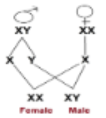
A flow chart of sex determination in human beings is shown below. Some conclusions that can be drawn from it are mentioned in the options. Select the INCORRECT option.

  1. AOption (a)

    The male decides the sex of the offspring.

  2. BOption (b)

    All children inherit X chromosome from their mother.

  3. COption (c)

    The chances of a child being male or female is 50%.

  4. DOption (d)

    The female decides the sex of the offspring.

View answer & explanation

Correct answer

Answer: (d)D.

The female decides the sex of the offspring.

Why this answer is correct

The correct answer is The female decides the sex of the offspring.

Key Points

The given flow chart shows the sex determination in human beings, and some conclusions can be drawn from it. 

  • The male decides the sex of the offspring as the father contributes either an X or a Y chromosome to the offspring, determining its sex.
  • All children inherit an X chromosome from their mother as children inherit one X chromosome from their mother and either an X or a Y chromosome from their father.
  • The chances of a child being male or female is 50% as the probability of having a male or female child is equal.
  • The female decides the sex of the offspring is incorrect as the mother contributes only an X chromosome to the offspring, and the sex is determined by the father's contribution.

Important Points

  • The sex of a child is determined by the chromosomes of the father
  • The chromosomes of the sperm, coming from the father, determine the sex of the child.
  • If the sperm containing the X chromosome fertilizes the ovum, then a female child is born and if the sperm containing the Y chromosome fertilizes the ovum, then a male child is born.
  • The only difference comes through the sex chromosomes, i.e. X and Y.

Question 5

A ray of light, passing through the centre of curvature, is incident on a concave mirror. It is reflected by an angle of ______.

  1. AOption (a)

    10°

  2. BOption (b)

    20°

  3. COption (c)

    0°

  4. DOption (d)

    30°

View answer & explanation

Correct answer

Answer: (c)C.

0°

Why this answer is correct

The correct answer is 0°.

Key Points

  • For the spherical mirror, At a point where the incident ray falls, it follows the law of reflection i.e. the incident angle is equal to the reflected angle.
  • The normal line for this Law of Reflection is the line that passes through the center.
  • When a ray incident on a mirror at 90° (on the normal line), it will reflect back at the same path.
  • The ray of light passes through the center of curvature of a concave mirror it strikes the mirror along the normal ray It incidences on to the mirror at an angle of 90 degrees.
  • Hence the incident ray coincides with the normal.

angle of incidence (i) = 0

According to the law of reflection:

angle of reflection (r) = 0,

  • Hence the ray of light retraces its path.
  • So, the reflected ray retraces its path in the same direction because it strikes the mirror at right angles (90) to its surface due to which the angle of incidence and reflection are 0.

Question 6

Select the option that correctly indicates which of the following statements are true.

When a piece of magnesium metal is placed in copper sulphate solution:

(i) magnesium displaces copper from copper sulphate solution.

(ii) the blue colour of copper sulphate solution fades.

(iii) a red brown deposit of copper metal is formed on the magnesium piece.

  1. AOption (a)

    i and ii

  2. BOption (b)

    i and iii

  3. COption (c)

    i, ii and iii

  4. DOption (d)

    ii and iii

View answer & explanation

Correct answer

Answer: (c)C.

i, ii and iii

Why this answer is correct

The correct answer is i, ii and iii.

Key Points

  • Magnesium displaces copper from copper sulphate solution -  In this single displacement reaction, magnesium, being more reactive than copper, replaces it in the compound.

                                                     The chemical equation is: Mg + CuSO₄ → MgSO₄ + Cu  Therefore Statement I is correct.

  • The blue color of the copper sulphate solution fades - As copper is displaced, the blue color of Cu²⁺ ions fades away, making the solution become colorless or slightly greenish due to the formation of Mg²⁺ ions. Statement II is correct.
  • A red-brown copper metal deposit forms on the magnesium piece. - This is true as the displaced copper metal gets deposited on the magnesium piece as a reddish-brown coating.

Question 7

A sum of money is distributed among four persons A. B. C and D in the ratio 4 ∶ 7 ∶ 9 ∶ 3. If C gets Rs. 800 more than B. then find the amount that D gets.

  1. AOption (a)

    ₹1,200

  2. BOption (b)

    ₹1,000

  3. COption (c)

    ₹1,400

  4. DOption (d)

    ₹1,500

View answer & explanation

Correct answer

Answer: (a)A.

₹1,200

Why this answer is correct

Shortcut Trick

Ratio of shares A : B : C : D = 4 : 7 : 9 : 3

Difference between C and B in units = 9 − 7 = 2 units

Given, 2 units = ₹800 ⇒ 1 unit = ₹400

Amount D gets = 3 units = 3 × 400 = ₹1,200

∴ The correct answer is ₹1,200.

Alternate Method

Given: Ratio of A, B, C, D = 4 : 7 : 9 : 3. Difference (C − B) = ₹800.

Let the amounts be 4x, 7x, 9x, and 3x.

⇒ Share of C − Share of B = 9x − 7x

⇒ 2x = 800

⇒ x = 800 ÷ 2 = 400

⇒ Amount of D = 3x = 3 × 400

⇒ Amount of D = 1,200

∴ The correct answer is ₹1,200.

Additional Information

Ratio and Proportion

Ratio is a comparison of two or more quantities. If A:B = a:b, then A = ax and B = bx where x is the common multiplier.

Total Sum Calculation

The total sum is the sum of all individual parts: (A + B + C + D) = (4 + 7 + 9 + 3) × x = 23x.

Compound Ratio

The compound ratio of (a:b) and (c:d) is (ac : bd), used when combining different related proportions.

Question 8

The average of 70 values is 40. If each value is multiplied by 20, what will be the changed average?

  1. AOption (a)

    60

  2. BOption (b)

    800

  3. COption (c)

    1400

  4. DOption (d)

    90

View answer & explanation

Correct answer

Answer: (b)B.

800

Why this answer is correct

Shortcut Trick

By the core property of averages, if each value in a dataset is multiplied by a constant k, the average of the dataset is also multiplied by k.

Here, the original average is 40 and the multiplying factor is 20.

New Average = Old Average × 20

New Average = 40 × 20 = 800

∴ The correct answer is 800.

Alternate Method

Given:

Total number of values = 70

Average of these 70 values = 40

Formula Used:

Sum of all values = Average × Total number of values

New Average = New Sum of values ÷ Total number of values

Old Average 40

Each value × 20

New Average 800

Property: Average scales proportionally to the values

Calculations:

⇒ Initial Sum = Average × Count = 40 × 70 = 2800

⇒ If each value is multiplied by 20, the entire sum is scaled by 20.

⇒ New Sum = Initial Sum × 20

⇒ New Sum = 2800 × 20 = 56000

⇒ New Average = New Sum ÷ Count

⇒ New Average = 56000 ÷ 70 = 800

∴ The correct answer is 800.

Additional Information

Addition/Subtraction Property of Averages

If a constant value 'c' is added to or subtracted from every observation, the new average also increases or decreases by 'c'.

Multiplication/Division Property of Averages

If every observation is multiplied or divided by a non-zero constant 'k', the new average is also multiplied or divided by 'k'.

Combined Average

If two groups have sizes n1 and n2 with averages A1 and A2 respectively, the Combined Average = (n1 × A1 + n2 × A2) ÷ (n1 + n2).

Question 9

In March 2022, which State Assembly became the first to implement the National e-Vidhan Application (NeVA) programme to become paperless?

  1. AOption (a)

    Rajasthan

  2. BOption (b)

    Assam

  3. COption (c)

    Mizoram

  4. DOption (d)

    Nagaland

View answer & explanation

Correct answer

Answer: (d)D.

Nagaland

Why this answer is correct

The correct answer is Nagaland.

Key Points

  • Nagaland became the first state assembly to implement the National e-Vidhan Application (NeVA) programme in March 2022 to become paperless.
  • NeVA is an initiative of the Ministry of Parliamentary Affairs that aims to make all the State Legislatures of India paperless.
  • The programme includes features like live proceedings, voting, and uploading of documents, which can be accessed by all the Members of Legislative Assemblies (MLAs) and Members of Legislative Councils (MLCs) in real-time.
  • NeVA will not only save time and resources but also promote transparency and accountability in the functioning of the state assemblies.

Additional Information

  • The Nagaland government has announced the creation of three new districts, namely:
  • Tseminyu
  • Niuland
  • Chumoukedima.
  • Chief Minister of Nagaland: Neiphiu Rio;
  • Governor of Nagaland: La Ganesan.

Question 10

Which of the following options is the closest approximate value which will come in place of question mark (?) in the following equation?

44.999 ÷ 8.998 + 23.996 ÷ 11.998  − 7.009 + 8.002 × 1.998 = ?

  1. AOption (a)

    28

  2. BOption (b)

    16

  3. COption (c)

    20

  4. DOption (d)

    24

View answer & explanation

Correct answer

Answer: (b)B.

16

Why this answer is correct

Approximate value of → 44.999 ≈ 45; 8.998 ≈ 9; 23.996 ≈ 24; 11.998 ≈ 12; 7.009 ≈ 7; 8.002 ≈ 8; 1.998 ≈ 2

Given equation becomes → 45 ÷ 9 + 24 ÷ 12 - 7 + 8 × 2

By using BODMAS Rule, we get :-

45 ÷ 9 + 24 ÷ 12 - 7 + 8 × 2

5 + 2 - 7 + 8 × 2

5 + 2 - 7 + 16

5 + 2 + 16 - 7

23 - 7 = 16

Hence, the correct answer is "16".

Question 11

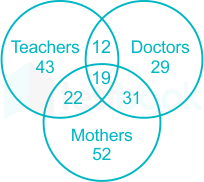
Study the diagram and answer the question that follows. The numbers in different sections indicate the number of persons. What is the sum of the two categories, that is teachers who are doctors and teachers who are mothers but excluding teachers who are doctors as well as mothers?

  1. AOption (a)

    34

  2. BOption (b)

    50

  3. COption (c)

    43

  4. DOption (d)

    31

View answer & explanation

Correct answer

Answer: (a)A.

34

Why this answer is correct

As per the image below,

Teachers who are doctors is colored yellow, and the teachers who are mothers is colored blue, excluding the the teachers who are both mother and doctor.

So, the required sum is,

22 + 12 = 34

Hence, the correct answer is "34".

Question 12

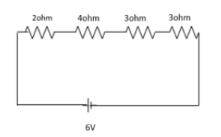
Two resistances R1 and R2 are connected in parallel. Their equivalent resistance is:

  1. AOption (a)

    R1+R2R1R2R_1+R_2\over R_1R_2

  2. BOption (b)

    R1 + R2

  3. COption (c)

    R1R2

  4. DOption (d)

    R1R2R1+R2R_1R_2\over R_1+R_2

View answer & explanation

Correct answer

Answer: (d)D.

R1R2R1+R2R_1R_2\over R_1+R_2

Why this answer is correct

The correct answer is R1R2/(R1+R2).

Key Points

  • The equivalent resistance is less than either of the individual resistances when two resistors are connected in parallel.
  • This is because the total current flowing through the circuit is divided between the two resistors, and each resistor experiences a smaller voltage drop.
  • The equivalent resistance of two resistances R1 and R2 connected in parallel is given by R1R2R1+R2\frac{R_{1}R_{2}}{R_{1}+R_{2}}.
  • The total current in each branch of a parallel circuit is known as the total current.
  • It is given by: I = I1 + I2 + I3+...+In
  • The voltage across each branch and the total voltage of a parallel circuit have the same value.
  • It is expressed as: ET = E1 = E2 = E3 =... = EN.

Additional Information

  • Resistance is a measure of the opposition to the flow of electric current in a material or component.
  • Resistors are electronic components that are used to limit or control the flow of electric current in a circuit.
  • When two resistors are connected in series, their equivalent resistance is given by the sum of their individual resistances, i.e., R1+R2.
  • The current flowing through all of the circuit's resistance equals the total current in a series circuit.
  • It is given by:  IT = I1 = I2 = I3 =... = In
  • ​The sum of each individual voltage drop in a series circuit determines the overall voltage of the circuit.
  • It is given by: ET = E1 + E2 + E3 +... + En

Question 13

Which Kabaddi team won the title of Pro Kabaddi League 2022 for the first time by defeating three-time champions Patna Pirates?

  1. AOption (a)

    Dabang Delhi

  2. BOption (b)

    Pink Panthers

  3. COption (c)

    Bengaluru Bulls

  4. DOption (d)

    Gujrat Giants

View answer & explanation

Correct answer

Answer: (a)A.

Dabang Delhi

Why this answer is correct

The correct answer is Dabang Delhi.

Key PointsPro Kabaddi League 2022:

  • The eighth season of the Vivo Pro Kabaddi League was in 2021–2022.
  • The final match was held on February 25, 2022.
  • Dabang Delhi K.C. became the sixth team in league history to win the PKL trophy when they defeated Patna Pirates 37-36 in Season 8.
  • It was their first-ever PKL triumph.
  • Patna Pirates, on the other hand, have won the PKL title a record three times in 2016, 2017, and 2018.
  • The most raid points were scored by Pawan Sehrawat.
  • For the second year in a row, Naveen Kumar emerged as the Most Valuable Player.​​​​

Additional InformationPro Kabaddi League 2022-2023:

  • It is the ninth season of the Pro Kabaddi League.
  • The final match was conducted at the NSCI SCP Stadium in Mumbai.
  • Jaipur Pink Panthers defeated Puneri Paltan to win their second Pro Kabaddi title.
  • Arjun Deshwal, the ninth season's Most Valuable Player (MVP), led the raiding rankings with 296 raid points.

Question 14

Select the option that is related to the fifth number in the same way as the second number is related to the first number and the fourth number is related to the third number.

8 : 127 :: 5 : 49 :: 11 : ?

  1. AOption (a)

    103

  2. BOption (b)

    214

  3. COption (c)

    203

  4. DOption (d)

    241

View answer & explanation

Correct answer

Answer: (d)D.

241

Why this answer is correct

The logic followed here is,

{(First Number)2 × 2} - 1 = Second Number.

The logic followed in the above-given numbers,

8 : 127 → (82 × 2) - 1  ⇒ 64 × 2 - 1 ⇒ 128 - 1 = 127

similarly,

5 : 49 → 52 × 2) - 1  ⇒ 25 × 2 - 1 ⇒ 50 - 1 = 49

So,

11 : 241 → 112 × 2) - 1  ⇒ 121 × 2 - 1 ⇒ 242 - 1 = 241

Hence, the correct answer is "241".

Question 15

Ananya, Jaya, Priya, Roma, Geeta and Deepa were having a picnic lunch around a circular table. They were facing the table's centre. Exactly two people sit between Roma and Priya. Roma sits second to the right of Ananya. Deepa was second to the left of Jaya. Who was to the immediate left of Deepa?

  1. AOption (a)

    Roma

  2. BOption (b)

    Geeta

  3. COption (c)

    Priya

  4. DOption (d)

    Ananya

View answer & explanation

Correct answer

Answer: (d)D.

Ananya

Why this answer is correct

As given,

Ananya, Jaya, Priya, Roma, Geeta and Deepa are seating around a circular table facing the centre,

then, as per the conditions given in the question,

1) Exactly two people sit between Roma and Priya

2) Roma sits second to the right of Ananya.

3) Deepa was second to the left of Jaya.

This is only possible when Jaya is to the immediate right of Roma and Jaya is to the immediate left of the Roma.

4) The only person left Geeta will take the only vacant place, thus

Therefore, Ananya is to the immediate left of Deepa.

Hence, the correct answer is "Ananya".

Question 16

According to Newland's Law of Octaves, the properties of beryllium are similar to those of ______.

  1. AOption (a)

    Mg

  2. BOption (b)

    Al

  3. COption (c)

    C

  4. DOption (d)

    B

View answer & explanation

Correct answer

Answer: (a)A.

Mg

Why this answer is correct

The correct answer is Mg.

Key PointsNewland's Law of Octaves:

  • The 56 elements that were known at the time were attempted by British scientist John Newlands in 1864.
  • Based on their atomic masses, he put them in ascending order and saw that every eighth element had characteristics in common.
  • This observation led to the formulation of Newland's law of octaves.
  • The properties of magnesium (Mg) are similar to those of beryllium, according to Newland's Law of Octaves.
  • Beryllium and magnesium also have similar atomic structures.
  • They are both metals with relatively low densities.
  • They both have two valence electrons and belong to the same group (Group 2) in the periodic table.
  • The properties of aluminum are similar to those of boron, according to Newland's Law of Octaves.

Additional InformationLimitations of Newland’s Law of Octaves:

  • Several elements in Newland's periodic classification fit into the same positions.
  • Newland’s law of octaves held true only for elements up to calcium.
  • It was impossible to fit elements into octaves with larger atomic masses.
  • The octave design could not accommodate the elements that were later found.

Question 17

Which of the following properties is NOT exhibited or shown by carbon?

  1. AOption (a)

    Covalency

  2. BOption (b)

    Metallic character

  3. COption (c)

    Catenation

  4. DOption (d)

    Allotropy

View answer & explanation

Correct answer

Answer: (b)B.

Metallic character

Why this answer is correct

The correct answer is Metallic character.

Key PointsCarbon:

  • It is a chemical element that is nonmetallic and belongs to Periodic Table Group 14 (IVa).
  • In terms of weight, carbon is ranked 19th among the elements that are abundant in the crust of Earth.
  • It forms compounds by covalent bond.
  • Graphite differs because all of its carbon atoms are sp² hybridized, which results in delocalized free electrons.
  • It is tetravalent and can form four covalent bonds.

Additional InformationCovalency:

  • It is the process by which one element shares electrons with atoms of the same or distinct elements to become stable.
  • It is maximum when atoms with similar electronegativities share electrons.
  • Covalency of oxygen is two.

Catenation:

  • It is the process by which an element's atoms self-link to form rings and chains.
  • Carbon atoms catenate most easily, forming covalent bonds with other carbon atoms to form longer chains and structures.
  • Electronic and steric characteristics (i.e., the arrangement of the element's molecular orbitals around the atom) and the ability to form different kinds of double bonds are all factors that influence catenation.

Allotropy:

  • It is the ability of an element to exist in different forms.
  • The elements that show allotropy are oxygen, phosphorus, sulfur, carbon, and tin.
  • Carbon can exist in forms such as diamond, graphite, and fullerenes.

Question 18

Δ ABC is similar to ΔFED and AB = x cm, BC = x + 2 cm, EF = 12 cm, and ED = 18 cm. The value of x is ______.

  1. AOption (a)

    4 cm

  2. BOption (b)

    2 cm

  3. COption (c)

    −4 cm

  4. DOption (d)

    −2 cm

View answer & explanation

Correct answer

Answer: (a)A.

4 cm

Why this answer is correct

Shortcut Trick

Since Δ ABC ≈ Δ FED, corresponding sides are proportional.

Side ratio: AB / FE = BC / ED

x / 12 = (x + 2) / 18

3x = 2(x + 2) ⇒ 3x = 2x + 4 ⇒ x = 4

∴ The correct answer is 4 cm.

Alternate Method

Given: Δ ABC ≈ Δ FED, AB = x cm, BC = x + 2 cm, EF = 12 cm, ED = 18 cm.

Formula Used: Ratio of corresponding sides of similar triangles is equal.

Calculations:

⇒ AB / FE = BC / ED

⇒ x / 12 = (x + 2) / 18

⇒ 18 × x = 12 × (x + 2)

⇒ 18x = 12x + 24

⇒ 18x − 12x = 24

⇒ 6x = 24

⇒ x = 24 / 6

⇒ x = 4

∴ The correct answer is 4 cm.

Additional Information

Similarity Criteria

Two triangles are similar if their corresponding angles are equal (AAA) or their corresponding sides are in the same ratio (SSS).

Area Ratio Property

If two triangles are similar, the ratio of their areas is equal to the square of the ratio of their corresponding sides.

SAS Similarity

If one angle of a triangle is equal to one angle of another triangle and the sides including these angles are proportional, then the triangles are similar.

Question 19

Which of the following is the first indigenous drug to treat COVID-19 developed jointly by the Centre for Cellular and Molecular Biology (CCMB), VINS Bioproducts and the University of Hyderabad (UoH)?

  1. AOption (a)

    Moderna

  2. BOption (b)

    Vincov-19

  3. COption (c)

    Covavex 22

  4. DOption (d)

    Covishield

View answer & explanation

Correct answer

Answer: (b)B.

Vincov-19

Why this answer is correct

The correct answer is Vincov-19.

Key PointsVINCOV-19:

  • It has been recognized as the first indigenous drug against the SARS-CoV-2 virus.
  • The CSIR-Centre for Cellular & Molecular Biology (CCMB), VINS Bioproducts, and the University of Hyderabad (UoH) worked together to develop this medication.
  • The SARS-CoV-2 virus is inactivated and administered to horses in order to make this medication.
  • Subsequently, the blood serum-produced anti-bodies are manufactured, processed, and made into a medication.

Additional InformationModerna:

  • It is based on mRNA vaccine model.
  • Messenger RNA is referred to as mRNA.
  • This contains the genetic code needed to code for a particular protein.
  • A molecule called mRNA contains genetic instructions that tell cells how to build proteins and distribute them throughout the body.
  • In order to achieve the intended therapeutic effect, mRNA-based vaccines take advantage of the body's regular biological functions.
  • Katalin Karikó and Drew Weissman have won the 2023 Nobel Prize in Physiology or Medicine for creating the mRNA vaccination technology.

Covavex 22:

  • It produced by Serum Institute of India Pvt Ltd.
  • Spike proteins are used in this recombinant protein vaccination to instruct the body on how to build immunity against coronavirus.
  • It is stable at refrigerated temperatures between 2 and 8 degrees Celsius and only takes two doses.

Covishield:

  • It is based on a chimpanzee adenovirus vector that is recombinant and replication-deficient, and that carries the SARS-CoV-2 Spike (S) glycoprotein.
  • The Serum Institute of India (SII) in Pune is responsible for its development and production, operating under license from Oxford and AstraZeneca.
  • It is believed that the body's immune system will identify this protein as a danger and begin producing antibodies to combat it.

Question 20

How many numbers between 1 to 150 are divisible by 3 and 4 both?

  1. AOption (a)

    12

  2. BOption (b)

    10

  3. COption (c)

    11

  4. DOption (d)

    9

View answer & explanation

Correct answer

Answer: (a)A.

12

Why this answer is correct

Shortcut Trick

Numbers divisible by both 3 and 4 must be divisible by their LCM.

LCM(3, 4) = 12

Required count = Floor value of (Upper Limit ÷ LCM)

Count = 150 ÷ 12 = 12.5

∴ The correct answer is 12.

Alternate Method

Given: Range = 1 to 150, Divisors = 3 and 4.

Formula Used: n-th term of AP, an = a + (n − 1)d

⇒ Multiples of both 3 and 4 are multiples of 12.

⇒ The series is: 12, 24, 36, ..., 144.

⇒ First term (a) = 12

⇒ Last term (an) = 144

⇒ Common difference (d) = 12

⇒ 144 = 12 + (n − 1) × 12

⇒ 132 = (n − 1) × 12

⇒ n − 1 = 11

⇒ n = 12

∴ The correct answer is 12.

Additional Information

Divisibility by Multiple Numbers

To find numbers divisible by both 'a' and 'b', always find the numbers divisible by LCM(a, b).

Arithmetic Progression (AP) Count

The number of terms in an AP is given by: n = [(Last Term − First Term) ÷ Common Difference] + 1.

Divisibility Rule of 12

A number is divisible by 12 if it is simultaneously divisible by both 3 (sum of digits) and 4 (last two digits).

Question 21

SEWA Cooperative Bank was first initiated in ______ in 1974.

  1. AOption (a)

    Varanasi

  2. BOption (b)

    Ahmedabad

  3. COption (c)

    Chennai

  4. DOption (d)

    Jaipur

View answer & explanation

Correct answer

Answer: (b)B.

Ahmedabad

Why this answer is correct

The correct answer is Ahmedabad.

Key PointsSEWA Cooperative Bank:

  • It was initiated in Ahmedabad in 1974 specifically to offer small loans to low-income women.
  • SEWA stands for Self Employed Women's Association.
  • The International Labour Organization recognized this program as a microfinance movement.
  • It has empowered women via skill development and training, assisting in their rehabilitation throughout personal, political, and even social crises.
  • It encouraged cooperative textile production, consumption, and marketing—the fundamentals of India's industrialization.

Additional InformationVaranasi:

  • Benaras or Kashi are other names for it.
  • It is in the southeastern part of Uttar Pradesh.
  • It is one of the seven holy towns of Hinduism and is situated on the left bank of the Ganges (Ganga) River.
  • It is among the world's oldest cities to have been inhabited continuously.
  • It is credited as the birthplace of Ayurveda.

Chennai:

  • It is located on the Coromandel Coast along the Bay of Bengal.
  • It serves as Tamil Nadu's capital.
  • The seven massive Dravidian-style temples located in the city's George Town, Mylapore, and Triplicane districts are the most recognizable structures in the entire area.
  • The Parthasarathi Temple, constructed by Pallava rulers in the eighth century, is the oldest temple in the city.

Jaipur:

  • It is the capital of Rajasthan.
  • It is also known as Pink city.
  • It is known across the world for its colored gems.
  • It is planned by Vidyadhar Bhattacharya.

Question 22

In this question, a group of numbers/symbols is coded using letters as per the table given below and the conditions which follow. The correct combination of codes following the conditions is your answer.

Number/Symbol1%84ϕ∂2$!6=375
CodeAEIOUPRTVXZBDF


Conditions:

(i) If the first element is a number and the last, a symbol, the codes for these two (the first and the last elements) are to be interchanged.

ii) If the first element is an EVEN number and the last, an ODD number, the first and last elements are to be coded as &.

(iii) If both the second and the third elements are prime numbers, the third element is to be coded as the code for the second element.

Question: 2 $ 3 7 3

  1. AOption (a)

    B B T D R

  2. BOption (b)

    R B T D B

  3. COption (c)

    & B T D &

  4. DOption (d)

    & T B D &

View answer & explanation

Correct answer

Answer: (d)D.

& T B D &

Why this answer is correct

Given → Number/ Symbol and their codes:-

Number/Symbol1%84ϕ∂2$!6=375
Code for Number/SymbolAEIOUPRTVXZBDF


Conditions for coding the group elements

S.noConditionResult
1If the first element is a number and last element a symbolThe codes for first and last elements are to be interchanged.
2If first element is even number and the last element is an odd numberThe first and last element are to be coded as &
3If both the second and third element are prime numbersThe third element is to be coded as the code for the second element.
4If none of the condition followsThe elements are to be coded according to their respective codes.

In 2 $ 3 7 3 

Condition 1: doesn't follow → First element is a number but last element is not a symbol.

Condition 2: follows → First element is an even number and the last element is an odd number. Therefore, both will be coded first and last element will be coded as &.

Condition 3: doesn't follow → Second element is a symbol and the third element is a prime number.

Thus, the code for 2 $ 3 7 3 is :-

Number/Symbol2$373
Code for Number/Symbol&TBD&

Hence, the correct answer is "& T B D &".

Question 23

Refer to the following number series and answer the question.

(Left) 2 5 4 3 7 8 6 7 9 4 3 7 8 6 2 3 4 8 9 4 8 7 6 4 3 7 2 8 9 7 5 3 2 4 5 9  (Right)

If all the even numbers are dropped from the series, which of the following will be sixth from the left?

  1. AOption (a)

    5

  2. BOption (b)

    7

  3. COption (c)

    3

  4. DOption (d)

    9

View answer & explanation

Correct answer

Answer: (c)C.

3

Why this answer is correct

The given series is,

(Left) 2 5 4 3 7 8 6 7 9 4 3 7 8 6 2 3 4 8 9 4 8 7 6 4 3 7 2 8 9 7 5 3 2 4 5 9  (Right)

As per the question, after dropping the even numbers, the above series will reduce to,

(Left)  5 3 7 7 9 3 7 3 9 7 3 7 9 7 5 3 5 9  (Right)

So, the sixth element from the left is,

(Left)  5 3 7 7 9 3 7 3 9 7 3 7 9 7 5 3 5 9  (Right)

Hence, the correct answer is, '3'.

Question 24

In a balanced chemical reaction, like the one shown below, the values of a, b, c and d respectively, are:

a Fe + b H2O → c Fe3O4 + d H2

  1. AOption (a)

    3, 4, 1, 4

  2. BOption (b)

    3, 1, 1, 4

  3. COption (c)

    3, 4, 3, 4

  4. DOption (d)

    1, 4, 1, 4

View answer & explanation

Correct answer

Answer: (a)A.

3, 4, 1, 4

Why this answer is correct

The answer is 3, 4, 1, 4.

Key PointsBalancing Chemical Reaction:

  • The given equation is: a Fe + b H2O → c Fe3O4 + d H2.

  • | Reactant Side | Product Side | | --- | --- | | 1 Iron atom | 3 Iron atoms | | 2 Hydrogen atoms | 2 Hydrogen atoms | | 1 Oxygen atom | 4 Oxygen atoms |

  • The iron atoms are balanced first. Once the equation is balanced, it becomes: 3Fe + H2O → Fe3O4 + H2

  • The oxygen atoms are then balanced. After the balancing the equation, it becomes: 3Fe + 4H2O → Fe3O4 + H2

  • At last, the atoms of hydrogen are balanced. Once the equation is balanced, it becomes: 3Fe + 4H2O → Fe3O4 + 4H2

  • The balanced chemical reaction is: 3 Fe + 4 H2O → 1 Fe3O4 + 4 H2.

  • | Reactant Side | Product Side | | --- | --- | | 3 Iron atoms | 3 Iron atoms | | 8 Hydrogen atoms | 8 Hydrogen atoms | | 4 Oxygen atom | 4 Oxygen atoms |

Additional InformationBalanced Chemical Reaction:

  • It is a chemical equation that represents the conservation of mass and charge in a chemical reaction.
  • The number of atoms of each element and the total charge on both reactant and product sides of the equation must be equal.
  • It is important to balance chemical reactions to understand the stoichiometry of the reaction and predict the amount of reactants and products formed.
  • The oxygen and hydrogen atoms' stoichiometric coefficients are typically assigned last.

Question 25

The ratio between the present ages of P and Q is 7 : 5, respectively. The ratio between P's age 5 years ago and Q's age 5 years hence is 1 : 1. What is the ratio between P's age 5 years hence and Q's age 5 years ago?

  1. AOption (a)

    2 : 3

  2. BOption (b)

    2 : 1

  3. COption (c)

    1 : 2

  4. DOption (d)

    3 : 2

View answer & explanation

Correct answer

Answer: (b)B.

2 : 1

Why this answer is correct

Shortcut Trick

Given ratio of Present Ages of P and Q = 7 : 5.

Condition: P − 5 = Q + 5 ⇒ P − Q = 10.

Difference in ratio parts = 7 − 5 = 2 units. Thus, 2 units = 10 years → 1 unit = 5 years.

Present ages: P = 35, Q = 25.

Required Ratio (P+5) : (Q−5) = 40 : 20 = 2 : 1.

∴ The correct answer is 2 : 1.

Alternate Method

Given: Ratio of present ages P : Q = 7 : 5. Let ages be 7x and 5x.

Formula Used: Age after/before n years = Present Age ± n.

⇒ (7x − 5) / (5x + 5) = 1 / 1

⇒ 7x − 5 = 5x + 5

⇒ 2x = 10

⇒ x = 5

⇒ Present Age of P = 7 × 5 = 35 years

⇒ Present Age of Q = 5 × 5 = 25 years

⇒ Age of P after 5 years = 35 + 5 = 40 years

⇒ Age of Q 5 years ago = 25 − 5 = 20 years

⇒ Required Ratio = 40 : 20 = 2 : 1

∴ The correct answer is 2 : 1.

Additional Information

Age Difference Property

The difference between the ages of two persons always remains constant, regardless of the number of years passed or gone by.

Ratio Scaling

To solve age problems quickly, ensure the ratio difference between two time periods is balanced by multiplying with suitable factors.

Question 26

The mean proportional of 0.25 and 0.64 is

  1. AOption (a)

    0.7

  2. BOption (b)

    0.4

  3. COption (c)

    0.5

  4. DOption (d)

    0.6

View answer & explanation

Correct answer

Answer: (b)B.

0.4

Why this answer is correct

Shortcut Trick

Mean Proportional of a and b is √(a × b).

⇒ Mean Proportional = √(0.25 × 0.64)

⇒ Mean Proportional = 0.5 × 0.8 = 0.4.

∴ The correct answer is 0.4.

Alternate Method

Given:

First number (a) = 0.25

Second number (b) = 0.64

Formula Used:

If x is the mean proportional between a and b, then a : x = x : b.

⇒ x2 = a × b

Calculations:

⇒ x2 = 0.25 × 0.64

⇒ x = √(0.25 × 0.64)

⇒ x = √(25/100 × 64/100)

⇒ x = (5 × 8) ÷ 100

⇒ x = 40 ÷ 100

⇒ x = 0.4

∴ The correct answer is 0.4.

Additional Information

Third Proportional

The third proportional of two numbers a and b is defined as the value c such that a : b = b : c, which gives c = b2/a.

Fourth Proportional

The fourth proportional of three numbers a, b, and c is d such that a : b = c : d, calculated as d = (b × c)/a.

Continued Proportion

Numbers a, b, c are in continued proportion if a/b = b/c. Here b is the mean proportional.

Question 27

If 25x3 = 1600, then which of the following is a possible value of x?

  1. AOption (a)

    3

  2. BOption (b)

    4

  3. COption (c)

    5

  4. DOption (d)

    2

View answer & explanation

Correct answer

Answer: (b)B.

4

Why this answer is correct

Shortcut Trick

Directly divide the constant on the right side by the coefficient of x3:

x3 = 1600 ÷ 25 = 64

Taking the cube root of both sides:

x = √364 = 4

∴ The correct answer is 4.

Alternate Method

Given:

The given algebraic equation is 25x3 = 1600

Formula Used:

To solve for the variable x, isolate the cubic term x3 and apply the cube root operation on both sides of the equation.

Calculations:

⇒ 25x3 = 1600

⇒ x3 = 1600 ÷ 25

⇒ x3 = 64

⇒ x = (64)1/3

⇒ x = (43)1/3

⇒ x = 4

∴ The correct answer is 4.

Additional Information

Cube and Cube Roots

The cube root of a number y is a value x such that x × x × x = y. For any real number, there exists exactly one real cube root.

Division Shortcut for 25

To quickly divide any number by 25, multiply the numerator by 4 and shift the decimal point two places to the left: 1600 ÷ 25 = (1600 × 4) ÷ 100 = 64.

Laws of Exponents

For any base variable, (xm)n = xm × n. Applying this rule to (43)1/3 results in 41 = 4.

Question 28

Identify the world's largest river line island formed by the Brahmaputra.

  1. AOption (a)

    Sandwip Island

  2. BOption (b)

    Sumba Island

  3. COption (c)

    Majuli Island

  4. DOption (d)

    Diglipur Island

View answer & explanation

Correct answer

Answer: (c)C.

Majuli Island

Why this answer is correct

The correct answer is Majuli Island.

Key PointsMajuli Island:

  • It is located in the Brahmaputra River in the Indian state of Assam.
  • It is the world's largest river-line island, formed by the Brahmaputra.
  • The island covers an area of approximately 880 square kilometers and is home to numerous indigenous tribes.
  • It is known for its rich culture and is home to several Vaishnavite monasteries that attract tourists from all over the world.

Additional InformationDiglipurI sland:

  • It is the biggest town on North Andaman Island.
  • It has about 40 caves that haven't been fully explored.
  • Saddle Peak National Park is the reason for its popularity.

Sandwip Island:

  • It is located in southeast Bangladesh, at the estuary of the Meghna River.
  • It is the Ganga River delta's easternmost island.
  • It is roughly 40 km long and 5–15 km wide.
  • The Sandwip Channel divides it from the Chittagong region to the east.

Sumba Island:

  • This island is situated in the eastern part of Indonesia.
  • Its area is 11,153 square kilometers, and its mountains reach heights of up to 4,000 feet.
  • There is a lot of grassland and little forestation due to the about 1,625 mm of annual rainfall.

Question 29

If a substance gains hydrogen during the reaction, it is said to be

  1. AOption (a)

    neutralised

  2. BOption (b)

    reduced

  3. COption (c)

    decomposed

  4. DOption (d)

    oxidised

View answer & explanation

Correct answer

Answer: (b)B.

reduced

Why this answer is correct

The correct answer is reduced.

Key PointsReduction:

  • It is a process where a substance gains electrons and becomes more negatively charged.
  • It is often accompanied by the loss of oxygen or gain of hydrogen.
  • It is used in the manufacturing of cement.
  • For example, when silver ions gain electrons to form silver metal, they undergo reduction.

Additional InformationNeutralisation:

  • It is a reaction that occurs between an acid and a base to form a salt and water.
  • The acid and base cancel out each other's properties, resulting in a neutral pH.
  • In wastewater treatment, this technique is employed to lessen the harm that the effluents cause.
  • It is employed in the process of making antacid pills.
  • A strong acid and strong base neutralized has a pH of seven.

Decomposition:

  • It is a reaction where a compound breaks down into simpler substances.
  • This can occur through heating, electrolysis, or other chemical reactions.
  • For example, when water is broken down into hydrogen and oxygen gas through electrolysis, it undergoes decomposition.

Oxidation:

  • It is a process where a substance loses electrons and becomes more positively charged.
  • It is often accompanied by the gain of oxygen or loss of hydrogen.
  • For example, when iron rusts, it undergoes oxidation by reacting with oxygen in the air.

Question 30

Which of the following is a qualitative instrument of credit control used by the Reserve Bank of India?

  1. AOption (a)

    Moral suasion

  2. BOption (b)

    Repo rate

  3. COption (c)

    Open market operations

  4. DOption (d)

    Bank rate

View answer & explanation

Correct answer

Answer: (a)A.

Moral suasion

Why this answer is correct

The correct answer is Moral suasion.

Key Points 

Reserve Bank of India (RBI) is India’s central bank.

  • In compliance with the terms of the Reserve Bank of India Act, 1934, it was founded on April 1, 1935 in Calcutta.
  • It was permanently moved to Mumbai in 1937.
  • Though originally privately owned, since nationalisation in 1949, the Reserve Bank is fully owned by the Government of India.
  • As a qualitative instrument of monetary policy, the Reserve Bank of India (RBI) employs moral suasion.
  • It regulates the issue of Bank notes and keeping of reserves with a view to securing monetary stability in India and generally to operate the currency and credit system of the country to its advantage.
  • It also monitors the monetary policies through its Monetary Policy Committee (MPC).​

Additional InformationRepo Rate:

  • It is the rate at which a nation's central bank lends money to commercial banks when there is a lack of funds by buying securities.
  • In order to manage inflation, monetary authorities use repo rate.
  • Central banks raise the repo rate in an effort to combat inflation since it discourages banks from borrowing.
  • This eventually lowers the amount of money in circulation, which aids in containing inflation.

Open Market Operations:

  • It refers to the buying and selling of government securities and Treasury bills by the central bank in order to control the money supply.
  • In order to lower the amount of money in circulation, the central bank will sell securities on the open market.
  • The goal is to raise interest rates.

Bank Rate:

  • It is the rate at which commercial banks borrow money from the RBI without securities.
  • The Reserve Bank of India regulates bank rates.
  • Since it can control liquidity, it is typically higher than a repo rate.

Question 31

In a cell that is NOT dividing, DNA is present as part of the ______.

  1. AOption (a)

    chromosome

  2. BOption (b)

    nucleoplasm

  3. COption (c)

    gene

  4. DOption (d)

    chromatin material

View answer & explanation

Correct answer

Answer: (d)D.

chromatin material

Why this answer is correct

The correct answer is chromatin material.

Key Points

Chromatin Material:

  • It is a complex of DNA, histones, and non-histone proteins that make up the genetic material in the nucleus of a non-dividing cell.
  • It is organized into two types of chromatin:
  • Euchromatin is less condensed and contains actively transcribed genes.
  • Heterochromatin is highly condensed and contains inactive genes.
  • It serves the following primary purposes:
  • Preventing DNA deterioration.
  • Control the DNA replication and gene expression.
  • Tightly packing the DNA to fit into the cell.
  • Support the DNA molecule to permit the process of the cell cycle – meiosis and mitosis.

Additional InformationChromosomes:

  • They are visible structures that contain genetic information and are made up of DNA and proteins.
  • They are only visible during cell division when the chromatin material condenses and becomes tightly packed.
  • DNA and one protein molecule make up each chromosome.
  • There are 23 pairs of chromosomes in humans, making 46 chromosomes in total.

Nucleoplasm:

  • It is the kind of protoplasm that constitutes the most prominent organelle in a eukaryotic cell—the nucleus.
  • It is enclosed by the nuclear membrane.
  • It is responsible for retaining the nucleus's shape.
  • It is the site of numerous crucial cellular processes.

Genes:

  • They are segments of DNA that contain instructions for making proteins.
  • Each gene has a unique set of instructions for coding proteins or performing a certain function.
  • Heredity is the consequence of genes.
  • It controls the functions of DNA and RNA.
  • All bodily functions are attributed to protein synthesis, which is mainly controlled by genes.

Question 32

Recycling is one of the best methods to decrease the amount of waste generated. Some of its benefits are given below. Which of the following is NOT an advantage of recycling?

  1. AOption (a)

    It reduces waste sent to landfills.

  2. BOption (b)

    It is of economic benefit, as it creates jobs.

  3. COption (c)

    It is expensive and uses energy.

  4. DOption (d)

    It prevents pollution.

View answer & explanation

Correct answer

Answer: (c)C.

It is expensive and uses energy.

Why this answer is correct

The correct answer is It is expensive and uses energy.

Key PointsRecycling:

  • It is a process of converting waste materials into new products.
  • Advantages:
  • Reduces waste sent to landfills.
  • It is of economic benefit, as it creates jobs.
  • Prevents pollution by reducing the need for new materials to be extracted from the earth.
  • Saves energy by reducing the need for the production of new products.
  • Disadvantages:
  • It is expensive and requires energy to collect, transport, and process recycled materials.
  • Some materials cannot be recycled, and the recycling process can generate pollution.
  • Recycling may not always be the most environmentally friendly option, as some recycled products may have a larger carbon footprint than their non-recycled counterparts.
  • Recycling can also create a false sense of security, leading people to consume more and recycle less.

Additional InformationGalvanizing Organic Bio-Agro Resources Dhan (GOBARdhan):

  • It was launched by the Ministry of Drinking Water & Sanitation in April 2018.
  • It is a part of the Swachh Bharat Mission (Grameen)'s Solid and Liquid Waste Management component, which aims to improve village cleanliness and produce income and energy from animal and organic waste.
  • Its primary goals are to maintain clean villages, raise rural households' incomes, and turn cattle manure into organic manure and energy.

Question 33

BU23G is related to GZ18L in a certain way. In the same way, LC41M is related to QH36R. To which of the following is GU18N related following the same logic?

  1. AOption (a)

    LZ13S

  2. BOption (b)

    LP15J

  3. COption (c)

    ZL3G

  4. DOption (d)

    LZ13H

View answer & explanation

Correct answer

Answer: (a)A.

LZ13S

Why this answer is correct

The positional value of the English alphabet is given below:

The logic followed is,

The letters proceed forward by 5 places, while the number at the centre is reduced by 5.

BU23G → GZ18L

And, LC41M → QH36R

Similarly,

GU18N is coded as,

Hence, the correct answer is "LZ13S"..

Question 34

A statement is given, followed by four conclusions given in the options. Find out which conclusion is true based on the given statement.

Statement: C > X < N < S < D = K

  1. AOption (a)

    K > N

  2. BOption (b)

    X > K

  3. COption (c)

    C > N

  4. DOption (d)

    N > D

View answer & explanation

Correct answer

Answer: (a)A.

K > N

Why this answer is correct

Given statement: C > X < N < S < D = K

Let's check each option,

1) K > N→ Follows (K = D > S > N)

2) X > K→ Doesn't follows (X < N < S < D = K Because X < K)

3) C > N→ Doesn't follows (C > X < N, Can't find the relation between C and N)

4) N > D→ Doesn't follows (N < S < D = K Because N < D)

Here, we can see that option 1 is true.

Hence, the correct answer is "K > N".

Question 35

Six persons, A, B, C, D, E and F, were born on different dates - 12th, 14th, 18th, 19th, 4th and 6th, of the same month. None of them were born after D and he was born just after E. Only three people were born before A. Only two people were born between C and E. B was not born after C. Who among the following was born on 12th?

  1. AOption (a)

    A

  2. BOption (b)

    F

  3. COption (c)

    C

  4. DOption (d)

    B

View answer & explanation

Correct answer

Answer: (b)B.

F

Why this answer is correct

Let's create the order using the informations given,

  1. None of them were born after D and he was born just after E.
DatePerson
4th
6th
12th
14th
18thE
19thD
  1. Only three people were born before A.
DatePerson
4th
6th
12th
14thA
18thE
19thD
  1. Only two people were born between C and E.
DatePerson
4th
6thC
12th
14thA
18thE
19thD
  1. B was not born after C.
DatePerson
4thB
6thC
12th
14thA
18thE
19thD
  1. Placing F in the blank space, we get the final order of the persons as,
DatePerson
4thB
6thC
12thF
14thA
18thE
19thD

Here, we can see that F was born on 12th.

Hence, the correct answer is " F ".

Question 36

If '+' means '−', '−' means '×', '×' means '÷' and '÷' means '+', what will come in place of the question mark (?) in the following equation?

15 + 12 × 4 ÷ 5 − 2 = ?

  1. AOption (a)

    18

  2. BOption (b)

    22

  3. COption (c)

    20

  4. DOption (d)

    28

View answer & explanation

Correct answer

Answer: (b)B.

22

Why this answer is correct

Symbol+-×÷
Meaning-×÷+

Now let's place the final symbols in the equation,

15 - 12 ÷ 4 + 5 × 2 =?

15 - 3 + 10 =?

12 + 10 =?

22 =?

Here, we can see that 22 replaces the question mark.

Hence, the correct answer is " 22 ".

Question 37

A clock marked for ₹10,000 is available on successive discounts of 40% and k%. If the selling price of the clock is ₹2,400, then find the value of k.

  1. AOption (a)

    40%

  2. BOption (b)

    36%

  3. COption (c)

    60%

  4. DOption (d)

    24%

View answer & explanation

Correct answer

Answer: (c)C.

60%

Why this answer is correct

Given:-

Marked Price of clock = ₹10,000

Selling Price of clock = ₹2,400

Two successive discounts = 40% and k%

Concept Used:-

SP = (100 - Discount%) / 100 * MP

Calculation:

⇒ 2400 = [(100 - 40) / 100] * [(100 - k) / 100 ] × 10000

⇒ 2400 = [60/100] × [(100 - k) / 100 ] × 10000

⇒ 2400 = 60 × (100 - k)

⇒ 100 - k = 2400/60

⇒ 100 - k = 40

⇒ k = 100 - 40

⇒ k = 60

∴ Value of k is 60.

Question 38

Find the marginal product.

LabourTotal ProductMarginal Product
11010
228?
340?
450?
  1. AOption (a)

    18, 12 and 10

  2. BOption (b)

    5, 9.33 and 10

  3. COption (c)

    9, 4 and 2.50

  4. DOption (d)

    14, 13.33 and 12.50

View answer & explanation

Correct answer

Answer: (a)A.

18, 12 and 10

Why this answer is correct

The correct answer is 18, 12 and 10.

Key Points

  • Marginal product is the increase in output that results from increasing one unit of input while holding all other inputs constant.
  • To find the marginal product, we need to calculate the difference in total product between each successive level of labor input.
  • The difference in total product between 1 and 2 units of labor is 28 - 10 = 18.
  • Therefore, the marginal product of the second unit of labor is 18.
  • The difference in total product between 2 and 3 units of labor is 40 - 28 = 12.
  • Therefore, the marginal product of the third unit of labor is 12.
  • The difference in total product between 3 and 4 units of labor is 50 - 40 = 10.
  • Therefore, **the marginal product of the fourth unit of labor is 10.**​
  • ​The marginal product is:​
LabourTotal ProductMarginal Product
11010
22828 - 10 = 18
34040 - 28 = 12
45050 - 40 = 10

Additional InformationLaw of Diminishing Returns:

  • It states that as more and more units of a variable input (such as labor) are added to a fixed amount of other inputs (such as capital), the marginal product of the variable input will eventually decrease.
  • The classic application of this law is in farming.
  • In order to enhance crop yields, farmers often have a limited amount of land that they can work with an endless number of workers.
  • There is a threshold, nevertheless, beyond which the addition of one worker does not result in a greater rise in crop yields than the previous addition.
  • At this point the law of diminishing returns has set in and the farm is less efficient than it was before that additional worker was employed.

Question 39

Five boxes F, E, T, C and S are placed one over the other but not necessarily in the same order. S is second from the top, while E is second from the bottom. C is neither at the top nor at the bottom. What is the position of C from the top?

  1. AOption (a)

    Third

  2. BOption (b)

    Fifth

  3. COption (c)

    Second

  4. DOption (d)

    Fourth

View answer & explanation

Correct answer

Answer: (a)A.

Third

Why this answer is correct

Let's create the order using the informations given,

  1. S is second from the top, while E is second from the bottom.
1.
2.S
3.
4.E
5.
  1. C is neither at the top nor at the bottom.
1.
2.S
3.C
4.E
5.
  1. So, the final order is as follows,
1.F/T
2.S
3.C
4.E
5.F/T

Here, we can see that C is third from the top.

Hence, the correct answer is " Third ".

Question 40

How are the gaseous waste products produced in the hard stem of big plants and trees removed by the plant?

  1. AOption (a)

    Through lenticels

  2. BOption (b)

    Through osmosis

  3. COption (c)

    Through transpiration

  4. DOption (d)

    Through stomata

View answer & explanation

Correct answer

Answer: (a)A.

Through lenticels

Why this answer is correct

The correct answer is Through lenticels.

Key PointsLenticels:

  • It is a porous tissue made up of cells with wide intercellular spaces found in the bark of woody stems, the roots of dicotyledonous flowering plants, and the periderm of secondary thickening organs.
  • The gaseous waste products that are eliminated by lenticels from the hard stems of large plants and trees.
  • It serves as a pore, allowing gases to directly exchange between the interior tissues and the atmosphere.
  • It encourages the exchange of water vapor, carbon dioxide, and oxygen gases.
  • One of the traits used to identify trees is the shape of the lenticels.
  • It is also seen on a variety of fruits.

Additional InformationOsmosis:

  • It is the process by which solvent molecules move through a semi-permeable membrane from a solution of low concentration to one of high concentration.
  • It is a passive process that takes place without using any energy.
  • It can occur in any solvent, including gases and supercritical liquids.
  • It is of two types:
  • Endosmosis: When a substance is dissolved in a hypotonic solution, the solvent molecules enter the cell and cause deplasmolysis or turgidness.
  • Exosmosis: When a material is dissolved in a hypertonic solution, the solvent molecules leave the cell and cause plasmolysis or the cell to become floppy.

Transpiration:

  • It is the mechanism by which extra water is removed from the plant body.
  • It is typically the result of water evaporating off the leaf surface.
  • Variables influencing the transpiration rate are sunlight, temperature, wind, and humidity.

Stomata:

  • It is made up of tiny holes called stomas that are encircled by two guard cells.
  • Some of the plants have stomata on their stems and other sections.
  • It is crucial to both photosynthesis and gaseous exchange.
  • About 300 stomata are found on average for every square millimeter of the leaf surface.

Question 41

Which of the following Indian language constitutes third most spoken language in the world as per Forbes data published in August 2021?

  1. AOption (a)

    Telugu

  2. BOption (b)

    Bengali

  3. COption (c)

    Odia

  4. DOption (d)

    Hindi

View answer & explanation

Correct answer

Answer: (d)D.

Hindi

Why this answer is correct

The correct answer is Hindi.

Key PointsMost Spoken Languages Worldwide 2021:

  • It was published by Forbes Media.
  • List of the Rankings in 2021
RankLanguage
1English
2Mandarin
3Hindi
4Spanish
5Arabic
6Bengali
7French
8Russian
9Portuguese
10Urdu

Additional Information

  • The Statista Research Department has carried out an extensive analysis to identify the most widely spoken languages around the world in 2023.
  • List of the Rankings in 2023:
RankLanguage
1English
2Mandarin
3Hindi
4Spanish
5French
6Arabic
7Bengali
8Portuguese
9Russian
10Urdu

Question 42

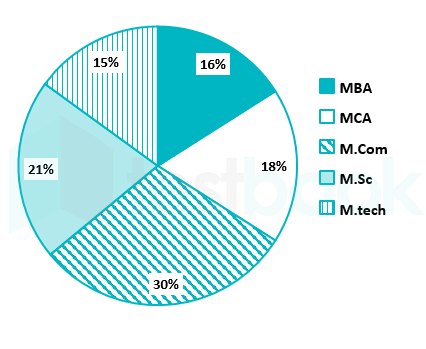
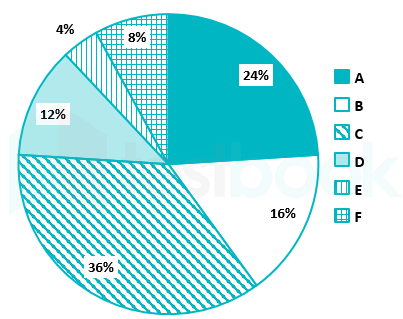
The following chart shows fee waiver seats in different courses in a university. Study the chart and answer the question.

Total number of students in the university = 15000

What is the total number of fee waiver seats in M.Tech and M.Com together?

  1. AOption (a)

    6750

  2. BOption (b)

    6800

  3. COption (c)

    4250

  4. DOption (d)

    5000

View answer & explanation

Correct answer

Answer: (a)A.

6750

Why this answer is correct

Given:

Total number of students in the university = 15000

The percentage of fee waiver seats in M.Tech is 15%.

The percentage of fee waiver seats in M.Com is 30%.

Calculation:-

The total percentage of fee waiver seats in M.Tech and M.Com together is 15% + 30% = 45%

the total number of fee waiver seats in M.Tech and M.Com together is given by 45% of 15000 = 6750

∴ Option 1 is the correct answer.

Question 43

It takes two pipes A and B, running together, to fill a tank completely in 4 minutes. If it takes A, 6 minutes less than B, to fill the tank completely, then what will be the time taken by B alone to fill the tank completely?

  1. AOption (a)

    12 min

  2. BOption (b)

    20 min

  3. COption (c)

    6 min

  4. DOption (d)

    15 min

View answer & explanation

Correct answer

Answer: (a)A.

12 min

Why this answer is correct

Shortcut Trick

Test the given options to satisfy the condition: (Time A × Time B) ÷ (Time A + Time B) = 4 min.

If Pipe B takes 12 min, then Pipe A takes 12 − 6 = 6 min.

Combined Time = (12 × 6) ÷ (12 + 6) = 72 ÷ 18 = 4 min.

Since this matches the given combined time, Pipe B = 12 min is correct.

∴ The correct answer is 12 min.

Alternate Method

Given:

Time taken by Pipe A and Pipe B together = 4 min

Time taken by Pipe A = (Time taken by Pipe B) − 6 min

PersonDaysTotal WorkEfficiency
Pipe A + Pipe B412 units3 units/min
Pipe B121 unit/min
Pipe A62 units/min

Calculations:

Let the time taken by Pipe B be x min.

Then, the time taken by Pipe A = (x − 6) min.

⇒ 1/x + 1/(x − 6) = 1/4

⇒ [(x − 6) + x] ÷ [x(x − 6)] = 1/4

⇒ (2x − 6) ÷ (x2 − 6x) = 1/4

⇒ 8x − 24 = x2 − 6x

⇒ x2 − 14x + 24 = 0

⇒ x2 − 12x − 2x + 24 = 0

⇒ x(x − 12) − 2(x − 12) = 0

⇒ (x − 12)(x − 2) = 0

⇒ x = 12 or x = 2

Since Pipe A takes (x − 6) min, x must be greater than 6. ∴ x = 12 min.

∴ The correct answer is 12 min.

Additional Information

Total Work Formula

Total Work = Efficiency × Time. For pipes, the capacity of the tank is considered the total work.

Combined Efficiency

If two pipes fill a tank in x and y hours respectively, their combined rate is (1/x + 1/y) and time taken is (xy)/(x + y).

Negative Work (Outlet Pipes)

In pipes and cisterns, an outlet pipe (leak) performs negative work, and its efficiency is subtracted from the total efficiency.

Question 44

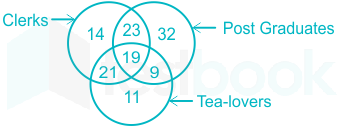
Study the given diagram carefully and answer the question. The numbers in different sections indicate the number of persons.

How many such tea-lovers are there who are also post-graduates but NOT clerks?

  1. AOption (a)

    11

  2. BOption (b)

    19

  3. COption (c)

    9

  4. DOption (d)

    28

View answer & explanation

Correct answer

Answer: (c)C.

9

Why this answer is correct

Number of tea-lovers = (11 + 21 + 19 + 9)

Number of tea-lovers who are also post-graduates = (11 + 21 + 19 + 9) - (11 + 21) = (19 + 9)

The number of tea-lovers who are also post-graduates but not clerks = (19 + 9) - (19) = 9.

Hence, the Correct answer is "9".

Question 45

Where was the 14th National Wheelchair Fencing Championship - 2021-22 held between 25 and 27 February 2022?

  1. AOption (a)

    West Bengal

  2. BOption (b)

    Odisha

  3. COption (c)

    Assam

  4. DOption (d)

    Jharkhand

View answer & explanation

Correct answer

Answer: (b)B.

Odisha

Why this answer is correct

The correct answer is Odisha.

Key Points

  • Wheelchair fencing is a sport that involves two athletes with disabilities, both using wheelchairs, fighting with swords.
  • The National Wheelchair Fencing Championship is an annual event organized by the Indian Wheelchair Fencing Federation to promote and develop the sport in India.
  • The 14th edition of the championship was held in Odisha, and it attracted top athletes from across the country.
  • Rajiv of Haryana won the gold medal in the individual men's category A.
  • Rekha of Haryana won the gold medal in the individual women's category A.
  • Haryana won the gold medal in the men's team event.
  • The gold medal in the women's team event was won by Haryana.

Additional InformationNational Wheelchair Fencing Championship 2023:

  • It was the 15th edition of National Wheelchair Fencing Championship.
  • It was held in Karnal, Haryana.
  • It was held between 24 – 27 March 2023.
  • Odisha won an impressive 24 medals, including 10 gold, 9 silver, and 5 bronze.

Question 46

Which molecule is known as the 'Energy Currency' of the cell

  1. AOption (a)

    Pyruvic acid

  2. BOption (b)

    Glucose

  3. COption (c)

    ADP

  4. DOption (d)

    ATP

View answer & explanation

Correct answer

Answer: (d)D.

ATP

Why this answer is correct

The correct answer is ATP.

Key PointsAdenosine Triphosphate (ATP):

  • Cells use and store energy in the form of ATP.
  • It is commonly referred to as the cell's "energy currency" since it readily releases energy in the bond that joins the second and third phosphate groups.
  • Three serially connected phosphate groups, a ribose sugar, and a nitrogenous base (adenine) make up the nucleoside triphosphate (ATP) structure.
  • The hydrolysis of ATP supports a variety of cellular processes, such as DNA and RNA synthesis and signaling.
  • Energy from several catabolic processes, such as cellular respiration, beta-oxidation, and ketosis, is used in its synthesis.

Additional InformationPyruvic Acid:

  • It is a key component in the link between the processes of anabolism (synthesis) and catabolism (breakdown) of proteins, fats, and carbohydrates.
  • It can be produced from glucose, transformed via gluconeogenesis back into carbohydrates (like glucose), or transformed via an acetyl-CoA process into fatty acids.
  • It can also be fermented to produce lactic acid or ethanol, and it can be utilized to make the amino acid alanine.
  • A complicated series of enzyme activities that transform sugar (or carbohydrate, in the form of glucose or fructose) into pyruvate is shared by five metabolic pathways.
  • The five metabolic processes are:
  • sugar conversion to fatty acids.
  • muscle fermentation of sugar to lactic acid.
  • sugar conversion to amino acids, such as alanine.
  • the Krebs cycle's oxidation of sugar to carbon dioxide and water.
  • yeast fermentation of sugar to ethyl alcohol.

Glucose:

  • It is also known as aldohexose since it has an aldehyde group and six carbon atoms.
  • There are two types of it: ring structures and open chains.
  • The form of glucose that exists naturally is called D-glucose.
  • It may appear as a liquid or as a solid.
  • It dissolves in acetic acid as well as in water.
  • Treatment for hypoglycemia (low blood sugar) involves its use.
  • Since it contains calories from carbohydrates, it is given to patients who are too sick to eat.
  • It is used in the treatment of high potassium levels in the blood, i.e., hyperkalemia.

Adenosine Diphosphate:

  • It is a crucial organic substance for metabolism and the movement of energy within living cells.
  • Its three main structural elements are two phosphate groups bound to ribose's fifth carbon atom and a sugar backbone connected to adenine.
  • Both adenosine monophosphate (AMP) and adenosine triphosphate (ATP) can be produced from it.
  • Its cycle provides the energy required for biological systems to function—the thermodynamic process of distributing energy from one source to another.

Question 47

A ray of white light is incident on a refracting surface AB of a glass prism and emerges out of the other refracting surface AC. Consider the following statements:

(a) The angle of refraction at surface AB is different for different colours of white light.

(b) The angle of refraction at the surface AC is the same for different colours.

Which of the above statements is/are correct?

  1. AOption (a)

    Both (a) and (b)

  2. BOption (b)

    Only (a)

  3. COption (c)

    Only (b)

  4. DOption (d)

    Neither (a) nor (b)

View answer & explanation

Correct answer

Answer: (b)B.

Only (a)

Why this answer is correct

The correct answer is Only (a).

Key Points

  • The differing angles of refraction for different wavelengths of light cause white light to be refracted and split into various colors when it passes through a triangular prism.
  • The number of colors that are visible depends on the angle at which the light enters and exits the prism, as well as the thickness and material of the prism. Typically, white light is split into seven colors when passing through a triangular prism.
  • The colors that are visible to the human eye are red, orange, yellow, green, blue, indigo, and violet. These colors are commonly remembered using the acronym VIBGYOR.
  • The phenomenon of splitting light into its constituent colors is called dispersion.​

Additional Information

  • In the field of optics, a prism is a transparent substance, such as glass, that has been precisely cut with plane faces and angles.
  • It is used to reflect and analyze light.
  • A standard triangular prism can divide white light into its component colors, or what is known as a spectrum.
  • The bending of light as it moves from one transparent substance into another is known as refraction.
  • The bending caused by refraction allows us to create rainbows, prisms, magnifying glasses, and lenses.
  • Our eyes are dependent on this light bending as well.

Question 48

The power of a concave lens of focal length 25 cm is ______.

  1. AOption (a)

    0.04 D

  2. BOption (b)

    4.0 D

  3. COption (c)

    −0.04 D

  4. DOption (d)

    −4.0 D

View answer & explanation

Correct answer

Answer: (d)D.

−4.0 D

Why this answer is correct

The correct answer is −4.0 D.

Key Points

  • The focal length of a concave lens is always negative, as it is measured from the lens towards its optical center.
  • The given statement is asking for the power of a concave lens with a focal length of 25 cm.
  • The power of a lens is the reciprocal of its focal length, measured in diopters (D).
  • As the focal length is in centimeters, the power of the given lens would be -100/25 = -4 D.

Additional Information

  • A concave lens is one that diverges a beam of straight light from its source into a diminished, upright, virtual image.
  • They contain at least one internally curved surface.
  • Since the form of the lens causes light to diverge as it bulges outward at the borders and is rounded inward at the centre, it is also known as a diverging lens.
  • Applications:
  • Myopia, or shortsightedness, is corrected using a concave lens.
  • They are used to magnify objects in binoculars and telescopes.
  • Security gadgets that provide a panoramic view of items outside walls or doors are called door viewers, or peepholes. A concave lens is used to provide a wider perspective of the object or region while reducing the object's proportions.

Question 49

Refer to the following letter series and answer the question.

(Left) T Y A N E C M K E W A F H E Q A P M N B E D H E K U W S D A N M A W E (Right)

If all the vowels are dropped from the series, which of the following will be fifth from the right?

  1. AOption (a)

    S

  2. BOption (b)

    K

  3. COption (c)

    D

  4. DOption (d)

    W

View answer & explanation

Correct answer

Answer: (a)A.

S

Why this answer is correct

Given series,

T Y A N E C M K E W A F H E Q A P M N B E D H E K U W S  D A N M A W E 

If all the vowels are dropped from the series,

then,

(Left) T Y N  C M K  W  F H Q P M N B  D H K W S D  N M W (Right)

now**,**

(Right) W M N D S W K H D B N M P Q H F W K M C N Y T (left)

Here 5th letter from the "Right" is "S", So, if we drop all the vowels from the right end.

Hence the correct answer is "S".

Question 50

Consider the below statements and identify the correct answer.

Statement-I: An Olfactory indicator is a material whose smell varies depending on whether it is mixed with an acidic or basic solution.

Statement-II: Onion, clove oil and vanilla extract are examples of some olfactory indicators

  1. AOption (a)

    Both the statements are false.

  2. BOption (b)

    Statement-I is true, and Statement-II is false.

  3. COption (c)

    Both the statements are true.

  4. DOption (d)

    Statement-II is true, and Statement-I is false.

View answer & explanation

Correct answer

Answer: (c)C.

Both the statements are true.

Why this answer is correct

The correct answer is Both the statements are true.

Key Points

  • Olfactory Indicator:
  • These are the substance that, when mixed with an acidic or basic solution, changes its smell.
  • Olfactory titration is the method used in the lab to determine whether a solution is an acid or a base using olfactory indicators.
  • Examples include onion, clove oil, and vanilla extract.
  • Impacts of distinct olfactory indicator:
  • Onion: Maintains odour in an acidic medium and becomes odourless in basic medium.
  • Clove oil: Maintains its fragrance in an acidic medium. It becomes odourless in basic medium.
  • Vanilla extract: When placed in an acidic medium, it maintains its scent. It becomes odourless in basic medium.

Additional Information

  • Acid-base indicators:
  • These are substances which enable us to determine without tasting a specific solution whether it is acidic, basic, or neutral.
  • These indicators are chemicals that, depending on the pH of the solution they come into contact with, change colour.
  • They might thus also be referred to as "pH Indicators". When exposed to an acidic or basic solution, certain indicators not only change colour but also smell differently.
  • There are various kinds of acid-base indicators:
  • Natural Indicators:
  • A chemical that occurs naturally and has the ability to distinguish between acidic and basic substances is known as a natural indicator.
  • For instance: China rose, Red cabbage, Litmus paper, Turmeric, etc.
  • Artificial Indicators:
  • These are acid-base indicators that are made artificially from chemicals.
  • For instance: Methyl Orange, Phenolphthalein, etc.
  • Olfactory Indicators:
  • These are the substance that, when mixed with an acidic or basic solution, changes its smell.
  • For instance: Onion, Clove oil, Vanilla extract, etc.

Question 51

In the context of Industrial Policy Resolution 1956, which of the following is a correct statement?

I) Schedule A comprised of industries exclusively owned by the state.

II) Schedule B comprised of small-scale industries.

III) Schedule C comprised of the remaining industries.

  1. AOption (a)

    Only I and II

  2. BOption (b)

    Only I and III

  3. COption (c)

    Only II and III

  4. DOption (d)

    All of the above

View answer & explanation

Correct answer

Answer: (b)B.

Only I and III

Why this answer is correct

The correct answer is Only I and III.

Key Points

  • Industrial Policy Resolution (IPR),1956 laid the foundation for Second Five-Year Plan (1956-1961) which was based on the Mahalanobis model of economic development and aimed to achieve a growth rate of 4.5% per annum.
  • It focused on heavy industries, particularly steel, and aimed to reduce the dependence on imports.
  • Industries were divided into three categories by IPR,1956:
  • Schedule A: The State was solely responsible for these 17 industries. Of these seventeen industries, four—arms and ammunition, nuclear energy, railroads, and aviation—had monopolies held by the Central Government; the State Governments can create additional businesses in the remaining industries.
  • Schedule B: This group of twelve industries was available to both the public and private sectors; nonetheless, they were gradually taken over by the State. (Not just Small-scale industries)
  • Schedule C: The third category, which was available to the private sector, consisted of all the other industries that were not covered by these two Schedules. The State did, however, retain the authority to engage in any kind of industrial production.

Additional Information

  • Industrial Policy Resolution (IPR),1956:
  • It is a resolution adopted by the Indian Parliament in April 1956.
  • It was the first comprehensive statement on the industrial development of India.
  • It was regarded as the “Economic Constitution of India” or “The Bible of State Capitalism”.
  • The government revised its first Industrial Policy (i.e.the policy of 1948) through the Industrial Policy of 1956.
  • The 1956 Policy empha­sised the need to expand the public sector, to build up a large and growing coop­erative sector and to encourage the separation of ownership and management in private in­dustries and, above all, prevent the rise of pri­vate monopolies.
  • It provided the basic framework for the government’s policy regarding in­dustries till June 1991.

Question 52

Which of the following properties are a sure test for magnetism?

A) Attractive property

B) Repulsive property

C) Directive property

  1. AOption (a)

    Both A and B

  2. BOption (b)

    Both A and C

  3. COption (c)

    Both B and C

  4. DOption (d)

    All of the above

View answer & explanation

Correct answer

Answer: (c)C.

Both B and C

Why this answer is correct

The correct answer is Both B and C.

Key Points

  • Attractive property (A): Attraction is not a sure test of magnetism because a magnet attracts magnetic materials such as iron, cobalt, and nickel, and an ordinary piece of iron is also attracted by a magnet. Hence, Statement A is not a sure test.
  • Repulsive property (B): Repulsion is the sure test of magnetism. Repulsion occurs only between like poles of two magnets. An ordinary magnetic material cannot repel a magnet. Hence, Statement B is correct.
  • Directive property (C): A freely suspended magnet always aligns itself in the north-south direction under the influence of Earth's magnetic field. This is known as the directive property of a magnet. Hence, Statement C is correct.
  • Therefore, the properties that are a sure test for magnetism are Repulsive property and Directive property.

Additional Information

  • Magnetic Materials:
  • Iron, cobalt, nickel, and their alloys are attracted by magnets.
  • Magnetic Poles:
  • Like poles repel each other.
  • Unlike poles attract each other.
  • Earth as a Magnet:
  • Earth behaves like a giant magnet, causing a freely suspended magnet to align along the north-south direction.
  • Uses of Directive Property:
  • It is the working principle of a magnetic compass, which is used for navigation.

Question 53

Gandhi Jayanti is celebrated every year on 2nd October as a national festival. In which year was Mahatma Gandhi's 150th birth anniversary?

  1. AOption (a)

    2018

  2. BOption (b)

    2019

  3. COption (c)

    2020

  4. DOption (d)

    2021

View answer & explanation

Correct answer

Answer: (b)B.

2019

Why this answer is correct

The correct answer is 2019.

Key Points

  • Gandhi Jayanti:
  • India observes Gandhi Jayanti to commemorate Mahatma Gandhi's birthday.
  • It is one of India's three national holidays, observed on October 2nd each year. Republic Day and Independence Day are the other two.
  • The day is recognised as the International Day of Non-Violence by the UN.
  • Gandhi, who was referred to as the "Father of the Nation" by Subhas Chandra Bose, promoted one of the most well-known theories of peaceful protest.
  • Mahatma Gandhi's 150th birth anniversary was celebrated on 2nd October 2019.
  • In honour of Mahatma Gandhi's 150th birthday, the Government of India unveiled a commemorative Rs. 150 coin in Ahmedabad.

Additional Information

  • Mahatma Gandhi:
  • He was born in Porbandar, Gujarat, India, on October 2, 1869. He played a significant role in India's struggle for independence from British colonial rule.
  • His mother was Putlibai, and his father was Karamchand Gandhi, the dewan of Porbandar.
  • Gandhiji is known as the Father of our Nation.
  • He returned to India from South Africa on 9th January 1915 and this day is celebrated as Pravasi Bharatiya Divas (NRI Day).
  • The first satyagraha of Gandhiji is Chamapran Satyagraha (1917) also known as the first civil disobedience movement.
  • The first hunger strike of Gandhiji is Ahmedabad Mill Strike (1918).
  • The first non-cooperation movement of Gandhiji is Kheda Satyagraha (1918).
  • He was the president of the INC session in Belgaum (1924).
  • In 1931, Gandhiji participated in the Second Round Table Conference in London.
  • He gave the famous 'Do or Die' slogan during the Quit India Movement.
  • Gandhiji was assassinated on 30 January 1948 by Nathuram Godse and observed as 'Martyrs Day'.

Question 54

In a certain code language, 'ERGOT' is written as 'FTJSY' and 'SKELP' is written as 'TMHPU'. How will 'KESHA' be written in that language?

  1. AOption (a)

    GLVEL

  2. BOption (b)

    LGLVE

  3. COption (c)

    LGVLF

  4. DOption (d)

    LGFVL

View answer & explanation

Correct answer

Answer: (c)C.

LGVLF

Why this answer is correct

The logic used:-

The values are arranged according to the increasing order of their positional values.

In this logic, positional values of the alphabet are increasing in ascending order. +1,+2,+3, +4.

ERGOT ⇒

 SKELP ⇒

KESHA ⇒


Hence the correct answer is "LGVLF".

Question 55

If cosec 2A = sec(A − 15°), then find the measure of A (in degrees).

  1. AOption (a)

    23

  2. BOption (b)

    35

  3. COption (c)

    45

  4. DOption (d)

    15

View answer & explanation

Correct answer

Answer: (b)B.

35

Why this answer is correct

Shortcut Trick

If cosec X = sec Y, then X + Y = 90° (Complementary angles).

In this question, X = 2A and Y = A − 15°.

Summing them: 2A + A − 15° = 90°

3A = 105°

A = 35°

∴ The correct answer is 35°.

Alternate Method

Given: cosec 2A = sec(A − 15°)

Formula Used: sec θ = cosec(90° − θ)

⇒ cosec 2A = cosec[90° − (A − 15°)]

⇒ 2A = 90° − A + 15°

⇒ 2A + A = 105°

⇒ 3A = 105°

⇒ A = 105° ÷ 3

⇒ A = 35°

∴ The correct answer is 35°.

Additional Information

Complementary Angle Trigonometric Ratios

For any angle θ, sin(90° − θ) = cos θ, tan(90° − θ) = cot θ, and sec(90° − θ) = cosec θ.

Trigonometric Identity Pairs

If sin A = cos B, tan A = cot B, or sec A = cosec B, then the sum of angles A + B = 90°.

Question 56

Select the set in which the numbers are related in the same way as are the numbers of the following sets.

(NOTE: Operations should be performed on the whole numbers, without breaking down the numbers into its constituent digits. E.g. 13 - Operations on 13 such as adding / subtracting / multiplying etc. to 13 can be performed. Breaking down 13 into 1 and 3 and then performing mathematical operations on 1 and 3 is not allowed)

 (13, 84, 29)

(27, 122, 34)

  1. AOption (a)

    (25, 90, 20)

  2. BOption (b)

    (15, 57, 27)

  3. COption (c)

    (17, 45, 13)

  4. DOption (d)

    (10, 56, 23)

View answer & explanation

Correct answer

Answer: (a)A.

(25, 90, 20)

Why this answer is correct

**LOGIC: (**First Number + Third Number) × 2 = Second Number

In (13, 84, 29) →

⇒ (13 + 29) × 2 = 42 × 2 = 84

In (27, 122, 34) →

⇒ (27 + 34) × 2 = 61 × 2 = 122

Similarly;

In (25, 90, 20) →

⇒ (25 + 20) × 2 = 45 × 2 = 90

Hence, the correct answer is "(25, 90, 20)"

Question 57

Simplify (2z − 5y)2 + (5z + 2y)2 − 25z2.

  1. AOption (a)

    19y2 + 4z2

  2. BOption (b)

    29y2 + 4z2

  3. COption (c)

    29y2 − 4z2

  4. DOption (d)

    19y2 − 4z2

View answer & explanation

Correct answer

Answer: (b)B.

29y2 + 4z2

Why this answer is correct

Shortcut Trick

Use the algebraic identity: (az − by)2 + (bz + ay)2 = (a2 + b2)(z2 + y2).

Here, a = 2 and b = 5, so the first two terms combine to (22 + 52)(z2 + y2) = 29z2 + 29y2.

Subtract the third term: 29z2 + 29y2 − 25z2 = 4z2 + 29y2.

∴ The correct answer is 29y2 + 4z2.

Alternate Method

Given: (2z − 5y)2 + (5z + 2y)2 − 25z2

Formula Used: (a − b)2 = a2 − 2ab + b2 and (a + b)2 = a2 + 2ab + b2

⇒ [(2z)2 − 2(2z)(5y) + (5y)2] + [(5z)2 + 2(5z)(2y) + (2y)2] − 25z2

⇒ [4z2 − 20zy + 25y2] + [25z2 + 20zy + 4y2] − 25z2

⇒ 4z2 + 25z2 − 25z2 + 25y2 + 4y2 − 20zy + 20zy

⇒ 4z2 + 29y2

∴ The correct answer is 29y2 + 4z2.

Additional Information

Binomial Squares

The expansion of (a + b)2 is a2 + 2ab + b2 and (a − b)2 is a2 − 2ab + b2.

Special Identity

The identity (ax − by)2 + (bx + ay)2 = (a2 + b2)(x2 + y2) is useful for simplifying complex polynomial expressions.

Like Terms

In algebraic simplification, terms with the same variables and exponents are combined by adding or subtracting their coefficients.

Question 58

Which of the following schedules of the Indian Constitution describes the number of seats represented in the Council of States from each state and Union Territory?

  1. AOption (a)

    First Schedule

  2. BOption (b)

    Fourth Schedule

  3. COption (c)

    Third Schedule

  4. DOption (d)

    Second Schedule

View answer & explanation

Correct answer

Answer: (b)B.

Fourth Schedule

Why this answer is correct

The correct answer is Fourth Schedule.

Key Points

  • There were 395 articles in 22 parts and 8 schedules in the original Indian constitution.
  • The First Constitution Amendment Act of 1951 added the ninth schedule.
  • The 52nd Amendment to the Constitution added the 10th in 1985.
  • The 73rd and 74th Constitution Amendment Acts of 1992 brought about the addition of the 11th and 12th Schedules.
  • Fourth Schedule of Indian Constitution:
  • The distribution of Rajya Sabha (i.e. Council of state) seats is dealt under Schedule 4 of the Indian Constitution.
  • Through proportional representation, the states indirectly elect the members of the Rajya Sabha.
  • This implies that the Rajya Sabha's membership will be directly proportional  to the state's population.
  • It specifies the total number of Rajya Sabha members that the state is required to send.
  • There are 250 members of the Rajya Sabha in total; 238 of them are state representatives and 12 are nominated by the Indian President from the field of arts, literature, sciences, and social services.

Additional Information List of 12 schedules of the Indian Constitution:

ScheduleSubject DealtArticles Covered
First SchedulePart-1: The Union and its Territories
Lists the States name and their territorial jurisdiction
Lists the Union Territories name and their territorial extent.
Article 1 Article 4
Second ScheduleIt deals with the provisions relating to the emoluments, allowances and privileges of: The President of India
The Governors of Indian States
The Speaker and the Deputy Speaker of Lok Sabha
The Chairman and the Deputy Chairman of Rajya Sabha
The Speaker and the Deputy Speaker of the State Legislative Assemblies
The Chairman and the Deputy Chairman of the State Legislative Assemblies
The Judges of the Supreme Court
The Judges of the High Court
The Comptroller and Auditor General of India
Article 59 Article 65 Article 75 Article 97 Article 125 Article 148 Article 158 Article 164 Article 186 Article 221
Third ScheduleIt consists of the forms of oath or affirmations for: The Union Ministers
The Candidates of Parliamentary elections
Members of the Parliament
The Judges of the Supreme Court
The Comptroller and Auditor General of India
The State Ministers
The Candidates of State Legislature elections
Members of the State Legislature
The Judges of the High Court
Article 75 Article 84 Article 99 Article 124 Article 146 Article 173 Article 188 Article 219
Fourth ScheduleIt deals with provisions related to the allocation of seats in the Rajya Sabha to the States and Union TerritoriesArticle 4 Article 80
Fifth ScheduleIt consists of provisions related to the administration and control of scheduled areas and scheduled tribes in IndiaArticle 244
Sixth ScheduleThis schedule deals with the provisions related to the administration of tribal areas in the states of: Assam
Meghalaya
Tripura
Mizoram
Article 244 Article 275
Seventh ScheduleIt consists of three lists which divide the power between the Union and the States. List I – Union List
List II – State List
List III – Concurrent List
Article 246
Eighth ScheduleIt consists of a list of 22 Indian languages which are recognized by the Indian Constitution: Assamese, Bengali, Bodo, Dogri (Dongri), Gujarati, Hindi, Kannada, Kashmiri, Konkani, Mathili (Maithili), Malayalam, Manipuri, Marathi, Nepali, Oriya, Punjabi, Sanskrit, Santhali, Sindhi, Tamil, Telugu and UrduArticle 344 Article 351
Ninth ScheduleThe acts and regulations passed by the State Legislatures related to land reforms and the abolition of the Zamindari System are described under this schedule. The acts and regulations of Parliament dealing with other matters are also dealt with in this schedule.Article 31-B
Tenth ScheduleIt deals with the provisions related to anti-defection law i.e. the members of Parliament and State Legislature can be disqualified on the ground of defection.Article 102 Article 91
Eleventh Schedule29 matters related to the power, authority and responsibilities of Panchayats are described in this Schedule.Article 243-G
Twelfth Schedule18 matters related to Municipalities’ power, authority and responsibilities are described in this Schedule.Article 243-W

Question 59

Study the given diagram carefully and answer the question. The numbers in different sections indicate the number of units.

How many such balconies are there that are either doors or windows?

  1. AOption (a)

    31

  2. BOption (b)

    20

  3. COption (c)

    17

  4. DOption (d)

    16

View answer & explanation

Correct answer

Answer: (a)A.

31

Why this answer is correct

The number of balconies that are either doors or windows in the given figure is 31.

= 10 + 17 + 4 = 31

Hence the correct answer is "31".

Question 60

The diagram below shows a part of the respiratory system in humans. Which option shows the correct labelling of 'a' and 'b' and the function of 'b'?

  1. AOption (a)

    a - Bronchioles, b -  Alveoli (exchange of gases)

  2. BOption (b)

    a - Bronchioles, b - Bronchi (exchange of gases)

  3. COption (c)

    a - Bronchi, b - Alveoli (exchange of gases)

  4. DOption (d)

    a - Bronchi, b - Bronchioles (exchange of gases)

View answer & explanation

Correct answer

Answer: (a)A.

a - Bronchioles, b -  Alveoli (exchange of gases)

Why this answer is correct

The correct answer is a - Bronchioles, b -  Alveoli (exchange of gases).

Key Points

  • Bronchioles:
  • Inside the lungs are air passageways called bronchioles. From the bronchi, they diverge like tree limbs.
  • Bundles of elastic protein fibres known as elastin are essential for bronchioles to anchor into lung tissue and maintain their shape.
  • The lamina propria, the thin lining that lines the bronchioles, is encircled by a layer of smooth muscle. It dilates with an increase in blood flow and contracts with a decrease in blood flow.
  • The lungs' diffuse network of over 300 million alveoli is supplied with air by the bronchioles.
  • Oxygenated air is drawn into the bronchioles during inhalation. When you exhale, the carbon dioxide that the alveoli have stored is then released from your lungs.
  • To regulate how much air enters and leaves the lungs, the smooth muscles that surround the airways automatically contract (close) and dilate (open).
  • Sorted by size, there are three kinds:
  • Lobular bronchioles
  • Respiratory bronchioles
  • Terminal bronchioles
  • Conditions that can constrict and/or clog the airways, such as asthma, bronchiolitis, cystic fibrosis, and emphysema, can affect bronchioles.
  • Alveoli:
  • At the end of the bronchioles, the lungs' branch-like tubes, are tiny air sacs called alveoli.
  • Oxygen and carbon dioxide (CO2) molecules are exchanged and transported into and out of our bloodstream by the alveoli.
  • A fluid called a surfactant lines the inside of each alveolar sac, helping to keep it open and maintaining the shape necessary for the exchange of CO2 and oxygen.
  • The tiniest parts of the respiratory system are called alveoli. At the extremities of the passages that carry air into the lungs, they are grouped together throughout the lung.
  • Alveolar macrophages are immune cells found in alveoli as well. Because they "eat" detritus, these can be compared to the immune system's garbage trucks.

Additional Information

  • Human Respiratory System: 
  • A web of organs and tissues which aids in breathing is called the human respiratory system .
  • This system is primarily responsible for bringing oxygen into the body and removing carbon dioxide from it.
  • It includes nose, larynx, pharynx, trachea, bronchi, lungs etc.
  • Millions of tiny sacs called alveoli allow oxygen and carbon dioxide to enter and depart the lungs, respectively.
  • After diffusing into the pulmonary capillaries and attaching to haemoglobin, the breathed oxygen is circulated through the bloodstream.
  • When one exhales, carbon dioxide from the blood diffuses into the alveoli and is released.
  • Bronchi:
  • The two sizable tubes that transport air from the windpipe (trachea) into the lungs and back are called the bronchi.
  • The bronchi, an essential component of the respiratory system, are essentially airways that carry carbon dioxide out of the lungs and oxygen into them.
  • The bronchial tree is made up of the bronchi that split out into progressively smaller structures. It splits into bronchioles after dividing to the left and right. It comes to an end at the lungs' alveoli, which are microscopic sacs that trade carbon dioxide for oxygen.
  • Additionally, the bronchi are crucial for immune system performance. They capture and eliminate bacteria, viruses, and other pathogens that can infect you.
  • Asthma, chronic obstructive pulmonary disease (COPD), lung cancer, and bronchitis are among the illnesses that can affect the bronchi .

Question 61

If a sum of ₹3,500 is invested at 5% compound interest per annum, compounded annually, then what is the period for which the compound interest is ₹358.75?

  1. AOption (a)

    20 months

  2. BOption (b)

    18 months

  3. COption (c)

    15 months

  4. DOption (d)

    24 months

View answer & explanation

Correct answer

Answer: (d)D.

24 months

Why this answer is correct

Shortcut Trick

Interest for the 1st year = 5% of 3500 = ₹175.

Interest for the 2nd year = ₹175 + 5% of 175 = 175 + 8.75 = ₹183.75.

Total Compound Interest (CI) = 175 + 183.75 = ₹358.75.

This matches the given value, so the Time Period is 2 years.

2 years = 2 × 12 = 24 months.

∴ The correct answer is 24 months.

Alternate Method

Given: Principal (P) = ₹3500, Rate (R) = 5%, Compound Interest (CI) = ₹358.75.

Formula Used: Amount (A) = P + CI and A = P(1 + R/100)n

⇒ Amount (A) = 3500 + 358.75 = ₹3858.75

⇒ 3858.75 = 3500 × (1 + 5/100)n

⇒ 3858.75 / 3500 = (1.05)n

⇒ 385875 / 350000 = (1.05)n

⇒ 1.1025 = (1.05)n

⇒ (1.05)2 = (1.05)n

⇒ n = 2 years

⇒ Time in months = 2 × 12 = 24 months

∴ The correct answer is 24 months.

Additional Information

Effective Interest Rate

For 2 years at R%, the effective Compound Interest rate is R + R + (R×R)/100.

CI and SI Difference

The difference between CI and SI for 2 years is given by P × (R/100)2.

Conversion of Time

To convert years into months, multiply the number of years by 12.

Question 62

Pole C is to the south of pole H and east of pole R. Pole M is to the west of pole R. Pole A is to the south of pole M. What is the position of pole R with respect to the pole H?

  1. AOption (a)

    South

  2. BOption (b)

    South-west

  3. COption (c)

    South-east

  4. DOption (d)

    North

View answer & explanation

Correct answer

Answer: (b)B.

South-west

Why this answer is correct

1. Pole C is to the south of pole H and east of pole R.

 2. Pole M is to the west of pole R.


  1. Pole A is to the south of pole M.

Here the direction from H to R is SOUTH-WEST.

Hence, the correct answer is "SOUTH-WEST".

Question 63

The difference of the ages of two siblings is 7 years. If the sum of their ages is 21 years, how old is the younger of the siblings?

  1. AOption (a)

    3 years

  2. BOption (b)

    10 years

  3. COption (c)

    7 years

  4. DOption (d)

    14 years

View answer & explanation

Correct answer

Answer: (c)C.

7 years

Why this answer is correct

Shortcut Trick

For two values where Sum (S) and Difference (D) are known:

Smaller Value = (S − D) ÷ 2

Smaller Value = (21 − 7) ÷ 2 = 14 ÷ 2 = 7 years.

∴ The correct answer is 7 years.

Alternate Method

Given:

Sum of ages = 21 years

Difference of ages = 7 years

Calculations:

Let the age of the younger sibling be x and the older sibling be y.

⇒ y − x = 7 --- (1)

⇒ y + x = 21 --- (2)

Subtracting equation (1) from (2):

⇒ (y + x) − (y − x) = 21 − 7

⇒ 2x = 14

⇒ x = 7 years

∴ The correct answer is 7 years.

Additional Information

Linear Equations in Two Variables

When solving for two unknowns x and y, adding the equations gives 2y = S + D, and subtracting them gives 2x = S − D.

Age Problems Logic

The difference between the ages of two people remains constant regardless of how many years pass.

Question 64

The most electronegative element in the periodic table is:

  1. AOption (a)

    Fluorine

  2. BOption (b)

    Chlorine

  3. COption (c)

    Nitrogen

  4. DOption (d)

    Oxygen

View answer & explanation

Correct answer

Answer: (a)A.

Fluorine

Why this answer is correct

The correct answer is Fluorine.

Key Points

  • Electronegativity:
  • The tendency of an atom to draw an electron pair that will form a bond is measured by its electronegativity. The most widely used scale is the Pauling scale.
  • As atomic size grows and the effective nuclear charge on the outermost electrons diminishes, the electronegativity drops down the periodic table.
  • In the periodic table, electronegativity rises in a row from left to right. The attraction between charges decreases quickly with distance, hence this phenomenon is only valid for a row in the periodic table.
  • The most electronegative element, Fluorine, has a value of 3.98. The least electronegative elements, Cesium and Francium, have values of 0.7.
  • Fluorine:
  • The chemical element fluorine has the atomic number nine and the symbol F.
  • It is the lightest halogen and is a pale yellow diatomic gas that is extremely hazardous under normal circumstances.
  • With the exception of light inert gases, it reacts with every element, making it the most electronegative reactive element.
  • It is the most electronegative element with  a value of 3.98.

Additional Information

  • Chlorine:
  • The chemical element chlorine has the atomic number 17 and the symbol Cl.
  • The second-lightest of the halogens, it is found on the periodic table between fluorine and bromine, with most of its properties falling in the middle of the two.
  • At room temperature, chlorine is a gas with a yellow-green colour.
  • It has the highest electron affinity and the third-highest electronegativity among the elements on the revised Pauling scale with value of 3.16, behind oxygen and fluorine.
  • It is a very reactive and potent oxidising agent.
  • Nitrogen:
  • The chemical element nitrogen has the atomic number seven and the symbol N.
  • As the lightest element in group 15 of the periodic table—often referred to as the pnictogens—nitrogen is a nonmetal.
  • It is a common element in the cosmos, with an estimated total abundance of ninth in the Solar System and the Milky Way.
  • N2, a colourless and odourless diatomic gas, is created when two atoms of the element bond at standard temperature and pressure.
  • N2 is the most prevalent element in air without a compound, making up approximately 78% of the Earth's atmosphere.
  • Nitrogen is comparatively rare in the solid portions of the Earth due to the volatile nature of nitrogen molecules.
  • It has an electronegativity value of 3.04.
  • Oxygen: 
  • The chemical element oxygen has the atomic number 8 and the symbol O.
  • It is a highly reactive nonmetal that belongs to the chalcogen group in the periodic table.
  • It is also an oxidising agent that easily produces oxides with most elements and other compounds.
  • The most prevalent element in the crust of the Earth, oxygen is the third most plentiful element in the universe, behind helium and hydrogen.
  • Two of the element's atoms combine to generate dioxygen, a colourless and odourless diatomic gas with the formula O2 at ordinary temperature and pressure.
  • The Earth's atmosphere is currently made up of 20.95% diatomic oxygen gas, though this has fluctuated significantly over a very long time. In the form of oxides, oxygen makes up over half of the Earth's crust.
  • It has an electronegativity value of 3.44.

Question 65

A semi-circular field of radius 14 m needs to be fenced with a wire. Find the length of wire required.

  1. AOption (a)

    72 m

  2. BOption (b)

    46 m

  3. COption (c)

    44 m

  4. DOption (d)

    80 m

View answer & explanation

Correct answer

Answer: (a)A.

72 m

Why this answer is correct

Shortcut Trick

For a semi-circular field, the fencing required is the perimeter.

Perimeter of semi-circle = (π + 2) × r

Using π = 22/7 and r = 14 m:

Perimeter = (22/7 + 2) × 14 = (36/7) × 14 = 36 × 2 = 72 m

∴ The correct answer is 72 m.

Alternate Method

Given:

Radius (r) of the semi-circular field = 14 m

Formula Used:

Length of wire = Perimeter of semi-circle = Circumference of arc + Diameter

Perimeter = πr + 2r

Calculations:

⇒ Length of wire = (22/7 × 14) + (2 × 14)

⇒ Length of wire = (22 × 2) + 28

⇒ Length of wire = 44 + 28

⇒ Length of wire = 72 m

∴ The correct answer is 72 m.

Additional Information

Area of Semi-circle

The space occupied by the semi-circle is half the area of a full circle: Area = (1/2) × πr2.

Full Circle Perimeter

The total boundary length or circumference of a complete circle is given by 2πr.

Quadrant of a Circle

For a quarter circle, the perimeter includes the arc length and two radii: Perimeter = (πr/2) + 2r.

Question 66

Which factor is NOT a parameter for declaring an area as an urban area?

  1. AOption (a)

    A minimum population of 5000

  2. BOption (b)

    At least 75% of male population engaged in non-agricultural occupation

  3. COption (c)

    Density of population of at least 400 persons per square kilometre

  4. DOption (d)

    At least 60% of the population lie above poverty line

View answer & explanation

Correct answer

Answer: (d)D.

At least 60% of the population lie above poverty line

Why this answer is correct

The correct answer is At least 60% of the population lie above poverty line.

Key Points

  • Urban areas:
  • These areas are defined as places that are extremely developed, have lots of options for employment and education, and have excellent infrastructure.
  • These areas have improved railroads, homes, businesses, bridges, and roadways.
  • There is typically a high population density in urban areas, such as cities and towns.
  • A person is said to be living in poverty if they fall below a certain level, known as the poverty line. Typically, the cost of essential necessities like food, housing, and clothing is used to determine the poverty line.
  • "At least 60% of the population lie above poverty line" is not a parameter for declaring an area as an urban area.

Additional Information

  • Since the state government does not have any objective standards for defining what constitutes a "urban settlement," the national government, acting through the Office of Registrar General and Census Commissioner of India, defines a "urban settlement" according to the following standards:
  • (a) if it has an urban local government (i.e., statutory towns notified by the state government)
  • (b) any place that satisfies the following three criteria:
  • (i) minimum population of 5,000
  • (ii) at least 75 percent of male working population engaged in non-agricultural activities
  • (iii) population density of at least 400 persons per sq. km (1,000 persons per sq. mile).
  • The term "population density" describes the amount of people residing in a specific area, typically expressed as "persons per square kilometre."
  • The process by which a community moves from rural to urban settings, or from one location to another, is known as urbanisation. High population densities, non-agricultural jobs, and advanced infrastructure and services are characteristics of urban regions.
  • The suburbs are located outside of cities and typically have a lower population. They go by the name of residential areas as well. Compared to the city, the suburbs have larger homes, more parks, and open areas. A large number of city dwellers relocate to the suburbs. We call this suburban migration.
  • The metropolitan region and the rural area are diametrically opposed. In comparison to metropolitan areas, rural areas have lower population densities and fewer options for employment and education. Agriculture is the main industry in rural areas.

Question 67

The following pie chart shows the percentage distribution of power to six districts, A to F, of a state. Study the chart and answer the question.

Total number of units generated = 5400

What is the average number of units distributed to districts C, D and E?

  1. AOption (a)

    1050

  2. BOption (b)

    935

  3. COption (c)

    1120

  4. DOption (d)

    936

View answer & explanation

Correct answer

Answer: (d)D.

936

Why this answer is correct

Calculation

The average number of units distributed to districts C, D and E = (36 + 12 + 4)/3 = (52/3)%

⇒ (52/3)% of 5400 

⇒ 52/300 of 5400 = 936

The answer is 936.

Question 68

Which technology company launched a Cyber Security Centre in Bengaluru in February 2022, to tackle cyber-attacks?

  1. AOption (a)

    Apple

  2. BOption (b)

    IBM

  3. COption (c)

    Dell

  4. DOption (d)

    HCL Tech

View answer & explanation

Correct answer

Answer: (b)B.

IBM

Why this answer is correct

The correct answer is IBM.

Key Points

  • Cyber Security:
  • The process of protecting networks, computers, servers, mobile devices, electronic systems, and data from hostile intrusions is known as cyber security.
  • It is often referred to as electronic information security or information technology security.
  • IBM:
  • Big Blue, also known as the International Business Machines Corporation (IBM), is a multinational technology company based in Armonk, New York, that sells products in more than 175 countries under the IBM logo.
  • In addition to offering hosting and consulting services in fields ranging from mainframe computers to nanotechnology, it specialises in computer hardware, middleware, and software.
  • As the Computing-Tabulating-Recording Company (CTR), a holding company for producers of measuring and record-keeping equipment, IBM was established in 1911.
  • After changing its name to "International Business Machines" in 1924, it quickly rose to prominence as the top producer of punch-card tabulating devices.
  • They launched a Cyber Security Centre in Bengaluru in February 2022 to tackle cyber-attacks.
  • Founders: Herman Hollerith, Charles Ranlett Flint, Thomas J. Watson, Sr.
  • Chairman & CEO: Arvind Krishna

Additional Information

  • Dell Inc.:
  • American technology corporation Dell Inc. creates, markets, fixes, and provides support for computers along with other goods and services.
  • Dell Technologies, the company's parent, is the owner of Dell.
  • As of January 2021, it is the third-largest seller of personal computers.
  • Dell moved up from 76th place in 2021 to 31st place in the Fortune 500 ranking in 2022.
  • In 1984, while attending the University of Texas at Austin, Michael Dell established Dell Computer Corporation, operating under the name PC's Limited.
  • Headquarters: Round Rock, Texas, USA.
  • Chairman & CEO: Michael Dell
  • Apple Inc.:
  • Originally known as Apple Computer, Inc., Apple Inc. is a global technology corporation with its main office located in Silicon Valley's Cupertino, California.
  • Apple was founded as Apple Computer Company on April 1, 1976 by Steve Jobs, Steve Wozniak, Ronald Wayne.
  • It creates, develops, and markets computer software, internet services, and consumer gadgets.
  • The iPhone, iPad, Mac, Apple Watch, and Apple TV are examples of devices; iOS and macOS are examples of operating systems; iTunes, iCloud, and Apple Music are examples of software programmes and services.
  • By market valuation, Apple is the biggest corporation in the world as of March 2023.
  • Chairman: Arthur D. Levinson
  • CEO: Tim Cook
  • HCL Tech:
  • HCL Technologies Limited, originally known as Hindustan Computers Pvt. Limited, is a multinational Indian information technology (IT) consulting firm.
  • It was Shiv Nadar who founded HCLTech.
  • It was spun out in 1991, when HCL started offering software services.
  • Headquarters: Noida, Uttar Pradesh, India.
  • Chairperson: Roshni Nadar Malhotra
  • CEO: C Vijayakumar

Question 69

Eight people, A, B, C, D, E, F, G and H, are sitting in a straight row, facing the south. B is sitting at one of the extreme ends and his immediate left neighbour is F. Only two people are sitting between F and D. C is sitting between D and H. Neither E nor A is sitting at the extreme end. How many people are sitting between F and G?

  1. AOption (a)

    Four

  2. BOption (b)

    Two

  3. COption (c)

    Five

  4. DOption (d)

    One

View answer & explanation

Correct answer

Answer: (c)C.

Five

Why this answer is correct

Eight people: A, B, C, D, E, F, G and H, are sitting in a straight row all facing south.

1) B is sitting at one of the extreme ends and his immediate left neighbour is F.

2) Only two people are sitting between F and D.

4) C is sitting between D and H.

(Two cases are possible).

5) Neither E nor A is sitting at the extreme end.

(Four cases are possible).

According to all possible cases G is sitting at extreme end.

Here, In both cases 5 people are sitting between F and G.

Hence, the correct answer is "5".

Question 70

If one of the roots of a quadratic equation is 12−21\over2-\sqrt2, then find the quadratic equation.

  1. AOption (a)

    √2x2 + 3x − 2 = 0

  2. BOption (b)

    −2x2 + 3x + 5 = 0

  3. COption (c)

    2x2 − 4x + 1 = 0

  4. DOption (d)

    √2x2 + 3x + 2 = 0

View answer & explanation

Correct answer

Answer: (c)C.

2x2 − 4x + 1 = 0

Why this answer is correct

Shortcut Trick

Rationalize the given root: 1 / (2 − √2) = (2 + √2) / (4 − 2) = (2 + √2) / 2.

Since irrational roots occur in conjugate pairs, the roots are (2 + √2)/2 and (2 − √2)/2.

Sum of roots = 2 and Product of roots = (4 − 2) / 4 = 1/2.

Required equation: x2 − (Sum)x + Product = 0 ⇒ x2 − 2x + 1/2 = 0.

∴ The correct answer is 2x2 − 4x + 1 = 0.

Alternate Method

Given: One root of the quadratic equation is α = 1 / (2 − √2).

Rationalization:

⇒ α = [1 × (2 + √2)] / [(2 − √2) × (2 + √2)]

⇒ α = (2 + √2) / (22 − (√2)2)

⇒ α = (2 + √2) / (4 − 2) = (2 + √2) / 2

For a quadratic equation with rational coefficients, if one root is (p + √q) / r, then the other root must be its conjugate β = (p − √q) / r.

⇒ β = (2 − √2) / 2

Sum of roots (α + β):

⇒ (2 + √2)/2 + (2 − √2)/2 = 4/2 = 2

Product of roots (α × β):

⇒ [(2 + √2)/2] × [(2 − √2)/2] = (4 − 2) / 4 = 2/4 = 1/2

Quadratic Equation Formula: x2 − (Sum of roots)x + (Product of roots) = 0

⇒ x2 − 2x + 1/2 = 0

⇒ 2x2 − 4x + 1 = 0

∴ The correct answer is 2x2 − 4x + 1 = 0.

Additional Information

Conjugate Roots Theorem

In a quadratic equation with rational coefficients, irrational roots always occur in conjugate pairs of the form m ± √n.

Formation of Quadratic Equation

If α and β are roots, the equation is x2 − (α+β)x + (αβ) = 0. The sum of roots is −b/a and the product of roots is c/a for ax2 + bx + c = 0.

Rationalization of Denominator

To rationalize a denominator like (a − √b), multiply both numerator and denominator by the conjugate (a + √b) to use the identity (x − y)(x + y) = x2 − y2.

Question 71

Which of the following options gives the current and equivalent resistance of the circuit in respective order?

  1. AOption (a)

    5 A, 12 Ω 

  2. BOption (b)

    0.5 A, 6 Ω

  3. COption (c)

    0.5 A, 12 Ω 

  4. DOption (d)

    5 A, 6 Ω 

View answer & explanation

Correct answer

Answer: (c)C.

0.5 A, 12 Ω 

Why this answer is correct

The correct answer is 0.5 A, 12 Ω.

Key Points

  • Given in the question:
  • Potential difference across the circuit, Vnet = 6 V,
  • R**1 = 2 Ω, R2 = 4 Ω, R3 = R4 = 3 Ω.**
  • As, all the resistors are connected in series combination, hence the net resistance (Rnet) through the circuit is given by:
  • Rnet = R1 + R2 + R3 + R4  
  • Putting the values in the above equation, we get
  • Rnet = 2 + 4 + 3 + 3
  • Rnet = 12 Ω
  • According to Ohm's Law,  V=IRV=IR or I=V/RI=V/R   …(1)
  • Putting the value of Vnet = 6 V and Rnet = 12 Ω in equation (1), we get
  • Inet = 6/12
  • Inet = 0.5 A
  • Hence, the net current through the circuit is Inet = 0.5 A

Additional Information

  • Ohm's Law:
  • Ohm's law states that the electric current flowing through a conductor is directly proportional to the potential difference across its ends, provided the physical state of the conductor remains unchanged.
  • If I be the current flowing through the conductor and V the potential difference across its ends, then V∝IV {\displaystyle \propto } I
  • Hence, V=IRV=IR, where, R is the constant of proportionality termed as Resistance of the conductor.
  • Resistance:
  • The amount of obstruction to current passage in an electrical circuit is measured as resistance. Ohms, or the Greek letter omega (Ω), are used to measure resistance (R).
  • There are mainly two ways of combination of resistance:
  • Series Combination:
  • When two or more resistances are connected end to end and the same current passes through each one successively, they are said to be connected in series. In this instance, the sum of the individual resistances found in the series combination determines the equivalent or total resistance.d
  • In terms of mathematics, the equivalent resistance (R) of any number of resistances connected in series (R1, R2, R3,...) is as follows:
  • R = R1 + R2 + R3 + …
  • Parallel Combination:
  • When two or more resistances are connected between two places and have distinct current directions, they are referred to as being in parallel connections. In these circuits, the current splits off and recombines at the point where the branches meet.
  • The equivalent resistance (R) of any number of parallel resistances (R1, R2, R3,...) can be found mathematically as follows:
  • 1/R = 1/R1 + 1/R2 + 1/R3 + …

Question 72

All of the methods mentioned below are effective preventive methods of HIV infection that can be practiced. Select the one that is NOT practiced.

  1. AOption (a)

    Safe blood transfusion method

  2. BOption (b)

    Use of available vaccines

  3. COption (c)

    Safe and protected sex

  4. DOption (d)

    Use of sterile injection needles

View answer & explanation

Correct answer

Answer: (b)B.

Use of available vaccines

Why this answer is correct

The correct answer is Use of available vaccines.

Key PointsHuman Immunodeficiency Virus (HIV):

  • It is a virus that attacks the immune system, which is our body's natural defense against illness.
  • It is a lifelong infection because, unlike many other viruses, the human body is unable to fully eradicate it.
  • It specifically attacks CD4 cells (T cells), which are a type of white blood cell that plays a crucial role in the immune system.
  • Vaccines for HIV prevention are not currently available.
  • Prevention Methods:
  • Safe Sex: Using condoms consistently and correctly during sexual intercourse can reduce the risk of HIV transmission.
  • Needle Exchange Programs: Providing sterile needles to reduce the risk of HIV transmission among injection drug users.
  • Safe Blood Transfusions: Ensuring that blood and blood products are screened for HIV.

Additional InformationStages of HIV Infection:

  • Acute HIV Infection: The initial stage of infection, often accompanied by flu-like symptoms.
  • Clinical Latency: A period where HIV is still active but reproduces at very low levels. This stage can last for years, and the person may not experience significant symptoms.
  • AIDS: The final stage of HIV infection, characterized by severe damage to the immune system. AIDS is diagnosed when the CD4 cell count falls below a certain level, and/or when specific opportunistic infections or cancers occur.

Question 73

The Right to Education for all between ______ years of age is included in Article 21-A of Fundamental Rights in the Constitution of India.

  1. AOption (a)

    6 to 18

  2. BOption (b)

    6 to 14

  3. COption (c)

    6 to 12

  4. DOption (d)

    5 to 10

View answer & explanation

Correct answer

Answer: (b)B.

6 to 14

Why this answer is correct

The correct answer is 6 to 14.

Key Points

  • Right to Education:
  • Article 21A, which reads, "The State shall provide free and compulsory education to all children of 6 to 14 years of age in such manner as the State, may by law determine," was added to the Indian Constitution by the 86th Constitutional Amendment in 2002.
  • The original provisions for state-funded, equitable, and accessible education were found in Article 45, Part IV: Directive Principle of State Policy (DPSP) of the Indian Constitution.
  • The Ramamurti Committee Report, 1990, was the first formal document establishing the right to an education.
  • In the landmark ruling in Unnikrishnan JP versus State of Andhra Pradesh & Others (1993), the Supreme Court ruled that education is a fundamental right derived from Article 21.
  • The establishment of the Tapas Majumdar Committee (1999) encompassed the addition of Article 21A.
  • The right to education was made a basic right in Part III: Fundamental Rights of the Indian Constitution by the 86th Amendment, 2002.

Additional Information

  • 86th Constitutional Amendment Act, 2002 also amended Article 45 of DPSP which now read as, "The state shall endeavour to provide early childhood care and education for all children untill they complete the age of six years."
  • Right to Education Act (RTE), 2009:
  • Subsequent legislation of the Right to Education Bill 2008 led to the Right to Education Act 2009 which was made possible by the 86th Amendment.
  • Under the RTE Act, every child between the ages of six and fourteen would receive a primary education.
  • It upholds the fundamental right to education (Article 21A).
  • The act requires a 25% reservation for underprivileged segments of society, which comprise the following groups:
  • Schedule Castes and Schedule Tribes
  • Socially Backward Class
  • Differently abled
  • Additionally, it allows a child who is not admitted to be admitted to an age-appropriate class.
  • It also specifies how the central and state governments will share financial and other duties.
  • It establishes the guidelines and requirements for:
  • Pupil Teacher Ratios (PTR)
  • Structures and facilities
  • School-working days
  • Teacher-working hours.
  • A "No Detention Policy" clause was included, but The Right of Children to Free and Compulsory Education (Amendment) Act, 2019 eliminated it.
  • By using a child-friendly and child-centered learning approach, it aims to liberate the kid from trauma, fear, and anxiety.
  • Additionally, the government has introduced Samagra Shiksha Abhiyan, an integrated school education programme that combines the three existing programmes:
  • Sarva Shiksha Abhiyan (SSA)
  • Rashtriya Madhyamik Shiksha Abhiyan (RMSA)
  • Centrally Sponsored Scheme on Teacher Education (CSSTE).

Question 74

A and B can together complete a piece of work in 9 days, B and C together can complete the same work in 18 days and C and A together can complete it in 27 days. In how many days can A, B, and C, working together complete the same work?

  1. AOption (a)

    89118{9\over 11} days

  2. BOption (b)

    99119{9\over 11} days

  3. COption (c)

    97119{7\over 11} days

  4. DOption (d)

    98119{8\over 11} days

View answer & explanation

Correct answer

Answer: (b)B.

99119{9\over 11} days

Why this answer is correct

Shortcut Trick

Total Work = LCM of 9, 18, 27 = 54 units.

Efficiency: (A+B) = 6, (B+C) = 3, (C+A) = 2.

2 × (A+B+C) efficiency = 6 + 3 + 2 = 11 ⇒ (A+B+C) efficiency = 11/2.

Time taken by A, B, and C = 54 ÷ (11/2) = 108/11 days.

∴ The correct answer is 99/11 days.

Alternate Method

Given: Time for (A+B) = 9 days, (B+C) = 18 days, (C+A) = 27 days.

Formula: Total Work = Days × Efficiency

PersonDaysTotal WorkEfficiency
A + B9546
B + C183
C + A272

⇒ Sum of efficiencies = (A + B) + (B + C) + (C + A) = 6 + 3 + 2

⇒ 2(A + B + C) = 11

⇒ Efficiency of (A + B + C) = 11/2

⇒ Time taken by (A + B + C) = Total Work ÷ Combined Efficiency

⇒ Time = 54 ÷ (11/2) = 108/11

⇒ Time = 99/11 days

∴ The correct answer is 99/11 days.

Additional Information

Individual Efficiency Calculation

To find A efficiency, subtract (B+C) from (A+B+C). Efficiency A = 5.5 − 3 = 2.5.

Time and Work Relation

Efficiency is inversely proportional to the time taken. Efficiency = Work / Time.

Combined Work Formula

If pairs (A+B), (B+C), and (C+A) take x, y, and z days, then (A+B+C) take [2xyz / (xy + yz + zx)] days.

Question 75

Which property/ properties of copper make it ideal for electrical transmission lines?

(i) Low melting point

(ii) High resistivity

(iii) Low resistance

  1. AOption (a)

    Both (i) and (iii)

  2. BOption (b)

    Only (iii)

  3. COption (c)

    only (i)

  4. DOption (d)

    Both (i) and (ii)

View answer & explanation

Correct answer

Answer: (b)B.

Only (iii)

Why this answer is correct

The correct answer is Only (iii).

Key Points

  • Copper:
  • It is an excellent conductor of electricity due to its high electrical conductivity.
  • It has a low resistance, which means that it can transmit electricity with less energy loss.
  • It also has a high melting point, which makes it suitable for high-temperature environments.
  • It is also resistant to corrosion, which makes it ideal for outdoor applications.

Additional InformationKey Applications of Copper:

  • Electronics: Copper is used extensively in the electronics industry for manufacturing printed circuit boards (PCBs), connectors, and other electronic components. Its conductivity and ability to dissipate heat make it a preferred material for these applications.
  • Heat Exchangers: Copper's excellent thermal conductivity makes it well-suited for heat exchangers, such as those used in HVAC (heating, ventilation, and air conditioning) systems and refrigeration units.
  • Automotive Industry: Copper is used in various automotive components, including radiators, brake lines, and wiring harnesses. Its conductivity and corrosion resistance are valuable in these applications.
  • Medical Equipment: Copper is utilized in medical equipment and devices due to its antimicrobial properties. It is found in items like hospital surfaces, doorknobs, and medical instruments.

Question 76

Digha Nikaya is a collection of ______ long (digha) discourses (suttas), divided into three sections namely Shilakhanda, Mahavagga and Patheya respectively.

  1. AOption (a)

    31

  2. BOption (b)

    39

  3. COption (c)

    25

  4. DOption (d)

    34

View answer & explanation

Correct answer

Answer: (d)D.

34

Why this answer is correct

The correct answer is 34.

  • Digha Nikaya is one of the five nikayas or collections of Buddhist texts in the Sutta Pitaka.
  • It is believed to have been composed between 4th and 1st century BCE in ancient India.
  • The discourses in Digha Nikaya are primarily focused on providing a comprehensive understanding of Buddha's teachings and his path to enlightenment.
  • The three sections of Digha Nikaya are further divided into 34 suttas or discourses.
  • Major Buddhist Texts -
  • The Vinaya Pitaka consists of rules of conduct and discipline applicable to the monastic life of the monks and nuns.
  • The Sutta Pitaka consists of the main teaching or Dhamma of Buddha. It is divided into five Nikaya or collections:
  • Majjhima Nikaya
  • Digha Nikaya
  • Samyutta Nikaya
  • Anguttara Nikaya
  • Khuddaka Nikaya
  • The Abhidhamma Pitaka is a philosophical analysis and systematization of the teaching and scholarly activity of the monks.
  • Other important Buddhist texts include Divyavadana, Dipavamsa, Mahavamsa, Milind Panha, etc.

Question 77

Which Indian state was the first to make rooftop rainwater harvesting structure mandatory for all homes?

  1. AOption (a)

    Karnataka

  2. BOption (b)

    Tamil Nadu

  3. COption (c)

    Chhattisgarh

  4. DOption (d)

    Telangana

View answer & explanation

Correct answer

Answer: (b)B.

Tamil Nadu

Why this answer is correct

The correct answer is Tamil Nadu

Key Points

  • Tamil Nadu is the first state in India to make it necessary to build rooftop rainwater harvesting structures in every house.
  • The rooftop rainwater harvesting structure is the part of the technique through which rainwater is captured from the roof catchments and stored in reservoirs.
  • The act of collecting, diverting, and storing water from rain events for later reuse is called rainwater harvesting.
  • Tamil Nadu was the first state in India that launched rooftop rainwater harvesting and made it compulsory for every building to avoid groundwater depletion.
  • The rooftop rainwater harvesting model of the Tamil Nadu government gave an excellent result within five years and led to a 50% rise in water level in five years in Chennai.

Additional Information

  • Rooftop rainwater harvesting structure is the part of the technique through which rainwater is captured from the roof catchments and stored in reservoirs.
  • The act of collecting, diverting and storing water from rain events for later reuse is called rainwater harvesting.
  • Advantages of using rooftop rainwater harvesting:
  • Reduces the cost of pumping groundwater.
  • Provides high-quality water that is soft and low in minerals.
  • Improves the quality of groundwater through dilution when recharged to the ground.
  • Reduces soil erosion in urban and rural areas.

Question 78

Which of the following property/properties are correct for the magnetic field lines around a bar magnet:

(i) Magnetic field lines form closed loops

(ii) Magnetic field lines do not intersect

(iii) Outside the magnet, magnetic field lines go from south to north pole of the magnet.

  1. AOption (a)

    Both (i) and (ii)

  2. BOption (b)

    Only (ii)

  3. COption (c)

    Both (ii) and (iii)

  4. DOption (d)

    Only (i)

View answer & explanation

Correct answer

Answer: (a)A.

Both (i) and (ii)

Why this answer is correct

The correct answer is Both (i) and (ii).

Key Points

  • A bar magnet is a type of permanent magnet that has the shape of a rectangular bar.
  • Magnetic field lines are the lines of force that depict the direction of the magnetic field around a magnet.
  • The magnetic field lines around a bar magnet form closed loops, meaning they have no starting or ending point. They continuously loop around from the north pole to the south pole outside the magnet.
  • Magnetic field lines do not intersect each other as it is not possible for a magnetic field to have two directions at the same point.

Additional InformationApplications of Magnets:

  • Electric Motors: Magnets are a fundamental component in electric motors. The interaction between the magnetic field produced by a magnet and the current in a coil of wire generates mechanical motion, allowing electric motors to power various devices, from household appliances to industrial machinery.
  • Magnetic Resonance Imaging (MRI): In medical imaging, powerful magnets are used in MRI machines. These magnets generate a strong magnetic field, allowing detailed images of the internal structures of the body to be produced without the use of ionizing radiation.
  • Maglev Trains: Magnets play a crucial role in Maglev (magnetic levitation) trains. The repulsion or attraction between magnets on the train and magnets on the track allows for frictionless movement.

Question 79

If Δ ABC ≅ Δ PQR, which of the following need NOT be NECESSARILY true?

  1. AOption (a)

    ∠A = ∠P; ∠B = ∠Q; ∠C = ∠R

  2. BOption (b)

    m(AB‾)=m(PQ‾); m(BC‾)=m(RP‾); ∠A=∠P\rm m(\overline{AB}) =m(\overline{PQ});\ m(\overline{BC})=m(\overline{RP}); \ \angle A = \angle P

  3. COption (c)

    m(AB‾)=m(PQ‾); m(BC‾)=m(QR‾); ∠A=∠P\rm m(\overline{AB}) =m(\overline{PQ});\ m(\overline{BC})=m(\overline{QR}); \ \angle A = \angle P

  4. DOption (d)

    m(AB‾)=m(PQ‾); m(BC‾)=m(QR‾); m(CA‾)=m(PR‾)\rm m(\overline{AB}) =m(\overline{PQ});\ m(\overline{BC})=m(\overline{QR}); \ m(\overline {CA})=m(\overline {PR})

View answer & explanation

Correct answer

Answer: (b)B.

m(AB‾)=m(PQ‾); m(BC‾)=m(RP‾); ∠A=∠P\rm m(\overline{AB}) =m(\overline{PQ});\ m(\overline{BC})=m(\overline{RP}); \ \angle A = \angle P

Why this answer is correct

Shortcut Trick

In congruent triangles Δ ABC ≅ Δ PQR, the vertex correspondence is A → P, B → Q, and C → R.

This implies corresponding sides must be equal: AB = PQ, BC = QR, and CA = RP.

Option (2) states m(BC) = m(RP), but BC corresponds to QR, not RP.

Therefore, m(BC) = m(RP) is not necessarily true unless the triangles are isosceles.

∴ The correct answer is m(AB) = m(PQ); m(BC) = m(RP); ∠A = ∠P.

Alternate Method

Given: Δ ABC ≅ Δ PQR

Formula Used: CPCT (Corresponding Parts of Congruent Triangles).

⇒ When Δ ABC ≅ Δ PQR, the vertices match as (A, P), (B, Q), and (C, R).

⇒ Equal Sides (CPCT): AB = PQ, BC = QR, and CA = RP.

⇒ Equal Angles (CPCT): ∠A = ∠P, ∠B = ∠Q, and ∠C = ∠R.

⇒ Option (1): ∠A = ∠P, ∠B = ∠Q, ∠C = ∠R (Always True by CPCT).

⇒ Option (2): m(AB) = m(PQ) (True), m(BC) = m(RP) (False, BC = QR), ∠A = ∠P (True).

⇒ Option (3): m(AB) = m(PQ) (True), m(BC) = m(QR) (True), ∠A = ∠P (True).

⇒ Option (4): m(AB) = m(PQ), m(BC) = m(QR), m(CA) = m(PR) (Always True by SSS correspondence).

∴ The correct answer is m(AB) = m(PQ); m(BC) = m(RP); ∠A = ∠P.

Additional Information

CPCT Rule

Corresponding Parts of Congruent Triangles are equal in measure. This applies to all sides, angles, altitudes, and medians.

Congruence Criteria

Two triangles are congruent if they satisfy SSS (Side-Side-Side), SAS (Side-Angle-Side), ASA (Angle-Side-Angle), AAS (Angle-Angle-Side), or RHS (Right angle-Hypotenuse-Side) conditions.

Order of Vertices

The symbolic notation Δ ABC ≅ Δ PQR is order-sensitive. Changing the order of letters changes the correspondence of sides and angles.

Question 80

The marked price of a book is Rs. 900. A man bought the same for Rs. 693 after getting two successive discounts, the first being 12%. What was the second discount rate?

  1. AOption (a)

    14.5%

  2. BOption (b)

    11.5%

  3. COption (c)

    12.5%

  4. DOption (d)

    13.5%

View answer & explanation

Correct answer

Answer: (c)C.

12.5%

Why this answer is correct

Shortcut Trick

Price after first discount = 900 − (12% of 900) = 900 − 108 = ₹792

Final Selling Price = ₹693

Second Discount amount = 792 − 693 = ₹99

Second Discount rate = (99 / 792) × 100 = 1/8 × 100 = 12.5%

∴ The correct answer is 12.5%.

Alternate Method

Given:

Marked Price (MP) = ₹900

First Discount (D1) = 12%

Final Selling Price (SP) = ₹693

Formula Used:

Final SP = MP × (100 − D1)/100 × (100 − D2)/100

Calculations:

⇒ Price after first discount = 900 × (100 − 12) / 100

⇒ Price after first discount = 900 × 88 / 100 = 9 × 88 = ₹792

⇒ Final SP = 792 × (100 − D2) / 100

⇒ 693 = 792 × (100 − D2) / 100

⇒ (100 − D2) / 100 = 693 / 792

⇒ (100 − D2) / 100 = 7 / 8 (Dividing both by 99)

⇒ 100 − D2 = 87.5

⇒ D2 = 100 − 87.5 = 12.5%

∴ The correct answer is 12.5%.

Additional Information

Successive Discounts Formula

If two successive discounts are x% and y%, the single equivalent discount is (x + y − xy/100)%.

Relationship between MP and SP

Selling Price = Marked Price × (1 − d1/100) × (1 − d2/100) ... where dn are successive discount rates.

Discount Percentage

Discount % = (Total Discount / Marked Price) × 100, where Total Discount = MP − SP.

Question 81

A statement is given, followed by four conclusions given in the options. Find out which conclusion is true based on the given statement.

Statement: H < Z > P = E > W > Q = U

  1. AOption (a)

    Q > E

  2. BOption (b)

    U = W

  3. COption (c)

    Z > E

  4. DOption (d)

    H < P

View answer & explanation

Correct answer

Answer: (c)C.

Z > E

Why this answer is correct

Given→

Statement: H < Z > P = E > W > Q = U

1) Q > E → Doesn't follow (Q is not able to move toward to E in statement).

2) U = W → Doesn't follow (U is able to move toward Q but not able to move toward W).

3) Z > E → Follow (Z is able to move forward to E freely).

4) H < P → Doesn't follow (P is not able to move toward H in statement).

Hence, the correct answer is "Z > E".

Shortcut Trick Assume →

→ Open gate (In this symbol you can move forward in series according to your conclusion).

< → Close gate (In this symbol you can’t move forward in series).

= → Both side open gate (in this symbol you can move both side in series).

Question 82

Which of the following numbers will replace the question mark (?) in the given series?

47, 48, 52, 79, 95, ?

  1. AOption (a)

    220

  2. BOption (b)

    202

  3. COption (c)

    212

  4. DOption (d)

    221

View answer & explanation

Correct answer

Answer: (a)A.

220

Why this answer is correct

The pattern followed here is:-

Hence, the correct answer is "220".

Question 83

A certain number of people are sitting in a row, facing the north. A sits fourth to the left of C and seventh to the left of B. B sits fifth to the left of D. There is only one person sitting between D and E. No person sits to the right of E. If no other person is sitting in the row, what is the total number of persons seated?

  1. AOption (a)

    12

  2. BOption (b)

    11

  3. COption (c)

    15

  4. DOption (d)

    13

View answer & explanation

Correct answer

Answer: (c)C.

15

Why this answer is correct

A certain number of people are sitting in a row, facing the north

  1. A sits fourth to the left of C and seventh to the left of B.

  2. B sits fifth to the left of D

3) There is only one person sitting between D and E.

  1. No person sits to the right of E.

  2. If no other person is sitting in the row.

Case 1:

Case 2:

In case 2 there are a total of 15 person in the row

Hence, the correct answer is "15".

Question 84

In which ailment's treatment is the medicinal plant 'Arjun' used?

  1. AOption (a)

    Gingivitis and ulcers

  2. BOption (b)

    Hypertension and earache

  3. COption (c)

    Asthma and cold

  4. DOption (d)

    Diabetes and hypertension

View answer & explanation

Correct answer

Answer: (b)B.

Hypertension and earache

Why this answer is correct

The correct answer is Hypertension and earache.

Key Points

  • Arjun, also known as Terminalia arjuna, is a tree native to India and commonly used in Ayurvedic medicine.
  • The bark of the Arjun tree is rich in antioxidants, flavonoids, and minerals, which makes it beneficial for treating various ailments.
  • Arjun is mainly used for its cardio-protective properties, as it helps in reducing blood pressure, cholesterol levels, and improving heart function.
  • Arjun is also used for treating earache, as it has anti-inflammatory and analgesic properties that help in reducing pain and inflammation in the ear.
  • Other benefits of Arjun include its ability to improve digestion, reduce inflammation, and boost immunity.

Additional Information

  • India is known for its herbs and spices from ancient times.
  • Some 2,000 plants have been described in Ayurveda and at least 500 are in regular use.
  • The World Conservation Union’s Red list has named 352 medicinal plants of which 52 are critically threatened and 49 endangered.
  • The commonly used plants in India are:Sarpagandha, Jamun, Arjun, Babool, Neem, Tulsi Plant,  Kachna.

Question 85

Who was the first Indian citizen to receive the Nobel Prize in literature?

  1. AOption (a)

    Sarojini Naidu

  2. BOption (b)

    Sully Prudhomme

  3. COption (c)

    Swami Vivekananda

  4. DOption (d)

    Rabindranath Tagore

View answer & explanation

Correct answer

Answer: (d)D.

Rabindranath Tagore

Why this answer is correct

The correct answer is Rabindra Nath Tagore.

Key Points

  • Rabindranath Tagore:
  • Bengali polymath Rabindranath Tagore (7 May 1861 – 7 August 1941) was involved in the Bengal Renaissance.
  • He was a poet, novelist, playwright, composer, philosopher, social reformer, educator, and painter.
  • Using Contextual Modernism in the late 19th and early 20th centuries, he transformed Indian art and music as well as Bengali literature.
  • In 1913, he became the first non-European and the first lyricist to win the Nobel Prize in Literature.
  • He was awarded the Nobel Prize for Literature in recognition of his work Geetanjali.
  • In the 1915, King George V bestowed upon Tagore a knighthood, which he later renounced following the 1919 Jallianwala Bagh massacre.
  • While Tagore's graceful prose and enchanted poetry were immensely well-liked throughout the Indian subcontinent, his poetic songs were perceived as mystical and mercurial.
  • He was a fellow of the Royal Asiatic Society.
  • Tagore was referred as "the Bard of Bengal" and went by the monikers Gurudeb, Kobiguru, and Biswokobi.
  • Geetanjali, Sadhana, Ghare-Baire, Gora and Rabindra Sangeet are among his important works.
  • His works, "Jana Gana Mana" in India and "Amar Shonar Bangla" in Bangladesh, were selected as national anthems by two countries. West Bengal has made "Banglar Mati Banglar Jol" into its official state anthem.
  • In 1901 he founded the famous Shantiniketan which later came to be known as Vishwabharati University.

Additional Information

  • Sarojini Naidu:
  • She was an Indian political activist and poet,
  • She was born on February 13, 1879, and died on March 2, 1949.
  • She held the position of first Governor of the United Provinces, following India's independence in 1947.
  • Her contribution to the Indian independence fight against the British Raj was significant.
  • In 1925, she became the first Indian woman to hold the position of president of the Indian National Congress (44th President).
  • Gandhi referred to her as the "Nightingale of India" because to the vividness, vivid imagery, and lyrical nature of her poetry.
  • She published "In the Bazaars of Hyderabad" in 1912, and it's now one of her most read poems.
  • Swami Vivekananda:
  • He was an Indian Hindu monk, philosopher, writer, and religious instructor.
  • He lived from January 12, 1863, to July 4, 1902.
  • Originally known as Narendranath Datta.
  • He was the foremost pupil of the saint Ramakrishna from India.
  • He had a significant role in bringing yoga and Vedanta to the West.
  • He is recognised as the founder of contemporary Indian nationalism and for having elevated interfaith understanding and elevated Hinduism to the level of a significant global religion.
  • He established the Vedanta Society of San Francisco (now known as the Vedanta Society of Northern California) and the Vedanta Society of New York, which served as the models for other Vedanta Societies in the West.
  • In September 1893, he delivered his well-known speech at the "Parliament of Religions" convention in Chicago.
  • In 1897, he made his way back to Inida.
  • In India, Vivekananda established the Ramakrishna Mission in 1897, which offers social work, education, and charitable services, as well as the Ramakrishna Math, which trains monastics and lay followers in spirituality.
  • Sully Prudhomme:
  • René François Armand "Sully" Prudhomme was a French essayist and poet who lived from 16 March 1839 to 6 September 1907.
  • In 1901, he became the first recipient of the Nobel Prize in Literature.
  • Sainte-Beuve complimented his debut collection, Stances et Poèmes ("Stanzas and Poems"), published in 1865. Le vase brisé, his most well-known poetry, was among them.
  • He also co-founded the Société des poètes français in 1902 alongside Leon Dierx and Jose-Maria de Heredia.

Question 86

Match the following:

Natural sourceAcid
i. Vinegara. Oxalic acid
ii. Tomatob. Citric acid
iii. Orangec. Acetic acid
  1. AOption (a)

    i - c, ii - a, iii - b

  2. BOption (b)

    i - a, ii - c, iii - b

  3. COption (c)

    i - a, ii - b, iii - c

  4. DOption (d)

    i - c, ii - b, iii - a

View answer & explanation

Correct answer

Answer: (a)A.

i - c, ii - a, iii - b

Why this answer is correct

The correct answer is i - c, ii - a, iii - b.

Key Points

  • Oxalic Acid:
  • The chemical formula for oxalic acid is C2H2O4, which is a dicarboxylic acid.
  • It is also referred to as oxiric acid or ethanedioic acid.
  • Carbohydrates undergo oxidation to create it. Another method for making it is to oxidise sucrose with nitric acid and a catalyst such as vanadium pentoxide.
  • When dissolved in water, oxalic acid appears as a white, crystalline solid that changes into a colourless solution.
  • By nature, it is hydrophilic.
  • Natural source of oxalic acid are tomato, spinach, cabbage, broccoli etc.
  • Application of Oxalic Acid:
  • It serves as a mordant during the dyeing process.
  • It is applied to get rid of rust.
  • It is employed in the production of dye.
  • It eliminates stains from food and ink when added to bleaches.
  • When creating photographic film, it is utilised.
  • It is employed in the calcium deposit removal process of wastewater treatment.
  • Citrus Acid:
  • With the chemical formula C6H8O7, citric acid is a weak organic acid.
  • Carl Wilhelm Scheele discovered the composition of citric acid and isolated it from lemon juice for the first time in 1822.
  • It is an acid that exists naturally.
  • Powdered citric acid possesses a white colour.
  • It is naturally present in numerous fruits and vegetables like lime, lemons, tangerines, oranges, grapefruits etc. Lemons are a citrus fruit with the highest concentration of citric acid.
  • Applications of Citrus Acid: 
  • It aids in clearing up acne, throat infections, and renal health, among other things.
  • Utilised as a preservative, emulsifier, and flavouring agent in food additives.
  • Used for cleaning
  • Used as cosmetics
  • Used in detergents and water softeners
  • Leather tanning and electroplating are other industrial uses.
  • Acetic Acid:
  • The chemical compound acetic acid has the formula CH3COOH.
  • It is a carboxylic acid with a carboxyl functional group joined to a methyl group.
  • The presence of acetic acid is evident in its strong aroma and tart flavour.
  • When the temperature drops below 16.6ºC, it produces crystals that resemble ice.
  • Vinegar, commonly known as acetic acid or ethanoic acid, is a common culinary and laboratory reagent.
  • The bacteria Acetobacter aceti is the source of it.
  • Methanol is carbonylated in an industrial setting to make acetic acid.
  • Applications of Acetic Acid:
  • Because acetic acid has antibacterial properties, it is utilised as an antiseptic.
  • Ethanoic acid is used in the production of rayon fibre.
  • Acetic acid has been directly injected into tumours as a medical treatment for cancer.
  • Use for pickling a variety of veggies.
  • Ethanoic acid is used in the production of rubber.
  • It is utilised in the production of fragrances.

Additional Information List of other organic acid and their natural sources:

AcidSource
Malic AcidApple, Apricot, Blueberries, Cherries etc.
Formic AcidAnts and Sting-less Bees
Tartaric AcidTamarind, Grapes, Banana
Lactic AcidFermented or Sour Milk Products
Ascorbic AcidAmla, Kiwi, Mango, Papaya, Citrus Fruits etc.

Question 87

A statement is given followed by two possible underlying assumptions I and II. Read all the information carefully and decide which of the given assumptions can be assumed by the given statement.

Statement:

Doctors suggest that for people who are deficient in Vitamin C and have a weakened digestive system, it is better to take Vitamin C supplements than to eat citrus fruits rich in Vitamin C.

Assumptions:

I. Anyone suffering from indigestion issues should stop eating citrus fruits.

II. The end result of both citric fruits and Vitamin C supplements is more or less similar

  1. AOption (a)

    Neither I nor II can be assumed

  2. BOption (b)

    Only II can be assumed

  3. COption (c)

    Only I can be assumed

  4. DOption (d)

    Both I and II can be assumed

View answer & explanation

Correct answer

Answer: (a)A.

Neither I nor II can be assumed

Why this answer is correct

Statement:

Doctors suggest that for people who are deficient in Vitamin C and have a weakened digestive system, it is better to take Vitamin C supplements than to eat citrus fruits rich in Vitamin C.

Assumptions:

I. Anyone suffering from indigestion issues should stop eating citrus fruits. 

This assumption is not implicit because in the given statement doctors suggest those who have weakened digestive systems take vitamin C supplements. In that statement, doctors do not suggest stopping citrus fruit. 

II. The end result of both citric fruits and Vitamin C supplements is more or less similar

This assumption is not implicit because in a statement given it is better to take Vitamin C supplements than to eat citrus fruits rich in Vitamin C.

Hence, the correct answer is "Neither I nor II can be assumed".

Question 88

Find the greatest number by which when the numbers 57, 95 and 211 are divided, it leaves the same reminder in each case.

  1. AOption (a)

    3

  2. BOption (b)

    1

  3. COption (c)

    2

  4. DOption (d)

    4

View answer & explanation

Correct answer

Answer: (c)C.

2

Why this answer is correct

Shortcut Trick

To find the greatest number leaving the same remainder, find the HCF of the differences between the numbers.

Differences: (95 − 57) = 38, (211 − 95) = 116, and (211 − 57) = 154.

HCF of 38, 116, and 154 is 2.

∴ The correct answer is 2.

Alternate Method

Given:

The numbers are 57, 95, and 211.

Formula Used:

The greatest number that divides x, y, and z leaving the same remainder in each case is HCF of |x − y|, |y − z|, and |z − x|.

Calculations:

⇒ First difference = |95 − 57| = 38

⇒ Second difference = |211 − 95| = 116

⇒ Third difference = |211 − 57| = 154

⇒ Prime factors of 38 = 2 × 19

⇒ Prime factors of 116 = 22 × 29

⇒ Prime factors of 154 = 2 × 7 × 11

⇒ HCF(38, 116, 154) = 2

∴ The correct answer is 2.

Additional Information

HCF with Same Remainder (Remainder Unknown)

Required Number = HCF of (|a − b|, |b − c|, |c − a|).

HCF with Different Remainders

The greatest number that divides a, b, and c leaving remainders p, q, and r respectively is HCF of (a − p, b − q, c − r).

HCF with Same Remainder (Remainder 'r' Known)

Required Number = HCF of (a − r, b − r, c − r).

Question 89

What day of the week was 26 January 2003?

  1. AOption (a)

    Saturday

  2. BOption (b)

    Sunday

  3. COption (c)

    Friday

  4. DOption (d)

    Monday

View answer & explanation

Correct answer

Answer: (b)B.

Sunday

Why this answer is correct

Code of MonthMonth
0Jan, Oct
1May
2Aug
3Feb, March, Nov
4June
5Sep, Dec
6April, July


If the year is less than 2000, then consider only the last 2 digits of that year & if the year is equal to or more than 2000, then subtract 1900 from that given year.

It means for 1914 →Take (14) as the value of the year

& for 2014 → Take (2014 -1900 = 114) as the value of the year.

As we know, leap year comes after every 4 years. So to know the leap year value, just divide the year by 4.

Trick=Date+Month+Year+LeapYear7Trick = {Date+ Month+ Year+ Leap Year{} \over 7}   & then find Remainder.

if Remainder is 1 (it is 1" day of the week-Monday)

if Remainder is 2 (the day is Tuesday)

if Remainder is 3 (the day is Wednesday)

if Remainder is 4 (the day is Thursday)

If Remainder is 5 (the day is Friday)

if Remainder is 6 (the day is Saturday)

& if Remainder is 0 (then the day is Sunday)

Note:- This trick is only to find the day of the year between 1900 & 2100

So the given date is 26 January 2003

Date → 26

Month → 0 (code for Jan)

Year → 103 (2003 - 1900 = 103)

leap year → 25 ( 103 ÷ 4 = 25 as Quotient)

Add all these 4 values = 26 + 0 + 103 + 25 = 154

& when 154 is divided by 7, Remainder is '0' so the day was Sunday

Hence, the correct answer is "Sunday".

Question 90

If '+' means '÷', '−' means '×', '×' means '+', '÷' means '−', what will come in place of the question mark (?) in the following equation?

9 ÷ 3 × 21 + 7 − 17 = ?

  1. AOption (a)

    33

  2. BOption (b)

    57

  3. COption (c)

    116

  4. DOption (d)

    53

View answer & explanation

Correct answer

Answer: (b)B.

57

Why this answer is correct

Let's solve the given series using BODMAS rule in each option;

The pattern followed here is:

Symbol+-×÷
Meaning÷×+-

So the equation after replacing the symbols with their meaning is as follows:

9 - 3 + 21 ÷ 7 × 17

= 9 - 3 + 3 × 17

= 9 - 3 + 51

= 60 - 3 

= 57

Hence, the correct answer is "57".

Question 91

Find the total surface area of a closed cuboid whose length, breadth and height are 16 cm, 12 cm, and 8 cm, respectively.

  1. AOption (a)

    832 cm2

  2. BOption (b)

    382 cm2

  3. COption (c)

    238 cm2

  4. DOption (d)

    823 cm2

View answer & explanation

Correct answer

Answer: (a)A.

832 cm2

Why this answer is correct

Shortcut Trick

Direct formula for Total Surface Area (TSA) of a cuboid = 2(lb + bh + hl)

TSA = 2 × (16 × 12 + 12 × 8 + 8 × 16)

TSA = 2 × (192 + 96 + 128) = 2 × 416 = 832

∴ The correct answer is 832 cm2.

Alternate Method

Given:

Length (l) = 16 cm

Breadth (b) = 12 cm

Height (h) = 8 cm

Formula Used:

Total Surface Area of a closed cuboid = 2(lb + bh + hl)

Calculations:

⇒ Area of base and top (2 × lb) = 2 × (16 × 12) = 2 × 192 = 384 cm2

⇒ Area of side faces (2 × bh) = 2 × (12 × 8) = 2 × 96 = 192 cm2

⇒ Area of front and back faces (2 × hl) = 2 × (8 × 16) = 2 × 128 = 256 cm2

⇒ Total Surface Area = 384 + 192 + 256

⇒ Total Surface Area = 832 cm2

∴ The correct answer is 832 cm2.

Additional Information

Volume of a Cuboid

The space occupied inside the cuboid is calculated as Volume = l × b × h.

Lateral Surface Area (LSA)

Area of the four side walls excluding top and base: LSA = 2h(l + b).

Diagonal of a Cuboid

The length of the longest rod that can fit in a cuboid = √(l2 + b2 + h2).

Surface Area of a Cube

If all sides are equal (a), then the Total Surface Area = 6a2.

Question 92

The equation 2x2 + 7x + 6 = 0 can be written as:

  1. AOption (a)

    (2x − 3)(x − 2) = 0

  2. BOption (b)

    (2x + 3)(x − 2) = 0

  3. COption (c)

    (2x − 3)(x + 2) = 0

  4. DOption (d)

    (2x + 3)(x + 2) = 0

View answer & explanation

Correct answer

Answer: (d)D.

(2x + 3)(x + 2) = 0

Why this answer is correct

Shortcut Trick To factor 2x2 + 7x + 6 = 0, find two numbers that multiply to 12 (2 × 6) and add to 7. The required numbers are 4 and 3. Split 7x into 4x and 3x: 2x2 + 4x + 3x + 6 = 0. Factor by grouping: 2x(x + 2) + 3(x + 2) = 0 ⇒ (2x + 3)(x + 2) = 0. ∴ The correct answer is (2x + 3)(x + 2) = 0.

Alternate Method Given Equation: 2x2 + 7x + 6 = 0 Method: Factorization by splitting the middle term. The standard form of a quadratic equation is ax2 + bx + c = 0. ⇒ a = 2, b = 7, c = 6 ⇒ Product (a × c) = 2 × 6 = 12 ⇒ Sum (b) = 7 ⇒ We need two numbers p and q such that p + q = 7 and p × q = 12. ⇒ The numbers are 4 and 3. ⇒ 2x2 + 4x + 3x + 6 = 0 ⇒ 2x(x + 2) + 3(x + 2) = 0 ⇒ (2x + 3)(x + 2) = 0 ∴ The correct answer is (2x + 3)(x + 2) = 0.

Additional Information Nature of Roots The nature of roots is determined by the discriminant D = b2 − 4ac. If D > 0, the roots are real and unequal. Sum and Product of Roots For ax2 + bx + c = 0, sum of roots = −b/a and product of roots = c/a. Quadratic Formula The roots can be directly calculated using x = (−b ± √(b2 − 4ac)) / 2a.

Question 93

Which social sector organization has the vision and mission of 'every child in school and learning well' as of July 2022? 

  1. AOption (a)

    Pratham

  2. BOption (b)

    Care India

  3. COption (c)

    Goonj

  4. DOption (d)

    Nanhi Kali

View answer & explanation

Correct answer

Answer: (a)A.

Pratham

Why this answer is correct

The correct answer is Pratham.

Key Points

  • Social sector organization:
  • It refers to non-governmental organizations that work towards social welfare, such as education, healthcare, poverty alleviation, etc.
  • Accordingly, the social sector organization that has the vision and mission of 'every child in school and learning well' as of July 2022 is Pratham.
  • Pratham:
  • It is a non-governmental organization that works to provide quality education to underprivileged children in India.
  • It was founded in 1994.
  • It's mission is to ensure that every child is in school and learning well.
  • It has been working towards achieving this goal since its inception and has impacted the lives of millions of children in India.
  • It focuses on innovative and scalable interventions to improve learning outcomes and works in partnership with the government and other stakeholders.

Additional Information

  • Care India:
  • It is a non-governmental organization that works towards empowering women and girls, improving healthcare, and reducing poverty.
  • It's focus is to empowering marginalised women and girls by collaborating with local communities to address the underlying causes of poverty.
  • In order to combat gender inequality, this involves giving women and girls access to basic education, credit facilities, and reproductive health care.
  • MD & CEO: Rajan Bahadur
  • Goonj:
  • It is a non-governmental organization that works towards disaster relief, community development, and environmental sustainability.
  • It uses underutilised urban material as a vehicle to spark growth with dignity across the nation in an effort to create an equitable relationship of strength, nourishment, and dignity between cities and rural.
  • It was founded in 1999.
  • Goonj and Gramme Swabhimaan were founded by Anshu, a recipient of the Magsaysay Award. Anshu, also referred to as the Clothes Man, won the 2015 Ramon Magsaysay Award—also known as the Asian Nobel Prize.
  • Nanhi Kali:
  • It is a non-governmental organization that works towards educating underprivileged girls in India.
  • It helps poor girls in India get an education.
  • Established by Anand Mahindra in 1996, the KC Mahindra Education Trust and the Naandi Foundation collaborate in its management.
  • This initiative is a component of the Mahindra Group's CSR endeavours.

Question 94

If a2 + b2 = 50 and ab = 7. Find (a−b)(a+b)(a-b)\over (a+b), where a > b.

  1. AOption (a)

    343\over4

  2. BOption (b)

    535\over3

  3. COption (c)

    434\over3

  4. DOption (d)

    353\over5

View answer & explanation

Correct answer

Answer: (a)A.

343\over4

Why this answer is correct

Given:

a2 + b2 = 50 and ab = 7

Concept used:

a2 + b2 = (a + b)2 -  2ab

a2 + b2 = (a - b)2 +  2ab

Calculation:

Here,

a2 + b2 = 50 and ab = 7

⇒ 50 = (a + b)2 -  2 × 7

⇒ (a + b)2 = 50 + 14

⇒ (a + b)2 = 64

⇒ (a + b) = 8

Similarly,

a2 + b2 = (a - b)2 +  2ab

⇒ 50 = (a - b)2 +  2 × 7

⇒ (a - b)2 = 36

 (a - b) = 6

According to the problem:

⇒ (a−b)(a+b)(a-b)\over (a+b) = 6/8

⇒ (a−b)(a+b)(a-b)\over (a+b) = 3/4

∴ Option 1 is the correct answer.

Question 95

An object is placed at a distance of 24 cm in front of a convex mirror. Its image is formed at a distance at 12 cm behind the mirror. The focal length of the mirror is:

  1. AOption (a)

    −8 cm

  2. BOption (b)

    8 cm

  3. COption (c)

    −24 cm

  4. DOption (d)

    24 cm

View answer & explanation

Correct answer

Answer: (d)D.

24 cm

Why this answer is correct

The correct answer is 24 cm.

Key Points

  • Given in the question:
  • The problem involves a convex mirror. Thus, as per the sign convention,
  • The distance of the object from the mirror (u) =  - 24 cm
  • The distance of the image from the mirror (v) = 12 cm
  • Using the mirror formula, we get,
  • 1/f = 1/v + 1/u
  • 1/f = 1/12 + 1/(-24) =1/12 - 1/24 = 1/24
  • Thus, f = 24 cm.
  • Therefore, the focal length of the convex mirror is 24 cm.

Additional Information

  • Convex Mirror:
  • A convex mirror is one with a curved surface that bulges in the direction of the light source. It is not intended to focus light; instead, this bulging surface reflects light outward.
  • Use of convex mirror:
  • In corridors of buildings, such as shops, schools, hospitals, hotels, and apartment complexes, convex mirrors are frequently utilised.
  • They are used in alleyways, driveways, and other locations where there is poor sight to ensure the safety of all bikers and drivers at bends and turns.
  • Additionally, some automated teller machines employ them as a convenient security feature that lets users see what's going on behind them.
  • They are used in an automobile's passenger side mirror, where a warning placard reading "objects in mirror are closer than they appear" is placed to alert drivers.
  • Image formation by convex mirror:
Position of the objectPosition of the imageSize of the imageNature of the image
Between Pole and InfinityBehind the mirror between pole and focusDiminishedVirtual and Erect
At InfinityBehind the mirror at focusHighly DiminishedVirtual and Erect

Question 96

Select the option that represents the letters that, when placed from left to right in the blanks below, will complete the letter series.

P_Q_P_M_Q_P_Q_P

  1. AOption (a)

    M P P Q Q Q M

  2. BOption (b)

    M Q P Q P Q M

  3. COption (c)

    M Q P Q P M Q

  4. DOption (d)

    M P Q P Q M Q

View answer & explanation

Correct answer

Answer: (c)C.

M Q P Q P M Q

Why this answer is correct

By putting the options and substituting :

1) M P P Q Q Q M → P M Q P P P M Q Q Q P Q Q M P.

2) M Q P Q P Q M → P M Q Q P P M Q Q P P Q Q M P.

3) M Q P Q P M Q → P M Q Q P / P M Q Q P / P M Q Q P.

Here the word formed is PMQQP 

4) M P Q P Q M Q → P M Q P P Q M P Q Q P M Q Q P.

Hence, the correct answer is "Option 3".

Question 97

The cost of two chairs and three tables is ₹1,450. If a chair costs ₹250 less than a table, then find the cost of one table. 

  1. AOption (a)

    ₹390

  2. BOption (b)

    ₹440

  3. COption (c)

    ₹320

  4. DOption (d)

    ₹350

View answer & explanation

Correct answer

Answer: (a)A.

₹390

Why this answer is correct

Shortcut Trick

Let the cost of a table be T and a chair be (T − 250).

Total cost: 2 × (T − 250) + 3 × T = 1,450.

2T − 500 + 3T = 1,450 ⇒ 5T = 1,950.

T = 1,950 ÷ 5 = 390.

∴ The correct answer is ₹390.

Alternate Method

Given: Total cost of 2 chairs and 3 tables = ₹1,450. Difference between table and chair = ₹250.

Formulas: Total Cost = (Quantity1 × Price1) + (Quantity2 × Price2)

⇒ Let the cost of one table be x.

⇒ Then, the cost of one chair = x − 250.

⇒ According to the question: 2(x − 250) + 3x = 1,450.

⇒ 2x − 500 + 3x = 1,450.

⇒ 5x = 1,450 + 500 = 1,950.

⇒ x = 1,950 ÷ 5 = 390.

∴ The correct answer is ₹390.

Additional Information

Linear Equations in One Variable

When one quantity is expressed in terms of another, we can reduce the problem to a single variable equation to find the unknown value efficiently.

Verification

Cost of 1 table = 390. Cost of 1 chair = 390 − 250 = 140. Total = 2(140) + 3(390) = 280 + 1170 = 1450. (Verified)

Question 98

Village A has a population of 72,000, which is decreasing at the rate of 1,000 per year. Village B has a population of 54,000, which is increasing at the rate of 800 per year. In how many years will the population of both the villages be the same?

  1. AOption (a)

    7

  2. BOption (b)

    10

  3. COption (c)

    12

  4. DOption (d)

    15

View answer & explanation

Correct answer

Answer: (b)B.

10

Why this answer is correct

Shortcut Trick

Required years = (Difference in initial population) ÷ (Sum of rates of change)

Difference in population = 72,000 − 54,000 = 18,000

Relative rate of change = 1,000 (decrease) + 800 (increase) = 1,800 per year

Years = 18,000 ÷ 1,800 = 10

∴ The correct answer is 10 years.

Alternate Method

Given:

Initial population of Village A = 72,000 | Rate of decrease = 1,000/year

Initial population of Village B = 54,000 | Rate of increase = 800/year

Let the population become the same after n years.

⇒ Population of Village A after n years = 72,000 − 1,000n

⇒ Population of Village B after n years = 54,000 + 800n

⇒ 72,000 − 1,000n = 54,000 + 800n

⇒ 72,000 − 54,000 = 800n + 1,000n

⇒ 18,000 = 1,800n

⇒ n = 18,000 ÷ 1,800

⇒ n = 10

∴ The correct answer is 10 years.

Additional Information

Relative Speed Logic

When two quantities move towards each other (one increasing, one decreasing), their relative rate of change is the sum of their individual rates.

Linear Growth/Decay

This problem follows the arithmetic progression model where Future Value = Initial Value ± (Rate × Time).

Percentage Population Change

If population changes by a percentage, use the compound interest formula: Pn = P0(1 ± r/100)n.

Question 99

'Amrita Devi Bishnoi National Award for Wildlife Conservation' is given in the memory of Amrita Devi Bishnoi. She sacrificed her life to save which trees and where?

  1. AOption (a)

    Khejri trees, Rajasthan

  2. BOption (b)

    Sal trees, West Bengal

  3. COption (c)

    Khejri trees, West Bengal

  4. DOption (d)

    Sal trees, Rajasthan

View answer & explanation

Correct answer

Answer: (a)A.

Khejri trees, Rajasthan

Why this answer is correct

The correct answer is Khejri trees, Rajasthan.

Key PointsAmrita Devi Bishnoi National Award for Wildlife Conservation:

  • The award is presented annually by the Ministry of Environment, Forest and Climate Change, Government of India.
  • It is presented to individuals and communities for their outstanding contributions to wildlife conservation and environmental protection.
  • It is named in memory of Amrita Devi Bishnoi, a woman known for her sacrifice in protecting trees.
  • She and several other members of the Bishnoi community in Rajasthan sacrificed their lives in 1730 **while protecting khejri trees (Prosopis cineraria).**​

Additional InformationGanga Ram Bishnoi:

  • He is a resident of village Chirai, Tehsil Osian, Distt. Jodhpur, Rajasthan.
  • He sacrificed his life for protecting Chinkaras in the area.
  • He received the first Amrita Devi Bishnoi National Award for Wildlife Conservation posthumously.
  • He was also awarded the Shaurya Chakra Award.

Question 100

Which of the following numbers will replace the question mark (?) in the given series?

12, 17, 32, 57, 92,?

  1. AOption (a)

    157

  2. BOption (b)

    122

  3. COption (c)

    137

  4. DOption (d)

    112

View answer & explanation

Correct answer

Answer: (c)C.

137

Why this answer is correct

The pattern followed here is;

Hence, the correct answer is "137".

100 questions in the full paper