Previous Year Paper

RRB Group D Previous Year Paper (Held on: 23 Aug 2022 Shift 1)

Held in 2022

100 questions90 minutes
With answers
Free

Paper last updated:

Practise under exam conditions

Take this paper as a timed mock test. Review your answers after you submit.

Attempt timed test

Questions & answers

Read the paper at your pace. Open an explanation when you need it.

CBT (100 questions)

Question 1

The insoluble substance formed in a solution during a chemical reaction is known as___________.

  1. AOption (a)

    soluble salt

  2. BOption (b)

    aqueous solution

  3. COption (c)

    residue

  4. DOption (d)

    precipitate

View answer & explanation

Correct answer

Answer: (d)D.

precipitate

Why this answer is correct

The correct answer is Precipitate.

Key Points

  • An insoluble substance is created by a chemical reaction or by the crystallization of a dissolved substance to form a precipitate, both of which are solids that are formed from a solution.
  • A solid substance that was once dissolved in a solvent like water becomes less soluble in the first scenario.
  • This may occur when:
  • The solution's temperature is reduced.
  • The addition of a precipitating agent.
  • The substance is mixed with still another, less soluble solvent.
  • The solution becomes supersaturated, and a precipitation reaction takes place when the substance's solubility falls below its concentration.
  • Any chemical reaction that results in an insoluble or extremely poorly soluble product in the solvent is considered a second instance.
  • The solution soon reaches saturation once this product starts to develop, and the solid starts to precipitate.

Additional Information

  • The particle size and characteristics of the solid are influenced by the rate at which precipitates occur.
  • Three different types of precipitates can be recognized based on the size of the particles and the type of substance that is precipitating:
  • Crystalline precipitates
  • Cheesy precipitates
  • Gelatinous precipitate

Question 2

The value of (30 + 3-2 + 3-1) × 27 =

  1. AOption (a)

    32

  2. BOption (b)

    3

  3. COption (c)

    23

  4. DOption (d)

    39

View answer & explanation

Correct answer

Answer: (d)D.

39

Why this answer is correct

Given:

(30 + 3-2 + 3-1) × 27 

Calculation:

= (30 + 3-2 + 3-1) × 27

= (1+19+13)×27(1+{1\over9}+{1\over 3})\times27

= (9+1+3)9×27{{(9+1+3)}\over9}\times27

= 13×313\times 3

= 39

Hence, the correct answer is option 4).

Question 3

What is the angular distance covered by the second hand of a correct clock in 12 minutes?

  1. AOption (a)

    5611°

  2. BOption (b)

    4320°

  3. COption (c)

    4762°

  4. DOption (d)

    5120°

View answer & explanation

Correct answer

Answer: (b)B.

4320°

Why this answer is correct

We know that:

The second-hand covers 360**°** in 1 minute.

Therefore, the angular distance covered by the second hand in 12 minutes  =360°∗12=4320°= 360° * 12 =4320°

Hence**,** the correct answer is option 2).

Question 4

Each of A, B, C, D, E and F has an exam on a different day of a week starting from Monday and ending on Sunday of the same week. Thursday is the only gap day on which no exam is held. E's exam is on Saturday. The exams of A and F are separated by one day that is the gap day. D's exam is immediately before F but is immediately after C. B's exam is on Sunday. On which day is D's exam held?

  1. AOption (a)

    Wednesday

  2. BOption (b)

    Friday

  3. COption (c)

    Monday

  4. DOption (d)

    Tuesday

View answer & explanation

Correct answer

Answer: (d)D.

Tuesday

Why this answer is correct

Given:

Persons: A, B, C, D, E, and F 

Days: Monday to Sunday.

Conditions are as follows:

  1. There is no exam on Thursday. 2.  E's exam is on Saturday. 3. The exams of A and F are separated by one day which is the gap day.

4.D's exam is immediately before F but is immediately after C. 

  1. B's exam is on Sunday. 

Analyzing all the conditions, we get,

DaysPersons
MondayC
TuesdayD
WednesdayF
ThursdayNo
FridayA
SaturdayE
SundayB

So D's exam is on Tuesday.

Hence, the correct answer is option 4).

Question 5

A wire of a given material has length 'l' and resistance 'R'. Another wire of the same material having nine times the length and the same area of cross section will have a resistance equal to:

  1. AOption (a)

    3R

  2. BOption (b)

    1/9R

  3. COption (c)

    1/3R

  4. DOption (d)

    9R

View answer & explanation

Correct answer

Answer: (d)D.

9R

Why this answer is correct

The correct answer is 9R.

Key Points

  • Initially,
  • Length of wire = l
  • Resistance of wire = R
  • Area of wire = A
  • Now, the material of wire is same, 
  • Length of wire = 9l
  • Resistance of wire = R
  • Area of wire = A
  • We know that, if all the conditions are constant, then the resistance of the wire is directly proportional to the length of the wire. So,
  • R = xl, where x = constant
  • R' = x(9l) = 9R

Question 6

Which Indian Cricketer played his 100th test match against Sri Lanka in Mohali in March 2022? 

  1. AOption (a)

    Rohit Sharma

  2. BOption (b)

    Ravichandran Ashwin

  3. COption (c)

    Virat Kohli

  4. DOption (d)

    Ishant Sharma

View answer & explanation

Correct answer

Answer: (c)C.

Virat Kohli

Why this answer is correct

The correct answer is 'Virat Kohli'.

Key Points

  • Virat Kohli, born on 5 November 1988 is an Indian international cricketer and former captain of the Indian national team.
  • He is widely regarded as one of the greatest batsmen of all time in international cricket.
  • India will take on Sri Lanka in the upcoming two-match Test series, starting March 04 at Punjab Cricket Association IS Bindra Stadium in Mohali.
  • In that match, only Virat Kohli was an Indian player to play his 100th test match against Sri Lanka in Mohali in March 2022.

Additional Information

  • ​Cricket is an outdoor game played between two teams. Players try to score points, called runs, by hitting a ball with a wooden bat.
  • Virat Kholi is known for his good leadership qualities and for his kind behaviour.​
  • Rohit Sharma: 
  • ​At Eden Gardens in Kolkata, Sharma played in his first Test match. In his first game, he scored 177.
  • In an October 2019 match against South Africa, he amassed a career-high 212 runs.
  • He is the third Indian cricketers to register back-to-back hundreds in the first two tests.
  • On September 4, 2021, Rohit Sharma earned his first century outside of India against England, making it his eighth Test century overall.
  • Ravichandran Ashwin:
  • ​He amassed nine five-fours in his first 16 Tests, and after that, he became the second-fastest player (after Muthiah Muralidaran) to 300 wickets and 400.
  • 30 five-fours and counting, 90-plus wickets each against Australia and England, and over 50 wickets each year four times are some of Ashwin's career highs in Test cricket.
  • Ishant Sharma:
  • Ishant played in lieu of the fast bowler Munaf Patel during the test series against Bangladesh in May 2007.
  • ​After a strong 2008, in which he took 38 wickets in 13 Tests, his form plummeted, and over the following two years, he could only manage 43 wickets from 15 Tests.
  • In 2011, he made a comeback, taking 43 wickets in 12 Test matches, including two five-wicket hauls, both during India's tour of the West Indies.

Question 7

The Largest brackish water Lake of India is present in which state?

  1. AOption (a)

    Gujarat

  2. BOption (b)

    Odisha

  3. COption (c)

    Assam

  4. DOption (d)

    Maharashtra

View answer & explanation

Correct answer

Answer: (b)B.

Odisha

Why this answer is correct

The correct answer is 'Odisha'.

Key Points

  • Brackish water or briny water has more salinity than freshwater, but not as much as seawater. It may result from the mixing of seawater with fresh water, as in estuaries, or it may occur in brackish fossil aquifers.
  • Bodies of water of brackish lagoons, marshes and deltas are lakes with an average salinity and a mixture of freshwater and seawater.
  • The largest brackish water lake is present in **Odisha.**​

Additional Information

  • ​The largest brackish water lake is named "Chilika".
  • It is a shallow lagoon with estuarine character spread across the districts of Puri, Khurda and Ganjam in the state of Odisha in eastern India.
  • Chilika Lake lives up to its reputation as the most picturesque spot and being Asia's largest salt-water lagoon.

Question 8

Which of following is the world's largest food security programme extended till September 2022 by the Union Cabinet, Government of India in March 2022?

  1. AOption (a)

    Pradhan Mantri Garib Kalyan Anna Yojana

  2. BOption (b)

    Swaranjayanti Gram Swarozgar Yojana

  3. COption (c)

    Annapurna Scheme

  4. DOption (d)

    Mahatma Gandhi National Rural Employment Guarantee Act

View answer & explanation

Correct answer

Answer: (a)A.

Pradhan Mantri Garib Kalyan Anna Yojana

Why this answer is correct

The correct answer is 'Pradhan Mantri Garib Kalyan Anna Yojana'.

Key Points

  • The National Food Security Act,2013 (NFSA 2013) converts into legal entitlements for the existing food security program of the Government of India.
  • Food security, as defined by the United Nations Committee on World Food Security, means that all people, at all times, have physical, social, and economic access to sufficient, safe, and nutritious food that meets their food preferences and dietary needs for an active and healthy life.
  • The world's largest food security program which has been extended till September 2022, is Pradhan Mantri Garib Kalyan Anna Yojana.​

Additional Information

  • PMGKAY is a part of the Pradhan Mantri Garib Kalyan Package (PMGKP) to help the poor fight the battle against Covid-19.
  • The scheme aimed at providing each person who is covered under the National Food Security Act 2013 with an additional 5 kg of grains (wheat or rice) for free, in addition to the 5 kg of subsidized food grain already provided through the Public Distribution System (PDS).

Question 9

Which of the following is NOT a part of the Panchayati Raj system in India as per the Constitution? 

  1. AOption (a)

    Gram Panchayat

  2. BOption (b)

    Panchayat Samiti

  3. COption (c)

    Zila Panchayat

  4. DOption (d)

    Gram Corporation

View answer & explanation

Correct answer

Answer: (d)D.

Gram Corporation

Why this answer is correct

The correct answer is 'Gram Corporation'.

Key Points

  • The Gram Sabha, Gram Panchayat, and Sarpanch are parts of the Panchayat Raj system whereas Gram Corporation is an independent organization constituted by some people.
  • The Panchayati Raj system is the system that ensures the participation of individuals at the grass-root level.
  • The Balwant Rai Mehta Committee recommended 3- tier structure consisting of Zilla Parishad at the District Level, Panchayat Samiti at the Block Level, and Gram Panchayat at the Village Level.

Additional Information

  • The Panchayati Raj system is included in the State List of the Constitution of India under the 73rd Constitutional Amendment Act, 1992 is related to the Panchayati Raj system.
  • Rajasthan is the first state to implement the Panchayati Raj system on 2nd October 1959 in its Nagaur district.
  • Balwant Rai Mehta Committee recommended the Panchayati Raj system for the first time in India.
  • Ashok Mehta Committee appointed in December 1977 by Janata Party Government in 1978 submitted its report stating the replacement of the 3-tier system by a 2-tier system consisting of Mandal Panchayats at the base and Zila Parishad at the top.
  • 24th April every year Panchayati Raj day is celebrated.
  • Part IX (Articles 243 to 243O) of the Constitution of India deals with the Panchayati Raj system.

Question 10

Which of the following languages is NOT a classical language in India as on June 2022?

  1. AOption (a)

    Tamil

  2. BOption (b)

    Odia

  3. COption (c)

    Bengali

  4. DOption (d)

    Sanskrit

View answer & explanation

Correct answer

Answer: (c)C.

Bengali

Why this answer is correct

The correct answer is 'Bengali'.

Key Points

  • Bengali is not a classical language as of now.
  • Currently, there are six languages that enjoy the ‘Classical’ status in India: Tamil (declared in 2004), Sanskrit (2005), Kannada (2008), Telugu (2008), Malayalam (2013), and Odia (2014).
  • All the Classical Languages are listed in the Eighth Schedule of the Constitution. The Ministry of Culture provides guidelines regarding Classical languages.

Additional Information

  • Guidelines for declaring a language as ‘Classical’ are: High antiquity of its early texts/recorded history over a period of 1500-2000 years, A body of ancient literature/texts, which is considered a valuable heritage by generations of speakers.
  • The University Grants Commission is requested to create, to start with at least in the Central Universities, a certain number of Professional Chairs for the Classical Languages so declared.
  • Two major annual international awards for scholars of eminence in classical Indian languages. A Centre of Excellence for Studies in Classical Languages is set up.

Question 11

Find the area of a rhombus whose diagonals are 12 cm and 15 cm long. 

  1. AOption (a)

    90 cm2

  2. BOption (b)

    60 cm2

  3. COption (c)

    45 cm2

  4. DOption (d)

    80 cm2

View answer & explanation

Correct answer

Answer: (a)A.

90 cm2

Why this answer is correct

Shortcut Trick

For a rhombus, the area is half the product of its diagonals.

Area = (1/2) × 12 × 15

Area = 6 × 15 = 90 cm2

∴ The correct answer is 90 cm2.

Alternate Method

Given:

First diagonal (d1) = 12 cm

Second diagonal (d2) = 15 cm

Formula Used:

Area of Rhombus = (1/2) × d1 × d2

Calculations:

⇒ Area = (1/2) × 12 × 15

⇒ Area = 6 × 15

⇒ Area = 90 cm2

∴ The correct answer is 90 cm2.

Additional Information

Perimeter of Rhombus

The perimeter is 4 × side. Since all sides are equal, Perimeter = 4a.

Side and Diagonal Relationship

The side a is related to diagonals by the formula: 4a2 = d12 + d22.

Properties of Diagonals

The diagonals of a rhombus bisect each other at right angles (90°).

Question 12

Given below are some conclusions of Mendel's work on pea plants. All of them are correct except one. Select the INCORRECT conclusion.

  1. AOption (a)

    Genes are inherited as distinct units.

  2. BOption (b)

    Each gamete has two copies of the same gene.

  3. COption (c)

    Segregation of genes takes place during formation of gametes.

  4. DOption (d)

    Genes come in pairs.

View answer & explanation

Correct answer

Answer: (b)B.

Each gamete has two copies of the same gene.

Why this answer is correct

The correct answer is Each gamete has two copies of the same gene.

Key Points

  • The genotype refers to the plant's genetic makeup. On the other hand, phenotype refers to a plant's outward appearance.
  • In pairs called alleles, the genes are passed from parents to children.
  • One of the two alleles has a 50% probability of fusing with the allele of the gamete of the other parent during gametogenesis when the chromosomes are divided in half.
  • Homozygous alleles are those that share the same allele, whereas heterozygous alleles are those that have distinct alleles.
  • Mendel's laws, often known as the rules of inheritance, were developed as a result of the two experiments. These laws are:
  • Law of Dominance
  • Law of Segregation
  • Law of Independent Assortment

Additional Information

  • Gregor Mendel proposed the law of inheritance after seven years of research on pea plants.
  • The laws of dominance, segregation, and independent assortment are among Mendel's laws of inheritance.
  • According to the law of segregation, each person has two alleles, but only one of them is passed on to the next generation.
  • According to the law of independent assortment, the inheritance of one set of genes is unrelated to the inheritance of another set of genes.

Question 13

Refer to the given letter and symbol series and answer the question that follows.

(Left) U # S & $ F ø G ^ & J %   Z K * D X ¥ T X ϵ @ Y $ (Right)

How many such letters are there in the series each of which is immediately preceded by a symbol and also immediately followed by a symbol?

  1. AOption (a)

    2

  2. BOption (b)

    5

  3. COption (c)

    4

  4. DOption (d)

    6

View answer & explanation

Correct answer

Answer: (b)B.

5

Why this answer is correct

The series can be written as:

There are 5 such pairs where a letter is immediately preceded by a symbol and also immediately followed by a symbol.

Hence, the correct answer is option 2).

Question 14

4 people A, B, C and D are sitting in a straight line, facing north. A and C are not sitting adjacent to each other, while C and B are sitting adjacent to each other. Which of the following sitting arrangements is NOT possible?

  1. AOption (a)

    DABC

  2. BOption (b)

    BCAD

  3. COption (c)

    ABCD

  4. DOption (d)

    CBAD

View answer & explanation

Correct answer

Answer: (b)B.

BCAD

Why this answer is correct

Given conditions of the seating arrangement:

  • 4 people: A, B, C, and D are sitting in a straight line facing north.
  • A and C are not sitting adjacent to each other.
  • C and B are sitting adjacent to each other.

Option 1) DABC → Possible (Follows all the conditions)

​

Option 2) BCAD → Not possible (Does not follow all the conditions).

​

​


Option 3) ABCD → Possible (Follows all the conditions).

Option 4) CBAD → Possible (Follows all the conditions).

Hence, 'option 2)' is the correct answer.

Question 15

Consider the below statements and identify the correct answer.

Statement-I: Most carbon compounds are poor conductors of electricity.

Statement-II: Carbon compounds have low melting and boiling points.

  1. AOption (a)

    Both the statements are true

  2. BOption (b)

    Both the statements are false

  3. COption (c)

    Statement-II is true, and Statement-I is false

  4. DOption (d)

    Statement-I is true, and Statement-II is false

View answer & explanation

Correct answer

Answer: (a)A.

Both the statements are true

Why this answer is correct

The correct answer is Both the statements are true.

Key Points

  • For statement I,
  • Since it possesses four electrons in its valence shell, carbon is a tetravalent compound.
  • These four electrons are all accessible to create covalent bonds.
  • The periodic table's group 14 includes it.
  • Organic substances, which include all carbon compounds, are often weak electrical conductors.
  • As a result, carbon compounds lack the additional electron necessary to carry electricity.
  • None of their electrons are free.
  • Consequently, carbon-based molecules don't conduct electricity.
  • For statement II,
  • The attractive forces are very weak in these since there are no ions present.
  • The interatomic interactions are relatively strong and covalent bonds are quite stable.
  • Weak intermolecular forces keep covalent molecules together.
  • It simply requires a small amount of energy to break because the forces are feeble.
  • Since these weak intermolecular interactions can be broken at lower energies.
  • The covalent compounds consequently have low melting and boiling points.

Question 16

Select the set in which the numbers are related in the same way as are the numbers of the following sets.

(NOTE: Operations should be performed on the whole numbers, without breaking down the numbers into its constituent digits. E.g. 13 - Operations on 13 such as adding/subtracting/multiplying etc. to 13 can be performed. Breaking down 13 into 1 and 3 and then performing mathematical operations on 1 and 3 are not allowed.)

(7, 175, 5)

(6, 294, 7)

  1. AOption (a)

    (3, 192, 8)

  2. BOption (b)

    (5, 140, 7)

  3. COption (c)

    (8, 412, 9)

  4. DOption (d)

    (6, 216, 5)

View answer & explanation

Correct answer

Answer: (a)A.

(3, 192, 8)

Why this answer is correct

The logic followed here is:

(First number) × (Third number)2 = Second number

  1. Series: (7, 175, 5)

So it can be explained as 

= 7 × 52 

= 175

  1. Another series: (6, 294, 7) 

= 6 × 72 

= 294

Let us check every option: 

option 1) (3, 192, 8)

= 3 × 82 

= 192

In this option, logic is followed

option(2) (5, 140, 7)

= 5 × 72 

= 245 ≠ 140

Logic isn't following

option 3) (8, 412, 9)

= 8 × 92

= 648 ≠ 412

Logic isn't following

option 4) (6, 216, 5)

= 6 × 52 

= 150 ≠ 216 

Logic isn't following 

Hence, the correct answer is option (1).

Question 17

The sum of three consecutive multiples of 9 is 2457, find the largest one.

  1. AOption (a)

    999

  2. BOption (b)

    819

  3. COption (c)

    828

  4. DOption (d)

    990

View answer & explanation

Correct answer

Answer: (c)C.

828

Why this answer is correct

Shortcut Trick

Average of consecutive numbers = Middle term.

Middle number = 2457 ÷ 3 = 819.

Since they are multiples of 9, the numbers are (819 − 9), 819, and (819 + 9).

Largest number = 819 + 9 = 828.

∴ The correct answer is 828.

Alternate Method

Let the three consecutive multiples of 9 be (x − 9), x, and (x + 9).

⇒ (x − 9) + x + (x + 9) = 2457

⇒ 3x = 2457

⇒ x = 2457 ÷ 3

⇒ x = 819

⇒ Largest multiple = x + 9 = 819 + 9 = 828

∴ The correct answer is 828.

Additional Information

Arithmetic Progression (AP)

Consecutive multiples form an AP where the common difference d is the number itself (here, d = 9).

Average of Odd Number of Terms

For an AP with n terms (where n is odd), the middle term is always the Arithmetic Mean of the series.

Properties of Multiples

The difference between any two consecutive multiples of n is always n.

Question 18

From which state of India did ISRO successfully test fire the Vikas engine, that would power India's first human-carrying rocket Gaganyaan?

  1. AOption (a)

    Tamil Nadu

  2. BOption (b)

    Punjab

  3. COption (c)

    Rajasthan

  4. DOption (d)

    Haryana

View answer & explanation

Correct answer

Answer: (a)A.

Tamil Nadu

Why this answer is correct

The correct answer is 'Tamil Nadu'.

Key Points

  • Successful Qualification of High Thrust Vikas Engine. Today (July 15, 2018), a high-thrust version of the Vikas Engine was successfully qualified through a ground test for a duration of 195 seconds at ISRO Propulsion Complex (IPRC), Mahendragiri, Tamilnadu.
  • The test was conducted to check the robustness of the engine by operating beyond its nominal operating conditions.
  • The ISRO Is one of the most successful space agencies in the world ranking globally at 4th position according to space and science rankings

Additional InformationISRO (Indian Space Research Organisation)-

  • The Indian Space Research Organisation is the national space agency of India, headquartered in Bengaluru.
  • It operates under the Department of Space (DOS) which is directly overseen by the Prime Minister of India, while the Chairman of ISRO acts as the executive of DOS as well.
  • It is one of six government space agencies in the world which possess full launch capabilities, deploy cryogenic engines, launch extraterrestrial missions and operate large fleets of artificial satellites.

Question 19

Which of the following is NOT a result of the ozone layer depletion?

  1. AOption (a)

    Tsunami

  2. BOption (b)

    Skin cancer

  3. COption (c)

    The Earth getting more UV rays from the Sun

  4. DOption (d)

    Immune deficiency disorders

View answer & explanation

Correct answer

Answer: (a)A.

Tsunami

Why this answer is correct

The correct answer is 'Tsunami'.

Key Points

  • The amount of UVB that reaches the Earth's surface rises as a result of ozone layer loss.
  • The breakdown of ozone in the stratosphere, where it protects the earth from damaging ultraviolet radiation, is known as ozone depletion.
  • Chemical processes that utilize hydrogen, nitrogen, chlorine, and bromine oxides as catalysts lead to its demise.
  • Humans are exposed to dangerous UV radiation as a result of ozone layer loss, which can lead to skin conditions, cataracts, cancer, weakened immune systems, etc.​

Additional Information

  • By a combination of ground-based and satellite data in the early 1980s, researchers came to the conclusion that Earth's natural sunscreen was significantly diminishing over the South Pole each spring.
  • The thick layer of ozone that is present in the stratosphere, 15 to 30 kilometres above the surface of the earth, is referred to as the "ozone layer" in this context.
  • By absorbing the sun's harmful ultraviolet-B (UV-B) radiation, which permeates the entire planet, it protects life on earth.

Question 20

At which position on principal axis does a concave mirror form a diminished, real and inverted image of an object?

  1. AOption (a)

    2F

  2. BOption (b)

    between F and 2F

  3. COption (c)

    F

  4. DOption (d)

    beyond 2F

View answer & explanation

Correct answer

Answer: (d)D.

beyond 2F

Why this answer is correct

The correct answer is .

Key Points

When an object is placed beyond 2F (center of curvature) of a concave mirror, the image formed is real, inverted, and diminished. The image is formed between F and 2F on the same side of the mirror. The farther the object from the mirror, the smaller and closer the image moves towards the focus (F). If the object is placed at infinity, the image is point-sized (highly diminished) at the focal point. This is a standard behavior of concave mirrors according to ray diagram principles in optics.

Additional Information

Concave Mirror Image Characteristics:

Beyond 2F: Real, inverted, diminished (image forms between F and 2F). At 2F: Real, inverted, same size (image forms at 2F). Between F and 2F: Real, inverted, enlarged (image forms beyond 2F). At F: Image at infinity. Between Pole and F: Virtual, erect, enlarged (image forms behind the mirror).

Ray Diagram Rules:

Ray parallel to principal axis reflects through the focus. Ray through the center reflects back along the same path.

Mirror Formula:

1/f = 1/v + 1/u, where f is focal length, v is image distance, and u is object distance. Used to calculate exact image location and characteristics.

Sign Convention:

All distances measured from mirror's pole. Distances in the direction of incoming light are negative (object side), and in the direction of reflected light are positive.

Use of Concave Mirrors:

Used in telescopes, headlights, shaving mirrors, and solar concentrators due to their ability to focus light.

Question 21

In a certain code language, ROUTINE is written as UORTENI and PLAYERS is written as ALPYSRE. How will BANKING be written in the same language?

  1. AOption (a)

    NABGNIK

  2. BOption (b)

    NBAIGKN

  3. COption (c)

    BNAKIGN

  4. DOption (d)

    NABKGNI

View answer & explanation

Correct answer

Answer: (d)D.

NABKGNI

Why this answer is correct

The pattern followed here is shown below:

ROUTINE is written as UORTENI

And,

PLAYERS is written as ALPYSRE

Similarly,

BANKING will be written as NABKGNI

Hence, the correct answer is option 4).

Question 22

The value of 12 ÷ 3 × (7 + 8 - 3) is:

  1. AOption (a)

    113\frac{1}{13}

  2. BOption (b)

    613\frac{6}{13}

  3. COption (c)

    24

  4. DOption (d)

    48

View answer & explanation

Correct answer

Answer: (d)D.

48

Why this answer is correct

Given: 

12 ÷ 3 × (7 + 8 - 3)

Concept Used:

BODMAS Rule

According to the BODMAS rule, the priority of the order of operations for solving an expression is as follows:

Calculation:

12 ÷ 3 × (7 + 8 - 3)

= 12 ÷ 3 × (15 - 3)

= 12 ÷ 3 × 12

= 4 × 12

= 48

Hence, the correct answer is option 4).

Question 23

Which of the following options is the closest approximate value which will come in place of question mark(?) in the following equation?

125.99 - 35.92 + 3.89 × 16.11 = ?

  1. AOption (a)

    150

  2. BOption (b)

    158

  3. COption (c)

    154

  4. DOption (d)

    166

View answer & explanation

Correct answer

Answer: (c)C.

154

Why this answer is correct

Given:

125.99 - 35.92 + 3.89 × 16.11

Concept Used:

BODMAS Rule

The priority of order of operations will be based on the order of letters in the word 'BODMAS' as given below: 

Calculation:

125.99 - 35.92 + 3.89 × 16.11

= 125.99 + 62.67 - 35.92

= 188.66 - 35.92

= 152.74

From the given options, the closest approximate value of 152.74 is 154.

Hence, the correct answer is option 3).

Question 24

Consider the statements below and identify the correct answer.

Statement-I: Modern periodic table has 18 vertical columns known as groups.

Statement-II: Modern periodic table has 7 horizontal rows known as periods.

  1. AOption (a)

    Both statements are incorrect.

  2. BOption (b)

    Both statements are correct.

  3. COption (c)

    Statement II is correct, Statement I is incorrect.

  4. DOption (d)

    Statement I is correct, Statement II is incorrect.

View answer & explanation

Correct answer

Answer: (b)B.

Both statements are correct.

Why this answer is correct

The correct answer is Both statements are correct.

Key Points

  • A modern Periodic table is a tabular arrangement of elements in groups and periods.
  • It highlights the regular trend in the physical and chemical properties of the elements.
  • There are total of 18 vertical columns known as groups which are divided into various families like Alkali metals, Alkali Earth Metals, D Group elements, Boron Family, Carbon Family, Nitrogen family, Oxygen family, Halogen family, and Noble Gases.
  • The modern Periodic Table also contains 7 horizontal rows known as periods.

Question 25

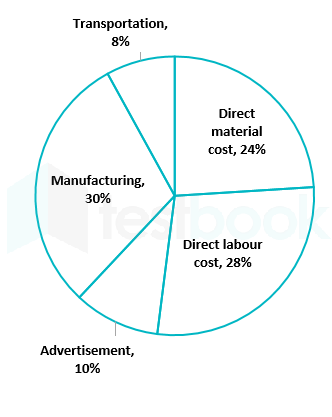
The following pie chart shows the percentage distribution of the expenditure incurred in manufacturing a power bank. Study the pie chart and answer the question.

If 100 power banks are manufactured and the manufacturing cost on them amounts to ₹50,000, then what should be the selling price of the power banks so that the manufacturer can earn a profit of 50%?

  1. AOption (a)

    Rs. 2500

  2. BOption (b)

    Rs. 3000

  3. COption (c)

    Rs. 2200

  4. DOption (d)

    Rs. 2400

View answer & explanation

Correct answer

Answer: (a)A.

Rs. 2500

Why this answer is correct

Given:

Total number power banks manufactured = 100

Manufacturing cost = ₹ 50,000

Profit = 50%

Formula used:

Selling price = (100+Profit%)×Cost price100\frac{(100+ Profit\%)\times Cost \ price }{100}

Calculation:  

Manufacturing cost of each power bank = 50000100\frac{50000}{100} = ₹ 500

Total Cost of one power bank = 500×(100%30%)500\times(\frac{100\%}{30 \%}) = ₹ 50003\frac{5000}{3}

Selling price of the power banks so that the manufacturer can earn a profit of 50% 

⟹ Selling price = (100+50)×50003100\frac{(100+50)\times\frac{5000}{3}}{100 }

⟹ Selling price = 15×500315\times \frac{500}{3}

⟹ Selling price = ₹ 2500

So, ₹ 2500 will be selling price of the power banks so that the manufacturer can earn a profit of 50%.

Hence, the correct answer is option 1).

Question 26

An object placed 30 cm from a concave lens forms a virtual erect image at a distance of 10 cm from the lens. The magnification produced by the lens is:

  1. AOption (a)

    -1/3

  2. BOption (b)

    -3

  3. COption (c)

    1/3

  4. DOption (d)

    3

View answer & explanation

Correct answer

Answer: (c)C.

1/3

Why this answer is correct

Given:

 u = -30 cm ( (since the object is real and placed on the opposite side)

 v =  -10 cm (since the image is virtual and on the same side as the object).

 Image formed: Virtual and Erect

Formula Used:

Magnification(m)=vu=height:of:imageheight:of:objectMagnification(m) = {v \over u}={height: of :image \over height: of: object}

Calculation: 

 m=vu=1030m = {v \over u}={10\over 30}

 m=13m ={1\over 3}

Hence, the correct answer is "1/3".

Question 27

The measure of each interior angle of a regular polygon is 120°. How many sides does this polygon have?

  1. AOption (a)

    8

  2. BOption (b)

    5

  3. COption (c)

    6

  4. DOption (d)

    7

View answer & explanation

Correct answer

Answer: (c)C.

6

Why this answer is correct

Shortcut Trick

Exterior angle = 180° − Interior angle

Exterior angle = 180° − 120° = 60°

Number of sides (n) = 360° ÷ Exterior angle

n = 360° ÷ 60° = 6

∴ The correct answer is 6 sides.

Alternate Method

Given:

Measure of each interior angle = 120°

Formula Used:

Interior angle of a regular polygon = [(n − 2) × 180°] ÷ n

Calculations:

⇒ 120° = [(n − 2) × 180°] ÷ n

⇒ 120n = 180n − 360

⇒ 180n − 120n = 360

⇒ 60n = 360

⇒ n = 360 ÷ 60

Question 28

Which two signs should be interchanged to make the given equation correct?

24 × 6 - 12 + 18 ÷ 3 = 46

  1. AOption (a)

    × and +

  2. BOption (b)
    • and -
  3. COption (c)

    × and ÷

  4. DOption (d)
    • and ÷
View answer & explanation

Correct answer

Answer: (c)C.

× and ÷

Why this answer is correct

Follow BODMAS rule to solve this question, as per the order given below,

Given Expression:

24 × 6 - 12 + 18 ÷ 3 = 46

Let's check each option:

option 1) × and +​

L.H.S

24 + 6 - 12  × 18 ÷ 3 

= 24 + 6 - 12 × 6

= 24 + 6 - 72

= 30 - 72

= - 42 ≠  R.H.S

option 2) + and -

L.H.S

24 × 6 + 12 - 18 ÷ 3

= 24 × 6 + 12 - 6

= 144 + 12 - 6

= 156 - 6

= 150 ≠ R.H.S

option 3) × and ÷ 

L.H.S

24 ÷ 6 - 12 + 18 × 3

= 4 - 12 + 18 × 3

= - 12 + 4 + 54

= - 12 + 58

= 46 = R.H.S

option 4) + and ÷ 

L.H.S

24 × 6 - 12 ÷ 18 + 3 

= 24 × 6 - 0.666 + 3

= 144 - 0.666 + 3

= 146.334 ≠ R.H.S

Thus '× and ÷' these two signs that should be interchanged to make the given equation correct.

Hence, the correct answer is option 3).

Question 29

Four houses, A, B, C and D, are located in the same colony. House A is 300 m to the north of House D. House C is 400 m to the east of House B. House A is 300 m to the south of House B. In which direction is House D with reference to House B?

  1. AOption (a)

    North

  2. BOption (b)

    West

  3. COption (c)

    South

  4. DOption (d)

    East

View answer & explanation

Correct answer

Answer: (c)C.

South

Why this answer is correct

From the given information draw the following diagram,

Four houses, A, B, C, and D, are located in the same colony and are as follows,

  • House A is 300 m to the north of House D.

  • House A is 300 m to the south of House B.


  • House C is 400 m to the east of House B.

Thus, from the above diagram House D is in the south direction with reference to House B**.**

Hence, the correct answer is option 3).

Question 30

If A bought an item for Rs. 384 and sold it for Rs. 576 and B bought another item for Rs. 1,254 and sold it for Rs. 1,672. What is the ratio of gain % of A to gain % of B?

  1. AOption (a)

    52\frac{5}{2}

  2. BOption (b)

    32\frac{3}{2}

  3. COption (c)

    34\frac{3}{4}

  4. DOption (d)

    53\frac{5}{3}

View answer & explanation

Correct answer

Answer: (b)B.

32\frac{3}{2}

Why this answer is correct

Shortcut Trick

Gain % of A = (576 − 384) ÷ 384 × 100 = 192 ÷ 384 × 100 = 50%.

Gain % of B = (1672 − 1254) ÷ 1254 × 100 = 418 ÷ 1254 × 100 = 33.33% or (100/3)%.

Ratio = 50 ÷ (100/3) = (50 × 3) ÷ 100 = 150 ÷ 100 = 3/2.

∴ The correct answer is 3/2.

Alternate Method

Given: Cost Price (CPA) = Rs. 384, Selling Price (SPA) = Rs. 576. Cost Price (CPB) = Rs. 1,254, Selling Price (SPB) = Rs. 1,672.

Formulas: Profit = SP − CP | Profit % = (Profit ÷ CP) × 100.

⇒ Gain of A = 576 − 384 = 192.

⇒ Gain % of A = (192 ÷ 384) × 100 = 50%.

⇒ Gain of B = 1672 − 1254 = 418.

⇒ Gain % of B = (418 ÷ 1254) × 100 = (1/3) × 100 = 100/3 %.

⇒ Ratio = 50 : (100/3) = 150 : 100 = 3 : 2.

∴ The correct answer is 3/2.

Additional Information

Profit and Loss Percentage

Profit % is always calculated on the Cost Price (CP) unless otherwise stated in the question. Formula: [(SP − CP) ÷ CP] × 100.

Ratio of Percentages

When comparing two percentages, ensure they are in the same form (either both as fractions or both as whole numbers) to find the simplest integer ratio.

Question 31

If a sum of money doubles itself in 10 years at compound interest, then in how many years will it become 16 times of itself at the same rate?

  1. AOption (a)

    10

  2. BOption (b)

    20

  3. COption (c)

    30

  4. DOption (d)

    40

View answer & explanation

Correct answer

Answer: (d)D.

40

Why this answer is correct

Shortcut Trick

If a sum becomes n times in t years, it becomes nk times in k × t years.

Here, the sum doubles (2 times) in 10 years.

Target is 16 times. Since 16 = 24, we have k = 4.

Required time = k × t ⇒ 4 × 10 = 40 years.

∴ The correct answer is 40 years.

Alternate Method

Given: A sum of money becomes 2 times in 10 years at Compound Interest.

Formula Used: A = P(1 + r/100)n

⇒ Case 1: 2P = P(1 + r/100)10

⇒ 2 = (1 + r/100)10 → (Eq. 1)

⇒ Case 2: 16P = P(1 + r/100)T

⇒ 16 = (1 + r/100)T

⇒ 24 = (1 + r/100)T

⇒ [(1 + r/100)10]4 = (1 + r/100)T [Substituting from Eq. 1]

⇒ (1 + r/100)40 = (1 + r/100)T

⇒ T = 40 years

∴ The correct answer is 40 years.

Additional Information

Compound Interest Concept

In CI, the amount grows geometrically. If it becomes n times in t years, it will become n2 in 2t, n3 in 3t, and so on.

Difference between CI and SI

For 2 years, the difference D = P × (r/100)2. For 3 years, D = P × (r/100)2 × (3 + r/100).

Rule of 72

A thumb rule to find the time to double the money: Time ≈ 72 ÷ Rate of Interest.

Question 32

Which of the following is NOT a tributary of the Yamuna river system?

  1. AOption (a)

    Chenab

  2. BOption (b)

    Hindon

  3. COption (c)

    Sind

  4. DOption (d)

    Chambal

View answer & explanation

Correct answer

Answer: (a)A.

Chenab

Why this answer is correct

The correct answer is 'Chenab'.

Key Points

  • At an elevation of roughly 6387 meters above mean sea level in the district of Uttarkashi, the river Yamuna, a significant tributary of the river Ganges, rises from the Yamunotri glacier close to the Banderpoonch peaks (380 59' N 780 27' E) in the Mussoorie range of the lower Himalayas (Uttaranchal).
  • The Himachal Pradesh and Jammu and Kashmir portions of two Indian States are included in the Chenab basin's watershed. In the Himachal Pradesh district of Chamba, the Upper Chenab catchment is located in the Lahoul area and Pangi Tehsil.
  • Therefore, Chenab is not a tributary of the Yamuna River system.

Additional Information

  • A Tributary is a little river that empties into a bigger river.
  • Tons, Chambal, Hindon, Betwa, and Ken are some of the Yamuna River's significant tributaries. The Giri, Sind, Uttangan, Senger, and Rind are additional minor Yamuna River tributaries.
  • Hindon:
  • In India, the Upper Sivaliks of the Shakumbhari devi range are where the Hindon River, a tributary of the Yamuna River, rises in the Saharanpur district of Uttar Pradesh.
  • For the rural residents of western Uttar Pradesh, India, it provides a significant supply of freshwater.
  • The river receives all of its water from rain, and its catchment area is about 7,083 square kilometers (2,735 sq mi).
  • Sind:
  • A tributary of the Yamuna River, the Sind River traverses the Indian states of Madhya Pradesh and Uttar Pradesh.
  • The Sind runs north-northeast before joining the Yamuna River where it begins on the Malwa plateau in Vidisha, M.P.
  • It has a drainage area of 27,856 km2 and a total stream network length of 470 kilometers.
  • Chambal:
  • In Central and Northern India, the Chambal River is a tributary of the Yamuna River and is thus a member of the Ganges drainage system.
  • The river goes through the state of Madhya Pradesh, then turns southeast to join the Yamuna in the state of Uttar Pradesh after briefly passing through Rajasthan and creating the border between the two states.
  • It is 1,024 kilometers (636 mi) long.

Question 33

A bike running at a speed of 50 km/h reaches its destination 10 minutes late. If it runs at 60 km/h it is late by 5 minutes. How many minutes should the bike take, travelling at usual speed to complete the journey on the same route to reach on time?

  1. AOption (a)

    15 minutes

  2. BOption (b)

    25 minutes

  3. COption (c)

    20 minutes

  4. DOption (d)

    12 minutes

View answer & explanation

Correct answer

Answer: (c)C.

20 minutes

Why this answer is correct

Shortcut Trick

Ratio of Speeds = 50 : 60 = 5 : 6

Since Distance is constant, Ratio of Time = 6 : 5

Difference in time units = 6 − 5 = 1 unit → Actual difference = 10 min − 5 min = 5 min

Time taken at 50 km/h = 6 × 5 = 30 min. Since it is 10 min late, Usual Time = 30 − 10 = 20 min

∴ The correct answer is 20 min.

Alternate Method

Given: S1 = 50 km/h, S2 = 60 km/h, Delay1 = 10 min, Delay2 = 5 min

Formula Used: Distance = [ (S1 × S2) / (S2 − S1) ] × Difference in Time

⇒ Time difference = 10 − 5 = 5 min = 5/60 hours

⇒ Distance = [ (50 × 60) / (60 − 50) ] × (5/60)

⇒ Distance = [ 3000 / 10 ] × (5/60) = 300 × (5/60) = 25 km

⇒ Time taken at 50 km/h = Distance / Speed = 25 / 50 = 0.5 hours

⇒ Time in minutes = 0.5 × 60 = 30 min

⇒ On-time journey = 30 min − 10 min = 20 min

∴ The correct answer is 20 min.

Additional Information

Speed-Time Inversity

When distance is constant, speed is inversely proportional to time: S1 / S2 = T2 / T1.

Late-Early Concept

If both cases are 'Late' or both are 'Early', subtract the times. If one is 'Late' and one 'Early', add the times to find the total difference.

Average Speed

For the same distance covered at different speeds x and y, Average Speed = 2xy / (x + y).

Question 34

A dealer allows 30% discount on the marked price of an item and still makes a profit of 10%. By how much percentage is the marked price more than the cost price (rounded off to two places of decimal)?

  1. AOption (a)

    45.45%

  2. BOption (b)

    26.67%

  3. COption (c)

    57.14%

  4. DOption (d)

    33.33%

View answer & explanation

Correct answer

Answer: (c)C.

57.14%

Why this answer is correct

Shortcut Trick

Use the direct relation between Marked Price (MP) and Cost Price (CP): MP ÷ CP = (100 + Profit%) ÷ (100 − Discount%).

MP ÷ CP = (100 + 10) ÷ (100 − 30) = 110 ÷ 70 = 11 ÷ 7.

Required Percentage = (Difference ÷ CP) × 100 = (11 − 7) ÷ 7 × 100 = 400 ÷ 7.

400 ÷ 7 ≈ 57.14%.

∴ The correct answer is 57.14%.

Alternate Method

Given → Discount = 30%, Profit = 10%. Formulas: SP = MP × (100 − D%) ÷ 100 | SP = CP × (100 + P%) ÷ 100 | Markup% = (MP − CP) ÷ CP × 100.

⇒ Let Marked Price (MP) = 100. ⇒ Selling Price (SP) = 100 − 30% of 100 = 70. ⇒ Since Profit = 10%, SP = CP × 1.10 ⇒ 70 = CP × 1.10. ⇒ Cost Price (CP) = 70 ÷ 1.10 = 700 ÷ 11 ≈ 63.636. ⇒ Markup Amount = MP − CP = 100 − 63.636 = 36.364. ⇒ Markup Percentage = (36.364 ÷ 63.636) × 100 = 57.14%.

∴ The correct answer is 57.14%.

Additional Information

Relation between MP and CP

The ratio of MP to CP is determined by the formula: MP/CP = (100 + G%)/(100 - D%). This is derived by equating the SP from both profit and discount perspectives.

Markup Percentage

Markup% = (Markup ÷ Cost Price) × 100. It represents how much more the price is labeled above the original cost.

Question 35

The Missionaries of Charity is a Catholic religious congregation established in ___________ by Mother Teresa.

  1. AOption (a)

    1954

  2. BOption (b)

    1952

  3. COption (c)

    1947

  4. DOption (d)

    1950

View answer & explanation

Correct answer

Answer: (d)D.

1950

Why this answer is correct

The correct answer is '1950'.

Key Points

  • Mother Teresa, also recognized in the Catholic Church as Saint Teresa of Calcutta, founded the Missionaries of Charity.
  • On october 7,1950 mother Teresa established The Missionaries of Charity.

Additional Information

  • All around the world, including the former Soviet Union and Eastern European nations, the Society of Missionaries has spread. They assist the poorest of the poor in several nations in Asia, Africa, and Latin America.
  • Mother Teresa got approval from the Holy See on October 7, 1950, to create her own order, "The Missionaries of Charity," whose main goal was to love and care for those that no one else was willing to take care of.

Question 36

Fiscal policy is the policy of:

  1. AOption (a)

    Both the Government and RBI

  2. BOption (b)

    RBI

  3. COption (c)

    the Government

  4. DOption (d)

    NABARD

View answer & explanation

Correct answer

Answer: (c)C.

the Government

Why this answer is correct

The correct answer is the Government.

Key Points

  • Fiscal policy is the term used to describe how the government uses taxation and expenditure to affect the state of the economy.
  • Fiscal policy is often used by governments to encourage robust, long-term growth and to lower poverty.
  • Fiscal policy typically enters the picture when conditions are deteriorating swiftly enough to call for government involvement, such as during a recession or an inflationary era.
  • Purpose:
  • Fiscal policy aims to encourage healthy and stable economic growth while putting in place artificial safeguards against a financial meltdown.
  • There are two types of fiscal policies: expansionary and contractionary.
  • ​Expansionary: The government's response to a recession by decreasing taxes and expanding government expenditure is known as expansionary policy, which is the more typical of the two.
  • Contractionary: When there is inflation, contractionary policies are used. During this time, the government may cut back on funding for public projects, public sector employee numbers, or even wages.

Additional Information

  • The importance of fiscal policy as a tool for policymaking has fluctuated historically.
  • Before 1930, a minimal government or laissez-faire philosophy was the norm.
  • A good case study in fiscal policy is the global financial crisis, which can be traced back to the collapse of the US mortgage market in 2007.
  • It depends on the fiscal space a government has available for new spending program or tax cuts, that is, its access to additional money at an affordable cost or its capacity to rearrange its present expenditures.

Question 37

In a dynamo, electric current is produced using the principle of: 

  1. AOption (a)

    electromagnetic radiation

  2. BOption (b)

    electromagnetism

  3. COption (c)

    electromagnetic induction

  4. DOption (d)

    electric conduction

View answer & explanation

Correct answer

Answer: (c)C.

electromagnetic induction

Why this answer is correct

The correct answer is "electromagnetic induction".

Key Points

  • Dynamo is an electrical generator which transforms mechanical rotation into a pulsating direct current using rotating coils of wire and magnetic fields.
  • This is accomplished through Faraday's laws of induction.
  • The fundamental law of electromagnetism known as Faraday's law, aids in our ability to predict how a magnetic field will interact with an electric circuit to produce an electromotive force (EMF). This phenomenon is known as **electromagnetic induction.**​

Additional Information

  • Faraday's Law of electromagnetic induction consists of 2 laws:
  1. When a conductor is placed in a varying magnetic field, an electromotive force is induced. If the conductor circuit is closed, a current is induced, which is called induced current.
  2. The induced emf in a coil is equal to the rate of change of flux linkage.
  • Electromagnetic radiation: The waves of the electromagnetic field that are moving through space and carrying electromagnetic radiant energy are referred to as electromagnetic radiation (EMR). It comprises X-rays, gamma rays, ultraviolet, infrared, radio waves, and microwaves.
  • Electromagnetism: It deals with the electromagnetic force that exists between electrically charged particles.
  • Electric conduction: The passage of electrically charged particles via a transmission medium is known as electrical conduction.

Question 38

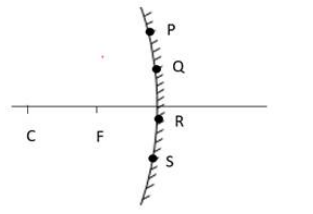
P, Q, R and S are four points on the surface of a concave mirror as shown in the figure. If r1, r2, r3 and r4 are the distance of centre of curvature from points P, Q, R and S, respectively, then the correct relation between r1, r2, r3 and r4 is:

  1. AOption (a)

    r1 = r2 = r3 = r4

  2. BOption (b)

    r1 < r2 < r3 < r4

  3. COption (c)

    r1 > r2 > r3 > r4

  4. DOption (d)

    r1 = r2, r3 = r4 r2 ≠  r3

View answer & explanation

Correct answer

Answer: (a)A.

r1 = r2 = r3 = r4

Why this answer is correct

The correct answer is "r1 = r2 = r3 = r4".

Key Points

  • The two ends of a spherical mirror when joined form a complete circle.
  • Thus, any point on the surface of the mirror joining the center of curvature will be the radius of that circle and we know that the length of all the radius in the same circle are equal.
  • Therefore, r1 , r2 , r3 and r4  will be all of same lengths.

Question 39

Some features of transportation in plants are mentioned below. Which option shows the INCORRECT feature?

  1. AOption (a)

    Movement of both water and food is bidirectional

  2. BOption (b)

    Water movement is by simple physical forces; food movement requires energy

  3. COption (c)

    Xylem transports water and Phloem transports food

  4. DOption (d)

    Vessels and Tracheids are dead cells and Sieve tubes are living

View answer & explanation

Correct answer

Answer: (a)A.

Movement of both water and food is bidirectional

Why this answer is correct

The correct answer is Movement of both water and food is bidirectional.

Key Points

  • Bidirectional movement means the movement of two molecules in 2 opposite directions.
  • A non-living tube called an xylem transports water and it runs through the stem from the roots to the leaves. It is unidirectional in nature.
  • Because sucrose builds up in the phloem tissue and absorbs water, causing a high turgor pressure, phloem movement is bidirectional.
  • Thus, the movement of water is unidirectional whereas the movement of food is bidirectional.

Additional Information

  • Water movement is by simple physical force, which is diffusion, i.e., transport of substances from higher concentration to lower concentration.
  • Whereas food transport is active transport which requires energy for transport.
  • Water molecules travel from the soil into the root's living cells and eventually into the vessels and tracheids, which serve as the xylem's transport cells. These hollow, dead xylem cells enable quick water movement.
  • Sieve tubes are living cells that are responsible for transporting carbohydrates throughout the plant.

Question 40

Each of the digits in the number 813924765 is arranged in ascending order from left to right. The position of how many digits will remain unchanged as compared to that in the original number?

  1. AOption (a)

    Two

  2. BOption (b)

    None

  3. COption (c)

    One

  4. DOption (d)

    Three

View answer & explanation

Correct answer

Answer: (a)A.

Two

Why this answer is correct

The series is written as shown below:

So, by applying the logic we obtained that positions of 3 and 7 remain unchanged.

Hence, the correct answer is option 1).

Question 41

Which Article of the Indian Constitution states that 'The Council of Ministers shall be collectively responsible to the House of the People'?

  1. AOption (a)

    Article 75 (2)

  2. BOption (b)

    Article 80 (4)

  3. COption (c)

    Article 75 (3)

  4. DOption (d)

    Article 75 (1)

View answer & explanation

Correct answer

Answer: (c)C.

Article 75 (3)

Why this answer is correct

The correct answer is Article 75 (3).

Key Points

  • The Constitution's original text included 395 articles divided into 22 divisions and 8 schedules.
  • Article 75 in the constitution states that The Council of Ministers shall be collectively responsible to the House of the People.
  • Article 75(3) of the Indian Constitution, which covers the unique requirements of this principle, contains the concept of collective responsibility.
  • According to Article 75(3), the council of ministers must be assembled and answerable to the Lok Sabha.
  • According to the principle of collective responsibility, the Lok Sabha is accountable to the council of ministers for the general management of the government's operations.
  • All decisions made by the cabinet are a collective effort of the council of ministers, which functions as a team.

​

Additional Information

  • Article 75 (2):
  • ​The Minister will be in office as long as the President so directs.
  • Article 80 (4):
  • According to Article 80(4), the elected members of the State Legislative Assembly will elect each State's delegates to the Council of States.
  • This is in keeping with the proportional representation system that uses a single transferable vote.
  • Article 75 (1):
  • A Council of Ministers led by the Prime Minister will assist and advise the President, who will follow their recommendations when performing his duties.
  • The president may request that the council of ministers reevaluate this advise, and the president must then act in accordance with the revised advice.

Question 42

Which of the following group of hydrocarbons follows the general formula of CnH2n?

  1. AOption (a)

    Alkene

  2. BOption (b)

    Alkyl

  3. COption (c)

    Alkane

  4. DOption (d)

    Alkyne

View answer & explanation

Correct answer

Answer: (a)A.

Alkene

Why this answer is correct

The correct answer is Alkene.

Key Points

  • An unsaturated hydrocarbon is one which consists of a single, double, or triple bond between Carbon - Carbon atoms.
  • The double-bonded hydrocarbons are known as Alkenes, which have the general formula CnH2n.
  • For example: 
  • Propene = C3H2*3 = C3H6 = CH3-HC=CH2​

Additional Information

  • The general formula for Alkyl is CnH2n+1.
  • The general formula for Alkane is CnH2n+2.
  • The general formula for Alkyne is CnH2n-2.

Question 43

Which of the following Acts was passed by the British Parliament, defining the powers and responsibilities of the various organs of the East India Company?

  1. AOption (a)

    Indian Councils Act of 1892

  2. BOption (b)

    Pitt's India Act of 1784

  3. COption (c)

    Regulating Act of 1773

  4. DOption (d)

    Government of India Act of 1858

View answer & explanation

Correct answer

Answer: (c)C.

Regulating Act of 1773

Why this answer is correct

The correct answer is Regulating Act of 1773.

Key Points

  • On May 1, 1707, the English and Scottish Parliaments passed the Acts of Union, which resulted in the formation of the United Kingdom of Great Britain. In October 1707, the UK Parliament convened for the first time.
  • The East India Company Act of 1772, also known as the Regulating Act of 1773, was an Act of the British Parliament designed to reorganize the East India Company's administration of its rule in India. It represented the first step toward centralized administration in India and legislative oversight of the Company.
  • Therefore, the answer is Regulating Act of 1773.

Additional Information

  • Indian Councils Act of 1892:
  • ​The British Parliament passed the Indian Councils Act of 1892, which expanded the size of India's legislative councils.
  • The ability to inquire about the budget was also granted to the members.
  • It marked the start of India's transition to a representative system of government.
  • Pitt's India Act (1784):
  • ​The dual system of authority by the British government and the East India Company was founded by Pitt's India Act (1784), named after British prime minister William Pitt the Younger.
  • The Regulating Act of 1773 needed to be fixed, therefore the British Parliament passed the Pitt's India Act, 1784, also known as the East India Company Act, 1784.
  • Government of India Act 1858:
  • ​The East India Company's territory and authority were handed to the British Crown by the Government of India Act 1858, an act of the British parliament.
  • The British East India Company, which up until this moment had been in charge of British India under the auspices of Parliament, was to be liquidated in accordance with its terms, and its duties were to be transferred to the British Crown.

Question 44

Which of the following home appliances does NOT use an electric motor?

  1. AOption (a)

    Electric fan

  2. BOption (b)

    Electric mixer

  3. COption (c)

    Electric iron

  4. DOption (d)

    Electric washing machine

View answer & explanation

Correct answer

Answer: (c)C.

Electric iron

Why this answer is correct

The correct answer is Electric iron.

Key Points

  • An electric motor is an electronic machine that converts an electric signal into mechanical signals.
  • Electric motors produce force in the form of torque that is applied to the motor shaft through the interaction of the magnetic field of the motor and electric current in a wire winding.
  • Electric iron works on the heating effect of electric current and not an electric motor.

Additional Information

  • Electric fans, Electric mixers, and Electric washing machines use an electric motor to convert electric energy to mechanical energy such as rotation of fan blades, churning property of mixer blades, and washing of clothes respectively.

Question 45

A sum of money is to be distributed among four members A, B, C, and D in the ratio 4 ∶ 7 ∶ 9 ∶ 3. If C gets Rs. 720 more than D, find D's share.

  1. AOption (a)

    Rs. 160

  2. BOption (b)

    Rs. 480

  3. COption (c)

    Rs. 360

  4. DOption (d)

    Rs. 240

View answer & explanation

Correct answer

Answer: (c)C.

Rs. 360

Why this answer is correct

Shortcut Trick

Ratio of A : B : C : D = 4 : 7 : 9 : 3

Difference between C and D in units = 9 − 3 = 6 units

Given: 6 units = ₹720

⇒ 1 unit = 720 ÷ 6 = ₹120

D's share = 3 units = 3 × 120 = ₹360

∴ The correct answer is ₹360.

Alternate Method

Given:

Ratio A : B : C : D = 4 : 7 : 9 : 3

Let the shares be 4x, 7x, 9x, and 3x respectively.

Calculations:

⇒ Difference between C and D = 9x − 3x = 6x

⇒ 6x = 720

⇒ x = 720 ÷ 6

⇒ x = 120

⇒ D's share = 3x = 3 × 120

⇒ D's share = 360

∴ The correct answer is ₹360.

Additional Information

Ratio and Proportion Basics

If a total amount T is divided in the ratio a : b : c, then the share of the first part is (a / (a+b+c)) × T.

Difference and Ratio

If the difference between two parts in a ratio is given, find the difference in terms of ratio units and equate it to the actual value.

Question 46

Selectively permeable membranes are those that allow penetration of __________.

  1. AOption (a)

    only solvent molecules but not solute molecules

  2. BOption (b)

    only solute molecules but not solvent molecules

  3. COption (c)

    neither solvent nor solute molecules

  4. DOption (d)

    both solvent and solute molecules

View answer & explanation

Correct answer

Answer: (a)A.

only solvent molecules but not solute molecules

Why this answer is correct

The correct answer is only solvent molecules but not solute molecules.

Key Points

  • Selectively permeable membranes such as cell membranes allow only the passage of a few ions or solvent molecules.
  • This is because selectively permeable membranes protect the cell from the outside environment. It maintains the internal environment by allowing only selective ions to go inside and by removing toxic substances from time to time.
  • Selectively permeable membranes act as filters that allow only solvent molecules to pass through.
  • Solute molecules can pass through it only by taking some help.
  • Thus, only solvent molecules but not solute molecules can pass through the selectively permeable membranes.

Question 47

Select the set in which the numbers are related in the same way as are the numbers of the following sets.

(NOTE : Operations should be performed on the whole numbers, without breaking down the numbers into its constituent digits. E.g. 13 - Operations on 13 such as adding /deleting /multiplying etc. to 13 can be performed. Breaking down 13 into 1 and 3 and then performing mathematical operations on 1 and 3 is not allowed)

(4, 3, 16)

(3, 5, 19)

  1. AOption (a)

    (5, 2, 49)

  2. BOption (b)

    (3, 2, 12)

  3. COption (c)

    (8, 1, 18)

  4. DOption (d)

    (8, 2, 20)

View answer & explanation

Correct answer

Answer: (d)D.

(8, 2, 20)

Why this answer is correct

The logic followed here is:

(First number × Second number) + 4 = Third number

Applying logic to the given series:

(4, 3, 16)

(4 × 3) + 4

= 16

And, 

(3,5,19)

(3 × 5) + 4

= 19

Similarly,

(8,2,20)

(8 × 2) + 4

= 20

Hence, the correct answer is option 4).

Question 48

Starting from point L, a person walks 125 m towards the south. He then takes a left turn and walks 70 m. From there, he takes a left turn and walks 80 m. After that, he takes a left turn and walks 115 m. Finally, he takes a right turn and walks 45 m to reach point M. How far and in which direction is point M from point L ? (All turns are 90 degree turns only)

  1. AOption (a)

    45 m, West

  2. BOption (b)

    90 m, East

  3. COption (c)

    90 m, North

  4. DOption (d)

    45 m, East

View answer & explanation

Correct answer

Answer: (a)A.

45 m, West

Why this answer is correct

Draw the diagram according to the given information.

  • Starting point is L.
  • 125 m towards the south.
  • Then, left turn and walk 70 m.
  • Again left turn and walks 80 m.
  • Again left turn and walks 115m.
  • Finally, take the right turn and walk 45 m.
  • Final point is M.

Thus, the person is 45 m towards the west from the starting point.

Hence, the correct answer is option 1).

Question 49

There are three numbers which are co-prime to one other such that the product of the first two is 357 and that of the last two is 609. What is the sum of the three numbers?

  1. AOption (a)

    91

  2. BOption (b)

    67

  3. COption (c)

    83

  4. DOption (d)

    75

View answer & explanation

Correct answer

Answer: (b)B.

67

Why this answer is correct

Shortcut Trick

Common middle number = HCF of 357 and 609.

609 − 357 = 252. Factors of 252 are checked against 357.

Middle number = 21.

Numbers: 357/21 = 17, Middle = 21, 609/21 = 29.

Sum = 17 + 21 + 29 = 67.

∴ The correct answer is 67.

Alternate Method

Given: Three co-prime numbers x, y, and z.

Product of first two: x × y = 357

Product of last two: y × z = 609

⇒ Since x, y, z are co-prime, the common factor y must be the HCF.

⇒ HCF(357, 609): 609 = 357 × 1 + 252

⇒ 357 = 252 × 1 + 105

⇒ 252 = 105 × 2 + 42

⇒ 105 = 42 × 2 + 21

⇒ 42 = 21 × 2 + 0. ∴ y = 21.

⇒ x = 357 ÷ 21 = 17.

⇒ z = 609 ÷ 21 = 29.

⇒ Sum = 17 + 21 + 29 = 67.

∴ The correct answer is 67.

Additional Information

Co-prime Numbers

A set of numbers where the only common factor is 1; i.e., HCF(a, b) = 1.

HCF of Products

If three numbers a, b, c are co-prime, then HCF(ab, bc) = b.

Prime Factorization

357 = 3 × 7 × 17 and 609 = 3 × 7 × 29. Common factors are 3 × 7 = 21.

Question 50

Solve: 2(5х - 3) + 3(3x - 5) = 93

  1. AOption (a)

    х = 6

  2. BOption (b)

    х = -9

  3. COption (c)

    x = -6

  4. DOption (d)

    х = 9

View answer & explanation

Correct answer

Answer: (a)A.

х = 6

Why this answer is correct

Given: 

2(5х−3)+3(3x−5)=93 {2(5х - 3) + 3(3x - 5) = 93}

Calculation:

⇒ 10x−6+9x−15=93 {10x-6 + 9x -15 = 93}

⇒ 19x−21=93 {19x-21 =93}

⇒ 19x=93+21=114{19x = 93+21 = 114 }

⇒  x=11419=6x= {114 \over 19 } = 6

∴ The required number is '6'.

Hence, the correct answer is option 1).

Question 51

Three statements are given, followed by two conclusions numbered I and II. Assuming the statements to be true, even if they seem to be at variance with commonly known facts, decide which of the conclusions logically follow(s) from the statements.

Statements:

All sketches are cards.

All cards are posters.

Some sketches are folders.

Conclusions:

I. Some folders are posters.

II. Some cards are folders.

  1. AOption (a)

    Both conclusions I and II follow

  2. BOption (b)

    Either conclusion I or II follows

  3. COption (c)

    Only conclusion II follows

  4. DOption (d)

    Only conclusion I follows

View answer & explanation

Correct answer

Answer: (a)A.

Both conclusions I and II follow

Why this answer is correct

Given:

Statements:

All sketches are cards.

All cards are posters.

Some sketches are folders

The possible Venn diagram is shown below:

Conclusions:

 I. Some folders are posters. → True (As sketches are the subset of posters and Some sketches are folders. So some folders are posters.)

 II. Some cards are folders. → True (As sketches are the subset of cards and Some sketches are folders. So some cards are folders.)

Thus, both conclusions I and II follow.

Hence, the correct answer is option 1).

Question 52

Which of the following numbers will replace the question mark (?) in the given series?

13, 27, 56, 115, 234,?

  1. AOption (a)

    332

  2. BOption (b)

    482

  3. COption (c)

    473

  4. DOption (d)

    346

View answer & explanation

Correct answer

Answer: (c)C.

473

Why this answer is correct

The logic followed here is:

Next term = (Previous term × 2) + Consecutive natural number

Hence, "473" will replace the question mark (?) in the given series**.**

Question 53

In the year 2000, Monu was 3 times his sister's age. In 2010, he was 24 years older than her. Find Monu's age in 2010.

  1. AOption (a)

    62 years

  2. BOption (b)

    46 years

  3. COption (c)

    38 years

  4. DOption (d)

    52 years

View answer & explanation

Correct answer

Answer: (b)B.

46 years

Why this answer is correct

Shortcut Trick

The age difference between two people remains constant throughout their lives.

In 2000, Monu : Sister = 3 : 1 (Difference = 2 units).

Given age difference = 24 years, so 2 units = 24 → 1 unit = 12 years.

In 2000, Monu age = 3 × 12 = 36 years.

In 2010 (10 years later), Monu age = 36 + 10 = 46 years.

∴ The correct answer is 46 years.

Alternate Method

Given: Ratio in 2000 is 3:1. Age difference in 2010 is 24 years.

Formula Used: Age = (Ratio × Unit Value) + Years passed.

⇒ Let Sister age in 2000 = x

⇒ Monu age in 2000 = 3x

⇒ Difference (3x − x) = 24

⇒ 2x = 24 ⇒ x = 12

⇒ Monu age in 2000 = 3 × 12 = 36 years

⇒ Monu age in 2010 = 36 + 10 = 46 years

∴ The correct answer is 46 years.

Additional Information

Constant Difference Property

The difference between the ages of two persons remains the same at any point in time (past, present, or future).

Ratio Balancing

If ratios at two different times are given, multiply the ratios such that the difference between the parts remains equal to the actual year gap.

Age After 'n' Years

If the present age is A, then age after n years = A + n, and age n years ago = A − n.

Question 54

In February 2022, India became the first country in the world to play ________ One Day International cricket matches.

  1. AOption (a)

    900

  2. BOption (b)

    1000

  3. COption (c)

    800

  4. DOption (d)

    1100

View answer & explanation

Correct answer

Answer: (b)B.

1000

Why this answer is correct

The correct answer is '1000'.

Key Points

  • The International Cricket Council organizes international cricket matches between teams representing different countries (ICC). Test matches, One-Day matches, and Twenty20 matches are the three main formats.
  • The Indian cricket team became the first squad in history to play 1,000 One-Day Internationals on February 6.
  • Two ODI World Cups and one T20 World Cup have been won by the side. India has won 519 games out of the 1000 ODIs they have played thus

Additional Information

  • India played its 1000th One-Day International on Sunday, becoming the first team to do so. The team accomplished the milestone when playing the West Indies in the current first ODI at the Narendra Modi Stadium.
  • Cricket is an outdoor sport in which two teams compete. By hitting a ball with a wooden bat, players attempt to score points, known as runs.

Question 55

The average of thirteen consecutive integers is 36. If two times the smallest of these 13 integers is added to the largest of these 13 integers, what will be the sum obtained?

  1. AOption (a)

    102

  2. BOption (b)

    110

  3. COption (c)

    115

  4. DOption (d)

    121

View answer & explanation

Correct answer

Answer: (a)A.

102

Why this answer is correct

Shortcut Trick

For odd consecutive integers, the Average is always the Middle Term.

Middle term (7th term) = 36.

Smallest term (1st term) = 36 − 6 = 30.

Largest term (13th term) = 36 + 6 = 42.

Required Sum = (2 × 30) + 42 = 60 + 42 = 102.

∴ The correct answer is 102.

Alternate Method

Given: Average of 13 consecutive integers = 36.

Formula: Average of n consecutive terms = (First term + Last term) ÷ 2.

⇒ Let the integers be x, x+1, x+2, ..., x+12.

⇒ Sum = [x + (x+12)] × 13 ÷ 2 = 36 × 13.

⇒ (2x + 12) ÷ 2 = 36.

⇒ x + 6 = 36 ⇒ Smallest integer (x) = 30.

⇒ Largest integer (x+12) = 30 + 12 = 42.

⇒ Required Sum = (2 × Smallest) + Largest.

⇒ Required Sum = (2 × 30) + 42 = 60 + 42 = 102.

∴ The correct answer is 102.

Additional Information

Consecutive Integers Property

For any arithmetic progression (AP), Average = (First Term + Last Term) ÷ 2 = Middle Term (if n is odd).

Number of Terms

If there are n consecutive integers, the difference between the largest and smallest is (n − 1).

Average of Even/Odd Consecutive Numbers

For consecutive even or odd numbers, the gap between each term is 2, and the average is still the middle value.

Question 56

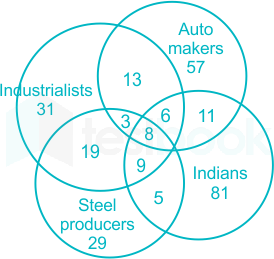
Study the diagram and answer the question that follows. The numbers in different sections indicate the number of persons. How many Indian industrialists make autos but are NOT steel producers?

  1. AOption (a)

    13

  2. BOption (b)

    3

  3. COption (c)

    8

  4. DOption (d)

    6

View answer & explanation

Correct answer

Answer: (d)D.

6

Why this answer is correct

The Venn Diagram is given below: 

Thus, the shaded portion indicates that Indian industrialists make autos but are NOT steel producers.

Hence, the correct answer is option 4).

Question 57

The Twenty Point Programme (TPP) was launched by the Government of India in _________.

  1. AOption (a)

    1975

  2. BOption (b)

    1990

  3. COption (c)

    1985

  4. DOption (d)

    1980

View answer & explanation

Correct answer

Answer: (a)A.

1975

Why this answer is correct

The correct answer is '1975'.

Key Points

  • There are several social sector schemes and programs included in the Twenty Point Program (TPP)-2006.
  • It consists of 20 points and 66 items, which are managed by different Ministries of the Indian Government and put into practice by State and UT Governments.
  • It was launched by the government of India in 1975.

Additional Information

  • There are 740 central sector (CS) programs in the Indian Union Budget for 2022 and 65 (+7+) government-sponsored programs (CSSs).
  • The union government sought to reform, renovate, and rationalize these by the following year from 131 CSSs in February 2021.
  • The Pradhan Mantri Jan-Dhan Yojana, Stand Up India Scheme, Pradhan Mantri Jeevan Jyoti Bima Yojana, and many more social welfare programs are managed by the Indian government.

Question 58

Two resistors of 4 Ω each are connected in parallels to a 5 V battery source. The total current in the circuit is:

  1. AOption (a)

    5 A

  2. BOption (b)

    2.5 A

  3. COption (c)

    20 A

  4. DOption (d)

    10 A

View answer & explanation

Correct answer

Answer: (b)B.

2.5 A

Why this answer is correct

Given:

Resistance of 2 resistors = 4 Ω

Voltage of battery = 5 V

Concept / Formula used:

Ohm's Law, I=VRI= {V\over R}

Effective resistance in parallel connection, 1R=1R1+1R2{1 \over R} = {1 \over R1} +{1 \over R2}

Calculation:

Effective Resistance: 

1R=1R1+1R2{1 \over R} = {1 \over R1} +{1 \over R2}

1R=14+14=12{1 \over R} = {1 \over 4} +{1 \over 4}={1 \over 2}

R=2:ΩR=2: Ω

Total current in the circuit:

I=VRI= {V\over R}

I=52=2.5:AmperesI= {5\over 2}=2.5 :Amperes

Hence, the total current in the circuit is "2.5 A".

Question 59

Select the option that represents the letters that, when placed from left to right in the same sequence in the blanks below, will complete the letter series.

C _ P R _ D T _ R N _ T _ R N _ T P _ N

  1. AOption (a)

    T N P E P F R

  2. BOption (b)

    T P N D P F R

  3. COption (c)

    T N T E P F P

  4. DOption (d)

    P N P E R F P

View answer & explanation

Correct answer

Answer: (a)A.

T N P E P F R

Why this answer is correct

Given: C _ P R _ D T _ R N _ T _ R N _ T P _ N

Let's check each option:

1) T N P E P F R → C T P R N D T P R N E T P R N F T P R N

2) T P N D P F R → C T P R P D T N R N D T P R N F T P R N

3) T N T E P F P  → C T P R N D T T R N E T P R N F T P P N

4) P N P E R F P → C P P R N D T P R N E T R R N F T P P N

So, by putting option 1) in the series "C/D/E/F-TPRN" is repeating itself.

Hence, the correct answer is "T N P E P F R".

Question 60

What is the main cause of contamination of Ganges with coliform bacteria?

  1. AOption (a)

    Washing clothes

  2. BOption (b)

    Chemical wastes from industries

  3. COption (c)

    Discharge of untreated sewage into the river

  4. DOption (d)

    Throwing uncremated corpses in the river

View answer & explanation

Correct answer

Answer: (c)C.

Discharge of untreated sewage into the river

Why this answer is correct

The correct answer is Discharge of untreated sewage into the river

Key Points

  • The main cause of contamination of the Ganges with coliform bacteria is the discharge of untreated sewage into the river.
  • Coliform bacteria are a group of microorganisms commonly found in the environment, including in human and animal waste.
  • The presence of coliform bacteria in the Ganges indicates that the water has been contaminated by fecal matter, which is harmful to human health.
  • Untreated sewage contains a high load of pathogens, organic matter, and nutrients that contribute to the proliferation of coliform bacteria in the river.
  • Efforts to clean the Ganges must focus on improving sewage treatment infrastructure and preventing the direct discharge of sewage into the river.

Additional Information

  • The Ganges is one of the most important rivers in India, both culturally and economically, providing water to millions of people.
  • Pollution in the Ganges also affects aquatic life and the overall ecosystem of the river.
  • Various initiatives, such as the Namami Gange Programme, have been launched by the Indian government to address pollution and rejuvenate the river.
  • Public awareness and participation are crucial in ensuring the success of these initiatives and in maintaining the cleanliness of the Ganges.
  • Proper waste management practices and the development of adequate sanitation facilities are essential to prevent further contamination of the river.

Question 61

Each vowel in the word 'DESTROY' is changed to the letter following it in the English alphabetical order and each consonant is changed to the letter preceding it in the English alphabetical order. If each letter, thus formed, is arranged in alphabetical order, which letter will be fifth from the right end?

  1. AOption (a)

    P

  2. BOption (b)

    Q

  3. COption (c)

    R

  4. DOption (d)

    F

View answer & explanation

Correct answer

Answer: (a)A.

P

Why this answer is correct

Given:

  • The vowels are changed with the following letters.
  • The consonants are changed with the preceding letters.

According to the given information,

Arranging the obtained random sequence of the alphabet into alphabetic order, we get,

Alphabetic Order → CFPQRSX.

Here, P is fifth from the right side.

Hence, the correct answer is option 1).

Question 62

Oral pills used for birth control change the hormonal balance of the body. How do these prevent pregnancy? Select the correct option.

  1. AOption (a)

    Eggs are released but no fertilisation

  2. BOption (b)

    Eggs are not released and no fertilisation

  3. COption (c)

    No formation of eggs

  4. DOption (d)

    Lining of uterus breaks off

View answer & explanation

Correct answer

Answer: (b)B.

Eggs are not released and no fertilisation

Why this answer is correct

The correct answer is Eggs are not released and no fertilization.

Key Points

  • In the US, the birth control pill is the method of birth control that is most frequently prescribed.
  • About 25% of women between the ages of 15 and 44 who use contraception said they prefer the pill.
  • The primary mode of action is ovulation prevention, they impede follicular growth and stop ovulation.
  • The oral pills stop pregnancy by preventing the release of eggs and which result in no fertilization.

Additional Information

  • The pills can be either monophasic (the active tablets contain the same amount of both components) or multiphasic (varying doses weekly of both or either component in the active pills).
  • The majority of OCP adverse effects are minor and go away with sustained use or switching to a different tablet formulation. Breakthrough bleeding is the most frequent side effect of combination oral contraceptives.

Question 63

What will come in place of p and q, respectively, in the given double displacement reaction?

Ag - p + NaCl →  Ag - q + NaNO3

  1. AOption (a)

    NO3 and Cl

  2. BOption (b)

    Cl and Cl

  3. COption (c)

    Cl and NO3

  4. DOption (d)

    NO3 and NO3

View answer & explanation

Correct answer

Answer: (a)A.

NO3 and Cl

Why this answer is correct

The correct answer is NO3 and Cl.

Key Points

  • When a portion of two ionic compounds is swapped, a double displacement reaction takes place, creating two new components.
  • In the given reaction the ions with Ag and Na will displace each other and as before reaction Cl is with Na so after reaction it will be with Ag.
  • After reaction NO3 is with Na so before reacting, it should be with Ag.
  • Final equation: AgNO3 + NaCl → AgCl + NaNO3.
  • Therefore, p and q are '**NO3'**and 'Cl' respectively.

Additional Information

  • The formula for the double displacement reaction is AB + CD →  AD + CB.
  • A and C are positively charged cations in this process, whereas B and D are negatively charged anions.

Question 64

Kidney is an organ of excretion and osmoregulation in humans. Regulation of which two substances is done by the kidneys?

  1. AOption (a)

    CO2 and proteins

  2. BOption (b)

    Sugar and salts

  3. COption (c)

    Water and salts

  4. DOption (d)

    Water and O2

View answer & explanation

Correct answer

Answer: (c)C.

Water and salts

Why this answer is correct

The correct answer is Water and salts.

Key Points

  • Two bean-shaped organs, the kidneys are each roughly the size of a fist. One is on either side of your spine, directly below the rib cage.
  • Every minute, healthy kidneys filter about half a cup of blood, eliminating wastes and surplus water to create urine.
  • Therefore, every time the regulation of water and salts carries on by kidney.

Additional Information

  • Your kidneys control the amount of salt, water, and other electrolytes in your body.
  • The idea is to maintain a balance between the amount of water you drink and the amount you defecate. The kidneys increase urine production to restore equilibrium if your body contains too much water.

Question 65

Which of the following is NOT a true statement?

  1. AOption (a)

    Sum of any pair of adjacent angles of a rhombus is not 180°.

  2. BOption (b)

    All squares are rhombuses.

  3. COption (c)

    Diagonals of a rhombus bisect each other at right angles.

  4. DOption (d)

    All sides of a rhombus are congruent.

View answer & explanation

Correct answer

Answer: (a)A.

Sum of any pair of adjacent angles of a rhombus is not 180°.

Why this answer is correct

Shortcut Trick

A Rhombus is a special type of parallelogram. A fundamental property of all parallelograms is that adjacent angles are supplementary, meaning their sum is exactly 180°. Therefore, any statement claiming the sum is not 180° is mathematically incorrect.

∴ The correct answer is Sum of any pair of adjacent angles of a rhombus is not 180°.

Alternate Method

Given: Properties of a Rhombus.

Formula Used: Angle Sum Property of parallel lines and Rhombus Definitions.

Evaluating each statement based on Geometric Properties:

⇒ Statement 1: In a rhombus, opposite sides are parallel. Adjacent angles are consecutive interior angles. ∴ ∠A + ∠B = 180°. The statement "is not 180°" is False.

⇒ Statement 2: A Square is defined as a quadrilateral with four equal sides and four right angles. Since it has four equal sides, it satisfies the definition of a Rhombus. (True)

⇒ Statement 3: A key property of a rhombus is that its diagonals bisect each other at right angles (90°). (True)

⇒ Statement 4: By definition, a Rhombus is an equilateral quadrilateral, meaning all four sides are congruent. (True)

∴ The correct answer is Sum of any pair of adjacent angles of a rhombus is not 180°.

Additional Information

Area of a Rhombus

The area can be calculated using the lengths of its diagonals: Area = ½ × d1 × d2.

Symmetry of a Rhombus

A rhombus has two lines of reflective symmetry, which are its diagonals, and rotational symmetry of order 2.

Relationship with Parallelograms

Every rhombus is a parallelogram, but not every parallelogram is a rhombus (only those with equal sides are).

Question 66

Workers who own and operate an enterprise to earn their livelihood are known as:

  1. AOption (a)

    regular salaried employed workers

  2. BOption (b)

    hired workers

  3. COption (c)

    government employed workers

  4. DOption (d)

    self-employed workers

View answer & explanation

Correct answer

Answer: (d)D.

self-employed workers

Why this answer is correct

The correct answer is 'self-employed workers.

Key Points

  • Self-employed: Workers who own and operate an enterprise to earn their livelihood are known as self-employed.
  • About 52 percent workforce in India belongs to this category.
  • A person owning a cement shop is an example of self-employment.

Additional Information

  • Regular salaried employed workers:
  • When a worker is engaged by someone or an enterprise and paid his or her wages on a regular basis, they are known as a regular salaried employee.
  • An example of a regular salaried worker is a civil engineer working in a construction company.
  • Hired worker:
  • A person casually engaged in others farm or non-farm enterprises (both household and non-household) and getting in return wage according to the terms of the daily or periodic work contract is a hired worker.
  • An example of a casual worker is a construction worker.
  • They account for 30 percent of India’s workforce.
  • Government-employed workers: 
  • Any employee of the State, a county, city, town, village, or any other political subdivision or civil division of the State, or a county, city, town, or village is a government-employed worker.
  • A civil servant is a government-employed worker.

Question 67

Who has launched the first Indian Virtual Science Lab for children under the CSIR Jigyasa programme?

  1. AOption (a)

    Amit Shah

  2. BOption (b)

    Dr. Virendra Kumar

  3. COption (c)

    Dr. Jitendra Singh

  4. DOption (d)

    Dharmendra Pradhan

View answer & explanation

Correct answer

Answer: (c)C.

Dr. Jitendra Singh

Why this answer is correct

The correct answer is 'Dr. Jitendra Singh'. 

Key Points

  • CSIR Jigyasa programme:-
  • Science and Technology Minister, Jitendra Singh has launched India’s first Virtual Science Lab for Children under CSIR (Council of Scientific and Industrial Research) Jigyasa Programme.
  • These labs will connect students with scientists across the country.
  • To provide quality research exposure and innovative pedagogy for school students based on an online interactive medium.

Question 68

Which of the following materials is preferably used in making heating elements of electrical heating devices?

  1. AOption (a)

    Tin-lead alloy

  2. BOption (b)

    Nichrome

  3. COption (c)

    Tungsten

  4. DOption (d)

    Constantan

View answer & explanation

Correct answer

Answer: (b)B.

Nichrome

Why this answer is correct

The correct answer is 'Nichrome' .

Key Points

  • Nichrome:-
  • It is used for making the heating element of an electric iron.
  • It has relatively high resistance and a high melting point.
  • Nichrome is made of 80% nickel, 20% chromium.
  • Tungsten also has a high melting point and is used as the electrodes, heating elements and as filaments in light bulbs.

Question 69

In chlor-alkali process, chlor represents chlorine gas and alkali represents:

  1. AOption (a)

    NaOH

  2. BOption (b)

    Ca(OH)2

  3. COption (c)

    ZnO

  4. DOption (d)

    CaCO3

View answer & explanation

Correct answer

Answer: (a)A.

NaOH

Why this answer is correct

The correct answer is " NaOH ".


Key Points

  • Sodium hydroxide is the alkali used in the chlor-alkali process.
  • In the process of making chlorine, sodium hydroxide is created as a byproduct.
  • The crystalline solid sodium hydroxide is white and transparent.
  • In the chlor-alkali process, sodium chloride in an aqueous solution is exposed to electricity, which breaks down to generate sodium hydroxide.

Additional Information

  • In the chlor-alkali process, electricity is sent through the sodium chloride aqueous solution, where it breaks down to generate sodium hydroxide.
  • Brine is the aqueous solution of sodium chloride.

Question 70

N. K. Singh became the Chairman of which Finance Commission of India?

  1. AOption (a)

    15th

  2. BOption (b)

    19th

  3. COption (c)

    17th

  4. DOption (d)

    13th

View answer & explanation

Correct answer

Answer: (a)A.

15th

Why this answer is correct

The correct answer is '15th'.

Key Points

  • Mr. N.K. Singh is a prominent Indian economist, academician, and policymaker.
  • He is currently Chairman of the 15th Finance Commission, a body established under the Indian Constitution to oversee revenue sharing and other federal fiscal policy matters.
  • Prior to this position, he presided as Chairman of the Fiscal Responsibility and Budget Management Review Committee (FRBM), responsible for setting targets for the government to reduce fiscal deficits.
  • He also served as a member of the Upper House of the Parliament, the Rajya Sabha, from 2008 to 2014.

Additional Information Finance Commission:

  • The President shall, within two years from the commencement of this Constitution and thereafter at the expiration of every fifth year or at such earlier time as the President considers necessary, by order constitute a Finance Commission which shall consist of a Chairman and four other members to be appointed by the President. (Article 280)
  • Parliament may by law determine the qualifications which shall be requisite for appointment as members of the Commission and the manner in which they shall be selected.
  • It shall be the duty of the Commission to make recommendations to the President as to —
  • the distribution between the Union and the States of the net proceeds of taxes which are to be, or may be, divided between them under this Chapter and the allocation between the States of the respective shares of such proceeds;
  • the principles which should govern the grants in-aid of the revenues of the States out of the Consolidated Fund of India;
  • the measures needed to augment the Consolidated Fund of a State to supplement the resources of the Panchayats in the State on the basis of the recommendations made by the Finance Commission of the State;
  • the measures needed to augment the Consolidated Fund of a State to supplement the resources of the Municipalities in the State on the basis of the recommendations made by the Finance Commission of the State;
  • any other matter referred to the Commission by the President in the interests of sound finance.
  • The Commission shall determine their procedure and shall have such powers in the performance of their functions as Parliament may by law confer on them.

Question 71

Study the given letter, number, and symbol series and answer the following question.

7 T % N 9 * M $ 3 U = L 8 Y @ G & 3 E > 5 & R 3 ! K # 7 % H = Y 6

Find out the total number of letters that are immediately followed by a number and immediately preceded by a symbol.

  1. AOption (a)

    2

  2. BOption (b)

    4

  3. COption (c)

    3

  4. DOption (d)

    1

View answer & explanation

Correct answer

Answer: (b)B.

4

Why this answer is correct

The series can be written as:

There are 4 such pairs where a letter is immediately preceded by a symbol and also immediately followed by a number.

Hence, the correct answer is option 2).

Question 72

In a class of 21 students, each scored differently. P's rank from the bottom is 9th, while Q's rank from the top is also 9th How many students are ranked between Q and P?

  1. AOption (a)

    3

  2. BOption (b)

    5

  3. COption (c)

    2

  4. DOption (d)

    4

View answer & explanation

Correct answer

Answer: (a)A.

3

Why this answer is correct

According to the question, the ranking diagram is shown below:

Position of  Q from top = 9th

Position of P from bottom = 9th

Students between P and Q = Total students - (position of Q from top + position of P from bottom).

= 21 - (9 + 9)

= 21 - 18

= 3

Hence**,** the correct answer is option 1).

Question 73

Which physiographic division covers a distance of 2500 km from Indus to Brahmaputra in west-east direction?

  1. AOption (a)

    Himalayan mountains

  2. BOption (b)

    Northern plains

  3. COption (c)

    Coastal plains

  4. DOption (d)

    Peninsular plateau

View answer & explanation

Correct answer

Answer: (a)A.

Himalayan mountains

Why this answer is correct

The correct answer is 'Himalayan mountains'.

Key Points

  • The Himalayan Mountains
  • The Himalayas are the young fold mountains.
  • They run from the west-east direction from Indus to Brahmaputra covering a distance of 2500 KM.
  • Their width varies from 400 in the west and 150 KM in the East.
  • The Himalayas may be divided into three parallel ranges:
  1. Greater Himalayas or Himadari
  2. Lesser Himalayas or Himachal
  3. Outer Himalayas or Siwaliks.

Additional Information

  • Northern plains 
  • It is located south of the Himalayas and north of the Peninsular plateau.
  • formed by the deposition of the sediments brought by three main river systems namely: the Indus, the Ganga, and the Brahmaputra.
  • It mainly includes the states of Punjab, Haryana, Uttar Pradesh, Bihar, West Bengal, and Assam.
  • plain is one of the largest and most fertile plains in the world.
  • The peninsular plateau
  • is a triangular-shaped tableland.
  • It is part of an ancient land mass called the Gondwana level.
  • It covers an area of nearly 5 lacks sq. km.
  • It is spread over the states of Gujarat, Maharashtra, Bihar, Karnataka, and Andhra Pradesh.
  • River Narmada divides the peninsular plateau into two parts: (i) The central highlands and (ii) (ii)Deccan Plateau
  • Coastal plains
  • The coastal plains in India run parallel to the Arabian Sea & Bay of Bengal along the Peninsular Plateau. -
  • The western coastal plain is a narrow belt along the Arabian sea of about 10-20km wide. It stretches from Rann of Kachchh to Kanya Kumari. Western coastal plains comprise three sectors
  • Konkan Coast (Mumbai to Goa),
  • Karnataka coast from Goa to Mangalore
  • Malabar Coast (Mangalore to KanyaKumari).
  • The eastern coast runs along the Bay of Bengal. It is wider than the western coastal plain. Its average width is about 120 km.
  • The northern part of the coast is called Northern Circar and the southern part is called Coromandel Coast.
  • The eastern coastal plain is marked by Deltas made by the rivers Mahanadi, Godavari, Krishna and Kaveri.
  • The Chilka largest saltwater lake in India in Odisha is located to the south of Mahanadi Delta.

Question 74

In the given letter-cluster pairs, the first letter-cluster is related to the second letter-cluster following a certain logic. Study the given pairs carefully, and from the given options, select the pair that follows the same logic.

TOP ∶ VRU

XOR ∶ ZRW

  1. AOption (a)

    NOR ∶ PRW

  2. BOption (b)

    NET ∶ PGY

  3. COption (c)

    QIP ∶ SLV

  4. DOption (d)

    TOM ∶ VRQ

View answer & explanation

Correct answer

Answer: (a)A.

NOR ∶ PRW

Why this answer is correct

The alphabet series and its position value is shown below:

The logic followed here is 

TOP ∶ VRU


And,

XOR ∶ ZRW

Similarly,

NOR ∶ PRW 

Thus, the pair "NOR ∶ PRW " is following the above logic.

Hence, the correct answer is option 1).

Question 75

Simplify sin⁡A1+cos⁡A+1+cos⁡Asin⁡A.\rm \frac{\sin A}{1+\cos A}+\frac{1+\cos A}{\sin A}.

  1. AOption (a)

    2 cosec A

  2. BOption (b)

    sec A

  3. COption (c)

    cosec A

  4. DOption (d)

    2 sec A

View answer & explanation

Correct answer

Answer: (a)A.

2 cosec A

Why this answer is correct

Shortcut Trick

Put a specific value for angle A, let A = 90°.

⇒ sin 90° = 1 and cos 90° = 0.

⇒ Expression = (1 ÷ (1 + 0)) + ((1 + 0) ÷ 1) = 1 + 1 = 2.

Check options for A = 90°: (1) 2 cosec 90° = 2 × 1 = 2. This matches.

∴ The correct answer is 2 cosec A.

Alternate Method

Given: The expression is sin A / (1 + cos A) + (1 + cos A) / sin A.

Formula Used: sin2A + cos2A = 1 and cosec A = 1/sin A.

⇒ Taking LCM of the denominators: sin A (1 + cos A).

⇒ [sin2A + (1 + cos A)2] ÷ [sin A (1 + cos A)]

⇒ [sin2A + 1 + cos2A + 2 cos A] ÷ [sin A (1 + cos A)]

⇒ [(sin2A + cos2A) + 1 + 2 cos A] ÷ [sin A (1 + cos A)]

⇒ [1 + 1 + 2 cos A] ÷ [sin A (1 + cos A)]

⇒ [2 + 2 cos A] ÷ [sin A (1 + cos A)]

⇒ 2(1 + cos A) ÷ [sin A (1 + cos A)]

⇒ 2 ÷ sin A

⇒ 2 cosec A

∴ The correct answer is 2 cosec A.

Additional Information

Trigonometric Identities

Fundamental identities include sin2θ + cos2θ = 1, 1 + tan2θ = sec2θ, and 1 + cot2θ = cosec2θ.

Reciprocal Relations

Standard reciprocal relations are cosec θ = 1/sin θ, sec θ = 1/cos θ, and cot θ = 1/tan θ.

Value Substitution Method

For simplifying trigonometric expressions, substituting standard angles (30°, 45°, 60°, 90°) is the fastest way to verify options.

Question 76

V, W, X, Y, Z, A and B are seven boxes kept one over the other but not necessarily in the same order. A is kept immediately above W. Only four boxes are kept between B and W. Only one box is kept between V and X. X is kept immediately above A. B is kept at the topmost position. How many boxes are kept between Z and Y?

  1. AOption (a)

    Two

  2. BOption (b)

    Four

  3. COption (c)

    Three

  4. DOption (d)

    One

View answer & explanation

Correct answer

Answer: (c)C.

Three

Why this answer is correct

Given:

Seven boxes: V, W, X, Y, Z, A, and B are kept one over the other.

But not necessarily in the same order as given.

Boxes are placed as follows,

  • A is kept above W.

  • Four boxes are kept between B and W.

  • One box is between V and X.

  • X is kept above A.

  • B is kept at topmost position.

  • Final position of the boxes is shown below.

Thus, there are three boxes kept between Z and Y.

Hence, the correct answer is option 3).

Question 77

A statement is given followed by two assumptions numbered I and II. You have to assume everything in the statement to be true and decide which of the given assumptions is/are implicit in the statement.

Statement:

There are many cracks in the external walls of the building that need to be treated before the wall painting can begin, to prevent seepage issues that may creep in later.

Assumptions:

I. Painting the external walls may lead to seepage issues.

II. Cracks in the external walls could cause seepage issues.

  1. AOption (a)

    Only assumption II is implicit

  2. BOption (b)

    Both assumptions I and II are implicit

  3. COption (c)

    Only assumption I is implicit

  4. DOption (d)

    Neither assumption I nor II is implicit

View answer & explanation

Correct answer

Answer: (a)A.

Only assumption II is implicit

Why this answer is correct

Statement: There are many cracks in the external walls of the building that need to be treated before the wall painting can begin, to prevent seepage issues that may creep in later.

<br>

Assumption 1: Painting the external walls may lead to seepage issues. The statement explicitly not given that painting leads to any seepage issue. Thus assumption 1 is False.

<br>

Assumption 2: Cracks in the external walls could cause seepage issues. The statement explicitly mentions that there are many cracks in the external wall that may lead to seepage issues. Thus assumption 2 is True.

<br>

Therefore, the correct answer is Only assumption II is implicit.

Question 78

Find the volume of a sphere whose diameter is 12 cm.

  1. AOption (a)

    288π cm3

  2. BOption (b)

    864π cm3

  3. COption (c)

    248π cm3

  4. DOption (d)

    284π cm3

View answer & explanation

Correct answer

Answer: (a)A.

288π cm3

Why this answer is correct

Shortcut Trick

Radius r = Diameter ÷ 2 = 12 ÷ 2 = 6 cm.

Volume = (4/3) × π × r3

Volume = (4/3) × π × 6 × 6 × 6 = 4 × π × 2 × 6 × 6 = 288π cm3.

∴ The correct answer is 288π cm3.

Alternate Method

Given:

Diameter (d) = 12 cm

Formula Used:

Radius (r) = d/2

Volume of Sphere (V) = (4/3)πr3

Calculations:

⇒ Radius (r) = 12 / 2 = 6 cm

⇒ Volume = (4/3) × π × (6)3

⇒ Volume = (4/3) × π × 216

⇒ Volume = 4 × π × 72

⇒ Volume = 288π cm3

∴ The correct answer is 288π cm3.

Additional Information

Surface Area of Sphere

The total surface area of a sphere is given by the formula 4πr2.

Volume of Hemisphere

The volume of a hemisphere is exactly half the volume of a sphere: (2/3)πr3.

Relation to Cylinder

The volume of a sphere is 2/3 the volume of a circumscribed cylinder (height = 2r, radius = r).

Question 79

In a certain code language, TOUGH is written as 20152178 and PLEAD is written as 1612514. How will CLOVE be written in the same language?

  1. AOption (a)

    31315235

  2. BOption (b)

    31115215

  3. COption (c)

    31215225

  4. DOption (d)

    31215324

View answer & explanation

Correct answer

Answer: (c)C.

31215225

Why this answer is correct

The place value of the alphabet series:

The logic followed here is:

All the alphabets are coded by their position value.

TOUGH is written as 20152178 

And,

PLEAD is written as 1612514

Similarly,

CLOVE will be written as 31215225

Hence, the correct answer is option 3).

Question 80

Lemons placed inside a beaker filled with water appear relatively larger in size due to:

  1. AOption (a)

    refraction of light

  2. BOption (b)

    scattering of light

  3. COption (c)

    dispersion of light

  4. DOption (d)

    reflection of light

View answer & explanation

Correct answer

Answer: (a)A.

refraction of light

Why this answer is correct

The correct answer is "refraction of light".

Key Points

  • Refraction of light is a phenomenon in which light when it moves from one medium to another then its direction of propagation changes, its wavelength and speed may also change but the frequency remains the same.
  • Light rays travel from water to air, which is from a denser medium to a rarer media, while the lemon is preserved inside the glass.
  • The lemon seems larger to the spectator as they deviate away from the normal due to the refraction effect.

Additional Information

  • Scattering of Light is the phenomena of bouncing off of electromagnetic radiation by the atoms or molecules of the medium through which they are travelling.
  • Dispersion of light is the splitting of white light into its constituent colors because of the refractive index of the surface and the wavelength of the light.
  • Reflection of light is observed when a light ray strikes a perfectly smooth, polished surface and reflects back.

Question 81

The HCF of 45, 78 and 117 is:

  1. AOption (a)

    9

  2. BOption (b)

    7

  3. COption (c)

    5

  4. DOption (d)

    3

View answer & explanation

Correct answer

Answer: (d)D.

3

Why this answer is correct

Shortcut Trick

Check the difference between the closest numbers: 117 − 78 = 39.

The HCF must be a factor of 39 (Factors: 1, 3, 13, 39).

Check the options: 45 is not divisible by 9 (no, 78 is not), 7, or 5.

All numbers 45, 78, and 117 are divisible by 3.

∴ The correct answer is 3.

Alternate Method

Given: Numbers are 45, 78, and 117.

Method: Prime Factorization Method.

⇒ 45 = 3 × 3 × 5 = 32 × 5

⇒ 78 = 2 × 3 × 13

⇒ 117 = 3 × 3 × 13 = 32 × 13

⇒ Common Factor in all three prime factorizations is 3.

⇒ HCF = 31 = 3.

∴ The correct answer is 3.

Additional Information

Highest Common Factor (HCF)

The greatest number which divides each of the two or more numbers exactly without leaving a remainder.

Division Method for HCF

Divide the larger number by the smaller one, then divide the previous divisor by the remainder until the remainder is zero.

Least Common Multiple (LCM)

The smallest non-zero number that is a multiple of all the given numbers in a set.

Question 82

The Union Budget 2022 - 23 has proposed to reduce the surcharge of cooperative societies from _________ to 7% for those whose income is between Rs. 1 crore and Rs. 10 crore.

  1. AOption (a)

    9%

  2. BOption (b)

    10%

  3. COption (c)

    11%

  4. DOption (d)

    12%

View answer & explanation

Correct answer

Answer: (d)D.

12%

Why this answer is correct

The correct answer is 12%.

Key Points 


  • The cooperative society is an independent legal person and is subject to taxation.
  • Interest on securities and income from real estate make up the income of cooperative societies.
  • Cooperative societies must pay MAT at a rate of 18.5%, while  businesses must pay it at a rate of 15%.
  • According to her, persons with a total annual income of more than Rs 1 crore and up to Rs 10 crore would now pay a 7% surcharge instead of the previous 12%. ​

Additional Information 

  • The Union Budget contains details about projected receivables and payables of the government for a particular year.
  • The Indian government releases the union budget each year, and in 2023 it will do it on February 1st.

Question 83

Study the given table and answer the question that follows.

The table shows value of Indian exports across different goods for different years.

Year202120202019201820172016
Items(Amount in Rs. Crores)
Fruits857570613530
Pulses352035607040
IT products2001601001209085
Defence products12080110856040
Dairy products606268724030

What is the yearly average exports(combined) of fruits, IT products and defence products for 2018 to 2020?

  1. AOption (a)

    Rs. 287 crores

  2. BOption (b)

    Rs. 280 crores

  3. COption (c)

    Rs. 282 crores

  4. DOption (d)

    Rs. 165 crores

View answer & explanation

Correct answer

Answer: (a)A.

Rs. 287 crores

Why this answer is correct

Given :

Year202120202019201820172016
Items(Amount in Rs. Crores)
Fruits857570613530
Pulses352035607040
IT products2001601001209085
Defence products12080110856040
Dairy products606268724030

Calculation :

Total exports of Fruits for 2018 to 2020 = 61 + 70 + 75 = 206 Crores

Total exports of IT products for 2018 to 2020 = 120 + 100 + 160 = 380 Crores

Total exports of Defence products for 2018 to 2020 = 85 + 110 + 80 = 275 Crores

Total exports of fruit, IT,  and defence products in the given period = 206 + 380 + 275 = 861 Crores

Average of fruit, IT  and defence products in given period = 8613\frac{861}{3} = 287 Crores

Therefore, the yearly average exports (combined) of fruits, IT products, and defence products for 2018 to 2020 is '287 Crores'.

Hence, the correct answer is option 1).

Question 84

Ten years ago, a mother was 3 times as old as her son. 5 years ago she was 52\frac{5}{2} times her son's age. What is her present age?

  1. AOption (a)

    35 years

  2. BOption (b)

    30 years

  3. COption (c)

    55 years

  4. DOption (d)

    45 years

View answer & explanation

Correct answer

Answer: (c)C.

55 years

Why this answer is correct

Shortcut Trick

Ratio of Mother to Son age 10 years ago = 3 : 1

Ratio 5 years ago (5-year gap) = 5 : 2 (equivalent to 2.5 : 1)

To balance the parts, 10 years ago (3 : 1) → (6 : 2) and 5 years ago (5 : 2).

Difference of 1 unit in ratio = 5 years, so 10 years ago mother was 6 units × 5 = 30 years.

Present age = 30 + 10 = 40 years. Correction: If 5/2 is used, 10 years ago (3:1) and 5 years ago (2.5:1). Difference 0.5 units = 5 years. 1 unit = 10 years. Mother 10 years ago = 3 × 15 = 45 years.

∴ The correct answer is 55 years.

Alternate Method

Let the age of the son 10 years ago be x and mother be 3x.

After 5 years (i.e., 5 years ago from now):

⇒ Son age = x + 5

⇒ Mother age = 3x + 5

According to question: (3x + 5) = 5/2 × (x + 5)

⇒ 2 × (3x + 5) = 5 × (x + 5)

⇒ 6x + 10 = 5x + 25

⇒ x = 15

Mother age 10 years ago = 3 × 15 = 45 years.

⇒ Present age of mother = 45 + 10 = 55 years.

∴ The correct answer is 55 years.

Additional Information

Ratio Difference Method

When the time interval is same for two people, the difference in their ages always remains constant. Adjust ratios to make the difference equal.

Age Relationship

If 'n' years ago age was x, then present age = x + n. If 'n' years hence age will be y, then present age = y − n.

Question 85

The value of 144+0.0169−4.41=\sqrt{144}+\sqrt{0.0169}-\sqrt{4.41}=​​

  1. AOption (a)

    11.2

  2. BOption (b)

    14.23

  3. COption (c)

    15.4

  4. DOption (d)

    10.03

View answer & explanation

Correct answer

Answer: (d)D.

10.03

Why this answer is correct

Given:

144+0.0169−4.41\sqrt {144} + \sqrt {0.0169} -\sqrt {4.41}

Calculation:

144+0.0169−4.41\sqrt {144} + \sqrt {0.0169} -\sqrt {4.41}

=(12)2+16910000−441100 =\sqrt {(12)^2} + \sqrt {{169\over 10000}} -\sqrt{441\over 100}\

=12+13100−2110=12 + {13\over100} -{21\over10}

=12+0.13−2.1=12+0.13 - 2.1

=12.13−2.1=12.13- 2.1

=10.03=10.03

Hence, the correct answer is option 4).

Question 86

In which of the following states is Nishagandhi Nritya Utsav' celebrated?

  1. AOption (a)

    Tamil Nadu

  2. BOption (b)

    Uttar Pradesh

  3. COption (c)

    Kerala

  4. DOption (d)

    Karnataka

View answer & explanation

Correct answer

Answer: (c)C.

Kerala

Why this answer is correct

The correct answer is Kerala.

Key Points

  • Nishagandhi Nritya Utsav is celebrated for seven nights of unlimited entertainment of folk dance and exhibitions.
  • It is celebrated twice aa year, respectively in the month of October and March in the Nishagandhi theatre, Trivandrum.
  • Each year this festival of dance is conducted in the Kanakakunnu Palace which is located in Trivandrum and is close to the Napier Museum.
  • Trivandrum or Thiruvananthapuram is the capital of the Kerala state.
  • Therefore, the Nishagandhi Nritya Ustav is celebrated in Kerala.

Additional Information 

  • During this dance festival, renowned performers of Bharatanatyam, Mohiniyattam, Kathak, Odissi, modern ballet, and other folk forms from around the nation take the stage at Nishagandhi's outdoor theatre.
  • This festival includes performers who are dedicated to highlighting the rich diversity of Indian tradition.
  • The festival typically includes classical, instrumental, or fusion music, and admission is completely free.
  • Numerous dignitaries and well-known celebrities also attend this gathering.
  • People travel to Kerala just for this festival from various cities and states.

Question 87

A cyclist covers a distance of 2.5 km in 4 minutes 10 seconds. How long will he take to cover a distance of 6 km at the same speed?

  1. AOption (a)

    9 minutes

  2. BOption (b)

    10 minutes

  3. COption (c)

    11 minutes

  4. DOption (d)

    12 minutes

View answer & explanation

Correct answer

Answer: (b)B.

10 minutes

Why this answer is correct

Shortcut Trick

Since Speed is constant, Distance is directly proportional to Time (D ∝ T).

Ratio of distances = 2.5 km : 6 km = 5 : 12

Time for 5 units = 4 min 10 sec = 250 seconds

1 unit = 250 ÷ 5 = 50 seconds

Time for 12 units = 12 × 50 = 600 seconds = 10 min

∴ The correct answer is 10 min.

Alternate Method

Given:

Initial Distance (D1) = 2.5 km

Initial Time (T1) = 4 min 10 sec

New Distance (D2) = 6 km

Formula Used:

Speed = Distance ÷ Time

Calculations:

⇒ T1 = (4 × 60) + 10 = 250 seconds

⇒ Speed = D1 ÷ T1 = 2.5 ÷ 250 = 0.01 km/sec

⇒ T2 = D2 ÷ Speed = 6 ÷ 0.01 = 600 seconds

⇒ T2 in minutes = 600 ÷ 60 = 10 min

∴ The correct answer is 10 min.

Additional Information

Speed-Distance Relation

When speed is constant, the ratio of distances is equal to the ratio of times taken: D1/D2 = T1/T2.

Unit Conversion

To convert speed from km/hr to m/s, multiply by 5/18. To convert m/s to km/hr, multiply by 18/5.

Average Speed

Average speed is calculated as Total Distance ÷ Total Time. For two equal distances with speeds x and y, Average Speed = 2xy/(x + y).

Question 88

In this question, a statement is followed by two conclusions. Which of the two conclusions is/are true with respect to the statement?

Statement: N > M < K = L ≥ I > J

Conclusions:

I. L > J

II. N > L

  1. AOption (a)

    Both conclusions I and II are true

  2. BOption (b)

    Only conclusion II is true

  3. COption (c)

    Only conclusion I is true

  4. DOption (d)

    Neither conclusion I nor II is true

View answer & explanation

Correct answer

Answer: (c)C.

Only conclusion I is true

Why this answer is correct

Given:

N > M < K = L ≥ I > J

we can rewrite this as:

N > M and M < (K = L) and (K = L) ≥ I > J

Explanation:

I. L > J → **True (**As K = L ≥ I > J, here L is greater than or equal to I but I is greater than J. So L will be definitely greater than J.)

II. N > L → False  (As N > M and M < (K = L) we cannot say anything about N and L (there is no direct relation between L and N), (N > L) and (N < L) both possibilities are equally possible.)

Thus, only conclusion I is true.

Hence, the correct answer is option 3).

Question 89

A compound X is transparent crystalline solid. It has cleansing properties and used in manufacture of glass. Compound X is:

  1. AOption (a)

    sodium hydroxide

  2. BOption (b)

    baking soda

  3. COption (c)

    bleaching powder

  4. DOption (d)

    washing soda

View answer & explanation

Correct answer

Answer: (d)D.

washing soda

Why this answer is correct

The correct answer is "Washing soda".

Key Points

  • Sodium carbonate is crystallized with 10 molecules of water to create washing soda.
  • Anhydrous sodium carbonate, often known as soda ash, is a form of sodium carbonate that does not include any water of crystallization.
  • It's a component in the production of glass, paper, soaps, and other products.
  • Preparation of washing soda:
  • To create sodium hydrogen carbonate, ammonia and carbon dioxide are first added to a cold, concentrated solution of sodium chloride. The sodium hydrogen carbonate precipitates out as a solid because it is only hazily soluble in water. The sodium hydrogen carbonate is now filtered out, dried, and heated.
  • Sodium hydrogen carbonate breaks down into sodium carbonate when heated. Soda ash is the name given to this anhydrous sodium carbonate. The Solvay method is another name for the procedure used to make sodium carbonate. But first, carbon dioxide was cooked out of calcium carbonate (limestone).
  • Thirdly, 10 molecules of water are used in the crystallisation of anhydrous sodium carbonate, also known as soda ash, in order to produce washing soda crystals.

Additional Information

  • Sodium hydroxide:
  • Caustic soda or lye are two other names for sodium hydroxide. It is a typical ingredient in soaps and cleansers.​​
  • Baking soda:
  • ​A common ingredient in baking is baking soda, commonly referred to as sodium bicarbonate or bicarbonate of soda.
  • ​Bleaching powder:
  • ​Bleaching powder is known chemically as calcium hypochlorite. It's an inorganic substance.

Question 90

Which of the following is a protein-splitting enzyme? 

  1. AOption (a)

    Amylase

  2. BOption (b)

    Lipase

  3. COption (c)

    Ptyalin

  4. DOption (d)

    Pepsin

View answer & explanation

Correct answer

Answer: (d)D.

Pepsin

Why this answer is correct

The correct answer is "Pepsin".

Key Points

  • Pepsin, a potent digestive enzyme found in gastric juice, breaks down proteins found in foods including meat, eggs, seeds, and dairy products.
  • The mature active version of the inactive protein pepsinogen is called pepsin.
  • Theodor Schwann, a German physiologist, discovered pepsin in 1836.
  • Pepsinogen is produced and stored by glands in the mucous membrane lining of the stomach.
  • Pepsin's digesting power is at its peak when stomach acidity is present (pH 1.5–2.5). Gastric acids are neutralized (pH 7) in the gut, rendering pepsin inactive.

Additional Information

  • Amylase:
  • ​Amylase is an enzyme or particular protein that aids in the breakdown of carbohydrates.
  • Lipase:
  • One example of a digestive enzyme or "digestive juice" is lipase. It aids in the body's fat digestion.
  • Ptyalin:
  • A type of amylase that is present in some animals' and humans' saliva.

Question 91

If x2 + xy + x = 18 and y2 + xy + y = 24, then the value of x + y is:

  1. AOption (a)

    -5 or 6

  2. BOption (b)

    -6 or 7

  3. COption (c)

    6 or -7

  4. DOption (d)

    5 or -6

View answer & explanation

Correct answer

Answer: (c)C.

6 or -7

Why this answer is correct

Shortcut Trick Factorize the equations: x(x + y + 1) = 18 and y(x + y + 1) = 24. Add both results: (x + y)(x + y + 1) = 18 + 24 = 42. This is the product of two consecutive integers (k and k + 1) equaling 42. Possible pairs are 6 × 7 or −7 × −6. Therefore, the value of x + y is either 6 or −7. ∴ The correct answer is 6 or −7. Alternate Method Given: Equation 1: x2 + xy + x = 18 Equation 2: y2 + xy + y = 24 Formula Used: (x + y)2 = x2 + 2xy + y2 Calculation: Add the two given equations: ⇒ (x2 + xy + x) + (y2 + xy + y) = 18 + 24 ⇒ x2 + 2xy + y2 + x + y = 42 ⇒ (x + y)2 + (x + y) = 42 Let x + y = k. Substitute this into the equation: ⇒ k2 + k − 42 = 0 ⇒ k2 + 7k − 6k − 42 = 0 ⇒ k(k + 7) − 6(k + 7) = 0 ⇒ (k + 7)(k − 6) = 0 Solving for k: ⇒ k + 7 = 0 or k − 6 = 0 ⇒ k = −7 or k = 6 ∴ The correct answer is 6 or −7. Additional Information Quadratic Formula For a quadratic equation ax2 + bx + c = 0, the roots are calculated as x = (−b ± √(b2 − 4ac)) / 2a. Sum and Product of Roots For the equation k2 + k − 42 = 0, the sum of roots is −b/a = −1 and the product is c/a = −42. Discriminant The nature of roots is determined by D = b2 − 4ac. Since D = 1 − 4(1)(−42) = 169 > 0, the roots are real and distinct.

Question 92

The cost incurred by Mahesh to produce an item in the factory was Rs. 2,000. He had to spend 10% of the production cost incurred on the item in the factory to transport it to the showroom. He sold the item from the showroom at a price that was 15% above the total cost incurred by Mahesh in the production and transportation of the item. What was the price at which Mahesh sold the item from the showroom?

  1. AOption (a)

    Rs. 2,300

  2. BOption (b)

    Rs. 2,500

  3. COption (c)

    Rs. 2,250

  4. DOption (d)

    Rs. 2,530

View answer & explanation

Correct answer

Answer: (d)D.

Rs. 2,530

Why this answer is correct

Shortcut Trick

Total Cost = Production Cost × (1 + Transport %) = 2000 × 1.1 = ₹2200

Selling Price = Total Cost × (1 + Profit %) = 2200 × 1.15

Selling Price = 2200 + 15% of 2200 = 2200 + 330 = ₹2530

∴ The correct answer is ₹2530.

Alternate Method

Given: Production cost = ₹2,000 | Transportation cost = 10% of production cost | Profit = 15% on total cost.

⇒ Transportation Cost = 10% of 2000 = (10/100) × 2000 = ₹200

⇒ Total Cost Price (CP) = 2000 + 200 = ₹2200

⇒ Profit Amount = 15% of 2200 = (15/100) × 2200 = ₹330

⇒ Selling Price (SP) = Total CP + Profit = 2200 + 330 = ₹2530

∴ The correct answer is ₹2530.

Additional Information

Total Cost Calculation

Total Cost includes initial production/purchase price plus overhead expenses like transport, repairs, or taxes.

Successive Percentage

When multiple percentages are applied sequentially, the final value = Initial Value × (1 + x/100) × (1 + y/100).

Mark-up and Profit

Selling Price = Cost Price × (100 + Profit%)/100. If an item is sold at a certain % above cost, that % is treated as profit or markup.

Question 93

Four friends Himani, Shalaka, Mitali and Brinda are sitting around a square table facing the centre of the table. All four of them are sitting at the corners of the table. Himani is to the immediate right of Brinda. Mitali is to the immediate left of Shalaka. Himani is second to the left of Shalaka. After some time, Himani leaves her place and is replaced by Kamini. Similarly, Brinda is also replaced by Tara. Now who is sitting to the immediate left of Tara?

  1. AOption (a)

    Brinda

  2. BOption (b)

    Mitali

  3. COption (c)

    Shalaka

  4. DOption (d)

    Kamini

View answer & explanation

Correct answer

Answer: (c)C.

Shalaka

Why this answer is correct

Given:

  • Four friends: Himani, Shalaka, Mitali, and Brinda are sitting around the square table facing the center of the table.
  • All of them are sitting at the corners of the table.

The sitting arrangement is as follows,

  • Himani is sitting right of Brinda.

​

  • Himani is second to the left of Shalaka.

  • Mitali is immediately left of Shalaka.

Now, 

  1. Himani is replaced by Kamini.
  2. Brinda is replaced by Tara.

Thus, Shalaka is sitting immediately left to Tara.

Hence, the correct answer is option 3).

Question 94

As per Annual Status of Education Report (rural) – 2021, what was the enrolment rate of children enrolled in government schools in the year 2021?

  1. AOption (a)

    65.3%

  2. BOption (b)

    67.5%

  3. COption (c)

    72.5%

  4. DOption (d)

    70.3%

View answer & explanation

Correct answer

Answer: (d)D.

70.3%

Why this answer is correct

The correct answer is 70.3%.

Key Points

  • The Annual Status of Education Report is a citizen-led survey that is household based rather than school-based so that the children are not enrolled in or dropped out.
  • The 16th Annual Status of Education Report (Rural) 2021 or ASER 2021 was released on Wednesday, November 17. Similarly, the reports of 2021 show that the enrolment rate of children enrolled in government schools in the year 2021.

Additional Information

  • In anticipation of the COVID-19 epidemic in 2020, ASER created a brand-new design that included a phone-based survey to examine children's access to educational options. The format used for ASER 2021 was also this one.
  • The survey was carried out in 25 states and 3 Union Territories during September and October 2021.
  • It reached a total of 7,299 government schools with primary grades, 76,706 homes, and 75,234 kids between the ages of 5 and 16. It also reached the teachers or head teachers at those institutions.

Question 95

In this question, a statement is followed by two conclusions. Which of the two conclusions is/are true with respect to the statement?

Statement: C ≤ F < E = D > G ≥ H < I

Conclusions:

I. D > C

II. E > H

  1. AOption (a)

    Both conclusions I and II are true

  2. BOption (b)

    Only conclusion I is true

  3. COption (c)

    Only conclusion II is true

  4. DOption (d)

    Neither conclusion I nor II is true

View answer & explanation

Correct answer

Answer: (a)A.

Both conclusions I and II are true

Why this answer is correct

Given:

C ≤ F < E = D > G ≥ H < I

we can re-write this as:

C ≤ F < (E = D) and (E = D) > G ≥ H and H < I

Conclusions:

I. D > C → True, (As C ≤ F < E = D) 

II.E > H → True, (As E = D > G ≥ H)

Hence, Both conclusions I and II are true.

Question 96

Three statements are given, followed by three conclusions numbered I, II and III. Assuming the statements to be true, even if they seem to be at variance with commonly known facts, decide which of the conclusions logically follow(s) from the statements.

Statements:

  1. All blazers are dungarees.
  2. No dungaree is scarf.
  3. All pyjamas are dungarees.

Conclusions:

I. No blazer is scarf.

II. No blazer is pyjama.

III. Some blazers are pyjamas.

  1. AOption (a)

    None of the conclusions follow

  2. BOption (b)

    Only conclusion I follows

  3. COption (c)

    Only conclusion I and III follow

  4. DOption (d)

    Only conclusion I and II follow

View answer & explanation

Correct answer

Answer: (b)B.

Only conclusion I follows

Why this answer is correct

Given statement:

  1. All blazers are dungarees.
  2. No dungaree is scarf.
  3. All pyjamas are dungarees.

The least possible diagram for the given statements is as follows

Conclusions:

I. No blazer is the scarf.→ True (As no dungaree is scarf and Blazers are the subset of dungaree. So no blazer is the scarf.)

II. No blazer is pyjama.→ False (As we have no direct and definite relationship between blazers and pyjamas, we can not conclude any relation between them.)

III. Some blazers are pyjamas→ False (As we have no direct and definite relationship between blazers and pyjamas, we can not conclude any relation between them.)

Thus "Only Conclusion I follows".

Hence, the correct answer is option 2).

Question 97

The mean of the data 9, 3, 5, 4, 4, 5 and y is y. What is the mode of the data?

  1. AOption (a)

    3

  2. BOption (b)

    9

  3. COption (c)

    4

  4. DOption (d)

    5

View answer & explanation

Correct answer

Answer: (d)D.

5

Why this answer is correct

Shortcut Trick

Sum of the 6 given numbers = 9 + 3 + 5 + 4 + 4 + 5 = 30.

Since the mean of 7 numbers is y, the total sum must be 7 × y.

Equation: 30 + y = 7y ⇒ 6y = 30 ⇒ y = 5.

The numbers are 9, 3, 5, 4, 4, 5, and 5.

Frequency of 5 is 3 (highest), while frequency of 4 is 2.

∴ The correct answer is 5.

Alternate Method

Given observations: 9, 3, 5, 4, 4, 5 and y.

Number of observations (n) = 7

Mean = y

Formula used: Mean = (Sum of observations) ÷ (Number of observations)

⇒ y = (9 + 3 + 5 + 4 + 4 + 5 + y) ÷ 7

⇒ 7 × y = 30 + y

⇒ 7y − y = 30

⇒ 6y = 30

⇒ y = 5

The data set is: {9, 3, 5, 4, 4, 5, 5}

Now, let's find the frequency of each number:

⇒ 3 occurs 1 time

⇒ 4 occurs 2 times

⇒ 5 occurs 3 times

⇒ 9 occurs 1 time

Since 5 occurs most frequently, the mode is 5.

∴ The correct answer is 5.

Additional Information

Mean (Arithmetic Average)

The mean is calculated by summing all values in a data set and dividing by the count of values: Mean = Σxi ÷ n.

Mode

The mode is the value that appears most frequently in a data set. A data set can be unimodal, bimodal, or multimodal.

Empirical Relationship

For a moderately skewed distribution, the relationship between measures of central tendency is: Mode = 3 × Median − 2 × Mean.

Median

The median is the middle value when the data is arranged in ascending or descending order. For odd n, it is the ((n+1)/2)th term.

Question 98

Which of the following numbers will replace the question mark (?) in the given series?

25, 36, 49, 64, 81,?

  1. AOption (a)

    103

  2. BOption (b)

    105

  3. COption (c)

    100

  4. DOption (d)

    110

View answer & explanation

Correct answer

Answer: (c)C.

100

Why this answer is correct

The logic followed here is:

Each next term in the series is the square of the consecutive natural number which is starting with '5'.

Hence, "100" will replace the question mark (?) in the given series.

Question 99

Consider the statements below and identify the correct answer.

Statement I: Among chemical properties, Mendeleev concentrated on the compounds formed by elements with carbon and hydrogen.

Statement II: He selected these elements as they are less reactive and formed compounds with few elements.

  1. AOption (a)

    Statement I is correct, Statement II is incorrect.

  2. BOption (b)

    Both statements are incorrect.

  3. COption (c)

    Both statements are correct.

  4. DOption (d)

    Statement II is correct, Statement I is incorrect.

View answer & explanation

Correct answer

Answer: (b)B.

Both statements are incorrect.

Why this answer is correct

The correct answer is both statements are incorrect.

Key Points

  • Mendeleev focused on the compounds that are made when certain elements combine with oxygen and hydrogen when studying chemical characteristics.
  • Because hydrogen and oxygen are very reactive and can create compounds with practically all other elements, Mendeleev focused on the compounds formed by these elements.
  • To better understand the chemical characteristics of various elements, Mendeleev focused on their oxides and hydrides.
  • The Periodic Table's creator, Dmitri Mendeleev, is regarded as its father.
  • Regular laws were proposed by Mendeleev.
  • Statement I is incorrect because Mendeleev concentrated on the compounds formed by elements with oxygen and hydrogen rather than carbon.
  • Statement II is incorrect because he selected it due to its high reactivity rather than low reactivity.

Question 100

The product of the roots of the quadratic equation 6 - 5x2 - 8x = 0 is:

  1. AOption (a)

    −65-\frac{6}{5}

  2. BOption (b)

    65\frac{6}{5}

  3. COption (c)

    85\frac{8}{5}

  4. DOption (d)

    −85-\frac{8}{5}

View answer & explanation

Correct answer

Answer: (a)A.

−65-\frac{6}{5}

Why this answer is correct

Shortcut Trick

For a quadratic equation in the form ax2 + bx + c = 0, the product of the roots is always c/a.

Identify coefficients: a = −5 and c = 6.

Product = 6 / (−5) = −6/5.

∴ The correct answer is −6/5.

Alternate Method

Given: The equation is 6 − 5x2 − 8x = 0.

Formula Used: In the standard form ax2 + bx + c = 0, the Product of roots = c/a.

⇒ Rearrange the equation to standard form: −5x2 − 8x + 6 = 0.

⇒ Comparing with ax2 + bx + c = 0, we get:

⇒ a = −5

⇒ b = −8

⇒ c = 6

⇒ Product of roots = 6 / (−5)

⇒ Product of roots = −6/5

∴ The correct answer is −6/5.

Additional Information

Sum of Roots

The sum of the roots of a quadratic equation ax2 + bx + c = 0 is given by the formula −b/a.

Discriminant (D)

The value D = b2 − 4ac determines the nature of roots: real and distinct (D > 0), real and equal (D = 0), or imaginary (D < 0).

Quadratic Formula

The roots can be found using x = [−b ± √(b2 − 4ac)] / 2a.

100 questions in the full paper