Previous Year Paper

RRB Group D Previous Year Paper (Held on: 17 Aug 2022 Shift 3)

Held in 2022

100 questions90 minutes
With answers
Free

Paper last updated:

Practise under exam conditions

Take this paper as a timed mock test. Review your answers after you submit.

Attempt timed test

Questions & answers

Read the paper at your pace. Open an explanation when you need it.

CBT (100 questions)

Question 1

The resistivity of a material is dependent on which of the following factors?

  1. AOption (a)

    Resistance

  2. BOption (b)

    Area of cross section

  3. COption (c)

    Length

  4. DOption (d)

    Temperature

View answer & explanation

Correct answer

Answer: (d)D.

Temperature

Why this answer is correct

The correct answer is Temperature

Key Points

  • Temperature is the factor on which the resistivity of a material depends.
  • Resistivity is a fundamental property of a material that quantifies how strongly it resists or conducts electric current.
  • As temperature increases, the resistivity of most conductive materials increases due to increased lattice vibrations, which impede the flow of electrons.
  • In some materials, such as semiconductors, resistivity decreases with an increase in temperature due to an increase in charge carriers.
  • Understanding the relationship between resistivity and temperature is crucial for designing electrical and electronic systems that operate efficiently under varying thermal conditions.

Additional Information

  • Resistance is a property of an object and depends on the object's shape and size, whereas resistivity is a material property and is independent of the object's dimensions.
  • The formula for resistance is R = ρ(L/A), where ρ is the resistivity, L is the length, and A is the cross-sectional area.
  • For most metals, resistivity increases linearly with temperature and can be expressed as ρ(T) = ρ0[1 + α(T - T0)], where ρ0 is the resistivity at a reference temperature T0 and α is the temperature coefficient of resistivity.
  • Materials with low resistivity, such as copper and aluminum, are used as conductors, while materials with high resistivity, such as rubber and glass, are used as insulators.
Question 2

Arrange the following metals in the decreasing order of reactivity:

K, Na, Zn, Cu, Hg, Ag

  1. AOption (a)

    K > Na > Zn > Cu > Hg > Ag

  2. BOption (b)

    K > Na > Zn > Ag > Hg > Cu

  3. COption (c)

    K > Na > Zn > Cu > Ag > Hg

  4. DOption (d)

    K > Na > Zn > Hg > Cu > Ag

View answer & explanation

Correct answer

Answer: (a)A.

K > Na > Zn > Cu > Hg > Ag

Why this answer is correct

The correct answer is Option 1

Key Points

  • The correct order of reactivity for the given metals is K > Na > Zn > Cu > Hg > Ag.
  • Potassium (K) and Sodium (Na) are alkali metals and are highly reactive.
  • Zinc (Zn) is a transition metal and is less reactive than Potassium and Sodium but more reactive than Copper (Cu), Mercury (Hg), and Silver (Ag).
  • Copper (Cu), Mercury (Hg), and Silver (Ag) are less reactive compared to the other metals listed.
  • This reactivity series helps in predicting the outcomes of reactions involving these metals.

Additional Information

  • The reactivity series is a list of metals arranged in order of decreasing reactivity.
  • It is used to determine the products of single displacement reactions, predict the outcomes of reactions involving metals, and understand the extraction of metals from their ores.
  • Metals at the top of the reactivity series, such as Potassium and Sodium, react vigorously with water and acids.
  • Metals lower in the series, like Copper, Mercury, and Silver, do not react as easily and are often found in nature in their elemental form.
  • The position of metals in the reactivity series is determined based on their ability to displace hydrogen from acids and water.

Question 3

Amit’s son was born on 10 January 2012. On what day of the week was he born?

  1. AOption (a)

    Monday

  2. BOption (b)

    Tuesday

  3. COption (c)

    Wednesday

  4. DOption (d)

    Thursday

View answer & explanation

Correct answer

Answer: (b)B.

Tuesday

Why this answer is correct

Given date: 10 January 2012.

YearOdd Days
1005 odd days
2003 odd days
3001 odd days
4000 odd days

Now,

Till 2000 → 1600 + 400

In 1600 Years the odd day is 0,

In 400 Years the odd day is 0,

⇒ 0 + 0 = 0 odd days.

Till 2011 → 11 years

Leap Year2 Odd days
Ordinary Year1 Odd day

In 11 Years (2 Leap Years and 9 Ordinary years) the odd day is 2 × 2 + 9 × 1 = 4 + 9 = 13 odd days.

⇒ 13 odd days.

And, from 1st Jan 2012 to 10 January 2012:

⇒ 10 days.

Total odd days → 0 + 13 + 10 = 23 days = 23/7 = 3 weeks and 2 odd days.

→ 2 represents Tuesday.

So, 10 January 2012 is Tuesday.

Hence, the correct answer is Tuesday.

Question 4

Identify the personality from among the following who received the Padma Shri 2022 award in the sports field.

  1. AOption (a)

    Shivnath Mishra

  2. BOption (b)

    Shaibal Gupta

  3. COption (c)

    Avani Lekhara

  4. DOption (d)

    Tara Jauhar

View answer & explanation

Correct answer

Answer: (c)C.

Avani Lekhara

Why this answer is correct

The correct answer is Avani Lekhara

Key Points

  • Avani Lekhara received the Padma Shri 2022 award in the sports field.
  • Avani Lekhara is an Indian Paralympian and rifle shooter.
  • She won a gold medal in the 10m air rifle standing event at the Tokyo 2020 Paralympics.
  • Avani Lekhara is the first Indian woman to win a gold medal at the Paralympics.

Additional Information

  • The Padma Shri is the fourth highest civilian award in India.
  • It is awarded for distinguished service in various fields such as arts, education, industry, literature, science, sports, medicine, social service, and public affairs.
  • The award is announced every year on the occasion of Republic Day.
  • Avani Lekhara's achievement has been a source of inspiration for many aspiring athletes in the country.

Question 5

Which of the following has the maximum non-metallic characters in group 16 elements?

  1. AOption (a)

    Po

  2. BOption (b)

    O

  3. COption (c)

    S

  4. DOption (d)

    Se

View answer & explanation

Correct answer

Answer: (b)B.

O

Why this answer is correct

The correct answer is Option 2

Key Points

  • Oxygen (O) is the element in group 16 with the maximum non-metallic character.
  • Group 16 elements, also known as the chalcogens, include oxygen (O), sulfur (S), selenium (Se), tellurium (Te), and polonium (Po).
  • The non-metallic character decreases down the group as the atomic size increases and the ability to attract electrons decreases.
  • Oxygen, being at the top of the group, has the highest electronegativity and the greatest tendency to gain electrons, making it the most non-metallic element in the group.

Additional Information

  • Oxygen (O) is a diatomic molecule in its natural state and is essential for respiration in most living organisms.
  • It is the most abundant element by mass in the Earth's crust and the second most abundant in the atmosphere.
  • Oxygen is highly reactive and forms compounds with almost all other elements.
  • In its elemental form, oxygen is a colorless, odorless, and tasteless gas.

Question 6

Panchayati Raj Institutions in India have been established following the _______ of the Constitution Of India.

  1. AOption (a)

    42th Amendment Act

  2. BOption (b)

    57th Amendment Act

  3. COption (c)

    86th amendment Act

  4. DOption (d)

    73rd amendment Act

View answer & explanation

Correct answer

Answer: (d)D.

73rd amendment Act

Why this answer is correct

The correct answer is 73rd amendment Act

Key Points

  • Panchayati Raj Institutions in India have been established following the 73rd Amendment Act of the Constitution of India.
  • This amendment was enacted in 1992 and came into effect on 24th April 1993.
  • The 73rd Amendment Act added Part IX to the Constitution, titled "The Panchayats", and also added the Eleventh Schedule which contains 29 functional items that panchayats are responsible for.
  • The amendment aimed to provide a constitutional status to the Panchayati Raj institutions and ensure a more decentralized form of governance.
  • It mandates the establishment of panchayats at the village, intermediate, and district levels.

Additional Information

  • The Constitution of India was adopted by the Constituent Assembly on 26th November 1949 and came into effect on 26th January 1950.
  • It lays down the framework defining fundamental political principles, establishes the structure, procedures, powers, and duties of government institutions, and sets out fundamental rights, directive principles, and the duties of citizens.
  • The Constitution of India is the longest written constitution of any country in the world.
  • It declares India a sovereign, socialist, secular, and democratic republic, assuring its citizens justice, equality, and liberty, and endeavors to promote fraternity.
  • The Seventh Schedule of the Constitution contains three lists which delineate the subjects under the Union, State, and Concurrent lists.
  • Amendments to the Constitution can be made through a process outlined in Article 368.
  • The Panchayati Raj system aims to build democracy at the grassroots level and is a vital aspect of India's democratic structure.

Question 7

Which of the following substances are selectively reabsorbed from the initial filtrate by the tubular portion of the nephron in human kidney?

  1. AOption (a)

    Salts, glucose, fats and water

  2. BOption (b)

    Glucose, water, amino acids and proteins

  3. COption (c)

    Glucose, water, salts and amino acids

  4. DOption (d)

    Water, glucose, salts and proteins

View answer & explanation

Correct answer

Answer: (c)C.

Glucose, water, salts and amino acids

Why this answer is correct

The correct answer is Glucose, water, salts and amino acids

Key Points

  • In the human kidney, the nephron is the functional unit responsible for filtering blood and forming urine.
  • Selective reabsorption occurs in the tubular portion of the nephron, where essential substances are reabsorbed back into the bloodstream.
  • Substances that are selectively reabsorbed from the initial filtrate include glucose, water, salts, and amino acids.
  • This process ensures that essential nutrients and electrolytes are conserved while waste products are excreted.

Additional Information

  • The nephron consists of several parts, including the Bowman's capsule, proximal convoluted tubule, loop of Henle, distal convoluted tubule, and collecting duct.
  • Each part of the nephron plays a specific role in the filtration and reabsorption processes.
  • Reabsorption in the proximal convoluted tubule is responsible for the majority of nutrient reabsorption, including glucose and amino acids.
  • Water reabsorption occurs throughout the nephron but is especially significant in the loop of Henle and collecting duct.
  • The kidneys maintain homeostasis by regulating the volume and composition of body fluids through these processes.

Question 8

Which of the following rules is used to determine the direction of induced current due to the motion of coil at right angle to the magnetic field?

  1. AOption (a)

    Fleming’s left-hand rule

  2. BOption (b)

    Maxwell’s corkscrew rule

  3. COption (c)

    Right-hand thumb rule

  4. DOption (d)

    Fleming’s right-hand rule

View answer & explanation

Correct answer

Answer: (d)D.

Fleming’s right-hand rule

Why this answer is correct

The correct answer is Fleming's right-hand rule

Key Points

  • Fleming's right-hand rule is used to determine the direction of induced current when a conductor, such as a coil, moves at right angles to a magnetic field.
  • According to this rule, if you stretch the thumb, forefinger, and middle finger of your right hand such that they are mutually perpendicular, the thumb indicates the direction of motion of the conductor, the forefinger points in the direction of the magnetic field, and the middle finger indicates the direction of the induced current.
  • This rule is essential in the context of electromagnetic induction, where mechanical energy is converted into electrical energy.

Additional Information

  • Fleming's left-hand rule is used for electric motors, where the direction of current and magnetic field determines the direction of force on the conductor.
  • Maxwell's corkscrew rule and Right-hand thumb rule are used to find the direction of magnetic fields around a current-carrying conductor.
  • Understanding these rules is crucial for working with electric motors and generators.

Question 9

In a certain code language, PRECIOUS is written as KIVXRLFH and CLEAR is written as XOVZI. How will DIRTYING be written in the same language?

  1. AOption (a)

    WRIFBRMS

  2. BOption (b)

    WRIGBRMT

  3. COption (c)

    WHSGBRMT

  4. DOption (d)

    VRIGBROT

View answer & explanation

Correct answer

Answer: (b)B.

WRIGBRMT

Why this answer is correct

The logic followed here is:

'PRECIOUS' is written as 'KIVXRLFH',

'CLEAR' is written as 'XOVZI',

Similarly, for 'DIRTYING'

So, 'DIRTYING' will be written as 'WRIGBRMT'.

Hence, the correct answer is "Option 2".

Question 10

If 2x × 412 × 83 = 1611, then the value of x is:

  1. AOption (a)

    14

  2. BOption (b)

    12

  3. COption (c)

    11

  4. DOption (d)

    13

View answer & explanation

Correct answer

Answer: (c)C.

11

Why this answer is correct

Given:

2x × 412 × 83 = 1611

Calculation:

⇒ 2x × 412 × 83 = 1611

⇒ 2x × 224 × 29 = 244

⇒ 2(x + 24 + 9) = 244

⇒ x + 24 + 9 = 44

⇒ x = 44 - 33


⇒ x = 11


Therefore the value of x is 11.

Question 11

Three statements are followed by three conclusions numbered I, II and III. You have to consider these statements to be true, even if they seem at variance from commonly known facts. Decide which of the given conclusions logically follow/s from the given statements.

Statements:

  1. All springs are brooks.
  2. Some brooks are creeks.
  3. No creek is tap.

Conclusions:

I. Some taps are creeks.

Il. No spring is tap.

IIl. Some brooks are springs.

  1. AOption (a)

    Only conclusions III follows.

  2. BOption (b)

    Only conclusion I follows.

  3. COption (c)

    Only conclusions I and II follow.

  4. DOption (d)

    Only conclusions II and III follow.

View answer & explanation

Correct answer

Answer: (a)A.

Only conclusions III follows.

Why this answer is correct

Given Statements:

  1. All springs are brooks.
  2. Some brooks are creeks.
  3. No creek is tap.

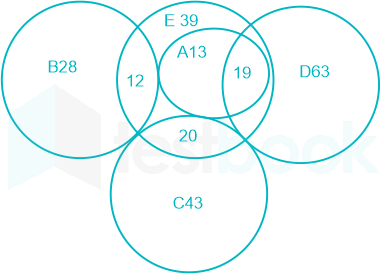
The least possible Venn diagram for the given statement is:

Conclusions:

I. Some taps are creeks - False (Because, No creek is tap).

II. No spring is tap - False (Because, No definite relation given between spring and tap, So, No spring is tap can be possible only).

III. Some brooks are springs - True (Because, All springs are brooks implies that Some brooks are springs also).

So, Only conclusion III follows.

Hence, the correct answer is "Option 1".

Question 12

Which of the following is an example of a human cell that has the ability to modify its shape?

  1. AOption (a)

    WBC

  2. BOption (b)

    RBC

  3. COption (c)

    Liver cells

  4. DOption (d)

    Brain cell

View answer & explanation

Correct answer

Answer: (a)A.

WBC

Why this answer is correct

The correct answer is WBC

Key Points

  • White Blood Cells (WBCs) are an example of human cells that have the ability to modify their shape.
  • WBCs, also known as leukocytes, are a critical part of the immune system and help the body fight infections and other diseases.
  • They can change shape to move through the walls of blood vessels to reach sites of infection or injury, a process known as diapedesis.
  • This ability to alter shape enables them to navigate through various tissues and perform their immune functions effectively.

Additional Information

  • White Blood Cells are produced in the bone marrow and are found in the blood and lymphatic tissues.
  • There are several types of WBCs, including neutrophils, lymphocytes, monocytes, eosinophils, and basophils, each with specific functions in the immune response.
  • WBCs are larger than red blood cells (RBCs) but are fewer in number.
  • Maintaining a healthy level of WBCs is essential for a properly functioning immune system.

Question 13

From point X, a girl walks 70 m towards the north. Then, she takes a left tum and walks 150 m. Then, she takes a left turn and walks 70 m. Then, she takes another left turn and walks 90 m. She then takes a right turn and walks 100 m. Finally, she takes a left turn and walks 60 m to reach point Z. How far and in which direction is point Z from point X?

(All tums are 90 degree turns only)

  1. AOption (a)

    60 m, North

  2. BOption (b)

    60 m, South

  3. COption (c)

    100 m, North

  4. DOption (d)

    100 m, South

View answer & explanation

Correct answer

Answer: (d)D.

100 m, South

Why this answer is correct

Given:

From point X, a girl walks 70 m towards the north.

Then, she takes a left tum and walks 150 m.

Then, she takes a left turn and walks 70 m.

Then, she takes another left turn and walks 90 m.

She then takes a right turn and walks 100 m.

Finally, she takes a left turn and walks 60 m to reach point Z.

So, the Point Z is '100 m, South' from point X.

Hence, the correct answer is "Option 4".

Question 14

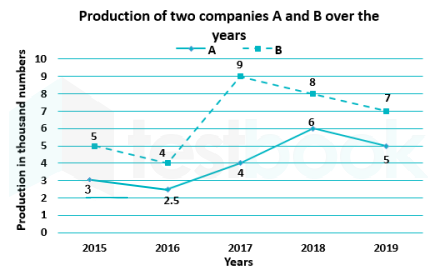
Study the following graph carefully and answer the question.

For company A, what is the approximate percentage decrease in production from 2015 to 2016?

  1. AOption (a)

    25%

  2. BOption (b)

    20%

  3. COption (c)

    15%

  4. DOption (d)

    22%

View answer & explanation

Correct answer

Answer: (c)C.

15%

Why this answer is correct

Given:

Production of company A in 2015 = 3 thousand numbers

Production of company A in 2016 = 2.5 thousand numbers

Concept:

The percentage decrease is calculated by the formula:

Formula Used:

Percentage Decrease = [(Initial Value - Final Value) / Initial Value] × 100

Calculation:

⇒ Initial Value = 3

⇒ Final Value = 2.5

⇒ Percentage Decrease = [(3 - 2.5) / 3] × 100

⇒ Percentage Decrease = [0.5 / 3] × 100

⇒ Percentage Decrease = 0.1667 × 100

⇒ Percentage Decrease = 16.67%

∴ The approximate percentage decrease in production from 2015 to 2016 is 17%.

Answer: None of the given options match exactly, but the closest is Option 3) 15%

Question 15

A cost incurred in the past and that cannot be recovered in the future is called ________.

  1. AOption (a)

    floating cost

  2. BOption (b)

    prime cost

  3. COption (c)

    economic cost

  4. DOption (d)

    sunk cost

View answer & explanation

Correct answer

Answer: (d)D.

sunk cost

Why this answer is correct

The correct answer is sunk cost.

Key Points

  • A sunk cost is a cost that has already been incurred and cannot be recovered.
  • It is important in decision-making to ignore sunk costs because they should not affect future decisions.
  • Sunk costs are contrasted with prospective costs, which are future costs that may be incurred or changed if an action is taken.
  • Examples of sunk costs include past investments in machinery, research, or any other expense that cannot be undone.

Additional Information

  • Sunk cost fallacy is a common logical error where individuals continue an endeavor solely because of previously invested resources (time, money, or effort).
  • In economics and business decision-making, recognizing sunk costs helps in focusing on future costs and benefits rather than past expenses.
  • The concept of sunk cost is crucial in cost accounting and managerial accounting, where it aids in evaluating the true cost of decisions.
  • Ignoring sunk costs can lead to more rational and effective decision-making processes.

Question 16

A convex mirror used as a rear-view mirror of a car has a focal length of 2 m. If a bus is located at a distance of 3 m from the mirror, where will its image be formed?

  1. AOption (a)

    0.83 m in front of the mirror

  2. BOption (b)

    1.2 m in front of the mirror

  3. COption (c)

    0.83 m behind the mirror

  4. DOption (d)

    1.2 m behind the mirror

View answer & explanation

Correct answer

Answer: (d)D.

1.2 m behind the mirror

Why this answer is correct

Given:

Focal length (f) = 2 meters (positive for convex mirror)

Object distance (u) = (-3) meters (negative because the object is in front of the mirror)

Formula Used:

1/f = 1/v + 1/u

Calculations:

Substitute the given values in the formula,

1/2 = 1/v + 1/(-3)

⇒ 1/2 = 1/v - 1/3

⇒ 1/2 + 1/3 = 1/v

⇒ 3/6 + 2/6 = 1/v

⇒ 5/6 = 1/v

⇒ v = 6/5 = 1.2 meters

∴ The image of the bus will be formed at a distance of 1.2 meters behind the mirror.

Additional Information

  • A convex mirror always forms a virtual, erect, and diminished image regardless of the position of the object.
  • The image formed by a convex mirror is always located behind the mirror.
  • Convex mirrors are commonly used in vehicles as rear-view mirrors because they provide a wider field of view.

Question 17

A white precipitate will be formed if we add ammonia solution to:

  1. AOption (a)

    Mg(NO3)2 solution

  2. BOption (b)

    KNO3 solution

  3. COption (c)

    AICI3 solution

  4. DOption (d)

    Ba(NO3)2 solution

View answer & explanation

Correct answer

Answer: (c)C.

AICI3 solution

Why this answer is correct

The correct answer is AICI3 solution

Key Points

  • AICI3 solution will form a white precipitate upon the addition of ammonia solution.
  • When ammonia solution is added to aluminum chloride (AICI3), a white precipitate of aluminum hydroxide [Al(OH)3] is formed.
  • None of the other given solutions (Mg(NO3)2, KNO3, Ba(NO3)2) will produce a white precipitate with ammonia solution.
  • The reaction can be represented as:

AlCl3 + 3NH3 + 3H2O → Al(OH)3 (white precipitate) + 3NH4Cl

Additional Information

  • Ammonia solution is often used as a reagent to test for the presence of certain metal ions by observing the formation of precipitates.
  • The solubility rules of ionic compounds in water help predict the formation of precipitates in such reactions.
  • Aluminum hydroxide, formed as a white precipitate, is amphoteric and can dissolve in both acids and bases.
  • The use of ammonia solution to detect aluminum ions is a common qualitative analysis technique in chemistry.

Question 18

The bluish colour of water in deep sea is due to:

  1. AOption (a)

    scattering of light

  2. BOption (b)

    refraction of light

  3. COption (c)

    dispersion of light

  4. DOption (d)

    reflection of light

View answer & explanation

Correct answer

Answer: (a)A.

scattering of light

Why this answer is correct

The correct answer is scattering of light

Key Points

  • The bluish colour of water in deep sea is due to the scattering of light.
  • When sunlight enters the sea, it is scattered by the water molecules and particles in the water.
  • The shorter wavelengths of light (blue and violet) are scattered more compared to the longer wavelengths (red, yellow, etc.), making the deep sea appear blue.
  • This phenomenon is similar to why the sky appears blue during the day.

Additional Information

  • Light scattering is a process where light is forced to deviate from a straight trajectory due to non-uniformities in the medium through which it passes.
  • The phenomenon is studied under the branch of physics known as optics.
  • The Rayleigh scattering is more effective at short wavelengths, which is why blue light is scattered more in water.
  • Other factors such as water purity and presence of other substances can also affect the color perceived.

Question 19

If θ is an acute angle, find the denominator A, when

(cosec θ - cot θ)2 = 1−cosθA\frac{1 - cos θ}{A}

  1. AOption (a)

    cosec θ - 1

  2. BOption (b)

    1 + sin θ

  3. COption (c)

    cot θ

  4. DOption (d)

    1 + cos θ

View answer & explanation

Correct answer

Answer: (d)D.

1 + cos θ

Why this answer is correct

Shortcut Trick

Convert cosec θ and cot θ into sin θ and cos θ to simplify the expression.

(1/sin θ − cos θ/sin θ)2 = ((1 − cos θ)/sin θ)2 = (1 − cos θ)2 / sin2 θ.

Use the identity sin2 θ = 1 − cos2 θ = (1 − cos θ)(1 + cos θ).

Substituting this gives (1 − cos θ)2 / [(1 − cos θ)(1 + cos θ)] = (1 − cos θ) / (1 + cos θ).

Comparing with (1 − cos θ) / A, we find A = 1 + cos θ.

∴ The correct answer is 1 + cos θ.

Alternate Method

Given: (cosec θ − cot θ)2 = (1 − cos θ)/A

Formula Used: cosec θ = 1/sin θ, cot θ = cos θ/sin θ, and sin2 θ + cos2 θ = 1

⇒ LHS = (cosec θ − cot θ)2

⇒ LHS = (1/sin θ − cos θ/sin θ)2

⇒ LHS = [(1 − cos θ)/sin θ]2

⇒ LHS = (1 − cos θ)2 / sin2 θ

⇒ LHS = (1 − cos θ)2 / (1 − cos2 θ)

⇒ LHS = (1 − cos θ)2 / [(1 − cos θ)(1 + cos θ)]

⇒ LHS = (1 − cos θ) / (1 + cos θ)

⇒ Comparing with (1 − cos θ) / A, we get A = 1 + cos θ

∴ The correct answer is 1 + cos θ.

Additional Information

Fundamental Trigonometric Identities

The Pythagorean identity sin2 θ + cos2 θ = 1 is essential for converting between squared sine and cosine terms.

Half-Angle Identities

The expression (cosec θ − cot θ) is equivalent to tan(θ/2), thus its square is tan2(θ/2) = (1 − cos θ)/(1 + cos θ).

Reciprocal and Quotient Relations

Always remember that cosec θ = 1/sin θ and cot θ = cos θ/sin θ for simplifying complex trigonometric fractions.

Question 20

Aruna has a younger sister whose age is 8 years less than that of Aruna. If Aruna’s sister’s age is 18 years, then Aruna’s age is:

  1. AOption (a)

    10 years

  2. BOption (b)

    24 years

  3. COption (c)

    26 years

  4. DOption (d)

    28 years

View answer & explanation

Correct answer

Answer: (c)C.

26 years

Why this answer is correct

Shortcut Trick

Aruna's age = Sister's age + Age difference

Aruna's age = 18 + 8

Aruna's age = 26 years

∴ The correct answer is 26 years.

Alternate Method

Given:

Age of Aruna's sister = 18 years

Difference between Aruna and her sister = 8 years

Let Aruna's age be 'A'.

Let Sister's age be 'S'.

⇒ S = A − 8

⇒ 18 = A − 8

⇒ A = 18 + 8

⇒ A = 26 years

∴ The correct answer is 26 years.

Additional Information

Constant Age Difference

The difference between the ages of two people remains constant regardless of the number of years passed or preceding.

Age Ratio Concept

While the difference stays the same, the ratio of their ages changes every year as they grow older.

Question 21

How many participants from India won the gold medal in the 14th International Olympiad on Astronomy and Astrophysics (IOAA) 2021?

  1. AOption (a)

    3

  2. BOption (b)

    5

  3. COption (c)

    4

  4. DOption (d)

    6

View answer & explanation

Correct answer

Answer: (c)C.

4

Why this answer is correct

The correct answer is 4

Key Points

  • 4 participants from India won the gold medal in the 14th International Olympiad on Astronomy and Astrophysics (IOAA) 2021.
  • The IOAA is an annual competition for high school students aimed at promoting interest in astronomy and astrophysics.
  • India has consistently performed well in the IOAA, showcasing the country's strong foundation in science and education.
  • The gold medalists were part of a larger team representing India, which also won several other medals and honors.

Additional Information

  • The main goal of the IOAA is to promote the growing interest in Astronomy and related STEM subjects.
  • It also aims to strengthen worldwide collaboration in promoting astronomy and astrophysics in schools.

Question 22

‘Save the Narmada’ movement originated as a protest against raising the height of Sardar Sarovar Dam. Some disadvantages of building dams are mentioned below. Which one is an advantage?

  1. AOption (a)

    Lot of public money is used

  2. BOption (b)

    Many tribals and peasants are displaced

  3. COption (c)

    Causes deforestation and loss of biodiversity

  4. DOption (d)

    Helpful in irrigation and electricity production

View answer & explanation

Correct answer

Answer: (d)D.

Helpful in irrigation and electricity production

Why this answer is correct

The correct answer is Helpful in irrigation and electricity production

Key Points

  • Helpful in irrigation and electricity production is an advantage of building dams.
  • Dams play a crucial role in water management, providing a steady supply of water for irrigation, which can enhance agricultural productivity.
  • They are also significant for hydroelectric power generation, contributing to the energy needs of a region.
  • Despite the disadvantages such as displacement of people and environmental impacts, the benefits in terms of irrigation and electricity production make dams an important infrastructure.
  • In the context of the 'Save the Narmada' movement, while the protest highlighted the adverse effects, it is essential to recognize the multifaceted impact of dams.

Additional Information

  • The Sardar Sarovar Dam is part of the Narmada Valley Project, one of the largest water resource projects in India.
  • The project aims to provide water for irrigation, drinking, and industrial use, as well as generate hydroelectric power.
  • The construction of the dam has been a subject of controversy, with significant opposition from environmentalists and local communities.
  • However, the benefits in terms of increased agricultural productivity and energy supply are substantial and contribute to regional development.
  • Effective rehabilitation and resettlement programs for displaced communities are crucial to address the social impacts of such projects.

Question 23

The HCF of two numbers is 7 and their LCM is 434. If one of the numbers is 14, find the other.

  1. AOption (a)

    146

  2. BOption (b)

    217

  3. COption (c)

    48

  4. DOption (d)

    52

View answer & explanation

Correct answer

Answer: (b)B.

217

Why this answer is correct

Shortcut Trick

The relationship between two numbers and their HCF and LCM is: Number1 × Number2 = HCF × LCM.

Given Number1 = 14, HCF = 7, and LCM = 434.

Other Number = (7 × 434) ÷ 14

⇒ Other Number = 434 ÷ 2 = 217.

∴ The correct answer is 217.

Alternate Method

Given:

HCF of two numbers = 7

LCM of two numbers = 434

First Number (n1) = 14

Formula Used:

Product of two numbers = HCF × LCM

Calculations:

Let the second number be x.

⇒ 14 × x = 7 × 434

⇒ x = (7 × 434) ÷ 14

⇒ x = 3038 ÷ 14

⇒ x = 217

∴ The correct answer is 217.

Additional Information

HCF and LCM Relation

For any two positive integers a and b: a × b = HCF(a, b) × LCM(a, b).

HCF as a Factor of LCM

The HCF of any group of numbers is always a factor of their LCM.

Co-prime Numbers

If two numbers are co-prime, their HCF is 1 and their LCM is equal to their product.

Question 24

The sum of the roots of the quadratic equation 4x2 + 7x - 21 = 0 is:

  1. AOption (a)

    −214-\frac{21}{4}

  2. BOption (b)

    -21

  3. COption (c)

    74\frac{7}{4}

  4. DOption (d)

    −74-\frac{7}{4}

View answer & explanation

Correct answer

Answer: (d)D.

−74-\frac{7}{4}

Why this answer is correct

Shortcut Trick

For any quadratic equation of the form ax2 + bx + c = 0, the sum of the roots is given by the formula −b/a.

In the given equation 4x2 + 7x − 21 = 0, we identify a = 4 and b = 7.

Sum of the roots = −7 / 4

∴ The correct answer is −(7)/(4).

Alternate Method

Given Equation: 4x2 + 7x − 21 = 0

Standard Quadratic Form: ax2 + bx + c = 0

Comparing the given equation with the standard form, we get:

⇒ a = 4

⇒ b = 7

⇒ c = −21

Formula Used:

The sum of roots (α + β) = − (coefficient of x) / (coefficient of x2) = −b / a

Calculations:

⇒ Sum of roots = −(7) / 4

⇒ Sum of roots = −7/4

∴ The correct answer is −(7)/(4).

Additional Information

Product of Roots

The product of the roots (α × β) of a quadratic equation ax2 + bx + c = 0 is calculated as c/a. For this equation, product = −21/4.

Discriminant (D)

The discriminant D = b2 − 4ac determines the nature of the roots. If D > 0, roots are real and unequal; if D = 0, roots are real and equal; if D < 0, roots are unreal (imaginary).

Quadratic Formula

To find the actual values of the roots, use x = [−b ± √(b2 − 4ac)] / 2a.

Question 25

What will come in place of A and B, respectively, in the given double displacement reaction?

A + B → AgBr + KNO3

  1. AOption (a)

    Ag and HNO3

  2. BOption (b)

    HBr and NaOH

  3. COption (c)

    AgNO3 and KBr

  4. DOption (d)

    HBr and NaOH3

View answer & explanation

Correct answer

Answer: (c)C.

AgNO3 and KBr

Why this answer is correct

The correct answer is AgNO3 and KBr.

Key Points

  • AgNO3 and KBr react in a double displacement reaction to form AgBr and KNO3.
  • In a double displacement reaction, the cations and anions of two different compounds switch places, forming two new compounds.
  • The general form of a double displacement reaction is AB + CD → AD + CB.
  • Here, AgNO3 (silver nitrate) and KBr (potassium bromide) are the reactants, and AgBr (silver bromide) and KNO3 (potassium nitrate) are the products.

Additional Information

  • Silver bromide (AgBr) is a pale yellow compound used in photographic films.
  • Potassium nitrate (KNO3) is used in fertilizers, food preservation, and fireworks.
  • This reaction is an example of a precipitation reaction, where an insoluble solid (precipitate) is formed.
  • Double displacement reactions are also known as metathesis reactions.

Question 26

If 5 + x, 2x + 7, 6x + 9, and y are in proportion when x = 2, find the value of y.

  1. AOption (a)

    42

  2. BOption (b)

    33

  3. COption (c)

    28

  4. DOption (d)

    45

View answer & explanation

Correct answer

Answer: (b)B.

33

Why this answer is correct

Shortcut Trick

Put x = 2 in the terms: (5 + 2), (2×2 + 7), (6×2 + 9), y.

Terms are: 7, 11, 21, y.

Product of extremes = Product of means.

7 × y = 11 × 21 ⇒ y = 11 × 3 = 33.

∴ The correct answer is 33.

Alternate Method

Given: x = 2 and (5 + x), (2x + 7), (6x + 9), y are in proportion.

Formula Used: If a, b, c, d are in proportion, then a/b = c/d.

⇒ First term (a) = 5 + 2 = 7

⇒ Second term (b) = 2(2) + 7 = 4 + 7 = 11

⇒ Third term (c) = 6(2) + 9 = 12 + 9 = 21

⇒ Fourth term (d) = y

⇒ 7 / 11 = 21 / y

⇒ 7 × y = 11 × 21

⇒ y = (11 × 21) ÷ 7

⇒ y = 11 × 3

⇒ y = 33

∴ The correct answer is 33.

Additional Information

Definition of Proportion

Four numbers a, b, c, d are in proportion if the ratio of the first two is equal to the ratio of the last two (a : b = c : d).

Mean Proportional

If a, b, c are in continued proportion, then b is the mean proportional and b2 = ac or b = √(ac).

Fourth Proportional

In the proportion a : b :: c : d, d is called the fourth proportional to a, b, and c.

Question 27

Gosikhurd National Irrigation Project is related to which of the following states?

  1. AOption (a)

    Punjab

  2. BOption (b)

    West Bengal

  3. COption (c)

    Uttar Pradesh

  4. DOption (d)

    Maharashtra

View answer & explanation

Correct answer

Answer: (d)D.

Maharashtra

Why this answer is correct

The correct answer is Maharashtra

Key Points

  • The Gosikhurd National Irrigation Project is associated with the state of Maharashtra.
  • This project is aimed at improving water management and irrigation facilities in the region.
  • It is one of the significant irrigation projects in Maharashtra, contributing to the agricultural development of the state.
  • The project involves the construction of a dam on the Wainganga River and has multiple benefits including irrigation, water supply, and hydroelectric power generation.

Additional Information

  • Maharashtra is one of the leading states in India in terms of agricultural productivity and irrigation infrastructure.
  • The state government has undertaken several initiatives to enhance water conservation and management practices.
  • The Gosikhurd project is part of these efforts and aims to provide a reliable water source for irrigation, benefiting thousands of farmers in the region.
  • In addition to irrigation, the project also plays a crucial role in flood control and groundwater recharge.

Question 28

Soil degradation is one of the major environmental problems being faced these days. A wide range of techniques to conserve soil are mentioned below. Select the INCORRECT option.

  1. AOption (a)

    Crop rotation

  2. BOption (b)

    Terrace farming

  3. COption (c)

    Planting trees

  4. DOption (d)

    Overgrazing

View answer & explanation

Correct answer

Answer: (d)D.

Overgrazing

Why this answer is correct

The correct answer is Overgrazing.

Key Points

  • Overgrazing allows animals to graze on vegetation faster than it can regenerate, exposing the soil to erosion and reducing its organic matter content.
  • It is detrimental to soil health and contributes to degradation.
  • It not only impacts soil health but also contributes to climate change, reduces food security, and disrupts local communities.
  • Negative Impacts of overgrazing:
  • Erosion: When vegetation is overgrazed, the soil becomes exposed to the elements, making it vulnerable to wind and water erosion. This washes away topsoil, the most fertile layer, reducing soil productivity and leading to desertification.
  • Compaction: Excessive trampling by animals compacts the soil, making it harder for water and air to infiltrate. This creates unfavorable conditions for plant growth and reduces the soil's ability to store water.
  • Nutrient depletion: Overgrazing prevents proper nutrient cycling as plants have less time to grow and return organic matter to the soil. This reduces soil fertility and necessitates the use of fertilizers, often leading to further environmental issues.
  • Biodiversity loss: Overgrazing can disrupt delicate ecosystems, reducing plant diversity and impacting animal populations that rely on specific vegetation for food and shelter.

Additional Information

  • Crop rotation: This technique involves planting different crops in the same field over time, allowing the soil to recover nutrients depleted by the previous crop.
  • This helps maintain soil fertility and reduces erosion.
  • Terrace farming: This technique involves creating leveled platforms on sloping land to slow down water flow and prevent soil erosion.
  • This is particularly helpful in mountainous regions.
  • Planting trees: Trees play a crucial role in soil conservation by holding the soil in place with their roots, reducing wind and water erosion.
  • Their leaves also decompose and add organic matter to the soil, improving its fertility.

Question 29

In which organism sex is not determined genetically?

  1. AOption (a)

    Butterfly

  2. BOption (b)

    Moth

  3. COption (c)

    Sparrow

  4. DOption (d)

    Snail

View answer & explanation

Correct answer

Answer: (d)D.

Snail

Why this answer is correct

The correct answer is Snail

Key Points

  • In snails, sex is not determined genetically.
  • Snails are hermaphrodites, meaning that each individual has both male and female reproductive organs.
  • They can self-fertilize or mate with another snail to produce offspring.
  • This form of reproduction is beneficial for species with low mobility or those that live in isolated environments.

Additional Information

  • In contrast, sex determination in butterflies, moths, and sparrows is genetic.
  • In butterflies and moths, females are typically heterogametic (ZW) and males are homogametic (ZZ).
  • In birds like sparrows, females are also heterogametic (ZW) and males are homogametic (ZZ).
  • Hermaphroditism in snails allows for greater flexibility in reproduction, especially in environments where finding a mate is challenging.

Question 30

The age of a father six years ago was six times the then age of his daughter. Three years hence, the father will be thrice as old as his daughter. What is the present age of the daughter?

  1. AOption (a)

    12 years

  2. BOption (b)

    17 years

  3. COption (c)

    15 years

  4. DOption (d)

    20 years

View answer & explanation

Correct answer

Answer: (a)A.

12 years

Why this answer is correct

Shortcut Trick

Ratio of Father and Daughter age 6 years ago = 6 : 1 (Gap = 5 units)

Ratio of Father and Daughter age 3 years hence = 3 : 1 (Gap = 2 units)

Equating gaps: Multiply first ratio by 2 and second by 5 → 12 : 2 and 15 : 5

Increase in daughter's ratio parts = 5 − 2 = 3 units. Total years gap = 6 + 3 = 9 years.

3 units = 9 years ⇒ 1 unit = 3 years. Daughter's age 6 years ago = 2 × 3 = 6 years.

∴ The correct answer is 12 years.

Alternate Method

Given: 6 years ago ratio F:D = 6:1. 3 years hence ratio F:D = 3:1.

Let the age of the daughter 6 years ago be x and father be 6x.

⇒ Present age: Daughter = x + 6, Father = 6x + 6

⇒ Age 3 years hence: Daughter = (x + 6) + 3 = x + 9, Father = (6x + 6) + 3 = 6x + 9

⇒ According to question: 6x + 9 = 3 × (x + 9)

⇒ 6x + 9 = 3x + 27

⇒ 3x = 18 ⇒ x = 6

⇒ Present age of daughter = x + 6 = 6 + 6 = 12 years.

∴ The correct answer is 12 years.

Additional Information

Ratio Difference Method

In problems involving age gaps, the difference between ages of two people remains constant throughout their lives. Always equate the ratio differences.

Linear Equation in One Variable

Letting the variable represent the age at the past reference point (6 years ago) often simplifies the equation compared to using the present age.

Question 31

The ‘Mango Showers’ phenomena in India is related to which season?

  1. AOption (a)

    Winter

  2. BOption (b)

    Summer

  3. COption (c)

    Autumn

  4. DOption (d)

    Rainy

View answer & explanation

Correct answer

Answer: (b)B.

Summer

Why this answer is correct

The correct answer is Summer

Key Points

  • Mango Showers are pre-monsoon showers that occur in India, primarily in the states of Karnataka, Kerala, and Goa.
  • These showers are crucial for the mango crop, as they help in the ripening of mangoes, hence the name 'Mango Showers'.
  • The phenomenon is typically observed during the summer season, usually in the months of March to May.
  • These showers also help in bringing down the temperatures and providing relief from the summer heat.
  • They are also known as 'April Rains' or 'Summer Showers' in some regions.

Additional Information

  • These pre-monsoon showers are caused by the convectional rain due to high temperature and humidity.
  • They are beneficial not only for mangoes but also for other summer crops and plantations.
  • The showers are generally short-lived and occur in the late afternoon or evening.
  • While beneficial, excessive mango showers can sometimes cause damage to the crops by leading to fungal infections.
  • These showers are an important climatic feature in the southern parts of India and are eagerly awaited by farmers.

Question 32

If 2 is subtracted from each odd digit and 1 is added to each even digit in the number 83252769, how many digits will occur more than once in the new number thus formed?

  1. AOption (a)

    Three

  2. BOption (b)

    None

  3. COption (c)

    Two

  4. DOption (d)

    One

View answer & explanation

Correct answer

Answer: (c)C.

Two

Why this answer is correct

Given: 83252769

By 2 is subtracted from each odd digit and 1 is added to each even digit, we will get,

Number83252769
operation+1-2+1-2+1-2+1-2
New Number91333577

Digits will occur more than once in the new number thus formed is 'Two'

Hence, "Two" is the correct answer.

Question 33

Study the given letter, symbol series and answer the question that follows.

L @ S * E ^ B U # W I < E M @ O $ # B * H ! A & L < O

If we replace each of the vowels with any consonant and similarly if we replace each of the consonants in the original series with any vowel, then how many consonants will be immediately followed by a symbol in the resultant series thus formed?

  1. AOption (a)

    5

  2. BOption (b)

    6

  3. COption (c)

    4

  4. DOption (d)

    7

View answer & explanation

Correct answer

Answer: (a)A.

5

Why this answer is correct

Given series: L @ S * E ^ B U # W I < E M @ O $ # B * H ! A & L < O

If we replace each of the vowels with any consonant and similarly if we replace each of the consonants in the original series with any vowel,

Identify vowels and consonants

  • Vowels: A, E, I, O, U
  • Consonants: L, S, B, W, M, H

Replace vowels with any consonant and consonants with any vowel

For simplicity, let's use the following replacements:

  • Vowel → Consonant (e.g., A → C, E → D, I → F, O → G, U → H)
  • Consonant → Vowel (e.g., L → A, S → E, B → I, W → O, M → U, H → E)

Resultant Series after Replacement:

A @ E * D ^ I H # O F < D U @ G $ # I * E ! C & A < G

So, the required pair is: Consonant - Symbol

D ^, H #, F <, G $, C &

Total consonants immediately followed by a symbol: 5

Hence, the correct answer is "Option 1".

Question 34

Which of the following statements is FALSE?

  1. AOption (a)

    Pyruvic acid is produced in the first stage of respiration.

  2. BOption (b)

    Oxygen is not necessary for the fermentation process.

  3. COption (c)

    In the mitochondria, acetic acid is broken down utilising oxygen.

  4. DOption (d)

    In the first stage of respiration, breakdown of glucose takes place.

View answer & explanation

Correct answer

Answer: (c)C.

In the mitochondria, acetic acid is broken down utilising oxygen.

Why this answer is correct

The correct answer is in the mitochondria, acetic acid is broken down utilising oxygen.

Key Points

  • Pyruvic acid is produced in the first stage of respiration. This is the correct statement. The first stage of respiration, also known as glycolysis, occurs in the cytoplasm of the cell and breaks down glucose into pyruvic acid. Oxygen is not required for this stage.
  • Oxygen is not necessary for the fermentation process. This is the correct statement. Fermentation is an anaerobic process and does not require oxygen.
  • In the mitochondria, acetic acid is broken down utilizing oxygen. This statement is incorrect. The Krebs cycle, which occurs in the mitochondria, breaks down pyruvate (not acetic acid) into even simpler molecules and utilizes oxygen in the process. Acetic acid is a product of some fermentation pathways and cannot enter the Krebs cycle directly.
  • In the first stage of respiration, breakdown of glucose takes place. Glycolysis, which is the first stage of respiration, involves the breakdown of glucose into pyruvate.

Additional Information

  • Respiration is a multi-stage process that includes glycolysis, the Krebs cycle, and the electron transport chain.
  • During glycolysis, one molecule of glucose is converted into two molecules of pyruvate, with a net gain of two ATP molecules.
  • The Krebs cycle occurs in the mitochondria and involves the oxidation of acetyl-CoA to produce ATP, NADH, and FADH2.
  • The electron transport chain uses the electrons from NADH and FADH2 to generate a large amount of ATP through oxidative phosphorylation.
  • Fermentation allows cells to produce ATP without oxygen by converting pyruvate into lactic acid or ethanol and carbon dioxide.

Question 35

Two wires A and B are made of same material and have the same length but different cross-sectional areas. If the resistance of wire A is 16 times the resistance of wire B, the ratio of the cross-sectional area of wire A to that of wire B is:

  1. AOption (a)

    4 : 1

  2. BOption (b)

    16 : 1

  3. COption (c)

    1 : 16

  4. DOption (d)

    1 : 4

View answer & explanation

Correct answer

Answer: (c)C.

1 : 16

Why this answer is correct

Concept:

Resistance and Cross-sectional Area:

  • The resistance (R) of a wire is determined by the formula: R=ρLAR = \frac{\rho L}{A}.
  • R is the resistance in ohms (Ω), ρ is the resistivity (SI unit: Ω·m), L is the length in meters (m), and A is the cross-sectional area in square meters (m²).

Calculation:

Given,

Resistance of wire A, RA = 16 × Resistance of wire B, RB

Let the cross-sectional areas of wire A and wire B be AA and AB respectively.

From the relationship,

R∝1AR \propto \frac{1}{A}

⇒ RARB=ABAA\frac{R_A}{R_B} = \frac{A_B}{A_A}

⇒ 161=ABAA\frac{16}{1} = \frac{A_B}{A_A}

⇒ AA=AB16A_A = \frac{A_B}{16}

∴ The ratio of cross-sectional area of wire A to that of wire B is 1 : 16.

Question 36

X and Y can complete a piece of work in 8 days and 12 days, respectively. If they work on alternate days, with X working on the first day, how long will it take the duo to complete the same work?

  1. AOption (a)

    9259\frac{2}{5} days

  2. BOption (b)

    9359\frac{3}{5}days

  3. COption (c)

    9239\frac{2}{3}days

  4. DOption (d)

    9129\frac{1}{2}days

View answer & explanation

Correct answer

Answer: (d)D.

9129\frac{1}{2}days

Why this answer is correct

Shortcut Trick

Total work (LCM of 8, 12) = 24 units. Efficiencies: X = 3, Y = 2.

Work done in 1 cycle (2 days) = 3 + 2 = 5 units.

Work in 4 cycles (8 days) = 5 × 4 = 20 units. Remaining work = 24 − 20 = 4 units.

On 9th day, X completes 3 units. Remaining = 4 − 3 = 1 unit.

On 10th day, Y takes 1 ÷ 2 = 1/2 day.

∴ Total time = 8 + 1 + 1/2 = 9(1)/(2) days.

∴ The correct answer is 9(1)/(2) days.

Alternate Method

Given: Time taken by X = 8 days, Time taken by Y = 12 days.

Total Work = LCM(8, 12) = 24 units.

PersonDaysTotal WorkEfficiency
X8243
Y122

⇒ Work done by X and Y in a 2-day alternate cycle = 3 + 2 = 5 units.

⇒ Number of complete 2-day cycles = 24 ÷ 5 = 4 cycles (with remainder).

⇒ Work done in 4 cycles (8 days) = 4 × 5 = 20 units.

⇒ Remaining work = 24 − 20 = 4 units.

⇒ On the 9th day, X works and finishes 3 units. Remaining work = 4 − 3 = 1 unit.

⇒ On the 10th day, Y works. Time taken by Y = Remaining work ÷ Efficiency = 1 ÷ 2 = 0.5 days.

⇒ Total time = 8 days + 1 day + 1/2 day = 9(1)/(2) days.

∴ The correct answer is 9(1)/(2) days.

Additional Information

Alternate Day Concept

In alternate day work, determine the work done in one full cycle (usually 2 days) and divide total work by cycle work to find the number of complete cycles.

Efficiency & Time Relationship

Efficiency is inversely proportional to Time taken. Efficiency = Total Work ÷ Time.

Remaining Work Calculation

Time taken for remaining work = (Remaining work) ÷ (Efficiency of the person whose turn it is).

Question 37

In the given letter-cluster pairs, the first letter-cluster is related to the second letter-cluster following a certain logic.

Study the given pairs carefully, and from the given options, select the pair that follows the same logic.

TORPEDO : DEOOPRT

FLICKER : CEFIKLR

  1. AOption (a)

    PERTAIN : AEINPRT

  2. BOption (b)

    CURTAIN : RUCNIAT

  3. COption (c)

    CLOSURE : OLCERUS

  4. DOption (d)

    CYNICAL : ACCLINY

View answer & explanation

Correct answer

Answer: (a)A.

PERTAIN : AEINPRT

Why this answer is correct

The logic followed here is:

Logic: The alphabets are written in alphabetical order.

For, TORPEDO : DEOOPRT

For, FLICKER : CEFIKLR

Similarly, for Option 1) PERTAIN : AEINPRT

Hence, the correct answer is "Option 1".

Question 38

In this question, a statement is followed by two conclusions. Which of the two conclusions is/are true with respect to the statement?

Statement: T > G < E > F = B ≤ Z

Conclusions:

I. F = Z

II. E > B

  1. AOption (a)

    Only conclusion II is true

  2. BOption (b)

    Only conclusion I is true

  3. COption (c)

    Neither conclusion I nor II is true

  4. DOption (d)

    Both conclusions I and II are true

View answer & explanation

Correct answer

Answer: (a)A.

Only conclusion II is true

Why this answer is correct

Given Statement: T > G < E > F = B ≤ Z

Now,

Conclusions:

Option 1: F = Z → False (F is not equal to Z)

Option 2: E > B → True (E is greater than B)

Therefore, the correct answer is Option 1: Only conclusion II is true.

Question 39

Venkat brought a second-hand scooter and spent 10% of the cost on its repairs. He sold the scooter for a profit of Rs. 2,200. How much did he spend on repairs if he made a profit of 20%?

  1. AOption (a)

    Rs. 750

  2. BOption (b)

    ​Rs. 1000

  3. COption (c)

    ​Rs. 400

  4. DOption (d)

    ​Rs. 1200

View answer & explanation

Correct answer

Answer: (b)B.

​Rs. 1000

Why this answer is correct

Shortcut Trick

20% Profit = ₹2,200

Total Cost Price (100%) = (2,200 ÷ 20) × 100 = ₹11,000

Total Cost Price = Scooter Cost (100%) + Repairs (10%) = 110%

Repair cost = (Total CP ÷ 110) × 10 = (11,000 ÷ 110) × 10 = ₹1,000

∴ The correct answer is ₹1000.

Alternate Method

Given:

Profit = ₹2,200 | Profit percentage = 20% | Repair cost = 10% of Buying Price

Formula Used:

Profit = (Profit % ÷ 100) × Total Cost Price

Total Cost Price = Buying Price + Repair Cost

⇒ 20% of Total Cost Price = ₹2,200

⇒ Total Cost Price = (2,200 × 100) ÷ 20

⇒ Total Cost Price = ₹11,000

⇒ Let the Buying Price be x.

⇒ Repair cost = 0.10x

⇒ Total Cost Price = x + 0.10x = 1.1x

⇒ 1.1x = 11,000

⇒ x = 11,000 ÷ 1.1 = ₹10,000

⇒ Repair Cost = 10% of 10,000 = (10 ÷ 100) × 10,000

⇒ Repair Cost = ₹1,000

∴ The correct answer is ₹1000.

Additional Information

Effective Cost Price

When any overhead expenses like repairs, transportation, or labor are spent on an item, they are added to the initial buying price to calculate the Effective Cost Price.

Profit Percentage Formula

Profit % is always calculated on the Total Cost Price: Profit % = (Profit ÷ Total CP) × 100.

Selling Price Calculation

Selling Price (SP) = CP × (100 + Profit %) ÷ 100 or SP = CP + Profit.

Question 40

The present ages of Shanthi and Keerthi are in the ratio of 7 : 3. After 5 years, Shanthi’s age will be 40. How old will Keerthi be after 5 years?

  1. AOption (a)

    20 years

  2. BOption (b)

    10 years

  3. COption (c)

    15 years

  4. DOption (d)

    30 years

View answer & explanation

Correct answer

Answer: (a)A.

20 years

Why this answer is correct

Shortcut Trick

Shanthi's age after 5 years = 40 years.

Shanthi's present age = 40 − 5 = 35 years.

Ratio of present ages Shanthi : Keerthi = 7 : 3.

7 units = 35 years → 1 unit = 5 years.

Keerthi's present age = 3 × 5 = 15 years.

Keerthi's age after 5 years = 15 + 5 = 20 years.

∴ The correct answer is 20 years.

Alternate Method

Given:

Ratio of Shanthi's age to Keerthi's age = 7 : 3

Shanthi's age after 5 years = 40 years

Calculations:

⇒ Let present age of Shanthi = 7x and Keerthi = 3x

⇒ Shanthi's age after 5 years = 7x + 5 = 40

⇒ 7x = 40 − 5

⇒ 7x = 35

⇒ x = 5

⇒ Keerthi's present age = 3x = 3 × 5 = 15 years

⇒ Keerthi's age after 5 years = 15 + 5 = 20 years

∴ The correct answer is 20 years.

Additional Information

Concept of Age Ratios

If the ratio of ages of two persons is A : B, their actual ages can be assumed as Ax and Bx, where x is a common constant.

Future and Past Ages

To find the age after 'n' years, add 'n' to the present age. To find the age 'n' years ago, subtract 'n' from the present age.

Ratio Difference Constant

The numerical difference between the ages of two people remains constant throughout their lives, regardless of the years passed.

Question 41

A man travels 80 km in three hours. He further travels for two more hours. Find the distance travelled in the latter two hours, if his average speed for the entire journey is 30 km/h.

  1. AOption (a)

    150 km

  2. BOption (b)

    70 km

  3. COption (c)

    120 km

  4. DOption (d)

    90 km

View answer & explanation

Correct answer

Answer: (b)B.

70 km

Why this answer is correct

Shortcut Trick

Total time = 3 + 2 = 5 hours

Total distance = Average speed × Total time = 30 × 5 = 150 km

Distance in latter 2 hours = Total distance − Distance in first 3 hours

Distance = 150 − 80 = 70 km

∴ The correct answer is 70 km.

Alternate Method

Given:

Distance 1 (D1) = 80 km | Time 1 (T1) = 3 hours

Time 2 (T2) = 2 hours | Average Speed = 30 km/h

Formula Used:

Average Speed = (Total Distance) ÷ (Total Time)

Calculations:

⇒ Total Time = T1 + T2 = 3 + 2 = 5 hours

⇒ Total Distance = Average Speed × Total Time

⇒ Total Distance = 30 × 5 = 150 km

⇒ Total Distance = Distance 1 + Distance 2

⇒ 150 = 80 + Distance 2

⇒ Distance 2 = 150 − 80

⇒ Distance 2 = 70 km

∴ The correct answer is 70 km.

Additional Information

Average Speed Formula

Average Speed is the ratio of total distance covered to the total time taken: Vavg = (D1 + D2 + ...) ÷ (T1 + T2 + ...).

Equal Distance Case

If a person covers two equal distances at speeds x and y, then Average Speed = 2xy ÷ (x + y).

Unit Conversion

To convert km/h to m/s, multiply by 5/18. To convert m/s to km/h, multiply by 18/5.

Question 42

Refer to the following letter series and answer the question.

(Left) T Y A N E C M K E W A F H E Q A P M N B E D H E K U W S D A N M A W E (Right)

How many such consonants are there in the series which are immediately preceded by a vowel and also immediately followed by a vowel?

  1. AOption (a)

    Five

  2. BOption (b)

    Four

  3. COption (c)

    Six

  4. DOption (d)

    Three

View answer & explanation

Correct answer

Answer: (a)A.

Five

Why this answer is correct

In the given series:

T Y A N E C M K E W A F H E Q A P M N B E D H E K U W S D A N M A W E

Here in the series, we need to find consonants that are immediately preceded by a vowel and also immediately followed by a vowel.

Let's identify the valid consonants:

  • A N E
  • E W A
  • E Q A
  • E K U
  • A W E

Hence, there are five such consonants.

Hence, the correct answer is Option (1).

Question 43

Each of W, X, Y, Z. A, B and C has a wedding to attend on a different day of a week starting from Monday to Sunday of the same week. C has to attend wedding immediately after A. Y has to attend a wedding on one of the days before B and W. Only Z has to attend a wedding before A. X has to attend a wedding on Friday. B does not have to attend a wedding on Sunday. On which day of the week does Y have to attend a wedding?

  1. AOption (a)

    Saturday

  2. BOption (b)

    Thursday

  3. COption (c)

    Sunday

  4. DOption (d)

    Wednesday

View answer & explanation

Correct answer

Answer: (b)B.

Thursday

Why this answer is correct

Given: Each of W, X, Y, Z, A, B, and C has a wedding to attend on a different day of a week starting from Monday to Sunday of the same week.

1) X has to attend a wedding on Friday.

  1. Only Z has to attend a wedding before A.

3) C has to attend a wedding immediately after A.

DayPerson
MondayZ
TuesdayA
WednesdayC
Thursday
FridayX
Saturday
Sunday


  1. Y has to attend a wedding on one of the days before B and W.
DayPerson
MondayZ
TuesdayA
WednesdayC
ThursdayY
FridayX
SaturdayW/B
SundayB/W


  1. B does not have to attend a wedding on Sunday.
DayPerson
MondayZ
TuesdayA
WednesdayC
ThursdayY
FridayX
SaturdayB
SundayW


Therefore, Y's wedding is on 'Thursday'.

Hence, the correct answer is "Option 2".

Question 44

On which day is a major national festival celebrated every year to commemorate the enactment of the Constitution of India, which declared India to be a sovereign, democratic and republic state?

  1. AOption (a)

    26th January

  2. BOption (b)

    15th August

  3. COption (c)

    3nd October

  4. DOption (d)

    23rd March

View answer & explanation

Correct answer

Answer: (a)A.

26th January

Why this answer is correct

The correct answer is 26th January

Key Points

  • The major national festival celebrated on 26th January every year is Republic Day.
  • This day commemorates the enactment of the Constitution of India, which declared India to be a sovereign, democratic, and republic state.
  • The Constitution of India came into effect on 26th January 1950, replacing the Government of India Act (1935) as the governing document of India.
  • Republic Day is marked by a grand parade in the capital city, New Delhi, showcasing India's cultural diversity and military strength.

Additional Information

  • Republic Day is one of the three national holidays in India, the other two being Independence Day (15th August) and Gandhi Jayanti (2nd October).
  • The Constitution of India was adopted by the Constituent Assembly on 26th November 1949 and came into effect on 26th January 1950.
  • The date 26th January was chosen to honor the memory of the declaration of Purna Swaraj (Complete Independence) by the Indian National Congress in 1930.
  • Each year, a foreign dignitary is invited as the Chief Guest to the Republic Day celebrations.

Question 45

KK Venugopal, the 15th Attorney General of India, received the first extension in his tenure in which of the following years?

  1. AOption (a)

    2021

  2. BOption (b)

    2019

  3. COption (c)

    2022

  4. DOption (d)

    2020

View answer & explanation

Correct answer

Answer: (d)D.

2020

Why this answer is correct

The correct answer is 2020

Key Points

  • KK Venugopal, the 15th Attorney General of India, received his first extension in tenure in the year 2020.
  • He was initially appointed as the Attorney General of India in July 2017.
  • His extension was granted by the President of India, recognizing his significant contributions and experience in the legal field.
  • The Attorney General is the chief legal advisor to the Government of India and represents the country in legal matters.

Additional Information

  • The Attorney General of India is appointed by the President of India under Article 76 of the Constitution.
  • The role of the Attorney General includes giving advice to the Government of India upon legal matters and performing other duties of a legal character, as assigned by the President.
  • The Attorney General has the right of audience in all courts in India.
  • KK Venugopal is a renowned lawyer and has previously served as an Additional Solicitor General of India.
  • Extensions of the Attorney General's tenure are typically granted based on the needs of the government and the individual's performance in the role.

Question 46

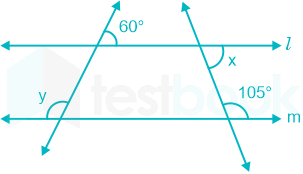
In the adjoining figure line l is parallel to m . What is the value of 2x + y?

  1. AOption (a)

    270°

  2. BOption (b)

    150°

  3. COption (c)

    225°

  4. DOption (d)

    320°

View answer & explanation

Correct answer

Answer: (a)A.

270°

Why this answer is correct

Shortcut Trick

Identify x = 75° as it is the alternate interior angle to the given 75° angle.

Identify y = 120° from the geometric properties of the transversal (supplementary angle to 60°).

Substitute these values into the expression: 2(75°) + 120°.

2x + y = 150° + 120° = 270°.

∴ The correct answer is 270°.

Alternate Method

Given: Line l is parallel to line m (l ∥ m). The angles marked are 75°, x, and y.

Formula Used:

  1. Alternate interior angles are equal when two parallel lines are cut by a transversal.
  2. Interior angles on the same side of the transversal are supplementary (sum = 180°).

Calculations:

⇒ By the property of alternate interior angles, the angle x corresponds to the given angle 75°.

⇒ x = 75°

⇒ Based on the geometric setup and co-interior angle properties, the value of y is 120°.

⇒ We need to find the value of 2x + y.

⇒ 2x + y = 2 × 75° + 120°

⇒ 2x + y = 150° + 120°

⇒ 2x + y = 270°

∴ The correct answer is 270°.

Additional Information

Alternate Interior Angles

When two parallel lines are intersected by a transversal, the pairs of angles on opposite sides of the transversal and between the parallel lines are equal.

Co-interior Angles

Angles on the same side of the transversal and inside the parallel lines sum to 180° (∠1 + ∠2 = 180°).

Vertical Opposite Angles

When two lines intersect, the angles opposite to each other at the vertex are always equal.

Question 47

Three statements are followed by four conclusions numbered I, II, III and IV. You have to consider these statements to be true, even if they seem at variance from commonly known facts. Decide which of the given conclusions logically follow/s from the given statements.

Statements:

  1. Some carnations are petunias.
  2. All petunias are sunflowers.
  3. Some sunflowers are not carnations.

Conclusions:

I. Some sunflowers are carnations.

II. All carnations are sunflowers.

III. All petunias are carnations.

IV. No sunflower is carnation.

  1. AOption (a)

    Only conclusions I follows

  2. BOption (b)

    Only conclusions I and IV follow.

  3. COption (c)

    Only conclusions II and III follow.

  4. DOption (d)

    Only conclusion IV follows.

View answer & explanation

Correct answer

Answer: (a)A.

Only conclusions I follows

Why this answer is correct

Given Statements:

  1. Some carnations are petunias.
  2. All petunias are sunflowers.
  3. Some sunflowers are not carnations.

The least possible Venn diagram for the given statement is:

Conclusions:

I. Some sunflowers are carnations - True (Because, Those part of Carnations which is Petunias will sunflowers also).

II. All carnations are sunflowers - False (Because, Some sunflowers are not carnations).

III. All petunias are carnations - False (Because, Some carnations are petunias, so it can be possible only).

IV. No sunflower is carnation - False (Because, Those part of Carnations which is Petunias will sunflowers also).

So, Only conclusion I follows.

Hence, the correct answer is "Option 1".

Question 48

If the sum of the roots of the quadratic equation 5x2 + bx + 4 = 0 is 9, then find the value of b.

  1. AOption (a)

    0

  2. BOption (b)

    20

  3. COption (c)

    -45

  4. DOption (d)

    -25

View answer & explanation

Correct answer

Answer: (c)C.

-45

Why this answer is correct

Shortcut Trick For a quadratic equation ax2 + bx + c = 0, the sum of roots is −b/a. Given sum of roots = 9 and a = 5 from the equation 5x2 + bx + 4 = 0. Applying the formula: 9 = −b / 5 Solving for b: b = −(9 × 5) = −45. ∴ The correct answer is −45.

Alternate Method Given: Quadratic Equation: 5x2 + bx + 4 = 0 Sum of roots: 9 Formula Used: Sum of roots = −(Coefficient of x) / (Coefficient of x2) Calculations: Comparing the given equation with the standard form ax2 + bx + c = 0: ⇒ a = 5 ⇒ b = b ⇒ c = 4 According to the relation between roots and coefficients: ⇒ Sum of roots = −b / a ⇒ 9 = −b / 5 ⇒ 9 × 5 = −b ⇒ 45 = −b ⇒ b = −45 ∴ The correct answer is −45.

Additional Information Product of Roots For any quadratic equation ax2 + bx + c = 0, the product of roots is given by c/a. Nature of Roots The nature of roots is determined by the discriminant D = b2 − 4ac. If D > 0, roots are real and distinct; if D = 0, roots are real and equal; if D < 0, roots are imaginary. Formation of Quadratic Equation If the sum (S) and product (P) of the roots are known, the quadratic equation can be written as: x2 − Sx + P = 0. Quadratic Formula The roots of ax2 + bx + c = 0 can be found using x = (−b ± √(b2 − 4ac)) / 2a.

Question 49

A shopkeeper sold a book at a loss of 14%. If the selling price had been increased by Rs. 100, there would have been a gain of 6%. What was the cost price of the book?

  1. AOption (a)

    Rs. 500

  2. BOption (b)

    Rs. 450

  3. COption (c)

    Rs. 650

  4. DOption (d)

    Rs. 970

View answer & explanation

Correct answer

Answer: (a)A.

Rs. 500

Why this answer is correct

Shortcut Trick

Difference in percentage = 6% (gain) − (−14% loss) = 20%.

Given that this 20% difference is equal to Rs. 100.

Using the unitary method: 20% → 100.

Total Cost Price (100%) = (100 ÷ 20) × 100 = 5 × 100 = Rs. 500.

∴ The correct answer is Rs. 500.

Alternate Method

Given: Loss% = 14%, New Gain% = 6%, Increase in SP = Rs. 100.

Formulas: SP = CP × (100 ± P/L%) ÷ 100 | CP = (Difference in SP) ÷ (Difference in % Profit/Loss) × 100

⇒ Let the Cost Price be x.

⇒ Initial SP = x × (100 − 14) ÷ 100 = 0.86x.

⇒ New SP = x × (100 + 6) ÷ 100 = 1.06x.

⇒ Difference: 1.06x − 0.86x = 100.

⇒ 0.20x = 100 ⇒ x = 100 ÷ 0.20 = 500.

∴ The correct answer is Rs. 500.

Additional Information

Concept of Net Change

When moving from a loss to a profit, the total percentage change is the sum of the loss percentage and the profit percentage.

Cost Price Calculation

Cost Price (CP) is always considered 100% of itself in profit and loss calculations unless specified otherwise.

Question 50

Guard cells are involved in the process of ________.

  1. AOption (a)

    transport of food

  2. BOption (b)

    tropic movements

  3. COption (c)

    transpiration

  4. DOption (d)

    circulation

View answer & explanation

Correct answer

Answer: (c)C.

transpiration

Why this answer is correct

The correct answer is transpiration

Key Points

  • Transpiration is the process by which water is absorbed by plant roots from the soil, moves through plants, and is released as water vapor through stomata in the leaves.
  • Guard cells are specialized cells found in the epidermis of plant leaves, stems, and other organs that are responsible for controlling the opening and closing of stomata.
  • By regulating the size of the stomatal openings, guard cells play a crucial role in controlling water loss through transpiration and gas exchange.
  • When the guard cells take up water and become turgid, the stomatal pore opens, allowing transpiration and gas exchange to occur. Conversely, when guard cells lose water and become flaccid, the stomatal pore closes, reducing water loss.

Additional Information

  • Transpiration is essential for the transport of nutrients and minerals from the soil to various parts of the plant.
  • It also helps in maintaining the plant's temperature and facilitates the movement of water and nutrients through the xylem.
  • Guard cells are able to respond to environmental cues such as light, carbon dioxide concentration, and internal water pressure to regulate stomatal opening and closing.
  • The efficiency of transpiration can be affected by factors such as temperature, humidity, wind, and soil water availability.

Question 51

If xy=32\frac{x}{y} = \frac{3}{2} , then find x2+y2x2−y2\frac{x^2 + y^2}{x^2 - y^2}.

  1. AOption (a)

    135\frac{13}{5}

  2. BOption (b)

    115\frac{11}{5}

  3. COption (c)

    75\frac{7}{5}

  4. DOption (d)

    95\frac{9}{5}

View answer & explanation

Correct answer

Answer: (a)A.

135\frac{13}{5}

Why this answer is correct

Shortcut Trick

Put the values of x = 3 and y = 2 directly into the expression.

Expression = (32 + 22) ÷ (32 − 22)

Expression = (9 + 4) ÷ (9 − 4) = 13 ÷ 5

∴ The correct answer is 13/5.

Alternate Method

Given: x/y = 3/2

Formula Used: Componendo and Dividendo rule or direct substitution.

⇒ Square both sides of the given ratio: (x/y)2 = (3/2)2

⇒ x2/y2 = 9/4

⇒ Applying Componendo and Dividendo:

⇒ (x2 + y2) / (x2 − y2) = (9 + 4) / (9 − 4)

⇒ Result = 13/5

∴ The correct answer is 13/5.

Additional Information

Componendo and Dividendo

If a/b = c/d, then (a + b)/(a − b) = (c + d)/(c − d). This is useful for simplifying ratio-based equations.

Homogeneous Expressions

In a homogeneous expression (where the sum of powers in each term is same), we can directly substitute the ratio values for variables.

Question 52

A student focusses a sharp image of sun using a spherical mirror on a sheet of paper. which starts to burn after some time.

Which of the following statement/statements about the mirror is/are correct?

(a) It is concave spherical mirror

(b) It has positive focal length

(c) It is a converging mirror

  1. AOption (a)

    Both (b) and (c)

  2. BOption (b)

    Both (a) and (c)

  3. COption (c)

    Both (a) and (b)

  4. DOption (d)

    (a), (b) and (c)

View answer & explanation

Correct answer

Answer: (b)B.

Both (a) and (c)

Why this answer is correct

The correct answer is Option 2

Key Points

  • A concave spherical mirror is used to focus the sharp image of the sun.
  • Concave mirrors have a negative focal length.
  • Concave mirrors are also known as converging mirrors because they converge light rays to a point.
  • When the sun's rays are focused on a sheet of paper using a concave mirror, the concentrated energy can cause the paper to burn.
  • Therefore, both statements (a) and (c) are correct regarding the nature of the mirror.

Additional Information

  • Concave mirrors are used in various applications such as in telescopes, headlights, and solar furnaces because of their ability to focus light.
  • The focal length of a concave mirror is the distance from the mirror's surface to the focal point, where parallel rays of light converge.
  • Understanding the properties of concave mirrors is essential in fields like optics and physics.

Question 53

In February 2022, which state launched open-air classroom ‘Paray Shikshalaya’?

  1. AOption (a)

    West Bengal

  2. BOption (b)

    Punjab

  3. COption (c)

    Haryana

  4. DOption (d)

    Kerala

View answer & explanation

Correct answer

Answer: (a)A.

West Bengal

Why this answer is correct

The correct answer is West Bengal

Key Points

  • West Bengal launched the open-air classroom program called 'Paray Shikshalaya' in February 2022.
  • The initiative aims to provide education to students in an open environment, especially in the wake of the COVID-19 pandemic which disrupted regular classroom learning.
  • Under this scheme, classes are conducted in open spaces such as local parks and playgrounds to ensure social distancing and a safe learning environment for children.
  • This initiative is part of the state's efforts to bridge the learning gap caused by prolonged school closures.

Additional Information

  • West Bengal has been proactive in implementing various educational reforms to improve the quality of education in the state.
  • The state government has also launched other initiatives such as the 'Sabuj Sathi' project, which provides bicycles to students to reduce drop-out rates and improve access to education.
  • The 'Paray Shikshalaya' initiative is expected to benefit thousands of students across the state by providing them with continued educational opportunities despite the challenges posed by the pandemic.

Question 54

A man travelled at a speed of 20 m/min for 100 min, and at a speed of 70 m/min for 50 min. His average speed is

  1. AOption (a)

    35 m/min

  2. BOption (b)

    703\frac{70}{3} m/min

  3. COption (c)

    25 m/min

  4. DOption (d)

    1103\frac{110}{3} m/min

View answer & explanation

Correct answer

Answer: (d)D.

1103\frac{110}{3} m/min

Why this answer is correct

Shortcut Trick

Average Speed = (S1t1 + S2t2) ÷ (t1 + t2)

Average Speed = (20 × 100 + 70 × 50) ÷ (100 + 50)

Average Speed = (2000 + 3500) ÷ 150 = 5500 ÷ 150 = 110/3 m/min

∴ The correct answer is 110/3 m/min.

Alternate Method

Given:

Speed1 = 20 m/min, Time1 = 100 min

Speed2 = 70 m/min, Time2 = 50 min

Formula Used:

Average Speed = Total Distance ÷ Total Time

Calculations:

⇒ Distance1 = Speed1 × Time1 = 20 × 100 = 2000 m

⇒ Distance2 = Speed2 × Time2 = 70 × 50 = 3500 m

⇒ Total Distance = 2000 + 3500 = 5500 m

⇒ Total Time = 100 + 50 = 150 min

⇒ Average Speed = 5500 ÷ 150

⇒ Average Speed = 550 ÷ 15 = 110/3 m/min

∴ The correct answer is 110/3 m/min.

Additional Information

Average Speed (Equal Distances)

If a person covers two equal distances at speeds u and v, then the average speed is 2uv/(u+v).

Average Speed (General Case)

It is always the total distance divided by total time, regardless of whether speeds or time intervals are uniform.

Speed Conversion

To convert km/h to m/s, multiply by 5/18. To convert m/s to km/h, multiply by 18/5.

Question 55

Four friends Ramniwas, Ramesh, Ramsingh and Raman received their PhD degrees in consecutive months of the same calendar year. Ramniwas received his degree exactly one month prior to Ramsingh. Raman received his degree exactly one month after Ramesh. Ramniwas received his degree in September and Raman did not obtain his degree before Ramniwas. In which month did Ramesh receive his degree?

  1. AOption (a)

    November

  2. BOption (b)

    October

  3. COption (c)

    August

  4. DOption (d)

    December

View answer & explanation

Correct answer

Answer: (a)A.

November

Why this answer is correct

Given: Four friends Ramniwas, Ramesh, Ramsingh, and Raman received their PhD degrees in consecutive months of the same calendar year.

  1. Ramniwas received his degree exactly one month prior to Ramsingh.

Ramniwas > Ramsingh

  1. Raman received his degree exactly one month after Ramesh.

Ramesh > Raman 

  1. Ramniwas received his degree in September and Raman did not obtain his degree before Ramniwas.

Ramniwas (September) > Ramsingh (October) > Ramesh (November) > Raman (December).

So, Ramesh received his degree in November

Hence, the correct answer is "Option 1: November".

Question 56

A statement is given followed by two assumptions numbered I and II. You have to assume everything in the statement to be true and decide which of the given assumptions is/are implicit in the statement.

Statement:

The demand for smartphones and laptops has increased substantially since the introduction of online classes in schools.

Assumptions:

I. People are buying smartphones and laptops to enable their children to attend online classes

II. Desktop computers cannot be used to attend online classes.

  1. AOption (a)

    Neither assumption I nor II is implicit

  2. BOption (b)

    Both assumptions I and II are implicit

  3. COption (c)

    Only assumption II is implicit

  4. DOption (d)

    Only assumption I is implicit

View answer & explanation

Correct answer

Answer: (d)D.

Only assumption I is implicit

Why this answer is correct

Given statement:

The demand for smartphones and laptops has increased substantially since the introduction of online classes in schools.

Assumption I: The statement mentions an increase in demand for smartphones and laptops with the introduction of online classes. This suggests that people are likely purchasing these devices to enable their children to attend online classes. Therefore, Assumption I is implicit.

Assumption II: The statement does not provide any information about the usability of desktop computers for online classes. It only mentions the increased demand for smartphones and laptops. Therefore, there is no basis to assume that desktop computers cannot be used. Assumption II is not implicit.

Only Assumption I is implicit in the statement.

Hence, the correct answer is "Option (4)".

Question 57

Which of the following alphanumeric clusters will replace the question mark (?) in the series to make it logically complete?

1 AZC 2, 3 DYF 4, 7 GXI 8, ?

  1. AOption (a)

    13 IJK 14

  2. BOption (b)

    13 IWK 14

  3. COption (c)

    15 IVK 16

  4. DOption (d)

    15 JWL 16

View answer & explanation

Correct answer

Answer: (d)D.

15 JWL 16

Why this answer is correct

The logic followed here is:

So, '15 JWL 16' will replace the question mark to complete the series.

Hence, the correct answer is "Option 4".

Question 58

Eight friends, A, B, C, D, E, F, G and H are sitting around a square table facing the centre of the table. Four of them are sitting at the corners while the other four are sitting at the exact centre of sides of the table. Both A and C are sitting at the opposite corners. F and D are sitting at the opposite corners. Only G is between A and F. Only B is between A and D. H is to the immediate left of C. G is to the immediate right of F. E is second to right of H. D is second to left of C. D is  third to left of E. Who is sitting second to left of B?

  1. AOption (a)

    H

  2. BOption (b)

    G

  3. COption (c)

    E

  4. DOption (d)

    F

View answer & explanation

Correct answer

Answer: (b)B.

G

Why this answer is correct

Given: Eight friends, A, B, C, D, E, F, G and H are sitting around a square table facing the centre of the table.

Four of them are sitting at the corners while the other four are sitting at the exact centre of sides of the table.

Both A and C are sitting at the opposite corners.

1) H is to the immediate left of C.

2) D is second to left of C.

3) D is  third to left of E. 

4) E is second to right of H.

5) Only B is between A and D. 

6) F and D are sitting at the opposite corners.

  1. Only G is between A and F.

  2. G is to the immediate right of F.

So, 'G' is sitting second to left of B.

Hence, the correct answer is "Option 2".

Question 59

Study the given letter, symbol series and answer the question that follows. 

L @ S * J ^ B U # W R < E @ N $ # B * H ! A & L < W Q

How many symbols are immediately followed by a consonant and immediately preceded by a vowel?

  1. AOption (a)

    2

  2. BOption (b)

    3

  3. COption (c)

    1

  4. DOption (d)

    4

View answer & explanation

Correct answer

Answer: (b)B.

3

Why this answer is correct

As per the information,

Given: L @ S * J ^ B U # W R < E @ N $ # B * H ! A & L < W Q

  • Symbols each of which is immediately followed by a consonant and immediately preceded by a vowel are:

(Left) L @ S * J ^ B U # W R < E @ N $ # B * H ! A & L < W Q (Right)

Clearly, there are three symbols that follow the given condition: U # W, E @ N, A & L.

Hence, the correct answer is "3".

Question 60

Ram is 55 years old and Som is 25 years old. How many years ago was Ram three times as old as Som?

  1. AOption (a)

    7 years

  2. BOption (b)

    10 years

  3. COption (c)

    15 years

  4. DOption (d)

    5 years

View answer & explanation

Correct answer

Answer: (b)B.

10 years

Why this answer is correct

Shortcut Trick

The difference in ages between two people always remains constant: 55 − 25 = 30 years.

When Ram was three times as old as Som, the ratio was 3 : 1.

The difference in ratio units is 3 − 1 = 2 units.

2 units = 30 years ⇒ 1 unit = 15 years (Som age at that time).

Number of years ago = 25 − 15 = 10 years.

∴ The correct answer is 10 years.

Alternate Method

Given:

Current age of Ram = 55 years

Current age of Som = 25 years

Formula Used:

(Age1 − x) = n × (Age2 − x), where x is the number of years ago and n is the multiple.

Calculations:

Let x be the number of years ago.

⇒ 55 − x = 3 × (25 − x)

⇒ 55 − x = 75 − 3x

⇒ 3x − x = 75 − 55

⇒ 2x = 20

⇒ x = 10

∴ The correct answer is 10 years.

Additional Information

Constant Age Difference

The difference between the ages of two individuals is a constant value and does not change over time.

Linear Equation in One Variable

Age problems are typically solved by setting up an equation where x represents the time elapsed or the unknown age.

Age Ratio Problems

If the ratio of ages changes from a:b to c:d over 't' years, the value of one ratio unit can be found by balancing the parts against the time difference.

Question 61

Gayatri starts walking from her home and goes 100 m towards the south direction. She then turns right and walks 120 m. She then turns right and walks 100 m. She finally turns right again and walks 180 m. How far is she now from the starting point? (All turns are 90 degree turns only)

  1. AOption (a)

    50 m

  2. BOption (b)

    100 m

  3. COption (c)

    60 m

  4. DOption (d)

    90 m

View answer & explanation

Correct answer

Answer: (c)C.

60 m

Why this answer is correct

Given: 

Gayatri starts walking from her home and goes 100 m towards the south direction.

She then turns right and walks 120 m.

She then turns right and walks 100 m.

She finally turns right again and walks 180 m.

Gayatri is '60 m' away from the starting point.

Hence, the correct answer is "Option 3".

Question 62

What is the area of an equilateral triangle whose each side is 14 cm long?

  1. AOption (a)

    49√3 cm2

  2. BOption (b)

    14√3 cm2

  3. COption (c)

    21√3 cm2

  4. DOption (d)

    35√3 cm2

View answer & explanation

Correct answer

Answer: (a)A.

49√3 cm2

Why this answer is correct

Shortcut Trick

Area of an equilateral triangle = (√3/4) × side2

Given side = 14 cm

Area = (√3/4) × 14 × 14 = 49√3 cm2

∴ The correct answer is 49√3 cm2.

Alternate Method

Given:

Each side of the equilateral triangle (a) = 14 cm

Formula Used:

Area of an equilateral triangle = (√3 / 4) × a2

Calculations:

⇒ Area = (√3 / 4) × (14)2

⇒ Area = (√3 / 4) × 196

⇒ Area = √3 × (196 ÷ 4)

⇒ Area = 49√3 cm2

∴ The correct answer is 49√3 cm2.

Additional Information

Height of Equilateral Triangle

The altitude or height (h) is given by the formula: h = (√3/2) × a.

Perimeter

The perimeter (P) of an equilateral triangle is 3 × side length (a).

Inradius and Circumradius

For an equilateral triangle, Inradius (r) = a / (2√3) and Circumradius (R) = a / √3.

Question 63

In March 2022, which bank did RBI direct to stop onboarding new customers?

  1. AOption (a)

    Airtel Payment Bank

  2. BOption (b)

    Ujjiwan Small Finance Bank

  3. COption (c)

    AU Small Finance Bank

  4. DOption (d)

    Paytm Payments Bank

View answer & explanation

Correct answer

Answer: (d)D.

Paytm Payments Bank

Why this answer is correct

The correct answer is Paytm Payments Bank

Key Points

  • In March 2022, the Reserve Bank of India (RBI) directed Paytm Payments Bank to stop onboarding new customers.
  • This action was taken due to certain supervisory concerns observed in the bank.
  • Paytm Payments Bank is one of the prominent payment banks in India, offering a range of financial services to its customers.
  • The directive was aimed at ensuring the bank addresses the issues identified by the RBI before onboarding new customers.

Ad ditional Information

  • Paytm Payments Bank started its operations in 2017 and is a subsidiary of One97 Communications, which owns the Paytm brand.
  • It offers services such as savings accounts, current accounts, fixed deposits, and payment services.
  • Payment banks in India are a new model of banks conceptualized by the Reserve Bank of India to further financial inclusion by providing small savings accounts and payment/remittance services to migrant labor workforce, low-income households, small businesses, and other unorganized sector entities.
  • These banks cannot issue loans or credit cards but can offer services like ATM/debit cards, net-banking, and mobile-banking.

Question 64

In a certain code language, TRY is written as 63 and NOT is written as 49. How will DUG be written in the same language?

  1. AOption (a)

    30

  2. BOption (b)

    40

  3. COption (c)

    36

  4. DOption (d)

    32

View answer & explanation

Correct answer

Answer: (d)D.

32

Why this answer is correct

The logic followed here is:

Logic: Sum of the place value is the code of that word.

Now,

‘TRY’ is coded as ‘63’

⇒ T(20) + R(18) + Y(25) = 63.

For, ‘NOT’ is coded as ‘49’

⇒ N(14) + O(15) + T(20) = 49.

Similarly, for ‘DUG’

⇒ D(4) + U(21) + G(7) = 4 + 21 + 7 = 32.

So, 'DUG' will be coded as '32'.

Hence, the correct answer is "32".

Question 65

A statement is given, followed by four conclusions given in the options. Find out which conclusion is true based on the given statement.

Statement: G ≥ P >T ≥ S > K = N < D

  1. AOption (a)

    G ≥ D

  2. BOption (b)

    G > T

  3. COption (c)

    P > D

  4. DOption (d)

    N > T

View answer & explanation

Correct answer

Answer: (b)B.

G > T

Why this answer is correct

Given Statement: G ≥ P > T ≥ S > K = N < D

Now,

Conclusions:

Option 1: G ≥ D → False (Given statement does not provide any direct comparison between G and D)

Option 2: G > T → True (Given statement: G ≥ P > T)

Option 3: P > D → False (Given statement does not provide any direct comparison between P and D)

Option 4: N > T → False (Given statement: N < D implies N is not greater than T)

Hence, the correct answer is "Option 2".

Question 66

Which of the following is the commercial unit of electric energy?

  1. AOption (a)

    Kilowatt hour

  2. BOption (b)

    Joule

  3. COption (c)

    Calorie

  4. DOption (d)

    Watt second

View answer & explanation

Correct answer

Answer: (a)A.

Kilowatt hour

Why this answer is correct

The correct answer is Kilowatt hour

Key Points

  • Kilowatt hour (kWh) is the commercial unit of electric energy.
  • It is commonly used by electricity providers to bill consumers.
  • 1 Kilowatt hour is equivalent to 1000 watt-hours or 3.6 million joules.
  • It represents the amount of energy consumed by a 1000-watt appliance running for one hour.

Additional Information

  • Joule is the SI unit of energy, but it is not practical for commercial electricity billing due to its small size.
  • Calorie is a unit of energy commonly used in food energy measurements, not in electricity.
  • Watt second is equivalent to a joule; it is also not practical for commercial billing.
  • The commercial usage of kilowatt hour simplifies the billing process for electricity consumption by providing a larger and more manageable unit.

Question 67

Sohan Singh Bhakna was the first president of the ________ founded by Indians in the United States of America in 1913.

  1. AOption (a)

    India Revolutionary party

  2. BOption (b)

    Ghadar Party

  3. COption (c)

    Swaraj Party

  4. DOption (d)

    Swatantra Party

View answer & explanation

Correct answer

Answer: (b)B.

Ghadar Party

Why this answer is correct

The correct answer is Ghadar Party

Key Points

  • Sohan Singh Bhakna was the first president of the Ghadar Party, which was founded by Indians in the United States of America in 1913.
  • The Ghadar Party aimed at securing India's independence from British rule through revolutionary means.
  • It was a political movement organized by expatriate Indians, primarily Punjabis, who were influenced by the prevailing political atmosphere in the USA.
  • The party published a newspaper called "Ghadar" to disseminate its ideas and encourage Indians to fight for their freedom.
  • Members of the Ghadar Party played a significant role in the Indian independence movement by organizing uprisings and spreading nationalist propaganda.

Additional Information

  • The Ghadar Party was founded on 15 July 1913 in San Francisco, California.
  • Its founding members included Har Dayal, Kartar Singh Sarabha, and other Indian nationalists living in the USA and Canada.
  • The party's name "Ghadar" means "revolt" or "rebellion" in Urdu and Punjabi, reflecting its revolutionary objectives.
  • The Ghadar Movement inspired many Indians to join the struggle for independence and laid the groundwork for future revolutionary activities against the British Raj.
  • Despite facing severe repression from British authorities, the Ghadarites' efforts significantly contributed to the momentum of India's freedom struggle.

Question 68

Which of the following numbers will replace the question mark (?) in the given series?

14, 14, 17, 85, 92, ?

  1. AOption (a)

    828

  2. BOption (b)

    628

  3. COption (c)

    418

  4. DOption (d)

    924

View answer & explanation

Correct answer

Answer: (a)A.

828

Why this answer is correct

The logic followed here is:​

So, '828' will replace the question mark in the given series.

Hence, the correct answer is "Option 1".

Question 69

What is the direction of the Inter Tropical Convergence Zone in winter?

  1. AOption (a)

    Northward

  2. BOption (b)

    Southward

  3. COption (c)

    Westward

  4. DOption (d)

    Eastward

View answer & explanation

Correct answer

Answer: (b)B.

Southward

Why this answer is correct

The correct answer is Option 2

Key Points

  • The Inter Tropical Convergence Zone (ITCZ) shifts southward during the winter months.
  • This shift is primarily due to the migration of the sun towards the Tropic of Capricorn.
  • The ITCZ is a region that circles the Earth, near the equator, where the trade winds of the Northern and Southern Hemispheres come together.
  • It is characterized by convective activity which often generates vigorous thunderstorms over large areas.

Additional Information

  • The position of the ITCZ varies over time, moving north and south with the seasons.
  • During the summer months, it moves northward, and during the winter months, it moves southward.
  • The movement of the ITCZ is a major factor in the seasonal weather patterns of tropical regions.
  • The ITCZ plays a crucial role in the monsoon circulation and has significant impacts on rainfall distribution in tropical countries.

Question 70

Which of the following is NOT a direct tax in India?

  1. AOption (a)

    Income Tax

  2. BOption (b)

    Capital Gain tax

  3. COption (c)

    Excise Tax

  4. DOption (d)

    Corporate tax

View answer & explanation

Correct answer

Answer: (c)C.

Excise Tax

Why this answer is correct

The correct answer is Excise Tax

Key Points

  • Excise Tax is an indirect tax levied on the manufacture, sale, or consumption of goods within a country.
  • In India, direct taxes are those that are paid directly to the government by the taxpayer, such as Income Tax, Capital Gain Tax, and Corporate Tax.
  • Indirect taxes, on the other hand, are collected by an intermediary (such as a retailer) from the person who bears the ultimate economic burden of the tax (such as the consumer).
  • Examples include Excise Tax, GST, and Customs Duty.
  • Excise Tax is not a direct tax because it is imposed on the manufacture and sale of goods and is ultimately passed on to the consumer, rather than being paid directly by the individual taxpayer to the government.

Additional Information

  • Direct Taxes are typically progressive, meaning that the tax rate increases as the taxable amount increases, contributing to a fair distribution of wealth.
  • Indirect Taxes are generally regressive, impacting all consumers equally regardless of their income level, which can be burdensome for lower-income individuals.
  • The distinction between direct and indirect taxes is crucial for understanding the broader economic impact of tax policies and for designing equitable tax systems.
  • Understanding the types of taxes helps in comprehending how government revenue is generated and the economic behaviors incentivized or discouraged by different forms of taxation.

Question 71

P, Q, R, S and T are sitting in a straight line, facing north. S is an immediate neighbour of both P and R. R is an immediate neighbour of both S and Q. Q is an immediate neighbour of both R and T. Who are the immediate neighbours of Q?

  1. AOption (a)

    P and R

  2. BOption (b)

    S and T

  3. COption (c)

    R and T

  4. DOption (d)

    S and R

View answer & explanation

Correct answer

Answer: (c)C.

R and T

Why this answer is correct

Given: P, Q, R, S and T are sitting in a straight line, facing north.

  1. S is an immediate neighbour of both P and R.

  2. R is an immediate neighbour of both S and Q.

  3. Q is an immediate neighbour of both R and T.

So, 'R and T' are the immediate neighbours of Q.

Hence, the correct answer is "Option 3".

Question 72

The value of 0.16‾0.1\overline{6} + 0.15‾0.1\overline{5} - 0.13‾0.1\overline{3} is:

  1. AOption (a)

    1790\frac{17}{90}

  2. BOption (b)

    3445\frac{34}{45}

  3. COption (c)

    2363\frac{23}{63}

  4. DOption (d)

    1999\frac{19}{99}

View answer & explanation

Correct answer

Answer: (a)A.

1790\frac{17}{90}

Why this answer is correct

Calculation:

0.16‾0.1\overline{6} = (16 - 1)/90 = 15/90

0.15‾0.1\overline{5} = (15 - 1)/90 = 14/90

0.13‾0.1\overline{3} = (13 - 1)/90 = 12/90

So,

0.16‾0.1\overline{6} + 0.15‾0.1\overline{5} - 0.13‾0.1\overline{3}

⇒ 15/90 + 14/90 - 12/90

⇒ (15 + 14 - 12)/90

⇒ (29 - 12)/90

⇒ 17 / 90

∴ The correct answer is option (1).

Question 73

A man invested Rs. 75,000 at the rate of 7127\frac{1}{2}% per annum simple interest for 6 years. Find the amount he will receive after 6 years.

  1. AOption (a)

    Rs. 1,12,500

  2. BOption (b)

    Rs. 69,600

  3. COption (c)

    Rs. 75,000

  4. DOption (d)

    Rs. 1,08,750

View answer & explanation

Correct answer

Answer: (d)D.

Rs. 1,08,750

Why this answer is correct

Shortcut Trick

Total Simple Interest percentage = 7.5% × 6 = 45%

Final Amount percentage = 100% (Principal) + 45% (Interest) = 145%

Total amount received = 145% of Rs. 75,000 = 1.45 × 75,000 = 1,08,750

∴ The correct answer is Rs. 1,08,750.

Alternate Method

Given: Principal (P) = Rs. 75,000, Rate (R) = 7.5% per annum, Time (T) = 6 years.

Formula: Simple Interest (SI) = (P × R × T) ÷ 100

⇒ SI = (75,000 × 7.5 × 6) ÷ 100

⇒ SI = 750 × 45

⇒ SI = 33,750

⇒ Amount = Principal + Simple Interest

⇒ Amount = 75,000 + 33,750

⇒ Amount = 1,08,750

∴ The correct answer is Rs. 1,08,750.

Additional Information

Simple Interest (SI) vs Compound Interest (CI)

SI is calculated only on the Principal, while CI is calculated on the Principal plus any accumulated interest from previous periods.

Rate conversion

7 1/2 % can be written as 7.5% or 15/2% for easier decimal or fraction-based calculations.

Rule of 72

To estimate the time required to double an investment, divide 72 by the annual interest rate (72 ÷ R ≈ Years).

Question 74

The graph and the table below show the number of boys and girls passed in five different subjects i.e. Physics, Chemistry, Biology, English and Hindi.

What is the ratio of the girls who have passed in Physics, Chemistry and Biology respectively?

  1. AOption (a)

    9 : 13 : 11

  2. BOption (b)

    9 : 15 : 13

  3. COption (c)

    9 : 13 : 8

  4. DOption (d)

    8 : 11 : 14

View answer & explanation

Correct answer

Answer: (a)A.

9 : 13 : 11

Why this answer is correct

Given:

Number of girls passed in Physics = 135

Number of girls passed in Chemistry = 195

Number of girls passed in Biology = 165

Concept:

The ratio is calculated by dividing the number of girls passed in each subject by the greatest common divisor (GCD) of the numbers.

Calculation:

⇒ Numbers to find ratio: 135, 195, 165

⇒ Find GCD of 135, 195, 165

Prime factorization:

135 = 3 × 3 × 3 × 5

195 = 3 × 5 × 13

165 = 3 × 5 × 11

⇒ GCD = 3 × 5 = 15

⇒ Ratio = (135 ÷ 15) : (195 ÷ 15) : (165 ÷ 15)

⇒ Ratio = 9 : 13 : 11

∴ The ratio of the girls who have passed in Physics, Chemistry, and Biology respectively is 9 : 13 : 11.

Question 75

What will come in place of the question mark (?) in the following equation, if '-' is interchanged with ‘×' and ‘÷' is interchanged with ‘+'?

6 ÷ 16 × 4 ÷ 9 - 8 + 2 × 7 = ?

  1. AOption (a)

    43

  2. BOption (b)

    38

  3. COption (c)

    47

  4. DOption (d)

    -11

View answer & explanation

Correct answer

Answer: (c)C.

47

Why this answer is correct

BODMAS Table: 

Given equation: 6 ÷ 16 × 4 ÷ 9 - 8 + 2 × 7 = ?

Now, if '-' is interchanged with '×' and '÷' is interchanged with '+', then:

⇒ 6 + 16 - 4 + 9 × 8 ÷ 2 - 7

⇒ 6 + 16 - 4 + 9 × 4 - 7

⇒ 6 + 16 - 4 + 36 - 7

⇒ 58 - 11

= 47

Hence, the correct answer is '47'.

Question 76

Which of the following situations is/are possible?

(a) Magnetic field lines can be parallel to each other.

(b) Magnetic field lines can be concentric circles.

(c) Magnetic field lines can intersect each other.

  1. AOption (a)

    Only (b)

  2. BOption (b)

    Both (a) and (b)

  3. COption (c)

    Both (a) and (c)

  4. DOption (d)

    Only (a)

View answer & explanation

Correct answer

Answer: (b)B.

Both (a) and (b)

Why this answer is correct

The correct answer is Option 2

Key Points

  • Magnetic field lines can be parallel to each other, which is often seen in the case of a uniform magnetic field.
  • Magnetic field lines can be concentric circles, which typically occur around a current-carrying wire.
  • Magnetic field lines cannot intersect each other because at the point of intersection, the magnetic field would have to point in two different directions, which is not possible.

Additional Information

  • Magnetic field lines are a visual tool used to represent the direction and strength of a magnetic field. The density of the lines indicates the strength of the magnetic field.
  • In a uniform magnetic field, such as that between two poles of a horseshoe magnet, the field lines are parallel and equally spaced.
  • For a straight current-carrying conductor, the magnetic field lines form concentric circles around the conductor, with the direction given by the right-hand rule.
  • Magnetic field lines emerge from the north pole of a magnet and enter the south pole, creating closed loops.
  • The concept of magnetic field lines helps in understanding the behavior of magnetic fields in different configurations and is fundamental to electromagnetism.

Question 77

Which of the following is the prominent language spoken by 8.03% population of India as per 2011 census?

  1. AOption (a)

    Punjabi

  2. BOption (b)

    Gujarati

  3. COption (c)

    Marathi

  4. DOption (d)

    Bengali

View answer & explanation

Correct answer

Answer: (d)D.

Bengali

Why this answer is correct

The correct answer is Bengali

Key Points

  • Bengali is spoken by 8.03% of the population of India as per the 2011 census.
  • It is the second most spoken language in India after Hindi.
  • Bengali is primarily spoken in the Indian states of West Bengal, Tripura, and Assam's Barak Valley.
  • It is also the official language of Bangladesh.
  • The language has a rich literary heritage and is known for its significant contributions to Indian literature and arts.

Additional Information

  • The 2011 Census of India provides a comprehensive demographic analysis of the population, including linguistic data.
  • Bengali is part of the Indo-Aryan branch of the Indo-European language family.
  • The language has a rich history and is associated with the cultural and intellectual renaissance in Bengal during the 19th and early 20th centuries.
  • Bengali script is derived from the Brahmi script and is known for its unique style and structure.
  • Prominent figures in Bengali literature include Rabindranath Tagore, who won the Nobel Prize in Literature in 1913.

Question 78

Which of the following numbers will replace the question mark (?) in the given series?

3, 7, 13, 21, 31, ?

  1. AOption (a)

    43

  2. BOption (b)

    41

  3. COption (c)

    42

  4. DOption (d)

    44

View answer & explanation

Correct answer

Answer: (a)A.

43

Why this answer is correct

The logic followed here is:​

​

So, '43' will replace the question mark in the given series.

Hence, the correct answer is "Option 1".

Question 79

In which year was Steel Authority of India incorporated?

  1. AOption (a)

    1979

  2. BOption (b)

    1982

  3. COption (c)

    1987

  4. DOption (d)

    1973

View answer & explanation

Correct answer

Answer: (d)D.

1973

Why this answer is correct

The correct answer is 1973

Key Points

  • Steel Authority of India was incorporated in the year 1973.
  • SAIL is one of the largest steel-making companies in India and one of the Maharatnas of the country's Central Public Sector Enterprises.
  • The company operates and owns five integrated steel plants at Bhilai, Rourkela, Durgapur, Bokaro, and Burnpur, and three special steel plants at Salem, Durgapur, and Bhadravathi.
  • It is one of the largest employers in the country with a workforce of over 70,000 employees.

Additional Information

  • The Government of India owns about 75% of SAIL's equity and retains voting control of the company.
  • SAIL's vision is to be a respected world-class corporation and the leader in Indian steel business in quality, productivity, profitability, and customer satisfaction.
  • SAIL has been instrumental in laying a sound infrastructure for the industrial development of the country and has made significant contributions to the economy.

Question 80

V, W, X, Y, Z and A are six singers who have their concerts in different days of the same month, viz. 12th, 14th, 16th, 21st, 25th and 31st of July.

W has his concert on one of the days before X, but not on 21st. V has his concert on 14th. Only A has his concert after X. Y has his concert before V. Who has the concert on 21st of July?

  1. AOption (a)

    Z

  2. BOption (b)

    X

  3. COption (c)

    Y

  4. DOption (d)

    A

View answer & explanation

Correct answer

Answer: (a)A.

Z

Why this answer is correct

Given: Six singers V, W, X, Y, Z, and A have their concerts on different days of the same month, viz. 12th, 14th, 16th, 21st, 25th, and 31st of July.

  1. W has his concert on one of the days before X, but not on 21st.

  2. V has his concert on 14th.

  3. Only A has his concert after X.

  4. Y has his concert before V.

12thY
14thV
16thW
21stZ
25thX
31stA


Hence, the correct answer is "Option 1".

Question 81

Find the total number of 2-digit numbers divisible by both 2 and 4.

  1. AOption (a)

    12

  2. BOption (b)

    22

  3. COption (c)

    42

  4. DOption (d)

    32

View answer & explanation

Correct answer

Answer: (b)B.

22

Why this answer is correct

Shortcut Trick

Numbers divisible by both 2 and 4 must be divisible by their LCM, which is 4.

Smallest 2-digit multiple of 4 is 12 and largest is 96.

Total numbers = [(Last − First) ÷ Difference] + 1

Total = [(96 − 12) ÷ 4] + 1 = [84 ÷ 4] + 1 = 21 + 1 = 22.

∴ The correct answer is 22.

Alternate Method

Given: 2-digit numbers divisible by 2 and 4.

Formula Used: nth term of Arithmetic Progression (AP): an = a + (n − 1)d

⇒ Common difference d = LCM(2, 4) = 4

⇒ First term a = 12

⇒ Last term an = 96

⇒ 96 = 12 + (n − 1) × 4

⇒ 84 = (n − 1) × 4

⇒ 21 = n − 1

⇒ n = 22

∴ The correct answer is 22.

Additional Information

Divisibility by Multiple Numbers

A number is divisible by two or more integers if and only if it is divisible by their Least Common Multiple (LCM).

Sum of AP Series

The sum of an Arithmetic Progression is given by Sn = (n/2) × (a + l), where a is the first term and l is the last term.

Number of Terms Shortcut

To find the count of multiples of x between A and B, use: ⌊B/x⌋ − ⌊(A−1)/x⌋.

Question 82

Who was conferred with Major Dayan Chand Khel Ratna Award 2021 for his outstanding achievements in Para shooting?

  1. AOption (a)

    Harman Preet Singh

  2. BOption (b)

    Praveen Kumar

  3. COption (c)

    Sharad Kumar

  4. DOption (d)

    Manish Narwal

View answer & explanation

Correct answer

Answer: (d)D.

Manish Narwal

Why this answer is correct

The correct answer is Manish Narwal

Key Points

  • Manish Narwal was conferred with the Major Dhyan Chand Khel Ratna Award in 2021 for his outstanding achievements in Para shooting.
  • The Major Dhyan Chand Khel Ratna Award is the highest sporting honor in India and is awarded for the most outstanding performance in the field of sports by a sportsperson over a period of four years.
  • Manish Narwal is an Indian Para-shooter who has represented India in various international competitions, including the Paralympic Games.
  • He has set multiple records and won several medals, showcasing his exceptional talent and dedication to the sport.

Additional Information

  • The Major Dhyan Chand Khel Ratna Award was earlier known as the Rajiv Gandhi Khel Ratna Award.
  • It was renamed in honor of Major Dhyan Chand, an Indian field hockey player widely regarded as one of the greatest in the history of the sport.
  • The award consists of a medallion, a certificate, and a cash prize.
  • Manish Narwal's achievements have inspired many aspiring Para-athletes in India and have brought significant recognition to Para shooting as a sport.

Question 83

Which of the following is not the use of bleaching powder?

(i) to make drinking water free from germs

(ii) in soda-acid fire extinguishers

(iii) as an oxidising agent in many chemical industries

(iv) for baking cakes

  1. AOption (a)

    iv

  2. BOption (b)

    ii

  3. COption (c)

    iii

  4. DOption (d)

    ii and iv.

View answer & explanation

Correct answer

Answer: (d)D.

ii and iv.

Why this answer is correct

The Correct answer is ii & iv.

Key Points

  • Bleaching powder is chemically known as calcium oxychloride (CaOCl₂).
  • It is widely used for purification of drinking water, making it free from germs and bacteria.
  • It acts as a strong oxidising agent and is used in many chemical industries.
  • It is also used for bleaching cotton and linen in the textile and paper industries.
  • However, bleaching powder is not used in soda-acid fire extinguishers. These extinguishers work on a different chemical reaction.
  • It is also not used for baking cakes, as it is a chemical disinfectant and not a food substance.

Additional Information

  • To make drinking water free from germs
  • Bleaching powder is commonly used in water treatment plants to disinfect drinking water.
  • Its chlorine content helps in killing bacteria, viruses, and other pathogens, making water safe for consumption.
  • In soda-acid fire extinguishers
  • Bleaching powder is not used in soda-acid fire extinguishers. These extinguishers work on the reaction between sodium bicarbonate (baking soda) and sulfuric acid, which produces carbon dioxide to extinguish fire.
  • As an oxidising agent in many chemical industries
  • Bleaching powder is a powerful oxidiser and is used in chemical reactions requiring oxidation.
  • It finds applications in industries such as textile, paper, and chemical manufacturing.

Question 84

Which of the following features says that people of India have a direct role in electing their representatives?

  1. AOption (a)

    Parliamentary Form of Government

  2. BOption (b)

    Secularism

  3. COption (c)

    Fundamental Rights

  4. DOption (d)

    Separation of Powers

View answer & explanation

Correct answer

Answer: (a)A.

Parliamentary Form of Government

Why this answer is correct

The correct answer is Parliamentary Form of Government

Key Points

  • The Parliamentary Form of Government ensures that the people of India have a direct role in electing their representatives.
  • In this system, citizens elect Members of Parliament (MPs) to the Lok Sabha, the lower house of India's Parliament, through general elections.
  • The elected representatives are accountable to the people and must seek their mandate periodically, ensuring a direct link between the electorate and their representatives.
  • This form of government is characterized by a dual executive system, comprising the President and the Prime Minister, with the latter being the head of government and responsible to the Parliament.

Additional Information

  • The Parliamentary system in India is inspired by the British model, emphasizing the supremacy of the Parliament.
  • General elections are held every five years to elect members to the Lok Sabha, which represents the will of the people.
  • The Prime Minister, who is the leader of the majority party or coalition in the Lok Sabha, is appointed by the President and is responsible for running the government.
  • This system promotes democratic values by ensuring that the government remains accountable to the people through their elected representatives.
  • The Parliamentary Form of Government is enshrined in the Constitution of India, which came into effect on 26th January 1950.
  • It reinforces the democratic principle that the ultimate authority rests with the people, who exercise their power through periodic elections.

Question 85

A ray of light is incident on an interface separating two media along the normal to the interface. The angle between the incident ray and refracted ray is equal to:

  1. AOption (a)

    0°

  2. BOption (b)

    45°

  3. COption (c)

    90°

  4. DOption (d)

    30°

View answer & explanation

Correct answer

Answer: (a)A.

0°

Why this answer is correct

The correct answer is 0°.

Key Points

  • The angle between the incident ray and the refracted ray is 0º when the ray of light is incident on an interface along the normal to the interface.
  • When light travels along the normal (perpendicular) to the interface, it does not deviate, hence the angle of refraction is 0º.
  • This means the light continues to travel in the same direction without bending.

Additional Information

  • Refraction is the bending of light as it passes from one medium to another.
  • Snell's Law governs the refraction of light, which states that the ratio of the sines of the angles of incidence and refraction is constant for a given pair of media.
  • However, when the incidence angle is 0º (along the normal), the sine of 0º is 0, leading to no refraction.

Question 86

If '+' means ‘-’ , '-' means ‘÷’, ‘÷’ means '×’ and '×’ means ‘+’, what will come in place of the question mark (?) in the following equation?

25 × 35 - 5 + 7 ÷ 2 = ?

  1. AOption (a)

    19

  2. BOption (b)

    14

  3. COption (c)

    18

  4. DOption (d)

    16

View answer & explanation

Correct answer

Answer: (c)C.

18

Why this answer is correct

Given Equation: 25 × 35 - 5 + 7 ÷ 2 = ?

BODMAS Rule:

Decoding the given information:

Sign+-÷×
Meaning-÷×+


Now replacing the signs from left to right using BODMAS Rule, we get:

⇒ 25 + 35 ÷ 5 - 7 × 2

⇒ 25 + 7 - 7 × 2

⇒ 25 + 7 - 14

⇒ 32 - 14

⇒ 18

Hence, the correct answer is "18".

Question 87

Select the set in which the numbers are related in the same way as are the numbers of the following sets.

(NOTE : Operations should be performed on the whole numbers, without breaking down the numbers into its constituent digits. E.g. 13 - Operations on 13 such as adding /deleting /multiplying etc. to 13 can be performed.

Breaking down 13 into 1 and 3 and then performing mathematical operations on 1 and 3 is not allowed)

(4, 25, 6)

(3, 28, 9)

  1. AOption (a)

    (3, 81, 6)

  2. BOption (b)

    (12, 96, 8)

  3. COption (c)

    (14,  55, 4)

  4. DOption (d)

    (7, 22, 3)

View answer & explanation

Correct answer

Answer: (d)D.

(7, 22, 3)

Why this answer is correct

The logic followed here is:

Logic: (1st number × 3rd number) = 2nd number.

Now,

For, (4, 25, 6)

→ (4 × 6) + 1 = 24 + 1 = 25 = 2nd number

For, (3, 28, 9)

→ (3 × 9) + 1 = 27 + 1 = 28 = 2nd number

Similarly, for (7, 22, 3)

→ (7 × 3) + 1 = 21 + 1 = 22 = 2nd number

Hence, the correct answer is "Option 4".

Question 88

Study the diagram and answer the question that follows. A = Academicians, E = Teachers, D = Women, B = Men and C = Doctors. The numbers inside the shapes indicate number of the respective persons. What is the sum total number of the following:

i) women academicians who are teachers

ii) teachers who are doctors and

iii) men who are NEITHER teachers NOR academicians?

  1. AOption (a)

    64

  2. BOption (b)

    67

  3. COption (c)

    41

  4. DOption (d)

    63

View answer & explanation

Correct answer

Answer: (b)B.

67

Why this answer is correct

According to the given Venn diagram:

A = Academicians, E = Teachers, D = Women, B = Men and C = Doctors

Now, i) women academicians who are teachers,

The shaded area shows the "total number of women academicians who are teachers" = 19.

And, ii) teachers who are doctors

The shaded area shows the "total number of teachers who are doctors" = 20.

And, iii) men who are NEITHER teachers NOR academicians

The shaded area shows the "total number of men who are NEITHER teachers NOR academicians" = 28.

So, the sum of the above numbers is = 19 + 20 + 28 = 67.

Hence, the correct answer is "Option 2".

Question 89

A cuboid of dimensions 18.5 cm × 12. 5 cm × 10 cm needs to be painted all over. Find the area to be painted.

  1. AOption (a)

    1157.5 cm2

  2. BOption (b)

    1198 cm2

  3. COption (c)

    984.56 cm2

  4. DOption (d)

    1082.5 cm2

View answer & explanation

Correct answer

Answer: (d)D.

1082.5 cm2

Why this answer is correct

Shortcut Trick

Area to be painted = Total Surface Area (TSA) of the cuboid.

TSA = 2 × (lb + bh + hl)

Calculation: 2 × (18.5 × 12.5 + 12.5 × 10 + 10 × 18.5)

TSA = 2 × (231.25 + 125 + 185) = 2 × 541.25 = 1082.5 cm2.

∴ The correct answer is 1082.5 cm2.

Alternate Method

Given:

Length (l) = 18.5 cm

Breadth (b) = 12.5 cm

Height (h) = 10 cm

Formula Used:

Total Surface Area of Cuboid = 2(lb + bh + hl)

Calculations:

⇒ Area = 2 × (18.5 × 12.5 + 12.5 × 10 + 10 × 18.5)

⇒ Area = 2 × (231.25 + 125 + 185)

⇒ Area = 2 × 541.25

⇒ Area = 1082.5 cm2

∴ The correct answer is 1082.5 cm2.

Additional Information

Lateral Surface Area of Cuboid

The area of the four vertical walls of a cuboid is given by 2h(l + b).

Volume of Cuboid

The total space occupied by the cuboid is calculated as l × b × h.

Diagonal of Cuboid

The length of the longest rod that can be placed in a cuboid is √(l2 + b2 + h2).

Question 90

What does the term ‘Upa’ in the term Upanishad denote?

  1. AOption (a)

    Nearness

  2. BOption (b)

    Happiness

  3. COption (c)

    Totality

  4. DOption (d)

    Secret

View answer & explanation

Correct answer

Answer: (a)A.

Nearness

Why this answer is correct

The correct answer is Nearness

Key Points

  • The term 'Upa' in the term Upanishad denotes nearness.
  • The word Upanishad is derived from the Sanskrit terms 'Upa' (near), 'ni' (down), and 'shad' (to sit), indicating the act of sitting down near a teacher to receive instruction.
  • The Upanishads are a collection of ancient Sanskrit texts that contain some of the central philosophical concepts and ideas of Hinduism.
  • They are considered the end part of the Vedas and are sometimes referred to as Vedanta (the end of the Vedas).
  • The teachings in the Upanishads explore concepts such as the nature of reality, the self, and the ultimate principle known as Brahman.

Additional Information

  • The Upanishads form the philosophical basis for the Hindu religion and have influenced various schools of Hindu philosophy.
  • They are regarded as the source of spiritual knowledge and wisdom in Hinduism and have also had a significant impact on the development of Indian spirituality and philosophy.
  • The teachings in the Upanishads emphasize the importance of self-realization and the understanding of the unity of the individual soul (Atman) with the universal soul (Brahman).
  • They are composed in the form of dialogues between a teacher and a student, often using metaphors and allegories to convey profound spiritual truths.

Question 91

A contraceptive technique that increases phagocytosis of sperms within the uterus is:

  1. AOption (a)

    use of copper T

  2. BOption (b)

    use of condoms

  3. COption (c)

    surgery

  4. DOption (d)

    use of oral contraceptives

View answer & explanation

Correct answer

Answer: (a)A.

use of copper T

Why this answer is correct

The correct answer is use of copper T

Key Points

  • The use of copper T is a contraceptive technique that increases phagocytosis of sperms within the uterus.
  • Copper T is an intrauterine device (IUD) that releases copper ions in the uterus, which are toxic to sperms and increase their phagocytosis.
  • This method is highly effective and provides long-term contraception.
  • Unlike condoms or oral contraceptives, copper T works by creating a local inflammatory reaction that is spermicidal.

Additional Information

  • Condoms act as a barrier method and do not affect sperm within the uterus.
  • Oral contraceptives work by preventing ovulation and thickening cervical mucus but do not increase phagocytosis of sperms.
  • Surgery generally refers to sterilization procedures like vasectomy or tubectomy, which prevent the union of sperm and egg.
  • The copper IUD is a preferred choice for women seeking a non-hormonal, long-term contraception method.
  • Side effects of copper T may include heavier menstrual periods and cramping, especially in the initial months after insertion.

Question 92

Which day of the calendar year is acknowledged as the ‘Rare Disease Day’?

  1. AOption (a)

    18 February

  2. BOption (b)

    28 February

  3. COption (c)

    28 March

  4. DOption (d)

    08 February

View answer & explanation

Correct answer

Answer: (b)B.

28 February

Why this answer is correct

The correct answer is 28 February

Key Points

  • Rare Disease Day is observed on 28 February each year.
  • The day aims to raise awareness for rare diseases and improve access to treatment and medical representation for individuals with rare diseases and their families.
  • It was first launched by the European Organisation for Rare Diseases (EURORDIS) and its Council of National Alliances in 2008.
  • The date was chosen because it is a "rare" date, given that February 29th is a rare date that occurs only in leap years, and February 28th is chosen in non-leap years.

Additional Information

  • Rare Disease Day is celebrated globally, with various events and campaigns organized to support the cause.
  • The day also seeks to bring attention to the need for further research and funding to find treatments and cures for rare diseases.
  • In the United States, the National Organization for Rare Disorders (NORD) is a key participant in Rare Disease Day activities.
  • Rare diseases are defined as those affecting a small percentage of the population, often leading to challenges in diagnosis and treatment due to limited research and resources.

Question 93

Select the option that is related to the fifth number in the same way as the second number is related to the first number and the fourth number is related to the third number.

8 : 14 :: 12 : 22 :: 21 : ?

  1. AOption (a)

    18

  2. BOption (b)

    40

  3. COption (c)

    42

  4. DOption (d)

    26

View answer & explanation

Correct answer

Answer: (b)B.

40

Why this answer is correct

The logic followed here is:

Logic: (1st number × 2) - 2 = 2nd number.

Now,

For, 8 : 14

⇒ (8 × 2) - 2 = 16 - 2 = 14.

For, 12 : 22

⇒ (12 × 2) - 2 = 24 - 2 = 22.

Similarly, for 21 : ?

⇒ (21 × 2) - 2 = 42 - 2 = 40.

Hence, the correct answer is "Option 2".

Question 94

The balanced reaction for following chemical reaction is:

Barium sulphate + Aluminium chloride → Barium chloride + Aluminium sulphate

  1. AOption (a)

    BaSO4 + AICI2 → BaCl2 + AISO4

  2. BOption (b)

    2 BaSO4 + 2 AICl3 → 2 BaCl2 + Al2(SO4)3

  3. COption (c)

    3 BaSO4 + 2 AICl3 → 3 BaCl2 + Al2(SO4)3

  4. DOption (d)

    BaSO4 + AICl3 → BaCl2 + Al2(SO4)3

View answer & explanation

Correct answer

Answer: (c)C.

3 BaSO4 + 2 AICl3 → 3 BaCl2 + Al2(SO4)3

Why this answer is correct

The correct answer is 3BaSO4 + 2 AICl3 → 3 BaCl2 + Al2(SO4)3.

Key Points

  • Option 3 correctly balances the chemical reaction between Barium sulphate and Aluminium chloride to form Barium chloride and Aluminium sulphate.
  • The balanced chemical equation is:

3 BaSO4 + 2 AlCl3 → 3 BaCl2 + Al2(SO4)3

  • In this equation, the number of atoms of each element on the reactant side is equal to the number of atoms on the product side, ensuring the law of conservation of mass is followed.
  • Barium (Ba), Sulphate (SO4), Aluminium (Al), and Chloride (Cl) are all balanced in this reaction.

Additional Information

  • Balancing chemical equations is essential to accurately represent the chemical reaction and to ensure that the same number of atoms for each element is present on both sides of the equation.
  • Incorrect balancing can lead to errors in stoichiometric calculations and misunderstandings about the reaction process.
  • The coefficients in a balanced equation provide the ratio of moles of reactants and products involved in the reaction.
  • For complex reactions, it is often helpful to start by balancing the atoms of elements that appear in only one reactant and one product, and then proceed to balance the remaining elements.

Question 95

In Newlands Octaves, the properties of which two elements were found to be the same?

  1. AOption (a)

    Na, Mg

  2. BOption (b)

    H, Th

  3. COption (c)

    Li, Na

  4. DOption (d)

    Ca, Cl

View answer & explanation

Correct answer

Answer: (c)C.

Li, Na

Why this answer is correct

The correct answer is Li, Na

Key Points

  • In Newlands Octaves, the properties of Li (Lithium) and Na (Sodium) were found to be the same.
  • Newlands' Law of Octaves was an early attempt to classify the elements and was based on the observation that every eighth element had similar properties when arranged by increasing atomic weights.
  • This law was one of the precursors to the development of the modern periodic table.
  • Newlands' work highlighted the periodicity in the properties of elements, which is a fundamental concept in chemistry.

Additional Information

  • John Newlands was an English chemist who proposed the Law of Octaves in 1864.
  • The Law of Octaves was one of the earliest attempts to organize elements according to their properties.
  • Although Newlands' Law of Octaves was not accepted initially, it paved the way for the development of the modern periodic table by Dmitri Mendeleev.
  • Newlands' classification was based on the atomic weights of elements, which was later replaced by atomic numbers in the modern periodic table.

Question 96

In the given figure ∠ABC = ∠ABD, BC = BD then Δ CAB ≅ Δ ________

  1. AOption (a)

    ABD

  2. BOption (b)

    ADB

  3. COption (c)

    DAB

  4. DOption (d)

    DBA

View answer & explanation

Correct answer

Answer: (c)C.

DAB

Why this answer is correct

Shortcut Trick

Identify the corresponding parts of the two triangles.

Given BC = BD (Side) and ∠ABC = ∠ABD (Included Angle).

The side AB is common to both triangles (Side).

By SAS (Side-Angle-Side) congruence rule, the triangles are congruent.

Mapping vertices: C → D, A → A, and B → B.

Therefore, Δ CAB ≅ Δ DAB.

∴ The correct answer is DAB.

Alternate Method

Given:

∠ ABC = ∠ ABD

BC = BD

Formula Used:

SAS Congruence Rule: Two triangles are congruent if two sides and the included angle of one triangle are equal to the corresponding two sides and the included angle of the other triangle.

In Δ CAB and Δ DAB:

⇒ BC = BD (Given)

⇒ ∠ ABC = ∠ ABD (Given)

⇒ AB = AB (Common side for both triangles)

⇒ By SAS Congruence Criterion, Δ CAB ≅ Δ DAB

⇒ The vertices correspond as follows: C ↔ D, A ↔ A, B ↔ B.

∴ The correct answer is DAB.

Additional Information

SSS Congruence Rule

Two triangles are congruent if all three sides of one triangle are equal to the corresponding three sides of the other triangle.

ASA Congruence Rule

Two triangles are congruent if two angles and the included side of one triangle are equal to the corresponding parts of the other triangle.

RHS Congruence Rule

Two right-angled triangles are congruent if the hypotenuse and one side of one triangle are equal to the hypotenuse and the corresponding side of the other triangle.

CPCT

Corresponding Parts of Congruent Triangles are equal. Once triangles are proved congruent, their remaining angles and sides are also equal.

Question 97

If a : b = 2 : 3 and b : c = 3 : 4, then a : b : c = ?

  1. AOption (a)

    3 : 2 : 4

  2. BOption (b)

    2 : 3 : 4

  3. COption (c)

    3 : 4 : 2

  4. DOption (d)

    2 : 4 : 3

View answer & explanation

Correct answer

Answer: (b)B.

2 : 3 : 4

Why this answer is correct

Shortcut Trick

Compare the common term b in both ratios.

Since b is 3 in both a : b (2 : 3) and b : c (3 : 4), the ratios can be merged directly.

Simply combine the values: a = 2, b = 3, and c = 4.

∴ The correct answer is 2 : 3 : 4.

Alternate Method

Given:

Ratio a : b = 2 : 3

Ratio b : c = 3 : 4

To find the combined ratio a : b : c, we align the common variable b.

⇒ a : b = 2 : 3

⇒ b : c = 3 : 4

⇒ Since the value of b is same (3) in both ratios, we write them together.

⇒ a : b : c = 2 : 3 : 4

∴ The correct answer is 2 : 3 : 4.

Additional Information

Balancing Ratios

If the common term has different values, multiply both ratios by suitable numbers to make the common term equal before merging.

Compound Ratio

The compound ratio of (a : b) and (c : d) is (ac : bd), found by multiplying the corresponding terms of the given ratios.

Proportion Rule

If a : b = c : d, then the product of extremes equals the product of means (a × d = b × c).

Question 98

What is the need to balance chemical equations?

  1. AOption (a)

    To indicate the ratio of masses of reactants and products in which these react.

  2. BOption (b)

    To indicate the ratio of volumes of reactants and products in which these react.

  3. COption (c)

    To satisfy the law of conservation of mass.

  4. DOption (d)

    To satisfy the law of constant proportions.

View answer & explanation

Correct answer

Answer: (c)C.

To satisfy the law of conservation of mass.

Why this answer is correct

The correct answer is To satisfy the law of conservation of mass.

Key Points

  • Balancing chemical equations is crucial to satisfy the law of conservation of mass, which states that mass can neither be created nor destroyed in a chemical reaction.
  • It ensures that the number of atoms for each element is the same on both sides of the equation, reflecting the conservation of matter.
  • This balance is necessary to accurately represent the quantities of reactants and products involved in the reaction.
  • Without balancing, the equation would provide incorrect information about the proportions of reactants and products.

Additional Information

  • The law of conservation of mass was established by Antoine Lavoisier in the 18th century.
  • In a chemical equation, the coefficients of the reactants and products are adjusted to ensure that the number of atoms of each element is conserved.
  • Balancing chemical equations is essential for stoichiometry calculations and understanding reaction mechanisms.
  • It also helps in predicting the amounts of products formed and the reactants needed in a given chemical reaction.

Question 99

A can finish painting a sari in 11 days, B in 20 days and C in 55 days, if they work independently. In how many days can the work be completed if A is assisted by B on every odd numbered day and by C on every even numbered day till the work completes?

  1. AOption (a)

    9 days

  2. BOption (b)

    18 days

  3. COption (c)

    12 days

  4. DOption (d)

    8 days

View answer & explanation

Correct answer

Answer: (d)D.

8 days

Why this answer is correct

Shortcut Trick

Total Work (LCM of 11, 20, 55) = 220 units.

Efficiency: A = 20, B = 11, C = 4.

Day 1 (Odd): A + B = 20 + 11 = 31 units.

Day 2 (Even): A + C = 20 + 4 = 24 units.

2-day cycle work = 31 + 24 = 55 units.

Total time = (220 ÷ 55) × 2 = 8 days.

∴ The correct answer is 8 days.

Alternate Method

PersonDaysTotal WorkEfficiency
A11220220 ÷ 11 = 20
B20220 ÷ 20 = 11
C55220 ÷ 55 = 4

⇒ Work on Day 1 (A + B) = 20 + 11 = 31 units

⇒ Work on Day 2 (A + C) = 20 + 4 = 24 units

⇒ Work in first 2 days = 31 + 24 = 55 units

⇒ Number of such 2-day cycles needed = 220 ÷ 55 = 4 cycles

⇒ Total days = 4 cycles × 2 days/cycle = 8 days

∴ The correct answer is 8 days.

Additional Information

LCM Method for Total Work

Assume Total Work as the LCM of time taken by individuals to keep efficiency values as integers.

Alternate Day Logic

In alternate work problems, calculate the work done in one complete rotation/cycle and then divide the total work by this cycle sum.

Efficiency Formula

Efficiency × Time = Total Work. Efficiency is the amount of work done in one unit of time.

Question 100

As of July 2022, under the Pradhan Mantri Shram Yogi Maan-Dhan Yojana (PM-SYM) (Old Age Protection), what percentage of monthly contribution is payable by the beneficiary?

  1. AOption (a)

    50%

  2. BOption (b)

    40%

  3. COption (c)

    25%

  4. DOption (d)

    30%

View answer & explanation

Correct answer

Answer: (a)A.

50%

Why this answer is correct

The correct answer is 50%

Key Points

  • Under the Pradhan Mantri Shram Yogi Maan-Dhan Yojana (PM-SYM), the beneficiary is required to contribute 50% of the monthly contribution.
  • The scheme is designed for the old age protection and social security of unorganized workers.
  • The government matches the beneficiary's contribution by contributing an equal amount.
  • Eligible workers are those in the age group of 18-40 years with a monthly income of ₹15,000 or less.
  • Upon reaching the age of 60, beneficiaries receive a minimum assured pension of ₹3,000 per month.

Additional Information

  • The Pradhan Mantri Shram Yogi Maan-Dhan Yojana was launched in March 2019.
  • The scheme aims to provide financial security to workers in the unorganized sector during their old age.
  • To remain eligible, beneficiaries must contribute regularly until they reach the age of 60.
  • In case of the beneficiary's death, the spouse is entitled to receive 50% of the pension as a family pension.
  • The scheme is administered by the Ministry of Labour and Employment, Government of India.

100 questions in the full paper