Previous Year Paper

RRB Group D Previous Year Paper (Held on: 12 Sept 2022 Shift 3)

Held in 2022

100 questions90 minutes
With answers
Free

Paper last updated:

Practise under exam conditions

Take this paper as a timed mock test. Review your answers after you submit.

Attempt timed test

Questions & answers

Read the paper at your pace. Open an explanation when you need it.

CBT (100 questions)

Question 1

Which of the following is an agricultural waste?

  1. AOption (a)

    Husk

  2. BOption (b)

    Plastic

  3. COption (c)

    Vegetable peel

  4. DOption (d)

    Glass

View answer & explanation

Correct answer

Answer: (a)A.

Husk

Why this answer is correct

The correct answer is Husk

Key Points

  • Husk refers to the outer covering of grains, seeds, or fruits that is often discarded during the processing of crops like rice, corn, and wheat.
  • It is considered agricultural waste because it is a byproduct of farming and crop processing.
  • Agricultural waste can be beneficial when managed properly, as it can be used for composting, animal feed, or bioenergy production.
  • This helps reduce waste and promote sustainable agricultural practices.

Additional Information

  • Vegetable peel  can also be considered organic waste, but it is typically classified more under kitchen waste rather than agricultural waste directly from farming practices.
  • Plastic is a synthetic material that does not come from agricultural processes and contributes to environmental pollution rather than being a byproduct of agriculture.
  • Glass is also a manufactured material that is unrelated to agricultural practices.
Question 2

A statement is given followed by two assumptions numbered I and II. You have to assume everything in the statement to be true and decide which of the assumptions is are implicit in the statement.

Statement:

Driving on the wrong side of the road will lead to accidents.

Assumptions:

I. Driving slow will avoid accidents.

II. Following traffic rules will keep roads accident free.

  1. AOption (a)

    Only assumption I is implicit

  2. BOption (b)

    Both assumptions I and II are implicit

  3. COption (c)

    Only assumption II is implicit

  4. DOption (d)

    Neither assumption I nor II is implicit

View answer & explanation

Correct answer

Answer: (c)C.

Only assumption II is implicit

Why this answer is correct

Given Statement: Driving on the wrong side of the road will lead to accidents.

Now, 

Assumptions:

1. Driving slow will avoid accidents - Not Implicit (Focusing on driving speed doesn't directly address the consequence of driving on the wrong side of the road.) 2. Following traffic rules will keep roads accident free - Implicit (Following traffic rules includes driving on the correct side of the road, which addresses the statement.)

Here, Only assumption II is implicit.

Hence, the correct answer is "Option 3".

Question 3

The Outer space looks black because of:

  1. AOption (a)

    no scattering of light takes place

  2. BOption (b)

    scattering of light by large particles

  3. COption (c)

    scattering of light by smaller particle

  4. DOption (d)

    no refraction of light takes place

View answer & explanation

Correct answer

Answer: (a)A.

no scattering of light takes place

Why this answer is correct

The correct answer is no scattering of light takes place

Key Points

  • Outer space appears black because there is no scattering of light:
  • No particles to scatter light: Space is a near-perfect vacuum, meaning there are very few particles to scatter light.
  • Without light to scatter, there is nothing to reach our eyes, so we see black. 
  • No atmosphere to scatter sunlight: In outer space, there is no atmosphere to scatter sunlight.
  • No nearby light source: At night, when Earth is facing away from the sun, there is no nearby bright light source to scatter.
  • The amount of light that scatters depends on the size of the particle and the wavelength of the light.

Question 4

Which of the following numbers will replace the question mark (?) in the given series?

23, 28, 35, 46, 59, ?

  1. AOption (a)

    82

  2. BOption (b)

    80

  3. COption (c)

    78

  4. DOption (d)

    76

View answer & explanation

Correct answer

Answer: (d)D.

76

Why this answer is correct

The logic followed here is:

Hence, "Option 4" is the correct answer.

Question 5

If 39 less than 6 times a certain number is 339, then the number is:

  1. AOption (a)

    63

  2. BOption (b)

    73

  3. COption (c)

    83

  4. DOption (d)

    53

View answer & explanation

Correct answer

Answer: (a)A.

63

Why this answer is correct

Shortcut Trick

Reverse operation method: Start with the final result 339.

Add the subtracted value: 339 + 39 = 378.

Divide by the multiplier: 378 ÷ 6 = 63.

∴ The correct answer is 63.

Alternate Method

Given:

Let the certain number be x.

According to the question: 6 times the number minus 39 equals 339.

Calculations:

⇒ 6x − 39 = 339

⇒ 6x = 339 + 39

⇒ 6x = 378

⇒ x = 378 ÷ 6

⇒ x = 63

∴ The correct answer is 63.

Additional Information

Linear Equations

A linear equation in one variable is an equation of the form ax + b = c, where a, b, and c are constants.

Transposition Rule

When moving a term from one side to another, subtraction becomes addition and multiplication becomes division.

Verification

Substitute the result back: (6 × 63) − 39 = 378 − 39 = 339. The result is verified.

Question 6

Select the option that is related to the fifth number in the same way as the fourth number is related to the third number and the second number is related to the first number.

4 ∶ 9 ∶∶ 5 ∶ 12 ∶∶ 3 ∶ ?

  1. AOption (a)

    11

  2. BOption (b)

    6

  3. COption (c)

    8

  4. DOption (d)

    7

View answer & explanation

Correct answer

Answer: (b)B.

6

Why this answer is correct

The logic followed here is:

Logic: (1st number × 3) - 3 = 2nd number.

Now,

For, 4 : 9

⇒ (4 × 3) - 3 = 12 - 3 = 9.

For, 5 : 12

⇒ (4 × 3) - 3 = 12 - 3 = 9.

Similarly, for 3 ∶ ?

⇒ (3 × 3) - 3 = 9 - 3 = 6.

Hence, the correct answer is "Option 2".

Question 7

A and B together can complete a piece of work in 5 days, while X and Y together can complete the same work in 20 days. The number of days A, B, X and Y together will take to complete it is:

  1. AOption (a)

    3 days

  2. BOption (b)

    4 days

  3. COption (c)

    6 days

  4. DOption (d)

    5 days

View answer & explanation

Correct answer

Answer: (b)B.

4 days

Why this answer is correct

Shortcut Trick

Combined efficiency of (A + B) = 1/5 per day.

Combined efficiency of (X + Y) = 1/20 per day.

Total efficiency of (A + B + X + Y) = 1/5 + 1/20 = 5/20 = 1/4 per day.

Time taken = 1 ÷ (1/4) = 4 days.

∴ The correct answer is 4 days.

Alternate Method

Given:

Time taken by (A + B) = 5 days

Time taken by (X + Y) = 20 days

GroupsDaysTotal Work (LCM)Efficiency
(A + B)520 units4
(X + Y)201

Calculations:

⇒ Total Work = LCM(5, 20) = 20 units

⇒ Efficiency of (A + B) = 20 ÷ 5 = 4 units/day

⇒ Efficiency of (X + Y) = 20 ÷ 20 = 1 unit/day

⇒ Total Efficiency of (A + B + X + Y) = 4 + 1 = 5 units/day

⇒ Time taken by all together = Total Work ÷ Total Efficiency

⇒ Time = 20 ÷ 5 = 4 days

∴ The correct answer is 4 days.

Additional Information

Work and Efficiency Relationship

Efficiency is inversely proportional to the time taken. If a person completes work in D days, their efficiency is 1/D per day.

Combined Work Formula

If two groups finish work in x and y days respectively, the time taken together is (x × y) ÷ (x + y).

Question 8

Study the following arrangement carefully and answer the question.

(Left) 8 & 2 @ 4 4 ρ @ 1 ^ £ % 3 8 ¥ 6 # 7 3 (Right)

How many such numbers are there each of which is immediately followed by a symbol and also immediately preceded by a symbol?

  1. AOption (a)

    2

  2. BOption (b)

    1

  3. COption (c)

    4

  4. DOption (d)

    3

View answer & explanation

Correct answer

Answer: (d)D.

3

Why this answer is correct

Given series: (Left) 8 & 2 @ 4 4 ρ @ 1 ^ £ % 3 8 ¥ 6 # 7 3 (Right)

According to the question, such numbers which are immediately followed by and preceded by a symbol:

Required condition: Symbol - Number - Symbol

(Left) 8 & 2 @ 4 4 ρ @ 1 ^ £ % 3 8 ¥ 6 # 7 3 (Right)

Thus, there are three such numbers which are immediately followed by and preceded by a symbol.

Hence, "Option 4" is the correct answer.

Question 9

Fundamental Duties in the Constitution of India are said to be "borrowed" from the citizen's duties enumerated in the constitution of _________.

  1. AOption (a)

    UK

  2. BOption (b)

    USA

  3. COption (c)

    USSR

  4. DOption (d)

    Canada

View answer & explanation

Correct answer

Answer: (c)C.

USSR

Why this answer is correct

The correct answer is USSR

Key Points

  • The Fundamental Duties in the Constitution of India were borrowed from the Union of Soviet Socialist Republics (USSR).
  • The 42nd Amendment to the Constitution in 1976 added these duties, which were originally ten in number.
  • The 86th Amendment in 2002 added an eleventh duty, requiring parents and guardians to ensure their children receive an education between the ages of six and fourteen. 

The Fundamental Duties are a reminder to citizens that they have duties to their nation, society, and other citizens in addition to their rights.

  • They are non-justiciable and non-enforceable, and are difficult to define and measure.
  • For example, the duty to "defend the country and render national service" is vague and could be interpreted in many ways

Additional Information

  • The Indian Constitution has borrowed many features from other countries, including the United States, Canada, and the United Kingdom
  • United States
  • The Indian Constitution borrowed the following from the United States Constitution:
  • Preamble: The idea of the preamble was borrowed from the United States Constitution.
  • Fundamental rights: The Indian Constitution borrowed the concept of fundamental rights from the United States Constitution.
  • Judicial review: The Indian Constitution borrowed the concept of judicial review from the United States Constitution.
  • Independence of judiciary: The Indian Constitution borrowed the concept of independence of judiciary from the United States Constitution.
  • Impeachment of the president: The Indian Constitution borrowed the concept of impeachment of the president from the United States Constitution.
  • Canada
  • The Indian Constitution borrowed the following from the Canadian Constitution:
  • Federation with a strong center: The Indian Constitution borrowed the concept of a federation with a strong center from the Canadian Constitution.
  • Vesting of residuary powers in the center: The Indian Constitution borrowed the concept of vesting of residuary powers in the center from the Canadian Constitution.
  • Appointment of state governors by the center: The Indian Constitution borrowed the concept of appointment of state governors by the center from the Canadian Constitution.
  • Advisory jurisdiction of the Supreme Court: The Indian Constitution borrowed the concept of advisory jurisdiction of the Supreme Court from the Canadian Constitution
  • United Kingdom
  • The Indian Constitution borrowed the following from the United Kingdom Constitution:
  • Parliamentary government: The Indian Constitution borrowed the concept of parliamentary government from the United Kingdom Constitution.
  • Rule of law: The Indian Constitution borrowed the concept of rule of law from the United Kingdom Constitution.
  • Legislative procedure: The Indian Constitution borrowed the concept of legislative procedure from the United Kingdom ConstitutionUnited Kingdom
  • The Indian Constitution borrowed the following from the United Kingdom Constitution:
  • Parliamentary government: The Indian Constitution borrowed the concept of parliamentary government from the United Kingdom Constitution.
  • Rule of law: The Indian Constitution borrowed the concept of rule of law from the United Kingdom Constitution.
  • Legislative procedure: The Indian Constitution borrowed the concept of legislative procedure from the United Kingdom Constitution.

Question 10

K22P is related to M26N in a certain way. In the same way, O30L is related to Q34J. To which of the following is S38H related, following the same logic?

  1. AOption (a)

    T42F

  2. BOption (b)

    V44E

  3. COption (c)

    U42F

  4. DOption (d)

    T40G

View answer & explanation

Correct answer

Answer: (c)C.

U42F

Why this answer is correct

The logic followed here is:

K22P is related to M26N

And,

O30L is related to Q34J

Similarly,

S38H is related to

Hence, "Option 3" is the correct answer.

Question 11

Which of the following performs the function of Credit Control in India?

  1. AOption (a)

    NITI Aayog of India

  2. BOption (b)

    Ministry of Finance

  3. COption (c)

    Reserve Bank of India

  4. DOption (d)

    Ministry of Education

View answer & explanation

Correct answer

Answer: (c)C.

Reserve Bank of India

Why this answer is correct

The correct answer is Reserve Bank of India

Key Points

  • The Reserve Bank of India (RBI) is responsible for credit control in India
  • Credit control is a tool used by the RBI to regulate the supply and demand of money in the economy.
  • It's a key part of monetary policy
  • The RBI controls credit by: 
  • Regulating the credit extended by commercial banks to their customers
  • Ensuring the long-term development of the Indian economy
  • Helping the RBI and the government achieve economic growth
  • Keeping inflation under control
  • Purchasing and selling government securities in the open market
  • Using margin requirements, which is the difference between the current value of the security offered for loan and the value of loan granted
  • Credit control is a major tool for the RBI to achieve its goals

Additional Information

  • NITI Aayog
  • NITI Aayog (National Institution for Transforming India) serves as the premier policy think tank of the Indian government.
  • Established in 2015, it aims to foster cooperative federalism through the involvement of state governments in the policymaking process.
  • One key function is to provide strategic and technical advice to the central and state governments, focusing on sustainable development and social equity.
  • Additionally, NITI Aayog has introduced initiatives like the Atal Innovation Mission to promote innovation and entrepreneurship in the country.
  • Ministry of Finance
  • The Ministry of Finance is responsible for managing the economic and financial affairs of the Indian government. It oversees various departments, including economic affairs, revenue, and expenditure.
  • A crucial function of the ministry is formulating and implementing fiscal policies that drive economic growth, manage public debt, and ensure financial stability.
  • The ministry also prepares the annual Union Budget, outlining the government's expenditure and revenue for the coming fiscal year.
  • Ministry of Education
  • The Ministry of Education (formerly known as the Ministry of Human Resource Development) focuses on promoting and regulating education in India.
  • It aims to ensure access to quality education at all levels, from primary to higher education.
  • One significant initiative is the National Education Policy (NEP), which seeks to overhaul the educational framework by promoting holistic and multidisciplinary learning.

Question 12

A rectangular coil is moving in a uniform magnetic field. The direction of the magnetic field is perpendicular to the plane of the coil. If the speed of the moving coil in the magnetic field decreases, then:

  1. AOption (a)

    it will strengthen the magnetic field

  2. BOption (b)

    it will destroy the magnetic field

  3. COption (c)

    induced potential difference increases

  4. DOption (d)

    induced potential difference decreases

View answer & explanation

Correct answer

Answer: (d)D.

induced potential difference decreases

Why this answer is correct

The correct answer is induced potential difference decreases

Key Points

  • When a rectangular coil is moving in a uniform magnetic field, and the speed of the coil decreases, the Induced potential difference decreases.
  • Faraday's Law of Electromagnetic Induction states that the induced electromotive force (EMF) in a closed loop is proportional to the rate of change of magnetic flux through the loop.
  • The formula for induced EMF is given by :EMF=−dΦBdtEMF=−dtdΦBEMF = − d Φ B d t EMF=−dtdΦB​
  • where ΦB​ is the magnetic flux.
  • When the speed of the moving coil decreases, the rate at which the coil cuts through the magnetic field lines also decreases.
  • This results in a reduction in the rate of change of magnetic flux through the coil. Consequently, the induced EMF (or potential difference) decreases as the speed of the coil slows down

Additional Information

  • The other options are incorrect because:
  • The magnetic field itself is not strengthened or destroyed by the movement of the coil; it remains uniform unless externally changed.
  • The potential difference does not increase as the speed decreases; rather, it is inversely related.

Question 13

The average of five numbers is 15. If four of the numbers are 10, 12, 14 and 18, then the fifth number is:

  1. AOption (a)

    36

  2. BOption (b)

    31

  3. COption (c)

    21

  4. DOption (d)

    23

View answer & explanation

Correct answer

Answer: (c)C.

21

Why this answer is correct

Shortcut Trick

Total sum of 5 numbers = Average × Count = 15 × 5 = 75.

Sum of 4 given numbers = 10 + 12 + 14 + 18 = 54.

Fifth number = Total Sum − Sum of 4 numbers.

Fifth number = 75 − 54 = 21.

∴ The correct answer is 21.

Alternate Method

Given:

Average of five numbers = 15

Four numbers = 10, 12, 14, and 18

Formula Used:

Average = (Sum of all observations) ÷ (Total number of observations)

Let the fifth number be x.

⇒ 15 = (10 + 12 + 14 + 18 + x) ÷ 5

⇒ 15 × 5 = 54 + x

⇒ 75 = 54 + x

⇒ x = 75 − 54

⇒ x = 21

∴ The correct answer is 21.

Additional Information

Arithmetic Mean (Average)

The sum of a collection of numbers divided by the count of numbers in the collection. Formula: Average = Σxi / n.

Weighted Average

Used when different values have different levels of importance or frequency. Formula: (w1x1 + w2x2) / (w1 + w2).

Properties of Average

If each number is increased or decreased by a constant 'k', the average also increases or decreases by 'k'.

Question 14

What is the annual dropout rate of secondary school students in India as per the 2020-21 report by Unified District Information System for Education Plus (UDISE+)?

  1. AOption (a)

    14.6%

  2. BOption (b)

    16.80%

  3. COption (c)

    15.1%

  4. DOption (d)

    12.3%

View answer & explanation

Correct answer

Answer: (a)A.

14.6%

Why this answer is correct

The correct answer is 0.146.

Key Points

  • The annual dropout rate of secondary school students in India for the year 2020-21 is 14.6% as per the UDISE+ report.
  • The Unified District Information System for Education Plus (UDISE+) collects data on multiple parameters such as student enrolment, dropout rates, and school infrastructure.
  • The dropout rate indicates the percentage of students who leave school before completing their secondary education.
  • This high dropout rate is a significant concern for policymakers aiming to improve educational outcomes in India.

Additional Information

  • Unified District Information System for Education Plus (UDISE+)
  • UDISE+ is a comprehensive database of schools in India, initiated by the Ministry of Education.
  • It collects data on various parameters such as student enrolment, teacher numbers, infrastructure details, and academic performance.
  • Data collected through UDISE+ is used to monitor the implementation of various education policies and schemes.
  • It helps in identifying gaps in educational resources and infrastructure, enabling targeted interventions.
  • Dropout Rate
  • The dropout rate is the percentage of students who discontinue their education at a specific level.
  • It is calculated by comparing the number of students enrolled at the beginning of the academic year with those who remain at the end.
  • High dropout rates can indicate issues such as poor school infrastructure, lack of quality education, financial constraints, or social factors.
  • Reducing dropout rates is crucial for achieving universal education and improving the overall literacy rate.
  • Secondary Education in India
  • Secondary education typically covers students aged 14-18 years, encompassing grades 9-12.
  • It serves as a bridge between primary education and higher education or vocational training.
  • Ensuring access to quality secondary education is essential for preparing students for future academic and career opportunities.
  • The government has various schemes in place to promote secondary education, such as scholarships and mid-day meal programs.

Question 15

In a certain code language, 'THRICE' is written as 'TRIHEC' and 'SECTOR' is written as 'TSROEC'. How will 'JOYFUL' be written in that language?

  1. AOption (a)

    YUOLFJ

  2. BOption (b)

    YUOLJF

  3. COption (c)

    YULOJF

  4. DOption (d)

    UYOLJF

View answer & explanation

Correct answer

Answer: (b)B.

YUOLJF

Why this answer is correct

The logic followed here is:

'THRICE' is written as 'TRIHEC'

And,

'SECTOR' is written as 'TSROEC'

Similarly,

'JOYFUL' will be written as

Hence, "Option 2" is the correct answer.

Question 16

Six persons O, P, Q, R, S, and T are sitting in a circular arrangement facing the centre of the circle. O is the immediate neighbour of both S and Q. T is sitting second to the right of O and is to the immediate right of Q. P is sitting third to the right of Q. Who among the following is sitting second to the right of Q?

  1. AOption (a)

    T

  2. BOption (b)

    R

  3. COption (c)

    P

  4. DOption (d)

    O

View answer & explanation

Correct answer

Answer: (b)B.

R

Why this answer is correct

Given: Six persons O, P, Q, R, S, and T are sitting in a circular arrangement facing the centre of the circle. 

1) T is sitting second to the right of O and is to the immediate right of Q. 

2)  O is the immediate neighbour of both S and Q.

3) P is sitting third to the right of Q. 

After positioning P, only one position is left which will be occupied by the only person left i.e. R.

Thus, according to the final arrangement R is sitting second to the right of Q.

Hence, "Option 2" is the correct answer.

Question 17

________ was the difficulty faced during the barter exchange in large economies.

  1. AOption (a)

    Liquidity

  2. BOption (b)

    Maximum satisfaction to the consumers

  3. COption (c)

    Lack of a common measure of value

  4. DOption (d)

    Maximum profit to the producers

View answer & explanation

Correct answer

Answer: (c)C.

Lack of a common measure of value

Why this answer is correct

The correct answer is Lack of a common measure of value

Key Points

  • In a barter system, there was no standard unit of account to measure the value of goods and services, making it challenging to determine fair trade values and complicating exchanges.
  • This limitation eventually led to the development of money as a medium of exchange
  • The barter system is an ancient method of exchange where goods and services are directly traded for other goods and services without using money.
  • While it worked in small, simple economies, it presented various challenges as societies grew more complex.
  • Lack of a Common Measure of Value
  • Subjective Value:
  • In a barter system, the value of goods and services is subjective and varies from person to person.
  • For example, if a farmer wants to trade a bushel of apples for a pair of shoes, there is no universal measure to determine how many bushels of apples are equivalent to one pair of shoes.
  • The perceived value can differ widely between individuals, making it difficult to reach an agreement.
  • Complexity of Trade:
  • As economies grow and diversify, the number of goods and services increases dramatically.
  • This complexity complicates transactions because the lack of a standard unit of value makes it challenging to compare and evaluate diverse goods.
  • For instance, if someone wants to trade a cow for a variety of goods—like wheat, cloth, or tools—without a common measure, they may struggle to determine how many units of each good should be exchanged.
  • Double Coincidence of Wants:
  • The barter system requires a "double coincidence of wants," meaning that both parties must want what the other offers at the same time.
  • This requirement makes transactions inefficient and limits the number of potential trades.
  • In contrast, a common measure of value (like money) eliminates this need, allowing individuals to trade easily.
  • Inefficiency in Large Economies:
  • In larger economies, with more diverse goods and services, the lack of a common measure makes trading cumbersome and time-consuming.
  • This inefficiency can hinder economic growth, as it restricts the ability of individuals to specialize in their production, knowing they can easily trade their goods for other needed items.

Question 18

In Mendeleev's Periodic Table, at which position are the formulae of hydrides and oxides of elements written?

  1. AOption (a)

    Right

  2. BOption (b)

    Left

  3. COption (c)

    Top

  4. DOption (d)

    Bottom

View answer & explanation

Correct answer

Answer: (c)C.

Top

Why this answer is correct

The correct answer is Top

Key Points

  • In Mendeleev's periodic table, the general formulas of hydrides and oxides of elements are written at the top of each group.
  • This is done to show that all the elements in a particular group have similar chemical properties.
  • Mendeleev arranged elements in his periodic table based on their atomic mass and chemical properties.
  • He observed that elements with similar properties fell into the same vertical columns, or groups.
  • He used the similarities in the empirical formulas and properties of the compounds formed by the elements as one of the basic criteria for categorization

Question 19

Which of the following is NOT a use of sodium hydroxide?

  1. AOption (a)

    De-greasing metals

  2. BOption (b)

    Paper making

  3. COption (c)

    Detergent making

  4. DOption (d)

    Sweets making

View answer & explanation

Correct answer

Answer: (d)D.

Sweets making

Why this answer is correct

The correct answer is Sweets making

Key Points

  • Sodium hydroxide is commonly used in de-greasing metals, paper making, and detergent making, but it is not used in the production of sweets.
  • Uses of Sodium Hydroxide
  • De-greasing Metals:
  • Sodium hydroxide is an effective alkaline cleaner used in industrial applications to remove grease, oil, and other contaminants from metal surfaces.
  • Its strong basicity helps dissolve fats and oils, making it easier to prepare metals for processes like painting or plating.
  • Paper Making:
  • In the paper industry, sodium hydroxide is used in the pulping process to break down lignin, a complex organic polymer that binds cellulose fibers together.
  • This process helps to produce pulp from wood chips, allowing for the creation of various types of paper.
  • Detergent Making:
  • Sodium hydroxide is a key ingredient in the formulation of many detergents and cleaning products.
  • It acts as a powerful alkali that helps to saponify fats and oils, leading to the formation of soap, which is effective in removing dirt and stains.
  • Why Sodium Hydroxide is NOT Used in Sweets Making
  • Safety Concerns:
  • Sodium hydroxide is a highly caustic substance that can cause severe burns and injuries.
  • It is not safe for consumption, which makes it unsuitable for any food-related applications, including sweets making.
  • The strong alkaline nature of sodium hydroxide would disrupt the chemical balance necessary for creating sweets.
  • It would react negatively with sugars and other ingredients typically used in sweets, potentially leading to undesirable flavors and textures.

Question 20

If we add 9 to each of the following numbers and then write the digits of each number in reverse order and then arrange the numbers in descending order, the position of how many numbers will NOT change?

221, 256, 465, 387, 356

  1. AOption (a)

    Three

  2. BOption (b)

    One

  3. COption (c)

    Two

  4. DOption (d)

    Zero

View answer & explanation

Correct answer

Answer: (d)D.

Zero

Why this answer is correct

Given numbers: 221, 256, 465, 387, 356

According to the question:

Given numbers →221256465387356
1) Add 9+9+9+9+9+9
230265474396365
2) Arrange digits of each number in reverse order032562474693563
3) Arrange the numbers in descending order693563562474032

Thus, according to the final arrangement, the position of zero numbers will NOT change.

Hence, "Option 4" is the correct answer.

Question 21

The reaction between lead nitrate and potassium iodide is an example of:

  1. AOption (a)

    displacement reaction

  2. BOption (b)

    double displacement reaction

  3. COption (c)

    decomposition reaction

  4. DOption (d)

    combination reaction

View answer & explanation

Correct answer

Answer: (b)B.

double displacement reaction

Why this answer is correct

The correct answer is double displacement reaction

Key Points

  • The reaction between lead nitrate and potassium iodide is a double displacement reaction and a precipitation reaction
  • In this reaction, the ions from the reactants are exchanged to form two new products:
  • Lead iodide (PbI2): An insoluble yellow precipitate
  • Potassium nitrate (KNO3): A white product
  • The chemical equation for this reaction is:
  • Pb(NO3)2(aq) + 2KI(aq) → PbI2(s)(↓) + 2KNO3(aq)
  • Lead iodide is used as an artist's pigment and is also used to fabricate X-ray and gamma ray detectors.

Additional Information

  • Displacement Reaction
  • In a displacement reaction, one element replaces another element in a compound.
  • This type of reaction often involves metals and can be represented by the general formula: A + BC → AC + B.
  • One key point is that these reactions are typically driven by the reactivity of the elements involved; more reactive elements will displace less reactive ones.
  • Another point is that displacement reactions can be either single or double displacement; in single displacement, one element replaces another, while in double displacement, the ions of two compounds exchange places.
  • Decomposition Reaction
  • A decomposition reaction involves the breakdown of a single compound into two or more simpler products, often requiring energy input such as heat, light, or electricity.
  • The general formula can be represented as: AB → A + B.
  • One important aspect of decomposition reactions is that they can occur in various ways, including thermal decomposition (due to heat), electrolysis (due to electric current), or photolysis (due to light). Additionally, these reactions are essential in many natural processes, such as the breakdown of organic matter in the environment.
  • Combination Reaction
  • In a combination reaction, two or more reactants combine to form a single product, which can be expressed as A + B → AB. A key characteristic of combination reactions is that they often release energy in the form of heat or light, making them exothermic processes.
  • Another point is that these reactions play a crucial role in many industrial processes, including the synthesis of ammonia in the Haber process and the combustion of fuels.

Question 22

Magnetic field lines inside a solenoid are in the form of:

  1. AOption (a)

    curved lines

  2. BOption (b)

    parallel lines

  3. COption (c)

    spiral

  4. DOption (d)

    intersecting lines

View answer & explanation

Correct answer

Answer: (b)B.

parallel lines

Why this answer is correct

The correct answer is parallel  lines.

Key Points

  • The magnetic field lines inside a solenoid are in the form of parallel straight lines.
  • This pattern of field lines inside the solenoid indicates that the strength of the magnetic field is the same at all points.
  • When current passes through the wires, a magnetic field is produced.
  • Solenoid behaves like a permanent bar magnet.
  • Whose south and north poles are the ends from where magnetic field lines are coming in and out, respectively.

Additional Information 

  • There are two types of solenoid: finite and infinite solenoid.
  • A finite solenoid is the one whose length is finite and the infinite is the one whose length is infinite such that the end effects are negligible.
  • The magnetic field lines are parallel to the axis of the long infinite solenoid and the magnetic field does not vary along the length.
  • The magnetic field almost seems to be a straight line.
  • A coil of many circular turns of insulated copper wire wrapped closely in a cylinder’s shape is called a solenoid.
  • The field pattern is identical to that of a magnetic field around a bar magnet.
  • The solenoid’s one end acts as a magnetic north pole, while the other acts as a magnetic south pole.
  • Within the solenoid, the field lines are in the form of parallel straight lines.
  • It means that the magnetic field within the solenoid is the same at all points.
  • That is, the field within the solenoid is uniform.

Question 23

Select the option in which the numbers are related in the same way as are the numbers of the given sets.

(NOTE: Operations should be performed on the whole numbers without breaking down the numbers into its constituent digits.

E.g. 13 - Operations on 13 such as adding/deleting/multiplying etc, to 13 can be performed. Breaking down 13 into 1 and 3 and then performing mathematical operations on 1 and 3 is not allowed)

(8, 19, 22)

(3, 9, 12)

  1. AOption (a)

    (4, 15, 18)

  2. BOption (b)

    (2, 5, 4)

  3. COption (c)

    (17, 21, 8)

  4. DOption (d)

    (5, 15, 16)

View answer & explanation

Correct answer

Answer: (c)C.

(17, 21, 8)

Why this answer is correct

The logic followed here is:

Logic: (2nd number - 1st number) × = 3rd number.

Now,

For, (8, 19, 22)

⇒ (19 - 8) × 2 = 11 × 2 = 22.

For, (3, 9, 12)

⇒ (9 - 3) × 2 = 6 × 2 = 12.

Similarly, for (17, 21, 8)

⇒ (21 - 17) × 2 = 14 × 2 = 8.

Hence, the correct answer is "Option 3".

Question 24

The resistance of a conductor remains almost unaffected by change in temperature. This conductor is made of:

  1. AOption (a)

    silver

  2. BOption (b)

    aluminium

  3. COption (c)

    manganin

  4. DOption (d)

    nickel

View answer & explanation

Correct answer

Answer: (c)C.

manganin

Why this answer is correct

The correct answer is manganin

Key Points

  • Manganin is an alloy composed of copper, nickel, and manganese.
  • It is specifically designed to have a very low temperature coefficient of resistance, which means that its resistance changes very little with changes in temperature.
  • This property makes manganin an ideal material for constructing resistors that need to maintain a stable resistance over a wide range of temperatures.

Additional Information

  • Silver and aluminum:
  • These metals have relatively high temperature coefficients of resistance, meaning their resistance changes significantly with temperature.
  • This makes them unsuitable for applications where a stable resistance is required.
  • Nickel:
  • Nickel also has a relatively high temperature coefficient of resistance, although it's slightly lower than silver and aluminum.
  • It's not as commonly used for applications requiring a stable resistance as manganin.

Question 25

Cartilage tissue is absent in which of the following organs of the body?

  1. AOption (a)

    Kidney

  2. BOption (b)

    Nose

  3. COption (c)

    Larynx

  4. DOption (d)

    Ear

View answer & explanation

Correct answer

Answer: (a)A.

Kidney

Why this answer is correct

The correct answer is Kidney

Key Points

  • Cartilage tissue is a specialized connective tissue that provides support, flexibility, and structure to various parts of the body.
  • It is absent in the kidney, which is an organ primarily composed of epithelial, connective, and nervous tissues.

Additional Information

  • Nose: Cartilage forms the framework of the nose, providing structure and flexibility.
  • Larynx: Cartilage is a key component of the larynx, or voice box, helping to support the vocal cords and regulate airflow.
  • Ear: Cartilage is present in the outer ear, providing structure and protection.
  • It is also found in the middle ear, where it forms the malleus, incus, and stapes, three tiny bones involved in hearing.

Question 26

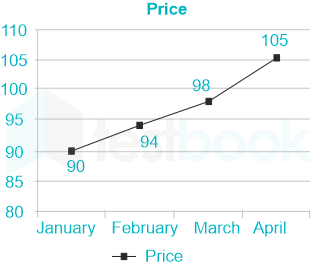
The given graph provides the details of the price of petrol (in rupees) per litre in 4 months in Delhi. Study the graph and answer the question.

​

Find the approximate percentage increase of the rate of petrol from January to April

  1. AOption (a)

    19%

  2. BOption (b)

    18%

  3. COption (c)

    17%

  4. DOption (d)

    12%

View answer & explanation

Correct answer

Answer: (c)C.

17%

Why this answer is correct

Given:

The price of petrol in January = ₹90 per litre

The price of petrol in April = ₹105 per litre

Formula used:

Percentage increase = ((New price - Old price) / Old price) × 100

Calculation:

⇒ Percentage increase = ((105 - 90) / 90) × 100

⇒ Percentage increase = (15 / 90) × 100

⇒ Percentage increase = 16.67% ≈ 17%

∴ The approximate percentage increase in the rate of petrol from January to April is 17%.

Question 27

According to the 2011 language census, what is the rank of Telugu in terms of speakers' total number in India?

  1. AOption (a)

    3rd

  2. BOption (b)

    6th

  3. COption (c)

    4th

  4. DOption (d)

    5th

View answer & explanation

Correct answer

Answer: (c)C.

4th

Why this answer is correct

The correct answer is 4th

Key Points

  • According to the 2011 language census, Telugu ranks as the fourth most spoken language in India in terms of the total number of speakers. Hindi, Bengali, and Marathi are the top three.
  • The 2011 Census of India provides detailed data on the distribution of languages spoken across the country.
  • Telugu is primarily spoken in the southern Indian states of Andhra Pradesh and Telangana, where it is the official language.
  • The census data indicates that Telugu has a significant number of speakers, making it one of the major languages in India.
  • Telugu is closely linked to the culture and heritage of the Telugu people. It has a rich literary tradition, including classical and modern literature.

Question 28

All 48 students of a class are standing in a row facing the north. Yuvika is 7th from the extreme right end of the row. Malini is 22nd from the extreme left end. How many students are standing between Malini and Yuvika?

  1. AOption (a)

    19

  2. BOption (b)

    18

  3. COption (c)

    20

  4. DOption (d)

    17

View answer & explanation

Correct answer

Answer: (a)A.

19

Why this answer is correct

The logic followed here is:

Position of Yuvika from the right = 7th

Position of Yuvika from the left = (Total students - Position of Yuvika from the right) + 1

Position of Yuvika from the left = (48 - 7) + 1 = 42nd

Position of Malini from the left = 22nd

Number of students between Malini and Yuvika = Position of Yuvika from the left - Position of Malini from the left - 1

Number of students between Malini and Yuvika = 42 - 22 - 1 = 19

Hence, the correct answer is "Option 1".

Question 29

When a ray of light is incident obliquely at the pole, of a concave mirror then the reflected ray will:

  1. AOption (a)

    pass straight

  2. BOption (b)

    become perpendicular to incident ray

  3. COption (c)

    return with Angle i = Angle r

  4. DOption (d)

    return without deviation

View answer & explanation

Correct answer

Answer: (c)C.

return with Angle i = Angle r

Why this answer is correct

The correct answer is return with Angle i = Angle r.

Key Points

  • The pole (P) is the geometric centre of the reflecting surface of a spherical mirror.
  • The normal at the pole is the principal axis of the mirror.
  • When a ray of light is incident obliquely at the pole of a concave mirror, it obeys the laws of reflection.
  • According to the law of reflection:
  • Angle of incidence (i) = Angle of reflection (r).
  • Therefore, the reflected ray returns such that i = r.
  • Hence, the correct answer is Option 3 – return with Angle i = Angle r.

Additional Information

  • Special rays for a concave mirror:
  • A ray parallel to the principal axis passes through the focus (F) after reflection.
  • A ray passing through the focus (F) becomes parallel to the principal axis after reflection.
  • A ray passing through the centre of curvature (C) retraces its path after reflection.
  • A ray incident at the pole (P) obeys the law of reflection, i.e., i = r.

Question 30

Which plant was used by Mendel for his experiments?

  1. AOption (a)

    Garden peas

  2. BOption (b)

    Lily

  3. COption (c)

    Rose plant

  4. DOption (d)

    Chilli

View answer & explanation

Correct answer

Answer: (a)A.

Garden peas

Why this answer is correct

The correct answer is Garden peas

Key Points

  • Pea plants were used by Gregor Mendel for his experiments that led to the discovery of the laws of inheritance
  • Peas are a good model organism because they have a short life cycle, produce many offspring, and have easily observable traits.
  • Mendel's careful observations of pea plant traits, such as flower color, seed shape, and plant height, allowed him to develop his theories about genetics.
  • Gregor Mendel, a 19th-century Austrian monk, is considered the father of modern genetics
  • Peas have a relatively short life cycle, allowing Mendel to study multiple generations in a relatively short period.

Question 31

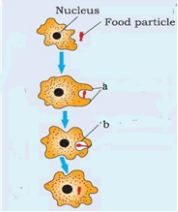
The following diagram shows nutrition in amoeba. Which option correctly identifies the labelling 'a' and 'b' along with their functions?

  1. AOption (a)

    a - Pseudopodia (take in food)

    b - Food vacuole (digestion of food)

  2. BOption (b)

    a - Food vacuole (take in food)

    b - Pseudopodia (absorption of food)

  3. COption (c)

    a - Food vacuole (absorption of food)

    b - Food vacuole (digestion of food)

  4. DOption (d)

    a - Pseudopodia (take in food)

    b - Food vacuole (egestion of food)

View answer & explanation

Correct answer

Answer: (a)A.

a - Pseudopodia (take in food)

b - Food vacuole (digestion of food)

Why this answer is correct

The correct answer is option 1.

Key Points

  • a - Pseudopodia: Pseudopodia are temporary, foot-like extensions of the cell membrane used by amoebas to move and capture food.
  • b - Food vacuole: The food vacuole is an organelle where the digestion of ingested food particles occurs.
  • Function of Pseudopodia: The pseudopodia extend and envelop food particles, effectively taking in food through a process called phagocytosis.
  • Function of Food Vacuole: Once the food is enclosed in the food vacuole, digestive enzymes break down the food into simpler substances that can be absorbed by the cell.

Additional Information

  • Pseudopodia:
  • Pseudopodia are also known as "false feet" and are characteristic of amoeboid cells.
  • They help in locomotion and capturing prey through a process called phagocytosis.
  • The formation of pseudopodia involves the flow of cytoplasm into the extension.
  • Food Vacuole:
  • The food vacuole is a membrane-bound organelle in amoeba where internal digestion occurs.
  • After the pseudopodia capture food particles, these particles are enclosed in a food vacuole where digestive enzymes are secreted.
  • These enzymes break down the food into simpler molecules that can be absorbed and utilized by the cell.
  • Phagocytosis:
  • Phagocytosis is the process by which a cell engulfs solid particles to form an internal compartment known as a phagosome.
  • It is a crucial mechanism used by amoebas and certain immune cells to ingest foreign particles, including pathogens.
  • Digestion in Amoeba:
  • The digestion process in amoeba is intracellular, meaning it occurs within the cell.
  • Once food is taken in through phagocytosis, it is enclosed in a food vacuole where digestive enzymes break down the food.
  • The nutrients are then absorbed into the cytoplasm, and the waste is expelled from the cell.

Question 32

Which of the following sites are used for storage of waste products in plants?

  1. AOption (a)

    Guard cells

  2. BOption (b)

    Root hairs

  3. COption (c)

    Phloem fibres

  4. DOption (d)

    Old xylem

View answer & explanation

Correct answer

Answer: (d)D.

Old xylem

Why this answer is correct

The correct answer is Old xylem

Key Points

  • Old xylem tissue, after it has lost its primary function of conducting water and minerals, can be used for storage of waste products in plants.
  • These waste products, also known as secondary metabolites, include substances like tannins, alkaloids, and pigments.
  • These compounds are often stored in the heartwood of trees, which is the older, darker part of the trunk.

Additional Information

  • Guard cells:
  • These are specialized cells found in the epidermis of leaves.
  • They regulate the opening and closing of stomata, which are tiny pores on the surface of leaves. They do not store waste products.
  • Root hairs:
  • ​ These are tiny projections on the surface of root cells that increase the surface area for absorption of water and minerals.
  • They do not store waste products.
  • Phloem fibers:
  • ​ These are elongated cells found in the phloem tissue of plants.
  • They provide structural support and transport organic nutrients.
  • They do not store waste products.

Question 33

In which year was the 'Kanya Shiksha Pravesh Utsav' launched by the Ministry of Women and Child Development, Government of India?

  1. AOption (a)

    2019

  2. BOption (b)

    2021

  3. COption (c)

    2020

  4. DOption (d)

    2022

View answer & explanation

Correct answer

Answer: (d)D.

2022

Why this answer is correct

The correct answer is 2022

Key Points

  • On March 7, 2022, the Kanya Shiksha Pravesh Utsav campaign was started by the Ministry of Women and Child Development in collaboration with the Ministry of Education and UNICEF.
  • It was started to reintegrate out-of-school teenage girls into the formal education and/or skill-building systems in India.
  • The Beti Bachao Beti Padhao program would provide funding for almost 400 districts for the creation of consciousness.

Additional Information 

  • Important Women's Empowerment Programs Announced by the Central Government Include:
  1. Women's Empowerment Programs
  2. The Beti Bachao Beti Padhao Plan
  3. One-Stop Center Program
  4. The Women Helpline Program
  5. A Comprehensive Plan for the Rescue, Rehabilitation, and Reintegration of Trafficking and Commercial Sexual Exploitation Victims

Question 34

If '+' means '−', '−' means '×', '×' means '÷' and '÷' means '+' means '+', what will come in place of the question mark (?) in the following equation?

18 ÷ (18 − 2) × 9 + 16 = ?

  1. AOption (a)

    10

  2. BOption (b)

    4

  3. COption (c)

    8

  4. DOption (d)

    6

View answer & explanation

Correct answer

Answer: (d)D.

6

Why this answer is correct

Given Equation: 18 ÷ (18 − 2) × 9 + 16 = ?

BODMAS Rule:

Decoding the given information:

Symbol+−×÷
Meaning−×÷+

Now replacing the symbols using BODMAS Rule, we get:

⇒ 18 + (18 × 2) ÷ 9 − 16 = ?

⇒ 18 + 36 ÷ 9 − 16 = ?

⇒ 18 + 4 − 16 = ?

⇒ 22 − 16 = 6.

Hence, the correct option is "Option 4".

Question 35

The FIDE World Chess Olympiad 2022 is set to be organised in which country?

  1. AOption (a)

    India

  2. BOption (b)

    Canada

  3. COption (c)

    Australia

  4. DOption (d)

    China

View answer & explanation

Correct answer

Answer: (a)A.

India

Why this answer is correct

The correct answer is India

Key Points 

Chess Olympiad:

  • The Prime Minister, Shri Narendra Modi declared open the 44th Chess Olympiad at JLN Indoor Stadium, Chennai.,India
  • The Prime Minister noted that the 44th Chess Olympiad has been a tournament of many firsts and records.
  • This is the first time the Chess Olympiad is being held in the place of origin of chess, India. It is coming to Asia for the first time in 3 decades.
  • The official mascot was named Thambi'. Thambi means 'Hey little brother', which is a common phrase used to address someone.
  • The horse is the knight in the chess game and the mascot was created to highlight the culture of Tamil Nadu and chess.
  • The trophy for the winning team in the open section is the Hamilton-Russell Cup.
  • The trophy for the winning team in the women's section is the Vera Menchik Cup.

Question 36

The median of the observations 20, 23, 25, 30, 20, 31, 32, 35, 20, 41, 42, 43, 20, 20 and 20 is:

  1. AOption (a)

    28

  2. BOption (b)

    25

  3. COption (c)

    23

  4. DOption (d)

    26

View answer & explanation

Correct answer

Answer: (b)B.

25

Why this answer is correct

Shortcut Trick

Count total number of observations (n) = 15.

Since 15 is odd, the Median is the ((15 + 1) ÷ 2)th = 8th term.

Quick sort check: Value 20 repeats 6 times, 23 is the 7th term, and 25 is the 8th term.

∴ The correct answer is 25.

Alternate Method

Given: Observations = 20, 23, 25, 30, 20, 31, 32, 35, 20, 41, 42, 43, 20, 20, 20

Formula Used: For n observations arranged in ascending order, if n is odd, Median = ((n + 1) ÷ 2)th observation.

⇒ Arrange observations in ascending order:

20, 20, 20, 20, 20, 20, 23, 25, 30, 31, 32, 35, 41, 42, 43

⇒ Total count n = 15

⇒ Median position = (15 + 1) ÷ 2 = 8th position

⇒ 1st to 6th terms = 20

⇒ 7th term = 23

⇒ 8th term = 25

∴ The correct answer is 25.

Additional Information

Median for Even Number of Terms

If n is even, the median is the average of the (n ÷ 2)th and (n ÷ 2 + 1)th observations.

Empirical Relationship

The relationship between mean, median, and mode is given by: Mode = 3 Median − 2 Mean.

Mode of the Data

The Mode is the observation that appears most frequently. In this dataset, the mode is 20 (appears 6 times).

Question 37

Amongst six friends A, D, F, G, L and S, each has a different age. S is older than only four other friends. D is older than only one friend. G is older than L but younger than A. A is not the oldest. Who is the youngest among all the friends?

  1. AOption (a)

    L

  2. BOption (b)

    F

  3. COption (c)

    S

  4. DOption (d)

    G

View answer & explanation

Correct answer

Answer: (a)A.

L

Why this answer is correct

Given: Amongst six friends A, D, F, G, L and S, each has a different age.

  1. S is older than only four other friends. 

  2. D is older than only one friend.

Person
Oldest to
S
D
Youngest

3) G is older than L but younger than A.

4)  A is not the oldest.

After positioning G, L, and A only one position is left which will be occupied by the only person left i.e. F.

Person
Oldest to
F
A
S
G
D
L
Youngest

Thus, according to the final arrangement L is the youngest among all the friends.

Hence, "Option 1" is the correct answer.

Question 38

When light travels from one medium to another medium then:

  1. AOption (a)

    incident ray, normal at the point of incidence and refracted ray all are in the same plane

  2. BOption (b)

    incident ray, normal at the point of incidence and reflected ray are in the same plane

  3. COption (c)

    incident ray, normal at the point of incidence and reflected ray are in two planes

  4. DOption (d)

    incident ray, normal at the point of incidence and emerged ray, all are in the separate plane

View answer & explanation

Correct answer

Answer: (a)A.

incident ray, normal at the point of incidence and refracted ray all are in the same plane

Why this answer is correct

The correct answer is incident ray, normal at the point of incidence and refracted ray all are in the same plane.

Key Points

  • When light travels from one medium to another medium, the incident ray, the normal at the point of incidence, and the refracted ray all lie in the same plane.
  • This phenomenon is a part of the laws of refraction, specifically Snell's Law.
  • The same principle applies to reflection, where the incident ray, the normal, and the reflected ray all lie in the same plane.
  • The plane in which these rays lie is perpendicular to the surface at the point of incidence.

Additional Information

  • Incident Ray:
  • The ray of light that strikes the surface is called the incident ray.
  • It is the incoming ray which falls on the surface at a specific point.
  • Normal:
  • The normal is an imaginary line that is perpendicular to the surface at the point of incidence.
  • It is used as a reference to measure the angles of incidence and refraction.
  • Refracted Ray:
  • The refracted ray is the ray that passes into the second medium and bends due to a change in speed.
  • The angle between the refracted ray and the normal is called the angle of refraction.
  • Snell's Law:
  • Snell's Law relates the angles of incidence and refraction to the refractive indices of the two media.
  • It is mathematically expressed as: n1sinθ1=n2sinθ2n1sinθ1=n2sinθ2 , where and are the refractive indices, and and are the angles of incidence and refraction, respectively.

Question 39

Which of the following factors does NOT directly affect the climate of India?

  1. AOption (a)

    Latitude

  2. BOption (b)

    Pressure and winds

  3. COption (c)

    Altitude

  4. DOption (d)

    Snowfall in European countries

View answer & explanation

Correct answer

Answer: (d)D.

Snowfall in European countries

Why this answer is correct

The correct answer is Snowfall in European countries

Key Points

  • Latitude:
  • India's location between the Tropic of Cancer and the Equator significantly influences its climate, leading to a tropical and subtropical climate.
  • Pressure and winds:
  • The prevailing wind patterns and pressure systems, such as the Indian Ocean Monsoon and the Western Disturbances, directly impact India's rainfall and temperature distribution.
  • Altitude:
  • The elevation of different regions in India affects their temperatures, with higher altitudes experiencing cooler climates.
  • Snowfall in European countries, while a global climatic factor, does not have a direct and significant impact on India's climate due to the geographical distance and atmospheric circulation patterns.

Question 40

'A' and 'B' invest Rs. 30,000 and Rs. 24,000, respectively, for one year. If they get a profit of Rs. 13,500, then the share of 'B' in the profit is:

  1. AOption (a)

    Rs. 9,450

  2. BOption (b)

    Rs. 9,000

  3. COption (c)

    Rs. 7,500

  4. DOption (d)

    Rs. 6,000

View answer & explanation

Correct answer

Answer: (d)D.

Rs. 6,000

Why this answer is correct

Shortcut Trick

Ratio of investments of A and B = 30,000 : 24,000 = 5 : 4.

Since the time period is same, the profit ratio is equal to the investment ratio.

Total ratio units = 5 + 4 = 9 units.

9 units = Rs. 13,500 ⇒ 1 unit = 1,500.

Share of B = 4 units = 4 × 1,500 = Rs. 6,000.

∴ The correct answer is Rs. 6,000.

Alternate Method

Given → Investment of A = Rs. 30,000, Investment of B = Rs. 24,000, Total Profit = Rs. 13,500. Formulas: Profit Share = (Investment × Time) | Profit Ratio = I1T1 : I2T2

⇒ Profit Ratio (A : B) = (30,000 × 1) : (24,000 × 1) ⇒ Profit Ratio = 30 : 24 = 5 : 4 ⇒ B's share = [Ratio of B ÷ Total Ratio] × Total Profit ⇒ B's share = [4 ÷ (5 + 4)] × 13,500 ⇒ B's share = (4 ÷ 9) × 13,500 = 4 × 1,500 = 6,000

∴ The correct answer is Rs. 6,000.

Additional Information

Partnership Rule

In a partnership, profit is distributed in the ratio of the product of Capital and Time. If time is constant, Profit ∝ Capital.

Compound Partnership

When partners invest money for different time periods, the profit ratio is (C1 × T1) : (C2 × T2).

Question 41

Asmita started walking from the medicine shop towards the south. After walking for 400 metres she turned right and walked for 100 metres to reach the ice-cream parlour. From there she turned right, walked for 500 metres then again turned right and walked for 200 metres to reach the vegetable shop. Finally she turned right and walked for 100 metres to reach her home. How far and in which direction is her home from the medicine shop? (All turns are 90 degree turns only)

  1. AOption (a)

    100 metres east

  2. BOption (b)

    100 metres south

  3. COption (c)

    200 metres west

  4. DOption (d)

    200 metres north

View answer & explanation

Correct answer

Answer: (a)A.

100 metres east

Why this answer is correct

Given: All turns are 90 degree turns only.

Asmita started walking from the medicine shop towards the south.

After walking for 400 metres she turned right and walked for 100 metres to reach the ice-cream parlour.

From there she turned right, walked for 500 metres then again turned right and walked for 200 metres to reach the vegetable shop.

Finally she turned right and walked for 100 metres to reach her home. 

Thus, Asmista's home is 100 m away from the medicine shop in the east.

Hence, "Option 1" is the correct answer.

Question 42

In this question, a statement is followed by four conclusions. Find out which conclusion is true based on the given statement.

Statement:

Y ≥ R = S ≤ T = N > A

Conclusions:

  1. Y > T
  2. N ≥ R
  3. Y < S
  4. T = A
  1. AOption (a)

    2

  2. BOption (b)

    3

  3. COption (c)

    1

  4. DOption (d)

    4

View answer & explanation

Correct answer

Answer: (a)A.

2

Why this answer is correct

Given Statement: Y ≥ R = S ≤ T = N > A

Now,

Conclusions:

Option 1: Y > T → False (Y ≥ R = S ≤ T does not provide a definite comparison between Y and T)

Option 2: N ≥ R → True (N = T ≥ S = R and N > A implies N ≥ R)

Option 3: Y < S → False (Y ≥ R = S does not provide a definite comparison between Y and S)

Option 4: T = A → False (T = N and N > A so T > A)

Hence, the correct answer is "Option 1".

Question 43

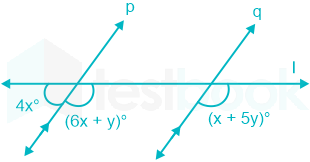
In the given figure, p || q and 1 is a transversal cutting p and q with angles as specified. The value of (5x − y) is:

  1. AOption (a)

    60

  2. BOption (b)

    96

  3. COption (c)

    116

  4. DOption (d)

    40

View answer & explanation

Correct answer

Answer: (a)A.

60

Why this answer is correct

Shortcut Trick

Identify the angle relationships for parallel lines p and q cut by transversal l.

Sum of consecutive exterior angles is 180°: (2x + 16) + 116 = 180 ⇒ 2x = 48 ⇒ x = 24.

Angles forming a linear pair sum to 180°: (y + 4) + 116 = 180 ⇒ y = 60.

Substitute the values: 5x − y = 5(24) − 60 = 120 − 60 = 60.

∴ The correct answer is 60.

Alternate Method

Given: Parallel lines p || q and transversal l. Angles specified are (2x + 16)°, 116°, and (y + 4)°.

Formula Used: Sum of consecutive exterior angles = 180°; Sum of linear pair angles = 180°.

From the properties of parallel lines:

⇒ (2x + 16) + 116 = 180 (Consecutive exterior angles are supplementary)

⇒ 2x + 132 = 180

⇒ 2x = 180 − 132 = 48

⇒ x = 24

From the linear pair property:

⇒ (y + 4) + 116 = 180 (Angles on a straight line)

⇒ y + 120 = 180

⇒ y = 180 − 120 = 60

Now, find the value of (5x − y):

⇒ 5x − y = 5 × 24 − 60

⇒ 5x − y = 120 − 60 = 60

∴ The correct answer is 60.

Additional Information

Consecutive Exterior Angles

When two parallel lines are cut by a transversal, the pairs of exterior angles on the same side of the transversal are supplementary (sum = 180°).

Linear Pair Postulate

If two angles form a linear pair, then the measures of the angles add up to 180°.

Corresponding Angles

Angles in the same relative position at each intersection where a straight line crosses two others. If the two lines are parallel, then the corresponding angles are equal.

Question 44

Which of the following is an essential element used by the plants to synthesise proteins?

  1. AOption (a)

    Iron

  2. BOption (b)

    Magnesium

  3. COption (c)

    Nitrogen

  4. DOption (d)

    Boron

View answer & explanation

Correct answer

Answer: (c)C.

Nitrogen

Why this answer is correct

The correct answer is Nitrogen 

Key Points

  • Nitrogen is an essential element that plants use to synthesize proteins:
  • Nitrogen is a primary component of proteins and is found in every living cell.
  • Plants absorb nitrogen from the soil in the form of nitrate or ammonium ions.
  • Inside the plant, nitrogen is converted into amino acids, which are the building blocks for proteins.
  • Other important elements for plants
  • Potassium: Affects the absorption of water, increases resistance to drought and cold, and fosters resistance to insect pests and fungus illnesses.
  • Phosphorus: Deficient sugarbeet plants are stunted, with dark green leaves.
  • Calcium: Deficient celery has young leaves that are necrotic and the growing point dies.
  • Sulfur: Deficient macadamia has young leaves that are chlorotic.
  • Boron: Deficient tomato leaves are chlorotic, with some curling.

Question 45

The value of (110 + 210 − 70 + 30) × 50 is:

  1. AOption (a)

    3

  2. BOption (b)

    1

  3. COption (c)

    0

  4. DOption (d)

    2

View answer & explanation

Correct answer

Answer: (d)D.

2

Why this answer is correct

Given:

The value of (110 + 210 − 70 + 30) × 50

Formula Used:

Use properties of exponents to simplify the expression.

Calculation:

(110 + 210 − 70 + 30) × 50

Given that any number raised to the power of 0 is 1.

110 = 1, 210 = 1, 70 = 1, 30 = 1, 50 = 1

⇒ (1 + 1 - 1 + 1) × 1

⇒ (2) × 1

⇒ 2

The correct answer is option 4.

Question 46

The simple interest on a sum for 3 years is two-fifth of the sum. The rate of interest per annum is:

  1. AOption (a)

    403\frac{40}{3}%

  2. BOption (b)

    340\frac{3}{40}%

  3. COption (c)

    203\frac{20}{3}%

  4. DOption (d)

    103\frac{10}{3}%

View answer & explanation

Correct answer

Answer: (a)A.

403\frac{40}{3}%

Why this answer is correct

Shortcut Trick

Convert the interest fraction to percentage: Interest = 2/5 × 100 = 40%.

This 40% interest is accumulated over 3 years.

Rate of Interest (R) = Total Interest % ÷ Time = 40 ÷ 3 = 40/3 %.

∴ The correct answer is 40/3 %.

Alternate Method

Given:

Time (T) = 3 years

Simple Interest (SI) = 2/5 of Principal (P)

Formula Used:

Simple Interest (SI) = (P × R × T) ÷ 100

Calculations:

⇒ SI = (2 ÷ 5) × P

⇒ (2 ÷ 5) × P = (P × R × 3) ÷ 100

⇒ 2 ÷ 5 = (3 × R) ÷ 100

⇒ 3 × R = (2 × 100) ÷ 5

⇒ 3 × R = 40

⇒ R = 40 ÷ 3

⇒ R = 40/3 %

∴ The correct answer is 40/3 %.

Additional Information

Simple Interest definition

Interest calculated only on the Principal amount for the entire duration of the loan or investment.

Relationship between SI and Amount

The total Amount (A) is the sum of Principal (P) and Simple Interest (SI): A = P + SI.

Rate of Interest calculation

Rate (R) can be found using R = (SI × 100) ÷ (P × T) when other variables are known.

Question 47

The price of fuel decreases by 15%, 12% and 10% in three successive months, but increases by 25% in the fourth month. What is the percentage increase/decrease in the price of fuel in the fourth month as compared to its original price?

  1. AOption (a)

    Increases by 10%

  2. BOption (b)

    Decreases by 12%

  3. COption (c)

    Decreases by 15.85%

  4. DOption (d)

    Increases by 15.75%

View answer & explanation

Correct answer

Answer: (c)C.

Decreases by 15.85%

Why this answer is correct

Shortcut Trick

Using multiplying factor method for successive changes.

Net Multiplier = 0.85 × 0.88 × 0.90 × 1.25

Net Multiplier = 0.748 × 1.125 = 0.8415

Change % = (0.8415 − 1) × 100 = −15.85%

∴ The correct answer is Decreases by 15.85%.

Alternate Method

Given: Initial successive decreases of 15%, 12%, 10% and an increase of 25%.

⇒ Let the original price be 100.

⇒ Price after 1st month = 100 × (85/100) = 85

⇒ Price after 2nd month = 85 × (88/100) = 74.8

⇒ Price after 3rd month = 74.8 × (90/100) = 67.32

⇒ Price after 4th month = 67.32 × (125/100) = 84.15

⇒ Percentage Change = 84.15 − 100 = −15.85%

∴ The correct answer is Decreases by 15.85%.

Additional Information

Successive Percentage Formula

For two changes a% and b%, the net change is [a + b + (ab/100)]%.

Multiplying Factor (MF)

For a percentage increase/decrease, MF = [1 ± (r/100)]. Final value = Initial value × MF1 × MF2 × ... × MFn.

Base Change Property

The order of successive percentage changes does not affect the final net percentage change.

Question 48

Six students are sitting around a circular table facing the centre. Q is an immediate neighbour of both B and C. A is sitting second to the left of C. P is sitting second to the right of Q. R is immediate neighbour of both A and C. Who is an immediate neighbour of both A and B?

  1. AOption (a)

    C

  2. BOption (b)

    R

  3. COption (c)

    Q

  4. DOption (d)

    P

View answer & explanation

Correct answer

Answer: (d)D.

P

Why this answer is correct

Given: Six students are sitting around a circular table facing the centre.

1) A is sitting second to the left of C.

2) R is immediate neighbour of both A and C.

3) Q is an immediate neighbour of both B and C.

4) P is sitting second to the right of Q. 

Thus, according to the final arrangement, P is an immediate neighbour of both A and B.

Hence, "Option 4" is the correct answer.

Question 49

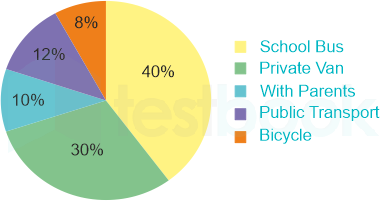
The given pie chart provides details of the percentage distribution of the mode of transport taken by students of a class. Study the pie chart and answer the question.

If 140 students use bicycles, what is the total number of students in the class?

  1. AOption (a)

    1600

  2. BOption (b)

    1890

  3. COption (c)

    1750

  4. DOption (d)

    2000

View answer & explanation

Correct answer

Answer: (c)C.

1750

Why this answer is correct

Given:

Percentage of students using bicycles = 8%

Number of students using bicycles = 140

Formula used:

Total number of students = (Number of students using bicycles × 100) / Percentage of students using bicycles

Calculation:

⇒ Total number of students = (140 × 100) / 8

⇒ Total number of students = 14000 / 8

⇒ Total number of students ≈ 1750

∴ The total number of students in the class is 1750.

Question 50

A dishonest dealer professes to sell his goods at cost price but he uses a weight of 800 g for a weight of 1 kg. His profit percentage is:

  1. AOption (a)

    35%

  2. BOption (b)

    55%

  3. COption (c)

    45%

  4. DOption (d)

    25%

View answer & explanation

Correct answer

Answer: (d)D.

25%

Why this answer is correct

Shortcut Trick

For a dishonest dealer who sells at cost price but uses less weight:

Profit percentage = (Error ÷ (True weight − Error)) × 100

Here, Error = 1000 g − 800 g = 200 g.

Profit% = (200 ÷ 800) × 100 = 1/4 × 100 = 25%.

∴ The correct answer is 25%.

Alternate Method

Given: True weight = 1 kg = 1000 g, Used weight = 800 g, Selling price (SP) per kg = Cost price (CP) per kg.

Formulas: Profit = True weight − Used weight | Profit% = (Profit ÷ Used weight) × 100

⇒ Let the cost of 1 g of goods be Re. 1.

⇒ Cost Price (CP) of 800 g = Rs. 800.

⇒ Selling Price (SP) of 800 g (sold as 1000 g at CP) = Rs. 1000.

⇒ Profit = SP − CP = 1000 − 800 = Rs. 200.

⇒ Profit% = (200 ÷ 800) × 100 = 25%.

∴ The correct answer is 25%.

Additional Information

Dishonest Dealer Concept

When a dealer claims to sell at cost price but uses a weight x instead of actual weight y, the gain is always calculated on the actual weight delivered to the customer.

Effective Profit with Markup

If the dealer marks up the price by k% and also uses less weight, the total profit is calculated by compounding the markup ratio and the weight ratio.

Question 51

The LCM of the numbers 2.5 and 0.175 is:

  1. AOption (a)

    17.5

  2. BOption (b)

    1.75

  3. COption (c)

    0.0175

  4. DOption (d)

    175

View answer & explanation

Correct answer

Answer: (a)A.

17.5

Why this answer is correct

Shortcut Trick

Make the number of decimal places equal for both numbers: 2.500 and 0.175.

Remove the decimal and find the LCM of 2500 and 175.

Factors of 2500 = 25 × 100 = 25 × 25 × 4; Factors of 175 = 25 × 7.

LCM(2500, 175) = 2500 × 7 = 17500.

Place the decimal point back after 3 places: 17.500.

∴ The correct answer is 17.5.

Alternate Method

Given: Numbers are 2.5 and 0.175.

Formula Used: LCM of fractions = LCM of Numerators ÷ HCF of Denominators.

⇒ Convert decimals to fractions: 2.5 = 25/10 and 0.175 = 175/1000.

⇒ Simplify fractions (optional) or use a common denominator.

⇒ 25/10 = 2500/1000 and 175/1000.

⇒ LCM of Numerators (2500, 175) = 17500.

⇒ HCF of Denominators (1000, 1000) = 1000.

⇒ Result = 17500 ÷ 1000 = 17.5.

∴ The correct answer is 17.5.

Additional Information

LCM of Decimals

Always equate the number of decimal places by adding zeros before calculating LCM to avoid errors.

HCF of Decimals

Similar to LCM, equate decimal places, find the HCF of the integers, and then place the decimal point back.

Product Rule

For two numbers a and b, LCM(a, b) × HCF(a, b) = a × b. This applies to decimal numbers as well.

Question 52

Refer to the following letter, number, symbol series and answer the question that follows.

(Left) Z C & T % 7 D 9 # 6 K & 2 R Y $ 3 5 E * S (Right)

How many such symbols are there which are immediately preceded by a letter and also immediately followed by a number?

  1. AOption (a)

    2

  2. BOption (b)

    1

  3. COption (c)

    0

  4. DOption (d)

    3

View answer & explanation

Correct answer

Answer: (d)D.

3

Why this answer is correct

Given series: (Left) Z C & T % 7 D 9 # 6 K & 2 R Y $ 3 5 E * S (Right)

According to the question, such symbols which are immediately preceded by a letter and also immediately followed by a number:

Required condition: Letter - Symbol - Number

(Left) Z C & T % 7 D 9 # 6 K & 2 R Y $ 3 5 E * S (Right)

Thus, there are three such symbols which are immediately preceded by a letter and also immediately followed by a number.

Hence, "Option 4" is the correct answer.

Question 53

Refer to the following number series and answer the question.

13 10 17 25 58 63 94 8 92 29

How many prime numbers are immediately followed by even numbers?

  1. AOption (a)

    3

  2. BOption (b)

    2

  3. COption (c)

    1

  4. DOption (d)

    4

View answer & explanation

Correct answer

Answer: (c)C.

1

Why this answer is correct

Given series: 13 10 17 25 58 63 94 8 92 29

According to the question, such prime numbers which are immediately followed by even numbers:

Required condition: Prime Number - Even Number

13 10 17 25 58 63 94 8 92 29

Thus, there is one such prime number which is immediately followed by even number.

Hence, "Option 3" is the correct answer.

Question 54

What was the implementation period of the 12th Five-Year Plan in India?

  1. AOption (a)

    2012 - 2017

  2. BOption (b)

    2002 - 2007

  3. COption (c)

    1997 - 2002

  4. DOption (d)

    2007 - 2012

View answer & explanation

Correct answer

Answer: (a)A.

2012 - 2017

Why this answer is correct

The correct answer is 2012-2017.

Key Points 

  • 12th Five Year Plan of the Government of India (2012–17) was India's last Five Year Plan.​
  • Twelfth Five Year Plan (2012-2017) was launched with the objective of faster, sustainable, and more inclusive growth.
  • The broad vision and aspirations which the Twelfth Plan seeks to fulfill are reflected in the subtitle: ‘Faster, Sustainable, and More Inclusive Growth’.
  • It aimed to increase the GDP at a faster pace such that each stratum of the society is a part of and contributed to the growth and hence foster an environment of inclusive growth that is sustainable.
  • Twelfth Plan had set a target of 8 percent growth over the five-year period 2012-13 to 2016-17.
  • Inclusiveness is to be achieved through poverty reduction, promoting group equality and regional balance, reducing inequality, empowering people etc whereas sustainability includes ensuring environmental sustainability, development of human capital through improved health, education, skill development, nutrition, information technology etc and development of institutional capabilities, infrastructure like power telecommunication, roads, transport etc.

Question 55

A 10 Ω resistor, A, is connected in series to a 20 Ω resistor, B, and a 6 V battery. The potential drops across A and B are respectively _______.

  1. AOption (a)

    1 V and 5 V

  2. BOption (b)

    3 V and 3 V

  3. COption (c)

    2 V and 4 V

  4. DOption (d)

    4 V and 2 V

View answer & explanation

Correct answer

Answer: (c)C.

2 V and 4 V

Why this answer is correct

The correct answer is 2V and 4 V

Key Points

  • When resistors are connected in series, the total resistance is the sum of the individual resistances.

  • In this case, the total resistance is 10 Ω + 20 Ω = 30 Ω.

  • Using Ohm's Law (V = IR), we can find the current flowing through the circuit:

  • I = V / R = 6 V / 30 Ω = 0.2 A

  • Now, we can find the potential drops across each resistor:

  • Potential drop across resistor A: VA = I * RA = 0.2 A * 10 Ω = 2 V

  • Potential drop across resistor B: VB = I * RB = 0.2 A * 20 Ω = 4 V

  • Therefore, the potential drops across resistors A and B are 2 V and 4 V, respectively.

Question 56

Which of the following is constant along an indifference curve?

  1. AOption (a)

    Price

  2. BOption (b)

    Output

  3. COption (c)

    Utility

  4. DOption (d)

    Technology

View answer & explanation

Correct answer

Answer: (c)C.

Utility

Why this answer is correct

The correct answer is Utlity

Key Points

  • The total utility derived from consuming any bundle of goods on an indifference curve is constant.
  • An indifference curve is a curve that shows the goods that give customers the same satisfaction.
  • Each point on an indifference curve represents a consumption bundle, and the consumer is indifferent among all consumption bundles on the indifference curve.
  • They are convex-shaped and bend downward from left to right.
  • Different values of c correspond to different indifference curves.
  • The marginal rate of substitution is constant as you move along an indifference curve.

Question 57

On 27 April 2021, Union Finance Minister Nirmala Sitharaman inaugurated the country's first 3D printed house at IIT Madras, which was built in ________.

  1. AOption (a)

    10 days

  2. BOption (b)

    12 days

  3. COption (c)

    15 days

  4. DOption (d)

    5 days

View answer & explanation

Correct answer

Answer: (d)D.

5 days

Why this answer is correct

The correct answer is 5 days

Key Points

  • The first 3D printed house in India was built in 5 days in Chennai, Tamil Nadu:
  • The house was built at the Indian Institute of Technology (IIT) Madras campus in Chennai
  • The house was built by Tvasta Manufacturing Solutions, a startup founded by IIT Madras alumni
  • The house was built using indigenous concrete 3D printing technology
  • The 600 square foot single-story house has one bedroom, hall, and kitchen
  • The house was built in collaboration with Habitat for Humanity's Terwilliger Center for Innovation in Shelter
  • The house was inaugurated virtually by Union Finance Minister Nirmala Sitharaman on April 27, 2021

Question 58

Known as the 'sorrow of Bihar', the river _______ causes great destruction due to its frequently changing course.

  1. AOption (a)

    Subarnarekha

  2. BOption (b)

    Indravati

  3. COption (c)

    Kosi

  4. DOption (d)

    Brahmani

View answer & explanation

Correct answer

Answer: (c)C.

Kosi

Why this answer is correct

The correct answer is Kosi

Key Points

  • The Kosi River is known as the "sorrow of Bihar" because of its frequent flooding and changing course, which causes great destruction in the state
  • The Kosi River's annual floods damage agricultural land and destroy the rural economy.
  • During the monsoon season, the river's water flow increases up to 18 times.
  • The Kosi River is highly sedimented and has many intersecting channels that shift laterally, causing floods.
  • In 2005, 95% of the river's water shifted into a channel it hadn't used in over 100 years.
  • The Kosi River carries large amounts of silt during the monsoon season, which contributes to its instability.
  • The upper course of the river produces one of the highest silt yields in the world.
  • The Kosi River originates in Tibet and flows through China, Nepal, and India before depositing itself into the Bay of Bengal.
  • It is one of the largest tributaries of the Ganges.

Additional Information

  • Subarnarekha River
  • The Subarnarekha River originates from the Ranchi Plateau in Jharkhand, India.
  • It flows through the states of Jharkhand, West Bengal, and Odisha before draining into the Bay of Bengal.
  • This river is approximately 395 kilometers long and serves as a vital water source for the regions it passes through.
  • Indravati River
  • The Indravati River originates from the Dandakaranya range and flows into the Godavari River.
  • It traverses through the states of Odisha, Chhattisgarh, Telangana, and Maharashtra.
  • Brahmani River
  • The Brahmani River is a major river in the state of Odisha.
  • It is formed by the confluence of the Shankh and South Koel rivers.

Question 59

The atomic masses of carbon and hydrogen, respectively, are:

  1. AOption (a)

    12 u and 2 u

  2. BOption (b)

    12 u and 1 u

  3. COption (c)

    6 u and 1 u

  4. DOption (d)

    6 u and 2 u

View answer & explanation

Correct answer

Answer: (b)B.

12 u and 1 u

Why this answer is correct

The correct answer is 12 u and 1 u

Key Points

  • Atomic Mass:
  • The atomic mass of an element is the average mass of its atoms, measured in atomic mass units (u).
  • It's based on a relative scale, where the mass of a carbon-12 atom is defined as 12 u.
  • The atomic mass of an element reflects the average mass of its isotopes, taking into account their relative abundance.
  • Carbon and Hydrogen:
  • Carbon: The most common isotope of carbon is carbon-12, which has 6 protons and 6 neutrons in its nucleus.
  • Therefore, its atomic mass is 12 u.
  • Hydrogen: The most common isotope of hydrogen is hydrogen-1, which has 1 proton and no neutrons. So, its atomic mass is 1 u.

Question 60

The quadratic equation for which, sum of the roots is (−35)\left(−\frac{3}{5}\right) and product of the roots is 25\frac{2}{5}, is:

  1. AOption (a)

    5x2 − 7x + 2 = 0

  2. BOption (b)

    5x2 + x + 1 = 0

  3. COption (c)

    5x2 − 2x + 7 = 0

  4. DOption (d)

    5x2 + 3x + 2 = 0

View answer & explanation

Correct answer

Answer: (d)D.

5x2 + 3x + 2 = 0

Why this answer is correct

Given:

Sum of the roots (S) = −35-\dfrac{3}{5}

Product of the roots (P) = 25\dfrac{2}{5}

Formula used:

The general form of a quadratic equation with roots α and β is:

x2−(S)x+P=0x^2 - (S)x + P = 0

Calculations:

Substitute the values of S and P:

⇒ x2−(−35)x+25=0x^2 - \left(-\dfrac{3}{5}\right)x + \dfrac{2}{5} = 0

⇒ x2+35x+25=0x^2 + \dfrac{3}{5}x + \dfrac{2}{5} = 0

To clear the fractions, multiply the entire equation by 5:

⇒ 5x2+3x+2=05x^2 + 3x + 2 = 0

∴ The required quadratic equation is 5x2 + 3x + 2 = 0.

Question 61

Express 0.3‾0.\overline{3} in the form pq\rm\frac{p}{q}, where p and q are integers and q ≠ 0.

  1. AOption (a)

    23\frac{2}{3}

  2. BOption (b)

    13\frac{1}{3}

  3. COption (c)

    34\frac{3}{4}

  4. DOption (d)

    25\frac{2}{5}

View answer & explanation

Correct answer

Answer: (b)B.

13\frac{1}{3}

Why this answer is correct

Given:

Repeating decimal 0.3‾0.\overline{3}

Formula Used:

To express a repeating decimal in the form pq\frac{p}{q}

Calculation:

Let x = 0.3‾0.\overline{3}

⇒ 10x = 3.3‾3.\overline{3}

⇒ 10x - x = 3.3‾−0.3‾3.\overline{3} - 0.\overline{3}

⇒ 9x = 3

⇒ x = 39\frac{3}{9}

⇒ x = 13 \frac{1}{3}

The fraction form of 0.3‾0.\overline{3} is 13\frac{1}{3} .

Question 62

On 12 January 2022, the Indian Space Research Organisation (ISRO) successfully conducted the qualification test of the Cryogenic Engine for the Gaganyaan programme for a duration of 720 seconds at the ISRO Propulsion Complex (IPRC) in ________.

  1. AOption (a)

    Bengaluru, Karnataka

  2. BOption (b)

    Mahendragiri, Tamil Nadu

  3. COption (c)

    Thiruvananthapuram, Kerala

  4. DOption (d)

    Ahmedabad, Gujarat

View answer & explanation

Correct answer

Answer: (b)B.

Mahendragiri, Tamil Nadu

Why this answer is correct

The correct answer is Mahendragiri,Tamil Nadu

Key Points

  • On January 12, 2022, the Indian Space Research Organisation (ISRO) successfully conducted a 720-second qualification test of the cryogenic engine for the Gaganyaan program at the ISRO Propulsion Complex (IPRC) in Mahendragiri, Tamil Nadu.
  • The test was a major milestone for the Gaganyaan Human Space Programme.
  • The test ensured the reliability and robustness of the cryogenic engine for the human-rated launch vehicle.
  • Cryogenic Engines: The Powerhouse of Space Exploration
  • Cryogenic engines are essential for launching spacecraft into higher orbits or beyond Earth's gravity.
  • They use extremely cold propellants, such as liquid oxygen and liquid hydrogen, which provide a significant boost in thrust.
  • The Gaganyaan program, India's ambitious mission to send humans into space, requires a powerful cryogenic engine to propel the spacecraft into orbit.

Question 63

It is given that, ΔABC ≅ ΔFDE and AB = 6 cm, ∠B = 60° and ∠A = 70°, then which of the following is true?

  1. AOption (a)

    DE = 6 cm, ∠D = 40°

  2. BOption (b)

    DF = 6 cm, ∠F = 50°

  3. COption (c)

    DE = 5 cm, ∠E = 50°

  4. DOption (d)

    DF = 6 cm, ∠E = 50°

View answer & explanation

Correct answer

Answer: (d)D.

DF = 6 cm, ∠E = 50°

Why this answer is correct

Shortcut Trick

Congruence ΔABC ≅ ΔFDE implies corresponding parts are equal: AB = FD and ∠C = ∠E.

Given AB = 6 cm, it directly follows that FD = 6 cm (or DF = 6 cm).

In ΔABC, ∠C = 180° − (70° + 60°) = 50°.

Since ∠C = ∠E, we have ∠E = 50°.

∴ The correct answer is DF = 6 cm, ∠E = 50°.

Alternate Method

Given: ΔABC ≅ ΔFDE, AB = 6 cm, ∠A = 70°, ∠B = 60°.

Formula Used: CPCT (Corresponding Parts of Congruent Triangles) and Angle Sum Property of a triangle.

A B C F D E 6 cm 6 cm 70°

Question 64

A can complete a certain work in the same time in which B and C together can complete it. If A and B together could complete it in 20 days and C alone in 60 days, then B alone could complete the work in:

  1. AOption (a)

    65 days

  2. BOption (b)

    60 days

  3. COption (c)

    70 days

  4. DOption (d)

    72 days

View answer & explanation

Correct answer

Answer: (b)B.

60 days

Why this answer is correct

Shortcut Trick

Total Efficiency of A + B + C = (60 ÷ 20) + (60 ÷ 60) = 3 + 1 = 4 units/day.

Given Efficiency of A = Efficiency of (B + C), so Efficiency of A = 4 ÷ 2 = 2 units/day.

Efficiency of B = (Efficiency of A + B) − (Efficiency of A) = 3 − 2 = 1 unit/day.

Time taken by B = Total Work ÷ Efficiency of B = 60 ÷ 1 = 60 days.

∴ The correct answer is 60 days.

Alternate Method

Given: Time taken by (A + B) = 20 days; Time taken by C = 60 days. Efficiency of A = Efficiency of (B + C).

Formula Used: Efficiency = Total Work ÷ Time; Total Efficiency = Sum of individual efficiencies.

PersonDaysTotal WorkEfficiency
A + B20603
C601

⇒ Combined efficiency of A + B + C = 3 + 1 = 4 units/day.

⇒ Since Efficiency(A) = Efficiency(B + C), let Efficiency(A) = x.

⇒ x + x = 4 ⇒ 2x = 4 ⇒ x = 2 units/day (Efficiency of A).

⇒ Efficiency of B = Efficiency(A + B) − Efficiency(A) = 3 − 2 = 1 unit/day.

⇒ Time taken by B alone = 60 ÷ 1 = 60 days.

∴ The correct answer is 60 days.

Additional Information

Total Work Concept

Total work is usually taken as the LCM of the number of days to keep efficiencies in whole numbers.

Efficiency Relationship

Efficiency is inversely proportional to the Time taken. If Time ratio is x:y, Efficiency ratio is y:x.

Combined Work Formula

If two people work together, their combined efficiency is the sum of their individual efficiencies.

Question 65

Watershed management emphasizes on:

a. Conservation of water and soil

b. Improve primary sources of land and soil

c. Increase production and income of the watershed community

d. Increasing income only by increasing agriculture and crop yield

Which among the above statements are correct with respect to Watershed management?

  1. AOption (a)

    b and c

  2. BOption (b)

    a and b

  3. COption (c)

    a, c and d

  4. DOption (d)

    a, b and c

View answer & explanation

Correct answer

Answer: (d)D.

a, b and c

Why this answer is correct

The correct answer is a, b and c

Key Points The correct statements with respect to Watershed management are:

  • a. Conservation of water and soil:
  • Watershed management aims to protect and conserve the natural resources within a watershed, including water and soil.
  • This involves various practices like afforestation, contour farming, and gully control to prevent soil erosion and maintain water quality.
  • Improve primary sources of land and soil .
  • By addressing issues like soil erosion, land degradation, and pollution, watershed management can enhance the quality and productivity of the land within the watershed.
  • This, in turn, can contribute to increased agricultural yields and improved livelihoods for the local community.
  • c. Increase production and income of the watershed community:
  • Watershed management can help improve the livelihoods of people living within the watershed by increasing agricultural productivity, promoting sustainable practices, and diversifying income sources.
  • There fore a,b and c are correct

Question 66

sin⁡A−2sin⁡3A2cos⁡3A−cos⁡A\rm\frac{\sin A−2 \sin^3 A}{2 \cos^3 A−\cos A} is equal to:

  1. AOption (a)

    cot A

  2. BOption (b)

    tan A

  3. COption (c)

    sin A

  4. DOption (d)

    cosec A

View answer & explanation

Correct answer

Answer: (b)B.

tan A

Why this answer is correct

Shortcut Trick

Factor out sin A from the numerator and cos A from the denominator.

⇒ sin A(1 − 2 sin2 A) / cos A(2 cos2 A − 1)

Note that both (1 − 2 sin2 A) and (2 cos2 A − 1) are standard expansions for cos 2A.

⇒ (sin A × cos 2A) / (cos A × cos 2A) = sin A / cos A = tan A.

∴ The correct answer is tan A.

Alternate Method

Given Expression: (sin A − 2 sin3 A) / (2 cos3 A − cos A)

Formula Used: sin2 A + cos2 A = 1 ⇒ 1 − sin2 A = cos2 A

⇒ Numerator = sin A(1 − 2 sin2 A) = sin A(sin2 A + cos2 A − 2 sin2 A) = sin A(cos2 A − sin2 A)

⇒ Denominator = cos A(2 cos2 A − (sin2 A + cos2 A)) = cos A(2 cos2 A − sin2 A − cos2 A) = cos A(cos2 A − sin2 A)

⇒ Expression = [sin A(cos2 A − sin2 A)] / [cos A(cos2 A − sin2 A)]

⇒ Expression = sin A / cos A = tan A

∴ The correct answer is tan A.

Additional Information

Double Angle Formulas for Cosine

cos 2A = cos2 A − sin2 A = 2 cos2 A − 1 = 1 − 2 sin2 A.

Fundamental Identities

sin A / cos A = tan A and cos A / sin A = cot A.

Pythagorean Identity

sin2 A + cos2 A = 1 is the most basic identity used to substitute values in trigonometry.

Question 67

What is the term of Panchayat Body in India?

  1. AOption (a)

    5 years

  2. BOption (b)

    3 years

  3. COption (c)

    4 years

  4. DOption (d)

    2 years

View answer & explanation

Correct answer

Answer: (a)A.

5 years

Why this answer is correct

The correct answer is 5 years.

Key Points

  • The term of a Panchayat body in India is five years from the date of its first meeting after being elected.
  • This applies to all levels of the Panchayati Raj system: Gram Panchayat (village level), Panchayat Samiti (block level), and Zila Parishad (district level).
  • If a Panchayat is dissolved before the completion of its term, fresh elections must be conducted.
  • And the newly elected body will serve the remainder of the five-year term.

Additional Information

  • 73rd Constitutional Amendment Act (1992) gave constitutional status to the Panchayati Raj institutions (PRIs).
  • It added Part IX titled "The Panchayats" and introduced Articles 243 to 243-O in the Indian Constitution.
  • Article 243A: Provides for the Gram Sabha, which consists of all adult members registered in the electoral rolls of a village.
  • Article 243B: Provides for the establishment of a three-tier system of Panchayati Raj in every state.
  • Article 243C: Deals with the composition of Panchayats at various levels, based on direct elections from the respective constituencies.
  • Article 243D: Provides for the reservation of seats for Scheduled Castes (SCs), Scheduled Tribes (STs), and women (not less than one-third of the seats).
  • Article 243E Specifies the duration of Panchayat bodies (5 years), and provisions for fresh elections before the end of the term or in case of dissolution.
  • Article 243G: Empowers Panchayats with authority to function as institutions of self-government, and to plan and implement schemes for economic development and social justice.
  • Article 243H: Grants powers to Panchayats to impose taxes, duties, tolls, and fees, and to receive funds from various sources such as state governments.

Question 68

Select the product when zinc granules react with dilute sulphuric acid:

  1. AOption (a)

    ZnCl2

  2. BOption (b)

    ZnSO4

  3. COption (c)

    N2 gas

  4. DOption (d)

    O2 gas

View answer & explanation

Correct answer

Answer: (b)B.

ZnSO4

Why this answer is correct

The correct answer is ZnSO4.

Key Points

  • When zinc granules react with dilute sulphuric acid, the reaction produces zinc sulfate (ZnSO₄) and hydrogen gas (H₂).
  • The balanced chemical equation for the reaction is Zn (s)+H₂SO₄ (aq)→ZnSO₄ (aq)+H₂ (g).
  • Products: Zinc sulfate (ZnSO₄) – a soluble salt. Hydrogen gas (H₂) – released as bubbles.
  • The atomic numbers of the elements: Zinc (Zn) 30, Hydrogen (H) 1, Sulfur (S): 16.

Additional Information

  • Here are the major types of chemical reactions:
  • Combination (Synthesis) Reaction: Two or more reactants combine to form a single product.
  • Decomposition Reaction: A single compound breaks down into two or more simpler products.
  • Displacement (Single Replacement) Reaction: One element displaces another in a compound.
  • Double Displacement (Metathesis) Reaction: The ions of two compounds exchange places to form two new compounds.
  • Combustion Reaction: A substance (usually a hydrocarbon) reacts with oxygen, releasing energy in the form of heat and light, producing CO₂ and H₂O.
  • Redox (Oxidation-Reduction) Reaction: A reaction where one substance is oxidized (loses electrons) and another is reduced (gains electrons).
  • Exothermic and Endothermic Reactions

Question 69

Select the correct option for precipitation reaction.

  1. AOption (a)

    One reactant should be a carbon compound.

  2. BOption (b)

    All products are water soluble.

  3. COption (c)

    Solid mass separates out on mixing two clear solutions.

  4. DOption (d)

    It always occurs at 80°C.

View answer & explanation

Correct answer

Answer: (c)C.

Solid mass separates out on mixing two clear solutions.

Why this answer is correct

The correct answer is Solid mass separates out on mixing two clear solutions.

Key Points

  • This is the defining feature of a precipitation reaction, where an insoluble solid (precipitate) forms when two aqueous solutions are mixed.
  • The precipitate separates from the solution and often appears as a cloudy or solid mass that sinks to the bottom.
  • Precipitation reactions occur because one of the products is insoluble in water, causing it to separate out from the solution.
  • Precipitation reactions are used to remove unwanted ions from water by forming insoluble compounds that can be filtered out.

Additional Information

  • Acid-Base Reaction Involves the transfer of a proton (H⁺) from an acid to a base.
  • Neutralization Reaction A reaction between an acid and a base to produce salt and water.
  • Exothermic and Endothermic Reactions:
  • Exothermic Reaction: Releases energy, usually in the form of heat (e.g., combustion).
  • Endothermic Reaction: Absorbs energy from its surroundings (e.g., photosynthesis).
  • Redox (Oxidation-Reduction) Reaction A reaction where one substance is oxidized (loses electrons) and another is reduced (gains electrons).

Question 70

Two times the present age of Anu is 6 years more than the present age of Bina. The present age of Anu's mother (M) is three times the present age of Anu, and Bina is 5 years younger than her sister (S). If the sum of the present ages of M and S is 64 years, then Anu's present age (in years) is:

  1. AOption (a)

    17

  2. BOption (b)

    14

  3. COption (c)

    15

  4. DOption (d)

    13

View answer & explanation

Correct answer

Answer: (d)D.

13

Why this answer is correct

Shortcut Trick

Let Anu's age be A. Then Bina's age = 2A − 6.

Mother's age (M) = 3A and Sister's age (S) = Bina + 5 = 2A − 6 + 5 = 2A − 1.

Sum M + S = 3A + 2A − 1 = 5A − 1 = 64 years.

5A = 65 ⇒ A = 13.

∴ The correct answer is 13 years.

Alternate Method

Given:

2 × Anu = Bina + 6 ⇒ Bina = 2A − 6

Mother (M) = 3 × Anu = 3A

Bina = Sister (S) − 5 ⇒ Sister = Bina + 5

Calculations:

⇒ Sister (S) = (2A − 6) + 5 = 2A − 1

⇒ Mother (M) + Sister (S) = 64

⇒ 3A + (2A − 1) = 64

⇒ 5A − 1 = 64

⇒ 5A = 65

⇒ A = 13

∴ The correct answer is 13 years.

Additional Information

Linear Equations in Ages

Problems involving multiple people are best solved by expressing all ages in terms of a single variable, usually the youngest person or the one mentioned most frequently.

Age Ratios

If the ratio of ages is given as x:y, the ages can be assumed as xk and yk to simplify calculation steps.

Question 71

Three statements are given followed by two conclusions. Consider the statements and conclusions to be true even if they vary from commonly known facts and then decide which of the conclusions follow(s) from the given statements.

Statements:

  1. All squares are roses.

2 . Some roses are parrots.

  1. No parrot is a square.

Conclusions:

I. Some parrots are roses.

II. Some squares are parrots.

  1. AOption (a)

    None of the conclusions follows.

  2. BOption (b)

    Both conclusions I and II follow.

  3. COption (c)

    Only conclusion II follows.

  4. DOption (d)

    Only conclusion I follows.

View answer & explanation

Correct answer

Answer: (d)D.

Only conclusion I follows.

Why this answer is correct

The least possible Venn diagram for the given statements is as shown below :

Conclusions:

I. Some parrots are roses → Follow (As some roses are parrots. As some part of roses is common with parrots, therefore it is true.)

II. Some squares are parrots → Does not follow (As no parrot is a square. So it is possible but not definite.)

∴ Here, Only conclusion I follows.

Hence, "Option 4" is the correct answer.

Question 72

35 students of a class are standing in a queue according to the increasing order of their heights. Devyani is standing 11th from the back. If she changes her position with Gauri, she becomes 12th from front. How many students are standing between Devyani and Gauri?

  1. AOption (a)

    23

  2. BOption (b)

    24

  3. COption (c)

    12

  4. DOption (d)

    11

View answer & explanation

Correct answer

Answer: (c)C.

12

Why this answer is correct

The logic followed here is:

Position of Devyani from the back = 11th

Therefore, position of Devyani from the front = Total students - Position from the back + 1 = 35 - 11 + 1 = 25th

Position of Gauri from the front after interchange = 12th

So,

Number of students between Devyani and Gauri = Position of Devyani from the front - Position of Gauri from the front - 1

= 25 - 12 - 1

= 12.

Hence, the correct answer is "Option 3".

Question 73

Which of the following numbers will replace the question mark (?) in the given series?

132, 109, 90, 73, 60, ?

  1. AOption (a)

    49

  2. BOption (b)

    46

  3. COption (c)

    48

  4. DOption (d)

    52

View answer & explanation

Correct answer

Answer: (a)A.

49

Why this answer is correct

The logic followed here is:

Hence, "Option 1" is the correct answer.

Question 74

The area of a rectangle whose length is 13 cm and breadth is 12 cm is:

  1. AOption (a)

    166 cm2

  2. BOption (b)

    156 cm2

  3. COption (c)

    186 cm2

  4. DOption (d)

    176 cm2

View answer & explanation

Correct answer

Answer: (b)B.

156 cm2

Why this answer is correct

Shortcut Trick

Area of Rectangle = Length × Breadth

⇒ Area = 13 × 12 = 156 cm2

∴ The correct answer is 156 cm2.

Alternate Method

Given:

Length (l) = 13 cm

Breadth (b) = 12 cm

Formula Used:

Area of Rectangle = l × b

Calculations:

⇒ Area = 13 cm × 12 cm

⇒ Area = 156 cm2

∴ The correct answer is 156 cm2.

Additional Information

Perimeter of Rectangle

The total boundary length is given by the formula 2 × (length + breadth).

Diagonal of Rectangle

The distance between opposite corners is calculated as √(length2 + breadth2).

Properties of Rectangle

Opposite sides are equal and parallel, and every internal angle is exactly 90 degrees.

Question 75

If each of the digits in the number 7349842 is arranged in ascending order from left to right. The position of how many digits will remain unchanged as compared to that in the original number?

  1. AOption (a)

    Two

  2. BOption (b)

    Three

  3. COption (c)

    None

  4. DOption (d)

    One

View answer & explanation

Correct answer

Answer: (a)A.

Two

Why this answer is correct

Given number: '7349842'

After arranged in ascending order:

Digits7349842
Ascending order2344789


Now,

there are Two digits "3" and "4" will remain unchanged if each of the digits in the number '7349842' is arranged in ascending order.

Hence, the correct answer is "Option 1".

Question 76

The Pope declared Mother Teresa 'Saint' in the year _______.

  1. AOption (a)

    2015

  2. BOption (b)

    2017

  3. COption (c)

    2014

  4. DOption (d)

    2016

View answer & explanation

Correct answer

Answer: (d)D.

2016

Why this answer is correct

The correct answer is 2016.

Key Points

  • Mother Teresa was declared a saint by Pope Francis on September 4, 2016.
  • Born on August 26, 1910, in Skopje, which is now in North Macedonia it was part of the Ottoman Empire at the time.
  • Mother Teresa began her work in the slums of Kolkata (then Calcutta), India, in 1948.
  • Mother Teresa received the Nobel Peace Prize in 1979 for her humanitarian work.
  • Aside from the Nobel Peace Prize, Mother Teresa received Bharat Ratna in 1980, and Padma Shri in 1962.

Additional Information

  • Mother Teresa passed away on September 5, 1997, in Kolkata at the age of 87.
  • She was canonized as Saint Teresa of Calcutta by Pope Francis on September 4, 2016, in a ceremony at the Vatican.
  • Mother Teresa was beatified by Pope John Paul II in 2003, a major step towards sainthood.
  • She opened the Nirmal Hriday (Pure Heart) home for dying people in Kolkata in 1952.
  • The Pope is the Bishop of Rome and the leader of the worldwide Catholic Church.
  • He is considered the spiritual successor to Saint Peter, one of the 12 apostles of Jesus, who is believed to be the first Pope.
  • Pope Francis (born Jorge Mario Bergoglio) is the 266th Pope and was elected on March 13, 2013.
  • The Pope's official insignia includes the Papal Tiara, the Keys of Heaven, and the Fisherman's Ring.

Question 77

If a shopkeeper sells 25 articles at Rs. 45 per article after giving 10% discount and earns 50% profit. If the discount is not given the percentage profit gained (rounded off to two decimal places) is:

  1. AOption (a)

    56.65%

  2. BOption (b)

    66.67%

  3. COption (c)

    55.55%

  4. DOption (d)

    65.56%

View answer & explanation

Correct answer

Answer: (b)B.

66.67%

Why this answer is correct

Shortcut Trick

Ratio of CP to MP is given by (100 − Discount%) : (100 + Profit%).

CP : MP = (100 − 10) : (100 + 50) = 90 : 150 = 3 : 5.

When no discount is given, SP = MP.

New Profit% = [(MP − CP) ÷ CP] × 100.

New Profit% = [(5 − 3) ÷ 3] × 100 = 200 ÷ 3 = 66.67%.

∴ The correct answer is 66.67%.

Alternate Method

Given → SP = Rs. 45, Discount = 10%, Profit = 50%. Formulas: MP = SP × 100 ÷ (100 − D%) | CP = SP × 100 ÷ (100 + P%) | Profit% = (MP − CP) ÷ CP × 100.

⇒ Marked Price (MP) = 45 × 100 ÷ 90 = Rs. 50. ⇒ Cost Price (CP) = 45 × 100 ÷ 150 = Rs. 30. ⇒ If no discount is given, New SP = MP = Rs. 50. ⇒ Profit = 50 − 30 = Rs. 20. ⇒ Profit% = (20 ÷ 30) × 100 = 66.666...% ≈ 66.67%.

∴ The correct answer is 66.67%.

Additional Information

Marked Price & Discount

The price listed on the product is the Marked Price (MP). Discount is always calculated on the MP to reach the Selling Price (SP).

CP-MP Relation

The direct formula linking CP and MP when both discount and profit percentages are known is CP/MP = (100 − D%)/(100 + P%).

Question 78

The number of prime numbers lying between 400 and 430 is:

  1. AOption (a)

    5

  2. BOption (b)

    6

  3. COption (c)

    4

  4. DOption (d)

    3

View answer & explanation

Correct answer

Answer: (c)C.

4

Why this answer is correct

Shortcut Trick

Check odd numbers between 400 and 430 that are not divisible by 3 or 7.

List: 401, 403, 407, 409, 413, 419, 421, 423, 427, 429.

Eliminate non-primes: 403 (13×31), 407 (11×37), 413 (7×59), 423 (div by 3), 427 (7×61), 429 (div by 3).

Primes: 401, 409, 419, 421.

∴ The correct answer is 4.

Alternate Method

Given: Range is 400 to 430.

Formula Used: A number n is prime if it is not divisible by any prime number less than or equal to √n.

⇒ √430 ≈ 20.7. Check divisibility by 2, 3, 5, 7, 11, 13, 17, 19.

⇒ 401: Not divisible by 2, 3, 5, 7, 11, 13, 17, 19. (Prime)

⇒ 403: 13 × 31 = 403. (Composite)

⇒ 407: 11 × 37 = 407. (Composite)

⇒ 409: Not divisible by 2, 3, 5, 7, 11, 13, 17, 19. (Prime)

⇒ 413: 7 × 59 = 413. (Composite)

⇒ 419: Not divisible by 2, 3, 5, 7, 11, 13, 17, 19. (Prime)

⇒ 421: Not divisible by 2, 3, 5, 7, 11, 13, 17, 19. (Prime)

⇒ 427: 7 × 61 = 427. (Composite)

⇒ Total count = 4.

∴ The correct answer is 4.

Additional Information

Prime Number Identification

To check if N is prime, test divisibility by primes up to √N. If none divide N, it is prime.

Divisibility Rule of 3

A number is divisible by 3 if the sum of its digits is divisible by 3 (e.g., 423: 4+2+3=9).

Prime Numbers 1-100

There are exactly 25 prime numbers between 1 and 100.

Question 79

Three statements are given followed by three conclusions. Consider the statements and conclusions to be true even if they vary from commonly known facts and then decide which of the conclusions follow(s) from the given statements.

Statements:

  1. All pens are bags.
  2. Some bottles are pens.
  3. All shoes are bottles.

Conclusions:

I. No bag is a shoes.

II. Some pens are shoes.

III. Some bags are shoes.

  1. AOption (a)

    Only conclusion III follows.

  2. BOption (b)

    Only conclusion II follows.

  3. COption (c)

    Only conclusions I and III follow.

  4. DOption (d)

    None of the conclusions follow.

View answer & explanation

Correct answer

Answer: (d)D.

None of the conclusions follow.

Why this answer is correct

The least possible Venn diagram for the given statements is as shown below :

Conclusions:

I.  No bag is a shoe → Does not follow (As all pens are bags, some bottles are pens and all shoes are bottles. As no direct relation is given between shoes and bags, so it is possible but not definite.)

II. Some pens are shoes → Does not follow (As some bottles are pens and all shoes are bottles. So it is possible but not definite.)

III. Some bags are shoes → Does not follow (As all pens are bags, some bottles are pens and all shoes are bottles. So it is possible but not definite.)

∴ Here, Neither conclusion follow.

Hence, "Option 4" is the correct answer.

Question 80

A party that secures at least _______ percent of the total votes in Lok Sabha elections or Assembly Elections in four states and wins at least four seats in the Lok Sabha is recognized as a National Party.

  1. AOption (a)

    4

  2. BOption (b)

    2

  3. COption (c)

    6

  4. DOption (d)

    3

View answer & explanation

Correct answer

Answer: (c)C.

6

Why this answer is correct

The correct answer is 6.

Key Points

  • A National Party is a political party in India that operates in more than one state and is recognized by the Election Commission of India.
  • At least 6% of the total votes in any four states in the Lok Sabha elections or Assembly elections.
  • Wins at least four seats in the Lok Sabha from any state or states.
  • Alternatively, the party must have been recognized as a State Party in at least four states.

Additional Information

  • A State Party is one that is recognized within a specific state and does not meet the criteria to be considered a National Party.
  • State Parties must secure at least 6% of the vote in the Assembly elections or win a specific number of seats in a state legislature to achieve recognition.
  • National Parties are allotted specific symbols by the Election Commission, which they use during elections to help voters identify them easily.
  • As of now, the recognized National Parties in India include:
  • Bharatiya Janata Party (BJP)
  • Indian National Congress (INC)
  • All India Trinamool Congress (AITC)
  • Nationalist Congress Party (NCP)
  • Dravida Munnetra Kazhagam (DMK)
  • Communist Party of India (Marxist) (CPI-M)
  • Bahujan Samaj Party (BSP)

Question 81

The product of two positive numbers is 500. If the first number is five times of the second number, then the sum of the two numbers is:

  1. AOption (a)

    80

  2. BOption (b)

    70

  3. COption (c)

    60

  4. DOption (d)

    90

View answer & explanation

Correct answer

Answer: (c)C.

60

Why this answer is correct

Shortcut Trick

Let the ratio of the two numbers be 5 : 1.

Product of ratios = 5 × 1 = 5 units2.

5 units2 = 500 ⇒ 1 unit2 = 100 ⇒ 1 unit = 10.

Sum of numbers = (5 + 1) units = 6 units = 6 × 10 = 60.

∴ The correct answer is 60.

Alternate Method

Given:

Product of two positive numbers = 500

First number = 5 × Second number

Let the second number be x.

Then the first number = 5x.

According to the question:

⇒ 5x × x = 500

⇒ 5x2 = 500

⇒ x2 = 500 ÷ 5

⇒ x2 = 100

⇒ x = √100 = 10 (since numbers are positive)

Now, finding the two numbers:

⇒ Second number = 10

⇒ First number = 5 × 10 = 50

Sum of the numbers:

⇒ 50 + 10 = 60

∴ The correct answer is 60.

Additional Information

Ratio and Proportion

If two numbers are in ratio a:b, their sum is (a+b)x and their product is (ab)x2.

Square Roots

When solving x2 = k, x can be ±√k. Always check if the question specifies positive numbers.

Product and Sum relationship

For any two numbers a and b, (a + b)2 = (a − b)2 + 4ab.

Question 82

Five years ago, the average age of A, B and C was 35 years. Five years from now, the average age of A and C will be 48 years. What will be the age (in years) of B, three years from now?

  1. AOption (a)

    38

  2. BOption (b)

    37

  3. COption (c)

    34

  4. DOption (d)

    35

View answer & explanation

Correct answer

Answer: (b)B.

37

Why this answer is correct

Shortcut Trick

Present sum of ages of A, B and C = (35 × 3) + (5 × 3) = 105 + 15 = 120 years.

Present sum of ages of A and C = (48 × 2) − (5 × 2) = 96 − 10 = 86 years.

Present age of B = 120 − 86 = 34 years.

Age of B after 3 years = 34 + 3 = 37 years.

∴ The correct answer is 37 years.

Alternate Method

Given:

Average age of A, B, C (5 years ago) = 35 years

Average age of A, C (5 years from now) = 48 years

Calculations:

⇒ Sum of ages of A, B, C (5 years ago) = 35 × 3 = 105 years

⇒ Present sum of A, B, C = 105 + (3 × 5) = 120 years

⇒ Sum of ages of A, C (5 years hence) = 48 × 2 = 96 years

⇒ Present sum of A, C = 96 − (2 × 5) = 86 years

⇒ Present age of B = (Present sum of A+B+C) − (Present sum of A+C)

⇒ Present age of B = 120 − 86 = 34 years

⇒ Age of B after 3 years = 34 + 3 = 37 years

∴ The correct answer is 37 years.

Additional Information

Average Age Concept

If the average age of n people is x, then after k years, the average age will be x + k.

Sum of Ages

Total Sum = Average × Number of persons. When moving time forward or backward, add/subtract (years × number of persons) to the total sum.

Weighted Average

Combined average of two groups is given by (n1x1 + n2x2) ÷ (n1 + n2).

Question 83

For series combination the correct relation between R, R1, R2 is:

  1. AOption (a)

    R = 1R1+1R2\rm\frac{1}{R_1}+\frac{1}{R_2}

  2. BOption (b)

    R = R1 + R2

  3. COption (c)

    1R=1R1+1R2\rm\frac{1}{R}=\frac{1}{R_1}+\frac{1}{R_2}

  4. DOption (d)

    R = R1 × R2

View answer & explanation

Correct answer

Answer: (b)B.

R = R1 + R2

Why this answer is correct

The correct answer is R = R1 + R2.

Key Points

  • When resistors are connected in series, they are connected one after the other, so that the current flows through each resistor in turn.
  • The equivalent resistance of the circuit is the sum of the individual resistances.
  • Why is R = R1 + R2?
  • Imagine a series circuit with two resistors, R1 and R2.
  • The current flowing through both resistors is the same.
  • The voltage drop across each resistor is proportional to its resistance (V = IR).
  • The total voltage drop across the circuit is the sum of the voltage drops across each resistor.
  • Therefore, the total resistance of the circuit is the sum of the individual resistances.

Question 84

In a certain code language, the numbers/symbols are coded using letters as per the table given below and as per the given conditions.

Number/Symbol*1&2&3^4%5$5#6@7!8
CodeLPOIKMNJUYHBGTFVCD
<br>

Conditions:

  1. If the first element is an even number and the last an odd number, the codes for these two (the first and the last elements) are to be interchanged.
  2. If both the second and third elements are odd numbers, the third element is to be coded as the code for the second element.
  3. If the first element is a number and the last a symbol, the first and last elements are to be coded as A.

What will be the code for 64%37*?

  1. AOption (a)

    LJUMVT

  2. BOption (b)

    AJUMVL

  3. COption (c)

    TJUMVL

  4. DOption (d)

    AJUMVA

View answer & explanation

Correct answer

Answer: (d)D.

AJUMVA

Why this answer is correct

Given Table:

Number/Symbol*1&2&3^4%5$5#6@7!8
CodeLPOIKMNJUYHBGTFVCD

According to the given condition:

Rule no.ConditionResult
IFirst element is an even number and the last an odd numberCode for these two are to be interchanged
IIBoth the second and third elements are odd numbersThird element is to be coded as the coder for the second element
IIIFirst element is a number and the last a symbolFirst and last elements are to be coded as A

Given: 64%37*

Here, III rule applies i.e. first element is a number and the last a symbol.

6 → coded as A (To be coded as A)

4 → coded as J

% → coded as U 

3 → coded as M

7 → coded as V

* → coded as A (To be coded as A)

So, 64%37* → Coded as AJUMVA

Hence, "Option 4" is the correct answer.

Question 85

Sohan starts from his home and cycles 2 kilometres on a straight road. Then he turns left and cycles 5 kilometres to reach a square. From the square, again he takes a left and covers 2 kilometres. Now he is facing the south direction. In which direction does he start to cycle from his home? (All turns are 90 degree turns only)

  1. AOption (a)

    South

  2. BOption (b)

    North

  3. COption (c)

    East

  4. DOption (d)

    West

View answer & explanation

Correct answer

Answer: (b)B.

North

Why this answer is correct

Given: All turns are 90 degree turns only.

As to find the starting direction, solving in the reverse order:

1) Now he is facing the south direction.→ Facing north

2) From the square, again he takes a left and covers 2 kilometres. → covers a distance of 2 km to the square and then takes a right

3) Then he turns left and cycles 5 kilometres to reach a square. → from square covers a distance of 5 km and then turns right.

  1. Sohan starts from his home and cycles 2 kilometres on a straight road. → covers a distance of 2 km in a straight road to Sohan's home.


Thus, Sohan starts from the north direction to cycle from his home.

Hence, "Option 2" is the correct answer.

Question 86

Factorise (x2 − 16a2 + 24ab − 9b2)

  1. AOption (a)

    (x + 4a + 3b)(x − 4a + 3b)

  2. BOption (b)

    (x − 4a + 3b)(x + 4a − 3b)

  3. COption (c)

    (x − 4a − 3b)(x + 4a − 3b)

  4. DOption (d)

    (x + 4a + 3b)(x + 4a − 3b)

View answer & explanation

Correct answer

Answer: (b)B.

(x − 4a + 3b)(x + 4a − 3b)

Why this answer is correct

Shortcut Trick

Identify the Perfect Square Trinomial by grouping: x2 − (16a2 − 24ab + 9b2).

Rewrite the grouped term as (4a − 3b)2 to get x2 − (4a − 3b)2.

Apply the Difference of Squares identity: a2 − b2 = (a − b)(a + b).

Here, a = x and b = (4a − 3b), resulting in [x − (4a − 3b)][x + (4a − 3b)].

Simplify the brackets to get (x − 4a + 3b)(x + 4a − 3b).

∴ The correct answer is (x − 4a + 3b)(x + 4a − 3b).

Alternate Method

Given: x2 − 16a2 + 24ab − 9b2

Formula Used:

  1. (m − n)2 = m2 − 2mn + n2
  2. p2 − q2 = (p − q)(p + q)

Calculations:

⇒ x2 − (16a2 − 24ab + 9b2)

⇒ x2 − [(4a)2 − 2 × (4a) × (3b) + (3b)2]

⇒ x2 − (4a − 3b)2

⇒ [x − (4a − 3b)] [x + (4a − 3b)]

⇒ (x − 4a + 3b)(x + 4a − 3b)

∴ The correct answer is (x − 4a + 3b)(x + 4a − 3b).

Additional Information

Difference of Two Squares

The algebraic identity a2 − b2 factors into the product of the sum and difference of the terms: (a + b)(a − b).

Perfect Square Identities

A trinomial in the form a2 − 2ab + b2 is always equal to the square of the difference (a − b)2.

Factorisation by Grouping

This method involves rearranging and grouping terms with common factors or recognizable identities to simplify the expression.

Question 87

The process by which an organism begins life as a female and then transforms into a male is known as:

  1. AOption (a)

    heterozygous

  2. BOption (b)

    protogyny

  3. COption (c)

    protandry

  4. DOption (d)

    homozygous

View answer & explanation

Correct answer

Answer: (b)B.

protogyny

Why this answer is correct

The correct answer is protogyny.

Key Points

  • Protogyny: Organisms that start as female and can change to male.
  • Protogyny is common in several species of fish, particularly those in the families Serranidae (groupers), Labridae (wrasses), and Scaridae (parrotfish).
  • The dominant male has breeding rights, and when he is removed or dies, the largest female may change sex to take his place.
  • In protogynous species, the female's ovaries undergo transformation to develop into testes.

Additional Information

  • Protandry is characterized by an initial male phase in an organism's life cycle, followed by a change to female.
  • In species such as the ocellaris clownfish, males are born first, and the dominant male can change to female if the dominant female is removed or dies.
  • An organism is considered heterozygous for a particular gene if it possesses two different alleles, one inherited from each parent.
  • Genetic testing can identify heterozygous conditions in individuals, providing insights into inherited traits and potential health risks.
  • An organism is considered homozygous for a particular gene if it possesses two identical alleles, either both dominant or both recessive.
  • For example, an organism with the genotype AA (homozygous dominant) or aa (homozygous recessive) is homozygous.
  • Homozygous individuals have the same alleles for a gene, while heterozygous individuals have two different alleles (e.g., Aa).

Question 88

Three statements are given, followed by three conclusions numbered I, II and III. Assuming the statements to be true, even if they seem to be at variance with commonly known facts, decide which of the conclusions logically follow(s) from the statements.

Statements:

I. All mobiles are laptops.

II. All laptops are notebooks.

III. All notebooks are books.

Conclusions:

I. All books are laptops.

II. Some notebooks are mobiles.

III. All laptops are books.

  1. AOption (a)

    Conclusions I and II follow

  2. BOption (b)

    Conclusions I and III follow

  3. COption (c)

    All conclusions follow

  4. DOption (d)

    Conclusions II and III follow

View answer & explanation

Correct answer

Answer: (d)D.

Conclusions II and III follow

Why this answer is correct

The least possible Venn diagram for the given statements is as shown below :

Conclusions:

I.  All books are laptops → Does not follow (As all laptops are notebooks and all notebooks are books. So it is possible but not definite.)

II. Some notebooks are mobiles → Follow (As all mobiles are laptops and all laptops are notebooks. As whole mobiles comes in laptops which whole comes in notebooks, therefore it is true.)

III. All laptops are books → Follow (As all laptops are notebooks and all notebooks are books. As whole laptops comes in notebooks which whole comes in books, therefore it is true)

∴ Here, Conclusions II and III follow.

Hence, "Option 4" is the correct answer.

Question 89

Which of the following metals is less reactive than Al?

  1. AOption (a)

    Zn

  2. BOption (b)

    Mg

  3. COption (c)

    Na

  4. DOption (d)

    Ca

View answer & explanation

Correct answer

Answer: (a)A.

Zn

Why this answer is correct

The correct answer is Zn.

Key Points

  • The atomic number of zinc is 30, which means it has 30 protons in its nucleus.
  • The atomic mass of zinc is approximately 65.38 atomic mass units (amu).
  • The electron configuration of zinc is [Ar] 3d¹⁰ 4s². It has a filled d-subshell, making it relatively stable.
  • Melting Point: Zinc has a melting point of 419.5°C (787.1°F). Boiling Point: The boiling point of zinc is 907°C (1665°F).

Additional Information

  • Magnesium (Mg) Atomic Number: 12, Atomic Mass: 24.305 amu.
  • Position in the Periodic Table: Group: 2 (Alkaline Earth Metals), Period: 3.
  • Melting Point: 650°C (1,202°F), Boiling Point: 1,090°C (1,994°F), Density: 1.738 g/cm³ at room temperature
  • Sodium (Na) Atomic Number: 11, Atomic Mass: 22.989769 amu.
  • Position in the Periodic Table: Group: 1 (Alkali Metals), Period: 3.
  • Melting Point: 97.72°C (207.9°F), Boiling Point: 883°C (1,621°F), Density: 0.968 g/cm³ (less dense than water).
  • Calcium (Ca): Atomic Number: 20, Atomic Mass: 40.078 amu.
  • Position in the Periodic Table: Group: 2 (Alkaline Earth Metals), Period: 4.
  • Melting Point: 842°C (1,548°F), Boiling Point: 1,484°C (2,703°F), Density: 1.54 g/cm³ at room temperature.

Question 90

Six people P, Q, R, S, T and U are living on a six different floors of the same building. The lowermost floor in the building is numbered 1, the floor above it, number 2 and so on till the topmost floor is numbered 6. R lives on the floor immediately below the floor of P. Q does not live on the topmost floor. T lives on the floor immediately below the floor of S. P does not live on any of the floors below S. Only three people live between the floors of U and T. T and U live on even numbered floors. Who lives on the floor number 4?

  1. AOption (a)

    S

  2. BOption (b)

    R

  3. COption (c)

    U

  4. DOption (d)

    P

View answer & explanation

Correct answer

Answer: (b)B.

R

Why this answer is correct

Given: Six people P, Q, R, S, T and U are living on a six different floors of the same building. The lowermost floor in the building is numbered 1, the floor above it, number 2 and so on till the topmost floor is numbered 6. 

  1. Only three people live between the floors of U and T.

  2. T and U live on even numbered floors. 

FloorPeople
6U / T
5
4
3
2U / T
1

3) T lives on the floor immediately below the floor of S. 

4) P does not live on any of the floors below S. 

5) R lives on the floor immediately below the floor of P.

FloorPeople
6U
5P
4R
3S
2T
1

6) Q does not live on the topmost floor. 

FloorPeople
6U
5P
4R
3S
2T
1Q

Thus, according to the final arrangement R lives on the floor number 4.

Hence, "Option 2" is the correct answer.

Question 91

An object is placed at a distance of 30 cm in front of a convex mirror of focal length 10 cm, on its principal axis. Its image is formed at:

  1. AOption (a)

    a point between 20 cm and infinity (∞)

  2. BOption (b)

    a point between 10 cm and 20 cm

  3. COption (c)

    20 cm

  4. DOption (d)

    a point between 0 cm and 10 cm

View answer & explanation

Correct answer

Answer: (d)D.

a point between 0 cm and 10 cm

Why this answer is correct

The correct answer is a point between 0 cm and 10 cm.

Key Points

  • To solve this, we can use the mirror formula for convex mirrors: 1/f = 1/v+1/u.
  • f is the focal length of the mirror (for convex mirrors, it is positive)
  • v is the image distance (which we need to find)
  • u is the object distance (which is negative as per the sign convention)
  • Given: Focal length f=+10cm, Object distance u=−30cm.
  • Using the formula: 1/10= 1/v + 1/-30
  • The image is formed at a distance of v= 7.5 cm from the mirror.
  • Thus, the image is formed at a point between 0 cm and 10 cm.

Additional Information

  • Here is a more detailed table of image formation by a convex mirror, covering various object positions:
Object PositionImage positionImage NatureSize of Image
At infinity FAt the focal point Fbehind the mirrorVirtual, erect Highly diminished
Far beyond the center of curvatureBetween focus F and pole Pbehind the mirrorVirtual, erect Diminished
At the center of curvatureBetween focus F and pole Pbehind the mirrorVirtual, erect Diminished
Between the center of curvature and the focal pointCloser to the pole, behind the mirrorVirtual, erectDiminished
At the focal point FBehind the mirrorVirtual, erectDiminished
Between pole P and focal point FBehind the mirror, closer to the poleVirtual, erectDiminished
Very close to the mirror (near P)Behind the mirror, close
P
Virtual, erectSlightly diminished

Question 92

In group 2 of the Modern Periodic Table, the valency of elements is:

  1. AOption (a)

    3

  2. BOption (b)

    1

  3. COption (c)

    2

  4. DOption (d)

    4

View answer & explanation

Correct answer

Answer: (c)C.

2

Why this answer is correct

The correct answer is 2.

Key Points

  • In Group 2 of the Modern Periodic Table, elements are known as alkaline earth metals.
  • These elements have two valence electrons in their outermost shell.
  • Which they lose during chemical reactions when achieving a stable electron configuration.
  • Here is the list of Group 2 elements: Beryllium(Be), Magnesium(Mg), Calcium(Ca), Strontium(Sr), Barium(Ba), Radium (Ra).

Additional Information

  • Dmitri Mendeleev, a Russian chemist, is credited with creating the first version of the periodic table in 1869.
  • The Modern Periodic Law states that the properties of elements are a periodic function of their atomic numbers.
  • The periodic table currently has 118 elements. Elements with atomic numbers 1 to 94 occur naturally, while elements 95 to 118 are synthetic and created in laboratories.
  • There are 18 groups (vertical columns) and 7 periods (horizontal rows) in the table.
  • Hydrogen (H) and Helium (He) are the most abundant elements in the universe. Hydrogen makes up about 75% of the universe's elemental mass.
  • Uranium (U), with atomic number 92, is the heaviest naturally occurring element.
  • Elements with atomic numbers greater than 104 are known as superheavy elements. They are highly unstable and exist for only fractions of a second after creation in laboratories.

Question 93

The 'Malanjkhand' is a famous mines of _______ mineral in India.

  1. AOption (a)

    Zinc

  2. BOption (b)

    Manganese

  3. COption (c)

    Copper

  4. DOption (d)

    Iron-ore

View answer & explanation

Correct answer

Answer: (c)C.

Copper

Why this answer is correct

The correct answer is Copper.

Key Points

  • The Malanjkhand copper mines are located in the Balaghat district of Madhya Pradesh, India.
  • Malanjkhand is India's largest open-pit copper mine, and it was developed by Hindustan Copper Limited (HCL).
  • The mine was discovered in 1969 and has been operational since 1982. It is one of the most important copper-producing regions in India.
  • The ore extracted from Malanjkhand contains copper along with traces of silver, gold, and molybdenum.

Additional Information

  • Bailadila Iron Ore Mines is in Dantewada district, Chhattisgarh.
  • Supplies iron ore to steel plants across India, including in Visakhapatnam and Bhilai.
  • Kolar Gold Fields (KGF) (Karnataka) One of the oldest and deepest gold mines in India, operational since the 19th century.
  • Jaduguda Uranium Mines East Singhbhum district, Jharkhand.
  • This is India's first uranium mine, operational since 1967. Managed By: Uranium Corporation of India Ltd (UCIL).
  • Jharia Coal Mines Dhanbad district, Jharkhand. The largest coal producer in India and known for its high-quality bituminous coal.
  • Majhgawan Diamond Mines Panna district, Madhya Pradesh.
  • The only active diamond-producing region in India, contributing to the country's diamond production.

Question 94

The decision to shift the capital of India from Calcutta to Delhi was announced at a Durbar held in ________ in 1911 to celebrate the coronation of King George V.

  1. AOption (a)

    Calcutta (Kolkata)

  2. BOption (b)

    Kanpur

  3. COption (c)

    Delhi

  4. DOption (d)

    Mysore (Mysuru)

View answer & explanation

Correct answer

Answer: (c)C.

Delhi

Why this answer is correct

The correct answer is Delhi.

Key Points

  • The decision to shift the capital of British India from Calcutta (Kolkata) to Delhi was announced during the Delhi Durbar of 1911.
  • It was held to celebrate the coronation of King George V and Queen Mary as Emperor and Empress of India.
  • The shift of the capital from Calcutta to Delhi officially took place in 1931.
  • Delhi was designed by architects Edwin Lutyens and Herbert Baker, was inaugurated.

Additional Information

  • Kolkata (then Calcutta) was the capital of British India from 1772 to 1911.
  • Known as the Cultural Capital of India, Kolkata is home to renowned institutions such as the Indian Museum, the National Library, and Victoria Memorial.
  • Mysore was the capital of the Kingdom of Mysore, ruled by the Wodeyar dynasty for over six centuries, except during the rule of Tipu Sultan and his father Hyder Ali.
  • The Mysore Palace, an architectural marvel, is one of the most visited monuments in India. It was rebuilt in the early 20th century after a fire and is known for its Indo-Saracenic style.
  • Tipu Sultan was Known as the Tiger of Mysore, Tipu Sultan was a prominent ruler who fought against British colonization.
  • Kanpur became a significant industrial city under British rule, known for its textile and leather industries. It earned the title “Manchester of the East” due to its thriving textile mills.
  • Kanpur played a critical role in the Indian Rebellion of 1857 (First War of Independence).

Question 95

Select the term from among the given options that can replace the question mark (?) in the following series.

B2AFR, SGB4C, D6CHT, UID8E, ?

  1. AOption (a)

    VJE10F

  2. BOption (b)

    VJE8F

  3. COption (c)

    F10EJV

  4. DOption (d)

    F10EJU

View answer & explanation

Correct answer

Answer: (c)C.

F10EJV

Why this answer is correct

The logic followed here is:

Hence, "Option 3" is the correct answer.

Question 96

Which of the following is a spring festival celebrated in Goa?

  1. AOption (a)

    Pongtu

  2. BOption (b)

    Chindang

  3. COption (c)

    Sarok

  4. DOption (d)

    Shigmotsav

View answer & explanation

Correct answer

Answer: (d)D.

Shigmotsav

Why this answer is correct

The correct answer is Shingmotsav.

Key Points

  • Shigmotsav is a traditional spring festival celebrated in Goa, marking the arrival of spring and the harvest season.
  • It is similar to the festival of Holi and is characterized by vibrant processions, dance, music, and festivities.
  • Shigmotsav typically falls in the month of March, aligning with the Hindu calendar month of Phalguna.
  • The festival usually includes colorful parades, folk dances, and performances that showcase Goan culture and heritage.

Key Points

  • Pongtu: A festival celebrated in the state of Goa, usually associated with the fishing community, but not specifically a spring festival.
  • It may include boat races and other cultural events that promote community bonding and celebrate the livelihoods of local fishermen.
  • Chindang: Primarily associated with the harvesting of rice and celebrated by certain communities in Goa.
  • The festival involves traditional rituals, feasting, and sharing of the newly harvested rice with friends and family. It's a time for expressing gratitude for the harvest and seeking blessings for future crops.
  • Sarok: A festival celebrated in some parts of Goa, particularly among the Konkani community, but is not widely recognized as a spring festival.
  • The festival involves various agricultural rituals, including offerings to the deities for a good harvest. It’s a time for communities to come together, express gratitude, and celebrate the fruits of their labor.

Question 97

The area of a triangle having base 4 cm and height 7 cm is:

  1. AOption (a)

    32 cm2

  2. BOption (b)

    24 cm2

  3. COption (c)

    28 cm2

  4. DOption (d)

    14 cm2

View answer & explanation

Correct answer

Answer: (d)D.

14 cm2

Why this answer is correct

Shortcut Trick

Direct application of Area formula.

Area = 1/2 × Base × Height

Area = 1/2 × 4 × 7 = 2 × 7 = 14 cm2.

∴ The correct answer is 14 cm2.

Alternate Method

Given:

Base of triangle (b) = 4 cm

Height of triangle (h) = 7 cm

Formula used:

Area of a Triangle = (1/2) × b × h

Calculations:

⇒ Area = 1/2 × 4 × 7

⇒ Area = 2 × 7

⇒ Area = 14 cm2

∴ The correct answer is 14 cm2.

Additional Information

Heron's Formula

Used when all three sides (a, b, c) are known: Area = √[s(s−a)(s−b)(s−c)], where s = (a+b+c)/2.

Equilateral Triangle Area

For a triangle with side 'a', Area = (√3/4) × a2.

Right-Angled Triangle

Area = 1/2 × Product of legs (base × perpendicular height).

Question 98

If 13 October 1995 is a Friday, then what will be the day of the week on 17 November 2000?

  1. AOption (a)

    Wednesday

  2. BOption (b)

    Saturday

  3. COption (c)

    Friday

  4. DOption (d)

    Monday

View answer & explanation

Correct answer

Answer: (c)C.

Friday

Why this answer is correct

Given: 13 October 1995 was Friday.

Now,

1995 to 2000 = 5 Years (3 Ordinary Years and 2 Leap Year).

And, In 5 Years = 3 Leap year and 2 Ordinary Years.

So, 2 Leap Year has 4 odd days,

And, 3 Ordinary Years have 3 odd days.

Total odd days = 4 + 3 = 7.

then, 13 October 2000 will be Friday + 7 = Friday.

Now, the number of days between 13 October 2000 to 17 November 2000

= 18(October) + 17(November) = 35 days.

= 35 days → 35/7 = 5 weeks and 0 odd days.

So, 17 November 2000 will be Friday + 0 = Friday.

Hence, the correct answer is "Option 3".

Question 99

Who among the following winners of Major Dhyan Chand Khel Ratna Award-2021 is a Hockey goalkeeper?

  1. AOption (a)

    Pramod Bhagat

  2. BOption (b)

    Ravi Kumar Dahiya

  3. COption (c)

    Manpreet Singh

  4. DOption (d)

    PR Sreejesh

View answer & explanation

Correct answer

Answer: (d)D.

PR Sreejesh

Why this answer is correct

The correct answer is PR Sreejesh.

Key Points

  • PR Sreejesh is an accomplished Indian hockey goalkeeper who has been instrumental in India’s success in international hockey.
  • Sreejesh was awarded the Major Dhyan Chand Khel Ratna Award in 2021, which is India's highest sporting honor.
  • Sreejesh played a crucial role in helping the Indian men’s hockey team win the bronze medal at the Tokyo 2020 Olympics.
  • He represented India in the 2012 London Olympics, 2016 Rio Olympics, and 2020 Tokyo Olympics.

Additional Information

  • Pramod Bhagat is a prominent para-badminton player who competes in the SL3 category (standing lower).
  • He won a gold medal in men’s singles and a silver medal in men’s doubles at the Tokyo 2020 Paralympics.
  • He was also a World Champion in 2019 in the SL3 category at the BWF Para-Badminton World Championships.
  • Ravi Kumar Dahiya is a freestyle wrestler competing in the 57 kg category.
  • He won a silver medal at the Tokyo 2020 Olympics, making him one of the standout performers of the Indian wrestling team.
  • Before the Olympics, he won a gold medal at the 2021 Asian Wrestling Championships and has multiple medals from World Championships and Junior World Championships.
  • Manpreet Singh led the Indian team to a bronze medal at the Tokyo 2020 Olympics, which was a significant achievement in Indian hockey.
  • Under his captaincy, India won a gold medal at the 2017 Asia Cup and the 2018 Asian Games.

Question 100

Which of the following statements is true about the nature of roots for the equation x2 + x + 12 = 0?

  1. AOption (a)

    One root is imaginary, and one is real

  2. BOption (b)

    Both roots are positive real

  3. COption (c)

    Both roots are imaginary or non-real

  4. DOption (d)

    Both roots are negative real

View answer & explanation

Correct answer

Answer: (c)C.

Both roots are imaginary or non-real

Why this answer is correct

Shortcut Trick

Identify the coefficients: a = 1, b = 1, c = 12.

Calculate the Discriminant (D) using the formula D = b2 − 4ac.

D = 12 − 4 × 1 × 12 = 1 − 48 = −47.

Since D < 0, the nature of roots is always imaginary or non-real.

∴ The correct answer is Both roots are imaginary or non-real.

Alternate Method

Given Equation: x2 + x + 12 = 0

Method Used: Discriminant Analysis for Quadratic Equations.

⇒ Comparing with the standard form ax2 + bx + c = 0:

⇒ a = 1, b = 1, c = 12

⇒ Discriminant (D) = b2 − 4ac

⇒ D = (1)2 − 4 × (1) × (12)

⇒ D = 1 − 48

⇒ D = −47

⇒ For any quadratic equation, if D < 0, the roots are complex conjugates and are categorized as imaginary or non-real.

∴ The correct answer is Both roots are imaginary or non-real.

Additional Information

Nature of Roots (D = b2 − 4ac)

If D > 0, the roots are Real and Distinct. If D is a perfect square, roots are rational; otherwise, irrational.

Equal Roots Condition

If D = 0, the roots are Real and Equal (x = −b/2a).

Sum and Product of Roots

For ax2 + bx + c = 0, the Sum of roots (α + β) = −b/a and the Product of roots (αβ) = c/a.

Quadratic Formula

Roots are calculated as x = (−b ± √D) ÷ 2a. When D is negative, the square root involves i (where i = √−1).

100 questions in the full paper