Previous Year Paper

RRB Group D Previous Year Paper (Held on: 11 Oct 2022 Shift 2)

Held in 2022

100 questions90 minutes
With answers
Free

Paper last updated:

Practise under exam conditions

Take this paper as a timed mock test. Review your answers after you submit.

Attempt timed test

Questions & answers

Read the paper at your pace. Open an explanation when you need it.

CBT (100 questions)

Question 1

An electric circuit consumes energy at a rate of 540 W per minute when heated. If the voltage across the circuit is 270 V, what is the resistance of the circuit?

  1. AOption (a)

    135 ohm

  2. BOption (b)

    270 ohm

  3. COption (c)

    540 ohm

  4. DOption (d)

    65 ohm

View answer & explanation

Correct answer

Answer: (a)A.

135 ohm

Why this answer is correct

The correct answer is 135 ohm.

Key Points

  • The problem states 540 W per minute. This is a tricky way of wording it. It doesn't mean the power is 540 Watts. It means the circuit consumes 540 Watt-minutes of energy. A Watt-minute is a unit of energy, not power.
  • Here's how to get to the correct answer of 135 ohms:
  • Energy Calculation: 540 Watt-minutes means the circuit uses 540 Watts of power for 1 minute (60 seconds).
  • Power is already given: The wording "540 W per minute" is designed to be confusing. The instantaneous power is already given as 540 W. The "per minute" is extra information that isn't needed if you interpret it correctly. It's there to make you think about energy.
  • Use the Power Formula: P = V²/R
  • Solve for R: R = V²/P
  • Plug in the values: R = (270 V)² / 540 W
  • Calculate: R = 72900 / 540 = 135 ohms
Question 2

A tailor has 22 metres of cloth and he has to cut each metre of cloth into 5 pieces. How many pieces can he get from the 22 metres of cloth he has?

  1. AOption (a)

    55

  2. BOption (b)

    110

  3. COption (c)

    1110

  4. DOption (d)

    11

View answer & explanation

Correct answer

Answer: (b)B.

110

Why this answer is correct

Shortcut Trick

Total pieces = Total length × Pieces per metre

Total pieces = 22 × 5 = 110

∴ The correct answer is 110 pieces.

Alternate Method

Given:

Total length of cloth = 22 metres

Number of pieces per metre = 5

Calculations:

⇒ Total pieces = Length × Pieces per unit length

⇒ Total pieces = 22 × 5

⇒ Total pieces = 110

∴ The correct answer is 110 pieces.

Additional Information

Unitary Method

It involves finding the value of a single unit and then multiplying by the required number of units to find the total value.

Cutting Problems

In a straight line, the number of cuts required to get 'n' pieces is always (n − 1).

Conversion of Units

Ensure the length and the piece specifications are in the same unit before multiplication (e.g., 1 metre = 100 cm).

Question 3

Three statements are given followed by two conclusions numbered I and II. Assuming the statements to be true, even if they seem to be at variance with commonly known facts, decide which of the conclusions logically follow(s) from the statements.

Statements:

All books are papers.

All trees are papers.

All papers are recyclable.

Conclusions:

I. Some books are trees.

II. All trees are recyclable.

  1. AOption (a)

    Neither conclusion I nor II follows

  2. BOption (b)

    Only conclusion I follows

  3. COption (c)

    Both conclusions I and II follow

  4. DOption (d)

    Only conclusion II follows

View answer & explanation

Correct answer

Answer: (d)D.

Only conclusion II follows

Why this answer is correct

The least possible Venn diagram for the given statements is as shown below :

Conclusions:

I. Some books are trees → Does not follow (As all books are papers and all trees are papers. So it is possible but not true.)

II. All trees are recyclable → Follow (As all trees are papers and all papers are recyclable. As whole trees comes in papers which whole comes in recyclable, therefore it is true.)

∴ Here, Only conclusion II follows.​

Hence, the correct answer is "Option 4".

Question 4

Focal length of the concave mirror which can produce magnification of −2 and real image at a distance 1.5 m from the pole is:

  1. AOption (a)

    1.5 m

  2. BOption (b)

    0.5 m

  3. COption (c)

    2 m

  4. DOption (d)

    5 m

View answer & explanation

Correct answer

Answer: (b)B.

0.5 m

Why this answer is correct

The correct answer is 0.5m.

Key Points

Here's how to solve this problem and find the correct answer:

Understanding the Concepts

  • Magnification (m): The magnification of a mirror is the ratio of the height of the image (h') to the height of the object (h). A negative magnification indicates a real and inverted image. The formula for magnification is also related to the object distance (u) and image distance (v): m = -v/u
  • Mirror Formula: The relationship between the focal length (f), object distance (u), and image distance (v) for a spherical mirror is given by: 1/f = 1/v + 1/u
  • Sign Conventions: For concave mirrors:
  • Focal length (f) is negative.
  • Image distance (v) is negative for real images (formed in front of the mirror).
  • Object distance (u) is negative (objects are placed to the left of the mirror).

Solving the Problem

  1. Given Information:
  • Magnification (m) = -2
  • Image distance (v) = -1.5 m (real image)
  1. Finding the Object Distance (u):
  • Using the magnification formula: m = -v/u
  • -2 = -(-1.5) / u
  • u = -1.5 / 2 = -0.75 m
  1. Finding the Focal Length (f):
  • Using the mirror formula: 1/f = 1/v + 1/u
  • 1/f = 1/(-1.5) + 1/(-0.75)
  • 1/f = -2/3 - 4/3
  • 1/f = -6/3 = -2
  • f = -0.5 m

Since the focal length of a concave mirror is negative, the result f = -0.5 m is consistent with the sign conventions.

Therefore, the correct answer is 0.5 m (magnitude).

Question 5

Which of the following equations does NOT have real roots?

  1. AOption (a)

    3x2 - 5x + 2 = 0

  2. BOption (b)

    6x2 - 14x + 9 = 0

  3. COption (c)

    x2 - 7x + 5 = 0

  4. DOption (d)

    x2 - 4x - 3 = 0

View answer & explanation

Correct answer

Answer: (b)B.

6x2 - 14x + 9 = 0

Why this answer is correct

Shortcut Trick

For an equation ax2 + bx + c = 0, if the discriminant D = b2 − 4ac < 0, it has no real roots.

Option 1: D = (−5)2 − 4 × 3 × 2 = 25 − 24 = 1 (Real)

Option 2: D = (−14)2 − 4 × 6 × 9 = 196 − 216 = −20 (Not real)

Since D < 0 for the second equation, it does not have real roots.

∴ The correct answer is 6x2 − 14x + 9 = 0.

Alternate Method

Given:

Four quadratic equations to check for real roots.

Concept Used:

For a quadratic equation of the form ax2 + bx + c = 0, the discriminant is given by Δ = b2 − 4ac.

⇒ If Δ ≥ 0, the roots are real.

⇒ If Δ < 0, the roots are complex or imaginary (not real).

Calculations:

⇒ For Option 1: 3x2 − 5x + 2 = 0

⇒ Δ = (−5)2 − 4 × 3 × 2 = 25 − 24 = 1 > 0 (Roots are real)

⇒ For Option 2: 6x2 − 14x + 9 = 0

⇒ Δ = (−14)2 − 4 × 6 × 9 = 196 − 216 = −20 < 0 (Roots are not real)

⇒ For Option 3: x2 − 7x + 5 = 0

⇒ Δ = (−7)2 − 4 × 1 × 5 = 49 − 20 = 29 > 0 (Roots are real)

⇒ For Option 4: x2 − 4x − 3 = 0

⇒ Δ = (−4)2 − 4 × 1 × (−3) = 16 + 12 = 28 > 0 (Roots are real)

⇒ Thus, only the equation 6x2 − 14x + 9 = 0 does not have real roots.

∴ The correct answer is 6x2 − 14x + 9 = 0.

Additional Information

Nature of Roots

For ax2 + bx + c = 0, if D = b2 − 4ac > 0, roots are real and distinct. If D = 0, roots are real and equal. If D < 0, roots are imaginary.

Sum and Product of Roots

Let α and β be the roots of the equation ax2 + bx + c = 0. The sum of the roots is α + β = −b/a, and the product of the roots is αβ = c/a.

Quadratic Formula

The exact values of the roots can be found using the Sridharacharya formula: x = (−b ± √(b2 − 4ac)) ÷ 2a.

Question 6

In an electric motor, the _________ act(s) as a contact between the commutator and the terminals of the battery.

  1. AOption (a)

    plug key

  2. BOption (b)

    carbon brushes

  3. COption (c)

    split ring

  4. DOption (d)

    magnetic poles

View answer & explanation

Correct answer

Answer: (b)B.

carbon brushes

Why this answer is correct

The correct answer is carbon brushes.

Key Points

  • Carbon Brushes:
  • Carbon brushes provide the electrical connection between the stationary part of the motor and the rotating commutator.
  • They are made of graphite or a mixture of graphite and copper.
  • Carbon is chosen for its conductivity, self-lubricating properties, and softness.
  • The softness prevents excessive wear on the commutator.
  • Brushes are spring-loaded to maintain consistent contact.
  • They wear down over time and are replaceable.
  • Proper brush maintenance is crucial for motor performance.
  • Worn brushes can cause poor contact, sparking, and reduced performance.
  • Brush design and material are chosen based on motor requirements.
  • Different grades of carbon optimize performance and longevity.
  • They are essential for transferring electrical power to the rotating armature.

Additional Information

  • Plug Key:
  • A plug key (or switch) opens or closes an electrical circuit.
  • It acts as a simple on/off switch.
  • It controls the flow of electricity to the entire motor circuit.
  • It is not directly involved in the dynamic connection between the power source and the rotating armature.
  • The plug key's state remains constant once the motor is running.
  • It is separate from the motor and not involved in the internal workings of rotation.
  • It's like a gate controlling electricity to the motor.
  • Split Ring (Commutator):
  • A split ring (commutator) is part of a DC motor.
  • It's a ring of conductive material, split into insulated segments.
  • Segments are connected to the rotor coils (armature).
  • It reverses the current direction in the rotor coils every half rotation.
  • This ensures continuous rotation of the motor.
  • Without it, the rotor would oscillate instead of rotating.
  • It works with the carbon brushes.
  • Brushes make electrical contact with the rotating commutator.
  • This allows current to flow to the rotor coils.
  • As the rotor turns, brushes move between commutator segments, causing current reversal.
  • The commutator design (number of segments) is specific to the motor.
  • Magnetic Poles:
  • Magnetic poles (north and south) are essential for motor operation.
  • The interaction of magnetic fields creates the torque for rotation.
  • The stator's magnetic field interacts with the rotor's field.
  • This interaction creates forces on the rotor coils.
  • These forces create torque, causing the rotor to spin.
  • Pole strength and arrangement influence motor speed and torque.
  • The magnetic field interacts with the current in rotor coils.
  • This results in forces on the rotor coils.
  • These forces create torque, which causes the rotor to rotate.
  • The design and strength of the magnetic poles are crucial for efficient operation.
  • They determine the magnetic field strength and the torque produced.

Question 7

What does the cost of self-owned inputs used in the production process refer to?

  1. AOption (a)

    Total variable cost

  2. BOption (b)

    Implicit cost

  3. COption (c)

    Marginal cost

  4. DOption (d)

    Total cost

View answer & explanation

Correct answer

Answer: (b)B.

Implicit cost

Why this answer is correct

The correct answer is Implicit cost.

Key Points

  • Implicit Costs:
  • Implicit costs are the opportunity costs of using self-owned resources in production.
  • They are non-monetary costs.
  • They represent forgone income or benefits from the best alternative use of resources.
  • Example: Forgone interest on savings used to finance a business.
  • Example: Forgone salary the owner could have earned elsewhere.
  • They are crucial for sound business decisions.
  • They provide a more accurate picture of profitability.
  • Ignoring them can lead to overestimation of profit.
  • They are difficult to quantify precisely.
  • Estimating them is essential for understanding true economic costs.
  • They highlight trade-offs in resource use.
  • They help businesses make informed decisions about resource allocation.

Additional Information

  • Explicit Costs:
  • Explicit costs are direct, out-of-pocket payments for resource use.
  • They are also known as accounting costs.
  • They are easily measured.
  • Examples: Wages, rent, raw materials, utility bills.
  • They are recorded in accounting statements.
  • They are used to calculate accounting profit.
  • They represent direct monetary expenses.
  • They are what most people consider "costs."
  • Understanding and managing them is crucial for profitability.
  • Businesses monitor them for potential savings.
  • They are key to financial analysis.
  • They help in pricing and production decisions.
  • Accurate tracking is vital for financial statements.
  • Opportunity Cost:
  • Opportunity cost is the value of the next best alternative forgone.
  • It's not just about monetary costs.
  • It encompasses the value of any resource used differently.
  • Every decision involves an opportunity cost.
  • Example: Growing wheat instead of other crops.
  • It's a fundamental concept in economics.
  • It helps in making informed choices by considering trade-offs.
  • It's not always easily quantifiable.
  • It's crucial for understanding the true cost of any decision.
  • It highlights resource scarcity.
  • It helps individuals and businesses make rational decisions.
  • It's applicable in various situations.
  • Production Process:
  • The production process transforms inputs into outputs.
  • It involves combining resources like labor, capital, and materials.
  • It can vary significantly depending on the industry.
  • It can be simple or complex.
  • Efficiency is crucial for minimizing costs and maximizing output.
  • Businesses constantly seek to improve it.
  • Technological advancements often play a role.
  • Automation can increase efficiency and reduce labor costs.
  • It's a core aspect of business operations.
  • It's essential for creating value and meeting demand.
  • Understanding and managing it is vital for business success.
  • It involves planning, organization, and resource control.

Question 8

In ΔABC, AD ⊥ BC at D, BE ⊥ AC at E and AD and BE intersect at a point F (in the interior of the triangle). If BF = AC, then which of the following is correct?

  1. AOption (a)

    ΔCAD ≅ ΔDBF

  2. BOption (b)

    ΔCAD ≅ ΔBFD

  3. COption (c)

    ΔCAD ≅ ΔFBD

  4. DOption (d)

    ΔCAD ≅ ΔDFB

View answer & explanation

Correct answer

Answer: (c)C.

ΔCAD ≅ ΔFBD

Why this answer is correct

Shortcut Trick

In ΔADC and ΔBCE, ∠C is common and ∠ADC = ∠BEC = 90°.

∴ ∠CAD = 90° − ∠C and ∠CBE = 90° − ∠C ⇒ ∠CAD = ∠FBD.

In ΔCAD and ΔFBD: ∠ADC = ∠FDB = 90°, ∠CAD = ∠FBD, and AC = BF (Given).

By AAS congruence, the triangles are congruent: ΔCAD ≅ ΔFBD.

∴ The correct answer is ΔCAD ≅ ΔFBD.

Alternate Method

Given: In ΔABC, AD ⊥ BC, BE ⊥ AC, and BF = AC.

Formula Used:AAS (Angle-Angle-Side) Congruence Rule states that if two angles and a non-included side of one triangle are equal to the corresponding parts of another triangle, the triangles are congruent.

⇒ In ΔADC, ∠ADC = 90° (since AD ⊥ BC).

⇒ ∠CAD + ∠ACD = 90° ⇒ ∠CAD = 90° − ∠C.

⇒ In ΔBCE, ∠BEC = 90° (since BE ⊥ AC).

⇒ ∠CBE + ∠BCE = 90° ⇒ ∠CBE = 90° − ∠C.

⇒ Since point F lies on BE, ∠FBD = ∠CBE = 90° − ∠C.

⇒ Comparing the results: ∠CAD = ∠FBD.

⇒ Now, consider ΔCAD and ΔFBD:

⇒ 1. ∠ADC = ∠FDB = 90° (Right angles)

⇒ 2. ∠CAD = ∠FBD (Proved above)

⇒ 3. AC = BF (Given)

⇒ By AAS congruence rule, ΔCAD ≅ ΔFBD.

∴ The correct answer is ΔCAD ≅ ΔFBD.

Additional Information

Orthocenter

The point F where the altitudes AD and BE intersect is the orthocenter of the triangle.

Concyclic Points

Points C, D, F, and E are concyclic because the sum of opposite angles ∠FDC + ∠FEC = 90° + 90° = 180°.

Congruence Criteria

Triangles can be proven congruent using SSS, SAS, ASA, AAS, or RHS rules depending on the available equal parts.

Question 9

The melting and boiling points of ionic compounds are very high because _______.

  1. AOption (a)

    a small amount of energy is required to break the weak inter-ionic attraction

  2. BOption (b)

    a small amount of energy is required to break the strong inter-ionic attraction

  3. COption (c)

    a large amount of energy is required to break the weak inter-ionic attraction

  4. DOption (d)

    a large amount of energy is required to break the strong inter-ionic attraction

View answer & explanation

Correct answer

Answer: (d)D.

a large amount of energy is required to break the strong inter-ionic attraction

Why this answer is correct

The correct answer is a large amount of energy is required to break the strong inter-ionic attraction.

Key Points

  • Ionic compounds have high melting and boiling points.
  • This is due to strong electrostatic forces between ions.
  • These forces are stronger than those in covalent compounds or metals.
  • Ions arrange in a crystal lattice structure.
  • This structure maximizes attractive and minimizes repulsive forces.
  • The lattice structure is very stable.
  • A large amount of energy is needed to disrupt it.
  • Melting requires overcoming these strong forces.
  • Boiling requires even more energy to separate ions completely.
  • Ionic compounds are typically solid at room temperature.
  • Molecular compounds have weaker intermolecular forces.
  • They often exist as liquids or gases at room temperature.
  • Higher ion charges lead to stronger attractions.
  • Smaller ion size also increases attraction strength.
  • Examples include NaCl (table salt) and MgO.
  • These compounds are stable at high temperatures.
  • They are used in various high-temperature applications.
  • High melting/boiling points influence solubility.
  • They make ionic compounds suitable for ceramics and refractories.

Question 10

When Mendel crossed tall pea plants with short pea plants, the progeny was all tall plants. When he crossed plants bearing round seeds with plants bearing wrinkled seeds, the progeny was all round seeds. If he crossed tall plants bearing wrinkled seeds with short plants bearing round seeds, what would the progeny plants look like?

  1. AOption (a)

    Short plants with round seeds

  2. BOption (b)

    Short plants with wrinkled seeds

  3. COption (c)

    Tall plants with round seeds

  4. DOption (d)

    Tall plants with wrinkled seeds

View answer & explanation

Correct answer

Answer: (c)C.

Tall plants with round seeds

Why this answer is correct

The correct answer is Tall plants with round seeds.

Key Points

  • The progeny would consist of tall plants with round seeds and tall plants with wrinkled seeds, in approximately equal numbers (a 1:1 ratio).
  • Mendel's Experiments: Gregor Mendel's experiments with pea plants laid the foundation for modern genetics. He studied the inheritance of various traits, including height and seed shape.
  • Dominant and Recessive Traits: Mendel observed that some traits are dominant, while others are recessive. When he crossed tall pea plants with short pea plants, all the offspring (F1 generation) were tall. This indicated that tallness is dominant over shortness. Similarly, round seeds were dominant over wrinkled seeds.
  • Parental Cross: In the given scenario, the parental generation consists of tall plants with wrinkled seeds (TTrr) and short plants with round seeds (ttRR). We use "T" for the dominant tall allele, "t" for the recessive short allele, "R" for the dominant round seed allele and "r" for the recessive wrinkled allele.
  • Gamete Formation: During reproduction, each parent contributes one allele for each trait. The tall, wrinkled parent can only produce gametes with the combinations Tr, while the short, round parent can only produce gametes with the combinations tR.
  • F1 Generation: When these gametes combine during fertilization, the resulting offspring (F1 generation) all have the genotype TtRr. Since tallness and round seeds are dominant, all the F1 plants will be tall with round seeds.
  • Dihybrid Cross: The question describes a dihybrid cross where two traits are being considered simultaneously. When Mendel crossed the F1 generation (TtRr) with itself (a self-cross), he observed a specific phenotypic ratio in the F2 generation.
  • Independent Assortment: Mendel's law of independent assortment states that alleles for different traits are inherited independently of each other. This means that the inheritance of height does not affect the inheritance of seed shape.
  • Gamete Combinations: The F1 plants (TtRr) can produce four types of gametes: TR, Tr, tR, and tr. When these gametes combine randomly during fertilization, they produce a variety of genotypes in the F2 generation.
  • F2 Phenotypic Ratio: In a typical dihybrid cross, the F2 generation shows a 9:3:3:1 phenotypic ratio. However, the question describes a test cross, not a self cross.
  • Test Cross: A test cross is when an individual expressing a dominant trait, but of unknown genotype, is crossed with an individual homozygous recessive for both traits. Here, we're crossing the F1 generation (tall, round; TtRr) with a short, wrinkled plant (ttrr).
  • Progeny Phenotypes: In this specific test cross (TtRr x ttrr), the possible gamete combinations from the TtRr parent are TR, Tr, tR, tr. The ttrr parent can only produce tr gametes.
  • Resulting Genotypes and Phenotypes:
  • TR + tr = TtRr (Tall, Round)
  • Tr + tr = Ttrr (Tall, Wrinkled)
  • tR + tr = ttRr (Short, Round)
  • tr + tr = ttrr (Short, Wrinkled)

Question 11

What was the main reason behind Mendel's success in deriving the laws of inheritance?

  1. AOption (a)

    He selected the pea plant.

  2. BOption (b)

    He studied only one character at a time in his crosses.

  3. COption (c)

    He chose parents that were identical.

  4. DOption (d)

    He counted the individuals exhibiting a particular trait in each generation.

View answer & explanation

Correct answer

Answer: (b)B.

He studied only one character at a time in his crosses.

Why this answer is correct

The correct answer is He studied only one character at a time in his crosses.

Key Points

  • Mendel's success was due to his meticulous approach.
  • He used pea plants (Pisum sativum).
  • Pea plants are easy to grow.
  • They have a short generation time.
  • They produce many offspring.
  • They have distinct, observable traits.
  • Pea plants can self-pollinate.
  • Mendel focused on single traits at a time.
  • This simplified the analysis of inheritance.
  • He used pure-breeding lines.
  • These lines consistently produced offspring with the same trait.
  • They served as the foundation for his crosses.
  • Mendel used mathematical analysis.
  • He recorded the number of offspring with each trait.
  • He applied statistical analysis to his data.
  • This allowed him to identify patterns and ratios.
  • He meticulously kept records.
  • He documented every step of his experiments.
  • His detailed records were essential for his analysis.
  • His experiments were carefully controlled.
  • This minimized the influence of external factors.
  • He grew plants in a controlled environment.
  • He carefully selected plants for his crosses.
  • This allowed him to attribute inheritance to genetic factors.
  • He presented his findings clearly and concisely.

Question 12

Suppose an object of height 5 cm is placed in front of a concave mirror and a real and inverted image of the same size is formed at a distance of 20.0 cm. Then the centre of curvature of the mirror is at:

  1. AOption (a)

    20 cm

  2. BOption (b)

    10 cm

  3. COption (c)

    5 cm

  4. DOption (d)

    15 cm

View answer & explanation

Correct answer

Answer: (a)A.

20 cm

Why this answer is correct

The correct answer is 20 cm.

Key Points

  • Object at the Center of C urvature: A real and inverted image of the same size as the object is formed by a concave mirror only when the object is placed at the mirror's center of curvature (C). This is a fundamental property of concave mirrors.
  • Image Formation: When an object is at the center of curvature, the reflected rays converge back at the same point – the center of curvature. This is where the real and inverted image is formed, and it will be the same size as the object.
  • Image Distance and Radius of Curvature: The problem states that the image is formed at a distance of 20.0 cm. Since the image is formed at the center of curvature, this means the center of curvature is 20.0 cm away from the mirror's pole. This distance is also equal to the radius of curvature (R) of the mirror.
  • Radius of Curvature and Focal Length: The radius of curvature (R) is related to the focal length (f) of the mirror by the equation R = 2f. The focal length is the distance from the mirror's pole to the focal point (F), where parallel rays converge after reflection.
  • Calculating Focal Length (Not Necessary Here): While we could calculate the focal length (f = R/2 = 20 cm / 2 = 10 cm), it's not strictly necessary to answer the question. We al ready know the center of curvature's location.​

Question 13

If 1.345 + 13.45 + 0.1354 + 0.0596 = 11.453 - 0.543 + k, then what is the value of k?

  1. AOption (a)

    3.28

  2. BOption (b)

    4.48

  3. COption (c)

    4.08

  4. DOption (d)

    3.06

View answer & explanation

Correct answer

Answer: (c)C.

4.08

Why this answer is correct

Given:

1.345 + 13.45 + 0.1354 + 0.0596 = 11.453 - 0.543 + k

Calculations:

Adding the left-hand side:

1.345 + 13.45 + 0.1354 + 0.0596 = 14.99

Subtracting the right-hand side:

11.453 - 0.543 = 10.91

Therefore,

14.99 = 10.91 + k

k = 14.99 - 10.91

k = 4.08

∴ The value of k is 4.08.

Question 14

Which of the following is NOT a leap year?

  1. AOption (a)

    6800

  2. BOption (b)

    2600

  3. COption (c)

    4800

  4. DOption (d)

    8800

View answer & explanation

Correct answer

Answer: (b)B.

2600

Why this answer is correct

The logic followed here is:

Logic: Leap is which is divisible by 4 or Divisible by 400.

Let's check options one by one.

Option 1) 6800

⇒ 6800 ÷ 4 = 1700

⇒ 6800 ÷ 400 = 17

Option 2) 2600

⇒ 2600 ÷ 4 = 650

⇒ 6800 ÷ 400 = 6.5 not clearly divisible.

Here, it is not a leap year.

Option 3) 4800

⇒ 4800 ÷ 4 = 1200

⇒ 4800 ÷ 400 = 12

Option 4) 8800

⇒ 8800 ÷ 4 =2200

⇒ 8800 ÷ 400 = 22

Hence, the correct answer is "Option is "2".

Question 15

Amongst six friends A, B, C, D, E and F, each has a different height. B is taller than D but shorter than A. D is not the shortest. Only one person is shorter than C. Only two people are shorter than E. Who is the shortest among all the friends?

  1. AOption (a)

    B

  2. BOption (b)

    F

  3. COption (c)

    D

  4. DOption (d)

    C

View answer & explanation

Correct answer

Answer: (b)B.

F

Why this answer is correct

Given: Amongst six friends A, B, C, D, E and F, each has a different height.

1) Only one person is shorter than C.

_ > _ > _ > _ > C > _

2) Only two people are shorter than E.

_ > _ > _ > E > C > _

3) B is taller than D but shorter than A. 

4) D is not the shortest. 

After positioning A, B and D only one position is left which will be occupied by the only person left i.e. F.

A > B > D > E > C > F

Thus, according to the final arrangement, F is the shortest among all the friends.

Hence, "Option 2" is the correct answer.

Question 16

Rahman goes 20 km towards north from a fixed-point F, then after turning to his right and he goes 15 km. After this he goes 20 km after turning to his right. How far and in what direction is he now with respect to the starting point F?

(All turns are 90° turns only)

  1. AOption (a)

    15 km towards east

  2. BOption (b)

    15 km towards north

  3. COption (c)

    15 km towards south

  4. DOption (d)

    15 km towards west

View answer & explanation

Correct answer

Answer: (a)A.

15 km towards east

Why this answer is correct

Given: All turns are 90° turns only

Rahman goes 20 km towards north from a fixed-point F,

then after turning to his right and he goes 15 km.

After this he goes 20 km after turning to his right. 

Thus, Rahman is 15km far from the starting point F in the east direction.

Hence, "Option 1" is the correct answer.

Question 17

Seven boxes S, T, U, V, W, X and Y are kept one over the other but not necessarily in the same order. X is kept immediately below V. Only two boxes are kept above U. T is kept immediately above S. U is kept immediately above V. Only two boxes are kept below X. How many boxes are below V?

  1. AOption (a)

    Four

  2. BOption (b)

    Three

  3. COption (c)

    Two

  4. DOption (d)

    One

View answer & explanation

Correct answer

Answer: (b)B.

Three

Why this answer is correct

Given: Seven boxes S, T, U, V, W, X and Y are kept one over the other.

1) Only two boxes are kept above U. 

2) U is kept immediately above V. 

Box orderBox
1
2
3U
4V
5
6
7

3) X is kept immediately below V. 

4) Only two boxes are kept below X.

Box orderBox
1
2
3U
4V
5X
6
7

5) T is kept immediately above S.

After positioning T and S two positions are left which will be occupied by the two boxes left i.e. W and Y.

Box orderBox
Case 1Case 1
1TW / Y
2SW / Y
3UU
4VV
5XX
6W / YT
7W / YS

Thus, in both cases, three boxes are below V.

Hence, "Option 2" is the correct answer.

Question 18

If '+' means '÷', '−' means '+', '×' means '−' and '÷' means '×', what will be the value of the following expression?

[{(16 × 6) − (2 ÷ 3)} + (4 − 4)] ÷ 2

  1. AOption (a)

    4

  2. BOption (b)

    8

  3. COption (c)

    6

  4. DOption (d)

    2

View answer & explanation

Correct answer

Answer: (a)A.

4

Why this answer is correct

Given: [{(16 × 6) - (2 ÷ 3)} + (4 - 4)] ÷ 2

Decoding the given information:

Symbol+-×÷
Means÷+-×


Now replacing the sign from left to right using BODMAS Rule, we get:

⇒ [{(16 - 6) + (2 × 3)} ÷ (4 + 4)] × 2

= [{10 + 6} ÷ 8] × 2

⇒ [16 ÷ 8] × 2 

⇒ 2 × 2 = 4

Hence, the correct answer is "Option 1".

Question 19

Which of the following schemes is aimed at better administration of Waqf properties and safeguarding and preventing the encroachment of these properties?

  1. AOption (a)

    Islamic Waqf Board Taraqqiati Scheme (IWBTS)

  2. BOption (b)

    Molana Waqf Board Taraqqiati Scheme (MWBTS)

  3. COption (c)

    Awami Waqf Board Taraqqiati Scheme (AWBTS)

  4. DOption (d)

    Qaumi Waqf Board Taraqqiati Scheme (QWBTS)

View answer & explanation

Correct answer

Answer: (d)D.

Qaumi Waqf Board Taraqqiati Scheme (QWBTS)

Why this answer is correct

The correct answer is Qaumi Waqf Board Taraqqiati Scheme (QWBTS).

Key Points

  • Islamic Waqf Board Taraqqiati Scheme (IWBTS):
  • IWBTS aims to improve Waqf property administration.
  • Waqf properties are dedicated to charitable/religious purposes.
  • The scheme prevents encroachment of Waqf properties.
  • It ensures proper utilization of Waqf assets.
  • It enhances revenue generation from Waqf properties.
  • It focuses on digitization of records.
  • It builds capacity of Waqf managers.

Additional Information

  • Molana Waqf Board Taraqqiati Scheme (MWBTS):
  • No officially recognized scheme with this name exists.
  • It might refer to a local/regional initiative.
  • Official schemes are announced through official channels.
  • Verify authenticity from official sources.
  • If it exists, it's likely region-specific.
  • Awami Waqf Board Taraqqiati Scheme (AWBTS):
  • No nationally recognized scheme with this name exists.
  • "Awami" means "public."
  • Public benefit is inherent in Waqfs.
  • No specific scheme uses this name.
  • Waqf administration is under established Waqf boards.
  • Schemes must adhere to Waqf laws.
  • Get information from the Central Waqf Council or State Waqf Boards.
  • Qaumi Waqf Board Taraqqiati Scheme (QWBTS):
  • "Qaumi" means "national/communal."
  • National/communal benefit is associated with Waqfs.
  • No officially designated scheme with this name exists.
  • IWBTS is the primary national-level scheme.
  • Distinguish between general concepts and official schemes.
  • Rely on accurate information from official sources.

Question 20

In this question, a statement is followed by two conclusions numbered I and II. You have to assume everything in the statement to be true and decide which of them logically follows beyond a reasonable doubt from the information given in the statement.

Statement:

Providing LPG connections to BPL (Below Poverty Level) households will ensure universal coverage of cooking gas in country X.

Conclusions:

I. Usage of traditional cooking fuels such as firewood, coal, etc., is a common practice in rural parts of country X.

II. No other mode of cooking is as effective as using LPG.

  1. AOption (a)

    Neither conclusion I nor II follows

  2. BOption (b)

    Only conclusion II follows

  3. COption (c)

    Only conclusion I follows

  4. DOption (d)

    Both conclusions I and II follow

View answer & explanation

Correct answer

Answer: (a)A.

Neither conclusion I nor II follows

Why this answer is correct

Given,

Statement:

Providing LPG connections to BPL (Below Poverty Level) households will ensure universal coverage of cooking gas in country X.

Conclusions:

I. Usage of traditional cooking fuels such as firewood, coal, etc., is a common practice in rural parts of country X - False (Because The statement does not mention traditional fuels or rural areas. Assuming their use in rural areas is not supported by the statement).

II. No other mode of cooking is as effective as using LPG - False (Because The statement is about universal LPG coverage, not about LPG's effectiveness compared to other methods. There’s no mention of such a comparison).

So, Neither conclusion I nor II follows

Hence, the correct answer is "Option 1".

Question 21

India's first amputee clinic was launched in which place?

  1. AOption (a)

    Chandigarh

  2. BOption (b)

    Bengaluru

  3. COption (c)

    Bhopal

  4. DOption (d)

    Kanpur

View answer & explanation

Correct answer

Answer: (a)A.

Chandigarh

Why this answer is correct

The correct answer is Chandigarh.

Key Points

  • An 'amputee clinic', the first of its kind in India has been launched in Chandigarh.
  • The clinic was inaugurated by the Post Graduate Institute of Medical Education and Research (PGIMER) Director Prof Jagat Ram on 1 February 2021.
  • The aim is to improve amputation patient care by providing a collection of services under one roof with significant coordination.

Question 22

Which of the following numbers will replace the question mark (?) in the given series?

1.1, 1.2, 1.4, 1.8, 2.5, ?

  1. AOption (a)

    3.5

  2. BOption (b)

    3.2

  3. COption (c)

    3.6

  4. DOption (d)

    3.7

View answer & explanation

Correct answer

Answer: (c)C.

3.6

Why this answer is correct

The logic followed here is:

Hence, "Option 3" is the correct answer.

Question 23

The production function of a firm is a relationship between inputs used and _______.

  1. AOption (a)

    quality of inputs used by the firm

  2. BOption (b)

    output produced by the firm

  3. COption (c)

    quantity of inputs used by the firm

  4. DOption (d)

    price of inputs used by the firm

View answer & explanation

Correct answer

Answer: (b)B.

output produced by the firm

Why this answer is correct

The correct answer is output produced by the firm.

Key Points

  • The production function relates inputs used to outputs produced.
  • It's a mathematical/functional representation of this relationship.
  • It shows the maximum output possible with given inputs.
  • It assumes efficient operation.
  • Inputs are resources used in production.
  • Examples of inputs: labor, capital, raw materials, land, technology.
  • Outputs are the goods/services produced.
  • The function describes the maximum output possible.
  • It's crucial for economics and business management.
  • It helps determine the most efficient input combinations.
  • It analyzes the productivity of different inputs.
  • It's used for forecasting future output levels.
  • It assists in production capacity planning.
  • It helps understand economies of scale.
  • It can be analyzed in the short run and long run.
  • In the short run, at least one input is fixed.
  • In the long run, all inputs are variable.
  • The law of diminishing returns applies in the short run.

Question 24

Which of the following is India's first AI-based job platform for persons with disabilities?

  1. AOption (a)

    Bhartability

  2. BOption (b)

    Ujalaability

  3. COption (c)

    Swarajability

  4. DOption (d)

    Jeevanability

View answer & explanation

Correct answer

Answer: (c)C.

Swarajability

Why this answer is correct

The correct answer is Swarajability.

Key Points

  • Swarajability, India's first AI-based job portal for persons with disabilities, has been launched to widen their opportunities with tech applications.
  • The platform aids people with disabilities like visual, hearing impairment, and locomotive disorders in seeking employment.
  • IIT-Hyderabad provided expertise for the Artificial Intelligence component.
  • The project is funded by Kotak Mahindra Bank.

Additional Information 

  • It is developed in both web and mobile app versions for maximum reach.
  • Visual Quest India is the developer and Youth4Jobs offered its experience in skilling, disability, and job linkages.
  • It is a one-stop-shop for organisations that want to hire persons with disabilities.
  • Also, it supports NGOs, educational institutions, and governments in their efforts to promote diversity and inclusion.

Question 25

Which Indian golfer was the runner-up at the Players Championship 2022 at Florida?

  1. AOption (a)

    Arjun Atwal

  2. BOption (b)

    Shiv Kapur

  3. COption (c)

    Gaurav Ghei

  4. DOption (d)

    Anirban Lahiri

View answer & explanation

Correct answer

Answer: (d)D.

Anirban Lahiri

Why this answer is correct

The correct answer is Anirban Lahiri.

Key Points

  • Indian golfer Anirban Lahiri created history after he finished as a runner up in the historic Players Championship being held in Florida.
  • Lahiri shot 12 under to finish second and missed the Players Championship Trophy of the prestigious PGA event by just 1 stroke. Australia's Cameron Smith lifted the trophy as he holed 10 birdies in a six-under-par 66 to win on 13 under.
  • "I am just relieved. I have gone through two years of playing horrible and the last time I contended on a field this good was maybe five years ago...It has been a long time since I have been in this position, since I have played like this, in this position, in the quality field like this so it is huge for me," Anirban Lahiri said after finishing second.

Question 26

In the given reaction, reduction of which substance takes place?

Fe2O3(s) + 2Al(s) → Al2O3(s) + 2Fe(l)

  1. AOption (a)

    Ferric oxide

  2. BOption (b)

    Aluminium

  3. COption (c)

    Aluminium oxide

  4. DOption (d)

    Iron

View answer & explanation

Correct answer

Answer: (a)A.

Ferric oxide

Why this answer is correct

The correct answer is Ferric oxide.

Key Points

  • Ferric oxide (Fe₂O₃) is reduced in the reaction.
  • Reduction is the gain of electrons or decrease in oxidation state.
  • Iron's oxidation state in Fe₂O₃ is +3.
  • Iron's oxidation state in Fe is 0.
  • The decrease from +3 to 0 shows iron gained electrons.
  • Fe₂O₃ gains electrons, so it is reduced.
  • Oxygen is removed from the iron oxide.
  • This is a redox reaction.
  • Fe₂O₃ reduction is important in iron production.
  • The reaction is exothermic.

Additional Information

  • Aluminum (Al) is oxidized.
  • Oxidation is the loss of electrons or increase in oxidation state.
  • Aluminum's oxidation state in Al is 0.
  • Aluminum's oxidation state in Al₂O₃ is +3.
  • The increase from 0 to +3 shows aluminum lost electrons.
  • Aluminum loses electrons, so it is oxidized.
  • Aluminum is the reducing agent.
  • Al₂O₃ formation drives the reaction.
  • Aluminum oxide (Al₂O₃) is a product, not reduced.
  • It's a stable compound.
  • It's the result of the oxidation reaction.
  • Iron (Fe) is a product, not reduced.
  • It's the elemental form of iron.
  • It's the result of the reduction reaction.

Question 27

The area of a triangle whose sides measures 10 cm, 12 cm and 14 cm is:

  1. AOption (a)

    24√6 cm2

  2. BOption (b)

    25√5 cm2

  3. COption (c)

    30√2 cm2

  4. DOption (d)

    32√3 cm2

View answer & explanation

Correct answer

Answer: (a)A.

24√6 cm2

Why this answer is correct

Shortcut Trick

Calculate semi-perimeter (s) = (10 + 12 + 14) ÷ 2 = 18 cm.

Apply Heron's Formula: Area = √[s(s−a)(s−b)(s−c)].

Area = √[18 × 8 × 6 × 4] = √[3456] = 24√6 cm2.

∴ The correct answer is 24√6 cm2.

Alternate Method

Given: Sides of the triangle a = 10 cm, b = 12 cm, and c = 14 cm.

Formula Used: Heron's Formula for Area = √[s(s−a)(s−b)(s−c)], where s is the semi-perimeter.

⇒ Semi-perimeter (s) = (a + b + c) ÷ 2

⇒ s = (10 + 12 + 14) ÷ 2 = 36 ÷ 2 = 18 cm

⇒ Area = √[18 × (18 − 10) × (18 − 12) × (18 − 14)]

⇒ Area = √[18 × 8 × 6 × 4]

⇒ Area = √[3456] = √[576 × 6]

⇒ Area = 24√6 cm2

∴ The correct answer is 24√6 cm2.

Additional Information

Heron's Formula

Used for finding the area of a scalene triangle when all three sides are known: Area = √[s(s−a)(s−b)(s−c)].

Right-Angled Triangle

If sides satisfy Pythagoras theorem (a2 + b2 = c2), Area = 1/2 × base × height.

Equilateral Triangle

For a triangle with all equal sides (a), Area = (√3/4) × a2.

Question 28

Simplify the given expression.

z(x3−y3)x2+xy+y2+x(y3−z3)y2+yz+z2+y(z3−x3)z2+zx+x2\rm\frac{z\left(x^3−y^3\right)}{x^2+x y+y^2}+\frac{x\left(y^3−z^3\right)}{y^2+y z+z^2}+\frac{y\left(z^3−x^3\right)}{z^2+z x+x^2}

  1. AOption (a)

    0

  2. BOption (b)

    x + y + z

  3. COption (c)

    x − y − z

  4. DOption (d)

    x2 + y2 + z2

View answer & explanation

Correct answer

Answer: (a)A.

0

Why this answer is correct

Shortcut Trick

Apply the algebraic identity a3 − b3 = (a − b)(a2 + ab + b2) to each term.

The denominators will cancel out, leaving the cyclic sum: z(x − y) + x(y − z) + y(z − x).

Expanding the terms: zx − zy + xy − xz + yz − yx.

All terms cancel out as zx = xz, zy = yz, and xy = yx.

∴ The correct answer is 0.

Alternate Method

Given:

(z(x3 − y3)) / (x2 + xy + y2) + (x(y3 − z3)) / (y2 + yz + z2) + (y(z3 − x3)) / (z2 + zx + x2)

Formula Used:

a3 − b3 = (a − b)(a2 + ab + b2)

Calculations:

⇒ Term 1 = [z(x − y)(x2 + xy + y2)] / (x2 + xy + y2) = z(x − y)

⇒ Term 2 = [x(y − z)(y2 + yz + z2)] / (y2 + yz + z2) = x(y − z)

⇒ Term 3 = [y(z − x)(z2 + zx + x2)] / (z2 + zx + x2) = y(z − x)

⇒ Total = z(x − y) + x(y − z) + y(z − x)

⇒ Total = zx − zy + xy − xz + yz − yx

⇒ Total = (zx − xz) + (xy − yx) + (yz − zy)

⇒ Total = 0 + 0 + 0 = 0

∴ The correct answer is 0.

Additional Information

Sum and Difference of Cubes

These identities are frequently used to simplify rational expressions: a3 + b3 = (a + b)(a2 − ab + b2) and a3 − b3 = (a − b)(a2 + ab + b2).

Cyclic Identity

In any expression where variables rotate (x→y, y→z, z→x), look for symmetry. The cyclic sum of the form ∑ a(b − c) is always equal to 0.

Factorization of an − bn

The expression (a − b) is always a factor of (an − bn) for all positive integers n.

Question 29

The 'Northern Circars' is the name of a ________ in India.

  1. AOption (a)

    river valley

  2. BOption (b)

    waterfall

  3. COption (c)

    coastal plain

  4. DOption (d)

    mountain

View answer & explanation

Correct answer

Answer: (c)C.

coastal plain

Why this answer is correct

The correct answer is coastal plain.

Key Points

  • Extending from the Subarnarekha river along the West Bengal-Odisha border to Kanniyakumari.
  • A major part of the plains is formed as a result of the alluvial fillings of the littoral zone (relating to or on the shore of the sea or a lake) by the rivers Mahanadi, Godavari, Krishna and Cauvery comprising some of the largest deltas.
  • In contrast to the West Coastal Plains, these are extensive plains with an average width of 120 km.
  • This plain is known as the Northern Circars between the Mahanadi and the Krishna rivers and Carnatic between the Krishna and the Cauvery rivers.
  • The Eastern coast is divided into three categories
  • Utkal coast
  • Andhra coast
  • Coromandel coast

Question 30

Three statements are given followed by two conclusions numbered I and II. You have to take the statements to be true, even if they seem to be at variance with commonly known facts and decide which of the conclusions logically follow(s) from the statements.

Statements:

All Bats are Mammals.

Some Bats are Viruses.

All Viruses are Diseases.

Conclusions:

(I) Some Bats are Diseases.

(II) Some Mammals are Viruses.

  1. AOption (a)

    Both conclusions (I) and (II) follow.

  2. BOption (b)

    Only conclusion (II) follows.

  3. COption (c)

    Only conclusion (I) follows.

  4. DOption (d)

    Neither conclusion (I) nor (II) follows.

View answer & explanation

Correct answer

Answer: (a)A.

Both conclusions (I) and (II) follow.

Why this answer is correct

The least possible Venn diagram for the given statements is as shown below :

Conclusions:

(I) Some Bats are Diseases → Follow (As some Bats are Viruses and all Viruses are Diseases. As some part of bats is common with viruses which whole comes in diseases, therefore it is true.)

(II) Some Mammals are Viruses → Follow (As all Bats are Mammals and some Bats are Viruses. As whole bats comes in mammals and has some part common with viruses, therefore it is true.)

∴ Here, Both conclusions (I) and (II) follow.​

Hence, the correct answer is "Option 1".

Question 31

U, V, W, X, Y and Z are six students sitting around a circular table, facing the centre of the table for a school assignment. X is the immediate neighbour of W. V is seated third to the left of W. U is seated to the immediate right of Y. V is seated second to the right of X. Who is seated third to the left of Z?

  1. AOption (a)

    Y

  2. BOption (b)

    W

  3. COption (c)

    U

  4. DOption (d)

    V

View answer & explanation

Correct answer

Answer: (c)C.

U

Why this answer is correct

Given: U, V, W, X, Y and Z are six students sitting around a circular table, facing the centre of the table for a school assignment.

1) V is seated third to the left of W.

2) V is seated second to the right of X. 

3) X is the immediate neighbour of W.

4) U is seated to the immediate right of Y.

After positioning U and Y only one position is left which will be occupied by the only student left i.e. Z.

Thus, according to the final arrangement, U is seated third to the left of Z.

Hence, "Option 3" is the correct answer.

Question 32

Select the option that represents the letters that, when placed from left to right in the same sequence in the blanks below, will complete the letter series.

J J L _ K K J J _ K K K J _ L K K K J J

  1. AOption (a)

    JKL

  2. BOption (b)

    KLJ

  3. COption (c)

    KJL

  4. DOption (d)

    KLK

View answer & explanation

Correct answer

Answer: (b)B.

KLJ

Why this answer is correct

Given series: J J L _ K K J J _ K K K J _ L K K K J J

Option 1) JKL → J J L K K K J J L K K K J J L K K K J J → (It doesn't follow any pattern)

Option 2) KLJ → J J L K K K J J L K K K J J L K K K J J → (It follows the pattern of: JJLKKK - JJLKKK - JJLKKK - JJ)

Option 3) KJL → J J L K K K J J L K K K J J L K K K J J → (It doesn't follow any pattern)

Option 4) KLK → J J L K K K J J L K K K J J L K K K J J → (It doesn't follow any pattern)

Hence, "Option 2" is the correct answer.

Question 33

Which of the following properties is required for a material to be used in filament of an electric bulb?

  1. AOption (a)

    Low temperature

  2. BOption (b)

    Low melting point

  3. COption (c)

    High resistivity

  4. DOption (d)

    High conductivity

View answer & explanation

Correct answer

Answer: (c)C.

High resistivity

Why this answer is correct

The correct answer is High resistivity.

Key Points

  • High resistivity is required for a light bulb filament.
  • Resistivity measures a material's opposition to current flow.
  • High resistivity means significant resistance to current.
  • Current passing through high resistivity material generates heat.
  • This heat makes the filament glow and produce light.
  • Higher resistivity means a hotter filament for a given current.
  • High temperature is essential for incandescence.

Additional Information

  • Low resistivity would not generate enough heat for light.
  • The filament needs to get extremely hot.
  • High resistivity allows this with a reasonable current.
  • Without high resistivity, the filament wouldn't get hot enough.
  • Low temperature is the opposite of what's needed.
  • The filament needs to reach a very high temperature.
  • A low temperature would mean no light.
  • Incandescent bulbs generate light from heat.
  • High temperature is absolutely essential.
  • A material at low temperature is useless as a filament.
  • Low melting point is detrimental.
  • The filament must withstand high temperatures.
  • A low melting point would cause the filament to melt.
  • Tungsten has a very high melting point.
  • High conductivity is the opposite of what's desirable.
  • A highly conductive material generates little heat.
  • A filament needs to resist current flow.
  • Resistance generates the heat needed for incandescence.
  • A good conductor would not get hot enough.
  • While some conduction is needed, resistance is crucial.

Question 34

A device employed to produce large currents for use in homes and industry is _______.

  1. AOption (a)

    electric generator

  2. BOption (b)

    electric toaster

  3. COption (c)

    electric motor

  4. DOption (d)

    electric kettle

View answer & explanation

Correct answer

Answer: (a)A.

electric generator

Why this answer is correct

The correct answer is electric generator.

Key Points

  • Electric Generator:
  • An electric generator is a device that converts mechanical energy (motion) into electrical energy.
  • This is the fundamental principle behind how power plants generate the electricity we use in our homes and industries.
  • Generators work based on the principle of electromagnetic induction, discovered by Michael Faraday.
  • A changing magnetic field within a coil of wire induces an electric current in the wire.
  • In large-scale generators, powerful magnets and rotating turbines (driven by steam, water, or wind) create the necessary magnetic field and motion.
  • The output of these generators can be very high currents, suitable for powering entire cities or industrial complexes.
  • Different types of generators exist, including AC (alternating current) generators and DC (direct current) generators, each with specific applications.
  • The efficiency of a generator is a crucial factor, and engineers constantly work to minimize energy losses due to friction, heat, and other factors.
  • The generated electricity is then transmitted through power grids to reach consumers.
  • The size and design of a generator depend on the power output required, ranging from small portable generators to massive power plant installations.
  • The development of efficient and reliable generators has been a cornerstone of modern electrification.

Additional Information

  • Electric Toaster:
  • An electric toaster is a device that converts electrical energy into heat energy.
  • It uses this heat to toast bread or other food items.
  • The core component of a toaster is a heating element, typically made of a resistive wire like nichrome.
  • When electricity flows through the heating element, it gets hot due to the resistance, a phenomenon known as Joule heating.
  • This heat is then transferred to the bread, causing it to brown and become crisp.
  • Toasters are designed for relatively low power consumption, just enough to generate the required heat for toasting.
  • They are not designed to produce large currents for other purposes.
  • The current drawn by a toaster is typically a few amperes, not the hundreds or thousands of amperes required for industrial applications.
  • Safety features like automatic shut-off and insulated casings are incorporated into toaster designs to prevent accidents.
  • The development of the electric toaster has made the process of making toast much more convenient.
  • Electric Motor:
  • An electric motor is a device that converts electrical energy into mechanical energy (motion).
  • Motors operate on the principle of electromagnetism.
  • When an electric current flows through a coil of wire placed in a magnetic field, the coil experiences a force, causing it to rotate.
  • This rotational motion can be used to power various machines, from small fans to large industrial equipment.
  • While motors use electricity, their primary function is to produce motion, not large currents.
  • In fact, motors themselves draw current from the power supply.
  • The amount of current a motor draws depends on its power rating and the load it is driving.
  • Different types of motors exist, including AC motors and DC motors, each suited for different applications.
  • The efficiency of a motor is a key consideration, as energy losses due to heat and friction reduce the output mechanical power.
  • Electric motors are ubiquitous in modern life, powering everything from household appliances to electric vehicles.
  • Electric Kettle:
  • An electric kettle is a device used to heat water.
  • Like a toaster, it works by converting electrical energy into heat energy using a heating element.
  • When electricity flows through the heating element, it gets hot, and this heat is transferred to the water, raising its temperature.
  • Kettles are designed to heat relatively small quantities of water quickly and efficiently.
  • They are not designed to produce large currents for external use.
  • The current drawn by a kettle is typically a few amperes, similar to that of a toaster.
  • Safety features like automatic shut-off and insulated bodies are incorporated into kettle designs.

Question 35

Ashutosh walks 90 m towards north from his house, then he turns left and walks 110 m. He again tums left and walks 150 m. He then turns left again, and covers a distance of 130 m. In which direction is Ashutosh now, with respect to the starting point? (All turns are 90° turns only)

  1. AOption (a)

    South-west

  2. BOption (b)

    South-east

  3. COption (c)

    North-east

  4. DOption (d)

    North-west

View answer & explanation

Correct answer

Answer: (b)B.

South-east

Why this answer is correct

Given: All turns are 90° turns only

Ashutosh walks 90 m towards north from his house,

then he turns left and walks 110 m.

He again tums left and walks 150 m.

He then turns left again, and covers a distance of 130 m. 

Thus, Ashutosh is to the southeast of starting point.

Hence, "Option 2" is the correct answer.

Question 36

Refer to the following letter series and answer the question that follows.

P L M O K I J N B H U Y G A V E C F T

How many such consonants are there in the above series, each of which is immediately preceded by a vowel and immediately followed by a vowel?

  1. AOption (a)

    Three

  2. BOption (b)

    Zero

  3. COption (c)

    One

  4. DOption (d)

    Two

View answer & explanation

Correct answer

Answer: (d)D.

Two

Why this answer is correct

Given:

 P L M O K I J N B H U Y G A V E C F T

Condition - Vowel - Consonants - Vowel

P L M O K I J N B H U Y G A V E C F T

Thus, only two such pair which is immediately preceded by a vowel and immediately followed by a vowel.

Hence, the correct answer is "Option 4".

Question 37

Consider the following reaction.

Na2SO4(aq) + BaCl2(aq) → BaSO4(s) + 2NaCl(s)

This reaction is an example of:

  1. AOption (a)

    decomposition reaction

  2. BOption (b)

    precipitation reaction

  3. COption (c)

    combination reaction

  4. DOption (d)

    displacement reaction

View answer & explanation

Correct answer

Answer: (b)B.

precipitation reaction

Why this answer is correct

The correct answer is precipitation reaction.

Key Points

  • Precipitation Reaction:
  • A precipitation reaction is a chemical reaction in which two soluble ionic compounds react to form an insoluble compound, called a precipitate.
  • The precipitate separates from the solution as a solid.
  • In the given reaction, sodium sulfate (Na2SO4) and barium chloride (BaCl2) are both soluble in water.
  • When they are mixed, they react to form barium sulfate (BaSO4), which is insoluble and precipitates out of the solution as a white solid.
  • The other product, sodium chloride (NaCl), remains dissolved in the solution.
  • Precipitation reactions are a common type of double displacement reaction, where the cations and anions of the two reactants switch places.
  • These reactions are important in many chemical processes, including water treatment, where they are used to remove impurities, and in analytical chemistry, where they are used to identify and quantify ions.
  • The driving force behind a precipitation reaction is the formation of a stable, insoluble compound.
  • The solubility of a compound is determined by its lattice energy and hydration energy.
  • Precipitation reactions can be represented by net ionic equations, which show only the ions that are directly involved in the formation of the precipitate.
  • Understanding precipitation reactions is crucial for predicting the outcomes of chemical reactions and for designing chemical processes.

Additional Information

  • Decomposition Reaction:
  • A decomposition reaction is a chemical reaction in which a single compound breaks down into two or more simpler substances.
  • This reaction is the opposite of a combination reaction.
  • A common example of a decomposition reaction is the heating of calcium carbonate (CaCO3), which decomposes into calcium oxide (CaO) and carbon dioxide (CO2).
  • Decomposition reactions often require an input of energy, such as heat, light, or electricity, to occur.
  • They are important in various industrial processes, such as the production of metals from their ores.
  • Decomposition reactions can be classified into different types based on the nature of the reactants and products.
  • Thermal decomposition involves the use of heat, while photodecomposition involves the use of light.
  • Electrolytic decomposition involves the use of electricity.
  • The decomposition of unstable compounds can be explosive, as in the case of some explosives.
  • Understanding decomposition reactions is essential for controlling chemical reactions and for utilizing them in various applications.
  • The given reaction between sodium sulfate and barium chloride does not fit the definition of a decomposition reaction, as it involves two reactants combining to form two products, not one reactant breaking down.
  • Combination Reaction:
  • A combination reaction, also known as a synthesis reaction, is a chemical reaction in which two or more simpler substances combine to form a more complex substance.
  • These simpler substances can be elements or compounds.
  • A classic example is the reaction between sulfur and oxygen to form sulfur dioxide (SO2).
  • Combination reactions are often exothermic, meaning they release heat into the surroundings.
  • They are important in the formation of many compounds found in nature and in industrial processes.
  • The direct combination of elements to form compounds is a common type of combination reaction.
  • The reaction between metals and nonmetals often results in the formation of ionic compounds.
  • Combination reactions play a crucial role in various chemical processes, including the synthesis of new materials.
  • The given reaction between sodium sulfate and barium chloride is not a combination reaction, as it involves two reactants exchanging ions, not simply combining.
  • Displacement Reaction:
  • A displacement reaction is a chemical reaction in which one element or group of atoms replaces another element or group of atoms in a compound.
  • These reactions can be further classified into single displacement reactions and double displacement reactions.
  • In a single displacement reaction, one element replaces another element in a compound.
  • For example, zinc metal can displace copper ions from a copper sulfate solution.
  • In a double displacement reaction, two compounds exchange ions or atoms.
  • The given reaction between sodium sulfate and barium chloride is a double displacement reaction, where the barium ions replace the sodium ions, and the sulfate ions replace the chloride ions.
  • Displacement reactions are important in various chemical processes, including the extraction of metals from their ores.
  • The reactivity of elements plays a crucial role in determining whether a displacement reaction will occur.
  • A more reactive element will displace a less reactive element from a compound.
  • Understanding displacement reactions is essential for predicting the outcomes of chemical reactions and for utilizing them in various applications.

Question 38

Select the option that is related to the fifth number in the same way as the second number is related to the first number, the fourth number is related to the third number.

23 ∶ 14 ∶ 11 ∶ 8 ∶∶ 7 ∶ ?

  1. AOption (a)

    5

  2. BOption (b)

    6

  3. COption (c)

    8

  4. DOption (d)

    4

View answer & explanation

Correct answer

Answer: (b)B.

6

Why this answer is correct

The logic followed here is:

Logic: (1st number + 5) ÷ 2 = 2nd number.

Now,

For, 23 : 14

⇒ (23 + 5) ÷ 2 = 28 ÷ 2 = 14.

For, 11 : 8

⇒ (11 + 5) ÷ 2 = 16 ÷ 2 = 8.

Similarly, for 7 ∶ ?

⇒ (7 + 5) ÷ 2 = 12 ÷ 2 = 6.

Hence, the correct answer is "Option 2".

Question 39

In plants, resins and gums are stored especially in ________.

  1. AOption (a)

    old cortex

  2. BOption (b)

    old xylem

  3. COption (c)

    old pith

  4. DOption (d)

    old phloem

View answer & explanation

Correct answer

Answer: (b)B.

old xylem

Why this answer is correct

The correct answer is old xylem.

Key Points

  • Old Xylem:
  • In plants, resins and gums are often stored in the old (or secondary) xylem.
  • Xylem tissue is responsible for transporting water and dissolved minerals upwards from the roots to the rest of the plant.
  • As a plant grows, new xylem is formed, and the older xylem towards the center of the stem or root becomes non-functional for water transport.
  • This older, non-conducting xylem is called heartwood.
  • Heartwood is often the site of accumulation of various substances, including resins, gums, tannins, and other extractives.
  • These substances contribute to the color, odor, and durability of heartwood.
  • Resins and gums are complex mixtures of organic compounds, often produced by the plant as a defense mechanism against injury or infection.
  • They can also play a role in wound healing.
  • The accumulation of these substances in the heartwood makes it more resistant to decay and insect attack.
  • Examples of trees known for their resin and gum production include pine trees (resins) and acacia trees (gums).

Additional Information

  • Old Cortex:
  • The cortex is the layer of tissue between the epidermis (outermost layer) and the vascular bundles (xylem and phloem) in plant stems and roots.
  • While the cortex primarily consists of parenchyma cells involved in storage and other functions, it's not the primary storage location for resins and gums.
  • Resins and gums are more typically associated with the heartwood, which is derived from old xylem.
  • The cortex can store other substances like starch, but resins and gums are generally found in the secondary xylem.
  • Old Pith:
  • The pith is the central region of the stem in some plants, composed mainly of parenchyma cells.
  • It's often present in young stems but may disappear or become less prominent in older stems as the secondary xylem and phloem develop.
  • While the pith can store some substances, it's not a typical storage site for resins and gums.
  • These substances are more commonly found in the heartwood (old xylem).
  • Old Phloem:
  • Phloem tissue is responsible for transporting sugars and other organic compounds throughout the plant.
  • While phloem cells are involved in the transport and sometimes short-term storage of carbohydrates, they are not the primary storage location for resins and gums.
  • Resins and gums are more typically associated with the older xylem (heartwood).
  • The phloem remains functional for transport, and the accumulation of resins and gums could interfere with this function.

Question 40

In the given letter-cluster pairs, the first letter-cluster is related to the second letter-cluster following a certain logic. Study the given pairs carefully, and from the given options, select the pair that follows the same logic.

ACR ∶ BDS

GUX ∶ HVY

  1. AOption (a)

    OIF ∶ NHE

  2. BOption (b)

    MQF ∶ NRG

  3. COption (c)

    SIO ∶ KQP

  4. DOption (d)

    HJL ∶ SQO

View answer & explanation

Correct answer

Answer: (b)B.

MQF ∶ NRG

Why this answer is correct

The logic followed here is:

ACR ∶ BDS

GUX ∶ HVY

So, checking each option one by one:

Option 1) OIF ∶ NHE

Option 2) MQF ∶ NRG

Option 3) SIO ∶ KQP

Option 4) HJL ∶ SQO

Thus, out of all the options 'MQF ∶ NRG' follows the same logic as given.

Hence, "Option 2" is the correct answer.

Question 41

If 12 ∶ 3 ∶∶ 8 ∶ x, then find the value of x.

  1. AOption (a)

    4

  2. BOption (b)

    1

  3. COption (c)

    2

  4. DOption (d)

    6

View answer & explanation

Correct answer

Answer: (c)C.

2

Why this answer is correct

Shortcut Trick

In a proportion, the product of the extremes (outer terms) is equal to the product of the means (inner terms).

Product of extremes = 12 × x

Product of means = 3 × 8 = 24

12 × x = 24 ⇒ x = 24 ÷ 12 = 2

∴ The correct answer is 2.

Alternate Method

Given: 12 : 3 :: 8 : x

Formula Used: If four quantities a, b, c, and d are in proportion (a : b :: c : d), then a/b = c/d.

Calculations:

⇒ 12 / 3 = 8 / x

⇒ 4 = 8 / x

⇒ 4 × x = 8

⇒ x = 8 ÷ 4

⇒ x = 2

∴ The correct answer is 2.

Additional Information

Fourth Proportional

In the proportion a : b :: c : d, the term d is called the fourth proportional to a, b, and c. It is calculated as d = (b × c) ÷ a.

Mean Proportional

The mean proportional between two numbers a and b is √(a × b). If a, x, b are in continued proportion, then x2 = ab.

Third Proportional

If a, b, and c are in continued proportion (a : b :: b : c), then c is the third proportional, where c = b2 ÷ a.

Question 42

In a certain code language, 'MATCH' is written as 'NDYJQ' and 'SKULL' is written as 'TNZSU'. How will 'CHAMP' be written in that language?

  1. AOption (a)

    DJFTZ

  2. BOption (b)

    EJFTZ

  3. COption (c)

    ELFTY

  4. DOption (d)

    DKFTY

View answer & explanation

Correct answer

Answer: (d)D.

DKFTY

Why this answer is correct

The logic followed here is:

'MATCH' is written as 'NDYJQ'

And,

'SKULL' is written as 'TNZSU'

Similarly,

'CHAMP' is written as

Hence, "Option 4" is the correct answer.

Question 43

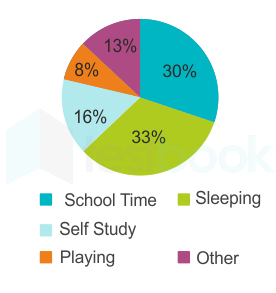
The given pie chart shows use of time in a full day (24 hours) by a student. Study the pie chart and answer the question that follows.

What is the approximate difference between the number of hours used for self study and school time?

  1. AOption (a)

    2 hours

  2. BOption (b)

    4.5 hours

  3. COption (c)

    4 hours

  4. DOption (d)

    3.5 hours

View answer & explanation

Correct answer

Answer: (d)D.

3.5 hours

Why this answer is correct

Given:

Pie chart showing time usage in a day.

School time = 30%

Self study = 16%

Total hours in a day = 24

Formula used:

Percentage of hours = (Percentage/100) × Total hours

Calculation:

Hours used for school = (30/100) × 24 = 7.2 hours

Hours used for self study = (16/100) × 24 = 3.84 hours

Difference in hours = 7.2 - 3.84 = 3.36 hours

∴ Approximate difference between self study and school time = 3.5 hours.

Question 44

Which of the following is a balanced food in itself?

  1. AOption (a)

    Milk

  2. BOption (b)

    Honey

  3. COption (c)

    Meat

  4. DOption (d)

    Pulses

View answer & explanation

Correct answer

Answer: (a)A.

Milk

Why this answer is correct

The correct answer is Milk.

Key Points

  • Milk:
  • Milk is often considered a "balanced food" because it contains a wide range of essential nutrients.
  • It provides a good source of protein, which is crucial for building and repairing tissues.
  • Milk is also rich in calcium, essential for strong bones and teeth.
  • Furthermore, it contains carbohydrates for energy, and fats, which are important for various bodily functions.
  • Milk also provides vitamins like vitamin D, which aids in calcium absorption, and other vitamins like A and B vitamins.
  • While milk may not contain every single nutrient the body needs, it offers a more complete nutritional profile than the other options listed, making it a relatively balanced food source, particularly for infants and young children.
  • It's important to note, however, that individual nutritional needs vary, and some people may have lactose intolerance or other dietary restrictions that make milk unsuitable for them.
  • Also, relying solely on milk for nutrition is not recommended for adults, as a varied diet is crucial for optimal health.

Additional Information

  • Honey:
  • Honey is primarily composed of sugars, mainly fructose and glucose.
  • It provides a quick source of energy.
  • While honey does contain trace amounts of some vitamins and minerals, it is not considered a balanced food.
  • It lacks significant amounts of protein, fats, and many essential vitamins and minerals.
  • Therefore, relying solely on honey for nutrition would lead to nutritional deficiencies.
  • While honey has some potential health benefits, such as soothing a sore throat, it should be consumed in moderation due to its high sugar content.
  • Meat:
  • Meat is a good source of protein and iron, which are essential for building and repairing tissues and for oxygen transport in the blood, respectively.
  • However, meat alone is not a balanced food.
  • It lacks carbohydrates, which are the body's primary source of energy, and it may be high in saturated fats, which can be detrimental to cardiovascular health if consumed in excess.
  • While meat can be a part of a balanced diet, it needs to be combined with other food groups, such as fruits, vegetables, and grains, to provide all the necessary nutrients.
  • Pulses:
  • Pulses, such as lentils, beans, and peas, are a good source of protein and fiber.
  • They also contain some carbohydrates, iron, and other minerals.
  • However, pulses alone are not a balanced food.
  • They lack certain essential vitamins and fats.
  • While pulses are a nutritious food group and an important part of a balanced diet, they need to be combined with other food groups to provide all the necessary nutrients for optimal health.
  • They are often eaten with grains to make a complete protein, but still lack some essential vitamins and fats.

Question 45

All 28 students of a class are standing in a straight row facing north. Jay is 14th from the right end, while Bela is 12th from the left end. How many students stand between Jay and Bela?

  1. AOption (a)

    3

  2. BOption (b)

    4

  3. COption (c)

    1

  4. DOption (d)

    2

View answer & explanation

Correct answer

Answer: (d)D.

2

Why this answer is correct

The logic followed here is:

Position of Jay from the right = 14th

Position of Bela from the left = 12th

Total number of students in the class = 28

Position of Jay from the left = Total number of students - Position of Jay from the right + 1

= 28 - 14 + 1

= 15

So, Jay is 15th from the left.

Number of students between Jay and Bela = Position of Jay from the left - Position of Bela from the left - 1

= 15 - 12 - 1

= 2

Hence, the correct answer is "Option 4".

Question 46

A sum of Rs. 5,000 is divided into two parts. One part is deposited in bank A at simple interest at 5% per annum, and the other part is deposited in bank B at simple interest at 10% per annum. If the total annual interest received is Rs. 325, then the money deposited in bank A was:

  1. AOption (a)

    Rs. 1,500

  2. BOption (b)

    Rs. 5,000

  3. COption (c)

    Rs. 4,000

  4. DOption (d)

    Rs. 3,500

View answer & explanation

Correct answer

Answer: (d)D.

Rs. 3,500

Why this answer is correct

Shortcut Trick

Calculate the effective interest rate for the total sum: (325 ÷ 5000) × 100 = 6.5%.

Apply the Alligation method between the two bank rates: 5% and 10%.

Ratio of amounts (Bank A : Bank B) = (10 − 6.5) : (6.5 − 5) = 3.5 : 1.5 = 7 : 3.

Sum of ratio parts = 7 + 3 = 10 units → ₹5,000.

Value of 7 units (Bank A) = (5000 ÷ 10) × 7 = ₹3,500.

∴ The correct answer is ₹3,500.

Alternate Method

Given:

Total Principal (P) = ₹5,000

Rate of Interest Bank A (R1) = 5%

Rate of Interest Bank B (R2) = 10%

Total Annual Interest = ₹325

Formula used: Simple Interest (SI) = (P × R × T) ÷ 100

Calculations:

⇒ Let the sum deposited in Bank A be ₹x.

⇒ Then, the sum deposited in Bank B = ₹(5000 − x).

⇒ Interest from A + Interest from B = 325

⇒ (x × 5 × 1) ÷ 100 + ((5000 − x) × 10 × 1) ÷ 100 = 325

⇒ 5x + 10(5000 − x) = 32500

⇒ 5x + 50000 − 10x = 32500

⇒ −5x = 32500 − 50000

⇒ −5x = −17500

⇒ x = 17500 ÷ 5 = 3500

∴ The correct answer is ₹3,500.

Additional Information

Alligation Rule

It is used to find the ratio in which two ingredients at given prices/rates must be mixed to produce a mixture at a given mean price/rate.

Simple Interest Components

SI remains constant every year if the principal and rate remain unchanged. Formula: SI = P × R × T ÷ 100.

Effective Rate of Interest

When multiple rates are involved, the Effective Rate = (Total Interest × 100) ÷ (Total Principal × Time).

Question 47

All 20 students of a class are sitting in a straight row facing east. Ram is 8th from the right end and Sita is 16th from the left end. How many students are sitting between Ram and Sita?

  1. AOption (a)

    2

  2. BOption (b)

    8

  3. COption (c)

    3

  4. DOption (d)

    4

View answer & explanation

Correct answer

Answer: (a)A.

2

Why this answer is correct

The logic followed here is:

Position of Ram from the right = 8th

Position of Ram from the left = Total students - Position of Ram from the right + 1

= 20 - 8 + 1

= 13th

Position of Sita from the left = 16th

Number of students sitting between Ram and Sita = Position of Sita from the left - Position of Ram from the left - 1

= 16 - 13 - 1

= 2

Hence, the correct answer is Option 1.

Question 48

Pawl Kut is the greatest of all the festivals celebrated in the state of _________.

  1. AOption (a)

    Kerala

  2. BOption (b)

    Mizoram

  3. COption (c)

    Meghalaya

  4. DOption (d)

    Goa

View answer & explanation

Correct answer

Answer: (b)B.

Mizoram

Why this answer is correct

The correct answer is Mizoram.

Key Points

  • Pawl Kut in Mizoram:
  • Pawl Kut is a significant harvest festival celebrated in the state of Mizoram, India.
  • It's one of the most important festivals for the Mizo people, deeply rooted in their agricultural traditions and cultural heritage.
  • Pawl Kut is traditionally celebrated after the harvest is complete, usually between September and December, although the exact dates can vary from village to village.
  • The festival is associated with thanksgiving for a bountiful harvest and seeking blessings for future prosperity.
  • "Pawl" refers to straw or hay, and "Kut" means festival, so Pawl Kut literally translates to "straw festival," reflecting the importance of agriculture.
  • The celebrations involve various rituals, traditional dances, music, and feasts.
  • People dress in their colorful traditional attire, creating a vibrant and festive atmosphere.
  • Community participation is a key aspect, with everyone coming together to celebrate and share the joy.
  • Pawl Kut serves as a platform for showcasing Mizo culture, preserving traditions, and strengthening community bonds.
  • It's a time for families and friends to reunite, share meals, and celebrate their shared heritage.
  • The festival reflects the close relationship between the Mizo people and their land, highlighting their dependence on agriculture.

Question 49

Each of the digits in the number 46734 is arranged in ascending order from left to right. The position of how many digits will change as compared to that in the original number?

  1. AOption (a)

    2

  2. BOption (b)

    5

  3. COption (c)

    3

  4. DOption (d)

    4

View answer & explanation

Correct answer

Answer: (b)B.

5

Why this answer is correct

Given number: '46734'

After arranging in ascending order:

Digits46734
Ascending order34467

Now,

there are Five digits that will change positions if each of the digits in the number '46734' is arranged in ascending order.

Hence, the correct answer is "Option 2".

Question 50

Refer to the following letter-symbol series and answer the question that follows.

(Left) R∗∗F R ^ * * F V # Y @ Z Y T G B Y S & Z R $ V @ ^ C Y N (Right)

From left how many such letters are there that are immediately preceded by a symbol and immediately followed by a letter?

  1. AOption (a)

    4

  2. BOption (b)

    5

  3. COption (c)

    7

  4. DOption (d)

    3

View answer & explanation

Correct answer

Answer: (d)D.

3

Why this answer is correct

Given series:

R∗∗F R ^ * * F V # Y @ Z Y T G B Y S & Z R $ V @ ^ C Y N

Condition to be checked:

Letters that are immediately preceded by a symbol and immediately followed by a letter.

Symbol → Letter → Letter

R∗∗F R ^ * * F V # Y @ Z Y T G B Y S & Z R $ V @ ^ C Y N

Thus there are three such patterns (@ Z Y, & Z R, ^ C Y) that are following the above conditions.

Hence, "3" is the correct answer.

Mistake Points

Immediately preceded by means immediately before or to come just before.

Immediately followed by means immediately after or to come just after.

Question 51

When we consider biodegradable substances, we see that the common property is that _________.

  1. AOption (a)

    they are not toxic

  2. BOption (b)

    they are all biological in origin

  3. COption (c)

    they are all plant products

  4. DOption (d)

    they are all water-soluble

View answer & explanation

Correct answer

Answer: (b)B.

they are all biological in origin

Why this answer is correct

The correct answer is they are all biological in origin.

Key Points

  • Biodegradable substances possess a chemical structure that allows microorganisms like bacteria and fungi to break them down into simpler, less harmful substances.
  • This decomposition process is a natural biological process that recycles nutrients back into the environment.
  • The key to biodegradability lies in the ability of these microorganisms to produce enzymes capable of breaking the chemical bonds within the biodegradable material.
  • These enzymes essentially act as catalysts, facilitating the breakdown of the substance into smaller molecules that the microorganisms can then use as a food source.
  • Factors influencing biodegradation include temperature, moisture, oxygen availability, and the presence of suitable microorganisms.
  • Different microorganisms have different capabilities, so the rate and extent of biodegradation can vary depending on the specific microbial community present.
  • Natural materials like plant matter (cellulose, lignin), animal products, and food waste are generally biodegradable.
  • These substances are composed of organic molecules that microorganisms have evolved to break down over time.
  • The process of biodegradation plays a crucial role in maintaining ecological balance by preventing the accumulation of organic waste.
  • Composting is a practical application of biodegradation, where organic waste is intentionally decomposed by microorganisms to create nutrient-rich compost.
  • However, not all materials are biodegradable. Synthetic materials like many plastics are designed to resist decomposition, leading to their accumulation in the environment.
  • The problem of plastic pollution highlights the importance of understanding biodegradability and developing biodegradable alternatives.
  • Even biodegradable materials require appropriate conditions for decomposition. If they are disposed of in environments lacking the necessary microorganisms, oxygen, or moisture, they may not break down effectively.
  • "Biodegradable" is not synonymous with "environmentally friendly," as some biodegradable substances can still have negative environmental impacts during their production or decomposition.
  • The complete breakdown of a biodegradable substance results in the formation of carbon dioxide, water, and other naturally occurring substances.
  • This contrasts with non-biodegradable materials, which can persist in the environment for hundreds or even thousands of years.

Question 52

A and B invest in a business in the ratio of 7 ∶ 8 for same time. If 7% of the total profit goes to charity and A's share in profit is Rs. 12,600, then what is the total amount of profit earned? [Give your answer correct to 2 decimal places.]

  1. AOption (a)

    Rs. 28,032.25

  2. BOption (b)

    Rs. 29,032.26

  3. COption (c)

    Rs. 29,025.32

  4. DOption (d)

    Rs. 28,025.32

View answer & explanation

Correct answer

Answer: (b)B.

Rs. 29,032.26

Why this answer is correct

Shortcut Trick

Ratio of profits A : B = 7 : 8 (since time is constant).

Let the total remaining profit after charity be 15 units (7 + 8).

A's share (7 units) = Rs. 12,600 ⇒ 1 unit = Rs. 1,800.

Total remaining profit = 15 × 1,800 = Rs. 27,000.

This Rs. 27,000 represents 93% of total profit (100% − 7% charity).

Total Profit = 27,000 ÷ 0.93 ≈ Rs. 29,032.26.

∴ The correct answer is Rs. 29,032.26.

Alternate Method

Given → Investment Ratio A : B = 7 : 8, Charity = 7%, A's share = Rs. 12,600. Formulas: Profit Ratio = Investment × Time | Total Profit = (Remaining Profit ÷ (100 − Charity%)) × 100.

⇒ Let Total Profit be P. ⇒ Remaining Profit after charity = 0.93P. ⇒ A's share = (7 ÷ (7 + 8)) × 0.93P = 12,600. ⇒ (7 ÷ 15) × 0.93P = 12,600. ⇒ 0.434P = 12,600. ⇒ P = 12,600 ÷ 0.434 ≈ 29,032.258... ⇒ Rounding to two decimal places, we get Rs. 29,032.26.

∴ The correct answer is Rs. 29,032.26.

Additional Information

Partnership Concept

Profit is distributed based on the product of Capital and Time. If time is equal, Profit Ratio = Capital Ratio.

Net Profit Calculation

When a fixed percentage is donated, the partners divide the remaining percentage of the total profit according to their investment ratios.

Question 53

Find the smallest number, which when tripled, will leave the remainder as zero on being divided by 5, 15 and 35.

  1. AOption (a)

    35

  2. BOption (b)

    100

  3. COption (c)

    150

  4. DOption (d)

    70

View answer & explanation

Correct answer

Answer: (a)A.

35

Why this answer is correct

Shortcut Trick

For the remainder to be zero, the number must be a multiple of the LCM of 5, 15, and 35.

LCM of (5, 15, 35) → 5 × 3 × 7 = 105.

Let the smallest number be x. According to the question, 3 × x = 105.

x = 105 ÷ 3 = 35.

∴ The correct answer is 35.

Alternate Method

Given: Divisors are 5, 15, and 35. The tripled number leaves remainder 0.

Formula: Smallest number divisible by a set of numbers is their Least Common Multiple (LCM).

⇒ First, find the LCM of 5, 15, and 35.

⇒ 5 = 51

⇒ 15 = 31 × 51

⇒ 35 = 51 × 71

⇒ LCM = 51 × 31 × 71 = 105.

⇒ Let the required number be x.

⇒ Triple of the number = 3x.

⇒ 3x = 105

⇒ x = 105 ÷ 3

⇒ x = 35.

∴ The correct answer is 35.

Additional Information

LCM (Least Common Multiple)

The smallest positive integer that is evenly divisible by all the numbers in a given set.

Divisibility Rules

A number is divisible by 5 if it ends in 0 or 5. Divisibility by 15 requires divisibility by both 3 and 5.

Remainder Theorem

If a number N is divided by D and leaves a remainder 0, then N is a multiple of D.

Question 54

Two trains of equal length are running on parallel lines in the same direction at speeds of 46 km/h and 36 km/h. The faster train passes the slower train in 36 seconds. The relative speed of these two trains (in m/s) is:

  1. AOption (a)

    (25)/(18)

  2. BOption (b)

    (25)/(7)

  3. COption (c)

    (25)/(8)

  4. DOption (d)

    (25)/(9)

View answer & explanation

Correct answer

Answer: (d)D.

(25)/(9)

Why this answer is correct

Shortcut Trick

Relative Speed in the same direction = Difference of speeds.

Relative Speed = 46 − 36 = 10 km/h.

To convert km/h to m/s, multiply by 5/18.

Relative Speed = 10 × (5/18) = 25/9 m/s.

∴ The correct answer is 25/9 m/s.

Alternate Method

Given:

Speed of faster train (S1) = 46 km/h

Speed of slower train (S2) = 36 km/h

Formula Used:

Relative Speed (Same Direction) = S1 − S2

Conversion factor: 1 km/h = 5/18 m/s

Calculations:

⇒ Relative Speed = 46 km/h − 36 km/h

⇒ Relative Speed = 10 km/h

⇒ Relative Speed in m/s = 10 × (5/18) m/s

⇒ Relative Speed = (10 × 5) ÷ 18

⇒ Relative Speed = 50/18

⇒ Relative Speed = 25/9 m/s

∴ The correct answer is 25/9 m/s.

Additional Information

Relative Speed Direction Rules

When two objects move in the same direction, relative speed is (S1 − S2). When they move in the opposite direction, relative speed is (S1 + S2).

Unit Conversion

To convert km/h to m/s, multiply by 5/18. To convert m/s to km/h, multiply by 18/5.

Train Crossing Distance

When one train completely passes another, the total distance covered is equal to the sum of the lengths of both trains (L1 + L2).

Question 55

A trader owes a merchant Rs. 9,000 due in one year. However, the trader wants to settle the amount after 4 months. If the rate of interest is 6% per annum, then, how much money should he pay? (Give your answer correct to the nearest whole number value.)

  1. AOption (a)

    Rs. 8,654

  2. BOption (b)

    Rs. 8,645

  3. COption (c)

    Rs. 8,688

  4. DOption (d)

    Rs. 8,686

View answer & explanation

Correct answer

Answer: (a)A.

Rs. 8,654

Why this answer is correct

Shortcut Trick

The amount Rs. 9,000 is due in 12 months, but settled in 4 months.

Remaining time (Early payment) = 12 − 4 = 8 months = 2/3 year.

Present Worth (PW) = Amount ÷ (1 + RT/100)

PW = 9000 ÷ (1 + (6 × 2/3)/100) = 9000 ÷ 1.04 = 8653.846...

Rounding to the nearest whole number, we get 8,654.

∴ The correct answer is Rs. 8,654.

Alternate Method

Given:

⇒ Amount due (A) = Rs. 9,000

⇒ Original due date = 12 months

⇒ Settlement date = 4 months

⇒ Rate of interest (R) = 6% per annum

Formula Used:

⇒ Present Worth (PW) = (100 × Amount) ÷ (100 + (Rate × Time left))

Calculations:

⇒ Time for which interest is saved (T) = 12 − 4 = 8 months

⇒ T in years = 8 ÷ 12 = 2/3 years

⇒ PW = (100 × 9000) ÷ (100 + (6 × 2/3))

⇒ PW = 900000 ÷ (100 + 4)

⇒ PW = 900000 ÷ 104

⇒ PW = 8653.84615...

⇒ PW ≈ Rs. 8,654 (nearest whole number)

∴ The correct answer is Rs. 8,654.

Additional Information

True Discount (TD)

It is the interest on the Present Worth for the given time. TD = Amount (A) − Present Worth (PW).

Present Worth Formula

PW = (100 × A) ÷ (100 + R × T). In banking, this value ensures the merchant receives the same value today that would grow to the debt amount by the due date.

Simple Interest vs True Discount

Simple Interest is calculated on the Principal (initial sum), while True Discount is the interest calculated on the Present Worth of a future debt.

Question 56

The conversion of ethanol to acetic acid is an example of:

  1. AOption (a)

    oxidation reaction

  2. BOption (b)

    substitution reaction

  3. COption (c)

    addition reaction

  4. DOption (d)

    reduction reaction

View answer & explanation

Correct answer

Answer: (a)A.

oxidation reaction

Why this answer is correct

The correct answer is oxidation reaction.

Key Points

  • Oxidation Reaction:
  • The conversion of ethanol (C2H5OH) to acetic acid (CH3COOH) involves the oxidation of the alcohol.
  • Oxidation, in this context, refers to the increase in the oxidation state of the carbon atom.
  • In ethanol, the carbon atom bonded to the hydroxyl (-OH) group has a lower oxidation state.
  • During the conversion to acetic acid, this carbon atom gains more bonds to oxygen atoms (one in the carboxyl group -COOH), thus increasing its oxidation state.
  • This process typically involves the use of oxidizing agents, such as potassium permanganate (KMnO4) or potassium dichromate (K2Cr2O7) in acidic conditions.
  • The reaction can be represented in a simplified form: C2H5OH + [O] → CH3COOH + H2O, where [O] represents the oxygen provided by the oxidizing agent.
  • Oxidation reactions are fundamental in organic chemistry and play vital roles in various biological and industrial processes.
  • The complete oxidation of ethanol can also lead to the formation of carbon dioxide and water.

Additional Information

  • Substitution Reaction:
  • A substitution reaction involves the replacement of one atom or group of atoms in a molecule with another atom or group.
  • While some reactions involving alcohols can be substitution reactions, the conversion of ethanol to acetic acid is not a direct substitution.
  • Instead, it involves a change in the functional group, from an alcohol (-OH) to a carboxylic acid (-COOH).
  • Substitution reactions are more commonly observed in reactions involving alkyl halides or aromatic compounds.
  • Addition Reaction:
  • An addition reaction involves the joining of two molecules to form a larger molecule.
  • This typically occurs when one of the molecules contains a multiple bond (double or triple bond).
  • The conversion of ethanol to acetic acid does not involve the addition of atoms across a multiple bond.
  • Instead, it involves the oxidation of the alcohol group.
  • Addition reactions are common with alkenes and alkynes.
  • Reduction Reaction:
  • A reduction reaction involves a decrease in the oxidation state of an atom or molecule.
  • This is the opposite of oxidation.
  • The conversion of ethanol to acetic acid is an oxidation reaction, not a reduction reaction.
  • Reduction reactions often involve the addition of hydrogen atoms or the removal of oxygen atoms.

Question 57

{40 ÷ (25 ÷ 4) × 125} equals:

  1. AOption (a)

    1000

  2. BOption (b)

    625

  3. COption (c)

    225

  4. DOption (d)

    2000

View answer & explanation

Correct answer

Answer: (b)B.

625

Why this answer is correct

Concept:

BODMAS

B = Bracket, O = of, D = divide, M = multiplication, A = addition, S = subtraction.

Solution:

Given,

{40 ÷ (25 ÷ 4) × 125}

⇒ {40 ÷ (32 ÷ 4) × 125}

⇒ {40 ÷ 8 × 125}

⇒ 5 × 125 = 625

Hence the correct answer is Option 2.

Question 58

Carbon makes strong bonds with other elements.

Which of the following is the correct explanation for the given statement?

  1. AOption (a)

    A carbon nucleus holds the shared pairs of electrons strongly due to its small size.

  2. BOption (b)

    A carbon nucleus holds the shared pairs of electrons weakly due to its small size.

  3. COption (c)

    A carbon nucleus holds the shared pairs of electrons strongly due to its large size.

  4. DOption (d)

    A carbon nucleus holds the shared pairs of electrons weakly due to its large size.

View answer & explanation

Correct answer

Answer: (a)A.

A carbon nucleus holds the shared pairs of electrons strongly due to its small size.

Why this answer is correct

The correct answer is A carbon nucleus holds the shared pairs of electrons strongly due to its small size.

Key Points

  • Carbon's Small Size and Strong Electron Attraction:
  • Carbon's nucleus, being relatively small, exerts a strong attractive force on the shared pairs of electrons in covalent bonds.
  • This strong attraction is due to the concentrated positive charge of the protons within the small nucleus.
  • The electrons in the inner shells are held very tightly, and even the valence electrons, involved in bonding, experience a significant pull.
  • This strong nuclear attraction contributes to the high bond strength observed in carbon compounds.
  • Smaller atoms generally have a stronger pull on their valence electrons compared to larger atoms.
  • The compact nature of the carbon atom also minimizes electron-electron repulsion, allowing for closer proximity of the shared electrons to the nucleus.
  • This close proximity further enhances the attractive force between the nucleus and the bonding electrons.
  • The strong hold on shared electrons is crucial for the formation of stable covalent bonds, which are the basis of a vast array of organic molecules.
  • Carbon's ability to form strong covalent bonds is a key factor in its unique role in the chemistry of life.
  • The strength of carbon-carbon bonds allows for the formation of long chains and complex structures, essential for biological macromolecules like proteins, carbohydrates, and DNA.
  • Carbon's small size also facilitates the formation of multiple bonds (double and triple bonds), further increasing the diversity of carbon compounds.
  • The ability to form strong single, double, and triple bonds contributes to the stability and variety of carbon-based molecules.
  • The strong attraction of the carbon nucleus for electrons also influences the polarity of bonds.

Question 59

Under which amendment in The Constitutional Act 1992 did the Panchayati Raj Institutions receive their constitutional status?

  1. AOption (a)

    75th Amendment

  2. BOption (b)

    70th Amendment

  3. COption (c)

    73rd Amendment

  4. DOption (d)

    65th Amendment

View answer & explanation

Correct answer

Answer: (c)C.

73rd Amendment

Why this answer is correct

The correct answer is 73rd Amendment.

Key Points

  • 73rd Amendment:
  • The 73rd Amendment to the Constitution of India, enacted in 1992, granted constitutional status to Panchayati Raj Institutions (PRIs).
  • This amendment is a landmark in the history of local self-governance in India.
  • It mandated the establishment of a three-tier system of panchayats at the village, intermediate (block), and district levels.
  • The 73rd Amendment also provided for regular elections to the panchayats, ensuring democratic representation.
  • It reserved seats for Scheduled Castes, Scheduled Tribes, and women, promoting inclusivity and social justice.
  • The amendment empowered the panchayats with specific powers and responsibilities for local planning and development.
  • It aimed to strengthen grassroots democracy and promote greater participation of people in local governance.
  • This amendment has significantly transformed the landscape of rural governance in India.

Additional Information

  • 75th Amendment:
  • The 75th Amendment to the Constitution of India deals with rent control legislation.
  • It aimed to provide for the establishment of Rent Tribunals to adjudicate disputes relating to rent.
  • This amendment is not related to Panchayati Raj Institutions.
  • 70th Amendment:
  • The 70th Amendment to the Constitution of India pertains to the voting rights of members of the Legislative Assemblies of Union Territories in the election of the President of India.
  • It is not connected to Panchayati Raj.
  • 65th Amendment:
  • The 65th Amendment to the Constitution of India related to the reservation of seats for Scheduled Castes and Scheduled Tribes in the House of the People (Lok Sabha) and in the State Legislative Assemblies.
  • While it addresses representation, it's not the amendment that granted constitutional status to PRIs.

Question 60

Mining causes pollution because of the large amount of:

  1. AOption (a)

    ore

  2. BOption (b)

    slag

  3. COption (c)

    sludge

  4. DOption (d)

    slurry

View answer & explanation

Correct answer

Answer: (b)B.

slag

Why this answer is correct

The correct answer is slag.

Key Points

  • Slag:
  • Slag is a byproduct of the smelting process, which is used to extract metals from their ores.
  • It's a glassy, stony waste material formed from the impurities in the ore that combine with fluxing agents during smelting.
  • Large quantities of slag are produced during mining operations, and its disposal can be a significant environmental problem.
  • Slag often contains heavy metals and other potentially harmful substances that can leach into the soil and water, causing pollution.
  • Improperly managed slag heaps can also generate dust, contributing to air pollution.
  • The sheer volume of slag produced makes it a major contributor to pollution from mining activities.
  • Modern practices aim to utilize slag in some applications, like road construction or cement production, to mitigate its environmental impact, but large quantities still require disposal.

Additional Information

  • Ore: 
  • Ore is the raw material from which metals are extracted.
  • While the extraction process from ore generates waste, the ore itself isn't the primary cause of pollution.
  • The environmental impact comes from the processes used to separate the desired metal from the ore, which produce byproducts like slag.
  • Sludge:
  • Sludge is a semi-solid mixture of solids and liquids, often a byproduct of wastewater treatment or industrial processes.
  • While some mining operations might produce sludge, it's not the primary pollutant associated with mining in general.
  • Sludge is more often associated with other industries.
  • Slurry:
  • Slurry is a mixture of finely ground solid particles in a liquid, often water.
  • While slurries can be involved in some mining processes (for example, transporting ore), they are not the main source of pollution.
  • Spills of slurry can cause localized pollution, but the large-scale pollution from mining is more strongly linked to the waste products of the smelting process, like slag.

Question 61

If 12600 = p3 × q2 × r2 × s1, where p, q, r and s are consecutive prime numbers in ascending order, then what is the value of (3p + 2q - r + s)?

  1. AOption (a)

    12

  2. BOption (b)

    14

  3. COption (c)

    13

  4. DOption (d)

    17

View answer & explanation

Correct answer

Answer: (b)B.

14

Why this answer is correct

Shortcut Trick

Identify prime factors of 12600 in ascending order.

12600 = 23 × 32 × 52 × 71

Comparing with p3 × q2 × r2 × s1: p=2, q=3, r=5, s=7.

Value = 3(2) + 2(3) − 5 + 7 = 6 + 6 − 5 + 7 = 14.

∴ The correct answer is 14.

Alternate Method

Given: 12600 = p3 × q2 × r2 × s1 where p, q, r, s are consecutive prime numbers.

⇒ Prime factorization of 12600:

⇒ 12600 = 2 × 6300 = 2 × 2 × 3150 = 2 × 2 × 2 × 1575

⇒ 1575 = 3 × 525 = 3 × 3 × 175 = 3 × 3 × 5 × 35 = 3 × 3 × 5 × 5 × 7

⇒ 12600 = 23 × 32 × 52 × 71

⇒ Since p, q, r, s are ascending primes: p=2, q=3, r=5, s=7.

⇒ Calculation: (3p + 2q − r + s) = 3(2) + 2(3) − 5 + 7

⇒ 6 + 6 − 5 + 7 = 14

∴ The correct answer is 14.

Additional Information

Prime Factorization

Every composite number can be expressed as a product of powers of unique prime numbers (Fundamental Theorem of Arithmetic).

Consecutive Prime Numbers

The sequence of primes begins with 2, 3, 5, 7, 11, 13, 17, 19, etc. 2 is the only even prime number.

Number of Factors

If N = ap × bq × cr, then the total number of factors is (p+1)(q+1)(r+1).

Question 62

Three statements are followed by three conclusions numbered I, II and III. You have to consider these statements to be true, even if they seem to be at variance with commonly known facts. Decide which of the given conclusions logically follow(s) from the given statements.

Statements:

Few spiders are caterpillars

No caterpillar is a grasshopper

All grasshoppers are bedbugs

Conclusions:

I. Some bedbugs are not caterpillars

II. All caterpillars are spiders

III. All bedbugs are grasshoppers

  1. AOption (a)

    Only conclusion II follows

  2. BOption (b)

    None of the conclusions follow

  3. COption (c)

    Either conclusion I or III follows

  4. DOption (d)

    Only conclusion I follows

View answer & explanation

Correct answer

Answer: (d)D.

Only conclusion I follows

Why this answer is correct

The least possible Venn diagram for the given statements is as shown below :

Conclusions:

I. Some bedbugs are not caterpillars → Follow (As no caterpillar is a grasshopper and all grasshoppers are bedbugs. As whole grasshoppers comes in bedbugs and cannot be caterpillars, therefore it is true.)

II. All caterpillars are spiders → Does not follow (As Few spiders are caterpillars. So it is possible but not definite.)

III. All bedbugs are grasshoppers → Does not follow (As all grasshoppers are bedbugs. So it is possible but not definite.)

∴ Here, Only conclusion I follows.​

Hence, the correct answer is "Option 4".

Question 63

A class consisting of 30 students took a competitive exam. 18 of these students got an average of 90 marks and the remaining students of this class got an average of 80 marks. What is the average score of the class as a whole?

  1. AOption (a)

    86

  2. BOption (b)

    76

  3. COption (c)

    82

  4. DOption (d)

    92

View answer & explanation

Correct answer

Answer: (a)A.

86

Why this answer is correct

Shortcut Trick

Ratio of number of students = 18 : 12 = 3 : 2 and assumed base average = 80.

Deviation for the first group = 90 − 80 = 10.

Net deviation distributed over total = (3 × 10) ÷ (3 + 2) = 30 ÷ 5 = 6.

Combined Average = Base average + Net deviation = 80 + 6 = 86 marks.

∴ The correct answer is 86 marks.

Alternate Method

Given:

Total number of students = 30

Number of students with an average of 90 marks = 18

Number of remaining students = 30 − 18 = 12

Average marks of the remaining 12 students = 80

Formula Used:

Combined Average = (n1 × A1 + n2 × A2) ÷ (n1 + n2)

Ratio = 3 Ratio = 2

18 Students Avg: 90

12 Students Avg: 80

Total 30 Students → Avg = 86

Calculations:

⇒ Total marks of the first 18 students = 18 × 90 = 1620

⇒ Total marks of the remaining 12 students = 12 × 80 = 960

⇒ Total sum of marks of all 30 students = 1620 + 960 = 2580

⇒ Average score of the class = 2580 ÷ 30

⇒ Average score of the class = 86 marks

∴ The correct answer is 86 marks.

Additional Information

Weighted Average

It is used to find the average of two or more groups with different numbers of items. The formula is Aw = (n1A1 + n2A2) ÷ (n1 + n2).

Deviation Method

To calculate the average quickly, assume a base average and calculate the net deviation. Formula: New Average = Base + (Sum of Deviations ÷ Total Count).

Rule of Alligation

This method visually connects the averages of two groups to the combined average. The ratio of the quantities is inversely proportional to the differences in their averages.

Question 64

When a Tirthankara leaves a mortal body, it is known as ________.

  1. AOption (a)

    Tapa Kalyana

  2. BOption (b)

    Siddhashila

  3. COption (c)

    Janma Kalyana

  4. DOption (d)

    Nirvana

View answer & explanation

Correct answer

Answer: (d)D.

Nirvana

Why this answer is correct

The correct answer is Nirvana.

Key Points

  • Nirvana:
  • In Jainism, when a Tirthankara, a spiritual teacher who has conquered the cycle of birth and death (samsara) and shown the path to liberation, leaves their mortal body, it is known as Nirvana or Moksha.
  • This signifies the complete liberation of the soul from all karmic bondage and its attainment of a state of eternal bliss and freedom.
  • Nirvana is the ultimate goal of Jainism.
  • It is achieved through the elimination of all karmas, which are accumulated through actions, thoughts, and words.
  • A Tirthankara, having achieved Kevala Jnana (omniscience), preaches the path to liberation.
  • Upon reaching the end of their lifespan, they relinquish their physical body, achieving Nirvana.
  • This is not considered death in the conventional sense, but rather a final release from the cycle of rebirth.

Additional Information

  • Tapa Kalyana:
  • Tapa Kalyana refers to the auspicious event of a Tirthankara's renunciation of worldly life and the adoption of asceticism.
  • This is a significant step on the path to becoming a Tirthankara.
  • It's not related to the Tirthankara leaving their mortal body.
  • Siddhashila:
  • Siddhashila is the abode of the Siddhas, the liberated souls who have achieved Nirvana.
  • It is considered to be beyond the three realms of existence (lower world, middle world, and upper world) and is the ultimate destination for those who have broken free from the cycle of birth and death.
  • It's the place where the soul resides after achieving Nirvana, not the event of leaving the body.
  • Janma Kalyana:
  • Janma Kalyana refers to the auspicious birth of a Tirthankara.
  • This is one of the five major auspicious events (Panch Kalyanakas) in a Tirthankara's life.
  • It is a joyous occasion celebrated by Jains.
  • It precedes the Tirthankara's renunciation and eventual attainment of Nirvana.

Question 65

Find area of a triangle whose base measures 126.4 cm and height 54.8 cm.

  1. AOption (a)

    9267.72 cm2

  2. BOption (b)

    3463.36 cm2

  3. COption (c)

    3343.36 cm2

  4. DOption (d)

    6926.72 cm2

View answer & explanation

Correct answer

Answer: (b)B.

3463.36 cm2

Why this answer is correct

Shortcut Trick

Direct formula for Area of Triangle = 0.5 × Base × Height.

Area = 0.5 × 126.4 × 54.8

Area = 63.2 × 54.8 = 3463.36 cm2.

∴ The correct answer is 3463.36 cm2.

Alternate Method

Given:

Base (b) = 126.4 cm

Height (h) = 54.8 cm

Formula Used:

Area of a Triangle = (1/2) × Base × Height

Calculations:

⇒ Area = (1/2) × 126.4 × 54.8

⇒ Area = 63.2 × 54.8

⇒ Area = 3463.36 cm2

∴ The correct answer is 3463.36 cm2.

Additional Information

Heron's Formula

Used when all three sides (a, b, c) are known: Area = √(s(s−a)(s−b)(s−c)), where s = (a+b+c)/2.

Equilateral Triangle Area

For a triangle with side 'a', Area = (√3/4) × a2.

Right Angled Triangle

Area = (1/2) × product of the two sides forming the right angle.

Question 66

In which year was the 11th Fundamental Duty added to the list of Fundamental Duties in the Indian Constitution?

  1. AOption (a)

    2004

  2. BOption (b)

    1999

  3. COption (c)

    2002

  4. DOption (d)

    2000

View answer & explanation

Correct answer

Answer: (c)C.

2002

Why this answer is correct

The correct answer is 2002.

Key Points

The 11th Fundamental Duty was added to the Indian Constitution in 2002.

  • Addition of the 11th Fundamental Duty: The 11th Fundamental Duty was added through the 86th Constitutional Amendment Act of 2002.
  • Original List of Fundamental Duties: The Indian Constitution initially did not contain any Fundamental Duties. These were added later.
  • Inclusion of Fundamental Duties: The Fundamental Duties were incorporated into the Constitution through the 42nd Amendment in 1976.
  • Number of Original Fundamental Duties: Initially, ten Fundamental Duties were added to the Constitution.
  • Article 51A: These duties are listed in Article 51A of the Indian Constitution, which forms a part of Part IVA.
  • Significance of Fundamental Duties: Fundamental Duties are moral obligations of citizens towards the nation.
  • Enforceability: Unlike Fundamental Rights, Fundamental Duties are not directly enforceable by a court of law. However, they serve as a guide to responsible citizenship.
  • The 11th Fundamental Duty: The 11th Fundamental Duty, added in 2002, states: "It shall be the duty of every citizen of India who is a parent or guardian to provide opportunities for education to his child or ward between the age of six and fourteen years."
  • Focus on Education: This duty emphasizes the importance of education for children in the specified age group.
  • Parental Responsibility: It places a responsibility on parents or guardians to ensure that children receive basic education.
  • Connection to Right to Education: This duty is closely linked to the Right to Education, which was also made a Fundamental Right through the same 86th Amendment.
  • Complementary Nature: Fundamental Rights and Fundamental Duties are complementary to each other. Rights and duties are two sides of the same coin.
  • Balanced Approach: The inclusion of Fundamental Duties aimed to create a balance between the rights and obligations of citizens.
  • Importance of Citizen Participation: Fundamental Duties highlight the role of citizens in contributing to the progress and development of the nation.
  • Awareness and Implementation: Creating awareness about Fundamental Duties is crucial for their effective implementation.

Question 67

A statement is given below, followed by four conclusions given in the options. Find out which conclusion is true based on the given statement.

Statement: A > S ≥ D > F ≤ G < H

  1. AOption (a)

    S > F

  2. BOption (b)

    S = H

  3. COption (c)

    A ≥ G

  4. DOption (d)

    D > G

View answer & explanation

Correct answer

Answer: (a)A.

S > F

Why this answer is correct

Given Statement: A > S ≥ D > F ≤ G < H

Now,

Conclusions:

Option 1: S > F → True (S ≥ D > F It gives S > F)

Option 2: S = H → False (S ≥ D > F ≤ G < H, there is no direct relation between S and H)

Option 3: A ≥ G → False (A > S ≥ D > F ≤ G, there is no direct relation between A and G)

Option 4: D > G → False (D > F ≤ G, there is no direct relation between D and G)

Hence, the correct answer is "Option 1".

Question 68

If the ratio of two exterior angles on the same side of a transversal line intersecting the two parallel lines is 7 ∶ 5, then how much more is the larger of these two exterior angles than the smaller one?

  1. AOption (a)

    60º

  2. BOption (b)

    30º

  3. COption (c)

    45º

  4. DOption (d)

    75º

View answer & explanation

Correct answer

Answer: (b)B.

30º

Why this answer is correct

Shortcut Trick

Ratio of exterior angles on the same side = 7 : 5

Sum of these angles = 180º

Total units = 7 + 5 = 12 units

12 units = 180º ⇒ 1 unit = 15º

Difference = (7 − 5) units = 2 units = 2 × 15º = 30º

∴ The correct answer is 30º.

Alternate Method

Given: Ratio of angles = 7 : 5, Lines are parallel.

Formula Used: Consecutive exterior angles (exterior angles on the same side of a transversal) are supplementary, meaning their sum is 180º.

Calculations:

⇒ Let the two exterior angles be 7x and 5x.

⇒ 7x + 5x = 180º

⇒ 12x = 180º

⇒ x = 180º ÷ 12 = 15º

⇒ Larger angle = 7 × 15º = 105º

⇒ Smaller angle = 5 × 15º = 75º

⇒ Difference = 105º − 75º = 30º

∴ The correct answer is 30º.

Additional Information

Question 69

Which of the following ports is located along the east coast of India?

  1. AOption (a)

    Kandla

  2. BOption (b)

    JLN port Nhava Sheva

  3. COption (c)

    Paradip

  4. DOption (d)

    Mazagaon

View answer & explanation

Correct answer

Answer: (c)C.

Paradip

Why this answer is correct

The correct answer is Paradip.

Key Points

  • Paradip:
  • Paradip Port is a major seaport located in the state of Odisha on the eastern coast of India.
  • It is situated at the confluence of the Mahanadi River and the Bay of Bengal.
  • The port handles a variety of cargo, including iron ore, coal, fertilizers, and petroleum products.
  • Paradip Port plays a crucial role in the region's trade and economic development.
  • It serves as a gateway for both import and export activities.
  • The port's strategic location on the east coast makes it an important hub for maritime trade with Southeast Asian countries and beyond.
  • It has been developed to handle large vessels and increasing cargo volumes.

Additional Information

  • Kandla:
  • Kandla Port, officially known as Deendayal Port, is a seaport located in the Kutch district of Gujarat, on the western coast of India.
  • It is a tidal port situated in the Gulf of Kutch.
  • Kandla is a major port serving the western hinterland of India.
  • It is known for handling a variety of cargo and is a significant contributor to the country's maritime trade.
  • JLN port Nhava Sheva:
  • The Jawaharlal Nehru Port Trust (JNPT), also known as Nhava Sheva, is a large container port located near Mumbai, Maharashtra, on the western coast of India.
  • It is one of India's busiest container ports and plays a vital role in international trade.
  • JNPT handles a significant portion of India's container traffic.
  • Mazagaon:
  • Mazagaon Dock is located in Mumbai, Maharashtra, also on the western coast of India.
  • It's primarily a shipbuilding and repair yard, not a major cargo port like the others listed.
  • While it has maritime significance, it's not known as a major port for general cargo handling.

Question 70

Refer to the given number, symbol series and answer the question that follows.

(Left) % Ω 8 3 1 $ 2 4 @ 6 7 @ 1 & & $ 5 # 2 8 @ 3 % & $ 3 (Right)

How many such symbols are there (from left to right) which are immediately followed by an even number and also immediately preceded by an odd number?

  1. AOption (a)

    1

  2. BOption (b)

    4

  3. COption (c)

    3

  4. DOption (d)

    2

View answer & explanation

Correct answer

Answer: (d)D.

2

Why this answer is correct

Given series:

% Ω 8 3 1 $ 2 4 @ 6 7 @ 1 & & $ 5 # 2 8 @ 3 % & $ 3

Condition to be checked:

Symbols that are immediately followed by an even number and immediately preceded by an odd number.

Odd number → Symbol → Even number

% Ω 8 3 1 $ 2 4 @ 6 7 @ 1 & & $ 5 # 2 8 @ 3 % & $ 3

Thus, there is one such pattern ( 1 $ 2 5 # 2) that is following the above conditions.

Hence, "2" is the correct answer.

Mistake Points

Immediately preceded by means immediately before or to come just before.

Immediately followed by means immediately after or to come just after.

Question 71

A copper wire has radius 0.5 mm and length 100 m. If the resistivity of the material is 2.5 × 10⁻⁸ ohm-m, then the resistance of the wire is ________.

  1. AOption (a)

    10π ohm

  2. BOption (b)

    1000π ohm

  3. COption (c)

    1000/π ohm

  4. DOption (d)

    10/π ohm

View answer & explanation

Correct answer

Answer: (d)D.

10/π ohm

Why this answer is correct

The Correct answer is 10/π ohm.

Given:

Radius r = 0.5 mm = 0.5 × 10-3m

Length L = 100 m

Resistivity ρ = 2.5 × 10⁻⁸ ohm-m

Concept:

To calculate the resistance of the copper wire, we use the formula for the resistance of a cylindrical conductor:

R =ρLA\frac{\rho L}{A}

Where:

  • R is the resistance
  • ρ is the resistivity of the material
  • L is the length of the wire
  • A is the cross-sectional area of the wire

Calculation

First, we calculate the cross-sectional area A of the wire. The wire has a circular cross-section, so:

A = πr2

A = π( 0.5 × 10-3m)2

A = 0.25π × 10-6 

Now Calculation R

R =  2.5×10−8×1000.25π×10−6\frac{2.5 × 10^{-8}\times 100}{0.25π\times 10^{-6}} ohm

R = 2.5×1060.25π×10−6\frac{ 2.5 × 10^6}{0.25π\times10^{-6}} ohm

R = 2.5 /0.25π ohm

R = 10/π

Hence, the correct answer is: Option 4: R = 10/π ohm

Question 72

Six friends are sitting around a round table facing the centre with equal distances between two neighbours. Sarah is sitting to the immediate left of Laura. Ron is sitting second to the right of Tyler. Sarah is sitting third to the left of Adam. Laura is sitting to the immediate left of Tyler. Tessa is sitting to the immediate right of Ron. Who is sitting to the immediate left of Sarah?

  1. AOption (a)

    Tyler

  2. BOption (b)

    Tessa

  3. COption (c)

    Laura

  4. DOption (d)

    Ron

View answer & explanation

Correct answer

Answer: (b)B.

Tessa

Why this answer is correct

Given: Six friends are sitting around a round table facing the centre with equal distances between two neighbours.

1) Sarah is sitting to the immediate left of Laura.

2) Sarah is sitting third to the left of Adam. 

3) Laura is sitting to the immediate left of Tyler.

4) Ron is sitting second to the right of Tyler. 

5) Tessa is sitting to the immediate right of Ron.

Thus, according to the final arrangement, Tessa is sitting to the immediate left of Sarah.

Hence, "Option 2" is the correct answer.

Question 73

Simplify the given expression.

x2+3x−10x2−25×x2+3x+2x2−4×x(x+2)(x+1)2+(x+1)\rm\frac{x^2+3 x−10}{x^2−25} \times \frac{x^2+3 x+2}{x^2−4} \times \frac{x(x+2)}{(x+1)^2+(x+1)}

  1. AOption (a)

    xx−5\rm\frac{x}{x−5}

  2. BOption (b)

    xx+5\rm\frac{x}{x+5}

  3. COption (c)

    x−5x\rm\frac{x−5}{x}

  4. DOption (d)

    x+5x\rm\frac{x+5}{x}

View answer & explanation

Correct answer

Answer: (a)A.

xx−5\rm\frac{x}{x−5}

Why this answer is correct

Shortcut Trick

Factorize each algebraic part and cancel out common terms appearing in both numerator and denominator.

((x+5)(x−2))/((x+5)(x−5)) × ((x+2)(x+1))/((x+2)(x−2)) × (x(x+2))/((x+1)(x+2))

Cancel (x+5), (x−2), (x+2), (x+1), and the second (x+2) from numerators and denominators.

Only x remains in the numerator and (x−5) remains in the denominator.

∴ The correct answer is x/(x−5).

Alternate Method

Given: ((x2+3x−10)/(x2−25)) × ((x2+3x+2)/(x2−4)) × ((x(x+2))/((x+1)2+(x+1)))

Formula Used: a2 − b2 = (a − b)(a + b) and Middle Term Splitting for quadratic factorization.

Factorization Steps:

⇒ x2 + 3x − 10 = x2 + 5x − 2x − 10 = x(x + 5) − 2(x + 5) = (x + 5)(x − 2)

⇒ x2 − 25 = x2 − 52 = (x − 5)(x + 5)

⇒ x2 + 3x + 2 = x2 + 2x + x + 2 = x(x + 2) + 1(x + 2) = (x + 2)(x + 1)

⇒ x2 − 4 = x2 − 22 = (x − 2)(x + 2)

⇒ (x + 1)2 + (x + 1) = (x + 1)[(x + 1) + 1] = (x + 1)(x + 2)

Substituting back into the expression:

⇒ [((x + 5)(x − 2)) / ((x − 5)(x + 5))] × [((x + 2)(x + 1)) / ((x − 2)(x + 2))] × [x(x + 2) / ((x + 1)(x + 2))]

⇒ [(x − 2) / (x − 5)] × [(x + 1) / (x − 2)] × [x / (x + 1)]

⇒ [1 / (x − 5)] × [1 / 1] × [x / 1]

⇒ x / (x − 5)

∴ The correct answer is x/(x−5).

Additional Information

Difference of Squares

The identity a2 − b2 = (a − b)(a + b) is fundamental for simplifying rational expressions containing binomial squares.

Quadratic Factorization

For a quadratic ax2 + bx + c, we find two numbers that multiply to ac and add to b to split the middle term.

Rational Expression Constraints

A rational expression is defined only when the denominator is not equal to zero (e.g., x ≠ 5, −5, 2, −2, −1).

Question 74

Study the given line graph and answer the following question.

The given line graph depicts the number of members in two gyms A and B, in the months of April and May.

The number of members in Gym B in April is what percentage more than the number of members in Gym A in May?

  1. AOption (a)

    20%

  2. BOption (b)

    10%

  3. COption (c)

    40%

  4. DOption (d)

    12%

View answer & explanation

Correct answer

Answer: (a)A.

20%

Why this answer is correct

Concept 

The formula for percentage increase = ( Difference / Original Number ) × 100

Given,

The number of members in Gym B in April = 48

The number of members in Gym A in May = 40

Difference = 48 - 40 = 8

Here, the original number is the number of members in Gym A in May, which is 40.

So, percentage increase = ( Difference / Original Number ) × 100

⇒ ( 8 / 40 ) × 100 = 0.2 × 100 = 20%

Question 75

The respiratory pigment, haemoglobin is present in:

  1. AOption (a)

    white blood corpuscles

  2. BOption (b)

    red blood corpuscles

  3. COption (c)

    blood platelets

  4. DOption (d)

    blood plasma

View answer & explanation

Correct answer

Answer: (b)B.

red blood corpuscles

Why this answer is correct

The correct answer is red blood corpuscles.

Key Points

  • Red Blood Corpuscles (Erythrocytes):
  • Hemoglobin is a protein contained within red blood corpuscles (erythrocytes).
  • These cells are the most abundant cells in the blood and are responsible for transporting oxygen from the lungs to the body's tissues.
  • Hemoglobin is the molecule that actually binds to the oxygen.
  • Each hemoglobin molecule can carry up to four oxygen molecules.
  • The iron in hemoglobin gives red blood cells their characteristic red color.
  • Red blood cells are biconcave discs, which increases their surface area for gas exchange.
  • They lack a nucleus, mitochondria, and other organelles, which allows for more space to accommodate hemoglobin.
  • Red blood cells are produced in the bone marrow.

Additional Information

  • White Blood Corpuscles (Leukocytes):
  • White blood corpuscles are part of the immune system and help defend the body against infections and diseases.
  • They are not involved in oxygen transport, and they do not contain hemoglobin.
  • There are different types of white blood cells, each with specific functions in the immune response.
  • Blood Platelets (Thrombocytes):
  • Blood platelets are small, irregular cells that play a crucial role in blood clotting (hemostasis).
  • They are not involved in oxygen transport and do not contain hemoglobin.
  • When a blood vessel is damaged, platelets clump together to form a plug, helping to stop bleeding.
  • Blood Plasma:
  • Blood plasma is the liquid component of blood, making up about 55% of its total volume.
  • It is a straw-colored fluid that carries various substances, including nutrients, hormones, and proteins.
  • While plasma carries some dissolved oxygen, the vast majority of oxygen in the blood is transported by hemoglobin within red blood cells.
  • Plasma does not contain hemoglobin itself.

Question 76

Which of the following properties remain same while moving down the group in the periodic table?

  1. AOption (a)

    Non-metallic character

  2. BOption (b)

    Valency

  3. COption (c)

    Metallic character

  4. DOption (d)

    Atomic size

View answer & explanation

Correct answer

Answer: (b)B.

Valency

Why this answer is correct

The correct answer is Valency.

Key Points

  • Valency:
  • Valency, which refers to the number of chemical bonds an element can form, generally remains the same as you move down a group in the periodic table.
  • Elements within the same group have the same number of valence electrons (electrons in the outermost shell).
  • Since chemical bonding primarily involves valence electrons, elements in a group tend to exhibit similar valencies.
  • For example, elements in Group 17 (halogens) all have seven valence electrons and typically have a valency of 1, as they tend to gain one electron to achieve a stable octet.
  • While there can be exceptions in some heavier elements due to the involvement of d-orbitals, the general trend for valency is to remain consistent within a group.

Additional Information

  • Non-metallic character:
  • Non-metallic character generally decreases as you move down a group.
  • This is because the valence electrons are further from the nucleus, making it easier for them to be lost, which is a characteristic of metallic behavior.
  • Metallic character:
  • Metallic character generally increases as you move down a group.
  • As explained above, the valence electrons become less tightly held, and the atoms tend to lose electrons more readily, a characteristic of metals.
  • Atomic size:
  • Atomic size generally increases as you move down a group.
  • This is because new electron shells are being added, increasing the distance between the nucleus and the outermost electrons.

Question 77

cot θ (1cosecθ−1+1cosecθ+1)\left(\frac{1}{\text{cosec} \theta−1}+\frac{1}{\text{cosec} \theta+1}\right) × (sin θ − cosec θ) (cos θ − sec θ), 0°< θ < 90°, is equal to:

  1. AOption (a)

    cosec θ

  2. BOption (b)

    2 cos θ

  3. COption (c)

    2 sin θ

  4. DOption (d)

    sec θ

View answer & explanation

Correct answer

Answer: (c)C.

2 sin θ

Why this answer is correct

Shortcut Trick

Put θ = 45° as it lies between 0° and 90°.

cot 45° = 1, cosec 45° = √2, sin 45° = 1/√2, cos 45° = 1/√2, sec 45° = √2.

Expression = 1 × [1/(√2−1) + 1/(√2+1)] × (1/√2 − √2) × (1/√2 − √2)

Expression = [(√2+1 + √2−1) / (2−1)] × (−1/√2) × (−1/√2) = 2√2 × 1/2 = √2.

Checking options for θ = 45°: (3) 2 sin 45° = 2 × (1/√2) = √2.

∴ The correct answer is 2 sin θ.

Alternate Method

Given: cot θ [1/(cosec θ − 1) + 1/(cosec θ + 1)] × (sin θ − cosec θ)(cos θ − sec θ)

⇒ Part 1: cot θ [(cosec θ + 1 + cosec θ − 1) / (cosec2θ − 1)]

⇒ Since cosec2θ − 1 = cot2θ, Part 1 = cot θ [2 cosec θ / cot2θ] = 2 cosec θ / cot θ = 2 / cos θ

⇒ Part 2: (sin θ − 1/sin θ)(cos θ − 1/cos θ) = [(sin2θ − 1)/sin θ] × [(cos2θ − 1)/cos θ]

⇒ Part 2 = (−cos2θ / sin θ) × (−sin2θ / cos θ) = sin θ cos θ

⇒ Total Expression = (2 / cos θ) × (sin θ cos θ) = 2 sin θ

∴ The correct answer is 2 sin θ.

Additional Information

Fundamental Trigonometric Identities

sin2θ + cos2θ = 1 | 1 + tan2θ = sec2θ | 1 + cot2θ = cosec2θ

Reciprocal Relations

cosec θ = 1/sin θ | sec θ = 1/cos θ | cot θ = 1/tan θ = cos θ/sin θ

Value Substitution Method

For identities involving tan, cot, sec, or cosec, θ = 45° is usually the easiest value to substitute provided no term becomes undefined.

Question 78

If a an b are the roots of the equation x2 + 5x + 4 = 0, then the value of a3+b3a2+b2−4\rm\frac{a^3+b^3}{a^2+b^2−4} is:

  1. AOption (a)

    −4

  2. BOption (b)

    −5

  3. COption (c)

    −6

  4. DOption (d)

    −7

View answer & explanation

Correct answer

Answer: (b)B.

−5

Why this answer is correct

Shortcut Trick

Find the roots of the quadratic equation x2 + 5x + 4 = 0 by factoring: (x + 4)(x + 1) = 0.

The roots are a = −4 and b = −1.

Substitute these values: Numerator = (−4)3 + (−1)3 = −64 − 1 = −65.

Denominator = (−4)2 + (−1)2 − 4 = 16 + 1 − 4 = 13.

The final value is −65 ÷ 13 = −5.

∴ The correct answer is −5.

Alternate Method

Given: Equation x2 + 5x + 4 = 0 with roots a and b.

Formula Used: For a quadratic equation ax2 + bx + c = 0, sum of roots (a + b) = −b/a and product of roots (ab) = c/a.

⇒ a + b = −5 ÷ 1 = −5

⇒ ab = 4 ÷ 1 = 4

⇒ a2 + b2 = (a + b)2 − 2ab = (−5)2 − 2(4) = 25 − 8 = 17

⇒ a3 + b3 = (a + b)(a2 − ab + b2) = (−5)(17 − 4) = −5 × 13 = −65

⇒ Expression = (a3 + b3) ÷ (a2 + b2 − 4)

⇒ Value = −65 ÷ (17 − 4) = −65 ÷ 13 = −5

∴ The correct answer is −5.

Additional Information

Nature of Roots

For a quadratic equation, the discriminant D = b2 − 4ac determines the nature of roots. Since 25 − 16 = 9 (a perfect square), roots are rational and distinct.

Algebraic Identities

The identity a3 + b3 = (a + b)3 − 3ab(a + b) is extremely useful for finding the sum of cubes directly from the sum and product of roots.

Relationship of Coefficients

If the quadratic is x2 + Sx + P = 0, then S = −(sum of roots) and P = product of roots.

Question 79

Clouds can be seen as white because the small water droplets of the cloud _________.

  1. AOption (a)

    scatter very high amount of red and blue wavelength of visible light

  2. BOption (b)

    scatter very less amount of red and blue wavelength of visible light

  3. COption (c)

    do not scatter any one of the wavelengths of visible light

  4. DOption (d)

    scatter all the wavelengths of the visible light with almost equal intensity

View answer & explanation

Correct answer

Answer: (d)D.

scatter all the wavelengths of the visible light with almost equal intensity

Why this answer is correct

The correct answer is scatter all the wavelengths of the visible light with almost equal intensity.

Key Points

Clouds appear white because the small water droplets or ice crystals that make up the cloud scatter all wavelengths of visible light equally.

  • Scattering of Light: Clouds are composed of tiny water droplets or ice crystals, depending on the temperature.
  • These particles are much larger than the wavelengths of visible light.
  • When sunlight (which contains all the colors of the rainbow) strikes a cloud, the light is scattered in all directions by these water droplets/ice crystals.
  • This type of scattering, where all wavelengths are scattered equally, is known as Mie scattering.
  • Because all wavelengths of visible light are scattered equally, the light that reaches our eyes appears white.
  • If the cloud droplets were much smaller (comparable to the wavelength of light), we would see Rayleigh scattering, which is wavelength-dependent (blue light scattered more). This is why the sky is blue.
  • The size of the water droplets or ice crystals in clouds is crucial to the Mie scattering process.
  • Larger droplets/crystals are more efficient at scattering all wavelengths of light equally.
  • The density of the cloud also plays a role. Denser clouds contain more water droplets/ice crystals and therefore scatter more light, making them appear brighter white.
  • As clouds become thicker and denser, they can start to look gray. This is because the light is being scattered multiple times within the cloud, and some of it is absorbed.
  • The multiple scattering within the cloud can also cause the cloud to appear more diffuse and less sharply defined.
  • The shape and structure of the cloud also influence how it interacts with light.
  • Different types of clouds have different compositions and structures, which affect their appearance.
  • For example, cirrus clouds, which are made of ice crystals, often appear wispy and translucent.
  • Cumulus clouds, which are puffy and cotton-like, can appear bright white when sunlight is directly hitting them.
  • Clouds are an essential part of the Earth's weather system, playing a role in regulating temperature and precipitation.
  • The formation of clouds involves the condensation of water vapor in the atmosphere.
  • Cloud droplets can grow by colliding and merging with other droplets, eventually becoming large enough to fall as rain.
  • The study of clouds and their properties is an important part of meteorology.
  • Understanding cloud formation and behavior is crucial for weather forecasting and climate modeling.
  • The white appearance of clouds is a direct result of the physics of light scattering by water droplets and ice crystals.

Question 80

A ________ is a retail establishment that combines a department store and a grocery supermarket.

  1. AOption (a)

    hitmart

  2. BOption (b)

    supermarket

  3. COption (c)

    hypermarket

  4. DOption (d)

    minimart

View answer & explanation

Correct answer

Answer: (c)C.

hypermarket

Why this answer is correct

The correct answer is hypermarket.

Key Points

A hypermarket is a retail establishment that combines a department store and a grocery supermarket.

  • Hypermarket Definition: A hypermarket is a large retail store that offers a wide variety of products, including groceries, clothing, electronics, home goods, and other general merchandise, all under one roof.
  • Combination of Store Types: It essentially merges the characteristics of a department store, which sells a broad range of non-food items, and a supermarket, which specializes in food and grocery products.
  • Large Size: Hypermarkets are typically very large, often occupying significant floor space. This allows them to stock a vast selection of goods.
  • One-Stop Shopping: The concept behind a hypermarket is to provide customers with a convenient one-stop shopping experience, where they can purchase almost everything they need in a single location.
  • Wide Variety: Hypermarkets offer a greater assortment of products compared to regular supermarkets or department stores. This includes a wide selection of brands and product categories.
  • Competitive Pricing: Due to their large size and high sales volumes, hypermarkets often offer competitive prices on their products.
  • Ample Parking: Hypermarkets usually have large parking lots to accommodate the large number of customers they attract.
  • Other Services: In addition to selling merchandise, some hypermarkets may also offer services such as pharmacies, restaurants, optical shops, or photo processing.
  • International Presence: Hypermarkets are a common retail format in many countries around the world.

Question 81

Which of the following options is the closest approximate value which will come in place of the question mark (?) in the following equation?

20.01% of 320.002 + 121.99 = ?

  1. AOption (a)

    162

  2. BOption (b)

    186

  3. COption (c)

    154

  4. DOption (d)

    174

View answer & explanation

Correct answer

Answer: (b)B.

186

Why this answer is correct

Given:

20.01% of 320.002 + 121.99 = ?

Formula Used:

Percentage formula: (Percentage × Total Value)/100

Calculations

20.01% of 320.002:

(20.01/100) × 320.002 = 64.0006402

Adding 121.99 to the result:

64.0006402 + 121.99 = 185.9906402

∴ Closest approximate value ≈ 186

Question 82

The average weight of 4 persons increases by 3 kg when a person of 53 kg is replaced by a new person. The weight (in kg) of the new person is:

  1. AOption (a)

    67

  2. BOption (b)

    65

  3. COption (c)

    62

  4. DOption (d)

    68

View answer & explanation

Correct answer

Answer: (b)B.

65

Why this answer is correct

Shortcut Trick

Weight of new person = Weight of replaced person + (Total persons × Increase in average)

Weight of new person = 53 + (4 × 3)

Weight of new person = 53 + 12 = 65 kg

∴ The correct answer is 65 kg.

Alternate Method

Given:

Number of persons (n) = 4

Weight of the person replaced = 53 kg

Increase in average weight = 3 kg

Calculations:

⇒ Total increase in weight of the group = Total persons × Increase in average

⇒ Total increase = 4 × 3 = 12 kg

⇒ This increase is caused because the new person is heavier than the replaced person by 12 kg.

⇒ Weight of new person = Weight of old person + Total increase

⇒ Weight of new person = 53 + 12

⇒ Weight of new person = 65 kg

∴ The correct answer is 65 kg.

Additional Information

Basic Average Formula

Average = Total Sum of Observations ÷ Total Number of Observations.

Replacement Rule

When one person is replaced, the number of persons remains constant. If the average increases, the new person is heavier; if it decreases, the new person is lighter.

Weighted Average

When two groups are combined, the combined average = (n1x1 + n2x2) ÷ (n1 + n2).

Question 83

Dibru-Saikhowa National Park is located in which of the following states?

  1. AOption (a)

    Nagaland

  2. BOption (b)

    Mizoram

  3. COption (c)

    Meghalaya

  4. DOption (d)

    Assam

View answer & explanation

Correct answer

Answer: (d)D.

Assam

Why this answer is correct

The correct answer is Assam.

Key Points

Dibru-Saikhowa National Park is located in the state of Assam, India.

  • Location and Geography: Dibru-Saikhowa National Park is situated in the Tinsukia district of Assam, India.
  • Unique Ecosystem: The park is known for its unique ecosystem, encompassing a combination of semi-evergreen forests, deciduous forests, grasslands, and swampy areas.
  • Riverine Ecosystem: It is a riverine ecosystem, with the Brahmaputra and its tributaries, including the Dibru and Saikhowa rivers, flowing through the park.
  • Biodiversity Hotspot: Dibru-Saikhowa is a biodiversity hotspot, harboring a rich variety of flora and fauna.
  • Flora: The park's vegetation includes various tree species, shrubs, and grasslands. Some prominent tree species include Hollong, Mekai, and Nahar.
  • Fauna: Dibru-Saikhowa is home to numerous animal species, including mammals, birds, reptiles, and amphibians.
  • Mammalian Fauna: Key mammals found in the park include the hoolock gibbon (an endangered primate), leopard, clouded leopard, elephant, slow loris, and various deer species.
  • Avian Diversity: The park is a birdwatcher's paradise, boasting a diverse avifauna. Several rare and endangered bird species can be found here.
  • Water Birds: Due to the presence of rivers and wetlands, Dibru-Saikhowa is an important habitat for various water birds.
  • Reptiles and Amphibians: The park is also home to a variety of reptiles and amphibians.
  • Conservation Efforts: Dibru-Saikhowa National Park is a protected area, and various conservation efforts are underway to preserve its biodiversity.
  • Challenges: The park faces several threats, including habitat loss due to encroachment, illegal logging, and pollution.
  • Human-Wildlife Conflict: Human-wildlife conflict is also a challenge in some areas bordering the park.
  • Tourism Potential: Dibru-Saikhowa has significant tourism potential, attracting nature enthusiasts and wildlife photographers.

Question 84

The substance which doctors use as plaster for supporting fractured bones in the right position is:

  1. AOption (a)

    Na2CO3⋅10H2O

  2. BOption (b)

    CaSO4⋅1/2H2O

  3. COption (c)

    CuSO4⋅5H2O

  4. DOption (d)

    CaSO4⋅2H2O

View answer & explanation

Correct answer

Answer: (b)B.

CaSO4⋅1/2H2O

Why this answer is correct

The correct answer is CaSO4⋅1/2H2O.

Key Points

The substance doctors use as plaster for supporting fractured bones is Plaster of Paris.

  • Plaster of Paris Composition: Plaster of Paris is a type of gypsum plaster derived from calcium sulfate hemihydrate (CaSO₄·½H₂O).
  • Production Process: It is produced by heating gypsum (calcium sulfate dihydrate, CaSO₄·2H₂O) to a specific temperature, typically around 120-140 degrees Celsius.
  • Chemical Reaction: This heating process removes some of the water molecules from the gypsum, converting it to the hemihydrate form.
  • Setting Reaction: When Plaster of Paris is mixed with water, it rehydrates to form calcium sulfate dihydrate, the original gypsum.
  • Crystallization: This rehydration process leads to the formation of interlocking crystals, which give the plaster its hardness and rigidity.
  • Application in Medicine: Doctors use Plaster of Paris to create casts and splints for immobilizing fractured bones, allowing them to heal properly in the correct alignment.
  • Support and Immobilization: The rigid cast provides support to the injured limb, preventing movement and reducing pain.
  • Bone Healing: Immobilization is essential for proper bone healing, as it allows the bone fragments to knit together and mend.
  • Preparation of Casts: To create a cast, Plaster of Paris powder is mixed with water to form a paste.
  • Bandaging: This paste is then applied to bandages (gauze or stockinette) which are wrapped around the injured limb.
  • Setting Time: The plaster sets relatively quickly, typically within a few minutes, hardening into a solid cast.
  • Customization: The casts can be molded and shaped to fit the specific contours of the injured limb, providing a snug and supportive fit.
  • Lightweight and Durable: Once set, the cast is relatively lightweight yet strong and durable, providing adequate support for the healing bone.
  • X-ray Permeability: Plaster of Paris is permeable to X-rays, allowing doctors to monitor the healing progress of the fracture without removing the cast.
  • Removal: When the bone has healed sufficiently, the cast can be removed, usually with the help of a cast saw.
  • Other Uses: Besides medical applications, Plaster of Paris is also used in construction, art, and decorative purposes.
  • Safety Considerations: While generally safe, some individuals may experience skin irritation or allergic reactions to Plaster of Paris.

Question 85

Who won a bronze medal at the U23 Asian Wrestling Championships in 2022?

  1. AOption (a)

    Deepak Punia

  2. BOption (b)

    Anshu Malik

  3. COption (c)

    Sushil Kumar

  4. DOption (d)

    Ravi K Dahiya

View answer & explanation

Correct answer

Answer: (a)A.

Deepak Punia

Why this answer is correct

The correct answer is Deepak Punia.

Key Points

Deepak Punia won a bronze medal at the U23 Asian Wrestling Championships in 2022.

  • Deepak Punia's Achievement: Deepak Punia, a prominent Indian wrestler, secured a bronze medal in the 86kg freestyle category at the U23 Asian Wrestling Championships held in Bishkek, Kyrgyzstan in 2022.
  • Background: Punia is a highly accomplished wrestler, having won a silver medal at the senior world championships and represented India at the Tokyo Olympics.
  • Performance at the Championship: Although a bronze medal was perhaps below his own high expectations, it was still a commendable achievement at a continental championship.
  • Other Indian Medal Winners: India had a successful outing at the 2022 U23 Asian Wrestling Championships, winning a total of 25 medals, including 10 gold, 8 silver, and 7 bronze medals.
  • Indian Wrestling Contingent: The Indian contingent consisted of wrestlers across various weight categories in freestyle, Greco-Roman, and women's wrestling.
  • Freestyle Category: In men's freestyle wrestling, along with Deepak Punia's bronze, India won several gold medals in other weight categories.
  • Greco-Roman Category: Indian wrestlers also performed well in the Greco-Roman category, securing gold, silver, and bronze medals.

Question 86

Simplify the given expression.

2(x2 + y2)2 − 3xy(x2 + y2) − 2x2y2

  1. AOption (a)

    (2x2 + 2y2 + xy)(x2 + y2 − 2xy)

  2. BOption (b)

    (2x2 + 2y2 − xy)(x2 + y2 − 2xy)

  3. COption (c)

    (x2 + y2 − xy)(2x2 + 2y2 − xy)

  4. DOption (d)

    (x2 + y2 + xy)(2x2 + 2y2 + xy)

View answer & explanation

Correct answer

Answer: (a)A.

(2x2 + 2y2 + xy)(x2 + y2 − 2xy)

Why this answer is correct

Shortcut Trick

Let A = x2 + y2 and B = xy.

The given expression is 2A2 − 3AB − 2B2.

Factorising by splitting the middle term: 2A2 − 4AB + AB − 2B2 = (2A + B)(A − 2B).

Substitute A and B back into the factors.

⇒ [2(x2 + y2) + xy][(x2 + y2) − 2xy] = (2x2 + 2y2 + xy)(x2 + y2 − 2xy).

∴ The correct answer is (2x2 + 2y2 + xy)(x2 + y2 − 2xy).

Alternate Method

Given:

Expression: 2(x2 + y2)2 − 3xy(x2 + y2) − 2x2y2

Method Used:

Factorisation using the middle-term splitting method by substituting complex terms.

Calculations:

⇒ Let us substitute (x2 + y2) = a and xy = b.

⇒ The given expression transforms to: 2a2 − 3ab − 2b2

⇒ Splitting the middle term (−3ab) as (−4ab + ab):

⇒ 2a2 − 4ab + ab − 2b2

⇒ Taking common factors from the groups:

⇒ 2a(a − 2b) + b(a − 2b)

⇒ Taking (a − 2b) common:

⇒ (2a + b)(a − 2b)

⇒ Now, substitute back the original values of a = x2 + y2 and b = xy:

⇒ [2(x2 + y2) + xy] [(x2 + y2) − 2xy]

⇒ Expanding the brackets:

⇒ (2x2 + 2y2 + xy)(x2 + y2 − 2xy)

∴ The correct answer is (2x2 + 2y2 + xy)(x2 + y2 − 2xy).

Additional Information

Middle Term Splitting Method

For a quadratic expression of the form Ax2 + Bx + C, the middle term Bx is split into two terms such that their sum is B and their product is A × C.

Substitution Method in Algebra

Substitution simplifies complex algebraic expressions by replacing larger groups of variables with a single variable, turning them into basic polynomials that are easier to factorise.

Standard Algebraic Identities

Although not required to match the options, the term (x2 + y2 − 2xy) is equal to (x − y)2 as per the standard identity (a − b)2 = a2 + b2 − 2ab.

Question 87

Ao is a prominent language spoken in the state of _________.

  1. AOption (a)

    Odisha

  2. BOption (b)

    Nagaland

  3. COption (c)

    Chhattisgarh

  4. DOption (d)

    Tripura

View answer & explanation

Correct answer

Answer: (b)B.

Nagaland

Why this answer is correct

The correct answer is Nagaland.

Key Points

Ao is a prominent language spoken in the state of Nagaland, India.

  • Linguistic Diversity of Nagaland: Nagaland, a state in Northeast India, is known for its incredible linguistic diversity. Numerous languages and dialects are spoken within its relatively small geographical area.
  • Ao Language Family: Ao belongs to the Sino-Tibetan language family, a large family of languages spoken across East, Southeast, and South Asia.
  • Specific to the Ao Naga Tribe: Ao is primarily spoken by the Ao Naga tribe, one of the major Naga tribes in Nagaland.
  • Geographical Concentration: The Ao Naga community predominantly resides in the Mokokchung district of Nagaland. Therefore, the Ao language is most concentrated in this region.
  • Dialectal Variations: Like many languages in Nagaland, Ao also exhibits dialectal variations. Different villages or regions within the Ao Naga area may have slightly distinct forms of the language.
  • Oral Tradition: Traditionally, Ao, like many other Naga languages, was primarily an oral language with no written script.
  • Development of a Written Script: In more recent times, efforts have been made to develop a written script for Ao, often using the Roman alphabet with some modifications. This has helped in preserving the language and promoting literacy.
  • Language Endangerment: Many of the smaller tribal languages in Nagaland, including some dialects of Ao, are considered endangered due to the increasing influence of more dominant languages.
  • Efforts to Preserve Ao: Various organizations and individuals are working to document and preserve the Ao language through language revitalization programs, documentation projects, and educational initiatives.
  • Role of Language in Culture: Ao, like other Naga languages, is closely intertwined with the cultural identity, traditions, and customs of the Ao Naga tribe. The language serves as a vehicle for transmitting their history, folklore, and social norms.

Question 88

In March 2022, ________ has been elected as the superior general of the Missionaries of Charity, becoming the fourth occupant of the top post of the global organisation founded by Saint Teresa of Kolkata.

  1. AOption (a)

    Sisters Marguerite

  2. BOption (b)

    Sister Mary Joseph

  3. COption (c)

    Sister Mary Prema Pierick

  4. DOption (d)

    Sister Anselm

View answer & explanation

Correct answer

Answer: (b)B.

Sister Mary Joseph

Why this answer is correct

The correct answer is Sister Mary Joseph.

Key Points

In March 2022, Sister Mary Joseph has been elected as the superior general of the Missionaries of Charity, becoming the fourth occupant of the top post of the global organization founded by Saint Teresa of Kolkata.

  • Succession of Leadership: Sister Mary Joseph's election marked a transition in leadership for the Missionaries of Charity, following in the footsteps of Saint Teresa, the order's founder, and her successors.
  • Role of Superior General: The Superior General is the leader of the Missionaries of Charity, responsible for overseeing the order's global operations and spiritual direction.
  • Global Organization: The Missionaries of Charity is a global religious congregation, with sisters working in numerous countries around the world, serving the poorest of the poor.
  • Founded by Saint Teresa: The order was founded by Mother Teresa (later Saint Teresa of Kolkata) in 1950 in Kolkata, India.
  • Charitable Work: The Missionaries of Charity are renowned for their compassionate work with the destitute, the sick, and the marginalized.
  • Focus on the Poorest of the Poor: Their mission is centered on serving the "poorest of the poor," providing them with care, dignity, and love.
  • Spread of the Mission: The Missionaries of Charity's work has expanded significantly since its inception, with houses and missions established across the globe.
  • Sister Mary Joseph's Background: Sister Mary Joseph's election as Superior General came after years of service within the Missionaries of Charity.
  • Experience and Dedication: She brought a wealth of experience and a deep commitment to the order's charism to her new role.
  • Election Process: The election of the Superior General is a process of discernment and prayer, involving members of the congregation.
  • Spiritual Guidance: The Superior General provides spiritual guidance and leadership to the sisters of the Missionaries of Charity.

Question 89

3 men can complete a piece of work in 6 days while 6 women can do it in 5 days. In how many days can 5 women and 3 men complete it?

  1. AOption (a)

    6 days

  2. BOption (b)

    3 days

  3. COption (c)

    4 days

  4. DOption (d)

    5 days

View answer & explanation

Correct answer

Answer: (b)B.

3 days

Why this answer is correct

Shortcut Trick

Total Work = 3 Men × 6 Days = 18 Man-days

Total Work = 6 Women × 5 Days = 30 Woman-days

Equating Work: 18M = 30W ⇒ 3M = 5W

Required: 5 Women + 3 Men = 5W + 5W = 10 Women

Time = Total Work (30 Woman-days) ÷ 10 Women = 3 Days

∴ The correct answer is 3 days.

Alternate Method

PersonDaysTotal WorkEfficiency
3 Men630 units30 ÷ 6 = 5
6 Women530 ÷ 5 = 6

Given: 3 Men efficiency = 5 units/day; 6 Women efficiency = 6 units/day.

Formula: Efficiency × Time = Total Work

⇒ Efficiency of 1 Woman = 6 ÷ 6 = 1 unit/day

⇒ Efficiency of 5 Women = 5 × 1 = 5 units/day

⇒ Efficiency of 3 Men = 5 units/day (calculated above)

⇒ Total Efficiency (5W + 3M) = 5 + 5 = 10 units/day

⇒ Required Days = Total Work ÷ Total Efficiency

⇒ Required Days = 30 ÷ 10 = 3 days

∴ The correct answer is 3 days.

Additional Information

Man-Days Concept

Total work is the product of number of workers, time, and efficiency. M1D1H1/W1 = M2D2H2/W2.

Efficiency Ratio

Efficiency is inversely proportional to the time taken to complete a task. If time ratio is x:y, efficiency ratio is y:x.

Work and Wages

Wages are distributed in the ratio of the work done, which is (Efficiency × Days worked).

Question 90

Which of the following states has started the 'Kudumbashree' programme which plays a vital role in enhancing the financial status of the less privileged women in the State through its thrift and credit programme?

  1. AOption (a)

    Kerala

  2. BOption (b)

    West Bengal

  3. COption (c)

    Odisha

  4. DOption (d)

    Assam

View answer & explanation

Correct answer

Answer: (a)A.

Kerala

Why this answer is correct

The correct answer is Kerala.

Key Points

The 'Kudumbashree' program, which plays a vital role in enhancing the financial status of less privileged women, originated in the state of Kerala.

  • Kudumbashree's Origin: The Kudumbashree program was launched by the Government of Kerala in 1997.
  • Empowering Women: Its primary objective is to empower women socially and economically, particularly those from less privileged backgrounds.
  • Thrift and Credit: A core component of Kudumbashree is its focus on thrift and credit activities. Women are organized into neighborhood groups (NHGs) where they save small amounts regularly.
  • Microfinance: These pooled savings form the basis for microfinance initiatives, allowing women to access credit for income-generating activities.
  • Poverty Eradication: Kudumbashree is a key strategy in Kerala's efforts to eradicate poverty and promote inclusive development.
  • Holistic Development: The program goes beyond just financial empowerment. It also aims to improve women's social standing, enhance their decision-making power, and provide access to various social services.
  • Neighborhood Groups (NHGs): The NHGs are the foundation of Kudumbashree. They provide a platform for women to come together, share their experiences, and support each other.
  • Training and Skill Development: Kudumbashree also provides training and skill development programs to equip women with the necessary skills to start and manage their own businesses.
  • Entrepreneurship: The program encourages women to become entrepreneurs, promoting self-employment and income generation.
  • Linkages with Banks: Kudumbashree facilitates linkages between NHGs and banks, enabling women to access larger loans for their enterprises.
  • Market Access: Kudumbashree also assists women in accessing markets for their products, helping them to sell their goods and earn a sustainable livelihood.
  • Social Empowerment: Through participation in NHGs and economic activities, women gain greater confidence and become more active in their communities.
  • Impact on Families: The program has a positive ripple effect on families, as women's increased income contributes to improved living standards, education for children, and better healthcare.

Question 91

Select the option that is related to the third term in the same way as the second term is related to the first term and the sixth term is related to the fifth term.

6 : 27 :: 8 : ? :: 12 : 54

  1. AOption (a)

    35

  2. BOption (b)

    34

  3. COption (c)

    32

  4. DOption (d)

    36

View answer & explanation

Correct answer

Answer: (d)D.

36

Why this answer is correct

The logic followed here is:

Logic: (1st number × 4.5) = 2nd number.

Now,

For, 6 : 27

⇒ (6 × 4.5) = 27.

For, 12 : 54

⇒ (12 × 4.5) = 54.

Similarly, for 8 ∶ ?

⇒ (8 × 4.5) = 36.

Hence, the correct answer is "Option 4".

Question 92

The splitting of light of the sun into various colours of the rainbow is called _________.

  1. AOption (a)

    Total internal reflection

  2. BOption (b)

    Dispersion of light

  3. COption (c)

    Reflection of light

  4. DOption (d)

    scattering of light

View answer & explanation

Correct answer

Answer: (b)B.

Dispersion of light

Why this answer is correct

The correct answer is Dispersion of light.

Key Points

  • Dispersion of Light:
  • Dispersion is the phenomenon where white light, like sunlight, is separated into its constituent colors (the colors of the rainbow) when it passes through a medium like a prism or even raindrops.
  • This happens because each color of light has a slightly different wavelength, and when light enters a different medium at an angle, these different wavelengths bend (refract) at slightly different angles.
  • This difference in bending angles causes the colors to separate, creating a spectrum.
  • A rainbow is a natural example of dispersion, where sunlight is dispersed by water droplets in the atmosphere acting like tiny prisms.
  • The order of colors in a rainbow (ROYGBIV - Red, Orange, Yellow, Green, Blue, Indigo, Violet) reflects the different wavelengths of light, with red having the longest wavelength and violet the shortest.

Additional Information

  • Total Internal Reflection:
  • Total internal reflection occurs when light traveling from a denser medium to a less dense medium strikes the interface at an angle greater than the critical angle.
  • Instead of refracting into the less dense medium, the light is reflected back into the denser medium.
  • While total internal reflection can play a role in how light interacts with raindrops to create a rainbow, it's not the primary phenomenon responsible for the splitting of light into colors.
  • Reflection of Light: 
  • Reflection is the process where light bounces off a surface.
  • While reflection is involved in the formation of a rainbow (light is reflected by the back of the raindrops), it doesn't explain the separation of white light into its component colors.
  • Scattering of Light:
  • Scattering is the process where light is deflected in various directions by particles in a medium.
  • While scattering can affect the appearance of the sky and can contribute to the brightness of a rainbow, it's not the primary mechanism behind the separation of white light into its constituent colors.
  • Rayleigh scattering, for example, is responsible for the blue color of the sky.

Question 93

Which Articles of the Constitution of India deals with the provision of Attorney General of India?

  1. AOption (a)

    Article 46

  2. BOption (b)

    Article 66

  3. COption (c)

    Article 56

  4. DOption (d)

    Article 76

View answer & explanation

Correct answer

Answer: (d)D.

Article 76

Why this answer is correct

The correct answer is Article 76.

Key Points

  • Article 76 of the Constitution of India, which deals with the provision of the Attorney General of India.
  • Article 76 specifies the appointment, duties, and qualifications of the Attorney General of India, who is the highest law officer in the country.
  • The Attorney General is appointed by the President of India and must be a person qualified to be a judge of the Supreme Court.
  • The primary role of the Attorney General is to provide legal advice to the Government of India and represent it in legal matters before the Supreme Court and High Courts.
  • The Attorney General has the right to speak and take part in proceedings of both Houses of Parliament but does not have the right to vote.
  • The position of the Attorney General is not a full-time role, and they can engage in private legal practice, provided it does not conflict with their official duties.
  • The Attorney General holds office during the pleasure of the President, meaning they can be removed at any time by the President.

Additional Information

  • Article 46, Article 66, and Article 56 do not pertain to the Attorney General; they deal with other provisions such as the promotion of educational and economic interests of Scheduled Castes, Scheduled Tribes, and other weaker sections (Article 46), the election of the Vice-President of India (Article 66), and the term of office of the President of India (Article 56).

Question 94

In a certain alpha-numeric code, 'PLATE' is written as 45 and 'BLEAK' is written as 13. How will 'PASTE' be written in the same code?

  1. AOption (a)

    54

  2. BOption (b)

    21

  3. COption (c)

    12

  4. DOption (d)

    16

View answer & explanation

Correct answer

Answer: (d)D.

16

Why this answer is correct

The logic followed here is:

'PLATE' is written as 45

And,

'BLEAK' is written as 13

Similarly,

'PASTE' is written as

Hence, "Option 4" is the correct answer.

Question 95

Select the correct Dobereiner's triads from the given sets.

  1. AOption (a)

    Ca, Sr, Ba

  2. BOption (b)

    Li, Na, Ba

  3. COption (c)

    Ca, Sr, I

  4. DOption (d)

    F, Cl, Br

View answer & explanation

Correct answer

Answer: (a)A.

Ca, Sr, Ba

Why this answer is correct

The correct answer is Ca, Sr, Ba.

Key Points

  • Ca, Sr, Ba:
  • This is a correct Dobereiner's triad.
  • Dobereiner's triads are groups of three elements with similar chemical properties where the atomic mass of the middle element is approximately the average of the atomic masses of the other two elements.
  • Calcium (Ca), Strontium (Sr), and Barium (Ba) are all alkaline earth metals (Group 2) and exhibit similar chemical behavior.
  • Strontium's atomic mass is roughly the average of Calcium and Barium.

Additional Information

  • Li, Na, Ba:
  • While Lithium (Li) and Sodium (Na) are in the same group (alkali metals), Barium (Ba) is not.
  • Dobereiner's triads consist of elements within the same group with similar properties.
  • The atomic mass relationship also doesn't hold true for this set.
  • Ca, Sr, I:
  • Calcium (Ca) and Strontium (Sr) are alkaline earth metals, but Iodine (I) is a halogen.
  • These elements have very different chemical properties and belong to different groups in the periodic table.
  • Therefore, they cannot form a Dobereiner's triad.
  • F, Cl, Br:
  • Fluorine (F), Chlorine (Cl), and Bromine (Br) are all halogens (Group 17) and share similar chemical properties.
  • However, while the relationship of properties holds, the atomic mass relationship is not as close as in true Dobereiner triads.
  • Dobereiner's concept was a precursor to the periodic law, and his triads were approximate observations, not strictly mathematically defined.
  • While these elements are in the same group, they don't represent a classic Dobereiner triad like Ca, Sr, Ba.

Question 96

Which of the following numbers will replace the question mark (?) in the given number series?

590, 605, 588, 607, 586, ?

  1. AOption (a)

    611

  2. BOption (b)

    613

  3. COption (c)

    605

  4. DOption (d)

    609

View answer & explanation

Correct answer

Answer: (d)D.

609

Why this answer is correct

The logic followed here is:

Hence, "Option 4" is the correct answer.

Question 97

The marked price of an article is Rs. 1,820 and its selling price is Rs. 1,420. Find the discount percentage. (Round the answer to the nearest whole number.)

  1. AOption (a)

    28%

  2. BOption (b)

    22%

  3. COption (c)

    26%

  4. DOption (d)

    25%

View answer & explanation

Correct answer

Answer: (b)B.

22%

Why this answer is correct

Shortcut Trick

Discount = Marked Price (MP) − Selling Price (SP) = 1,820 − 1,420 = 400.

Discount% = (Discount ÷ MP) × 100.

Discount% = (400 ÷ 1,820) × 100 ≈ 21.97%.

Rounding 21.97% to the nearest whole number gives 22%.

∴ The correct answer is 22%.

Alternate Method

Given → Marked Price (MP) = Rs. 1,820 | Selling Price (SP) = Rs. 1,420. Formulas: Discount = MP − SP | Discount% = (Discount ÷ MP) × 100.

⇒ Discount = 1,820 − 1,420 = Rs. 400. ⇒ Discount Percentage = (400 ÷ 1,820) × 100. ⇒ Discount Percentage = (40 ÷ 182) × 100. ⇒ Discount Percentage = 4000 ÷ 182 ≈ 21.978%. ⇒ Rounding to the nearest integer, we get 22%.

∴ The correct answer is 22%.

Additional Information

Marked Price & Discount

The price printed on the label is called Marked Price. Discount is always calculated on the MP unless stated otherwise. Discount% = (Discount ÷ MP) × 100.

Relation between CP and MP

CP ÷ MP = (100 − Discount%) ÷ (100 + Profit%). This ratio is used when both discount and profit percentages are known.

Question 98

In the year 2021, who among the following became the first Indian Chairperson of the United Nations Advisory Committee of the Human Rights Council (HRC)?

  1. AOption (a)

    Nirupama Rao

  2. BOption (b)

    Ajai Malhotra

  3. COption (c)

    Barakat Ahmad

  4. DOption (d)

    Syed Akbaruddin

View answer & explanation

Correct answer

Answer: (b)B.

Ajai Malhotra

Why this answer is correct

The correct answer is Ajai Malhotra.

Key Points

Question 99

The sum of two consecutive multiples of 8 is 56. The greater of these two multiples is:

  1. AOption (a)

    24

  2. BOption (b)

    32

  3. COption (c)

    42

  4. DOption (d)

    23

View answer & explanation

Correct answer

Answer: (b)B.

32

Why this answer is correct

Shortcut Trick

Average of two consecutive multiples = 56 ÷ 2 = 28.

Since the multiples are of 8, they must be 28 − (8 ÷ 2) and 28 + (8 ÷ 2).

Smaller multiple = 28 − 4 = 24.

Greater multiple = 28 + 4 = 32.

∴ The correct answer is 32.

Alternate Method

Let the first multiple be 8x.

Let the second consecutive multiple be 8x + 8.

⇒ 8x + (8x + 8) = 56

⇒ 16x + 8 = 56

⇒ 16x = 56 − 8

⇒ 16x = 48

⇒ x = 3

⇒ Smaller multiple = 8 × 3 = 24

⇒ Greater multiple = 8 × 3 + 8 = 32

∴ The correct answer is 32.

Additional Information

Consecutive Multiples

If a number is a multiple of 'n', the next consecutive multiple is found by adding n to the current number.

Properties of Multiples

The difference between any two consecutive multiples of k is always exactly k.

Average of AP

For any Arithmetic Progression with two terms, the average lies exactly at the midpoint of the two numbers.

Question 100

Identify the FALSE statement in the context of digestion.

  1. AOption (a)

    Assimilation comes before ingestion but after absorption.

  2. BOption (b)

    Assimilation and absorption both occur before egestion.

  3. COption (c)

    Digestion comes before egestion but after ingestion.

  4. DOption (d)

    Absorption comes before assimilation but after digestion.

View answer & explanation

Correct answer

Answer: (a)A.

Assimilation comes before ingestion but after absorption.

Why this answer is correct

The correct answer is Assimilation comes before ingestion but after absorption.

Key Points

  • Ingestion is the first step in the digestive process, where food is taken into the body through the mouth.
  • Digestion follows ingestion, where food is broken down into smaller, absorbable molecules through mechanical and chemical processes.
  • Absorption occurs after digestion, where nutrients from the digested food are absorbed into the bloodstream through the walls of the small intestine.
  • Assimilation happens after absorption, where the absorbed nutrients are utilized by the body's cells for energy, growth, and repair.
  • Egestion is the final step, where undigested and unabsorbed waste materials are eliminated from the body.

Additional Information 

  • Ingestion → Digestion → Absorption → Assimilation → Egestion is the correct sequence.
  • Assimilation cannot occur before ingestion because ingestion is the first step.
  • Assimilation occurs after absorption, as the absorbed nutrients are transported to cells for use.
  • Absorption occurs after digestion, as only digested food can be absorbed.
  • Egestion is the last step, involving the removal of undigested waste.

100 questions in the full paper